
1. Executive Summary
During the period of July 12 to July 19, 2026, the Russian Federation experienced a confluence of internal and external pressures that tested the structural integrity of its economic, political, and logistical systems. The strategic landscape was predominantly defined by an escalating deep-strike campaign executed by Ukrainian forces. This asymmetric operational approach targeted critical petrochemical refining infrastructure, commercial logistics hubs, and maritime supply chains located deep within the Russian interior. These targeted military developments directly exacerbated pre-existing macroeconomic vulnerabilities, accelerating the Russian economy toward a state of stagflation characterized by a widening federal budget deficit, stagnating industrial growth, and persistent consumer inflation.
Simultaneously, the domestic political environment remained highly constrained as the Kremlin and the ruling United Russia party accelerated structural preparations for the impending September 2026 State Duma and regional gubernatorial elections. Political realignments included the centralization of party leadership and the strategic insertion of military veterans into civilian administrative roles, aimed at securing a constitutional majority despite documented declines in real disposable income and rising public pessimism. Furthermore, the systematic interdiction of the Sea of Azov and the Don River maritime corridors restricted the operational capacity of the Russian shadow fleet, threatening a substantial portion of the nation’s agricultural and petrochemical export revenues. The reporting period concluded with a large-scale retaliatory ballistic missile barrage directed at the Ukrainian capital, underscoring the reliance of the Russian military leadership on strategic bombardment to counter systematic logistical attrition and project domestic strength.
2. Body of the Report
The following section provides an ascending chronological analysis of the key events and developments within the Russian Federation over the past seven days. The analysis details the intersecting political, economic, and social pressures surrounding these incidents.
July 12 to July 13: Maritime Logistics Severance, Energy Export Controls, and Elite Capital Relocation
The Sea of Azov Blockade and Maritime Logistics Interdiction The reporting period commenced with the immediate economic and logistical fallout from a military operation conducted in the Sea of Azov. Following a precision attack utilizing uncrewed surface vessels against thirteen Russian ships, which included ten oil tankers operating as part of the sanctioned shadow fleet, the Russian state apparatus was forced into a defensive posture1. On July 10, Russian border guards operating under the jurisdiction of the Federal Security Service (FSB) issued directives suspending all commercial shipping through the Don-Azov Channel1. Concurrently, the authorities halted all passage requests for vessels attempting to transit the Kerch Strait, a critical maritime gateway linking the Sea of Azov to the broader Black Sea2.
This indefinite suspension severed a vital chokepoint for Russian export economics. The Don-Azov Channel functions as a primary navigable artery connecting the internal river networks of the Don River directly to international maritime trade routes1. Market analysts calculate that up to one-quarter of all Russian wheat exports transit through the Sea of Azov1. The major agricultural regions of Rostov and Krasnodar are highly dependent on this specific geographic route for export viability1. The sudden blockade generated immediate anxiety within global commodities markets, driving Euronext wheat futures up by four percent to a six-week high based on fears of sustained supply disruptions1. Furthermore, the inability to utilize the Kerch Strait effectively isolated both military and commercial vessels, compounding an ongoing domestic fuel crisis driven by earlier strikes on interior refineries5.
Macroeconomic Pressures and the Implementation of the Diesel Export Ban The maritime disruptions in the southern corridors coincided directly with the implementation of a national diesel export ban, scheduled by the federal government to remain in effect from July 8 through July 31, 20267. Formulated and announced by Deputy Prime Minister Alexander Novak, the export restriction was a reactionary economic measure designed to stabilize a volatile domestic fuel market8. This volatility was the direct result of sustained deep-strike operations that had temporarily disabled an estimated 42.7 percent of Russia’s designed oil refining capacity earlier in the year6.
The export restriction removed a significant volume of physical diesel supply from the global market. This policy shift elevated European diesel benchmark margins to a record 70.30 dollars per barrel9. Domestically, the ban illuminated severe supply chain fragilities that the state struggled to mitigate. Despite the halt on exports, Russian consumers in several regions continued to experience fuel rationing, supply shortages, and long queues at retail petrol stations. Market intelligence indicated that Russia’s seaborne diesel exports in early July had decreased to merely 187,000 barrels per day, representing a sharp decline from the 535,000 barrels per day recorded during the exact same period in the previous year10.
Elite Capital Flight and the Shadow Financial System Amid these compounding macroeconomic shocks, social and political pressures manifested within the highest echelons of the Russian elite. Financial intelligence reports surfaced detailing a rapid acceleration of capital flight among high-net-worth individuals, driven primarily by escalating fears of arbitrary state confiscation and asset seizure11. Over the preceding twelve months, the Russian state apparatus intensified its domestic resource mobilization by seizing privately held assets valued at over 4 trillion rubles (approximately 51.5 billion dollars)11. These seizures specifically targeted prominent oligarchs operating within the agricultural, mining, and transportation infrastructure sectors11.
To circumvent strict domestic banking controls and protect their remaining portfolios from state appropriation, Russian elites increasingly shifted liquid assets into cryptocurrency networks, physical gold reserves, and foreign real estate11. Notably, informal financial routing expanded significantly through Central Asian jurisdictions. A primary vehicle for this capital flight was the utilization of stablecoins, specifically the A7A5 token based in Kyrgyzstan11. This digital asset, developed by a cross-border payments firm linked to sanctioned entities, processed transactions totaling 7.5 trillion rubles in the first half of 202511. This outflow of capital indicates a loss of confidence in the domestic banking sector among the political and economic elite, further straining the financial resources available to the federal government to sustain its wartime economy.
July 14 to July 15: Deep-Strike Expansion, Petrochemical Degradation, and Diplomatic Posturing
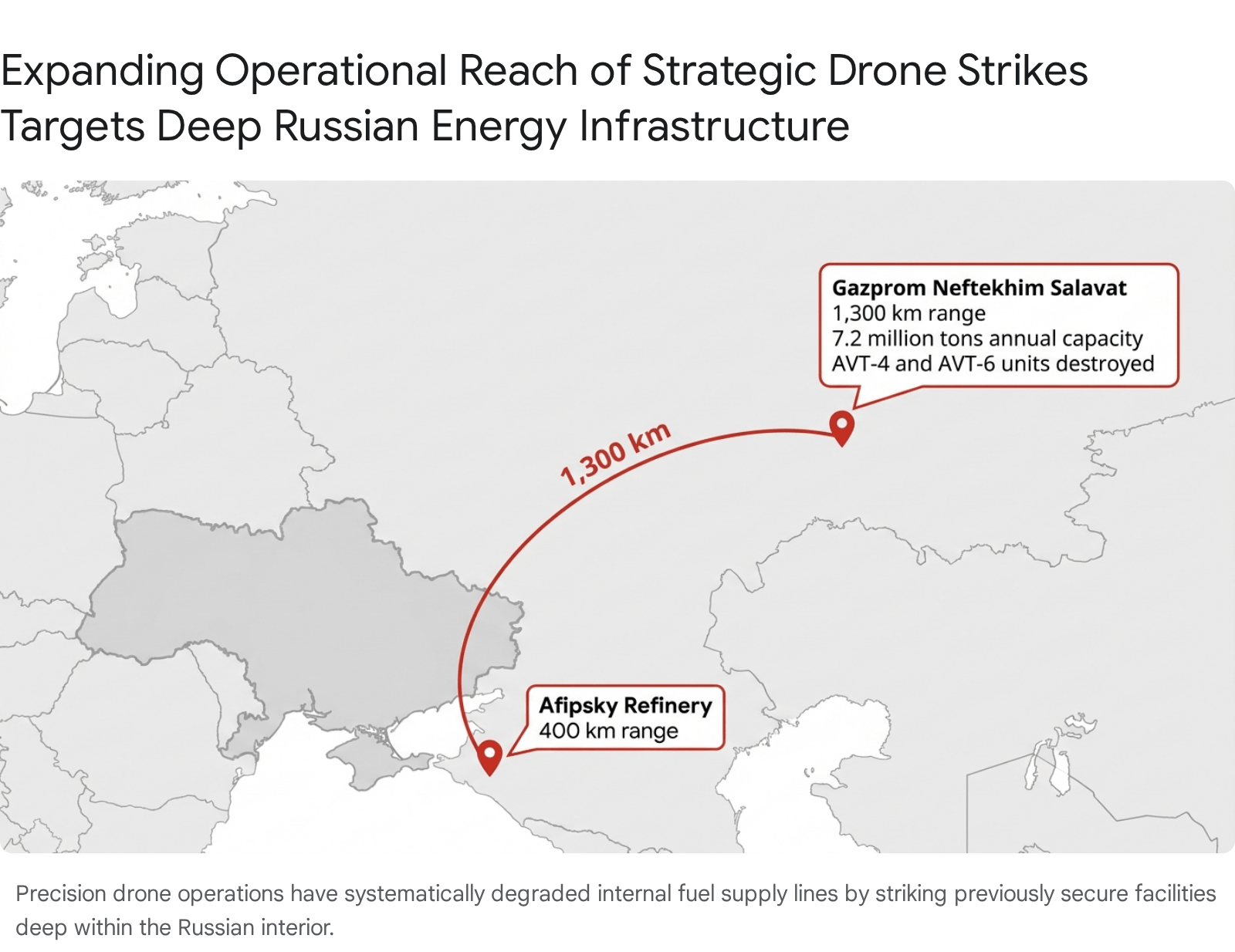
The Expansion of the Strategic Deep-Strike Campaign On July 14, the operational environment shifted dynamically as Ukrainian Unmanned Aerial Vehicles (UAVs) executed deep strikes against two major Russian petrochemical facilities12. These strikes demonstrated an expanding asymmetric strike capability that the Russian domestic air defense network proved incapable of fully mitigating. The primary target of this operation was the Gazprom Neftekhim Salavat complex located in the Republic of Bashkortostan12. This facility is situated approximately 1,300 kilometers from the Ukrainian border, highlighting a severe vulnerability in Russia’s deep rear logistical spaces12.
Satellite imagery subsequently verified structural damage to the AVT-4 and AVT-6 primary oil refining units at the Salavat facility16. These highly specialized distillation units possess annual processing capacities of 4 million and 6 million metric tons of crude oil respectively16. The destruction of primary distillation units is critical, as it effectively halts the downstream petrochemical production chain. The strikes also severely damaged the logistics and production building of Shop No. 20, an industrial site utilized for manufacturing high-density polyethylene pellets and films16.
Prior to this targeted attack, the Salavat complex refined 7.2 million tons of crude oil annually, representing 2.7 percent of the total national refining capacity12. Crucially, the Salavat facility stood as the last major Russian gasoline producer untouched by the 2026 aerial strike campaign13. The operational loss of this specific facility removed approximately 11,000 tons of daily fuel deliveries from the Russian domestic market, constituting roughly five percent of total national demand13. Simultaneously, secondary drone formations struck the Afipsky refinery in Krasnodar Krai, located 400 kilometers from the front lines12. The Afipsky facility, which had endured multiple prior strikes over the past year, suffered new fires near its bulk tank farm, further degrading regional fuel distribution logistics in the southern military districts13.
Diplomatic Maneuvering and International Posturing While domestic infrastructure burned, the Kremlin engaged in concerted diplomatic efforts designed to project international normalization and expand influence within the Global South. From July 13 to July 16, Russian diplomats hosted the First Russia-Latin America Strategic Cooperation Forum in Sao Paulo, Brazil17. This event brought together official representatives from ten Latin American nations, alongside Russia, to discuss long-term economic, scientific, and geopolitical cooperation17. The forum aimed to secure alternative supply chains and bypass Western financial isolation by fostering direct bilateral trade agreements.
Simultaneously, at the United Nations headquarters in New York, the Russian diplomatic delegation participated in the high-level political forum on sustainable development18. The delegation adopted a ministerial declaration but utilized parliamentary procedures to formally dissociate the Russian Federation from specific language regarding peace and security mandates, arguing that such language fell outside the specific purview of the economic forum18.
On July 15, Foreign Ministry spokeswoman Maria Zakharova issued diplomatic warnings directed at European capitals. Reacting to renewed discussions among NATO allies regarding the potential deployment of a Western coalition of the willing within Ukrainian territory, Zakharova stated that any foreign military contingents deployed to the theater would be treated as legitimate military targets19. She characterized any such deployment as a direct foreign intervention, signaling the Kremlin’s rigid red lines regarding direct Western troop presence19.
July 16: Macroeconomic Strain, Stagflation Indicators, and Monetary Policy Dilemmas
The Threat of Stagflation and Industrial Slowdown By July 16, the cumulative destruction of energy infrastructure fed directly into a deteriorating macroeconomic environment, elevating fears of stagflation among Russian financial policymakers20. Stagflation, characterized by the simultaneous occurrence of stagnant economic output and high inflation, represents a severe scenario for a wartime economy. The Central Bank of Russia (CBR) recorded headline consumer inflation accelerating to 6.0 percent year-over-year, significantly above the bank’s strict 4.0 percent baseline target21.
The industrial sector showed clear signs of distress. The CBR Business Climate Indicator fell by 4.5 points in July to negative 3.6, marking its lowest level since mid-202222. Corporate financial health demonstrated structural strain across multiple sectors. State statistics agency Rosstat indicated that refined petroleum output had plunged by 13.5 percent year-on-year in the preceding months, a decline that actively dragged overall industrial production into negative territory20.
Monetary Policy and the Banking Sector The response from the central banking authority created deep fractures within the Russian financial elite. Herman Gref, the CEO of Sberbank (Russia’s largest state-owned lender), publicly criticized the CBR’s tight monetary policy23. Gref argued that maintaining the key interest rate at 14.25 percent was artificially overcooling the broader economy and stifling vital corporate lending24. He asserted that it was irrational to utilize high interest rates to combat inflation that was fundamentally driven by supply-side shocks (namely, the physical destruction of refineries and resulting fuel shortages) rather than demand-side overheating24.
Internal projections from Sberbank executives painted a pessimistic outlook; the bank raised its 2026 key rate forecast to 13.0 percent and indicated it will likely raise its inflation forecast from the current 6.0 to 6.5 percent range, while lowering its GDP growth forecast from the current 0.5 to 1.0 percent range23. Concurrently, independent analysts surveyed by the Central Bank of Russia lowered their national GDP growth estimates to 0.6 percent and raised their inflation forecast to 6.2 percent26. Furthermore, macroeconomic data revealed that Russian corporate debt had expanded by 93 percent since 2021, while household debt had risen by 57 percent27. This highly leveraged environment left the banking sector acutely vulnerable to mass defaults under the sustained high-interest-rate regime, leading major lenders to aggressively increase their loan-loss provisions28.
Fiscal Policy and the Widening Budget Deficit Fiscal policy implementation compounded these monetary challenges. Analysts reviewing open-source data from the Russian government’s official budget portal reported that the 2026 federal budget deficit was projected to reach 4.83 trillion rubles (approximately 12.85 billion dollars)29. This projection overshot the legally planned target by more than one trillion rubles29.
Russian Finance Minister Anton Siluanov publicly acknowledged the fiscal deviation29. The widening deficit was fundamentally driven by escalating military expenditures required to sustain the war effort, coupled with decreasing petroleum tax revenues stemming from enforced export bans and production declines29. Despite these structural economic threats, Kremlin spokesman Dmitry Peskov dismissed domestic concerns during a press briefing on July 16, stating that the macroeconomic situation remained stable32. Peskov attributed the sluggish industrial growth to general volatility within the global economy rather than internal systemic failures32.
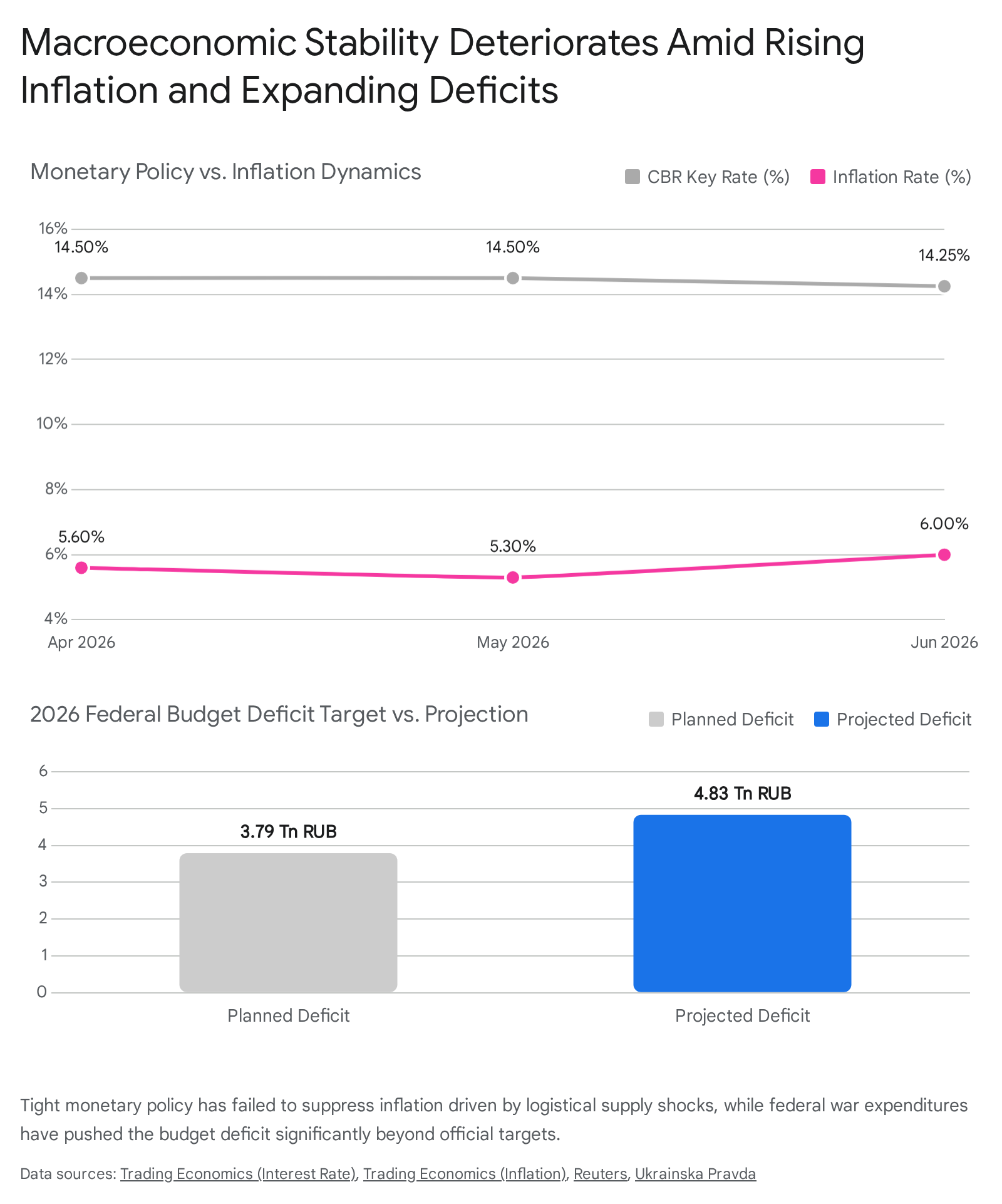
| Macroeconomic Indicator | Official Target / Previous Measure | Current Projected Measure (July 2026) | Deviation Analysis |
| Federal Budget Deficit | 3.79 Trillion Rubles | 4.83 Trillion Rubles | Escalating military expenditure combined with reduced hydrocarbon tax yields29. |
| Headline Inflation Rate | 4.0% (CBR Target) | 6.0% (Year-over-Year) | Supply-side shocks from domestic fuel shortages offsetting strict monetary policy20. |
| CBR Key Interest Rate | 14.5% (Previous) | 14.25% | Marginal rate cut implemented, but high baseline stifles necessary corporate lending35. |
July 17: International Sanctions and Pre-Election Political Realignments
Targeted European Union Sanctions Regime On July 17, the European Council escalated its restrictive measures by imposing targeted sanctions against specific entities operating within the Russian military-industrial complex36. The Council formally listed one individual and five corporate entities, all functioning under the corporate umbrella of the ABS Electro Group36. This specific network specializes in the advanced development and manufacturing of radio-electronic components that are crucial for asymmetric drone warfare36. Specifically, the ABS Electro Group produces components designed to enhance the resistance of Shahed and Geran-type Unmanned Aerial Vehicles against electronic warfare jamming systems36. Irina Kharisova, Chairman of the Board of the ABS Electro Group, was personally subjected to asset freezes and travel bans36. This action reflected a targeted European Union strategy to degrade Russia’s technical capacity to execute the very deep-strike operations it utilizes against Ukrainian civilian infrastructure.
Preparations for the 2026 State Duma and Regional Elections Domestically, July 17 marked a highly visible acceleration of structural preparations for the consequential State Duma and regional gubernatorial elections scheduled for September 18 to 20, 202637. The Kremlin and the ruling United Russia party faced a complex political environment characterized by rising public dissatisfaction and economic fatigue. Independent internal polling conducted by the late Alexei Navalny’s Anti-Corruption Foundation estimated genuine public support for United Russia at sixteen percent, though official state pollsters projected significantly higher figures40.
To counter this deficit in genuine popularity, United Russia underwent a structural reorganization under the leadership of Vladimir Yakushev37. Yakushev centralized control, reducing the party’s General Council presidium from thirty-five down to fourteen highly vetted members37. In a calculated populist maneuver, the party heavily recruited military veterans who had served in Ukraine to run as candidates across multiple districts37. This strategy was an explicit attempt to fuse organic patriotic sentiment with the party’s platform and create a newly loyal, militarized managerial class within the legislature37. Former President Dmitry Medvedev was positioned to head the national party list, serving alongside Foreign Minister Sergei Lavrov, projecting a facade of elite continuity37.
The impending elections also serve as a mechanism to formalize control over regional executive branches. To ensure political stability and administrative compliance ahead of the vote, the Kremlin relied on personnel changes made earlier in the year41. In May 2026, President Vladimir Putin preemptively replaced several key regional governors, militarizing the civilian administration in border regions impacted by cross-border military actions42. Alexander Shuvaev, a military general, was appointed as the acting governor of the Belgorod region, while Yegor Kovalchuk took administrative control over the Bryansk region39.
| Region | Outgoing Governor | Incoming Acting Governor | Strategic Background |
| Belgorod Oblast | Vyacheslav Gladkov | Alexander Shuvaev | Military general; veteran of Syrian and Caucasian campaigns42. |
| Bryansk Oblast | Alexander Bogomaz | Yegor Kovalchuk | Former official in occupied territories; financial background42. |
Furthermore, the Kremlin security apparatus closely monitored the rapid rise of the “New People” party40. This political entity had successfully overtaken the traditional Communist Party to become the second-most popular political organization in Russia, commanding twelve percent of polled support40. The party operates on a platform focused heavily on regionalism, opposition to tax increases, and support for small businesses, carefully avoiding systemic anti-war rhetoric while absorbing the votes of the economically frustrated middle class40.
July 18: Escalation of the Drone War and Logistical Vulnerabilities
The Wildberries Logistics Strikes and Commercial Infrastructure Attrition The profound vulnerability of the Russian domestic commercial supply chain was exposed on a significant scale on July 18. Ukrainian forces launched coordinated waves of long-range attack drones, striking critical logistical targets deep within the Moscow and Tambov regions43. While the Russian Defense Ministry officially claimed to have successfully intercepted 379 Ukrainian drones across nineteen regions overnight, multiple munitions successfully penetrated the layered air defense network44.
The primary targets of this coordinated operation were two large warehouse complexes owned and operated by Wildberries, Russia’s largest e-commerce and retail logistics corporation43. In the Moscow region, a large logistics facility located in Elektrostal covering 359,600 square meters caught fire, sending towering plumes of black smoke into the airspace48. Simultaneously, a second Wildberries warehouse covering 108,000 square meters in the city of Kotovsk, located in the Tambov region, was also directly struck44.
The human and financial toll of these strikes was severe. Seven night-shift warehouse workers were killed instantly at the Kotovsk facility, and one individual later died from severe injuries sustained in the Moscow region43. More than 80 people required emergency medical attention across the targeted areas51. Financial analysts operating at the independent outlet Vazhnye Istorii estimated that Wildberries and its associated commercial sellers would face direct losses exceeding 100 billion rubles (1.28 billion dollars)49. The strikes physically impacted approximately ten to fifteen percent of the corporation’s total national warehouse capacity, disrupting the processing of millions of retail items daily49.
Ukrainian President Volodymyr Zelenskyy publicly confirmed the military operations, stating that the targeted Wildberries facilities were not purely civilian commercial infrastructure44. Zelenskyy stated that the logistical hubs were actively utilized by the Russian state to store, process, and supply sanctioned electronic components required for the domestic production of military drones and advanced navigation equipment44. This revelation highlights the increasing blur between civilian e-commerce logistics and military procurement networks within the Russian war economy.
Energy Sector Strikes and Imminent Mobilization Projections Concurrently with the warehouse strikes, Ukrainian drones struck a critical oil depot in the city of Noginsk, located just north of Elektrostal in the Moscow region46. The resulting industrial fire prompted the immediate emergency evacuation of a nearby residential building and a local maternity hospital47. The Ukrainian General Staff officially noted that the Noginsk facility functioned as a primary distribution node for supplying fuel and specialized lubricants directly to the Russian armed forces45.
As the logistical attrition continued to mount, credible reports circulated within intelligence circles regarding a severe, impending manpower shortage within the Russian military apparatus. Intelligence analysis reported that the Russian Ministry of Defense had failed entirely to meet its 2026 contract recruitment targets, having secured only 195,000 of the required 204,500 military personnel56. Consequently, Ukraine’s Center for Countering Disinformation assessed that the Russian military command was actively preparing for an involuntary mobilization of 500,000 personnel scheduled for the autumn56. This mobilization is explicitly planned to occur immediately following the September State Duma elections, a delay calculated by the Kremlin to avoid triggering mass social unrest and anti-government protests prior to the critical voting period56.
July 19: Retaliatory Strategic Bombardment and Societal Fractures
The Strategic Bombardment of the Ukrainian Capital In direct, immediate retaliation for the devastating strikes on the Wildberries logistics hubs and the Noginsk oil depot, the Russian military launched one of its largest and most complex ballistic missile barrages of the year against the Ukrainian capital, Kyiv, in the early hours of July 19, 202658.
The sustained attack commenced at 1:30 AM local time and lasted for five continuous hours58. The Russian Aerospace Forces deployed an estimated 125 Shahed, Gerbera, and Italmas attack drones, synchronized alongside 41 air- and ground-launched cruise and ballistic missiles59. The missile volley was notably dense with high-velocity munitions designed to evade traditional interceptors, including approximately 25 Iskander-M and S-400 ballistic missiles launched from the Bryansk and Kursk regions, and up to ten hypersonic 3M22 Zircon anti-ship missiles fired from the Kursk region58.
The Ukrainian Air Force reported the successful interception of 108 drones and 18 missiles58. However, several heavy ballistic munitions penetrated the air defense umbrella. The impacts caused structural damage and fires across five distinct districts in Kyiv (Desnianskyi, Dniprovskyi, Shevchenkivskyi, Sviatoshynskyi, and Solomyanskyi)59. A three-story residential building and a private home were completely set ablaze, and the above-ground vestibule of the Lukyanivska metro station suffered a roof collapse due to a kinetic blast wave58. At least one civilian was killed, and up to sixteen individuals sustained injuries requiring hospitalization59.
Furthermore, a direct Russian missile strike destroyed the primary production facilities and storage warehouses of UKRTAC, a prominent Ukrainian manufacturer of ballistic protection equipment and infantry body armor66. The Russian Defense Ministry confirmed the strikes in a morning briefing, officially claiming to have successfully targeted military-industrial facilities, logistics centers, and plants producing drone and missile components60. Concurrently, deep inside Russia, Ukraine’s Security Service (SBU) struck three oil storage facilities in Russia’s Stavropol region, approximately 600 kilometers from the border, targeting infrastructure utilized to store and distribute petroleum products67.
Societal and Military Impacts Within Russia The intense exchange of long-range strikes throughout the week highlighted the evolving nature of the conflict into a grinding war of industrial, economic, and logistical attrition. The Russian public exhibited increasing signs of war fatigue and deep economic dissatisfaction. Sociological data released by the Russian Public Opinion Foundation indicated that 22 percent of all Russian citizens expected their personal financial situation to worsen in the near future, representing the highest absolute level of economic pessimism recorded in eleven years68. Real disposable household incomes contracted by one percent in the first quarter of the year, forcing broad, systemic reductions in consumer spending on non-food goods and electronics68.
Within the highly active pro-war nationalist community, frustration mounted visibly over the lack of strategic progress and sustained high casualty rates. Dissenting voices within the military structure, though heavily monitored and suppressed by state security apparatuses, began to emerge. A notable incident involved Russian soldier Alexander Lunin, who published an emotional appeal threatening a military coup against the Kremlin, stating that the army would turn its weapons on the leadership69. Though Lunin was quickly detained for extremism and subsequently forced to issue a public apology, the incident exemplifies the growing ideological fractures within the fighting force69.
These fractures are driven by significant personnel losses. According to the General Staff of the Armed Forces of Ukraine, Russian forces suffered an estimated 1,520 personnel casualties on July 18 alone, bringing the total estimated losses to over 1.42 million since the initiation of the full-scale invasion70. The sustained high casualty rates, combined with the systematic destruction of vital interior logistical nodes and commercial supply chains, continue to place extreme pressure on the Kremlin’s ability to finance, equip, and execute its strategic military objectives. Meanwhile, international cultural protests, such as the Pussy Riot demonstration led by Nadya Tolokonnikova at the Venice Biennale’s Russian pavilion, continued to isolate the Russian state culturally, further alienating it from the international community72.
3. Conclusion
The events of July 12 to July 19, 2026, demonstrate a critical phase of structural and systemic strain for the Russian Federation. The state is currently trapped in an escalating cycle of logistical attrition and macroeconomic destabilization. Ukraine’s demonstrated ability to project kinetic power deep into the Russian interior, striking critical refineries in Bashkortostan, disrupting the shadow fleet in the Sea of Azov, and devastating dual-use commercial logistics hubs near Moscow, has created cascading effects across the entire Russian economy.
These deep strikes are directly responsible for the domestic fuel crisis, which in turn has catalyzed a severe inflationary environment that the Central Bank of Russia is currently failing to contain. The resulting stagflationary pressures, characterized by a one trillion ruble budget deficit expansion and a collapse in commercial business climate sentiment, threaten the long-term sustainability of the Russian war economy.
Politically, the Kremlin is attempting to navigate these severe vulnerabilities through a strategy of absolute centralization and narrative control. The aggressive restructuring of the United Russia party and the preemptive installation of military-aligned regional governors indicate a clear intent to construct a highly militarized, deeply loyal administrative state ahead of the September 2026 elections. However, the highly visible flight of elite capital to foreign jurisdictions and decentralized cryptocurrency networks suggests a profound internal lack of confidence in the regime’s economic stewardship. The large-scale retaliatory ballistic missile strikes on Kyiv serve both a tactical military purpose and a vital domestic psychological function, intended to project strength to an increasingly pessimistic, economically strained, and war-weary populace. Moving forward, the trajectory of the Russian state hinges almost entirely on its capacity to shield its remaining interior logistics from deep strikes while attempting to manage the volatile intersection of a massive budget deficit, crippling consumer inflation, and an impending mass mobilization.
4. Appendix: Methodology and Data Sources
The synthesis of this report relied on a comprehensive review of open-source intelligence, independent economic reporting, international commodity market data, and official state communications. Data clusters were analyzed to map direct causal relationships between military strikes, logistical degradation, and macroeconomic shifts.
The following sources were utilized in the formulation of this analysis:
- The Guardian: Dozens of Russian missiles pound Kyiv in major attack
- News4Jax: 1 killed, 8 injured in an overnight Russian attack on Kyiv
- Ministry of Defence of Ukraine: Total russian combat losses in Ukraine
- Associated Press: Russia Ukraine attack ballistic missiles
- The New Voice of Ukraine: Russian Missile Attack on Kyiv on July 19
- Ukrainska Pravda: Russian attack destroys UKRTAC manufacturing plant
- TV BRICS: First Russia Latin America Strategic Cooperation Forum
- United Nations Press: ECOSOC Sustainable Development Forum
- WSLS: Russian attack on Kyiv
- Consilium: EU agrees six listings related to deadly strikes on Kyiv
- Anadolu Agency: Ukraine says one of Russia’s largest missile attacks on Kyiv killed 1
- Ukrainska Pravda: Russian losses over past day
- Associated Press: Russia Ukraine war reshuffle
- Ground News: Ukraine Confirms Strikes on 2 Russian Oil Refineries
- Militarnyi: Satellite images capture aftermath of strike on Gazprom Neftekhim Salavat
- Ukrainian News: Drones attacked Gazprom Neftekhim Salavat
- Euromaidan Press: Ukraine hits two refineries overnight
- Meduza: Ukrainian drones spark fires at two Russian refineries
- The Moscow Times: Ukrainian Drone Attacks Kill Seven Warehouse Workers
- Times of India: 7 killed as Ukrainian drones hit Russian warehouses
- India Today: Ukraine drone strikes Moscow warehouses
- CBS News: Ukrainian drone attacks on Russian warehouses
- UNITED24 Media: Ukraine Brings the War to Russia’s Amazon
- PBS NewsHour: Ukrainian drones hit warehouses
- Associated Press: Ukrainian drones hit warehouses and other sites
- The New Voice of Ukraine: Wildberries losses may top 1.28B
- The Independent: Russian online retail warehouses hit by Ukraine drones
- IndexBox: Russia Diesel Ban Adds Price Pressure
- Maaal: Russia’s diesel export ban deepens global supply crisis
- Al-Monitor: Russia bans diesel exports
- Daily Investor: Diesel shortage on the cards for South Africa
- MarineLink: Russia Halted Don Azov Channel Shipping
- Euromaidan Press: Russia halts Don-Azov Channel shipping
- Euronext: Russia halts Don-Azov channel shipping
- CEPA: How to Pile the Pain on Putin
- The Moscow Times: Russia is Gearing Up for Nationwide Elections
- Nest Centre: How the Kremlin is preparing for the 2026 State Duma elections
- Wikipedia: 2026 Russian legislative election
- The Moscow Times: Russian Central Bank Slashes Key Rate
- Reuters (via KFGO): Russia’s 2026 budget deficit may exceed plans
- Trading Economics: Russia Interest Rate
- Times of India: Boom at the front, bust at home
- Global Banking & Finance: Kremlin on Russian economy’s difficulties
- The Moscow Times: Could Russia’s Wartime Debt Boom Trigger a Banking Crisis?
- Interfax: Analysts lower Russian 2026 GDP growth forecast
- Trading Economics: Russia Inflation Rate
- UA News: Sentiment in Russia is deteriorating
- The Moscow Times: Russia’s Fuel Crisis Raises Stagflation Fears
- WKZO: Russia’s 2026 budget deficit
- Ukrainska Pravda: Russia’s budget deficit to grow
- Tasnim News Agency: Global Economy Is Currently in A Rather Dire State
- Investing.com: Kremlin says Russian economic challenges are not critical
- UNITED24 Media: Russian Elite Rush Into Crypto and Gold
- Interfax: Sberbank raises key rate forecast for 2026
- The Moscow Times: Sberbank CEO Renews Call for Interest Rate Cut
- The Moscow Times: Putin Replaces Governors
- Nest Centre: Changes of regional governors
- UNITED24 Media: Ukraine’s Security Service Strikes Three Russian Oil Depots
- Anadolu Agency: Russia warns coalition of willing forces
- Defense News: Russian troops survive just 20-30 minutes on Ukraine’s front lines
- RBC Ukraine: Russia prepares to mobilize 500,000 troops
- Kyiv Independent: As war drags on, Russia’s pro-war camp turns its anger on the Kremlin
- Ocula: Pussy Riot protests at Venice Biennale
Please share the link on Facebook, Forums, with colleagues, etc. Your support is much appreciated and if you have any feedback, please email us in**@*********ps.com. If you’d like to request a report or order a reprint, please click here for the corresponding page to open in new tab.
Sources Used
- After Ukraine’s attacks, Russia halted Don-Azov Channel shipping, which affected grain trade. – Marine Link, https://www.marinelink.com/blogs/blog/after-ukraines-attacks-russia-halted-donazov-channel-shipping-105048
- Russia halts Don-Azov Channel shipping, closes Kerch Strait after Ukrainian tanker strikes, https://euromaidanpress.com/2026/07/11/russia-halts-don-azov-channel-shipping-closes-kerch-strait-after-ukrainian-tanker-strikes/
- Russia halts Don-Azov channel shipping, affecting grain trade, after Ukraine attacks | live, https://live.euronext.com/en/financial-news/russia-halts-don-azov-channel-shipping-affecting-grain-trade-after-ukraine-attacks
- Russia suspends shipping through Don-Azov Canal, which leads to Sea of Azov | Ukrainian news, https://ukranews.com/en/news/1162552-russia-suspends-shipping-through-don-azov-canal-which-leads-to-sea-of-azov
- Ukrainian drone strikes force Russia to suspend shipping in Sea of Azov, https://www.theguardian.com/world/2026/jul/12/ukrainian-drone-strikes-force-russia-to-suspend-shipping-in-sea-of-azov
- How to Pile the Pain on Putin, https://cepa.org/article/how-to-pile-the-pain-on-putin/
- Russia Diesel Export Ban: Limited Supply Impact but Bullish Price Signal – News and Statistics, https://www.indexbox.io/blog/russia-diesel-ban-adds-price-pressure-amid-iran-ceasefire-collapse/
- Russia bans diesel exports to ensure domestic supply after targeted Ukrainian drone strikes, https://www.al-monitor.com/originals/2026/07/russia-bans-diesel-exports-ensure-domestic-supply-after-targeted-ukrainian-drone
- Global Diesel Market Tightens: Russia Export Ban, Ukraine Attacks, Middle East War Impact – News and Statistics, https://www.indexbox.io/blog/global-diesel-market-tightens-as-russia-bans-exports-amid-ukraine-strikes-and-middle-east-war/
- Diesel shortage on the cards for South Africa, https://dailyinvestor.com/energy/144175/diesel-shortage-on-the-cards-for-south-africa/
- Russian Elite Rush Into Crypto and Gold as State Confiscations Accelerate, https://united24media.com/world/russian-elite-rush-into-crypto-and-gold-as-state-confiscations-accelerate-20850
- Ukraine Confirms Strikes on 2 Russian Oil Refineries, Tankers, Cargo Ships, and Military Logistics Sites, https://ground.news/article/ukraine-confirms-strikes-on-2-russian-oil-refineries-tankers-cargo-ships-and-military-logistics-sites_98694e
- A plant making 150 products from gasoline to polyethylene caught fire 1,300 km from the war zone—Ukraine hits two refineries overnight – Euromaidan Press, https://euromaidanpress.com/2026/07/14/a-plant-making-150-products-from-gasoline-to-polyethylene-caught-fire-1300-km-from-the-war-zone-ukraine-hits-two-refineries-overnight/
- Ukrainian drones spark fires at two Russian refineries overnight, including one of the country’s biggest petrochemical plants – Meduza, https://meduza.io/en/news/2026/07/14/ukrainian-drones-spark-fires-at-two-russian-refineries-overnight-including-one-of-the-country-s-biggest-petrochemical-plants
- Drones attacked Gazprom Neftekhim Salavat refinery in Bashkortostan: fire broke out after explosions, https://ukranews.com/en/news/1162976-drones-attacked-gazprom-neftekhim-salavat-refinery-in-bashkortostan-fire-broke-out-after-explosions
- Satellite Images: Strikes Hit All Oil Refining Units at Salavat Refinery, https://militarnyi.com/en/news/strikes-hit-all-oil-refining-units-salavat/
- First Russia–Latin America Strategic Cooperation Forum concludes in Sao Paulo, https://tvbrics.com/en/news/first-russia-latin-america-strategic-cooperation-forum-concludes-in-sao-paulo/
- High-Level Political Forum Concludes 2026 Session, Adopts Ministerial Declaration Vowing to ‘Act with Urgency’ in Realizing 2030 Agenda for Sustainable Development, https://press.un.org/en/2026/ecosoc7234.doc.htm
- Russia warns coalition of willing forces in Ukraine would be ‘legitimate military targets’, https://www.aa.com.tr/en/eurasia/russia-warns-coalition-of-willing-forces-in-ukraine-would-be-legitimate-military-targets/3999467
- Russia’s Fuel Crisis Raises Stagflation Fears as Growth Stalls and Inflation Accelerates, https://www.themoscowtimes.com/2026/07/16/russias-fuel-crisis-raises-stagflation-fears-as-growth-stalls-and-inflation-accelerates-a93272
- Russia Inflation Rate – Trading Economics, https://tradingeconomics.com/russia/inflation-cpi
- Kremlin says Russian economy’s difficulties are not critical, https://www.globalbankingandfinance.com/kremlin-russian-economys-difficulties-critical/
- Sberbank raises key rate forecast for 2026 to 13%, predicts Central Bank could adopt tougher rhetoric in July – Interfax, https://interfax.com/newsroom/top-stories/118277/
- Sberbank CEO Renews Call for Interest Rate Cut, https://www.themoscowtimes.com/2026/06/30/sberbank-ceo-renews-call-for-interest-rate-cut-a93130
- Russian Central Bank Slashes Key Rate to 14.25% – The Moscow Times, https://www.themoscowtimes.com/2026/06/19/russian-central-bank-slashes-key-rate-to-1425-a93053
- Analysts lower Russian 2026 GDP growth forecast slightly, raise inflation outlook substantially, https://interfax.com/newsroom/top-stories/118403/
- Could Russia’s Wartime Debt Boom Trigger a Banking Crisis?, https://www.themoscowtimes.com/2026/07/17/could-russias-wartime-debt-boom-trigger-a-banking-crisis-a93271
- Boom at the front, bust at home: Russia’s war economy is holding but its people are cracking, https://timesofindia.indiatimes.com/world/europe/boom-at-the-front-bust-at-home-russias-war-economy-is-holding-but-its-people-are-cracking/articleshow/132476856.cms
- Russia’s 2026 budget deficit may exceed plans by $12.85 billion due to higher spending, https://kfgo.com/2026/07/16/russias-2026-budget-deficit-may-exceed-plans-by-12-85-billion-due-to-higher-spending/
- Russia’s 2026 budget deficit may exceed plans by $12.85 billion due to higher spending | WKZO | Everything Kalamazoo, https://wkzo.com/2026/07/16/russias-2026-budget-deficit-may-exceed-plans-by-12-85-billion-due-to-higher-spending/
- Russia’s budget deficit to exceed forecasts by almost US$13 billion – Reuters, https://www.pravda.com.ua/eng/news/2026/07/16/8044344/
- Global Economy Is Currently in A Rather Dire State: Kremlin – Other Media news, https://www.tasnimnews.ir/en/news/2026/07/16/3648760/global-economy-is-currently-in-a-rather-dire-state-kremlin
- Kremlin says Russian economic challenges are not critical – Investing.com, https://www.investing.com/news/economy-news/kremlin-says-russian-economic-challenges-are-not-critical-93CH-4795183
- Kremlin says Russian economic challenges are not critical – Investing.com Nigeria, https://ng.investing.com/news/stock-market-news/kremlin-says-russian-economic-challenges-are-not-critical-93CH-2602444
- Russia Interest Rate – Trading Economics, https://tradingeconomics.com/russia/interest-rate
- Russian military-industrial complex: EU agrees six listings related to deadly strikes on Kyiv, https://www.consilium.europa.eu/en/press/press-releases/2026/07/17/russian-military-industrial-complex-eu-agrees-six-listings-related-to-deadly-strikes-on-kyiv/
- What to expect from Russia’s 2026 elections – New Eurasian Strategies Centre, https://nestcentre.org/how-the-kremlin-is-preparing-for-the-2026-state-duma-elections/
- 2026 Russian legislative election – Wikipedia, https://en.wikipedia.org/wiki/2026_Russian_legislative_election
- 2026 Russian elections – Wikipedia, https://en.wikipedia.org/wiki/2026_Russian_elections
- Russia Is Gearing Up for Nationwide Elections. This Is What You Need to Know., https://www.themoscowtimes.com/2026/07/02/russia-is-gearing-up-for-nationwide-elections-this-is-what-you-need-to-know-a93142
- Changes of regional governors as a snapshot of current Russian politics, https://nestcentre.org/december-2024-changes-of-regional-governors-as-a-snapshot-of-current-russian-politics/
- Putin Replaces Governors of War-Ravaged Belgorod and Bryansk Regions, https://www.themoscowtimes.com/2026/05/13/putin-replaces-governors-of-war-ravaged-belgorod-and-bryansk-regions-a92750
- Ukrainian Drone Attacks Kill Seven Warehouse Workers in Russia, https://www.themoscowtimes.com/2026/07/18/ukrainian-drone-attacks-kill-seven-warehouse-workers-in-russia-a93280
- 7 killed as Ukrainian drones hit Russian warehouses, oil depot near Moscow, https://timesofindia.indiatimes.com/world/europe/7-killed-as-ukrainian-drones-hit-russian-warehouses-oil-depot-near-moscow/articleshow/132477619.cms
- Ukraine drone strikes hit Moscow-area warehouses, oil depot; nine killed, https://www.indiatoday.in/world/story/ukraine-drone-strikes-moscow-warehouses-noginsk-oil-depot-kill-nine-ptag-2951008-2026-07-18
- Ukraine Brings the War to Russia’s Amazon as Wildberries Hubs Go Up in Flames, https://united24media.com/war-in-ukraine/ukraine-brings-the-war-to-russias-amazon-as-wildberries-hubs-go-up-in-flames-20869
- Ukrainian drone attacks on Russian warehouses and oil depot kill at least 9, injure over 60, https://www.cbsnews.com/news/ukraine-russia-war-drone-attacks-wildberries/
- Large-scale drone attack on Moscow: oil depot and Wildberries warehouse catch fire, https://www.pravda.com.ua/eng/news/2026/07/18/8044673/
- Wildberries losses may reach $1.3B after warehouse fires – The New Voice of Ukraine, https://english.nv.ua/amp/wildberries-losses-may-top-1-28b-after-drone-strike-fires-50625465.html
- Russian warehouses and oil depots crippled by Ukraine drone attack, https://www.the-independent.com/news/world/europe/russian-wildberries-warehouses-elektrostal-ukraine-drones-b3017446.html
- Ukrainian drones hit warehouses and other sites across Russia, killing 9 and wounding over 80, https://apnews.com/article/russia-ukraine-war-drone-attacks-c2d0d713643288b81dbbea714d5db5ac
- 8 killed as Ukrainian drones hit Russian warehouses, oil depot in overnight attack, https://www.indiatoday.in/world/story/ukrainian-drone-attacks-russia-wildberries-warehouses-oil-depot-eight-killed-ptag-2950741-2026-07-18
- Ukrainian Drones Strike Oil Depot in Moscow Region and Logistics Hubs – Kyiv Post, https://www.kyivpost.com/post/80562
- Ukrainian drones hit warehouses and other sites across Russia, killing 9 and wounding over 60 – PBS, https://www.pbs.org/newshour/world/ukrainian-drones-hit-warehouses-and-other-sites-across-russia-killing-9-and-wounding-over-60
- Ukraine drone strikes kill seven at Russian warehouses, oil depot hit, https://www.indiatoday.in/world/story/ukraine-drone-attacks-russia-seven-killed-warehouses-oil-depot-hit-ptag-2950665-2026-07-18
- Russia Plans to Mobilize 500,000 Personnel by Autumn, Prepares for New Fronts – Kyiv Post, https://www.kyivpost.com/post/80585
- Russia prepares to mobilize 500000 troops for Ukraine war, https://newsukraine.rbc.ua/news/russia-prepares-to-mobilize-500-000-troops-1784374584.html
- Russia pounds Kyiv for five hours in one of biggest ever ballistic missile attacks, https://www.theguardian.com/world/2026/jul/19/dozens-of-russian-missiles-pound-kyiv-ukraine-in-major-attack
- Russia launches 41 missiles, 125 drones at Ukraine, https://english.nv.ua/nation/russian-missile-attack-on-kyiv-on-july-19-causes-widespread-destruction-casualties-reported-50625495.html
- 1 killed, 16 wounded in an overnight Russian attack on Kyiv, https://www.clickorlando.com/news/world/2026/07/19/1-killed-8-injured-in-an-overnight-russian-attack-on-kyiv/
- Deadly overnight Russian attack on Ukraine targets the capital, https://www.wglt.org/2026-07-19/deadly-overnight-russian-attack-on-ukraine-targets-the-capital
- 1 killed, 16 wounded in an overnight Russian attack on Kyiv, https://apnews.com/article/russia-ukraine-attack-ballistic-missiles-ddea9c0a10367fc84b3cb563896102e3
- Ukraine says one of Russia’s ‘largest’ missile attacks on Kyiv killed 1, injured 15, https://www.aa.com.tr/en/russia-ukraine-war/ukraine-says-one-of-russias-largest-missile-attacks-on-kyiv-killed-1-injured-15/4002612
- 1 killed, 8 injured in an overnight Russian attack on Kyiv – WSLS 10, https://www.wsls.com/news/world/2026/07/19/1-killed-8-injured-in-an-overnight-russian-attack-on-kyiv/
- 1 killed, 8 injured in an overnight Russian attack on Kyiv – News4JAX, https://www.news4jax.com/news/world/2026/07/19/1-killed-8-injured-in-an-overnight-russian-attack-on-kyiv/
- Russian attack destroys UKRTAC manufacturing plant, https://www.pravda.com.ua/eng/news/2026/07/19/8044797/
- Ukraine’s Security Service Strikes Three Russian Oil Depots at Once 600 Kilometers From Border, https://united24media.com/war-in-ukraine/ukraines-security-service-strikes-three-russian-oil-depots-at-once-600-kilometers-from-border-20883
- Sentiment in Russia is deteriorating due to prices and economic problems – UA.NEWS, https://ua.news/en/world/nastroyi-v-rosiyi-pogirshuiutsia-cherez-tsini-ta-ekonomichni-problemi
- As war drags on, Russia’s pro-war camp turns its anger on the Kremlin, https://kyivindependent.com/as-war-drags-on-russias-pro-war-camp-turns-its-anger-on-the-kremlin/
- Total russian combat losses in Ukraine as of July 19, 2026, https://mod.gov.ua/en/news/total-russian-combat-losses-in-ukraine-as-of-july-19-2026
- Russia loses 1,520 soldiers over past day, https://www.pravda.com.ua/eng/news/2026/07/19/8044766/
- Anti-Russia Protests Spread Beyond the Biennale and Into Venice – Ocula, https://ocula.com/magazine/art-news/russia-protests-venice-biennale-2026-pussy-riot/