1.0 Executive Summary
The science of projectile ballistics relies heavily on the principles of gyroscopic stabilization to ensure precision, aerodynamic efficiency, and terminal effectiveness. At the core of early ballistic engineering is the Greenhill formula, developed in 1879 by Sir Alfred George Greenhill. For well over a century, this elegant mathematical heuristic provided a foundational rule of thumb for determining the optimal barrel twist rate required to stabilize a bullet based primarily on its physical dimensions. In the domain of small arms engineering, achieving the perfect rate of spin is paramount; a twist rate that is too slow will fail to stabilize the projectile, resulting in catastrophic tumbling and loss of accuracy, while an excessively fast twist rate can magnify microscopic projectile imperfections, induce aerodynamic drag, and compromise terminal ballistic performance in soft tissue.
This exhaustive research report analyzes the Greenhill formula from the perspective of small arms engineering and applied exterior ballistics. It explores the historical creation of the formula during the global military transition from spherical musket balls to elongated conoidal projectiles. Furthermore, it details the Newtonian physics that allow the formula to work, breaking down the critical dynamic relationship between a projectile’s center of gravity, its center of pressure, and the resultant aerodynamic overturning moments that threaten stable flight. The mathematical derivations that define Greenhill’s constants are explored in depth, mapping the shift from the original constant of 150 to the modern high-velocity constant of 180, as well as the specific gravity modifiers required for contemporary composite bullets.
To bridge theoretical mathematics with applied engineering, this report practically applies the Greenhill formula to modern ammunition. It specifically analyzes the most popular projectile weights across three ubiquitous military and civilian calibers: 5.56x45mm NATO, .308 Winchester (7.62x51mm NATO), and 9x19mm Parabellum. Comprehensive calculations are presented for 5.56 NATO projectiles (55-grain M193, 62-grain M855, and 77-grain MatchKing), .308 Winchester projectiles (147-grain M80, 168-grain MatchKing, and 175-grain MatchKing), and 9mm Luger projectiles (115-grain, 124-grain, and 147-grain variants).
By comparing these calculated theoretical twist rates against empirical evidence and modern industry manufacturing standards, the analysis reveals significant nuances and inherent limitations in Greenhill’s nineteenth-century mathematics. While the Greenhill formula remains surprisingly accurate for traditional, homogeneous lead-core, flat-based rifle bullets operating at predictable supersonic velocities, it demonstrates severe predictive failures when applied to composite military projectiles featuring low-density steel penetrators. More catastrophically, the formula completely breaks down when applied to the short, obtuse geometry and transonic velocities of pistol calibers. Consequently, the report details the modern ballistic shift toward Don Miller’s Twist Rule, evaluating why contemporary engineering requires complex algorithms that account for specific gravity, boattail aerodynamics, atmospheric conditions, and precise gyroscopic stability factors to ensure optimal performance.
2.0 The Evolution of Rifling and Projectile Stabilization
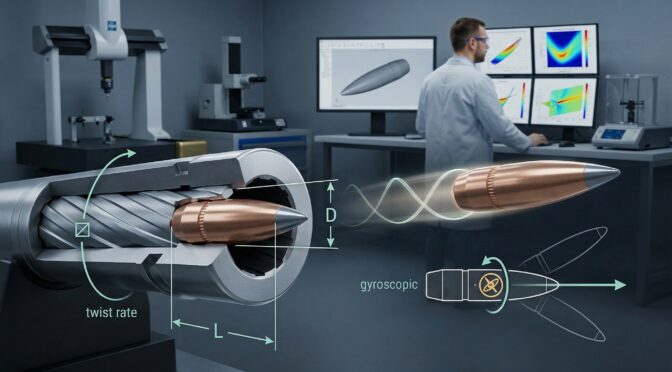
To understand the engineering necessity of the Greenhill formula, one must first understand the historical and physical evolution of the firearm barrel. The modern firearm barrel is defined by its rifling, which consists of a series of helical lands and grooves machined into the internal surface of the bore. These grooves are explicitly designed to grip the outer jacket or bearing surface of a projectile, forcing it to rotate on its longitudinal axis as it is driven forward by rapidly expanding high-pressure propellant gases.1 This mechanical process transforms a ballistic projectile from a chaotic, unstable object highly susceptible to atmospheric buffeting into a precision instrument stabilized by gyroscopic forces.
2.1 The Limitations of Smoothbore Ballistics
Before the widespread adoption and manufacturing standardization of rifling, early firearms such as muskets relied entirely on smoothbore technology. These weapons fired spherical lead balls. Because a perfect sphere presents the exact same aerodynamic profile to the oncoming air regardless of its physical orientation, gyroscopic stabilization was not strictly necessary to prevent it from tumbling end-over-end. A sphere cannot tumble because it has no ends. However, smoothbore accuracy was severely limited by unpredictable aerodynamic behaviors, including the Magnus effect, where slight, unintentional spins imparted by the barrel would cause the spherical ball to curve erratically in flight.
As ballistic engineering evolved throughout the nineteenth century to demand greater effective range, better velocity retention, and higher terminal kinetic energy, projectiles evolved from spheres to elongated cylinders with ogival or spitzer (pointed) noses.3 The elongated profile dramatically improved the ballistic coefficient of the projectile, allowing it to slip through the air with far less drag. However, this aerodynamic efficiency introduced a fatal flaw: elongated bullets are inherently unstable in flight. If an elongated, conical bullet is fired from a smoothbore barrel, the complex atmospheric pressures acting upon the nose will cause the bullet to rapidly yaw, meaning it will deviate horizontally and vertically from the axis of flight, and ultimately tumble wildly end-over-end.1 Tumbling exponentially increases aerodynamic drag, utterly destroys the predictable ballistic trajectory, bleeds off kinetic energy, and ruins accuracy. Imparting a rapid axial spin creates angular momentum, generating a gyroscopic stiffness that forces the elongated bullet to maintain a nose-forward orientation throughout its entire flight path.6
2.2 The Engineering Challenge of Twist Rates
The precise rate at which a barrel imparts spin to a bullet is universally known as the “twist rate.” In ballistic engineering and firearms manufacturing, this is expressed as a ratio representing the linear distance a bullet must travel down the barrel to complete exactly one full 360-degree revolution.1 For example, a twist rate denoted as “1:7” indicates that the rifling completes one full rotation every seven inches of barrel length.8 It is important to note that barrel length has no bearing on the actual twist rate itself; a rate of 1:10 remains a 1:10 twist whether the barrel is five inches long or thirty inches long, though the final exit velocity and overall rotations per minute (RPM) will differ.2
Finding the optimal twist rate is one of the most critical engineering challenges in weapon design. If the selected twist rate is too slow, a condition known as under-stabilization occurs. An under-stabilized bullet will not generate sufficient angular momentum to overcome aerodynamic resistance. It will yaw excessively, tumble in flight, and print elongated, keyhole-shaped impacts on targets, demonstrating a complete failure of accuracy.5
Conversely, if the twist rate is excessively fast, the bullet experiences a state of over-stabilization. While over-stabilization effectively prevents tumbling, it introduces a host of secondary problems. Excess spin exacerbates tiny manufacturing imperfections in the bullet’s jacket or lead core, causing the bullet to wobble off its true center axis due to amplified centrifugal forces. Furthermore, extreme over-stabilization causes the bullet’s nose to remain artificially elevated during the downward arc of its trajectory. Instead of smoothly tracking the parabolic arc of flight, the nose remains pointed upward, exposing the belly of the bullet to the oncoming wind, which drastically increases drag and degrades the ballistic coefficient. In extreme cases, hyper-spin can generate centrifugal forces so massive that they physically tear thin-jacketed bullets apart mid-flight, turning the projectile into a cloud of shrapnel before it ever reaches the target.5
3.0 The Physics of Gyroscopic Stabilization
To comprehend why the Greenhill formula was developed, why it works under specific conditions, and why it eventually fails under modern parameters, it is necessary to conduct a deep examination of the underlying Newtonian physics of ballistics. The stability of a projectile in atmospheric flight is dictated by a complex, dynamic interplay of physical forces: gyroscopic stability, the center of pressure, the center of gravity, and the moments of inertia.6
3.1 Center of Gravity Versus Center of Pressure
When a bullet travels through the Earth’s atmosphere at supersonic speeds, it physically displaces air molecules. The cumulative force of this aerodynamic drag pushes aggressively against the front and sides of the bullet. The theoretical median point where all these combined aerodynamic pressure forces act upon the projectile is mathematically known as the Center of Pressure (CP).6
Conversely, the bullet’s physical mass is not evenly distributed. The point of perfect balance is known as the Center of Gravity (CG).6 In modern, elongated rifle bullets, the aerodynamic nose is usually hollow, extremely pointed, or composed of lightweight polymer materials to reduce drag. Meanwhile, the heavier core materials, such as lead or dense copper, are concentrated heavily in the base or shank of the bullet. Because the heavy mass is concentrated at the rear while the lightweight volume is concentrated at the front, the Center of Gravity is inherently located behind the Center of Pressure.6
When a projectile flies, aerodynamic drag acts upon the Center of Pressure, which is located ahead of the heavier Center of Gravity. This creates a dangerous physical dynamic. Because the aerodynamic drag pushes against a point located forward of the bullet’s anchoring mass, the air pressure continuously attempts to push the nose of the bullet upward and backward over its own base.6 The Center of Gravity acts as a physical fulcrum for this action. This highly destabilizing aerodynamic phenomenon is known in ballistics as the “pitching moment” or the “aerodynamic overturning moment”.6 If this overturning moment is left unchecked by mechanical means, it will immediately cause the bullet to flip end-over-end as soon as it exits the muzzle.
3.2 Counteracting the Overturning Moment
To counteract the devastating effects of the overturning moment, the rifling in the barrel imparts rapid spin to the bullet. Utilizing the principles of Newtonian physics and the right-hand rule of angular momentum, this intense spin creates a gyroscopic stabilizing force.6 Just as a child’s spinning top resists falling over due to the pull of gravity, a rapidly spinning bullet develops a rigid angular momentum that resists being flipped over by atmospheric pressure.
The precise requirement for this rotational force is dictated by the bullet’s specific Moments of Inertia.11 In physics, inertia is the resistance of any physical object to any change in its velocity. For a bullet, there are two critical moments to consider. The transverse moment of inertia is the bullet’s resistance to tumbling end-over-end.11 The polar moment of inertia is the bullet’s resistance to spinning along its longitudinal axis.11
The primary insight derived from these physics—and the foundational truth that underpins the entirety of the Greenhill formula—is that a longer bullet possesses a significantly greater transverse moment of inertia.6 Because a longer bullet stretches further from its center of gravity, it provides vastly more leverage for the aerodynamic drag to exploit. It operates exactly like a long lever prying against a fulcrum. Therefore, the longer the bullet, the greater the angular momentum, and thus, the faster the barrel twist rate required to stabilize it.5
Interestingly, bullet weight itself is a secondary, and sometimes inverse, factor. A heavier, denser bullet is actually easier to stabilize than a lighter, longer bullet of the exact same length.5 This is because the denser mass increases the polar moment of inertia, giving the bullet more stabilizing “flywheel” effect without simultaneously increasing the aerodynamic profile that the wind can push against.5
4.0 The Genesis and Architecture of the Greenhill Formula
In the late nineteenth century, the world’s militaries were rapidly abandoning spherical musket balls in favor of elongated, conoidal bullets fired from rifled barrels. This transition presented a massive logistical and engineering hurdle: how could military engineers quickly and reliably calculate the necessary barrel rifling twist rates for an endless variety of new prototype projectiles without relying on expensive, time-consuming trial and error?
4.1 Historical Context and Creation
Enter Sir Alfred George Greenhill. In 1879, Greenhill, serving as a distinguished professor of mathematics at the British Royal Military Academy at Woolwich in London, was officially tasked with establishing a reliable mathematical method for determining the proper rifling twist rates for the British Empire’s rapidly changing arsenal of small arms and artillery.2
Professor Greenhill recognized that the complex physics of overturning moments and aerodynamic drag coefficients were too cumbersome for rapid field calculations and industrial application. He sought to develop a highly functional, easily calculated rule of thumb for determining the optimal twist rate for lead-core bullets. Remarkably, Greenhill’s brilliant simplification relied almost entirely on the bullet’s physical dimensions—specifically its overall length and its diameter—eschewing the immediate need to deeply calculate the bullet’s overall mass, specific weight, or the exact aerodynamic curvature of its nose.13 He correctly theorized that for the relatively uniform, solid lead projectiles of the 1870s, length and diameter were the dominant variables controlling the transverse moment of inertia.
4.2 The Mathematical Expression
The eponymous Greenhill Formula, which is still widely referenced in amateur and professional ballistics today, is traditionally expressed in plain text format as follows:
T = (C * D^2) / L
Where the variables in the equation are strictly defined as:
- T = The required barrel twist rate (expressed in inches per turn).
- C = A specific numerical constant intricately correlated to the projectile’s anticipated muzzle velocity.
- D = The physical diameter of the bullet (measured in inches).
- L = The overall physical length of the bullet (measured in inches).
4.2.1 The Velocity Constants: 150 and 180
The functional heart of the Greenhill formula relies entirely on the proper selection of the constant, represented by the variable “C”. In his original 1879 mathematical formulation, Professor Greenhill established the baseline value of C as 150.2 This specific constant was calculated based on the standard black powder and early transitional smokeless powder velocities of the Victorian era. The constant of 150 worked exceptionally well for lead-core projectiles traveling at velocities up to approximately 2,800 feet per second (fps), which roughly equates to 840 meters per second (m/s).8
However, as advanced smokeless powders completely revolutionized small arms ammunition in the early 20th century, muzzle velocities increased dramatically. Ballisticians and engineers recognized through empirical observation that higher velocities inherently imparted vastly more rotational velocity (measured in total RPM) to the bullet for any given twist rate. To accommodate this massive leap in velocity, the Greenhill constant required adjustment.
For modern, high-velocity rifle cartridges producing muzzle velocities exceeding 2,800 fps, a revised constant of 180 is utilized.6 Using a higher numerical constant in the numerator yields a larger numerical result for the required twist rate “T”. This mathematically accommodates the physical reality that high-velocity projectiles spin much faster upon exiting the barrel and therefore can be adequately stabilized with a slower, numerically higher twist rate.
4.2.2 The Specific Gravity Modifier
Greenhill’s original 1879 formula was meticulously modeled on the behavior of solid lead-alloy projectiles.14 Lead is a heavy, dense metal with a Specific Gravity (SG) of approximately 10.9.8 Because the original military projectiles of Greenhill’s era were homogeneous lead cores wrapped in early jackets, the density variable essentially canceled out of Greenhill’s simplified equation, allowing him to focus solely on length and diameter.13
However, the landscape of modern ammunition is defined by composite bullet designs. Today’s projectiles frequently feature thick copper jackets (which possess an SG of roughly 8.9), hardened steel core penetrators (which possess an SG of only 7.8), or aerodynamically efficient polymer ballistic tips (which possess an extremely low SG of approximately 1.0).15 When a modern bullet’s overall density diverges significantly from the baseline of solid lead, the complete, unmodified, and expanded Greenhill formula must be utilized to maintain any semblance of mathematical accuracy. The expanded formula is expressed as:
TR = * sqrt(SG / 10.9)
In this expanded, rigorous format, if a bullet has a lower specific gravity than traditional lead, the mathematical modifier consisting of the square root of the bullet’s actual SG divided by 10.9 results in a fraction that is less than 1. Multiplying the standard formula’s result by this fraction effectively reduces the final twist rate number “T”. This indicates a vital principle of modern ballistics: lighter, less dense composite bullets of the exact same physical length require a faster, tighter twist rate to remain stable in flight.8
5.0 Parameters of Ballistic Evaluation
To rigorously test the efficacy and modern relevance of the Greenhill formula, we must transition from theoretical physics to applied engineering by testing it against real-world ammunition. This report will analyze the most popular and historically significant projectile weights across three distinct, globally adopted calibers: the high-velocity 5.56x45mm NATO intermediate rifle cartridge, the full-power .308 Winchester (7.62x51mm NATO) battle rifle cartridge, and the 9x19mm Luger (Parabellum) pistol cartridge.
By calculating the theoretical twist rates using Greenhill’s mathematics and subsequently comparing those results against modern empirical evidence, we can determine precisely where the 1879 formula succeeds and where it suffers catastrophic predictive failure. The formula relies heavily on the length-to-diameter ratio. A 5.56mm 77-grain bullet is exceptionally long relative to its narrow diameter, necessitating a very fast twist rate. Conversely, a 9mm bullet is short and wide, yielding an obtuse geometry that breaks the formula’s aerodynamic assumptions.
During the execution of these calculations, a strict adherence to Greenhill’s velocity threshold will be maintained. When a projectile’s anticipated muzzle velocity explicitly exceeds 2,800 feet per second, the high-velocity constant of C = 180 will be utilized. For velocities falling below the 2,800 fps threshold, the standard historical constant of C = 150 will be applied.8
6.0 Analytical Application: 5.56x45mm NATO (.224 Caliber)
The 5.56x45mm NATO is a high-velocity intermediate rifle cartridge that forms the backbone of Western military small arms. Standard 5.56mm projectiles feature a nominal physical diameter of 0.224 inches.16 Over the extensive lifespan of the cartridge, both the military and civilian sectors have heavily utilized three distinct bullet weights, each presenting unique stabilization challenges: the lightweight 55-grain, the steel-core 62-grain, and the heavy 77-grain match projectile.19
6.1 The 55-Grain FMJ (M193)
The original military loading adopted for the early M16 rifle platform during the Vietnam era was the M193 cartridge. This load fires a 55-grain Full Metal Jacket (FMJ) boat-tail projectile with a traditional lead core and copper jacket.
- Diameter (D): 0.224 inches 18
- Length (L): Approximately 0.740 inches 2
- Velocity: Approximately 3,100 to 3,200 fps (This high velocity strictly requires the application of C = 180) 13
To calculate the required twist rate for the 55-grain M193 projectile, we first determine the square of the diameter. Multiplying 0.224 inches by itself yields a value of 0.050176. Because the muzzle velocity of this cartridge significantly exceeds the 2,800 feet per second threshold, we must apply the high-velocity constant of 180. Multiplying the squared diameter of 0.050176 by 180 gives us a dividend of 9.03168. Finally, to isolate the necessary twist rate, we divide this dividend by the projectile’s overall length of 0.740 inches. This mathematical operation results in a required twist rate of one complete revolution every 12.20 inches.
6.2 The 62-Grain FMJ (M855 / SS109)
Adopted by NATO forces in the 1980s to improve barrier penetration, the M855 cartridge features a 62-grain bullet. Unlike the homogeneous lead core of the M193, the M855 is a complex composite constructed with a copper jacket, a lead core in the base, and a mild steel penetrator located in the tip.22 Because steel is significantly lighter and less dense than lead, the bullet must be physically manufactured to be noticeably longer to achieve its target mass of 62 grains.
- Diameter (D): 0.224 inches 18
- Length (L): Approximately 0.907 inches 24
- Velocity: Approximately 3,020 fps (Requires C = 180) 22
Following the Greenhill protocol for the 62-grain M855 projectile, we utilize the previously calculated squared diameter of 0.050176. Applying the high-velocity constant of 180 due to the 3,020 fps muzzle velocity yields the identical dividend of 9.03168. We then divide this dividend by the new, extended overall length of 0.907 inches. The result predicts a required twist rate of one turn in 9.95 inches.
6.3 The 77-Grain Sierra MatchKing (Mk262 / OTM)
Designed specifically for extended range engagements and enhanced terminal ballistics, the 77-grain Open Tip Match (OTM) bullet, primarily manufactured as the Sierra MatchKing, is heavily utilized in Special Purpose Rifles (SPRs). It is an exceptionally dense, extremely long lead-core bullet designed to maximize aerodynamic efficiency.25
- Diameter (D): 0.224 inches 18
- Length (L): 0.994 inches 26
- Velocity: Approximately 2,750 fps (Because this heavy bullet drops below the 2,800 fps threshold, it requires the historical constant of C = 150) 13
For the 77-grain MatchKing, we again start with the squared diameter of 0.050176. However, due to the lower muzzle velocity of 2,750 fps, we must switch the constant to 150. Multiplying 0.050176 by 150 yields a smaller dividend of 7.5264. Dividing this dividend by the massive bullet length of 0.994 inches predicts a required twist rate of one turn in 7.57 inches.
Table 1: 5.56x45mm NATO Greenhill Predictions
| Bullet Weight | Length (in) | Velocity Constant (C) | Predicted Twist Rate |
| 55-grain (M193) | 0.740 | 180 | 1:12.2″ |
| 62-grain (M855) | 0.907 | 180 | 1:9.95″ |
| 77-grain (SMK) | 0.994 | 150 | 1:7.57″ |
7.0 Analytical Application: .308 Winchester / 7.62x51mm NATO
The .308 Winchester is a legendary medium-to-large game cartridge and serves as the direct civilian counterpart to the military 7.62x51mm NATO battle rifle cartridge.27 Projectiles in this family feature a standard diameter of 0 .308 inches.28 For this analysis, we will examine three of the most historically significant and widely deployed projectile weights: the 147-grain standard ball, the 168-grain precision match, and the 175-grain long-range match.29
7.1 The 147-Grain FMJ (M80 Ball)
This projectile serves as the standard NATO machine gun and general-purpose infantry rifle load. It utilizes a relatively short, flat-base or minimal boattail full metal jacket bullet constructed with a dense lead core.30
- Diameter (D): 0 .308 inches 31
- Length (L): Approximately 1.10 inches
- Velocity: Approximately 2,800 fps. Because operational velocities routinely test just at or slightly below the strict 2,801+ fps cutoff depending on barrel length, we will conservatively apply C = 150.31
To evaluate the 147-grain M80 ball projectile, we square the larger diameter of 0 .308 inches, which yields 0.094864. Multiplying this value by the standard constant of 150 results in a dividend of 14.2296. Dividing this sum by the overall length of 1.10 inches predicts a required twist rate of one turn in 12.93 inches.
7.2 The 168-Grain Sierra MatchKing (BTHP)
Serving as the quintessential precision target and police sniper bullet for several decades, the 168-grain Hollow Point Boat Tail (HPBT) is highly aerodynamic, featuring a prominent boattail base to reduce drag.30
- Diameter (D): 0 .308 inches
- Length (L): 1.220 inches 32
- Velocity: Approximately 2,650 fps (Requires C = 150) 32
For the 168-grain MatchKing, we utilize the squared diameter dividend of 14.2296 (0.094864 multiplied by the 150 constant). Dividing this number by the longer bullet length of 1.220 inches predicts a tighter required twist rate of one turn in 11.66 inches.
7.3 The 175-Grain Sierra MatchKing (BTHP / M118LR)
Developed specifically to surpass the transonic instability issues that plagued the 168-grain bullet at distances approaching 1,000 yards, the 175-grain bullet forms the heavy backbone of the M118 Long Range sniper cartridge.31 It requires an even longer aerodynamic profile to accommodate the increased mass.
- Diameter (D): 0 .308 inches
- Length (L): 1.242 inches 34
- Velocity: Approximately 2,600 fps (Requires C = 150) 31
Executing the Greenhill formula for the 175-grain MatchKing, we divide the constant-adjusted dividend of 14.2296 by the maximum overall length of 1.242 inches. This calculation predicts a required twist rate of one turn in 11.45 inches.
Table 2: .308 Winchester Greenhill Predictions
| Bullet Weight | Length (in) | Velocity Constant (C) | Predicted Twist Rate |
| 147-grain (M80) | 1.100 | 150 | 1:12.9″ |
| 168-grain (SMK) | 1.220 | 150 | 1:11.6″ |
| 175-grain (SMK) | 1.242 | 150 | 1:11.4″ |
8.0 Analytical Application: 9x19mm Luger / Parabellum (.355 Caliber)
Transitioning to handguns, the 9mm Luger is the preeminent pistol and submachine gun cartridge globally.35 It operates under vastly different ballistic paradigms than rifle cartridges. It utilizes short, relatively wide projectiles with a diameter of 0.355 inches.17 Standard projectile weights available commercially and to law enforcement are 115-grain, 124-grain, and 147-grain.37 Because pistol velocities are universally well below the 2,800 fps threshold, the standard Greenhill constant of C = 150 is strictly applied.13
8.1 The 115-Grain FMJ
This is the standard high-velocity training round, featuring a short, rounded nose profile.37
- Diameter (D): 0.355 inches 36
- Length (L): Approximately 0.550 inches (industry standard proxy)
- Velocity: Approximately 1,180 fps 36
To apply Greenhill to the 115-grain pistol projectile, we square the wide 0.355-inch diameter, resulting in 0.126025. Multiplying this by the 150 constant yields a dividend of 18.90375. Dividing this value by the extremely short length of 0.550 inches generates a predicted required twist rate of one turn in 34.37 inches.38
8.2 The 124-Grain FMJ/JHP
The ubiquitous NATO standard weight, favored for balancing muzzle velocity and terminal penetration depth.39
- Diameter (D): 0.355 inches
- Length (L): Approximately 0.600 inches (industry standard proxy)
- Velocity: Approximately 1,100 fps
For the 124-grain projectile, we divide the base dividend of 18.90375 by the slightly increased length of 0.600 inches. The formula predicts a required twist rate of one turn in 31.50 inches.
8.3 The 147-Grain JHP
This is a heavy, subsonic projectile heavily favored by law enforcement for superior barrier penetration and for use in suppressed weapon systems.37 Because the design must cram 147 grains of lead into a restrictive 9mm diameter, the bullet resembles a long, blunt cylindrical plug rather than a pointed rifle bullet.10
- Diameter (D): 0.355 inches
- Length (L): Approximately 0.660 inches (industry standard proxy)
- Velocity: Approximately 975 fps (Subsonic) 36
Applying the final Greenhill calculation to the 147-grain subsonic projectile, we divide 18.90375 by the 0.660-inch length. This results in a predicted required twist rate of one turn in 28.64 inches.38
Table 3: 9mm Luger Greenhill Predictions
| Bullet Weight | Length (in) | Velocity Constant (C) | Predicted Twist Rate |
| 115-grain | 0.550 | 150 | 1:34.3″ |
| 124-grain | 0.600 | 150 | 1:31.5″ |
| 147-grain | 0.660 | 150 | 1:28.6″ |
9.0 Empirical Validation: Theoretical vs. Applied Twist Rates
Having generated the theoretical twist rates using the 1879 formula, the critical engineering step is to benchmark these mathematical results against the actual, empirical twist rates utilized by the modern firearms industry. Analyzing the delta between theoretical math and real-world manufacturing reality reveals profound insights into the limitations of early ballistic heuristics.
9.1 Evaluating the 5.56 NATO Predictions
The original M16 rifles deployed in the 1960s, designed to fire the 55-grain M193 projectile, were famously fielded with a 1:12 twist rate barrel.9 Our Greenhill calculation predicted a twist rate of 1:12.2 inches. In this specific instance, the 1879 formula operates flawlessly.9 The M193 is a classic lead-core, relatively short spitzer bullet—precisely the type of homogeneous projectile Greenhill’s constants were meticulously calibrated for over a century ago.
However, the mathematical model begins to violently fracture when analyzing the 62-grain M855. Our Greenhill calculation predicted a 1:9.95 twist requirement. In reality, while a 1:9 twist can marginally stabilize an M855 under ideal conditions, the military universally adopted a rapid 1:7 twist for the M4 carbine and M16A2 specifically to stabilize this exact bullet (alongside the even longer L110 tracer).18
Why does the formula fail the M855 so thoroughly? The baseline Greenhill formula inherently assumes a uniform specific gravity of 10.9, representing solid lead.13 The M855, however, contains a massive mild steel penetrator in its nose.22 Steel has a specific gravity of just 7.8. Therefore, the overall specific gravity of the M855 bullet is substantially lower than the formula assumes. According to the expanded Greenhill physics, a lighter overall density requires a faster twist rate because there is less mass driving the polar moment of inertia.8 Because we did not manually apply the complex sqrt(SG / 10.9) specific gravity modifier in the base calculation, the simplified Greenhill formula dangerously under-calculated the required twist for composite bullets.
Conversely, the calculation for the 77-grain Sierra MatchKing yielded a 1:7.57 twist requirement. This perfectly aligns with modern industry empirical evidence. Modern precision AR-15 rifles dedicated to firing 77-grain match ammunition are routinely outfitted from the factory with 1:8 or 1:7.7 twist barrels.1 Because the 77-grain SMK is a traditional heavy lead-core bullet, its specific gravity perfectly aligns with the formula’s baseline assumptions, allowing Greenhill to succeed once again.
9.2 Evaluating the .308 Winchester Predictions
Industry standard barrel twist rates for .308 Winchester precision and hunting rifles range strictly between 1:10 and 1:12, with 1:10 being highly favored for heavier projectiles.31
- Our calculation for the 147-grain yielded 1:12.9
- Our calculation for the 168-grain yielded 1:11.6
- Our calculation for the 175-grain yielded 1:11.4
The Greenhill formula proves to be remarkably accurate and empirically sound for the.30-caliber family.31 It correctly predicts that a 1:12 twist is entirely sufficient for lighter, shorter training loads, while heavier, longer match loads require twists creeping closer to the 1:11 or 1:10 mark. The .308 Winchester cartridge relies almost exclusively on traditional cup-and-core (copper jacket, lead core) projectiles. Because the internal geometry and material density directly mirror the late nineteenth-century artillery and small arms models that Greenhill studied at Woolwich, his 150 constant translates perfectly to this specific caliber.15
9.3 Evaluating the 9mm Luger Predictions
The application of the Greenhill formula to pistol calibers is an unmitigated engineering failure. Industry-standard twist rates for 9mm Luger barrels—such as those found in Glock pistols, the Colt 9mm SMG, and high-end precision aftermarket barrels—are almost universally 1:10, with some reaching 1:16.9
Our rigorous Greenhill calculations predicted that a 115-grain bullet requires a staggering 1:34 twist, and a 147-grain bullet requires a 1:28 twist.9 The formula confidently predicts a twist rate that is roughly 300% slower than what is actually required and manufactured by the modern firearms industry.
The catastrophic breakdown of the formula in the realm of handguns is due to fundamental aerodynamic differences that the 1879 math cannot process:
- Projectile Geometry: Greenhill’s formula assumes an elongated, highly aerodynamic “spitzer” profile where the Center of Pressure is located far forward of the Center of Gravity.44 Pistol bullets are short, fat, and blunt-nosed (obtuse).4 The length-to-diameter ratios are wildly different. The aerodynamic overturning moment on a blunt pistol bullet behaves entirely differently than the moment acting upon an elongated rifle bullet.
- Transonic Ballistics: Greenhill’s foundational 150 constant breaks down entirely when projectile velocities fall below 1,500 fps. The 9mm Parabellum operates almost exclusively in the transonic and subsonic velocity spectrums (typically ranging from 950 fps to 1,200 fps).36 Air density behaves radically differently at transonic boundaries, generating unpredictable shockwaves. The Greenhill formula completely lacks the complex variables necessary to account for subsonic shockwave detachment and blunt-force drag.47
In summary, while the Greenhill formula retains historical and practical value for traditional rifle bullets, it is entirely worthless for calculating or predicting pistol barrel twist rates.44
10.0 The Modern Era: Don Miller’s Twist Rule and Advanced Ballistics
Because the Greenhill formula relies on massive, static assumptions regarding physical bullet profiles, environmental conditions, and homogeneous bullet density, modern ballisticians have largely abandoned it for precision engineering.45 As bullet technology advanced to include extreme low-drag (ELD) profiles, long polymer tips, and complex boattails, a more sophisticated mathematical model was required.
The contemporary standard across the firearms industry is the Miller Twist Rule, developed by the American physical chemist and ballistician Don Miller.11 Where Greenhill simply looked at a bullet’s length and diameter as crude proxies for its aerodynamic profile, the Miller formula is a comprehensive, multi-variable algorithm that incorporates:
- Actual Bullet Mass: It uses exact bullet mass in grains, rather than assuming weight based on a length-to-diameter ratio.49
- Gyroscopic Stability Factor (Sg): The Miller rule allows engineers to design toward an explicit Gyroscopic Stability Factor target. A factor of 1.0 is considered marginally stable, but modern ballisticians target an Sg of 1.5 for precision long-range accuracy.45
- Environmental Variables: Unlike Greenhill, which assumes standard sea-level atmospheric pressure, Miller’s rule accounts for air density, altitude, and temperature, recognizing that thin air at high altitudes requires less twist to stabilize a bullet than dense, cold air at sea level.44
- Profile Corrections: The rule features distinct mathematical corrections for polymer ballistic tips. A plastic tip adds significant physical length to a bullet, which would confuse the Greenhill formula into demanding a faster twist, but because the tip adds almost zero mass, the Miller rule correctly adjusts the stabilization requirement.15
The Miller Twist Rule dictates a critical reality of modern ballistics: if the Gyroscopic Stability Factor (Sg) falls below 1.5, the bullet will experience a measurable degradation in its Ballistic Coefficient (BC).49 This means that even if a bullet does not outright tumble, marginal stability will cause it to lose velocity faster, suffer greater wind drift, and strike lower on the target. For competitive shooters, military snipers, and extreme long-range hunters, maintaining an Sg above 1.5 is paramount to maintaining the bullet’s aerodynamic efficiency, and the rudimentary mathematics of 1879 simply cannot provide that required level of engineering granularity.45
11.0 The Impact of Over-Stabilization on Terminal Ballistics
An often-overlooked consequence of relying purely on theoretical rotational mathematics is the profound impact of gyroscopic stability on terminal ballistics—which is defined as the behavior of the projectile once it actually strikes soft tissue or a target medium.3
For standard military projectiles like the 5.56 NATO M193, lethality is not derived from simple tissue expansion (as seen with hollow point pistol bullets), but from the bullet’s propensity to undergo rapid yawing and subsequent fragmentation.41 When the 55-grain FMJ enters soft tissue, the dense, fluid medium acts like incredibly thick air. This density radically amplifies the aerodynamic overturning moment acting upon the Center of Pressure. Because the Center of Gravity is at the rear, the fluid dynamics cause the bullet to tumble violently, turning sideways and breaking apart at its weakest point, the cannelure.41
The twist rate plays a critical role in this terminal behavior. If an M193 bullet is fired from an older 1:12 twist barrel, it is only marginally stabilized in flight. Upon impacting soft tissue, it rapidly loses its gyroscopic stability and yaws almost immediately upon entry, creating a massive, devastating permanent wound cavity.4
However, if that exact same 55-grain bullet is fired from a modern M4 carbine equipped with a rapid 1:7 twist barrel, the bullet is massively over-stabilized (as our Greenhill calculations proved, only a 1:12 twist is mathematically needed for stabilization). Because the bullet possesses vastly more angular momentum than is required to keep it pointing forward, the over-stabilized bullet fiercely resists tumbling upon striking tissue. It may travel straight through a soft target like a solid icepick, failing to fragment and drastically reducing terminal incapacitation.4 Therefore, while engineering a universally fast twist rate ensures flight stability across a wide variety of mixed ammunition types, it can inadvertently compromise the terminal ballistic performance of lightweight bullets by providing them with too much gyroscopic rigidity.
12.0 Conclusion
Sir Alfred George Greenhill’s 1879 formula remains one of the most elegant, enduring, and historically significant pieces of ballistic mathematics ever devised. By relying almost exclusively on bullet diameter, overall length, and a simple velocity constant, it provided a highly functional, easily calculated blueprint for small arms development that successfully guided the firearms industry for over a century.
However, as demonstrated by the theoretical predictions and comparative empirical analysis generated in this report, the formula’s utility is highly situational and bounded by strict technological limitations. It flawlessly predicts the 1:12 twist requirement for traditional 55-grain 5.56mm bullets and effectively maps the standard 1:11 and 1:12 twist rates required for the .308 Winchester family of projectiles. Yet, it fails spectacularly when confronted with the complex density variations of modern composite penetrators like the 5.56mm M855 steel-core bullet. Most notably, the 1879 formula is fundamentally broken when applied to the transonic velocities and obtuse geometries of pistol cartridges like the 9mm Luger, where its predictions miss the mark by a massive margin.
For modern ballistic engineering, the Greenhill formula serves as an excellent foundational educational tool for understanding the core tenets of length-to-diameter stabilization requirements and the principles of angular momentum. However, to account for critical modern variables—including atmospheric pressure variations, non-homogeneous bullet core densities, polymer tips, and the strict preservation of ballistic coefficients at extreme supersonic ranges—the modern firearms industry has rightfully and permanently transitioned to the complex, highly granular algorithms of the Miller Twist Rule.
13.0 Appendix: Acronyms and Abbreviations
- BC: Ballistic Coefficient. A mathematical measurement of a bullet’s ability to overcome air resistance in flight and maintain velocity.
- BTHP: Boat Tail Hollow Point. A precision bullet design featuring a tapered base to reduce aerodynamic drag and a hollow tip, heavily utilized for match-grade accuracy.
- CG: Center of Gravity. The physical balance point of the bullet’s mass.
- CP: Center of Pressure. The theoretical focal point where aerodynamic drag and atmospheric pressure act upon the bullet in flight.
- FMJ: Full Metal Jacket. A bullet consisting of a soft core (usually lead) completely encased in a shell of harder metal (usually copper or a copper-zinc alloy).
- JHP: Jacketed Hollow Point. A bullet specifically designed to expand uniformly upon impacting soft tissue, maximizing terminal energy transfer.
- NATO: North Atlantic Treaty Organization. Often used in ballistics to denote standardized military cartridge specifications (e.g., 5.56 NATO).
- OTM: Open Tip Match. A military and precision shooting designation for hollow point bullets where the cavity is a byproduct of the manufacturing process (drawing the jacket from the base up) rather than designed for tissue expansion.
- SG: Specific Gravity. The ratio of the density of a substance to the density of a reference substance (usually water). Lead has a standard SG of approximately 10.9.
- Sg: Gyroscopic Stability Factor. A calculated, unitless mathematical number indicating flight stability; an Sg > 1.5 is universally considered fully stable for long-range precision.
- SMK: Sierra MatchKing. A highly regarded line of precision rifle bullets manufactured by Sierra Bullets, widely used in military sniper ammunition.
- SPR: Special Purpose Rifle. A heavily modified precision rifle system originally developed by US Special Operations Command to maximize the effective range of the 5.56mm cartridge.
Please share the link on Facebook, Forums, with colleagues, etc. Your support is much appreciated and if you have any feedback, please email us in**@*********ps.com. If you’d like to request a report or order a reprint, please click here for the corresponding page to open in new tab.
Sources Used
- What Are The Best AR-15 Barrel Twist Rates? – Firearms News, accessed March 8, 2026, https://www.firearmsnews.com/editorial/best-ar-15-rifle-barrel-twist-rates/510620
- How To Calculate Rifling Twist Rates For Stabilizing Bullets – Shooting Sports USA, accessed March 8, 2026, https://www.ssusa.org/content/how-to-calculate-rifling-twist-rates-for-stabilizing-bullets/
- Terminal ballistics – Wikipedia, accessed March 8, 2026, https://en.wikipedia.org/wiki/Terminal_ballistics
- TERMINAL BALLISTICS – Denver Health, accessed March 8, 2026, https://www.denverhealth.org/-/media/files/departments-services/trauma/2022-trauma-conference/terminal-ballistics-pres.pdf
- Twist Rate | PDF | Projectiles | Firearms – Scribd, accessed March 8, 2026, https://www.scribd.com/document/266077830/Twist-Rate
- TiL about the Greenhill Formula (1879) for estimating optimal twist rate : r/Firearms – Reddit, accessed March 8, 2026, https://www.reddit.com/r/Firearms/comments/1bnisj6/til_about_the_greenhill_formula_1879_for/
- Twist Rate Calculator, accessed March 8, 2026, https://www.omnicalculator.com/physics/twist-rate
- Greenhill Rifling Formula – vCalc, accessed March 8, 2026, https://www.vcalc.com/wiki/Greenhill-Formula
- Need To Know: Calculating Barrel Twist Rate – Gun Digest, accessed March 8, 2026, https://gundigest.com/more/how-to/need-to-know-calculating-barrel-twist-rate
- 115gr vs 124gr vs 147gr 9mm? Why the different bullet weights? If the bullet weighs more, does that mean it’s actually bigger and would that mean there’s less room for gunpowder in the case, so it’s slower? : r/armedsocialists – Reddit, accessed March 8, 2026, https://www.reddit.com/r/armedsocialists/comments/1jdj80h/115gr_vs_124gr_vs_147gr_9mm_why_the_different/
- Miller twist rule – Wikipedia, accessed March 8, 2026, https://en.wikipedia.org/wiki/Miller_twist_rule
- accessed March 8, 2026, https://www.ssusa.org/content/how-to-calculate-rifling-twist-rates-for-stabilizing-bullets/#:~:text=Enter%20Professor%20Sir%20Alfred%20George,2)%20%C3%B7%20L%20%3D%20T.
- Rifling – Wikipedia, accessed March 8, 2026, https://en.wikipedia.org/wiki/Rifling
- Lee Precision, Inc. – Greenhill formula – Support Portal, accessed March 8, 2026, https://support.leeprecision.net/en/knowledgebase/article/greenhill-formula
- A Stability Formula for Plastic-Tipped Bullets Part 1: Motivation and Development of New Formula – ResearchGate, accessed March 8, 2026, https://www.researchgate.net/publication/267157150_A_Stability_Formula_for_Plastic-Tipped_Bullets_Part_1_Motivation_and_Development_of_New_Formula
- A Complete Guide to 5.56 vs 9mm Bullets – Faxon Firearms, accessed March 8, 2026, https://faxonfirearms.com/blog/a-complete-guide-to-five-point-five-six-versus-9-millimeter-bullets
- 5.56 vs. 9mm: Which Carbine Cartridge Is Better For You? – Ammo.com, accessed March 8, 2026, https://ammo.com/comparison/556-vs-9mm
- 5.56×45mm NATO – Wikipedia, accessed March 8, 2026, https://en.wikipedia.org/wiki/5.56%C3%9745mm_NATO
- 5.56 Ballistics Charts From Every Major Ammunition Manufacturer, accessed March 8, 2026, https://ammo.com/ballistics/5.56-ballistics
- 5.56 Twist Rate Chart – Bullet Weights & Twist Rates – AmmoMan.com, accessed March 8, 2026, https://www.ammoman.com/blog/5-56-twist-rate-chart/
- Between 55 grain 62 grain and 77 grain what would you guys recommend : r/ar15 – Reddit, accessed March 8, 2026, https://www.reddit.com/r/ar15/comments/wovz2e/between_55_grain_62_grain_and_77_grain_what_would/
- 5.56 x 45 M855 – Ammo and Bullet, accessed March 8, 2026, https://www.ammoandbullet.com/5-56-x-45-m855-data/
- M855 – Ballistics – 80 Percent Arms, accessed March 8, 2026, https://www.80percentarms.com/blog/m855-ballistics/
- 62 gr M855 bullet length? | Sniper’s Hide Forum, accessed March 8, 2026, https://www.snipershide.com/shooting/threads/62-gr-m855-bullet-length.198204/
- Pairing Barrel Twist Rates with Bullet Weights for .223 and 5.56 NATO – Guns and Ammo, accessed March 8, 2026, https://www.gunsandammo.com/editorial/pair-barrel-twist-rates-ammo/249744
- Sierra MatchKing 22 Cal (224 Diameter) Bullets 77 Grain Jacketed – MidwayUSA, accessed March 8, 2026, https://www.midwayusa.com/product/1482129185
- .308 Ballistics – Ballistic Tables & Info for the .308 Winchester – The Broad Side – Target Barn, accessed March 8, 2026, https://www.targetbarn.com/broad-side/308-ballistics/
- Ammo Caliber Size Chart – Sportsman’s Warehouse, accessed March 8, 2026, https://www.sportsmans.com/ammo-caliber-size-chart
- 308 Ballistics – Chart with Velocity, Energy and Bullet Drop, accessed March 8, 2026, https://www.ammunitiontogo.com/lodge/308-ballistics/
- 308 Grain Weights and Ballistics – Ammunition Depot, accessed March 8, 2026, https://www.ammunitiondepot.com/blog/308-winchester-how-to-pick-the-right-bullet-weight
- 7.62×51mm NATO – Wikipedia, accessed March 8, 2026, https://en.wikipedia.org/wiki/7.62%C3%9751mm_NATO
- Buy Gold Medal Sierra MatchKing 308 Win Ammo | 168 Grain, 2650 FPS – Federal Ammunition, accessed March 8, 2026, https://www.federalpremium.com/rifle/gold-medal/gold-medal-sierra-matchking/11-GM308M.html
- 30 CAL 175 GR HPBT MATCHKING (SMK) – Sierra Bullets, accessed March 8, 2026, https://sierrabullets.com/30-cal-175-gr-hpbt-matchking-smk/
- Buy Gold Medal Sierra MatchKing 308 Win Ammo | 175 Grain, 2600 FPS | Federal, accessed March 8, 2026, https://www.federalpremium.com/rifle/gold-medal/gold-medal-sierra-matchking/11-GM308M2.html
- 9mm Ballistics – Velocity, Energy & Drop Data – Ammo To Go, accessed March 8, 2026, https://www.ammunitiontogo.com/lodge/9mm-ballistics/
- 9×19mm Parabellum – Wikipedia, accessed March 8, 2026, https://en.wikipedia.org/wiki/9%C3%9719mm_Parabellum
- 115 vs 124 vs 147 Grain 9mm Ammo | A Detailed Comparison – Velocity Ammunition, accessed March 8, 2026, https://www.velocityammosales.com/blog/115-vs-124-vs-147-grain-9mm-ammo-a-detailed-comparison/
- Twist rates for NOWLIN 9mm bbl. – 9mm/38 Caliber – Brian Enos’s Forums… Maku mozo!, accessed March 8, 2026, https://forums.brianenos.com/topic/12477-twist-rates-for-nowlin-9mm-bbl/
- Understanding 9mm Bullet Grains: 115gr vs 124gr vs 147gr – Bravo Concealment, accessed March 8, 2026, https://www.bravoconcealment.com/blogs/training/understanding-9mm-bullet-grains-115gr-vs-124gr-vs-147gr
- 124 vs 147 Grain – 9mm Bullet Weights Compared – The Lodge at AmmoToGo.com, accessed March 8, 2026, https://www.ammunitiontogo.com/lodge/124-vs-147-grain/
- M193 vs M855 – 5.56 Cartridge Comparison by Ammo.com, accessed March 8, 2026, https://ammo.com/comparison/m193-vs-m855
- All About Twist Rates | True Shot Ammo, accessed March 8, 2026, https://trueshotammo.com/blogs/true-shot-academy/all-about-twist-rates
- 147 Grain FMJBT in 1 in 10 twist | Sniper’s Hide Forum, accessed March 8, 2026, https://www.snipershide.com/shooting/threads/147-grain-fmjbt-in-1-in-10-twist.55920/
- Choosing a bullet with the Greenhill formula | Sniper’s Hide Forum, accessed March 8, 2026, https://www.snipershide.com/shooting/threads/choosing-a-bullet-with-the-greenhill-formula.131573/
- Understanding Rifle Barrel Twist Rate and Bullet Stability – Phoenix Rifle Club, accessed March 8, 2026, https://www.phoenixrifleclub.com/2025/09/22/rifle-barrel-twist-rate-understanding-bullet-stability/
- Why is the Miller twist rule better than the Greenhill rifling formula? – Berger Bullets, accessed March 8, 2026, https://bergerbullets.com/shoot-better/shooting-knowledge/why-is-the-miller-twist-rule-better-than-the-greenhill-rifling-formula/
- Greenhill Formula – Airgun Nation, accessed March 8, 2026, https://www.airgunnation.com/threads/greenhill-formula.1326123/
- Gyroscopic Stability of Open Tipped Match Style Rifle Bullets – arXiv, accessed March 8, 2026, https://arxiv.org/pdf/1401.4187
- How To Find the Ideal Twist Rate for Your Rifle – The Everyday Marksman, accessed March 8, 2026, https://www.everydaymarksman.co/equipment/rifling-twist-rate/
- Twist Rate-Stability-Accuracy-Confusion – Shooters’ Forum, accessed March 8, 2026, https://forum.accurateshooter.com/threads/twist-rate-stability-accuracy-confusion.4092527/
- Hunt for Truth – Ammunition – Michel & Associates, P.C., accessed March 8, 2026, https://michellawyers.com/hunt-for-truth-ammunition/