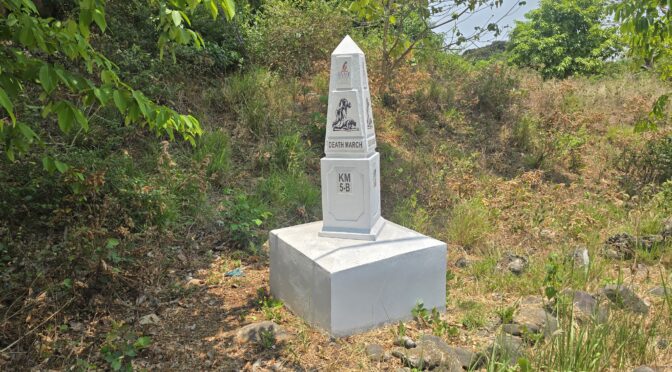
The Bataan Death March endures as one of the most harrowing and meticulously documented atrocities in the annals of the Second World War, a profound tragedy that unfolded in the geopolitical crucible of the Pacific Theater. In April 1942, following a protracted, desperate, and ultimately doomed defense of the Bataan Peninsula in the Philippine archipelago, tens of thousands of American and Filipino soldiers were forced into capitulation. What followed was not a standard transfer of prisoners of war governed by international law or the Geneva Conventions, but a descent into systemic brutality, calculated deprivation, and mass murder orchestrated by the Imperial Japanese Army.
However, to view the Bataan Death March exclusively through the traditional historiographical lens of victimization, tactical defeat, and military atrocity is to overlook a vital, parallel narrative of extraordinary human resilience. Woven deeply into the fabric of this catastrophe are profound stories of defiance, quiet heroics among the captive ranks, and the extraordinary, life-risking compassion of the local Filipino civilian population. This comprehensive analysis explores the military realities that precipitated the march, the horrific human toll exacted on the road to Camp O’Donnell, and, crucially, the heavily overlooked acts of grassroots humanitarianism and solidarity that illuminated one of modern history’s darkest chapters.
The Strategic Collapse: The Siege of the Bataan Peninsula
To comprehend the sheer scale of the humanitarian disaster that became the Bataan Death March, it is first necessary to examine the strategic and logistical collapse that precipitated it. The timeline of the disaster began on December 7, 1941, with the Imperial Japanese Navy’s surprise attack on the United States Pacific Fleet at Pearl Harbor, Hawaii.1 Within hours, the Japanese military apparatus initiated a lightning-fast, coordinated assault across Southeast Asia, launching a massive invasion of the Philippine island of Luzon by January 1942.1
The defense of the Philippine archipelago was tasked to the United States Army Forces in the Far East (USAFFE), a combined force commanded by General Douglas MacArthur.2 Facing overwhelming Japanese air superiority, naval dominance, and highly experienced mechanized infantry, and reeling from the neutralization of the U.S. Pacific Fleet, the USAFFE forces recognized that a forward defense of the Lingayen Gulf beaches was untenable. They executed a pre-planned fighting retreat southward into the dense, mountainous, and heavily jungled terrain of the Bataan Peninsula.3
The overarching military strategy, an adaptation of War Plan Orange, was to heavily fortify and hold the peninsula alongside the island fortress of Corregidor. By holding these geographic choke points, the USAFFE forces successfully denied the Japanese the logistical use of the highly strategic Manila Bay.2 The operational assumption was that the defenders merely needed to hold the line until naval reinforcements and resupply convoys could arrive from the continental United States.2
However, the strategic reality of the Japanese naval blockade across the Western Pacific meant that no reinforcements, food, artillery ammunition, or medical supplies would ever breach the perimeter.2 For three agonizing months, approximately 120,000 combined American and Filipino troops mounted a courageous, entrenched defense against the 75,000-strong invasion force commanded by Japanese General Masaharu Homma.3
The true enemy on the Bataan Peninsula, however, was not solely the Japanese infantry, but a profound, systemic logistical starvation paired with an epidemiological disaster. By early March 1942, the defenders were surviving on half-rations; weeks later, they were reduced to quarter-rations, heavily reliant on slaughtered cavalry horses, monkeys, and scant jungle forage.2 Troops suffered catastrophic physical degradation, with many men losing up to 30 percent of their total body weight before the final surrender was even ordered.2
Furthermore, tropical diseases ravaged the compromised immune systems of the defenders. Malaria, dengue fever, and virulent strains of amebic dysentery swept through the front lines and the rear echelon encampments alike.2 With the peninsula’s quinine supplies entirely exhausted, over 10,000 men were confined to makeshift, open-air jungle hospitals, entirely incapacitated and combat-ineffective.2 When Japanese forces launched their final, massive artillery and infantry offensives in early April, they shattered front lines manned by soldiers who were not merely outgunned, but physiologically broken and essentially starving to death.6
On April 9, 1942, recognizing the absolute impossibility of continued tactical resistance and seeking to prevent the wholesale, pointless slaughter of his starving men, Major General Edward P. King surrendered the Bataan forces to the Imperial Japanese Army.2 General MacArthur had already withdrawn to Australia under presidential orders, famously declaring “I shall return,” leaving King to face the grim reality on the ground.4 This capitulation represented one of the largest and most devastating military defeats in the history of the United States.4 It delivered tens of thousands of personnel into the hands of an enemy utterly unprepared for, and ideologically hostile to, the logistical realities of mass surrender.7
The Architecture of the March: Geography and Demographics
The logistical challenge of suddenly processing, securing, and moving nearly 80,000 prisoners of war was immense. The Imperial Japanese Army’s failure to adequately plan for this transfer—having anticipated capturing a much smaller force and expecting the journey to take a fraction of the time—directly precipitated the death march.9
The demographic composition of the surrendered forces is a critical, frequently overlooked aspect of the Bataan narrative. While popular American historical memory often centers on the suffering of U.S. troops, the vast majority of the defenders, and consequently the victims of the march, were native Filipinos fighting in defense of their homeland.4
| Captive Demographics | Estimated Troop Strength | Percentage of Total Force |
| Filipino Forces (Philippine Scouts, Commonwealth Army, Constabulary) | ~66,000 | 85% |
| American Forces (U.S. Army, Army Air Corps, Marines, Navy) | ~12,000 | 15% |
| Total Estimated POWs on the March | ~78,000 | 100% |
Data representing the approximate initial demographic breakdown of the forces surrendered at Bataan prior to the commencement of the forcible transfer.7
The primary route of the forcible transfer was dictated by the geography of the peninsula and the location of the established Japanese prison facilities. The march originated at the extreme southern tip of the Bataan Peninsula, primarily in the coastal municipalities of Mariveles and Bagac.7 The ultimate destination was Camp O’Donnell, a former, unfinished Philippine Army training base located far to the north in the municipality of Capas, Tarlac.7
The journey was bifurcated into two distinct, equally lethal phases. The first phase consisted of a grueling overland march stretching approximately 65 miles (105 kilometers) up the eastern coast of the peninsula, following a single, unimproved dirt track known as the East Road, leading to the vital railway hub in San Fernando, Pampanga.1
The environmental conditions on the East Road were merciless. April marks the absolute height of the Philippine dry season. The prisoners were forced to march continuously under a blistering, unshielded tropical sun, with ambient temperatures regularly exceeding 100 degrees Fahrenheit.9 The intense heat radiating from the baked earth, combined with the dense, suffocating clouds of pulverized dust kicked up by Japanese mechanized columns, artillery tractors, and supply trucks moving south along the exact same road, created an unbreathable, searing atmosphere that rapidly accelerated severe clinical dehydration among the POWs.
The prisoners were organized arbitrarily into columns of approximately 100 men and were driven forward by guards.10 They were provided with absolutely no briefing, given no indication of their ultimate destination, and offered no timeline for the duration of their forced march.8 This psychological deprivation of hope and predictability exacerbated the physical torment. For the next five to seven days, these columns trudged continuously, denied adequate rest, shelter from the sun, or basic caloric sustenance.10
The Doctrine of Cruelty: War Crimes on the East Road
The staggering mortality rate of the Bataan Death March was not merely the tragic byproduct of exposure, disease, and poor logistics; it was the direct result of a deliberate, systemic campaign of “war without mercy” characterized by physical abuse, psychological torture, and wanton murder.7
The extreme brutality exhibited by the Imperial Japanese Army must be contextualized within their cultural and ideological conditioning. Rooted in a highly militarized, bastardized interpretation of the ancient Bushido code, the Imperial Japanese military ethos viewed the act of surrender as the ultimate, unforgivable dishonor. A soldier was expected to fight to the death or commit ritual suicide; capitulation was deemed worse than death itself. Consequently, the Japanese captors looked upon the starving, disease-ridden American and Filipino prisoners with profound contempt, considering them stripped of their humanity and entirely unworthy of the humane treatment mandated by international conventions.11
From the moment the march commenced, the Japanese initiated a systemic process of dehumanization. Prisoners were subjected to violent shakedowns; wallets, wedding rings, family keepsakes, and military identification tags were confiscated.6 What followed was a rolling campaign of unrelenting violence. Guards routinely beat prisoners with the butts of their Arisaka rifles, struck them with sabers, and bludgeoned them with bamboo clubs for the slightest perceived infractions—such as falling out of step or turning their heads—or simply for sadistic sport.6
The most terrifying, omnipresent threat on the march was the arbitrary enforcement of forward movement. The Japanese guards exhibited zero clemency for the sick, the wounded, or the dying. Prisoners who succumbed to the ravages of malaria, dysentery, or sheer physiological exhaustion and fell out of the marching column were immediately executed to serve as a brutal warning to the others.2 Men who collapsed were bayoneted, shot at point-blank range, or beheaded by officers wielding katana swords where they lay in the dust.5
Survivors later recounted the psychological horror of being forced to march directly over the mutilated bodies of their fallen comrades. In some instances, Japanese armored vehicles and heavy supply trucks intentionally swerved into the columns, crushing living men beneath their treads and wheels.11 Marine Private First Class Irvin Scott, a survivor who later earned a Bronze Star, recalled the sheer scale of the slaughter, noting that the prisoners “walked over men who were a few inches thick” on the road.11 In another harrowing account, an American soldier witnessed the immediate aftermath of a beheading, noting the blood pooling on the ground near a Filipino man’s head, and nearby, the body of a Filipino woman who had been violently sexually assaulted and impaled on a bamboo stake—stark, inescapable testaments to the absolute breakdown of military discipline and basic human morality among the occupying forces.14
The Weaponization of Water and the Pantingan River
Perhaps the most insidious form of torture utilized on the march was the deliberate weaponization of water. Despite the extreme tropical heat and the desperate, clinical dehydration of the marchers, Japanese guards routinely prevented prisoners from accessing natural water sources. The march route passed numerous artesian wells, yet guards stood by them with fixed bayonets, executing any man who broke ranks to drink. Driven to madness by thirst, some men risked death to drink from muddy, stagnant ditches alongside the road, many of which were contaminated with motor oil, raw sewage, and the decomposing bodies of previous victims.13 This desperate act inevitably resulted in fatal, explosive outbreaks of amoebic dysentery within days. If a prisoner subsequently stopped to relieve himself due to the severe gastrointestinal illness, he risked immediate bayoneting.14
The march was also punctuated by highly organized, large-scale massacres that went beyond the casual brutality of individual guards. The most infamous of these was the Pantingan River massacre. Masterminded by the fanatical Japanese intelligence officer Masanobu Tsuji, this event saw up to 400 Filipino prisoners—primarily officers and non-commissioned officers belonging to the Philippine Army’s 91st Division—separated from the main columns, bound together with wire, and methodically slaughtered with swords and bayonets along the riverbanks.7
The Calculus of Atrocity: Casualties and Mortality
The casualty figures generated during the Bataan Death March and the subsequent initial internment period are staggering. Establishing precise numbers remains a subject of ongoing historical debate, largely due to the complete lack of accurate Japanese record-keeping regarding the prisoners, the chaotic nature of the surrender, and the mass, unmarked graves.2 However, rigorous historical consensus provides a terrifying picture of the attrition rate.
| Phase of Captivity | Estimated Filipino Deaths | Estimated American Deaths | Primary Causes of Mortality |
| The March (Mariveles to San Fernando) | 5,000 to 18,000 | 500 to 650 | Summary execution, dehydration, heatstroke, physical exhaustion.7 |
| Camp O’Donnell (First Two Months) | ~26,000 | ~1,500 | Starvation, untreated malaria, dysentery, lack of sanitation.15 |
| Total Estimated POW Deaths in the Philippines (1942) | > 31,000 | > 2,000 | Systemic neglect, abuse, disease.15 |
Note: The overall death rate for Allied POWs held by the Japanese Empire during World War II exceeded 30 percent. By stark comparison, Allied POWs held by Nazi Germany and other Axis powers in the European theater suffered a mortality rate of approximately 3 percent, underscoring the extreme, systemic lethality of Japanese captivity.15
In a deeply cynical attempt to counter the inevitable American propaganda value of the death march, the Japanese occupation authorities forced The Manila Times to publish reports claiming that the prisoners were being treated humanely. The propaganda falsely asserted that the high death rate was entirely attributable to the “intransigence” of the American commanders who stubbornly refused to surrender until their men were already on the verge of death from starvation.7
Following the cessation of hostilities in 1945, the orchestrators of these atrocities faced international justice. General Masaharu Homma, along with two of his senior officers, Major General Yoshitaka Kawane and Colonel Kurataro Hirano, were tried by United States military commissions in Manila.7 They were found guilty of war crimes, specifically for failing to exercise command responsibility and prevent their subordinates from committing widespread atrocities, and were executed.7 However, Masanobu Tsuji, the direct mastermind behind the Pantingan River massacre, successfully fled into hiding, evaded prosecution, and even served various foreign intelligence agencies during the Cold War before mysteriously disappearing in Laos in 1961.7
The Brotherhood of the Damned: Quiet Heroics in the Ranks
Amidst the unfathomable cruelty and the relentless specter of death, the Bataan Death March also functioned as a crucible that forged an unbreakable, desperate bond of brotherhood among the prisoners. Stripped of their weapons, their unit cohesion, and their military uniforms, the rigid hierarchies of military life rapidly dissolved. The distinction between American and Filipino, officer and enlisted man, faded into a singular, shared struggle for physical survival.
Acts of mutual aid within the marching columns were constant, despite being highly perilous. Knowing that falling behind meant certain execution, men routinely utilized their last reserves of physical strength to support their comrades. Soldiers linked arms to physically drag sick, delirious, or wounded men forward mile after mile.13 Whispered words of encouragement, shared prayers in the dark, and tactical advice became vital psychological lifelines.13
Survival often depended on rapid adaptation and shared intelligence. Paul Kerchum, a combat veteran of the 31st Infantry Regiment who lived to be 102 years old, survived the march by keenly observing the patterns of Japanese brutality. He quickly realized that the guards riding in trucks moving opposite the columns took sadistic pleasure in striking the prisoners walking on the outer edges with rifle butts or long bamboo poles. Kerchum shared this intelligence and deliberately positioned himself in the middle of the three-man-wide columns, fixing his eyes solely on the shoes of the man in front of him to maintain pace and avoid attracting the lethal attention of the guards.12
The sharing of meager, life-saving resources was perhaps the most profound expression of this internal brotherhood. A compelling testament to this quiet heroism is found in the harrowing account of Marine Private First Class Irvin Scott. During the march, Scott was stricken severely by a dual infection of malaria and dysentery. Rapidly losing body mass and the physical ability to continue putting one foot in front of the other, Scott was on the verge of collapse—a death sentence.11
At this critical juncture, another American prisoner, Bill White—a man Scott did not previously know—intervened at great personal risk. White, who was also suffering from a milder case of malaria, recognized Scott’s dire condition. In an act of profound, asymmetrical sacrifice, White gave his entire, hidden personal supply of quinine tablets to Scott.11 Furthermore, whenever the column briefly halted, White scrounged the immediate area and forcefully fed Scott “lugua,” a watery, barely nutritious rice gruel the prisoners occasionally managed to boil in scavenged wheelbarrows.11 It was this selfless intervention by a fellow prisoner, demanding nothing in return, that allowed Scott to regain enough marginal strength to survive the overland march and endure the subsequent three years in Japanese labor camps.11
The legacy of these internal heroics persisted long after the war. Survivors like Lester Tenney, a tank commander with the 192nd Tank Battalion who endured the march, the horrific conditions of a Japanese “hell ship,” and slave labor in a coal mine, dedicated his postwar life to education and advocacy.5 Tenney became a university professor and a staunch advocate for his fellow POWs, fighting for official acknowledgment and apologies from the Japanese government for the atrocities committed, ensuring that the quiet heroism of his brothers-in-arms would never be relegated to the footnotes of history.5 For others, the tragedy remained unresolved for generations. The remains of Technician 5th Class Julius St. John Knudsen, a vibrant young daredevil from Minnesota who vanished into the horrors of the march, were not formally identified and returned to his family until 2025, over eighty years after he fell on the road to O’Donnell.16
The Vanguard of Compassion: Filipino Civilian Resistance
While traditional military histories often focus exclusively on the tactical defeat of the USAFFE forces and the subsequent brutality of the Japanese captors, the most overlooked, complex, and deeply human aspect of the Bataan Death March is the extraordinary, systemic intervention by Filipino civilians. As the columns of starving, beaten, and dying men trudged northward through the rural municipalities of Pampanga and Tarlac, the local populace did not retreat into their homes in fear, nor did they passively observe the tragedy. Instead, they mounted a decentralized, highly dangerous, and entirely spontaneous campaign of humanitarian resistance.
For the Filipino villagers, extending even the smallest gesture of compassion to the prisoners was a capital offense. The Japanese military police and regular infantry guards actively chased off, viciously beat, and frequently executed civilians who attempted to approach the marching lines with food, water, or medicine.2 Yet, the townspeople of Samal, Lubao, Bacolor, and San Fernando repeatedly braved the bayonets and rifle fire to aid the defenders who had fought for their nation.17
The Logistics of Civilian Smuggling
Unable to walk up and directly hand provisions to the marching men without drawing lethal fire, Filipino civilians developed ingenious, rapid-deployment methods of distribution. When Japanese guards kicked over the buckets and clay jars of water that villagers bravely set out by the roadside, the civilians adapted. They began soaking clean rags in water and hurling them into the columns, allowing the desperate soldiers to suck the moisture from the cloth.
The distribution of solid food required equal cunning. Civilians would spend the night cooking massive quantities of rice, sweet potatoes, and root crops. They would tightly wrap these prepared meals in broad banana leaves to protect them from the dirt and dust. Then, positioning themselves along the road, they would wait for a momentary lapse in the guards’ attention and hurl these makeshift care packages over the heads of the Japanese soldiers directly into the ranks of the marching prisoners.17
In the towns situated along the provincial railway lines, such as Angeles, this civilian defiance continued with remarkable audacity. As the march transitioned from an overland trek to a rail journey, prisoners were packed tightly into suffocating, unventilated steel boxcars and open-topped cattle cars for the final leg to Capas. Local residents, men, women, and children alike, would run alongside the slow-moving trains as they departed the stations, throwing packages of food, stalks of raw sugarcane for hydration, and bamboo tubes filled with water through the narrow slats and open roofs of the sweltering cars.17
The emotional impact of this civilian sacrifice on the POWs was profound and lasting. Decades after the conclusion of the war, Sergeant Marfori, a Filipino survivor of the march, recounted receiving a small, wrapped parcel of rice thrown into his train car. Tucked inside the banana leaf was a hastily scribbled note from a complete stranger. The note proudly explained that the civilian had stolen the rice directly from the local Japanese garrison’s supply depot, risking certain execution, and had cooked it specifically for the “brave defenders” of Bataan. Despite numerous attempts and years of searching after the war, Marfori never found the anonymous benefactor to offer his gratitude; the hero remained nameless, one of thousands of unsung civilians who tipped the scales of survival.17
Orchestrating Escapes: Skirts, Disguises, and Banceros
The civilian intervention extended far beyond basic sustenance; it evolved into active, high-risk subversion and the orchestration of prison breaks. Hundreds, perhaps thousands, of prisoners managed to successfully escape the Bataan Death March due entirely to the bravery, quick thinking, and logistical support of the local populace.
Civilians actively facilitated escapes by providing their own clothing to the defenders. When columns rested briefly near villages, locals would covertly pass plain shirts and straw hats into the lines, allowing soldiers to rapidly strip off their tattered military uniforms, don the civilian garb, and silently blend into the crowds of sympathetic onlookers lining the streets.17 In deeply courageous bluffs, some local women boldly posed as the wives, sisters, or mothers of the soldiers, engaging in heated arguments with the Japanese guards and physically pulling men out of the lines under the guise of aggressively claiming a delinquent relative.17
One of the most extraordinary, visually striking, and heavily overlooked methods of rescue involved the brave, elderly women of the provincial villages. Displaying immense nerve and utilizing traditional Filipino garments to their advantage, these women, wearing long, voluminous skirts (such as the saya), would edge dangerously close to the columns when the prisoners were ordered to sit and rest in the dirt. Making eye contact with a targeted soldier, the woman would subtly signal him. The exhausted prisoner would quietly roll or crawl beneath the wide, draping fabric of her skirt. Moving with agonizing slowness so as not to arouse suspicion, the elderly woman would then casually walk away from the march, physically smuggling the hidden soldier out of the killing zone and into the safety of the village.17
In the coastal municipalities along Manila Bay, local fishermen and boatmen, known as banceros, utilized their deep knowledge of the waterways to subvert the Japanese occupation. These banceros routinely risked execution to secretly ferry escaping, wounded defenders by sea, navigating past Japanese patrol boats to safe havens like the coastal town of Hagonoy.17 The townspeople of Hagonoy organized a highly effective, covert shelter system. They hid the sick and wounded escapees in their homes and barns, shielding them from the constant threat of Japanese spies and local informants. The community pooled their meager resources to feed and nurse the soldiers back to health, eventually smuggling them through the jungle back to their home provinces to rejoin the fight as guerrillas.17
The story of Amado Ante, a 22-year-old Philippine Scout with the 12th Quartermaster Regiment, perfectly encapsulates this dynamic of suffering and civilian salvation. On the fifth agonizing day of the march, Ante was stricken with a severe case of malaria. His feet were massively swollen, and he lost all ability to walk. Knowing that the next guard rotation would certainly execute him, his comrades dragged him to the edge of the road and forcefully pushed him into a deep drainage ditch, telling him to lay low. Ante crawled into the thick brush and hid until nightfall. Under the cover of darkness, local civilians found him. Instead of turning him over to the Japanese for a reward, they transported him to a safehouse, provided him with vital medical care, and sheltered him for three months until he fully recovered. Ante subsequently reenlisted in the underground guerrilla movement, fighting the Japanese until General MacArthur’s forces finally liberated the Philippines in 1945.10
The Elite Underground: High Society on the Rails
The spontaneous, grassroots acts of rural villagers were paralleled by highly organized, exceptionally dangerous relief efforts spearheaded by the elite echelons of Philippine society in Manila. Recognizing the unfolding humanitarian catastrophe on the peninsula, members of Manila’s high society mobilized their resources, networks, and influence to form the Volunteer Social Aid Committee (VSAC).17 This clandestine relief group included prominent figures such as Helena Benitez, Conchita Sunico, and the legendary Josefa Llanes Escoda, along with her husband, Antonio.17
The VSAC did not limit their efforts to fundraising in the capital; they actively deployed to the front lines of the atrocity. The teams routinely traveled north to the Capas railroad station, the terminus of the horrific boxcar journey. There, amidst the filth, the stench of death, and the constant threat of violence, they braved physical intimidation and drawn bayonets from the Japanese guards to distribute provisions to the arriving POWs. Lieutenant Rafael Estrada, an American survivor, later documented the surreal, deeply moving juxtaposition of the experience: receiving meticulously prepared, high-quality sandwiches, with the crusts carefully removed in the fashion of Manila high society, from elegantly dressed women amidst the absolute horror of the train station.17
The Martyrdom of Josefa Llanes Escoda
At the vanguard of this elite underground resistance was Josefa Llanes Escoda. A highly educated, pioneering social worker who had studied in New York and famously founded the Girl Scouts of the Philippines, Escoda became the undisputed linchpin of the POW relief effort.18 When news of the death march reached Manila, and while the columns were still only halfway to their destination, Josefa and Antonio Escoda immediately rushed to San Fernando, Pampanga, to assess the situation and deliver critical food supplies to the exhausted American and Filipino soldiers.19
Escoda’s subsequent wartime work was characterized by exceptional bravery, logistical brilliance, and strategic cunning. Following the conclusion of the march, her initial major undertaking was the agonizing compilation of names and addresses for the thousands of Filipino prisoners interned at Camp O’Donnell.19 Working out of the National Federation of Women’s Clubs headquarters in Malate, she created an essential registry, providing desperate families with the only reliable information regarding the fate of their loved ones.19
Over the following three years, Escoda established an illicit, highly effective smuggling network to sustain the prisoners interned at Camp O’Donnell and, later, the notorious Cabanatuan and Los Baños prison camps.19 She utilized her pre-war reputation and considerable charm to brazenly deceive high-ranking Japanese military officials. She convinced the occupying authorities that her frequent trips to the camps were merely standard, harmless welfare programs conducted by the Women’s Clubs.19 In reality, she was orchestrating “frequent but hazardous trips” to smuggle vast quantities of vital foodstuffs, life-saving medicines like quinine, used clothing, old leather shoes, and coconut shells (which the POWs desperately needed to use as eating receptacles) past the checkpoints and into the camps.19
Furthermore, Escoda operated as a highly effective secret courier. She possessed a photographic memory, eluding the scrutiny of the guards to memorize and smuggle messages, intelligence, and letters between the POWs and their desperate families scattered across Manila and the provinces.19
Another extraordinary, anomalous figure operating within this underground network was Joey Guerrero. A young Filipino woman afflicted with leprosy, Guerrero recognized a unique tactical advantage in her tragic condition: the Japanese guards held a profound, superstitious fear of contracting the disease and absolutely refused to physically touch or closely inspect her. Guerrero bravely weaponized her illness, using it as a biological shield to confidently walk through military checkpoints. She successfully smuggled vital medical aid, covert messages, and critical intelligence regarding troop movements into and out of the Cabanatuan prison camp, saving countless Allied lives in the process.17
Ultimately, Josefa Llanes Escoda paid the highest possible price for her unwavering heroism. As the war progressed and the Japanese Kempeitai (military police) cracked down on the resistance, she continuously refused offers from friends to take lucrative, safe positions in the puppet government, choosing instead to remain deeply embedded in the underground.19 When her husband, Antonio, was captured in Mindoro in June 1944, she explicitly refused pleas to flee into hiding, stating she would not abandon him when he needed her most.19
She was subsequently arrested by the Kempeitai on August 27, 1944, and imprisoned in the dark, damp dungeons of Fort Santiago in Manila.19 Despite suffering inhuman, prolonged tortures at the hands of her interrogators, Escoda adamantly refused to betray the underground network or reveal the identities of her contacts. Sister M. Trinita, a nun who shared a cramped cell with her, later testified to Escoda’s continued heroism even in extremis; despite her own severe injuries, Escoda continually distributed the meager rations smuggled into the cell to the weaker, dying prisoners.19 She was last seen alive in January 1945, martyred just weeks before the liberation of Manila.20 Today, her ultimate sacrifice is memorialized on the Philippine one-thousand-peso banknote, standing alongside Chief Justice José Abad Santos and General Vicente Lim as a testament to the unyielding spirit of the Philippine resistance.17
The Anomaly of Compassion: A Japanese Guard
In analyzing the horrors of the Bataan Death March, the historical record predominantly, and highly accurately, paints the Imperial Japanese forces as brutal, unyielding perpetrators of mass atrocities. The systemic nature of the abuse leaves little room for ambiguity. However, the nuance of human history occasionally reveals startling anomalies that complicate absolute narratives and highlight the complex reality of individual moral agency, even within a totalitarian military machine. Amidst the systemic cruelty, there were isolated, extraordinary instances of covert compassion exhibited by individual Japanese guards.
The survival of Marine Pfc. Irvin Scott, heavily reliant on the asymmetrical sacrifice of his fellow prisoner Bill White, also hinged on a startling act by a nameless enemy.11 While Scott lay severely ill with malaria on a rocky outcrop, near death and unable to move, an anonymous Japanese guard walked past the suffering group of American prisoners. Without breaking stride, making eye contact, or speaking a word—actions that would have undoubtedly exposed him to severe physical punishment, court-martial, or immediate execution by his own fanatical officers—the guard deliberately dropped a folded green banana leaf onto the rocks near the Americans.11
When Bill White cautiously retrieved and unwrapped the leaf, he found a cache of life-saving, highly illegal contraband: cooked rice, a piece of fruit, and, most crucially, a small piece of paper wrapping two tablets of quinine.11 This highly specific medical provision indicates that the guard had intentionally pilfered anti-malarial medication from guarded Japanese medical stocks specifically to aid a dying enemy soldier. Decades later, Scott credited this anonymous guard’s covert, life-risking mercy as a pivotal factor in his physical survival, and, more importantly, in his post-war psychological ability to forgive his captors and view the Japanese people with humanity.11 It stands as a stark, powerful reminder that even deeply embedded within the machinery of a massive war crime, the individual human capacity for empathy occasionally flickered and defied the prevailing darkness.
Camp O’Donnell: The Continuation of the Nightmare
The cessation of marching at San Fernando did not end the suffering of the POWs; it merely changed its venue and mechanism. The prisoners were crammed into poorly ventilated, scorching steel boxcars designed by the railway to hold a maximum of 40 men or a few head of cattle; the Japanese forced upwards of 100 standing prisoners into each car.14 As the trains baked in the tropical sun, the internal temperatures skyrocketed. Men who died of heatstroke or suffocation in transit remained standing, pinned rigidly in place by the crushing mass of bodies, until the heavy doors were finally slid open at the Capas train station.7
From Capas, the traumatized survivors marched a final few miles to Camp O’Donnell. The camp, essentially a massive, unfinished dirt clearing lacking basic sanitation, adequate latrines, clean running water, or any functional medical facilities, rapidly evolved into a death trap.4 In the first two months of internment alone, it is estimated that 26,000 Filipino soldiers and 1,500 American soldiers died of severe malnutrition, untreated malaria, and rampant, camp-wide epidemics of dysentery.4
Yet, even in the shadow of the Camp O’Donnell death camp, Filipino civilian intervention persisted, evolving from immediate physical rescue to administrative subversion. The municipality of Capas essentially opened its doors to the thousands of desperate families traversing the war-torn country in search of their missing husbands, brothers, and sons.17 The local government, operating under the nose of the Japanese garrison, acted as a vast, unofficial safe deposit box for the prisoners. Mayors and civic leaders safeguarded the personal valuables, pay, military documents, and family letters of the POWs.17 Years after the conclusion of the war, veterans like Lieutenant Felix Pestana returned to Capas to find the wallets and money they had hastily entrusted to the townspeople perfectly preserved and returned without hesitation or expectation of reward.17
Furthermore, as the death toll inside Camp O’Donnell reached catastrophic levels, the Japanese occupation authority eventually began a limited parole program for severely ill Filipino POWs, attempting to alleviate the severe logistical burden of feeding and burying them. However, this required a guarantor. Local politicians took extraordinary personal risks to facilitate these releases. Town mayors and provincial governors across Luzon boldly stepped forward to act as official guarantors for the released prisoners.17 Many signed official Japanese military release papers taking direct personal responsibility for men who did not even reside in their administrative jurisdictions, fully aware that if the paroled soldier recovered and subsequently joined the armed guerrilla resistance in the mountains, the Japanese Kempeitai would hunt down and execute the guarantor in retaliation.17
The Bureaucratic Betrayal: The Rescission Act of 1946
The historical narrative of the Bataan Death March, and the broader Philippine campaign from 1941 to 1945, is defined by the absolute parity of sacrifice between American and Filipino forces. They bled on the exact same battlefields, starved in the same Bataan jungles, endured the same horrific beatings on the East Road, and died side-by-side in the squalor of Camp O’Donnell and Cabanatuan.
Recognizing this integrated force structure, President Franklin D. Roosevelt had formally issued a military order on July 25, 1941, officially inducting the Philippine Commonwealth Army, the Philippine Scouts, and eventually the recognized guerrilla forces, into active service within the United States Armed Forces of the Far East.21 In doing so, the United States government explicitly promised these Filipino soldiers the exact same veterans’ benefits, pensions, healthcare, and national recognition as their American counterparts.22
However, the postwar geopolitical and economic reality delivered a profound, lingering betrayal to the survivors. On February 18, 1946, shortly after the Allied victory over Japan and just months before the Philippines was granted formal independence on July 4, 1946, the United States Congress passed the first of two Rescission Acts.21 Driven by severe postwar budget constraints and the political calculus that the impending independent Philippine republic should bear the financial cost of caring for its own veterans, the U.S. Congress retroactively stripped the Filipino soldiers of their status as active-duty U.S. veterans.21
The legislation was stark and unequivocal, explicitly stating that service in the Commonwealth Army of the Philippines “should not be deemed to have been service in the military or naval forces of the United States”.21
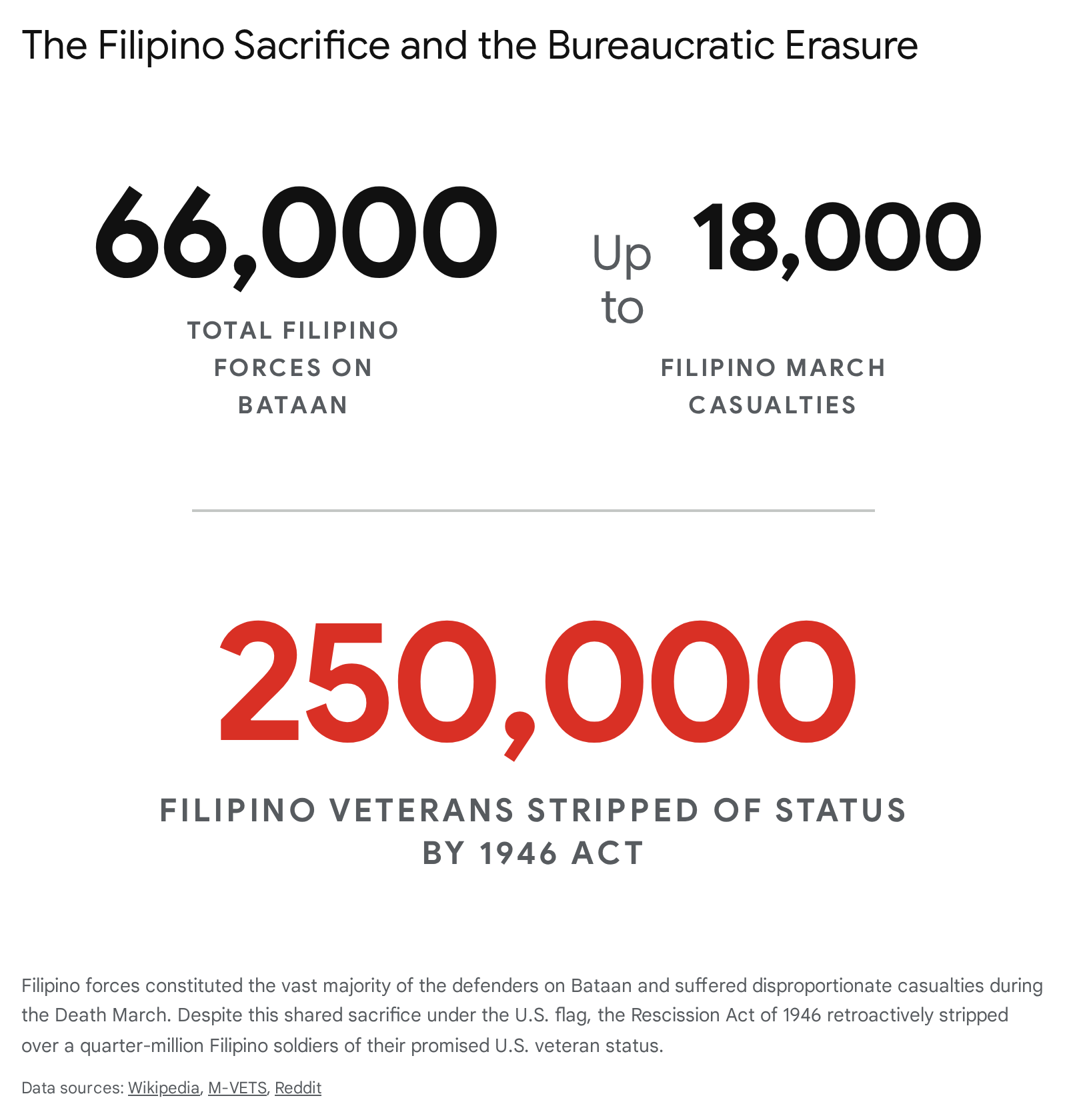
With a single legislative stroke, over 250,000 Filipino veterans—men who had survived the horrors of Bataan, endured the death march, suffered in the camps, and subsequently waged years of brutal, unyielding guerrilla warfare holding the line for General MacArthur’s promised return—were erased from the American military ledger. They were denied their rightful military pensions, access to Veterans Affairs healthcare, and GI Bill benefits.22 President Harry S. Truman signed the bill into law, publicly acknowledging that the legislation “does not release the United States from its moral obligation” to the veterans who sacrificed so much, but the practical, legal effect was absolute disenfranchisement.21
For the survivors of the Bataan Death March, the profound physical and psychological trauma of Japanese captivity was thus compounded by a bureaucratic betrayal orchestrated by the very nation they had sworn to defend. This legislative act sparked a bitter civil rights and equity struggle that spanned more than six decades. Aging veterans organized, marched, and lobbied Congress, fighting for the recognition and compensation they were promised in 1941.24
It was not until the passage of the American Recovery and Reinvestment Act of 2009—over sixty years after the end of the war—that the U.S. government finally established the Filipino Veterans Equity Compensation Fund. This legislation offered a one-time lump-sum payment to the surviving veterans: $15,000 for those who had become U.S. citizens, and $9,000 for those living in the Philippines.24 While hailed as a long-awaited victory, the celebration was deeply bittersweet. By 2009, out of the quarter-million men who served, only an estimated 18,000 Filipino World War II veterans were still alive, with an attrition rate of three to ten veterans dying each day.24 For the vast majority of the men who marched from Mariveles to Capas, the recognition came decades too late.
Conclusion
The Bataan Death March remains a seminal, defining event in the military history of the Second World War. It serves as a grim masterclass in the cascading, lethal failures of military logistics, the horrific consequences of strategic isolation, and a terrifying testament to the depths of human cruelty when ideologically unchecked and fueled by cultural supremacy. The physical realities of the 65-mile trek from Mariveles and Bagac to San Fernando, the massacres along the Pantingan River, and the systematic starvation engineered by the Imperial Japanese Army resulted in one of the most catastrophic loss-of-life events ever endured by American and Philippine military forces.
However, a comprehensive historical analysis demands that the sheer volume of the atrocities does not entirely overshadow the profound, defiant humanity that simultaneously manifested on the peninsula. The true, complete narrative of Bataan is inextricably linked to the stories of internal solidarity and external rescue. It is the story of Bill White sharing his life-saving quinine with a stranger, and the story of Paul Kerchum leading men through the safest paths of the column. It is the story of the elderly Filipino women risking bayonets to hide soldiers beneath their traditional skirts, the villagers of Pampanga tossing rice wrapped in banana leaves, and the banceros ferrying the wounded across Manila Bay. Above all, it is defined by the ultimate, martyred sacrifice of figures like Josefa Llanes Escoda, who refused to abandon the prisoners when they needed her most.
These acts of quiet heroism and defiant compassion, exhibited by both the starving military prisoners and the terrorized civilian population, demonstrate a fundamental historical truth: even when entirely enveloped by a massive, industrialized military atrocity, the human capacity for goodness, empathy, and solidarity cannot be entirely extinguished. The legacy of Bataan, therefore, is dualistic. It is a cautionary tale of death, cruelty, and subsequent political betrayal, but it simultaneously stands as an enduring, luminous monument to the resilience of the human spirit in the face of absolute despair.
Please share the link on Facebook, Forums, with colleagues, etc. Your support is much appreciated and if you have any feedback, please email us in**@*********ps.com. If you’d like to request a report or order a reprint, please click here for the corresponding page to open in new tab.
Sources Used
- Battle of Bataan | The National WWII Museum | New Orleans, accessed April 23, 2026, https://www.nationalww2museum.org/war/topics/battle-bataan-death-march
- Surrender at Bataan Led to One of the Worst Atrocities in Modern Warfare – USO, accessed April 23, 2026, https://www.uso.org/stories/122-surrender-at-bataan-led-to-one-of-the-worst-atrocities-in-modern-warfare
- Battle of Bataan – Wikipedia, accessed April 23, 2026, https://en.wikipedia.org/wiki/Battle_of_Bataan
- Explainer 3 – Duty to Country, accessed April 23, 2026, https://dutytocountry.org/project/explainer-3/
- Bataan Death March Survivor Lester Tenney Dies at Age 96 | The National WWII Museum, accessed April 23, 2026, https://www.nationalww2museum.org/war/articles/bataan-death-march-survivor-lester-tenney-dies-age-96
- Bataan Death March survivor shares story – Air Force Museum, accessed April 23, 2026, https://www.nationalmuseum.af.mil/Upcoming/Press-Room/News/Article-Display/Article/110878/bataan-death-march-survivor-shares-story/
- Bataan Death March – Wikipedia, accessed April 23, 2026, https://en.wikipedia.org/wiki/Bataan_Death_March
- Bataan Death March: Japanese Brutality – Air Force Museum, accessed April 23, 2026, https://www.nationalmuseum.af.mil/Visit/Museum-Exhibits/Fact-Sheets/Display/Article/196797/bataan-death-march-japanese-brutality/
- In Their Footsteps – Smithsonian Magazine, accessed April 23, 2026, https://www.smithsonianmag.com/history/in-their-footsteps-103905961/
- Philippine Scout, Army Veteran shares story of his escape from the Bataan Death March, accessed April 23, 2026, https://news.va.gov/43677/philippine-scout-army-veteran-shares-story-of-how-his-escape-from-bataan-death-march/
- Bataan Death March survivor: Marine Corps Veteran Irvin Scott – VA …, accessed April 23, 2026, https://news.va.gov/70565/bataan-death-march-marine-corps-survivor-irvin-scott/
- Surviving the Bataan Death March: A Former POW’s Story – DAV, accessed April 23, 2026, https://www.dav.org/learn-more/news/2022/how-dav-member-former-pow-survived-the-bataan-death-march/
- Bataan Death March: Courage, Sacrifice, and Lasting Legacy – Soldiers’ Angels, accessed April 23, 2026, https://soldiersangels.org/bataan-death-march-wwii-legacy/
- The Bataan Death March, accessed April 23, 2026, https://www2.gvsu.edu/walll/The%20Bataan%20Death%20March.htm
- Bataan Death March | Definition, Date, Pictures, Facts, Survivors, & Significance | Britannica, accessed April 23, 2026, https://www.britannica.com/event/Bataan-Death-March
- Bringing Home the Heroes: The Heart-Wrenching Journey to Uncover Julius St. John Knudsen and Honor the Forgotten Souls of the Bataan Death March – Stories of Sacrifice, accessed April 23, 2026, https://www.storiesofsacrifice.org/blog/bringing-home-the-heroes-the-heart-wrenching-journey/
- www.mansell.com, accessed April 23, 2026, https://www.mansell.com/lindavdahl/omuta17/articles_memorials_etc/Civilians_and_the_Death_March.doc
- Josefa Llanes Escoda: Filipino Heroine | PDF | Social Science – Scribd, accessed April 23, 2026, https://www.scribd.com/doc/61844513/josefa-Llanes-escoda
- The heroic martyrdom of Josefa Llanes Escoda, September 20, 1952, accessed April 23, 2026, https://philippinesfreepress.wordpress.com/1952/09/20/the-heroic-martyrdom-of-josefa-llanes-escoda-september-20-1952/
- Josefa Llanes Escoda – Wikipedia, accessed April 23, 2026, https://en.wikipedia.org/wiki/Josefa_Llanes_Escoda
- Repeal the Rescission Act of 1946 – FilVetREP, accessed April 23, 2026, https://filvetrep.org/repeal-the-rescission-act-of-1946/
- From Corregidor To Congress’ Corridors: The Fight For Filipino WWII Veterans’ Benefits, accessed April 23, 2026, https://mvets.law.gmu.edu/2019/08/26/from-corregidor-to-congress-corridors-the-fight-for-filipino-wwii-veterans-benefits/
- Testimony Before the Senate Committee on Veterans Affairs on the Filipino Veterans Equity Act | Daniel K. Inouye Institute, accessed April 23, 2026, https://dkii.org/speeches/july-25-1997-washington-d-c/
- Veterans fight for full equity – New Times San Luis Obispo, accessed April 23, 2026, https://www.newtimesslo.com/veterans-fight-for-full-equity-2946119/
- TIL That during WW2 there were around 250,000+ Filipino soldiers that fought for the allied forces and were promised the same compensation as their American counterparts, but in 1946 Truman signed the Rescission Act of 1946 which denied Filipino soldiers all of their benefits. : r/todayilearned – Reddit, accessed April 23, 2026, https://www.reddit.com/r/todayilearned/comments/bbgogc/til_that_during_ww2_there_were_around_250000/