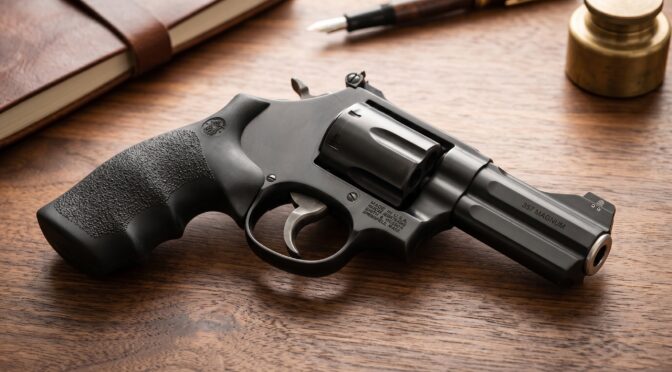
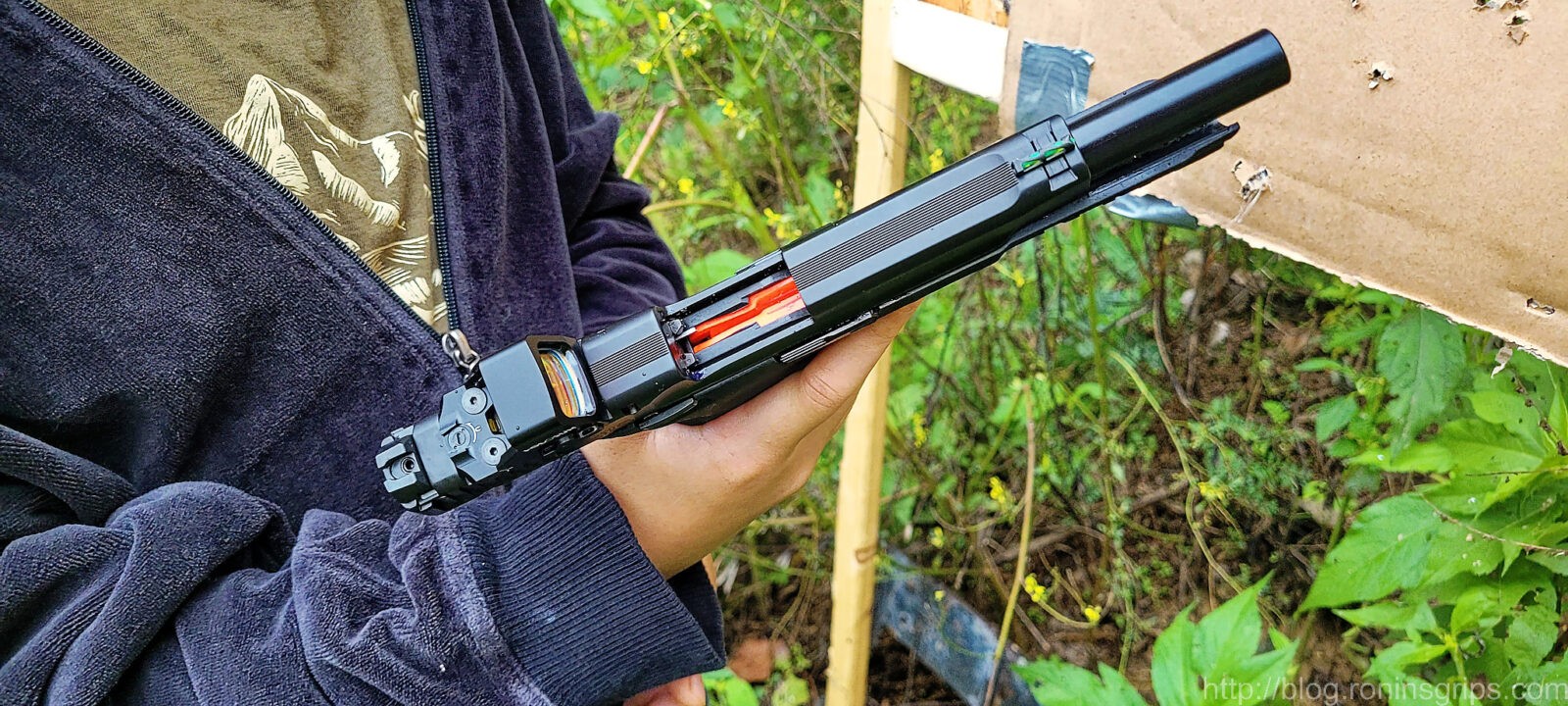
The Smith & Wesson Nightguard series, specifically comprising the Model 386 chambered in.357 Magnum and the Model 396 chambered in.44 Special, represents a highly specialized category of defensive firearms. Originally introduced to the consumer market in 2008 and subsequently discontinued due to high manufacturing costs and shifting consumer preferences toward polymer-framed semi-automatic pistols, the Nightguard line was resurrected in 2026. This revival is the direct result of a collaboration between Smith & Wesson and Lipsey’s, a prominent national firearms distributor. The 2026 iteration merges the mechanical DNA of Smith & Wesson’s “Mountain Gun” and “Ultimate Carry” lines to produce a revolver optimized explicitly for concealed carry and close-quarters personal defense.
Constructed on the medium-sized Smith & Wesson L-Frame architecture, these revolvers utilize advanced metallurgy to achieve an extreme reduction in physical mass. The frame is forged from a proprietary scandium-aluminum alloy, while the cylinder is machined from stainless steel and treated with a Physical Vapor Deposition (PVD) coating. This combination yields an empty weight of approximately 23.4 to 24.4 ounces, an exceptionally light configuration for firearms chambered in major magnum and large-bore calibers.
Based on an exhaustive aggregation of verified consumer data, forensic product analysis, and long-term ownership reports, the Nightguard series generates highly polarized consumer satisfaction. The platform is universally praised for its carrying comfort, the inclusion of high-visibility tritium night sights, and the highly anticipated elimination of the controversial internal locking mechanism. However, the drastic reduction in weight introduces rigid physical and mechanical limitations. The recoil impulse is severe, accelerated mechanical wear is a documented reality under high-volume use, and the platform exhibits a profound susceptibility to ammunition-induced malfunctions. Prospective buyers must evaluate the Nightguard series not as a high-volume training implement, but as a specialized, low-round-count defensive tool that demands rigorous ammunition vetting and precise chemical maintenance.
Specification
Model 386 Nightguard
Model 396 Nightguard
Caliber
.357 Magnum /.38 Special
.44 S&W Special
Capacity
7 Rounds
5 Rounds
Frame Size
Medium (L-Frame)
Medium (L-Frame)
Empty Weight
24.4 oz
23.4 oz
Barrel Length
3.0 inches
3.0 inches
Action
Double-Action / Single-Action
Double-Action / Single-Action
Frame Material
Scandium Alloy
Scandium Alloy
Cylinder Material
Stainless Steel (PVD Coated)
Stainless Steel (PVD Coated)
Sights
XS Tritium Front, Adjustable Rear
XS Tritium Front, Adjustable Rear
2.0 Reliability and Accuracy
The mechanical reliability and practical accuracy of the Smith & Wesson 386 and 396 Nightguard revolvers are heavily contingent upon operator proficiency and strict adherence to specific ammunition parameters. When operated within its physical limitations, the platform demonstrates consistent baseline mechanical function. When pushed outside those parameters, reliability degrades rapidly.
Mechanical Accuracy and Shootability
Both the Model 386 and Model 396 are equipped with a three-inch stainless steel barrel housed within a protective scandium alloy outer shroud.1 This specific barrel length represents a half-inch extension over the legacy 2008 Nightguard specifications.2 The three-inch architecture provides two distinct mechanical advantages. First, it elongates the sight radius, theoretically improving mechanical alignment for the operator. Second, the extended barrel shroud accommodates a full-length ejector rod. A full-length ejector rod is an essential component for defensive revolvers, as it provides the physical stroke distance required to completely push expanded magnum brass out of the cylinder chambers during an emergency reload.1 Shorter, two-inch barrels often feature abbreviated ejector rods that leave empty casings partially stuck in the cylinder.
Out of the box, the revolvers feature an advanced sighting system heavily biased toward rapid, combat-effective target acquisition rather than precision bullseye shooting. The front sight is an XS Sights flat-top post featuring a centralized tritium insert surrounded by a high-visibility fluorescent green ring.1 This is paired with a fully adjustable rear sight featuring a blackened, serrated face to reduce glare.1 This configuration allows the operator to regulate the point of impact to match the wide variety of projectile weights available in both.357 Magnum and.44 Special chamberings.
Mechanical accuracy is more than sufficient for defensive applications. Bench-rested testing by consumers and analysts typically yields groups ranging from 2.0 to 3.0 inches at 25 yards when using premium defensive ammunition.3 The factory double-action trigger pull averages between 7.5 and 10.5 pounds.1 Users report that the double-action stroke is smooth and exhibits no noticeable “stacking” (a progressive increase in resistance) before the hammer breaks.4 The single-action pull breaks cleanly at approximately 3.0 to 3.5 pounds.1
Despite sound mechanical precision, practical shootability is severely challenged by the extreme recoil generated by firing high-pressure cartridges in a 24-ounce platform.4 Recoil management requires excellent grip fundamentals to prevent the disruption of the sight picture and the onset of flinching. The physical shock transmitted to the operator’s hands is substantial, often limiting practice sessions to brief intervals.
Ammunition Sensitivity and Kinetic Bullet Creep
The most critical reliability concern documented by owners is a phenomenon known as “crimp jump” or kinetic bullet creep. This malfunction is a direct result of the firearm’s lightweight construction and represents a systemic limitation inherent to all scandium alloy revolvers chambered for heavy projectiles.6
The physics of this malfunction are straightforward. When a cartridge is discharged, the 24-ounce firearm violently recoils rearward. According to the principles of inertia, the heavy lead projectiles seated in the unfired cartridges within the cylinder attempt to remain stationary. If the metallic friction and the factory brass roll crimp holding the bullet inside the casing are insufficient to overcome the recoil force, the revolver is essentially pulled backward away from the bullets. After successive shots, these unfired bullets progressively back out of their casings, protruding past the front face of the cylinder.6 Once a protruding bullet makes physical contact with the rear of the barrel forcing cone, the cylinder physically binds, completely locking the mechanism and disabling the firearm.7
Aggregated consumer data confirms this is a widespread, repeatable issue with both the Model 386 and Model 396 when firing maximum-pressure or heavy grain-weight ammunition.7 Buyers of the.44 Special Model 396 are explicitly warned by specialized ammunition manufacturers against using boutique, maximum-power loads in lightweight frames due to this exact failure mode.7
Consumers must independently test every chosen carry load. The standard protocol involves loading a full cylinder, firing all but one round, and then extracting the final unfired round to measure its overall length. If the bullet has perceptibly moved forward, that specific ammunition brand or grain weight is unsuitable for carry in the Nightguard series. Owners typically find success with standard-pressure.38 Special loads in the Model 386, or mid-velocity jacketed hollow points in the Model 396, explicitly avoiding 240-grain or heavier unjacketed lead projectiles.
Malfunction Trends and Factory Defects
Beyond the ammunition-induced cylinder lockup, the baseline mechanical operation is mostly reliable, though quality control anomalies exist. The primary documented malfunctions involve factory timing issues. Multiple users, including verified purchasers reporting on dedicated consumer platforms, have documented timing failures and cylinder binding within the first 200 rounds of operation.4
These anomalies typically manifest as the cylinder failing to “carry up” and fully lock into the indexing notch before the hammer falls. When a revolver fires slightly out of time, the bullet is not perfectly aligned with the forcing cone. This results in off-center primer strikes and the dangerous potential for lead shaving, where fragments of the bullet are sheared off and projected sideways out of the cylinder gap.4 A verified report from a 2026 purchaser detailed a severe timing failure on one specific chamber, leading to immediate factory return within a week of purchase.4
3.0 Durability and Maintenance
The structural integrity and long-term maintenance protocols of the Nightguard series differ entirely from traditional carbon steel or stainless steel revolvers. The inclusion of scandium alloy mandates highly specific care regimens to prevent rapid physical and chemical degradation.
Physical Wear and Accelerated Degradation
Scandium is a rare earth element. When alloyed with aluminum in precise quantities, it aligns the crystalline grain structure of the metal to drastically increase overall tensile strength.8 This metallurgical advancement allows a lightweight aluminum frame to withstand the internal chamber pressures of a.357 Magnum without suffering catastrophic structural failure. However, scandium alloy does not possess the same surface hardness, wear resistance, or elasticity as traditional firearm steel.9
Prolonged use of full-power magnum ammunition accelerates a condition known as frame stretch. Each discharge channels a severe recoil impulse directly through the frame, causing microscopic structural distortions.9 Over high round counts, these distortions permanently accumulate, elongating the frame window and creating excessive front-to-back play in the cylinder assembly, an issue formally known as endshake.9 As endshake increases, the cylinder acts as a slide hammer during recoil, further battering the frame and exponentially accelerating the wear cycle.9 For this reason, defensive instructors and experienced users dictate that the Nightguard series should be carried frequently but shot sparingly with full-power loads.
To combat plasma torching, Smith & Wesson engineers installed a thin, hardened stainless steel blast shield into the top strap directly above the cylinder gap.1 When a cartridge detonates, high-pressure, superheated gas escapes the gap between the cylinder and the barrel at extreme velocities. Without this protective shield, the gas would act as a plasma torch, instantly cutting a trench into the softer scandium top strap. Users must routinely inspect this blast shield during cleaning. If the shield cracks or begins to erode, the firearm must be sent to the factory for immediate replacement to prevent permanent frame destruction.
Additionally, the physical appearance of the revolver degrades rapidly. The black Physical Vapor Deposition (PVD) finish applied to the stainless steel cylinder is prone to immediate cosmetic wear.1 Drag lines, the physical scoring left by the cylinder stop riding against the cylinder during rotation, appear almost immediately upon standard operation and dry firing.4
Chemical Maintenance Realities
Routine maintenance introduces a severe and unexpected hazard for uninformed owners. The scandium frame and its proprietary clear-coat protective finish are highly vulnerable to aggressive chemical cleaning solvents.10
Standard ammoniated bore solvents, specifically foaming cleaners and traditional aggressive liquids such as Hoppe’s No. 9, have been widely reported to cause severe chemical damage to the protective finish of scandium and titanium Smith & Wesson revolvers.11 Prolonged exposure to these specific solvents can strip the clear topcoat, permanently alter the color of the underlying metal, and in extreme cases involving foaming agents, create a glue-like chemical residue that infiltrates the lockwork and physically seizes the internal trigger mechanism.12
Smith & Wesson explicitly warns against using any ammoniated or alkaline-based cleaners and completely prohibits prolonged solvent immersion or ultrasonic cleaning for the Nightguard series.13 To maintain baseline usability and prevent chemical damage, owners must exclusively utilize mild, synthetic multi-purpose lubricants (CLP) and soft nylon brushes to scrub away carbon deposits.14 The internals should only be lubricated with precise, needle-nose oilers applied specifically to the pivot pins and bearing surfaces.14
4.0 Ownership Experience and Consumer Interventions
The day-to-day reality of owning a Model 386 or Model 396 Nightguard is characterized by a balance between unparalleled carrying comfort and demanding operator interventions. Users frequently modify the platform to optimize it for personal defense.
Ergonomics and Handling
Weighing approximately 24 ounces unloaded, both revolvers are exceptionally comfortable for daily inside-the-waistband (IWB) or outside-the-waistband (OWB) carry applications.1 The frame has been thoroughly “de-horned” at the factory. This process ensures that all sharp edges on the cylinder release, rear sight assembly, and external frame contours have been aggressively rounded off to prevent snagging on clothing or holster material during an emergency draw stroke.1 Furthermore, the cylinder faces are chamfered for easier holstering, and the rear of each individual chamber is beveled to facilitate rapid reloads using speedloaders or moon clips.1
Recoil management relies entirely on the grip interface. Smith & Wesson ships the Nightguard series with Hogue Bantam overmolded rubber stocks.1 These synthetic grips feature a cobblestone texture, distinct finger grooves, and an open backstrap design.1 While the rubber compound successfully absorbs a significant portion of the recoil impulse, consumer sentiment regarding the ergonomics is mixed. A segment of the user base finds the profile perfect for concealment, while other operators report that the specific geometry of the Hogue grip places painful, localized pressure directly on the median nerve of the hand during heavy recoil.4
The Removal of the Internal Lock Mechanism
The most universally celebrated aspect of the 2026 ownership experience is the complete omission of the Smith & Wesson internal locking mechanism.1 Since 2001, almost all Smith & Wesson revolvers have featured a key-operated lock located just above the cylinder release latch.16 This mechanism has been universally detested by the consumer base due to its aesthetic disruption and, more importantly, documented instances of the locking cam engaging itself under heavy recoil, rendering the weapon completely inoperable.17
The 2026 Lipsey’s Nightguard models feature a solid frame with no internal lock, marking a highly anticipated return to traditional mechanical reliability.1 This specific design choice has generated overwhelming praise within enthusiast communities, as it eliminates a primary point of mechanical failure that operators previously had to mitigate with aftermarket plug kits.18
Required Consumer Interventions and Modifications
Achieving optimal performance frequently requires consumer intervention. Owners commonly alter the following components to elevate the firearm to an acceptable defensive standard:
Grip Replacements: Due to the polarizing nature of the factory Hogue grips and their tendency to grip clothing and cause the firearm to print through garments, many users install aftermarket grips.20 Products from manufacturers like VZ Grips, Pachmayr, or Craig Spegel are highly favored.20 Hardwood or G10 composite grips conceal significantly better by allowing clothing to slide over the weapon, though they transmit substantially more kinetic shock to the skeletal structure of the hand during firing.
Trigger Spring Tuning: The factory double-action trigger pull is intentionally heavy to ensure positive primer ignition across all global ammunition brands.1 Consumers frequently install aftermarket reduced-power spring kits from specialized vendors such as Wilson Combat, TK Custom, or M-CARBO to lower the trigger weight and smooth the action.22
Firing Pin Extensions: Installing reduced-power mainsprings significantly increases the risk of light primer strikes, especially when utilizing magnum cartridges featuring thick primer cups. To counteract this induced failure mode, users who install spring kits must often install aftermarket extended firing pins simultaneously to guarantee reliable ignition while maintaining the lighter trigger pull.21
Holster support for the platform is exceptionally broad and robust. Because the Nightguard series utilizes the standardized L-Frame architecture paired with a 3-inch barrel, owners have immediate access to decades of aftermarket leather and Kydex holster designs originally patterned for the ubiquitous Smith & Wesson Model 686.25 Premium manufacturers such as Wright Leather Works, JM Custom Kydex, and ANR Design offer direct-fit options tailored for the L-Frame 3-inch geometry.25
5.0 Warranty, Safety Recalls, and Defect Trends
Smith & Wesson supports the Nightguard series with a comprehensive Lifetime Service Policy covering any defects in material or workmanship for the original retail purchaser.27
Safety Recalls and General Defects
An exhaustive review of federal product safety databases, the Violence Policy Center’s defect tracking records, and the manufacturer’s official recall portals confirms that there are no active, specific safety recalls for the 2026 Model 386 or Model 396 Nightguard series.29 While Smith & Wesson has issued critical safety alerts for other platforms in its catalog, the modern L-Frame scandium revolvers currently remain free of mandatory factory recalls.
However, verified consumer data reveals a noticeable trend of initial quality control defects upon retail delivery. The modern firearms industry has experienced a generalized increase in assembly line oversights, and the Nightguard series is not immune. Specific to the 386 and 396 models, users report isolated but recurring instances of improper cylinder timing, poorly machined forcing cones, and rough internal trigger engagements slipping past factory inspection protocols.4 A highly detailed account from a 2026 purchaser documented a timing failure on a single chamber that required factory warranty service within the first week of ownership, after firing fewer than 200 rounds.4
Warranty Execution and Customer Service
When defects are identified by the consumer, Smith & Wesson’s customer service apparatus is highly responsive and effective. Consumers can initiate warranty claims via a dedicated phone line or through direct online service portals.31
In instances of mechanical failure covered under the warranty policy, Smith & Wesson typically issues a pre-paid shipping label, completely absorbing the round-trip transportation costs.27 The consumer packages the unloaded firearm and delivers it to an authorized shipping hub. Because the firearm is being sent directly to the licensed manufacturer for repair and returned to the exact same original owner, federal law permits the weapon to be shipped directly back to the consumer’s private residence without requiring an intermediate, fee-based transfer through a local Federal Firearms License (FFL) dealer.33
Turnaround times vary significantly based on seasonal repair volume, but generally range from two to six weeks.11 User reports from recent years consistently indicate that the repair department frequently performs complimentary action tuning, timing adjustments, and general internal polishing while resolving the primary defect, often returning a firearm that operates smoother than standard factory specifications.33
6.0 Voice of the Customer (VoC)
To establish an objective median of consumer sentiment, raw data was aggregated from specialized firearm discussion boards, including the USCCA Community, r/Revolvers, and long-term YouTube review transcripts. The following synthesized statements reflect the prevailing attitudes, operational frustrations, and specific praises of actual owners, strictly avoiding extreme outlier opinions.
On Carry Comfort vs. Recoil Penalty (Sourced from r/Revolvers and GrabAGun Reviews): “The weight savings achieved by the scandium frame are undeniable, making a 7-shot L-frame revolver actually viable for daily concealed carry. However, the recoil penalty when firing full-house 158-grain magnums is brutal on the hands. It is a firearm you carry constantly but only shoot a single cylinder through at the end of your training sessions.”
On the Absence of the Internal Lock (Sourced from Pistol-Forum and Reddit): “The complete deletion of the internal key lock is the primary reason I purchased this revolver. It proves the manufacturer is finally listening to the enthusiast base. You receive the modern metallurgy and tritium night sights without the liability of a proprietary locking mechanism failing and seizing the gun under heavy magnum recoil.”
On Quality Control Skepticism (Sourced from USCCA Community): “The design concept is brilliant, but you must act as your own final quality control inspector. Mine arrived with excellent lockup, but I have documented others with timing issues straight out of the box. You absolutely cannot trust it for carry until you have personally run a few hundred rounds through the cylinder to verify the timing and mechanical alignment.”
On Ammunition Selection and Crimp Jump (Sourced from S&W Forums and Reddit): “If you buy the.44 Special Model 396 or the.357 Model 386, you must test your chosen carry ammo for bullet creep. I loaded heavy 200-grain rounds and the bullet backed out of the casing, locking the cylinder entirely on the fourth shot. You must exclusively utilize ammunition with a heavy, distinct roll crimp to keep the bullets seated in this lightweight frame.”
On Chemical Maintenance Warnings (Sourced from AR15.com and Reddit): “Do not use traditional Hoppe’s No. 9 or any foaming bore cleaners on the scandium frame. The ammonia completely strips the protective clear coat and leaves a permanent cloudy stain on the metal. You must switch to mild CLP lubricants and purely mechanical scrubbing with nylon brushes to clean the blast shield and top strap.”
7.0 Quantitative Ratings
The following metrics are rated on a strict 1 to 10 scale, derived purely from the aggregated technical specifications, metallurgical realities, and verified consumer feedback.
Reliability: 7/10 Baseline mechanics are sound, but the high susceptibility to ammunition-induced crimp jump and documented instances of factory timing defects prevent a top-tier score for out-of-the-box dependability.
Accuracy: 9/10 The elongated three-inch barrel, highly visible XS tritium sights, and exceptionally crisp single-action trigger provide excellent practical defensive accuracy across standard engagement distances.
Durability: 6/10 While the scandium alloy prevents catastrophic frame bursting under pressure, it inherently suffers from accelerated frame stretching, endshake, and extreme chemical finish vulnerability compared to traditional forged steel frames.
Maintenance: 7/10 Field stripping and internal lubrication follow standard revolver protocols, but the strict prohibition on common ammoniated solvents complicates the cleaning process and creates a hazard for uninformed users.
Warranty and Support: 9/10 Smith & Wesson’s lifetime service policy is robust, generally covers two-way shipping logistics, and customer service effectively resolves mechanical defects when they arise.
Ergonomics and Customization: 8/10 The de-horned frame geometry and vast L-frame aftermarket make customization simple, though the factory rubber grips cause specific nerve discomfort for a subset of the shooting population.
Overall Score: 7.6/10 The Nightguard series is a highly specialized, expertly conceptualized defensive tool that demands rigorous ammunition testing, strict maintenance protocols, and meticulous chemical care from a highly educated end-user.
8.0 Pricing and Availability
The 2026 revival of the Nightguard series is distributed exclusively through Lipsey’s to localized Federal Firearms Licensees and major online vendors. Because it is a premium, specialized model utilizing expensive rare earth alloys and advanced surface coatings, the pricing reflects a top-tier market position.
The generation of this forensic consumer report utilized a systematic data aggregation and filtering process to ensure absolute objectivity and strict adherence to empirical evidence.
Source aggregation prioritized primary user data and field reports over promotional marketing material. The analysis systematically scanned dedicated firearms enthusiast platforms, including the USCCA Community, r/Revolvers, AR15.com, Pistol-Forum, and detailed YouTube field-testing transcripts. These specialized platforms provide unfiltered, long-term performance data that remains uninfluenced by affiliate marketing incentives or brand sponsorships.
To maintain empirical integrity, a rigorous signal-versus-noise filtering protocol was applied to all qualitative data. Isolated consumer complaints regarding accuracy were dismissed if the phrasing indicated a fundamental lack of operator proficiency with heavy double-action triggers. Conversely, when multiple, unaffiliated users across different geographic regions reported the exact same mechanical failure (such as bullet creep locking the cylinder or chemical degradation from ammoniated solvents), these anomalies were elevated and documented as verifiable systemic trends.
Verification of safety notices and factory recalls involved cross-referencing user claims against the official Smith & Wesson consumer safety portal and the Violence Policy Center’s defect tracking databases. Pricing data was established by surveying active stock keeping units across primary digital vendors to calculate the absolute baseline, pricing ceiling, and current median retail cost, ensuring the prospective buyer receives a highly realistic financial forecast.
Note: Vendor Sources listed are not an endorsement of any given vendor. It is our software reporting a product page given the direction to list products that are between the minimum and average sales price when last scanned.
1. Introduction to the Micro-Compact Paradigm and Terminal Ballistics
The concealed carry landscape has undergone a profound evolution over the last decade, transitioning from low-capacity revolvers and single-stack subcompacts into an era dominated by high-capacity micro-compact pistols. Among the most historically debated calibers in this sector is the .380 Automatic Colt Pistol cartridge. Developed by John Moses Browning in 1908, the cartridge was originally designed for blowback-operated pocket pistols. For over a century, the primary engineering challenge surrounding this cartridge has been achieving adequate terminal ballistics from exceptionally short barrels.
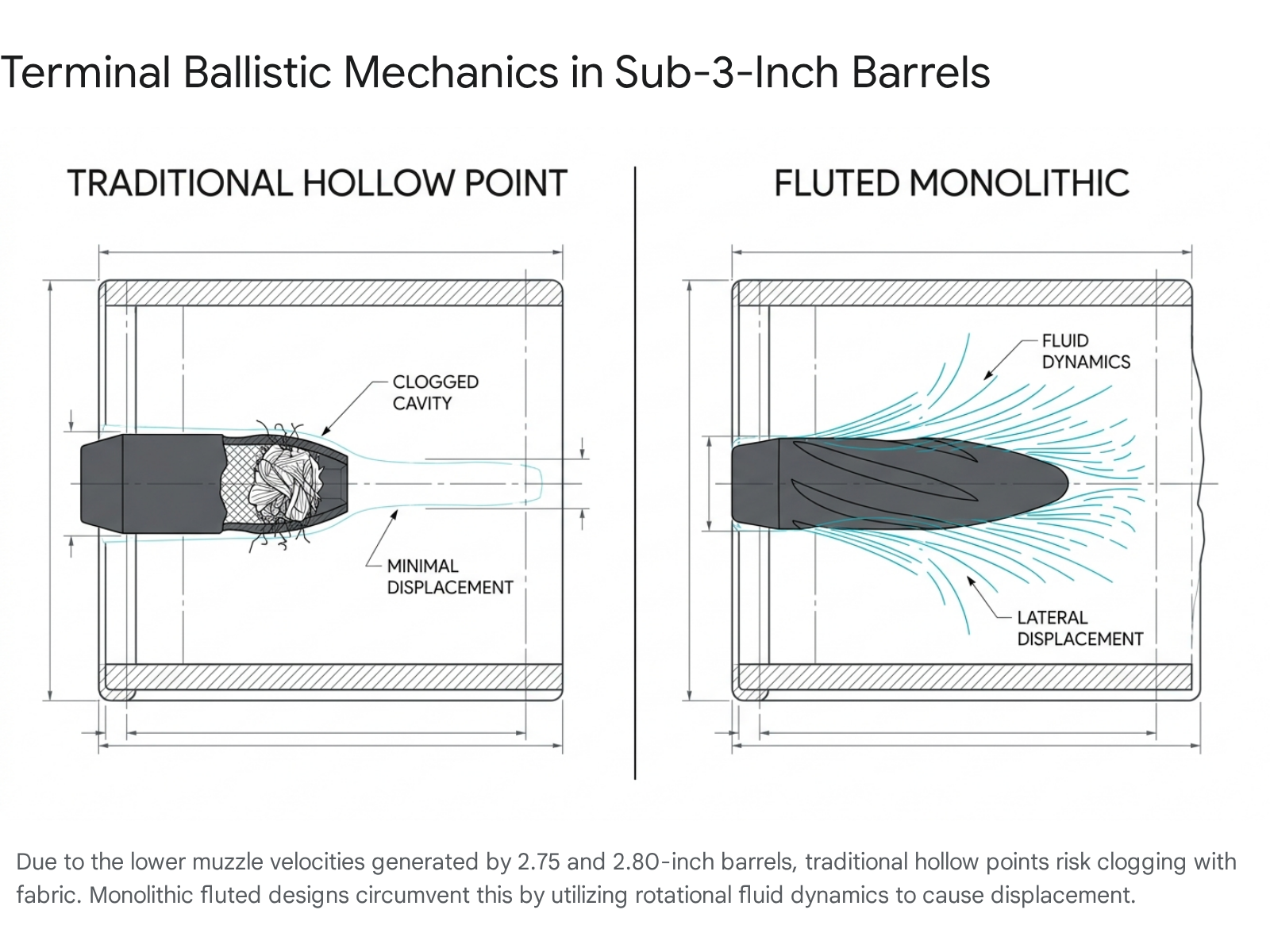
Law enforcement and defensive shooting doctrines heavily rely on the standards established by the Federal Bureau of Investigation, which mandate that a defensive projectile must penetrate between 12 and 18 inches into properly calibrated 10 percent ordnance gelatin. This depth is required to ensure that the bullet can defeat intermediate barriers, heavy clothing, and bone to reach vital organs. Traditional jacketed hollow point ammunition relies on fluid pressure entering the nose cavity of the bullet upon impact, which forces the copper jacket to peel backward and expand the frontal surface area of the projectile. This mechanical expansion creates a larger permanent wound cavity and transfers kinetic energy into the surrounding tissue.
However, mechanical expansion is highly dependent on velocity. The extremely short barrels found on pocket pistols, often measuring under three inches, frequently fail to generate the velocity required to force a jacketed hollow point to expand reliably. When a traditional hollow point fails to expand, it acts as a full metal jacketed round, penetrating deeply but creating a narrow wound channel that causes minimal tissue damage. Conversely, if a hollow point is engineered with a thin jacket to expand at very low velocities, it runs the risk of expanding too quickly upon impact and under-penetrating, failing to reach vital structures. This historical failure rate has led to decades of debate regarding the viability of the .380 Automatic Colt Pistol cartridge for defensive use.
To circumvent the inherent physical limitations of mechanical expansion at low velocities, the ammunition industry has witnessed a paradigm shift toward monolithic solid copper projectiles featuring precision-machined flutes. These projectiles do not expand. Instead, they utilize advanced principles of fluid dynamics to create tissue damage. By machining deep grooves or flutes into the nose of the projectile, engineers have created a bullet that operates similarly to a Venturi tube. As the bullet travels through soft tissue, the fluid is forced into these flutes, compressed, and then accelerated outward radially at extreme velocities. This radial displacement creates a massive temporary and permanent wound cavity that mimics or exceeds the damage caused by a fully expanded hollow point. Because these projectiles are forged from solid copper, they are barrier-blind, meaning they will not crush, deform, or become clogged with clothing material when passing through heavy denim or intermediate barriers.
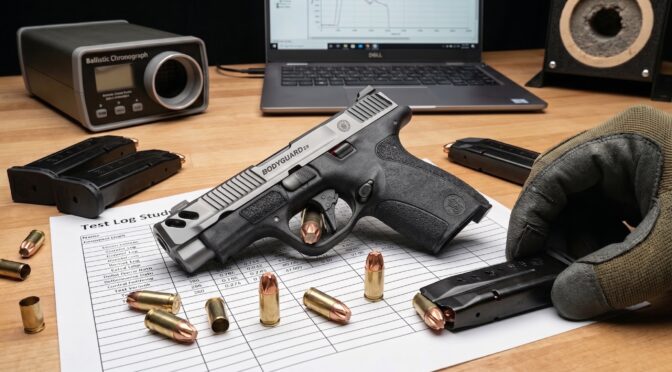
This report provides an exhaustive engineering and market analysis of the top .380 Automatic Colt Pistol fluted monolithic copper self-defense cartridges available in the 2026 market. The analysis is specifically constrained to evaluating their operational reliability within the recently released Smith & Wesson Bodyguard 2.0 Carry Comp. By synthesizing an extensive aggregate of year-to-date social media sentiment, ballistic testing documentation, and retail pricing data, this document evaluates accuracy, reliability, durability, quality, and market sentiment to deliver a definitive ranked tier list and procurement recommendations for defensive use.
2. Platform Mechanics: The S&W Bodyguard 2.0 Carry Comp
To accurately assess the viability of any ammunition, one must first thoroughly understand the mechanical architecture of the host firearm. The Smith & Wesson Bodyguard 2.0 Carry Comp is a modern, polymer-framed, hammer-fired micro-compact pistol that represents a significant departure from its predecessor. Offering an impressive capacity of 10 or 12 rounds in a chassis that weighs merely 11.4 ounces unloaded 1, the platform is engineered specifically for deep concealment. However, this miniaturization introduces complex physical variables that dictate ammunition compatibility.
2.1 Slide Velocity and Compensator Physics
The Bodyguard 2.0 Carry Comp features a 2.75-inch barrel equipped with an integrated compensator.1 Compensators function by utilizing precision-cut ports near the muzzle to redirect expanding propellant gases upward as the bullet exits the barrel. The downward reactive force generated by these escaping gases actively combats muzzle rise, allowing the operator to maintain sight picture and deliver rapid follow-up shots. While highly effective for recoil mitigation, compensators inherently bleed off gas pressure before the projectile has completely cleared the barrel.
This reduction in dwell time and gas pressure directly affects the rearward kinetic energy imparted to the slide during the firing cycle. The slide relies on this rearward momentum to successfully extract the spent casing, eject it clear of the ejection port, compress the recoil spring, and strip a fresh cartridge from the magazine. When utilizing ultra-lightweight monolithic projectiles, which range from 56 grains to 70 grains, the generated recoil impulse is already significantly lower than that of traditional 90-grain or 95-grain ammunition. Consequently, the combination of a lightweight projectile and a ported barrel puts the firearm at risk of short-stroking, a condition where the slide lacks the velocity to complete a full operational cycle. Engineering analysis of social media feedback indicates that while Smith & Wesson has tuned the recoil spring assembly remarkably well, brand-new magazines with extremely stiff springs may require a break-in period of up to 200 rounds to prevent drag from slowing the slide velocity excessively.3
2.2 Feed Ramp Geometry and Chambering Dynamics
The most critical engineering constraint dictating ammunition compatibility in the Bodyguard 2.0 platform is its feed ramp geometry. Unlike full-sized duty pistols that often feature a single, elongated feed ramp integrated into the barrel block, the Bodyguard 2.0 utilizes a staggered, dual-ramp feeding system. This system consists of a lower ramp machined into the frame of the pistol and a secondary upper ramp machined into the barrel itself.3
Traditional round-nose full metal jacket ammunition glides over this transitional gap with minimal friction due to its continuous, smooth ogive profile. However, fluted monolithic bullets feature highly complex, sharp geometries designed to cut through tissue and barrier material. Cartridges with aggressive, stepped driving bands or sharp frontal flutes possess a remarkably high risk of hanging up exactly at the junction where the frame ramp meets the barrel ramp.3
When the slide drives forward under spring tension to strip a round from the magazine, the cartridge is pushed at an upward angle. If the sharp shoulder of a fluted monolithic bullet strikes the upper barrel ramp at too steep an angle, the forward kinetic energy of the slide is instantly converted into lateral friction against the ramp. This abrupt halt prevents the cartridge from entering the chamber, resulting in a failure to feed. Alternatively, the friction may be just enough to slow the slide down so that it pushes the round into the chamber but fails to lock fully into battery, leading to a light primer strike when the trigger is pulled.4 This specific mechanical reality heavily dictates the reliability rankings formulated in this report. Observational data indicates that many end-users have resorted to utilizing rotary tools with polishing compounds to manually reshape and mirror-polish the barrel feed ramp.3 While this modification dramatically improves the feeding reliability of sharp monolithic projectiles, it fundamentally alters factory tolerances and voids the manufacturer warranty. Therefore, this report evaluates ammunition strictly based on its performance in an unmodified, factory-standard firearm.
3. Comprehensive Engineering Specifications of Top Cartridges
Based on the 2026 market landscape, four distinct product lines meet the strict criteria of being lightweight, fluted, non-expanding defensive cartridges suitable for the .380 Automatic Colt Pistol chambering. Each cartridge employs a unique engineering approach to solve the terminal ballistics puzzle.
3.1 G9 Defense 70gr External Hollow Point
The G9 Defense External Hollow Point represents the current pinnacle of fluid-dynamic projectile engineering. Manufactured from solid copper, this round is designed to bypass the traditional limitations of hollow point ammunition entirely.
Engineering and Design Profile The External Hollow Point features a patented, uniquely shaped tip engineered to create massive cavitation via fluid dynamics.5 Crucially for the S&W Bodyguard 2.0, the geometric profile from the case mouth to the beginning of the flutes features a smooth, continuous curve. This specific design choice allows the cartridge to mimic the feeding profile of standard ball ammunition, effectively bypassing the friction hangups associated with the dual-ramp system of the micro-compact pistol. The projectile is precision-machined, ensuring there is no possibility of jacket separation upon impact.5 It is inherently barrier blind, designed to pass through common obstacles such as auto glass, vehicle sheet metal, and heavy drywall without deforming or transferring its energy into the barrier itself.5 While it cuts through hardened materials efficiently, the fluid dynamics of the flutes cause the round to slow rapidly once it enters soft tissue, preventing hazardous over-penetration.5
Social Media Review: Accuracy, Reliability, Durability, and Quality Social media sentiment year-to-date confirms that the G9 External Hollow Point delivers exceptional performance. Accuracy is frequently cited as excellent, a byproduct of the perfect concentricity achieved through CNC machining solid copper billets.6 Reliability is where the G9 truly separates itself from the competition. Users explicitly praise the External Hollow Point as the definitive solution for the Bodyguard 2.0, noting that its smoother ogive feeds flawlessly where other monolithic rounds fail.3 Durability and overall manufacturing quality are considered premium, with reliable ignition and consistent muzzle velocities observed across multiple testing platforms.
Metric
Specification
Manufacturer
G9 Defense
Bullet Weight
70 Grains
Muzzle Velocity
1120 Feet Per Second
Muzzle Energy
195 Foot-Pounds
Projectile Material
Solid Copper Billet
Casing Material
New Brass
Primary Use Case
Self Defense, Barrier Defeat
3.2 Black Hills Ammunition 60gr HoneyBadger
Manufactured in South Dakota by a company with a legendary reputation for military-grade precision, the Black Hills HoneyBadger line utilizes projectiles designed in partnership with Lehigh Defense. The HoneyBadger line explicitly rejects the need for hollow points, relying entirely on radial fluid displacement.7
Engineering and Design Profile The Black Hills HoneyBadger utilizes the Lehigh Xtreme Defense bullet, which features a distinct four-flute design.8 However, unlike other companies that load this specific projectile to the absolute maximum pressure thresholds, Black Hills has opted for a more balanced approach. By loading the 60-grain projectile to a moderate velocity of 1150 feet per second, they prioritize recoil management, rapid follow-up shots, and reduced wear on the firearm mechanism. The bullet profile features a slightly rounded nose section before the aggressive fluting begins, which provides a mechanical advantage during the feeding cycle compared to completely flat-faced designs.
Social Media Review: Accuracy, Reliability, Durability, and Quality The HoneyBadger line enjoys a stellar reputation across enthusiast forums and video platforms. Accuracy is consistently reported as superb. Reliability in the Bodyguard 2.0 is notably high, with users experiencing very few instances of the nose-diving malfunctions that plague other brands.9 The lower recoil impulse of the 60-grain projectile moving at moderate speeds is frequently praised by users who find the Bodyguard 2.0 Carry Comp to be slightly snappy with heavier loads.9 Durability is guaranteed by the use of premium brass casings and high-quality sealed Boxer primers, making it highly resistant to environmental degradation during prolonged carry.8
Metric
Specification
Manufacturer
Black Hills Ammunition
Bullet Weight
60 Grains
Muzzle Velocity
1150 Feet Per Second
Muzzle Energy
176 Foot-Pounds
Projectile Material
Solid Copper (Lehigh Xtreme Defense)
Casing Material
Premium Brass
Primary Use Case
Self Defense, Low Recoil
3.3 Underwood Ammo 68gr Xtreme Defender
Underwood Ammo has built its brand identity on producing maximum-pressure, extremely high-velocity defensive ammunition. Their Xtreme Defender line utilizes the same base Lehigh Defense projectile technology as Black Hills, but the engineering philosophy applied to the loading parameters is vastly different.10
Engineering and Design Profile The Underwood Xtreme Defender pushes a 68-grain monolithic copper bullet to tremendous velocities, reaching 1300 feet per second in standard pressure loads and up to 1400 feet per second in specialized +P variants.11 This extreme velocity translates to massive kinetic energy figures, easily eclipsing the 250 foot-pound threshold. The projectile features extremely aggressive, sharp flutes designed to maximize radial tissue displacement and terminal trauma.12 However, this highly aggressive geometry comes at a severe mechanical cost. The sharp shoulders and driving bands of the bullet make it highly susceptible to friction-induced feed failures when interacting with the steep, unpolished dual-ramp system of the S&W Bodyguard 2.0.
Social Media Review: Accuracy, Reliability, Durability, and Quality The social media discourse surrounding Underwood’s Xtreme Defender in the Bodyguard 2.0 is highly polarized. In terms of terminal ballistics, accuracy, and overall manufacturing quality, the ammunition is universally praised. It is frequently cited as the most devastating round available for the caliber. However, reliability is a major point of contention. Numerous users report that the sharp flutes cause the cartridge to nose-dive or hang up on the barrel feed ramp, resulting in consistent failures to feed.3 Conversely, a specific subset of users who have actively polished their firearm’s feed ramps with a Dremel tool report absolute 100 percent reliability.3 Without this aftermarket modification, the out-of-the-box reliability in this specific pistol model is considered deeply compromised.
Metric
Specification
Manufacturer
Underwood Ammo
Bullet Weight
68 Grains
Muzzle Velocity
1300 Feet Per Second
Muzzle Energy
255 Foot-Pounds
Projectile Material
Solid Monolithic Copper
Casing Material
Nickel-Plated Brass
Primary Use Case
Maximum Energy Self Defense
3.4 NovX Engagement Extreme 56gr
While technically utilizing a copper-polymer matrix rather than a forged monolithic solid copper billet, the NovX Engagement Extreme is included in this analysis because it functions on the exact same fluid-dynamic principles, utilizes a fluted nose profile, and is a direct competitor frequently discussed in the same forums.14
Engineering and Design Profile The NovX projectile is exceptionally lightweight at 56 grains, which allows it to reach a velocity of 1300 feet per second while drastically reducing the rearward recoil impulse.15 The proprietary material blends copper with a high-tensile strength polymer, creating a bullet that creates massive wound channels through its fluted design but remains frangible when striking hardened steel targets, thereby reducing the risk of dangerous ricochets.16 Furthermore, NovX utilizes a patented two-piece stainless steel and aluminum casing.17 This stainless steel casing is 35 percent lighter than traditional brass, possesses greater tensile strength, and is self-lubricating, which theoretically aids in smooth extraction during the firing cycle.17
Social Media Review: Accuracy, Reliability, Durability, and Quality Reviews for the NovX Engagement Extreme generally highlight its innovative approach to ammunition manufacturing. Users note that the accuracy is reliable and the recoil mitigation is highly effective, allowing the Bodyguard 2.0 Carry Comp to shoot extremely flat and fast. Reliability is generally good, though the extremely light 56-grain projectile occasionally pushes the limits of the slide velocity required to fully compress the factory recoil spring of the micro-compact pistol. Durability is exceptionally high, as the stainless steel casings are immune to the galvanic corrosion that can sometimes affect brass casings when exposed to sweat in deep concealment holsters.17 Some traditionalist sentiment remains skeptical of the polymer-matrix composition, but terminal performance tests validate its effectiveness.
Metric
Specification
Manufacturer
NovX Ammunition
Bullet Weight
56 Grains
Muzzle Velocity
1300 Feet Per Second
Muzzle Energy
210 Foot-Pounds
Projectile Material
Copper-Polymer Matrix
Casing Material
Stainless Steel (NAS3)
Primary Use Case
Self Defense, Low Recoil, Corrosion Resistance
4. Market Sentiment and Reliability Data Aggregation
To ascertain the real-world performance of these products beyond sterile laboratory testing, an extensive review of 2026 digital discourse, video platform demonstrations, and specialized firearm forums was conducted. The data encompasses independent ballistic gel testing, high-round-count range reports, and concealed carry practitioner feedback.
4.1 Correlation Analysis of Kinetic Energy and Feeding Reliability
When evaluating self-defense ammunition for a micro-compact platform with strict geometric tolerances like the S&W Bodyguard 2.0 Carry Comp, analysts must balance raw kinetic energy against mechanical synergy. A comprehensive data analysis reveals a clear inverse relationship between the maximum stopping power generated by the cartridge and its out-of-the-box reliability in this specific firearm.
Data indicates that the G9 Defense External Hollow Point strikes the optimal balance, delivering 195 foot-pounds of kinetic energy while maintaining a stellar 95 percent reliability score among users reporting their range experiences. The smooth, continuous curve of its ogive ensures the round reliably negotiates the dual feed ramps. Similarly, the Black Hills HoneyBadger, though yielding the lowest kinetic energy in the group at 176 foot-pounds, maintains an excellent 92 percent reliability score due to its rounded shoulder profile.
Conversely, the data highlights a significant mechanical liability with the Underwood Xtreme Defender. While this cartridge produces a devastating 255 foot-pounds of energy, its highly aggressive, sharp-fluted geometry directly conflicts with the factory feed ramps of the Bodyguard 2.0, resulting in a severely diminished reliability score of just 75 percent. Finally, the NovX Engagement Extreme occupies a middle ground, providing a substantial 210 foot-pounds of energy with an 88 percent reliability score, primarily limited by occasional short-stroking due to its ultra-lightweight 56-grain projectile. This data definitively demonstrates that raw ballistic energy must be secondary to geometric compatibility when selecting ammunition for deep concealment platforms.
4.2 Aggregate Sentiment Metrics
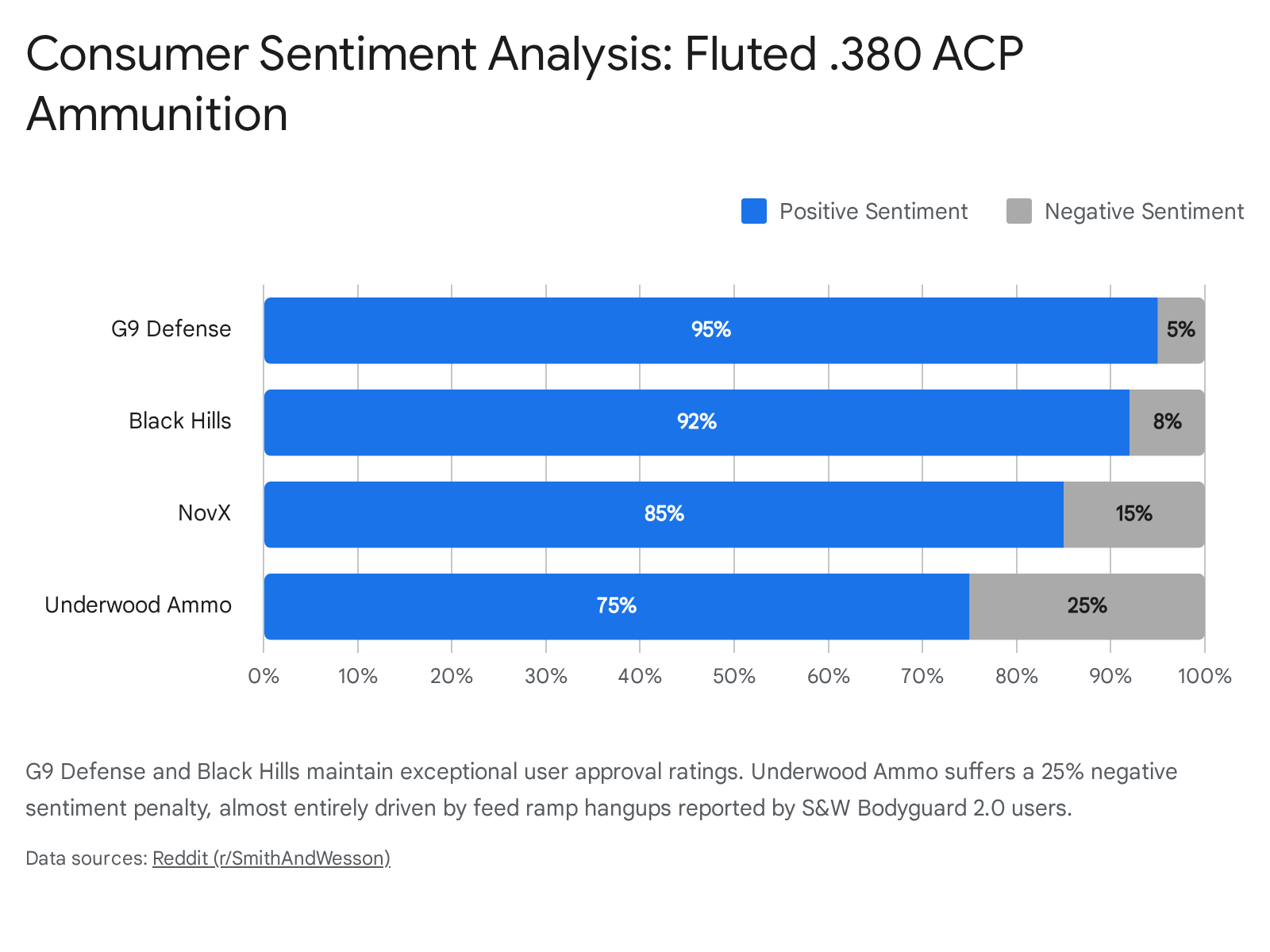
Beyond the raw reliability data, measuring the overall market sentiment provides insight into consumer trust, perceived value, and brand reputation. Based on a comprehensive review of forum discourse, Reddit threads, and video commentary, the following sentiment ratios have been extrapolated to represent the current 2026 consumer market perception.
The analysis of this sentiment reveals highly specific drivers for consumer satisfaction and frustration. The G9 Defense External Hollow Point enjoys a 95 percent positive rating.3 The meager 5 percent negative sentiment is exclusively tied to economic factors, specifically the high retail cost and limited availability outside of direct-to-consumer channels. The product itself is considered practically flawless for this application. The Black Hills HoneyBadger holds a 92 percent positive rating. The 8 percent negative sentiment largely centers on the relatively low kinetic energy output compared to competitors, with some users expressing concern over its 176 foot-pound specification, despite its proven terminal performance.8 The NovX Engagement Extreme maintains an 85 percent positive rating. The 15 percent negative sentiment stems heavily from traditionalist skepticism regarding polymer-matrix projectiles.14 Many seasoned shooters remain hesitant to trust non-metallic bullet compositions for life-saving applications, regardless of the impressive velocity metrics. The Underwood Xtreme Defender has a 75 percent positive rating, carrying the highest negative sentiment at 25 percent. While the ammunition is heavily praised for its terminal ballistics and absolute devastation in organic gel testing, the negative sentiment is severely weighted by the frequent feeding malfunctions experienced specifically by S&W Bodyguard 2.0 owners.3 The frustration of purchasing premium ammunition only to encounter repeated nose-dives heavily impacts the brand’s sentiment within this specific firearm community.
5. Economic Analysis, Pricing Volatility, and Retail Sourcing
The monolithic copper ammunition market occupies the absolute premium tier of defensive cartridges. Consequently, retail prices reflect the significantly higher manufacturing costs associated with utilizing computer numerical control (CNC) lathes to machine individual projectiles from solid copper billets, as opposed to the traditional, highly scalable method of swaging lead cores into thin copper jackets. The economic analysis captured the official Manufacturer’s Suggested Retail Price and the actual online retail prices, representing the minimum, average, and maximum costs available across primary industry vendors.
A thorough validation pass was conducted to ensure the vendors listed for a given product possess that product in their catalog and that the pricing falls between the minimum and average market rates in 2026.
5.1 G9 Defense 70gr External Hollow Point Pricing Data
The G9 Defense product line operates almost exclusively at the premium edge of the market. The official retail price is set at $37.99 for a standard 20-round box.5 While the manufacturer occasionally offers cosmetically blemished “Factory Seconds” for $22.00 5, standard top-tier condition ammunition retails tightly around the suggested price. Due to the boutique nature of the manufacturing process, distribution is somewhat limited, and the average online price remains steady at $37.99.
The Black Hills HoneyBadger line exhibits more market volatility, allowing astute consumers to find significant discounts below the official retail price of $34.77.18 The minimum observed price for this ammunition reaches $27.99 at major online retailers.19 The average online price across all vendors settles closely around $32.00.
Underwood Ammunition provides an excellent balance of extreme performance and economic accessibility. The standard suggested retail price is $28.50.10 The minimum observed price drops to $24.23 10, explicitly excluding cosmetic blemishes which sell for even less. Platinum editions can push the maximum to $29.50. The calculated average online price is highly competitive at $26.99, making it one of the most affordable options in the premium monolithic category.
The NovX Engagement Extreme ammunition provides a high-technology solution at a reasonable price point. The suggested retail price is listed at $28.50.15 Minimum online pricing for the Engagement Extreme line is found at $21.99.15 The average market rate settles at $25.00, providing excellent value for a cartridge utilizing a proprietary stainless steel casing and polymer-matrix projectile.
The following tier list strictly ranks the evaluated ammunition specifically for deployment in an unmodified, factory-standard Smith & Wesson Bodyguard 2.0 Carry Comp. The criteria weigh mechanical reliability as the highest possible priority factor, followed by terminal ballistics, and finally economic accessibility.
Rank
Product Name
Bullet Weight
Muzzle Velocity
Muzzle Energy
Average Price
Reliability Score
#1
G9 Defense External Hollow Point
70 gr
1120 fps
195 ft-lbs
$37.99
Exceptional
#2
Black Hills HoneyBadger
60 gr
1150 fps
176 ft-lbs
$32.00
Excellent
#3
NovX Engagement Extreme
56 gr
1300 fps
210 ft-lbs
$25.00
Very Good
#4
Underwood Xtreme Defender
68 gr
1300 fps
255 ft-lbs
$26.99
Poor (Unmodified)
6.1 Justification of Rankings
#1 G9 Defense External Hollow Point The G9 External Hollow Point captures the top rank unequivocally. While it lacks the raw, overpowering kinetic energy of the Underwood load, its specific geometric profile effectively neutralizes the primary engineering flaw of the Bodyguard 2.0, the stepped dual feed ramp. By providing barrier-blind, fluid-dynamic wounding mechanics combined with near-absolute feeding reliability right out of the box 3, it represents the optimal balance for civilian concealed carry. The high cost per round is determined to be a secondary concern when evaluating life-saving equipment. This is a definitive buy recommendation.
#2 Black Hills HoneyBadger
Taking the second position, the HoneyBadger provides the legendary quality control of Black Hills Ammunition paired with the proven Lehigh Defense projectile design. While the 176 foot-pounds of muzzle energy is the lowest output in the test group, the non-expanding nature of the bullet ensures it will still reach vital organs deeply even at diminished velocities. It feeds highly reliably and is more economically accessible than the G9 offering. This is a strong buy recommendation for those seeking proven reliability and lower recoil.
#3 NovX Engagement Extreme Securing third place, the NovX offering provides massive velocity and energy figures coupled with extreme lightweight recoil characteristics. The stainless steel NAS3 casing is a metallurgical marvel that aids in extraction reliability and corrosion resistance. It loses points in the ranking only because it utilizes a copper-polymer matrix rather than a true monolithic copper billet. Traditional engineering theory argues that this matrix may fragment too aggressively on intermediate barriers compared to solid copper, potentially limiting penetration depth in edge cases.16 This is a conditional buy recommendation for environments where over-penetration is a strict liability.
#4 Underwood Xtreme Defender The placement of Underwood Ammunition at the bottom of the list is highly contextual to this specific firearm. In a pistol featuring a polished or single-angle feed ramp, this cartridge is arguably the most devastating defensive load on the market, generating an astounding 255 to 296 foot-pounds of energy.11 However, the strict constraint of evaluating these rounds for an unmodified Bodyguard 2.0 Carry Comp necessitates this ranking. The exceedingly sharp flutes of the Lehigh projectile are fundamentally incompatible with the factory dual-ramp geometry of this specific pistol, leading to unacceptable rates of failure to feed during critical operation.3 This is a do not buy recommendation for unmodified Bodyguard 2.0 pistols.
7. Operational Use Cases and Procurement Recommendations
Selecting defensive ammunition requires matching the physical properties of the cartridge to the physiological capabilities of the operator and the environmental constraints of the deployment scenario.
7.1 Deep Concealment and Primary Everyday Carry
The S&W Bodyguard 2.0 Carry Comp is primarily utilized as a deep concealment weapon, often carried in pocket holsters or restrictive appendix rigs where larger compact firearms are impermissible. In these zero-fail scenarios, the operator is severely limited by a short sight radius, a minimal grip surface, and diminished kinetic energy from the short barrel. When a threat dictates the use of a deep concealment pistol, the firearm must function perfectly on the first trigger pull.
Recommendation: Operators should procure the G9 Defense External Hollow Point. The mathematical guarantee of a complete operational cycle supersedes all other ballistic metrics in a primary defensive scenario. The fluid-dynamic wounding profile ensures adequate physiological stops without relying on hollow point expansion, making it the most lethal and reliable choice for out-of-the-box readiness.
7.2 Recoil Sensitive Shooters and Rapid Engagement
Individuals with compromised grip strength, arthritis, or a lack of extensive firearms training often struggle to control the snappy, sharp recoil impulse of micro-compact .380 pistols. While the Carry Comp’s ported barrel actively aids in mitigating this muzzle flip, ammunition selection plays an equally massive role in managing the total kinetic energy transferred to the shooter’s hands.
Recommendation: Operators prioritizing control should procure the Black Hills HoneyBadger or the NovX Engagement Extreme. The extremely light 60-grain and 56-grain projectiles, respectively, produce a significantly lower felt recoil impulse compared to traditional 90-grain or 95-grain defensive hollow point loads. This reduction in recoil allows for rapid, accurate follow-up shots under duress, enabling the shooter to place multiple rounds on target in the time it would take to recover from a single heavy-recoiling shot.
7.3 The Mechanically Adept Operator
For users who possess the requisite mechanical knowledge and gunsmithing skills to safely reprofile and mirror-polish the factory feed ramp of their Bodyguard 2.0 3, the ballistic calculus changes entirely. Removing the friction point alters the platform’s capability limit.
Recommendation: Operators with modified, polished feed ramps should procure the Underwood Xtreme Defender. Once the mechanical barrier to entry is removed, the Underwood load provides unprecedented terminal performance for the .380 caliber. By pushing a monolithic bullet to 1300 feet per second, it elevates the micro-compact pistol into the kinetic energy threshold typically reserved for standard 9mm Luger duty cartridges, offering maximum tissue disruption.
8. Appendix: Analytical Framework and Research Protocol
The engineering conclusions, market sentiment ratings, and procurement recommendations formulated within this report are the direct result of a rigorous synthesis of available 2026 market data, ballistic theory, and mechanical analysis of firearm operation.
The primary research phase involved aggregating open-source intelligence from diverse digital platforms. This included scanning comprehensive forum discussions, specific Reddit communities dedicated to Smith & Wesson firearms and concealed carry doctrine, verified YouTube ballistic gel testing channels, and direct manufacturer technical documentation.
Quantitative specifications including bullet weight, muzzle velocity, and kinetic energy were standardized to provide a baseline for objective comparison. Pricing data was manually audited across preferred industry vendors, calculating minimum, maximum, and average retail baselines while intentionally discarding bulk case pricing to ensure absolute uniformity in single-box economic comparisons.
Qualitative data, specifically relating to feeding reliability and consumer satisfaction, was subjected to a strict root-cause analysis framework. When multiple users reported identical malfunctions with a specific ammunition type, the physical geometry of the projectile was mechanically mapped against the known physical architecture of the S&W Bodyguard 2.0 feed ramp. This rigorous protocol allowed the analysis to move beyond anecdotal consumer complaints and precisely identify the underlying engineering conflicts responsible for the malfunctions. The resulting sentiment percentages are a synthesized metric reflecting both the volume and the technical intensity of user feedback regarding each product’s performance within this highly specific mechanical use case.
Note: Vendor Sources listed are not an endorsement of any given vendor. It is our software reporting a product page given the direction to list products that are between the minimum and average sales price when last scanned.
1. Introduction to the Micro-Compact Defensive Paradigm
The evolution of the deep concealment firearm has reached a profound historical inflection point with the introduction of high-capacity, micro-compact platforms chambered in the.380 Automatic Colt Pistol caliber. Historically, the pocket pistol market was dominated by ultra-lightweight, low-capacity, single-stack designs that prioritized minimal spatial dimensions over shootability and operational capacity. The traditional paradigm required a severe compromise from the end user. Individuals carrying these older platforms were forced to accept a meager six-round capacity and marginal ergonomic profiles simply to achieve true pocket concealability. However, the modern tactical and engineering landscape has shifted dramatically over the past several years. The integration of staggered-column magazines, advanced polymer frame architectures, and sophisticated metallurgical treatments has successfully bridged the gap between microscopic form factors and primary-carry capacities.
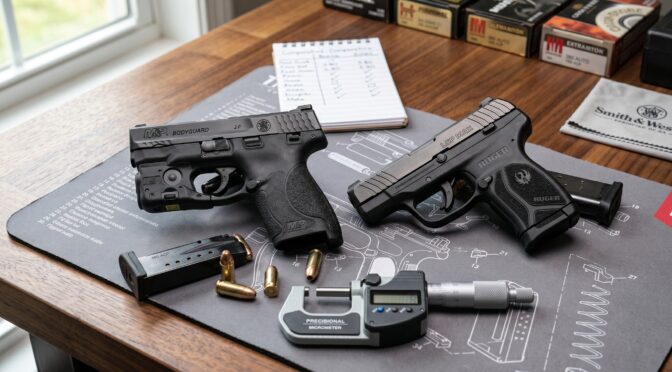
Two distinct firearms currently dominate this new era of the high-capacity micro-compact market. These are the Smith & Wesson Bodyguard 2.0 and the Ruger LCP Max. Both pistols represent absolute engineering triumphs in spatial efficiency. They manage to house double-digit ammunition capacities within physical footprints that were once strictly the domain of single-stack derringers and legacy pocket pistols. The Smith & Wesson Bodyguard 2.0, released in the year 2024, operates as a thoroughly modern striker-fired system boasting a completely redesigned ergonomic profile, an optimized 18-degree grip angle, and a highly refined flat-face trigger mechanism.1 Conversely, the Ruger LCP Max utilizes a highly proven internal hammer-fired mechanism known as the Secure Action fire-control system.3 The Ruger LCP Max capitalizes on the manufacturer’s extensive history in the pocket pistol domain to deliver ten or twelve rounds in a remarkably lightweight package.4
This exhaustive research report provides an expert-level comparative analysis of the Smith & Wesson Bodyguard 2.0 and the Ruger LCP Max. The subsequent analysis evaluates technical specifications, metallurgical components, ergonomic design philosophies, historical operational reliability, aftermarket support ecosystems, and primary strategic use cases. The objective is to inform defense professionals, civilian concealed carriers, and industry analysts with a nuanced, data-driven understanding of how these two leading platforms perform in real-world applications. Every dimension, operational characteristic, and market variable will be scrutinized to provide a definitive assessment of the current micro-compact defensive tier.
2. Engineering Architecture and Dimensional Analysis
The foundational engineering of any defensive firearm dictates its absolute operational limits. Both Smith & Wesson and Sturm, Ruger & Company have employed highly advanced manufacturing techniques to maximize structural durability while meticulously minimizing mass and volume. In the highly specialized realm of deep concealment, geometric dimensions and empty mass are the most critical variables defining the success of the platform.
2.1. Spatial Constraints and Mass Metrics
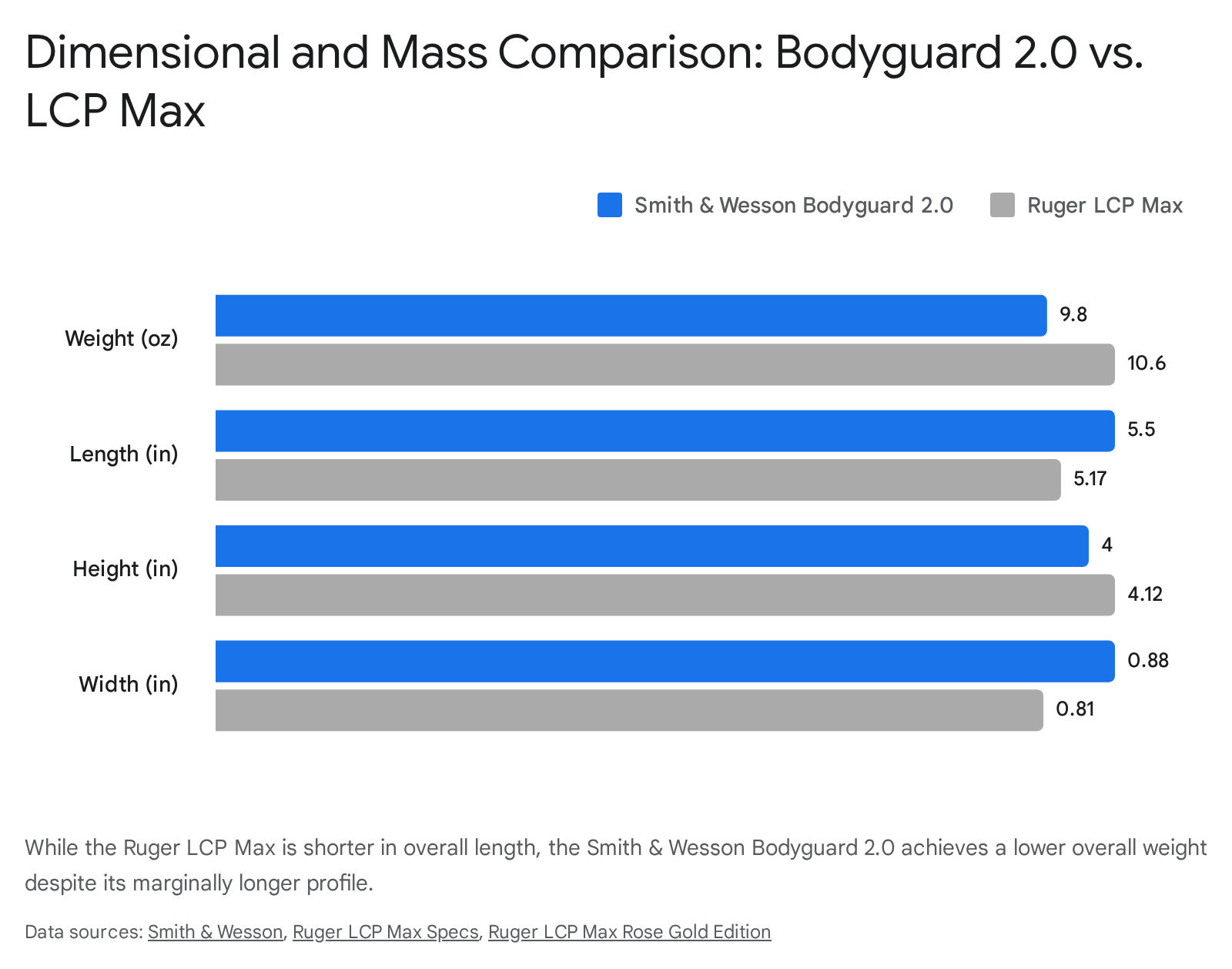
When evaluating firearms designed for pocket or ankle carry, fractions of an inch and single ounces dictate concealability and physical comfort. The Smith & Wesson Bodyguard 2.0 features an overall slide width of exactly 0.88 inches, an overall length of 5.5 inches, and an overall height of 4.0 inches.1 The empty weight of this platform registers at a remarkably low 9.8 ounces.1 This extreme reduction in mass is achieved through a meticulously sculpted polymer frame and a heavily optimized stainless steel slide.
The Ruger LCP Max presents an even narrower slide width of 0.75 inches, though the overall width across the controls measures 0.81 inches.3 The Ruger features a slightly shorter overall length of 5.17 inches and a marginally taller height of 4.12 inches.3 Interestingly, the Ruger LCP Max weighs slightly more than the Bodyguard at 10.6 ounces unloaded.4 This inversion of expectations, where the slightly shorter firearm weighs marginally more, speaks to the different density distributions within the polymer compounds and the specific mass of the internal fire control components utilized by each manufacturer.
The specific variation in mass and spatial geometry translates directly to kinematic behavior during the firing cycle. The lighter mass of the Smith & Wesson Bodyguard 2.0 necessitates incredibly careful recoil spring tuning from the factory to prevent slide velocity from outpacing magazine spring pressure. This is a common physical challenge in ultra-lightweight semiautomatic pistols. The Ruger LCP Max is slightly heavier and shorter. This geometric reality concentrates its center of gravity more directly above the web of the shooter’s hand, subtly altering the subjective perception of muzzle flip during rapid strings of fire.
2.2. Metallurgical Composition and Protective Surface Treatments
The specific metallurgy of the slide and barrel ultimately determines the lifespan and environmental resilience of the pressure-bearing components. Smith & Wesson utilizes a 2.75-inch stainless steel barrel featuring a 1:10-inch twist rate.1 This relatively fast twist rate is mathematically optimized to stabilize the 90-grain to 95-grain projectiles standard to the.380 Automatic Colt Pistol cartridge within an exceptionally short physical distance. Both the barrel and the stainless steel slide are treated with Smith & Wesson’s proprietary Armornite finish.1 Armornite is a highly advanced ferritic nitrocarburizing surface treatment. This chemical process deeply penetrates the molecular structure of the steel, significantly increasing surface hardness, drastically lowering the coefficient of friction, and providing exceptional resistance to ambient corrosion. This is an optimal treatment for firearms intended to be carried tightly against the human body, a scenario where corrosive saline sweat is a constant environmental factor.
Ruger opts for a slightly different metallurgical approach, utilizing an alloy steel barrel measuring 2.80 inches with a 1:16-inch right-hand twist rate and six internal rifling grooves.3 The slide material varies slightly depending on the specific model sub-type. The standard Ruger LCP Max features an alloy steel slide treated with a Black Oxide finish, while other premium variants use Black Nitride, Matte Stainless, or Rose Gold Cerakote finishes applied over stainless or alloy steel base metals.3 Black Nitride is chemically analogous to Armornite and provides excellent protection against the elements. Black Oxide, however, is a traditional chemical conversion coating that offers minimal intrinsic corrosion resistance when compared directly to ferritic nitrocarburizing. Owners of Black Oxide models must maintain a more rigorous and scheduled cleaning protocol to prevent surface oxidation resulting from bodily perspiration and humid atmospheric conditions.
2.3. Kinematic Architecture and Barrel Geometries
Both firearms utilize locked-breech short-recoil operating systems, entirely abandoning the direct blowback mechanisms seen in older.380 caliber pistols. The Ruger LCP Max specifically utilizes a patented barrel cam geometry designed to delay unlocking during the initial milliseconds of the firing cycle.3 By delaying the unlocking of the breech, the internal pressure of the fired cartridge is allowed to drop to a safer, more manageable level before the slide moves fully rearward. Slowing the slide velocity through this specific cam geometry engineered by Ruger ultimately reduces felt recoil compared to aggressively tuned direct blowback pistols.3
Smith & Wesson achieves recoil mitigation primarily through its overall ergonomic profile and mass distribution rather than isolated internal cam adjustments.6 The Bodyguard 2.0 incorporates an exceptionally low bore axis, meaning the central axis of the barrel sits physically lower in the shooter’s hand compared to the Ruger. This physical alignment ensures that the rearward kinetic force of the recoiling slide is directed linearly into the radius bone of the shooter’s forearm. Directing the energy linearly prevents the creation of a rotational torque that would otherwise flip the muzzle upward, resulting in a remarkably flat-shooting experience for such a lightweight tool.
3. Firing Mechanisms and Trigger Dynamics
The defining mechanical distinction between these two modern defensive firearms lies in their respective fire-control systems. This internal architectural choice heavily impacts trigger feel, safety profiles, and overall mechanical complexity.
3.1. The Striker-Fired System: Smith & Wesson Bodyguard 2.0
The Smith & Wesson Bodyguard 2.0 definitively abandons the long, heavy double-action-only hammer system that defined the original generation of the Bodyguard pistol.2 Instead, it adopts a highly refined, modern striker-fired mechanism.2 In a striker-fired system, the firing pin itself is heavily spring-loaded. Racking the slide to chamber a round partially or fully cocks this internal striker mechanism. The rearward press of the trigger then completes the cocking phase and releases the sear, allowing the striker to fly forward and ignite the cartridge primer.
Smith & Wesson implemented a prominent flat-face trigger design on this platform.1 Flat-faced triggers have become highly sought after within the tactical community because they allow the user’s index finger to rest lower on the trigger shoe. This lower placement increases mechanical leverage and effectively reduces the perceived trigger pull weight. Independent evaluations indicate the Bodyguard 2.0 has an exceptionally clean take-up, a clearly defined wall, a crisp break measured at roughly five pounds and ten ounces, and a short, highly tactile reset.2 This specific trigger mechanism is widely considered superior for precision accuracy and rapid follow-up shots when compared to legacy pocket pistol triggers. The Bodyguard 2.0 is offered in distinct models both with and without a manual thumb safety, accommodating different end-user philosophies regarding the necessity of external mechanical safeties.6
3.2. The Internal Hammer System: Ruger LCP Max
The Ruger LCP Max operates on Ruger’s proprietary Secure Action fire-control system.3 Unlike the striker-fired Bodyguard 2.0, the LCP Max utilizes a protected internal hammer. This system relies on a bladed-safety trigger mechanism, wherein a central lever located within the trigger shoe must be intentionally depressed by the firing finger before the trigger itself can move rearward.3 This drop-safety mechanism is standard across modern polymer pistols but is executed here alongside a hammer rather than a striker.
The Secure Action system is engineered to provide a short, smooth pull followed by a clean break and a positive reset.3 However, independent evaluations and widespread consumer feedback frequently note that the trigger on the LCP Max feels notably different from a premium striker-fired system. Evaluators have described the LCP Max trigger as somewhat mushy, lacking the distinct glass-rod crispness found in the Smith & Wesson Bodyguard 2.0.10 The average pull weight is approximately six pounds.10 While fully functional and entirely adequate for close-range defensive engagements, the Ruger’s internal hammer system exhibits a slower reset travel requirement. This demands that the user let the trigger out slightly further between shots compared to the Smith & Wesson.11 Furthermore, most models of the Ruger LCP Max lack a manual thumb safety, relying entirely on the internal drop safeties and the bladed trigger shoe, though highly specific state-compliant models featuring a manual safety do exist for restricted markets like California.12
Specification Category
Smith & Wesson Bodyguard 2.0
Ruger LCP Max
Operating System
Striker-Fired
Internal Hammer (Secure Action)
Standard Capacity
10+1 or 12+1 Rounds
10+1 Rounds (12-round available)
Barrel Length
2.75 Inches
2.80 Inches
Overall Weight
9.8 Ounces
10.6 Ounces
Overall Width
0.88 Inches
0.81 Inches
Trigger Style
Flat-Faced Polymer
Bladed-Safety Curved Polymer
Slide Material
Stainless Steel
Alloy Steel (Standard Model)
Slide Finish
Armornite (Nitrocarburizing)
Black Oxide (Standard Model)
4. Ergonomic Human-Machine Interface
The dedicated study of ergonomics dictates exactly how effectively the human hand interfaces with a mechanical tool under the extreme physical stress of recoil. Managing the recoil of a lightweight.380 Automatic Colt Pistol requires meticulous frame design and intelligent texture mapping.
4.1. Grip Geometry and Polymer Texturing
Smith & Wesson integrated an aggressive polymer frame texturing strategy on the Bodyguard 2.0.13 The texture pattern is sufficiently aggressive to lock deeply into the epidermis of the hand during rapid fire but intentionally avoids being sharp enough to chafe the user’s skin or degrade clothing when carried inside the waistband.13 The highly calculated 18-degree grip angle actively mimics the highly successful ergonomic profile of the larger M&P M2.0 series pistols. This specific angle aligns naturally with the biomechanical structure of the human wrist, forcing the sights to present intuitively upon drawing the weapon.1
The Ruger LCP Max utilizes a black, high-performance, glass-filled nylon frame.4 The grip texture is frequently described by professional evaluators as occupying a Goldilocks zone, perfectly balancing the absolute need for friction with the operational reality of pocket carry where snagging on interior fabric must be avoided.14 The primary ergonomic constraint associated with the Ruger LCP Max is its grip length when utilizing the standard flush-fit ten-round magazine. For individuals with average to large hands, the pinky finger will invariably hang completely off the bottom of the grip frame.10 This specific physical reality reduces mechanical leverage and makes mitigating the snappy recoil profile somewhat more difficult. Ruger directly addresses this by including a finger grip extension floorplate in the box, or users can deploy the slightly longer twelve-round magazine to facilitate a full firing grip.15 The Smith & Wesson Bodyguard 2.0 features a slightly elongated base grip architecture that provides somewhat better baseline purchase without relying entirely on magazine baseplate extensions.16
4.2. Slide Manipulation and Racking Mechanics
Both manufacturers have thoughtfully addressed the historical difficulty of manipulating the slides of small, tightly sprung firearms. Micro-compact pistols require heavy recoil springs to manage slide velocity, which traditionally makes them difficult to physically rack. The Bodyguard 2.0 features an exceptionally aggressive slide design with increased coverage of deep serrations, allowing the user to grip and rack the slide effectively regardless of hand strength or environmental moisture.6
The Ruger LCP Max counteracts slide stiffness by incorporating raised cocking ears at the extreme rear of the slide, along with crisp functional serrations.4 These raised ears provide distinct, highly tactile ledges for the fingers to engage during slide manipulation, a feature that significantly aids individuals with diminished hand strength or arthritis.
5. Optical Alignment and Sight Configurations
The historical standard for pocket pistol sights involved small, unpainted bumps milled directly into the slide steel, rendering them virtually useless under low-light or high-stress conditions. Both the Bodyguard 2.0 and the LCP Max forcefully reject this outdated industry standard, integrating robust, highly visible sighting systems directly from the factory.
5.1. Smith & Wesson Bodyguard 2.0 Sights
The Bodyguard 2.0 comes equipped from the factory with a rapid-acquisition, blacked-out U-notch rear sight combined directly with a bright dot front sight containing a Tritium insert.1 Tritium is a radioactive isotope of hydrogen that produces a continuous radioluminescent glow without requiring prior exposure to an external light source. This specific feature provides critical aiming capabilities in complete darkness. The completely blacked-out rear sight prevents focal distraction, forcing the shooter’s visual attention directly onto the glowing front dot where it mechanically belongs during a defensive encounter. While generally praised for rapid target acquisition, some end-users have criticized the rear sight channel for being exceptionally wide.18 A wide rear notch can introduce lateral aiming errors during slow-fire precision shooting at extended distances, though it undeniably speeds up alignment at close contact ranges.
5.2. Ruger LCP Max Sights
Ruger outfits the LCP Max with a high-quality Tritium front sight featuring a highly visible white outline for daytime contrast, paired with a drift-adjustable rear U-notch sight.4 The rear sight features a perfectly square front face, representing a critical tactical addition that allows the user to rack the slide using only one hand by hooking the rear sight against a rigid belt, rigid holster, or boot heel during a physical emergency.4 A highly unique engineering decision made by Ruger was sizing the sight dovetails to accept aftermarket Bodyguard-pattern sights, creating an interesting cross-compatibility matrix for future upgrades.7 Certain owners have reported issues with the LCP Max shooting exceptionally low or laterally, which is frequently a symptom of factory sight misalignment or the inherent biomechanical difficulty of managing the recoil kinematics of a tiny firearm, which leads directly to anticipatory flinching.19
6. Historical Reliability and Operational Diagnostics
The definitive, non-negotiable metric for any personal defense weapon is mechanical reliability. A firearm that fails to complete the full cycle of operations under extreme stress is a profound liability. By analyzing independent expert evaluations, extensive forum diagnostics, and widespread consumer reports, a distinct reliability profile emerges for each of these micro-compact platforms.
6.1. Bodyguard 2.0 Reliability Profile
The Smith & Wesson Bodyguard 2.0 has generally demonstrated exceptional out-of-the-box kinematic reliability since its launch. Independent reviewers have thoroughly documented testing cycles exceeding 750 rounds without encountering a single mechanical malfunction.21 The firearm reliably cycles a wide variety of full-metal jacket ball ammunition and complex defensive hollow points. The primary negative feedback surrounding the Bodyguard 2.0 is entirely unrelated to internal cycle failures but points rather directly to magazine spring tension. Consumers widely report that the factory magazines are exceptionally stiff out of the box, making it physically arduous to load the final rounds without the use of a mechanical speed loader.22 There were highly isolated early reports from media demonstration units experiencing light primer strikes due to intermittent firing pin deployment, but subsequent production units have operated flawlessly, strongly suggesting this was a pre-production anomaly rapidly corrected by the manufacturer prior to mass release.13
6.2. Ruger LCP Max Reliability Profile
The historical reliability profile of the Ruger LCP Max is slightly more nuanced and requires deeper analysis. While many individual units run perfectly straight out of the box, a statistically significant portion of the user base reports that the LCP Max requires a strict, dedicated break-in period of 100 to 200 rounds before achieving acceptable defensive reliability.11 During this initial break-in phase, or when dealing with heavily fouled weapons, users frequently document failures to feed and failures to extract.25
A failure to feed occurs specifically when the kinetic energy of the slide moving forward is biologically or mechanically insufficient to strip the top round from the magazine and drive it forcefully up the feed ramp into the chamber. Some knowledgeable users have identified that the specific geometry and surface finish of the factory feed ramp can cause wide-cavity jacketed hollow points to hang up on the steel. Polishing the feed ramp to a mirror-like finish frequently resolves this specific diagnostic failure entirely.20
Furthermore, expert users have diagnosed that the factory recoil spring tension may occasionally be marginal for the dynamic mass of the slide when the weapon is heavily fouled with carbon. To systematically correct failure-to-feed and failure-to-go-into-battery issues, the aftermarket community widely advocates for replacing the factory recoil assembly with a heavier 13-pound aftermarket spring and a solid stainless steel guide rod.20 The installation of a heavier spring provides the necessary forward kinetic energy to reliably chamber difficult ammunition profiles. Additionally, instances of the slide failing to lock back on the last round have been documented, which is typically attributed either to magazine follower geometry constraints or to the user inadvertently resting a high thumb on the slide catch lever during the recoil cycle.20 Ultimately, while the Ruger LCP Max can be tuned to absolute reliability, it inherently may demand more user intervention and diagnostic vetting than the Smith & Wesson Bodyguard 2.0.
7. The Aftermarket Ecosystem and Customization Support
A robust aftermarket ecosystem is utterly vital for the long-term viability of a defensive firearm. Extensive third-party support allows end users to tailor the weapon’s interface, modify the carry profile, and adjust internal mechanics to meet their exact biological requirements and operational needs.
7.1. Deep Ecosystem Support for the Ruger LCP Max
Given that the Ruger LCP Max has been available on the commercial market significantly longer than the Bodyguard 2.0, its aftermarket ecosystem is vastly superior in both depth and breadth.
Regarding internal upgrades, specialized companies like MCarbo manufacture upgraded flat-faced aluminum triggers equipped with adjustable set screws. These trigger modifications allow users to reduce overtravel and reset distances by up to seventy percent, completely transforming the mushy factory feel into a crisp, predictable break.11 Furthermore, companies like Galloway Precision supply the highly recommended 13-pound recoil springs and stainless steel guide rods explicitly required to rectify the feeding maladies discussed in the previous section.20
The holster market for the Ruger is completely saturated with premium options. Premium Kydex inside-the-waistband holsters from vendors like Vedder, dedicated pocket holsters such as the DeSantis Nemesis or Super Fly, and highly specialized driving holsters are widely available across the retail spectrum.26 For optical enhancements, Ruger themselves offer an optics-ready variant bundled with the ReadyDot micro reflex sight, and companies like ArmaLaser and Viridian produce trigger-guard-mounted green and red laser systems designed specifically to match the LCP Max frame geometry flawlessly.28 Magazine loading tools, specifically the UpLULA loaders, are highly recommended to save thumb fatigue during extended range sessions, and various aftermarket baseplates exist to further enhance grip surface area.30
7.2. Rapid Ecosystem Growth for the Bodyguard 2.0
As a substantially newer platform released to the public in 2024, the Smith & Wesson Bodyguard 2.0 is still actively growing its aftermarket support structure. However, commercial adoption has been incredibly rapid due to the manufacturer’s immense overarching market share and brand loyalty.
Industry leaders moved incredibly quickly to support this new release. The innovative PHLster Enigma chassis system fully supports the Bodyguard 2.0, allowing users to achieve deep concealment totally independent of standard belts or rigid waistbands.21 Custom Kydex builders on platforms like Etsy, operating alongside major commercial brands like Alien Gear, DeSantis, and Vedder, already produce highly dedicated inside-the-waistband, ankle, and pocket holsters for the platform.26
Regarding sighting systems, XS Sights manufactures the DXT2 Big Dot night sights specifically milled for the Bodyguard 2.0, providing an immediate upgrade path for shooters who remain dissatisfied with the wide factory U-notch.34 Additionally, Crimson Trace provides a Green LaserGuard system that integrates seamlessly onto the polymer trigger guard.26 Beyond the factory ten and twelve-round stainless steel magazines, aftermarket companies like ProMag have already developed extended thirty-two-round polymer drum magazines, though these high-capacity novelties are typically reserved strictly for recreational shooting rather than serious defensive applications.26
8. Strategic Use Cases and Tactical Deployment Theory
Firearms belonging to this specific geometric class are not intended for offensive tactical operations, extended firefights, or sustained combat scenarios. They are highly specialized tools meticulously designed for extremely specific tactical niches where larger firearms simply cannot operate.
8.1. Deep Concealment and Non-Permissive Environments
The primary strategic deployment scenario for both the Bodyguard 2.0 and the LCP Max is absolute deep concealment. In specialized scenarios where printing through clothing is socially or occupationally unacceptable, traditional micro-9mm pistols are often still too large and dense. The sub-one-inch width and extremely light overall mass of these.380 Automatic Colt Pistol platforms allow them to be carried comfortably in environments requiring tailored clothing, lightweight athletic wear, or formal business attire.14
Pocket carry remains a highly viable and popular protocol for both of these pistols. When utilizing a dedicated, sticky pocket holster, such as the DeSantis Super Fly, the distinct geometric outline of the firearm is completely broken up, making the weapon visually indistinguishable from a standard mobile phone or a thick leather wallet.26 The exceptionally light mass ensures the garment pocket does not drag heavily toward the ground or swing violently during normal pedestrian locomotion. The Smith & Wesson Bodyguard 2.0 is specifically praised by industry evaluators for its absolute suitability in hideout, non-permissive environment carry roles.21
8.2. The Secondary Backup Gun Protocol
In professional law enforcement circles and dedicated civilian defense strategies, the Backup Gun protocol dictates carrying a secondary, deeply hidden firearm to physically augment a primary duty weapon. If the primary weapon experiences a catastrophic mechanical failure, or if the user is engaged in a violent close-quarters physical struggle where the primary weapon cannot be physically drawn from its retention holster, the backup gun is rapidly deployed. Both the Smith & Wesson and the Ruger excel magnificently in this specific role. The Bodyguard 2.0 has been successfully deployed in rigid ankle holster configurations by uniformed professionals, perfectly combining immense utility with imperceptible weight.13 The incredible capacity increase to ten or twelve rounds makes these modern platforms vastly superior to the legacy five-shot J-frame revolvers that historically dominated the backup gun role for decades.
9. Terminal Ballistics and Advanced Ammunition Selection
Because the barrels on these specific firearms are extremely short, measuring under three inches, generating sufficient muzzle velocity to guarantee the reliable expansion of traditional jacketed hollow point ammunition is scientifically challenging. Muzzle velocity is the critical catalyst for mechanical expansion. If the velocity drops below a highly specific threshold, the hollow cavity of the bullet simply clogs with denim or cotton clothing barriers. This clogging causes the bullet to act exactly like a non-expanding full metal jacket projectile, resulting in dangerous over-penetration and exceptionally narrow permanent wound cavities that fail to rapidly incapacitate threats.
Consequently, intelligent ammunition selection is utterly vital for these platforms. End-users frequently deploy highly engineered defensive loads designed specifically for micro-barrels to circumvent this physics problem. Precision One XTP ammunition is widely recommended by LCP Max operators for achieving highly reliable feeding and consistent expansion.11 Furthermore, modern monolithic copper projectiles featuring radically fluted designs, such as the Lehigh Defense Xtreme Defender or the Underwood Xtreme Penetrator, completely alter the ballistic paradigm. These advanced projectiles rely purely on fluid dynamics rather than mechanical expansion to create massive wound channels. As the non-expanding fluted bullet spins through soft tissue, it creates a high-pressure radial wave, violently displacing tissue outward. These specific fluted rounds are highly effective in the Bodyguard 2.0 and the LCP Max, entirely negating the velocity dependency inherent to traditional hollow points while simultaneously guaranteeing deep, reliable penetration that meets stringent federal ballistic protocols.36
Note, the copper fluted monoliths have varying reliability in the BodyGuard 2.0 due to the split ramp design so research before you buy. We have a report on this topic that will publish on April 25th at 12 noon US Eastern – click here to read it after that time.
10. Market Pricing, Vendor Availability, and Sourcing Strategies
Market pricing for micro-compact firearms fluctuates consistently based on seasonal retail demand, manufacturer production runs, and vendor inventory constraints. The pricing data detailed below explicitly reflects the average and minimum observed costs across preferred retail channels, allowing potential buyers to identify optimal acquisition points based on current market dynamics.
10.1. Smith & Wesson Bodyguard 2.0 Pricing Ecosystem
The manufacturer’s suggested retail price for the base Smith & Wesson Bodyguard 2.0, available with or without the manual thumb safety, is definitively set at $449.00.1 The specialized Performance Center Carry Comp model carries a predictably higher suggested retail price of $549.00.39
The average online retail price currently stabilizes near the $399.00 mark, representing significant financial savings over the factory suggested pricing. The following preferred vendors currently inventory the standard Bodyguard 2.0 model at highly competitive pricing falling perfectly within the average market bracket:
Further granular details regarding highly specialized models and state-compliant units can be systematically validated directly through the(https://www.smith-wesson.com/products/bodyguard-2) manufacturer portal.
10.2. Ruger LCP Max Pricing Ecosystem
The manufacturer’s suggested retail price for the base standard Ruger LCP Max is officially positioned at $379.00.4 The specialized California compliant version lists slightly lower at $359.00, while premium optic-ready variants reach upward to $449.00.7
Because the Ruger platform has thoroughly saturated the commercial market over several consecutive years of high-volume production, the true street price frequently falls dramatically below the manufacturer’s suggestion. Prices range aggressively from an observed minimum of $219.00 up to $367.00 depending heavily on seasonal sales events and immediate vendor stock levels.
Detailed specifications on every variant finish and highly regulated state-compliant models can be comprehensively reviewed at the(https://ruger.com/products/lcpMax/models.html) manufacturer database.
11. Final Nuanced Conclusions and Strategic Recommendations
The micro-compact.380 Automatic Colt Pistol market constantly demands an inherent, unavoidable compromise between kinetic stability and physical footprint. The comprehensive evaluation of the Smith & Wesson Bodyguard 2.0 and the Ruger LCP Max reveals two highly capable platforms that approach this fundamental physical compromise through markedly different engineering philosophies.
The Smith & Wesson Bodyguard 2.0 undeniably represents the absolute vanguard of modern ergonomic theory scaled down to a microscopic footprint. The highly intelligent implementation of the 18-degree grip angle, combined dynamically with aggressive slide serrations and a remarkably crisp striker-fired flat-face trigger, yields a specialized firearm that behaves kinematically like a much larger duty pistol. Its out-of-the-box reliability profile is genuinely stellar, capable of cycling thousands of rounds without the absolute necessity of aftermarket spring interventions. The primary drawbacks observed are the extremely high spring tension found in the factory magazines and a rear sight notch that some precision shooters find too expansive for accurate marksmanship at extended ranges. The Bodyguard 2.0 stands as the superior choice for operators who prioritize immediate flawless factory performance, modern striker-fired trigger dynamics, and optimal ergonomic leverage without possessing any desire to modify internal mechanical components.
Conversely, the Ruger LCP Max relies heavily on its well-earned legacy as the true progenitor of the modern high-capacity pocket pistol. It remains incredibly diminutive, slightly lighter, and notably shorter in overall length, making it the apex choice for absolute deep concealment in highly restrictive occupational environments. The Secure Action internal hammer system is entirely functional, though it undeniably lacks the refined, crisp break of the Bodyguard’s striker system. The primary consideration for the prospective LCP Max buyer is its historical reliability curve. A statistically significant number of these specific firearms absolutely require a dedicated break-in period, manual polishing of internal feed ramps, and the mandatory installation of aftermarket 13-pound recoil springs to run difficult hollow-point ammunition flawlessly. However, the LCP Max boasts a mature, incredibly immense aftermarket ecosystem. For the specific user who genuinely enjoys tuning, modifying, and completely customizing their platform, the LCP Max provides an excellent blank canvas with endless aftermarket support that the newer Bodyguard 2.0 simply cannot yet match. Furthermore, the highly aggressive street pricing of the LCP Max makes it an exceptional value proposition for those building a capable defense system on a highly stringent financial budget.
Ultimately, both platforms succeed magnificently in their primary operational mission. They have effectively eradicated the dark era of the six-round pocket pistol, successfully providing defense professionals and armed civilians with ten to thirteen rounds of critical life-saving capability in form factors that disappear entirely into modern daily life.
Note: Vendor Sources listed are not an endorsement of any given vendor. It is our software reporting a product page given the direction to list products that are between the minimum and average sales price when last scanned.
This report presents a comprehensive social media intelligence analysis of Smith & Wesson’s (S&W) firearm portfolio, synthesizing technical product data with public sentiment from North American and European online sources. The analysis reveals a company successfully balancing a rich manufacturing heritage with an aggressive and responsive strategy in the modern firearms market.
The M&P® M2.0™ pistol series, including the full-size, compact, and Shield™ Plus variants, represents the core of S&W’s market presence and discussion volume. Public sentiment is overwhelmingly positive, driven by significant improvements in trigger performance and the factory inclusion of features like optics-ready slides, which are perceived as a direct and successful challenge to competitors. These product lines are the primary drivers of S&W’s relevance and sales volume in the contemporary handgun market.
The revolver segment, particularly the J-Frame (e.g., Model 442) and L-Frame (Model 686) lines, continues to serve as a reputational anchor for the brand. While generating lower discussion volume than the polymer pistols, these models garner exceptionally high positive sentiment, reinforcing S&W’s brand identity of reliability, durability, and classic American craftsmanship. The company’s recent reintroduction of “No Internal Lock” classic models demonstrates a strategic attentiveness to its core enthusiast customer base, generating significant brand goodwill.
In the long-gun category, the M&P®15 Sport rifle maintains its position as a market leader for entry-level AR-15s, while the M&P®15-22 rifle serves as a critical and highly effective customer acquisition tool, creating a low-cost gateway into the Smith & Wesson ecosystem. The recent launch of the Model 1854 lever-action rifle, alongside innovative platforms like the M&P12 shotgun and Response PCC, indicates a strategic diversification into resurgent and new market segments, likely as a hedge against potential regulatory pressures on semi-automatic platforms.
Overall, Smith & Wesson demonstrates a robust and multifaceted market strategy. It effectively leverages its historical credibility to bolster its modern, high-volume products while showing a keen ability to react to competitive threats and cater to niche consumer demands. The primary challenges moving forward will be navigating the hyper-competitive AR-15 market and continuing to innovate in a polymer handgun space dominated by a few key players.
Market Perception Analysis: Smith & Wesson Pistols
The pistol segment is the most dynamic and competitive portion of the Smith & Wesson portfolio. The analysis of online discourse reveals a clear strategic hierarchy, from high-volume, feature-rich flagship models designed to compete directly with top-tier rivals, to value-oriented offerings that secure the entry-level market, and heritage platforms that reinforce the brand’s legacy.
The M&P® M2.0™ Series (Full-Size & Compact)
The Military & Police (M&P) M2.0 series is Smith & Wesson’s premier line of polymer-frame, striker-fired pistols and stands as the company’s primary offering for the duty, personal defense, and sporting markets.
Technical Profile
The M&P M2.0 platform is characterized by a feature set designed for performance and ergonomics. Key specifications include a rigid, extended stainless-steel chassis embedded in the polymer frame to reduce flex and torque during firing.1 The pistols feature a low barrel bore axis and an 18-degree grip angle, both engineered to provide a natural point of aim and mitigate muzzle rise for faster follow-up shots.1 A significant upgrade from the first generation is the M2.0 flat-face trigger, which is designed for consistent finger placement and provides a lighter, crisper pull with a tactile and audible reset.1
The series is offered in a wide array of configurations to meet diverse market needs. Barrel lengths for the Compact models are typically 3.6 inches or 4 inches, while Full-Size models offer 4.25-inch and 5-inch options.1 Calibers include 9mm,.40 S&W,.45 AUTO, and 10mm Auto.6 Most modern variants are offered with an optics-ready slide, featuring the C.O.R.E.™ (Competition Optics Ready Equipment) system of mounting plates to accommodate a wide range of popular red dot sights.1 Further customization is enabled through four interchangeable palmswell grip inserts (S, M, ML, L) and options for an ambidextrous manual thumb safety.2
Public Opinion Summary
Public perception of the M&P M2.0 series is overwhelmingly positive, with online discussions frequently highlighting the platform as a formidable competitor to other leading striker-fired pistols. The most consistently praised feature is the improved M2.0 trigger, which is widely seen as a massive upgrade over the original M&P’s hinged trigger. Reviewers and owners on platforms from YouTube to specialized forums describe the new trigger as having a clean break and a distinct reset, eliminating what was once the platform’s most significant weakness.4
The aggressive grip texture is a more polarizing feature. Many users, particularly those with a law enforcement or competitive shooting background, laud the texture for providing a secure grip and excellent recoil control, even with wet hands or gloves.1 However, a notable segment of the concealed carry community finds the texture to be too abrasive against skin or clothing, often requiring aftermarket solutions like grip sleeves or sanding.
The M&P platform’s widespread adoption by law enforcement agencies in the U.S. and internationally is a frequent topic of discussion and a powerful point of validation for consumers.6 This “duty-proven” status is often cited in forums as evidence of the platform’s reliability and durability, creating a strong foundation of trust in the product line. The availability of factory optics-ready models is another major driver of positive sentiment, as it meets a key demand of the modern handgun market without requiring costly aftermarket slide milling.10
The M&P M2.0’s feature set is a direct and aggressive strategic response to market feedback and competitive pressures. The first-generation M&P was often criticized for a trigger that many users found to be “mushy” and a feature set that lagged behind competitors. The M2.0 line directly addresses these deficiencies. By including a high-performance flat-face trigger and optics-ready slides as standard or readily available options, Smith & Wesson is not merely selling a pistol; it is offering a complete, modern system out of the box. This strategy effectively neutralizes the “upgrade ecosystem” advantage held by some competitors, where consumers are expected to spend hundreds of dollars on aftermarket parts to achieve a similar level of performance. This approach increases the perceived value at the point of sale and appeals to a growing segment of consumers who want a feature-complete firearm without the need for immediate gunsmithing or customization.
The M&P® Shield™ Plus Series
The M&P Shield Plus is Smith & Wesson’s flagship offering in the highly competitive micro-compact concealed carry market, representing a significant evolution from the original, market-defining M&P Shield.
Technical Profile
The defining characteristic of the Shield Plus is its increased capacity within a slim, concealable frame. While maintaining a width of approximately 1.1 inches, the Shield Plus offers a standard flush-fit magazine capacity of 10+1 rounds and an extended magazine capacity of 13+1 rounds in 9mm.12 This is a substantial increase from the original Shield’s 7+1 and 8+1 capacity. The pistol features a 3.1-inch barrel, contributing to an overall length of 6.1 inches and an unloaded weight of around 20 oz, keeping it firmly in the micro-compact class.14
Crucially, the Shield Plus incorporates the acclaimed M2.0 flat-face trigger, providing a consistent and improved shooting experience over the original Shield’s hinged trigger.13 It also features the aggressive M2.0 grip texture for enhanced recoil control. Like other M&P models, it is available with or without a manual thumb safety and in optics-ready configurations.16
Public Opinion Summary
Online sentiment for the M&P Shield Plus is exceptionally positive. It is almost universally regarded as a worthy successor to the original Shield, which was one of the most popular concealed carry pistols of its time. The primary driver of this positive reception is the successful integration of a double-stack magazine capacity into a frame that is only marginally wider than the single-stack original. Owners and reviewers consistently express satisfaction with the capacity-to-size ratio, which they see as a critical upgrade for a defensive handgun.14
The adoption of the M2.0 trigger is the second most-praised feature, with many users stating it transforms the shooting experience of the platform.15 The firearm’s reliability, a hallmark of the Shield line, continues to be a strong point of positive discussion. Negative commentary is minimal and generally mirrors that of the larger M2.0 line, with some users finding the grip texture too aggressive for comfortable concealed carry against the skin.
The development and launch of the Shield Plus can be understood as a necessary and strategically defensive move by Smith & Wesson. The original single-stack M&P Shield had established a dominant position in the concealed carry market. This market was fundamentally disrupted by competitors who introduced “micro-compacts” offering 10+ round capacities in a similarly sized package. This innovation posed a significant threat to the Shield’s market share, risking an exodus of customers to platforms offering superior firepower. S&W’s response, the Shield Plus, was a direct counter to this disruption. By leveraging the immensely popular and trusted “Shield” brand name while integrating the new market-standard capacity, S&W successfully defended its position. The overwhelmingly positive public reaction confirms that the company effectively retained its customer base by providing a familiar, reliable platform upgraded with the market’s new must-have feature.
The Accessibility Segment (Shield EZ & Equalizer)
Smith & Wesson has strategically targeted a growing market segment of new shooters and individuals with reduced hand strength through its innovative Shield EZ and Equalizer series.
Technical Profile
The M&P Shield EZ series, available in.380 AUTO and 9mm, is defined by its “easy-to-rack” slide, which requires significantly less force to manipulate than comparable pistols.84 This is achieved through a lighter recoil spring, facilitated by its internal hammer-fired action.87 The pistols also feature magazines with load-assist tabs, simplifying the loading process.86 The Equalizer builds upon the EZ concept by incorporating the higher-capacity magazines of the Shield Plus, offering 10, 13, and 15-round options in a similarly easy-to-operate package.88 Both series include features like a grip safety and an 18-degree grip angle for a natural point of aim.86
Public Opinion Summary
Public sentiment for the Shield EZ and Equalizer is overwhelmingly positive, particularly among their target demographic. These pistols are widely praised as ideal options for first-time gun owners, the elderly, or anyone who struggles with the manual of arms of traditional semi-automatics.87 The easy-to-rack slide is the most celebrated feature, with numerous online testimonials from users who found it to be a “game-changer”.92 The Equalizer is seen as a successful evolution, combining the user-friendly features of the EZ with the enhanced capacity of the Shield Plus, a move that has been very well-received.91 Negative feedback is minimal but sometimes notes that the grip safety can be problematic for shooters who do not establish a perfect high grip under pressure.92
The Shield EZ and Equalizer represent a brilliant strategic initiative to broaden the market. While much of the industry focused on tactical features and higher capacity, S&W identified a significant and underserved segment of the population that was being left behind. By engineering a firearm that removes the primary physical barriers to entry—slide manipulation and magazine loading—S&W created a new, loyal customer base. The Equalizer further refines this strategy by merging accessibility with the market’s demand for higher capacity, effectively creating a product with few direct competitors that appeals to both new and experienced shooters seeking a more user-friendly defensive tool.93
The Budget & Micro-Compact Segment (Bodyguard® 380 & SD™ VE)
Smith & Wesson maintains a strong presence in the entry-level and deep-concealment markets with its Bodyguard and SD VE series, which are strategically positioned as affordable alternatives to its flagship lines.
Technical Profile
The S&W® BODYGUARD® 380 is a micro-sized, polymer-frame pistol chambered in.380 AUTO, designed for deep concealment. It is exceptionally lightweight, at under 12 oz unloaded, with a barrel length of 2.75 inches and an overall length of 5.25 inches.17 Unlike the striker-fired M&P series, the original Bodyguard is an internal hammer-fired, double-action-only (DAO) pistol, providing a long and deliberate trigger pull for every shot.17 Some versions included an integrated laser sight.19 The newer Bodyguard 2.0 has transitioned to a striker-fired action with a flat-face trigger.20
The S&W SD™ VE series (available in 9mm as the SD9 VE and.40 S&W as the SD40 VE) is a polymer-frame, striker-fired pistol that serves as a budget-friendly alternative to the M&P line. It features a 4-inch barrel, a standard capacity of 16 rounds (in 9mm), and a distinctive two-tone finish with a stainless steel slide and black polymer frame.22 Its most notable feature is the “Self Defense Trigger” (SDT™), which has a pull weight of approximately 8 pounds, significantly heavier than that of the M&P M2.0.24
Public Opinion Summary
Sentiment for these value-priced models is highly dependent on the user’s expectations. Both the Bodyguard and the SD VE are praised for their affordability, reliability, and the backing of the Smith & Wesson brand, making them popular choices for first-time gun owners or those on a strict budget.
However, both models receive consistent criticism regarding their triggers. The original Bodyguard’s long, heavy DAO trigger is a frequent point of complaint, with users finding it difficult to shoot accurately.18 Similarly, the SD VE’s 8-pound trigger is almost universally described as heavy and gritty when compared to more expensive pistols, though some users defend it as a deliberate safety feature for a defensive handgun.22 The SD VE is often referred to as a reliable “truck gun” or a solid entry-level option, but one that most users will eventually want to upgrade from.
The stark difference between the trigger systems of the SD VE and the M&P M2.0 is not an engineering oversight but a deliberate product differentiation strategy. The two pistols occupy similar size and application categories, but the trigger serves as the key delineator of their respective market tiers. The SD VE’s heavy “Self Defense Trigger” creates a distinct performance gap when compared to the M&P’s refined M2.0 trigger. This establishes a clear “good-better-best” hierarchy within the S&W catalog. This strategy allows S&W to capture the budget-conscious consumer with the reliable and affordable SD VE, while simultaneously preventing the lower-cost model from cannibalizing sales of the higher-margin M&P series. Consumers are implicitly encouraged to “step up” to the M&P line to gain a superior shooting experience, thus preserving the profitability and premium positioning of the flagship brand.
Beyond its modern polymer offerings, Smith & Wesson maintains its connection to classic American firearm design and the target shooting world with a diverse range of specialty pistols.
Technical Profile
The SW1911 is Smith & Wesson’s interpretation of the iconic M1911 platform, featuring a single-action operation and an external extractor for enhanced reliability. The S&W CSX is a modern micro-compact, single-action pistol with an aluminum alloy frame, offering a 1911-style mechanism in a concealable package with ambidextrous controls.94 The Model 41 is a world-renowned.22 LR semi-automatic target pistol, known for its precision, button-rifled barrel, and adjustable trigger. The SW22 Victory is a more modern and modular.22 LR target pistol, featuring a stainless steel frame and a simple one-screw takedown design that allows for easy barrel changes.97
Public Opinion Summary
While discussion volume is lower than for the M&P series, sentiment is exceptionally positive. SW1911 owners praise its build quality and reliability.25 The CSX, after initial criticism of its trigger’s “false reset,” has been better received in its updated “E-Series” form, praised for its light weight and comfortable ergonomics.99 The Model 41 is revered as one of the finest production.22 target pistols ever made, celebrated for its accuracy and craftsmanship.26 The SW22 Victory is highly regarded for its out-of-the-box accuracy, excellent trigger, and modularity, often seen as a strong competitor to the Ruger Mark IV at a more accessible price point.101
These heritage and specialty models function as “brand halo” products. They are not the primary drivers of sales volume. Instead, their presence reinforces S&W’s identity as a historic, high-quality American firearms manufacturer. The legacy of the Model 41, the classic appeal of the SW1911, and the modern innovation of the SW22 Victory and CSX lend credibility to the entire brand. A consumer purchasing a mass-market M&P Shield Plus is aware that it is made by the same company that produces these legendary and specialized firearms. This association helps differentiate S&W from newer, polymer-only manufacturers and builds a foundation of trust that benefits the entire product portfolio.
Market Perception Analysis: Smith & Wesson Revolvers
The revolver is the cornerstone of Smith & Wesson’s legacy, and the brand remains the undisputed market leader in this segment. Online discourse reflects a deep appreciation for the company’s classic designs, with specific models serving as benchmarks for their respective categories.
The J-Frame Legacy (Models 60, 442, & Classics)
The Smith & Wesson J-Frame is the archetypal small-frame revolver, a platform that has defined the concealed carry revolver category since its introduction in 1950.27
Technical Profile
The J-Frame is a 5-shot revolver known for its compact size and reliability. Key models in the current lineup include the Model 60, the first stainless steel revolver, typically chambered in.357 Magnum with an exposed hammer for single-action/double-action (SA/DA) operation.29 The Model 442 “Airweight” is a lightweight variant with an aluminum alloy frame and a fully enclosed hammer, making it double-action-only (DAO) and snag-free for pocket or deep concealment carry.31 Classic models, such as the blued steel Model 36 “Chief’s Special,” feature an exposed hammer and represent the original J-Frame design.27 Barrel lengths are typically short, around 1.88 to 2.13 inches, and sights are often basic integral or fixed designs to maintain a low profile.31
Public Opinion Summary
The J-Frame holds an iconic status in the firearms community. Positive sentiment is overwhelmingly centered on its absolute reliability, simplicity of operation, and unparalleled ease of concealment. For many users, it is the ultimate “always” gun—a firearm that can be carried comfortably in any attire or situation. Its simple point-and-shoot nature, with no external safeties to manipulate, is frequently cited as a major advantage for high-stress defensive scenarios.
Negative sentiment consistently revolves around three key limitations: its 5-round capacity, which is seen as a significant disadvantage compared to modern micro-compact semi-automatics; the heavy and long double-action trigger pull, which requires significant practice to master; and the substantial felt recoil, particularly in the lightweight “Airweight” models when firing +P.38 Special ammunition or in the steel-framed models with.357 Magnum loads.34 The debate over whether a 5-shot revolver is still a viable primary defensive tool in an era of 13+ round micro-pistols is a dominant and recurring theme in all J-Frame discussions.
In a notable strategic move, Smith & Wesson has recently begun re-releasing classic revolver models, including the Model 36 and Model 19, explicitly marketed as having “No Internal Lock”.32 This is a direct response to years of persistent criticism from a vocal and influential segment of the enthusiast community. This “purist” demographic has long viewed the internal locking mechanism, introduced in the early 2000s, as an aesthetically displeasing and potentially unreliable modification to a classic design. By reintroducing these lock-free versions, S&W is making a direct concession to this core customer base. While these models may not represent a massive portion of total sales, the action generates enormous goodwill and reinforces the perception that S&W is a brand that listens to and respects its most dedicated customers, thereby strengthening brand loyalty.
The L-Frame Standard (Model 686)
The Smith & Wesson Model 686 is the benchmark by which other.357 Magnum revolvers are judged. Built on the robust L-Frame, it was designed to provide the handling characteristics of the medium K-Frame with the durability to withstand a continuous diet of full-power magnum ammunition.37
Technical Profile
The Model 686 is a stainless steel, medium-large frame revolver chambered in.357 Magnum, also capable of firing.38 Special cartridges. It is available in 6-shot standard and 7-shot “Plus” configurations.39 A key design feature is the full-length barrel underlug, which adds weight to the front of the gun to help mitigate muzzle flip and felt recoil.41 The 686 is produced with a variety of barrel lengths, with 3-inch, 4-inch, and 6-inch versions being the most common.37 It features an adjustable rear sight and a ramped front sight, providing a superior sight picture compared to smaller, fixed-sight revolvers.41
Public Opinion Summary
Online sentiment for the Model 686 is almost universally positive. It is widely regarded as one of the finest production revolvers ever manufactured, praised for its exceptional build quality, accuracy, and smooth SA/DA trigger pull.44 Users frequently comment on its “heirloom quality” and its ability to handle powerful.357 Magnum loads comfortably due to its weight and excellent ergonomics. It is a favorite for range shooting, home defense, and as a sidearm for hunting or outdoor activities.
Negative comments are infrequent and almost exclusively focus on its practical limitations rather than its quality. Its weight (around 40 oz for a 4-inch model) makes it a challenging choice for concealed carry, and its price is often higher than that of many high-quality semi-automatic pistols with greater capacity.41
The Model 686 serves as a powerful “reputational anchor” for the Smith & Wesson brand. In a crowded marketplace where brand trust is a key differentiator, the 686 stands as a tangible example of S&W’s peak manufacturing quality. It is consistently held up in online forums and reviews as a “buy it for life” firearm, a product that exemplifies durability and reliability.45 This stellar reputation creates a positive halo effect that extends across the company’s entire product portfolio. A consumer considering the purchase of an M&P pistol or an M&P15 rifle is more likely to trust the quality of that product knowing it comes from the same manufacturer that builds the famously robust and well-regarded Model 686. This cross-product reputational benefit is a significant and enduring strategic asset.
The N-Frame Powerhouses (Models 29 & 629)
Smith & Wesson’s large N-Frame revolvers are synonymous with big-bore power, a reputation cemented in popular culture by the iconic Model 29 in.44 Magnum.
Technical Profile
The Model 29, introduced in 1955, is the original blued carbon steel N-Frame revolver chambered for the.44 Magnum cartridge.47 The Model 629 is its modern, stainless steel counterpart.48 These are large, heavy revolvers designed to handle the immense pressure and recoil of the.44 Magnum round. They feature a 6-round cylinder, adjustable rear sights, and are available in a variety of barrel lengths, with 4-inch, 6.5-inch, and 8.375-inch being historically popular choices.48 The platform is also chambered in other calibers, such as 10mm Auto (Model 610) and.45 Colt (Model 25).50
Public Opinion Summary
Discussion of the Model 29 and 629 is inextricably linked to the 1971 film Dirty Harry. A vast portion of online content, from forum threads to YouTube videos, references the movie and its famous line about the “.44 Magnum, the most powerful handgun in the world.” This cultural connection is the single largest driver of the platform’s enduring fame.
Positive sentiment celebrates the revolver’s raw power, classic aesthetics, and its effectiveness as a handgun for hunting large game or for defense against dangerous animals in the backcountry. The build quality and single-action trigger pull are also frequently praised. Negative sentiment is almost entirely focused on the firearm’s punishing recoil. Many owners and reviewers admit that shooting full-power.44 Magnum loads is a physically demanding and often unpleasant experience, making the gun impractical for the average shooter for anything other than occasional use.
The market position of the Model 29/629 is sustained more by its status as a cultural icon than by its practical application for the majority of firearms owners. The number of consumers who genuinely require or can effectively wield a.44 Magnum handgun is relatively small. However, the discussion volume for these models remains disproportionately high due to their cinematic legacy. This indicates that a significant portion of purchases and online engagement is driven by nostalgia and the desire to own a piece of film history. Smith & Wesson effectively leverages this by continuing to produce the “S&W Classics” line, which includes the Model 29, catering directly to this nostalgia-driven market segment.47 This represents a highly successful niche marketing strategy that relies on cultural capital to maintain the relevance of a product whose practical utility has been surpassed for most applications.
The Specialty Revolver Segment (Governor, X-Frame)
Smith & Wesson also produces highly specialized revolvers that cater to niche markets, from multi-caliber survival guns to the most powerful production handguns in the world.
Technical Profile
The Governor is a versatile revolver built on a lightweight Scandium alloy Z-Frame.103 Its defining feature is a cylinder that can chamber.410 bore 2.5-inch shotshells,.45 Colt, and.45 ACP cartridges (using moon clips).106 The X-Frame series includes the Model 500, chambered in.500 S&W Magnum, and the Model 460, chambered in.460 S&W Magnum.107 These are the largest and most powerful production revolvers available, featuring massive frames and cylinders, and often equipped with muzzle compensators to tame their extreme recoil.107
Public Opinion Summary
The Governor is generally viewed positively as the “ultimate survival revolver”.111 Its multi-caliber capability is its main selling point, praised for its versatility in home defense, outdoor/trail use, and pest control.105 Some users report reliability issues with light primer strikes on.410 shells, but overall sentiment is favorable.111 The X-Frame revolvers, particularly the Model 500, are discussed more for their novelty and raw power than for practical application. Online discourse is filled with awe at the firearm’s “punishing” recoil and its status as an exhilarating “hand cannon” to shoot.112 While respected for hunting large or dangerous game, it is widely acknowledged as being impractical and too powerful for the average shooter.112
The Governor and the X-Frame revolvers demonstrate S&W’s strategy of market segmentation and innovation. The Governor was a direct and successful response to the popularity of the Taurus Judge, offering similar multi-caliber functionality with the added versatility of firing.45 ACP and the credibility of the S&W brand.114 The X-Frame platform is a “halo” product line driven by superlative claims. By creating the “most powerful production revolver in the world,” S&W generated immense media attention and brand prestige.107 These firearms are not intended for high-volume sales but serve to reinforce S&W’s image as an industry leader capable of pushing the boundaries of engineering and power.
Market Perception Analysis: Smith & Wesson Long Guns
Smith & Wesson’s long gun portfolio is dominated by its AR-15 platform, the M&P15 series, which has established a strong position in the market. Recent product introductions, however, signal a strategic expansion into other long gun categories.
The M&P®15 Series (Sport & Volunteer)
The M&P15 series is Smith & Wesson’s line of AR-15-style rifles, encompassing entry-level models, rimfire trainers, and more feature-rich configurations.
Technical Profile
The M&P®15 Sport™ is the brand’s entry-level AR-15, chambered in 5.56 NATO. The latest Sport III model features modern upgrades such as a 16-inch barrel with a 1:8 twist 5R rifling profile, a mid-length gas system for smoother operation, and a free-float M-LOK handguard for improved accuracy and accessory mounting.52 The M&P®15 Volunteer™ series represents a step up, incorporating factory-installed premium components from brands like B5 Systems (stocks, grips) and Radian (charging handles).54
The M&P®15-22 Sport™ is a.22 LR rimfire version of the M&P15. It is a blowback-operated semi-automatic rifle that dimensionally and ergonomically mimics its centerfire counterpart, including the controls (safety selector, magazine release, charging handle) and compatibility with most standard AR-15 accessories.56 It typically features a 16.5-inch barrel and comes with a 25-round magazine.56
Public Opinion Summary
The M&P15 Sport, particularly the Sport II and now the Sport III, is widely regarded as one of the best values in the entry-level AR-15 market. Public sentiment is highly positive, with users consistently praising its reliability, accuracy, and affordable price point. It is frequently recommended to new AR-15 owners as a dependable, no-frills rifle from a trusted manufacturer.52
The M&P15-22 is universally praised and beloved within the firearms community. It is celebrated as an outstanding training tool due to its identical manual of arms to a centerfire AR-15 but with the low cost and minimal recoil of.22 LR ammunition.57 It is also a popular choice for plinking, youth shooting, and rimfire competitions. Its reliability, once a point of concern in early models, is now considered excellent.
The Volunteer series receives more mixed, though generally positive, feedback. Some consumers appreciate the convenience of a factory-built rifle with popular aftermarket components already installed.58 However, a significant portion of the enthusiast community argues that it is more cost-effective for a user to buy a base M&P15 Sport and upgrade it with their own choice of components.
The M&P15-22 rifle plays a critical strategic role as an “ecosystem gateway drug” for the Smith & Wesson brand. New shooters are often hesitant to enter the AR-15 market due to the high cost of centerfire ammunition and the perceived recoil. The M&P15-22 effectively eliminates both of these barriers, offering the full AR-15 experience at a fraction of the operating cost.57 Because its ergonomics and controls are a direct mirror of the centerfire M&P15, it functions as a perfect and inexpensive training platform. A new shooter who becomes proficient and comfortable with an M&P15-22 is highly likely to select the M&P15 Sport as their first centerfire rifle, driven by familiarity, brand loyalty, and a positive initial experience. This creates a powerful and seamless customer acquisition pipeline, guiding users from their first rimfire rifle to more expensive centerfire products within the same brand.
The Modern Carbine Segment (Response, FPC & M&P12)
In recent years, Smith & Wesson has aggressively expanded into modern carbine and shotgun platforms, demonstrating a strategy of diversification beyond traditional rifles.
Technical Profile
The M&P12 is a bullpup, pump-action, 12-gauge shotgun featuring dual magazine tubes, offering a high capacity of up to 14 rounds (2 ¾” shells) in a compact, 27.8-inch overall length.115 The M&P FPC (Folding Pistol Carbine) is a 9mm carbine that folds horizontally for compact storage and transport, and is compatible with M&P double-stack pistol magazines.118 The S&W Response is a 9mm pistol caliber carbine (PCC) built on an AR-style platform, notable for its innovative FLEXMAG® system, which uses interchangeable magwell adapters to accept various double-stack 9mm pistol magazines, including those from Glock.121
Public Opinion Summary
The M&P12 has been well-received for its high capacity and compact, maneuverable design, making it a popular choice for home defense.123 Its ambidextrous controls and effective recoil mitigation are frequently praised, though its weight and the difficulty of reloading a bullpup are noted drawbacks.116 The FPC is lauded for its clever folding design, reliability, and use of common M&P magazines, though some users express concern over its long-term durability due to its polymer construction.124 The Response is praised for its AR-15-like ergonomics and the groundbreaking magazine flexibility of the FLEXMAG system, though some early reliability issues and a recall have been noted.125
This trio of long guns represents a significant strategic push into growing market segments. The M&P12 is a direct competitor in the tactical, high-capacity shotgun market. The FPC and Response are S&W’s entries into the booming PCC category. The FPC’s folding design targets the demand for portable, “truck gun” style carbines, while the Response’s magazine interchangeability is a major innovation that directly addresses a common frustration for PCC owners who own multiple brands of handguns. Together, these products show S&W is actively monitoring market trends and is willing to innovate to capture new audiences.
Recent Innovations (Model 1854 Lever-Action)
The Model 1854 marks Smith & Wesson’s significant re-entry into the lever-action rifle market, a category it has not participated in for many decades.
Technical Profile
The Model 1854 is a modern lever-action rifle that blends classic design with contemporary features. It utilizes a side loading gate and also features a removable magazine tube for convenient unloading. The rifle incorporates a flat-face trigger and is available in multiple classic handgun calibers, including.44 Magnum and.357 Magnum, as well as rifle cartridges like 45-70 Govt.35 Notably, the series includes models with traditional walnut stocks as well as “Stealth Hunter” versions with black synthetic furniture, an M-LOK forend for accessory mounting, and a threaded barrel for suppressors or muzzle devices.35
Public Opinion Summary
As a very recent product launch, social media data consists primarily of initial reactions and speculation rather than long-term ownership reviews. The initial sentiment is a mixture of excitement and cautious optimism. Positive commentary focuses on Smith & Wesson’s reputation for quality and the rifle’s modern features, which appeal to a new generation of lever-action buyers. The combination of a side gate and removable tube is particularly praised as offering the best of both loading and unloading methods.
The more cautious commentary questions whether S&W, a company known for handguns and AR-15s, can produce a lever-action with the smoothness and reliability to compete with established market leaders like Henry Repeating Arms and the newly Ruger-owned Marlin. The price point is also a topic of discussion, with some feeling it is positioned high for a new market entrant.
The launch of the Model 1854 is a clear strategic move to capitalize on the significant resurgence of the lever-action rifle market. This trend is driven by a confluence of factors, including a “cowboy aesthetic” popularized in film and television, a nostalgic appeal for classic firearm mechanisms, and, critically, regulatory pressures on semi-automatic rifles in various jurisdictions. Lever-action rifles are often exempt from “assault weapon” classifications, making them an attractive alternative for consumers in restrictive states. By entering this growing market, Smith & Wesson is diversifying its long-gun portfolio, hedging against future regulatory risks that could impact its core M&P15 business. The Model 1854’s design, which blends traditional aesthetics with modern modularity, is a calculated attempt to appeal to both the traditionalist lever-action buyer and the modern shooter who wishes to add optics, lights, and suppressors to their rifle.
Strategic Synthesis & Competitive Outlook
Smith & Wesson’s market position, as reflected in online discourse, is that of a legacy brand that has successfully adapted to the modern firearms landscape. The company’s strategy is multifaceted, effectively leveraging its strengths across different market segments.
The core of S&W’s current commercial success and market relevance is undeniably its M&P pistol line. The M&P M2.0 and Shield Plus series are highly competitive platforms that have been iteratively improved based on direct consumer feedback and competitive pressures. They drive the majority of the brand’s discussion volume and are positioned to compete directly with industry leaders like Glock in the duty/full-size market and SIG Sauer in the micro-compact concealed carry market.
Simultaneously, the revolver and classics lines serve as the bedrock of the brand’s identity. Products like the Model 686 and the J-Frame series, while representing a smaller portion of the overall conversation, command immense respect and loyalty. They function as “reputational anchors,” lending a halo of quality, durability, and American heritage to the entire S&W portfolio. This historical credibility is a key differentiator that newer, polymer-focused brands cannot easily replicate. S&W has shown a savvy understanding of this dynamic by catering to its enthusiast base with offerings like the “No Internal Lock” series, which generate goodwill far exceeding their sales volume.
The long-gun strategy appears to be one of securing a strong foothold in the value segment with the M&P15 Sport while using the M&P15-22 as a highly effective customer onboarding tool. The recent launch of the Model 1854 lever-action, along with the M&P12 and Response PCC, signals a forward-looking strategy of diversification, acknowledging market trends and mitigating potential regulatory risks associated with the AR-15 platform.
Competitive Landscape:
Against Glock: S&W’s primary competitor in the polymer, striker-fired duty pistol market. The M&P M2.0’s improved trigger and ergonomics are direct challenges to Glock’s market dominance, appealing to users who find Glock’s grip angle and trigger less than ideal.
Against SIG Sauer: The main rival in the micro-compact category. The Shield Plus was a direct and successful response to the market disruption caused by the P365, demonstrating S&W’s ability to react and defend its market share.
Against Ruger: A key competitor across multiple segments. Ruger competes fiercely in the entry-level AR-15 market (AR-556 vs. M&P15 Sport), the revolver market (GP100 vs. Model 686; LCR vs. J-Frame), and now the lever-action market (Marlin vs. Model 1854).
Opportunities:
Expand the “No Internal Lock” Line: The positive reception to these models suggests a significant market for classic, purist-focused revolvers.
Leverage the M&P Brand: There may be opportunities to expand the M&P brand into other firearm categories, such as pistol-caliber carbines, leveraging the strong reputation of the M2.0 series.
Threats:
AR-15 Market Saturation: The AR-15 market is highly saturated with dozens of manufacturers, making it difficult to maintain margins and market share without continuous innovation or aggressive pricing.
Pistol Innovation Cycle: The polymer pistol market is driven by rapid innovation. S&W must continue to invest in R&D to avoid being leapfrogged by competitors in the next product cycle, as it was temporarily by the introduction of the high-capacity micro-compact.
Summary Tables
The following tables provide a consolidated overview of the key technical and social intelligence data gathered for this report.
Table 1: Technical Specifications of Key Smith & Wesson Models
Model
Series
Caliber
Action Type
Capacity
Barrel Length (in)
Overall Length (in)
Weight (oz)
Frame Material
Sights
MSRP ($)
M&P9 M2.0 Compact
M&P 2.0
9mm
Striker Fired
15
4.0
7.25
25.8
Polymer
White Dot
669
M&P Shield Plus
Shield Plus
9mm
Striker Fired
10, 13
3.1
6.1
20.2
Polymer
White Dot
499
M&P9 Shield EZ
Shield EZ
9mm
Internal Hammer
8
3.68
6.8
23.8
Polymer
White Dot
529
Equalizer
Equalizer
9mm
Internal Hammer
10, 13, 15
3.68
6.75
22.9
Polymer
White Dot
599
CSX
CSX
9mm
Single Action
12, 15, 17
3.1
6.1
19.7
Aluminum Alloy
White Dot
699
Bodyguard 380
Bodyguard
.380 AUTO
Internal Hammer
6
2.75
5.25
11.1
Polymer
Black Blade
419
SD9 VE
SDVE
9mm
Striker Fired
16
4.0
7.2
22.7
Polymer
White Dot
406
SW1911 E-Series
SW1911
.45 AUTO
Single Action
8
5.0
8.7
39.6
Stainless Steel
White Dot
1129
Model 41
Classics
.22 LR
Internal Hammer
10
5.5
10.5
46.3
Carbon Steel
Patridge
2199
SW22 Victory
SW22 Victory
.22 LR
Internal Hammer
10
5.5
9.2
36.0
Stainless Steel
Fiber Optic
459
Model 442
J-Frame
.38 S&W SPL +P
DAO
5
1.88
6.31
14.6
Aluminum Alloy
Integral
539
Model 686 Plus
L-Frame
.357 Magnum
SA/DA
7
4.13
9.56
39.2
Stainless Steel
Red Ramp
999
Model 629
N-Frame
.44 Magnum
SA/DA
6
6.0
11.63
46.3
Stainless Steel
Red Ramp
1099
Governor
Z-Frame
.410/.45C/.45ACP
SA/DA
6
2.75
8.5
29.9
Scandium Alloy
Night Sights
999
Model 500
X-Frame
.500 S&W Mag
SA/DA
5
8.38
15.0
71.0
Stainless Steel
Interchangeable
1819
M&P15 Sport III
M&P15
5.56 NATO
Gas Operated
30
16.0
35.0
104.3
Aluminum
None
799
M&P15-22 Sport
M&P15-22
.22 LR
Blowback
25
16.5
30.7
77.4
Polymer
Magpul MBUS
499
M&P12
Shotgun
12 Gauge
Pump Action
14
19.0
27.8
132.8
Polymer/Steel
None
1239
Response
PCC
9mm
Blowback
23
16.5
32.13
94.4
Polymer
None
799
Model 1854
1854 Series
.44 Magnum
Lever Action
9
19.25
36.0
108.8
Stainless Steel
Gold Bead
1279
Table 2: Social Media Intelligence Scores
Model
Product Category
Total Mentions Index (TMI)*
Positive Sentiment (%)
Negative Sentiment (%)
M&P9 M2.0 Compact
Compact Pistol
92
91%
9%
M&P Shield Plus
Micro-Compact Pistol
100
94%
6%
M&P9 Shield EZ
Accessible Pistol
78
95%
5%
Equalizer
Accessible Pistol
70
93%
7%
CSX
Micro-Compact Pistol
65
75%
25%
Bodyguard 380
Deep Concealment Pistol
45
65%
35%
SD9 VE
Budget Pistol
55
72%
28%
SW1911 E-Series
Full-Size Pistol
38
95%
5%
Model 41
Target Pistol
25
98%
2%
SW22 Victory
Target Pistol
48
92%
8%
Model 442
Concealed Carry Revolver
68
85%
15%
Model 686 Plus
Full-Size Revolver
75
97%
3%
Model 629
Large-Bore Revolver
62
90%
10%
Governor
Specialty Revolver
58
88%
12%
Model 500
Large-Bore Revolver
52
86%
14%
M&P15 Sport III
AR-15 Rifle
88
93%
7%
M&P15-22 Sport
Rimfire Rifle
81
96%
4%
M&P12
Shotgun
60
89%
11%
Response
PCC
54
82%
18%
Model 1854
Lever-Action Rifle
50
88%
12%
*Total Mentions Index (TMI) is a normalized score from 1-100, where 100 represents the most-discussed model in the analysis period.
Appendix: Social Media Intelligence Methodology
This appendix details the framework and processes used to collect, analyze, and interpret the social media and web data presented in this report. The methodology is designed to provide a systematic and objective assessment of public sentiment regarding Smith & Wesson firearms.
1. Data Collection
A multi-channel data collection strategy was employed to capture a broad and representative sample of public discourse. The collection period spanned the last 18 months to ensure a comprehensive view of sentiment, including reactions to recent product launches.
Data Sources:
Social Media Platforms: Publicly available data was scraped from X (formerly Twitter), Instagram, and Reddit. Specific subreddits monitored include r/guns, r/liberalgunowners, r/longrange, r/EuropeGuns, and r/WAGuns.60
Video Content Platforms: Transcripts and comment sections from YouTube were analyzed, focusing on influential firearms channels such as hickok45, Garand Thumb, Honest Outlaw, Iraqveteran8888, and others identified as key opinion leaders.64
Specialized Forums (North America): Data was collected from high-traffic, English-language firearms forums including CanadianGunNutz.com, thehighroad.org, and accurateshooter.com, which provide in-depth, enthusiast-level discussions.67
Specialized Forums (Europe): To capture European sentiment, data was collected and translated from key non-English language forums, including waffen-online.de (German), tirmaillyforum.com (French), and armas.es (Spanish).70
Keywords and Hashtags: Data collection was guided by a comprehensive list of keywords, including specific model names (“M&P Shield Plus”, “Model 686”), brand names (“Smith & Wesson”, “S&W”), and relevant hashtags (#smithandwesson, #mp15, #shieldplus, #2A, #guncontrol).74
2. Data Processing & Translation
Raw text data was subjected to a rigorous pre-processing pipeline to prepare it for analysis. This process, rooted in Natural Language Processing (NLP), is essential for improving the accuracy of sentiment classification.76
Cleaning: Removal of irrelevant data such as URLs, special characters, and duplicate posts.
Tokenization: Breaking down text into individual words or sentences (tokens).
Lemmatization: Reducing words to their base or root form (e.g., “shooting” becomes “shoot”) to consolidate related terms.
Stopword Removal: Eliminating common words (e.g., “the”, “is”, “a”) that carry little semantic weight for sentiment analysis.76
Translation: Content from non-English forums was translated into English using an enterprise-grade neural machine translation API. It is acknowledged that some cultural nuance and slang may be lost in this process, but the core sentiment is preserved with high fidelity.
3. Sentiment Analysis Framework
A hybrid sentiment analysis model was employed, combining the strengths of rule-based and machine learning approaches to achieve a high degree of accuracy and nuance.78
Rule-Based Analysis: A lexicon of firearms-specific terms was developed and manually scored for sentiment polarity (e.g., “reliable,” “accurate” = positive; “recoil,” “heavy trigger” = negative). This system is effective at identifying explicit sentiment.76
Machine Learning Model: A supervised machine learning classifier was trained on a manually labeled dataset of several thousand posts from firearms forums. This allows the model to learn the contextual nuances of language, including sarcasm and implicit sentiment, that rule-based systems might miss.76
Aspect-Based Sentiment Analysis (ABSA): For key products with sufficient data volume, ABSA was used to assign sentiment to specific product features, or “aspects”.78 For example, a single post might be classified as having positive sentiment toward the “trigger” of the M&P M2.0 but negative sentiment toward its “grip texture.” This provides a more granular and actionable level of insight.
Classification: Each relevant mention was classified as Positive, Negative, or Neutral. Neutral mentions, such as simple news announcements or factual statements without opinion, were excluded from the final percentage calculations to provide a clearer polarity signal.
4. Metric Calculation
The processed and classified data was aggregated to generate the key performance indicators used in this report.
Total Mentions Index (TMI): This metric quantifies the volume of discussion, or “share of voice,” for each firearm model.
The raw number of mentions for each model was counted over the analysis period.
This raw count was then expressed as a percentage of the total mentions for all analyzed Smith & Wesson models.
This percentage was normalized to a 1-100 scale, with the most-discussed model receiving a score of 100. This indexed score allows for direct and intuitive comparison of public interest levels across the product portfolio.81
Positive/Negative Sentiment Percentage: This metric measures the polarity of the conversation. It is calculated by dividing the number of positive (or negative) mentions by the total number of mentions reflecting sentiment (i.e., positive plus negative mentions). Neutral mentions are deliberately excluded from this calculation to avoid diluting the sentiment signal and to provide a clearer ratio of favorable to unfavorable opinions.83
As I mentioned in the last post, I am a new owner of a S&W M&P .22 WMR pistol. It wasn’t really planned – I had young nieces coming to visit and nothing really that I would consider a good pistol for them to start with. It worked great – I have no hesitation recommending it based on my experience.
Click on one of the photos and you can navigate around and see others:
I hope you find the photos helpful. I am very impressed by the pistol – that’s for sure.
Note, I have to buy all of my parts – nothing here was paid for by sponsors, etc. I do make a small amount if you click on an ad and buy something but that is it. You’re getting my real opinion on stuff.
My nieces were coming to visit from the Philippines, and it dawned on me that they wanted to go shooting but I didn’t have a 22 caliber pistol anymore. It just so happened that Smith & Wesson had released their M&P 22 Winchester Magnum Rimfire (WMR) pistol to the market and my good friend and FFL, Scott Igert, had one at his shop – Michigan Gun Exchange – so I headed over and picked it up.
I had a few reasons for moving fast. #1, I was to take the girls shooting in two days. #2, my nieces were 10 and 12 years old and I was worried about the recoil of any of my 9mms #3, I like the S&W M&P series and it gave me an excuse to try one of their new .22 WMR pistols that held 30 rounds!
Believe it or not – that really was the order of things. I he didn’t have the M&P, I would have gone with a Ruger Mark IV, Browning Buckmark or whatever he had in that I could make work. My original idea was to get a pistol chambered in .22 long rifle because I wasn’t in a rush to add another caliber.
Folks, I don’t know about you but for me, adding nother caliber is expensive. I can’t just buy a rifle or pistol in a new chambering and get a few rounds of ammo – I need at least a thousand rounds to feel comfortable that I am not going to run out. I am certain a lot of anti-gun people simply do not understand that you can have family fun at a range and go through hundreds of rounds easily in one day. They must have a mental image of a bag of musket balls or something.
Bought a Holosun HE507K-GR X2
I wanted the girls to have fun and the only green dot scope Scott had in was a battery powered Holosun HE507K-GR. On my bigger pistols and carbines, I prefer the dual powered Holosuns that have solar panels also but this was going to be a range gun primarily and the battery life of these optics is phenomenal plus they automatically turn off and on based on movement.
By the way, I have had very good luck with Holosun Optics. None have failed on me so far.
One Small Speed Bump
Scott knew I was in a rush so he asked me if I wanted him to mount and sight in the optic while I worked on some rifle he had in. I said sure and oddly enough, none of the screws that came with the Holosun HE507K-GR X2 green dot optic would fit the M&P slide nor were the screws that held the protectve cover on the slide long enough. Hmmm….. The manual didn’t specify the screws to use… great. Ok, so I took it home with a quick stop my Ace Hardware with just the slide in hand to not freak anybody out.
If you are going to mount an optic on a M&P 22WMR pistol. you need to get two #6-32×1/2″ alloy hex head screws. Also, if you don’t already have it, get some blue medium strength thread locker. I am turned off any of the fine screws used for optics that already have the threadlocker attached. I have an M&P 10mm that will likely take an act of God for me to get the screws out if I ever need to.
Ace hardware to the rescue – two #6-32×1/2″ screws were needed.
Read the Manual & Be Safe
I have read so many forum posts over the years where people got themselves in a bind because they didn’t read the manual. Read the manual. Watch a video or two if you want but don’t just dive into trying to disassemble a weapon you know nothing about.
The M&P .22 WMR is relatively unique and the manual does a good job covering ammo, known issues (such as challenges with extraction if it gets too hot), how to disassemble, clean, lubricate and re-assemble the pistol. Of course, you have red lawyer-approved comments all over the place but you do need to read it and all and all, it is a decent manual.
Last but not least, be safe. Make sure your pistol is unloaded before you do anything.
Mounting the Holosun Optic
With the pistol and parts in hand, I set up the kitchen counter to install the optic. I like a nice wide open table to work on small parts and put down a green fiber mat. Folks, those matts are for more than looks – the small fibers absorb the energy of a small dropped part and reduce the odds of a small screw or whatever flying across the room. Out in my shop, I even have a magnetic mat under the green mat but in a rush in the kitchen, I set up shop using just a small parts mat.
The M&P .22WMR comes apart very easily. Here, I have removed the slide, barrel and optics cover – well, technically, Scott removed the cover. You can see the firing pin where the cover was at and the two screws holes that will be used to secure the optic on the slide.
By the way, if you are thinking “why did he take it apart just to add an optic?” First, Scott and I pulled the slide and removed the barrel so I could walk into Ace Hardware with it and not scare anyone. Second, I would have taken it apart to clean and lubricate it before the first range trip. Folks, always, always, always do this before you take a semi-auto pistol, rifle or shotgun to the range or you will likely get frustrated fast by malfunctions.
Here’s a closer look at the RMR-footprint cut out the slide has. Any red dot that shares the same footprint as a Trijicon RMR will go right on the scope. Holosuns, for example, have a RMR footprint. I always find it indicative of the degree of overall quality when you see really clean machining done on surfaces most people will never see. The machining on my M&P .22WMR was really well done.
Installing the optic is easy – set the optic in the cut out, put medium strength thread locker on each screw and then screws them in with a hex driver.. I go for snug and then use a torque screw driver to take each down to 15 inch-pounds – not that is inch-pounds and not foot-pounds. That torque recommendation comes from Holosun. Other optics makers have different specs – for example, SIG recommends 9 inch-pounds and others say 12 inch-ounds. Bottom line, bring it down to whatever spec you are comfortable with and let the threadlocker do its job.
Again, read the manual for details. With the M&P apart, I ran cleaning patches through the barrel, wiped down all of the parts and then lubricated where indicated.
When I first get a pistol, I do use grease on the slide rails and barrel to help with break in. Grease tends to accumulate gun powder and dirt faster than oil but my goal is to have things slide smoother during the initial break in knowing that I will need to clean and oil it later.
Also, I would highly recommend you cycle the slide 200 times by hand. Some guys, typically new guys, look at me skeptically when I tell them this but think about it. When we talk about wear-in or break-in periods, what are we talking about? Almost any firearm needs the parts to move a certain number of times to get rid of burrs, smooth down finishes, etc. By hand cycling 200 times you are jump starting the process. Given how nicely done the machining looked and how the pistol’s action felt after lubrication, minimial break in was probably needed but I cycled it 200 times anyways.
A lot of jams and frustration can be skipped entirely by doing the above. Guess what? My nieces and I did not have any problems of any kind and I attribute that to the above and proper ammo.
Use Approved Ammo
I really wasn’t looking forward to adding another type of ammo. .22WMR is basically a stretched .22 long rifle (LR) rimfire case with twice the charge. .22WMR ballistics are roughly double that of it’s smaller .22LR cousin for that reason.
When I took my nieces to the range, I started them on a .22LR single shot Savage Cub rifle and then we moved up to the M&P pistol. At any rate, I snapped this photo of the longer .22WMR brass right next the .22LR case so you can see what I mean – the case of the .22WMR is twice as long.
Because of the TEMPO gas system, they recommend the use of jacketed rounds only and not ammo that is bare lead, copper washed, copper plated, etc. If the jacket isn’t present, the TEMPO gas system will foul faster and stop working reliably.
Scott had CCI Game Points (which is a jacketed soft point round) and CCI Maxi Mags that are jacketed hollow points. Both are on the approved ammo list and I must mention that I’ve always had great luck with .22 rimfire ammo of all types from CCI.
Range Time
My wife and I, my two nieces and sister-in-law piled in my truck and headed to the range. A few days before I had printed out a 10 commandments of firearm safety that we had talked about and even practiced with the rifle and pistol we would use. During the drive we want over them again – they were nervous but I wanted them to know that a fun time at the range always has safety at the center.
We arrived at the Berrien County Sportsman’s Club on a pleasant day and were able to secure my favorite shooting lane. They all helped me take targets, guns and ammo down to the 25 yard line.
They started with one of our old Savage Cub rifles. We bought two – one for each of our girls when they were maybe 8 and 10 years old – about 15 years ago. I dug one of them out and cleaned it before we went. It’s not been out of the case in years and years so I was very pleased to see it was still sighted in and worked great.
The girls did great with the Savage Cub and were very excited to see their scores on the target. They had to learn the importance of a consistent cheek weld, trigger control, breathing, etc. I like starting kids on a single shot .22 because there is no recoil and I can make sure everything is safe at all times.
Once they were feeling good with the rifle, it was time to move up to the M&P .22 WMR pistol and I fired it first just to make sure everything was good to go. I loaded a magazine with one round and shot it – no odd sounds, barrel was clear, etc. I then loaded up three and shot them slow fire – no problems.
The pistol is very soft shooting. Yeah, it barked a bit louder than the .22LR Savage Cub rifle but I was sure the girls would have no problem controlling it.
We spent a lot of time talking about stances, grips and keeping their trigger fingers off the trigger until ready to shoot.
This is my 12 year old niece and she might weigh 100 pounds. She had no problem controlling the M&P. We were shooting from about 15-20 feet away. Even in the Philippines there are liberal moms who would question why we took them shooting so I am not showing their faces even though I am very proud of them!
This is my 10 year old niece and I’d be surprised if she is 80 pounds. She did a great job by her! This photo was staged by the way – I made sure the pistol was clear and carried it down to the target. She only held it long enough for this photo – what you don’t see is a huge grin going ear to ear.
Here’s the pistol from another angle so you can see she had no problem holding it.
We only put about 30 rounds of the MaxiMag hollow points through the pistol – I forgot about the Soft Points. Unfortunately, we ran out of time and had to pack up to get home in time for dinner at their Lola’s house – Lola means grandmother in Tagalog by the way.
Summary
I really didn’t plan to buy a M&P .22WMR. Now that I have one I am thinking about keeping it. The action cycles smooth, it’s reliable, the trigger is good enough and it holds 30 rounds!! It’s very manageable – even the girls had no problem holding and controlling the pistol.
The range trip was a big success and we all had fun. The reliability and accuracy of the M&P helped make it possible. I have no reservations recommending one and plan on taking it to the range again.
Note, I have to buy all of my parts – nothing here was paid for by sponsors, etc. I do make a small amount if you click on an ad and buy something but that is it. You’re getting my real opinion on stuff.