Tag Archives: Operation Epic Fury

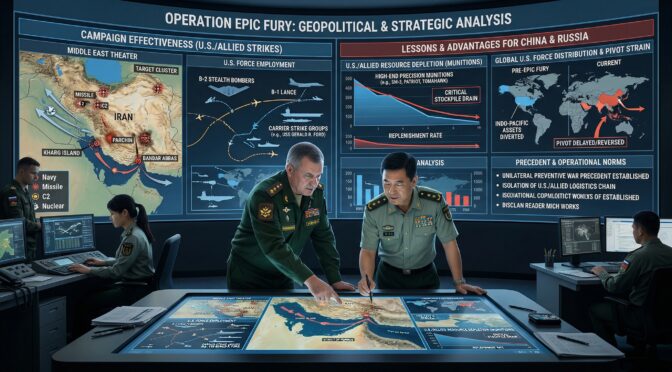
Operation Epic Fury: Lessons and Advantages for China and Russia in Future Conflicts

Executive Summary

Operation Epic Fury, initiated on February 28, 2026, represents a watershed moment in the evolution of modern warfare and global geopolitical strategy. The joint military campaign conducted by the United States and Israel was explicitly designed to preemptively dismantle the nuclear infrastructure, conventional military capabilities, and political leadership of the Islamic Republic of Iran. By the third week of March 2026, the coalition had achieved significant conventional military milestones. These milestones include the destruction of over 120 Iranian naval vessels, the elimination of approximately 90 percent of Iran’s land-based ballistic missile launch capacity, and the targeted killings of senior leadership figures such as the de facto regime leader Ali Larijani and Basij Commander Gholamreza Soleimani.1

However, the rapid destruction of Iran’s conventional deterrence did not yield the strategic capitulation anticipated by Western planners. Instead, it triggered a massive, decentralized, and highly lethal asymmetric escalation. Iran and its extensive proxy network immediately transformed the battlespace. They have leveraged cheap, easily produced unmanned aerial systems, mobile production facilities, and strategic chokepoint denial tactics to wage a prolonged war of attrition against technologically superior forces.4 The conflict has morphed into a complex theater dominated by the electromagnetic spectrum, defined by drone swarms, satellite intelligence sharing, and the rapid, unsustainable depletion of expensive Western precision munitions.6

For the People’s Republic of China and the Russian Federation, Operation Epic Fury serves as an unprecedented live-fire laboratory. Neither Beijing nor Moscow has intervened directly in the kinetic fight, yet both are extracting immense strategic and operational value from the conflict. The Russian Federation is actively utilizing the crisis to secure massive economic windfalls through surging global energy prices while simultaneously testing its electronic warfare and intelligence-sharing capabilities against active United States air defense systems in the Middle East.8 Concurrently, the People’s Republic of China is meticulously studying the limits of United States logistics, the rapid exhaustion of American munitions stockpiles, and the boundaries of Western political will. Beijing is directly applying these observations to its military doctrine and contingency planning for a future conflict over the island of Taiwan.10

This exhaustive research report provides a highly detailed situation report on the ongoing conflict. It focuses specifically on the top ten strategic, operational, and tactical advantages that China and Russia are extracting from the United States’ military engagement in Iran. These ten elements represent the core doctrinal lessons that will define the next decade of great power competition and fundamentally shape the architecture of future global conflicts.

1. Operational Theater Overview and Weekly Situation Report

The operational realities of Operation Epic Fury, alongside the Israeli component designated Operation Roaring Lion, have shattered several long-held Western military paradigms regarding deterrence and state collapse. The United States Central Command utilized overwhelming force in the opening phases of the conflict. The Pentagon deployed massive strike packages from the USS Gerald R. Ford and USS Abraham Lincoln carrier strike groups to deliver devastating combat power across the Iranian landmass.2 The operational tempo has been staggering, with the United States declaring air superiority by March 5, 2026, following the systematic destruction of Iranian radar and surface-to-air missile installations.13

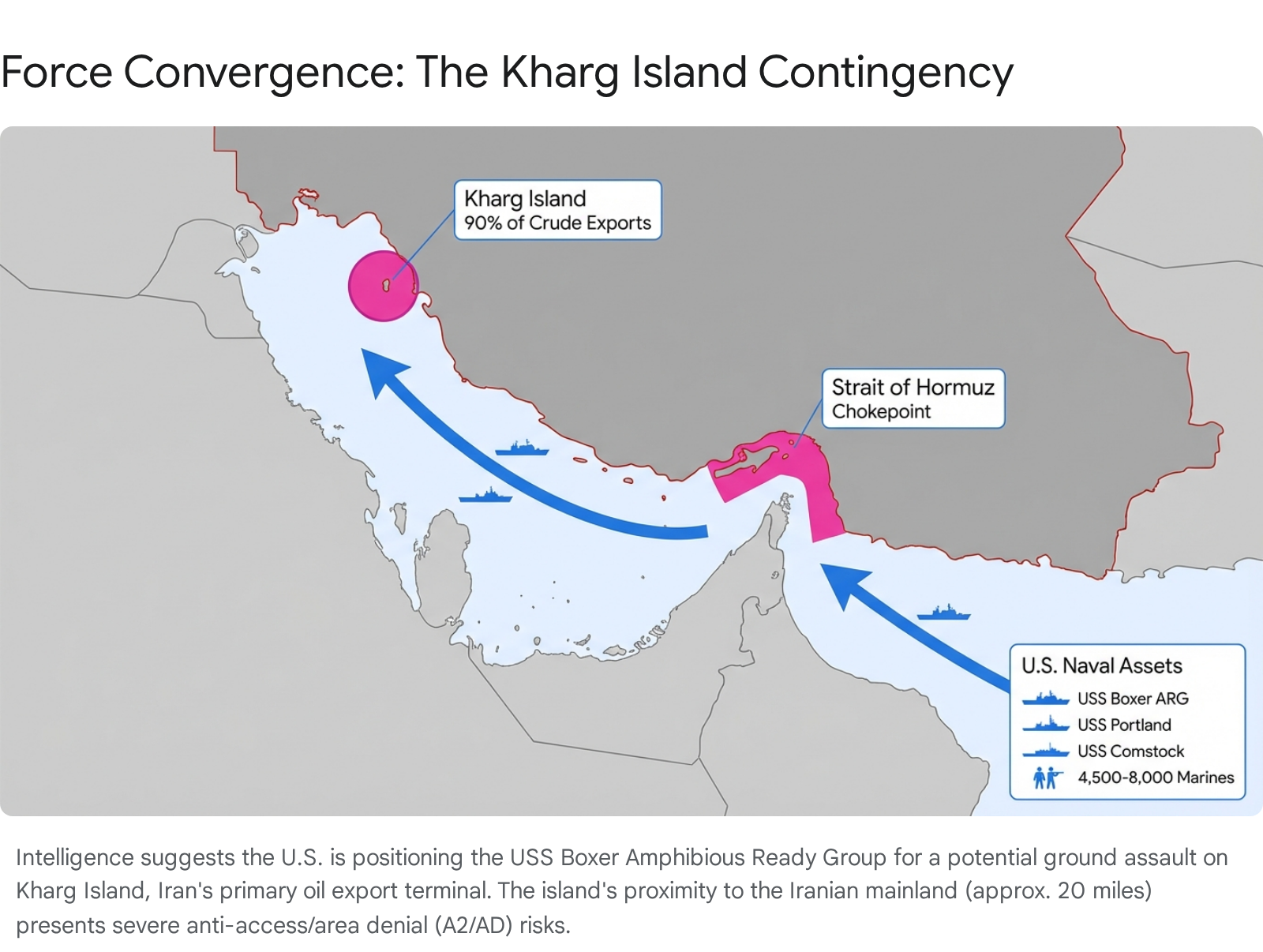
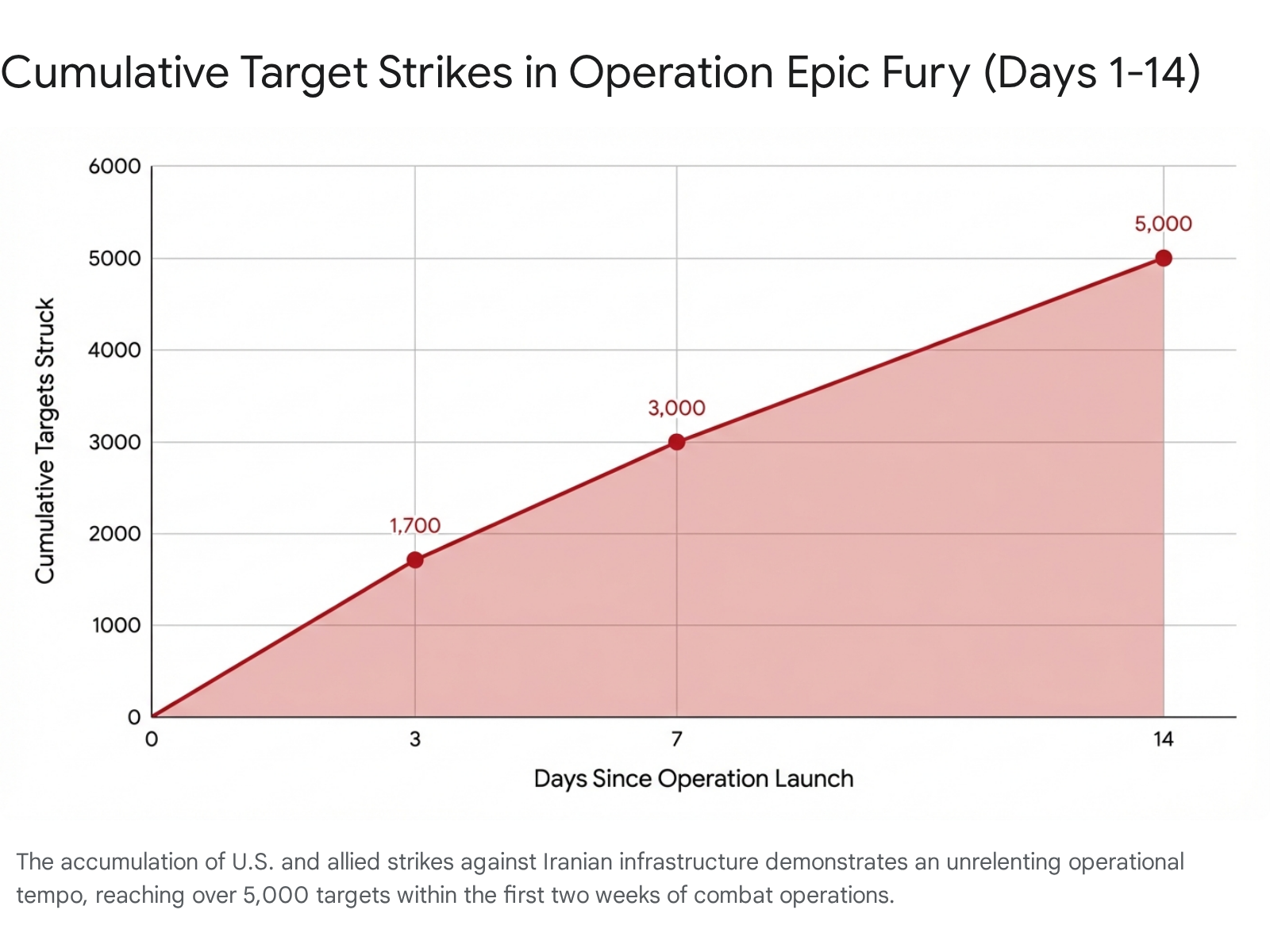
By the third week of the campaign, United States forces had struck over 7,800 targets across Iranian territory.13 These strikes focused heavily on command-and-control centers, air defense networks, and naval mine storage facilities. A notable operation occurred on Kharg Island, where United States precision strikes destroyed over 90 Iranian military targets, specifically targeting naval mine storage and missile bunkers while attempting to preserve the underlying civilian oil infrastructure.1 The Pentagon explicitly stated that the objective was to permanently eliminate the Iranian naval threat, ensure the destruction of the nation’s defense industrial base, and guarantee that Tehran never acquires a nuclear weapon.2 United States Secretary of War Pete Hegseth noted that Iranian ballistic missile and one-way drone attacks decreased by 90 percent since combat operations began, framing the campaign as a resounding conventional success.2

Metric CategoryCurrent Status as of March 2026Source Data
Total Targets Struck by US ForcesOver 7,800 targets across Iranian territory13
Iranian Naval Vessels DestroyedOver 120 vessels, including all 11 Iranian submarines2
Reduction in Ballistic Missile Attacks90 percent reduction compared to pre-war baselines2
Reduction in One-Way Drone Attacks95 percent reduction from Iranian domestic launch sites13
United States Military Casualties13 fatalities, over 200 wounded across 7 regional countries13

Despite these overwhelming tactical successes, the strategic environment remains highly volatile and unconsolidated. The removal of Iran’s conventional deterrent incentivized the regime to fight asymmetrically and below the threshold of traditional state-on-state confrontation.4 Iranian forces and their regional proxies, including the Islamic Resistance in Iraq and Hezbollah in Lebanon, have sustained continuous attacks on United States bases, energy infrastructure, and maritime shipping lanes.1 Proxy attacks in Iraq have heavily targeted the United States Embassy in Baghdad and facilities near Baghdad International Airport using rockets and advanced drones.13

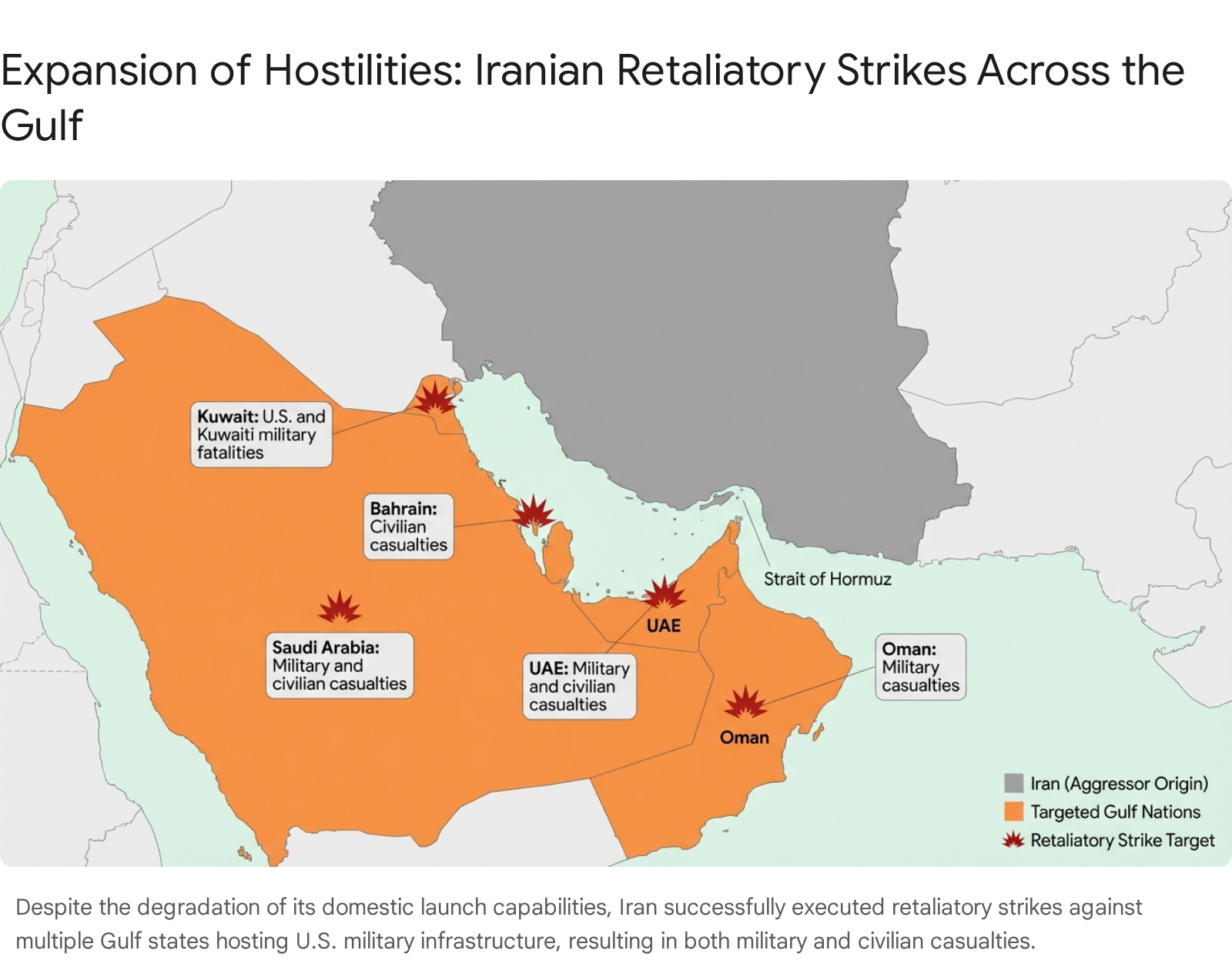
The human cost for the United States includes 13 service members killed. This figure includes seven soldiers killed by Iranian attacks in the opening days of the war and six Air Force crew members lost in a KC-135 Stratotanker refueling aircraft crash over Iraq on March 12, 2026.2 Furthermore, over 200 service members have been wounded or injured across seven different countries.13 In response to the strikes on its territory, Iran launched retaliatory ballistic missiles at United States bases in Bahrain, Qatar, Kuwait, and the United Arab Emirates, reportedly striking the Navy’s Fifth Fleet headquarters and causing civilian casualties in Abu Dhabi.4

2. The Economic and Financial Dimensions of Attrition

The financial burden of the campaign has become a central strategic vulnerability for the United States, a factor heavily scrutinized by foreign intelligence services. Briefings provided to the United States Senate in a closed-door session on March 11, 2026, indicated that the first six days of Operation Epic Fury cost American taxpayers at least 11.3 billion dollars.7 This extreme burn rate was driven primarily by the high-volume expenditure of high-end precision munitions deployed during the opening phase of strikes. Independent analysts at the Center for Strategic and International Studies estimated that the conflict had cost up to 16.5 billion dollars by its twelfth day alone.7

This financial attrition has forced the Department of War to prepare a massive 200 billion dollar supplemental funding request to sustain operations and replenish rapidly depleting stockpiles.14 Secretary of War Hegseth confirmed the department is seeking funding north of 200 billion dollars, noting that replenishing ammunition stockpiles is the primary challenge.14 This multibillion-dollar request faces significant legislative hurdles in the United States Congress, where lawmakers are demanding spending offsets and expressing concern over the lack of formal congressional authorization for the conflict.14

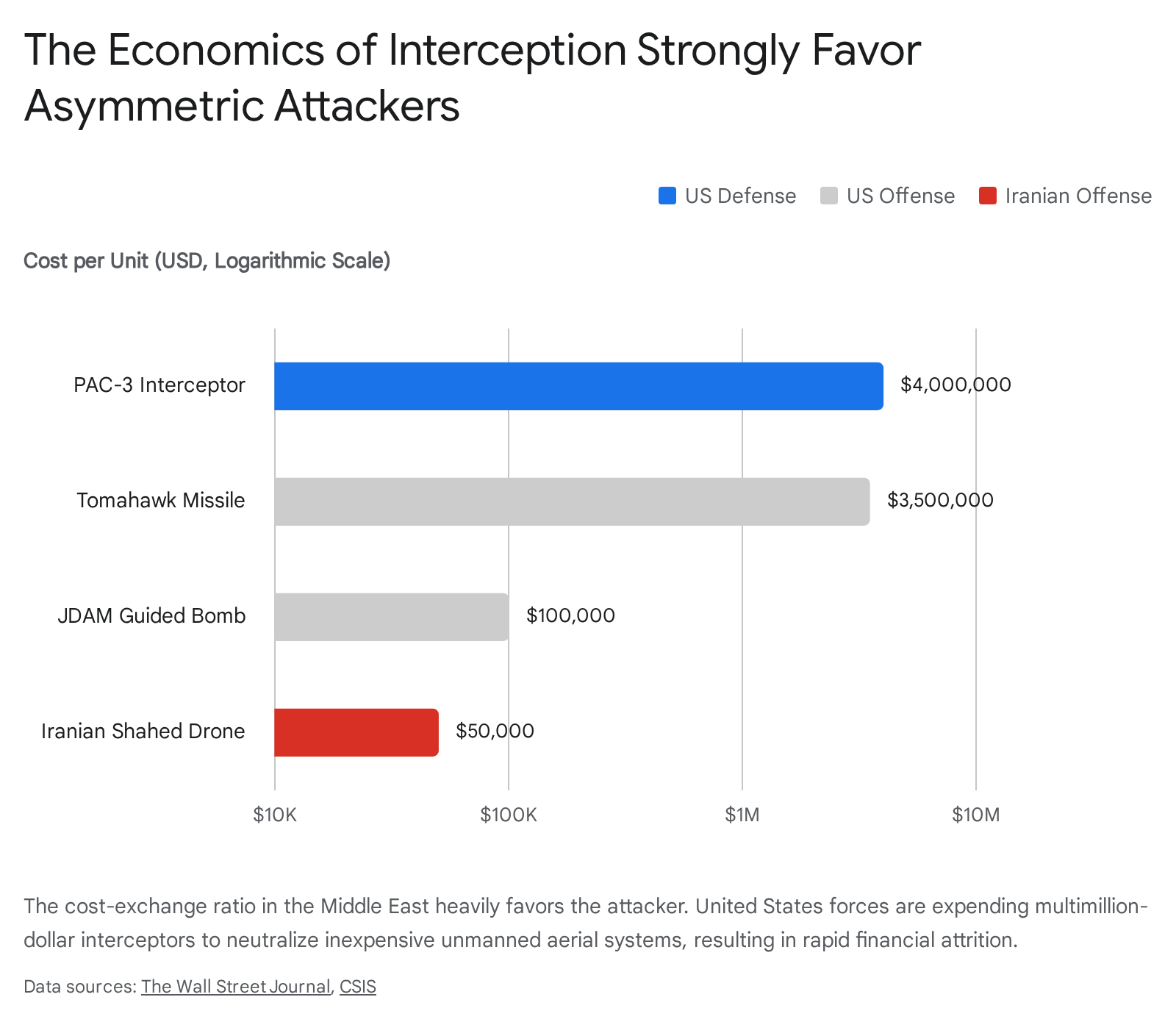
Munition / Asset TypeEstimated Unit Cost (USD)Strategic Application in Operation Epic Fury
PAC-3 Interceptor Missile4.0 million dollarsHigh-volume deployment for base defense against drones
Tomahawk Cruise Missile3.5 million dollarsprecision strikes on hardened command and nuclear targets
JDAM Guided Bomb100,000 dollarsDeployed heavily after day four to reduce daily burn rates
Iranian Shahed Drone50,000 dollarsDeployed in massive swarms to saturate US radar systems

This economic reality is fundamentally reshaping the operational approach. By the fourth day of the conflict, the United States military was forced to transition away from expensive cruise missiles toward cheaper munitions such as Joint Direct Attack Munition guided bombs, bringing the daily burn rate down to an estimated 500 million dollars.7 However, pre-war wargames conducted by the Pentagon demonstrated that the United States would run out of critical munitions only eight days into a high-intensity conflict with China over Taiwan. Analysts note that this timeline has now shrunk considerably due to the plunge into the Middle East.15 It is within this environment of high financial attrition, logistical strain, and asymmetric complexity that China and Russia are deriving their most critical long-term lessons.

3. Macro-Geopolitical Shifts and Diplomatic Realignments

Before examining the specific military advantages being studied by Beijing and Moscow, it is critical to contextualize the immediate geopolitical and economic shifts triggered by the conflict. Both revisionist powers are aggressively utilizing the chaos in the Persian Gulf to advance their respective grand strategies without committing kinetic forces to the theater.

The Russian Federation has emerged as the most immediate economic beneficiary of the conflict. The war has caused global oil prices to skyrocket, with Brent crude reaching 103 dollars per barrel.8 This price surge has provided Moscow with a massive revenue windfall, directly alleviating the economic pressures of its ongoing war in Ukraine and funding its domestic war economy.8 The threat to the Gulf’s energy infrastructure has made Russian oil and gas temporarily indispensable to global markets. This dynamic forced the United States Treasury to issue a one-month waiver on sanctions for Russian crude currently on tankers to prevent a complete collapse of global energy supply.8 Experts warn this move severely reduces the stigma of buying Russian oil and risks permanently dismantling the sanctions regime built to pressure Moscow.8 Additionally, Russia is using the conflict to push China toward committing to the construction of overland pipelines from Russia, reducing Beijing’s reliance on vulnerable Middle Eastern sea lines of communication.8

The People’s Republic of China has adopted a stance of calculated diplomatic neutrality, positioning itself as an objective peacemaker while capitalizing on the geopolitical fallout. Beijing has publicly called for an immediate ceasefire and warned of the severe impacts on global trade, shipping, and energy.17 By maintaining this diplomatic posture, China is deepening its relationships with the Global South and the Organization of Islamic Cooperation. Chinese Vice President and Foreign Minister Wang Yi held high-level talks with the Secretary-General of the 57-nation OIC to discuss regional security, drawing a stark contrast between Beijing’s diplomatic approach and the kinetic actions of the United States.17 Economically, China is securing unexpected victories in currency internationalization. Due to the geopolitical instability and shifting minerals markets, nations such as India have been forced to settle trades with Russia using the Chinese Yuan, accelerating the de-dollarization of the global economy and handing Beijing a massive structural victory.17

4. Top 10 Strategic and Tactical Advantages for China and Russia

The following ten elements represent the most critical lessons and advantages that China and Russia are deriving from the United States’ conflict with Iran. Each point details the specific operational reality observed in the Iranian theater and explains precisely why it provides a decisive advantage to Beijing or Moscow in a future confrontation with Western forces.

4.1. Advantage 1: Exploitation of Adversary Munitions Depletion Rates

The Operational Reality: The United States military is demonstrating an unsustainable burn rate of precision-guided munitions and high-end interceptors. During the opening phase of Operation Epic Fury, the United States relied heavily on Tomahawk cruise missiles and Patriot Advanced Capability-3 interceptors.7 The cost asymmetry is severe. The United States is utilizing interceptors costing 4.0 million dollars each to neutralize Iranian one-way attack drones that cost tens of thousands of dollars to manufacture.7 This rapid depletion of high-end munitions has forced the Pentagon to request 200 billion dollars from Congress simply to refill stockpiles.14 Pentagon wargames had already established that the United States lacked the magazine depth for a sustained conflict, and the current operational tempo in Iran is drastically accelerating the depletion of the global United States weapons inventory.15

The Strategic Advantage for China and Russia: For the People’s Liberation Army, the depletion of American munitions is the single most critical data point for a Taiwan invasion scenario. The Chinese military command recognizes that if the United States exhausts its inventory of long-range anti-ship missiles and advanced air defense interceptors in the Middle East, its ability to project power into the Indo-Pacific will be critically compromised. The PLA is learning that forcing the United States into a prolonged, geographically distant war of attrition is a highly viable strategy to strip Washington of its high-tech magazine depth. For Russia, the advantage is immediate and tangible. Every PAC-3 interceptor fired at an Iranian drone over the Persian Gulf is an interceptor that cannot be deployed to support Ukraine or fortify Eastern European NATO allies. Moscow is observing that the United States defense industrial base lacks the elasticity to simultaneously supply multiple high-intensity theaters. This observation validates Russia’s overarching strategy of outlasting Western material support and weaponizing the limitations of capitalist defense production models.

Cost comparison: US defense (PAC-3), US offense (Tomahawk, JDAM), Iranian drone. "Economics of Interception Strongly Favor Asymmetric Attackers.

4.2. Advantage 2: The Economics of Air Defense Saturation and Swarm Tactics

The Operational Reality: Iran has fundamentally shifted its strategy from calibrated, proportional retaliation to unbridled escalation, utilizing massive swarms of cheap, easily manufactured drones as the primary mechanism for attack.5 These drones act as the improvised explosive devices of the modern aerospace domain. They are capable of causing significant disruption to base operations and civilian infrastructure at an incredibly low cost. The Iranian strategy relies entirely on volume. By launching hundreds of drones simultaneously alongside cruise and ballistic missiles, Iran aims to saturate and overwhelm the radar tracking systems and interceptor capacities of United States Aegis combat systems and Patriot batteries.13 The Gulf states, which historically spend tens of billions of dollars annually on advanced Western air defense networks, are now seeking emergency assistance and cheap counter-drone technologies from Ukraine. They have realized that defending airspace using traditional methods is a path to systemic failure.18

The Strategic Advantage for China and Russia: This phenomenon comprehensively validates and refines the core military doctrines of both revisionist nations. For Russia, the conflict confirms the efficacy of the saturation tactics it has pioneered and employed in Ukraine. Furthermore, Russia is gaining invaluable real-time telemetry on how United States systems handle complex, multi-vector saturation attacks. This data allows Russian aerospace engineers to adjust the flight algorithms of their own munitions to better evade Western radar logic in the future.8 For China, the PLA Rocket Force is structurally built upon the premise of overwhelming enemy defenses through sheer volume. The Iranian operational template proves that even the most advanced Western air and missile defense shields can be cracked if the attacker possesses sufficient mass and willingness to accept high interception rates. China is observing the exact mathematical threshold at which American tracking systems become overloaded, providing vital calibration data for a potential missile barrage against Taiwan or United States military installations in Guam and Okinawa.

4.3. Advantage 3: Electromagnetic Spectrum and Space-Based Targeting Integration

The Operational Reality: The conflict in the Persian Gulf is not defined by traditional front lines or massive armor formations, but rather by absolute control over the electromagnetic spectrum. It is a war fought with radar beams, satellite feeds, and encrypted targeting coordinates.6 To aid Iranian forces, Russia has reportedly provided highly sensitive intelligence. This intelligence includes the precise satellite locations of United States warships and aircraft operating across the Middle East.6 This intelligence sharing allows Iranian coastal missile batteries and drone operators to target mobile United States maritime assets with significantly higher accuracy than their indigenous sensors would permit.

The Strategic Advantage for China and Russia: The integration of space-based assets into regional conflicts serves as a massive force multiplier. For Russia, providing satellite data to Iran serves two distinct purposes. First, it exacts a severe kinetic cost on the United States military, acting as retribution for Washington’s support of Ukraine. Second, it allows Russia to test the latency, security, and accuracy of its own space-to-ground intelligence sharing architecture in a live combat scenario against top-tier American naval assets.8 For China, the conflict is serving as an invaluable live-fire laboratory.6 Beijing is not politically or ideologically motivated to arm Tehran, but it recognizes the scientific value of the conflict. Every single time an Iranian coastal missile engages a United States carrier strike group, the engagement generates vast amounts of targeting, radar reflection, and intercept data.6 Chinese military planners will study this data exhaustively to refine their own radar architectures and doctrine. This data is critical for programming the targeting sensors of weapons like the CM-302 anti-ship cruise missile, which China intends to deploy in the South China Sea.6 By watching Iran fight, China learns precisely how to blind and strike the United States Navy without risking a single PLA vessel.

4.4. Advantage 4: Survivability through Decentralized Proxy Networks

The Operational Reality: Operation Epic Fury successfully destroyed much of Iran’s conventional military infrastructure within its borders, yet it completely failed to neutralize the state’s capacity to project power across the region. This strategic failure occurred because Iran’s true center of gravity is not its domestic military bases, but its decentralized, heavily armed network of proxy militias across the Middle East.4 Groups such as the Houthis in Yemen, Hezbollah in Lebanon, and the Islamic Resistance in Iraq possess independent command structures, dispersed weapons caches, and localized supply chains.4 When the United States executed decapitation strikes against the Iranian leadership, it produced a network with every incentive to fight asymmetrically and indefinitely. In a single 24-hour period, Iraqi militias claimed 27 separate attacks against United States personnel and offered financial rewards for targeting American logistics.1

The Strategic Advantage for China and Russia: The resilience of the Iranian proxy network provides a masterclass in asymmetric deterrence and sub-state warfare. Russia has already utilized similar concepts through private military companies and proxy separatist forces in Eastern Europe and the African continent. The Iranian model proves conclusively that a state sponsor can suffer catastrophic kinetic damage at home while its external networks continue to inflict severe strategic pain on the adversary. For China, this demonstrates the immense strategic value of cultivating asymmetric, non-state leverage points. If China were to face severe economic blockades or kinetic strikes in a future conflict, having a dispersed network of aligned, semi-autonomous actors capable of disrupting global shipping lanes or attacking adversary bases in secondary theaters would ensure that the cost of conflict remains unacceptably high for Western nations.

4.5. Advantage 5: Asymmetric Maritime Denial in Strategic Chokepoints

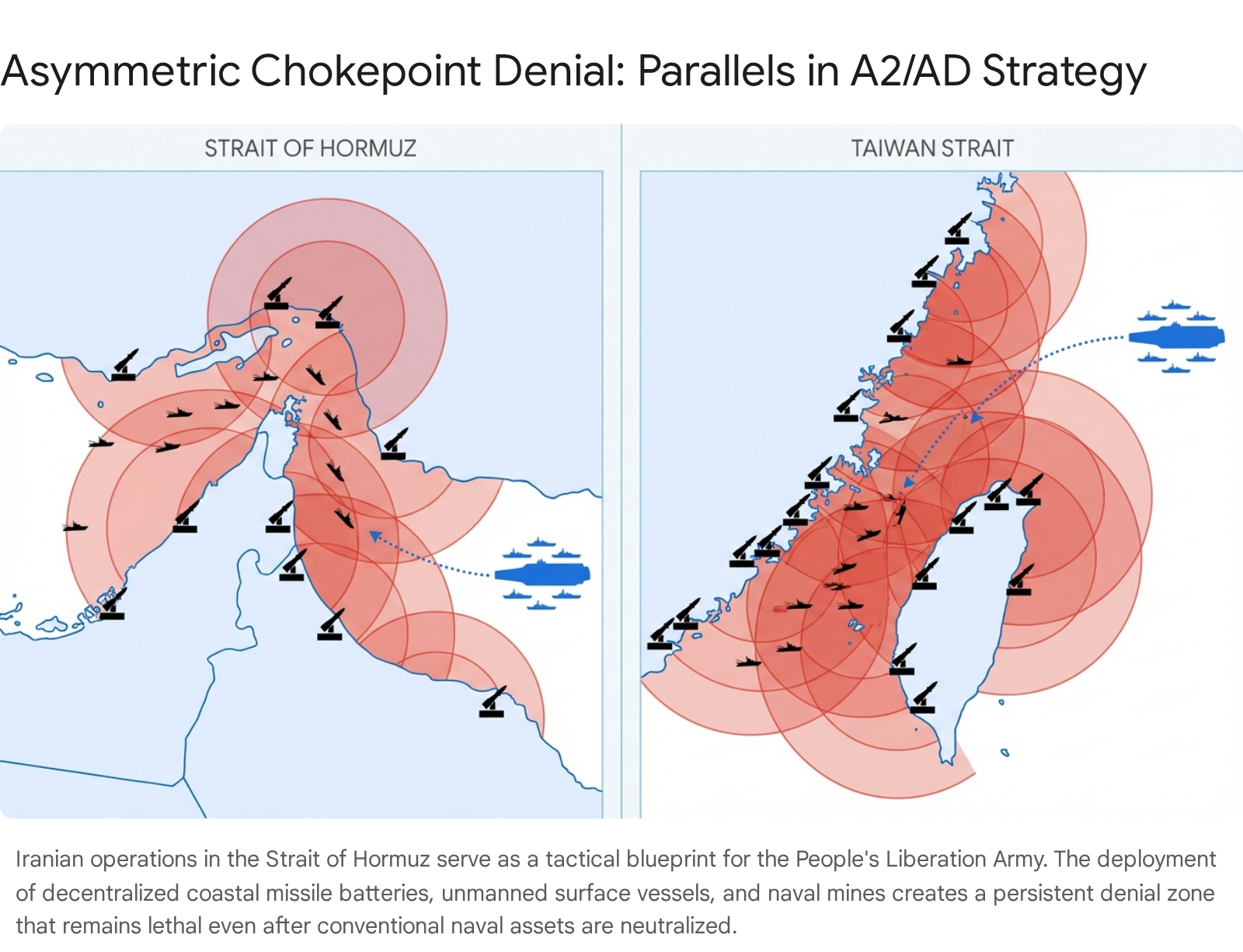
The Operational Reality: Despite the United States Navy destroying over 120 Iranian vessels, including all 11 of their submarines, Iran continues to dictate the security architecture of the Strait of Hormuz.2 The Islamic Revolutionary Guard Corps Navy relies heavily on unconventional tactics. They utilize massive swarms of fast attack boats, unmanned surface vessels, deployable sea mines, and hidden coastal missile batteries.10 IRGC Navy Commander Alireza Tangsiri has implicitly threatened to attack all unauthorized maritime transit through the strait, leading to dozens of maritime incidents.9 Eran Ortal, an Israeli military strategist, noted that this dynamic defines the nature of asymmetric warfare. Even if the conventional fleet is entirely sunk, the asymmetric capabilities remain entrenched along the coastline, functioning like highly lethal anti-tank snipers against commercial shipping.10 The United States strategy to counter this involves deploying Marine Expeditionary Units on amphibious ships, utilizing stealthy F-35 Lightnings and Cobra rotary-wing gunships to hunt small boats and protect vulnerable tankers.19

The Strategic Advantage for China and Russia: The geopolitical and tactical parallels between the Strait of Hormuz and the Taiwan Strait are direct and profound. Chinese military analysts from the PLA National Defense University are closely monitoring how a technologically inferior force can effectively close a vital maritime chokepoint against the world’s premier blue-water navy.11 China is taking extensive notes on the specific countermeasures deployed by the United States. By observing the tactics the United States Marine Corps and Navy employ to clear the Strait of Hormuz, the PLA can engineer specific counter-tactics. These may include the development of advanced sea-skimming autonomous drones, massive automated minefields, and hyper-dense coastal missile networks designed to ensure that the United States cannot utilize similar clearance methods in the Western Pacific or the Strait of Malacca during a Taiwan contingency.

A2/AD strategy comparison: Strait of Hormuz vs. Taiwan Strait. "Asymmetric Chokepoint Denial" is the title.

4.6. Advantage 6: Deeply Layered Command and Control Resilience

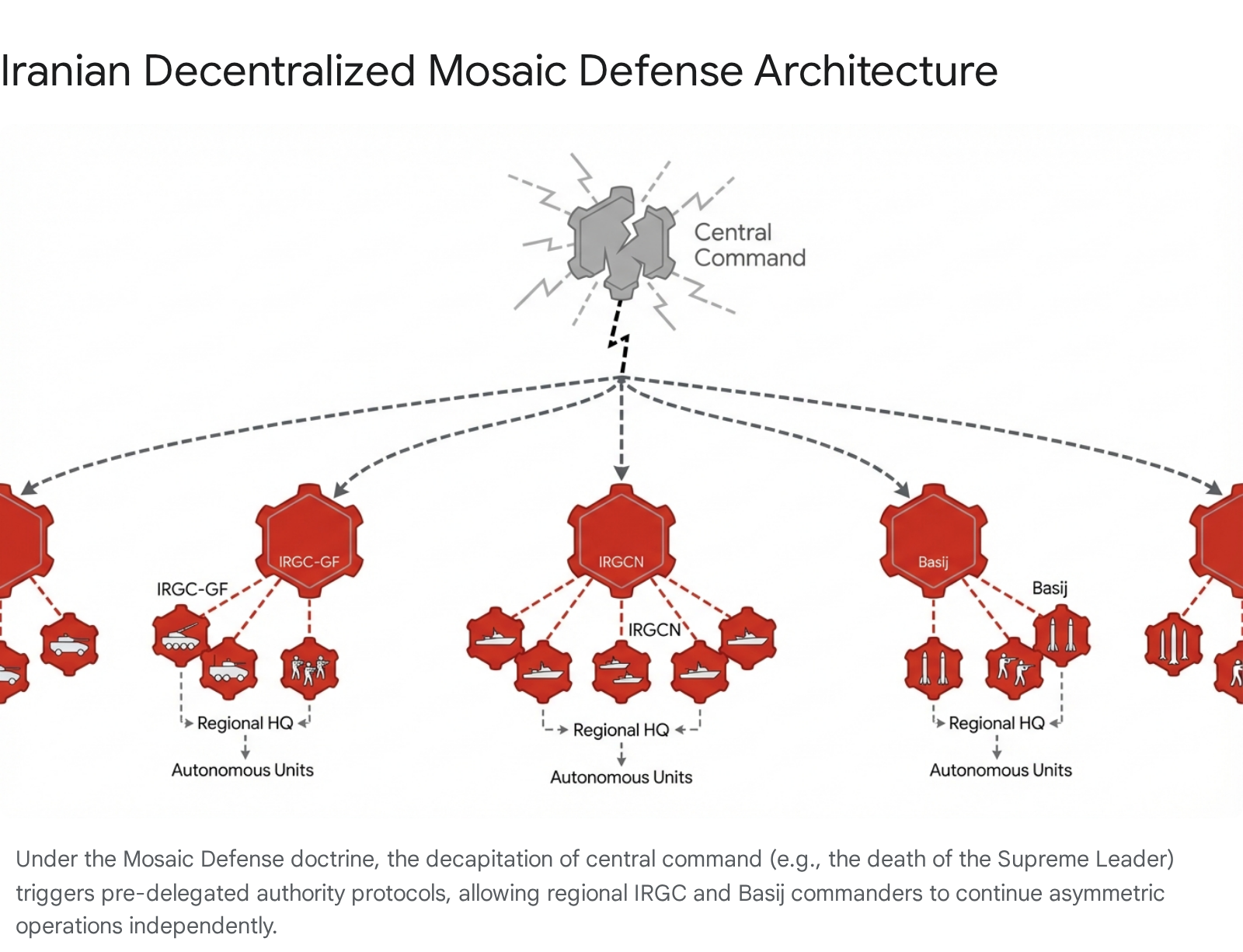
The Operational Reality: Operation Epic Fury featured a massive decapitation campaign aimed at collapsing the Iranian government and security apparatus. United States and Israeli strikes successfully targeted and killed Supreme Leader Ayatollah Ali Khamenei in the early stages of the war, shifting power to his son, Mojtaba Khamenei.3 Subsequent waves of targeted killings eliminated Ali Larijani, the Secretary of the Supreme National Security Council and the de facto leader of the regime, as well as Gholamreza Soleimani, the commander of the Basij forces.3 Despite the systematic elimination of the political and security apex, the Iranian state did not collapse into widespread chaos or civil war. United States intelligence assessed that the Islamic Revolutionary Guard Corps effectively absorbed the shock and assumed total command, calling the shots and maintaining operational continuity across the theater.21 The resilience of the state is underpinned by a deeply layered system of governance and a powerful, ideologically charged security apparatus that functions independently of individual leaders.22

The Strategic Advantage for China and Russia: The concept of regime survival under catastrophic decapitation strikes is of paramount interest to autocratic political systems. Russian intelligence analysts have explicitly noted that rapidly destabilizing an ideologically charged state system through decapitation strikes or economic pressure is exceedingly difficult.22 For President Vladimir Putin, the Iranian survival provides assurance that highly centralized security structures, such as the Federal Security Service and the Russian military command, can maintain national cohesion even if top leadership is neutralized by Western precision weapons. For the Chinese Communist Party, the survival of the IRGC validates the absolute necessity of embedding party control, political commissars, and ideological discipline deeply within the military structure. The PLA is learning that maintaining a redundant, deeply integrated command network ensures that the military can sustain operations and maintain internal security even in the event of devastating precision strikes against Beijing’s political elite.

4.7. Advantage 7: Energy Market Weaponization and Sanctions Evasion

The Operational Reality: The conflict has unequivocally demonstrated the extreme fragility of the global energy market and the effectiveness of weaponizing energy supply chains as a tool of war. Iranian officials explicitly threatened that if its energy facilities on Kharg Island were attacked, it would destroy the energy infrastructure of neighboring allied countries and close the Strait of Hormuz to hostile tankers.1 This threat alone sent massive shockwaves through global commodities markets. Russia immediately capitalized on this volatility. By offering itself as a stable, alternative energy provider amidst Middle Eastern chaos, Russia entrenched its role as an indispensable global energy supplier. This dynamic fundamentally weakened the political will of Western nations to enforce energy sanctions related to the Ukraine war, resulting in immediate financial relief for Moscow.8 Furthermore, the geopolitical risk prompted China to halt exports of refined oil products, signaling growing trepidation about maritime supply disruptions and prioritizing domestic reserves.23

The Strategic Advantage for China and Russia: This dynamic exposes a critical vulnerability in the Western strategic posture. For Russia, the advantage is the realization that global economic stability is highly sensitive to regional chokepoints. Moscow is learning that by subtly stoking instability in regions critical to the global supply chain, it can fracture Western political consensus on sanctions and generate immediate financial windfalls to fund its military industrial complex. For China, the lesson is distinctly defensive. The conflict underscores the severe strategic risk of relying on maritime imports traversing contested straits guarded by the United States Navy. This operational reality reinforces Beijing’s strategic imperative to rapidly expand overland energy pipelines connecting directly to Russia and Central Asian republics.8 By building infrastructure immune to United States naval blockades, China guarantees its energy security for a future confrontation over Taiwan.

4.8. Advantage 8: Proliferation and Employment of Fiber-Optic FPV Drones

The Operational Reality: A significant and highly dangerous tactical evolution observed in the conflict is the introduction of First-Person View drones by Iranian proxy groups. Open-source intelligence analysis and drone footage posted by the Iraqi militia group Saraya Awliya al Dam revealed the active use of fiber optic FPV drones against United States installations.9 These drones represent a nascent but highly lethal capability that challenges traditional base defense paradigms. Unlike traditional GPS-guided munitions, which can be disrupted by electronic warfare and radio frequency jamming, fiber optic FPV drones are entirely immune to standard jamming techniques because their control signal travels through a physical wire unspooled during flight. They allow proxy operators to conduct complex, real-time reconnaissance and highly coordinated precision strikes intended to overwhelm point defenses and target vulnerable personnel or sensitive equipment.13

The Strategic Advantage for China and Russia: The battlefield application of FPV drones is completely rewriting tactical infantry and armor operations globally. Russia is intimately familiar with FPV technology from its operations in Ukraine. However, observing Iranian proxies successfully utilize these systems against highly defended United States bases provides a new layer of tactical validation. It proves that non-state actors can achieve precision strike capabilities previously reserved for advanced militaries with complex targeting pods. For China, the rapid proliferation of FPV technology is a dual-edged sword. While it poses a threat to standard infantry, the PLA is undoubtedly analyzing how massive swarms of autonomous or semi-autonomous FPV drones could be deployed during an amphibious assault. The ability to field unjammable, highly maneuverable loitering munitions provides a significant tactical advantage in clearing complex urban terrain or striking fortified coastal defenses in Taiwan, negating the island’s electronic warfare countermeasures.

4.9. Advantage 9: Mobile and Decentralized Defense Industrial Production

The Operational Reality: A core objective of the United States campaign was the total destruction of Iran’s defense industrial base, particularly its ballistic missile and drone manufacturing capabilities.2 United States Secretary of War Pete Hegseth claimed that this objective was nearing complete destruction in mid-March.2 However, strategic analysts noted that while large, static production facilities may be destroyed by precision bombs, Iran’s actual production capabilities are remarkably resilient. Drones are relatively cheap, easy to manufacture, and can be assembled in mobile manufacturing facilities spread across the country or hidden deeply underground.5 This extreme decentralization makes it virtually impossible to completely neutralize the adversary’s ability to generate new combat power from the air, guaranteeing a prolonged conflict characterized by constant harassment strikes.5

The Strategic Advantage for China and Russia: The survival of a defense industrial base under constant, overwhelming aerial bombardment is a critical metric for long-term strategic planning. Russia has already adapted its industrial base by moving critical production facilities beyond the range of Ukrainian strike weapons and distributing manufacturing across multiple sectors. The Iranian example reinforces the necessity of this geographic and structural dispersion. For China, the lesson is profound. While China possesses the world’s largest industrial capacity, much of it is concentrated in dense coastal cities vulnerable to United States long-range precision fires. Observing the United States struggle to eradicate Iranian drone production validates the PLA’s strategy of Civil-Military Fusion. It highlights the necessity of maintaining deeply buried, highly distributed manufacturing hubs in the interior provinces to ensure the uninterrupted production of autonomous systems and guided munitions during a major war with the United States.

4.10. Advantage 10: Information Warfare and Diplomatic Alienation of the West

The Operational Reality: As Operation Epic Fury evolves into a high-cost war of attrition with mounting civilian and infrastructure damage, domestic and international skepticism regarding the United States’ decision-making has rapidly intensified. The conflict is increasingly viewed globally as a strategic disaster born of political miscalculation.24 China has masterfully exploited this sentiment in the global information space. Beijing has flooded social media and international news networks with narratives emphasizing the cruelty of the United States military coalition, utilizing sophisticated AI-generated content to amplify critiques of American hegemonic intervention.24 Concurrently, China’s official diplomatic corps presents the nation as a responsible, objective global power seeking non-interference and peace. Observers note that while an American kinetic triumph remains elusive, the severe erosion of Washington’s diplomatic credibility renders the United States the ultimate strategic victim of this conflict.24

The Strategic Advantage for China and Russia: The battle for global narrative dominance is a primary theater in contemporary great power competition. For Russia, portraying the United States as a reckless aggressor in the Middle East deflects international attention and moral condemnation away from its own actions in Eastern Europe. Russian Foreign Minister Sergey Lavrov actively frames the United States actions as a severe blow to global arms control and regional stability.8 For China, the advantage is systemic and structural. By painting the United States as a destabilizing force prone to military adventurism, Beijing strengthens its appeal to the Global South. It allows China to position its Belt and Road Initiative and its models of economic partnership as safe, stable alternatives to the volatile security umbrella offered by Washington. The conflict accelerates the fracturing of the United States-led international order, allowing China to reshape global governance structures and isolate Taiwan diplomatically without firing a single shot.

5. Strategic Forecast and Conclusion

The joint United States and Israeli campaign against the Islamic Republic of Iran, while achieving significant tactical destruction of conventional military assets, has inadvertently provided the world’s revisionist powers with a comprehensive blueprint for modern asymmetric warfare. Operation Epic Fury demonstrates conclusively that overwhelming kinetic dominance and control of the airspace are insufficient to secure rapid strategic victory when an adversary possesses resilient proxy networks, decentralized production capabilities, and a willingness to weaponize global economic chokepoints.

For the Russian Federation, the conflict offers immediate tactical intelligence on United States air defense systems, vital economic relief through surging global energy markets, and a crucial geopolitical distraction that depletes Western munitions stockpiles originally intended for the European theater. Moscow is learning that the United States defense industrial base is highly vulnerable to concurrent global crises, lacking the elasticity required for multi-theater hegemony.

For the People’s Republic of China, the Gulf conflict serves as a surrogate war game for a future Taiwan contingency. The PLA is exhaustively analyzing the rate at which the United States depletes its precision munitions, the economic breaking point of American air defense systems against low-cost drone swarms, and the specific tactical methods employed by the Marine Corps to secure contested maritime straits. Furthermore, Beijing is capitalizing on the geopolitical fallout to isolate the United States diplomatically, accelerating the transition toward a multipolar world order dominated by economic pragmatism rather than Western security guarantees.

Ultimately, China and Russia are extracting a singular, defining lesson from the ashes of Operation Epic Fury. The future of global warfare does not strictly belong to the nation fielding the most expensive naval platforms or stealth aircraft. Rather, victory will favor the actor who can most effectively leverage asymmetry, sustain industrial capacity under intense bombardment, and seamlessly integrate operations across the electromagnetic, physical, and informational domains.


Please share the link on Facebook, Forums, with colleagues, etc. Your support is much appreciated and if you have any feedback, please email us in**@*********ps.com. If you’d like to request a report or order a reprint, please click here for the corresponding page to open in new tab.


Sources Used

  1. Operation “Epic Fury:” SITREP (15 MAR 2026), accessed March 21, 2026, https://ict.org.il/operation-epic-fury-sitrep-15-mar-2026/
  2. This Week in DOW: U.S. Delivers ‘Devastating Combat Power’ to Iran, accessed March 21, 2026, https://www.war.gov/News/News-Stories/Article/Article/4440215/this-week-in-dow-us-delivers-devastating-combat-power-to-iran/
  3. Operation “Epic Fury:” SITREP (17 MAR 2026) – ICT, accessed March 21, 2026, https://ict.org.il/operation-epic-fury-sitrep-17-mar-2026-2/
  4. We Bombed the Wrong Target Iran’s Proxy Network Strategy – Irregular Warfare Initiative, accessed March 21, 2026, https://irregularwarfare.org/articles/iran-proxy-network-strategy/
  5. Iran’s War Strategy: Don’t Calibrate—Escalate – CSIS, accessed March 21, 2026, https://www.csis.org/analysis/irans-war-strategy-dont-calibrate-escalate
  6. The war of signals: How Russia and China help Iran see the battlefield – Al Jazeera, accessed March 21, 2026, https://www.aljazeera.com/opinions/2026/3/12/the-war-of-signals-how-russia-and-china-help-iran-see-the-battlefield
  7. Pentagon Requests More Than £158 Billion For Expanding Iran War Effort As White House Aides Doubt Congress Approval, accessed March 21, 2026, https://www.ibtimes.co.uk/pentagon-200-billion-request-operation-epic-fury-1786771
  8. Russia Analytical Report, March 9–16, 2026 | Russia Matters, accessed March 21, 2026, https://www.russiamatters.org/news/russia-analytical-report/russia-analytical-report-march-9-16-2026
  9. Iran Update Special Report, March 17, 2026 – Institute for the Study of War, accessed March 21, 2026, https://understandingwar.org/research/middle-east/iran-update-special-report-march-17-2026/
  10. Interview: Iran’s Use Of Chinese Doctrine And Tech Under The Spotlight, accessed March 21, 2026, https://www.rferl.org/a/iran-war-chinese-doctrine-tech-ortal-idf-israel/33707130.html
  11. Crossing the Strait: China’s Military Prepares for War with Taiwan – NDU Press, accessed March 21, 2026, https://ndupress.ndu.edu/Other-Publications/Books/Crossing-the-Strait/
  12. Colorado Congresswoman Lauren Boebert against funding for war in Iran: “We need America First policies right now”, accessed March 21, 2026, https://www.cbsnews.com/colorado/news/colorado-congresswoman-lauren-boebert-additional-funding-iran-war/
  13. Analysis: Operational gains against Iran continue, but threats to US …, accessed March 21, 2026, https://www.longwarjournal.org/archives/2026/03/analysis-operational-gains-against-iran-continue-but-threats-to-us-forces-persist.php
  14. Pentagon seeks at least $200B from Congress for Iran war, accessed March 21, 2026, https://www.wfmd.com/2026/03/19/pentagon-seeks-at-least-200b-from-congress-for-iran-war/
  15. Asymmetric War in Iran: How Trump and the U.S. Are Being Played, accessed March 21, 2026, https://washingtonmonthly.com/2026/03/19/asymmetric-drone-war-in-iran-how-trump-and-the-u-s-are-being-played/
  16. Russia and China: Gaining from the war with Iran? | State of Play – YouTube, accessed March 21, 2026, https://www.youtube.com/watch?v=_1vVF15YoM0
  17. China Warns Middle East War Threatens Global Trade, accessed March 21, 2026, https://chinaglobalsouth.com/2026/03/20/china-warns-middle-east-war-global-trade-impact/
  18. Countries turn to Ukraine for help as Iran shows up their outdated air defenses, accessed March 21, 2026, https://euromaidanpress.com/2026/03/13/countries-turn-to-ukraine-for-help-as-iran-shows-up-their-outdated-air-defenses/
  19. FPRI Experts React | Options in the Strait of Hormuz – Foreign Policy Research Institute, accessed March 21, 2026, https://www.fpri.org/article/2026/03/fpri-experts-react-options-in-the-strait-of-hormuz/
  20. National Defense University Press > Publications > Books > The PLA and Contingency Planning in China, accessed March 21, 2026, https://ndupress.ndu.edu/Publications/Books/The-PLA-and-Contingency-Planning-in-China/
  21. Iran Update Special Report, March 15, 2026 – Institute for the Study of War, accessed March 21, 2026, https://understandingwar.org/research/middle-east/iran-update-evening-special-report-march-15-2026/
  22. Russia Analytical Report, Feb. 17–23, 2026, accessed March 21, 2026, https://www.russiamatters.org/news/russia-analytical-report/russia-analytical-report-feb-17-23-2026
  23. China-Iran Fact Sheet: A Short Primer on the Relationship | U.S., accessed March 21, 2026, https://www.uscc.gov/research/china-iran-fact-sheet-short-primer-relationship
  24. The Message it sends to China – 想想Thinking Taiwan – 想想台灣,想想未來, accessed March 21, 2026, https://www.thinkingtaiwan.net/article/100209
  25. “Enemy within”: How Chinese analysts view the US-Iran war, accessed March 21, 2026, https://pacforum.org/publications/the-pilot-14-enemy-within-how-chinese-analysts-view-the-us-iran-war/

Operation Epic Fury Weekly SITREP – March 21, 2026

1.0 Executive Summary

The third week of the combined United States and Israeli military campaign against the Islamic Republic of Iran, designated Operation Epic Fury and Operation Roaring Lion respectively, has marked a fundamental transition in the strategic character of the conflict. During the week ending March 21, 2026, the battlespace expanded significantly beyond the initial suppression of enemy air defenses and command decapitation. The operational focus has evolved into a widespread campaign of economic warfare, heavy infrastructure degradation, and regionalized energy disruption. The United States and Israel have systematically transitioned from targeting the Islamic Revolutionary Guard Corps (IRGC) command nodes to dismantling Iran’s nuclear latency infrastructure, heavy industrial base, and internal security apparatus.1 Conversely, the Iranian strategic doctrine has shifted toward vertical and horizontal escalation, utilizing a calculated strategy of unpredictable, high-volume retaliatory strikes against civilian and energy infrastructure across the Gulf Cooperation Council states.4

The most critical escalation of the week occurred on the morning of March 21, 2026, when United States aerospace forces executed a direct, deep-penetration strike on the Natanz nuclear enrichment facility in central Iran. Utilizing B-2 stealth bomber platforms and GBU-57 Massive Ordnance Penetrator munitions, this strike signals a definitive shift toward permanently crippling Iran’s nuclear capabilities.6 In response to this and prior allied strikes on the South Pars natural gas field, Iran has actively targeted the global energy supply chain. Iranian forces have struck the Ras Laffan Industrial City in the State of Qatar, the SAMREF refinery in the Kingdom of Saudi Arabia, and multiple maritime port facilities in the United Arab Emirates, fundamentally threatening the stability of the global hydrocarbon market.5

Systemic shifts in the geopolitical and internal Iranian landscape are profound. The Iranian political and military leadership structure remains severely fractured following the assassination of Supreme Leader Ali Khamenei at the onset of hostilities, compounded by the subsequent incapacitation of his successor, Mojtaba Khamenei.1 The regime has compensated for this unprecedented leadership vacuum by heavily relying on a syndicate of legacy, hardline IRGC commanders who are currently operating from decentralized, improvised command posts to avoid Israeli decapitation strikes.1 Concurrently, the civilian population inside the Islamic Republic is enduring a near-total digital blackout, severe economic hyperinflation, and localized, violent crackdowns executed by the Law Enforcement Command and Basij paramilitary forces.12

To mitigate the global economic fallout of the conflict, the United States Department of the Treasury executed a highly irregular strategic policy shift by waiving sanctions on approximately 140 million barrels of Iranian crude oil currently stored on maritime vessels at sea.4 This maneuver aims to stabilize global energy markets and insulate domestic fuel prices ahead of political milestones, effectively weaponizing Iranian supply against Tehran.15 Meanwhile, the Gulf states find themselves trapped in a rapidly deteriorating security environment, forced to activate advanced interceptor networks to defend their sovereign airspace while desperately seeking diplomatic off-ramps to prevent the total devastation of their respective economic sectors.17

2.0 Chronological Timeline of Key Events (Last 7 days)

The following timeline details the precise chronological sequence of critical military engagements, diplomatic maneuvers, and strategic announcements that have defined the conflict landscape over the preceding seven days. All times are normalized to Coordinated Universal Time.

  • March 15, 2026, 15:00 UTC: Iranian IRGC Aerospace Force Commander Brigadier General Majid Mousavi publicly announces the first wartime operational deployment of the Sejjil solid-fueled medium-range ballistic missile, confirming successful launches targeting Israeli military infrastructure.20
  • March 15, 2026, 18:30 UTC: The United States Department of War releases operational footage confirming F/A-18F Super Hornet combat sorties originating from the USS Gerald R. Ford aircraft carrier, striking advanced surface-to-air missile facilities within the Iranian interior.21
  • March 16, 2026, 12:00 UTC: Global network monitoring organization NetBlocks formally confirms that the state-mandated Iranian internet blackout has surpassed 400 continuous hours. This event marks the most severe and prolonged communications restriction in the modern history of the Islamic Republic.22
  • March 16, 2026, 23:45 UTC: United States Central Command forces successfully target and destroy a suspected Iranian unmanned aerial vehicle manufacturing facility located in South Khorasan Province, demonstrating allied capability to operate deep within Iran’s easternmost airspace.11
  • March 17, 2026, 18:00 UTC: The Israel Defense Forces officially confirm the successful targeted assassination of Ali Larijani, the Secretary of the Supreme National Security Council, alongside Gholamreza Soleimani, the Commander of the Basij Organization, in precision strikes located in eastern Tehran.10
  • March 18, 2026, 02:00 UTC: Combined United States and Israeli aerospace forces strike the 4th Artesh Naval District Headquarters situated at Bandar Anzali Port on the Caspian Sea. The operation results in the destruction of the Moudge-class frigate IRIS Deylaman and effectively severs a suspected maritime supply corridor utilized for the transfer of Russian military hardware.1
  • March 18, 2026, 14:00 UTC: Foreign Ministers representing twelve Arab and Islamic states convene an emergency summit in Riyadh, Saudi Arabia. The delegation issues a joint diplomatic communique strongly condemning Iranian retaliatory strikes on civilian and energy infrastructure across the Gulf Cooperation Council states, citing violations of international law.26
  • March 19, 2026, 10:00 UTC: In a major horizontal escalation, Iranian ballistic missiles successfully strike the Ras Laffan Industrial City in the State of Qatar. The impact causes severe structural damage to two liquefied natural gas trains, instantly degrading the nation’s total export capacity by 17 percent and triggering a global market shock.1
  • March 19, 2026, 22:38 UTC: The Israel Defense Forces initiate a massive, coordinated wave of strikes heavily targeting internal security and government infrastructure within the Tehran metropolitan area. Local activists report unprecedented explosions prioritizing Law Enforcement Command outposts and Basij deployment centers.8
  • March 20, 2026, 16:00 UTC: The United States Treasury Department formally issues a 30-day general license waiving sanctions on 140 million barrels of Iranian crude oil currently stored on vessels at sea. The maneuver is explicitly designed to flood the market and ease surging global energy prices caused by the conflict.4
  • March 20, 2026, 19:15 UTC: A United States F-35 stealth fighter jet conducting a deep-penetration combat mission over Iranian territory declares an in-flight emergency following a suspected interception by Iranian anti-aircraft fire, successfully executing an emergency landing at a classified regional allied airbase.8
  • March 21, 2026, 05:30 UTC: United States heavy bomber platforms deploy specialized GBU-57 Massive Ordnance Penetrator bunker-buster munitions against the subterranean Natanz uranium enrichment facility in central Iran. Iranian state media authorities acknowledge the strike but report no immediate radiological leakage into the surrounding environment.6
  • March 21, 2026, 15:13 UTC: An unidentified loitering munition strikes the Iraqi intelligence services headquarters located in a residential neighborhood of Baghdad, resulting in the death of one senior intelligence officer, highlighting the regional spillover of proxy warfare mechanics.31

3.0 Situation by Primary Country

3.1 Iran

3.1.1 Military Actions & Posture

The armed forces of the Islamic Republic of Iran are currently operating under conditions of extreme operational duress, adapting dynamically to the systemic degradation of their conventional military capabilities. Allied intelligence assessments indicate that the combined United States and Israeli air campaign has successfully located and destroyed approximately 85 percent of Iran’s functional surface-to-air missile inventory, leaving vast swaths of Iranian airspace effectively uncontested.1 Furthermore, United States Central Command reports the near-total eradication of Iranian naval power projection, confirming the sinking or disabling of over 120 surface combatants and the entirety of the nation’s 11-vessel submarine fleet.2

In response to this overwhelming conventional asymmetry, the Islamic Revolutionary Guard Corps has rapidly decentralized its command and control architecture. Senior military commanders and internal security officials have abandoned established, fortified headquarters to avoid Israeli decapitation strikes. Instead, these elements have relocated to improvised, highly mobile facilities embedded within dense civilian infrastructure, including subterranean parking structures, temporary tent encampments, and beneath highway overpasses.1 This decentralization complicates allied targeting matrices but severely degrades the IRGC’s ability to coordinate complex, multi-theater offensive operations.

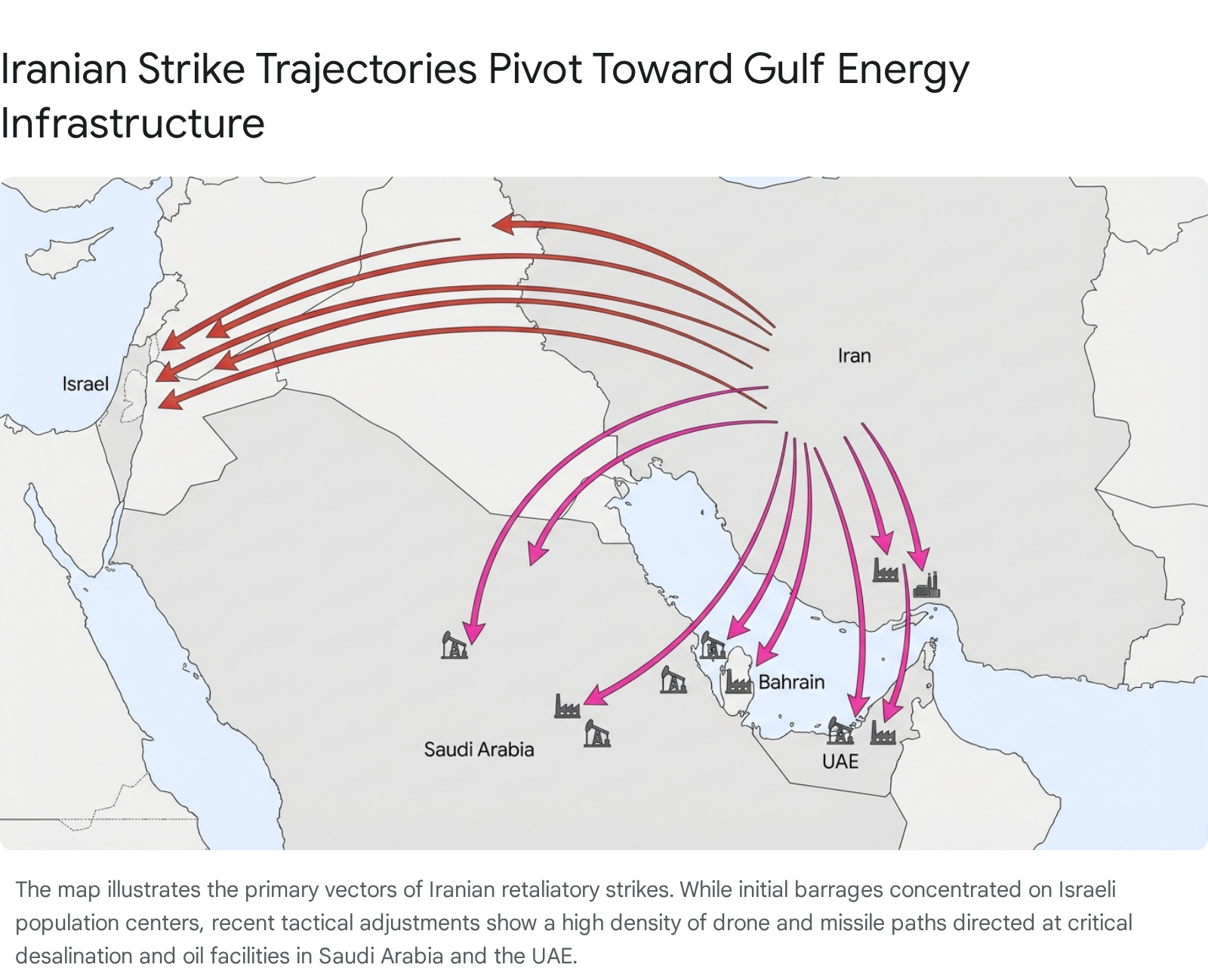
Faced with a heavily degraded launch infrastructure in the western border provinces, the IRGC Aerospace Force has strategically relocated the bulk of its ballistic missile operations deeper into the country’s interior, primarily utilizing mobile transporter erector launchers positioned within Esfahan Province.1 From these central locations, Iran has orchestrated a complex web of cross-gulf retaliatory strikes. Intelligence tracking indicates vectors originating from Esfahan and western Iran terminating at key allied infrastructure nodes, including Ras Laffan in Qatar, Yanbu in Saudi Arabia, Jebel Ali and Fujairah in the United Arab Emirates, and Mina al Ahmadi in Kuwait, effectively encircling the contested maritime corridor of the Strait of Hormuz. To maximize the probability of penetrating allied Integrated Air Defense Systems, Iranian forces have altered their munition payloads. Current technical assessments indicate that up to 70 percent of recent ballistic missile launches now utilize cluster munitions designed to saturate localized defense radars.1 Additionally, the IRGC has prioritized the deployment of the Sejjil solid-fueled medium-range ballistic missile.20 Unlike liquid-fueled variants, the Sejjil requires significantly less pre-launch preparation time, drastically reducing the operational window for allied preemptive strikes to destroy the launchers before they fire.

The Iranian military establishment has aggressively expanded its target matrix beyond purely military installations. The strategic doctrine currently employed by Tehran centers on “reciprocal deterrence” and horizontal escalation, commonly referred to by geopolitical analysts as a “madman strategy”.4 By executing precision strikes against the Haifa oil refinery in Israel, the Ras Laffan liquefied natural gas facility in Qatar, and the SAMREF refinery in Saudi Arabia, the IRGC intends to globalize the economic cost of the war, weaponizing the fragility of the hydrocarbon market to pressure the international community into forcing an allied ceasefire.4 Furthermore, Ukrainian and United States intelligence agencies have confirmed that Iran continues to heavily utilize Russian-manufactured Shahed loitering munitions, deploying them in coordinated mass swarms to overwhelm the defenses of United States logistical hubs situated in Kuwait and the United Arab Emirates.1

3.1.2 Policy & Diplomacy

The Iranian civilian and political governance apparatus is currently paralyzed by a severe, unprecedented leadership vacuum. Following the targeted assassination of Supreme Leader Ali Khamenei by allied forces at the onset of the war, his son and constitutionally designated successor, Mojtaba Khamenei, sustained severe, life-threatening injuries in subsequent allied airstrikes.1 Mojtaba has not appeared in public or in any unedited media broadcasts since March 8, 2026. Consequently, the regime has been forced to rely entirely on written statements and recycled archival media to project a facade of continuity and stability to both domestic and international audiences.1

In a written Nowruz message distributed by state media on March 20, the office of the Supreme Leader designated the new Persian year’s official theme as the “Resistance Economy in the Shadow of National Unity and National Security.” The statement focused heavily on domestic narrative control, directly blaming foreign adversaries and allied intelligence agencies for exploiting economic grievances to foment domestic unrest.1 The statement also falsely characterized recent insurgent attacks in neighboring Turkey and Oman as Israeli false-flag operations designed to isolate Tehran from its regional partners.1

In the physical absence of a functioning Supreme Leader, a highly consolidated cadre of veteran, hardline IRGC commanders has effectively seized operational control over the state apparatus.11 This inner circle, forged during the Iran-Iraq War, is driving a highly aggressive diplomatic and domestic policy agenda. Iranian Foreign Minister Abbas Araghchi has engaged in a robust international disinformation campaign, repeatedly suggesting to Arab media outlets that recent drone strikes on Gulf nations were actually allied false-flag operations designed to fracture regional diplomatic relations and justify the continuation of Operation Epic Fury.20

Concurrently, the Iranian Majlis is actively drafting legislation intended to impose punitive transit tolls, taxes, and mandatory inspections on all commercial shipping passing through the Strait of Hormuz.4 This legislative maneuvering signals a clear strategic intent to permanently alter the regulatory and security regime of the critical maritime waterway. Iranian Parliament Speaker Mohammad Bagher Ghalibaf explicitly stated that regardless of any potential future armistice, the security situation in the Strait of Hormuz will never return to its pre-war status, transforming the waterway into a permanent tool of Iranian strategic leverage.1

3.1.3 Civilian Impact

The civilian toll inside the borders of the Islamic Republic is catastrophic, severely exacerbated by the regime’s draconian internal security measures and the total collapse of basic municipal services. Internet connectivity across the nation has been effectively severed by state authorities to prevent the dissemination of information and the organization of domestic protests. Data aggregated from the global network monitoring organization NetBlocks confirms that the civilian population has endured over 500 consecutive hours of a near-total digital blackout.22 Throughout this period, national connectivity has hovered at roughly one percent of standard operational levels, isolating the domestic population from the global internet and the Iranian diaspora.34

The regime has recognized the threat posed by circumvention technologies and has specifically targeted individuals utilizing smuggled Starlink satellite terminals. Internal security forces have conducted violent residential raids to confiscate equipment, resulting in the detainment and disappearance of numerous citizens attempting to establish communication with the outside world.11 Despite the blackout, the Iranian diaspora has initiated a widespread social media campaign under the hashtag #ThisIsNotAWarPhoto, archiving historical instances of state violence, economic mismanagement, and regime brutality to counter narratives that the current civilian suffering is solely the result of allied military intervention.37

The disruption of commercial logistics, combined with the systematic destruction of the national industrial infrastructure, has triggered hyperinflation and severe, localized shortages of essential goods, medical supplies, and basic foodstuffs.38 Human rights organizations, including the Hengaw Organization for Human Rights and the United Nations Independent International Fact-Finding Mission, report that the regime is cynically using the wartime conditions as a pretext to execute mass arrests.12 The Law Enforcement Command and the paramilitary Basij are reportedly conducting sweeping operations targeting suspected political dissidents, ethnic minority groups including Kurds and Ahvazi Arabs, and suspected foreign informants.12

Verified casualty estimates remain exceedingly difficult to ascertain due to the comprehensive communications blackout and the regime’s control over domestic media. The Iranian Health Ministry officially acknowledges 1,444 fatalities and 19,324 wounded.10 However, independent monitoring groups and allied intelligence agencies estimate the death toll significantly exceeds 5,300. This higher figure comprises a chaotic mix of regular military personnel, internal security forces targeted by Israeli strikes, and substantial collateral civilian casualties resulting from both allied bombardments and the regime’s internal crackdowns.10

3.2 Israel

3.2.1 Military Actions & Posture

The Israel Defense Forces continue to execute Operation Roaring Lion with unprecedented intensity, functioning in deep tactical coordination with United States Central Command. While the United States has focused primarily on the degradation of heavy military infrastructure and nuclear latency, a primary objective of the Israeli strategy has been the systematic, methodical dismantling of Iran’s internal security and intelligence apparatus. Israeli aircraft have consistently and heavily targeted the Law Enforcement Command headquarters, Basij organizational compounds, and local police stations across major population centers including Tehran, Tabriz, and Hamedan.1 This vertical escalation strategy is specifically designed to fracture the regime’s ability to suppress domestic uprisings, thereby opening a secondary front of internal instability that the IRGC is ill-equipped to manage while simultaneously fighting a conventional war.2

Israel has also demonstrated significant, unexpected operational reach by conducting deep strikes against Iranian naval assets located far beyond the Persian Gulf. Most notably, the IDF struck the 4th Artesh Naval District Headquarters situated at Bandar Anzali Port on the Caspian Sea.1 This highly complex, long-range operation resulted in the destruction of dozens of vessels, including the prominent Moudge-class frigate IRIS Deylaman. Strategically, this strike severely degraded a critical maritime logistics route suspected of being utilized for the transfer of advanced drone technology and military hardware between the Russian Federation and the Islamic Republic.1 Concurrently in the Levant, the IDF has expanded its ground maneuver capabilities into southern Lebanon, conducting extensive precision strikes against Hezbollah weapons depots, subterranean infrastructure, and operational command centers in the Dahiyeh district of Beirut to secure Israel’s vulnerable northern flank from proxy incursions.24

3.2.2 Policy & Diplomacy

Israeli national policy remains firmly anchored in achieving total escalation dominance and fundamentally altering the balance of power in the Middle East. The Israeli war cabinet has explicitly authorized the targeted assassination of every accessible senior Iranian political, military, and intelligence official. This decapitation policy achieved significant tactical success during the reporting period with the confirmed elimination of Ali Larijani, the Secretary of the Supreme National Security Council, and Gholamreza Soleimani, the commander of the Basij Organization.10 Additional confirmed casualties include Defense Minister Aziz Nasirzadeh and the head of the military office of the Supreme Leader, Mohammad Shirazi.10

Diplomatic messaging originating from Jerusalem indicates absolutely zero willingness to engage in international ceasefire negotiations until Iran’s nuclear latency capabilities, ballistic missile production lines, and regional proxy networks are permanently and verifiably eradicated. Furthermore, localized intelligence leaks suggest that elements within the Israeli intelligence apparatus, including Mossad Director David Barnea, have signaled a belief that the sustained military and economic pressure of Operation Roaring Lion, combined with internal domestic unrest, could precipitate the total collapse of the current Iranian governance structure within the calendar year.6

3.2.3 Civilian Impact

The Israeli home front remains in a heightened, continuous state of emergency, severely disrupting daily life and the national economy. Iranian ballistic missile and drone barrages, launched primarily from central Iran and proxy positions in Lebanon and Iraq, continue to regularly penetrate Israeli airspace. These attacks trigger widespread, daily alerts across the Tel Aviv metropolitan area, the Jerusalem municipality, and the northern Galilee region, forcing millions of civilians into fortified shelters.6

While the integrated air defense network, primarily the Iron Dome and Arrow weapon systems, have intercepted the vast majority of incoming projectiles, fragments from destroyed missiles and occasional direct impacts have caused localized damage and civilian anxiety. Notable incidents this week include structural damage to residential homes in the city of Rehovot, shrapnel impacts within the Old City of Jerusalem near vital religious sites, and a missile fragment striking an evacuated kindergarten.6

A direct, targeted Iranian strike on the vital Haifa oil refinery caused temporary operational disruptions and regional power outages. However, the Ministry of Energy reported that safety protocols functioned correctly, preventing catastrophic structural failure or secondary explosions.4 Official casualty figures released by the Israeli government indicate 20 civilian fatalities, 2 military fatalities, and over 4,099 individuals treated for varying degrees of physical injuries or psychological trauma since the onset of hostilities on February 28.10 The national aviation and tourism sectors are entirely paralyzed. Ben Gurion International Airport has sustained minor damage from drone strikes targeting refueling infrastructure, and major international aviation carriers have extended commercial flight cancellations into Israeli airspace indefinitely, effectively isolating the nation from standard global travel routes.10

3.3 United States

3.3.1 Military Actions & Posture

United States Central Command is executing Operation Epic Fury with an unprecedented, generational concentration of aerospace and maritime combat power. As of March 21, the Department of War confirms that allied forces have engaged over 7,000 discrete targets across the entirety of the Iranian landmass.8 Having established near-total spectrum dominance and degraded Iranian early warning radars, the United States Air Force has transitioned from relying heavily on expensive, long-range standoff cruise missiles to stand-in engagements. These missions increasingly utilize cost-effective Joint Direct Attack Munitions dropped by F-15E Strike Eagles, F-16 Fighting Falcons, and F-35 Lightning II aircraft directly over Iranian sovereign airspace, significantly increasing the operational tempo and destruction rate.46

The most significant tactical and strategic development of the conflict occurred on the morning of March 21, when United States heavy bomber platforms deployed specialized GBU-57 Massive Ordnance Penetrator bunker-buster munitions against the subterranean Natanz nuclear enrichment facility.6 This highly specific strike fulfills the primary strategic objective mandated by the executive branch: permanently denying the Islamic Republic a nuclear weapons capability by physically collapsing the subterranean centrifuges required for uranium enrichment.48

Naval operations in the Persian Gulf and the Gulf of Oman have been equally devastating. CENTCOM officially reports the total obliteration of the Iranian Navy as a functional fighting force. Allied naval assets have confirmed the sinking or disabling of over 120 Iranian surface vessels and the complete destruction of Iran’s entire 11-vessel submarine fleet, securing absolute maritime supremacy.2 However, this dominance has come at a severe logistical cost. The intense operational tempo required to defend regional assets from Iranian retaliatory strikes has heavily depleted United States interceptor stockpiles. The continuous expenditure of Standard Missile-3 and Patriot Advanced Capability-3 munitions raises serious concerns regarding the long-term sustainability of theater air and missile defense if the conflict becomes a war of attrition.50 The Department of War has solemnly acknowledged the deaths of 13 United States service members, alongside 232 wounded personnel, since the commencement of Operation Epic Fury.10

MetricConfirmed Status (As of March 21, 2026)Source
Total Iranian Targets Engaged7,000+ facilities, bunkers, and command nodes8
Iranian Naval Assets Destroyed120+ surface combat vessels, 11 submarines2
Degradation of Enemy Air Defenses85% of Surface-to-Air Missile systems neutralized1
US Military Casualties13 Killed in Action (KIA), 232 Wounded in Action (WIA)10
Estimated Operational Cost (First 100 Hours)$3.7 Billion USD52

3.3.2 Policy & Diplomacy

The United States executive branch is currently navigating a highly complex, often contradictory matrix of military objectives, global economic realities, and domestic political pressures. Despite urgent requests from the Pentagon for an additional $200 billion in emergency supplemental funding to sustain the logistical supply chains of Operation Epic Fury 8, President Donald Trump has publicly floated the concept of “winding down” major military operations in the near future, citing the successful achievement of core decapitation and demilitarization objectives.42 This diplomatic rhetoric, however, conflicts directly with the physical realities on the ground, notably the simultaneous deployment of an additional 2,500 United States Marines and three amphibious assault ships to the operational theater to bolster regional security.42

The most consequential and unprecedented policy maneuver of the week was orchestrated by the Treasury Department. Recognizing the severe threat posed by spiking global energy prices, the Treasury issued a 30-day general license waiving international sanctions on approximately 140 million barrels of Iranian crude oil currently stranded on maritime vessels at sea.4 Treasury Secretary Scott Bessent explicitly articulated that this complex maneuver is designed to weaponize Iranian physical supply against Tehran’s strategic interests. By flooding the market with stranded oil, the United States aims to artificially drive down the surging global price of crude, thereby stabilizing allied economies and insulating American consumers, while simultaneously utilizing international banking mechanisms to deny the Iranian regime immediate access to the generated revenue.15

3.3.3 Civilian Impact

The domestic impact within the borders of the United States is predominantly economic and deeply intertwined with the domestic political cycle. The forced closure of the Strait of Hormuz by Iranian naval remnant forces, combined with the systematic targeting of Gulf energy infrastructure, caused global benchmark Brent crude to briefly spike above $115 per barrel.16 This international instability translated to immediate, severe price increases at domestic fuel pumps across the United States. The administration views the rapid stabilization of these energy costs as a critical domestic security imperative, particularly with the rapid approach of the November midterm elections, where economic stability remains a paramount voter concern.16

While independent polling data indicates robust, unwavering support for Operation Epic Fury among the administration’s core political base, broader public anxiety regarding the economic ripple effects and the potential for a protracted, open-ended conflict continues to permeate the national discourse.53 The aviation sector remains heavily disrupted due to the rerouting of commercial freight and passenger traffic away from the Middle East, increasing logistics costs and straining international supply chains that directly impact American retail and manufacturing sectors.55

4.0 Regional and Gulf State Impacts

The nations comprising the Gulf Cooperation Council are currently trapped in the geographic and economic crossfire of the conflict. While these states have historically relied on the United States security umbrella for survival, the sheer volume of incoming Iranian projectiles has forced them into an uncomfortable, highly defensive posture. They are simultaneously acting as the primary shield against Iranian horizontal escalation while suffering immense economic damage to their sovereign infrastructure.

  • Saudi Arabia: The Kingdom has absorbed significant, sustained strikes targeting its eastern provinces and critical energy infrastructure. On March 21 alone, Saudi integrated air defenses successfully intercepted over 22 incoming suicide drones.9 The SAMREF refinery in Yanbu, located on the Red Sea coast, was struck by an Iranian drone, highlighting Tehran’s dangerous ability to project power across the entirety of the Arabian Peninsula and threaten alternative shipping routes.5 Logistically, Riyadh has permitted United States forces to utilize the King Fahd Air Base in Taif for combat operations, recognizing its strategic depth and safer distance from primary Iranian launch sites compared to the highly exposed Prince Sultan Air Base.57 Diplomatically, Saudi Arabia hosted an emergency summit of twelve Arab and Islamic states, resulting in a joint communique that strongly condemned Iran’s attacks on civilian infrastructure as a violation of the UN Charter.26
  • United Arab Emirates: The UAE has faced the highest volume of incoming hostile fire of any Gulf state, successfully intercepting over 1,946 ballistic missiles and drones since the war commenced.58 Iranian military authorities explicitly ordered the civilian evacuation of Dubai’s Jebel Ali port and Abu Dhabi’s Khalifa port, threatening direct, devastating strikes on commercial maritime assets.59 While these specific ports remain operational, debris from intercepted munitions caused a severe secondary fire at the port of Fujairah, and operations at the critical Habshan gas facility were temporarily suspended due to proximity threats.8 In diplomatic retaliation, the Emirati government has ceased issuing visas to Iranian nationals and forcibly closed several Iranian-affiliated commercial and cultural institutions.4
  • Qatar: The State of Qatar suffered the most devastating single economic blow of the week when Iranian ballistic missiles penetrated local defenses and struck the Ras Laffan Industrial City. The precision strike severely damaged two highly specialized liquefied natural gas trains, instantly halting 17 percent of the nation’s total LNG export capacity.1 Qatari Energy Minister Saad bin Sherida Al Kaabi publicly warned that specialized repairs could take up to four months, potentially forcing the state to declare force majeure on long-term supply contracts with vital European and Asian markets.5 Al Kaabi grimly noted that the broader infrastructure damage could set back the entire Gulf region’s economic development by a decade or more.9
  • Kuwait: Iranian loitering munitions successfully bypassed localized air defenses to strike both the Mina al Ahmadi and Mina Abdullah petroleum refineries, causing localized fires within the operational distillation units.1 The Kuwaiti Armed Forces remain on maximum alert, reporting the interception of dozens of hostile drones daily and continually advising citizens to remain vigilant.1
  • Bahrain: Serving as the strategic headquarters for the United States Fifth Fleet, the island nation of Bahrain has been a primary, persistent target for Iranian aggression. The Bahrain Defense Force officially confirmed the interception and destruction of 143 ballistic missiles and 242 drones since the onset of hostilities. This volume of fire emphasizes the extreme, unsustainable strain placed on their national Integrated Air Defense Systems and the inherent danger of hosting major US naval assets during a regional conflict.9
  • Oman: Desperately attempting to maintain its historical role as a neutral regional mediator, Oman has publicly and repeatedly condemned the escalation from all parties. Omani Foreign Minister Badr al-Busaidi has actively criticized the initial United States and Israeli preemptive strikes as a “grave miscalculation” and a “catastrophe”.19 He continues to push aggressively for an immediate diplomatic ceasefire, warning international audiences in leading publications that the continuation of hostilities risks plunging the entire global economy into a deep, protracted recession.19
  • Jordan: Positioned geographically directly beneath the primary ballistic flight paths connecting Israel, Iran, and Iraq, the Hashemite Kingdom of Jordan has been forced to enact partial, rolling closures of its sovereign airspace to ensure the safety of commercial aviation.62 United States Terminal High Altitude Area Defense interceptor batteries deployed within Jordanian borders remain highly active, tracking and destroying transiting Iranian munitions before they cross into Israeli airspace, firmly embedding Jordan within the allied defensive architecture.64

5.0 Appendices

Appendix A: Methodology

The intelligence and data synthesized within this SITREP were aggressively aggregated through a comprehensive, real-time sweep of global open-source intelligence networks, official state military broadcasts, and regional independent monitors. To ensure absolute chronological accuracy across disparate geographic reporting zones, all event time-stamps were strictly normalized to Coordinated Universal Time. Casualty figures and battle damage assessments were meticulously cross-referenced between official state claims provided by United States Central Command, the IDF Spokesperson’s Unit, and the Iranian Health Ministry, against independent human rights monitoring bodies such as the Hengaw Organization for Human Rights, to maintain rigid analytical neutrality.10 Civilian infrastructure data, specifically regarding the Iranian network connectivity blackout, was exclusively sourced from the global internet monitor NetBlocks to ensure technical accuracy.22 In rare instances of conflicting narratives regarding military hardware, such as the exact nature of the munitions deployed during the Natanz strike, analytical preference was given to the established consensus among defense analysts and allied public broadcasting networks.6

Appendix B: Glossary of Acronyms

  • CENTCOM: United States Central Command. The unified combatant command of the United States Department of War responsible for all military operations and security cooperation within the Middle East, Central Asia, and parts of South Asia.65
  • GCC: Gulf Cooperation Council. A regional intergovernmental political and economic union consisting of all Arab states of the Persian Gulf except Iraq. Member states include Bahrain, Kuwait, Oman, Qatar, Saudi Arabia, and the United Arab Emirates.17
  • IADS: Integrated Air Defense System. A highly complex, multi-layered defensive network incorporating early warning radars, tracking sensors, and various surface-to-air missile systems (such as THAAD, Patriot, and Iron Dome) designed to collaboratively detect, track, and destroy incoming hostile aerial threats.66
  • IRGC: Islamic Revolutionary Guard Corps. The primary paramilitary, internal security, and asymmetric warfare force of the Iranian regime, functioning parallel to the conventional armed forces.68
  • IRGC-AF: Islamic Revolutionary Guard Corps Aerospace Force. The specific branch of the IRGC responsible for Iran’s strategic ballistic missile arsenal, drone operations, and military space programs.1
  • JDAM: Joint Direct Attack Munition. A GPS and inertial navigation guidance kit utilized by the United States Air Force that converts unguided “dumb” bombs into all-weather precision-guided munitions.46
  • LEC: Law Enforcement Command. The unified national civilian police and internal security force of the Islamic Republic of Iran, heavily utilized for domestic riot control.69
  • LNG: Liquefied Natural Gas. Natural gas that has been cooled to a liquid state for ease and safety of non-pressurized storage and transport. It is the fundamental backbone of the Qatari export economy.5
  • MOP: Massive Ordnance Penetrator (GBU-57). A highly specialized, precision-guided, 30,000-pound “bunker buster” bomb exclusively used by United States Air Force heavy bombers to destroy deeply buried and hardened subterranean targets.6
  • SPND: Organization of Defensive Innovation and Research. An Iranian state-run research agency historically linked to the development of advanced military technologies and the nation’s pre-2004 nuclear weapons program.71
  • THAAD: Terminal High Altitude Area Defense. An advanced American anti-ballistic missile defense system designed to intercept and destroy short, medium, and intermediate-range ballistic missiles during their terminal phase of flight.64

Appendix C: Glossary of Foreign Words

  • Artesh: The conventional military forces of the Islamic Republic of Iran. They operate alongside, but generally subordinate to, the IRGC, focusing primarily on traditional territorial defense.68
  • Basij: A massive volunteer paramilitary militia established by the regime in 1979. Operating under the direct command of the IRGC, the Basij is heavily utilized for internal state security, morals policing, and violent protest suppression.14
  • Dahiyeh: A predominantly Shia Muslim urban suburb located south of Beirut, Lebanon. It is internationally recognized as the primary political stronghold and operational headquarters for the Hezbollah militant organization.24
  • Hengaw: An independent, non-governmental human rights organization that meticulously monitors and reports on human rights violations, executions, and state violence within Iran, with a particular focus on the marginalized Kurdish regions.12
  • Khamenei: The surname referring to Ali Khamenei, the deceased Supreme Leader of Iran killed during the opening strikes of the conflict, and his son, Mojtaba Khamenei, the currently incapacitated successor.1
  • Majlis: The Islamic Consultative Assembly, which serves as the national legislative body and parliament of the Islamic Republic of Iran.1
  • Nowruz: The ancient Persian New Year, observed precisely on the vernal equinox. It marks a period of profound cultural significance and national holidays within Iran.1
  • Sejjil: A family of Iranian domestically produced, solid-fueled medium-range ballistic missiles. Their solid-fuel design allows for rapid deployment and launch, making them highly survivable against preemptive strikes.20
  • Shahed: A notorious series of Iranian-designed loitering munitions, commonly referred to as “kamikaze drones.” They are heavily utilized by the IRGC and have been widely exported to the Russian Federation.1
  • Shahrbani: The historical Iranian law enforcement agency that existed prior to 1991, which was subsequently merged with other forces to create the modern Law Enforcement Command.70

Please share the link on Facebook, Forums, with colleagues, etc. Your support is much appreciated and if you have any feedback, please email us in**@*********ps.com. If you’d like to request a report or order a reprint, please click here for the corresponding page to open in new tab.


Sources Used

  1. Iran Update Special Report, March 19, 2026 | ISW, accessed March 21, 2026, https://understandingwar.org/research/middle-east/iran-update-special-report-march-19-2026/
  2. Epic Fury Acts: Trump’s three phases of war on Iran with an unknown endgame, accessed March 21, 2026, https://m.economictimes.com/news/defence/epic-fury-acts-trumps-us-israel-three-phases-of-war-on-iran-in-west-asia-with-an-unknown-endgame/articleshow/129715834.cms
  3. Operation Epic Fury: Decisive American Power to Crush Iran’s Terror Regime, accessed March 21, 2026, https://china.usembassy-china.org.cn/operation-epic-fury-decisive-american-power-to-crush-irans-terror-regime/
  4. Iran War Sitrep #20: US waiver allows sale of Iranian oil, focus on …, accessed March 21, 2026, https://amwaj.media/en/media-monitor/iran-war-sitrep-20-us-waiver-allows-sale-of-iranian-oil-focus-on-hormuz-shipping
  5. Iran War Sitrep #19: Energy infrastructure in crosshairs, Israel hits Caspian fleet, accessed March 21, 2026, https://amwaj.media/en/media-monitor/iran-war-sitrep-19-energy-infrastructure-in-crosshairs-israel-hits-caspian-fleet
  6. Report: US carried out strike on Natanz enrichment facility using …, accessed March 21, 2026, https://www.timesofisrael.com/liveblog_entry/report-us-carried-out-strike-on-natanz-enrichment-facility-using-bunker-buster-bombs/
  7. Iran’s Natanz nuclear facility hit by US-Israel strikes: Why the site is key, accessed March 21, 2026, https://www.hindustantimes.com/world-news/natanz-nuclear-facility-iran-attacked-in-fresh-us-israel-strikes-no-radioactive-leaks-so-far-101774084733106.html
  8. Iran war escalates, energy prices spike after Israeli strike on South …, accessed March 21, 2026, https://www.cbsnews.com/live-updates/iran-war-israel-strike-south-pars-gas-field-trump-threat-oil-gas-prices/
  9. US-Israel Conflict: Trump Considers Scaling Back Middle East …, accessed March 21, 2026, https://gulfnews.com/uae/usisrael-war-on-iran-day-22-trump-mulls-winding-down-middle-east-operation-us-lifts-sanctions-on-some-iranian-oil-1.500481599
  10. 2026 Iran war – Wikipedia, accessed March 21, 2026, https://en.wikipedia.org/wiki/2026_Iran_war
  11. Iran Update Special Report, March 16, 2026, accessed March 21, 2026, https://understandingwar.org/research/middle-east/iran-update-evening-special-report-march-16-2026/
  12. Global community must act against internet blackout in iran to prevent crimes in darkness, accessed March 21, 2026, https://hengaw.net/en/news/2026/03/article-49
  13. Iran: Internet Shutdown Violates Rights, Escalates Risks to Civilians, accessed March 21, 2026, https://www.hrw.org/news/2026/03/06/iran-internet-shutdown-violates-rights-escalates-risks-to-civilians
  14. Indicators of Iranian Regime Instability | ISW, accessed March 21, 2026, https://understandingwar.org/research/middle-east/indicators-of-iranian-regime-instability/
  15. US temporarily waives sanctions on Iran oil stranded at sea to ease prices | Daily Sabah, accessed March 21, 2026, https://www.dailysabah.com/business/energy/us-temporarily-waives-sanctions-on-iran-oil-stranded-at-sea-to-ease-prices
  16. US lifts sanctions on Iranian oil at sea in bid to ease supply pressures, accessed March 21, 2026, https://www.theguardian.com/us-news/2026/mar/20/us-sanctions-iranian-oil
  17. Caught in the Crossfire: Gulf Security and Strategy in the US–Israel War on Iran, accessed March 21, 2026, https://arabcenterdc.org/resource/caught-in-the-crossfire-gulf-security-and-strategy-in-the-us-israel-war-on-iran/
  18. ‘Not our war’: Gulf states weigh up options as existential threat from Iran conflict grows, accessed March 21, 2026, https://www.theguardian.com/world/2026/mar/20/gulf-states-weigh-up-options-iran-us-israel-conflict-middle-east-crisis-war
  19. Oman claims Israel pushed US into Iran war when deal was possible – The Guardian, accessed March 21, 2026, https://www.theguardian.com/world/2026/mar/19/us-lost-control-of-its-own-foreign-policy-oman-foreign-minister
  20. Iran Update Special Report, March 15, 2026, accessed March 21, 2026, https://understandingwar.org/research/middle-east/iran-update-evening-special-report-march-15-2026/
  21. This Week in DOW: U.S. Delivers ‘Devastating Combat Power’ to Iran, accessed March 21, 2026, https://www.war.gov/News/News-Stories/Article/Article/4440215/this-week-in-dow-us-delivers-devastating-combat-power-to-iran/
  22. NetBlocks: Home, accessed March 21, 2026, https://netblocks.org/
  23. Iran’s internet shutdown enters 18th day: NetBlocks, accessed March 21, 2026, https://www.dawn.com/news/1982986/irans-internet-shutdown-enters-18th-day-netblocks
  24. Operation “Epic Fury:” SITREP (17 MAR 2026), accessed March 21, 2026, https://ict.org.il/operation-epic-fury-sitrep-17-mar-2026-2/
  25. Türkiye slams Israeli strike in Syria as ‘dangerous escalation’ – Yeni Safak English, accessed March 21, 2026, https://en.yenisafak.com/turkiye/turkiye-slams-israeli-strike-in-syria-as-dangerous-escalation-3716093
  26. Foreign ministers of 12 Arab and Islamic states call on Iran to stop strikes, accessed March 21, 2026, https://tert.am/en/news/2026/03/19/Arab%20and%20Islamic%20states/4264156
  27. Joint Statement Issued by the Consultative Ministerial Meeting of Foreign Ministers of the Group of Arab and Islamic Countries on Iranian Aggressions, 19 March 2026 / Republic of Türkiye Ministry of Foreign Affairs, accessed March 21, 2026, https://www.mfa.gov.tr/joint-statement-issued-by-the-consultative-ministerial-meeting-of-foreign-ministers-of-the-group-of-arab-and-islamic-countries-on-iranian-aggressions-19-march-2026.en.mfa
  28. Live – Overnight strikes hit Tehran and cities across Iran, accessed March 21, 2026, https://www.iranintl.com/en/liveblog/202603192844
  29. ‘Bring almost 140 mn barrels to global markets’: After Russian, US eases sanctions on Iranian oil, accessed March 21, 2026, https://timesofindia.indiatimes.com/business/international-business/bring-almost-140-mn-barrels-to-global-markets-after-russian-us-waives-sanctions-on-iranian-oil/articleshow/129711926.cms
  30. Natanz Enrichment Complex Targeted in Overnight Strike, Officials Report No Environmental Threat – Kurdistan24, accessed March 21, 2026, https://www.kurdistan24.net/en/story/902154/natanz-enrichment-complex-targeted-in-overnight-strike-officials-report-no-environmental-threat
  31. Iran-Israel war LIVE: U.S.-Israel launch attacks on Natanz enrichment facility, says Iran, accessed March 21, 2026, https://www.thehindu.com/news/international/iran-israel-us-war-west-asia-conflict-live-updates-hezbollah-oil-supply-march-21-2026/article70768245.ece
  32. Iran Update Special Report, March 20, 2026, accessed March 21, 2026, https://understandingwar.org/research/middle-east/iran-update-special-report-march-20-2026/
  33. Iran-Israel war updates on March 19, 2026: Premium petrol prices hiked by 2-3/litre, says Oil Ministry, accessed March 21, 2026, https://www.thehindu.com/news/international/iran-israel-usa-war-live-updates-march-19-2026/article70760463.ece
  34. How Iranians are communicating through internet blackout, accessed March 21, 2026, https://www.japantimes.co.jp/news/2026/03/16/world/how-iran-internet-blackout/
  35. 2026 Internet blackout in Iran – Wikipedia, accessed March 21, 2026, https://en.wikipedia.org/wiki/2026_Internet_blackout_in_Iran
  36. Widespread Internet Blackout Continues Across Iran, accessed March 21, 2026, https://caspianpost.com/iran/widespread-internet-blackout-continues-across-iran
  37. Iran’s internet chokes under wartime clampdown, accessed March 21, 2026, https://www.iranintl.com/en/202603172150
  38. The silence that speaks for Iranian voices, accessed March 21, 2026, https://www.bushcenter.org/publications/the-silence-that-speaks-for-iranian-voices
  39. UN Fact-Finding Mission Warns Iran’s Human Rights Crisis Could Worsen Amid Regional Conflict, accessed March 21, 2026, https://iranhumanrights.org/2026/03/un-fact-finding-mission-warns-irans-human-rights-crisis-could-worsen-amid-regional-conflict/
  40. Operation “Epic Fury:” SITREP (11 MAR 2026), accessed March 21, 2026, https://ict.org.il/operation-epic-fury-sitrep-11-mar-2026/
  41. Iran-Israel war updates on March 20, 2026: Trump rules out ceasefire in Iran – The Hindu, accessed March 21, 2026, https://www.thehindu.com/news/international/iran-israel-war-usa-west-asia-trump-netanyahu-live-updates-march-20-2026/article70764069.ece
  42. Iran says a strike hit a key nuclear facility as Mideast war enters week 4 and US sends more troops, accessed March 21, 2026, https://apnews.com/article/iran-us-israel-trump-lebanon-march-21-2026-260bac76e5554ff31aaf5a3a30c92a2e
  43. Israel denies ‘dragging’ US into war – as it happened | US-Israel war on Iran | The Guardian, accessed March 21, 2026, https://www.theguardian.com/world/live/2026/mar/19/iran-war-live-updates-oil-prices-gas-field-strikes-pentagon-more-funds-trump-news?filterKeyEvents=false&page=with%3Ablock-69bc74618f0821ab0df2f7ff
  44. Airlines cancel more flights as Middle East conflict escalates, accessed March 21, 2026, https://www.al-monitor.com/originals/2026/03/airlines-cancel-more-flights-middle-east-conflict-escalates
  45. operation epic fury – fact sheet – march 16, 2026, accessed March 21, 2026, https://media.defense.gov/2026/Mar/16/2003899496/-1/-1/1/OPERATION-EPIC-FURY-FACT-SHEET.PDF
  46. Operation Epic Fury Situation Report | Battlefield Effects and Early Strategic Signals, accessed March 21, 2026, https://www.hudson.org/missile-defense/operation-epic-fury-situation-report-battlefield-effects-strategic-outcomes-can-kasapoglu
  47. OPERATION EPIC FURY: US Launches Massive Strikes Against Iran (March 2026), accessed March 21, 2026, https://www.youtube.com/watch?v=ME_rZggWY8M
  48. Operation Epic Fury: Decisive American Power to Crush Iran’s Terror Regime, accessed March 21, 2026, https://www.whitehouse.gov/articles/2026/03/operation-epic-fury-decisive-american-power-to-crush-irans-terror-regime/
  49. Operation Epic Fury | U.S. Department of War, accessed March 21, 2026, https://www.war.gov/Spotlights/Operation-Epic-Fury/
  50. COMMENTARY: Some Early Air, Missile Defense Observations from Operation Epic Fury, accessed March 21, 2026, https://www.nationaldefensemagazine.org/articles/2026/3/18/commentary-some-early-air-missile-defense-observations-from-operation-epic-fury
  51. The Latest: US deploys more troops to Mideast as Trump considers ‘winding down’ military operations, accessed March 21, 2026, https://www.news4jax.com/news/world/2026/03/21/the-latest-us-deploys-more-troops-to-mideast-as-trump-considers-winding-down-military-operations/
  52. $3.7 Billion: Estimated Cost of Epic Fury’s First 100 Hours – CSIS, accessed March 21, 2026, https://www.csis.org/analysis/37-billion-estimated-cost-epic-furys-first-100-hours
  53. What Are the Implications of the Iran Conflict for Japan?, accessed March 21, 2026, https://www.csis.org/analysis/what-are-implications-iran-conflict-japan
  54. Americans Agree that Operation Epic Fury Is an Overwhelming Success, accessed March 21, 2026, https://www.whitehouse.gov/articles/2026/03/americans-agree-that-operation-epic-fury-is-an-overwhelming-success/
  55. Middle East Aviation Crisis: 52,000 Flights Cancelled as War Shuts Key Airspace, accessed March 21, 2026, https://www.traveltourister.com/news/middle-east-aviation-crisis-2026-complete-guide-21-days-52000-flights-cancelled-hole-in-sky-uae-airspace-304-missiles-1627-drones-emirates-110-destinations-qatar-march-28-easa-march-27-no-ceasefire-ev/
  56. DGCA Issues Urgent Advisory Ordering Indian Airlines To Avoid 11 Conflict-Zone Airspaces In West Asia, accessed March 21, 2026, https://www.visahq.com/news/2026-03-20/in/dgca-issues-urgent-advisory-ordering-indian-airlines-to-avoid-11-conflict-zone-airspaces-in-west-asia/
  57. ‘Punish Iran’: Saudi Arabia and UAE inch closer to supporting US-Israeli war, accessed March 21, 2026, https://www.middleeasteye.net/news/saudi-arabia-and-uae-inch-closer-to-us-israeli-war-on-iran
  58. The Gulf states’ offensive options against Iran, accessed March 21, 2026, https://www.iiss.org/online-analysis/online-analysis/2026/03/the-gulf-states-offensive-options-against-iran/
  59. Tehran claims the US attacked it from the UAE as Iran war enters its third week, accessed March 21, 2026, https://apnews.com/article/iran-iraq-us-trump-march-14-2026-oil-prices-a2399398b4c590995b814d7640362a11
  60. Oman renews push for diplomacy, says ‘off-ramps available’ in Iran war | News – Al Jazeera, accessed March 21, 2026, https://www.aljazeera.com/news/2026/3/3/oman-calls-for-immediate-ceasefire-says-off-ramps
  61. Not America’s war”: Oman warns US to stay out of Iran conflict – AzerNews, accessed March 21, 2026, https://www.azernews.az/region/255961.html
  62. Risk Summary 18 Mar 2026 – Safe Airspace, accessed March 21, 2026, https://safeairspace.net/summary/
  63. Jordan announces partial closure of airspace, accessed March 21, 2026, https://english.wafa.ps/Pages/Details/167943
  64. Blinding US Eyes in the Middle East | Al Jazeera Centre for Studies, accessed March 21, 2026, https://studies.aljazeera.net/en/analyses/blinding-us-eyes-middle-east
  65. U.S. Forces Launch Operation Epic Fury – centcom, accessed March 21, 2026, https://www.centcom.mil/MEDIA/PRESS-RELEASES/Press-Release-View/Article/4418396/us-forces-launch-operation-epic-fury/
  66. What, Exactly, is an Integrated Air Defense System? – Mitchell Institute for Aerospace Studies, accessed March 21, 2026, https://www.mitchellaerospacepower.org/systems-of-systems-what-exactly-is-an-integrated-air-defense-system/
  67. How Integrated Air Defense System ( IADS ) Work – YouTube, accessed March 21, 2026, https://www.youtube.com/watch?v=OC27Qpl6mvU
  68. Explainer: the Iranian Armed Forces – Institute for the Study of War, accessed March 21, 2026, https://understandingwar.org/research/middle-east/explainer-the-iranian-armed-forces/
  69. Iranian Intelligence Community: An Overview – Grey Dynamics, accessed March 21, 2026, https://greydynamics.com/iranian-intelligence-community-an-overview/
  70. Police Command of the Islamic Republic of Iran – Wikipedia, accessed March 21, 2026, https://en.wikipedia.org/wiki/Police_Command_of_the_Islamic_Republic_of_Iran
  71. Supporting Snapback of UN Sanctions on Iran with Additional Sanctions – State Department, accessed March 21, 2026, https://www.state.gov/releases/office-of-the-spokesperson/2025/10/supporting-snapback-of-un-sanctions-on-iran-with-additional-sanctions
  72. Organization of Defensive Innovation and Research (SPND) – Iran Watch, accessed March 21, 2026, https://www.iranwatch.org/iranian-entities/organization-defensive-innovation-and-research
  73. Organization of Defensive Innovation and Research – Wikipedia, accessed March 21, 2026, https://en.wikipedia.org/wiki/Organization_of_Defensive_Innovation_and_Research

Operation Epic Fury Weekly SITREP – March 14, 2026

1.0 Executive Summary

The geopolitical and military landscape of the Middle East has undergone a systemic and irreversible transformation over the past seven days. The ongoing conflict, initiated on February 28, 2026, by the United States and Israel under the operational designations Operation Epic Fury and Operation Roaring Lion, has transitioned from a phase of rapid decapitation strikes into a grueling campaign of infrastructure attrition and proxy containment.1 Over the last 36 hours, the conflict has reached a critical inflection point characterized by the functional defeat of the Iranian ballistic missile production apparatus, the consolidation of a highly distributed Iranian retaliatory command structure, and the unprecedented direct targeting of Gulf Cooperation Council sovereign territories by Iranian state forces.3

The confrontation materialized following the total collapse of the 2025 to 2026 nuclear negotiations held in Geneva and Oman. After diplomacy between United States Special Envoy Steve Witkoff and Iranian Foreign Minister Abbas Araghchi failed to meet an imposed 60-day deadline, the United States and Israel calculated that Iran’s weakened domestic posture presented a strategic window to dismantle its nuclear and ballistic capabilities permanently.1 The opening salvos successfully eliminated Supreme Leader Ali Khamenei and devastated the central command nodes of the Islamic Revolutionary Guard Corps.1

The most profound systemic shift observed in the current reporting period is the degradation of the Iranian Integrated Air Defense System and its offensive launch capabilities. United States and Israeli defense officials assess that the Iranian military has lost approximately 80 percent of its total offensive capability, with between 160 and 190 primary ballistic missile launchers confirmed destroyed and an additional 200 units severely disabled.2 Consequently, the volume of retaliatory missile and drone launches from Iranian territory has plummeted by an estimated 90 to 95 percent compared to the opening days of the war.3 However, this tactical degradation has not yielded strategic capitulation. The Islamic Revolutionary Guard Corps has transitioned to a highly decentralized and distributed command model, allowing surviving localized units to operate autonomously and sustain asymmetrical pressure on maritime choke points and regional American military installations.4

Diplomatically, the strategic isolation of the Islamic Republic of Iran has accelerated dramatically. On March 11, 2026, the United Nations Security Council adopted Resolution 2817 with a 13 to 0 vote, unequivocally condemning Iranian strikes on civilian and energy infrastructure in Bahrain, Kuwait, Oman, Qatar, Saudi Arabia, the United Arab Emirates, and Jordan.5 This resolution signifies a historic and formal alignment between the Gulf Cooperation Council and Western security architectures, fundamentally altering the diplomatic baseline that has governed Gulf relations with Tehran for decades.8 The text of the resolution formally invokes Article 51 of the United Nations Charter, establishing a robust legal framework for collective self-defense against Iranian territorial aggression.7

The economic and civilian fallout continues to expand exponentially across multiple continents. The functional closure of the Strait of Hormuz has paralyzed global maritime trade corridors, driving Brent crude prices above the 100 dollars per barrel threshold.9 This global energy shock has triggered emergency interventions by the United States Treasury, which controversially issued a sanctions waiver for Russian crude oil to stabilize skyrocketing domestic fuel prices.10 Concurrently, the humanitarian crisis inside Iran, Lebanon, and across the wider region is deteriorating rapidly. Strikes on dual-use infrastructure, including water desalination plants and power grids, threaten to unleash cascading public health emergencies, prompting the United Nations human rights office to warn of severe environmental catastrophes.11 The United States Department of State has responded to the escalating regional instability by issuing unprecedented evacuation advisories for 14 Middle Eastern nations, signaling an anticipation of a prolonged and widening theater of conflict that will heavily impact global capital markets and supply chains for the foreseeable future.12

2.0 Chronological Timeline of Key Events (Last 7 Days)

The following timeline details the critical military, diplomatic, and economic developments over the past seven days, with a granular focus on the exact 36-hour window preceding the publication of this report. All timestamps are recorded in Coordinated Universal Time (UTC).

  • March 7, 2026:
  • 14:00 UTC: United States and Israeli forces formally conclude the first week of Operation Epic Fury, having struck over 6,000 targets cumulatively across the Iranian plateau.2
  • 18:30 UTC: Iranian retaliatory strikes begin targeting United States military installations in Iraq and Syria, utilizing surviving drone stockpiles to test localized air defense responses.
  • March 9, 2026:
  • 04:15 UTC: The Qatari Ministry of Defense successfully intercepts multiple Iranian ballistic and cruise missiles directed toward the capital city of Doha.14
  • 11:00 UTC: A joint diplomatic statement is issued by Saudi Arabia, the United Arab Emirates, Bahrain, Kuwait, Qatar, Jordan, and the United States, reaffirming the collective right to self-defense against unprovoked Iranian aggression.15
  • March 11, 2026:
  • 15:00 UTC: Open-source intelligence analysts confirm combined force strikes on internal security sites in Marivan City, Kurdistan Province, an area known for intense anti-regime sentiment and civilian unrest.17
  • 18:00 UTC: The United Nations Security Council successfully passes Resolution 2817, spearheaded by Bahrain, condemning Iranian attacks on Gulf States. The Russian Federation and the People’s Republic of China abstain from the vote.5
  • 22:19 UTC: Iranian naval forces strike a Chinese-owned, Liberian-flagged commercial vessel transiting the Strait of Hormuz, marking the last confirmed attack on civilian shipping in the waterway before a tactical shift to selective passage enforcement.3
  • March 12, 2026 (Beginning of the 36-Hour Tactical Window):
  • 19:00 UTC: Israeli Prime Minister Benjamin Netanyahu holds a comprehensive press conference explicitly stating that the ultimate objective of the military campaign is creating the optimal conditions for toppling the Iranian regime.3
  • 20:15 UTC: The United States Department of State issues an urgent travel advisory instructing American citizens to depart from 14 Middle Eastern nations immediately due to severe and rapidly expanding regional safety risks.12
  • 22:30 UTC: A United States military KC-135 Stratotanker aerial refueling aircraft crashes in western Iraq during a combat support mission, severely complicating logistics for sustained air patrols.9
  • 23:45 UTC: An Iranian drone strike successfully penetrates local air defenses to hit the Address Creek Harbour hotel in Dubai, United Arab Emirates, occurring alongside separate strikes targeting the Kuwait International Airport.18
  • March 13, 2026:
  • 02:00 UTC: Indian Prime Minister Narendra Modi holds a high-level telephone call with Iranian President Masoud Pezeshkian to discuss the protection of Indian nationals and the essential transit of energy resources through the Gulf.10
  • 04:30 UTC: The Israeli Defense Forces issue urgent evacuation warnings for the Villa and Moniriyeh districts of Tehran ahead of impending strategic bombing runs targeting military infrastructure embedded in civilian zones.10
  • 05:46 UTC: United States Central Command officially confirms the crash of the KC-135 aircraft, reporting four service members killed and two undergoing active combat search and rescue operations.9
  • 08:15 UTC: Multiple heavy explosions are reported in central Tehran by international journalists following a new wave of Israeli airstrikes targeting the Law Enforcement Command facilities in Gharchak.3
  • 10:00 UTC: United States Defense Secretary Pete Hegseth holds a press briefing declaring that Iran’s ballistic missile production capacity has been functionally defeated and that the nation’s air defenses have been neutralized.3
  • 12:30 UTC: The United States Treasury issues a highly consequential sanctions waiver allowing the sale of Russian crude oil through April 11 to stabilize global energy markets disrupted by the conflict.10
  • 15:45 UTC: President Donald Trump publicly announces the total obliteration of all military targets on Iran’s Kharg Island, deliberately sparing the civilian oil infrastructure but threatening its imminent destruction if maritime interference continues.10
  • 18:00 UTC: Iranian state media broadcasts the first official statement from the newly elevated Supreme Leader Mojtaba Khamenei, vowing continued retaliation and maintaining a systemic stranglehold on the Strait of Hormuz.9
  • 21:00 UTC: The Israeli Defense Forces execute a targeted strike on a primary healthcare center in southern Lebanon, resulting in the deaths of 12 medical personnel amid rapidly expanding ground operations against Hezbollah.10
  • March 14, 2026:
  • 01:30 UTC: Rescue workers in southern Tehran continue searching through heavy rubble following intense overnight strikes targeting deeply buried Islamic Revolutionary Guard Corps logistics hubs.20
  • 05:00 UTC: The United States State Department formally announces a 10 million dollar reward for actionable intelligence regarding the location of Mojtaba Khamenei and surviving senior Iranian military leadership.10

3.0 Situation by Primary Country

3.1 Iran

3.1.1 Military Actions & Posture

The military posture of the Islamic Republic of Iran has transitioned completely from a doctrine of proactive regional deterrence to a desperate stance of acute regime survival and asymmetrical harassment. Prior to the onset of the current reporting period, the Iranian armed forces and the Islamic Revolutionary Guard Corps possessed one of the most formidable and numerically vast ballistic missile and unmanned aerial vehicle arsenals in the Middle East. Deep intelligence assessments from the United States and Israel now indicate that approximately 80 percent of Iran’s total offensive strike capability has been neutralized.3 Precision strikes have successfully destroyed between 160 and 190 primary ballistic missile launchers and disabled a further 200 units.2

The combined force air campaign has systematically dismantled the Iranian defense industrial base. Critical infrastructure has been obliterated. The Shiraz Electronics Industries complex, which is responsible for manufacturing advanced avionics, radar systems, and precision missile guidance technology, was heavily struck on March 12.3 Furthermore, the Hajiabad Industrial Zone, which houses the Pegah Aluminum Arak Company and supports the Iran Centrifuge Technology Company in uranium enrichment efforts, was targeted on March 13.3 This effectively halts Iran’s ability to replenish its depleted munitions stockpiles or advance its nuclear ambitions in the near term. The combined forces also maintained pressure on critical aviation hubs, executing repeat strikes against the Naval Aviation Base in Bandar Abbas, the 4th Tactical Air Base in Dezful, and the 7th Tactical Air Base in Shiraz to prevent any residual Iranian air sorties.18 United States Defense Secretary Pete Hegseth noted on March 13 that Iran’s air defenses have been fundamentally shattered following the dropping of 200 munitions on Tehran Province air defense bases, allowing Israeli and American aircraft to operate with near impunity in previously denied airspace.3

In response to the decapitation of central leadership and the systematic destruction of heavy infrastructure, the Islamic Revolutionary Guard Corps has adopted a highly distributed and fragmented command and control model.4 Surviving tactical commanders are operating under localized autonomy, demonstrating the resilience of the organization’s irregular warfare training. Security personnel, including members of the Basij militia, have completely abandoned fixed garrisons. Intelligence indicates they are currently utilizing civilian infrastructure, such as highway underpasses and bridge networks, to evade persistent aerial surveillance and drone strikes.3 This decentralization ensures that while the IRGC cannot launch coordinated mass barrages, it remains capable of executing localized, lethal attacks.

In the maritime domain, the Iranian Navy and the Islamic Revolutionary Guard Corps Navy have modified their operational approach in the Strait of Hormuz. Recognizing that a total blockade achieved through intensive naval mining would invite the immediate and total destruction of their remaining civilian port facilities by United States forces, Iranian naval commanders are engaging in selective interdiction.3 Commercial vessels flagged to neutral or semi-aligned nations, such as Indian liquefied petroleum gas carriers and Turkish-owned ships, are periodically allowed transit.3 Iraqi oil tankers that can certify they lack American or Israeli financial ownership are also permitted passage.3 However, the implicit threat of drone and missile strikes has successfully terrorized global shipping conglomerates, reducing total maritime traffic through the chokepoint by a staggering 97 percent since the war began.3 Reports further indicate that the Russian Federation has begun sharing advanced drone tactics with Iranian forces to optimize their remaining assets against United States warships, while China continues to provide essential logistical supplies.17

3.1.2 Policy & Diplomacy

The internal political stability of the Iranian regime is under severe, potentially existential, strain. Following the targeted assassination of Supreme Leader Ali Khamenei on February 28 during the opening hours of Operation Epic Fury, the succession of his son, Mojtaba Khamenei, was rushed amid the chaos of the initial bombardment.1 On March 13, state media released the first official statement attributed to Mojtaba Khamenei, which projected a highly uncompromising and defiant stance. The broadcast vowed to maintain the blockade on the Strait of Hormuz and explicitly threatened further strikes against Gulf Arab nations hosting United States military assets, signaling that the new leadership intends to maintain its hardline regional policies despite overwhelming military losses.9

Despite this outward projection of strength and unity, deep and unprecedented fissures are emerging within the highest echelons of the clerical establishment. Intelligence reports indicate that senior, highly influential clerics, including Ali Asghar Hejazi and Alireza Arafi, have circulated internal critiques questioning the health, theological legitimacy, and leadership competence of Mojtaba Khamenei.3 There is a growing, highly secretive movement among the traditionalist elite to bypass the new Supreme Leader entirely and temporarily install a Leadership Council to assume executive duties until the national crisis stabilizes.3 This internal fracturing is profoundly exacerbated by the physical destruction of the Assembly of Experts headquarters in Tehran on March 3.1 The obliteration of this facility severely disrupted the constitutional mechanisms required to formalize leadership transitions, heavily damaging the foundational legitimacy of the Velayat-e Faqih system upon which the entire Islamic Republic rests.22

Diplomatically, the regime remains entirely isolated from Western engagement and is increasingly alienated from its regional neighbors. The United States administration has publicly stated it will only accept the unconditional surrender of the Iranian government, functionally closing any avenues for immediate de-escalation, ceasefire negotiations, or diplomatic off-ramps.23 The diplomatic isolation was codified internationally on March 11 with the passage of United Nations Security Council Resolution 2817, which legally condemned Iranian actions and isolated Tehran on the global stage.5 In an effort to further destabilize the command structure, the United States Department of State announced a 10 million dollar reward for information leading to the capture or elimination of Mojtaba Khamenei and his inner circle.10

3.1.3 Civilian Impact

The civilian toll inside the Islamic Republic of Iran is catastrophic, compounding daily, and rapidly evolving into a generational humanitarian crisis. While exact figures are highly contested in the fog of war, the Iranian Red Crescent has officially confirmed nearly 800 fatalities resulting directly from the recent bombardments, while independent human rights organizations estimate that the true death toll heavily exceeds 2,400 individuals.8 These figures must be contextualized alongside the estimated 32,000 casualties resulting from the brutal state suppression of domestic protests in January 2026, creating a civilian population that is deeply traumatized, economically ruined, and increasingly fractured.2

The strategic targeting of dual-use infrastructure by the combined United States and Israeli forces has triggered severe, localized public health disasters. Precision strikes on vital water desalination plants in Hormozgan Province, particularly on the heavily populated Qeshm Island, have completely severed potable water access for dozens of rural villages, forcing immediate mass migrations to urban centers that are already under heavy bombardment.11 Furthermore, the destruction of massive fuel depots and oil infrastructure has resulted in immense crude oil spills flowing directly into residential street drainage systems.11 The burning of these facilities has heavily contaminated the atmosphere. The Iranian Red Crescent has issued severe, nationwide public health warnings regarding the immediate threat of highly dangerous and acidic rainfall.11 Medical professionals warn that exposure to this precipitation poses extreme risks of chemical burns, widespread respiratory failure, and severe lung damage, disproportionately affecting children and the elderly.

Civilian infrastructure has also suffered direct, devastating kinetic impacts resulting from targeting errors and the embedding of military assets within civilian zones. In one of the most tragic incidents of the conflict to date, a primary school located adjacent to an Islamic Revolutionary Guard Corps complex in Minab was struck by an erroneous United States missile, resulting in the deaths of nearly 170 children between the ages of seven and twelve.8 Mass evacuations are currently underway in strategic border regions. In the Kurdish city of Marivan, residents are fleeing in panic due to anticipated ground clashes, widespread jailbreaks from bombed detention facilities, and ongoing aerial bombardment.8 The social fabric of these border regions is disintegrating as basic municipal services cease to function.

Iranian Infrastructure CategoryCurrent Operational StatusPrimary Cause of DegradationEstimated Recovery Time
Ballistic Missile ProductionFunctionally DefeatedTargeted strikes on manufacturing lines and assembly hubsYears (pending sanctions relief)
Integrated Air DefenseSeverely DegradedSystematic destruction of radar and surface-to-air sitesMonths to Years
Maritime Trade (Hormuz)Severely RestrictedIranian selective interdiction and global shipping avoidanceImmediate upon cessation of hostilities
Potable Water (Southern Provinces)Critical ShortagesKinetic damage to regional desalination plants (e.g., Qeshm Island)Weeks to Months
Civilian AviationCompletely ParalyzedNationwide airspace closures and destruction of dual-use tarmacWeeks

3.2 Israel

3.2.1 Military Actions & Posture

The Israeli military apparatus is currently executing a highly complex, two-front war of unprecedented scale and intensity. Operation Roaring Lion, the Israeli component of the joint offensive against Iran, represents the largest combat sortie in the history of the Israeli Air Force.2 Having initially struck 500 deep-penetration military targets with over 1,200 heavy munitions in the first 24 hours of the conflict, Israeli forces have achieved total air supremacy and are now conducting continuous, uncontested bombing runs over Iranian skies.2

Recent targeting directives have shifted significantly from strict air defense suppression to the systematic dismantling of Iranian internal security infrastructure.3 The Israeli Air Force has repeatedly targeted Law Enforcement Command sites in Gharchak and Basij militia checkpoints across the Tehran Province.3 This strategic shift is explicitly designed to degrade the Iranian regime’s repressive capabilities, thereby removing the state’s primary mechanism for controlling its population and actively fostering domestic insurrection and regime collapse.3 By eliminating the police and paramilitary forces, Israel aims to weaponize the existing domestic discontent within Iran.

Simultaneously, the Israeli Defense Forces have drastically escalated kinetic operations on the northern front against Hezbollah in Lebanon, seeking to permanently degrade the proxy threat while Iran is incapable of resupplying them. Since February 28, Israeli forces have conducted over 1,100 precision airstrikes in Lebanese territory.3 These operations have resulted in the confirmed deaths of approximately 380 Hezbollah combatants and the destruction of 200 essential missile launchers.3 High-value target assassinations remain a cornerstone of this theater. A recent airstrike in the heart of Beirut successfully eliminated Murtada Hussein Srour, a senior drone manufacturing expert intimately affiliated with Hezbollah’s secretive Unit 127.3

The military posture in the north is highly aggressive and indicates preparations for territorial expansion. The Israeli Defense Forces have deployed the 91st, 36th, and 146th Divisions to the northern border.3 They are actively striking logistical chokepoints, such as the Zrariyeh bridge on the Litani River, to impede Hezbollah troop movements and sever supply lines.3 Defense Minister Israel Katz and Prime Minister Benjamin Netanyahu have reportedly instructed the military command structure to prepare for a significant expansion of ground operations into southern Lebanon.3 Military analysts assess that the objective of this ground incursion would be to advance to the Litani River and establish a permanent, demilitarized buffer zone, thereby securing northern Israeli communities from future anti-tank and short-range rocket fire.3

3.2.2 Policy & Diplomacy

The Israeli government, under the leadership of Prime Minister Benjamin Netanyahu, is maintaining an uncompromising, maximalist policy objective that precludes near-term diplomatic resolution. During a highly publicized press conference on March 12, Netanyahu clearly articulated that the primary strategic goal of the ongoing joint campaign is creating the optimal conditions for the complete and total collapse of the Iranian government.3 This explicit endorsement of regime change represents a massive escalation in declared policy. It functionally eliminates the potential for negotiated settlements or a return to the status quo ante, as the stated goal is now the eradication of the adversary’s political system rather than mere deterrence or capability degradation.

Domestic political support for the continuation of this grueling war remains surprisingly robust. Despite the daily reality of incoming ballistic missile threats from multiple vectors and the extreme necessity of conducting critical government, military, and hospital operations from heavily fortified underground bunkers, public opinion polling consistently shows an overwhelming majority of the Israeli electorate in favor of sustaining the military campaign until all objectives are met.2 The trauma of recent regional conflicts has galvanized the populace. Consequently, the government has entirely rebuffed intense international pressure from the United Nations and European allies to agree to a ceasefire. The Israeli security establishment views the current degradation of Iranian and proxy capabilities as a singular, generational opportunity to reshape the Middle East and secure the state’s borders permanently, regardless of the immediate geopolitical friction it causes.27

3.2.3 Civilian Impact

The civilian impact within the State of Israel, while heavily mitigated by the exceptional performance of the Iron Dome, David’s Sling, and Arrow integrated air defense systems, remains significant and deeply disruptive. According to official government statistics, the conflict has thus far resulted in the deaths of 17 civilians and 2 soldiers, with an additional 2,975 individuals sustaining various injuries requiring medical attention.2

The psychological, logistical, and economic toll of fighting a multi-front war of this magnitude is profound. Major urban centers, including the economic hub of Tel Aviv, are subject to frequent and unpredictable air raid sirens, requiring civilians to seek shelter in fortified safe rooms repeatedly throughout the day and night.26 This constant state of alert has severely impacted commercial productivity and daily life. The national aviation sector has experienced a near-total collapse. Major international carriers, including the entire Lufthansa Group, have extended the suspension of all commercial flights to and from Tel Aviv, effectively isolating the nation from standard global travel networks and stranding tens of thousands of citizens abroad.28 To mitigate this, the government has been forced to coordinate complex rescue flights, bringing citizens back through neighboring nations like Egypt, utilizing the Taba border crossing in the Sinai Peninsula to repatriate stranded Israelis.26 In the northern territories, the intense escalation with Hezbollah has necessitated the continued, indefinite displacement of tens of thousands of residents from border communities, creating a massive, long-term domestic housing crisis and straining municipal support systems.

3.3 United States

3.3.1 Military Actions & Posture

The United States military footprint and operational tempo in the Middle East have rapidly scaled to levels unseen since the initial phases of the 2003 invasion of Iraq.2 Operating under the umbrella of Operation Epic Fury, United States Central Command has coordinated the execution of devastating precision strikes on over 15,000 enemy targets, maintaining an extraordinary average of more than 1,000 strikes per day.9 This relentless operational pace has successfully shattered the Iranian military infrastructure but has also resulted in a severe and alarming depletion of critical American munitions stockpiles. Pentagon officials have noted with deep concern that the military has burned through years of accumulated reserves in just weeks, specifically regarding expensive, long-range Tomahawk cruise missiles utilized to penetrate heavily defended Iranian airspace.10

Tragically, the immense logistical demands of sustaining such a massive air campaign resulted in a fatal aviation incident during the current reporting window. On March 12, a KC-135 Stratotanker aerial refueling aircraft, an asset absolutely vital for maintaining continuous combat air patrols over hostile territory, crashed in western Iraq.9 United States Central Command officially confirmed the deaths of four service members, with active combat search and rescue operations ongoing for two additional crew members in hostile territory.9 Preliminary military investigations strongly indicate the crash was not the result of hostile anti-aircraft fire. Defense officials suggested a potential mid-air collision occurred with a second KC-135 aircraft operating in the same refueling track, which subsequently declared an in-flight emergency but managed to land safely in Tel Aviv.9 This tragic incident brings the total number of American military fatalities in the conflict to 15, alongside 200 wounded personnel across various theaters.2

To maintain overwhelming pressure on Tehran and secure vulnerable regional assets, the United States is continuously surging naval and amphibious forces into the combat theater. The USS Tripoli Amphibious Ready Group and the 31st Marine Expeditionary Unit are currently deploying rapidly to the Middle East to provide critical multi-domain combat capabilities, force projection, and potential non-combatant evacuation operation support.3 Recognizing the severe threat posed by Iranian-backed militias in neighboring nations, the combined forces expanded their target list into Iraq. Precision strikes completely obliterated a Popular Mobilization Forces warehouse in Makhmour, the primary headquarters of Kataib Hezbollah in Fallujah, and the Asaib Ahl al Haq command center in Tikrit.3 These strikes have forced militia units across the Anbar Province to abandon their headquarters and disperse into civilian populations to avoid further annihilation.3 Furthermore, to counter the devastating Iranian interdiction of the Strait of Hormuz, Treasury Secretary Scott Bessent announced that the United States Navy, potentially operating in coordination with a newly formed international maritime coalition, will commence armed escort operations for civilian oil tankers through the strait as soon as militarily feasible.9

3.3.2 Policy & Diplomacy

The diplomatic strategy of the United States administration is characterized by uncompromising deterrence, aggressive economic manipulation, and active preparation for widespread, long-term regional instability. President Donald Trump has consistently maintained a highly hostile rhetorical posture, demanding nothing short of the unconditional surrender of the Iranian regime, publicly stating that the military campaign will continue until the Iranian leadership “cries uncle” or is entirely eliminated.23 On March 13, Trump announced a massive escalation in economic warfare, confirming that United States forces had completely obliterated all military installations on Iran’s Kharg Island, the central and most vital node for Iranian crude oil exports.10 He explicitly stated that while the highly lucrative civilian oil infrastructure on the island was deliberately spared in this wave of strikes, it remains a primary target marked for total destruction if Iran or its proxies continue to disrupt the free passage of international shipping in the Gulf.10

The severe economic ramifications of the conflict have forced the administration into highly complex and contradictory geopolitical maneuvering. With the paralysis of trade in the Gulf pushing Brent crude prices over 100 dollars a barrel and threatening domestic inflation, the United States Treasury Department issued an emergency, highly controversial license permitting the sale of Russian crude oil and petroleum products through April 11.9 This massive policy shift demonstrates that the acute priority placed on stabilizing domestic energy prices and preventing a global market collapse has temporarily superseded the strategic imperative of maintaining strict sanctions enforcement against the Russian Federation.

In a sweeping measure reflecting the intelligence community’s anticipation of a prolonged and deeply unstable security environment, the United States Department of State issued a drastic Level 4 Travel Advisory on March 12. The advisory urged all American citizens to depart immediately from 14 Middle Eastern nations.12 Crucially, this list included traditionally stable, highly allied nations such as the United Arab Emirates, Qatar, Egypt, and Bahrain, indicating that the United States views the entire region as highly susceptible to sudden kinetic escalation or internal collapse.12 Concurrently, utilizing financial incentives to accelerate regime collapse, the State Department established a 10 million dollar bounty for actionable intelligence leading to the capture or elimination of the new Iranian Supreme Leader, Mojtaba Khamenei, and his surviving high command.10

3.3.3 Civilian Impact

The domestic civilian impact within the United States is primarily economic, driven entirely by the sudden, massive spike in global energy costs. The breach of the 100 dollars per barrel threshold for Brent crude has induced significant anxiety within the financial sector, leading to a sharp slide in global stock markets.9 This economic contraction persists despite repeated, public assurances from the executive branch that the conflict will be resolved swiftly and announcements regarding the release of major strategic oil reserves.9

For American citizens residing abroad, the conflict has generated an immediate, terrifying logistical crisis. The State Department estimates that over one million Americans currently reside in the affected region.13 Following the issuance of the sweeping evacuation orders, commercial aviation options vanished almost instantly as airlines halted operations. Consequently, the United States government has been forced to facilitate emergency charter flights from relatively stable staging grounds in the United Arab Emirates, Saudi Arabia, and Jordan to extract its citizens.13 As of the latest reporting, over 1,600 American citizens have officially requested immediate evacuation assistance, while consular hotlines have fielded calls from nearly 3,000 individuals, completely overwhelming regional consular services and requiring the rapid establishment of a dedicated 24-hour crisis response center in Washington.13 All non-emergency government personnel and their families have been fully evacuated from diplomatic posts across the Gulf, Cyprus, and Pakistan, leaving behind only skeleton crews focused entirely on military coordination and citizen extraction.13

4.0 Regional and Gulf State Impacts

The strategic fallout of the Iranian conflict has fundamentally reshaped the security paradigm and diplomatic architecture of the Gulf Cooperation Council. For decades, Gulf nations successfully executed a delicate balancing act: hosting massive United States military bases to guarantee their security while maintaining a diplomatic equilibrium with Tehran to avoid direct kinetic retaliation. This historical equilibrium has collapsed entirely. In response to the joint United States and Israeli strikes, Iranian forces launched an unprecedented wave of ballistic missiles and suicide drones directly targeting civilian, financial, and energy infrastructure across the sovereign territories of United States allied nations.8

United Arab Emirates: The United Arab Emirates, globally recognized as a safe haven for international business, has sustained significant infrastructure targeting that threatens its core economic model. Iranian drones successfully penetrated local defenses to strike the Address Creek Harbour hotel in Dubai and the critical Zayed port in Abu Dhabi.18 Residents in the highly populated central financial district of Dubai reported hearing large explosions on the morning of March 13, indicating the continued penetration of Emirati airspace by hostile munitions.9 The deliberate targeting of Dubai represents an Iranian strategy to inflict maximum economic pain on Western capital markets that rely heavily on the city’s infrastructure.

Kingdom of Saudi Arabia: Saudi Arabian air defense forces have been on high alert and highly active, successfully intercepting at least six Iranian drones attempting to strike the strategic Shaybah Oil Field located in the remote Rub’ al Khali desert.18 While the intercepts were successful, the willingness of Iran to target Saudi energy infrastructure mirrors the devastating Abqaiq-Khurais attacks of 2019 and threatens the core of global energy production. Saudi Arabia has been vital in facilitating the transit of evacuated foreign nationals, opening its airspace for emergency charter flights arranged by the United States and India.13

Kingdom of Bahrain: Bahrain, which strategically hosts the United States Navy’s Fifth Fleet, has faced severe and direct retaliatory strikes. The Bahraini Interior Ministry confirmed that Iranian munitions targeted essential fuel tankers at an installation in the Muharraq Governorate.18 More alarmingly, Iranian strikes severely damaged a critical water desalination plant in the country, directly threatening the freshwater supply for the civilian population in a clear violation of international humanitarian norms regarding the protection of vital civilian infrastructure.11 Despite absorbing these attacks, Bahrain took a highly visible leadership role diplomatically, acting on behalf of the Gulf Cooperation Council to sponsor United Nations Security Council Resolution 2817.5

State of Qatar: Qatar, home to the massive Al Udeid Air Base which serves as the forward headquarters for United States Central Command, reported multiple interceptions of Iranian ballistic and cruise missiles traversing its territory, including the skies over the capital city of Doha.14 The Qatari Prime Minister publicly condemned the attacks as a grave mistake and warned of disastrous regional consequences, highlighting a profound sense of betrayal given Qatar’s historical role as a neutral intermediary and financial conduit between Washington and Tehran.14

State of Kuwait: Kuwait has experienced direct civilian casualties and infrastructure damage as a result of the Iranian barrage. A drone strike hit a residential building in Kuwait City, wounding at least two civilians, while debris from intercepted projectiles severely disrupted six major electricity transmission lines, causing localized blackouts.18 Material damage was also reported at the Kuwait International Airport following a targeted drone attack, disrupting logistical operations.18

Sultanate of Oman: Oman, traditionally the most steadfastly neutral state in the Gulf and a frequent mediator for secret United States-Iran negotiations, was not spared from the regional conflagration. An Iranian strike on the al Awhi Industrial Zone in the city of Sohar resulted in the tragic deaths of two Indian national workers, underscoring the indiscriminate nature of the Iranian retaliatory strategy.3

Hashemite Kingdom of Jordan: Jordan, lacking the vast wealth of the Gulf states but highly strategic in its location, has been forced to close its airspace entirely and actively intercept Iranian projectiles traversing its territory en route to Israel. The kingdom joined the Gulf states in the joint diplomatic condemnation of Iran’s reckless behavior, emphasizing the profound threat to its sovereign borders and civilian populace.15

Diplomatic and Economic Synthesis: The collective response to these unprecedented attacks culminated in the passage of United Nations Security Council Resolution 2817 on March 11. The resolution, which passed with 13 votes in favor and strategic abstentions from the Russian Federation and the People’s Republic of China, vehemently condemned the egregious attacks by Iran and established a definitive legal framework under international law to protect the sovereignty of the Gulf states.5 The Russian ambassador sharply criticized the resolution, arguing it was inherently biased as it ignored the initial United States and Israeli strikes that triggered the crisis, warning that the resolution would completely undo years of effort aimed at restoring good-neighborly relations between the Gulf and Tehran.24

The immediate and most visible economic casualty of this regional expansion is the commercial aviation sector. The airspace over the Middle East has effectively become a heavily contested combat zone. Major international carriers have reported over 1,161 flight delays and 1,014 cancellations, effectively shutting down the critical air corridor connecting European markets to Asia.29 The combination of widespread, indefinite flight cancellations and the severe travel advisories issued by the United States and Germany has trapped thousands of international travelers, forcing nations like India to waive overstay penalties, and has plunged the region’s lucrative tourism and transit industries into an indefinite, highly destructive crisis.10

Gulf NationStrategic ImportanceNotable Iranian Strike IncidentsDiplomatic Posture
UAEGlobal Financial HubAddress Creek Harbour Hotel, Zayed PortCo-sponsor UNSC 2817
Saudi ArabiaGlobal Energy ProducerShaybah Oil Field (Intercepted)Co-sponsor UNSC 2817
BahrainUS Fifth Fleet HQMuharraq Fuel Tankers, Desalination PlantLead Sponsor UNSC 2817
QatarUS CENTCOM Forward HQBallistic Missiles Intercepted over DohaCo-sponsor UNSC 2817
KuwaitUS Logistical HubKuwait Int’l Airport, Residential BuildingsCo-sponsor UNSC 2817
OmanHistoric Diplomatic MediatorSohar Industrial Zone (2 Foreign Nationals Dead)Co-sponsor UNSC 2817

5.0 Appendices

Appendix A: Methodology

This Daily Situation Report relies upon a highly structured, comprehensive, real-time aggregation of multi-source intelligence to construct an objective narrative of the 2026 Iranian conflict. The data synthesis rigorously prioritizes open-source intelligence platforms, verified satellite telemetry, official state broadcasting channels (including the Islamic Republic News Agency and formal United States Central Command press releases), and established military monitoring organizations such as the Institute for the Study of War and the Armed Conflict Location and Event Data Project.

To ensure absolute continuity of events and prevent analytical fragmentation, the temporal scope was specifically parameterized to capture the preceding 36 hours (March 12 through March 14, 2026), while deliberately integrating a 7-day retrospective overlap. This methodology contextualizes immediate tactical events within the broader strategic vectors of the campaign. In instances of conflicting casualty figures or battle damage assessments, priority weighting is systematically assigned to independent, third-party humanitarian organizations (such as the United Nations Human Rights Office) and corroborated satellite imagery over unilateral state media claims, which frequently exhibit high statistical variance due to wartime information operations and propaganda efforts.

Appendix B: Glossary of Acronyms

  • CENTCOM: United States Central Command. The unified combatant command responsible for United States military operations in the Middle East, Central Asia, and parts of South Asia.
  • GCC: Gulf Cooperation Council. A regional, intergovernmental political and economic union comprising Bahrain, Kuwait, Oman, Qatar, Saudi Arabia, and the United Arab Emirates.
  • IADS: Integrated Air Defense System. A comprehensive network of sensors, command and control centers, and weapon systems (such as surface-to-air missiles and interceptor aircraft) designed to protect a nation’s airspace from hostile penetration.
  • IAF: Israeli Air Force. The aerial warfare branch of the Israeli Defense Forces.
  • IDF: Israeli Defense Forces. The combined military forces of the State of Israel.
  • IRGC: Islamic Revolutionary Guard Corps. A multi-service primary branch of the Iranian Armed Forces, tasked specifically with protecting the country’s Islamic republic political system and projecting asymmetric power across the region.
  • JCPOA: Joint Comprehensive Plan of Action. The historical 2015 agreement regarding the Iranian nuclear program, the collapse of which fundamentally preceded the current conflict.
  • MEU: Marine Expeditionary Unit. A highly mobile, rapid-response air-ground task force of the United States Marine Corps, currently deployed to the theater.
  • MODAFL: Ministry of Defense and Armed Forces Logistics. The Iranian government department responsible for defense research, development, and military procurement.
  • OHCHR: Office of the United Nations High Commissioner for Human Rights. The leading UN entity on human rights, actively monitoring the civilian toll of the conflict.
  • OSINT: Open-Source Intelligence. Data collected from publicly available sources, utilized heavily in modern conflict analysis.
  • PMF: Popular Mobilization Forces. An Iraqi state-sponsored umbrella organization composed of various armed factions, many of which maintain deep operational and ideological ties to the Iranian IRGC.
  • TAB: Tactical Air Base. A designation used by the Iranian military for critical aerial installations.
  • UNSC: United Nations Security Council. One of the six principal organs of the United Nations, charged with ensuring international peace and security.

Appendix C: Glossary of Foreign Words

  • Artesh: The conventional military forces of the Islamic Republic of Iran, distinct from the IRGC. The Artesh is primarily responsible for defending the territorial integrity of the state against traditional military threats.
  • Basij: A paramilitary volunteer militia established in Iran in 1979, operating subordinately to the IRGC. They are frequently utilized for internal security, moral policing, and aggressively suppressing domestic dissent.
  • Khamenei: Referring either to Ali Khamenei, the Supreme Leader of Iran from 1989 until his assassination by joint US-Israeli forces in February 2026, or his son, Mojtaba Khamenei, the newly appointed Supreme Leader currently targeted by a US bounty.
  • Knesset: The unicameral national legislature of the State of Israel, responsible for passing laws, electing the Prime Minister, and approving the cabinet.
  • Majlis: The Islamic Consultative Assembly, which serves as the national legislative body of the Islamic Republic of Iran.
  • Velayat-e Faqih: The Guardianship of the Islamic Jurist. A foundational political and theological concept in post-1979 Iran that grants absolute political and religious authority to a highly qualified Islamic cleric, serving as the ideological basis for the position of the Supreme Leader.

Please share the link on Facebook, Forums, with colleagues, etc. Your support is much appreciated and if you have any feedback, please email us in**@*********ps.com. If you’d like to request a report or order a reprint, please click here for the corresponding page to open in new tab.


Sources Used

  1. 2026 Iran conflict | Explained, United States, Israel, Map, & War | Britannica, accessed March 14, 2026, https://www.britannica.com/event/2026-Iran-Conflict
  2. 2026 Iran war – Wikipedia, accessed March 14, 2026, https://en.wikipedia.org/wiki/2026_Iran_war
  3. Iran Update Evening Special Report, March 13, 2026 | ISW, accessed March 14, 2026, https://understandingwar.org/research/middle-east/iran-update-evening-special-report-march-13-2026/
  4. The IRGC: Understanding America’s Enemy in “Operation Epic Fury” – The National Interest, accessed March 14, 2026, https://nationalinterest.org/blog/buzz/irgc-understanding-americas-enemy-operation-epic-fury-hk-030826
  5. Security Council Adopts Resolution 2817 (2026) Condemning Iran’s ‘Egregious Attacks’ against Neighbours as Middle East Violence Rapidly Escalates, accessed March 14, 2026, https://press.un.org/en/2026/sc16315.doc.htm
  6. 2025–2026 Iran–United States negotiations – Wikipedia, accessed March 14, 2026, https://en.wikipedia.org/wiki/2025%E2%80%932026_Iran%E2%80%93United_States_negotiations
  7. UN Security Council Condemns ‘Egregious Attacks’ by Iran in the Mideast, accessed March 14, 2026, https://passblue.com/2026/03/11/un-security-council-condemns-egregious-attacks-by-iran-in-the-mideast/
  8. Middle East Special Issue: March 2026, accessed March 14, 2026, https://acleddata.com/update/middle-east-special-issue-march-2026
  9. Iran war paralyzes oil trade, U.S. military plane crashes in Iraq, accessed March 14, 2026, https://www.cbsnews.com/live-updates/iran-war-us-israel-gulf-allies-strait-of-hormuz-attacks-oil-prices-stocks/
  10. Iran-Israel war updates: Trump says U.S. ‘obliterated’ military targets on Iran’s Kharg Island, threatens oil infrastructure – The Hindu, accessed March 14, 2026, https://www.thehindu.com/news/international/iran-israel-war-west-asia-conflict-march-13-2026-live-updates/article70737821.ece
  11. Middle East crisis impact on civilians reverberates across globe – Türk, accessed March 14, 2026, https://www.ohchr.org/en/press-releases/2026/03/middle-east-crisis-impact-civilians-reverberates-across-globe-turk
  12. Why the U.S. Department of State Told Americans to Flee Egypt, accessed March 14, 2026, https://hornreview.org/2026/03/13/why-the-u-s-department-of-state-told-americans-to-flee-egypt/
  13. Americans urged to leave 14 Middle East countries amid Iran war “due to serious safety risks” – CBS News, accessed March 14, 2026, https://www.cbsnews.com/news/iran-war-americans-urged-leave-middle-east-countries-safety-risks/
  14. Iranian Missile Strikes Rattle Gulf States In March Escalation, accessed March 14, 2026, https://evrimagaci.org/gpt/iranian-missile-strikes-rattle-gulf-states-in-march-escalation-532677
  15. U.S., Bahrain, Jordan, Kuwait, Qatar, Saudi Arabia, and UAE release joint statement, accessed March 14, 2026, https://armenpress.am/en/article/1243430
  16. A joint statement from Saudi Arabia, the UAE, Bahrain, Kuwait, Qatar, Jordan, and the United States: We reaffirm our right to self-defense against Iranian attacks. Kuwait City, Al Asimah Governate – Iran news on live map in English – War in Iran – Conflict in the Gulf, accessed March 14, 2026, https://iran.liveuamap.com/en/2026/2-march-09-a-joint-statement-from-saudi-arabia-the-uae-bahrain
  17. Iran Update Evening Special Report, March 11, 2026 | ISW, accessed March 14, 2026, https://understandingwar.org/research/middle-east/iran-update-evening-special-report-march-11-2026/
  18. Iran Update Morning Special Report, March 12, 2026, accessed March 14, 2026, https://understandingwar.org/research/middle-east/iran-update-morning-special-report-march-12-2026/
  19. Iran conflict updated factsheet, accessed March 14, 2026, https://www.sajr.co.za/iran-conflict-updated-factsheet/
  20. The Latest: Trump threatens Iran’s oil infrastructure after US bombs …, accessed March 14, 2026, https://www.ksat.com/news/2026/03/14/the-latest-trump-threatens-irans-oil-infrastructure-after-us-bombs-island-military-sites/
  21. US military sending 2,500 Marines and one more ship to Middle East as Iran war widens, accessed March 14, 2026, https://www.kare11.com/article/news/nation-world/attack-on-iran/trump-and-irans-new-leader-trade-threats-iran-war/507-6de61aaf-517b-4906-a6ae-26d03776424a
  22. Iran Update Evening Special Report, March 3, 2026, accessed March 14, 2026, https://understandingwar.org/research/middle-east/iran-update-evening-special-report-march-3-2026/
  23. US-Israel strikes on Iran: February/March 2026 – UK Parliament, accessed March 14, 2026, https://researchbriefings.files.parliament.uk/documents/CBP-10521/CBP-10521.pdf
  24. Explanation of Vote by Permanent Representative Vassily Nebenzia after UNSC Vote on Bahraini Draft Resolution on Iran’s Strikes on Gulf Cooperation Council Countries, accessed March 14, 2026, https://russiaun.ru/en/news/411032026
  25. Operation Epic Fury, Regime Change, and the Collapse of Legal Constraint – CIP, accessed March 14, 2026, https://internationalpolicy.org/publications/epic-fury-international-law/
  26. Calculus for Israel Is Different: Jewish Nation’s Survival Depends on Reducing Iran’s Lethal Capacity – Middle East Forum, accessed March 14, 2026, https://www.meforum.org/mef-online/calculus-for-israel-is-different-jewish-nations-survival-depends-on-reducing-irans-lethal-capacity
  27. World Report 2026: Israel and Palestine | Human Rights Watch, accessed March 14, 2026, https://www.hrw.org/world-report/2026/country-chapters/israel-and-palestine
  28. Dubai Abu Dhabi news highlights: UAE Consulate in Iraq attacked; Trump says war ‘close to end’ | World News, accessed March 14, 2026, https://www.hindustantimes.com/world-news/dubai-abu-dhabi-news-live-updates-uae-saudi-arabia-qatar-iran-us-israel-war-middle-east-airports-flights-latest-news-101773017353495.html
  29. Essential Travel Intelligence: UAE Unites with Bahrain, Kuwait, Oman, Qatar, Saudi Arabia, and Jordan as Global Powers Demand Halt to Middle East Conflict, accessed March 14, 2026, https://www.travelandtourworld.com/news/article/essential-travel-intelligence-uae-unites-with-bahrain-kuwait-oman-qatar-saudi-arabia-and-jordan-as-global-powers-demand-halt-to-middle-east-conflict/
  30. UAE Joins Bahrain, Saudi Arabia, Qatar, Jordan, Kuwait, Iraq, And Other Nations As Germany Issues Strict Travel Warning As Security Threats, Airspace Closures For The Sake Of Thousands Of Stranded Travelers Rise In The Middle East, accessed March 14, 2026, https://www.travelandtourworld.com/news/article/uae-joins-bahrain-saudi-arabia-qatar-jordan-kuwait-iraq-and-other-nations-as-germany-issues-strict-travel-warning-as-security-threats-airspace-closures-for-the-sake-of-thousands-of-stranded-tra/

Strategic Failures in Operation Epic Fury: A Critical Review

Executive Summary

Operation Epic Fury, initiated on February 28, 2026, represents the most significant escalation of military force in the Middle East in the twenty-first century. Launched by the United States in close coordination with Israel’s Operation Roaring Lion, the campaign represents a massive, sustained application of aerospace, naval, and electronic warfare power designed to fundamentally alter the geopolitical architecture of the region.1 The operation was launched with an expansive set of stated objectives that far exceed traditional counterproliferation measures. These goals include the permanent prevention of Iranian nuclear weapon acquisition, the total destruction of its ballistic missile and naval infrastructure, the eradication of its regional proxy networks, and the facilitation of internal regime change culminating in unconditional surrender to the United States and its allies.1

After nearly two weeks of intensive, high-tempo combat operations, the tactical execution of the campaign has demonstrated overwhelming American military superiority. United States and partner forces have struck more than 5,000 discrete targets across Iranian territory, severely degrading the conventional warfighting capabilities of the Islamic Revolutionary Guard Corps and the Iranian regular armed forces.6 Key Iranian naval assets have been destroyed, and the operational tempo of Iranian ballistic missile and unmanned aerial system launches has been reduced by 90 percent and 83 percent, respectively, compared to the opening hours of the conflict.6 Furthermore, the conflict has resulted in the high-profile targeted killing of Supreme Leader Ayatollah Ali Khamenei, along with the widespread destruction of Iranian military command and control nodes.4

Despite these profound and undeniable tactical successes, a rigorous strategic analysis reveals a widening chasm between battlefield effects and the attainment of the administration’s maximalist political objectives. The United States strategic apparatus appears to have made several critical misjudgments regarding the resilience of the Iranian state, the dynamics of regional escalation, and the efficacy of coercion through airpower alone. The foundational assumption that intense bombardment and the elimination of the Supreme Leader would fracture the regime and trigger a popular democratic uprising has not materialized. Instead, the strikes have catalyzed a rapid, defensive consolidation of power by hardline Islamic Revolutionary Guard Corps factions under the newly elevated Supreme Leader Mojtaba Khamenei.8

Furthermore, the assumption that Iran’s retaliatory capabilities could be rapidly neutered and geographically contained has been disproven by a sustained campaign of asymmetric strikes against United States forces and allied Gulf Arab states, effectively expanding the geographical scope of the conflict.8 The economic ramifications have also been severe, with global energy markets experiencing extreme volatility.8

This report provides an exhaustive evaluation of Operation Epic Fury, analyzing the initial military objectives, the observed battlefield outcomes, and the structural misjudgments made by military and political planners. Ultimately, the analysis addresses whether the original goals of absolute denuclearization and unconditional surrender remain feasible, concluding that the reliance on stand-off and stand-in precision strikes without the introduction of ground forces is insufficient to achieve the total capitulation of a deeply entrenched, survival-oriented theocratic state.

Contextual Framework and the Origins of Operation Epic Fury

To understand the strategic rationale behind Operation Epic Fury, it is necessary to examine the immediate historical context, specifically the failure of prior coercive diplomacy and the limitations of previous limited military strikes. The roots of the March 2026 conflict are deeply intertwined with the outcomes of Operation Midnight Hammer, a narrower military campaign executed less than a year prior.

The Legacy of Operation Midnight Hammer

In June 2025, the United States and Israel launched coordinated strikes against Iran under the designations Operation Midnight Hammer and Operation Rising Lion.2 This operation was triggered by alarming intelligence regarding Iran’s nuclear material stockpile. Following the collapse of the 2015 nuclear agreement, Iran had systematically ramped up its uranium enrichment activities. By the summer of 2025, the international community assessed that Iran had produced a stockpile of just over 440 kilograms of highly enriched uranium refined to 60 percent purity.14

Nonproliferation experts noted that achieving 60 percent purity represents the most significant technical hurdle in nuclear weaponization. From that threshold, it is a relatively easy technical step to reach the 90 percent enrichment level required for weapons-grade uranium.14 With further enrichment and conversion from gas to metal form, the 440-kilogram stockpile would theoretically be sufficient to manufacture more than ten compact nuclear warheads.14

Operation Midnight Hammer was specifically designed to address this immediate proliferation threat. The United States focused on dropping advanced bunker-busting munitions on primary nuclear sites, including the facilities at Natanz, Fordow, and Isfahan.13 Following the June 2025 strikes, United States officials claimed that all three sites sustained extremely severe damage, setting the Iranian nuclear program back by an estimated two years.13 President Donald Trump publicly declared that the bombardment had completely and totally obliterated the nuclear program.2

The Shift from Counterproliferation to Regime Change

However, subsequent intelligence and diplomatic developments revealed that the June 2025 strikes did not achieve permanent denuclearization. While the surface-level infrastructure was severely degraded, deep underground sites burrowed into mountainsides proved highly resilient. More critically, the strikes left Iran’s stockpile of highly enriched uranium largely unaccounted for, with intelligence agencies assessing that the material remained securely stored beneath the bombed facilities.2

Following Operation Midnight Hammer, diplomatic efforts to reestablish rigorous safeguards backed by the International Atomic Energy Agency failed completely.15 Nuclear talks held in Geneva in late February 2026 collapsed without producing an outcome acceptable to the United States.2 Concurrently, intelligence indicated that Iran was actively attempting to rebuild its nuclear infrastructure and was continuing to develop long-range ballistic missiles capable of threatening United States allies and interests.1

This diplomatic impasse and the realization that limited strikes could not permanently neutralize the nuclear threat precipitated a fundamental shift in United States grand strategy. The administration concluded that the Iranian regime itself, rather than just its nuclear infrastructure, was the primary threat vector. Consequently, Operation Epic Fury was conceived not as a limited counterproliferation strike, but as a comprehensive regime change operation designed to systematically degrade the Iranian government and force its total collapse.1

Strategic Objectives of the Campaign

The strategic framework of Operation Epic Fury was articulated through a series of public statements and official directives from the executive branch and the Department of Defense. The operation represents a maximalist approach to regional security, aiming to achieve what no modern president had previously attempted: the irreversible elimination of the Iranian threat through overwhelming kinetic force.6

Secretary of Defense Pete Hegseth defined the tactical mission as being laser-focused on destroying Iranian offensive missiles, missile production facilities, naval assets, and other security infrastructure to ensure the regime never acquires nuclear weapons.3 Beyond these tactical military goals, President Trump outlined four distinct strategic pillars for the campaign, alongside a definitive political end state 1:

  1. Absolute Denuclearization: The irreversible elimination of Iran’s uranium enrichment infrastructure, advanced nuclear research capabilities, and the complete destruction of any unaccounted-for highly enriched uranium stockpiles.1
  2. Conventional Military Annihilation: The total destruction of the Iranian Navy, including its surface fleet and critical submarine assets, to ensure no hostile Iranian vessel can threaten vital waterways such as the Strait of Hormuz. Furthermore, the goal included the severe degradation of Iran’s offensive missile arsenal and production capabilities.1
  3. Proxy Network Degradation: The severing of command, control, and logistical links between Tehran and its Axis of Resistance affiliates, specifically aiming to neutralize Hezbollah in Lebanon, the Houthis in Yemen, Hamas, and various Iran-backed militias in Iraq and Syria.1
  4. Regime Change and Unconditional Surrender: The ultimate political objective of the campaign is the removal of the current theocratic government. The administration sought to create overwhelming internal pressure designed to facilitate a popular uprising, leading to the collapse of the government and its unconditional surrender to United States terms.1

To underscore this final point, the President directly addressed the Iranian populace, stating that the hour of their freedom was at hand and urging them to take over their government.1 Furthermore, the administration explicitly demanded the unconditional surrender of the regime and indicated a desire to have a direct say in selecting acceptable leadership to replace the ruling clerics.4

Tactical Execution, Force Posture, and the Economics of Bombardment

To execute these expansive objectives, United States Central Command mobilized a comprehensive and historically unprecedented array of aerospace, naval, and electronic warfare assets. The operation commenced at 1:15 AM Eastern Time on February 28, 2026, marking the largest regional concentration of American military firepower in a generation.4

Deployment of Military Assets

The tactical execution required a highly synchronized, multi-domain approach utilizing stealth technology, heavy strategic bombers, advanced electronic warfare, and persistent intelligence, surveillance, and reconnaissance capabilities. The deployed assets represent the full spectrum of American power projection.21

Asset CategorySpecific Platforms EmployedPrimary Operational Role
Strategic BombersB-1 Lancer, B-2 Stealth, B-52 StratofortressDeep penetration strikes, bunker-busting operations, and large payload delivery against hardened nuclear and command sites.21
Fighter and Attack AircraftF-22 Stealth, F-35 Stealth, F-15, F-16, F-18, A-10Attaining air superiority, suppression of enemy air defenses, and dynamic precision strikes on mobile missile launchers.21
Electronic Warfare & ISREA-18G Growler, RC-135, P-8 Poseidon, Airborne Early WarningRadar jamming, communications interception, maritime patrol, and complex battlespace management.21
Unmanned SystemsMQ-9 Reaper, LUCAS DronesPersistent surveillance, time-sensitive targeting, and the utilization of low-cost one-way attack missions.20
Air & Missile DefensePatriot Interceptor Systems, THAAD, Counter-Drone SystemsCritical protection of regional United States installations and allied infrastructure from retaliatory ballistic and cruise missile fire.21
Naval and Artillery AssetsNuclear-Powered Aircraft Carriers, Guided-Missile Destroyers, M-142 HIMARSCarrier-based air sorties, long-range Tomahawk land-attack cruise missile strikes, and maritime blockade enforcement in the Persian Gulf.21

The initial waves of the campaign prioritized the dismantling of the Iranian regime’s security apparatus. Targets included Islamic Revolutionary Guard Corps command and control facilities, integrated air defense networks, military airfields, and known ballistic missile and drone launch sites.20

The Operational Tempo and Financial Expenditure

The sheer volume of munitions expended during the opening phase of Operation Epic Fury underscores the administration’s commitment to a maximum pressure strategy. In the first 72 hours alone, United States and allied forces struck over 1,700 discrete targets inside Iranian territory.21 By the end of the first week, the target count had escalated to over 3,000, and by the end of the second week, Central Command reported that over 5,000 targets had been engaged in what officials described as the most lethal, complex, and precise aerial operation in history.4

Cumulative target strikes in Operation Epic Fury (Days 1-14), showing a rise to 5,000 targets struck.

This unrelenting operational tempo has required a massive financial and logistical expenditure, raising concerns about the long-term sustainability of the campaign. Defense Department officials informed Congress that the Pentagon spent approximately 5.6 billion dollars on munitions alone during just the first two days of the conflict.23 Independent defense analysts placed the cost of the first 100 hours of the operation at 3.7 billion dollars.8

This extraordinary burn rate of highly advanced, exquisite munitions forced a rapid tactical adaptation. Early in the conflict, the United States military was forced to transition from relying heavily on expensive, long-range standoff weapons to utilizing stand-in precision-strike methods, specifically relying on cheaper Joint Direct Attack Munitions.8 While this tactical shift indicates that coalition forces had successfully degraded Iran’s integrated air defense network sufficiently to allow non-stealth aircraft to operate closer to their targets, it also highlights the unsustainable financial trajectory of a prolonged standoff campaign.8

The financial burden extends beyond the Department of Defense. The outbreak of the war caused immediate and severe volatility in global energy markets. Upon the initiation of hostilities, crude oil futures skyrocketed to more than 120 dollars per barrel, representing a nearly 50 percent jump.12 While prices subsequently settled back toward 80 dollars per barrel following public reassurances from the administration regarding the duration of the conflict, the structural risk to the global economy remains high, particularly if Iranian retaliatory strikes continue to threaten energy infrastructure in the Persian Gulf.8

Assessment of Tactical Battlefield Outcomes

Evaluated strictly through the lens of kinetic destruction, Operation Epic Fury has achieved significant tactical success. The physical degradation of Iranian conventional military infrastructure has been severe and widespread.

Central Command reports indicate that 43 Iranian naval vessels were damaged or destroyed within the first week of operations.4 Crucially, this included the destruction of a highly valued Iranian submarine, significantly reducing the regime’s ability to threaten maritime traffic in the Strait of Hormuz or lay mines in vital waterways.10 United States forces also successfully eliminated 16 Iranian minelayers near the Strait, preempting a key asymmetric naval strategy historically favored by Tehran.10

The systematic targeting of aerospace launch sites and production facilities has yielded highly tangible reductions in Iran’s ability to project force beyond its borders. According to Central Command Commander Admiral Brad Cooper, the volume of Iranian ballistic missile launches decreased by 90 percent, and drone launches fell by 83 percent compared to the first 24 hours of the conflict.6 This statistical drop suggests a severe disruption of the Islamic Revolutionary Guard Corps Aerospace Force’s command and control capabilities, as well as the destruction of physical launch platforms.

The campaign also prioritized the decapitation of senior political and military leadership. On the first day of the conflict, precision strikes successfully eliminated Supreme Leader Ayatollah Ali Khamenei within his compound in Tehran.4 Subsequent operations maintained this pressure on the leadership cadre. On March 6, approximately 50 Israeli aircraft dropped more than 100 munitions on an underground bunker within Tehran’s leadership compound, reportedly eliminating remaining senior regime figures.24 That same day, operations successfully eliminated Hossein Taeb, the former head of the Islamic Revolutionary Guard Corps Intelligence Organization.24

The Anatomy of Strategic Miscalculation

While the tactical execution of Operation Epic Fury has been highly lethal, precise, and technologically dominant, the strategic assumptions underpinning the campaign exhibit profound flaws. The administration’s approach relied on a series of hypotheses regarding Iranian domestic behavior, the dynamics of regional escalation, the limits of military coercion, and the applicability of international law. Analysis of the first two weeks of the conflict indicates that these foundational assumptions were largely incorrect.

Misjudgment 1: The Regime Cohesion Fallacy and the Succession Crisis

The most significant miscalculation of Operation Epic Fury lies in the assumption that intense external military pressure, coupled with the decapitation of the Supreme Leader, would catalyze the collapse of the Islamic Republic from within. The strategic architecture of the operation was built on the premise that the shock of the strikes would shatter the state’s internal cohesion, prompting the Iranian population to rise up and overthrow the clerical establishment.1

Historical precedent consistently demonstrates that aerial bombardment rarely induces popular uprisings against deeply entrenched authoritarian regimes. Previous attempts at coercive regime change through airpower alone have resulted in vastly different outcomes than anticipated, often leading to hardened adversary resolve or the creation of fractured, failed states.2

In Iran, the exact opposite of state collapse has occurred. The targeted assassination of Ayatollah Ali Khamenei did not lead to a vacuum of power that moderates, reformists, or civilian revolutionaries could exploit. Instead, it triggered a rapid, ruthless, and highly effective consolidation of power by the regime’s most militant and uncompromising elements. Following a brief period where a temporary leadership council assumed control of the state, the clerical and military establishment swiftly elevated Khamenei’s son, Mojtaba Khamenei, to the position of Supreme Leader.8

This succession was not a democratic or standard deliberative process. Analysts note that it was a hasty decision heavily orchestrated by the Islamic Revolutionary Guard Corps and the Ministry of Defense, completely bypassing the standard deliberation among Iranian political elites.8 Mojtaba’s rapid installation signals that the military apparatus has cemented its role as the undisputed center of gravity within the Iranian state. Experts note that this development is a direct rebuke to Washington’s ambitions, providing empirical evidence that the political dimension of the regime change strategy has already failed.9

Rather than fracturing, the regime has oriented itself entirely toward survival and confrontation. This consolidation has effectively marginalized civilian political leadership. For example, Iranian President Masoud Pezeshkian had earlier pledged that Tehran would avoid attacking neighboring states in the event of a conflict.8 However, the hardline military factions completely ignored these pledges, proceeding with retaliatory strikes across the Gulf.8 While Pezeshkian subsequently issued a rare public apology to neighboring countries affected by Iran’s actions, his inability to control the military response highlights his irrelevance in wartime decision-making.11 The internal political dynamic has shifted toward a potential military dictatorship under the auspices of the Islamic Revolutionary Guard Corps, significantly complicating any future diplomatic resolution.8

Misjudgment 2: Asymmetric Escalation and the Vulnerability of Forward Deployments

United States defense officials publicly claimed that Iranian proxy groups such as Hezbollah, Hamas, and the Houthis were broken, ineffective, or relegated to the sidelines by the intensity of the strikes.18 Concurrently, the operational planning assumed that Iran, crippled by the destruction of its domestic infrastructure, would lack the capacity or the strategic will to expand the conflict laterally against third-party nations.

Both of these assumptions were critically flawed. Faced with an existential threat and the systematic degradation of its homeland, Tehran activated its asymmetric deterrents and deliberately expanded the war zone. Hezbollah, contradicting claims of its neutralization, launched coordinated cluster bomb strikes into Israeli territory.10 More alarmingly, the Iranian military expanded the conflict to encompass Gulf Arab states hosting United States military installations, violating the sovereignty of multiple American partners.

Iran launched a sustained wave of drone and ballistic missile attacks against Kuwait, Bahrain, the United Arab Emirates, Saudi Arabia, and Oman.8 These strikes resulted in significant casualties and infrastructure damage across the region. The decision to strike these nations highlights a severe strategic vulnerability for the United States. American forward-deployed forces rely on the hospitality of regional partners who are highly susceptible to Iranian retaliation, and these host nations lack the strategic depth to absorb sustained bombardment without suffering severe domestic consequences.

The human cost of this miscalculation has been substantial, proving that the conflict is not contained within Iranian borders. Retaliatory strikes against United States installations, notably at Camp Arifjan and the Port of Shuaiba in Kuwait, resulted in the deaths of at least nine American military personnel and the wounding of approximately 150 others.27

Regional casualties have also mounted significantly as a direct result of the expanded conflict.

Nation / TerritoryReported Casualties from Iranian RetaliationContextual Details
Lebanon570 killed, 1,444 injuredCasualties stemming from the broader regional escalation and Israeli counter-strikes.28
Kuwait4 military, 5 civilian killed; 67 military, 32 civilian injuredIncluded strikes on military bases hosting United States personnel.28
United Arab Emirates12 killed, 126 injuredCivilian and infrastructure targets.28
Bahrain3 killed, 38 injuredIncluded drone strikes on residential areas and critical infrastructure.28
Kurdistan Region (Iraq)29 security forces, 2 civilians killedIncluded strikes on Iran-backed militias and local security elements.28
Saudi Arabia2 killed, 12 injuredIncluded the deaths of foreign nationals.28
Qatar16 to 20 injuredTargeted due to the presence of Al Udeid Air Base.28
Oman1 killedExpanding the conflict to the southern Gulf.28
Jordan19 injuredCollateral impact from airspace violations.28
Azerbaijan4 injuredNorthern border spillover.28
Map of Iranian retaliatory strikes across the Gulf, including Saudi Arabia, UAE, and Kuwait.

Furthermore, Iran demonstrated a willingness to target critical civilian infrastructure, signaling a dangerous shift toward total war. A notable drone attack targeted a water desalination plant in Bahrain, indicating a strategy aimed at threatening the hydro-strategic backbone that sustains millions of civilians in the Gulf Arab states.8 The expansion of the target sets by both sides guarantees a prolonged and deeply destabilizing regional conflict.

Misjudgment 3: Intelligence, Air Defense Vulnerabilities, and External State Support

The operational design of Epic Fury seemingly underestimated the resilience of Iranian intelligence networks and the crucial role of external adversaries in mitigating the impact of the United States strikes. While American forces possess unmatched offensive strike capabilities, Iranian forces exploited specific vulnerabilities in the allied defensive architecture.

A notable failure occurred regarding the AN/TPY-2 radar systems, which are central to the regional ballistic missile defense umbrella. Despite their advanced sensing capabilities, these systems proved difficult to conceal in the operational environment. Iranian electronic sensors successfully geolocated these radars, enabling targeted retaliatory strikes against these critical defensive nodes.8 This vulnerability degrades the regional missile defense architecture, leaving bases and civilian populations more exposed to the remnants of the Iranian missile inventory.

Furthermore, the United States intelligence picture was complicated by direct Russian intervention. Evidence indicates that Moscow provided critical support to Tehran through data transfers regarding American force deployments and operational patterns.8 This intelligence sharing served to partially restore Iranian operational capabilities that had been severely degraded by United States strikes on indigenous command and control nodes.8 The failure to fully account for the depth of the strategic partnership between Moscow and Tehran allowed the Iranian military to maintain a degree of situational awareness despite the physical destruction of its communications infrastructure.

Misjudgment 4: The Legal, Domestic, and Diplomatic Disconnect

The diplomatic and legal strategy accompanying Operation Epic Fury has suffered from severe inconsistencies, undermining international support and domestic political consensus. The legal justification for the preemptive and sustained strikes rests on a highly contested interpretation of international law, creating friction with both allies and adversaries.

Legal scholars note a significant disconnect between state policymakers, who often operate based on realism, and international law advocates, who adhere to orthodox interpretations.32 Restrictionist legal scholars argue that the operation violates the formal binary of lawful versus unlawful use of force. They specifically reject the accumulation of events theory utilized by the United States to justify continuous strikes in the absence of an immediate, isolated tactical threat.32

Because of this legal ambiguity, the international reaction to the United States campaign has been highly fractured. Major global powers, including Russia, China, France, Italy, Spain, and Switzerland, have formally registered opposition to the military action.32 Even traditional allies have offered only nuanced or equivocal support. The United Kingdom, for instance, permitted the use of its sovereign bases for limited defensive actions against incoming Iranian missiles but actively distanced itself from what it termed unlawful United States offensive operations.32 Canada’s Prime Minister Mark Carney expressed support for the ultimate goal of denuclearization while simultaneously labeling the war an example of the failure of the international order and stating it was inconsistent with international law.32 Only a small coalition, including Australia, Ukraine, and the NATO Secretary General, offered unequivocal support for the strikes.32

Domestically, the conflict has triggered a constitutional debate regarding the authorization of military force. Members of Congress have not formally authorized a war in Iran.23 In early March, the administration filed a war powers notification with Congress regarding Operation Epic Fury.33 Democratic members of Congress, joined by several Republicans, introduced resolutions attempting to restrict the President’s war powers under the War Powers Resolution of 1973.27 However, a majority in the Senate voted down the resolution roughly along party lines.33 Legal analysts note that the administration will likely interpret the failure of Congress to restrict the campaign as tacit legislative approval for its continuation, despite the lack of a formal declaration of war.33 This domestic political friction, combined with the lack of a projected timeline or full cost estimate, introduces a significant vulnerability regarding the long-term sustainment of the operation.23

This diplomatic and domestic friction is further exacerbated by the administration’s shifting rationale for the conflict. In June 2025, following Operation Midnight Hammer, the administration explicitly claimed that the Iranian nuclear program had been completely obliterated.2 The decision to launch an exponentially larger campaign a mere eight months later, targeting the remnants of the exact same program, severely damaged the credibility of United States intelligence claims and undermined the stated necessity for preemptive war in the eyes of the international community.1

The Paradox of Unconditional Surrender and the Diplomatic Impasse

A core tenet of the United States strategy involves forcing the unconditional surrender of the Iranian regime. President Trump emphatically declared on social media and in press interviews that there would be no deal with Iran except unconditional surrender, and further demanded that a new, acceptable leadership be selected following the capitulation.4

This demand represents a fundamental misunderstanding of the adversary’s strategic calculus and political nature. The Islamic Republic is a revolutionary theocracy that views its existence not merely as a political arrangement, but as a divine mandate. For the Islamic Revolutionary Guard Corps and the ruling clerics, surrender equates to institutional and personal annihilation. When faced with an existential threat of this magnitude, survival-oriented regimes historically do not capitulate to overwhelming force. Instead, they absorb the kinetic punishment, utilize asymmetric retaliation to exact a cost on the attacker, and violently entrench their domestic control to prevent internal subversion.

The Iranian response to the demand for unconditional surrender has been predictably defiant, cementing a diplomatic impasse. President Masoud Pezeshkian publicly dismissed the demand as a dream that United States officials would take to their graves.11 Tehran’s diplomatic posture remains entirely consistent despite the bombardment. Iranian officials have stated unequivocally that there will be no surrender, no negotiations conducted while under active military bombardment, and absolutely no acceptance of an externally imposed leadership structure.9

The rapid appointment of Mojtaba Khamenei solidifies this hardline stance.8 By demanding an outcome that the adversary literally cannot accept without committing institutional suicide, the United States has locked itself into an open-ended conflict with no viable diplomatic off-ramp. As noted by military analysts referencing General David Petraeus, the failure to define a realistic, achievable end state prompts the critical strategic question that remains unanswered: how does this end?.32

While some regional actors, including Qatar, Turkey, Egypt, and Oman, have offered to mediate the conflict, the maximalist demands from Washington and the survivalist posture of Tehran render short-term diplomacy highly unlikely.35 Iran’s foreign ministry explicitly stated that the current environment is a time for the defense of the country, not for diplomacy, further closing the window for a negotiated settlement.35

Feasibility of Original Goals: A Conclusive Evaluation

Given the observed battlefield dynamics, the resilience of the Iranian state apparatus, and the profound strategic miscalculations detailed in this assessment, a rigorous evaluation of the feasibility of the original United States goals is required. The analysis indicates that while tactical degradation is achievable, the maximalist political and strategic objectives are fundamentally out of reach.

1. Absolute Denuclearization: Highly Unlikely and Potentially Counterproductive

The goal of permanently ensuring Iran never acquires a nuclear weapon strictly through aerial bombardment is fundamentally flawed. Prior to the initiation of hostilities, Iran possessed a highly advanced, geographically dispersed nuclear infrastructure and a stockpile of over 440 kilograms of highly enriched uranium.14

While Operation Epic Fury has undoubtedly destroyed surface-level infrastructure, crippled research facilities, and eliminated key scientific personnel 2, eradicating a deeply buried nuclear program from the air is a near-impossible task. The precedent set by Operation Midnight Hammer in 2025 demonstrated that even the most advanced bunker-busting munitions can cause extensive damage but cannot fully account for or guarantee the destruction of subterranean stockpiles housed at fortified sites like Natanz and Fordow.2

Furthermore, massive military strikes historically act as a catalyst for nuclear proliferation rather than a permanent deterrent. Bombing nuclear facilities without occupying the sovereign territory completely removes the oversight capabilities of the International Atomic Energy Agency. It also eliminates any remaining domestic political constraints within the targeted nation regarding weaponization. The current strikes will likely force the remnants of the Iranian nuclear program even deeper underground, heavily incentivizing the surviving regime elements to pursue a covert, accelerated weaponization program. In the eyes of the regime, a functional nuclear deterrent is now the only ultimate guarantor of its survival against future American military action.14 Absent a massive ground invasion designed to physically locate and secure all nuclear material, the objective of absolute, irreversible denuclearization remains unattainable.

2. Regime Change and Unconditional Surrender: Unattainable via Current Methods

As analyzed extensively, the objective of inducing regime change via airpower and economic pressure has categorically failed. The targeted killings and widespread infrastructure destruction have empowered the Islamic Revolutionary Guard Corps, marginalized moderate political voices, and facilitated the rise of an uncompromising leadership structure under Mojtaba Khamenei.8

The state security apparatus retains the full capacity to suppress domestic dissent. While the Iranian population may be deeply dissatisfied with theocratic rule, they are currently subjected to intense nationalistic pressure in the face of foreign bombardment. The United States strategy relies on the unproven assumption that economic collapse and infrastructure destruction will eventually break the will of both the populace and the regime. However, the Islamic Republic has demonstrated a multidecade tolerance for severe economic pain and a consistent willingness to prioritize military sustainment and regime survival over civilian welfare. The demand for unconditional surrender is a political maximalism that ensures the continuation of hostilities until one side completely exhausts its political will or material resources, an outcome that heavily favors the entrenched defender in an asymmetric conflict.

3. Degradation of Military and Proxy Capabilities: Partially Attainable but Inherently Transient

The most realistic and currently successful aspect of Operation Epic Fury is the systemic, kinetic degradation of Iran’s conventional military infrastructure. The destruction of the Iranian Navy, the decimation of integrated air defense networks, and the severe curtailment of ballistic missile and drone production represent massive tactical victories that enhance regional security in the short term.6

However, military analysis dictates that this degradation is inherently transient. While Iran cannot currently project conventional force at scale, its asymmetric capabilities remain highly dangerous. The proven ability to launch sporadic strikes against regional desalination plants or United States bases in Kuwait demonstrates that the military apparatus has not been entirely neutered.8

Furthermore, the regional proxy network, while undoubtedly suffering from disrupted communication, financial, and logistical lines to Tehran, operates with a high degree of decentralized autonomy. Hezbollah’s capacity to launch significant cluster munition barrages into Israel indicates that the Axis of Resistance retains latent, highly lethal capability despite the heavy bombardment of its primary state patron.10

Crucially, the United States objective to destroy Iran’s ability to ever rebuild its forces is a long-term endeavor that requires continuous surveillance and repeated, indefinite strikes.6 Once the acute phase of the air campaign eventually concludes, the Iranian regime, aided by external partners like Russia and potentially China, will inevitably begin a massive, clandestine reconstitution process.

Final Strategic Synthesis

Operation Epic Fury has achieved unprecedented kinetic success, systematically dismantling the visible architecture of the Iranian military state. The sheer volume of precision munitions delivered, the rapid suppression of enemy air defenses, the destruction of naval assets, and the high-value targeted killings demonstrate the unmatched lethality, reach, and technological superiority of the United States Armed Forces.

Yet, translating this overwhelming kinetic success into the desired geopolitical end states of unconditional surrender, democratic regime change, and absolute denuclearization appears fundamentally out of reach. The United States strategic apparatus critically misjudged the political resilience of the Islamic Republic, the capacity of the Islamic Revolutionary Guard Corps to ruthlessly consolidate power during a supreme crisis, and the willingness of Tehran to laterally escalate the conflict into neighboring sovereign Gulf states, thereby endangering American allies and global energy markets.

By defining strategic victory in maximalist terms, demanding the total capitulation of the regime, the administration has created a severe strategic trap. The current trajectory indicates a prolonged, highly volatile war of attrition. The United States must expend billions of dollars in exquisite precision munitions to maintain pressure on an adversary that is deeply entrenched, supported by external intelligence, and highly motivated by the absolute imperative of regime survival.

In the absence of a large-scale ground invasion, an option carrying catastrophic logistical, financial, and political implications that the administration has thus far avoided, airpower alone cannot dictate the internal political composition of the Iranian state. Furthermore, it cannot permanently erase the nuclear knowledge embedded within the Iranian scientific community.

The most likely outcome of Operation Epic Fury is not the unconditional surrender of a broken state, but the creation of a heavily degraded, hyper-militarized, and deeply hostile Iran that accelerates its pursuit of a covert nuclear deterrent as its sole means of future defense. To mitigate further regional instability, protect forward-deployed forces, and prevent a catastrophic shock to the global economy, United States policymakers must reconcile their maximalist political rhetoric with the realistic, proven limitations of military coercion. Sustainable security in the Persian Gulf cannot be achieved solely through the indefinite application of explosive force.


Please share the link on Facebook, Forums, with colleagues, etc. Your support is much appreciated and if you have any feedback, please email us in**@*********ps.com. If you’d like to request a report or order a reprint, please click here for the corresponding page to open in new tab.


Sources Used

  1. Operation Epic Fury and the Remnants of Iran’s Nuclear Program – CSIS, accessed March 11, 2026, https://www.csis.org/analysis/operation-epic-fury-and-remnants-irans-nuclear-program
  2. Twice Bombed, Still Nuclear: The Limits of Force Against Iran’s Atomic Program, accessed March 11, 2026, https://warontherocks.com/2026/02/twice-bombed-still-nuclear-the-limits-of-force-against-irans-atomic-program/
  3. Operation Epic Fury | U.S. Department of War, accessed March 11, 2026, https://www.war.gov/Spotlights/Operation-Epic-Fury/
  4. Seven days of Operation Epic Fury: US shares review of attack on Iran after first week, says ‘not slowing down’, accessed March 11, 2026, https://www.livemint.com/news/us-news/seven-days-of-operation-epic-fury-us-shares-review-of-attack-on-iran-after-first-week-says-not-slowing-down-11772862522186.html
  5. ‘Not slowing down’: US Central Command hits 3,000 targets in Iran as ‘Operation Epic Fury’ intensifies, accessed March 11, 2026, https://m.economictimes.com/news/international/world-news/not-slowing-down-us-central-command-hits-3000-targets-in-iran-as-operation-epic-fury-intensifies/articleshow/129195307.cms
  6. What is the definition of victory in Iran? There are three., accessed March 11, 2026, https://www.washingtonpost.com/opinions/2026/03/11/donald-trump-iran-war-endgame-victory/
  7. ‘Didn’t start war, but we’re finishing it’: US releases video of first 100 hours of Operation Epic Fury against Iran, accessed March 11, 2026, https://timesofindia.indiatimes.com/defence/international/didnt-start-war-but-were-finishing-it-us-releases-video-of-first-100-hours-of-operation-epic-fury-against-iran/articleshow/129069891.cms
  8. Operation Epic Fury Situation Report | Battlefield Effects and Early …, accessed March 11, 2026, https://www.hudson.org/missile-defense/operation-epic-fury-situation-report-battlefield-effects-strategic-outcomes-can-kasapoglu
  9. What is Trump’s endgame in Iran as the US-Israel war escalates?, accessed March 11, 2026, https://www.aljazeera.com/news/2026/3/9/what-is-the-us-endgame-in-iran-as-the-war-escalates
  10. Cargo ship hit by projectile in Strait of Hormuz while Iran launches fresh attacks on Middle East, accessed March 11, 2026, https://www.foxnews.com/live-news/us-iran-israel-war-latest-march-11-live-updates
  11. Iran rejects Trump’s demand for unconditional surrender as a ‘dream’, accessed March 11, 2026, https://www.theguardian.com/world/2026/mar/07/iran-trump-unconditional-surrender-war-masoud-pezeshkian
  12. Trump is betting on himself, and his cellphone, to control the Epic Fury narrative, accessed March 11, 2026, https://www.washingtonexaminer.com/news/white-house/4486610/trump-betting-on-himself-cell-phone-control-epic-fury-narrative/
  13. 2025 United States strikes on Iranian nuclear sites – Wikipedia, accessed March 11, 2026, https://en.wikipedia.org/wiki/2025_United_States_strikes_on_Iranian_nuclear_sites
  14. Attacking Iran’s nuclear programme could drive it towards a bomb, experts warn, accessed March 11, 2026, https://www.theguardian.com/world/2026/mar/04/us-israel-strikes-iran-nuclear-program-could-backfire
  15. The Most Significant Long-Term Consequence of the U.S. Strikes on Iran, accessed March 11, 2026, https://carnegieendowment.org/emissary/2025/06/iran-strikes-us-impacts-iaea-nuclear-weapons-monitoring
  16. Experts react: The US and Israel just unleashed a major attack on Iran. What’s next?, accessed March 11, 2026, https://www.atlanticcouncil.org/dispatches/experts-react-the-us-and-israel-just-unleashed-a-major-attack-on-iran-whats-next/
  17. America’s Unstoppable Momentum in Operation Epic Fury – The White House, accessed March 11, 2026, https://www.whitehouse.gov/articles/2026/03/americas-unstoppable-momentum-in-operation-epic-fury/
  18. Hegseth Says U.S. Attacks Intensify Under Epic Fury, While Iranian Responses Slow, accessed March 11, 2026, https://www.war.gov/News/News-Stories/Article/Article/4429836/hegseth-says-us-attacks-intensify-under-epic-fury-while-iranian-responses-slow/
  19. Background on Iran and Operation Epic Fury – Republican Policy Committee |, accessed March 11, 2026, https://republicanpolicy.house.gov/sites/evo-subsites/republicanpolicy.house.gov/files/evo-media-document/rpc-iran-operation-epic-fury-memo.pdf
  20. U.S. Forces Launch Operation Epic Fury – centcom, accessed March 11, 2026, https://www.centcom.mil/MEDIA/PRESS-RELEASES/Press-Release-View/Article/4418396/us-forces-launch-operation-epic-fury/
  21. Operation Epic Fury Fact Sheet 260303, accessed March 11, 2026, https://media.defense.gov/2026/Mar/03/2003882557/-1/-1/1/OPERATION-EPIC-FURY-FACT-SHEET-260303.PDF
  22. America’s Unstoppable Momentum in Operation Epic Fury, accessed March 11, 2026, https://china.usembassy-china.org.cn/americas-unstoppable-momentum-in-operation-epic-fury/
  23. Trump’s Iran war is estimated to cost in the billions already, with no end in sight, accessed March 11, 2026, https://www.newsfromthestates.com/article/trumps-iran-war-estimated-cost-billions-already-no-end-sight
  24. Escalation in the Middle East: Tracking “Operation Epic Fury” Across Military and Cyber Domains | Flashpoint, accessed March 11, 2026, https://flashpoint.io/blog/escalation-in-the-middle-east-operation-epic-fury/
  25. Political Commentary Category Archives – Criminal Law Library Blog, accessed March 11, 2026, https://www.criminallawlibraryblog.com/category/political-commentary/
  26. PM tells Iranians conditions for regime change soon to come, accessed March 11, 2026, https://www.jpost.com/israel-news/article-889536
  27. Iran president apologizes for attacks on neighbors, mocks Trump’s call for ‘unconditional surrender’ – Fox News, accessed March 11, 2026, https://www.foxnews.com/live-news/us-iran-israel-war-latest-march-7
  28. 2026 Iran war – Wikipedia, accessed March 11, 2026, https://en.wikipedia.org/wiki/2026_Iran_war
  29. Six US service members killed in ‘Operation Epic Fury’: CENTCOM | Responsible Statecraft, accessed March 11, 2026, https://responsiblestatecraft.org/servicemebers-killed-operation-epic-fury/
  30. Operations Epic Fury and Roaring Lion: 3/11/26 Update – JINSA, accessed March 11, 2026, https://jinsa.org/wp-content/uploads/2026/03/Operations-Epic-Fury-and-Roaring-Lion-03-11-26.pdf
  31. What They’re Saying About Operation Epic Fury—March 9, 2026, accessed March 11, 2026, https://www.unitedagainstnucleariran.com/press-releases/what-theyre-saying-about-operation-epic-fury-march-9-2026
  32. Operation Epic Fury: Reports of the Death of International Law are Greatly Exaggerated, accessed March 11, 2026, https://www.justsecurity.org/133579/operation-epic-fury-international-law/
  33. Operation Epic Fury Puts Congress and the Constitution to the Test, accessed March 11, 2026, https://www.lawfaremedia.org/article/operation-epic-fury-puts-congress-and-the-constitution-to-the-test
  34. Tell Me How This Ends: Six Questions That Will Shape the Outcome of the US-Israeli Operations Against Iran – Modern War Institute, accessed March 11, 2026, https://mwi.westpoint.edu/tell-me-how-this-ends-six-questions-that-will-shape-the-outcome-of-the-us-israeli-operations-against-iran/
  35. Iran’s president says ‘some countries’ have begun mediation efforts to end war, accessed March 11, 2026, https://www.theguardian.com/world/2026/mar/06/new-supreme-leader-anti-iran-us-propaganda-reformists

Operation Epic Fury Daily SITREP – March 11, 2026

1.0 Executive Summary

The past 36 hours of Operation Epic Fury and the concurrent Israeli Operation Roaring Lion have fundamentally altered the strategic landscape of the Middle East. As the conflict enters its twelfth day, the initial phase of overwhelming kinetic preemptive strikes is transitioning into a grinding war of attrition characterized by advanced technological warfare, systemic economic disruption, and severe geopolitical realignments. The United States and Israel have achieved near total air superiority over the Islamic Republic of Iran, systematically dismantling the conventional deterrence architecture of the Iranian military and the Islamic Revolutionary Guard Corps (IRGC). However, the conflict has rapidly metastasized beyond the primary belligerents, enveloping the entire Gulf Cooperation Council (GCC) region in a widening theater of war.

The most critical military development within the last 36 hours is the confirmed integration of advanced artificial intelligence targeting systems by United States Central Command (CENTCOM). This technological deployment has drastically compressed the kill chain, enabling US and Israeli forces to strike more than 5,500 discrete targets since the operation began.1 The utilization of algorithmic data processing to parse vast quantities of intelligence, surveillance, and reconnaissance telemetry has led to the destruction of an estimated 65 percent of Iran’s ballistic missile launchers and the complete eradication of the IRGC Navy’s vanguard Soleimani-class warships.1 Consequently, the volume of Iranian retaliatory missile fire has plummeted by approximately 90 percent compared to the opening days of the conflict.7

Despite the severe degradation of its conventional capabilities, the Iranian regime has demonstrated lethal tactical adaptability. Facing the imminent destruction of its heavy ballistic missile inventory, Tehran has executed a deliberate pivot in its targeting strategy. Instead of focusing solely on heavily defended Israeli population centers, the IRGC has increasingly directed asymmetric drone swarms and remaining solid-fuel missiles toward critical energy and desalination infrastructure in neighboring Gulf States, specifically the Kingdom of Saudi Arabia and the United Arab Emirates.7 This strategic shift serves a dual purpose. First, it bypasses the densest concentrations of US and Israeli integrated air defense networks. Second, it attempts to impose unacceptable macroeconomic costs on the global energy market, thereby pressuring Washington’s regional allies into demanding an immediate ceasefire.

Diplomatically and politically, the Iranian state apparatus is undergoing a rapid and forceful consolidation. Following the assassination of Supreme Leader Ali Khamenei in the opening salvos of Operation Epic Fury, the IRGC has effectively engineered a succession process, installing his second son, Mojtaba Khamenei, as the new Supreme Leader.5 This transition, executed in a secret bunker by a fractured Assembly of Experts under extreme duress, signals the absolute marginalization of Iran’s pragmatic political factions and the total institutional capture of the state by the military security apparatus.5 The regime has unequivocally rejected any ceasefire proposals, framing the ongoing conflict as an existential struggle of resistance against Western imperialism.10

The civilian toll across the region is escalating into a historic humanitarian catastrophe. In Iran, the expansion of the US and Israeli target list to include dual-use infrastructure, such as the freshwater desalination plant on Qeshm Island and numerous fuel depots, has triggered mass internal displacement as civilians flee urban centers for the rural periphery.11 Concurrently, Israeli civilians remain trapped in a paralyzed economy, subjected to continuous alerts and the indiscriminate deployment of cluster munitions by Iranian forces.13 The regional spillover has brought commercial shipping in the Strait of Hormuz to a virtual standstill, prompting the International Energy Agency to authorize an unprecedented emergency release of 400 million barrels of oil to stabilize panicked global markets.5 The situation remains highly volatile, with indicators pointing toward a protracted conflict that will test the endurance of global supply chains and regional alliances.

2.0 Chronological Timeline of Key Events (Last 36 Hours)

The following timeline details verified military, diplomatic, and civilian events between 08:00 UTC on March 10, 2026, and 20:00 UTC on March 11, 2026.

  • March 10, 08:30 UTC: United States and Israeli joint forces commence an intense wave of airstrikes targeting IRGC Quds Force headquarters and underground ballistic missile research facilities at Imam Hossein University in Tehran.16
  • March 10, 10:15 UTC: The Iraqi Prime Minister’s Office receives a direct communication from US Secretary of State Marco Rubio, who issues a stern warning against the continued use of Iraqi sovereign territory by Iran-aligned militias for launching attacks against US diplomatic and military facilities.18
  • March 10, 11:45 UTC: An Iranian drone swarm targets the Ruwais Oil Refinery in Abu Dhabi, United Arab Emirates, igniting a significant fire and prompting an emergency response from local civil defense units.16
  • March 10, 14:00 UTC: The Gulf Cooperation Council holds an extraordinary ministerial meeting via videoconference to draft a unified condemnation of Iranian strikes on sovereign Arab territories, marking a definitive shift away from strategic ambiguity.19
  • March 10, 16:30 UTC: Iranian state media officially announces the launch of Wave 37 of Operation True Promise 4. The IRGC claims to utilize heavy Khorramshahr, Kheibar, and Qadr ballistic missiles against targets in Israel and the Gulf.20
  • March 10, 19:00 UTC: US Defense Secretary Pete Hegseth conducts a press briefing at the Pentagon, warning that the coming hours will constitute the most intense period of precision strikes on Iranian targets since the war began.5
  • March 11, 02:00 UTC: Maritime security firm Ambrey reports a large explosion approximately 31 nautical miles northwest of Khalifa Port in the United Arab Emirates. Simultaneously, a Thai commercial vessel is evacuated near the coast of Oman following a projectile impact.23
  • March 11, 04:38 UTC: The UAE Ministry of Interior issues a national emergency alert as integrated air defense systems engage incoming missile threats. Citizens and residents are strongly urged to remain in safe locations.24
  • March 11, 07:00 UTC: The International Energy Agency formally announces the emergency release of 400 million barrels of oil from member reserves to counteract the suspension of commercial shipping in the Strait of Hormuz.5
  • March 11, 09:30 UTC: Israeli military sources confirm that approximately 50 percent of the ballistic missiles recently fired by Iran are equipped with cluster bomb warheads, escalating the threat to civilian population centers and violating international munitions conventions.5
  • March 11, 12:00 UTC: US CENTCOM Commander Admiral Brad Cooper releases a public statement detailing the use of advanced artificial intelligence tools to process battlefield data, confirming that over 5,500 targets and 60 Iranian ships have been successfully destroyed.1
  • March 11, 14:30 UTC: Reports indicate a US Tomahawk cruise missile mistakenly impacted an elementary school adjacent to a naval base in Minab, Iran. Iranian health authorities report severe civilian casualties, prompting an immediate investigation by the US Department of Defense.25
  • March 11, 15:58 UTC: Air raid sirens activate across the Upper Galilee and the city of Safed in northern Israel due to suspected drone infiltrations launched by Hezbollah forces operating in southern Lebanon.5
  • March 11, 16:47 UTC: The International Energy Agency confirms the physical release and distribution of emergency oil stocks has commenced globally.5
  • March 11, 18:45 UTC: The Israel Defense Forces detect a new Iranian ballistic missile launch directed toward southern Israel. Air raid sirens are triggered in Beersheba and surrounding municipalities.5
  • March 11, 19:03 UTC: In immediate retaliation for a massive Hezbollah rocket barrage targeting northern Israel, the Israeli Air Force launches an extensive wave of precision strikes against Hezbollah command infrastructure in the densely populated Dahiyeh suburb of southern Beirut.5

3.0 Situation by Primary Country

3.1 Iran

3.1.1 Military Actions & Posture

The Iranian military apparatus is currently operating under a state of severe, unprecedented duress, attempting to maintain offensive momentum while absorbing relentless kinetic punishment from two of the world’s most advanced air forces. Over the past 36 hours, the IRGC announced the initiation of the 37th wave of its retaliatory campaign, officially dubbed Operation True Promise 4.20 This specific operational window, which lasted for approximately three hours, utilized heavy solid-fuel munitions, including the Khorramshahr, Fattah, and Khaybar missile families.20 However, underlying telemetry data and open-source intelligence analysis indicate a steep and systemic degradation in Iran’s overall launch capacity. The daily rate of fire dropped precipitously to approximately 18 to 20 missiles on March 11, representing a staggering 91 percent decline from the 428 missiles fired during the opening salvos of the war.1

This dramatic reduction in launch volume is a direct consequence of the systematic destruction of Iran’s transporter-erector-launchers by allied forces. Israeli intelligence estimates that Iran retains only 160 active ballistic missile launchers, constituting roughly 35 percent of its pre-war inventory.1 Fearing immediate detection and destruction by US artificial intelligence assisted aerial platforms, Iranian missile crews are exhibiting extreme reluctance to move surviving launchers out of their fortified subterranean tunnel complexes. To compensate for the significantly reduced volume of fire, the IRGC has modified its munition payloads to maximize area damage. Israel Defense Forces assessments confirm that nearly half of the ballistic missiles deployed by Iran over the past 36 hours contained cluster submunitions.5 This tactical shift reflects a doctrine of area-denial and psychological warfare rather than precision strike capability, as cluster munitions indiscriminately spread dozens of submunitions over a radius of up to ten kilometers, exponentially increasing the risk to civilian populations.20

Simultaneously, the Iranian maritime posture has been aggressively and systematically curtailed. United States Central Command reported the total elimination of the IRGC Navy’s surface combatant vanguard, including all four of the heavily touted Soleimani-class warships, with one specifically targeted and destroyed at the port of Bandar Abbas.1 In response to the catastrophic loss of its conventional naval projection capabilities, Iran has reverted entirely to asymmetric naval warfare, actively deploying naval mines across the Strait of Hormuz and utilizing suicide drone swarms against commercial shipping vessels.1 The IRGC Navy command has issued regional ultimatums declaring that all vessels transiting the strategic waterway require explicit Iranian permission, effectively attempting to enforce a complete blockade of the world’s most vital energy chokepoint.23 Furthermore, the IRGC claimed successful asymmetric engagements against United States military infrastructure, specifically targeting Camp Buehring in Kuwait, where they reportedly destroyed 11 high-value logistical targets including fuel tanks and helicopter ramps.28

3.1.2 Policy & Diplomacy

The internal political dynamics of the Islamic Republic have been radically restructured in the wake of the war’s outbreak. The targeted assassination of Supreme Leader Ali Khamenei triggered an emergency, highly clandestine meeting of the Assembly of Experts. Under intense, undeniable coercion from the upper echelons of the IRGC, the assembly bypassed traditional theological hierarchies and installed Khamenei’s second son, Mojtaba Khamenei, as the new Supreme Leader.5 Reports indicate that Mojtaba Khamenei sustained severe injuries to his legs during the initial February 28 airstrikes and is currently directing state affairs from a heavily fortified, undisclosed subterranean bunker.1 State television anchors have begun referring to him as a “janbaz,” a term denoting a wounded veteran willing to sacrifice his life, attempting to build a cult of personality around the relatively obscure bureaucratic figure.5

This rapid succession represents a critical policy pivot for the Iranian state. The IRGC has definitively transitioned from serving as the praetorian guard of the clerical establishment to becoming the undisputed sovereign power within Iran. Pragmatic voices within the government structure, including President Masoud Pezeshkian, have been aggressively marginalized. When President Pezeshkian attempted to issue a diplomatic apology to neighboring Gulf states in a desperate effort to de-escalate regional tensions and prevent the GCC from fully aligning with Washington, IRGC commanders forced a humiliating public retraction, viewing any such gesture as treasonous capitulation.5 Furthermore, Iranian Parliament Speaker Mohammad Bagher Ghalibaf issued statements categorically rejecting any framework for a ceasefire, asserting that the conflict will persist until the United States and Israel are fundamentally deterred and punished.10 This sentiment was echoed by Ali Larijani, a top security official, who publicly taunted the United States administration, warning that those who attempt to eliminate Iran will themselves be eliminated.11

3.1.3 Civilian Impact

The humanitarian situation within the borders of Iran is rapidly deteriorating into a systemic, multi-faceted crisis. Human rights organizations, including the Human Rights Activists News Agency, estimate that over 1,787 Iranians have been killed since the conflict began, with a significant proportion being non-combatants.30 The Hengaw Organization for Human Rights places the total casualty figure much higher, estimating at least 4,300 deaths, including 390 verified civilian fatalities.30 The United States and Israeli strategy of systematically dismantling regime infrastructure has inevitably and severely degraded civilian lifelines. Extensive damage has been inflicted upon dual-use facilities, including a devastating strike on a freshwater desalination plant on Qeshm Island, which completely severed the potable water supply to 30 surrounding villages.12

Iranian authorities have formally accused the United States and Israel of committing war crimes, specifically citing a double-tap airstrike in Najafabad that reportedly killed 19 civilians, including emergency first responders who had arrived to assist the wounded from the initial blast.12 Additionally, the United States Department of Defense is currently investigating a catastrophic targeting error involving a Tomahawk cruise missile that struck a girls’ school adjacent to a naval base in Minab, resulting in over 160 fatalities.25 The psychological toll of the relentless, round-the-clock bombardment has triggered a mass exodus from major metropolitan centers. Tens of thousands of residents from Tehran, Isfahan, and Shiraz are fleeing to remote mountainous regions and rural villages, seeking refuge from the continuous explosions and the inherent danger of living near military installations embedded within civilian neighborhoods by the regime.11 United States forces have issued explicit warnings to Iranian civilians to remain indoors, noting that the regime is knowingly endangering innocent lives by launching weapons from heavily populated areas.31

Table 2: Verified Civilian and Military Casualties by Nation (As of March 11, 2026)

NationVerified FatalitiesVerified InjuriesContextual Notes
Iran1,787 – 4,300+Data UnavailableFigures disputed between state media and independent monitors. Includes high military attrition.
Lebanon5701,444Massive displacement exceeding 750,000 individuals due to IDF strikes.
Israel142,557High injury rate due to shrapnel and cluster munition dispersal in urban centers.
UAE6122Fatalities primarily foreign nationals working in industrial sectors.
Kuwait899Includes 4 US/allied servicemen and 4 civilians killed during base attacks.
Bahrain338Casualties resulting from drone strikes on commercial and military zones.
Saudi Arabia212Casualties resulting from intercepted debris and direct drone impacts.
United States7140+Service members killed across various forward operating bases in the Gulf.

3.2 Israel

3.2.1 Military Actions & Posture

The State of Israel is currently executing a highly complex, multi-front war, balancing the strategic, existential imperative of neutralizing the Iranian nuclear and ballistic threat with the immediate tactical necessity of combating Hezbollah forces in the Levant. Operation Roaring Lion, seamlessly integrated with United States Central Command operations, involves continuous, daily sorties deep into sovereign Iranian airspace. The Israeli Air Force heavily targeted regime infrastructure across Tehran, Isfahan, and Shiraz over the last 36 hours, dropping more than 170 precision munitions.17 Specific targets included the primary headquarters of the IRGC Quds Force in Tehran, which acts as the central nervous system for Iran’s proxy network across the Middle East, as well as critical missile production and storage sites in Isfahan intended to target Israeli aircraft.17

Concurrently, the Israel Defense Forces are aggressively escalating their ground and air campaign in Lebanon to secure the volatile northern border. Armored columns and infantry units are advancing along three primary axes into southern Lebanon, pushing steadily toward the districts of Marjaayoun, Bint Jbeil, and Hasbaya.16 To support these grinding ground incursions, Chief of Staff Lieutenant General Eyal Zamir ordered the strategic redeployment of the elite Golani Brigade from the Southern Command directly to the Northern Command.5 The Israeli Air Force has also intensified its strategic bombing of Beirut. Following a massive Hezbollah rocket barrage consisting of approximately 100 projectiles, Israeli fighter jets launched an extensive wave of strikes against Hezbollah command centers, financial institutions linked to the Al Qard al Hassan network, and underground weapons caches in the densely populated Dahiyeh suburb.5 The IDF is utilizing a strategy of continuous pressure, issuing prior evacuation warnings to Lebanese civilians before systematically leveling infrastructure utilized by militant forces.5

3.2.2 Policy & Diplomacy

The Israeli government is radically reorienting its entire domestic and fiscal policy framework to sustain what is anticipated to be a prolonged war economy. Recognizing the massive financial drain of continuous troop mobilization and the exorbitant cost of air defense interceptors like the Arrow and David’s Sling systems, Finance Minister Bezalel Smotrich and Prime Minister Benjamin Netanyahu announced the suspension of highly controversial domestic legislation, including the ultra-Orthodox draft exemption law.10 This political maneuvering is explicitly designed to fast-track the passage of the 2026 state budget, ensuring that billions of shekels are immediately redirected into the defense sector to sustain the momentum of the ongoing war.

Diplomatically, a subtle but distinct friction is emerging between Jerusalem and Washington regarding the ultimate endgame and timeline of the conflict. While United States President Donald Trump has publicly signaled that the military campaign may conclude shortly due to a lack of remaining strategic targets in Iran, Israeli Defense Minister Israel Katz maintains a much harder line, stating that operations will continue without any defined time limit until the Iranian regime is entirely neutralized and poses zero future threat.1 Furthermore, Israeli ministers have briefed the press on a long-term strategic vision, suggesting that while the active kinetic bombing phase may end soon, the ultimate goal of orchestrating a regime collapse in Tehran may take upwards of a year, relying on sustained economic pressure to encourage the Iranian populace to overthrow the weakened IRGC.5

3.2.3 Civilian Impact

The domestic situation within Israel is defined by severe psychological exhaustion and economic strain. Since the commencement of hostilities on February 28, 14 Israeli civilians have been killed and over 2,557 have been hospitalized due to trauma or shrapnel injuries resulting from Iranian ballistic missile and Hezbollah rocket strikes.13 The Home Front Command has placed the entire nation in varying states of lockdown, fundamentally altering the rhythm of daily life. Over 3,000 residents have been forced to permanently leave their homes due to direct missile impacts and widespread interception debris.13

Geopolitical analysts have coined the term “Siren Economy” to describe the current, paralyzed state of the Israeli civilian sector.14 The continuous necessity for citizens, including technology workers in Tel Aviv, to abruptly abandon their desks and evacuate into reinforced concrete stairwells severely disrupts commercial productivity and educational continuity.14 Despite undeniable tactical military successes, such as the assassination of senior Iranian leadership and the degradation of enemy launch sites, the Israeli public is suffering from a profound security achievement gap. This phenomenon occurs when overseas military dominance fails to translate into a tangible sense of physical safety at home.14 The recent Iranian shift toward utilizing cluster munitions has significantly exacerbated civilian anxieties, as these weapons disperse highly explosive submunitions over wide urban areas, increasing the lethality of falling debris even after successful exo-atmospheric interceptions by the national defense grid.5

3.3 United States

3.3.1 Military Actions & Posture

The United States military has deployed the largest regional concentration of combat power and logistical support in a generation to execute Operation Epic Fury.33 Within the last 36 hours, CENTCOM operations have been defined by an unprecedented operational tempo, facilitated by the deep integration of advanced artificial intelligence command and control frameworks. Admiral Brad Cooper, CENTCOM Commander, explicitly confirmed that AI tools are being utilized by warfighters to sift through massive datasets of radar telemetry, satellite imagery, and intercepted communications in mere seconds.4 This algorithmic processing allows United States commanders to identify mobile Iranian transporter-erector-launchers and authorize lethal strikes faster than the enemy can react or relocate, fundamentally overcoming the traditional shoot and scoot tactics that historically protected Iranian missile assets.4

The sheer scale of the aerial bombardment is staggering. United States forces, utilizing strategic assets such as B-1 Lancer and B-52 Stratofortress bombers flying from international bases including RAF Fairford in the United Kingdom, have hit over 5,500 targets.3 The target matrix prioritizes the complete eradication of Iran’s defense industrial base, ballistic missile manufacturing facilities, and naval infrastructure.1 Defense Secretary Pete Hegseth noted that the military is executing these strikes with ruthless precision, utilizing massive ordnance penetrators to obliterate subterranean research and development bunkers, effectively ensuring the permanent denial of Iranian nuclear weapons capabilities.5 Furthermore, to combat the asymmetric mining of the Strait of Hormuz, the United States Navy is deploying specialized technology originally developed for counter-narcotics operations to rapidly detect and destroy Iranian minelaying speedboats.1 The administration estimated that the military utilized approximately $5.6 billion worth of munitions in just the first two days of the operation, prompting American defense firms to quadruple production lines to prevent any stockpile shortfalls.1

3.3.2 Policy & Diplomacy

The diplomatic posture of the United States exhibits a complex, highly charged interplay between aggressive global deterrence and internal administrative friction. The Trump administration has articulated an uncompromising doctrine of peace through strength, preferring overwhelming military action over protracted diplomacy.35 Secretary of Defense Pete Hegseth has publicly stated that the United States will not relent until the Iranian military is completely and decisively defeated, explicitly separating this focused campaign from previous nation-building efforts by flatly stating that the current operation is not a repeat of the 2003 Iraq War.5

However, divergent messaging has emerged regarding the timeline of the conflict. While military commanders push for total systemic degradation of the enemy, President Trump indicated in interviews that the war could conclude swiftly, as there is practically nothing left to target in the country.1 In the diplomatic sphere, Secretary of State Marco Rubio is actively managing the fallout with regional partners, issuing direct warnings to the Iraqi government to rein in Iran-backed militias and cease attacks on American diplomatic outposts.18 This aggressive diplomatic maneuvering is facing intense domestic pushback. A coalition of Senate Democrats, led by Ranking Member Jeanne Shaheen, sent a formal letter to Secretary Rubio severely criticizing the State Department for failing to adequately protect United States embassies and personnel in the lead-up to the preemptive strikes, highlighting a perceived lack of strategic foresight regarding inevitable Iranian retaliation against soft diplomatic targets across the Middle East.36

3.3.3 Civilian Impact

While the continental United States remains geographically insulated from the kinetic impacts of the war, the macroeconomic and social ramifications are significant and compounding. The disruption of commercial shipping in the Strait of Hormuz has sent shockwaves through global energy markets, causing Brent crude prices to surge.15 To mitigate the economic damage and prevent a severe, politically damaging spike in domestic fuel prices, the United States government coordinated with the International Energy Agency to orchestrate the largest emergency oil release in history, unlocking 400 million barrels from strategic reserves worldwide.5 Furthermore, United States Interior Secretary Doug Burgum announced that domestic oil companies would rapidly increase production to stabilize the market in response to the crisis.5

Domestically, the conflict has exacerbated social tensions and triggered heightened security protocols. Law enforcement agencies reported a hate-motivated assault in San Jose, California, where two Israeli-American men were beaten by individuals citing the ongoing war with Iran as justification.5 In response to the elevated threat environment, the National Guard has been activated across several states, including Washington, New Hampshire, and Texas, under the domestic framework of Operation Fury Shield.37 These specialized guard units are tasked with bolstering security at critical domestic infrastructure, maritime ports, and energy facilities against potential asymmetrical cyber attacks or terror threats orchestrated by sleeper cells aligned with Iranian proxy networks.37

4.0 Regional and Gulf State Impacts

The geopolitical containment strategy meticulously cultivated over the past decade has entirely collapsed. The Gulf Cooperation Council states, previously reliant on a doctrine of strategic ambiguity to balance relations between Washington and Tehran, are now active participants and victims in the widening regional war.29 The IRGC’s intentional targeting of Arab states aims to punish nations hosting United States military installations and to weaponize global energy security by creating a crisis of transit.

Saudi Arabia: The Kingdom has experienced a massive, unprecedented surge in Iranian strikes, absorbing approximately 31 percent of all incoming Iranian munitions on March 10, a significant proportional increase from previous days.7 The attacks, primarily utilizing suicide drones launched from southern Iran, have targeted critical energy infrastructure, forcing the closure of major domestic oil refineries and export terminals.8 In response, Saudi integrated air defenses have successfully intercepted numerous ballistic missiles aimed at strategic installations, including the Prince Sultan Air Base.24 Diplomatic sources indicate that Riyadh has issued direct, back-channel warnings to Tehran of potential direct military retaliation if the strikes continue to threaten the economic lifeblood of the nation.38 Highlighting the globalized nature of the conflict, Ukrainian President Volodymyr Zelensky contacted the Saudi Crown Prince, offering to deploy Ukrainian anti-drone teams to the Kingdom to share expertise gained from combating similar Iranian-manufactured Shahed drones in Eastern Europe.1

United Arab Emirates (UAE): The UAE has suffered severe infrastructural damage and economic disruptions. Over the course of the conflict, the Emirates have been targeted by over 1,700 recorded strikes, encompassing both drones and ballistic missiles.9 Within the last 36 hours, drones successfully breached air defenses and struck the vicinity of Dubai International Airport, wounding four foreign nationals and significantly disrupting global aviation traffic at one of the world’s busiest transit hubs.23 Another massive explosion was recorded approximately 31 nautical miles northwest of Khalifa Port, further destabilizing maritime logistics.23 In response to the blatant violation of its sovereignty, the UAE government closed its embassy in Tehran, withdrew all diplomatic staff, and issued a formal condemnation, asserting its absolute right to self-defense under international law and the UN Charter.40

Map: Iranian strike trajectories targeting Gulf energy infrastructure, including Saudi Arabia and UAE.

Qatar: Hosting the forward headquarters of United States Central Command at Al Udeid Air Base, Qatar remains a high-value priority target for Iranian forces seeking to disrupt allied command and control nodes. The Qatari Defense Ministry confirmed the successful interception of a dozen missiles aimed at the peninsula over the recent operational period.23 The national airspace has been effectively closed to standard commercial traffic, operating exclusively under strict Emergency Security Control of Air Traffic protocols, causing massive logistical backlogs and operational cancellations for the state carrier, Qatar Airways.42

Bahrain: Home to the United States Navy’s Fifth Fleet, Bahrain was subjected to a highly coordinated attack involving four large explosions triggered by incoming Iranian drones designed to evade standard radar detection.23 One drone successfully bypassed defenses and impacted the Millennium Tower in the capital city of Manama, resulting in civilian casualties and widespread panic.16 The government has placed the nation on high security alert, rapidly relocating civilian aircraft from Bahrain International Airport to mitigate the risk of destruction on the tarmac.23

Kuwait and Oman: The operational impacts have deeply affected both the northern and southern extremities of the Gulf. Iranian naval and aerial units successfully struck Camp Buehring in Kuwait, destroying fuel tanks and logistics infrastructure critical to United States force projection, resulting in the deaths of allied servicemen.28 In Oman, the maritime domain has become an active warzone. A Thai commercial vessel was severely damaged near the Omani coast, requiring the emergency evacuation of the crew.23 The escalating risk to commercial vessels has forced Oman’s state energy company, OQ, to declare force majeure on natural gas exports to South Asia, citing the sheer impossibility of ensuring safe transit through the highly contested waters.23

Jordan: Although geographically removed from the immediate Persian Gulf theater, Jordan’s strategic position nestled between Israel and Iran has resulted in direct kinetic spillover. Missile fragments and interception debris from exo-atmospheric engagements rained down on the northern city of Irbid, triggering nationwide air raid sirens and causing localized damage.23 The Jordanian government has proactively implemented a partial nightly closure of its national airspace to protect civilian aviation from the deadly crossfire of Iranian barrages and Israeli interceptors.44

The collective response of the Gulf States culminated in an unprecedented joint diplomatic statement issued alongside the United States, explicitly condemning the Islamic Republic’s indiscriminate and reckless attacks on sovereign territories.45 This unified diplomatic alignment signifies the definitive end of traditional Gulf neutrality and cements the regional polarization catalyzed by the onset of Operation Epic Fury.

Table 3: Status of Regional Airspace and Maritime Transit (As of March 11, 2026)

Nation/RegionAirspace StatusMaritime StatusPrimary Causation
Iran (OIIX)Total ClosureHeavy Mining/BlockadePreemptive US strikes and continuous military operations.
Israel (LLLL)Closed (PPR Required)RestrictedContinuous Iranian and Hezbollah ballistic threats.
Iraq (ORBB)Total ClosureHigh RiskProxy militia operations and cross-border missile transit.
Qatar (OTDF)Restricted (ESCAT)High RiskDefense of Al Udeid base requiring strict interception zones.
Bahrain (OBBB)Total ClosureHigh RiskActive targeting of US 5th Fleet infrastructure.
Kuwait (OKAC)Total ClosureHigh RiskProtection protocols against drone swarms targeting bases.
Jordan (OJAC)Partial Nightly ClosureN/AHazard from falling debris resulting from exo-atmospheric interceptions.
Strait of HormuzN/AEffectively HaltedIranian asymmetric mining and regional force majeure declarations.

5.0 Appendices

Appendix A: Methodology

This Daily Situation Report was meticulously compiled utilizing a comprehensive, real-time sweep of global open-source intelligence, military monitors, state broadcasts, and official press releases over the designated 36-hour operational window encompassing March 10 at 08:00 UTC through March 11 at 20:00 UTC, 2026. To ensure absolute continuity of events and to prevent any analytical blind spots, the 36-hour window was deliberately structured to overlap with the preceding 12-hour reporting period. Data points were rigorously cross-referenced across multiple jurisdictions and institutional sources. For instance, casualty figures within Iran were validated by comparing the independent data of human rights monitors such as the Human Rights Activists News Agency and the Hengaw Organization against state-sanctioned reports from Iranian state media. Military strike statistics, including the number of targets destroyed and munitions expended, were corroborated by matching United States Central Command press briefings with satellite imagery analysis and local ground reporting. Conflicting open-source intelligence reports regarding the use of advanced weaponry, such as the deployment of cluster munitions and artificial intelligence targeting algorithms, were strictly weighed against official confirmations from the respective defense ministries before inclusion in the narrative.

Appendix B: Glossary of Acronyms

  • AI: Artificial Intelligence. Refers to the advanced algorithmic systems utilized by CENTCOM for rapid target acquisition and data processing.
  • CENTCOM: United States Central Command. The unified combatant command responsible for United States military operations in the Middle East, Central Asia, and parts of South Asia.
  • ESCAT: Emergency Security Control of Air Traffic. A protocol used to restrict and manage airspace during times of severe national security threats or active military conflict.
  • GCC: Gulf Cooperation Council. A regional intergovernmental political and economic union consisting of Bahrain, Kuwait, Oman, Qatar, Saudi Arabia, and the United Arab Emirates.
  • HRANA: Human Rights Activists News Agency. An independent human rights organization that monitors and reports on civilian casualties and rights violations within Iran.
  • IADS: Integrated Air Defense System. A complex network of radars, command centers, and interceptor missiles designed to protect a specific airspace from hostile aerial threats.
  • IAF: Israeli Air Force. The aerial warfare branch of the Israel Defense Forces.
  • IDF: Israel Defense Forces. The combined military forces of the State of Israel.
  • IEA: International Energy Agency. A Paris-based autonomous intergovernmental organization that provides policy recommendations, analysis, and coordinates emergency oil releases to ensure global energy security.
  • IRGC: Islamic Revolutionary Guard Corps. A multi-service primary branch of the Iranian Armed Forces, distinct from the regular military, tasked with protecting the country’s Islamic republic political system.
  • ISR: Intelligence, Surveillance, and Reconnaissance. The integrated intelligence and operations function used to acquire and process information to support military decision-making.
  • OSINT: Open-Source Intelligence. Data collected from publicly available sources to be used in an intelligence context.
  • PPR: Prior Permission Required. An aviation protocol indicating that an aircraft must receive explicit authorization from air traffic control before entering a restricted airspace or landing at a facility.
  • TEL: Transporter-Erector-Launcher. A mobile missile launch vehicle equipped with an integrated erector mechanism, heavily utilized by the Iranian military to hide assets from aerial detection.

Appendix C: Glossary of Foreign Words

  • Ayatollah: A high-ranking title given to major Shia clerics in Iran, representing a leading scholar of Islamic law and theology.
  • Dahiyeh: A predominantly Shia southern suburb of Beirut, Lebanon. It is widely recognized as a major stronghold, residential hub, and underground command center for the Hezbollah militant organization.
  • Fattah: A class of Iranian hypersonic ballistic missiles heavily utilized by the IRGC aerospace forces in the current conflict.
  • Janbaz: A Persian term translating literally to “willing to sacrifice one’s life.” It is commonly used in Iranian state discourse to respectfully describe a wounded military veteran. It has been recently deployed by state media to describe the injuries sustained by the newly appointed Supreme Leader, Mojtaba Khamenei.
  • Knesset: The unicameral national legislature of the State of Israel, responsible for passing laws, electing the president, and approving the state budget.
  • Khorramshahr: A family of Iranian medium-range ballistic missiles known for carrying heavy warheads, named after a city in southwestern Iran.
  • Labbayk: An Arabic phrase often used in deeply religious Islamic contexts meaning “Here I am at your service.” This phrase was notably seen inscribed on Iranian ballistic missiles in a gesture of dedication to the new Supreme Leader.
  • Majlis: The Islamic Consultative Assembly, or the national legislative body of Iran, which operates alongside the Guardian Council.
  • Quds Force: One of five branches of Iran’s Islamic Revolutionary Guard Corps, specializing in unconventional warfare, extraterritorial operations, and the management of Iran’s proxy militia network across the Middle East.
  • Shahed: A family of Iranian-manufactured loitering munitions, commonly referred to as suicide or kamikaze drones, utilized extensively to target Gulf State infrastructure and swarm air defense systems.

Please share the link on Facebook, Forums, with colleagues, etc. Your support is much appreciated and if you have any feedback, please email us in**@*********ps.com. If you’d like to request a report or order a reprint, please click here for the corresponding page to open in new tab.


Sources Used

  1. Operations Epic Fury and Roaring Lion: 3/11/26 Update – JINSA, accessed March 11, 2026, https://jinsa.org/wp-content/uploads/2026/03/Operations-Epic-Fury-and-Roaring-Lion-03-11-26.pdf
  2. Op Epic Fury Commander reveals US STRATEGY in Iran war – The Economic Times, accessed March 11, 2026, https://m.economictimes.com/news/international/world-news/ai-helped-to-hit-more-than-5500-targets-op-epic-fury-commander-reveals-us-strategy-in-iran-war/amp_podcast/129475720.cms
  3. CENTCOM chief: US strikes over 5,500 targets in Iran using AI, accessed March 11, 2026, https://caliber.az/en/post/centcom-chief-us-strikes-over-5-500-targets-in-iran-using-ai
  4. US hits more than 5,500 targets in Iran, including over 60 ships: CENTCOM, accessed March 11, 2026, https://www.koreatimes.co.kr/world/20260312/us-hits-more-than-5500-targets-in-iran-including-over-60-ships-centcom
  5. Global energy agency: 400 million oil barrels to be brought out of …, accessed March 11, 2026, https://www.timesofisrael.com/liveblog-march-11-2026/
  6. Operation Epic Fury update: AI playing “important role” and 5,000 targets hit by US, accessed March 11, 2026, https://discover.swns.com/2026/03/operation-epic-fury-update-ai-playing-important-role-and-5000-targets-hit-by-us/
  7. Operations Epic Fury and Roaring Lion: 3/10/26 Update – JINSA, accessed March 11, 2026, https://jinsa.org/wp-content/uploads/2026/03/Operations-Epic-Fury-and-Roaring-Lion-03-10-26.pdf
  8. Iran Update Evening Special Report, March 7, 2026 | ISW, accessed March 11, 2026, https://understandingwar.org/research/middle-east/iran-update-evening-special-report-march-7-2026/
  9. Unpacking Iran’s Drone Campaign in the Gulf: Early Lessons for Future Drone Warfare, accessed March 11, 2026, https://www.csis.org/analysis/unpacking-irans-drone-campaign-gulf-early-lessons-future-drone-warfare
  10. March 10: Ministers reportedly say Iran regime change may take a year, amid ‘fog’ over war’s length, accessed March 11, 2026, https://www.timesofisrael.com/liveblog-march-10-2026/
  11. The Latest: Hegseth vows most intense day yet of US strikes as Iran aims to fight on, accessed March 11, 2026, https://www.click2houston.com/news/world/2026/03/10/the-latest-iran-launches-drones-at-saudi-arabia-and-kuwait-as-us-president-sends-mixed-messages/
  12. US, Israel accused of ‘war crimes’ after deadly strikes on civilian targets, accessed March 11, 2026, https://www.dawn.com/news/1979984
  13. Daily Report: The Second Iran War – March 11, 2026 (18:00) – Alma …, accessed March 11, 2026, https://israel-alma.org/daily-report-the-second-iran-war-march-11-2026-1800/
  14. ‘Siren economy’: Why tactical wins fail to bring Israel strategic safety, accessed March 11, 2026, https://www.aljazeera.com/features/2026/3/11/siren-economy-why-tactical-wins-fail-to-bring-israel-strategic-safety
  15. Gulf Situation Assessment: Iran’s Attacks on Arab States Will Backfire, accessed March 11, 2026, https://www.meforum.org/mef-online/gulf-situation-assessment-irans-attacks-on-arab-states-will-backfire
  16. Iran Update Morning Special Report, March 10, 2026 | ISW, accessed March 11, 2026, https://understandingwar.org/research/middle-east/iran-update-morning-special-report-march-10-2026/
  17. Daily Report: The Second Iran War – March 10, 2026 (18:00), accessed March 11, 2026, https://israel-alma.org/daily-report-the-second-iran-war-march-10-2026-1800/
  18. US condemns Iranian and militia attacks in Iraq amid unclaimed airstrikes on Tehran-backed militias, accessed March 11, 2026, https://www.fdd.org/analysis/2026/03/11/us-condemns-iranian-and-militia-attacks-in-iraq-amid-unclaimed-airstrikes-on-tehran-backed-militias/
  19. Statement Issued by the 50th Extraordinary Meeting of the Ministerial Council of the Gulf Cooperation Council (GCC) Regarding the Iranian Aggression Against the GCC, accessed March 11, 2026, https://www.gcc-sg.org/en/MediaCenter/News/Pages/news2026-3-1-2.aspx
  20. Iran’s IRGC says 37th wave of attacks launched against Israel, heavy missiles used, accessed March 11, 2026, https://www.aninews.in/news/world/middle-east/irans-irgc-says-37th-wave-of-attacks-launched-against-israel-heavy-missiles-used20260311093111
  21. Most Intense Attack: Iran’s Wave 37 Pounds Israel for Three Hours – Palestine Chronicle, accessed March 11, 2026, https://www.palestinechronicle.com/most-intense-attack-irans-wave-37-pounds-israel-for-three-hours/
  22. Hegseth says ‘Epic Fury’ goals in Iran are ‘laser-focused’ | Article | The United States Army, accessed March 11, 2026, https://www.army.mil/article/290823/hegseth_says_epic_fury_goals_in_iran_are_laser_focused
  23. LIVE BLOG – Iran Launches ‘Most Intense’ Missile Wave as Israel Expands Strikes to Beirut – Day 12 – Palestine Chronicle, accessed March 11, 2026, https://www.palestinechronicle.com/live-blog-iran-launches-most-violent-missile-wave-as-israel-expands-strikes-to-beirut-day-12/
  24. US‑Israel war on Iran day 11: US says today will be the ‘most intense’ of attacks; Gulf states face new attacks, accessed March 11, 2026, https://gulfnews.com/uae/usisrael-war-on-iran-day-11-trump-says-us-will-hit-iran-20-times-harder-gulf-states-face-new-attacks-1.500469177
  25. 2026 Iran conflict | Explained, United States, Israel, Map, & War | Britannica, accessed March 11, 2026, https://www.britannica.com/event/2026-Iran-Conflict
  26. The Middle East Crisis: Votes on Two Draft Resolutions : What’s In Blue, accessed March 11, 2026, https://www.securitycouncilreport.org/whatsinblue/2026/03/the-middle-east-crisis-votes-on-two-draft-resolutions.php
  27. Iran-Israel war LIVE: Iran warns ready for long war that would ‘destroy’ world economy, accessed March 11, 2026, https://www.thehindu.com/news/international/iran-israel-war-west-asia-conflict-march-11-2026-live-updates/article70729328.ece
  28. Iranian Army Launches Operation True Promise 4, Dedicates Strikes To New Supreme Leader, accessed March 11, 2026, https://timesofindia.indiatimes.com/videos/international/iranian-army-launches-operation-true-promise-4-dedicates-strikes-to-new-supreme-leader/videoshow/129347587.cms
  29. Gulf States must pick sides in Iran war as neutrality no longer viable, accessed March 11, 2026, https://www.washingtonexaminer.com/op-eds/4485845/gulf-states-must-pick-sides-iran-war/
  30. 2026 Iran war – Wikipedia, accessed March 11, 2026, https://en.wikipedia.org/wiki/2026_Iran_war
  31. U.S. Forces Issue Safety Warning to Civilians in Iran > U.S. Central Command > Press Release View, accessed March 11, 2026, https://www.centcom.mil/MEDIA/PRESS-RELEASES/Press-Release-View/Article/4428134/us-forces-issue-safety-warning-to-civilians-in-iran/
  32. IDF launches wave of strikes on IRGC targets across Iran, strikes drone operatives before launch, accessed March 11, 2026, https://www.jpost.com/middle-east/iran-news/article-889553
  33. Operation Epic Fury: Unmatched Power, Unrelenting Force of America’s Warriors, accessed March 11, 2026, https://www.whitehouse.gov/articles/2026/03/operation-epic-fury-unmatched-power-unrelenting-force-of-americas-warriors/
  34. Anthropic’s Rift with Pentagon Over Safeguards Could Impact DOE Labs, accessed March 11, 2026, https://www.hpcwire.com/aiwire/2026/03/11/anthropics-rift-with-pentagon-over-safeguards-could-impact-doe-labs/
  35. Operation Epic Fury Is Peace Through Strength in Action | The Heritage Foundation, accessed March 11, 2026, https://www.heritage.org/defense/commentary/operation-epic-fury-peace-through-strength-action
  36. [2026-03-05] Ranking Member Shaheen, Foreign Relations Democrats Press…, accessed March 11, 2026, https://www.foreign.senate.gov/press/dem/release/ranking-member-shaheenforeign-relations-democratspress-state-department-on-failure-to-protect-us-diplomatsin-lead-up-toiran-strikes
  37. National Guard Activated to Support Iran Ops, accessed March 11, 2026, https://defensecommunities.org/2026/03/national-guard-activated-to-support-iran-ops/
  38. Saudi Arabia has told Iran to stop attacks, warned of possible retaliation, sources say, accessed March 11, 2026, https://www.timesofisrael.com/saudi-arabia-has-told-iran-to-stop-attacks-warned-of-possible-retaliation-sources-say/
  39. Iran targets commercial ships, Dubai airport and oil facilities as concerns grow over global energy, accessed March 11, 2026, https://www.pbs.org/newshour/world/iran-targets-commercial-ships-dubai-airport-and-oil-facilities-as-concerns-grow-over-global-energy
  40. 2026 Iranian strikes on the United Arab Emirates – Wikipedia, accessed March 11, 2026, https://en.wikipedia.org/wiki/2026_Iranian_strikes_on_the_United_Arab_Emirates
  41. Statement by the Ministry of Foreign Affairs, accessed March 11, 2026, https://www.mofa.gov.ae/en/mediahub/news/2026/3/8/uae-iran
  42. Airspace closures following Israeli and US strikes on Iran | Flightradar24 Blog, accessed March 11, 2026, https://www.flightradar24.com/blog/live/israel-launches-pre-emptive-strikes-on-iran-airspace-closures-going-into-place/
  43. Jordan reports 73 falling objects amid Iran-US-Israel escalation – Anadolu Ajansı, accessed March 11, 2026, https://www.aa.com.tr/en/middle-east/jordan-reports-73-falling-objects-amid-iran-us-israel-escalation/3844502
  44. Jordan Announces Partial Airspace Closure From 6PM to 9AM Amid Tensions | NewsX, accessed March 11, 2026, https://www.youtube.com/watch?v=pI_WG4rEfyU
  45. Joint Statement on Iran’s Missile and Drone Attacks in the Region – U.S. Department of State, accessed March 11, 2026, https://www.state.gov/releases/office-of-the-spokesperson/2026/03/joint-statement-on-irans-missile-and-drone-attacks-in-the-region

Operation End Fury End Date Speculation – March 11, 2026

1.0 Executive Summary

The military confrontation designated as Operation Epic Fury, initiated by the United States and Israel on February 28, 2026, has fundamentally altered the geopolitical and security architecture of the Middle East.1 Following the complete collapse of nuclear negotiations in Geneva in early February 2026, diplomatic channels evaporated, leading to a massive joint preemptive strike campaign.2 As of March 11, 2026, the combined air and naval campaign has achieved unprecedented tactical milestones. The initial waves consisting of nearly 900 strikes in the first twelve hours successfully executed a decapitation strategy against the highest echelons of the Iranian leadership, resulting in the death of Supreme Leader Ali Khamenei, Defense Council Secretary Ali Shamkhani, and Islamic Revolutionary Guards Corps Commander Major General Mohammad Pakpour.1 Concurrently, the operation has destroyed an estimated 75 percent of Iran’s surface-to-surface ballistic missile launchers and established local air superiority over Iranian airspace from the western borders to central Tehran.4

Despite these overwhelming conventional victories, the conflict remains highly volatile, possessing multiple vectors for horizontal escalation and asymmetric retaliation. The primary objective of this report is to evaluate the statistical and analytical probability of the United States concluding active hostilities within four distinct temporal horizons: 15 days, 30 days, 60 days, and beyond 60 days. This assessment synthesizes real-time open-source intelligence, military monitors, predictive market data, and economic indicators to provide a comprehensive forecast.

Predictive market data as of March 10, 2026, indicates a fractured consensus regarding the termination date of the conflict. Markets currently price a low probability of a formal cessation in the immediate term, with the highest likelihood of resolution clustering around the 30 to 60 day mark.6 These figures reflect a baseline expectation that the conflict will persist through the immediate 15 day window due to ongoing proxy engagements and naval disruptions.

Target Resolution DateImplied ProbabilityPrimary Market Driver
March 15, 2026 (15 Days)9 PercentPersistence of Iranian asymmetric naval operations and regional proxy strikes.
March 31, 2026 (30 Days)44 PercentExpected exhaustion of conventional above-ground military targets in Iran.
April 30, 2026 (60 Days)71 PercentAnticipated severe global economic pressure and United States domestic political constraints.
June 30, 2026 (>60 Days)83 PercentTransition to a purely asymmetric, low-intensity war of attrition.

The strategic landscape is currently defined by a paradox. The United States has largely exhausted its primary target list, with President Donald Trump characterizing the war as practically complete and rating the operational success as a 15 out of 10.7 The administration asserts that the Iranian military has virtually nothing left in a conventional sense.7 Conversely, the newly consolidated Iranian regime, operating under the emergency leadership of Supreme Leader Mojtaba Khamenei, views the continuation of the conflict as an existential imperative necessary to maintain domestic cohesion.9 The Islamic Revolutionary Guard Corps has transitioned to an infrastructure war, mining the Strait of Hormuz, mobilizing proxy forces across the Axis of Resistance, and leveraging deep subterranean missile facilities in the Zagros Mountains to maintain a persistent retaliatory capability.10

The global economic fallout has been severe and immediate. The blockade and mining of the Strait of Hormuz have caused Brent crude to fluctuate violently between 70 dollars and 120 dollars per barrel, triggering supply chain cascading effects that threaten to induce a global recession if sustained.12 The complex interplay between American domestic political pressure for a rapid victory, Israeli strategic objectives to permanently dismantle the Iranian nuclear program, and the Iranian strategy of asymmetric attrition will ultimately dictate the precise timeline of the conflict.

2.0 Analysis of 15 day likelihood

The probability that the United States will formally conclude hostilities within the next 15 days (by March 26, 2026) is assessed as exceptionally low. Predictive markets place this likelihood at merely 9 percent.6 While the United States has rapidly achieved its initial kinetic objectives, the immediate term is complicated by unresolved secondary threats, regional naval instability, and the absolute requirement of the Iranian regime to project strength during a highly vulnerable leadership transition.

Military Factors

The United States and Israeli combined force has executed a devastating and highly successful decapitation strategy. Initial strikes systematically eliminated the upper command structure of the Iranian state, including Supreme Leader Ali Khamenei and Defense Minister Brigadier General Aziz Nasir Zadeh.1 Furthermore, the United States has struck over 5000 individual targets within the first two weeks of the campaign, successfully neutralizing 16 Iranian mine-laying vessels and sinking an Iranian submarine alongside multiple warships in the southern theater.7 United States Central Command has reported that local air superiority over Iran has been firmly established, allowing coalition aircraft to operate with minimal risk from Iranian integrated air defense systems.4

However, declaring a rapid 15 day exit is militarily untenable due to the deep subterranean resilience of the Iranian armed forces. Open-source intelligence forensics derived from Planet Labs and Sentinel-2 satellite imagery confirm that while surface launchers have been decimated, the sprawling complexes known as Missile Cities remain fully operational.11 These facilities are buried up to 500 meters beneath the Zagros and Alborz mountain ranges, rendering them largely immune to conventional airstrikes.11 These deep facilities allow the Islamic Revolutionary Guard Corps to maintain a steady firing tempo of approximately 40 ballistic missiles per day.11 Furthermore, the United States military cannot safely declare an end to hostilities while the Strait of Hormuz remains actively mined by ghost fleets and while regional United States bases in Iraq and Kuwait face daily drone and missile attacks from surviving proxy militias.17 Ending the conflict while these asymmetric threats remain actively deployed would signal a strategic failure to secure vital international sea lanes.

Political Factors

From an American domestic political perspective, there is significant incentive to declare an early and decisive victory. President Trump has publicly stated his desire for a short-term excursion and has faced mounting pressure from domestic political allies warning against the dangers of a prolonged Middle Eastern entanglement.19 The administration has claimed the operation is very far ahead of schedule and that the Iranian leadership is rapidly degrading.7

Conversely, Israeli political objectives heavily disfavor a 15 day resolution. The Israeli Knesset and the broader military leadership view the current degradation of the Islamic Revolutionary Guard Corps as necessary but incomplete. Israeli Foreign Minister Gideon Saar and President Isaac Herzog have explicitly refused to provide a definitive timeline for the conclusion of operations, emphasizing the need to see the military campaign through to the final end result.20 If the United States attempts to wrap up the conflict unilaterally within the next 15 days, it risks a significant diplomatic rupture with Israel. The Israeli government may choose to continue striking deep nuclear infrastructure and leadership targets without American political cover, effectively forcing the United States to remain engaged in the theater.20

Religious Factors

The sudden succession of Mojtaba Khamenei heavily influences the short-term trajectory of the war. Nominated by the Assembly of Experts on March 8, 2026, following the death of his father, Mojtaba lacks the broad clerical standing of his predecessor and relies heavily on his extensive, opaque networks within the Islamic Revolutionary Guard Corps and the state security apparatus to maintain legitimacy.9 In the intricate constitutional framework of Velayat-e Faqih (Guardianship of the Islamic Jurist), the Supreme Leader must project infallible religious and political authority. Capitulating to the United States within the first 15 days of his rule would terminally undermine his authority, likely triggering a hardline internal coup by disillusioned military commanders or accelerating a civilian revolution.9

To counter this vulnerability, state media apparatuses have aggressively begun framing Mojtaba using the term Janbaz of the Ramadan War.22 This is a highly emotive religious designation translating to a wounded veteran who risks his life, intended to garner sympathy, project resilience, and demand unquestioning obedience from the deeply pious factions of the military.22 Because the regime is religiously and ideologically bound to sustain a posture of divine defiance, they cannot accept a ceasefire in the immediate 15 day window regardless of the conventional military costs inflicted upon them.

Economic Factors

The global economic environment strongly incentivizes a rapid United States withdrawal, but the physical mechanics of the crisis prevent a simple 15 day fix. The conflict has severely disrupted the critical maritime chokepoint of the Strait of Hormuz, through which approximately 20 percent of global oil supplies transit.13 Consequently, Brent crude prices spiked violently from 60 dollars to 120 dollars per barrel in a matter of days before settling near 92 dollars.12 To artificially suppress these prices, the International Energy Agency announced a historic coordinated release of 400 million barrels of oil from global strategic storage.12

However, this massive reserve release only covers approximately 20 days of restricted global supply.12 The United States administration is keenly aware that if the war extends, the economic damage to the global supply chain will spike domestic inflation.24 Yet, Iran’s explicit threat to target regional civilian ports and banking centers across the Gulf ensures that merely declaring the war over will not restore global market confidence.17 The shipping and insurance markets will demand the physical, verifiable clearing of all naval mines from the Strait of Hormuz, a painstaking maritime operation that extends well beyond a 15 day operational window.

Civilian Factors

The civilian infrastructure inside the Islamic Republic is experiencing severe strain, but it has not yet reached the point of total systemic collapse. The Iranian government has imposed a near-total internet blackout, effectively keeping the nation offline for a third of the year 2026 to prevent the coordination of anti-regime protests and the dissemination of strike footage.14 Human rights organizations, including Hengaw, estimate over 2400 civilian casualties resulting from strikes adjacent to civilian areas, while the Iranian Red Crescent acknowledges at least 800 dead.4

Mass evacuations have occurred, with the United Nations reporting that 100,000 residents fled the capital city of Tehran in the initial 48 hours of the bombing campaign.8 Furthermore, the Islamic Revolutionary Guard Corps ordered the complete evacuation of the Kurdish border city of Mariwan, anticipating border incursions.4 Despite this massive internal displacement, the state security apparatus, specifically the Basij militia and the Law Enforcement Command, remains highly cohesive.14 These organizations are actively conducting mass arrests of suspected dissidents and media operatives, proving they possess sufficient internal control to manage civilian unrest in the 15 day horizon.14 This robust domestic suppression prevents a rapid, internally driven collapse that might otherwise end the war prematurely.

3.0 Analysis of 30 day likelihood

The 30 day horizon (approximately April 10, 2026) presents the most statistically and strategically plausible window for the United States to wrap up major kinetic combat operations. Predictive markets indicate a significant 44 percent to 71 percent probability of resolution within this specific timeframe.6 By the 30 day mark, the culmination points of both the United States target lists and the Iranian conventional retaliatory capabilities will likely intersect, creating a mutual, albeit unspoken, strategic pause.

Military Factors

By the 30 day mark, the combined United States and Israeli force will have exhaustively prosecuted all conventional, above-ground target sets. Currently, the campaign has systematically eliminated air defense radars, drone manufacturing hubs, and regional Islamic Revolutionary Guard Corps headquarters.14 Operations have already shifted toward secondary industrial targets, including internet censorship facilities like the Sahab Pardaz Company and critical defense industrial zones such as the Shiraz Electronics Industries and the Raja Shimi Industries plant.26

At this juncture, the military law of diminishing returns will heavily influence American military strategy. The daily sortie rate has already dropped substantially from 1000 bombs per day in the early phase of the war to roughly a third of that volume.28 The remaining high-value targets will strictly consist of deeply buried nuclear sites and hardened subterranean missile silos.29 While the United States possesses specialized bunker-busting munitions, prosecuting a war exclusively against deep subterranean targets yields rapidly diminishing strategic returns.30

Furthermore, United States Central Command reports a 90 percent decline in ballistic missile launches from Iranian territory.27 Iran’s proxy forces in Iraq and Lebanon, who rely on continuous supply lines from Tehran, will likely face critical logistical shortages by day 30, significantly reducing the volume of their retaliatory barrages against United States bases in the region.14

Political Factors

The 30 day window perfectly aligns with the stated political objectives of the United States administration. President Trump has articulated a clear threshold for strategic victory, defining it as the irreversible elimination of the Iranian military threat.31 By April 2026, the administration can credibly claim the total destruction of the Iranian Navy, the neutralization of the Iranian Air Force, and the degradation of 90 percent of its active ballistic missile infrastructure.19

Declaring a unilateral end to active operations under Operation Epic Fury at this stage allows the administration to claim a historic foreign policy triumph ahead of domestic political cycles, without becoming mired in a protracted nation-building exercise or a sprawling counter-insurgency campaign. Furthermore, the administration has deliberately reserved certain high-value targets, specifically electricity production facilities, holding them at risk to enforce post-conflict compliance.7 A 30 day resolution allows the United States to maintain this leverage without inflicting total societal collapse.

Religious Factors

Within 30 days, the profound internal shock to the Iranian theocracy will force a rigid stabilization. The destruction of the Assembly of Experts building in Tehran on March 3 severely disrupted the constitutional mechanisms of the state.1 In response to the decapitation strikes targeting central decision-making institutions, Iranian leaders have been forced to devolve executive and administrative powers to provincial governors.32

By day 30, Supreme Leader Mojtaba Khamenei will have utilized this decentralized emergency structure to either successfully consolidate absolute power through the brutal suppression of dissidents or he will face terminal fracturing of the clerical establishment. If the regime successfully utilizes the religious propaganda surrounding the Ramadan War to stabilize its base by day 30, the supreme leadership may calculate that it has survived the kinetic phase of the American campaign.33 Securing regime survival is the paramount religious directive of Velayat-e Faqih. Therefore, the clerical leadership may tacitly accept a de facto, unwritten cessation of American airstrikes to focus purely on internal purges and domestic survival.

Economic Factors

The global economy cannot sustain a high-intensity conflict in the Persian Gulf beyond 30 days without entering a severe recessionary cycle. The prolonged closure of the Strait of Hormuz forces global commercial shipping to entirely reroute, multiplying freight costs and delivery times.13 Financial markets, which initially absorbed the geopolitical shock through emergency reserve releases, will begin to firmly price in long-term energy scarcity by the end of April.

Furthermore, the conflict impacts industries far beyond energy. Several materials essential to global construction, such as cement, steel, and aluminum, are predominantly produced or sourced in the Middle East.34 Disruptions to these specific supply chains will halt major commercial projects globally. Corporate earnings, particularly in the aviation, tourism, and industrial logistics sectors, will begin reflecting catastrophic quarterly losses.13 The pressure from domestic corporate constituencies, international allies in Europe, and Gulf partners who are suffering direct drone strikes on their energy infrastructure will generate overwhelming diplomatic leverage demanding the United States cease operations and reopen the maritime corridors.35

Civilian Factors

By the 30 day mark, civilian fatigue within the Islamic Republic will reach critical, potentially regime-breaking levels. The targeted destruction of dual-use infrastructure, combined with strikes on regional oil refineries and storage facilities, will precipitate cascading infrastructure failures.27 Lack of reliable electricity, potable water, and internet access, compounded by massive internal displacement, will severely test the logistical limits of the regime’s control apparatus.

The United States military and intelligence communities may calculate that wrapping up the conflict at 30 days maximizes the exact amount of civilian pressure on the regime to foment internal rebellion while carefully avoiding the humanitarian catastrophe that would accompany a total state collapse.28 A complete collapse would flood neighboring allied nations, such as Turkey and Iraq, with millions of refugees, creating a secondary regional crisis.

4.0 Analysis of 60 day likelihood

Should the conflict extend to the 60 day mark (reaching May 10, 2026), it will signify a fundamental failure of deterrence and the beginning of a systemic regional crisis. The probability of the war concluding specifically around the 60 day mark is high, reaching 71 percent on predictive markets, primarily because continuing past this temporal boundary introduces unacceptable and compounding strategic risks for all involved state actors.6

Military Factors

A 60 day campaign implies that the United States has shifted entirely from degrading conventional surface forces to systematically hunting the remnants of the Iranian nuclear weapons program and deep leadership bunkers. The Israel Defense Forces and United States Central Command will focus massive ordnance penetrators on complex, deeply buried targets such as the Minzadehei site, the Pickaxe site, and the Natanz nuclear enrichment facility.15

Prolonging the war to 60 days requires a massive, unprecedented logistical sustainment effort. The United States currently maintains a historic naval armada in the region, including two aircraft carriers (including the Ford carrier strike group), 13 cruisers and destroyers, and multiple nuclear submarines.38 Sustaining this massive force posture for 60 days of continuous high-intensity combat operations severely strains the broader global defense posture of the United States military, leaving other critical theaters, specifically the Indo-Pacific, highly vulnerable.38

Furthermore, an extended timeline exponentially increases the probability of the Houthis in Yemen opening a massive secondary front. Currently acting as a strategic reserve for the Axis of Resistance, the Houthis have largely withheld their fire.39 However, a 60 day war of attrition could trigger their full activation, threatening all Red Sea shipping and forcing the United States Navy into a highly complex, two-front naval containment operation spanning the entire Arabian Peninsula.39

Political Factors

The political landscape at 60 days becomes dangerously volatile, risking the total dissolution of the Iranian nation-state. Sophisticated agent-based modeling and Monte Carlo simulations (utilizing 10,000 iterations) integrating the Fragile States Index indicate a 0.45 to 0.65 probability of an Iranian state fracture within 90 days of sustained agent-defeat operations.30

If the United States intelligence community recognizes that the Iranian central government is genuinely collapsing, it must rapidly terminate kinetic operations to prevent the total balkanization of the country. A failed state in Iran would result in unsecured stockpiles of advanced ballistic missiles, highly enriched fissile material, and potential chemical and biological weapons falling directly into the hands of rogue regional warlords or transnational terrorist organizations.30 The United States administration will likely halt operations precisely at or before the 60 day mark to prevent a chaotic power vacuum that adversarial Great Powers could easily exploit.

Religious Factors

A 60 day conflict would fundamentally alter the religious power dynamics and ideological narrative within the broader Axis of Resistance. Sustained American bombardment over two consecutive months would likely elevate the ideological fervor of proxy groups to uncontrollable levels. Shia militias in Iraq, such as Kataib Hezbollah, the Badr Organization, and Harakat Hezbollah al Nujaba, have formally sworn allegiance to the new Supreme Leader Mojtaba Khamenei and view the conflict as a holy war against Western imperialism.26

If the war lasts 60 days, the narrative permanently shifts from an Iranian national defense operation to a broader, unstoppable regional sectarian conflict. The United States must conclude operations to prevent the permanent radicalization of the broader regional Shia population, a development which could permanently destabilize allied governments in Bahrain, Kuwait, and Iraq.

Economic Factors

By day 60, the global economic calculus shifts entirely from severe disruption to permanent structural damage. If the Strait of Hormuz remains closed or highly restricted for two full months, the global energy markets will undergo rapid structural transformations.13 Nations will begin aggressively rationing commercial fuel, and the cost of capital will skyrocket as central banks are forced to hike interest rates to combat rampant inflation generated by energy scarcity.13

The United States economy, despite its robust domestic energy production, will suffer heavy inflationary pressure at the retail pump and the grocery store due to global market interconnectedness.24 The domestic political backlash against the administration from the American electorate will become acute, effectively forcing an end to the active military campaign regardless of the tactical situation on the ground in the Zagros Mountains.

Civilian Factors

The civilian situation at 60 days would precisely resemble a profound, unmanageable humanitarian crisis. The systematic destruction of dual-use infrastructure, including communications architecture and energy grids, will lead to critical, life-threatening shortages of medical supplies, basic food staples, and potable water.27

Furthermore, peripheral destabilization efforts by militant opposition groups will accelerate. Kurdish opposition groups, such as the Kurdistan Free Life Party operating out of the rugged Qandil Mountains, have already initiated mobile positions and claimed limited cross-border activity.40 At 60 days, these localized insurgencies could easily trigger a full-scale, multi-factional civil war in the northwestern provinces.40 The international community, including European allies who previously supported the United States, will demand an immediate ceasefire, citing severe violations of the laws of armed conflict and the principle of proportionality.36

5.0 Analysis of longer than 60 days

The probability of the conventional, high-intensity United States air campaign extending significantly beyond 60 days (past May 10, 2026) is extremely low. However, the probability of the conflict morphing into a protracted, low-intensity war of attrition extending for years is exceptionally high, with predictive markets setting an 83 percent likelihood of the conflict lingering in some form through June 2026.6

Military Factors

If the conflict is not officially concluded by day 60, the operational nature of the war will fundamentally change. The United States military will not continue flying hundreds of expensive sorties a day, as there will be absolutely no surface target sets large enough to justify the expenditure of high-end, precision-guided munitions.28 Instead, the conflict will transition entirely to an infrastructure war and a permanent maritime blockade.

Iran has openly stated its strategic preparedness for a long-term war of attrition designed to slowly destroy the American economy.42 This asymmetric strategy involves utilizing deniable ghost fleets, swarming small-boat naval tactics, and continuous, low-cost drone deployments targeting Gulf State commercial data centers, desalination plants, and cloud service facilities.43 The United States military would be forced into an indefinite, highly expensive defensive posture, heavily relying on Terminal High Altitude Area Defense and Patriot missile batteries to protect allied airspace, resulting in a permanent garrison presence in the Middle East.45 Additionally, the widespread deployment of Iranian cluster munitions, which scatter lethal bomblets across wide areas, ensures that ground movement and post-conflict recovery will be lethal for years to come.20

Political Factors

A conflict longer than 60 days signifies a strategic stalemate. From the United States perspective, a forever war in Iran directly contradicts the administration’s stated national security goals.38 It would absorb vast intelligence, diplomatic, and military resources critically required for Great Power Competition in the Pacific and European theaters.

Conversely, for the Iranian regime, a forever war serves as the ultimate tool for domestic political control. By keeping the nation in a perpetual state of extreme military emergency, Supreme Leader Mojtaba Khamenei can legally justify absolute martial law, the indefinite suspension of all civil liberties, and the violent purging of any internal political opposition.9 The regime essentially requires the presence of an active external enemy to justify its internal repression and economic failures. Therefore, Iranian diplomats will actively avoid signing any formal cessation of hostilities, preferring to keep the conflict simmering at a low boil indefinitely to maintain their domestic grip on power.

Religious Factors

In a protracted, multi-year scenario, the religious narrative of the Iranian regime shifts from immediate martyrdom to a doctrine of apocalyptic endurance. The official framing of the conflict as the Ramadan War already sets a powerful theological precedent.22 A long-term conflict allows the regime to fully align its strategic messaging with the foundational mythology of Shia Islam, heavily emphasizing pious endurance against overwhelming odds and righteous suffering at the hands of powerful oppressors. This deep religious fortification makes a diplomatic resolution nearly impossible, as any concession to the United States or Israel would be framed by hardline clerics as a blasphemous betrayal of divine mandate.

Economic Factors

An indefinite conflict creates a permanently altered, highly fractured global economic landscape. The risk premiums on global shipping, maritime insurance, and energy futures will become permanently elevated. Countries heavily reliant on Middle Eastern oil exports, particularly in South and East Asia, will rapidly accelerate their transition to alternative energy sources or solidify long-term, binding energy treaties with the Russian Federation, fundamentally reshaping global energy geopolitics and bypassing Western financial systems.14

In the United States, the prolonged conflict will act as a hidden, regressive tax, maintaining high baseline inflation across all consumer sectors.24 Defense contractors and aerospace sectors will naturally see sustained hyper-growth, but the broader consumer economy will contract under the crushing weight of sustained supply chain friction and elevated energy costs.34

Civilian Factors

For the Iranian populace, a conflict extending beyond 60 days means complete, inescapable economic isolation and a rapid descent into extreme national poverty. The systematic destruction of civilian power generation and the total collapse of the national currency will entirely eliminate the Iranian middle class.

However, instead of leading to a successful, liberal democratic revolution, historical precedent and open-source intelligence analysis suggest that prolonged sanctions and infrastructure destruction predictably strengthen the grip of authoritarian security services.28 As the civilian economy evaporates, the population becomes entirely dependent on the state, specifically the Islamic Revolutionary Guard Corps and the Basij networks, for basic food sustenance, physical security, and employment. A long war ensures the survival of the military dictatorship at the direct expense of the civilian nation-state.

Conflict PhaseTime HorizonPrimary Warfare DomainCivilian ImpactGlobal Economic Status
Phase I: DecapitationDays 1 to 15High-Intensity Air and Naval StrikesMass Evacuations; Targeted BlackoutsAcute Shock; SPR Reserve Activation
Phase II: DegradationDays 16 to 30Infrastructure and Subterranean TargetingCascading Utility FailuresSevere Supply Chain Friction
Phase III: StalemateDays 31 to 60Nuclear Bunker Hunting; Proxy EscalationHumanitarian Crisis; Insurgency RiskStructural Inflation; Recession Risk
Phase IV: AttritionBeyond 60 DaysAsymmetric Drone Strikes; Cyber WarfareTotal Dependency on State SecurityPermanent Reshuffling of Energy Markets

6.0 Appendices

Appendix A: Methodology

This Situation Report was generated utilizing a comprehensive, real-time sweep of open-source intelligence, military monitors, official state broadcasts, and predictive financial markets as of March 11, 2026. The intelligence fusion process prioritized primary source data from United States Central Command, the Israel Defense Forces, and the Institute for the Study of War to establish the strict kinetic baseline of the conflict. To accurately assess the Iranian strategic perspective, official state broadcasts via the Islamic Republic of Iran Broadcasting and affiliated channels were analyzed utilizing advanced sentiment and linguistic analysis.

To resolve conflicting data points, particularly regarding battle damage assessments and casualty figures, a rigorous 36-hour overlap verification method was employed. This methodological framework cross-references the timestamp of an initial strike claim with visual forensics (such as Planet Labs or Sentinel-2 satellite imagery) and localized social media reporting within a strict 36-hour window. Claims lacking multi-source corroboration within this specific window were treated as unverified or intentional propaganda and excluded from the baseline assessment. Predictive market data was synthesized from Polymarket contracts, treating financial wager distributions as a highly accurate aggregate of global analytical consensus regarding the termination timeline of the conflict.

Appendix B: Glossary of Acronyms

  • CENTCOM: United States Central Command. The geographic combatant command responsible for United States military operations in the Middle East, Central Asia, and parts of South Asia.
  • CBW: Chemical and Biological Weapons. Unconventional munitions that open-source intelligence reports suggest may be stored in deep Iranian subterranean facilities.
  • IDF: Israel Defense Forces. The national military forces of the State of Israel.
  • IRGC: Islamic Revolutionary Guard Corps. The elite branch of the Iranian armed forces, legally tasked with protecting the country’s Islamic republic political system from foreign interference and domestic uprisings.
  • ISW: Institute for the Study of War. A non-partisan public policy research organization providing real-time military tracking, mapping, and strategic analysis.
  • LEC: Law Enforcement Command. The uniformed national police force in Iran, heavily utilized for domestic suppression, riot control, and border security.
  • OSINT: Open-Source Intelligence. Data collected from publicly available sources to be used in an intelligence and analytical context.
  • PJAK: Kurdistan Free Life Party. An armed Kurdish militant group opposed to the Iranian government, operating primarily in the rugged border regions of the Qandil Mountains.
  • SPR: Strategic Petroleum Reserve. An emergency fuel storage of petroleum maintained underground by the United States Department of Energy.

Appendix C: Glossary of Foreign Words

  • Basij: A paramilitary volunteer militia established in Iran in 1979, operating directly under the Islamic Revolutionary Guard Corps, utilized primarily for internal security, moral policing, and suppressing domestic protests.
  • Janbaz: A Persian term translating directly to one who risks their life or a wounded veteran. The term is heavily loaded with deep religious and nationalistic reverence and is currently being applied by state media to the new Supreme Leader to enhance his military legitimacy.
  • Khamenei, Ali: The second Supreme Leader of Iran, who served with absolute authority from 1989 until his assassination by combined United States and Israeli airstrikes on February 28, 2026.
  • Khamenei, Mojtaba: The son of Ali Khamenei and the newly appointed Supreme Leader of Iran, widely known for his deep, opaque ties to the Islamic Revolutionary Guard Corps and the hardline security establishment.
  • Knesset: The unicameral national legislature of the State of Israel.
  • Majlis: The Islamic Consultative Assembly, which serves as the formal national legislative body of the Islamic Republic of Iran.
  • Velayat-e Faqih: Guardianship of the Islamic Jurist. The foundational political and religious doctrine of the Islamic Republic of Iran, which explicitly mandates that a highly capable Islamic scholar hold absolute, infallible political authority over the state apparatus.

Please share the link on Facebook, Forums, with colleagues, etc. Your support is much appreciated and if you have any feedback, please email us in**@*********ps.com. If you’d like to request a report or order a reprint, please click here for the corresponding page to open in new tab.


Sources Used

  1. 2026 Iran conflict | Explained, United States, Israel, Map, & War | Britannica, accessed March 11, 2026, https://www.britannica.com/event/2026-Iran-Conflict
  2. Propaganda as a Weapon: A Driving Force Behind Escalating US–Iran Tensions, accessed March 11, 2026, https://moderndiplomacy.eu/2026/03/11/propaganda-as-a-weapon-a-driving-force-behind-escalating-us-iran-tensions/
  3. Iran Update Special Report: US and Israeli Strikes, February 28, 2026, accessed March 11, 2026, https://understandingwar.org/research/middle-east/iran-update-special-report-us-and-israeli-strikes-february-28-2026/
  4. Middle East Special Issue: March 2026 | ACLED, accessed March 11, 2026, https://acleddata.com/update/middle-east-special-issue-march-2026
  5. Iran Update Evening Special Report: March 8, 2026 | ISW, accessed March 11, 2026, https://understandingwar.org/research/middle-east/iran-update-evening-special-report-march-8-2026/
  6. When will U.S. strikes on Iran end? Prediction markets say a nearly …, accessed March 11, 2026, https://seekingalpha.com/news/4562702-when-will-us-strikes-on-iran-end-prediction-markets-say-a-nearly-50-chance-by-months-end
  7. As U.S.-Israeli war with Iran intensifies, Trump says it is “very far …, accessed March 11, 2026, https://www.cbsnews.com/live-updates/us-iran-war-israel-stock-prices-down-oil-prices-up-despite-trump-reassurance/
  8. Middle East crisis: Donald Trump rates US war effort ‘15 out of 10’; vows to push on against Iran, accessed March 11, 2026, https://timesofindia.indiatimes.com/world/us/middle-east-crisis-donald-trump-rates-us-war-effort-15-out-of-10-vows-to-push-on-against-iran/articleshow/129051534.cms
  9. Iran’s New Supreme Leader Mojtaba Khamenei Fights Trump, Israel, Anger At Home – NDTV, accessed March 11, 2026, https://www.ndtv.com/world-news/irans-new-supreme-leader-mojtaba-khamenei-fights-donald-trump-israel-anger-at-home-middle-east-conflict-11188134/amp/1
  10. IRGC announced the beginning of the largest phase of the operation against Israel and the US, accessed March 11, 2026, https://unn.ua/en/news/irgc-announced-the-beginning-of-the-largest-phase-of-the-operation-against-israel-and-the-us
  11. Strategic Assessment of the Iranian Conflict: Deterrence Attrition, Subterranean Resilience and the Mojtaba Khamenei Succession – https://debuglies.com, accessed March 11, 2026, https://debuglies.com/2026/03/10/strategic-assessment-of-the-iranian-conflict-deterrence-attrition-subterranean-resilience-and-the-mojtaba-khamenei-succession/
  12. Oil disruption from Iran war won’t end any time soon, accessed March 11, 2026, https://responsiblestatecraft.org/iran-war-oil-market/
  13. Economic impact of the 2026 Iran war – Wikipedia, accessed March 11, 2026, https://en.wikipedia.org/wiki/Economic_impact_of_the_2026_Iran_war
  14. Iran Update Evening Special Report, March 10, 2026, accessed March 11, 2026, https://understandingwar.org/research/middle-east/iran-update-evening-special-report-march-10-2026/
  15. Iran Update Evening Special Report, March 2, 2026 | ISW, accessed March 11, 2026, https://understandingwar.org/research/middle-east/iran-update-evening-special-report-march-2-2026/
  16. Iran’s Underground Bases: From “Missile Cities” to Airbases and Reserve Fleets, accessed March 11, 2026, https://militarnyi.com/en/articles/iran-underground-bases-missile-airbases/
  17. Live – Iran mines Hormuz as Trump says few targets left, accessed March 11, 2026, https://www.iranintl.com/en/liveblog/202603119917
  18. War in the Middle East: latest developments, accessed March 11, 2026, https://www.bssnews.net/international/367799
  19. Trump says Iran war is ‘very complete, pretty much’ as economic toll rises, accessed March 11, 2026, https://www.theguardian.com/world/2026/mar/09/us-israel-strikes-iran-supreme-leader
  20. March 11, 2026 – FDD, accessed March 11, 2026, https://www.fdd.org/overnight-brief/march-11-2026/
  21. Power over piety: Khamenei Jr inherits Iran’s legitimacy dilemma, accessed March 11, 2026, https://www.iranintl.com/en/202603113271
  22. WHAT WE REALLY KNOW ABOUT THE STATE OF THE NEW AYATOLLAH: While some say Khamenei is dead, others claim because of this that he wasn’t even wounded at all!, accessed March 11, 2026, https://serbiantimes.info/en/what-we-really-know-about-the-state-of-the-new-ayatollah-while-some-say-khamenei-is-dead-others-claim-because-of-this-that-he-wasnt-even-wounded-at-all/
  23. Iran’s new supreme leader ‘lightly injured’ but active, Iranian official says, accessed March 11, 2026, https://www.ctvnews.ca/world/mideast-conflict/article/irans-new-supreme-leader-lightly-injured-but-active-iranian-official-says/
  24. The War in Iran Will Raise Fuel Prices and Costs Throughout the Economy, accessed March 11, 2026, https://www.americanprogress.org/article/the-war-in-iran-will-raise-fuel-prices-and-costs-throughout-the-economy/
  25. Israel’s Knesset speaker says only ‘unconditional surrender’ was offered to Iran, accessed March 11, 2026, https://www.iranintl.com/en/202603101563
  26. Iran Update Evening Special Report: March 9, 2026 | ISW, accessed March 11, 2026, https://understandingwar.org/research/middle-east/iran-update-evening-special-report-march-9-2026/
  27. Iran Update Evening Special Report, March 7, 2026, accessed March 11, 2026, https://understandingwar.org/research/middle-east/iran-update-evening-special-report-march-7-2026/
  28. Iran war: When is the right time to end the conflict?, accessed March 11, 2026, https://www.jpost.com/middle-east/iran-news/article-889487
  29. Strikes on Iranian Nuclear Sites Signal Resolve To End Tehran’s Nuclear Weapons Program, accessed March 11, 2026, https://www.fdd.org/analysis/2026/03/05/strikes-on-iranian-nuclear-sites-signal-resolve-to-end-tehrans-nuclear-weapons-program/
  30. Incendiary Shadows: Decoding Israel’s Deployment of Novel Munitions in the 2026 Iran Conflict – https://debuglies.com, accessed March 11, 2026, https://debuglies.com/2026/03/09/incendiary-shadows-decoding-israels-deployment-of-novel-munitions-in-the-2026-iran-conflict/
  31. What is the definition of victory in Iran? There are three., accessed March 11, 2026, https://www.washingtonpost.com/opinions/2026/03/11/donald-trump-iran-war-endgame-victory/
  32. Iran Update Evening Special Report, March 3, 2026 | ISW, accessed March 11, 2026, https://understandingwar.org/research/middle-east/iran-update-evening-special-report-march-3-2026/
  33. Iranian Officials Knock Down Rumors Over Supreme Leader Mojtaba Khamenei’s Health, accessed March 11, 2026, https://www.rferl.org/a/iran-supreme-leader-mojtaba-khamenei-health/33702161.html
  34. The 2026 Iran War and Its Global Impact on Construction Supply Chains | Baker Donelson, accessed March 11, 2026, https://www.bakerdonelson.com/the-2026-iran-war-and-its-global-impact-on-construction-supply-chains
  35. Iran Update Evening Special Report, March 5, 2026, accessed March 11, 2026, https://understandingwar.org/research/middle-east/iran-update-evening-special-report-march-5-2026/
  36. Speech by the President: European Parliament plenary debate, accessed March 11, 2026, https://ec.europa.eu/commission/presscorner/detail/en/speech_26_593
  37. Did Iran’s Nuclear and Missile Programs Pose an Imminent Threat? No., accessed March 11, 2026, https://www.armscontrol.org/issue-briefs/2026-03/did-irans-nuclear-and-missile-programs-pose-imminent-threat-no
  38. U.S. Military in the Middle East: Numbers Behind Trump’s Threats Against Iran – CSIS, accessed March 11, 2026, https://www.csis.org/analysis/us-military-middle-east-numbers-behind-trumps-threats-against-iran
  39. Iran’s regional proxies hold back from all-out war with US and Israel – The Guardian, accessed March 11, 2026, https://www.theguardian.com/world/2026/mar/11/irans-regional-proxies-hold-back-from-all-out-war-with-us-and-israel
  40. Iran’s Second Front: Assessing the Kurdish Ground Incursions – SpecialEurasia, accessed March 11, 2026, https://www.specialeurasia.com/2026/03/05/iran-kurdish-incursion/
  41. Iran War Sparks Heated Debate at MCC Summit Opening Day – Hungarian Conservative, accessed March 11, 2026, https://www.hungarianconservative.com/articles/culture_society/mcc-summit-reclaiming-the-west-iran-war-israel-or-yissachar-michael-von-der-schulenburg/
  42. Live Updates: Trump vows to end war soon as Iran hits ships, threatens banks, and toll on U.S. forces emerges – CBS News, accessed March 11, 2026, https://www.cbsnews.com/live-updates/iran-war-us-israel-strait-of-hormuz-ship-attacks-persian-gulf-drones-missiles/
  43. Iran’s IRGC lists US tech firms as ‘potential targets’ – report, accessed March 11, 2026, https://capacityglobal.com/news/irans-irgc-lists-us-tech-companies-as-targets/
  44. Israel reports missile attack from Iran as conflict continues to widen, accessed March 11, 2026, https://www.middleeastmonitor.com/20260311-israel-reports-missile-attack-from-iran-as-conflict-continues-to-widen/
  45. Blinding US Eyes in the Middle East, accessed March 11, 2026, https://studies.aljazeera.net/en/analyses/blinding-us-eyes-middle-east
  46. The 2026 Iran War, An Initial Take and Implications | Oxford Economics, accessed March 11, 2026, https://www.oxfordeconomics.com/resource/the-2026-iran-war-an-initial-take-and-implications/

Operation Epic Fury Daily SITREP – March 10, 2026

1.0 Executive Summary

The military confrontation encompassing the United States, Israel, and the Islamic Republic of Iran has entered its eleventh day, marked by a severe escalation in regional economic warfare and an accelerated transition of Iranian leadership. The last 36 hours of Operation Epic Fury, executed by the United States, and Operation Roaring Lion, executed by Israel, alongside the corresponding Iranian retaliatory campaign, Operation True Promise 4, represent a critical inflection point in the conflict. Combat operations have definitively expanded beyond counter-force military strikes and have transitioned into the systematic targeting of strategic economic infrastructure across the broader Middle East.

In the political domain, the Iranian Assembly of Experts moved decisively to fill the leadership vacuum created by the assassination of Ayatollah Ali Khamenei on February 28. The formal appointment of his son, Mojtaba Khamenei, as the new Supreme Leader signals a total rejection of diplomatic off-ramps by the Iranian regime.1 This dynastic succession, unprecedented in the history of the Islamic Republic, consolidates political power firmly within the Islamic Revolutionary Guard Corps (IRGC) and the hardline security apparatus.3 Consequently, the Iranian military posture has shifted toward a doctrine of cumulative regional attrition, aiming to inflict unacceptable economic pain on the global energy market and United States allies in the Persian Gulf.4

Militarily, the United States and Israel maintain overwhelming air superiority, having struck more than 5,000 targets within Iran since the conflict began.6 The joint force has successfully degraded an estimated 90 percent of Iran’s overall ballistic missile and drone launch capacity.7 However, the remaining Iranian arsenals are being deployed with calculated precision. The IRGC has initiated the 33rd, 34th, and 35th waves of Operation True Promise 4, utilizing hypersonic missiles equipped with warheads exceeding 1,000 kilograms to bypass regional air defense networks.9

The strategic messaging from the United States remains highly fluid. United States President Donald Trump has issued conflicting statements, characterizing the war as “pretty much complete” and a “short-term excursion,” while simultaneously threatening to escalate strikes twentyfold if Iran disrupts global oil supplies through the Strait of Hormuz.7 Conversely, Israeli leadership insists the campaign requires significantly more time to completely fracture the Iranian clerical leadership and eliminate its nuclear latency.7

The most alarming development over the past 36 hours is the deliberate targeting of civilian energy infrastructure in nations hosting United States military installations. Iranian drones successfully bypassed regional air defenses to strike the Ruwais Industrial Complex in the United Arab Emirates and the Bapco Energies refinery in the Kingdom of Bahrain.12 These strikes triggered precautionary shutdowns of massive refining capacities and prompted declarations of force majeure, sending Brent crude prices surging past the $100 per barrel threshold before stabilizing near $90.7 The Strait of Hormuz remains effectively choked, isolating approximately 20 percent of the global oil supply and forcing over 40,000 commercial flight cancellations across the Middle East.15 The conflict has now metastasized from a targeted decapitation campaign into a systemic regional crisis threatening the foundational stability of the global economy.

2.0 Chronological Timeline of Key Events (Last 36 Hours)

The following timeline details the kinetic, diplomatic, and economic developments recorded between March 9, 2026, and March 10, 2026. All times are recorded in Coordinated Universal Time (UTC) to ensure standardized global tracking, incorporating an intentional overlap with the previous reporting period to preserve absolute continuity of events.

  • March 9, 2026, 04:00 UTC: The Iranian Assembly of Experts officially confirms Mojtaba Khamenei as the third Supreme Leader of the Islamic Republic of Iran. The announcement prompts nationwide pledges of allegiance from the IRGC and regional proxy groups, signaling a continuation of hardline policies.2
  • March 9, 2026, 12:00 UTC: Global oil markets react violently to the escalating regional conflict. Brent crude oil briefly surges to $120 per barrel before retreating to approximately $90 following statements from the United States regarding the potential release of strategic petroleum reserves.7
  • March 9, 2026, 16:30 UTC: The United States Department of War publicly confirms the identity of the seventh American service member killed in the conflict. Sergeant Benjamin N. Pennington, assigned to the 1st Space Battalion, succumbed to injuries sustained during a March 1 Iranian drone strike on Prince Sultan Air Base in Saudi Arabia.17
  • March 9, 2026, 21:00 UTC: United States President Donald Trump engages in a telephone conference with Russian President Vladimir Putin. The leaders discuss potential mediation frameworks and the stabilization of global energy markets.7
  • March 9, 2026, 22:53 UTC: Iraqi Prime Minister Mohammed Shia al-Sudani communicates directly with United States Secretary of State Marco Rubio, reaffirming Iraqi neutrality and explicitly stating that Iraqi territory will not be utilized as a staging ground for regional military operations.10
  • March 10, 2026, 01:15 UTC: An unidentified airstrike targets a facility operated by the 40th Brigade of the Popular Mobilization Forces in Kirkuk, Iraq, resulting in the deaths of five pro-Iranian militiamen and wounding four others.7
  • March 10, 2026, 03:25 UTC: Hezbollah forces execute a coordinated anti-armor ambush in southern Lebanon near the town of Khiam. The militant group reportedly destroys multiple Israeli Merkava tanks with guided munitions.10
  • March 10, 2026, 04:54 UTC: In response to depleted interceptor stockpiles, the United States Department of Defense initiates the transfer of Terminal High Altitude Area Defense (THAAD) components from South Korea to the Middle East theater.10
  • March 10, 2026, 07:33 UTC: Emergency sirens activate across the United Arab Emirates and the Kingdom of Bahrain. The UAE Ministry of Defense announces the successful interception of multiple ballistic missiles and suicide drones.15
  • March 10, 2026, 08:48 UTC: Iranian explosive drones strike the Bapco Energies refinery complex on Sitra Island in Bahrain. The resulting conflagration injures 32 civilians and forces the company to declare a state of force majeure on all contractual delivery obligations.13
  • March 10, 2026, 09:11 UTC: A secondary wave of Iranian drone strikes targets the Ruwais Industrial Complex in the Emirate of Abu Dhabi. The Abu Dhabi National Oil Company (ADNOC) executes an emergency precautionary shutdown of the massive refining facility.12
  • March 10, 2026, 11:51 UTC: Iranian Foreign Minister Abbas Araghchi issues a public statement ruling out any immediate ceasefire negotiations with the United States, describing the American military strategy as chaotic.10
  • March 10, 2026, 13:21 UTC: The Israeli Home Front Command activates nationwide air raid sirens across northern, central, and southern Israel in response to a massive, coordinated barrage of Iranian ballistic missiles and Hezbollah rockets.10
  • March 10, 2026, 14:33 UTC: The IRGC publicly announces the commencement of the 34th wave of Operation True Promise 4. Iranian military spokespersons confirm the deployment of hypersonic missiles equipped with warheads exceeding 1,000 kilograms, explicitly targeting United States military installations in the UAE and Israeli airbases.9

3.0 Situation by Primary Country

3.1 Iran

3.1.1 Military Actions & Posture

The Iranian armed forces, spearheaded by the IRGC Aerospace Force, have fundamentally shifted their tactical methodology to maximize the psychological and economic impact of their surviving munitions. Operating under the umbrella designation of “Operation True Promise 4,” Iran launched its 33rd, 34th, and 35th consecutive waves of strikes within the past 36 hours.21 Despite suffering an estimated 90 percent degradation in overall launch capacity since the commencement of hostilities on February 28, the IRGC has begun deploying its most advanced and destructive strategic assets.7

Iranian commanders confirmed the utilization of solid-fuel Kheibar Shekan, Qadr, Emad, and Fattah hypersonic ballistic missiles.10 To counter the high interception rates of the Israeli Arrow-3 and United States THAAD defense systems, the IRGC has equipped these missiles with heavy payloads exceeding 1,000 kilograms.9 The 34th wave specifically targeted United States military support bases, including Al Dhafra in the UAE and Al Juffair in Bahrain, alongside the Israeli Ramat David airbase and civilian infrastructure in Haifa.10 Furthermore, Israeli military authorities and international monitors reported that Iran has begun deploying ballistic missiles armed with cluster munition warheads.23 These parent munitions detonate at high altitudes, scattering dozens of lethal submunitions across wide civilian areas in central Israel, severely complicating the post-strike cleanup process and endangering civilians long after the initial impact.24

Simultaneously, Iran has dramatically escalated its asymmetric cyber warfare operations. Following a massive digital disruption during the opening phase of Operation Epic Fury that reduced Iranian internet connectivity to 4 percent of its normal volume, IRGC-affiliated cyber units, including Advanced Persistent Threat groups APT33 and APT42, have been activated.4 These state-sponsored hackers have launched retaliatory denial-of-service and ransomware attacks against critical infrastructure, government platforms, and energy companies in Israel, the United States, and the Gulf states.4 The Iranian military is also maintaining a defensive posture, reporting the successful interception and destruction of an Israeli Heron TP reconnaissance drone near Tehran and Hermes-900 drones in western provinces.27

3.1.2 Policy & Diplomacy

The defining political event of the reporting period is the formal appointment of Mojtaba Khamenei as the new Supreme Leader of the Islamic Republic of Iran. Selected by the Assembly of Experts to succeed his father, the 56-year-old cleric represents the triumph of the ultra-conservative security establishment over the traditional pragmatic factions.1 Mojtaba Khamenei lacks the extensive theological credentials of his predecessors but possesses deeply entrenched operational ties to the IRGC and the Basij paramilitary forces, having operated as a key power broker within his father’s office for decades.3

This dynastic succession serves as a direct message of defiance to Washington and Jerusalem. By selecting a leader explicitly condemned by the United States administration, Tehran is signaling its commitment to regime continuity and long-term resistance.29 Iranian Foreign Minister Abbas Araghchi and parliamentary speaker Mohammad Bagher Ghalibaf have both issued statements confirming that Iran will not seek diplomatic negotiations under military duress, warning that any hostile action by adversaries will receive an immediate and proportionate response.7

The regime’s diplomatic messaging is currently focused on leveraging global economic anxieties. By threatening to permanently close the Strait of Hormuz, Tehran intends to fracture the international coalition by inflicting severe economic pain on nations dependent on Middle Eastern energy exports. Ali Larijani, the secretary of Iran’s Supreme National Security Council, explicitly warned that the strait could become a “choking point” for those dreaming of war, while the IRGC stated that only nations expelling United States and Israeli envoys would be granted safe maritime passage.15

3.1.3 Civilian Impact

The civilian toll within the borders of Iran remains catastrophic. Human rights organizations and the Iranian Ministry of Health estimate that over 1,700 civilians have been killed and approximately 6,000 injured since the onset of Operation Epic Fury.8 The continuous aerial bombardment has severely damaged civil infrastructure, leaving roughly 100,000 citizens internally displaced and destroying over 4,000 commercial and residential buildings across 26 of the country’s 31 provinces.8

The environmental and public health impacts of the airstrikes are compounding the humanitarian crisis. Heavy bombardments of fuel storage complexes in the Kuhak and Shahran districts of Tehran, as well as industrial zones in Karaj, have blanketed the capital in toxic smoke. The World Health Organization has issued urgent warnings regarding “black rain” and severe respiratory hazards, advising the population of Tehran to remain indoors.32 The Iranian civilian populace is trapped between the relentless external bombardment and a severe internal security crackdown initiated by the Ministry of Intelligence and the Basij forces, who recently announced the arrest of 30 individuals accused of espionage to suppress potential anti-regime uprisings.4

3.2 Israel

3.2.1 Military Actions & Posture

The Israel Defense Forces (IDF) are concurrently managing intense combat operations on two distinct fronts. Under the designation of Operation Roaring Lion, the Israeli Air Force continues to strike deep into Iranian territory. Over the last 36 hours, the IDF expanded its target matrix beyond primary command nodes in Tehran to include IRGC drone operational headquarters and internal security bases in Isfahan, Karaj, and Shiraz.15 Israeli defense officials estimate that 75 percent of Iran’s ballistic missile launchers have been successfully neutralized, achieving near-complete air superiority over Iranian skies.34

Simultaneously, the IDF has aggressively escalated its campaign against the Iranian proxy network in Lebanon. Israeli combat aircraft dropped heavy ordnance on the southern suburbs of Beirut, specifically targeting the Haret Hreik, Ghobeiry, and Burj al-Barajneh districts after issuing mandatory evacuation orders.10 A notable shift in Israeli tactical doctrine involves the systematic destruction of Hezbollah’s financial infrastructure. The IDF conducted precision strikes against more than 30 civilian branches of the Al-Qard Al-Hasan association, a financial institution utilized by Hezbollah to circumvent international sanctions, procure weaponry, and distribute salaries to its operatives.4 Ground operations in southern Lebanon remain highly volatile, with the IDF conducting focused raids to eliminate Hezbollah infrastructure while facing sophisticated anti-armor ambushes.10

3.2.2 Policy & Diplomacy

The Israeli government remains steadfast in its maximalist objectives. Prime Minister Benjamin Netanyahu addressed the Israeli public from the National Health Command Centre, explicitly stating that the military campaign is “not done yet.” He articulated a strategic vision aimed at “breaking the bones” of the Iranian clerical leadership, expressing a desire to degrade the regime’s security apparatus to the point where the Iranian populace can overthrow the government from within.7

Diplomatically, Israel is working to maintain the cohesion of its alliance with the United States amid shifting political winds in Washington. Israeli defense planners are reportedly operating under an accelerated timetable, attempting to inflict maximum irreversible damage on Iranian nuclear and military infrastructure. Intelligence sources indicate that the IDF is operating under the assumption that the United States administration may abruptly order an end to the hostilities to stabilize global energy markets, necessitating a rapid intensification of current strike packages.10

3.2.3 Civilian Impact

The daily reality for Israeli civilians is defined by perpetual disruption and physical danger. The Home Front Command has maintained restrictive defense policies through March 14, requiring citizens to remain near fortified shelters as Hezbollah and Iranian forces launch coordinated, simultaneous missile barrages.7 The introduction of Iranian cluster munitions has elevated the threat level significantly, as unexploded submunitions litter residential and commercial areas, posing a lethal risk to first responders and civilians attempting to return to their normal routines.24

Since the beginning of the conflict, the Israeli Ministry of Health reports that over 2,238 citizens have been evacuated to hospitals due to trauma, shock, or injuries sustained from intercepted shrapnel.38 The national death toll stands at 15, including a recent fatality resulting from a direct missile impact on a construction site in the central city of Holon.7 Economic continuity is severely strained by the mobilization of reserves and the disruption of commercial aviation, though the government has attempted to mitigate losses by authorizing the phased return of repatriation flights through Ben Gurion Airport and releasing thousands of reserve soldiers to ease workforce shortages.10

3.3 United States

3.3.1 Military Actions & Posture

The United States military posture is characterized by total air dominance and the continuous application of overwhelming kinetic force. United States Central Command (CENTCOM) reports that over 5,000 discrete targets have been struck inside Iran.6 The ordnance deployed includes 30,000-pound GBU-57 Massive Ordnance Penetrators dropped by B-2 stealth bombers to obliterate deeply buried nuclear and ballistic missile facilities, specifically targeting the Fordow Fuel Enrichment Plant.40 Other assets utilized in the campaign include B-1B Lancers, B-52 Stratofortresses, F-35 Lightning II stealth fighters, and A-10 attack jets.6

The maritime component of Operation Epic Fury has been devastating to the Iranian naval apparatus. United States naval assets, including nuclear-powered submarines and guided-missile destroyers, have systematically hunted and destroyed over 46 Iranian naval vessels, effectively neutralizing Iran’s ability to project conventional maritime power or lay sea mines in the Gulf of Oman.7

To defend against the ongoing Iranian retaliation against regional bases, the Pentagon has authorized the immediate redeployment of Terminal High Altitude Area Defense (THAAD) batteries from the Indo-Pacific theater to the Middle East, while drawing upon Patriot missile stockpiles.10 This defensive logistical shift highlights the severe strain that continuous drone and ballistic missile interceptions are placing on allied munition inventories.

Weapon System DeployedPrimary Operational RoleTarget Class
B-2 Stealth BomberDeep Penetration StrikeHardened Underground Nuclear Sites (Fordow)
B-1B LancerStrategic BombardmentBallistic Missile Production Facilities
F-35 Lightning IIStealth Air SuperiorityAdvanced Integrated Air Defense Systems
M-142 HIMARSPrecision Rocket ArtilleryForward Proxy Command Nodes
Nuclear SubmarinesTorpedo / Cruise Missile StrikeIranian Frigates and Naval Assets

3.3.2 Policy & Diplomacy

The executive branch of the United States government is transmitting highly complex and occasionally contradictory strategic messaging. President Donald Trump has publicly characterized the military campaign as a “short-term excursion,” claiming the war is “very complete, pretty much” and far ahead of schedule.7 He has suggested that the primary objectives of the operation, neutralizing the immediate nuclear threat, have been achieved and that key targets involving electricity production have been intentionally spared to observe Iranian behavioral changes.7

However, recognizing the severe economic peril posed by the Iranian blockade of the Strait of Hormuz, the President has simultaneously threatened maximum escalation. Trump warned that any Iranian attempt to halt the global oil supply would result in the United States hitting the regime “twenty times harder,” unleashing “Death, Fire, and Fury” that would permanently destroy the nation’s capacity to rebuild.7

Behind the scenes, diplomatic channels are highly active. Reports indicate that advisors are pressuring the administration to formulate a definitive exit strategy due to the severe inflationary pressures caused by surging oil prices, which threaten domestic economic stability.10 Furthermore, the State Department has initiated a significant diplomatic drawdown, ordering the evacuation of all non-emergency personnel and their families from United States embassies and consulates in Saudi Arabia, Kuwait, Bahrain, Iraq, Qatar, Jordan, and the UAE.44

3.3.3 Civilian Impact

The direct impact on American civilians is largely economic and logistical, though the human cost of the military engagement continues to rise. The Department of War officially confirmed the death of the seventh American service member, Sergeant Benjamin N. Pennington, a 26-year-old logistics specialist from Kentucky. Sergeant Pennington succumbed to injuries sustained during an Iranian strike on Prince Sultan Air Base in Saudi Arabia.17 Vice President JD Vance attended the dignified transfer of his remains at Dover Air Force Base.7 Furthermore, Major Sorffly Davius, a New York National Guard member, died during a health-related non-combat incident in Kuwait.47

The conflict has triggered a massive logistical extraction effort. The State Department confirmed that over 36,000 American citizens have fled the Middle East region since hostilities commenced, relying on a patchwork of military transport and limited commercial charters to navigate the closed airspace.7 Domestically, the economic repercussions are becoming highly visible, with average gasoline prices surging 16.4 percent in just ten days, triggering bipartisan concern over inflation and supply chain stability.10

The United States military is also navigating the diplomatic fallout of a tragic operational error. Preliminary intelligence assessments suggest that a United States Tomahawk cruise missile likely malfunctioned or misidentified its target, striking a girls’ elementary school in the Iranian city of Minab and killing an estimated 165 civilians, predominantly children.7 The incident is currently under formal investigation by the Department of Defense.

Map of Operation True Promise 4 impacts: strikes on Harir Base (Iraq), Bapco Refinery (Bahrain), Ruwais Refinery (UAE).

4.0 Regional and Gulf State Impacts

The expansion of Iranian retaliatory strikes has forced the Gulf Cooperation Council (GCC) states into the center of the conflict. The Iranian strategy relies on punishing nations that host United States military bases, hoping that the resulting economic damage will force these host nations to pressure Washington into a ceasefire.

United Arab Emirates (UAE): The UAE has absorbed the highest volume of incoming Iranian fire, intercepting over 1,500 rockets and drones since the war began.15 In the last 36 hours, a major Iranian drone strike bypassed local air defenses and impacted the Ruwais Industrial Complex in the Emirate of Abu Dhabi.12 The strike triggered a massive fire, forcing the Abu Dhabi National Oil Company (ADNOC) to execute a precautionary shutdown of the Ruwais refinery. This facility is the largest single-site refinery in the Middle East, capable of processing 922,000 barrels of crude oil per day.12

In response to the continuous barrage, which has resulted in eight civilian deaths and 122 injuries over the past ten days, the UAE has implemented the Emergency Security Control of Air Traffic (ESCAT) protocol, heavily restricting commercial aviation.10 Despite official statements reaffirming neutrality and prohibiting the use of Emirati bases for offensive operations against Iran, the economic toll is mounting. Top Wall Street banks have authorized the temporary relocation of their personnel out of the country.15 The UAE has also voluntarily reduced its oil output by 500,000 to 800,000 barrels per day due to export bottlenecks.15

Kingdom of Saudi Arabia (KSA): The Saudi military remains on high alert following multiple drone incursions. Saudi air defense networks successfully intercepted Iranian drones over the eastern oil-rich regions, including incidents near Al-Kharj and a drone impact in a residential area in Zulfi province that caused minor damage.10 The Kingdom has issued stern diplomatic warnings to Tehran, stating that continued aggression will yield a devastating response and permanently sever bilateral relations.51 The United States has ordered the departure of non-emergency diplomatic personnel from the Kingdom due to the unpredictable security environment.53

Kingdom of Bahrain: Bahrain suffered a direct hit to its critical energy infrastructure. Iranian explosive drones struck the Sitra Island refinery complex, operated by the state-owned Bapco Energies.13 The attack ignited a large fire and injured 32 civilians in the surrounding residential districts, including several children requiring emergency surgery.13 Consequently, Bapco was forced to declare a formal state of force majeure, suspending its international contractual obligations for refined petroleum exports.13 Bahrain’s airspace remains under total closure.50

State of Qatar: Qatar finds its traditional role as a neutral mediator severely compromised. Iranian strikes previously targeted the Ras Laffan industrial city, resulting in a complete halt of Qatari Liquefied Natural Gas (LNG) production, removing 20 percent of the global LNG supply from the market.54 In the past 36 hours, Qatari air defenses intercepted incoming missiles, prompting the Foreign Ministry to issue a stark warning that attacks on energy infrastructure establish a “dangerous precedent” that threatens the global economy.15 The Indian government successfully coordinated the evacuation of 1,000 Indian nationals from Doha via Qatar Airways.15

State of Kuwait: Kuwait continues to suffer collateral damage due to its hosting of vital United States logistical hubs. The IRGC launched targeted drone and missile strikes against Camp Arifjan and Camp Buehring.56 The Kuwaiti National Guard successfully shot down six inbound drones.7 In response to the violation of its territorial integrity, the Kuwaiti Ministry of Foreign Affairs dispatched identical letters to the United Nations Security Council, officially documenting the Iranian aggression and reserving the right to self-defense under Article 51 of the UN Charter.58

Sultanate of Oman & Hashemite Kingdom of Jordan: Oman and Jordan have largely avoided direct kinetic impacts in the last 36 hours but remain highly vulnerable to the regional fallout. Oman’s airspace remains open and has become a vital hub for international repatriation flights fleeing the closed corridors of the Persian Gulf.50 The Omani Foreign Ministry continues to advocate for an immediate ceasefire. Jordan’s airspace remains technically open but highly restricted, requiring incoming aircraft to carry surplus fuel to manage unpredictable routing delays caused by regional missile interceptions.50

NationAirspace Status (NOTAM)Key Infrastructure ImpactedDiplomatic Posture
UAERestricted (ESCAT Protocol)Ruwais Refinery (Shutdown)Condemns attacks; denies use of bases for strikes.
BahrainTotal ClosureBapco Sitra Refinery (Force Majeure)High alert; fully aligned with U.S. defensive posture.
Saudi ArabiaPartial Closure (Eastern borders)Ras Tanura, Shaybah Oil FieldThreatens retaliation if strikes continue.
QatarRestricted (ESCAT Protocol)Ras Laffan LNG ComplexMediation suspended; warns of global market collapse.
KuwaitTotal ClosureCamp Arifjan, Camp BuehringSubmitted formal aggression complaints to the UN.

5.0 Appendices

Appendix A: Methodology

This Situation Report (SITREP) was synthesized using a comprehensive, real-time sweep of open-source intelligence (OSINT), official state broadcasts, military command press releases, and global financial monitors captured between March 9, 2026, 02:16 UTC, and March 10, 2026, 14:33 UTC. The analytical methodology prioritized primary source documentation, including U.S. Central Command (CENTCOM) operational summaries, Israel Defense Forces (IDF) Home Front Command directives, and official statements from the Islamic Revolutionary Guard Corps (IRGC) Public Relations Office. To assess regional impacts, data was aggregated from the European Union Aviation Safety Agency (EASA), Flightradar24 telemetry, and corporate disclosures from entities such as Bapco Energies and ADNOC. Where conflicting casualty figures or damage assessments arose between belligerent states, the report utilized neutral third-party verification from international human rights monitors and commercial satellite imagery analysis to maintain strict objectivity.

Appendix B: Glossary of Acronyms

  • ADNOC: Abu Dhabi National Oil Company. The state-owned oil company of the United Arab Emirates.
  • Bapco: Bahrain Petroleum Company. The national energy corporation of Bahrain.
  • CENTCOM: United States Central Command. The geographic combatant command responsible for U.S. military operations in the Middle East, Central Asia, and parts of South Asia.
  • ESCAT: Emergency Security Control of Air Traffic. A protocol utilized to restrict and manage civilian airspace during times of severe military conflict.
  • GCC: Gulf Cooperation Council. A political and economic union consisting of Bahrain, Kuwait, Oman, Qatar, Saudi Arabia, and the United Arab Emirates.
  • IDF: Israel Defense Forces. The national military of the State of Israel.
  • IRGC: Islamic Revolutionary Guard Corps. A multi-service primary branch of the Iranian Armed Forces, tasked with protecting the Islamic Republic’s political system.
  • LNG: Liquefied Natural Gas.
  • NOTAM: Notice to Air Missions. Official alerts provided to aviation authorities to inform pilots of potential hazards along a flight route.
  • THAAD: Terminal High Altitude Area Defense. An American anti-ballistic missile defense system designed to intercept short, medium, and intermediate-range ballistic missiles.
  • UAV: Unmanned Aerial Vehicle.

Appendix C: Glossary of Foreign Words

  • Basij: A voluntary paramilitary militia established in Iran in 1979, operating as a subordinate branch of the IRGC, primarily utilized for internal security and moral policing.
  • Knesset: The unicameral national legislature of the State of Israel.
  • Majlis: The Islamic Consultative Assembly, which serves as the national legislative body of Iran.
  • Merkava: A series of main battle tanks used extensively by the Israel Defense Forces.
  • Operation Epic Fury: The official operational codename designated by the United States Department of Defense for the military campaign against the Islamic Republic of Iran initiated on February 28, 2026.
  • Operation Roaring Lion: The official operational codename designated by the Israel Defense Forces for their parallel military campaign against Iran and its proxy networks.
  • Operation True Promise 4: The official operational codename designated by the IRGC for their retaliatory ballistic missile and drone strikes against the United States, Israel, and regional allies.
  • Ayatollah: A high-ranking title given to major Shia clerics in Iran. Ayatollah Ali Khamenei served as the Supreme Leader until his death during this conflict.

Please share the link on Facebook, Forums, with colleagues, etc. Your support is much appreciated and if you have any feedback, please email us in**@*********ps.com. If you’d like to request a report or order a reprint, please click here for the corresponding page to open in new tab.


Sources Used

  1. Iran’s likely future under Mojtaba Khamenei | The Jerusalem Post, accessed March 10, 2026, https://www.jpost.com/middle-east/iran-news/article-889373
  2. Ali Khamenei’s son Mojtaba chosen as Iran’s new supreme leader, accessed March 10, 2026, https://www.theguardian.com/world/2026/mar/08/ali-khameneis-son-mojtaba-chosen-as-irans-new-supreme-leader
  3. Iran’s New Supreme Leader: Strategic Outlook of Mojtaba Khamenei, accessed March 10, 2026, https://lansinginstitute.org/2026/03/09/irans-new-supreme-leader-strategic-outlook-of-mojtaba-khamenei/
  4. Middle East in Focus – International Institute for Counter-Terrorism, accessed March 10, 2026, https://ict.org.il/middle-east-in-focus/
  5. TACO vs Tehran: Who will blink first—Trump or Khamenei?, accessed March 10, 2026, https://timesofindia.indiatimes.com/world/middle-east/taco-vs-tehran-who-will-blink-firsttrump-or-khamenei/articleshow/129391478.cms
  6. From B-1 bombers to A-10 attack jets: US details military assets used in ‘first 10 days of war’ against Iran, accessed March 10, 2026, https://timesofindia.indiatimes.com/defence/international/from-b-1-bombers-to-a-10-attack-jets-us-details-military-assets-used-in-first-10-days-of-war-against-iran/articleshow/129368823.cms
  7. As U.S.-Israeli war with Iran intensifies, Trump says it is “very far …, accessed March 10, 2026, https://www.cbsnews.com/live-updates/us-iran-war-israel-stock-prices-down-oil-prices-up-despite-trump-reassurance/
  8. Iran’s missile fire rate has collapsed by 92%: What comes next? – analysis, accessed March 10, 2026, https://www.jpost.com/defense-and-tech/article-889435
  9. Politician: Witkoff and Kushner want to apply the “Gaza model” to Iran and Ukraine as well – LIVE, accessed March 10, 2026, https://www.agenzianova.com/en/news/Politician-Witkoff-and-Kushner-want-to-apply-the-Gaza-model-to-Iran-and-Ukraine/
  10. LIVE BLOG – Trump Threatens Iran Over Hormuz as Tehran Vows to …, accessed March 10, 2026, https://www.palestinechronicle.com/live-blog-trump-threatens-iran-over-hormuz-as-tehran-vows-to-decide-wars-end-day-11/
  11. Trump’s mixed message: ‘We’ve already won, but we haven’t won enough’, accessed March 10, 2026, https://www.washingtonexaminer.com/daily-on-defense/4486252/trumps-mixed-message-weve-already-won-but-we-havent-won-enough/
  12. Drone hit sparks fire at major ADNOC refinery in Middle East, unit shut ‘as precaution’, accessed March 10, 2026, https://indianexpress.com/article/world/abu-dhabi-adnco-refinery-fire-drone-strike-ruwais-complex-10575042/
  13. Iran Targets Bahrain’s Biggest Oil Refinery Bapco, Company Declares ‘Force Majeure’, accessed March 10, 2026, https://www.republicworld.com/world-news/iran-targets-bahrain-s-biggest-oil-refinery-bapco-company-declares-force-majeure-watch
  14. Bahrain’s Bapco Energies declares ‘force majeure’ after Iran attack, accessed March 10, 2026, https://www.hindustantimes.com/business/bahrains-bapco-energies-declares-force-majeure-after-iran-attack-101773038208631.html
  15. Dubai Abu Dhabi news LIVE: 1,000 Indians evacuated from Qatar …, accessed March 10, 2026, https://www.hindustantimes.com/world-news/dubai-abu-dhabi-news-live-updates-uae-saudi-qatar-iran-us-israel-war-flights-airport-missile-explosion-latest-news-101773103543259.html
  16. Oil prices jump and markets slide as Iran names new supreme leader and digs in, accessed March 10, 2026, https://www.ctvnews.ca/world/mideast-conflict/article/oil-prices-jump-and-markets-slide-as-iran-names-new-supreme-leader-and-digs-in/
  17. DoW Identifies Army Casualty – War.gov, accessed March 10, 2026, https://www.war.gov/News/Releases/Release/Article/4428396/dow-identifies-army-casualty/
  18. Pentagon confirms identity of seventh service member during Iran operation, accessed March 10, 2026, https://www.washingtonexaminer.com/policy/defense/4485244/pentagon-confirms-identity-seventh-service-member-killed-iran-operation-benjamin-pennington/
  19. Bahrain’s Bapco issues force majeure after refinery hit | Latest Market News – Argus Media, accessed March 10, 2026, https://www.argusmedia.com/news-and-insights/latest-market-news/2798255-bahrain-s-bapco-issues-force-majeure-after-refinery-hit
  20. Abu Dhabi shuts Ruwais refinery after drone strike as Gulf energy crisis deepens, accessed March 10, 2026, https://in-cyprus.philenews.com/international/adnoc-ruwais-refinery-shut-drone-strike-gulf-energy-disruption-live/
  21. Live Coverage of the Iran–U.S.–Israel Conflict / March 10 – WANA, accessed March 10, 2026, https://wanaen.com/live-coverage-of-the-iran-u-s-israel-conflict-march-10/
  22. ഇസ്രയേലിനെ കബളിപ്പിക്കും; 1000 കിലോ ഭാരമുള്ള യുദ്ധമുനകള്‍ മാത്രം; ഖോറാംഷഹര്‍ മിസൈലുകള്‍ ഇറക്കി ഇറാന്‍ – Manorama News, accessed March 10, 2026, https://www.manoramanews.com/gulf-and-global/world/2026/03/10/iran-preparing-to-strike-with-1000kg-heavy-warhead-khorramshahr-missiles-ready-for-strikes.html
  23. Israel says Iran is using cluster munitions. What to know about the weapons, accessed March 10, 2026, https://www.king5.com/article/syndication/associatedpress/israel-says-iran-is-using-cluster-munitions-what-to-know-about-the-weapons/616-4ffc64be-8076-4708-a616-1132811c9f12
  24. Israel says Iran is using cluster munitions. What to know about the weapons, accessed March 10, 2026, https://www.washingtonpost.com/world/2026/03/10/israel-iran-war-cluster-munitions-bomblets/cbe414ea-1c9b-11f1-a29c-fd43da9a479a_story.html
  25. Israel says Iran is using cluster munitions. What to know about the weapons – The Durango Herald, accessed March 10, 2026, https://www.durangoherald.com/articles/israel-says-iran-is-using-cluster-munitions-what-to-know-about-the-weapons/
  26. Defending Against Iranian Cyber Threats in the Wake of Operation Epic Fury, accessed March 10, 2026, https://securityboulevard.com/2026/03/defending-against-iranian-cyber-threats-in-the-wake-of-operation-epic-fury/
  27. Op. True Promise 4, wave 34: IRGC deploys 1-ton warhead missiles | Al Mayadeen English, accessed March 10, 2026, https://english.almayadeen.net/news/politics/op–true-promise-4–wave-34–irgc-deploys-1-ton-warhead-miss
  28. War in Waves: What Do the Numbers Reveal About Iran’s Strikes on Israel?, accessed March 10, 2026, https://www.palestinechronicle.com/war-in-waves-what-do-the-numbers-reveal-about-irans-strikes-on-israel/
  29. More hardline than his father, Mojtaba Khamenei’s appointment signals defiance and revenge, accessed March 10, 2026, https://www.timesofisrael.com/more-hardline-than-his-father-mojtaba-khameneis-appointment-signals-defiance-and-revenge/
  30. Iran links Strait of Hormuz passage to diplomatic stance as Trump warns of further strikes, accessed March 10, 2026, https://www.dailynewsegypt.com/2026/03/10/iran-links-strait-of-hormuz-passage-to-diplomatic-stance-as-trump-warns-of-further-strikes/
  31. ACLED Middle East Special Issue: March 2026, accessed March 10, 2026, https://reliefweb.int/report/iran-islamic-republic/acled-middle-east-special-issue-march-2026
  32. Israel-Iran war LIVE: Jaishankar speaks with Iranian Foreign Minister; U.S. bombers take off from a British base, accessed March 10, 2026, https://www.thehindu.com/news/international/israel-iran-war-west-asia-conflict-march-10-2026-live-updates/article70724870.ece
  33. Day 10 of Epic Fury strikes Guards bases and drone hubs in Iran, accessed March 10, 2026, https://www.iranintl.com/en/202603105687
  34. March 10, 2026, accessed March 10, 2026, https://www.fdd.org/overnight-brief/march-10-2026/
  35. Israel-Iran War Highlights: After India Condoles Khamenei’s Death, Jaishankar Speaks To Araghchi – NDTV, accessed March 10, 2026, https://www.ndtv.com/world-news/us-israel-iran-war-live-updates-dubai-news-middle-east-crisis-iran-live-missile-attacks-drone-strikes-oil-market-news-ayatollah-ali-khamenei-death-11166125
  36. Operations Epic Fury and Roaring Lion: 3/10/26 Update – JINSA, accessed March 10, 2026, https://jinsa.org/wp-content/uploads/2026/03/Operations-Epic-Fury-and-Roaring-Lion-03-10-26.pdf
  37. Lebanese parliament extends term by 2 years as Israel intensifies attacks on Lebanon, accessed March 10, 2026, https://www.wsls.com/news/2026/03/09/human-rights-watch-accuses-israel-of-using-white-phosphorus-in-southern-lebanese-town/
  38. 2238 In Israel Hospitalized due to Iranian/Hezbollah Attacks Since Start of War, accessed March 10, 2026, https://israel.com/health/2238-in-israel-hospitalized-due-to-iranian-hezbollah-attacks-since-start-of-war/?amp=1
  39. Israel Update: March 5, 2026 – Jewish Dallas, accessed March 10, 2026, https://www.jewishdallas.org/news/israel-update-march-5-2026/
  40. The Strategic Rupture: Analysing U.S. Operation Epic Fury and Iran’s Operation True Promise-4 – INSIGHT EU MONITORING, accessed March 10, 2026, https://ieu-monitoring.com/editorial/the-strategic-rupture-analysing-the-u-s-operation-epic-fury-and-irans-operation-true-promise-4/890420?utm_source=ieu-portal
  41. Seventh US soldier death in Operation Epic Fury, CENTCOM announces | wtsp.com, accessed March 10, 2026, https://www.wtsp.com/article/news/nation-world/seventh-us-soldier-death-operation-epic-fury-centcom-iran/67-70092d2a-6b19-4cc3-b947-6f60c0ed2c41
  42. Operation Epic Fury Fact Sheet 260303, accessed March 10, 2026, https://media.defense.gov/2026/Mar/03/2003882557/-1/-1/1/OPERATION-EPIC-FURY-FACT-SHEET-260303.PDF
  43. Operation Epic Fury: Unmatched Power, Unrelenting Force of America’s Warriors, accessed March 10, 2026, https://www.whitehouse.gov/articles/2026/03/operation-epic-fury-unmatched-power-unrelenting-force-of-americas-warriors/
  44. Explosions sound in the Iranian capital as war with US and Israel enters a fifth day, accessed March 10, 2026, https://apnews.com/article/iran-israel-us-03-03-2026-8755877b603e46ed3df8107689c1ee23
  45. Middle East Travel, Immigration & Corporate Mobility: FAQs for Employers | Newland Chase, accessed March 10, 2026, https://newlandchase.com/crisis-advisory-faq/
  46. Seventh US service member killed in war with Iran identified, accessed March 10, 2026, https://www.theguardian.com/world/2026/mar/09/seventh-us-service-member-killed-iran-war
  47. US National Guard member dies from ‘health-related incident’ in Kuwait, accessed March 10, 2026, https://www.firstcoastnews.com/article/news/nation-world/attack-on-iran/us-national-guard-member-dies-health-related-incident-kuwait-deployment/507-f30a7a7a-0e0f-4f82-b5b1-63865aa207bf
  48. US State Department Admits 36,000 Americans Have Fled Region, accessed March 10, 2026, https://www.saba.ye/en/news3662657.htm
  49. Majority of Americans oppose military action in Iran, new poll finds | PBS News, accessed March 10, 2026, https://www.pbs.org/newshour/politics/majority-of-americans-oppose-military-action-in-iran-new-poll-finds
  50. Airspace closures following Israeli and US strikes on Iran, accessed March 10, 2026, https://www.flightradar24.com/blog/live/israel-launches-pre-emptive-strikes-on-iran-airspace-closures-going-into-place/
  51. Saudi Arabia sharpens warnings to Iran, says attacks will deal long-term harm to ties, accessed March 10, 2026, https://www.timesofisrael.com/liveblog_entry/saudi-arabia-sharpens-warnings-to-iran-says-attacks-will-deal-long-term-harm-to-ties/
  52. Saudi Arabia Affirms Right to Defend Its Security Against Iranian Attacks, Warns Iran of Greatest Loss in Wider Escalation, accessed March 10, 2026, https://spa.gov.sa/en/N2531967
  53. State Department Orders U.S. Diplomats to Leave Saudi Arabia as Iran Strikes Gulf Neighbors, accessed March 10, 2026, https://www.democracynow.org/2026/3/10/headlines/state_department_orders_us_diplomats_to_leave_saudi_arabia_as_iran_strikes_gulf_neighbors
  54. Gulf Situation Assessment: Iran’s Attacks on Arab States Will Backfire – Middle East Forum, accessed March 10, 2026, https://www.meforum.org/mef-online/gulf-situation-assessment-irans-attacks-on-arab-states-will-backfire
  55. Operation Epic Fury, Regime Change, and the Collapse of Legal Constraint – CIP, accessed March 10, 2026, https://internationalpolicy.org/publications/epic-fury-international-law/
  56. Iran Update Evening Special Report, March 1, 2026 | ISW, accessed March 10, 2026, https://understandingwar.org/research/middle-east/iran-update-evening-special-report-march-1-2026/
  57. Iran Update Evening Special Report, March 5, 2026 | ISW, accessed March 10, 2026, https://understandingwar.org/research/middle-east/iran-update-evening-special-report-march-5-2026/
  58. Kuwait Sends Two New Letters to UN and UNSC on Iran’s Savage …, accessed March 10, 2026, https://qna.org.qa/en/News-Area/News/2026-3/10/kuwait-sends-two-new-letters-to-un-and-unsc-on-irans-savage-aggression-against-its-territory
  59. Kuwait Sends Two Identical Letters to UN, UNSC on Iran’s Aggression – Qatar news agency, accessed March 10, 2026, https://qna.org.qa/en/News-Area/News/2026-3/4/kuwait-sends-two-identical-letters-to-un-unsc-on-irans-aggression

Operation Epic Fury Daily SITREP – March 09, 2026

1.0 Executive Summary

The geopolitical and military landscape of the Middle East has undergone a profound and irreversible transformation over the last 36 hours. Operations Epic Fury, executed by the United States, and Roaring Lion, executed by Israel, have transitioned from an initial leadership decapitation and air defense suppression phase into a sustained, high-intensity war of attrition. This campaign is systematically targeting Iranian strategic infrastructure, internal security apparatuses, and leadership succession mechanisms.1 As the conflict enters its tenth day, the systemic shifts observed between March 8 and March 9, 2026, indicate a severe widening of the theater of operations, enveloping the entire Gulf Cooperation Council (GCC) region and fundamentally altering global energy markets and diplomatic paradigms.4

The most critical systemic shift within this reporting period is the formal succession of Iranian leadership. Following the targeted killing of Supreme Leader Ali Khamenei on February 28 during the opening salvos of Operation Epic Fury, Iran’s Assembly of Experts officially elevated his 57-year-old son, Mojtaba Khamenei, to the position of Supreme Leader on the morning of March 9, 2026.6 This transition marks a fundamental departure from the traditional meritocratic clerical ideals of Wilayat al-Faqih, cementing instead a hereditary leadership model heavily patronized and enforced by the Islamic Revolutionary Guard Corps (IRGC).6 The elevation of Mojtaba Khamenei, a known hardliner who has never held elected office but maintains deep, opaque ties to the national security establishment, signals unequivocally that Tehran is preparing for a protracted, multi-domain confrontation rather than seeking diplomatic capitulation or de-escalation.6

Militarily, the United States and Israel have achieved near-complete air superiority over Iranian airspace, allowing for the systematic dismantling of Iran’s ballistic missile infrastructure, space-based communication networks, and naval capabilities.9 The Israeli Defense Forces (IDF) reported the destruction of approximately 75 percent of Iran’s ballistic missile launchers.13 Concurrently, the United States Navy achieved a historic milestone, with a fast attack submarine confirming the sinking of the Iranian frigate IRIS Dena in the Indian Ocean utilizing a Mark 48 torpedo, marking the first successful United States submarine strike against an enemy surface combatant since the Second World War.12 However, despite these catastrophic infrastructural and naval losses, the IRGC has demonstrated highly resilient command and control structures. Over the last 36 hours, Iran unleashed the 28th wave of its retaliatory campaign, designated Operation True Promise 4, deploying heavy ballistic missiles equipped with warheads weighing up to one ton against targets in Israel and across the Persian Gulf.12

The conflict has generated unprecedented regional spillover effects that threaten to destabilize the broader Middle East. For the first time in modern history, a single state actor has simultaneously targeted infrastructure in all six GCC states, as well as Jordan and Iraq.16 Iranian munitions have successfully struck a civilian desalination plant in Bahrain, ignited aviation fuel storage tanks at Kuwait International Airport, and inflicted civilian casualties in residential sectors of Saudi Arabia.12 This regional contagion has forced the United States Department of State to order the immediate evacuation of non-essential personnel from Saudi Arabia and issue urgent travel advisories for 14 nations across the region.18 The human cost to the United States military continues to mount, with the Department of Defense confirming the deaths of a seventh and an eighth service member due to Iranian retaliatory strikes and associated health incidents within the theater of operations.12

Diplomatically, the narrative surrounding the casus belli of Operation Epic Fury has shifted dramatically. United States Secretary of State Marco Rubio publicly acknowledged to the press following a classified Gang of Eight briefing that the preemptive strikes against Iran were initiated primarily to mitigate anticipated casualties among United States forces that would have inevitably resulted from a planned, unilateral Israeli attack on Tehran.21 This admission effectively frames the United States involvement as a war of choice executed to manage the fallout of allied operations. This revelation has complicated the diplomatic position of the United States, drawing fierce condemnation from Iranian officials and generating intense political scrutiny and opposition within the United States Congress.22

Economically, the 36-hour window witnessed a severe and cascading shock to global financial systems. Brent crude oil prices surged to a peak of $119.50 per barrel on March 9 amid mounting fears of prolonged disruptions in the Strait of Hormuz, prompting emergency discussions among G7 finance ministers regarding the release of strategic petroleum reserves.5 Global stock markets suffered heavy, sustained losses, reflecting widespread macroeconomic apprehension regarding the lack of a clear exit strategy for the allied forces, the severe supply chain vulnerabilities exposed by the conflict, and the potential for a catastrophic regional economic collapse.5

2.0 Chronological Timeline of Key Events (Last 36 Hours)

The following timeline exhaustively details the highly kinetic military engagements, cyber operations, and diplomatic maneuvers recorded between March 8 and March 9, 2026. All times are recorded in Coordinated Universal Time (UTC) to ensure global standardization.

  • March 8, 05:30 UTC: Israeli Defense Minister Israel Katz publicly confirms that Israeli Air Force (IAF) fighter jets are dropping heavy, unguided munitions directly over the airspace of Tehran, capitalizing on severely degraded Iranian integrated air defense systems.27
  • March 8, 07:00 UTC: United States military officials formally announce the death of a seventh American service member. The soldier succumbed to critical injuries sustained during an initial Iranian retaliatory attack on a logistics base in Saudi Arabia on March 1.5
  • March 8, 09:05 UTC: The Islamic Republic of Iran launches a massive, coordinated barrage of ballistic missiles and loitering munitions toward Israel and several Gulf states in direct retaliation for overnight strikes on internal security compounds in Tehran.29
  • March 8, 09:26 UTC: An Iranian projectile successfully penetrates localized layered air defenses, striking near the United States Navy Fifth Fleet service center located in Bahrain, triggering immediate base lockdown protocols.29
  • March 8, 11:29 UTC (1:29 PM Palestine Time): The IRGC officially announces the initiation of the 28th wave of Operation True Promise 4. This wave introduces a new generation of heavy ballistic missiles (specifically identifying Qadr, Emad, and Kheibar Shekan types) targeting Beersheba, Tel Aviv, and the Azraq air base in Jordan.12
  • March 8, 12:30 UTC: IDF Home Front Command and military intelligence units issue a preliminary damage assessment estimating that approximately 170 ballistic missiles were launched by Iran in the morning wave alone.29
  • March 8, 13:54 UTC: Air raid sirens are continuously triggered across the greater Tel Aviv metropolitan area and central Israel. Concurrently, a senior United States administration official briefs the press pool, stating that Washington intends to maintain the current operational tempo and continue striking targets deep inside Iran for at least the next three weeks.12
  • March 8, 15:00 UTC: United Kingdom Prime Minister Keir Starmer announces the emergency deployment of highly experienced Ukrainian counter-unmanned aerial systems (C-UAS) operators to the Persian Gulf. These operators will assist allied forces in defending regional airspace against the proliferation of Iranian Shahed-136 drones.27
  • March 8, 15:45 UTC: The Israeli military reports carrying out dozens of precision kinetic strikes against specialized Iranian infrastructure in Tehran. These strikes successfully target and neutralize the control, telemetry, and operation systems of the Khayyam satellite network.12
  • March 8, 16:38 UTC: The Israeli military officially claims to have successfully assassinated two senior Iranian officials during precision decapitation strikes. The targets neutralized include the head of the Supreme Leader’s military office and the head of the emergency command at the Khatam al-Anbiya Central Headquarters.12
  • March 8, 18:09 UTC: The United Kingdom military successfully intercepts an Iranian drone launched toward coalition facilities in Iraq. In parallel, the Israeli Finance Ministry releases a stark macroeconomic report estimating that a national wartime economic shutdown will cost the State of Israel approximately $2.9 billion per week.12
  • March 8, 19:14 UTC: Maritime intelligence sources, subsequently corroborated by the United States Department of Defense, confirm that the Iranian Navy frigate IRIS Dena was sunk by a United States fast attack submarine. The vessel was struck by a Mark 48 heavy torpedo near the coast of Sri Lanka, resulting in over 100 Iranian military casualties and the total loss of the asset.12
  • March 8, 20:58 UTC: The Saudi Arabia Defense Ministry announces the successful interception and destruction of two explosive-laden drones traveling on a vector north of the capital city of Riyadh.12
  • March 9, 01:00 UTC: Global financial markets open with severe, unmitigated volatility. Brent crude oil spikes to a multi-year high of $119.50 per barrel. Asian markets, including Japan’s Nikkei 225 and South Korea’s Kospi, suffer massive algorithmic sell-offs resulting in temporary, mandated trading halts.5
  • March 9, 04:00 UTC: The Assembly of Experts in Iran officially releases a public statement naming 57-year-old Mojtaba Khamenei as the third Supreme Leader of the Islamic Republic of Iran, effectively ending days of intense speculation, internal power struggles, and interim governance.6
  • March 9, 06:15 UTC: The sanctioned shadow fleet oil tanker Skylight is struck by an Iranian anti-ship missile in the Strait of Hormuz in what maritime intelligence assesses to be a friendly-fire incident, further disrupting global maritime traffic.27
  • March 9, 08:30 UTC: The Pentagon announces the death of an eighth United States service member. The individual, an Army National Guard soldier, died from a health-related incident while deployed in Kuwait supporting combat operations.20
  • March 9, 10:00 UTC: Israeli Prime Minister Benjamin Netanyahu addresses an emergency session of the Knesset, declaring that Israel will continue the war with absolute force and warning the new Iranian leadership against any further escalatory miscalculations.30
  • March 9, 12:00 UTC: United States President Donald Trump issues a direct statement via the Truth Social platform regarding the global spike in energy prices. He characterizes the economic pain as a temporary and highly acceptable “small price to pay” for the total, permanent destruction of the Iranian nuclear program.5

3.0 Situation by Primary Country

3.1 Iran

3.1.1 Military Actions & Posture

The Islamic Republic of Iran is currently operating under a state of total, existential war, sustaining catastrophic degradation of its conventional military architecture while maintaining highly lethal asymmetric and ballistic strike capabilities. Over the last 36 hours, the combined United States and Israeli forces have systematically targeted the core of Iran’s internal security and missile production networks. Satellite imagery published on March 8 confirmed heavy, structural damage to the Shahroud Missile Facility in Semnan Province.32 Independent nonproliferation analysts identified that precision strikes completely destroyed specialized mixing buildings, casting buildings, and the primary warhead production lines essential for manufacturing solid fuel for medium-range ballistic missiles.32 Furthermore, precision bunker-penetrating munitions cratered runways and destroyed hardened hangars at the 8th Artesh Air Force Tactical Airbase and the 4th Artesh Ground Forces Aviation Base in Esfahan, aiming to permanently suppress Iranian air defenses in the central geographic sector.13

Despite the loss of an estimated 75 percent of its terrestrial missile launch infrastructure and the total annihilation of its naval surface combatants (including the confirmed sinkings of the frigates IRIS Jamaran at Chabahar pier and IRIS Dena off the coast of Sri Lanka), the IRGC Aerospace Force continues to project regional power.13 The IRGC explicitly initiated the 28th wave of Operation True Promise 4 on March 8.12 This wave represented a qualitative escalation, as Iran launched heavy ballistic missiles, including the Kheibar Shekan systems equipped with one-ton warheads, toward Israeli urban centers and Gulf military installations.12 Iranian military spokespersons proudly claimed the successful kinetic destruction of four United States THAAD missile defense radars during these barrages, although this claim remains strictly unverified by United States Central Command.12

The Iranian military strategy has unequivocally pivoted from localized defense to a theater-wide imposition of extreme economic and military costs. By actively targeting critical energy infrastructure, desalination plants, and civilian aviation hubs across the GCC, Tehran seeks to weaponize global economic anxiety. The IRGC explicitly announced strategic plans to double its ballistic missile operations and increase loitering munition (drone) deployments by 20 percent in the coming days, signaling a clear operational intent to overwhelm and deplete allied interceptor stockpiles across the Middle East.12

Table 2: Estimated Iranian Military Asset Degradation (As of March 9, 2026)

Asset CategoryPre-Conflict EstimateEstimated DegradationOperational StatusSource Evidence
Ballistic Missile LaunchersClassified75% DestroyedSeverely Degraded but ActiveIDF Statements 9
Integrated Air DefensesLayered National Grid80% DestroyedNear-Complete CollapseUS/IDF Assessments 9
Naval Surface CombatantsDozens of Frigates/Fast CraftOver 30 Vessels SunkAnnihilated / InoperableCENTCOM 15
Space/Telemetry CommandKhayyam Satellite Control100% DestroyedOfflineIDF Statements 12
Solid Fuel ProductionShahroud Facility Mixers100% DestroyedProduction HaltedSatellite Imagery 32

3.1.2 Policy & Diplomacy

The political landscape in Tehran experienced a seismic and historic shift with the official appointment of Mojtaba Khamenei as the third Supreme Leader on March 9.6 This appointment resolves the immediate, chaotic succession crisis triggered by the February 28 decapitation strike that killed his father, Ali Khamenei. Mojtaba Khamenei, heavily backed by the IRGC and the ultraconservative Paydari Party, represents the total consolidation of state power by Iran’s hardline military-security nexus.6 His worldview is defined by the strict “Doctrine of Resistance,” which strictly opposes compromise with Western powers and advocates for the aggressive, violent expansion of the Axis of Resistance.6

The transition period preceding his appointment revealed deep, systemic fissures within the Iranian government. Interim executive figures, including President Masoud Pezeshkian, attempted to pursue diplomatic off-ramps to save the domestic economy. On March 7, Pezeshkian reportedly attempted to apologize to Gulf states for Iranian strikes on their sovereign territory, offering to permanently halt attacks if GCC nations closed their airspace to United States and Israeli military aircraft.36 However, the IRGC openly defied this diplomatic overture, continuing to strike targets in Bahrain, Kuwait, and the United Arab Emirates, thereby exposing the total marginalization and impotence of the elected civilian government.6 The succession of Mojtaba Khamenei essentially formalizes an IRGC-led autocracy, ensuring that Iran will categorically reject any international ceasefire proposals that demand structural surrender or nuclear capitulation.

3.1.3 Civilian Impact

The civilian population of the Islamic Republic of Iran is enduring catastrophic physical, social, and economic impacts. Since the onset of Operation Epic Fury, at least 1,332 civilians and military personnel have been killed within Iranian territory, marking the deadliest domestic conflict since the Iran-Iraq War.9 Civilian infrastructure has suffered severe, localized collateral damage. Notably, strikes targeting an IRGC naval base resulted in the accidental destruction of the Shajareh Tayyebeh elementary school in Minab, causing the deaths of approximately 175 civilians, primarily young children.15 Additional strikes have completely destroyed a dialysis center in Karaj and heavily damaged an industrial printing zone in the holy city of Qom.12

Economically, the nation is facing total collapse. The Iranian Rial has plummeted to unprecedented, hyperinflationary lows, and the systematic destruction of domestic fuel storage facilities has paralyzed internal logistics and transportation networks.8 Senior Iranian officials have issued desperate internal warnings regarding the imminent threat of nationwide “bread riots” as inflation surges and basic food commodities become scarce.6 Concurrently, the state security apparatus has adopted an absolute zero-tolerance policy toward domestic dissent. The IRGC Intelligence Organization reported the violent arrest of a 50-member cell in Kohgiluyeh and Boyer Ahmad Province on March 8, accusing the citizens of royalist sabotage and collaboration with foreign intelligence.13 State security forces, including the Basij, have maintained a heavy, militarized presence in all major urban centers to violently suppress any public celebrations of the regime’s military losses or protests against the ongoing war.1

3.2 Israel

3.2.1 Military Actions & Posture

Operating under the strategic designation Operation Roaring Lion, the Israel Defense Forces have achieved near-complete tactical freedom of action over Iranian sovereign airspace.9 Over the last 36 hours, the Israeli Air Force launched a wide-scale wave of strikes targeting deep underground facilities and satellite command networks spanning from Tehran to Isfahan.12 A primary objective achieved on March 8 was the destruction of the control and operation systems of the Iranian Khayyam satellite located in Tehran, severely degrading Iran’s orbital reconnaissance and targeting capabilities.12 Furthermore, Israeli forces utilized advanced ground-penetrating munitions against the Shiraz South Missile Base, neutralizing hardened subterranean launch silos that housed medium-range ballistic missiles.13

Simultaneously, Israel is fighting a high-intensity, multi-domain conflict on its northern border. The IDF reported conducting over 100 airstrikes against Hezbollah targets in Lebanon within a 24-hour window, bringing the total number of strikes in Lebanon to over 600 since the war began on February 28.13 These strikes have specifically targeted the IRGC Quds Force Lebanon Corps commanders stationed in Beirut, attempting to permanently sever the logistical and command link between Tehran and Hezbollah.32 Ground forces are also reported to be pushing significantly deeper into southern Lebanon to physically dismantle rocket launch sites that have maintained steady, disruptive fire on northern Israeli towns.38

3.2.2 Policy & Diplomacy

The Israeli government is operating on a maximalist, existential war footing. In a defiant address to the nation and an emergency session of the Knesset on March 9, Prime Minister Benjamin Netanyahu framed the conflict as a “War of Redemption,” vowing to continue military operations until total victory is achieved across all fronts.30 Netanyahu stated, “Wars are won with initiative and stratagems but the first foundation of success is determination,” confirming that Israel will not scale back its aerial bombardment regardless of international diplomatic pressure.30

Domestic political consensus regarding the military objectives remains highly unified, though tactical disagreements exist. Opposition leader Yair Lapid publicly supported the immediate expansion of the target matrix to include Iranian oil fields and energy export terminals.31 Lapid argued that such severe economic destruction is necessary to ultimately collapse the “Ayatollah regime,” explicitly stating that Israel should pursue this course even if it triggers severe diplomatic friction with the Trump administration in Washington.31 To manage the prolonged domestic crisis, the Knesset Foreign Affairs and Defense Committee unanimously approved emergency wartime measures, authorizing a Special Situation on the Home Front extending through mid-March.39

3.2.3 Civilian Impact

The Israeli civilian populace is subjected to continuous, daily disruptions due to incoming ballistic missiles from Iran and relentless rocket barrages from Hezbollah. On March 8, incoming heavy fire triggered mass alerts across the greater Tel Aviv metropolitan area, central Israel, and the northern port city of Haifa.12 While the Arrow and David’s Sling air defense systems intercepted the vast majority of the projectiles, fragment impacts and cluster munitions resulted in localized casualties. The national emergency medical service, Magen David Adom, reported treating over 2,072 people for physical injuries and severe trauma since the war began, with several specific injuries sustained from Iranian cluster munitions landing in central Israel on March 8.12

The macroeconomic toll on the Israeli civilian sector is mounting rapidly and unsustainably. The Finance Ministry estimates that the national economic shutdown, driven by continuous civilian sheltering protocols and the mass mobilization of military reserves, is costing the state a staggering $2.9 billion per week.12 Despite the ongoing kinetic threats, the Home Front Command is attempting to restore a semblance of normalcy to the domestic economy, initiating controversial plans on March 9 to reopen educational institutions in lower-risk areas provided they feature adequate, reinforced bomb shelters.38 In a significant wartime domestic policy shift, National Security Minister Itamar Ben-Gvir drastically expanded gun license eligibility for Jewish residents in Jerusalem, citing severe internal security concerns and the potential for domestic unrest during the Muslim holy month of Ramadan.38

3.3 United States

3.3.1 Military Actions & Posture

Under the auspices of Operation Epic Fury, United States Central Command has executed what the Department of War describes as the most complex and lethal aerial campaign in modern military history.40 Secretary of War Pete Hegseth and CENTCOM Commander Admiral Brad Cooper reported that United States forces struck approximately 200 high-value targets deep inside Iranian territory over the preceding 72-hour period.9 The United States has heavily leveraged its strategic bomber fleet, deploying B-2 Spirit stealth bombers to deliver GBU-31 2,000-pound precision-guided bombs against heavily hardened IRGC command and control centers.15

The maritime domain has seen unprecedented United States kinetic action. The Pentagon confirmed the first submarine-to-surface vessel kill since World War II when a United States fast attack submarine successfully torpedoed and sank the Iranian frigate IRIS Dena off the coast of Sri Lanka on March 8 utilizing a Mark 48 heavyweight torpedo.12 The conflict has resulted in direct American military casualties. On March 8 and 9, the Pentagon solemnly announced the deaths of a seventh and eighth United States service member. The seventh fatality resulted from severe wounds sustained during an earlier Iranian retaliatory strike on a logistics base in Saudi Arabia, while the eighth involved an Army National Guard soldier who suffered a fatal health-related incident while deployed in Kuwait supporting combat operations.5

Cyber warfare remains a primary, highly active vector for United States offensive operations. Cyber Command, acting as the designated “first mover” in Operation Epic Fury, initiated multi-layered, catastrophic attacks on Iranian BGP routing protocols, DNS infrastructure, and critical SCADA systems.42 Ongoing United States cyber operations have included the weaponization of the Iranian BadeSaba religious calendar application (which boasts over 5 million downloads) to deliver psychological operations messages directly to Iranian citizens, urging them to defect and rise against the regime.42

Table 3: US Military Casualties and Financial Expenditure (March 9, 2026)

MetricCurrent TotalContext / Recent UpdatesSource
Total US Fatalities8 Service Members7th died from injuries in Saudi Arabia; 8th died from health incident in Kuwait.12
Daily Financial Burn Rate~$891 MillionRepresents unbudgeted expenditure for advanced munitions and logistics.9
Total Campaign Cost (First 100 Hrs)$3.7 BillionRequires immediate emergency Congressional supplemental funding.9

3.3.2 Policy & Diplomacy

The diplomatic narrative originating from Washington experienced a severe, highly controversial disruption following statements made by Secretary of State Marco Rubio. Exiting a classified Gang of Eight intelligence briefing on Capitol Hill, Rubio admitted to the press that the United States preemptively attacked Iran not because of an unprovoked, imminent Iranian threat to the homeland, but because intelligence definitively indicated Israel was about to launch a massive, autonomous strike.21 Rubio explicitly stated that Washington struck first to preempt and degrade the inevitable Iranian retaliation against United States bases that would have followed the Israeli attack.21 This admission categorizes Epic Fury as a “war of choice” initiated primarily to manage the consequences of allied actions, drawing fierce criticism from congressional lawmakers across the political spectrum who argue the administration lacks a coherent strategic endgame or post-conflict political architecture.23

President Donald Trump maintains a maximalist public posture, demanding the “unconditional surrender” of the Iranian regime before any cessation of hostilities.17 Trump flippantly dismissed mounting global concerns regarding the macroeconomic fallout, stating on his social media platform that the severe spike in energy prices is a “small price to pay” for the total, permanent destruction of the Iranian nuclear threat.5 Furthermore, Trump explicitly interjected the United States into the highly sensitive Iranian succession process, declaring that Mojtaba Khamenei is an unacceptable leader and threatening that he will “not last long” without American approval.1 The administration has indicated that there is no set timetable for the conclusion of military operations, signaling a willingness to sustain the multi-billion dollar campaign indefinitely.17

3.3.3 Civilian Impact

The domestic impact within the United States homeland has escalated rapidly, characterized by widespread travel disruptions, profound economic anxiety, and emerging homeland security threats. On the international front, the State Department issued Level 4 “Do Not Travel” advisories and ordered the immediate, mandatory evacuation of United States nationals from 14 countries across the Middle East, citing imminent danger from drone attacks and widespread commercial airspace closures.19 The federal government is actively chartering civilian flights to extract thousands of citizens currently stranded in the UAE, Saudi Arabia, and Jordan.46

Domestically, the Department of Homeland Security (DHS) issued high-level national alerts warning of potential lone-wolf terrorism and sophisticated cyberattacks orchestrated by Iran-aligned sympathizers or state-sponsored threat actors (such as the revived Altoufan Team and HANDALA groups) targeting critical American infrastructure.42 The environment of domestic fear was compounded by a mass shooting incident in Austin, Texas, over the weekend, which the Federal Bureau of Investigation is currently investigating as a potential act of retaliatory terrorism linked to the overseas conflict.47 In financial markets, United States consumers are bracing for severe, immediate inflationary pressures as gasoline and heating costs surge globally due to the disruption of Middle Eastern crude exports, with the Dow Jones Industrial Average experiencing severe drops correlated to the outbreak of hostilities.5

4.0 Regional and Gulf State Impacts

The execution of Operation Epic Fury has effectively erased the geographic and political distinction between the primary combatants and the broader Middle Eastern theater. Iran has utilized its vast ballistic missile and loitering munition arsenal to deliberately target GCC states, viewing them as entirely complicit due to their hosting of United States military installations and logistical hubs. This aggressive Iranian strategy aims to shatter regional economic stability, hold global energy markets hostage, and violently force Arab states to pressure Washington into a unilateral ceasefire.

United Arab Emirates (UAE)

The UAE has activated advanced, layered missile defense protocols, successfully intercepting numerous Iranian projectiles using United States-supplied Patriot and THAAD batteries.5 However, the sheer volume of the barrages has caused significant civilian disruption. Explosions near Dubai resulted in Emirates Airlines temporarily suspending all flights to and from the international aviation hub, severely damaging the UAE’s lucrative status as a secure global transit and tourism point.17 The IRGC explicitly claimed massive strikes against the Al Dhafra Air Base, aiming to neutralize United States and Emirati air assets stationed there, forcing base personnel into continuous bunker protocols.17

Saudi Arabia

Saudi sovereign airspace remains highly volatile and heavily contested. The Saudi Defense Ministry reported the successful interception of multiple explosive-laden drones traveling north toward the capital of Riyadh on March 8.12 The conflict has resulted in tragic, direct casualties on Saudi soil; a military projectile struck a civilian residential area in Al-Kharj, killing two civilians and wounding a dozen more.12 Furthermore, a United States service member critically wounded in an earlier strike in Saudi Arabia succumbed to their injuries on March 8.5 In response to the rapidly degrading security environment, the United States State Department ordered the mandatory evacuation of all non-essential diplomatic personnel and military families from the Kingdom.18 Saudi Arabia has issued harsh diplomatic statements condemning “Iranian aggression” and warned of grave impacts on future bilateral relations.18

Qatar

Qatar, historically a vital diplomatic mediator between Washington and Tehran, has not been spared from the geographic expansion of the conflict. The Al Udeid Air Base, the primary operational headquarters for CENTCOM in the region, was subjected to targeted ballistic missile strikes.27 Unverified Iranian claims suggest the destruction of advanced AN/FPS-132 early warning radars situated in Qatar, which, if true, represents a massive blow to the regional Integrated Air Defense System (IADS).34 The critical energy sector is under severe threat; Qatar’s energy minister, Saad al-Kaabi, issued a dire warning that continued hostilities could force regional producers to declare force majeure and halt liquefied natural gas (LNG) exports entirely, an act that would plunge European and Asian economies into immediate crisis.25

Bahrain

Bahrain, the strategic host to the United States Navy’s Fifth Fleet, suffered direct and damaging strikes on both military installations and critical civilian infrastructure. Iranian Shahed-136 drones successfully impacted the Naval Support Activity (NSA) Bahrain, causing localized facility damage, while a separate projectile strike caused structural damage to a civilian desalination plant, directly threatening the island nation’s fragile potable water supply.13 CENTCOM Commander Admiral Brad Cooper vehemently condemned the strikes on civilian neighborhoods in Bahrain as “unacceptable,” warning of severe retaliatory measures.9 Debris from intercepted missiles also caused civilian injuries and structural damage to a university building in the city of Muharraq.12

Kuwait

Kuwait has experienced severe infrastructure damage and fatal casualties. The fuel storage tanks at Kuwait International Airport were hit by sophisticated drone strikes, igniting large, sustained fires that required extensive emergency response and temporarily halted commercial operations.17 The Ali Al Salem Air Base, a vital logistics and staging hub for the United States Air Force, was continuously targeted by Iranian ballistic missiles.27 The United States suffered direct casualties in Kuwait, including the death of an Army National Guard soldier on March 9, prompting the immediate suspension of standard operations at the United States Embassy in Kuwait City and triggering evacuation preparations for foreign workers.9

Oman

Oman, uniquely positioned geographically adjacent to the heavily contested Strait of Hormuz, has largely focused on urgent diplomatic mitigation while suffering severe economic disruptions due to the maritime shipping crisis. On March 9, the Omani Foreign Ministry issued a formal diplomatic statement calling for an immediate ceasefire and the absolute cessation of all missile strikes across the region.52 Omani Foreign Minister Badr al-Busaidi publicly rejected the United States’ characterization of Iran as an “imminent threat” prior to the strikes, asserting that diplomatic off-ramps were readily available and that nuclear negotiations had been progressing steadily before Operation Epic Fury commenced.53 Meanwhile, the maritime domain remains perilous; the sanctioned oil tanker Skylight was struck by an Iranian missile near Omani waters, highlighting the total breakdown of navigational security.27

Jordan

Jordan serves as a critical geographic buffer state and an essential host to United States aerial forces. The IRGC officially claimed to have targeted the Azraq air base (Muwaffaq al-Salti) during the 28th wave of missile strikes on March 8, attempting to degrade coalition sortie generation capabilities.12 The Jordanian government has joined other Gulf nations in a joint, multilateral statement strongly condemning the “indiscriminate and reckless” missile and drone attacks by the Islamic Republic.54 Amman reaffirmed its sovereign right to self-defense and maintained robust, continuous air defense cooperation with the United States to actively intercept Iranian projectiles transiting Jordanian airspace toward Israel, placing the Hashemite Kingdom directly in the crossfire of the regional war.54

5.0 Appendices

Appendix A: Methodology

This Situation Report (SITREP) was compiled utilizing a comprehensive, real-time sweep of open-source intelligence (OSINT), official state diplomatic broadcasts, and global military news monitors. The temporal scope of the analysis was strictly limited to the 36-hour window corresponding to March 8 and March 9, 2026, with intentional overlaps to ensure narrative continuity regarding the Iranian leadership succession. Data synthesis required the rigorous cross-referencing of official military press briefings (e.g., United States Department of War transcripts, IDF Home Front Command alerts, and IRGC official Telegram channels) with independent geopolitical analyses, macroeconomic market data, and maritime tracking logs. Conflicting reports—such as the Iranian military claim of destroying four United States THAAD radar systems versus allied silence on the matter—were documented strictly as claimed by the originating entity and explicitly noted as unverified by opposing military commands to maintain absolute analytical neutrality and objectivity.

Appendix B: Glossary of Acronyms

  • BGP: Border Gateway Protocol (A standardized exterior gateway protocol designed to exchange routing and reachability information among autonomous systems on the Internet, targeted by US Cyber Command).
  • CENTCOM: United States Central Command (The geographic combatant command responsible for US military operations in the Middle East).
  • C-UAS: Counter-Unmanned Aerial Systems (Defensive technologies deployed to detect and neutralize drone threats).
  • DNS: Domain Name System (The hierarchical naming system for computers, targeted during initial cyber operations).
  • GCC: Gulf Cooperation Council (The political and economic alliance of six Middle Eastern countries: Saudi Arabia, Kuwait, the UAE, Qatar, Bahrain, and Oman).
  • HEU: Highly Enriched Uranium (Fissile material targeted by allied bunker-busting munitions).
  • IADS: Integrated Air Defense System (A network of radars and surface-to-air missiles).
  • IAF: Israeli Air Force.
  • IDF: Israel Defense Forces.
  • IRGC: Islamic Revolutionary Guard Corps (The primary multi-domain, ideologically driven military branch of the Iranian Armed Forces).
  • LEC: Law Enforcement Command (Iran’s national police force, targeted by allied strikes to degrade internal security).
  • LUCAS: Low-cost Uncrewed Combat Attack System (Experimental US drone systems deployed in the conflict).
  • MOIS: Ministry of Intelligence of the Islamic Republic of Iran.
  • NSA: Naval Support Activity (United States Navy terminology for a military base, e.g., NSA Bahrain).
  • SCADA: Supervisory Control and Data Acquisition (Control system architecture used for critical infrastructure management, targeted by US cyber offensives).
  • THAAD: Terminal High Altitude Area Defense (An advanced United States anti-ballistic missile defense system).

Appendix C: Glossary of Foreign Words

  • Artesh: The conventional military forces of the Islamic Republic of Iran, operating parallel to, but often subordinate to, the IRGC.
  • Basij: A paramilitary volunteer militia established in Iran, operating as a subordinate force to the IRGC, heavily utilized for extreme internal security and violent protest suppression.
  • Dahiyeh: A predominantly Shia Muslim suburb south of Beirut, Lebanon, known as a primary stronghold, military command, and administrative center for Hezbollah.
  • Khamenei: Refers to the family name of Ali Khamenei (the deceased 2nd Supreme Leader assassinated on February 28) and Mojtaba Khamenei (the newly appointed 3rd Supreme Leader of Iran).
  • Knesset: The unicameral national legislature of the State of Israel.
  • Majlis: The Islamic Consultative Assembly, which serves as the national legislative body of Iran.
  • Quds Force: One of five branches of Iran’s IRGC, specializing in unconventional warfare and military intelligence operations, primarily responsible for extraterritorial operations and managing proxy militias across the Axis of Resistance.
  • Rial: The official fiat currency of the Islamic Republic of Iran, currently experiencing hyperinflationary collapse.
  • Wilayat al-Faqih: “Guardianship of the Islamic Jurist,” the foundational political and theological doctrine of the Islamic Republic of Iran, which theoretically grants absolute political authority to a qualified, meritocratic Islamic scholar (the Supreme Leader).

Please share the link on Facebook, Forums, with colleagues, etc. Your support is much appreciated and if you have any feedback, please email us in**@*********ps.com. If you’d like to request a report or order a reprint, please click here for the corresponding page to open in new tab.


Sources Used

  1. 2026 Iran conflict | Explained, United States, Israel, Map, & War …, accessed March 9, 2026, https://www.britannica.com/event/2026-Iran-Conflict
  2. Operation “Epic Fury:” SITREP (2 MAR 2026) – ICT, accessed March 9, 2026, https://ict.org.il/operation-epic-fury-sitrep-2-mar-2026/
  3. Operation “Epic Fury:” SITREP (3 MAR 2026), accessed March 9, 2026, https://ict.org.il/operation-epic-fury-sitrep-3-mar-2026/
  4. The war on Iran is already upending the Middle East. Look to the Gulf states to see how, accessed March 9, 2026, https://www.theguardian.com/commentisfree/2026/mar/09/us-israel-war-iran-gulf-monarchies
  5. Live Updates: Fear U.S.-Israeli war with Iran will drag on sends …, accessed March 9, 2026, https://www.cbsnews.com/live-updates/us-iran-war-israel-stock-prices-down-oil-prices-up-despite-trump-reassurance/
  6. Mojtaba Khamenei: The shadow prince who became Iran’s supreme …, accessed March 9, 2026, https://www.iranintl.com/en/202603083539
  7. Mojtaba Khamenei: The shadow prince who became Iran’s supreme leader, accessed March 9, 2026, https://www.iranintl.com/en/202603084245
  8. The Mojtaba Khamenei Succession and the Post-Decapitation Order in Iran, accessed March 9, 2026, https://debuglies.com/2026/03/09/the-mojtaba-khamenei-succession-and-the-post-decapitation-order-in-iran/
  9. Iran war: What is happening on day seven of US-Israel attacks? – Al Jazeera, accessed March 9, 2026, https://www.aljazeera.com/news/2026/3/6/iran-war-what-is-happening-on-day-seven-of-us-israel-attacks
  10. The US-Israel campaign in Iran – The International Institute for Strategic Studies, accessed March 9, 2026, https://www.iiss.org/online-analysis/online-analysis/2026/02/the-us-israel-campaign-in-iran/
  11. Unclear Justifications and Objectives Risk Operation Epic Fury Becoming an Epic Fail, accessed March 9, 2026, https://www.americansecurityproject.org/unclear-justifications-and-objectives-risk-operation-epic-fury-becoming-an-epic-fail/
  12. LIVE BLOG: Iran Vows to Defend ‘Every Inch as Missiles and …, accessed March 9, 2026, https://www.palestinechronicle.com/live-blog-iran-vows-to-defend-every-inch-as-missiles-and-regional-strikes-escalate-day-9/
  13. Iran Update Evening Special Report: March 8, 2026 | ISW, accessed March 9, 2026, https://understandingwar.org/research/middle-east/iran-update-evening-special-report-march-8-2026/
  14. Iran War Disrupts Maritime Trade: Week One Analysis – Windward, accessed March 9, 2026, https://windward.ai/blog/one-week-into-the-iran-war/
  15. [OC] Operation Epic Fury / Roaring Lion — Every sourced US-Israel vs Iran strike animated day-by-day (Feb 28 – Mar 5, 2026 UTC) : r/dataisbeautiful – Reddit, accessed March 9, 2026, https://www.reddit.com/r/dataisbeautiful/comments/1rlfguz/oc_operation_epic_fury_roaring_lion_every_sourced/
  16. Policy – JINSA, accessed March 9, 2026, https://jinsa.org/policy/
  17. Trump offers vague description of Iran surrender demand – as it …, accessed March 9, 2026, https://www.theguardian.com/world/live/2026/mar/07/middle-east-crisis-live-tehran-explosions-beirut-trump-israel-iran-war-second-week
  18. Iran names Mojtaba Khamenei to succeed his father as supreme leader and Saudi sharpens warning, accessed March 9, 2026, https://apnews.com/article/iran-israel-us-march-8-2026-f0b20dbffaea9351ae1e54183ffe53ff
  19. Americans Urged To Leave Middle East But Struggle With Evacuation Options | Military.com, accessed March 9, 2026, https://www.military.com/feature/2026/03/04/americans-urged-leave-middle-east-struggle-evacuation-options.html
  20. Iran highlights: War intensifies in the Middle East, accessed March 9, 2026, https://www.ms.now/liveblog/iran-war-trump-israel-news-3-08
  21. Marco Rubio Admits: Israel Triggered U.S. Attack on Iran | by Thomas Karat | ILLUMINATION, accessed March 9, 2026, https://medium.com/illumination/marco-rubio-admits-israel-triggered-u-s-attack-on-iran-8ed9a0b9c152
  22. Marco Rubio: Planned Israeli strike forced US to launch Iran war | The Jerusalem Post, accessed March 9, 2026, https://www.jpost.com/middle-east/iran-news/article-888615
  23. Lawmakers react to ‘Operation Epic Fury’ US – Israel military strikes across Iran, accessed March 9, 2026, https://www.livenowfox.com/news/lawmakers-react-operation-epic-fury-us-israel-military-strikes-across-iran
  24. Middle East crisis live: Mojtaba Khamenei chosen as Iran’s new supreme leader as finance ministers prepare to discuss surging oil prices, accessed March 9, 2026, https://www.theguardian.com/world/live/2026/mar/09/iran-war-live-updates-new-supreme-leader-mojtaba-khamenei-oil-prices-soar?filterKeyEvents=false&page=with%3Ablock-69ae43988f08ef977b472507
  25. 2026 Iran war – Wikipedia, accessed March 9, 2026, https://en.wikipedia.org/wiki/2026_Iran_war
  26. Why Trump’s Epic Fury is doomed The West has been out-manufactured, accessed March 9, 2026, https://unherd.com/2026/03/why-trumps-epic-fury-is-doomed/?edition=us
  27. Escalation in the Middle East: Tracking “Operation Epic Fury” Across Military and Cyber Domains, accessed March 9, 2026, https://securityboulevard.com/2026/03/escalation-in-the-middle-east-tracking-operation-epic-fury-across-military-and-cyber-domains/
  28. Mojtaba Khamenei has been chosen as Iran’s new supreme leader, accessed March 9, 2026, https://apnews.com/live/iran-war-israel-trump-03-08-2026
  29. Timeline of the 2026 Iran war – Wikipedia, accessed March 9, 2026, https://en.wikipedia.org/wiki/Timeline_of_the_2026_Iran_war
  30. Statement by PM Netanyahu – 7 March 2026 Ministry of Foreign Affairs – Gov.il, accessed March 9, 2026, https://www.gov.il/en/pages/statement-by-pm-netanyahu-7-mar-2026
  31. Netanyahu says Israel faces ‘complex, difficult’ days amid Iran tensions – Anadolu Ajansı, accessed March 9, 2026, https://www.aa.com.tr/en/energy/general/netanyahu-says-israel-faces-complex-difficult-days-amid-iran-tensions/54900
  32. Iran Update Morning Special Report: March 8, 2026 | ISW, accessed March 9, 2026, https://understandingwar.org/research/middle-east/iran-update-morning-special-report-march-8-2026/
  33. This Week in DOW: Delivering ‘Shock and Awe’ to Iran, Defense Leaders’ Declaration, Updates on AI, accessed March 9, 2026, https://www.war.gov/News/News-Stories/Article/Article/4425242/this-week-in-dow-delivering-shock-and-awe-to-iran-defense-leaders-declaration-u/
  34. Template:2026 Iran war infobox – Wikipedia, accessed March 9, 2026, https://en.wikipedia.org/wiki/Template:2026_Iran_war_infobox
  35. Middle East crisis live: Israel resumes strikes across Tehran and Beirut; finance ministers prepare to discuss surging oil prices, accessed March 9, 2026, https://www.theguardian.com/world/live/2026/mar/09/iran-war-live-updates-new-supreme-leader-mojtaba-khamenei-oil-prices-soar
  36. Appointing a new leader is the least of Iran’s troubles, accessed March 9, 2026, https://www.theguardian.com/world/2026/mar/08/appointing-a-new-leader-is-the-least-of-irans-troubles
  37. New strikes light up the night in Tehran as Israel vows ‘many surprises’ – ClickOnDetroit, accessed March 9, 2026, https://www.clickondetroit.com/news/world/2026/03/07/iranian-attacks-target-gulf-states-as-us-warns-bombing-will-intensify/
  38. Latest News | The Times of Israel, accessed March 9, 2026, https://www.timesofisrael.com/latest/
  39. Knesset committee approves wartime emergency measures, receives security briefing, accessed March 9, 2026, https://www.timesofisrael.com/liveblog_entry/knesset-committee-approves-wartime-emergency-measures-receives-security-briefing/
  40. Secretary of War Pete Hegseth and Chairman of the Joint Chiefs of Staff Gen. Dan Caine Hold a Press Briefing, accessed March 9, 2026, https://www.war.gov/News/Transcripts/Transcript/Article/4418959/secretary-of-war-pete-hegseth-and-chairman-of-the-joint-chiefs-of-staff-gen-dan/
  41. U.S. targeting Iran’s space capabilities early into Operation Epic Fury | DefenseScoop, accessed March 9, 2026, https://defensescoop.com/2026/03/05/operation-epic-fury-targeting-iran-space-capabilities/
  42. Defending Against Iranian Cyber Threats in the Wake of Operation Epic Fury – AttackIQ, accessed March 9, 2026, https://www.attackiq.com/2026/03/05/operation-epic-fury/
  43. How Will Cyber Warfare Shape the U.S.-Israel Conflict with Iran? – CSIS, accessed March 9, 2026, https://www.csis.org/analysis/how-will-cyber-warfare-shape-us-israel-conflict-iran
  44. Operation Epic Fury and the Illusion of Decisive Force: America’s Strategic Miscalculations in the Iran War of 2026 – ResearchGate, accessed March 9, 2026, https://www.researchgate.net/publication/401536789_Operation_Epic_Fury_and_the_Illusion_of_Decisive_Force_America’s_Strategic_Miscalculations_in_the_Iran_War_of_2026
  45. Hegseth Says There’s No Shortage of American Will, Resources in Operation Epic Fury, accessed March 9, 2026, https://www.war.gov/News/News-Stories/Article/Article/4424786/hegseth-says-theres-no-shortage-of-american-will-resources-in-operation-epic-fu/
  46. State Dept. scrambles to aid stranded Americans amid attacks, airport closures, accessed March 9, 2026, https://www.washingtonpost.com/national-security/2026/03/03/iran-embassy-closures-stranded-americans/
  47. U.S. Homeland Security Concerns After Iran Strikes | Council on Foreign Relations, accessed March 9, 2026, https://www.cfr.org/articles/iran-and-terrorism-what-the-u-s-strikes-could-mean-for-homeland-security
  48. U.S. and Israel expand war with Iran with joint air, sea, and land operations as Tehran hits back – YouTube, accessed March 9, 2026, https://www.youtube.com/watch?v=bqwddkCN7tg
  49. Iran Responds to Operation Epic Fury with Layered Military, Cyber, and Proxy Strategy Amid Escalation Constraints – HSToday, accessed March 9, 2026, https://www.hstoday.us/subject-matter-areas/counterterrorism/iran-responds-to-operation-epic-fury-with-layered-military-cyber-and-proxy-strategy-amid-escalation-constraints/
  50. Reactions to the 2026 Iran war – Wikipedia, accessed March 9, 2026, https://en.wikipedia.org/wiki/Reactions_to_the_2026_Iran_war
  51. Experts react: The US and Israel just unleashed a major attack on Iran. What’s next?, accessed March 9, 2026, https://www.atlanticcouncil.org/dispatches/experts-react-the-us-and-israel-just-unleashed-a-major-attack-on-iran-whats-next/
  52. Oman calls for immediate halt to attacks against sites in countries across the region, accessed March 9, 2026, https://www.fm.gov.om/en/38129/
  53. Oman renews push for diplomacy, says ‘off-ramps available’ in Iran war | News – Al Jazeera, accessed March 9, 2026, https://www.aljazeera.com/news/2026/3/3/oman-calls-for-immediate-ceasefire-says-off-ramps
  54. Joint Statement on Iran’s Missile and Drone Attacks in the Region – U.S. Department of State, accessed March 9, 2026, https://www.state.gov/releases/office-of-the-spokesperson/2026/03/joint-statement-on-irans-missile-and-drone-attacks-in-the-region