
Executive Summary
As of March 23, 2026, the geopolitical and security architecture of the Middle East remains in a state of severe, unprecedented volatility. The operational theater is currently defined by a complex intersection of kinetic military operations, catastrophic economic warfare, and highly contested, contradictory diplomatic narratives. Following the initiation of the joint United States and Israeli military campaigns—designated Operation Epic Fury and Operation Roaring Lion, respectively—on February 28, 2026, the conflict has resulted in the severe degradation of Iranian strategic military assets, the decapitation of senior Islamic Revolutionary Guard Corps (IRGC) leadership, and cascading disruptions to global energy supply chains.1
On the morning of March 23, 2026, United States President Donald Trump issued a declaration via the social media platform Truth Social, claiming that the U.S. and the Islamic Republic of Iran had engaged in “very good and productive conversations” over the preceding 48 hours.4 Predicated on the purported success of these diplomatic backchannels, the U.S. administration announced an immediate five-day suspension of planned military strikes against Iranian power plants and critical energy infrastructure.4 This sudden de-escalatory announcement immediately followed a severe 48-hour ultimatum issued by Washington, which had explicitly threatened the total obliteration of the Iranian domestic energy grid if Tehran failed to unconditionally reopen the Strait of Hormuz to international maritime traffic.7
An exhaustive review and verification of multi-source, multi-lingual open-source intelligence (OSINT)—encompassing English, Farsi, Arabic, and Hebrew media, alongside official military communiqués—reveals a profound operational and strategic disconnect between the U.S. diplomatic narrative, the Iranian official state response, and the kinetic realities maintained by the Israel Defense Forces (IDF).
Key intelligence determinations derived from this assessment include:
- Diplomatic Dissonance and Denial: The Iranian government, operating through multiple state-aligned apparatuses including the Ministry of Foreign Affairs and state media organs (IRNA, Fars, Tasnim, Press TV), has categorically and aggressively denied the existence of any direct or indirect negotiations with the United States.10 The strategic messaging from Tehran frames the U.S. operational pause not as a diplomatic breakthrough, but as a unilateral tactical retreat driven by the credible, verified threat of Iranian asymmetric retaliation against U.S. regional bases and highly vulnerable Gulf Arab energy and desalination infrastructure.13
- Unilateral U.S. Posture Driven by Macroeconomics: The five-day suspension appears to be a purely unilateral U.S. decision, heavily influenced by extreme volatility in global energy markets and domestic economic pressures ahead of the U.S. election cycle. Global Brent crude prices, which had surged past $126 per barrel, briefly plunged by up to 13-14% (down to approximately $96-$99) following the suspension announcement, highlighting the overwhelming macroeconomic imperatives driving Washington’s sudden de-escalatory signaling.16
- Israeli Operational Divergence: The State of Israel and the IDF have visibly decoupled from the U.S. operational pause. Concurrent with the U.S. announcement of a suspension in energy infrastructure strikes, the IDF launched a massive new wave of precision strikes against infrastructure and Basij paramilitary safe houses in the heart of Tehran, alongside expanded ground and air operations in southern Lebanon.20 This divergence indicates that Israel remains rigidly committed to the maximalist objectives of Operation Roaring Lion, namely the complete dismantling of the Iranian regime’s coercive internal security apparatus and the permanent neutralization of its nuclear capabilities.24
- U.S. Force Generation and Contingency Planning: Despite the diplomatic rhetoric of a potential ceasefire, the U.S. Department of Defense continues to aggressively surge amphibious expeditionary forces into the United States Central Command (CENTCOM) area of responsibility. The accelerated deployment of the USS Boxer Amphibious Ready Group (ARG) and the 11th Marine Expeditionary Unit (MEU) introduces thousands of combat-ready personnel to the theater.27 High-confidence intelligence indicates robust contingency planning for a potential U.S. ground operation to seize Kharg Island—Iran’s primary crude oil export terminal—should the economic blockade of the Strait of Hormuz persist.30
The fundamental conclusion of this assessment is that the U.S. claim of an impending, comprehensive ceasefire currently lacks empirical verification on the ground. While third-party intermediaries are highly active in attempting to establish viable backchannels, the maximalist, mutually exclusive conditions set by both Washington and Tehran render an immediate, bilateral cessation of hostilities highly implausible.33 The operational environment remains heavily primed for further severe escalation.
Strategic Context and the Operational Baseline
To accurately evaluate the veracity, intent, and plausibility of the current diplomatic signaling surrounding the March 23 ceasefire claims, it is essential to establish a comprehensive understanding of the operational baseline. The conflict, which commenced on February 28, 2026, represents the most significant, multi-domain conventional military engagement in the Persian Gulf region in the 21st century.1
The Kinetic Framework: Operations Epic Fury and Roaring Lion
The joint military campaign was initiated with coordinated, massive surprise airstrikes across Iranian territory. Operation Epic Fury (the U.S. component) and Operation Roaring Lion (the Israeli component) were architected to achieve several primary strategic objectives: the systematic degradation of the Iranian defense industrial base, the total neutralization of the Iranian Navy and Air Force, the elimination of short-range ballistic missile threats, and the permanent denial of Iranian nuclear weapons capabilities.3
The opening phases of the campaign achieved unprecedented tactical success through a decapitation strategy. Precision strikes resulted in the assassination of Iran’s Supreme Leader, Ayatollah Ali Khamenei, alongside dozens of senior political and military figures.1 On March 17, 2026, further Israeli airstrikes killed Ali Larijani, the Secretary of the Supreme National Security Council and a highly influential pragmatist managing core regime functions during the wartime transition.38 Furthermore, the combined forces executed deep-penetration strikes utilizing bunker-buster munitions against the Natanz Nuclear Facility and the Fordow Fuel Enrichment Plant, marking the first direct kinetic assaults on Iranian nuclear sites since the conflict began.7
The human toll of the conflict has been severe. Verified casualty reports indicate that more than 1,500 to 3,230 individuals have been killed in Iran (with some opposition estimates claiming up to 5,000 military fatalities), over 1,000 casualties in Lebanon, 15 fatalities within Israel due to Iranian missile impacts, and the deaths of 13 United States military service members across various regional installations.43
The Iranian Retaliatory Doctrine and Economic Warfare
Faced with overwhelming conventional military asymmetry and the rapid degradation of its integrated air defense systems, the Islamic Republic activated its primary strategic deterrent: asymmetric economic warfare and the closure of global maritime chokepoints.
By the first week of March, the IRGC Navy (IRGCN) began aggressively harassing merchant vessels, effectively severing the Strait of Hormuz to Western and allied shipping.17 This blockade choked off approximately 20% of the world’s daily crude oil supply and highly critical liquefied natural gas (LNG) exports from Qatar.30 The macroeconomic shock was immediate and violent. Brent crude prices surged past $126 per barrel, creating what the International Energy Agency (IEA) described as the largest disruption to global energy supplies since the 1970s energy crisis, surpassing the combined impacts of previous historical oil shocks and the Russia-Ukraine war.17 Beyond energy, the conflict has severely disrupted the global supply chains for aluminum, fertilizer, and industrial helium, directly threatening the manufacturing capacity of the global artificial intelligence and semiconductor sectors.17
Furthermore, Iran escalated its kinetic targeting of regional economic infrastructure. In retaliation for Israeli strikes on Iran’s South Pars gas field, Iranian forces launched precision strikes against Qatar’s giant Ras Laffan refinery—which accounts for 20% of the global LNG supply—and targeted the Habshan gas facility and Bab field in the United Arab Emirates.19 Iran also directed ballistic missiles at the joint U.S.-U.K. military facility at Diego Garcia in the Indian Ocean, demonstrating an extended operational reach.53
It is within this highly pressurized, economically destabilizing, and kinetically active context that the diplomatic maneuvers of late March 2026 must be analyzed.
Chronological Analysis of Diplomatic and Kinetic Escalation
To establish what can be empirically determined regarding the ceasefire claims, a detailed timeline format is required to map the rapid oscillation between maximalist military threats, backchannel negotiations, and concurrent military operations over the critical 72-hour period from March 21 to March 23, 2026.
Timeline of Events: March 21 – March 23, 2026
| Date / Time | Actor | Event / Action | Strategic Implication | Source(s) |
| March 21 | U.S. (President Trump) | Issues a 48-hour ultimatum demanding Iran fully reopen the Strait of Hormuz. Threatens to “hit and obliterate” Iranian power plants, starting with the largest. | Establishes a hard deadline for severe escalation, directly targeting domestic Iranian civilian and industrial infrastructure. | 7 |
| March 21 | Iran (IRGC / State Media) | Issues reciprocal threats to destroy regional energy infrastructure, specifically naming the Barakah nuclear plant in the UAE and desalination plants in Saudi Arabia. | Demonstrates the Iranian doctrine of mutually assured economic destruction to deter U.S. strikes. | 9 |
| March 21 | U.S. (President Trump) | Contradicts the concept of a ceasefire in a televised interview, stating, “You don’t do a ceasefire when you’re literally obliterating the other side.” | Highlights the U.S. desire to declare absolute military victory rather than negotiate parity. | 8 |
| March 22 | U.S. (Witkoff / Kushner) | U.S. envoys Steve Witkoff and Jared Kushner reportedly engage in intensive, indirect negotiations running late into Sunday evening. | Suggests the activation of high-level diplomatic backchannels to find an off-ramp before the 48-hour ultimatum expires. | 56 |
| March 22 | Third-Party Mediators | Foreign ministers of Turkey, Egypt, and Pakistan physically shuttle messages between Washington and Tehran. | Confirms the operational mechanism of the negotiations; there is no direct U.S.-Iran contact. | 33 |
| March 22 | Iran / Israel | Iranian ballistic missiles successfully penetrate Israeli air defenses, striking the southern cities of Dimona and Arad. | Proves that kinetic operations are continuing unabated despite ongoing diplomatic backchannel activity. | 14 |
| March 23 (Morning) | U.S. (President Trump) | Announces a five-day suspension of planned strikes on Iranian energy infrastructure via Truth Social, citing “very good and productive conversations.” | Averts an immediate regional infrastructure war; triggers a massive drop in global oil prices (up to 14%). | 4 |
| March 23 (Afternoon) | Iran (Foreign Ministry) | Categorically denies any direct or indirect negotiations with the U.S. Claims Trump backed down due to Iranian deterrence. | Weaponizes the U.S. pause for domestic propaganda; highlights the fragility of the supposed “agreement.” | 8 |
| March 23 (Afternoon) | Israel (IDF) | Launches a “wide-scale wave of strikes” targeting infrastructure and Basij safe houses in central Tehran (Aghdasieh, Majidiyeh, Chizar). | Demonstrates severe operational decoupling between U.S. and Israeli strategic timelines. | 20 |
Detailed Analysis of the Timeline
The 48-Hour Ultimatum (March 21): The timeline clearly demonstrates that the impetus for the current diplomatic maneuver was the hard deadline imposed by the U.S. administration. President Trump’s declaration that the U.S. would “hit and obliterate” Iranian power plants within 48 hours unless the Strait of Hormuz was reopened placed the conflict on a trajectory toward total infrastructure war.7 The explicit threat to target the domestic power grid marked a shift from military-industrial targeting to inflicting severe societal pain.
Iran’s immediate response was predictable and highly calibrated. By threatening to target the Barakah nuclear power plant in the UAE, the Al-Qurayyah power plant in Saudi Arabia, and vital desalination facilities across the Gulf Cooperation Council (GCC) states, Tehran leveraged the vulnerability of U.S. allies to enforce deterrence.13 The destruction of regional desalination plants would represent an existential threat to populations in the Arabian Peninsula, effectively holding allied civilian populations hostage.
The Backchannel Activation (March 22): Faced with the expiration of the ultimatum and the unacceptable risk to allied infrastructure and global energy markets, Washington activated indirect diplomatic backchannels. Intelligence verifies that U.S. Middle East Envoy Steve Witkoff and Presidential Advisor Jared Kushner led these efforts.56 However, contrary to initial U.S. political claims of speaking with a “respected Iranian leader,” OSINT confirms that all communications were strictly indirect. Turkey, Egypt, Oman, and Pakistan acted as the primary intermediaries, passing messages between the U.S. delegation and Iranian Foreign Minister Abbas Araghchi.33
The Five-Day Suspension and the Israeli Rejection (March 23): The culmination of these indirect talks was the U.S. announcement of a five-day suspension of strikes specifically targeting Iranian energy infrastructure.6 Crucially, this suspension was heavily caveated. It did not constitute a cessation of overall military operations, nor did it bind the State of Israel.
This reality was starkly demonstrated within hours of the U.S. announcement. The IDF launched a massive new wave of strikes directly into the heart of the Iranian capital.21 Eyewitness accounts and intelligence reports confirmed that these strikes targeted high-value safe houses utilized by the Basij paramilitary forces in the Aghdasieh, Majidiyeh, and Chizar neighborhoods of Tehran.9 This indicates that while the U.S. sought to de-escalate the economic and energy dimensions of the war, Israel accelerated its campaign to dismantle the regime’s internal security apparatus.
OSINT Verification: The Information War Across Languages
To assess the true nature of the ceasefire claims, a rigorous analysis of multilingual open-source intelligence is required. The conflict is being fought as fiercely in the information domain as it is in the physical theater.
English and Western OSINT: The Economic Imperative
Western analysis of the U.S. ceasefire claim overwhelmingly points to domestic political and macroeconomic pressures as the primary drivers of the five-day suspension. The U.S. administration, facing an impending election cycle, cannot sustain the political damage of prolonged, record-high domestic gasoline prices triggered by the closure of the Strait of Hormuz.49
The Truth Social announcement was immediately interpreted by global markets as a massive de-escalation of tail risks. Within hours of the post, Brent crude futures dropped dramatically from their peaks, falling by over 14% to trade around $96-$99 per barrel.16 Simultaneously, the Dow Jones Industrial Average surged over 1,000 points, and European indices collectively rallied.18 Western intelligence assessments suggest that the U.S. administration utilized the vague promise of “productive conversations” primarily as a mechanism to puncture the geopolitical risk premium inflating global oil markets, effectively buying time and economic relief without formally conceding to Iranian demands.6
Furthermore, Western leaks, notably from Axios, outlined the stringent demands the U.S. was purportedly attempting to enforce through the intermediaries. These “six commitments” require Iran to abandon its missile program for five years, achieve zero uranium enrichment, decommission the Natanz, Isfahan, and Fordow nuclear facilities, submit to strict external monitoring, cap its missile inventory at 1,000 units, and entirely cease funding for proxy forces such as Hezbollah, the Houthis, and Hamas.63 These demands represent a call for total strategic capitulation, making a near-term diplomatic resolution highly unlikely.
Farsi and Arabic OSINT: The Narrative of Deterrence and Defiance
Analysis of Iranian state-run media (IRNA, Fars, Tasnim) and Arabic outlets aligned with the Axis of Resistance (Al Mayadeen) reveals a coordinated effort to frame the U.S. suspension as a humiliating military retreat.
The Iranian Ministry of Foreign Affairs swiftly issued statements denying that any negotiations—direct or indirect—were taking place with the United States.10 Iranian state television broadcast graphics declaring that the U.S. President “backs down following Iran’s firm warning”.14 This narrative is essential for internal regime cohesion. Following the devastating losses of its senior leadership and the destruction of its conventional military assets, the regime must project strength to its domestic populace and its regional proxies. By asserting that the U.S. was deterred by the threat to Gulf energy facilities, the IRGC validates its doctrine of asymmetric deterrence.14
Crucially, Arabic intelligence sources, specifically Al Mayadeen, leaked Iran’s counter-demands for any potential ceasefire. Tehran’s six conditions include: absolute guarantees against the resumption of war, the total closure of all U.S. military bases in the Middle East, financial compensation paid to Iran by the attacking forces, an end to all active conflict fronts in the region, a new legal framework governing the Strait of Hormuz, and the prosecution or extradition of individuals accused of anti-Iran activities.34
These demands are structurally incompatible with the U.S. position. The disparity between the two frameworks highlights the implausibility of a genuine diplomatic breakthrough.
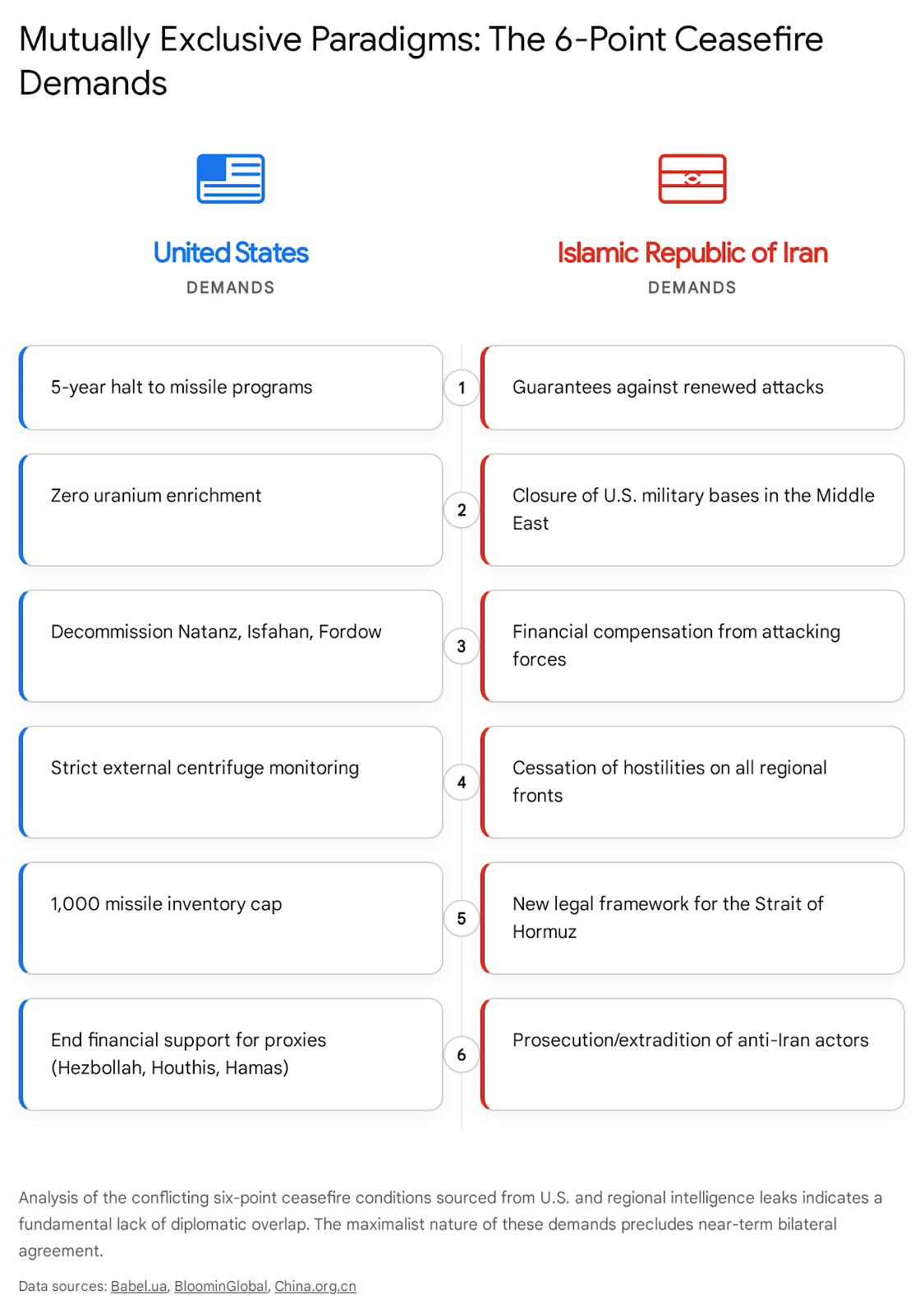
As illustrated by the analysis of the conflicting six-point frameworks, the U.S. essentially demands the voluntary disarmament of the Iranian state and the dismantling of its regional proxy network. Conversely, the Iranian framework demands the total capitulation of the U.S. strategic posture in the Middle East. Given the current military realities, neither belligerent possesses the requisite leverage to compel the other to accept these terms.
Hebrew and Israeli OSINT: The Drive for Regime Change
An analysis of Israeli media, official statements, and military actions reveals a profound skepticism regarding the U.S. diplomatic efforts and a hardened resolve to continue the war.
The Israeli government, led by Prime Minister Benjamin Netanyahu, views Operation Roaring Lion not merely as a punitive measure, but as a generational opportunity to induce systemic regime change in Tehran.24 Following the U.S. announcement of the five-day suspension, Netanyahu conspicuously failed to endorse the pause. Instead, he signaled the continuation of the campaign, stating, “We are working to bring Israel to places it has never been, and Iran to places it has never been. They are down, we are up”.64
Furthermore, Israeli Ambassador to Washington, Yechiel Leiter, explicitly outlined the end-state parameters, declaring, “The war will end when there’s not an entity in Tehran that’s going to threaten the region”.66 This rhetoric confirms that Israel’s strategic objective extends far beyond reopening maritime shipping lanes; it is the fundamental eradication of the Islamic Republic’s current power structure.
This objective is operationally reflected in the IDF’s targeting matrix. The March 23 strikes on central Tehran specifically targeted the Basij forces, the paramilitary arm responsible for internal security and protest suppression.9 By systematically dismantling the regime’s riot-control and coercive apparatus, Israeli intelligence likely assesses they can foment the necessary conditions for a massive civilian uprising against the weakened government.25 Consequently, Israel is highly unlikely to adhere to any U.S.-brokered ceasefire that leaves the current Iranian regime intact and capable of reconstitution.
Military Posture and the Kharg Island Contingency
While the diplomatic theater occupies the public narrative, an analysis of U.S. force generation and maritime intelligence provides a clearer picture of the strategic trajectory. The disposition of military assets strongly suggests preparations for protracted conflict and potential geographic escalation.
The Status of the Strait of Hormuz
The status of the Strait of Hormuz remains the critical flashpoint. Iranian Foreign Minister Abbas Araghchi has engaged in a semantic defense, claiming the Strait is technically “open” and blaming Western maritime insurers for the lack of traffic, stating, “Ships hesitate because insurers fear the war of choice you initiated—not Iran”.46
However, maritime intelligence and commercial satellite imagery contradict this narrative. The IRGCN has established a de facto blockade, transmitting VHF warnings to vessels and actively harassing ships deemed hostile.17 The reality on the water is the existence of highly regulated “zombie corridors.” Ships linked to China, India, or those transporting Iranian agricultural and energy commodities are permitted safe transit under IRGC supervision, while all Western and allied vessels are barred.30 This selective blockade maximizes economic pain on the West while preserving Iran’s vital trade links with Asia.
The Amphibious Build-Up and Kharg Island
To counter this economic stranglehold, the U.S. Department of Defense is rapidly aggregating amphibious assault capabilities within the Persian Gulf.
The accelerated deployment of the USS Boxer Amphibious Ready Group (ARG)—comprising the USS Boxer, USS Portland, and USS Comstock—is a highly significant operational indicator. This task force carries elements of the 11th Marine Expeditionary Unit (MEU), totaling approximately 2,500 to 4,500 combat-ready Marines.27 When combined with the USS Tripoli group already operating in the region, the U.S. is amassing a specialized ground force of roughly 8,000 service members specifically trained for amphibious assaults, maritime security, and the seizure of key terrain.27
High-confidence intelligence leaks from U.S. and Israeli sources indicate that the Pentagon is actively evaluating a massive ground operation to seize or blockade Kharg Island.28
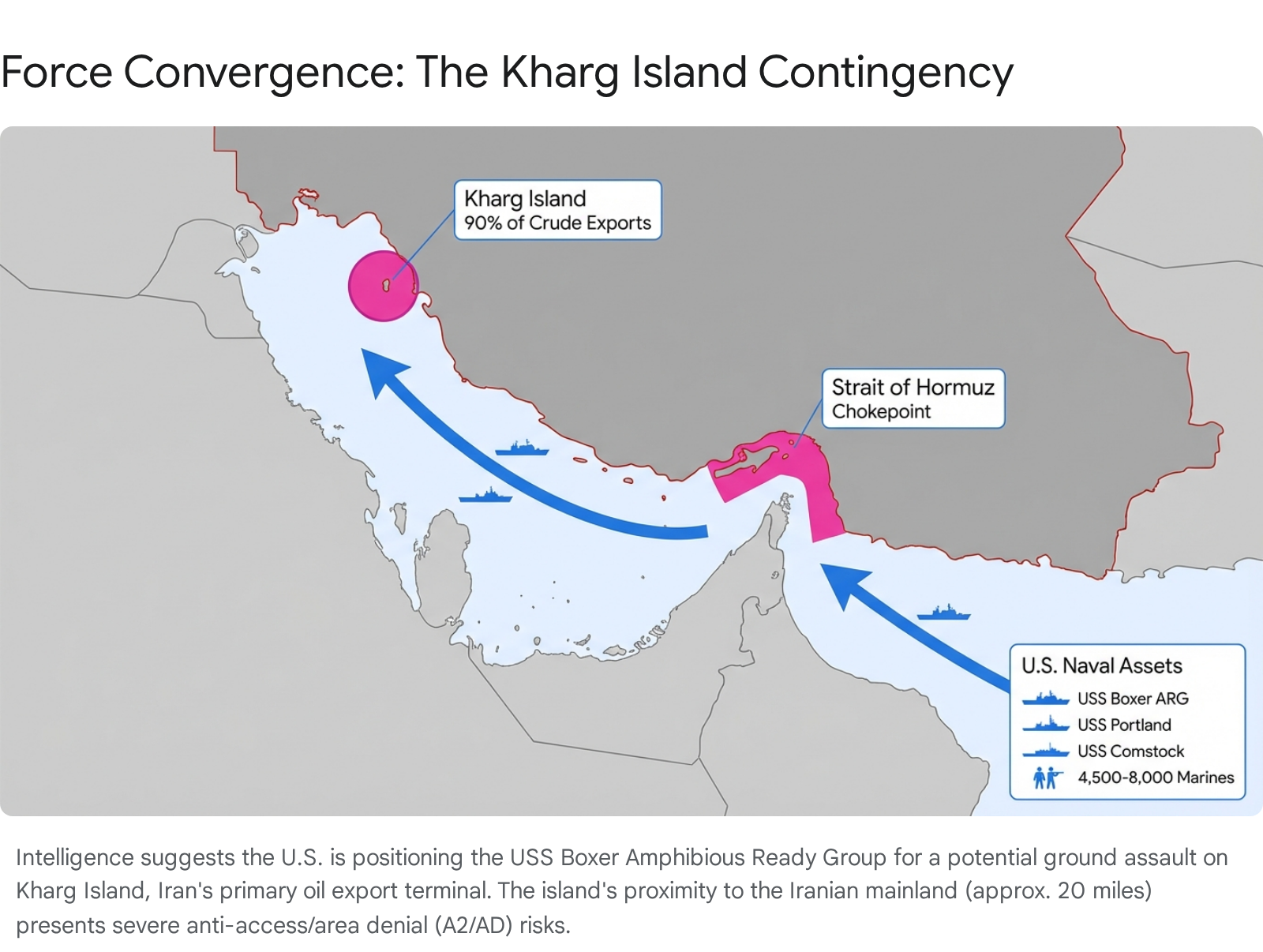
Kharg Island represents the absolute center of gravity for the Iranian economy, processing an estimated 90% of the nation’s crude oil exports.30 Seizing this terminal would effectively amputate the regime’s primary revenue artery, achieving what sanctions and aerial bombardment have thus far failed to accomplish.
However, executing an amphibious landing on Kharg Island represents a severe military escalation. The island is located a mere 20 miles off the Iranian mainland, placing any inbound U.S. landing force within the immediate, dense threat rings of Iranian coastal artillery, swarming fast-attack craft, and surviving short-range ballistic missile systems.28 The fact that the U.S. military is positioning the architecture required for such a high-risk, protracted ground occupation directly contradicts the political narrative of an imminent, comprehensive peace deal.
The Iranian Leadership Crisis
Compounding the military instability is a profound crisis within the Iranian command and control structure. Following the assassination of Ali Khamenei, the Assembly of Experts hastily appointed his 56-year-old son, Mojtaba Khamenei, as the new Supreme Leader.69
However, deep OSINT analysis reveals severe anomalies regarding Mojtaba’s physical status and operational control. As of late March, the newly appointed Supreme Leader has not made a single verifiable public appearance, nor has he released any direct audio or video addresses to the nation.70 All communications attributed to him have been disseminated via written text read by state television anchors.71
Diplomatic leaks and intelligence assessments suggest a grim reality. The Iranian ambassador to Cyprus, Alireza Salarian, publicly confirmed that Mojtaba was present at the presidential complex during the initial February 28 bombardment and sustained injuries, stating he is likely hospitalized.72 Unverified but persistent intelligence leaks—publicly referenced by U.S. officials—suggest Mojtaba may have suffered severe disfigurement or the amputation of a limb.71
The absence of a visible, unifying figurehead during an existential, multi-front war is highly detrimental to the regime’s national cohesion and chain of command. Furthermore, the targeted assassination of Ali Larijani—who had been managing day-to-day regime functions and acting as the primary pragmatic voice within the Supreme National Security Council—has created a severe leadership vacuum.38 This vacuum almost certainly concentrates operational and strategic authority in the hands of hardline IRGC commanders. These commanders, whose institutional survival is tied to continuous resistance, are inherently less likely to authorize the massive concessions required by the U.S. ceasefire framework, favoring instead a strategy of prolonged attrition and escalation.
Plausibility Assessment
Based on the rigorous synthesis of available intelligence, force dispositions, and the irreconcilable strategic objectives of the primary belligerents, the assessment of the current diplomatic environment is as follows:
- A formal, bilateral ceasefire agreement is currently highly implausible. The six-point demands issued by both Washington and Tehran represent maximalist positions requiring the effective surrender of the opposing party.34 Neither side has suffered sufficient operational degradation to warrant such capitulation, nor do they possess the leverage to enforce these demands.
- The U.S. five-day suspension is highly plausible as a unilateral, tactical maneuver. Driven by the urgent need to deflate the geopolitical risk premium inflating global oil markets and to delay an attack that would trigger the destruction of allied Gulf energy infrastructure, the U.S. administration has utilized the existence of low-level, indirect backchannels to justify a temporary, stabilizing pause in strikes specifically targeting energy grids.6
- Israeli compliance with the ceasefire is highly implausible. The IDF’s immediate, concurrent strikes on internal security targets within Tehran confirm that Israel views the conflict as a unique opportunity to achieve regime change, decoupling its operational timeline from Washington’s macroeconomic priorities.20
Strategic Foresight and Potential Next Steps
The short-to-medium term trajectory of the conflict (the next 5 to 14 days) remains highly volatile. Based on the established operational baseline, three primary scenarios are likely to unfold.
1. The Extended Holding Pattern (High Probability)
The most likely immediate scenario involves a continuation of the current “Rashomon-like” reality, where all parties claim victory while maintaining a tense, localized holding pattern.74 The United States may quietly extend the five-day suspension to prevent oil markets from spiking back above $100 per barrel, utilizing the ongoing Turkish and Omani mediation efforts as political cover.33
Concurrently, Iran will maintain its selective blockade of the Strait of Hormuz, allowing Asian-linked vessels to pass while barring Western shipping, thereby preserving its economic leverage without crossing the threshold that would trigger a U.S. strike on its domestic grid.46 Under the cover of this macro-level pause, Israel will persist in its specialized, highly targeted campaign against the IRGC and Basij leadership nodes, attempting to fracture the regime from within without inciting a regional infrastructure war.20
2. Breakdown of Mediation and Infrastructure War (Moderate Probability)
If the indirect diplomatic backchannels collapse—a strong possibility given the inflexible demands of both the U.S. and the IRGC hardliners currently managing the Iranian state—the five-day suspension will expire.75 Facing the continued closure of the Strait of Hormuz and mounting political pressure to demonstrate resolve, the U.S. administration may be forced to execute strikes on Iranian energy infrastructure, such as the vital South Pars gas field.7
In accordance with their established and publicly broadcast doctrine, Iranian forces would immediately retaliate by launching swarms of ballistic missiles and UAVs at critical desalination and power generation facilities across Saudi Arabia, the UAE, Qatar, and Kuwait.9 This scenario would plunge the global economy into a severe recession and trigger an unprecedented humanitarian crisis on the Arabian Peninsula due to water shortages.
3. The Kharg Island Amphibious Operation (Low but Increasing Probability)
Should the economic blockade of the Strait of Hormuz persist for weeks, inflicting intolerable inflationary pain on the global economy, and should standoff aerial bombardment prove insufficient to break Iranian resolve, CENTCOM may transition to territorial operations.28
Utilizing the aggregated force of the 11th MEU and the USS Boxer ARG, the U.S. military could launch a highly kinetic amphibious assault to physically seize or impose a hard naval blockade upon Kharg Island.30 By capturing the terminal responsible for 90% of Iran’s oil exports, the U.S. would achieve the ultimate economic leverage over Tehran. However, this operation would fundamentally alter the character of the war, shifting from a punitive air campaign to a perilous ground occupation in a highly contested, anti-access/area denial (A2/AD) environment, likely resulting in significant U.S. casualties and a protracted regional entanglement.
Conclusion
The intelligence verification process strongly indicates that the diplomatic signaling regarding an imminent ceasefire is a veneer covering deep, unresolved structural conflict. The five-day suspension serves immediate, localized interests—market stabilization for the U.S. and survival messaging for Iran—but fails to address the core strategic objectives driving the war. As the United States continues to amass expeditionary combat power in the Persian Gulf and Israel accelerates its decapitation campaign within Tehran, the operational environment remains primed for further, potentially catastrophic escalation.
Please share the link on Facebook, Forums, with colleagues, etc. Your support is much appreciated and if you have any feedback, please email us in**@*********ps.com. If you’d like to request a report or order a reprint, please click here for the corresponding page to open in new tab.
Sources Used
- 2026 Iran war – Wikipedia, accessed March 23, 2026, https://en.wikipedia.org/wiki/2026_Iran_war
- Escalation in the Middle East: Tracking “Operation Epic Fury” Across Military and Cyber Domains | Flashpoint, accessed March 23, 2026, https://flashpoint.io/blog/escalation-in-the-middle-east-operation-epic-fury/
- Operation Epic Fury and the Remnants of Iran’s Nuclear Program – CSIS, accessed March 23, 2026, https://www.csis.org/analysis/operation-epic-fury-and-remnants-irans-nuclear-program
- Trump Hints At Possible Middle East Breakthrough, Then Iran Rubs It In, accessed March 23, 2026, https://www.ndtv.com/world-news/iran-war-live-news-no-military-strikes-against-iranian-power-plants-for-5-day-period-says-trump-then-adds-a-caveat-11254622
- Just how volatile! Swift shift from ‘ultimatum’ to ‘TACO’ scenario as Trump’s five-day ceasefire reignites market hopes for bottom-fishing., accessed March 23, 2026, https://news.futunn.com/en/post/70468327/just-how-volatile-swift-shift-from-ultimatum-to-taco-scenario
- Trump suspends Iran power plant strikes for five days, citing ‘productive’ direct talks with Tehran, accessed March 23, 2026, https://www.intellinews.com/trump-suspends-iran-power-plant-strikes-for-five-days-citing-productive-direct-talks-with-tehran-433097/
- Trump tells Iran it has 48 hours to open Hormuz or US will ‘obliterate’ its power plants, accessed March 23, 2026, https://www.theguardian.com/world/2026/mar/22/iran-donald-trump-48-hours-open-hormuz-strait
- Trump’s 48-hour Iran ultimatum: The Hormuz deadline, war funding, and a strategy with no exit. What it means, accessed March 23, 2026, https://indianexpress.com/article/world/us-news/donald-trump-iran-war-strait-of-hormuz-deadline-israel-dimona-strike-oil-prices-10595303/
- Iran Update Special Report, March 22, 2026, accessed March 23, 2026, https://understandingwar.org/research/middle-east/iran-update-evening-special-report-march-22-2026/
- الخارجية الإيرانية: لا مفاوضات مع واشنطن وترامب يراوغ لخفض أسعار الطاقة وتنفيذ خططه, accessed March 23, 2026, https://www.iranintl.com/ar/202603239693
- إيران تُكذّب ترامب وتنفي إجراء مفاوضات مع الولايات المتحدة, accessed March 23, 2026, https://www.mosaiquefm.net/ar/%D8%A7%D9%84%D8%A3%D8%AE%D8%A8%D8%A7%D8%B1-%D8%A7%D9%84%D8%B9%D8%A7%D9%84%D9%85%D9%8A%D8%A9/1509935/%D8%A5%D9%8A%D8%B1%D8%A7%D9%86-%D8%AA-%D9%83%D8%B0-%D8%A8-%D8%AA%D8%B1%D8%A7%D9%85%D8%A8-%D9%88%D8%AA%D9%86%D9%81%D9%8A-%D8%A5%D8%AC%D8%B1%D8%A7%D8%A1-%D9%85%D9%81%D8%A7%D9%88%D8%B6%D8%A7%D8%AA-%D9%85%D8%B9-%D8%A7%D9%84%D9%88%D9%84%D8%A7%D9%8A%D8%A7%D8%AA-%D8%A7%D9%84%D9%85%D8%AA%D8%AD%D8%AF%D8%A9
- إيران تنفي وجود أي مفاوضات مع ترامب وتؤكد على إغلاق هرمز, accessed March 23, 2026, https://www.albawabhnews.com/5334359
- אלו 6 התנאים של איראן להפסקת המלחמה – מול האולטימטום של טראמפ | N12, accessed March 23, 2026, https://www.mako.co.il/news-military/2026_q1/Article-c948d5761651d91027.htm
- U.S. won’t strike Iran’s power plants for 5 days, Trump says in turnaround on Strait of Hormuz deadline, accessed March 23, 2026, https://www.pbs.org/newshour/world/u-s-wont-strike-irans-power-plants-for-5-days-trump-says-in-turnaround-on-strait-of-hormuz-deadline
- Iran threatens to ‘completely’ close Strait of Hormuz and hit power plants following Trump’s ultimatum, accessed March 23, 2026, https://www.pbs.org/newshour/world/iran-threatens-to-completely-close-strait-of-hormuz-and-hit-power-plants-following-trumps-ultimatum
- U.S. and Iran Engage in Productive Talks, Oil Prices Drop, accessed March 23, 2026, https://www.binance.com/sv/square/post/304640078741362
- 2026 Strait of Hormuz crisis – Wikipedia, accessed March 23, 2026, https://en.wikipedia.org/wiki/2026_Strait_of_Hormuz_crisis
- Trump Delays Strike on Iran’s Energy Facilities; Three Major U.S. Stock Index Futures Rise Nearly 2% | Tonight’s Key Points, accessed March 23, 2026, https://news.futunn.com/en/post/70471166/trump-delays-strike-on-iran-s-energy-facilities-three-major
- Trump says Iran deal could be reached in five days or sooner – The New Region, accessed March 23, 2026, https://thenewregion.com/posts/4928
- Strikes hit Tehran safe houses as checkpoints spread nationwide …, accessed March 23, 2026, https://www.iranintl.com/en/202603237455
- Israel hits central Tehran after Iranian missiles injure 120 in southern Israel, accessed March 23, 2026, https://efe.com/en/latest-news/2026-03-22/attack-near-israel-nuclear-research/
- Trump says US is talking with an Iranian leader as he extends deadline for striking power plants, accessed March 23, 2026, https://apnews.com/article/iran-us-israel-trump-lebanon-march-23-2026-93c6b3234a5e8917aaf599bf85a03044
- Trump says he’s holding productive talks with Iran on ending all hostilities; postpones ultimatum to bomb Iran energy sites | The Times of Israel, accessed March 23, 2026, https://www.timesofisrael.com/liveblog-march-23-2026/
- Gauging the Impact of Massive U.S.-Israeli Strikes on Iran – Council on Foreign Relations, accessed March 23, 2026, https://www.cfr.org/articles/gauging-the-impact-of-massive-u-s-israeli-strikes-on-iran
- Iran’s Future Remains Uncertain With (or Without) Regime Change, accessed March 23, 2026, https://smallwarsjournal.com/2026/03/23/irans-future-remains-uncertain/
- Goal of ‘Operation Roaring Lion’ is regime change, accessed March 23, 2026, https://www.jns.org/world/operation-roaring-lions-goal-is-regime-change
- US deploying additional warships, Marines to Middle East: Report, accessed March 23, 2026, https://www.aa.com.tr/en/americas/us-deploying-additional-warships-marines-to-middle-east-report/3872404
- USS Boxer The Second Amphibious Assault Ship Now Heading To …, accessed March 23, 2026, https://www.twz.com/news-features/uss-boxer-the-second-amphibious-assault-ship-now-heading-to-middle-east
- US considers ground operation to seize Iran’s Kharg Island amid tensions, source tells Post, accessed March 23, 2026, https://www.jpost.com/international/article-890834
- US Reportedly Considering Ground Operation to Seize Iran’s Kharg Island, accessed March 23, 2026, https://en.tempo.co/read/2094145/us-reportedly-considering-ground-operation-to-seize-irans-kharg-island
- Washington considers strategic operation to seize Iran’s primary oil export hub on Kharg Island, accessed March 23, 2026, https://english.nv.ua/nation/us-forces-eye-strategic-kharg-outpost-thousands-of-marines-head-to-the-persian-gulf-50594025.html
- AMERICA INFORMED ALLIES: A ground invasion of Iran increasingly likely, here’s what the first target will be!, accessed March 23, 2026, https://serbiantimes.info/en/america-informed-allies-a-ground-invasion-of-iran-increasingly-likely-heres-what-the-first-target-will-be/
- Türkiye, Pakistan, Egypt mediated Iran-US talks: Report | Daily Sabah, accessed March 23, 2026, https://www.dailysabah.com/politics/diplomacy/turkiye-pakistan-egypt-mediated-iran-us-talks-report/amp
- Trump Team Explores Iran Peace Talks After Weeks of War – Blooming Trade Data, accessed March 23, 2026, https://www.bloominglobal.com/media/detail/trump-team-explores-iran-peace-talks-after-weeks-of-war
- Türkiye, Pakistan, Egypt mediated Iran-US talks: Report | Daily Sabah, accessed March 23, 2026, https://www.dailysabah.com/politics/diplomacy/turkiye-pakistan-egypt-mediated-iran-us-talks-report
- Operation Epic Fury: Decisive American Power to Crush Iran’s Terror Regime, accessed March 23, 2026, https://www.whitehouse.gov/articles/2026/03/operation-epic-fury-decisive-american-power-to-crush-irans-terror-regime/
- Iran outlines 6 conditions to end conflict: Lebanese media, accessed March 23, 2026, http://www.china.org.cn/world/Off_the_Wire/2026-03/22/content_118395751.shtml
- Iran’s Leadership Transition in the Shadow of War with the U.S. and Israel, accessed March 23, 2026, https://thesoufancenter.org/intelbrief-2026-march-1b/
- Ali Larijani – Wikipedia, accessed March 23, 2026, https://en.wikipedia.org/wiki/Ali_Larijani
- Iran says it will retaliate after key figure killed – as it happened – The Guardian, accessed March 23, 2026, https://www.theguardian.com/world/live/2026/mar/17/iran-war-live-updates-news-israel-trump-strikes-us-embassy-baghdad-strait-of-hormuz-middle-east-latest?page=with%3Ablock-69b921cd8f08b1d7c2e14d97
- Iran Update Special Report, March 21, 2026 | ISW, accessed March 23, 2026, https://understandingwar.org/research/middle-east/iran-update-special-report-march-21-2026/
- Iran Update Evening Special Report, March 2, 2026 | ISW, accessed March 23, 2026, https://understandingwar.org/research/middle-east/iran-update-evening-special-report-march-2-2026/
- The Latest: Trump extends Iran deadline to reopen the Strait of Hormuz by 5 days, accessed March 23, 2026, https://www.2news.com/news/national/the-latest-trump-extends-iran-deadline-to-reopen-the-strait-of-hormuz-by-5-days/article_fd2b76a8-2280-518e-9317-0c763b900fbf.html
- Operations Epic Fury and Roaring Lion: 3/21/26 – 3/22/26 Update – JINSA, accessed March 23, 2026, https://jinsa.org/wp-content/uploads/2026/03/Operations-Epic-Fury-and-Roaring-Lion-03.21-03.22.26.pdf
- Live Updates: Trump says ultimatum for Iran to reopen Strait of Hormuz postponed amid negotiations – CBS News, accessed March 23, 2026, https://www.cbsnews.com/live-updates/iran-war-us-israel-trump-ultimatum-strait-of-hormuz/
- Iran says Strait of Hormuz ‘open,’ but ships fear passage, accessed March 23, 2026, https://www.aa.com.tr/en/middle-east/iran-says-strait-of-hormuz-open-but-ships-fear-passage/3875160
- Iran military says Strait of Hormuz will be “completely closed” if U.S. delivers on Trump threat, accessed March 23, 2026, https://www.cbsnews.com/live-updates/iran-war-us-israel-gas-and-oil-prices-trump-netanyahu-strait-hormuz/
- Iran War Disrupts Maritime Trade: Week Three Analysis, accessed March 23, 2026, https://windward.ai/blog/three-weeks-into-the-iran-war/
- US-Israeli war on Iran LIVE: Trump says postponing Iran power plant strikes for five days after ‘very good’ talks, accessed March 23, 2026, https://www.thehindu.com/news/international/iran-israel-war-usa-strait-of-hormuz-donald-trump-iran-israel-west-asia-live-updates-march-23-2026/article70774180.ece
- Iran threatens strikes on Gulf power plants following Trump’s Strait of Hormuz ultimatum, accessed March 23, 2026, https://www.cfpublic.org/2026-03-23/iran-threatens-strikes-on-gulf-power-plants-following-trumps-strait-of-hormuz-ultimatum
- Operation Epic Fury: The Geopolitical Stranglehold on the Global AI Chip Supply Chain, accessed March 23, 2026, http://markets.chroniclejournal.com/chroniclejournal/article/marketminute-2026-3-23-operation-epic-fury-the-geopolitical-stranglehold-on-the-global-ai-chip-supply-chain
- Strikes hit world’s largest natural gas field in Iran, and Tehran retaliates with more attacks, accessed March 23, 2026, https://apnews.com/article/iran-iraq-us-israel-trump-march-18-2026-d7ca062ba1bf99d1f8dc00c8073cf10f
- US-Israel-Iran War Updates: Iran Says Trump “Backed Down” After His Middle East Breakthrough Hint, accessed March 23, 2026, https://www.ndtv.com/world-news/us-israel-iran-war-iran-missile-strike-on-israel-iran-targets-israeli-nuclear-facility-dimona-arad-trump-warns-iran-strait-of-hormuz-diego-garcia-11249333
- Trump Says He’s Pausing Attacks on Iranian Power Plants and Energy Infrastructure for Five Days, accessed March 23, 2026, https://www.democracynow.org/2026/3/23/headlines/trump_says_hes_pausing_attacks_on_iranian_power_plants_and_energy_infrastructure_for_five_days
- Is US‑Iran war ending soon? Donald Trump considers ‘winding down’ military efforts, lists 5 objectives, accessed March 23, 2026, https://timesofindia.indiatimes.com/world/us/is-usiran-war-ending-soon-donald-trump-considers-winding-down-military-efforts-lists-5-objectives/articleshow/129712856.cms
- The Latest: Trump says Iran wants a deal to end the war as Tehran denies negotiating, accessed March 23, 2026, https://www.expressnews.com/business/article/the-latest-us-central-command-leader-says-iran-22091162.php
- Trump says Iran wants a deal and claims US has been holding talks with ‘respected’ Iranian leader, accessed March 23, 2026, https://www.townandcountrytoday.com/world-news/trump-says-iran-wants-a-deal-and-claims-us-has-been-holding-talks-with-respected-iranian-leader-12042184
- The Latest: Trump extends Iran deadline to reopen the Strait of Hormuz by 5 days, accessed March 23, 2026, https://www.rmoutlook.com/religion-news/the-latest-trump-extends-iran-deadline-to-reopen-the-strait-of-hormuz-by-5-days-12042150
- Early Edition: March 23, 2026 – Just Security, accessed March 23, 2026, https://www.justsecurity.org/134643/early-edition-march-23-2026/
- Trump says Iran wants a deal and claims US holding talks with ‘respected’ leader, accessed March 23, 2026, https://www.breakingnews.ie/world/trump-says-iran-wants-a-deal-and-claims-us-holding-talks-with-respected-leader-1878200.html
- Trump says planned strikes on Iranian power plants suspended, accessed March 23, 2026, https://www.newarab.com/news/trump-says-planned-strikes-iranian-power-plants-suspended
- Middle East crisis live: Trump says both Iran and US ‘want to make a deal’ and claims they will talk today, accessed March 23, 2026, https://www.theguardian.com/world/live/2026/mar/23/middle-east-crisis-live-iea-chief-says-iran-war-energy-crunch-worse-than-1970s-oil-crises-and-ukraine-war-combined
- Axios: Trump administration begins discussing possible peace deal with Iran, accessed March 23, 2026, https://babel.ua/en/news/125696-axios-trump-administration-begins-discussing-possible-peace-deal-with-iran
- Trump delays Iran power plant strikes for five days after ‘productive’ talks, accessed March 23, 2026, https://www.iranintl.com/en/liveblog/202603192844
- How have countries reacted to Trump’s halt to new Iran strikes? – The New Arab, accessed March 23, 2026, https://www.newarab.com/news/how-have-countries-reacted-trumps-halt-new-iran-strikes
- Trump pauses strikes on energy sites after talks with Tehran – JNS.org, accessed March 23, 2026, https://www.jns.org/news/israel-news/iran-rejects-trump-ultimatum-threatens-to-target-israels-power-grid
- Is the Strait of Hormuz really closed to shipping? – Seatrade Maritime News, accessed March 23, 2026, https://www.seatrade-maritime.com/security/is-the-strait-of-hormuz-really-closed-
- US Sends Another 2,500 Marines to Iran as Ground Option Emerges in War | Military.com, accessed March 23, 2026, https://www.military.com/daily-news/headlines/2026/03/20/us-send-another-2500-marines-ground-option-emerges-iran-war.html
- 2026 Iranian supreme leader election – Wikipedia, accessed March 23, 2026, https://en.wikipedia.org/wiki/2026_Iranian_supreme_leader_election
- Iranian Officials Seek To Quell Rumors About Supreme Leader Mojtaba Khamenei’s Health, accessed March 23, 2026, https://www.rferl.org/a/iran-supreme-leader-mojtaba-khamenei-health/33702161.html
- Iran’s new supreme leader purportedly issues fresh statement as questions linger over his health, accessed March 23, 2026, https://www.timesofisrael.com/irans-new-supreme-leader-issues-fresh-statement-as-questions-linger-over-his-health/
- Mojtaba Khamenei was hurt in strike that killed his father, Iran’s Cyprus ambassador confirms, accessed March 23, 2026, https://www.theguardian.com/world/2026/mar/11/mojtaba-khamenei-was-hurt-in-strike-that-killed-his-father-irans-cyprus-ambassador-confirms
- How Mojtaba Khamenei cheated death and escaped seconds before US-Israel strike, accessed March 23, 2026, https://www.hindustantimes.com/world-news/how-mojtaba-khamenei-cheated-death-and-escaped-seconds-before-us-israel-strike-101773721705875.html
- The U.S.-Iran conflict descends into a Rashomon-like scenario, with Trump’s five-day ceasefire window reigniting market hopes for a rebound. Is the ‘TACO playbook’ making a comeback?, accessed March 23, 2026, https://news.futunn.com/en/post/70468314/the-us-iran-conflict-descends-into-a-rashomon-like-scenario
- Trump suspends Iran power plant strikes for five days, citing ‘productive’ direct talks with Tehran, accessed March 23, 2026, https://www.intellinews.com/trump-suspends-iran-power-plant-strikes-for-five-days-citing-productive-direct-talks-with-tehran-433097/?source=iran
- Israel hits Tehran with airstrikes on Persian New Year as war jolts energy markets, accessed March 23, 2026, https://apnews.com/article/iran-iraq-us-israel-trump-march-19-2026-52e94398f2432b3aba9b02b51fbe5000
- Iran threatens to completely close Strait of Hormuz if US attacks its power plants, accessed March 23, 2026, https://www.newsonair.gov.in/iran-threatens-to-completely-close-strait-of-hormuz-if-us-attacks-its-power-plants/