
Executive Summary
The ongoing military confrontation between the United States and the Islamic Republic of Iran, which dramatically escalated with the commencement of Operation Epic Fury in early 2026, presents a profound strategic paradox that fundamentally challenges traditional assessments of national power. At the core of this conflict lies a severe temporal mismatch: Washington seeks swift, decisive victory through the application of overwhelming kinetic force and economic blockade, while Tehran aims for long-term endurance, regime survival, and the gradual attrition of adversary resolve.1 This exhaustive intelligence assessment investigates how the American penchant for immediate gratification—rooted deeply in its sociological development, economic systems, and political structures—impacts its strategic calculus and overall efficacy against an adversary operating on a generational time horizon.
By analyzing the conflict across three distinct but deeply interconnected domains—governmental structures, military doctrines, and civilian morale—this report reveals that the United States is essentially playing a “finite game” with strictly defined short-term outcomes (such as restored deterrence and nuclear dismantlement), whereas Iran is engaged in an “infinite game” where success is measured by continuity, the absorption of pressure, and historical survival.1 The failure of American policymakers, military commanders, and the broader civilian populace to reconcile these competing temporal realities frequently leads to a condition of “strategic narcissism,” wherein U.S. policy erroneously assumes the adversary will conform to American timetables, economic pressures, and behavioral expectations.2 Understanding what the American apparatus fails to realize about Iranian time scale perspectives is paramount for recalibrating U.S. strategy, preventing the continuous cycle of inconclusive military engagements, and avoiding long-term strategic overextension in the Middle East.4
1. The Sociological and Historical Roots of Temporal Dissonance
To accurately comprehend the strategic behavior, vulnerabilities, and strengths of both the United States and the Islamic Republic of Iran, it is necessary to examine the underlying cultural, historical, and sociological frameworks that govern their respective concepts of time, success, and sacrifice. The strategies deployed in the Strait of Hormuz or the diplomatic corridors of international summits are direct manifestations of these deeply ingrained societal temporalities.
1.1 The American Transformation: From Enduring Ideals to the Impulse Society
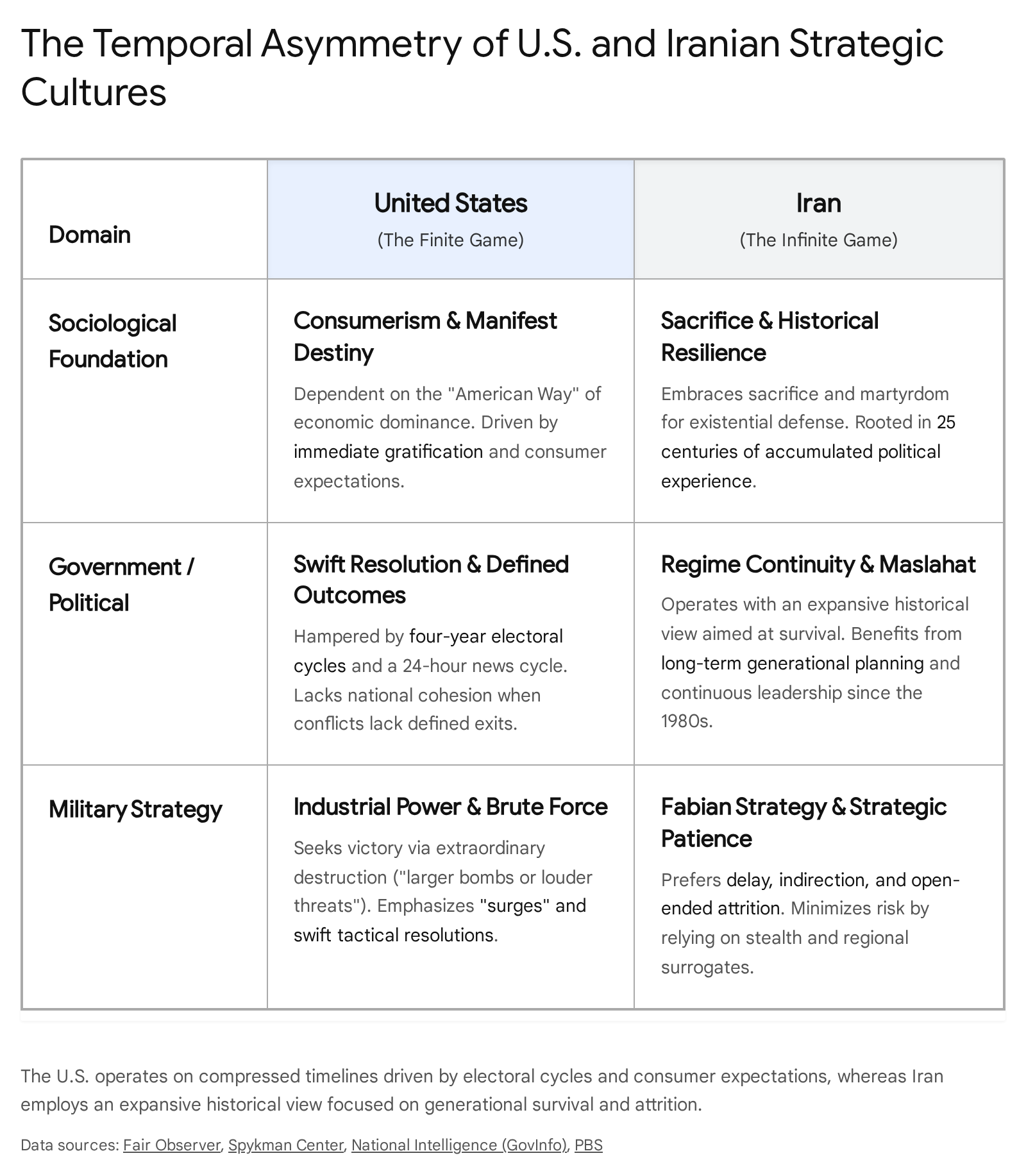
The historical trajectory of American foreign policy reveals a distinct shift in temporal horizons. During the foundational era of the United States, the nation’s architects sought to define a national good that transcended local, immediate interests.5 The strategic purpose was to demonstrate the long-term feasibility of self-government and to establish a sustainable ground for relations among nations, an ideal that required profound patience and a generational perspective on national honor and international justice.5 For much of its early history, the United States focused on becoming an “Empire of Liberty,” expanding across the continent, and gradually asserting its role in global affairs without the urgent necessity of rapid global dominance.6 Even in the aftermath of World War I, Woodrow Wilson’s promotion of liberal internationalism laid the groundwork for institutions that were designed to endure over decades, reflecting a capacity for long-term strategic architectural planning.6
However, the modern American strategic mindset is now deeply intertwined with, and heavily constrained by, the nation’s post-World War II socio-economic evolution. Following the end of the Second World War, vast wartime industrial production capacities were seamlessly redirected to fuel a dynamic mass-consumption economy.8 The American citizen was increasingly defined as a consumer, and national economic recovery depended directly on the rapid, continuous acquisition of goods, creating a pervasive cultural expectation for “more, newer, and better”.8 Purchasing for the home and upgrading living standards became synonymous with patriotic duty, permanently altering the societal baseline for delayed gratification.8 The notion of human beings as consumers, which took shape before World War I, became the undeniable center of American life.9
Over subsequent decades, this consumer-centric identity transitioned into what sociologists term the “Impulse Society,” where discretionary consumption and the pursuit of short-term corporate profitability became the absolute center of economic activity.10 As individualistic identity merged with purchasing habits, the American populace transitioned from being active, long-term civic participants to passive consumers demanding immediate satisfaction.10 In the contemporary digital age, this expectation of immediate returns has been exponentially amplified by the “attention economy”.11 Algorithmic social media platforms and digital environments cultivate highly compressed attention spans, an urgent desire to keep up with rapidly shifting trends, and a culture of severe overconsumption.11
When translated into the realm of foreign policy and national security, this cultural penchant demands rapid returns on military and diplomatic investments. The American societal baseline expects rapid solutions, immediate feedback, and swift resolutions to complex geopolitical problems. The American public, heavily influenced by this consumer paradigm, consistently demonstrates an inability to tolerate prolonged, inconclusive foreign engagements, preferring strategies that promise quick, highly visible, and measurable victories.13 This overconsumption and demand for immediate results form the psychological fuel for America’s economic and military power, yet simultaneously constitute its greatest strategic vulnerability when facing an adversary capable of enduring long-term hardship.12
1.2 The Iranian Paradigm: Historical Consciousness and Strategic Patience
In stark contrast to the American impulse-driven temporality, Iranian strategic culture is underpinned by an expansive, deeply rooted conception of time. This perspective is drawn from a national and political history that spans twenty-five centuries of empires, catastrophic invasions, systemic collapses, and eventual resurrections.13 The Iranian national consciousness is built upon an “accumulated” political experience, allowing the state to contextualize present conflicts—even highly destructive ones like the current U.S.-Israeli military campaign—within a vast historical continuum.13 While the United States views history largely as a post-1776 phenomenon driven by progress and technological innovation, the Iranian cultural memory recognizes the cyclical nature of power and the inevitability of enduring periods of severe adversity.
This temporal depth is powerfully reinforced by Shiite historical narratives and Islamic theology, which elevate the virtues of patience, endurance, and long-term triumph over immediate, short-term gratification. Iranian leaders and military commanders frequently reference historical precedents to justify their operational timelines. For instance, Imam Ali was initially passed over to lead the ummah after the death of the Prophet Muhammad but demonstrated strategic patience and eventually ascended to become the fourth caliph.14 Similarly, following the Arab conquest of Iran, the underlying Persian culture and influence did not immediately rebel in a decisive, catastrophic war; instead, it bided its time, eventually prevailing and dominating the Islamic empire with the rise of the Abbasid dynasty more than a century later.14 Culturally, this preference for delay and indirection is mirrored in classical literature, such as Sheherezade’s strategy of extending her survival night by night in One Thousand and One Nights.14
Consequently, the leadership of the Islamic Republic has operationalized and formalized “strategic patience” as a core tenet of its foreign policy and military doctrine.14 This approach deliberately utilizes delay, indirection, and attrition, operating on the fundamental assumption that time inherently favors the defender.13 Iranian strategists calculate that the United States, constrained by the impatience of its own domestic populace and the rigidities of its electoral and financial systems, cannot sustain an open-ended conflict.13
2. Governmental Horizons: Electoral Ephemera vs. Regime Perpetuity
The temporal dissonance highlighted in the sociological domain is most visibly and consequentially manifested at the highest levels of government policy formulation. The structural mechanisms of governance in Washington and Tehran create fundamentally incompatible strategic rhythms, dictating how each state engages in diplomacy, threat assessment, and crisis management.
2.1 The United States: Policy Oscillation and Strategic Narcissism
The American political system is strictly dictated by two-year congressional and four-year presidential electoral cycles. This rigid, short-term structural reality forces U.S. administrations to prioritize foreign policy “wins” that can be easily communicated to the electorate within a highly compressed timeframe.16 Because American voters expect a tangible return on their political investment rapidly, administrations frequently oscillate in their strategic approach to Iran, perpetually seeking a silver bullet that will resolve the conflict before the next election. Since the 1979 Islamic Revolution, Washington’s policy has been characterized by a constant state of “recovery” mode, playing a double-speed game that rapidly shifts between attempted engagement and punitive coercion.18 Policy has swung from the “dual containment” strategies of the 1990s, to conciliation during moderate Iranian administrations, to the aggressive “maximum pressure” campaigns of recent years, creating an environment that appears to the outside world as chronically lacking in long-term consistency.16
This structural inconsistency is profoundly exacerbated by the modern 24-hour news cycle, which compresses the time policymakers have to deliberate and respond to international crises.20 The advent of real-time, emotive news coverage—often referred to historically as the “CNN Effect”—forces the government to react to sudden global developments instantly to appease public demand, occasionally overriding sober, long-term strategic deliberation.20 The classic example occurred in 1993, when heartbreaking footage from Somalia pressured U.S. officials to deploy troops, and subsequent horrifying footage of American casualties prompted an equally rapid withdrawal, demonstrating how live media can completely dictate military deployment timelines.20 Today, algorithms further polarize the public into partisan information bubbles, heavily favoring extreme liberal or conservative viewpoints.22 This media ecosystem deprives viewers of opposing perspectives, intensifying domestic divisions and making nuanced, long-term, bipartisan foreign policy discourse regarding Iran nearly impossible.22
The culmination of these electoral and media pressures leads directly to what former National Security Advisor H.R. McMaster identifies as “strategic narcissism”—the pervasive tendency of American policymakers to define the world only in relation to the United States and to assume that U.S. actions alone are the decisive factors in achieving favorable global outcomes.2 Drawing upon concepts formulated by classical realist Hans Morgenthau, strategic narcissism fosters a dangerous optimism bias within the U.S. government.3 American administrations frequently develop policies based on their own preferences rather than what the situational reality demands.3 Consequently, the U.S. engages in wishful thinking, believing that brief, intense applications of military or economic pressure will instantly force a fundamental change in the nature of the Iranian regime.3 American leaders repeatedly fail to account for the agency, influence, and long-term authorship that Iranian leaders possess over their own future, operating under the delusion that adversaries will simply capitulate according to Washington’s desired timeline.3
2.2 Iran: Institutional Continuity, “Maslahat,” and Iranian Realism
Conversely, the Islamic Republic of Iran operates under a system explicitly designed for regime perpetuity rather than public accountability. Key political, intelligence, and military figures often hold their positions for decades, allowing for seamless, uninterrupted generational planning.14 This institutional continuity largely inoculates the regime against the erratic, short-term shifts characteristic of Western democracies, enabling Tehran to plot strategic objectives spanning decades rather than mere months.
Iranian decision-making is heavily insulated from immediate public pressure and is guided by the foundational principle of maslahat (the expediency and interest of the regime).14 Established by Ayatollah Ruhollah Khomeini, the doctrine of maslahat formalizes the supremacy of raison d’etat over all other considerations, mandating that the preservation of the Islamic Republic supersedes all other religious obligations and tenets.14 Under this axiom, the regime has no theological or moral qualms about violating ordinary Islamic rules, engaging in deception, or sacrificing immediate tactical positions if it serves the ultimate goal of state survival.14 This highly pragmatic framework enables the regime to absorb immense short-term tactical losses while keeping its focus locked on long-term endurance. When the devastating Iran-Iraq war became existentially untenable in 1988, Khomeini famously “drank the cup of poison” to accept a ceasefire, demonstrating conclusively that the regime will prioritize survival and continuity over ideological purity or immediate victory when facing true existential threats.14
Furthermore, Iran’s foreign policy is driven by an indigenous theoretical framework defined as “Iranian Realism”.28 This doctrine harbors a profound, structural distrust of American diplomacy and the broader international system.28 Iranian leadership views U.S. behavior—such as the unilateral withdrawal from the Joint Comprehensive Plan of Action (JCPOA), the sudden abandonment of allies in Afghanistan, and the broader withdrawal from numerous international treaties under the Trump administration—as empirical evidence of an inherent inability of the American system to uphold long-term commitments.28 Therefore, Tehran places zero intrinsic value on diplomatic assurances, written agreements, or international institutions, viewing them as functions of classical liberal diplomacy that are wholly ineffectual against America’s structural interests and habitual pattern of abrogating agreements.28 Instead, Iranian Realism dictates that only tangible, operational capabilities on the ground and a posture of “active deterrence” can guarantee national security and regime survival.28 To Tehran, negotiations are merely an extension of the battlefield; recognition at the diplomatic table is only accorded to the power that has already been unequivocally established in the theater of conflict.28
3. Military Doctrines: The “American Way of War” vs. Asymmetric Attrition
The stark contrast in government timeframes trickles down directly into military doctrine and procurement, where the U.S. reliance on immediate tactical dominance clashes inevitably with Iran’s complex architecture of protracted, asymmetric attrition.
3.1 The Military-Industrial Complex and the Illusion of Decisive Force
The U.S. military doctrine is historically predicated on achieving rapid, decisive victories through the application of overwhelming industrial capacity and technological superiority—a paradigm often referred to by military historians as the “American Way of War”.13 Supported by the ideological belief in “Manifest Destiny,” the American military apparatus is designed to press forward through massive destruction until the enemy is entirely annihilated.13 This approach was highly effective during periods of immeasurable economic superiority, such as the American Civil War and World War II, but has consistently struggled against determined resistance in prolonged, geographically diffuse conflicts, as evidenced by the wars in Vietnam, Iraq, and Afghanistan.13 The United States can strike targets with extraordinary precision and project force across multiple theaters, yet translating that raw kinetic power into stable, long-term political outcomes has become an enduring challenge.29
The U.S. expectation of rapid military results is inextricably tied to its military-industrial complex and its domestic procurement cycles. As President Dwight D. Eisenhower warned in 1961, the intricate network of governmental and private industrial entities exerts unwarranted influence over national security policy.30 Defense contractors, functioning as for-profit corporate entities, rely heavily on annual congressional budgets and the continuous development of next-generation, high-cost military hardware.24 These entities underwent massive restructuring and consolidation in the 1990s, increasing their reliance on continuous government revenues.34
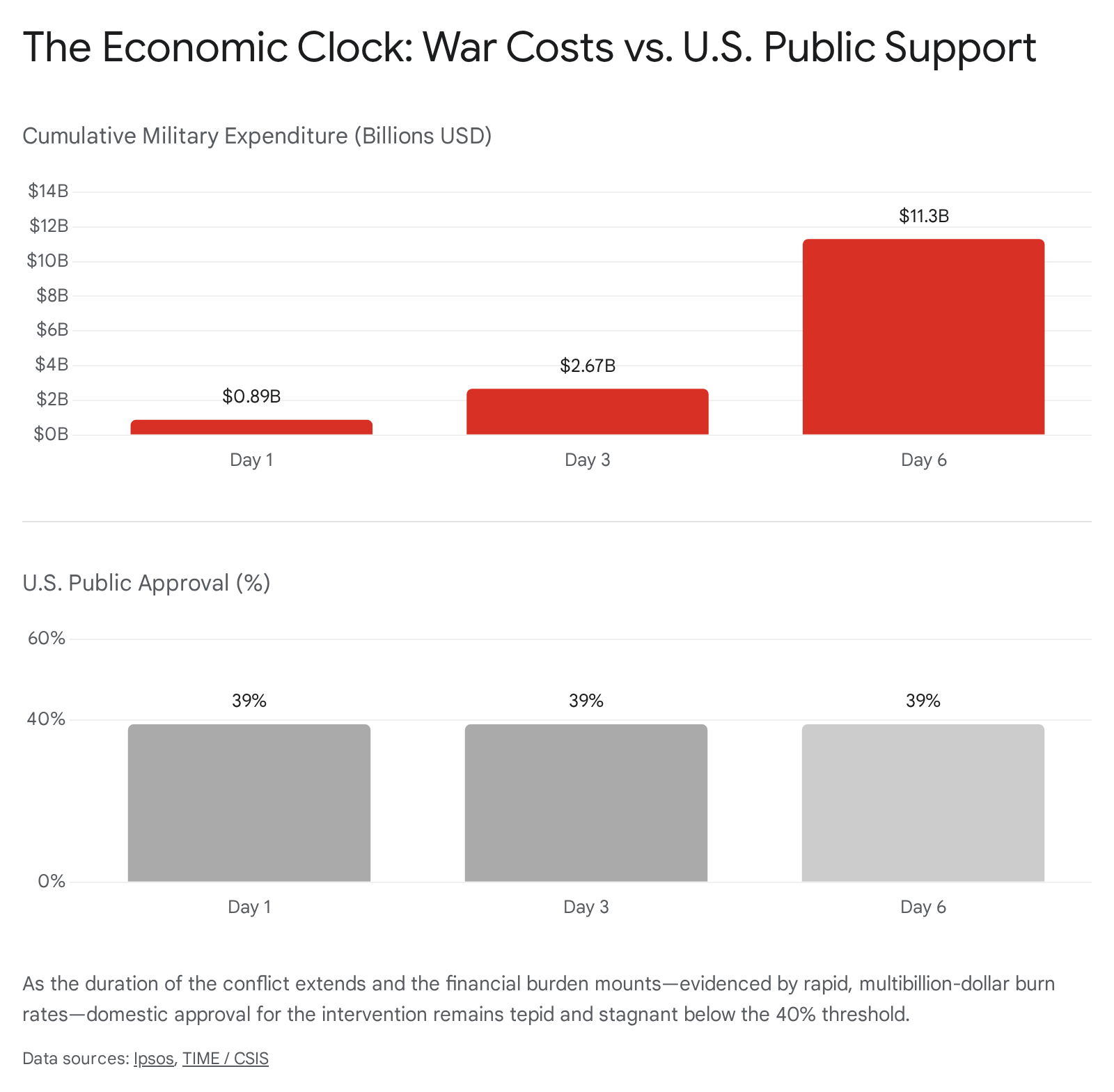
When conflicts arise, the financial burn rate of the U.S. military is staggering, demanding rapid operational success before political will evaporates. For instance, during the early phases of Operation Epic Fury against Iran, the Pentagon expended an estimated $11.3 billion within just the first six days.35 The Center for Strategic and International Studies estimated that the first 100 hours of the operation cost roughly $891.4 million each day.35 This exorbitant burn rate demands quick victories, as prolonged operations rapidly deplete finite congressional funding and trigger fierce domestic political debates regarding the massive opportunity costs. Critics immediately point out that the $12 billion spent in mere days on an inconclusive war could have fully funded the training of 100,000 new nurses or provided healthcare for 1.3 million Americans for an entire year.35 Because the U.S. cannot sustain these financial and political costs indefinitely without congressional authorization—which is often politically fraught or entirely absent—the military is forced to seek rapid, decisive blows.35
However, against an adversary like Iran, the U.S. operates under the dangerous illusion that destroying physical infrastructure inherently changes the strategic calculus of the enemy.29 Hegemonic powers often experience an erosion of authority long before their physical capabilities decline; they transition from an ability to organically compel outcomes to a desperate need to enforce them through visible demonstrations of force, consuming vital political capital in the process.29
3.2 Iranian Doctrine: The Fabian Strategy and “Mosaic Defense”
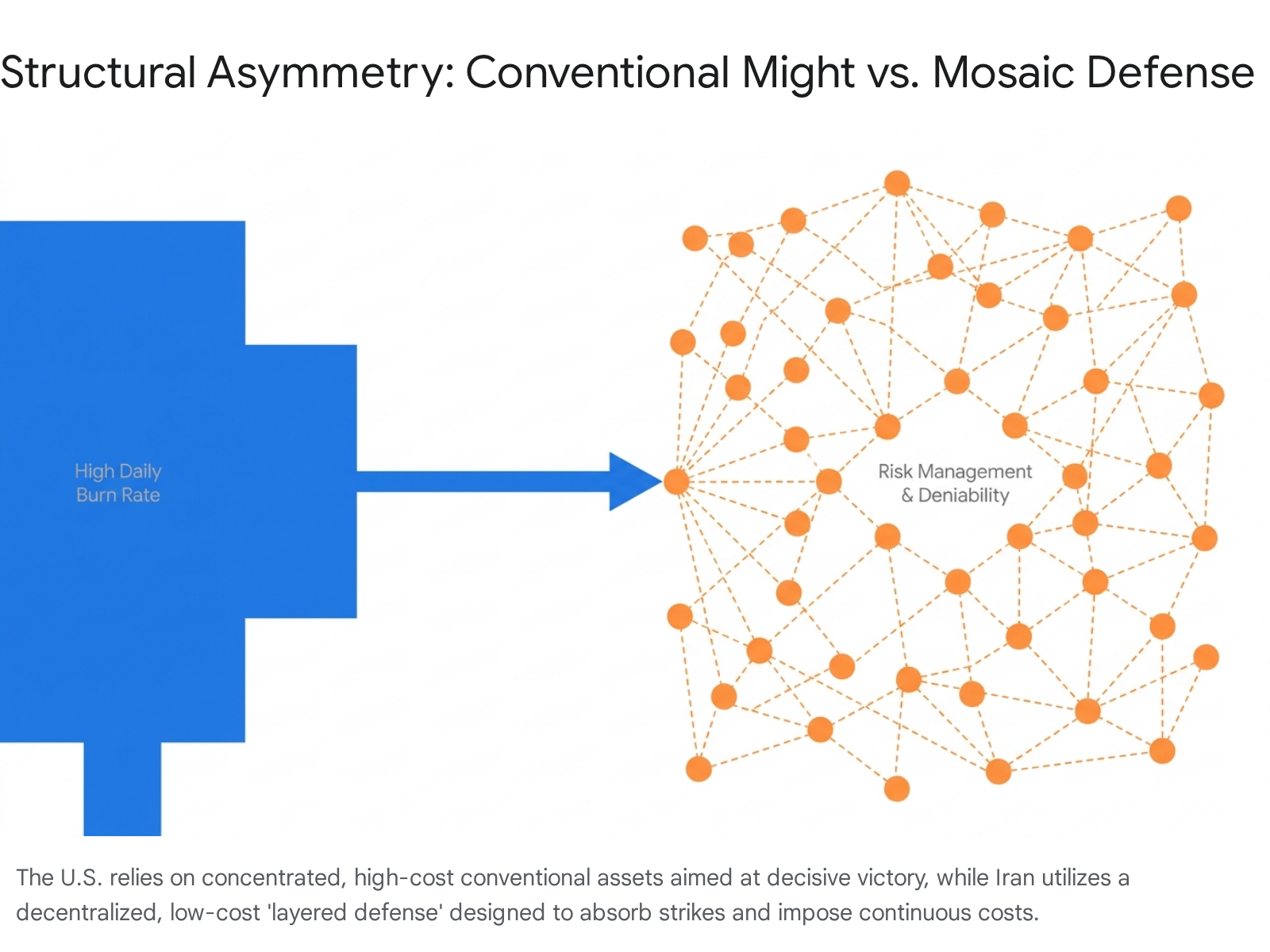
Iran, acutely aware of its inability to match the conventional military hardware, air supremacy, or defense budgets of the United States, has spent decades engineering an entirely asymmetric military doctrine designed specifically to exploit American impatience and the structural weaknesses of the American Way of War. The Iranian military approach is fundamentally “Fabian”—centered on delay, indirection, the conservation of forces, and the absolute avoidance of direct, decisive, head-on confrontations.14
To counter technologically advanced opponents, Iran utilizes a sophisticated “layered defense strategy,” commonly referred to as a “mosaic defense”.38 This involves a highly decentralized command structure designed to survive decapitation strikes, the massive proliferation of relatively inexpensive ballistic missiles and suicide drones, offensive cyber warfare capabilities, and, most crucially, a vast, deeply entrenched network of regional proxy militias (such as Lebanese Hezbollah, the Houthis in Yemen, and various Iraqi Shia militias).38 By distributing its forces and military assets across various geographic domains, subterranean facilities, and non-state actors, Iran effectively prevents the possibility of a single, decisive defeat that the U.S. military is structurally designed to inflict.38
Furthermore, Iran manages existential risk through deliberate ambiguity and plausible deniability. By operating primarily through these surrogates, Iran aims to drain the political will and resources of its adversaries without triggering massive, regime-ending conventional retaliation against the Iranian homeland.14 When the United States initiates kinetic campaigns aimed at degrading Iranian capabilities, it often mistakenly assumes that the destruction of naval assets or missile silos equates to strategic capitulation.37 However, Iran’s objective is not to “win” the military exchange in a traditional, territorial sense. Its goal is to endure the barrage, regenerate its capabilities through its decentralized networks, and impose ongoing, unacceptable psychological and economic costs on the United States and its allies until American public support inevitably collapses.1 The Iranian strategy recognizes that a ground invasion of Iran by the U.S. is strategically unfeasible, given that modeling points to a U.S. inability to actually win and pacify such a vast, mountainous, and heavily populated terrain; such an invasion would only demonstrate the limits of U.S. strength.38
4. Civilian Morale, Information Ecosystems, and Economic Endurance
The ultimate determinant of foreign policy sustainability in any protracted conflict is the resilience of the civilian populace. The United States and Iran possess highly divergent thresholds for economic hardship, human casualties, and societal disruption, driven by distinct historical experiences and information environments.
4.1 The Fragility of American Public Support and the 24-Hour News Cycle
Historically, American public opinion regarding Iran has not been guided by consistent strategic principles, but rather has been abruptly molded by moments of acute crisis. During the early years of the Cold War in 1952, only 35% of Americans believed it would matter a “great deal” if communists took control of Iran, demonstrating a general apathy toward the region.41 Even by 1976, public appetite for involvement remained limited, with merely 23% of the populace supporting military aid to the Shah.41
This apathy was violently shattered by the 1979 Iran Hostage Crisis, a defining watershed moment that permanently cemented Iran as a primary, visceral adversary in the American imagination. Driven by daily television coverage of the crisis, an overwhelming 66% of Americans supported a direct military attack on Iran if hostages were harmed.41 Following the September 11, 2001 attacks, perceptions became inextricably tied to overarching national security anxieties. By 2004, 77% of Americans viewed Iran unfavorably, and 58% explicitly viewed the nation as a long-term threat to the United States, fearing nuclear attacks on Israel or the provisioning of weapons of mass destruction to transnational terrorist groups.41
| Year | Milestone Event / Polling Context | Key U.S. Public Sentiment Data |
| 1952 | Cold War / Communism Threat | Only 35% believed communist control of Iran would matter a “great deal.” 41 |
| 1976 | Pre-Revolution | Just 23% supported sending military aid to the Shah of Iran. 41 |
| 1979 | Iran Hostage Crisis | 66% supported an attack on Iran if hostages were harmed. 41 |
| 2004 | Post-9/11 Threat Assessment | 77% viewed Iran unfavorably; 58% viewed it as a long-term threat. 41 |
| 2015 | Mid-2010s Tensions | 84% held an unfavorable view (highest recorded negative perception). 41 |
| 2026 | Operation Epic Fury | Support for the war remains below 40%; major opposition among younger cohorts. 41 |
Despite recognizing Iran as a consistent, long-term threat, American support for direct, sustained military conflict remains remarkably low and highly hesitant. During the initial phases of the current 2026 conflict, support for the war was mostly stable but hovered at just below the 40% mark.42 As undecided Americans formed opinions, disapproval climbed steeply.42 The primary catalyst for this rapid erosion of support is not necessarily the volume of military casualties, but severe economic sentiment and domestic financial pain. The conflict’s disruption of the Strait of Hormuz caused immediate spikes in gasoline prices to near-record highs, contributing to one of the steepest month-over-month drops in U.S. consumer confidence since the COVID-19 pandemic.42 When half of the American populace reports that a foreign conflict is having a direct, negative impact on their personal finances, the political pressure on elected officials to terminate the engagement mounts exponentially.42 The American public is unwilling to weather economic uncertainty for abstract strategic gains in the Middle East without a massive, galvanizing domestic attack.42
Furthermore, generational divides and shifts in media consumption heavily influence the U.S. time horizon. Younger cohorts (Millennials and Generation Z), whose political socialization occurs primarily via online platforms rather than traditional broadcast networks, overwhelmingly oppose protracted military interventions.23 These demographics find it increasingly difficult to determine if news is accurate, exacerbating societal divisions and a lack of consensus on foreign policy objectives.23 As these younger, highly digitally-native cohorts age into greater political power, the societal appetite for sustained overseas military commitments is expected to wane even further, severely limiting the options available to future administrations.23
4.2 Iranian Civilian Resilience and the Mechanisms of State Control
Conversely, the Iranian populace has historically demonstrated a demonstrably higher threshold for pain absorption, heavily influenced by intense state indoctrination, a deep security apparatus, and cultural conditioning. The psychological asymmetry in this conflict tilts decisively in Iran’s favor because the state successfully frames its conflicts as existential struggles for defense and survival against imperialist aggressors—a narrative that generally generates much stronger national cohesion than the elective wars of choice frequently undertaken by the United States.13 Culturally, the Iranian regime continually leverages the narratives of sacrifice and martyrdom, heavily utilized during the brutal eight-year war with Iraq, to maintain a populace accustomed to enduring immense hardship without capitulation.13
To survive decades of crippling Western economic sanctions, Iran has proactively engineered a “Resistance Economy”.45 The state has minimized its exposure to U.S.-dominated financial systems by fundamentally restructuring its internal markets. Reduced oil revenues have compelled the government to rely more heavily on domestic taxation and assume direct control over manufacturing and services sectors.47 This process has deeply expanded the state’s reach into the daily economy and society, while simultaneously expanding the deep state security apparatus.47 Furthermore, Tehran has cultivated a strategic, continent-wide alignment with a Eurasian zone encompassing Russia and China, effectively creating alternate global economic pathways and black-market trade networks that blunt the immediate, catastrophic impact of Western financial embargoes.46
However, intelligence assessments must maintain strict analytical nuance: Iranian civilian resilience is formidable, but it is not infinite. Decades of heavy sanctions have undeniably degraded public health, reduced access to critical drugs and medical equipment, and fostered severe, persistent economic crises characterized by income inequality and poverty.48 The Iranian state is currently facing an internal “perfect storm” composed of poor economic management, crippling inflation, and deep-seated public unrest.51 Nationwide protests, particularly those following the death of Mahsa Amini in late 2022 and continuing into recent years, reveal that the regime’s foundational social contract is severely fraying.51 A highly diverse range of Iranians are increasingly willing to openly challenge the state despite the certainty of lethal repression.51
Despite these glaring domestic vulnerabilities, the Iranian state apparatus remains ruthlessly efficient at ensuring regime survival. Much of the domestic activism is localized, and the state successfully utilizes violent suppression to hinder broader, organized cross-community or nationwide mobilization.48 The U.S. tendency to eagerly interpret localized domestic Iranian protests as the imminent, inevitable collapse of the entire regime is a classic symptom of American strategic optimism bias and strategic narcissism.3 The regime’s security forces are heavily militarized, and current intelligence assessments strongly suggest that external military strikes on the homeland by the U.S. and Israel may inadvertently cause the government to emerge even more hardline, heavily militarized, and dangerous, rather than causing it to fracture.14
5. Economic Horizons: Market Pressures vs. Institutional Funding Mechanisms
The disparate time horizons between the two states are acutely visible in their respective macroeconomic arenas and defense funding mechanisms. The U.S. relies on immediate market stability and congressional approval, whereas Iran relies on opaque, deeply entrenched institutional funding that bypasses traditional markets entirely.
5.1 The Velocity of U.S. Capital and Domestic Markets
American foreign policy is deeply sensitive to the velocity of global capital and the immediate reactions of financial markets. Even within the U.S. defense sector, investors exhibit a strictly short-term mentality. Analysts note that during the military buildup prior to Operation Epic Fury, U.S. defense stocks initially surged due to a perceived “conflict premium.” However, these stocks quickly declined by nearly 8% in March as the war dragged on without clear resolution, as investors rapidly unwound their positions to secure immediate profits rather than waiting for long-term defense contracts to materialize.54 This dynamic demonstrates that even the domestic sectors directly benefiting from kinetic operations are subject to rapid, short-term valuation cycles rather than long-term strategic commitments.54
Furthermore, broader financial markets view prolonged geopolitical instability as a severe risk to underlying economic themes, particularly regarding inflation.55 The closure of the Strait of Hormuz by Iran, which prompted major marine insurers to withdraw coverage for vessels, instantly reverberated through global energy markets, causing oil prices to surge.43 Prolonged disruptions to energy supplies introduce inflation risks that the U.S. Federal Reserve and political leaders are loath to manage during election cycles.44 Because U.S. political pressures demand rapid resolutions to avoid alienating voters through economic strain, financial analysts often correctly predict that Washington will seek a swift “off-ramp” or declare a premature “victory” to placate domestic markets, invariably leaving the underlying strategic threats unresolved.44
5.2 Iran’s Institutional Funding and Evasion Networks
Iran, largely cut off from the SWIFT banking system and traditional global capital markets, does not face the same immediate market volatility or shareholder pressure. Instead, it plays a highly sophisticated, long-term game of financial evasion and institutional funding. The economic system is explicitly designed around the paramount goal of ensuring the regime can divert streams of income to fund its military and proxy terror operations, often to the profound detriment of all other forms of civilian economic activity.56
The Islamic Revolutionary Guard Corps (IRGC) benefits from opaque, long-term strategic funding streams that are not subject to public democratic debate. The IRGC operates expansive economic empires through religious-political foundations (bonyads) that control vast swaths of the domestic economy with virtually zero oversight from the Supreme Audit Court or parliament, ensuring their operations are well-capitalized regardless of domestic political shifts or civilian poverty.48 For example, in recent budgets, the regime increased funding for the IRGC’s Shahid Ebrahimi program by 386%, and the budget for the Ministry of Intelligence increased by nearly 30%, which included a 326% increase to the Shahid Shateri program.56 Iran’s financing is often conducted directly through the Central Bank of Iran, utilizing complex networks of front companies to evade sanctions.56
Moreover, the imposition of broad U.S. sanctions on multiple global actors has inadvertently facilitated Iran’s long-term survival strategy. By alienating countries like Russia and China from the Western financial order, the United States has allowed Iran to forge strategic alliances with these major powers.40 These states benefit strategically from prolonged U.S. entanglement in the Middle East—Russia profits immensely from sanction-free, high-priced oil, while China studies U.S. multi-domain warfare capabilities in real-time—and in return, they provide Iran with vital economic relief, intelligence, and a guaranteed market for its heavily sanctioned energy exports.40 Iran’s expansive time horizon allows it to painstakingly build these alternate international architectures, permanently insulating itself from the immediate economic shocks that so heavily dictate Washington’s erratic behavior.47
6. Operation Epic Fury: The Collision of Temporal Realities
The theoretical mismatch in time horizons detailed in the preceding sections is currently playing out in real-time through the kinetic events of early 2026. The U.S. and Israeli military campaign, dubbed Operation Epic Fury, commenced with highly defined, immediate, and ambitious objectives: destroying Iranian missile production sites, degrading proxy networks, annihilating the Iranian navy, and permanently preventing nuclear acquisition.4
In pursuit of these rapid objectives, the United States amassed a massive naval armada—including the USS Gerald R. Ford and the USS Abraham Lincoln carrier strike groups, alongside 16 surface warships—to launch punitive strikes and institute a severe naval blockade of Iranian ports in the Strait of Hormuz.57 Concurrently, the U.S. Treasury initiated the financial equivalent of a military campaign, expanding sanctions and actively pursuing ships worldwide attempting to provide material support to Iran.58
From a purely kinetic standpoint, the United States has undeniably achieved significant short-term degradation of Iranian physical military assets and leadership.37 However, as the conflict extends into its second month and multiple rounds of ceasefire negotiations in Islamabad and Qatar continuously falter, the severe limits of American temporal endurance are becoming glaringly apparent.57 The U.S. delegation, driven by domestic political necessity for swift resolution, has sought comprehensive capitulation from Iran—demanding zero Iranian enrichment, the complete destruction of major nuclear facilities, the elimination of uranium stockpiles, and a full reopening of the Strait of Hormuz—all while offering virtually zero long-term incentives that Iran can trust to outlast the current U.S. administration.24
Iran’s response is highly characteristic of its infinite game strategy and its reliance on asymmetric attrition. Rather than attempting to meet U.S. carrier groups in decisive conventional naval battles, Iran’s escalation strategy centers on unrestrained, widely distributed retaliation.61 Tehran is hitting back by expanding the theater of war, launching waves of ballistic missiles and drones against civilian and military infrastructure across Bahrain, Kuwait, Iraq, Saudi Arabia, Israel, and the UAE.39 Furthermore, Iran is utilizing aggressive cyber and electronic warfare to target U.S. critical infrastructure and military logistics globally, demonstrating an intent to inflict pain beyond the immediate theater.62
The Iranian strategic calculus is remarkably straightforward: they do not need to militarily defeat the U.S. Navy; they merely need to endure the physical damage while systematically increasing the economic and psychological pain felt by the United States and its allies. They aim to push the conflict to a point where the political and economic cost of maintaining the blockade and the bombing campaign becomes domestically unviable in Washington.39 By threatening an increase in international terrorism and maintaining the closure of the Strait of Hormuz, Tehran is actively, deliberately draining the finite political will of the American administration and its impatient electorate.39
7. Strategic Implications and Conclusions
The American penchant for immediate gratification, rooted deeply in its consumer-driven society, reinforced by the 24-hour digital news cycle, and mandated by rigid electoral and budgetary timelines, acts as a severe, systemic vulnerability when engaged in protracted conflict with the Islamic Republic of Iran. The primary intelligence takeaway is that American policymakers, military planners, and the civilian populace consistently fail to realize that their adversaries are operating on an entirely different, generational temporal plane. To mitigate further strategic overextension, U.S. planners must internalize several critical assessments:
- The Fallacy of Decisive Force: The United States must abandon the deep-seated assumption that overwhelming kinetic strikes and infrastructure destruction will yield rapid political capitulation.1 Iran’s mosaic defense, distributed proxy networks, and resistance economy are specifically engineered to absorb such strikes, prevent decisive defeat, and prolong the conflict indefinitely.38
- Vulnerability to Economic Attrition: The U.S. government must recognize that its highest strategic vulnerability in the Middle East is not conventional military defeat, but rather the rapid erosion of domestic public support caused by economic shocks (such as fluctuating gas prices) and media fatigue.20 Iran’s entire asymmetric strategy is built around exploiting this specific domestic American vulnerability.38
- The Danger of Strategic Narcissism: U.S. strategy must account for Iranian agency and historical continuity. Iran’s leadership will rely on absolute pragmatism (maslahat) and generational planning to outlast American attention spans.3 Attempting to force an immediate, fundamental regime change through maximum pressure often backfires, resulting in a more militarized, hardline, and dangerous adversary rather than a compliant one.45
To successfully manage the ongoing conflict and broader relationship with Iran, the United States must fundamentally transition from a strategy of rapid escalation aimed at decisive victory toward a patient, endurance-based, incentive-driven strategy.1 This requires securing bipartisan, long-term diplomatic frameworks that do not wildly vacillate with every presidential election cycle.18 It also requires redefining strategic success not as immediate, total adversary capitulation, but as the steady, long-term management of regional stability and deterrence. Until the United States adjusts its temporal horizons to match the endurance of its adversary, it will continue to achieve localized tactical military successes that ultimately fail to translate into durable, long-term strategic victories.
Please share the link on Facebook, Forums, with colleagues, etc. Your support is much appreciated and if you have any feedback, please email us in**@*********ps.com. If you’d like to request a report or order a reprint, please click here for the corresponding page to open in new tab.
Sources Used
- America Wants Victory, Iran Wants Time – Fair Observer, accessed April 20, 2026, https://www.fairobserver.com/world-news/middle-east-news/america-wants-victory-iran-wants-time/
- Testimony of Lt. General H.R. McMaster (U.S. Army, Retired) Senior Fellow, Hoover Institution at Stanford University Before the, accessed April 20, 2026, https://www.hoover.org/sites/default/files/research/docs/FILE_1998.pdf
- The Need to Compete on Multiple Battlegrounds: An Interview with Lt. Gen. H.R. McMaster, accessed April 20, 2026, https://smallwarsjournal.com/2020/11/17/need-compete-multiple-battlegrounds-interview-lt-gen-hr-mcmaster/
- The War Against Iran and Global Risks: “Tell Me How This Ends”, accessed April 20, 2026, https://gjia.georgetown.edu/conflict-security/the-war-against-iran-and-global-risks-tell-me-how-this-ends/
- America’s Founders and the Principles of Foreign Policy: Sovereign Independence, National Interests, and the Cause of Liberty in the World | The Heritage Foundation, accessed April 20, 2026, https://www.heritage.org/political-process/report/americas-founders-and-the-principles-foreign-policy-sovereign-independence
- History of the foreign policy of the United States – Wikipedia, accessed April 20, 2026, https://en.wikipedia.org/wiki/History_of_the_foreign_policy_of_the_United_States
- The Top Ten Decisions in U.S. Foreign Policy – The Institute of World Politics, accessed April 20, 2026, https://www.iwp.edu/articles/2023/02/08/the-top-ten-decisions-in-u-s-foreign-policy/
- The Rise of American Consumerism | American Experience | Official Site – PBS, accessed April 20, 2026, https://www.pbs.org/wgbh/americanexperience/features/tupperware-consumer/
- A Brief History of Consumer Culture | The MIT Press Reader, accessed April 20, 2026, https://thereader.mitpress.mit.edu/a-brief-history-of-consumer-culture/
- American Consumer Culture and Social Media Polarization: Analyzing Twentieth Century Trends and Their Effects on Twenty First Ce – PDXScholar, accessed April 20, 2026, https://pdxscholar.library.pdx.edu/cgi/viewcontent.cgi?article=2884&context=honorstheses
- The Excessive Nature of Overconsumption in American Culture – The University of Alabama at Birmingham, accessed April 20, 2026, https://sites.uab.edu/humanrights/2023/10/24/the-excessive-nature-of-overconsumption-in-american-culture/
- Social Engineering, The Consumer Culture And US Foreign Policy – Resilience.org, accessed April 20, 2026, https://www.resilience.org/stories/2024-08-30/social-engineering-the-consumer-culture-and-us-foreign-policy/
- The Real Asymmetric War Between the United States and Iran, accessed April 20, 2026, https://www.spykmancenter.org/the-real-asymmetric-war-between-the-us-and-iran
- The Strategic Culture of the Islamic Republic of Iran – GovInfo, accessed April 20, 2026, https://www.govinfo.gov/content/pkg/GOVPUB-D214-PURL-gpo81047/pdf/GOVPUB-D214-PURL-gpo81047.pdf
- The Strategic Culture of the Islamic Republic of Iran – The Washington Institute, accessed April 20, 2026, https://www.washingtoninstitute.org/media/2293
- The US Policy Towards the Persian Gulf: Continuity and Change, accessed April 20, 2026, https://ciaotest.cc.columbia.edu/olj/sa/sa_may01khm01.html
- U.S. Elections and Iran – Brookings Institution, accessed April 20, 2026, https://www.brookings.edu/articles/u-s-elections-and-iran/
- The Presidential Elections in the United States: What Impact on Iranian-American Relations?, accessed April 20, 2026, https://ras-nsa.ca/the-presidential-elections-in-the-united-states-what-impact-on-iranian-american-relations/
- U.S.-Iran Relations: 40 Years of Antagonism, Distrust, and Frustration Reflected in New Volume of Declassified Documents, accessed April 20, 2026, https://nsarchive.gwu.edu/briefing-book/iran/2021-09-20/us-iran-relations-40-years-antagonism-distrust-and-frustration
- View of Effects of Real-Time News Coverage on Foreign Policy | Journal of Conflict Studies, accessed April 20, 2026, https://journals.lib.unb.ca/index.php/jcs/article/view/4309/4920
- “The CNN Effect”: How 24-Hour News Coverage Affects Government Decisions and Public Opinion | Brookings, accessed April 20, 2026, https://www.brookings.edu/events/the-cnn-effect-how-24-hour-news-coverage-affects-government-decisions-and-public-opinion/
- 24-Hour News Deepening Partisan Divides – – College of Liberal Arts – Purdue University, accessed April 20, 2026, https://www.cla.purdue.edu/academic/history/debate/opeds/Op-Ed-jake.html
- How Media Habits Shape American Foreign Policy Views, accessed April 20, 2026, https://globalaffairs.org/research/public-opinion-survey/how-media-habits-shape-american-foreign-policy-views
- THE FUTURE OF US STRATEGY TOWARD IRAN – Atlantic Council, accessed April 20, 2026, https://www.atlanticcouncil.org/wp-content/uploads/2024/10/The-future-of-US-strategy-toward-Iran.pdf
- Contending With McMaster – War on the Rocks, accessed April 20, 2026, https://warontherocks.com/2021/03/battlegrounds-the-fight-for-american-foreign-policy/
- Statement of LTG HR McMaster (US Army, retired), accessed April 20, 2026, https://www.armed-services.senate.gov/imo/media/doc/McMaster–Statement%20for%20the%20Record_03-02-21.pdf
- Ali Khamenei: the guardian of Iran’s strategic patience doctrine | Al Majalla, accessed April 20, 2026, https://en.majalla.com/node/326120/profiles/ali-khamenei-guardian-irans-strategic-patience-doctrine
- Iran’s Strategic Options: Rethinking Negotiation with America | Al …, accessed April 20, 2026, https://studies.aljazeera.net/en/analyses/iran%E2%80%99s-strategic-options-rethinking-negotiation-america
- The Iran war and the limits of American power, accessed April 20, 2026, https://www.epc.eu/publication/the-iran-war-and-the-limits-of-american-power/
- U.S. Politics: The Military-Industrial Complex | Social Sciences and Humanities – EBSCO, accessed April 20, 2026, https://www.ebsco.com/research-starters/social-sciences-and-humanities/us-politics-military-industrial-complex
- Ike’s Fears Reexamined: Modern Developments in the Military Industrial Complex, accessed April 20, 2026, https://www.youtube.com/watch?v=PiSd2dC8Aac
- The Complex | Article | The United States Army, accessed April 20, 2026, https://www.army.mil/article/281926/the_complex
- Policy Forum: The Military-Industrial Complex at 50 | Cato Institute, accessed April 20, 2026, https://www.cato.org/policy-report/march/april-2011/policy-forum-military-industrial-complex-50
- The Military-Industrial Complex and US Military Spending After 9/11 – Semantic Scholar, accessed April 20, 2026, https://pdfs.semanticscholar.org/27ce/a90a3ddf7c508ea2862a319b12828938f3ee.pdf
- What US Spending on the War in Iran Could Fund Instead – Time Magazine, accessed April 20, 2026, https://time.com/article/2026/03/16/what-us-spending-on-the-war-in-iran-could-fund-instead/
- BWAF Podcast — Ep. 111: Iran, War Powers, and the Budget, accessed April 20, 2026, https://www.taxpayer.net/national-security/bwaf-podcast-ep-111-iran-war-powers-and-the-budget/
- Mission Accomplished? Taking Stock of the War in Iran | Council on Foreign Relations, accessed April 20, 2026, https://www.cfr.org/articles/taking-stock-of-the-war-in-iran
- A Ground War in Iran Would Be America’s Worst Strategic Mistake Yet – FPIF, accessed April 20, 2026, https://fpif.org/a-ground-war-in-iran-would-be-americas-worst-strategic-mistake-yet/
- What Are the Unintended Consequences of the U.S.-Iran Conflict for Defense and Security?, accessed April 20, 2026, https://www.csis.org/analysis/what-are-unintended-consequences-us-iran-conflict-defense-and-security
- How the Iran War Confirmed, Contradicted, and Complicated U.S. Policy, accessed April 20, 2026, https://www.cfr.org/articles/how-the-iran-war-confirmed-contradicted-and-complicated-u-s-policy
- Time Machine: Iran from the American Perspective – Home of the …, accessed April 20, 2026, https://maristpoll.marist.edu/time-machine-iran-from-the-american-perspective/
- How public opinion on the Iran war has evolved | Ipsos, accessed April 20, 2026, https://www.ipsos.com/en-us/how-public-opinion-iran-war-has-evolved
- US & Iran Conflict: What it means for the Markets | Lifetime Wealth Strategies, accessed April 20, 2026, https://www.lifetimewealthstrategies.net/blog/us-iran-conflict-what-it-means-markets
- Investment considerations of prolonged uncertainty over Iran – Janus Henderson Investors, accessed April 20, 2026, https://www.janushenderson.com/en-us/advisor/article/investment-considerations-of-prolonged-uncertainty-over-iran/
- U.S. Intel’s Sobering Assessment of Iran’s War Resilience – The Cipher Brief, accessed April 20, 2026, https://www.thecipherbrief.com/sobering-assessment-of-irans-resilience
- Iran – Intelligence and Security Committee of Parliament, accessed April 20, 2026, https://isc.independent.gov.uk/wp-content/uploads/2025/07/Intelligence-and-Security-Committee-of-Parliament-Iran.pdf
- Competing visions of international order | 04 Resistance: the mantra …, accessed April 20, 2026, https://www.chathamhouse.org/2025/03/competing-visions-international-order/04-resistance-mantra-behind-irans-worldview
- Iran Country Report 2026 – Bti-project.org, accessed April 20, 2026, https://bti-project.org/en/reports/country-report/IRN
- The Impact of Economic Sanctions on Health and Strategies for Mitigation: A Glance at the Case of Iran – PMC, accessed April 20, 2026, https://pmc.ncbi.nlm.nih.gov/articles/PMC12440346/
- Sanctions and Impacts on Lasting Peace with Iran, accessed April 20, 2026, https://ucfglobalperspectives.org/blog/2025/01/03/sanctions-and-impacts-on-lasting-peace-with-iran/
- About the unravelling of Iran’s social contract – Clingendael, accessed April 20, 2026, https://www.clingendael.org/publication/about-unravelling-irans-social-contract
- Is Iran on the brink of change? – Brookings Institution, accessed April 20, 2026, https://www.brookings.edu/articles/is-iran-on-the-brink-of-change/
- Fact-checking Trump and Hegseth’s claims of U.S. ‘victory’ in the Iran war | PBS News, accessed April 20, 2026, https://www.pbs.org/newshour/politics/fact-checking-trump-and-hegseths-claims-of-u-s-victory-in-the-iran-war
- Analysis-US defense stocks see no Iran war lift after early surge By Reuters – Investing.com, accessed April 20, 2026, https://www.investing.com/news/stock-market-news/analysisus-defense-stocks-see-no-iran-war-lift-after-early-surge-4595559
- The War with Iran and the Impact On Investment Portfolios – NEPC, accessed April 20, 2026, https://www.nepc.com/the-war-with-iran-and-the-impact-on-investment-portfolios/
- How America and Its Allies Can Stop Hamas, Hezbollah, and Iran from Evading Sanctions and Financing Terror – House.gov, accessed April 20, 2026, https://docs.house.gov/meetings/ba/ba10/20231025/116509/hhrg-118-ba10-wstate-noronhag-20231025.pdf
- The global ripple effects of the United States’ diplomacy with Iran – Defense Priorities, accessed April 20, 2026, https://www.defensepriorities.org/opinion/the-global-ripple-effects-of-the-united-states-diplomacy-with-iran/
- U.S. Continues Economic and Diplomatic Pressure on Iran | Council on Foreign Relations, accessed April 20, 2026, https://www.cfr.org/articles/u-s-continues-economic-and-diplomatic-pressure-on-iran
- U.S. Military in the Middle East: Numbers Behind Trump’s Threats Against Iran – CSIS, accessed April 20, 2026, https://www.csis.org/analysis/us-military-middle-east-numbers-behind-trumps-threats-against-iran
- Who Is Winning the Iran War? – CSIS, accessed April 20, 2026, https://www.csis.org/analysis/who-winning-iran-war
- Visualizing Iran’s Escalation Strategy – CSIS, accessed April 20, 2026, https://www.csis.org/analysis/visualizing-irans-escalation-strategy
- Iran War: Kinetic, Cyber, Electronic and Psychological Warfare Convergence – Resecurity, accessed April 20, 2026, https://www.resecurity.com/blog/article/iran-war-kinetic-cyber-electronic-and-psychological-warfare-convergence