1. Executive Summary
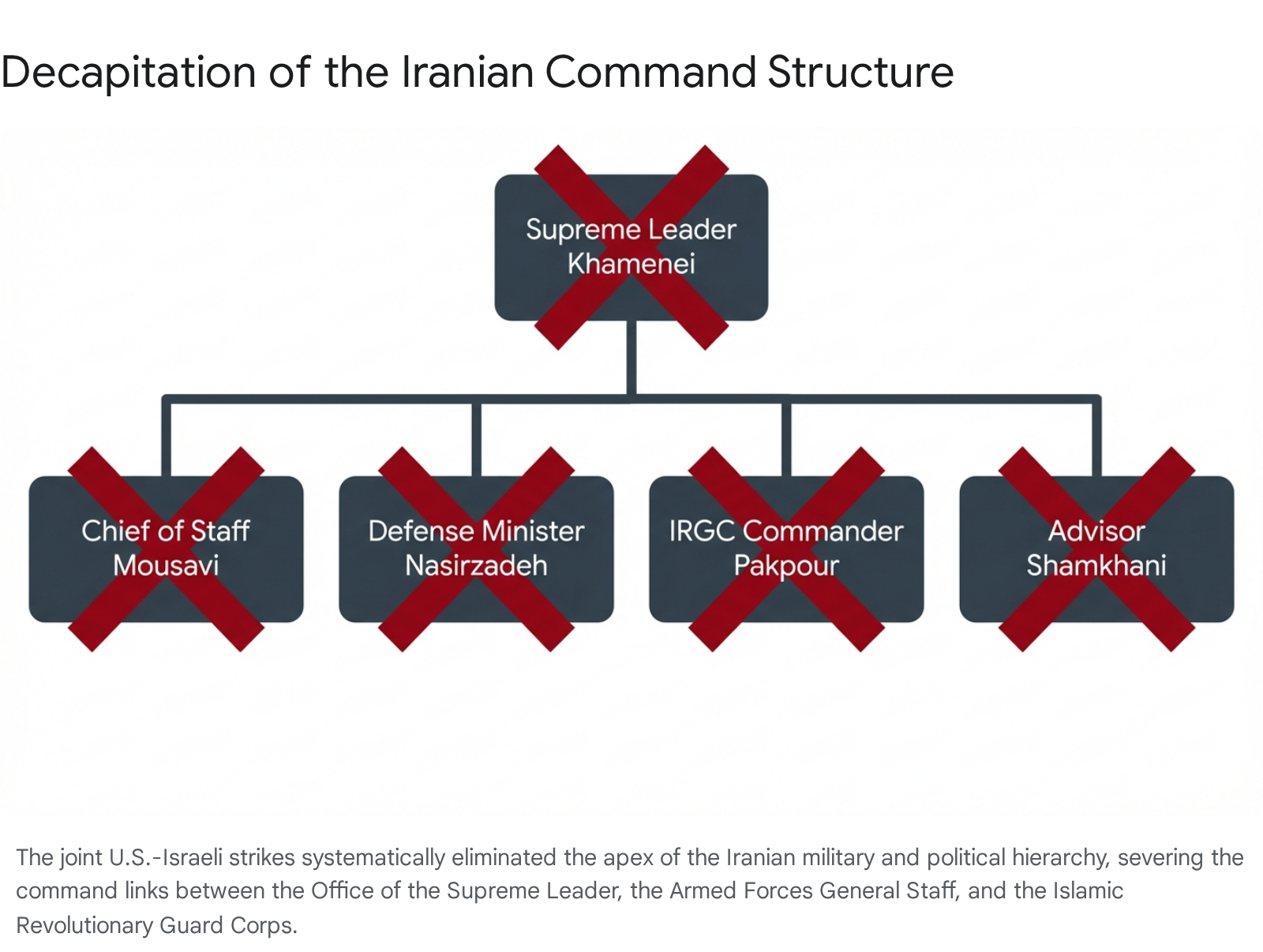
On Saturday, February 28, 2026, the geopolitical architecture of the Middle East was fundamentally and irreversibly altered by a coordinated, unprecedented joint military campaign conducted by the United States and the State of Israel. Designated Operation Epic Fury by the United States and Operation Lion’s Roar by Israel, the preemptive, large-scale strike successfully targeted and eliminated the Supreme Leader of the Islamic Republic of Iran, Ayatollah Ali Khamenei, within his secure leadership compound in the heart of Tehran.1 The operation, which utilized highly sophisticated tracking and intelligence systems reportedly aided by the Central Intelligence Agency (CIA), achieved a near-total decapitation of the Iranian supreme military, intelligence, and political security apparatus in a matter of hours.2 Among the confirmed casualties are the Chief of Staff of the Armed Forces, the Minister of Defense, and the Commander-in-Chief of the Islamic Revolutionary Guard Corps (IRGC), effectively severing the operational chain of command connecting the supreme executive to the country’s conventional and asymmetric armed forces.6
The sudden removal of the Vali-e Faqih (Guardian of the Islamic Jurist) after thirty-seven years of absolute and heavily centralized rule has precipitated the most severe constitutional, military, and existential crisis in the history of the Islamic Republic.1 In strict accordance with Article 111 of the Iranian Constitution, an Interim Leadership Council comprising President Masoud Pezeshkian, Judiciary Chief Gholamhossein Mohseni Ejei, and Guardian Council Jurist Alireza Arafi has formally assumed the executive, administrative, and military duties of the Supreme Leader.9 However, constitutional protocols are rapidly colliding with volatile ground realities. Intelligence intercepts and regional reporting indicate that surviving elements of the IRGC command structure, now operating under newly appointed Temporary Commander-in-Chief Brigadier General Ahmad Vahidi, are aggressively maneuvering to bypass the deliberative processes of the Assembly of Experts.12 The IRGC seeks to install a pliable successor by fiat, anticipating that a prolonged constitutional transition will leave the state vulnerable to internal collapse and external exploitation.
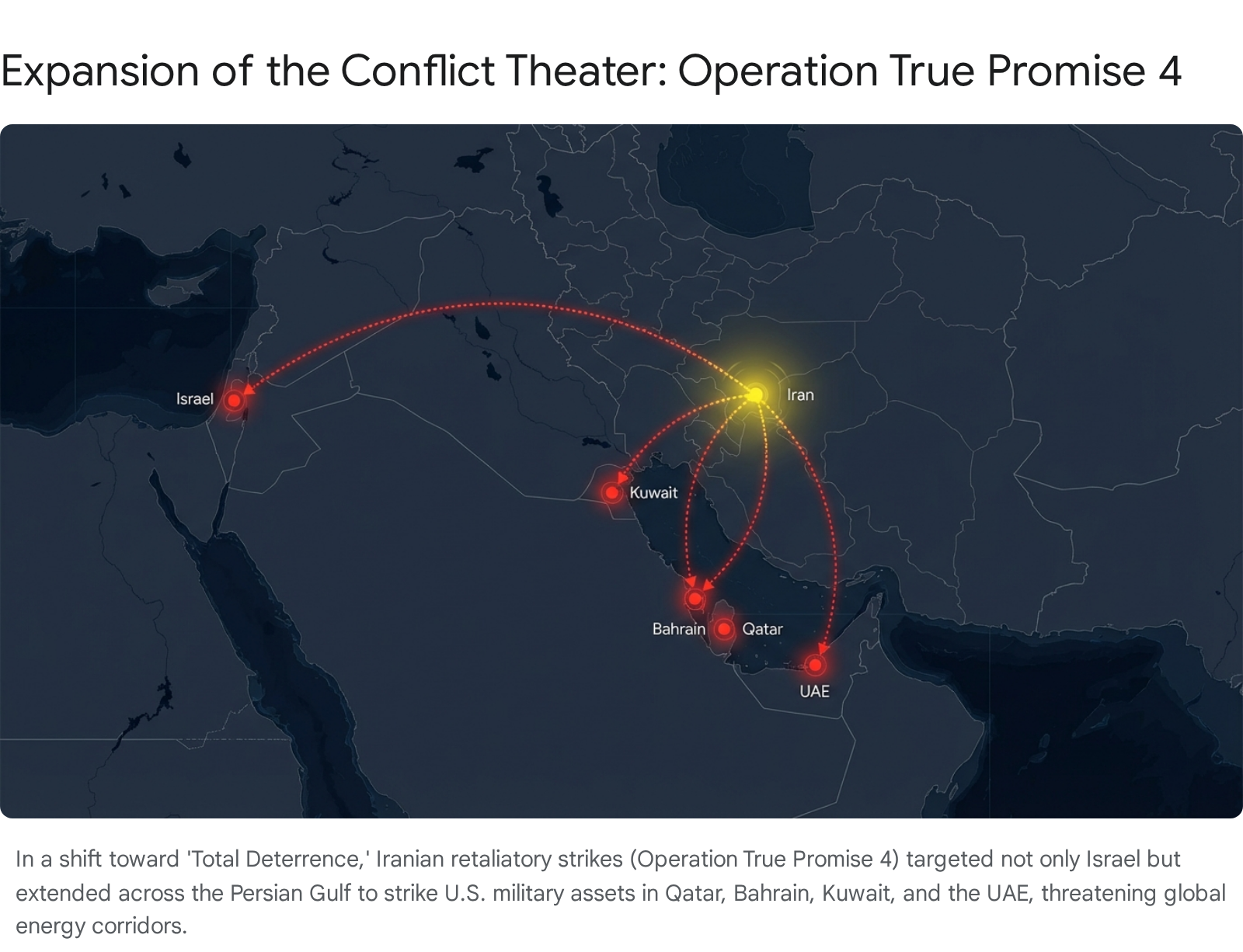
In immediate kinetic retaliation, Tehran has initiated Operation True Promise 4.3 Shifting from a strategy of proportional response to a doctrine of “Total Deterrence,” the remnants of the IRGC Aerospace Force launched waves of medium and short-range ballistic missiles alongside Shahed loitering munitions.14 Crucially, these strikes were not limited to Israeli territory; they actively targeted U.S. military installations hosted by third-party Arab states across the Gulf Cooperation Council (GCC), including critical nodes in Qatar, Kuwait, Bahrain, and the United Arab Emirates.15 Despite this high-intensity direct response from Tehran, Iran’s regional proxy network,the Axis of Resistance,has exhibited profound operational paralysis. Groups such as Hezbollah in Lebanon and the Houthis in Yemen have issued fiery rhetorical threats but demonstrated a highly muted kinetic response, heavily suggesting a complete collapse in centralized command and control previously orchestrated by the Quds Force.17
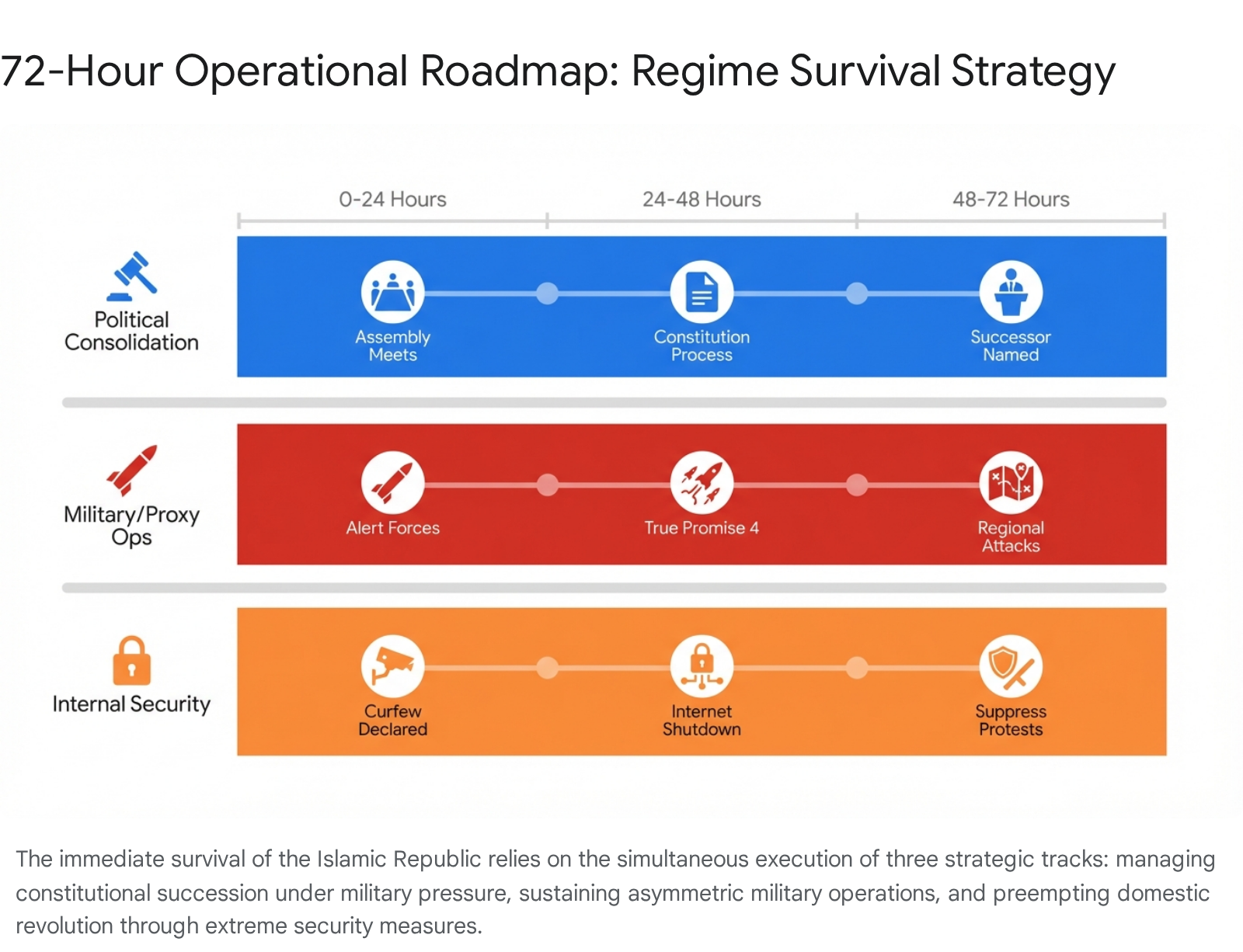
The next 72 hours represent the most critical period in the modern history of the Iranian state. The regime currently faces an unmanageable trilemma: executing a high-intensity, multi-front regional war against technologically superior adversaries, managing a fraught and potentially violent internal succession struggle between the clerical establishment and the military junta, and suppressing anticipated mass civil uprisings triggered by the perceived fragility of the state.12 To prevent total state failure and domestic coordination, the regime has initiated extreme digital authoritarian measures, heavily throttling internet traffic and preparing for the deployment of martial law under the guise of a 40-day national mourning period.18 This comprehensive intelligence estimate provides an exhaustive analysis of the new political and military power structures, the operational status of the armed forces, and a granular 72-hour roadmap forecasting the regime’s tactical, strategic, and diplomatic maneuvers as it fights for its survival.
2. Strategic Context and the Decapitation of the Islamic Republic
The strategic environment leading into the unprecedented events of February 28, 2026, was characterized by steadily escalating hostilities and the total erosion of deterrence paradigms following the June 2025 Twelve-Day War between Israel and Iran. That previous conflict saw targeted but limited U.S. and Israeli strikes aimed primarily at degrading Iran’s nuclear enrichment capabilities and missile production facilities.11 However, as diplomatic negotiations stalled and Tehran accelerated its uranium enrichment activities while simultaneously escalating its crackdown on domestic protests, the United States and Israel concluded that a paradigm-shifting kinetic intervention was necessary.3 This realization ultimately culminated in the joint execution of Operation Epic Fury (U.S.) and Operation Lion’s Roar (Israel).3
2.1 Operational Parameters of the Joint Strike
The joint military campaign was meticulously designed with three primary, overlapping strategic objectives: the complete suppression of Iranian air defenses, the severe degradation of Iran’s retaliatory ballistic missile and unmanned aerial vehicle (UAV) capabilities, and the total disruption of Iranian military and political command-and-control networks.23 Israeli Defense Forces (IDF) spokespersons confirmed that the Israeli Air Force, operating with unprecedented freedom of navigation over Iranian airspace, struck roughly 500 distinct targets.23 Concurrently, U.S. military officials indicated that the combined forces engaged nearly 900 targets within the opening twelve-hour salvo of the campaign.23
The strikes penetrated deep into the heavily defended Iranian interior, striking fortified installations, missile silos, and research facilities in Tehran, Isfahan, Qom, Karaj, and Kermanshah.16 Crucially, the operation utilized highly sophisticated signals intelligence, satellite tracking, and human intelligence networks. Reports indicate that the Central Intelligence Agency (CIA) had been tracking Ayatollah Khamenei’s movements for months and successfully identified a rare gathering of Iran’s absolute top political and military echelon at a secure leadership compound in the heart of Tehran on Saturday morning.2 In a devastating targeted strike, over 30 “bunker-buster” munitions were reportedly deployed against Khamenei’s specific compound, ensuring the complete destruction of the subterranean facilities housing the Supreme Leader and his inner security circle.5 U.S. President Donald Trump publicly announced the success of the strikes shortly after, describing Khamenei’s death as the “single greatest chance for the Iranian people to take back their Country” and citing the inability of the Iranian leadership to evade highly sophisticated U.S. tracking systems.1
2.2 Annihilation of the Command Echelon and Institutional Memory
The most highly consequential outcome of Operation Epic Fury and Operation Lion’s Roar is the near-total decapitation of the Iranian command structure. The loss of Ayatollah Khamenei creates a vast vacuum of absolute, unchallengeable authority. However, the simultaneous deaths of the senior military technocrats who translate that religious and political authority into kinetic action fundamentally paralyze the state’s operational capacity.6 The IDF stated that the strikes effectively “decapitated” Iran’s security leadership, targeting individuals responsible for the proliferation of weapons of mass destruction, internal repression, and regional terrorism.4
The confirmed casualties represent a staggering, irreplaceable loss of institutional memory, strategic acumen, and the delicate factional balancing that has defined Iranian governance for decades. Table 1 details the strategic impact of these specific eliminations.
| Eliminated Official | Pre-Strike Position | Strategic Impact of Elimination on the Iranian State |
| Ayatollah Ali Khamenei | Supreme Leader (Vali-e Faqih) | Held absolute ultimate authority over all state, religious, and military affairs since 1989. His death triggers complex constitutional succession protocols, fractures the loyalty networks he personally cultivated, and creates a massive power vacuum at the apex of the regime.1 |
| Maj. Gen. Abdolrahim Mousavi | Chief of Staff of the Armed Forces | The highest-ranking military authority in the state, responsible for coordinating joint operations between the conventional army (Artesh) and the IRGC. His death disrupts joint operational fluidity and creates factional infighting for the top military post.6 |
| Brig. Gen. Aziz Nasirzadeh | Minister of Defense | The central architect of Iran’s advanced drone and aviation programs. He crucially oversaw the SPND organization (Organization of Defensive Innovation and Research), responsible for nuclear, biological, and chemical weapons development. His loss severely degrades long-term procurement.6 |
| Maj. Gen. Mohammad Pakpour | Commander-in-Chief, IRGC | Appointed after the death of Hossein Salami in 2025. He was the chief architect of Iran’s internal security apparatus, regional strategic fire systems, and the violent suppression of domestic protests. His death leaves the IRGC functionally leaderless during a critical crisis.6 |
| Admiral Ali Shamkhani | Advisor to Supreme Leader / Defense Council Sec. | A veteran pragmatist, former SNSC Secretary, and the key diplomatic interlocutor who negotiated the 2023 Beijing agreement with Saudi Arabia. His death removes a crucial moderating and diplomatic voice from the inner circle, leaving hardliners unchecked.6 |
In addition to these confirmed deaths, profound uncertainty surrounds other vital figures. Reports from Israeli state broadcasters indicate that Mojtaba Khamenei, the Supreme Leader’s highly influential son, may have also been killed in the strikes.5 Mojtaba was widely considered a shadow successor due to his vast control over the Supreme Leader’s financial empire and his deep ties to the IRGC intelligence apparatus and the Basij militia.5 The deaths of Khamenei’s daughter, son-in-law, and granddaughter have been confirmed by Iranian state media, further decimating the Khamenei household.1
Conversely, some officials targeted in the strikes have definitively survived. Ali Larijani, the Secretary of the Supreme National Security Council and a key pragmatist, was reportedly targeted but survived, quickly emerging as a highly visible crisis manager on state television, vowing to hit the United States with unprecedented force.2 Similarly, Mohammad Bagher Ghalibaf, the Speaker of the Parliament and a former IRGC commander, appeared on camera to declare that Iran is prepared for “all scenarios” and warned that the U.S. and Israel had crossed red lines.32 The survival of Larijani and Ghalibaf positions them as the senior surviving statesmen tasked with holding the fractured political apparatus together.
3. The Constitutional Crisis and the New Power Structure
The Islamic Republic of Iran was theoretically engineered with legal mechanisms to survive political assassination and the sudden loss of leadership.9 However, the clerical scholars who drafted the constitution in 1979 and revised it in 1989 did not meaningfully contemplate a scenario wherein the Supreme Leader might fall simultaneously alongside the very military and security officials designated to organize, secure, and enforce his replacement.9 Consequently, the current power structure in Tehran is violently bifurcated between the formal, constitutional mechanisms of succession and the informal, kinetic power grab currently being orchestrated by surviving elements of the praetorian security state.
3.1 Article 111 and the Interim Leadership Council
Article 111 of the Iranian Constitution was designed explicitly to prevent administrative paralysis in the event of the Supreme Leader’s death, resignation, or incapacitation.9 The provision mandates the immediate formation of a temporary leadership council that assumes all constitutional duties of the Leader. These duties include the absolute command of the armed forces, the direction of foreign policy, the power to declare war and peace, and the ability to dismiss the president.9
State media has confirmed the prompt activation of this mechanism on March 1, 2026. The Interim Leadership Council is currently composed of three distinct political archetypes:
- Masoud Pezeshkian (President of the Republic): A nominally reformist-leaning executive whose primary pre-crisis role was managing the domestic economy and civil administration. Following the strikes, Pezeshkian has adopted a highly militant posture, framing the assassination of Khamenei as an “open declaration of war against Muslims, and particularly against Shiites, everywhere in the world” in an attempt to rally pan-Islamic sentiment and domestic cohesion.2
- Gholamhossein Mohseni Ejei (Chief Justice): A hardline conservative cleric with a deep, extensive background in the intelligence services and the judiciary. His presence ensures the continuity of internal judicial repression and provides a mechanism to legally authorize the mass arrests of perceived dissidents during the transition period.10
- Ayatollah Alireza Arafi (Jurist from the Guardian Council): Appointed specifically on March 1, 2026, to fill the mandated clerical seat on the interim council.24 Arafi is a highly influential seminary administrator and is currently viewed as the absolute frontrunner for the permanent Supreme Leader position.37
Table 2 illustrates the distribution of institutional power during this interim phase.
| Interim Council Member | Constitutional Role | Institutional Base of Power | Factional Alignment |
| Masoud Pezeshkian | President of Iran | Executive Branch, Civil Bureaucracy, Economic Ministries | Pragmatist / Reformist-leaning |
| Gholamhossein Mohseni Ejei | Chief Justice | The Judiciary, Intelligence Ministry (MOIS) ties | Hardline Conservative |
| Ayatollah Alireza Arafi | Guardian Council Jurist | Qom Seminary System, Assembly of Experts | Traditionalist / Establishment Clergy |
While this Interim Leadership Council nominally holds absolute, undivided power, its actual, practical ability to command the armed forces,specifically the ideologically driven IRGC,during a live military crisis is highly suspect. None of the three council members possess the deeply entrenched, decades-long patronage networks within the military officer corps that Khamenei spent thirty-seven years carefully cultivating to ensure his own survival.9
3.2 The Assembly of Experts and the Opaque Succession Struggle
The Assembly of Experts (Majles-e Khabargan-e Rahbari), an 88-member deliberative body composed entirely of vetted, male Shia clerics elected to eight-year terms, holds the sole constitutional authority to elect the next Supreme Leader.10 Currently chaired by the nonagenarian Ayatollah Mohammad-Ali Movahedi Kermani, the Assembly is legally required to convene in absolute secrecy to choose a successor, examining candidates’ religious scholarship, political acumen, and administrative capabilities.30
Prior to his death, Khamenei had deliberately obfuscated the succession process. He had not publicly designated an heir, though he had reportedly initiated vetting procedures with the Assembly of Experts following the destabilizing 2025 June war, recognizing his own mortality.23 The assassination has thrown the succession timeline into chaos. The primary candidates currently dominating the intelligence discourse are:
- Ayatollah Alireza Arafi (66): The undisputed frontrunner. Arafi embodies the intersection of religious authority and political influence. He currently manages Iran’s massive nationwide seminary system in Qom, holds a powerful seat on the Guardian Council, serves as the second deputy chairman of the Assembly of Experts, and now sits on the Interim Leadership Council.37 He represents reliable continuity for the traditional clerical establishment and is viewed as a safe, manageable figure by the security state, unlikely to challenge the military’s economic interests.37
- Ayatollah Hashem Hosseini Bushehri: The first deputy chairman of the Assembly of Experts and the Friday prayer leader of Qom. A staunch traditionalist who shares Arafi’s institutional pedigree, serving as a viable alternative should Arafi face unexpected internal opposition.38
- Mojtaba Khamenei: The late Supreme Leader’s second son. Long considered a formidable shadow successor due to his vast control over Khamenei’s financial empire (the Setad) and his deep, personal ties to the IRGC intelligence apparatus and the Basij paramilitary forces.30 However, persistent reports indicating his death in the February 28 strikes, combined with systemic, deep-seated clerical resistance to hereditary succession (which mirrors the monarchy overthrown in 1979), significantly diminish his viability even if he is proven to be alive.5
3.3 The Praetorian Guard: The IRGC’s Extralegal Bid for Hegemony
The most critical and dangerous dynamic currently unfolding in Tehran is the severe tension between the civilian/clerical constitutional process and the Islamic Revolutionary Guard Corps (Sepah). The IRGC has suffered a catastrophic loss of top-tier leadership, but its foundational institutional instinct is self-preservation, economic dominance, and political hegemony.39
High-level intelligence sources report that the surviving IRGC command structure is aggressively pushing to finalize the appointment of a new Supreme Leader immediately, actively lobbying to bypass the legally prescribed, slow deliberative procedures of the Assembly of Experts.12 The IRGC leadership publicly argues that attempting to physically convene the 88-member Assembly in Tehran during ongoing U.S. and Israeli airstrikes is a profound, unacceptable security risk.12 However, intelligence indicates their true motivation is the acute fear of mass domestic uprisings. By forcing the immediate elevation of a pliant cleric,most likely Alireza Arafi,the IRGC seeks to legitimize an outright military junta behind a thin, constitutionally acceptable clerical veneer before the population can mobilize.12
In the wake of Mohammad Pakpour’s assassination, Brigadier General Ahmad Vahidi has been swiftly appointed as the Temporary Commander-in-Chief of the IRGC by the Interim Council.13 Vahidi, a former Minister of Interior and a hardened veteran of the IRGC’s external operations, is a ruthless pragmatist.13 Under his emergency command, the IRGC is frantically attempting to re-establish fragmented chains of command. Reports indicate severe internal friction; parts of the chain of command have been entirely disrupted, and crucially, some lower-ranking military commanders and personnel have actively refrained from reporting to their bases out of terror over continued, highly precise U.S. and Israeli bunker-buster strikes.12 This insubordination severely complicates field decision-making and crisis management in the immediate term.
3.4 The Marginalized Conventional Army (Artesh)
The conventional military (Artesh), responsible for Iran’s territorial defense, has also been thrown into disarray by the death of the Chief of Staff, Maj. Gen. Abdolrahim Mousavi.26 The Artesh has historically been deliberately marginalized, underfunded, and viewed with suspicion by the clerical regime in favor of the ideologically pure IRGC.46
However, the massive, repeated failures of the IRGC’s air defense networks and strategic deterrent capabilities during the current conflict have profoundly humiliated the Guard in the eyes of the remaining political elite.46 This presents a unique factional opportunity. If the current Defense Minister, Mohammad Reza Ashtiani (himself a career Artesh officer), can maintain internal cohesion within the conventional army better than Vahidi can within the IRGC, the Artesh may successfully assert greater influence over the Supreme National Security Council, fundamentally altering the traditional balance of power in Tehran for the first time since the 1980–1988 Iran-Iraq War.46
4. Operational Assessment: The Armed Forces and Asymmetric Warfare
The Islamic Republic’s survival doctrine has relied for decades on two foundational pillars: “Forward Defense”,utilizing a vast network of regional proxy militias to fight adversaries far from Iran’s borders,and an extensive, domestically produced arsenal of ballistic missiles serving as a strategic deterrent.14 Both of these pillars are currently undergoing the most severe stress testing in their history.
4.1 Operation True Promise 4: The Shift to Total Deterrence
Following the confirmation of Ayatollah Khamenei’s death and the destruction of central command nodes, the remnants of the Armed Forces General Staff and the IRGC Aerospace Force initiated “Operation True Promise 4”.3 This operation consisted of launching hundreds of medium and short-range ballistic missiles, cruise missiles, and Shahed-series loitering munitions across the Middle East.15
Unlike previous escalations in 2024 and 2025 that focused almost exclusively on Israeli territory, True Promise 4 signifies a desperate, highly escalatory shift toward a “Total Deterrence” doctrine.14 Iran intentionally expanded its target matrix to include U.S. military installations and critical infrastructure hosted by third-party Arab states. Table 3 outlines the geographic scope of this retaliatory operation.
| Targeted Nation / Entity | Specific Known Targets / Installations Struck | Strategic Rationale for Targeting |
| Israel | Nationwide targets (triggering over 500 siren alerts), resulting in at least 1 fatality and 121 injuries.24 | Direct retaliation against the primary belligerent; attempting to overwhelm the Arrow and David’s Sling defense systems.3 |
| Qatar | Al Udeid Air Base (Forward headquarters of U.S. Central Command).15 | Targeting the logistical and command hub of U.S. air operations in the Middle East.15 |
| Kuwait | Ali Al Salem Air Base.15 | Degrading U.S. airlift and tactical fighter projection capabilities in the upper Persian Gulf.15 |
| Bahrain | U.S. Navy 5th Fleet Headquarters. A high-rise residential building was also struck by a Shahed drone, possibly due to GPS jamming.15 | Threatening the primary naval deterrent force securing the Strait of Hormuz.15 |
| United Arab Emirates | Port of Jebel Ali (dark smoke plumes reported); Palm Hotel parking area in Dubai struck by a Shahed drone, causing injuries.15 | Economic terrorism; targeting global shipping hubs to induce panic in international markets and force the UAE to pressure Washington to halt strikes.14 |
This geographic expansion is a highly calculated gamble. By directly targeting the GCC states, Iran aims to drastically raise the geopolitical and economic cost of U.S. military actions. Tehran’s strategy is to force wealthy Arab states to pressure Washington into halting the Epic Fury campaign out of fear for their own critical infrastructure, aviation hubs, and the stability of the global energy market.14 The collateral damage in Dubai, the closure of regional airspace, and the rerouting of commercial shipping away from the Strait of Hormuz are specifically intended to trigger a global economic panic, leveraging international energy security as a weapon of state survival.14
4.2 Status of the Axis of Resistance: Operational Paralysis
Despite the fierce, apocalyptic rhetoric emanating from the Interim Council and parliamentarians in Tehran, the Iranian proxy network,the much-vaunted “Axis of Resistance”,has demonstrated a profound inability to project meaningful force in defense of its primary patron.17 Following the decapitation strikes, groups such as Hezbollah in Lebanon, Kataib Hezbollah in Iraq, and the Houthis in Yemen issued coordinated statements proclaiming their unwavering readiness to confront the U.S. and Israel, framing the assassination of Khamenei as an existential threat to the entire resistance front.17
However, actual kinetic output from these proxies has been remarkably muted, resulting in limited to no significant coordinated military action against Israeli or U.S. flanks.17 This paralysis is highly indicative of a massive, systemic failure in the IRGC Quds Force’s command-and-control network. The Quds Force relies heavily on tight interpersonal relationships, secure communications, and highly centralized directives from Tehran to coordinate complex multi-front operations.
With the IRGC leadership decapitated, secure communications infrastructure severed by U.S. cyber and kinetic strikes, and the operational status of Quds Force commander Brigadier General Esmail Qaani currently uncertain (with some Israeli reports indicating he was targeted alongside Mohammad Pakpour), the proxies have been left strategically blind and operationally isolated.50 Without clear, verifiable authorization, assurances of continued financial and logistical funding, or tactical coordination from Tehran, the constituent militias of the Axis are rationally choosing to prioritize local preservation and political survival in their respective host nations over a suicidal, uncoordinated regional defense of a crumbling Iranian regime.17
5. Internal Security, Digital Authoritarianism, and Regime Survival
The most acute, existential threat to the survival of the Islamic Republic following the death of Ayatollah Khamenei does not emanate from the airspace over Tel Aviv or the naval fleets in the Persian Gulf, but from the streets of Tehran, Isfahan, and Shiraz. The regime is profoundly aware that the spectacular decapitation of its leadership presents a once-in-a-generation opportunity for a mass civil uprising, an eventuality heavily encouraged by direct, public appeals from U.S. President Donald Trump for the Iranian people to “seize control of your destiny” and overthrow the theocracy.1
5.1 The Imposition of Digital Authoritarianism
To preempt physical coordination among dissidents, student groups, and ethnic minorities, the regime immediately executed its established, highly effective digital authoritarian playbook. Historical precedent dictates the regime’s response to an existential domestic crisis: during the fuel protests of November 2019, the Mahsa Amini protests of September 2022, and the severe economic riots of January 2026, the state successfully throttled internet access, plunging the country into a digital blackout to blind the population and obscure the actions of security forces.19
Network telemetry data confirms that the regime is utilizing sophisticated Border Gateway Protocol (BGP) route withdrawals to implement a near-total information blackout.19 In previous iterations of this tactic, such as the January 2026 shutdown, the amount of IPv6 address space announced by Iranian networks dropped by an astounding 98.5%, falling from over 48 million /48 blocks to just over 737,000 in a matter of hours.19 By physically isolating the heavily censored domestic intranet (the National Information Network) from the global internet, the Ministry of Intelligence (MOIS) and the IRGC Cyber Command seek to prevent the transmission of protest footage, the rapid organization of mass flash rallies, and the reception of external financial or moral support.19
5.2 Anticipated Civil Unrest and State Suppression Tactics
The IRGC command is deeply concerned that as daylight breaks and the reality of the strikes permeates the populace, citizens will pour into the streets, viewing the smoldering ruins of Khamenei’s compound and the confirmed deaths of feared IRGC leaders as definitive proof of the state’s sudden, terminal fragility.12 There are already corroborated reports of sporadic, high-risk public celebrations breaking out in various Iranian cities, mirroring the celebrations seen among the Iranian diaspora in Australia and Europe.14
In response, the regime will rely absolutely on the Basij volunteer paramilitary forces and the Law Enforcement Command (FARAJA) to enforce a brutal, undeclared state of martial law. The regime has a proven, documented willingness to utilize lethal force at a massive scale to ensure its survival; crackdowns during the recent unrest in late 2025 and early 2026 resulted in thousands of civilian casualties, with Amnesty International documenting the use of live ammunition, torture, and mass executions of dissidents orchestrated by hardline judges like Abolghassem Salavati.21
To provide a legal and religious pretext for locking down the country, the government has announced a mandatory 40-day national mourning period and a seven-day total shutdown of all public institutions, schools, and non-essential businesses.18 This edict serves a critical dual purpose: it mandates compulsory displays of public grief to project an illusion of popular support, while simultaneously providing security forces with the legal authority to clear the streets, close universities (traditional hotbeds of dissent), and aggressively disperse any unauthorized public gatherings under the guise of respecting the period of state mourning.18
6. The 72-Hour Operational Roadmap: Immediate Next Steps for the Regime
Based on current intelligence feeds, historical precedent regarding leadership transitions, and the highly rigid doctrinal behavior of the Islamic Republic’s military and political institutions, the following operational roadmap projects the regime’s desperate actions over the critical 72-hour window following the assassination.
6.1 Hours 0–24: Command Reconstitution and Domestic Containment
Military & Command Control Dynamics:
- Establish Continuity of Government: The Interim Leadership Council (Pezeshkian, Ejei, Arafi) will convene continuously within a secure, deeply buried bunker, likely the national command center, heavily guarded by loyalist IRGC elements. Their primary goal is maintaining the optical continuity of the state and broadcasting their survival to prevent panic.9
- Chain of Command Triage: Temporary IRGC Commander Ahmad Vahidi will attempt to re-establish secure communications with isolated provincial IRGC commanders to prevent mass unit desertion. He will likely utilize redundant, hardened military fiber-optic networks completely separate from the civilian grid, issuing threats of summary execution for insubordination.12
- Sustained Missile Force Deployment: The IRGC Aerospace Force will attempt to sustain high-tempo, decentralized missile launches under Operation True Promise 4 to demonstrate vitality and deterrence. These launches will operate exclusively from deeply buried silo complexes to mitigate the severe impact of ongoing U.S. and Israeli air superiority.3
Internal Security Dynamics:
- Total Information Blackout: Complete severing of international internet gateways and throttling of cellular data networks to prevent citizens from sharing news or organizing protests.19
- Preemptive Arrest Sweeps: The Ministry of Intelligence (MOIS) and the IRGC Intelligence Organization will execute pre-planned, massive sweeps of known political dissidents, student leaders, journalists, and minority rights activists. The goal is to entirely decapitate potential uprising leadership before they can mobilize the public.54
6.2 Hours 24–48: Succession Maneuvering and Asymmetric Force Projection
Political Maneuvering:
- The Assembly of Experts Crisis: Extreme, potentially violent pressure will be applied to the Assembly of Experts by the IRGC. Vahidi and the surviving security apparatus will demand the Assembly bypass standard theological vetting procedures and immediately confirm Ayatollah Alireza Arafi as the new Supreme Leader to close the dangerous constitutional vacuum.12
- Purge of Internal Rivals: If pragmatist figures like Ali Larijani or reformist elements attempt to delay the succession to negotiate limits on IRGC power, they will be rapidly marginalized, placed under house arrest, or declared enemies of the state by military loyalists.31
Regional Operations:
- Proxy Re-engagement: Surviving deputies within the Quds Force will deploy physical couriers across the borders to Beirut, Sanaa, and Baghdad to re-establish command links with Hezbollah, the Houthis, and the PMF. They will attempt to issue authorization codes for coordinated, asymmetric attacks against Israeli and U.S. soft targets, attempting to break the humiliating proxy paralysis.17
- Maritime Harassment Escalation: The IRGC Navy will intensify asymmetrical harassment operations involving fast-attack craft and naval mines in the Strait of Hormuz and the Gulf of Oman, aiming to maximize panic in global oil markets and force international diplomatic intervention.14
6.3 Hours 48–72: Consolidation of the Interim State and Diplomatic Appeals
Optics and Domestic Legitimacy:
- State Funerals as Power Projection: The regime will initiate highly choreographed, massive state funerals for Khamenei and the slain generals. Mirroring the funeral of President Ebrahim Raisi in 2024, these events will be staged primarily in Tehran and the holy city of Mashhad.59 The regime will coercively bus in state employees, Basij members, and military personnel to guarantee vast crowds, using the imagery to project an aura of national unity, mourning, and unyielding popular support to the international community.59
- Announcement of Succession: To project ultimate stability and continuity, state media will likely announce the successful selection of the new Supreme Leader (highly likely to be Arafi), formally ending the precarious tenure of the Interim Council.37
Diplomatic Maneuvers:
- Urgent Engagement with the Eurasian Axis: Foreign Minister Abbas Araghchi will intensely lobby counterparts in Moscow and Beijing. Iran will seek immediate diplomatic shielding at the UN Security Council (which has scheduled emergency meetings) and will desperately request expedited deliveries of advanced Russian air defense systems and Chinese satellite intelligence to counter the ongoing U.S. and Israeli air superiority over their territory.49
7. Geopolitical Ripple Effects and International Reactions
The assassination of Ayatollah Ali Khamenei has instantly polarized the international community, starkly highlighting the rigid, uncompromising geopolitical blocs defining the mid-2020s and forcing regional actors into highly uncomfortable diplomatic positions.
The United States and Israel view the operation as an unprecedented, historic strategic success. U.S. President Donald Trump, who authorized the CIA intelligence sharing and military coordination, stated explicitly that the objective of the operation was to destroy Iran’s nuclear and missile capabilities, and he actively called for regime change, framing it as the ultimate opportunity for the Iranian populace.1 Furthermore, Trump has threatened to hit Iran with a force “that has never been seen before” if Tehran continues to escalate its retaliatory strikes.63 Israel’s Defense Minister, Israel Katz, celebrated the strikes, declaring that “justice has been served” against the head of the “Iranian octopus”.2
Conversely, the Eurasian powers have vehemently condemned the strikes. Russia and China both issued swift, direct criticisms of the U.S.-Israeli action. The Russian Foreign Ministry formally labeled the strikes a “pre-planned and unprovoked act of armed aggression against a sovereign state,” while China emphasized the absolute need to respect Iran’s sovereignty, security, and territorial integrity.53 These condemnations are heavily rooted in realpolitik; the potential collapse of the Iranian regime represents a massive strategic loss for the Sino-Russian axis, depriving them of a key anti-Western ally, a major purchaser of military hardware, and a primary disruptor of U.S. hegemony in the Middle East.64
The most delicate, complex diplomatic balancing acts are occurring within the Middle East itself. The Gulf Cooperation Council states are caught squarely in the crossfire. Arab nations including Saudi Arabia, Qatar, the UAE, Kuwait, and Bahrain have uniformly condemned Iran’s retaliatory strikes,which crossed their sovereign airspace and struck military assets on their soil,as blatant violations of international law and “treacherous Iranian aggression”.53 However, these same nations are terrified of being dragged into a wider, devastating regional war. Consequently, they have carefully avoided publicly endorsing the initial U.S.-Israeli decapitation strikes, seeking to avoid being perceived by a desperate Tehran as complicit accomplices.62 Oman, a traditional mediator between the West and Iran, explicitly condemned the U.S. action as a violation of the rules of international law.53 Syria, long a staunch Iranian ally, issued a surprisingly singular condemnation of Iran, reflecting Damascus’s recent pragmatic pivot toward rebuilding ties with wealthy Arab neighbors and the West.53 Beyond the immediate region, Ukraine’s President Volodymyr Zelensky actively voiced support for the U.S.-led strikes, explicitly linking the action to Iran’s role as an “accomplice of Putin” due to Tehran’s ongoing supply of Shahed drones to Russia.61 Other Western-aligned nations, including Australia, Canada, and New Zealand, expressed open or tacit support for the degradation of the Iranian regime’s capabilities.53
8. Strategic Foresight and Conclusions
The Islamic Republic of Iran has entered the absolute most perilous phase of its forty-seven-year existence. The joint U.S.-Israeli military campaign has successfully eliminated the ideological, political, and military architects of the Iranian state in a single, devastating blow.5 The immediate consequence is a profound, debilitating power vacuum, temporarily filled by an Interim Leadership Council that lacks the deep-state patronage, military loyalty, and religious charisma required to exert absolute authority over a fractured nation.9
In the near term, the transition of power in Tehran will be dictated not by constitutional theology or the deliberations of clerics, but by the application of brute military force. The surviving elements of the Islamic Revolutionary Guard Corps are poised to effectively stage a silent, internal coup, leveraging the ongoing military crisis and the threat of civil war to bypass the Assembly of Experts.12 By forcing the installation of a figurehead Supreme Leader,such as Alireza Arafi,the IRGC assumes total de facto control of the state.37 Consequently, the complex clerical autocracy established by Ruhollah Khomeini in 1979 is rapidly metamorphosing into an unvarnished, highly aggressive military dictatorship.
While the Iranian regime undoubtedly retains the capacity to inflict severe economic damage globally through the disruption of energy transit in the Persian Gulf and decentralized ballistic missile strikes against its neighbors, its internal cohesion is fatally compromised.14 Without the unifying, singular authority of Ayatollah Ali Khamenei to arbitrate disputes, the latent factionalism between the IRGC, the traditional clergy, and the conventional Artesh will inevitably fracture the regime from within.9 When this profound internal rot is combined with the overwhelming pressure of Western military supremacy and a deeply resentful, mobilized domestic population, the ultimate survival of the Islamic Republic in its current iteration is highly improbable. The next 72 hours will determine whether the state collapses into civil war, transforms into a military junta, or fragments entirely.
Appendix A: Analytical Framework and Source Evaluation
This intelligence estimate was developed utilizing a comprehensive, multi-disciplinary fusion of open-source intelligence (OSINT), regional broadcast transcripts, verified network telemetry data, and strategic analysis from leading geopolitical think tanks. The analytical framework prioritized the cross-verification of casualty reports from adversarial sources (e.g., matching IDF strike claims against Iranian state media confirmations and funeral announcements). Factional analysis of the Iranian elite was derived from historical institutional behaviors, particularly examining the precedents set during the 1989 succession of Ruhollah Khomeini, as well as the tactical responses of the security state to the 2019, 2022, and 2026 domestic protest movements. Predictive modeling for the 72-hour operational roadmap is based on the rigid, doctrinally bound standard operating procedures of the Islamic Revolutionary Guard Corps, the constitutional mandates of the Islamic Republic, and real-time assessments of proxy militia activity across the Middle East.
Appendix B: Glossary of Acronyms
- BGP: Border Gateway Protocol. A standardized exterior gateway protocol designed to exchange routing and reachability information among autonomous systems on the internet.
- CIA: Central Intelligence Agency (United States).
- FARAJA: Law Enforcement Command of the Islamic Republic of Iran. The uniformed police force in Iran, frequently utilized for riot control and internal suppression.
- GCC: Gulf Cooperation Council. A regional intergovernmental political and economic union consisting of Bahrain, Kuwait, Oman, Qatar, Saudi Arabia, and the United Arab Emirates.
- IDF: Israel Defense Forces.
- IRGC: Islamic Revolutionary Guard Corps. A multi-service primary branch of the Iranian Armed Forces founded after the 1979 revolution, tasked with protecting the country’s Islamic republic political system.
- MOIS: Ministry of Intelligence of the Islamic Republic of Iran. The primary intelligence agency of Iran, responsible for domestic security and counter-espionage.
- PMF: Popular Mobilization Forces. An Iraqi state-sponsored umbrella organization composed of approximately 67 different armed factions, many of which are backed by Iran.
- SNSC: Supreme National Security Council (Iran). The national security council of the Islamic Republic of Iran.
- SPND: Organization of Defensive Innovation and Research. An Iranian defense research organization historically linked to nuclear, biological, and chemical weapons research.
- UAV: Unmanned Aerial Vehicle.
Appendix C: Glossary of Foreign Terms
- Artesh: The conventional military forces of Iran, distinct from the IRGC. Translates literally as “Army.” Responsible primarily for defending Iran’s territorial integrity.47
- Basij: A paramilitary volunteer militia established in 1979, operating under the direct command of the IRGC. Utilized heavily for internal security, moral policing, and suppressing domestic dissent.45
- Faqih: An Islamic jurist; an expert in Islamic law (fiqh).8
- Hojjat-ol-Eslam: A mid-ranking title for Shia clerics, literally meaning “Authority on Islam.” It is a rank lower than Ayatollah.40
- Majles-e Khabargan-e Rahbari: The Assembly of Experts of the Leadership. The 88-member deliberative body composed of Islamic jurists empowered to appoint and nominally supervise the Supreme Leader of Iran.34
- Niroye Daryaee: Navy.66
- Niroye Havaee: Air Force.66
- Niroye Zamini: Ground Forces / Army.66
- Pasdar: Guard. A term used to denote members of the Islamic Revolutionary Guard Corps.45
- Quds Force: The elite unconventional warfare and military intelligence operations branch of the IRGC. Responsible for extraterritorial operations and managing the Axis of Resistance proxy militias.51
- Rahbar: Leader; often used as shorthand for the Supreme Leader of the Islamic Republic.14
- Sepah: Short for Sepah-e Pasdaran-e Enghelab-e Eslami, meaning the Islamic Revolutionary Guard Corps.44
- Setad: The Execution of Imam Khomeini’s Order. A massive, state-sanctioned bonyad (charitable trust) under the direct control of the Supreme Leader, representing a significant portion of the Iranian economy.
- Vali-e Faqih: The Guardian Islamic Jurist. The individual holding the office of the Supreme Leader of Iran.8
- Vali-yye Amr-e Moslemin: Guardian of Muslims’ Affairs. A formal religious title applied to the Supreme Leader.8
- Velayat-e Faqih: Guardianship of the Islamic Jurist. The foundational political and theological doctrine of the Islamic Republic of Iran, asserting that a qualified Islamic jurist should hold ultimate, absolute political authority.8
Works cited
- Iran state media confirms killing of Ayatollah Ali Khamenei after US-Israeli missile strikes, accessed March 1, 2026, https://www.theguardian.com/us-news/2026/feb/28/khamenei-likely-killed-us-israel-iran-strikes
- U.S., Israel attack Iran LIVE updates: Iran names Alireza Arafi to …, accessed March 1, 2026, https://www.thehindu.com/news/international/iran-us-tensions-iran-israel-war-nuclear-tensions-tehran-tel-aviv-march-1-live-updates/article70690476.ece
- Operation Lion’s Roar, Background, Impact, Key Details, accessed March 1, 2026, https://vajiramandravi.com/current-affairs/operation-lions-roar/
- Iran’s supreme leader Khamenei dead after U.S., Israel attacks, accessed March 1, 2026, https://english.kyodonews.net/articles/-/71373
- Initial Israeli strikes targeted some 30 key Iranian leaders; 30 bombs said dropped on Khamenei’s compound, accessed March 1, 2026, https://www.timesofisrael.com/liveblog_entry/initial-israeli-strikes-targeted-some-30-key-iranian-leaders-30-bombs-said-dropped-on-khameneis-compound/
- Iran Confirms Deaths of Top Military Leaders in U.S.-Israeli Strikes – IranWire, accessed March 1, 2026, https://iranwire.com/en/news/149675-iran-confirms-deaths-of-top-military-leaders-in-us-israeli-strikes/
- How succession works in Iran and who will be the country’s next supreme leader?, accessed March 1, 2026, https://www.arabnews.com/node/2634852/middle-east
- Glossary of Iranian Political Terms – دیپلماسی ایرانی, accessed March 1, 2026, http://www.irdiplomacy.ir/en/news/8727/glossary-of-iranian-political-terms
- What next for Iranian regime after the Supreme Leader’s death? | ITV News, accessed March 1, 2026, https://www.itv.com/news/2026-02-28/what-next-for-iranian-regime-if-its-supreme-leader-is-killed
- How succession works in Iran and who will be the country’s next supreme leader?, accessed March 1, 2026, https://www.thehindu.com/news/international/how-succession-works-in-iran-and-who-will-be-the-countrys-next-supreme-leader/article70690589.ece
- Explainer: What is succession process in Iran if Khamenei dies? – BBC Monitoring, accessed March 1, 2026, https://monitoring.bbc.co.uk/product/b00047rx
- Iran’s Guards push to name next leader outside legal procedures | Iran International, accessed March 1, 2026, https://www.iranintl.com/en/202602285944
- Ahmad Vahidi – Wikipedia, accessed March 1, 2026, https://en.wikipedia.org/wiki/Ahmad_Vahidi
- Khamenei’s Killin and Kinetic Escalation in the Persian Gulf – SpecialEurasia, accessed March 1, 2026, https://www.specialeurasia.com/2026/03/01/khamenei-killing-middle-east/
- Iran Retaliates Across Region amid Unclear Leadership Situation – Global Guardian, accessed March 1, 2026, https://www.globalguardian.com/newsroom/iran-retaliates-across-region-amid-unclear-leadership-situation?hsLang=en
- 2026 Israeli–United States strikes on Iran – Wikipedia, accessed March 1, 2026, https://en.wikipedia.org/wiki/2026_Israeli%E2%80%93United_States_strikes_on_Iran
- Iran’s proxies: bold threats, muted response in wake of US-Israeli strikes | Saad Guerraoui, accessed March 1, 2026, https://middle-east-online.com/en/irans-proxies-bold-threats-muted-response-wake-us-israeli-strikes
- GEOPOLITICS | Iran Declares National Mourning After Supreme Leader’s Death – Binance, accessed March 1, 2026, https://www.binance.com/en/square/post/296728901408993
- What we know about Iran’s Internet shutdown – The Cloudflare Blog, accessed March 1, 2026, https://blog.cloudflare.com/iran-protests-internet-shutdown/
- Ayatollah Ali Khamenei obituary, accessed March 1, 2026, https://www.theguardian.com/world/2026/mar/01/ayatollah-ali-khameini-obituary
- Ayatollah Ali Khamenei, Iran’s supreme leader, is dead at 86, accessed March 1, 2026, https://www.washingtonpost.com/obituaries/2026/02/28/ayatollah-khamenei-dead-iran/
- Iran’s regime is suffering from strategic vertigo. Its next misstep may be its last., accessed March 1, 2026, https://www.atlanticcouncil.org/blogs/menasource/irans-regime-is-suffering-from-strategic-vertigo-its-next-misstep-may-be-its-last/
- Iran Update Evening Special Report, February 28, 2026 | ISW, accessed March 1, 2026, https://understandingwar.org/research/middle-east/iran-update-evening-special-report-february-28-2026/
- LIVE BLOG: Iran Announces Martyrdom of Ayatollah Sayyid Ali Khamenei, Other Commanders – Day 2 – Palestine Chronicle, accessed March 1, 2026, https://www.palestinechronicle.com/live-blog-iran-announces-martyrdom-of-ayatollah-sayyid-ali-khamenei-other-commanders-day-2/
- Live – Trump says talks easier after Khamenei, Iran vows ‘devastating’ response, accessed March 1, 2026, https://www.iranintl.com/en/liveblog/202602288143
- Abdolrahim Mousavi – Wikipedia, accessed March 1, 2026, https://en.wikipedia.org/wiki/Abdolrahim_Mousavi
- Trump calls Khamenei’s death justice for Iranian people, accessed March 1, 2026, https://www.iranintl.com/en/202602286218
- Who Were the Iranian Officials Killed in US–Israeli Strikes? – Palestine Chronicle, accessed March 1, 2026, https://www.palestinechronicle.com/profiles-who-were-the-iranian-officials-killed-in-us-israeli-strikes/
- Fadavi, Ali – United Against Nuclear Iran | UANI, accessed March 1, 2026, https://www.unitedagainstnucleariran.com/sanctioned-person/fadavi-ali
- 2026 Iranian Supreme Leader election – Wikipedia, accessed March 1, 2026, https://en.wikipedia.org/wiki/2026_Iranian_Supreme_Leader_election
- Who is Ali Larijani? Khamenei’s trusted adviser and key figure in Iran’s leadership, accessed March 1, 2026, https://timesofindia.indiatimes.com/world/middle-east/who-is-ali-larijani-khameneis-trusted-adviser-and-key-figure-in-irans-leadership/articleshow/128908729.cms
- Iran’s parliament speaker calls US, Israeli leaders ‘filthy criminals’, accessed March 1, 2026, https://www.arabnews.com/node/2634857/amp
- Iran parliament speaker says ‘time for final revenge has come’ | Middle East Eye, accessed March 1, 2026, https://www.middleeasteye.net/live-blog/live-blog-update/iran-parliament-speaker-says-time-final-revenge-has-come
- Assembly of Experts – Wikipedia, accessed March 1, 2026, https://en.wikipedia.org/wiki/Assembly_of_Experts
- Mojtaba Khamenei, son of Ayatollah Ali Khamenei: Could he be Iran’s next supreme leader?, accessed March 1, 2026, https://m.economictimes.com/news/new-updates/mojtaba-khamenei-son-of-ayatollah-ali-khamenei-could-he-be-irans-next-supreme-leader/articleshow/128909519.cms
- US-Israel war on Iran live: Israel launches new wave of attacks ‘in …, accessed March 1, 2026, https://www.theguardian.com/us-news/live/2026/mar/01/us-israel-war-on-iran-ayatollah-ali-khamenei-i-dead-latest-reports
- Iran’s Next Supreme Leader: The Five Men Who Could Replace Khamenei – IranWire, accessed March 1, 2026, https://iranwire.com/en/politics/144803-irans-next-supreme-leader-the-five-men-who-could-replace-khamenei/
- Who are Khamenei’s likely successors? | Iran International, accessed March 1, 2026, https://www.iranintl.com/en/202411172359
- Iranian state media confirms Ayatollah Ali Khamenei’s death – JC Post, accessed March 1, 2026, https://jcpost.com/posts/4527cf33-a9ad-41c3-8ce4-ae9da53fbe97
- Assembly of Experts – United Against Nuclear Iran | UANI, accessed March 1, 2026, https://www.unitedagainstnucleariran.com/government-institution/assembly-of-experts
- After Khamenei: Planning for Iran’s Leadership Transition | Council on Foreign Relations, accessed March 1, 2026, https://www.cfr.org/reports/leadership-transition-in-iran
- The Iranian Succession Crisis – Sovereign Security & Financial Forensics 2026, accessed March 1, 2026, https://debuglies.com/2026/01/31/the-iranian-succession-crisis-sovereign-security-financial-forensics-2026/
- US-Iran update: What happens after Ali Khamenei’s death? Chaos, election and new Supreme Leader, accessed March 1, 2026, https://www.hindustantimes.com/world-news/us-news/usiran-update-what-happens-after-ali-khameneis-death-chaos-election-and-new-supreme-leader-101772310074947.html
- List of commanders of the Islamic Revolutionary Guard Corps – Wikipedia, accessed March 1, 2026, https://en.wikipedia.org/wiki/List_of_commanders_of_the_Islamic_Revolutionary_Guard_Corps
- Islamic Revolutionary Guard Corps – Wikipedia, accessed March 1, 2026, https://en.wikipedia.org/wiki/Islamic_Revolutionary_Guard_Corps
- Order of Battle of the Iranian Artesh Ground Forces | ISW, accessed March 1, 2026, https://understandingwar.org/research/middle-east/order-of-battle-of-the-iranian-artesh-ground-forces/
- Artesh – United Against Nuclear Iran | UANI, accessed March 1, 2026, https://www.unitedagainstnucleariran.com/government-institution/artesh
- Iran confirms Supreme Leader’s death, declares 40 days of mourning – Nation Thailand, accessed March 1, 2026, https://www.nationthailand.com/blogs/news/world/40063135
- Iranian Supreme Leader Ayatollah Ali Khamenei killed in strikes, accessed March 1, 2026, https://www.japantimes.co.jp/news/2026/03/01/world/iran-war-khameni-trump/
- Israel targets, may have killed dozens of Iranian leaders, accessed March 1, 2026, https://www.jpost.com/middle-east/iran-news/article-888302
- Esmail Qaani – Wikipedia, accessed March 1, 2026, https://en.wikipedia.org/wiki/Esmail_Qaani
- Iran’s Supreme Leader Ayatollah Ali Khamenei, who led the Islamic Republic since 1989, is dead at 86, accessed March 1, 2026, https://apnews.com/article/iran-supreme-leader-ayatollah-ali-khamenei-dead-5b13b69b708c4ed38e8f95f5fb41a597
- World leaders react cautiously to U.S. and Israeli strikes, death of Iran’s Ali Khamenei, accessed March 1, 2026, https://www.thehindu.com/news/international/world-leaders-react-cautiously-to-us-and-israeli-strikes-death-of-iran-ali-khamenei/article70690609.ece
- A web of impunity: The killings Iran’s internet shutdown hid , Amnesty International, accessed March 1, 2026, https://iran-shutdown.amnesty.org/
- 2026 Iran–United States crisis – Wikipedia, accessed March 1, 2026, https://en.wikipedia.org/wiki/2026_Iran%E2%80%93United_States_crisis
- Iran court issues death sentences to 14 protesters in online proceedings, accessed March 1, 2026, https://www.iranintl.com/en/202602162609
- Iranian Supreme Leader Khamenei says Trump responsible for killings, damages during Iran unrest – Anadolu Ajansı, accessed March 1, 2026, https://www.aa.com.tr/en/middle-east/iranian-supreme-leader-khamenei-says-trump-responsible-for-killings-damages-during-iran-unrest/3802433
- Disconnected and afraid: Iran’s internet blackouts leave lasting scars, accessed March 1, 2026, https://www.iranintl.com/en/202601273307
- As Mourning Ends in Iran, Politics Begins, accessed March 1, 2026, https://www.iranintl.com/en/202405235841
- Khamenei Prays Over Coffins At Funeral For Raisi, Others Killed In Helicopter Crash, accessed March 1, 2026, https://www.rferl.org/a/iran-tehran-raisi-khamenei-funeral/32958616.html
- Live Updates: U.S. and Israel attack Iran | PBS News, accessed March 1, 2026, https://www.pbs.org/newshour/world/live-updates-u-s-and-israel-attack-iran
- World leaders react cautiously to US and Israeli strikes, death of Iran’s Ali Khamenei, accessed March 1, 2026, https://www.arabnews.com/node/2634850/world
- Iran bombards Israel, Gulf, vowing unprecedented response to killing of Khamenei, accessed March 1, 2026, https://www.timesofisrael.com/liveblog-march-01-2026/
- Russia and China the ‘real losers’ following Iran’s Ayatollah Ali Khamenei’s death, accessed March 1, 2026, https://www.youtube.com/watch?v=F9Xdhd1pfwo
- Essential Persian Vocabulary About Armed Forces Day, accessed March 1, 2026, https://www.persianpod101.com/persian-vocabulary-lists/armed-forces-day-in-the-united-states/
- Iranian-persian Vocabulary – Military – Polyglot Club, accessed March 1, 2026, https://polyglotclub.com/wiki/index.php?title=Language/Iranian-persian/Vocabulary/Military&oldid=158703&mobileaction=toggle_view_mobile