1. Executive Summary
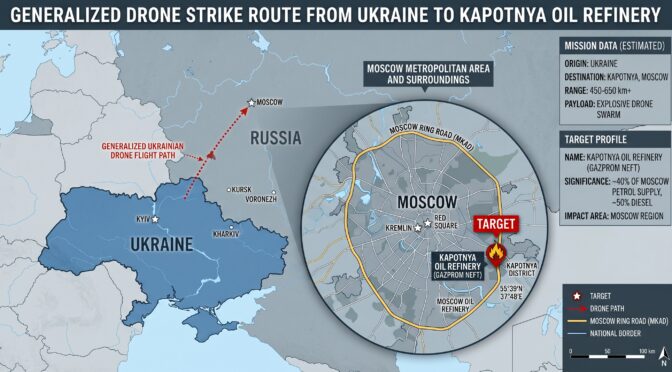
On the morning of June 18, 2026, the Armed Forces of Ukraine executed a coordinated, large-scale unmanned aerial swarm operation targeting the Kapotnya district of Moscow. The primary objective of this operation was the Gazprom Neft-owned Moscow Oil Refinery (MNPZ), located approximately fifteen kilometers from the Kremlin.1 The attack resulted in significant structural degradation of the facility, which serves as a critical node in the central Russian energy grid. Prior to the strike, the Kapotnya refinery supplied approximately forty percent of the capital’s gasoline, fifty percent of its diesel fuel, and a significant portion of the aviation fuel required for the region’s primary airport hubs.1 The operation indicates an advancement in the ongoing Ukrainian deep-strike campaign, demonstrating the capacity of long-range systems to penetrate densely defended airspace and inflict cascading logistical and economic damage on the Russian Federation.2
The engagement involved a coordinated swarm of domestically produced Ukrainian strike platforms. Open-source intelligence (OSINT) and visual evidence confirmed the deployment of conventional propeller-driven systems, such as the FP-1, the fixed-wing Liutyi, and the Sichen, alongside newly deployed jet-powered systems like the Bars unmanned aerial vehicle (UAV).1 By overwhelming the radar detection and engagement channels of the 1st Special Purpose Air and Missile Defense Army, the swarm successfully bypassed layered defense networks. This exposed systemic vulnerabilities in Russian point-defense doctrines, radar architecture, and urban engagement protocols.2 Furthermore, analysis of the engagement revealed failures within the defending interceptor systems, including an errant surface-to-air missile that directly impacted a fuel storage reservoir, thereby exacerbating the destruction of the facility.8
The immediate infrastructural damage to the Moscow Oil Refinery has forced an indefinite halt to complex refining operations.11 The strike neutralized the facility’s primary distillation capabilities, specifically targeting the ELOU-AVT-6 unit and the modernized Euro+ combined refining unit.11 Secondary processing nodes, including the MTBE and visbreaking units, were also destroyed or rendered inoperable.11 The macroeconomic ripple effects have triggered fuel rationing across more than twenty-five Russian regions, disrupting commercial aviation out of Moscow’s principal airports, and forcing energy conglomerates such as Rosneft and Tatneft to institute stringent retail fuel caps.11 This assessment provides a technical, operational, and strategic analysis of the strike, the military systems employed, the posture of the Russian air defense apparatus, and the broader implications for Russian energy security.
2. Strategic Context and Operational Evolution (2024–2026)
The Ukrainian deep-strike doctrine has evolved systematically over a multi-year period, transitioning from localized disruptions to a sustained campaign of industrial degradation aimed at the Russian petroleum sector.2 Understanding the June 18, 2026, operation requires contextualizing it within the broader framework of this campaign, which underwent several distinct phases of targeting and tactical adaptation.
2.1 Early Phases and the Focus on Export Infrastructure
During the early stages of the deep-strike campaign in 2024 and 2025, Ukrainian attacks on Russian oil refining caused notable, though non-critical, damage, prompting Russian oil companies to adapt by utilizing alternative production reserves and expediting repairs.2 However, after a lull in operations spanning from January to mid-March 2026, Ukrainian forces launched a renewed wave of strikes with a refined strategic focus. The primary targets in this phase were oil export terminals, specifically focusing on their reservoir and storage tank parks along the Baltic and Black Seas.2
Operations during this period targeted the Ust-Luga Baltic Port, where attacks halted shipments for nearly two weeks, damaging five of the facility’s fifty-four reservoirs.2 Similarly, the Grushovaya Balka facility, which services the Novorossiysk Terminal, was struck twice, resulting in the destruction of five out of forty-seven storage tanks.2 During the most intense two weeks of these terminal attacks, tanker departures from Baltic and Black Sea ports dropped to approximately half of their normal rate.2 However, export rates eventually recovered and exceeded normal averages, reaching roughly 3.8 million barrels per day by mid-April 2026. This surge in raw crude exports occurred primarily because the subsequent phase of the Ukrainian campaign disabled domestic refineries, forcing Russia to export raw crude that could no longer be processed domestically.2
2.2 The Pivot to Domestic Refineries
Following the strikes on export terminals, the Ukrainian operational focus shifted toward domestic oil refineries (NPZs) in April and May 2026.2 During this two-month period, Ukraine conducted twenty-six attacks on refineries, matching the intensity of operations from late 2025.2 By mid-May, Ukrainian drones had hit Russian refineries at least sixteen times, including successful strikes against eight of Russia’s ten largest facilities.15 The targeting strategy demonstrated a tactical evolution; rather than simply striking storage tanks, Ukrainian planners began precisely targeting specific refinery equipment—such as isomerization, cracking, and hydrotreating units—that is particularly difficult to repair and relies on imported components.2
2.3 The Shaping Operations for the Moscow Strike
The June 18 operation against the Kapotnya refinery was preceded by a direct shaping operation on June 16, 2026.2 During this initial penetration of the Moscow airspace, drones operated by the Security Service of Ukraine (SBU) successfully struck the refinery, damaging the ELOU-AVT-6 primary crude distillation unit.15 While this initial strike degraded the plant’s capacity, industry sources indicated that the refinery’s management planned to sustain operations at a reduced level by shifting processing loads to the Euro+ combined unit in the following days.11 Recognizing this contingency and seeking to achieve total systemic paralysis, Ukrainian commanders launched the vastly larger follow-on strike on June 18.11
3. Target Profile: The Kapotnya Moscow Oil Refinery
The Gazprom Neft Moscow Oil Refinery is a cornerstone of the Russian domestic energy architecture. Situated in the Kapotnya district on the southeastern edge of the capital, the facility boasts a design capacity of approximately twelve million metric tons of crude oil per year.1 Its strategic value is derived from its proximity to major consumption hubs; the refinery satisfies up to forty percent of Moscow’s gasoline requirements and half of its diesel fuel needs, while also maintaining the supply of aviation kerosene directly to the capital’s international airports.1
3.1 Structural Density and Vulnerability
The structural layout of the facility inherently exacerbates its vulnerability to kinetic strikes. Covering an area of just 284 hectares, it is recognized as one of the most compact refineries of its class globally.1 While this density facilitates efficient peacetime operations and reduces the required footprint for internal piping, it creates elevated risk in wartime scenarios. The close proximity of over thirty distinct processing units—including systems for catalytic cracking, thermal cracking, and reforming—means that an explosive event in one sector carries a high probability of causing secondary fires and sympathetic detonations in adjacent units.1
Following a modernization program completed in 2020, numerous decentralized, older units were replaced with highly integrated, centralized processing hubs.2 This architectural decision, intended to boost efficiency, inadvertently created high-value, single-point-of-failure targets for Ukrainian planners. The targeted destruction of these concentrated units allows a relatively small explosive payload to cause disproportionate operational downtime.2
3.2 Degradation of Primary Distillation Capabilities
The fundamental process of any refinery is crude distillation, which separates raw petroleum into intermediate components. The June 16 strike successfully targeted the ELOU-AVT-6 primary crude distillation unit, which accounted for approximately fifty-three percent of the plant’s total capacity.11 The subsequent June 18 swarm successfully targeted the remaining Euro+ combined primary refining unit.13 Commissioned in 2020, the Euro+ complex merged the full production cycle—from primary treatment to the production of finished products—and allowed the refinery to increase motor gasoline production by fifteen percent, diesel by forty percent, and aviation kerosene output by one hundred percent.18 The Euro+ unit accounted for the remaining forty-seven percent of the plant’s capacity, equivalent to 140,000 barrels per day.13 The simultaneous failure of both the AVT-6 and Euro+ units completely blocked the primary preparation of raw materials, effectively halting the initial stages of all processing at the facility.11
3.3 Destruction of Secondary Processing and Storage Infrastructure
Beyond primary distillation, OSINT projects such as CyberBoroshno and Dnipro Osint recorded hits in multiple zones, indicating that the strikes disrupted the primary technological chain required to produce consumer-ready fuels.11 Visual evidence and satellite imagery confirmed the decommissioning of the G-43-107 unit, which deprived the plant of the ability to produce high-octane fuel components.11 Furthermore, the MTBE (Methyl Tert-Butyl Ether) unit was destroyed.12 MTBE is a vital oxygenate additive used to raise the octane number of gasoline; its destruction critically limits the refinery’s ability to produce fuel meeting the modern Euro-5 standard.11 Additionally, the failure of the visbreaking unit eliminated the plant’s capacity to process heavy oil residues into lighter, more valuable distillates.11
Storage infrastructure was also severely compromised. The Ukrainian General Staff reported successful strikes on three RVS-10000 tanks and one RVS-30000 tank.17 Satellite imagery provided visual confirmation of massive fire scars across the tank farm, including documentation of one specific reservoir where the structural roof was completely sheared off by the force of an internal explosion.17 The culmination of these targeted failures has resulted in the indefinite halt of enterprise operations at the Kapotnya site.11
3.4 Operational Repair Bottlenecks
The recovery timeline for the Moscow Oil Refinery is projected to be extensive. Past incidents within the Russian petroleum sector indicate that the repair of massive distillation columns, such as those housed within the AVT units, constitutes a severe logistical bottleneck.11 The manufacturing, transportation, and installation of these large-scale components routinely take up to five months.11 Additionally, compressor equipment in catalytic cracking units historically acts as a restoration bottleneck, often causing prolonged shutdowns when damaged.11 Furthermore, the complexity of modern units like the Euro+ often necessitates reliance on imported electronic and mechanical spare parts. Under current international sanctions regimes, procuring these specific components introduces severe delays, further prolonging the facility’s offline status.2 The total duration of unplanned repairs is assessed to reach at least three months, with full capacity restoration likely taking significantly longer.11
4. Technical Analysis of the June 18 Strike Operations
The June 18 assault was characterized by a notable scale and a high degree of operational coordination. Russian state authorities, including the defense ministry, claimed the interception of 555 drones nationwide on the night of the attack, later updating the figure to 992 drones and four missiles over the past 24 hours. Moscow Mayor Sergei Sobyanin reported that approximately 180 to 194 unmanned aerial vehicles were engaged and neutralized in the immediate vicinity of the capital. However, the density of the swarm effectively saturated the engagement channels of the local air defense batteries.
The operation was executed by specialized Ukrainian units, specifically operators from the 1st Unmanned Systems Forces (USF) Operations Center, the 9th Kairos Battalion of the 414th Madyar’s Birds Brigade, the 413th Raid USF Operational Unit, and the 412th Nemesis USF Brigade, working in close coordination with the Special Operations Forces, the Main Intelligence Directorate (GUR), and the SBU.1 Following the operation, Ukrainian President Volodymyr Zelensky stated that the long-range strikes were a justified response to Russian attacks and demonstrated the reach of Ukrainian weapons 500 kilometers beyond the border.1
The aerial engagement over the refinery took place in broad daylight within a densely populated area, leading to substantial visual evidence captured by local residents.2 Video footage demonstrated drones approaching the Kapotnya district from multiple vectors, flying at low altitudes that complicated radar tracking against the dense urban backdrop.2 Despite the Russian claims of high interception rates, at least five direct hits were recorded within the refinery’s perimeter, sparking fires and sending smoke over southeastern Moscow that resulted in soot settling on residential areas.1
The scale of the attack resulted in collateral damage within the surrounding urban environment. Drones and interceptor debris came down on the grounds of the nearby Sadovod market, apartment buildings, and construction sites in adjacent neighborhoods.2 For instance, a high-rise residential building and an industrial facility in the Zhukovsky district were struck, and a shopping center in Kotelniki caught fire, resulting in seventeen reported injuries.3 Technical analysis indicates that the strikes on unintended civilian structures likely occurred due to flight mission planning errors; Ukrainian forces may have compiled the flight paths using outdated digital maps rather than fresh satellite imagery, meaning newer buildings and construction cranes had not been marked in the autonomous navigation systems.2
5. Ukrainian Unmanned Strike Architecture
The successful penetration of the Moscow air defense zone by hundreds of UAVs highlights a significant advancement in the technical maturity and production scale of the Ukrainian defense industrial base. The operation relied on a heterogeneous mix of systems, combining mass-produced, cost-effective platforms with advanced, jet-powered precision munitions designed to overwhelm and bypass radar networks.6
5.1 The FP-1 Long-Range Platform
The backbone of the deep-strike campaign is the FP-1 drone, a system that alters the economic calculus of long-range engagement. Manufactured by the Ukrainian enterprise Firepoint, the FP-1 is produced at a rate exceeding one hundred units per day, with an individual unit cost of approximately $55,000.2 The platform utilizes a distinctive twin-boom layout with an inverted joined-V tail, straight broad wings, and a narrow fuselage, powered by a commercial two-cylinder internal combustion engine.21
Crucially, the airframe’s load-bearing structure is constructed primarily from plywood, and it lacks wheeled landing gear, relying instead on a sloped ramp with a solid-fuel booster for launch.21 This material choice ensures rapid, low-cost assembly without reliance on complex aerospace supply chains, while also providing inherent low-observability benefits. Wood lacks the radar reflectivity of metallic airframes, reducing the drone’s radar cross-section and complicating detection by early-warning systems.2 Operating with an effective range of up to 1,600 kilometers, the FP-1 carries a modular warhead (fragmentation or shaped-charge) weighing between 50 and 120 kilograms.21 The system utilizes Starlink satellite communications for terminal phase control, and onboard optical stations transmit real-time imagery.21 During the Kapotnya strike, the FP-1 was utilized en masse to saturate point defenses, serving both as a kinetic effector against storage tanks and as a decoy to drain Russian interceptor stockpiles.2
5.2 The Sichen, Liutyi, and Legacy Platforms
Complementing the FP-1 are the Sichen and Liutyi platforms. The Sichen, publicly introduced in April 2026 but reportedly in operational use since 202325 utilizes a flying wing aerodynamic configuration with swept endplates, resembling the Iranian-designed Shahed-series drones.2 It boasts a tactical range of up to 1,400 kilometers and carries a 40-kilogram warhead with an impressive strike accuracy radius of twenty meters.26 The system is designed for rapid deployment, requiring under fifteen minutes to launch, and operates at speeds of up to 200 kilometers per hour at altitudes up to 1,500 meters.26
The An-196 Liutyi is a larger fixed-wing kamikaze drone that has consistently formed the spearhead of attacks against Russian airbases, logistics hubs, and energy infrastructure. With an operational range exceeding 1,000 kilometers, it possesses a payload capacity capable of breaching heavily reinforced industrial structures.6
The Ukrainian arsenal also includes legacy platforms that have seen continued use throughout the campaign. The Ukrjet UJ-22 Airborne is a single-engine drone with a traditional light aircraft layout capable of carrying a 20-kilogram payload over 800 kilometers.24 The R-15 is a smaller unswept-flying wing design with a single propeller in a tractor configuration, utilizing Starlink connectivity for targeting.24 Furthermore, the Zozulia, produced by Warbirds, offers an estimated range of 1,000 kilometers with a 50-kilogram warhead.24 The deployment of these varied airframes creates a complex threat environment for radar operators, who must track targets with differing radar cross-sections, speeds, and flight profiles simultaneously.
5.3 The Bars Jet-Powered Cruise Missile-Drone and Advanced Munitions
The most significant technological leap observed during the June 18 assault was the operational deployment of the Bars jet-powered drone.1 Developed rapidly throughout 2024, the Bars functions as a hybrid cruise missile-drone.28 Unlike conventional propeller-driven platforms, the Bars utilizes a compact turbojet propulsion unit, allowing it to sustain flight speeds of up to 700 kilometers per hour over a declared range of 700 to 800 kilometers.6
The introduction of turbojet kinetics modifies the tactical geometry of the interception window. By traveling significantly faster than internal combustion alternatives, the Bars compresses the time available for Russian radar operators to detect, track, acquire, and engage the target.6 Ukrainian intelligence sources indicated that the June 18 operation was among the most successful deployments of jet-powered systems to date, directly attributing the penetration of Moscow’s layered defenses to the speed and maneuverability of these platforms.20 The acoustic signature of a turbojet also differs substantially from the low-frequency acoustic profile of propeller systems, degrading the effectiveness of Russian acoustic sensor networks positioned along the flight path.2
The Bars is part of a broader family of advanced missile-drone systems unveiled by Ukraine, which includes the Peklo (a cruise missile with a 700-kilometer range and 700 km/h speed), the Palianytsia (a ground-launched turbojet missile with a 600-kilometer range), and the Ruta (a drone-missile with a 300-kilometer range reaching 800 km/h).20 The large-scale operational deployment of these systems in late 2025 and 2026 has significantly stressed Russian air defense resources.20
In addition to these systems, official Ukrainian Defense Forces media confirmed the deployment of an aerial drone designated the “Barracuda.”4 While the Barracuda nomenclature is also actively used for an Unmanned Surface Vessel (USV) operated by the 40th Coastal Defense Brigade for riverine operations31 operators stated that the aerial Barracuda flew in tandem with the FP-1 to successfully penetrate Moscow’s dense air defense network during the Kapotnya strikes.4
| Platform Designation | Propulsion Type | Maximum Range | Warhead Payload | Cruising/Max Speed | Structural Note |
| FP-1 | Two-cylinder internal combustion | ~1,600 km | 50 – 120 kg | Low (propeller) | Plywood structure; sloped ramp launch |
| An-196 Liutyi | Internal combustion | >1,000 km | Heavy (class spec.) | Low (propeller) | Conventional fixed-wing |
| Sichen | Internal combustion | 1,400 km | 40 kg | Up to 200 km/h | Flying wing; Shahed-analog |
| Bars | Compact Turbojet | 700 – 800 km | Undisclosed | Up to 700 km/h | Hybrid cruise missile-drone |
| Peklo | Turbojet | Up to 700 km | Undisclosed | Up to 700 km/h | Cruise missile profile |
| UJ-22 Airborne | Single engine tractor | 800 km | 20 kg | Low (propeller) | Light aircraft layout |
| Barracuda (UAV) | Undisclosed | Undisclosed | Undisclosed | Undisclosed | Aerial platform; shares designation with USV |
5.4 Advanced Navigation in Denied Environments
The fundamental challenge of deep-strike operations over Russian territory is the ubiquitous presence of electronic warfare (EW) countermeasures. Russian forces rely heavily on radio frequency jamming, telemetry disruption, and GPS spoofing to neutralize incoming threats.32 Historically, standard commercial and military drones have seen their strike accuracy drop below ten percent when subjected to heavy jamming environments.33
To circumvent this EW environment, Ukrainian engineers have integrated advanced autonomous navigation modules into their platforms. Systems such as the Vermeer optic navigation module utilize onboard day/night cameras linked to a computational unit preloaded with high-resolution 3D terrain maps generated from satellite imagery.34 By continuously comparing real-time visual data with the internal topographical map, the drone achieves highly accurate inertial navigation independent of external satellite signals.21 This AI-driven visual odometry renders the drones highly resistant to standard Russian electronic countermeasures, ensuring precise terminal guidance even deep within the jamming envelopes surrounding critical sites like the Kapotnya refinery.32 Furthermore, Ukrainian ground units have integrated Starlink modules into command interfaces, allowing pilots to operate heavy bomber drones remotely without relying on easily jammed local radio connections.35
6. Russian Aerospace Defense Posture and Engagement Failures
The successful penetration of the airspace above the Russian capital highlights systemic, tactical, and technical vulnerabilities within the Russian aerospace defense apparatus. Moscow and the central industrial district are nominally the most heavily defended regions within the Russian Federation, shielded by the 1st Moscow Order of Lenin Special Purpose Air and Missile Defense Army.7 This formation is equipped with some of the most advanced interceptors in the Russian arsenal, including the S-400 Triumf, S-300PM2, A-135M anti-ballistic missile systems, and Pantsir-S point-defense networks.37
The 1st Air and Missile Defense Army operates in coordination with the 15th Aerospace Forces Army, which manages early warning systems, space surveillance, and the Don-2N multi-functional radar.38 Furthermore, following reforms and ongoing procurement cycles, the defense ministry aimed to bolster these defenses by deploying the S-350 surface-to-air missile complex to replace legacy S-300 regiments.39 Yet, despite this multi-layered architecture, the network failed to prevent a drone swarm from devastating its primary target.
6.1 Doctrine Mismatch and Radar Degradation
The overarching failure of the Russian defense network stems from an outdated doctrinal approach tailored to legacy threats. The 1st Air and Missile Defense Army was primarily configured to detect and intercept high-altitude, high-velocity targets such as intercontinental ballistic missiles, strategic bombers, and supersonic cruise missiles.2 The network relies heavily on long-range surface-to-air missile (SAM) systems that are fundamentally ill-suited to engage dozens of low-altitude, slow-moving unmanned aerial vehicles.2
The effectiveness of this architecture was heavily compromised by a systematic Ukrainian campaign to blind Russian early-warning capabilities prior to the Moscow strikes. Ukrainian operators successfully targeted and destroyed several high-value mobile detection complexes, notably the Nebo-M and Podlyot radar systems.40 The Nebo-M is a multi-band detection complex capable of tracking up to 200 aerodynamic and ballistic targets simultaneously at distances up to 600 kilometers.40 The Podlyot radar is optimized for low-altitude detection in complex EW environments, utilizing phased-array technology to track targets moving at speeds up to 4,400 km/h with a 300-kilometer range.40 The degradation of these strategic assets left critical blind spots in the radar coverage extending toward the capital, significantly reducing the advance warning time available to Moscow’s defenders.
6.2 Over-Reliance on Point Defense and Urban Clutter
Without an integrated, nationwide detection system specifically optimized for drones—such as acoustic sensor networks or comprehensive mobile fire teams—Russia’s defense strategy relies heavily on the localized point defense of individual facilities.2 There is no automated data-sharing framework to seamlessly pass tracking data between regional early-warning radars and the specific SAM batteries guarding a plant.2 Consequently, an incoming drone swarm is often only detected in the terminal phase, placing the burden of interception on the limited magazines of the local point-defense systems. When a massive formation converges simultaneously on a single geographic point, these isolated defenses are rapidly saturated.2 Furthermore, Russian aviation committed to repelling attacks is highly insufficient, and mobile fire teams armed with machine guns lack the necessary targeting systems to engage high-speed drones effectively.2
Upon entering the capital region, the drone swarm exploited the physical geography of the city itself. Radar systems struggle inherently with dense urban clutter; glass skyscrapers, concrete apartment blocks, and industrial infrastructure create multi-path interference, shortening sightlines and hiding low-flying drones until they are directly above the target.42 This allows low-observable platforms like the plywood-constructed FP-1 to traverse the urban landscape undetected until the final moments of engagement.
6.3 Adaptation: The Pantsir-SMD-E Rooftop Deployments
In an effort to mitigate radar clutter and extend engagement envelopes, Russian forces have resorted to placing air defense systems directly atop civilian architecture. Open-source imagery captured Russian Mi-26 heavy transport helicopters—capable of carrying 44,000-pound payloads via external sling—lowering air defense modules onto office towers, high-rise apartment blocks, and landfill mounds across Moscow.42 This unconventional deployment effectively turns the built environment of the capital into an elevated firing platform, providing radar operators with a cleaner view of the horizon.42
The specific system increasingly favored for this urban defense mission is the newly developed Pantsir-SMD-E.42 Developed by High-Precision Systems Holding, the SMD-E variant strips away the traditional 30mm autocannons found on the legacy Pantsir-S1, replacing them with an expanded missile payload optimized for drone swarms.44 The system’s launcher tubes can accommodate up to forty-eight TKB-1055 mini-interceptor missiles.44 These specialized munitions are designed to defeat low-cost targets at close ranges of up to 7 kilometers and altitudes up to 5 kilometers, dramatically deepening the magazine capacity compared to standard configurations.44 The module can also carry up to twelve standard 57E6-E or 95Ya6 missiles, which offer an engagement range of 20 to 30 kilometers and speeds up to Mach 3.8.45
Despite the deployment of these specialized systems, including additional Pantsir units stationed near the Kapotnya refinery exit on the Moscow Ring Road, the defenses were breached.49 The presence of anti-drone nets on frontline-style Pantsir units stationed near the refinery, combined with observed incomplete ammunition loads, suggests acute shortages of interceptor missiles across the Russian military resulting from the relentless pace of Ukrainian attacks.50
| Russian Interceptor System | Primary Role | Key Specifications / Modifications for Urban Defense |
| S-400 Triumf | Long-Range Strategic SAM | High minimum engagement altitude; struggles with low-flying urban clutter. |
| S-350 Vityaz | Medium-Range SAM | Deployed to replace legacy S-300 systems; vulnerable to saturation. |
| Nebo-M & Podlyot | Early Warning Radar | Systematically targeted and degraded by Ukrainian operators prior to strikes. |
| Pantsir-S1/S1M | Point Defense Gun-Missile | Legacy 57E6-E missiles (20-30km range); 30mm autocannons. |
| Pantsir-SMD-E | Drone Swarm Interceptor | Rooftop deployment via Mi-26; 48x TKB-1055 mini-missiles (7km range); no cannons. |
6.4 Interceptor Guidance Failure
Notable evidence of Russian air defense limitations during the June 18 engagement was captured via civilian video and subsequently analyzed by OSINT channels such as Astra and Voyenny Osvedomitel.9 Numerous recordings of the airspace over the Kapotnya refinery showed incoming Ukrainian drones traversing the sky in broad daylight with virtually no kinetic resistance, save for a high volume of surface-to-air missiles.2 Analysis of the footage indicated that not a single drone was brought down by aviation or mobile fire teams, underscoring a complete reliance on automated missile batteries.2
Critically, one video captured from the residential Novye Kotelniki neighborhood documented the moment immediately preceding the detonation of a storage tank at the refinery.9 Analysts studying the vapor trails confirmed that a Russian interceptor missile—assessed by various OSINT sources as either an S-400 anti-aircraft missile, a 57E6-E fired from a nearby Pantsir system, or a MANPADS—experienced a guidance failure.8 The missile passed directly beneath an incoming Ukrainian drone, lost its trajectory lock, and impacted directly into the roof of the RVS fuel reservoir within its own protected facility.9 This friendly-fire incident highlights the unreliability of Russian interceptors operating under saturated, high-stress combat conditions in dense urban environments, further validating the efficacy of the swarm tactics.8
7. Economic Ramifications and Domestic Fuel Supply Constraints
The degradation of the Kapotnya oil refinery constitutes a strategic impact that directly threatens the stability of the Russian domestic economy. By systematically taking offline a vast percentage of central Russia’s refining capacity, the Ukrainian Armed Forces have induced a systemic fuel supply constraint that has cascaded across the Federation, disrupting both civilian logistics and military sustainment.2
7.1 Nationwide Rationing and Retail Restrictions
The destruction of the AVT-6 and Euro+ units immediately removed millions of tons of processed fuel from the internal market. Consequently, the Russian government and the major state-aligned energy conglomerates have been forced to implement rationing protocols to manage the rapidly depleting reserves.11 By mid-June 2026, restrictions on the sale of petroleum products had spread to at least twenty-five distinct regions.15 Fuel disruptions have been recorded across a vast geographic expanse, affecting the border regions of Belgorod, Bryansk, Kursk, and Rostov, stretching eastward to the Siberian and Far Eastern districts of Khabarovsk, Krasnoyarsk, Tomsk, and Kamchatka, and severely impacting the occupied territories of Crimea, Zaporizhzhia, Donetsk, and Luhansk.11
The structural impact on retail distribution is severe. It is estimated that approximately one in four gas stations across Russia now operates under some form of mandated limitation.11 Rosneft, the largest oil entity in the country operating over 2,200 stations, implemented a nationwide halt on the sale of gasoline in portable canisters to prevent hoarding, simultaneously capping total vehicle fills at ninety liters per receipt.11 Tatneft, operating over 850 stations, enforced even tighter caps, restricting individual customers to twenty to thirty liters of AI-branded gasoline and forty to sixty liters of diesel fuel across its network.11 In the occupied Luhansk region, a strict 20-liter cap was mirroring restrictions already active in Crimea, where gas stations experienced long lines and the government was forced to open a hotline for stranded tourists.11
Even within the previously insulated metropolitan centers of Moscow and St. Petersburg, citizens are confronting long queues at filling stations and escalating retail prices. Queues formed outside Moscow in locations like Yegoryevsk, where traffic jams clogged roads leading to Gazprom Neft stations, and gasoline prices spiked to between 72 and 85 rubles per liter.11 In St. Petersburg, Surgutneftegas capped purchases at fifty liters per receipt, despite local authorities attempting to downplay the crisis.11
| Energy Conglomerate | Scope of Restrictions | Specific Retail Limitations Enforced |
| Tatneft | Nationwide (Strict in Moscow/St. Petersburg) | 20–30 liters of AI-gasoline; 40–60 liters of diesel per vehicle. 300 liters for legal entities. |
| Rosneft / Bashneft | Nationwide | Total ban on canister sales; 90-liter cap per vehicle transaction. |
| Lukoil | Regional (including Moscow) | 100-liter cap of gasoline or diesel per single receipt. |
| Surgutneftegas | Regional (St. Petersburg, Leningrad, Tver, Pskov) | Capped at 15 to 50 liters per receipt depending on the specific oblast. |
7.2 Aviation Disruptions and Sectoral Bottlenecks
The strategic location of the Moscow Oil Refinery inextricably links it to the operational tempo of the capital’s civil aviation sector. The facility is a primary provider of jet kerosene to the region.1 During and immediately following the swarm attacks, standard operational security protocols mandated the temporary suspension of flight operations across Moscow’s primary air hubs, including Sheremetyevo, Vnukovo, Domodedovo, and Zhukovsky.14 Sheremetyevo, the busiest airport, was forced to evacuate passengers during the attack.14 Aeroflot, the Russian flagship carrier, and its subsidiary Rossiya were forced to cancel over one hundred and seventy flights to and from Moscow and delay over one hundred and ten others, inflicting logistical and financial strain on the airline industry.14
Beyond the immediate disruptions, the long-term offline status of Kapotnya threatens to create chronic aviation fuel shortages. To mitigate the overall fuel deficit, the Russian government faces difficult policy choices. Authorities may be forced to divert processed petrol and diesel from provincial refineries to satisfy the demands of the capital, thereby exporting the crisis to peripheral regions and further deepening the constraints across the rest of Russia.11 Conversely, imposing explicit fuel rationing directly within Moscow demonstrates to its residents that the economic consequences of the conflict have reached the capital.11 Furthermore, the government has signaled a willingness to temporarily relax environmental standards, permitting refineries to sell lower-grade Euro-3 gasoline as Euro-5 to stretch existing supplies—an emergency measure directly resulting from the destruction of MTBE high-octane additive units like the one struck in Kapotnya.2
8. Strategic Conclusions
The June 18, 2026, drone swarm targeting the Kapotnya oil refinery represents a notable shift in the strategic equilibrium of the conflict. The Armed Forces of Ukraine have successfully industrialized the production of long-range, EW-resistant, and jet-powered autonomous systems—ranging from the cost-effective FP-1 to the advanced Bars—capable of penetrating the most heavily guarded airspace in the Russian Federation. By shifting the operational focus toward high-value, difficult-to-replace industrial infrastructure, Ukraine has bypassed the tactical constraints of the immediate frontlines, striking directly at the financial and logistical arteries of the Russian state economy.
The failure of the 1st Special Purpose Air and Missile Defense Army to protect a critical asset just fifteen kilometers from the Kremlin exposes doctrinal and technical deficiencies. The reliance on legacy long-range SAM systems, compounded by the degradation of early-warning radar networks and the inability to effectively track targets in dense urban clutter, suggests that no geographic location within the range of Ukrainian systems can currently be considered fully secure. The adaptation of placing Pantsir-SMD-E systems on residential rooftops, while visually striking, appears to be an insufficient countermeasure against coordinated, high-speed swarms involving diverse flight profiles. The confirmed friendly-fire incident, wherein a Russian interceptor caused damage to the facility it was tasked to protect, further illustrates the systemic breakdown under mass saturation conditions.
Economically, the strikes have achieved strategic effects. The destruction of the AVT-6 and Euro+ distillation units at a single facility has catalyzed a nationwide fuel constraint, resulting in strict rationing, rising retail prices, and disrupted aviation logistics across more than twenty-five regions. The projected repair timelines, extending for months and complicated by international sanctions on critical electronic and mechanical components, ensure that this structural deficit will persist. This forces the Kremlin into increasingly difficult decisions regarding resource allocation between civilian markets and military sustainment. As long as Ukraine maintains its current pace of drone production and deployment, the sustained degradation of the Russian petroleum refining sector will remain one of the most potent asymmetrical threats to the Russian war effort.
Please share the link on Facebook, Forums, with colleagues, etc. Your support is much appreciated and if you have any feedback, please email us in**@*********ps.com. If you’d like to request a report or order a reprint, please click here for the corresponding page to open in new tab.
Sources Used
- The Largest-Scale Strike on the Moscow Oil Refinery: What …, accessed June 21, 2026, https://militarnyi.com/en/news/the-largest-strike-on-moscow-oil-refinery/
- Why are Moscow’s air defenses struggling to stop drone attacks …, accessed June 21, 2026, https://meduza.io/en/feature/2026/06/19/why-are-moscow-s-air-defenses-struggling-to-stop-drone-attacks-and-why-are-oil-refineries-so-vulnerable-to-ukrainian-strikes
- What did Ukraine target in Moscow and how significant was the drone attack?, accessed June 21, 2026, https://www.theguardian.com/world/2026/jun/18/what-did-ukraine-target-in-moscow-and-how-significant-was-the-drone-attack
- DRONE STRIKE 15 km from the Kremlin! MOSCOW OIL is burning in front of PUTIN’S very eyes – YouTube, accessed June 21, 2026, https://www.youtube.com/watch?v=XPUa-N7WMA0
- MOSCOW REFINERY HIT TWICE! Ukraine strikes the HEART of Putin’s war economy, accessed June 21, 2026, https://www.youtube.com/watch?v=rtoZEGijwzY
- The 3 drones that turned Moscow’s skies black and made it rain soot, accessed June 21, 2026, https://timesofindia.indiatimes.com/defence/international/the-3-drones-that-turned-moscows-skies-black-and-made-it-rain-soot/articleshow/131857511.cms
- accessed June 21, 2026, https://en.wikipedia.org/wiki/1st_Special_Purpose_Air_and_Missile_Defense_Army#:~:text=The%201st%20Moscow%20Order%20of,high%20strategic%20value%20in%20Russia%2C
- HERE’S WHY RUSSIA’S S-500, S-400, S-300, BUK, PANTSIR, TOR AND PECHORA HAVE COMPLETELY FAILED. – YouTube, accessed June 21, 2026, https://www.youtube.com/watch?v=3OchBNMcbfo
- Russian air defense missile hits oil tank at Moscow refinery, video shows, accessed June 21, 2026, https://english.nv.ua/nation/russian-air-defense-missile-hits-own-refinery-50617528.html
- OSINT analysts identify Russian air defense as cause of explosion at Moscow Refinery, accessed June 21, 2026, https://theins.press/en/news/293893
- Moscow faces major fuel supply crunch after mass refinery attack …, accessed June 21, 2026, https://english.nv.ua/business/moscow-faces-major-fuel-supply-crunch-after-mass-refinery-attack-50617626.html
- Destruction of critical Moscow refinery units sends Russian fuel market into panic, accessed June 21, 2026, https://english.nv.ua/amp/moscow-faces-major-fuel-supply-crunch-after-mass-refinery-attack-50617626.html
- Reuters: Ukrainian strike damages processing units at Moscow oil refinery, accessed June 21, 2026, https://www.pravda.com.ua/eng/news/2026/06/18/8040059/
- 2026 Moscow Oil Refinery Drone Attacks | KÜRE Encyclopedia, accessed June 21, 2026, https://kureansiklopedi.com/en/detay/2026-moscow-oil-refinery-drone-attacks-dfe3c
- Safe Moscow is gone: Ukrainian drones hit Russian capital’s region for the third time in four days – Euromaidan Press, accessed June 21, 2026, https://euromaidanpress.com/2026/06/19/safe-moscow-is-gone-ukrainian-drones-hit-russian-capitals-region-for-the-third-time-in-four-days/
- Russia Now Faces Gasoline Rationing in 20 Russian and Occupied Regions After Ukraine Strikes – UNITED24 Media, accessed June 21, 2026, https://united24media.com/war-in-ukraine/russia-now-faces-gasoline-rationing-in-20-russian-and-occupied-regions-after-ukraine-strikes-19513
- Satellite images show damage at Moscow refinery after Ukrainian …, accessed June 21, 2026, https://english.nv.ua/nation/satellite-images-show-damage-at-moscow-refinery-after-ukrainian-drone-attack-50617892.html
- gazpromneft-mnpz – JSC «PROMFINSTROY, accessed June 21, 2026, https://en.promfinstroy.ru/projects/gazpromneft-mnpz/
- Moscow oil refinery struck in Ukraine’s biggest air raid on city since start of war, accessed June 21, 2026, https://www.theguardian.com/world/2026/jun/18/moscow-oil-refinery-on-fire-ukraine-drone-stikes
- Ukraine deployed jet-powered drones during massive Moscow attack, accessed June 21, 2026, https://english.nv.ua/russian-war/ukraine-used-jet-powered-missile-drones-in-major-moscow-attack-sources-say-50617354.html
- How Ukraine-made FP-1 drone reshapes long-range strikes – NV video, accessed June 21, 2026, https://english.nv.ua/nation/ukraine-fields-the-low-cost-fp-1-long-range-drone-nv-discloses-the-uav-specs-50559428.html
- Fire Point FP-1 – Wikipedia, accessed June 21, 2026, https://en.wikipedia.org/wiki/Fire_Point_FP-1
- It can fly up to 1600 km: Ukraine presents FP-1 attack drone, accessed June 21, 2026, https://militarnyi.com/en/news/it-can-fly-up-to-1600-km-ukraine-presents-fp-1-attack-drone/
- Guide To Ukraine’s Long Range Attack Drones | Covert Shores, accessed June 21, 2026, https://www.hisutton.com/Ukraine-OWA-UAVs.html
- Ukraine Reveals Sichen: 870-Mile Strike Drone Already In Combat, accessed June 21, 2026, https://dronexl.co/2026/04/18/ukraine-sichen-870-mile-drone-combat/
- Kyiv strikes back: Ukraine names its new 1,400 km drone after month in winter which Russia hits hardest – Euromaidan Press, accessed June 21, 2026, https://euromaidanpress.com/2026/04/14/kyiv-strikes-back-ukraine-names-its-new-1400-km-drone-after-month-in-winter-which-russia-hits-hardest/
- New Ukrainian Drone Can Strike 1400 km Away—and Ignore Electronic Warfare, accessed June 21, 2026, https://united24media.com/latest-news/new-ukrainian-drone-can-strike-1400-km-away-and-ignore-electronic-warfare-17884
- Bars missile-drone: 700–800 km range and serial-scale production – GTInvest, accessed June 21, 2026, https://good-time-invest.com/blog/raketa-dron-bars-ukraina/
- Ukraine’s Bars Drone Missile Unveiled 800km Range for Deep Strikes on Russia – YouTube, accessed June 21, 2026, https://www.youtube.com/watch?v=I4OYz-MjMsk
- Ukraine’s New “Bars” Missile Drone Can Hit Targets 500 Miles Inside Russia, accessed June 21, 2026, https://united24media.com/latest-news/ukraines-new-bars-missile-drone-can-hit-targets-500-miles-inside-russia-7645
- Ukraine Deploys New “Barracuda” River Drone to Target Russia’s Frontline Waterways, accessed June 21, 2026, https://united24media.com/latest-news/ukraine-deploys-new-barracuda-river-drone-to-target-russias-frontline-waterways-video-11027
- Lessons from Ukraine: Battlefield Drone Innovation Redefines Modern Defense, accessed June 21, 2026, https://defenseopinion.com/lessons-from-ukraine-battlefield-drone-innovation-redefines-modern-defense/1137/
- The battlefield is in your backyard: Why drone, GPS chaos is now civilian life – opinion, accessed June 21, 2026, https://www.jpost.com/defense-and-tech/article-894907
- Ukraine develops fiber-optic module fitting for all drones, integrates optical navigation module – Euromaidan Press, accessed June 21, 2026, https://euromaidanpress.com/2025/02/28/ukraine-develops-fiber-optic-module-fitting-for-all-drones-integrates-optical-navigation-module/
- Counterattacking through the kill zone, Ukrainian troops brace for new Russian offensives – The Kyiv Independent, accessed June 21, 2026, https://kyivindependent.com/counterattacking-through-the-kill-zone-ukrainian-troops-brace-for-new-russian-offensives-in-the-south/
- Moscow: Near-Defenseless Against Drones – CEPA, accessed June 21, 2026, https://cepa.org/article/moscow-near-defenseless-against-drones/
- 1st Special Purpose Air and Missile Defense Army – Wikipedia, accessed June 21, 2026, https://en.wikipedia.org/wiki/1st_Special_Purpose_Air_and_Missile_Defense_Army
- 15th Aerospace Forces Army – Grokipedia, accessed June 21, 2026, https://grokipedia.com/page/15th_aerospace_forces_army
- Russia to upgrade Moscow’s missile defenses by year’s end, accessed June 21, 2026, https://www.defensenews.com/land/2023/03/29/russia-to-upgrade-moscows-missile-defenses-by-years-end/
- Ukraine Cripples Russian Surveillance—Drone Lab Wiped Out, Nebo-M and Podlyot Radars Hit – UNITED24 Media, accessed June 21, 2026, https://united24media.com/latest-news/ukraine-cripples-russian-surveillance-drone-lab-wiped-out-nebo-m-and-podlyot-radars-hit-18008
- Ukraine Destroys Russian Nebo-U Radar and Pantsir-S1 in Crimea Strike, Crippling Air Defenses – Reddit, accessed June 21, 2026, https://www.reddit.com/r/ukraine/comments/1qgcokc/ukraine_destroys_russian_nebou_radar_and/
- Russia is lifting air-defense systems onto Moscow rooftops, and the image shows how far the drone war has moved inland, accessed June 21, 2026, https://okdiario.com/techy/en/russia-is-lifting-air-defense-systems-onto-moscow-rooftops-and-the-image-shows-how-far-the-drone-war-has-moved-inland/4939/
- Russia Strengthens Moscow Shield With Dozens of New Air Defense Towers – Kyiv Post, accessed June 21, 2026, https://www.kyivpost.com/post/75521
- Pantsir-SMD: Russia’s Latest Air Defence System Packs 48 Missiles to Crush Drone Threats, accessed June 21, 2026, https://defencesecurityasia.com/en/pantsir-smd-air-defence-drone-interceptors/
- Russia reportedly installs air defence systems on Moscow rooftops | Ukrainska Pravda, accessed June 21, 2026, https://www.pravda.com.ua/eng/news/2026/05/28/8036757/
- [VIDEO] Russia Turns Moscow Into a Fortress: Mi-26 Helicopter Airlifts New Pantsir-SMD-E Air Defense System Onto Skyscraper Roof Amid Escalating Ukrainian Drone Threat – Defence Security Asia, accessed June 21, 2026, https://defencesecurityasia.com/en/russia-moscow-fortress-pantsir-smd-e-air-defense-mi-26-ukraine-drone-war/
- Pantsir missile system – Wikipedia, accessed June 21, 2026, https://en.wikipedia.org/wiki/Pantsir_missile_system
- Army-2024 – KBP unveils the new short-range ADS Pantsir-SMD-E – EDR Magazine, accessed June 21, 2026, https://www.edrmagazine.eu/kbp-unveils-the-new-short-range-ads-pantsir-smd-e
- Russia may have moved Pantsir from front to defend Moscow refinery, Defense Express says, accessed June 21, 2026, https://english.nv.ua/nation/defense-express-pantsir-at-moscow-refinery-may-signal-russian-air-defense-shortage-50617872.html
- Additional Pantsir Air Defense System Spotted Near Attacked Moscow Oil Refinery – Kyiv Post, accessed June 21, 2026, https://www.kyivpost.com/post/78600
- Russian Air Defense Missile Reportedly Hits Moscow Refinery in Failed Drone Intercept, accessed June 21, 2026, https://www.kyivpost.com/post/78532
- Fuel crisis in the Russian Federation: fuel sales restricted in Moscow and Saint Petersburg, accessed June 21, 2026, https://unn.ua/en/news/fuel-crisis-in-the-russian-federation-fuel-sales-restricted-in-moscow-and-saint-petersburg
- Russia’s gasoline crisis spreads to St. Petersburg, Belgorod, Kursk, and occupied Luhansk — 40% of refining capacity is offline after Ukrainian strikes – Euromaidan Press, accessed June 21, 2026, https://euromaidanpress.com/2026/06/03/russias-gasoline-crisis-spreads-to-st-petersburg-belgorod-kursk-and-occupied-luhansk-40-of-refining-capacity-is-offline-after-ukrainian-strikes/
- Russia’s biggest oil company stopped selling gasoline in canisters nationwide after Ukraine’s strikes. It blames “seasonal demand” – Euromaidan Press, accessed June 21, 2026, https://euromaidanpress.com/2026/06/17/russias-biggest-oil-company-stopped-selling-gasoline-in-canisters-nationwide-after-ukraines-strikes-it-blames-seasonal-demand/