
1. Executive Summary
The United States Department of Defense (DoD) is actively pursuing a fundamental paradigm shift in its approach to force projection. Driven by the imperative to offset the mass and capacity advantages of near-peer adversaries, the DoD has prioritized the rapid acquisition and fielding of thousands of all-domain attritable autonomous (ADA2) systems.1 Initially operationalized through the Replicator initiative and subsequently evolving into the broader, heavily funded Defense Autonomous Warfare Group (DAWG) 3, this strategic vector seeks to overwhelm adversary anti-access/area-denial (A2/AD) networks using low-cost, expendable platforms.1 However, the prevailing discourse surrounding mass unmanned aerial systems (UAS) operations suffers from a severe analytical blind spot: an overwhelming fixation on the digital, aerodynamic, and software-defined capabilities of the platforms, coupled with a systemic disregard for the physical logistics required to project them into a contested theater of operations.
Attritable systems are frequently conceptualized by defense planners as intangible, software-driven assets. In reality, fielding thousands of uncrewed platforms generates a colossal, highly sensitive, and dangerous physical footprint. This report outlines the systemic logistical requirements and constraints that dictate the feasibility of mass drone operations. The analysis reveals that the primary bottlenecks to these initiatives will not be autonomous swarming software or airframe manufacturing capacity, but rather the severe volumetric inefficiency of shipping fragile electronics, the stringent regulatory constraints governing the global transport of Class 9 hazardous lithium-ion batteries, and the immense power generation and climate-controlled storage requirements placed on austere forward operating bases.
Leadership must recognize that a drone’s operational weight is entirely distinct from its logistical weight. Its protective packaging, associated launch systems, and ground support equipment multiply its footprint exponentially. Furthermore, due to mandatory aviation transport regulations requiring lithium batteries to be shipped at a state of charge (SOC) below 30% 5, these platforms arrive at the tactical edge effectively incapacitated. This dynamic shifts the burden of energy generation directly to forward units, demanding industrial-scale charging infrastructure that relies heavily on vulnerable Class III bulk fuel supply chains.6
To ensure that thousands of ADA2 platforms can reliably reach and operate within contested environments, DoD planning must pivot from a platform-centric acquisition model to a logistics-first sustainment architecture. The ability to mass autonomous forces is entirely contingent on the United States Transportation Command (USTRANSCOM), the Military Sealift Command (MSC), and the tactical energy networks of deployed units.7 This report provides a comprehensive overview of the physical, regulatory, and infrastructural realities that currently threaten to throttle the deployment of mass autonomy.
2. The Strategic Context of Mass Autonomy and the Illusion of Scale
The modern battlefield is undergoing a rapid evolution, driven by the proliferation of networked, autonomous, and semi-autonomous systems. The Replicator initiative, launched in 2023 by the Defense Innovation Unit (DIU), represents a deliberate endeavor to integrate commercial-scale autonomous production with military operations.2 The first iteration, Replicator 1, focuses on fielding thousands of aerial, ground, and maritime platforms by late 2025, while Replicator 2 pivots toward countering small unmanned aerial systems (C-sUAS).10 Selected platforms for these initial tranches include AeroVironment’s Switchblade 600, Anduril’s Altius-600, and the Ghost-X.2
To sustain and expand these efforts, the DoD has transitioned the underlying principles of Replicator into the Defense Autonomous Warfare Group (DAWG), signaling a massive financial commitment with nearly $55 billion allocated for research, development, and procurement in the coming fiscal cycles.3 The strategic appeal of these systems lies in their classification as “attritable”—platforms engineered and manufactured affordably enough that combatant commanders can tolerate a much higher degree of risk in their tactical employment.4
2.1 The Divergence Between Manned and Unmanned Logistics
The concept of attritability, while operationally advantageous, creates a psychological disconnect regarding logistics. Because the platforms are intended to be lost in combat 2, there is a pervasive assumption that their supply chain is equally frictionless and expendable. This is a fundamental fallacy. An attritable drone requires the exact same meticulous supply chain handling, climate controls, and hazardous material processing as a non-attritable, multi-million-dollar precision-guided munition.
When procuring conventional manned aircraft, the DoD heavily scrutinizes the logistics tail. Platforms like the MQ-9 Reaper, which has amassed over two million flight hours, are supported by deeply entrenched, highly evolved logistical networks featuring dedicated runways, sophisticated hangars, and predictable maintenance schedules.13 Crucially, manned systems and large medium-altitude long-endurance (MALE) drones self-deploy; they fly from their point of origin to the theater of operations.
Attritable tactical drones, conversely, are classified as cargo. They do not fly to the fight; they must be boxed, palletized, trucked, flown via strategic airlift, offloaded, and distributed via tactical ground vehicles. Consequently, procuring a fleet of 10,000 small drones imposes a fundamentally different, and arguably more complex, strain on the Defense Transportation System (DTS) than sustaining a squadron of manned fighters.14 If the DoD attempts to scale drone procurement without proportionally scaling the physical infrastructure required to transport, store, and power them, the result will be localized logistical paralysis. Pallets of drones will inevitably become stranded at aerial ports of embarkation (APOEs) due to hazard restrictions, or they will arrive at forward bases that lack the electrical capacity to charge them.
3. Volumetric Inefficiency: Airframes, Fragility, and Packaging Standards
The most immediate physical constraint of mass drone deployment is the mathematical relationship between the drone’s operational dimensions and its required shipping volume. Modern tactical drones are meticulously optimized for aerodynamics and payload capacity, resulting in lightweight, fragile, and often awkwardly shaped airframes. To survive the extreme rigors of the military supply chain—which includes extreme temperature fluctuations, moisture, vibration, mechanical shock, and rough terrain handling—these systems must be packaged according to stringent, unyielding military specifications.
3.1 MIL-STD-2073-1E and the Reality of Level A Packing
The preservation, packaging, packing, and marking of military supplies are governed by(https://quicksearch.dla.mil/qsDocDetails.aspx?ident_number=37232), which dictates the methods required to protect materiel against environmentally induced degradation during multiple handling events in the DTS.14 Tactical drones, categorized as highly sensitive electronics with low fragility factors (frequently rated at less than 50 Gs of shock tolerance), require Level A military packing.16 Level A is the highest level of protection, mandated for items intended for long-term storage or deployment in austere, wartime environments.
Under these standards, a bare drone cannot simply be placed in a standard cardboard box. Level A packaging requires that the item be placed in individual, non-metallic inner packaging.18 This inner layer must be surrounded by specific cushioning material—such as foam-in-place (FIP) polyurethanes or specialized fast-pack inserts (PPP-B-1672)—that is non-combustible, electrically non-conductive, and highly absorbent.16 Furthermore, the entire cushioned assembly is often sealed within waterproof and vapor-proof barrier bags before being secured inside robust exterior shipping containers, such as wood-cleated panelboard boxes (ASTM-D-6251) or heavy-duty reusable molded containers.17
This mandatory preservation process creates massive volumetric inefficiency. A tactical drone’s weight is relatively negligible, but its “cube”—the cubic volume of its compliant shipping crate—is massive. The military logistics enterprise operates on the physical limitations of pallets and containers, and drones consume this space at an alarming rate.
3.2 Platform Loadout Metrics and the All-Up Round
Examining the specific physical dimensions of the platforms selected for the initial phases of the Replicator initiative illustrates this volumetric trap:
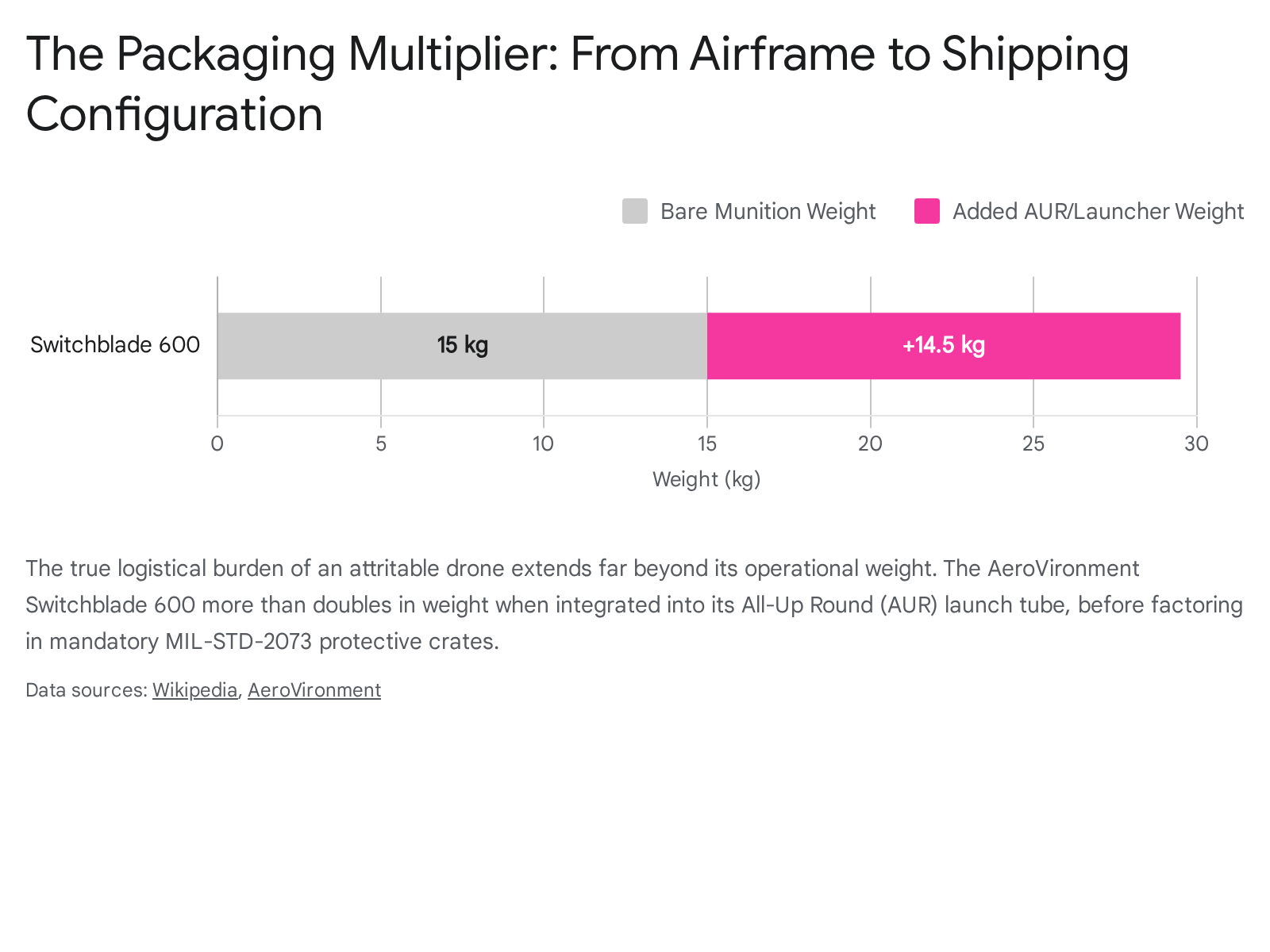
- AeroVironment Switchblade 600: This extended-range loitering munition is designed for precision strikes against armored targets.22 The bare munition itself weighs 15 kg (33 lbs) and has a length of 1.3 meters (51 inches).22 However, the Switchblade is shipped and deployed as an All-In-One Tube-Launched System. The All-Up Round (AUR), which includes the protective launcher tube and integrated firing hardware, weighs 29.5 kg (65 lbs).22 The Level A packaging required to protect this 1.3-meter AUR further increases the gross weight and significantly expands the volume.
- Anduril Altius-600: The ALTIUS-600 has a length of 1 meter and a base weight of 12.2 kg (27 lbs).25 It is deployed from a pneumatic launch container.26 While the airframe is lightweight, the rigid launch tube and the necessary foam-in-place cushioning demand substantial cargo space.19
- Anduril Ghost-X: Selected for the Army’s Company Level Small Unmanned Aircraft System (sUAS) Directed Requirement 27, this system provides expeditionary surveillance. While highly capable, its complex rotor systems and delicate optics require extensive physical protection during transit to prevent misalignment.
When Air Force loadmasters build standard 463L pallets for strategic airlift, they are constrained by a usable base of 104 by 84 inches and a maximum height of 96 inches. Because drone crates cannot be stacked infinitely due to crush hazards and delicate center-of-gravity constraints, a single 463L pallet that could theoretically hold 10,000 pounds of dense artillery ammunition or water might only hold a few dozen attritable drones weighing a fraction of that amount. The DoD is effectively consuming its most premium strategic transportation asset to fly empty space and protective foam across the ocean.
| Platform | Bare Munition Weight | All-Up Round (AUR) Weight | Length | Primary Logistic Challenge |
| Switchblade 300 | 2.5 kg (5.5 lbs) 23 | N/A | 49.5 cm 23 | High-volume fast-pack cushioning required for delicate optics |
| Switchblade 600 | 15 kg (33 lbs) 22 | 29.5 kg (65 lbs) 22 | 130 cm 23 | Integrated tube launcher doubles unit weight; length limits pallet stacking |
| Altius-600 | 12.2 kg (27 lbs) 25 | N/A | 100 cm 25 | Pneumatic launch container drastically increases total cubic volume |
4. The Class 9 Hazard: Lithium Battery Transport Regulations
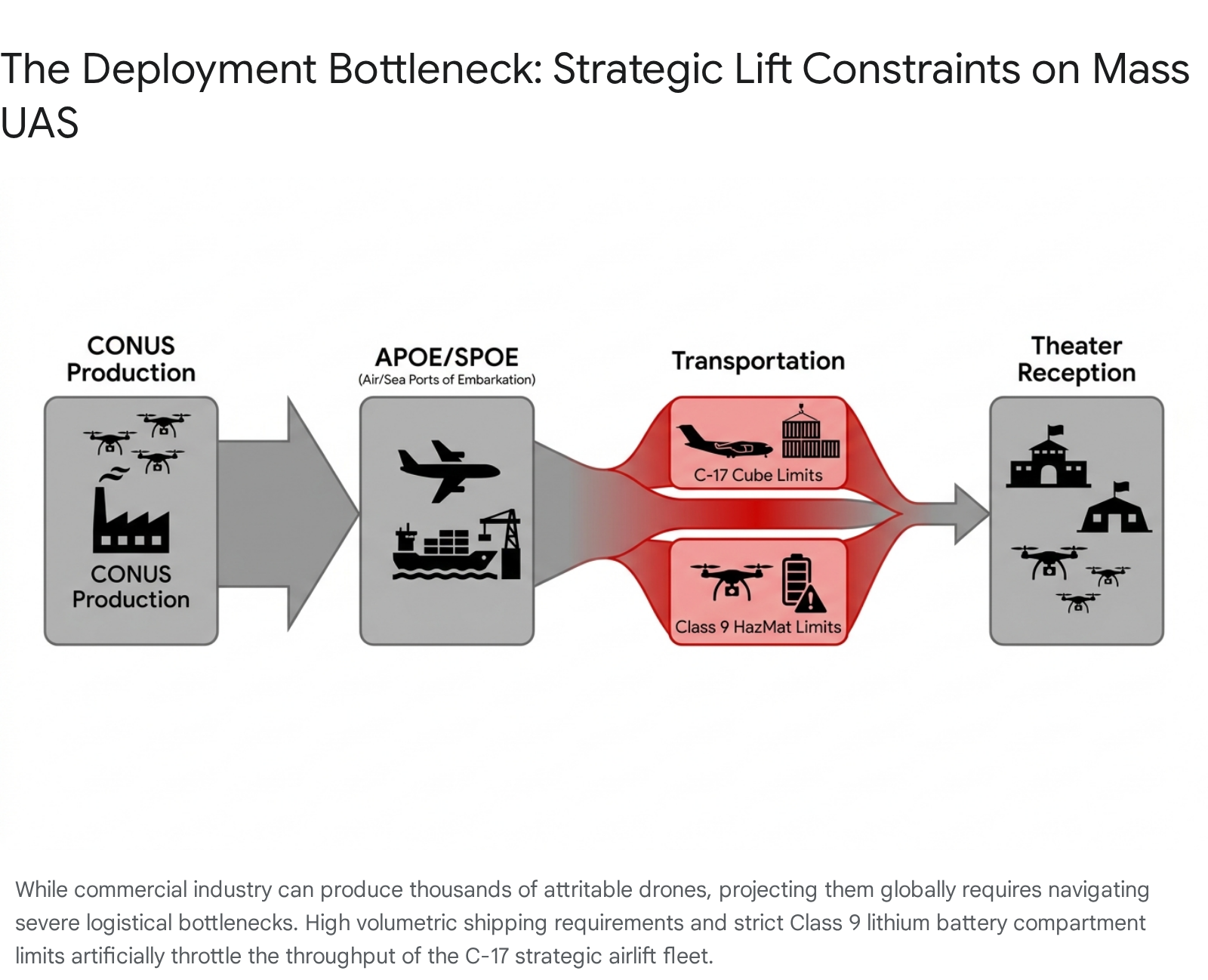
While volumetric inefficiency restricts the amount of cargo space available, lithium-ion batteries present an acute, hard-stop regulatory constraint that dictates how, when, and if these platforms can be moved at all.
Every modern electric tactical UAS relies on high-energy-density lithium-ion or lithium-polymer batteries to achieve necessary flight times and payload capacities.28 Under both international civilian law and strict military regulations, lithium batteries are universally classified as Class 9 Hazardous Materials.30 Depending on their configuration, they are categorized as UN3480 (for standalone lithium-ion batteries) or UN3481 (for lithium-ion batteries packed with or contained in equipment).32 The transportation of these assets is heavily scrutinized and restricted due to the severe risk of thermal runaway—a catastrophic internal short-circuit chain reaction that causes intense, self-sustaining fires that are highly resistant to standard aviation fire suppression systems.33
4.1 Air Transport Restrictions and AFMAN 24-204
The strategic airlift of these batteries is governed by a complex web of overlapping authorities, primarily the International Air Transport Association (IATA) Dangerous Goods Regulations and the Air Force Joint Manual (AFMAN 24-204), “Preparing Hazardous Materials for Military Air Shipment”.5
To mitigate the existential risk of an in-flight thermal runaway event, current regulations mandate that rechargeable lithium batteries must be shipped at a State of Charge (SOC) not exceeding 30% of their rated capacity.5 Furthermore, there are stringent limits on the maximum net quantity of lithium batteries permitted per cargo aircraft compartment.33 For certain configurations and sizes, the maximum net quantity per cargo aircraft can be as low as 35 kg.31 While waivers and exceptions exist for national security movements under 49 CFR 173.7, the baseline safety protocols dictate severe segregation and quantity limits to ensure that an oxygen-starved cargo hold or automated fire suppression system can actually contain a potential blaze.33
This regulatory environment creates a profound logistical bottleneck for the mass deployment envisioned by the Replicator initiative:
- Compartment Saturation: A C-17 Globemaster III cannot simply be filled floor-to-ceiling with attritable drones. Load planners must meticulously distribute the UN3480/UN3481 hazardous materials across different isolated cargo compartments to avoid exceeding strict Class 9 net quantity limits.33 Consequently, if a specific drone model carries a heavy battery payload for extended endurance, the aircraft may “hazmat out” (reach its legal hazardous material weight limit) while the physical cargo bay remains largely empty.
- Dead on Arrival Logistics: Because batteries must legally and safely be shipped at less than 30% SOC 5, drones arriving in the theater of operations are not combat-ready. They cannot be rapidly offloaded from a transport aircraft and immediately launched to counter an advancing adversary. They must first be routed through a logistical node, unpacked, and fully recharged. This operational reality completely transfers the burden of operational readiness directly onto the theater’s tactical power grid, introducing devastating delays to force projection timelines.
4.2 Packaging Integrity and Retrograde Complexities
The dangers of Class 9 materials are amplified when dealing with damaged systems. If an attritable drone is damaged during transit, rough handling, or limited operations and requires retrograde transport for depot-level repair or forensic analysis, the battery must be isolated. Damaged or defective batteries face even stricter protocols, requiring individual non-metallic inner packaging surrounded by non-combustible, electrically non-conductive cushioning, with explicit exterior markings denoting the heightened hazard.18 Furthermore, it is strictly prohibited to mix hazardous and non-hazardous solid waste in the same package.5 Managing this retrograde process across thousands of deployed systems drastically complicates reverse logistics, requiring forward units to act as highly trained hazardous material processing centers. The Commercial Vehicle Safety Alliance (CVSA) has even recommended that the Department of Transportation reclassify lithium batteries from Class 9 to a more restrictive Division 4.3 material due to these runaway thermal reaction risks, which would further tighten future airlift and ground transport requirements.37
5. Strategic Airlift and Sealift Constraints
The ability to successfully mass autonomous forces is entirely contingent on the capacity and readiness of the United States Transportation Command (USTRANSCOM). The physical realities of volumetric packaging and Class 9 hazardous materials translate directly into severe, structural strain on strategic mobility assets.
5.1 The Strategic Airlift Deficit
USTRANSCOM relies on a validated requirement of a 275-aircraft organic strategic airlift fleet to meet national defense objectives and global contingency plans.8 The C-17 Globemaster III serves as the backbone of this fleet, providing rapid, inter-theater mobility. However, strategic airlift is fundamentally designed and optimized for high-value, high-density, time-sensitive cargo.
When the DoD demands the rapid, simultaneous deployment of thousands of high-cube, low-density attritable drones—each packed in expansive protective crates and subject to compartment-specific lithium battery limits—the airlift architecture is forced to operate at maximum inefficiency. In a crisis scenario, drones will compete directly for premium pallet space against critically needed precision munitions, medical supplies, and ground vehicle repair parts. In a contested logistics environment, where speed equates directly to deterrence 8, dedicating vast swaths of C-17 capacity to transport empty space and packing foam represents an unacceptable tactical trade-off.
Intra-theater lift faces similar structural pressures. The Air Force’s retirement of older C-130H aircraft has reduced the tactical airlift fleet from over 500 aircraft in 2003 to a congressionally mandated inventory of 271.8 Distributing massive quantities of volumetric drone crates from major theater hubs to dispersed forward operating bases using a constrained C-130 fleet will inevitably result in operational delays. While innovative concepts like the Rapid Dragon program—which successfully demonstrated the deployment of palletized munitions directly from C-17 and EC-130 aircraft 38—show promise for direct aerial delivery, these systems still consume vast amounts of cargo volume and require extensive rigging.
5.2 The Atrophy of Strategic Sealift
Historically, when airlift capacity is constrained or reserved for immediate priorities, the DoD relies heavily on the Military Sealift Command (MSC) to transport approximately 90 percent of U.S. Army and Marine Corps equipment into the theater of operations.9 For the true mass deployment of drone fleets, utilizing standard International Organization for Standardization (ISO) containers via sealift is the only mathematically viable method.
However, the strategic sealift enterprise is currently facing an unprecedented readiness crisis. Current assessments indicate that MSC readiness levels have dropped to an alarming 59 percent, driven primarily by vessel age and deteriorating material condition.9 The sealift fleet is projected to lose between 1 million and 2 million square feet of capacity annually as legacy ships reach the end of their useful service lives.9
Furthermore, in a pacing scenario against a near-peer adversary such as China, sea lines of communication (SLOCs) from the continental United States to the Indo-Pacific will be heavily contested.9 Transporting mass quantities of Class 9 lithium batteries via sealift also invokes the International Maritime Dangerous Goods (IMDG) Code, which mandates robust, fire-resistant packaging, adequate cushioning, and strict stowage segregation.5
The systemic requirement is unavoidable: The Replicator initiative cannot rely solely on the C-17 fleet for initial deployment. The DoD must urgently integrate mass drone packaging into standard ISO container dimensions—specifically utilizing TRICON (8’x8’x6.5′), BICON (8’x8’x10′), and QUADCON (8’x6.10’x4.9′) steel-framed containers 39—that are engineered for hazardous material sealift, and combatant commanders must factor the extended transit times of maritime logistics into their operational plans.
6. Forward Operating Base Footprint: Storage and Climate Control
Upon successfully navigating the strategic airlift or sealift pipeline and reaching the theater of operations, the logistical burden transitions entirely from USTRANSCOM to the gaining tactical units. The pervasive assumption that thousands of attritable drones can simply be unloaded, unboxed, and stacked in a general-purpose, unconditioned supply tent completely ignores the volatile chemistry of lithium-ion technology and the fragility of the platforms.
6.1 The Aggregate Risk of Thermal Runaway
Aggregating thousands of lithium-ion batteries at a Forward Operating Base (FOB) introduces a profound vulnerability to the installation. A single thermal runaway event—whether caused by mechanical damage during rough transport, a latent manufacturing defect, or an enemy kinetic strike—can rapidly propagate to adjacent stored batteries. This creates an uncontrollable, self-sustaining chemical blaze that conventional firefighting techniques and standard water suppression systems cannot easily extinguish.34
Military history provides stark precedents. The Navy’s Naval Surface Warfare Center (NSWC) Carderock Division has documented incidents where standard military lithium batteries, such as the widely used BB 2590, entered thermal runaway while stored in an Army vehicle-mounted shelter, causing massive damage to surrounding equipment and exposing personnel to severe hazard.34
6.2 Specialized Climate-Controlled Infrastructure
To prevent spontaneous degradation, maintain operational capacity, and prevent thermal events, lithium-ion batteries must be stored in specific, highly regulated environmental conditions. Both industry standards and DoD best practices dictate that these batteries must be kept at stable temperatures, generally below 80°F (26.6°C).41 In austere, high-temperature operational environments—such as the Middle East or the Indo-Pacific during summer months—maintaining this temperature requires dedicated, power-hungry climate control systems running continuously.
Standard canvas tents or rudimentary plywood structures are entirely inadequate. Adequate storage requires purpose-built facilities, such as commercial DrumLoc buildings or the military’s specialized CLASSIC (Containerized Lithium-ion Battery Storage and Sustained Intelligent Charging) containers developed by NSWC.34 These specialized hazardous material bunkers require robust, integrated safety features, including:
- Explosion-proof electrical accessories, switches, and interior lighting.
- Active clean-agent fire suppression devices (e.g., FM 200 systems) tailored for chemical fires.41
- Advanced sensors capable of detecting chemical off-gassing, temperature spikes, or smoke prior to a full thermal runaway event.34
- Passive physical mitigation measures, such as internal blast walls, to prevent failure propagation between stored units and to direct the blast outward rather than upward into the facility.34
Consequently, deploying a mass drone capability does not merely require runway space or a clear patch of dirt; it necessitates the deployment of heavy, specialized ISO containers acting as forward hazardous material bunkers, which in turn require constant, uninterrupted power to run their HVAC and automated sensor systems.
7. Industrial-Scale Power Generation at the Tactical Edge
The most critical, yet systematically overlooked, operational requirement of mass drone deployment is tactical power generation. As previously established, drones arrive in theater at less than 30% SOC due to strict aviation transport regulations.5 Before a single swarm can be launched to achieve the mass effects envisioned by Replicator, the entire fleet must be charged. This transforms a forward drone unit into an industrial power consumer.
7.1 The Mathematics of Megawatt Demand
Commercial and military drone operations are exceptionally energy-intensive. A single tactical drone team conducting persistent intelligence, surveillance, and reconnaissance (ISR) or kinetic strike operations can easily cycle through 10 to 12 battery charges per day, consuming approximately 2 to 3 kilowatt-hours (kWh) of electricity daily.42 Scaling this baseline to the DoD’s vision of fielding “multiple thousands” of autonomous platforms 4 creates a staggering localized power demand.
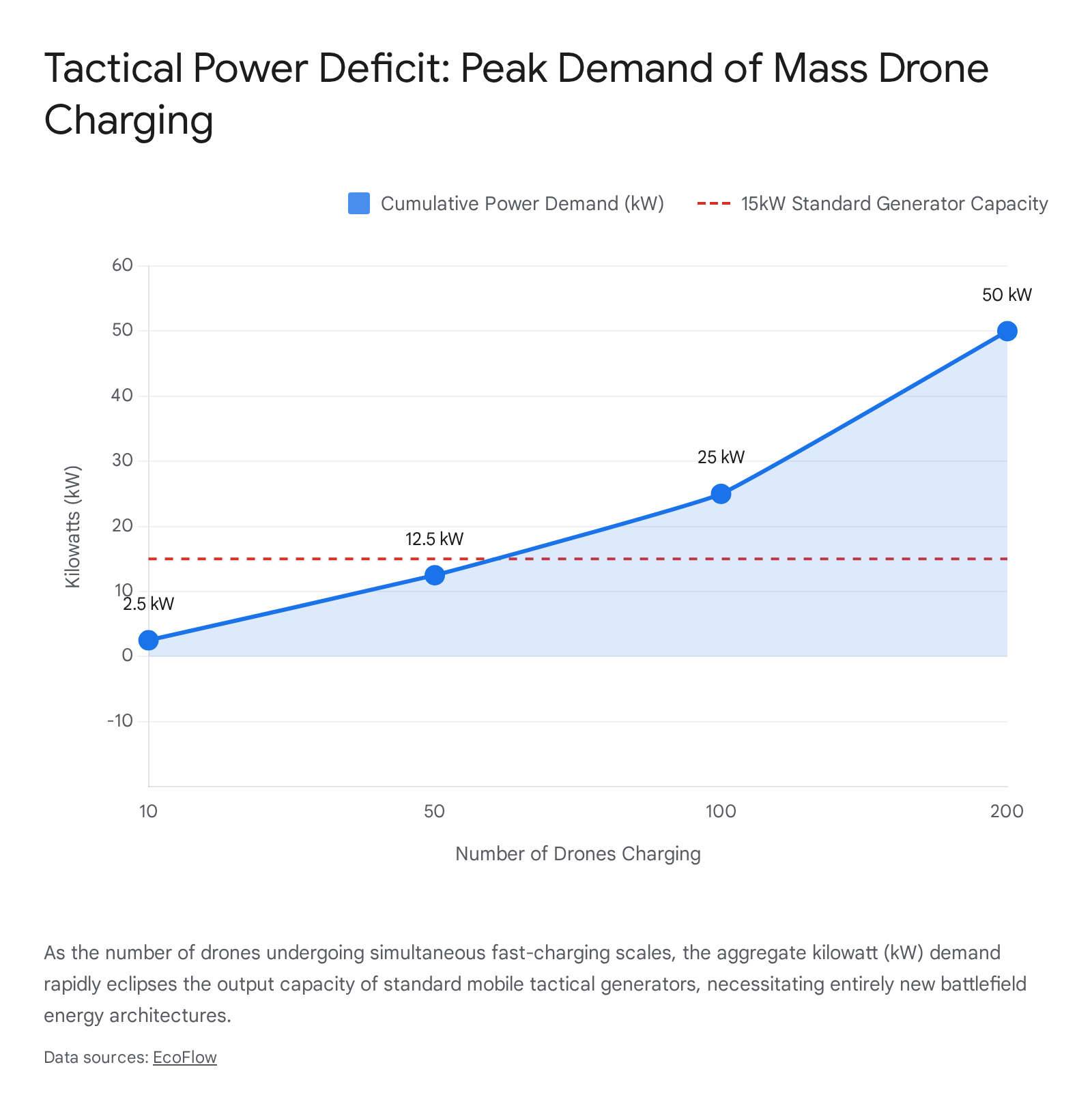
If a combatant commander intends to launch a coordinated wave of 1,000 drones within a narrow operational window, those batteries must be charged simultaneously. Fast-charging a single heavy-lift or long-range tactical drone battery requires a dedicated draw of between 150W and 300W of continuous power.43 In parallel, the necessary ground support equipment—including operator laptops, network routers, data relays, and GPS base stations—draws a continuous 100W to 250W per station.43
When operating multiple systems simultaneously during pre-mission staging, the peak electrical demand rapidly surges into the tens of thousands of watts per tactical node.43 Standard consumer-grade portable power stations, small solar arrays, or vehicle-mounted inverters are vastly insufficient for this industrial scale.
| Power Requirement Source | Estimated Draw / Consumption | Tactical Implication |
| Drone Battery Fast Charger | 150–300W per unit 43 | Charging 100 batteries simultaneously requires ~30kW peak capacity, outstripping standard small generators. |
| Daily Single Drone Team Ops | 2–3 kWh per day 42 | Continuous operational drain requires persistent, uninterrupted localized power generation day and night. |
| Ground Control & Network | 100–250W continuous 43 | Base stations must remain powered throughout the flight duration; no downtime or power cycling is allowed. |
7.2 The Vulnerability of Tactical Generators and Class III Logistics
Historically, the default solution to remote, off-grid power demand has been the towed gasoline or diesel generator.6 However, relying on traditional internal combustion generators to power mass drone operations presents severe tactical liabilities that undermine the very purpose of the capability:
- Acoustic and Thermal Signatures: In an era of advanced multi-spectral ISR, the massive noise pollution and intense thermal bloom of a large generator farm immediately compromise the position of the drone launch site.6 Adversary sensors will detect the power generation node long before the drones are launched, inviting preemptive kinetic strikes.
- Vibration Interference: Micro-vibrations emanating from heavy diesel generators can interfere with the delicate calibration of drone targeting optics and sensitive charging equipment, leading to high failure rates before takeoff.6
- Contested Class III Logistics: Generators burn vast quantities of fuel. Moving thousands of gallons of Class III bulk fuel to remote launch sites requires vulnerable, highly visible convoy operations. This reliance on a heavy logistics tail defeats the strategic purpose of utilizing distributed, low-risk attritable forces.
7.3 The Hazards of Parallel Charging
To save time and meet aggressive operational tempos, drone operators frequently utilize parallel charging—connecting multiple lithium-polymer (LiPo) batteries to a single high-output charger via a parallel charging board.45 While highly efficient for rapid turnarounds, parallel charging introduces acute fire risks if not managed with absolute precision.
Batteries connected in parallel must possess the identical cell count and very similar starting voltages (typically within 0.1V of each other).45 If a depleted battery is hastily connected in parallel with a partially charged battery, the voltage differential causes a massive, uncontrolled rush of current into the depleted battery, frequently resulting in catastrophic cell failure, explosions, and fires.47 Furthermore, charging at higher currents (e.g., 2c instead of the safer standard 1c rate) drastically increases the wear on the battery and the risk of thermal events.48 Managing this delicate, mathematically precise charging process across thousands of rapidly degrading attritable batteries in a chaotic combat environment requires sophisticated Battery Management Systems (BMS) 29 and highly trained personnel, which inherently slows the tempo of operations.
8. Maintenance Footprint, Personnel, and Training Readiness
The very term “attritable” implies expendability and a short lifecycle, which often leads to the dangerous assumption that these platforms require little to no maintenance or human support. In reality, assembling, calibrating, launching, and managing a fleet of attritable UAS requires a highly specialized human capital footprint and expansive physical facilities.
8.1 Assembly and Facility Square Footage
Most tactical drones, to save volumetric space during strategic airlift, are shipped partially disassembled within their protective MIL-STD crates.49 Upon arrival at the FOB, they must be meticulously unpacked, assembled, firmware-updated, and flight-checked before they can be assigned to a mission. Establishing a forward drone assembly and maintenance facility requires significant physical space that must be factored into base planning.
Basic institutional standards for drone laboratories and maintenance facilities dictate a minimum of 750 square feet solely for assembly and maintenance areas, with 10-to-12-foot ceilings to accommodate wingspan clearances and component testing.50 Storage rooms capable of holding just 500 drones require upwards of 1,000 square feet of dedicated, secure shelving.50 When scaling to the DAWG and Replicator goal of multiple thousands of systems, commanders will require massive, semi-permanent structures—such as large clamshell tents or repurposed aircraft hangars—simply to process the unboxing and assembly of the hardware. This vast physical requirement directly contradicts the operational goal of maintaining a light, agile, and geographically dispersed expeditionary footprint.51
8.2 The Human Capital Constraint
Unmanned systems, paradoxically, are highly manpower-intensive on the ground. A complex UAV operation often requires at least seven crewmembers dedicated to specific tasks: takeoff and landing procedures, in-flight monitoring, payload operation, and flight line maintenance.52 While the Replicator initiative explicitly aims to leverage advanced autonomy to allow a single operator to control multiple vehicles in a swarm configuration 1, the physical handling, battery swapping, and maintenance of the drones remains a heavily manual task.
To manage the unprecedented battery and maintenance logistics, the DoD will need to fundamentally restructure its forward support companies (FSCs) and sustainment brigades.53 Battlefield energy generation and distribution nodes must be established within Light Support Battalions (LSB) and Division Sustainment Support Battalions (DSSB).7 This shift requires existing 91D (Generator Mechanic) and 94-series personnel to undergo extensive retraining to manage complex hybrid and lithium-ion systems, diagnosing battery health and managing parallel charging racks.7
Furthermore, training the sheer number of operators required to employ thousands of drones demands a massive expansion of the institutional training base. Simulator training is essential for building initial flight proficiency and mitigating crash risks.54 The Marine Corps, for example, is heavily reliant on enterprise-resourced simulation capabilities delivered via the Marine Common Virtual Platform (MCVP)—such as DART 2.0 and FlowState—as well as commercial simulators like Velocidrone, to provide service-wide training solutions.54 Scaling this training pipeline to match the procurement of the hardware is a multi-year endeavor.
8.3 Supply Chain Security and Parts Replacement
Finally, forward units cannot simply rely on localized procurement or commercial replacement of broken drone parts to sustain operations. Due to strict supply chain security mandates, such as the Federal Acquisition Supply Chain Security Act (FASC), there is a blanket prohibition on the use of FASC-prohibited unmanned aircraft systems and associated elements.55 This legislation ensures that no components sourced from adversarial nations (such as certain Chinese-manufactured motors or flight controllers) can be integrated into DoD networks. Consequently, every spare propeller, servo, and circuit board must be sourced through secure, vetted, and often severely backlogged military supply chains. This reality forces deployed units to stockpile vast quantities of authorized spare parts at the FOB to maintain readiness, further increasing the logistical cube and storage requirements.
9. Strategic Conclusions and Required Leadership Action
The United States Department of Defense possesses the unparalleled technological prowess to design, develop, and manufacture thousands of highly capable autonomous systems. The massive financial commitments to the DAWG and Replicator initiatives guarantee that the industrial base will produce the hardware. However, the true measure of mass autonomy’s success will not be determined by factory output or lines of code, but by the Defense Transportation System’s ability to project those assets globally without buckling under the weight of archaic packaging standards, hazardous material laws, and localized power deficits.
To ensure that mass drone operations transition from a theoretical strategic concept to a viable, reliable tactical reality, leadership must immediately acknowledge and aggressively mitigate the physical logistics footprint. The analysis indicates several critical areas for immediate, systemic action:
- Redesign Military Packaging for Drones: The DoD must collaborate directly with defense contractors to engineer MIL-STD-2073 compliant shipping configurations that drastically reduce the “cube.” Drones should be designed with foldable, robust components that minimize the need for expansive foam-in-place cushioning, maximizing the density of a 463L pallet and ISO containers. The packaging must be considered as important as the payload.
- Modernize the Class 9 Hazardous Pipeline: USTRANSCOM and the Defense Logistics Agency (DLA) must develop streamlined, pre-approved hazardous material transport corridors specifically optimized for lithium-ion batteries. To bypass the airlift bottleneck, the DoD must invest heavily in specialized ISO containers (analogous to the CLASSIC system) that can transport, safely store, and simultaneously charge batteries at the tactical edge, relying more heavily on proactive strategic sealift.
- Elevate Energy to a Primary Supply Class: The Brigade Support Operations (SPO) and unit S4s must immediately begin treating electrical power forecasting with the exact same rigor and priority as Class III (Fuel) and Class V (Ammunition) sustainment.7 The DoD must rapidly procure modular, silent, and high-capacity battlefield energy storage networks to decouple deployed drone units from vulnerable liquid fuel supply chains and noisy tactical generators.
The technology of mass autonomy is profound, and its potential to deter aggression is immense. Yet, it remains inextricably tethered to the physical world. By shifting the strategic focus toward the unglamorous realities of logistics, volumetric packaging, hazardous materials, and tactical power generation, DoD leadership can ensure that the autonomous systems built to win the next conflict are actually capable of reaching the battlefield.
Please share the link on Facebook, Forums, with colleagues, etc. Your support is much appreciated and if you have any feedback, please email us in**@*********ps.com. If you’d like to request a report or order a reprint, please click here for the corresponding page to open in new tab.
Sources Used
- Replicator: A Bold New Path for DoD | Center for Security and Emerging Technology %, accessed April 24, 2026, https://cset.georgetown.edu/article/replicator-a-bold-new-path-for-dod/
- Deep Dive: Pentagon’s Replicator Initiative Raises Questions | Inkstick, accessed April 24, 2026, https://inkstickmedia.com/deep-dive-pentagons-replicator-initiative-raises-questions/
- Pentagon officials broadly detail $55 billion drone plan under DAWG – Breaking Defense, accessed April 24, 2026, https://breakingdefense.com/2026/04/pentagon-officials-broadly-detail-55-billion-drone-plan-under-dawg/
- DOD Innovation Official Discusses Progress on Replicator > Department of Defense Manufacturing Technology Program > News Display, accessed April 24, 2026, https://www.dodmantech.mil/News/News-Display/Article/3999474/dod-innovation-official-discusses-progress-on-replicator/
- Transportation – U.S. Army Batteries, accessed April 24, 2026, https://battery.army.mil/safety/transportation-safety/
- Unleashing the Swarm: The Ultimate Guide to Professional Portable Power for Drone Operations – New Use Energy, accessed April 24, 2026, https://newuseenergy.com/blogs/news/unleashing-the-swarm-the-ultimate-guide-to-professional-portable-power-for-drone-operations
- Best Practices on Operationalizing Battlefield Energy | Article | The United States Army, accessed April 24, 2026, https://www.army.mil/article/287897/best_practices_on_operationalizing_battlefield_energy
- 1 Statement of General Randall Reed, United States Air Force Commander, United States Transportation Command Before the House Ar, accessed April 24, 2026, https://docs.house.gov/meetings/AS/AS28/20260318/119070/HHRG-119-AS28-20260318-SD004.pdf
- The dangerous collapse of US strategic sealift capacity – The Strategist, accessed April 24, 2026, https://www.aspistrategist.org.au/the-dangerous-collapse-of-us-strategic-sealift-capacity/
- DoD promised a ‘swarm’ of attack drones. We’re still waiting. – Responsible Statecraft, accessed April 24, 2026, https://responsiblestatecraft.org/replicator/
- Pentagon’s Replicator Initiative Sets Sights on Counter-UAS – National Defense Magazine, accessed April 24, 2026, https://www.nationaldefensemagazine.org/articles/2024/12/16/pentagons-replicator-initiative-sets-sights-on-counteruas
- Attritable Unmanned Aircraft Systems: Conceptualization and Key Players – DSIAC – dtic.mil, accessed April 24, 2026, https://dsiac.dtic.mil/state-of-the-art-reports/attritable-unmanned-aircraft-systems-conceptualization-and-key-players/
- MQ-9A Passes 2 Million Flight Hours | General Atomics Aeronautical Systems Inc., accessed April 24, 2026, https://www.ga-asi.com/mq-9a-passes-2-million-flight-hours
- Standard Practice for Military Packaging – ASSIST-QuickSearch Document Details – DLA, accessed April 24, 2026, https://quicksearch.dla.mil/qsDocDetails.aspx?ident_number=37232
- afman 24-604 – Air Force – USAF, accessed April 24, 2026, https://static.e-publishing.af.mil/production/1/af_a4/publication/afman24-604/afman24-604.pdf
- What Is MIL-STD-2073 Packaging? – Export Corporation, accessed April 24, 2026, https://www.exportcorporation.com/what-is-mil-std-2073-packaging/
- MIL-STD-2073_1E_CHG-4.pdf – S3VI, accessed April 24, 2026, https://s3vi.ndc.nasa.gov/ssri-kb/static/resources/MIL-STD-2073_1E_CHG-4.pdf
- 49 CFR 173.185 — Lithium cells and batteries. – eCFR, accessed April 24, 2026, https://www.ecfr.gov/current/title-49/subtitle-B/chapter-I/subchapter-C/part-173/subpart-E/section-173.185
- The Basics – ASC Packaging Storage and Containerization Center – U.S. Army, accessed April 24, 2026, https://www.pscc.army.mil/Portals/92/Documents/PKG_01_Packaging%20_the_Basics.pdf?ver=jVqRtUlH0eGE9rfwrGlXnA%3D%3D
- Military Spec Crates Explained – Valley Box Company, accessed April 24, 2026, https://www.valleybox.com/blog/military-spec-crates-explained
- MIL-STD-2073-1 Exterior Shipping Containers – Camp Hill Logistics, accessed April 24, 2026, https://camphill.leidos.com/code_lookup.nsf/ESC?OpenPage
- Switchblade® 600 – AeroVironment, accessed April 24, 2026, https://www.avinc.com/solution/switchblade-600/
- AeroVironment Switchblade – Wikipedia, accessed April 24, 2026, https://en.wikipedia.org/wiki/AeroVironment_Switchblade
- Switchblade® 600 Loitering Munition Systems | Kamikaze Drones | Suicide Drone | Tactical Missile Systems | AV – AeroVironment, accessed April 24, 2026, https://www.avinc.com/lms/switchblade-600
- Anduril ALTIUS – Designation-Systems.Net, accessed April 24, 2026, https://www.designation-systems.net/dusrm/app4/altius.html
- Taiwan Receives First Batch of U.S.-Made Altius 600M Drones, accessed April 24, 2026, https://militarnyi.com/en/news/taiwan-receives-first-batch-of-u-s-made-altius-600m-drones/
- Ghost-X Selected for U.S. Army’s Company Level sUAS Directed Requirement | Anduril, accessed April 24, 2026, https://www.anduril.com/news/ghost-x-selected-for-u-s-army-s-company-level-suas-directed-requirement
- The Study of Electrical Energy Power Supply System for UAVs Based on the Energy Storage Technology – MDPI, accessed April 24, 2026, https://www.mdpi.com/2226-4310/9/9/500
- Drone (UAV) Battery Market Report 2025-2030 [287 Pages & 398 Tables], accessed April 24, 2026, https://www.marketsandmarkets.com/Market-Reports/drone-battery-market-131005766.html
- Navigating State-Specific Regulations for Lithium-Ion Batteries – Americase, accessed April 24, 2026, https://www.americase.com/navigating-state-specific-regulations-for-lithium-ion-batteries/
- Challenges in Transporting Lithium Batteries – Clip-Lok, accessed April 24, 2026, https://clip-lok.com/challenges-in-transporting-lithium-batteries/
- Common Challenges in Battery Shipping and Solutions – FreightAmigo, accessed April 24, 2026, https://www.freightamigo.com/en/blog/logistics/common-challenges-in-battery-shipping-and-solutions/
- Lithium Battery Guide for Shippers – Pipeline and Hazardous Materials Safety Administration, accessed April 24, 2026, https://www.phmsa.dot.gov/sites/phmsa.dot.gov/files/2024-11/Lithium-Battery-Guide-2024.pdf
- CLASSIC Battery Container – Navsea, accessed April 24, 2026, https://www.navsea.navy.mil/Portals/103/Documents/Exhibits/SAS2022/1300-CLASSIC_BatteryContainer-Hays-20220404.pdf
- 2024 LITHIUM BATTERY SHIPPING GUIDE – Hazmateam, accessed April 24, 2026, https://hazmateam.learningcart.com/uploads/2024LITHIUMBATTERIES/2024HAZMATEAMLITHIUMBATTERYSHIPPINGGUIDEINTERACTIVEJAN_1_2024.pdf
- Hazardous Material, Part II, Chapter 204 – USTransCOM, accessed April 24, 2026, https://www.ustranscom.mil/dtr/part-ii/dtr_part_ii_204.pdf
- April 22, 2025 Acting Administrator Kochman U.S. Department of Transportation Pipeline and Hazardous Materials Safety Administr – CVSA, accessed April 24, 2026, https://cvsa.org/wp-content/uploads/CVSA-Letter-to-PHMSA-Regarding-Lithium-Batteries-Recommendations.pdf
- Rapid Dragon Demonstrates Palletized Munition Capability in First C-17 and EC-130 System-Level Demonstrations – Lockheed Martin, accessed April 24, 2026, https://news.lockheedmartin.com/rapid-dragon-demonstrates-palletized-munition-capability-in-first-C-17-and-EC-130-system-level-demonstrations
- The Buyer’s Guide for Military Shipping Container – Mobile Modular Portable Storage, accessed April 24, 2026, https://www.mobilemodularcontainers.com/blog/military-shipping-containers
- Appendix B – DEPARTMENT OF DEFENSE (DOD) INTERMODAL CONTAINER STANDARDS – USTransCOM, accessed April 24, 2026, https://www.ustranscom.mil/dtr/part-vi/dtr_part_vi_app_b.pdf
- Lithium Ion Battery Storage Requirements, accessed April 24, 2026, https://www.uschemicalstorage.com/lithium-ion-battery-storage-requirements/
- No. 26-1116, Powering The Front: Tactical Energy Delivery and Management in the Ukraine War – U.S. Army, accessed April 24, 2026, https://api.army.mil/e2/c/downloads/2026/03/30/c260713f/no-26-1116-powering-the-front-tactical-energy-delivery-and-management-in-the-ukraine-war.pdf
- Drone Show Power Guide: How Many Watts Do You Really Need – EcoFlow, accessed April 24, 2026, https://www.ecoflow.com/us/blog/drone-show-power-requirements-guide
- Power under pressure: Meeting the military’s surging energy demands, accessed April 24, 2026, https://militaryembedded.com/comms/power-electronics/power-under-pressure-meeting-the-militarys-surging-energy-demands
- Mastering LiPo Parallel Charging: The Safety Guide for FPV Drone Pilots – Oscar Liang, accessed April 24, 2026, https://oscarliang.com/parallel-charging-multiple-lipo/
- Charging Multiple Lithium-Polymer (Lipo) Batteries at once – Planet Geek!, accessed April 24, 2026, https://planet-geek.com/2017/07/09/drones/charging-multiple-lithium-polymer-lipo-batteries-at-once/
- Is it safe to charge these different brands at the same time and how many amps should I use? – Reddit, accessed April 24, 2026, https://www.reddit.com/r/fpv/comments/12do8ue/is_it_safe_to_charge_these_different_brands_at/
- At what current should I charge a LiPo battery? – Drones and Model Aircraft Stack Exchange, accessed April 24, 2026, https://drones.stackexchange.com/questions/971/at-what-current-should-i-charge-a-lipo-battery
- MCO P4030.21D PACKAGING OF MATERIEL – Marines.mil, accessed April 24, 2026, https://www.marines.mil/portals/1/Publications/MCO%20P4030.21D.pdf
- How to Set Up a Drone Lab | Equipment and Space Requirements – Robocraze, accessed April 24, 2026, https://robocraze.com/blogs/post/how-to-set-up-a-drone-lab-equipment-and-space-requirements
- The fresh maintenance and sustainment challenges as UAVs take off in defense, accessed April 24, 2026, https://militaryembedded.com/unmanned/counter-uas/the-fresh-maintenance-and-sustainment-challenges-as-uavs-take-off-in-defense
- Annotated Bibliography (1997 – 2021): Crew and Staffing Requirements of Unmanned Aircraft Systems in Air Carrier Operations – Federal Aviation Administration, accessed April 24, 2026, https://www.faa.gov/sites/faa.gov/files/2022-07/Annotated%20Bibliography%20(1997-2021)-%20Crew%20and%20Staffing%20Requirements%20of%20Unmanned%20Aircrafts%20Systems%20in%20Air%20Carrier%20Operations.pdf
- 23-08-682-leader-s-guide-to-maintenance-and-services-aug-23-public.pdf – U.S. Army, accessed April 24, 2026, https://api.army.mil/e2/c/downloads/2023/09/29/c9a4e39d/23-08-682-leader-s-guide-to-maintenance-and-services-aug-23-public.pdf
- APPROVED TRAINING REQUIREMENTS FOR SMALL UNMANNED AERIAL SYSTEMS > United States Marine Corps Flagship > Messages Display, accessed April 24, 2026, https://www.marines.mil/News/Messages/Messages-Display/Article/4366306/approved-training-requirements-for-small-unmanned-aerial-systems/
- 52.240-1 Prohibition on Unmanned Aircraft Systems Manufactured or Assembled by American Security Drone Act-Covered Foreign Entities. | Acquisition.GOV, accessed April 24, 2026, https://www.acquisition.gov/far/52.240-1
- M-26-02 Ensuring Government Use of Secure Unmanned Aircraft Systems and Supporting – The White House, accessed April 24, 2026, https://www.whitehouse.gov/wp-content/uploads/2025/11/M-26-02-Ensuring-Government-Use-of-Secure-Unmanned-Aircraft-Systems-and-Supporting-United-States-Producers.pdf