1. Executive Summary
The paradigm of Close Quarters Battle within civilian law enforcement has undergone a significant evolution over the last two decades. Historically, tactical teams relied almost exclusively on dynamic entry techniques characterized by speed, surprise, and deep penetration into a given structure. However, extensive post-incident analysis and evolving threat matrices have prompted a critical reevaluation of these traditional methodologies. Modern law enforcement tactical training now emphasizes a highly adaptable, hybrid approach that fluidly transitions between deliberate threshold evaluation, commonly known as limited penetration, and dynamic room entry, utilizing established points of domination.
This comprehensive research report provides an exhaustive tactical breakdown of modern room clearing methodologies. It examines the geometric principles of angular searches, specifically the technique known as slicing the pie, and contrasts the biomechanical and tactical advantages of limited penetration versus deep room penetration. Furthermore, this report analyzes the cognitive and operational requirements for transitioning between deliberate and dynamic techniques during a live tactical operation.
To safely and effectively instill these complex psychomotor skills, law enforcement agencies must utilize specialized training infrastructure. This report provides an objective analysis of essential training aids, including inert polymer replicas for safe structural maneuvering and diagnostic laser training pistols designed to refine trigger mechanics under simulated stress. Finally, the report details the mechanical breaching tools required to defeat fortified structures, outlining the material science and ergonomic designs that maximize operator safety and breaching efficacy. All equipment recommendations are supported by an analysis of leading manufacturers and a validated list of authorized vendors, ensuring procurement officers possess actionable data for tactical outfitting.
2. The Historical Evolution of Tactical Room Clearing Methodologies
The strategies employed by modern tactical teams do not exist in a vacuum. They are the product of decades of trial, error, and meticulous post-incident analysis. Understanding the historical context of these methodologies is vital for comprehending why contemporary doctrines emphasize specific geometric angles and deliberate pacing over sheer speed.
2.1. Origins in Military Special Operations
The fundamental principles of Close Quarters Battle were originally codified by military special operations units tasked with hostage rescue and counter-terrorism missions during the late twentieth century. These early doctrines prioritized overwhelming violence of action. The prevailing philosophy dictated that an assault element must cross the threshold of a room as rapidly as possible to overwhelm the occupants, effectively paralyzing the cognitive processing capabilities of the adversaries through sensory overload. This approach heavily favored speed and surprise over methodical searching.
2.2. The Transition to Civilian Law Enforcement
This aggressive military doctrine was subsequently adopted by civilian law enforcement Special Weapons and Tactics teams during the 1980s and 1990s. Early civilian tactical training was often delivered directly by former military operators, leading to a direct translation of battlefield tactics to domestic policing environments. Law enforcement teams began utilizing the same deep-penetration techniques, flooding rooms with multiple operators moving at a sprinting pace to dominate all corners of a structure simultaneously.
2.3. The Catalyst for Tactical Reevaluation
However, the operational environments and rules of engagement for civilian law enforcement differ vastly from military combat theaters. Law enforcement officers are frequently tasked with serving high-risk warrants in densely populated urban environments where the presence of non-combatants, children, and hostages is highly probable. The inherent risks of dynamic entry, namely extreme exposure to multiple un-cleared angles and the heightened risk of fratricide, proved too costly in domestic environments. Extensive reviews of officer-involved shootings and tactical casualties revealed that rushing blindly into fortified structures overwhelmingly favored the barricaded suspect. Consequently, modern tactical doctrine has shifted toward deliberate search methodologies, prioritizing information gathering from the exterior of a room before committing personnel across the threshold.1 By maximizing the use of cover and concealment, tactical operators can dictate the pace of an engagement and systematically dismantle the distinct tactical advantage held by a suspect lying in wait.
3. Architectural Geometry and the Spatial Threat Matrix
To fully grasp the efficacy of various room clearing techniques, one must first conduct a thorough analysis of the architectural geometry of structural spaces. A building is not merely a collection of walls and doors, it is a complex spatial threat matrix consisting of overlapping angles, blind spots, and funnels that dictate human movement and visual acquisition.
3.1. The Fatal Funnel
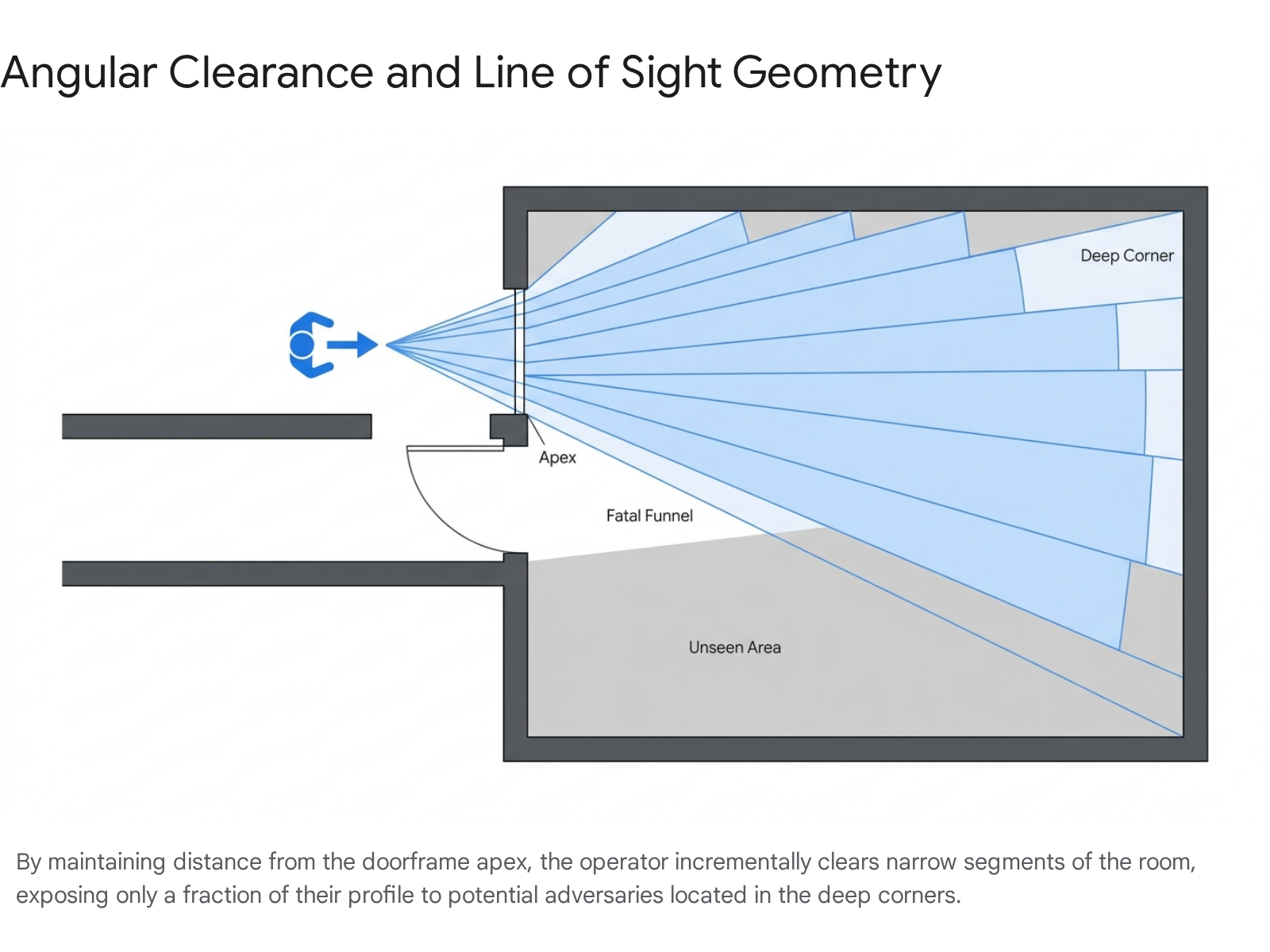
The entry point of any room, typically a standard doorway, is universally recognized as the point of greatest vulnerability during a tactical operation. This confined space is tactically referred to as the fatal funnel. The fatal funnel is a cone-shaped area projecting outward from the doorway into the corridor and extending inward into the adjacent room. An adversary positioned inside the room will naturally focus their visual attention and weapon systems on this aperture, as it represents the only viable point of ingress for the assault team. Any tactical operator moving through the doorway is inevitably silhouetted against the lighting of the exterior space and constrained by the physical dimensions of the frame, severely limiting their lateral mobility and evasive options. Modern room clearing tactics are specifically engineered to minimize the time an operator spends lingering within this critical hazard zone.
3.2. Center-Fed Structures
Rooms are generally classified into two geometric categories based on the placement of the entry door, which fundamentally dictates the visual processing requirements of the entry team. Center-fed rooms feature a doorway located near the middle of a wall. This architectural layout creates two distinct, deep corners on either side of the entry point that must be cleared upon entry or during a threshold evaluation. Center-fed rooms represent a heightened cognitive load for the primary clearing officer, as they must process visual information from two diverging angles simultaneously while managing the central threat area.
3.3. Corner-Fed Structures
Conversely, corner-fed rooms feature a doorway located adjacent to a perpendicular wall. This layout results in only one primary deep corner immediately adjacent to the door frame, accompanied by a longer, continuous wall space extending deep into the room. While corner-fed rooms simplify the initial visual processing by reducing the number of immediate deep corners, they often present a longer linear danger area that requires the operator to project their visual focus much further into the structure upon initial evaluation. The geometry of the room strictly dictates the specific footwork, weapon presentation, and visual panning techniques utilized by the primary clearing officer.
3.4. Lighting, Silhouetting, and Visual Processing
In addition to physical geometry, lighting plays a critical role in the spatial threat matrix. Tactical operators must contend with backlighting, which can silhouette them within the fatal funnel, rendering them highly visible targets even in low-light environments. Furthermore, the human brain requires milliseconds to process visual stimuli, identify a threat, formulate a response, and execute a motor function, a cycle known as the OODA loop (Observe, Orient, Decide, Act). When an operator moves too quickly through a geometric space, they outrun their headlights, meaning their physical body enters a threat zone before their cognitive processing can identify the danger. Deliberate tactics are specifically designed to align the operator’s physical movement speed with their cognitive processing capabilities.
4. Slicing the Pie: The Mechanics of Deliberate Angular Clearance
Slicing the pie is a foundational tactical concept utilized to safely clear corners, doorways, hallways, and barricades. It is a methodical, angular search technique that allows a law enforcement operator to systematically expose narrow segments of a room to their line of sight while maximizing their use of cover and concealment.1
4.1. Geometric Principles of the Apex
The technique relies entirely on the geometric relationship between the operator, the apex of the corner or door frame, and the uncleared space within the room. By maintaining a significant distance from the apex, the operator maximizes their visual field while minimizing the exposure of their physical profile to potential threats hidden in the deep corners.2 The physical distance from the corner acts as a visual multiplier. If an operator approaches the apex too closely, their weapon barrel, leading shoulder, or foot will visibly breach the threshold before their eyes can physically acquire the target.3 This structural phenomenon effectively forfeits the element of surprise and provides the adversary with a crucial fraction of a second to initiate an ambush.
4.2. Biomechanical Control and Footwork
A common misconception regarding deliberate search techniques is the assumption that the movement must universally be slow and lethargic.3 While slicing the pie can indeed be executed with extreme caution during stealth operations, the speed of the technique must actually be dictated by the operator’s ability to accurately process visual information and engage a target effectively.3
The footwork requires exceptional biomechanical control. Operators utilize a smooth, heel-to-toe rolling step or a lateral shuffle that keeps the hips level and the upper body completely stable. The firearm is typically held in a high-ready or compressed-ready position, pushing out to full extension only as the operator’s visual focus clears a new segment of the pie. Bouncing or dipping during the movement severely degrades visual acuity and disrupts the alignment of the firearm’s sighting system.
4.3. Speed of Execution and Cognitive Processing
If the operator moves faster than their cognitive processing speed, they risk over-penetrating the angle and exposing themselves to an adversary they have not yet consciously recognized. Tactical training methodologies encourage operators to practice this angular movement at varying speeds on the flat range, utilizing random auditory or visual cues to test their reaction times and accuracy while in motion.3 By inducing stress through randomized timers, officers learn their personal physical limitations and adjust their pieing speed accordingly, ensuring that they never move faster than their ability to deliver precise, lethal fire if confronted.
4.4. Muzzle Discipline and Spatial Awareness
During the slicing process, muzzle discipline is of paramount importance. The operator must ensure that the muzzle of their weapon never precedes their line of sight past the apex of the door frame. Allowing the weapon to protrude into the fatal funnel signals the operator’s exact position to anyone inside the room and presents an opportunity for the suspect to grab the weapon, initiating a lethal close-quarters struggle. The operator must maintain a spatial awareness bubble, constantly evaluating their proximity to the wall, the depth of their visual penetration into the room, and their spatial relationship to their fellow team members.
5. Points of Domination: Deep Penetration Methodologies
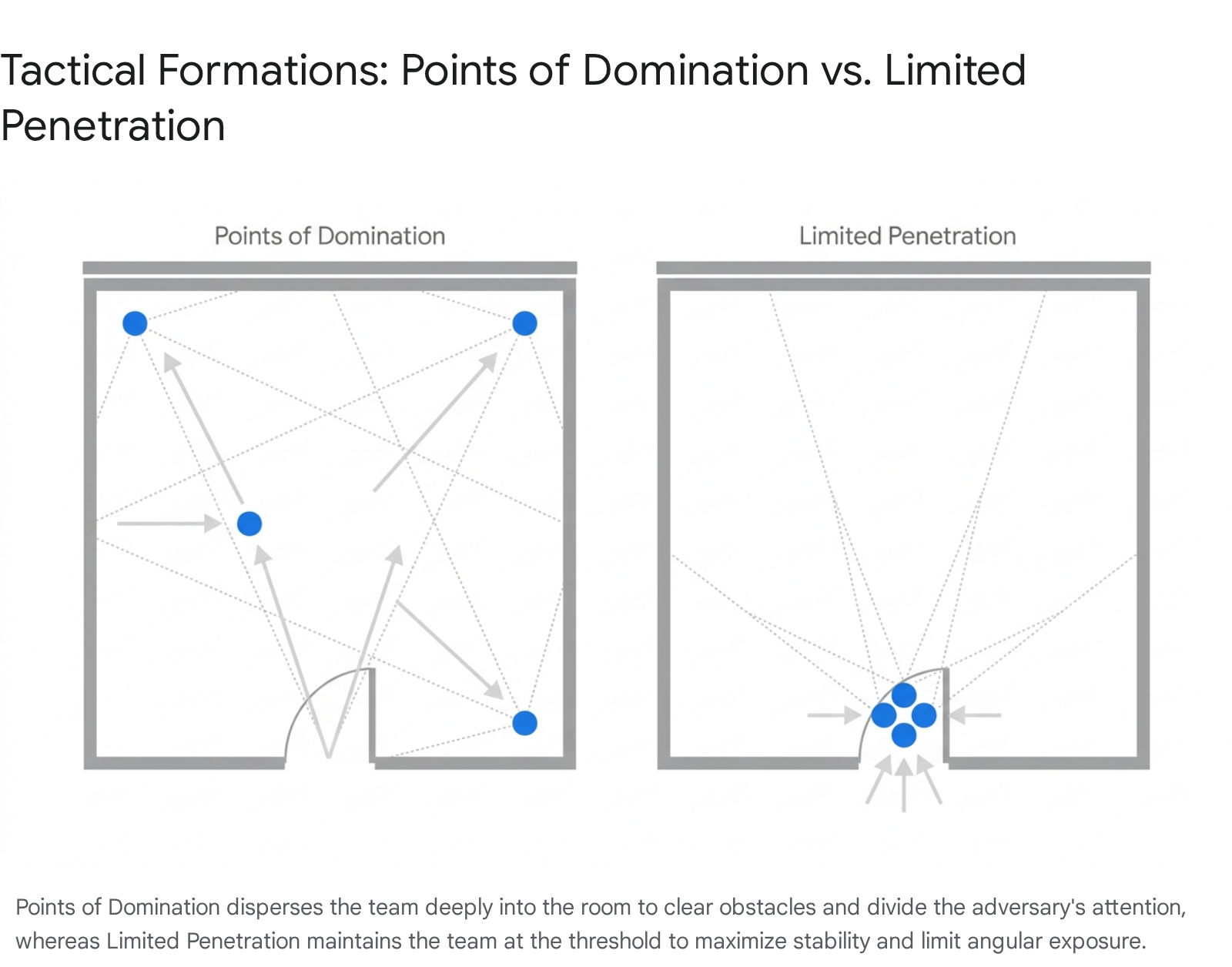
When a tactical element decides to bypass a deliberate search in favor of a dynamic entry, they utilize the traditional points of domination technique. This methodology involves the rapid, synchronized, and highly aggressive movement of a tactical team across the threshold and deep into the interior structural space.4
5.1. Tactical Execution of the Four-Operator Stack
The points of domination technique relies on a predetermined sequence of movements executed by a stack of multiple operators. Upon breaching the door, the number one operator immediately commits to a predetermined direction, typically attacking the deep corner that presents the most immediate or unknown threat. The number two operator crosses the threshold immediately behind the first, peeling off in the exact opposite direction to clear the opposing deep corner.
Following this initial dispersion, the number three and four operators flow straight into the room, filling the center space and establishing interlocking fields of fire that cover the entire operational area.4 This choreographed movement must be executed with extreme fluidity, as any hesitation by the lead operators will cause a bottleneck in the fatal funnel, trapping the entire team in the primary danger zone.
5.2. Sector Allocation and Overlapping Fields of Fire
Once the operators reach their designated points of domination within the corners and center of the room, they establish primary and secondary sectors of fire. The objective is to ensure that every square inch of the room is covered by at least one operator’s weapon system, with critical threat areas covered by overlapping arcs of fire from multiple operators.4 This structural dominance theoretically prevents any adversary from maneuvering within the space without crossing into an operator’s sights.
5.3. The Psychological Impact of Violence of Action
The primary advantage of the points of domination technique is the application of rapid dispersion and violence of action.4 By flooding the room and spreading into the deep corners simultaneously, the tactical team presents multiple, rapidly moving targets. This makes it exceedingly difficult for a single adversary to engage the entire element with a single burst of fire or a localized explosive device.4 The sudden, explosive influx of personnel moving rapidly in opposing directions creates severe visual and auditory confusion. This sensory overload is designed to disrupt the adversary’s cognitive processing loop, forcing them into a state of panic or hesitation that allows the tactical team to establish dominance before the suspect can mount an effective defense. Furthermore, driving deep into the room allows the operators to immediately establish lines of sight behind furniture, beds, and other structural obstacles that might conceal a threat.4
5.4. Inherent Disadvantages and Vulnerabilities
Despite its historical prevalence and undeniable psychological impact, the dynamic points of domination approach carries severe inherent risks that have led to its decreased usage in standard law enforcement operations. Rapid, deep penetration forces operators to expose their flanks and rear to uncleared segments of the room as they move toward their designated corners.4 This high level of exposure is incredibly dangerous if an adversary is heavily fortified, concealed effectively within a closet, or positioned in an elevated tactical vantage point.
5.5. The Risk of Fratricide in Confined Spaces
Additionally, moving rapidly through a confined space drastically increases the risk of fratricide. If a threat materializes suddenly in the center of the room while the team is actively dispersing toward the corners, operators may find their teammates directly in their background or crossfire.4 The geometry of a dynamic entry inherently places operators on opposing sides of a room, creating a scenario where engaging a central target could result in a blue-on-blue casualty. Finally, the dynamic approach inherently requires operators to identify threats, make complex lethal force decisions, and engage targets while moving at a rapid pace. Biomechanically, shooting on the move fundamentally degrades accuracy compared to firing from a static, stabilized platform.4 In a civilian environment where accountability for every fired projectile is paramount, the reduction in accuracy associated with dynamic entry presents a significant liability.
6. Limited Penetration and Threshold Evaluation
To directly mitigate the vulnerabilities associated with deep room penetration, modern tactical law enforcement doctrines heavily emphasize limited penetration techniques. This deliberate methodology involves the tactical team meticulously clearing the room and engaging any identified targets from the exterior of the doorway, or by stepping only marginally past the threshold without committing deep into the interior space.4
6.1. Defining the Threshold Hold
The core philosophy of limited penetration is to utilize the doorway itself as a tactical stronghold. Rather than viewing the door merely as a transitional portal to be rushed through, operators treat the threshold as a fortified firing position. The team conducts a thorough slice of the pie from the exterior, clearing as much of the room as geometrically possible before any operator exposes their full body to the interior space.
6.2. Tactical Advantages of Angle Management
Limited penetration fundamentally alters the geometric angles of an engagement heavily in favor of the law enforcement officer. By remaining near the door frame, team members are not drawn deep into the room where they can be flanked, enveloped, or surprised from severe, acute angles.4 The operators maintain the initiative, dictating exactly when and how much of their body is exposed to potential threats. Furthermore, executing the search from the exterior allows the team to utilize the structure’s outer walls for concealment, and potentially ballistic cover, before crossing the fatal funnel.4 While it is noted that standard residential drywall in the United States does not offer reliable ballistic protection against high-velocity projectiles, it effectively conceals the operators’ movements, forcing the suspect to guess their exact positioning.4
6.3. Mitigation of Fratricide and Increased Firing Stability
Because the team maintains a tighter, more controlled physical formation near the threshold, the risk of fratricide is significantly reduced. Operators are not sprinting into opposing corners and crossing in front of one another’s weapon muzzles within a chaotic, confined space.4 Upon reaching the doorway and identifying a threat, the operators can immediately halt their movement, plant their feet, adopt a solid, stationary shooting stance, and deliver highly accurate, controlled fire, entirely negating the biomechanical requirement to shoot on the move.4 This stationary stability ensures a much higher hit probability, reducing the risk of collateral damage to innocent bystanders.
6.4. Disadvantages of Limited Penetration
While highly effective for risk mitigation and maximizing officer safety, limited penetration is not without significant tactical flaws. Conducting a search entirely from the doorway severely restricts the operators’ angles of observation. A suspect hiding behind a deep obstacle, such as a heavy oak desk, a reinforced bed frame, or a structural pillar, may remain entirely invisible to the operators holding at the threshold. A solitary, concealed adversary can utilize this lack of visibility to blindly project suppressive fire toward the doorway with a high probability of striking the grouped officers, all while remaining protected from return fire.4
6.5. The Massed Target Vulnerability
Furthermore, by clustering tightly near the doorway to execute the threshold evaluation, the tactical team inadvertently creates a massed target. If a suspect is armed with fully automatic weapons, high-capacity shotguns, or improvised explosive devices, a concentrated team bottlenecked at the entry point presents a catastrophic vulnerability.4 A single explosive device detonated near the door frame could theoretically incapacitate the entire assault element simultaneously.
7. The Transition: Dynamic and Deliberate Hybridization
Tactical operations are rarely static, and rigid adherence to a single methodology often leads to operational paralysis or catastrophic failure. The environment is fluid, suspects are unpredictable, and structural layouts are frequently unknown until the moment of entry. Consequently, elite law enforcement training institutions advocate for a free-flow mindset, empowering tactical team leaders to seamlessly transition between deliberate and dynamic techniques based on real-time intelligence and the shifting geometry of the battlefield.4
7.1. The Free-Flow Tactical Mindset
The free-flow mindset dictates that a team is not beholden to limited penetration or points of domination, rather, they utilize the specific components of each tactic that best solve the immediate problem in front of them. If the room is small and uncluttered, a deliberate threshold hold may be sufficient. If the room is massive, complex, and filled with deep blind spots, a dynamic push into the structure may be required to root out a barricaded suspect.
7.2. The Shallow Horseshoe Configuration
To bridge the operational gap between limited penetration and deep dynamic entry, many teams utilize a hybrid configuration known as the shallow horseshoe.4 This deployment strategy allows the team to cross the threshold, alleviating the massed target issue in the hallway, but restricts their penetration to a shallow depth just inside the room.
During execution, the number one and number two operators step laterally immediately upon entry, clearing the immediate hard corners but halting before driving deep into the structure. The number three and four operators step just inside the threshold and establish their sectors of fire over the center of the room. This coordinated formation forms a shallow arc or horseshoe shape just inside the doorway.
7.3. Decision Making, Communication, and Flow
The shallow horseshoe offers unparalleled tactical flexibility. It provides the initial dispersion and visual distraction associated with a dynamic entry, reducing the massed target vulnerability in the doorway. Simultaneously, it keeps the penetration shallow enough to mitigate the extreme risks of fratricide and deep angular exposure.4
From this stabilized, shallow position, the team evaluates the interior space. If the room is clear of immediate threats but contains deep obstacles, the team can deliberately push forward to clear those blind spots. If an adversary is identified and engaged, the team can remain in their stable, shallow positions to deliver accurate fire. This transitional methodology requires exceptional communication, both verbal and non-verbal, to ensure all operators understand whether the team is holding the threshold or flowing deep into the structure.1
7.4. Utilizing Specialized Intelligence Gathering Equipment
During a deliberate or hybrid clearance, operators are afforded the operational time to utilize specialized equipment to gather critical intelligence before committing to a room entry, a luxury strictly prohibited during a rapidly flowing dynamic assault. Mirrors mounted on extendable poles can be manipulated to clear deep corners and identify potential threats without exposing any part of the operator’s body.1 Furthermore, ballistic shields and protective blankets can be deployed at the threshold to provide mobile, rated cover for the point man conducting the pieing process.1 Additionally, holding a deliberate position allows law enforcement officers to issue clear, authoritative verbal commands to occupants, potentially facilitating a peaceful surrender and negating the need for lethal force entirely.1
8. Specialized Training Aids and Inert Weaponry
Mastering the intricate footwork, complex spatial awareness, and high-speed decision-making processes required for modern CQB necessitates a highly structured and rigorously disciplined training methodology. Tactical instructors universally rely on a progressive crawl-walk-run training paradigm. Conducting initial tactical movement drills with live, functional firearms introduces an unacceptable level of risk to the trainees and instructors alike. Therefore, the integration of specialized training aids is an absolute necessity for safe, repetitive drilling and the development of subconscious motor skills.
8.1. The Imperative for Safe Spatial Maneuvering
During the initial phases of room clearing instruction, officers must focus intensely on precise foot placement, strict muzzle discipline, and the geometric alignment required for slicing the pie. They must learn how to maneuver tightly around their teammates in confined spaces without sweeping them with the muzzle of their weapon. To facilitate this complex spatial learning without the looming risk of a negligent discharge, law enforcement agencies utilize inert polymer training weapons, commonly referred to in the industry as rubber ducks.5
8.2. Inert Polymer Replicas
These inert devices are designed to precisely mimic the dimensions, weight, and handling characteristics of actual duty firearms, completely stripped of any firing mechanisms or the ability to chamber a live round. By utilizing these replicas, officers can engage in highly realistic, full-speed physical retention drills, close-quarters grappling, and force-on-force scenario training with zero risk of a lethal accident.
8.3. Material Construction and Durability
The construction materials of these training aids are critical to their operational utility. They must be durable enough to withstand being dropped onto concrete, slammed into door frames, and utilized as impact weapons during defensive tactics training, without shattering or deforming. Manufacturers utilize advanced, high-durometer polyurethane compounds that absorb impact energy while retaining their rigid structural integrity over years of abuse.
8.4. Blueguns Firearm Simulators
Ring’s Manufacturing is the preeminent manufacturer of these inert devices, producing the globally recognized Blueguns product line.6 These training aids are meticulously crafted as exact, one-to-one detailed replicas of actual duty firearms.7 This precision engineering ensures that the training weapons fit perfectly into standard law enforcement friction-retention and active-retention duty holsters, allowing officers to practice authentic draw strokes and re-holstering techniques without modifying their tactical gear.7
Blueguns are manufactured using strong, impact-resistant polyurethane and are reinforced internally with steel armatures to prevent the weapon from bending, flexing, or losing its balance during rigorous physical training.6 Every unit is molded in Law Enforcement Blue, the universally recognized safety color that guarantees, at a glance, that the training environment is completely sterile of live weapons and safe for dynamic maneuvering.6
8.5. Manufacturer and Vendor Data: Blueguns Glock 17
The Glock 17 remains one of the most widely issued duty weapons in law enforcement history, making the Blueguns FSG17 replica an essential training tool for the vast majority of tactical teams.9 The following table details the manufacturer and a curated list of authorized vendors currently stocking the Blueguns Glock 17 FSG17 replica. Vendor selection is strictly limited to those offering the product at a price point falling between the minimum and average observed online prices, providing objective procurement intelligence.
| Manufacturer / Vendor | Product Name & Link | Listed Price |
| Ring’s Manufacturing | (https://www.blueguns.com/) | N/A (Distributor) |
| Makers Leather Supply | (https://makersleathersupply.com/products/17-22-31) 28 | $62.90 |
| Midway USA | (https://www.midwayusa.com/product/1015010884) 29 | $63.99 |
| WCUniforms | (https://wcuniforms.com/products/blue-training-guns-by-rings-glock-17-22-31) 30 | $65.95 |
| OpticsPlanet | (https://www.opticsplanet.com/blue-training-guns-by-rings-blue-training-guns-glock-17-generation-4.html) 31 | $65.99 |
| Security Pro USA | (https://www.securityprousa.com/products/blueguns-fsg17-glock-17-22-31-replica-training-gun) 32 | $54.81 |
8.6. ASP Red Guns
Alternatively, Armament Systems and Procedures (ASP) produces a highly respected and widely utilized line of inert polymer weapons known as ASP Red Guns.10 Like the Blueguns line, these are solid, 100% accurate dimensional replicas designed specifically for safe handling, transport, and tactical weapon retention drills. Molded entirely in a distinctive, high-visibility safety red polymer, they effectively mitigate any risk of mistaken identity with a live weapon on the training ground.11 The ASP catalog is extensive and includes specific, highly detailed variations of the Glock 17 platform, including the Shadow Systems DR920 variant, which is dimensionally identical and fits seamlessly into standard Glock 17 duty holsters.12
8.7. Manufacturer and Vendor Data: ASP Red Gun Glock 17
The following table provides verified vendors currently offering the ASP Red Gun equivalent of the Glock 17 platform (specifically the Shadow Systems DR920 model) in stock, falling within acceptable market pricing parameters.
| Manufacturer / Vendor | Product Name & Link | Listed Price |
| ASP | (https://www.asp-usa.com/collections/red-guns) | N/A (Distributor) |
| OpticsPlanet | (https://www.opticsplanet.com/asp-training-guns.html) 33 | $69.00 |
| Galls | (https://www.galls.com/asp-red-gun-actual-weight-training-gun-glock-9mm) 34 | $72.99 |
| CopQuest | (https://www.copquest.com/asp-red-gun-handgun-training-replicas-shadow-systems_21-2370.htm) 11 | $74.52 |
| Alternate Force | (https://www.alternateforce.net/aspredguanda.html) 10 | $81.00 |
| ASP USA | (https://www.asp-usa.com/collections/red-guns) 35 | $81.00 |
9. Laser-Based Diagnostic Training Systems
While solid polymer replicas are excellent tools for developing spatial footwork, practicing weapon retention, and conducting defensive tactics, they possess a significant limitation: they cannot provide diagnostic feedback regarding trigger control or sight alignment. To bridge this critical gap between dry-fire manipulation and live-fire marksmanship, law enforcement agencies heavily utilize specialized laser training pistols.
9.1. Bridging the Gap Between Dry Fire and Live Fire
Next Level Training manufactures the Shot Indicating Resetting Trigger (SIRT) training pistol, an innovative electro-mechanical system developed specifically by shooters to complement, rather than replace, live fire training.13 The standard SIRT 110 training pistol is meticulously engineered to simulate the dimensions, balance, weight, and functional exterior features of the Glock 17 platform. This includes identical sight radii, accessory rails, and functional magazine release mechanisms, ensuring the training perfectly translates to the duty weapon.14
9.2. Auto-Resetting Trigger Technologies
The defining mechanical feature of the SIRT 110 is its patented auto-resetting trigger system. Standard dry-fire training with a live, unloaded Glock requires the operator to manually reach up and physically rack the slide backward after every single trigger pull to reset the internal striker mechanism. This action is not only tedious but completely negates the operator’s ability to practice rapid, multiple-shot strings, ultimately building artificial muscle memory. The SIRT system solves this by utilizing an internal mechanical sear that automatically resets the trigger blade with a realistic break and reset weight, allowing for continuous, rapid simulated engagements without breaking the firing grip.15
9.3. Dual-Laser Diagnostic Mechanics
Furthermore, the SIRT utilizes a highly advanced dual-laser diagnostic system that provides unparalleled biometric feedback to the operator and the observing instructor. The pistol emits a red take-up laser the precise moment the operator applies initial pressure to the trigger slack.16 This innovative feature allows the instructor to visually monitor the officer’s trigger preparation and track any muzzle wobble or pre-ignition flinch before the shot actually breaks.
9.4. Instructor Diagnostics and Biometric Feedback
Upon full, deliberate trigger depression, a second, vastly more powerful laser activates, indicating the exact point of simulated bullet impact.17 This immediate, indisputable visual feedback allows officers to self-diagnose their grip mechanics, sight tracking, and follow-through during high-stress, rapidly evolving room clearing scenarios. They can visually witness the consequences of jerking the trigger or milking the grip without expending costly live ammunition or risking safety.13
9.5. Manufacturer and Vendor Data: SIRT 110 Training Pistol
The following table details the manufacturer and a curated list of authorized vendors currently stocking the SIRT 110 Training Pistol (Performer/Polymer Slide model), verifying their prices against the market minimum and average.
| Manufacturer / Vendor | Product Name & Link | Listed Price |
| Next Level Training | (https://nextleveltraining.com/product/sirt-110-training-pistol-2/) 14 | $239.00 |
| Primary Arms | (https://www.primaryarms.com/tools/new-arrivals/sale-name?page=13) | $128.79 |
| Tactical Surplus USA | (https://tacticalsurplususa.com/safety-protection/training-equipment/nlt-sirt-110-prf-pstl-rd-rd-lsr/) 36 | $182.98 |
| 5150 Heat | (https://5150heat.com/laser-pistols-%26-targets) 37 | $194.39 |
| Officer Store | (https://officerstore.com/next-level-sirt-performer-training-gun-rr-with-red-polymer-slide-redred-lasers) 38 | $195.00 |
| Midway USA | (https://www.midwayusa.com/product/1028319158) | $249.99 |
10. Kinetic Mechanical Breaching Methodologies
Regardless of whether a tactical team ultimately employs a highly dynamic entry or a methodical, limited penetration threshold evaluation, the tactical operation cannot physically commence until the structural entryway is decisively defeated. Mechanical breaching is the systematic use of specialized kinetic hand tools to physically overcome locks, fortified hinges, and structural barricades.
10.1. The Physics of Forced Entry
Breaching relies entirely on the transfer of kinetic energy or the application of mechanical leverage to exploit the weakest point in a door’s construction, which is typically the door jamb, the locking deadbolt, or the hinges. The tools utilized must be exceptionally heavy to generate sufficient mass, yet ergonomically designed to be swung or manipulated by a single operator under intense physiological stress.
10.2. Inward-Opening Doors and Battering Rams
For inward-opening doors, the primary and most rapid method of forced entry is the delivery of massive kinetic energy via a heavy battering ram. Standard construction sledgehammers lack the required mass, momentum, and striking surface area to reliably defeat modern solid-core doors or reinforced commercial deadbolts in a single strike. Failing to breach a door on the first or second strike is disastrous, as it completely eliminates the element of surprise and alerts the suspects to the impending assault, allowing them time to arm themselves or destroy evidence.
10.3. Ergonomics and Operator Safety
Blackhawk, a premier global tactical equipment manufacturer, produces the highly regarded Dynamic Entry MonoShock Ram.19 This specialized breaching tool is universally recognized within the law enforcement community as the expert breacher’s entry ram of choice.20 Weighing an immense 32 pounds and measuring 31.5 inches in overall length, the MonoShock Ram generates devastating blunt force trauma to the breaching surface when swung with proper body mechanics.21
Crucially, the tool is designed with operator safety as the absolute paramount engineering priority. Repeatedly swinging a 32-pound piece of solid steel against a fortified concrete or metal barrier transfers massive, damaging shockwaves up the operator’s arms, frequently leading to radial fractures or debilitating joint injuries. To counteract this, the MonoShock Ram’s handles utilize a proprietary control-flex system that dramatically absorbs and reduces the impact stress transferred to the operator’s hands and forearms upon striking a hardened target.22
10.4. Non-Sparking and Non-Conductive Materials
Furthermore, the handles are constructed from highly specialized electrically non-conductive and non-sparking composite materials, rendering the entire ram resistant to up to 100,000 volts of alternating current.20 This critical safety feature protects the breaching operator from hidden electrical hazards, exposed wiring, or static discharges in volatile, potentially explosive environments, such as clandestine narcotics manufacturing laboratories.20
10.5. Manufacturer and Vendor Data: Blackhawk MonoShock Ram
The following table details the manufacturer and a curated list of authorized vendors currently stocking the Blackhawk Dynamic Entry MonoShock Ram (Model DE-MS), ensuring the prices reflect the most efficient procurement values on the market.
| Manufacturer / Vendor | Product Name & Link | Listed Price |
| Blackhawk | (https://www.blackhawk.com/products/dynamic-entry-tool) 19 | N/A (Distributor) |
| Bereli | (https://www.bereli.com/blackhawk-de-ms-dynamic-entry-thunderbolt-monoshock-ram-w-control-flex-handle/) | $254.99 |
| CopsPlus | (https://copsplus.com/tactical-duty-gear/training-safety/entry-tools/blackhawk-de-ms-dynamic-entry-monoshock-battering-ram/) | $388.08 |
| Primary Arms | (https://www.primaryarms.com/blackhawk-dynamic-entry-monoshock-ram-law-enforcement-only) | $412.95 |
| Galls | (https://www.galls.com/blackhawk-dynamic-entry-monoshock-ram) 39 | $424.80 |
| LA Police Gear | (https://lapolicegear.com/blthmoento.html) 40 | $478.99 |
11. Prying and Forcible Entry Defeat Systems
When confronting outward-opening doors, heavily fortified security gates, or complex multi-lock systems embedded within steel frames, kinetic battering rams are geometrically ineffective and counterproductive. Striking an outward-opening door merely drives it deeper into its own fortified jamb. In these specific scenarios, tactical breachers must utilize advanced leveraging tools to pry the door horizontally away from the jamb, effectively shearing the internal locking mechanisms and exposing the threshold.
11.1. Defeating Outward-Opening Doors and Fortifications
The Blackhawk Dynamic Entry Hallagan Tool is a highly specialized, tactical evolution of the traditional firefighter’s Halligan bar, optimized specifically for law enforcement special operations.23 Standard fire service tools are often excessively long and heavy, designed for widespread demolition rather than the precise, rapid application of force required in a tactical raid. The Blackhawk variant is streamlined for close-quarters maneuverability.
11.2. Leverage, Seam Defeat, and Horn Applications
The tool features a precisely engineered adze and fork on the primary working end, designed to bite deeply into exceptionally tight door seams to create initial purchase. The opposite end features a prominent horn, explicitly designed to defeat stubborn padlocks, heavy chains, and security hasps when aggressively struck in conjunction with a heavy breaching sledgehammer.24 By driving the fork into the gap between the door and the frame and applying extreme lateral leverage, the operator can catastrophically fail the deadbolt mechanism.
11.3. Safety in Volatile Environments
Mirroring the safety profile of the MonoShock Ram, the Blackhawk Hallagan Tool utilizes an advanced, proprietary composite material construction that is completely non-sparking.24 The non-sparking alloy guarantees that the intense metal-on-metal friction and striking action during the forceful prying process do not inadvertently ignite ambient volatile gases or suspended explosive dust. The ergonomically designed handle provides superior slip resistance for maximum leverage application while remaining electrically non-conductive up to 100,000 volts AC, shielding the operator from electrified barricades.23
11.4. Manufacturer and Vendor Data: Blackhawk Hallagan Tool
The following table details the manufacturer and a curated list of authorized vendors currently stocking the Blackhawk Dynamic Entry Hallagan Tool (Model DE-HT).
| Manufacturer / Vendor | Product Name & Link | Listed Price |
| Blackhawk | (https://www.blackhawk.com/products/dynamic-entry-tool) | N/A (Distributor) |
| CopsPlus | (https://copsplus.com/tactical-duty-gear/training-safety/entry-tools/blackhawk-de-ht-dynamic-entry-non-sparking-hallagan-tool/) 41 | $222.89 |
| Primary Arms | (https://www.primaryarms.com/blackhawk-dynamic-entry-spec-ops-halligan-tool-law-enforcement-only) | $230.45 |
| Nelson Uniform | (https://nelsonuniform.com/shop/category/knives-tools-breaching-tools-928) 42 | $236.62 |
| LA Police Gear | (https://lapolicegear.com/blackhawk-dynamic-entry-active-shooter-hallagan-tool.html) 43 | $238.99 |
| Galls | (https://www.galls.com/blackhawk-dynamic-entry-halligan-tool) 44 | $244.00 |
12. Breaching Training Infrastructure
The physical act of swinging a heavy kinetic ram or accurately manipulating a leverage bar into a millimeter-wide gap under combat stress requires immense mechanical proficiency and deeply ingrained muscle memory. Officers cannot simply read a manual on breaching, they must physically experience the resistance of wood and steel. Training facilities must implement specialized, durable infrastructure to allow operators to practice full-force mechanical breaching without continuously destroying operational buildings or expending massive budgets on replacement doors.
12.1. Reusable Tactical Breaching Doors
Breaching Technologies Inc ((https://breachingtechnologies.com/)) is widely recognized as the originator and premier manufacturer of advanced, reusable breaching training doors designed specifically for the law enforcement market.45 Founded by a former law enforcement tactical operator who recognized the logistical nightmare of constantly rebuilding wooden training props, BTI produces highly engineered inward-opening Ram Doors and outward-opening Pry Doors. These heavy-duty steel structures are explicitly designed to be permanently installed into the framework of existing tactical shoot houses or utilized as freestanding props on a training range.25
12.2. Patented Shear Pin Technologies
The defining innovation of the BTI training system is the utilization of patented, color-coded shear pins to simulate the locking mechanisms.25 Rather than replacing shattered wood frames or destroyed deadbolts after every single training iteration, the BTI doors utilize small, highly calibrated locking pins that physically snap and shear when sufficient kinetic force or leverage is applied to the door.
12.3. Calibrating Resistance for Authentic Structural Simulation
These specialized pins are precisely engineered using advanced metallurgical properties to replicate the exact resistance forces encountered in the field. Instructors can insert different configurations and colors of pins to instantly simulate the resistance of a standard hollow-core interior wood frame door, a heavy solid-core metal frame door, or a highly reinforced, fortified barricade structure requiring up to 2700 pounds per square inch of force to defeat.25 This varied, unpredictable resistance is absolutely vital for training, as it ensures that operators do not develop a pre-programmed, artificial physical response to striking training targets. The system can be reloaded and reset for the next breaching team in a matter of seconds, maximizing training efficiency.
13. Conclusion
The modern landscape of Close Quarters Battle demands a sophisticated, highly adaptable, and thoroughly educated tactical intellect from law enforcement personnel. The historical reliance on deeply penetrative, dynamic points-of-domination entries has been rightfully scrutinized through the lens of officer survival and collateral damage mitigation, and it has been largely augmented by deliberate, threshold-based clearing techniques. By meticulously slicing the pie and maintaining a highly stable, dominant presence at the doorway via limited penetration methodologies, tactical operators can drastically reduce their exposure to fatal funnels and un-cleared angles, shifting the geometric advantage away from the suspect and back to the entry team.
However, operational fluidity remains the ultimate key to tactical survival. Rigid tactical doctrine creates predictable targets. Tactical elements must possess the cognitive flexibility to continuously read the room architecture and transition seamlessly into a shallow horseshoe configuration or initiate a full dynamic entry when dictated by suspect behavior, immediate threats to hostages, or complex structural obstacles. Achieving this elite level of operational proficiency requires an uncompromising commitment to safe, highly diagnostic training environments. By utilizing dimensionally accurate inert polymer replicas for spatial awareness and advanced laser-diagnostic pistol systems to refine marksmanship fundamentals under simulated stress, agencies can forge highly capable operators. When paired with technologically advanced, non-sparking breaching tools and accurately calibrated physical training doors, law enforcement agencies can effectively construct a robust, comprehensive tactical curriculum that prioritizes both officer survival and successful mission resolution.
Note: Vendor Sources listed are not an endorsement of any given vendor. It is our software reporting a product page given the direction to list products that are between the minimum and average sales price when last scanned.
Please share the link on Facebook, Forums, with colleagues, etc. Your support is much appreciated and if you have any feedback, please email us in**@*********ps.com. If you’d like to request a report or order a reprint, please click here for the corresponding page to open in new tab.
Sources Used
- Dynamic entry versus deliberate entry – Police1, accessed April 23, 2026, https://www.police1.com/swat/articles/dynamic-entry-versus-deliberate-entry-s86BB28VVWLfwJXW/
- Green Tips: Slicing the Pie in CQB Settings – YouTube, accessed April 23, 2026, https://www.youtube.com/watch?v=c7PWiLPzlMM
- Slicing the pie with deliberate entry : r/CQB – Reddit, accessed April 23, 2026, https://www.reddit.com/r/CQB/comments/1iyezcz/slicing_the_pie_with_deliberate_entry/
- CQB: Limited Penetration vs. Points of Domination – Iron Survival, accessed April 23, 2026, https://ironsurvival.com/blog/cqb-limited-versus-deep-penetration
- Homepage – Inert Products LLC, accessed April 23, 2026, https://inertproducts.com/
- blueguns: HOME, accessed April 23, 2026, https://www.blueguns.com/
- BlueGuns – MP-SEC, accessed April 23, 2026, https://www.mp-sec.com/product/blueguns/
- Blueguns FSG17 Glock 17/22/31 Training Gun Replica – Security Pro USA, accessed April 23, 2026, https://www.securityprousa.com/products/blueguns-fsg17-glock-17-22-31-replica-training-gun
- Glock 17 – Semi-Auto Pistol | Sportsman’s Warehouse, accessed April 23, 2026, https://www.sportsmans.com/glock-17
- ASP Red Training Guns and Accessories – Alternate Force, accessed April 23, 2026, https://www.alternateforce.net/aspredguanda.html
- ASP Red Gun Firearm Training Replicas – Shadow Systems – CopQuest, accessed April 23, 2026, https://www.copquest.com/asp-red-gun-handgun-training-replicas-shadow-systems_21-2370.htm
- ASP Enhanced Training Red Gun – Shadow DR920 w/ 2 Mags – Primary Arms, accessed April 23, 2026, https://www.primaryarms.com/asp-enhanced-training-red-gun-shadow-dr920-w-2-mags
- Next Level Training: Home Page, accessed April 23, 2026, https://nextleveltraining.com/
- SIRT 110 – Next Level Training, accessed April 23, 2026, https://nextleveltraining.com/product/sirt-110-training-pistol-2/
- Revisiting the SIRT 110 training pistol – YouTube, accessed April 23, 2026, https://www.youtube.com/watch?v=o2ct2zpChOM
- What Is The Best Laser Dry Fire Training System? – AmmoMan School of Guns Blog, accessed April 23, 2026, https://www.ammoman.com/blog/what-is-the-best-laser-dry-fire-training-system/
- What SIRT do I get? – Next Level Training, accessed April 23, 2026, https://nextleveltraining.com/sirt_overview/
- SIRT Training Pistol Initial Thoughts – Colion Noir, accessed April 23, 2026, https://www.mrcolionnoir.com/sirt-training-pistol-initial-thoughts/
- Dynamic Entry Tool | Blackhawk, accessed April 23, 2026, https://www.blackhawk.com/products/dynamic-entry-tool
- Blackhawk Dynamic Entry DE-MS Monoshock Ram – Anchortex Corporation, accessed April 23, 2026, https://www.anchortex.com/products/blackhawk-dynamic-entry-de-ms-monoshock-ram
- Blackhawk Dynamic Entry MonoShock Ram – LAW ENFORCEMENT ONLY, accessed April 23, 2026, https://www.primaryarms.com/blackhawk-dynamic-entry-monoshock-ram-law-enforcement-only
- Blackhawk Monoshok RAM | 22% Off w/ Free S&H – OpticsPlanet, accessed April 23, 2026, https://www.opticsplanet.com/blackhawk-monoshok-ram.html
- Blackhawk Dynamic Entry Spec Ops Halligan Tool – LAW ENFORCEMENT ONLY, accessed April 23, 2026, https://www.primaryarms.com/blackhawk-dynamic-entry-spec-ops-halligan-tool-law-enforcement-only
- Blackhawk Dynamic Entry DE-HT Hallagan Tool – Anchortex Corporation, accessed April 23, 2026, https://www.anchortex.com/products/blackhawk-dynamic-entry-de-ht-hallagan-tool
- Markets – BTI – Breaching Technologies Inc., accessed April 23, 2026, https://breachingtechnologies.com/markets/
- Resellers – BTI – Breaching Technologies Inc., accessed April 23, 2026, https://breachingtechnologies.com/resellers/
- BTI Breaching Pins, accessed April 23, 2026, https://kiwibreaching.com/products/metal-frame-breaching-pins
- Blue Guns – Glock 17/22/31 (FSG17) – Maker’s Leather Supply, accessed April 23, 2026, https://makersleathersupply.com/products/17-22-31
- BlueGuns Firearm Simulator Glock 17, 22, 31 Polyurethane Blue – MidwayUSA, accessed April 23, 2026, https://www.midwayusa.com/product/1015010884
- Ring’s Manufacturing Glock 17/22/31 Blue Training Gun FSG17 – WCUniforms, accessed April 23, 2026, https://wcuniforms.com/products/blue-training-guns-by-rings-glock-17-22-31
- Blueguns Training Gun for Glock 17 Generation 4 | Up to 26% Off w – OpticsPlanet, accessed April 23, 2026, https://www.opticsplanet.com/blue-training-guns-by-rings-blue-training-guns-glock-17-generation-4.html
- Training Guns & Replica Weapons | Security Pro USA – tagged “Guns” – Page 23, accessed April 23, 2026, https://www.securityprousa.com/collections/training-guns/guns?page=23
- 34 ASP Training Guns Products for Sale Up to 76% Off – OpticsPlanet, accessed April 23, 2026, https://www.opticsplanet.com/asp-training-guns.html
- ASP Red Gun Actual Weight Training Gun Glock 9mm – Galls, accessed April 23, 2026, https://www.galls.com/asp-red-gun-actual-weight-training-gun-glock-9mm
- Red Training Guns | Red Guns at ASP, Inc., accessed April 23, 2026, https://www.asp-usa.com/collections/red-guns
- Nlt Sirt 110 Prf Pstl Rd/rd Lsr – Tactical Surplus USA, accessed April 23, 2026, https://tacticalsurplususa.com/safety-protection/training-equipment/nlt-sirt-110-prf-pstl-rd-rd-lsr/
- Laser Pistols & Targets – 5150 heat, accessed April 23, 2026, https://5150heat.com/laser-pistols-%26-targets
- Next Level SIRT Performer Training Gun RR with Red Polymer Slide, Red/Red Lasers, accessed April 23, 2026, https://officerstore.com/next-level-sirt-performer-training-gun-rr-with-red-polymer-slide-redred-lasers
- BLACKHAWK! Dynamic Entry MonoShock Ram – Galls, accessed April 23, 2026, https://www.galls.com/blackhawk-dynamic-entry-monoshock-ram
- Blackhawk Dynamic Entry Monoshock Ram – LA Police Gear, accessed April 23, 2026, https://lapolicegear.com/blthmoento.html
- Blackhawk DE-HT Dynamic Entry Non-Sparking Hallagan Tool – CopsPlus, accessed April 23, 2026, https://copsplus.com/tactical-duty-gear/training-safety/entry-tools/blackhawk-de-ht-dynamic-entry-non-sparking-hallagan-tool/
- Breaching Tools – Shop | Nelson Uniform, accessed April 23, 2026, https://nelsonuniform.com/shop/category/knives-tools-breaching-tools-928
- Blackhawk Dynamic Entry Active Shooter Hallagan Tool – LA Police Gear, accessed April 23, 2026, https://lapolicegear.com/blackhawk-dynamic-entry-active-shooter-hallagan-tool.html
- BLACKHAWK! Dynamic Entry Halligan Tool – Galls, accessed April 23, 2026, https://www.galls.com/blackhawk-dynamic-entry-halligan-tool
- Breaching Technologies Inc.: BTI, accessed April 23, 2026, https://breachingtechnologies.com/