Executive Summary
The modern landscape of critical law enforcement incidents—ranging from coordinated terrorist attacks and active shooters to fortified barricaded subjects, hostage crises, and high-risk warrant executions—demands a specialized, highly structured, and continuously evolving tactical response capability. Standard law enforcement academy training, which averages roughly 833 hours of baseline instruction 1, is fundamentally insufficient for the extreme physiological, psychological, and environmental stressors encountered during critical tactical incidents. Consequently, the development of a Special Weapons and Tactics (SWAT) operator requires a rigorous, phased educational curriculum that systematically bridges the gap between basic patrol competency and advanced tactical mastery. The failure to properly train, equip, and deploy these specialized personnel not only severely compromises public safety but also invites catastrophic legal liability and a profound loss of community trust.2
This report provides an exhaustive, nationally applicable analysis of the critical training classes required for United States law enforcement tactical officers. By synthesizing national standards established by the National Tactical Officers Association (NTOA), the Federal Law Enforcement Training Centers (FLETC), and the Federal Bureau of Investigation (FBI), this document identifies the core educational requirements necessary to build and sustain a highly reliable tactical unit. Crucially, the analysis differentiates between the developmental needs of novice tactical officers and experienced operators, recognizing that pedagogical approaches must evolve in tandem with an operator’s cognitive and operational maturation.
Novice tactical officers require training designed to build fundamental motor schemas and foundational tactical geometry. Their curriculum must focus intensely on basic team movement, firearms proficiency under stress, and survival mechanics to lower their baseline cognitive load during high-stress encounters.3 Novices, who naturally default to attempting physical control during crises, must be trained through stress inoculation to broaden their situational awareness.4 Conversely, experienced tactical officers, having automated these basic functions, must pivot toward highly specialized, low-frequency but high-risk disciplines. These include hostage rescue, explosive breaching, precision rifle operations, and technical electronic surveillance.5 Furthermore, experienced personnel must eventually transition into leadership roles, necessitating advanced coursework in strategic decision-making frameworks, risk mitigation, and liability management.9
Ultimately, tactical proficiency is highly perishable. Without sustained, dynamic training encompassing both rigorous physical conditioning and cognitive stress-testing, an operator’s ability to safely resolve critical incidents decays rapidly.2 A nationally standardized, experience-stratified training matrix is the only defensible method for maintaining operational readiness, ensuring constitutional policing, and safeguarding human life in the most dangerous law enforcement environments.
Tactical Instruction Summary Matrix
| Level of Experience | Category of Instruction | Core Instruction Required |
| Novice | Foundational Tactics | Basic SWAT School (40-Hour Minimum) |
| Novice | Weaponry & Movement | Close Quarters Battle (CQB) and Structural Clearing |
| Novice | Medical Support | Tactical Medical for First Responders (TECC/TCCC) |
| Novice | Cognitive Development | Scenario-Based Stress and Mitigation Training (e.g., ShadowBox) |
| Novice | Foundational Fitness | Base Stamina and Progression Pyramid Integration |
| Experienced | Advanced Operations | Hostage Rescue and Advanced CQB |
| Experienced | Access & Intervention | Explosive and Advanced Mechanical Breaching |
| Experienced | Precision Accuracy | Advanced Sniper / Precision Rifle Operations |
| Experienced | Technical Operations | Technical Surveillance (ELSUR) and UAS Operations |
| Experienced | Leadership & Command | SWAT Team Leader Development & Command Seminars |
| Experienced | Strategic Analysis | P.I.E.T.O. / PIET3O Tactical Decision-Making Models |
1. The Philosophy and Imperative of Stratified Tactical Training
The deployment of a law enforcement tactical team represents the highest escalation of domestic police power short of federal military intervention. Because these units are tasked with resolving incidents that exceed the capabilities of traditional first responders, the individuals comprising these teams must possess a level of physical capability, technical proficiency, and psychological resilience far beyond the baseline law enforcement standard. The decision to form, equip, and deploy a SWAT team carries with it an immense constitutional and ethical responsibility to provide ongoing, specialized training.11
1.1. The Evolution of Tactical Standards and Capability Tiers
Special Weapons and Tactics teams first appeared in American policing in the late 1960s. High-profile incidents, such as the murderous sniper attack from the University of Texas tower by Charles Whitman, demonstrated that a single violent episode could easily outstrip the capacity of standard law enforcement tactics, weapons, and officers.12 In the subsequent decades, tactical teams have grown exponentially in number, sophistication, and deployment frequency. Today, the vast majority of police agencies serving populations over 50,000 possess some form of tactical team, resulting in tens of thousands of SWAT deployments nationwide annually.12
Despite this proliferation, prior research has demonstrated that SWAT approaches, staffing levels, compositions, policies, and training fluctuate noticeably across the more than 17,000 state, local, and tribal law enforcement agencies in the United States.13 To mitigate this dangerous inconsistency, the National Tactical Officers Association (NTOA) developed the Tactical Response and Operations Standard (TROS). This living document establishes a core set of concepts, principles, and policies designed to standardize and enhance the delivery of tactical law enforcement services.14
The NTOA categorizes tactical teams into distinct Tiers (Tier 1 through Tier 4) based on their mission capability profile.16 To be classified as a true SWAT Team under these standards (Tier 1 or Tier 2), an agency must meet all minimum capabilities associated with that tier.17 To maintain this operational readiness, the NTOA strictly mandates continuing education. It is recommended that full-time teams conduct a minimum of 40 hours of training per month (480 hours annually), while collateral-duty (part-time) teams must conduct a minimum of 16 hours per month (192 hours annually).11 This training must be regular, reoccurring, and specifically based on the critical skills associated with the team’s defined mission capabilities.14
1.2. The Cognitive Divide: Novice Versus Expert Processing
A critical vulnerability in law enforcement tactical training is the failure to properly differentiate between the pedagogical needs of a newly assigned, novice operator and a seasoned, experienced veteran. Merely placing a novice officer in an advanced training class alongside tenured operators often results in negative training outcomes, a phenomenon known in instructional design as the expertise reversal effect.18 Instructional methods that work well for experts who have already acquired a certain level of mastery can actually inhibit learning for novices who lack the foundational mental architecture to process the information.18
Research into human performance under extreme stress indicates that novices and experts process high-threat environments fundamentally differently. When circumstances present a threatening situation that is entirely new, an average individual lacks sufficient pre-programmed responses to react effectively.19 As shown by human factors research, police experts possess the ability to sum up several discrete observations into larger entities—a process called “chunking”—that encompasses both situational awareness and tactical elements.20 Novices, lacking these established mental models for complex tactical scenarios, often suffer from rapid cognitive overload.21
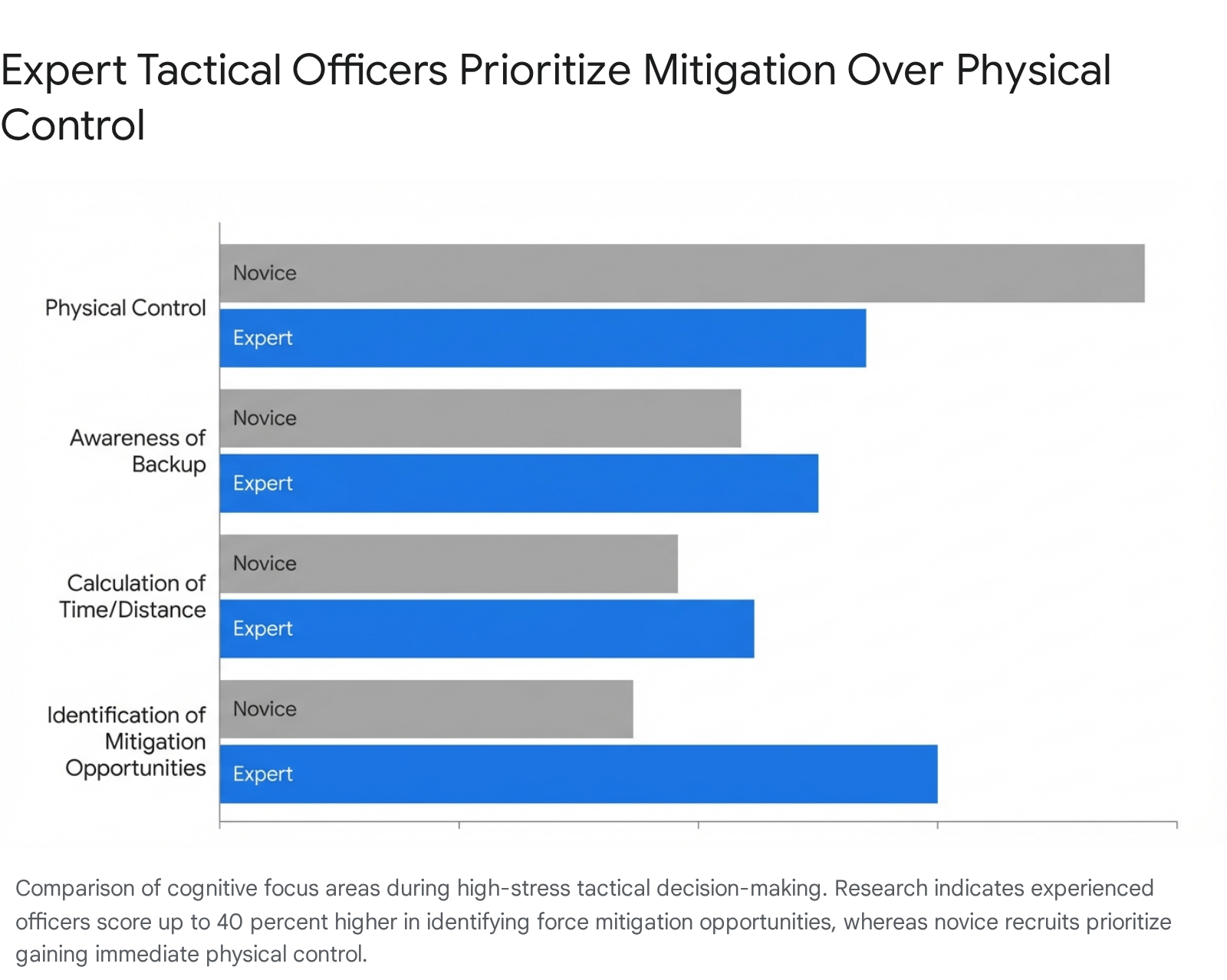
A landmark sociological study conducted by researchers at the University of California-Berkeley specifically examined expert versus novice use-of-force decision-making. The research revealed that novice police recruits, when placed in dynamic, high-stress scenarios, overwhelmingly focused on establishing immediate “physical control” of a subject, often at the expense of other critical, non-force considerations.4 Their lack of experience created a cognitive tunnel, where the immediate physical neutralization of the perceived threat consumed all available mental resources.
Conversely, experienced officers were significantly more likely to emphasize force mitigation. On average, experts scored between 13 percent and 40 percent higher than their novice counterparts in noting the importance of mitigation opportunities.4 Because experts have automated basic motor functions and threat recognition patterns, they retain the cognitive bandwidth to analyze external variables. They demonstrated a far greater awareness of opportunities for backup and showed a heightened consciousness of time and distance as relevant factors in resolving confrontations.4
Therefore, a tactical training curriculum must be inherently stratified. It must first build the foundational motor schemas and basic tactical geometry for the novice, automating survival skills so the officer can begin to see the wider battlefield. Subsequently, the curriculum must challenge the experienced operator with complex, multi-variable problem-solving, advanced specialized technical skills, and command-level strategic decision-making.
2. Foundational Training: The Novice Tactical Officer
The transition from a standard patrol officer to a tactical operator requires a complete paradigm shift in operational philosophy. Standard patrol training, which averages roughly 833 hours nationwide, often balances stress (paramilitary) and non-stress (academic) environments, but ultimately focuses heavily on individual or two-officer problem-solving, report writing, and basic defensive tactics.1 Tactical operations, conversely, require the individual to subordinate their independent action to the highly coordinated, synchronized movement of an assault element or team. The novice tactical officer must undergo intensive foundational training to safely integrate into this highly structured environment.
2.1. Basic SWAT Certification and Core Tactical Competencies
The absolute baseline requirement for any law enforcement officer joining a tactical unit is the successful completion of a standardized Basic SWAT course. The NTOA and other national accrediting bodies establish a minimum 40-hour introductory course as the industry best-practice standard for new tactical team members.11 It is critical to note that the successful completion of this introductory course is not meant to be all-encompassing and does not suggest that the operator is fully competent or ready for autonomous deployment.11 Rather, it establishes a safe baseline of knowledge so the novice can participate in continuous team-level training without posing a catastrophic danger to themselves or their colleagues. Basic SWAT courses must invariably be followed by a formal, competencies-based field training program supervised by a senior SWAT trainer.11
Basic tactical training at premier institutions like the Federal Law Enforcement Training Centers (FLETC)—which offers the Basic Tactics Instructor Training Program (BTITP)—focuses on critical, life-saving fundamentals.3 The syllabus invariably begins with advanced weapons handling.3 Novices must learn to transition from traditional, static line marksmanship to dynamic combat marksmanship. This requires engaging targets while moving continuously, utilizing structural cover effectively, and operating firearms in extreme close proximity to other team members without violating safety principles.
The concept of 360-degree security is immediately introduced.3 This demands that the novice break the ingrained patrol habit of hyper-focusing solely on a single forward threat. Instead, they must learn to maintain overlapping, interlocking sectors of fire within a tactical formation, ensuring that the team is protected from all possible angles of attack.
Furthermore, novices must master the strict physical geometry of Close Quarters Battle (CQB). This includes the mathematical and physical principles of cornering, door entries, hallway navigation, and single-to-multiple room clearing methodologies.3 The instruction emphasizes techniques such as “slicing the pie” (angular search techniques), which are designed to maximize the officer’s visual control of an uncleared space while simultaneously minimizing their physical exposure to potential hostile fire. Through hundreds of repetitions in simulated environments, these geometric movements must transition from conscious, deliberate calculations to subconscious, automated motor reflexes. Until these basic movements are fully automated, the novice operator will simply not have the cognitive capacity to process suspect behavior, understand complex rules of engagement, or participate safely in an actual deployment.
2.2. Cognitive Framing, Stress Inoculation, and Decision-Making
Because tactical training is not purely physical, the psychological conditioning of the novice is of paramount importance. Modern research into law enforcement human performance demonstrates that under extreme, life-threatening stress, profound physiological and psychological changes occur. Within the average perception-reaction time of an officer deciding to shoot or stop shooting, the human body experiences a massive adrenaline dump.22 Officers will have to account for perceptual distortions such as diminished or intensified sound (auditory exclusion), tunnel vision, time misperception, temporary paralysis, memory loss, and dissociation.23
When a novice encounters a novel, threatening situation, they lack the pre-programmed mental responses required to react efficiently.19 As the aforementioned Berkeley study demonstrated, this leads to a dangerous over-reliance on immediate physical control at the expense of verbal de-escalation, the use of cover, or the coordination of backup.4 In fact, when analyzing the narratives of recruits during simulated scenarios, the critical word “cover” was mentioned far less frequently by experienced officers (76 times) compared to recruits (115 times), indicating that novices were highly preoccupied with basic survival concepts that experts had already internalized and moved past.4
Therefore, essential training for novices must include scenario-based cognitive stress-inoculation. Innovative programs, such as ShadowBox training (certified by the California Commission on Peace Officer Standards and Training), expose novices to situations specifically characterized by ambiguity, uncertainty, unpredictability, changeability, time-pressure, and competing goals.24 These classes use interactive, real-life incidents guided by experienced officers to artificially expand the novice’s situational awareness.
Novices are trained to look beyond the immediate weapon or the suspect’s hands. They are explicitly taught to seek out what experts naturally perceive: opportunities for force mitigation, the strategic positioning of secondary units, and the utilization of time and distance to de-escalate potential violence.4 By explicitly teaching these expert-level cognitive markers in a controlled, low-consequence training environment, instructors can significantly accelerate the novice’s progression from a purely reactive, fear-driven force instrument to a thoughtful, analytical, and highly controlled tactical operator.
2.3. Tactical Medical First Response
The operational reality of SWAT deployments dictates a high probability of encountering severe, life-threatening trauma, either sustained by hostages, innocent bystanders, suspects, or the officers themselves. In active shooter or barricaded suspect scenarios, traditional Emergency Medical Services (EMS) personnel and paramedics are mandated to stage in “cold zones,” far away from the immediate threat. This means that tactical officers must be the primary, and often only, medical providers during the critical first minutes of a mass casualty event or a close-quarters firefight.
Consequently, every novice tactical officer must undergo comprehensive Tactical Medical for First Responders (TMFR), Tactical Emergency Casualty Care (TECC), or Basic Tactical Medical Instructor Training Program (BTMITP) coursework.25 This curriculum departs radically from civilian first aid or standard CPR training. It operates under the fundamental premise that the best initial medicine in a firefight is overwhelming fire superiority.
Officers are taught to differentiate clearly between “Care Under Fire” and “Tactical Field Care.” During Care Under Fire, when the team is actively taking contact, the only acceptable medical intervention is the rapid application of a high-and-tight arterial tourniquet to stop massive extremity hemorrhage; no airway management or other care is attempted until the threat is neutralized or suppressed. Once the threat is isolated and the environment transitions to Tactical Field Care, operators are trained in massive hemorrhage control, advanced airway management, wound packing with hemostatic agents, and tension pneumothorax decompression. The integration of this medical intervention directly into kinetic room clearing drills ensures that the novice understands how to transition seamlessly between the conflicting roles of warfighter and lifesaver without ever compromising the 360-degree security of the operational element.17
3. Advanced Skill Acquisition: The Experienced Tactical Officer
Once an operator has spent years on a team, fully automating the fundamental physical skills of moving, shooting, and communicating within an assault element, they formally transition from a novice to an experienced operator. At this stage, standard room clearing, perimeter containment, and basic high-risk warrant service become routine functions requiring minimal cognitive strain. Therefore, the training burden for experienced officers shifts dramatically toward highly specialized, technically demanding disciplines. These advanced roles require deep analytical capabilities, cross-disciplinary integration, independent action, and the management of extreme physical and legal risk.
3.1. Hostage Rescue and Advanced Close-Quarters Battle (CQB)
The absolute pinnacle of tactical law enforcement operations is Hostage Rescue (HR). While standard high-risk warrant service relies heavily on the elements of surprise, speed, and overwhelming violence of action to disorient and secure a suspect, a hostage rescue introduces innocent life directly into the immediate threat matrix. An HR scenario cannot simply be treated as a faster standard entry; the tactics are fundamentally different, and the margin for error is effectively zero.27
Experienced officers must undertake intensive HR coursework to understand the extreme nuances and unique pressures of this mission profile.6 Training at this level emphasizes the core considerations of Safety, Information, and Time (SIT).6 Operators learn the critical distinction between a barricade and a hostage situation. While a barricaded suspect holding only themselves at bay can be waited out indefinitely using chemical agents and negotiation, a hostage situation may necessitate an immediate, highly dynamic, and potentially perilous entry if intelligence indicates the suspect has begun, or is about to begin, executing captives.27
Advanced HR training, modeled heavily after the FBI’s Hostage Rescue Team (HRT) parameters, focuses intensely on “stealth to contact”.6 Unlike a standard warrant service where police may announce their presence at the exterior door with a ram, HR operators are trained in silent movement, specialized camouflage, and the use of covert entry techniques to infiltrate a stronghold entirely undetected.6 The objective is to position the assault element as physically close to the hostage-taker as possible before the decisive breach occurs, minimizing the time the suspect has to react.
Furthermore, live-fire CQB exercises in specialized, rubber-coated “shooting houses” are utilized to train experienced operators in surgical target discrimination.29 Operators must practice engaging hostile targets with precision fire while innocent role-players or hostage targets are in immediate physical proximity to the threat. This develops the ultimate synthesis of trigger control, rapid target identification, and unwavering psychological composure under extreme time compression and chaotic stimuli.29 Operators at this level are also trained in transitional tactics, vehicle takedowns, and operating under Night Vision Goggles (NVGs) in completely blacked-out environments.11
3.2. Explosive and Advanced Mechanical Breaching
To execute a successful entry, tactical teams must overcome heavily fortified physical barriers. While novices are taught basic mechanical breaching (utilizing battering rams, pry bars, and halligan tools), experienced officers—who are specifically selected and designated as breachers—must master the complex science of explosive breaching.5
Explosive breaching is not merely the reckless destruction of a door or wall; it is a highly calculated, legally scrutinized tactical option designed to safely defeat barricades while achieving instantaneous “shock action”.5 This shock action profoundly disorients the occupants through overpressure and acoustic disruption, thereby protecting the lives of the entering assaulters and any hostages within by delaying the suspect’s ability to return fire.5
The curriculum for explosive breaching is exhaustive, technically rigorous, and heavily mathematical. Operators must learn to calculate Net Explosive Weight (NEW), understand the exact physical properties and burn rates of varying explosive materials (such as detonation cord, C4, sheet explosives, and water impulse charges), and compute precise safe stand-off calculations.5 These calculations are vital to prevent catastrophic structural collapse, secondary fire hazards, or severe traumatic injury to the officers stacking immediately behind the charge.5
Explosive breaching protocols demand strict intelligence gathering, continuous scouting, and detailed target analysis.31 The explosive breacher must calculate and construct the charge on-site to use the absolute minimal amount of explosive necessary to defeat the specific locking mechanism or hinges, while minimizing deadly fragmentation and collateral damage both inside and outside the target location.33 This specialized class essentially transforms an experienced tactical operator into a combat engineer and tactical physicist, capable of utilizing highly regulated industrial explosive tools to safely dictate the physical environment of the operation.
3.3. Precision Rifle and Sniper Operations
The role of the SWAT sniper, or precision rifleman, requires an extraordinary synthesis of elite marksmanship, advanced intelligence gathering, and extreme psychological patience. This is explicitly not a role for a novice; it is strictly reserved for highly experienced personnel who possess the maturity, discipline, and independence to operate entirely detached from the main assault element, often observing a target through a scope for hours or even days without relief or movement.
The training standards for law enforcement snipers are rigorously quantified to mitigate severe civil liability and ensure absolute public safety.7 National and state standards, such as those overseen by the Commission on Law Enforcement Standards and Training (CLEST), mandate that precision riflemen maintain sub-Minute of Angle (MOA) accuracy. One MOA equates to a rifle’s ability to repeatedly strike an intended target with a one-inch grouping at a distance of 100 yards from a rested position.7 In a critical hostage scenario, if a sniper is legally authorized by command to take a shot, they are generally targeting the suspect’s medulla oblongata (the brain stem) to instantly sever the central nervous system. This specific anatomical targeting prevents any involuntary reflex action or muscular flinch that could cause the suspect to fire their weapon into the hostage. Missing a target of this minuscule size by even a fraction of an inch results in a catastrophic mission failure and the loss of innocent life.
Advanced sniper courses focus heavily on positional shooting, timed engagements, and the mastery of complex environmental variables (wind drift, barometric pressure, bullet drop compensation). Operators must shoot highly complex qualification courses of fire, often requiring multiple rapid engagements at varying distances (e.g., 25, 50, 75, and 100 yards) under strict, stress-inducing time limits. For instance, an operator may be required to fire 10 precision rounds from alternating prone, kneeling, and improvised positions in under 4 minutes, with target scoring areas not exceeding 7.5 square inches.7
Beyond kinetic engagement, sniper training heavily emphasizes intelligence gathering, technical reporting, and overwatch capabilities. The sniper serves as the primary eyes and ears of the Tactical Commander, providing continuous, real-time telemetry on target movements, structural layouts, fortification efforts, and the disposition of hostages.
3.4. Technical Surveillance (ELSUR) and Unmanned Aircraft Systems (UAS)
Modern tactical operations are increasingly intelligence-led, aggressively moving away from the paradigm of immediate, blind kinetic entry toward methodical, technology-driven problem resolution. Experienced operators must be deeply trained in the deployment of advanced electronic surveillance (ELSUR) and cutting-edge robotics.
Classes in covert electronic surveillance—such as the Covert Electronic Surveillance Program (CESP) or Technical Investigations 1 (TECH-1) offered at FLETC—teach operators how to gather critical, actionable intelligence long before a physical operation begins.8 The curriculum covers the physical construction of covert audio and video concealments, advanced electronic tracking principles (including Hostile Force Tagging, Tracking, and Locating), and the complex circumvention of commercial alarm systems.8 Furthermore, operators are trained in covert entry techniques, utilizing commercial and improvised tools to defeat various warded, wafer, and pin tumbler locks without leaving signs of forced entry.37 By secretly inserting listening devices, wiretaps, or fiber-optic cameras into a stronghold, the tactical team can map the interior architecture, identify the exact location and armament of threats, and confirm the presence of hostages or improvised explosive devices (IEDs) without ever exposing an officer to hostile gunfire.38
Furthermore, the rapid, paradigm-shifting integration of Unmanned Aircraft Systems (UAS), or tactical drones, has revolutionized SWAT operations.40 Tactical UAS training teaches operators how to expertly fly highly maneuverable drones directly into hostile structures to conduct interior reconnaissance, clear complex stairwells, and search attics or crawlspaces prior to any human entry.42 Drone pilots must learn complex, multi-axis navigation in GPS-denied indoor environments, the utilization of thermal and infrared imaging to detect body heat through walls, and the deployment of two-way communication payloads (such as dropping throw phones) via robotics to establish safe contact with barricaded subjects.43 Mastery of these emerging technologies allows the experienced operator to significantly reduce the physical risk to the human entry element, allowing machines to absorb the initial risk of encountering an armed suspect.
4. Tactical Command, Leadership, and Strategic Analysis
The most critical, and often most difficult, transition in a tactical officer’s career is the elevation from an individual “door-kicking” operator to a SWAT Team Leader, Tactical Commander, or Incident Commander. At this senior executive level, the physical skills of shooting, moving, and breaching become entirely secondary to the cognitive skills of strategic planning, large-scale risk management, political navigation, and extreme legal liability mitigation.44
4.1. SWAT Team Leader and Command Operations
Training for tactical leadership requires a complete immersion into the complex mechanics of command and control. Courses such as the NTOA’s SWAT Team Leader Development, the FBI’s Command Leadership Institute, and the Law Enforcement Executive Development Seminar (LEEDS) are designed specifically for senior officers and executives transitioning into oversight roles.9
The curriculum in these advanced academies focuses heavily on pre-incident planning, mission organizing, and the drafting of comprehensive operations orders (OPORDs).9 Team leaders are exhaustively instructed on the legal liability concepts inherent to tactical operations. This requires a profound, working understanding of constitutional law, specifically the Fourth Amendment (concerning search, seizure, and the execution of warrants) and the objective reasonableness standards of the Fourteenth Amendment regarding the ultimate use of lethal and less-lethal force.9
Furthermore, command training immerses leaders in the OODA Loop (Observe, Orient, Decide, Act) methodology.9 Tactical commanders must learn how to manipulate the operational tempo of a crisis incident, utilizing specific tactics to overwhelm a suspect’s cognitive ability to process information and react, thereby achieving a non-violent resolution or a decisive tactical advantage. They are also heavily trained in the administrative side of tactical operations, including the selection, recruitment, physical testing, and psychological evaluation of new SWAT personnel, ensuring that the unit’s culture remains professional, ethical, and highly capable over generations.9
4.2. Advanced Decision-Making Models (P.I.E.T.O. / PIET3O)
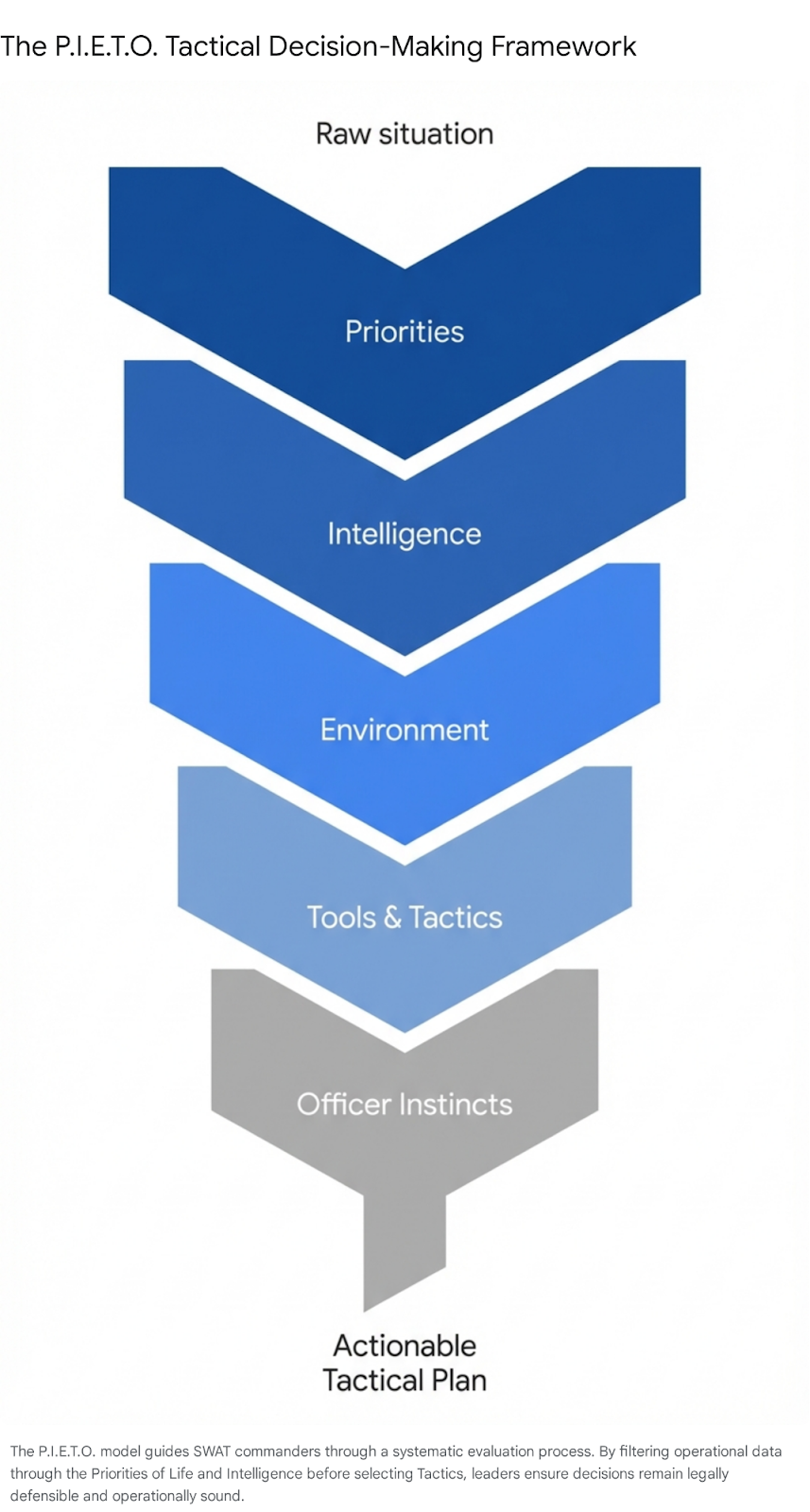
To ensure that tactical decisions made in the heat of a crisis are legally justifiable, ethically sound, and operationally effective, command-level training introduces formalized, highly structured critical thinking frameworks. The premier framework taught to contemporary tactical leaders is the P.I.E.T.O. (or PIET3O) model.50 This powerful mnemonic serves as a strict mental checklist and filtering mechanism for the decision-making process during high-risk, chaotic operations:
- Priorities (of Life): The commander must continuously evaluate every phase of the operation against the universally accepted priorities of life: Hostages and innocent victims first, innocent bystanders second, law enforcement officers and first responders third, and the suspect/subject last. Every tactical plan must mathematically and operationally favor the preservation of the higher priorities over the lower priorities.
- Intelligence: Actions must be driven by verified data, not assumption or bravado. Leaders are trained to forcefully pause the operational tempo to gather critical information regarding the suspect’s criminal history, mental health status, the verified presence of specific weapons, and the structural layout of the target.
- Environment: The commander must analyze the physical space in which the crisis is unfolding. Is it an open-air environment, a densely populated multi-family apartment complex, or a fortified rural compound? External factors such as severe weather, lighting conditions, and civilian proximity dictate the permissible tactics and limit the use of certain weapons or chemical agents.
- Tools / Tactics / Technology: Based strictly on the analysis of the first three steps, the leader selects the appropriate operational resources. Should the team deploy armored rescue vehicles (ARVs), deploy CS gas or other chemical agents, utilize less-lethal impact munitions, or rely primarily on crisis negotiators?
- Officer Instincts: Finally, the model acknowledges the profound value of lived experience. Recognition-primed decision making allows veteran commanders to leverage their hard-earned intuition—built upon years of subconscious pattern recognition across hundreds of deployments—to anticipate suspect behavior and alter the tactical plan dynamically as the situation degrades or improves.40
By forcing commanders to literally vocalize and document their planning through the sequential P.I.E.T.O. matrix, the resulting tactical action is highly insulated against post-incident civil litigation and criminal review. It clearly demonstrates to a jury or review board a methodical, objective, and deeply reasonable approach to problem-solving, rather than an arbitrary or reckless use of police power.50
5. Mitigation of Perishable Skills and Physical Degradation
The acquisition of a tactical skill is not a permanent state of being. Extensive law enforcement research consistently demonstrates that both complex motor skills (such as weapons manipulation under stress) and cardiovascular conditioning are highly perishable attributes.2 Therefore, the tactical training curriculum cannot simply consist of a series of one-time certification classes. It must inherently include continuous, mandated maintenance, rigorous requalification protocols, and lifestyle adjustments. The failure of an agency to maintain these skills not only severely jeopardizes officer and public safety but also substantially increases the agency’s exposure to devastating “failure to train” litigation. For context regarding the severity of this issue, of the ten largest police agencies in the United States, legal costs stemming from police-misconduct cases increased by 48 percent between 2010 and 2015, resulting in payouts exceeding $1.02 billion.2
5.1. The Science of Continuous Firearms and Defensive Tactics Retention
The physical actions utilized in tactical police work—specifically the highly scrutinized deployment of lethal and less-lethal force—degrade rapidly without constant practice. Complacent officers who believe they have mastered the profession often learn otherwise when faced with a sudden use-of-force situation where uncertainty and fatal hesitation creep in due to a lack of recent, realistic repetition.2 The psychological stress of a lethal force encounter further exacerbates this degradation, causing officers to experience catastrophic fine motor skill failure if those specific skills have not been ingrained into deep, subconscious muscle memory.2
To aggressively combat skill decay, the NTOA’s mandate of 192 to 480 hours of annual training must be heavily dedicated to Perishable Skills Programs (PSP).11 Tactical firearms training cannot simply involve shooting paper targets from a static firing line in perfect weather conditions; it must actively incorporate live-fire tactical marking cartridges (such as Simunitions), aggressive movement under fire, complex weapons clearing manipulations, and rapid judgment/decision-making exercises.54
Furthermore, defensive tactics and suspect control methods must be continually refreshed using modern adult-learning theories. Research highlights that traditional “block training” (cramming all defensive tactics training into a single, exhausting week) is far less effective for long-term physiological retention than spaced, scenario-based training sessions featuring small-group practice and immediate, highly critical scenario-based feedback.10 Moving away from antiquated, trainer-centered teaching toward evidence-based models that emphasize continuous performance evaluation is absolutely vital to ensuring that an operator’s physical skills remain sharp years, or even decades, after their initial basic SWAT training.10
5.2. Tactical Athlete Physical Preparedness and the Progression Pyramid
Tactical operators are routinely subjected to extreme, unnatural physical demands that mirror those of professional athletes. However, unlike professional athletes who have dedicated off-seasons and specialized coaches to manage recovery, tactical officers are “in the arena” every single day they report for duty, required to be primed and ready to execute maximum physical effort without any prior physiological or mental recovery time.58 Furthermore, they must operate while carrying 40 to 60 pounds of restrictive external load—including heavy ballistic body armor, primary and secondary weapons, ammunition, radios, medical kits, and heavy mechanical breaching tools.59 While bearing this load, they must seamlessly perform dynamic, explosive movements such as sprinting, jumping, grappling with resistive subjects, and sustaining prolonged aerobic exertion.61
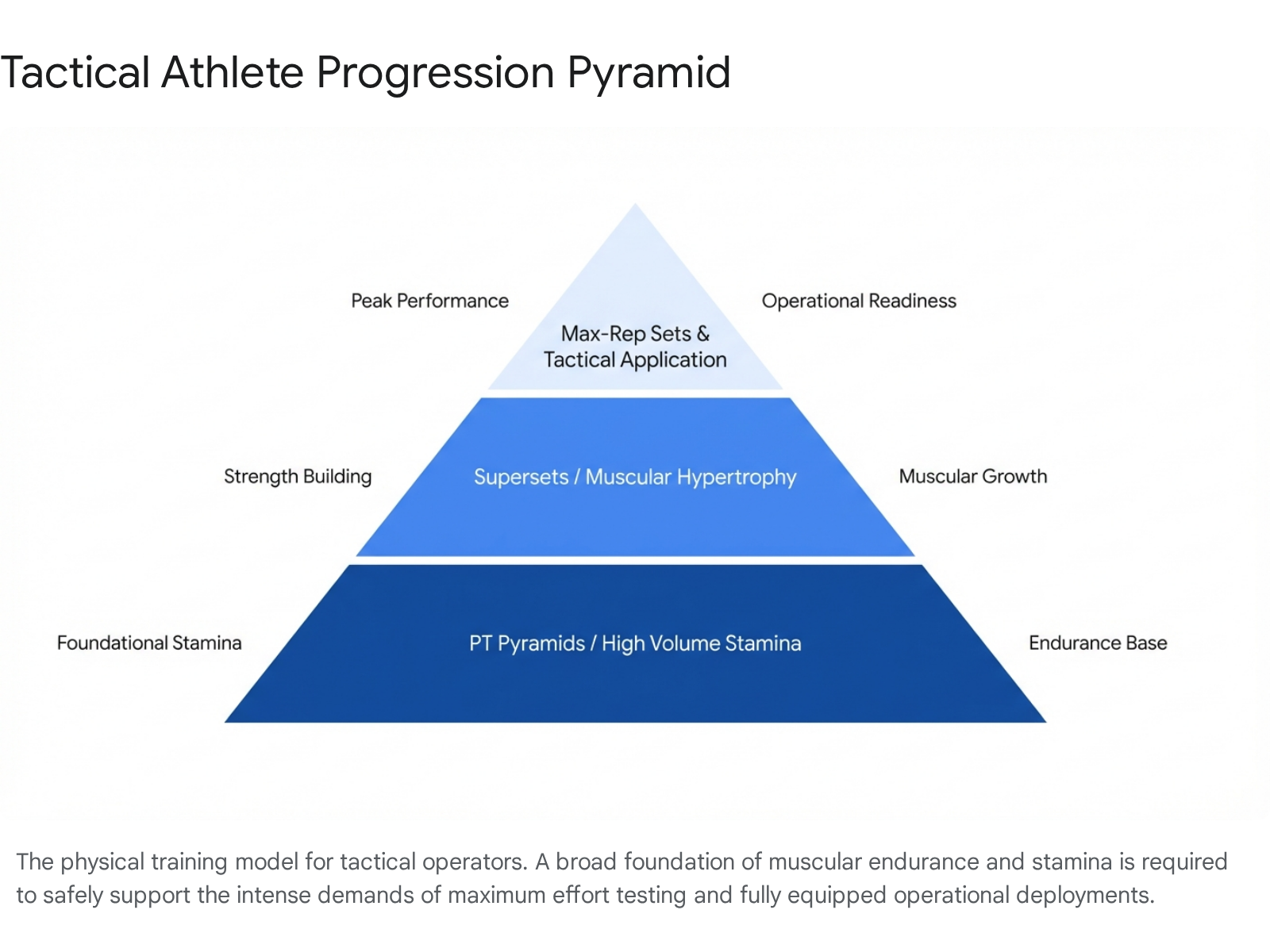
Because of these realities, physical conditioning must be approached not as a hobby, but as an ongoing, scientifically structured class. Training must focus holistically on the three anatomical planes of human movement (the sagittal, frontal, and transverse planes) to build deep functional strength, enhance mobility, and prevent the severe musculoskeletal injuries that are historically common in the tactical profession.62 A widely accepted, highly effective methodology for structuring tactical physical training is the Progression Pyramid Model.63
The Tactical Progression Pyramid is intelligently designed to build a massive foundation of muscle stamina and cardiovascular endurance before ever testing peak physical strength.63
- The Base (PT Pyramids): A continuous, high-volume, no-rest workout structure that efficiently combines a warm-up, maximum effort, and cool-down into a single, grueling session. For example, an officer performs 1 pull-up, 2 push-ups, and 3 sit-ups. They immediately progress to step two (2 pull-ups, 4 push-ups, 6 sit-ups), continuing the math up to step 10, and then immediately working back down the other side of the pyramid to step 1.64 This mechanism builds extreme, full-body muscular endurance without the acute injury risk associated with heavy weightlifting.
- The Mid-Level (Supersets): Once the base is established, operators use supersets to increase the absolute volume of tactical exercises, pushing muscles near complete exhaustion while carefully managing localized recovery by rapidly alternating between opposing muscle groups.63
- The Peak (Max-Rep Sets & Tactical Integrations): Only after foundational strength and stamina are completely secured do operators engage in maximum-repetition tests or combine physical exhaustion with complex cognitive tasks. This mimics the reality of a firefight: requiring an officer to run long distances in full kit, and then immediately forcing them to perform memory recall tasks or execute surgical marksmanship while managing wildly elevated heart rates and heavy respiration.58
Agencies must carefully tailor these physical maintenance programs to match their specific, unique operational profiles. For example, rural man-tracking teams, such as border patrol tactical units, may need to focus more heavily on aerobic capacity and load-bearing endurance over long, uneven distances in harsh climates. Conversely, metropolitan CQB teams conducting rapid residential raids may prioritize anaerobic power, short-distance sprinting, and the upper-body explosive strength necessary to physically dominate a suspect in a confined hallway.58
6. Conclusion
The absolute necessity of a highly trained, deeply educated, and strictly regulated tactical law enforcement capability cannot be overstated in the modern era. As the complexity, armament, and sheer lethality of the threats facing communities continue to escalate exponentially, the response parameters, policies, and educational requirements of Special Weapons and Tactics units must evolve commensurately. This evolution is functionally impossible without a rigid, scientifically backed, legally defensible, and experience-stratified training curriculum that guides an officer from their first day on the team through their eventual promotion to command.
Treating tactical training as a homogenous, one-size-fits-all block of instruction is a critical organizational and pedagogical failure. Novice operators must be methodically built from the ground up. Their instruction must focus relentlessly on the basic physical geometries of survival, flawless basic weapons manipulation, and the deliberate, scenario-based expansion of their cognitive framing to prevent psychological tunneling during lethal encounters. They must be explicitly taught to see the entire tactical environment, prioritizing de-escalation, mitigation, and the use of time over the dangerous instinct to assert immediate, brute-force physical control over a chaotic scene.
Once these foundational elements are secured as subconscious motor programs, the training burden shifts significantly. The experienced operator must transition into the demanding realm of technical specialization and high-consequence precision. Mastery of the stealth-to-contact methodologies of hostage rescue, the unforgiving mathematical applications of explosive breaching, the zero-defect reality of precision sniper fire, and the complex integration of robotic surveillance systems represent the true maturation of the tactical asset. Ultimately, the most seasoned operators must be guided into leadership roles through formal, executive-level command instruction, utilizing strict analytical frameworks like the P.I.E.T.O. model to govern their decision-making and shield their agencies from liability.
Coupled with a permanent, career-long commitment to combating the inevitable degradation of perishable physical skills and cardiovascular fitness, this comprehensive curriculum blueprint ensures that a tactical unit remains fundamentally sound. By adhering to these strict national standards and recognizing the psychological differences between novices and experts, law enforcement agencies guarantee that their tactical teams operate not just as a blunt instrument of state force, but as a highly refined, surgically precise, and constitutionally sound mechanism dedicated unequivocally to the preservation of human life.
7. Master Training Provider Data Table
| Class Type | Training Provider | Course Name | Synopsis | Location | URL |
| Basic SWAT & Foundational Tactics | National Tactical Officers Association (NTOA) | Basic SWAT | 40-hour course covering fundamental tactical principles, team movement, and high-risk warrant service planning.16 | Various | https://training.ntoa.org/ |
| Basic SWAT & Foundational Tactics | Federal Law Enforcement Training Centers (FLETC) | Basic Tactics Instructor Training Program (BTITP) | Foundational training covering dynamic weapons handling, room clearing, and close quarters geometry.3 | Glynco, GA & Artesia, NM | https://www.fletc.gov/training-catalog |
| Basic SWAT & Foundational Tactics | Solutions Group International (SGI) | Defensive Pistol Craft Series | Progressive tactical training focusing on personal safety, marksmanship under stress, and firearms manipulation. | Various | https://www.solutionsgroupinternational.com/tactical-training.php |
| Basic SWAT & Foundational Tactics | Norse Tactical | Close Quarters Tactics | Principle-based system teaching close-quarters combat through intensive, hands-on practical application. | Indiana & Various | https://norsetactical.com/ |
| Basic SWAT & Foundational Tactics | Tier 1 Group (T1G) | Advanced Urban Combat | Full mission profile scenario training for active shooter response, raids, and close target reconnaissance. | Memphis, TN | https://t1g.com/multidiscipline-tactical-training/ |
| Tactical Medical (TEMS) | Federal Law Enforcement Training Centers (FLETC) | Tactical Medical for First Responders (TMFR) | Medical threat assessment training prioritizing rapid hemorrhage control and Care Under Fire protocols. | Glynco, GA & Various | https://www.fletc.gov/tactical-medical-first-responders |
| Tactical Medical (TEMS) | SOA Rescue | Tactical Medical Practitioner (TMP) | Hybrid TECC-certified program for SWAT medics focused on pre-mission planning and austere medical care. | Hybrid (Online & In-Person) | https://www.soarescue.com/tmp |
| Tactical Medical (TEMS) | 911 Tacmed | TEMS SWAT Tactical Medic Course | 100-hour intensive course expanding the trauma care capabilities of paramedics integrated into tactical elements. | Texas | https://www.911tacmed.com/swat-medic–tactical-medic-course.html |
| Tactical Medical (TEMS) | International School of Tactical Medicine (ISTM) | Advanced Tactical Medicine | DHS and POST-approved curriculum teaching life-saving responses to active shooters and severe threats. | Sacramento, CA | https://tacticalmedicine.com/course-schedule/ |
| Tactical Medical (TEMS) | Strategic Operations, Inc. | Tactical Medicine Technician (TMT) | Hands-on tactical combat casualty care utilizing hyper-realistic medical and surgical simulation environments. | San Diego, CA | https://www.strategic-operations.com/Tactical-Medicine-Technician-TMT-p/tmt.htm |
| Explosive & Mechanical Breaching | Texas A&M Engineering Extension Service (TEEX) | Explosive Breaching Course (EOT220) | Five-day immersive training involving over 60 detonations on various fortified barriers to teach safe breaching methods. | College Station, TX | https://teex.org/class/eot220/ |
| Explosive & Mechanical Breaching | Asymmetric Solutions | Law Enforcement Breacher | Comprehensive tactical entry training spanning mechanical, thermal, ballistic, and explosive breaching methodologies. | Missouri | https://asymmetricsolutionsusa.com/law-enforcement/special-teams-training/le-breacher/ |
| Explosive & Mechanical Breaching | Global Assets Integrated | Tactical Breaching (MMBTH) | Five-day certification covering manual, mechanical, ballistic, thermal, and hydraulic entry tactics for swat elements. | Various | https://www.globalassetsintegrated.com/training/tactical-breaching/ |
| Explosive & Mechanical Breaching | Energetic Entry | Law Enforcement Total Breaching Course | Intense eight-day up-skilling program covering explosive handling, target analysis, and mechanical entry tactics. | Various | https://energeticentry.com/training-courses/law-enforcement-total-breaching-course/ |
| Explosive & Mechanical Breaching | Tier 1 Group (T1G) | SOF Master Breacher Course | Advanced instruction in dynamic entry incorporating customized scenarios and comprehensive structural defeat operations. | Memphis, TN | https://t1g.com/breacher-training/sof-master-breacher-course/ |
| Precision Rifle & Sniper Operations | Center Mass Inc. | Basic Police Sniper School | 50-hour foundational course targeting field-craft, range estimation, and marksmanship emphasizing the cold bore shot. | Various | https://centermassinc.com/police-sniper-schools |
| Precision Rifle & Sniper Operations | HRTC | LE Sniper – Basic (LESB) | 40-hour program focusing on ballistic principles, hide site selection, and critical legal considerations for snipers. | HRTC Training Facility | https://www.sniperology.com/training-courses/hrtc-le-sniper-basic-lesb-headspace-rifle-training-co |
| Precision Rifle & Sniper Operations | SIG SAUER Academy | Police Marksman I – Sniper | Intensive five-day live-fire course emphasizing extreme close-range precision and scoped rifle mechanics. | Epping, NH | https://sigsaueracademy.com/courses/police-marksman-i-sniper |
| Precision Rifle & Sniper Operations | Max Ordinate Academy | LE Advanced Sniper Course | Five-day specialized training for SWAT snipers highlighting complex positional shooting and tripod employment. | Lucerne Valley, CA | https://www.maxordinate.com/eliterifleman |
| Precision Rifle & Sniper Operations | Rifles Only | Precision Rifle I & II | Rigorous fundamentals-focused instruction blending marksmanship with deployment in varied, high-angle environments. | Fort Collins, CO & Texas | https://riflesonly.com/classes/ |
| Command & Tactical Leadership | FBI-LEEDA | Command Leadership Institute (CLI) | Interactive 4.5-day seminar exploring ethical command decision-making and best-practice strategies for leaders.46 | Various | https://fbileeda.org/page/CommandLeadershipInstitute |
| Command & Tactical Leadership | National Tactical Officers Association (NTOA) | SWAT Team Leader Development | Course teaching principle-based SWAT decision-making, liability concepts, and operations order development.48 | Online & Various | https://public.ntoa.org/default.asp?action=courseview&titleid=231 |
| Command & Tactical Leadership | Savage Training Group | Command of High-Risk Critical Incidents | Focused leadership instruction on making rapid, sensible decisions during rapidly unfolding chaotic events. | San Jose, CA & Various | https://savagetraininggroup.com/courses/command-of-high-risk-critical-incidents/ |
| Command & Tactical Leadership | Northwestern University Center for Public Safety | School of Police Staff & Command (SPSC) | Premier, intensive management program designed to prepare mid and upper-level personnel for senior command. | Evanston, IL & Online | https://sps.northwestern.edu/center-for-public-safety/management/ |
| Command & Tactical Leadership | Institute for Law Enforcement Administration | School of Executive Leadership | Eight-week academic curriculum providing advanced police supervision and executive ethics training. | Plano, TX | https://www.cailaw.org/institute-for-law-enforcement-administration/index.html |
Please share the link on Facebook, Forums, with colleagues, etc. Your support is much appreciated and if you have any feedback, please email us in**@*********ps.com. If you’d like to request a report or order a reprint, please click here for the corresponding page to open in new tab.
Sources Used
- State and Local Law Enforcement Training Academies, 2018 – Bureau of Justice Statistics, accessed February 22, 2026, https://bjs.ojp.gov/sites/g/files/xyckuh236/files/media/document/slleta18st.pdf
- The Preservation of Perishable Skills – FDLE, accessed February 22, 2026, https://www.fdle.state.fl.us/getContentAsset/534fd739-7da0-4af4-b34d-a922f387bb1a/73aabf56-e6e5-4330-95a3-5f2a270a1d2b/Leisenring-Andy-final-paper.pdf?language=en
- Basic Tactics Instructor Training Program – Federal Law Enforcement Training Centers, accessed February 22, 2026, https://www.fletc.gov/basic-tactics-instructor-training-program
- New study: Expert vs. novice use-of-force decision-making – Police1, accessed February 22, 2026, https://www.police1.com/use-of-force/articles/new-study-expert-vs-novice-use-of-force-decision-making-z2rh9KpGbY4WQJRZ/
- Into the Breach: Justifying An Explosive Breaching Program – SWAT Survival | Weapons, accessed February 22, 2026, https://www.swatmag.com/article/breach-justifying-explosive-breaching-program/
- Mastering SWAT Hostage Rescue: Training Insights from Grey Group, accessed February 22, 2026, https://greygroupsecurity.com/mastering-swat-hostage-rescue-training-insights-from-grey-group/
- CLEST Minimum Standards Precision Rifle Annual Qualification Course Paragraph I. Law Enforcement personnel who have successfu, accessed February 22, 2026, https://dps.arkansas.gov/wp-content/uploads/2021/01/Precision-Rifle.pdf
- Covert Electronic Surveillance Program – Federal Law Enforcement Training Centers, accessed February 22, 2026, https://www.fletc.gov/covert-electronic-surveillance-program
- SWAT TEAM LEADER DEVELOPMENT, accessed February 22, 2026, https://www.lea.nm.gov/wp-content/uploads/sites/4/2025/02/NTOA-SWAT-Team-Leader-Development.pdf
- Police Academy Training, Performance, and Learning, accessed February 22, 2026, https://www.train-de-trainer.org/wp-content/uploads/2020/12/PA-training-retention-FSRC.pdf
- Tactical Response and Operations Standard – National Tactical Officers Association, accessed February 22, 2026, https://ntoa.org/pdf/swatstandards.pdf
- A Multi-Method Study Of Special Weapons And Tactics Teams – Office of Justice Programs, accessed February 22, 2026, https://www.ojp.gov/pdffiles1/nij/grants/223855.pdf
- National Special Weapons and Tactics (SWAT) Study, accessed February 22, 2026, https://www.theiacp.org/resources/document/national-special-weapons-and-tactics-swat-study
- ntoa tactical response and operations standard, accessed February 22, 2026, https://www.ntoa.org/tros/
- Standards for SWAT | National Institute of Justice – NIJ.gov, accessed February 22, 2026, https://nij.ojp.gov/library/publications/standards-swat
- Basic SWAT – National Tactical Officers Association – NTOA Publications, accessed February 22, 2026, https://public.ntoa.org/default.asp?action=courseview&titleid=72
- NTOA TROS 2023, accessed February 22, 2026, https://ntoa.org/pdf/TROS.pdf
- Improving police training from a cognitive load perspective – Emerald Publishing, accessed February 22, 2026, https://www.emerald.com/pijpsm/article/36/2/312/321720/Improving-police-training-from-a-cognitive-load
- Stress and Decision Making – Federal Law Enforcement Training Centers, accessed February 22, 2026, https://www.fletc.gov/sites/default/files/imported_files/reference/research-papers/Stress-and-Decision-Making-04-06-12–Approved—Pulic-Release–508-Accessible.pdf
- Complex Motor Learning and Police Training: Applied, Cognitive, and Clinical Perspectives, accessed February 22, 2026, https://pmc.ncbi.nlm.nih.gov/articles/PMC6692711/
- Using a Mixed-Methods Approach to Model Expert and Novice Use-of-Force Decision-Making – iMarksman, accessed February 22, 2026, https://www.imarksman.com/imarksman/polis-solutions.pdf
- Perspective: Need for Critical Thinking in Police Training | FBI – LEB, accessed February 22, 2026, https://leb.fbi.gov/articles/perspective/perspective-need-for-critical-thinking-in-police-training
- Establishing a Mindset for Success Using Tactical Performance Imagery: Maximizing Physical and Mental Skill Sets for Law Enfor – IN.gov, accessed February 22, 2026, https://www.in.gov/ilea/files/Mindset_for_Success_-_Luce_-_9-8-2015_Rev2.pdf
- De-Escalation and Tactical Decision Making – ShadowBox Training, accessed February 22, 2026, https://www.shadowboxtraining.com/case-studies/cs-law-enforcement/
- Glynco Programs – Federal Law Enforcement Training Centers, accessed February 22, 2026, https://www.fletc.gov/glynco-training-programs
- Training Catalog | Federal Law Enforcement Training Centers, accessed February 22, 2026, https://www.fletc.gov/training-catalog
- How SWAT Teams Train for Hostage Rescue and High-Risk Ops – Go Law Enforcement, accessed February 22, 2026, https://golawenforcement.com/articles/swat-training-part-1/
- San Bernardino County Sheriff’s Specialized Enforcement Division SWAT Hostage Rescue, accessed February 22, 2026, http://www.sbcounty.gov/uploads/Sheriff/SB978/Divisions/Update71422SED/Hostage%20Rescue%20ECO.pdf
- Hostage Rescue Team: Training for Every Contingency – FBI, accessed February 22, 2026, https://www.fbi.gov/news/stories/hostage-rescue-team-training-for-every-contingency
- SWAT II – Advanced SWAT Operator (40 Hours) – SIG SAUER Academy, accessed February 22, 2026, https://sigsaueracademy.com/courses/swat-ii-advanced-swat-operator
- tb-iii-p.06-explosive-breaching-4.24.23-clean.docx – City of Oakland, CA, accessed February 22, 2026, https://www.oaklandca.gov/files/assets/city/v/1/boards-amp-commissions/documents/opc/me/2022-23/tb-iii-p.06-explosive-breaching-4.24.23-clean.docx
- The explosive option for SWAT teams – Police1, accessed February 22, 2026, https://www.police1.com/police-products/tactical/tactical-entry-tools/articles/the-explosive-option-for-swat-teams-3J8XFPem3BGyXSU9/
- TRAINING BULLETIN, accessed February 22, 2026, https://cao-94612.s3.amazonaws.com/documents/TB-Explosive-Breaching-2022-clean.pdf
- Basic Sniper | TEEX.ORG, accessed February 22, 2026, https://teex.org/class/let574/
- Liability Exposure in Special Operations – LLRMI – Police Training and Expert Services for Law Enforcement, Jails & Corrections, Insurance Pools, Risk Managers, and Attorneys, accessed February 22, 2026, https://www.llrmi.com/articles/legal_update/special-operations-liability/
- Technical Investigations-1 | Federal Law Enforcement Training Centers, accessed February 22, 2026, https://www.fletc.gov/technical-investigations-1
- Technical Surveillance Operator Training Course – Tactical Support Equipment, accessed February 22, 2026, https://www.tserecon.com/products/technical-surveillance-operator-training-course
- Training Overview – Electronic Surveillance Training and Consulting, accessed February 22, 2026, https://estctraining.com/training-overview
- Electronic Surveillance | State of California – Department of Justice – Office of the Attorney General, accessed February 22, 2026, https://oag.ca.gov/atc/courses/electronic-surveillance
- NTOA Training Courses – National Tactical Officers Association, accessed February 22, 2026, https://training.ntoa.org/
- law enforcement drone association tactical operations standard, accessed February 22, 2026, https://ntoa.org/pdf/UAS-TOS.pdf
- 5 Technologies that Will Impact Police Training in 2025, accessed February 22, 2026, https://www.virtra.com/5-technologies-that-will-impact-police-training-in-2025/
- Technology in Tactical Operations – Mon, 02/17/2025 – 12:00 | Kansas Law Enforcement Training Center, accessed February 22, 2026, https://kletc.org/technology-tactical-operations
- Leadership Services | International Association of Chiefs of Police – IACP, accessed February 22, 2026, https://www.theiacp.org/projects/leadership-services
- Leadership development series: How to balance tactical training with professional development – Police1, accessed February 22, 2026, https://www.police1.com/police-leader-playbook/leadership-development-series-how-to-balance-tactical-training-with-professional-development
- Command Leadership Institute – FBI-LEEDA, accessed February 22, 2026, https://fbileeda.org/page/CommandLeadershipInstitute
- FBI Executive Leadership Programs – LEB, accessed February 22, 2026, https://leb.fbi.gov/articles/featured-articles/fbi-executive-leadership-programs
- National Tactical Officers Association – NTOA Training Courses, accessed February 22, 2026, https://public.ntoa.org/default.asp?action=courseview&titleid=231
- SWAT TEAM LEADER DEVELOPMENT COURSE OVERVIEW AND INSTRUCTIONAL GOALS COURSE OVERVIEW INSTRUCTIONAL GOALS – National Tactical Officers Association – NTOA Publications, accessed February 22, 2026, http://public.ntoa.org/AppResources/CourseDetails/231.pdf
- National Tactical Officers Association – NTOA Online Calendar, accessed February 22, 2026, https://public.ntoa.org/default.asp?action=viewonline&courseid=20203470
- National Tactical Officers Association – NTOA Training Courses, accessed February 22, 2026, https://public.ntoa.org/default.asp?action=courseview&titleid=484
- Shift Briefing Series: Tactical decision-making – Police1, accessed February 22, 2026, https://www.police1.com/police-training/articles/shift-briefing-series-tactical-decision-making-pt3tGRjBZuvoEiKY/
- RMBLC Shift Briefing Series: Tactical Decision Making – YouTube, accessed February 22, 2026, https://www.youtube.com/watch?v=5HGvSegpqhM
- POST PERISHABLE SKILLS PROGRAM (PSP) I – TACTICAL FIREARMS COURSE NAPA COUNTY SHERIFF’S OFFICE 2170 CCN, accessed February 22, 2026, https://www.napacounty.gov/DocumentCenter/View/15573/Tactical-Firearms—POST-Perishable-Skills-Training-Program-PSP
- Practicing Perishable Skills in Law Enforcement Training – VirTra, accessed February 22, 2026, https://www.virtra.com/practicing-perishable-skills-in-law-enforcement-training/
- Leaving so soon? An analysis of withdrawal patterns from academy training | Policing: A Journal of Policy and Practice | Oxford Academic, accessed February 22, 2026, https://academic.oup.com/policing/article/doi/10.1093/police/paae018/7609904
- Police Training in Practice: Organization and Delivery According to European Law Enforcement Agencies – PMC, accessed February 22, 2026, https://pmc.ncbi.nlm.nih.gov/articles/PMC8801945/
- Focus on Training: Human Performance-Based Recommendations – LEB, accessed February 22, 2026, https://leb.fbi.gov/articles/focus/focus-on-training-human-performance-based-recommendations
- Evolution of Physical Training in Police Academies: Comparing Fitness Variables – PMC, accessed February 22, 2026, https://pmc.ncbi.nlm.nih.gov/articles/PMC9858962/
- Demographical Analysis and Implications of Special Weapons and Tactics Officers by Elizabeth Longo – University of Memphis Digital Commons, accessed February 22, 2026, https://digitalcommons.memphis.edu/cgi/viewcontent.cgi?params=/context/honors_theses/article/1026/type/native/&path_info=
- Relationships between physical training and marksmanship performance in tactical law enforcement officers | Policing: An International Journal | Emerald Publishing, accessed February 22, 2026, https://www.emerald.com/pijpsm/article/47/6/1111/1226220/Relationships-between-physical-training-and
- Transform your career by preparing like a tactical athlete – Police1, accessed February 22, 2026, https://www.police1.com/wellness-week/articles/prepare-like-a-tactical-athlete-BZpgushzJTpkNm7f/
- PT Progression Series: Why Pyramids Are a Foundation Workout – Military.com, accessed February 22, 2026, https://www.military.com/military-fitness/fitness-test-prep/pt-progression-series-1-the-pyramid
- PT Pyramid – The Classic PT FItness Workout – Stew Smith Fitness Ace the PFT – Preparing Americans for Military,Special Ops, Police, and Fire Fighting Professions, accessed February 22, 2026, http://www.stewsmith.com/linkpages/ptpyramids.htm
- My PT Pyramid Story – Do You Remember Yours? – Stew Smith Fitness, accessed February 22, 2026, https://www.stewsmithfitness.com/blogs/news/my-pt-pyramid-story-do-you-remember-yours