Tag Archives: SWAT

Tactical Utility of Integrally Compensated Duty Pistols for Special Weapons and Tactics (SWAT) Operations

Executive Summary

The modern law enforcement tactical environment is characterized by rapidly evolving threat vectors, compressed engagement timelines, and the absolute necessity for surgical precision in highly volatile settings. As a result, the hardware issued to Special Weapons and Tactics (SWAT) elements and specialized response teams must undergo constant, rigorous evaluation. Over the past decade, the small arms industry has witnessed a profound paradigm shift. Technologies formerly reserved strictly for open-class competitive shooting have been systematically integrated into duty-grade, duty-safe applications. Among the most significant and debated of these developments is the proliferation of the integrally compensated duty pistol.

This comprehensive intelligence brief, produced exclusively for blog.roninsgrips.com, provides an exhaustive technical, physiological, and strategic analysis of integrally compensated handguns for specialized law enforcement applications. The primary objective is to evaluate the precise tactical utility of these platforms, carefully balancing their biomechanical advantages against the unique operational hazards they introduce in high-stress environments. The analysis begins by deconstructing the fundamental fluid dynamics and the physics of gas porting. It explains exactly how expanding propellant gases are harnessed to counteract muzzle flip, thereby reducing split times during rapid engagement sequences and allowing operators to maintain continuous visual tracking of modern electro-optics.

The report subsequently and systematically assesses the critical vulnerabilities associated with compensated platforms in close-quarters battle (CQB). Venting high-pressure, superheated gases in a vertical orientation introduces severe biological and operational hazards when an operator is forced to fire from tight retention positions. Furthermore, the acoustic and concussive properties of these weapon systems are exponentially magnified in subterranean or heavily fortified concrete environments, potentially degrading operator endurance, situational awareness, and long-term auditory health.

Additionally, this brief deeply investigates the complex intersection of integrated compensators with advanced electro-optical systems. It examines the mechanical realities of carbon fouling on slide-mounted red dot sights, the vibrational harmonic stresses that induce optic zero drift, and the physiological realities of flash blindness in low-light environments. Crucially, the analysis evaluates the compatibility of compensated muzzle flashes with modern, auto-gated Night Vision Goggles (NVG) during blackout clearing operations, utilizing empirical evidence to dispel pervasive industry myths.

Ultimately, this report serves as a definitive, objective resource for tactical commanders, procurement officers, and departmental armorers. By synthesizing open-source intelligence, empirical ballistic data, physiological research, and 2026 governmental procurement trends, the ensuing sections provide a nuanced framework for determining whether the integration of compensated duty pistols aligns with the specific mission profiles, training budgets, and risk tolerances of modern tactical units.

1.0 Introduction to Modern Tactical Handgun Paradigms

1.1 The Operational Shift to Miniature Red Dot Sights

The evolution of the law enforcement duty sidearm has been driven by a continuous pursuit of increased capacity, enhanced reliability, and superior human ergonomics. The transition from heavy, double-action revolvers to high-capacity, striker-fired polymer pistols marked the first major modernization of police arsenals. In recent years, the standard duty pistol has undergone a secondary, equally profound metamorphosis, evolving into a holistic modular weapon system equipped with high-lumen weapon-mounted lights and miniature red dot sights (MRDS).1

The integration of electro-optics has fundamentally altered how officers are trained to process visual information during a lethal force encounter. By allowing the operator to remain entirely target-focused rather than shifting their focal plane back to a front sight post, the MRDS significantly reduces cognitive load during a crisis.2 However, the addition of an optic also amplifies the operator’s visual perception of recoil. As the slide cycles rearward, the red dot violently leaves the optical window, requiring the shooter to rely on flawless grip mechanics and recoil management to return the dot to the center of the glass. In high-stress, rapid-fire engagements, minimizing the time the dot is absent from the window is critical for accurate follow-up shots. This specific operational requirement has catalyzed the integration of recoil compensation devices into duty-ready platforms.1

1.2 The Convergence of Competitive Shooting and Tactical Duty Applications

Historically, compensators were relegated exclusively to the realm of competitive shooting. In these controlled environments, long, threaded barrels and massive external expansion chambers were utilized to tame the recoil of heavily modified race guns firing customized ammunition.3 These legacy systems were universally deemed unsuitable for duty use due to their excessive bulk, their tendency to induce catastrophic reliability issues with varied ammunition types, and the legal or administrative liabilities associated with threaded barrels in certain jurisdictions.4

However, recent engineering advancements have yielded the slide-integrated compensator. In these highly refined designs, the expansion chamber and the venting ports are machined directly into the slide itself, paired with a shortened barrel that terminates precisely behind the venting port.6 This architecture allows the weapon to retain the exact external dimensions of a standard, uncompensated pistol, ensuring seamless compatibility with existing duty holsters.7 The tactical market has rapidly responded to this innovation, with specialized SWAT elements and standard patrol divisions actively evaluating and adopting these platforms to maximize operator lethality and survivability.9

2.0 The Physics and Fluid Dynamics of Recoil Compensation

2.1 Conservation of Linear and Angular Momentum

To accurately assess the tactical utility of a compensated pistol, one must first deeply understand the physics governing its operation. When a cartridge is detonated, the rapid deflagration of smokeless powder generates a massive volume of high-pressure gas. This rapidly expanding gas pushes the projectile down the bore of the barrel. According to the foundational principles of physics (specifically the conservation of linear momentum), the forward momentum of the bullet and the exhausting gases must be met with an equal and opposite rearward momentum imparted to the firearm.10

If all the exhaust gas could be theoretically redirected entirely backward, it would impart a massive forward momentum kick, drastically reducing the net recoil felt by the shooter.10 However, because the bore axis of the pistol sits physically higher than the shooter’s grip (which acts as the mechanical fulcrum), this rearward force generates a violent rotational torque. This torque causes the muzzle of the pistol to pivot sharply upward, a phenomenon universally referred to as muzzle flip or muzzle rise.7 Furthermore, angular momentum is also conserved; the spin of the bullet imparted by the rifling causes the pistol frame to twist slightly in the opposite direction.10

A compensator functions by strategically intervening in this complex fluid dynamic process. By machining ports into the top of the barrel or slide, a highly calculated portion of the high-pressure gas is intentionally vented vertically as the bullet passes or exits the muzzle.7 This upward-venting gas acts as a direct thrust vector. By ejecting mass upward at high velocity, the system generates an equal and opposite downward force on the muzzle.7 This downward thrust directly counteracts the rotational torque generated by the recoil impulse, significantly dampening the upward movement of the slide and frame.

2.2 High-Speed Schlieren Imaging and Shockwave Analysis

The precise behavior of these gases is not merely theoretical; it has been extensively mapped utilizing advanced diagnostic technologies. High-speed Schlieren imaging is a specialized optical technique utilized to visualize complex gas flows, air density changes, and shockwave behavior around suppressors and muzzle brakes.12 Schlieren imaging works by capturing the refraction of light through varying air densities, making invisible phenomena visible (including shockwaves, turbulent gas expansion, and the thermal plumes that occur when a round is fired).12

When researchers utilize cameras capable of recording at one million frames per second alongside precision optics, they can observe the real-time gas flow and off-gassing patterns of a compensated pistol.12 The resulting image sequences capture the acoustic pressure waves emitted as concentric fronts from the sudden release of compressed gas inside the barrel.15 As the wavefront propagates outward, it rapidly destabilizes and evolves into a sinuous signature of shear-layer instabilities and vortex shedding.15 This visualization enables firearms engineers to optimize baffle designs, evaluate the exact angle of gas redirection, and correlate geometric slide changes with acoustic and recoil characteristics, ensuring that duty-grade compensators operate with maximum fluid dynamic efficiency.12

2.3 Barrel Porting Versus Slide-Integrated Expansion Chambers

The engineering application of this physical principle dictates the efficiency and the side effects of the recoil mitigation system. There are distinct mechanical differences between traditional barrel porting and modern slide-integrated expansion chambers.

Barrel porting involves drilling direct holes through the top of the barrel, typically located one to two inches behind the muzzle.7 As the bullet travels down the bore and passes these ports, gas immediately escapes upward while the bullet is still accelerating.7 Because the gas is redirected at the exact moment the rotational torque begins, traditional porting is highly efficient, often reducing muzzle rise by approximately twenty percent.7 However, bleeding off high-pressure gas before the bullet exits the muzzle fundamentally alters internal ballistics, resulting in a measurable loss of projectile velocity, typically between thirty and seventy feet per second depending on the specific port size and placement.7

Conversely, an integrally compensated pistol (such as the Sig Sauer P365 X-Macro or the Springfield Echelon 4.0C) utilizes an expansion chamber.6 In this design, the barrel is physically shorter than the slide. The bullet completely exits the barrel and enters a hollow expansion chamber machined into the forward section of the slide before exiting the weapon entirely.7 Because the bullet has already left the rifling, no forward velocity is bled off prematurely; the projectile retains the full ballistic potential of the shorter barrel length.7 As the gas follows the bullet into the expansion chamber, it collides with the front wall of the slide cutout and is forced rapidly upward through a large vent.7 While slide-integrated compensators typically offer a slightly lower overall recoil reduction (often measured between ten and fifteen percent compared to a standard barrel), they are heavily favored for duty use because they preserve ballistic integrity and maintain factory reliability parameters.7

Specification MetricTraditional Barrel PortingSlide-Integrated Compensator (Expansion Chamber)Aftermarket Threaded Compensator
Recoil Reduction EfficiencyVery High (Approx. 20% to 25%)Moderate (10% to 15%)High (15% to 20%+)
Projectile Velocity LossSignificant (30 to 70 fps drop)Negligible (Preserves barrel length velocity)Negligible
System Reliability ProfileFactory Tuned (High Reliability)Factory Tuned (High Reliability)Requires Custom Spring Tuning
Duty Holster CompatibilityFits standard enclosed holstersFits standard enclosed holstersRequires open-ended holsters
Primary Gas RedirectionVertical (Through barrel and slide)Vertical (Through slide chamber)Multi-directional (Baffle dependent)

3.0 Tactical Utility and Biomechanical Advantages

3.1 Rapid Engagement Sequencing and Sight Tracking

For SWAT operators engaged in dynamic entry scenarios, hostage taker resolutions, or active shooter interventions, the primary tactical utility of an integrally compensated pistol lies in the extreme compression of the engagement timeline. In these zero-fail environments, the margin for error is measured in fractions of a second, and operators are required to deliver highly accurate strings of fire to rapidly incapacitate a lethal threat.

The time elapsed between consecutive shots is known in tactical parlance as a split time. While a highly trained operator can physically manipulate a trigger mechanism at extreme speeds, functionally accurate split times are dictated entirely by sight recovery. The shooter must wait for the muzzle to return from its recoil arc, verify that the sights (or the glowing red dot) are properly realigned with the target geometry, and then break the subsequent shot.

By mechanically forcing the muzzle downward during the recoil cycle, a compensator drastically shortens the physical distance the red dot travels outside the optical window.1 In many optimized setups, the red dot never entirely leaves the glass; it simply streaks upward and snaps violently back to the point of aim.1 This allows the operator to track the dot continuously throughout the entirety of the recoil cycle. The reduction in muzzle flip directly translates to significantly faster, more accurate follow-up shots.1 Furthermore, the dampened felt recoil reduces anticipatory flinching and hand fatigue, enabling the operator to maintain peak marksmanship fundamentals and grip pressure under the immense physiological stress of a lethal encounter.1

3.2 Synergy with High-Pressure Duty Ammunition

The physics of a compensator dictate that the system actually becomes more effective as gas volume and pressure increase.10 By using a slower burning powder, the operator ends up with more gas generated precisely as the bullet leaves the barrel, resulting in a larger fraction of momentum carried by the residual gases which maximizes the compensating effect.10

Law enforcement duty ammunition is specifically engineered to achieve deep penetration and consistent expansion through intermediate barriers (such as laminated auto glass, heavy winter clothing, or drywall). Rounds like the 124-grain or 135-grain +P jacketed hollow points (such as the Hornady Critical Duty ammunition specifically authorized for the Detroit Police Department Special Response Team) generate significantly higher chamber pressures and larger volumes of expanding gas compared to standard 115-grain target ammunition.16

This dynamic creates a highly synergistic relationship between the compensated duty pistol and modern duty ammunition. While an uncompensated micro-compact or compact duty pistol can be exceptionally snappy and difficult to control when firing high-pressure (+P) ammunition, the integrally compensated pistol utilizes that exact extra gas pressure to drive the muzzle down with greater force.10 Consequently, an operator equipped with an integrally compensated compact pistol can achieve the recoil control and rapid shootability typically associated with a full-size, heavy-framed service pistol, without ever sacrificing the terminal ballistics required for duty applications.1

4.0 Operational Hazards in Close-Quarters Battle

Despite the clear biomechanical advantages of recoil mitigation, the introduction of a compensator fundamentally alters the hazard profile of the weapon system. These unique physical risks are exponentially magnified in extreme close-quarters battle, a domain where SWAT operators and specialized tactical elements frequently operate.

4.1 Extreme Close-Quarters Firing and the Reactionary Gap

Statistical analyses of law enforcement gunfights, including comprehensive data curated by the Federal Bureau of Investigation, consistently demonstrate that a massive percentage of defensive handgun shootings occur at extreme close distances, most frequently between three and five yards.17 At these compressed ranges, an operator is severely constrained by the reactionary gap. Caught behind the action-reaction power curve, an operator may be subjected to a sudden, violent ambush, requiring them to draw and fire before they have the time or physical space to achieve a full, two-handed arm extension.17 Alternatively, the operator may find themselves immediately entangled in a violent hand-to-hand struggle for control of their own weapon.17

In these highly dynamic scenarios, operators are rigorously trained to utilize retention firing positions. This technique involves keeping the firearm indexed tightly against the operator’s own body (often locked near the pectoral muscle or the floating ribs) to protect the weapon from being grabbed, deflected, or disabled by the assailant.18

4.2 Biological Hazards of Retention Firing Positions

Firing a compensated or ported pistol from a tight retention position introduces severe biological and operational hazards. A standard, uncompensated pistol expels all superheated gases, unburnt powder, and concussive force linearly toward the target, safely away from the shooter. In stark contrast, a compensated pistol intercepts a massive volume of this high-pressure gas blast and violently redirects it perfectly vertical.8 If the pistol is held tightly against the torso and fired directly forward, this column of high-pressure, superheated gas is blasted straight upward into the operator’s chin, nose, and eyes.19

The risk of ocular injury in this specific scenario is profound. Most standard-issue ballistic eyewear is designed specifically to protect against forward-facing threats, ricochets, and spalling; standard lenses rarely provide an adequate seal against a high-velocity jet of gas traveling straight up from the chest level (a bottom-up blast).19

Furthermore, there is a distinct difference between the biological hazards of ported barrels versus slide-integrated compensators. Because ported barrels bleed gas while the bullet is still heavily engaging the rifling, the sharp edges of the ports can physically sheer off microscopic fragments of the copper bullet jacket and blast them upward along with unburnt powder.7 This creates a literal shrapnel hazard that can embed metal shavings deep into the operator’s face or neck during a retention engagement.7 Slide-integrated expansion chambers largely avoid this specific shrapnel issue (because the bullet has already left the rifling before the gas vents), but they still expel a highly dangerous volume of hot gas and concussive force toward the operator’s face.7

4.3 Tactical Mitigations and Spatial Deconfliction

To effectively mitigate these retention hazards, specialized tactical training must be implemented at the departmental level. Renowned CQB instructors advocate for specific physical adjustments when operating compensated platforms in close proximity. The primary mitigation strategy involves altering the physical geometry of the retention position by forcefully rotating the pistol outward.19 By canting the weapon ninety degrees outboard, the compensator’s exhaust port is directed horizontally away from the operator’s face, rather than vertically into their eyes.19

However, this adaptation introduces a severe secondary risk profile. In a dynamic, multi-operator stack clearing a structure, personnel are often positioned tightly shoulder-to-shoulder. Canting the pistol horizontally effectively redirects the hazardous, high-pressure gas blast directly toward the operator standing adjacent on the firing line or flanking in the tactical formation.19 Strict spatial awareness, exhaustive team-level rehearsing, and deeply ingrained muzzle discipline are absolutely required to prevent friendly fire injuries.

Additionally, operators utilizing retention positions must employ defensive blocking techniques to protect their head from incoming physical strikes while simultaneously keeping their non-firing hand clear of the muzzle blast. Techniques such as the Najolia block (where the support arm is raised high, indexing the hand safely near the temple) ensure the support limb is kept physically above and away from the vertical venting gases of the compensator.19 Operators must also be acutely aware of clothing hazards; heavily insulated winter coats can easily droop over a slide held in retention, causing the action to bind, blocking the ejection port, or trapping the venting gases dangerously close to the body.19

5.0 Concussive Effects in Subterranean and Confined Environments

5.1 Blast Wave Reflection in Concrete Structures

SWAT operations frequently mandate the clearance of highly confined spaces, including narrow residential hallways, fortified stairwells, and complex subterranean concrete environments.21 Firing any high-velocity, unsuppressed weapon in a subterranean environment generates massive acoustic signatures and barotrauma stress due to the immediate reflection of pressure waves off the rigid, non-porous concrete surfaces.22

A compensated pistol radically alters the geometry of this pressure wave. Instead of projecting the sound and overpressure primarily down the hallway toward the threat, the compensator purposefully directs a significant portion of the blast wave directly into the ceiling immediately above the operator.24 In a standard eight-foot concrete hallway, or a low-clearance utility tunnel, this blast wave violently reflects downward, enveloping the operator and their immediate teammates in a highly concentrated, localized sphere of concussive force.23

5.2 Operator Fatigue and Mild Traumatic Brain Injury Considerations

Over the course of a protracted tactical engagement, or during extended live-fire shoothouse training evolutions required to maintain SWAT certifications, this continuous, multidirectional concussive bombardment takes a severe physiological toll.23 The overpressure accelerates operator fatigue, significantly degrades auditory situational awareness (even when utilizing advanced electronic hearing protection), and disrupts team communication.

More critically, contemporary tactical medicine recognizes that cumulative blast exposure, even from small arms fire in confined spaces, contributes directly to mild traumatic brain injury (mTBI) symptomology.23 The repeated micro-concussions generated by reflected overpressure waves from compensated short-barreled weapons can lead to long-term cognitive degradation.23 Tactical commanders must weigh the recoil mitigation benefits of compensators against the increased concussive load placed on their assault elements during rigorous indoor training and operational deployments.

Environmental FactorUncompensated Duty PistolIntegrally Compensated Duty PistolTactical Mitigation Required
Open Air RangeLinear blast propagation; moderate recoil.Vertical blast dissipation; highly reduced recoil.Standard eye/ear protection sufficient.
Confined HallwayBlast reflects primarily off side walls.Blast reflects violently off ceiling directly onto operator.Enhanced double hearing protection during training.
Subterranean TunnelHigh overpressure; linear channeling.Extreme overpressure; multidirectional blast reflection.Utilization of suppressors; strict rotational management.
Vehicle CabIntense acoustic trap; linear blast.Severe acoustic trap; vertical blast scorches headliner.Operators must punch out windows prior to engagement.

6.0 Electro-Optical System Integration and Degradation

The integration of slide-mounted miniature red dot sights is now the established standard for specialized tactical units. While compensators significantly aid in visually tracking the red dot during the recoil cycle by minimizing the muzzle’s vertical deviation, they concurrently introduce severe maintenance and durability challenges for the delicate optical system itself.

6.1 Carbon Fouling on Optical Lenses

The foremost operational issue is chronic carbon fouling. A compensator strategically vents high-pressure exhaust gas directly in front of the optical window. This expanding gas carries vaporized lead, microscopic copper particulate, unburnt smokeless powder, and heavy carbon deposits.25 As the slide cycles rapidly, a portion of this dirty exhaust is consistently and unavoidably deposited onto the front lens of the red dot sight.27

During a prolonged engagement or a high-round-count training evolution, this carbon buildup can severely occlude the lens, physically blocking light transmission, dimming the dot, and entirely obscuring the target area.27 While highly trained tactical operators are drilled to shoot through a fully occluded optic utilizing the Bindon Aiming Concept (superimposing the dot over the target via binocular vision while keeping both eyes open), a heavily fouled lens objectively degrades overall situational awareness and target identification capabilities.29 Mitigation requires constant, proactive maintenance, utilizing specialized non-abrasive lens wipes or applying thin layers of lip balm or synthetic oil to the lens housing to prevent the carbon from chemically bonding to the glass.30

6.2 Harmonic Vibration, Tolerance Stacking, and Zero Drift

Beyond the visual degradation caused by fouling, compensators induce distinct mechanical stresses on the optic mounting system. By altering the slide’s overall mass and introducing a sharp downward vertical thrust vector, the compensator fundamentally changes the harmonic vibration and recoil timing of the pistol.32 Instead of a relatively linear rearward impulse, the optic is subjected to a violent, high-frequency whipping motion.

This unique vibrational profile is highly effective at exploiting any microscopic tolerance stacking present in the optic mounting plates.32 Consequently, compensated pistols are significantly more prone to zero drift, a catastrophic failure where the optic mounting screws gradually loosen under sustained harmonic stress.32 Insufficient torque applications, the improper use of thread-locking compounds, or minor dimensional gaps between the optic body and the slide cut will inevitably result in the red dot wandering off the point of aim.32 For SWAT elements where hostage rescue operations demand absolute pinpoint accuracy at distance, a walking zero represents an unacceptable system failure. Armorers must mandate rigorous installation protocols, utilizing proper torque wrenches, high-quality fasteners, and visible witness marks to constantly monitor the integrity of the optic mount.32

7.0 Low-Light Physiology and Night Vision Compatibility

The tactical environment is largely agnostic to daylight. A substantial majority of high-risk warrant services, hostage rescues, and active threat interventions occur in low-light, no-light, or dynamically transitioning lighting conditions.33 In these high-stakes environments, the biological realities of human vision and the technical limitations of electro-optical gear intersect sharply with the mechanics of a compensated pistol.

7.1 Visual Physiology and Rhodopsin Bleaching

To fully understand the visual impact of a compensated pistol, one must examine the specific anatomy of the human eye. In low-light environments, human vision shifts from relying on cone cells (which are responsible for color and sharp detail) to rod cells.34 Rod cells contain a highly light-sensitive biological protein pigment known as rhodopsin, frequently referred to in medical literature as visual purple.34 Rhodopsin allows the eye to detect extremely faint ambient light, facilitating functional night vision. However, when rhodopsin is suddenly exposed to an intense burst of light, the protein is instantly chemically bleached.34 This rapid bleaching temporarily disables the rod cells, creating a massive blind spot or inducing a phenomenon known as flash blindness.34 It can take up to thirty minutes for rhodopsin to fully regenerate in absolute darkness, leaving the operator highly vulnerable during that window.35

When a firearm is discharged, the ignition of propellant gases creates a brilliant muzzle flash. The prevailing operational theory historically suggested that a compensated pistol, which purposefully vents this incandescent plasma upward directly into the operator’s line of sight, would instantly bleach the rhodopsin and render the operator blind in a dark environment.35

However, rigorous contemporary empirical testing challenges this pervasive assumption. Exhaustive studies utilizing high-speed Schlieren imaging and low-light videography have demonstrated that while the compensator does indeed redirect the flash vertically, the absolute duration of the flash is extraordinarily brief.35 Furthermore, modern law enforcement duty ammunition is specifically formulated with advanced low-flash powder additives, designed precisely to suppress the secondary ignition of unburnt gases outside the barrel.35 Extensive field testing indicates that the flash generated by high-quality duty ammunition in a compensated pistol is generally too brief and too diffuse to cause permanent rhodopsin bleaching or significant operational flash blindness.35 Surprisingly, in some controlled evaluations, the highly concentrated, forward-facing fireball produced by a short-barreled, uncompensated pistol was found to be visually more disruptive to the operator than the dissipated, upward-venting flash of an identically sized compensated platform.35

7.2 Night Vision Goggles and Auto-Gating Technology

For top-tier SWAT elements, low-light operations are completely dominated by the use of Night Vision Goggles. Standard operating procedures in subterranean environments or blackout structures rely heavily on dual-tube image intensification devices paired with infrared aiming lasers mounted to the weapon system.36

Image intensifier tubes function by capturing faint ambient photons, converting them into electrons, multiplying them exponentially via a microchannel plate, and finally projecting them onto a phosphor screen to create a visible image.37 Historically, older generation NVGs were highly susceptible to blooming or haloing, where a bright light source (such as a sudden muzzle flash) would overload the intensifier tube, washing out the entire image and potentially causing permanent burn-in damage to the delicate phosphor screen.37

Modern Generation 3+ NVG systems brilliantly mitigate this vulnerability through a sophisticated technology known as auto-gating.37 An auto-gated power supply constantly monitors the amount of light entering the tube. Upon detecting a sudden high-intensity source (like the vertical flash of a compensator), the system rapidly cycles the power to the photocathode on and off at imperceptibly high speeds.37 This dynamic power throttling physically prevents the tube from being overwhelmed, preserving the overall image quality while tightly isolating the bright light source.37

Direct field reports and extensive tactical evaluations confidently confirm that integrally compensated pistols are entirely compatible with modern auto-gated NVG systems.38 While the vertical muzzle flash is distinctly visible through the intensifier tubes, the auto-gating feature instantly suppresses the light input, preventing the bloom from obscuring the operator’s critical field of view or washing out the target area.37 The flash appears as a brief, highly contained static disruption rather than a blinding flare, allowing operators to maintain strict target focus and environmental awareness during rapid strings of fire in blackout conditions.

8.0 Strategic Procurement, Lifecycle Costs, and 2026 Trends

The strategic decision to equip a specialized law enforcement unit with integrally compensated duty pistols cannot be made solely on the basis of raw ballistic performance. Tactical commanders, municipal bean counters, and procurement officers must conduct a holistic evaluation encompassing lifecycle costs, holster compatibility, maintenance burdens, and regional operational trends.

8.1 Transitioning Platforms and Holster Compatibility

Historically, the transition to compensated platforms represented a massive financial and logistical burden for police departments. Aftermarket threaded compensators required not only the purchase of the specialized device and a replacement threaded barrel, but also the acquisition of entirely new duty holsters. Standard Level III retention holsters (such as the ubiquitous Safariland 6360 series utilized globally) feature fully enclosed muzzles and highly specific locking blocks that are completely incompatible with elongated, aftermarket compensators.

The advent of the integrally compensated pistol has largely nullified this significant logistical hurdle. Because modern weapon systems like the Sig Sauer P365 X-Macro or the Springfield Echelon 4.0C cleverly integrate the expansion chamber directly into the profile of a standard slide, their external dimensions remain virtually identical to their uncompensated counterparts.6 Therefore, a department can issue an integrally compensated weapon that seamlessly locks into the agency’s existing, expensive inventory of duty holsters.39 These platforms also accommodate standard weapon-mounted lights without any geometrical interference.39 This specific design parameter saves agencies tens of thousands of dollars in holistic transition costs, making the tactical upgrade significantly more feasible for municipal budgets constrained by modern economic realities.

8.2 Armorer Support and Preventative Maintenance Schedules

While the initial acquisition costs have been effectively streamlined, the administrative maintenance demands on the department undoubtedly increase. Departmental armorers must establish completely new standard operating procedures for compensated platforms. The expansion chambers in slide-integrated designs act as highly efficient carbon traps. If this dense carbon is allowed to solidify over thousands of rounds, it can alter the geometry of the exhaust vent, degrade the compensator’s fluid dynamic efficiency, and eventually cause the slide to physically bind against the barrel during cycling.40 Armorers must invest heavily in specialized brass scraping tools and heavy-duty synthetic solvents to thoroughly dissolve this hardened buildup on a regular basis.40

Furthermore, the armorer’s schedule for replacing preventative maintenance parts must be significantly accelerated. Because compensated pistols operate with finely tuned recoil spring assemblies to compensate for the reduced slide velocity, any degradation in spring tension disproportionately affects the weapon’s overall reliability.32 Recoil springs that might normally be replaced every five thousand rounds on a standard duty pistol may require mandatory replacement at three thousand rounds on a compensated platform to ensure absolute operational certainty. Additionally, armorers must mandate strict torque verification and witness-marking protocols for all optic plates to combat the vibration-induced zero drift inherent to these high-performance systems.32

8.3 Regional Case Studies and Federal Procurement Programs

The shift toward modernized, highly capable duty platforms is rapidly accelerating, driven by the need to match evolving threat vectors. State and local law enforcement agencies frequently leverage the 1122 program and the 1033 program (managed via the Law Enforcement Support Office in Battle Creek, Michigan) to acquire advanced equipment suitable for counter-narcotics and homeland security operations.41

Recent regional case studies highlight this intense transition period. In Nevada, the Henderson Police Department completely overhauled its armory, adopting the Springfield Echelon after extensive testing proved the modular platform resolved severe ergonomic deficiencies in their legacy weapons.9 The department procured the full-size 4.5F for patrol and the compact 4.0C for specialized SWAT and K9 elements, proving the viability of compact, high-performance systems for specialized roles.9 Similarly, the Grand Blanc Township Police Department in Michigan recently transitioned away from the Sig Sauer P320 platform to the Glock Gen 6, directly citing safety and liability concerns over unintentional discharges.43 This highlights the extreme scrutiny placed on duty weapon reliability and the willingness of command staff to execute expensive transitions to protect their personnel and municipalities from litigation.

Simultaneously, the operational tempo for tactical teams is shifting. In Michigan, the implementation of red flag gun laws (Extreme Risk Protection Orders) saw a thirty-one percent jump in utilization in 2025, resulting in hundreds of mandatory firearm confiscations.44 Serving these high-risk orders often falls to specialized tactical elements, increasing the frequency of potential close-quarters armed confrontations and thereby necessitating the absolute best in CQB-optimized weapon systems, such as integrally compensated pistols equipped with red dot sights.

9.0 Concluding Strategic Assessment

The integrally compensated duty pistol represents a definitive evolution in small arms technology, successfully migrating the profound biomechanical advantages of competitive shooting platforms into robust, duty-ready form factors. For SWAT elements and specialized response teams, the tactical utility is undeniable. By ingeniously harnessing fluid dynamics to counteract rotational torque, these modern platforms allow operators to achieve significantly faster split times, maintain continuous visual tracking of red dot optics through the violent recoil cycle, and deliver highly accurate strings of fire under extreme physiological stress. The ability to tame the harsh recoil impulse of high-pressure duty ammunition in a compact, completely holster-compatible platform affords operators unparalleled lethality and control.

However, this increased ballistic performance necessitates a highly sophisticated understanding of the system’s inherent physical hazards. Tactical commanders must carefully account for the severe biological risks posed by venting superheated, high-pressure gases during close-quarters retention engagements. Specialized defensive tactics, including outboard weapon canting and strict spatial deconfliction, must be exhaustively integrated into CQB training curriculums to prevent self-inflicted ocular injuries and friendly fire incidents. Furthermore, while modern low-flash ammunition and auto-gated NVG technology largely mitigate the risks of flash blindness, operators must be rigorously trained to manage aggressive carbon fouling on optical lenses, and departmental armorers must remain constantly vigilant against vibration-induced zero drift.

Ultimately, the adoption of integrally compensated duty pistols is not a simple, blanket solution, but rather a highly specialized capability upgrade. For agencies willing to proactively invest in the requisite armorer support, accelerated maintenance protocols, and advanced CQB training adjustments, the integrally compensated pistol offers a decisive, lifesaving tactical advantage in the unforgiving geometry of modern lethal force encounters.


Please share the link on Facebook, Forums, with colleagues, etc. Your support is much appreciated and if you have any feedback, please email us in**@*********ps.com. If you’d like to request a report or order a reprint, please click here for the corresponding page to open in new tab.


Sources Used

  1. Best Comped Pistols: Gimmick or Must-Have Upgrade? – Pew Pew …, accessed March 18, 2026, https://www.pewpewtactical.com/best-comped-pistols/
  2. Other than Cost what is there a good reason not to run a red dot on your pistol? – Reddit, accessed March 18, 2026, https://www.reddit.com/r/tacticalgear/comments/wp2mnj/other_than_cost_what_is_there_a_good_reason_not/
  3. All About Compensators: The Down and Dirty – Inside Safariland, accessed March 18, 2026, https://inside.safariland.com/blog/all-about-compensators-the-down-and-dirty/
  4. What’s the deal with people now wanting compensators on their carry guns? – Reddit, accessed March 18, 2026, https://www.reddit.com/r/CCW/comments/1oekvtg/whats_the_deal_with_people_now_wanting/
  5. The Ugly Truth About Compensators – YouTube, accessed March 18, 2026, https://www.youtube.com/watch?v=bwGBa28fIhQ
  6. Ported Performance: Recoil Reduction with Ported Barrels and Compensators, accessed March 18, 2026, https://blog.cheaperthandirt.com/ported-performance-recoil-reduction-ported-barrels-compensators/
  7. Compensators & Porting on Pistols: Everything You Need to Know, accessed March 18, 2026, https://range.gritrsports.com/blog/compensators-porting-on-pistols-guide/
  8. The Pros and Cons of Using a Pistol Compensator | Tyrant CNC, accessed March 18, 2026, https://www.tyrantcnc.com/blog/blog-207-the-pros-and-cons-of-using-a-pistol-compensator-on-your-carry-gun
  9. Springfield Armory® Announces Adoption of Echelon™ 4.5F and 4.0 …, accessed March 18, 2026, https://www.springfield-armory.com/intel/press-releases/springfield-armory-announces-adoption-of-echelon-4-5f-and-4-0c-by-henderson-police-department/
  10. Physics of a compensator – Open Pistols – Brian Enos’s Forums… Maku mozo!, accessed March 18, 2026, https://forums.brianenos.com/topic/84231-physics-of-a-compensator/
  11. Pistol Recoil Reduction: Ports vs. Compensator – Shooting Times, accessed March 18, 2026, https://www.shootingtimes.com/editorial/recoil-reduction-ports-vs-compensator/99220
  12. Visualizing Suppressor and Muzzle Brake Gas Phenomena With Schlieren Imaging, accessed March 18, 2026, https://www.youtube.com/watch?v=_I-CxR49xfY
  13. Schlieren Imaging – Phantom High Speed, accessed March 18, 2026, https://www.phantomhighspeed.com/applications/how/schlierenimaging
  14. Schlieren Imaging | Hanson Research Group – Stanford University, accessed March 18, 2026, https://hanson.stanford.edu/our-approaches/imaging-and-photophysics/schlieren-imaging
  15. High-Speed Schlieren Analysis of Projectile Kinematics and Muzzle Jet Dynamics in a CO 2 -Driven Airsoft Gun – MDPI, accessed March 18, 2026, https://www.mdpi.com/2311-5521/10/11/298
  16. 2 POLICY 304.1 – 3 Authorized Firearms – City of Detroit, accessed March 18, 2026, https://detroitmi.gov/sites/detroitmi.localhost/files/events/2025-06/304.1%20FIREARMS%20FOR%20BOPC%20VOTE%206-12-25.pdf
  17. Handgun Retention Shooting Positions | An Official Journal Of The NRA, accessed March 18, 2026, https://www.shootingillustrated.com/content/handgun-retention-shooting-positions/
  18. The Most Dangerous Distance – Shooting From Retention – YouTube, accessed March 18, 2026, https://www.youtube.com/watch?v=_1uXV3a5bhw
  19. Subtleties of Shooting From Retention – American Handgunner, accessed March 18, 2026, https://americanhandgunner.com/discover/subtleties-of-shooting-from-retention/
  20. Lethal Dangers in Extreme Close Quarters Defense – The Armory Life, accessed March 18, 2026, https://www.thearmorylife.com/lethal-dangers-in-extreme-close-quarters-defense/
  21. NIE looks to the subterranean battlefield of tomorrow | Article | The United States Army, accessed March 18, 2026, https://www.army.mil/article/103575/nie_looks_to_the_subterranean_battlefield_of_tomorrow
  22. COMBINED ARMS OPERATIONS IN URBAN TERRAIN – BITS, accessed March 18, 2026, https://www.bits.de/NRANEU/others/amd-us-archive/fm3-06.11(02).pdf
  23. Do SWAT officers get exposed to concussive damage from breaching? – Reddit, accessed March 18, 2026, https://www.reddit.com/r/ProtectAndServe/comments/z27746/do_swat_officers_get_exposed_to_concussive_damage/
  24. The Ugly Truth About Ported Pistols – YouTube, accessed March 18, 2026, https://www.youtube.com/watch?v=-89Xlru4ho0
  25. accessed December 31, 1969, https://gatdaily.com/articles/9mm-pistols-and-competitors-are-they-worth-it/
  26. 9mm Pistols and Compensators: Are They Worth It? – GAT Daily (Guns Ammo Tactical), accessed March 18, 2026, https://gatdaily.com/articles/9mm-pistols-and-compensators-are-they-worth-it/
  27. optic getting dirty while firing – Open Pistols – Brian Enos’s Forums, accessed March 18, 2026, https://forums.brianenos.com/topic/297119-optic-getting-dirty-while-firing/
  28. Question for those of you that have red dots on the m&p : r/SmithAndWesson – Reddit, accessed March 18, 2026, https://www.reddit.com/r/SmithAndWesson/comments/we1tdy/question_for_those_of_you_that_have_red_dots_on/
  29. Effects of Fouling on the Lens of OBS® Sensors Application Note – Campbell Scientific, accessed March 18, 2026, https://s.campbellsci.com/documents/us/technical-papers/obs_fouling.pdf
  30. TIP TUESDAY: “Lens Care” WITH JOHN ENLOE – Aimpoint Inc., accessed March 18, 2026, https://aimpoint.us/news-updates/tip-tuesday/lens-care-with-john-enloe
  31. How do you prevent carbon buildup on your optic? : r/CCW – Reddit, accessed March 18, 2026, https://www.reddit.com/r/CCW/comments/1ir7b91/how_do_you_prevent_carbon_buildup_on_your_optic/
  32. Red Dot Zero Drift on Comped Pistols: Causes & Fixes – Tyrant CNC, accessed March 18, 2026, https://www.tyrantcnc.com/blog/red-dot-zero-drift-on-comped-pistols-causes–fixes
  33. Night Vision in Law Enforcement – SWAT Survival | Weapons | Tactics, accessed March 18, 2026, https://www.swatmag.com/article/night-vision-in-law-enforcement/
  34. Night Shooting: How compensators Impact Muzzle Flash – Valortec Firearms Training, accessed March 18, 2026, https://valortec.com/muzzle-devices-at-night-understanding-visual-physiology-and-firearm-mechanics/
  35. “The Compensator Muzzle Flash Will Blind You at Night” – Low Light …, accessed March 18, 2026, https://www.lowlightdefense.com/the-compensator-muzzle-flash-will-blind-you-at-night/
  36. Level 3 Night Vision Operations (details) – Redback One, accessed March 18, 2026, https://redbackone.com/pages/level-3-night-vision-operations-details
  37. Night Vision Terminology – Cold Harbour Supply, accessed March 18, 2026, https://coldharboursupply.com/pages/night-vision-terminology
  38. Compensated pistol : r/NightVision – Reddit, accessed March 18, 2026, https://www.reddit.com/r/NightVision/comments/1pokp6b/compensated_pistol/
  39. Springfield Armory® Echelon™ 4.0C – Police and Security News, accessed March 18, 2026, https://www.policeandsecuritynews.com/2025/06/24/springfield-armory-echelon-4-0c/
  40. P365 Spectre Comp – Barrel & Comp Carbon Buildup : r/SigSauer – Reddit, accessed March 18, 2026, https://www.reddit.com/r/SigSauer/comments/xpxeeo/p365_spectre_comp_barrel_comp_carbon_buildup/
  41. DTMB – Law Enforcement Purchasing – State of Michigan, accessed March 18, 2026, https://www.michigan.gov/dtmb/procurement/mideal-extended-purchasing-program/law-enforcement-purchasing
  42. LESO/1033 Program FAQs – DLA, accessed March 18, 2026, https://www.dla.mil/Disposition-Services/Offers/Law-Enforcement/Program-FAQs/
  43. Mich. PD to switch from Sig P320 to Glock Gen 6, chief cites safety concerns, accessed March 18, 2026, https://www.police1.com/firearms/mich-pd-to-switch-from-sig-p320-to-glock-gen-6-chief-cites-safety-concerns
  44. Michigan’s ‘red flag’ gun law use jumps 31% in 2025, accessed March 18, 2026, https://bridgemi.com/michigan-government/michigans-red-flag-gun-law-use-jumps-31-in-2025/
  45. Michigan’s ‘red flag’ gun law use jumps 31% in 2025 – Civic Media, accessed March 18, 2026, https://civicmedia.us/news/2026/03/11/michigans-red-flag-gun-law-use-jumps-31-in-2025

Essential Training Pathways for Tactical Instructors

Executive Summary

The transition from a highly skilled tactical operator to a proficient tactical instructor represents one of the most critical paradigm shifts within law enforcement. Mastery of physical tactics—whether in close-quarters battle, firearms precision, or defensive control—does not inherently translate to the ability to impart that knowledge to others. As law enforcement faces unprecedented scrutiny regarding the use of force, community relations, and operational transparency, the burden of organizational risk mitigation falls squarely on the shoulders of agency trainers. Therefore, the curriculum and certification pathways for tactical instructors must be rigorously structured, empirically based, and strategically tiered to separate fundamental pedagogical development from advanced command and analytical thinking.

The analysis indicates that the training requirements for tactical instructors must be bifurcated into two distinct phases: foundational development for novice instructors and advanced mastery for experienced trainers. Novice tactical instructors must prioritize the acquisition of adult learning theories, cognitive load management, and the safe implementation of reality-based training. Foundational courses such as the Federal Law Enforcement Training Centers (FLETC) Law Enforcement Instructor Training Program (LEITP) and fundamental discipline-specific certifications (e.g., Basic Firearms, Control Tactics) establish the baseline. At this stage, the primary objective is transforming an operator’s unconscious competence into conscious, articulate instruction that adheres to established legal thresholds, such as the objective reasonableness standard established in the Supreme Court case of Graham v. Connor.

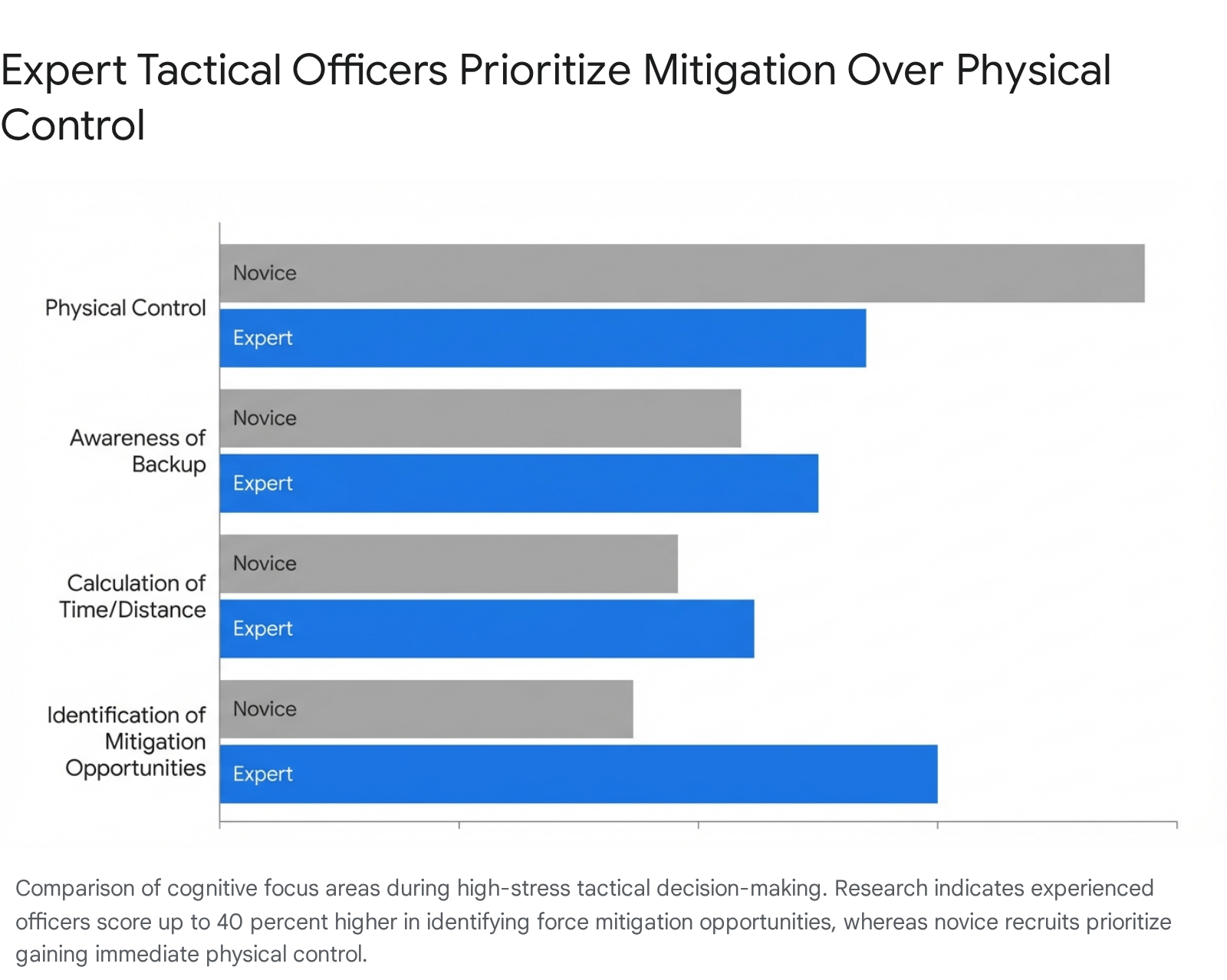
Conversely, experienced tactical instructors must evolve beyond the mechanics of physical skills to understand the underlying science of human performance, tactical doctrine, and unit leadership. Advanced instructors are required to navigate the complexities of human biomechanics, perception, and memory gaps through programs like the Force Science Analyst certification. Furthermore, they must adopt advanced decision-making frameworks and tactical science principles, utilizing tools like the “Exploding Squares” and “Five Whys” methodologies. Organizations such as the National Tactical Officers Association (NTOA) and the International Association of Law Enforcement Firearms Instructors (IALEFI) provide master-level development programs that focus on tactical leadership, high-stress coaching strategies, and the mitigation of institutional liability.

The return on investment for adhering to this comprehensive framework is substantial. Data demonstrates that advanced, scenario-based training methodologies significantly increase skill retention compared to traditional classroom lectures. Furthermore, agencies that invest in master-level instructor development experience measurable reductions in excessive force litigation, officer injuries, and citizen complaints. This report details the specific courses, rationales, and scientific principles that form the mandatory educational matrix for modern United States law enforcement tactical instructors.

Level of ExperienceCategory of InstructionInstruction
NoviceFoundational PedagogyLaw Enforcement Instructor Training Program (LEITP)
NoviceLegal & LiabilityUse of Force Instructor Training Program (UOFITP)
NoviceCore Tactical DeliveryBasic Firearms Instructor / Control Tactics Instructor
NoviceExperiential LearningReality-Based Training (RBT) / Scenario Instructor
NoviceUnit OperationsBasic SWAT / Tactical Team Operations
ExperiencedHuman PerformanceForce Science Analyst Certification
ExperiencedMaster Discipline MasteryMaster Instructor Development Program (MIDP)
ExperiencedAdvanced Weapons SystemsLess Lethal, FSDD, and Chemical Agent Instructor
ExperiencedTactical CommandSWAT Team Leader / Tactical Command Development
ExperiencedAnalytical LeadershipNTOA Command College (Tactical Leadership Module)

1. The Pedagogical Imperative: Transitioning from Operator to Instructor

The foundation of any effective law enforcement training program rests on the understanding that teaching is a distinct discipline from operating. A common fallacy within law enforcement agencies is the assumption that the most proficient marksman or the most physically capable defensive tactics practitioner will naturally be the best trainer. The analysis of modern training standards reveals that without a firm grounding in pedagogy and andragogy (adult learning principles), highly skilled operators often fail to transfer their knowledge effectively to recruits or peers. Instructors who rely solely on their operational experience frequently default to rote memorization and compliance-based instruction, which fails to prepare officers for the dynamic realities of a lethal encounter.

1.1 Adult Learning and Cognitive Load Theory

Adult learning within high-stress professions requires a departure from traditional, lecture-heavy pedagogical models. Novice instructors must be trained to recognize how the human brain processes, retains, and retrieves information under stress. Cognitive Load Theory (CLT) is central to this understanding. Research demonstrates that the working memory of a police officer is severely limited when processing complex, novel tasks, particularly in environments designed to simulate lethal threats.

If a novice instructor overloads a student with too many technical micro-corrections during a high-stress scenario, the student’s cognitive capacity is breached, resulting in a failure to encode the skill into long-term memory. Foundational instructor courses teach trainers to manage intrinsic cognitive load, which is the inherent difficulty of the task, and reduce extraneous cognitive load, which consists of distractions or poor instructional design. By managing these loads, the instructor allows the student to focus entirely on the germane load, which is the actual learning and schema formation necessary for survival in the field.

1.2 Foundational Instructor Development Curriculum

To bridge the gap between operator and educator, novice tactical trainers must complete a comprehensive general instructor course before they are permitted to teach specialized tactical subjects. Programs like the Federal Law Enforcement Training Centers (FLETC) Law Enforcement Instructor Training Program (LEITP) serve as the national standard for this critical transition. The LEITP is a rigorous program that focuses explicitly on the delivery of approved curriculum rather than the creation of new tactics.

The curriculum mandates that novice instructors master student-centered learning methodologies, presentation skills, and classroom management over the course of an intensive program. A critical component of this training is the implementation of the Student Centered Feedback Model, which trains the instructor to identify feedback errors and provide corrective guidance that empowers the student to self-diagnose mistakes. By requiring students to deliver progressively longer presentations of 15, 30, and 50 minutes using agency-approved lesson plans, these programs ensure that instructors can maintain fidelity to standardized training doctrines without injecting unauthorized, localized variations—often referred to as “training scars” or “range lore”. This standardization is a crucial first step in risk mitigation, ensuring that all officers within an agency receive uniform, legally defensible instruction.

2. Core Curricula for the Novice Tactical Instructor

Once the foundational pedagogical skills are established, the novice instructor must acquire subject-matter instructor certifications. These initial tactical classes focus heavily on the mechanical, legal, and safety aspects of core law enforcement duties, ensuring that the trainer can conduct safe exercises before moving on to advanced tactical problem-solving.

2.1 Use of Force and Legal Standards Instruction

Every tactical instructor must possess an encyclopedic understanding of use-of-force case law, as they are legally responsible for teaching officers when and how to deploy violence legitimately. The FLETC Use of Force Instructor Training Program (UOFITP) is specifically designed for professionals who train agents in these principles. Novice instructors cannot merely teach an officer how to shoot; they must inextricably link the physical action to the legal justification.

The rationale for this course is rooted deep in institutional liability and constitutional law. Instructors study the Fourth Amendment standard of objective reasonableness established by the Supreme Court in Graham v. Connor, which dictates that force must be judged through the lens of a reasonable officer on the scene, rather than with the 20/20 vision of hindsight. Novice instructors learn to design training laboratories that test environmental influences on de-escalation and decision-making, ensuring that the tactical skills taught are directly tethered to constitutional limits. Furthermore, a deep understanding of Title 42 United States Code Section 1983 liability is paramount, as plaintiffs frequently cite “failure to train” as a primary driver in civil litigation against municipalities.

2.2 Control Tactics and Defensive Maneuvers

Physical skills require specialized instructional methodology. The Law Enforcement Control Tactics Instructor Training Program (LECTITP) is a physically demanding course that prepares trainers to teach arrest techniques, intermediate weapon deployment, and defense against spontaneous attacks. Instructors learn how to teach gross motor skills, which are scientifically proven to be more reliable under stress than complex fine motor skills.

The curriculum in these foundational courses covers a broad spectrum of competencies, including baton control techniques, the deployment of Oleoresin Capsicum spray, and familiarization with electronic control devices. Instructors are taught how to safely manage physical efficiency batteries and implement injury prevention strategies during academy training, which is critical considering that over half of all academy injuries occur during physical training and defensive tactics sessions. Recent trends also emphasize ground survival and control-based grappling systems, which give officers safer alternatives to strikes and reduce both suspect injury and agency liability.

2.3 Fundamentals of Tactical Firearms Instruction

Initial firearms instructor courses, such as those recognized by state Peace Officer Standards and Training (POST) commissions, the International Association of Law Enforcement Firearms Instructors (IALEFI), or the National Rifle Association (NRA) Law Enforcement Division, focus heavily on the fundamentals of marksmanship and range safety protocols. IALEFI’s foundational 44-hour Firearms Instructor Course is an interactive program where students participate directly in course presentations under the mentorship of experienced trainers.

The primary rationale for the novice firearms instructor is ensuring absolute range safety and developing the ability to diagnose fundamental shooting errors in a static environment. Instructors learn to conduct safety checks, unpack liability through court case analyses, and build courses of fire that meet state qualification standards. At this stage, the instructor is mastering the mechanics of the weapon system—pistol, rifle, and shotgun—and the basic administration of the firing line, which must be flawless before any dynamic movement or stress can be introduced into the training environment.

3. Intermediate Curricula: Bridging Tactics and Reality

The most significant evolution in modern law enforcement training is the shift from static, flat-range drills to dynamic, scenario-based exercises. However, introducing stress and simulated weapons exponentially increases the risk of training injuries and fatalities. Novice instructors transitioning to intermediate roles must learn to facilitate these environments flawlessly.

3.1 Reality-Based Training (RBT) and Scenario Instruction

A Reality-Based Training (RBT) Instructor course is a mandatory requirement for any trainer conducting force-on-force exercises. These courses instruct the trainer on the physiology of high stress, the strict protocols for “sterile” training environments, and the methodology for scenario development. A sterile environment ensures that no live weapons enter the training space, a protocol that prevents tragic training accidents that have historically plagued law enforcement agencies.

Instructors learn that the purpose of RBT is not to defeat or fail the student, but to provide critical stress inoculation. Through repeated, controlled exposures to high-pressure training, officers develop neural pathways that allow them to process complex, ambiguous situations under time constraints. Furthermore, RBT instructors are taught specific debriefing techniques that allow officers to articulate their decision-making process, cementing the learning experience.

ROI of advanced tactical training: reductions in negative outcomes. Use of force incidents -28%, citizen injuries -26%, officer injuries -36%.

3.2 Basic SWAT and Tactical Team Operations

For instructors operating within specialized tactical units, attending a Basic SWAT course is an essential intermediate step. Programs endorsed by the National Tactical Officers Association (NTOA) offer a thorough introduction to tactical principles and their practical application. This standard 40-hour course meets the NTOA Tactical Response and Operations Standard (TROS) recommendation for Tier 1 through Tier 4 classification.

Instructors participating in these programs learn essential SWAT concepts, team organization, movement tactics at the individual and element levels, and warrant service planning. The program features numerous practical training scenarios aimed at developing foundational skills so that when the instructor returns to their agency, they have a comprehensive understanding of how individual tactical skills amalgamate into a cohesive team deployment. The training ensures that instructors are fluent in the common language and standardized practices utilized by tactical teams nationwide, facilitating seamless multi-jurisdictional operations.

4. Advanced Curricula for the Experienced Tactical Instructor

As an instructor transitions from a novice to an experienced trainer, their focus must shift from how to teach a physical tactic to why a human being performed a certain way during a lethal encounter. The integration of advanced human performance science, master-level discipline mastery, and tactical medicine is critical to developing training that acknowledges biological and environmental realities.

4.1 The Science of Human Performance

The Force Science Institute (FSI) offers an advanced certification course that is widely considered a cornerstone for experienced tactical instructors and use-of-force investigators. The curriculum bridges the gap between academic biomechanics, cognitive psychology, and the chaotic realities of a street encounter.

Experienced instructors attending this course study the physiological and perceptual factors that govern split-second decisions. A primary learning objective is the deep analysis of reaction times. Training reveals that the time it takes an officer to perceive a lethal threat, make a decision, and physically respond—known as perception-reaction time—is often slower than the time it takes a suspect to initiate an attack. Understanding this biological limitation explains why well-trained officers might shoot a suspect in the back; the suspect may have turned away in the fraction of a second between the officer’s decision to fire and the mechanical discharge of the weapon.

Advanced instructors utilize Force Science training to design curricula that account for phenomena such as perceptual distortions, auditory exclusion, tunnel vision, and memory gaps. During a high-stress event, the traumatized brain does not record information like a continuous video camera; it fragments. Instructors learn that discrepancies between an officer’s statement and objective body-worn camera video evidence are frequently the result of stress-induced memory failures rather than intentional deception. By understanding the autonomic responses linked to defensive actions, instructors can tailor reality-based scenarios to better regulate an officer’s psychophysiological response and prevent them from teaching tactics that are biomechanically impossible to execute during a sudden, violent ambush.

4.2 Master Instructor Development Programs

Experienced firearms instructors must move beyond the static firing line to master dynamic combat coaching. IALEFI provides the Master Instructor Development Program (MIDP), a premier continuing education course restricted to already-certified firearms instructors. The MIDP is not a basic shooting school; it is an intensive three-day clinic focused on advanced adult learning concepts and coaching strategies for natural action responses.

Experienced instructors are required to demonstrate proficiency across all three primary law enforcement weapon systems—handgun, shotgun, and semi-automatic rifle—under highly demanding physical conditions, often expending up to 800 rounds of ammunition over the course of the training. The curriculum forces instructors to progress from isolated concepts to practical skills, and finally to dynamic drills, teaching the gunfight mindset rather than simple target marksmanship.

Similarly, the FLETC Advanced Pistol Instructor Training Program (APITP) requires instructors to critically analyze traditional methodologies and adopt modern biomechanical concepts. Instructors are taught specific techniques such as the thumbs-forward grip, committed shot trigger control, and advanced movement protocols. These skills are designed to enhance the officer’s weapon control and ability to engage multiple targets while under extreme physiological stress, elevating the agency’s training program from basic survival to dominant tactical proficiency.

4.3 Tactical Medicine Integration (TECC/TCCC)

The modern tactical instructor must seamlessly integrate medical response into tactical operations. Law enforcement specialized tactical teams deploy to high-risk operations where officers, bystanders, and suspects are at a high risk for traumatic injury. Therefore, advanced instructors must be trained in Tactical Emergency Casualty Care (TECC) or Tactical Combat Casualty Care (TCCC).

Influenced by the Department of Defense model, these programs focus on saving preventable deaths while achieving three primary goals: Treat the Casualty, Prevent Additional Casualties, and Continue the Mission. Instructors learn to civilianize these military tenets, adhering to the Hartford Consensus, which insists upon basic tactical medical training for all law enforcement officers. Experienced tactical instructors incorporate medical skill sets—such as the application of tourniquets and hemostatic gauze during the “Care Under Fire” phase—directly into their firearms and room-clearing curricula. This ensures that officers do not view tactics and medicine as separate silos, but rather as an integrated continuum of survival.

5. Specialized and Less-Lethal Capabilities

As the spectrum of force expands and public scrutiny over police use of force intensifies, experienced instructors must master less-lethal and specialized munitions. Teaching these disciplines requires a nuanced understanding of technology, physics, and highly specific legal precedents.

Advanced Weapons SystemCore Curriculum FocusPrimary Instructor Responsibility
Less Lethal Impact Munitions12ga, 37mm, and 40mm deploymentTarget isolation, kinetic energy calculation, liability
Flash Sound Diversionary DevicesOverpressure, blast radii, ignition risksSafe preparation, environmental assessment, legal limits
Chemical AgentsCS, CN, OC, and Smoke characteristicsDelivery systems, area denial, hazard decontamination

The NTOA offers master-level, train-the-trainer certifications in Less Lethal Impact Projectiles, Flash Sound Diversionary Devices (FSDD), and Chemical Agents. These intensive five-day courses cover complex deployment tactics, strict policy issues, hazard mitigation, and the physiological effects of chemical munitions on the human body.

For example, a tactical instructor teaching FSDD deployment must understand the exact blast radii, the risk of secondary fires in a structure, and the severe legal implications of utilizing diversionary devices in confined spaces occupied by non-combatants. In crowd control or barricaded suspect scenarios, the improper use of less-lethal force can be as legally devastating as lethal force, necessitating an instructor who thoroughly understands both the technological capabilities and the stringent, court-tested deployment criteria. The instructor must translate these complex technical specifications into easily understandable operational policies for the officers on the line.

6. Tactical Science, Analytical Thinking, and Command Leadership

The apex of a tactical instructor’s educational journey transitions away from the physical execution of tactics entirely, focusing instead on leadership, unit culture, analytical problem solving, and strategic management. The actions of a tactical team are invariably a reflection of the team’s leadership and the culture cultivated by its instructors.

6.1 Sound Doctrine and Tactical Principles

Pioneered heavily by military and law enforcement strategist Sid Heal, the concept of Tactical Science treats tactics not merely as a set of physical skills, but as an intuitive application of fundamental, time-tested principles. Advanced tactical instructors study texts like Sound Doctrine: A Tactical Primer, which distills centuries of military strategy into concepts directly applicable to modern law enforcement crises. Instructors learn to identify the “center of gravity” in a critical incident—the focal point of a suspect’s power or advantage—and train their officers on how to systematically dismantle it.

The curriculum also relies heavily on understanding the OODA Loop (Observe, Orient, Decide, Act) and how it dictates movement and reaction in a crisis. By teaching officers how to disrupt a suspect’s OODA loop through surprise, speed, and violence of action, instructors elevate the intellectual capacity of the tactical team.

6.2 Analytical Problem Solving: “Exploding Squares” and “Five Whys”

To teach advanced problem-solving and operational planning, expert tactical instructors employ specific analytical tools. The “Exploding Squares” technique, also known as the Lotus Blossom Technique, is a structured brainstorming model used by commanders to develop exhaustive tactical alternatives.

In a barricaded suspect scenario, for example, the instructor places the core problem—the barricade—in the center of a grid. The surrounding squares are populated with primary strategic options, such as Negotiations, Chemical Agents, Entry, and Anxiety Manipulation. The process then “explodes” outward; if “Entry” is selected, it becomes the center of a new grid, prompting sub-tactics like Explosive Breach, Covert Entry, or Limited Penetration. This methodical expansion prevents tactical tunnel vision and ensures teams train for the broadest possible spectrum of options before an incident occurs.

Exploding Squares tactical planning framework diagram showing strategic options.

Similarly, the “Five Whys” is an iterative root-cause analysis technique used extensively during post-scenario debriefs. By repeatedly asking “Why?” after a tactical failure in a training environment, instructors bypass superficial symptoms to uncover systemic root causes. For instance, if an officer misses a critical shot, the instructor asks why, potentially discovering that the root cause was visual narrowing due to artificial time compression imposed by poorly designed scenario parameters, rather than a failure of marksmanship.

6.3 NTOA Command College and Tactical Leadership

The NTOA Sid Heal Tactical Command College is the premier certification pathway for SWAT team leaders and tactical commanders. This rigorous program utilizes a blended learning environment to expose commanders to the theoretical, ethical, and organizational elements of specialized law enforcement.

The curriculum is heavily invested in tactical leadership, requiring 186 hours of intensive coursework. Modules cover the psychological aspects of leadership, practical emotional intelligence, and managing the Corruption Continuum—the gradual erosion of ethical standards within high-stress units if left unchecked by leadership. The coursework explicitly differentiates between the concepts of management, which involves coordinating resources and schedules, and leadership, which focuses on influencing behavior and motivating personnel to act in life-threatening environments.

Advanced tactical leadership training borrows heavily from military history and corporate management models. The NTOA Command College curriculum requires students to analyze the leadership styles of historical figures and modern military commanders to derive lessons applicable to law enforcement. The curriculum incorporates studies on Lincoln on Leadership to understand executive strategies during severe crises, and It’s Your Ship by former Navy Captain D. Michael Abrashoff. Abrashoff’s methodology, which transformed the worst-performing ship in the Pacific Fleet into the best, emphasizes building self-esteem and ownership among subordinates rather than relying on drill-sergeant bullying. Tactical instructors apply these case studies to foster a culture of trust and decentralized decision-making within their units, ensuring that operators can think critically and act independently during rapidly evolving deployments.

7. The Return on Investment (ROI) and Liability Mitigation

A law enforcement agency’s investment in both novice and advanced tactical instructor development requires substantial financial and temporal resources. However, the empirical data and legal precedents unequivocally demonstrate that the Return on Investment (ROI) is realized through the drastic reduction of organizational liability, officer injuries, and costly litigation.

7.1 Statistical Reductions in Litigation and Use of Force

Law enforcement is an exceptionally high-liability profession. Historical data reveals that a disproportionate amount of civil litigation and excessive force complaints are generated by a small fraction of poorly trained or improperly supervised officers. When tactical instructors are appropriately certified to deliver modern, scenario-based, and force-science-informed training, the outcomes are quantifiably improved.

For example, studies analyzing the implementation of advanced de-escalation and tactical integration programs—such as the ICAT (Integrating Communications, Assessment, and Tactics) model—demonstrate profound impacts. Rigorous research indicates that agencies employing these advanced training matrices experience a 28 percent reduction in use-of-force incidents, a 26 percent decrease in citizen injuries, and a remarkable 36 percent reduction in officer injuries. These statistics provide a clear, empirical justification for the time and budget allocated to advanced instructor certification.

ROI of tactical training: Reductions in use of force (-28%), citizen injuries (-26%), and officer injuries (-36%).

Furthermore, integrating disciplines such as control-based defensive tactics into standard training paradigms has shown comparable efficacy. Real-world data indicates that shifting from traditional compliance-strike models to control-focused models results in notable reductions in Taser deployments, excessive force complaints, and municipal payouts. Given that civil settlements regarding police liability can cost major municipalities hundreds of millions of dollars over a decade, the preventative fiscal value of an elite instructional cadre cannot be overstated.

7.2 Insurance Standardization and National Accreditation

The proficiency of an agency’s tactical instructors directly influences its insurability. Municipal risk pools and private liability insurers increasingly act as indirect regulators of police training. Insurers heavily subsidize and incentivize advanced training, recognizing that dynamic, reality-based training decreases the likelihood of unjustified shootings.

Agencies that employ highly certified instructors and maintain adherence to national standards—such as the NTOA Tactical Response and Operations Standard (TROS) or the International Association of Directors of Law Enforcement Standards and Training (IADLEST) National Certification Program—frequently qualify for reductions in their law enforcement liability premiums. IADLEST establishes stringent, evidence-based rubrics for instructor certification, requiring verified continuing education and peer endorsements to maintain active status. The alignment of agency training with objectively measurable, internationally recognized standards ensures that when an officer’s actions are challenged in federal court, the agency can definitively prove that the officer was trained utilizing the most advanced, scientifically valid methodologies available in the profession.

8. Conclusion

The operational environment of modern law enforcement is profoundly unforgiving. The margin for error during a critical incident is measured in fractions of a second, and the consequences of failure reverberate through the legal system, the community, and the lives of the officers involved. To navigate this landscape, the law enforcement tactical instructor cannot simply be a senior operator passing down anecdotal experience. They must be developed through a formalized, scientifically rigorous continuum.

Novice instructors must build a bedrock of adult learning theory, strict legal comprehension, and reality-based training safety protocols. Without this foundation, the transmission of tactical skills is flawed and potentially disastrous. As instructors mature, they must transcend mechanical proficiency to master Force Science, tactical doctrine, and unit leadership. By progressing through master-level certifications and command colleges, experienced instructors learn to manipulate cognitive load, execute strategic analytical planning, and forge resilient, highly capable tactical teams. Ultimately, an agency’s commitment to this extensive instructor development matrix is not merely an administrative checkbox; it is the most effective proactive measure an organization can take to ensure constitutional policing, preserve human life, and mitigate catastrophic liability.

9. Appendix: Master Data Table of Tactical Instructor Training Providers

The following table categorizes the leading training providers in the United States according to the specific educational tier and discipline required for tactical instructors.

Category of InstructionLeading Training ProviderCourse NameSynopsisLocationWebsite URL
Foundational PedagogyFLETCLaw Enforcement Instructor Training Program (LEITP) 1Provides foundational instructional skills with a focus on adult learning, presentation skills, and the delivery of approved agency curricula.Glynco, GA / Artesia, NMhttps://www.fletc.gov/law-enforcement-instructor-training-program
Foundational PedagogyTEEXBasic Instructor Development 2Introduces fundamental adult learning theory, lesson plan development, and classroom management techniques for law enforcement.Face-to-Face (Various)https://teex.org/certificate-programs/master-law-enforcement-instructor/
Legal & LiabilityFLETCUse of Force Instructor Training Program (UOFITP) 3Focuses on constitutional standards (Graham v. Connor), legal liability, and designing reality-based use of force scenarios.Glynco, GA / Cheltenham, MDhttps://www.fletc.gov/use-force-instructor-training-program
Human PerformanceForce Science InstituteForce Science Certification / Force Encounters Analysis 4A deep dive into the physiological and psychological phenomena (reaction times, memory gaps) affecting officers during deadly force encounters.Various / Nationwidehttps://events.forcescience.com/
Core Tactics (Control)FLETCLaw Enforcement Control Tactics Instructor (LECTITP) 5Physically demanding program preparing instructors to teach gross motor control tactics, intermediate weapons, and defense against attacks.Glynco, GA / Artesia, NMhttps://www.fletc.gov/law-enforcement-control-tactics-instructor-training-program
Core Tactics (Firearms)IALEFIFirearms Instructor Course 644-hour foundational course certifying instructors in range safety, marksmanship diagnosis, and liability management.Various / Nationwidehttps://www.ialefi.com/training-course-calendar/
Experiential LearningALERRTLevel 1 Active Shooter Instructor (Train-the-Trainer)Prepares instructors to safely design, implement, and evaluate dynamic force-on-force active shooter response scenarios.San Marcos, TX / Varioushttps://alerrt.org/courses/view/28120
Experiential LearningTEEXReality Based Training InstructorTeaches trainers how to safely design, implement, and evaluate high-stress, scenario-based training within their home agencies.Face-to-Face (Various)https://teex.org/class/let705/
Unit OperationsNTOABasic SWAT 740-hour introductory course focusing on tactical team movement, operational planning, and the safe execution of high-risk warrants.Various / Nationwidehttps://public.ntoa.org/default.asp?action=courseview&titleid=72
Master DisciplineIALEFIMaster Instructor Development Program (MIDP) 8Advanced continuing education for certified instructors focusing on coaching strategies, gunfight mindset, and complex live-fire drills.Various / Nationwidehttps://www.ialefi.com/training-course-calendar/master-instructor-development-program/
Master DisciplineSIG SAUER AcademyAdvanced Pistol Instructor 9A 2-day advanced course focusing on high-level shooting bio-mechanics and sophisticated instructional development.Epping, NHhttps://sigsaueracademy.com/armed-professional
Tactical MedicineFLETCBasic Tactical Medical Instructor Training Program (BTMITP) 10Equips instructors to teach civilianized Tactical Combat Casualty Care (TCCC) and Care Under Fire techniques to patrol officers.Glynco, GA / Artesia, NMhttps://www.fletc.gov/basic-tactical-medical-instructor-training-program
Tactical MedicineSTORM Training GroupTrauma Med InstructorAdvanced course developed by Special Forces medics preparing officers to teach critical hemorrhage control and airway management.Various / Minnesotahttps://stormtraininggroup.com/courses-offered/trauma-med-instructor/
Advanced WeaponsNTOALess Lethal, FSDD, Chemical Agent Instructor Certification 11A comprehensive 5-day course on the legal limits, tactical deployment, and safe instruction of impact and chemical munitions.Various / Nationwidehttps://public.ntoa.org/default.asp?action=courseview&titleid=173
Advanced WeaponsDefense Technology4-Day Less Lethal ICP Instructor Program 12Extensive curriculum covering OC Aerosols, Impact Munitions, and Chemical Agents instruction and legal considerations.Various / Nationwidehttps://defense-technology.policeoneacademy.com/
Tactical CommandNTOASWAT Team Leader Development 13Focuses on risk mitigation, legal liability, personnel management, and operational decision-making for high-risk operations.Various / Nationwidehttps://public.ntoa.org/default.asp?action=courseview&titleid=231
Tactical CommandNTOASWAT Command Decision-Making and Leadership I 15Explores contemporary SWAT issues, practical emotional intelligence, critical thinking, and the psychology of team leadership.Various / Onlinehttps://public.ntoa.org/default.asp?action=courseview&titleid=314

Please share the link on Facebook, Forums, with colleagues, etc. Your support is much appreciated and if you have any feedback, please email us in**@*********ps.com. If you’d like to request a report or order a reprint, please click here for the corresponding page to open in new tab.


Sources Used

  1. Law Enforcement Instructor Training Program, accessed February 22, 2026, https://www.fletc.gov/law-enforcement-instructor-training-program
  2. Master Law Enforcement Instructor – TEEX.ORG, accessed February 22, 2026, https://teex.org/certificate-programs/master-law-enforcement-instructor/
  3. Use of Force Instructor Training Program – Federal Law Enforcement Training Centers, accessed February 22, 2026, https://www.fletc.gov/use-force-instructor-training-program
  4. Force Encounters Analysis – Human Performance Training and Consulting Inc, accessed February 22, 2026, https://www.hptc-pro.com/services/force-encounters-analysis/
  5. Law Enforcement Control Tactics Instructor Training Program, accessed February 22, 2026, https://www.fletc.gov/law-enforcement-control-tactics-instructor-training-program
  6. Firearms Instructor Course – IALEFI, accessed February 22, 2026, https://www.ialefi.com/training-course-calendar/firearms-instructor-course-2/
  7. Basic SWAT – National Tactical Officers Association – NTOA Publications, accessed February 22, 2026, https://public.ntoa.org/default.asp?action=courseview&titleid=72
  8. Master Instructor Development Program – IALEFI, accessed February 22, 2026, https://www.ialefi.com/training-course-calendar/master-instructor-development-program/
  9. Armed Professional – SIG SAUER Academy, accessed February 22, 2026, https://sigsaueracademy.com/armed-professional
  10. Basic Tactical Medical Instructor Training Program, accessed February 22, 2026, https://www.fletc.gov/basic-tactical-medical-instructor-training-program
  11. National Tactical Officers Association – NTOA Training Courses, accessed February 22, 2026, https://public.ntoa.org/default.asp?action=courseview&titleid=173
  12. Welcome to Defense Technology® Training Academy, accessed February 22, 2026, https://defense-technology.policeoneacademy.com/
  13. SWAT TEAM LEADER DEVELOPMENT COURSE OVERVIEW AND …, accessed February 22, 2026, http://public.ntoa.org/AppResources/CourseDetails/231.pdf
  14. National Tactical Officers Association – NTOA Training Courses, accessed February 22, 2026, https://public.ntoa.org/default.asp?action=courseview&titleid=231
  15. NTOA Training Courses – National Tactical Officers Association, accessed February 22, 2026, https://training.ntoa.org/
  16. National Tactical Officers Association – NTOA Training Courses, accessed February 22, 2026, https://public.ntoa.org/default.asp?action=courseview&titleid=314

Critical Tactical Training for SWAT Officers

Executive Summary

The modern landscape of critical law enforcement incidents—ranging from coordinated terrorist attacks and active shooters to fortified barricaded subjects, hostage crises, and high-risk warrant executions—demands a specialized, highly structured, and continuously evolving tactical response capability. Standard law enforcement academy training, which averages roughly 833 hours of baseline instruction 1, is fundamentally insufficient for the extreme physiological, psychological, and environmental stressors encountered during critical tactical incidents. Consequently, the development of a Special Weapons and Tactics (SWAT) operator requires a rigorous, phased educational curriculum that systematically bridges the gap between basic patrol competency and advanced tactical mastery. The failure to properly train, equip, and deploy these specialized personnel not only severely compromises public safety but also invites catastrophic legal liability and a profound loss of community trust.2

This report provides an exhaustive, nationally applicable analysis of the critical training classes required for United States law enforcement tactical officers. By synthesizing national standards established by the National Tactical Officers Association (NTOA), the Federal Law Enforcement Training Centers (FLETC), and the Federal Bureau of Investigation (FBI), this document identifies the core educational requirements necessary to build and sustain a highly reliable tactical unit. Crucially, the analysis differentiates between the developmental needs of novice tactical officers and experienced operators, recognizing that pedagogical approaches must evolve in tandem with an operator’s cognitive and operational maturation.

Novice tactical officers require training designed to build fundamental motor schemas and foundational tactical geometry. Their curriculum must focus intensely on basic team movement, firearms proficiency under stress, and survival mechanics to lower their baseline cognitive load during high-stress encounters.3 Novices, who naturally default to attempting physical control during crises, must be trained through stress inoculation to broaden their situational awareness.4 Conversely, experienced tactical officers, having automated these basic functions, must pivot toward highly specialized, low-frequency but high-risk disciplines. These include hostage rescue, explosive breaching, precision rifle operations, and technical electronic surveillance.5 Furthermore, experienced personnel must eventually transition into leadership roles, necessitating advanced coursework in strategic decision-making frameworks, risk mitigation, and liability management.9

Ultimately, tactical proficiency is highly perishable. Without sustained, dynamic training encompassing both rigorous physical conditioning and cognitive stress-testing, an operator’s ability to safely resolve critical incidents decays rapidly.2 A nationally standardized, experience-stratified training matrix is the only defensible method for maintaining operational readiness, ensuring constitutional policing, and safeguarding human life in the most dangerous law enforcement environments.

Tactical Instruction Summary Matrix

Level of ExperienceCategory of InstructionCore Instruction Required
NoviceFoundational TacticsBasic SWAT School (40-Hour Minimum)
NoviceWeaponry & MovementClose Quarters Battle (CQB) and Structural Clearing
NoviceMedical SupportTactical Medical for First Responders (TECC/TCCC)
NoviceCognitive DevelopmentScenario-Based Stress and Mitigation Training (e.g., ShadowBox)
NoviceFoundational FitnessBase Stamina and Progression Pyramid Integration
ExperiencedAdvanced OperationsHostage Rescue and Advanced CQB
ExperiencedAccess & InterventionExplosive and Advanced Mechanical Breaching
ExperiencedPrecision AccuracyAdvanced Sniper / Precision Rifle Operations
ExperiencedTechnical OperationsTechnical Surveillance (ELSUR) and UAS Operations
ExperiencedLeadership & CommandSWAT Team Leader Development & Command Seminars
ExperiencedStrategic AnalysisP.I.E.T.O. / PIET3O Tactical Decision-Making Models

1. The Philosophy and Imperative of Stratified Tactical Training

The deployment of a law enforcement tactical team represents the highest escalation of domestic police power short of federal military intervention. Because these units are tasked with resolving incidents that exceed the capabilities of traditional first responders, the individuals comprising these teams must possess a level of physical capability, technical proficiency, and psychological resilience far beyond the baseline law enforcement standard. The decision to form, equip, and deploy a SWAT team carries with it an immense constitutional and ethical responsibility to provide ongoing, specialized training.11

1.1. The Evolution of Tactical Standards and Capability Tiers

Special Weapons and Tactics teams first appeared in American policing in the late 1960s. High-profile incidents, such as the murderous sniper attack from the University of Texas tower by Charles Whitman, demonstrated that a single violent episode could easily outstrip the capacity of standard law enforcement tactics, weapons, and officers.12 In the subsequent decades, tactical teams have grown exponentially in number, sophistication, and deployment frequency. Today, the vast majority of police agencies serving populations over 50,000 possess some form of tactical team, resulting in tens of thousands of SWAT deployments nationwide annually.12

Despite this proliferation, prior research has demonstrated that SWAT approaches, staffing levels, compositions, policies, and training fluctuate noticeably across the more than 17,000 state, local, and tribal law enforcement agencies in the United States.13 To mitigate this dangerous inconsistency, the National Tactical Officers Association (NTOA) developed the Tactical Response and Operations Standard (TROS). This living document establishes a core set of concepts, principles, and policies designed to standardize and enhance the delivery of tactical law enforcement services.14

The NTOA categorizes tactical teams into distinct Tiers (Tier 1 through Tier 4) based on their mission capability profile.16 To be classified as a true SWAT Team under these standards (Tier 1 or Tier 2), an agency must meet all minimum capabilities associated with that tier.17 To maintain this operational readiness, the NTOA strictly mandates continuing education. It is recommended that full-time teams conduct a minimum of 40 hours of training per month (480 hours annually), while collateral-duty (part-time) teams must conduct a minimum of 16 hours per month (192 hours annually).11 This training must be regular, reoccurring, and specifically based on the critical skills associated with the team’s defined mission capabilities.14

1.2. The Cognitive Divide: Novice Versus Expert Processing

A critical vulnerability in law enforcement tactical training is the failure to properly differentiate between the pedagogical needs of a newly assigned, novice operator and a seasoned, experienced veteran. Merely placing a novice officer in an advanced training class alongside tenured operators often results in negative training outcomes, a phenomenon known in instructional design as the expertise reversal effect.18 Instructional methods that work well for experts who have already acquired a certain level of mastery can actually inhibit learning for novices who lack the foundational mental architecture to process the information.18

Research into human performance under extreme stress indicates that novices and experts process high-threat environments fundamentally differently. When circumstances present a threatening situation that is entirely new, an average individual lacks sufficient pre-programmed responses to react effectively.19 As shown by human factors research, police experts possess the ability to sum up several discrete observations into larger entities—a process called “chunking”—that encompasses both situational awareness and tactical elements.20 Novices, lacking these established mental models for complex tactical scenarios, often suffer from rapid cognitive overload.21

A landmark sociological study conducted by researchers at the University of California-Berkeley specifically examined expert versus novice use-of-force decision-making. The research revealed that novice police recruits, when placed in dynamic, high-stress scenarios, overwhelmingly focused on establishing immediate “physical control” of a subject, often at the expense of other critical, non-force considerations.4 Their lack of experience created a cognitive tunnel, where the immediate physical neutralization of the perceived threat consumed all available mental resources.

Conversely, experienced officers were significantly more likely to emphasize force mitigation. On average, experts scored between 13 percent and 40 percent higher than their novice counterparts in noting the importance of mitigation opportunities.4 Because experts have automated basic motor functions and threat recognition patterns, they retain the cognitive bandwidth to analyze external variables. They demonstrated a far greater awareness of opportunities for backup and showed a heightened consciousness of time and distance as relevant factors in resolving confrontations.4

Comparison of expert vs novice tactical officer decision making focus areas.

Therefore, a tactical training curriculum must be inherently stratified. It must first build the foundational motor schemas and basic tactical geometry for the novice, automating survival skills so the officer can begin to see the wider battlefield. Subsequently, the curriculum must challenge the experienced operator with complex, multi-variable problem-solving, advanced specialized technical skills, and command-level strategic decision-making.

2. Foundational Training: The Novice Tactical Officer

The transition from a standard patrol officer to a tactical operator requires a complete paradigm shift in operational philosophy. Standard patrol training, which averages roughly 833 hours nationwide, often balances stress (paramilitary) and non-stress (academic) environments, but ultimately focuses heavily on individual or two-officer problem-solving, report writing, and basic defensive tactics.1 Tactical operations, conversely, require the individual to subordinate their independent action to the highly coordinated, synchronized movement of an assault element or team. The novice tactical officer must undergo intensive foundational training to safely integrate into this highly structured environment.

2.1. Basic SWAT Certification and Core Tactical Competencies

The absolute baseline requirement for any law enforcement officer joining a tactical unit is the successful completion of a standardized Basic SWAT course. The NTOA and other national accrediting bodies establish a minimum 40-hour introductory course as the industry best-practice standard for new tactical team members.11 It is critical to note that the successful completion of this introductory course is not meant to be all-encompassing and does not suggest that the operator is fully competent or ready for autonomous deployment.11 Rather, it establishes a safe baseline of knowledge so the novice can participate in continuous team-level training without posing a catastrophic danger to themselves or their colleagues. Basic SWAT courses must invariably be followed by a formal, competencies-based field training program supervised by a senior SWAT trainer.11

Basic tactical training at premier institutions like the Federal Law Enforcement Training Centers (FLETC)—which offers the Basic Tactics Instructor Training Program (BTITP)—focuses on critical, life-saving fundamentals.3 The syllabus invariably begins with advanced weapons handling.3 Novices must learn to transition from traditional, static line marksmanship to dynamic combat marksmanship. This requires engaging targets while moving continuously, utilizing structural cover effectively, and operating firearms in extreme close proximity to other team members without violating safety principles.

The concept of 360-degree security is immediately introduced.3 This demands that the novice break the ingrained patrol habit of hyper-focusing solely on a single forward threat. Instead, they must learn to maintain overlapping, interlocking sectors of fire within a tactical formation, ensuring that the team is protected from all possible angles of attack.

Furthermore, novices must master the strict physical geometry of Close Quarters Battle (CQB). This includes the mathematical and physical principles of cornering, door entries, hallway navigation, and single-to-multiple room clearing methodologies.3 The instruction emphasizes techniques such as “slicing the pie” (angular search techniques), which are designed to maximize the officer’s visual control of an uncleared space while simultaneously minimizing their physical exposure to potential hostile fire. Through hundreds of repetitions in simulated environments, these geometric movements must transition from conscious, deliberate calculations to subconscious, automated motor reflexes. Until these basic movements are fully automated, the novice operator will simply not have the cognitive capacity to process suspect behavior, understand complex rules of engagement, or participate safely in an actual deployment.

2.2. Cognitive Framing, Stress Inoculation, and Decision-Making

Because tactical training is not purely physical, the psychological conditioning of the novice is of paramount importance. Modern research into law enforcement human performance demonstrates that under extreme, life-threatening stress, profound physiological and psychological changes occur. Within the average perception-reaction time of an officer deciding to shoot or stop shooting, the human body experiences a massive adrenaline dump.22 Officers will have to account for perceptual distortions such as diminished or intensified sound (auditory exclusion), tunnel vision, time misperception, temporary paralysis, memory loss, and dissociation.23

When a novice encounters a novel, threatening situation, they lack the pre-programmed mental responses required to react efficiently.19 As the aforementioned Berkeley study demonstrated, this leads to a dangerous over-reliance on immediate physical control at the expense of verbal de-escalation, the use of cover, or the coordination of backup.4 In fact, when analyzing the narratives of recruits during simulated scenarios, the critical word “cover” was mentioned far less frequently by experienced officers (76 times) compared to recruits (115 times), indicating that novices were highly preoccupied with basic survival concepts that experts had already internalized and moved past.4

Therefore, essential training for novices must include scenario-based cognitive stress-inoculation. Innovative programs, such as ShadowBox training (certified by the California Commission on Peace Officer Standards and Training), expose novices to situations specifically characterized by ambiguity, uncertainty, unpredictability, changeability, time-pressure, and competing goals.24 These classes use interactive, real-life incidents guided by experienced officers to artificially expand the novice’s situational awareness.

Novices are trained to look beyond the immediate weapon or the suspect’s hands. They are explicitly taught to seek out what experts naturally perceive: opportunities for force mitigation, the strategic positioning of secondary units, and the utilization of time and distance to de-escalate potential violence.4 By explicitly teaching these expert-level cognitive markers in a controlled, low-consequence training environment, instructors can significantly accelerate the novice’s progression from a purely reactive, fear-driven force instrument to a thoughtful, analytical, and highly controlled tactical operator.

2.3. Tactical Medical First Response

The operational reality of SWAT deployments dictates a high probability of encountering severe, life-threatening trauma, either sustained by hostages, innocent bystanders, suspects, or the officers themselves. In active shooter or barricaded suspect scenarios, traditional Emergency Medical Services (EMS) personnel and paramedics are mandated to stage in “cold zones,” far away from the immediate threat. This means that tactical officers must be the primary, and often only, medical providers during the critical first minutes of a mass casualty event or a close-quarters firefight.

Consequently, every novice tactical officer must undergo comprehensive Tactical Medical for First Responders (TMFR), Tactical Emergency Casualty Care (TECC), or Basic Tactical Medical Instructor Training Program (BTMITP) coursework.25 This curriculum departs radically from civilian first aid or standard CPR training. It operates under the fundamental premise that the best initial medicine in a firefight is overwhelming fire superiority.

Officers are taught to differentiate clearly between “Care Under Fire” and “Tactical Field Care.” During Care Under Fire, when the team is actively taking contact, the only acceptable medical intervention is the rapid application of a high-and-tight arterial tourniquet to stop massive extremity hemorrhage; no airway management or other care is attempted until the threat is neutralized or suppressed. Once the threat is isolated and the environment transitions to Tactical Field Care, operators are trained in massive hemorrhage control, advanced airway management, wound packing with hemostatic agents, and tension pneumothorax decompression. The integration of this medical intervention directly into kinetic room clearing drills ensures that the novice understands how to transition seamlessly between the conflicting roles of warfighter and lifesaver without ever compromising the 360-degree security of the operational element.17

3. Advanced Skill Acquisition: The Experienced Tactical Officer

Once an operator has spent years on a team, fully automating the fundamental physical skills of moving, shooting, and communicating within an assault element, they formally transition from a novice to an experienced operator. At this stage, standard room clearing, perimeter containment, and basic high-risk warrant service become routine functions requiring minimal cognitive strain. Therefore, the training burden for experienced officers shifts dramatically toward highly specialized, technically demanding disciplines. These advanced roles require deep analytical capabilities, cross-disciplinary integration, independent action, and the management of extreme physical and legal risk.

3.1. Hostage Rescue and Advanced Close-Quarters Battle (CQB)

The absolute pinnacle of tactical law enforcement operations is Hostage Rescue (HR). While standard high-risk warrant service relies heavily on the elements of surprise, speed, and overwhelming violence of action to disorient and secure a suspect, a hostage rescue introduces innocent life directly into the immediate threat matrix. An HR scenario cannot simply be treated as a faster standard entry; the tactics are fundamentally different, and the margin for error is effectively zero.27

Experienced officers must undertake intensive HR coursework to understand the extreme nuances and unique pressures of this mission profile.6 Training at this level emphasizes the core considerations of Safety, Information, and Time (SIT).6 Operators learn the critical distinction between a barricade and a hostage situation. While a barricaded suspect holding only themselves at bay can be waited out indefinitely using chemical agents and negotiation, a hostage situation may necessitate an immediate, highly dynamic, and potentially perilous entry if intelligence indicates the suspect has begun, or is about to begin, executing captives.27

Advanced HR training, modeled heavily after the FBI’s Hostage Rescue Team (HRT) parameters, focuses intensely on “stealth to contact”.6 Unlike a standard warrant service where police may announce their presence at the exterior door with a ram, HR operators are trained in silent movement, specialized camouflage, and the use of covert entry techniques to infiltrate a stronghold entirely undetected.6 The objective is to position the assault element as physically close to the hostage-taker as possible before the decisive breach occurs, minimizing the time the suspect has to react.

Furthermore, live-fire CQB exercises in specialized, rubber-coated “shooting houses” are utilized to train experienced operators in surgical target discrimination.29 Operators must practice engaging hostile targets with precision fire while innocent role-players or hostage targets are in immediate physical proximity to the threat. This develops the ultimate synthesis of trigger control, rapid target identification, and unwavering psychological composure under extreme time compression and chaotic stimuli.29 Operators at this level are also trained in transitional tactics, vehicle takedowns, and operating under Night Vision Goggles (NVGs) in completely blacked-out environments.11

3.2. Explosive and Advanced Mechanical Breaching

To execute a successful entry, tactical teams must overcome heavily fortified physical barriers. While novices are taught basic mechanical breaching (utilizing battering rams, pry bars, and halligan tools), experienced officers—who are specifically selected and designated as breachers—must master the complex science of explosive breaching.5

Explosive breaching is not merely the reckless destruction of a door or wall; it is a highly calculated, legally scrutinized tactical option designed to safely defeat barricades while achieving instantaneous “shock action”.5 This shock action profoundly disorients the occupants through overpressure and acoustic disruption, thereby protecting the lives of the entering assaulters and any hostages within by delaying the suspect’s ability to return fire.5

The curriculum for explosive breaching is exhaustive, technically rigorous, and heavily mathematical. Operators must learn to calculate Net Explosive Weight (NEW), understand the exact physical properties and burn rates of varying explosive materials (such as detonation cord, C4, sheet explosives, and water impulse charges), and compute precise safe stand-off calculations.5 These calculations are vital to prevent catastrophic structural collapse, secondary fire hazards, or severe traumatic injury to the officers stacking immediately behind the charge.5

Explosive breaching protocols demand strict intelligence gathering, continuous scouting, and detailed target analysis.31 The explosive breacher must calculate and construct the charge on-site to use the absolute minimal amount of explosive necessary to defeat the specific locking mechanism or hinges, while minimizing deadly fragmentation and collateral damage both inside and outside the target location.33 This specialized class essentially transforms an experienced tactical operator into a combat engineer and tactical physicist, capable of utilizing highly regulated industrial explosive tools to safely dictate the physical environment of the operation.

3.3. Precision Rifle and Sniper Operations

The role of the SWAT sniper, or precision rifleman, requires an extraordinary synthesis of elite marksmanship, advanced intelligence gathering, and extreme psychological patience. This is explicitly not a role for a novice; it is strictly reserved for highly experienced personnel who possess the maturity, discipline, and independence to operate entirely detached from the main assault element, often observing a target through a scope for hours or even days without relief or movement.

The training standards for law enforcement snipers are rigorously quantified to mitigate severe civil liability and ensure absolute public safety.7 National and state standards, such as those overseen by the Commission on Law Enforcement Standards and Training (CLEST), mandate that precision riflemen maintain sub-Minute of Angle (MOA) accuracy. One MOA equates to a rifle’s ability to repeatedly strike an intended target with a one-inch grouping at a distance of 100 yards from a rested position.7 In a critical hostage scenario, if a sniper is legally authorized by command to take a shot, they are generally targeting the suspect’s medulla oblongata (the brain stem) to instantly sever the central nervous system. This specific anatomical targeting prevents any involuntary reflex action or muscular flinch that could cause the suspect to fire their weapon into the hostage. Missing a target of this minuscule size by even a fraction of an inch results in a catastrophic mission failure and the loss of innocent life.

Advanced sniper courses focus heavily on positional shooting, timed engagements, and the mastery of complex environmental variables (wind drift, barometric pressure, bullet drop compensation). Operators must shoot highly complex qualification courses of fire, often requiring multiple rapid engagements at varying distances (e.g., 25, 50, 75, and 100 yards) under strict, stress-inducing time limits. For instance, an operator may be required to fire 10 precision rounds from alternating prone, kneeling, and improvised positions in under 4 minutes, with target scoring areas not exceeding 7.5 square inches.7

Beyond kinetic engagement, sniper training heavily emphasizes intelligence gathering, technical reporting, and overwatch capabilities. The sniper serves as the primary eyes and ears of the Tactical Commander, providing continuous, real-time telemetry on target movements, structural layouts, fortification efforts, and the disposition of hostages.

3.4. Technical Surveillance (ELSUR) and Unmanned Aircraft Systems (UAS)

Modern tactical operations are increasingly intelligence-led, aggressively moving away from the paradigm of immediate, blind kinetic entry toward methodical, technology-driven problem resolution. Experienced operators must be deeply trained in the deployment of advanced electronic surveillance (ELSUR) and cutting-edge robotics.

Classes in covert electronic surveillance—such as the Covert Electronic Surveillance Program (CESP) or Technical Investigations 1 (TECH-1) offered at FLETC—teach operators how to gather critical, actionable intelligence long before a physical operation begins.8 The curriculum covers the physical construction of covert audio and video concealments, advanced electronic tracking principles (including Hostile Force Tagging, Tracking, and Locating), and the complex circumvention of commercial alarm systems.8 Furthermore, operators are trained in covert entry techniques, utilizing commercial and improvised tools to defeat various warded, wafer, and pin tumbler locks without leaving signs of forced entry.37 By secretly inserting listening devices, wiretaps, or fiber-optic cameras into a stronghold, the tactical team can map the interior architecture, identify the exact location and armament of threats, and confirm the presence of hostages or improvised explosive devices (IEDs) without ever exposing an officer to hostile gunfire.38

Furthermore, the rapid, paradigm-shifting integration of Unmanned Aircraft Systems (UAS), or tactical drones, has revolutionized SWAT operations.40 Tactical UAS training teaches operators how to expertly fly highly maneuverable drones directly into hostile structures to conduct interior reconnaissance, clear complex stairwells, and search attics or crawlspaces prior to any human entry.42 Drone pilots must learn complex, multi-axis navigation in GPS-denied indoor environments, the utilization of thermal and infrared imaging to detect body heat through walls, and the deployment of two-way communication payloads (such as dropping throw phones) via robotics to establish safe contact with barricaded subjects.43 Mastery of these emerging technologies allows the experienced operator to significantly reduce the physical risk to the human entry element, allowing machines to absorb the initial risk of encountering an armed suspect.

4. Tactical Command, Leadership, and Strategic Analysis

The most critical, and often most difficult, transition in a tactical officer’s career is the elevation from an individual “door-kicking” operator to a SWAT Team Leader, Tactical Commander, or Incident Commander. At this senior executive level, the physical skills of shooting, moving, and breaching become entirely secondary to the cognitive skills of strategic planning, large-scale risk management, political navigation, and extreme legal liability mitigation.44

4.1. SWAT Team Leader and Command Operations

Training for tactical leadership requires a complete immersion into the complex mechanics of command and control. Courses such as the NTOA’s SWAT Team Leader Development, the FBI’s Command Leadership Institute, and the Law Enforcement Executive Development Seminar (LEEDS) are designed specifically for senior officers and executives transitioning into oversight roles.9

The curriculum in these advanced academies focuses heavily on pre-incident planning, mission organizing, and the drafting of comprehensive operations orders (OPORDs).9 Team leaders are exhaustively instructed on the legal liability concepts inherent to tactical operations. This requires a profound, working understanding of constitutional law, specifically the Fourth Amendment (concerning search, seizure, and the execution of warrants) and the objective reasonableness standards of the Fourteenth Amendment regarding the ultimate use of lethal and less-lethal force.9

Furthermore, command training immerses leaders in the OODA Loop (Observe, Orient, Decide, Act) methodology.9 Tactical commanders must learn how to manipulate the operational tempo of a crisis incident, utilizing specific tactics to overwhelm a suspect’s cognitive ability to process information and react, thereby achieving a non-violent resolution or a decisive tactical advantage. They are also heavily trained in the administrative side of tactical operations, including the selection, recruitment, physical testing, and psychological evaluation of new SWAT personnel, ensuring that the unit’s culture remains professional, ethical, and highly capable over generations.9

4.2. Advanced Decision-Making Models (P.I.E.T.O. / PIET3O)

To ensure that tactical decisions made in the heat of a crisis are legally justifiable, ethically sound, and operationally effective, command-level training introduces formalized, highly structured critical thinking frameworks. The premier framework taught to contemporary tactical leaders is the P.I.E.T.O. (or PIET3O) model.50 This powerful mnemonic serves as a strict mental checklist and filtering mechanism for the decision-making process during high-risk, chaotic operations:

  1. Priorities (of Life): The commander must continuously evaluate every phase of the operation against the universally accepted priorities of life: Hostages and innocent victims first, innocent bystanders second, law enforcement officers and first responders third, and the suspect/subject last. Every tactical plan must mathematically and operationally favor the preservation of the higher priorities over the lower priorities.
  2. Intelligence: Actions must be driven by verified data, not assumption or bravado. Leaders are trained to forcefully pause the operational tempo to gather critical information regarding the suspect’s criminal history, mental health status, the verified presence of specific weapons, and the structural layout of the target.
  3. Environment: The commander must analyze the physical space in which the crisis is unfolding. Is it an open-air environment, a densely populated multi-family apartment complex, or a fortified rural compound? External factors such as severe weather, lighting conditions, and civilian proximity dictate the permissible tactics and limit the use of certain weapons or chemical agents.
  4. Tools / Tactics / Technology: Based strictly on the analysis of the first three steps, the leader selects the appropriate operational resources. Should the team deploy armored rescue vehicles (ARVs), deploy CS gas or other chemical agents, utilize less-lethal impact munitions, or rely primarily on crisis negotiators?
  5. Officer Instincts: Finally, the model acknowledges the profound value of lived experience. Recognition-primed decision making allows veteran commanders to leverage their hard-earned intuition—built upon years of subconscious pattern recognition across hundreds of deployments—to anticipate suspect behavior and alter the tactical plan dynamically as the situation degrades or improves.40

By forcing commanders to literally vocalize and document their planning through the sequential P.I.E.T.O. matrix, the resulting tactical action is highly insulated against post-incident civil litigation and criminal review. It clearly demonstrates to a jury or review board a methodical, objective, and deeply reasonable approach to problem-solving, rather than an arbitrary or reckless use of police power.50

P.I.E.T.O. tactical decision-making framework: Priorities, Intelligence, Environment, Tools & Tactics, Officer Instincts, Actionable Tactical Plan.

5. Mitigation of Perishable Skills and Physical Degradation

The acquisition of a tactical skill is not a permanent state of being. Extensive law enforcement research consistently demonstrates that both complex motor skills (such as weapons manipulation under stress) and cardiovascular conditioning are highly perishable attributes.2 Therefore, the tactical training curriculum cannot simply consist of a series of one-time certification classes. It must inherently include continuous, mandated maintenance, rigorous requalification protocols, and lifestyle adjustments. The failure of an agency to maintain these skills not only severely jeopardizes officer and public safety but also substantially increases the agency’s exposure to devastating “failure to train” litigation. For context regarding the severity of this issue, of the ten largest police agencies in the United States, legal costs stemming from police-misconduct cases increased by 48 percent between 2010 and 2015, resulting in payouts exceeding $1.02 billion.2

5.1. The Science of Continuous Firearms and Defensive Tactics Retention

The physical actions utilized in tactical police work—specifically the highly scrutinized deployment of lethal and less-lethal force—degrade rapidly without constant practice. Complacent officers who believe they have mastered the profession often learn otherwise when faced with a sudden use-of-force situation where uncertainty and fatal hesitation creep in due to a lack of recent, realistic repetition.2 The psychological stress of a lethal force encounter further exacerbates this degradation, causing officers to experience catastrophic fine motor skill failure if those specific skills have not been ingrained into deep, subconscious muscle memory.2

To aggressively combat skill decay, the NTOA’s mandate of 192 to 480 hours of annual training must be heavily dedicated to Perishable Skills Programs (PSP).11 Tactical firearms training cannot simply involve shooting paper targets from a static firing line in perfect weather conditions; it must actively incorporate live-fire tactical marking cartridges (such as Simunitions), aggressive movement under fire, complex weapons clearing manipulations, and rapid judgment/decision-making exercises.54

Furthermore, defensive tactics and suspect control methods must be continually refreshed using modern adult-learning theories. Research highlights that traditional “block training” (cramming all defensive tactics training into a single, exhausting week) is far less effective for long-term physiological retention than spaced, scenario-based training sessions featuring small-group practice and immediate, highly critical scenario-based feedback.10 Moving away from antiquated, trainer-centered teaching toward evidence-based models that emphasize continuous performance evaluation is absolutely vital to ensuring that an operator’s physical skills remain sharp years, or even decades, after their initial basic SWAT training.10

5.2. Tactical Athlete Physical Preparedness and the Progression Pyramid

Tactical operators are routinely subjected to extreme, unnatural physical demands that mirror those of professional athletes. However, unlike professional athletes who have dedicated off-seasons and specialized coaches to manage recovery, tactical officers are “in the arena” every single day they report for duty, required to be primed and ready to execute maximum physical effort without any prior physiological or mental recovery time.58 Furthermore, they must operate while carrying 40 to 60 pounds of restrictive external load—including heavy ballistic body armor, primary and secondary weapons, ammunition, radios, medical kits, and heavy mechanical breaching tools.59 While bearing this load, they must seamlessly perform dynamic, explosive movements such as sprinting, jumping, grappling with resistive subjects, and sustaining prolonged aerobic exertion.61

Because of these realities, physical conditioning must be approached not as a hobby, but as an ongoing, scientifically structured class. Training must focus holistically on the three anatomical planes of human movement (the sagittal, frontal, and transverse planes) to build deep functional strength, enhance mobility, and prevent the severe musculoskeletal injuries that are historically common in the tactical profession.62 A widely accepted, highly effective methodology for structuring tactical physical training is the Progression Pyramid Model.63

The Tactical Progression Pyramid is intelligently designed to build a massive foundation of muscle stamina and cardiovascular endurance before ever testing peak physical strength.63

  1. The Base (PT Pyramids): A continuous, high-volume, no-rest workout structure that efficiently combines a warm-up, maximum effort, and cool-down into a single, grueling session. For example, an officer performs 1 pull-up, 2 push-ups, and 3 sit-ups. They immediately progress to step two (2 pull-ups, 4 push-ups, 6 sit-ups), continuing the math up to step 10, and then immediately working back down the other side of the pyramid to step 1.64 This mechanism builds extreme, full-body muscular endurance without the acute injury risk associated with heavy weightlifting.
  2. The Mid-Level (Supersets): Once the base is established, operators use supersets to increase the absolute volume of tactical exercises, pushing muscles near complete exhaustion while carefully managing localized recovery by rapidly alternating between opposing muscle groups.63
  3. The Peak (Max-Rep Sets & Tactical Integrations): Only after foundational strength and stamina are completely secured do operators engage in maximum-repetition tests or combine physical exhaustion with complex cognitive tasks. This mimics the reality of a firefight: requiring an officer to run long distances in full kit, and then immediately forcing them to perform memory recall tasks or execute surgical marksmanship while managing wildly elevated heart rates and heavy respiration.58

Agencies must carefully tailor these physical maintenance programs to match their specific, unique operational profiles. For example, rural man-tracking teams, such as border patrol tactical units, may need to focus more heavily on aerobic capacity and load-bearing endurance over long, uneven distances in harsh climates. Conversely, metropolitan CQB teams conducting rapid residential raids may prioritize anaerobic power, short-distance sprinting, and the upper-body explosive strength necessary to physically dominate a suspect in a confined hallway.58

Tactical Athlete Progression Pyramid showing stamina, hypertrophy, and peak performance for SWAT critical tactical training.

6. Conclusion

The absolute necessity of a highly trained, deeply educated, and strictly regulated tactical law enforcement capability cannot be overstated in the modern era. As the complexity, armament, and sheer lethality of the threats facing communities continue to escalate exponentially, the response parameters, policies, and educational requirements of Special Weapons and Tactics units must evolve commensurately. This evolution is functionally impossible without a rigid, scientifically backed, legally defensible, and experience-stratified training curriculum that guides an officer from their first day on the team through their eventual promotion to command.

Treating tactical training as a homogenous, one-size-fits-all block of instruction is a critical organizational and pedagogical failure. Novice operators must be methodically built from the ground up. Their instruction must focus relentlessly on the basic physical geometries of survival, flawless basic weapons manipulation, and the deliberate, scenario-based expansion of their cognitive framing to prevent psychological tunneling during lethal encounters. They must be explicitly taught to see the entire tactical environment, prioritizing de-escalation, mitigation, and the use of time over the dangerous instinct to assert immediate, brute-force physical control over a chaotic scene.

Once these foundational elements are secured as subconscious motor programs, the training burden shifts significantly. The experienced operator must transition into the demanding realm of technical specialization and high-consequence precision. Mastery of the stealth-to-contact methodologies of hostage rescue, the unforgiving mathematical applications of explosive breaching, the zero-defect reality of precision sniper fire, and the complex integration of robotic surveillance systems represent the true maturation of the tactical asset. Ultimately, the most seasoned operators must be guided into leadership roles through formal, executive-level command instruction, utilizing strict analytical frameworks like the P.I.E.T.O. model to govern their decision-making and shield their agencies from liability.

Coupled with a permanent, career-long commitment to combating the inevitable degradation of perishable physical skills and cardiovascular fitness, this comprehensive curriculum blueprint ensures that a tactical unit remains fundamentally sound. By adhering to these strict national standards and recognizing the psychological differences between novices and experts, law enforcement agencies guarantee that their tactical teams operate not just as a blunt instrument of state force, but as a highly refined, surgically precise, and constitutionally sound mechanism dedicated unequivocally to the preservation of human life.

7. Master Training Provider Data Table

Class TypeTraining ProviderCourse NameSynopsisLocationURL
Basic SWAT & Foundational TacticsNational Tactical Officers Association (NTOA)Basic SWAT40-hour course covering fundamental tactical principles, team movement, and high-risk warrant service planning.16Varioushttps://training.ntoa.org/
Basic SWAT & Foundational TacticsFederal Law Enforcement Training Centers (FLETC)Basic Tactics Instructor Training Program (BTITP)Foundational training covering dynamic weapons handling, room clearing, and close quarters geometry.3Glynco, GA & Artesia, NMhttps://www.fletc.gov/training-catalog
Basic SWAT & Foundational TacticsSolutions Group International (SGI)Defensive Pistol Craft SeriesProgressive tactical training focusing on personal safety, marksmanship under stress, and firearms manipulation.Varioushttps://www.solutionsgroupinternational.com/tactical-training.php
Basic SWAT & Foundational TacticsNorse TacticalClose Quarters TacticsPrinciple-based system teaching close-quarters combat through intensive, hands-on practical application.Indiana & Varioushttps://norsetactical.com/
Basic SWAT & Foundational TacticsTier 1 Group (T1G)Advanced Urban CombatFull mission profile scenario training for active shooter response, raids, and close target reconnaissance.Memphis, TNhttps://t1g.com/multidiscipline-tactical-training/
Tactical Medical (TEMS)Federal Law Enforcement Training Centers (FLETC)Tactical Medical for First Responders (TMFR)Medical threat assessment training prioritizing rapid hemorrhage control and Care Under Fire protocols.Glynco, GA & Varioushttps://www.fletc.gov/tactical-medical-first-responders
Tactical Medical (TEMS)SOA RescueTactical Medical Practitioner (TMP)Hybrid TECC-certified program for SWAT medics focused on pre-mission planning and austere medical care.Hybrid (Online & In-Person)https://www.soarescue.com/tmp
Tactical Medical (TEMS)911 TacmedTEMS SWAT Tactical Medic Course100-hour intensive course expanding the trauma care capabilities of paramedics integrated into tactical elements.Texashttps://www.911tacmed.com/swat-medic–tactical-medic-course.html
Tactical Medical (TEMS)International School of Tactical Medicine (ISTM)Advanced Tactical MedicineDHS and POST-approved curriculum teaching life-saving responses to active shooters and severe threats.Sacramento, CAhttps://tacticalmedicine.com/course-schedule/
Tactical Medical (TEMS)Strategic Operations, Inc.Tactical Medicine Technician (TMT)Hands-on tactical combat casualty care utilizing hyper-realistic medical and surgical simulation environments.San Diego, CAhttps://www.strategic-operations.com/Tactical-Medicine-Technician-TMT-p/tmt.htm
Explosive & Mechanical BreachingTexas A&M Engineering Extension Service (TEEX)Explosive Breaching Course (EOT220)Five-day immersive training involving over 60 detonations on various fortified barriers to teach safe breaching methods.College Station, TXhttps://teex.org/class/eot220/
Explosive & Mechanical BreachingAsymmetric SolutionsLaw Enforcement BreacherComprehensive tactical entry training spanning mechanical, thermal, ballistic, and explosive breaching methodologies.Missourihttps://asymmetricsolutionsusa.com/law-enforcement/special-teams-training/le-breacher/
Explosive & Mechanical BreachingGlobal Assets IntegratedTactical Breaching (MMBTH)Five-day certification covering manual, mechanical, ballistic, thermal, and hydraulic entry tactics for swat elements.Varioushttps://www.globalassetsintegrated.com/training/tactical-breaching/
Explosive & Mechanical BreachingEnergetic EntryLaw Enforcement Total Breaching CourseIntense eight-day up-skilling program covering explosive handling, target analysis, and mechanical entry tactics.Varioushttps://energeticentry.com/training-courses/law-enforcement-total-breaching-course/
Explosive & Mechanical BreachingTier 1 Group (T1G)SOF Master Breacher CourseAdvanced instruction in dynamic entry incorporating customized scenarios and comprehensive structural defeat operations.Memphis, TNhttps://t1g.com/breacher-training/sof-master-breacher-course/
Precision Rifle & Sniper OperationsCenter Mass Inc.Basic Police Sniper School50-hour foundational course targeting field-craft, range estimation, and marksmanship emphasizing the cold bore shot.Varioushttps://centermassinc.com/police-sniper-schools
Precision Rifle & Sniper OperationsHRTCLE Sniper – Basic (LESB)40-hour program focusing on ballistic principles, hide site selection, and critical legal considerations for snipers.HRTC Training Facilityhttps://www.sniperology.com/training-courses/hrtc-le-sniper-basic-lesb-headspace-rifle-training-co
Precision Rifle & Sniper OperationsSIG SAUER AcademyPolice Marksman I – SniperIntensive five-day live-fire course emphasizing extreme close-range precision and scoped rifle mechanics.Epping, NHhttps://sigsaueracademy.com/courses/police-marksman-i-sniper
Precision Rifle & Sniper OperationsMax Ordinate AcademyLE Advanced Sniper CourseFive-day specialized training for SWAT snipers highlighting complex positional shooting and tripod employment.Lucerne Valley, CAhttps://www.maxordinate.com/eliterifleman
Precision Rifle & Sniper OperationsRifles OnlyPrecision Rifle I & IIRigorous fundamentals-focused instruction blending marksmanship with deployment in varied, high-angle environments.Fort Collins, CO & Texashttps://riflesonly.com/classes/
Command & Tactical LeadershipFBI-LEEDACommand Leadership Institute (CLI)Interactive 4.5-day seminar exploring ethical command decision-making and best-practice strategies for leaders.46Varioushttps://fbileeda.org/page/CommandLeadershipInstitute
Command & Tactical LeadershipNational Tactical Officers Association (NTOA)SWAT Team Leader DevelopmentCourse teaching principle-based SWAT decision-making, liability concepts, and operations order development.48Online & Varioushttps://public.ntoa.org/default.asp?action=courseview&titleid=231
Command & Tactical LeadershipSavage Training GroupCommand of High-Risk Critical IncidentsFocused leadership instruction on making rapid, sensible decisions during rapidly unfolding chaotic events.San Jose, CA & Varioushttps://savagetraininggroup.com/courses/command-of-high-risk-critical-incidents/
Command & Tactical LeadershipNorthwestern University Center for Public SafetySchool of Police Staff & Command (SPSC)Premier, intensive management program designed to prepare mid and upper-level personnel for senior command.Evanston, IL & Onlinehttps://sps.northwestern.edu/center-for-public-safety/management/
Command & Tactical LeadershipInstitute for Law Enforcement AdministrationSchool of Executive LeadershipEight-week academic curriculum providing advanced police supervision and executive ethics training.Plano, TXhttps://www.cailaw.org/institute-for-law-enforcement-administration/index.html

Please share the link on Facebook, Forums, with colleagues, etc. Your support is much appreciated and if you have any feedback, please email us in**@*********ps.com. If you’d like to request a report or order a reprint, please click here for the corresponding page to open in new tab.


Sources Used

  1. State and Local Law Enforcement Training Academies, 2018 – Bureau of Justice Statistics, accessed February 22, 2026, https://bjs.ojp.gov/sites/g/files/xyckuh236/files/media/document/slleta18st.pdf
  2. The Preservation of Perishable Skills – FDLE, accessed February 22, 2026, https://www.fdle.state.fl.us/getContentAsset/534fd739-7da0-4af4-b34d-a922f387bb1a/73aabf56-e6e5-4330-95a3-5f2a270a1d2b/Leisenring-Andy-final-paper.pdf?language=en
  3. Basic Tactics Instructor Training Program – Federal Law Enforcement Training Centers, accessed February 22, 2026, https://www.fletc.gov/basic-tactics-instructor-training-program
  4. New study: Expert vs. novice use-of-force decision-making – Police1, accessed February 22, 2026, https://www.police1.com/use-of-force/articles/new-study-expert-vs-novice-use-of-force-decision-making-z2rh9KpGbY4WQJRZ/
  5. Into the Breach: Justifying An Explosive Breaching Program – SWAT Survival | Weapons, accessed February 22, 2026, https://www.swatmag.com/article/breach-justifying-explosive-breaching-program/
  6. Mastering SWAT Hostage Rescue: Training Insights from Grey Group, accessed February 22, 2026, https://greygroupsecurity.com/mastering-swat-hostage-rescue-training-insights-from-grey-group/
  7. CLEST Minimum Standards Precision Rifle Annual Qualification Course Paragraph I. Law Enforcement personnel who have successfu, accessed February 22, 2026, https://dps.arkansas.gov/wp-content/uploads/2021/01/Precision-Rifle.pdf
  8. Covert Electronic Surveillance Program – Federal Law Enforcement Training Centers, accessed February 22, 2026, https://www.fletc.gov/covert-electronic-surveillance-program
  9. SWAT TEAM LEADER DEVELOPMENT, accessed February 22, 2026, https://www.lea.nm.gov/wp-content/uploads/sites/4/2025/02/NTOA-SWAT-Team-Leader-Development.pdf
  10. Police Academy Training, Performance, and Learning, accessed February 22, 2026, https://www.train-de-trainer.org/wp-content/uploads/2020/12/PA-training-retention-FSRC.pdf
  11. Tactical Response and Operations Standard – National Tactical Officers Association, accessed February 22, 2026, https://ntoa.org/pdf/swatstandards.pdf
  12. A Multi-Method Study Of Special Weapons And Tactics Teams – Office of Justice Programs, accessed February 22, 2026, https://www.ojp.gov/pdffiles1/nij/grants/223855.pdf
  13. National Special Weapons and Tactics (SWAT) Study, accessed February 22, 2026, https://www.theiacp.org/resources/document/national-special-weapons-and-tactics-swat-study
  14. ntoa tactical response and operations standard, accessed February 22, 2026, https://www.ntoa.org/tros/
  15. Standards for SWAT | National Institute of Justice – NIJ.gov, accessed February 22, 2026, https://nij.ojp.gov/library/publications/standards-swat
  16. Basic SWAT – National Tactical Officers Association – NTOA Publications, accessed February 22, 2026, https://public.ntoa.org/default.asp?action=courseview&titleid=72
  17. NTOA TROS 2023, accessed February 22, 2026, https://ntoa.org/pdf/TROS.pdf
  18. Improving police training from a cognitive load perspective – Emerald Publishing, accessed February 22, 2026, https://www.emerald.com/pijpsm/article/36/2/312/321720/Improving-police-training-from-a-cognitive-load
  19. Stress and Decision Making – Federal Law Enforcement Training Centers, accessed February 22, 2026, https://www.fletc.gov/sites/default/files/imported_files/reference/research-papers/Stress-and-Decision-Making-04-06-12–Approved—Pulic-Release–508-Accessible.pdf
  20. Complex Motor Learning and Police Training: Applied, Cognitive, and Clinical Perspectives, accessed February 22, 2026, https://pmc.ncbi.nlm.nih.gov/articles/PMC6692711/
  21. Using a Mixed-Methods Approach to Model Expert and Novice Use-of-Force Decision-Making – iMarksman, accessed February 22, 2026, https://www.imarksman.com/imarksman/polis-solutions.pdf
  22. Perspective: Need for Critical Thinking in Police Training | FBI – LEB, accessed February 22, 2026, https://leb.fbi.gov/articles/perspective/perspective-need-for-critical-thinking-in-police-training
  23. Establishing a Mindset for Success Using Tactical Performance Imagery: Maximizing Physical and Mental Skill Sets for Law Enfor – IN.gov, accessed February 22, 2026, https://www.in.gov/ilea/files/Mindset_for_Success_-_Luce_-_9-8-2015_Rev2.pdf
  24. De-Escalation and Tactical Decision Making – ShadowBox Training, accessed February 22, 2026, https://www.shadowboxtraining.com/case-studies/cs-law-enforcement/
  25. Glynco Programs – Federal Law Enforcement Training Centers, accessed February 22, 2026, https://www.fletc.gov/glynco-training-programs
  26. Training Catalog | Federal Law Enforcement Training Centers, accessed February 22, 2026, https://www.fletc.gov/training-catalog
  27. How SWAT Teams Train for Hostage Rescue and High-Risk Ops – Go Law Enforcement, accessed February 22, 2026, https://golawenforcement.com/articles/swat-training-part-1/
  28. San Bernardino County Sheriff’s Specialized Enforcement Division SWAT Hostage Rescue, accessed February 22, 2026, http://www.sbcounty.gov/uploads/Sheriff/SB978/Divisions/Update71422SED/Hostage%20Rescue%20ECO.pdf
  29. Hostage Rescue Team: Training for Every Contingency – FBI, accessed February 22, 2026, https://www.fbi.gov/news/stories/hostage-rescue-team-training-for-every-contingency
  30. SWAT II – Advanced SWAT Operator (40 Hours) – SIG SAUER Academy, accessed February 22, 2026, https://sigsaueracademy.com/courses/swat-ii-advanced-swat-operator
  31. tb-iii-p.06-explosive-breaching-4.24.23-clean.docx – City of Oakland, CA, accessed February 22, 2026, https://www.oaklandca.gov/files/assets/city/v/1/boards-amp-commissions/documents/opc/me/2022-23/tb-iii-p.06-explosive-breaching-4.24.23-clean.docx
  32. The explosive option for SWAT teams – Police1, accessed February 22, 2026, https://www.police1.com/police-products/tactical/tactical-entry-tools/articles/the-explosive-option-for-swat-teams-3J8XFPem3BGyXSU9/
  33. TRAINING BULLETIN, accessed February 22, 2026, https://cao-94612.s3.amazonaws.com/documents/TB-Explosive-Breaching-2022-clean.pdf
  34. Basic Sniper | TEEX.ORG, accessed February 22, 2026, https://teex.org/class/let574/
  35. Liability Exposure in Special Operations – LLRMI – Police Training and Expert Services for Law Enforcement, Jails & Corrections, Insurance Pools, Risk Managers, and Attorneys, accessed February 22, 2026, https://www.llrmi.com/articles/legal_update/special-operations-liability/
  36. Technical Investigations-1 | Federal Law Enforcement Training Centers, accessed February 22, 2026, https://www.fletc.gov/technical-investigations-1
  37. Technical Surveillance Operator Training Course – Tactical Support Equipment, accessed February 22, 2026, https://www.tserecon.com/products/technical-surveillance-operator-training-course
  38. Training Overview – Electronic Surveillance Training and Consulting, accessed February 22, 2026, https://estctraining.com/training-overview
  39. Electronic Surveillance | State of California – Department of Justice – Office of the Attorney General, accessed February 22, 2026, https://oag.ca.gov/atc/courses/electronic-surveillance
  40. NTOA Training Courses – National Tactical Officers Association, accessed February 22, 2026, https://training.ntoa.org/
  41. law enforcement drone association tactical operations standard, accessed February 22, 2026, https://ntoa.org/pdf/UAS-TOS.pdf
  42. 5 Technologies that Will Impact Police Training in 2025, accessed February 22, 2026, https://www.virtra.com/5-technologies-that-will-impact-police-training-in-2025/
  43. Technology in Tactical Operations – Mon, 02/17/2025 – 12:00 | Kansas Law Enforcement Training Center, accessed February 22, 2026, https://kletc.org/technology-tactical-operations
  44. Leadership Services | International Association of Chiefs of Police – IACP, accessed February 22, 2026, https://www.theiacp.org/projects/leadership-services
  45. Leadership development series: How to balance tactical training with professional development – Police1, accessed February 22, 2026, https://www.police1.com/police-leader-playbook/leadership-development-series-how-to-balance-tactical-training-with-professional-development
  46. Command Leadership Institute – FBI-LEEDA, accessed February 22, 2026, https://fbileeda.org/page/CommandLeadershipInstitute
  47. FBI Executive Leadership Programs – LEB, accessed February 22, 2026, https://leb.fbi.gov/articles/featured-articles/fbi-executive-leadership-programs
  48. National Tactical Officers Association – NTOA Training Courses, accessed February 22, 2026, https://public.ntoa.org/default.asp?action=courseview&titleid=231
  49. SWAT TEAM LEADER DEVELOPMENT COURSE OVERVIEW AND INSTRUCTIONAL GOALS COURSE OVERVIEW INSTRUCTIONAL GOALS – National Tactical Officers Association – NTOA Publications, accessed February 22, 2026, http://public.ntoa.org/AppResources/CourseDetails/231.pdf
  50. National Tactical Officers Association – NTOA Online Calendar, accessed February 22, 2026, https://public.ntoa.org/default.asp?action=viewonline&courseid=20203470
  51. National Tactical Officers Association – NTOA Training Courses, accessed February 22, 2026, https://public.ntoa.org/default.asp?action=courseview&titleid=484
  52. Shift Briefing Series: Tactical decision-making – Police1, accessed February 22, 2026, https://www.police1.com/police-training/articles/shift-briefing-series-tactical-decision-making-pt3tGRjBZuvoEiKY/
  53. RMBLC Shift Briefing Series: Tactical Decision Making – YouTube, accessed February 22, 2026, https://www.youtube.com/watch?v=5HGvSegpqhM
  54. POST PERISHABLE SKILLS PROGRAM (PSP) I – TACTICAL FIREARMS COURSE NAPA COUNTY SHERIFF’S OFFICE 2170 CCN, accessed February 22, 2026, https://www.napacounty.gov/DocumentCenter/View/15573/Tactical-Firearms—POST-Perishable-Skills-Training-Program-PSP
  55. Practicing Perishable Skills in Law Enforcement Training – VirTra, accessed February 22, 2026, https://www.virtra.com/practicing-perishable-skills-in-law-enforcement-training/
  56. Leaving so soon? An analysis of withdrawal patterns from academy training | Policing: A Journal of Policy and Practice | Oxford Academic, accessed February 22, 2026, https://academic.oup.com/policing/article/doi/10.1093/police/paae018/7609904
  57. Police Training in Practice: Organization and Delivery According to European Law Enforcement Agencies – PMC, accessed February 22, 2026, https://pmc.ncbi.nlm.nih.gov/articles/PMC8801945/
  58. Focus on Training: Human Performance-Based Recommendations – LEB, accessed February 22, 2026, https://leb.fbi.gov/articles/focus/focus-on-training-human-performance-based-recommendations
  59. Evolution of Physical Training in Police Academies: Comparing Fitness Variables – PMC, accessed February 22, 2026, https://pmc.ncbi.nlm.nih.gov/articles/PMC9858962/
  60. Demographical Analysis and Implications of Special Weapons and Tactics Officers by Elizabeth Longo – University of Memphis Digital Commons, accessed February 22, 2026, https://digitalcommons.memphis.edu/cgi/viewcontent.cgi?params=/context/honors_theses/article/1026/type/native/&path_info=
  61. Relationships between physical training and marksmanship performance in tactical law enforcement officers | Policing: An International Journal | Emerald Publishing, accessed February 22, 2026, https://www.emerald.com/pijpsm/article/47/6/1111/1226220/Relationships-between-physical-training-and
  62. Transform your career by preparing like a tactical athlete – Police1, accessed February 22, 2026, https://www.police1.com/wellness-week/articles/prepare-like-a-tactical-athlete-BZpgushzJTpkNm7f/
  63. PT Progression Series: Why Pyramids Are a Foundation Workout – Military.com, accessed February 22, 2026, https://www.military.com/military-fitness/fitness-test-prep/pt-progression-series-1-the-pyramid
  64. PT Pyramid – The Classic PT FItness Workout – Stew Smith Fitness Ace the PFT – Preparing Americans for Military,Special Ops, Police, and Fire Fighting Professions, accessed February 22, 2026, http://www.stewsmith.com/linkpages/ptpyramids.htm
  65. My PT Pyramid Story – Do You Remember Yours? – Stew Smith Fitness, accessed February 22, 2026, https://www.stewsmithfitness.com/blogs/news/my-pt-pyramid-story-do-you-remember-yours

Essential Rules for Tactical Officer Success

Executive Summary

The contemporary law enforcement operational environment is characterized by an escalating matrix of lethal threats, necessitating a rigorous, scientifically grounded, and psychologically mature approach to tactical response. According to preliminary data provided by the National Law Enforcement Officers Memorial Fund (NLEOMF), the number of law enforcement professionals who died in the line of duty in 2024 increased by 25% compared to the previous year, totaling 147 fatalities.1 Gunfire remains the leading cause of these line-of-duty deaths, claiming 52 officers in 2024 alone, while traffic-related fatalities surged by 48% to 46 deaths.1 Concurrently, the frequency of extreme violence is accelerating; active shooter incidents, for example, have risen dramatically from a mere 15 recorded incidents in 2010 to 348 in 2023.2 As agencies attempt to navigate these heightened risks and protect their communities, the selection, training, and operational deployment of Special Weapons and Tactics (SWAT) and other specialized tactical personnel have become critical focal points for departmental leadership and risk management.3

A comprehensive analysis of quantitative incident data, qualitative discourse from law enforcement peer-to-peer forums, tactical association guidelines, and veteran operator debriefings reveals a stark contrast between public perception and the rigorous reality of tactical operations. While popular media, cinema, and tactical video games portray law enforcement special operations as a continuous, high-velocity stream of dynamic entries and kinetic engagements 4, the reality of the profession is deeply rooted in extreme patience, exhaustive documentation, meticulous logistical planning, and the absolute mastery of foundational patrol skills.5 New officers aspiring to join tactical units frequently misunderstand this dynamic. They often prioritize physical aggression and the acquisition of specialized gear over legal knowledge, de-escalation, and community engagement, leading to high attrition rates during selection phases and, more concerningly, dangerous vulnerabilities during field deployments.6

This comprehensive research report synthesizes empirical data, psychological models, and operational doctrine to define the top ten foundational rules for success and safety that every new tactical officer must internalize. These directives transcend basic physical fitness and marksmanship. They address the deeper cognitive, psychological, and procedural realities of the profession. The analysis encompasses the necessity of mastering fundamental patrol duties before pursuing specialized assignments, acknowledging the rapid decay of highly perishable combat skills, maintaining absolute professional humility in a high-stakes team room, and operating under a strict doctrine of communication and digital OPSEC (Operational Security). By adhering to these ten core tenets, new operators can successfully bridge the gap between initial enthusiasm and seasoned tactical mastery, ultimately ensuring their safety, the safety of their unit, and the preservation of life within the communities they serve.

Level of ExperienceCategory of InstructionCore Instruction
Pre-SWAT CandidateProfessional FoundationMaster fundamental patrol duties, report writing, and local jurisprudence before seeking tactical assignments.
Pre-SWAT CandidateMindset & HumilityAbandon the “know-it-all” attitude; respect the hierarchy, ask questions, and never compromise integrity by lying.
Rookie OperatorSkill MaintenanceAcknowledge the forgetting curve; engage in continuous, spaced repetition of perishable tactical skills to prevent decay.
Rookie OperatorEquipment ManagementDo not equate gear with capability; define mission requirements first and never deploy equipment without rigorous training.
Rookie OperatorOperational DisciplineExercise strict radio discipline and absolute digital OPSEC; eliminate smartphone distractions during operational periods.
Veteran OperatorTactical ExecutionPrioritize pre-operation intelligence and redundant address verification to eliminate preventable catastrophic errors.
Veteran OperatorThreat AssessmentUnderstand the limitations of reaction times and distance under stress; the 21-foot rule is inadequate against a committed threat.
Veteran OperatorLethal Force ParadigmAdopt a guardian mindset over a merchant mentality; utilize the Tactical Decision Equation to justify the application of force.
Team-WideTeam CohesionAccept the unwritten rules of the team room: prioritize professional accountability over ego preservation.
Team-WideIncident ResponseAccept the logistical realities: timelines always degrade, rely only on the equipment you carry, and prepare for extended endurance.

1. Master the Fundamentals: Excellence in Patrol Precedes Tactical Deployment

The most pervasive misconception among aspiring tactical officers—particularly those transitioning from infantry, military police, or other high-tempo armed service assignments—is the belief that physical prowess and an eagerness for direct action are sufficient qualifications for SWAT selection.5 In reality, the most effective tactical operators are fundamentally exceptional, well-rounded police officers. Peer-to-peer discussions among veteran law enforcement personnel consistently highlight a severe dichotomy between candidates who apply for tactical teams as inexperienced rookies and those who have spent years mastering the totality of the policing profession.6

A tactical operator must possess a comprehensive and nuanced understanding of state statutes, constitutional law, search and seizure parameters, and community dynamics. When an operator yells commands at a barricaded suspect who eventually surrenders, the purely tactical phase ends, but the intricate law enforcement phase—involving custody, evidence preservation, interview techniques, and exhaustive documentation—begins immediately.5 A candidate who struggles with basic report writing, who demonstrates poor judgment during routine domestic dispute calls, or who alienates the community during traffic enforcement will inevitably fail as a tactical operator, regardless of their proficiency in a shoot-house.7 Evaluating an officer’s performance on the street provides supervisors with vital data regarding their emotional control, decision-making under stress, and overall reliability.

Furthermore, the transition from military service to domestic law enforcement requires a profound recalibration of rules of engagement and mission objectives. While prior military experience brings valuable skill sets regarding unit cohesion and discipline, it does not automatically translate to effective civilian policing. Trainers report that military veterans who boast excessively about their prior service while neglecting to study criminal law often fail out of police academies.5 Tactical training programs can teach an officer how to breach a reinforced door or clear a complex room structure, but they cannot teach an officer how to possess inherent good judgment or a strong moral compass.6

The selection processes for elite units, such as those analyzed across multiple major Texas agencies (including San Antonio, Houston, and Austin), rely heavily on background investigations, psychological fitness examinations, and reviews of supervisor disciplinary actions to weed out candidates who lack this foundational maturity.8 Psychological profiling of successful SWAT officers reveals that high levels of conscientiousness, agreeableness, and competence, combined with very low levels of vulnerability, are critical distinguishing factors.9 Therefore, the first and most critical rule for any new officer aiming for a tactical assignment is to put in a solid handful of years on the job, handle calls meticulously, be present for fellow officers, and establish a flawless reputation for reliability and tactical soundness in everyday patrol duties.6

2. Maintain Professional Humility: The Danger of the “Know-It-All” Mindset

The transition into a law enforcement career, and subsequently the highly selective transition into a specialized tactical unit, is fraught with psychological and ego-driven traps. Many recruits enter the academy or the post-academy Field Training and Evaluation Program (FTEP) with prior experience in related fields such as military operations, corrections, or private security.7 While this prior experience is undoubtedly valuable, it frequently breeds a “know-it-all” mentality that acts as a catastrophic barrier to further learning.7

Veteran trainers note that a trainee who constantly relies on the phrase “I’ve been there, done that” rapidly stifles the willingness of Field Training Officers (FTOs) to impart crucial, agency-specific knowledge.7 Every law enforcement agency possesses unique operational environments, specific local ordinances, and deeply ingrained cultural methodologies. Assuming that one’s prior experience negates the need to learn these specific nuances is a severe tactical error. During field training, trainees are expected to have a multitude of questions; new officers sometimes attempt to impress their FTOs by doing too much too fast, but recognizing that asking questions is an expected and necessary part of navigating the program is vital for success.7

This dynamic is even more pronounced when an officer finally enters the tactical team room. SWAT units operate on a foundation of intense mutual trust, rigorous accountability, and direct, often unvarnished communication.11 In an environment where team members’ lives depend entirely on one another, there is absolutely no room for ego preservation.11 Social graces and the desire to be “nice” are strictly secondary to the absolute necessity of being professional, accurate, and correct; ignoring a teammate’s negative behavior, failure to meet a rigorous standard, or inattention to detail to spare their feelings can lead directly to operational tragedy.11

New tactical officers must understand that they are entering a brotherhood where respect is earned through consistent, observable performance over time, not demanded based on past accolades or academy scores.7 Officers must exhibit the utmost respect for the established hierarchy, addressing veteran operators and supervisors appropriately by their titles, even if other experienced officers utilize first names.7 Most importantly, a new officer must possess the profound professional humility to own their mistakes immediately. In both patrol and tactical operations, lying to cover up an error—whether it involves forgetting to pat-frisk a suspect for weapons, failing to properly search a vehicle, or missing a sector of fire during a room clear—is the ultimate organizational sin. Lying is unacceptable behavior that permanently destroys peer trust, compromises future courtroom testimony, and inevitably leads to termination or casts a permanent shadow over an officer’s career.7

3. Gear Does Not Equal Capability: Intentional Equipment Management

In the highly commercialized and well-funded realm of modern tactical law enforcement, there is a dangerous, pervasive temptation to equate the acquisition of advanced equipment with an actual increase in operational capability.13 Agencies, unit commanders, and individual officers often fall into the trap of purchasing high-end night vision goggles, complex plate carriers, ballistic shields, armored rescue vehicles, and specialized mechanical breaching tools under the false assumption that the gear itself solves complex tactical problems.13 The fundamental rule that elite military and police units strictly adhere to is that equipment without rigorous, context-specific, and sustained training is merely a physical and financial liability.13

Before fielding any new piece of equipment, tactical officers and their leadership must meticulously define the specific capability gap they are attempting to fill based on a realistic assessment of their threat environment.13 This requires a deliberate shift from buying “random gear” to fielding integrated operational “systems”.13 For example, acquiring a high-end gas mask is operationally useless if the operator does not also possess the appropriate chemical filters, a compatible voice emitter for clear radio communication, an optic mount that allows for proper eye relief while masked, and the physical conditioning required to operate under severely restricted oxygen flow.14 When agencies buy equipment but fail to consistently train with it or maintain it, the result is often an officer who lacks the requisite knowledge to deploy the tool when lives are on the line.14

Furthermore, operators must understand the deep physiological impact of their equipment choices. While empirical research and systematic reviews indicate that tactical load carriage (the weight of armor, ammunition, and tools) does not necessarily decrease close-range shooting performance for well-conditioned personnel, this maintenance of skill is largely attributed to the specificity of training.16 If an operator alters their gear layout—moving a magazine pouch, changing the position of a tourniquet, or utilizing a different retention holster—they must dedicate substantial time to reprogramming their body mechanics. The operator must be able to access magazines, medical kits, and secondary weapons without conscious cognitive thought, relying entirely on myelinated neural pathways developed through repetition.16

Finally, if a piece of equipment matters to the mission, it must be relentlessly inspected and maintained.13 Tactical operations are governed by Murphy’s Law; relying on a critical tool, such as a ballistic shield or a less-lethal 40mm launcher, that has not been thoroughly vetted and functionally tested in adverse conditions is a dereliction of duty.18 Therefore, new tactical officers must aggressively resist the urge to constantly modify their kit based on aesthetic trends or social media influencers, focusing instead on whether they have put in the requisite hundreds of hours of training to transform that piece of gear into a genuine, life-saving operational capability.

4. Acknowledge and Mitigate Skill Decay: Combatting the Forgetting Curve

Tactical proficiency is not a static achievement locked in time; it is a highly perishable physical and cognitive state that requires constant, deliberate maintenance. The psychological and physiological realities of skill retention dictate that without deliberate, spaced repetition, human beings rapidly forget newly acquired information and complex motor skills.20 This phenomenon, famously hypothesized and documented by German psychologist Hermann Ebbinghaus in 1885 as the Forgetting Curve, demonstrates that a learner can forget an average of 50% of presented information within one single hour, and up to 70% within 24 hours of the initial learning event.20

For a law enforcement tactical officer operating in life-or-death environments, this exponential rate of memory decay is profoundly alarming. The skills required for close-quarters battle (CQB), complex multi-team room clearing, dynamic weapon retention, high-stress hand-to-hand combat, and immediate lethal threat identification are incredibly complex and unnatural.22 If an agency sends a new officer to a basic 40-hour SWAT school and then fails to provide ongoing, structured field training and monthly sustainment drills, the officer will quickly lose the ability to apply those concepts dynamically under the extreme stress of a real-world deployment.15 The knowledge briefly understood in the classroom is rapidly lost to the transience of memory.21

To mitigate this catastrophic decay, training cannot be viewed as a mere annual compliance checkbox designed to satisfy insurance requirements or state standards. Elite tactical teams engage in continuous, scenario-based training that accurately simulates the stress, adverse lighting, and split-second decision-making requirements of real-world operations.22 This training must go far beyond mere static marksmanship on a flat range. Research indicates that physiological factors, such as grip strength, are heavily correlated with pistol marksmanship under stress, requiring physical conditioning alongside technical practice.16

Moreover, data demonstrates that high-stress scenarios negatively impact shooting performance and decision-making capabilities.16 However, early and repeated exposure to contextually relevant pressure can counteract this degradation, improving performance over traditional static training by an average of 10.6%.25 Ebbinghaus and subsequent cognitive psychologists have proven that repetition at spaced intervals and active retrieval practice significantly reduce the rate and amount of forgetting.20 Therefore, a new operator must take intense personal ownership of their skill retention, seeking extra range sessions, practicing dry-fire repetitions in their own time, and continually visualizing tactical scenarios to reinforce neural pathways and effectively flatten the forgetting curve.24

Tactical skill decay graph showing skill retention over time with spaced repetition reviews. "Tactical Skill Decay Demands Continuous Spaced Repetition

5. Strict Operational Communication: The Golden Rules of Radio Discipline

During a critical incident, the encrypted tactical radio network serves as the central nervous system of the entire operation. Poor communication protocols inevitably lead to operational confusion, delayed medical responses, the potential for catastrophic fratricide, and ultimate mission failure. Tactical operators must adhere strictly to the unwritten and codified rules of radio discipline to ensure that crucial intelligence cuts through the overwhelming auditory and psychological chaos of an active engagement.

The foundation of proper radio etiquette relies on four universal golden rules: think before transmitting, avoid offering unnecessary messages, be brief, and be succinct.27 The cognitive load placed on an incident commander or a tactical team leader during an active shooter event or a hostage rescue scenario is immense. Cluttering the primary radio network with conversational dialogue, emotional outbursts, or irrelevant tactical observations is profoundly dangerous.27 Operators are taught to use highly standardized terminology to completely eliminate ambiguity. For example, the term “Out” should be utilized instead of “Over” whenever a conversation is concluded and no further reply is expected, instantly freeing the net for other vital traffic.27

Furthermore, officers must deeply understand the tactical application of specific communication prowords. The proword “BREAK” is utilized to intentionally insert a five-second pause during a lengthy transmission, providing an opportunity for other operators to interrupt with critical, life-saving intelligence.27 “DISREGARD” is used to immediately cancel an erroneous transmission, preventing the deployment of resources based on false data, while “FIGURES” precedes numerical data to prevent the fatal misinterpretation of target addresses or suspect counts.27

A new tactical officer must also train themselves to physically alter their speech patterns, speaking slightly slower than normal and utilizing a calm, measured tone even when their physiological arousal is peaking at dangerous levels.28 Shouting into a lapel microphone distorts the audio through clipping and subconsciously induces panic across the entire operational network. True tactical professionalism is demonstrated by maintaining absolute vocal composure when the physical environment is entirely uncontrolled. This strategic communication extends beyond the radio; effectively utilizing tools like a command post whiteboard to diagram situations allows for smoother transitions of command and provides vital documentation for after-action reports and potential litigation.19

6. Adopt a Guardian Mindset: Emotional Control and the Application of Force

A persistent and dangerous myth within the broader culture of law enforcement is that tactical teams represent the ultimate manifestation of the “warrior” archetype—individuals solely focused on direct, forceful action and kinetic engagement. However, elite commanders and modern tactical doctrine stress that the contemporary operational paradigm requires operators to prioritize a “guardian” mindset.17 The primary, overarching mission of a SWAT team is not the application of violence, but the preservation of life—explicitly including the life of the suspect whenever tactically feasible.17

This modern paradigm requires profound emotional control and deep psychological maturity. Officers must remain entirely objective and avoid overreacting to stimuli driven by anger, fear, or creeping cynicism.30 When officers succumb to a “merchant mentality”—a state where their dedication becomes purely transactional, viewing the job simply as a paycheck and constantly asking “what’s in it for me?”—they tend to hesitate in moments of crisis because they value their own comfort or life over their sworn duty to protect others.30 Conversely, the altruistic guardian voluntarily commits to a rigid code of honor, acting selflessly to diffuse threats without regard for personal reward.17

Tactical response begins with a foundational mindset of de-escalation, utilizing highly trained tactics that isolate and contain a threat rather than defaulting to a forceful hammer strike.17 When engaging in tactical decision-making regarding the use of force, officers must rely on objective, articulable frameworks rather than subjective emotion. The Tactical Decision Equation provides a clear, judicially sound methodology for this critical thinking: Risk versus Need, divided by Time plus Resources Available, equals the ultimate Decision.30

This equation is highly scalable. If an officer is searching for an armed suspect in a commercial building and time is on the officer’s side because a solid, impenetrable perimeter has been established (High Time, High Resources), the equation dictates that the lowest risk option is containment, isolation, and negotiation.30 In this scenario, pushing a dynamic entry for the sake of speed is an unnecessary and reckless risk. Conversely, in an active shooter scenario where innocents are actively dying and blood is being shed (Zero Time), the immediate “Need” to stop the killing takes absolute precedence over all other tasks.30 Because time is working severely against the officers, the equation mandates an immediate assault with the first available personnel, despite the vastly higher risks to those specific officers.30 Public sentiment and law enforcement doctrine both strongly agree that officers must immediately enter active shooter locations if there is an ongoing threat.31 Mastering this mental framework allows operators to legally justify their actions in court and, more importantly, survive the complex psychological aftermath of lethal force encounters.

7. Prioritize Pre-Operation Intelligence: Eliminating Preventable Tactical Errors

The execution of a high-risk search warrant is one of the most dangerous, complex, and heavily scrutinized actions a law enforcement agency can undertake. History is replete with tragic examples of tactical operations resulting in catastrophic financial payouts, the destruction of careers, and the total loss of public trust due to singular, entirely preventable human errors—most notably, executing a dynamic entry on the wrong residence.32 In one heavily cited scenario, a tactical team executed a narcotics warrant on an innocent family simply because an investigating officer provided the wrong address, an error compounded exponentially when a departing operator sarcastically told the traumatized, innocent family “Merry Christmas”.32

To systematically eliminate human error and reduce liability, tactical units must operate under rigid, exhaustive Standard Operating Procedures (SOPs) that enforce pre-operation intelligence redundancies.32 A critical component of modern SOPs is the implementation of a Threat Matrix—a standardized, numerical scoring system evaluating the nature of the crime, the suspect’s history of violence, the known presence of firearms, and the architectural layout of the location.32 This matrix removes the subjective guesswork from deployment, ensuring that highly specialized tactical teams are only utilized when the risk threshold objectively demands their destructive capabilities.32

Furthermore, new operators must demand and actively participate in rigorous address verification protocols. Effective SOPs must require multiple, independent checks of the target address before a boot ever touches a door. This includes querying in-house databases, conducting Law Enforcement Information Network (LEIN) checks, verifying with Secretary of State (SOS) records, and, most crucially, executing physical pre-surveillance by plainclothes officers on the scene just prior to execution to verify the location and gather real-time intelligence.32

Tactical officers must also exercise strict doctrinal restraint regarding the use of Noise Flash Diversionary Devices (NFDDs). These devices carry immense risk of fire and injury; they must be explicitly authorized by the SOP based on specific conditions and never deployed blindly, particularly when intelligence suggests children may be present in the target structure.32 All officers conducting entries must wear highly recognizable tactical uniforms to prevent tragic misidentification by suspects or other responding officers.32 Finally, if a mistake is inevitably made, operators and commanders must immediately exhibit professional humility, taking transparent steps to apologize and rectify the situation rather than retreating behind an adversarial wall of silence, effectively managing the agency’s public relations crisis.32

8. Understand the Reality of Reaction Times and Distance Under Stress

The physics, biomechanics, and physiology of close-quarters combat are deeply unforgiving and often counterintuitive. For decades, traditional law enforcement training relied heavily on the “21-foot rule” (often associated with the Tueller Drill), which suggested that an officer needed at least 21 feet of distance to safely draw a holstered firearm and effectively engage a suspect charging with an edged weapon. However, modern scientific assessments using experimental design have definitively proven that this standard is wholly inadequate for modern policing.35 When an officer is subjected to the intense physiological stress of a sudden, lethal charge, cognitive processing slows dramatically, and fine motor skills deteriorate.25

Meta-analytic reviews of use-of-force behaviors indicate that increased levels of perceived psychological pressure result in an average decrease in marksmanship accuracy of 14.8%, coupled with a concerning increase in incorrect decision-making and faster, often premature, reaction times.25 An officer simply cannot perceive a threat, unholster, aim, and neutralize a committed, sprinting threat from 21 feet before sustaining potentially lethal damage. This biological reality necessitates a profound shift in tactical training: operators must be taught complex lateral and rearward movement strategies to increase their survivability, buying critical fractions of a second to process the threat and accurately deploy force.35

This understanding of time and distance must also be applied at the macro level of incident response. During active shooter events, the first 10 minutes are generally the most deadly, and victim mortality rates fall by 7-10% for every minute without emergency medical treatment.2 While the median police response time to active shooter events is three minutes, the average time for police to arrive and fully intervene can take 14-15 minutes.2 The risk to officers during these immediate responses is severe; analysis of 567 active shooter attacks from 2000 to 2023 reveals that at least one police officer was shot in 12% of events.38 Of those shot, 27.2% were ambushed at the outset of the attack, resulting in a staggering 51% mortality rate for those ambushed early.38

Additionally, operators must intimately understand the biological limitations of their own vision during room clearing and CQB. Human precision sight is strictly limited by the Foveal Field of Vision, which is remarkably narrow—only about 1.5 inches in diameter at a distance of 6 feet.39 Outside of this narrow cone, vision becomes rapidly blurred and is primarily triggered by movement rather than fine detail.39 “Sight fixation”—the act of staring rigidly down the sights of a weapon—destroys an operator’s peripheral awareness, making them highly vulnerable to secondary threats hidden in the corners of a room.39 Understanding these severe physiological constraints allows operators to train their visual scanning techniques appropriately, ensuring they do not outrun their brain’s ability to process lethal information.

High-stress impact on performance: Decreased situational awareness and marksmanship. "Essential Rules for Tactical Officer Success

9. Exercise Strict Social Media, Digital, and OPSEC Discipline

In the hyper-connected modern era, the smartphone is simultaneously a vital communication tool and one of the absolute greatest threats to individual officer safety and broader Operational Security (OPSEC). A critical, non-negotiable rule for new tactical officers is to pull their heads out of their screens.30 Looking down at a phone or laptop for more than a few seconds while seated in a marked cruiser or standing on an active perimeter completely destroys situational awareness, pulling the officer out of Cooper’s Color Code of readiness and leaving them completely blind and vulnerable to an approaching ambush.30 Operational time is strictly for the mission; excessive personal device usage must be entirely eliminated during shifts.12

Beyond immediate physical safety, this digital discipline extends heavily into the realm of social media. An operator’s digital footprint is permanent and highly scrutinized by defense attorneys, investigative journalists, and the general public. Officers must completely avoid the “social club nonsense” and deeply understand that their online behavior reflects directly upon the integrity of their agency and their unit.30 Tactical officers are strictly prohibited by both common sense and agency policy from sharing operational information, staging inappropriate photographs of suspects, or posting images of other team members without explicit, documented permission.40

Furthermore, officers must meticulously refrain from engaging in online political disputes, bad-mouthing their chain of command, or posting content that violates regulatory frameworks. For those with concurrent military service, this includes adherence to the Uniform Code of Military Justice, which explicitly prohibits defamatory, vulgar, or threatening information, as well as identifying political affiliations on official accounts or leaking non-public sensitive information.41 The internet does not forget, and a fleeting moment of anger expressed via a keyboard cannot be reliably recalled, as “recall email” buttons rarely function as intended.41

The corporate world’s golden rules of social media apply perfectly to tactical units: align your communications strategically, listen to your audience, and embrace compliance rules.44 An officer who posts a seemingly innocuous, “cool” photograph of their new tactical gear may inadvertently reveal encrypted radio frequencies displayed on a screen, the structural vulnerabilities of a new armored vehicle, or shift patterns that can be exploited by criminal organizations. Absolute digital silence regarding operational matters is the only acceptable standard for a professional tactical operator.

10. Embrace the Unwritten Rules of the Team Room and Operational Endurance

Finally, new tactical officers must completely and permanently reorient their expectations regarding the reality of the operational tempo and the internal culture of the team room. Modern media portrayals condition the public and young officers to view SWAT operations as continuous strings of high-speed, dynamic hostage rescues. The reality is heavily skewed toward extreme logistical endurance, deep patience, and tedious documentation. A typical SWAT callout rarely involves a dynamic, kinetic gunfight; rather, it overwhelmingly consists of surrounding a structure in freezing rain for fourteen hours, waiting out a barricaded suspect until they either surrender or commit suicide, only to have standard beat officers make the actual physical arrest.5 The tactical operator then returns to base, cleans their rain-soaked battle rattle, takes a shower, writes an exhaustive, highly detailed report accounting for every single action taken and round fired, and then attends traffic court on their day off.4

To survive this stark reality mentally and physically, operators must accept the unwritten rules of the tactical environment. First, a universal truth in military and police logistics: “all timelines get worse with time”.46 If a command post states that relief or a specialized breaching asset is an hour away, operators must mentally prepare to hold their perimeter post for three hours. Second, never rely on logistical support unless you physically carried it into the crisis zone.46 If an operator requires water, extra ammunition, or specific tools, they must ruck it in themselves, because in a chaotic, evolving environment, supply trucks and backup elements frequently fail to materialize due to changing priorities.46

Inside the physical team room, an operator must accept that standard organizational complaints and bureaucratic hierarchies do not always apply. For instance, a newly minted lieutenant does not practically outrank the team’s veteran sergeant major in matters of institutional tactical knowledge and ground truth.46 New members must quietly observe, learn relentlessly, and consistently prove their worth through performance before attempting to joke around or be overly familiar with veteran operators.12 Excellence in this highly demanding field requires agonizing over fundamental skills, adhering to rigorously enforced high standards, and embracing the brutal honesty required during post-incident after-action reviews (AARs).11 Being professional takes absolute priority over being nice; in a world where lives depend on perfection, preserving egos is a dangerous luxury that elite teams cannot afford.11

Conclusion

The path to becoming a highly effective, deeply respected, and consistently safe law enforcement tactical officer is inherently rigorous, devoid of shortcuts, and distinctly unglamorous. It is a profession that demands the continuous synthesis of elite physical capabilities, profound psychological resilience, and unwavering emotional intelligence. By mastering foundational patrol skills and legal knowledge before seeking specialization, maintaining absolute professional humility, and treating advanced equipment as strictly secondary to intensive, scenario-based training, new operators lay the essential groundwork for long-term survival and operational effectiveness.

Furthermore, by acknowledging the uncompromising biological realities of skill decay, the severe limitations of reaction times, and the dangerous narrowing of vision under lethal stress, operators can tailor their training specifically to counteract these inherent human vulnerabilities. Coupled with strict operational discipline regarding radio communications, the mitigation of digital OPSEC threats on social media, and an embrace of the grueling logistical realities of the job, these ten rules construct a comprehensive, fail-safe framework for tactical success. Ultimately, the role of a tactical officer is not to seek out kinetic conflict or emulate a Hollywood warrior, but to serve as the highly trained, emotionally disciplined, and legally sound guardian who is capable of systematically resolving the most dangerous and chaotic crises a community will ever face.


Please share the link on Facebook, Forums, with colleagues, etc. Your support is much appreciated and if you have any feedback, please email us in**@*********ps.com. If you’d like to request a report or order a reprint, please click here for the corresponding page to open in new tab.


Sources Used

  1. 2024 Law Enforcement Fatalities Report Reveals Law Enforcement Deaths Increased, accessed February 22, 2026, https://nleomf.org/2024-law-enforcement-fatalities-report-reveals-law-enforcement-deaths-increased/
  2. Understanding Active Shooter Statistics & Incident Response Times – ALICE Training®, accessed February 22, 2026, https://www.alicetraining.com/blog/understanding-active-shooter-statistics-incident-response-times/
  3. National Special Weapons and Tactics (SWAT) Study:, accessed February 22, 2026, https://ntoa.org/pdf/swatstudy.pdf
  4. Any SWAT members here? : r/ProtectAndServe – Reddit, accessed February 22, 2026, https://www.reddit.com/r/ProtectAndServe/comments/1mgv086/any_swat_members_here/
  5. I want to join the SWAT team. : r/AskLE – Reddit, accessed February 22, 2026, https://www.reddit.com/r/AskLE/comments/1p7rhkg/i_want_to_join_the_swat_team/
  6. Best way to get on swat/tactical teams? : r/AskLE – Reddit, accessed February 22, 2026, https://www.reddit.com/r/AskLE/comments/14bbpyq/best_way_to_get_on_swattactical_teams/
  7. 10 Rookie Errors To Avoid | Police Magazine, accessed February 22, 2026, https://www.policemag.com/articles/10-rookie-errors-to-avoid
  8. An Analysis of SWAT Team Personnel Selection – Scholarly Works @ SHSU, accessed February 22, 2026, https://shsu-ir.tdl.org/bitstreams/6963db6a-7dab-4850-9eff-51e8e1ad8ea5/download
  9. SWAT Team Composition and Effectiveness – TRACE: Tennessee, accessed February 22, 2026, https://trace.tennessee.edu/cgi/viewcontent.cgi?article=3660&context=utk_graddiss
  10. Personnel selection in tactical intervention units – | Karolinska Institutet, accessed February 22, 2026, https://news.ki.se/personnel-selection-in-tactical-intervention-units
  11. What Are the Leadership Principles of Elite Tactical Teams? – Police and Security News, accessed February 22, 2026, https://policeandsecuritynews.com/2023/01/13/what-are-the-leadership-principles-of-elite-tactical-teams/
  12. 12 Success Tips for Rookie Police Officers – YouTube, accessed February 22, 2026, https://www.youtube.com/watch?v=tNj3XzN23tM
  13. Equipping Your Team – Lessons Learned from Elite Units – Police and Security News, accessed February 22, 2026, https://policeandsecuritynews.com/2024/01/15/equipping-your-team-lessons-learned-from-elite-units/
  14. Active Shooter Preparation: Lessons Learned – Police and Security News, accessed February 22, 2026, https://policeandsecuritynews.com/2022/08/01/active-shooter-preparation-lessons-learned/
  15. Tactical Response and Operations Standard – National Tactical Officers Association, accessed February 22, 2026, https://ntoa.org/pdf/swatstandards.pdf
  16. Factors Influencing Marksmanship in Police Officers: A Narrative Review – PMC, accessed February 22, 2026, https://pmc.ncbi.nlm.nih.gov/articles/PMC9655518/
  17. 4 qualities every SWAT team member needs – Police1, accessed February 22, 2026, https://www.police1.com/swat/articles/4-qualities-every-swat-team-member-needs-GFpQ9B9vc8Bw8AHh/
  18. Mastering SWAT Hostage Rescue: Training Insights from Grey Group, accessed February 22, 2026, https://greygroupsecurity.com/mastering-swat-hostage-rescue-training-insights-from-grey-group/
  19. los angeles police department field training officer 24-hour update course 1850-31715, accessed February 22, 2026, https://lapdonlinestrgeacc.blob.core.usgovcloudapi.net/lapdonlinemedia/2021/10/FIELD_TRAIING_OFFICER_UPDATE_31715.pdf
  20. Understanding the Science Behind Learning Retention | Reports | What We Think, accessed February 22, 2026, https://www.indegene.com/what-we-think/reports/understanding-science-behind-learning-retention
  21. Forgetting curve – Wikipedia, accessed February 22, 2026, https://en.wikipedia.org/wiki/Forgetting_curve
  22. The Preservation of Perishable Skills – FDLE, accessed February 22, 2026, https://www.fdle.state.fl.us/getContentAsset/534fd739-7da0-4af4-b34d-a922f387bb1a/73aabf56-e6e5-4330-95a3-5f2a270a1d2b/Leisenring-Andy-final-paper.pdf?language=en
  23. Disarming: Few Survival Skills Are More Critical for Police Officers Than Weapons Retention, accessed February 22, 2026, https://www.ojp.gov/ncjrs/virtual-library/abstracts/disarming-few-survival-skills-are-more-critical-police-officers
  24. An Annotated Forgetting Curve | Teach Like a Champion, accessed February 22, 2026, https://teachlikeachampion.org/blog/an-annotated-forgetting-curve/
  25. Negative Consequences of Pressure on Marksmanship May be Offset by Early Training Exposure to Contextually Relevant Threat Training: A Systematic Review and Meta-Analysis – PMC, accessed February 22, 2026, https://pmc.ncbi.nlm.nih.gov/articles/PMC10756023/
  26. What is the process of becoming a SWAT officer? : r/AskLE – Reddit, accessed February 22, 2026, https://www.reddit.com/r/AskLE/comments/1dujxib/what_is_the_process_of_becoming_a_swat_officer/
  27. Standing Operating Procedures | Tactical Operations Center Wiki – Fandom, accessed February 22, 2026, https://tacticaloperationscenter.fandom.com/wiki/Standing_Operating_Procedures
  28. Two-Way Radio Etiquette – Callmc, accessed February 22, 2026, https://callmc.com/two-way-radio-etiquette-basic-rules-of-radio-communication/
  29. Critical Response Toolkit for First-Line Supervisors – Police Executive Research Forum, accessed February 22, 2026, https://www.policeforum.org/assets/FLSToolkit.pdf
  30. Police officer safety: 10 critical lessons to live by on- and off-duty, accessed February 22, 2026, https://www.police1.com/police-products/firearms/training/articles/officer-safety-in-the-modern-age-10-critical-lessons-to-live-by-Pa5Cgpt22YamZs3z/
  31. Wait for backup or not? How police officers view their role when responding to an active shooter event – Alerrt, accessed February 22, 2026, https://alerrt.org/r/73
  32. 2 strategies to prevent tactical errors in SWAT operations – Police1, accessed February 22, 2026, https://www.police1.com/officer-safety/articles/2-strategies-to-prevent-tactical-errors-in-swat-operations-ELjk4lxTUMHsujm3/
  33. Public Relations for Tactical Teams | Office of Justice Programs, accessed February 22, 2026, https://www.ojp.gov/ncjrs/virtual-library/abstracts/public-relations-tactical-teams
  34. 13 Golden Rules Of PR Crisis Management – Forbes, accessed February 22, 2026, https://www.forbes.com/sites/forbesagencycouncil/2017/06/20/13-golden-rules-of-pr-crisis-management/
  35. A scientific examination of the 21-foot rule – Alerrt, accessed February 22, 2026, https://alerrt.org/r/15
  36. Assumption vs Reality: Do Emergency Response Times Significantly Affect Active Shooter Outcomes? – Amberbox, accessed February 22, 2026, https://amberbox.com/blog/post/assumption-vs-reality-do-emergency-response-times-significantly-affect-active-shooter-outcomes
  37. Police Response Time to Active Shooter Attacks | FBI – LEB, accessed February 22, 2026, https://leb.fbi.gov/image-repository/police-response-time-to-active-shooter-attacks.jpg/view
  38. Updated data on the most dangerous call in law enforcement – Police1, accessed February 22, 2026, https://www.police1.com/active-shooter/updated-data-on-the-most-dangerous-call-in-law-enforcement
  39. The top 10 unwritten rules of CQB – Part 01 – Project Gecko, accessed February 22, 2026, https://www.projectgecko.info/reviews/2017/3/16/top-10-unwritten-rules-of-cqb
  40. Social Media and Tactical Considerations for Law Enforcement – Agency Portal, accessed February 22, 2026, https://portal.cops.usdoj.gov/resourcecenter/content.ashx/cops-p261-pub.pdf
  41. Christopher Cook – Bill Blackwood LEMIT, accessed February 22, 2026, https://www.lemitonline.org/programs/documents/14TPCLS/Christopher%20Cook%20-%20Wednesday/ArtStrategicComm-Digital%20Copy-May%202024.pdf
  42. Personal Use Guidelines | U.S. Army Social Media, accessed February 22, 2026, https://www.army.mil/socialmedia/personal/
  43. Social Media: Tactics for tact – Sixteenth Air Force, accessed February 22, 2026, https://www.16af.af.mil/Newsroom/Article/2489364/social-media-tactics-for-tact/
  44. Social Media Golden Rules | The Bull Run – WordPress.com, accessed February 22, 2026, https://thebullrun.wordpress.com/2012/04/25/social-media-golden-rules/
  45. The 12 golden rules of social media – Midcounties Coop, accessed February 22, 2026, https://www.midcounties.coop/siteassets/our-communities/top-tips–self-help/rules-of-social-media.pdf
  46. 7 unwritten rules that all soldiers know – We Are The Mighty, accessed February 22, 2026, https://www.wearethemighty.com/mighty-trending/unwritten-rules-army-soldiers-know/

Servare Vitas: An Operational Analysis of the FBI’s Hostage Rescue Team

The Federal Bureau of Investigation’s (FBI) Hostage Rescue Team (HRT) represents the United States government’s premier civilian counterterrorism tactical asset. Since its inception in 1983, the HRT has evolved from a unit with a singular focus on domestic hostage situations into a globally deployable, multi-domain special operations force capable of confronting the most complex national security threats. This report provides a comprehensive analysis of the HRT, examining its origins, mission, organizational structure, operator selection and training, capabilities, and operational history. The team’s creation was a direct policy response to the 1972 Munich Olympics massacre and the legal restrictions preventing the domestic use of military forces, filling a critical gap in U.S. national security. Organized under the Critical Incident Response Group (CIRG), the HRT serves as the tactical centerpiece of the FBI’s integrated crisis management framework. Its operators are selected through one of the most arduous screening processes in the world and undergo a continuous, full-time training regimen that mirrors and often exceeds that of elite military units. The HRT’s operational history, marked by both celebrated successes like the 1991 Talladega prison rescue and formative controversies at Ruby Ridge and Waco, illustrates a continuous evolution in doctrine and capability. The post-9/11 era, in particular, has seen the team’s mission expand significantly, with deployments to active combat zones alongside U.S. military special operations forces. The HRT’s enduring strategic value lies in its unique position at the nexus of law enforcement and military special operations, providing national leadership with a precise, legally sound, and highly capable instrument for resolving the most dangerous crises at home and abroad.

I. Genesis and Mandate: Forging a National Capability

The establishment of the Hostage Rescue Team was not an isolated tactical development but a deliberate strategic response to a confluence of international events, domestic legal constraints, and a recognized gap in U.S. national security capabilities. The team’s creation represents a sophisticated understanding of the unique operational and legal landscape of the United States, resulting in a new category of national asset: a civilian-led, law enforcement-based unit with military-grade tactical skills.

The Munich Catalyst and the U.S. Capability Gap

The primary catalyst for the HRT’s formation was the terrorist attack at the 1972 Summer Olympics in Munich, Germany. During the games, Palestinian gunmen from the Black September organization took eleven Israeli athletes and officials hostage, all of whom were subsequently murdered during a botched rescue attempt by West German police.1 This event was a strategic shock to Western governments, starkly demonstrating that conventional police forces were ill-equipped to handle well-armed, highly motivated terrorist groups.

As the United States prepared to host the 1984 Summer Olympics in Los Angeles, federal officials were keenly aware of the need to prevent a similar tragedy on American soil.1 This awareness highlighted a significant capability gap within the U.S. government. While the nation possessed elite military counterterrorism units, most notably the U.S. Army’s 1st Special Forces Operational Detachment-Delta (Delta Force), their domestic deployment was severely restricted. The Posse Comitatus Act, a federal law dating back to 1878, generally prohibits the use of the U.S. military to enforce domestic laws without explicit approval from the President or Congress.2 This legal firewall meant that the nation’s most capable tactical units were not readily available for a domestic terrorist incident.

The concept for a civilian equivalent began to crystallize in the late 1970s. Then-FBI Director William H. Webster, after witnessing a demonstration by Delta Force, recognized the need for a similar capability within the Bureau.4 An operator’s comment during the demonstration that Delta Force did not carry handcuffs because “We put two rounds in their forehead” underscored the fundamental difference between a military unit’s mission to destroy an enemy and a law enforcement unit’s mission to apprehend suspects and preserve life, even under the most extreme circumstances.4 This distinction was profound, shaping the requirement for a team that could operate with military precision but under the legal and ethical framework of civilian law enforcement.

Establishment, Training, and Certification

Formal planning for the new unit began in March 1982 under the FBI’s Training Division.4 A “Special Operations and Research Unit,” led by John Simeone and including key figures like Danny Coulson, was assembled to build the team from the ground up.5 The initial selection course was held in June 1982, drawing candidates from the FBI’s existing field agent ranks.4

From its inception, the HRT’s development was benchmarked against the highest military standards. This was not simply a matter of learning techniques; it was a strategic decision to transfer the culture, standards, and tactical doctrine of an established Tier 1 special operations unit to the nascent HRT. This act of “institutional DNA transfer” ensured that the team’s standards for selection, training, and operational execution were set at the highest possible level. To achieve this, the first generation of 50 operators underwent an intensive training program that included a month-long session with Delta Force at Fort Bragg, North Carolina, in February 1983.4 This collaboration was critical, imbuing the new civilian team with the operational discipline and tactical prowess of a premier military unit and giving rise to its common moniker, “Domestic Delta”.6 The team also received specialized instruction from U.S. Navy SEALs in maritime operations and combat diving.4

The HRT became officially operational in August 1983.4 Its final certification exercise, codenamed “Operation Equus Red,” took place in October 1983 at Kirtland Air Force Base, New Mexico.4 The scenario was designed to test the full range of the team’s capabilities, involving a simulated terrorist group that had seized a remote cabin, taken a scientist hostage, and was in possession of a nuclear device.5 Before an audience of senior officials from the FBI, the Department of Justice, the Pentagon, and the White House, HRT sniper-observers infiltrated positions around the target, providing intelligence on its structure and occupants. The assault element then executed a dynamic entry, using explosive breaching to blast down the door, deploying flashbang grenades to disorient the “terrorists,” and neutralizing the threats while securing both the hostage and the nuclear device. The entire assault was completed in 30 seconds.5 The flawless execution of this complex mission formally validated the HRT’s capabilities and certified it as a fully operational national asset.4

The Founding Mission and Ethos: Servare Vitas

The guiding principle of the Hostage Rescue Team was established from its first day of selection. Chalked on a blackboard before the initial candidates were the words “To Save Lives”.5 This phrase, which became the team’s official Latin motto,

Servare Vitas, was presented not as a slogan but as the unit’s “only mission”.2

This ethos creates a necessary and defining operational tension within the unit. The HRT is trained to execute its mission with overwhelming “speed, precision, and, if necessary, deadly force”.2 Yet, its primary objective is the preservation of life. This fundamental paradox requires a unique type of operator, one who is capable of the same level of lethality as a military special operator but who must exercise that capability within the far stricter legal and ethical constraints of domestic law enforcement. This requires a higher level of judgment, discipline, and psychological resilience than is demanded by a purely military or a purely law enforcement role. This inherent tension shapes every aspect of the HRT’s doctrine, from its rules of engagement and tactical planning to the very mindset of the individuals selected to serve on the team.

II. Organizational Framework: Structure, Command, and Funding

The Hostage Rescue Team operates as the tactical apex of a highly integrated and specialized command structure designed to manage the most critical incidents faced by the nation. Its placement within the FBI, its internal organization, and its funding mechanisms all reflect its status as a flexible, national-level asset.

The Critical Incident Response Group (CIRG): A Post-Controversy Restructuring

The HRT’s early years were marked by deployments to two of the most controversial events in modern U.S. law enforcement history: the 1992 standoff at Ruby Ridge, Idaho, and the 1993 siege of the Branch Davidian compound in Waco, Texas.3 The tragic outcomes of these events generated intense public and congressional scrutiny, revealing systemic flaws in how federal agencies managed large-scale crisis situations. The investigations that followed highlighted failures in command and control, where tactical action, negotiation, and strategic oversight were often disjointed.

In direct response to these findings, the FBI undertook a major organizational reform. In 1994, it established the Critical Incident Response Group (CIRG), a new division with the explicit mandate to integrate the Bureau’s crisis management assets into a single, cohesive command structure.8 The stated goal was to manage future critical incidents more effectively and to fulfill a pledge made by the FBI Director to resolve them “without loss of life”.8 This represented a significant evolution in federal law enforcement doctrine, moving away from a focus on siloed tactical capability toward a holistic, multi-disciplinary approach to crisis resolution.

The HRT was placed within CIRG’s Tactical Section, solidifying its role as the nation’s “Tier 1” tactical asset.3 Under this new framework, the HRT does not operate in a vacuum. It is supported by and integrated with CIRG’s other key components, including the Crisis Negotiation Unit, the Behavioral Analysis Units (BAU), the Surveillance and Aviation Section, and hazardous device experts.8 This structure ensures that tactical planning is directly informed by real-time intelligence, psychological analysis, and negotiation strategy—a direct and crucial lesson learned from the failures of the early 1990s.

Internal Team Structure and Readiness

The HRT is based at the FBI Academy in Quantico, Virginia, and is composed of approximately 100 highly trained Special Agent operators, a number that has remained consistent over the years.3 This organizational design is not an administrative coincidence; it is a structure optimized for high operational tempo, continuous training, and the seamless integration of specialized enablers into tactical assaults, confirming that the HRT is built and managed not like a large police SWAT team, but like a military special mission unit.

The team’s internal structure is designed for maximum readiness and operational flexibility. The operators are organized into several teams:

  • Assault Teams (Blue, Gold, Silver): These are the primary tactical elements, comprising the assaulters and sniper-observers who execute direct action missions.5
  • Support Team (Grey): This team houses the HRT’s critical specialized sub-units, which include dedicated mobility teams for vehicle operations, expert breachers, tactical bomb technicians, and canine (K9) teams.5

These teams operate on a continuous rotational cycle of active mission readiness, intensive training, and support functions.5 This system guarantees that a fully equipped and prepared force is always available to meet the HRT’s mandate to deploy anywhere in the United States within four hours of notification.2

Staffing, Command, and Tiered Response Doctrine

The HRT is commanded by an FBI Section Chief within CIRG and deploys under the ultimate authority of the FBI Director.7 Its activation is part of a national tiered response doctrine for critical incidents. The first responders are typically local and state law enforcement, including their respective SWAT teams. If a situation escalates beyond their capabilities, one of the FBI’s 56 field office SWAT teams can be called upon. These include nine larger, more capable “Enhanced” SWAT teams strategically located in major metropolitan areas.10 The HRT represents the final and highest tier of this civilian response framework. It is the national asset reserved for the most complex, dangerous, and technically demanding threats that exceed the capabilities of all other law enforcement tactical teams.13

Funding and Resources

The Hostage Rescue Team does not have a publicly disclosed, specific line-item in the federal budget. Its funding is integrated into the FBI’s overall budget, which for Fiscal Year 2024 requested approximately $11.3 billion for Salaries and Expenses.16 Resources for the HRT are allocated from broader appropriations for key mission areas like “Counterterrorism/Counterintelligence” and “Crisis Response”.18

This intentional budgetary opacity is a feature, not a flaw, of how the Bureau manages its most sensitive assets. By funding the HRT from these large, strategic pools, the FBI retains maximum flexibility to equip, train, and deploy the team against unforeseen and evolving threats without being constrained by a narrow, publicly debated budget line. The high cost of maintaining a Tier 1 capability is significant. A rare specific budget request from FY 2006, for example, sought an additional $23.8 million to expand the HRT’s capacity and provide specialized equipment for operating in chemical, biological, radiological, or nuclear (CBRN) environments.18 This request was likely made public because it represented a significant

expansion of the team’s mission, requiring a specific justification to Congress, rather than simply sustaining its existing operational readiness.

The compensation for HRT operators reflects their elite status and constant state of readiness. They are typically compensated at the GS-14 or GS-15 federal pay grades, with base salaries often exceeding $100,000. This is significantly augmented by Administratively Uncontrollable Overtime (AUO) pay, which can add an additional 25 percent to their base salary to compensate for their around-the-clock availability.20

III. The Operator: Selection and Training Doctrine

The foundational strength of the Hostage Rescue Team is the quality of its individual operators. The process of becoming an HRT operator is a transformative pipeline designed to identify and forge individuals who possess a rare combination of physical prowess, tactical acumen, and profound psychological resilience.

The Candidate Pool: FBI Agents First

A fundamental and non-negotiable prerequisite for joining the HRT is that all candidates must first be experienced FBI Special Agents.9 Applicants are required to have served a minimum of two to three years in an FBI field office before they are eligible to try out for the team.7 This “FBI Agent First” requirement is a critical institutional safeguard. It ensures that every operator, before learning advanced tactical skills, is thoroughly grounded in constitutional law, the rules of evidence, and the Bureau’s investigative mission. This process instills a law enforcement mindset as the default operational paradigm. This foundational difference is what allows the HRT to operate domestically with a level of force that would be legally and politically untenable for a military unit, as its operators are investigators first and tactical specialists second.

Recognizing the value of prior tactical experience, the FBI established the Tactical Recruiting Program (TRP) in 2007.7 This program is a targeted talent acquisition strategy that allows the Bureau to directly recruit individuals from military special operations and law enforcement SWAT units.9 TRP candidates still must meet all the requirements to become an FBI Special Agent and graduate from the Academy at Quantico. However, their path to HRT selection is accelerated, making them eligible after only two years of field service.9 This program has proven highly successful, with approximately 80 percent of current HRT candidates possessing this type of prior tactical background.7

The Crucible: The Two-Week Selection Course

The HRT selection course is a two-week ordeal designed to systematically dismantle candidates both physically and mentally to see what remains at their core.4 Upon arrival, candidates relinquish their names and ranks, and are known to the cadre of evaluators only by a number and a color worn on their clothing.5

The physical demands are relentless and designed to induce a state of constant exhaustion. Candidates are roused before dawn for a battery of tests with little or no rest in between, including long-distance runs, forced marches with heavy rucksacks, obstacle courses, and carrying heavy equipment like 55-pound vests and 35-pound battering rams up flights of stairs.21 Punishing drills in high places, in cramped quarters, and in water are the norm.5

However, the most distinctive and psychologically taxing feature of HRT selection is the complete absence of feedback.1 For two weeks, candidates are given tasks and evaluated constantly, but they are never told how they are performing. There is no praise for success and no admonishment for failure. This “zero feedback” model is a sophisticated psychological test that filters out individuals who rely on external validation. It is designed to identify operators with immense self-discipline and an internal locus of control, who can continue to perform at a peak level without knowing if they are meeting the standard. This is a critical trait for individuals who must make autonomous, life-or-death decisions in the ambiguity and chaos of a real-world crisis.

Evaluators are looking for more than just physical endurance. They assess candidates on their judgment under pressure, their ability to think clearly while sleep-deprived and exhausted, and, above all, their capacity for teamwork.21 The attrition rate is high, with about half of every class typically dropping out or being removed by the instructors.21

New Operator Training School (NOTS): Forging the Operator

Candidates who successfully endure the selection process are invited to attend the New Operator Training School (NOTS). This is a grueling, full-time training course, lasting from six to ten months, that transforms the selected agents into functional HRT operators.5 The training takes place at the HRT’s extensive facilities at the FBI Academy in Quantico and is modeled heavily on the operator training courses of elite military units like Delta Force.4

The NOTS curriculum is comprehensive, covering the full spectrum of skills required for modern counterterrorism operations. Key training blocks include:

  • Advanced Marksmanship: Operators fire thousands of rounds per week to achieve an exceptionally high standard of accuracy with pistols, carbines, and other weapon systems.4
  • Close Quarters Battle (CQB): This is the cornerstone of HRT training. Operators spend countless hours in the team’s advanced, reconfigurable “shooting house,” conducting live-fire exercises that mimic real-world missions, learning to clear rooms with speed and precision.13
  • Breaching: Trainees become experts in a variety of breaching techniques, including mechanical (rams), ballistic (shotguns), and explosive methods.2
  • Specialized Insertion: Operators master numerous methods of getting to a target, including fast-roping and rappelling from helicopters, advanced SCUBA and combat swimming techniques, and military-style parachuting.2

Continuous Development and Specialization

Graduation from NOTS is only the beginning. The single greatest factor that separates the HRT from every other law enforcement tactical unit in the country is its commitment to full-time training.4 While field office SWAT agents are investigators who train for tactical operations a few days each month, HRT operators are full-time tactical professionals who train every day.13

After graduating from NOTS, new operators spend their first year on an assault team continuing to develop their core skills. Following this probationary period, they are required to develop a specialization, such as becoming a communications expert, a medic, or a breacher.13 This advanced, role-specific training continues throughout an operator’s career. For example, operators assigned to sniper/observer teams are sent to the prestigious United States Marine Corps Scout Sniper Basic Course. Those assigned to the maritime team attend a variety of special operations courses, including Phase II of the U.S. Navy’s Basic Underwater Demolition/SEAL (BUD/S) training.4 This constant cycle of training, specialization, and integration ensures the team remains at the cutting edge of tactical capability.

IV. Capabilities, Tactics, and Equipment

The Hostage Rescue Team’s operational effectiveness is a product of its advanced doctrine, its multi-domain capabilities, and its specialized equipment. The team is structured not merely to respond to crises, but to solve complex tactical problems with a level of precision and flexibility unmatched in the civilian world. This makes it a strategic tool for national crisis response, capable of operating where geography, environment, or the complexity of the threat would overwhelm other units.

Core Tactical Doctrine: Speed, Surprise, and Violence of Action

The HRT’s tactical philosophy is rooted in the principles of Close Quarters Battle (CQB), which emphasizes surprise, speed, and violence of action to overwhelm a threat before they can react.5 This doctrine is relentlessly honed through live-fire training in the team’s advanced “shooting house,” a large, maze-like structure with rubber-coated walls that can be reconfigured to simulate any type of building layout.13 Here, operators practice dynamic, coordinated entries, engaging targets that are often placed just inches away from “hostage” role-players, a method that builds supreme confidence and precision under stress.5

This core assault capability is supported by two other critical doctrinal pillars:

  • Sniper/Observer Teams: HRT snipers are far more than just marksmen. They are a critical intelligence, surveillance, and reconnaissance (ISR) asset. Deployed in concealed positions, they provide the assault force with real-time intelligence on the target location, enemy disposition, and hostage status.5 Their mission is to provide information first and precision fire second, either to initiate an assault by eliminating a key threat or to resolve a situation with a single, calculated shot.6
  • Full Spectrum Breaching: The ability to gain entry to a fortified location is paramount. The HRT are masters of “full spectrum breaching,” employing a wide array of tools and techniques to overcome any obstacle. This includes mechanical methods (battering rams, Halligan bars), ballistic breaching with specialized shotgun rounds, and, most notably, advanced explosive breaching.2 The team’s proficiency with precisely calculated explosive charges allows them to bypass fortified doors and walls, a capability that proved decisive in the 1991 Talladega prison rescue.1

Multi-Domain Insertion and Environmental Capabilities

A key characteristic that elevates the HRT to a Tier 1 level is its ability to deploy and conduct operations in any environment, under any conditions.4 This multi-domain capability gives national-level decision-makers a single, reliable tool that can be deployed to almost any conceivable crisis, eliminating the need to assemble ad-hoc solutions or navigate the legal complexities of military intervention. The team’s capabilities include:

  • Aviation: The HRT is supported by its own Tactical Helicopter Unit, staffed by FBI Special Agents who are highly experienced pilots.4 They fly a fleet of specially modified helicopters, including Sikorsky UH-60 Black Hawks and tactically enhanced Bell 412s and 407s, to provide rapid insertion and extraction.4 HRT operators are experts at fast-roping and rappelling from these aircraft, allowing them to access rooftops or other locations where a helicopter cannot land.2
  • Maritime: The HRT is the FBI’s only full-time tactical team with a dedicated maritime capability.15 The unit operates a fleet of high-speed, specialized assault boats and has a designated maritime team whose members are trained in advanced skills like subsurface diving using closed-circuit rebreathers (which do not emit bubbles) and combat swimming. Some of these operators have undergone training with the U.S. Navy SEALs at their facility in Coronado, California.4
  • Airborne: To facilitate clandestine insertion over long distances, the team is proficient in military-style parachuting techniques, including High Altitude Low Opening (HALO) jumps, where operators exit an aircraft at high altitude and open their parachutes at a low altitude to minimize detection.4
  • Ground Mobility: For operations in diverse terrain, the HRT employs a range of specialized vehicles. This includes armored Chevy Suburbans and pickups with assault ladders, armored HMMWVs, Light Armored Vehicles (LAVs), and lightweight, highly mobile Polaris MRZR all-terrain vehicles for operations in rural or austere environments.6

Weapon Systems and Technology

The HRT’s diverse arsenal reflects a doctrine of tactical problem-solving. The team is equipped not with a single standardized weapon, but with a toolkit of firearms and technologies, allowing operators to select the precise tool needed to dismantle a specific tactical challenge with maximum efficiency and minimum collateral damage. The weapons are comparable to those used by top-tier military special operations units and are selected for their reliability, accuracy, and adaptability.10

Beyond firearms, the HRT leverages advanced technology. A prime example is the Quick Capture Platform (QCP), a backpack-portable biometric kit developed in collaboration with the FBI’s Criminal Justice Information Services (CJIS) Division.7 This system allows operators on overseas deployments to collect fingerprint data from a subject and instantly run it against both the FBI’s IAFIS and the Department of Defense’s ABIS databases, providing immediate, actionable intelligence on a person’s identity and potential threat level.7

Table 1: Hostage Rescue Team Selected Small Arms and Weapon Systems

CategoryModel(s)CaliberNotional Role/Application
PistolGlock 17M/19M; Springfield Custom Professional 1911-A19x19mm;.45 ACPStandard operator sidearm for personal defense and CQB.4
Carbine / Assault RifleHeckler & Koch HK416; Custom AR-15 variants (e.g., 11.5″ “HRT Carbine”)5.56x45mm NATOPrimary individual weapon for assault teams; optimized for CQB.6
Sub-machine GunHeckler & Koch MP5/10A3, MP5SD610mm Auto; 9x19mmSpecialized roles, including suppressed operations for stealth entry.4
Sniper RifleCustom Remington Model 700; Heckler & Koch MSG90; GA Precision HRT Rifle7.62x51mm NATOPrecision engagement of specific targets from standoff distances.4
Anti-Materiel RifleBarrett M82.50 BMGDisabling vehicle engines, penetrating hard cover, long-range interdiction.4
ShotgunBenelli M4; Remington Model 87012-gaugeBallistic breaching of doors; less-lethal munitions deployment.4
Machine GunM249; M2405.56x45mm; 7.62x51mmProviding suppressive fire during complex assaults or vehicle operations.4

V. Operational History: Case Study Analysis

The four-decade history of the Hostage Rescue Team is a chronicle of adaptation and evolution, forged in the crucible of real-world operations. An analysis of its key deployments reveals not only the team’s tactical proficiency but also the profound impact its actions have had on U.S. law enforcement doctrine and national security policy. The team’s most significant “missions,” in terms of their formative impact, were arguably its failures, which forced a necessary and painful evolution of federal crisis response doctrine.

Foundational Deployments: Proving the Concept

  • 1984 Los Angeles Olympics: The HRT’s inaugural mission was to provide a counterterrorism shield for the Olympic Games—the very event that had spurred its creation.4 The games proceeded peacefully, but the team’s role was far from passive. For months prior, operators conducted exhaustive tactical planning, surveying and creating blueprints for every potential target, from athletic venues to Disneyland.5 The team also conducted a widely publicized demonstration of its capabilities for the media, a calculated display of force intended to deter any group considering a repeat of the 1972 Munich tragedy.5 This first deployment established the principle of using a national-level tactical unit for proactive security and deterrence at major special events.
  • 1991 Talladega Prison Riot: This operation stands as a benchmark of tactical success and a validation of the HRT’s core mission. At the Federal Correctional Institution in Talladega, Alabama, approximately 120 Cuban detainees rioted, taking ten federal employees hostage and threatening to execute them to prevent their deportation.25 After a tense nine-day standoff where negotiations faltered, the U.S. Attorney General gave the order for a tactical resolution.25 In the early morning hours of August 30, 1991, the HRT led the assault. Using precisely placed shaped charges, operators blew the fortified door off a room where the hostages were held, entered with overwhelming speed, and secured all ten hostages without a single serious injury to hostages, inmates, or law enforcement.25 The Talladega rescue was a flawless execution of the team’s primary function and a powerful demonstration of the life-saving potential of its specialized breaching and CQB skills.3

The Crucible of Controversy: Ruby Ridge and Waco

The events at Ruby Ridge and Waco in the early 1990s were the most formative of the HRT’s history, exposing deep flaws in federal crisis management and forcing an institutional reckoning that reshaped the team and the FBI itself.

  • Ruby Ridge Standoff (1992): The HRT was deployed to a remote cabin in Idaho after a shootout between the Weaver family and the U.S. Marshals Service resulted in the deaths of Deputy U.S. Marshal William Degan and 14-year-old Samuel Weaver.32 The FBI’s subsequent handling of the siege was defined by a set of specially drafted Rules of Engagement (ROE) that dangerously deviated from the Bureau’s standard deadly force policy. The ROE stated that “deadly force can and should be employed” against any armed adult male observed outside the cabin.32 Operating under this directive, an HRT sniper fired two shots. The first wounded Randy Weaver. The second, aimed at another armed individual, passed through the cabin’s front door and killed Vicki Weaver, who was standing behind it holding her infant child.32 Subsequent investigations, including a Department of Justice task force report, were scathing in their assessment. They concluded that the ROE were unconstitutional and that the second shot did not meet the legal standard of “objective reasonableness”.32
  • Waco Siege (1993): The FBI and HRT assumed command of the standoff at the Branch Davidian compound near Waco, Texas, after a botched raid by the Bureau of Alcohol, Tobacco and Firearms (ATF) left four agents and six Davidians dead.36 The ensuing 51-day siege ended in tragedy. On April 19, 1993, acting on the authority of Attorney General Janet Reno, the HRT executed a plan to end the standoff by inserting CS tear gas into the compound using Combat Engineering Vehicles (CEVs) to punch holes in the building’s walls.36 Several hours into the operation, a fire erupted and quickly engulfed the wooden structure. Seventy-six people, including more than 20 children, died in the blaze.38 While official investigations concluded that the Davidians themselves started the fire, the government’s actions, and the HRT’s role as the tactical instrument of the final assault, were subjected to years of intense criticism and conspiracy theories, severely damaging the public’s trust in federal law enforcement.3 Together, Ruby Ridge and Waco became bywords for federal overreach and were the direct impetus for the creation of the Critical Incident Response Group in 1994, a reform designed to prevent such failures of command, control, and judgment from ever happening again.8

The Post-9/11 Evolution: A Global Counterterrorism Role

The terrorist attacks of September 11, 2001, served as another transformational catalyst, fundamentally reorienting the FBI from a law enforcement agency to a domestic intelligence and national security organization.41 This shift vastly expanded the HRT’s mission scope, pushing it beyond domestic crises into a global counterterrorism role. This evolution created a hybrid force with a unique skillset: operators who can conduct a high-risk arrest under U.S. constitutional law one week and operate alongside military commandos in a war zone the next. This makes the HRT a unique instrument of national power, capable of projecting law enforcement authority into non-permissive environments globally.

Deployments to active combat zones in Iraq and Afghanistan became a regular part of the team’s operational tempo.3 In these non-permissive environments, HRT operators performed a range of missions that blurred the lines between law enforcement and military special operations. They provided force protection for FBI personnel conducting investigations, executed sensitive site exploitations to gather intelligence from captured enemy materials, and operated directly alongside elite military units from the Joint Special Operations Command (JSOC) on capture-or-kill missions.4 An earlier full-team deployment to Yemen in the aftermath of the 2000 USS Cole bombing, where the HRT provided security for investigators and participated in capture operations with the CIA, had served as a harbinger of this new global mission.4

Modern Domestic Engagements: Validating the Integrated Model

In recent years, the HRT’s domestic deployments have demonstrated the success of the integrated crisis response model forged in the wake of the Waco and Ruby Ridge controversies.

  • 2013 Boston Marathon Bombing Manhunt: The HRT was a critical component of the massive multi-agency response to the Boston bombing, deploying to assist in the manhunt for the perpetrators. The team was directly involved in the final phase of the operation in Watertown, Massachusetts, which led to the capture of Dzhokhar Tsarnaev.1 This event showcased the HRT’s ability to seamlessly integrate its advanced capabilities into a large-scale, fast-moving domestic counterterrorism investigation.
  • 2022 Colleyville Synagogue Hostage Crisis: This incident serves as a textbook example of the modern, mature crisis response doctrine. A gunman took four hostages inside a synagogue, demanding the release of a convicted terrorist.42 The HRT was flown in from Quantico to assume tactical command of the scene, working in concert with local police and FBI negotiators.42 For eleven hours, the integrated team managed the standoff. The crisis reached its resolution when the hostages, seeing an opportunity, escaped on their own. The HRT, which had established tactical dominance of the area, immediately breached the synagogue, engaged the hostage-taker, and killed him.42 The successful outcome, with all hostages saved, stands in stark contrast to the command and control failures of the 1990s. It demonstrated a patient, flexible, and intelligence-driven approach, where the tactical team’s role was to create a secure environment that allowed the crisis to resolve itself with the lowest possible risk to life, resorting to a dynamic assault only as the final, necessary action.

VI. Concluding Analysis and Future Outlook

After four decades of service, the Hostage Rescue Team stands as a mature, proven, and indispensable component of U.S. national security. Its journey from a narrowly focused domestic unit to a globally capable, multi-domain force reflects the changing nature of the threats facing the nation. As it looks to the future, the HRT must continue to evolve to meet an increasingly complex and ambiguous threat landscape.

The Evolving Threat Landscape

The operational environment for the HRT is in a state of continuous flux. While the threat from sophisticated, foreign-directed international terrorist groups remains a core concern, the team’s focus will increasingly be drawn to a diverse set of emerging challenges. These include:

  • Domestic Violent Extremism (DVE): The rise of heavily armed, ideologically motivated, and tactically proficient domestic groups presents a significant challenge that falls squarely within the HRT’s mission set.
  • Complex Coordinated Attacks: The potential for simultaneous attacks on multiple soft targets, designed to overwhelm local law enforcement resources, will require the HRT’s rapid deployment and command and control capabilities.
  • Technological Sophistication: Future adversaries will leverage advanced technology, from encrypted communications and unmanned aerial systems to sophisticated electronic security measures, requiring the HRT to maintain a technological edge.
  • CBRN Threats: The possibility of a terrorist incident involving chemical, biological, radiological, or nuclear materials remains a high-consequence threat. The FBI has already identified this as a critical area for HRT capability enhancement, and it will continue to be a driver of training and equipment acquisition.18 The team must be prepared for a “never-ending mission” against these “complex emerging threats” to fulfill its purpose.46

Strategic Value and The Civilian-Military Seam

The HRT’s greatest enduring strategic value is its unique position at the seam between civilian law enforcement and military special operations. It is the nation’s ultimate instrument for the tactical resolution of high-risk domestic incidents where the use of military force is either legally prohibited by the Posse Comitatus Act or politically untenable. This provides the President and the Attorney General with a scalable, precise, and legally sound option for responding to the most dangerous crises.

The greatest future challenge for the HRT may be institutional rather than tactical. Its success is built on a unique culture of extreme selectivity, constant full-time training, and a close relationship with the military special operations community.4 As the FBI faces broad budgetary pressures and shifting bureaucratic priorities, there will be an inherent temptation to normalize the HRT, reduce its specialized training costs, or divert its highly capable personnel to other tasks. The leadership of the FBI and CIRG must actively defend the HRT’s unique status and resource allocation to prevent a gradual erosion of its elite capabilities. Its Tier 1 status is a perishable commodity that requires constant and vigorous institutional protection.

Furthermore, the HRT is perfectly positioned to become a critical tool in countering “gray zone” threats that defy traditional classification. Future conflicts will increasingly involve actions that fall below the threshold of conventional warfare, such as state-sponsored criminal activity, cyberattacks with physical consequences, and politically motivated violence by heavily armed non-state actors. These scenarios are often too complex for local police but do not meet the criteria for a military response. The HRT, with its global reach, intelligence integration, and law enforcement authorities, is the ideal U.S. government tool for operating in this ambiguous space. Its future will be defined by its ability to bring order where clear lines no longer exist, embodying its motto, Servare Vitas, on the most dangerous missions in America and across the globe.46


Please share the link on Facebook, Forums, with colleagues, etc. Your support is much appreciated and if you have any feedback, please email us in**@*********ps.com. If you’d like to request a report or order a reprint, please click here for the corresponding page to open in new tab.


Sources Used

  1. Hostage Rescue Team: Held to a Higher Standard — FBI, accessed September 14, 2025, https://www.fbi.gov/news/stories/hostage-rescue-team-held-to-a-higher-standard
  2. The Hostage Rescue Team: 30 Years of Service – FBI, accessed September 14, 2025, https://www.fbi.gov/news/stories/the-hostage-rescue-team-30-years-of-service-2
  3. The HRT: A Small Unit With Large Responsibilities – Domestic Preparedness, accessed September 14, 2025, https://domprep.com/emergency-management/the-hrt-a-small-unit-with-large-responsibilities
  4. Hostage Rescue Team – Wikipedia, accessed September 14, 2025, https://en.wikipedia.org/wiki/Hostage_Rescue_Team
  5. HRT: 40 Years of Saving Lives – Hostage Rescue Team Association, accessed September 14, 2025, https://www.sv83.org/page/40YearsArticle
  6. FBI Hostage Rescue Team (HRT): Domestic Delta – Grey Dynamics, accessed September 14, 2025, https://greydynamics.com/fbi-hostage-rescue-team-hrt-domestic-delta/
  7. The Legacy of the Hostage Rescue Team, accessed September 14, 2025, https://www.sv83.org/page/legacy
  8. FBI Critical Incident Response Group – Wikipedia, accessed September 14, 2025, https://en.wikipedia.org/wiki/FBI_Critical_Incident_Response_Group
  9. FBI Hostage Rescue Team: An Inside Look Highly Trained, Highly Skilled – University of Hawaii at Manoa, accessed September 14, 2025, https://manoa.hawaii.edu/careercenter/wp-content/uploads/2020/04/HRT.pdf
  10. Tactics – FBI, accessed September 14, 2025, https://www.fbi.gov/how-we-investigate/tactics
  11. What is the Critical Incident Response Group? – FBI, accessed September 14, 2025, https://www.fbi.gov/about/faqs/what-is-the-critical-incident-response-group
  12. FBI Critical Incident Response Group (CIRG) Research Opportunity, accessed September 14, 2025, https://researchfunding.duke.edu/fbi-critical-incident-response-group-cirg-research-opportunity
  13. Hostage Rescue Team: Training for Every Contingency – FBI, accessed September 14, 2025, https://www.fbi.gov/news/stories/hostage-rescue-team-training-for-every-contingency
  14. FBI Special Weapons and Tactics Teams – Wikipedia, accessed September 14, 2025, https://en.wikipedia.org/wiki/FBI_Special_Weapons_and_Tactics_Teams
  15. Field Office SWAT Teams – OIG Audit Report 06-26, accessed September 14, 2025, https://oig.justice.gov/reports/FBI/a0626/findings2.htm
  16. Federal Bureau of Investigation – Wikipedia, accessed September 14, 2025, https://en.wikipedia.org/wiki/Federal_Bureau_of_Investigation
  17. Federal Bureau of Investigation Budget Request For Fiscal Year 2024, accessed September 14, 2025, https://www.fbi.gov/news/speeches-and-testimony/federal-bureau-of-investigation-budget-request-for-fiscal-year-2024
  18. FY 2006 Budget and Performance Summary – Department of Justice, accessed September 14, 2025, https://www.justice.gov/archive/jmd/2006summary/pdf/36_FBI.pdf
  19. FY 2019 Authorization and Budget Request to Congress – Department of Justice, accessed September 14, 2025, https://www.justice.gov/jmd/page/file/1034366/dl?inline=
  20. Hostage Rescue Team Jobs and Salary – How to Become an FBI Agent, accessed September 14, 2025, https://www.fbiagentedu.org/careers/tactical-operations/hostage-rescue-team/
  21. Hostage Rescue Team: The Crucible of Selection – FBI, accessed September 14, 2025, https://www.fbi.gov/news/stories/hostage-rescue-team-the-crucible-of-selection-2
  22. FBI HRT Selection Training Plan – Mountain Tactical Institute, accessed September 14, 2025, https://mtntactical.com/shop/fbi-hrt-selection-training-plan/
  23. West Point Combat Weapons Team trains with FBI Hostage Rescue Team | Article – Army.mil, accessed September 14, 2025, https://www.army.mil/article/50851/west_point_combat_weapons_team_trains_with_fbi_hostage_rescue_team
  24. FBI Tactical Operations Section of the Critical Incident Response Group (CIRG), accessed September 14, 2025, https://www.fbiagentedu.org/careers/tactical-operations/
  25. A Look Back at the 1991 Talladega Prison Riot – FBI, accessed September 14, 2025, https://www.fbi.gov/news/stories/a-look-back-at-the-1991-talladega-prison-riot
  26. Scenario Tests FBI Hostage Rescue Team Trainees and South Carolina First Responders, accessed September 14, 2025, https://www.fbi.gov/news/stories/south-carolina-hrt-training-092719
  27. FBI “HRT type” folding carbine 11.5″ SBR, accessed September 14, 2025, https://charliescustomclones.com/fbi-hrt-type-folding-carbine-11-5-sbr/
  28. How to Build an FBI HRT AR-15 – Wing Tactical, accessed September 14, 2025, https://www.wingtactical.com/blog/how-to-build-and-fbi-hrt-ar15/
  29. A look into the FBI’s crisis response capabilities – Corrections1, accessed September 14, 2025, https://www.corrections1.com/corrections-training/articles/a-look-into-the-fbis-crisis-response-capabilities-KJGGCaqiNN6YcQwg/
  30. Crisis in Talladega: How the Federal Bureau of Prisons Resolved This Summer’s Dramatic Ten-Day Hostage Incident | Office of Justice Programs, accessed September 14, 2025, https://www.ojp.gov/ncjrs/virtual-library/abstracts/crisis-talladega-how-federal-bureau-prisons-resolved-summers
  31. Episode 051: Jim McGee – HRT, FCI Talladega Hostage Rescue – Jerri Williams, accessed September 14, 2025, https://jerriwilliams.com/jim-mcgee-hrt-fci-talladega-hostage-rescue/
  32. FBI Director Louis Freeh Testimony on the Ruby Ridge Case – UMKC School of Law, accessed September 14, 2025, http://law2.umkc.edu/faculty/projects/ftrials/weaver/freehtestimony.html
  33. Ruby Ridge standoff – Wikipedia, accessed September 14, 2025, https://en.wikipedia.org/wiki/Ruby_Ridge_standoff
  34. department of justice report on internal review regarding the ruby ridge hostage situation and shootings by law enforcement personnel, accessed September 14, 2025, http://law2.umkc.edu/faculty/projects/ftrials/weaver/dojrubyIVE.htm
  35. Report of Ruby Ridge Task Force; June 10, 1994 – Page 39, accessed September 14, 2025, https://www.justice.gov/sites/default/files/opr/legacy/2006/11/09/rubyreportcover_39.pdf
  36. Report to the Deputy Attorney General on the … – Department of Justice, accessed September 14, 2025, https://www.justice.gov/archives/publications/waco/report-deputy-attorney-general-events-waco-texas-fbis-management-standoff-mt-carmel
  37. Waco siege – Wikipedia, accessed September 14, 2025, https://en.wikipedia.org/wiki/Waco_siege
  38. Hearings Probe 1993 Waco Siege – CQ Almanac Online Edition, accessed September 14, 2025, https://library.cqpress.com/cqalmanac/document.php?id=cqal95-1100541
  39. H. Rept. 106-1037 – THE TRAGEDY AT WACO: NEW EVIDENCE EXAMINED, accessed September 14, 2025, https://www.congress.gov/committee-report/106th-congress/house-report/1037/1
  40. – CONTINUATION OF THE WACO INVESTIGATION – GovInfo, accessed September 14, 2025, https://www.govinfo.gov/content/pkg/CHRG-106shrg73366/html/CHRG-106shrg73366.htm
  41. FBI Programs – Audit Report – Department of Justice, accessed September 14, 2025, https://oig.justice.gov/reports/FBI/a0439/ch1.htm
  42. The PIO Response to a Hostage Situation: A Case Study of the Congregation Beth Israel Synagogue – Justice Clearinghouse, accessed September 14, 2025, https://www.justiceclearinghouse.com/resource/the-pio-response-to-a-hostage-situation-a-case-study-of-the-congregation-beth-israel-synagogue/
  43. Colleyville synagogue hostage crisis – Wikipedia, accessed September 14, 2025, https://en.wikipedia.org/wiki/Colleyville_synagogue_hostage_crisis
  44. Colleyville synagogue hostage situation: How the FBI ended standoff – YouTube, accessed September 14, 2025, https://www.youtube.com/watch?v=3qZQPDfvb2E
  45. 365: Brooke Plesnar – Colleyville Synagogue Hostage Standoff – Jerri Williams, accessed September 14, 2025, https://jerriwilliams.com/365-brooke-plesnar-colleyville-synagogue-hostage-standoff/
  46. FBI’s Hostage Rescue Team (HRT), accessed September 14, 2025, https://www.fbi.gov/video-repository/hrt-2024-101524.mp4/view
  47. SWAT at 50 – FBI, accessed September 14, 2025, https://www.fbi.gov/news/stories/swat-at-50-fbi-tactical-teams-evolve-to-meet-threats
  48. GGD-99-7 Combating Terrorism: FBI’s Use of Federal Funds for Counterterrorism-Related Activities (FYs 1995-1998) – GAO, accessed September 14, 2025, https://www.gao.gov/assets/ggd-99-7.pdf
  49. Twenty-fifth Anniversary of Talladega Riot – BOP, accessed September 14, 2025, https://www.bop.gov/resources/news/20160831_tdg_riot_anniv.jsp
  50. FBI Director Shows Up to Budget Hearing With “No” Timeline for Budget, Walks Back His Criticism of Trump’s Plan for Big Cuts at FBI | United States Senate Committee on Appropriations, accessed September 14, 2025, https://www.appropriations.senate.gov/news/minority/fbi-director-shows-up-to-budget-hearing-with-no-timeline-for-budget-walks-back-his-criticism-of-trumps-plan-for-big-cuts-at-fbi

An Analytical Assessment of U.S. Municipal Police Tactical Response Capabilities

This report presents a comprehensive analytical assessment of the tactical response capabilities of police departments in the 25 most populous municipalities in the United States. In an era of evolving threats, from sophisticated criminal enterprises to the persistent risk of complex coordinated terrorist attacks, the readiness and effectiveness of these specialized units are a critical component of national domestic security. This analysis is grounded in a proprietary four-pillar methodology that evaluates each tactical team across Funding, Resources, Training, and Effectiveness to produce a standardized, data-driven ranking.

The primary findings of this report indicate a clear stratification of tactical capabilities, with a distinct top tier of units characterized by several common attributes. The highest-ranked teams, notably the New York City Police Department (NYPD) Emergency Service Unit (ESU) and the Los Angeles Police Department (LAPD) Special Weapons and Tactics (SWAT) platoon, operate as full-time, dedicated units. This structure affords them a significantly higher operational tempo and allows for a depth and breadth of training that is unattainable for part-time or collateral-duty teams. Furthermore, the analysis reveals a strong correlation between tactical excellence and diversified funding streams. Departments that successfully leverage non-municipal funding, either through active non-profit police foundations or the aggressive pursuit of federal grants, consistently demonstrate superior levels of equipment, technology, and access to specialized training.

A strategic overview of the current landscape reveals several key trends. There is a near-universal standardization of primary long arms around the AR-15/M4 carbine platform, reflecting a doctrinal shift toward patrol-rifle capabilities and precision engagement over the area-suppression role of older submachine guns. Concurrently, a trend toward regionalization is evident among many departments, which pool resources to field a multi-jurisdictional tactical team. While fiscally pragmatic, this model presents potential challenges in command interoperability and response time compared to a self-sufficient, municipally-controlled unit.

Based on these findings, this report offers several key recommendations. First, law enforcement leadership in major metropolitan areas with high-threat profiles should prioritize the transition from part-time, collateral-duty tactical teams to a full-time, dedicated unit model to maximize readiness and expertise. Second, police departments should actively cultivate relationships with non-profit foundations to serve as a force multiplier, enabling the acquisition of advanced technology and training that falls outside of constrained city budgets. Finally, federal grant programs, such as the Urban Area Security Initiative (UASI), should be leveraged to enhance the standardization and interoperability of these top-tier municipal units, recognizing them as vital assets in the national counter-terrorism framework.

Section 1: The Landscape of Modern Urban Tactical Policing

1.1 Genesis and Evolution

The concept of the modern police tactical unit was forged in the tumultuous 1960s, a period that starkly exposed the limitations of conventional law enforcement tactics against unprecedented forms of violence. Two seminal events are widely credited with catalyzing this evolution. The 1965 Watts Riots in Los Angeles presented police with a scenario of widespread urban unrest for which they were tactically unprepared.1 Former LAPD Chief Daryl Gates, who led the response, described facing not a single mob but “people attacking from all directions,” a situation that overwhelmed traditional patrol formations.1 A year later, the University of Texas Tower shooting, where a lone sniper held a campus hostage, demonstrated the deadly effectiveness of a fortified, determined adversary against responding officers armed only with service revolvers and shotguns.3

These incidents created an undeniable need for a new type of police response. The Philadelphia Police Department is credited with forming the first such unit in 1964, a 100-man team specifically designated “Special Weapons and Tactics” to counter a surge in bank robberies.1 However, it was the Los Angeles Police Department that institutionalized and popularized the concept. In 1967, under the direction of Inspector Daryl Gates, the LAPD officially formed its own Special Weapons and Tactics (SWAT) team, an acronym that would become the generic term for such units worldwide.1 The initial mission was clear: to provide a disciplined, heavily armed, and specially trained cadre of officers capable of resolving high-risk situations involving barricaded suspects, snipers, or violent civil unrest with a minimum loss of life.2

The mission and prevalence of these units expanded significantly in the subsequent decades. The “War on Drugs” of the 1980s and 1990s saw SWAT teams increasingly utilized for serving high-risk narcotics warrants, a task that remains a primary function for many units today.1 The post-9/11 era introduced another paradigm shift, adding counter-terrorism as a core competency. The threat of complex, coordinated attacks on urban centers necessitated that municipal tactical teams develop capabilities in counter-assault, dignitary protection, and response to incidents involving weapons of mass destruction.1 This evolution has transformed tactical units from purely reactive crisis-response assets into proactive instruments of high-risk law enforcement and homeland security.

1.2 Defining the Modern Tactical Unit

While “SWAT” has become the ubiquitous term, police departments across the United States employ a variety of official designations for their tactical units. The New York City Police Department refers to its team as the Emergency Service Unit (ESU), a name that reflects its broader mission set encompassing technical rescue and emergency medical services.6 The San Jose Police Department uses the designation MERGE (Mobile Emergency Response Group and Equipment) Unit 8, while the Washington D.C. Metropolitan Police Department fields an Emergency Response Team (ERT).10 Understanding this nomenclature is the first step in accurately cataloging and assessing these distinct capabilities.

Beyond nomenclature, the most significant structural differentiator among municipal tactical units is their operational status. A fundamental dichotomy exists between full-time, dedicated teams and part-time, collateral-duty teams.

  • Full-Time Teams: In this model, officers are permanently assigned to the tactical unit. This is their sole function and responsibility within the department. Examples include the LAPD SWAT “D Platoon,” the Fort Worth Police Department SWAT Section, and the NYPD Emergency Service Unit.7 The advantages of this structure are profound. It allows for a continuous and intensive training regimen, fostering a deep level of specialization and team cohesion. Officers can dedicate their entire duty cycle to honing perishable skills, maintaining complex equipment, and conducting operational planning. This results in an exceptionally high state of readiness and expertise.
  • Part-Time Teams: In the collateral-duty model, officers have primary assignments in other divisions, such as patrol or investigations, and serve on the tactical team as a secondary, on-call responsibility. Examples include the San Diego Police Department’s Primary Response Team (PRT) and the Columbus Police Department’s SWAT team.3 This model is more cost-effective for a municipality, as it does not require funding a full-time cadre of specialized officers. However, it presents inherent challenges. Training time is limited, typically to a set number of hours per month, making it difficult to maintain the same level of proficiency as a full-time unit. Mobilizing the team for a call-out can be slower and more complex, as members must be pulled from their disparate primary assignments across the city. This structural choice is a primary determinant of a unit’s overall capability and is a recurring analytical theme throughout this report.

1.3 Analytical Framework: The Four Pillars of Tactical Capability

To provide a standardized and objective comparison of the tactical units within the scope of this report, a proprietary analytical framework has been developed. This framework assesses each unit across four distinct pillars, which together provide a holistic view of its capabilities. Each pillar is assigned a weight in a final 100-point scoring system, detailed in the Appendix.

  • Pillar 1: Funding: This pillar evaluates the financial health and support structure of the unit’s parent department. It considers the department’s overall budget as a proxy for available resources, the existence of supplemental private funding through police foundations, and the successful acquisition of federal and state grants. A well-funded department is better positioned to support a resource-intensive tactical unit.
  • Pillar 2: Resources: This pillar assesses the tangible assets available to the tactical unit. This includes the quantity and quality of specialized vehicles (e.g., armored rescue vehicles), the availability of dedicated air support, the sophistication of its training facilities, and the integration of specialized support elements such as K-9 units, Explosive Ordnance Disposal (EOD) teams, and tactical medics.
  • Pillar 3: Training: This pillar examines the rigor, frequency, and quality of the unit’s training and selection programs. Key metrics include the team’s operational status (full-time vs. part-time), the stringency of its selection process, the duration and intensity of its basic tactical school, and the frequency of its ongoing in-service training.
  • Pillar 4: Effectiveness: This pillar provides a qualitative and quantitative assessment of the unit’s operational proficiency and experience. It considers the unit’s operational tempo (the number of high-risk missions conducted annually), the depth of its operational history, the diversity of its mission set, and its reputation among peer agencies as a doctrinal leader or “Tier One” asset.

Table 1: Profile of Major US City Police Departments and Tactical Units

City RankCityStatePolice DepartmentDept. Size (Sworn)Tactical Unit Official Designation
1New York CityNew YorkNew York City Police Department (NYPD)33,475 15Emergency Service Unit (ESU) 7
2Los AngelesCaliforniaLos Angeles Police Department (LAPD)8,784 15Special Weapons and Tactics (SWAT) 1
3ChicagoIllinoisChicago Police Department (CPD)11,580 15Special Weapons and Tactics (SWAT) Team 16
4HoustonTexasHouston Police Department (HPD)5,195 15Special Weapons and Tactics (SWAT) Detail 17
5PhoenixArizonaPhoenix Police Department (PPD)2,563 15Special Assignments Unit (SAU) 18
6PhiladelphiaPennsylvaniaPhiladelphia Police Department (PPD)5,021 15Special Weapons and Tactics (SWAT) Unit 20
7San AntonioTexasSan Antonio Police Department (SAPD)2,403 15Special Weapons and Tactics (SWAT) 21
8San DiegoCaliforniaSan Diego Police Department (SDPD)1,870 15Special Weapons and Tactics (SWAT) Unit 14
9DallasTexasDallas Police Department (DPD)3,168 15Special Weapons and Tactics (SWAT) 22
10JacksonvilleFloridaJacksonville Sheriff’s Office (JSO)2,082 23Special Weapons and Tactics (SWAT) Team 24
11Fort WorthTexasFort Worth Police Department (FWPD)1,896 15Special Weapons and Tactics (SWAT) Section 25
12AustinTexasAustin Police Department (APD)1,807 26Special Weapons and Tactics (SWAT) Team 27
13San JoseCaliforniaSan Jose Police Department (SJPD)939 28Mobile Emergency Response Group & Equipment (MERGE) 9
14CharlotteNorth CarolinaCharlotte-Mecklenburg Police Dept. (CMPD)1,746 15Special Weapons and Tactics (SWAT) Team 29
15ColumbusOhioColumbus Division of Police (CPD)2,117 15Special Weapons and Tactics (SWAT) Team 30
16IndianapolisIndianaIndianapolis Metro Police Dept. (IMPD)1,460 31Special Weapons and Tactics (SWAT) Team 32
17San FranciscoCaliforniaSan Francisco Police Department (SFPD)1,888 15Tactical Company (SWAT) 33
18SeattleWashingtonSeattle Police Department (SPD)1,384 28Special Weapons and Tactics (SWAT) Team 34
19DenverColoradoDenver Police Department (DPD)1,483 28METRO/SWAT 35
20Oklahoma CityOklahomaOklahoma City Police Department (OCPD)1,113 28Tactical Team (SWAT) 36
21NashvilleTennesseeMetro Nashville Police Department (MNPD)1,720 15Special Weapons and Tactics (SWAT) Team 37
22WashingtonD.C.Metropolitan Police Department (MPDC)3,266 15Emergency Response Team (ERT) 11
23El PasoTexasEl Paso Police Department (EPPD)1,013 28Special Weapons and Tactics (SWAT) Team 38
24Las VegasNevadaLas Vegas Metropolitan Police Dept. (LVMPD)3,398 15Special Weapons and Tactics (SWAT) Bureau 40
25BostonMassachusettsBoston Police Department (BPD)2,128 15Special Operations Unit (SWAT) 41

Section 2: Comparative Analysis of Tier 1 Metropolitan Tactical Units (Cities 1-10)

This section provides in-depth analytical profiles for the tactical units of the police departments in the ten most populous cities in the United States. Each profile assesses the unit across the four pillars of tactical capability.

2.1 New York City Police Department: Emergency Service Unit (ESU)

  • Unit Overview: The NYPD Emergency Service Unit (ESU) is arguably the most renowned and experienced police tactical unit in the world. Its origins trace back to the Emergency Automobile Squad formed in 1925, with the modern ESU officially established on April 10, 1930.7 This makes it the oldest continuously operating unit of its kind in the United States, predating the common use of the “SWAT” acronym by over three decades. The unit operates on a full-time basis, with approximately 350 members, most holding the rank of Detective Specialist, assigned to ten Emergency Service Squads (ESS) or “Trucks” geographically distributed across the five boroughs.7 ESU is unique in its exceptionally broad mission set. Beyond the standard tactical responsibilities of hostage rescue, barricaded suspect resolution, and high-risk warrant service, ESU is a comprehensive emergency response asset for the entire department. Its members are cross-trained in technical rescue disciplines, including high-angle rope rescue, confined space rescue, and vehicle extrication, as well as hazardous materials (HAZMAT) and CBRNE response.7 This expansive role has led to the unit being described as “911 for the NYPD”.43 The unit’s operational tempo is considered the highest of any tactical team in the nation, handling as many as 4,500 diverse callouts per year.7
  • Funding & Resources: The NYPD operates with an annual budget exceeding $5.6 billion, providing a substantial financial foundation for its specialized units.26 The city’s capital strategy specifically allocates significant funding for the life-cycle replacement of large specialty vehicles, including ESU’s heavy rescue trucks and armored assets.45 This dedicated funding stream is reflected in ESU’s unparalleled fleet of specialized vehicles. The unit operates 11 E-One Heavy Rescue trucks, which serve as mobile tool caches for tactical and rescue operations.7 These are supported by a fleet of 55 smaller Radio Emergency Patrol (REP) trucks, which carry a complement of tactical, rescue, and medical gear.7 For tactical deployments, ESU fields a formidable armored contingent, including eight Lenco BearCat armored personnel carriers, two larger Lenco B.E.A.R.s, and multiple Mine-Resistant Ambush Protected (MRAP) vehicles.7 This extensive and varied fleet provides ESU with the resources to handle virtually any tactical or rescue scenario within the dense urban environment of New York City.
  • Training & Selection: Entry into the ESU is highly competitive and requires significant prior experience. A candidate must have a minimum of five years of patrol experience within the NYPD before they can apply.7 The selection process is followed by an arduous ten-month “Specialized Training School” at the NYPD’s state-of-the-art academy in College Point, Queens.7 This extended training period far exceeds that of most other tactical units and is necessary to cover the unit’s vast responsibilities. Recruits receive months of specialized training in tactical operations, including close-quarters battle, active shooter response, and heavy weapons proficiency. Concurrently, they must complete certifications in a multitude of rescue disciplines, including advanced medical training to the level of Emergency Medical Technician (EMT), SCUBA certification for underwater operations, and HAZMAT/CBRNE mitigation techniques.7 This comprehensive and multi-disciplinary training regimen ensures that every ESU officer is a versatile operator capable of seamlessly transitioning between tactical and rescue missions.
  • Effectiveness & Doctrine: ESU’s effectiveness is a direct result of its full-time operational status, immense institutional experience, and high operational tempo. The unit’s doctrine is fundamentally different from that of a pure SWAT team; it is a hybrid tactical/rescue model that has been refined over nearly a century of continuous operation. The fact that ESU members are constantly on patrol in their specialized trucks means they are not just a reactive call-out unit but a proactive, first-responding asset for any major incident in the city.7 This constant exposure to a wide range of critical incidents, from suicidal jumpers on bridges to barricaded gunmen, builds a deep reservoir of practical experience that cannot be replicated in training alone. The unit’s long history and its central role in responding to major events, including the September 11th attacks, have cemented its reputation as a global leader in urban tactical and emergency response.
  • Standard-Issue Small Arms: ESU operators are equipped with a standardized set of firearms selected for reliability and effectiveness in urban environments. The primary sidearm is the Glock 19 pistol in 9mm.7 For close-quarters engagements, the Heckler & Koch MP5 submachine gun is utilized, a weapon renowned for its accuracy and control in a compact platform.7 The primary long gun is the Colt M4 Commando, a short-barreled variant of the M4 carbine, which provides superior ballistic performance and range compared to a submachine gun while remaining maneuverable inside buildings.7 A 2016 department-wide upgrade ensured that ESU’s long guns were converted to be fully automatic.47

2.2 Los Angeles Police Department: Special Weapons and Tactics (SWAT)

  • Unit Overview: The LAPD SWAT team, officially established in 1967, is the unit that defined the modern police tactical concept and created the “SWAT” acronym.1 It operates as “D Platoon,” a full-time, dedicated component of the LAPD’s elite Metropolitan Division.12 The unit is renowned worldwide as a premier police tactical unit, providing a ready response to high-risk situations that are beyond the capabilities of normally equipped and trained department personnel, including hostage rescue, barricaded suspects, and high-risk warrant service.48 The unit provides 24-hour coverage for the city, ensuring immediate response capabilities.12
  • Funding & Resources: The LAPD’s annual budget of approximately $1.9 billion provides the foundational funding for the unit.49 However, a significant factor in the unit’s resourcing is the Los Angeles Police Foundation (LAPF). The LAPF is a private, non-profit organization that serves as the major source of private financial support for the LAPD, awarding over $55 million in grants since 1998.50 It explicitly funds state-of-the-art equipment, cutting-edge technology, and specialized training that are not provided for in the city’s budget.50 This parallel funding stream acts as a powerful force multiplier, allowing SWAT to acquire advanced assets that might otherwise be inaccessible. For example, the Dallas Police SWAT team has a specific foundation fund for its needs, illustrating how targeted private funding can directly enhance a unit’s capabilities.52 The LAPF provides similar, albeit broader, support, ensuring that LAPD SWAT has access to top-tier resources. The unit’s vehicle fleet includes specialized Lenco B.E.A.R. and BearCat armored rescue vehicles, which are critical for safely approaching hostile environments and rescuing civilians or officers.12
  • Training & Selection: Assignment to LAPD SWAT is a highly sought-after and competitive process. The training regimen is rigorous and standardized under California’s Commission on Peace Officer Standards and Training (POST) guidelines for SWAT operations.53 New members must complete a demanding 12-week Basic SWAT course, which is mandated prior to deployment.53 The curriculum is exhaustive, covering advanced proficiency and tactical qualification with all SWAT weapons systems, dynamic and covert entry techniques, room clearing, arrest and control methods, and the use of lethal and less-lethal force options.53 A heavy emphasis is placed on the department’s guiding value of “Reverence for Human Life,” which serves as the ethical foundation for de-escalation, tactics, and the application of reasonable force.53 This foundational training is supplemented by continuous in-service training, including live-fire tactical drills and scenario-based exercises, to maintain the unit’s high level of readiness.53
  • Effectiveness & Doctrine: LAPD SWAT’s doctrine has shaped tactical policing across the nation for over 50 years. The unit’s operational history includes some of the most significant tactical incidents in U.S. law enforcement history. The four-hour shootout with the Black Panthers in December 1969 was the unit’s first major deployment and a formative experience that validated the SWAT concept.1 The televised 1974 shootout with the Symbionese Liberation Army (SLA) brought the unit to national prominence and served as a case study in tactical operations for agencies worldwide.1 These and countless other operations have built an institutional knowledge base that is second to none. The unit’s doctrine emphasizes meticulous planning, speed, surprise, and overwhelming force to resolve critical incidents while minimizing casualties. By the time of the SLA shootout, the unit had already organized into six 10-man teams, each subdivided into five-man elements, a structure that has been emulated by many other departments.1
  • Standard-Issue Small Arms: LAPD SWAT has a long and distinct history with its choice of sidearms. While the rest of the department used.38 Special revolvers, the original SWAT officers were authorized to carry the Model 1911.45 ACP pistol, a weapon prized for its superior ergonomics and stopping power.54 This tradition continues today. The current standard-issue sidearm for LAPD SWAT is the Kimber Custom II, a customized 1911-platform pistol chambered in.45 ACP, which was selected after a rigorous testing process in 2002.54 The primary long guns are AR-15 platform carbines, which replaced older submachine guns and shotguns as the main entry weapon.1 The unit also fields high-caliber, bolt-action sniper rifles for precision engagement at extended ranges.1

2.3 Chicago Police Department: Special Weapons and Tactics (SWAT) Team

  • Unit Overview: The Chicago Police Department’s SWAT Team is a specialized unit tasked with providing a tactical response to high-risk incidents where the potential for injury or loss of life is present and circumstances are beyond the capabilities of a normal police response.16 Historically, the SWAT team was a component of the Special Operations Section (SOS), a unit known for its aggressive, proactive enforcement against street gangs and drug crimes.56 Following the disbandment of SOS in 2007 due to corruption concerns, the SWAT team and other specialized units were reorganized into the Special Functions Group.56 The unit’s core missions include serving high-risk arrest and search warrants, hostage rescue, resolving incidents with barricaded suspects, and responding to active threats.16
  • Funding & Resources: The Chicago Police Department (CPD) is the second-largest municipal police agency in the country, with a proposed 2025 budget of nearly $2.1 billion.15 This substantial city funding is augmented by significant federal grants. The CPD has been a major recipient of funding from the Department of Justice’s COPS Hiring Program and the Department of Homeland Security’s Homeland Security Grant Program (HSGP), which includes the Urban Area Security Initiative (UASI).58 These federal funds support the hiring of officers, the acquisition of technology and equipment, and counter-terrorism efforts. In addition to public funding, the Chicago Police Foundation, a non-profit organization, provides supplemental support by funding programs and equipment not covered by the official department budget.59 This multi-pronged funding approach ensures the SWAT team has access to necessary resources for its demanding mission.
  • Training & Selection: The selection process for the CPD SWAT team is exceptionally demanding, with a heavy emphasis on firearms proficiency. The process is divided into phases, with the first stage being a handgun qualification course of fire. To be eligible for a Tier 1 SWAT Team Operator position, a candidate must consistently score 90% or higher on this test.60 This stringent marksmanship standard ensures that only the most capable shooters are considered for the team. A passing score of 80% or higher is required for Tier 2 eligibility.60 The training curriculum, offered by both internal instructors and external providers like Spartan Tactical Training Group, focuses on refining advanced gun-handling skills, balancing speed and accuracy, and mastering combat marksmanship under stress.60 The overall selection process also includes rigorous physical fitness tests, patrol scenarios to evaluate decision-making, and a board interview.62
  • Effectiveness & Doctrine: The CPD SWAT team’s doctrine is shaped by the high-threat environment of a major metropolitan area with significant violent crime challenges. The unit’s primary function is to serve as the department’s tool for resolving incidents that exceed the capabilities of patrol officers.16 This includes a heavy caseload of high-risk warrant services for violent offenders and narcotics traffickers. The unit’s history within the proactive and aggressive Special Operations Section indicates a doctrine that supports direct action to suppress violent crime.56 The team is also responsible for providing direct support in response to incidents involving weapons of mass destruction (WMD) and has a waterborne response capability.16
  • Standard-Issue Small Arms: As of 2018, the CPD authorizes its officers to carry a variety of striker-fired semiautomatic pistols chambered in 9mm. This includes models from Glock (17, 19), Springfield Armory (XD series), Smith & Wesson (M&P), and SIG Sauer (P320).63 This provides officers with a degree of choice based on personal preference and ergonomics. While specific long guns for the SWAT team are not explicitly detailed in the provided materials, they would align with national standards, including AR-15/M4 platform carbines for entry and precision sniper rifles for standoff engagements.64

2.4 Houston Police Department: Special Weapons and Tactics (SWAT) Detail

  • Unit Overview: The Houston Police Department (HPD) formed its first Special Weapons and Tactics (SWAT) squad in 1975.65 The modern unit is known as the SWAT Detail and operates within the Tactical Operations Division.17 It is a 24/7 operational unit responsible for responding to high-risk incidents involving snipers, barricaded suspects, suicide threats, hostage situations, and terrorist activities.17 The SWAT Detail works in close conjunction with other specialized components of the Tactical Operations Division, including the Bomb Squad, the Patrol Canine Detail, and the Hostage Negotiation Team, to provide a comprehensive response to critical incidents.17
  • Funding & Resources: The Houston Police Department’s overall budget provides the primary funding for the SWAT Detail. The department has a history of leveraging private and non-profit support through the Houston Police Foundation (HPF).67 The HPF is a non-profit organization formed by local business leaders to fund special programs, officer safety initiatives, training, and equipment that fall outside the city’s budget.67 The foundation has awarded over $12 million in grants to the HPD and identifies officer safety as its top priority.68 While specific grants for the SWAT Detail are not itemized publicly, the foundation’s focus on funding essential equipment and supporting high-priority needs makes it a critical resource for the unit.69 This model, similar to that of the LAPF, provides a vital secondary funding stream to ensure the tactical team is equipped with modern technology and assets.
  • Training & Selection: The HPD maintains its own state-of-the-art police academy, which provides both cadet training and continuing education for all personnel, including specialized units.71 The department has a long history of providing high-quality, practical SWAT training, even sponsoring courses for other local law enforcement agencies. A 5-day basic SWAT course historically emphasized physical conditioning, firearms proficiency, hostage negotiation theory, and extensive field exercises covering tactics like perimeter control, camouflage, and reconnaissance.72 The selection process for modern tactical teams requires candidates to pass a rigorous physical agility test, which for HPD includes a 500-meter row, a 1-mile run, and a weapons compatibility test.73 More advanced tactical courses, such as those offered by TEEX (Texas A&M Engineering Extension Service), set a high bar that likely informs HPD’s standards, requiring a minimum 90% score on a demanding handgun qualification course and passing a stringent physical fitness test on the first day of class.74
  • Effectiveness & Doctrine: The HPD SWAT Detail’s doctrine is focused on the safe resolution of special threat situations that warrant a tactical response. The unit is a key component of the city’s public safety infrastructure, supporting not only patrol operations but also major events like the Super Bowl.17 The unit’s operational effectiveness is enhanced by its direct integration with other tactical assets within the same division, such as negotiators and bomb technicians, allowing for a seamless, coordinated response under a unified command structure.17 The department’s focus on interagency training and collaboration further enhances its capabilities.71
  • Standard-Issue Small Arms: The HPD’s general orders on firearms provide a framework for authorized weapons. While the specific inventory of the SWAT Detail is not listed, the orders specify that only divisions, units, weapons, and ammunition designated in writing by the Chief of Police shall be considered specialized.75 The department authorizes a range of primary and backup weapons for its officers, with a clear process for approval and registration.75 Tactical units like SWAT would be authorized to carry specialized weapons, including select-fire carbines, precision rifles, and various shotgun platforms, in addition to their service pistols.75 National tactical standards suggest these would primarily be AR-15 platform rifles and specialized shotguns for breaching and less-lethal applications.64

2.5 Phoenix Police Department: Special Assignments Unit (SAU)

  • Unit Overview: The Phoenix Police Department’s primary tactical team is the Special Assignments Unit (SAU).18 The SAU operates under the Strategic and Tactical Services Division and is responsible for handling high-risk incidents that require specialized tactical capabilities.19 The unit works in concert with other specialized elements, including the K-9 Unit and the Air Support Unit, to resolve critical situations.18
  • Funding & Resources: The Phoenix Police Department’s annual budget approaches $1 billion, a 72% increase over the past decade, providing a strong financial base for its operations.76 The department is also a successful recipient of federal and state grant funding. Records show numerous grants from the Department of Homeland Security’s HSGP/UASI program and the Department of Justice’s Edward Byrne Memorial Justice Assistance Grant (JAG) and Project Safe Neighborhoods programs.77 These grants provide funding for equipment, technology, and specific law enforcement initiatives, which can directly or indirectly benefit the capabilities of the SAU.77 A 2018 city council vote approved up to $750,000 specifically for Glock firearms and replacement parts for the department, demonstrating a commitment to maintaining its weapons systems.78
  • Training & Selection: Prospective officers must meet the Arizona Peace Officer Standards and Training (AZPOST) board requirements and pass a multi-stage screening process that includes a physical aptitude test (POPAT), background investigation, polygraph, and psychological and medical examinations.79 Upon hiring, recruits undergo an intensive academy program that prepares them for patrol duties.80 Assignment to a specialty detail like the SAU requires additional experience and a separate, rigorous selection process and specialized training. The department’s field training program for new officers is an intensive 640-hour block of on-the-job training, setting a high standard for operational readiness from the outset.81 The SAU conducts its own specialized training to maintain proficiency in tactical operations, often coordinating with the Phoenix Fire Department for medical standby during high-risk deployments like warrant service or barricade situations.82
  • Effectiveness & Doctrine: The SAU’s doctrine is focused on the resolution of high-risk incidents where specialized tactics are necessary. The unit is frequently deployed for serving high-risk warrants, particularly on fugitives, and for resolving barricade and hostage situations.82 In recent years, the department has placed a significant emphasis on expanding its less-lethal capabilities to provide officers with more options to resolve situations without resorting to deadly force. This includes the deployment of 37mm and 40mm projectile launchers, with the 37mm variants being restricted to use by tactical teams like the SAU.83 This doctrinal emphasis on less-lethal options, combined with tactical proficiency, aims to enhance officer and public safety during critical incidents.
  • Standard-Issue Small Arms: The Phoenix Police Department has officially issued Glock pistols as its primary duty weapon since 1993.80 Officers are permitted to carry several models, with the most common being the Glock 22 (.40 S&W), Glock 17 (9mm), and Glock 21 (.45 Auto).80 This indicates a degree of flexibility allowing officers to choose a caliber and frame size that best suits them. As a specialized tactical unit, the SAU would also be equipped with AR-15 platform carbines as their primary long guns and precision sniper rifles for standoff engagements. The department’s focus on less-lethal options means the SAU is also proficient with 37mm launchers firing plastic projectiles designed for “pain compliance”.83

2.6 Philadelphia Police Department: Special Weapons and Tactics (SWAT) Unit

  • Unit Overview: The Philadelphia Police Department (PPD) holds the distinction of establishing the first unit to be formally designated “Special Weapons and Tactics” in 1964.1 This pioneering unit was created to address an alarming increase in bank robberies, predating the more widely known formation of the LAPD team. The modern PPD SWAT unit is an elite team equipped and trained to handle extreme law enforcement situations such as hostage incidents, riots, and mass shooter events.20 While trained for these rare events, the unit’s most frequent deployments are for the service of high-risk search and arrest warrants.20 The SWAT unit works in conjunction with the department’s Crisis Negotiation Teams to resolve incidents peacefully.85
  • Funding & Resources: The Philadelphia Police Department operates with an annual budget of approximately $782 million.86 Like other major departments, the PPD benefits from the support of a non-profit foundation. The Philadelphia Police Foundation provides charitable contributions to outfit officers with needed safety and tactical equipment when funding through the city budget is unavailable.87 This supplemental funding is crucial for resource-intensive units like SWAT, which require specialized body armor, tactical weapons, and less-lethal options that are not issued to the department at large.20
  • Training & Selection: The path to becoming a Philadelphia Police Officer involves a multi-step hiring process, including a reading examination, a personal history questionnaire, a background investigation, and medical and psychological evaluations.88 A key component is the physical fitness and agility test, which is based on standards mandated by the Municipal Police Officers’ Education and Training Commission (MPOETC) and includes sit-ups, a 300-meter run, push-ups, and a 1.5-mile run.89 Assignment to the SWAT unit requires several years of patrol experience and a separate, highly competitive selection process that would test for advanced physical fitness, superior marksmanship, and sound tactical decision-making.
  • Effectiveness & Doctrine: As the nation’s first SWAT team, the PPD unit has a deep operational history. Its modern doctrine emphasizes the use of specialized equipment and training to create an overwhelming presence during high-risk operations, with the goal of de-escalating threats and detaining dangerous individuals with minimal force.20 A 2017-2018 analysis showed that 82% of the unit’s deployments were for warrant service, highlighting its role as a primary tool for apprehending violent offenders.20 The unit’s distinctive black military-style uniforms and heavy equipment are intended to provide a tactical advantage and a psychological shock effect on armed subjects, increasing the likelihood of a peaceful resolution.20
  • Standard-Issue Small Arms: Philadelphia police officers are authorized to carry a range of Glock pistols. The primary service weapon being issued is the Glock 17 (9mm), with other authorized models including the Glock 22 (.40 S&W) and Glock 21 (.45 Auto).91 The SWAT unit is equipped with tactical weapons beyond standard issue, including AR-15 platform rifles, shotguns, and a variety of less-lethal launchers.20

2.7 San Antonio Police Department: Special Weapons and Tactics (SWAT)

  • Unit Overview: The San Antonio Police Department (SAPD) SWAT team is a component of the Special Operations Unit (SOU), which also includes the K-9, Bomb Squad, and Hostage Negotiation teams.21 The unit is responsible for handling a variety of high-risk incidents and providing tactical training support to other departmental units, including Patrol, Street Crimes, and the Training Academy.93
  • Funding & Resources: The SAPD’s proposed 2026 budget is over $630 million, representing a significant portion of the city’s general fund.94 The department actively seeks and has been awarded federal grants to enhance its capabilities. In 2023, the city was awarded a $6.25 million COPS grant from the Department of Justice to hire 50 new police officers, which helps free up resources and allows existing officers more time for proactive policing and training.95 The SWAT team is equipped with specialized vehicles, including a tactical armored vehicle known as “The Rook,” which was purchased in 2022 for nearly $400,000 using federal grant funds from the Urban Area Security Initiative (UASI).97 This vehicle serves as a critical rescue and recovery tool in situations ranging from natural disasters to hostage rescue.97
  • Training & Selection: The SAPD maintains a state-of-the-art Training Academy on a 165-acre facility that includes an academic building, a driving track, multiple firearms ranges, and a tactical training village.98 The academy provides over 1300 hours of training for new cadets, more than double the state-mandated 643 hours, ensuring a high level of foundational training for all officers.70 The curriculum includes rigorous academic, physical, and skills-based instruction, including firearms, driving, and defensive tactics.98 Selection for the SWAT team requires a proven track record as a patrol officer and passing an additional specialized selection and training process. The SWAT team itself contributes to departmental readiness by assisting with training for other units.93
  • Effectiveness & Doctrine: The SAPD SWAT team’s doctrine emphasizes the safe resolution of high-risk incidents through the application of specialized skills and equipment. The unit’s integration within the broader Special Operations Unit allows for seamless coordination with negotiators, K-9 handlers, and bomb technicians during complex critical incidents.92 The team’s role extends beyond reactive calls to include proactive assistance with training across the department, which enhances the tactical proficiency of the entire force and reinforces the unit’s position as the department’s subject matter experts on tactical operations.93
  • Standard-Issue Small Arms: The standard-issue sidearm for SAPD officers is the Smith & Wesson M&P pistol chambered in.40 S&W.99 This replaced the previously issued Glock 22 pistols.99 As a tactical unit, the SWAT team would be equipped with a range of additional specialized firearms, including AR-15 platform rifles, precision sniper rifles, and shotguns for both lethal and less-lethal applications, consistent with national SWAT standards.64

2.8 San Diego Police Department: Special Weapons and Tactics (SWAT) Unit

  • Unit Overview: The San Diego Police Department (SDPD) SWAT Unit was created shortly after a 1965 shootout and further developed in response to the civil unrest of the 1960s and 70s.100 The unit is a section of the Special Services Division and is structured with both full-time and part-time elements.14 The full-time component is the Special Response Team (SRT), a dedicated hostage rescue team composed of veteran SWAT officers.14 The part-time elements consist of the Sniper Team and the Primary Response Team (PRT), which is made up of patrol officers with collateral SWAT duties.14 This unique hybrid structure ensures that at least seven SWAT-trained officers (the PRT) are on patrol in the city at any given time, enabling a rapid initial response to a critical incident.100
  • Funding & Resources: The SDPD’s budget for military equipment in FY2025 was over $1.1 million, a small fraction of the department’s total $681 million budget but essential for specialized units.101 A crucial element of the SWAT unit’s resourcing is the San Diego Police Foundation, a non-profit organization established in 1998 to fund vital equipment and specialized training not covered by the city budget.102 The foundation has provided over $12 million in grants and does not fund lethal weapons but focuses on other critical needs.102 A separate non-profit, Citizens for SWAT, was created in 2005 specifically to ensure the San Diego SWAT team is equipped with the most effective and up-to-date equipment, including vehicles, personal protection, robots, and advanced weapons.100 This dedicated foundation support is a significant advantage, directly addressing the high cost of outfitting a large, 80-100 member team.100
  • Training & Selection: SDPD officer recruits attend a six-month police academy at the San Diego Regional Public Safety Training Institute, which provides 944 hours of training—significantly more than the 664 hours required by the state.103 This is followed by a minimum of 16 weeks in a Field Training Program.103 To join SWAT, officers must have at least three years of patrol experience and pass a rigorous selection process, followed by a 4-week SWAT academy.105 The full-time SRT is responsible for leading training not only for the rest of the SWAT team but for the entire police department on specialized topics.100 All SWAT officers must pass physical tests and firearms qualifications twice a year to remain on the team.105
  • Effectiveness & Doctrine: The SDPD SWAT unit’s doctrine has been shaped by significant local events. The 1984 McDonald’s massacre, a mass murder event, made it clear that a dedicated hostage rescue team was a vital component, leading to the formation of the full-time SRT.100 The unit’s hybrid structure with the PRT is a doctrinal innovation designed to solve the problem of response time. By having SWAT-trained officers already on patrol, the department can deploy tactical resources to a scene much faster than a traditional on-call team.100 The unit’s mission is broad, encompassing not only tactical response but also mob and riot containment, underwater evidence recovery, and dignitary protection.100 This wide range of responsibilities, combined with its tiered response structure, makes the SDPD SWAT unit a highly flexible and effective tactical asset.
  • Standard-Issue Small Arms: The SDPD’s 2021 Military Equipment Report lists an inventory of specialized firearms that includes rifle caliber carbines, sniper rifles, and associated ammunition of less than.50 caliber.106 The team also utilizes 40mm projectile launchers for less-lethal munitions like bean bags and specialty impact munitions (SIMs).106 While specific makes and models are not listed, general information on SWAT weaponry indicates these would include AR-15 platform rifles, various shotguns, and semi-automatic handguns.107 The Citizens for SWAT foundation specifically raises funds to provide the team with “advanced weapons”.100

2.9 Dallas Police Department: Special Weapons and Tactics (SWAT)

  • Unit Overview: The Dallas Police Department (DPD) SWAT unit is a full-time team within the department’s Tactical Division.22 The Tactical Division is a comprehensive special operations command that also includes the Mounted Unit, Canine Unit, Explosive Ordnance Squad, and Helicopter Unit, providing the SWAT team with immediate access to integrated support assets.22 The unit was featured in the A&E reality series “Dallas SWAT,” which brought it to national public attention.108
  • Funding & Resources: The City of Dallas’s proposed budget includes a $61.3 million increase for the police and fire departments, aimed at hiring new recruits and purchasing updated technology and equipment.110 The DPD SWAT team also benefits from a dedicated non-profit funding source, the Dallas SWAT Foundation Fund, which is managed by the Communities Foundation of Texas.52 This fund’s specific purpose is to provide support for Dallas Police SWAT officers in the areas of equipment, technology, and continuing education, training, and certification.52 This direct and targeted private funding stream is a significant advantage, allowing the unit to acquire specialized resources beyond the scope of the municipal budget.
  • Training & Selection: The DPD Basic Training Academy is a 40-week program consisting of 1400 hours of instruction, followed by 24 weeks of field training.111 This extensive initial training provides a strong foundation for all officers. Selection for the SWAT team is a separate and highly competitive process. The Dallas County Sheriff’s Department Training Academy, a licensed TCOLE facility, provides high-quality training for the region’s law enforcement community and includes a comprehensive firearms training center with multiple ranges and live-fire shoot houses, facilities likely utilized by DPD SWAT for advanced training.112
  • Effectiveness & Doctrine: The DPD SWAT team’s operational history includes a notable 2005 incident where a sniper utilized a Barrett M82A1.50 caliber rifle to disable an armored van driven by a lone gunman, marking one of the first uses of such a weapon against a human threat in civilian law enforcement.113 This event highlights the unit’s willingness to adopt and train with specialized heavy weapon systems to counter extreme threats. The unit’s doctrine is focused on resolving high-risk critical incidents, and its full-time status ensures a high level of readiness and proficiency. The integration of the SWAT team within a comprehensive Tactical Division allows for a highly coordinated response with other specialized assets like EOD and K-9.22
  • Standard-Issue Small Arms: The standard-issue sidearm for the DPD is the SIG Sauer P226, typically chambered in 9mm, though some officers carry it in.357 SIG.108 Officers are also permitted to carry various Glock models.63 The DPD SWAT team is uniquely equipped with Barrett M82A1.50 caliber semi-automatic rifles for anti-materiel and hard target interdiction roles.113 Their primary long guns would be AR-15 platform rifles, and LWRC International has noted a partnership with the team, highlighting their use of the IC-A5 and IC-MKII rifle systems.114

2.10 Jacksonville Sheriff’s Office: Special Weapons and Tactics (SWAT) Team

  • Unit Overview: The Jacksonville Sheriff’s Office (JSO) is a consolidated city-county law enforcement agency serving Duval County, Florida.23 The agency’s tactical unit is its Special Weapons and Tactics (SWAT) Team. While the JSO provides law enforcement for the city of Jacksonville, the neighboring, smaller Jacksonville Beach Police Department has its own SWAT team, which was formally activated on November 1, 1976.24 The JSO SWAT team is a specialized unit responsible for handling high-risk operations beyond the scope of patrol.
  • Funding & Resources: The JSO’s annual budget is approximately $482 million.23 The department actively seeks state and other funding to enhance its capabilities. In 2025, the JSO sought over $700,000 in state funding to upgrade its Real-Time Crime Center, a technology hub that can provide critical intelligence support during tactical operations.116 The department has also previously requested budget increases to hire additional officers to keep pace with the city’s growth.117
  • Training & Selection: The Jacksonville area is served by the Northeast Florida Criminal Justice Center at Florida State College at Jacksonville, which provides basic law enforcement training and advanced courses, including access to a Tactical Weapons Training Center.118 The JSO also runs a Citizens Police Academy, which provides community members with an overview of the agency’s operations and includes presentations from specialized units, including the SWAT team.119 The nearby Jacksonville Beach PD runs its own annual Basic SWAT school, a 65-hour course that attracts officers from across Florida and from federal agencies, indicating a high level of tactical training expertise within the region.24 Selection for the JSO SWAT team would require officers to pass a rigorous process testing physical fitness, firearms proficiency, and tactical acumen.
  • Effectiveness & Doctrine: The JSO SWAT team is the primary tactical response asset for the consolidated city-county of Jacksonville. Its doctrine would align with national standards, focusing on the resolution of high-risk incidents such as hostage situations, barricaded suspects, and the service of high-risk warrants. The unit’s effectiveness is supported by other specialized JSO assets, including an Aviation Unit, a Canine Unit, and a Bomb Squad.120 The operational history of the Jacksonville Beach SWAT team, with over a thousand successful missions since 1976, demonstrates a long-standing tradition of tactical operations in the region.24
  • Standard-Issue Small Arms: While the specific firearms of the JSO SWAT team are not detailed, a review of department policy for the Jacksonville, Arkansas Police Department (often confused but indicative of regional standards) shows a biannual qualification requirement for all duty weapons, including specialized weapons like rifles and fully-automatic firearms used by tactical teams.121 Authorized rifles on that policy include various AR-15 platforms (Colt, Bushmaster, Daniel Defense) in.223 caliber, and a Remington 700 in.308 caliber is restricted to SWAT use only.122 The JSO would likely follow similar standards, equipping its team with AR-15 platform carbines and precision sniper rifles.

Section 3: Analysis of Tier 2 Metropolitan Tactical Units (Cities 11-25)

This section provides analytical profiles for the tactical units in the next fifteen most populous cities. While the level of publicly available information varies, the same four-pillar framework is applied to assess their capabilities.

3.1 Fort Worth Police Department: Special Weapons and Tactics (SWAT) Section

  • Unit Overview: The Fort Worth Police Department (FWPD) SWAT Section is a full-time team operating within the Tactical Operations Division.13 The unit consists of 29 members: one lieutenant, three sergeants, three corporals, and 22 officers.13 Its primary mission is to resolve special threat situations, including serving high-risk warrants, hostage rescue, counter-terrorism, and engaging heavily-armed criminals.25 The unit maintains a high operational tempo, executing over 250 tactical operations per year.25
  • Funding & Resources: The FWPD SWAT Section is funded through the general police department budget.13 It receives additional support from the FWPD SWAT Support Group, a non-profit organization dedicated to assisting the team.13
  • Training & Selection: Before assignment to the full-time team, officers must pass a tactical assessment and physical fitness test. All members attend Basic and Advanced SWAT training courses, with leadership receiving additional training in hostage negotiation and command.13 Due to limited funds, officers often pay for additional specialized training themselves in areas like explosive breaching, rappelling, and sniper skills.13
  • Effectiveness & Doctrine: The unit’s full-time status and high operational tempo are key indicators of its effectiveness. Executing over 250 missions annually provides a level of practical experience that is difficult to achieve for part-time units. Its doctrine covers the full spectrum of high-risk tactical operations.25
  • Standard-Issue Small Arms: Specific models are not listed, but training focuses on enhancing rifle and pistol skills, indicating the standard complement of AR-15 platform carbines and semi-automatic pistols.13

3.2 Austin Police Department: Special Weapons and Tactics (SWAT) Team

  • Unit Overview: The Austin Police Department (APD) Special Weapons and Tactics (SWAT) Team is the department’s primary tactical unit.27 Its mission is to professionally resolve life-threatening critical incidents and provide tactical support to all members of the department.27 The region also features multi-agency teams, such as the Central Texas Regional SWAT (CTRS), which includes members from surrounding cities like Cedar Park and Georgetown, indicating a collaborative tactical environment.125
  • Funding & Resources: Funding is provided through the APD’s general budget. The regional CTRS team utilizes a variety of specialized equipment, including armored vehicles, surveillance equipment, and a robot, which suggests the level of resources available to tactical teams in the Austin metropolitan area.125
  • Training & Selection: The Texas Department of Public Safety (DPS) operates a statewide Special Weapons and Tactics Team (SWAT) headquartered in Austin, which provides a high standard of training and operational capability that likely influences APD’s own standards.126 Regional teams like CTRS have a difficult selection process emphasizing physical fitness, firearms proficiency, and critical thinking.125
  • Effectiveness & Doctrine: The APD SWAT team’s doctrine is focused on the resolution of critical incidents with minimal negative impact on the community.27 The presence of both a dedicated city team and regional multi-agency teams provides a layered tactical response capability for the Austin area.
  • Standard-Issue Small Arms: Specific models are not detailed, but would include standard tactical firearms such as AR-15 platform rifles and semi-automatic pistols.

3.3 San Jose Police Department: Mobile Emergency Response Group & Equipment (MERGE)

  • Unit Overview: The San Jose Police Department (SJPD) refers to its tactical unit as the MERGE (Mobile Emergency Response Group and Equipment) Unit.8 MERGE consists of two ten-person teams and two supervisors.9 The unit is responsible for providing special skills and equipment to address critical incidents involving threats to life.9
  • Funding & Resources: The unit is funded through the SJPD budget. The department also operates an Air Support Unit with an Airbus AS-350 helicopter, which provides a critical aerial support capability for MERGE operations.127
  • Training & Selection: All officers in the Special Operations Division, including MERGE, receive specialized training and develop a high level of proficiency for their assignment.127 The unit is supported by a specialized Dispatch Response Team (DRT), which consists of 18 dispatchers trained in special operations police tactics and command post functions, enhancing command and control during incidents.9
  • Effectiveness & Doctrine: The MERGE Unit’s doctrine covers not only critical incident response but also proactive apprehension of violent career criminals, often working in a covert capacity.9 This dual proactive and reactive mission set makes the unit a versatile tool for the department. Their support for Secret Service dignitary protection details further highlights their high level of tactical capability.9
  • Standard-Issue Small Arms: While specific models are not listed, the unit is described as being highly trained in a variety of different weaponry.9

3.4 Charlotte-Mecklenburg Police Department: Special Weapons and Tactics (SWAT) Team

  • Unit Overview: The Charlotte-Mecklenburg Police Department (CMPD) SWAT Team is part of the Special Operations Division.128 The team is a composite unit, comprising a tactical element, a crisis negotiation team, and tactical medics.29
  • Funding & Resources: The team is funded through the CMPD budget. It operates alongside other specialized units in the Special Operations Division, including Aviation, K-9, and the Bomb Unit, allowing for integrated tactical support.29
  • Training & Selection: Members of the SWAT team have a focus on specialized training in firearms, hostage rescue, mass public violence response, and vehicle apprehension tactics.129
  • Effectiveness & Doctrine: The mission of the CMPD SWAT team is to preserve life in high-risk situations through the use of specialized training, equipment, and tactics.29 The unit is deployed for a range of missions, including high-risk warrants, response to barricaded suspects, dignitary protection, and large venue threat mitigation.129
  • Standard-Issue Small Arms: Specific models are not detailed in the provided materials.

3.5 Columbus Division of Police: Special Weapons and Tactics (SWAT) Team

  • Unit Overview: The Columbus Division of Police (CPD) SWAT Team is a special unit within the department’s Special Operations Subdivision.30 The team is a part-time, collateral-duty unit comprised of Columbus Police officers and Bartholomew County Sheriff’s deputies who train together.3 The unit was reformed in 1987 as the Emergency Response Team (ERT) and was renamed SWAT in 2002.3
  • Funding & Resources: The unit is funded through the CPD budget. It is equipped with a large van carrying specialized equipment like ballistic shields and breaching tools.3
  • Training & Selection: Applicants go through a physical fitness test and an interview process. Once accepted, new members complete a 30-40 hour basic training course. The team trains a minimum of 16 hours each month on tactics and firearms skills.3
  • Effectiveness & Doctrine: The team is on call 24/7 and is called upon an average of 8 times per year for incidents such as high-risk warrants, barricaded subjects, and hostage situations.3 Its part-time nature and relatively low operational tempo are typical of units in cities of its size.
  • Standard-Issue Small Arms: Weapons assigned to the team include light-mounted pistols, AR-15 rifles, MP5 submachine guns, semi-auto shotguns, a 37mm projectile launcher, and high-powered rifles.3

3.6 Indianapolis Metropolitan Police Department: Special Weapons and Tactics (SWAT) Team

  • Unit Overview: The Indianapolis Metropolitan Police Department (IMPD) was formed in 2007 through the consolidation of the Indianapolis Police Department and the Marion County Sheriff’s Office.31 The department fields a Special Weapons and Tactics (SWAT) team.32
  • Funding & Resources: The IMPD’s annual budget is approximately $222 million.31 The IMPD SWAT Advisory Board was established in 2019 to provide recognition, resources, training, and support for the team, acting as a non-profit support organization similar to a police foundation.32
  • Training & Selection: IMPD recruits undergo a 24-week, 932-hour academy training program.132 Selection for the SWAT team requires additional experience and passing a specialized selection process.
  • Effectiveness & Doctrine: The unit’s mission aligns with standard SWAT doctrine for resolving high-risk incidents. The creation of an advisory board specifically for the SWAT team indicates a strong commitment to ensuring the unit is well-resourced and supported.32
  • Standard-Issue Small Arms: The IMPD utilizes the Colt CAR-15A3 (M4A1) as its patrol rifle, and this weapon is also used by the SWAT unit.31 The department’s standard-issue sidearm is the Glock 17M in 9mm.31

3.7 San Francisco Police Department: Tactical Company (SWAT)

  • Unit Overview: The San Francisco Police Department (SFPD) SWAT team is part of the Tactical Company, which falls under the Special Operations Bureau.33 The Tactical Company is a comprehensive unit that also includes the Bomb Squad, K-9 Unit, Mounted Unit, and Hostage Negotiation Team.33
  • Funding & Resources: The SFPD’s annual budget is over $761 million.133 The department benefits from a regional tactical ecosystem, with several Bay Area agencies forming multi-jurisdictional teams like the North Central Regional S.W.A.T. team.134
  • Training & Selection: SWAT training for the region is coordinated through The Academy, a POST-certified training provider, ensuring a standardized level of instruction.136
  • Effectiveness & Doctrine: The SFPD SWAT team’s integration within the Tactical Company allows for close collaboration with other specialized assets. The department’s policy emphasizes the use of Extended Range Impact Weapons (ERIW) and shields as de-escalation tools, indicating a doctrine focused on resolving situations with less-lethal force where possible.137
  • Standard-Issue Small Arms: The department has deployed Extended Range Impact Weapons (ERIW) to all radio cars, and the SWAT team would be equipped with standard AR-15 platform rifles and semi-automatic pistols.137

3.8 Seattle Police Department: Special Weapons and Tactics (SWAT) Team

  • Unit Overview: The Seattle Police Department (SPD) maintains its own Special Weapons and Tactics (SWAT) Team.34 However, the tactical landscape in the Seattle/King County region is characterized by a high degree of regionalization. The Port of Seattle Police, which secures the airport, is a member of Valley SWAT, a large regional team composed of six member agencies from south King County.139 The King County Sheriff’s Office fields its own tactical team, TAC30.140
  • Funding & Resources: This regional model allows for increased financial responsibility by spreading the high costs of maintaining a tactical team across multiple jurisdictions.139
  • Training & Selection: Valley SWAT, one of the region’s premier teams, conducts region-wide active shooter training and is known for its explosive breaching certification courses, drawing students from across the Pacific Northwest.139 This indicates a very high level of training expertise is available in the region.
  • Effectiveness & Doctrine: The reliance on regional teams is a key feature of the Seattle area’s tactical posture. While the SPD has its own team, the existence of large, well-equipped regional teams like Valley SWAT provides significant backup and specialized capabilities. This model trades some measure of immediate, autonomous control for greater resource depth and cost-sharing.
  • Standard-Issue Small Arms: The Seattle Police SWAT team is equipped with 5.56mm carbines and Glock handguns, with sniper teams using DPMS.308 weapons systems. They also operate a Lenco BearCat armored vehicle.34

3.9 Denver Police Department: METRO/SWAT

  • Unit Overview: The Denver Police Department (DPD) tactical unit is designated METRO/SWAT.35 The unit is responsible for critical incident response to situations such as barricaded subjects, hostage situations, and riots.35 The Denver area also features a multi-agency regional team, the Douglas County Regional SWAT, which serves the southern metro area.141
  • Funding & Resources: The DPD’s budget is a subject of ongoing city council debate regarding officer salaries and funding for new equipment.142
  • Training & Selection: The neighboring Aurora Police Department’s SWAT team, formed in 1978, has a selection process that requires three years of service and successful completion of a rifle certification course, followed by an intense testing process. Their team trains twice monthly.143 DPD’s standards would be comparable.
  • Effectiveness & Doctrine: The DPD METRO/SWAT unit is the primary tactical asset for the City and County of Denver. Its operational history includes numerous high-risk deployments.144 The presence of strong regional teams provides additional depth for major incidents.
  • Standard-Issue Small Arms: While specific models are not listed, recent incidents involving the DPD have highlighted the presence of replica firearms, which complicates use-of-force decisions for officers who must assume any produced firearm is real and lethal.146 The unit would be equipped with standard tactical firearms.

3.10 Oklahoma City Police Department: Tactical Team (SWAT)

  • Unit Overview: The Oklahoma City Police Department (OCPD) established its Tactical Team (SWAT) in the 1970s.36 The unit operates alongside other specialized units such as the Bomb Squad, Air Support, and K-9.147
  • Funding & Resources: The overall policing budget for Oklahoma City in FY2020 was approximately $226.6 million, accounting for 29% of the city’s funds.148
  • Training & Selection: Law enforcement tactical training in Oklahoma is certified by the Council on Law Enforcement Education and Training (CLEET).149 Specialized courses like “Tactical Patrol Officer” are available to bridge the gap between patrol and SWAT operations, focusing on high-stress decision making and room clearing.149
  • Effectiveness & Doctrine: The OCPD Tactical Team is the primary response unit for high-risk incidents in the city. It is supported by a robust Special Operations group that includes units for investigating organized crime, large-scale drug cases, and human trafficking.150
  • Standard-Issue Small Arms: State-level tactical team equipment standards for Oklahoma provide a baseline for likely OCPD equipment. This includes Glock or equivalent 9mm handguns, Remington 870 or equivalent 12-gauge shotguns, and Colt AR-15 or equivalent.223 rifles. Sniper teams are authorized to use.308 caliber bolt-action rifles.151

3.11 Metropolitan Nashville Police Department: Special Weapons and Tactics (SWAT) Team

  • Unit Overview: The Metro Nashville Police Department (MNPD) tactical unit was originally formed in 1976 as the Metro Unique Situation Team (MUST) and was renamed the Special Weapons and Tactics (SWAT) Team in 1979.37 It is a part-time, collateral-duty unit, with members having primary assignments in various sections throughout the department.37 The team conducts over 125 SWAT-related missions per year.37
  • Funding & Resources: The MNPD annual budget is approximately $289 million.152
  • Training & Selection: Membership was opened department-wide in 1983. Members are specialists selected and trained to resolve high-risk tactical problems.37
  • Effectiveness & Doctrine: The team’s doctrine is focused on resolving unusual and high-risk tactical situations. Despite being a part-time unit, it maintains a relatively high operational tempo with over 125 annual missions, providing a significant level of practical experience.37
  • Standard-Issue Small Arms: Specific models are not detailed in the provided materials.

3.12 Metropolitan Police Department of the District of Columbia: Emergency Response Team (ERT)

  • Unit Overview: The Metropolitan Police Department of the District of Columbia (MPDC) operates the Emergency Response Team (ERT) as its primary tactical unit.11 The ERT is part of the Special Operations Division’s (SOD) Critical Incident Response Branch.10 The SOD itself was officially formed in 1968, consolidating various tactical and special units.153
  • Funding & Resources: The MPDC has a large force of over 3,200 sworn officers.15 The SOD is a comprehensive division with its own Air Support, K-9, and Harbor Patrol units, providing integrated support for the ERT.10
  • Training & Selection: The ERT is responsible for developing and presenting ongoing training in physical fitness, hostage rescue, negotiation, and special weapons and tactics.10 They also provide training assistance to other local and federal law enforcement agencies.10
  • Effectiveness & Doctrine: The ERT’s doctrine covers a wide range of critical incidents, including barricade/hostage situations, terrorist incidents, and the service of high-risk warrants.10 Its location in the nation’s capital means it has a significant role in dignitary protection and response to civil disturbances, working in close liaison with federal agencies.10
  • Standard-Issue Small Arms: Standard patrol officers are issued Glock 17 or 19 pistols in 9mm. The Emergency Response Team (ERT) is issued the SIG Sauer P226 in 9mm, a common choice for elite tactical units due to its reputation for reliability and accuracy.63

3.13 El Paso Police Department: Special Weapons and Tactics (SWAT) Team

  • Unit Overview: The El Paso Police Department (EPPD) fields a Special Weapons and Tactics (SWAT) Team.38 The El Paso County Sheriff’s Office also operates a SWAT team (renamed Emergency Response Team), which was established in 1993, creating a multi-layered tactical capability for the region.38 The region is also home to the U.S. Border Patrol’s elite BORTAC unit.38
  • Funding & Resources: The region’s tactical capabilities are enhanced by grant funding. A regional ERT, spearheaded by the neighboring Socorro Police Department, was established to enhance the capability to prevent and respond to acts of terrorism.38
  • Training & Selection: The El Paso County Sheriff’s SWAT team members are certified instructors in various tactical disciplines through the Texas Tactical Police Officers Association (TTPOA) and ALERRT, providing specialized training to other deputies and outside agencies.154 This indicates a high level of tactical expertise in the region.
  • Effectiveness & Doctrine: The EPPD SWAT team operates in a unique and high-threat environment due to its location on the U.S.-Mexico border. The presence of multiple tactical teams (EPPD, County Sheriff, FBI, BORTAC) allows for a robust, multi-agency response to large-scale critical incidents.38
  • Standard-Issue Small Arms: Specific models for EPPD SWAT are not listed.

3.14 Las Vegas Metropolitan Police Department: Special Weapons and Tactics (SWAT) Bureau

  • Unit Overview: The Las Vegas Metropolitan Police Department (LVMPD) SWAT team, also known as the “Zebra Unit,” is a full-time unit within the Homeland Security Bureau.40 The 40-member team is one of the most active in the country, with an average of over 350 high-risk warrants and 50 hostage rescues per year.155
  • Funding & Resources: The LVMPD operates with an annual budget of over $856 million.157 The department recently opened the Joint Emergency Training Institute, a state-of-the-art tactical training village with realistic house, hotel, and casino facades for scenario-based training.158
  • Training & Selection: The Zebra Unit is renowned for its training, hosting an annual advanced tactical course for officers from around the country.155 Their expertise in explosive breaching is particularly notable, with over 250 operational explosive breaches conducted.155
  • Effectiveness & Doctrine: The LVMPD SWAT team is widely considered a “Tier One” non-federal law enforcement tactical unit.155 Its extremely high operational tempo, diverse operating environment (from urban high-rises to desert terrain), and commitment to advanced training and innovation make it one of the most effective and experienced units in the nation. Their mission is to peacefully resolve critical incidents with no loss of life.40
  • Standard-Issue Small Arms: Specific models are not detailed but would include a full complement of advanced tactical weapons suited for their high-risk mission profile.155

3.15 Boston Police Department: Special Operations Unit (SWAT)

  • Unit Overview: The Boston Police Department (BPD) SWAT team is part of its Special Operations Unit.42 The tactical landscape in the Boston metropolitan area is heavily reliant on regional, multi-agency teams. Two of the most prominent are the Northeastern Massachusetts Law Enforcement Council (NEMLEC) and the Metropolitan Law Enforcement Council (METROLEC).41
  • Funding & Resources: These regional councils pool resources from dozens of member police departments, allowing them to field well-equipped SWAT teams, Regional Response Teams (for crowd control), K-9 units, and Crisis Negotiation Teams that would be too costly for a single smaller municipality to maintain.159
  • Training & Selection: Officers from member departments, such as Braintree PD, can be selected to join the METROLEC SWAT team after passing the council’s own selection process.159 The Massachusetts State Police also fields its own full-time Special Tactical Operations (STOP) Team, which serves as a statewide tactical resource and provides training to local and federal teams.160
  • Effectiveness & Doctrine: The response to the 2013 Boston Marathon bombing showcased this regional model in action. The NEMLEC SWAT team was activated and deployed alongside BPD and other agencies to conduct searches and secure the city.41 This model provides immense manpower and resources for a large-scale event but can also lead to command-and-control challenges with numerous tactical agencies responding simultaneously.41
  • Standard-Issue Small Arms: Specific models are not detailed.

3.16 Detroit Police Department: Special Response Team (SRT)

  • Unit Overview: The Detroit Police Department (DPD) fields a tactical unit known as the Special Response Team (SRT). The department considered establishing an “Emergency Service” unit modeled on LAPD SWAT as early as 1974-75.161
  • Funding & Resources: The DPD budget supports over 100 specialized units, including Air Support, Bomb Squad, and K-9, which provide support to the SRT.162
  • Training & Selection: The Michigan State Police operates its own Emergency Support Team, which provides a statewide tactical capability and likely sets a high standard for training that influences municipal teams like Detroit’s.161
  • Effectiveness & Doctrine: The DPD SRT operates in a city with a long history of significant public safety challenges.163 The department was under federal oversight for its use of force from 2003 to 2014, a period which brought significant reforms.164 The SRT’s doctrine is focused on resolving high-risk incidents within this complex urban environment.
  • Standard-Issue Small Arms: Specific models are not detailed, but would align with national standards for tactical teams.1

3.17 Portland Police Bureau: Special Emergency Response Team (SERT)

  • Unit Overview: The Portland Police Bureau (PPB) tactical unit is the Special Emergency Response Team (SERT).165 The region also features other tactical teams, such as the Southern Maine Regional (SMR) SWAT Team, a multi-agency unit.166 The PPB also recently revamped its Rapid Response Team (RRT), a 50-member unit focused on crowd control and civil disturbance response, which was disbanded in 2021 and reformed in 2024.167
  • Funding & Resources: The PPB’s annual budget is approximately $262 million.168
  • Training & Selection: SERT members are highly trained and specially equipped to respond to incidents that exceed the capabilities of standard patrol resources.169
  • Effectiveness & Doctrine: SERT’s mission is to provide tactical response to a wide range of incidents, from barricaded suspects and hostage events to active shooters and high-risk warrant service.165 The unit works in conjunction with a Crisis Negotiation Team to achieve peaceful resolutions.165 The re-establishment of the RRT for civil disturbances allows SERT to remain focused on its primary high-risk tactical mission.
  • Standard-Issue Small Arms: Specific models are not detailed in the provided materials.

3.18 Louisville Metro Police Department: Special Weapons and Tactics (SWAT) Team

  • Unit Overview: The Louisville Metro Police Department (LMPD) was formed in 2003 by the merger of the Louisville and Jefferson County police departments.170 The department’s Special Weapons and Tactics (SWAT) Team is part of the Special Operations Division.171 In a significant organizational change, the department transitioned from a part-time team to a full-time SWAT Division of approximately 20 officers, citing an increase in call volume that made the collateral-duty model inefficient.172
  • Funding & Resources: The transition to a full-time team represents a major financial and resource commitment by the department, aimed at increasing efficiency and effectiveness.172
  • Training & Selection: The original Jefferson County SWAT team was formed in 1971, giving the unit a long operational history.170 Members of the team are specially trained to handle incidents involving threats to human life.171
  • Effectiveness & Doctrine: The shift to a full-time model is a critical enhancement to the team’s effectiveness. It allows for dedicated training, faster response times, and eliminates the strain of pulling officers from their primary duties for call-outs.172 This structural change elevates the LMPD SWAT team’s capabilities significantly.
  • Standard-Issue Small Arms: Specific models are not detailed.

3.19 Memphis Police Department: TACT Unit

  • Unit Overview: The Memphis Police Department (MPD) tactical unit is known as the TACT Unit.173 It is an elite unit within the Special Operations Division, specially trained to respond to various emergency situations.173 The unit was involved in a notable hostage rescue at St. Jude Research Hospital in 1982.175
  • Funding & Resources: The TACT Unit is supported by other assets within the Special Operations Division, including Air Support, K-9, and the Bomb Unit.173
  • Training & Selection: The unit is described as “elite” and “specially trained”.173 The region has a number of tactical teams, including the DeSoto County Sheriff’s Office SWAT team, which hosts a nationally known SWAT course through the Mississippi Tactical Officers Association, indicating a high level of available training expertise.176
  • Effectiveness & Doctrine: The TACT Unit’s responsibilities include handling barricade situations, hostage rescues, counter-terrorism, and high-risk felony apprehensions.173 The unit also participates in VIP security details and community outreach programs.173
  • Standard-Issue Small Arms: The first MPD recruit class was trained with 9mm pistols in the early 1990s.175 Specific weapons for the TACT unit are not detailed.

3.20 Baltimore Police Department: Special Weapons and Tactics (SWAT)

  • Unit Overview: The Baltimore Police Department (BPD) tactical unit was originally formed in 1976 as the Quick Response Team (QRT).177 The name was chosen to distinguish the unit from the more aggressive-sounding “SWAT” of other departments.177 In 2007, the unit was officially renamed SWAT.177 The unit’s history traces back to the Emergency Vehicle Unit created in 1963.179
  • Funding & Resources: The BPD’s annual budget is approximately $536 million.180
  • Training & Selection: The first formal, on-duty training for the unit occurred in July 1975, with early members conducting physical fitness and operational training on their own time.178
  • Effectiveness & Doctrine: The unit was formed in the wake of a 1976 sniper incident where one officer was killed and four others were shot, highlighting the need for a specialized tactical response capability.177 The unit’s doctrine covers the full range of tactical situations.
  • Standard-Issue Small Arms: An early photo of the QRT shows an officer with a.30 caliber carbine rifle.177 Current weapons would align with modern tactical standards.

Section 4: National Rankings and Strategic Insights

4.1 Consolidated National Rankings

The following table presents the final consolidated rankings of the 25 municipal tactical units analyzed in this report. The ranking is derived from the proprietary four-pillar methodology detailed in the Appendix. Each unit was scored on a 100-point scale across Funding (20 points), Resources (30 points), Training (25 points), and Effectiveness (25 points). The scores reflect the data and analysis presented in the preceding sections.

Table 2: Final Consolidated Ranking of Tactical Units

RankCity/DepartmentUnit NameFunding ScoreResources ScoreTraining ScoreEffectiveness ScoreFinal Score
1New York City (NYPD)Emergency Service Unit (ESU)1929252598
2Los Angeles (LAPD)Special Weapons and Tactics (SWAT)1827252494
3Las Vegas (LVMPD)SWAT Bureau (“Zebra Unit”)1625242489
4Chicago (CPD)Special Weapons and Tactics (SWAT)1724222285
5Dallas (DPD)Special Weapons and Tactics (SWAT)1623212181
6Houston (HPD)Special Weapons and Tactics (SWAT)1522202077
7Fort Worth (FWPD)Special Weapons and Tactics (SWAT)1320222176
8San Diego (SDPD)Special Weapons and Tactics (SWAT)1621191975
9Washington (MPDC)Emergency Response Team (ERT)1522181974
10Phoenix (PPD)Special Assignments Unit (SAU)1420181870
11Louisville (LMPD)Special Weapons and Tactics (SWAT)1218211869
12Charlotte (CMPD)Special Weapons and Tactics (SWAT)1319171766
13San Francisco (SFPD)Tactical Company (SWAT)1720151365
14Seattle (SPD)Special Weapons and Tactics (SWAT)1418161664
15Philadelphia (PPD)Special Weapons and Tactics (SWAT)1417151763
16Jacksonville (JSO)Special Weapons and Tactics (SWAT)1317161561
17Denver (DPD)METRO/SWAT1216151558
18San Jose (SJPD)Mobile Emergency Response Group (MERGE)1018151457
19Austin (APD)Special Weapons and Tactics (SWAT)1116141455
20Memphis (MPD)TACT Unit1015141554
21Indianapolis (IMPD)Special Weapons and Tactics (SWAT)1115131352
22Baltimore (BPD)Special Weapons and Tactics (SWAT)1214121351
23Columbus (CPD)Special Weapons and Tactics (SWAT)1013131248
24Oklahoma City (OCPD)Tactical Team (SWAT)913121246
25El Paso (EPPD)Special Weapons and Tactics (SWAT)812111142

4.2 Pillar-Specific Analysis and Key Correlations

The final rankings reveal critical correlations between the four analytical pillars. The data strongly suggests that a unit’s operational structure and access to diverse funding streams are the primary drivers of its overall capability.

The most decisive factor separating the top-tier units from the rest is their operational status. The highest-scoring teams—NYPD ESU, LAPD SWAT, LVMPD SWAT, and FWPD SWAT—are all full-time, dedicated units.7 This structure is a direct antecedent to high scores in the Training and Effectiveness pillars. A full-time assignment allows for a training tempo and level of specialization that is simply not feasible for a collateral-duty team. The 10-month initial training for NYPD ESU or the 12-week basic course for LAPD SWAT are examples of an immersive training environment that builds a foundation of deep expertise.7 This intensive training, combined with a high operational tempo—such as the 250+ annual missions for Fort Worth or the 400+ for Las Vegas—creates a virtuous cycle where constant training is validated by frequent real-world application, building an unmatched level of institutional experience and individual skill.25 The recent decision by the Louisville Metro Police Department to transition its SWAT team from a part-time to a full-time model, explicitly because the part-time structure was becoming inefficient under a rising number of calls, serves as a powerful case study validating this conclusion.172

A second critical factor is the role of non-municipal funding, primarily through non-profit police foundations. The analysis shows that departments with active, well-supported foundations—such as those in Los Angeles, Dallas, Houston, and San Diego—have a distinct advantage in the Resources pillar.51 These foundations act as force multipliers, providing funds for state-of-the-art equipment, technology, and specialized training that are often the first items cut from constrained city budgets.50 The Dallas SWAT Foundation Fund is a particularly salient example, as it is dedicated solely to supporting the tactical unit, ensuring its needs are prioritized.52 This ability to procure advanced assets like Lenco BearCats, specialized optics, or robotics outside of the normal budget process gives these units a significant technological edge.

Finally, the analysis highlights the growing trend of regionalization, particularly among mid-sized and smaller departments. The tactical environments in Seattle and Boston are defined by multi-agency teams like Valley SWAT and NEMLEC.41 This model offers a pragmatic solution to the immense cost of maintaining a top-tier tactical capability, allowing smaller municipalities to access resources they could not afford alone.139 However, it introduces complexity in command and control and may result in longer response times for any single member agency compared to a self-sufficient, dedicated municipal team. This trade-off is reflected in the scores, where these otherwise capable regional teams rank below the elite full-time, city-specific units.

The arming of municipal tactical units reflects a national trend toward patrol-rifle-caliber carbines as the primary long gun, supplemented by specialized sniper systems and less-lethal platforms. The following table catalogs the known small arms for the analyzed units.

Table 3: Standard-Issue Small Arms Catalog

City/DepartmentUnit NameStandard SidearmStandard Rifle/CarbineNotable Specialized Weapons
New York City (NYPD)ESUGlock 19 (9mm) 7Colt M4 Commando 7Heckler & Koch MP5 7
Los Angeles (LAPD)SWATKimber Custom II (.45 ACP) 54AR-15 Platform (.223) 1Bolt-Action Sniper Rifles 55
Chicago (CPD)SWATGlock/SIG/S&W/Springfield (9mm) 63AR-15 PlatformNot Specified
Houston (HPD)SWATDepartment-Authorized Pistols 75AR-15 Platform CarbinesNot Specified
Phoenix (PPD)SAUGlock 17/22/21 (9mm/.40/.45) 80AR-15 Platform37mm/40mm Less-Lethal Launchers 83
Philadelphia (PPD)SWATGlock 17/22 (9mm/.40) 91AR-15 PlatformLess-Lethal Options 20
San Antonio (SAPD)SWATS&W M&P (.40 S&W) 99AR-15 PlatformNot Specified
San Diego (SDPD)SWATNot SpecifiedAR-15 Platform Carbines 10640mm Less-Lethal Launchers 106
Dallas (DPD)SWATSIG Sauer P226 (9mm/.357 SIG) 108LWRC IC-A5/MKII 114Barrett M82A1 (.50 Cal) 113
Indianapolis (IMPD)SWATGlock 17M (9mm) 31Colt CAR-15A3 (M4A1) 31Not Specified
Washington (MPDC)ERTSIG Sauer P226 (9mm) 63Not SpecifiedNot Specified
Columbus (CPD)SWATDepartment-Authorized PistolsAR-15 Rifles 3H&K MP5, 37mm Launcher 3
Seattle (SPD)SWATGlock Pistols5.56mm Carbines 34DPMS.308 Sniper Rifles 34
Oklahoma City (OCPD)Tactical TeamGlock (9mm) 151AR-15 (.223) 151Remington 700 (.308) Sniper Rifle 151

The data reveals a near-universal adoption of the AR-15/M4 carbine platform as the primary tactical long gun. This reflects a broader law enforcement trend away from pistol-caliber submachine guns, like the venerable H&K MP5 (still retained by some units like NYPD ESU), in favor of the superior range, accuracy, and barrier penetration capabilities of an intermediate rifle cartridge like the 5.56mm/.223 caliber.

Sidearm selection shows more diversity. While Glock pistols in 9mm or.40 S&W are prevalent, several elite units have made distinct choices. The LAPD SWAT’s selection of the Kimber Custom II, a high-end 1911-style pistol in.45 ACP, and the D.C. ERT’s use of the SIG Sauer P226, suggest a preference in top-tier teams for hammer-fired pistols with single-action trigger mechanisms, which are often perceived as offering a superior trigger press for precision shooting under stress.54

4.4 Strategic Recommendations

The findings of this comprehensive analysis lead to several strategic recommendations for law enforcement executives and national security policymakers aiming to enhance the readiness and capability of domestic tactical assets.

For Law Enforcement Leadership:

  1. Prioritize the Full-Time Model: For police departments in the nation’s largest and highest-threat urban areas, the transition from a part-time, collateral-duty tactical team to a full-time, dedicated unit should be a primary strategic goal. The data unequivocally shows that the full-time model produces a higher level of training, readiness, and operational effectiveness. While requiring a greater initial investment, the enhanced capability provides a critical return in public and officer safety.
  2. Cultivate Non-Profit Partnerships: Departments should actively establish or strengthen relationships with independent, non-profit police foundations. These organizations are an invaluable resource for acquiring cutting-edge technology, specialized equipment, and advanced training opportunities that are often beyond the reach of municipal budget cycles. A dedicated fund specifically for the tactical unit, as seen in Dallas, is a best-practice model.
  3. Standardize Regional Command Protocols: For departments participating in regional, multi-agency tactical teams, a priority should be placed on developing and regularly exercising standardized command-and-control protocols. While regionalization is a cost-effective force multiplier, its effectiveness during a large-scale, chaotic incident depends on seamless interoperability, which can only be achieved through joint training and pre-established unified command structures.

For National Security Planners:

  1. Recognize Municipal Teams as Key Counter-Terrorism Assets: The nation’s top-tier municipal tactical units, such as the NYPD ESU and LAPD SWAT, represent a critical front-line defense against domestic terrorism. Their daily operational experience in complex urban environments provides a level of practical skill that is difficult to replicate. Federal homeland security strategy should formally recognize these units as key national assets.
  2. Direct Grant Funding to Enhance Interoperability: Federal grant programs, particularly the Department of Homeland Security’s Urban Area Security Initiative (UASI), should prioritize funding that enhances the standardization and interoperability of Tier 1 municipal tactical teams. Funding should be directed toward joint training exercises, standardized communications equipment, and compatible specialized equipment to ensure these teams can work together effectively during a multi-city or multi-state coordinated attack.

Appendix: Ranking Methodology

A.1 Scoring Framework

The ranking methodology is based on a 100-point weighted scoring system distributed across four analytical pillars. The framework is designed to provide a balanced and objective assessment of a unit’s overall capabilities, weighting tangible assets (Resources) most heavily, followed by personnel quality (Training) and demonstrated proficiency (Effectiveness), with foundational financial support (Funding) as a key enabling factor.

A.2 Pillar I: Funding (20 Points)

This pillar assesses the financial resources available to the parent department, which directly impacts the tactical unit’s ability to be properly staffed, trained, and equipped.

  • Parent Department Budget Per Sworn Officer (10 pts): This metric provides a standardized measure of financial investment per officer. It is calculated by dividing the department’s total annual budget by its number of sworn officers. Scores are scaled, with the highest ratio receiving 10 points.
  • Presence of Active Police Foundation (5 pts): A binary score awarded to departments with an active, independent 501(c)(3) police foundation that provides supplemental funding for equipment and training. (5 pts for Yes, 0 pts for No).
  • Evidence of Specific Federal/Grant Funding (5 pts): A score based on documented evidence of the department successfully securing major federal grants (e.g., UASI, HSGP, COPS) that support tactical capabilities. (5 pts for significant, documented grants, 0-4 pts for limited or no evidence).

A.3 Pillar II: Resources (30 Points)

This pillar evaluates the tangible assets and specialized support available to the tactical unit.

  • Armored Vehicle Fleet (10 pts): Scored based on the documented presence, number, and type of specialized armored vehicles (e.g., Lenco BearCat, B.E.A.R., MRAP). A diverse and modern fleet receives the highest score.
  • Dedicated Air Support (5 pts): A binary score awarded if the parent department operates its own aviation unit, providing a readily available aerial surveillance and support platform. (5 pts for Yes, 0 pts for No).
  • Dedicated Training Facilities (10 pts): Scored based on the quality and comprehensiveness of training facilities available to the unit. Access to state-of-the-art facilities, including multi-story live-fire shoot houses, tactical villages, and advanced driving tracks, receives the highest score.
  • Integrated Specialized Support (5 pts): Scored based on whether the tactical unit is organizationally integrated with other critical special operations assets, such as a K-9 unit, an Explosive Ordnance Disposal (EOD) or Bomb Squad, and tactical medics. Full integration within a single command receives the highest score.

A.4 Pillar III: Training (25 Points)

This pillar assesses the quality, intensity, and frequency of the unit’s selection and training regimen.

  • Team Status (10 pts): A score based on the unit’s operational structure. Full-time, dedicated units receive the maximum score, reflecting their ability to maintain a higher state of readiness and training. (10 pts for Full-Time, 5 pts for Part-Time/Collateral).
  • Selection Process Rigor (5 pts): Scored based on documented selection criteria, particularly stringent physical fitness standards and exceptionally high firearms qualification scores (e.g., 90% or higher).
  • Basic SWAT School Length/Intensity (5 pts): Scored based on the documented duration and comprehensiveness of the initial training academy for new team members. Longer, more intensive courses (e.g., 10+ weeks) receive higher scores.
  • In-Service Training Frequency (5 pts): Scored based on the documented frequency of ongoing team training. Units that train more frequently (e.g., weekly or bi-weekly) receive higher scores than those training monthly or quarterly.

A.5 Pillar IV: Effectiveness (25 Points)

This pillar provides a qualitative and quantitative assessment of the unit’s operational experience and reputation.

  • Operational Tempo (10 pts): Scored based on the reported number of annual high-risk deployments, call-outs, or missions. Units with a higher operational tempo receive a higher score, reflecting greater practical experience.
  • Operational History & Mission Diversity (10 pts): Scored based on the unit’s documented history of significant tactical operations and the breadth of its mission set. Units with a long, storied history and a diverse mission that includes tactical, rescue, and protective services receive higher scores.
  • Reputation/Peer Standing (5 pts): A qualitative score based on the unit’s reputation as a doctrinal leader, a “Tier One” asset, or a pioneer in the field (e.g., oldest unit, creator of the “SWAT” concept).

A.6 Final Weighted Score Calculation

The final score for each unit is the sum of the scores from the four pillars:

Final Score=Funding Score+Resources Score+Training Score+Effectiveness Score

The units are then ranked ordinally based on their final score, from highest to lowest.

Sources Used

  1. SWAT – Wikipedia, accessed September 7, 2025, https://en.wikipedia.org/wiki/SWAT
  2. Special weapons and tactics teams (SWAT) | Research Starters – EBSCO, accessed September 7, 2025, https://www.ebsco.com/research-starters/law/special-weapons-and-tactics-teams-swat
  3. S.W.A.T. Team – Police – City of Columbus, Indiana, accessed September 7, 2025, https://www.columbus.in.gov/police/special-units/s-w-a-t-team/
  4. History of SWAT | Paulding County, GA, accessed September 7, 2025, https://www.paulding.gov/519/History-of-SWAT
  5. How NYPD’s Hercules team serves as a model for counterterrorism – Police1, accessed September 7, 2025, https://www.police1.com/swat/articles/how-nypds-hercules-team-serves-as-a-model-for-counterterrorism-c8oz9NBwYkx78Bx1/
  6. Special Operations – NYPD – NYC.gov, accessed September 7, 2025, https://www.nyc.gov/site/nypd/bureaus/patrol/citywide-operations.page
  7. NYPD Emergency Service Unit – Wikipedia, accessed September 7, 2025, https://en.wikipedia.org/wiki/NYPD_Emergency_Service_Unit
  8. Department Information | San Jose Police Department, CA, accessed September 7, 2025, https://www.sjpd.org/about-us/inside-sjpd/department-information
  9. Communications – Dispatch | San Jose Police Department, CA, accessed September 7, 2025, https://www.sjpd.org/about-us/bureau-of-administration/communications-dispatch
  10. Special Operations Division | mpdc – Metropolitan Police Department – DC.gov, accessed September 7, 2025, https://mpdc.dc.gov/page/special-operations-division
  11. Specialized Units | mpdc – Metropolitan Police Department, accessed September 7, 2025, https://mpdc.dc.gov/page/specialized-units
  12. LAPD Metropolitan Division – Wikipedia, accessed September 7, 2025, https://en.wikipedia.org/wiki/LAPD_Metropolitan_Division
  13. Fort Worth SWAT – FWPD SWAT Support Group – Fort Worth, Texas, accessed September 7, 2025, https://fortworthswat.org/
  14. OPERATIONS MANUAL – City of San Diego, accessed September 7, 2025, https://www.sandiego.gov/sites/default/files/2023-11/SWAT%20Operations%20Manual%202023%20Redacted.pdf
  15. List of largest local police departments in the United States – Wikipedia, accessed September 7, 2025, https://en.wikipedia.org/wiki/List_of_largest_local_police_departments_in_the_United_States
  16. CLASS TITLE: POLICE OFFICER (ASSIGNED AS SPECIAL WEAPONS AND TACTICS (SWAT) TEAM MEMBER) – City of Chicago, accessed September 7, 2025, https://www.chicago.gov/content/dam/city/depts/dhr/supp_info/JobSpecifications/PublicSafetyServices/9100_PoliceGeneralDutySeries/9149_POLICE_OFFICER_(ASSIGNED_AS_SWAT).pdf
  17. Tactical Operations – POLICE Department – City of Houston, accessed September 7, 2025, https://www.houstontx.gov/police/divisions/tactical_operations/index.htm
  18. Specialty Details – JOINPHXPD – Phoenix Police Recruitment, accessed September 7, 2025, https://joinphxpd.com/sworn/specialty-details/
  19. Phoenix Police Department – Wikipedia, accessed September 7, 2025, https://en.wikipedia.org/wiki/Phoenix_Police_Department
  20. CITY OF PHILADELPHIA POLICE ADVISORY COMMISSION, accessed September 7, 2025, https://www.phila.gov/media/20200630153832/PAC-SWAT-and-Warrant-Service-Explainer.pdf
  21. Divisions & Specialized Units – City of San Antonio, accessed September 7, 2025, https://www.sa.gov/Directory/Departments/SAPD/About/Divisions
  22. Division Contacts – Dallas Police Department, accessed September 7, 2025, https://www.dallaspolice.net/division/fieldservices/divisioncontacts
  23. Jacksonville Sheriff’s Office – Wikipedia, accessed September 7, 2025, https://en.wikipedia.org/wiki/Jacksonville_Sheriff%27s_Office
  24. Special Weapons & Tactics (S.W.A.T.) | Jacksonville Beach, FL, accessed September 7, 2025, https://www.jacksonvillebeach.org/300/Special-Weapons-Tactics-SWAT
  25. SWAT (Special Weapons & Tactics) – Fort Worth Police Department, accessed September 7, 2025, https://police.fortworthtexas.gov/Support-Services/swat
  26. The Largest Police Departments In The US – WorldAtlas, accessed September 7, 2025, https://www.worldatlas.com/articles/the-largest-police-departments-in-the-us.html
  27. Special Weapons and Tactics (SWAT) Team – AustinTexas.gov, accessed September 7, 2025, https://www.austintexas.gov/department/special-weapons-and-tactics-swat-team
  28. Police Employment, Officers Per Capita Rates for U.S. Cities – Governing Magazine, accessed September 7, 2025, https://www.governing.com/archive/police-officers-per-capita-rates-employment-for-city-departments.html
  29. Is One of CMPD’s Most In-Demand Specialized Units Right for You? – CMPD Recruitment, accessed September 7, 2025, https://charlottepolicejobs.org/is-one-of-cmpds-most-in-demand-specialized-units-right-for-you/
  30. Columbus Division of Police – Wikipedia, accessed September 7, 2025, https://en.wikipedia.org/wiki/Columbus_Division_of_Police
  31. Indianapolis Metropolitan Police Department – Wikipedia, accessed September 7, 2025, https://en.wikipedia.org/wiki/Indianapolis_Metropolitan_Police_Department
  32. IMPD SWAT Experience, accessed September 7, 2025, https://www.impdswatexperience.com/
  33. San Francisco Police Department – Wikipedia, accessed September 7, 2025, https://en.wikipedia.org/wiki/San_Francisco_Police_Department
  34. Team Profile – WSTOA, accessed September 7, 2025, https://www.wstoa.org/team-profile/
  35. Police Directory – City and County of Denver, accessed September 7, 2025, https://denvergov.org/Government/Agencies-Departments-Offices/Agencies-Departments-Offices-Directory/Police-Department/Police-Directory
  36. Oklahoma City Police Department – Wikipedia, accessed September 7, 2025, https://en.wikipedia.org/wiki/Oklahoma_City_Police_Department
  37. Police Special Weapons and Tactics Team (SWAT) – Nashville.gov, accessed September 7, 2025, https://www.nashville.gov/departments/police/support-services/emergency-services/tactical-operations/swat-and-negotiation/swat-team
  38. Schools and small city police forces are creating an “emergency response team.” El Paso’s sheriff calls it “a waste of taxpayers’ money”, accessed September 7, 2025, https://elpasomatters.org/2021/05/10/schools-and-small-city-police-forces-are-creating-an-emergency-response-team-el-pasos-sheriff-calls-it-a-waste-of-taxpayers-money/
  39. El Paso Police Department First SWAT Team | wall – digie.org, accessed September 7, 2025, https://www.digie.org/media/15337?page=3
  40. Special Weapons and Tactics Bureau (SWAT) – Las Vegas Metropolitan Police Department, accessed September 7, 2025, https://www.lvmpd.com/about/bureaus/homeland-security/special-weapons-and-tactics-bureau-swat
  41. Special Weapons and Tactics Team (SWAT) – ACLU Massachusetts, accessed September 7, 2025, https://www.aclum.org/sites/default/files/wp-content/uploads/2015/07/AAR_4__13_Tsarnaev.pdf
  42. Boston Police Department – Wikipedia, accessed September 7, 2025, https://en.wikipedia.org/wiki/Boston_Police_Department
  43. Inside the NYPD Emergency Service Unit (ESU) – YouTube, accessed September 7, 2025, https://www.youtube.com/watch?v=fa2zdO6ihhQ
  44. New York City Fiscal History-Police Department – Independent Budget Office, accessed September 7, 2025, https://ibo.nyc.ny.us/RevenueSpending/nypd.html
  45. NYPD budget overview and federal funding | Committee on Public Safety | New York City Council | March 11, 2025 | citymeetings.nyc, accessed September 7, 2025, https://citymeetings.nyc/meetings/new-york-city-council/2025-03-11-0930-am-committee-on-public-safety/chapter/nypd-budget-overview-and-federal-funding/
  46. Police Academy – NYPD – NYC.gov, accessed September 7, 2025, https://www.nyc.gov/site/nypd/about/police-academy/police-academy-landing.page
  47. Safe Cops, Safer City: NYPD Training, Technology, and … – NYC.gov, accessed September 7, 2025, https://www.nyc.gov/assets/nypd/downloads/pdf/publications/safe-cops-safer-city.pdf
  48. LAPD SWAT – Run To Remember Los Angeles, accessed September 7, 2025, https://www.runtorememberla.org/los-angeles-fire-foundation
  49. Los Angeles Police Department – Wikipedia, accessed September 7, 2025, https://en.wikipedia.org/wiki/Los_Angeles_Police_Department
  50. Grants – Los Angeles Police Foundation, accessed September 7, 2025, https://supportlapd.org/grants/
  51. Los Angeles Police Foundation – Helping to keep our city SAFER …, accessed September 7, 2025, https://supportlapd.org/
  52. Dallas SWAT Foundation Fund – Donate Today – CFT, accessed September 7, 2025, https://www.cftexas.org/donors/fund-options/dallas-swat-foundation-fund/
  53. LOS ANGELES POLICE DEPARTMENT Special Weapons and …, accessed September 7, 2025, https://lapdonlinestrgeacc.blob.core.usgovcloudapi.net/lapdonlinemedia/2022/07/Special_Weapons_and_Tactics_23000.pdf
  54. LAPD SWAT – Shooting Times, accessed September 7, 2025, https://www.shootingtimes.com/editorial/handgun_reviews_st_0212_lapd/100477
  55. S.W.A.T.: Special Weapons and Tactics Teams in Policing | Office of Justice Programs, accessed September 7, 2025, https://www.ojp.gov/ncjrs/virtual-library/abstracts/swat-special-weapons-and-tactics-teams-policing
  56. SPECIAL OPERATIONS SECTION | ChicagoCop.com, accessed September 7, 2025, https://chicagocop.com/history/specialized-units/special-operations-section/
  57. Report on the Proposed Chicago Police Department Budget for 2025, accessed September 7, 2025, https://www.chicago.gov/content/dam/city/depts/ccpsa/pdfs/CCPSA%20Report%20on%20Proposed%202025%20CPD%20Budget%20–%2011-25-2024.pdf
  58. LDF | TMI – Chicago grant funding | Police Funding Database, accessed September 7, 2025, https://policefundingdatabase.org/explore-the-database/locations/illinois/chicago/grant-funding
  59. Chicago Police Foundation, accessed September 7, 2025, https://www.chicagopolicefoundation.org/
  60. SPARTAN TACTICAL FIREARMS TRAINING SERVICES – SWAT OFFICER HANDGUN QUALIFICATION PREP COURSE, accessed September 7, 2025, https://www.teamspartan.com/teamspartan_Spartan_Tactical_firearms_training_in_Illinois_Chicago_Police_Department_SWAT_Handgun_Qualification_Prep_Course.htm
  61. Chicago PD SWAT Officer Handgun Qual Prep Course – Spartan Tactical Training Group, accessed September 7, 2025, https://www.teamspartan.com/documents/Chicago_PD_SWAT_Officer_Handgun_Qual_Prep_Course_flyer-2_000.pdf
  62. How does one join SWAT? : r/AskLE – Reddit, accessed September 7, 2025, https://www.reddit.com/r/AskLE/comments/1fu0r7e/how_does_one_join_swat/
  63. Police Sidearms: Handguns of America’s 10 Largest Departments – Athlon Outdoors, accessed September 7, 2025, https://athlonoutdoors.com/article/largest-departments-police-sidearms/
  64. SWAT Team Weapons and Equipments – Blauer, accessed September 7, 2025, https://www.blauer.com/dispatch/swat-team-weapons-and-equipments
  65. Houston Police Department – Wikipedia, accessed September 7, 2025, https://en.wikipedia.org/wiki/Houston_Police_Department
  66. History of the Houston Police Department – Wikipedia, accessed September 7, 2025, https://en.wikipedia.org/wiki/History_of_the_Houston_Police_Department
  67. Volunteer Initiatives Program – Houston Police Foundation, accessed September 7, 2025, https://www.houstontx.gov/police/vip/houston_police_foundation.htm
  68. Grants – Houston Police Foundation, accessed September 7, 2025, https://www.houstonpolicefoundation.org/grants
  69. Funding – Houston Police Foundation, accessed September 7, 2025, https://www.houstonpolicefoundation.org/funding
  70. Houston Police Foundation, accessed September 7, 2025, https://www.houstonpolicefoundation.org/
  71. Training Division – Houston Police Department, accessed September 7, 2025, https://www.houstontx.gov/police/divisions/training/index.htm
  72. SWAT (Special Weapons and Tactics) – Training Texas Style – Office of Justice Programs, accessed September 7, 2025, https://www.ojp.gov/ncjrs/virtual-library/abstracts/swat-special-weapons-and-tactics-training-texas-style
  73. physical agility test/fitness – Houston – HPD Career, accessed September 7, 2025, https://www.hpdcareer.com/physical_agility_test_fitness.html
  74. SWAT Physical Requirements | TEEX, accessed September 7, 2025, https://teex.org/wp-content/uploads/SWAT%20Physical%20Requirements.pdf
  75. 400-05 Firearms Qualification and Control – City of Houston, accessed September 7, 2025, https://www.houstontx.gov/police/general_orders/400/400-05%20Firearms%20Qualification%20and%20Control.pdf
  76. A look at staffing numbers at the Phoenix Police Department – YouTube, accessed September 7, 2025, https://www.youtube.com/watch?v=PS8aF9HkKr8
  77. LDF | TMI – Phoenix grant funding | Police Funding Database, accessed September 7, 2025, https://policefundingdatabase.org/explore-the-database/locations/arizona/phoenix/grant-funding
  78. Phoenix Approves Plan to Spend Up to $750,000 on Firearms for PD | Police Magazine, accessed September 7, 2025, https://www.policemag.com/weapons/news/15317051/phoenix-approves-plan-to-spend-up-to-750000-on-firearms-for-pd
  79. Sworn – JOINPHXPD – Phoenix Police Recruitment, accessed September 7, 2025, https://joinphxpd.com/sworn/
  80. Sun Valley Defenders: Phoenix PD Relies On Glock 17, Glock 22 – Athlon Outdoors, accessed September 7, 2025, https://athlonoutdoors.com/article/phoenix-pd-glock-17-glock-22/
  81. Field Training – Phoenix Police Department Reserve Division, accessed September 7, 2025, https://www.phoenixpolicereserve.org/field-training.html
  82. POLICE DEPARTMENT SAU OPERATIONS – City of Phoenix, accessed September 7, 2025, https://www.phoenix.gov/content/dam/phoenix/firesite/documents/074821.pdf
  83. Howard Center: Police weapons lead to deadly and severe consequences – Indianz.Com, accessed September 7, 2025, https://indianz.com/News/2025/08/12/howard-center-police-weapons-lead-to-deadly-and-severe-consequences/
  84. The History and Evolution of SWAT – The Blue Magazine, accessed September 7, 2025, https://www.thebluemagazine.com/new-blog/2023/9/25/the-history-and-evolution-of-swat
  85. PHILADELPHIA POLICE DEPARTMENT DIRECTIVE 10.7, accessed September 7, 2025, https://www.phillypolice.com/wp-content/uploads/2017/05/D10.7-REV-7-1-22-REDACTED.pdf
  86. Philadelphia Police Department – Wikipedia, accessed September 7, 2025, https://en.wikipedia.org/wiki/Philadelphia_Police_Department
  87. The PHL Way – Philadelphia Police Department, accessed September 7, 2025, http://www.phillypolice.com/wp-content/uploads/2024/09/PHLWay.pdf
  88. Hiring Process Overview – JoinPhillyPD, accessed September 7, 2025, https://joinphillypd.com/index.php/recruit-lateral-hiring-process/overview
  89. Agility Testing – Philadelphia – JoinPhillyPD, accessed September 7, 2025, https://joinphillypd.com/index.php/recruit-lateral-hiring-process/agility-testing
  90. Qualifications and Requirements – JoinPhillyPD, accessed September 7, 2025, https://joinphillypd.com/index.php/qualifications/overview
  91. Philadelphia Police Department Directive 10.6, accessed September 7, 2025, https://www.phillypolice.com/wp-content/uploads/2024/11/D10.6-REV-10-31-19-REDACTED.pdf
  92. San Antonio Police Department – National Law Enforcement Officers Memorial Fund, accessed September 7, 2025, https://nleomf.org/wp-content/uploads/2022/09/San-Antonio-PD-TX-General-Safety-Program-Overview.pdf
  93. SWAT Sniper Spotlight – San Antonio Police Officers’ Association, accessed September 7, 2025, https://sapoa.org/swat-sniper-spotlight/
  94. San Antonio budget proposal of $4B funds new departments and reduces some services, accessed September 7, 2025, https://www.tpr.org/government-politics/2025-08-14/san-antonio-budget-proposal-of-4b-funds-new-departments-and-reduces-some-services
  95. City Awarded Federal Grant to Enhance Community Policing Efforts – City of San Antonio, accessed September 7, 2025, https://www.sa.gov/Directory/News-Releases/City-of-San-Antonio-Awarded-Federal-Grant-to-Enhance-Community-Policing-Efforts-with-50-New-Police-Officer-Positions
  96. San Antonio City Council divided over police hiring for 2026 budget, accessed September 7, 2025, https://sanantonioreport.org/san-antonio-city-council-divided-over-police-hiring-for-2026-budget/
  97. San Antonio Police SWAT to get new tactical vehicle after city council approval | kens5.com, accessed September 7, 2025, https://www.kens5.com/article/news/local/law-enforcement/san-antonio-police-swat-gets-new-tactical-vehicle-after-city-council-approval/273-7295aad9-8c97-4891-9a77-5262315ba7f9
  98. Training & Academy – Police – City of San Antonio, accessed September 7, 2025, https://www.sa.gov/Directory/Departments/SAPD/About/Careers/Training-Academy
  99. San Antonio Police Department – Wikipedia, accessed September 7, 2025, https://en.wikipedia.org/wiki/San_Antonio_Police_Department
  100. ABOUT – SD SWAT Golf Tournament, accessed September 7, 2025, https://www.sdswat.org/about
  101. San Diego Police Department California Assembly Bill 481 Military Equipment Outline, accessed September 7, 2025, https://www.sandiego.gov/sites/default/files/2025-05/ab-481-presentation-2024.pdf
  102. About Us | San Diego Police Foundation, accessed September 7, 2025, https://sdpolicefoundation.org/about-us/
  103. Officer Training | City of San Diego Official Website, accessed September 7, 2025, https://www.sandiego.gov/police/data-transparency/officer-training
  104. POST Academy | San Diego Miramar College, accessed September 7, 2025, https://sdmiramar.edu/programs/administration-justice/academy
  105. Inside San Diego Police Department SWAT Training | The Law Offices of Mark Deniz APLC, accessed September 7, 2025, https://www.denizdefense.com/blog/2015/02/inside-san-diego-police-department-swat-training/
  106. Annual Military Equipment Report 2021 – City of San Diego, accessed September 7, 2025, https://www.sandiego.gov/sites/default/files/2021_annual_military_equipment_report_public_draft.pdf
  107. What Weapons Do SWAT Teams Use? – CountyOffice.org – YouTube, accessed September 7, 2025, https://www.youtube.com/watch?v=hF0qvKNTE8k&pp=0gcJCfwAo7VqN5tD
  108. Dallas Police Department – Wikipedia, accessed September 7, 2025, https://en.wikipedia.org/wiki/Dallas_Police_Department
  109. Dallas SWAT – Wikipedia, accessed September 7, 2025, https://en.wikipedia.org/wiki/Dallas_SWAT
  110. Budget proposes $63.1M more for Dallas police and fire | NBCDFW – YouTube, accessed September 7, 2025, https://www.youtube.com/watch?v=DpUlQwP56K0
  111. Training-Academy – Dallas Police Department, accessed September 7, 2025, https://www.dallaspolice.net/join-dpd/training-academy
  112. Training Academy – Sheriff Department – Dallas County, accessed September 7, 2025, https://www.dallascounty.org/departments/sheriff/training-academy/
  113. Tactical Edge Magazine (NTOA) The Emergence of the SWAT .50 Caliber Rifle, accessed September 7, 2025, https://www.tacflow.com/tactical-edge-magazine-ntoa-emergence-swat-50-caliber-rifle/
  114. LWRC International LE sits down with members of the Dallas Police Department’s(SWAT) team – YouTube, accessed September 7, 2025, https://www.youtube.com/watch?v=cBaisJZl9nU
  115. The History of the Jacksonville Sheriff’s Office, accessed September 7, 2025, https://www.jaxsheriff.org/Sheriffs-Office/History.aspx?searchtext=%22History%22&searchmode=anyword
  116. Inside JSO’s Real-Time Crime Center: New state-funded expansion planned – YouTube, accessed September 7, 2025, https://www.youtube.com/watch?v=JlcQHbnLeb8
  117. Jacksonville sheriff asks city for $33 million more in JSO funding, 40 more officers as city grows – YouTube, accessed September 7, 2025, https://www.youtube.com/watch?v=qUpNthmVZw8
  118. Northeast Florida Criminal Justice Center – Florida State College at Jacksonville, accessed September 7, 2025, https://www.fscj.edu/campuses/north-campus/cjc
  119. Citizens Police Academy – JaxSheriff.org, accessed September 7, 2025, https://www.jaxsheriff.org/Bizforms/Citizens-Police-Academy.aspx
  120. Jacksonville Sheriff’s Office Organizational Chart, accessed September 7, 2025, https://www.jaxsheriff.org/Your-Sheriff-s-Office/docs/JSO-Organizational-Chart.aspx
  121. JACKSONVILLE POLICE DEPARTMENT, accessed September 7, 2025, https://cityofjacksonville.net/DocumentCenter/View/6665
  122. JACKSONVILLE POLICE DEPARTMENT Iil, accessed September 7, 2025, https://www.cityofjacksonville.net/DocumentCenter/View/6664
  123. Executive Staff – Fort Worth Police Department, accessed September 7, 2025, https://police.fortworthtexas.gov/executive-staff
  124. Who We Are – Fort Worth SWAT, accessed September 7, 2025, https://fortworthswat.org/who-we-are
  125. Part-Time Specialty Units | Cedar Park, TX, accessed September 7, 2025, https://www.cedarparktexas.gov/358/Part-Time-Specialty-Units
  126. Specialized Units – the Texas Department of Public Safety, accessed September 7, 2025, https://www.dps.texas.gov/section/texas-rangers/specialized-units
  127. Special Operations | San Jose Police Department, CA, accessed September 7, 2025, https://www.sjpd.org/about-us/bureau-of-field-operations/special-operations
  128. Our Organization – Charlotte-Mecklenburg Police Department, accessed September 7, 2025, https://www.charlottenc.gov/cmpd/Our-Organization
  129. King, Michael | Riddle, Andrew | Kurcsak, Brian | Holmes, Grant, accessed September 7, 2025, https://public.ntoa.org/default.asp?action=confcourse&numc=20250180&confid=34
  130. Special Units – Police – Columbus, Indiana, accessed September 7, 2025, https://www.columbus.in.gov/police/special-units/
  131. IMPD History – indy.gov, accessed September 7, 2025, https://www.indy.gov/activity/impd-history
  132. What it takes to join the IMPD – Indy.gov, accessed September 7, 2025, https://www.indy.gov/activity/what-it-takes-to-join-the-impd
  133. CITY AND COUNTY OF SAN FRANCISCO BOARD OF SUPERVISORS – BUDGET AND LEGISLATIVE ANALYST 1390 Market Street, Suite 1150, San Francisco, CA 94102 PHONE (415) 552-9292 FAX (415) 252-0461, accessed September 7, 2025, https://sfbos.org/sites/default/files/BLA.SF_Police_Dept._Budget_032023.pdf
  134. Special Weapons And Tactics (SWAT) | Foster City California, accessed September 7, 2025, https://www.fostercity.org/police/page/special-weapons-and-tactics-swat
  135. Department – City of South San Francisco, accessed September 7, 2025, https://www.ssf.net/Departments/Police-Department/Department
  136. SWAT (San Francisco Co. SO) – The Academy – CA.gov, accessed September 7, 2025, https://theacademy.ca.gov/event/swat-san-francisco-co-so-2/
  137. Use of Force | San Francisco Police Department, accessed September 7, 2025, https://www.sanfranciscopolice.org/your-sfpd/policies/use-force
  138. Command Staff – Police | seattle.gov, accessed September 7, 2025, https://www.seattle.gov/police/about-us/about-the-department/command-staff
  139. Tactical Units | Port of Seattle, accessed September 7, 2025, https://www.portseattle.org/police-units/tactical-units
  140. TAC30 – King County, Washington, accessed September 7, 2025, https://kingcounty.gov/en/dept/sheriff/courts-jails-legal-system/special-operations/tac30
  141. SWAT – Douglas County Sheriff’s Office, accessed September 7, 2025, https://dcsheriff.net/sheriffs-office/special-teams/swat/
  142. Denver police officers could receive raises after hundreds of city employees were laid off, accessed September 7, 2025, https://www.youtube.com/watch?v=q9o-VqZFUrg
  143. Special Weapons and Tactics Team (S.W.A.T.) – City of Aurora, accessed September 7, 2025, https://www.auroragov.org/residents/public_safety/police/special_assignments/special_weapons_and_tactics_team
  144. Ruby Johnson v. Gary Staab and Gregory Buschy of the Denver Police Department, accessed September 7, 2025, https://www.aclu-co.org/cases/ruby-johnson-v-gary-staab-and-gregory-buschy-denver-police-department/
  145. Denver Police Department – Wikipedia, accessed September 7, 2025, https://en.wikipedia.org/wiki/Denver_Police_Department
  146. Denver chief says replica firearms a growing trend in officer-involved shootings – YouTube, accessed September 7, 2025, https://www.youtube.com/watch?v=IRVLWO2p3hg
  147. Police Support Units – Oklahoma City – OKC Gov, accessed September 7, 2025, https://www.okc.gov/Services/Public-Safety/Police/Police-Support-Units
  148. Oklahoma City, OK – Vera Institute, accessed September 7, 2025, https://www.vera.org/publications/what-policing-costs-in-americas-biggest-cities/oklahoma-city-ok
  149. Tactical Patrol Officer – Oklahoma.gov, accessed September 7, 2025, https://oklahoma.gov/cleet/training/cleet-training/out-of-state-classroom-courses/fredonia/tactical-patrol-officer.html
  150. Special Operations | City of OKC, accessed September 7, 2025, https://www.okc.gov/Services/Public-Safety/Police/Investigative-Units/Special-Operations
  151. Law Enforcement Equipment Matrix – Oklahoma.gov, accessed September 7, 2025, https://oklahoma.gov/content/dam/ok/en/doc/documents/policy/section-04/040106aa.pdf
  152. Metropolitan Nashville Police Department – Wikipedia, accessed September 7, 2025, https://en.wikipedia.org/wiki/Metropolitan_Nashville_Police_Department
  153. Special Operations Division – Washington D.C. Metropolitan Police, accessed September 7, 2025, https://dcmetropolicecollector.com/special-operations-division/
  154. SWAT – El Paso County Sheriff’s Office, accessed September 7, 2025, https://www.epcounty.com/sheriff/swat.htm
  155. Las Vegas Metro’s Zebra Force, accessed September 7, 2025, https://lvppa.com/article/las-vegas-metros-zebra-force/
  156. Tactical Medicine – UNLV Emergency Medicine Residency, accessed September 7, 2025, http://www.lasvegasemr.com/tactical-medicine.html
  157. Las Vegas Metropolitan Police Department – Wikipedia, accessed September 7, 2025, https://en.wikipedia.org/wiki/Las_Vegas_Metropolitan_Police_Department
  158. Las Vegas Metro Police unveils tactical training building – YouTube, accessed September 7, 2025, https://www.youtube.com/watch?v=KLCQh-HIWok
  159. BRAINTREE POLICE DEPARTMENT, accessed September 7, 2025, https://braintreema.gov/DocumentCenter/View/4546/Tactical-Team-and-Metro-Activation
  160. Specialized Units | Mass.gov, accessed September 7, 2025, https://www.mass.gov/info-details/specialized-units
  161. Police Para-military Unit Proposed Is There A Swat In Detroit’s Future? | Ann Arbor District Library, accessed September 7, 2025, https://aadl.org/node/199705
  162. Detroit Police Department Careers, accessed September 7, 2025, https://detroitmi.gov/departments/police-department/detroit-police-department-careers
  163. Detroit Police Department, accessed September 7, 2025, https://detroithistorical.org/learn/encyclopedia-of-detroit/detroit-police-department
  164. Detroit Police Department – Wikipedia, accessed September 7, 2025, https://en.wikipedia.org/wiki/Detroit_Police_Department
  165. Special Emergency Reaction Team – Portland.gov, accessed September 7, 2025, https://www.portland.gov/police/divisions/sert
  166. SWAT & Crisis Negotiators | South Portland, ME, accessed September 7, 2025, https://www.southportland.gov/339/SWAT-Crisis-Negotiators
  167. Portland Police unveils new Rapid Response Team, ready for fall 2024 challenges, accessed September 7, 2025, https://www.youtube.com/watch?v=oQXRmXy2VBA
  168. Portland Police Bureau – Wikipedia, accessed September 7, 2025, https://en.wikipedia.org/wiki/Portland_Police_Bureau
  169. Specialty Teams | Portland, ME – Official Website, accessed September 7, 2025, https://www.portlandmaine.gov/456/Specialty-Teams
  170. Louisville Metro Police Department – Wikipedia, accessed September 7, 2025, https://en.wikipedia.org/wiki/Louisville_Metro_Police_Department
  171. Special Weapons and Tactics Team | Louisville Metro PD, KY, accessed September 7, 2025, https://www.lmpd.gov/229/Special-Weapons-and-Tactics-Team
  172. LMPD realigning staff; creating full-time SWAT and Community Policing divisions | LouisvilleKY.gov, accessed September 7, 2025, https://louisvilleky.gov/news/lmpd-realigning-staff-creating-full-time-swat-and-community-policing-divisions
  173. Special Services – The Memphis Police Department, accessed September 7, 2025, https://www.memphispolice.org/divisions/special-operations/special-services/
  174. Special Operations – The Memphis Police Department, accessed September 7, 2025, https://www.memphispolice.org/divisions/special-operations/
  175. History – The Memphis Police Department, accessed September 7, 2025, https://www.memphispolice.org/about/history/
  176. S.W.A.T | DeSoto County, MS – Official Website, accessed September 7, 2025, https://www.desotocountyms.gov/815/SWAT
  177. QRT/SWAT – Baltimore Police History, accessed September 7, 2025, https://baltimorepolicemuseum.com/index.php/politics-diplomacy/524-qrt-swat
  178. Quick Response Team – Baltimore Police History – My portal, accessed September 7, 2025, http://www.baltimorepolicemuseum.org/portal/index.php/en/item/1042-quick-response-team?tmpl=component&print=1
  179. Tactical Section – Baltimore Police History, accessed September 7, 2025, https://baltimorepolicemuseum.com/index.php/politics-diplomacy/109-tactical-section
  180. Baltimore Police Department – Wikipedia, accessed September 7, 2025, https://en.wikipedia.org/wiki/Baltimore_Police_Department

A Comparative Analysis and Ranking of U.S. Federal Law Enforcement Tactical Teams

This report presents a comprehensive analysis of the tactical law enforcement capabilities within the United States federal government. It catalogs, evaluates, and ranks 25 distinct federal tactical teams based on a transparent methodology assessing their training, resources, and operational effectiveness. The findings reveal a complex and highly specialized ecosystem of teams, each tailored to the unique mission of its parent agency.

To facilitate a meaningful comparison, this report introduces a three-tiered classification system based on each team’s strategic role, operational scope, and resource commitment. Tier 1 comprises full-time, national or global response assets designed for counter-terrorism and other catastrophic events. Tier 2 consists of highly proficient, agency-specific teams that form the backbone of regional high-risk law enforcement. Tier 3 includes units with highly specialized or facility-specific missions.

The analysis concludes that the Federal Bureau of Investigation’s (FBI) Hostage Rescue Team (HRT) is the preeminent Tier 1 unit, distinguished by its singular focus on domestic counter-terrorism, its full-time status, and its extensive training and operational history. Other Tier 1 teams, including the U.S. Customs and Border Protection’s Border Patrol Tactical Unit (BORTAC), the U.S. Marshals Service’s Special Operations Group (SOG), and the Department of State’s Mobile Security Deployments (MSD), represent the pinnacle of federal tactical capability, each with a global mandate and exceptionally rigorous standards.

A primary finding of this report is the bifurcation of the federal tactical landscape into two distinct models. A small, elite cadre of full-time teams, representing only about 31% of all federal tactical officers, is maintained at a high state of readiness for national-level crises.1 The majority of federal tactical capability resides in a larger number of collateral-duty teams. This structure represents a strategic trade-off, balancing the immense cost of full-time units against the need for widespread tactical support for agency-specific law enforcement missions.

Key recommendations stemming from this analysis include the formal adoption of a tiered readiness model across the government to clarify roles and prevent mission creep, the enhancement of inter-agency training programs to improve interoperability, and the establishment of a recurring review process to ensure the federal tactical architecture remains adaptive to an evolving threat landscape. This report provides policymakers and agency leaders with an objective, data-driven framework for understanding and strengthening the nation’s specialized law enforcement assets.

Section 2: The Federal Tactical Landscape: An Overview of Specialized Law Enforcement

2.1 The Proliferation of Federal Tactical Teams

The United States government maintains a significant and diverse array of specialized law enforcement teams trained and equipped to resolve critical incidents beyond the capabilities of traditional officers. A 2020 Government Accountability Office (GAO) report, which forms the primary basis for this analysis, identified 25 distinct federal tactical teams operating across 18 different agencies within the executive branch.2 An earlier Congressional Research Service (CRS) survey identified a much larger number—271 tactical teams across 13 agencies—though this figure was heavily skewed by the inclusion of 145 distinct, facility-based teams within the Federal Bureau of Prisons (BOP).1 The GAO’s more refined list of 25 represents distinct, centrally managed tactical programs, providing a more accurate picture of the federal government’s specialized capabilities.

This proliferation of teams is accompanied by a wide variance in nomenclature. While the term “Special Weapons and Tactics” (SWAT) has become a generic descriptor in public discourse, the FBI is the only federal agency that formally designates its regional tactical units as SWAT teams.1 More common designations include Special Response Team (SRT) and Emergency Response Team (ERT), used by agencies such as the Bureau of Alcohol, Tobacco, Firearms, and Explosives (ATF), the Drug Enforcement Administration (DEA), and the Pentagon Force Protection Agency (PFPA). Other elite units carry unique monikers that reflect their specific mission, such as the FBI’s Hostage Rescue Team (HRT), the U.S. Marshals Service’s Special Operations Group (SOG), and the U.S. Secret Service’s Counter Assault Team (CAT). This decentralized and agency-centric evolution of tactical capabilities has resulted in a complex ecosystem where each team’s mission, training, and resources are tailored to the specific mandate of its parent organization.

2.2 Defining Mission Categories

To conduct a nuanced and meaningful comparative analysis, it is essential to categorize these teams based on their primary operational function. Their missions are not monolithic; rather, they fall into several distinct categories that dictate their training, equipment, and metrics for success. This report utilizes the following four mission categories as an analytical framework:

  • National-Level Counter-Terrorism & Hostage Rescue: This category includes a small number of elite teams with a national or global mandate to respond to the most complex and high-stakes threats, such as major terrorist attacks, international hostage situations, and other crises of national significance. Teams in this category, like the FBI’s HRT and the State Department’s Mobile Security Deployments (MSD), are expected to operate in any environment, often with limited support.
  • High-Risk Criminal Law Enforcement: This is the most common mission set for federal tactical teams. Their primary function is to support their parent agency’s criminal investigations by executing high-risk search and arrest warrants, apprehending violent fugitives, conducting surveillance, and supporting undercover operations. The FBI’s regional SWAT teams, the ATF’s SRTs, and the DEA’s SRTs are archetypal examples of this category.
  • Protective Operations: These teams are dedicated to the physical protection of high-level government officials, foreign dignitaries, or critical national infrastructure. Their role is often defensive, focusing on counter-assault, counter-sniper, and rapid response to attacks on a protected person or location. The U.S. Secret Service’s Counter Assault Team (CAT) and the Pentagon Force Protection Agency’s Emergency Response Team (ERT) are prime examples.
  • Specialized Jurisdiction: This category encompasses teams whose missions are narrowly tailored to unique and challenging operational environments. Their training and equipment are highly specialized to contend with the specific threats found in their jurisdiction, such as maritime interdiction, correctional facility riots, or the protection of nuclear materials. Examples include the U.S. Coast Guard’s Maritime Security Response Teams (MSRT), the Bureau of Prisons’ Special Operations Response Teams (SORT), and the Department of Energy’s Special Response Teams (SRT).4

2.3 Introduction to the Tiered Ranking System

A simple, linear ranking of all 25 federal tactical teams would be analytically flawed, as it would compare units with vastly different missions, resources, and strategic purposes. Therefore, this report employs a three-tiered classification system. These tiers are not merely a ranking but a categorization of teams based on their strategic role, operational scope, and the level of institutional investment they represent. Ranking and scoring occur primarily within these tiers, allowing for a more accurate and context-aware assessment.

  • Tier 1: Full-time, national and/or global response assets. These teams represent the highest level of federal tactical capability, are maintained at a constant state of readiness, and are resourced to deploy anywhere in the world to address threats to national security.
  • Tier 2: Agency-specific or regional response teams. These units are highly proficient and form the core of the federal government’s response to high-risk law enforcement scenarios. They are often, but not always, staffed by collateral-duty officers and are primarily focused on supporting the mission of their parent agency within a domestic or regional context.
  • Tier 3: Facility-specific or highly specialized units. These teams have a comparatively narrow mission focus, tailored to a specific jurisdiction (e.g., a prison, a nuclear site, a research campus) or a single operational capability (e.g., maritime security). Their effectiveness is measured by their ability to excel within these defined parameters.

Master Data Table: Catalog of Federal Tactical Teams

Team Full NameAcronymParent AgencyParent DepartmentReport Tier
Hostage Rescue TeamHRTFederal Bureau of InvestigationDepartment of Justice1
Border Patrol Tactical UnitBORTACU.S. Customs and Border ProtectionDepartment of Homeland Security1
Special Operations GroupSOGU.S. Marshals ServiceDepartment of Justice1
Mobile Security DeploymentsMSDBureau of Diplomatic SecurityDepartment of State1
Special Weapons and Tactics TeamsSWATFederal Bureau of InvestigationDepartment of Justice2
Special Response TeamSRTBureau of Alcohol, Tobacco, Firearms, and ExplosivesDepartment of Justice2
Special Response TeamSRTDrug Enforcement AdministrationDepartment of Justice2
Counter Assault TeamCATU.S. Secret ServiceDepartment of Homeland Security2
Maritime Security Response TeamsMSRTU.S. Coast GuardDepartment of Homeland Security2
Special Operations Response TeamSORTBureau of PrisonsDepartment of Justice3
Special Response TeamSRTDepartment of Energy (Multiple Components)Department of Energy3
Special Response ForceSRFNational Nuclear Security AdministrationDepartment of Energy3
Emergency Response TeamERTPentagon Force Protection AgencyDepartment of Defense3
Emergency Response TeamERTU.S. Secret ServiceDepartment of Homeland Security3
Counter Sniper TeamCSU.S. Secret ServiceDepartment of Homeland Security3
U.S. Park Police SWAT TeamsSWATNational Park ServiceDepartment of the Interior3
ERO Special Response TeamsSRTU.S. Immigration and Customs EnforcementDepartment of Homeland Security3
HSI Special Response TeamsSRTU.S. Immigration and Customs EnforcementDepartment of Homeland Security3
Maritime Safety and Security TeamsMSSTU.S. Coast GuardDepartment of Homeland Security3
Tactical Law Enforcement TeamsTACLETU.S. Coast GuardDepartment of Homeland Security3
OFO Special Response TeamSRTU.S. Customs and Border ProtectionDepartment of Homeland Security3
Rapid Protection ForceRPFFederal Protective ServiceDepartment of Homeland Security3
Special Response TeamsSRTNational Aeronautics and Space AdministrationNASA3
Special Response TeamSRTNational Institutes of HealthDepartment of Health and Human Services3
Special Operations UnitSOUAmtrakAmtrak3

Source: Team catalog derived from GAO-20-710.3 Tier classification is an analytical construct of this report.

Section 3: Tier 1 Federal Tactical Teams: National & Global Response Assets

The teams classified as Tier 1 represent the strategic apex of U.S. federal law enforcement tactical capability. They are distinguished from all other units by a combination of factors: a full-time operational status, a national or global deployment mandate, exceptionally demanding selection and training protocols, and a direct role in counter-terrorism and national security missions. The significant investment in these units underscores their function as the nation’s primary response force for the most complex and dangerous critical incidents.

3.1 Federal Bureau of Investigation (FBI) – Hostage Rescue Team (HRT)

  • Mission & Scope: Established in 1983, the HRT is explicitly designated as federal law enforcement’s only full-time counter-terrorism unit. Its mission, encapsulated by the motto servare vitas (“to save lives”), is to provide a decisive tactical resolution to major terrorist incidents, hostage situations, and other high-threat crises throughout the United States and abroad. The HRT deploys under the direct authority of the FBI Director and operates as a central component of the Bureau’s Critical Incident Response Group (CIRG), which provides an integrated support structure of negotiators, surveillance assets, bomb technicians, and behavioral analysts.7
  • Staffing & Selection: The HRT is composed entirely of experienced FBI Special Agents who serve on the team in a full-time capacity.1 Candidates must volunteer for the assignment and pass a grueling two-week selection process that tests their physical fitness, marksmanship, and decision-making under extreme stress. The FBI actively seeks candidates with prior tactical experience through its Tactical Recruiting Program; approximately 80% of HRT candidates have a background in military special operations or police SWAT units, yet only about 10% of these tactically experienced agents who try out are ultimately selected for the team.
  • Training & Resources: Upon selection, new operators undergo an arduous six-month initial training course at the FBI Academy in Quantico, Virginia. This intensive program hones their skills in close-quarters combat, explosive breaching, advanced marksmanship, and air operations, including fast-roping and rappelling. As part of CIRG, the HRT has access to a dedicated fleet of tactical helicopters and other sophisticated resources that enable it to deploy to any environment or condition.7
  • Operational Tempo: Since its inception, the HRT has deployed to more than 850 high-risk incidents. Its operational scope is global, with deployments to conflict zones such as Iraq and Afghanistan to conduct sensitive site exploitation, intelligence gathering, and protection of FBI personnel, in addition to its primary domestic counter-terrorism and hostage rescue missions.

3.2 U.S. Customs and Border Protection (CBP) – Border Patrol Tactical Unit (BORTAC)

  • Mission & Scope: Created in 1984 initially to quell riots in detention facilities, BORTAC has evolved into a globally recognized tactical unit with a formal mission “to respond to terrorist threats of all types anywhere in the world”. It serves as the U.S. Border Patrol’s elite rapid-response force for high-risk incidents. Its operational mandate is exceptionally broad, encompassing counter-narcotics and counter-terrorism operations, high-risk warrant service, foreign law enforcement capacity building, and dignitary protection, both within the United States and internationally.8
  • Staffing & Selection: BORTAC maintains a cadre of full-time operators headquartered in El Paso, Texas, and is supplemented by part-time members dispersed throughout the Border Patrol’s sectors.1 The unit’s Selection and Training Course (BSTC) is notoriously difficult, designed to mirror the selection processes of U.S. Special Operations Forces. The course, which can last over a month, begins with rigorous physical testing and culminates in weeks of intense training in small unit tactics, operational planning, and advanced weapons skills under conditions of extreme stress and sleep deprivation.9
  • Training & Resources: BORTAC’s training unit is co-located with its headquarters at Biggs Army Airfield, providing access to extensive training facilities. The curriculum is comprehensive, covering airmobile operations, maritime operations, and precision marksmanship.9 As a component of CBP’s Special Operations Group (SOG), BORTAC operates with a high degree of autonomy and specialized equipment.
  • Operational Tempo: BORTAC has a significant and varied operational history, having conducted missions in 28 countries and supported U.S. military operations such as Operation Iraqi Freedom and Operation Enduring Freedom. Domestically, it has been deployed to a wide range of critical incidents, including the 1992 Los Angeles riots, the 2015 manhunt for escaped prisoners in New York, and, most notably, the 2022 tactical response to the Uvalde school shooting, where BORTAC operators breached the classroom and neutralized the shooter.

3.3 U.S. Marshals Service (USMS) – Special Operations Group (SOG)

  • Mission & Scope: Established in 1971, SOG is one of the oldest and most respected federal tactical units. Its mission is to provide a specially-trained, rapidly-deployable tactical element to conduct complex and sensitive operations on a global scale in support of the Department of Justice and the federal judiciary. SOG’s operational purview includes apprehending violent fugitives, securing high-threat federal trials, witness security operations, and responding to national emergencies and civil disorder.
  • Staffing & Selection: SOG is composed of volunteer Deputy U.S. Marshals who must meet standards significantly higher than those for the agency at large. While many members serve on a part-time basis, the unit is managed by a full-time cadre of personnel assigned to the SOG Tactical Center (SOGTC) in Pineville, Louisiana, and a location in Springfield, Virginia.
  • Training & Resources: SOG members receive extensive training in a wide range of tactical disciplines, including high-risk entry, explosive and mechanical breaching, sniper/observer operations, rural operations, and waterborne operations. The unit is supported by the broader USMS Tactical Operations Division (TOD), which provides critical resources such as mobile command vehicles and a robust Operational Medical Support Unit (OMSU). The OMSU consists of 125 tactical medics who provide advanced medical care during high-risk operations and training.
  • Operational Tempo: SOG maintains a high operational tempo. In fiscal year 2024 alone, the unit dedicated 16,518 hours to high-level threat and emergency situations, demonstrating its constant state of readiness and frequent deployment in support of the U.S. Marshals’ most dangerous missions.

3.4 Department of State (State) – Mobile Security Deployments (MSD)

  • Mission & Scope: MSD is the Diplomatic Security Service’s (DSS) premier tactical unit and serves as the Department of State’s 24-hour, on-call crisis response element. Its primary mission is to deploy globally, often on extremely short notice, to protect U.S. embassies, consulates, and diplomatic personnel during periods of heightened threat, political instability, or terrorist attack. MSD teams are uniquely capable of operating in non-permissive, high-threat environments with limited support. Their duties include augmenting the Secretary of State’s protective detail, providing counter-assault capabilities, and facilitating the re-establishment of a U.S. diplomatic presence after a mission has been evacuated.
  • Staffing & Selection: MSD is composed of DSS Special Agents who volunteer for the assignment and serve on a full-time basis.1 Candidates must successfully complete a six-month assessment and selection course known as “Green Team,” which is designed to prepare them for small-unit operations in austere environments. A 2018 Office of Inspector General (OIG) report noted that the unit, while authorized for 104 Foreign Service positions, was experiencing a 25% vacancy rate, highlighting potential staffing challenges.10
  • Training & Resources: MSD training is exceptionally rigorous and diverse, including advanced tactical firearms, counter-terrorist driving, dynamic room entry, helicopter operations, and tactical medicine. The unit places a strong emphasis on interoperability and conducts joint training with U.S. Special Operations Forces and other federal tactical teams. As members of the Foreign Service, MSD agents also possess diplomatic skills, language capabilities, and cultural training that are unique among federal tactical units and essential for their international mission.
  • Operational Tempo: MSD operators spend approximately half of their time on deployment. The unit has a proven track record of responding to global crises, having deployed to secure U.S. interests during civil unrest in central Africa, support evacuation efforts in Sudan, and protect the Secretary of State during multiple high-threat trips to Ukraine following the Russian invasion.

The defining characteristic that elevates these four teams to Tier 1 is their full-time operational status, which is a direct reflection of their national-level mission and the immense institutional investment they represent. While the vast majority of federal tactical officers serve on a collateral-duty basis, the government has made a strategic decision to fund this small, elite cadre of full-time units.1 This commitment allows for a level of continuous, dedicated training, specialization, and readiness that is unattainable for part-time teams. It is this full-time status that directly enables their global operational mandate, establishing them as the nation’s strategic tactical reserve for the most critical threats.

Table 2: Ranking and Scoring of Tier 1 Teams

Scores are assigned based on the methodology detailed in the Appendix. A higher score indicates a greater capability to handle a wider range of more complex threats.

RankTeamOverall Score (out of 100)Staffing ModelMission ScopeKey Differentiator
1 (tie)FBI HRT99Full-TimeGlobal/NationalDomestic Counter-Terrorism Authority
1 (tie)State MSD99Full-TimeGlobalExpeditionary Diplomatic Security
3CBP BORTAC95Full-Time CadreGlobal/NationalBorder Security & SOF-style Ops
4USMS SOG91Full-Time CadreGlobal/NationalFugitive Apprehension/Judicial Security

Section 4: Tier 2 Federal Tactical Teams: Agency-Specific & Regional Response

Tier 2 teams constitute the primary tactical capability for most federal law enforcement agencies. These units are highly trained and equipped to handle dangerous situations that arise within their agency’s specific mission set. While some are full-time, many operate on a collateral-duty basis, where team members perform their primary investigative or law enforcement roles when not actively training or deployed. This model represents a strategic balance between maintaining a robust tactical capability and managing the significant costs associated with full-time teams.

4.1 Federal Bureau of Investigation (FBI) – Special Weapons and Tactics (SWAT) Teams

  • Mission & Scope: The FBI’s regional SWAT teams are the most frequently utilized tactical first-response units within the Bureau and are designated as a Tier 1 response asset by the U.S. Attorney General, signifying their high level of capability and importance.11 Their primary mission is to provide tactical support to FBI field office investigations by resolving high-risk situations, including serving warrants on violent offenders, rescuing hostages, pursuing dangerous fugitives, and assaulting fortified positions.7
  • Staffing & Selection: The FBI maintains a dedicated SWAT team at each of its 56 field offices, creating a nationwide tactical footprint. Team members are all volunteer Special Agents who perform SWAT duties as a collateral function; they continue their regular investigative work when not on a tactical assignment.11 Teams can have as many as 42 members and often include operators with specialized skills such as explosive breaching, tactical medicine, and precision marksmanship (snipers).11
  • Training & Resources: SWAT candidates must pass a demanding selection process that evaluates their physical fitness, marksmanship, decision-making under pressure, and ability to work within a team structure.7 Once selected, they must complete the FBI’s basic SWAT training program. As an integral part of the FBI, these teams have unparalleled access to the Bureau’s vast intelligence, investigative, and technological resources.7

4.2 Bureau of Alcohol, Tobacco, Firearms, and Explosives (ATF) – Special Response Team (SRT)

  • Mission & Scope: ATF SRTs are elite tactical groups formed to manage the significant risks associated with investigating and apprehending some of the nation’s most violent criminals, particularly those involved in firearms trafficking, explosives, arson, and organized crime.12 Their operational duties include executing high-risk search and arrest warrants, supporting undercover “buy/bust” operations, and providing protective services.
  • Staffing & Selection: The ATF fields five SRTs strategically located in Dallas, Detroit, Los Angeles, Miami, and Washington, D.C., allowing for nationwide coverage. The program comprises 160 members who serve in both full- and part-time capacities.12 The teams are multi-disciplinary, incorporating not only tactical operators but also 40 crisis negotiators, 60 tactical medics, and specialized tactical canine teams.12
  • Training & Resources: Special agents must have at least three years of experience to be considered for the SRT. Selected candidates attend a 15-day SRT Basic Training School where they learn advanced skills in marksmanship, tactical movement, and breaching.13 A unique asset of the ATF SRT program is its in-house tactical canine program, which trains dogs to work in conjunction with the teams to clear buildings and locate hidden suspects.12
  • Operational Tempo: ATF SRTs are highly active, averaging between 115 and 200 activations per year to support high-profile cases and investigations across the country.

4.3 Drug Enforcement Administration (DEA) – Special Response Team (SRT)

  • Mission & Scope: The DEA’s SRTs function as the agency’s primary tactical units, specializing in high-risk operations directly related to narcotics enforcement. Their core missions include executing dangerous search and arrest warrants against heavily armed drug trafficking organizations, conducting vehicle interdictions, and providing close protection for undercover agents, informants, and high-profile defendants.
  • Staffing & Selection: A key distinguishing feature of the DEA’s tactical program is its staffing model. Unlike many of its Tier 2 counterparts, all DEA tactical officers serve on their teams on a full-time basis.1 This commitment reflects the high-threat nature of the DEA’s mission and the agency’s belief that a full-time cadre is necessary to maintain the required level of proficiency and readiness.
  • Training & Resources: The full-time status of DEA SRT operators allows for a continuous and intensive training regimen. While specific details of their training pipeline are not extensively covered in open-source documents, their mission requires a high degree of expertise in close-quarters combat, breaching, and vehicle assault tactics. They operate in direct support of the broader DEA mission to dismantle major narco-terrorist and drug trafficking organizations.14

4.4 U.S. Secret Service (USSS) – Counter Assault Team (CAT)

  • Mission & Scope: The CAT is a specialized tactical unit of Secret Service Special Agents whose mission is fundamentally different from most law enforcement tactical teams. While they provide tactical support for the Presidential Protective Division, their primary role is not defensive but offensive.15 In the event of a complex ambush on a protectee, the CAT is trained to engage and neutralize the attacking force, deliberately drawing fire and creating a tactical diversion so the close protection detail can evacuate the principal to safety.15
  • Staffing & Selection: The CAT is comprised of approximately 105 Special Agents who have already served several years with the Secret Service.15 Selection is extremely competitive, with only about 10% of applicants being chosen.15
  • Training & Resources: Following selection, operators attend an additional seven-week specialized training course focused on counter-ambush tactics, close-quarters combat, and heavy weapons proficiency.15 CAT members are equipped with SR-16 rifles, a SIG Sauer P229 pistol, and other specialized equipment necessary to overwhelm a determined attacking force.15 They deploy globally in support of the presidential mission.

4.5 U.S. Coast Guard (USCG) – Maritime Security Response Teams (MSRT)

  • Mission & Scope: The MSRT is one of the Coast Guard’s premier Deployable Specialized Forces (DSF) and one of only two USCG units with a direct counter-terrorism mission.5 The MSRT is trained to be the nation’s first-response unit for maritime terrorist threats. Its capabilities include advanced interdiction, hostage rescue, tactical facility entry, and conducting the most dangerous and complex non-compliant vessel boardings (Visit, Board, Search, and Seizure Level IV).
  • Staffing & Selection: MSRT operators are highly experienced maritime law enforcement personnel, often selected from the ranks of other specialized Coast Guard units like the Maritime Safety and Security Teams (MSSTs) and Tactical Law Enforcement Teams (TACLETs).5
  • Training & Resources: The MSRT’s training regimen is exceptionally advanced and is designed to ensure interoperability with the Department of Defense’s elite units. MSRT assault teams train extensively in advanced close-quarters combat and combat marksmanship alongside U.S. Navy SEALs, Marine Corps Force Recon, and Army Special Forces.5 They are proficient in various insertion methods, including fast-roping from helicopters onto vessels at sea.5

The prevalence of the collateral-duty model in this tier, particularly within the large FBI SWAT program, is a clear indicator of a government-wide strategic choice. This approach allows an agency to establish a broad tactical presence across the country without incurring the substantial expense of maintaining full-time operators in every location. The direct consequence of this resource allocation strategy is an inherent trade-off between cost-efficiency and maximum readiness. An officer serving on a collateral-duty basis has fundamentally less time available for dedicated, unit-level training compared to a full-time operator. This can impact team cohesion and proficiency in the most complex and perishable tactical skills. This reality creates a de facto tiered readiness system across the federal government, where a few Tier 1 teams are held at peak readiness for national crises, while these capable Tier 2 teams provide robust, but less continuously trained, support for agency-specific missions. The DEA’s decision to field a full-time SRT force stands as a notable exception, signaling that the agency perceives the risk in its daily operations to be high enough to warrant the greater investment in a constant state of readiness.1

Table 3: Ranking and Scoring of Tier 2 Teams

Scores are assigned based on the methodology detailed in the Appendix. A higher score indicates a greater capability to handle a wider range of more complex threats.

RankTeamOverall Score (out of 100)Staffing ModelMission ScopeKey Differentiator
1USCG MSRT91Full-TimeNational Maritime CTDirect maritime counter-terrorism mission
2USSS CAT82Full-TimeGlobal Protective OpsOffensive counter-assault mission
3DEA SRT80Full-TimeNationwide LEFull-time status for narcotics enforcement
4ATF SRT72Hybrid (Full/Part-Time)Nationwide LEIntegrated Medics, Negotiators, Canines
5FBI SWAT66Collateral DutyRegional LENationwide footprint (56 field offices)

Section 5: Tier 3 Federal Tactical Teams: Specialized & Facility-Specific Units

Tier 3 encompasses a diverse group of tactical teams whose missions are defined by a high degree of specialization or are geographically constrained to specific facilities or jurisdictions. Their training, equipment, and operational focus are narrowly tailored to address the unique threats within their designated area of responsibility. While they may not possess the broad, all-encompassing capabilities of Tier 1 or Tier 2 units, their effectiveness is critically important and must be assessed based on their fitness for their specific purpose.

5.1 Correctional Environment: Bureau of Prisons (BOP) – Special Operations Response Team (SORT)

  • Mission: BOP SORTs are the primary tactical response element within the federal prison system. Their mission is to restore order and resolve high-risk situations inside federal correctional facilities, which can include riots, large-scale inmate disturbances, hostage situations, forced cell extractions of violent inmates, and the high-security movement of dangerous prisoners.4
  • Staffing & Training: SORT operators are selected from the existing staff of the correctional facility where the team is based and serve on a collateral-duty basis.4 This model ensures that operators have an intimate knowledge of the facility’s layout and population. All federal correctional complexes are required to maintain a SORT.4 To ensure a baseline of capability and interoperability should teams from different institutions need to work together, the BOP maintains a standardized SORT Guidebook for training.18 Teams are required to train a minimum of 8 hours per month, though many facilities dedicate 16 or more hours to honing skills in defensive tactics, less-lethal munitions, and emergency procedures.4

5.2 Nuclear Security: Department of Energy (DOE) – Special Response Teams (SRT) & NNSA Special Response Force (SRF)

  • Mission: The DOE’s SRTs and the National Nuclear Security Administration’s (NNSA) SRF are charged with one of the nation’s most critical security missions: protecting nuclear weapons, special nuclear materials, and vital national security assets at DOE facilities. Their mission is to resolve incidents that require force options exceeding the capabilities of standard protective force officers. They are trained and equipped to interdict, neutralize, and defeat a sophisticated and heavily armed adversary attempting to steal or sabotage nuclear assets, and to conduct operations to recapture or recover any compromised materials.
  • Staffing & Training: These teams are composed of highly trained, full-time federal agents and security police officers who undergo a rigorous screening and training process.1 The NNSA’s Office of Defense Nuclear Security oversees this comprehensive program, which integrates physical security systems, advanced tactical training, and regular, demanding performance testing to ensure the protective forces can meet and exceed the threat posed by a designated “composite adversary”.20

5.3 Protective & Facility Security

A number of Tier 3 teams are dedicated to the protection of specific, high-value government facilities or personnel.

  • Pentagon Force Protection Agency (PFPA) – Emergency Response Team (ERT): This full-time team is responsible for the immediate tactical response to any critical incident at the Pentagon and other designated DoD facilities in the National Capital Region.1 The ERT’s mission is to rapidly deploy to contain, control, and neutralize threats such as active shooters, terrorist attacks, or hostage situations. The unit is a comprehensive tactical element, incorporating its own Counter-Sniper Unit (CSU) and Counter Assault Team (CAT).
  • U.S. Secret Service (USSS) – Emergency Response Team (ERT): Distinct from the Special Agent-staffed CAT, the USSS ERT is a specialized unit within the Uniformed Division.22 Its mission is to provide full-time tactical support and robust middle-perimeter security for the White House Complex, the Vice President’s residence, and other protected venues. They are trained to initiate a coordinated tactical response to external penetrations of these secure perimeters.23
  • U.S. Secret Service (USSS) – Counter Sniper Team (CS): The CS team provides global long-range observation and precision rifle support for Secret Service protective details.25 A recent OIG report highlighted significant challenges for this critical unit, finding that it was chronically understaffed and had to rely on extensive overtime and personnel from other DHS components to meet its mission requirements. The report also found instances where operators who had not met mandatory weapons requalification standards were nonetheless deployed on protective missions, indicating a tangible capability gap.26
  • National Park Service – U.S. Park Police (USPP) SWAT: The USPP operates SWAT teams to provide a tactical response capability in the National Park Service areas it patrols, primarily in the dense urban environments of Washington, D.C., New York City, and San Francisco. Established in 1975, the team is proficient with a variety of tactical weapons, including assault rifles and sniper rifles, to address high-risk incidents on federal park lands.

5.4 Other Specialized Teams

  • Immigration and Customs Enforcement (ICE) Special Response Teams (SRT): ICE maintains two distinct SRT programs. The Enforcement and Removal Operations (ERO) SRTs support the ERO mission of identifying, arresting, and removing noncitizens who pose a threat to public safety. The Homeland Security Investigations (HSI) SRTs are tactical teams that support criminal investigations by executing high-risk search and arrest warrants and providing security for National Special Security Events, such as the Super Bowl.
  • U.S. Coast Guard (USCG) – MSST & TACLET: The Maritime Safety and Security Teams (MSSTs) are proactive anti-terrorism and force protection units that safeguard the nation’s ports, waterways, and maritime facilities. The Tactical Law Enforcement Teams (TACLETs) are specialized, deployable teams whose primary mission is counter-drug and maritime law enforcement interdiction. They frequently deploy in small detachments (LEDETs) aboard U.S. Navy and allied vessels around the world.
  • National Aeronautics and Space Administration (NASA) – Special Response Teams (SRT): Also known as Emergency Response Teams (ERT), these units are responsible for the tactical protection of NASA’s high-value assets and personnel, specifically at the Kennedy Space Center in Florida. Their mission is to respond to crises such as active shooters, terrorist attacks, or other security threats on the sprawling 144,000-acre complex.
  • National Institutes of Health (NIH) – Special Response Team (SRT): The NIH Police Department maintains an SRT to protect the 300-acre NIH campus in Bethesda, Maryland. This is a critical mission, as the campus includes the world’s largest hospital dedicated to research and high-containment laboratories (BSL-3 and BSL-4) that work with dangerous pathogens.
  • Amtrak – Special Operations Unit (SOU): The Amtrak Police Department’s SOU is a tactical unit with squads located in Washington, D.C., Philadelphia, New York, and Los Angeles. Their mission is to protect the nation’s passenger rail system through proactive security measures such as uniformed and plainclothes station surges, baggage screening operations, and counter-surveillance patrols.

The extreme specialization of Tier 3 teams makes direct comparison between them, or with teams from other tiers, inherently difficult. A BOP SORT’s proficiency is measured by its ability to control a prison riot using primarily less-lethal tactics, a skill set that is entirely different from that of a DOE SRT, which must be prepared to use deadly force to defeat a commando-style assault on a nuclear facility. Their respective definitions of “effectiveness” are dictated by their unique operational environments. This mission specificity is the defining characteristic of Tier 3. Consequently, these teams must be evaluated not against a universal standard, but on their demonstrated capacity to fulfill their specific, designated purpose. The documented staffing shortfalls of the USSS Counter Sniper team serve as a critical reminder that even the most specialized and theoretically capable unit is rendered ineffective if it cannot sustain its operational readiness under real-world demands.26

Table 4: Ranking and Scoring of Tier 3 Teams

Scores are assigned based on the methodology detailed in the Appendix, relative to each team’s specialized mission.

RankTeamOverall Score (out of 100)Mission FocusStaffing ModelKey Differentiator
1DOE SRT / NNSA SRF85Nuclear SecurityFull-TimeProtection of nuclear weapons and materials
2PFPA ERT83Facility ProtectionFull-TimeImmediate tactical response for DoD HQ
3USSS ERT81Facility ProtectionFull-TimeMiddle-perimeter security for the President
4USCG TACLET75Maritime LEFull-TimeGlobal drug interdiction mission
5USCG MSST73Maritime SecurityFull-TimeProactive port security & anti-terrorism
6ICE HSI SRT65Criminal LE / NSSECollateral DutySupports HSI criminal investigations
7USSS CS64Protective SupportFull-TimePrecision rifle overwatch (noted staffing issues)
8ICE ERO SRT62Immigration LECollateral DutySupports high-risk removal operations
9NASA SRT60Facility ProtectionCollateral DutyProtection of critical space assets
10BOP SORT58Correctional Riot ControlCollateral DutyLess-lethal tactics in a correctional setting
11USPP SWAT55Facility ProtectionCollateral DutyLaw enforcement in high-traffic federal parks
12Amtrak SOU52Infrastructure ProtectionCollateral DutyProactive security on passenger rail
13NIH SRT50Facility ProtectionCollateral DutyProtection of biomedical research facilities
14CBP OFO SRT48Port of Entry SecurityCollateral DutyTactical response at ports of entry
15FPS RPF45Facility ProtectionCollateral DutyGeneral federal building security

Section 6: Comparative Analysis of Core Competencies

Synthesizing data across all three tiers reveals overarching trends in how the federal government structures, trains, and deploys its tactical assets. This comparative analysis focuses on three core competencies—training doctrine, operational tempo, and resourcing—to identify systemic patterns and strategic choices that define the federal tactical landscape.

6.1 Training Doctrine: Standardization vs. Specialization

The training pipelines for federal tactical teams exhibit a vast range, reflecting the diversity of their missions. The GAO report noted that initial tactical training courses for new team members ranged from as short as one week to as long as ten months.2 This disparity is not arbitrary; rather, it demonstrates a direct correlation between a team’s strategic tier and the level of investment in its training.

At the highest level, Tier 1 teams feature the longest and most comprehensive selection and training programs. The FBI HRT’s six-month initial training course and the State Department MSD’s six-month “Green Team” selection are designed to forge operators capable of performing complex missions autonomously in any global environment. This substantial front-end investment in human capital is a prerequisite for their national-level responsibilities.

In contrast, Tier 2 teams typically have shorter, though still rigorous, initial training programs. The ATF’s 15-day SRT Basic Training School, for example, provides the core tactical skills necessary for the team’s domestic law enforcement mission.13 The focus is on mastering the fundamentals of high-risk warrant service and close-quarters combat.

Tier 3 teams often have the most specialized and narrowly focused training. A BOP SORT operator, for instance, concentrates on skills relevant to a correctional setting, such as cell extractions and less-lethal force options, during their required monthly training sessions.4 Similarly, a USCG MSRT operator’s training is heavily weighted toward advanced maritime boarding techniques, a skill set irrelevant to most other federal teams.5

Sustainment training requirements show a similar pattern, ranging from a modest 40 hours per year to an intensive 400 hours per year.2 This divergence underscores a fundamental principle of the federal system: the investment in training is a direct function of the mission’s complexity and the anticipated level of risk. A global counter-terrorism mission requires a far greater initial and sustained training investment than a facility-specific security mission.

6.2 Operational Tempo: The Experience Factor

Operational tempo, measured by the frequency and nature of deployments, serves as a critical proxy for a team’s effectiveness and real-world experience. The data reveals a wide spectrum of activity across the federal system. From fiscal years 2015 through 2019, the number of reported deployments per team ranged from zero to over 5,000.2

Teams focused on high-risk criminal law enforcement missions tend to have the highest operational tempo in terms of sheer numbers. The ATF’s SRTs, for example, average approximately 200 activations annually, primarily in support of warrant services and undercover operations. The FBI’s 56 regional SWAT teams are similarly active, supporting thousands of investigations across the country. This high frequency of deployments makes these units exceptionally proficient at their core task: dynamic entry and the securing of suspects and evidence.

However, the nature of these deployments must be distinguished from the missions undertaken by Tier 1 teams. While a Tier 1 team like the FBI HRT may have fewer total deployments than a busy regional SWAT team, its missions are of a different magnitude of complexity and consequence. A high number of warrant services builds deep expertise in one specific tactical area, but that experience does not necessarily translate to the unique skill sets required for a complex, no-fail hostage rescue or a counter-terrorism operation in a foreign country. The USMS SOG, for instance, logged over 16,000 hours on high-threat missions in a single fiscal year, a metric that captures the intensity and duration of its deployments rather than just the raw number of activations.

The deployment data also highlights the role of tactical teams in responding to widespread civil unrest. In May and June of 2020, 16 of the 25 teams identified by the GAO were deployed in response to nationwide protests, demonstrating their utility as a rapidly deployable federal response force for domestic crises.2

6.3 Resourcing & Capabilities: Full-Time vs. Part-Time Divide

The most significant factor influencing a team’s resources, training, and readiness is its staffing model. The federal government has made a clear strategic choice to rely on a small core of full-time tactical teams while maintaining a much larger number of collateral-duty units. According to CRS data, only 906 of 2,888 federal tactical officers (31%) were assigned to a team on a full-time basis.1

This division is not evenly distributed. The agencies with the most dangerous and specialized missions have invested in full-time teams. All members of the FBI’s HRT, CBP’s BORTAC, and the tactical teams within the DEA, Bureau of Diplomatic Security, Pentagon Force Protection Agency, and National Nuclear Security Administration serve full-time.1 This concentration of resources in a handful of elite units represents a calculated, government-wide risk management strategy.

Instead of funding all 25 tactical programs as full-time entities—an approach that would be prohibitively expensive—the government concentrates its resources on the teams it designates as the strategic reserve for “worst-day” scenarios. These Tier 1 and select Tier 2/3 teams are maintained at the highest possible state of readiness to confront threats to national security. The much larger number of collateral-duty teams, such as the FBI’s regional SWAT teams and the BOP’s SORTs, are tasked with handling the more routine high-risk operations of their respective agencies. This is a deliberate acceptance of a lower state of constant readiness for the majority of teams in exchange for significant cost savings and a broader geographic footprint. This structure effectively underwrites a degree of risk, relying on the ability of the elite, full-time teams to respond to any crisis that exceeds the capabilities of the collateral-duty units.

Section 7: Strategic Implications and Recommendations

The analysis of the 25 federal tactical teams reveals a capable but highly decentralized system. While individual teams are generally well-suited to their specific missions, the overall architecture presents opportunities for enhanced efficiency, interoperability, and strategic alignment. This section outlines the key implications of the report’s findings and offers recommendations for strengthening the federal government’s collective tactical response capability.

7.1 Capability Gaps and Redundancies

The current landscape exhibits both potential redundancies and identified gaps. Within the Department of Justice, four separate components (FBI, DEA, ATF, USMS) field their own highly capable tactical teams. While each is tailored to its agency’s unique investigative mission and legal authorities, the overlap in core capabilities—such as dynamic entry and high-risk warrant service—is significant. This raises questions about potential efficiencies that could be gained through the consolidation of training programs, joint procurement of specialized equipment, and the establishment of common standards for core tactical skills. A more integrated approach could reduce costs and enhance interoperability for multi-agency operations.

Conversely, the analysis identified a critical and officially documented capability gap. The 2025 Department of Homeland Security OIG report on the U.S. Secret Service’s Counter Sniper Team found the unit to be chronically understaffed to the point that it could not always meet its mission requirements without extensive overtime and augmentation from other DHS components.26 Such a shortfall in a unit tasked with protecting the nation’s highest leaders represents a significant vulnerability that requires immediate attention.

7.2 Optimizing the Tiered System

The de facto tiered system of readiness and capability that exists across the federal government should be formalized to improve clarity and effectiveness.

  • Recommendation 1: Formally Adopt a Tiered Readiness Model. The Departments of Justice and Homeland Security should jointly develop and adopt a formal tiered classification system for federal tactical teams. This would clearly define the roles, responsibilities, and expected capabilities of teams at each level (e.g., Tier 1 for national/global response, Tier 2 for regional/agency support, Tier 3 for facility/specialized response). A formal system would help ensure that teams are deployed appropriately, preventing “mission creep” where a Tier 3 team might be tasked with a crisis beyond its training and equipment, and would help reserve Tier 1 assets for true national-level contingencies.
  • Recommendation 2: Mandate and Fund Increased Inter-Agency Training. Congress should authorize and appropriate funding for a dedicated joint training program for federal tactical teams. Priority should be given to exercises that integrate Tier 1 and Tier 2 teams, allowing the advanced skills and procedures of the national-level units to disseminate to the regional teams they would likely work with during a major crisis. Joint training between teams with overlapping missions, such as the various DOJ SRT/SWAT units, would build rapport and streamline operational procedures, leading to greater effectiveness and safety during multi-agency responses.

7.3 The Future of Federal Tactical Operations

The threat landscape facing the United States is constantly evolving. The rise of sophisticated domestic terrorism, the potential for complex cyber-physical attacks on critical infrastructure, and the persistent threat of weapons of mass destruction require that the nation’s tactical capabilities adapt accordingly.

  • Recommendation 3: Establish a Recurring Review of Federal Tactical Capabilities. To ensure the federal tactical architecture remains aligned with current and future threats, the Government Accountability Office should be directed to conduct a comprehensive review, modeled on its 2020 report, on a recurring basis (e.g., every five years). This review should assess the composition, training, funding, and operational tempo of all federal tactical teams. It should evaluate whether the current allocation of resources—particularly the balance between full-time and collateral-duty teams—is appropriate for the contemporary threat environment and provide recommendations to Congress and the executive branch for necessary adjustments. This continuous assessment process would transform the current, largely static system into a dynamic and adaptive one, ensuring that the “tip of the spear” remains sharp.

Appendix: Ranking Methodology

A.1 Guiding Principles

The scoring and ranking methodology used in this report is guided by two core principles designed to ensure an objective and contextually relevant assessment:

  1. Mission-Based Assessment: Teams are evaluated relative to the complexity, scope, and risk associated with their primary mission. A team designed for global counter-terrorism will inherently require a higher level of capability across all metrics than a team designed for facility-specific security. Therefore, scores reflect a team’s fitness for its designated purpose within the tiered framework. A higher overall score indicates a greater capacity to handle a wider range of more complex threats.
  2. Data-Driven Proxies: Direct, granular data on specific team budgets, equipment inventories, and operational success rates are not available in open-source reporting and are often classified. To overcome this limitation, this methodology employs justifiable, data-driven proxies derived from the available research. For example, a team’s “Staffing Model” (full-time vs. collateral duty) serves as a powerful proxy for its level of funding, resource allocation, and sustained readiness. All proxies are explicitly defined and defended based on the source material.

A.2 Scoring Framework

Each team is scored on a scale of 1 to 100, with points allocated across four weighted pillars. The weighting reflects the relative importance of each category in determining a team’s overall capability.

Pillar 1: Training & Selection (35% Weight)

This pillar assesses the investment in a team’s human capital, which is the foundation of its capability.

  • Metric 1.1: Selection Rigor (10 points): Scored based on the length, intensity, and nature of the team’s selection process. A multi-week or multi-month course modeled on special operations forces selection (e.g., BORTAC, MSD) receives the highest score. A process based on internal review and basic physical tests receives a lower score.
  • Metric 1.2: Initial Training Pipeline (15 points): Scored based on the duration and comprehensiveness of the basic qualification course required for new operators. A pipeline of six months or longer (e.g., HRT) receives the maximum score. A course of a few weeks (e.g., ATF SRT) receives a moderate score 13, while shorter or less-defined programs receive fewer points.
  • Metric 1.3: Sustainment Training (10 points): Scored based on the documented annual requirement for ongoing team training. Teams with requirements exceeding 400 hours per year receive the highest score, while those at the lower end of the 40-400 hour range noted by the GAO receive fewer points.2

Pillar 2: Resources & Capabilities (30% Weight)

This pillar evaluates the institutional support and tangible assets available to a team.

  • Metric 2.1: Staffing Model (20 points): This is the most heavily weighted metric in this pillar and serves as a primary proxy for funding and readiness. Teams composed entirely of full-time operators (e.g., HRT, DEA SRT, MSD) receive the maximum score.1 Teams with a full-time command cadre and part-time operators (e.g., BORTAC, SOG) receive a high score. Teams operating on a purely collateral-duty basis (e.g., FBI SWAT, BOP SORT) receive a lower score.11
  • Metric 2.2: Specialized Organic Capabilities (10 points): Points are awarded for the documented existence of integral, specialized assets within the team’s structure. This includes tactical medics, explosive breachers, precision marksmen/snipers, dedicated tactical aviation, maritime assets, and tactical canine units.

Pillar 3: Effectiveness & Operational Scope (25% Weight)

This pillar assesses a team’s mission and its demonstrated experience in executing it.

  • Metric 3.1: Mission Scope & Complexity (15 points): Scored based on the team’s designated area of responsibility and the complexity of its mission set. A global counter-terrorism and crisis response mission (e.g., HRT, BORTAC, MSD) receives the highest score. A nationwide high-risk law enforcement mission (e.g., ATF SRT) receives a moderate score. A facility-specific defensive mission (e.g., NIH SRT) receives a lower score.
  • Metric 3.2: Operational Tempo (10 points): Scored based on publicly available data on deployment frequency and duration. Teams with a high number of annual activations (e.g., ATF SRT’s 200+) or a significant number of hours deployed on high-threat missions (e.g., USMS SOG’s 16,000+) receive the highest scores. Teams with a lower or undocumented operational tempo receive fewer points.

Pillar 4: Strategic Value (10% Weight)

This pillar captures intangible factors that contribute to a team’s overall importance.

  • Metric 4.1: Interoperability (5 points): Points are awarded for documented evidence of joint training and operations with U.S. military Special Operations Forces, other federal tactical teams, or international partners. This indicates a high level of proficiency and trust from other elite units.
  • Metric 4.2: Uniqueness of Capability (5 points): Points are awarded to teams that provide a critical capability not replicated elsewhere in the federal government. Examples include the HRT’s role as the sole domestic federal counter-terrorism team, MSD’s unique mission at the intersection of diplomacy and tactical operations, and the DOE SRT’s singular focus on protecting nuclear assets.

A.3 Data Sources and Limitations

This analysis is based exclusively on publicly available, open-source information, primarily from official government reports (GAO, CRS, OIG), agency websites, and official publications. The primary source for the catalog of teams is the 2020 GAO report Federal Tactical Teams: Characteristics, Training, Deployments, and Inventory (GAO-20-710).

This methodology is subject to the inherent limitations of open-source analysis. Key data points, including specific annual budgets, detailed tables of organization and equipment (TO&E), classified after-action reports, and precise operational success/failure rates, are not publicly available. The use of justified proxies is intended to mitigate these limitations, but the resulting scores and rankings should be understood as well-informed estimates based on the best available unclassified data.


Please share the link on Facebook, Forums, with colleagues, etc. Your support is much appreciated and if you have any feedback, please email us in**@*********ps.com. If you’d like to request a report or order a reprint, please click here for the corresponding page to open in new tab.


Sources Used

  1. SWAT – Wikipedia, accessed September 7, 2025, https://en.wikipedia.org/wiki/SWAT
  2. Federal Tactical Teams: Characteristics, Training, Deployments, and Inventory | U.S. GAO, accessed September 7, 2025, https://www.gao.gov/products/gao-20-710
  3. Tackling Cyber Crime With DEA’s Special Ops – Get Smart About Drugs, accessed September 7, 2025, https://www.getsmartaboutdrugs.gov/tackling-cyber-crime-deas-special-ops
  4. OIG-17-22-DHS Lacks Oversight of Component Use of Force (Redacted), accessed September 7, 2025, https://www.oig.dhs.gov/sites/default/files/assets/2017/OIG-17-22-Jan17.pdf
  5. Amtrak Police Department Jobs, accessed September 7, 2025, https://careers.amtrak.com/go/Amtrak-Police-Department-Jobs/400408/
  6. UNKNOWN ENTITIES: NASA SWAT TEAMS – WHAT ARE THEY? (Episode 1) – YouTube, accessed September 7, 2025, https://www.youtube.com/watch?v=9fj4Kns74k4
  7. Mobile Security Deployments – Wikipedia, accessed September 7, 2025, https://en.wikipedia.org/wiki/Mobile_Security_Deployments
  8. NTOA TROS 2023, accessed September 7, 2025, https://ntoa.org/pdf/TROS.pdf
  9. War Comes Home | American Civil Liberties Union, accessed September 7, 2025, https://www.aclu.org/news/criminal-law-reform/war-comes-home
  10. Inside the NYPD Emergency Service Unit (ESU) – YouTube, accessed September 7, 2025, https://www.youtube.com/watch?v=fa2zdO6ihhQ
  11. National Special Weapons and Tactics (SWAT) Study, accessed September 7, 2025, https://www.theiacp.org/resources/document/national-special-weapons-and-tactics-swat-study
  12. It’s Past Time to End the Federal Militarization of Police | American …, accessed September 7, 2025, https://www.aclu.org/news/civil-liberties/its-past-time-to-end-the-federal-militarization-of-police
  13. MSSTs and MSRTs — forged in the crucible of 9/11 – MyCG.uscg.mil – Coast Guard, accessed September 7, 2025, https://www.mycg.uscg.mil/News/Article/4067812/mssts-and-msrts-forged-in-the-crucible-of-911/
  14. Subdivisions – California Highway Patrol – Google Sites, accessed September 7, 2025, https://sites.google.com/view/calirp-chp/subdivisions
  15. FBI Special Weapons and Tactics Teams – Wikipedia, accessed September 7, 2025, https://en.wikipedia.org/wiki/FBI_Special_Weapons_and_Tactics_Teams
  16. Law Enforcement Support Office (LESO) – TN.gov, accessed September 7, 2025, https://www.tn.gov/generalservices/vam/leso.html
  17. SWAT Team Weapons and Equipments | Blauer, accessed September 7, 2025, https://www.blauer.com/dispatch/swat-team-weapons-and-equipments
  18. Secret Service Counter Assault Team – Wikipedia, accessed September 7, 2025, https://en.wikipedia.org/wiki/Secret_Service_Counter_Assault_Team
  19. en.wikipedia.org, accessed September 7, 2025, https://en.wikipedia.org/wiki/SWAT#:~:text=Many%20SWAT%20units%20also%20have,on%20an%20ad%20hoc%20basis.
  20. Special Agent – DEA.gov, accessed September 7, 2025, https://www.dea.gov/careers/special-agent
  21. ACLU’s Report on Police Militarization Finds Weapons and Tactics of War Used Disproportionately Against People of Color, accessed September 7, 2025, https://www.aclu.org/press-releases/aclus-report-police-militarization-finds-weapons-and-tactics-war-used
  22. Police Officer (Uniformed Division) Emergency Response Team – USAJOBS – Job Announcement, accessed September 7, 2025, https://www.usajobs.gov/GetJob/PrintPreview/834023100
  23. Special Operations Division: Counter Sniper Team (CS) – Secret Service, accessed September 7, 2025, https://www.secretservice.gov/careers/uniformed-division/CS
  24. www.americanspecialops.com, accessed September 7, 2025, https://www.americanspecialops.com/photos/law-enforcement/nasa-swat.php#:~:text=The%20Emergency%20Response%20Team%20is,ground%20covered%20by%20the%20complex.
  25. A Multi-Method Study Of Special Weapons And Tactics Teams – Office of Justice Programs, accessed September 7, 2025, https://www.ojp.gov/pdffiles1/nij/grants/223855.pdf
  26. D.E.A. Special Agents brochure – Program in Criminal Justice, accessed September 7, 2025, https://crimjust.rutgers.edu/images/stories/Jobs/DEA.pdf

From Revolvers to Robots: A Technical and Tactical History of the American SWAT Team

The concept of the Special Weapons and Tactics (SWAT) team was not a proactive innovation born from strategic foresight. Instead, it was a necessary, and at times desperate, reaction to a series of profound societal and tactical crises that overwhelmed the capabilities of conventional American law enforcement in the mid-20th century. The 1960s presented a confluence of threats—widespread civil unrest, politically motivated violence, and a new breed of heavily armed criminals—that existing police doctrine, training, and equipment were fundamentally unprepared to address. The evolution of SWAT is, therefore, a direct reflection of the failures of the preceding paradigm. This analysis will establish the specific operational deficiencies of 1960s-era policing and detail the initial engineering, tactical, and organizational solutions that defined the first generation of these specialized units.

Section 1.1: The Tipping Point – A Society in Turmoil

To understand the genesis of SWAT, one must first comprehend the socio-political environment from which it emerged. The 1960s in the United States was a decade of profound and often violent transformation, characterized by a level of domestic instability not seen in generations.1 The era was defined by the collision of powerful social movements and a political establishment struggling to respond. The Civil Rights movement, employing tactics like sit-ins, freedom rides, and mass protest marches, challenged the deeply entrenched structures of segregation, leading to landmark legislation but also intense and often violent backlash.3 Simultaneously, the escalating Vietnam War fueled a massive anti-war movement, leading to widespread protests, draft card burnings, and clashes with authorities.4

This period of social upheaval gave rise to a counterculture that rejected mainstream norms and, in some cases, militant political groups willing to use violence to achieve their aims.3 Organizations such as the Black Panther Party and the Symbionese Liberation Army (SLA) adopted paramilitary structures and ideologies, viewing themselves as urban guerrillas in a struggle against the state.6 This volatile mix was further ignited by a series of high-profile political assassinations and widespread urban riots, most notably in the Watts neighborhood of Los Angeles in 1965, which created a pervasive sense of crisis.3

In this climate, the concept of “law and order” became a powerful political theme, championed by figures like Richard Nixon, who promised to restore stability in the face of what was perceived as growing chaos.1 This political environment created a mandate for law enforcement to develop more robust capabilities. Police departments found themselves confronting challenges that bore little resemblance to routine crime. They faced not just individual criminals, but large, agitated crowds and, in some cases, organized, guerrilla-trained militants prepared for armed confrontation.6 Conventional police tactics, designed for patrol and investigation, were wholly inadequate for these new forms of conflict, which more closely resembled low-intensity urban insurgency.6 This created an urgent, undeniable demand for a new type of police response: one that was more organized, more disciplined, and more heavily armed than anything that had come before.

Section 1.2: Foundational Failures – The Watts Riots and the Texas Tower

Two specific events in the mid-1960s served as catastrophic proof-of-concept failures for conventional policing, graphically illustrating the capability gaps that the SWAT concept would be designed to fill. These incidents were not merely tragic; they were tactical crucibles that exposed the fundamental inadequacies of police equipment, training, and command and control when faced with large-scale disorder or a determined, well-armed individual.

The Watts Riots (1965)

The Watts Rebellion, which erupted in August 1965 following a contentious traffic stop, raged for six days, resulting in 34 deaths, over 1,000 injuries, and approximately $40 million in property damage.9 From a tactical perspective, the response of the Los Angeles Police Department (LAPD) was a case study in failure. The department, organized around the individual patrol officer and small detective units, was structurally incapable of managing large-scale, decentralized civil unrest.9

The challenges were immediate and overwhelming. Officers faced sniper fire, thrown projectiles, and mob violence from multiple directions simultaneously.6 Then-Inspector Daryl Gates, who led part of the LAPD response, would later write that police did not face a single mob, but “people attacking from all directions”.6 The conventional response of dispatching more patrol cars to the scene proved ineffective; it simply fed more isolated and vulnerable units into a chaotic, non-linear battlespace.13 The situation escalated to the point that nearly 14,000 California National Guard troops were required to restore order, a clear admission that the situation had exceeded the capabilities of civilian law enforcement.10 The key tactical lessons were stark: a lack of centralized command and control on the ground, inadequate equipment for crowd control and self-protection in a riot environment, and a complete inability to effectively counter sniper fire.8 The experience seared into the minds of LAPD leadership, including Chief William H. Parker and Gates, the realization that simply increasing the number of officers was a futile gesture without specialized training, appropriate equipment, and a coherent tactical doctrine for such events.8

The Texas Tower Shooting (1966)

One year after the Watts Riots, on August 1, 1966, a former Marine sharpshooter named Charles Whitman ascended the observation deck of the University of Texas clock tower in Austin and began a 96-minute reign of terror.16 Armed with a Remington 700 rifle in 6mm Remington, an M1 carbine, and other firearms, Whitman killed 15 people and wounded 31 others.16 This incident became the archetypal “active sniper” scenario that would directly inform the creation of SWAT.6

The police response was a study in tactical and technical impotence.20 Officers arriving on the scene were armed primarily with standard-issue.38 Special revolvers and a few 12-gauge shotguns.16 These weapons were completely out-ranged by Whitman’s high-powered rifle and were ballistically incapable of providing effective suppressive fire against his fortified position 28 floors up.18 This created a critical firepower gap, rendering the officers on the ground helpless spectators to the carnage, unable to rescue the wounded or neutralize the threat.18

The tactical response was equally deficient. There was no established protocol for such an event. Communications were chaotic, with overwhelmed phone lines and inconsistent radio coverage.20 No central command post was established to coordinate the response; as Austin’s Chief of Police later admitted, “it all depended on independent action by officers”.21 This ad-hoc approach resulted in a scattered and disjointed effort. The situation was so dire that a 40-year-old civilian and retired Air Force tail gunner, Allen Crum, had to be deputized on the spot and armed with a rifle to assist the small group of officers who eventually made their way into the tower.16 The final assault that killed Whitman was a heroic but largely improvised act by a handful of officers and Crum, not the result of a planned tactical operation.17 The Texas Tower shooting was a brutal lesson in the limitations of conventional policing, highlighting an urgent need for a dedicated, trained, and properly equipped unit capable of executing a coordinated tactical plan to neutralize a well-armed, fortified adversary.

Section 1.3: The SWAT Concept Materializes

The manifest failures of conventional policing in the face of the new threats of the 1960s created a vacuum that a new concept was destined to fill. While the Los Angeles Police Department would become the most famous proponent of the SWAT model, the idea of a specialized, heavily armed police unit emerged almost simultaneously in another major American city facing its own unique challenges.

Philadelphia PD (1964)

The first unit to bear the “SWAT” acronym was established by the Philadelphia Police Department in 1964.6 This 100-man specialized unit was not formed in response to riots or snipers, but to counter an alarming spike in violent bank robberies.6 The purpose of this unit was to react with speed and overwhelming force to robberies in progress. The doctrine was simple: deploy a large number of specially trained officers possessing a significant amount of firepower to decisively end the threat.6 This approach proved effective and was soon adapted to resolve other incidents involving heavily armed criminals, establishing a crucial precedent for the SWAT model of tactical response.6

LAPD (1967)

Despite Philadelphia’s earlier initiative, it was the LAPD that developed and popularized the SWAT concept, making it a national phenomenon.23 Drawing directly from the hard-learned lessons of Watts and the Texas Tower, the LAPD’s effort was championed by Inspector Daryl Gates.6 The core idea, however, is credited to Officer John Nelson, a U.S. Marine Corps veteran who envisioned a small, highly disciplined unit that could use special weapons and tactics to manage critical incidents while minimizing casualties.6 Gates, having witnessed the chaos of Watts firsthand, recognized the value of Nelson’s concept and used his rank and influence to push it through a resistant departmental bureaucracy.8

The naming of the unit itself revealed an early and acute awareness of the public relations challenges inherent in creating a more militarized police force. Gates’s preferred acronym, SWAT, originally stood for “Special Weapons Attack Team”.6 His superior, Deputy Chief Edward M. Davis, rejected the term “Attack” as too aggressive and politically unpalatable, approving instead the now-standard “Special Weapons and Tactics”.6 This seemingly minor semantic change underscored the fine line the department was trying to walk between developing a necessary tactical capability and avoiding the appearance of creating an occupying army.

Initial Mission and Structure

The first LAPD SWAT unit was officially formed in 1967 as “D” Platoon of the elite Metropolitan Division.18 It initially consisted of 60 volunteer officers, all with prior military experience, organized into fifteen four-man teams.6 This small-team structure was a deliberate choice, designed to foster cohesion, discipline, and the ability to execute coordinated tactical movements, a direct counterpoint to the disorganized response seen during the Watts Riots.

The unit’s initial mission profile was explicitly defined by the crises that had necessitated its creation: responding to sniper incidents, managing barricaded suspects, providing dignitary protection during a volatile political climate, and serving as a disciplined security force during periods of civil unrest.6 The concept was quickly put to the test in a series of high-profile deployments that cemented its reputation and served as proof-of-concept operations for a national audience. These included a four-hour gun battle with members of the Black Panther Party at their Los Angeles headquarters in 1969, during which over 5,000 rounds were fired, and a televised 1974 shootout with the heavily armed Symbionese Liberation Army (SLA).6 These events, while controversial, effectively demonstrated the unit’s capabilities and justified its existence in the eyes of many, leading to the rapid proliferation of the SWAT model in police departments across the country.

Section 1.4: The Armory of the Originals (c. 1967-1979)

The tactical superiority of the first SWAT teams was not based solely on training and organization; it was fundamentally rooted in a deliberate and revolutionary upgrade in firepower. The selection of weapons was a direct engineering response to the demonstrated failures of standard-issue police firearms. The core principle was to close the capability gaps exposed in events like the Texas Tower shooting by equipping a select group of officers with weapons that provided superior range, accuracy, penetration, and volume of fire. This created a clear tactical overmatch against anticipated threats.

Sidearms

The standard American police sidearm of the era was a six-shot revolver chambered in.38 Special, such as the Smith & Wesson Model 10 or the Colt Official Police.29 While reliable, the.38 Special cartridge, particularly with the round-nose lead ammunition common at the time, offered poor terminal ballistics and was known for its inadequate “stopping power.” Early SWAT operators, many of whom were combat veterans, recognized this deficiency. They quickly moved to adopt the Colt M1911A1 semi-automatic pistol chambered in.45 ACP.33 The engineering rationale for this choice was clear: the larger, heavier.45 ACP projectile was a proven man-stopper in military conflicts, and the semi-automatic platform offered a higher capacity (7+1 rounds versus 6) and significantly faster reloading times compared to a revolver. Due to severe budgetary constraints in the early years, these pistols were often not department-issued; operators frequently used their personally owned weapons or were issued M1911s from the department’s confiscated property division.33

Primary Weapons

The most significant leap in capability came with the adoption of shoulder-fired weapons.

  • Rifles: The decision to equip teams with semi-automatic rifles chambered in a.223-caliber high-velocity cartridge was a radical departure from policing norms. Early LAPD SWAT teams were armed with some of the first commercially available Colt AR-15 models, such as the Model 601 and the SP1.6 This choice was driven by the need to accurately engage targets beyond handgun range, defeat light cover such as car doors or wooden walls, and provide a volume of suppressive fire that was impossible to achieve with revolvers or shotguns. The AR-15 platform was ideal for the urban tactical environment; it was lightweight, its ergonomics were excellent, and its light recoil impulse made it highly controllable during rapid fire.38
  • Shotguns: The 12-gauge pump-action shotgun was retained as a critical tool for close-quarters engagements. Models like the Ithaca 37, popular with the LAPD, and the Remington 870 were valued for the immense terminal effect of a load of 00 buckshot at close range and their versatility as a ballistic breaching tool for forcing entry through locked doors.30 The Ithaca 37 was particularly notable for its bottom-ejection design, which made it fully ambidextrous.41

Precision Rifles

The lesson of the Texas Tower—that a single rifleman could dominate a tactical area—was not lost on the architects of SWAT. The inclusion of a dedicated precision marksman, or sniper, was a core component of the concept from the beginning. The LAPD’s selection of a bolt-action rifle chambered in.243 Winchester, likely a Winchester Model 70 or a Remington Model 700, was an exceptionally astute engineering choice for the urban environment.6

Compared to contemporary military sniper calibers like.30-06 Springfield or 7.62x51mm NATO, the.243 Winchester offered several distinct ballistic advantages for a police sniper. Its lighter bullet weight resulted in a much higher muzzle velocity and a significantly flatter trajectory, which simplified aiming and reduced the margin of error in range estimation—a critical factor in fast-moving urban scenarios.48 The cartridge also produced substantially less recoil, allowing for faster follow-up shots and better observation of the bullet’s impact through the scope. Furthermore, the lighter, faster.243 projectile posed less of a risk of over-penetration through walls and other structures after striking a target, a vital safety consideration in a densely populated area.48 While it lacked the extreme long-range energy of military calibers, it delivered more than sufficient terminal performance for the sub-200-yard engagement distances typical of police operations.46

Body Armor

The protective equipment of the first SWAT operators was rudimentary. Most had access only to surplus military M1952 nylon “flak jackets”.51 These vests were designed to stop low-velocity fragmentation from explosives and were not rated to stop rifle rounds; their effectiveness against even handgun rounds was limited.51 The concept of ballistic body armor was still in its infancy. The true catalyst for the adoption of modern body armor was the 1974 shootout with the Symbionese Liberation Army. The SLA’s use of automatic weapons against officers highlighted the urgent need for better protection.6 This tactical necessity coincided perfectly with a technological breakthrough: the commercialization of DuPont’s Kevlar aramid fiber in the early to mid-1970s.52 Kevlar enabled the production of lightweight, concealable soft body armor that could reliably defeat common handgun and shotgun threats, and the National Institute of Justice (NIJ) began establishing performance standards for this new generation of protective equipment around 1978.53 This marked the beginning of the modern era of personal ballistic protection for law enforcement.

The stark contrast in capabilities between a standard patrol officer and a member of one of these new tactical units is best illustrated through a direct comparison of their issued equipment.

RoleWeapon SystemCaliberMuzzle Velocity (Approx. fps)Muzzle Energy (Approx. ft-lbs)CapacityEffective Range (Approx. yards)
Standard Patrol (Sidearm)S&W Model 10.38 Special (158gr LRN)755200650
Standard Patrol (Long Gun)Ithaca 37 (18″ bbl)12-Gauge (00 Buck)1,3251,6004+140
SWAT Operator (Sidearm)Colt M1911A1.45 ACP (230gr FMJ)8303527+150
SWAT Operator (Primary)Colt AR-15 SP1 (20″ bbl).223 Rem (55gr M193)3,2401,28220400
SWAT SniperWinchester Model 70.243 Win (100gr SP)2,9601,9455600+

Table 1: Comparative Firepower Analysis: Standard Patrol vs. Early LAPD SWAT (c. 1970)

This data-driven comparison makes the rationale for SWAT’s creation undeniable from a technical standpoint. The SWAT operator possessed a sidearm with superior terminal ballistics and faster reload capability. More importantly, their primary weapon out-ranged a patrol officer’s shotgun by a factor of ten and offered a capacity four times greater. The sniper component introduced a precision engagement capability at ranges previously unimaginable in law enforcement. This was not an incremental improvement; it was a quantum leap in tactical capability, institutionalizing a schism between the generalist patrol officer and the specialist tactical operator. This act marked the first formal step in normalizing the concept that certain domestic law enforcement challenges required a military-grade technological and tactical solution, a precedent that would profoundly shape the future of American policing.

Part II: Expansion and Codification – The War on Drugs and the Rise of CQB (1980s-1990s)

The 1980s and 1990s marked the most transformative period in the history of SWAT. The “War on Drugs” provided a new, expansive mandate that shifted the primary mission of tactical teams from a reactive force, held in reserve for rare emergencies, to a proactive instrument used for routine warrant service. This fundamental change in mission drove the proliferation of SWAT teams into smaller jurisdictions and spurred the development of specialized tactics and equipment tailored for a new operational environment: close-quarters battle (CQB). This era saw the codification of “dynamic entry” as a doctrine and the ascendancy of the Heckler & Koch MP5 submachine gun as the iconic weapon of the tactical operator. The period concluded with two watershed events—the North Hollywood shootout and the Columbine High School massacre—that would once again force a radical re-evaluation of law enforcement equipment, doctrine, and the very definition of a tactical response.

Section 2.1: The New Mandate – High-Risk Warrant Service

The political and public response to the rise of crack cocaine in the 1980s was the single most significant driver of SWAT expansion. Fueled by intense media coverage and political rhetoric from the Reagan administration, a moral panic swept the nation, framing drug use not as a public health issue but as a threat to national security.56 This led to the passage of sweeping legislation, such as the Anti-Drug Abuse Act of 1986, which allocated billions of dollars to law enforcement and established harsh mandatory minimum sentences for drug offenses.56

This “War on Drugs” fundamentally altered the mission of police tactical units. Federal programs began funneling money and surplus military equipment to local police departments specifically for counter-drug activities.6 SWAT teams, with their specialized training and superior firepower, were seen as the ideal tool for confronting potentially armed and dangerous drug traffickers in fortified locations, or “crack houses”.62

Consequently, the primary role of SWAT shifted from responding to hostage situations or barricaded gunmen to proactively executing high-risk narcotics search warrants.22 This change in mission led to an explosion in both the number of teams and the frequency of their deployments. While in the 1970s, paramilitary police raids numbered in the hundreds annually, by the early 1980s that number had climbed to 3,000 per year. By 1996, SWAT teams were conducting an estimated 30,000 raids annually.6 A 2005 study found that nearly 80% of the 50,000 annual SWAT deployments were to serve search warrants, most often for narcotics.6 This “mission creep” transformed SWAT from a rarely seen unit of last resort into a frequently used tool of drug enforcement.

Section 2.2: The Science of Entry – The Rise of Dynamic Tactics

The new mission of raiding fortified drug houses demanded a new tactical doctrine. The slow, deliberate “surround and call out” methods used for barricaded suspects were deemed unsuitable for situations where suspects might destroy evidence or arm themselves if given warning. In its place, “dynamic entry” became the standard operating procedure.67

The core principles of this doctrine were speed, surprise, and what military tacticians call “violence of action”—an application of overwhelming force intended to shock, disorient, and intimidate subjects into immediate compliance.68 The goal was to secure the location and its occupants so quickly that they had no opportunity to resist or dispose of contraband.67

A typical dynamic entry involved a meticulously planned, split-second sequence of events. A team of six to eight operators would form a “stack” at the primary entry point of the target location.67 On command, the door would be breached using a battering ram, specialized shotgun rounds, or even small explosive charges.69 Immediately following the breach, operators would often deploy distraction devices, commonly known as “flashbangs” (such as percussion or stinger grenades), which produce a blinding flash and a deafening explosion to disorient anyone inside.69 The team would then flow rapidly into the structure, with each operator assigned a specific area of responsibility, moving quickly to dominate rooms and secure any individuals encountered.67

This aggressive tactic was often predicated on obtaining a “no-knock” warrant from a judge. This legal instrument provided an exception to the Fourth Amendment’s “knock-and-announce” rule, allowing police to force entry without prior notification. The justification was typically based on the assertion that announcing their presence would place officers in danger or lead to the immediate destruction of evidence.68 The widespread use of no-knock warrants and dynamic entry tactics became the defining characteristic of SWAT operations during the War on Drugs.

Section 2.3: The Weapons of the Era – Precision and Controllability

The shift in mission to dynamic entry created a new set of engineering requirements for SWAT weaponry. While the AR-15 was excellent for external engagements, its powerful 5.56mm round was often considered excessive for indoor use, with significant concerns about over-penetration through interior walls and the potential for hitting bystanders or other officers. The ideal weapon for CQB needed to be compact for maneuverability in tight hallways, highly controllable in full-automatic fire to engage multiple threats quickly, and exceptionally accurate for the precision shots required in a cluttered environment that might contain non-combatants.

2.3.1 Engineering the Ideal CQB Weapon: The Heckler & Koch MP5

The weapon that perfectly met these requirements was the Heckler & Koch MP5 submachine gun.71 Developed in West Germany in the 1960s and chambered in 9x19mm Parabellum, the MP5 became the quintessential SWAT firearm of the 1980s and 90s. Its technical superiority over other submachine guns of the era stemmed from its unique and sophisticated operating mechanism: a roller-delayed blowback system adapted from the H&K G3 battle rifle.71

Unlike simpler, less expensive straight-blowback SMGs (which use a heavy bolt and spring to manage recoil), the MP5’s system uses rollers to lock the bolt at the moment of firing. This mechanism allows the pressure in the chamber to drop to safe levels before the bolt begins to cycle, resulting in a much smoother action with significantly less felt recoil and muzzle climb.71 Furthermore, the MP5 fires from a closed bolt, meaning a round is already chambered and the bolt is stationary when the trigger is pulled. This is in contrast to many other SMGs that fire from an open bolt (where the bolt slams forward, strips a round, and fires it all in one motion). The closed-bolt design gives the MP5 the first-shot accuracy of a rifle, a critical advantage for the precise, deliberate shots often required in law enforcement tactical situations.76 This combination of controllability in automatic fire and surgical precision in semi-automatic made it the unparalleled tool for CQB. Its global reputation was cemented in 1980 when the British Special Air Service (SAS) famously used MP5s during the televised raid to end the Iranian Embassy siege in London, making it the weapon of choice for elite tactical units worldwide.74

2.3.2 Equipment Modernization

This era also saw a significant professionalization of the operator’s personal equipment. While early teams often wore simple military surplus gear, the 1980s and 90s saw the rise of a dedicated tactical gear industry.

  • Body Armor: The routine use of concealable Kevlar soft body armor (rated NIJ Level II or IIIA to stop most handgun rounds) became standard.52 For tactical operations, operators wore external vests, often in olive drab or black nylon, over their uniforms.78 These vests featured pouches for magazines and equipment and could accept hard armor “trauma plates,” initially made of steel and later of lighter ceramic composites, to provide protection against rifle rounds over the vital chest area.79
  • Breaching Tools and Shields: The tools of dynamic entry became standardized. Heavy steel battering rams, Halligan bars (a versatile prying tool), and hydraulic door spreaders became common.69 Heavy ballistic shields, capable of stopping handgun and shotgun rounds, were increasingly used by the lead officers on an entry team to provide mobile cover as they moved down hallways.22

Section 2.4: Watershed Moments – North Hollywood and Columbine

As SWAT teams perfected the art of the indoor, close-quarters fight, two events at the end of the 20th century brutally demonstrated that the nature of the threat was evolving faster than mainstream police doctrine and equipment. These incidents served as violent, public correctives, forcing a nationwide shift in both technology and tactics.

2.4.1 The North Hollywood Shootout (1997)

On February 28, 1997, two bank robbers, Larry Phillips Jr. and Emil Mătăsăreanu, armed with illegally modified, fully automatic rifles (including Norinco Type 56s and a Bushmaster XM-15) and protected by heavy body armor, engaged LAPD officers in a 44-minute gun battle after a botched robbery.81 The responding patrol officers, armed with their standard-issue Beretta 92FS 9mm pistols and.38 Special revolvers, found their rounds were ballistically incapable of penetrating the robbers’ body armor.81 Their shotgun slugs were similarly ineffective at any significant distance. The robbers, firing hundreds of rounds from high-capacity drum magazines, had complete fire superiority, disabling patrol cars and wounding numerous officers and civilians with ease.81

The incident, broadcast live on television, was a tactical inflection point.82 It graphically revealed that a critical firepower gap had emerged, but this time it was the police who were catastrophically outgunned. The event triggered an immediate and widespread recognition that patrol officers needed access to rifle-caliber weapons. In the aftermath, the LAPD and departments across the country began issuing semi-automatic AR-15-style carbines to patrol sergeants and placing them in patrol vehicles, decentralizing rifle firepower from a SWAT-only asset to a general-issue tool.81 For SWAT teams, the shootout signaled the obsolescence of the pistol-caliber submachine gun as a primary weapon system. While perfect for unarmored targets in CQB, its inability to defeat modern body armor was now a proven and fatal liability.74

2.4.2 The Columbine High School Massacre (1999)

If North Hollywood exposed a failure of equipment, the massacre at Columbine High School on April 20, 1999, exposed a catastrophic failure of doctrine.85 When two students began their attack, the first responding law enforcement officers did exactly what they had been trained to do for decades: they established a perimeter to contain the threat, reported what they saw, and waited for the specialized SWAT team to arrive and handle the situation.86

This passive “contain and wait” strategy, while logical for a traditional barricaded suspect, proved disastrous in an active shooter scenario where the goal of the perpetrators was not negotiation but mass murder. The delay in making entry allowed the killers to move through the school for nearly an hour, murdering 12 students and a teacher before taking their own lives just as a SWAT team was preparing to assault their position in the library.86

The impact on police tactics was immediate and profound. The “contain and wait” paradigm was shattered overnight, replaced by the doctrine of “Immediate Action Rapid Deployment” (IARD).85 This new national standard dictated that the first one to four officers arriving on the scene of an active shooter event must form an ad-hoc team, bypass the wounded, and move immediately toward the sound of gunfire to neutralize the threat.23 This was a fundamental shift in responsibility. The duty to make a tactical entry and stop a killer was no longer the exclusive domain of the elite, specialized SWAT team; it was now the primary responsibility of any and every patrol officer who arrived on the scene. Columbine effectively blurred the lines between patrol and tactical response, forcing the beginning of a process to train and equip every officer to be the first wave of a tactical intervention.

The focus on the MP5 for the specific problem of drug raids created a specialized capability that left law enforcement vulnerable in other areas. While SWAT teams were mastering the indoor, close-quarters fight with pistol-caliber weapons, the threat landscape was changing. The North Hollywood shootout proved that patrol officers were critically unprepared for criminals armed with military-grade rifles and body armor. The officers’ 9mm handguns were useless, and even a responding SWAT team’s primary weapon, the MP5, would have been largely ineffective against the robbers’ armor. This event demonstrated that the very specialization that made SWAT effective in drug raids had created a new capability gap against a different kind of high-level threat. This realization directly triggered the re-arming of patrol officers with rifles and began the process of phasing out the submachine gun as SWAT’s primary weapon in favor of more powerful and versatile rifle-caliber carbines. The era of the 1990s thus ended with a paradox: the normalization of SWAT for routine warrants had led to a highly refined but niche set of tactics and equipment, while the shock of Columbine forced the decentralization of those tactical responsibilities, proving that the concept of a “special” team as the sole answer to an active threat was fatally flawed.

Part III: The Modern Era – Counter-Terrorism and Technological Dominance (Post-9/11)

The terrorist attacks of September 11, 2001, served as another powerful catalyst in the evolution of American SWAT teams, arguably completing their transformation into the heavily equipped, technologically advanced units seen today. The post-9/11 era introduced a new primary mission—homeland security and counter-terrorism—which unlocked unprecedented streams of federal funding and accelerated the transfer of military technology to local law enforcement. This infusion of resources allowed departments to acquire the advanced weaponry and armored vehicles that the tactical lessons of the late 1990s had already proven necessary. The result is the contemporary SWAT operator: a highly trained individual equipped with rifle-rated body armor, a modular carbine, and an array of sophisticated electronics, supported by armored vehicles and robotic systems. This evolution, however, has not been without controversy, sparking a vigorous and ongoing national debate about the militarization of domestic policing.

Section 3.1: The Homeland Security Infusion

In the aftermath of the 9/11 attacks, domestic security was radically redefined. The newly formed Department of Homeland Security (DHS) began to distribute billions of dollars to state and local agencies through grant programs, most notably the Homeland Security Grant Program (HSGP) and the Urban Area Security Initiative (UASI).89 The explicit purpose of this funding was to enhance the capabilities of first responders, including police tactical teams, to prevent and respond to acts of terrorism.93 For SWAT teams, this meant access to funding for advanced equipment, training, and planning that far exceeded municipal budgets.94

Simultaneously, the existing Department of Defense (DoD) Excess Property Program, commonly known as the 1033 Program, was supercharged with a new counter-terrorism emphasis.35 This program allows the DoD to transfer surplus military equipment to law enforcement agencies for free or at a steep discount.100 Post-9/11, and especially as the wars in Iraq and Afghanistan wound down, the program became a primary conduit for moving military-grade hardware into the hands of local police. This included not just M16/M4 rifles and advanced optics, but also heavy equipment such as Mine-Resistant Ambush Protected (MRAP) vehicles, which were designed to withstand improvised explosive devices (IEDs) on foreign battlefields.100

The confluence of DHS grant funding and the 1033 Program created a powerful logistical and financial accelerant. The tactical need for patrol rifles and armored vehicles, so starkly demonstrated at the North Hollywood shootout, could now be met on a massive scale. The counter-terrorism mission provided the perfect justification for acquiring dual-use equipment that was equally applicable to high-risk law enforcement scenarios.

Section 3.2: The Contemporary Operator’s Loadout

The modern SWAT operator’s equipment represents the culmination of over 50 years of tactical evolution and technological advancement. Each component of the loadout is a direct response to a previously identified capability gap, resulting in a highly integrated system designed for lethality, protection, and information dominance.

3.2.1 The End of the SMG: The Primacy of the 5.56mm Carbine

The lessons of North Hollywood, combined with the realities of modern armored threats, led to the near-universal replacement of the 9mm MP5 with short-barreled, 5.56x45mm NATO carbines based on the AR-15 platform.109 Prominent examples include the Colt M4 Commando, the Heckler & Koch HK416 (which uses a more reliable short-stroke gas piston system), the SIG Sauer MCX, and most recently, Geissele Automatics’ Super Duty rifles, which were adopted by LAPD SWAT.110

The technical rationale for this shift is compelling. The 5.56mm cartridge offers vastly superior performance against modern hard body armor (such as NIJ Level III and IV ceramic plates) and intermediate barriers like vehicle doors and masonry, which pistol-caliber rounds cannot reliably defeat.77 Furthermore, advances in ammunition design, such as bonded soft points and fragmenting open-tip match rounds, have largely mitigated the initial concerns about over-penetration in urban environments that led to the adoption of the MP5. The inherent modularity of the AR-15 platform is another key advantage, allowing for the simple and secure mounting of a wide array of accessories, including red dot optics, magnified scopes, tactical lights, and infrared laser aiming modules, making it a far more versatile system than the MP5.112

3.2.2 The Armored Fist: Lenco BearCats and MRAPs

The armored vehicle is a defining feature of the modern SWAT team. The most common purpose-built vehicle is the Lenco BearCat, a tactical armored vehicle constructed on a commercial Ford F-550 heavy-duty truck chassis.109 The BearCat is designed from the ground up for law enforcement roles, providing ballistic protection against high-powered rifle rounds and serving as an “armored rescue vehicle” to transport operators into a hot zone or evacuate civilians and wounded personnel.114

In addition to purpose-built vehicles, many departments have acquired much heavier, military-surplus MRAPs through the 1033 program.100 Vehicles like the Navistar MaxxPro and BAE Caiman feature V-shaped hulls and armor packages designed to defeat IEDs, offering a level of protection far exceeding that of the BearCat.118 While their size and weight can be a liability in tight urban environments, they provide an unparalleled level of ballistic and blast protection for the team. These vehicles serve as mobile strongpoints, allowing teams to safely approach a hostile location, provide a protected platform for observation and negotiation, and breach structures if necessary.

3.2.3 The All-Seeing Eye: ISR and Force Multipliers

Modern tactical operations are heavily information-driven. The ability to gather real-time intelligence, surveillance, and reconnaissance (ISR) is a critical force multiplier that can dictate the outcome of an operation before a single officer makes entry.

  • Advanced Optics: Standard equipment for the modern operator includes non-magnified red dot sights (e.g., Aimpoint, EOTech) for fast, close-quarters target acquisition, and Low Power Variable Optics (LPVOs) that can be adjusted from 1x to 6x or 8x magnification, allowing a single carbine to be used effectively from point-blank range out to several hundred meters. Thermal and night vision devices, both weapon-mounted and helmet-mounted, are now ubiquitous, giving teams the ability to operate in complete darkness.121
  • Robotics and Unmanned Systems: The use of unmanned systems has revolutionized tactical operations. Small, throwable or tracked ground robots are routinely used to provide video reconnaissance inside structures, search for suspects, deliver a negotiation telephone, or deploy chemical agents, all without exposing an officer to direct threat.80 Small Unmanned Aerial Systems (sUAS), or drones, provide an invaluable “eye in the sky,” allowing commanders to see the entire tactical picture, track suspect movements on rooftops or in backyards, and maintain situational awareness in a way that was previously impossible.125

3.2.4 Personal Protective Equipment (PPE)

The modern operator’s personal gear is a fully integrated system. It begins with a high-cut ballistic helmet, typically made of advanced composite materials, designed to defeat handgun rounds and fragmentation.80 The high-cut design allows for the seamless integration of electronic, noise-canceling communication headsets. The primary protection is a plate carrier vest, which holds front, back, and sometimes side hard armor plates.121 These are typically NIJ Level IV ceramic composite plates, engineered to defeat multiple hits from armor-piercing rifle rounds.129 The entire system is covered in MOLLE webbing, allowing for the modular attachment of magazine pouches, medical kits, and other essential gear.80

Equipment Categoryc. 1974 (SLA Era)c. 1994 (Drug War Era)c. 2024 (Modern Era)
Primary WeaponColt AR-15 (Model SP1)Heckler & Koch MP5M4-style Carbine (e.g., HK416, Geissele Super Duty)
SidearmColt M1911A1 (.45 ACP)Beretta 92FS / SIG P226 (9mm)Glock 17/19 / Staccato 2011 (9mm)
Body ArmorSurplus M1952 Flak VestKevlar Soft Vest (Level IIIA) w/ Steel Trauma PlatePlate Carrier w/ NIJ Level IV Ceramic Plates
HelmetM1 Steel Helmet (or none)PASGT-style Kevlar HelmetHigh-Cut Ballistic Helmet w/ Accessory Rails
Special EquipmentTear Gas, Service RevolverFlashbang Grenades, Breaching Ram, Ballistic ShieldDrones, Ground Robots, Thermal/NVG Optics

Table 2: SWAT Operator Loadout Evolution: 1974 vs. 1994 vs. 2024

Section 3.3: The Militarization Debate – An Objective Analysis

The profound evolution in SWAT capabilities has fueled an intense and often polarized debate over the “militarization” of American policing.132

The Controversy

Critics, including civil liberties organizations like the ACLU, argue that the widespread proliferation of military-grade hardware and tactics has led to a dangerous blurring of the lines between soldier and police officer.133 The core of the argument is that equipment and tactics designed for a battlefield are being inappropriately applied to domestic law enforcement. Studies have shown that the vast majority of SWAT deployments are not for the rare hostage, active shooter, or terrorist scenarios used to justify their existence, but for serving routine drug warrants.138 This practice, critics contend, disproportionately targets communities of color, erodes public trust, leads to unnecessary property destruction, and creates a higher risk of violence and civilian casualties in what should be standard police work.108 The image of police in full combat gear deploying from an armored vehicle to raid a home for a suspected non-violent drug offense is seen as fundamentally at odds with the principles of policing by consent.138

The Justification

From the perspective of law enforcement, the adoption of this equipment is a necessary and responsible measure to ensure officer safety and effectively counter modern threats.134 Proponents argue that criminals and potential terrorists have access to high-powered weaponry and body armor, and that it would be a dereliction of duty not to equip officers to meet and overcome that level of threat.139 Events like the North Hollywood shootout are cited as definitive proof that conventional police equipment is inadequate for certain high-risk encounters. Armored vehicles are presented not as offensive weapons, but as defensive tools that allow for the safe rescue of civilians and officers who are pinned down by gunfire.114 From this viewpoint, the equipment is not about militarization, but about providing officers with the protection and capabilities needed to resolve dangerous situations with the minimum loss of life. The debate hinges on a fundamental disagreement: whether the routine use of these tools for warrant service constitutes a prudent safety measure or a dangerous overreach of police power.

The post-9/11 era did not, in itself, create the need for more advanced SWAT equipment. The tactical lessons of the late 1990s, particularly the North Hollywood shootout, had already made a compelling case for patrol rifles and armored vehicles. However, municipal budgets remained a significant barrier to widespread acquisition. The 9/11 attacks changed the political and financial calculus entirely. The new mission of homeland security provided both the overriding justification and the massive federal funding streams necessary to acquire this equipment on an unprecedented scale. Thus, the DHS grants and the 1033 program acted as a powerful accelerant, allowing police departments nationwide to finally procure the hardware that the tactical realities of the preceding decade had already demanded. This technological leap has, in turn, created a new tactical tension. While teams are more equipped for overwhelming physical force than ever before, the simultaneous rise of ISR technologies like drones and robots is providing them with more tools to avoid using it, shifting the tactical emphasis from “dynamic entry” to “remote assessment.”

Part IV: The Horizon – The Future of Tactical Operations

Projecting the future of law enforcement tactical operations requires an extrapolation of current technological, social, and doctrinal trends. The evolution of SWAT has always been driven by a reaction to new threats and the adoption of new technologies. The future will be no different. The coming decades will likely see a continued integration of advanced technology, driven by the dual imperatives of increasing tactical effectiveness and responding to intense social and political pressure for greater accountability and de-escalation. The future SWAT operator may be less of a “door-kicker” and more of a “systems manager,” leveraging a network of robotic and non-lethal tools to achieve “information dominance” over a tactical environment before committing to physical entry.

Section 4.1: The Robotic Partner – The Rise of Autonomous Systems

The integration of unmanned systems into SWAT operations is already underway, but its current application is largely limited to intelligence, surveillance, and reconnaissance (ISR).124 The next evolutionary step will involve these platforms taking on more active and autonomous roles, further removing human officers from the immediate point of danger.

  • Future Projection: Ground robots will evolve from simple camera platforms to multi-function tactical tools. Future systems will be capable of autonomously navigating complex indoor environments, breaching doors, deploying chemical agents, or delivering non-lethal munitions to disorient or incapacitate suspects.126 Drones will likely be equipped with less-lethal payloads, such as deployable Conducted Electrical Weapon (TASER) probes or targeted chemical irritant sprays, allowing for the incapacitation of a non-compliant but non-lethal threat from a safe standoff distance.127
  • AI Integration: The most significant leap will come from the integration of artificial intelligence and machine learning.140 AI-driven systems will be able to autonomously map a building’s interior, identify potential threats versus non-combatants, and feed this processed data directly to an operator’s heads-up display.140 This will allow for vastly improved situational awareness. However, this trend will also force law enforcement to confront the complex legal and ethical questions surrounding lethal autonomous weapons (LAWs), as the line between a remotely operated system and one that can make its own engagement decisions becomes increasingly blurred.144

Section 4.2: The Evolution of Force Application – Beyond Ballistics

While firearms will remain a necessary component of the tactical toolkit, the future will likely see a significant investment in and deployment of advanced, non-lethal technologies, particularly Directed Energy Weapons (DEWs).146 These systems offer the potential for a more finely graduated application of force, providing options between verbal commands and kinetic munitions.

  • Future Projection:
  • Acoustic Hailing Devices (AHDs): Currently used for long-range communication, future AHDs will be more compact and scalable. They will be used not only to issue clear commands to barricaded subjects from a safe distance but can also be focused to emit disorienting, though non-damaging, sound waves to gain compliance or create a tactical advantage.148
  • Active Denial Systems (ADS): Military research into millimeter-wave technology will likely be scaled down for law enforcement use.147 A vehicle-mounted or even man-portable system could project a focused beam of energy that creates an intense, intolerable heating sensation on a subject’s skin without causing burns or permanent injury. This would be a powerful tool for area denial, forcing a subject to move from a position of cover without resorting to lethal force.147
  • Pulsed Energy Projectiles (PEPs): This technology uses a laser to create a small plasma burst on a target, generating a stunning shockwave and an electromagnetic pulse that affects nerve cells, causing pain and disorientation without penetration.149

The development of these technologies is driven by the need to de-escalate volatile situations and provide commanders with more options, reducing the likelihood of a deadly force encounter.146

Section 4.3: The Future Operator – A Synthesis of Tactician and Technician

The convergence of these technologies will fundamentally alter the role of the individual SWAT operator and the tactical doctrine of the team as a whole.

  • Projection: The primary skillset of the future operator will expand beyond marksmanship and physical prowess to include technical proficiency in managing a suite of unmanned systems and interpreting complex data streams.150 The operator will become a “systems manager,” whose most critical task is to deploy and synthesize information from a network of sensors, drones, and robots to build a complete, real-time model of the tactical environment before taking physical action.
  • Tactical Doctrine: The current default tactic for many high-risk warrants, “dynamic entry,” may become a tactic of last resort. The new standard could become “robotic reconnaissance and remote clear.” A team would first deploy unmanned systems to thoroughly search and map a structure, identify occupants, and attempt to gain compliance through remote communication or the application of non-lethal payloads. Human operators would only make a physical entry after the situation has been fully assessed and the threat level significantly mitigated by technology.
  • The Human Element: Despite these technological advancements, the need for a core team of highly trained, physically fit, and mentally resilient human operators will remain indispensable.150 Technology will provide unprecedented levels of information and new tools for force application, but it cannot replace the human judgment, ethical reasoning, and decisive action required to make the final, life-or-death decisions in a crisis. The future of SWAT is not one of robotic replacement, but of human-machine teaming.

The intense public and political scrutiny of SWAT tactics, particularly the use of dynamic entry for drug warrants, is creating a powerful demand for less-lethal and lower-risk tactical solutions. This social pressure, more than a purely tactical requirement, will likely be the primary driver for the adoption of advanced robotics and non-lethal directed energy weapons. These technologies offer a potential path to resolving the central dilemma of modern SWAT: how to safely and effectively neutralize high-risk threats while minimizing force and reducing the risk of harm to officers, suspects, and the public. This trend suggests a future where the primary goal of a tactical operation shifts from overwhelming a target with physical force to achieving “information dominance.” The team that can see, hear, and understand everything happening within a crisis location before a single officer crosses the threshold will have the greatest chance of achieving a successful resolution without violence. This would represent the ultimate evolution of the SWAT concept, transforming the core competency of the team from the application of aggression to the management of information and the art of remote, non-lethal intervention.

Works cited

  1. American Elections and Campaigns – Divisions of the 1960s, accessed August 21, 2025, https://reagan.blogs.archives.gov/2022/11/28/american-elections-and-campaigns-divisions-of-the-1960s/
  2. reagan.blogs.archives.gov, accessed August 21, 2025, https://reagan.blogs.archives.gov/2022/11/28/american-elections-and-campaigns-divisions-of-the-1960s/#:~:text=The%201960s%20saw%20the%20United,approval%20level%20during%20his%20presidency.
  3. Overview of the 1960s – Digital History, accessed August 21, 2025, https://www.digitalhistory.uh.edu/era.cfm?eraid=17&smtid=1
  4. Transformation and Turmoil: How Did 1960s America Become Unforgettable? – TheCollector, accessed August 21, 2025, https://www.thecollector.com/1960s-america-unforgettable/
  5. 1960s: Counterculture and Civil Rights Movement – History.com, accessed August 21, 2025, https://www.history.com/topics/1960s
  6. SWAT – Wikipedia, accessed August 21, 2025, https://en.wikipedia.org/wiki/SWAT
  7. The Rise of the SWAT Team in American Policing – Retro Report, accessed August 21, 2025, https://retroreport.org/uncategorized/the-rise-of-the-swat-team-in-american-policing/
  8. SWAT – America’s Specialty Peace Keepers – National Police Association, accessed August 21, 2025, https://nationalpolice.org/swat-americas-specialty-peace-keepers/
  9. Watts Rebellion – Riots, Summary & 1965 | HISTORY – History.com, accessed August 21, 2025, https://www.history.com/articles/watts-riots
  10. Watts Rebellion (Los Angeles) | The Martin Luther King, Jr. Research and Education Institute, accessed August 21, 2025, https://kinginstitute.stanford.edu/watts-rebellion-los-angeles
  11. Watts Riots – Civil Rights Digital Library, accessed August 21, 2025, https://crdl.usg.edu/events/watts_riots
  12. Watts riots – Wikipedia, accessed August 21, 2025, https://en.wikipedia.org/wiki/Watts_riots
  13. The traffic stop that sparked the Watts riots: A police officer’s son reflects – Police1, accessed August 21, 2025, https://www.police1.com/major-incidents-in-law-enforcement-history/the-traffic-stop-that-sparked-the-watts-riots-a-police-officers-son-reflects
  14. Watts Riot | EBSCO Research Starters, accessed August 21, 2025, https://www.ebsco.com/research-starters/history/watts-riot
  15. Police History: How SWAT got its start – Police1, accessed August 21, 2025, https://www.police1.com/police-history/articles/police-history-how-swat-got-its-start-A46mInV79ujHNIfW/
  16. University of Texas tower shooting – Wikipedia, accessed August 21, 2025, https://en.wikipedia.org/wiki/University_of_Texas_tower_shooting
  17. Charles Whitman | EBSCO Research Starters, accessed August 21, 2025, https://www.ebsco.com/research-starters/history/charles-whitman
  18. History of SWAT | Paulding County, GA, accessed August 21, 2025, https://www.paulding.gov/519/History-of-SWAT
  19. A Multi-Method Study Of Special Weapons And Tactics Teams – Office of Justice Programs, accessed August 21, 2025, https://www.ojp.gov/pdffiles1/nij/grants/223855.pdf
  20. 50 Years After the UT Tower Attack: Lessons for Law Officers Remain Timely as Ever, accessed August 21, 2025, https://www.policechiefmagazine.org/50-years-after-the-ut-tower-attack-lessons-for-law-officers-remain-timely-as-ever/
  21. Policing Before and After August 1, 1966 – Behind the Tower, accessed August 21, 2025, http://behindthetower.org/policing
  22. American Swat Support and Training – Worldpol, accessed August 21, 2025, https://www.worldpolfederal.org/american-swat-support-and-training
  23. The History and Evolution of SWAT – The Blue Magazine, accessed August 21, 2025, https://www.thebluemagazine.com/new-blog/2023/9/25/the-history-and-evolution-of-swat
  24. Daryl Gates and the Origins of LAPD SWAT | Police Magazine, accessed August 21, 2025, https://www.policemag.com/blogs/swat/blog/15318243/daryl-gates-and-the-origins-of-lapd-swat
  25. Daryl Gates – Wikipedia, accessed August 21, 2025, https://en.wikipedia.org/wiki/Daryl_Gates
  26. The World Darryl Gates Made: Race, Policing, and the Birth of SWAT – The Metropole, accessed August 21, 2025, https://themetropole.blog/2025/05/07/the-world-darryl-gates-made-race-policing-and-the-birth-of-swat/
  27. The World Darryl Gates Made: Race, Policing, and the Birth of SWAT – Bunk History, accessed August 21, 2025, https://www.bunkhistory.org/resources/the-world-darryl-gates-made-race-policing-and-the-birth-of-swat
  28. SWAT (SPECIAL WEAPONS AND TACTICS) – Office of Justice Programs, accessed August 21, 2025, https://www.ojp.gov/ncjrs/virtual-library/abstracts/swat-special-weapons-and-tactics
  29. Historical Firearms Collection – St. Louis County Police, accessed August 21, 2025, https://www.stlouiscountypolice.com/sites/stlcopolice/assets/pdfs/Police/History%20Docs/History-Firearms%20Collection.pdf
  30. What guns did the Los Angeles Police Department use in the early 60s (1960-1965)?, accessed August 21, 2025, https://www.quora.com/What-guns-did-the-Los-Angeles-Police-Department-use-in-the-early-60s-1960-1965
  31. Colt Official Police – Wikipedia, accessed August 21, 2025, https://en.wikipedia.org/wiki/Colt_Official_Police
  32. The History & Evolution Of LAPD’s Handguns – Athlon Outdoors, accessed August 21, 2025, https://athlonoutdoors.com/article/guns-of-lapd/
  33. LAPD SWAT – Shooting Times, accessed August 21, 2025, https://www.shootingtimes.com/editorial/handgun_reviews_st_0212_lapd/100477
  34. Hondo and His Guns Through Three Generations of SWAT – The Mag Life, accessed August 21, 2025, https://gunmagwarehouse.com/blog/hondo-and-his-guns-through-three-generations-of-swat/
  35. The Evolution of SWAT Team Equipment: From WWII Rifles to BearCats – PBS, accessed August 21, 2025, https://www.pbs.org/independentlens/blog/the-evolution-of-swat-team-equipment-from-wwii-rifles-to-bearcats/
  36. Colt AR-15 – Wikipedia, accessed August 21, 2025, https://en.wikipedia.org/wiki/Colt_AR-15
  37. The Evolution Of The Colt Model 601 | An Official Journal Of The NRA – American Rifleman, accessed August 21, 2025, https://www.americanrifleman.org/content/the-evolution-of-the-colt-model-601/
  38. Colt’s AR-15 Model 601 Automatic Rifle – Firearms News, accessed August 21, 2025, https://www.firearmsnews.com/editorial/colt-ar15-model-601-automatic-rifle/451457
  39. Security Police Weapons > National Museum of the United States Air Force™ > Display, accessed August 21, 2025, https://www.nationalmuseum.af.mil/Visit/Museum-Exhibits/Fact-Sheets/Display/Article/195942/security-police-weapons/
  40. Remington Model 870 – Wikipedia, accessed August 21, 2025, https://en.wikipedia.org/wiki/Remington_Model_870
  41. Ithaca Model 37 – YouTube, accessed August 21, 2025, https://www.youtube.com/watch?v=2MTAfDfIT-0
  42. From the Vault: Ithaca 37 Shotgun – YouTube, accessed August 21, 2025, https://www.youtube.com/watch?v=3oLvtkx91F8
  43. Ithaca 37 : r/Shotguns – Reddit, accessed August 21, 2025, https://www.reddit.com/r/Shotguns/comments/1m2nvsv/ithaca_37/
  44. Winchester Model 70 – Wikipedia, accessed August 21, 2025, https://en.wikipedia.org/wiki/Winchester_Model_70
  45. U.S.M.C. Winchester M70 Sniper Rifle – NRA Museums:, accessed August 21, 2025, https://www.nramuseum.org/guns/the-galleries/wwii,-korea,-vietnam-and-beyond-1940-to-present/case-42-guns-of-vietnam-and-desert-storm/usmc-winchester-m70-sniper-rifle.aspx
  46. The .243 Winchester: History & Performance | An Official Journal Of The NRA, accessed August 21, 2025, https://www.americanrifleman.org/content/the-243-winchester-history-performance/
  47. FBI Sniper Rifles Through The Years – Gun Digest, accessed August 21, 2025, https://gundigest.com/military-firearms/fbi-sniper-rifles-through-the-years
  48. Sniper Central .243 Winchester – 6.16x51mm, accessed August 21, 2025, https://snipercentral.com/243-winchester-6-16x51mm/
  49. .243 Winchester | Boone and Crockett Club, accessed August 21, 2025, https://www.boone-crockett.org/243-winchester-0
  50. .243 Winchester – Terminal Ballistics Research, accessed August 21, 2025, https://www.ballisticstudies.com/Knowledgebase/.243+Winchester.html
  51. BALLISTIC PROTECTIVE DEVICES FOR LAW ENFORCEMENT – AN HISTORICAL AND CONTEMPORARY VIEW | Office of Justice Programs, accessed August 21, 2025, https://www.ojp.gov/ncjrs/virtual-library/abstracts/ballistic-protective-devices-law-enforcement-historical-and
  52. The History of the Bulletproof Vest – BulletSafe Bulletproof Vests, accessed August 21, 2025, https://bulletsafe.com/pages/the-history-of-bulletproof-vests
  53. Ballistic Body Armor: A Closer Look at the Follow-Up Inspection and Testing Program, accessed August 21, 2025, https://nij.ojp.gov/topics/articles/ballistic-body-armor-closer-look-follow-inspection-and-testing-program
  54. NIJ Body Armor Standards History & Evolution – WarBird Pro, accessed August 21, 2025, https://warbirdpro.com/blogs/news/the-evolution-of-body-armor-standards
  55. cjttec.org, accessed August 21, 2025, https://cjttec.org/compliance-testing-program/for-law-enforcement/body-armor-overview-and-history/#:~:text=Of%20all%20the%20equipment%20developed,3%2C000%20law%20enforcement%20officers%20nationally.
  56. War on Drugs | History & Mass Incarceration | Britannica, accessed August 21, 2025, https://www.britannica.com/topic/war-on-drugs
  57. Drug War History – Drug Policy Alliance, accessed August 21, 2025, https://drugpolicy.org/drug-war-history/
  58. War on drugs – Wikipedia, accessed August 21, 2025, https://en.wikipedia.org/wiki/War_on_drugs
  59. Beyond the War: The Evolving Nature of the U.S. Approach to Drugs, accessed August 21, 2025, https://journals.law.harvard.edu/lpr/wp-content/uploads/sites/89/2017/07/Stemen.pdf
  60. War on Drugs Policing and Police Brutality – PMC, accessed August 21, 2025, https://pmc.ncbi.nlm.nih.gov/articles/PMC4800748/
  61. Crack in Los Angeles: Crisis, Militarization, and Black Response to the Late Twentieth-Century War on Drugs, accessed August 21, 2025, https://diversity.williams.edu/davis-center/files/2015/05/Crack-in-Los-Angeles-Crisis-Militarization-and-Black-Response-to-the-Late-Twentieth-Century-War-on-Drugs.pdf
  62. The Drug Enforcement Administration (DEA) 1985-1990, accessed August 21, 2025, https://www.dea.gov/sites/default/files/2021-04/1985-1990_p_58-67.pdf
  63. SWAT (Special Weapons And Tactics) | Burleson, TX – Official Website, accessed August 21, 2025, https://www.burlesontx.com/255/SWAT
  64. SWAT | Kenosha County, WI – Official Website, accessed August 21, 2025, https://www.kenoshacountywi.gov/577/SWAT
  65. S.W.A.T. and H.N.T. – Stanislaus County Sheriff’s Department, accessed August 21, 2025, https://ftp.scsdonline.com/other/swat-hnt.html
  66. Militarization of police – Wikipedia, accessed August 21, 2025, https://en.wikipedia.org/wiki/Militarization_of_police
  67. Dynamic Entry versus Surround and Call-Out – FDLE, accessed August 21, 2025, https://www.fdle.state.fl.us/FCJEI/Programs/SLP/Documents/Full-Text/Cheshire,-Lee-paper
  68. No Knock Warrant, accessed August 21, 2025, https://post.nv.gov/uploadedFiles/postnvgov/content/Training/NO-KNOCK%20WARRANT.pdf
  69. Militarizing American Police: The Rise and Normalization of Paramilitary Units, accessed August 21, 2025, https://lsa.umich.edu/content/dam/sid-assets/SID%20Docs/_Militarizing-America-Police-_.pdf
  70. Fixing American Policing Also Requires an End to the War on Drugs | Baker Institute, accessed August 21, 2025, https://www.bakerinstitute.org/research/fixing-american-policing-includes-end-war-drugs
  71. Heckler & Koch MP5 – Wikipedia, accessed August 21, 2025, https://en.wikipedia.org/wiki/Heckler_%26_Koch_MP5
  72. Freedom of Choice: M4 or MP5? – SWAT Survival | Weapons | Tactics, accessed August 21, 2025, https://www.swatmag.com/article/freedom-choice-m4-mp5/
  73. Heckler and Koch MP5 German 9mm Submachine Gun – OE Data Integration Network, accessed August 21, 2025, https://odin.tradoc.army.mil/WEG/Asset/1d8ac66daf7df83f856a4826b316fa34
  74. History of the H&K MP5 – BYOAR – Build Your Own AR, accessed August 21, 2025, https://www.byoar.com/2021/06/history-mp5/
  75. The HK MP5: A Revolutionary Submachine Gun – Luxus Capital, accessed August 21, 2025, https://luxuscap.com/resources-on-guns/heckler-koch/weapon-for-generations-the-mp5/
  76. A Look Back at the Heckler & Koch MP5 | An Official Journal Of The NRA, accessed August 21, 2025, https://www.americanrifleman.org/content/a-look-back-at-the-heckler-koch-mp5/
  77. Is the HK MP5 now considered an obsolete weapon for hostage rescue? – Reddit, accessed August 21, 2025, https://www.reddit.com/r/WarCollege/comments/13ws8c6/is_the_hk_mp5_now_considered_an_obsolete_weapon/
  78. LAPD SWAT from the early 1990s, using Colt Model 723 5.56 Carbines. – Reddit, accessed August 21, 2025, https://www.reddit.com/r/ForgottenWeapons/comments/1jd6y5z/lapd_swat_from_the_early_1990s_using_colt_model/
  79. Retro SWAT armor question. : r/ReadyOrNotGame – Reddit, accessed August 21, 2025, https://www.reddit.com/r/ReadyOrNotGame/comments/19dtb0q/retro_swat_armor_question/
  80. Tools of the Trade: FBI SWAT (Text Version), accessed August 21, 2025, https://www.fbi.gov/fun-games/tools_of_the_trade/tools-of-the-trade-fbi-swat-text-version
  81. North Hollywood shootout – Wikipedia, accessed August 21, 2025, https://en.wikipedia.org/wiki/North_Hollywood_shootout
  82. 1997 shootout revisited – Los Angeles Times – eNewspaper, accessed August 21, 2025, https://enewspaper.latimes.com/infinity/article_popover_share.aspx?guid=a239c467-8bb6-45cd-a0c1-573bd057fba1
  83. Officers Remember 1997 North Hollywood Shootout – PBS SoCal, accessed August 21, 2025, https://www.pbssocal.org/shows/socal-connected/officers-remember-1997-north-hollywood-shootout
  84. How the North Hollywood shootout changed policing – Police1, accessed August 21, 2025, https://www.police1.com/police-products/body-armor/articles/how-the-north-hollywood-shootout-changed-policing-9eDfyRUJOR0FiYNt/
  85. Columbine High School massacre – Wikipedia, accessed August 21, 2025, https://en.wikipedia.org/wiki/Columbine_High_School_massacre
  86. The Evolution of Active Shooter Response Training Protocols … – Alerrt, accessed August 21, 2025, https://alerrt.org/r/16
  87. Preparing for the worst, 20 years after Columbine | PBS News Weekend, accessed August 21, 2025, https://www.pbs.org/newshour/show/preparing-for-the-worst-20-years-after-columbine
  88. Never doubt yourself: A SWAT cop’s lesson learned from Columbine – Police1, accessed August 21, 2025, https://www.police1.com/active-shooter/articles/never-doubt-yourself-a-swat-cops-lesson-learned-from-columbine-YwCWumR0Erv1yBTp/
  89. Homeland Security Grant Program | FEMA.gov, accessed August 21, 2025, https://www.fema.gov/grants/preparedness/homeland-security
  90. Uniting and Strengthening America by Providing Appropriate Tools Required to Intercept and Obstruct Terrorism (USA Patriot) Act of 2001 – Congress.gov, accessed August 21, 2025, https://www.congress.gov/107/plaws/publ56/PLAW-107publ56.htm
  91. The Department of Justice’s Terrorism Task Forces, accessed August 21, 2025, https://oig.justice.gov/reports/plus/e0507/final.pdf
  92. State Homeland Security Program – Regular Projects (SHSP-R) – Federal Fiscal Year 2024, accessed August 21, 2025, https://egrants.gov.texas.gov/fundingopp/state-homeland-security-program-regular-projects-shsp-r-federal-fiscal-year-2024
  93. – THE CRITICAL ROLE OF FIRST RESPONDERS: SHARING LESSONS LEARNED FROM PAST ATTACKS – Congress.gov, accessed August 21, 2025, https://congress.gov/113/chrg/CHRG-113hhrg90881/CHRG-113hhrg90881.htm
  94. State Homeland Security Program – Regular Projects (SHSP-R), Federal Fiscal Year 2025, accessed August 21, 2025, https://egrants.gov.texas.gov/fundingopp/state-homeland-security-program-regular-projects-shsp-r-federal-fiscal-year-2025
  95. Authorized Equipment List | FEMA.gov, accessed August 21, 2025, https://www.fema.gov/grants/tools/authorized-equipment-list
  96. Request for Law Enforcement funds, accessed August 21, 2025, https://gema.georgia.gov/document/document/law-enforcement-swat-template-2023/download
  97. State Homeland Security Program Grant (SHSP) – Utah Division of Emergency Management, accessed August 21, 2025, https://dem.utah.gov/wp-content/uploads/sites/18/2018/04/SHSP-Activities-and-Allowable-Costs-2018-1.pdf
  98. Homeland Security Grant Program – | Alabama Law Enforcement Agency, accessed August 21, 2025, https://www.alea.gov/sites/default/files/inline-files/Homeland%20Security%20Grant%20Program.pdf
  99. Militarization | Drug Policy Facts, accessed August 21, 2025, https://www.drugpolicyfacts.org/chapter/militarization
  100. Military equipment | Police Funding Database | LDF | TMI, accessed August 21, 2025, https://policefundingdatabase.org/explore-the-database/military-equipment/
  101. 1033 Federal Excess Property Program – FAQs, accessed August 21, 2025, https://www.ejustice.ny.gov/LawEnforcement/1033faq.html
  102. A Local Resolution to End the Transfer of Military Equipment to Police – National Priorities Project, accessed August 21, 2025, https://www.nationalpriorities.org/analysis/2020/local-resolution-end-transfer-military-equipment-police/
  103. How Bearcats Became Toys: The 1033 Program and Its Effect on the Right to Protest, accessed August 21, 2025, https://www.gwlr.org/wp-content/uploads/2016/06/84-Geo.-Was.-L.-Rev.-812.pdf
  104. LESO/1033 Program FAQs – DLA, accessed August 21, 2025, https://www.dla.mil/Disposition-Services/Offers/Law-Enforcement/Program-FAQs/
  105. Join the 1033 Program – DLA, accessed August 21, 2025, https://www.dla.mil/Disposition-Services/Offers/Law-Enforcement/Join-The-Program/
  106. Public Information – DLA, accessed August 21, 2025, https://www.dla.mil/Disposition-Services/Offers/Law-Enforcement/Public-Information/
  107. ACLU Analysis Reveals Reforms to Controversial 1033 Program that Gives Police Weapons of War Had No Impact, accessed August 21, 2025, https://www.aclu.org/press-releases/aclu-analysis-reveals-reforms-controversial-1033-program-gives-police-weapons-war-had
  108. Militarization fails to enhance police safety or reduce crime but may harm police reputation, accessed August 21, 2025, https://www.pnas.org/doi/10.1073/pnas.1805161115
  109. FBI Special Weapons and Tactics Teams – Wikipedia, accessed August 21, 2025, https://en.wikipedia.org/wiki/FBI_Special_Weapons_and_Tactics_Teams
  110. Some questions about modern US SWAT in real life. : r/ReadyOrNotGame – Reddit, accessed August 21, 2025, https://www.reddit.com/r/ReadyOrNotGame/comments/1fkkcgv/some_questions_about_modern_us_swat_in_real_life/
  111. SWAT Team Weapons and Equipments – Blauer, accessed August 21, 2025, https://www.blauer.com/dispatch/swat-team-weapons-and-equipments
  112. What Assault Rifle Does SWAT Use: An In-Depth Look at Tactical Armaments | Crate Club, accessed August 21, 2025, https://crateclub.com/blogs/loadout/what-assault-rifle-does-swat-use-an-in-depth-look-at-tactical-armaments
  113. UNION CITY POLICE DEPARTMENT 2024 MILITARY EQUIPMENT INVENTORY, accessed August 21, 2025, https://www.unioncity.org/DocumentCenter/View/13623/2024-UCPD-Military-Equipment-Inventory
  114. Lenco Armored Vehicles – Army Technology, accessed August 21, 2025, https://www.army-technology.com/contractors/armoured/lenco-armored-vehicles/
  115. APC Police Units – Lenco Armored Vehicles, accessed August 21, 2025, https://www.lencoarmor.com/police-government/
  116. Lenco BearCat – Wikipedia, accessed August 21, 2025, https://en.wikipedia.org/wiki/Lenco_BearCat
  117. SWAT Trucks & Police Tactical Vehicles | Lenco, accessed August 21, 2025, https://www.lencoarmor.com/police-government/swat-trucks-tactical-vehicles/
  118. US ARMY AND MARINE CORPS MRAPS – Pentagonus, accessed August 21, 2025, https://pentagonus.ru/_ld/22/2228_ONV206.pdf
  119. From Warfighters to Crimefighters: The Origins of Domestic Police Militarization, accessed August 21, 2025, https://www.wpsanet.org/papers/docs/From%20Warfighters%20to%20Crimefighters_The%20Origins%20of%20Domestic%20Police%20Militarization%20.pdf
  120. Mine-Resistant, Ambush-Protected (MRAP) vehicles: Background and issues for congress, accessed August 21, 2025, https://www.researchgate.net/publication/228872607_Mine-Resistant_Ambush-Protected_MRAP_vehicles_Background_and_issues_for_congress
  121. SWAT TACTICAL GEAR: A COMPREHENSIVE GUIDE – Beretta Defense Technologies, accessed August 21, 2025, https://www.berettadefensetechnologies.com/swat-tactical-gear-a-comprehensive-guide-2/
  122. SWAT Team: Special Weapons and Tactics | TRDCRFT, accessed August 21, 2025, https://trdcrft.com/swat-team-special-weapons-and-tactics/
  123. The tactical specialties of a modern SWAT team – Police1, accessed August 21, 2025, https://www.police1.com/swat/articles/the-specialties-of-a-modern-swat-team-K1il1J0z7gTEUMKj/
  124. How Does A County SWAT Team Use Technology? – CountyOffice.org – YouTube, accessed August 21, 2025, https://www.youtube.com/watch?v=MDlLjkcZv84
  125. Drones and Robots – Street Level Surveillance, accessed August 21, 2025, https://sls.eff.org/technologies/drones-and-robots
  126. Drones and SWAT Operations: A Growing Niche – Drone Videos & Photos, accessed August 21, 2025, https://dronevideos.com/drones-and-swat-operations-a-growing-niche/
  127. SWAT Drones: Advanced Intelligent Tools for Security Law Enforcement | Autelpilot, accessed August 21, 2025, https://www.autelpilot.com/blogs/news/swat-drones-advanced-intelligent-tools
  128. Law Enforcement – DJI Enterprise, accessed August 21, 2025, https://enterprise.dji.com/public-safety/law-enforcement
  129. Law enforcement tactical gear: Outfit your squad with this checklist – Axon.com, accessed August 21, 2025, https://www.axon.com/resources/law-enforcement-tactical-gear
  130. SWAT Gear | Tactical Gear | Entry Equipment | SWAT Shields – EOD Gear, accessed August 21, 2025, https://www.eod-gear.com/swat-gear/
  131. The FBI’s Legacy Body Armor Program – LEB, accessed August 21, 2025, https://leb.fbi.gov/articles/featured-articles/the-fbis-legacy-body-armor-program
  132. The Militarization of Law Enforcement: A SWAT Team Perspective – Number Analytics, accessed August 21, 2025, https://www.numberanalytics.com/blog/militarization-law-enforcement-swat-teams
  133. The Case Against Police Militarization, accessed August 21, 2025, https://repository.law.umich.edu/cgi/viewcontent.cgi?article=1280&context=mjrl
  134. Police Militarization | FBI – LEB, accessed August 21, 2025, https://leb.fbi.gov/articles/featured-articles/police-militarization
  135. The Militarization of Policing in the United States – Marshall Digital Scholar, accessed August 21, 2025, https://mds.marshall.edu/cgi/viewcontent.cgi?article=1037&context=msjcj
  136. The Militarization of US Law Enforcement and Civilian Harm, accessed August 21, 2025, https://civiliansinconflict.org/blog/the-militarization-of-us-law-enforcement-and-civilian-harm/
  137. War Comes Home: The Excessive Militarization of American Police – ACLU, accessed August 21, 2025, https://www.aclu.org/publications/war-comes-home-excessive-militarization-american-police
  138. Police Militarization and the War on Citizens – American Bar Association, accessed August 21, 2025, https://www.americanbar.org/groups/crsj/resources/human-rights/archive/police-militarization-war-citizens/
  139. Stopping Police Militarization | Cato Institute, accessed August 21, 2025, https://www.cato.org/cato-handbook-policymakers/cato-handbook-policymakers-9th-edition-2022/stopping-police-militarization
  140. New Police Technology 2025: Future of Law Enforcement – Actuate AI, accessed August 21, 2025, https://actuate.ai/security-resources/new-police-technology-2025-the-future-of-law-enforcement/
  141. The Future of the Battlefield – Office of the Director of National Intelligence – Global Trends, accessed August 21, 2025, https://www.dni.gov/index.php/gt2040-home/gt2040-deeper-looks/future-of-the-battlefield
  142. Law Enforcement Use of Less-than-Lethal Weapons: Considerations for Congress, accessed August 21, 2025, https://www.congress.gov/crs-product/R48365
  143. The Future of SWAT Teams is Actually Insane – YouTube, accessed August 21, 2025, https://www.youtube.com/watch?v=Mj02GkHftD0
  144. Military and killer robots, accessed August 21, 2025, https://www.stopkillerrobots.org/military-and-killer-robots/
  145. Pros and Cons of Autonomous Weapons Systems – Army University Press, accessed August 21, 2025, https://www.armyupress.army.mil/Journals/Military-Review/English-Edition-Archives/May-June-2017/Pros-and-Cons-of-Autonomous-Weapons-Systems/
  146. Non-Lethal Weapons Program, accessed August 21, 2025, https://jifco.defense.gov/
  147. Directed energy weapons – Science, accessed August 21, 2025, https://science.gc.ca/site/science/en/safeguarding-your-research/guidelines-and-tools-implement-research-security/emerging-technology-trend-cards/directed-energy-weapons
  148. North America Non-Lethal Weapons Market Trends Report 2025-2033 | Growing Civil Unrest, Military Modernization, and Technological Innovations Fuel Growth – ResearchAndMarkets.com – Business Wire, accessed August 21, 2025, https://www.businesswire.com/news/home/20250820017342/en/North-America-Non-Lethal-Weapons-Market-Trends-Report-2025-2033-Growing-Civil-Unrest-Military-Modernization-and-Technological-Innovations-Fuel-Growth—ResearchAndMarkets.com
  149. Non-lethal weapon – Wikipedia, accessed August 21, 2025, https://en.wikipedia.org/wiki/Non-lethal_weapon
  150. What is the Future of SWAT Teams in Law Enforcement? – FDLE, accessed August 21, 2025, https://www.fdle.state.fl.us/FCJEI/Programs/SLP/Documents/Full-Text/Hudson.aspx
  151. The Future of Law Enforcement: Smart Technology, Accountability, and Strategy, accessed August 21, 2025, https://www.soundthinking.com/blog/the-future-of-law-enforcement-smart-technology-accountability-and-strategy/
  152. What Technologies Will Be Available to SWAT (Special Weapons and Tactics) Teams by the Year 2000? | Office of Justice Programs, accessed August 21, 2025, https://www.ojp.gov/ncjrs/virtual-library/abstracts/what-technologies-will-be-available-swat-special-weapons-and