Tag Archives: TACOPS

Essential Training Pathways for Tactical Instructors

Executive Summary

The transition from a highly skilled tactical operator to a proficient tactical instructor represents one of the most critical paradigm shifts within law enforcement. Mastery of physical tactics—whether in close-quarters battle, firearms precision, or defensive control—does not inherently translate to the ability to impart that knowledge to others. As law enforcement faces unprecedented scrutiny regarding the use of force, community relations, and operational transparency, the burden of organizational risk mitigation falls squarely on the shoulders of agency trainers. Therefore, the curriculum and certification pathways for tactical instructors must be rigorously structured, empirically based, and strategically tiered to separate fundamental pedagogical development from advanced command and analytical thinking.

The analysis indicates that the training requirements for tactical instructors must be bifurcated into two distinct phases: foundational development for novice instructors and advanced mastery for experienced trainers. Novice tactical instructors must prioritize the acquisition of adult learning theories, cognitive load management, and the safe implementation of reality-based training. Foundational courses such as the Federal Law Enforcement Training Centers (FLETC) Law Enforcement Instructor Training Program (LEITP) and fundamental discipline-specific certifications (e.g., Basic Firearms, Control Tactics) establish the baseline. At this stage, the primary objective is transforming an operator’s unconscious competence into conscious, articulate instruction that adheres to established legal thresholds, such as the objective reasonableness standard established in the Supreme Court case of Graham v. Connor.

Conversely, experienced tactical instructors must evolve beyond the mechanics of physical skills to understand the underlying science of human performance, tactical doctrine, and unit leadership. Advanced instructors are required to navigate the complexities of human biomechanics, perception, and memory gaps through programs like the Force Science Analyst certification. Furthermore, they must adopt advanced decision-making frameworks and tactical science principles, utilizing tools like the “Exploding Squares” and “Five Whys” methodologies. Organizations such as the National Tactical Officers Association (NTOA) and the International Association of Law Enforcement Firearms Instructors (IALEFI) provide master-level development programs that focus on tactical leadership, high-stress coaching strategies, and the mitigation of institutional liability.

The return on investment for adhering to this comprehensive framework is substantial. Data demonstrates that advanced, scenario-based training methodologies significantly increase skill retention compared to traditional classroom lectures. Furthermore, agencies that invest in master-level instructor development experience measurable reductions in excessive force litigation, officer injuries, and citizen complaints. This report details the specific courses, rationales, and scientific principles that form the mandatory educational matrix for modern United States law enforcement tactical instructors.

Level of ExperienceCategory of InstructionInstruction
NoviceFoundational PedagogyLaw Enforcement Instructor Training Program (LEITP)
NoviceLegal & LiabilityUse of Force Instructor Training Program (UOFITP)
NoviceCore Tactical DeliveryBasic Firearms Instructor / Control Tactics Instructor
NoviceExperiential LearningReality-Based Training (RBT) / Scenario Instructor
NoviceUnit OperationsBasic SWAT / Tactical Team Operations
ExperiencedHuman PerformanceForce Science Analyst Certification
ExperiencedMaster Discipline MasteryMaster Instructor Development Program (MIDP)
ExperiencedAdvanced Weapons SystemsLess Lethal, FSDD, and Chemical Agent Instructor
ExperiencedTactical CommandSWAT Team Leader / Tactical Command Development
ExperiencedAnalytical LeadershipNTOA Command College (Tactical Leadership Module)

1. The Pedagogical Imperative: Transitioning from Operator to Instructor

The foundation of any effective law enforcement training program rests on the understanding that teaching is a distinct discipline from operating. A common fallacy within law enforcement agencies is the assumption that the most proficient marksman or the most physically capable defensive tactics practitioner will naturally be the best trainer. The analysis of modern training standards reveals that without a firm grounding in pedagogy and andragogy (adult learning principles), highly skilled operators often fail to transfer their knowledge effectively to recruits or peers. Instructors who rely solely on their operational experience frequently default to rote memorization and compliance-based instruction, which fails to prepare officers for the dynamic realities of a lethal encounter.

1.1 Adult Learning and Cognitive Load Theory

Adult learning within high-stress professions requires a departure from traditional, lecture-heavy pedagogical models. Novice instructors must be trained to recognize how the human brain processes, retains, and retrieves information under stress. Cognitive Load Theory (CLT) is central to this understanding. Research demonstrates that the working memory of a police officer is severely limited when processing complex, novel tasks, particularly in environments designed to simulate lethal threats.

If a novice instructor overloads a student with too many technical micro-corrections during a high-stress scenario, the student’s cognitive capacity is breached, resulting in a failure to encode the skill into long-term memory. Foundational instructor courses teach trainers to manage intrinsic cognitive load, which is the inherent difficulty of the task, and reduce extraneous cognitive load, which consists of distractions or poor instructional design. By managing these loads, the instructor allows the student to focus entirely on the germane load, which is the actual learning and schema formation necessary for survival in the field.

1.2 Foundational Instructor Development Curriculum

To bridge the gap between operator and educator, novice tactical trainers must complete a comprehensive general instructor course before they are permitted to teach specialized tactical subjects. Programs like the Federal Law Enforcement Training Centers (FLETC) Law Enforcement Instructor Training Program (LEITP) serve as the national standard for this critical transition. The LEITP is a rigorous program that focuses explicitly on the delivery of approved curriculum rather than the creation of new tactics.

The curriculum mandates that novice instructors master student-centered learning methodologies, presentation skills, and classroom management over the course of an intensive program. A critical component of this training is the implementation of the Student Centered Feedback Model, which trains the instructor to identify feedback errors and provide corrective guidance that empowers the student to self-diagnose mistakes. By requiring students to deliver progressively longer presentations of 15, 30, and 50 minutes using agency-approved lesson plans, these programs ensure that instructors can maintain fidelity to standardized training doctrines without injecting unauthorized, localized variations—often referred to as “training scars” or “range lore”. This standardization is a crucial first step in risk mitigation, ensuring that all officers within an agency receive uniform, legally defensible instruction.

2. Core Curricula for the Novice Tactical Instructor

Once the foundational pedagogical skills are established, the novice instructor must acquire subject-matter instructor certifications. These initial tactical classes focus heavily on the mechanical, legal, and safety aspects of core law enforcement duties, ensuring that the trainer can conduct safe exercises before moving on to advanced tactical problem-solving.

2.1 Use of Force and Legal Standards Instruction

Every tactical instructor must possess an encyclopedic understanding of use-of-force case law, as they are legally responsible for teaching officers when and how to deploy violence legitimately. The FLETC Use of Force Instructor Training Program (UOFITP) is specifically designed for professionals who train agents in these principles. Novice instructors cannot merely teach an officer how to shoot; they must inextricably link the physical action to the legal justification.

The rationale for this course is rooted deep in institutional liability and constitutional law. Instructors study the Fourth Amendment standard of objective reasonableness established by the Supreme Court in Graham v. Connor, which dictates that force must be judged through the lens of a reasonable officer on the scene, rather than with the 20/20 vision of hindsight. Novice instructors learn to design training laboratories that test environmental influences on de-escalation and decision-making, ensuring that the tactical skills taught are directly tethered to constitutional limits. Furthermore, a deep understanding of Title 42 United States Code Section 1983 liability is paramount, as plaintiffs frequently cite “failure to train” as a primary driver in civil litigation against municipalities.

2.2 Control Tactics and Defensive Maneuvers

Physical skills require specialized instructional methodology. The Law Enforcement Control Tactics Instructor Training Program (LECTITP) is a physically demanding course that prepares trainers to teach arrest techniques, intermediate weapon deployment, and defense against spontaneous attacks. Instructors learn how to teach gross motor skills, which are scientifically proven to be more reliable under stress than complex fine motor skills.

The curriculum in these foundational courses covers a broad spectrum of competencies, including baton control techniques, the deployment of Oleoresin Capsicum spray, and familiarization with electronic control devices. Instructors are taught how to safely manage physical efficiency batteries and implement injury prevention strategies during academy training, which is critical considering that over half of all academy injuries occur during physical training and defensive tactics sessions. Recent trends also emphasize ground survival and control-based grappling systems, which give officers safer alternatives to strikes and reduce both suspect injury and agency liability.

2.3 Fundamentals of Tactical Firearms Instruction

Initial firearms instructor courses, such as those recognized by state Peace Officer Standards and Training (POST) commissions, the International Association of Law Enforcement Firearms Instructors (IALEFI), or the National Rifle Association (NRA) Law Enforcement Division, focus heavily on the fundamentals of marksmanship and range safety protocols. IALEFI’s foundational 44-hour Firearms Instructor Course is an interactive program where students participate directly in course presentations under the mentorship of experienced trainers.

The primary rationale for the novice firearms instructor is ensuring absolute range safety and developing the ability to diagnose fundamental shooting errors in a static environment. Instructors learn to conduct safety checks, unpack liability through court case analyses, and build courses of fire that meet state qualification standards. At this stage, the instructor is mastering the mechanics of the weapon system—pistol, rifle, and shotgun—and the basic administration of the firing line, which must be flawless before any dynamic movement or stress can be introduced into the training environment.

3. Intermediate Curricula: Bridging Tactics and Reality

The most significant evolution in modern law enforcement training is the shift from static, flat-range drills to dynamic, scenario-based exercises. However, introducing stress and simulated weapons exponentially increases the risk of training injuries and fatalities. Novice instructors transitioning to intermediate roles must learn to facilitate these environments flawlessly.

3.1 Reality-Based Training (RBT) and Scenario Instruction

A Reality-Based Training (RBT) Instructor course is a mandatory requirement for any trainer conducting force-on-force exercises. These courses instruct the trainer on the physiology of high stress, the strict protocols for “sterile” training environments, and the methodology for scenario development. A sterile environment ensures that no live weapons enter the training space, a protocol that prevents tragic training accidents that have historically plagued law enforcement agencies.

Instructors learn that the purpose of RBT is not to defeat or fail the student, but to provide critical stress inoculation. Through repeated, controlled exposures to high-pressure training, officers develop neural pathways that allow them to process complex, ambiguous situations under time constraints. Furthermore, RBT instructors are taught specific debriefing techniques that allow officers to articulate their decision-making process, cementing the learning experience.
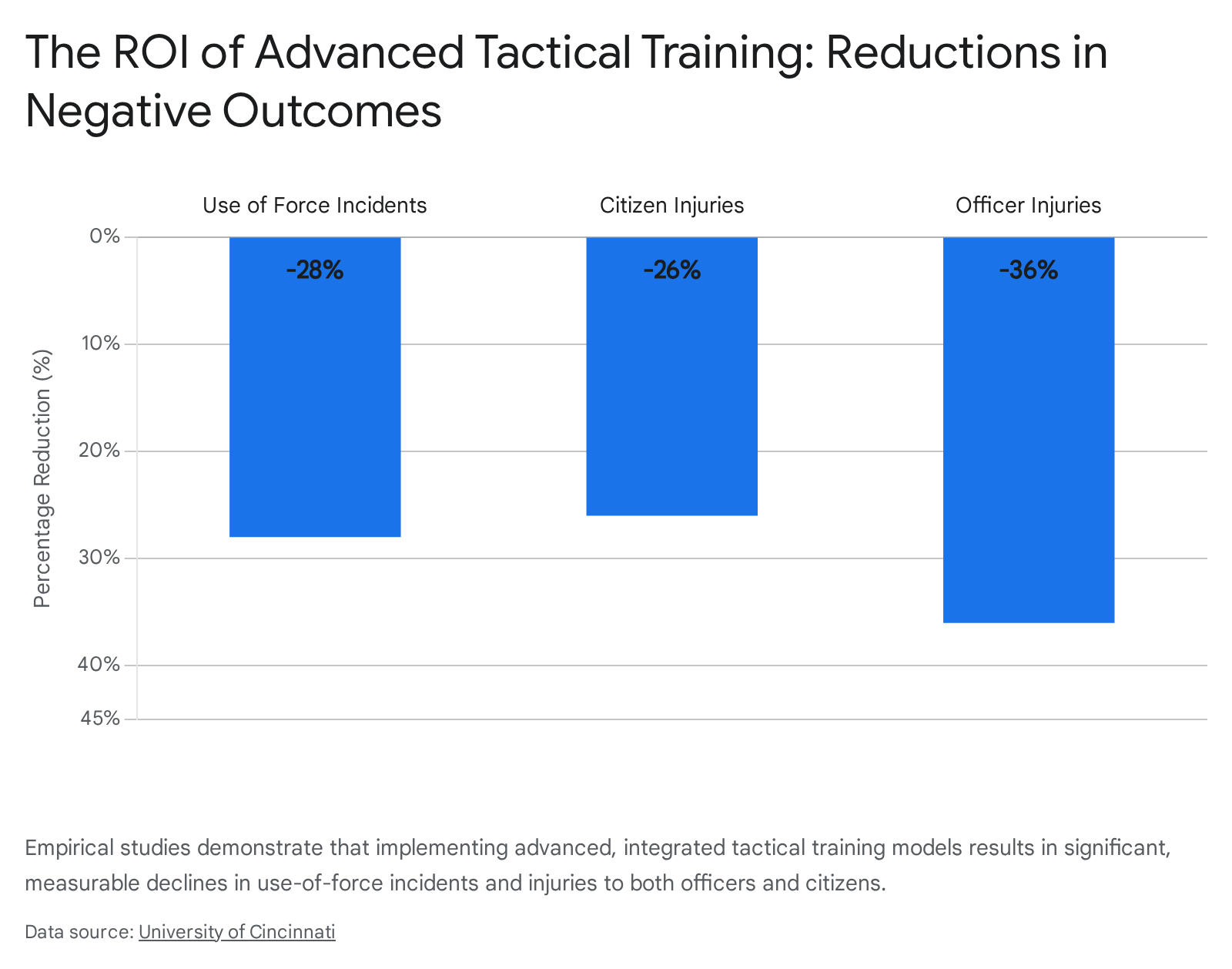
ROI of advanced tactical training: reductions in negative outcomes. Use of force incidents -28%, citizen injuries -26%, officer injuries -36%.

3.2 Basic SWAT and Tactical Team Operations

For instructors operating within specialized tactical units, attending a Basic SWAT course is an essential intermediate step. Programs endorsed by the National Tactical Officers Association (NTOA) offer a thorough introduction to tactical principles and their practical application. This standard 40-hour course meets the NTOA Tactical Response and Operations Standard (TROS) recommendation for Tier 1 through Tier 4 classification.

Instructors participating in these programs learn essential SWAT concepts, team organization, movement tactics at the individual and element levels, and warrant service planning. The program features numerous practical training scenarios aimed at developing foundational skills so that when the instructor returns to their agency, they have a comprehensive understanding of how individual tactical skills amalgamate into a cohesive team deployment. The training ensures that instructors are fluent in the common language and standardized practices utilized by tactical teams nationwide, facilitating seamless multi-jurisdictional operations.

4. Advanced Curricula for the Experienced Tactical Instructor

As an instructor transitions from a novice to an experienced trainer, their focus must shift from how to teach a physical tactic to why a human being performed a certain way during a lethal encounter. The integration of advanced human performance science, master-level discipline mastery, and tactical medicine is critical to developing training that acknowledges biological and environmental realities.

4.1 The Science of Human Performance

The Force Science Institute (FSI) offers an advanced certification course that is widely considered a cornerstone for experienced tactical instructors and use-of-force investigators. The curriculum bridges the gap between academic biomechanics, cognitive psychology, and the chaotic realities of a street encounter.

Experienced instructors attending this course study the physiological and perceptual factors that govern split-second decisions. A primary learning objective is the deep analysis of reaction times. Training reveals that the time it takes an officer to perceive a lethal threat, make a decision, and physically respond—known as perception-reaction time—is often slower than the time it takes a suspect to initiate an attack. Understanding this biological limitation explains why well-trained officers might shoot a suspect in the back; the suspect may have turned away in the fraction of a second between the officer’s decision to fire and the mechanical discharge of the weapon.

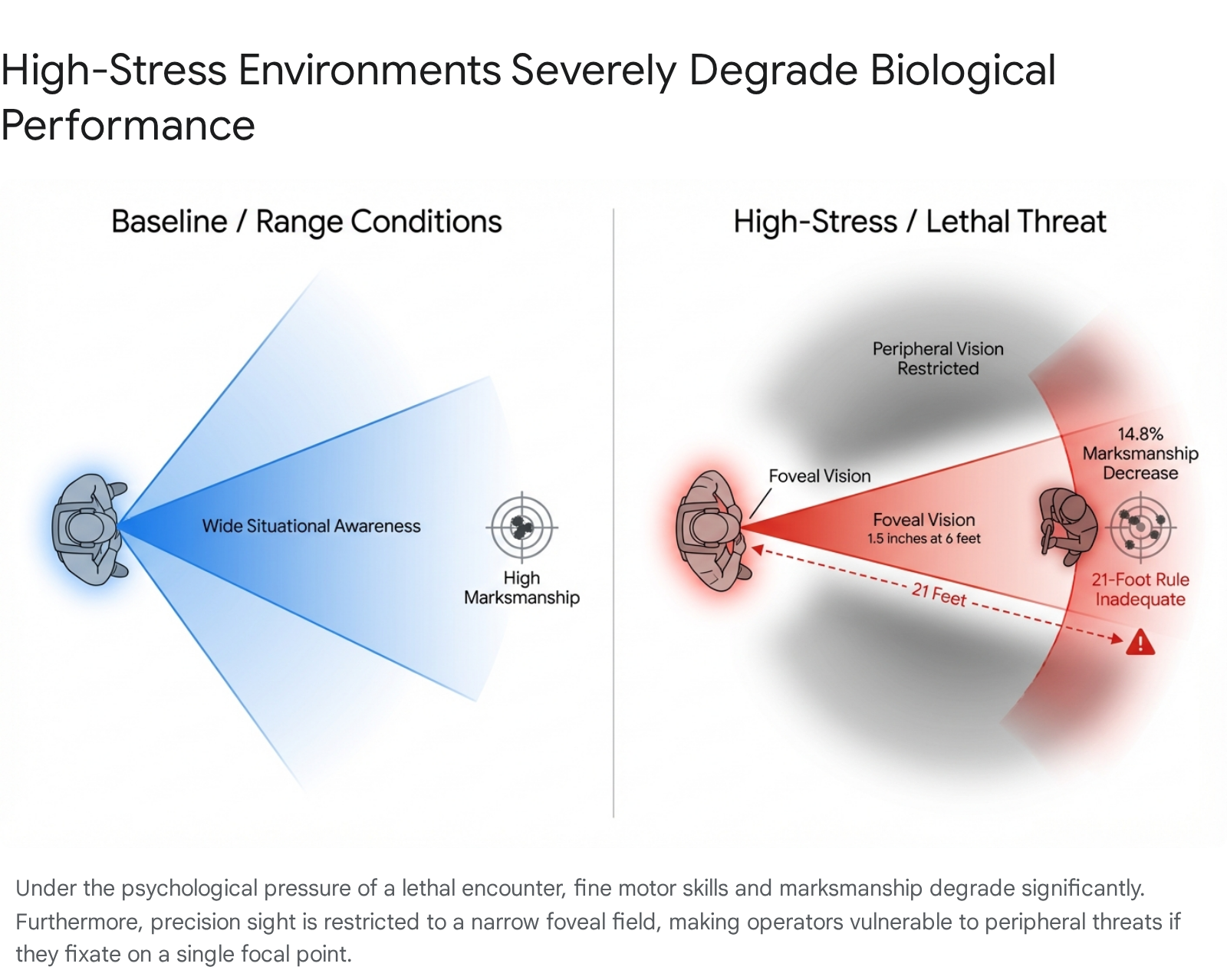
Advanced instructors utilize Force Science training to design curricula that account for phenomena such as perceptual distortions, auditory exclusion, tunnel vision, and memory gaps. During a high-stress event, the traumatized brain does not record information like a continuous video camera; it fragments. Instructors learn that discrepancies between an officer’s statement and objective body-worn camera video evidence are frequently the result of stress-induced memory failures rather than intentional deception. By understanding the autonomic responses linked to defensive actions, instructors can tailor reality-based scenarios to better regulate an officer’s psychophysiological response and prevent them from teaching tactics that are biomechanically impossible to execute during a sudden, violent ambush.

4.2 Master Instructor Development Programs

Experienced firearms instructors must move beyond the static firing line to master dynamic combat coaching. IALEFI provides the Master Instructor Development Program (MIDP), a premier continuing education course restricted to already-certified firearms instructors. The MIDP is not a basic shooting school; it is an intensive three-day clinic focused on advanced adult learning concepts and coaching strategies for natural action responses.

Experienced instructors are required to demonstrate proficiency across all three primary law enforcement weapon systems—handgun, shotgun, and semi-automatic rifle—under highly demanding physical conditions, often expending up to 800 rounds of ammunition over the course of the training. The curriculum forces instructors to progress from isolated concepts to practical skills, and finally to dynamic drills, teaching the gunfight mindset rather than simple target marksmanship.

Similarly, the FLETC Advanced Pistol Instructor Training Program (APITP) requires instructors to critically analyze traditional methodologies and adopt modern biomechanical concepts. Instructors are taught specific techniques such as the thumbs-forward grip, committed shot trigger control, and advanced movement protocols. These skills are designed to enhance the officer’s weapon control and ability to engage multiple targets while under extreme physiological stress, elevating the agency’s training program from basic survival to dominant tactical proficiency.

4.3 Tactical Medicine Integration (TECC/TCCC)

The modern tactical instructor must seamlessly integrate medical response into tactical operations. Law enforcement specialized tactical teams deploy to high-risk operations where officers, bystanders, and suspects are at a high risk for traumatic injury. Therefore, advanced instructors must be trained in Tactical Emergency Casualty Care (TECC) or Tactical Combat Casualty Care (TCCC).

Influenced by the Department of Defense model, these programs focus on saving preventable deaths while achieving three primary goals: Treat the Casualty, Prevent Additional Casualties, and Continue the Mission. Instructors learn to civilianize these military tenets, adhering to the Hartford Consensus, which insists upon basic tactical medical training for all law enforcement officers. Experienced tactical instructors incorporate medical skill sets—such as the application of tourniquets and hemostatic gauze during the “Care Under Fire” phase—directly into their firearms and room-clearing curricula. This ensures that officers do not view tactics and medicine as separate silos, but rather as an integrated continuum of survival.

5. Specialized and Less-Lethal Capabilities

As the spectrum of force expands and public scrutiny over police use of force intensifies, experienced instructors must master less-lethal and specialized munitions. Teaching these disciplines requires a nuanced understanding of technology, physics, and highly specific legal precedents.

Advanced Weapons SystemCore Curriculum FocusPrimary Instructor Responsibility
Less Lethal Impact Munitions12ga, 37mm, and 40mm deploymentTarget isolation, kinetic energy calculation, liability
Flash Sound Diversionary DevicesOverpressure, blast radii, ignition risksSafe preparation, environmental assessment, legal limits
Chemical AgentsCS, CN, OC, and Smoke characteristicsDelivery systems, area denial, hazard decontamination

The NTOA offers master-level, train-the-trainer certifications in Less Lethal Impact Projectiles, Flash Sound Diversionary Devices (FSDD), and Chemical Agents. These intensive five-day courses cover complex deployment tactics, strict policy issues, hazard mitigation, and the physiological effects of chemical munitions on the human body.

For example, a tactical instructor teaching FSDD deployment must understand the exact blast radii, the risk of secondary fires in a structure, and the severe legal implications of utilizing diversionary devices in confined spaces occupied by non-combatants. In crowd control or barricaded suspect scenarios, the improper use of less-lethal force can be as legally devastating as lethal force, necessitating an instructor who thoroughly understands both the technological capabilities and the stringent, court-tested deployment criteria. The instructor must translate these complex technical specifications into easily understandable operational policies for the officers on the line.

6. Tactical Science, Analytical Thinking, and Command Leadership

The apex of a tactical instructor’s educational journey transitions away from the physical execution of tactics entirely, focusing instead on leadership, unit culture, analytical problem solving, and strategic management. The actions of a tactical team are invariably a reflection of the team’s leadership and the culture cultivated by its instructors.

6.1 Sound Doctrine and Tactical Principles

Pioneered heavily by military and law enforcement strategist Sid Heal, the concept of Tactical Science treats tactics not merely as a set of physical skills, but as an intuitive application of fundamental, time-tested principles. Advanced tactical instructors study texts like Sound Doctrine: A Tactical Primer, which distills centuries of military strategy into concepts directly applicable to modern law enforcement crises. Instructors learn to identify the “center of gravity” in a critical incident—the focal point of a suspect’s power or advantage—and train their officers on how to systematically dismantle it.

The curriculum also relies heavily on understanding the OODA Loop (Observe, Orient, Decide, Act) and how it dictates movement and reaction in a crisis. By teaching officers how to disrupt a suspect’s OODA loop through surprise, speed, and violence of action, instructors elevate the intellectual capacity of the tactical team.

6.2 Analytical Problem Solving: “Exploding Squares” and “Five Whys”

To teach advanced problem-solving and operational planning, expert tactical instructors employ specific analytical tools. The “Exploding Squares” technique, also known as the Lotus Blossom Technique, is a structured brainstorming model used by commanders to develop exhaustive tactical alternatives.

In a barricaded suspect scenario, for example, the instructor places the core problem—the barricade—in the center of a grid. The surrounding squares are populated with primary strategic options, such as Negotiations, Chemical Agents, Entry, and Anxiety Manipulation. The process then “explodes” outward; if “Entry” is selected, it becomes the center of a new grid, prompting sub-tactics like Explosive Breach, Covert Entry, or Limited Penetration. This methodical expansion prevents tactical tunnel vision and ensures teams train for the broadest possible spectrum of options before an incident occurs.
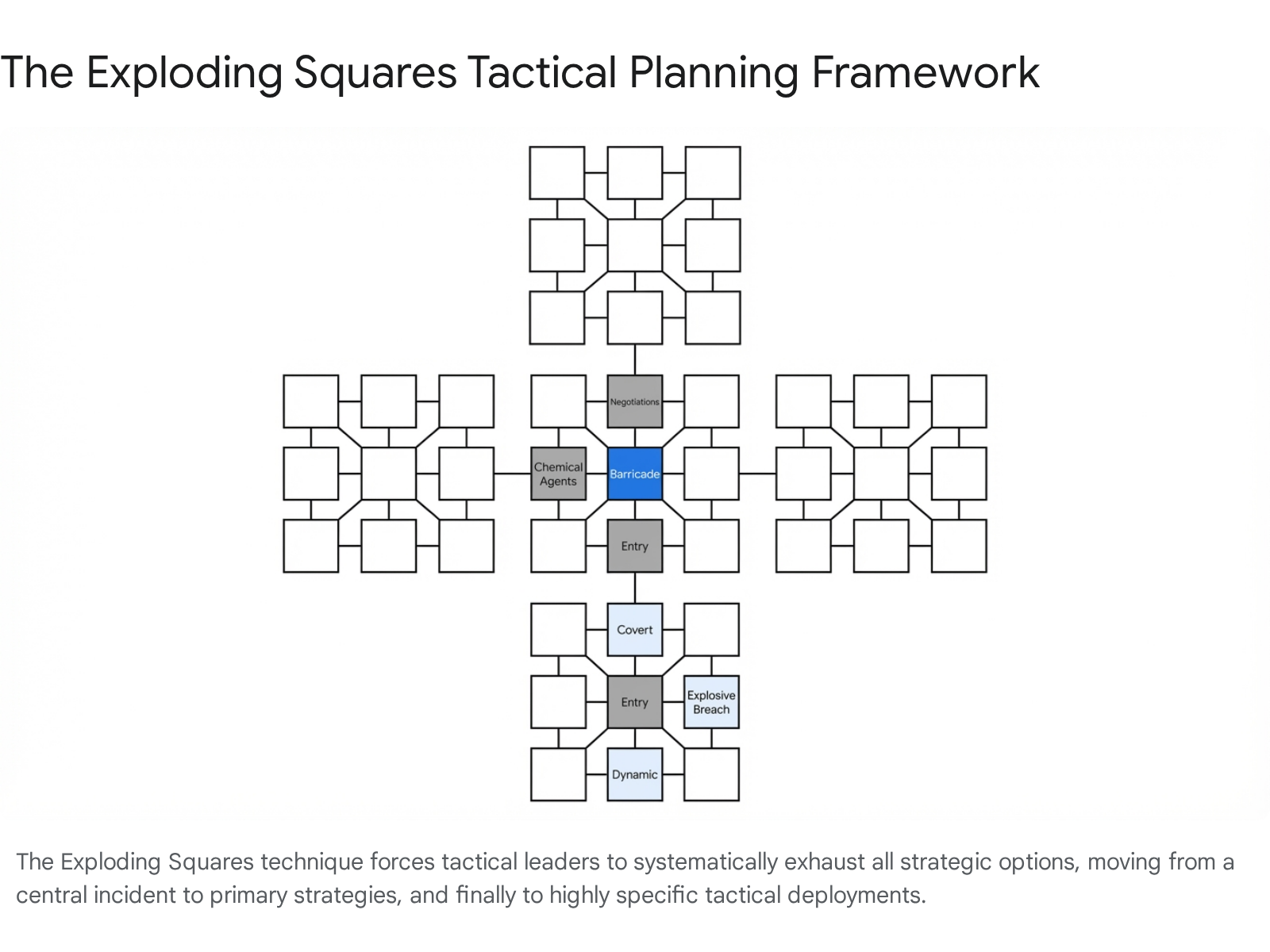
Exploding Squares tactical planning framework diagram showing strategic options.

Similarly, the “Five Whys” is an iterative root-cause analysis technique used extensively during post-scenario debriefs. By repeatedly asking “Why?” after a tactical failure in a training environment, instructors bypass superficial symptoms to uncover systemic root causes. For instance, if an officer misses a critical shot, the instructor asks why, potentially discovering that the root cause was visual narrowing due to artificial time compression imposed by poorly designed scenario parameters, rather than a failure of marksmanship.

6.3 NTOA Command College and Tactical Leadership

The NTOA Sid Heal Tactical Command College is the premier certification pathway for SWAT team leaders and tactical commanders. This rigorous program utilizes a blended learning environment to expose commanders to the theoretical, ethical, and organizational elements of specialized law enforcement.

The curriculum is heavily invested in tactical leadership, requiring 186 hours of intensive coursework. Modules cover the psychological aspects of leadership, practical emotional intelligence, and managing the Corruption Continuum—the gradual erosion of ethical standards within high-stress units if left unchecked by leadership. The coursework explicitly differentiates between the concepts of management, which involves coordinating resources and schedules, and leadership, which focuses on influencing behavior and motivating personnel to act in life-threatening environments.

Advanced tactical leadership training borrows heavily from military history and corporate management models. The NTOA Command College curriculum requires students to analyze the leadership styles of historical figures and modern military commanders to derive lessons applicable to law enforcement. The curriculum incorporates studies on Lincoln on Leadership to understand executive strategies during severe crises, and It’s Your Ship by former Navy Captain D. Michael Abrashoff. Abrashoff’s methodology, which transformed the worst-performing ship in the Pacific Fleet into the best, emphasizes building self-esteem and ownership among subordinates rather than relying on drill-sergeant bullying. Tactical instructors apply these case studies to foster a culture of trust and decentralized decision-making within their units, ensuring that operators can think critically and act independently during rapidly evolving deployments.

7. The Return on Investment (ROI) and Liability Mitigation

A law enforcement agency’s investment in both novice and advanced tactical instructor development requires substantial financial and temporal resources. However, the empirical data and legal precedents unequivocally demonstrate that the Return on Investment (ROI) is realized through the drastic reduction of organizational liability, officer injuries, and costly litigation.

7.1 Statistical Reductions in Litigation and Use of Force

Law enforcement is an exceptionally high-liability profession. Historical data reveals that a disproportionate amount of civil litigation and excessive force complaints are generated by a small fraction of poorly trained or improperly supervised officers. When tactical instructors are appropriately certified to deliver modern, scenario-based, and force-science-informed training, the outcomes are quantifiably improved.

For example, studies analyzing the implementation of advanced de-escalation and tactical integration programs—such as the ICAT (Integrating Communications, Assessment, and Tactics) model—demonstrate profound impacts. Rigorous research indicates that agencies employing these advanced training matrices experience a 28 percent reduction in use-of-force incidents, a 26 percent decrease in citizen injuries, and a remarkable 36 percent reduction in officer injuries. These statistics provide a clear, empirical justification for the time and budget allocated to advanced instructor certification.

ROI of tactical training: Reductions in use of force (-28%), citizen injuries (-26%), and officer injuries (-36%).

Furthermore, integrating disciplines such as control-based defensive tactics into standard training paradigms has shown comparable efficacy. Real-world data indicates that shifting from traditional compliance-strike models to control-focused models results in notable reductions in Taser deployments, excessive force complaints, and municipal payouts. Given that civil settlements regarding police liability can cost major municipalities hundreds of millions of dollars over a decade, the preventative fiscal value of an elite instructional cadre cannot be overstated.

7.2 Insurance Standardization and National Accreditation

The proficiency of an agency’s tactical instructors directly influences its insurability. Municipal risk pools and private liability insurers increasingly act as indirect regulators of police training. Insurers heavily subsidize and incentivize advanced training, recognizing that dynamic, reality-based training decreases the likelihood of unjustified shootings.

Agencies that employ highly certified instructors and maintain adherence to national standards—such as the NTOA Tactical Response and Operations Standard (TROS) or the International Association of Directors of Law Enforcement Standards and Training (IADLEST) National Certification Program—frequently qualify for reductions in their law enforcement liability premiums. IADLEST establishes stringent, evidence-based rubrics for instructor certification, requiring verified continuing education and peer endorsements to maintain active status. The alignment of agency training with objectively measurable, internationally recognized standards ensures that when an officer’s actions are challenged in federal court, the agency can definitively prove that the officer was trained utilizing the most advanced, scientifically valid methodologies available in the profession.

8. Conclusion

The operational environment of modern law enforcement is profoundly unforgiving. The margin for error during a critical incident is measured in fractions of a second, and the consequences of failure reverberate through the legal system, the community, and the lives of the officers involved. To navigate this landscape, the law enforcement tactical instructor cannot simply be a senior operator passing down anecdotal experience. They must be developed through a formalized, scientifically rigorous continuum.

Novice instructors must build a bedrock of adult learning theory, strict legal comprehension, and reality-based training safety protocols. Without this foundation, the transmission of tactical skills is flawed and potentially disastrous. As instructors mature, they must transcend mechanical proficiency to master Force Science, tactical doctrine, and unit leadership. By progressing through master-level certifications and command colleges, experienced instructors learn to manipulate cognitive load, execute strategic analytical planning, and forge resilient, highly capable tactical teams. Ultimately, an agency’s commitment to this extensive instructor development matrix is not merely an administrative checkbox; it is the most effective proactive measure an organization can take to ensure constitutional policing, preserve human life, and mitigate catastrophic liability.

9. Appendix: Master Data Table of Tactical Instructor Training Providers

The following table categorizes the leading training providers in the United States according to the specific educational tier and discipline required for tactical instructors.

Category of InstructionLeading Training ProviderCourse NameSynopsisLocationWebsite URL
Foundational PedagogyFLETCLaw Enforcement Instructor Training Program (LEITP) 1Provides foundational instructional skills with a focus on adult learning, presentation skills, and the delivery of approved agency curricula.Glynco, GA / Artesia, NMhttps://www.fletc.gov/law-enforcement-instructor-training-program
Foundational PedagogyTEEXBasic Instructor Development 2Introduces fundamental adult learning theory, lesson plan development, and classroom management techniques for law enforcement.Face-to-Face (Various)https://teex.org/certificate-programs/master-law-enforcement-instructor/
Legal & LiabilityFLETCUse of Force Instructor Training Program (UOFITP) 3Focuses on constitutional standards (Graham v. Connor), legal liability, and designing reality-based use of force scenarios.Glynco, GA / Cheltenham, MDhttps://www.fletc.gov/use-force-instructor-training-program
Human PerformanceForce Science InstituteForce Science Certification / Force Encounters Analysis 4A deep dive into the physiological and psychological phenomena (reaction times, memory gaps) affecting officers during deadly force encounters.Various / Nationwidehttps://events.forcescience.com/
Core Tactics (Control)FLETCLaw Enforcement Control Tactics Instructor (LECTITP) 5Physically demanding program preparing instructors to teach gross motor control tactics, intermediate weapons, and defense against attacks.Glynco, GA / Artesia, NMhttps://www.fletc.gov/law-enforcement-control-tactics-instructor-training-program
Core Tactics (Firearms)IALEFIFirearms Instructor Course 644-hour foundational course certifying instructors in range safety, marksmanship diagnosis, and liability management.Various / Nationwidehttps://www.ialefi.com/training-course-calendar/
Experiential LearningALERRTLevel 1 Active Shooter Instructor (Train-the-Trainer)Prepares instructors to safely design, implement, and evaluate dynamic force-on-force active shooter response scenarios.San Marcos, TX / Varioushttps://alerrt.org/courses/view/28120
Experiential LearningTEEXReality Based Training InstructorTeaches trainers how to safely design, implement, and evaluate high-stress, scenario-based training within their home agencies.Face-to-Face (Various)https://teex.org/class/let705/
Unit OperationsNTOABasic SWAT 740-hour introductory course focusing on tactical team movement, operational planning, and the safe execution of high-risk warrants.Various / Nationwidehttps://public.ntoa.org/default.asp?action=courseview&titleid=72
Master DisciplineIALEFIMaster Instructor Development Program (MIDP) 8Advanced continuing education for certified instructors focusing on coaching strategies, gunfight mindset, and complex live-fire drills.Various / Nationwidehttps://www.ialefi.com/training-course-calendar/master-instructor-development-program/
Master DisciplineSIG SAUER AcademyAdvanced Pistol Instructor 9A 2-day advanced course focusing on high-level shooting bio-mechanics and sophisticated instructional development.Epping, NHhttps://sigsaueracademy.com/armed-professional
Tactical MedicineFLETCBasic Tactical Medical Instructor Training Program (BTMITP) 10Equips instructors to teach civilianized Tactical Combat Casualty Care (TCCC) and Care Under Fire techniques to patrol officers.Glynco, GA / Artesia, NMhttps://www.fletc.gov/basic-tactical-medical-instructor-training-program
Tactical MedicineSTORM Training GroupTrauma Med InstructorAdvanced course developed by Special Forces medics preparing officers to teach critical hemorrhage control and airway management.Various / Minnesotahttps://stormtraininggroup.com/courses-offered/trauma-med-instructor/
Advanced WeaponsNTOALess Lethal, FSDD, Chemical Agent Instructor Certification 11A comprehensive 5-day course on the legal limits, tactical deployment, and safe instruction of impact and chemical munitions.Various / Nationwidehttps://public.ntoa.org/default.asp?action=courseview&titleid=173
Advanced WeaponsDefense Technology4-Day Less Lethal ICP Instructor Program 12Extensive curriculum covering OC Aerosols, Impact Munitions, and Chemical Agents instruction and legal considerations.Various / Nationwidehttps://defense-technology.policeoneacademy.com/
Tactical CommandNTOASWAT Team Leader Development 13Focuses on risk mitigation, legal liability, personnel management, and operational decision-making for high-risk operations.Various / Nationwidehttps://public.ntoa.org/default.asp?action=courseview&titleid=231
Tactical CommandNTOASWAT Command Decision-Making and Leadership I 15Explores contemporary SWAT issues, practical emotional intelligence, critical thinking, and the psychology of team leadership.Various / Onlinehttps://public.ntoa.org/default.asp?action=courseview&titleid=314

Please share the link on Facebook, Forums, with colleagues, etc. Your support is much appreciated and if you have any feedback, please email us in**@*********ps.com. If you’d like to request a report or order a reprint, please click here for the corresponding page to open in new tab.


Sources Used

  1. Law Enforcement Instructor Training Program, accessed February 22, 2026, https://www.fletc.gov/law-enforcement-instructor-training-program
  2. Master Law Enforcement Instructor – TEEX.ORG, accessed February 22, 2026, https://teex.org/certificate-programs/master-law-enforcement-instructor/
  3. Use of Force Instructor Training Program – Federal Law Enforcement Training Centers, accessed February 22, 2026, https://www.fletc.gov/use-force-instructor-training-program
  4. Force Encounters Analysis – Human Performance Training and Consulting Inc, accessed February 22, 2026, https://www.hptc-pro.com/services/force-encounters-analysis/
  5. Law Enforcement Control Tactics Instructor Training Program, accessed February 22, 2026, https://www.fletc.gov/law-enforcement-control-tactics-instructor-training-program
  6. Firearms Instructor Course – IALEFI, accessed February 22, 2026, https://www.ialefi.com/training-course-calendar/firearms-instructor-course-2/
  7. Basic SWAT – National Tactical Officers Association – NTOA Publications, accessed February 22, 2026, https://public.ntoa.org/default.asp?action=courseview&titleid=72
  8. Master Instructor Development Program – IALEFI, accessed February 22, 2026, https://www.ialefi.com/training-course-calendar/master-instructor-development-program/
  9. Armed Professional – SIG SAUER Academy, accessed February 22, 2026, https://sigsaueracademy.com/armed-professional
  10. Basic Tactical Medical Instructor Training Program, accessed February 22, 2026, https://www.fletc.gov/basic-tactical-medical-instructor-training-program
  11. National Tactical Officers Association – NTOA Training Courses, accessed February 22, 2026, https://public.ntoa.org/default.asp?action=courseview&titleid=173
  12. Welcome to Defense Technology® Training Academy, accessed February 22, 2026, https://defense-technology.policeoneacademy.com/
  13. SWAT TEAM LEADER DEVELOPMENT COURSE OVERVIEW AND …, accessed February 22, 2026, http://public.ntoa.org/AppResources/CourseDetails/231.pdf
  14. National Tactical Officers Association – NTOA Training Courses, accessed February 22, 2026, https://public.ntoa.org/default.asp?action=courseview&titleid=231
  15. NTOA Training Courses – National Tactical Officers Association, accessed February 22, 2026, https://training.ntoa.org/
  16. National Tactical Officers Association – NTOA Training Courses, accessed February 22, 2026, https://public.ntoa.org/default.asp?action=courseview&titleid=314
Critical Tactical Training for SWAT Officers

Executive Summary

The modern landscape of critical law enforcement incidents—ranging from coordinated terrorist attacks and active shooters to fortified barricaded subjects, hostage crises, and high-risk warrant executions—demands a specialized, highly structured, and continuously evolving tactical response capability. Standard law enforcement academy training, which averages roughly 833 hours of baseline instruction 1, is fundamentally insufficient for the extreme physiological, psychological, and environmental stressors encountered during critical tactical incidents. Consequently, the development of a Special Weapons and Tactics (SWAT) operator requires a rigorous, phased educational curriculum that systematically bridges the gap between basic patrol competency and advanced tactical mastery. The failure to properly train, equip, and deploy these specialized personnel not only severely compromises public safety but also invites catastrophic legal liability and a profound loss of community trust.2

This report provides an exhaustive, nationally applicable analysis of the critical training classes required for United States law enforcement tactical officers. By synthesizing national standards established by the National Tactical Officers Association (NTOA), the Federal Law Enforcement Training Centers (FLETC), and the Federal Bureau of Investigation (FBI), this document identifies the core educational requirements necessary to build and sustain a highly reliable tactical unit. Crucially, the analysis differentiates between the developmental needs of novice tactical officers and experienced operators, recognizing that pedagogical approaches must evolve in tandem with an operator’s cognitive and operational maturation.

Novice tactical officers require training designed to build fundamental motor schemas and foundational tactical geometry. Their curriculum must focus intensely on basic team movement, firearms proficiency under stress, and survival mechanics to lower their baseline cognitive load during high-stress encounters.3 Novices, who naturally default to attempting physical control during crises, must be trained through stress inoculation to broaden their situational awareness.4 Conversely, experienced tactical officers, having automated these basic functions, must pivot toward highly specialized, low-frequency but high-risk disciplines. These include hostage rescue, explosive breaching, precision rifle operations, and technical electronic surveillance.5 Furthermore, experienced personnel must eventually transition into leadership roles, necessitating advanced coursework in strategic decision-making frameworks, risk mitigation, and liability management.9

Ultimately, tactical proficiency is highly perishable. Without sustained, dynamic training encompassing both rigorous physical conditioning and cognitive stress-testing, an operator’s ability to safely resolve critical incidents decays rapidly.2 A nationally standardized, experience-stratified training matrix is the only defensible method for maintaining operational readiness, ensuring constitutional policing, and safeguarding human life in the most dangerous law enforcement environments.

Tactical Instruction Summary Matrix

Level of ExperienceCategory of InstructionCore Instruction Required
NoviceFoundational TacticsBasic SWAT School (40-Hour Minimum)
NoviceWeaponry & MovementClose Quarters Battle (CQB) and Structural Clearing
NoviceMedical SupportTactical Medical for First Responders (TECC/TCCC)
NoviceCognitive DevelopmentScenario-Based Stress and Mitigation Training (e.g., ShadowBox)
NoviceFoundational FitnessBase Stamina and Progression Pyramid Integration
ExperiencedAdvanced OperationsHostage Rescue and Advanced CQB
ExperiencedAccess & InterventionExplosive and Advanced Mechanical Breaching
ExperiencedPrecision AccuracyAdvanced Sniper / Precision Rifle Operations
ExperiencedTechnical OperationsTechnical Surveillance (ELSUR) and UAS Operations
ExperiencedLeadership & CommandSWAT Team Leader Development & Command Seminars
ExperiencedStrategic AnalysisP.I.E.T.O. / PIET3O Tactical Decision-Making Models

1. The Philosophy and Imperative of Stratified Tactical Training

The deployment of a law enforcement tactical team represents the highest escalation of domestic police power short of federal military intervention. Because these units are tasked with resolving incidents that exceed the capabilities of traditional first responders, the individuals comprising these teams must possess a level of physical capability, technical proficiency, and psychological resilience far beyond the baseline law enforcement standard. The decision to form, equip, and deploy a SWAT team carries with it an immense constitutional and ethical responsibility to provide ongoing, specialized training.11

1.1. The Evolution of Tactical Standards and Capability Tiers

Special Weapons and Tactics teams first appeared in American policing in the late 1960s. High-profile incidents, such as the murderous sniper attack from the University of Texas tower by Charles Whitman, demonstrated that a single violent episode could easily outstrip the capacity of standard law enforcement tactics, weapons, and officers.12 In the subsequent decades, tactical teams have grown exponentially in number, sophistication, and deployment frequency. Today, the vast majority of police agencies serving populations over 50,000 possess some form of tactical team, resulting in tens of thousands of SWAT deployments nationwide annually.12

Despite this proliferation, prior research has demonstrated that SWAT approaches, staffing levels, compositions, policies, and training fluctuate noticeably across the more than 17,000 state, local, and tribal law enforcement agencies in the United States.13 To mitigate this dangerous inconsistency, the National Tactical Officers Association (NTOA) developed the Tactical Response and Operations Standard (TROS). This living document establishes a core set of concepts, principles, and policies designed to standardize and enhance the delivery of tactical law enforcement services.14

The NTOA categorizes tactical teams into distinct Tiers (Tier 1 through Tier 4) based on their mission capability profile.16 To be classified as a true SWAT Team under these standards (Tier 1 or Tier 2), an agency must meet all minimum capabilities associated with that tier.17 To maintain this operational readiness, the NTOA strictly mandates continuing education. It is recommended that full-time teams conduct a minimum of 40 hours of training per month (480 hours annually), while collateral-duty (part-time) teams must conduct a minimum of 16 hours per month (192 hours annually).11 This training must be regular, reoccurring, and specifically based on the critical skills associated with the team’s defined mission capabilities.14

1.2. The Cognitive Divide: Novice Versus Expert Processing

A critical vulnerability in law enforcement tactical training is the failure to properly differentiate between the pedagogical needs of a newly assigned, novice operator and a seasoned, experienced veteran. Merely placing a novice officer in an advanced training class alongside tenured operators often results in negative training outcomes, a phenomenon known in instructional design as the expertise reversal effect.18 Instructional methods that work well for experts who have already acquired a certain level of mastery can actually inhibit learning for novices who lack the foundational mental architecture to process the information.18

Research into human performance under extreme stress indicates that novices and experts process high-threat environments fundamentally differently. When circumstances present a threatening situation that is entirely new, an average individual lacks sufficient pre-programmed responses to react effectively.19 As shown by human factors research, police experts possess the ability to sum up several discrete observations into larger entities—a process called “chunking”—that encompasses both situational awareness and tactical elements.20 Novices, lacking these established mental models for complex tactical scenarios, often suffer from rapid cognitive overload.21

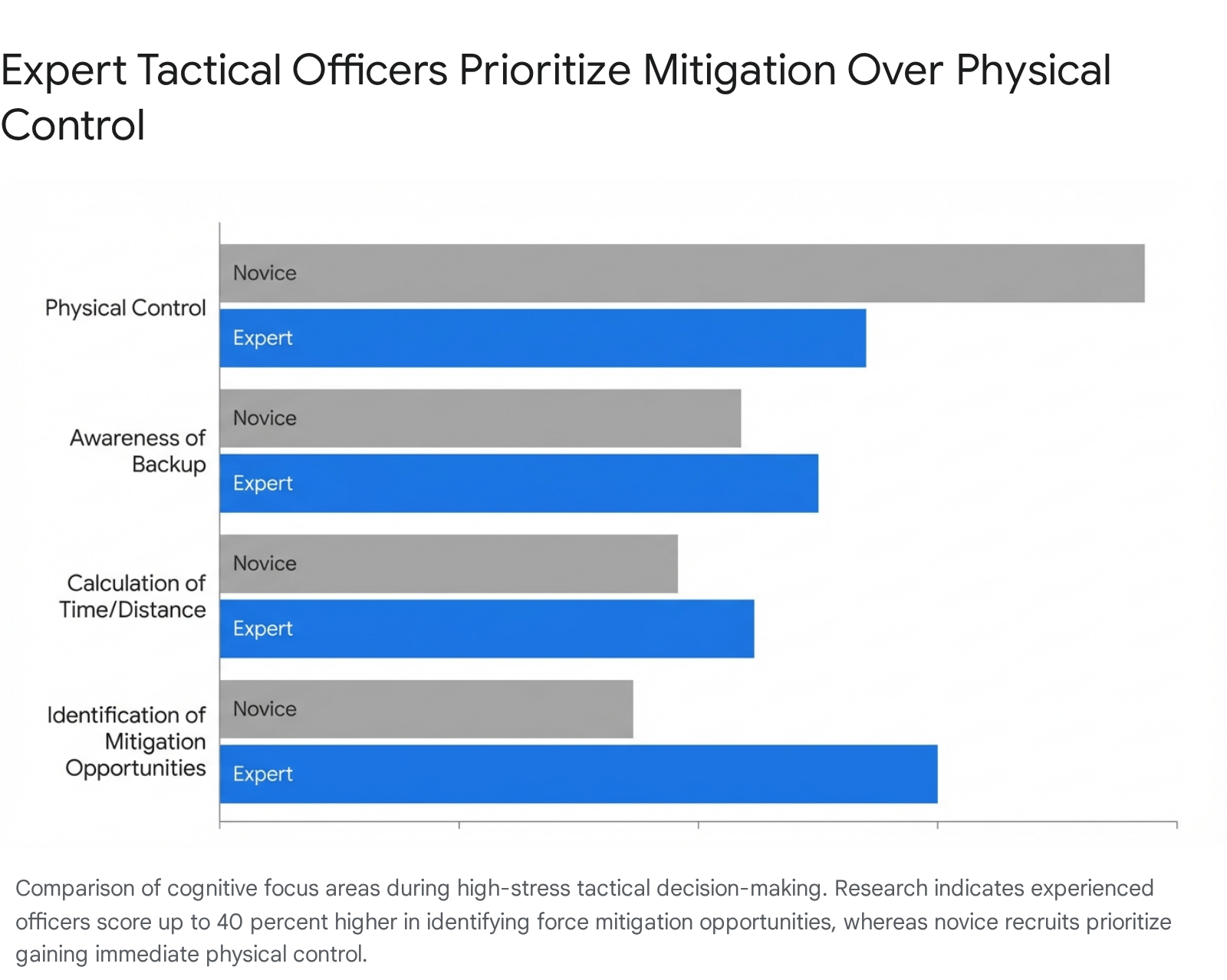
A landmark sociological study conducted by researchers at the University of California-Berkeley specifically examined expert versus novice use-of-force decision-making. The research revealed that novice police recruits, when placed in dynamic, high-stress scenarios, overwhelmingly focused on establishing immediate “physical control” of a subject, often at the expense of other critical, non-force considerations.4 Their lack of experience created a cognitive tunnel, where the immediate physical neutralization of the perceived threat consumed all available mental resources.

Conversely, experienced officers were significantly more likely to emphasize force mitigation. On average, experts scored between 13 percent and 40 percent higher than their novice counterparts in noting the importance of mitigation opportunities.4 Because experts have automated basic motor functions and threat recognition patterns, they retain the cognitive bandwidth to analyze external variables. They demonstrated a far greater awareness of opportunities for backup and showed a heightened consciousness of time and distance as relevant factors in resolving confrontations.4

Comparison of expert vs novice tactical officer decision making focus areas.

Therefore, a tactical training curriculum must be inherently stratified. It must first build the foundational motor schemas and basic tactical geometry for the novice, automating survival skills so the officer can begin to see the wider battlefield. Subsequently, the curriculum must challenge the experienced operator with complex, multi-variable problem-solving, advanced specialized technical skills, and command-level strategic decision-making.

2. Foundational Training: The Novice Tactical Officer

The transition from a standard patrol officer to a tactical operator requires a complete paradigm shift in operational philosophy. Standard patrol training, which averages roughly 833 hours nationwide, often balances stress (paramilitary) and non-stress (academic) environments, but ultimately focuses heavily on individual or two-officer problem-solving, report writing, and basic defensive tactics.1 Tactical operations, conversely, require the individual to subordinate their independent action to the highly coordinated, synchronized movement of an assault element or team. The novice tactical officer must undergo intensive foundational training to safely integrate into this highly structured environment.

2.1. Basic SWAT Certification and Core Tactical Competencies

The absolute baseline requirement for any law enforcement officer joining a tactical unit is the successful completion of a standardized Basic SWAT course. The NTOA and other national accrediting bodies establish a minimum 40-hour introductory course as the industry best-practice standard for new tactical team members.11 It is critical to note that the successful completion of this introductory course is not meant to be all-encompassing and does not suggest that the operator is fully competent or ready for autonomous deployment.11 Rather, it establishes a safe baseline of knowledge so the novice can participate in continuous team-level training without posing a catastrophic danger to themselves or their colleagues. Basic SWAT courses must invariably be followed by a formal, competencies-based field training program supervised by a senior SWAT trainer.11

Basic tactical training at premier institutions like the Federal Law Enforcement Training Centers (FLETC)—which offers the Basic Tactics Instructor Training Program (BTITP)—focuses on critical, life-saving fundamentals.3 The syllabus invariably begins with advanced weapons handling.3 Novices must learn to transition from traditional, static line marksmanship to dynamic combat marksmanship. This requires engaging targets while moving continuously, utilizing structural cover effectively, and operating firearms in extreme close proximity to other team members without violating safety principles.

The concept of 360-degree security is immediately introduced.3 This demands that the novice break the ingrained patrol habit of hyper-focusing solely on a single forward threat. Instead, they must learn to maintain overlapping, interlocking sectors of fire within a tactical formation, ensuring that the team is protected from all possible angles of attack.

Furthermore, novices must master the strict physical geometry of Close Quarters Battle (CQB). This includes the mathematical and physical principles of cornering, door entries, hallway navigation, and single-to-multiple room clearing methodologies.3 The instruction emphasizes techniques such as “slicing the pie” (angular search techniques), which are designed to maximize the officer’s visual control of an uncleared space while simultaneously minimizing their physical exposure to potential hostile fire. Through hundreds of repetitions in simulated environments, these geometric movements must transition from conscious, deliberate calculations to subconscious, automated motor reflexes. Until these basic movements are fully automated, the novice operator will simply not have the cognitive capacity to process suspect behavior, understand complex rules of engagement, or participate safely in an actual deployment.

2.2. Cognitive Framing, Stress Inoculation, and Decision-Making

Because tactical training is not purely physical, the psychological conditioning of the novice is of paramount importance. Modern research into law enforcement human performance demonstrates that under extreme, life-threatening stress, profound physiological and psychological changes occur. Within the average perception-reaction time of an officer deciding to shoot or stop shooting, the human body experiences a massive adrenaline dump.22 Officers will have to account for perceptual distortions such as diminished or intensified sound (auditory exclusion), tunnel vision, time misperception, temporary paralysis, memory loss, and dissociation.23

When a novice encounters a novel, threatening situation, they lack the pre-programmed mental responses required to react efficiently.19 As the aforementioned Berkeley study demonstrated, this leads to a dangerous over-reliance on immediate physical control at the expense of verbal de-escalation, the use of cover, or the coordination of backup.4 In fact, when analyzing the narratives of recruits during simulated scenarios, the critical word “cover” was mentioned far less frequently by experienced officers (76 times) compared to recruits (115 times), indicating that novices were highly preoccupied with basic survival concepts that experts had already internalized and moved past.4

Therefore, essential training for novices must include scenario-based cognitive stress-inoculation. Innovative programs, such as ShadowBox training (certified by the California Commission on Peace Officer Standards and Training), expose novices to situations specifically characterized by ambiguity, uncertainty, unpredictability, changeability, time-pressure, and competing goals.24 These classes use interactive, real-life incidents guided by experienced officers to artificially expand the novice’s situational awareness.

Novices are trained to look beyond the immediate weapon or the suspect’s hands. They are explicitly taught to seek out what experts naturally perceive: opportunities for force mitigation, the strategic positioning of secondary units, and the utilization of time and distance to de-escalate potential violence.4 By explicitly teaching these expert-level cognitive markers in a controlled, low-consequence training environment, instructors can significantly accelerate the novice’s progression from a purely reactive, fear-driven force instrument to a thoughtful, analytical, and highly controlled tactical operator.

2.3. Tactical Medical First Response

The operational reality of SWAT deployments dictates a high probability of encountering severe, life-threatening trauma, either sustained by hostages, innocent bystanders, suspects, or the officers themselves. In active shooter or barricaded suspect scenarios, traditional Emergency Medical Services (EMS) personnel and paramedics are mandated to stage in “cold zones,” far away from the immediate threat. This means that tactical officers must be the primary, and often only, medical providers during the critical first minutes of a mass casualty event or a close-quarters firefight.

Consequently, every novice tactical officer must undergo comprehensive Tactical Medical for First Responders (TMFR), Tactical Emergency Casualty Care (TECC), or Basic Tactical Medical Instructor Training Program (BTMITP) coursework.25 This curriculum departs radically from civilian first aid or standard CPR training. It operates under the fundamental premise that the best initial medicine in a firefight is overwhelming fire superiority.

Officers are taught to differentiate clearly between “Care Under Fire” and “Tactical Field Care.” During Care Under Fire, when the team is actively taking contact, the only acceptable medical intervention is the rapid application of a high-and-tight arterial tourniquet to stop massive extremity hemorrhage; no airway management or other care is attempted until the threat is neutralized or suppressed. Once the threat is isolated and the environment transitions to Tactical Field Care, operators are trained in massive hemorrhage control, advanced airway management, wound packing with hemostatic agents, and tension pneumothorax decompression. The integration of this medical intervention directly into kinetic room clearing drills ensures that the novice understands how to transition seamlessly between the conflicting roles of warfighter and lifesaver without ever compromising the 360-degree security of the operational element.17

3. Advanced Skill Acquisition: The Experienced Tactical Officer

Once an operator has spent years on a team, fully automating the fundamental physical skills of moving, shooting, and communicating within an assault element, they formally transition from a novice to an experienced operator. At this stage, standard room clearing, perimeter containment, and basic high-risk warrant service become routine functions requiring minimal cognitive strain. Therefore, the training burden for experienced officers shifts dramatically toward highly specialized, technically demanding disciplines. These advanced roles require deep analytical capabilities, cross-disciplinary integration, independent action, and the management of extreme physical and legal risk.

3.1. Hostage Rescue and Advanced Close-Quarters Battle (CQB)

The absolute pinnacle of tactical law enforcement operations is Hostage Rescue (HR). While standard high-risk warrant service relies heavily on the elements of surprise, speed, and overwhelming violence of action to disorient and secure a suspect, a hostage rescue introduces innocent life directly into the immediate threat matrix. An HR scenario cannot simply be treated as a faster standard entry; the tactics are fundamentally different, and the margin for error is effectively zero.27

Experienced officers must undertake intensive HR coursework to understand the extreme nuances and unique pressures of this mission profile.6 Training at this level emphasizes the core considerations of Safety, Information, and Time (SIT).6 Operators learn the critical distinction between a barricade and a hostage situation. While a barricaded suspect holding only themselves at bay can be waited out indefinitely using chemical agents and negotiation, a hostage situation may necessitate an immediate, highly dynamic, and potentially perilous entry if intelligence indicates the suspect has begun, or is about to begin, executing captives.27

Advanced HR training, modeled heavily after the FBI’s Hostage Rescue Team (HRT) parameters, focuses intensely on “stealth to contact”.6 Unlike a standard warrant service where police may announce their presence at the exterior door with a ram, HR operators are trained in silent movement, specialized camouflage, and the use of covert entry techniques to infiltrate a stronghold entirely undetected.6 The objective is to position the assault element as physically close to the hostage-taker as possible before the decisive breach occurs, minimizing the time the suspect has to react.

Furthermore, live-fire CQB exercises in specialized, rubber-coated “shooting houses” are utilized to train experienced operators in surgical target discrimination.29 Operators must practice engaging hostile targets with precision fire while innocent role-players or hostage targets are in immediate physical proximity to the threat. This develops the ultimate synthesis of trigger control, rapid target identification, and unwavering psychological composure under extreme time compression and chaotic stimuli.29 Operators at this level are also trained in transitional tactics, vehicle takedowns, and operating under Night Vision Goggles (NVGs) in completely blacked-out environments.11

3.2. Explosive and Advanced Mechanical Breaching

To execute a successful entry, tactical teams must overcome heavily fortified physical barriers. While novices are taught basic mechanical breaching (utilizing battering rams, pry bars, and halligan tools), experienced officers—who are specifically selected and designated as breachers—must master the complex science of explosive breaching.5

Explosive breaching is not merely the reckless destruction of a door or wall; it is a highly calculated, legally scrutinized tactical option designed to safely defeat barricades while achieving instantaneous “shock action”.5 This shock action profoundly disorients the occupants through overpressure and acoustic disruption, thereby protecting the lives of the entering assaulters and any hostages within by delaying the suspect’s ability to return fire.5

The curriculum for explosive breaching is exhaustive, technically rigorous, and heavily mathematical. Operators must learn to calculate Net Explosive Weight (NEW), understand the exact physical properties and burn rates of varying explosive materials (such as detonation cord, C4, sheet explosives, and water impulse charges), and compute precise safe stand-off calculations.5 These calculations are vital to prevent catastrophic structural collapse, secondary fire hazards, or severe traumatic injury to the officers stacking immediately behind the charge.5

Explosive breaching protocols demand strict intelligence gathering, continuous scouting, and detailed target analysis.31 The explosive breacher must calculate and construct the charge on-site to use the absolute minimal amount of explosive necessary to defeat the specific locking mechanism or hinges, while minimizing deadly fragmentation and collateral damage both inside and outside the target location.33 This specialized class essentially transforms an experienced tactical operator into a combat engineer and tactical physicist, capable of utilizing highly regulated industrial explosive tools to safely dictate the physical environment of the operation.

3.3. Precision Rifle and Sniper Operations

The role of the SWAT sniper, or precision rifleman, requires an extraordinary synthesis of elite marksmanship, advanced intelligence gathering, and extreme psychological patience. This is explicitly not a role for a novice; it is strictly reserved for highly experienced personnel who possess the maturity, discipline, and independence to operate entirely detached from the main assault element, often observing a target through a scope for hours or even days without relief or movement.

The training standards for law enforcement snipers are rigorously quantified to mitigate severe civil liability and ensure absolute public safety.7 National and state standards, such as those overseen by the Commission on Law Enforcement Standards and Training (CLEST), mandate that precision riflemen maintain sub-Minute of Angle (MOA) accuracy. One MOA equates to a rifle’s ability to repeatedly strike an intended target with a one-inch grouping at a distance of 100 yards from a rested position.7 In a critical hostage scenario, if a sniper is legally authorized by command to take a shot, they are generally targeting the suspect’s medulla oblongata (the brain stem) to instantly sever the central nervous system. This specific anatomical targeting prevents any involuntary reflex action or muscular flinch that could cause the suspect to fire their weapon into the hostage. Missing a target of this minuscule size by even a fraction of an inch results in a catastrophic mission failure and the loss of innocent life.

Advanced sniper courses focus heavily on positional shooting, timed engagements, and the mastery of complex environmental variables (wind drift, barometric pressure, bullet drop compensation). Operators must shoot highly complex qualification courses of fire, often requiring multiple rapid engagements at varying distances (e.g., 25, 50, 75, and 100 yards) under strict, stress-inducing time limits. For instance, an operator may be required to fire 10 precision rounds from alternating prone, kneeling, and improvised positions in under 4 minutes, with target scoring areas not exceeding 7.5 square inches.7

Beyond kinetic engagement, sniper training heavily emphasizes intelligence gathering, technical reporting, and overwatch capabilities. The sniper serves as the primary eyes and ears of the Tactical Commander, providing continuous, real-time telemetry on target movements, structural layouts, fortification efforts, and the disposition of hostages.

3.4. Technical Surveillance (ELSUR) and Unmanned Aircraft Systems (UAS)

Modern tactical operations are increasingly intelligence-led, aggressively moving away from the paradigm of immediate, blind kinetic entry toward methodical, technology-driven problem resolution. Experienced operators must be deeply trained in the deployment of advanced electronic surveillance (ELSUR) and cutting-edge robotics.

Classes in covert electronic surveillance—such as the Covert Electronic Surveillance Program (CESP) or Technical Investigations 1 (TECH-1) offered at FLETC—teach operators how to gather critical, actionable intelligence long before a physical operation begins.8 The curriculum covers the physical construction of covert audio and video concealments, advanced electronic tracking principles (including Hostile Force Tagging, Tracking, and Locating), and the complex circumvention of commercial alarm systems.8 Furthermore, operators are trained in covert entry techniques, utilizing commercial and improvised tools to defeat various warded, wafer, and pin tumbler locks without leaving signs of forced entry.37 By secretly inserting listening devices, wiretaps, or fiber-optic cameras into a stronghold, the tactical team can map the interior architecture, identify the exact location and armament of threats, and confirm the presence of hostages or improvised explosive devices (IEDs) without ever exposing an officer to hostile gunfire.38

Furthermore, the rapid, paradigm-shifting integration of Unmanned Aircraft Systems (UAS), or tactical drones, has revolutionized SWAT operations.40 Tactical UAS training teaches operators how to expertly fly highly maneuverable drones directly into hostile structures to conduct interior reconnaissance, clear complex stairwells, and search attics or crawlspaces prior to any human entry.42 Drone pilots must learn complex, multi-axis navigation in GPS-denied indoor environments, the utilization of thermal and infrared imaging to detect body heat through walls, and the deployment of two-way communication payloads (such as dropping throw phones) via robotics to establish safe contact with barricaded subjects.43 Mastery of these emerging technologies allows the experienced operator to significantly reduce the physical risk to the human entry element, allowing machines to absorb the initial risk of encountering an armed suspect.

4. Tactical Command, Leadership, and Strategic Analysis

The most critical, and often most difficult, transition in a tactical officer’s career is the elevation from an individual “door-kicking” operator to a SWAT Team Leader, Tactical Commander, or Incident Commander. At this senior executive level, the physical skills of shooting, moving, and breaching become entirely secondary to the cognitive skills of strategic planning, large-scale risk management, political navigation, and extreme legal liability mitigation.44

4.1. SWAT Team Leader and Command Operations

Training for tactical leadership requires a complete immersion into the complex mechanics of command and control. Courses such as the NTOA’s SWAT Team Leader Development, the FBI’s Command Leadership Institute, and the Law Enforcement Executive Development Seminar (LEEDS) are designed specifically for senior officers and executives transitioning into oversight roles.9

The curriculum in these advanced academies focuses heavily on pre-incident planning, mission organizing, and the drafting of comprehensive operations orders (OPORDs).9 Team leaders are exhaustively instructed on the legal liability concepts inherent to tactical operations. This requires a profound, working understanding of constitutional law, specifically the Fourth Amendment (concerning search, seizure, and the execution of warrants) and the objective reasonableness standards of the Fourteenth Amendment regarding the ultimate use of lethal and less-lethal force.9

Furthermore, command training immerses leaders in the OODA Loop (Observe, Orient, Decide, Act) methodology.9 Tactical commanders must learn how to manipulate the operational tempo of a crisis incident, utilizing specific tactics to overwhelm a suspect’s cognitive ability to process information and react, thereby achieving a non-violent resolution or a decisive tactical advantage. They are also heavily trained in the administrative side of tactical operations, including the selection, recruitment, physical testing, and psychological evaluation of new SWAT personnel, ensuring that the unit’s culture remains professional, ethical, and highly capable over generations.9

4.2. Advanced Decision-Making Models (P.I.E.T.O. / PIET3O)

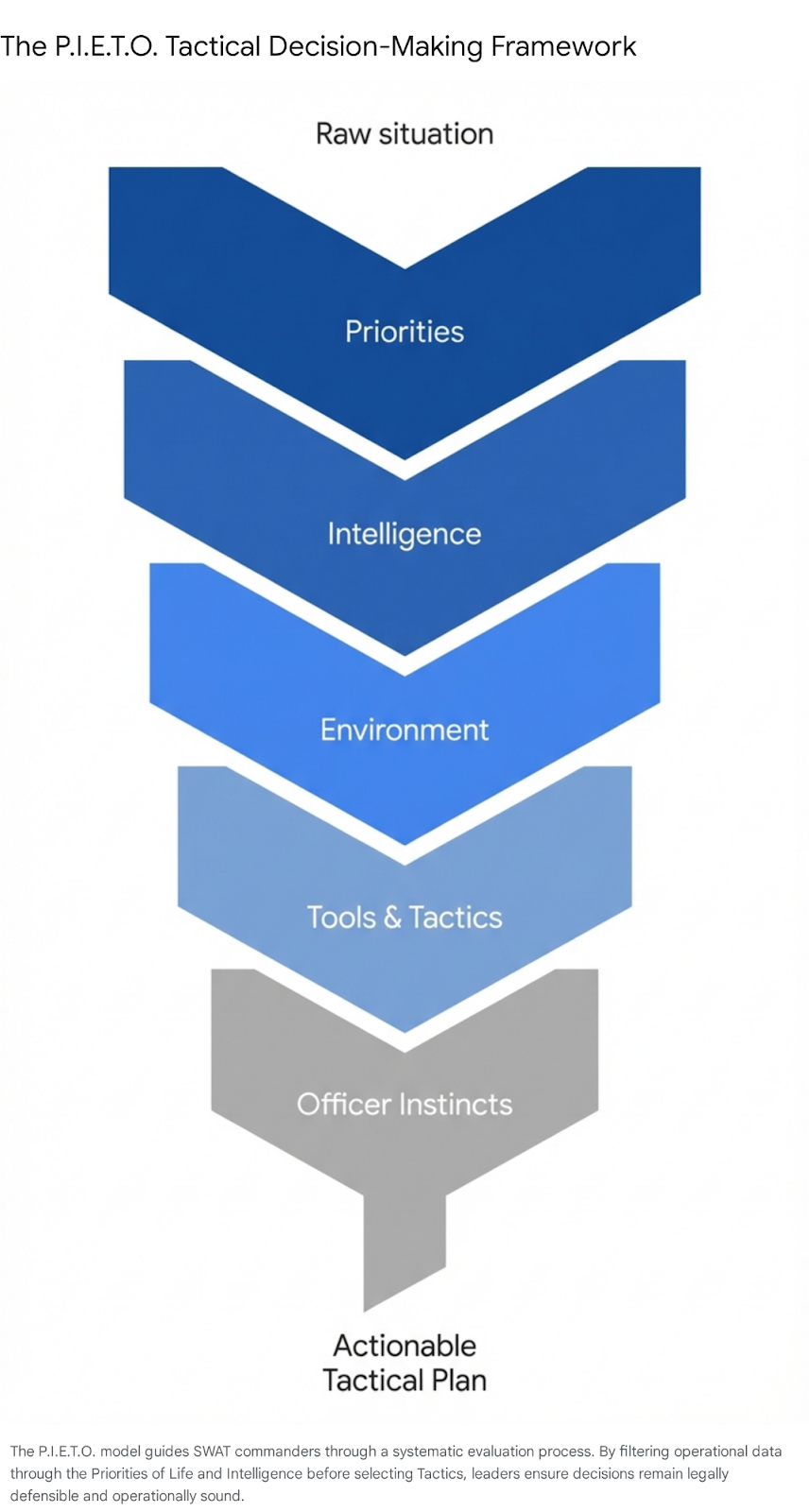
To ensure that tactical decisions made in the heat of a crisis are legally justifiable, ethically sound, and operationally effective, command-level training introduces formalized, highly structured critical thinking frameworks. The premier framework taught to contemporary tactical leaders is the P.I.E.T.O. (or PIET3O) model.50 This powerful mnemonic serves as a strict mental checklist and filtering mechanism for the decision-making process during high-risk, chaotic operations:

  1. Priorities (of Life): The commander must continuously evaluate every phase of the operation against the universally accepted priorities of life: Hostages and innocent victims first, innocent bystanders second, law enforcement officers and first responders third, and the suspect/subject last. Every tactical plan must mathematically and operationally favor the preservation of the higher priorities over the lower priorities.
  2. Intelligence: Actions must be driven by verified data, not assumption or bravado. Leaders are trained to forcefully pause the operational tempo to gather critical information regarding the suspect’s criminal history, mental health status, the verified presence of specific weapons, and the structural layout of the target.
  3. Environment: The commander must analyze the physical space in which the crisis is unfolding. Is it an open-air environment, a densely populated multi-family apartment complex, or a fortified rural compound? External factors such as severe weather, lighting conditions, and civilian proximity dictate the permissible tactics and limit the use of certain weapons or chemical agents.
  4. Tools / Tactics / Technology: Based strictly on the analysis of the first three steps, the leader selects the appropriate operational resources. Should the team deploy armored rescue vehicles (ARVs), deploy CS gas or other chemical agents, utilize less-lethal impact munitions, or rely primarily on crisis negotiators?
  5. Officer Instincts: Finally, the model acknowledges the profound value of lived experience. Recognition-primed decision making allows veteran commanders to leverage their hard-earned intuition—built upon years of subconscious pattern recognition across hundreds of deployments—to anticipate suspect behavior and alter the tactical plan dynamically as the situation degrades or improves.40

By forcing commanders to literally vocalize and document their planning through the sequential P.I.E.T.O. matrix, the resulting tactical action is highly insulated against post-incident civil litigation and criminal review. It clearly demonstrates to a jury or review board a methodical, objective, and deeply reasonable approach to problem-solving, rather than an arbitrary or reckless use of police power.50

P.I.E.T.O. tactical decision-making framework: Priorities, Intelligence, Environment, Tools & Tactics, Officer Instincts, Actionable Tactical Plan.

5. Mitigation of Perishable Skills and Physical Degradation

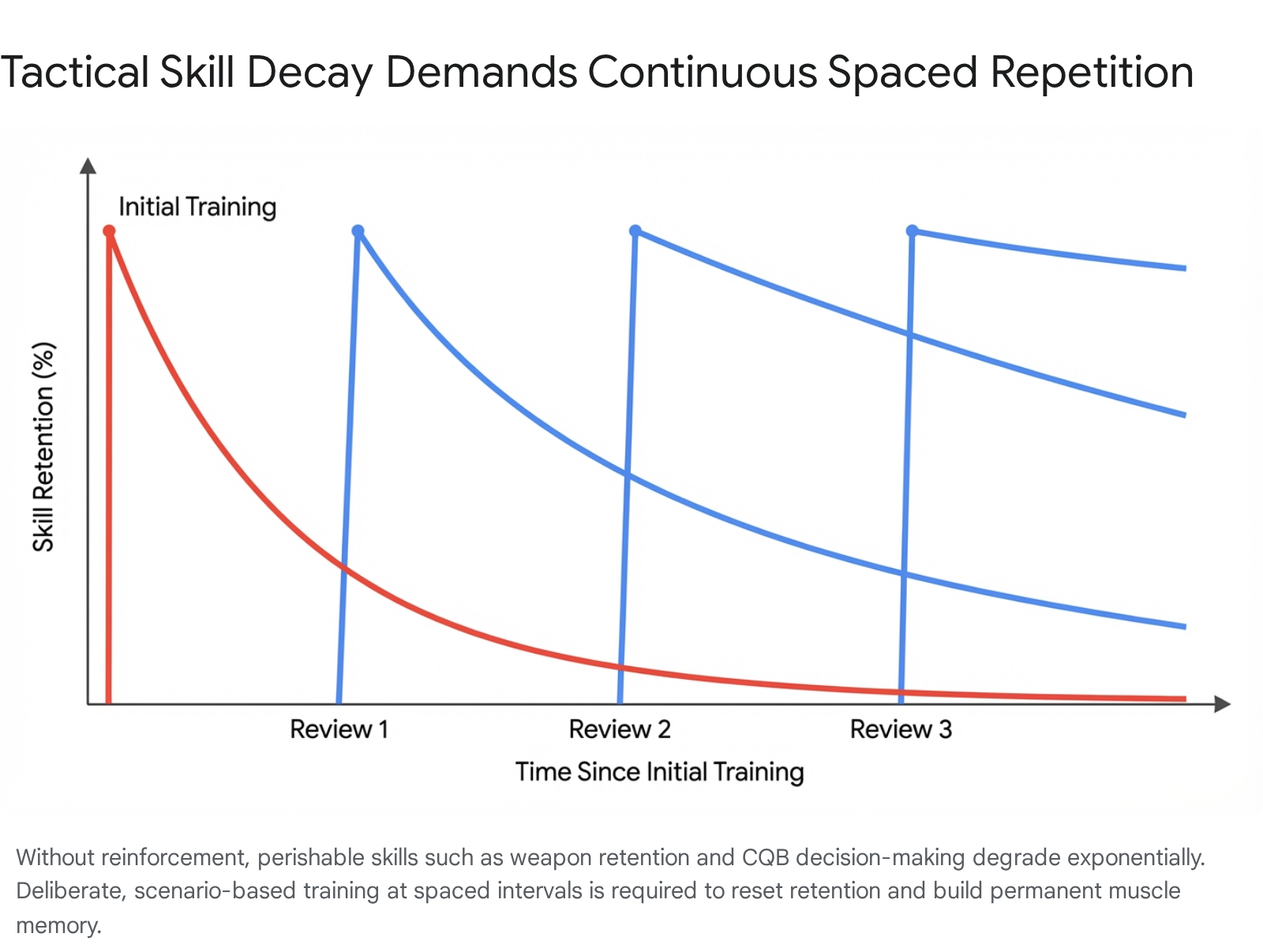
The acquisition of a tactical skill is not a permanent state of being. Extensive law enforcement research consistently demonstrates that both complex motor skills (such as weapons manipulation under stress) and cardiovascular conditioning are highly perishable attributes.2 Therefore, the tactical training curriculum cannot simply consist of a series of one-time certification classes. It must inherently include continuous, mandated maintenance, rigorous requalification protocols, and lifestyle adjustments. The failure of an agency to maintain these skills not only severely jeopardizes officer and public safety but also substantially increases the agency’s exposure to devastating “failure to train” litigation. For context regarding the severity of this issue, of the ten largest police agencies in the United States, legal costs stemming from police-misconduct cases increased by 48 percent between 2010 and 2015, resulting in payouts exceeding $1.02 billion.2

5.1. The Science of Continuous Firearms and Defensive Tactics Retention

The physical actions utilized in tactical police work—specifically the highly scrutinized deployment of lethal and less-lethal force—degrade rapidly without constant practice. Complacent officers who believe they have mastered the profession often learn otherwise when faced with a sudden use-of-force situation where uncertainty and fatal hesitation creep in due to a lack of recent, realistic repetition.2 The psychological stress of a lethal force encounter further exacerbates this degradation, causing officers to experience catastrophic fine motor skill failure if those specific skills have not been ingrained into deep, subconscious muscle memory.2

To aggressively combat skill decay, the NTOA’s mandate of 192 to 480 hours of annual training must be heavily dedicated to Perishable Skills Programs (PSP).11 Tactical firearms training cannot simply involve shooting paper targets from a static firing line in perfect weather conditions; it must actively incorporate live-fire tactical marking cartridges (such as Simunitions), aggressive movement under fire, complex weapons clearing manipulations, and rapid judgment/decision-making exercises.54

Furthermore, defensive tactics and suspect control methods must be continually refreshed using modern adult-learning theories. Research highlights that traditional “block training” (cramming all defensive tactics training into a single, exhausting week) is far less effective for long-term physiological retention than spaced, scenario-based training sessions featuring small-group practice and immediate, highly critical scenario-based feedback.10 Moving away from antiquated, trainer-centered teaching toward evidence-based models that emphasize continuous performance evaluation is absolutely vital to ensuring that an operator’s physical skills remain sharp years, or even decades, after their initial basic SWAT training.10

5.2. Tactical Athlete Physical Preparedness and the Progression Pyramid

Tactical operators are routinely subjected to extreme, unnatural physical demands that mirror those of professional athletes. However, unlike professional athletes who have dedicated off-seasons and specialized coaches to manage recovery, tactical officers are “in the arena” every single day they report for duty, required to be primed and ready to execute maximum physical effort without any prior physiological or mental recovery time.58 Furthermore, they must operate while carrying 40 to 60 pounds of restrictive external load—including heavy ballistic body armor, primary and secondary weapons, ammunition, radios, medical kits, and heavy mechanical breaching tools.59 While bearing this load, they must seamlessly perform dynamic, explosive movements such as sprinting, jumping, grappling with resistive subjects, and sustaining prolonged aerobic exertion.61

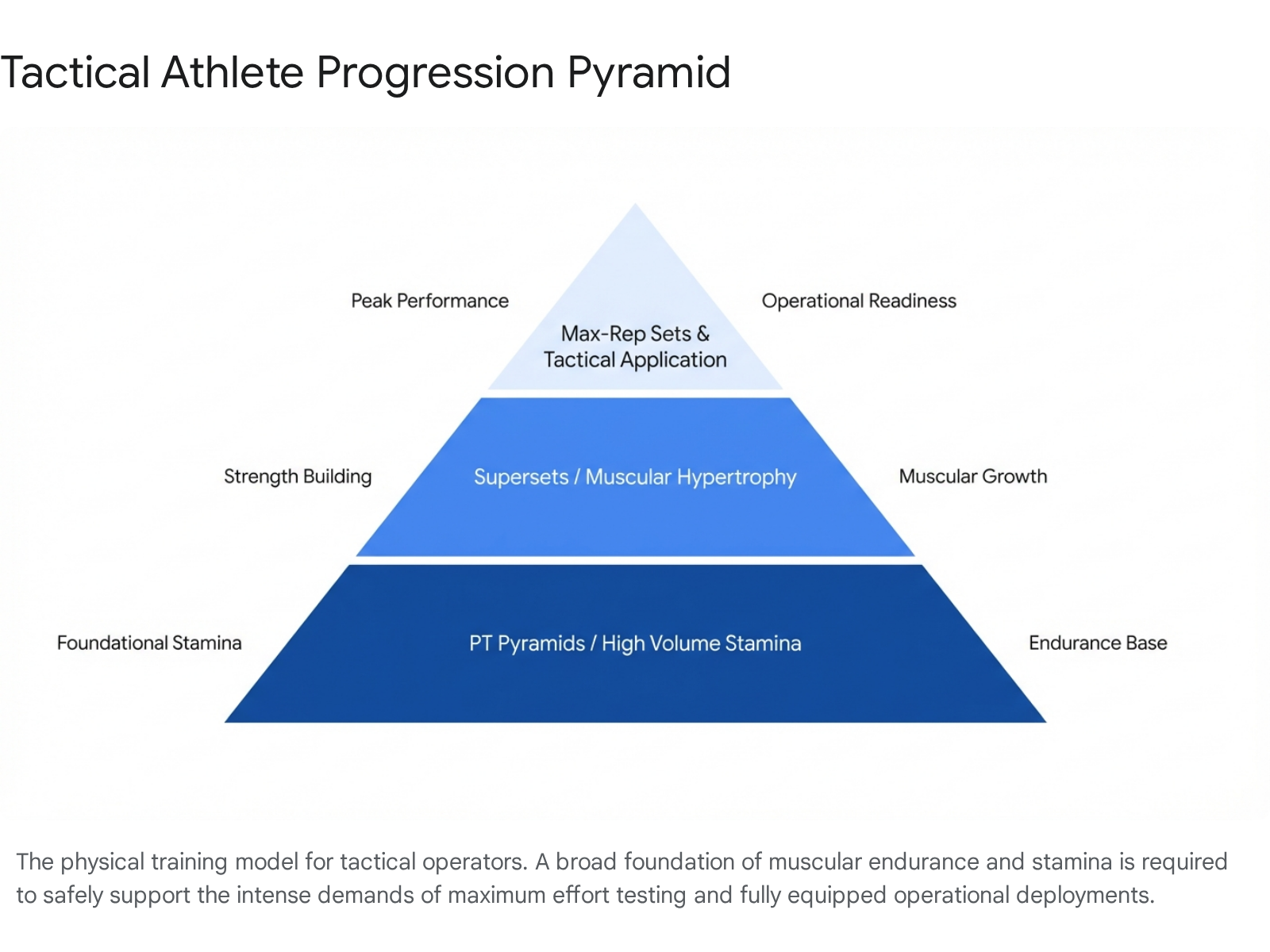
Because of these realities, physical conditioning must be approached not as a hobby, but as an ongoing, scientifically structured class. Training must focus holistically on the three anatomical planes of human movement (the sagittal, frontal, and transverse planes) to build deep functional strength, enhance mobility, and prevent the severe musculoskeletal injuries that are historically common in the tactical profession.62 A widely accepted, highly effective methodology for structuring tactical physical training is the Progression Pyramid Model.63

The Tactical Progression Pyramid is intelligently designed to build a massive foundation of muscle stamina and cardiovascular endurance before ever testing peak physical strength.63

  1. The Base (PT Pyramids): A continuous, high-volume, no-rest workout structure that efficiently combines a warm-up, maximum effort, and cool-down into a single, grueling session. For example, an officer performs 1 pull-up, 2 push-ups, and 3 sit-ups. They immediately progress to step two (2 pull-ups, 4 push-ups, 6 sit-ups), continuing the math up to step 10, and then immediately working back down the other side of the pyramid to step 1.64 This mechanism builds extreme, full-body muscular endurance without the acute injury risk associated with heavy weightlifting.
  2. The Mid-Level (Supersets): Once the base is established, operators use supersets to increase the absolute volume of tactical exercises, pushing muscles near complete exhaustion while carefully managing localized recovery by rapidly alternating between opposing muscle groups.63
  3. The Peak (Max-Rep Sets & Tactical Integrations): Only after foundational strength and stamina are completely secured do operators engage in maximum-repetition tests or combine physical exhaustion with complex cognitive tasks. This mimics the reality of a firefight: requiring an officer to run long distances in full kit, and then immediately forcing them to perform memory recall tasks or execute surgical marksmanship while managing wildly elevated heart rates and heavy respiration.58

Agencies must carefully tailor these physical maintenance programs to match their specific, unique operational profiles. For example, rural man-tracking teams, such as border patrol tactical units, may need to focus more heavily on aerobic capacity and load-bearing endurance over long, uneven distances in harsh climates. Conversely, metropolitan CQB teams conducting rapid residential raids may prioritize anaerobic power, short-distance sprinting, and the upper-body explosive strength necessary to physically dominate a suspect in a confined hallway.58

Tactical Athlete Progression Pyramid showing stamina, hypertrophy, and peak performance for SWAT critical tactical training.

6. Conclusion

The absolute necessity of a highly trained, deeply educated, and strictly regulated tactical law enforcement capability cannot be overstated in the modern era. As the complexity, armament, and sheer lethality of the threats facing communities continue to escalate exponentially, the response parameters, policies, and educational requirements of Special Weapons and Tactics units must evolve commensurately. This evolution is functionally impossible without a rigid, scientifically backed, legally defensible, and experience-stratified training curriculum that guides an officer from their first day on the team through their eventual promotion to command.

Treating tactical training as a homogenous, one-size-fits-all block of instruction is a critical organizational and pedagogical failure. Novice operators must be methodically built from the ground up. Their instruction must focus relentlessly on the basic physical geometries of survival, flawless basic weapons manipulation, and the deliberate, scenario-based expansion of their cognitive framing to prevent psychological tunneling during lethal encounters. They must be explicitly taught to see the entire tactical environment, prioritizing de-escalation, mitigation, and the use of time over the dangerous instinct to assert immediate, brute-force physical control over a chaotic scene.

Once these foundational elements are secured as subconscious motor programs, the training burden shifts significantly. The experienced operator must transition into the demanding realm of technical specialization and high-consequence precision. Mastery of the stealth-to-contact methodologies of hostage rescue, the unforgiving mathematical applications of explosive breaching, the zero-defect reality of precision sniper fire, and the complex integration of robotic surveillance systems represent the true maturation of the tactical asset. Ultimately, the most seasoned operators must be guided into leadership roles through formal, executive-level command instruction, utilizing strict analytical frameworks like the P.I.E.T.O. model to govern their decision-making and shield their agencies from liability.

Coupled with a permanent, career-long commitment to combating the inevitable degradation of perishable physical skills and cardiovascular fitness, this comprehensive curriculum blueprint ensures that a tactical unit remains fundamentally sound. By adhering to these strict national standards and recognizing the psychological differences between novices and experts, law enforcement agencies guarantee that their tactical teams operate not just as a blunt instrument of state force, but as a highly refined, surgically precise, and constitutionally sound mechanism dedicated unequivocally to the preservation of human life.

7. Master Training Provider Data Table

Class TypeTraining ProviderCourse NameSynopsisLocationURL
Basic SWAT & Foundational TacticsNational Tactical Officers Association (NTOA)Basic SWAT40-hour course covering fundamental tactical principles, team movement, and high-risk warrant service planning.16Varioushttps://training.ntoa.org/
Basic SWAT & Foundational TacticsFederal Law Enforcement Training Centers (FLETC)Basic Tactics Instructor Training Program (BTITP)Foundational training covering dynamic weapons handling, room clearing, and close quarters geometry.3Glynco, GA & Artesia, NMhttps://www.fletc.gov/training-catalog
Basic SWAT & Foundational TacticsSolutions Group International (SGI)Defensive Pistol Craft SeriesProgressive tactical training focusing on personal safety, marksmanship under stress, and firearms manipulation.Varioushttps://www.solutionsgroupinternational.com/tactical-training.php
Basic SWAT & Foundational TacticsNorse TacticalClose Quarters TacticsPrinciple-based system teaching close-quarters combat through intensive, hands-on practical application.Indiana & Varioushttps://norsetactical.com/
Basic SWAT & Foundational TacticsTier 1 Group (T1G)Advanced Urban CombatFull mission profile scenario training for active shooter response, raids, and close target reconnaissance.Memphis, TNhttps://t1g.com/multidiscipline-tactical-training/
Tactical Medical (TEMS)Federal Law Enforcement Training Centers (FLETC)Tactical Medical for First Responders (TMFR)Medical threat assessment training prioritizing rapid hemorrhage control and Care Under Fire protocols.Glynco, GA & Varioushttps://www.fletc.gov/tactical-medical-first-responders
Tactical Medical (TEMS)SOA RescueTactical Medical Practitioner (TMP)Hybrid TECC-certified program for SWAT medics focused on pre-mission planning and austere medical care.Hybrid (Online & In-Person)https://www.soarescue.com/tmp
Tactical Medical (TEMS)911 TacmedTEMS SWAT Tactical Medic Course100-hour intensive course expanding the trauma care capabilities of paramedics integrated into tactical elements.Texashttps://www.911tacmed.com/swat-medic–tactical-medic-course.html
Tactical Medical (TEMS)International School of Tactical Medicine (ISTM)Advanced Tactical MedicineDHS and POST-approved curriculum teaching life-saving responses to active shooters and severe threats.Sacramento, CAhttps://tacticalmedicine.com/course-schedule/
Tactical Medical (TEMS)Strategic Operations, Inc.Tactical Medicine Technician (TMT)Hands-on tactical combat casualty care utilizing hyper-realistic medical and surgical simulation environments.San Diego, CAhttps://www.strategic-operations.com/Tactical-Medicine-Technician-TMT-p/tmt.htm
Explosive & Mechanical BreachingTexas A&M Engineering Extension Service (TEEX)Explosive Breaching Course (EOT220)Five-day immersive training involving over 60 detonations on various fortified barriers to teach safe breaching methods.College Station, TXhttps://teex.org/class/eot220/
Explosive & Mechanical BreachingAsymmetric SolutionsLaw Enforcement BreacherComprehensive tactical entry training spanning mechanical, thermal, ballistic, and explosive breaching methodologies.Missourihttps://asymmetricsolutionsusa.com/law-enforcement/special-teams-training/le-breacher/
Explosive & Mechanical BreachingGlobal Assets IntegratedTactical Breaching (MMBTH)Five-day certification covering manual, mechanical, ballistic, thermal, and hydraulic entry tactics for swat elements.Varioushttps://www.globalassetsintegrated.com/training/tactical-breaching/
Explosive & Mechanical BreachingEnergetic EntryLaw Enforcement Total Breaching CourseIntense eight-day up-skilling program covering explosive handling, target analysis, and mechanical entry tactics.Varioushttps://energeticentry.com/training-courses/law-enforcement-total-breaching-course/
Explosive & Mechanical BreachingTier 1 Group (T1G)SOF Master Breacher CourseAdvanced instruction in dynamic entry incorporating customized scenarios and comprehensive structural defeat operations.Memphis, TNhttps://t1g.com/breacher-training/sof-master-breacher-course/
Precision Rifle & Sniper OperationsCenter Mass Inc.Basic Police Sniper School50-hour foundational course targeting field-craft, range estimation, and marksmanship emphasizing the cold bore shot.Varioushttps://centermassinc.com/police-sniper-schools
Precision Rifle & Sniper OperationsHRTCLE Sniper – Basic (LESB)40-hour program focusing on ballistic principles, hide site selection, and critical legal considerations for snipers.HRTC Training Facilityhttps://www.sniperology.com/training-courses/hrtc-le-sniper-basic-lesb-headspace-rifle-training-co
Precision Rifle & Sniper OperationsSIG SAUER AcademyPolice Marksman I – SniperIntensive five-day live-fire course emphasizing extreme close-range precision and scoped rifle mechanics.Epping, NHhttps://sigsaueracademy.com/courses/police-marksman-i-sniper
Precision Rifle & Sniper OperationsMax Ordinate AcademyLE Advanced Sniper CourseFive-day specialized training for SWAT snipers highlighting complex positional shooting and tripod employment.Lucerne Valley, CAhttps://www.maxordinate.com/eliterifleman
Precision Rifle & Sniper OperationsRifles OnlyPrecision Rifle I & IIRigorous fundamentals-focused instruction blending marksmanship with deployment in varied, high-angle environments.Fort Collins, CO & Texashttps://riflesonly.com/classes/
Command & Tactical LeadershipFBI-LEEDACommand Leadership Institute (CLI)Interactive 4.5-day seminar exploring ethical command decision-making and best-practice strategies for leaders.46Varioushttps://fbileeda.org/page/CommandLeadershipInstitute
Command & Tactical LeadershipNational Tactical Officers Association (NTOA)SWAT Team Leader DevelopmentCourse teaching principle-based SWAT decision-making, liability concepts, and operations order development.48Online & Varioushttps://public.ntoa.org/default.asp?action=courseview&titleid=231
Command & Tactical LeadershipSavage Training GroupCommand of High-Risk Critical IncidentsFocused leadership instruction on making rapid, sensible decisions during rapidly unfolding chaotic events.San Jose, CA & Varioushttps://savagetraininggroup.com/courses/command-of-high-risk-critical-incidents/
Command & Tactical LeadershipNorthwestern University Center for Public SafetySchool of Police Staff & Command (SPSC)Premier, intensive management program designed to prepare mid and upper-level personnel for senior command.Evanston, IL & Onlinehttps://sps.northwestern.edu/center-for-public-safety/management/
Command & Tactical LeadershipInstitute for Law Enforcement AdministrationSchool of Executive LeadershipEight-week academic curriculum providing advanced police supervision and executive ethics training.Plano, TXhttps://www.cailaw.org/institute-for-law-enforcement-administration/index.html

Please share the link on Facebook, Forums, with colleagues, etc. Your support is much appreciated and if you have any feedback, please email us in**@*********ps.com. If you’d like to request a report or order a reprint, please click here for the corresponding page to open in new tab.


Sources Used

  1. State and Local Law Enforcement Training Academies, 2018 – Bureau of Justice Statistics, accessed February 22, 2026, https://bjs.ojp.gov/sites/g/files/xyckuh236/files/media/document/slleta18st.pdf
  2. The Preservation of Perishable Skills – FDLE, accessed February 22, 2026, https://www.fdle.state.fl.us/getContentAsset/534fd739-7da0-4af4-b34d-a922f387bb1a/73aabf56-e6e5-4330-95a3-5f2a270a1d2b/Leisenring-Andy-final-paper.pdf?language=en
  3. Basic Tactics Instructor Training Program – Federal Law Enforcement Training Centers, accessed February 22, 2026, https://www.fletc.gov/basic-tactics-instructor-training-program
  4. New study: Expert vs. novice use-of-force decision-making – Police1, accessed February 22, 2026, https://www.police1.com/use-of-force/articles/new-study-expert-vs-novice-use-of-force-decision-making-z2rh9KpGbY4WQJRZ/
  5. Into the Breach: Justifying An Explosive Breaching Program – SWAT Survival | Weapons, accessed February 22, 2026, https://www.swatmag.com/article/breach-justifying-explosive-breaching-program/
  6. Mastering SWAT Hostage Rescue: Training Insights from Grey Group, accessed February 22, 2026, https://greygroupsecurity.com/mastering-swat-hostage-rescue-training-insights-from-grey-group/
  7. CLEST Minimum Standards Precision Rifle Annual Qualification Course Paragraph I. Law Enforcement personnel who have successfu, accessed February 22, 2026, https://dps.arkansas.gov/wp-content/uploads/2021/01/Precision-Rifle.pdf
  8. Covert Electronic Surveillance Program – Federal Law Enforcement Training Centers, accessed February 22, 2026, https://www.fletc.gov/covert-electronic-surveillance-program
  9. SWAT TEAM LEADER DEVELOPMENT, accessed February 22, 2026, https://www.lea.nm.gov/wp-content/uploads/sites/4/2025/02/NTOA-SWAT-Team-Leader-Development.pdf
  10. Police Academy Training, Performance, and Learning, accessed February 22, 2026, https://www.train-de-trainer.org/wp-content/uploads/2020/12/PA-training-retention-FSRC.pdf
  11. Tactical Response and Operations Standard – National Tactical Officers Association, accessed February 22, 2026, https://ntoa.org/pdf/swatstandards.pdf
  12. A Multi-Method Study Of Special Weapons And Tactics Teams – Office of Justice Programs, accessed February 22, 2026, https://www.ojp.gov/pdffiles1/nij/grants/223855.pdf
  13. National Special Weapons and Tactics (SWAT) Study, accessed February 22, 2026, https://www.theiacp.org/resources/document/national-special-weapons-and-tactics-swat-study
  14. ntoa tactical response and operations standard, accessed February 22, 2026, https://www.ntoa.org/tros/
  15. Standards for SWAT | National Institute of Justice – NIJ.gov, accessed February 22, 2026, https://nij.ojp.gov/library/publications/standards-swat
  16. Basic SWAT – National Tactical Officers Association – NTOA Publications, accessed February 22, 2026, https://public.ntoa.org/default.asp?action=courseview&titleid=72
  17. NTOA TROS 2023, accessed February 22, 2026, https://ntoa.org/pdf/TROS.pdf
  18. Improving police training from a cognitive load perspective – Emerald Publishing, accessed February 22, 2026, https://www.emerald.com/pijpsm/article/36/2/312/321720/Improving-police-training-from-a-cognitive-load
  19. Stress and Decision Making – Federal Law Enforcement Training Centers, accessed February 22, 2026, https://www.fletc.gov/sites/default/files/imported_files/reference/research-papers/Stress-and-Decision-Making-04-06-12–Approved—Pulic-Release–508-Accessible.pdf
  20. Complex Motor Learning and Police Training: Applied, Cognitive, and Clinical Perspectives, accessed February 22, 2026, https://pmc.ncbi.nlm.nih.gov/articles/PMC6692711/
  21. Using a Mixed-Methods Approach to Model Expert and Novice Use-of-Force Decision-Making – iMarksman, accessed February 22, 2026, https://www.imarksman.com/imarksman/polis-solutions.pdf
  22. Perspective: Need for Critical Thinking in Police Training | FBI – LEB, accessed February 22, 2026, https://leb.fbi.gov/articles/perspective/perspective-need-for-critical-thinking-in-police-training
  23. Establishing a Mindset for Success Using Tactical Performance Imagery: Maximizing Physical and Mental Skill Sets for Law Enfor – IN.gov, accessed February 22, 2026, https://www.in.gov/ilea/files/Mindset_for_Success_-_Luce_-_9-8-2015_Rev2.pdf
  24. De-Escalation and Tactical Decision Making – ShadowBox Training, accessed February 22, 2026, https://www.shadowboxtraining.com/case-studies/cs-law-enforcement/
  25. Glynco Programs – Federal Law Enforcement Training Centers, accessed February 22, 2026, https://www.fletc.gov/glynco-training-programs
  26. Training Catalog | Federal Law Enforcement Training Centers, accessed February 22, 2026, https://www.fletc.gov/training-catalog
  27. How SWAT Teams Train for Hostage Rescue and High-Risk Ops – Go Law Enforcement, accessed February 22, 2026, https://golawenforcement.com/articles/swat-training-part-1/
  28. San Bernardino County Sheriff’s Specialized Enforcement Division SWAT Hostage Rescue, accessed February 22, 2026, http://www.sbcounty.gov/uploads/Sheriff/SB978/Divisions/Update71422SED/Hostage%20Rescue%20ECO.pdf
  29. Hostage Rescue Team: Training for Every Contingency – FBI, accessed February 22, 2026, https://www.fbi.gov/news/stories/hostage-rescue-team-training-for-every-contingency
  30. SWAT II – Advanced SWAT Operator (40 Hours) – SIG SAUER Academy, accessed February 22, 2026, https://sigsaueracademy.com/courses/swat-ii-advanced-swat-operator
  31. tb-iii-p.06-explosive-breaching-4.24.23-clean.docx – City of Oakland, CA, accessed February 22, 2026, https://www.oaklandca.gov/files/assets/city/v/1/boards-amp-commissions/documents/opc/me/2022-23/tb-iii-p.06-explosive-breaching-4.24.23-clean.docx
  32. The explosive option for SWAT teams – Police1, accessed February 22, 2026, https://www.police1.com/police-products/tactical/tactical-entry-tools/articles/the-explosive-option-for-swat-teams-3J8XFPem3BGyXSU9/
  33. TRAINING BULLETIN, accessed February 22, 2026, https://cao-94612.s3.amazonaws.com/documents/TB-Explosive-Breaching-2022-clean.pdf
  34. Basic Sniper | TEEX.ORG, accessed February 22, 2026, https://teex.org/class/let574/
  35. Liability Exposure in Special Operations – LLRMI – Police Training and Expert Services for Law Enforcement, Jails & Corrections, Insurance Pools, Risk Managers, and Attorneys, accessed February 22, 2026, https://www.llrmi.com/articles/legal_update/special-operations-liability/
  36. Technical Investigations-1 | Federal Law Enforcement Training Centers, accessed February 22, 2026, https://www.fletc.gov/technical-investigations-1
  37. Technical Surveillance Operator Training Course – Tactical Support Equipment, accessed February 22, 2026, https://www.tserecon.com/products/technical-surveillance-operator-training-course
  38. Training Overview – Electronic Surveillance Training and Consulting, accessed February 22, 2026, https://estctraining.com/training-overview
  39. Electronic Surveillance | State of California – Department of Justice – Office of the Attorney General, accessed February 22, 2026, https://oag.ca.gov/atc/courses/electronic-surveillance
  40. NTOA Training Courses – National Tactical Officers Association, accessed February 22, 2026, https://training.ntoa.org/
  41. law enforcement drone association tactical operations standard, accessed February 22, 2026, https://ntoa.org/pdf/UAS-TOS.pdf
  42. 5 Technologies that Will Impact Police Training in 2025, accessed February 22, 2026, https://www.virtra.com/5-technologies-that-will-impact-police-training-in-2025/
  43. Technology in Tactical Operations – Mon, 02/17/2025 – 12:00 | Kansas Law Enforcement Training Center, accessed February 22, 2026, https://kletc.org/technology-tactical-operations
  44. Leadership Services | International Association of Chiefs of Police – IACP, accessed February 22, 2026, https://www.theiacp.org/projects/leadership-services
  45. Leadership development series: How to balance tactical training with professional development – Police1, accessed February 22, 2026, https://www.police1.com/police-leader-playbook/leadership-development-series-how-to-balance-tactical-training-with-professional-development
  46. Command Leadership Institute – FBI-LEEDA, accessed February 22, 2026, https://fbileeda.org/page/CommandLeadershipInstitute
  47. FBI Executive Leadership Programs – LEB, accessed February 22, 2026, https://leb.fbi.gov/articles/featured-articles/fbi-executive-leadership-programs
  48. National Tactical Officers Association – NTOA Training Courses, accessed February 22, 2026, https://public.ntoa.org/default.asp?action=courseview&titleid=231
  49. SWAT TEAM LEADER DEVELOPMENT COURSE OVERVIEW AND INSTRUCTIONAL GOALS COURSE OVERVIEW INSTRUCTIONAL GOALS – National Tactical Officers Association – NTOA Publications, accessed February 22, 2026, http://public.ntoa.org/AppResources/CourseDetails/231.pdf
  50. National Tactical Officers Association – NTOA Online Calendar, accessed February 22, 2026, https://public.ntoa.org/default.asp?action=viewonline&courseid=20203470
  51. National Tactical Officers Association – NTOA Training Courses, accessed February 22, 2026, https://public.ntoa.org/default.asp?action=courseview&titleid=484
  52. Shift Briefing Series: Tactical decision-making – Police1, accessed February 22, 2026, https://www.police1.com/police-training/articles/shift-briefing-series-tactical-decision-making-pt3tGRjBZuvoEiKY/
  53. RMBLC Shift Briefing Series: Tactical Decision Making – YouTube, accessed February 22, 2026, https://www.youtube.com/watch?v=5HGvSegpqhM
  54. POST PERISHABLE SKILLS PROGRAM (PSP) I – TACTICAL FIREARMS COURSE NAPA COUNTY SHERIFF’S OFFICE 2170 CCN, accessed February 22, 2026, https://www.napacounty.gov/DocumentCenter/View/15573/Tactical-Firearms—POST-Perishable-Skills-Training-Program-PSP
  55. Practicing Perishable Skills in Law Enforcement Training – VirTra, accessed February 22, 2026, https://www.virtra.com/practicing-perishable-skills-in-law-enforcement-training/
  56. Leaving so soon? An analysis of withdrawal patterns from academy training | Policing: A Journal of Policy and Practice | Oxford Academic, accessed February 22, 2026, https://academic.oup.com/policing/article/doi/10.1093/police/paae018/7609904
  57. Police Training in Practice: Organization and Delivery According to European Law Enforcement Agencies – PMC, accessed February 22, 2026, https://pmc.ncbi.nlm.nih.gov/articles/PMC8801945/
  58. Focus on Training: Human Performance-Based Recommendations – LEB, accessed February 22, 2026, https://leb.fbi.gov/articles/focus/focus-on-training-human-performance-based-recommendations
  59. Evolution of Physical Training in Police Academies: Comparing Fitness Variables – PMC, accessed February 22, 2026, https://pmc.ncbi.nlm.nih.gov/articles/PMC9858962/
  60. Demographical Analysis and Implications of Special Weapons and Tactics Officers by Elizabeth Longo – University of Memphis Digital Commons, accessed February 22, 2026, https://digitalcommons.memphis.edu/cgi/viewcontent.cgi?params=/context/honors_theses/article/1026/type/native/&path_info=
  61. Relationships between physical training and marksmanship performance in tactical law enforcement officers | Policing: An International Journal | Emerald Publishing, accessed February 22, 2026, https://www.emerald.com/pijpsm/article/47/6/1111/1226220/Relationships-between-physical-training-and
  62. Transform your career by preparing like a tactical athlete – Police1, accessed February 22, 2026, https://www.police1.com/wellness-week/articles/prepare-like-a-tactical-athlete-BZpgushzJTpkNm7f/
  63. PT Progression Series: Why Pyramids Are a Foundation Workout – Military.com, accessed February 22, 2026, https://www.military.com/military-fitness/fitness-test-prep/pt-progression-series-1-the-pyramid
  64. PT Pyramid – The Classic PT FItness Workout – Stew Smith Fitness Ace the PFT – Preparing Americans for Military,Special Ops, Police, and Fire Fighting Professions, accessed February 22, 2026, http://www.stewsmith.com/linkpages/ptpyramids.htm
  65. My PT Pyramid Story – Do You Remember Yours? – Stew Smith Fitness, accessed February 22, 2026, https://www.stewsmithfitness.com/blogs/news/my-pt-pyramid-story-do-you-remember-yours

Essential Rules for Tactical Officer Success

Executive Summary

The contemporary law enforcement operational environment is characterized by an escalating matrix of lethal threats, necessitating a rigorous, scientifically grounded, and psychologically mature approach to tactical response. According to preliminary data provided by the National Law Enforcement Officers Memorial Fund (NLEOMF), the number of law enforcement professionals who died in the line of duty in 2024 increased by 25% compared to the previous year, totaling 147 fatalities.1 Gunfire remains the leading cause of these line-of-duty deaths, claiming 52 officers in 2024 alone, while traffic-related fatalities surged by 48% to 46 deaths.1 Concurrently, the frequency of extreme violence is accelerating; active shooter incidents, for example, have risen dramatically from a mere 15 recorded incidents in 2010 to 348 in 2023.2 As agencies attempt to navigate these heightened risks and protect their communities, the selection, training, and operational deployment of Special Weapons and Tactics (SWAT) and other specialized tactical personnel have become critical focal points for departmental leadership and risk management.3

A comprehensive analysis of quantitative incident data, qualitative discourse from law enforcement peer-to-peer forums, tactical association guidelines, and veteran operator debriefings reveals a stark contrast between public perception and the rigorous reality of tactical operations. While popular media, cinema, and tactical video games portray law enforcement special operations as a continuous, high-velocity stream of dynamic entries and kinetic engagements 4, the reality of the profession is deeply rooted in extreme patience, exhaustive documentation, meticulous logistical planning, and the absolute mastery of foundational patrol skills.5 New officers aspiring to join tactical units frequently misunderstand this dynamic. They often prioritize physical aggression and the acquisition of specialized gear over legal knowledge, de-escalation, and community engagement, leading to high attrition rates during selection phases and, more concerningly, dangerous vulnerabilities during field deployments.6

This comprehensive research report synthesizes empirical data, psychological models, and operational doctrine to define the top ten foundational rules for success and safety that every new tactical officer must internalize. These directives transcend basic physical fitness and marksmanship. They address the deeper cognitive, psychological, and procedural realities of the profession. The analysis encompasses the necessity of mastering fundamental patrol duties before pursuing specialized assignments, acknowledging the rapid decay of highly perishable combat skills, maintaining absolute professional humility in a high-stakes team room, and operating under a strict doctrine of communication and digital OPSEC (Operational Security). By adhering to these ten core tenets, new operators can successfully bridge the gap between initial enthusiasm and seasoned tactical mastery, ultimately ensuring their safety, the safety of their unit, and the preservation of life within the communities they serve.

Level of ExperienceCategory of InstructionCore Instruction
Pre-SWAT CandidateProfessional FoundationMaster fundamental patrol duties, report writing, and local jurisprudence before seeking tactical assignments.
Pre-SWAT CandidateMindset & HumilityAbandon the “know-it-all” attitude; respect the hierarchy, ask questions, and never compromise integrity by lying.
Rookie OperatorSkill MaintenanceAcknowledge the forgetting curve; engage in continuous, spaced repetition of perishable tactical skills to prevent decay.
Rookie OperatorEquipment ManagementDo not equate gear with capability; define mission requirements first and never deploy equipment without rigorous training.
Rookie OperatorOperational DisciplineExercise strict radio discipline and absolute digital OPSEC; eliminate smartphone distractions during operational periods.
Veteran OperatorTactical ExecutionPrioritize pre-operation intelligence and redundant address verification to eliminate preventable catastrophic errors.
Veteran OperatorThreat AssessmentUnderstand the limitations of reaction times and distance under stress; the 21-foot rule is inadequate against a committed threat.
Veteran OperatorLethal Force ParadigmAdopt a guardian mindset over a merchant mentality; utilize the Tactical Decision Equation to justify the application of force.
Team-WideTeam CohesionAccept the unwritten rules of the team room: prioritize professional accountability over ego preservation.
Team-WideIncident ResponseAccept the logistical realities: timelines always degrade, rely only on the equipment you carry, and prepare for extended endurance.

1. Master the Fundamentals: Excellence in Patrol Precedes Tactical Deployment

The most pervasive misconception among aspiring tactical officers—particularly those transitioning from infantry, military police, or other high-tempo armed service assignments—is the belief that physical prowess and an eagerness for direct action are sufficient qualifications for SWAT selection.5 In reality, the most effective tactical operators are fundamentally exceptional, well-rounded police officers. Peer-to-peer discussions among veteran law enforcement personnel consistently highlight a severe dichotomy between candidates who apply for tactical teams as inexperienced rookies and those who have spent years mastering the totality of the policing profession.6

A tactical operator must possess a comprehensive and nuanced understanding of state statutes, constitutional law, search and seizure parameters, and community dynamics. When an operator yells commands at a barricaded suspect who eventually surrenders, the purely tactical phase ends, but the intricate law enforcement phase—involving custody, evidence preservation, interview techniques, and exhaustive documentation—begins immediately.5 A candidate who struggles with basic report writing, who demonstrates poor judgment during routine domestic dispute calls, or who alienates the community during traffic enforcement will inevitably fail as a tactical operator, regardless of their proficiency in a shoot-house.7 Evaluating an officer’s performance on the street provides supervisors with vital data regarding their emotional control, decision-making under stress, and overall reliability.

Furthermore, the transition from military service to domestic law enforcement requires a profound recalibration of rules of engagement and mission objectives. While prior military experience brings valuable skill sets regarding unit cohesion and discipline, it does not automatically translate to effective civilian policing. Trainers report that military veterans who boast excessively about their prior service while neglecting to study criminal law often fail out of police academies.5 Tactical training programs can teach an officer how to breach a reinforced door or clear a complex room structure, but they cannot teach an officer how to possess inherent good judgment or a strong moral compass.6

The selection processes for elite units, such as those analyzed across multiple major Texas agencies (including San Antonio, Houston, and Austin), rely heavily on background investigations, psychological fitness examinations, and reviews of supervisor disciplinary actions to weed out candidates who lack this foundational maturity.8 Psychological profiling of successful SWAT officers reveals that high levels of conscientiousness, agreeableness, and competence, combined with very low levels of vulnerability, are critical distinguishing factors.9 Therefore, the first and most critical rule for any new officer aiming for a tactical assignment is to put in a solid handful of years on the job, handle calls meticulously, be present for fellow officers, and establish a flawless reputation for reliability and tactical soundness in everyday patrol duties.6

2. Maintain Professional Humility: The Danger of the “Know-It-All” Mindset

The transition into a law enforcement career, and subsequently the highly selective transition into a specialized tactical unit, is fraught with psychological and ego-driven traps. Many recruits enter the academy or the post-academy Field Training and Evaluation Program (FTEP) with prior experience in related fields such as military operations, corrections, or private security.7 While this prior experience is undoubtedly valuable, it frequently breeds a “know-it-all” mentality that acts as a catastrophic barrier to further learning.7

Veteran trainers note that a trainee who constantly relies on the phrase “I’ve been there, done that” rapidly stifles the willingness of Field Training Officers (FTOs) to impart crucial, agency-specific knowledge.7 Every law enforcement agency possesses unique operational environments, specific local ordinances, and deeply ingrained cultural methodologies. Assuming that one’s prior experience negates the need to learn these specific nuances is a severe tactical error. During field training, trainees are expected to have a multitude of questions; new officers sometimes attempt to impress their FTOs by doing too much too fast, but recognizing that asking questions is an expected and necessary part of navigating the program is vital for success.7

This dynamic is even more pronounced when an officer finally enters the tactical team room. SWAT units operate on a foundation of intense mutual trust, rigorous accountability, and direct, often unvarnished communication.11 In an environment where team members’ lives depend entirely on one another, there is absolutely no room for ego preservation.11 Social graces and the desire to be “nice” are strictly secondary to the absolute necessity of being professional, accurate, and correct; ignoring a teammate’s negative behavior, failure to meet a rigorous standard, or inattention to detail to spare their feelings can lead directly to operational tragedy.11

New tactical officers must understand that they are entering a brotherhood where respect is earned through consistent, observable performance over time, not demanded based on past accolades or academy scores.7 Officers must exhibit the utmost respect for the established hierarchy, addressing veteran operators and supervisors appropriately by their titles, even if other experienced officers utilize first names.7 Most importantly, a new officer must possess the profound professional humility to own their mistakes immediately. In both patrol and tactical operations, lying to cover up an error—whether it involves forgetting to pat-frisk a suspect for weapons, failing to properly search a vehicle, or missing a sector of fire during a room clear—is the ultimate organizational sin. Lying is unacceptable behavior that permanently destroys peer trust, compromises future courtroom testimony, and inevitably leads to termination or casts a permanent shadow over an officer’s career.7

3. Gear Does Not Equal Capability: Intentional Equipment Management

In the highly commercialized and well-funded realm of modern tactical law enforcement, there is a dangerous, pervasive temptation to equate the acquisition of advanced equipment with an actual increase in operational capability.13 Agencies, unit commanders, and individual officers often fall into the trap of purchasing high-end night vision goggles, complex plate carriers, ballistic shields, armored rescue vehicles, and specialized mechanical breaching tools under the false assumption that the gear itself solves complex tactical problems.13 The fundamental rule that elite military and police units strictly adhere to is that equipment without rigorous, context-specific, and sustained training is merely a physical and financial liability.13

Before fielding any new piece of equipment, tactical officers and their leadership must meticulously define the specific capability gap they are attempting to fill based on a realistic assessment of their threat environment.13 This requires a deliberate shift from buying “random gear” to fielding integrated operational “systems”.13 For example, acquiring a high-end gas mask is operationally useless if the operator does not also possess the appropriate chemical filters, a compatible voice emitter for clear radio communication, an optic mount that allows for proper eye relief while masked, and the physical conditioning required to operate under severely restricted oxygen flow.14 When agencies buy equipment but fail to consistently train with it or maintain it, the result is often an officer who lacks the requisite knowledge to deploy the tool when lives are on the line.14

Furthermore, operators must understand the deep physiological impact of their equipment choices. While empirical research and systematic reviews indicate that tactical load carriage (the weight of armor, ammunition, and tools) does not necessarily decrease close-range shooting performance for well-conditioned personnel, this maintenance of skill is largely attributed to the specificity of training.16 If an operator alters their gear layout—moving a magazine pouch, changing the position of a tourniquet, or utilizing a different retention holster—they must dedicate substantial time to reprogramming their body mechanics. The operator must be able to access magazines, medical kits, and secondary weapons without conscious cognitive thought, relying entirely on myelinated neural pathways developed through repetition.16

Finally, if a piece of equipment matters to the mission, it must be relentlessly inspected and maintained.13 Tactical operations are governed by Murphy’s Law; relying on a critical tool, such as a ballistic shield or a less-lethal 40mm launcher, that has not been thoroughly vetted and functionally tested in adverse conditions is a dereliction of duty.18 Therefore, new tactical officers must aggressively resist the urge to constantly modify their kit based on aesthetic trends or social media influencers, focusing instead on whether they have put in the requisite hundreds of hours of training to transform that piece of gear into a genuine, life-saving operational capability.

4. Acknowledge and Mitigate Skill Decay: Combatting the Forgetting Curve

Tactical proficiency is not a static achievement locked in time; it is a highly perishable physical and cognitive state that requires constant, deliberate maintenance. The psychological and physiological realities of skill retention dictate that without deliberate, spaced repetition, human beings rapidly forget newly acquired information and complex motor skills.20 This phenomenon, famously hypothesized and documented by German psychologist Hermann Ebbinghaus in 1885 as the Forgetting Curve, demonstrates that a learner can forget an average of 50% of presented information within one single hour, and up to 70% within 24 hours of the initial learning event.20

For a law enforcement tactical officer operating in life-or-death environments, this exponential rate of memory decay is profoundly alarming. The skills required for close-quarters battle (CQB), complex multi-team room clearing, dynamic weapon retention, high-stress hand-to-hand combat, and immediate lethal threat identification are incredibly complex and unnatural.22 If an agency sends a new officer to a basic 40-hour SWAT school and then fails to provide ongoing, structured field training and monthly sustainment drills, the officer will quickly lose the ability to apply those concepts dynamically under the extreme stress of a real-world deployment.15 The knowledge briefly understood in the classroom is rapidly lost to the transience of memory.21

To mitigate this catastrophic decay, training cannot be viewed as a mere annual compliance checkbox designed to satisfy insurance requirements or state standards. Elite tactical teams engage in continuous, scenario-based training that accurately simulates the stress, adverse lighting, and split-second decision-making requirements of real-world operations.22 This training must go far beyond mere static marksmanship on a flat range. Research indicates that physiological factors, such as grip strength, are heavily correlated with pistol marksmanship under stress, requiring physical conditioning alongside technical practice.16

Moreover, data demonstrates that high-stress scenarios negatively impact shooting performance and decision-making capabilities.16 However, early and repeated exposure to contextually relevant pressure can counteract this degradation, improving performance over traditional static training by an average of 10.6%.25 Ebbinghaus and subsequent cognitive psychologists have proven that repetition at spaced intervals and active retrieval practice significantly reduce the rate and amount of forgetting.20 Therefore, a new operator must take intense personal ownership of their skill retention, seeking extra range sessions, practicing dry-fire repetitions in their own time, and continually visualizing tactical scenarios to reinforce neural pathways and effectively flatten the forgetting curve.24

Tactical skill decay graph showing skill retention over time with spaced repetition reviews. "Tactical Skill Decay Demands Continuous Spaced Repetition

5. Strict Operational Communication: The Golden Rules of Radio Discipline

During a critical incident, the encrypted tactical radio network serves as the central nervous system of the entire operation. Poor communication protocols inevitably lead to operational confusion, delayed medical responses, the potential for catastrophic fratricide, and ultimate mission failure. Tactical operators must adhere strictly to the unwritten and codified rules of radio discipline to ensure that crucial intelligence cuts through the overwhelming auditory and psychological chaos of an active engagement.

The foundation of proper radio etiquette relies on four universal golden rules: think before transmitting, avoid offering unnecessary messages, be brief, and be succinct.27 The cognitive load placed on an incident commander or a tactical team leader during an active shooter event or a hostage rescue scenario is immense. Cluttering the primary radio network with conversational dialogue, emotional outbursts, or irrelevant tactical observations is profoundly dangerous.27 Operators are taught to use highly standardized terminology to completely eliminate ambiguity. For example, the term “Out” should be utilized instead of “Over” whenever a conversation is concluded and no further reply is expected, instantly freeing the net for other vital traffic.27

Furthermore, officers must deeply understand the tactical application of specific communication prowords. The proword “BREAK” is utilized to intentionally insert a five-second pause during a lengthy transmission, providing an opportunity for other operators to interrupt with critical, life-saving intelligence.27 “DISREGARD” is used to immediately cancel an erroneous transmission, preventing the deployment of resources based on false data, while “FIGURES” precedes numerical data to prevent the fatal misinterpretation of target addresses or suspect counts.27

A new tactical officer must also train themselves to physically alter their speech patterns, speaking slightly slower than normal and utilizing a calm, measured tone even when their physiological arousal is peaking at dangerous levels.28 Shouting into a lapel microphone distorts the audio through clipping and subconsciously induces panic across the entire operational network. True tactical professionalism is demonstrated by maintaining absolute vocal composure when the physical environment is entirely uncontrolled. This strategic communication extends beyond the radio; effectively utilizing tools like a command post whiteboard to diagram situations allows for smoother transitions of command and provides vital documentation for after-action reports and potential litigation.19

6. Adopt a Guardian Mindset: Emotional Control and the Application of Force

A persistent and dangerous myth within the broader culture of law enforcement is that tactical teams represent the ultimate manifestation of the “warrior” archetype—individuals solely focused on direct, forceful action and kinetic engagement. However, elite commanders and modern tactical doctrine stress that the contemporary operational paradigm requires operators to prioritize a “guardian” mindset.17 The primary, overarching mission of a SWAT team is not the application of violence, but the preservation of life—explicitly including the life of the suspect whenever tactically feasible.17

This modern paradigm requires profound emotional control and deep psychological maturity. Officers must remain entirely objective and avoid overreacting to stimuli driven by anger, fear, or creeping cynicism.30 When officers succumb to a “merchant mentality”—a state where their dedication becomes purely transactional, viewing the job simply as a paycheck and constantly asking “what’s in it for me?”—they tend to hesitate in moments of crisis because they value their own comfort or life over their sworn duty to protect others.30 Conversely, the altruistic guardian voluntarily commits to a rigid code of honor, acting selflessly to diffuse threats without regard for personal reward.17

Tactical response begins with a foundational mindset of de-escalation, utilizing highly trained tactics that isolate and contain a threat rather than defaulting to a forceful hammer strike.17 When engaging in tactical decision-making regarding the use of force, officers must rely on objective, articulable frameworks rather than subjective emotion. The Tactical Decision Equation provides a clear, judicially sound methodology for this critical thinking: Risk versus Need, divided by Time plus Resources Available, equals the ultimate Decision.30

This equation is highly scalable. If an officer is searching for an armed suspect in a commercial building and time is on the officer’s side because a solid, impenetrable perimeter has been established (High Time, High Resources), the equation dictates that the lowest risk option is containment, isolation, and negotiation.30 In this scenario, pushing a dynamic entry for the sake of speed is an unnecessary and reckless risk. Conversely, in an active shooter scenario where innocents are actively dying and blood is being shed (Zero Time), the immediate “Need” to stop the killing takes absolute precedence over all other tasks.30 Because time is working severely against the officers, the equation mandates an immediate assault with the first available personnel, despite the vastly higher risks to those specific officers.30 Public sentiment and law enforcement doctrine both strongly agree that officers must immediately enter active shooter locations if there is an ongoing threat.31 Mastering this mental framework allows operators to legally justify their actions in court and, more importantly, survive the complex psychological aftermath of lethal force encounters.

7. Prioritize Pre-Operation Intelligence: Eliminating Preventable Tactical Errors

The execution of a high-risk search warrant is one of the most dangerous, complex, and heavily scrutinized actions a law enforcement agency can undertake. History is replete with tragic examples of tactical operations resulting in catastrophic financial payouts, the destruction of careers, and the total loss of public trust due to singular, entirely preventable human errors—most notably, executing a dynamic entry on the wrong residence.32 In one heavily cited scenario, a tactical team executed a narcotics warrant on an innocent family simply because an investigating officer provided the wrong address, an error compounded exponentially when a departing operator sarcastically told the traumatized, innocent family “Merry Christmas”.32

To systematically eliminate human error and reduce liability, tactical units must operate under rigid, exhaustive Standard Operating Procedures (SOPs) that enforce pre-operation intelligence redundancies.32 A critical component of modern SOPs is the implementation of a Threat Matrix—a standardized, numerical scoring system evaluating the nature of the crime, the suspect’s history of violence, the known presence of firearms, and the architectural layout of the location.32 This matrix removes the subjective guesswork from deployment, ensuring that highly specialized tactical teams are only utilized when the risk threshold objectively demands their destructive capabilities.32

Furthermore, new operators must demand and actively participate in rigorous address verification protocols. Effective SOPs must require multiple, independent checks of the target address before a boot ever touches a door. This includes querying in-house databases, conducting Law Enforcement Information Network (LEIN) checks, verifying with Secretary of State (SOS) records, and, most crucially, executing physical pre-surveillance by plainclothes officers on the scene just prior to execution to verify the location and gather real-time intelligence.32

Tactical officers must also exercise strict doctrinal restraint regarding the use of Noise Flash Diversionary Devices (NFDDs). These devices carry immense risk of fire and injury; they must be explicitly authorized by the SOP based on specific conditions and never deployed blindly, particularly when intelligence suggests children may be present in the target structure.32 All officers conducting entries must wear highly recognizable tactical uniforms to prevent tragic misidentification by suspects or other responding officers.32 Finally, if a mistake is inevitably made, operators and commanders must immediately exhibit professional humility, taking transparent steps to apologize and rectify the situation rather than retreating behind an adversarial wall of silence, effectively managing the agency’s public relations crisis.32

8. Understand the Reality of Reaction Times and Distance Under Stress

The physics, biomechanics, and physiology of close-quarters combat are deeply unforgiving and often counterintuitive. For decades, traditional law enforcement training relied heavily on the “21-foot rule” (often associated with the Tueller Drill), which suggested that an officer needed at least 21 feet of distance to safely draw a holstered firearm and effectively engage a suspect charging with an edged weapon. However, modern scientific assessments using experimental design have definitively proven that this standard is wholly inadequate for modern policing.35 When an officer is subjected to the intense physiological stress of a sudden, lethal charge, cognitive processing slows dramatically, and fine motor skills deteriorate.25

Meta-analytic reviews of use-of-force behaviors indicate that increased levels of perceived psychological pressure result in an average decrease in marksmanship accuracy of 14.8%, coupled with a concerning increase in incorrect decision-making and faster, often premature, reaction times.25 An officer simply cannot perceive a threat, unholster, aim, and neutralize a committed, sprinting threat from 21 feet before sustaining potentially lethal damage. This biological reality necessitates a profound shift in tactical training: operators must be taught complex lateral and rearward movement strategies to increase their survivability, buying critical fractions of a second to process the threat and accurately deploy force.35

This understanding of time and distance must also be applied at the macro level of incident response. During active shooter events, the first 10 minutes are generally the most deadly, and victim mortality rates fall by 7-10% for every minute without emergency medical treatment.2 While the median police response time to active shooter events is three minutes, the average time for police to arrive and fully intervene can take 14-15 minutes.2 The risk to officers during these immediate responses is severe; analysis of 567 active shooter attacks from 2000 to 2023 reveals that at least one police officer was shot in 12% of events.38 Of those shot, 27.2% were ambushed at the outset of the attack, resulting in a staggering 51% mortality rate for those ambushed early.38

Additionally, operators must intimately understand the biological limitations of their own vision during room clearing and CQB. Human precision sight is strictly limited by the Foveal Field of Vision, which is remarkably narrow—only about 1.5 inches in diameter at a distance of 6 feet.39 Outside of this narrow cone, vision becomes rapidly blurred and is primarily triggered by movement rather than fine detail.39 “Sight fixation”—the act of staring rigidly down the sights of a weapon—destroys an operator’s peripheral awareness, making them highly vulnerable to secondary threats hidden in the corners of a room.39 Understanding these severe physiological constraints allows operators to train their visual scanning techniques appropriately, ensuring they do not outrun their brain’s ability to process lethal information.

High-stress impact on performance: Decreased situational awareness and marksmanship. "Essential Rules for Tactical Officer Success

9. Exercise Strict Social Media, Digital, and OPSEC Discipline

In the hyper-connected modern era, the smartphone is simultaneously a vital communication tool and one of the absolute greatest threats to individual officer safety and broader Operational Security (OPSEC). A critical, non-negotiable rule for new tactical officers is to pull their heads out of their screens.30 Looking down at a phone or laptop for more than a few seconds while seated in a marked cruiser or standing on an active perimeter completely destroys situational awareness, pulling the officer out of Cooper’s Color Code of readiness and leaving them completely blind and vulnerable to an approaching ambush.30 Operational time is strictly for the mission; excessive personal device usage must be entirely eliminated during shifts.12

Beyond immediate physical safety, this digital discipline extends heavily into the realm of social media. An operator’s digital footprint is permanent and highly scrutinized by defense attorneys, investigative journalists, and the general public. Officers must completely avoid the “social club nonsense” and deeply understand that their online behavior reflects directly upon the integrity of their agency and their unit.30 Tactical officers are strictly prohibited by both common sense and agency policy from sharing operational information, staging inappropriate photographs of suspects, or posting images of other team members without explicit, documented permission.40

Furthermore, officers must meticulously refrain from engaging in online political disputes, bad-mouthing their chain of command, or posting content that violates regulatory frameworks. For those with concurrent military service, this includes adherence to the Uniform Code of Military Justice, which explicitly prohibits defamatory, vulgar, or threatening information, as well as identifying political affiliations on official accounts or leaking non-public sensitive information.41 The internet does not forget, and a fleeting moment of anger expressed via a keyboard cannot be reliably recalled, as “recall email” buttons rarely function as intended.41

The corporate world’s golden rules of social media apply perfectly to tactical units: align your communications strategically, listen to your audience, and embrace compliance rules.44 An officer who posts a seemingly innocuous, “cool” photograph of their new tactical gear may inadvertently reveal encrypted radio frequencies displayed on a screen, the structural vulnerabilities of a new armored vehicle, or shift patterns that can be exploited by criminal organizations. Absolute digital silence regarding operational matters is the only acceptable standard for a professional tactical operator.

10. Embrace the Unwritten Rules of the Team Room and Operational Endurance

Finally, new tactical officers must completely and permanently reorient their expectations regarding the reality of the operational tempo and the internal culture of the team room. Modern media portrayals condition the public and young officers to view SWAT operations as continuous strings of high-speed, dynamic hostage rescues. The reality is heavily skewed toward extreme logistical endurance, deep patience, and tedious documentation. A typical SWAT callout rarely involves a dynamic, kinetic gunfight; rather, it overwhelmingly consists of surrounding a structure in freezing rain for fourteen hours, waiting out a barricaded suspect until they either surrender or commit suicide, only to have standard beat officers make the actual physical arrest.5 The tactical operator then returns to base, cleans their rain-soaked battle rattle, takes a shower, writes an exhaustive, highly detailed report accounting for every single action taken and round fired, and then attends traffic court on their day off.4

To survive this stark reality mentally and physically, operators must accept the unwritten rules of the tactical environment. First, a universal truth in military and police logistics: “all timelines get worse with time”.46 If a command post states that relief or a specialized breaching asset is an hour away, operators must mentally prepare to hold their perimeter post for three hours. Second, never rely on logistical support unless you physically carried it into the crisis zone.46 If an operator requires water, extra ammunition, or specific tools, they must ruck it in themselves, because in a chaotic, evolving environment, supply trucks and backup elements frequently fail to materialize due to changing priorities.46

Inside the physical team room, an operator must accept that standard organizational complaints and bureaucratic hierarchies do not always apply. For instance, a newly minted lieutenant does not practically outrank the team’s veteran sergeant major in matters of institutional tactical knowledge and ground truth.46 New members must quietly observe, learn relentlessly, and consistently prove their worth through performance before attempting to joke around or be overly familiar with veteran operators.12 Excellence in this highly demanding field requires agonizing over fundamental skills, adhering to rigorously enforced high standards, and embracing the brutal honesty required during post-incident after-action reviews (AARs).11 Being professional takes absolute priority over being nice; in a world where lives depend on perfection, preserving egos is a dangerous luxury that elite teams cannot afford.11

Conclusion

The path to becoming a highly effective, deeply respected, and consistently safe law enforcement tactical officer is inherently rigorous, devoid of shortcuts, and distinctly unglamorous. It is a profession that demands the continuous synthesis of elite physical capabilities, profound psychological resilience, and unwavering emotional intelligence. By mastering foundational patrol skills and legal knowledge before seeking specialization, maintaining absolute professional humility, and treating advanced equipment as strictly secondary to intensive, scenario-based training, new operators lay the essential groundwork for long-term survival and operational effectiveness.

Furthermore, by acknowledging the uncompromising biological realities of skill decay, the severe limitations of reaction times, and the dangerous narrowing of vision under lethal stress, operators can tailor their training specifically to counteract these inherent human vulnerabilities. Coupled with strict operational discipline regarding radio communications, the mitigation of digital OPSEC threats on social media, and an embrace of the grueling logistical realities of the job, these ten rules construct a comprehensive, fail-safe framework for tactical success. Ultimately, the role of a tactical officer is not to seek out kinetic conflict or emulate a Hollywood warrior, but to serve as the highly trained, emotionally disciplined, and legally sound guardian who is capable of systematically resolving the most dangerous and chaotic crises a community will ever face.


Please share the link on Facebook, Forums, with colleagues, etc. Your support is much appreciated and if you have any feedback, please email us in**@*********ps.com. If you’d like to request a report or order a reprint, please click here for the corresponding page to open in new tab.


Sources Used

  1. 2024 Law Enforcement Fatalities Report Reveals Law Enforcement Deaths Increased, accessed February 22, 2026, https://nleomf.org/2024-law-enforcement-fatalities-report-reveals-law-enforcement-deaths-increased/
  2. Understanding Active Shooter Statistics & Incident Response Times – ALICE Training®, accessed February 22, 2026, https://www.alicetraining.com/blog/understanding-active-shooter-statistics-incident-response-times/
  3. National Special Weapons and Tactics (SWAT) Study:, accessed February 22, 2026, https://ntoa.org/pdf/swatstudy.pdf
  4. Any SWAT members here? : r/ProtectAndServe – Reddit, accessed February 22, 2026, https://www.reddit.com/r/ProtectAndServe/comments/1mgv086/any_swat_members_here/
  5. I want to join the SWAT team. : r/AskLE – Reddit, accessed February 22, 2026, https://www.reddit.com/r/AskLE/comments/1p7rhkg/i_want_to_join_the_swat_team/
  6. Best way to get on swat/tactical teams? : r/AskLE – Reddit, accessed February 22, 2026, https://www.reddit.com/r/AskLE/comments/14bbpyq/best_way_to_get_on_swattactical_teams/
  7. 10 Rookie Errors To Avoid | Police Magazine, accessed February 22, 2026, https://www.policemag.com/articles/10-rookie-errors-to-avoid
  8. An Analysis of SWAT Team Personnel Selection – Scholarly Works @ SHSU, accessed February 22, 2026, https://shsu-ir.tdl.org/bitstreams/6963db6a-7dab-4850-9eff-51e8e1ad8ea5/download
  9. SWAT Team Composition and Effectiveness – TRACE: Tennessee, accessed February 22, 2026, https://trace.tennessee.edu/cgi/viewcontent.cgi?article=3660&context=utk_graddiss
  10. Personnel selection in tactical intervention units – | Karolinska Institutet, accessed February 22, 2026, https://news.ki.se/personnel-selection-in-tactical-intervention-units
  11. What Are the Leadership Principles of Elite Tactical Teams? – Police and Security News, accessed February 22, 2026, https://policeandsecuritynews.com/2023/01/13/what-are-the-leadership-principles-of-elite-tactical-teams/
  12. 12 Success Tips for Rookie Police Officers – YouTube, accessed February 22, 2026, https://www.youtube.com/watch?v=tNj3XzN23tM
  13. Equipping Your Team – Lessons Learned from Elite Units – Police and Security News, accessed February 22, 2026, https://policeandsecuritynews.com/2024/01/15/equipping-your-team-lessons-learned-from-elite-units/
  14. Active Shooter Preparation: Lessons Learned – Police and Security News, accessed February 22, 2026, https://policeandsecuritynews.com/2022/08/01/active-shooter-preparation-lessons-learned/
  15. Tactical Response and Operations Standard – National Tactical Officers Association, accessed February 22, 2026, https://ntoa.org/pdf/swatstandards.pdf
  16. Factors Influencing Marksmanship in Police Officers: A Narrative Review – PMC, accessed February 22, 2026, https://pmc.ncbi.nlm.nih.gov/articles/PMC9655518/
  17. 4 qualities every SWAT team member needs – Police1, accessed February 22, 2026, https://www.police1.com/swat/articles/4-qualities-every-swat-team-member-needs-GFpQ9B9vc8Bw8AHh/
  18. Mastering SWAT Hostage Rescue: Training Insights from Grey Group, accessed February 22, 2026, https://greygroupsecurity.com/mastering-swat-hostage-rescue-training-insights-from-grey-group/
  19. los angeles police department field training officer 24-hour update course 1850-31715, accessed February 22, 2026, https://lapdonlinestrgeacc.blob.core.usgovcloudapi.net/lapdonlinemedia/2021/10/FIELD_TRAIING_OFFICER_UPDATE_31715.pdf
  20. Understanding the Science Behind Learning Retention | Reports | What We Think, accessed February 22, 2026, https://www.indegene.com/what-we-think/reports/understanding-science-behind-learning-retention
  21. Forgetting curve – Wikipedia, accessed February 22, 2026, https://en.wikipedia.org/wiki/Forgetting_curve
  22. The Preservation of Perishable Skills – FDLE, accessed February 22, 2026, https://www.fdle.state.fl.us/getContentAsset/534fd739-7da0-4af4-b34d-a922f387bb1a/73aabf56-e6e5-4330-95a3-5f2a270a1d2b/Leisenring-Andy-final-paper.pdf?language=en
  23. Disarming: Few Survival Skills Are More Critical for Police Officers Than Weapons Retention, accessed February 22, 2026, https://www.ojp.gov/ncjrs/virtual-library/abstracts/disarming-few-survival-skills-are-more-critical-police-officers
  24. An Annotated Forgetting Curve | Teach Like a Champion, accessed February 22, 2026, https://teachlikeachampion.org/blog/an-annotated-forgetting-curve/
  25. Negative Consequences of Pressure on Marksmanship May be Offset by Early Training Exposure to Contextually Relevant Threat Training: A Systematic Review and Meta-Analysis – PMC, accessed February 22, 2026, https://pmc.ncbi.nlm.nih.gov/articles/PMC10756023/
  26. What is the process of becoming a SWAT officer? : r/AskLE – Reddit, accessed February 22, 2026, https://www.reddit.com/r/AskLE/comments/1dujxib/what_is_the_process_of_becoming_a_swat_officer/
  27. Standing Operating Procedures | Tactical Operations Center Wiki – Fandom, accessed February 22, 2026, https://tacticaloperationscenter.fandom.com/wiki/Standing_Operating_Procedures
  28. Two-Way Radio Etiquette – Callmc, accessed February 22, 2026, https://callmc.com/two-way-radio-etiquette-basic-rules-of-radio-communication/
  29. Critical Response Toolkit for First-Line Supervisors – Police Executive Research Forum, accessed February 22, 2026, https://www.policeforum.org/assets/FLSToolkit.pdf
  30. Police officer safety: 10 critical lessons to live by on- and off-duty, accessed February 22, 2026, https://www.police1.com/police-products/firearms/training/articles/officer-safety-in-the-modern-age-10-critical-lessons-to-live-by-Pa5Cgpt22YamZs3z/
  31. Wait for backup or not? How police officers view their role when responding to an active shooter event – Alerrt, accessed February 22, 2026, https://alerrt.org/r/73
  32. 2 strategies to prevent tactical errors in SWAT operations – Police1, accessed February 22, 2026, https://www.police1.com/officer-safety/articles/2-strategies-to-prevent-tactical-errors-in-swat-operations-ELjk4lxTUMHsujm3/
  33. Public Relations for Tactical Teams | Office of Justice Programs, accessed February 22, 2026, https://www.ojp.gov/ncjrs/virtual-library/abstracts/public-relations-tactical-teams
  34. 13 Golden Rules Of PR Crisis Management – Forbes, accessed February 22, 2026, https://www.forbes.com/sites/forbesagencycouncil/2017/06/20/13-golden-rules-of-pr-crisis-management/
  35. A scientific examination of the 21-foot rule – Alerrt, accessed February 22, 2026, https://alerrt.org/r/15
  36. Assumption vs Reality: Do Emergency Response Times Significantly Affect Active Shooter Outcomes? – Amberbox, accessed February 22, 2026, https://amberbox.com/blog/post/assumption-vs-reality-do-emergency-response-times-significantly-affect-active-shooter-outcomes
  37. Police Response Time to Active Shooter Attacks | FBI – LEB, accessed February 22, 2026, https://leb.fbi.gov/image-repository/police-response-time-to-active-shooter-attacks.jpg/view
  38. Updated data on the most dangerous call in law enforcement – Police1, accessed February 22, 2026, https://www.police1.com/active-shooter/updated-data-on-the-most-dangerous-call-in-law-enforcement
  39. The top 10 unwritten rules of CQB – Part 01 – Project Gecko, accessed February 22, 2026, https://www.projectgecko.info/reviews/2017/3/16/top-10-unwritten-rules-of-cqb
  40. Social Media and Tactical Considerations for Law Enforcement – Agency Portal, accessed February 22, 2026, https://portal.cops.usdoj.gov/resourcecenter/content.ashx/cops-p261-pub.pdf
  41. Christopher Cook – Bill Blackwood LEMIT, accessed February 22, 2026, https://www.lemitonline.org/programs/documents/14TPCLS/Christopher%20Cook%20-%20Wednesday/ArtStrategicComm-Digital%20Copy-May%202024.pdf
  42. Personal Use Guidelines | U.S. Army Social Media, accessed February 22, 2026, https://www.army.mil/socialmedia/personal/
  43. Social Media: Tactics for tact – Sixteenth Air Force, accessed February 22, 2026, https://www.16af.af.mil/Newsroom/Article/2489364/social-media-tactics-for-tact/
  44. Social Media Golden Rules | The Bull Run – WordPress.com, accessed February 22, 2026, https://thebullrun.wordpress.com/2012/04/25/social-media-golden-rules/
  45. The 12 golden rules of social media – Midcounties Coop, accessed February 22, 2026, https://www.midcounties.coop/siteassets/our-communities/top-tips–self-help/rules-of-social-media.pdf
  46. 7 unwritten rules that all soldiers know – We Are The Mighty, accessed February 22, 2026, https://www.wearethemighty.com/mighty-trending/unwritten-rules-army-soldiers-know/