
1. Executive Summary
For returning readers, this assessment incorporates critical events that transpired between early May and late June 2026. Notably, the June 2026 Kiel Institute “Endgame” report confirmed that Russia’s National Wealth Fund liquid assets have fallen to just 1.8% of GDP, cementing its structural economic dependency on China. Demographic data released on June 14 verified a 20% drop in Q1 2026 military recruitment, prompting the rollout of extreme $140,000 debt-clearance incentives amid what is now assessed as the most severe labor shortage in Russian history.1 Militarily, visually confirmed Russian armored combat vehicle losses officially surpassed 14,044 units as of June 102 while May 2026 saw successful Ukrainian deep strikes against Russian gas-industry targets in Orenburg, stressing supply chains for explosives.3 Finally, the Central Bank cut rates to 14.25% on June 22 while warning of deep inflationary imbalances driven by the war economy.4
As military operations extend through mid-2026, the Russian Federation’s capability to sustain high-intensity offensive maneuver warfare is approaching a structural convergence of limits. Analysis of open-source intelligence, satellite imagery of strategic reserves, and federal macroeconomic data indicates that the Russian state has transitioned from prosecuting a war sustained by historical surpluses to managing a conflict defined by acute resource deficits. The operational tempo currently maintained by Russian forces is structurally incompatible with the remaining reserves of personnel, materiel, and liquid capital.
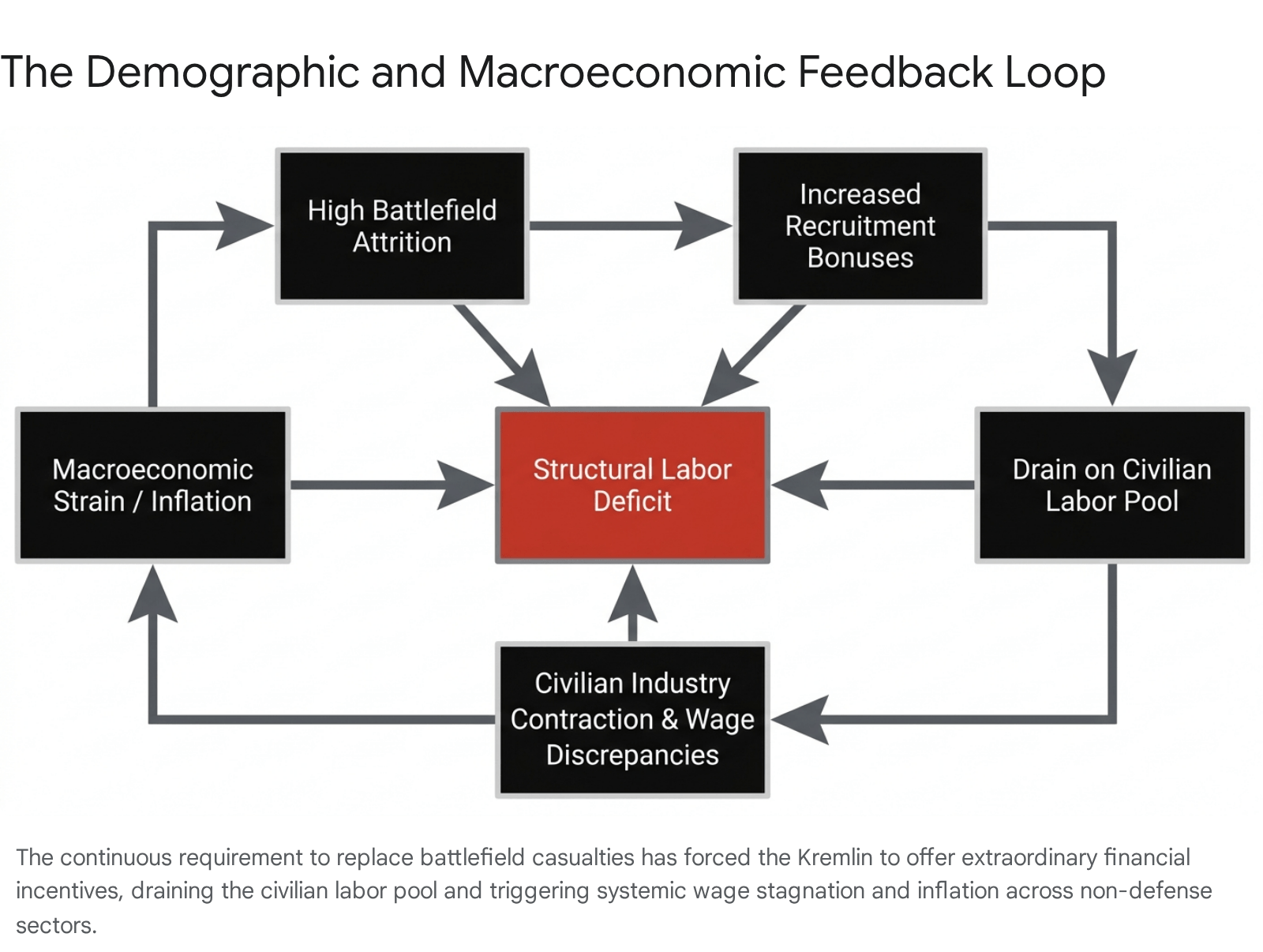
Data indicates a clear inflection point was reached in late 2025, where monthly personnel casualties began systematically exceeding the state’s capacity to recruit replacement forces.5 This personnel deficit is compounding a severe domestic labor shortage, triggering a negative feedback loop that suppresses civilian industrial output and mandates increasingly unsustainable financial incentives for military service. Concurrently, the material foundation of the Russian armed forces—its vast Soviet-era stockpiles of armored vehicles and towed artillery—has reached advanced stages of depletion. Satellite assessments confirm that critical asset classes, specifically infantry fighting vehicles and reactive artillery, have been reduced to below 20% of their pre-war inventory levels.6
Fiscally, the state’s macroeconomic buffer is eroding at an accelerated pace. The National Wealth Fund’s liquid assets have contracted to approximately 1.7% to 1.8% of gross domestic product, compelling a transition toward aggressive domestic taxation and internal debt generation to finance a defense budget that consumed 46% of all federal spending in the first quarter of 2026.7
Projecting these interrelated burn rates forward, the Russian government is expected to exhaust the majority of its viable stored armored reserves by late 2026 or early 2027, reducing its capacity to conduct large-scale mechanized operations.10 To mitigate these pressures, the Russian command is heavily prioritizing domestic artillery ammunition production, leveraging foreign proxy labor, and shifting battlefield tactics to low-footprint infantry assaults. The convergence of a restricted civilian labor pool and a depleted fiscal reserve suggests that leadership will face a binary policy decision before the close of 2026: initiate a second wave of forced mobilization and transition to a total war economy, or scale back strategic military objectives to align with degraded material realities.
2. Personnel Attrition and Demographic Strain
The Russian military’s consumption of human capital has generated profound, localized, and systemic demographic shocks across the Federation. The state is currently operating within a rigid constraint where immense battlefield attrition exacerbates an already historic domestic labor shortage, which in turn elevates the financial and political costs associated with military recruitment.
2.1 Battlefield Casualty Rates and Statistical Depletion
The sheer volume of casualties has begun to outpace the Russian Ministry of Defense’s financially incentivized recruitment apparatus. By early 2026, cumulative estimates suggest that almost 500,000 Russian military personnel have died since the conflict’s inception, with hundreds of thousands more having emigrated to avoid conscription.11 This staggering human cost is evidenced by the fact that while the Ministry of Defense has reportedly recruited 400,000 to 500,000 contract soldiers annually since the start of the war, the Russian Ground Forces have seen a net personnel gain of just 270,000.25 Earlier estimates formulated in early 2025 placed killed-in-action figures at a minimum of 172,000 personnel, accompanied by over 611,000 wounded.12 Within that wounded demographic, an estimated 376,000 were classified as severely disabled and permanently removed from the combat pool.12
Throughout 2025, personnel losses remained highly elevated, maintaining a steady average of approximately 1,000 casualties per day.13 A primary driver of this sustained attrition is the extension of the small unmanned aerial systems kill zone deeper into the Russian rear echelon.13 This technological adaptation by Ukrainian forces has severely complicated Russian medical evacuations, leading to a narrower killed-in-action to wounded-in-action ratio and rendering 2025 the deadliest year of the conflict.13 The high mortality rate of wounded personnel signifies a structural failure in front-line medical logistics, forcing the military to continuously draw upon unseasoned recruits to fill immediate gaps in the line of contact.
2.2 The Collapse of Domestic Recruitment Pipelines
Despite initial successes in generating approximately 976,000 personnel through forced mobilization in occupied territories, partial domestic mobilization in 2022, and extensive penal recruitment, the current volunteer system is faltering.12 A critical mathematical threshold was breached in December 2025, marking the first month where casualty rates definitively exceeded recruitment rates.5 This deficit established a continuous trend through the first quarter of 2026. In January 2026 alone, Western intelligence reports indicated that Russia sustained approximately 9,000 more battlefield casualties than it was able to replace.5 Demographic analysis finalized in June 2026 verifies that overall recruitment into the armed forces fell by 20% in the first quarter of 2026 compared to 2025.1
The government has resorted to increasingly stringent tactics to find manpower, reflecting the exhaustion of the primary volunteer pool. The military has actively encouraged migrants and foreign nationals to join its forces and is expected to increase pressure on regional administrators outside of major metropolitan areas like Moscow and St. Petersburg to meet local recruitment quotas.1 Furthermore, the Ministry of Defense has been implicated in efforts to coerce university students into signing military contracts. Reports emerged in April 2026 regarding joint meetings between the Ministry of Defense and the Ministry of Science to establish parameters for recruiting students into the Unmanned Systems Forces.14 While official state representatives denied allegations of forced enlistment, the targeted nature of these recruitment drives underscores the pressing need for personnel capable of operating technically demanding systems.14
2.3 Financial Inducements and the Labor Market Cannibalization
To address the personnel shortfall without triggering the domestic political unrest associated with a second formal mobilization, the state has deployed a spectrum of financial inducements. Recruitment bonuses have reached extraordinary levels, with the government offering signing bonuses equating to $80,000, or, as introduced in June 2026, full debt write-offs of up to $140,000 for individuals facing default.1 Despite these outlays, the diminishing returns indicate that the financial allure is reaching its absolute limit.
The aggressive extraction of human capital for the military has triggered a severe labor shortage across the domestic economy.1 The available labor reserve has precipitously declined from approximately 7 million to 4.4 million individuals over the past five years, creating what the International Institute for Strategic Studies described in mid-2026 as the most severe labor shortage in Russian history.1 While official state statistics project a record-low unemployment rate of 2.2%, this metric obscures significant structural distortions and a phenomenon of hidden unemployment.15 A massive redistribution of financial and human resources toward the military-industrial complex has overheated specific segments of the labor market.15
Civilian sectors are fundamentally unable to compete with the inflated wages offered by the Ministry of Defense and state defense contractors. In the first quarter of 2026, national job openings dropped by 12% while submitted resumes rose by 22%.16 Employers are entering tacit agreements to curb wage growth and avoid internal poaching, while 66% of companies that initiated layoffs cited deep financial difficulties.16 Major civilian entities are executing significant staff reductions; Russian Railways dismissed approximately 6,000 personnel from its central office, and the publishing house Prosveshchenie prepared to eliminate 20% of its staff by mid-2026.16
Real median wages remain heavily depressed in non-defense sectors. While the Russian state statistics service reported an average nominal wage of $1,460 in the first quarter of 2026, transactional monitoring by the banking sector estimates the actual median wage to be $900.15 Industries employing the majority of the workforce show the slowest growth. Wages in coal mining, automotive manufacturing, woodworking, and railway transport averaged $1,091, while light industry sectors such as apparel manufacturing averaged $791, healthcare stood at $764, and education at $737.15 To survive the economic pressure, 23% of working-age Russians have taken on secondary employment, with 52% actively seeking additional income streams in logistics, retail, and food service.16
2.4 Foreign and Non-Traditional Recruitment Mechanisms
Given the exhaustion of the domestic volunteer pool, the Russian state is expanding its recruitment of foreign nationals and exploiting vulnerable populations abroad. The government established an operational goal to recruit at least 18,500 foreigners into the army in 2026.17 This follows the estimated 27,000 foreign nationals from more than 130 countries who have already been enlisted since the war began.17 Operating through recruitment networks, individuals from economically deprived regions in Africa, Asia, and South America are frequently lured with promises of high-paying civilian jobs or logistical roles, only to be deployed to the most active sectors of the front.17
Simultaneously, the government has authorized a 20% increase in the quota for foreign labor migrants in 2026, aiming to import 279,000 skilled and unskilled workers.18 The Ministry of Labor specified that 92% of this quota is allocated for skilled workers meant for industrial enterprises, targeting demographics from India, China, Malaysia, and Bangladesh.18 In the first half of 2025, approximately 5.48 million migrants entered Russia for work, predominantly from Central Asian republics, highlighting the economy’s absolute reliance on imported labor to maintain baseline functionality while native citizens are diverted to the military effort.18
3. Materiel Burn Rate and Defense Industrial Capacity
Russian operational strategy is historically predicated on the application of overwhelming artillery fire and mechanized mass. However, the capacity to project this mass is almost entirely dependent on the continuous refurbishment of Soviet-era stockpiles rather than the net-new production of modern systems. Extensive satellite imagery analysis and equipment tracking databases confirm that this finite resource is approaching critical depletion.
3.1 Armor Depletion and Mechanized Platform Attrition
Visual evidence and open-source monitoring of Russian strategic storage sites reveal a high burn rate of armored combat vehicles. Pre-war estimates indicated a stockpile of 7,342 main battle tanks held in strategic reserves; as of recent tracking, Russian forces have deployed 4,799 of these units to the front line.6 Currently, only 19% of the pre-war tank stock remains in storage, and a significant portion of this remainder consists of stripped or unrecoverable hulls heavily compromised by years of open-air exposure.6
The depletion is evident across all tank models. Modern variants held in reserve, such as the T-90, have been completely exhausted, with 112 out of 112 units mobilized.6 This has forced the defense industrial base to rely heavily on refurbishing older models. The most commonly refurbished tanks include 1,409 units of the T-80B/BV, 1,251 units of the T-72B, and 1,048 units of the archaic T-62.6 Overall, visually confirmed database trackers, such as Oryx, indicate that the Russian army has lost well over 4,000 tanks, with the total number of documented lost armored combat vehicles reaching 14,044 as of June 10, 2026.2 The Oryx data methodology requires direct photographic or videographic evidence, meaning the true number of losses is mathematically higher than the recorded figures.6
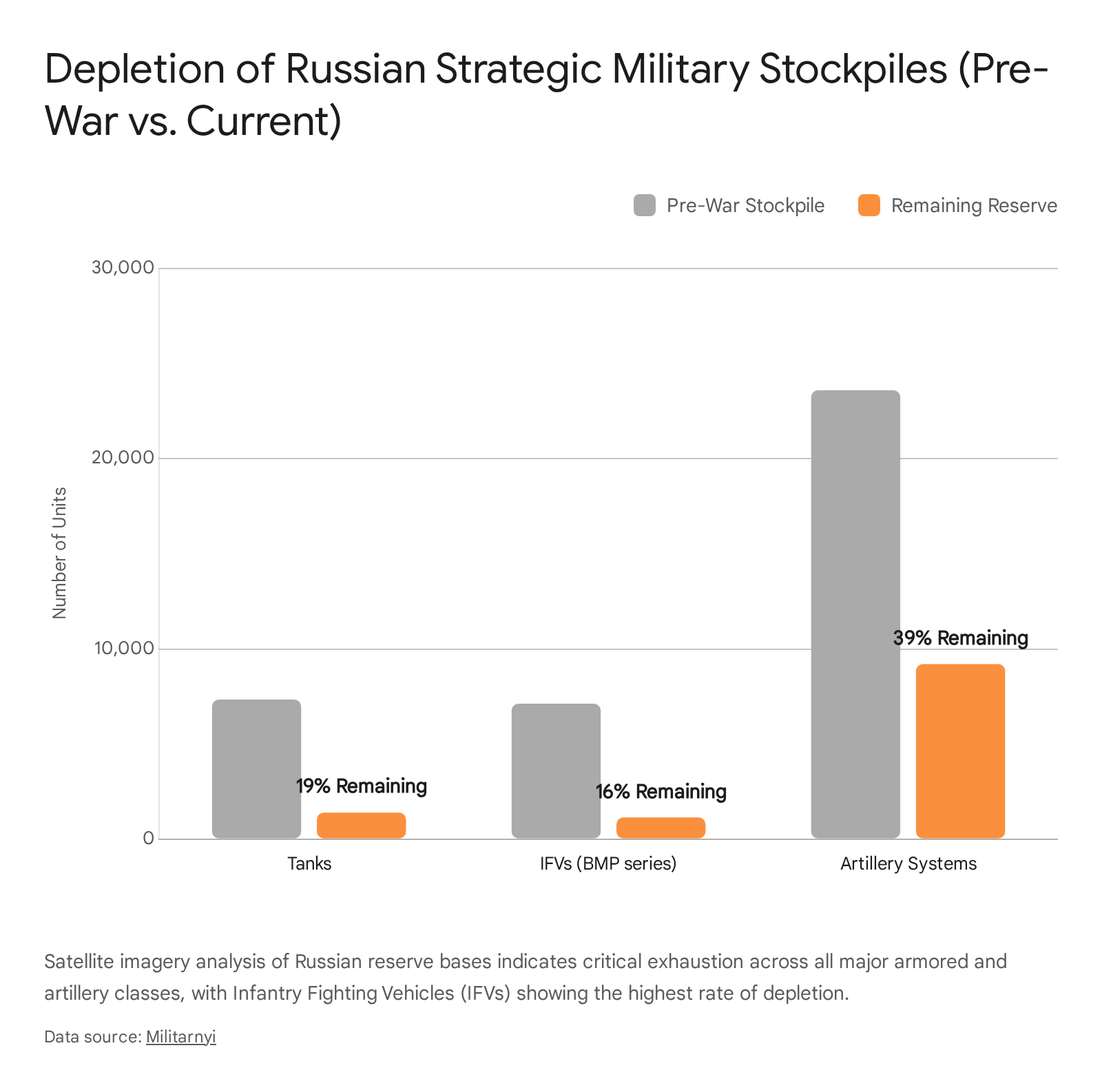
The situation regarding infantry fighting vehicles and armored personnel carriers mirrors the exhaustion of the tank fleet. Out of 7,121 pre-war BMP-1, BMP-2, and BMP-3 units stored in depots, 4,999 have been refurbished and removed, leaving only 16% of the initial stock in reserve.6 Facilities like the 111th Central Tank Reserve Base in the Kostroma region have seen their open parking lots nearly emptied.6 The vehicles that do remain suffer from corroded hulls, damaged engines, and compromised control systems, rendering them suitable only to be systematically dismantled for spare parts.6 Pre-war stocks of armored personnel carriers are similarly degraded, with forces mobilizing 6,161 units out of an initial 11,198.6
While domestic manufacturing is actively producing new T-90M tanks and BMP-3 vehicles, the production rates are vastly insufficient to offset daily losses. T-90M production, for instance, increased from approximately 40 units annually prior to the invasion to roughly 60-70 units in 2023, with projections suggesting an output of up to 90 units annually by 2025.19 However, analyzing the output of tank factories such as Omsk, Nizhny Tagil, Kurgan, and Arzamas reveals that the defense industry is reliant almost entirely on the modernization of Soviet-era systems into variants like the T-72B3 and T-80BVM, rather than net-new hull production.20
Consequently, Russian forces have been compelled to fundamentally alter their tactical doctrine. Offensive operations increasingly rely on highly mobile, low-footprint infantry fireteam infiltrations rather than multi-brigade mechanized pushes. This deliberate adaptation is designed to conserve dwindling armor stocks against mature Ukrainian long-range surface-to-surface capabilities and the pervasive presence of attack drones.13
Table 1: Estimated Depletion of Key Russian Military Assets (As of Early 2026)
| Asset Class | Pre-War Stockpile | Remaining in Storage | Depletion Percentage | Primary Recovery Mechanism |
| Main Battle Tanks | 7,342 | 1,395 | 81% | Refurbishing T-62/T-54 models; shifting to infantry tactics. |
| IFVs (BMP series) | 7,121 | 1,139 | 84% | Scavenging degraded hulls for localized spare parts. |
| APCs (BTR series) | 11,198 | 5,037 | 55% | Reallocation of interior security assets. |
| Artillery / Mortars | 23,602 | 9,116 | 61% | Scaling domestic shell production to offset barrel wear. |
| MRLS (Reactive) | ~8,794 | 1,583 | 82% | Increased reliance on loitering munitions. |
3.2 Artillery Systems and Barrel Lifecycles
Artillery remains the structural backbone of Russian operational lethality, yet both the hardware and ammunition supply chains are heavily stressed. Pre-war artillery storage contained roughly 23,602 units, including towed systems, mortars, and anti-aircraft artillery; currently, only 39% remains.6 The reactivation rate at major hubs like the Shchuchye storage site, which previously housed 50% of the country’s towed artillery, has plummeted.21 Between 2022 and early 2023, artillery was removed from Shchuchye at a rate of 72 units per month to equip newly mobilized regiments.21 However, since mid-2023, this pace dropped to fewer than 17 units per month, indicating that the remaining systems are in a state of deep degradation and require extensive factory-level overhaul before deployment.21
Multiple Rocket Launch Systems have been drawn down to just 18% of their pre-war levels. The specific systems mobilized from storage include 29 out of 43 BM-30 Smerch units, 234 out of 472 BM-22 Uragan units, and 1,027 out of 1,068 BM-21 Grad systems.6 The depletion of these area-denial weapons has forced Russian forces to adapt fire missions, resulting in reduced counter-battery efficacy. The situation is particularly acute for older systems. Guns like the D-1 howitzer and 100mm MT-12 anti-tank gun have practically disappeared from the battlefield due to exhausted ammunition stocks, while the 130mm M-46 is seeing heavy cannibalization for replacement barrels. To counter this structural deficit, Russia’s primary artillery manufacturer, Plant No. 9, has undertaken a major capacity expansion for barrel production. Notably, this expansion remains highly dependent on the acquisition of European machine tools, underscoring ongoing vulnerabilities and limits in Russia’s import substitution strategy.
3.3 Munitions Consumption and Foreign Dependency
To sustain an average rate of fire of approximately 10,000 rounds per day (yielding roughly 300,000 per month), Russia became highly dependent on external munitions pipelines.10 The most significant of these was established with the Democratic People’s Republic of Korea, a partnership that marked its two-year anniversary in June 2026.22 Following an agreement in mid-2023, a maritime logistics network utilizing four Russian bulk carriers—the Angara, Lady R, Maia-1, and Maria—completed over 112 voyages from the North Korean port of Rajin to Russian military ports at Vostochny and the Dunay former submarine base.23
This pipeline delivered an estimated 29,488 containers, translating to between 8 million and 11 million artillery shells and rockets over a two-and-a-half-year period.23 Intelligence estimates calculated that the loads consisted primarily of 122-mm howitzer shells (60%), 152-mm shells (25%), and 122-mm MLRS rockets (15%).23 By early 2025, North Korean munitions accounted for 75% to 100% of all daily Russian artillery fire.23 Military assessments indicated that without this supply, Russia’s daily shelling of Ukrainian positions would have been reduced by half.23
However, this critical supply line is currently degrading. Since autumn 2024, shipments dropped from an average of five voyages per month to three, with only a single delivery detected via maritime routes in early 2026.23 This decline is likely attributed to the exhaustion of North Korea’s own domestic stockpiles, prompting orders in late 2025 for the construction of new military manufacturing facilities in the DPRK.23 To compensate for the loss of the North Korean pipeline, Russia executed a radical scale-up of its domestic ammunition output, increasing production from 1 million rounds in 2022 to an estimated 7 million across all artillery, mortar, and rocket categories in 2025.23 While this demonstrates significant industrial mobilization, the quality and reliability of domestic production under strict international sanctions remain variable.
3.4 Advanced Systems and Aviation Attrition
The attrition of high-value aerospace and air defense assets further exacerbates operational constraints. By early 2025, visual evidence confirmed the loss of at least 136 fixed-wing aircraft and 152 helicopters.25 Elite units, such as the Russian Naval Infantry and Airborne Forces, suffered deep proportional losses, shrinking from pre-war levels of 35,000 to 10,000, and 45,000 to 35,000 respectively, severely degrading the capability to execute complex combined-arms operations.25
Crucially, systematic strikes against Russian anti-access and area denial infrastructure resulted in the destruction of over 77 surface-to-air missile systems and 23 radar stations throughout 2025.5 The proliferation of unmanned aerial vehicles on both sides has effectively replaced traditional artillery as the leading cause of frontline casualties, accounting for up to 80% of losses in specific sectors.26 Furthermore, Russian command and control capabilities were significantly degraded in early 2026 when geographic restrictions were imposed to disable thousands of illicit Starlink terminals used by Russian forces, crippling their frontline drone coordination and artillery targeting. The aerospace sector is experiencing similar depletion beyond tactical aviation. Russia’s strategic bomber force, particularly the Tu-22 fleet, is shrinking rapidly due to Ukrainian strikes, crashes, and a lack of manufacturing capacity to replace lost airframes, straining the conventional strike capabilities of the strategic triad. This shift necessitates massive investments in electronic warfare and localized air defense, drawing resources away from traditional armored procurement.
4. Capital Degradation and Macroeconomic Policy
The perception of Russian economic resilience is unraveling under the weight of sustained, asymmetric wartime expenditure. The state is stabilizing its public finances not through organic economic growth or foreign investment, but through aggressive fiscal extraction, resulting in acute structural deficits across both federal and regional levels.
4.1 Fiscal Hemorrhaging and Defense Expenditures
The financial burden of sustaining the military-industrial complex and funding exorbitant personnel recruitment bonuses has radically distorted the Russian federal budget. In the first quarter of 2026, the overall federal budget deficit widened to 4.58 trillion rubles (approximately 1.9% of GDP), instantly surpassing the government’s full-year deficit target of 3.79 trillion rubles.27
This blowout is primarily driven by unrestrained military outlays. During the first quarter of 2026, military spending surged by 30% year-over-year, reaching 5.9 trillion rubles.8 Consequently, defense outlays consumed an unprecedented 46% of all federal budget spending—indicating that nearly every second ruble spent by the Russian government was directed toward the military apparatus.9 The opacity of this spending is equally notable; over 38.2% of the total quarterly budget was classified, marking a record high for the entire conflict.8 Approximately 85% of all classified expenditures are directly related to military needs, masking the true inefficiencies, supply chain premiums, and localized corruption within the procurement system.8
Simultaneously, traditional state revenue streams are severely compromised. Russian oil and gas revenues plummeted by 45.4% in the first quarter of 2026 compared to the previous year.27 This collapse was directly precipitated by precise deep-strike campaigns against major export infrastructure, which successfully idled up to 40% of Russia’s oil export capacity in March 2026.27 The targeting of gas-processing and helium plants, which supply crucial components for explosives and liquid-fuel rocket engines, further disrupted both revenue generation and domestic military supply chains.3
4.2 Depletion of Sovereign Wealth Reserves
The Russian Ministry of Finance has historically relied on the National Wealth Fund to buffer against external economic shocks and cover persistent budget shortfalls. This mechanism is now critically compromised.
As the state drained reserves to cover the expanding deficits, the fund’s holdings of Chinese yuan were reduced by 40%, and its gold holdings were depleted by a staggering 74% by weight between 2024 and 2025.29 By April 2026, the liquid assets of the National Wealth Fund—those readily available for immediate government use—had shrunk to 1.8% of GDP, a figure officially confirmed by the Kiel Institute’s June 2026 “Endgame” report. Representing just under 4.0 trillion rubles, this remaining liquid capital constitutes an emergency reserve barely capable of covering a single year’s budget deficit.29 The National Wealth Fund no longer functions as a strategic sovereign wealth vehicle; it is now a fragile contingency account for a state fundamentally isolated from international capital markets.30
In a bid to artificially replenish the fund and manipulate currency valuations, the Finance Ministry quadrupled its purchases of foreign currency and gold in the summer of 2026, allocating over 208 billion rubles toward these operations utilizing limited oil-and-gas revenues.32 However, these actions offer merely temporary liquidity rather than structural solvency. A critical macro-factor in evaluating this economic resilience is Russia’s systemic transition toward a dependency partnership with Beijing. Macroeconomic assessments, including the June 2026 Kiel Report, indicate that Russia’s pivot to China is a structural necessity rather than a choice; Moscow heavily relies on Chinese demand for its exports and Chinese firms for critical technology imports to sustain its war economy. While this provides immediate stabilization, it significantly reduces Russia’s long-term economic autonomy.
Table 2: Key Macroeconomic Indicators of the Russian Federation (2025 vs. 2026)
| Metric | 2025 Benchmark | Q1 2026 Status | Strategic Implication |
| Federal Budget Deficit | Managed within target | 4.58 Trillion Rubles | Exceeded the 2026 full-year target in just three months. |
| Defense Spending Share | ~30-35% of Federal Budget | 46% of Federal Budget | The civilian economy is entirely subsumed by military requirements. |
| NWF Liquid Assets | ~5.0 Trillion Rubles | ~3.9 – 4.2 Trillion Rubles | The primary fiscal buffer has degraded to below 2% of GDP. |
| Value Added Tax (VAT) | 20% | 22% (Active 2026) | Immediate transfer of the war’s financial burden to the civilian populace. |
| GDP Growth Forecast | 4.3% (2024 metric) | 1.0% – 1.3% | Broad stagnation driven by high interest rates and private demand collapse. |
4.3 Taxation, Monetary Policy, and Inflation
With external capital inaccessible and sovereign reserves depleted, the government is shifting the financial burden of the war directly onto the civilian population and private enterprise.
Starting in 2026, the government implemented a sweeping series of tax hikes, most notably raising the Value Added Tax from 20% to 22%.33 Because this tax applies across the board, it acts as an economy-wide mechanism to compress civilian demand, intentionally suffocating purchasing power in an attempt to suppress inflation.33 Furthermore, the revenue threshold for small businesses to qualify for the simplified tax system was drastically slashed from 60 million rubles to just 10 million rubles.33 This regulatory change effectively subjects vast swaths of the civilian service economy—convenience stores, salons, and small technology firms—to higher standard tax rates, further stifling non-defense economic activity.33
The Central Bank of Russia is attempting to manage this volatility in an increasingly constrained environment. Following periods of sharp economic contraction, the bank slightly lowered the key interest rate to 14.25% on June 22, 2026.4 However, Central Bank Governor Elvira Nabiullina explicitly signaled that the rate-cut cycle is likely over. The bank warned that massive government fiscal stimulus, chronic labor constraints, and limited production capacity are creating severe domestic imbalances.4 The central bank anticipates adjusting the key rate trajectory upward in late 2026 and 2027 to combat entrenched inflation fueled directly by the state’s defense spending.34
4.4 Regional Financial Collapse
The fiscal crisis is most transparent at the regional level, where the burden of recruitment bonuses and infrastructure maintenance falls heavily on local administrators. The surplus of consolidated regional budgets fell to a five-year low in the first quarter of 2026, amounting to just 140 billion rubles.35
Currently, 56 regions are operating at a deficit, compared to only six regions at the start of the full-scale invasion in 2022.35 The combined deficit of these regions nearly doubled over the past year, reaching $4.06 billion.35 Economically weak and resource-extraction regions are bearing the brunt of this strain. For example, Kemerovo reported a budget shortfall of $294 million, while the Jewish Autonomous Region reported a relative deficit consuming 50.5% of its own revenue.35 Furthermore, the burden of the war is effectively draining Russia twice: once through direct military spending, and again through the costs of maintaining occupied Ukrainian territories, with occupied Sevastopol alone posting a deficit of roughly 0.7 billion rubles.36 This dynamic renders peripheral and occupied territories entirely dependent on federal transfers and debt to survive, establishing a core-periphery extraction model where Moscow retains the majority of positive balances while outlying areas are financially ruined.35
5. Intersecting Timelines and Strategic Culmination
The aggregated data unequivocally indicates that the Russian Federation cannot sustain its current rate of personnel, materiel, and capital expenditure indefinitely. The interplay between these three domains dictates that a failure in one accelerates the collapse of the others. The immense financial cost of recruiting personnel exacerbates the federal budget deficit; the depletion of the National Wealth Fund forces tax hikes that cripple the civilian labor market; and the exhaustion of armored vehicles necessitates a reliance on massive artillery barrages and high-casualty infantry assaults, which loops back to drive personnel losses even higher.
5.1 Resource Exhaustion Projections
Calculations based on current attrition rates, domestic manufacturing constraints, and precise satellite observation of remaining hulls suggest a definitive strategic culmination point. Barring a complete collapse of adversarial defense capabilities, Russia is projected to exhaust its viable reserves of Soviet-era armored vehicles and artillery systems by late 2026 or early 2027.10
Once the 85% depletion threshold is crossed across major armor categories, the Russian military will be almost entirely reliant on the fractional output of its newly built vehicles. Producing only hundreds of new units annually while losing thousands will fundamentally eliminate the capacity to conduct large-scale, multi-brigade mechanized maneuver warfare. Similarly, the personnel deficit recorded in early 2026 will compound. As the pool of individuals susceptible to financial coercion or debt relief diminishes, the state will face a severe manpower cliff.
5.2 Anticipated Strategic Mitigations
In the coming months, the Kremlin is expected to enact a series of defensive economic and administrative measures to delay culmination.
Administratively, the military will likely expand “stop-loss” policies, legally preventing current contract soldiers from concluding their service regardless of original terms. Politically, the state may attempt to invoke collective security treaties to draw neighboring proxy states, such as Belarus, deeper into the logistical or active combat roles to leverage untouched manpower reserves, despite resistance from Belarusian leadership.37
Fiscally, the Ministry of Finance will be forced to choose between highly inflationary monetary emission (printing money to cover the deficit), enforcing domestic war-bond purchases on the population, or enacting devastating cuts to civilian infrastructure and social services. The construction sector, which initially boomed during the war, is already suffering from the limitation of subsidized mortgage programs. Subsidized mortgages issued by Russian banks plummeted by 62% year-on-year in early 2026, leading to a 10% drop in the value of completed construction work in the first quarter of the year.38 This sector will likely face even deeper contractions as state funding continues to evaporate.
5.3 Outlook
Ultimately, Russia is utilizing its final strategic reserves to generate immediate tactical momentum. While the Russian military remains a highly lethal force capable of localized gains and extensive infrastructure destruction, its underlying logistical, demographic, and financial foundations are hollowing out rapidly. Absent a significant reduction in the operational tempo or an unforeseen influx of external state-level support, the Russian war machine is on a definitive trajectory toward structural culmination within the next 12 to 18 months. Leadership will inevitably be forced to align its strategic objectives with the strict limitations of a degraded industrial and demographic base.
Please share the link on Facebook, Forums, with colleagues, etc. Your support is much appreciated and if you have any feedback, please email us in**@*********ps.com. If you’d like to request a report or order a reprint, please click here for the corresponding page to open in new tab.
Sources Used
- Russia is increasingly struggling to replenish its armed forces, which …, accessed June 24, 2026, https://www.pravda.com.ua/eng/news/2026/06/14/8039261/
- The Russia-Ukraine War Report Card, June 17, 2026, accessed June 24, 2026, https://www.russiamatters.org/news/russia-ukraine-war-report-card/russia-ukraine-war-report-card-june-17-2026
- Ukraine strikes Russia’s only helium plant and largest gas complex 1,200 km from the front, accessed June 24, 2026, https://euromaidanpress.com/2026/06/24/ukraine-strikes-russias-only-helium-plant-and-largest-gas-complex-1200-km-from-the-front/
- GlobalSource Partners | CBR cuts the key rate by 25 bps, sees risks, accessed June 24, 2026, https://www.globalsourcepartners.com/posts/cbr-cuts-the-key-rate-by-25-bps-sees-risks-of-rising-inflation/teaser
- Ukraine’s Intermediate-Range Strike Campaign and New Mechanized Attacks Herald the Start of a New Phase of the War, accessed June 24, 2026, https://understandingwar.org/research/russia-ukraine/ukraines-intermediate-range-strike-campaign-and-new-mechanized-attacks-herald-the-start-of-a-new-phase-of-the-war/
- OSINT Study: Russia Has Exhausted Over Half of Its Stockpiles of …, accessed June 24, 2026, https://militarnyi.com/en/news/osint-study-russia-has-exhausted-over-half-of-its-stockpiles-of-armored-vehicles-and-artillery/
- Russian National Wealth Fund falls 90.5 bln rubles in Feb to 13.5 trln rubles, liquid assets at 1.7% of GDP – Interfax, accessed June 24, 2026, https://interfax.com/newsroom/top-stories/116451/
- Nearly Every Second Ruble in Russia’s Budget Went to War, accessed June 24, 2026, https://militarnyi.com/en/news/every-second-ruble-russia-budget-to-war/
- Russia’s Budget Deficit Tops $80 Billion Despite Kremlin Stability Claims, accessed June 24, 2026, https://united24media.com/world/russias-budget-deficit-tops-80-billion-despite-kremlin-stability-claims-20083
- Russia’s Weakness Offers Leverage | ISW, accessed June 24, 2026, https://understandingwar.org/research/russia-ukraine/russias-weakness-offers-leverage-2/
- Russia faces acute shortage of labor and soldiers — CNN, accessed June 24, 2026, https://nashaniva.com/amp/en/397619
- Combat losses and manpower challenges underscore the importance of ‘mass’ in Ukraine, accessed June 24, 2026, https://www.iiss.org/online-analysis/military-balance/2025/02/combat-losses-and-manpower-challenges-underscore-the-importance-of-mass-in-ukraine/
- Attrition and adaptation: Ukraine’s evolving war effort, accessed June 24, 2026, https://www.iiss.org/online-analysis/military-balance/2026/04/attrition-and-adaptation-ukraines-evolving-war-effort/
- Russian Offensive Campaign Assessment, April 27, 2026 | ISW, accessed June 24, 2026, https://understandingwar.org/research/russia-ukraine/russian-offensive-campaign-assessment-april-27-2026/
- Russian Military Spending Overheats Labor Market, Stifling Civilian Economy, accessed June 24, 2026, https://www.kyivpost.com/post/78598
- Fewer Jobs, Stronger the Competition: russia’s Labor Market Is Falling Apart, accessed June 24, 2026, https://szru.gov.ua/en/news-media/news/fewer-jobs–stronger-the–competition-russias-labor-market-is-falling-apart
- As Russian losses mount in Ukraine, Putin seeks more foreign fighters – Atlantic Council, accessed June 24, 2026, https://www.atlanticcouncil.org/blogs/ukrainealert/as-russian-losses-mount-in-ukraine-putin-seeks-more-foreign-fighters/
- Russia plans 279k migrant workers for 2026 – The New Voice of Ukraine, accessed June 24, 2026, https://english.nv.ua/business/russia-lacks-workers-after-mobilization-plans-to-hire-migrants-50556455.html
- Russian T-90M production: less than meets the eye, accessed June 24, 2026, https://www.iiss.org/online-analysis/military-balance/2024/06/russian-t-90m-production-less-than-meets-the-eye/
- Historical Armor Losses: Shifting Tactics and Strategic Paralysis | Article – Army.mil, accessed June 24, 2026, https://www.army.mil/article/289399/historical_armor_losses_shifting_tactics_and_strategic_paralysis
- Russia Has Depleted Nearly Half of Its Towed Artillery at Key Storage Site, accessed June 24, 2026, https://united24media.com/latest-news/russia-has-depleted-nearly-half-of-its-towed-artillery-at-key-storage-site-8973
- ‘Unprecedented’ earnings: 2 years on from Russia-North Korea pact, here’s what Putin, Kim have gained – The Kyiv Independent, accessed June 24, 2026, https://kyivindependent.com/missiles-for-moscow-prestige-for-pyongyang-what-russia-north-korea-gained-from-2-years-of-partnership/
- Inside the Pipeline: How North Korea Armed Russia, accessed June 24, 2026, https://istories.media/en/stories/2026/03/16/how-north-korea-armed-russia/
- Investigation shows Russia received up to 11m shells from North Korea over two and a half years, accessed June 24, 2026, https://www.pravda.com.ua/eng/news/2026/03/16/8025785/
- Key Changes in the Russian Military since the Start of the War | List of Articles, accessed June 24, 2026, https://www.spf.org/iina/en/articles/koizumi_02.html
- Russia Analytical Report, March 23–30, 2026, accessed June 24, 2026, https://www.russiamatters.org/news/russia-analytical-report/russia-analytical-report-march-23-30-2026
- Russia’s oil and gas revenues fall 45% in first quarter as budget deficit exceeds full-year target – Meduza, accessed June 24, 2026, https://meduza.io/en/news/2026/04/09/russia-s-oil-and-gas-revenues-fall-45-in-first-quarter-as-budget-deficit-exceeds-full-year-target
- Russian budget deficit widens to 4.58 trln rubles or 1.9% of GDP in Q1 – Finance Ministry, accessed June 24, 2026, https://interfax.com/newsroom/top-stories/117022/
- Russian National Wealth Fund – Wikipedia, accessed June 24, 2026, https://en.wikipedia.org/wiki/Russian_National_Wealth_Fund
- Endgame – Kiel Institute, accessed June 24, 2026, https://www.kielinstitut.de/fileadmin/Dateiverwaltung/IfW-Publications/fis-import/3d87c36f-c2f7-46a6-aedb-8c03627a224a-Endgame_The-State-of-the-Russian-Economy-Kiel_Report_No_9-english-Version.pdf
- Tightening the oil-price cap to increase the pressure on Russia – Chatham House, accessed June 24, 2026, https://www.chathamhouse.org/2025/09/tightening-oil-price-cap-increase-pressure-russia/russia-already-under-fiscal-pressure
- Russia to Quadruple FX Purchases as It Rebuilds Wealth Fund and Seeks to Weaken Ruble, accessed June 24, 2026, https://www.themoscowtimes.com/2026/06/03/russia-to-quadruple-fx-purchases-as-it-rebuilds-wealth-fund-and-seeks-to-weaken-ruble-a92921
- New Budget Confirms the Russian Public Is Paying for the War …, accessed June 24, 2026, https://carnegieendowment.org/russia-eurasia/politika/2025/10/russian-economy-forecast
- Central Bank of Russia could raise key rate trajectory for 2026-2027; this might not be neutral in 2028 either – Interfax, accessed June 24, 2026, https://interfax.com/newsroom/top-stories/118156/
- russia’s Budget Crisis Has Reached a Structural Level: 56 Regions Are Already Running Deficits, accessed June 24, 2026, https://szru.gov.ua/en/news-media/news/russias-budget-crisis-has-reached-a-structural-level-56-regions-are-already-running-deficits
- A ‘Jewish’ Region in Russia Is Now Paying for Putin’s War, accessed June 24, 2026, https://blogs.timesofisrael.com/a-jewish-region-in-russia-is-now-paying-for-putins-war/
- Russian Offensive Campaign Assessment, June 23, 2026, accessed June 24, 2026, https://understandingwar.org/research/russia-ukraine/russian-offensive-campaign-assessment-june-23-2026/
- As Wartime Slump Deepens, Russia’s Construction Sector Is on Shaky Ground, accessed June 24, 2026, https://www.themoscowtimes.com/2026/06/23/as-wartime-slump-deepens-russias-construction-sector-is-on-shaky-ground-a93049