Executive Summary
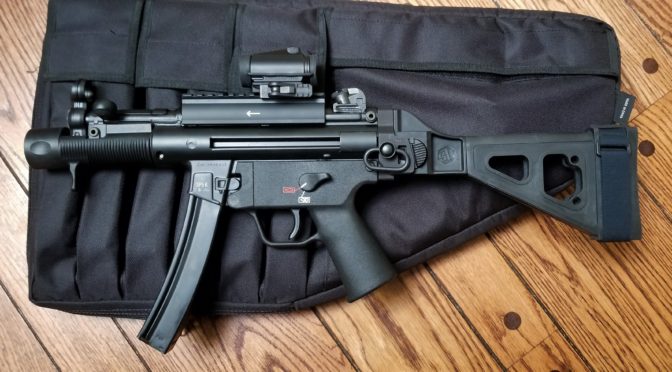
The Heckler & Koch MP5, originally designated as Project 65 by German engineers in the 1960s, evolved into one of the most widely recognized and operationally deployed submachine guns in modern history. Operating on a roller-delayed blowback mechanism derived from mid-century battle rifles and machine guns, the 9x19mm MP5 achieved a rapid rise in global elite military and law enforcement circles. This widespread adoption was largely catalyzed by its highly publicized deployment during the 1980 Iranian Embassy siege in London, which validated the MP5’s utility in modern counter-terrorism operations.1 The weapon provided an unprecedented combination of closed-bolt accuracy, reduced reciprocating mass, and high reliability, effectively rendering competing open-bolt designs obsolete for precision tactical applications requiring hostage rescue capabilities.3
However, by the late 1990s and early 2000s, the MP5 experienced a significant institutional fade. The proliferation of affordable ballistic body armor among criminal elements, dramatically demonstrated during the 1997 North Hollywood shootout, exposed the terminal ballistic limitations of the 9x19mm pistol cartridge.4 Consequently, global tactical doctrines shifted decisively toward 5.56x45mm NATO short-barreled carbines, which offered armor-defeating capabilities and superior terminal ballistics, thereby relegating the 9mm submachine gun to highly specialized or legacy roles.1
Despite its institutional decline in military armories, the MP5 and its modern derivatives have experienced a sustained resurgence in the civilian commercial market through the mid-2020s. This renaissance is driven by a complex convergence of factors: the maturation of the pistol-caliber carbine (PCC) market, the logistical advantages of ammunition commonality, and advancements in modern computer numerical control (CNC) manufacturing that have successfully democratized the historically expensive roller-delayed system.7 Furthermore, recent judicial stabilization regarding the legality of stabilizing braces has unleashed pent-up consumer demand.7 This report provides an exhaustive engineering analysis of the MP5’s roller-delayed mechanism, a historical examination of its tactical lifecycle, and a comprehensive market analysis of the primary manufacturers currently driving its commercial resurgence.
1. Historical Genesis and Engineering Genealogy
To fully comprehend the operational history and the modern commercial appeal of the MP5, one must first trace its engineering lineage. The system was not designed in a vacuum; rather, it represents the culmination of decades of metallurgical and kinematic problem-solving by European engineers seeking to optimize automatic weapon function.8
1.1 The Origins of Roller-Delayed Technology
During the latter stages of the Second World War, German engineers at Mauser were tasked with improving the manufacturing efficiency of infantry weapons while maintaining the ability to fire full-powered rifle cartridges. Traditional gas-operated, locked-breech designs required extensive machining, complex gas ports, pistons, and heavy locking lugs, which were resource-intensive.8 The engineers observed that the roller-locked recoil operation of the MG42 machine gun, while highly effective, could be simplified.
Physicist Dr. Karl Maier, analyzing high-speed firing cycles, noted that bolts in certain automatic weapons experienced “bolt bounce”—a phenomenon where the bolt would slightly rebound out of battery upon slamming forward during automatic fire.2 This observation led to the realization that rollers did not necessarily need to lock the breech rigidly; instead, they could be used to mechanically delay the opening of the breech.2 This concept was first codified in the Mauser Gerät 06H prototype and the StG 45(M) assault rifle.8 Unlike the MG42, which featured a recoiling barrel, the new roller-delayed blowback system utilized a fixed barrel and lacked a gas piston entirely.8
Following the war, many of these engineers relocated to Spain, where they refined the system for the Spanish CETME consortium.9 The CETME rifles successfully utilized sheet metal stamping and the roller-delayed mechanism to fire the 7.62x51mm NATO cartridge reliably.9 The German firm Heckler & Koch subsequently licensed and refined this design, resulting in the G3 battle rifle.9 By the mid-1960s, Heckler & Koch engineers initiated “Project 65,” an endeavor to scale down the G3’s roller-delayed architecture to accommodate the 9x19mm Parabellum pistol cartridge. The resulting firearm, introduced in 1966, was designated the MP5.1
2. Engineering Analysis of the Operating Mechanism
The kinematic physics of the roller-delayed blowback system are highly complex, representing a sophisticated departure from standard blowback operations. An engineering analysis of this system reveals exactly why the MP5 achieved its legendary reputation for accuracy and low recoil.7
2.1 Direct Blowback Constraints vs. Mechanical Delay
In a simple direct blowback firearm, the breech is held closed entirely by the physical mass of the bolt and the forward tension of the recoil spring.9 When a cartridge is ignited, the expanding propellant gases push the projectile forward down the barrel and simultaneously push the cartridge casing backward against the bolt face with equal force. To prevent the breech from opening prematurely—which would result in catastrophic case rupture and injury to the operator—the bolt must possess significant inertia. In a 9x19mm firearm, a direct blowback bolt must be exceptionally heavy. This massive reciprocating weight results in an oscillating recoil impulse as the heavy block of steel slams into the rear of the receiver during extraction and then drives heavily forward into battery.12
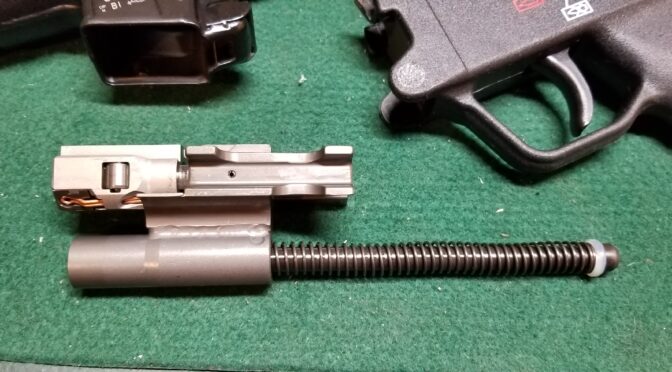
The MP5’s roller-delayed system circumvents the requirement for a massive bolt by introducing a mechanical disadvantage into the extraction cycle.9 The mechanism relies on a carefully calculated transfer of kinetic energy. First, upon ignition, expanding gases push the spent cartridge case rearward against the bolt head.9 However, the bolt head is not permitted to move freely rearward. It is mechanically impeded by two hardened steel rollers that are pushed outward into curved locking recesses machined into the barrel trunnion.9
Before the bolt head can retract, the rearward force exerted by the cartridge casing must physically squeeze these steel rollers inward, forcing them out of the trunnion recesses. As the rollers are forced inward, they press against the angled planes of a wedge-shaped internal component known as the locking piece.9 The geometric angles of the locking piece create a physical transmission ratio. For every millimeter the bolt head moves rearward, the locking piece and the attached heavier bolt carrier are driven rearward at a significantly multiplied velocity—often representing a 4:1 transmission ratio. This kinetic transfer drains energy from the bolt head, accelerating the locking piece backward and safely delaying the opening of the breech just long enough for the projectile to exit the muzzle and for internal chamber pressures to drop to safe levels.8
A critical maintenance metric within this mechanical architecture is the “bolt gap”—the specific clearance between the bolt head and the bolt carrier when the weapon is fully in battery, which directly dictates the timing of the roller disengagement. Because this system lacks traditional locking lugs, the bolt gap serves as the primary indicator of system wear. As the rollers and trunnion inevitably degrade over thousands of firing cycles, this gap shrinks, eventually requiring an armorer to install slightly oversized rollers to restore proper geometric engagement and maintain safe operational timing.
2.2 Fluid Dynamics and the Fluted Chamber
Because the mechanical delay system initiates the extraction process while residual pressures within the barrel are still relatively high compared to traditional gas-operated systems, the firearm faces a significant materials challenge regarding the brass cartridge casing. Under high internal pressure, the thin brass walls of a 9mm cartridge case are prone to obturation—a process where the brass expands tightly, forming a seal against the steel chamber walls.8 Attempting to mechanically extract a casing while it is obturated against the chamber wall requires immense force, which frequently results in the extractor claw tearing the rim entirely off the cartridge case, leaving the body of the casing lodged in the chamber and inducing a catastrophic malfunction.9
To solve this friction and pressure dilemma, MP5 engineers incorporated a fluted chamber.8 A series of longitudinal grooves, or flutes, are precisely cut into the interior walls of the chamber, extending from the neck of the chamber down to just above the seating point of the cartridge rim.9 Upon ignition, high-pressure propellant gas is intentionally allowed to flow backward through these flutes, enveloping the front half of the cartridge casing. This fluid dynamic equalizes the pressure on both the inside and the outside of the brass casing. By effectively floating the spent casing on a microscopic layer of high-pressure gas, the system breaks the friction seal, allowing the casing to be drawn out of the chamber smoothly and reliably without structural failure to the brass.8
2.3 Resultant Operational Advantages
This elaborate engineering architecture yields three distinct operational advantages that directly contributed to the MP5’s tactical dominance 7:
Firstly, the system dramatically reduces felt recoil.7 By eliminating the massive reciprocating bolt typical of direct blowback systems, the MP5 delivers a gentle, progressive rearward push rather than a sharp, violent recoil impulse. This allows the operator to maintain sight picture during rapid or fully automatic fire, enabling extremely fast and accurate follow-up shots.12
Secondly, the system enhances inherent mechanical accuracy because it fires from a closed-bolt position.12 When the operator pulls the trigger, the bolt is already fully forward, locked, and stationary. Only the internal hammer and firing pin move. This is in stark contrast to contemporary open-bolt submachine guns, such as the Uzi or the Sterling, where pulling the trigger releases a heavy, spring-loaded bolt that slams forward to strip a round and fire, inherently causing the weapon to dip and disrupting the operator’s precision aim.3
Thirdly, the delayed unlocking of the breech provides superior suppressibility.12 The mechanism keeps the breech sealed for a fraction of a second longer than direct blowback systems, minimizing the amount of unburned powder, concussive blast, and noise that escapes from the ejection port when the MP5 is operated in conjunction with a sound suppressor.12
3. Tactical Adoption and Counter-Terrorism
Despite its engineering brilliance, the MP5 struggled to gain dominant market share immediately upon its introduction in 1966.1 During the late 1960s and early 1970s, the global submachine gun market was saturated with cheaper, stamped-metal, open-bolt designs. Firearms like the Israeli Uzi and the British Sterling were favored by military quartermasters for their exceptionally low unit cost and simplicity of manufacturing.1 For standard infantry troops or vehicle crews requiring a compact weapon, the inherent inaccuracy of the open-bolt system was considered an acceptable trade-off for cost-efficiency.3
3.1 The Geopolitical Shift and Hostage Rescue
The geopolitical landscape of the late 1970s radically altered operational requirements for submachine guns.1 The era witnessed a significant rise in international terrorism, characterized by high-profile hostage-taking incidents in complex, multi-room structures or aboard commercial aircraft.1 Standard military tactics, which relied on overwhelming suppressive fire and fragmentation grenades, were entirely unsuitable for hostage rescue missions where non-combatants were intermingled with hostile actors.
Special operations units required surgical precision. The open-bolt systems lacked the necessary first-round accuracy to engage a hostile target situated immediately adjacent to a hostage.3 The MP5 offered rifle-like accuracy in a compact, pistol-caliber package, perfectly aligning with the emerging requirements of close-quarters battle (CQB).3
3.2 Operation Nimrod: The Catalyst for Global Dominance
The watershed moment that vaulted the MP5 into global ubiquity occurred in May 1980 during the Iranian Embassy Siege in London, known operationally as Operation Nimrod.1 When terrorists seized the embassy, the British government deployed the Special Air Service (SAS) to conduct a dynamic entry and rescue the hostages.
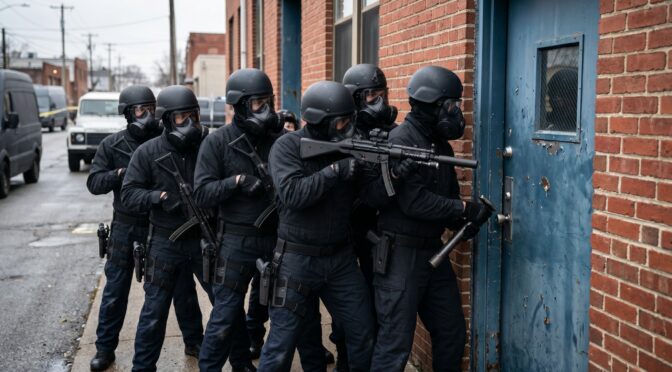
The SAS operators made a deliberate choice to equip themselves with the Heckler & Koch MP5 rather than their domestically produced Sterling submachine guns.3 The operation was highly televised. Photographs and video footage of SAS operators clad in black nomex coveralls and respirators, wielding the compact submachine guns as they rappelled from the roof and breached the embassy windows, were broadcast to a captivated global audience.1 The subsequent success of the mission—neutralizing five terrorists and capturing the sixth with minimal hostage casualties—served as the ultimate validation of the weapon system.2
Following Operation Nimrod, the MP5 experienced an unprecedented surge in procurement. It was rapidly adopted by virtually every Tier 1 special missions unit and elite law enforcement entity in the Western world.1 In the United States, it became the standard issue weapon for the Navy SEALs, Army Delta Force, the FBI Hostage Rescue Team (HRT), and the vast majority of major metropolitan SWAT teams.1 Analysts note that if the SAS had not utilized the weapon during Nimrod, its inherent technical superiority would have inevitably led to its adoption by other elite units, such as the French GIGN or the German KSK, eventually thrusting it into the limelight regardless of the specific historical catalyst.3
3.3 Variant Proliferation and Specialization
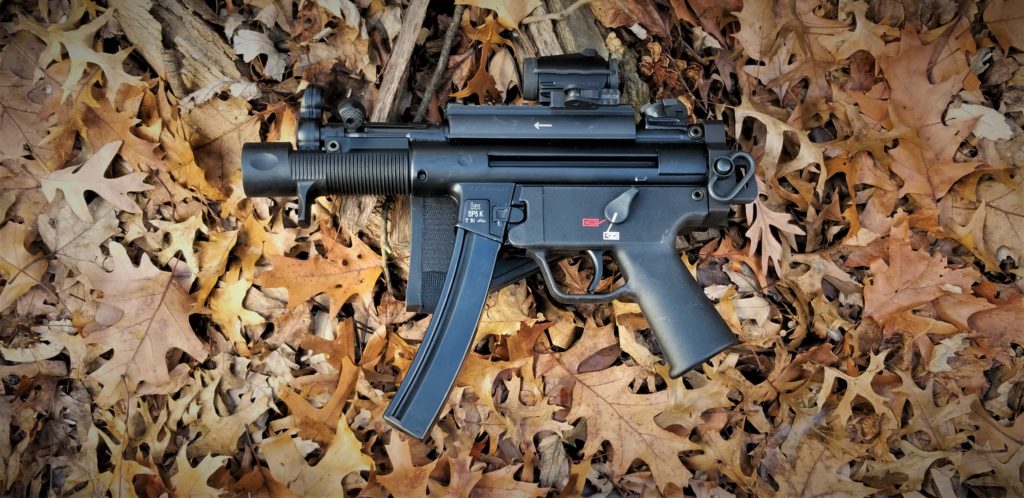
To meet the diverse requirements of these elite end-users, Heckler & Koch developed over 100 specialized variants of the MP5, further cementing its tactical indispensability.1 Notable configurations included the MP5K (Kurz), an ultra-compact version featuring a shortened barrel and receiver, designed for concealed carry by executive protection details and clandestine operatives.1 The MP5N (Navy) was developed specifically at the behest of the U.S. Navy SEALs, featuring specialized maritime corrosion resistance and threaded barrels for suppressor attachment.1
Perhaps the most technologically advanced iteration was the MP5SD (Schalldämpfer), which featured an integral sound suppressor.1 Engineers achieved this by porting the barrel—drilling precise holes into the barrel wall ahead of the chamber—which bled off excess propellant gas into the expansion chamber of the suppressor. This drop in pressure intentionally reduced the velocity of standard supersonic 115-grain and 124-grain 9x19mm ammunition, dropping it to subsonic speeds (below 1,125 feet per second) before it exited the muzzle. This eliminated the ballistic sonic boom, rendering the MP5SD astonishingly quiet without requiring logistically burdensome specialized subsonic ammunition shipments.11
4. The Tactical Fade: Shifting Paradigms and Terminal Ballistics
Despite its absolute dominance of the tactical and CQB space throughout the 1980s and 1990s, the MP5 experienced a rapid and permanent decline in institutional adoption as the turn of the millennium approached. This fade was not due to mechanical failure or a decline in manufacturing quality, but rather a fundamental shift in threat paradigms that the 9x19mm cartridge simply could not overcome.4
4.1 The Proliferation of Ballistic Body Armor
The primary catalyst for the MP5’s decline was the terminal ballistic limitation of pistol-caliber ammunition against ballistic body armor.4 As Kevlar, aramid fibers, and early ceramic plate armor became commercially accessible and relatively inexpensive, criminal entities and hostile paramilitary forces began utilizing them.4
The physics of terminal ballistics dictate armor penetration. A standard 9x19mm projectile, even when fired from an optimized carbine-length barrel, travels at roughly 1,100 to 1,300 feet per second. This lacks the requisite velocity to penetrate National Institute of Justice (NIJ) Level II or Level IIIA soft body armor, let alone Level III or IV hard plates.4 When a 9mm projectile impacts a Kevlar vest, the tightly woven fibers catch the bullet, dispersing its kinetic energy laterally across the panel. While the target may experience blunt force trauma—equivalent to a severe punch that may crack a rib or cause deep bruising—the kinetic energy transfer is insufficient to cause incapacitating, lethal trauma to internal organs.13 The kinetic energy transferred to the wearer of the armor is roughly equivalent to the felt recoil experienced by the shooter—a blunt force impact that is easily absorbed by a motivated or chemically altered combatant without causing systemic incapacitation.
4.2 The North Hollywood Shootout
This theoretical vulnerability was exposed in catastrophic fashion on national television during the February 28, 1997, North Hollywood shootout.5 Two heavily armed bank robbers, Larry Phillips Jr. and Emil Mătăsăreanu, entirely clad in custom-sewn, full-body aramid armor, engaged the Los Angeles Police Department in a protracted 44-minute firefight.
The perpetrators absorbed numerous direct hits from 9mm law enforcement sidearms and SWAT-issued MP5 submachine guns without being incapacitated.5 The 9mm projectiles simply failed to penetrate the suspects’ armor. Operating with near-impunity, the two men fired over 1,100 rounds of intermediate rifle ammunition into the surrounding neighborhood, maiming 20 people and pinning down dozens of officers.5 The shootout was only concluded through two distinct tactical responses. First, outgunned patrol officers commandeered higher-powered rifles from a local firearms dealer to lay down suppressive fire, while the first suspect, Larry Phillips Jr., was ultimately neutralized by a combination of a self-inflicted gunshot and precise rifle fire from arriving SWAT officers. Second, responding SWAT operators engaged the remaining suspect, Emil Mătăsăreanu, by deliberately targeting his unprotected lower extremities, striking his legs 29 times to bypass his heavy body armor.
4.3 The Institutional Pivot to 5.56x45mm NATO
The North Hollywood incident fundamentally altered North American police tactics. Law enforcement agencies realized that standard patrol and SWAT units required rifle-caliber platforms to defeat armored threats, as relying on 9mm MP5s constituted a severe tactical liability.4
The obvious solution was the 5.56x45mm NATO cartridge.6Traveling at nearly three times the velocity of a 9mm round (approximately 2,800 to 3,000 feet per second depending on barrel length), the spitzer-shaped 5.56mm projectile easily parts the woven fibers of soft body armor, achieving full penetration.6Furthermore, the formula for kinetic energy (E=1/2(mv^2)) demonstrates that velocity plays a squared role in energy delivery. The high velocity of the 5.56mm round creates a massive temporary stretch cavity within soft tissue, transferring devastating hydrostatic shock and frequently fragmenting upon impact, causing rapid incapacitation.6The obvious solution was the 5.56x45mm NATO cartridge.6Traveling at nearly three times the velocity of a 9mm round (approximately 2,800 to 3,000 feet per second depending on barrel length), the spitzer-shaped 5.56mm projectile easily parts the woven fibers of soft body armor, achieving full penetration.6Furthermore, the formula for kinetic energy () demonstrates that velocity plays a squared role in energy delivery. The high velocity of the 5.56mm round creates a massive temporary stretch cavity within soft tissue, transferring devastating hydrostatic shock and frequently fragmenting upon impact, causing rapid incapacitation.6
Simultaneously, the U.S. military was optimizing the M16 platform into highly reliable, shorter configurations, such as the M4 carbine and the Mk18 Close Quarter Battle Receiver (CQBR). These 5.56mm carbines offered superior terminal ballistics, greater effective range (up to 300 meters compared to the MP5’s effective limit of 50 to 75 meters), and manual-of-arms consistency with standard infantry rifles.6 By the early 2000s, military special operations and domestic SWAT operators were systematically replacing their aging MP5s with 5.56mm carbines.6
4.4 The Personal Defense Weapon (PDW) Gap
Within broader military logistics, the specific niche previously occupied by the MP5—equipping rear-echelon troops, vehicle crews, and aviators—was further encroached upon by the advent of dedicated Personal Defense Weapons (PDWs).1
Firearms manufacturers developed platforms firing high-velocity, small-caliber micro-rifle cartridges, most notably the Belgian FN P90 (firing the 5.7x28mm cartridge) and the German HK MP7 (firing the 4.6x30mm cartridge).1 These advanced weapons provided specific armor penetration capabilities in packages that were even smaller, lighter, and more ergonomic than legacy 9mm systems.14 Consequently, original manufacturing lines for the MP5 in Germany were heavily curtailed in favor of producing these newer-generation PDWs. This shift led to a corresponding lack of institutional spare parts, armorers, and logistical support, which only hastened the MP5’s retirement from active, frontline military service.1
5. The Modern Resurgence: Civilian Market Dynamics
While military and police armories universally transitioned to 5.56x45mm rifles and advanced PDWs, the 2020s have witnessed an unprecedented explosion in the popularity of the MP5 and its civilian clones within the commercial sector.7 This resurgence is not merely the result of historical nostalgia or pop-culture cachet; it is driven by a precise combination of pragmatic economics, home defense ballistics, legal stabilization, and modern manufacturing paradigms.7
5.1 Ammunition Commonality and Economic Efficiency
The modern civilian consumer highly values the logistical convenience of ammunition commonality.7 Modern shooters appreciate the same convenience sought by settlers in the 19th-century American West—the ability to utilize the exact same ammunition in both their primary rifle (or carbine) and their sidearm.7 With 9x19mm serving as the undisputed global standard for defensive handguns, the Pistol Caliber Carbine (PCC) allows users to streamline their logistics, purchasing ammunition in bulk without the financial burden of maintaining diverse, multi-caliber inventories.7
Furthermore, the economics of high-volume training heavily favor 9mm firearms like the MP5. Standard 9mm full-metal-jacket target ammunition is substantially less expensive to manufacture and purchase than 5.56x45mm brass rifle ammunition. This significantly lowers the financial barrier to entry for civilians participating in dynamic shooting sports, such as the United States Practical Shooting Association (USPSA) PCC division, or those conducting intensive defensive training regimens.7 Many modern MP5 clones are also designed to accept ubiquitous handgun magazines or widely available MP5-pattern magazines, reducing overall gear costs and increasing cross-platform versatility.7
5.2 Indoor Ballistics and Acoustic Mitigation
For civilian home defense scenarios, the MP5-pattern platform offers distinct physiological and environmental advantages over the 5.56mm short-barreled rifle.7 While the 5.56mm cartridge is highly lethal, discharging a short-barreled 5.56mm rifle inside a confined residential structure, particularly a hallway or bedroom, produces a deafening concussive overpressure and a blinding muzzle flash.7 The blast from a 10.5-inch 5.56mm barrel indoors is sufficient to cause immediate, permanent acoustic damage and temporary visual blinding in low-light conditions, severely degrading the defender’s situational awareness.
Conversely, the 9x19mm cartridge operates at significantly lower chamber pressures. When a 9mm cartridge is fired from an 8.9-inch MP5 barrel, the gunpowder column is burned almost entirely before the bullet exits the muzzle. This results in negligible muzzle flash and concussive noise compared to a rifle caliber.7 When this dynamic is paired with a sound suppressor and heavy, subsonic 9mm ammunition (such as 147-grain or 150-grain projectiles), the roller-delayed system provides an unparalleled level of acoustic safety.12 The delayed unlocking of the breech ensures that the vast majority of the expanding gases are directed forward into the suppressor baffles rather than venting out the ejection port. This allows civilian defenders to communicate clearly with family members and emergency dispatchers, maintaining critical situational awareness during a home defense incident.7
5.3 Regulatory Stabilization and the ATF Pistol Brace Rulings
The MP5 platform’s accessibility to the average civilian consumer was heavily impacted by shifting regulations established by the Bureau of Alcohol, Tobacco, Firearms and Explosives (ATF) regarding pistol stabilizing braces.7
Under the National Firearms Act (NFA) of 1934, adding a traditional shoulder stock to a firearm with a barrel shorter than 16 inches legally classifies it as a Short-Barreled Rifle (SBR). Acquiring an SBR requires the purchaser to submit fingerprints, pass an enhanced background check, pay a $200 federal tax stamp, and endure wait times that frequently range from six to twelve months.7 This burdensome process artificially suppressed the market for compact MP5-style platforms.
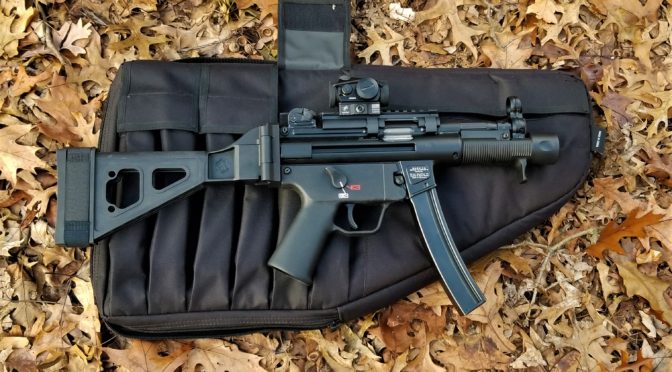
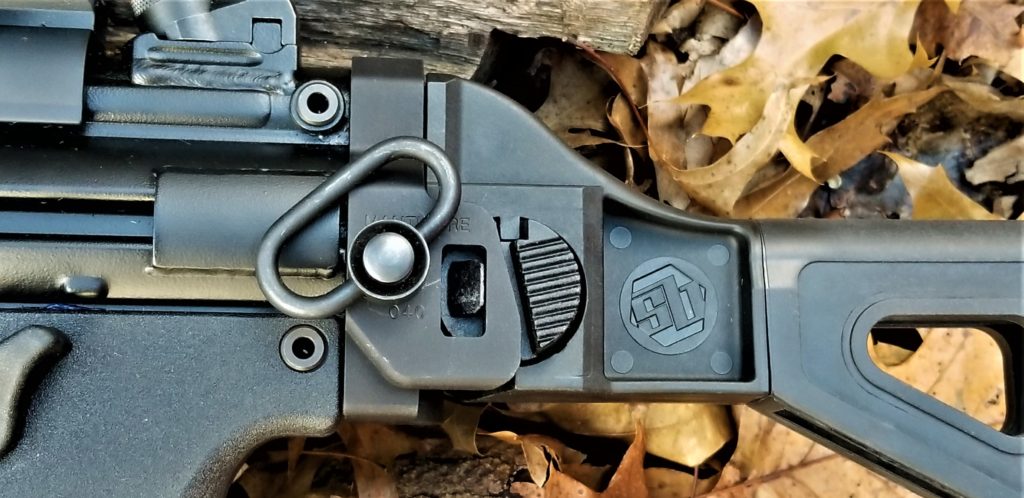
The invention of the stabilizing brace—a device designed to strap to the user’s forearm to stabilize a heavy pistol—allowed manufacturers to sell these compact MP5 platforms legally as “pistols,” completely bypassing the NFA requirements.7 Consumers quickly realized these braces could also be incidentally shouldered, providing carbine-like stability without the associated taxation and registration.7
In 2023, the ATF finalized a controversial rule that effectively banned these braces, attempting to reclassify millions of braced pistols as unregistered SBRs, subjecting owners to felony prosecution if they did not comply or register the weapons.7 However, in 2024 and 2025, major federal court rulings—specifically the Fifth Circuit’s decision in Mock v. Garland and parallel rulings in the Eighth Circuit—ruled that the ATF’s brace ban was “arbitrary and capricious.” The courts issued nationwide injunctions, blocking the enforcement of the rule.7
This massive judicial victory removed the legal ambiguity and fear of prosecution surrounding braced large-format pistols. The confirmation of brace legality unleashed immense pent-up consumer demand for compact, roller-delayed MP5 platforms, driving the current market resurgence as consumers rush to acquire the highly effective platforms in their optimal, short-barreled configurations.7 For consumers wishing to entirely bypass any future regulatory uncertainty regarding braces, the market has also responded with traditional 16-inch barrel configurations that comply with standard rifle laws, offering maximum compactness through folding mechanisms.7
6. Market Analysis: Manufacturer Profiles and Platform Configurations
The most significant structural driver of the current renaissance is the democratization of the complex roller-delayed blowback manufacturing process.7 Historically, purchasing an authentic, German-made semi-automatic MP5 cost several thousands of dollars, making it an elite, niche collector’s item entirely inaccessible to the average shooter.7
However, the expiration of the original Heckler & Koch patents, combined with the global proliferation of highly precise, computer-controlled CNC machining, has allowed domestic and allied international manufacturers to produce highly reliable clones, exact replicas, and radically modernized MP5 variants across a wide spectrum of price tiers.7 The civilian consumer now has unprecedented choice. The following analysis details the primary manufacturers driving this market segment, complete with detailed specifications, pricing structures, and sourcing architectures.
6.1 The Heritage Standard: Heckler & Koch (HK)
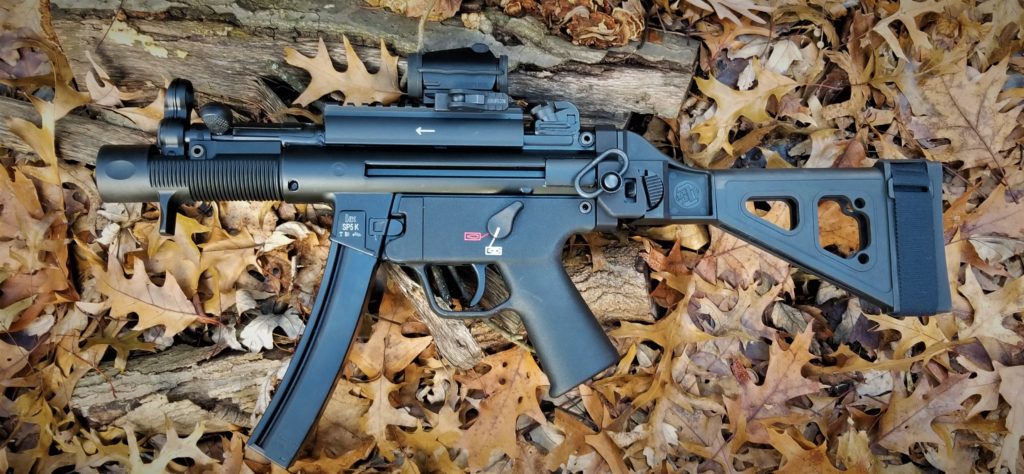
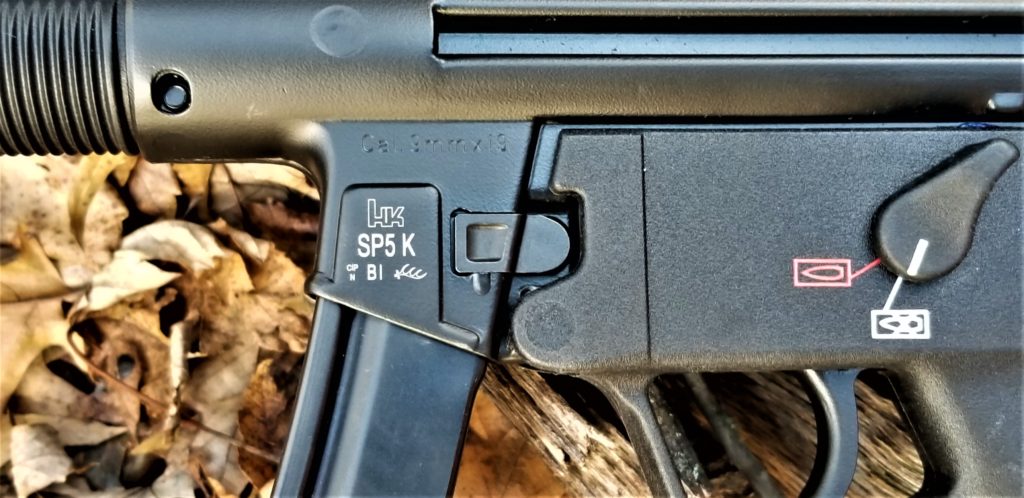
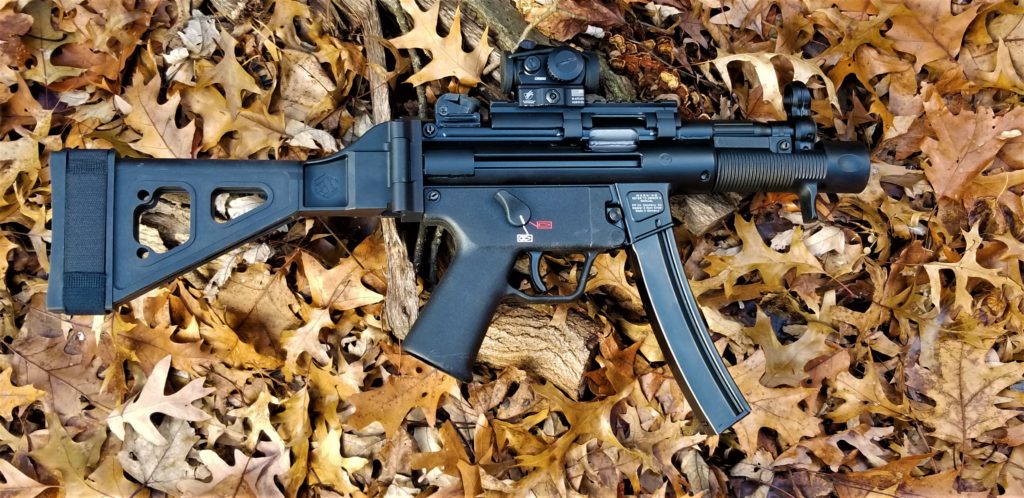
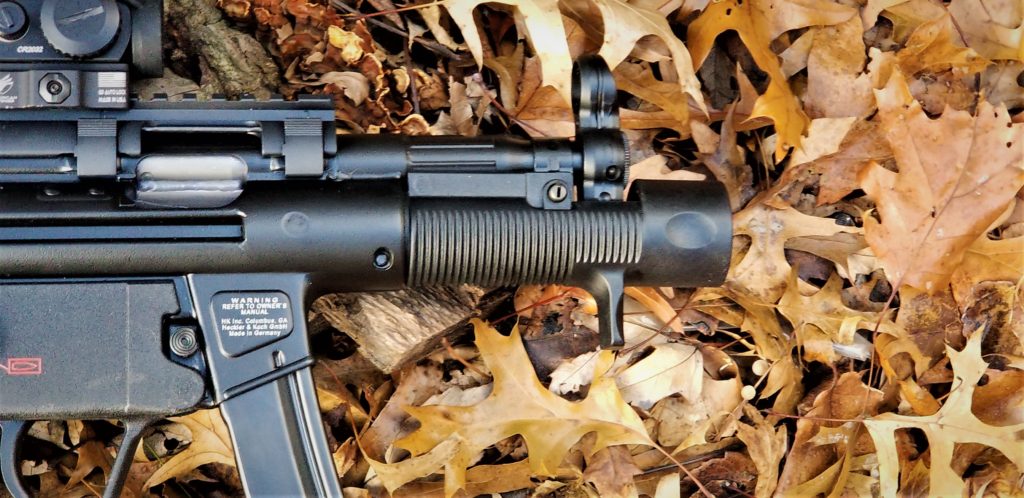
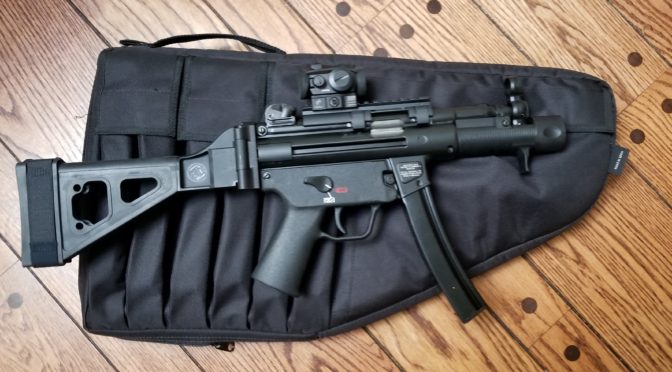
As the original architects and primary military suppliers of the MP5, the manufacturer Heckler & Kochremains the absolute gold standard for historical authenticity, metallurgical quality, and long-term collector value. The modern civilian semi-automatic offering, designated the H&K SP5, is manufactured entirely in Heckler & Koch’s primary Oberndorf factory in southwest Germany.17
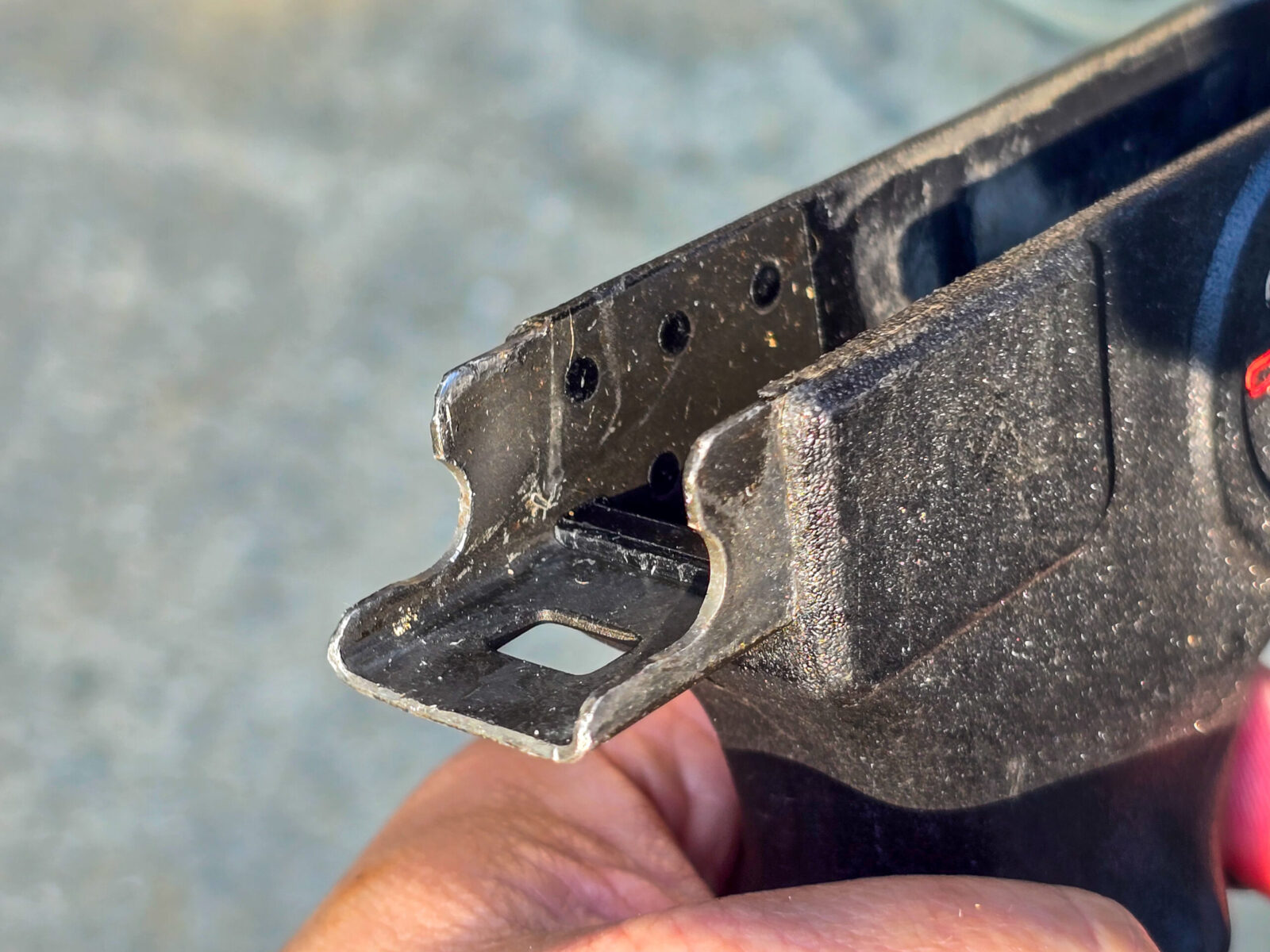
Crucially, the SP5 is produced utilizing the exact same industrial tooling, the same manufacturing lines, and the same specialized workforce that has been manufacturing the military selective-fire MP5 variants for decades.17 The SP5 retains every critical element of the classic aesthetic and mechanical design. It features a precision cold hammer-forged 8.86-inch “Navy” profile barrel, equipped with both a tri-lug adaptor for rapid suppressor attachment and standard 1/2×28 threads.18 It utilizes the essential fluted chamber, a traditional paddle magazine release, and the iconic, highly precise rotary rear diopter sight system.18
While it commands a premium luxury price point—often exceeding $3,000 depending on import availability—it remains highly sought after by purists for its impeccable fit, finish, and unbroken historical pedigree.16
- Platform Specifications: 9x19mm Parabellum | 8.86-inch Barrel | 17.8-inch Overall Length | 5.1 lbs. Weight 21
- Retail Availability:The SP5 is imported in limited batches and is available through major domestic distributors such as https://palmettostatearmory.com/brands/heckler-and-koch/hk-pistols/hk-sp5.html and https://www.midwayusa.com/product/1022425646.
6.2 The Budget Contender: Century Arms (MKE)
To service the entry-level and budget-conscious tier of the civilian MP5 market, the prominent importer Century Arms brings the AP5 platform to the United States. The AP5 line is manufactured in Turkey by MKE (Makina ve Kimya Endüstrisi Kurumu), a massive state-owned defense contractor that supplies the Turkish military.23
The critical advantage of the MKE AP5 lies in its lineage. Decades ago, MKE originally produced these firearms under an official, direct license from Heckler & Koch, meaning the Turkish factories were set up by German engineers.25 Consequently, the modern AP5 is built on original, legacy HK tooling.25 This results in a firearm that is dimensionally identical to the original German MP5 design, ensuring broad compatibility with a vast global aftermarket of legacy parts, stocks, and accessories.23 The AP5 features a cold hammer-forged Chrome Molybdenum Vanadium barrel, a classic adjustable rear sight, and standard tri-lug mounting options.23 By leveraging lower overseas labor and production costs, Century Arms provides an authentic roller-delayed MP5 experience at an MSRP of $1,359, successfully democratizing the platform for the broader commercial market.7
- Platform Specifications: 9x19mm Parabellum | 8.9-inch Barrel | 17.9-inch Overall Length | 5.5 lbs. Weight 23
- Retail Availability:The AP5 is widely distributed in high volumes and can be reliably sourced from major vendors like Atlantic Firearms andMidway USA.
6.3 The Domestic Workhorse: PTR Industries
Representing the strength of domestic American manufacturing, the manufacturerPTR has established a robust reputation within the roller-delayed community with their modernized MP5 clone, thePTR 9C.
Unlike the legacy imports which strive for historical exactness, PTR actively integrates modern tactical upgrades directly from the factory floor, appealing to shooters focused on practical defense rather than historical reenactment. Foregoing the classic, smooth polymer handguard of the 1980s, the PTR 9C features a MIL-spec anodized aluminum M-LOK handguard.28 This critical upgrade facilitates the immediate, secure attachment of modern weapon lights, laser aiming modules, and foregrips without requiring the user to purchase expensive aftermarket rails.28
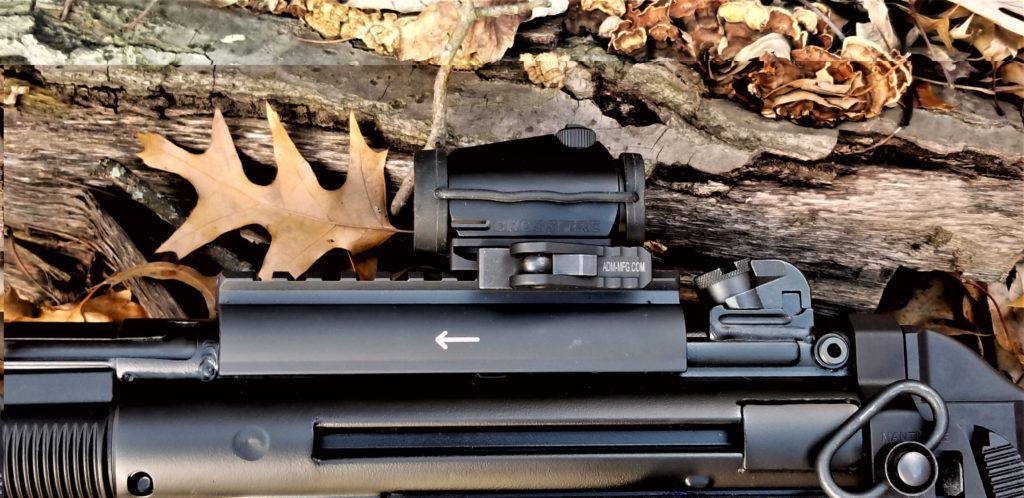
Additionally, the PTR 9C features a 4.5-inch steel Picatinny optic rail that is precision-welded directly to the top of the stamped receiver.29 This eliminates the need for the bulky, notoriously finicky aftermarket “claw mounts” required to mount red dot sights on traditional, slick-top German MP5s.29
- Platform Specifications: 9x19mm Parabellum | 8.86-inch Nitride Barrel | 17.6-inch Overall Length | 5.05 lbs. Weight | MSRP $1,989 28
- Retail Availability:The heavily modernized PTR 9C is readily available through vendors such as Atlantic Firearms and Sportsmans Warehouse.
6.4 The Premium Domestic Clone: Zenith Firearms
Bridging the market gap between modernized domestic production and absolute legacy authenticity is the manufacturer Zenith Firearms. After previously operating as the primary U.S. importer for Turkish MKE models, Zenith executed a massive logistical pivot, transitioning to producing their own MP5-pattern platform, the ZF-5, entirely in-house at their state-of-the-art facility in Afton, Virginia.32
The Zenith ZF-5 meticulously retains the exact iconic submachine gun aesthetic and operational profile of the original MP5, while applying modern, precision CNC tolerances, improved metallurgy, and highly durable protective surface coatings.34 At its core, it features a cold hammer-forged 4150 CMV (Chrome Moly Vanadium) steel barrel equipped with both a 3-lug adapter and 1/2×28 threading, classic polymer grips, and the highly desirable adjustable rear diopter drum sight.32
Zenith strategically differentiates itself in the crowded market by offering extensive, value-added package tiers. Their “Essentials Package” offers a highly accessible base entry point at an MSRP of $1,599 37, while their top-tier “Premium Package” ($1,999) includes three 30-round magazines, a high-quality hard carrying case, a Picatinny optics rail, a custom two-point tactical sling, a 3-lug flash hider, and a comprehensive limited lifetime warranty.35 This turnkey approach appeals to buyers seeking a complete, high-quality domestic system out of the box.
- Platform Specifications: 9x19mm Parabellum | 8.9-inch Barrel | 13.4-inch Sight Radius | 5.5 lbs. Weight 35
- Retail Availability:The premium American-made ZF-5 can be acquired from specialized retailers including Atlantic Firearms and Midway USA.
6.5 The Next-Generation Evolution: Springfield Armory
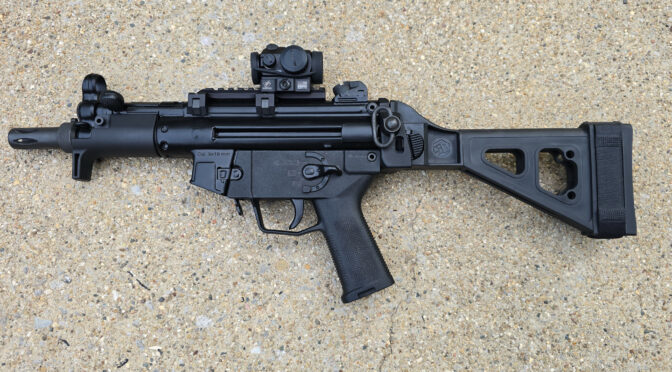
Rather than producing a strict 1:1 legacy MP5 clone bound by 1960s sheet metal design constraints, the major importerSpringfield Armory aggressively entered the roller-delayed market in 2025 with a radical modernization of the platform, introducing the Kuna.
Manufactured in Croatia by HS Produkt (the same partner firm responsible for Springfield’s XD and Hellcat lines), the Kuna is a significant evolutionary step. The name “Kuna” refers to the European pine marten—a fierce, compact mustelid native to Croatia (and historically featured on their national currency) known for punching significantly above its weight class. It extracts the core mechanical advantage of the MP5’s roller-delayed blowback system—the smooth recoil dynamics and low reciprocating mass—and houses it within a modernized, monolithic aluminum upper receiver.39 This architectural design choice entirely abandons the stamped-sheet-metal construction and complicated welding of the original models, replacing it with a rigid, extruded aluminum structure that inherently supports continuous, perfectly aligned top-mounted Picatinny optic rails and ample M-LOK mounting slots.39
Furthermore, the lower receiver of the Kuna incorporates familiar, ubiquitous AR-15 pattern ergonomics. It features a standard AR-pattern pistol grip, a flat-faced aluminum trigger with a tactile, short, audible reset, and fully ambidextrous safety selectors and magazine releases.39 By marrying the soft-shooting recoil dynamics of the roller-delayed system with the highly trained manual-of-arms of the modern AR-15, the platform provides an evolved personal defense weapon with zero learning curve for modern shooters.39 Furthermore, Springfield strategically priced the unit to disrupt the MP5 clone market, offering a base MSRP of $999, scaling to $1,149 for the braced configuration.41
- Platform Specifications: 9x19mm Parabellum | 6.0-inch threaded barrel | Monolithic aluminum frame | Fully Ambidextrous 40
- Retail Availability:Leveraging Springfield’s massive distribution network, the Kuna is widely available at online retailers such as GrabAGun and through secondary market brokers on GunBroker.
6.6 The Boutique Custom Tier: Dakota Tactical
At the absolute highest echelon of the domestic MP5 market sits the bespoke manufacturer Dakota Tactical, which caters strictly to dedicated connoisseurs, collectors, and discerning professionals through meticulously hand-built platforms found on their models page.
Dakota Tactical operates completely outside the paradigm of mass production; each individual D54 model is hand-crafted, rolled, and welded by a highly skilled small team of master gunsmiths, resulting in an estimated lead time of up to 24 months from the date of order.43 The builds utilize a precise, curated blend of authentic German Heckler & Koch internal components and hand-selected U.S.-manufactured parts to ensure absolute legal compliance and mechanical perfection.44
The receivers are properly rolled and TIG welded with obsessive attention to dimensional tolerances, capped with a flawlessly integrated top Picatinny rail, and finished with a base layer of military-spec parkerization under a highly durable HK Black DuraCoat final finish.44 Featuring authentic German tungsten-filled sear-ready bolt groups to ensure highly reliable cyclic rates and prevent bolt bounce, and free-floating cold hammer-forged barrels (often sourced from premium Swiss manufacturers like B&T), the D54 line represents the pinnacle of modern roller-delayed MP5 refinement, commanding base MSRPs of $3,899.44
- Platform Specifications: 9x19mm Parabellum | 8.85-inch Barrel | 1:10 twist rate | Integral Rail 44
- Retail Availability:Due to highly limited boutique production rates, D54 variants are exceptionally rare and are typically acquired directly from the manufacturer or through highly specialized NFA dealers such as Capitol Armory and Atlantic Firearms.
Market Specification Matrix
To consolidate the dimensional, metallurgical, and economic variance across the current commercial landscape, the following matrix summarizes the standard configurations and manufacturing origins of the primary 9mm platforms analyzed in this report:
| Manufacturer | Platform Model | Barrel Length | Operating Mechanism | Key Manufacturing Feature / Origin | Base MSRP (USD) |
| Heckler & Koch | SP5 | 8.86″ | Roller-Delayed Blowback | OEM German Factory Production, Legacy Tooling | >$3,000 |
| Dakota Tactical | D54-N | 8.85″ | Roller-Delayed Blowback | Bespoke Hand-Rolled/Welded, German Internals | $3,899 |
| Zenith Firearms | ZF-5 | 8.9″ | Roller-Delayed Blowback | USA Manufactured, 4150 CMV Steel Barrel | $1,599 |
| PTR Industries | PTR 9C | 8.86″ | Roller-Delayed Blowback | USA Manufactured, Welded Picatinny, M-LOK Rail | $1,989 |
| Century Arms | AP5 | 8.9″ | Roller-Delayed Blowback | Turkish (MKE) Manufactured on Licensed Legacy Tooling | $1,359 |
| Springfield Armory | Kuna | 6.0″ | Roller-Delayed Blowback | Croatian (HS Produkt) Manufactured, Monolithic Aluminum Upper | $999 |
Conclusion
The lifecycle of the Heckler & Koch MP5 represents a fascinating intersection of mechanical engineering, shifting tactical doctrines, and commercial market dynamics. Born from the remnants of mid-century battle rifle engineering, the system’s ability to mechanically retard the opening of the breech without relying on massive, oscillating bolt weights provided unparalleled accuracy and recoil mitigation.8 This mechanical superiority, thrust into the global spotlight during early counter-terrorism operations like the Iranian Embassy Siege, cemented its legacy as the definitive submachine gun of the late 20th century.1
While the physical realities of modern ballistic body armor and the terminal superiority of the 5.56x45mm cartridge ultimately forced the MP5 out of primary military and law enforcement service 4, the underlying engineering remains highly relevant and deeply respected. In the civilian sector, where military-grade body armor penetration is not a primary operational constraint, and where indoor acoustic mitigation and low recoil are highly prized for home defense and sporting applications, the MP5 architecture has found a powerful second life.7
Supported by recent judicial stabilization regarding the legality of stabilizing braces, and propelled by immense advancements in CNC manufacturing that have dramatically lowered the financial barriers to entry, the MP5 platform has successfully transitioned. It has evolved from an exclusive, highly restricted tactical tool into a vibrant, economically accessible, and dominant force in the modern commercial firearms industry, ensuring its engineering legacy will continue well into the 21st century.
Appendix: Methodology
The analysis presented in this report was generated through a structured synthesis of historical military data, mechanical engineering principles, and current commercial firearms market specifications. The analytical framework was constructed across three primary phases:
- Engineering and Kinematic Verification: The mechanical principles underlying the roller-delayed blowback system were extracted from foundational firearms engineering literature, historical patent data, and kinematic schematics. The physical interactions between chamber pressure, bolt mass, locking rollers, trunnion geometries, and fluted chamber gas dynamics were modeled to verify the technical claims regarding reduced reciprocating mass, delayed breech opening, and enhanced extraction reliability.
- Historical and Tactical Doctrine Analysis: The platform’s operational lifecycle was mapped by correlating major geopolitical events (e.g., the 1980 Iranian Embassy Siege) with recorded shifts in international military and SWAT procurement.1 The institutional decline was traced by analyzing terminal ballistics data against modern NIJ body armor standards and documenting post-1997 (North Hollywood) alterations in law enforcement tactical doctrine toward 5.56mm carbines and specialized PDWs.
- Commercial Market Parameterization: The modern resurgence was quantified by aggregating specification data, MSRP figures, and metallurgical feature sets from the official product documentation of six leading manufacturers (Heckler & Koch, Century Arms, PTR Industries, Zenith Firearms, Springfield Armory, and Dakota Tactical). This data was cross-referenced with major retail distributors to verify civilian market availability, pricing trends, and configuration standardization in the context of recent ATF regulatory injunctions regarding pistol braces. The qualitative assessments of “budget,” “premium,” and “modernized” tiers were derived strictly from the comparative quantitative metrics of MSRP, manufacturing origin, and material composition.
Note: Vendor Sources listed are not an endorsement of any given vendor. It is our software reporting a product page given the direction to list products that are between the minimum and average sales price when last scanned.
Please share the link on Facebook, Forums, with colleagues, etc. Your support is much appreciated and if you have any feedback, please email us in**@*********ps.com. If you’d like to request a report or order a reprint, please click here for the corresponding page to open in new tab.
Sources Used
- A Brief History of the MP5 — Zenith Firearms, accessed June 18, 2026, https://zenithfirearms.com/brief-history-mp5/
- Ultimate Roller Delayed Guide: Everything You Wanted to Know And Were Too Afraid to Ask, accessed June 18, 2026, https://www.recoilweb.com/ultimate-roller-delayed-guide-191281.html
- Was the H&K MP5 really that special of a submachine gun of its time? Or is it special because of the SAS? – Reddit, accessed June 18, 2026, https://www.reddit.com/r/WarCollege/comments/1mt4mgb/was_the_hk_mp5_really_that_special_of_a/
- With modern body armor, will 5.56 AR’s go the way of the MP5’s? : r/CQB – Reddit, accessed June 18, 2026, https://www.reddit.com/r/CQB/comments/1hdj8zw/with_modern_body_armor_will_556_ars_go_the_way_of/
- The Evolution of Police Long Guns – Heloderm LLC, accessed June 18, 2026, https://heloderm.com/the-evolution-of-police-long-guns
- Why every patrol officer should have a rifle – Police1, accessed June 18, 2026, https://www.police1.com/firearms/why-every-patrol-officer-should-have-a-rifle
- What Is a Pistol Caliber Carbine? New Info for 2025– Liberty Home …, accessed June 18, 2026, https://libertyhomeconcealment.com/blogs/articles/what-is-a-pcc
- Blowback (firearms) – Wikipedia, accessed June 18, 2026, https://en.wikipedia.org/wiki/Blowback_(firearms)
- Inside the MP5, the History and Function of Roller-Delay, accessed June 18, 2026, https://sdi.edu/2021/05/20/inside-the-mp5-the-history-and-function-of-roller-delay/
- Understanding Blowback Firearm Mechanisms | PDF – Scribd, accessed June 18, 2026, https://www.scribd.com/document/330109281/Blowback
- Heckler & Koch MP5 – Wikipedia, accessed June 18, 2026, https://en.wikipedia.org/wiki/Heckler_%26_Koch_MP5
- An Analytical Report: The Heckler & Koch MP5 vs. MP7 – A Study in …, accessed June 18, 2026, https://blog.roninsgrips.com/an-analytical-report-the-heckler-koch-mp5-vs-mp7-a-study-in-evolution-and-application/
- @ Anyone in this community who is trying to argue that bouncing 10 rounds off of armored suspects is realistic : r/ReadyOrNotGame – Reddit, accessed June 18, 2026, https://www.reddit.com/r/ReadyOrNotGame/comments/vpj5v1/anyone_in_this_community_who_is_trying_to_argue/
- FN 5.7x28mm: The Little Cartridge That Could – Free Range American, accessed June 18, 2026, https://freerangeamerican.us/fn-5-7x28mm/
- Sitemap – Free Range American, accessed June 18, 2026, https://freerangeamerican.us/sitemap/
- The King of Budget Roller Delayed PCCs? The Springfield Kuna – YouTube, accessed June 18, 2026, https://www.youtube.com/watch?v=3IICsflrNRs
- SP5K-PDW – HK USA, accessed June 18, 2026, https://hk-usa.com/product/sp5k-pdw/
- HK Launches New SP5 Available to U.S. Consumers | An Official Journal Of The NRA, accessed June 18, 2026, https://www.americanrifleman.org/content/hk-launches-new-sp5-available-to-u-s-consumers/
- HK SP5 Sporting Pistol – MidwayUSA, accessed June 18, 2026, https://www.midwayusa.com/product/1022425646
- SP5 | Heckler & Koch, accessed June 18, 2026, https://www.heckler-koch.com/en/Products/Hunting%20and%20Sport/Semi-automatic%20rifles/SP5
- Heckler and Koch SP5 Pistol 9mm 8.86″ 30-Round – GrabAGun, accessed June 18, 2026, https://grabagun.com/heckler-and-koch-sp5-pistol-9mm-8-86-30-round.html
- HK SP5 9mm Luger 8.86in Matte Black Modern Sporting Pistol – 30+1 Rounds, accessed June 18, 2026, https://www.sportsmans.com/shooting-gear-gun-supplies/handguns/hk-sp5-9mm-luger-886in-matte-black-modern-sporting-pistol-301-rounds/p/1620587
- AP5 – Century Arms, accessed June 18, 2026, https://www.centuryarms.com/ap5-pistol.html
- AP5 – Century Arms, accessed June 18, 2026, https://www.centuryarms.com/ap5-hg6034.html
- AP Series – Century Arms, accessed June 18, 2026, https://www.centuryarms.com/ap-series
- Century Arms AP5 9mm Luger Pistol 9 Barrel 30+1 Round Black – MidwayUSA, accessed June 18, 2026, https://www.midwayusa.com/product/1024870243
- Century Arms AP 5 Core Pistol SALE – AtlanticFirearms.com, accessed June 18, 2026, https://atlanticfirearms.com/century-ap5-core-HG6034A-N
- Buy PTR 9C – 9X19MM – PISTOL for $1989 at PTR | American-Made & Lifetime Warranty, accessed June 18, 2026, https://www.ptr-us.com/product/9c/
- PTR PTR-9C 9mm Luger Pistol 8.86 Barrel 30+1 Round Black – MidwayUSA, accessed June 18, 2026, https://www.midwayusa.com/product/1020257077
- PTR Industries 9C 9mm Luger 8.86in Black Parkerized Modern Sporting Pistol – 30+1 Rounds | Sportsman’s Warehouse, accessed June 18, 2026, https://www.sportsmans.com/shooting-gear-gun-supplies/handguns/ptr-industries-9c-9mm-luger-886in-black-parkerized-modern-sporting-pistol-301-rounds/p/1823371
- PTR 9C Pistol-PTR 600 – Atlantic Firearms, accessed June 18, 2026, https://atlanticfirearms.com/ptr-9c-9x19mm-pistol-4041
- Zenith Firearms: American Made MP5 Manufacturer | MP5 for Sale & HK MP5, accessed June 18, 2026, https://zenithfirearms.com/
- ZF-5 – 9mm Roller-Delayed Blowback Firearm, accessed June 18, 2026, https://zenithfirearms.com/zf-5/
- Zenith Firearms ZF-5 9mm 8.9″ Barrel 30-Rounds Three Magazines – GrabAGun, accessed June 18, 2026, https://grabagun.com/zenith-firearms-zf-5-9mm-8-9-barrel-30-rounds-3-magazines.html
- ZF-5 Premium Package | Zenith Firearms, accessed June 18, 2026, https://zenithfirearms.com/product/zf-5/
- Zenith ZF-5 9MM Pistol- ZF50000009BK-PREMIUM PACKAGE – Atlantic Firearms, accessed June 18, 2026, https://atlanticfirearms.com/zenith-zf-5-9mm-pistol-zf50000009bk
- ZF-5 Essentials Package – Zenith Firearms, accessed June 18, 2026, https://zenithfirearms.com/product/zf-5-pistol-black-1-magazine/
- Zenith ZF-5 9mm Luger Pistol 8.9 Barrel 30+1 Round Black – MidwayUSA, accessed June 18, 2026, https://www.midwayusa.com/product/1025202268
- Kuna Pistols – Springfield Armory, accessed June 18, 2026, https://www.springfield-armory.com/kuna-series-pistols/kuna-pistols/
- Kuna Series Pistols – Springfield Armory, accessed June 18, 2026, https://www.springfield-armory.com/kuna-series-pistols/
- Springfield Armory® Launches Roller-Delayed Kuna™ 9mm Pistol, accessed June 18, 2026, https://www.springfield-armory.com/intel/press-releases/springfield-armory-launches-roller-delayed-kuna-9mm-pistol/
- Springfield Kuna – GrabAGun, accessed June 18, 2026, https://grabagun.com/shop/springfield-kuna
- Firearms – Dakota Tactical, accessed June 18, 2026, https://www.dakotatactical.com/product-category/firearms/
- Dakota tactical D54-N Roller Lock Pistol – Atlantic Firearms, accessed June 18, 2026, https://atlanticfirearms.com/dakota-tactical-d54-n-pistol
- Dakota Tactical MP5 D54-N A1 Pistol – Capitol Armory, accessed June 18, 2026, https://www.capitolarmory.com/dakota-tactical-mp5-d54-n-a1-pistol.html
- Dakota Tactical D54/10 Semi-Automatic 10mm Pistol, accessed June 18, 2026, https://www.dakotatactical.com/product/dakota-tactical-d54-10-semi-automatic-10mm-pistol/