1. Executive Summary
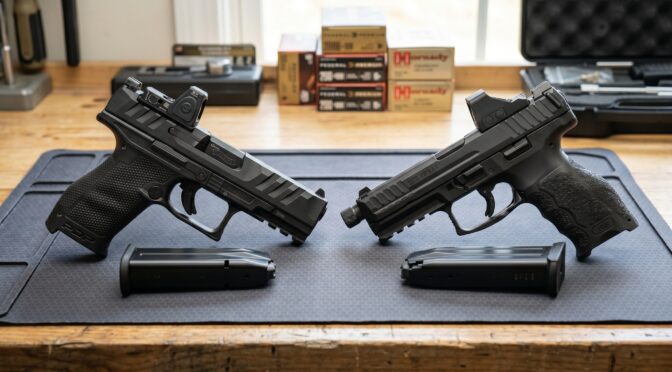
The contemporary striker-fired polymer handgun market is currently dominated by platforms that prioritize modularity, absolute reliability, and advanced ergonomic integration. Among the top-tier offerings from European defense manufacturers, the Walther Performance Duty Pistol and the Heckler & Koch VP9A1 series represent two of the most refined and capable firearm families available for global deployment today. This comprehensive research report evaluates these two flagship firearm platforms across multiple technical dimensions, including mechanical specifications, ergonomic design, historical reliability, aftermarket ecosystems, and primary tactical use cases. The analysis covers both the full-size duty models and their compact variants, providing an exhaustive comparative assessment to inform procurement decisions for law enforcement agencies, military applications, and civilian defensive deployment.
The Walther Performance Duty Pistol builds upon the proven legacy of the PPQ series, offering a platform distinctly engineered around optic integration and aggressive grip texturing.1 Conversely, the Heckler & Koch VP9A1 represents a modernized and highly tuned evolution of the original VP9, introducing enhanced trigger dynamics, updated ambidextrous controls, and a newly developed compact frame size to bridge the operational gap between overt duty carry and deep concealment applications.3 Through meticulous examination of mechanical tolerances, metallurgical finishes, ergonomic anthropometry, and vendor market pricing, this document establishes the operational strengths and optimal deployment scenarios for each platform. The resulting data provides a definitive framework for understanding how these two dominant designs compete within the modern small arms ecosystem.
2. Introduction and Contextual History of Polymer Platforms
The transition from traditional metal-framed, hammer-fired handguns to striker-fired polymer platforms has fundamentally altered the landscape of modern small arms design and tactical doctrine. German manufacturers Walther Arms and Heckler & Koch have historically been at the absolute forefront of this technological evolution, pioneering materials and mechanisms that have become industry standards. The Walther Performance Duty Pistol and the Heckler & Koch VP9A1 are direct competitors in the premium duty and self-defense market segments, with both platforms predominantly chambered in the ubiquitous 9x19mm Parabellum cartridge.5
Heckler & Koch introduced the world’s first polymer-framed handgun with the VP70, and their legacy continued through the P7 series, the USP, and the P30. The original VP9 was released as a striker-fired alternative to the P30, combining the legendary ergonomic profile of the P30 with a consistent, crisp trigger pull. The recent VP9A1 update signifies a critical refinement phase, addressing modern tactical requirements by improving the trigger interface, expanding modularity, and introducing a dedicated compact frame designated as the “K” model.3
Walther’s journey to the Performance Duty Pistol is similarly rooted in decades of iterative engineering, beginning with the P99 platform and evolving through the PPQ. The PPQ was widely regarded as possessing the finest factory trigger on the market. However, as tactical doctrine shifted heavily toward the mandatory use of slide-mounted optical sights, Walther redesigned the upper assembly and grip frame entirely to create the Performance Duty Pistol.1 The PDP was built from its inception to maximize the efficiency of red dot sights, utilizing unique slide geometry and grip texturing to assist the shooter in rapidly locating the optic dot during presentation.
The scope of this rigorous analysis is restricted to the most current iterations of these platforms. For Walther, the primary focus is the standard PDP Full Size with a 4.5-inch barrel and the PDP Compact with a 4-inch barrel.7 For Heckler & Koch, the analysis centers on the newly introduced VP9A1 F model, denoting the full-size frame, and the VP9A1 K model, denoting the compact variant.4 By dissecting the geometric architecture, internal mechanical safety systems, and the broader commercial ecosystem surrounding these firearms, the subsequent sections provide an objective, data-driven framework for comparing their respective operational merits.
3. Mechanical Architecture and Operating Mechanisms
Before analyzing external dimensions, one must understand the internal mechanical architecture that governs the function of these firearms. Both the Walther Performance Duty Pistol and the Heckler & Koch VP9A1 utilize a modified Browning short-recoil operating system, utilizing a tilting barrel design that locks into the ejection port of the slide. This system is the global standard for modern centerfire handguns due to its inherent reliability and simplified manufacturing process.
3.1 Striker-Fired Mechanisms and Safety Protocols
The term “striker-fired” refers to a system where a spring-loaded firing pin, or striker, is partially or fully tensioned by the rearward movement of the slide. When the operator pulls the trigger, the internal sear drops, releasing the striker to ignite the cartridge primer. This system eliminates the need for an external hammer, streamlining the profile of the firearm and providing a consistent trigger pull weight for every shot.
The Heckler & Koch VP9A1 utilizes a fully pre-cocked striker system. When the slide is cycled, the striker spring is fully compressed. The trigger press merely acts to release the sear block. This mechanical arrangement allows for an exceptionally crisp trigger break, as the shooter’s finger is not performing the mechanical work of compressing the mainspring.3 To ensure absolute safety, the VP9A1 series incorporates a sophisticated multi-axis safety system. The firearm features a trigger safety tab and an internal firing pin block safety that operate at 90 degrees to one another.10 This orthogonal relationship guarantees that the weapon is highly resistant to inertial discharges, protecting the operator against accidental firing if the weapon is dropped or subjected to severe blunt force trauma.10
The Walther Performance Duty Pistol also employs a fully pre-tensioned striker assembly. Walther’s engineering approach emphasizes minimizing the friction between the trigger bar and the sear engagement surface. The PDP includes multiple passive internal safeties, including a firing pin block that remains engaged until the trigger is pulled fully to the rear. The robust nature of these internal components allows both platforms to safely digest high-pressure +P ammunition variants commonly issued by law enforcement agencies.10
4. Detailed Technical Specifications and Dimensional Analysis
A rigorous comparison of physical dimensions, overall weight, and magazine capacity is absolutely essential for understanding how these firearms interface with the end user and perform in varying operational contexts. Minor variations in slide mass, grip length, and barrel profile can significantly alter recoil impulses, presentation speed, and concealment feasibility.6
4.1 Full-Size Duty Models
The full-size variants are engineered for optimal ballistic performance, maximum ammunition capacity, and unrestricted grip acquisition. These dimensions make them ideal for overt overt uniform duty carry, tactical team applications, and home defense scenarios where concealment is not a primary concern.
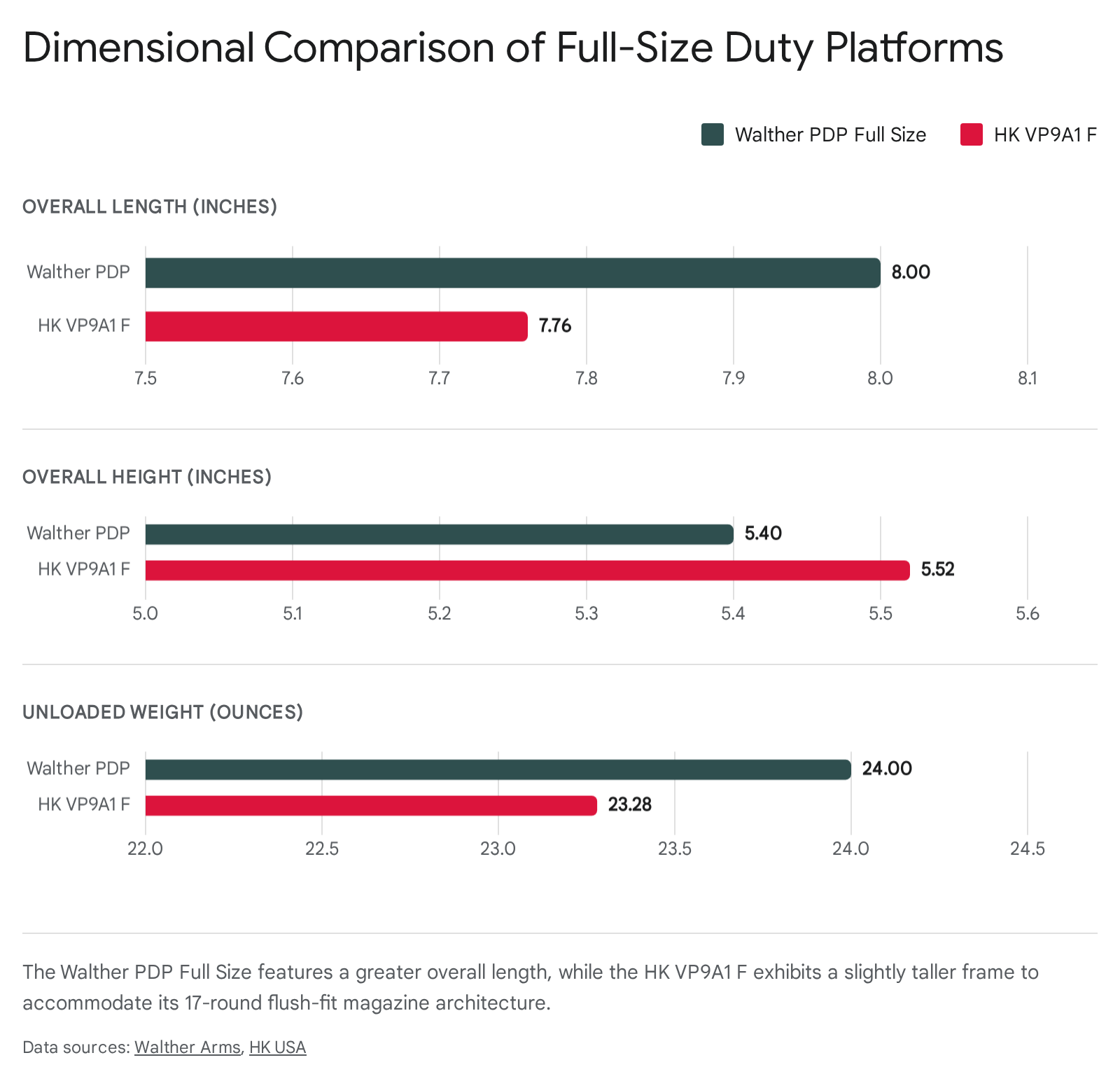
The Walther PDP Full Size 4.5 features a 4.5-inch barrel and an overall longitudinal length of 8.0 inches.7 The platform has a maximum width of 1.34 inches across the controls and an overall height of 5.4 inches from the base of the magazine to the top of the rear sight.7 Unloaded, the PDP Full Size 4.5 weighs exactly 24.0 ounces.7 The standard flush-fit magazine capacity for the full-size grip frame is 18 rounds, yielding an impressive total capacity of 19 rounds when a cartridge is chambered.7 Walther utilizes traditional land-and-groove rifling within its barrel architecture, optimizing the platform for a wide variety of projectile types.
The Heckler & Koch VP9A1 F incorporates a slightly longer 4.53-inch barrel.11 The overall length measures 7.76 inches, making it marginally shorter than the PDP despite the longer barrel.11 This dimensional curiosity indicates a highly efficient slide-to-frame geometric ratio in the Heckler & Koch design. The VP9A1 F has an overall width of 1.30 inches and an overall height of 5.52 inches when a magazine is inserted.11 The weight without a magazine is documented at 23.28 ounces.11 The platform supports multiple factory magazine capacities, including 15-round, 17-round, and extended 20-round configurations designed specifically for high-threat environments.9
| Specification Parameter | Walther PDP Full Size 4.5 | Heckler & Koch VP9A1 F |
| Caliber Chambering | 9x19mm Parabellum | 9x19mm Parabellum |
| Barrel Length | 4.50 inches | 4.53 inches |
| Overall Length | 8.00 inches | 7.76 inches |
| Maximum Width | 1.34 inches | 1.30 inches |
| Overall Height | 5.40 inches | 5.52 inches |
| Unloaded Weight | 24.00 ounces | 23.28 ounces |
| Standard Capacity | 18+1 Rounds | 17+1 or 20+1 Rounds |
| Sight Radius | 6.40 inches (approximate) | 6.56 inches |
4.2 Compact Concealment Models
Compact models are engineered to meticulously balance the ballistic efficiency required for duty use with the reduced dimensions necessary for covert civilian or plainclothes law enforcement concealed carry.
The Walther PDP Compact 4 features a 4.0-inch barrel and an overall length of 7.5 inches.6 The width remains perfectly consistent with the full-size model at 1.34 inches, ensuring that the manual of arms, control access, and grip circumference feel identical to the operator when transitioning between frame sizes.6 The height is slightly reduced to 5.4 inches, and the unloaded weight registers at approximately 24.4 ounces.12 The compact frame naturally reduces the standard flush-fit magazine capacity to 15 rounds.13
The Heckler & Koch VP9A1 K represents a significant milestone for the manufacturer, acting as the first true compact “K” model within the VP series lineage.3 It features a 4.09-inch barrel and a highly efficient overall length of just 7.32 inches.14 The width is maintained at 1.30 inches, but the height is significantly reduced to 5.12 inches to drastically aid in deep concealment.14 The VP9A1 K weighs 22.57 ounces without a magazine and utilizes a proprietary 15-round flush-fit magazine.10 This height differential of nearly 0.3 inches between the PDP Compact and the VP9A1 K plays a crucial role in preventing the grip from printing through light garments.
| Specification Parameter | Walther PDP Compact 4 | Heckler & Koch VP9A1 K |
| Caliber Chambering | 9x19mm Parabellum | 9x19mm Parabellum |
| Barrel Length | 4.00 inches | 4.09 inches |
| Overall Length | 7.50 inches | 7.32 inches |
| Maximum Width | 1.34 inches | 1.30 inches |
| Overall Height | 5.40 inches | 5.12 inches |
| Unloaded Weight | 24.40 ounces | 22.57 ounces |
| Standard Capacity | 15+1 Rounds | 15+1 Rounds |
| Sight Radius | 6.00 inches (approximate) | 6.36 inches |
5. Metallurgy, Barrel Dynamics, and Slide Construction
The selection of materials and the specific geometry of the upper assembly significantly impact both ballistic performance and long-term maintenance protocols.
5.1 Barrel Architecture and Rifling Technology
Heckler & Koch utilizes a proprietary cold hammer-forged barrel with a polygonal profile in the VP9A1 series.10 This manufacturing technique replaces traditional sharp lands and grooves with a series of smooth, rounded polygons, featuring six grooves and a right-hand twist rate of 1 in 9.8 inches.10 Polygonal rifling creates a tighter, more efficient gas seal around the projectile as it travels down the bore. This efficient seal minimizes gas blow-by, which can lead to marginal but measurable increases in muzzle velocity and a noticeably extended barrel life due to reduced friction. However, Heckler & Koch explicitly advises against the use of unjacketed cast-lead bullets in these barrels, as lead fouling can accumulate rapidly in the shallow polygonal grooves, potentially causing dangerous internal pressure spikes.10
The Walther Performance Duty Pistol utilizes traditional land-and-groove rifling. While slightly more prone to gas blow-by than a polygonal bore, traditional rifling is exceptionally accurate and broadly compatible with all commercially available projectile types, including the unjacketed lead cast variants often utilized in high-volume, budget-conscious training environments. Furthermore, Walther incorporates a stepped chamber design, which provides a tighter seal around the forward portion of the cartridge casing to improve velocity, while maintaining enough tolerance at the rear for highly reliable extraction when the weapon is fouled with carbon.
5.2 Slide Geometry and Environmental Treatments
Slide mass and exterior geometry differ notably between the two platforms, affecting both recoil impulses and user manipulation. The Walther PDP slide is visibly blockier, featuring increased mass that aids in absorbing the kinetic energy of recoil. The most distinct feature is the inclusion of “SuperTerrain” slide serrations.2 These serrations protrude outward above the surface of the slide rather than being cut deeply into it. This aggressive design choice allows for highly positive manipulation, providing exceptional grip traction when the user’s hands are wet, slick with oil, or encased in heavy tactical gloves.2
The Heckler & Koch VP9A1 slide features an aggressively tapered profile with deep, flat-bottomed serrations.9 At the extreme rear of the slide, HK retains their patented polymer charging supports.9 These polymer ridges extend outward behind the rear serrations, providing significant mechanical leverage for users with reduced grip strength, ensuring positive slide cycling under high stress.9 Furthermore, the A1 update incorporates expanded front and rear maritime serrations to further enhance tactile purchase in adverse environmental conditions.15 The slide is treated with HK’s proprietary “hostile environment” finish, a highly advanced corrosion-resistant nitro-carburized treatment that protects the underlying steel matrix from moisture, acidic sweat, and corrosive salt spray.9
6. Ergonomic Philosophy and Anthropometric Design
Ergonomics dictate how naturally a firearm points, how effectively the human skeletal structure can mitigate recoil, and how intuitively the mechanical controls can be manipulated under the physiological effects of stress. Both manufacturers have invested heavily in anthropometric research, though their approaches diverge significantly in methodology and application.
The fundamental difference in ergonomic philosophy is physically manifested in how the grip is customized. The Walther PDP relies on a traditional interchangeable backstrap system to adjust trigger reach. Conversely, the HK VP9A1 utilizes an advanced three-piece modular design featuring independent left and right side panels along with adjustable length-of-pull backstraps, allowing for 45 specific grip configurations.
6.1 The Walther Approach to Grip Dynamics
The Walther PDP utilizes a highly advanced grip texture engineered specifically for overt performance duty use. The texture consists of microscopic tetrahedron shapes that provide a highly aggressive, non-slip surface in the hand.6 The critical engineering achievement of this texture is its directionality, the tetrahedrons lock securely into the dermal layer of the hand to prevent shifting under recoil, yet they remain non-abrasive against clothing, making the platform highly suitable for concealed carry applications.6
The PDP relies on three interchangeable rear backstraps to alter the trigger reach and overall grip circumference.17 This is a standard industry practice that effectively accommodates a wide spectrum of hand sizes. The grip angle forces a slightly more aggressive forward cant, which aligns naturally with the modern isosceles shooting stance and aids in driving the optical sight back onto the target during rapid shot strings.
6.2 The Heckler & Koch Universal Ergonomic Grip
The Heckler & Koch VP9A1 series takes modularity considerably further through its Universal Ergonomic Grip system.3 The polymer frame allows the user to swap not only the rear backstrap but also the left and right side grip panels completely independently.3 This sophisticated system enables asymmetrical setups, such as utilizing a large right panel to fill the palm swell of a right-handed shooter, while simultaneously using a small left panel to allow maximum trigger finger extension.3
With the recent A1 update, HK introduced extended backstraps that add significant material to the upper portion of the grip, resting directly under the web of the hand. This innovation effectively creates an adjustable length of pull, allowing shooters to perfectly index the pad of their trigger finger on the trigger shoe face.3 The VP9A1 grip angle, carefully contoured front strap, and high rear saddle are widely praised for forcing a natural, anatomically locked-in wrist presentation that intuitively aligns the sights with the dominant eye.3
7. Trigger Dynamics and Fire Control Group Analysis
The fire control group, specifically the trigger mechanism, is arguably the most critical interface on any striker-fired pistol. It dictates the mechanical disruption of the sights during the firing sequence. Both the Walther PDP and the HK VP9A1 feature triggers that define the absolute upper echelon of factory polymer handguns, frequently compared to aftermarket customized components.
7.1 Walther Performance Duty Trigger
The Walther Performance Duty Pistol is equipped with the proprietary Performance Duty Trigger system.1 This mechanism is characterized by a relatively light and smooth take-up, a highly defined rigid wall, and an extremely crisp, glass-like break. Following the ignition of the cartridge, the trigger reset is exceptionally short and highly tactile, providing a distinct mechanical click that can be felt and heard.2 This short reset geometry allows for incredibly rapid follow-up shots during dynamic courses of fire, reducing split times significantly. Many professional competitive shooters and defense analysts consider the PDP factory trigger to be the most refined out-of-the-box option available on the global market.20
7.2 Heckler & Koch VP9A1 Enhanced Trigger
Heckler & Koch responded directly to modern market demands by significantly refining the trigger group in the VP9A1 series. The primary A1 upgrade features a nickel-teflon coated trigger bar.21 This advanced metallurgical enhancement drastically reduces the coefficient of friction between the steel trigger bar and the internal polymer and steel frame components, resulting in a noticeably smoother and lighter pull compared to previous generations.15
The VP9A1 trigger exhibits a short, light take-up followed by a solid, single-action style break, consistently breaking between 4.5 and 5.5 pounds of continuous force.10 The reset is engineered to be short and positive, with a documented forward return travel of merely 0.12 inches before the sear re-engages.10 While subjective shooter preference plays a significant role in evaluation, the VP9A1 trigger is universally celebrated for its smooth, rolling consistency, whereas the PDP trigger is favored for its sharp, definitive break.6
8. Sighting Systems and Optic Integration Paradigms
Optical sights, particularly miniature red dot sights, have rapidly transitioned from competitive novelties to mandatory equipment for contemporary military and law enforcement duty pistols. Both platforms employ advanced, optics-ready architectures directly from the factory.
8.1 Walther PDP Optics Integration
The Walther PDP features a deeply milled slide architecture that accepts proprietary interchangeable adapter plates.22 This deep trench design allows the optic body to sit extremely low on the slide, minimizing the mechanical offset between the bore axis and the illuminated dot.22 A lower optic reduces the learning curve for shooters transitioning from iron sights and minimizes parallax issues at close ranges. Walther’s plate system supports a vast array of robust enclosed emitter optics, such as the Aimpoint ACRO P-2 and the Steiner MPS, which are heavily favored for overt law enforcement use due to their absolute immunity to rain, mud, and debris.22 Depending on the selected adapter plate and optic housing height, the PDP allows for seamless co-witnessing with standard-height metallic iron sights.22
8.2 Heckler & Koch VP9A1 Optics Integration
The Heckler & Koch VP9A1 utilizes a highly versatile adapter plate system covering nine distinct optic footprints, accommodating virtually every popular open and closed red dot sight currently on the market.23 Furthermore, HK offers dedicated optics-equipped models straight from the factory, which feature the Holosun SCS sight system.4 The Holosun SCS is uniquely designed with a multi-directional solar charging system and is milled to mount directly to the VP9 slide without the need for an intervening adapter plate.15 This direct-mount architecture results in the lowest possible mounting profile, securely bolting the optic to the slide and allowing the use of the factory standard-height sights for emergency backup.15
9. Historical Reliability, Testing Protocols, and Duty Adoption
Both Walther Arms and Heckler & Koch possess storied, century-long histories of producing firearms that must endure the most rigorous military and law enforcement testing trials on the planet. Reliability is not merely a feature but the foundational requirement for both platforms.
9.1 Walther PDP Field Performance
The Walther PDP is explicitly designed to withstand harsh environmental conditions, freezing temperatures, and exceptionally high round counts. The robust extractor claw and reinforced polymer frame are specifically engineered to handle continuous diets of high-pressure ammunition without suffering premature component fatigue. The PDP has seen increasing adoption among specialized regional law enforcement units and competitive shooters who demand absolute operational reliability.2 The open architecture of the slide interior allows debris to fall free of the firing mechanism, ensuring continued operation when the weapon is dropped in soil or mud.
9.2 Heckler & Koch VP9A1 Field Performance
The legacy VP9 platform possesses a long and extensively proven track record of extreme durability.3 Heckler & Koch engineered the pistol to function flawlessly in the most adverse environmental conditions, subjecting early prototypes to extensive NATO drop tests, submerged mud tests, and severe temperature variations ranging from arctic freezing to desert heat.3 The VP9 series is widely adopted by numerous European police forces, border patrol units, and various domestic United States law enforcement agencies. Documented post-adoption reports from these agencies indicate significant improvements in officer qualifying scores, directly attributing this success to the ergonomic grip and the enhanced trigger interface.3 The aforementioned hostile environment finish ensures the weapon requires minimal lubrication to resist severe rust and pitting in maritime environments.
10. The Aftermarket Ecosystem and Modularity
The long-term viability and success of a modern tactical handgun are heavily dependent on its aftermarket support network. A robust ecosystem allows individual users, armorers, and agencies to tailor the platform to specific operational requirements through the addition of specialized components. Both the PDP and VP9A1 boast highly developed commercial ecosystems.
10.1 Enhancements for the Walther PDP
The aftermarket for the Walther PDP is exceptionally deep, driven heavily by rapid adoption within the United States competitive shooting community.
The most prominent upgrade available is the Walther Dynamic Performance Trigger assembly, an original equipment manufacturer enhancement that completely replaces the fire control group to further reduce trigger pull weight, initial take-up, and reset distance.25 For those seeking alternative solutions, aftermarket companies like Overwatch Precision produce highly refined machined trigger kits tailored for the PDP platform.26
Recoil management is another major sector of the PDP aftermarket. Companies such as ZR Tactical Solutions manufacture ultra-mass tungsten and stainless steel guide rods, along with custom tuned recoil springs that allow advanced users to finely tune the slide velocity for specific ammunition loads, reducing muzzle flip.27 Herrington Arms produces highly effective muzzle compensators that integrate seamlessly with the PDP slide profile to redirect expanding gases upward, forcing the muzzle down during rapid fire.29 Additionally, numerous vendors offer aluminum magazine extensions, reliably enhancing the already formidable 18-round standard capacity to 22 or 23 rounds for competitive stages.27
10.2 Enhancements for the HK VP9A1
The newly updated VP9A1 benefits immensely from over a decade of aftermarket development dedicated to the legacy VP9 system, as internal dimensional tolerances and magazine geometries remain largely identical across generations.
While the factory trigger is excellent, specialized companies such as Gray Guns offer sophisticated trigger modifications, custom sears, and reset reduction kits that refine the VP9 trigger specifically for the demanding requirements of USPSA and IDPA competitive applications.30
Grip enhancements represent a significant portion of the VP9 aftermarket. Heavy brass backstraps and specialized grip panels are popular modifications utilized to alter the physical balance point of the pistol. By shifting weight lower and further back into the hand, these heavy components help absorb kinetic energy and reduce perceived recoil.30 Tyrant CNC and HK Parts manufacture low-profile everyday carry magwells to assist in concealed reloading, as well as oversized competition funnels for maximum speed.31 Magazine base pad extensions from established companies like Taylor Freelance are widely utilized to increase the standard 17-round capacity to 22 rounds or more.30
11. Market Availability, Pricing Economics, and Vendor Sourcing
Understanding the commercial retail landscape, inherent pricing variance, and general availability of these platforms is crucial for individual procurement and large-scale agency acquisitions. The following economic analysis details the minimum and average observed retail pricing across an array of preferred industry vendors, ensuring a comprehensive view of the current market value.
11.1 Walther PDP Full Size 4.5 Economics
The Walther PDP Full Size 4.5 is a highly accessible and economically viable platform. The Manufacturer’s Suggested Retail Price sits at $699.00.33 However, the actual market clearing price typically ranges between an observed minimum of $597.00 and an average of $625.00, fluctuating based on seasonal sales events and vendor inventory volume.
- Manufacturer:(https://waltherarms.com/defense/pdp/pdp-standard-full-size-4-5-in)
- Vendor 1 (Primary Arms): Regularly offered at an aggressive $597.00 for the standard optics-ready model. Primary Arms
- Vendor 2 (Brownells): Consistently priced near the lower end of the market average at $599.00.(https://www.brownells.com/guns/handguns/semi-auto-handguns/pdp-full-size-optic-ready-9mm-luger-semi-auto-handgun/?sku=100042431)
- Vendor 3 (Midway USA): Matches the highly competitive pricing structure at $599.00, frequently paired with discounted shipping promotions.(https://www.midwayusa.com/product/1023552420)
- Vendor 4 (Sportsmans Warehouse): Lists the model closer to standard retail expectations at $599.99, offering the advantage of local in-store pickup for background checks.(https://www.sportsmans.com/shooting-gear-gun-supplies/handguns/walther-pdp-9mm-luger-45in-black-pistol-101-rounds/p/1907192)
- Vendor 5 (Bereli): Frequently runs aggressive direct-to-consumer sales, listing the standard model at $599.00, representing a substantial discount off MSRP.(https://www.bereli.com/walther-pdp-optics-ready-9mm-18-round-capacity-4-5-barrel-pistol/)
11.2 Walther PDP Compact 4 Economics
The Compact model shares the identical $699.00 MSRP of its full-size counterpart but frequently experiences deeper discounts in the broader retail channel. Minimum observed pricing has been documented dropping to $449.00 during major holiday liquidation events, while the average rests near $580.00.34
- Manufacturer:(https://waltherarms.com/defense/pdp/pdp-standard-compact-4-in)
- Vendor 1 (KYGunCo): Frequently stocks the optics-ready compact, serving as a reliable baseline for market availability with flexible financing options.(https://www.kygunco.com/product/walther-2851229-pdp-compact-9mm-optic-ready-4-151)
- Vendor 2 (Primary Arms):Offers qualified professional and standard commercial pricing, observed exceptionally low at $523.53. https://www.primaryarms.com/walther-pdp-compact-9mm-optic-ready-pistol-standard-sights-law-enforcement-15-round-4in
- Vendor 3 (Sportsmans Warehouse):Listed at a highly competitive $609.99 for the standard 15-round configuration.(https://www.sportsmans.com/shooting-gear-gun-supplies/handguns/walther-pdp-compact-optics-ready-9mm-luger-4in-black-pistol-151-rounds/p/1688511)
- Vendor 4 (Midway USA):Maintains consistent inventory at $599.00, placing it squarely at the average online retail expectation.(https://www.midwayusa.com/product/1028203199)
- Vendor 5 (Bereli):Showcases the absolute lowest observed minimum price at a highly aggressive $449.00, a massive 36 percent reduction from factory retail.(https://www.bereli.com/walther-pdp-semi-automatic-compact-pistol-9mm-4-barrel-15-rounds-optics-ready/)
11.3 Heckler & Koch VP9A1 F Economics
The VP9A1 F commands a premium price point, reflective of its extensive engineering hours, polygonal barrel manufacturing costs, and included maritime environmental enhancements. Retail prices generally sit around $1049.00, with aggressive market pricing stabilizing between a minimum of $799.99 and an average of $899.00.35
- Manufacturer:(https://hk-usa.com/product/vp9a1-f/)
- Vendor 1 (Palmetto State Armory):Offers the standard optics-ready configuration at a discounted $899.99.(https://palmettostatearmory.com/hk-vp9a1-f-4-5-9mm-1-17rd-1-20rd-optic-ready-pistol-81001064.html)
- Vendor 2 (Primary Arms):Retails the optic-ready model at a highly consistent $899.00. https://www.primaryarms.com/heckler-koch-vp9a1-f-9mm-optic-ready-pistol-4-5in-15rd-black
- Vendor 3 (Sportsmans Warehouse): Lists the 15-round capacity compliance model at $899.99.(https://www.sportsmans.com/shooting-gear-gun-supplies/handguns/hk-vp9a1-f-9mm-luger-453in-black-pistol-151-rounds/p/1932020)
- Vendor 4 (KYGunCo): Carries the standard black finish model, providing flexible financing options for professional and civilian buyers alike.(https://www.kygunco.com/product/hk-usa-vp9a1-f-9mm-4.5-15rd-black)
- Vendor 5 (Bereli): Provides the lowest observed pricing globally for the VP9A1 F at an astonishing $799.99, an impressive 14 percent below average retail metrics.(https://www.bereli.com/81001064/)
11.4 Heckler & Koch VP9A1 K Economics
The newly released compact VP9A1 K is highly sought after across demographics, maintaining exceptional pricing stability due to immense market demand for premium concealed carry platforms. The minimum observed price rests at $881.99, with the average resting firmly at $899.00.36
- Manufacturer:(https://hk-usa.com/product/vp9a1-k/)
- Vendor 1 (Palmetto State Armory): Lists the highly desirable optics-ready compact at an extremely competitive $881.99.(https://palmettostatearmory.com/hk-vp9a1-k-4-09-9mm-optics-ready-2-15rd-compact-pistol-81001057.html)
- Vendor 2 (Primary Arms):Offers the standard 15-round capacity model at the rigid average market rate of $899.00. https://www.primaryarms.com/hk-vp9a1k-9mm-compact-optics-ready-pistol-4-09in
- Vendor 3 (Sportsmans Warehouse):Matches the widespread retail benchmark standard of $899.99.(https://www.sportsmans.com/shooting-gear-gun-supplies/handguns/hk-vp9a1-k-9mm-luger-409in-black-pistol-151-rounds/p/1932017)
- Vendor 4 (Midway USA):Frequently stocks the K model in large volumes, displaying an $899.00 price tag down from a significantly higher MSRP.(https://www.midwayusa.com/product/1028076460)
- Vendor 5 (KYGunCo):Successfully secures heavy allocations of the K model, supporting the baseline $899.00 retail framework for its customer base.(https://www.kygunco.com/product/hk-usa-vp9a1-9mm-4.09-15rd-black)
11.5 Critical Accessory Market Sourcing
Enhancing these platforms requires reliable access to high-quality OEM and aftermarket components. Pricing for these specific accessories is highly variable based on manufacturing cycles and global steel availability.
Walther Dynamic Performance Trigger Assembly (Black) Considered a virtually mandatory upgrade for serious competitors and elite tactical teams, this OEM assembly retails from Walther for $179.00 25, with market averages hovering around $150.00 and minimums reaching $97.99.
- Manufacturer:(https://waltherarms.com/shop/firearm-parts/dynamic-performance-trigger)
- Vendor 1 (Primary Arms):Carries associated precision trigger components and full kits at aggressive price points around $122.80. https://www.primaryarms.com/1/triggers/compatible-model/walther-pdp
- Vendor 2 (GunMagWarehouse): Frequently discounts full trigger kits heavily, observing blowout prices as low as $97.99 during inventory clearance sales.(https://gunmagwarehouse.com/walther-dynamic-performance-trigger.html)
- Vendor 3 (Midway USA): Retails the full OEM drop-in assembly reliably at $193.99.(https://www.midwayusa.com/interest-hub/walther-pdp-triggers)
- Vendor 4 (Scopelist): Lists the specific black item slightly above MSRP at $192.99, usually available for rapid backorder reservation.(https://www.scopelist.com/walther-arms-dynamic-performance-trigger-black-2846586)
- Vendor 5 (Brownells): Serves as a major national hub for all Walther OEM parts, including performance trigger control groups.(https://www.brownells.com/gun-parts/handgun-parts/handgun-recoil-parts/walther-ppq-tsk-competition-trigger-kit/?sku=943000024)
Heckler & Koch VP9 17-Round Steel Magazine OEM Heckler & Koch magazines are globally renowned for their crush-resistant durability, featuring welded steel bodies and high-visibility polymer followers. The market average for these vital components is approximately $40.00, with minimums dipping to $21.99.37
- Manufacturer:(https://us.hkwebshop.com/hkstorefront/hk/en/Handgun-Parts/Magazines/c/404?q=%3Arelevance%3Amodel%3AVP9A1%2BK)
- Vendor 1 (GunMagWarehouse): Offers excellent bulk quantity pricing, frequently discounting individual factory magazines to $40.99.(https://gunmagwarehouse.com/hk-vp9-p30-9mm-17-round-magazine.html)
- Vendor 2 (Primary Arms):Maintains extremely consistent stock levels at the median price of $44.99. https://www.primaryarms.com/handguns/compatible-with/hk-magazines
- Vendor 3 (Brownells): Provides extreme discounts on select steel models during specific sales, observed as astonishingly low as $21.99.(https://www.brownells.com/gun-parts/magazines/handgun-magazines-parts/hk-vp9-steel-magazine-9mm/?sku=687150621)
- Vendor 4 (Shooting Surplus): Prices the high-capacity 17-round magazine aggressively at $41.50 to capture market share.(https://shootingsurplus.com/hk-vp9-magazines/)
- Vendor 5 (Bereli): Lists individual magazines at $50.99, often bundled with highly lucrative free shipping incentives to offset the higher unit cost.(https://www.bereli.com/hk-9mm-luger-17rd-vp9-magazine/)
12. Tactical Application and Primary Use Case Synthesis
The optimal selection between the Walther PDP and the Heckler & Koch VP9A1 is heavily dependent on the specific intended application, operational environment, and the physiological attributes of the primary user.
12.1 Law Enforcement and Military Overt Duty
For overt uniform duty applications carried in rigid Level III retention holsters, both the Walther PDP Full Size 4.5 and the HK VP9A1 F are truly exceptional choices. The PDP’s highly aggressive tetrahedron grip texture is phenomenally advantageous when officers are wearing thick tactical gloves, operating in heavy rain, or dealing with biological fluids.17 Its massive 18-round standard capacity provides a significant and mathematically measurable firepower advantage in prolonged engagements.
Conversely, the VP9A1 F is highly regarded in administrative circles for its unparalleled universal grip fitment. In an agency or armory setting, department armorers can quickly configure the VP9A1 to perfectly fit the hands of the smallest female officer or the largest male officer simply by swapping side panels.3 This ensures that every member of the force has a weapon that points naturally. Furthermore, the VP9A1’s optional paddle magazine release is highly favored by some specialized tactical units, as it effectively eliminates the risk of accidental magazine ejections when the pistol is pressed tightly against bulky body armor or chest rigs during confined space dynamic entries.
12.2 Civilian and Plainclothes Concealed Carry
In the demanding realm of civilian concealed carry and plainclothes operations, the compact models truly excel. The dimensional constraints become the overriding factor in selection. The Walther PDP Compact 4 is slightly taller than the VP9A1 K, measuring 5.40 inches versus 5.12 inches.6 This height difference of nearly a third of an inch is critical, as the grip length is the primary factor causing a concealed firearm to “print” visibly through clothing. The VP9A1 K is thus measurably easier to conceal in an appendix inside-the-waistband configuration.
However, the PDP Compact retains a full-size slide width and offers a highly confident, hand-filling grip that many shooters find significantly easier to draw rapidly from deep concealment under extreme stress.6 The choice here relies on a compromise between absolute concealability favoring the HK, and rapid, aggressive presentation favoring the Walther.
12.3 Competitive Shooting Disciplines
The Walther PDP has rapidly become a dominant and highly disruptive force in United States Practical Shooting Association and International Defensive Pistol Association competitive circuits. The thick, heavy slide geometry heavily aids in kinetic recoil absorption, allowing the sights to return to zero rapidly. Furthermore, the factory Performance Duty Trigger requires minimal aftermarket modification to compete at the highest Grand Master levels.1
While the VP9A1 is exceptionally accurate mechanically due to its gas-sealing polygonal barrel, serious competitive shooters utilizing the HK platform often find themselves investing heavily in aftermarket trigger tuning kits and heavy brass grip accessories to achieve the heavy, flat-shooting characteristics that are largely inherent to the stock Walther PDP design.30
13. Final Conclusions
The Walther Performance Duty Pistol and the Heckler & Koch VP9A1 series currently exist at the absolute pinnacle of striker-fired handgun engineering. Neither platform presents a distinct mechanical failure point, and the choice between the two ultimately depends on the highly specific priorities of the end user or the procuring agency.
The Walther PDP is a purpose-built optical integration platform, designed from the ground up to dominate the red dot paradigm. Its thicker slide, deeply milled plate system, and highly aggressive Performance Duty grip texture make it an unyielding, high-traction tool for overt duty, dynamic tactical deployment, and aggressive competitive shooting. The incredibly refined out-of-the-box trigger system ensures that users can achieve extreme levels of practical accuracy with minimal requirement for aftermarket investment.
Conversely, the Heckler & Koch VP9A1 is a masterpiece of ergonomic adaptability and environmental resilience. The universal grip system ensures that literally any shooter can configure the pistol for perfect trigger indexing, fundamentally minimizing sympathetic muscle movement and drastically improving gross accuracy under stress. The recent A1 enhancements, including the friction-reducing nickel-teflon trigger bar, the expanded maritime serrations, and the introduction of the highly concealable “K” model, solidify the platform’s status as a top-tier option for professional security details, sophisticated law enforcement units, and discerning civilian carriers. Both platforms guarantee exceptional mechanical reliability, ensuring optimal operational performance when life and liberty are on the line.
Note: Vendor Sources listed are not an endorsement of any given vendor. It is our software reporting a product page given the direction to list products that are between the minimum and average sales price when last scanned.
Please share the link on Facebook, Forums, with colleagues, etc. Your support is much appreciated and if you have any feedback, please email us in**@*********ps.com. If you’d like to request a report or order a reprint, please click here for the corresponding page to open in new tab.
Sources Used
- Walther PDP Series Features, accessed April 16, 2026, https://waltherarms.com/defense/pdp/pdp-features
- Walther PDP vs. HK VP9: Is There a Clear Winner? | The Mag Shack, accessed April 16, 2026, https://themagshack.com/walther-pdp-vs-hk-vp9-is-there-a-clear-winner/
- VP9A1 – HK USA, accessed April 16, 2026, https://hk-usa.com/vp9a1/
- Heckler & Koch USA Introduces the VP9A1 F & VP9A1 K, accessed April 16, 2026, https://hk-usa.com/2025/01/13/heckler-koch-usa-introduces-the-vp9a1-f-vp9a1-k/
- VP9A1 F – HK USA, accessed April 16, 2026, https://hk-usa.com/product/vp9a1-f/
- Walther PDP vs HK VP9: Specs, Ergonomics, Capacity, Recoil, and Trigger Compared, accessed April 16, 2026, https://aliengearholsters.com/blogs/news/walther-pdp-vs-hk-vp9
- PDP Standard Full Size 4.5″ – Walther Arms, accessed April 16, 2026, https://waltherarms.com/defense/pdp-standard-full-size-4-5-in
- PDP Standard Compact 4″ – Walther Arms, accessed April 16, 2026, https://waltherarms.com/defense/pdp/pdp-standard-compact-4-in
- Langdon Tactical Technology HK VP9A1 F: Full Review – Guns and Ammo, accessed April 16, 2026, https://www.gunsandammo.com/editorial/ltt-hk-vp9a1-f-review/540156
- operator’s manual – vp9a1 series – HK USA, accessed April 16, 2026, https://hk-usa.com/wp-content/uploads/2025/01/VP9A1-Operators-Manual.pdf
- VP9A1 F – HK USA, accessed April 16, 2026, https://hk-usa.com/product/vp9a1-f-copy/
- Walther PDP 4″ Compact Optics Ready 9mm Pistol, Black – 2851229 | Palmetto State Armory, accessed April 16, 2026, https://palmettostatearmory.com/walther-pdp-4-compact-optics-ready-9mm-pistol-black-2851229.html
- Walther PDP Compact Optics Ready 9mm Luger 4in Black Pistol – 15+1 Rounds, accessed April 16, 2026, https://www.sportsmans.com/shooting-gear-gun-supplies/handguns/walther-pdp-compact-optics-ready-9mm-luger-4in-black-pistol-151-rounds/p/1688511
- VIDEO: The HK VP9A1 is Here in Full-Size & Compact Models! – Athlon Outdoors, accessed April 16, 2026, https://athlonoutdoors.com/article/hk-vp9a1/
- HK VP9A1 F 4.5″ 9mm W/ (1)17rd & (1)20rd Mag Optic Ready Pistol – 81001064, accessed April 16, 2026, https://palmettostatearmory.com/hk-vp9a1-f-4-5-9mm-1-17rd-1-20rd-optic-ready-pistol-81001064.html
- HK VP9 Magazines – GunMag Warehouse, accessed April 16, 2026, https://gunmagwarehouse.com/magfinder/hk-vp9
- Walther PDP Compact 9mm Pistols for Sale | Palmetto State Armory, accessed April 16, 2026, https://palmettostatearmory.com/brands/walther/walther-pistols/pdp/compact.html
- Heckler & Koch VP9A1 F 9mm Pistol With Holosun SCS – 4.5″ – 15 Round – Black, accessed April 16, 2026, https://www.primaryarms.com/heckler-koch-vp9a1-f-9mm-optic-ready-pistol-4-5in-15rd-black
- PDP Standard Full Size 5″ – Walther Arms, accessed April 16, 2026, https://waltherarms.com/defense/pdp/standard/pdp-standard-full-size-5-in
- HK VP9 or Walther PDP : r/tacticalgear – Reddit, accessed April 16, 2026, https://www.reddit.com/r/tacticalgear/comments/18qn8e9/hk_vp9_or_walther_pdp/
- VP9A1 vs VP9? : r/HecklerKoch – Reddit, accessed April 16, 2026, https://www.reddit.com/r/HecklerKoch/comments/1le3oeq/vp9a1_vs_vp9/
- Walther PDP Accessories: Complete Upgrade Guide by Use Case – Alien Gear Holsters, accessed April 16, 2026, https://aliengearholsters.com/blogs/news/walther-pdp-accessories
- New: Heckler Koch VP9A1 Series Pistols – Guns.com, accessed April 16, 2026, https://www.guns.com/news/2025/01/13/new-heckler-koch-vp9a1-series-pistols
- Shop Walther PDP Pistols – Precision & Reliability Redefined | Palmetto State Armory, accessed April 16, 2026, https://palmettostatearmory.com/brands/walther/walther-pistols/pdp.html
- Dynamic Performance Trigger – Walther Arms, accessed April 16, 2026, https://waltherarms.com/shop/firearm-parts/dynamic-performance-trigger
- Category: triggers, Compatible Model: walther-pdp – Primary Arms, accessed April 16, 2026, https://www.primaryarms.com/1/triggers/compatible-model/walther-pdp
- Walther – Firearm Parts – ZR Tactical Solutions, accessed April 16, 2026, https://zrtacticalsolutions.com/shop/firearm-parts/walther/
- 10 Best Walther PDP Upgrades – Pew Pew Tactical, accessed April 16, 2026, https://www.pewpewtactical.com/best-walther-pdp-upgrades/
- Walther Pistol Compensators & Upgrades | Herrington Arms, accessed April 16, 2026, https://herringtonarms.com/collections/walther-parts
- Upgrading the HK VP9L – The Best Aftermarket Parts for Performance! – YouTube, accessed April 16, 2026, https://www.youtube.com/watch?v=q-_g9CEHzcM
- Find HK VP Series at HK Parts, accessed April 16, 2026, https://hkparts.net/hk-pistol-parts/vp-series/
- H&K VP9 Essential Upgrades: Compensators, Magwells, and Slide Releases – Tyrant CNC, accessed April 16, 2026, https://www.tyrantcnc.com/blog/H&K-VP9-Essential-Upgrades-Compensators-Magwells-and-Slide-Releases
- PDP Standard Full Size 4.5″ – Walther Arms, accessed April 16, 2026, https://waltherarms.com/defense/pdp/pdp-standard-full-size-4-5-in
- Walther PDP Semi-automatic Compact pistol 9MM 4″ Barrel 15 Rounds, Optics Ready, accessed April 16, 2026, https://www.bereli.com/walther-pdp-semi-automatic-compact-pistol-9mm-4-barrel-15-rounds-optics-ready/
- HK VP9A1 K 9mm Luger Pistol 4.09 Barrel 15+1 Round Black Holosun SCS – MidwayUSA, accessed April 16, 2026, https://www.midwayusa.com/product/1028077568
- HK VP9A1 K 9mm Luger Pistol 4.09 Barrel 15+1 Round Black – MidwayUSA, accessed April 16, 2026, https://www.midwayusa.com/product/1028076460
- Compatible Make: heckler-and-koch-firearms – Primary Arms, accessed April 16, 2026, https://www.primaryarms.com/handguns/compatible-make/heckler-and-koch-firearms
- Which one & why? Walther PDP Pro E vs VP9A1 K vs P365 AXG legion – Reddit, accessed April 16, 2026, https://www.reddit.com/r/handguns/comments/1psr94c/which_one_why_walther_pdp_pro_e_vs_vp9a1_k_vs/