1. Executive Summary
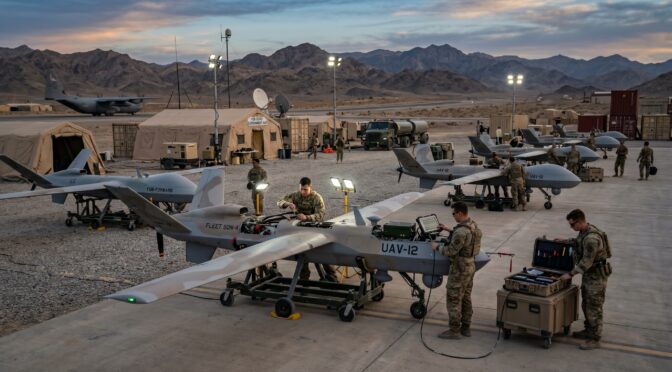
The United States Department of Defense is currently undertaking a generational shift in force structure, pivoting aggressively toward the procurement and deployment of thousands of attritable, autonomous unmanned aerial systems. Initiatives such as the Replicator program and the Air Force’s Collaborative Combat Aircraft program reflect a strategic urgency to generate affordable combat mass and offset the quantitative advantages of pacing threats in the Indo-Pacific theater.1 However, current acquisition and operational frameworks heavily prioritize the technological capabilities and domestic industrial base capacity required to build these systems, frequently overlooking the systemic, forward-edge logistical requirements necessary to sustain them in highly contested environments.1
This report provides a strategic evaluation of the sustainment vulnerabilities inherent in the deployment of highly expendable drone fleets. The central thesis indicates that treating attritable systems with legacy, slow-moving depot-level maintenance frameworks will result in operational failure when supply lines are severed. In environments characterized by Agile Combat Employment and persistent multi-domain threats, combat units cannot afford the extended turnaround times typical of traditional aviation maintenance.5 The margin for error in combat has narrowed significantly, and generating continuous combat power relies entirely on the ability to repair, adapt, and relaunch unmanned systems from austere locations under active threat.8
To maintain operational tempo, leadership must institutionalize a decentralized sustainment paradigm built upon three pillars. The first requires the rigorous enforcement of a Modular Open Systems Approach across all new acquisitions, mandating standardized interfaces to enable rapid, field-level component swapping and mitigate proprietary vendor lock-in.10 The second pillar demands the operationalization of Fabrication at the Tactical Edge, deploying additive manufacturing capabilities to produce replacement parts on demand, thereby replacing fragile supply chains of physical spares with ruggedized spools of composite filament.12 The third pillar necessitates the decentralization of operator-maintainer training, transitioning ad-hoc repair skills away from specialized aviation technicians and directly into the hands of the standard infantry maneuver force.14 By synthesizing lessons from the Ukrainian theater with emerging military pilot programs, this report outlines the critical steps required to build a resilient, self-healing logistical network capable of sustaining drone operations in the modern battlespace.
2. The Strategic Imperative of Autonomous Mass and Contested Logistics
The National Defense Strategy identifies the People’s Republic of China as the primary pacing challenge. In a potential Indo-Pacific conflict, forward air bases and logistical nodes will face sustained, complex attacks from ballistic missiles, cruise missiles, hypersonic weapons, and armed drones.2 The capacity and accuracy of adversary long-range strikes have altered combat paradigms, threatening to drive combat aircraft to rear-area bases that are too distant from the operational battlespace to enable combat-relevant operations.9 This reality has forced the adoption of dispersed operations through Agile Combat Employment, which drastically complicates the sustainment of combat aircraft and exposes the vulnerabilities of standard, centralized supply chains.5
The Logistics of Mass and Attrition
The response to this threat landscape includes the rapid fielding of all-domain, attritable autonomous systems.18 Unveiled in August 2023, the Replicator initiative aims to field multiple thousands of autonomous systems across multiple domains to counter rapid armed forces buildups.1 The first iteration of the initiative focuses on fielding these systems by August 2025, while the second tranche, known as Replicator 2, tackles the warfighter priority of countering the threat posed by small unmanned aerial systems to critical installations and force concentrations.18
Concurrently, the Air Force’s Collaborative Combat Aircraft program is designed to deliver an operational capability before the end of the decade, with plans to produce more than 100 aircraft across the first five years.3 These autonomous platforms will operate alongside crewed fighters, serving as force multipliers that disrupt adversary campaigns and impose crippling costs.16 The Navy and Marine Corps have similarly launched autonomous wingman programs, reflecting a joint commitment to integrating autonomous systems at scale.20
However, the term “attritable” does not mean entirely disposable after a single use. The strategic value of these systems lies in their ability to maintain a high tempo of operations.21 As long as unmanned systems are flying, they impose a cost on the adversary, forcing the expenditure of surface-to-air effectors, interceptors, and electronic warfare resources.21 Maintaining this continuous presence requires robust logistics. Combat air forces require personnel, fuel, munitions, ground handling equipment, and replacement materials to generate sorties at scale.16 The assumption that inexpensive drones can simply be replaced by new units shipped from the continental United States ignores the reality of contested logistics, where adversaries will actively target supply ships, airlift capabilities, and port infrastructure.12
The Vulnerability of Class IX Supply Chains
The legacy supply chain for military aviation heavily relies on Class IX supplies, defined as repair parts and components required for the maintenance support of all equipment.7 The management of Class IX supplies involves requirements determination, procurement, repair, storage, and long-distance transportation.7 In peacetime, readiness-based sparing models calculate the most cost-effective allowances to ensure readiness objectives.7 However, wartime usage patterns vary drastically from peacetime forecasting.7
In a high-intensity conflict, the demand for specific replacement parts—such as electronic speed controllers, propellers, or specialized sensors—will surge unpredictably.23 The traditional Logistics Package methodology, which relies on large, off-road capable trucks and trailers to distribute commodities from centralized depots to forward units, presents a massive, slow-moving target.17 Relying on this outdated system to deliver critical components to dispersed Agile Combat Employment nodes or isolated marine expeditionary units ensures that operational tempo will stall. When supply lines are severed or delayed, units dependent on external resupply for physical spare parts will find their attritable fleets grounded, neutralizing the combat mass these systems were designed to provide.24
3. The Failure of Legacy Depot Maintenance in the Attritable Era
The existing maintenance infrastructure within the Department of Defense is optimized for exquisite, multi-million-dollar platforms. Programs such as the F-35 Joint Strike Fighter or traditional intelligence, surveillance, and reconnaissance aircraft require highly controlled environments, specialized tooling, and extensive diagnostic testing for repairs.25
The Incompatibility of DoDM 4151.23 Frameworks
Traditional organic depot maintenance operations are governed by extensive regulations designed to ensure cost comparability and standard cost accounting. Procedures such as those outlined in DoD Manual 4151.23 require maintenance managers to conduct detailed cost analyses, comparing the cost of organic depot maintenance for similar workloads between different facilities.6 This process supports decision-making regarding workload consolidations and make-versus-buy determinations.6
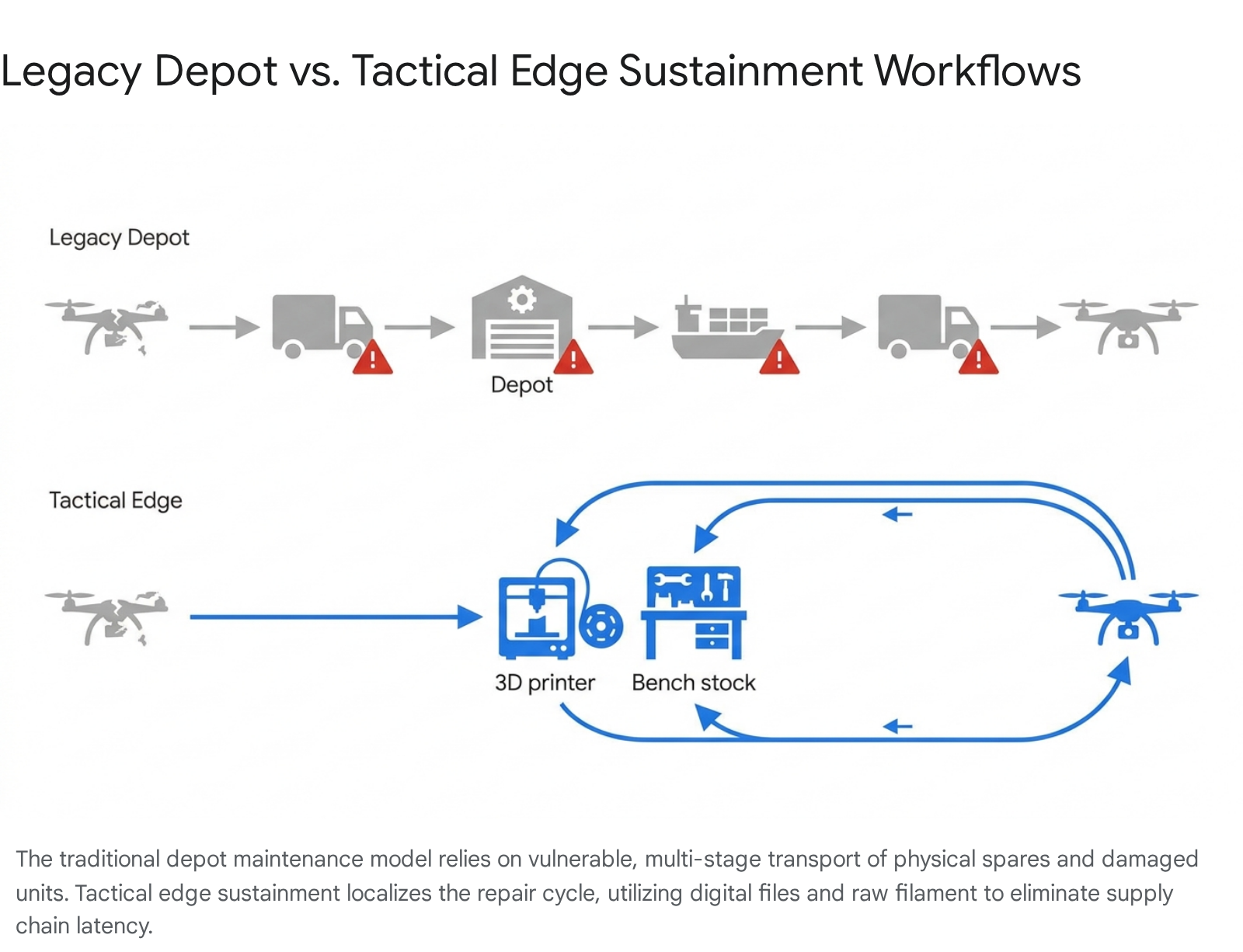
Applying this bureaucratic, time-intensive framework to a highly expendable, low-cost drone creates an unworkable logistical bottleneck. Small unmanned aerial systems and the forthcoming Collaborative Combat Aircraft are intended to operate in highly dynamic, time-compressed operational environments where waiting weeks for a cost-benefit analysis or a depot-level repair authorization is tactically fatal.26 When a unit purchases commercial off-the-shelf platforms or fields rapidly acquired systems through the Defense Innovation Unit’s pathways, the traditional requirement to route damaged assets back to stateside depots negates the operational agility of the platform.19
| Maintenance Paradigm | Operational Focus | Supply Chain Dependency | Turnaround Time |
| Legacy Depot Maintenance | High-value, exquisite crewed platforms requiring specialized facilities. | High; relies on continuous flow of physical Class IX parts and centralized warehousing. | Weeks to Months; vulnerable to transit interdiction. |
| Tactical Edge Sustainment | Attritable, high-volume autonomous systems dispersed across austere nodes. | Low; utilizes onboard diagnostics, additive manufacturing, and digital part catalogs. | Hours to Days; isolated from rear-area supply disruptions. |
The Friction of Proprietary Lock-In
Another significant failure point of legacy maintenance models is the reliance on original equipment manufacturers for repairs and upgrades. Historically, defense contractors have utilized proprietary hardware interfaces, encrypted software, and closed architectures to protect intellectual property.15 In the context of drone warfare, this means that a failure in a specific flight controller or a damaged motor mount might require the entire unit to be returned to the manufacturer, or necessitate the purchase of an expensive, proprietary replacement part that must traverse a vulnerable global supply chain.14
This dynamic is incompatible with the realities of modern conflict. Combat troops require the flexibility to substitute components from different vendors, adapt payloads to emerging threats, and iterate designs based on immediate battlefield feedback.15 Treating an attritable drone fleet with the same rigid maintenance protocols as a legacy fighter jet guarantees that the fleet will suffer rapid, unrecoverable attrition, not from enemy action, but from logistical starvation.
4. Operational Realities and Insights from the Ukrainian Theater
The ongoing conflict in Ukraine serves as an unprecedented, real-time laboratory for the integration, employment, and sustainment of autonomous systems at scale. The operational realities observed in this theater invalidate several pre-war assumptions, particularly the notion that drones would deliver decisive effects purely through pristine technological superiority or that they would be rapidly neutralized by traditional air defenses.30 Instead, drone warfare has emerged as a domain characterized by mass, extreme attrition, and continuous adaptation.30
Decentralized Frontline Drone Workshops
To sustain millions of unmanned aerial vehicles on the front lines, Ukrainian forces have abandoned centralized sustainment models in favor of decentralized, highly agile maintenance networks. The operational effectiveness of top Ukrainian drone units is deeply linked to the efficient maintenance functionality of frontline engineering workshops and electronic laboratories.31 These facilities are integrated directly within the organizational structure of unmanned aerial vehicle battalions operating under combat brigades, providing emergency repair and modernization in hours rather than days or weeks.31
The success of these workshops relies on several critical structural adaptations. First, the workshops are staffed by specialized personnel, typically teams of ten to twelve soldiers who possess engineering or technical backgrounds.31 By handling diagnostics, repairs, and the integration of new components, these engineering teams eliminate the technical burden on the drone operators, allowing the pilots to focus entirely on executing daily flight missions.31
Second, to counter vulnerabilities from artillery and missile attacks, these technical teams frequently operate from highly mobile repair units.31 High-mobility vehicles are equipped with workstations, routers, welding equipment, assembly areas, and soldering stations.31 These mobile platforms can operate independently of external power grids for extended periods, ensuring that maintenance operations continue even in austere, heavily targeted environments.31
Rapid Adaptation and the Software Lifeline
The integration of engineering teams directly with frontline operators creates an immediate feedback loop that is vital for survival. In a conflict defined by an intense electromagnetic spectrum struggle, static capabilities rapidly become obsolete. When adversary electronic warfare units deploy new jamming techniques, frontline engineers collaborate with operators to devise in-house solutions.31 This allows them to change operating frequencies, implement software updates, adjust flight altitudes, and remove identification features that might transmit location data to the enemy in a matter of hours, bypassing lengthy bureaucratic acquisition processes.31
Furthermore, these workshops provide critical expertise in explosive ordnance disposal and munition adaptation.31 Engineers routinely adapt existing infantry munitions for drone delivery, developing specialized mechanisms to boost the combat capabilities of commercial off-the-shelf platforms.27 The lesson for advanced militaries is that artificial intelligence and automation are most effective as tools for speeding up analysis and coordination, but resilience lies in hybrid, software-defined architectures that push processing, decision-making, and repair capabilities to the tactical edge.32
Global Observations and Strategic Implications
The innovations emerging from the Ukrainian battlefield are not going unnoticed by global adversaries. Internal military journals and research emerging from Iranian defense institutions demonstrate a concentrated effort to analyze the war in Ukraine to refine their own battlefield doctrine.33 Senior commanders have studied how forces adapted to stronger adversaries, noting the immense value of small drones, artificial intelligence, and the use of 3D printing for low-cost manufacturing.33 Analysts are urging leadership to invest heavily in unmanned systems, adopt more mobile combat units, and address gaps in forward planning.33
For the United States military, the implication is clear. The diffusion of tactical creativity and the institutionalization of rapid adaptation are strategic imperatives. While procuring large quantities of drones is necessary, the true test lies in logistics: the ability to sustain, supply, and regenerate combat power under fire.8 Modern high-intensity conflict dictates that frontline workshops and localized maintenance capabilities are not operational luxuries; they are fundamental combat necessities.34
5. The Modular Open Systems Approach (MOSA) as the Sustainment Foundation
To enable ad-hoc, tactical-edge repairs and rapid capability insertion, unmanned systems must be structurally designed for modularity from their inception. The Department of Defense has recognized this imperative, codifying the Modular Open Systems Approach as a legal requirement for major defense acquisition programs under Title 10 U.S.C. 4401(b) and Section 804 of the National Defense Authorization Act.10
MOSA constitutes an acquisition and design strategy that utilizes technical architectures conforming to widely supported, consensus-based open standards.10 It mandates the separation of systems into major functions and elements that are loosely coupled and highly cohesive.10 A key enabler for this strategy is the adoption of an open business model, which permits sharing risk, maximizing the reuse of assets, and incrementally acquiring warfighting capabilities with enhanced flexibility and competition.35
The Strategic Value of Severable Modules
In traditional, proprietary acquisitions, a failure in a specific subsystem might render an entire platform non-mission capable until original equipment manufacturer support can be secured. Under the MOSA framework, systems employ a modular design that uses defined system interfaces between major components.11 This allows severable major system components to be incrementally added, removed, or replaced throughout the life cycle of the platform.11
For drone fleets, this means that a failure in a flight controller, an electronic speed controller, or a navigation module does not condemn the entire airframe.23 A combat unit can physically swap the damaged module with a replacement component.10 Furthermore, this interoperability allows for continuous adaptation. If an adversary develops a countermeasure to a specific electro-optical sensor, forces can remove the outdated payload and integrate a new sensor from a completely different vendor, provided both adhere to the same interface standards.10
The defense industry relies on several foundational open standards to enforce this interoperability across mechanical, electrical, and software domains.
| Standard Framework | Application Focus | Source |
| Sensor Open Systems Architecture (SOSA) | Aligns with MOSA principles to promote compatibility in defense sensor systems (radar, electronic warfare, signals intelligence). | 36 |
| Future Airborne Capability Environment (FACE) | Establishes a common operating environment to support software portability across aircraft systems. | 37 |
| OpenVPX / VITA | Defines the physical and electrical specifications for a broad range of embedded electronic hardware systems. | 36 |
| Modular Open RF Architecture (MORA) | Maximizes radio frequency capabilities and flexibility within open architectures. | 37 |
Component Commonality in Collaborative Combat Aircraft
The principles of the Modular Open Systems Approach extend far beyond small, hand-launched quadcopters; they are an absolute necessity for sustaining the Air Force’s larger Collaborative Combat Aircraft. Research and wargames conducted by the Mitchell Institute for Aerospace Studies indicate that sustaining large-scale operations in a Pacific conflict is only feasible if the logistics footprint of the future fleet is strictly minimized.16
A primary recommendation for force design is to maximize the commonality of components and munitions across different variants.16 The first increment of these drones currently comprises test articles from multiple vendors, including General Atomics and Anduril Industries.3 If these distinct platforms require entirely unique logistics trains, proprietary ground handling equipment, and specialized testing software, the logistical burden will collapse under the strain of distributed operations.21
Senior leadership has stressed that these aircraft must share fundamental components to ease the logistics burden. This includes sharing refueling equipment, weapons loading equipment, motors, actuators, and tires.21 Achieving high levels of commonality significantly reduces the volume of bulk consumables and replacement parts that must be transported to dispersed forward operating sites.16 While the airframes themselves may differ to provide a mission-tailorable mix of capabilities, the underlying architecture must support interchangeable components and plugins based on open application programming interfaces.16 Logistics and component commonality cannot be treated as an afterthought; they must be defined as core Key Performance Parameters that inform the acquisition strategy from day one.16
6. Fabrication at the Tactical Edge and Additive Manufacturing
While the Modular Open Systems Approach provides the architectural foundation necessary for field repairs, additive manufacturing provides the physical capability to execute them. The Department of Defense is undergoing a paradigm shift termed Fabrication at the Tactical Edge, a concept designed to decentralize production by leveraging 3D printing and artificial intelligence to enable manufacturing directly on the battlefield.12
This approach allows the joint force to design, produce, and deploy equipment as an integral part of operations, effectively closing the acquisition loop within a 24-hour timeframe.12 By generating mass locally, U.S. forces become highly unpredictable, complicating adversary targeting and counteracting anti-access/area-denial strategies designed to sever long-range supply lines.27
The Logistical Superiority of Filament Over Physical Spares
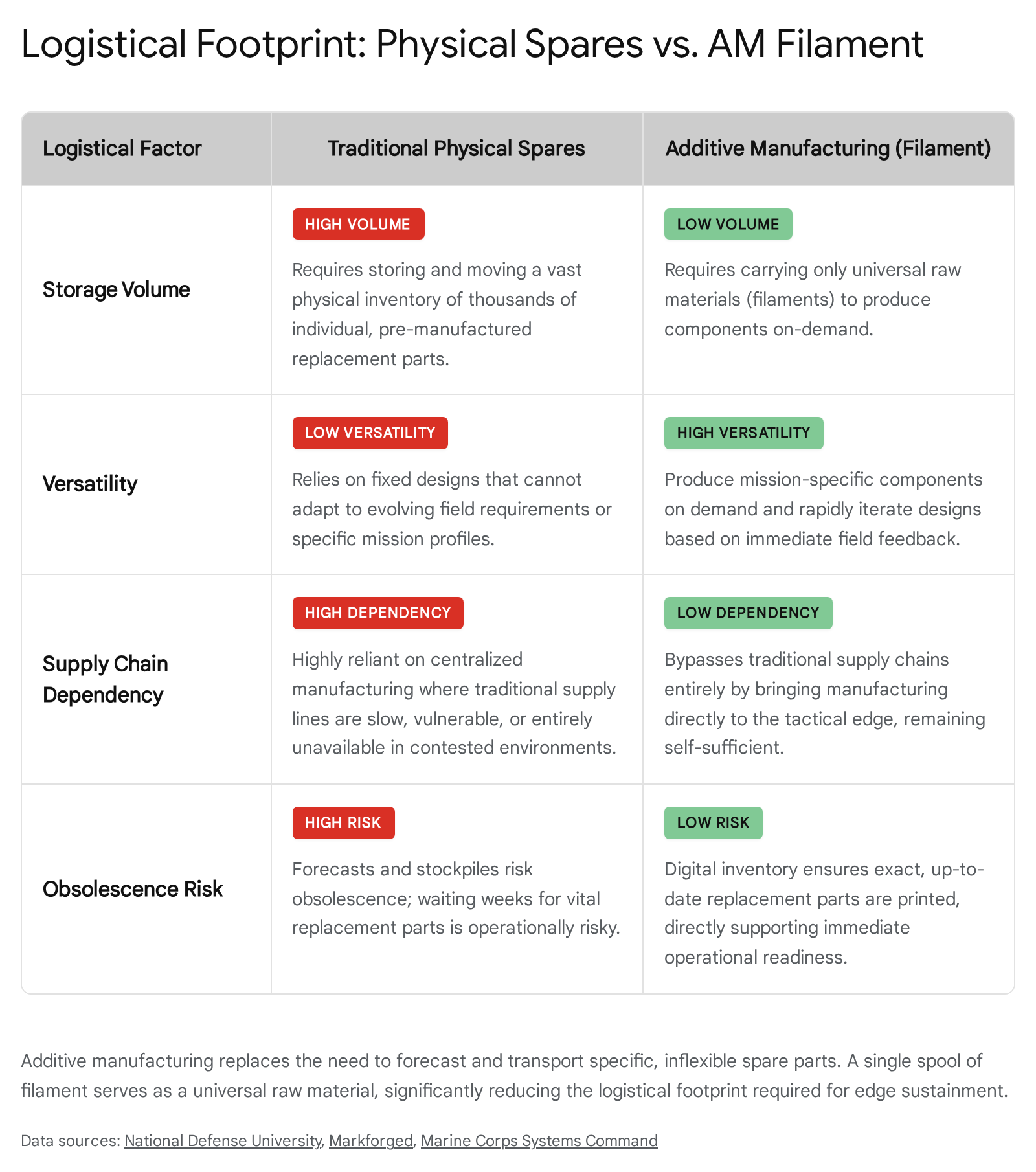
The traditional sustainment model requires military logistics networks to forecast, procure, transport, and warehouse thousands of distinct physical spare parts. In contested or disconnected environments, these traditional supply lines are slow, vulnerable, and often unavailable.13 Additive manufacturing fundamentally alters this logistical equation.
Instead of stocking vast physical inventories of replacement parts for various models, organizations can maintain a digital catalog of parts that can be printed locally, on demand.13 When a specific part breaks, it is fabricated on-site. This approach substitutes the transport of fragile, specific spares with the transport of raw materials—specifically, spools of polymer filament and composite resins.12
Raw filament is highly space-efficient, durable during transport, and entirely agnostic. A single spool of material can be transformed into a propeller guard, an aerodynamic fairing, an internal bracket, or a customized payload enclosure as the tactical situation demands.13 This capability drastically reduces the logistical burden by printing parts instead of transporting spares, allowing units to repair or replace damaged components without waiting on resupply from the rear.13 Furthermore, it allows forces to rapidly iterate designs based on field feedback, modifying systems to better suit current mission profiles without relying on a factory production run.13
Advanced Materials and Production Methodologies
The viability of 3D-printed parts has surged due to critical advancements in materials science. Historically, manufacturers balanced strength, weight, and cost by relying on a mix of aluminum, steel, titanium, and standard plastics.13 As endurance and payload requirements increased, these materials revealed their limitations.13 Today, advanced composite materials and structural designs enable performance characteristics that conventional manufacturing cannot easily deliver.29
The industry utilizes several distinct printing technologies to meet operational requirements. PolyJet is effective for high-fidelity prototyping and multimaterial capabilities, while Stereolithography provides high-resolution, smooth aerodynamic surfaces.40 For strong, structural components, high-speed Fused Filament Fabrication is the preferred method.40 Advanced materials include carbon-fiber-infused Polylactic Acid, Polyethylene Terephthalate Glycol, and Nylon.41
Carbon-fiber-reinforced composites represent the pinnacle of aerospace-grade additive manufacturing. These filaments merge polymer matrices with carbon fibers to create components with exceptional mechanical properties.29 Carbon-fiber-reinforced components can demonstrate up to a 1243% improvement in Young’s modulus and a 1344% increase in tensile strength compared to standard materials.29 In many applications, these continuous fiber-reinforced composites match or exceed the strength of aluminum at a fraction of the weight, enabling longer flight times and greater payload capacity without sacrificing the durability required for flight.13
Mobile Fabrication Nodes and Expeditionary Deployment
To deploy this capability effectively, the military is investing heavily in mobile fabrication nodes designed to withstand harsh field conditions.12 The Marine Corps has established the Expeditionary Fabrication system, housing polymer and metal printers, alongside milling and grinding tools, inside a standard 8-by-8-by-20-foot container.12 The Army is pursuing similar capabilities through its Rapid Fabrication via Additive Manufacturing program and has established the Additive Makerspace at Picatinny Arsenal, which houses over 50 advanced printers to drive rapid prototyping.12
The versatility of these systems extends to active combat platforms. The Indiana Army National Guard recently achieved a technological milestone by successfully demonstrating 3D printing aboard a UH-60 Black Hawk helicopter mid-flight.46 Utilizing a printer designed to withstand air turbulence and physical flight stresses, powered by a portable tactical energy source, the system produced components for unmanned aerial systems while performing tactical maneuvers.46 The ability to fabricate precise components on demand directly translates to reduced downtime, boosted readiness, and unmatched flexibility, ensuring that troops can adapt to shifting needs without waiting for external supply chains to catch up.46
7. Decentralized Maintenance and Retraining the Maneuver Force
The integration of attritable assets into the tactical edge requires a fundamental paradigm shift in how the military conceptualizes both the operator and the maintainer. Currently, drone maintenance is heavily concentrated within specific Military Occupational Specialties, such as the Army’s 15E (Unmanned Aircraft Systems Repairer) and 15X (Tactical Unmanned Aircraft System Specialist).47 These roles require extensive, specialized instruction, encompassing up to 24 weeks of Advanced Individual Training focused on electrical theory, advanced troubleshooting, and payload integration.47
While highly specialized technicians remain absolutely essential for maintaining larger, complex Group 3 and Group 4 systems, the stated objective to proliferate small unmanned aerial systems down to every infantry squad renders the specialized-maintainer model unsustainable for lower-tier platforms.14 The sheer volume of platforms dictates that basic operation, system troubleshooting, and ad-hoc repair must become universal infantry skills, integrating into basic training as seamlessly as traditional marksmanship or rifle maintenance.52
The Cultural Shift: The “Right to Repair”
A critical hurdle to this transition is found in military culture and rigid regulatory constraints. Strict airworthiness releases, intellectual property restrictions tightly held by vendors, and inflexible safety protocols have historically prevented frontline soldiers from modifying their own equipment.15 However, guided by new drone dominance directives, military leadership is beginning to advocate strongly for the “right to repair”.15
This cultural shift empowers soldiers to fabricate components, splice wiring, replace electronic speed controllers, and modify system firmware directly in the field. By altering the way contracts are written to secure intellectual property rights from vendors, the military ensures that soldiers have the legal and technical authority to make modifications that suit immediate mission demands without waiting for manufacturer intervention.14 This is increasingly built into training courses, teaching soldiers how to 3D print, design, code, and rebuild their own systems.15
Rise of the “Drone Sergeant” and Tiered Frameworks
To bridge the gap between complex aviation engineering and basic infantry skills, the Army is developing tiered maintenance frameworks. A central concept is the formalization of the Company small Unmanned Aircraft System Master Trainer, informally known as the “Drone Sergeant”.14
This role is designed to be MOS-agnostic, meaning it can be filled by an infantryman rather than a specialized aviation technician. Credentialed via an Additional Skill Identifier, the Drone Sergeant serves as the primary trainer for squad-level operators and the focal point for localized maintenance.14 Responsibilities include managing localized “bench stocks” of high-use components, executing functional test flights, and conducting intermediate repairs such as soldering and component replacement.14 This decentralized model frees brigade-level aviation elements from micromanaging squad-level assets, allowing subordinate units to run organic training and currency flights autonomously.14
At the squad level, individual operators are trained to conduct pre-flight and post-flight checks, perform simple part exchanges such as swapping batteries or propellers, execute firmware updates, and manage lithium polymer battery safety.14 This tiered approach ensures responsiveness at the point of need while maintaining integration with the broader sustainment enterprise.14
Specialized Curricula and Standardized Training
The Marine Corps is aggressively operationalizing this decentralized training model to support the mandate of equipping all infantry, reconnaissance battalions, and littoral combat teams with attack drones by mid-2026.57 The Marine Corps Training and Education Command has launched a comprehensive suite of six standardized, MOS-agnostic pilot courses designed to rapidly certify operators and maintainers.57
| USMC sUAS Training Course | Core Competencies and Objectives | Source |
| Basic Drone Operator | Assembly, maintenance, and safe operation of both full-acro and stabilized non-lethal drones in operational environments. | 59 |
| Attack Drone Operator | Foundational skills required to tactically employ lethal attack drones. | 59 |
| Payload Specialist | Safe explosive handling and preparation of pre-fabricated warheads used to arm lethal drones in field conditions. | 59 |
| Attack Drone Leader | Instructional understanding of threat assessment, system capabilities, and integration with maneuver and fire support plans. | 59 |
| Instructor Courses | Provides the instructional skills required to administer and certify Marines in the operator and specialist courses. | 59 |
These courses address the urgent need for standardized training, doctrine, and force-wide capacity building.28 By teaching payload integration, structural chassis inspection, and component troubleshooting to standard combat troops, the military ensures that damage sustained in combat does not result in permanently degraded unit capability.59
8. Predictive Logistics and Data-Driven Sustainment Operations
While decentralization, open architectures, and additive manufacturing provide the physical means to sustain attritable fleets at the tactical edge, data architecture provides the necessary operational direction. Managing thousands of autonomous systems requires a fundamental shift from reactive reporting to anticipatory sustainment.
Current logistics models focus heavily on demand forecasting where units report consumption via enterprise systems, which then feed into automated logistics forecasting during 24 to 72-hour planning cycles.17 However, the Army’s updated Field Manual 4-0 identifies predictive logistics as a doctrinal imperative, demanding that commanders anticipate equipment failures and optimize resupply before shortfalls actually occur.63 The digital architecture supporting this transition is the Next Generation Command and Control system.63
By integrating real-time data, artificial intelligence, and resilient communications, this system creates a common operating picture for logisticians that is timely, accurate, and actionable.63 At the tactical edge, predictive maintenance utilizes connected sensors and flight maintenance logs to identify wear patterns, such as unusual vibrations in motors or impending battery degradation.62
As Edge artificial intelligence matures, these systems will move beyond simply alerting maintainers to potential hardware failures. They will enable autonomous logistics that request specific filament types or automatically pre-position standardized open-architecture components based on real-time consumption rates and anticipated combat intensity.63 This data-driven approach is absolutely critical to ensuring that the distributed nodes of expeditionary fabrication and localized unit bench stocks are adequately supplied, maximizing readiness without overwhelming the fragile “last tactical mile” with unnecessary or obsolete inventory.17
9. Strategic Recommendations for Command Leadership
The procurement of thousands of attritable autonomous systems represents a hollow force structure investment if those systems cannot be sustained during high-intensity, multi-domain conflict. To ensure operational readiness when traditional supply lines are severed and depots are compromised, leadership must operationalize the following strategic recommendations:
- Mandate Open Architecture Compliance in all Future UAS Procurement: Acquisition pathways for all rapid fielding initiatives and Collaborative Combat Aircraft increments must strictly enforce open architectures. Vendors utilizing proprietary physical connectors, encrypted battery interfaces, or closed software ecosystems that prevent tactical-edge component swapping must be disqualified from future tranches. System severability and interface standardization must be codified as primary Key Performance Parameters in all capability development documents.
- Scale and Fund Fabrication Infrastructure at Echelon: The deployment of 3D printing capabilities must transition from experimental pilot programs to standard Table of Organization and Equipment authorizations. Expedited funding should be directed toward fielding ruggedized expeditionary fabrication units down to the battalion level. Logistics planning must pivot away from forecasting individual drone spares toward calculating the required burn rates of engineering-grade composite filaments, treating raw material as a primary Class IX asset.
- Formalize Decentralized Sustainment and the “Drone Sergeant”: Service branches must codify roles equivalent to the Company small Unmanned Aircraft System Master Trainer. Personnel policy must be updated to formally sever the requirement for aviation-specific occupational specialties to conduct routine maintenance on lower-tier systems. Furthermore, unit supply chains must establish dedicated lines of accounting to procure commercial components and maintain organic bench stocks directly at the company level.
- Revise Airworthiness and Safety Doctrine: Current regulations prioritize peacetime safety and bureaucratic oversight over wartime adaptability. The Department must issue broad waivers or revise doctrine to establish the definitive “Right to Repair” for combat units. Soldiers and Marines must be legally, doctrinally, and technically empowered to splice wires, fabricate structural airframes, and integrate ad-hoc payloads without triggering lengthy airworthiness reviews that throttle operational tempo.
By aligning acquisition strategies with the harsh realities of contested logistics, standardizing hardware interfaces, and trusting the maneuver force to adapt and repair their own technology, the military can guarantee that its massive investments in autonomous mass translate directly into enduring, resilient battlefield dominance.
Please share the link on Facebook, Forums, with colleagues, etc. Your support is much appreciated and if you have any feedback, please email us in**@*********ps.com. If you’d like to request a report or order a reprint, please click here for the corresponding page to open in new tab.
Sources Used
- DOD’s Replicator Program:, accessed April 24, 2026, https://docs.house.gov/meetings/AS/AS35/20231019/116484/HHRG-118-AS35-Wstate-GreenwaltW-20231019.pdf
- DOD Innovation Official Discusses Progress on Replicator – Department of War, accessed April 24, 2026, https://www.war.gov/News/News-Stories/Article/Article/3999474/dod-innovation-official-discusses-progress-on-replicator/
- Collaborative Combat Aircraft (CCA), US – Airforce Technology, accessed April 24, 2026, https://www.airforce-technology.com/projects/collaborative-combat-aircraft-cca-usa/
- DOD moves to make its largest-ever investment in drones and anti-drone weapons, accessed April 24, 2026, https://defensescoop.com/2026/04/21/dod-plans-largest-ever-investment-drones-anti-drone-weapons/
- YFQ-44A Integrates with the Experimental Operations Unit – Anduril, accessed April 24, 2026, https://www.anduril.com/news/yfq-44a-integrates-with-the-experimental-operations-unit
- DoDM 4151.23, June 24, 2016, Incorporating Change 1, August 31, 2018, accessed April 24, 2026, https://www.esd.whs.mil/Portals/54/Documents/DD/issuances/dodm/415123m.pdf
- Naval Logistics in Contested Environments: Examination of Stockpiles and Industrial Base Issues – RAND, accessed April 24, 2026, https://www.rand.org/content/dam/rand/pubs/research_reports/RRA1900/RRA1921-1/RAND_RRA1921-1.pdf
- Logistics While Under Attack: The Decisive Edge For a Collaborative Combat Air Force, accessed April 24, 2026, https://www.autonomyglobal.co/logistics-while-under-attack-the-decisive-edge-for-a-collaborative-combat-air-force/
- MITCHELL INSTITUTE Policy Paper, accessed April 24, 2026, https://www.mitchellaerospacepower.org/app/uploads/2024/07/Fighting-the-Air-Base-Final2.pdf
- MOSA | NAVAIR, accessed April 24, 2026, https://www.navair.navy.mil/MOSA
- Modular Open Systems Approach (MOSA) – Defense Standardization Program, accessed April 24, 2026, https://www.dsp.dla.mil/Programs/MOSA/
- Fabrication at the Tactical Edge > National Defense University …, accessed April 24, 2026, https://www.ndu.edu/News/Article-View/Article/4445402/fabrication-at-the-tactical-edge/
- Military Drone Production and Additive Manufacturing – Markforged, accessed April 24, 2026, https://markforged.com/resources/blog/manufacturing-at-the-tactical-edge-the-future-of-military-drone-operations
- Drone Dominance in Contact: sUAS Challenges and Adaptations at …, accessed April 24, 2026, https://smallwarsjournal.com/2025/12/12/drone-dominance-in-contact-suas-challenges-and-adaptations-at-the-brigade-level/
- Media Roundtable with Col. Nicholas Ryan: Army Best Drone Warfighter Competition, accessed April 24, 2026, https://www.army.mil/article/290646/media_roundtable_with_col_nicholas_ryan_army_best_drone_warfighter_competition
- Logistics While Under Attack: Key to a CCA Force Design, accessed April 24, 2026, https://www.mitchellaerospacepower.org/app/uploads/2025/03/Logistics-While-Under-Attack-Key-to-a-CCA-Force-Design-WEB.pdf
- Contested Logistical Resupply to the Zero Line: How Drones and Signals Require a Change in Standard Operating Procedures – Small Wars Journal, accessed April 24, 2026, https://smallwarsjournal.com/2025/11/24/contested-logistical-resupply-to-the-zero-line-how-drones-and-signals-require-a-change-in-standard-operating-procedures/
- Deputy Secretary of Defense Kathleen Hicks Announces Additional Replicator All-Domain Attritable Autonomous Capabilities – Department of War, accessed April 24, 2026, https://www.war.gov/News/Releases/Release/Article/3963289/deputy-secretary-of-defense-kathleen-hicks-announces-additional-replicator-all/
- Pentagon’s Replicator Initiative Sets Sights on Counter-UAS – National Defense Magazine, accessed April 24, 2026, https://www.nationaldefensemagazine.org/articles/2024/12/16/pentagons-replicator-initiative-sets-sights-on-counteruas
- One Year On: How the Armed Force’s CCA Programs Have Matured – IDGA, accessed April 24, 2026, https://www.idga.org/aviation/articles/how-armed-forces-cca-matured-in-2025
- New Study: Air Force Needs to Work Now on How to Sustain CCAs …, accessed April 24, 2026, https://www.airandspaceforces.com/ccas-sustainement-in-field/
- USAF Wants Collaborative Aircraft Fleet To Stress Parts Commonality For Forward Operations – The War Zone, accessed April 24, 2026, https://www.twz.com/air/usaf-wants-collaborative-aircraft-fleet-to-stress-parts-commonality-for-forward-operations
- sUAS Purpose Built Attritable Systems (PBAS) USAEUR – SAM.gov, accessed April 24, 2026, https://sam.gov/opp/fa478ed408e04c9794aa89df55fba5bc/view
- Point-of-Need Additive Manufacturing in Austere Arctic Environments: An Evaluation of Medical Logistics Requirements and Capabilities Demonstration – PMC, accessed April 24, 2026, https://pmc.ncbi.nlm.nih.gov/articles/PMC10968242/
- Usage Patterns and Costs of Unmanned Aerial Systems | Congressional Budget Office, accessed April 24, 2026, https://www.cbo.gov/publication/57260
- Logistics While Under Attack: Key to a CCA Force Design, accessed April 24, 2026, https://www.mitchellaerospacepower.org/logistics-while-under-attack-key-to-a-cca-force-design/
- Fabrication at the Tactical Edge – NDU Press, accessed April 24, 2026, https://ndupress.ndu.edu/Portals/68/Documents/jfq/jfq%20119/jfq-119-fabrication-at-the-tactical-edge.pdf
- APPROVED TRAINING REQUIREMENTS FOR SMALL … – Marines.mil, accessed April 24, 2026, https://www.marines.mil/News/Messages/Messages-Display/Article/4366306/approved-training-requirements-for-small-unmanned-aerial-systems/
- Aerospace 3D Printing: Building Field-Ready Drones in Hours, accessed April 24, 2026, https://www.phillipscorp.com/india/aerospace-3d-printing-for-drone-manufacturing/
- Drone Warfare in Ukraine: From Myths to Operational Reality – Part 1, accessed April 24, 2026, https://researchcentre.army.gov.au/library/land-power-forum/drone-warfare-ukraine-myths-operational-reality-part-1
- Innovating Under Fire: Lessons from Ukraine’s Frontline Drone …, accessed April 24, 2026, https://mwi.westpoint.edu/innovating-under-fire-lessons-from-ukraines-frontline-drone-workshops/
- Mapping the MilTech War: Eight Lessons from Ukraine’s Battlefield – Ifri, accessed April 24, 2026, https://www.ifri.org/en/studies/mapping-miltech-war-eight-lessons-ukraines-battlefield
- How Iran is learning from Ukraine war: Drones, AI and a new military playbook, accessed April 24, 2026, https://timesofindia.indiatimes.com/defence/international/how-iran-is-learning-from-ukraine-war-drones-ai-and-a-new-military-playbook/articleshow/130384367.cms
- Networked for War: Lessons from Ukraine’s Ground Robots – Modern War Institute, accessed April 24, 2026, https://mwi.westpoint.edu/networked-for-war-lessons-from-ukraines-ground-robots/
- Modular Open Systems Approach – DoW Research & Engineering, OUSW(R&E), accessed April 24, 2026, https://www.cto.mil/sea/mosa/
- Understanding the Open Standards That Power the MOSA Initiative, accessed April 24, 2026, https://www.lcrembeddedsystems.com/resources/understanding-the-open-standards/
- What is MOSA? – BAE Systems, accessed April 24, 2026, https://www.baesystems.com/en-us/definition/what-is-mosa
- OUSD(R&E) Review of MOSA Tools and Practices Background, accessed April 24, 2026, https://www.cto.mil/wp-content/uploads/2023/06/MOSA-Tools-2022.pdf
- Naval Modular Open System Approach Guidebook, accessed April 24, 2026, https://www.cto.mil/wp-content/uploads/2025/05/Naval-MOSA-Implementation-Guide-V1.0.pdf
- 3D Printing for Drones & UAV Manufacturing – Stratasys, accessed April 24, 2026, https://www.stratasys.com/en/resources/blog/3d-printing-drones-uavs/
- Composite Filament Materials for 3D-Printed Drone Parts: Advancements in Mechanical Strength, Weight Optimization and Embedded Electronics – PMC, accessed April 24, 2026, https://pmc.ncbi.nlm.nih.gov/articles/PMC12155913/
- PETG as an Alternative Material for the Production of Drone Spare Parts – MDPI, accessed April 24, 2026, https://www.mdpi.com/2073-4360/16/21/2976
- How Marines are 3D Printing Lethality in Contested Logistics Environments, accessed April 24, 2026, https://www.marcorsyscom.marines.mil/News/News-Article-Display/Article/3984579/how-marines-are-3d-printing-lethality-in-contested-logistics-environments/
- 3D Printing powerhouse opens at Picatinny’s Armaments Center, boosting innovation, accessed April 24, 2026, https://www.army.mil/article/291460/3d_printing_powerhouse_opens_at_picatinnys_armaments_center_boosting_innovation
- US Army opens AM facility with more than 50 3D printers – VoxelMatters, accessed April 24, 2026, https://www.voxelmatters.com/us-army-opens-am-facility-with-more-than-50-3d-printers/
- US Troops 3D Print Drone Parts While Flying in Black Hawk – 3Dnatives, accessed April 24, 2026, https://www.3dnatives.com/en/us-troops-3d-print-drone-parts-while-flying-in-black-hawk-03102025/
- 15E Unmanned Aircraft Systems (UAS) Repairer | Army National Guard, accessed April 24, 2026, https://nationalguard.com/15e-unmanned-aircraft-systems-uas-repairer
- Army COOL – 15E – Tactical Unmanned Aircraft System (TUAS) Repairer MOS – Overview, accessed April 24, 2026, https://www.cool.osd.mil/army/moc/index.html?moc=15e
- 10-15X. MOS 15X—Tactical Unmanned Aircraft System (TUAS) Specialist, CMF 15 (Effective, accessed April 24, 2026, https://api.army.mil/e2/c/downloads/2026/01/13/fb3bc9a7/15x.pdf
- MQ-1 Unmanned Aircraft System (UAS) Repairer 15M – US Army, accessed April 24, 2026, https://www.goarmy.com/careers-and-jobs/aviation/repairing-aircraft/15m-mq-1-unmanned-aircraft-system-repairer
- Government & Military News – National Defense Transportation Association, accessed April 24, 2026, https://www.ndtahq.com/news-issue-papers/government-military-news/
- How to Train a Drone Warrior, with Lessons from Ukraine – RSIS, accessed April 24, 2026, https://rsis.edu.sg/rsis-publication/rsis/how-to-train-a-drone-warrior-with-lessons-from-ukraine/
- Make counter-drone training as routine as marksmanship: Army, accessed April 24, 2026, https://www.armytimes.com/unmanned/2024/10/15/make-counter-drone-training-as-routine-as-marksmanship-army-general/?contentFeatureId=f0fmoahPVC2AbfL-2-1-8&contentQuery=%7B%22includeSections%22%3A%22%2Fhome%22%2C%22excludeSections%22%3A%22%22%2C%22feedSize%22%3A10%2C%22feedOffset%22%3A55%7D
- Better trained soldiers are coming out of the Infantry school : r/army – Reddit, accessed April 24, 2026, https://www.reddit.com/r/army/comments/q5tdnn/better_trained_soldiers_are_coming_out_of_the/
- Fort Sill’s Joint C-sUAS University: Spearheading the charge against drone threats | Article, accessed April 24, 2026, https://www.army.mil/article/271454/fort_sills_joint_c_suas_university_spearheading_the_charge_against_drone_threats
- The U.S. Army Should Establish a Robotics Branch – Fort Benning, accessed April 24, 2026, https://www.benning.army.mil/armor/eARMOR/content/issues/2022/Spring/2Dudas22.pdf
- Marine Corps wants 10,000 new drones this year as it looks to expand training for off-the-shelf systems | FedScoop, accessed April 24, 2026, https://fedscoop.com/radio/the-corps-announced-a-standardized-training-program-for-small-sized-unmanned-aerial-systems/
- Marine Corps Launches New Drone Training Program – Department of War, accessed April 24, 2026, https://www.war.gov/News/News-Stories/Article/Article/4369456/marine-corps-launches-new-drone-training-program/
- Marine Corps launches six drone training programs open to any MOS – Military Times, accessed April 24, 2026, https://www.militarytimes.com/news/your-military/2025/12/30/marine-corps-launches-six-drone-training-programs-open-to-any-mos/
- Marine Corps Launches Drone Training Program – MeriTalk, accessed April 24, 2026, https://meritalk.com/articles/marine-corps-launches-drone-training-program/
- Routine Drone Maintenance Checklist – Regulations.gov, accessed April 24, 2026, https://downloads.regulations.gov/FAA-2021-0745-0001/attachment_3.pdf
- Example Maintenance Procedures – DroneSense Support, accessed April 24, 2026, https://support.dronesense.com/hc/en-us/articles/4404450145805-Example-Maintenance-Procedures
- NGC2 at the Tactical Edge: Enabling Predictive Logistics for …, accessed April 24, 2026, https://www.army.mil/article/290032/ngc2_at_the_tactical_edge_enabling_predictive_logistics_for_decision_dominance
- How AI Is Supporting Military Readiness Through Smarter Maintenance, accessed April 24, 2026, https://governmenttechnologyinsider.com/how-ai-is-supporting-military-readiness-through-smarter-maintenance/