Executive Summary
The proliferation of small unmanned aerial systems, particularly first-person view loitering munitions and quadcopters, has fundamentally altered the tactical landscape of modern conflict. Commercial and military-grade drones offer an asymmetric advantage, allowing forces to conduct precision strikes and reconnaissance at a fraction of the cost of traditional airpower. As electronic warfare and signal jamming techniques face diminishing returns due to the advent of fiber-optic control lines and autonomous terminal guidance, military organizations are rapidly re-evaluating kinetic point-defense solutions.
This report provides a detailed analysis of the resurgence of the 12-gauge shotgun as a critical, last-resort hard-kill effector against low-altitude drone threats. By examining current battlefield adaptations from the conflict in Ukraine, the development of purpose-built hardware like the Benelli M4 A.I. Drone Guardian, the engineering of specialized ammunition arrays such as the Norma AD-LER and SkyNet tethered capture nets, and the integration of artificial intelligence fire control systems, this document outlines the capabilities and limitations of small arms in a counter-drone capacity. Furthermore, the report details how training doctrines are evolving, drawing upon traditional clay pigeon shooting disciplines to prepare infantry and vehicle crews for high-speed, unpredictable aerial targets. The analysis concludes that while the shotgun presents a highly effective close-range capability, its integration requires specialized hardware, modernized ammunition, and a complete overhaul of traditional marksmanship training to mitigate its inherent range and capacity limitations.
1.0 Introduction: The Evolution of the Unmanned Aerial Threat
The modern battlefield is currently characterized by the omnipresence of small unmanned aerial systems (sUAS). The history of drone warfare spans over a century, with the first successful tests of remotely controlled aerial platforms conducted by the Royal Flying Corps in 1917.1 However, the integration of high-density lithium polymer batteries, miniaturized gyroscopes, and high-definition commercial optics over the past decade has democratized aerial power, allowing both state and non-state actors to deploy sophisticated airborne capabilities.3 These platforms are utilized for high-resolution reconnaissance, real-time fire control and target location error correction for artillery, and direct kinetic strikes via modified mortar rounds or shaped charges.5
The sheer volume of inexpensive commercial drones deployed in active combat zones, most notably in the ongoing conflict in Ukraine, has saturated the airspace and severely eroded the traditional advantages of armored mobility and static defensive positions.1 By 2025, Ukrainian production objectives alone aimed for the assembly of 4.5 million first-person view (FPV) drones, illustrating the industrial scale of this localized aerial threat.3 With the capability to strike armored vehicles from above, targeting thinly armored engine decks and open personnel hatches, FPV drones have become one of the primary drivers of combat casualties and equipment degradation.1
Historically, the primary defense against sUAS has been electronic warfare (EW). Jamming devices target the radio frequency control links or GPS navigation signals of the drone, forcing the platform into a loss-of-link protocol, which typically results in a controlled descent or an erratic crash.9 However, the drone threat is highly adaptive. The recent introduction of drones controlled via physical fiber-optic cables has completely negated the efficacy of traditional radio frequency jamming, rendering electronic warfare virtually useless against these specific platforms.9 Because the control signals travel through a physical filament rather than the electromagnetic spectrum, the operator maintains uninterrupted, high-definition control of the drone until the moment of impact.11 When electronic countermeasures fail or are bypassed by autonomous, non-transmitting drones utilizing localized optical recognition, military personnel require a physical, kinetic method to neutralize the threat before impact. This operational gap has catalyzed the return of the smoothbore shotgun from a specialized breaching tool to a frontline defensive necessity.12
2.0 The Tactical Utility of the 12-Gauge Shotgun
The core advantage of the 12-gauge shotgun in a counter-drone role lies in the physics of its projectile dispersion. The standard infantry rifle fires a single projectile, requiring precise angular alignment against a target that is small, aerodynamically erratic, and fast-moving. At the terminal stages of an attack, an FPV drone can reach speeds of up to 112 kilometers per hour.9 Hitting such a target with a single 5.56mm or 5.45mm bullet requires a complex estimation of target lead, elevation, and windage, a calculation that is exceptionally difficult for an average soldier to perform under extreme combat stress.13
Conversely, a shotgun fires a dispersed pattern of multiple pellets. This spread significantly increases the probability of a physical strike on the target, creating a localized lethal cloud of kinetic energy that intercepts the flight path of the drone.7 Commercial quadcopters and customized FPV drones are inherently fragile constructs. They rely on delicate plastic or carbon fiber rotors, exposed wiring harnesses, and sensitive optical sensors to maintain stable flight and navigation. A single pellet striking a rotor blade or penetrating a motor housing is often sufficient to cause catastrophic aerodynamic failure, sending the drone into an unrecoverable spin.13
2.1 Efficacy and Ballistic Reality
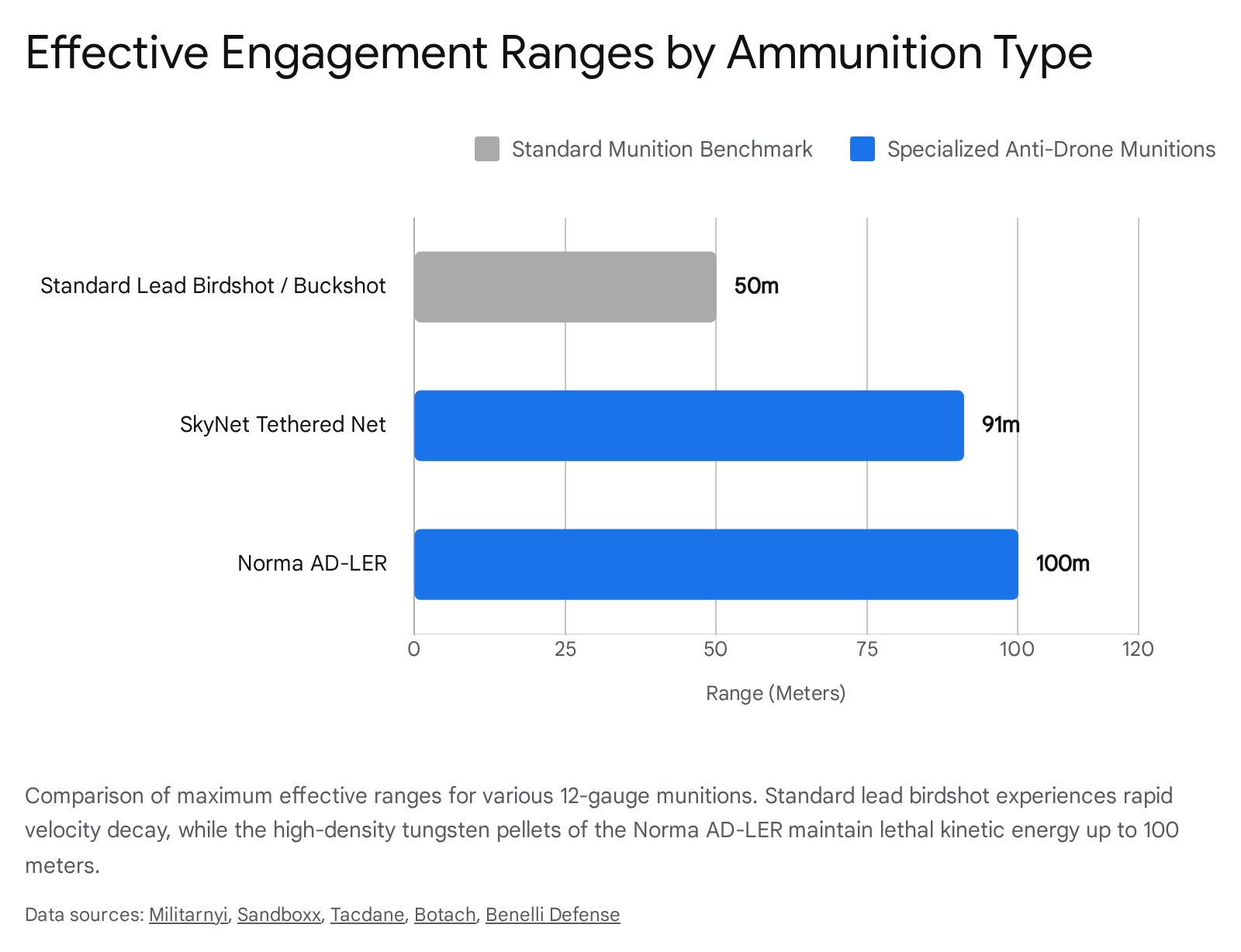
The primary limitation of the shotgun is its effective range. Standard buckshot or birdshot loads fired from traditional cylinder bore combat shotguns experience rapid velocity decay and pattern spread due to the poor ballistic coefficient of spherical lead or steel pellets. Conventional wisdom and battlefield analytics place the effective range of a standard shotgun against a small aerial target at approximately 30 to 50 meters.5 At distances beyond 50 meters, standard lead or steel pellets lose the kinetic energy required to penetrate ruggedized drone chassis, and the pattern becomes too wide to guarantee a strike on a small cross-section target.5 Therefore, the shotgun is strictly defined as a point-defense weapon, serving as the final, desperate layer in a multi-tiered air defense network.12
Military analysts note that while long-range surface-to-air missiles and high-energy lasers are preferred for base defense, these systems are bulky, expensive, and difficult to deploy with mobile infantry units.6 The shotgun provides a rapidly deployable platform that individual soldiers can use to protect themselves and their immediate surroundings when all other protective envelopes have been breached.8
2.2 Operational Deployment and Field Adaptations
In the Russo-Ukrainian theater, the adoption of shotguns has transitioned from ad-hoc desperation to standardized tactical doctrine. Russian forces, facing constant harassment from Ukrainian FPV quadcopters and loitering munitions, have widely distributed a variety of 12-gauge shotguns to their infantry and mechanized units.5 The deployment encompasses a wide range of hardware, including modern semi-automatic platforms such as the Saiga-12, Vepr-12, MP-133, MP-153, and the KS-K, as well as older civilian-grade double-barrel shotguns like the IZh-43.5
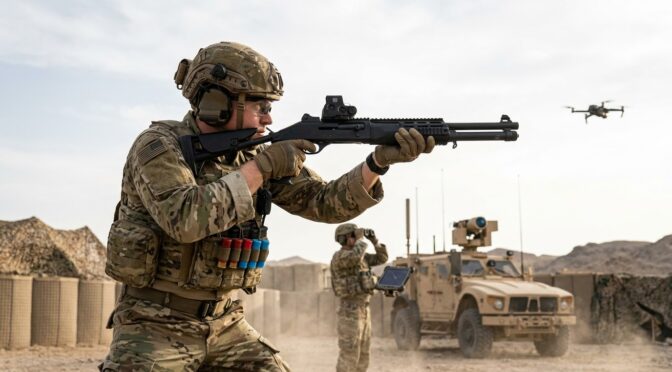
A standard tactical deployment involves assigning a dedicated shotgun-armed rifleman to specific vulnerable assets. The threat posed by UAVs has reached such a scale that military analyses recommend attaching a dedicated shotgun operator to every combat vehicle operating near the front lines, as well as integrating them into every dismounted infantry group.5 For the protection of mechanized assets and logistics convoys, these designated drone guards ride exposed in the open hatches of main battle tanks, infantry fighting vehicles, or in the beds of supply trucks.7
These personnel are tasked with maintaining a constant visual scan of the sky, particularly focusing on the rear quadrant of the vehicle, which tactical data identifies as the most common vector for FPV drone strikes.5 Their sole objective is to detect and destroy incoming munitions in the final 10 to 30 meters of their terminal dive, preventing the drone from striking critical vulnerabilities such as engine compartments or the crew cabin.7 The psychological and physical toll of this duty is immense, requiring intense concentration, leading to rapid operator fatigue and necessitating frequent rotation of personnel to maintain optimal defensive readiness.7
2.3 Layered Detection and Tactical Synergy
Effective drone defense cannot rely on human vision alone. A soldier scanning the sky is highly susceptible to surprise attacks, particularly in poor weather conditions or under the cover of darkness. To mitigate this vulnerability, effective operational doctrine pairs the kinetic effector, the shotgun, with portable early warning sensors.
Reports analyzing Russian frontline adaptations highlight the mandatory pairing of shotgun riflemen with passive drone detectors, specifically the Bulat-3 and Bulat-4 systems.5 These portable, passive radio-frequency scanners detect the control signals and video feeds of approaching drones at distances of up to 1,000 meters without emitting a detectable electromagnetic signature themselves.5 The detector provides the operator with critical early warning, allowing them to ready their weapon, acquire the target visually as it enters the kinetic kill zone, and engage.5
Furthermore, these shotgun teams do not operate in isolation. They are coordinated alongside electronic warfare units. If the active EW jamming systems fail to force the drone down, or if the drone operates via a jamming-resistant fiber-optic link, the shotgun operator serves as the terminal failsafe.5 Russian troops have also been observed monitoring the established approach and departure routes of Ukrainian drones, using this intelligence to set up coordinated ambushes involving multiple shotgun-armed shooters.5
3.0 Hardware and Platform Evolution
To meet the specific ballistic and ergonomic demands of counter-sUAS operations, the defense industry is transitioning away from standard riot control and breaching shotguns toward purpose-built aerial defense platforms engineered to maximize pattern density and range.
3.1 The Benelli M4 A.I. Drone Guardian
The most prominent example of a specialized counter-drone shotgun currently entering the market is the Benelli M4 A.I. Drone Guardian. Developed in collaboration with military shooting instructors and defense contractors, this platform represents a significant evolution of the combat-proven M1014 shotgun currently utilized by the United States Marine Corps and allied forces.18 The weapon utilizes Benelli’s proprietary Auto-Regulating Gas-Operated (A.R.G.O.) dual-piston, short-stroke gas system.18 This mechanism ensures highly reliable semi-automatic cycling across varying environmental conditions and allows the weapon to function flawlessly with both standard and high-pressure magnum payloads.20
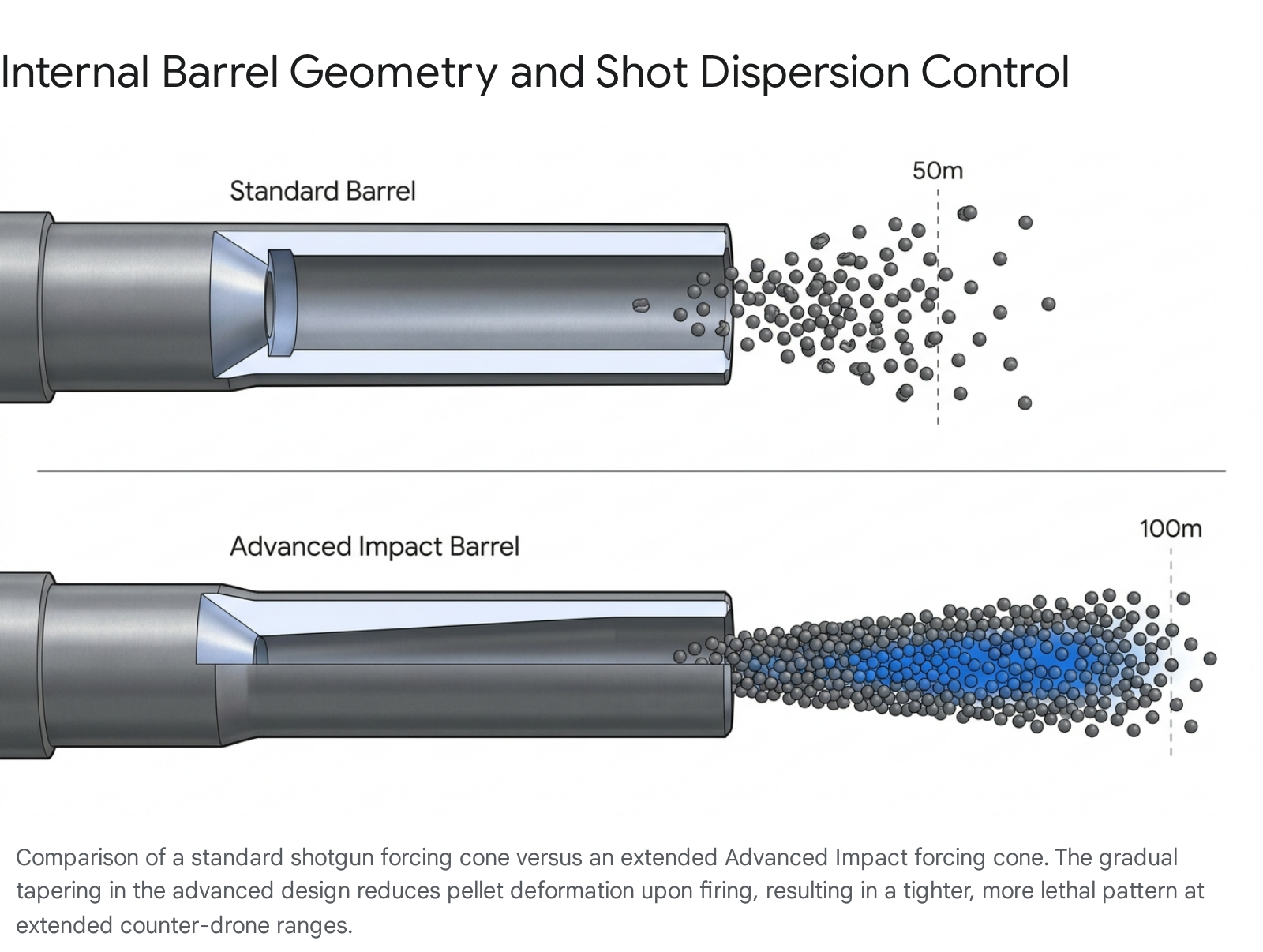
The critical innovation within the Drone Guardian variant is the integration of Benelli’s patented “Advanced Impact” (A.I.) barrel technology.16 In standard shotgun designs, the forcing cone, the section of the barrel that transitions the payload from the firing chamber into the main bore, is relatively short and steep. This steep transition can crush and deform the lead or tungsten pellets as they are forced into the narrower bore, leading to erratic flight paths, diminished pattern density, and reduced downrange energy. The Advanced Impact system features a significantly larger and longer forcing cone geometry.16 This extended contouring smooths the transition of the shot payload, reducing pellet deformation and maintaining a tighter, more uniform shot column as it travels down the barrel.22
Benelli reports that this internal ballistic engineering increases overall projectile velocity and delivers up to 50 percent deeper penetration compared to standard barrel profiles.22 When paired with specific high-density ammunition, the Advanced Impact system pushes the effective engagement envelope of the shotgun well beyond traditional limits. While the optimal engagement range remains between zero and 50 meters, the system is capable of reaching targets at 100 meters or more for borderline, last-resort shots.16
The physical platform is optimized for tactical deployment. The Drone Guardian features an 18.5-inch (470mm) barrel, an adjustable technopolymer telescopic stock that collapses to 118mm for tight quarters operations, and a Picatinny rail to support advanced optics or night vision equipment.16 The weapon weighs approximately 3.9 kilograms unloaded and boasts a magazine capacity of 7 standard shells or 6 magnum shells, plus one in the chamber.16 The exterior finish is specifically treated to confer exceptional resistance against extreme environmental conditions, erosion, and corrosion, acknowledging the harsh realities of attritional warfare.16
3.2 Aftermarket Choke Technology Optimization
For military units or law enforcement agencies unable to procure entirely new weapon systems due to budget constraints or complex procurement cycles, modifying existing inventory shotguns with specialized choke tubes presents a highly viable upgrade path. Choke tubes thread into the muzzle of the shotgun, constricting the exit diameter to alter the spread and density of the shot pattern.
Patternmaster choke tubes represent a notable technology utilized to increase downrange performance. Unlike traditional constriction chokes that physically squeeze the entire shot payload as it exits the barrel, Patternmaster utilizes a patented internal stud ring technology.25 These internal studs are designed to momentarily catch the base of the plastic wad that encases the shot as the payload travels through the muzzle. This momentary delay strips the wad away from the shot column immediately upon exiting the barrel, preventing the aerodynamic drag of the wad from disrupting the flight path of the trailing pellets.25 The ballistic result is a significantly shorter “shot string”, the three-dimensional length of the pellet cloud as it travels through the air. By shortening the shot string, a much higher percentage of the pellets impact the target simultaneously, delivering maximum kinetic energy in a dense cluster. This is particularly advantageous for striking fast-crossing aerial targets like drones, where a long shot string might result in the drone flying through gaps in the pattern.25
Similarly, Carlson’s Choke Tubes produces extended extra-full chokes manufactured from high-strength 17-4 PH stainless steel, specifically designed to handle dense, hard materials like steel and tungsten shot without damaging the host barrel.27 Extended chokes feature a longer parallel section at the muzzle, which stabilizes the shot column before it exits into the atmosphere. This stabilization reduces the number of errant “flyer” pellets and maintains pattern density at extended ranges, reportedly throwing a pattern that is 10 to 15 percent denser than standard flush-mount choke tubes.17 Field reports indicate that pairing extended extra-full chokes with large buckshot or heavy birdshot loads significantly improves the probability of a lethal strike on a drone at ranges up to 50 yards.17
4.0 Ammunition Capabilities and Engineering
The most significant and impactful advancements in shotgun-based drone defense lie in the development of specialized ammunition. The physical realities of standard hunting ammunition make it suboptimal for modern combat. Traditional lead birdshot lacks the individual pellet mass required to penetrate the armored plastic or carbon fiber chassis of purpose-built military drones at extended ranges.5 Standard buckshot, while possessing sufficient mass and penetrating power, contains too few pellets (typically 8 to 15 pellets per shell) to guarantee a hit on a rapidly moving, small-profile target.17 The defense industry has responded to this capability gap with highly engineered kinetic solutions.
4.1 High-Density Tungsten Loads: Norma AD-LER
Swedish ammunition manufacturer Norma, a subsidiary within the Beretta holding group, has spearheaded the development of purpose-built drone ammunition with the Anti-Drone Long Effective Range (AD-LER) cartridge.9 This 12-gauge, 2.75-inch (70mm) shell is designed specifically as a kinetic hard-kill solution for engaging 5-inch and 7-inch FPV drones at extended ranges.9
The AD-LER cartridge abandons traditional lead or steel in favor of a payload utilizing approximately 350 tungsten pellets in a No. 6 shot size.23 Tungsten possesses a specific gravity significantly higher than lead and is exceptionally harder than steel. This high density allows the individual pellets to retain velocity, momentum, and kinetic energy over much longer distances, while the hardness prevents the pellets from deforming upon firing or upon impact with the target.23
Fired at a muzzle velocity of 405 meters per second, the dense tungsten swarm maintains sufficient penetrating power to cleanly rupture carbon fiber housings, aluminum components, and destroy internal electronics at ranges up to 100 meters.23 The total payload weight is 34 grams.28 The ammunition is specifically engineered for high-pressure systems, requiring shotguns that are proof-tested to 1,320 bar to safely handle the chamber pressures generated by the cartridge.28 While specifically optimized to function in tandem with the Benelli M4 A.I. Drone Guardian, the AD-LER can be utilized in any suitably rated 12-gauge platform.28 The manufacturer specifically recommends deploying this ammunition with a cylinder bore or a maximum of a modified half-choke to prevent dangerous over-constriction of the extremely hard tungsten material as it exits the muzzle.28
4.2 Tethered Capture Nets: SkyNet and DB-5
In environments where collateral damage is a paramount concern, such as dense urban centers, commercial airports, or critical infrastructure facilities, firing hundreds of hard tungsten projectiles into the air presents severe safety risks to civilians and property. To address this complex operational requirement, manufacturers have developed specialized tethered capture net ammunition.
The SkyNet Drone Defense system, produced by ALS (specifically the ALS12SKY-Mi5 variant) and widely distributed by Maverick Drone Systems, utilizes a 12-gauge shell that fires a payload of tethered fragments rather than loose pellets.30 Upon exiting the muzzle and spinning via the application of centrifugal force or the use of rifled shotgun chokes, the shell separates into multiple segments connected by high-strength ballistic fiber cords.31 This separation creates a physical web in the air, typically expanding to 5 or 6 feet in diameter depending on whether the operator deploys the 2.75-inch or the 3-inch magnum shell variants.30
When the expanding web encounters a drone, the tethers instantly wrap around the rapidly spinning rotor blades and motor shafts, causing immediate mechanical failure and forcing the drone to crash.30 The SkyNet system is available with varying fragment materials, predominantly lead or zinc, with the heavier lead variants achieving a maximum effective reach of up to 420 feet under optimal conditions.32 Crucially, for collateral damage mitigation, the system incorporates a soft-land recovery feature. If the net misses the intended target, the segments are designed to deploy a small parachute, allowing the heavy metal components to drift safely back to earth, thereby minimizing the risk of unwanted damage or injury from falling debris.30
A comparable system in this category is the Primetake DB-5 Kinetic Effector.34 This cartridge fires a metal alloy projectile attached to a high-tensile Kevlar corded web.34 Traveling at an initial velocity of approximately 250 meters per second, it maintains an effective range of up to 80 meters.34 The strategic intent behind the DB-5 is not solely destruction, but rather recovery and intelligence gathering. By cleanly entangling the drone and bringing it down relatively intact, law enforcement and military intelligence units can physically recover the device for detailed forensic analysis, extracting valuable data concerning the drone’s point of origin, its pre-programmed flight path, and potentially the location of its operator.34
4.3 Validation of Commercial Availability and Pricing
The specialized nature of these counter-drone platforms and advanced munitions dictates a highly specific procurement landscape, often restricted by military supply chains and regulatory compliance. Below is a validated assessment of current market availability and estimated pricing for key C-sUAS shotgun products based on recent supply data.
| Product Category | Manufacturer / Model | Specific Variant | Vendor Source | Current Status | Price Estimate |
| Ammunition | Norma | AD-LER (12/70, 34g Tungsten) | (https://www.tacdane.dk/en/vare/norma-ad-ler-25-stk/) | In Stock (22 units) | 1,599.00 DKK |
| Ammunition | ALS / Maverick | SkyNet 3-inch | (https://www.maverickdrone.com/products/skynet-drone-defense-3-round) | In Stock | $125.00 (5-Pack) |
| Ammunition | ALS / Maverick | SkyNet 2.75-inch | (https://www.budk.com/12-Gauge-Skynet-Drone-Defense-3-Pack-35975/35975.html) | In Stock | $29.99 (3-Pack) |
| Hardware | Benelli Defense | M4 A.I. Drone Guardian (18.5″) | Canfirearm | Out of Stock / Pre-Order | $4,155.00 |
| Hardware | Benelli Defense | M4 A.I. Drone Guardian (18.5″) | (https://botach.com/benelli-m4-a-i-drone-guardian-18-5-combat-shotgun/) | Out of Stock | Call for pricing |
Note: Stock statuses represent the most recent available data and are subject to severe defense procurement fluctuations.24 Products such as the Norma AD-LER ammunition and the Benelli M4 A.I. often require verified military or law enforcement credentials for bulk acquisition, and international transfer restrictions heavily regulate cross-border sales.24
5.0 Algorithmic Fire Control and Target Acquisition
While the spread of a shotgun payload vastly increases the probability of a hit compared to a single rifle bullet, engaging a drone measuring less than 30 centimeters across, moving at 90 kilometers per hour, and executing erratic evasive maneuvers remains a highly complex physiological challenge. To bridge the gap between human reaction time, stress-induced inaccuracy, and the speed of modern aerial threats, military organizations are increasingly integrating artificial intelligence-driven fire control systems onto small arms.
The leading technology in this sector is the SMASH 2000L, also marketed internationally as the SMASH 3000, developed by Israeli defense technology firm Smart Shooter.36 This optic mounts securely to any standard MIL-STD-1913 Picatinny rail, allowing it to be easily integrated onto modern combat rifles and tactical shotguns like the Benelli M4.14 The SMASH system functions as a see-through optical sight backed by a powerful dual-core computer running advanced target acquisition and tracking algorithms.14 It weighs approximately 740 grams, measuring roughly six inches in length, and operates for up to 72 hours on a rechargeable lithium-ion battery.14
When the operator views a target through the optic, the system’s dedicated “Drone Mode” software identifies the drone silhouette and locks onto its erratic flight path.14 The fire control system continuously calculates complex ballistics at dozens of computations per second, factoring in target speed, trajectory, distance, and the shooter’s own physical movement.14 Crucially, the SMASH system utilizes a physical interlock integrated into the weapon’s trigger mechanism. Once the operator achieves a visual lock on the target and depresses the trigger, the weapon will not physically discharge until the internal computer confirms that the barrel is perfectly aligned for a guaranteed hit.14 The system holds the firing pin back until the precise millisecond the calculated trajectories converge.
Smart Shooter claims an astonishing 95 percent hit probability against small drones utilizing this system, effectively neutralizing the human factors of physical exhaustion, combat stress, and poor marksmanship fundamentals.14 By transferring the complex ballistic mathematics and lead-calculation requirements out of the hands of a fatigued soldier and into an algorithmic processor, AI optics transform standard infantrymen into highly effective, autonomous point-defense operators.14 Recognizing this capability leap, the United States Army, Marine Corps, and Naval Surface Warfare Center have all acquired variants of the SMASH system for extensive counter-sUAS evaluation, testing, and frontline deployment.39
6.0 Doctrine, Tactics, and Training Methodologies
The introduction of specialized hardware and algorithmic optics requires a parallel and equally aggressive evolution in military training doctrine. Traditional static marksmanship ranges, which focus on engaging stationary paper silhouettes at known distances, are wholly inadequate for preparing soldiers to engage fast, three-dimensional aerial threats. To address this, military forces are looking to the disciplines of civilian sport shooting to bridge the operational knowledge gap.
6.1 Integration of Clay Pigeon Shooting Mechanics
The fundamental physiological skills required to track, lead, and destroy a diving FPV drone with a shotgun are nearly identical to those utilized in competitive clay pigeon shooting. Recognizing this direct operational overlap, European military forces have begun recruiting civilian experts to rewrite their training manuals. Marco Angelelli, an Italian Air Force reserve officer and the President of the Italian Clay Pigeon Shooting Federation (FITAV) Commission for Relations with the Armed Forces, has pioneered a dedicated, comprehensive military training curriculum based on these principles.12
Angelelli’s training methodology utilizes the established sport shooting disciplines of Skeet and Compak Sporting to accurately simulate combat conditions.19 FPV drones commonly approach ground targets at speeds around 90 km/h, which closely mirrors the flight dynamics, speed, and angular velocity of clay targets launched from specific trap houses.19 Trainees in this program practice extensively on Skeet platforms, specifically stations 1, 2, 6, 7, and 8, which provide realistic crossing, incoming, and diving flight paths that mimic drone attack vectors.19 Station 8 is particularly relevant, as it forces the shooter to engage a target passing directly overhead in a highly compressed timeframe, much like a diving loitering munition. The training focuses intensely on rapid target acquisition, maintaining a smooth, uninterrupted weapon swing through the target, and prioritizing targets within a multi-drone swarm scenario.19
This methodology has moved beyond theory and has been rigorously tested in active combat. The Ukrainian Armed Forces’ 413th Separate Raid Battalion incorporated these precise techniques into a dedicated C-sUAS shotgun course, successfully graduating nearly 400 service members in a condensed seven-month period.12 The Ukrainian training regimen deliberately induces environmental stress, forcing soldiers to shoot from unstable platforms, such as the back of moving supply trucks or spring-mounted bases, accurately replicating the turbulent environment of mechanized combat operations.8
6.2 NATO and US Military Doctrinal Adoption
The operational success of these improvised tactics in Eastern Europe has heavily influenced and accelerated Western military doctrine. The United States Marine Corps has actively begun testing and formalizing kinetic drone defense strategies across its logistics and aviation units. In December 2025, during the large-scale Exercise Steel Knight 25, Marines and Sailors assigned to the 1st Marine Logistics Group conducted intensive live-fire C-sUAS shotgun ranges at Marine Corps Base Camp Pendleton, California.41 Utilizing the standard-issue M1014 combat shotgun, the training served as a formal proof-of-concept for new courses designed specifically to protect vulnerable supply lines, logistics hubs, and staging areas from low-altitude drone strikes.42
Similarly, the 2nd Low Altitude Air Defense (LAAD) Battalion executed shotgun familiarization and recreational skeet shooting ranges at Marine Corps Air Station Cherry Point to develop and refine new tactics, techniques, and procedures (TTPs) for counter-drone operations.43 This formal integration indicates a major doctrinal shift within NATO and allied forces. It is a concrete recognition that while multi-million dollar, high-tier air defense networks handle strategic threats, the individual infantry squad requires immediate, localized, and economically sustainable defense tools to survive on the modern battlefield.42
7.0 Analytical Assessment: Pros and Cons of Shotgun Drone Defense
While the shotgun provides a vital and immediately deployable capability, military planners must remain entirely objective regarding its operational limitations. It serves as a highly effective stopgap measure within a specific engagement envelope, but it must not be viewed as a standalone panacea for the drone crisis.12 A rigorous analysis of the platform reveals distinct advantages and significant tactical constraints.
7.1 Operational Advantages
- Immunity to Electronic Warfare: The most critical advantage of the kinetic shotgun blast is its absolute immunity to enemy electronic countermeasures. Against drones operating on fiber-optic lines or utilizing autonomous, non-transmitting optical guidance systems, signal jamming is irrelevant.11 The shotgun provides a guaranteed physical intercept mechanism that cannot be spoofed or jammed.
- Cost-Efficiency and Asymmetry: The economic asymmetry of the drone war favors the attacker. A $500 commercial quadcopter can destroy a $10 million main battle tank.14 Firing a $100,000 surface-to-air missile at a cheap drone is logistically unsustainable. A reliable combat shotgun paired with a bulk supply of specialized tungsten ammunition costs a fraction of advanced interception systems, restoring a measure of economic balance to point-defense operations.13
- Immediate Deployment and Familiarity: Shotguns are ubiquitous in military armories globally.13 They require relatively minimal technical training for basic operational proficiency compared to complex radar-guided missile systems.45 They can be immediately issued to infantry units, logistics drivers, and vehicle crews, instantly upgrading a unit’s localized air defense capacity.
7.2 Tactical Limitations and Constraints
- Ammunition Capacity and Reload Speed Vulnerabilities: Tube-fed combat shotguns, such as the Benelli M4, typically hold a maximum of 5 to 7 rounds in the magazine tube.16 In the face of a coordinated, multi-directional drone swarm, the operator will exhaust their ammunition supply in seconds. Furthermore, the fine motor skills and manual dexterity required to individually feed shells into a loading port under direct enemy fire represent a significant tactical vulnerability, leaving the operator defenseless during the reload cycle.
- Hard Range Constraints: Even with the integration of advanced tungsten ammunition, long forcing cones, and engineered choke tubes, the absolute hard ceiling for reliable shotgun effectiveness is approximately 100 meters.23 Drones operating at higher altitudes, utilizing high-definition optics to drop munitions vertically, or conducting surveillance from above the 100-meter threshold remain entirely out of reach of shotgun defenses, necessitating complementary medium-range air defense systems.5
- Collateral Damage in Populated Environments: Firing traditional lead or heavy tungsten shot into the air creates a deadly hazard. The laws of physics dictate that the payload will eventually fall back to the ground with substantial velocity. In densely populated urban areas, or around fragile infrastructure such as radar arrays and civilian airfields, kinetic shot is highly dangerous.23 This necessitates the procurement, stockpiling, and careful deployment of expensive, specialized tethered net rounds like SkyNet for specific operational theaters, complicating logistical supply chains.23
- Severe Operator Fatigue: The psychological and physical toll of acting as a dedicated drone guard is immense. Standing exposed in a vehicle hatch or a trench line, constantly scanning the sky for tiny, lethal objects, leads to rapid cognitive and visual fatigue.7 An exhausted operator suffers from diminished reaction times and degraded situational awareness, requiring commanders to implement frequent, resource-intensive personnel rotations to maintain optimal defensive readiness.7
8.0 Conclusion
The 12-gauge shotgun has re-established itself as an indispensable tool in modern combined arms warfare. Driven by the critical limitations of electronic warfare and the overwhelming volume of commercial and military sUAS deployed on the battlefield, kinetic point defense is now recognized as a strategic necessity. The rapid transition from rudimentary, ad-hoc adaptations in the trenches of Eastern Europe to the formalized procurement of highly specialized platforms like the Benelli M4 A.I. Drone Guardian, dense tungsten AD-LER ammunition, and AI-driven SMASH optics signifies a permanent shift in military thought.
However, the shotgun must be viewed strictly within its operational context: it is the innermost layer of a complex, multi-tiered air defense architecture. Its efficacy relies entirely upon the synergy between advanced hardware, highly engineered ammunition, algorithmic fire control assistance, and rigorous, sport-shooting-derived training doctrines. As the unmanned aerial threat continues to evolve toward greater autonomy, swarm coordination, and terminal speed, the continuous development and refinement of specialized small arms will remain a critical priority for ensuring the survivability of ground forces and mechanized assets in the modern combat environment.
Please share the link on Facebook, Forums, with colleagues, etc. Your support is much appreciated and if you have any feedback, please email us in**@*********ps.com. If you’d like to request a report or order a reprint, please click here for the corresponding page to open in new tab.
Sources Used
- The Menace of Misunderstanding: Learning the Wrong Lessons from Ukraine’s Drone-Saturated Battlefields – Modern War Institute, accessed April 18, 2026, https://mwi.westpoint.edu/the-menace-of-misunderstanding-learning-the-wrong-lessons-from-ukraines-drone-saturated-battlefields/
- How are Drones Changing Modern Warfare? | Australian Army Research Centre (AARC), accessed April 18, 2026, https://researchcentre.army.gov.au/library/land-power-forum/how-are-drones-changing-modern-warfare
- Analysis of the power of drones and limitations of the anti-drone solutions on the Russian-Ukrainian battlefield – Security and Defence Quarterly, accessed April 18, 2026, https://securityanddefence.pl/Analysis-of-the-power-of-drones-and-limitations-of-the-anti-drone-solutions-on-the,208347,0,2.html
- Lessons from the Ukraine Conflict: Modern Warfare in the Age of Autonomy, Information, and Resilience – CSIS, accessed April 18, 2026, https://www.csis.org/analysis/lessons-ukraine-conflict-modern-warfare-age-autonomy-information-and-resilience
- Ukrainian SOF analyzes Russia’s use of shotguns to protect against …, accessed April 18, 2026, https://militarnyi.com/en/news/ukrainian-sof-analyzes-russia-s-use-of-shotguns-to-protect-against-fpv-drones/
- Commercial Drone Threat and the Effectiveness of Military Lasers and Pointers to Counter Them – United States Field Artillery Association, accessed April 18, 2026, https://www.fieldartillery.org/news/commercial-drone-threat-and-the-effectiveness-of-military-lasers-and-pointers-to-counter-them
- Russian anti-drone troops armed with various kinds of shotguns. – Reddit, accessed April 18, 2026, https://www.reddit.com/r/ForgottenWeapons/comments/1mcrig4/russian_antidrone_troops_armed_with_various_kinds/
- Italy Follows Ukraine’s Lead with Anti-Drone Shotgun Deployment – The National Interest, accessed April 18, 2026, https://nationalinterest.org/blog/buzz/italy-follows-ukraines-lead-with-anti-drone-shotgun-deployment-wl-100725
- Countering FPVs: Norma develops 12 gauge cartridge – Calibre Defence, accessed April 18, 2026, https://www.calibredefence.co.uk/norma-develops-counter-fpv-cartridge/
- An Old School Solution to a Very Modern Threat: Shotguns vs Drones | thefirearmblog.com, accessed April 18, 2026, https://www.thefirearmblog.com/blog/an-old-school-solution-to-a-very-modern-threat-shotguns-vs-drones-44817970
- Countering FPV Drones: Insights from Ukraine’s Combat Experience – Advances in Military Technology, accessed April 18, 2026, https://www.aimt.cz/index.php/aimt/article/download/1998/443/10531
- Shotguns return to relevance in drone warfare – The Defence Blog, accessed April 18, 2026, https://defence-blog.com/shotguns-return-to-relevance-in-drone-warfare/
- Shotguns and Drones: Modern Warfare – Pew Pew Tactical, accessed April 18, 2026, https://www.pewpewtactical.com/shotguns-drones/
- SMASH2000: Finally, an AI-powered optic that turns your AR-15 into a drone hunter, accessed April 18, 2026, https://www.wearethemighty.com/tactical/smash2000-finally-an-ai-powered-optic-that-turns-your-ar-15-into-a-drone-hunter/
- Ukraine proves simple weapons can beat high-tech drones – Euromaidan Press, accessed April 18, 2026, https://euromaidanpress.com/2025/10/08/ukraine-proves-simple-weapons-can-beat-high-tech-drones/
- M4 A.I. Drone Guardian 18,5 – Benelli Defense, accessed April 18, 2026, https://www.benellidefense.com/product/m4-a-i-drone-guardian-185/
- Concept: anti drone shotgun : r/Tacticalshotguns – Reddit, accessed April 18, 2026, https://www.reddit.com/r/Tacticalshotguns/comments/1rrt4zl/concept_anti_drone_shotgun/
- M4 Tactical Semi-Auto Shotguns | Benelli Shotguns and Rifles, accessed April 18, 2026, https://www.benelliusa.com/shotguns/m4-tactical-semi-auto-shotguns
- Shotguns vs. Drones: A Clay Shooter’s Guide to Defeating Enemy Swarms, accessed April 18, 2026, https://sofmag.com/shotguns-vs-drones-a-clay-shooters-guide-to-defeating-enemy-swarms/
- Benelli M4 A.I. Drone Guardian: Semi-Automatic Anti-Drone Shotgun, accessed April 18, 2026, https://benelli.it/en/arma/m4-ai-drone-guardian
- Introducing The Benelli Armi S.p.A. M4 A.I. Drone Guardian | Soldier Systems Daily, accessed April 18, 2026, https://soldiersystems.net/2024/08/13/introducing-the-benelli-armi-s-p-a-m4-a-i-drone-guardian/
- Advanced Impact | Benelli Shotguns and Rifles, accessed April 18, 2026, https://www.benelliusa.com/family-series/advanced-impact
- New frontiers in anti-drone munitions were on display at SHOT …, accessed April 18, 2026, https://www.sandboxx.us/news/new-frontiers-in-anti-drone-munitions-were-on-display-at-shot-show-2026/
- BONUS WITH PURCHASE Benelli M4 A1 Guardian Drone, 12 …, accessed April 18, 2026, https://canfirearm.com/shop/brands/benelli/benelli-m4-a1-guardian-drone-12-gauge-18-barrel-pistol-grip-mlock-mps-a0722100/
- Selecting the ideal Patternmaster Waterfowl Choke: Code Black Duck ver, accessed April 18, 2026, https://patternmaster.com/blogs/patternmaster/selecting-the-ideal-patternmaster-waterfowl-choke-code-black-duck-versus-goose-versus-timber
- Give me your experience with pattern master chokes : r/Waterfowl – Reddit, accessed April 18, 2026, https://www.reddit.com/r/Waterfowl/comments/hud3t9/give_me_your_experience_with_pattern_master_chokes/
- Carlson’s Super Steel Waterfowl Choke Tube – MidwayUSA, accessed April 18, 2026, https://www.midwayusa.com/product/2880365022
- Norma AD-LER 25 pcs | TacDane, accessed April 18, 2026, https://www.tacdane.dk/en/vare/norma-ad-ler-25-stk/
- Enforce Tac 2025: The 12-gauge strikes back: Norma AD-LER and Centanex Breacher ammunition – YouTube, accessed April 18, 2026, https://www.youtube.com/watch?v=YOxe9MqoLCE
- SKYNET 12GA Drone Defense – 2 3/4” round – Maverick, accessed April 18, 2026, https://www.maverickdrone.com/products/skynet-drone-defense
- ALS SkyNet 12 Gauge Anti-Drone Defense Round Ammunition – 1 Round – Botach, accessed April 18, 2026, https://botach.com/als-skynet-12-gauge-anti-drone-defense-round-ammunition-1-round/
- SKYNET 12GA Drone Defense – 3″ round – Maverick, accessed April 18, 2026, https://www.maverickdrone.com/products/skynet-drone-defense-3-round
- 12 Gauge Skynet Drone Defense – 3-Pack – BUDK.com, accessed April 18, 2026, https://www.budk.com/12-Gauge-Skynet-Drone-Defense-3-Pack-35975/35975.html
- Anti Drone Cartridges – Primetake, accessed April 18, 2026, https://primetake.com/anti-drone-cartridges/
- Benelli M4 A.I. Drone Guardian 18.5″ Combat Shotgun – Botach, accessed April 18, 2026, https://botach.com/benelli-m4-a-i-drone-guardian-18-5-combat-shotgun/
- Solutions – Smart Shooter, accessed April 18, 2026, https://www.smart-shooter.com/products/
- Home – smart-shooter, accessed April 18, 2026, https://www.smart-shooter.com/
- Marines on way to Middle East seen using rifles with anti-drone smart scope, accessed April 18, 2026, https://taskandpurpose.com/news/marines-drone-optic-2026/
- Marines are testing a new scope that ‘locks on’ target – Task & Purpose, accessed April 18, 2026, https://taskandpurpose.com/news/marines-navy-smart-shooter-smash-2000/
- Army Set To Buy Computerized Rifle Sights For Shooting Down Drones – The War Zone, accessed April 18, 2026, https://www.twz.com/army-set-to-buy-computerized-rifle-sights-for-shooting-down-drones
- U.S. Marines Conduct Counter-Drone Shotgun Exercise | C-sUAS Range (2025) – YouTube, accessed April 18, 2026, https://www.youtube.com/watch?v=kmi8437AFoQ
- Marines Hone Drone Defense with Shotguns at Steel Knight 25 – YouTube, accessed April 18, 2026, https://www.youtube.com/watch?v=3I-AeLZ5BoI
- Video – 2nd LAAD conducts shotgun familiarization range … – DVIDS, accessed April 18, 2026, https://www.dvidshub.net/video/916933/2nd-laad-conducts-shotgun-familiarization-range-counter-uas-training-b-roll
- Army’s Counter Drone Shotgun is Insane – YouTube, accessed April 18, 2026, https://www.youtube.com/watch?v=qWhYpeLlT-8
- Train with Nordic Clays to sharpen your last line of defense, accessed April 18, 2026, https://nordicclays.com/blogs/drone-defence-training/enhance-your-last-line-of-defense-against-uav
- Using Small Arms to Defend against Unmanned Aircraft Systems …, accessed April 18, 2026, https://www.thelightningpress.com/using-small-arms-defend-unmanned-aircraft-systems-uas/