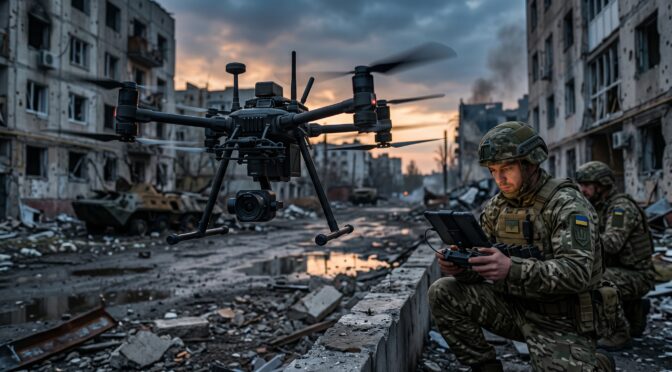
1. Executive Summary
The reporting period spanning April 25 through May 1, 2026, represents a critical inflection point in the technological and operational trajectories of the ongoing Russia-Ukraine conflict. Across the air, land, sea, and space domains, both belligerents have radically accelerated the deployment of autonomous systems, effectively shifting the paradigm of engagement from exquisite scarcity to intelligent mass.1 This transition is characterized by the widespread integration of artificial intelligence (AI) targeting, the scaling of unmanned ground vehicles (UGVs) for frontline combat and logistics, and the unprecedented extension of unmanned aerial vehicle (UAV) strike ranges.2
In the air domain, the conflict witnessed a significant escalation in theater-wide battlefield air interdiction (BAI) campaigns. Ukrainian forces successfully executed complex, deep-rear strikes reaching up to 1,700 kilometers into the Russian Federation, heavily degrading strategic aviation assets, including fifth-generation stealth fighters, and systematically dismantling energy infrastructure.4 Conversely, Russian forces executed record-breaking volumes of UAV attacks, launching over 6,500 long-range strike drones throughout April. Russian operators have increasingly shifted toward daytime swarm operations to maximize systemic disruption, psychological pressure, and civilian infrastructure degradation.7
Simultaneously, the land domain has experienced a definitive robotic revolution. The proliferation of first-person view (FPV) drones has created highly lethal “kill zones” spanning 10 to 15 kilometers from the zero line, rendering traditional infantry and vehicular movement largely untenable.3 This operational reality has catalyzed the rapid deployment of UGVs by both sides, transitioning these systems from experimental prototypes to serial-produced assets essential for logistics, casualty evacuation, and direct fire support.9
In the maritime and space domains, the integration of unmanned surface vessels (USVs) as launch platforms for aerial interceptors and the weaponization of satellite communication networks highlight the increasingly multi-domain nature of autonomous warfare.11 The ensuing sections detail these events, technological developments, and the resulting tactical doctrines, strictly ordered by chronology and the primary executing nation.
2. Military Events, Battles, and Strikes
The following combat operations, strikes, and military events involving unmanned systems are organized chronologically by date, and subsequently sorted alphabetically by the primary acting state.
April 25, 2026
Russia Russian aerospace and missile forces executed a massive combined strike against Ukrainian territory overnight from April 24 into April 25. The operation utilized an estimated 666 drones and missiles, with a primary focus on Dnipro City and the broader Dnipropetrovsk Oblast.13 The strike package relied heavily on Iranian-designed Shahed-type loitering munitions to saturate and exhaust Ukrainian air defense networks ahead of ballistic missile trajectories.13 The attacks resulted in significant civilian casualties, killing at least ten individuals and injuring 67 across the targeted regions.14 Local authorities reported that the strikes ignited fires across Dnipro, partially destroying apartment buildings, commercial enterprises, and private residences.15 Furthermore, Russian forces continued their “human safari” drone strike campaign targeting civilians in the Kherson direction, demonstrating a continued reliance on FPVs for localized terror tactics.13
Ukraine Ukraine’s Unmanned Systems Forces executed a historic deep-strike operation targeting the Shagol military airfield in Russia’s Chelyabinsk Oblast, located approximately 1,700 kilometers from the Ukrainian border.4 Utilizing long-range Liutyi strike drones equipped with substantial payloads, Ukrainian forces successfully penetrated deep into the Urals—an area previously considered a safe sanctuary beyond the reach of conventional Ukrainian assets.16 The strike successfully hit two Su-57 fifth-generation stealth fighters, one Su-34 fighter-bomber, and an additional unidentified Sukhoi-series aircraft.5 The neutralization of the Su-57, Russia’s most advanced fighter capable of launching Kh-59 and Kh-69 missiles and valued at over $100 million per unit, represents a critical degradation of Russian aerospace capabilities.4
On the same day, Ukrainian forces continued mid-range interdiction efforts in occupied Donetsk Oblast, deploying a drone strike against a Russian locomotive pulling a train laden with fuel and lubricants on the Donetska Railway north of Menchuhove, roughly 71 kilometers from the frontline.18 Furthermore, a Ukrainian drone strike hit a Russian logistics hub in occupied northern Voznesenivka, underscoring a systematic effort to sever tactical supply lines.18 Ukrainian drone activity was also recorded in Sverdlovsk Oblast, where a drone strike damaged an apartment building in Yekaterinburg, marking one of the deepest penetrations into Russian airspace to date.13
April 26, 2026
Russia Russian forces maintained their aerial pressure campaign, launching drone strikes targeting the Sumy and Dnipro regions, resulting in additional civilian casualties.20 During the night of April 26 to 27, Russian forces launched 94 UAVs, primarily Shahed variants, from multiple directions including Kursk, Oryol, and occupied Crimea.21 One notable strike targeted port infrastructure in Chornomorsk, Odesa Oblast, destroying a storage tank containing 6,000 tonnes of sunflower oil and causing a massive spill in the port’s water area.21 The attack severely disrupted port operations and highlighted Russia’s ongoing strategy of targeting Ukraine’s agricultural export capacity.
Ukraine Ukrainian special operations units mounted a highly coordinated multi-axis drone assault on Russian naval and aviation infrastructure in occupied Crimea. From 21:00 on April 25 to 05:30 on April 26, waves of Ukrainian drones targeted the Belbek Airfield and the Sevastopol Naval Base.24 The operation severely damaged the Yamal (Ropucha-class) and Filchenkov (Tapir-class) large landing ships, the Ivan Khurs reconnaissance vessel, and a MiG-31 interceptor aircraft.25 Furthermore, the strikes neutralized critical command and control nodes, including the Lukomka Black Sea Fleet Training Center, an Air Defense Forces radio technical headquarters, and an MR-10M1 coastal radar station.25
Simultaneously, Ukrainian long-range drones struck the Yaroslavl Oil Refinery in Russia, damaging the ELOU-AT-4 installation—a key unit for raw materials primary processing—and triggering significant fires at the facility, which processes 15 million tons of oil annually.25
April 27, 2026
Russia Russian drone operations continued to focus on attrition and infrastructure degradation. While maintaining a steady tempo of strikes along the line of contact, Russian operators focused heavily on the Odesa region, where drone debris and direct hits damaged residential and port infrastructure, injuring 14 civilians, including two children.21 Furthermore, the Russian military escalated its drone strikes against Nikopol Raion in the Dnipropetrovsk Oblast, launching roughly 2,000 FPV and drop-munition strikes since March, doubling the previous monthly average in a deliberate campaign to render the area uninhabitable for civilians.21
Ukraine Ukrainian forces maintained pressure on Russian troop concentrations in the near-rear. A targeted drone strike was executed against a Russian troop assembly area near occupied Velyka Novosilka, roughly 24 kilometers from the frontline, demonstrating the persistent threat of tactical UAVs against staging areas.18 Furthermore, Ukrainian forces targeted a Russian Tornado-S multiple launch rocket system north of occupied Dolynske, utilizing long-range reconnaissance drones to provide terminal guidance for counter-battery fire.21
April 28, 2026
Russia Russian forces launched an overnight barrage of 123 Shahed, Gerbera, and Italmas drones aimed at the Ukrainian rear.18 In a rare tactical deviation, Russia also executed a daytime drone attack on Kyiv. Ukrainian air defenses intercepted the incoming threats; however, falling debris damaged an unfinished building in the Shevchenkivskyi district and ignited a fire within a cemetery in the Solomianskyi district, resulting in two civilian injuries.27 The shift to daytime attacks is assessed as an effort to maximize psychological terror, disrupt economic activity, and exploit windows where air defense readiness may be transitioning.7
Ukraine Ukraine’s drone forces executed a highly successful overnight strike against the Rosneft-operated Tuapse Oil Refinery in Krasnodar Krai. This marked the third attack on this specific facility in April alone. The strike caused multiple fires, heavily damaging the refinery’s infrastructure and forcing the suspension of its primary refining unit.18 Satellite imagery confirmed the destruction of at least four large fuel storage tanks and severe damage to adjacent infrastructure.
In the occupied territories, Ukrainian Special Operations Forces utilized drones to orchestrate a strike on a Russian Iskander-M ballistic missile storage site near Ovrazhky, Crimea, located roughly 215 kilometers from the frontline.18 Fire Information for Resource Management System (FIRMS) data confirmed heat anomalies at the site, corroborating the destruction of the high-value munitions.18
April 29, 2026
Russia Russian forces continued persistent near-rear interdiction efforts. A Russian Geran-2 drone strike reportedly targeted a train car on the Pivdenna-Zakhidna railway line near the Tereshchenska station in southeastern Voronizh, demonstrating Russia’s ongoing focus on disrupting Ukrainian logistics and troop movements via targeted battlefield air interdiction.28
Ukraine Ukrainian forces expanded their long-range operational campaign across multiple vectors. In a massive reach into Russian territory, Ukrainian drones struck the Transneft Perm Linear Production Dispatch Station in Perm Oblast, approximately 1,400 kilometers from the border. The strike ignited almost all oil storage tanks at the site, which serves as a strategic hub for Russia’s oil pipeline system.6 Concurrently, a separate drone operation targeted the Orsknefteorgsintez Oil Refinery in Orenburg Oblast, located roughly 1,300 kilometers away.29
In the air domain, Ukrainian drones struck a field landing site in Voronezh Oblast, heavily damaging two Russian Mi-28 attack helicopters and two Mi-17 transport helicopters while they were refueling.6 In the maritime domain, the Ukrainian Navy successfully deployed an explosive USV to strike the sanctioned Marquise oil tanker in the Black Sea, 210 kilometers southeast of Tuapse.6
| Target Location | Asset Destroyed/Damaged | Distance from Border | Strategic Impact |
| Shagol Airfield, Chelyabinsk | 2x Su-57, 1x Su-34 | 1,700 km | Degradation of advanced stealth aviation |
| Perm Dispatch Station | Transneft Oil Storage | 1,400 km | Disruption of pipeline logistics |
| Orsknefteorgsintez Refinery | Refining Units | 1,300 km | Reduction in national fuel output |
| Tuapse Oil Refinery | 24+ Fuel Tanks | 450 km | Localized environmental crisis, fuel denial |
| Voronezh Landing Site | 2x Mi-28, 2x Mi-17 | 150 km | Tactical aviation attrition |
April 30, 2026
Russia Overnight, Russian forces launched a massive wave of 206 drones, including 140 Shahed variants (some featuring jet-powered modifications), supported by an Iskander-M ballistic missile.30 Ukrainian air defenses successfully intercepted 172 of the incoming UAVs, though several successfully impacted energy and administrative infrastructure across the Chernihiv, Dnipropetrovsk, Kharkiv, and Odesa oblasts.30 The barrage resulted in significant power outages and injured at least 20 civilians in Odesa.30
Ukraine Ukrainian USVs continued to assert dominance in the Black Sea. Operations near the Kerch Strait resulted in successful strikes against two Russian Federal Security Service (FSB) vessels: a Project 12150 Mangust-class patrol boat and a Project 21980 Grachonok-class patrol boat.30 In the land domain, a Ukrainian National Guard unit, the “Lava” regiment of the 2nd Corps “Khartiia,” executed a fully robotized assault near Kupyansk. Utilizing a combination of strike UAVs, explosive-laden attack drones, and armed UGVs equipped with thermobaric TOR-800 munitions, the unit eliminated approximately ten Russian soldiers and cleared a fortified position without deploying a single human infantryman onto the battlefield.29
May 1, 2026
Russia Russian military forces continued to weaponize daytime drone swarms, launching 409 drones targeting regions across Ukraine.29 Notably, the western city of Ternopil was hit by dozens of drones during the afternoon, resulting in widespread power outages, infrastructure damage, and at least 12 civilian injuries.31 Official Ukrainian Air Force statistics released on this day confirmed that Russia launched a record 6,583 long-range drones throughout the month of April, a two percent increase from the previous record set in March.7
Ukraine Ukrainian forces conducted a fourth strike on the Tuapse port and oil refinery in Krasnodar Krai, igniting massive fires that required 128 emergency personnel and 41 appliances to contain.36 The compounding damage from successive strikes has resulted in critical environmental crises, including “oil rain” and massive coastal slicks stretching 77 kilometers along the Black Sea.36 Concurrently, Ukrainian forces utilized tactical drones to target air defense assets, successfully striking a Nebo-M radar system in Ukolovo, Belgorod Oblast, to further degrade Russian aerial surveillance networks.29
3. New Product Developments and Technological Modifications
The accelerated pace of the conflict has driven both nations to rapidly innovate, modify existing platforms, and integrate advanced autonomous technologies to maintain parity.
April 25, 2026
Russia The Russian Ministry of Defense continued efforts to formalize the Unmanned Systems Forces (USF) as a distinct branch of the military, initiating a recruitment drive intended to fill quotas with university students.21 This institutionalization reflects a broader effort to standardize drone operations, moving away from ad-hoc volunteer units toward a cohesive, state-directed capability boasting over 100 tactical UAS crews per regiment.39
Ukraine Although not a new product launch, the successful 1,700-kilometer strike on the Shagol airfield demonstrated critical, unannounced technological modifications to Ukraine’s Liutyi long-range strike drones.4 Achieving this extreme range with a 100-kilogram payload capable of destroying armored combat aircraft indicates substantial advancements in fuel efficiency, autonomous navigation algorithms capable of operating in heavily jammed environments, and precision terminal guidance systems.16
April 26, 2026
Russia In a significant regulatory and technological maneuver impacting the space and cyber domains, the Russian government officially implemented a six-month ban on the importation of foreign satellite communication devices, specifically targeting Starlink terminals.40 Previously, Russian forces had illicitly acquired Starlink terminals through third-party countries and integrated them onto Shahed UAVs to establish highly resilient, real-time command links.42 This ban follows countermeasures enacted by SpaceX and the US Department of Defense to geofence and disable unauthorized terminals, which reportedly caused the collapse of Russian command channels on the frontline, forcing Russian engineers to seek alternative communication architectures.40
Ukraine Ukrainian defense contractor Fire Point publicly displayed a mockup of the FP-9 ballistic system at an exhibition in Poland.44 Designed to carry an 800-kilogram warhead over 850 kilometers, the FP-9 blurs the line between traditional ballistic missiles and autonomous heavy drone delivery systems.44 Measuring larger than the American ATACMS and the Russian Iskander, the FP-9 signifies a massive leap in Ukraine’s indigenous deep-strike architecture, intended to strike deep-rear objectives such as Moscow without relying on Western-supplied munitions.44
April 27, 2026
Russia Ukrainian electronic warfare specialists identified a critical modification in Russian drone deployment: the integration of mesh modems onto long-range UAVs.18 By utilizing mesh networks, a cluster of incoming drones can maintain a decentralized communication signal amongst themselves, allowing operators to bypass traditional satellite navigation jamming.18 This modification extends the manually guided range of Russian drones to over 220 kilometers, enabling precise terminal control of loitering munitions deep into the Ukrainian rear.18
Ukraine Ukrainian drone manufacturer General Chereshnya reported a massive scale-up in domestic interceptor drone capabilities, noting that their systems were used in 11,473 interceptions in March 2026, an increase of 5,800 over the previous month.21 This surge highlights the industrial mobilization within Ukraine to produce low-cost kinetic interceptors capable of neutralizing the overwhelming volume of Russian Molniya and Shahed drones.21
April 28, 2026
Russia To circumvent ubiquitous Ukrainian radio frequency (RF) jamming, Russian developers significantly scaled the deployment of fiber-optic sleeper drones.39 These FPVs spool a physical fiber-optic cable, rendering them immune to EW suppression while transmitting high-definition video back to the operator. Furthermore, these drones are being pre-positioned in a dormant state by reconnaissance groups and activated days later via cellular network triggers, creating persistent, unpredictable threats behind Ukrainian lines.39
Ukraine Ukrainian defense tech firm General Cherry unveiled the Khmarynka (Cloud), a mid-range strike drone engineered specifically to saturate and exhaust Russian air defenses.47 Heavily inspired by Russia’s “Molniya” drone, the low-cost (approx. $1,000) Khmarynka boasts a 50-kilometer range, a 196-centimeter wingspan, and operates across a broad, unpredictable frequency spectrum (150 MHz to 2800 MHz).47 This multi-frequency capability renders traditional EW spoofing highly energy-intensive and largely ineffective, allowing Ukraine to strike armored vehicles and bunkers in the Russian near-rear.47
April 29, 2026
Russia Russian forces began systematically deploying fixed-wing Orlan and Molniya UAVs as “motherships” to carry and launch FPV drones closer to their targets.48 This modification drastically increases the operational range of cheap, tactical FPVs, allowing them to interdict Ukrainian logistics routes up to 60 kilometers behind the line of contact, effectively expanding the lethal “kill zone”.48
Ukraine Ukrainian defense firm Roboneers unveiled the Lynx+, an extensively upgraded version of their prior UGV systems.49 While precise technical specifications remain classified, the platform builds upon the legacy of the “Ironclad” UGV, which featured a payload capacity of 350 kilograms and has undergone rigorous combat testing.51 The Lynx+ reflects a broader Ukrainian initiative to integrate more heavily armored and capable UGVs into active frontline infantry support roles.
April 30, 2026
Russia Footage emerged of the Russian Kuryer UGV integrated with an eight-tube North Korean 107mm rocket launcher.52 This marks the third weaponized configuration for the modular Kuryer platform, following previous thermobaric and mortar setups.52 The adoption of this rocket system balances payload constraints with mobility, allowing remote operators to conduct rapid saturation fire missions at ranges up to 8.5 kilometers and immediately reposition, thereby minimizing vulnerability to counter-battery fire.52
Ukraine The Ukrainian Ministry of Defense formally codified the Bizon-L UGV, clearing it for immediate operational use across the armed forces.9 The Bizon-L is a versatile, tracked logistics robot capable of carrying up to 300 kilograms at speeds of 12 km/h over a 50-kilometer range.53 Crucially, it incorporates six redundant communication channels (including LTE, Wi-Fi, and Starlink) to maintain control in severe EW environments, alongside a negligible thermal signature to evade infrared detection.53
Additionally, Ukrainian firm Ratel Robotics began state testing of net launchers mounted on their Ratel H and Ratel M UGV platforms.55 This represents a novel, ground-based kinetic counter-UAS capability, where the UGV autonomously identifies aerial targets and fires a physical net to entangle and neutralize enemy attack drones.50
May 1, 2026
Russia A comprehensive intelligence report released by the Kyiv-based think tank StateWatch detailed the massive scale of Russia’s rapidly evolving UGV industry. The report identified 32 distinct Russian ground robotic models currently in production, with at least 20 variants actively utilized in combat.8 The industry relies heavily on Chinese-imported components, including DC motors, ball screw assemblies, and Arduino microcontrollers, often disguised in customs declarations as “quadcopter spare parts”.8 The rapid scaling of these platforms is backed by a 300 billion ruble national robotics program aimed at automating frontline operations.8
| UGV Model | Manufacturer | Primary Role | Status |
| Kuryer | LLC NRTK Caps | Multi-role / Kinetic | Serial Production (100s deployed) |
| Impulse-M | LLC Gumich-RTK | Logistics | Serial Production |
| Varan | LLC Agency of Digital Dev. | Logistics | Serial Production |
| Omich | LLC RENG | Logistics / Support | Active Combat Use |
| Uran-9 | Rostec | Heavy Combat | Withdrawn / Experimental |
Ukraine In the maritime domain, Ukraine showcased the M.A.K. unmanned surface vessel at the World Defense Show. Boasting a fiberglass hull with an ultra-low 30-centimeter profile above the waterline, the M.A.K. operates as both a direct suicide drone capable of carrying a 60-kilogram warhead, and a “drone mothership”.57 In the latter configuration, the vessel can autonomously deploy secondary FPV drones at sea, effectively extending the operational reach of aerial drones far beyond the coastline while utilizing Starlink and mesh radio networks for command.57
4. Strategic, Operational, and Tactical Lessons Learned
The rapid iteration of unmanned technology over the past week has forced profound shifts in military doctrine and operational strategy, rendering traditional paradigms of warfare obsolete.
April 25, 2026
Russia Strategic Depth is an Illusion. The successful Ukrainian strike on the Shagol airfield, located 1,700 kilometers into the Russian interior, has nullified the concept of a safe sanctuary for strategic aviation.4 The operational lesson for the Russian military command is that traditional air defense geometries, which heavily concentrate assets near the frontline and capital, are vastly insufficient against low-observable, long-range Ukrainian drones. This forces a dilemma: either stretch air defense assets impossibly thin across the continental interior, or accept continuous attrition of high-value targets like the Su-57 and vital energy infrastructure.
Ukraine Economic Attrition via Deep Strikes. The persistent targeting of Russian oil refineries (Tuapse, Yaroslavl, Perm, Orsk) has yielded severe economic consequences, dropping Russia’s average oil output to 4.69 million barrels a day—the lowest level since December 2009.29 The strategic lesson is that relatively inexpensive, domestically produced long-range drones can inflict asymmetric economic damage, disrupting the financial engine of the Russian war effort while simultaneously straining local emergency services and triggering environmental crises.36
April 26, 2026
Russia Space Domain Vulnerabilities. The reliance on satellite communications for uncrewed operations has transformed orbit into an active warfighting domain.58 The Russian government’s ban on foreign satellite terminals acknowledges the tactical disadvantage posed by Western-controlled constellations like Starlink.40 Furthermore, operations by Russian satellites Luch-1 and Luch-2—intercepting signals from European geostationary satellites—highlight a critical lesson: unencrypted command links on older satellites are highly vulnerable to proximity signals intelligence operations, necessitating immediate upgrades to space-based encryption architectures.12
Ukraine The Fleet in Being and Asymmetric Sea Denial. Following successive catastrophic losses to Ukrainian USV strikes, the Russian Black Sea Fleet has been functionally degraded from a power projection asset to a “fleet in being” confined largely to Novorossiysk.60 The strategic lesson learned by the Ukrainian Navy is that absolute sea control is not required to achieve sea denial. By utilizing continuous swarms of asymmetric, low-cost autonomous surface vessels, a nation without a conventional navy can paralyze a superior naval force, forcing the adversary into a defensive crouch and reopening vital commercial maritime corridors.62
April 27, 2026
Russia Integration of Battlefield Air Interdiction (BAI). Russian forces have recognized the necessity of severing Ukrainian supply lines in the near-rear to facilitate frontline advances. The lesson learned is that long-range tactical drones, directed by specialized units like the Rubikon Center, can effectively execute BAI missions against moving targets, such as trains and logistics convoys, isolating the battlespace without risking manned aviation.28
Ukraine Cross-Domain Interception. During the reporting period, Ukraine’s 412th Brigade Nemesis successfully destroyed a Russian Shahed UAV using an interceptor drone launched from a USV.11 This establishes a profound tactical lesson: the integration of maritime and aerial unmanned systems creates a forward-deployed, highly mobile air defense screen. By intercepting incoming drones over the water before they reach the coastline, Ukraine minimizes collateral damage from debris and extends its interception envelope beyond the range of static ground-based air defenses.11
April 28, 2026
Russia Cognitive and Economic Disruption via Daytime Swarms. Traditionally reliant on nocturnal strikes to evade visual detection, Russian forces shifted heavily toward daytime drone swarms in April, launching over 6,500 drones throughout the month.7 The operational lesson learned is that while interception rates remain high (approx. 88%), daytime attacks force nationwide air raid alerts during peak operational hours. This paralyzes commercial business, disrupts logistics, and inflicts persistent psychological stress on the civilian populace, achieving strategic economic degradation independent of kinetic damage.7
Ukraine AI Targeting Overcoming GNSS Jamming. As Russian EW systems increasingly spoof or block GPS signals, traditional precision-guided munitions suffer reduced efficacy. The lesson learned by Ukrainian developers is the absolute necessity of integrating AI-driven optical terminal guidance. By allowing the drone’s onboard processor (such as those integrated into the Khmarynka or software by Palantir) to lock onto a target visually, the system remains lethal even in GNSS-denied environments or if the operator’s connection is severed during the terminal dive.2
April 29, 2026
Russia Decentralized Command Challenges. The Russian military’s attempt to scale its “Drone Line” initiative has revealed significant friction regarding the command-and-control relationship between independent drone units and ground commanders.68 The lesson is that bolting advanced technology onto rigid, traditional hierarchical structures creates bottlenecks; true operational fluidity requires delegating strike authority to lower echelons and integrating drone operators directly into maneuver brigades rather than siloing them in separate regiments.68
Ukraine The Collapse of the Medical Golden Hour. The proliferation of persistent, low-cost aerial surveillance and FPV strike capabilities has rendered traditional assumptions regarding medical evacuation obsolete.69 The tactical lesson learned by Ukrainian combat medics is that helicopter or vehicular evacuation from the immediate front is no longer viable due to immediate FPV targeting. This has caused the collapse of the medical “golden hour,” forcing a doctrine of extended forward casualty retention and driving an urgent requirement for armored, autonomous medical evacuation UGVs to navigate the contested space.69
April 30, 2026
Russia Adaptation to Electronic Warfare. Acknowledging the vulnerability of standard radio frequencies, Russian forces have learned to bypass EW through hardware adaptation. The deployment of fiber-optic cables for FPVs ensures an unjammable, high-bandwidth connection.48 Furthermore, the use of mesh networking modems on Shahed variants allows drones to act as relays for one another, maintaining a resilient, self-healing communication web over 220 kilometers deep into hostile territory.18
Ukraine Validation of Autonomous Infantry Assaults. The successful assault on a Russian position in Kupyansk by the Ukrainian National Guard’s “Khartiia” unit fundamentally alters infantry doctrine.33 The lesson learned is that coordinated swarms of UAVs and UGVs can entirely replace human infantry in high-risk clearance operations. By utilizing robotic systems to breach fortifications and eliminate personnel, commanders can achieve tactical objectives with zero risk to friendly forces, heralding a new era of bloodless maneuver warfare.29
May 1, 2026
Russia Intelligent Mass Over Exquisite Scarcity. The overarching strategic lesson internalised by the Russian defense industrial base is the triumph of scale. Rather than relying on small numbers of highly advanced, expensive platforms (such as the sidelined Uran-9 UGV), the battlefield dictates the necessity of “intelligent mass”.1 By producing thousands of cheap, attritable systems like the Kuryer UGV and Shahed drones, utilizing off-the-shelf Chinese components, Russia seeks to overwhelm qualitative defenses through sheer volume and relentless attrition.1
Ukraine Decentralized Innovation Scaling. Ukraine’s success in drone warfare has been built on a distributed, bottom-up innovation model characterized by hundreds of agile firms (e.g., General Cherry, Ratel Robotics, Roboneers) working directly with frontline units.2 The lesson learned is that this decentralized ecosystem allows for rapid iteration and adaptation—such as the creation of the Khmarynka or USV-launched interceptors—outpacing the sluggish, centralized procurement systems of traditional state-run defense industries.2 As the conflict persists, institutionalizing this rapid feedback loop remains Ukraine’s primary asymmetric advantage.
Please share the link on Facebook, Forums, with colleagues, etc. Your support is much appreciated and if you have any feedback, please email us in**@*********ps.com. If you’d like to request a report or order a reprint, please click here for the corresponding page to open in new tab.
Sources Used
- From Exquisite Scarcity to Intelligent Mass: How Drone Wars Are Rewriting the Grammar of Warfare | Defense.info, accessed May 2, 2026, https://defense.info/highlight-of-the-week/from-exquisite-scarcity-to-intelligent-mass-how-drone-wars-are-rewriting-the-grammar-of-warfare/
- The New Revolution in Military Affairs | Carnegie Endowment for International Peace, accessed May 2, 2026, https://carnegieendowment.org/research/2026/04/ukraine-russia-war-changing-warfare-practice-military-strategy
- Russia Floods Front Lines in Ukraine With 20+ Types of Ground Robots, accessed May 2, 2026, https://united24media.com/war-in-ukraine/russia-floods-front-lines-in-ukraine-with-20-types-of-ground-robots-18422
- Ukraine strikes Su-57, Su-34 jets at Russian air base / The New …, accessed May 2, 2026, https://english.nv.ua/nation/ukraine-strikes-su-57-su-34-jets-at-russian-air-base-50604693.html
- Ukraine strikes Russian airfield nearly 1,700 kilometers away, damages 4 fighter jets, military confirms, accessed May 2, 2026, https://kyivindependent.com/ukraine-strikes-russian-airfield-damaging-2-fighter-jets/
- Russian Offensive Campaign Assessment, April 29, 2026, accessed May 2, 2026, https://understandingwar.org/research/russia-ukraine/russian-offensive-campaign-assessment-april-29-2026/
- Russia Fired Record Number of Drones at Ukraine in April – AFP Analysis, accessed May 2, 2026, https://www.themoscowtimes.com/2026/05/01/russia-fired-record-number-of-drones-at-ukraine-in-april-afp-analysis-a92664
- New report tracks Russia’s growing combat ground robot fleet – The Defence Blog, accessed May 2, 2026, https://defence-blog.com/new-report-tracks-russias-growing-combat-ground-robot-fleet/
- Ukraine to field 25,000 ground robots in push to replace soldiers for frontline logistics, accessed May 2, 2026, https://www.defensenews.com/unmanned/2026/04/24/ukraine-to-field-25000-ground-robots-in-push-to-replace-soldiers-for-frontline-logistics/
- Russian multi-purpose assault robots Kurier conquer the front line – Militär Aktuell, accessed May 2, 2026, https://militaeraktuell.at/en/russian-multi-purpose-assault-robots-kurier-conquer-the-front-line/
- In a first, Ukraine’s drone force launches interceptor drone from USV to destroy Shahed, accessed May 2, 2026, https://breakingdefense.com/2026/04/in-a-first-ukraines-drone-force-launches-interceptor-drone-from-usv-to-destroy-shahed/
- Russian Satellite Activity Exposes Gaps in Satellite Communications Security – Military.com, accessed May 2, 2026, https://www.military.com/feature/2026/02/09/russian-satellite-activity-exposes-gaps-satellite-communications-security.html
- Russian Offensive Campaign Assessment, April 25, 2026 | ISW, accessed May 2, 2026, https://understandingwar.org/research/russia-ukraine/russian-offensive-campaign-assessment-april-25-2026/
- 10 killed, 67 injured as Russia launches mass strike on Dnipro, other cities across Ukraine, accessed May 2, 2026, https://kyivindependent.com/russian-attack-april-25/
- Russian attacks kill 5 and wound more than 40 in Ukraine’s Dnipro as 1 dies in Russia, accessed May 2, 2026, https://www.washingtonexaminer.com/news/world/4543100/russian-attacks-kill-five-wound-more-than-40-ukraines-dnipro/
- Satellite images show aftermath of drone strike deep in Russia – The New Voice of Ukraine, accessed May 2, 2026, https://english.nv.ua/nation/satellite-images-show-drone-strike-at-shagol-air-base-50604725.html
- New Satellite Proof Shows Four Russian Jets Damaged in Chelyabinsk Airbase Strike, Including Su-57, accessed May 2, 2026, https://united24media.com/war-in-ukraine/new-satellite-proof-shows-four-russian-jets-damaged-in-chelyabinsk-airbase-strike-including-su-57-18407
- Russian Offensive Campaign Assessment, April 28, 2026 | ISW, accessed May 2, 2026, https://understandingwar.org/research/russia-ukraine/russian-offensive-campaign-assessment-april-28-2026/
- Russian Strikes Kill 6 Across Ukraine – The Moscow Times, accessed May 2, 2026, https://www.themoscowtimes.com/2026/04/25/russian-strikes-kill-6-across-ukraine-a92603
- Russia in Review, April 24–May 1, 2026, accessed May 2, 2026, https://www.russiamatters.org/news/russia-review/russia-review-april-24-may-1-2026
- Russian Offensive Campaign Assessment, April 27, 2026, accessed May 2, 2026, https://understandingwar.org/research/russia-ukraine/russian-offensive-campaign-assessment-april-27-2026/
- Port of Chornomorsk sees sunflower oil spill after attack – Odessa Journal, accessed May 2, 2026, https://odessa-journal.com/port-of-chornomorsk-sees-sunflower-oil-spill-after-attack
- Oil spill reported in Odesa Oblast port after Russian attack, damage being assessed – photos | Ukrainska Pravda, accessed May 2, 2026, https://www.pravda.com.ua/eng/news/2026/04/27/8032003/
- Ukrainian drones attacked occupied Crimea, under strike “Belbek”, “Kacha” and Saky district – partisans, accessed May 2, 2026, https://unn.ua/en/news/ukrainian-drones-attacked-occupied-crimea-under-strike-belbek-kacha-and-saky-district-partisans
- Russian Offensive Campaign Assessment, April 26, 2026 | ISW, accessed May 2, 2026, https://understandingwar.org/research/russia-ukraine/russian-offensive-campaign-assessment-april-26-2026/
- Ukraine Waited for Russian Commanders to Enter—Then Drones Meet Naval Base in Crimea – YouTube, accessed May 2, 2026, https://www.youtube.com/watch?v=FnyIaC7MVPE&vl=en-US
- At least 2 people injured in Kyiv as daytime Russian drone attack hits building, cemetery grounds, accessed May 2, 2026, https://kyivindependent.com/daytime-russian-drone-attack-on-kyiv-damages-building-cemeterys-territory/
- Russia’s Quest to Intensify The Theater-Wide Battlefield Air Interdiction Campaign Against Ukraine’s Logistics – ISW, accessed May 2, 2026, https://understandingwar.org/research/russia-ukraine/russias-quest-to-intensify-the-theater-wide-battlefield-air-interdiction-campaign-against-ukraines-logistics/
- Russian Offensive Campaign Assessment, May 1, 2026, accessed May 2, 2026, https://understandingwar.org/research/russia-ukraine/russian-offensive-campaign-assessment-may-1-2026/
- Russian Offensive Campaign Assessment, April 30, 2026, accessed May 2, 2026, https://understandingwar.org/research/russia-ukraine/russian-offensive-campaign-assessment-april-30-2026/
- Explosions in Ternopil as Russian Drone Swarm Reaches Western Ukraine – Kyiv Post, accessed May 2, 2026, https://www.kyivpost.com/post/75200
- ISW Russian Offensive Campaign Assessment, May 1, 2026 – Kyiv Post, accessed May 2, 2026, https://www.kyivpost.com/post/75239
- Ukraine Clears Russian Position Near Kupiansk Using Only Robots, Video, accessed May 2, 2026, https://united24media.com/war-in-ukraine/ukraine-clears-russian-position-near-kupiansk-using-only-robots-video-18417
- Ukrainian Forces Captured A Russian Position Using ONLY Unmanned Ground Robotic Systems – YouTube, accessed May 2, 2026, https://www.youtube.com/shorts/qUlRM3KyByk
- Russia pounds Ukraine with drones in daytime attack, accessed May 2, 2026, https://wincountry.com/2026/05/01/russia-pounds-ukraine-with-drones-in-daytime-attack/
- Ukraine strikes Tuapse refinery for the fourth time in two weeks – Odessa Journal, accessed May 2, 2026, https://odessa-journal.com/ukraine-strikes-tuapse-refinery-for-the-fourth-time-in-two-weeks
- Maritime terminal in Russia’s Tuapse attacked by drones again | Ukrainska Pravda, accessed May 2, 2026, https://www.pravda.com.ua/eng/news/2026/05/01/8032610/
- Ukrainian Drones Hit Tuapse Port Again, Environmental Crisis Deepens, accessed May 2, 2026, https://www.marinelink.com/news/ukrainian-drones-hit-tuapse-port-again-538706
- Red Skies Ahead: Russia Planning for Its Drone-Driven Army of Tomorrow, accessed May 2, 2026, https://www.armyupress.army.mil/Journals/Military-Review/English-Edition-Archives/January-February-2026/Red-Skies-Ahead/
- Russia banned the import of “Starlink” terminals for six months, accessed May 2, 2026, https://babel.ua/en/amp/news/126652-russia-banned-the-import-of-starlink-terminals-for-six-months
- Russia bans imports of foreign satellite terminals, including Starlink – Meduza, accessed May 2, 2026, https://meduza.io/amp/en/news/2026/05/01/russia-bans-imports-of-foreign-satellite-terminals-including-starlink
- Russia bans imports of satellite terminals, including Starlink, for six months, accessed May 2, 2026, https://www.pravda.com.ua/eng/news/2026/05/01/8032664/
- What Iran’s Starlink Shutdown and Ukraine’s Drone War Reveal About the Next Conflict Domain – Military.com, accessed May 2, 2026, https://www.military.com/feature/2026/01/30/what-irans-starlink-shutdown-and-ukraines-drone-war-reveal-about-next-conflict-domain.html
- Designed to Reach moscow: FP-9 Turns Out Larger Than Iskander | Defense Express, accessed May 2, 2026, https://en.defence-ua.com/weapon_and_tech/designed_to_reach_moscow_fp_9_turns_out_larger_than_iskander_hrim_2_and_even_scud-18306.html
- Secret of FP‑9: the mystery of Ukraine’s new strategic weapon is revealed – YouTube, accessed May 2, 2026, https://www.youtube.com/watch?v=Ckl5E0Zil94
- Moscow is the target of Ukraine’s new missiles: the Russian capital awaits devastating blows, accessed May 2, 2026, https://www.youtube.com/watch?v=KFWHSwseWfw
- Ukrainian company unveils new mid-range drone designed to exhaust Russian air defenses, accessed May 2, 2026, https://kyivindependent.com/lightweight-but-most-importantly-cheap-ukraines-new-midrange-drone-designed-to-exhaust-russian-airdefence/
- Russian Force Generation & Technological Adaptations Update, October 9, 2025, accessed May 2, 2026, https://understandingwar.org/research/russia-ukraine/russian-force-generation-technological-adaptations-update-october-9-2025/
- Roboneers Unveils Upgraded Lynx+ Ground Robotic System, accessed May 2, 2026, https://militarnyi.com/en/news/roboneers-unveils-upgraded-lynx-ground-robotic-system/
- Unmanned Ground Vehicle (UGV) – Militarnyi, accessed May 2, 2026, https://militarnyi.com/en/tag/ugv/
- Ground Combat Platforms: New Battlefield Player, accessed May 2, 2026, https://militarnyi.com/en/articles/ground-combat-platforms-new-battlefield-player/
- Russia Integrates North Korean 107 mm Rockets into Courier UGV Advancing Its Multi-Layer Fire Support Role – Army Recognition, accessed May 2, 2026, https://www.armyrecognition.com/news/army-news/2026/russia-integrates-north-korean-107-mm-rockets-into-courier-ugv-advancing-its-multi-layer-fire-support-role
- “Bizon” enters the battlefield: Defence Forces receive a UGV capable of carrying up to 300 kg | MoD News, accessed May 2, 2026, https://mod.gov.ua/en/news/bizon-enters-the-battlefield-defence-forces-receive-a-ugv-capable-of-carrying-up-to-300-kg
- Ukraine opts for new UGV beast of burden Bizon-L, accessed May 2, 2026, https://militaeraktuell.at/en/ukraine-opts-for-new-ugv-beast-of-burden-bizon-l/
- Militarnyi, accessed May 2, 2026, https://militarnyi.com/en/
- Ratel Robotics Begins Testing Net Launchers on UGVs, accessed May 2, 2026, https://militarnyi.com/en/news/ratel-robotics-testing-net-launchers-ugvs/
- Ukraine Unveils New Low-Profile Naval Drone With Strike and Mothership Capabilities, accessed May 2, 2026, https://united24media.com/latest-news/ukraine-unveils-new-low-profile-naval-drone-with-strike-and-mothership-capabilities-15754
- Extending the Battlespace to Space – CSIS, accessed May 2, 2026, https://www.csis.org/analysis/chapter-8-extending-battlespace-space
- What 2026 May Bring To Space Battlefield – the sign.media, accessed May 2, 2026, https://www.thesign.media/blog/what-2026-may-bring-to-space-battlefield
- Russia’s Black Sea Fleet once fired missiles from the Mediterranean. Now it can barely leave Novorossiysk. – Euromaidan Press, accessed May 2, 2026, https://euromaidanpress.com/2026/04/17/russian-black-sea-fleet-now-only-supports-land-operation-after-ukrainian-strikes/
- Russia’s massive Black Sea problem is worse than it looks – Naval News, accessed May 2, 2026, https://www.navalnews.com/naval-news/2026/04/russias-massive-black-sea-problem-is-worse-than-it-looks/
- The Changing Military Balance in the Black Sea: A Ukrainian Perspective, accessed May 2, 2026, https://carnegieendowment.org/research/2026/04/the-changing-military-balance-in-the-black-sea-a-ukrainian-perspective
- Russia’s FPV drone campaign in Ukraine institutionalizes intentional civilian harm as a tool of war – Institute for the Study of War, accessed May 2, 2026, https://understandingwar.org/research/russia-ukraine/russias-fpv-drone-campaign-in-ukraine-institutionalizes-intentional-civilian-harm-as-a-tool-of-war/
- Ukraine becomes first to intercept Shahed using naval drone launch – The Defence Blog, accessed May 2, 2026, https://defence-blog.com/ukraine-becomes-first-to-intercept-shahed-using-naval-drone-launch/
- Russia unleashed record number of attack drones on Ukraine in April – TVP World, accessed May 2, 2026, https://tvpworld.com/93027125/russia-fired-record-6583-drones-at-ukraine-in-april
- New Ukrainian drone technologies will bypass Russia’s ENTIRE air defense! – YouTube, accessed May 2, 2026, https://www.youtube.com/watch?v=JTVR6bs5Jcg
- Ukrainian Military Offers Lessons Learned To NATO (Part III) – Analysis, accessed May 2, 2026, https://www.eurasiareview.com/30042026-ukrainian-military-offers-lessons-learned-to-nato-part-iii-analysis/
- Russia’s Drone Line Experiment – Foreign Policy Research Institute, accessed May 2, 2026, https://www.fpri.org/article/2026/04/russias-drone-line-experiment/
- Monthly Drone Report – April 2026, accessed May 2, 2026, https://sof.news/drones/20260430/
- EYES ON – Soldier magazine, accessed May 2, 2026, https://soldier.army.mod.uk/media/ltknskcq/soldier-mag-jan-26-edition.pdf
- Lessons from the Drone Wars: Maritime Autonomous Systems and Maritime Operations, accessed May 2, 2026, https://defense.info/re-shaping-defense-security/2026/03/lessons-from-the-drone-wars-maritime-autonomous-systems-and-maritime-operations/