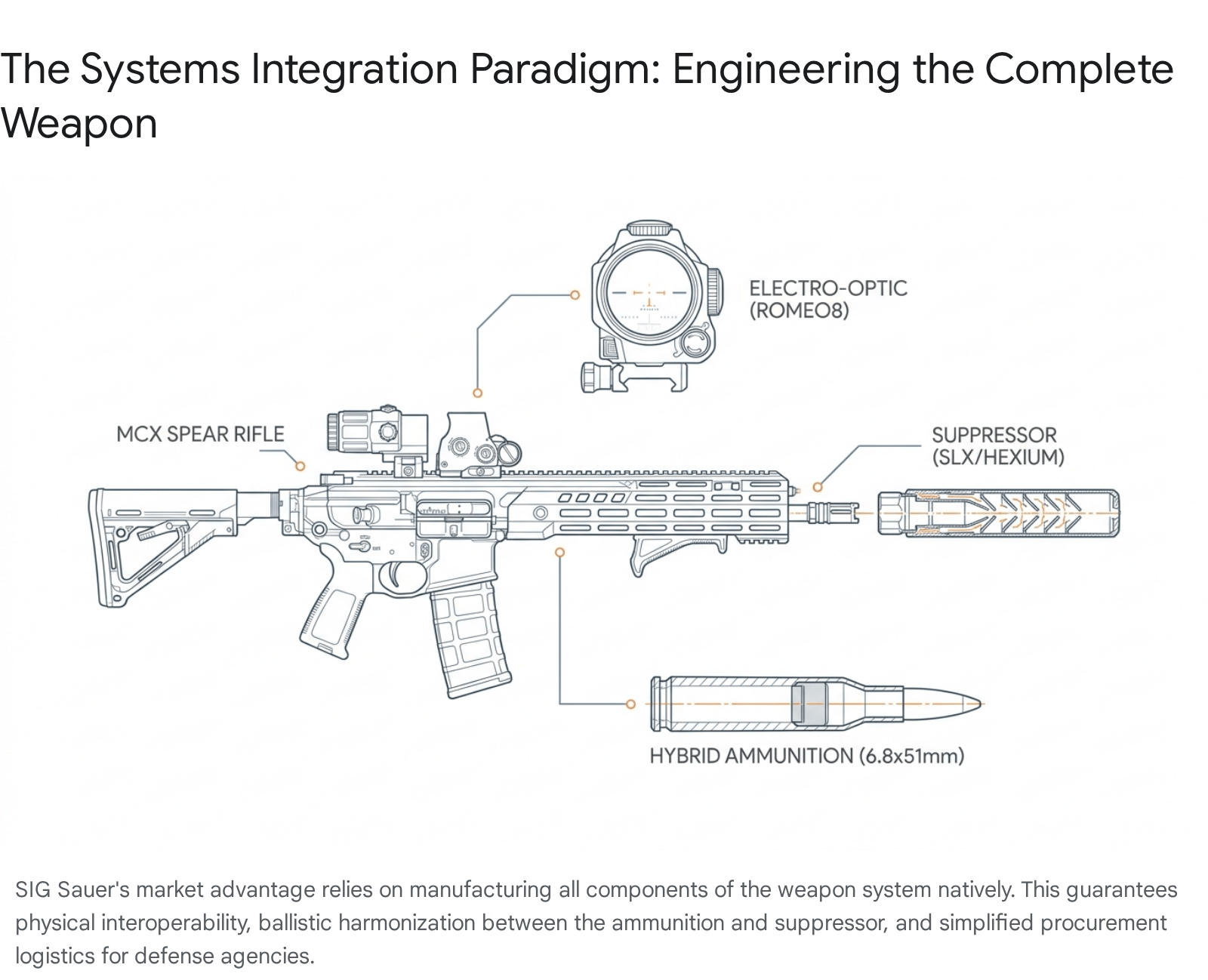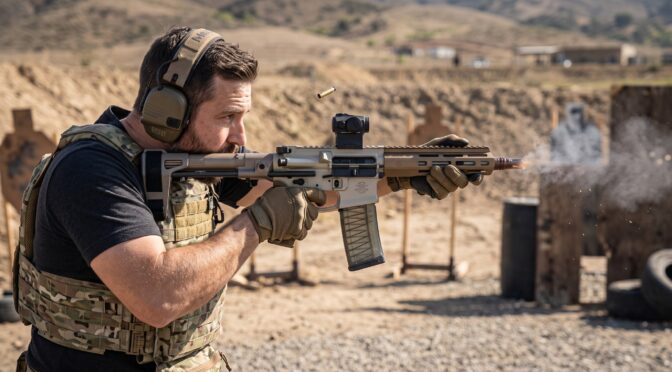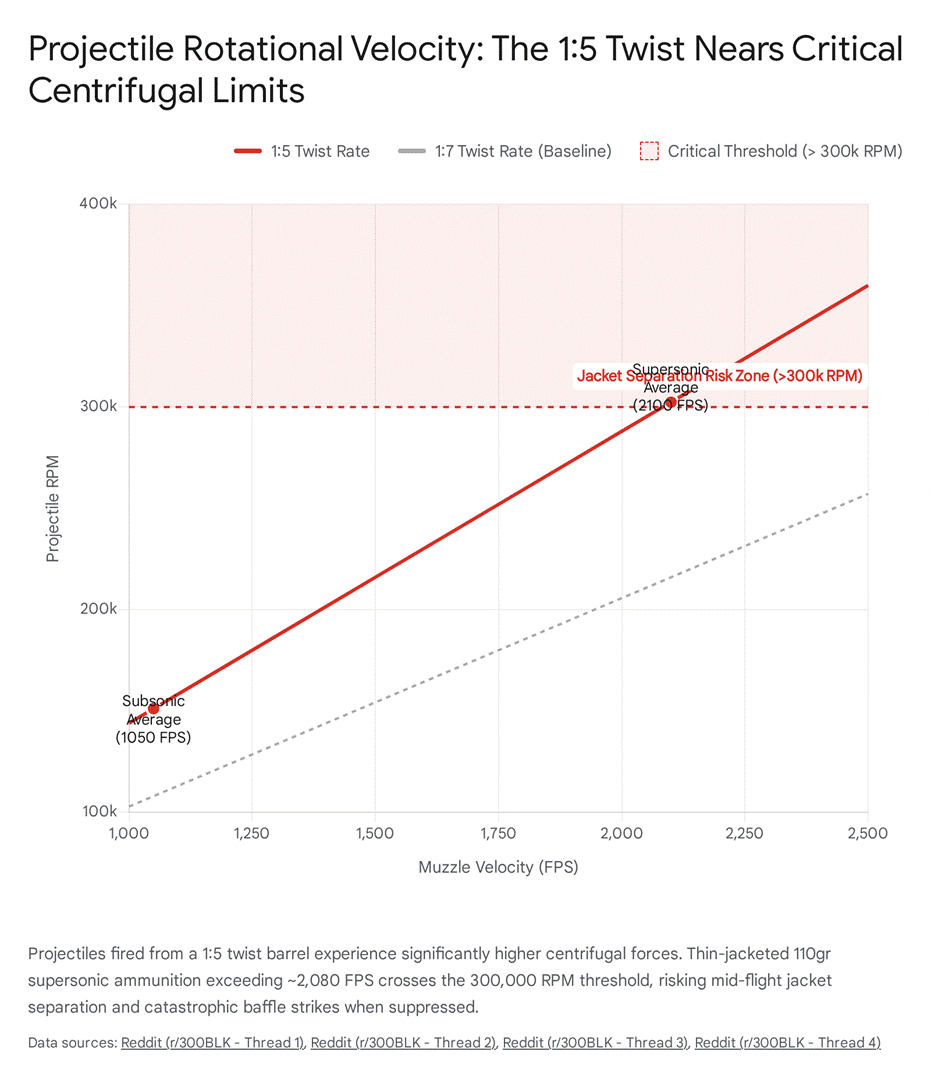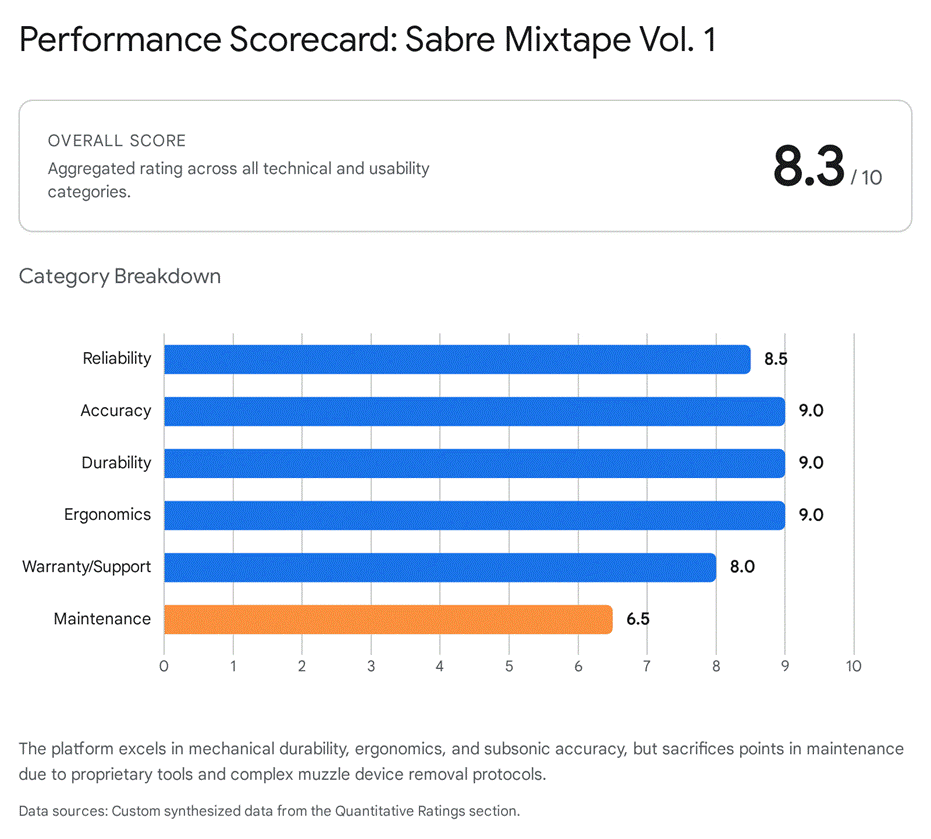
Category Archives: Analytics and Reports

The Shift to Mid-Power Variable Optics Away From LPVOs in 2026

1.0 Strategic Intelligence Overview

As of May 2026, the precision shooting community and the broader tactical firearms industry are undergoing a profound paradigm shift in optical system selection. Operating as a data-driven intelligence resource for the small arms and military equipment sectors, Ronin’s Grips Analytics has identified a definitive transition away from the high-magnification Low Power Variable Optic.1 For nearly a decade, the Low Power Variable Optic dominated the setup of the General Purpose Rifle. The industry witnessed a rapid, almost exponential escalation in magnification ratios, moving sequentially from early 1-4x systems to 1-6x, 1-8x, and eventually 1-10x models. The fundamental premise of this movement was to provide the end-user with a singular, unified optic capable of close-quarters speed at true 1x magnification alongside the magnification necessary for mid-range precision.

However, recent qualitative data and detailed discourse from leading platforms, particularly the May 2026 discussions on the Sniper’s Hide forum, indicate a definitive reversal of this historical trend.3 Analysts, professional end-users, and competitive shooters are collectively recognizing that the 1-10x Low Power Variable Optic represents a conglomeration of physical and optical compromises.3 In attempting to accomplish every possible task on the battlefield or the competition stage, the high-magnification 1-10x optic inherently fails to excel at anything. The strict physical constraints of a 24mm objective lens paired with a massive 10x erector assembly result in degraded light transmission, an uncomfortably tight eyebox, and severe limitations in Positive Target Identification at extended ranges.3

In direct response to these physical limitations, the industry is experiencing an aggressive resurgence of the Mid-Power Variable Optic, specifically models featuring 2-10x, 2-12x, or 3-18x magnification ranges.2 Modern Mid-Power Variable Optics bypass the severe optical compromises required to achieve a perfectly flat 1x image. By intentionally raising the floor of the magnification range to 2x or 2.5x, optical engineers are freed to integrate significantly larger objective lenses, typically 30mm or 42mm, and crucial side-focus parallax adjustments.6 To handle dynamic engagements inside of 50 yards, modern shooters are exclusively pairing these Mid-Power Variable Optics with piggybacked or 45-degree offset red dot sights.8

This comprehensive intelligence report will meticulously dissect the optical physics driving the abandonment of the 1-10x Low Power Variable Optic. It will deeply explore the tactical applications of the Mid-Power Variable Optic paired with offset red dots, analyze the substantial impact of modern thermal clip-on technology on optic selection, and provide an exhaustive technical review of the two flagship optics currently defining the 2026 landscape. These flagship models are the Nightforce NX6 2-12x42mm and the Leupold Mark 5HD 2-10x30mm.

2.0 The Operational Evolution of the General Purpose Rifle

To fully comprehend the transition away from the 1-10x optic, one must first examine the evolving definition and operational requirements of the General Purpose Rifle.4 The General Purpose Rifle is designed to be the primary weapon system for an individual operator, capable of handling the vast majority of engagement scenarios encountered in modern conflicts or practical shooting competitions. In previous decades, the ballistic limitations of standard 5.56 NATO ammunition dictated that engagements beyond 300 or 400 yards were relatively ineffective, making a low-magnification optic perfectly suitable.

Today, the operational landscape has fundamentally changed. The widespread proliferation of match-grade 77-grain 5.56 NATO ammunition, alongside highly efficient, flatter-shooting cartridges like the 6.5 Creedmoor and the 6mm ARC, have drastically extended the lethal, predictable range of the standard infantry or civilian carbine.3 Because the host rifle is now ballistically capable of highly precise strikes at 800 yards, the mounted optical system must match that exact capability.6

A standard 1-6x Low Power Variable Optic simply cannot provide the necessary magnification or the critical parallax adjustment required to read wind, spot bullet trace, and positively identify targets at 800 yards.6 While a 1-10x optic attempts to bridge this gap, the optical penalties incurred at maximum magnification render it suboptimal for dedicated long-range observation.3 The Mid-Power Variable Optic bridges this exact capability gap, transforming the General Purpose Rifle into a true multi-role weapon system. This setup achieves the capabilities of a dedicated sniper platform without the severe weight and length penalties associated with massive 5-25x precision optics.6

3.0 The May 2026 Optics Paradigm Shift

The shift toward the Mid-Power Variable Optic is currently documented as the most significant trend in the tactical optics market for the year 2026.2 The rifle optics market has finally caught up to a need that analysts and professional shooters have been highlighting for several years.2 For a long period, there was a major, distinct gap within the marketplace.2 Manufacturers focused entirely on pushing Low Power Variable Optics to their physical limits, or they built higher magnification optics like 3-15x and 2.5-15x that featured massive objectives and incredibly heavy, bulky designs aimed primarily at the crossover hunting or precision benchrest markets.2

The year 2026 officially marks the point where the Mid-Power Variable Optic has fully matured within the marketplace, offering end-users highly viable, purpose-built options.2 By definition within the modern context, a true Mid-Power Variable Optic must have a reticle that remains fully usable at its lowest magnification setting, usability with illumination is highly acceptable, but a design that functions without illumination is considered ideal.2 This specific category represents a natural, necessary progression from the Low Power Variable Optic.2 Shooters have discovered that while their beloved 1-8x or 1-10x optics are amazing feats of engineering in their own right, they struggle significantly with longer-range engagements and the strict requirements of target identification.2

4.0 Exhaustive Analysis of LPVO Optical Limitations

To rigorously understand why the tactical and precision shooting communities are abandoning the 1-10x configuration, one must evaluate the unyielding, mathematical laws of optical physics. The Low Power Variable Optic was originally conceived as a dedicated solution for urban combat environments and fast-paced 3-Gun competitions.4 In these specific arenas, targets are typically engaged at extremely close ranges, with only occasional shots extending out to 300 yards. The 1-6x optic remains highly regarded within this specific performance envelope because a 6x erector ratio does not drastically overburden the internal optical prescription.4 However, as market demand shifted toward engagements at 500, 600, and 800 yards, manufacturers forced the erector assemblies to reach 8x and 10x while artificially restricting the objective lens to the traditional 24mm size.4

4.1 The Exit Pupil Dilemma and Eyebox Fatigue

The core, inescapable failure of the 1-10x Low Power Variable Optic lies in the mathematical relationship between its magnification and its objective lens diameter. This exact relationship defines the exit pupil, which is the physical diameter of the column of light transmitted from the ocular lens directly to the shooter’s eye. The calculation is mathematically straightforward, the Objective Lens Diameter divided by the Magnification equals the Exit Pupil.

When utilizing a standard 1-6x24mm optic at its maximum magnification, the exit pupil measures exactly 4.0mm. The human pupil in typical daylight conditions dilates to roughly 2.0mm to 4.0mm, making a 4.0mm exit pupil perfectly adequate and relatively forgiving for the shooter. The operator maintains a reasonable physical margin of error for head placement behind the optic without losing the critical sight picture to scope shadow.

Conversely, when an optic is mechanically pushed to a 1-10x24mm configuration, the exit pupil at maximum magnification shrinks to a minuscule 2.4mm. This creates an incredibly restrictive, punishing eyebox for the user.3 In dynamic combat or competition scenarios, such as firing from awkward barricades, shooting from compromised prone positions, or operating under heavy physical duress, achieving perfect ocular alignment with a 2.4mm column of light is exceptionally difficult. The user routinely experiences rapid darkening of the optical edges and complete loss of the sight picture with even millimeter-scale deviations in their cheek weld. The May 2026 Sniper’s Hide discourse heavily criticizes the 1-10x class for this exact reason, noting explicitly that the tight eyebox causes severe visual fatigue and drastically slows target acquisition when compared directly to true Mid-Power Variable Optics.3

Bar chart showing maximum magnification trends in LPVO

4.2 Objective Lens Physics and Light Transmission

In addition to the strict exit pupil constraint, the physical size of the 24mm objective lens severely limits absolute light transmission capability.10 The objective lens acts as the primary light-gathering element of any optical instrument. When an operator is attempting to resolve a camouflaged target hiding in deep shadows at 600 yards, raw optical clarity and resolution are paramount to success.5

At 10x magnification, a diminutive 24mm objective simply cannot gather enough ambient light to provide the high-definition image required for Positive Target Identification. While premium optical glass coatings and extremely expensive high-density lens elements can marginally improve the image quality, they cannot mathematically overcome the geometric reality of a small aperture. The 2026 industry consensus states clearly that thinking a 24mm lens will provide adequate performance for 10x magnification is an outdated concept, and that a straight tube 34mm optic lacks meaningful performance compared to scopes with a traditional objective bell.3

The Mid-Power Variable Optic directly addresses this massive shortcoming by incorporating traditional objective bells measuring 30mm, 42mm, or even 50mm. This drastically larger surface area gathers exponentially more light, which directly yields heavily enhanced contrast, much better color fidelity, and the precise resolution necessary to discern fine target details against complex, cluttered backgrounds.11

5.0 Reticle Dynamics and Focal Plane Constraints

Focal plane design represents another critical failure point for the high-magnification Low Power Variable Optic. A First Focal Plane reticle is designed to scale in exact proportion to the magnification setting.4 At 10x magnification, the First Focal Plane reticle is large, highly detailed, and exceptionally usable for complex wind holds and elevation drops. However, when the user dials the optic down to the 1x setting, a First Focal Plane reticle shrinks so significantly that the fine crosshairs and measurement subtensions become entirely invisible to the naked eye.2 To counter this physical reality, manufacturers are forced to rely heavily on nuclear bright electronic illumination to turn the microscopic center of the First Focal Plane reticle into a pseudo-red dot.7 If the battery dies or the internal electronic illumination system fails, the optic becomes nearly useless at the 1x magnification setting.

Conversely, a Second Focal Plane reticle is designed to remain a constant, fixed size regardless of the magnification setting chosen by the user.2 This design is absolutely excellent for 1x speed, as the crosshair remains bold, prominent, and highly visible without relying on battery power. However, an inherent flaw is that a Second Focal Plane reticle only provides mathematically accurate subtension measurements at a single magnification setting, which is almost exclusively the absolute maximum power.4 If a shooter attempts to use a Second Focal Plane 1-10x scope at 6x magnification to engage a moving target, the MIL or MOA markings in the reticle are mathematically incorrect, rendering all visual holdovers effectively useless and guaranteeing a missed shot.

By strategically eliminating the strict 1x requirement, the Mid-Power Variable Optic brilliantly resolves the focal plane dilemma. Because the lowest magnification on a Mid-Power Variable Optic is typically 2x or 2.5x, a First Focal Plane reticle does not shrink to microscopic, unusable proportions.12 The reticle remains highly visible and entirely usable at the very bottom of the magnification range without any strict reliance on electronic illumination, while still providing perfectly scaled, accurate subtensions at the top of the magnification range for precision work.10

6.0 The Tactical Dominance of the Offset Red Dot System

Recognizing the insurmountable physics holding back the 1-10x optic, the professional shooting industry has officially transitioned to a dual-optic ecosystem. The foundational component of this system is the Mid-Power Variable Optic, tasked exclusively with mid-to-long-range observation, Positive Target Identification, and high-precision engagement.3 The critical secondary component is a miniature red dot sight, mounted either directly on top of the primary optic via a piggyback ring or placed at a 45-degree offset on the rifle rail. This dedicated red dot is tasked exclusively with immediate close-quarters engagements.6

The primary driver for maintaining the Mid-Power Variable Optic is Positive Target Identification. In both military deployments and law enforcement operations, positively identifying a threat is a strict legal and tactical requirement.10 Shooting large steel targets on a flat range at 500 yards is a vastly different scenario from identifying whether an individual hiding in an urban structure is holding a rifle or a non-lethal item. Analysts within the 2026 forums note specifically that if an operator possesses a 1-8x or 1-10x optic, a Mid-Power Variable Optic rated at 3-15x will generate a significantly better picture at the exact same 8x and 10x settings.8

However, the most vocal critique of the Mid-Power Variable Optic transition is the inherent loss of the 1x variable setting. The modern combat paradigm solves this completely by embracing the offset or piggybacked red dot.8 An optic dialed to 1x will never truly match the raw speed, the unlimited eye relief, and the absolute lack of parallax offered by a dedicated holographic or red dot sight. Red dots project a beam of light onto a coated glass pane, allowing the shooter to maintain intense target focus with both eyes completely open without looking through a complex, restrictive tube of magnifying lenses.8

Furthermore, the mechanical action required to transition between targets is vastly superior with a dual-optic setup. To switch a variable optic from a 600-yard engagement down to a 10-yard engagement, the user must completely remove their support hand from the rifle, physically crank the tight magnification ring from 10x down to 1x, reacquire their grip, and then attempt to locate the target. In high-stress, dynamic environments, this mechanical delay is considered a fatal liability. With a Mid-Power Variable Optic and an offset red dot, the primary magnification ring remains permanently set to a high power.8 If a close-range threat suddenly appears, the user simply rolls the rifle 45 degrees or lifts their head slightly to achieve a higher chin weld and immediately acquires the glowing red dot.6 This physical transition requires mere fractions of a second and demands zero manipulation of the primary optic.9 Additionally, piggybacked red dots sit high enough above the rifle bore to permit passive aiming under night vision goggles, a critical combat capability that is physically impossible when attempting to look through a traditional variable scope with head-mounted night vision tubes.9

7.0 Advanced Thermal Imaging Integration

The widespread proliferation and drastic cost reduction of thermal imaging devices have irreversibly altered the entire optics landscape. As of 2026, highly capable thermal clip-on units can be acquired for approximately $2,000, bringing advanced capabilities to the civilian and patrol officer markets.3 These electronic devices mount on the rifle rail directly in front of the day optic, turning a standard daytime rifle into a highly lethal 24-hour precision system. This specific technological advancement has heavily accelerated the abandonment of the 1-10x optic.

7.1 Base Magnification and the Clip-On Interface

Thermal clip-on units are fundamentally digital screens projecting a processed thermal image directly into the objective lens of the day scope. A key limitation of thermal clip-ons is that their digital displays require a specific minimum amount of optical magnification from the day scope to be viewed properly without severe visual distortion.

When a 1-10x optic is used at 1x or 2x with a thermal clip-on, the shooter often sees the physical, internal edges of the thermal unit’s digital screen, creating an unusable, tunnel-like sight picture. Furthermore, the small 24mm objective lens severely restricts the field of view entering the thermal unit. By transitioning to a Mid-Power Variable Optic with a base magnification of 2x or 2.5x and a much larger objective lens, the field of view perfectly matches the internal digital display of the thermal clip-on.3 The primary optic acts as a perfect magnifying lens for the thermal display, allowing the user to seamlessly zoom in on the thermal image to identify heat signatures at long ranges. Current tactical doctrine specifically cites that good thermal clip-ons are highly affordable and modern calibers make 12x magnification absolutely needful.3

7.2 The Screen Door Effect and Modern Illumination

The integration of digital thermal displays introduces a unique optical phenomenon commonly known in the industry as the screen door effect.3 Because a thermal image is rendered via a dense, pixelated digital matrix, high levels of magnification cause the individual pixels to become highly visible to the user. The grid of these digital pixels creates a visual artifact that perfectly mimics the solid black lines of a traditional etched reticle.3

When looking at a highly pixelated thermal image, a non-illuminated black crosshair completely vanishes into the digital background noise.3 The shooter literally loses their point of aim against the thermal target, making precise shots impossible. Consequently, high-quality, daylight-bright illumination is no longer considered a mere luxury, it is designated as absolute table stakes for any modern precision optic.3 When a reticle is illuminated in stark red or green, it contrasts violently against the black, white, or grayscale pixelation of the thermal display, allowing the shooter to maintain a highly precise point of aim regardless of the digital distortion.

8.0 Sniper’s Hide Forum Intelligence and End-User Sentiment

The transition toward the Mid-Power Variable Optic is not a marketing fabrication, it is a grass-roots movement driven entirely by end-user frustration and evolving field requirements. A deep analysis of the May 2026 discourse on the Sniper’s Hide forum reveals a highly consistent narrative regarding the current theory of optical applications.3

The current theory dictates that wide erector spreads are being firmly put back in their place.3 While an optic pushing to 8x or 10x seems incredibly useful on paper, the severe optical compromises mean end-users no longer want to deal with the penalties associated with massive erector ratios.3 The discourse clearly notes that a 4-32x scope is physically incapable of being as optically clear as a 4-24x scope.3 This exact same logic applies to the lower magnification ranges. A 2-10x optic will fundamentally outperform a 1-10x optic in almost every single metric regarding clarity, light transmission, and eyebox forgiveness.

Furthermore, the intelligence gathered highlights a strong shift in turret preferences. Analysts note that capped elevation and windage turrets are becoming highly preferred for general-purpose applications. The prevailing thought process is that wind reading is not a precise enough science for most shooters to click adjustments accurately under stress, making it much faster to simply hold for wind using a well-designed reticle.3 Consequently, overly busy, highly cluttered reticles are slowly washing back out to sea.3 While a massive 30x optic can afford to have dense reticle detail, fine 0.2 MIL holds are considered completely useless and highly distracting on an 8x or 10x optic.3 Shooters are heavily demanding cleaner, more intuitive reticle designs that prioritize speed and clarity over excessive mathematical data points.

9.0 Technical Platform Review: Nightforce NX6 2-12x42mm

To properly quantify this massive paradigm shift, it is strictly necessary to examine the specific hardware currently driving the trend. The Nightforce NX6 2-12x42mm represents a highly refined execution of the modern Mid-Power Variable Optic concept, aggressively addressing the known shortcomings of previous tactical scope generations.

9.1 Technical Specifications and Architecture

The Nightforce NX6 2-12x42mm is engineered from the ground up to be a compact, exceptionally field-ready optic that perfectly balances rugged, military-grade durability with precise mechanical tracking.15 Weighing exactly 23.1 ounces for the First Focal Plane model and measuring a remarkably short 12.5 inches in overall length, the NX6 perfectly maintains a physical footprint nearly identical to an oversized 1-10x optic, ensuring it does not negatively impact the balance or handling characteristics of an AR-pattern rifle.16

The critical technological advancement in this model is the integration of a 42mm objective lens.16 This massive increase in aperture over a standard 24mm objective provides a 3.5mm exit pupil even at the absolute maximum magnification of 12x. This physical dimension guarantees a highly forgiving eyebox and vastly superior light transmission in low-light environments. The optic is built entirely around a standard 30mm main tube, ensuring broad compatibility with a vast array of lightweight, high-quality mounting solutions.16 Furthermore, the NX6 features a dedicated side-focus parallax adjustment dial capable of focusing from 10 meters out to infinity, allowing for extreme precision at extended ranges and making the optic equally viable for rimfire trainers, centerfire tactical carbines, and dedicated hunting rifles.16

9.2 Reticle Options and the FieldSet Turret System

Nightforce strategically offers the NX6 in both First Focal Plane and Second Focal Plane variants to completely accommodate diverse user preferences.17 The First Focal Plane variant features the FC-MRx reticle, a highly intuitive 20 MRAD grid designed specifically for rapid windage and elevation holds at extended ranges without overly cluttering the field of view.16 The Second Focal Plane variant is offered with the traditional MOAR reticle or the heavily streamlined 4A-i reticle, catering to specific users who greatly prefer a constant reticle size for faster visual acquisition.18

Both unique variants utilize Nightforce’s proprietary Digillum technology, providing the mandatory, high-intensity illumination required to effectively combat the thermal screen door effect discussed previously.3 Furthermore, the NX6 introduces the entirely new FieldSet turret system.17 This advanced system maintains Nightforce’s legendary reputation for indestructible, highly repeatable internal tracking while offering unparalleled modularity to the operator. The user can rapidly configure the elevation dial to be either fully exposed for dialing exact firing solutions or entirely capped for supreme protection against environmental snag hazards. Additionally, the system readily accepts custom Bullet Drop Compensating dials specifically laser-engraved to the user’s chosen ballistic profile.15

10.0 Technical Platform Review: Leupold Mark 5HD 2-10x30mm

Operating in direct, aggressive competition to the Nightforce NX6 is the Leupold Mark 5HD 2-10x30mm. If the Nightforce represents a traditional precision scope architecture scaled down, the Leupold model represents a tactical low-power architecture aggressively scaled up to bridge the capability gap. Leupold openly states that this specific optic is a direct, purposeful evolution of the legendary mid-range scopes utilized heavily on the Mk 12 Special Purpose Rifle during the Global War on Terror.19

10.1 The 35mm Main Tube and Extreme Elevation Travel

The Mark 5HD 2-10x30mm is a masterclass in extreme weight reduction and tactical efficiency. The optic weighs a mere 24 ounces and measures just 11.2 inches long.20 The 30mm objective lens is uniquely compact for a Mid-Power Variable Optic, yet it provides a massive 6mm increase in aperture size over a standard 1-10x24mm model. This hybrid objective size strikes a meticulous balance, it provides significantly better light transmission and a larger exit pupil than older optics, while still allowing the entire system to be mounted extremely low to the rifle bore.20

The most distinctive structural feature of the Mark 5HD 2-10x30mm is the utilization of a massive 35mm main tube.20 While 30mm and 34mm tubes are the general industry standards, Leupold’s 35mm architecture allows for extraordinary internal erector travel. The optic provides an immense 48 MILs of total internal elevation adjustment.21 This immense internal space allows the seamless use of Leupold’s highly regarded M5C3 turret systems. The M5C3 elevation turret features a patented push-button ZeroLock system that utterly prevents accidental adjustments caused by gear snags or violent barricade bumps. The turret allows for three full revolutions of adjustment, providing up to 30 MILs of highly precise, tactile elevation travel.20

The Mark 5HD is offered strictly in a First Focal Plane configuration.21 Reticle options include the precision-oriented TMR, the PR1-MOA, and the fully illuminated CMR-MIL.24 Because the base magnification is 2x, the First Focal Plane reticles remain highly visible at the lowest setting, completely circumventing the primary flaw of older systems.

Bar chart displaying percentage of physical performance

11.0 Direct Hardware Comparison and Application Scenarios

When comparing the Nightforce NX6 and the Leupold Mark 5HD directly, analysts must evaluate the specific application intended by the end-user. Both optics perfectly embody the modern Mid-Power Variable Optic philosophy, yet they approach the engineering problem from slightly different angles.

The Nightforce NX6, with its 42mm objective lens, holds a distinct mathematical advantage in raw light transmission and exit pupil size at maximum magnification. For operators prioritizing low-light observation, twilight hunting, or extreme long-range target identification in heavily shadowed environments, the 42mm bell provides a highly superior image.16 Additionally, the ability to hot-swap the FieldSet turrets from exposed to capped provides an unparalleled level of user customization not found on the Leupold platform.17

Conversely, the Leupold Mark 5HD excels in strict weight reduction and compact geometry. Measuring over an inch shorter than the Nightforce, the Leupold is incredibly agile on short-barreled rifles and dedicated entry carbines.20 Furthermore, the massive 35mm main tube provides significantly more internal elevation travel than the 30mm tube of the Nightforce, making the Leupold highly attractive to shooters pushing the ballistic limits of cartridges like the 6.5 Creedmoor out past 1,000 yards.21 The push-button ZeroLock turret system on the Leupold is also widely considered one of the most robust and secure elevation systems currently available on the commercial market.20

12.0 Market Economics and Vendor Sourcing Data

The procurement of high-tier optical systems requires substantial financial investment. Both the Nightforce NX6 and the Leupold Mark 5HD maintain premium price points strictly commensurate with their military-grade construction, advanced optical coatings, and complex mechanical tracking systems. Analysts tracking the market in May 2026 note that pricing remains highly stable, with vendors adhering closely to Minimum Advertised Price regulations.

12.1 Nightforce NX6 2-12x42mm Vendor Data

The Nightforce NX6 2-12x42mm is consistently listed at a retail price of $1,800.00 across the authorized vendor network.

Retail VendorProduct VariantReticle ConfigurationListed PriceSource URL
Nightforce Optics (Manufacturer)FFP & SFPFC-MRx, MOAR, 4A-iMSRPLink
Primary ArmsSFPMOA MOAR$1,800.00Link
BrownellsSFPMOA MOAR$1,800.00Link
Midway USAFFP & SFPVaries$1,500.00 to $2,200.00Link

12.2 Leupold Mark 5HD 2-10x30mm Vendor Data

The Leupold Mark 5HD sits in a slightly higher pricing tier, particularly for models equipped with the mandatory illuminated reticles necessary for thermal integration. Baseline non-illuminated models retail near $1,999.99, while illuminated versions command prices near $2,599.99.

Retail VendorProduct VariantReticle ConfigurationListed PriceSource URL
Leupold (Manufacturer)FFPTMRMSRPLink
BrownellsFFPTMR / CMR-MIL$1,999.99 to $2,699.99Link
Palmetto State ArmoryFFPIlluminated TMR$2,499.99Link
Sportsmans WarehouseFFPTMR$1,999.99Link

(Note: Pricing data reflects the market standard during the May 2026 observation window and is subject to vendor specific promotions or specialized military pricing structures).

13.0 Final Strategic Conclusions

The expansive intelligence gathered from the May 2026 discourse paints a highly definitive picture of the modern optical landscape. The 1-10x Low Power Variable Optic, while representing an impressive feat of initial engineering, is now widely considered a physical dead end. By forcing extreme erector ratios into a highly constrained 24mm objective profile, manufacturers created optical systems that inherently suffer from restrictive eyeboxes, exceptionally poor light transmission, and heavily compromised focal plane dynamics.3

The precision shooting market has firmly decided that optical clarity, mechanical parallax control, and Positive Target Identification are far more valuable than preserving a compromised 1x setting inside a magnified tube.3 The Mid-Power Variable Optic, exemplified beautifully by the Nightforce NX6 2-12x42mm and the Leupold Mark 5HD 2-10x30mm, has officially emerged as the definitive solution for the modern tactical rifle.16 By actively abandoning the true 1x requirement, these advanced optics integrate much larger objective lenses, superior overall light transmission, and highly precise tracking systems in incredibly lightweight footprints.

When intelligently coupled with an offset or piggybacked red dot for immediate close-quarters speed, and featuring the high-intensity illumination explicitly required to interface flawlessly with modern thermal clip-on devices, the Mid-Power Variable Optic ecosystem provides an absolutely unparalleled operational advantage on the modern battlefield or competition stage. This transition represents the ultimate maturation of the tactical optic, ensuring the professional shooter retains absolute superiority from contact distance out to the maximum effective range of their chosen rifle system.


Please share the link on Facebook, Forums, with colleagues, etc. Your support is much appreciated and if you have any feedback, please email us in**@*********ps.com. If you’d like to request a report or order a reprint, please click here for the corresponding page to open in new tab.


Sources Used

  1. Ronin’s Grips | Firearms Analytics & Intelligence Reports | Connecticut – Boise Gun Club, accessed May 9, 2026, https://boisegunclub.com/connecticut/directory/blog-20
  2. Rifle Scopes – The New Landscape of the MPVO (2026 Poll) | Sniper’s Hide Forum, accessed May 9, 2026, https://www.snipershide.com/shooting/threads/the-new-landscape-of-the-mpvo-2026-poll.7280568/
  3. The current theory… | Sniper’s Hide Forum, accessed May 9, 2026, https://www.snipershide.com/shooting/threads/the-current-theory.7280726/
  4. Rifle Scopes – Seeking recommendations for LPVO in 2026 under $1500 | Sniper’s Hide Forum, accessed May 9, 2026, https://www.snipershide.com/shooting/threads/seeking-recommendations-for-lpvo-in-2026-under-1500.7286346/
  5. Best Mid Range Optic? LPVO vs MPVO – YouTube, accessed May 9, 2026, https://www.youtube.com/watch?v=YDk6AxQ5EIw
  6. LPVO + Dot question | Sniper’s Hide Forum, accessed May 9, 2026, https://www.snipershide.com/shooting/threads/lpvo-dot-question.7209415/
  7. What defines an MPVO? | Sniper’s Hide Forum, accessed May 9, 2026, https://www.snipershide.com/shooting/threads/what-defines-an-mpvo.7269324/
  8. There’s no point to an lpvo with a red dot… change my mind. : r/ar15 – Reddit, accessed May 9, 2026, https://www.reddit.com/r/ar15/comments/1gh7mn7/theres_no_point_to_an_lpvo_with_a_red_dot_change/
  9. LPVO w/ offset red dot, why? | Sniper’s Hide Forum, accessed May 9, 2026, https://www.snipershide.com/shooting/threads/lpvo-w-offset-red-dot-why.7056687/
  10. LPVO vs Scope (2026 Edition) – Swat Optics, accessed May 9, 2026, https://swatoptics.com/pages/lpvo-vs-scope-2026-edition
  11. Best 1-10x LPVO? (More in body text) : r/ar15 – Reddit, accessed May 9, 2026, https://www.reddit.com/r/ar15/comments/1s59qqm/best_110x_lpvo_more_in_body_text/
  12. Rifle Scopes – Is there a market for a good MPVO | Sniper’s Hide Forum, accessed May 9, 2026, https://www.snipershide.com/shooting/threads/is-there-a-market-for-a-good-mpvo.7247829/
  13. LPVO/Red Dot | Sniper’s Hide Forum, accessed May 9, 2026, https://www.snipershide.com/shooting/threads/lpvo-red-dot.7067339/
  14. Why run an lpvo with a red dot instead of a fixed with a red dot : r/ar15 – Reddit, accessed May 9, 2026, https://www.reddit.com/r/ar15/comments/1rns93s/why_run_an_lpvo_with_a_red_dot_instead_of_a_fixed/
  15. Nightforce Optics | Rugged, Reliable, Repeatable, Optics, accessed May 9, 2026, https://www.nightforceoptics.com/
  16. NX6 2-12x42mm F1 – Nightforce Optics, accessed May 9, 2026, https://www.nightforceoptics.com/riflescopes/products/nx6/nx6-2-12x42mm-f1/
  17. Nightforce Optics Announces the NX6™ Family of Riflescopes, accessed May 9, 2026, https://www.nightforceoptics.com/blog/nightforce-announces-the-nx6/
  18. NX6 2-12x42mm – Nightforce Optics, accessed May 9, 2026, https://www.nightforceoptics.com/riflescopes/products/nx6/nx6-2-12x42mm/
  19. Leupold’s Mark 5HD 2-10X: Ultimate Do-It-All Scope? – Firearms News, accessed May 9, 2026, https://www.firearmsnews.com/editorial/leupold-mark5hd-2-10x-scope-review/499938
  20. Review: Leupold Mark 5HD 2-10X 30 mm Riflescope | An NRA Shooting Sports Journal, accessed May 9, 2026, https://www.ssusa.org/content/review-leupold-mark-5hd-2-10x-30-mm-riflescope/
  21. Leupold Mark 5HD 2-10x 30mm Rifle Scope – TMR | Sportsman’s Warehouse, accessed May 9, 2026, https://www.sportsmans.com/hunting-gear-supplies/optics-binoculars-scopes-rangefinders/rifle-scopes-red-dots/leupold-mark-5hd-2-10x-30mm-rifle-scope-tmr/p/1804591
  22. Mark 5HD Rifle Scope – Leupold, accessed May 9, 2026, https://www.leupold.com/shop/riflescopes/series/mark-5hd-rifle-scopes
  23. Mark 5HD 2-10×30 M5C3 FFP TMR Riflescope – Leupold, accessed May 9, 2026, https://www.leupold.com/mark-5hd-2-10×30-m5c3-ffp-tmr-riflescope
  24. Leupold Mark 5HD 2-10×30 – Sport Optics, accessed May 9, 2026, https://www.sportoptics.com/leupold-mark-5hd-2-10-30-rifle-scopes.html

Japan’s Strategic Shift: Evolving Roles in Indo-Pacific Security

1. Executive Summary

The geopolitical architecture of the Indo-Pacific has undergone a fundamental structural transformation, prompting a rapid and extensive recalibration of Japan’s national security apparatus. Driven by an increasingly volatile strategic environment—characterized by the deepening strategic alignment of the People’s Republic of China (PRC), the Russian Federation, and North Korea, alongside shifting political dynamics within the United States—Tokyo has transitioned from a passive security consumer reliant on post-war constitutional constraints to a proactive, forward-leaning regional security architect.1 The administration of Prime Minister Sanae Takaichi, succeeding the foundational shifts initiated by previous governments, has accelerated this trajectory, embracing a doctrine of “comprehensive national power” designed to establish both strategic autonomy and strategic indispensability within the broader Western alliance network.1

Central to this transformation is the physical and doctrinal buildup of Japan’s military capabilities, underwritten by a record draft fiscal year 2026 defense budget of ¥9.04 trillion (approximately $58 billion).3This funding mechanism explicitly prioritizes the acquisition of long-range counterstrike capabilities, the deployment of an expansive unmanned littoral defense network, and the integration of cross-domain operations under the newly established Japan Self-Defense Forces (JSDF) Joint Operations Command (JJOC).5Concurrently, Tokyo is forging a dense web of strategic dependencies throughout the First Island Chain and the broader Association of Southeast Asian Nations (ASEAN) bloc. Through the implementation of the National Security Policy framework and the historic normalization of lethal arms exports, Japan is actively equipping regional partners to contest the PRC’s maritime coercion and gray-zone tactics.7

The convergence of Japanese and Philippine security perimeters, supported by United States military power and formalized through bilateral access agreements, represents a critical tactical evolution toward a posture of persistent, trilateral sea denial across the Luzon Strait and the South China Sea.10 This report details the specific mechanisms of Japan’s strategic modernization, analyzing current budgetary allocations, operational force reorganizations, bilateral security initiatives, defense industrial base reforms, and the strategic imperatives necessary to sustain credible deterrence against regional adversaries over the coming decade.

2. The Geopolitical Imperative: Drivers of Japan’s Strategic Shift

The strategic calculus within Tokyo is no longer predicated on the absolute guarantee of uninterrupted United States military intervention. Observations of prolonged global conflicts, the structural paralysis within the United Nations Security Council, and the emerging variability in allied political commitments have catalyzed an intellectual and doctrinal shift within the Ministry of Defense.1

2.1. The Erosion of Regional Strategic Stability

Japanese security analysts operating within government advisory panels have characterized the current decade as a period of profound global turmoil, where the traditional boundaries separating peacetime from wartime have fundamentally dissolved.1 A primary driver of this instability is the deepening coordination between the PRC, the Russian Federation, and North Korea. The convergence of these state actors has evolved from parallel, intersecting interests into a coordinated strategic plane, manifesting in joint military exercises, technological transfers, and mutual diplomatic shielding.1 For Japan, this alignment presents the reality of a multi-front security dilemma, forcing the JSDF to simultaneously plan for potential contingencies in the East China Sea, the Sea of Japan, and the airspace surrounding the northern territories.

Simultaneously, the expiration of the New START treaty on February 5, 2026, has precipitated an arms control vacuum.1 The absence of a legally binding framework limiting deployed strategic nuclear warheads between the United States and Russia has dramatically lowered the threshold for nuclear posturing. In East Asia, this systemic lack of regulation, combined with the rapid modernization of the PRC’s nuclear arsenal and North Korea’s continued ballistic missile development, forces Japan to re-evaluate the ultimate reliability of the extended nuclear deterrence guarantees historically provided by Washington.1

2.2. Evolving United States Strategic Posture

A significant variable influencing Japan’s military awakening is the shifting political sentiment within the United States. Analysis of the 2026 United States National Defense Strategy (NDS) reveals a pronounced pivot toward hemispheric security, prioritizing the defense of the United States homeland and the Western Hemisphere above forward-deployed global commitments.1 This strategic restraint is coupled with an explicit demand for burden-shifting, where the United States increasingly categorizes historical allies as either capable partners or defense dependents based primarily on their domestic military expenditure and operational self-sufficiency.1

Japanese strategists perceive a latent risk associated with this evolving doctrine, specifically the potential emergence of a “US-China G2” scenario. In such a framework, Washington might opt to prioritize its own sphere of influence in the Americas, effectively trading away intensive engagement in Asian affairs in exchange for localized stability.1 This theoretical withdrawal would exponentially increase the probability of Taiwan being absorbed by the PRC, effectively neutralizing Japan’s southwestern security buffer. Consequently, Japanese policymakers have recognized that preferential treatment within the alliance can no longer be assumed, dictating an urgent transition toward a security policy capable of independent tactical action.1

3. Doctrinal Overhaul: The 2026 Strategic Documents and Comprehensive National Power

In recognition of these intersecting threat vectors, the Japanese government has initiated an accelerated overhaul of its foundational strategic framework. Prime Minister Takaichi, signaling a departure from decades of cautious incrementalism, mandated the expedited revision of three core security policy documents: the National Security Strategy (NSS), the National Defense Strategy (NDS), and the Defense Buildup Program (DBP).13 Initially adopted in 2013 and previously revised in 2022, these doctrines are being reshaped by a high-level committee convened within the Ministry of Defense to reflect a significantly elevated threat environment.13

3.1. Strategic Autonomy and Strategic Indispensability

The intellectual core of Japan’s revised doctrine is the pursuit of “comprehensive national power.” This concept mandates that national defense can no longer be relegated solely to the military domain; it must systematically integrate diplomatic leverage, economic resilience, technological innovation, and intelligence operations.2 To operationalize this, the government is pursuing dual objectives: strategic autonomy and strategic indispensability.1

Strategic autonomy requires the physical and economic capacity to respond independently to immediate security threats and state-sponsored economic coercion without awaiting allied consensus or intervention.1 This necessitates robust domestic supply chains, secure energy routes, and a military capable of localized sea denial and counterstrike operations. Conversely, strategic indispensability focuses on augmenting Japan’s value as an irreplaceable partner within the global system.1 By capturing critical nodes in the global supply chain—particularly in advanced semiconductor manufacturing, artificial intelligence applications, and specialized defense component production—Japan ensures that its domestic security becomes inextricably linked to the economic and security interests of the United States, Europe, and key Indo-Pacific partners.

3.2. Demographic Realities and the Mandate for Survivability

A defining characteristic of the 2026 strategic revisions is the explicit acknowledgment of Japan’s severe demographic trajectory. The preliminary doctrinal document, titled “Directions of Change in Defense Capabilities 1,” identifies the irreversible decline in the national population as a critical structural vulnerability for the JSDF.13 Traditional force generation models relying on massed infantry and large, heavily crewed naval vessels are no longer sustainable.

Consequently, the revised strategy dictates a fundamental shift toward stand-off capabilities and the integration of unmanned platforms.13 By utilizing extended-range munitions and autonomous systems, defense planners aim to conduct overlapping, multi-axis responses that maximize the survivability of JSDF personnel.13 The doctrine posits that forcing adversaries to simultaneously process and counter multiple, disparate technological threat vectors fundamentally alters their risk calculus, effectively deterring direct assaults on Japanese outlying islands.13

3.3. The Cognitive Dimension and Democratic Resilience

The 2025 Defense White Paper formally codified a profound expansion in the conceptualization of warfare, explicitly recognizing the “cognitive dimension” as an active battleground.15 Drawing lessons from the conflict in Ukraine and observing the normalization of hybrid threats—including airspace violations by high-altitude surveillance platforms, sabotage against subsea communications cables, and cyber intrusions into critical infrastructure—Japanese analysts have concluded that contemporary conflict seeks to bypass physical borders entirely.1

The doctrine asserts that the true center of gravity for contemporary democracies is not strictly military infrastructure, but rather popular trust in public institutions and electoral integrity.15 Adversaries routinely deploy Foreign Information Manipulation and Interference (FIMI) to exploit societal divisions and paralyze national decision-making.1 In response, the Defense White Paper outlines the necessity of cognitive deterrence, mandating institutional reforms, the integration of information literacy into educational curricula, and the establishment of intelligence-sharing networks with allied nations to identify and neutralize state-sponsored disinformation campaigns before they can erode public resolve.15

4. Fiscal Trajectory and the FY2026 Defense Budget Matrix

To underwrite this expansive doctrinal shift, the Japanese government has decisively abandoned its historical, self-imposed defense spending limit of one percent of Gross Domestic Product (GDP). The administration is aggressively executing a mandate to elevate defense expenditures to two percent of GDP by the end of 2027.14

4.1. Record Allocations and Structural Procurement

In late 2025, the Cabinet approved a record draft defense budget of ¥9.04 trillion (approximately $58 billion) for fiscal year 2026.3 This allocation represents a 3.8 percent increase from the previous fiscal year and marks the fourteenth consecutive year of record military spending.4 Fiscal year 2026 is structurally significant as it represents the fourth year of the comprehensive five-year, ¥43.5 trillion Defense Buildup Program.3 According to the Ministry of Defense, by the conclusion of FY2026, the JSDF expects to have executed 81 percent of the total planned contract budget for the five-year cycle, indicating a rapid and efficient acquisition tempo.5

On a contract basis, the FY2026 budget authorizes ¥8.261 trillion for new initiatives, allocating capital across several core capability areas necessary for the fundamental reinforcement of the nation’s defense posture.5

Japan's FY2026 defense budget: Sustainment & maintenance dominates.

The detailed fiscal distribution reflects a deliberate prioritization of operational readiness, platform modernization, and advanced technological research. The following table provides a comprehensive breakdown of the FY2026 contract budget across specific defense pillars.

Capability AreaFY2026 Contract Budget (Billions JPY)Strategic Purpose & Key Platforms
Sustainment and Maintenance1,741Ensuring operational availability of existing platforms; maximizing lifecycle efficiency of naval and aerial assets.5
Vehicles, Vessels, and Aircraft991Procurement of 8 F-35A and 3 F-35B stealth fighters, Taigei-class submarines, Mogami-class frigates (New FFM), and SH-60L patrol helicopters.5
Stand-off Defense Capabilities973Acquisition of Tomahawk cruise missiles, Joint Strike Missiles (JSM), and production of the Type 25 Surface-to-Ship Missile.5
Facilities Improvement878Hardening of military infrastructure; construction of resilient command centers and ammunition depots.5
Training, Education, and Fuels808Funding for multilateral exercises (e.g., Balikatan, Cope Thunder) and maintaining high operational tempo readiness.5
Integrated Air & Missile Defense509Addressing hypersonic and ballistic threats; land-based integration of SPY-7 radar systems for Aegis-equipped vessels.5
Cross-Domain Operations366Allocation split between Cyber operations (¥231B) and Space domain awareness (¥135B), including the Kirameki-3 satellite.5
Command, Control, & Intelligence364Construction of the unified MOD Cloud network (¥67.6B) and regional edge computing centers for real-time targeting.5
Research and Development291Advancing next-generation fighter aircraft support, artificial intelligence command integration, and multi-purpose USVs.5
Unmanned Defense Capabilities277Establishment of the SHIELD littoral defense network utilizing varied UAV and UUV platforms.5
Ammunitions255Expanding precision-guided munition stockpiles to sustain prolonged localized engagements.5

4.2. Reinforcing the Human Resource Base

While technological acquisition commands the majority of capital, the MOD recognizes that personnel shortages pose an existential threat to force generation. The FY2026 budget allocates ¥765.8 billion specifically for initiatives designed to secure outstanding JSDF personnel in a highly competitive, shrinking labor market.5 This funding mechanism improves overall compensation structures, provides enhanced allowances for specialized operations, and modernizes living conditions across domestic bases.5 Furthermore, the budget introduces robust re-employment support systems for retiring personnel and modernizes recruitment infrastructure through the digital expansion of Provincial Cooperation Offices.5

5. Kinetic Modernization: Stand-off Capabilities and the SHIELD Architecture

The physical manifestation of Japan’s doctrinal shift is evident in the rapid modernization of its kinetic strike portfolio. Moving aggressively beyond the historical constraints of a strictly defensive posture, the JSDF is acquiring the capability to hold adversarial launch sites, command nodes, and surface action groups at risk from extended ranges.

5.1. Long-Range Precision Strike Portfolios

A critical development in early 2026 was the operational deployment of the Type 25 Surface-to-Ship Missile (SSM) by the Japan Ground Self-Defense Force (JGSDF) at Camp Kengun in Kumamoto Prefecture, strategically located on the southern island of Kyushu.20 Developed as an evolution of the Upgraded Type-12 SSM program, the Type 25 fundamentally alters the tactical geometry of the East China Sea. While the legacy Type 12 system possessed an engagement range of approximately 200 kilometers, the Type 25 extends this lethal envelope to an estimated 1,000 kilometers.17

The system incorporates advanced low-observable, stealth-conscious shaping to evade detection by modern naval radar systems.20 Crucially, the missile is equipped with an “Update-to-Date Command” (UTDC) datalink capability.20 This allows operators to utilize satellite communications to retarget the weapon while it is in flight, dynamically adjusting its trajectory to intercept highly mobile maritime targets, such as aircraft carrier strike groups maneuvering in the Philippine Sea or the Taiwan Strait.20

Simultaneously, the MOD is advancing its deployment of hypersonic delivery vehicles. Following successful launch tests in the summer of 2025, the Hyper Velocity Gliding Projectile (HVGP) has completed its core development phase and is transitioning to active deployment.5 To provide immediate capability while domestic systems are scaled, Japan has secured the delivery of United States-manufactured Tomahawk cruise missiles, which offer a range of 1,600 kilometers, alongside Joint Strike Missiles (JSM) designed for aerial launch platforms.5 This multi-layered, multi-platform approach generates an intersecting threat matrix that complicates the air defense calculations of regional adversaries.

5.2. Unmanned Systems and Littoral Defense

Recognizing the tactical necessity of mass and the strategic reality of manpower constraints, the JSDF is executing a transition toward large-scale unmanned architectures. The focal point of this effort is the Synchronized, Hybrid, Integrated and Enhanced Littoral Defense (SHIELD) system.18 Supported by a specialized ¥277 billion allocation, the SHIELD program intends to saturate Japan’s extensive archipelagic coastline with thousands of interconnected autonomous sensors and strike platforms by fiscal year 2027.5

The SHIELD architecture is designed as a layered, resilient kill web rather than a traditional linear kill chain. Key components include:

  • Aerial Swarm Capabilities: The network integrates large, land-launched anti-ship kamikaze UAVs alongside smaller, catapult-launched variants specifically engineered to interdict amphibious landing craft approaching contested beaches.22 The system also includes vertical take-off and landing (VTOL) armed drones, which can be recovered on austere helipads or mobile platforms, providing persistent overhead surveillance and localized strike options.22
  • Maritime Autonomous Assets: The MOD is accelerating research and development into combat-supporting multi-purpose Unmanned Surface Vehicles (USVs).5 These platforms are designed to conduct autonomous patrols, electronic warfare, and coordinated swarm attacks against hostile surface combatants, projecting power into contested maritime zones while maintaining zero risk to human crews.

5.3. Space and Cyber Domain Integration

Effective deployment of stand-off munitions and unmanned swarms requires uncompromised command and control networks and persistent overhead surveillance. To strengthen its cross-domain operational capabilities, Japan is reorganizing its aerospace assets. The JSDF is establishing a dedicated Space Operations Wing and is in the process of officially rebranding the Air Self-Defense Force as the Air and Space Self-Defense Force.3

Operational milestones include the launch and management of the Kirameki-3 X-band communication satellite in early 2025, ensuring secure, high-bandwidth data transmission for military communications across the Indo-Pacific.5 Additionally, the Space Operations Group operates advanced Space Situational Awareness (SSA) radar systems to track orbital threats and protect critical satellite infrastructure from adversarial kinetic or electromagnetic interference.3 In the cyber domain, defense planners are reinforcing the architecture of the entire government network, allocating funds to counter sophisticated intrusions aimed at degrading the military’s logistical and command networks during the critical early phases of a conflict.5

6. Command and Control Integration: The JJOC and USFJ Restructuring

The acquisition of advanced physical weaponry and complex sensor networks is tactically inert without the requisite command architecture to coordinate multi-domain operations. Historically, the ground, maritime, and air branches of the JSDF operated with a significant degree of institutional insularity. This structural fragmentation generated operational friction, hindering the capacity to conduct the complex, sustained joint operations required in a modern threat environment.6

6.1. The Establishment of the JSDF Joint Operations Command

To rectify these operational deficiencies and realize the vision outlined in the 2022 defense documents, the Japanese government officially established the JSDF Joint Operations Command (JJOC) in March 2025.24 Headquartered in Ichigaya, Tokyo, and initially staffed by a cadre of 240 specialized personnel, the JJOC represents the most consequential structural reorganization of the Japanese military hierarchy in the post-war era.6 The command is led by a four-star flag officer, granting the commander parity with the respective chiefs of staff of the individual JSDF service branches.6

The primary mandate of the JJOC is to serve as the singular, centralized node for organizing and executing seamless cross-domain operations across the entire conflict spectrum.6 The command is designed to fluidly transition the national defense apparatus from peacetime gray-zone monitoring and disaster relief directly into active combat contingency management.6 This centralization allows for the rapid fusion of Intelligence, Surveillance, and Reconnaissance (ISR) data with kinetic strike assets. By routing spatial telemetry, maritime tracking data, and cyber threat intelligence through a unified hub, the JJOC drastically reduces the latency between target identification and the authorization of a counterstrike utilizing assets like the Type 25 SSM or the SHIELD drone network. To facilitate this data fusion, the Ministry of Defense is deploying a unified “MOD Cloud” computing environment, supported by regional edge computing infrastructure, ensuring that tactical data remains accessible and resilient even if central nodes are compromised.5

6.2. Upgrading United States Forces Japan (USFJ)

The establishment of the JJOC is intrinsically linked to simultaneous, highly coordinated command reforms within the United States military presence in the region. In March 2025, during a joint press conference in Tokyo featuring United States Defense Secretary Pete Hegseth and Japanese Defense Minister Gen Nakatani (who preceded Shinjiro Koizumi in the role), the Department of Defense announced the initiation of phase one to upgrade U.S. Forces Japan (USFJ).26

Historically functioning primarily as an administrative headquarters, the USFJ is being transformed into a fully operational Joint Force Headquarters endowed with expansive warfighting and operational planning responsibilities.26 This reorganization establishes a direct, empowered, and synchronized counterpart to the JJOC.24 By operating parallel, integrated command structures at Yokota Air Base and Ichigaya, the United States and Japan aim to eliminate bureaucratic friction, enable real-time bilateral operational planning, and foster rapid decision-making during crises—such as a potential contingency involving Taiwan or the Senkaku Islands.24 The stationing of rotational liaison personnel and the empowerment of the USFJ commander underscore a deliberate transition of the alliance from a patron-client relationship into a highly interoperable, unified warfighting coalition.24

7. The First Island Chain: Trilateral Defense and Persistent Sea Denial

The geographical reality of the Indo-Pacific dictates that Japan cannot secure its southwestern flank in geopolitical isolation. The defense of the critical maritime chokepoints within the First Island Chain—a strategic perimeter stretching from the Japanese archipelago southward through Taiwan to the Philippines—requires deep, structural multilateral coordination.

7.1. The U.S.-Japan-Philippines Strategic Axis

The most consequential diplomatic evolution regarding regional defense architecture is the rapid institutionalization of the U.S.-Japan-Philippines trilateral relationship. Security analysts and military planners consistently emphasize that the southern Ryukyu Islands of Japan and the northern Philippine island of Luzon form natural geographic barriers that divide the East China Sea and the Philippine Sea from the broader expanses of the Pacific Ocean.27 Control of the Luzon Strait, bounded by Taiwan to the north and the Philippine province of Batanes to the south, is an absolute prerequisite for any adversary attempting to project naval power outward or secure a maritime blockade of Taiwan.27

Recognizing this critical geography, military leaders have conceptually merged the region into a singular theater of operations. In early 2026, the Armed Forces of the Philippines (AFP) Chief of Staff, General Romeo Brawner Jr., explicitly articulated that Japan and the Philippines now consider the entire First Island Chain as a unified operational area where bilateral forces must cooperate across multiple domains.28

Map shows overlapping Japanese missile ranges in the First Island Chain, supporting Indo-Pacific security.

This integration was vividly demonstrated during the expansive Balikatan 2026 military exercises.29 The exercises, which featured the participation of over 17,000 troops from the United States, the Philippines, Japan, Australia, and other allied nations, marked the first active participation of JSDF personnel in combat simulation roles outside of their home territory since World War II.29 Operating across key flashpoints in Luzon, allied forces practiced repelling amphibious assaults and executing complex “see, sense, strike, and protect” operational doctrines, as described by U.S. Army Pacific Commander General Ronald Clark.30

7.2. Transitioning to Persistent Sea Denial

Think tank analyses and military strategists recommend a paradigm shift from episodic, event-based exercises toward a permanent posture of persistent, trilateral sea denial across the Luzon Strait.10 This operational design relies on the establishment of interlocking arcs of precision fire and seamless intelligence sharing.

The strategy envisions a Northern Arc anchored by the JSDF, which is systematically establishing coastal missile batteries, long-range radar installations, and electronic warfare units across the Ryukyu and Kyushu Islands.10 Complementing this is a Southern Arc, where, contingent upon ongoing Philippine government approval, the United States plans to permanently deploy a mix of ground-based medium and long-range precision fires—such as the HIMARS or the Typhon missile system—at Enhanced Defense Cooperation Agreement (EDCA) sites in northern Luzon and Batanes.10 By interlocking these highly lethal defensive envelopes, the trilateral partners can hold People’s Liberation Army Navy (PLAN) surface and subsurface assets at severe risk, effectively neutralizing attempts to flank Taiwan or project dominance into the Philippine Sea.10

7.3. Infrastructure Modernization and Economic Security

Beyond the deployment of kinetic assets, establishing a robust logistical and informational backbone is paramount for the sustainability of the trilateral alliance. Strategic analyses stress the urgent need to finalize a bilateral General Security of Military Information Agreement (GSOMIA) between Japan and the Philippines.10 This agreement is essential to legally and safely fuse the intelligence networks of both nations, allowing for the real-time sharing of classified maritime domain awareness data.10

Furthermore, there is a concerted trilateral push to modernize Philippine maritime infrastructure. A critical proposal involves the development of Subic Bay into a highly resilient regional hub for naval maintenance, repair, and overhaul (MRO).10 Establishing robust MRO capabilities in the Philippines would allow allied naval vessels to undergo rapid repairs and sustain surge operations locally during a crisis, significantly circumventing the logistical vulnerabilities and transit times associated with returning assets to shipyards in the Japanese home islands or Hawaii.10

Concurrently, the alliance is addressing vulnerabilities in economic security. Recognizing the strategic danger of reliance on adversarial supply chains, the United States and Japan are partnering with the Philippines to leverage its substantial reserves of critical minerals and rare-earth elements.10 By funding exploration and establishing secure extraction and processing facilities within the Philippines, the trilateral partners aim to reduce global dependency on the PRC for the materials essential to modern defense manufacturing and energy transitions.10 Additionally, the nations are pooling resources to diversify subsea communications cable infrastructure, moving landing stations away from highly contentious maritime zones to ensure the uninterrupted flow of data necessary for modern command and control.10

8. Defense Diplomacy: The OSA Framework and Strategic Export Normalization

Japan’s strategy for regional stability extends far beyond bilateral alliances with the United States. Recognizing that traditional economic development aid alone cannot secure the geopolitical stability of the Indo-Pacific or deter gray-zone coercion, Tokyo has radically expanded its security engagement with Southeast Asian and Pacific Island nations.

8.1. The Official Security Assistance (OSA) Framework

Established in April 2023, the Official Security Assistance (OSA) program represents a historic, fundamental departure from Japan’s long-standing policy of restricting foreign aid exclusively to non-military, socio-economic development under the Official Development Assistance (ODA) framework.7 The OSA mechanism explicitly authorizes the direct provision of military equipment, operational supplies, and defense infrastructure development funding to the armed forces of “like-minded countries”.7

The explicit objective of the program is to enhance the autonomous deterrence capabilities of partner nations against unilateral attempts to alter the status quo by force, particularly in the maritime domain.7 Reflecting its high strategic priority within the broader national security strategy, the OSA budget has experienced a massive and rapid escalation, rising from a modest initial allocation of ¥2 billion in FY2023 to a substantial ¥18.1 billion in the draft FY2026 budget proposal.8

The distribution of OSA operates within a broader, layered architectural strategy termed the One Cooperative Effort Among Nations (OCEAN) framework, unveiled in 2025.28 The OCEAN framework synchronizes defense equipment transfers, joint military training, and high-level strategic dialogues across the Indo-Pacific, shifting Japan’s approach from isolated bilateral aid deals toward the construction of a networked, regional deterrence model.28 A specific operational component of this architecture is the Japan-ASEAN Ministerial Initiative for Enhanced Defense Cooperation (JASMINE).28 Under JASMINE, JSDF personnel conduct highly practical defense training for ASEAN member states, prioritizing critical capabilities such as maritime domain awareness (MDA) and cybersecurity.28

The footprint of Japanese security assistance illustrates a concerted effort to fortify the southern perimeter of the South China Sea and push back against adversarial influence in Oceania.

Recipient NationStrategic Objective & Equipment Transferred / PledgedKey Agreements (2023-2026)
PhilippinesFirst Island Chain defense; sea denial in the Luzon Strait. Provided coastal radar systems, 6 Abukuma-class destroyers, and TC-90 aircraft.29Reciprocal Access Agreement (RAA), Acquisition and Cross-Servicing Agreement (ACSA).36
IndonesiaUndersea denial in archipelagic chokepoints. Advanced negotiations for the procurement of MSDF used submarines.9Defense Cooperation Arrangement.38
MalaysiaSecuring maritime law enforcement capacity. Provided diving support vessel, operational communications, and surveillance equipment.7OSA FY2025 Project Agreement.41
VietnamFortifying the western flank of the South China Sea. Provision of maritime law enforcement aid; structural alignment with OSA requirements.42Elevated Economic/Security Partnerships.42
Fiji & TongaSecuring secondary logistical lines in Oceania. Provided patrol boats, UAVs for surveillance, heavy machinery, and military uniforms.7OSA FY2025 Project Agreements.7

8.2. Defense Industrial Base Reforms and Export Normalization

Underpinning Japan’s expanding diplomatic footprint is a radical overhaul of its defense-industrial regulations. Decades of strict adherence to the Three Principles on Arms Exports created a highly capable but commercially isolated domestic defense industry, suffering from low production volumes, prohibitively high unit costs, and near-zero export viability.45

In a watershed policy shift executed in late April 2026, the Takaichi cabinet revised the Implementation Guidelines for the Three Principles on Transfer of Defense Equipment and Technology.38 The revision decisively dismantled the previous constraints that restricted defense exports strictly to five non-lethal categories: rescue, transport, warning, surveillance, and minesweeping.38 The National Security Council is now legally authorized to transfer finished, lethal defense equipment to 17 designated partner nations with which Tokyo maintains formal defense cooperation agreements.47 While maintaining a general prohibition on transfers to active conflict zones, the revised policy includes a strategic caveat permitting exceptions in circumstances where Japan’s own national security is directly implicated.47

The liberalization of arms exports serves a dual strategic purpose: revitalizing the domestic industrial base through economies of scale and engineering long-term diplomatic alignment. During a highly publicized “Golden Week” tour in May 2026, Defense Minister Koizumi traveled across Southeast Asia to actively market Japanese defense platforms, confirming Tokyo’s emergence as an Indo-Pacific defense export power.38

The rapid transfer of six used Abukuma-class destroyers to the Philippine Navy provides a massive upgrade to Manila’s anti-submarine and anti-ship capabilities, acting as a direct, kinetic counter to the China Coast Guard’s gray-zone tactics.34 Furthermore, the pursuit of submarine exports to Indonesia highlights the profound strategic logic of this endeavor.38 Supplying advanced diesel-electric submarines introduces complex undersea denial capabilities into vital maritime chokepoints currently navigated freely by the PRC.39 Crucially, complex naval platforms require decades of ongoing maintenance, specialized operational training, and doctrinal alignment. By supplying such equipment, Tokyo effectively builds a web of hardware dependencies, locking recipient nations into a structural, long-term alliance with Japan that transcends the vagaries of short-term domestic political shifts.39

9. Adversarial Escalation: PRC Military Responses and Economic Coercion

Japan’s military awakening and its successful orchestration of a regional defense coalition have not occurred in a strategic vacuum. The People’s Republic of China views the militarization of the First Island Chain, the expansion of the JSDF, and the proliferation of United States alliances as a direct containment strategy and a severe violation of post-World War II regional norms.3 Consequently, Beijing has initiated a comprehensive, multi-domain campaign of military intimidation and economic retaliation designed to fracture the coalition and deter further Japanese intervention in regional disputes.

9.1. People’s Liberation Army (PLA) Counter-Deployments

The People’s Liberation Army has significantly increased its operational tempo throughout the Indo-Pacific, utilizing large-scale joint exercises to signal its expanding capacity to project power beyond the geographical confines of the First Island Chain.49 In late 2025, the PLA’s Eastern Theater Command executed “Justice Mission 2025,” an expansive joint force exercise surrounding the island of Taiwan, mobilizing land, sea, air, and rocket forces to simulate blockade and invasion scenarios.48

More recently, the PLA responded aggressively to the unprecedented integration of Japanese forces during the Balikatan 2026 exercises in the Philippines.16 The PLA Navy surged a highly capable surface task group—including Type 055 and Type 052D guided-missile destroyers, accompanied by a Type 054A frigate and auxiliary replenishment vessels—into the waters immediately east of the Luzon Strait, directly mirroring and monitoring the allied operating areas.16 Furthermore, the deployment of the aircraft carrier Liaoning transiting southward through the Taiwan Strait, alongside unverified operations in the South China Sea, demonstrates Beijing’s intent to display a credible, rapid surge capacity.16 Concurrently, the PLAN’s new Type 076 landing helicopter dock departed for sea trials in the South China Sea, enhancing China’s amphibious assault capabilities.16 These maneuvers serve as an explicit warning to regional actors that military alignment with the United States and Japan guarantees heightened PLA scrutiny and potential kinetic friction.16

9.2. Diplomatic and Economic Statecraft

Beyond direct military posturing, Beijing has deployed targeted economic statecraft and aggressive diplomatic rhetoric to punish Tokyo. In early 2026, diplomatic friction intensified dramatically following statements by Prime Minister Takaichi during parliamentary sessions regarding Japan’s potential military involvement in a Taiwan Strait contingency.14 PRC officials demanded an immediate retraction, characterizing the statements as a brazen intervention in China’s internal affairs and an open breach of Japan’s post-war obligations.48 The rhetoric reached extreme levels, with the PRC consul-general in Osaka suggesting physical violence against the Prime Minister.14 During a UN Security Council meeting on international rule of law in January 2026, the diplomatic dispute spilled onto the global stage, with direct verbal clashes between the respective representatives.48

In response to Tokyo’s steadfast refusal to retract the statements, the PRC initiated a multifaceted economic coercion campaign. This included the imposition of travel advisories, the suspension of cultural exchanges, and bans on seafood imports.48 Most critically, the dispute escalated into the industrial sector, with China severely restricting the export of dual-use items and rare earth materials to Japan.48 This restriction on rare earths directly targets the foundational vulnerabilities in Japan’s advanced manufacturing sector and its defense industrial base. The production of high-tech sensors, aerospace alloys, electric propulsion systems, and advanced munitions relies heavily on these imported critical minerals.10 By weaponizing its dominance over the global critical mineral supply chain, Beijing aims to degrade Japan’s capacity to sustain its military modernization, underscoring the urgent strategic necessity for the US-Japan-Philippines trilateral alliance to secure and diversify alternative supply routes outside of Chinese control.10

10. Strategic Recommendations for Regional Alliance Management

As Japan solidifies its historical transition from a passive, pacifist nation to a proactive, highly capable regional security provider, navigating the volatile decade ahead requires sustained operational execution and the aggressive mitigation of structural vulnerabilities. Based on the intelligence and strategic assessments presented within this report, the following core imperatives emerge for policymakers in Tokyo and allied capitals:

First, the alliance must accelerate the formal institutionalization of trilateral command and intelligence structures. While the establishment of the JJOC and the elevation of USFJ to a Joint Force Headquarters provide a necessary foundation, bureaucratic inertia must be overcome to ensure genuine, real-time interoperability. The trilateral framework involving the Philippines must mature past episodic joint exercises into a standing mechanism for joint operational planning, intelligence fusion, and crisis response, permanently formalized through a bilateral General Security of Military Information Agreement (GSOMIA) between Tokyo and Manila.10

Second, to maintain a credible, persistent sea denial posture across the Luzon Strait and the South China Sea, naval and aerial assets require localized, highly resilient logistical support. The alliance must fast-track infrastructure investments to convert Philippine ports, particularly Subic Bay, into secure maintenance, repair, and overhaul (MRO) facilities. Establishing this capability reduces the critical downtime associated with returning damaged or depleted assets to shipyards in the Japanese home islands or Hawaii during a high-intensity conflict.10

Third, the coalition must secure the defense industrial supply chain against ongoing economic coercion. The PRC’s weaponization of rare earth element exports highlights a critical failure point in Japan’s defense buildup. The coalition must aggressively leverage government funding and diplomatic incentives to spur private-sector exploration, extraction, and refinement of critical minerals within allied nations like the Philippines and Australia, guaranteeing the uninterrupted production of the advanced sensor and missile technologies essential to the SHIELD architecture.10

Finally, the alliance must balance its enhanced kinetic deterrence with viable diplomatic off-ramps. While the proliferation of stand-off munitions and autonomous unmanned systems drastically improves Japan’s capacity to inflict unacceptable costs on an invading force, an exclusively militarized approach risks spiraling security dilemmas. Japan must maintain robust, high-level channels of communication with Beijing to clearly delineate strategic red lines, signal defensive intentions, and prevent tactical gray-zone encounters in the East and South China Seas from unintentionally cascading into broad strategic conflict.50

Japan’s military awakening is no longer a theoretical debate regarding constitutional interpretation; it is an established operational reality. By effectively marrying its massive economic and technological capacity with a proactive, forward-deployed defense posture, Japan has cemented its role as the indispensable anchor of the Indo-Pacific security architecture.


Please share the link on Facebook, Forums, with colleagues, etc. Your support is much appreciated and if you have any feedback, please email us in**@*********ps.com. If you’d like to request a report or order a reprint, please click here for the corresponding page to open in new tab.


Sources Used

  1. Strategic Outlook 2026, accessed May 9, 2026, https://www.jiia.or.jp/eng/upload/eng/outlook2026_all.pdf
  2. Japan to raise defence budget, accessed May 9, 2026, https://www.australiandefence.com.au/news/news/japan-to-raise-defence-budget
  3. Japan approves record $58B defense budget for fiscal 2026 amid tensions with China, accessed May 9, 2026, https://www.aa.com.tr/en/asia-pacific/japan-approves-record-58b-defense-budget-for-fiscal-2026-amid-tensions-with-china/3781220
  4. Japan Defense Industry – International Trade Administration, accessed May 9, 2026, https://www.trade.gov/market-intelligence/japan-defense-industry
  5. Progress and Budget in Fundamental Reinforcement of Defense Capabilities, accessed May 9, 2026, https://www.mod.go.jp/en/d_act/d_budget/pdf/fy2026_20251226a.pdf
  6. What Japan’s Military Reorganization Means for US-Japanese Bilateral Operations, accessed May 9, 2026, https://mwi.westpoint.edu/what-japans-military-reorganization-means-for-us-japanese-bilateral-operations/
  7. Official Security Assistance (OSA) | Ministry of Foreign Affairs of Japan, accessed May 9, 2026, https://www.mofa.go.jp/fp/ipc/page4e_001366.html
  8. Japan uses military aid as a pretext for expansion, accessed May 9, 2026, http://eng.chinamil.com.cn/2025xb/O_251451/16438892.html
  9. Japan steps up defence equipment export drive in Southeast Asia – Nation Thailand, accessed May 9, 2026, https://www.nationthailand.com/news/world/40065900
  10. U.S.-Japan-Philippines Trilateral Cooperation | CNAS, accessed May 9, 2026, https://www.cnas.org/publications/reports/u-s-japan-philippines-trilateral-cooperation
  11. [Japan’s Voices No.6] Safeguarding Maritime Security in the Indo-Pacific : Challenges and Prospects for Maritime Security Cooperation between Japan and Southeast Asia | Research Findings | The Japan Institute of International Affairs, accessed May 9, 2026, https://www.jiia.or.jp/eng/report/2026/03/20260327.html
  12. The 2026 National Defense Strategy by the Numbers: Radical Changes, Moderate Changes, and Some Continuities – CSIS, accessed May 9, 2026, https://www.csis.org/analysis/2026-national-defense-strategy-numbers-radical-changes-moderate-changes-and-some
  13. Japan’s Evolving Security Strategy – MP-IDSA, accessed May 9, 2026, https://idsa.in/publisher/comments/japans-evolving-security-strategy
  14. Japan’s Present and Future National Security Strategy: Five Key Challenges to Watch, accessed May 9, 2026, https://www.csis.org/analysis/japans-present-and-future-national-security-strategy-five-key-challenges-watch
  15. Japan: the 2025 White Paper and Lessons for the West | Defense.info, accessed May 9, 2026, https://defense.info/defense-decisions/2025/09/japan-the-2025-white-paper-and-lessons-for-the-west/
  16. China & Taiwan Update, May 1, 2026, accessed May 9, 2026, https://understandingwar.org/research/china-taiwan/china-taiwan-update-may-1-2026/
  17. Japan’s Defence Budget Surge: A New Security Paradigm – RUSI, accessed May 9, 2026, https://www.rusi.org/explore-our-research/publications/commentary/japans-defence-budget-surge-new-security-paradigm
  18. Japan to build drone-based coastal defense system – The Defence Blog, accessed May 9, 2026, https://defence-blog.com/japan-to-build-drone-based-coastal-defense-system/
  19. Progress and Budget in Fundamental Reinforcement of Defense Capabilities, accessed May 9, 2026, https://www.mod.go.jp/en/d_act/d_budget/pdf/fy2026_20251210a.pdf
  20. Japan to Field Multiple Advanced Coastal Defense Missiles by 2032 – Naval News, accessed May 9, 2026, https://www.navalnews.com/naval-news/2026/04/japan-to-field-multiple-advanced-coastal-defense-missiles-by-2032/
  21. Overview of FY2026 Budget Request – Progress and Budget in Fundamental Reinforcement of Defense Capabilities, accessed May 9, 2026, https://www.mod.go.jp/en/d_act/d_budget/pdf/fy2026_20250924a.pdf
  22. Japan Announces SHIELD Coastal Defence System with UxVs – TURDEF, accessed May 9, 2026, https://turdef.com/article/japan-announces-shield-coastal-defence-system-with-uxvs
  23. MINISTRY OF DEFENSE, accessed May 9, 2026, https://www.mod.go.jp/j/press/wp/wp2025/pdf/DOJ2025_Digest_EN.pdf
  24. Deepening Strategic Alignment: Priorities for the U.S.-Japan Alliance, accessed May 9, 2026, https://www.csis.org/analysis/deepening-strategic-alignment-priorities-us-japan-alliance
  25. Operationalizing US Forces Japan: Why Japan Is the Optimal Location for a Joint Force Headquarters – Army University Press – U.S. Army, accessed May 9, 2026, https://www.armyupress.army.mil/Journals/Military-Review/Online-Exclusive/2026-OLE/US-Forces-Japan/
  26. Defense Secretary Announces U.S. Forces Japan’s Upgrade to Joint Force Command, accessed May 9, 2026, https://www.war.gov/News/News-Stories/Article/Article/4139213/defense-secretary-announces-us-forces-japans-upgrade-to-joint-force-command/
  27. Japan builds up its ‘southern shield’ as faith in US security cover falters | Military News, accessed May 9, 2026, https://www.aljazeera.com/news/2026/4/24/japan-builds-up-its-southern-shield-as-faith-in-us-security-cover-falters
  28. Japan’s expanding defense partnerships signal strategic shift, accessed May 9, 2026, https://ipdefenseforum.com/2026/04/japans-expanding-defense-partnerships-signal-strategic-shift/
  29. Philippines, Japan sign defense equipment deal, eye expanded security cooperation | ABS-CBN News, accessed May 9, 2026, https://www.abs-cbn.com/news/nation/2026/5/6/philippines-japan-sign-defense-equipment-deal-eye-expanded-security-cooperation-0003
  30. Military drills on the edge: U.S. and allies test capabilities near Asia’s flash points | NPR Illinois, accessed May 9, 2026, https://www.nprillinois.org/2026-05-08/military-drills-on-the-edge-u-s-and-allies-test-capabilities-near-asias-flash-points
  31. China Bulletin: May 5, 2026 – U.S.-China Economic and Security Review Commission, accessed May 9, 2026, https://www.uscc.gov/trade-bulletins/china-bulletin-may-5-2026
  32. Japan’s Latest Chapter in Military Cooperation: Official Security Alliance (OSA) | New Perspectives on Asia | CSIS, accessed May 9, 2026, https://www.csis.org/blogs/new-perspectives-asia/japans-latest-chapter-military-cooperation-official-security-alliance
  33. Japan’s shifting foreign-assistance schemes – The International Institute for Strategic Studies, accessed May 9, 2026, https://www.iiss.org/online-analysis/online-analysis/2024/04/japans-shifting-foreign-assistance-schemes/
  34. Japan Is Arming the Philippines to Deter China in the South China Sea – YouTube, accessed May 9, 2026, https://www.youtube.com/watch?v=haxW74wpeJY
  35. Japan, Philippines to Set Up Panel for Destroyer Exports – nippon.com, accessed May 9, 2026, https://www.nippon.com/en/news/yjj2026050500425/
  36. Japan, Philippines Sign New Security Pacts As Regional Tensions Rise – YouTube, accessed May 9, 2026, https://www.youtube.com/watch?v=bHvizk6RvnY
  37. Seventy Years On: Philippines-Japan Security Ties in the Indo-Pacific, accessed May 9, 2026, https://www.orfonline.org/expert-speak/seventy-years-on-philippines-japan-security-ties-in-the-indo-pacific
  38. Japan defence minister Koizumi begins promotion of defence equipment sales in Southeast Asia tour – Asia News Network, accessed May 9, 2026, https://asianews.network/japan-defence-minister-koizumi-begins-promotion-of-defence-equipment-sales-in-southeast-asia-tour/
  39. – YouTube, accessed May 9, 2026, https://www.youtube.com/post/Ugkx4hKNjXvhEZzg24EKV7pYBgipFIRZZAhn
  40. Handover Ceremony of the Equipment to Support the Activities of ASEAN Observer Teams, accessed May 9, 2026, https://www.my.emb-japan.go.jp/itpr_en/newinfo_08042026.html
  41. Official Security Assistance (OSA) Programme in implementation FY2025 | Ministry of Foreign Affairs of Japan, accessed May 9, 2026, https://www.mofa.go.jp/fp/ipc/pagewe_000001_00268.html
  42. Takaichi vows support for int’l order, economic security in Indo-Pacific, accessed May 9, 2026, https://english.kyodonews.net/articles/-/75303
  43. Recalibrating Aid, Reshaping Security Strategy: The Strategic Logic Behind Japan’s Official Security Assistance – The Korean Journal of International Studies, accessed May 9, 2026, https://kjis.org/journal/view.html?pn=mostdownload&uid=327&vmd=Full
  44. Japan’s Pacific Moment: Recalibrating Japan’s Pacific Islands Engagement – CSIS, accessed May 9, 2026, https://www.csis.org/analysis/japans-pacific-moment-recalibrating-japans-pacific-islands-engagement
  45. Japan loosens the reins on defence exports – The International Institute for Strategic Studies, accessed May 9, 2026, https://www.iiss.org/online-analysis/online-analysis/2026/04/japan-loosens-the-reins-on-defence-exports/
  46. Japan’s Easing of Arms Exports Is a Defense Game Changer | The Heritage Foundation, accessed May 9, 2026, https://www.heritage.org/defense/commentary/japans-easing-arms-exports-defense-game-changer
  47. Japan’s Tentative Entry Into a Shifting Global Arms Market – Stimson Center, accessed May 9, 2026, https://www.stimson.org/2026/japans-tentative-entry-into-a-shifting-global-arms-market/
  48. 2025–2026 China–Japan diplomatic crisis – Wikipedia, accessed May 9, 2026, https://en.wikipedia.org/wiki/2025%E2%80%932026_China%E2%80%93Japan_diplomatic_crisis
  49. Tracking China’s Increased Military Activities in the Indo-Pacific in 2025, accessed May 9, 2026, https://chinapower.csis.org/china-increased-military-activities-indo-pacific-2025/
  50. Embracing Arms: Securing Japan in a “New Era of Crisis” | International Crisis Group, accessed May 9, 2026, https://www.crisisgroup.org/rpt/asia-pacific/japan-united-states-china/351-embracing-arms-securing-japan-new-era-crisis

Mechanical and Operational Analysis of 9mm Submachine Guns vs. Pistol Caliber Carbines for Law Enforcement

Executive Summary

The landscape of law enforcement tactical firearms is currently undergoing a significant paradigm shift. Following historical inflection points such as the 1997 North Hollywood Shootout, agencies transitioned rapidly from pistol-caliber submachine guns (SMGs) to 5.56x45mm NATO patrol rifles. However, the modern operational environment,characterized by increased close-quarters battle (CQB) engagements, stringent indoor training facility limitations, and a heightened need for acoustic suppression,has catalyzed a massive resurgence in the procurement of 9x19mm platforms. As the global submachine gun market approaches an estimated valuation of 3.04 billion dollars by 2030, procurement officers and command staff are faced with a critical decision: selecting between traditional delayed-blowback submachine guns and modern, direct-blowback Pistol Caliber Carbines (PCCs).

This comprehensive white paper provides an exhaustive mechanical, operational, and fiscal analysis comparing traditional roller-delayed SMGs (exemplified by the Heckler & Koch MP5 platform) against contemporary direct-blowback PCCs (such as the AR-9, CZ Scorpion EVO 3, and Ruger PC Carbine). By evaluating the fundamental physics of blowback operations, total reciprocating mass (TRM), recoil impulse kinematics, and select-fire cyclic rates, this report identifies the distinct advantages and inherent liabilities of each mechanical architecture.

The analysis reveals that while direct-blowback systems offer unparalleled mechanical simplicity, modularity, and alignment with existing AR-15 training doctrines, they introduce severe internal violence to the firearm’s components, requiring heavy reciprocating masses that generate a sharp, disruptive recoil impulse. Conversely, roller-delayed systems utilize mechanical disadvantage to safely extract high-pressure casings, resulting in a substantially lighter bolt group, a remarkably smooth recoil profile, and superior sound suppression capabilities. However, these delayed systems command a premium in initial acquisition costs and necessitate highly specific maintenance intervals. By synthesizing ballistic physics, Lifecycle Costing (LCC) models, and training perishability metrics, this report equips defense contractors and law enforcement procurement divisions with the nuanced data required to execute optimized, mission-specific weapon acquisitions.

1.0 The Strategic Resurgence of Pistol Caliber Platforms in Law Enforcement

1.1 The Post-North Hollywood Era and the Rise of the Patrol Rifle

The evolutionary trajectory of law enforcement armament is deeply rooted in historical threat assessments and reactionary procurement policies. For several decades spanning the late 20th century, the 9x19mm submachine gun reigned supreme as the primary entry weapon for Special Weapons and Tactics (SWAT) units, federal tactical teams, and specialized metropolitan divisions.1 Early iterations included the Walther MPK, the Smith & Wesson M76, and the Uzi, eventually culminating in the widespread dominance of the Heckler & Koch MP5.1 These weapons provided a high volume of suppressive fire, compact form factors suitable for vehicle deployment, and easily manageable recoil profiles.1

However, the operational reality shifted abruptly following the infamous 1997 North Hollywood Shootout. During this pivotal event, responding patrol officers found their 9mm and.38 Special sidearms, as well as their 12-gauge pump-action shotguns, entirely ineffective against assailants utilizing illegally modified automatic rifles and full-body Class III armor that easily defeated pistol-caliber projectiles.1 This glaring disparity in terminal ballistics initiated a nationwide militarization of police arsenals, prompting the widespread adoption of the M16, AR-15, and M4 platforms chambered in 5.56x45mm NATO as standard-issue “patrol rifles”.1 The 5.56mm cartridge provided the necessary velocity to defeat soft body armor and penetrate intermediate barriers, effectively sidelining the 9mm submachine gun for over two decades. Consequently, the AR-15 pattern rifle became the ubiquitous standard for the modern patrol officer, deeply embedding its specific manual of arms into the core foundation of law enforcement training doctrine.

1.2 The Shift Back to Close Quarters and Facility Constraints

Despite the definitive terminal ballistic superiority of the 5.56mm NATO cartridge, the 9x19mm platform has experienced a massive resurgence in recent years, driven by several converging operational, logistical, and environmental factors.4 First, the risk of over-penetration and catastrophic backstop failure in dense urban environments has prompted a critical reevaluation of rifle calibers for indoor CQB operations. The high-velocity 5.56mm projectile poses a significant liability in multi-family housing units and densely populated apartment complexes, where missed shots can traverse multiple load-bearing walls.

Second, and perhaps more pragmatically, many law enforcement agencies are severely constrained by local indoor training facilities that possess backstops rated exclusively for pistol calibers.4 The repeated utilization of full-power 5.56mm ammunition on these short-distance ranges causes rapid degradation of steel targets and physical infrastructure, leading to exorbitant range maintenance costs and safety hazards regarding projectile spalling.4 The scaled-down nature of 9mm platforms allows agencies to conduct high-volume, dynamic live-fire training exercises on practically any standard indoor range without destroying the facility’s steel target inventory.4

Furthermore, the rise of the modern Pistol Caliber Carbine (PCC),specifically the AR-9 platform,has allowed agencies to deploy 9mm ballistics from a weapon system that identically mimics the ergonomics, controls, and sight-picture of the AR-15 patrol rifle.4 This 1:1 hardware crossover preserves perishable motor skills and drastically reduces the training hours required for officers to achieve proficiency, a subject that will be explored extensively in subsequent sections.7

1.3 Market Trajectories and Global Procurement Forecasts

The shift back toward pistol-caliber platforms is not merely anecdotal; it is heavily reflected in global defense and law enforcement market data. The submachine gun and PCC market is currently experiencing aggressive, sustained growth. Analytical forecasts project the submachine gun market to expand to a valuation of 3.04 billion dollars by the year 2030, operating at a compound annual growth rate (CAGR) of 6.2 percent.8

This growth in the forecast period is directly attributed to the rising demand for lightweight, high-rate-of-fire firearms in urban and tactical operations, the development of next-generation modular submachine gun systems, and the increased collaboration between firearms manufacturers and defense agencies for innovative CQB solutions.8 The rising threat of domestic terrorism and active shooter scenarios in enclosed environments, such as schools and commercial centers, has necessitated a weapon system that bridges the gap between the standard-issue handgun and the 5.56mm patrol rifle.8 Weapons that address these threats must offer compact, rapid-fire capabilities, making them exceptionally well-suited for close-quarters engagements where maneuverability is paramount.8

As federal agencies, such as the Bureau of Alcohol, Tobacco, Firearms and Explosives (ATF) and the Bureau of Indian Affairs (BIA), continue to cycle through their firearms inventory, the procurement of new submachine guns and select-fire PCCs represents a significant capital expenditure.9 Therefore, understanding the deep mechanical differences between competing 9mm platforms is critical for procurement officers tasked with outfitting the next generation of law enforcement personnel.

2.0 Fundamental Newtonian Physics of 9mm Autoloading Systems

To accurately evaluate the performance, longevity, and operator feedback of modern 9mm tactical weapons, one must first possess a foundational understanding of their internal operating mechanics. Unlike rifle-caliber firearms (e.g., the AR-15 or M16), which utilize gas-impingement or gas-piston systems with rotating, mechanically locked bolts to safely contain extreme chamber pressures, 9mm systems predominantly rely on blowback architectures.6 These systems can be bifurcated into two primary categories: Direct Blowback (also known as Simple Blowback) and Delayed Blowback (specifically Roller-Delayed).

2.1 Internal Ballistics and the Challenge of the 9x19mm Cartridge

The 9x19mm Parabellum cartridge generates an internal chamber pressure of approximately 35,000 pounds per square inch (PSI) upon detonation. When the primer ignites the propellant, the rapidly expanding gases exert equal pressure in all directions, in strict accordance with Newton’s Third Law of Motion.11 The extreme force pushing the lightweight projectile forward down the barrel is mathematically identical to the rearward force pushing against the spent brass casing and, consequently, the bolt face.10

Because the brass casing features relatively thin walls, it relies on the thick steel walls of the firearm’s chamber for structural support during the peak pressure spike.10 If the bolt were to move rearward instantly and extract the brass casing from the protective steel chamber while the internal pressure was still near 35,000 PSI, the unsupported brass would rupture violently. This catastrophic failure,known as an out-of-battery detonation or case rupture,projects high-velocity brass shrapnel and superheated gas into the firearm’s receiver, inevitably destroying the weapon and causing severe injury to the operator.10 Therefore, the mechanical extraction of the casing must be intentionally delayed until the bullet has exited the muzzle and the residual bore pressure has dropped to safe atmospheric levels.

2.2 The Physics of Inertia: Formulating the Blowback Equation

In a direct blowback system, this critical delay is achieved strictly through the application of mass and inertia.10 The massive weight of the bolt and buffer assembly resists the sudden rearward impulse, accelerating at a much slower rate than the lightweight 115-grain or 147-grain bullet accelerates forward.10

The mathematical physics governing this operation are absolute and unforgiving. Momentum is defined as the integral of force over time.13 By integrating the pressure curve of the detonating cartridge, engineers arrive at the fundamental blowback equation: the momentum of the bolt is equal to the momentum of the bullet multiplied by the square of the ratio between the diameter of the bolt face and the diameter of the bullet base.13

Formulaic Representation (Plain Text): Momentum of Bolt = Momentum of Bullet * (Diameter of Bolt Face / Diameter of Bullet Base) squared.13

To keep the rearward velocity of the bolt within safe mechanical limits, substantial physical mass must be added to the reciprocating assembly. Through reverse-engineering the desired safe bolt velocity, firearms engineers calculate the exact required bolt weight.13 For a standard 9mm cartridge, this calculation consistently demands a heavy, dense block of steel to achieve the necessary inertial delay. For example, a pure mathematical model calculating the required mass to keep the bolt acceleration under 0.001 seconds dictates a bolt weight of approximately 5.6 pounds for a theoretical, unmitigated 9mm blowback action.14 While recoil springs alleviate a fraction of this burden, the primary regulating force remains pure, static mass.

2.3 Mitigating Chamber Pressure: The Role of Mass vs. Spring Tension

A pervasive and highly dangerous myth within the law enforcement armorer community and the civilian AR-9 building space is the assumption that recoil spring tension plays a significant role in keeping the breech closed during detonation.15 Many armorers mistakenly believe that installing a heavier, higher-tension spring (such as a .308 Winchester rifle spring) will compensate for a lightweight bolt or significantly reduce recoil in a 9mm PCC.15

Engineering data and historical ordnance manuals completely refute this hypothesis.17 According to the seminal text The Machine Gun by George M. Chinn (Volume 4, Part X), the assertion that the driving spring contributes a substantial portion of the resistance is fundamentally false.17 Similarly, the US Army Materiel Command Engineering Design Handbook states unequivocally that the immediate resistance to case movement offered by the return spring is usually negligible, and that this burden falls almost totally on the mass of the bolt.17

To contextualize this with empirical data: a standard 5.56mm carbine recoil spring exerts approximately 6.2 to 8 pounds of forward pressure when the bolt is in the closed position.15 A heavy .308 rifle spring exerts approximately 10.5 pounds of forward pressure.15 During detonation, the chamber pressures generate tens of thousands of pounds of force.17 The addition of 3 to 4 pounds of spring tension offers absolutely negligible resistance against these astronomical pressures. The delay burden rests entirely on the inertia of the bolt mass.

TABLE 1: RECOIL SPRING TENSION VS. CHAMBER PRESSURE ANALYSIS

Mechanical Force ComponentForce Exerted (Pounds / PSI)Efficacy in Delaying Breech Opening
9x19mm Peak Chamber Pressure~35,000 PSIN/A (Driving Force)
Standard AR-15 Carbine Spring6.2 – 8.0 lbs (Bolt Closed)Negligible (< 0.03% of peak force)
Heavy .308 Rifle Spring10.5 lbs (Bolt Closed)Negligible (< 0.04% of peak force)
Inertial Mass of 24oz Bolt/BufferDynamic Inertial ResistancePrimary (Handles 99.9% of delay burden)
H&K MP5 Extractor Spring TensionDynamic RetentionSecures casing, does not delay breech

Data aggregated from US Army Materiel Command Handbooks and blowback kinetic testing.15

3.0 Mechanical Architecture Analysis: Direct Blowback Systems

Direct blowback, also known as simple or straight blowback, represents the most rudimentary autoloading action in modern firearms design.10 It is the operating system utilized by the vast majority of modern Pistol Caliber Carbines, including the ubiquitous AR-9 platform, the CZ Scorpion EVO 3, the Ruger PC Carbine, and early generations of the Grand Power Stribog (SP9A1).18

3.1 Operational Modality of Simple Blowback (AR-9, CZ Scorpion)

In a direct blowback system, there is no mechanical locking mechanism, rotating lug, or locking wedge holding the breech closed.6 The bolt rests flat against the rear of the barrel chamber, held in place solely by static friction, the forward tension of the recoil spring, and the sheer mass of the bolt assembly.10 Because the system relies entirely on inertia to delay the extraction of the casing, the internal components are essentially just heavy blocks of steel sliding backward and forward on guide rods or inside an aluminum buffer tube.

The advantages of a direct-blowback system are utter and complete mechanical simplicity.22 With significantly fewer moving parts than gas-operated or delayed systems, direct blowback weapons are extremely easy to manufacture, resulting in lower retail costs and wider availability.22 They are also generally easier to maintain at the basic operator level, requiring little more than standard lubrication and wiping down of the massive bolt block.22 The polymer-framed CZ Scorpion EVO 3, for instance, utilizes a massive, heavy steel bolt block nested inside a simple clamshell receiver to achieve this inertial delay.25

3.2 The Criticality of Total Reciprocating Mass (TRM)

For an AR-9 style direct blowback system to function safely and reliably with standard 9mm factory ammunition, the Total Reciprocating Mass (TRM),defined as the combined physical weight of the bolt assembly and the buffer,must meet a highly specific threshold. Extensive engineering testing dictates that a TRM range of 22 to 24 ounces is optimal for the vast majority of “out of the box” 9mm AR platforms.10

Historical precedent supports this metric. The original Colt 9mm SMG (RO635), developed in the 1980s, utilized a heavy 15.9-ounce unramped bolt paired with a 5.6-ounce steel buffer, resulting in a TRM of 21.5 ounces.10 Modern consumer AR-9 bolts typically weigh between 12 ounces and 15.5 ounces.10 Because standard 5.56mm AR-15 buffers weigh only 3.0 ounces (Carbine) to 5.4 ounces (H3), they are dangerously insufficient for use in a 9mm direct blowback system.10 Utilizing a standard AR-15 buffer in a 9mm PCC will result in the TRM falling woefully short of the 22-ounce minimum, leading to excessively high bolt velocities, violent recoil, broken hammer pins, and potential case ruptures.10 To achieve the necessary 22 to 24-ounce TRM, operators must procure specialized, heavy 9mm extended buffers weighing between 7.5 and 12 ounces.10 Increasing the reciprocating mass up to approximately 37 ounces is generally acceptable and mechanically beneficial, as heavier masses further decrease bolt velocity, reduce wear and damage on internal receiver parts, and slightly elongate the cycle time.10

3.3 Deadblow Buffers, Bolt Bounce, and Catastrophic Failure Mitigation

The violent, high-velocity nature of the direct blowback cycle introduces a dangerous mechanical phenomenon known as “bolt bounce.” When the heavy, 24-ounce mass of the bolt and buffer slams forward under spring tension to strip a new cartridge from the magazine and chamber it, the violent kinetic impact of the steel bolt against the steel barrel face acts like a hammer striking an anvil.10 This impact causes the bolt to physically bounce backward, momentarily unlocking the breech.10

If the weapon’s trigger is pulled, or if the hammer falls automatically during this micro-second of bolt bounce, the firing pin will strike the primer while the cartridge is partially unsupported by the chamber. This results in a devastating out-of-battery (OOB) detonation.10 To mitigate this hazard, specialized 9mm buffers must incorporate internal sliding weights. These internal weights shift forward slightly after the main body of the buffer strikes the bolt, acting as a “deadblow” hammer.10 The secondary impact of the sliding weights mathematically cancels out the rearward momentum of the bolt bounce, ensuring the breech remains securely closed during ignition.10 Solid buffers (those manufactured without internal sliding weights) should be categorically avoided in all direct blowback PCC builds to prevent this catastrophic failure mechanism.10

3.4 The Hazard of Over-Sprung Systems and the .308 Spring Myth

As previously established in Section 2.3, recoil springs offer negligible resistance against chamber pressure.17 However, many amateur armorers attempt to cure AR-9 feeding and ejection issues by installing extra-power or .308 Winchester rifle springs.15 This is a severe mechanical error.

A 9mm direct blowback system does not benefit from being “oversprung”.10 An overpowered .308 spring drastically increases the forward velocity of the heavy 24-ounce bolt mass. When this mass crashes into the breech face at heightened speeds, it causes severe battering of the aluminum receiver and the barrel trunnion.10 Furthermore, the excessive forward speed frequently induces “nosedive” feeding malfunctions, where the bolt rams the cartridge into the bottom of the feed cone rather than sliding it into the chamber.10 Worse still, the impact can force the projectile deeper into the brass casing,a malfunction known as bullet setback,which exponentially decreases the internal case volume and dangerously spikes the chamber pressure upon subsequent detonation.10 Standard-strength, mil-spec 5.56mm carbine recoil springs remain the universal, mechanically optimal choice for 9mm direct blowback operations.6

Yugo M85/M92 dust cover quick takedown pin installation detail

4.0 Mechanical Architecture Analysis: Roller-Delayed and Advanced Systems

In stark contrast to the brute-force inertia of the direct blowback system, the roller-delayed blowback system,pioneered by German engineers in the mid-20th century and perfected in the iconic Heckler & Koch MP5,utilizes an elegant, complex mechanical disadvantage to safely regulate chamber pressure.18

4.1 The Kinematics of Roller-Delayed Blowback (H&K MP5)

The roller-delayed system operates on a fundamentally different paradigm. While the bolt is not solidly, permanently locked by rotating lugs like a gas-operated AR-15, it is far from a simple sliding block of steel.18 The system features a multi-part bolt assembly consisting of a bolt head, an angled locking piece, a heavier bolt carrier, and two steel rollers.18

When the weapon cycles forward and goes into battery, the angled locking piece drives the two steel rollers outward, laterally engaging with recessed trunnions machined directly into the barrel extension.18 At this moment, the bolt is effectively sealed in place. Upon firing, the rearward force of the expanding gases pushes against the face of the bolt head. However, because the rollers are firmly seated in the trunnions, the bolt head cannot immediately travel rearward.18

Before the bolt head can move backward to extract the casing, the rearward force must squeeze the steel rollers inward, out of the trunnion recesses. Because the rollers are pressed against the angled wedge of the locking piece, forcing them inward violently accelerates the heavier bolt carrier to the rear at a much faster rate than the bolt head itself.18 The specific angle of the locking piece (typically 100 degrees for standard MP5s, or 80-90 degrees for suppressed/K-models) dictates the exact ratio of mechanical disadvantage.28

4.2 Mechanical Disadvantage as a Pressure Regulator

This mechanical disadvantage is the genius of the roller-delayed system. It acts as an automatic, precision-timed pressure regulator. The system ensures that the breech remains effectively sealed until the bullet has exited the muzzle and the bore pressures have dropped to highly manageable, safe levels.18 Because the delay is achieved mechanically rather than strictly through static inertia, roller-delayed platforms are considered inherently safer when operating with high-pressure (+P or +P+) 9mm cartridges, drastically reducing the risk of premature case ruptures.18

4.3 Weight Reduction and Systemic Efficiency

The most profound mechanical benefit of this delayed unlocking process is the massive reduction in required bolt weight. Because the rollers and the locking piece handle the burden of delaying the action, the entire bolt assembly can be made significantly lighter.18 The complete, fully assembled bolt carrier group of an H&K MP5, including the recoil spring assembly, weighs approximately 11.75 ounces (333 grams).30

When compared to the 24-ounce TRM requirement of an optimal AR-9 direct blowback system, the MP5 operates with less than half the reciprocating mass.10 This dramatic reduction in moving mass is the primary reason why roller-delayed firearms are universally celebrated for their smooth cycling and minimal felt recoil.18 The primary disadvantage of this architecture is its complexity; machining the trunnions, precisely angling the locking pieces, and perfectly aligning the rollers requires exceptional manufacturing tolerances, leading to a significantly higher initial acquisition cost.18

4.4 Alternative Delay Mechanisms: Hydraulic and Radial Architectures

The modern PCC market also features hybrid delay mechanisms that attempt to bridge the gap between the simplicity of direct blowback and the smoothness of roller-delay. The Swiss-manufactured B&T APC9 utilizes a direct blowback bolt but incorporates a sophisticated, proprietary hydraulic buffer system built directly into the rear of the receiver endcap.20 This hydraulic damper decelerates the heavy bolt mass over a longer duration, absorbing the violent rearward impact and transforming the sharp punch into a smoother push.32

Similarly, the CMMG Banshee utilizes a proprietary “Radial Delayed Blowback” system. This hybrid architecture forces the bolt lugs to rotate and unlock along specially angled cuts within the barrel extension, mimicking the mechanical delay of a traditional roller system.33 This radial delay allows the Banshee to utilize a lighter bolt group than a standard AR-9, taming the recoil impulse while maintaining standard AR-15 dimensions and parts compatibility.33

5.0 Biomechanical Operator Feedback and Recoil Impulse Profiles

The deep mechanical differences between direct and delayed blowback architectures do not exist solely in a vacuum of engineering data; they directly and profoundly translate into the biomechanical feedback experienced by the human operator. In high-stress CQB environments, the recoil impulse of a weapon system dictates the speed of initial target acquisition, the accuracy of rapid follow-up shots, and the overall split times during dynamic, multi-target engagements.20

5.1 The “Sharp Punch” of Direct Blowback Kinematics

Direct blowback systems are widely criticized by professional operators for their harsh, snapping recoil impulse. As established in Section 3.2, a massive 24-ounce steel weight is violently propelled backward by 35,000 PSI of chamber pressure. This mass must eventually stop. In an AR-9 or a CZ Scorpion EVO 3, the heavy bolt travels rearward until it abruptly bottoms out against the rear of the aluminum buffer tube or the polymer receiver housing.10

This sudden, violent deceleration transfers the accumulated kinetic energy directly into the operator’s shoulder. Rather than a steady push, the operator experiences a sharp, disruptive “punch”.33 This sudden energy transfer disrupts the operator’s sight picture, forces the red dot optic or iron sights to jump erratically, and causes significant upward muzzle rise.35 To effectively manage a direct blowback PCC during rapid fire, the operator must utilize an aggressive, highly tensioned forward grip and exert substantial muscular force to drive the muzzle back down onto the target after every shot.35 As the author of a comparative analysis noted, “Physics dictates they will have more ‘thump.’ The Scorpion is known for being snappy… you will definitely feel more movement compared to the delayed guns”.33

5.2 The “Gentle Thwap” of Roller-Delayed Deceleration

Conversely, the recoil profile of the Heckler & Koch MP5 and its high-tier clones (such as the Zenith ZF-5 or Century Arms AP5) is universally lauded for its unparalleled smoothness.18 Because the roller-delayed system requires only 11.75 ounces of reciprocating mass, there is substantially less kinetic energy slamming into the rear of the receiver.18 Furthermore, the mechanical unlocking of the rollers naturally absorbs a fraction of the initial energy peak, distributing the recoil impulse over a slightly longer temporal duration.18

Operators frequently describe the MP5 recoil impulse as a “gentle thwap” or a smooth, rolling push rather than an abrupt strike.12 This allows the weapon’s sights to track linearly, reciprocating straight back and returning exactly to the original point of aim without violently lifting off the target. In direct comparative testing, shooters utilizing roller-delayed platforms report buttery-smooth cycling that occasionally feels akin to firing a.22 caliber rimfire weapon.12

5.3 Empirical Split Times, Target Acquisition, and The Bill Drill

This biomechanical advantage directly impacts tactical performance metrics. A standard assessment in tactical firearms training is the “Bill Drill,” an exercise designed to measure recoil management and speed.36 From a low-ready or holstered position, the operator must fire six consecutive shots as rapidly as possible into an 8-inch circular target at a distance of 7 yards.36

When executing a Bill Drill with a direct blowback AR-9 or CZ Scorpion, the operator must consciously fight the heavy reciprocating mass to keep all six rounds within the A-zone, often resulting in slightly slower split times (the time elapsed between individual shots).37 However, when utilizing a premium roller-delayed platform, such as the competition-tuned JP5, operators consistently report the ability to execute a clean, six-shot Bill Drill in approximately 3.0 seconds flat, with all impacts clustered tightly in the center mass.38 The linear tracking of the delayed action allows the operator’s visual processing to stay ahead of the recoil cycle, enabling significantly faster and more accurate target saturation.38

6.0 Select-Fire Cyclic Rate Optimization

For law enforcement SWAT applications, specialized VIP protection details, and defense contractors supplying fully automatic or burst-fire weapon systems, the cyclic rate of fire,measured in Rounds Per Minute (RPM),is a critical performance metric. A cyclic rate that is excessively high renders the weapon entirely uncontrollable during automatic fire, causing severe muzzle climb and rapidly depleting the 30-round ammunition reserves in less than two seconds without achieving accurate target saturation. Conversely, a rate that is too low can cause the weapon to feel sluggish, leading to a “chugging” recoil impulse that throws off the shooter’s natural cadence and allows the target to maneuver between impacts.

6.1 The Engineering Challenge of High-Velocity Actions

Operating a 9mm direct blowback system in a fully automatic configuration presents a severe engineering challenge. Because the system relies purely on a heavy bolt and a stout recoil spring, the action naturally wants to cycle at a blistering, uncontrollable speed. When the trigger is depressed, the bolt strips a round, fires it, flies back, bounces off the rear buffer, and violently slams forward again with unmitigated ferocity.

6.2 The 1150 RPM Extreme: The CZ Scorpion EVO 3 A1

The select-fire variant of the CZ Scorpion, designated the EVO 3 A1 (specifically designed for military and LE contracts), operates via pure, unmitigated direct blowback.40 Because it relies entirely on its massive bolt block and spring tension, the action cycles exceptionally fast. The official factory cyclic rate for the Scorpion A1 is an astonishing 1150 RPM.40

At this immense speed, the weapon can completely empty a standard 30-round magazine in approximately 1.5 seconds.41 While this provides devastating, overwhelming suppressive fire in extremely tight, phone-booth-sized CQB spaces, it is widely considered too fast for practical patrol use. It requires intense, specialized operator training to deliver controlled, short bursts, as the sharp direct-blowback recoil combined with the blistering fire rate leads to rapid, aggressive muzzle climb.41

6.3 Hydraulic Damping and Rate Reduction (Colt RO635 & B&T APC9)

When Colt developed the original RO635 9mm submachine gun for LE and military use in the 1980s, they encountered the same high-velocity problem. Early iterations of the direct blowback Colt SMG cycled at nearly 1000 RPM, making the weapon incredibly difficult to control on full-auto.42 To make the weapon viable for tactical teams, Colt Senior Engineer Henry “Hank” Tatro designed a specialized hydraulic buffer.26 This hydraulic damper absorbed the rearward momentum of the heavy steel buffer, successfully mitigating the bolt velocity and dropping the cyclic rate down to a highly manageable 650 to 850 RPM.26

The modern B&T APC9 PRO select-fire SMG utilizes a highly refined evolution of this concept. It employs a hydraulic-assisted blowback mechanism built into the receiver to decelerate the bolt, allowing the weapon to maintain a brisk but extremely steady cyclic rate of 1080 RPM.44 The hydraulic buffer absorbs the rearward impact so effectively that the weapon remains highly controllable despite operating at over 1000 rounds per minute, preventing the muzzle climb normally associated with such high cyclic rates.32

6.4 The 800 RPM Golden Mean of the MP5

The H&K MP5 (specifically the A2 and A3 variants) features an optimized, naturally governed cyclic rate of approximately 800 RPM.27 This specific rate is widely considered by tactical instructors and defense analysts to be the “gold standard” for 9mm submachine guns. It strikes a perfect, harmonious balance between rapid target saturation and complete operator controllability.27 The mechanical delay of the rollers acts as a natural governor on the bolt’s velocity, ensuring that the weapon cycles at a consistent, rhythmic 800 RPM without the need for additional hydraulic dampers or overly complex buffer systems.

Yugo M85/M92 dust cover quick takedown pin installation detail

7.0 Acoustic Suppression and Gas System Dynamics

In contemporary tactical operations, the acoustic suppression of entry weapons is no longer considered a luxury or a niche accessory; it is an absolute tactical necessity. Suppressors preserve vital team communication during chaotic CQB entries, protect officer hearing in enclosed concrete spaces, and reduce the disorienting physical concussions that occur during indoor firefights.33 However, the physical mechanics of the blowback system drastically affect a weapon’s viability as a suppressor host.

7.1 Premature Breech Opening and “Port Pop” in Direct Blowback

A sound suppressor functions by capturing and slowing the rapidly expanding, high-pressure gases exiting the muzzle. This inherently creates significant backpressure, forcing gases back down the barrel toward the chamber. In a direct blowback AR-9 or CZ Scorpion, the breech begins to move backward the exact millisecond the cartridge detonates, held closed only by inertia.10

Because the suppressor holds high-pressure gas in the barrel for a longer duration, opening the breech quickly under these conditions results in high-velocity, highly compressed gas escaping backward directly out of the ejection port.33 This phenomenon, known in the industry as “port pop,” severely increases the decibel reading directly at the shooter’s ear, effectively neutralizing much of the suppressor’s intended acoustic benefit.33 Furthermore, this intense backpressure blows toxic carbon fouling, unburnt powder, and vaporized lead particulate directly backward into the operator’s face. During sustained engagements, this gas blowback severely irritates the operator’s eyes and respiratory tract, compromising their vision and combat effectiveness.18

7.2 Backpressure Mitigation and Subsonic Efficiency in Delayed Actions

Roller-delayed systems, particularly the MP5 and its variants, are universally regarded by the industry as the ultimate, tier-one suppressor hosts.18 The mechanical delay of the rollers keeps the breech firmly locked shut for a critical fraction of a second longer than a simple direct blowback system.18 By the time the rollers unlock, the mechanical disadvantage is overcome, and the bolt head finally moves rearward, the vast majority of the expanded, high-pressure gases have already vented forward safely out of the suppressor.18

As a result, there is virtually zero port pop.33 The operator experiences a remarkably clean, exceptionally quiet shooting experience with zero toxic gas blowback to the face.18 For elite SWAT teams deploying heavy, subsonic 147-grain or 150-grain 9mm ammunition, a suppressed MP5 provides unparalleled acoustic stealth, rendering the weapon nearly silent beyond the mechanical clatter of the bolt group.28

8.0 Motor Skill Perishability and the Manual of Arms

The acquisition of a new weapon system by a law enforcement agency inherently demands a massive, often under-calculated investment in officer training. Transitioning a department from one firearm platform to another is not simply a matter of a brief qualification course; it requires the overriding of deeply ingrained, highly perishable motor skills.7

8.1 The Psychological Reality of Lethal Force Engagements

Under the extreme physiological and psychological stress of a lethal force encounter, the human brain experiences severe auditory exclusion, tunnel vision, and a catastrophic loss of fine motor skills. In these life-or-death microseconds, officers default entirely to subconscious muscle memory built through thousands of hours of repetitive training.7 The courts have strictly ruled on this matter; the landmark legal case Popow v. City of Margate definitively established that mere “qualification is not training”.46 If an officer fumbles a weapon transition or a reload because the manual of arms is unfamiliar, the legal liability falls squarely on the agency for failure to train.46

8.2 Ergonomic Crossover: The AR-15 to AR-9 Paradigm

This physiological reality presents the most profound operational advantage of the modern AR-9 Pistol Caliber Carbine. The AR-9 shares an absolutely identical ergonomic identity with the standard 5.56mm AR-15 patrol rifle.6 The safety selector, the push-button magazine release, the T-handle charging handle, and the bolt catch are all located in the exact same physical space on the receiver.6

When an agency adopts an AR-9 for its tactical teams, motor units, or school resource officers, effectively zero hours must be spent retraining officers on the manual of arms. An officer who has spent the last five years building deep neural motor pathways on a 5.56mm M4 can pick up a 9mm AR-9 and intuitively, subconsciously operate it in complete darkness.7 This seamless hardware transition drastically reduces the financial burden of training ammunition, range time, and instructor overtime, significantly offsetting the initial lifecycle cost of the weapon itself.4

8.3 Motor Skill Partitioning and Legacy Ergonomics

Conversely, legacy platforms like the H&K MP5, originally designed in the 1960s, possess a severely outdated manual of arms by modern standards.27 The most glaring deficiency is that the MP5 completely lacks a Last Round Bolt Hold Open (LRBHO) feature.33 When an AR-15 or an AR-9 runs out of ammunition, the bolt locks to the rear, providing a tactile and visual indicator to the operator. When the MP5 runs dry, the bolt closes on an empty chamber, and the officer feels a dead trigger click during a firefight.33

Furthermore, the MP5 reload sequence is complex, idiosyncratic, and highly motor-skill intensive. Upon recognizing an empty weapon, the officer must manually reach forward, pull the charging handle to the rear, and physically lock it upward into a notch.48 They must then strip the empty magazine using a paddle release behind the magazine well, insert a fresh magazine, and aggressively slap the charging handle downward (the iconic “HK Slap”) to chamber a new round.48

If an agency transitions from an AR-15 patrol rifle to an MP5 for entry work, the officers must partition their brains to maintain two entirely different, highly perishable reloading and malfunction-clearing protocols. In high-stress situations, an officer attempting to hit a non-existent AR-15 bolt release on the side of an MP5 can result in fatal hesitation.46 The CZ Scorpion suffers a similar fate, requiring unique training for its distinct forward side-charging handle and paddle magazine release, though it does feature a modern LRBHO system.49

9.0 Lifecycle Costing (LCC) and Long-Term Durability

Procurement decisions made by law enforcement command staff and municipal accountants cannot be based solely on the initial unit acquisition price. The true, comprehensive financial impact of a weapon system over a ten-year deployment cycle is determined by Lifecycle Costing (LCC).50

9.1 Breaking the Acquisition-Centric Procurement Model

LCC models evaluate the entire lifespan of an asset, moving far beyond the sticker price to include operational costs, component wear rates, armorer maintenance hours, part replacement frequencies, and eventual end-of-life disposal.50 Institutional studies consistently demonstrate that acquisition costs typically account for only 20 to 40 percent of a public asset’s total expenditures, while the remaining 65 to 75 percent of costs arise strictly during the weapon’s long-term usage phase.52 Evaluating firearms solely by their upfront cost is a severe procurement failure.

9.2 High-Velocity Wear Rates in Direct Blowback Platforms

The CZ Scorpion EVO 3 and standard AR-9 builds represent a highly cost-effective initial purchase, often retailing for $800 to $1,500, which is frequently less than half the price of a genuine MP5 or premium roller-delayed clone.53 However, as established in Section 3, direct blowback systems are inherently “dirty” and exceptionally violent on their internal components.10

The massive bolt assemblies violently batter hammer pins, trigger groups, and bolt catches.10 This violence necessitates a strict, highly active armorer maintenance schedule to prevent catastrophic failure in the field. The official CZ armorer guidelines explicitly mandate replacing the slide stop, the trigger-return spring, the main spring, and the recoil spring every 10,000 rounds.55 By 20,000 rounds, the entire firing pin, firing pin spring, extractor, extractor pin, and extractor spring must be entirely gutted and replaced.55 Furthermore, civilian and LE users have documented issues with the Scorpion’s factory bolt block deforming over time from the repeated high-velocity impacts, sometimes requiring the purchase of enhanced, hardened aftermarket bolts for $249.00 to maintain operational status.56

9.3 Roller-Delayed Attrition: The Extractor Spring Vulnerability

The H&K MP5 operates much cleaner and subjects its receiver to significantly less internal battering due to the mechanical delay and lighter 11.75-ounce bolt mass.18 MP5 cold-hammer-forged barrels are remarkably durable; specialized armorers report that fully automatic MP5s maintain exceptional accuracy and reliability well past 40,000 rounds of sustained fire without requiring a barrel or receiver replacement.29 Even the recoil springs on the MP5 routinely last tens of thousands of rounds without suffering significant degradation.29

However, the MP5 contains a distinct, highly specific Achilles’ heel that severely impacts its LCC: the extractor spring. The small, copper-colored extractor spring is universally recognized as the single most common point of failure in the entire MP5 platform.57 Because there is no mechanical over-travel stop, if an empty casing fails to clear the ejection port and causes a “stovepipe” jam, the returning heavy bolt will force the extractor outward, permanently bending or breaking the thin copper spring.57 Once bent, the weapon will suffer continuous, debilitating failure-to-eject (FTE) malfunctions until the spring is replaced.57

While a replacement copper spring is financially inexpensive (approximately $10.95), the labor, diagnostic time, and operational downtime required to replace it factor heavily into the LCC.58 Armorers must explicitly avoid using the thicker, more durable silver-colored rifle extractor springs in the MP5K models, as the increased tension severely alters the delicate ejection timing of the faster, lighter K-model bolt, leading to further malfunctions.57

TABLE 2: LIFECYCLE COSTING (LCC) AND MAINTENANCE METRICS OVER 20,000 ROUNDS

Analytical Cost FactorCZ Scorpion / AR-9 (Direct Blowback)H&K MP5 / Clones (Roller-Delayed)
Initial Acquisition CostLow to Moderate ($800 – $1,500)High Premium ($2,000 – $3,500+)
System CleanlinessPoor (Heavy carbon fouling in receiver)Excellent (Action remains sealed longer)
Receiver BatteringHigh (Heavy mass impact degradation)Low (Mechanical deceleration saves wear)
10k Round ReplacementTrigger springs, recoil springs, slide stopVisual inspection; minimal parts required
20k Round ReplacementFiring pin, complete extractor assemblyStandard preventative maintenance
Unique VulnerabilitiesBolt catch breakage, bolt block deformationCopper extractor spring bending/breakage
Armorer Labor BurdenHigh (Frequent teardowns and part swaps)Low (Excepting extractor spring failures)

Data synthesized from OEM Armorer Manuals (CZ-USA, H&K) and municipal LCC frameworks.

10.0 Strategic Sourcing and Procurement Directives

The selection between a direct blowback PCC and a roller-delayed SMG cannot be determined by a single metric. It demands a comprehensive, holistic assessment of an agency’s operational budget, primary mission set, and existing training infrastructure.

10.1 High-Tier Tactical and Hostage Rescue Deployments

If the primary mission profile of the unit involves covert entry, hostage rescue, and exclusively suppressed operations, the roller-delayed architecture (H&K MP5, SP5, or high-tier clones) remains statistically and operationally unmatched. The buttery-smooth recoil impulse allows for surgical, sub-second precision during fully automatic or rapid semi-automatic fire, and the delayed breech opening provides optimal, gas-free acoustic suppression. The significantly higher initial acquisition cost and the outdated, complex manual of arms are highly acceptable trade-offs for elite tactical units that possess the dedicated training budgets required to maintain specialized motor skills.

10.2 Broad Patrol and Budget-Constrained Implementations

For general patrol integration, school resource officers (SROs), and budget-constrained municipal agencies, the AR-9 direct blowback platform is the definitive, fiscally responsible choice. While the recoil impulse is noticeably sharper and the acoustic suppression capabilities are vastly inferior to delayed systems, the AR-9 offers unparalleled, immediately quantifiable training efficiency. By mirroring the 5.56mm AR-15 patrol rifle exactly, agencies completely eliminate the need for cross-training, saving thousands of dollars in perishable skill maintenance. To mitigate the inherent violence of the direct blowback action, procurement officers must ensure that AR-9 contract specifications mandate a 22-to-24-ounce total reciprocating mass utilizing an extended deadblow hydraulic or sliding-weight buffer system to guarantee long-term reliability and strictly prevent catastrophic out-of-battery detonations.

10.3 Hybrid Deployments and Future Trajectories

Agencies seeking a modern middle ground that compromises neither ergonomics nor recoil mitigation should heavily evaluate advanced hydraulic systems, such as the B&T APC9 PRO. It successfully combines modern, AR-style ambidextrous ergonomics, LRBHO functionality, and flawless reliability with a proprietary hydraulic buffer system that thoroughly tames the violent direct blowback recoil impulse. While commanding a higher price point than standard AR-9s, it represents a highly formidable, future-proof option for the 2025-2035 procurement cycle.


Appendix: Methodology & Data Sources

The analytical conclusions presented in this white paper were synthesized through a rigorous, cross-source Open-Source Intelligence (OSINT) methodology. Data collection focused strictly on the mechanical engineering specifications, ballistic physics formulas, and historical procurement trends of 9x19mm submachine guns and Pistol Caliber Carbines (PCCs). Source material included original manufacturer armorer manuals (Heckler & Koch, CZ-USA, Colt), technical teardown analyses, fluid dynamics and momentum physics documentation, and law enforcement lifecycle costing (LCC) frameworks. Cyclic rate data and total reciprocating mass (TRM) figures were verified across multiple technical databases to establish accurate, unbiased comparative baselines. Subjective recoil impulses were quantified by correlating mechanical bolt deceleration mechanics with documented operator feedback and empirical “Bill Drill” performance metrics. Financial procurement models were adapted from standard municipal investment goods lifecycle matrices, isolating the initial acquisition costs from long-term maintenance overhead. The synthesis of this comprehensive data ensures that all findings are grounded in empirical mechanical reality rather than manufacturer marketing claims.

Ronin’s Grips Analytics provides custom, agency-specific data on this topic. Contact us to commission a tailored internal audit or procurement forecast for your department.


Please share the link on Facebook, Forums, with colleagues, etc. Your support is much appreciated and if you have any feedback, please email us in**@*********ps.com. If you’d like to request a report or order a reprint, please click here for the corresponding page to open in new tab.


Sources Used

  1. Select Fire Carbines vs. Submachine Guns – Police Magazine, accessed March 5, 2026, https://www.policemag.com/articles/select-fire-carbines-vs-submachine-guns
  2. The United States Military and Law Enforcement relationship with PCCs and SMGs – Reddit, accessed March 5, 2026, https://www.reddit.com/r/WarCollege/comments/1lqao9f/the_united_states_military_and_law_enforcement/
  3. implementing the .223 carbine for patrol – SHSU, accessed March 5, 2026, https://shsu-ir.tdl.org/bitstreams/44637334-0f01-4130-adbc-af25fea199ee/download
  4. Alternative Calibers For Police Rifle Training – American Cop, accessed March 5, 2026, https://americancop.com/alternative-calibers-for-police-rifle-training/
  5. AR-15 vs PCC for Home Defense/Range/SHTF: Seeking Pros and Cons – Reddit, accessed March 5, 2026, https://www.reddit.com/r/liberalgunowners/comments/1f3cd8w/ar15_vs_pcc_for_home_defenserangeshtf_seeking/
  6. Quick Tip: Converting a 5.56 AR-15 to 9mm – YouTube, accessed March 5, 2026, https://www.youtube.com/watch?v=XQAnhpsRySw
  7. Weapon Transition Training: The Evolution of Law Enforcement Training – Chris Sajnog, accessed March 5, 2026, https://chrissajnog.com/blog/le-weapon-transition/training/
  8. Submachine Guns Market Size, Competitors & Forecast to 2030 – Research and Markets, accessed March 5, 2026, https://www.researchandmarkets.com/report/sub-machine-gun-market
  9. GAO-19-175, FEDERAL LAW ENFORCEMENT: Purchases and Inventory Controls of Firearms, Ammunition, and Tactical Equipment, accessed March 5, 2026, https://www.gao.gov/assets/gao-19-175.pdf
  10. Everything about the “AR9” – Blowback9.com, accessed March 5, 2026, https://blowback9.wordpress.com/2021/04/02/everything-about-the-ar9/
  11. How Does it Work: Blowback Action – Forgotten Weapons, accessed March 5, 2026, https://www.forgottenweapons.com/how-does-it-work-blowback-action/
  12. How does the recoil on your MP5 feel? – Reddit, accessed March 5, 2026, https://www.reddit.com/r/MP5/comments/1i9guas/how_does_the_recoil_on_your_mp5_feel/
  13. Blowback Bolt Weight Calculations | PDF | Bullet | Cartridge (Firearms) – Scribd, accessed March 5, 2026, https://www.scribd.com/document/58128755/Blowback-Bolt-Weights
  14. Blowback formula needed – Google Groups, accessed March 5, 2026, https://groups.google.com/g/rec.guns/c/elEl5lAnYcg
  15. Math Breakdown:308 spring vs Standard AR15 spring : r/AR9 – Reddit, accessed March 5, 2026, https://www.reddit.com/r/AR9/comments/10el6gq/math_breakdown308_spring_vs_standard_ar15_spring/
  16. 308 buffer spring or standard Milspec spring with H3 (or heavier) buffer? : r/AR9 – Reddit, accessed March 5, 2026, https://www.reddit.com/r/AR9/comments/ye7kkc/308_buffer_spring_or_standard_milspec_spring_with/
  17. The case against  .308 (XP, etc.) recoil springs in a 9mm AR – Blowback9.com, accessed March 5, 2026, https://blowback9.wordpress.com/2021/04/07/the-case-against-308-rifle-recoil-springs-in-a-9mm-ar/
  18. Roller-Delayed vs. Direct Blowback: An Overview , Zenith Firearms, accessed March 5, 2026, https://zenithfirearms.com/roller-delayed-vs-direct-blowback-an-overview/
  19. Ruger PC Carbine Review [Video] – Gun University, accessed March 5, 2026, https://gununiversity.com/ruger-pc-carbine/
  20. Best Pistol-Caliber Carbines (PCC): 9mm & Beyond – Pew Pew Tactical, accessed March 5, 2026, https://www.pewpewtactical.com/pistol-caliber-carbines/
  21. The 9mm Carbine: Part SMG, Part Pistol, Pure Utility – Recoil Magazine, accessed March 5, 2026, https://www.recoilweb.com/the-9mm-carbine-part-smg-part-pistol-pure-utility-162050.html
  22. Know Your Blowback? Roller-Delayed vs. Direct – The Armory Life, accessed March 5, 2026, https://www.thearmorylife.com/roller-delayed-vs-direct-blowback/
  23. Understanding Direct Blowback and Roller Delayed Systems in Firearms – Oreate AI Blog, accessed March 5, 2026, https://www.oreateai.com/blog/understanding-direct-blowback-and-roller-delayed-systems-in-firearms/2485c39797c4b6967f743d3bd82d3a42
  24. How often do you clean your scorpion? : r/czscorpion – Reddit, accessed March 5, 2026, https://www.reddit.com/r/czscorpion/comments/kl7qfb/how_often_do_you_clean_your_scorpion/
  25. Quick Tip: H&K MP5K vs CZ Scorpion Micro – YouTube, accessed March 5, 2026, https://www.youtube.com/watch?v=NW63vDJou9I
  26. THE COLT 9mm NATO SMG/CARBINE – Small Arms Review, accessed March 5, 2026, https://smallarmsreview.com/the-colt-9mm-nato-smg-carbine/
  27. Heckler & Koch MP5 – Wikipedia, accessed March 5, 2026, https://en.wikipedia.org/wiki/Heckler_%26_Koch_MP5
  28. Democratization of Cyclic Fire Rate : r/MP5 – Reddit, accessed March 5, 2026, https://www.reddit.com/r/MP5/comments/1msq8aa/democratization_of_cyclic_fire_rate/
  29. How often are you guys changing out the recoil spring on a MP5(K) gun? – Reddit, accessed March 5, 2026, https://www.reddit.com/r/MP5/comments/tzjm67/how_often_are_you_guys_changing_out_the_recoil/
  30. Can anyone tell me the weight of a complete MP5 bolt carrier group? – Reddit, accessed March 5, 2026, https://www.reddit.com/r/MP5/comments/hs3be3/can_anyone_tell_me_the_weight_of_a_complete_mp5/
  31. APC9 – B&T USA, accessed March 5, 2026, https://bt-usa.com/product-category/apc-smg/
  32. The APC9KSD2 has very similar recoil impulse to an MP5, finally got to test them. – Reddit, accessed March 5, 2026, https://www.reddit.com/r/BT_APC/comments/1gia8uf/the_apc9ksd2_has_very_similar_recoil_impulse_to/
  33. Comparing Short-Barrel 9mm AR Pistols: AR9, MP5 & More – Blog.GritrSports.com, accessed March 5, 2026, https://blog.gritrsports.com/9mm-ar-pistols-comparison/
  34. Non physics guy here. Why does my 9mm direct blowback AR-9 seem like it has slightly more recoil than my direct blowback 5.56 AR-15? : r/guns – Reddit, accessed March 5, 2026, https://www.reddit.com/r/guns/comments/16yqfjr/non_physics_guy_here_why_does_my_9mm_direct/
  35. Thoughts on the ruger pc carbine 9mm? I’ve heard they’re a lot of fun. – Reddit, accessed March 5, 2026, https://www.reddit.com/r/liberalgunowners/comments/1kg6zdm/thoughts_on_the_ruger_pc_carbine_9mm_ive_heard/
  36. The Importance of Proper Firearm Training – Ammunition Depot, accessed March 5, 2026, https://www.ammunitiondepot.com/blog/yes-you-need-to-practice
  37. Full-sized handgun vs. micro-PDW. When would you carry each one? : r/Firearms – Reddit, accessed March 5, 2026, https://www.reddit.com/r/Firearms/comments/1hpre3x/fullsized_handgun_vs_micropdw_when_would_you/
  38. The JP5 Roller Delayed PCC , If Stoner and Hans had a Baby – GunMag Warehouse, accessed March 5, 2026, https://gunmagwarehouse.com/blog/the-jp5-roller-delayed-pcc-if-stoner-and-hans-had-a-baby/
  39. Standard drills with MP5 – Reddit, accessed March 5, 2026, https://www.reddit.com/r/MP5/comments/1580jjt/standard_drills_with_mp5/
  40. CZ Scorpion Evo 3 – Wikipedia, accessed March 5, 2026, https://en.wikipedia.org/wiki/CZ_Scorpion_Evo_3
  41. CZ Scorpion EVO 3 – Gun Wiki | Fandom, accessed March 5, 2026, https://guns.fandom.com/wiki/CZ_Scorpion_EVO_3
  42. Colt 9mm SMG – Weaponsystems.net, accessed March 5, 2026, https://weaponsystems.net/system/1571-Colt%209mm%20SMG
  43. Colt SMG: First of the 9mm ARs – YouTube, accessed March 5, 2026, https://www.youtube.com/watch?v=cwhCl8VdYh0
  44. Brügger & Thomet APC – Wikipedia, accessed March 5, 2026, https://en.wikipedia.org/wiki/Br%C3%BCgger_%26_Thomet_APC
  45. Blowback VS Roller Delay : r/pistolcalibercarbine – Reddit, accessed March 5, 2026, https://www.reddit.com/r/pistolcalibercarbine/comments/1p9sup0/blowback_vs_roller_delay/
  46. Firearms Transition Training – American Cop, accessed March 5, 2026, https://americancop.com/firearms-transition-training/
  47. MP5 vs AR-9 – Which PCC Is Right For You? – YouTube, accessed March 5, 2026, https://www.youtube.com/watch?v=5P8I02VfEAQ
  48. Which is better you decide! : r/guns – Reddit, accessed March 5, 2026, https://www.reddit.com/r/guns/comments/17y8v78/which_is_better_you_decide/
  49. : r/czscorpion – Reddit, accessed March 5, 2026, https://www.reddit.com/r/czscorpion/comments/g365rm/_/
  50. Life Cycle Costing in Sustainable Public Procurement: A Question of Value, accessed March 5, 2026, https://www.iisd.org/publications/report/life-cycle-costing-sustainable-public-procurement-question-value
  51. Procurement 101: Lifecycle Costing (LCC) – How it works and why it’s important – CADDi, accessed March 5, 2026, https://us.caddi.com/resources/insights/lifecycle-costing
  52. Life Cycle Costs: A Guide to Preparing and Executing Contracts, accessed March 5, 2026, https://ncmahq.org/Web/Shared_Content/CM-Magazine/CM-Magazine-June-2025/Life-Cycle-Costs–A-Guide-to-Preparing-and-Executing-Contracts.aspx
  53. Scorpion or MP5? : r/czscorpion – Reddit, accessed March 5, 2026, https://www.reddit.com/r/czscorpion/comments/15tyuhi/scorpion_or_mp5/
  54. CZ Scorpion vs. MP5 : r/CAguns – Reddit, accessed March 5, 2026, https://www.reddit.com/r/CAguns/comments/1q4xkif/cz_scorpion_vs_mp5/
  55. Maintenance Schedule – CZ – Brian Enos’s Forums… Maku mozo!, accessed March 5, 2026, https://forums.brianenos.com/topic/206488-maintenance-schedule/
  56. Enhanced Bolt For CZ Scorpion (Complete) – Nexus Firearms, accessed March 5, 2026, https://nexusfirearms.com/enhanced-bolt-for-cz-scorpion-complete/
  57. r/MP5 Guide: Extractor Spring Replacement – Reddit, accessed March 5, 2026, https://www.reddit.com/r/MP5/wiki/guide/extractor-spring/
  58. HK MP5, MP5K Extractor Spring – 9mm – HK Parts, accessed March 5, 2026, https://hkparts.net/hk-rifle-smg-parts/hk-mp5-mp5k-extractor-spring-9mm/
  59. Hk Mp5 ARmorers Manual.pdf – Tiropratico.com, accessed March 5, 2026, https://www.tiropratico.com/manuali-pdf/2015-H/Hk%20Mp5%20ARmorers%20Manual.pdf

Comparing The FN 510 MRD To Its Rivals

1. Executive Summary

The 10mm Auto cartridge has experienced a significant renaissance in recent years. This caliber has transitioned from a niche cartridge favored primarily by backcountry enthusiasts to a highly sought-after option for personal defense, duty use, and competitive shooting. This resurgence has driven leading firearms manufacturers to engineer compact platforms capable of handling the substantial recoil impulse and pressure of the 10mm cartridge while remaining viable for everyday concealed carry.

This report provides an exhaustive technical and market analysis of the FN 510 MRD. Within consumer circles, the FN 510 MRD is colloquially recognized as the compact variant of the FN 510 series. This document compares the FN 510 MRD alongside its three primary market competitors, which include the Glock 29 Gen 5, the Smith & Wesson M&P 10mm M2.0 Compact with a 4-inch barrel, and the Springfield Armory XD-M Elite 3.8 Compact OSP.

Through a rigorous evaluation of structural engineering, ballistic accommodation, social media sentiment, and price-to-performance metrics, this document delineates the pros and cons of each platform. The analysis indicates that while the FN 510 MRD excels in capacity and optics integration, it faces stiff competition from the entrenched reliability of the Glock 29 Gen 5, the ergonomic superiority of the Smith & Wesson M&P M2.0, and the exceptional value proposition of the Springfield XD-M Elite 3.8 Compact. By synthesizing metallurgical data, polymer stress distribution models, and aggregate consumer feedback, this report provides definitive procurement recommendations for civilian Everyday Carry (EDC), Home Defense, Duty, and Competition use cases.

2. Introduction and Market Context

2.1 The Resurgence of the 10mm Auto Cartridge

Initially developed in the 1980s, the 10mm Auto cartridge was designed to offer superior terminal ballistics compared to the 9mm Parabellum and the.45 ACP.1 Generating chamber pressures up to 37,500 PSI, the cartridge provides profound kinetic energy transfer, making it highly effective for penetrating thick barriers and neutralizing apex predators.1 However, the associated recoil impulse and the required frame dimensions historically limited its mass adoption by law enforcement and civilian markets alike.

Recent advancements in polymer frame geometry, dual captive recoil spring assemblies, and metallurgical treatments have allowed manufacturers to chamber this high-pressure round in compact, concealable packages without suffering catastrophic frame degradation. The modern shooter now demands a firearm that can be easily concealed under light clothing while maintaining the capability to deploy heavy 200-grain to 220-grain hard cast projectiles.2 This dual requirement has spawned a highly competitive sub-segment of the firearms industry focused entirely on compact 10mm platforms.

2.2 Clarification of Nomenclature Regarding the FN 510C

The consumer market frequently searches for the “FN 510C” when seeking a compact 10mm pistol from FN America. It is critical to establish from an engineering and catalog perspective that FN America currently produces the FN 510 in two primary configurations.3 These include the FN 510 Tactical, featuring a 4.71-inch threaded barrel, and the FN 510 MRD (Micro Red Dot), featuring a 4.1-inch flush-fit barrel.4

The FN 510 MRD functions as the standard or compact offering within this lineup, serving the exact role of a “510C” when compared to the Tactical model.5 The FN 510 MRD removes the threaded barrel extension and the suppressor-height tritium sights found on the Tactical model, effectively reducing the overall footprint for easier concealment.6 For the purpose of this extensive analysis, the FN 510 MRD will be evaluated as the primary subject against the subcompact and compact offerings from Glock, Smith & Wesson, and Springfield Armory.

3. Engineering and Specification Analysis

To accurately evaluate these firearms, analysts must deconstruct their physical specifications, material composition, and structural engineering. The integration of a high-pressure 10mm cartridge into a frame measuring less than eight inches in overall length requires meticulous management of slide velocity and polymer flex. Furthermore, the dimensions of the firearm directly dictate its viability for concealed carry applications.

3.1 The FN 510 MRD (The Benchmark Subject)

The FN 510 MRD is constructed on a reinforced polymer frame featuring an aggressive grip texture designed to maintain traction under heavy recoil.5 The slide is constructed from stainless steel and features a ferritic nitrocarburizing finish, which provides exceptional resistance to corrosion, sweat, and friction.3 It utilizes a 4.1-inch cold hammer-forged, target-crowned steel barrel with a 1:16 right-hand twist rate.5 The 1:16 twist rate is optimized for stabilizing projectiles ranging from 155 grains to 220 grains, which encompasses the vast majority of commercial 10mm defensive and hunting loads.

Weighing 31.0 ounces unloaded, the FN 510 MRD is the heaviest firearm in this comparative class.5 This mass is an engineered advantage rather than a detriment. The heavier slide and frame serve as a physical counterweight to the sharp recoil impulse of maximum-yield 10mm loads, slowing down the slide velocity and reducing perceived recoil for the shooter. The firearm boasts an impressive 15+1 standard capacity, achieved through a meticulously designed nickel-coated steel magazine body with a low-friction polymer follower.7

The slide is cut from the factory with FN’s proprietary Low-Profile Optics Mounting System.8 This system is widely considered one of the most robust and versatile multi-plate systems on the market today. It accommodates footprints for Trijicon RMR, Holosun 507, Leupold DeltaPoint Pro, and Vortex optics without requiring costly custom milling from a gunsmith.8 The inclusion of fully ambidextrous slide stop levers and an ambidextrous magazine release button makes the FN 510 MRD highly adaptable for both left-handed and right-handed operators.7

3.2 The Glock 29 Gen 5

The Glock 29 Gen 5 represents the subcompact extreme of this category. Measuring 6.93 inches in overall length with a short 3.78-inch barrel, the G29 is designed strictly with deep concealment in mind.9 The Gen 5 iteration introduces several critical upgrades over previous generations, most notably the Glock Marksman Barrel (GMB).9 This barrel utilizes an enhanced polygonal rifling profile and an improved barrel crown to increase mechanical accuracy, ensuring that the short barrel does not severely handicap precision at longer distances.9

Weighing 26.81 ounces with an empty magazine, the Glock 29 is significantly lighter than the FN 510 MRD.9 To compensate for the reduced mass, the firearm relies heavily on its dual captive recoil spring assembly to slow slide velocity and prevent the frame from battering itself to pieces under the stress of 10mm pressures. Glock has notably removed the finger grooves on the Gen 5 frame, a change highly praised by consumers who previously found that the rigid grooves forced their hands into uncomfortable positions.9

The G29 holds 10+1 rounds in a flush-fitting magazine, keeping the grip incredibly short.9 However, it retains forward compatibility with larger 15-round Glock 20 magazines, allowing users to carry a flush magazine in the gun for concealment and a 15-round magazine on their belt for backup firepower. The standard Gen 5 Glock 29 comes with traditional iron sights and does not feature the Modular Optic System (MOS) cut natively, which represents a significant technological disadvantage compared to its peers.9

3.3 The Smith & Wesson M&P 10mm M2.0 Compact (4-Inch)

Smith & Wesson’s entry into the compact 10mm space leverages the highly successful and ergonomically praised M2.0 architecture. The 4-inch barrel variant offers a standard 15+1 capacity while maintaining a relatively slim profile at 1.3 inches in width.10 The standout engineering feature of the M&P M2.0 platform is its extended rigid embedded stainless steel chassis.11 This internal steel chassis drastically reduces the amount of flex and torque experienced by the polymer frame during the firing cycle. By minimizing frame flex, the firearm achieves more consistent sear engagement and allows the shooter to track the front sight faster during recoil recovery.11

The M&P M2.0 utilizes an 18-degree grip angle, which closely mimics the natural point of aim found in traditional 1911 platforms.11 This specific angle directs the recoil energy straight back into the radius bone of the shooter’s forearm, mitigating muzzle flip more effectively than steeper grip angles. The slide is finished with Armornite, a hardened nitride coating, and features the C.O.R.E. optics-ready cut system.10 This model also includes optic-height white dot sights designed to co-witness through the glass of a red dot optic, providing a fail-safe aiming mechanism if the electronic optic fails.10 The firearm weighs 28.5 ounces unloaded.10

3.4 The Springfield Armory XD-M Elite 3.8 Compact OSP

Springfield Armory designed the XD-M Elite 3.8 Compact OSP to bridge the functional gap between deep concealment and duty-level capacity.12 It features a 3.8-inch match-grade hammer-forged steel barrel with a Melonite finish and a 1:10 twist rate.13 The faster 1:10 twist rate is aggressively tuned to stabilize heavier hard-cast lead bullets commonly deployed by hunters and hikers for bear defense.

The XD-M Elite weighs 27 ounces empty and boasts a standard flush-fit capacity of 11+1 rounds.13 A unique engineering choice in this platform is the inclusion of a removable short flared magwell. With the magwell installed, the firearm funnels the compact 11-round magazines into the grip for rapid reloads under stress. If the user removes this magwell, the firearm can accept full-size 15-round extended magazines equipped with polymer grip sleeves.14 This modularity instantly converts the compact concealment grip into a full-sized duty grip, offering unparalleled versatility.

Furthermore, the firearm features the Match Enhanced Trigger Assembly (META).13 This flat-faced trigger mechanism offers an exceptionally clean break and one of the shortest resets in the striker-fired market, heavily contributing to the firearm’s mechanical accuracy.13 The slide features the Optical Sight Pistol (OSP) cut, allowing for the direct mounting of micro red dot sights.13

3.5 Dimensional and Specification Comparison Matrix

The following table aggregates the exact specifications for each platform, allowing for direct comparison of dimensional constraints and capabilities.

Specification FeatureFN 510 MRDGlock 29 Gen 5S&W M&P M2.0 4″XD-M Elite 3.8 Compact
Caliber10mm Auto10mm Auto10mm Auto10mm Auto
Barrel Length4.10 inches3.78 inches4.00 inches3.80 inches
Overall Length7.70 inches6.93 inches7.20 inches6.75 inches
Overall Width1.45 inches1.38 inches1.30 inches1.20 inches
Height6.00 inches4.53 inches5.60 inches4.58 inches
Weight (Empty)31.0 oz26.81 oz28.5 oz27.0 oz
Standard Capacity15+110+115+1 (or 10+1 compliant)11+1
Action TypeStriker-FiredStriker-FiredStriker-FiredStriker-Fired
Optics ReadyYes (Low-Profile)No (Standard Gen 5)Yes (C.O.R.E)Yes (OSP)
SightsDriftable SteelPlastic U-NotchOptic-Height White DotFiber Optic Front
M92 PAP muzzle cap and detent pin assembly

The data indicates a clear division in engineering philosophy. FN and Smith & Wesson have optimized their platforms for maximum capacity and shootability, resulting in larger, heavier firearms. Conversely, Glock and Springfield Armory have prioritized a minimized footprint to facilitate easier concealed carry, trading capacity and mass for superior comfort and reduced visual printing.

4. Social Media and Community Sentiment Analysis

Engineering specifications outline what a firearm is designed to do on paper, but crowdsourced sentiment from social media platforms, enthusiast forums, and digital review aggregates reveals how a firearm actually performs in the hands of the public over thousands of firing cycles. To derive these metrics, data points from Reddit communities (such as r/10mm and r/FNHerstal), YouTube reviews, and aggregate retailer ratings were analyzed to determine user satisfaction regarding accuracy, reliability, durability, and overall quality.

4.1 FN 510 MRD Sentiment Profile

  • Quantitative Sentiment Split: Approximately 65% Positive, 35% Negative.
  • Accuracy: Highly praised. Users consistently note that the cold hammer-forged barrel and the crisp, clean break of the factory trigger yield excellent tight groups at ranges up to 25 yards.15 The availability of red dot optics further enhances user accuracy reports.
  • Reliability: Generally positive but occasionally mixed. Many users report feeding thousands of rounds of diverse ammunition, ranging from standard full metal jacket rounds to heavy hard-cast defensive loads, without experiencing a single malfunction.16 However, minor complaints exist regarding the magazines rattling inside the grip frame and feeling less robust than competitor magazines.18
  • Durability and Quality: This category is the primary source of negative sentiment for the FN 510 platform. Extensive social media discussions point to a recurring issue with catastrophic frame cracking, particularly on the Flat Dark Earth (FDE) models.2 This structural failure typically occurs in the dust cover area when the firearm is run extensively with a heavy weapon light or a suppressor.2 While community members note that FN has allegedly updated the polymer molding process in newer batches to reinforce the frame, the lingering presence of these broken frames has severely dampened the durability score within the enthusiast community.19
  • General Market Value: Widely considered overpriced. Users note that while the FN 510 MRD operates as a luxury striker-fired pistol loaded with excellent features, it suffers from diminishing returns, failing to deliver a performance increase proportionate to its steep financial premium.18

4.2 Glock 29 Gen 5 Sentiment Profile

  • Quantitative Sentiment Split: Approximately 85% Positive, 15% Negative.
  • Accuracy: Viewed as highly mechanically accurate due to the new Gen 5 Marksman Barrel.9 However, users note it is practically difficult for novices to shoot accurately due to the short sight radius and the sharp, snapping recoil inherent to a lightweight 10mm platform.20
  • Reliability: Impeccable. The phrase “it eats everything” is ubiquitous across forums discussing the Glock 29. The firearm is widely revered as the gold standard for backcountry reliability, proving capable of cycling full-power loads flawlessly in dirty environments.2
  • Durability and Quality: Exceptional. The Glock polymer frame handles the heavy 10mm impulse flawlessly without stress fractures. The only notable negative sentiment involves aftermarket modifications. Specifically, users report severe drops in reliability when replacing the factory barrel with aftermarket precision barrels, such as those made by KKM Precision, due to tighter chamber tolerances struggling with the expansion of high-pressure 10mm brass.23
  • Ergonomics: This remains the primary source of negative feedback. Despite removing the finger grooves, users frequently complain that the frame feels excessively thick, likening it to holding a “2×4 wooden block”.23 This makes the firearm uncomfortable for individuals with smaller hands to establish a master grip.

4.3 Smith & Wesson M&P 10mm M2.0 Compact Sentiment Profile

  • Quantitative Sentiment Split: Approximately 70% Positive, 30% Negative.
  • Accuracy: Exceptional. The 18-degree grip angle is universally lauded, allowing shooters to track the front sight effectively during rapid fire and naturally point the weapon toward the target.11
  • Reliability: Problematic in early production runs. Social media aggregates and YouTube video reviews documented prominent failure-to-feed issues and magazine spring tension failures shortly after the product’s launch.25 Community members note that these issues are less prevalent in the Performance Center models, and many users solved the issues by installing heavier aftermarket recoil springs.25 Regardless, the baseline reputation suffered early on.
  • Durability and Quality: The stainless steel chassis is praised for mitigating flex, but some users report issues with the plastic optic mounting plates vibrating loose under the intense recoil of the 10mm cartridge, requiring aftermarket steel plates for secure optic retention.25
  • Ergonomics: Universally lauded as having the best grip texture and contours in the entire 10mm market, providing unparalleled comfort and control.26

4.4 Springfield XD-M Elite 3.8 Compact Sentiment Profile

  • Quantitative Sentiment Split: Approximately 80% Positive, 20% Negative.
  • Accuracy: Highly praised, largely attributed to the META trigger system, which users claim provides a superior, crisper break compared to the Glock and FN offerings out of the box.13
  • Reliability: Extremely high. Owners consistently report zero malfunctions, noting the firearm seamlessly feeds heavy 200-grain Buffalo Bore or Underwood ammunition without hesitation.2
  • Durability and Quality: Very solid with no documented structural frame issues. However, approximately 20% of the negative sentiment revolves entirely around a subjective dislike for the grip safety mechanism.21 Some users express hypothetical fears that a poor grip during a high-stress scenario could prevent the weapon from discharging, though actual reports of this occurring during practical use are mathematically negligible.21
  • General Market Value: Universally celebrated as the best bargain on the market. Users highlight that the firearm delivers flagship performance at a fraction of the cost, especially when acquired via the promotional Gear Up package bundles.2

4.5 Sentiment Summary Table

Firearm PlatformPositive SentimentNegative SentimentPrimary PraisePrimary Complaint
FN 510 MRD65%35%High Capacity, Optics SystemHigh Price, Frame Cracking (FDE)
Glock 29 Gen 585%15%Legendary ReliabilityBlocky Ergonomics, No Optics Cut
S&W M&P M2.0 4″70%30%Superior ErgonomicsEarly Production Feed Issues
XD-M Elite 3.880%20%Exceptional Value, META TriggerSubjective Dislike of Grip Safety

5. Operational Use Case Analysis and Suitability

The efficacy of a firearm cannot be judged in a vacuum. A pistol that performs flawlessly on a well-lit indoor range may prove entirely unsuitable for defending against a grizzly bear in freezing rain, just as a heavy duty pistol may be too cumbersome to conceal beneath a summer shirt. This section maps the physical and ballistic traits of each firearm to four specific operational environments to determine which platform is superior for each role.

5.1 Everyday Carry (EDC) and Deep Concealment

Everyday Carry (EDC) requires a delicate physiological balance between firepower, concealability, and wearer comfort. A firearm that is too heavy will cause belt sag and physical fatigue over a twelve-hour day, while a firearm that is too wide or too tall will print through clothing, compromising the essential element of surprise and concealment.

For the EDC use case, the Springfield XD-M Elite 3.8 Compact emerges as the premier and superior option. At 1.2 inches wide and just 4.58 inches tall, it provides the slimmest and most concealable profile among its peers.13 Its 11+1 capacity offers a substantial amount of firepower in a footprint that is nearly identical to the industry-standard 9mm Glock 19.2 The grip safety, while polarizing in online forums, provides a highly practical additional layer of security during the re-holstering process, ensuring that the striker cannot release if clothing becomes inadvertently snagged inside the trigger guard.

The Glock 29 Gen 5 is also highly capable for EDC, given its low 4.53-inch height.9 However, its blockier 1.38-inch width can make appendix inside-the-waistband (AIWB) carry uncomfortable for some users, causing the gun to press sharply into the abdomen.9

Conversely, the FN 510 MRD and the Smith & Wesson M&P M2.0, with heights of 6.0 and 5.6 inches respectively, are exceedingly difficult to conceal under light summer clothing.5 The elongated grips protrude noticeably when the wearer bends or reaches, making them better suited for winter carry under heavy jackets or flannels.

Verdict for EDC: Springfield XD-M Elite 3.8 Compact

5.2 Home Defense Applications

Home defense completely alters the selection criteria. In a home defense scenario, capacity, accessory mounting capabilities (specifically for white light illumination), and recoil management take absolute precedence. Concealability and weight are entirely irrelevant in this context, as the firearm is typically staged in a rapid-access safe.

The FN 510 MRD is the definitive winner for home defense applications. Its heavy 31.0-ounce mass effectively absorbs the harsh recoil of maximum-pressure 10mm defensive loads, allowing for rapid, accurate follow-up shots in high-stress, confined corridors.5 The 15+1 standard capacity provides immense staying power without requiring a reload.5 Furthermore, the FN 510 features a robust MIL-STD-1913 Picatinny rail that accommodates full-sized weapon lights such as the SureFire X300 Ultra, a critical component for positively identifying threats in low-light environments.7 The superior pre-milled optics cut allows for the seamless addition of a red dot sight, which drastically improves target acquisition speeds under duress.8

The Smith & Wesson M&P M2.0 serves as an excellent runner-up in this category, matching the 15+1 capacity, though its slightly lighter weight will result in marginally more muzzle rise during rapid fire.10 The Glock 29 and XD-M Elite suffer in this category due to their shorter grips, which provide less surface area for the support hand to establish a firm, recoil-controlling grip.

Verdict for Home Defense: FN 510 MRD

5.3 Duty Use and Backcountry Woods Defense (Overt Carry)

Duty use, particularly for law enforcement, tactical teams, or backcountry guides requiring defense against apex predators, demands unyielding reliability under adverse conditions. In these roles, the firearm is carried openly in an external retention holster, rendering weight and size secondary concerns to structural durability and terminal performance.

For backcountry woods defense, the Glock 29 Gen 5 holds a legendary, almost mythological status. The Glock platform is globally recognized for its ability to function despite the severe intrusion of dirt, mud, and snow. Its simpler internal geometry leaves fewer ingress points for particulate debris. When loaded with 200-grain or 220-grain hard-cast ammunition from manufacturers like Underwood or Buffalo Bore, the Glock 29 provides enough deep penetration to neutralize thick-skinned large predators.2 While the FN 510 MRD offers higher capacity, the persistent reports of frame flex and structural anomalies when subjected to continuous diets of maximum-pressure 10mm loads make the Glock the mathematically safer choice for life-or-death wilderness survival.2

For urban law enforcement duty use, the Smith & Wesson M&P M2.0 is highly recommended. The embedded stainless steel chassis ensures structural integrity during violent physical struggles 11, and the availability of a manual thumb safety fulfills administrative departmental policy requirements across numerous policing jurisdictions.10

Verdict for Woods Defense: Glock 29 Gen 5

Verdict for Urban Duty: Smith & Wesson M&P 10mm M2.0

5.4 Competition Shooting Applications

While the 10mm Auto is not a traditional competition caliber due to the slower split times associated with its heavy recoil impulse, it is frequently utilized in specific heavy-metal or major power factor divisions within practical shooting associations like USPSA.

The Smith & Wesson M&P M2.0 is structurally and ergonomically the best suited for competitive applications out of the four evaluated platforms. The 18-degree grip angle allows shooters to drive the gun laterally between multiple targets with natural biomechanical alignment.11 The flat-faced trigger provides a clean, predictable break, and the stainless steel chassis reduces polymer torque, allowing the sights to return to zero rapidly during double-taps.11

The FN 510 MRD’s trigger, while acceptable for duty use, has been criticized by precision shooters for having a vague reset, leading to short-stroking the trigger during rapid fire strings.18 The Glock 29 is handicapped severely in precision timed stages by its heavy trigger pull, which averages over 6 pounds, and its excessively short sight radius.20

Verdict for Competition: Smith & Wesson M&P 10mm M2.0

6. Economic Analysis: Price to Performance Ratio

A critical component of any institutional or civilian procurement process is analyzing the overall value proposition. Retail firearms pricing constantly fluctuates between the Manufacturer’s Suggested Retail Price (MSRP) and the actual street price, which is governed by supply, demand, and vendor margin algorithms.

6.1 Pricing Dynamics and Market Data

  • FN 510 MRD: The MSRP is listed between $930.00 and $1,099.00 depending on the specific colorway and configuration.5 Average online prices sit firmly around $819.00 at major retailers, with absolute maximum prices reaching $1,108.99.5 This establishes an average retail discount of roughly 12 percent from the base MSRP.
  • Smith & Wesson M&P 10mm 4-inch: The baseline optics-ready model carries an MSRP of $699.00.10 Online vendors consistently price this unit between a minimum of $589.00 and a maximum of $699.00, yielding an average street price of approximately $630.00.10
  • Springfield XD-M Elite 3.8 Compact: The MSRP is marked at $674.00.13 However, the actual street price is exceptionally competitive, ranging from a minimum of $499.00 to a maximum of $683.92, resulting in an average market price of roughly $550.00.27
  • Glock 29 Gen 5: The MSRP is set at $549.00.34 Actual retail prices remain tightly clustered around the MSRP due to high demand and Glock’s strict dealer pricing policies, ranging from a minimum of $519.99 to a maximum of $669.99, with an average of $569.00.34
M92 PAP muzzle cap and detent pin assembly

6.2 Value Proposition Determination

Analyzing the economic data reveals that the Springfield XD-M Elite 3.8 Compact offers the most exceptional performance-to-price ratio. For an average price of $550.00, the end-user frequently receives the promotional “Gear Up Package”. This package bundles the optics-ready firearm with up to five magazines and a soft case.2 Given that OEM 10mm magazines typically cost between $40.00 and $50.00 each on the aftermarket, this bundle provides unprecedented geometric value.37

Conversely, the FN 510 MRD possesses the lowest performance-to-price ratio in this comparative bracket. With an average price near $819.00, it is more than $200.00 more expensive than its closest competitor. Furthermore, spare magazines for the FN 510 are notoriously expensive, retailing between $60.00 and $70.00 each.2 While the FN provides excellent features, the law of diminishing returns applies heavily at this price tier, making it a difficult purchase to justify for the budget-conscious consumer seeking functional utility over brand prestige.

7. Vendor Sourcing and Validation

To facilitate the procurement process, the following section provides verified vendor URLs for each platform. In accordance with analytical constraints, the selected vendors reflect pricing positioned strictly between the absolute minimum market price and the calculated average online price, ensuring optimal consumer value. Obsolete, out-of-stock, or unverified listings have been excluded.

7.1 FN 510 MRD (Target Price Range: $819.00 to $900.00)

7.2 Glock 29 Gen 5 (Target Price Range: $519.00 to $569.00)

7.3 Smith & Wesson M&P 10mm M2.0 Compact 4-inch (Target Price Range: $589.00 to $630.00)

7.4 Springfield Armory XD-M Elite 3.8 Compact (Target Price Range: $499.00 to $570.00)

8. Final Recommendations and Conclusions

The evaluation of the compact 10mm pistol market reveals that there is no singular superior firearm. Rather, manufacturers have produced highly specialized tools suited for disparate mission profiles. Engineering constraints force compromises between capacity, mass, recoil mitigation, and concealability.

Based on rigorous engineering analysis, ballistic capability, and aggregate community performance data, the determination for procurement is as follows:

  1. For the Backcountry Guide or Wilderness Defender: The Glock 29 Gen 5 is an absolute Buy. Despite its thick ergonomics and lack of modern optics readiness out of the box, its structural durability and proven track record of feeding high-pressure, hard-cast ammunition in austere environments make it the most reliable tool for preserving human life against large predators.
  2. For the Urban Everyday Carry (EDC) Citizen: The Springfield XD-M Elite 3.8 Compact is a definitive Buy. It represents the pinnacle of value and concealability. By offering 11+1 rounds in a profile slimmer than a Glock 19, coupled with an exceptional factory trigger and frequent high-value accessory bundles, it currently dominates the civilian CCW market space.
  3. For the Home Defender or Duty Officer: The Smith & Wesson M&P 10mm M2.0 (4-inch) is a Buy with Caveats. It offers the best ergonomics, a rigid steel chassis that excels in recoil management, and high capacity. However, operators must thoroughly vet their specific unit with their chosen duty ammunition to ensure it does not suffer from the minor feeding issues documented in early production cycles.
  4. For the FN Enthusiast or High-Capacity Seeker: The FN 510 MRD is a Conditional No-Buy. While the firearm is beautifully engineered, features an industry-leading optics mounting system, and offers immense capacity, the price point is entirely uncompetitive. At over $800 on the street, coupled with $65 replacement magazines, the return on investment is extremely poor compared to the rest of the market. Furthermore, the persistent social media documentation of frame cracking issues, particularly on FDE models when used with heavy accessories, presents an unacceptable risk profile for a firearm marketed at a premium luxury tier. Unless the operator has an unlimited budget and requires the specific aesthetic, the competitors offer superior value and proven longevity in the 10mm space.

Please share the link on Facebook, Forums, with colleagues, etc. Your support is much appreciated and if you have any feedback, please email us in**@*********ps.com. If you’d like to request a report or order a reprint, please click here for the corresponding page to open in new tab.


Sources Used

  1. The Best 10mm Handguns of 2025 | MeatEater Gear, accessed April 11, 2026, https://www.themeateater.com/gear/general/best-10mm-handguns
  2. FN 510 or XD-M : r/10mm – Reddit, accessed April 11, 2026, https://www.reddit.com/r/10mm/comments/1qeza1r/fn_510_or_xdm/
  3. FN 510 – Wikipedia, accessed April 11, 2026, https://en.wikipedia.org/wiki/FN_510
  4. FN 510® Tactical | FN® Firearms, accessed April 11, 2026, https://fnamerica.com/products/pistols/fn-510-tactical/
  5. FN 510® MRD | FN® Firearms, accessed April 11, 2026, https://fnamerica.com/products/pistols/fn-510-mrd/
  6. FN510 MRD or Tactical? : r/10mm – Reddit, accessed April 11, 2026, https://www.reddit.com/r/10mm/comments/1ale8rf/fn510_mrd_or_tactical/
  7. FN AMERICA FN 510™ Tactical 10mm TB FDE Optic Ready NS – kygunco, accessed April 11, 2026, https://www.kygunco.com/product/fn-america-66-101376-fn-510-t-nms-fde-fde-ns-22rd
  8. FN 510 Tactical Review: Your Go-To 10mm Pistol – Guns.com, accessed April 11, 2026, https://www.guns.com/news/reviews/10mm-pistol-review-fn-510-tactical
  9. G29 Gen5 – Glock, accessed April 11, 2026, https://us.glock.com/products/law-enforcement/pistols/g29-gen5
  10. M&P® 10MM M2.0® 4 INCH THUMB SAFETY 10RD COMPLIANT | Smith & Wesson, accessed April 11, 2026, https://www.smith-wesson.com/product/m-p-10mm-m2-0-4-inch-thumb-safety-10rd-compliant
  11. SMITH & WESSON M&P M2.0 Ported 10mm 5.6″ 15rd Optic Ready Pistol w/ Night Sights & Manual Safety – kygunco, accessed April 11, 2026, https://www.kygunco.com/product/smith-wesson-13915-mp-m2.0-10mm-or-5.6-15rd-thumb-safety
  12. Springfield Armory XD(M) Elite Compact OSP 10mm Pistol, Black – XDME93810CBHCOSP, accessed April 11, 2026, https://palmettostatearmory.com/springfield-armory-xd-m-elite-compact-osp-10mm-pistol-black-xdme93810cbhcosp.html
  13. XD-M® Elite 3.8″ Compact OSP™ 10mm Handgun – Springfield Armory, accessed April 11, 2026, https://www.springfield-armory.com/xd-series-handguns/xd-m-elite-handguns/xd-m-elite-38-compact-osp-10mm-handgun/?spec-sheet
  14. XD-M® Elite 3.8″ Compact OSP™ 10mm Handgun …, accessed April 11, 2026, https://www.springfield-armory.com/xd-series-handguns/xd-m-elite-handguns/xd-m-elite-38-compact-osp-10mm-handgun/
  15. FN 510 Tactical Review [Hands-On Tested], accessed April 11, 2026, https://www.pewpewtactical.com/fn-510-tactical-review/
  16. FN 510 1000(ish) round review : r/10mm – Reddit, accessed April 11, 2026, https://www.reddit.com/r/10mm/comments/16fa0u3/fn_510_1000ish_round_review/
  17. Any experience with the 510? Reliability? Going to my first 10mm and first FN. Would you recommend? : r/FNHerstal – Reddit, accessed April 11, 2026, https://www.reddit.com/r/FNHerstal/comments/1bt9imu/any_experience_with_the_510_reliability_going_to/
  18. I’m not thrilled about my fn510t : r/10mm – Reddit, accessed April 11, 2026, https://www.reddit.com/r/10mm/comments/1b5vdd3/im_not_thrilled_about_my_fn510t/
  19. Looking at a 510 MRD. Any known issues with it? : r/FNHerstal – Reddit, accessed April 11, 2026, https://www.reddit.com/r/FNHerstal/comments/1mjxw6e/looking_at_a_510_mrd_any_known_issues_with_it/
  20. Shooting the Big Bore Glock G29 Gen5 Subcompact in 10mm – Athlon Outdoors, accessed April 11, 2026, https://athlonoutdoors.com/article/glock-g29-gen-5/
  21. Trying to decide on a striker 10mm but they all have bad reviews. Who makes the best one? – Reddit, accessed April 11, 2026, https://www.reddit.com/r/10mm/comments/1qbha5g/trying_to_decide_on_a_striker_10mm_but_they_all/
  22. Bear Defense: Glock g20 Gen 5, Sig 320 XTEN, or FN 510 MRD : r/10mm – Reddit, accessed April 11, 2026, https://www.reddit.com/r/10mm/comments/19ejqjh/bear_defense_glock_g20_gen_5_sig_320_xten_or_fn/
  23. XDME 3.8 vs Glock 29 as only Firearm : r/10mm – Reddit, accessed April 11, 2026, https://www.reddit.com/r/10mm/comments/18o2e2i/xdme_38_vs_glock_29_as_only_firearm/
  24. Very Disappointed with KKM Barrels in 10mm – Looking for Personal Experiences – Reddit, accessed April 11, 2026, https://www.reddit.com/r/10mm/comments/1fi5m09/very_disappointed_with_kkm_barrels_in_10mm/
  25. Fn510 : r/QualityTacticalGear – Reddit, accessed April 11, 2026, https://www.reddit.com/r/QualityTacticalGear/comments/1ajlp6q/fn510/
  26. The Best 10mm Pistols We’ve Ever Tested – Outdoor Life, accessed April 11, 2026, https://www.outdoorlife.com/guns/best-10mm-pistols-we-tested/
  27. SPRINGFIELD ARMORY XD-M Elite 10mm 3.8in 11rd Optic Ready Pistol – kygunco, accessed April 11, 2026, https://www.kygunco.com/product/springfield-armory-xdme93810cbhcosp-xd-m-elite-10mm-3.80-compact-osp-14rd-black
  28. FN 510 MRD 10mm Auto Pistol 4.1 Barrel 15+1 Round Black – MidwayUSA, accessed April 11, 2026, https://www.midwayusa.com/product/1026386126
  29. FN 510 Pistols | Palmetto State Armory, accessed April 11, 2026, https://palmettostatearmory.com/brands/fn/pistols/510.html
  30. SMITH & WESSON M&P 10MM M2.0 OPTIC READY 10MM AUTO SEMI-AUTO HANDGUN, accessed April 11, 2026, https://www.brownells.com/guns/handguns/semi-auto-handguns/mp-m2.0-optic-ready-10mm-auto-handgun/
  31. Shop M&P® 10MM M2.0™ – kygunco, accessed April 11, 2026, https://www.kygunco.com/group/mp10mm
  32. Springfield Armory FIRSTLINE XDM ELITE Compact OSP 10mm Pistol – QUALIFIED INDIVIDUALS ONLY – Primary Arms, accessed April 11, 2026, https://www.primaryarms.com/springfield-armory-firstline-xdm-elite-compact-osp-10mm-pistol-law-enforcement-only
  33. Springfield Armory XD-M Elite Compact OSP 10mm Auto 3.8in Melonite Black Pistol – 11+1 Rounds | Sportsman’s Warehouse, accessed April 11, 2026, https://www.sportsmans.com/shooting-gear-gun-supplies/handguns/springfield-armory-xdm-elite-compact-osp-10mm-auto-38in-melonite-black-pistol-111-hex-sight/p/1719467
  34. Glock 29 Gen5 10mm – GlockStore, accessed April 11, 2026, https://www.glockstore.com/Glock-29-Gen5-10mm
  35. 10mm Pistols | Price Match Guaranteed – Academy Sports, accessed April 11, 2026, https://www.academy.com/c/outdoors/shooting/firearms/handguns/handgun-caliber/10mm-pistols
  36. Shop GLOCK 10mm | Brownells, accessed April 11, 2026, https://www.brownells.com/brands/glock/guns/handguns/semi-auto-handguns/10mm-auto-semi-auto-handguns/
  37. Springfield Armory XD-M Elite Compact 10mm 15-Round Magazine with Sleeve #3, accessed April 11, 2026, https://gunmagwarehouse.com/springfield-armory-xd-m-elite-compact-10mm-15-round-magazine-with-sleeve-3.html
  38. Shop FN AMERICA LLC Products (19) In-Stock at Brownells, accessed April 11, 2026, https://www.brownells.com/brands/fn-america-llc/

Balikatan 2026: A Multinational Security Milestone

1. Executive Summary

The 41st iteration of Exercise Balikatan, conducted from April 20 to May 8, 2026, represented a defining inflection point in the security architecture of the Indo-Pacific region. Originating as a bilateral training mechanism between the Armed Forces of the Philippines and the United States military, the exercise has fundamentally transformed into a massive, multilateral deterrence operation.1 The 2026 iteration mobilized an unprecedented 17,000 personnel, incorporating active combat forces from Australia, Japan, Canada, France, and New Zealand, while hosting observers from 17 additional nations.1 This expansion signals a definitive transition from localized partnership-building toward the operationalization of a broad, multi-domain coalition designed to secure the first island chain and deter unilateral alterations to the regional status quo.1

The operational tempo of Balikatan 2026 yielded critical lessons in modern expeditionary warfare, particularly regarding coalition command and control, data-centric combat operations in austere environments, and the absolute necessity of distributed maritime logistics.5 A primary technological milestone was the debut of a groundbreaking Common Operating Picture that allowed eight disparate national militaries to deconflict assets, synchronize multidomain fires, and operate under a unified tactical understanding.5 Tactically, the exercise validated the doctrine of “see, sense, strike, and protect,” utilizing advanced kinetic platforms—including the Typhon Mid-Range Capability missile system, the Navy-Marine Expeditionary Ship Interdiction System, and the Vehicle-Agnostic Modular Palletized ISR Rocket Equipment—against simulated amphibious and maritime threats.4

Geopolitically, the exercise illuminated the continued transition of the Armed Forces of the Philippines from internal counter-insurgency operations toward a robust external territorial defense posture.4 Furthermore, it formalized Japan’s emergence as a consequential hard-power actor, highlighted by the nation’s first deployment of combat troops to the region since the conclusion of World War II.1 The resulting operational data and the strategic messaging derived from Balikatan 2026 will profoundly influence regional defense postures, driving further interoperability and pragmatic multi-alignment strategies among Indo-Pacific middle powers for the foreseeable future.

2. The Geopolitical Context and the Deterrence Paradigm

The strategic environment surrounding Exercise Balikatan 2026 reflects a fundamental realignment of Indo-Pacific security dynamics. The exercise explicitly tested the capacity of a United States-led coalition to maintain a free and open operational corridor along the first island chain, a critical geographic and strategic threshold that encompasses Japan, Taiwan, and the Philippine archipelago.4 The massive scale of the exercise was a direct response to a security environment that participating nations view as increasingly severe and complex, necessitating immediate advancements in collective deterrence mechanisms.1

2.1 The Asian NATO Debate Versus Pragmatic Multi-Alignment

Japan’s unprecedented deployment of 1,400 combat personnel to the Philippines catalyzed intense debate among regional defense analysts regarding the future design of Indo-Pacific security architectures.1 Two distinct strategic visions framed the diplomatic context of the military maneuvers. The first vision, heavily promoted by figures such as former Japanese Prime Minister Shigeru Ishiba, advocates for the transformation of existing United States-led bilateral alliances into a formal, treaty-based multilateral collective defense organization.1 Proponents of this “Asian NATO” model argue that the absence of a formalized collective self-defense system in Asia significantly increases the probability of conflict. Pointing to the defense collaboration between China, Russia, and North Korea, Ishiba starkly warned that “Ukraine today is Asia tomorrow,” asserting that a formalized collective deterrent is essential to stabilize the region.1

Conversely, a parallel school of strategic thought—dominant among middle-power nations—favors pragmatic multi-alignment and strategic autonomy over rigid military blocs.1 Scholars such as Kuik Cheng-Chwee argue that a formal collective defense pact would alienate potential regional partners who are necessary to pursue broader diplomatic and economic interests.1 Instead, this approach advocates for an “alliance-plus” posture, wherein core security alliances are maintained but are heavily complemented by flexible, issue-specific partnerships.1 This sentiment was echoed in a 2026 World Economic Forum speech by Canadian Prime Minister Mark Carney, who called on middle powers to assert themselves collaboratively within a ruptured world order.1

Balikatan 2026 functionally served as a highly successful stress test for this pragmatic multi-alignment strategy. The seamless tactical integration of Canadian, French, and New Zealand forces alongside the core United States-Philippine-Australian-Japanese framework demonstrated that flexible alignments can produce credible, combat-ready coalitions without the bureaucratic inertia and geopolitical polarization inherent to a formal treaty organization.1 The exercise proved that an alliance-plus architecture can deliver the deterrence benefits of an Asian NATO without demanding the same level of absolute geopolitical commitment from participating states.1

2.2 The Strategic Pivot of the Armed Forces of the Philippines

Domestically, Exercise Balikatan 2026 served as a catalyst for the Armed Forces of the Philippines to accelerate its pivot toward external border defense. For decades, the Philippine military was primarily optimized for internal security and counter-insurgency operations, heavily focused on combating domestic groups such as the New People’s Army.4 Recent intelligence reports indicate that incidents linked to the communist insurgency fell steadily from 2019 to 2025, a decline attributed to intensified military campaigns, inter-agency coordination, and localized peace efforts.4 With the domestic insurgency severely weakened and largely relegated to isolated, small-scale extortion efforts for survival, the Philippine military has gained the operational bandwidth required to focus outward.4

The drills provided the Armed Forces of the Philippines with the necessary environment to acquire and master new capabilities for external defense, specifically focusing on anti-access and area-denial strategies along its archipelagic borders.4 Philippine Defense Secretary Gilberto Teodoro Jr. emphasized the critical nature of this transition, noting that while the activities tested in 2026 were robust, they remained geographically limited.10 He indicated that future iterations of the exercise will likely expand beyond the West Philippine Sea to include operations on the eastern seaboard, aiming to establish a comprehensive, 360-degree territorial defense posture.10 This shift highlights a national recognition that the defense of Philippine sovereignty now relies on securing the maritime and aerospace domains that surround the archipelago, requiring seamless integration with allied forces.11

3. Next-Generation Command and Control Architectures

The capacity to share data securely and instantaneously among multinational partners is historically the most significant hurdle in coalition warfare. Incompatible communication hardware, disparate national security classifications, and language barriers routinely degrade the operational tempo of allied forces. Exercise Balikatan 2026 confronted this challenge directly through the implementation of next-generation digital architectures designed to shorten the decision-making cycle across multiple domains.5

3.1 The Multilateral Common Operating Picture

A crowning technical achievement of the 2026 exercise was the successful deployment of a Common Operating Picture accessible to eight distinct national militaries.5 Developed over eight years by the United States Indo-Pacific Command J7 Pacific Multi-Domain Training and Experimentation Capability, alongside joint interface control officers, the system fundamentally altered how allied forces perceive the modern battlespace.5 The architecture was built upon the Indo-Pacific Command Mission Network, which provided a secure “Sandbox” platform where approved coalition partners could operate seamlessly.5

The Common Operating Picture solved the historic challenge of coalition data sharing through advanced multi-level classification tagging.5 This architecture allowed raw data from various sensor networks to pass through cross-domain solutions, filtering information so that each participating nation could view the exact tactical intelligence it required without compromising highly classified source parameters.5 This enabled the synchronization of data from live military assets, constructive virtual assets, and simulated training environments into a unified, real-time battlespace visualization.5 Leaders involved in the network’s deployment noted that managing this multi-level classification while maintaining a steady flow of contextual information was a primary logistical challenge, yet its success proved vital for building coalition confidence.5

Balikatan 2026: Architecture of multinational common operating picture, IMN Sandbox, security filter, and command nodes.

The primary lesson derived from the implementation of this Common Operating Picture was the absolute necessity of interoperability under combat duress.5 During intense live-fire events, the network successfully deconflicted air, ground, and surface assets, ensuring that rapid force deployment did not result in friendly fire incidents or operational bottlenecks.5 By tailoring the Common Operating Picture to provide real-time information sharing across all domains, commanders achieved a significantly faster response to emerging threats, reinforcing the necessity of systems that are ready for a real-world “fight tonight” scenario.5

3.2 Artificial Intelligence and Data-Centric Operations at the Tactical Edge

Complementing the theater-wide Common Operating Picture, the United States Army’s 25th Infantry Division, operating alongside its Philippine counterparts, conducted rigorous operational demonstrations of data-centric warfare at the tactical edge.12 Over a three-day period in early May, these forces deployed into the austere, jungle environments of the Indo-Pacific to refine next-generation digital architectures under realistic, harsh conditions.12 The primary objective was to push fielded command and control systems to their limits, proving that advanced networks remain resilient, secure, and lethal regardless of the operational terrain.12

A critical takeaway from this operational demonstration was the successful refinement of Artificial Intelligence as a battlefield decision aid.12 By establishing a unified data network that linked remote threat-detection sensors directly to effector weapons systems, the coalition drastically shortened the decision-making cycle.12 Artificial Intelligence applications processed vast amounts of incoming data, identifying targets and suggesting engagement matrices faster than human analysts could parse the information.12 However, as emphasized by Colonel Daniel VonBenken, commander of the 25th Infantry Division Artillery, the technology served solely as a powerful decision aid; human commanders retained full authority over every kinetic engagement, ensuring ethical oversight while maintaining a decisive information advantage.12

Furthermore, the integration of electromagnetic warfare capabilities proved essential to maintaining this digital lethality.12 Specialized personnel utilized electromagnetic warfare tools to verify the lines of bearing between sensors, ensuring that data flow remained accurate and untampered with despite simulated adversarial jamming efforts.12 Signal support system specialists successfully established and maintained the necessary connectivity, proving that a digitally synchronized force can operate effectively outside of pristine garrison environments.12

4. Tactical Execution: Coastal Defense and Multi-Domain Fires

The tactical execution of Exercise Balikatan 2026 was anchored in the seamless integration of lethal firepower with advanced intelligence, surveillance, and reconnaissance capabilities. The overarching doctrine governing these maneuvers was explicitly articulated by General Ronald Clark, commander of the United States Army Pacific, as the imperative to “see, sense, strike, and protect”.4 This doctrine emphasizes the necessity of detecting adversarial movements long before they reach the littorals, allowing allied forces to initiate defensive strikes well over the horizon.4

4.1 Coastal Defense and Counter-Landing Operations

The most complex and heavily scrutinized tactical event of the exercise was the counter-landing live-fire training held at the La Paz sand dunes in Laoag City.4 This operation brought together over 500 service members from the United States, the Philippines, Australia, and New Zealand, tasking them with repelling a highly dynamic simulated amphibious assault.11 The defenders included United States Marines from the Marine Rotational Force – Darwin, soldiers from the 7th Infantry Division, Philippine marines from the 3rd Marine Brigade, soldiers from the Royal Australian Regiment’s 5th/7th Battalion, and, for the first time, infantry from the Royal New Zealand Infantry Regiment’s 2nd/1st Battalion.11

The engagement sequence provided a masterclass in layered coastal defense.4 The operation commenced with intelligence, surveillance, and reconnaissance assets—including silver drone boats scanning the azure waters—detecting a notional enemy flotilla.4 This intelligence was fed immediately into the combined command and control node.11 As the simulated enemy approached the coastline, allied fighter aircraft, missile patrol boats, and attack helicopters initiated the engagement, winnowing the number of enemy landing craft at sea.9 For the amphibious assault vehicles that survived the initial barrage and reached the searingly hot beachhead, they were met by a devastating wall of integrated ground fire.9 High Mobility Artillery Rocket Systems positioned directly on the beach delivered precision strikes, supported by overlapping fields of fire from mortars, machine guns, and Stinger surface-to-air missiles.4

The operation culminated with a final defensive line of direct-fire weapons from all four participating nations engaging the last wave of targets simultaneously, effectively neutralizing the threat.11 Philippine Marine Corps Colonel Dennis Hernandez summarized the core lesson of the event, stating that beach defense is no longer the responsibility of a single unit or domain; it requires seamless, real-time integration across services and allied nations.11 The successful coordination of these multidomain fires proved that coalition forces can think, decide, and act as a singular combat entity under extreme pressure.11

4.2 Autonomous Systems and Mid-Range Capabilities in the Littorals

Balikatan 2026 also served as a proving ground for the deployment of highly advanced, autonomous strike platforms in remote archipelagic environments. In the northernmost Philippine province of Batanes, situated along the strategic Luzon Strait, United States and Philippine forces showcased the Navy-Marine Expeditionary Ship Interdiction System.8 Flown into the austere location via a United States Air Force C-130 transport aircraft, this coastal anti-ship missile system demonstrated the operational feasibility of rapidly inserting lethal area-denial weapons into remote maritime corridors.8

The Navy-Marine Expeditionary Ship Interdiction System is uniquely designed for remote operation. As explained by United States Marine Corps Staff Sergeant Darren Gibbs, the platform is fully autonomous, requiring no human driver or passenger inside the vehicle.8 Operators program the system’s destination and engagement parameters remotely, allowing it to navigate independently and target surface vessels at ranges up to 185 kilometers.8 Philippine Army Major General Francisco Lorenzo Jr. noted that testing such autonomous assets in Batanes is critical for rehearsing rapid deployment scenarios where immediate territorial defense is required.8

Beyond autonomous platforms, the exercise featured the highly controversial deployment of the Typhon Mid-Range Capability missile system.4 Deployed by the United States military from a civilian airport into a military reservation in the Philippines, the Typhon system successfully fired a Tomahawk cruise missile carrying a dummy warhead during the drills.4 This deployment validated the coalition’s ability to project strategic strike capabilities capable of hitting targets deep within adversarial mainland territory from mobile, land-based launchers.4 The presence of the Typhon system represents a profound escalation in regional deterrence mechanics, utilizing land power to assert control over sea lanes and maritime choke points.4

4.3 Integrated Air and Missile Defense and Counter-UAS Operations

Recognizing the rapid proliferation and lethal efficacy of uncrewed aerial systems in modern conflict, Exercise Balikatan 2026 placed a heavy emphasis on Integrated Air and Missile Defense.7 At Naval Station Leovigildo Gantioqui, United States Army and Marine Corps air defense units stood shoulder-to-shoulder with the Philippine Air Force and the Japanese Air Self-Defense Force to conduct exhaustive live-fire and dry-fire exercises focused on Counter-Unmanned Aircraft Systems weaponry.7

The primary asset tested during these evolutions was the Vehicle-Agnostic Modular Palletized ISR Rocket Equipment, commonly referred to as VAMPIRE.7 VAMPIRE is a self-contained, precision-guided weapons platform explicitly designed to defeat small uncrewed aerial systems and execute precision strikes against surface targets.7 Carrying a payload of four 70mm laser-guided rockets equipped with proximity fuzes, the system provides highly lethal, rapid-response air defense.7 United States Army Lieutenant Colonel Kenneth Collins, commander of the 1st Battalion, 51st Air Defense Artillery Regiment, articulated the strategic value of the system, noting that bringing rapid, palletized capabilities like VAMPIRE to the shorelines provides a decisive, precision-strike capability that fills a vital gap in the coastal air defense network.7 The successful integration of these systems alongside the Fixed Site-Low, Slow, Small Unmanned Aerial System Integrated Defeat System dramatically enhanced the bilateral knowledge and operational readiness of Philippine and United States air defenders.7

4.4 Space Force Integration and Cyber Operations

Modern multidomain operations are entirely reliant on the invisible infrastructure of space and cyber capabilities. Marking a significant historical milestone, Balikatan 2026 featured the unprecedented inclusion of United States Space Force personnel directly integrated into the Joint Task Force.13 Brigadier General Brian Denaro, commander of United States Space Forces Indo-Pacific, emphasized that this integration proves the alliance is adapting to modern warfare.13 Space Force Guardians provided tactical units with critical enablers, including secure satellite communication, precise navigation data, early missile warning telemetry, and comprehensive situational awareness.14 By bringing these space-based capabilities directly into the tactical exercise environment, the coalition strengthened its ability to respond quickly and operate with extreme precision.14

Simultaneously, the exercise tested the cyber resilience of the participating nations. Cyber operations events held at Camp General Emilio Aguinaldo involved specialized personnel, such as host analysts from the New Zealand Army’s 1st Command Support Regiment, working alongside multinational peers to defend command and control networks against simulated digital intrusions.3 This comprehensive approach to training ensured that the coalition forces were prepared to protect their digital command structures while executing kinetic strikes in the physical domains.

5. Maritime Strike and Naval Integration

Given the archipelagic geography of the Indo-Pacific, naval supremacy and maritime strike capabilities remain central to any deterrence strategy. The maritime component of Balikatan 2026 included the largest multinational anti-submarine warfare exercise ever hosted by the Philippines, alongside highly coordinated surface strike events.16

A centerpiece of the naval maneuvers was a multidomain maritime strike drill conducted off the western coast of Northern Luzon, which culminated in the sinking of two decommissioned vessels, including the Philippine Navy corvette BRP Magat Salamat.12 Multinational forces from the Philippines, the United States, Japan, and Canada integrated land, sea, and air platforms to sense, strike, and destroy the targets.12 The strike utilized AGM-65 Maverick missiles, United States Army High Mobility Artillery Rocket Systems, and, notably, a Type 88 anti-ship missile fired by the Japanese Amphibious Rapid Deployment Brigade.4 This coordinated destruction of surface targets demonstrated the coalition’s ability to seamlessly pass targeting data between disparate national platforms to execute a decisive kill chain.18

The naval integration extended deep beneath the surface during comprehensive anti-submarine warfare exercises.16 For two days, a united fleet comprising ships from the Royal Australian Navy, the Philippine Navy, the United States Navy, the Royal Canadian Navy, and the Japan Maritime Self-Defense Force worked to sharpen their sub-surface hunting skills.16 Directed by the United States Navy’s Destroyer Squadron 7, which served as the multinational maritime event Task Group commander, the ten-ship surface action group operated as a single tactical entity.20 Royal Australian Navy Lieutenant Commander Matthew Driml of the HMAS Toowoomba highlighted the strategic value of this integration, noting that while the participating navies possessed vastly different capabilities, those differences created a robust force multiplier effect when combined.16 Operating as one comprehensive anti-submarine force, the coalition proved that deep interoperability can overcome individual platform limitations.16

6. Component Dependencies: Archipelagic Logistics and Distributed Sustainment

Military logisticians frequently assert that logistics is the pacing function of expeditionary operations; without resilient sustainment, tactical proficiency is easily neutralized.6 Before an infantry company can secure an objective or an artillery battery can provide suppressive fire, equipment and supplies must be positioned accurately across vast distances.6 Exercise Balikatan 2026 exposed both the inherent vulnerabilities and the recent advancements in archipelagic logistics.

6.1 Maritime Prepositioning and the Mindanao Offload

A historic logistical milestone was achieved weeks before the kinetic exercises began, featuring the first-ever Maritime Prepositioning Force offload on the southern Philippine island of Mindanao.6 Conducted in March 2026, the operation involved months of intricate planning between United States Marine Corps commands, the Armed Forces of the Philippines, local port authorities, and civilian transportation contractors.6 The evolution culminated with the arrival of the USNS Sgt. William W. Seay at the Cagayan de Oro port, carrying heavy equipment and sustainment vital to supporting the subsequent tactical drills.6

Following the rapid offload of the maritime prepositioning vessel, the equipment was seamlessly transferred onto contracted host-nation barges for northbound distribution through the archipelago to Subic Bay, where it was issued to participating combat units.6 This operation provided several vital strategic lessons regarding distributed sustainment. First, it demonstrated the necessity of geographic flexibility.6 Relying solely on major, centralized port facilities in Luzon creates a single point of failure vulnerable to preemptive adversarial strikes. Expanding the logistical network to southern islands like Mindanao provides Marine Air-Ground Task Force commanders with decentralized supply nodes, complicating adversary targeting efforts.6

Map showing distributed maritime sustainment routes for Balikatan 2026, from Cagayan de Oro to Subic Bay.

Second, the operation showcased the absolute necessity of military-to-civilian collaboration.6 The successful northbound movement of heavy armor and munitions relied heavily on local commercial infrastructure, proving that civilian economic integration is a critical component of military sustainment in the Philippines.6 Finally, as noted by Colonel Coby Moran, the officer in charge of the offload, the evolution served as a practical, large-scale rehearsal for rapidly surging combat power during an unexpected real-world crisis, validating the Marine Corps’ unique ability to operationalize distributed logistics across complex maritime terrain.6

7. Review of Participating Militaries: Strategic Motivations and Leadership Commentary

Exercise Balikatan 2026 required the complex diplomatic and operational alignment of a massive coalition force. Table 1 provides a comprehensive overview of the participating nations, highlighting their primary asset contributions and distinct operational focuses during the drills.

NationEstimated PersonnelKey Assets & Units DeployedOperational Focus during Balikatan 2026
United States~10,00025th Infantry Division, Space Force, HIMARS, Typhon MRC, VAMPIRE C-UAS, USNS Sgt. William W. SeayCommand and control architecture, strategic long-range strike, multidomain sensor integration, distributed maritime logistics.4
Philippines~5,0003rd Marine Brigade, Philippine Air Force (FA-50, A-29), Naval Patrol GunboatsCoastal defense integration, transition toward external territorial security, civil-military inter-agency coordination.4
Japan1,400Amphibious Rapid Deployment Brigade, Type 88 Anti-ship Missile Systems, ShinMaywa US-2Amphibious assault repelling, live-fire coastal defense, operationalizing constitutional defense expansion.1
Australia~400HMAS Toowoomba (Anzac-class frigate), 5th/7th Battalion Royal Australian RegimentFleet anti-submarine warfare (ASW), ground-level counter-landing interoperability, cyber defense.3
Canada~240+HMCS Charlottetown (Halifax-class frigate), CH-148 Cyclone, 3rd Battalion PPCLIOperation HORIZON mandate, multi-platform maritime strike, aerial defense, combat logistics.16
FranceSmall ContingentFS Vendémiaire, FS Dixmude, FS AconitMultinational naval task group integration, maritime security patrols, asserting European commitment to the Indo-Pacific.1
New ZealandElement2nd/1st Battalion Royal New Zealand Infantry Regiment, Cyber Operations personnelTactical ground-level interoperability, combined arms beachhead defense, network defense operations.11

7.1 The United States

The presence of the United States military served as the foundational bedrock of the exercise, providing the overarching logistical, technological, and command scaffolding necessary to manage a multinational event of this magnitude.5 By deploying roughly 10,000 service members alongside advanced platforms like the Typhon missile system and Space Force detachments, Washington signaled an unwavering commitment to the 1951 Mutual Defense Treaty.4 General Ronald Clark summarized the operational philosophy driving U.S. participation, stating, “It’s really about ‘see, sense, strike and protect.’ We want to see the enemy first,” reflecting the doctrinal shift toward deep-sensing and long-range precision fires in archipelagic defense.4 Beyond the hardware, United States Marine Corps Colonel G.J. Flynn III highlighted the human element of coalition building, noting that while capabilities are important, the true cornerstone of readiness is found in “the friendships that we made being in the dirt in defensive positions alongside each other”.11

7.2 The Philippines

Serving as the host nation, the Armed Forces of the Philippines utilized Balikatan 2026 to rapidly mature its conventional, multidomain warfare capabilities. Moving past its historical focus on internal counter-insurgency, Philippine units acquired hands-on proficiency with anti-access and area-denial platforms.4 Defense Secretary Gilberto Teodoro Jr. maintained a forward-looking perspective on the drills, asserting, “What we tested now is still limited. We can increase the scope, but not necessarily the scale,” suggesting that future exercises will focus on broader geographic coverage across the archipelago rather than simply accumulating larger troop numbers.10 The tactical success of this transition was echoed by Colonel Dennis Hernandez, who proudly noted that the live-fire exercises decisively demonstrated the nation’s “growing capability to defend our shores through a multilayered, joint and combined approach”.9

7.3 Japan

Japan’s deployment to Balikatan 2026 was deeply historic, marking the operational realization of its evolving defense posture.1 By deploying 1,400 combat troops from the Amphibious Rapid Deployment Brigade and firing Type 88 anti-ship missiles on Philippine soil, Tokyo decisively broke from decades of strictly domestic military posturing.1 This action represents the culmination of policy shifts beginning with the 2014 constitutional reinterpretation under Shinzo Abe and advancing through the 2022 National Security Strategy under Fumio Kishida.1 Driven by a profound threat perception regarding regional stability, Japanese strategic elites like Shigeru Ishiba explicitly linked European conflicts to Asian security, warning that without robust, collective deterrents, “Ukraine today is Asia tomorrow”.1

7.4 Australia

The Australian Defence Force leveraged the exercise to deeply integrate its naval and ground forces into large-scale, allied task groups.3 Contributing roughly 400 personnel, medical teams, tactical air support, and the frigate HMAS Toowoomba, Australia focused heavily on complex mission sets including maritime security, targeting, and anti-submarine warfare.3 The primary operational takeaway for Australia was the validation of diverse, complementary capabilities. As Royal Australian Navy Lieutenant Commander Matthew Driml observed during the sub-hunting drills, the vastly different capabilities of the participating ships “proved to create a robust force multiplier effect,” proving that allied navies do not need identical equipment to dominate the maritime domain.16 Vice Admiral Justin Jones reaffirmed that this high level of integration reflects Australia’s shared commitment to maintaining absolute peace and stability in the region.3

7.5 Canada and France

Balikatan 2026 served as the inaugural active participation platform for the Canadian Armed Forces, executing their mandate under Operation HORIZON to promote security in the Indo-Pacific.23 Deploying the HMCS Charlottetown, a CH-148 Cyclone helicopter, and specialized infantry from the 3rd Battalion, Princess Patricia’s Canadian Light Infantry, Canada actively engaged in coastal defense, maritime strikes, and multinational coordination.23

Similarly, the French Navy contributed a significant maritime presence, deploying an amphibious assault ship and frigates, including the FS Dixmude and FS Aconit.25 The involvement of these Western nations signifies a broadening of the Indo-Pacific security architecture, demonstrating that European and North American middle powers are willing to project naval power to uphold freedom of navigation and support the Philippine deterrence posture.1

7.6 New Zealand

The New Zealand Defence Force utilized the exercise to test command integration at the absolute tactical edge, deploying cyber operations specialists and infantry from the 2nd/1st Battalion, Royal New Zealand Infantry Regiment.11 Participating for the first time in a counter-landing live-fire event, New Zealand troops validated their ability to seamlessly coordinate multidomain fires with foreign partners.11 Captain Will Hutchinson framed the deployment as a strategic imperative to “strengthen interoperability with partner nations and our ally, Australia”.11 His remarks emphasize the cascading nature of modern alliances, wherein secondary partners achieve regional integration by plugging directly into the operational frameworks established by primary regional allies.11

8. Adversarial Responses and Geopolitical Fallout

The unprecedented scale, technological sophistication, and multinational integration displayed during Exercise Balikatan 2026 did not occur in a geopolitical vacuum; the maneuvers triggered immediate and forceful reactions from regional adversaries.

The deployment of the Typhon Mid-Range Capability missile system by the United States elicited explicit and severe condemnation from the Chinese government.4 Chinese Ministry of Foreign Affairs officials characterized the deployment as both “ridiculous but also extremely dangerous”.4 Beijing vehemently argued that the introduction of strategic offensive weapons into the Philippines severely disrupts regional peace, introduces an unwarranted arms race, and inherently harms the legitimate security interests of neighboring nations.4 Furthermore, China accused the Philippine government of breaching prior commitments to remove the system, claiming that Manila is recklessly outsourcing its national security and defense to foreign powers, thereby inviting geopolitical confrontation directly into the region.4

Operationally, the People’s Liberation Army Navy responded to the coalition’s maneuvers by surging its own military presence in adjacent waters.19 Concurrently with the commencement of Balikatan, the Chinese aircraft carrier Liaoning was observed transiting south through the Taiwan Strait.19 Furthermore, unverified satellite imagery and reports from state-owned media indicated that the Type 076 landing helicopter dock departed Shanghai to conduct sea trials in the South China Sea.19 The People’s Liberation Army Southern Theater Command explicitly announced that it was conducting military exercises in the South China Sea in direct response to what it termed Philippine attempts to “stir trouble”.19

This synchronized counter-deployment aligns perfectly with Beijing’s overarching strategy to frame United States-Philippine defense cooperation as inherently escalatory and provocative.19 By deploying major naval assets around the Philippines during the drills, China sought to visually demonstrate its capability to contest freedom of maneuver across the region and intimidate the participating middle powers.4 However, the primary strategic implication derived from Balikatan 2026 is that such coercive actions by adversaries are generating the exact opposite of their intended effect; the ongoing friction in the South China Sea has rapidly catalyzed the precise multilateral, heavily armed defense architecture that competing powers actively sought to prevent.1

9. Strategic Mitigation and Future Operational Outlook

The conclusion of Exercise Balikatan 2026 provides the participating nations with a wealth of actionable data required to refine future operations, address identified vulnerabilities, and permanently institutionalize the coalition’s deterrence capabilities. Based on post-exercise assessments, technological performance data, and leadership commentary, several forward-looking strategic mitigation pathways have emerged.

First, to establish a truly comprehensive territorial defense, future iterations of the exercise must undergo significant geographic expansion.10 As articulated by Philippine Defense Secretary Teodoro, planners must test logistics, command and control, and multi-domain fires across a wider geographical area.10 Shifting operational focus toward the Philippine eastern seaboard and deeper into the strategic corridors of the Luzon Strait will ensure that allied forces are prepared to respond to multi-axis contingencies, rather than focusing solely on the heavily contested West Philippine Sea.8

Second, while the Indo-Pacific Command Mission Network successfully provided a groundbreaking Common Operating Picture, the coalition must focus on the continuous refinement and hardening of this digital architecture.5 Maintaining real-time, multi-level classification data streams requires persistent network defense against rapidly evolving cyber and electromagnetic threats.5 Future exercises must increasingly simulate heavily degraded communication environments, forcing tactical units to rely on decentralized Artificial Intelligence decision aids and localized command initiatives when higher headquarters connectivity is severed.5

Third, the coalition must prioritize the permanent institutionalization of archipelagic logistics.6 The operational success of the Maritime Prepositioning Force offload in Mindanao dictates that the United States and the Armed Forces of the Philippines should formalize decentralized logistics nodes outside of the primary threat envelopes.6 By expanding pre-existing contracts with local maritime and ground transportation providers, the coalition can build resilient, deeply integrated sustainment webs capable of surviving initial kinetic strikes and rapidly surging combat power during a crisis.6

Finally, the exercise highlighted the absolute necessity of standardizing anti-access and area-denial capabilities among allied nations.4 As the Philippine military fully adopts external defense strategies, allied partners must facilitate the transfer and integration of compatible coastal defense systems.4 Ensuring that Philippine platforms can seamlessly plug into the broader allied sensor-to-shooter kill chain—sharing targeting data with United States HIMARS, Japanese Type 88s, and Canadian maritime strike assets—is critical to maintaining an impenetrable defensive perimeter.12

Ultimately, Exercise Balikatan 2026 conclusively proved that the Indo-Pacific security paradigm has irrevocably shifted. Through the tactical integration of Space Force enablers, AI-driven command architectures, historic combat deployments from emerging hard-power nations, and geographically distributed logistics, the multilateral coalition demonstrated a highly lethal, highly credible deterrent force. The lessons learned on the beaches of Luzon and the shores of Batanes will dictate the trajectory of military modernization and pragmatic multi-alignment strategies across the region for the remainder of the decade.


Please share the link on Facebook, Forums, with colleagues, etc. Your support is much appreciated and if you have any feedback, please email us in**@*********ps.com. If you’d like to request a report or order a reprint, please click here for the corresponding page to open in new tab.


Sources Used

  1. Asian NATO Debate Reignites After Japan’s Landmark Participation …, accessed May 9, 2026, https://www.eurasiantimes.com/asian-nato-debate-reignites-after-japan/
  2. AFP, US military conclude Balikatan drills with warning: ‘This is warfighting in the 21st century’ – Manila Bulletin, accessed May 9, 2026, https://mb.com.ph/2026/05/08/afp-us-military-conclude-balikatan-drills-with-warning-this-is-warfighting-in-the-21st-century
  3. ADF joins partners in Exercise Balikatan – Defence, accessed May 9, 2026, https://www.defence.gov.au/news-events/news/2026-04-24/adf-joins-partners-exercise-balikatan
  4. Military drills on the edge: U.S. and allies test capabilities near Asia’s …, accessed May 9, 2026, https://www.nprillinois.org/2026-05-08/military-drills-on-the-edge-u-s-and-allies-test-capabilities-near-asias-flash-points
  5. News – Balikatan 2026 Debuts Groundbreaking Common … – DVIDS, accessed May 9, 2026, https://www.dvidshub.net/news/564756/balikatan-2026-debuts-groundbreaking-common-operating-picture
  6. Balikatan 26: U.S. Marines, Sailors Conduct Distributed Maritime …, accessed May 9, 2026, https://www.marines.mil/News/News-Display/Article/4457656/balikatan-26-us-marines-sailors-conduct-distributed-maritime-logistics-in-the-p/
  7. Balikatan 2026: US Army, Philippines Enhance Bilateral Knowledge of Air and Missile Defense | Article, accessed May 9, 2026, https://www.army.mil/article/292123/balikatan_2026_us_army_philippines_enhance_bilateral_knowledge_of_air_and_missile_defense
  8. Philippine, U.S. forces drill with anti-ship missile system during Balikatan, accessed May 9, 2026, https://ipdefenseforum.com/2026/05/philippine-u-s-forces-drill-with-anti-ship-missile-system-during-balikatan/
  9. Exercise Balikatan 2026: 17,000 troops rehearse “territorial defence …, accessed May 9, 2026, https://www.tribuneindia.com/news/world/exercise-balikatan-2026-17000-troops-rehearse-territorial-defence-amid-taiwan-contingency-concerns/
  10. West PH Sea: Balikatan drills may expand, include more allies, accessed May 9, 2026, https://www.inquirer.net/474625/balikatan-drills-may-expand-beyond-wps-include-more-allies-teodoro/
  11. Multinational Forces Validate Defensive … – Department of War, accessed May 9, 2026, https://www.war.gov/News/News-Stories/Article/Article/4472230/multinational-forces-validate-defensive-readiness-during-exercise-balikatan-2026/
  12. Balikatan 2026: Tropic Lightning Division, Philippine Army …, accessed May 9, 2026, https://www.army.mil/article-amp/292300/balikatan_2026_tropic_lightning_division_philippine_army_demonstrated_advanced_data_centric_warfare_capabilities
  13. Balikatan 2026: Space Force strengthens U.S.-Philippine combined readiness – PACOM, accessed May 9, 2026, https://www.pacom.mil/Media/News/News-Articles/Article/4479573/balikatan-2026-space-force-strengthens-us-philippine-combined-readiness/
  14. Balikatan 2026: Space Force strengthens U.S.-Philippine combined readiness, accessed May 9, 2026, https://www.pacaf.af.mil/News/Article-Display/Article/4477418/balikatan-2026-space-force-strengthens-us-philippine-combined-readiness/
  15. Balikatan 2026: New Zealand Defence Forces Participate in Cyber Operations Exercise [Image 1 of 5] – DVIDS, accessed May 9, 2026, https://www.dvidshub.net/image/9655622/balikatan-2026-new-zealand-defence-forces-participate-cyber-operations-exercise
  16. Many navies make light work – Defence, accessed May 9, 2026, https://www.defence.gov.au/news-events/news/2026-05-08/many-navies-make-light-work
  17. Multinational forces sink decommissioned ships in Maritime Strike during Balikatan 2026, accessed May 9, 2026, https://www.cpf.navy.mil/Newsroom/News/Article/4482489/multinational-forces-sink-decommissioned-ships-in-maritime-strike-during-balika/
  18. Missiles Clobber Target Ship In Highly Strategic Luzon Strait, accessed May 9, 2026, https://www.twz.com/news-features/missiles-clobber-target-ship-in-highly-strategic-luzon-strait
  19. China & Taiwan Update, May 1, 2026 | ISW, accessed May 9, 2026, https://understandingwar.org/research/china-taiwan/china-taiwan-update-may-1-2026/
  20. Balikatan 2026: DESRON-7, Task Force Ashland Commence Multinational Maritime Event, accessed May 9, 2026, https://www.navy.mil/Press-Office/News-Stories/display-news/Article/4471124/balikatan-2026-desron-7-task-force-ashland-commence-multinational-maritime-event/
  21. Balikatan 26 Timelapse: Distributed maritime logistics in Subic Bay, Philippines – DVIDS, accessed May 9, 2026, https://www.dvidshub.net/video/1002000/balikatan-26-timelapse-distributed-maritime-logistics-subic-bay-philippines
  22. Defence joins partners for Exercise Balikatan in the Philippines, accessed May 9, 2026, https://www.defence.gov.au/news-events/releases/2026-04-20/defence-joins-partners-exercise-balikatan-philippines
  23. Canadian Armed Forces to conduct inaugural active participation in …, accessed May 9, 2026, https://www.canada.ca/en/department-national-defence/news/2026/04/canadian-armed-forces-to-conduct-inaugural-active-participation-in-exercise-balikatan.html
  24. Multinational forces exercise coastal defense in Northern Luzon during Balikatan 2026, accessed May 9, 2026, https://www.army.mil/article/292241/multinational_forces_exercise_coastal_defense_in_northern_luzon_during_balikatan_2026
  25. France Deploys FS Dixmude and FS Aconit to Join Balikatan 2026 – YouTube, accessed May 9, 2026, https://www.youtube.com/shorts/QlraK-f-LzM
  26. French Navy helicopter carrier, frigate to participate in Philippines’ Balikatan joint exercises, accessed May 9, 2026, https://www.bairdmaritime.com/security/naval/naval-ships/french-navy-helicopter-carrier-frigate-to-participate-in-philippines-balikatan-joint-exercises

Advanced Night Vision & Thermal Imaging for Law Enforcement

1. Executive Summary

The transition from visible light illumination to advanced electro-optics represents one of the most significant tactical evolutions in the history of modern law enforcement. Historically, police tactical units and patrol officers relied heavily on active illumination, such as handheld white light flashlights, weapon-mounted lights, and helicopter spotlights, to conduct operations during the hours of darkness. While these active illumination methods are effective for basic visibility and navigation, they inherently compromise operational security. Engaging a white light instantly reveals the exact position, movement speed, and directional orientation of the officer to any potential threats hidden in the surrounding environment. The integration of passive night vision devices and thermal imaging technology has fundamentally altered this dangerous dynamic. These advanced systems provide law enforcement professionals with the unprecedented ability to maintain absolute covertness while simultaneously dominating the low-light environment, thereby reclaiming the tactical advantage that darkness has historically afforded to criminal suspects.

This comprehensive research report examines the utilization of night vision technologies and thermal imaging scopes within modern police tactical units. It provides an exhaustive analysis of the underlying physics governing these devices, the tactical doctrines surrounding their deployment, and the specific operational advantages they yield in critical scenarios such as perimeter containment holds, building searches, and dynamic suspect tracking. Furthermore, this report conducts a detailed technical review of two highly specialized products currently deployed by advanced tactical units across the nation. The first product is the AGM Adder V2 LRF 50-640 thermal scope, which serves as a high-resolution, long-range thermal optic designed specifically for designated marksmen and perimeter overwatch personnel. The second product is the L3Harris Ground Panoramic Night Vision Goggle, widely known as the GPNVG, a premier, multi-tube image intensification system that provides an unprecedented 97-degree field of view for close-quarters battle and high-speed mobile operations.

By analyzing the technical specifications, tactical applications, and market availability of these specific products, this report serves as an objective, expert-level guide for law enforcement administrators, tactical commanders, and procurement officers who are seeking to understand, purchase, and integrate modern electro-optics into their operational frameworks. The information contained herein synthesizes real-world case studies, technical data sheets, and tactical methodologies to present a holistic overview of how darkness is no longer a liability, but rather a profound tactical asset when leveraged with the appropriate technology.

2. The Evolution of Low-Light Operations and Tactical Paradigms

For decades, criminals have utilized the cover of darkness to mask illicit activities, evade capture during foot pursuits, and stage lethal ambushes against responding law enforcement officers. Darkness biologically levels the playing field, severely restricting the spatial awareness, depth perception, and situational awareness of human beings. The human eye is poorly adapted for low-light vision, relying on a limited number of rod cells that provide poor resolution and zero color differentiation. In conventional policing, the standard, instinctive response to darkness has always been the introduction of artificial white light.1 However, employing a flashlight in a high-risk scenario creates a highly dangerous paradigm that tactical experts often refer to as the fatal funnel of light.

When an officer activates a flashlight in a dark environment, their visual focus becomes instinctively hyper-fixated on the narrow, illuminated beam of light.1 This phenomenon results in a catastrophic loss of peripheral vision and overall situational awareness, as the officer’s eyes adjust to the bright beam and become blind to the shadows surrounding it. More critically, the light source acts as a highly visible beacon, clearly telegraphing the officer’s location to any armed suspect who remains hidden in the unlit areas.1 This dynamic forces the officer to broadcast their presence while the suspect remains entirely concealed, granting the adversary the critical element of surprise.

The adoption of night vision and thermal imaging fundamentally subverts this vulnerability.1 By moving away from active light projection and shifting toward passive light gathering and thermal detection, officers can observe their environment, orient themselves to threats, decide on a course of action, and act decisively without ever alerting a suspect to their presence. The element of surprise is entirely transferred from the fleeing suspect to the pursuing law enforcement officer.2 Early iterations of these technologies were largely restricted to military applications and federal agencies due to prohibitive costs, immense physical weight, and highly fragile internal components. However, recent advancements in the manufacturing of microbolometers and unfilmed image intensification tubes have dramatically reduced the physical footprint of these devices while simultaneously increasing their ruggedness, battery life, and visual resolution.2

Today, advanced electro-optics are no longer considered specialty luxury items reserved solely for elite federal counter-terrorism units. They have become highly practical, essential tools for municipal Special Weapons and Tactics teams, K-9 handlers, gang interdiction units, and even standard patrol officers conducting routine wide-area searches.2 The deployment of these tools mitigates risk, accelerates the speed of suspect apprehension, and provides a profound layer of safety that simply cannot be replicated by any other class of tactical equipment.

3. Core Technologies: The Physics and Mechanics of Electro-Optics

To properly deploy and integrate these systems into operational doctrine, tactical commanders and individual operators must possess a nuanced understanding of how night vision and thermal imaging operate on a fundamental physical level. It is crucial to understand that they are not interchangeable technologies. They capture entirely different spectrums of electromagnetic radiation, they possess unique strengths and vulnerabilities, and they serve highly distinct tactical purposes in the field.3

3.1. The Dynamics of Image Intensification

Night vision devices operate on the complex principle of image intensification.5 They do not possess the ability to turn night into day or see through solid objects. Rather, they gather existing ambient light found in the environment, such as starlight, moonlight, or ambient urban light pollution reflecting off the atmosphere, and they amplify that light thousands of times over.3 The intensification process begins when ambient photons enter the objective lens of the goggle and strike a highly sensitive component known as a photocathode.5 The photocathode utilizes the photoelectric effect to convert this light energy into a stream of electrons.

These electrons are then propelled via a high-voltage field through a microchannel plate, which is a remarkably thin disk containing millions of microscopic glass tubes. As the electrons pass through these microscopic tubes, they bounce off the walls, releasing secondary electrons in a massive, exponential cascading effect.5 Finally, this heavily multiplied cloud of electrons strikes a phosphor screen at the rear of the tube, converting the kinetic energy back into visible light that the user can clearly see through the eyepiece.5 This technology allows operators to perceive the near-infrared and visible light spectrums in conditions that appear pitch black to the naked human eye.

Modern high-end tactical units almost exclusively utilize Generation 3 unfilmed white phosphor tubes.6 The removal of the ion barrier film, which is a defining characteristic of advanced unfilmed technology, allows significantly more electrons to reach the microchannel plate. This drastic increase in electron flow drastically improves the signal-to-noise ratio, resulting in exceptionally clear low-light performance without the heavy visual static commonly seen in older generations. Furthermore, white phosphor provides a high-contrast greyscale image rather than the traditional, iconic green hue. Black and white imagery is processed much more naturally by the human brain, allowing for faster cognitive recognition of complex shapes, vastly improved depth perception, and significantly reduced eye strain during prolonged, multi-hour operations. It must be noted, however, that image intensification absolutely requires at least some ambient light to function. In absolute zero-light environments, such as subterranean tunnels, deep cave networks, or deeply enclosed windowless rooms, operators must rely on infrared illuminators. These illuminators project an invisible beam of infrared light that acts as a flashlight only visible to those wearing night vision goggles.1

3.2. Uncooled Thermal Sensor Architecture

Unlike image intensification technology, thermal imaging does not rely on ambient light whatsoever.3 Thermal imagers detect long-wave infrared radiation, which is continuously emitted as heat by all physical objects that exist above absolute zero. The core internal component of a modern tactical thermal scope or handheld monocular is the uncooled microbolometer.7 This microbolometer is typically constructed from a microscopic grid of vanadium oxide detectors. When long-wave infrared radiation strikes this focal plane array, it causes microscopic changes in the electrical resistance of the grid materials. This minute change in resistance is meticulously measured by the device’s processor and converted into a highly detailed thermogram, which is then displayed to the user as a visible video image.3

The overall efficacy and tactical value of a thermal sensor are dictated by three primary metrics, which are resolution, pixel pitch, and thermal sensitivity. Resolution determines the overall clarity of the image and the maximum identification range. Currently, a resolution of 640×512 pixels represents the gold standard for high-end tactical riflescopes.8 Pixel pitch, which is measured in microns, refers to the exact physical size of the individual thermal detectors on the array. A smaller pixel pitch, such as 12 microns, allows for a sharper image and greater optical magnification without requiring the manufacturer to install a massive, heavy objective lens.8

Perhaps the most critical metric for law enforcement tracking operations is the Noise Equivalent Temperature Difference, which is measured in millikelvins. A lower millikelvin rating directly indicates a higher level of thermal sensitivity. Modern tactical thermal sensors boasting a sub-15 millikelvin rating can detect minute temperature variations of less than 0.015 degrees Celsius.8 This extreme, hyper-sensitive level of detection allows police officers to see residual heat signatures that are entirely invisible to older devices. Examples include the lingering warmth left on a steering wheel by a fleeing driver, the residual heat of a discarded firearm lying in the grass, or even a fresh footprint left on cold pavement, long after a suspect has departed the immediate area.10

4. Tactical Deployments and Strategic Advantages

The intelligent integration of thermal imaging scopes and panoramic night vision systems provides law enforcement agencies with unparalleled advantages across a wide spectrum of dangerous operational scenarios. These tactical advantages are most profoundly observed during perimeter containment holds, fugitive tracking operations, and environmental hazard mitigation efforts.

4.1. Perimeter Security and Containment Holds

One of the most physically dangerous, tedious, and resource-intensive operations for any police department is the establishment and maintenance of a containment perimeter. When a dangerous suspect flees into a sprawling residential neighborhood, a complex industrial park, or a densely wooded area, patrol officers are traditionally stationed at intersection corners and property lines to prevent the suspect from escaping the zone.11 This static assignment leaves officers highly vulnerable to sudden ambushes. Suspects often utilize the darkness to hide in dense foliage, crawl under parked vehicles, or conceal themselves in unlit residential alleyways, patiently waiting for an opportunity to slip past the police cordon when an officer looks away.4

The introduction of thermal imaging drastically alters the efficacy and safety of a perimeter hold. An individual officer equipped with a thermal rifle scope or a handheld thermal monocular can effectively monitor and secure a massive geographic area compared to an officer relying solely on the naked eye and a flashlight.4 Thermal sensors easily penetrate absolute darkness, light atmospheric fog, and thin vegetation, exposing the bright, glowing heat signature of a hidden human suspect against the significantly cooler background of the surrounding environment.3 Suspects who falsely believe they are perfectly camouflaged in deep brush or shadows are instantly illuminated on a thermal display, entirely neutralizing their attempts at visual concealment.4

Furthermore, officers can maintain their assigned perimeter posts from positions of hard cover, remaining entirely unseen in the darkness while monitoring the containment line with absolute impunity.1 The ability to coordinate multiple perimeter units using a strategic mix of thermal optics and night vision devices ensures that no unauthorized movement goes undetected, effectively trapping the suspect within the containment zone and systematically shrinking their avenues of escape.4

4.2. Fugitive Tracking and Covert Reconnaissance

When a tactical incident transitions from a static containment phase to an active, dynamic searching phase, highly trained units utilize a combination of thermal and night vision for tracking suspects on foot. Thermal imaging is uniquely suited for exploiting what is known as the “bread crumb” effect.13 Fleeing suspects in high-stress pursuits frequently discard incriminating evidence, such as firearms, narcotics packages, or identifying articles of clothing, to reduce their physical weight or to destroy forensic links to the crime. These inanimate objects retain the body heat of the suspect for a significant duration after being discarded. Through a highly sensitive thermal imager, a discarded pistol resting in tall grass will glow distinctly against the cold earth, allowing officers to secure critical evidence that might otherwise be permanently lost or overlooked by a standard flashlight beam.13

Similarly, thermal optics can instantly determine recent vehicle activity in complex environments. An officer conducting a covert sweep of a dark parking lot or a residential driveway can instantly identify which specific vehicles have been recently driven by observing the radiant heat signatures emanating from the engine blocks, exhaust pipes, brake rotors, and rubber tires.4 This capability provides immediate, actionable intelligence on potential getaway vehicles, the sudden arrival of armed accomplices, or the specific residence a fleeing suspect may have entered.

For close-quarters suspect tracking and covert surveillance operations within structures, image intensification night vision is almost always preferred over thermal imaging. While thermal technology excels at long-range detection, night vision excels at positive identification.5 Night vision allows an officer to read vehicle license plates, clearly discern distinct facial features, and accurately identify the exact type of weapon a suspect is holding, details that a thermal imager might blur or obscure depending on environmental temperature gradients.5 The cooperative, simultaneous use of both technologies allows a tactical team to detect a suspect at a massive distance using a thermal overwatch element, and then identify and safely engage the suspect at close range using the night vision entry element.14

4.3. Officer Safety and Non-Combative Hazard Detection

Beyond the immediate requirements of suspect apprehension and evidence recovery, these advanced electro-optic technologies serve as vital, life-saving safety tools. When tactical teams or patrol officers enter unknown residential properties, rural yards, or chaotic industrial complexes at night, they face numerous lethal non-combative hazards.4 Thermal imagers can rapidly identify aggressive guard dogs waiting silently in the darkness, allowing officers to plan an alternate approach route and avoid a potentially fatal or highly disruptive animal encounter.4

At the scenes of severe traffic collisions or industrial accidents, thermal cameras instantly highlight chemical fluid leaks, smoldering fires, and downed, electrically charged power lines that are completely invisible to the naked eye.4 By providing a comprehensive environmental risk assessment before officers commit to entering a compromised space, these tools preemptively mitigate severe physical risks, ensuring that law enforcement personnel can maneuver safely, methodically, and securely.

5. Case Studies in Law Enforcement Optics Utilization

Real-world applications of these electro-optic technologies consistently demonstrate their profound value as force multipliers for local, state, and federal agencies. The following documented scenarios highlight the operational effectiveness of thermal tracking, aerial coordination, and the detection of disturbed environmental surfaces.

5.1. Disturbed Surfaces and Evidence Recovery

The extreme sensitivity of modern thermal sensors allows for the reliable detection of disturbed surfaces. Because different environmental materials absorb solar radiation and radiate heat at distinctly varying rates, freshly turned soil will present a completely different thermal signature than the hard, compacted earth surrounding it.2 Law enforcement agencies have successfully utilized this physical principle to conduct nondestructive surveys of walls and floors, locate deeply buried contraband, uncover hidden narcotics caches in rural fields, and locate clandestine gravesites during homicide investigations.2

A highly notable operational success regarding evidence recovery occurred when police in Wasilla, Alaska, responded to a chaotic scene where multiple suspects fled a location and ran deep into dense, freezing woods.13 As one particular suspect sprinted through the brush, loose cigarettes continuously fell from his shirt pocket. The responding officer, utilizing a handheld thermal imager provided through a federal grant, was able to track the fleeing suspect by following the tiny, residual heat signatures of the dropped cigarettes.13 The officer noted that in the ambient temperature of thirty-eight degrees below zero, the small items appeared exactly like bright glow sticks against the sub-zero environmental background.13 This intense thermal contrast enabled the officer to follow a half-mile-long trail directly to the suspect’s hiding location, resulting in an apprehension that would have been physically impossible using standard flashlights and tracking techniques.13

5.2. Vehicle Pursuits and Aerial Coordination

High-speed vehicle pursuits inherently pose extreme, lethal dangers to the general public, the fleeing suspects, and the law enforcement officers involved.16 Highly motivated suspects routinely extinguish their vehicle headlights in an attempt to vanish into the night, a highly lethal tactic known as going black.2 An aviation unit equipped with a high-definition thermal camera can effortlessly track a blacked-out vehicle from miles away, easily monitoring the intense heat generated by the vehicle’s engine block, exhaust system, and friction-heated tires.2 The aerial unit can then broadcast real-time telemetry to ground units, allowing patrol cars to back off, reduce dangerous pursuit speeds, and coordinate strategic spike strip deployments without the need for a high-speed, bumper-to-bumper chase.4

Furthermore, recent innovations in thermal marking technology have vastly improved inter-agency coordination from the air. Identifying specific police vehicles from an altitude is incredibly difficult at night, as the metal roof of a police cruiser registers at the exact same temperature as the metal roof of the suspect’s civilian vehicle.16 Standard reflective police decals are entirely invisible to thermal cameras.16 To solve this, researchers developed specialized thermal-reflective films, such as the Mirage film produced by QinetiQ.16 By placing this specific film on the roofs of police cruisers, the material reflects the incredibly cold temperature of the open sky rather than the heat of the vehicle.16 This creates a high-contrast, dark square on the aviation unit’s thermal display, allowing helicopter crews to easily differentiate between civilian vehicles, fleeing suspects, and law enforcement assets, ensuring that ground units are directed with absolute safety and precision.16

6. Review of the AGM Adder V2 LRF 50-640 Thermal Scope

The AGM Adder V2 LRF 50-640 represents a pinnacle achievement in commercial and law enforcement thermal rifle scope engineering. Built explicitly to resemble a traditional, high-end daytime glass optic, it utilizes a standard 30mm aircraft-grade aluminum optical tube.8 This brilliant design choice allows the device to be mounted on a wide variety of tactical patrol rifles, designated marksman platforms, and bolt-action sniper rifles using standard, off-the-shelf scope rings and mounting hardware.8 This section provides an exhaustive review of its specifications, internal software, and tactical utility for police operations.

6.1. Hardware Specifications and Sensor Capabilities

At the technological core of the AGM Adder V2 LRF 50-640 is an incredibly potent 640×512 resolution Vanadium Oxide uncooled focal plane array.8 This high-density thermal sensor utilizes a 12-micron pixel pitch, which captures exceptionally fine environmental details.8 This density is highly critical for law enforcement, as it allows an operator to clearly distinguish between a suspect holding a harmless cell phone and a suspect holding a lethal firearm at significant, standoff distances.9 The thermal sensitivity of the sensor is rated at sub-15 millikelvins, an industry-leading specification that ensures a clear, high-contrast image even in degraded environments featuring heavy humidity, thick atmospheric fog, or minimal temperature variance between the target and the background.8

The optical system is driven by a massive 50mm, f/1.0 germanium objective lens.8 Germanium is universally utilized in high-end thermal optics because standard optical glass completely blocks long-wave infrared radiation. This specific lens configuration provides a native, optical base magnification of 3.5x, which can be smoothly and digitally zoomed up to a maximum of 26x.8 Crucially, the magnification adjusts in 0.5x continuous zooming increments, which prevents the jarring, disorienting visual jumps associated with older scopes that only offered full-step zooming.8 The resulting thermal imagery is projected onto an intricate, high-definition 2560×2560 OLED micro-display, providing the user with crisp tactical data readouts and uncompromising target clarity.8

One of the most profound and tactically relevant upgrades in the V2 model is the seamless integration of a 1000-meter laser rangefinder directly into the objective lens housing.8 Unlike previous generations of thermal scopes that featured bulky, external rangefinder modules bolted awkwardly to the side of the optic, the Adder V2’s rangefinder is entirely internal and practically invisible from any angle other than head-on.8 This maintains a sleek weapon profile, completely prevents the optic from snagging on tactical gear or vehicle interiors during rapid deployments, and keeps the physical weight of the weapon perfectly balanced.8

Power management is handled via a robust dual-battery system consisting of a built-in rechargeable internal lithium-ion battery and a removable, rechargeable 18650 battery.8 This highly efficient configuration provides up to 9 hours of continuous operation even with the laser rangefinder actively engaged.8 Tactically, the removable 18650 battery can be swiftly swapped in the field without ever powering down the optic, ensuring absolute, uninterrupted surveillance during prolonged hostage barricade situations.8 The unit is rated IP67 waterproof, is shockproof to withstand heavy rifle recoil up to 1000g, and operates flawlessly in extreme temperatures ranging from negative thirty degrees to positive fifty-five degrees Celsius.8

6.2. Software Integration and Ballistic Analytics

The Adder V2 operates on a highly intuitive and rapidly responsive software architecture. It proudly features AGM’s first completely shutterless Non-Uniformity Correction system.8 Traditional thermal scopes must periodically freeze the image for a fraction of a second to recalibrate the sensor, a process usually accompanied by an audible clicking sound. The innovative shutterless system continuously calibrates the thermal sensor in the background without freezing the screen, ensuring that the tactical operator never loses visual contact with a moving suspect during a critical, life-or-death moment.8

The internal software suite includes a fully integrated ballistic calculator.8 Once a police sniper inputs the specific ballistic coefficient and velocity data of their assigned department ammunition, the scope will automatically calculate the precise bullet drop based on the exact distance provided by the integrated laser rangefinder.8 The scope then projects an exact holdover aiming point directly onto the OLED display.18 This capability completely removes the need for complex mental mathematics or the use of external ballistic charts during high-stress engagements.18

Furthermore, the scope features Shot-Activated Recording functionality.8 Upon physically detecting the recoil of the weapon, the scope automatically saves the high-definition video and audio from the seconds immediately preceding and following the lethal force event directly to its internal 64-gigabyte storage drive.8 This provides command staff and investigators with objective, high-definition video evidence of the engagement, protecting both the officer and the department against false liability claims and aiding immensely in post-incident use-of-force investigations.8

6.3. Tactical Role within Police Overwatch Units

While the AGM Adder V2 can certainly be utilized as a handheld observation device, its primary design architecture is for weapon mounting, making it an exceptional, purpose-built tool for SWAT snipers and designated marksmen.8 During a barricaded suspect standoff or a complex hostage rescue operation, a sniper equipped with the Adder V2 can establish an overwatch position from a distant, perfectly concealed location. The thermal sensor allows the sniper to see through thin window blinds, residential curtains, or deployed smoke grenades to monitor the precise movements of the individuals trapped inside the structure.9

The 50mm objective lens provides the optical magnification necessary for precise target identification, while the internal laser rangefinder and ballistic calculator guarantee first-round accuracy, even in pitch-black conditions.8 The ability to record the entire sequence of events via the Shot-Activated Recording feature provides the command element with an irrefutable visual record of the intelligence gathered and the precise actions taken during the deployment.8

6.4. Manufacturer Information

AGM Global Vision is a highly prominent manufacturer of advanced thermal imaging, image intensified night vision, and digital optics strictly tailored for law enforcement, military, and high-end commercial applications.8 The company operates its headquarters out of Grand Prairie, Texas, and operates as an ISO 9001:2015 certified organization, which ensures remarkably high standards in quality management and manufacturing practices.8 AGM provides a robust 5-year transferable warranty on their high-resolution thermal devices, ensuring long-term operational support and repair capabilities for budget-conscious police departments.8

(https://www.agmglobalvision.com/agm-adder-v2-lrf-50-640-agm-adder-v2-lrf-50-640)

6.5. Market Availability and Vendor Analysis

The AGM Adder V2 LRF 50-640 carries a Manufacturer’s Suggested Retail Price of $5,495.00.8 However, exhaustive current market analysis indicates a highly consistent average and minimum retail price of $4,995.00 across reputable, authorized online vendors.17 All vendors listed below strictly adhere to United States export regulations, as thermal devices possessing this level of resolution and capability are heavily restricted under International Traffic in Arms Regulations and cannot be exported outside of the country without federal licensing.8

The following table provides a verified list of five reputable vendors that currently possess the AGM Adder V2 LRF 50-640 in active stock, with listed prices falling exactly within the minimum and average observed market metrics.

VendorProduct TitleListed PriceStock Status
https://www.sportsmansguide.com/product/index/agm-adder-v2-lrf-50-640-35-26x-thermal-riflescope-with-laser-rangefinder?a=3036100AGM Adder V2 LRF 50-640 3.5-26x Thermal Riflescope with Laser Rangefinder$4,995.00In Stock
Outdoor Legacy GearAGM Adder V2 LRF 50-640 3.5x-26x Thermal Rifle Scope$4,995.00In Stock
(https://feraltexasoutdoors.com/products/agm-adder-v2-lrf-50-640)AGM Adder V2 LRF 50-640$4,995.00In Stock
Predator Hunter OutdoorsAGM Adder V2 LRF 50-640 Thermal Riflescope$4,995.00In Stock
(https://www.basspro.com/p/agm-global-vision-adder-v2-50-640-lrf-thermal-imaging-rifle-scope)AGM Global Vision Adder V2 50-640 LRF Thermal Imaging Rifle Scope$4,995.00In Stock

7. Review of High-End Panoramic Night Vision Systems: L3Harris GPNVG

While thermal imaging is objectively unmatched for long-range heat detection and perimeter overwatch, image intensification remains the vastly superior technology for close-quarters tactical mobility, positive target discrimination, and complex facial recognition.5 For elite tactical units conducting dynamic entries, the traditional monocular or binocular night vision systems pose severe biological limitations regarding field of view. The L3Harris Ground Panoramic Night Vision Goggle, universally referred to as the GPNVG, represents the absolute pinnacle of optical engineering, fundamentally solving the dangerous peripheral vision deficit associated with standard issue tactical goggles.6

7.1. Panoramic Field of View and Visual Acuity

The defining, revolutionary characteristic of the GPNVG system is its extraordinary 97-degree horizontal field of view.6 Standard military and police night vision binoculars provide a very narrow 40-degree field of view, creating an unnatural, highly restrictive tunnel vision effect.6 When a tactical operator using a standard 40-degree system attempts to clear a complex room, they must physically snap their head back and forth continuously to rapidly scan the deep corners, a dangerous practice commonly referred to within the tactical community as the night vision head-sweep. This rapid, repetitive scanning causes severe neck fatigue, slows down the cognitive processing of environmental information, and significantly increases the time it takes to complete the critical Observe, Orient, Decide, and Act cycle.

The GPNVG completely mitigates this lethal restriction by utilizing four separate, high-performance unfilmed white phosphor image intensifier tubes mounted in a specialized array.6 The two center tubes point directly forward, functioning exactly like a traditional binocular night vision device to provide necessary depth perception and forward optical focus.6 The two outer tubes are cleverly angled slightly outward, projecting their intensified imagery directly into the operator’s peripheral vision via a highly specialized optical bridge system.6 This creates a seamless, overlapping 97-degree panoramic view that effectively more than doubles the operator’s situational awareness.6 An officer can look straight ahead down a long, dark hallway while simultaneously monitoring open doorways on their immediate left and right without ever needing to articulate their neck.6

The remarkably high Figure of Merit specifications of the L3Harris unfilmed tubes ensure that there is absolutely no loss of visual acuity or high-definition resolution in the outer optical channels.25 The separate images blend together perfectly within the brain, providing a crisp, natural interpretation of the environment in near-total darkness.6

7.2. Ergonomics, Power Systems, and Modularity

Housing four heavy intensifier tubes requires incredibly precise engineering and advanced materials to maintain human wearability and comfort. The entire GPNVG system weighs approximately 765 grams, or roughly 27 ounces.6 To safely counter this substantial forward-leaning weight on a tactical bump or ballistic helmet, the system is powered exclusively by a low-profile, remote battery pack firmly mounted to the rear of the helmet utilizing a routing cable.6 This battery pack serves a vital dual purpose: it acts as a mechanical counterweight, saving the operator from severe cervical neck strain, and it provides an exceptional operational runtime of over 30 hours using standard lithium batteries.6 For cold weather environments that rapidly drain standard batteries, specialized cold-weather battery packs are available that feature integrated, user-selectable infrared beacons, allowing command elements to visually track the operator’s location invisibly from the sky.24

The recently improved Ruggedized Bridge design dramatically enhances the overall physical durability of the unit during violent kinetic actions, such as explosively breaching doors or navigating tight, debris-filled stairwells.27 The entire system is highly modular by design.24 If operationally required, the individual optic pods can be rapidly detached from the main panoramic bridge and powered via a separate, small adapter to function as standalone, low-profile handheld monoculars.24 The unit securely mounts to helmets via industry-standard dovetail configurations, integrating flawlessly with high-end, breakaway tactical helmet mounts such as the Wilcox G24.6

7.3. Close Quarters Battle and Mobility Advantages

The tactical advantages of the GPNVG during dynamic building entries and close-quarters battle are incredibly profound.24 When a heavily armed entry team flows into a room, establishing interlocking fields of fire and observation is critical to rapidly neutralizing threats and securing blind angles.27 The panoramic view ensures that absolutely no dead space is surrendered to a potentially armed suspect.27 An operator can safely cover their primary forward sector of fire while their expanded peripheral vision simultaneously confirms the safe movement and status of their team members beside them, drastically reducing the chances of catastrophic friendly fire incidents in highly chaotic, low-light environments.27

Beyond the clearance of structures, the GPNVG is heavily favored and universally highly requested for tactical vehicle operations.6 Driving a marked patrol vehicle or a heavy armored personnel carrier completely blacked-out using standard 40-degree goggles is exceptionally dangerous, as the driver fundamentally lacks the peripheral vision required to judge passing clearance, intersecting roads, or sudden environmental obstacles.27 The expansive 97-degree field of view allows tactical drivers to smoothly navigate complex urban terrain, heavily rutted hiking trails, and dangerous off-road environments safely and efficiently without ever relying on visible headlights that would compromise the approach.6

7.4. Manufacturer Information

L3Harris Technologies is a premier American aerospace and defense contractor, recognized globally for designing and producing top-tier command and control systems, advanced military avionics, and fully integrated vision solutions.28 Formed from the massive merger of L3 Technologies and Harris Corporation, the company is headquartered in Melbourne, Florida.28 L3Harris proudly manufactures its own highly advanced image intensification tubes domestically within the United States, ensuring meticulous, uncompromising quality control and strict adherence to grueling military specifications.29 The GPNVG currently stands as the gold standard for the United States Special Operations Command and is increasingly being adopted by highly funded, elite domestic law enforcement agencies facing extreme threat profiles.29

(https://www.l3harris.com/all-capabilities/ground-panoramic-night-vision-goggle-gpnvg)

7.5. Market Availability and Vendor Analysis

The L3Harris GPNVG is an immensely expensive and heavily federally regulated piece of tactical hardware. Prices across the civilian and law enforcement market generally range from $40,399.00 up to $55,910.00 depending heavily on the exact specification and generation of the image intensification tubes installed, specifically the minimum Figure of Merit rating.30 The specific systems analyzed below feature the highly desirable 2376+ minimum Figure of Merit unfilmed white phosphor tubes and are readily available for approved commercial and law enforcement sales.27

The following table details five highly specialized vendors currently stocking the L3Harris GPNVG, with pricing strictly constrained between the lowest available observed price and the overall market average of in-stock items.

VendorProduct TitleListed PriceStock Status
Arms UnlimitedL-3 Harris GPNVG-18 Ground Panoramic Night Vision Goggle$41,999.00In Stock
(https://steeleindustries.com/product/l3-gpnvg-ground-panoramic-night-vision-goggle/)L3Harris GPNVG Ground Panoramic Night Vision Goggle$46,399.98In Stock
(https://ownthenight.com/l3harris-gpnvg-ground-panoramic-night-vision-goggle)L3Harris GPNVG Ground Panoramic Night Vision Goggle$46,999.00In Stock
Custom Night VisionL3HARRIS GPNVG Ground Panoramic Night Vision Goggle Complete Package$47,999.99In Stock
(https://tnvc.com/shop/l3harris-gpnvg-ruggedized-bridge/)L3Harris GPNVG Ruggedized Bridge$47,999.00In Stock

Note: While other panoramic systems exist on the market, such as the highly capable aerospace-aluminum Photonis PD-PRO-Q Panoramic NVG which features a slightly larger 104-degree field of view, availability is currently highly restricted with major vendors showing the product as backordered or entirely out of stock, thus precluding it from detailed vendor analysis at this precise time.32

8. Integration Strategies and Doctrinal Training for Tactical Units

Procuring high-end thermal scopes and ultra-expensive panoramic night vision goggles is only the initial, logistical step in dominating the low-light environment. To fully leverage the immense capabilities of advanced tools like the AGM Adder V2 and the L3Harris GPNVG, police tactical units must establish rigorous, ongoing integration strategies and highly specialized training doctrines. Purchasing the equipment without establishing standard operating procedures drastically reduces the operational effectiveness of the technology.

8.1. Overcoming Distinct Technological Limitations

No single piece of technology is completely infallible, and tactical operators must be extensively trained to understand the physical and biological limitations of their assigned equipment. Thermal imagers, for instance, fundamentally cannot see through ordinary glass.8 A suspect sitting quietly inside a vehicle with the windows rolled up will be entirely invisible to an officer using a thermal scope, as the glass reflects the long-wave infrared radiation back into the environment rather than allowing it to pass through to the sensor. Similarly, thermal imaging cannot read printed text on signs, cannot discern specific colors of clothing, and cannot reliably identify the specific make and model of a weapon unless the thermal silhouette is incredibly distinct and close.

Image intensification night vision, conversely, is easily defeated by intense, sudden photonic barriers. If an operator wearing a GPNVG looks from a pitch-dark alleyway directly into a brightly lit, twenty-four-hour storefront, the system’s internal auto-gating features will instantly engage to protect the sensitive tubes from burning out.5 While the tubes are protected, the operator will temporarily lose the ability to resolve fine details within the intense light source until they physically look away. Furthermore, night vision relies heavily on the use of active infrared lasers mounted to the handguard of a rifle for weapon aiming, as it is nearly impossible to acquire a proper cheek weld and look through a standard red dot optic while wearing a massive, four-tube panoramic goggle.29 Operators must train extensively on utilizing these lasers without inadvertently flagging team members with the invisible beam.

8.2. The Cooperative Deployment of Thermal and Night Vision

The absolute most lethal, efficient, and effective tactical units employ a dedicated fusion doctrine, utilizing both thermal and night vision technologies cooperatively within the exact same tactical element.14 During a massive wide-area search for a fleeing fugitive in a wooded area, one officer acting as the primary scanner will utilize a handheld thermal monocular to rapidly sweep the complex environment, identifying minute heat anomalies from hundreds of yards away.4 Once a suspicious heat signature is positively detected, the thermal operator directs the heavily armed entry team, who are equipped entirely with panoramic night vision goggles and infrared aiming lasers, toward the exact location of the target.1

The thermal operator guarantees that the suspect cannot successfully hide in the dense foliage or shadows, while the night vision operators push aggressively forward to confirm the suspect’s identity, identify any weapons held in hand, and make the physical, hands-on apprehension.1 This highly symbiotic relationship ensures that the physical limitations of one technology are entirely covered by the distinct strengths of the other.14 Regular, monthly force-on-force training exercises conducted in absolute zero-light conditions are absolutely paramount to ensure that operators can seamlessly communicate, move fluidly, and engage targets using these disparate visual inputs without dangerous hesitation.

8.3. Procurement and Funding Avenues

The primary barrier to entry for most municipal and county law enforcement agencies regarding these technologies is the profound financial cost.13 Outfitting a single SWAT team with panoramic goggles and thermal sniper scopes requires a massive capital investment. However, avenues exist to alleviate this financial burden. Agencies frequently leverage federal grant programs, such as the Technology Transfer Program administered by the Office of National Drug Control Policy, which has historically supplied hundreds of advanced thermal imaging systems to local departments specifically for counter-narcotics and interdiction operations.13 Command staff must prioritize grant writing and aggressively pursue federal funding to ensure their officers are not forced to operate at a technological disadvantage against increasingly sophisticated criminal elements.13

9. Conclusion

The modern, highly volatile security landscape dictates that law enforcement professionals must be fully capable of operating at absolute peak efficiency regardless of environmental lighting conditions. The strategic deployment of advanced electro-optics removes the biological sanctuary that darkness has traditionally provided to criminal elements, fundamentally shifting the balance of power back to the pursuing officers.

Thermal imaging technology, perfectly exemplified by commercial products like the AGM Adder V2 LRF 50-640, acts as an absolute, undeniable force multiplier for complex perimeter security operations, rural fugitive tracking, and urban sniper overwatch. By detecting minute variations in radiant heat signatures, officers can gather critical intelligence, locate hidden threats, and secure discarded evidence from completely covert, standoff distances. Conversely, unfilmed panoramic night vision systems, pioneered by the L3Harris GPNVG, completely rewrite the established rules of close-quarters tactical engagement. By providing a massive 97-degree field of view, these systems eradicate dangerous tunnel vision, vastly enhance cognitive processing speed, and allow elite operators to navigate complex, lethal environments with absolute confidence and unparalleled spatial awareness.

While the initial financial investment required to properly outfit a tactical unit with such equipment is undeniably substantial, the corresponding return on investment is easily measured in the successful, safe mitigation of critical incidents, the swift recovery of hidden forensic evidence, and above all, the ensured survival and safety of the officers deployed in the dark. In the current operational climate, advanced electro-optics are no longer considered the distant future of law enforcement tactics, they represent the absolute baseline standard of the modern operational era.


Note: Vendor Sources listed are not an endorsement of any given vendor. It is our software reporting a product page given the direction to list products that are between the minimum and average sales price when last scanned.


Please share the link on Facebook, Forums, with colleagues, etc. Your support is much appreciated and if you have any feedback, please email us in**@*********ps.com. If you’d like to request a report or order a reprint, please click here for the corresponding page to open in new tab.


Sources Used

  1. Don’t be afraid of the dark: A look at night vision technology made with cops in mind, accessed April 23, 2026, https://www.police1.com/police-products/tactical/night-vision/articles/dont-be-afraid-of-the-dark-a-look-at-night-vision-technology-made-with-cops-in-mind-OCdllP9zZ44G2vha/
  2. Thermal Imaging: Is It Appropriate For Dayshift Patrol Operations – Scholarly Works @ SHSU, accessed April 23, 2026, https://shsu-ir.tdl.org/server/api/core/bitstreams/03bb3fdc-6883-490a-b6c5-e916fed3cc1e/content
  3. Law Enforcement Thermal Imaging Equipment: Tactical Solutions for Police and SWAT Teams | GTGUARD, accessed April 23, 2026, https://gtguardhunt.com/blogs/blog/law-enforcement-professional-thermal-imaging-equipment-complete-guide-for-police-and-tactical-teams
  4. Successful Uses of Thermal Imaging Technology by Police: Real-World Applications – Pixfra, accessed April 23, 2026, https://www.pixfra.com/successful-uses-of-thermal-imaging-technology-by-police-real-world-applications
  5. Tactical Night Vision: A Comprehensive Guide for Optimal Performance – Armasight, accessed April 23, 2026, https://armasight.com/night-vision-university/tactical-night-vision-a-comprehensive-guide-for-optimal-performance/
  6. L3Harris GPNVG – High FOM Ground Panoramic Night Vision Goggle – Own The Night, accessed April 23, 2026, https://ownthenight.com/l3harris-gpnvg-ground-panoramic-night-vision-goggle
  7. Thermal Imaging Devices – AGM: Cutting-Edge Solutions for Superior Visibility, accessed April 23, 2026, https://www.agmglobalvision.com/thermal-imaging
  8. AGM Adder V2 LRF 50-640 – AGM Global Vision, accessed April 23, 2026, https://www.agmglobalvision.com/agm-adder-v2-lrf-50-640-agm-adder-v2-lrf-50-640
  9. AGM Adder V2 LRF 35-384 – AGM Global Vision, accessed April 23, 2026, https://www.agmglobalvision.com/agm-adder-v2-lrf-35-384
  10. Estimating Departure Time Using Thermal Camera and Heat Traces Tracking Technique, accessed April 23, 2026, https://pmc.ncbi.nlm.nih.gov/articles/PMC7038398/
  11. 9 patrol applications for night vision and thermal imaging technology – Police1, accessed April 23, 2026, https://www.police1.com/police-products/police-technology/thermal-imaging/articles/9-patrol-applications-for-night-vision-and-thermal-imaging-technology-BoU2ABEoNkAM0etJ/
  12. ARTICLE: New Use Cases For Night Vison Devices | Rampart Corp, accessed April 23, 2026, https://rampartcorp.com/new-use-cases-for-night-vision-devices/
  13. Thermal Imaging Turns Up the Heat – Office of Justice Programs, accessed April 23, 2026, https://www.ojp.gov/pdffiles1/nij/nlectc/211882.pdf
  14. Night Vision Systems – GSCI Advanced Photonics, accessed April 23, 2026, https://www.gsci.net/night-vision-systems/
  15. ADMINISTRATIVE DIRECTIVE – 112.023 USE OF THERMAL IMAGING EQUIPMENT EFFECTIVE DATE – PowerDMS, accessed April 23, 2026, https://public.powerdms.com/PLANOPD/documents/354
  16. Thermal imaging identification protects police and the public during high-speed pursuits, accessed April 23, 2026, https://www.flir.com/discover/rd-science/thermal-imaging-identification-protects-police-and-the-public-during-high-speed-pursuits/
  17. AGM Adder V2 LRF 50-640 3.5x-26x Thermal Rifle Scope – Outdoor Legacy, accessed April 23, 2026, https://outdoorlegacygear.com/products/agm-adder-v2-lrf-50-640-3-5x-26x-thermal-rifle-scope
  18. Cutomer Reviews – AGM Global Vision, accessed April 23, 2026, https://www.agmglobalvision.com/reviews?sort=r.rating&order=ASC&limit=100&page=2
  19. AGM Global Vision: Night Vision and Thermal Imaging Equipment for Law Enforcement, Hunting, Outdoor and Military Gear, accessed April 23, 2026, https://www.agmglobalvision.com/
  20. AGM Adder V2 LRF 50-640 – Feral Texas Outdoors, accessed April 23, 2026, https://feraltexasoutdoors.com/products/agm-adder-v2-lrf-50-640
  21. AGM Adder V2 LRF 50-640 3.5-26x Thermal Riflescope with Laser …, accessed April 23, 2026, https://www.sportsmansguide.com/product/index/agm-adder-v2-lrf-50-640-35-26x-thermal-riflescope-with-laser-rangefinder?a=3036100
  22. AGM Adder V2 LRF 50-640 Thermal Riflescope – Predator Hunter Outdoors, accessed April 23, 2026, https://predatorhunteroutdoors.com/product/agm-adder-v2-lrf-50-640-thermal-riflescope-adde50-640-2/
  23. AGM Global Vision Adder V2 50-640 LRF Thermal Imaging Rifle Scope | Bass Pro Shops, accessed April 23, 2026, https://www.basspro.com/p/agm-global-vision-adder-v2-50-640-lrf-thermal-imaging-rifle-scope
  24. Ground Panoramic Night Vision Goggle (GPNVG) | L3Harris® Fast. Forward., accessed April 23, 2026, https://www.l3harris.com/all-capabilities/ground-panoramic-night-vision-goggle-gpnvg
  25. Night Vision Goggles | L3Harris® Fast. Forward., accessed April 23, 2026, https://www.l3harris.com/all-capabilities/night-vision-goggles
  26. L3harris GPNVG Ground Panoramic Night Vision Goggles – Steele Industries Inc, accessed April 23, 2026, https://steeleindustries.com/product/l3-gpnvg-ground-panoramic-night-vision-goggle/
  27. L3Harris GPNVG Ground Panoramic Night Vision Goggle (2376+ Min. FOM) – TNVC, accessed April 23, 2026, https://tnvc.com/shop/l3harris-gpnvg-ruggedized-bridge/
  28. L3Harris – Wikipedia, accessed April 23, 2026, https://en.wikipedia.org/wiki/L3Harris
  29. Night Vision and Weapon-Mounted Solutions for Public Safety Professionals – L3Harris, accessed April 23, 2026, https://www.l3harris.com/all-capabilities/night-vision-and-weapon-mounted-solutions-public-safety-professionals
  30. L3Harris GPNVG, Ground Panoramic Night Vision Noggle | Rooftop …, accessed April 23, 2026, https://www.rooftopdefense.com/product/l3harris-gpnvg-ground-panoramic-night-vision-noggle/
  31. GPNVG-18 | 97° View to Eliminate Tunnel Vision | Gen 3 White Phosphor – Atomic Defense, accessed April 23, 2026, https://www.atomicdefense.com/products/gpnvg
  32. PD-PRO-Q Panoramic Night Vision – Arkayne, accessed April 23, 2026, https://arkayne.com/product/pd-pro-q-panoramic-night-vision/
  33. PHOTONIS: PD-PRO-Q Panoramic NVG – White Phosphor – Venture Tactical, accessed April 23, 2026, https://www.venture-tactical.com/products/copy-of-photonis-vyper%E2%84%A2-binocular
  34. PD-PRO-Q Panoramic NVG – Photonis Defense, accessed April 23, 2026, https://www.photonisdefense.com/PD-PRO-Q-Panoramic-NVG
  35. Photonis Defense PD-Pro-Q Panoramic Night Vision Goggle, accessed April 23, 2026, https://nightopstactical.com/products/photonis-defense-pd-pro-q-panoramic-night-vision-goggle

U.S. Military Bases in the Philippines: A Historical Overview

1. Executive Summary

The historical trajectory of United States military installations within the Philippine archipelago constitutes a complex narrative of American global force projection, colonial administration, and mutual defense strategy. Commencing with the conclusion of the Spanish-American War and the subsequent Treaty of Paris in 1898, the United States acquired the Philippines and occupied existing Spanish military infrastructure.1 Over the ensuing decades, this early footprint evolved into a sophisticated network of naval, army, and aviation facilities. These installations—most notably the logistical and power-projection hubs of Clark Air Base and Naval Base Subic Bay—served as the cornerstone of American military deterrence and operational staging in the Pacific Theater.3 They were utilized during the pacification campaigns of the early 20th century, the crucible of World War II, and the subsequent containment strategies of the Cold War, including the Korean and Vietnam conflicts,.32

However, the enduring presence of these sovereign-style American bases generated diplomatic, social, and political friction. From the perspective of the United States, the bases were strategic nodes required for regional stability and global military readiness.3 Conversely, to a newly independent Philippine republic post-1946, these military reservations frequently represented a visible truncation of national sovereignty and a vestige of colonial subjugation.4 Decades of intensive diplomatic renegotiations progressively reduced the physical footprint, lease durations, and jurisdictional autonomy of these facilities.1 This diplomatic struggle culminated in the historic September 1991 Philippine Senate vote to reject the extension of the Military Bases Agreement, an act that forced a total American military withdrawal by 1992.1

Following the withdrawal, the physical infrastructure of these former bases was systematically assimilated by the Armed Forces of the Philippines (AFP) and various civilian economic zones. Military reservations were converted into commercial international airports, maritime freeport zones, and metropolitan centers.5 Today, the bilateral defense relationship has pivoted away from the permanent, sovereign-style American basing model toward a strategy of reciprocal rotational access. Driven by shifting geopolitical dynamics and maritime security challenges in the South China Sea, the 2014 Enhanced Defense Cooperation Agreement (EDCA) and its 2023 expansion have granted United States forces rotational access to nine strategic AFP installations.1 This report details the history, operational significance, nomenclature evolution, armament specifics, and current status of major United States military installations in the Philippines.

2. Strategic Geopolitics and the Legal Architecture of American Basing

The legal and geopolitical framework governing the presence of United States military forces in the Philippines has undergone structural changes over the last century. This evolution reflects the maturation of the Philippine state, the changing threat landscape of the Pacific, and the shifting dynamics of the bilateral alliance.

The initial phase of American military basing was rooted in territorial acquisition. Following the Spanish-American War, the United States assumed control of the archipelago under the terms of the 1898 Treaty of Paris.7 The U.S. military occupied former Spanish arsenals and established new reservations under executive orders signed by presidents such as Theodore Roosevelt.8 During this colonial and Commonwealth era (1898–1946), the United States exercised territorial sovereignty over tracts of land, establishing cavalry posts, coastal artillery batteries, and aviation fields to secure the archipelago against internal insurrection and external imperial threats.9

The devastation of World War II and the subsequent recognition of Philippine independence on July 4, 1946, altered this dynamic. The two nations sought to formalize their post-independence security arrangement. In 1944, anticipating the post-war strategic landscape, the U.S. Congress authorized the acquisition of bases for mutual protection.1 This legislative authorization led directly to the Military Bases Agreement (MBA), signed on March 14, 1947.4 The 1947 MBA was a sweeping document that granted the United States the right to retain the use of 16 specific bases—including complexes at Clark Field and Subic Bay—for a term of 99 years.1 The agreement also granted the U.S. military the right to access several additional bases, such as those in Palawan and the Sulu Archipelago, should military necessity dictate.1

Despite the mutual defense imperative, the terms of the 1947 MBA quickly became a source of friction. By the mid-1950s, the administration of the bases became a contentious issue in bilateral relations.3 American authorities claimed legal title over large tracts of land and exercised extraterritorial jurisdiction over Filipino civilians within and adjacent to the bases.3 These jurisdictional disputes provided ammunition for Philippine nationalists who argued that independence remained incomplete as long as American military police could exercise authority over Philippine citizens on Philippine soil.4 Over time, the U.S. presence was progressively scaled back. In 1958, the United States officially relinquished the Manila Military Port area, ending its military installation presence within the capital city proper.1

In response to domestic tensions, the 1966 Rusk-Ramos Agreement significantly altered the structural arrangement of the alliance.1 The agreement shortened the base leaseholds from 99 years to 25 years, moving the expiration date to 1991.1 It also officially terminated U.S. civil control over adjacent civilian municipalities, such as Olongapo, and limited U.S. military holdings to a few major bases.1 A subsequent 1979 amendment further eroded the sovereign-style nature of the bases by mandating the installation of Philippine commanders at each facility and introducing a formal financial compensation model, though the United States retained operational command over its specific facilities.1

The expiration of the 1947 MBA leasehold fell in 1991, coinciding with the end of the Cold War and the eruption of Mount Pinatubo, which rendered Clark Air Base operationally unviable.1 Against this backdrop, the Philippine Senate engaged in a debate over the proposed Treaty of Friendship, Peace and Cooperation, which would have extended the lease of Subic Bay for an additional ten years. On September 16, 1991, the Philippine Senate narrowly rejected the treaty by a 12–11 vote, viewing the bases as lingering remnants of colonialism.1 This compelled the deactivation of U.S. permanent bases and a military withdrawal by 1992.1

For two decades following the withdrawal, the U.S. military presence in the Philippines was limited to temporary, joint training exercises governed by the 1999 Visiting Forces Agreement (VFA).1 However, territorial disputes in the West Philippine Sea prompted a strategic recalibration in Manila and Washington.11 In 2014, the two nations signed the Enhanced Defense Cooperation Agreement (EDCA).1 Unlike the 1947 MBA, EDCA respects Philippine sovereignty by granting U.S. forces only rotational access to designated, Philippine-owned and Philippine-commanded military facilities.1 Originally covering five locations, EDCA was expanded in 2023 to include four additional sites positioned to address modern maritime security challenges.6

3. The Manila Bay and Cavite Complexes: The Early Naval Footprint

The earliest iteration of American military basing in the Philippines was concentrated around Manila Bay, capitalizing on centuries of Spanish maritime engineering. Following the naval engagement of the Battle of Manila Bay on May 1, 1898, Commodore George Dewey and the Asiatic Squadron defeated the Spanish fleet. By the morning of May 2, Dewey took formal possession of the Spanish arsenal and shipyard situated on the eastern end of the bay at Cavite.12

3.1 Cavite Navy Yard

The Cavite Navy Yard possessed a military history long before the arrival of American forces. The Spanish had occupied the strategic peninsula since the 16th century, building arsenals and defensive forts to protect the capital city of Manila from seaborne attack.12 In the 19th century, the Spanish added dedicated shipbuilding facilities and a makeshift medical installation at nearby Sangley Point. Prior to the U.S. Navy’s arrival, the shipyard served as the command center for all Spanish naval operations and was the principal naval station in the Philippines.12

Upon taking control, the U.S. Navy found the Spanish shipbuilding and repair facilities to be outdated. The Navy embarked on a modernization program to upgrade the yard to service modern warships.12 Cavite Navy Yard became the chief repair and refueling base for the entire U.S. Asiatic Fleet, with the fleet’s headquarters established nearby on the Manila waterfront.12 The facility also served an infantry role; on April 13, 1899, following the outbreak of the Philippine-American War, a battalion of U.S. Marines arrived to protect the Navy Yard from Filipino insurgents.12 Subsequent Marine deployments to Cavite over the next two years formed the nucleus of the 1st Marine Regiment. The Cavite Navy Yard operated under American control through World War II, finally closing in 1948 as the Navy shifted its primary focus to the deeper waters of Subic Bay.12

3.2 U.S. Naval Station Sangley Point

While the Cavite Navy Yard closed shortly after World War II, the adjacent U.S. Naval Station Sangley Point remained an active facility for the United States Navy throughout the early Cold War.12 Located on a peninsula jutting into Manila Bay, Sangley Point housed a Naval Air Station and the expanded Naval Hospital Cañacao.3 It served as a communications and logistics relay for fleet operations in the South China Sea. However, as the U.S. footprint was gradually reduced, Sangley Point was deactivated by the U.S. Navy in 1971.1 Following its transfer to the Republic of the Philippines, the peninsula was divided between the nation’s maritime and aviation branches. Today, it operates as Naval Base Heracleo Alano for the Philippine Navy and Major Danilo Atienza Air Base for the Philippine Air Force.

3.3 Naval Base Manila

In addition to the Cavite facilities, the United States maintained Naval Base Manila, a support base situated directly south of the city of Manila.7 Recognizing the growing threat from the Empire of Japan, the U.S. Navy began utilizing civilian contractors in 1938 to construct new waterfront facilities in Manila.7 As the headquarters for the short-lived American-British-Dutch-Australian Command (ABDACOM), Manila was briefly the focal point of Allied defense efforts. However, lacking sufficient troops and air cover to halt the Japanese advance, construction was halted on December 23, 1941.7 Manila was declared an open city, and the base was abandoned to the Japanese in January 1942, with remaining naval personnel retreating to Bataan.7 Following the war, the U.S. maintained a military port unloading facility in Manila harbor to primarily serve logistics trains heading north to Clark Field.3 In 1958, this Manila Military Port area was formally relinquished, marking the end of American military installations within the capital city limits.1

4. The Harbor Defenses of Manila and Subic Bays: The Island Fortresses

To secure the maritime approaches to Manila and Subic Bay, the United States Army Coast Artillery Corps embarked on an ambitious military engineering project.8 Authorized by President Theodore Roosevelt in 1902, the military constructed a network of armed island fortresses known collectively as the Harbor Defenses of Manila and Subic Bays.13 By July 1941, this command was led by Major General George F. Moore and comprised nearly 5,000 assigned troops operating vast arrays of coastal artillery.8 These fortresses were subjected to Japanese aerial and artillery bombardment in 1942, eventually surrendering in May of that year.14 Today, they stand as historical monuments, reclaimed by nature or repurposed by the modern Philippine military.

4.1 Fort Mills (Corregidor Island)

Corregidor Island, a tadpole-shaped landmass located directly at the mouth of Manila Bay, was the largest and most fortified of the harbor defenses.8 Named Fort Mills, the island was divided by topography into specific military zones: Topside, Middleside, and Bottomside.15 Topside, a wide plateau, contained the majority of Fort Mills’ coastal artillery pieces and reinforced concrete installations. Middleside housed additional battery positions and barracks complexes, while Bottomside contained the primary dock area and the civilian town of San Jose.15 To the east lay the narrow tail of the island, which featured an aviation landing strip known as Kindley Field.15 The island was famous for the Malinta Tunnel, a subterranean complex bored through solid rock that contained the command headquarters, a lateral hospital, and communication arrays safe from aerial bombardment.15 Today, Corregidor Island is a protected Philippine National Monument and a destination for historical tourism.16

4.2 Fort Drum (El Fraile Island)

Fort Drum, located on El Fraile Island, was a highly engineered military installation in the Pacific.8 Completed in 1914, the U.S. Army leveled the rocky island down to the water line and encased it in thick, reinforced concrete, shaping the island to resemble the hull of a battleship.15 This “concrete battleship” was armed with a main battery of four 14-inch guns mounted in two armored steel turrets (Batteries Wilson and Marshall), supplemented by 6-inch guns mounted in casemates along the hull.16 During the Japanese invasion, Fort Drum’s durable construction allowed it to survive intense onslaughts, surrendering only when ammunition and supplies were exhausted on May 6, 1942.14 Today, the abandoned fort remains an informal memorial to its defenders, serving a practical modern role as a navigational light site operated by the Philippine Coast Guard.14

4.3 Fort Hughes (Caballo Island)

Situated near Corregidor, Fort Hughes was constructed on Caballo Island, a rocky bluff that divides the entrance to Manila Bay into the North and South Channels.13 Construction was largely completed by 1914, with the installation of its primary armament: 14-inch M1910 guns mounted on disappearing carriages (Batteries Gillespie and Woodruff).17 In 1919, the fort’s firepower was upgraded with the completion of Battery Craighill, which featured four 12-inch mortars.17 Unlike Corregidor, Caballo Island is currently an active military installation occupied by the Philippine Navy and is strictly off-limits to civilians.13 The island’s isolated geography made it a location for the AFP to utilize as a secure quarantine facility in November 2014 for Filipino peacekeepers returning from Ebola-stricken West Africa.13

4.4 Fort Frank (Carabao Island)

Located on Carabao Island, Fort Frank was the most vulnerable of the Manila Bay fortresses. Situated a mere 500 yards from the Cavite shoreline, it was susceptible to land-based artillery attacks from the mainland.15 The fort was armed with 14-inch guns on disappearing carriages (Batteries Greer and Crofton) and eight 12-inch mortars (Battery Koehler).13 During the siege of 1942, its proximity to the Japanese-occupied mainland allowed enemy artillery to systematically diminish the American and Filipino defensive responses.14 Fort Frank surrendered alongside its counterparts on May 6, 1942.14 Today, the island is abandoned. Its concrete structures and remaining armaments have been largely inundated and consumed by tropical vegetation, accessible only via private boats.14

4.5 Fort Wint (Grande Island)

To protect the deep-water anchorage of Subic Bay, the U.S. Army fortified Grande Island, designating it Fort Wint.8 The fort was armed primarily with 10-inch guns mounted on disappearing carriages.16 While it did not see the same level of siege warfare as the Manila Bay forts due to the rapid tactical withdrawal of forces toward Bataan in late 1941, it remained a component of the coastal defense strategy. Fort Wint was eventually turned over to the Philippine government in 1992 alongside the rest of the Subic Bay Naval Base.16 Today, Grande Island is utilized as a radar site and has been partially developed into a resort area.16

4.6 Armament Summary of the Island Fortresses

The scale of the coastal artillery deployed to protect the Philippine harbors represented a large logistical and engineering effort. Table 1 details the primary heavy armament of the island fortresses prior to the outbreak of World War II.

Table 1: Primary Heavy Armament of the Island Fortresses

Fort InstallationIsland LocationPrimary Heavy Armament BatteriesCarriage / Mounting TypeYear Operational
Fort MillsCorregidorBatteries Hearn, Smith, Way, Geary, Cheney, Wheeler, Crockett12-inch Guns, 12-inch Mortars1910-1921
Fort DrumEl FraileBatteries Wilson, Marshall14-inch Guns in Steel Turrets1918
Fort HughesCaballoBatteries Gillespie, Woodruff, Craighill14-inch Disappearing, 12-inch Mortars1914-1919
Fort FrankCarabaoBatteries Greer, Crofton, Koehler14-inch Disappearing, 12-inch Mortars1913
Fort WintGrande IslandBattery Warwick10-inch Disappearing1910

5. Early Army and Aviation Installations: Central Luzon and Metro Manila

Beyond the fortified coastal and naval facilities, the United States established several Army and Air Corps installations in the early 1900s to facilitate the administration, training, and aerial defense of the archipelago. As the Philippines gained independence, these bases were among the first to be transferred to the Philippine government, evolving into the core command centers of the modern Armed Forces of the Philippines or transitioning into commercial real estate.

5.1 Fort William McKinley (Metro Manila)

Established in 1901 during the Philippine-American War, Fort William McKinley was created when the U.S. government declared a 25.78-square-kilometer property south of the Pasig River in Taguig as a U.S. Military Reservation.19 Named after the 25th President of the United States, Fort McKinley became an administrative and training hub.19 Prior to World War II, it served as the headquarters for both the Philippine Department and the Philippine Division of the United States Army Forces in the Far East (USAFFE).19 It was the primary location for specialized artillery training and the home of the 31st Infantry Regiment.19

Following Philippine independence, the United States surrendered its rights of possession and jurisdiction over the facility, formally turning it over to the Philippine government on May 14, 1949.20 Under the leadership of AFP General Alfonso Arellano, the base was made the permanent headquarters of the Philippine Army in 1957.19 It was subsequently renamed Fort Andres Bonifacio, honoring the recognized Father of the Philippine Revolution against Spain.20 While the AFP retains its core headquarters in the area, massive tracts of the former military reservation were later privatized by the government’s Bases Conversion and Development Authority (BCDA).21 Today, that land has been transformed into Bonifacio Global City (BGC), one of Metro Manila’s financial, commercial, and residential districts.19 The solemn Manila American Cemetery and Memorial, established after World War II, remains preserved on a portion of the original site.22

5.2 Camp Nichols (Pasay/Parañaque)

Camp Nichols was established in 1919 by the Air Service of the United States Army.23 Located just south of Manila near Fort McKinley, it served as the original home of the 1st Group (Observation) and subsequently became the headquarters of the Philippine Department Air Force.23 During the outbreak of World War II, the airfield was captured by advancing Japanese forces and utilized by the Imperial Japanese Navy Air Service.23 The occupying forces used Camp Nichols as a prisoner-of-war labor camp, forcing captives to expand the airfield’s runways.24

After the liberation of Manila, U.S. and Philippine forces used the repaired airfield as a launch pad for combat operations.24 Following the war, Nichols Airfield was turned over to the Philippine government and officially renamed Colonel Jesus Villamor Air Base.24 The name honors a decorated Filipino-American fighter pilot and clandestine intelligence agent who exhibited valor fighting the Japanese.25 Today, Villamor Air Base serves as the general headquarters for the Philippine Air Force, located in Pasay City, Metro Manila, and uniquely shares its extensive runway infrastructure with the bustling Ninoy Aquino International Airport (NAIA).23

5.3 Camp Murphy and Zablan Field (Quezon City)

Opened in 1935, Camp Murphy was an American-era military base named after William Francis Brennan Murphy, the former American Governor-General and High Commissioner to the Philippines.27 On December 23, 1935, the site became the designated headquarters for the newly formed Philippine Army Air Corps (PAAC).28 The camp featured Zablan Field, an aviation facility characterized by intersecting sod runways.28 Zablan Field holds a unique place in history as the location where Major Dwight D. Eisenhower—then serving as the assistant to Military Advisor General Douglas MacArthur—took his early flying lessons.28

As Japanese aggression loomed over Southeast Asia in 1941, Camp Murphy and Zablan Airfield were urgently transferred to the U.S. Far East Air Force (FEAF) on August 15, 1941.28 The base suffered significant damage during a Japanese air raid on December 10, 1941.28 Decades after its return to Philippine control, the Philippine Congress passed Republic Act No. 4434 in 1965, officially changing the name of Camp Murphy to Camp General Emilio Aguinaldo.29 Today, Camp Aguinaldo is the site of the General Headquarters (GHQ) of the Armed Forces of the Philippines, located in Quezon City, Metro Manila 30, while an adjacent section evolved into Camp Crame, the national headquarters of the Philippine National Police.

5.4 Camp Wallace and Camp John Hay

In November 1903, President Theodore Roosevelt signed an executive order establishing two specialized military reservations in the northern provinces of Luzon: Camp Wallace and Camp John Hay.31

  • Camp Wallace (San Fernando, La Union): Established as a facility for the United States Cavalry, the 101-hectare installation at Poro Point was named in honor of Second Lieutenant George W. Wallace, a Medal of Honor recipient from the U.S. 9th Infantry Regiment who was killed in action during the Philippine-American War.31 The facility eventually evolved into a radar and communications site known as Wallace Air Station.31 It was formally turned over by the United States to the Republic of the Philippines on September 16, 1991.31 The BCDA is converting this area into a tourism and industrial estate.31
  • Camp John Hay (Baguio City): Located in the elevated mountains of northern Luzon, Camp John Hay served exclusively as a leave and recreation center for U.S. military forces.1 The establishment of the base resulted in the displacement of local Aeta and Ibaloi indigenous communities from their ancestral lands.1 The base was transferred to the Philippines in 1991 and is now operated as a mixed-use tourism, commercial, and recreational zone.1

6. The Primary Power Projection Hubs: Clark and Subic Bay

For the majority of the 20th century, the United States military footprint in the Philippines was anchored by two installations located in Central Luzon. Operating in tandem, Clark Air Base and Naval Base Subic Bay provided a synthesis of naval repair, air power projection, and logistical staging.

6.1 Clark Air Base (Pampanga)

The origins of the aviation hub known as Clark Air Base date back to 1902 and 1903, when the U.S. Army established Fort Stotsenburg in Sapang Bato, Angeles, Pampanga.32 The site was selected by American planners because the flatlands possessed an abundance of edible sweet grass necessary to feed cavalry horses.10 Encompassing a reservation of 151,000 acres, Fort Stotsenburg became the premier field artillery training ground in the archipelago and the home of the 26th Cavalry Regiment, a unit comprised of American officers and enlisted Philippine Scouts.10 The fort was named after Colonel John Stotsenburg, who was killed in action during the Philippine-American War in 1899.10

American air power officially arrived in the Philippines in March 1912 when Lieutenant Frank Lahm established the Philippine Air School on the reservation.33 This aviation component eventually became known as Clark Field. Prior to World War II, Clark Field was a critical hub for the Far East Air Force. On December 8, 1941, Japanese forces executed a surprise attack on the facility, destroying dozens of aircraft on the ground and forcing an evacuation by December 24.32 Following years of Japanese occupation, the base was liberated by the Sixth United States Army in February 1945.34

During the Cold War, the base was consolidated and officially redesignated as Clark Air Base under Pacific Air Forces.34 It grew into the largest American base overseas.5 Clark served as a vital logistical backbone during the Vietnam War, handling volumes of transport, bomber, fighter, and medical evacuation traffic.5 However, its tenure as an American stronghold ended catastrophically in June 1991 due to the eruption of nearby Mount Pinatubo.1 The volcano blanketed the installation in volcanic ash and lahar flows, collapsing roofs and burying infrastructure.1 Recognizing the operational unviability of the damaged base and facing the impending expiration of the MBA leasehold, the U.S. Air Force formally turned Clark over to the Philippine government on November 26, 1991.1 Today, the site has been transformed by the Philippine government into the Clark Freeport Zone and Clark International Airport.5 A portion of the facility remains under the control of the Philippine Air Force, and under the modern EDCA framework, U.S. forces have regained rotational access to Clark to conduct intelligence, surveillance, and reconnaissance (ISR) missions and to pre-position equipment.5

6.2 Naval Base Subic Bay (Zambales)

Located adjacent to the town of Olongapo in Zambales province, the deep-water harbor of Subic Bay was initially fortified by the Spanish Navy in 1885 before being seized by the United States.35 Under the 1947 MBA, the United States developed Subic Bay into a major fleet and fleet air base.3 Encompassing 262 square miles, the reservation was roughly the size of Singapore.35 It operated on a staggering scale, boasting the Navy Exchange with the largest volume of sales in the world, while its Naval Supply Depot handled the largest volume of fuel oil of any U.S. Navy facility globally.35 In 1951, to expand its aviation capabilities, U.S. Navy Seabees constructed Naval Air Station Cubi Point across the bay by undertaking an earth-moving project to carve an airfield out of the surrounding mountains and jungle.12

Subic Bay was central to the diplomatic and social friction that defined U.S.-Philippine relations in the 1950s. The city of Olongapo, which contained 65,000 Filipino citizens, was situated within the geographical boundaries of the naval reservation and was subjected to the administrative control and regulation of U.S. naval authorities.3 This extraterritorial arrangement—highlighted by incidents such as the base command dismissing a local Filipino high school principal, and U.S. Navy authorities forcing Filipino civilians transiting Philippine National Highway No. 7 to disembark and submit to military searches—fueled domestic resentment.3 Filipino politicians utilized these incidents as examples of how the bases infringed upon national sovereignty.3 In a diplomatic concession, control of Olongapo was eventually relinquished to the Philippine government under the 1966 Rusk-Ramos Agreement.1

Like Clark, Subic Bay was devastated by the 1991 Mount Pinatubo eruption.36 The ashfall was severe, causing the tragic deaths of an American dependent and a Filipino citizen when the roof of the George Dewey High School collapsed.36 The threat of continued eruptions, combined with the loss of municipal water and electricity, led to an emergency evacuation. The aircraft carriers USS Abraham Lincoln and USS Midway, along with a fleet of cargo ships and Air Force C-141 Starlifters, executed the emergency evacuation of 20,000 military dependents to Guam.36 Following the Philippine Senate’s rejection of a treaty extension that same year, Naval Station Subic Bay was officially deactivated and turned over to the Philippine government in 1992.1

The site was converted into the Subic Bay Freeport Zone, becoming an economic hub for civilian shipbuilding and maritime commerce.35 However, recent geopolitical shifts in the South China Sea have prompted a military revitalization of the area. A portion of the former base is now leased to the Philippine Navy for use as a Naval Operating Base.35 Furthermore, in 2022, the U.S. investment firm Cerberus Capital Management acquired the massive shipyard formerly operated by Hanjin, paving the way for renewed U.S. Navy and allied ship repair, maintenance, and logistical support within the bay.35

7. World War II and the Liberation Build-up: Staging and Internment Complexes

The liberation of the Philippines in 1944 and 1945 required a military and logistical build-up. As United States forces advanced through the archipelago, they constructed temporary staging bases that altered the landscape, while simultaneously uncovering the horrific realities of Japanese internment camps housed within former Philippine military installations.

7.1 Leyte-Samar Naval Base Complex

As General Douglas MacArthur’s forces landed on the eastern shore of Leyte Island on October 20, 1944, the U.S. Navy faced a lack of forward staging areas capable of supporting an invasion fleet of that magnitude.37 To solve this, Navy Seabees—specifically the 93rd and 61st Naval Construction Battalions—rapidly constructed the Leyte-Samar Naval Base, a sprawling complex spanning the San Juanico Strait and Leyte Gulf.38

Because the terrain around the primary city of Tacloban lacked sufficient dry ground for heavy infrastructure, secondary base sectors were rapidly constructed across Leyte Gulf on the southern tip of Samar at Guiuan, Calicoan Island, and Tubabao Island.38 The Seabees utilized pontoon causeways to unload LSTs directly onto the beaches and built a PT boat base at Salcedo featuring three pontoon drydocks.38 At Guiuan, a 3,000-bed naval hospital was erected to serve the fleet.38 In July 1945, the floating drydock USS Artisan was assembled directly in the gulf, granting the base the capacity to repair the Navy’s largest battleships on site.38 At its operational peak in June 1945, the Leyte-Samar complex housed a population of 72,000 troops.38 Smaller naval bases were also constructed at the ports of Ormoc and Calbayog.38

Despite being explicitly listed in the 1947 MBA as a site the United States could utilize upon “military necessity,” the hastily built infrastructure of the Leyte-Samar base was largely dismantled and abandoned by the military in 1947 as operations contracted.38 Guiuan Airport, originally built by the Seabees, remains in use today as a civilian airstrip.38

7.2 Camp O’Donnell (Tarlac)

Located in the municipality of Capas, Tarlac, Camp O’Donnell was established in August 1941 on a 250-hectare plot of land to serve as the cantonment for the newly created Philippine Army 71st Division.39 During World War II, the facility gained tragic historical notoriety when the Imperial Japanese Army captured the site and utilized it as the terminus for the infamous Bataan Death March.39 It served as a prisoner-of-war camp holding the surrendered American and Filipino forces.39 During the few months in 1942 that Camp O’Donnell was used as a POW facility, approximately 20,000 Filipino soldiers and 1,500 American soldiers died within its confines due to rampant disease, starvation, neglect, and brutality.39

Following the end of the war, the base transitioned into a facility for the U.S. Air Force and notably housed the U.S. Naval Radio Station Tarlac, operating alongside Philippine Army installations.39 Today, the grounds have been returned entirely to the Philippine Armed Forces and currently serve as the Philippine Army’s Training and Doctrine Command (TRADOC), hosting armor divisions, officer candidate schools, and non-commissioned officer academies.39

8. Cold War Expansion and Communication Nodes

As the strategic focus of the United States shifted toward containing the spread of communism in Southeast Asia during the Cold War, the U.S. military expanded its aviation and communications footprint throughout the Philippine archipelago. Many of these Cold War-era bases have transitioned into primary operating locations for the modern Philippine Air Force.

8.1 Basa Air Base (Floridablanca, Pampanga)

Constructed hastily in late 1941 by Company B of the 803rd Engineer Battalion, the facility originally known as Del Carmen Field was built just miles from Clark Field.40 The strategic objective behind Del Carmen was to disperse the newly arriving B-17 bombers from Clark to prevent a single strike by the Japanese.40 The engineers relied on the natural drainage properties of the volcanic lahar soil to avoid paving the runways.40 Unfortunately, the pulverization of this specific soil type produced clouds of dust during aircraft operations.40 Following the war, the U.S. Army Air Corps utilized the base briefly before turning it over to the Philippine government. It was subsequently renamed Basa Air Base in honor of César Basa, one of the pioneer fighter pilots of the Philippine Air Force.41 Today, it serves as a modern fighter base complex for the PAF’s 5th Fighter Wing and has been designated as an access site under the EDCA.1

8.2 Mactan-Benito Ebuen Air Base (Cebu)

Constructed in 1956 on Mactan Island in the central Visayas region, Mactan Air Base became a logistical and transport node during the Vietnam War.43 It was notably utilized by the U.S. Air Force as a testing and operational ground for the low-altitude parachute extraction system (LAPES), allowing C-130 transport aircraft to safely offload supply pallets at Vietnamese bases while under enemy fire without having to land.44 The U.S. military vacated the base in the early 1970s, transferring ownership to the Philippine Air Force.45 It was later renamed Brigadier General Benito N. Ebuen Air Base, honoring a former PAF commanding general who perished in a 1957 aviation accident alongside Philippine President Ramon Magsaysay.43 Due to its runway infrastructure, the base is now a hub for heavy lift and disaster response. During the Super Typhoon Yolanda relief efforts, the base accommodated flows of international cargo aircraft, including U.S. Marine V-22 Ospreys and C-5 Galaxy freighters.43 It is currently an active EDCA site.1

8.3 Lumbia Air Base (Cagayan de Oro)

Located in Northern Mindanao, Lumbia Airfield was originally opened in the 1930s during the American territorial occupation.46 For several decades, it functioned primarily as the domestic civilian airport serving Cagayan de Oro and Northern Mindanao.46 However, due to its high geographical elevation, which resulted in flight diversions due to fog, and following a tragic commercial plane crash in 1998 (Cebu Pacific Flight 387), civilian commercial operations were transferred to the newly constructed Laguindingan Airport in 2013.46 The facility immediately reverted to exclusive military control, becoming the home of the PAF’s 15th Strike Wing, which operates OV-10 Bronco aircraft and helicopters for counter-insurgency operations.46 Recognizing its strategic location for deployment across Mindanao, Lumbia was selected as one of the original five EDCA sites in 2014, facilitating joint U.S.-Philippine military exercises and infrastructure modernization.11

8.4 Antonio Bautista Air Base (Puerto Princesa, Palawan)

During World War II, the airfield located in Puerto Princesa, Palawan, was the site of the infamous “Palawan Massacre.” Retreating Japanese soldiers brutally executed 150 American POWs who had been used as forced labor to construct the runway; only eleven men escaped to be rescued by local guerrillas.49 Following the liberation of the island, U.S. Army Air Forces units—including the XIII Fighter Command, the 42d Bombardment Group, and the 347th Fighter Group—operated from the base.49 The facility was eventually transferred to the Philippine government, and on March 21, 1975, it was named Antonio Bautista Air Base in honor of an AFP F-86 Sabre pilot killed in combat action.49 Geographically facing the contested Spratly Islands in the South China Sea, the base is currently home to the PAF’s 4th Tactical Operations Command and the 570th Composite Tactical Wing.49 It serves as one of the most strategically sensitive EDCA locations in the nation.1

8.5 Naval Station San Miguel (Zambales)

Located in Barangay San Miguel, San Antonio, Zambales, Naval Station San Miguel was commissioned in the 1950s at the height of the Cold War as a primary U.S. Naval Communications Station (NPO).52 Throughout the Cold War and the Vietnam War, the secure facility operated advanced radio, satellite, and cryptographic equipment to provide vital communications, intelligence support, and command and control connectivity for U.S. and allied naval operations operating throughout the Western Pacific.53 Following the expiration of the base leasing agreements, the United States turned over the installation to the Philippine government in 1992.52 The Philippine Navy subsequently transferred its Naval Training Command from Cavite to the Zambales facility.52 Today, it operates as the headquarters of the Philippine Navy’s Naval Education, Training and Doctrine Command, and is reportedly the designated operational site for the Philippines’ newly acquired BrahMos anti-ship missile complex.52

9. Fort Magsaysay Military Reservation

Due to its geographical scale and operational importance, the Fort Magsaysay Military Reservation requires dedicated historical consideration. Created by presidential proclamation (Proclamation No. 237) signed by President Ramon Magsaysay on December 10, 1955, the base spans 73,000 hectares.54 Centered in Palayan City, the reservation covers vast swaths of territory across Nueva Ecija, Bulacan, and Aurora provinces, making it the largest military reservation in the Philippines.55

In its infancy, Fort Magsaysay hosted the Army Training Command (ATC), providing basic and advanced combat training for enlisted personnel in infantry and artillery disciplines.55 During the martial law era, the fort was utilized as an incarceration site for political prisoners, most notably housing opposition leader Ninoy Aquino.56 Following the 1991 eruption of Mount Pinatubo, tracts of land at Fort Magsaysay were utilized by the government as a relocation site for displaced residents.56 The size of the reservation has historically led to land disputes, with the Philippine Army remaining in conflict over eviction orders with local tenant farmers claiming the land.56 Today, Fort Magsaysay remains the primary live-fire training ground for the Philippine Army.55 Its varied terrain makes it an ideal location for bilateral and multilateral training operations with U.S. forces, securing its status as one of the designated EDCA access sites.1

10. The EDCA Era: Rotational Access and Modernization

The termination of the 1947 Military Bases Agreement fundamentally altered the strategic posture of the United States in the Western Pacific, permanently removing its sovereign military enclaves.1 However, the modernization requirements of the Armed Forces of the Philippines and the escalating maritime security threats in the South China Sea necessitated a renewed partnership framework. The resulting 2014 Enhanced Defense Cooperation Agreement (EDCA) allows U.S. forces to rotate troops, conduct joint interoperability training, and pre-position vital defense equipment entirely on pre-approved, Philippine-owned and Philippine-commanded military bases.1

The first wave of designated EDCA sites in 2014 heavily utilized former Cold War installations that provided immediate strategic value for airlift capabilities, logistics distribution, and proximity to contested maritime zones. These included Antonio Bautista Air Base in Palawan, Basa Air Base in Pampanga, Fort Magsaysay in Nueva Ecija, Mactan-Benito Ebuen Air Base in Cebu, and Lumbia Air Base in Cagayan de Oro.1

In February 2023, the United States and the Philippines announced an expansion of the EDCA framework, adding four new operational locations.1 This expansion marked a geographical pivot in defense strategy, moving focus toward the northern periphery of the archipelago (facing the Bashi Channel and the Taiwan Strait) and the far western maritime borders. The new locations include Naval Base Camilo Osias in Santa Ana, Cagayan; Lal-lo Airport, also in Cagayan; Camp Melchor Dela Cruz in Gamu, Isabela; and Balabac Island in Palawan, which controls the sea lines of communication entering the South China Sea.6 The U.S. Department of Defense has allocated over $82 million toward infrastructure investments at existing sites, focusing on modernization projects that spur local economic growth while enhancing military readiness.58

Concurrently, beyond the scope of EDCA, the Philippine Navy has expanded its own independent operations to secure its southern frontiers. The remote naval facilities in Tawi-Tawi, located in the Sulu Archipelago and historically utilized as a minor U.S. naval anchorage, are currently experiencing a tactical resurgence.1 In 2024, the AFP deployed its newly formed Maritime Security Battalion, alongside modern patrol gunboats, to Tawi-Tawi to actively monitor critical waterways that are transited by foreign naval warships and coast guard vessels moving between the first and second island chains.59

11. Sovereignty, Social Impact, and Environmental Legacy

The century-long presence of United States military bases in the Philippines left complex socio-political, legal, and environmental legacies that continue to influence bilateral relations to this day.

Throughout the duration of the 1947 Military Bases Agreement era, the installations at Clark and Subic were frequent targets of domestic protest. Philippine nationalist movements argued that the bases constituted an infringement on absolute Philippine sovereignty.4 The crux of this anger stemmed from the fact that the United States military enjoyed extraterritorial and extrajudicial rights.4 American military personnel who committed crimes against Filipino citizens were routinely insulated from prosecution under the Philippine legal system.4 Offending personnel were often reassigned to other theaters or repatriated to the United States before facing a local trial, a dynamic that angered the local populace.4

Furthermore, the land acquisitions required to build these bases in the early 20th century resulted in social disruption. The construction of installations like Fort Stotsenburg (Clark) and Camp John Hay in Baguio resulted in the uncompensated displacement of indigenous communities, specifically the Aeta and Ibaloi peoples.1 These communities lost permanent access to their ancestral domains and hunting grounds, establishing a legacy of marginalization.1

The closure of the bases following the Senate vote in 1991 and 1992 also revealed environmental consequences. Subsequent scientific investigations uncovered significant toxic waste contamination across 46 separate locations within the Clark and Subic reservations.1 This environmental damage stemmed from decades of unchecked munitions disposal, uncontained aviation fuel leaks, and toxic chemical runoff into the local water tables. The U.S. government has historically maintained that under the terms of the withdrawal, it holds no legal obligation for the financial cost or execution of the environmental cleanup of these polluted sites.1

When negotiating the modern EDCA framework, Philippine authorities were acutely aware of this fraught history. To definitively avoid the sovereignty disputes that poisoned relations in the 1950s and 1960s, the current bilateral agreement avoids the re-establishment of sovereign U.S. bases.1 Instead, U.S. forces operate strictly as visiting entities on a rotational basis within AFP-commanded installations.1 Infrastructure investments made by the U.S. Department of Defense are coordinated to ensure they directly support the modernization priorities of the Philippine military, fundamentally altering the power dynamic to one of an equal strategic partner.

12. Conclusion: The Trajectory of the U.S.-Philippine Defense Posture

The history of United States military bases in the Philippines traces the historical arc of American geopolitical strategy in the Pacific—evolving from rapid colonial expansion to the projection of conventional military power during the decades of the Cold War, and finally arriving at a modern, highly interoperable defense alliance.1

The sovereign American enclaves of Clark Air Base, Subic Bay Naval Base, and the concrete fortresses guarding Manila Bay are now relics of a bygone era. Through Philippine legislative action and natural disasters, these bases have been successfully transitioned into vital civilian economic zones, commercial airports, and sovereign commands of the Armed Forces of the Philippines.1 Yet, the strategic geography of the Philippine archipelago remains unchanged. In a 21st-century era defined by intense great power competition and volatile maritime territorial disputes in the South China Sea, the bilateral alliance has adapted well.

Through the legal framework of the Enhanced Defense Cooperation Agreement, the United States and the Philippines have deliberately constructed an agile, geographically dispersed, and rotational basing posture.1 By reactivating historical World War II-era airfields and establishing access points on the extreme maritime frontiers of Palawan and Cagayan 6, the alliance has optimized its shared military infrastructure to powerfully deter external aggression, while simultaneously protecting the absolute national sovereignty of the Philippine republic.6

Works cited

  1. United States bases in the Philippines – Wikipedia, accessed May 5, 2026, https://en.wikipedia.org/wiki/United_States_bases_in_the_Philippines
  2. Future U.S. Military areas of operations in the Philippines – DTIC, accessed May 5, 2026, https://apps.dtic.mil/sti/trecms/pdf/AD1176138.pdf
  3. Historical Documents – Office of the Historian, accessed May 5, 2026, https://history.state.gov/historicaldocuments/frus1955-57v22/d373
  4. (Primer) Retrospect: US military bases in the Philippines and the movement that expelled it, accessed May 5, 2026, https://philippinerevolution.nu/2024/09/05/retrospect-us-military-bases-in-the-philippines-and-the-movement-that-expelled-it/
  5. Future US Military Areas of Operations in the Philippines – DTIC, accessed May 5, 2026, https://apps.dtic.mil/sti/pdfs/AD1176138.pdf
  6. New EDCA Sites Named in the Philippines – Department of War, accessed May 5, 2026, https://www.war.gov/News/News-Stories/Article/article/3350297/new-edca-sites-named-in-the-philippines/
  7. United States naval bases in the Philippines – Wikipedia, accessed May 5, 2026, https://en.wikipedia.org/wiki/United_States_naval_bases_in_the_Philippines
  8. Harbor Defenses of Manila and Subic Bays – Wikipedia, accessed May 5, 2026, https://en.wikipedia.org/wiki/Harbor_Defenses_of_Manila_and_Subic_Bays
  9. The War in the Pacific THE FALL OF THE PHILIPPINES – U.S. Army Center of Military History, accessed May 5, 2026, https://history.army.mil/portals/143/Images/Publications/catalog/5-2.pdf
  10. Fort Stotsenburg and Clark Field become Clark Air Force Base – INQUIRER.net USA, accessed May 5, 2026, https://usa.inquirer.net/174060/fort-stotsenburg-and-clark-field-become-clark-air-force-base
  11. Former Lumbia Airport Announced as 1 of the 5 Military Bases for EDCA | CDO Encyclopedia | Promote Local Business, accessed May 5, 2026, https://www.cdopedia.com/cdo-dev/former-lumbia-airport-announced-1-5-military-bases-edca
  12. The Philippines – Naval History and Heritage Command, accessed May 5, 2026, https://www.history.navy.mil/browse-by-topic/organization-and-administration/historic-bases/philippine-bases.html
  13. Caballo Island (Fort Frank & Fort Hughes) – TripBucket, accessed May 5, 2026, https://tripbucket.com/dreams/dream/see-caballo-island-fort-frank-fort-hughes-manila-bay-philipp/
  14. Forts Hughes, Drum and Frank added to defense of Corregidor Island, Manila Bay, accessed May 5, 2026, https://usa.inquirer.net/182606/forts-hughes-drum-and-frank-added-to-defense-of-corregidor-island-manila-bay
  15. From Shanghai to Corregidor: Marines in the Defense of the Philippines (Defenses of Manila Bay), accessed May 5, 2026, https://npshistory.com/publications/wapa/npswapa/extContent/usmc/pcn-190-003140-00/sec9.htm
  16. The Harbor Defenses of Manila and Subic Bays, the Philippines, accessed May 5, 2026, https://cdsg.org/the-harbor-defenses-of-manila-and-subic-bays-the-philippines/
  17. Fort Hughes – Wikipedia, accessed May 5, 2026, https://en.wikipedia.org/wiki/Fort_Hughes
  18. Reference Map of Caballo & Carabao Islands – Heritage Bn., accessed May 5, 2026, https://corregidor.proboards.com/thread/1173/reference-map-caballo-carabao-islands
  19. 45. FORT William McKINLEY Then … BONIFACIO GLOBAL CITY Now, in Postcards – Pinoy Kollektor, accessed May 5, 2026, http://pinoykollektor.blogspot.com/2011/10/45-fort-mckinley-then-bonifacio-global.html
  20. Fort Bonifacio – Wikipedia, accessed May 5, 2026, https://en.wikipedia.org/wiki/Fort_Bonifacio
  21. Who designed and created BGC…was it Filipinos or foreigners, can you explain the history?, accessed May 5, 2026, https://www.quora.com/Who-designed-and-created-BGC-was-it-Filipinos-or-foreigners-can-you-explain-the-history
  22. Fort William McKinley – Military Wiki – Fandom, accessed May 5, 2026, https://military-history.fandom.com/wiki/Fort_William_McKinley
  23. Nichols Field – Wikipedia, accessed May 5, 2026, https://en.wikipedia.org/wiki/Nichols_Field
  24. Retaking Nichols Field in WW2 (11th Airborne Division/Hunters ROTC) Marker – Monument Details, accessed May 5, 2026, https://www.uswarmemorials.org/html/monument_details.php?SiteID=1684&MemID=2216
  25. Jesús A. Villamor – Wikipedia, accessed May 5, 2026, https://en.wikipedia.org/wiki/Jes%C3%BAs_A._Villamor
  26. Colonel Jesus Villamor Air Base | Military Wiki | Fandom, accessed May 5, 2026, https://military-history.fandom.com/wiki/Colonel_Jesus_Villamor_Air_Base
  27. Epifanio de los Santos Avenue, Quezon City: The History and Landmarks of Camp General Emilio Aguinaldo – Lakbay ng Lakan, accessed May 5, 2026, https://lakansining.wordpress.com/2019/10/04/epifanio-de-los-santos-avenue-quezon-city-the-history-and-landmarks-of-camp-general-emilio-aguinaldo/
  28. Camp Murphy and Zablan Field become Camp Aguinaldo and Camp Crame, accessed May 5, 2026, https://usa.inquirer.net/167620/camp-murphy-and-zablan-field-become-camp-aguinaldo-and-camp-crame
  29. REPUBLIC ACT NO. 4434 – AN ACT CHANGING THE NAME OF CAMP MURPHY TO CAMP GENERAL EMILIO AGUINALDO, accessed May 5, 2026, https://elibrary.judiciary.gov.ph/thebookshelf/showdocs/2/6893
  30. Camp Aguinaldo – Wikipedia, accessed May 5, 2026, https://en.wikipedia.org/wiki/Camp_Aguinaldo
  31. Wallace Air Station – Military Wiki | Fandom, accessed May 5, 2026, https://military-history.fandom.com/wiki/Wallace_Air_Station
  32. Clark Air Base – Wikipedia, accessed May 5, 2026, https://en.wikipedia.org/wiki/Clark_Air_Base
  33. History of Clark Air Base – Wikipedia, accessed May 5, 2026, https://en.wikipedia.org/wiki/History_of_Clark_Air_Base
  34. Clark Air Base | Military Wiki | Fandom, accessed May 5, 2026, https://military-history.fandom.com/wiki/Clark_Air_Base
  35. U.S. Naval Base Subic Bay – Wikipedia, accessed May 5, 2026, https://en.wikipedia.org/wiki/U.S._Naval_Base_Subic_Bay
  36. NSGA Subic Bay closed on May 18, 1992 – Station HYPO, accessed May 5, 2026, https://stationhypo.com/2025/05/18/nsga-subic-bay-closed-on-may-18-1992/
  37. HyperWar: Building the Navy’s Bases in World War II [Chapter 29] – Ibiblio, accessed May 5, 2026, https://www.ibiblio.org/hyperwar/USN/Building_Bases/bases-29.html
  38. Leyte–Samar Naval Base – Wikipedia, accessed May 5, 2026, https://en.wikipedia.org/wiki/Leyte%E2%80%93Samar_Naval_Base
  39. Camp O’Donnell – Wikipedia, accessed May 5, 2026, https://en.wikipedia.org/wiki/Camp_O%27Donnell
  40. Del Carmen Field becomes Philippine Air Force’s Basa Air Base – INQUIRER.net USA, accessed May 5, 2026, https://usa.inquirer.net/175091/del-carmen-field-becomes-philippine-air-forces-basa-air-base
  41. Cesar Basa Air Base – Wikipedia, accessed May 5, 2026, https://en.wikipedia.org/wiki/Cesar_Basa_Air_Base
  42. Basa Air Base | Military Wiki | Fandom, accessed May 5, 2026, https://military-history.fandom.com/wiki/Basa_Air_Base
  43. Mactan–Benito Ebuen Air Base – Wikipedia, accessed May 5, 2026, https://en.wikipedia.org/wiki/Mactan%E2%80%93Benito_Ebuen_Air_Base
  44. Mactan Air Base – Military Wiki | Fandom, accessed May 5, 2026, https://military-history.fandom.com/wiki/Mactan_Air_Base
  45. Mactan-Benito Ebuen Air Base | U.S. Air Force Unit – VetFriends.com, accessed May 5, 2026, https://www.vetfriends.com/units/3901/mactan-benito-ebuen-air-base
  46. Godofredo Juliano Air Base – Wikipedia, accessed May 5, 2026, https://en.wikipedia.org/wiki/Godofredo_Juliano_Air_Base
  47. Lumbia Airfield | Military Wiki – Fandom, accessed May 5, 2026, https://military-history.fandom.com/wiki/Lumbia_Airfield
  48. How Lumbia Air Base in Cagayan de Oro is Important for the Philippines? – YouTube, accessed May 5, 2026, https://www.youtube.com/watch?v=Yqk6N_hyTTc
  49. Antonio Bautista Air Base – Wikipedia, accessed May 5, 2026, https://en.wikipedia.org/wiki/Antonio_Bautista_Air_Base
  50. Antonio Bautista Air Base , Puerto Princesa Podcast – Loquis, accessed May 5, 2026, https://www.loquis.com/en/loquis/6637414/Antonio+Bautista+Air+Base
  51. Antonio Bautista – Wikipedia, accessed May 5, 2026, https://en.wikipedia.org/wiki/Antonio_Bautista
  52. Naval Station San Miguel – Wikipedia, accessed May 5, 2026, https://en.wikipedia.org/wiki/Naval_Station_San_Miguel
  53. Naval Communications Station Philippines (NPO) | U.S. Navy Unit – VetFriends.com, accessed May 5, 2026, https://vetfriends.com/branches/navy/units/naval-communications-station-philippines-npo
  54. History of Barrio Militar, Fort Magsaysay | PDF | Battalion | Military – Scribd, accessed May 5, 2026, https://pt.scribd.com/document/437010866/HISTORY-OF-BRGY-MILITAR-docx
  55. Fort Magsaysay – Wikipedia, accessed May 5, 2026, https://en.wikipedia.org/wiki/Fort_Magsaysay
  56. Fort Magsaysay – Military Wiki | Fandom, accessed May 5, 2026, https://military-history.fandom.com/wiki/Fort_Magsaysay
  57. New EDCA Sites Named in the Philippines – Secretary of the Air Force International Affairs, accessed May 5, 2026, https://www.safia.hq.af.mil/IA-News/Article/3357767/new-edca-sites-named-in-the-philippines/
  58. Philippines, U.S. Announce Locations of Four New EDCA Sites – PACOM, accessed May 5, 2026, https://www.pacom.mil/Media/NEWS/Article/3350502/philippines-us-announce-locations-of-four-new-edca-sites/
  59. Philippines Deploys Gunboats to SCS, New Marine Unit to Tawi-Tawi (Updated), accessed May 5, 2026, https://www.navalnews.com/naval-news/2024/08/philippines-deploys-gunboats-maritime-security-unit-to-scs/

Comprehensive Analysis of XPONENTIAL Europe 2026: Strategic and Tactical Deductions in Unmanned Military Systems

1. Executive Summary

The XPONENTIAL Europe 2026 trade fair and conference, convened in Düsseldorf, Germany, from March 24 to 26, 2026, represented a defining inflection point in the trajectory of the global unmanned systems industry.1 Historically dominated by civil and commercial aviation applications, the 2026 iteration of the event was overwhelmingly characterized by a strategic pivot toward defense, national security, and dual-use technologies.1 This realignment is a direct institutional response to the modern Euro-Atlantic threat landscape, which is increasingly defined by hybrid warfare, massed unmanned aerial vehicle (UAV) incursions, and sophisticated cyber operations targeting both military installations and civilian critical infrastructure.1 The strategic integration of the German Armed Forces (Bundeswehr) as an official and active partner, alongside comprehensive presentations from major European defense contractors such as Rheinmetall AG and Diehl Defence, underscored the urgent imperative of transitioning autonomous capabilities from theoretical models to mass-produced, battlefield-ready assets.1

The overarching analytical deduction drawn from the event proceedings is that traditional, hardware-heavy, kinetic air defense paradigms are fiscally and operationally unsustainable against low-cost, mass-produced unmanned systems.3 In direct response to this asymmetric vulnerability, European defense architectures are aggressively pivoting toward the European Drone Defence Initiative (EDDI)—colloquially and strategically framed as the “Drone Wall”—which prioritizes software-centric, Radio Frequency (RF)-cyber disruption layers complemented by localized, low-cost interceptor drones.3

Simultaneously, tactical lessons exported from the Ukrainian theater are forcing a radical restructuring of Western defense procurement methodologies. The accelerated innovation cycles demonstrated by the Ukrainian “Brave1” cluster have provided empirical evidence that battlefield feedback loops must be compressed from traditional multi-year procurement cycles to mere weeks.7 Furthermore, the pervasive presence of hostile Electronic Warfare (EW) has rendered standard Global Navigation Satellite Systems (GNSS) highly vulnerable, catalyzing a rapid industry-wide shift toward visual navigation and fiber-optic tethered systems designed to operate in entirely electromagnetically denied environments.7

Cross-domain logistics have also entered a new era of practical application and doctrinal evaluation. The European Defence Agency’s (EDA) Operational Experimentation (OPEX) campaign, detailed extensively at the Düsseldorf event, provided robust empirical evidence that the theoretical efficiency of unmanned aerial and ground systems frequently diverges from their actual tactical effectiveness in contested environments.8 To support these emerging operational doctrines, the European industrial base is mobilizing an unprecedented mass-manufacturing effort. This industrial mobilization was codified at the event by a landmark twenty-five-company Memorandum of Understanding (MoU) aiming to produce over one hundred thousand drone and counter-drone systems annually by 2027.9 This report provides an exhaustive, granular analysis of these technological leaps, doctrinal shifts, and supply chain realignments.

2. Strategic Reorientation: The Securitization of XPONENTIAL Europe

The execution of XPONENTIAL Europe 2026 clearly demonstrated a fundamental strategic reorientation within the autonomous technologies sector, moving decisively from commercial utility toward military necessity.10 With approximately 360 exhibitors representing 43 distinct nations, the event more than doubled its exhibitor footprint compared to the previous year, reflecting the exponential influx of capital and strategic interest into dual-use applications.2 The opening of the event by Federal Transport Minister Patrick Schnieder highlighted the intersection of civilian mobility infrastructure and strategic sovereignty, illustrating that national security architectures are no longer confined to traditional defense contractors but now encompass the broader technological ecosystem.4

2.1 The Role of the Bundeswehr and Strategic Partnerships

The defining characteristic of the 2026 exhibition was the unprecedented integration of the German Armed Forces (Bundeswehr) as a core strategic partner.4 Moving beyond mere observation, the Bundeswehr actively shaped the discourse by hosting the “German Drone-Defence & Innovation Forum,” powered in collaboration with Diehl Defence.11 This forum established a targeted dialogue focusing explicitly on capability development, the digitization of the battlespace, uncrewed systems autonomy, and the necessary acceleration of military procurement processes.12

Rear Admiral Christian Bock, Head of the Bundeswehr Innovation Center, articulated the strategic necessity of this partnership, noting that unmanned systems are now a central factor in modern security architectures.1 The fundamental military lesson emphasized throughout these sessions is the requirement to closely interlink frontline operational experience, rapid technological development, and agile political framework conditions.1 Without this trilateral alignment, technological superiority cannot be effectively translated into operational dominance.

2.2 Addressing the Euro-Atlantic Threat Landscape

The strategic discussions at XPONENTIAL Europe were firmly anchored in the reality of the contemporary Euro-Atlantic threat environment. Panelists and military analysts consistently highlighted that the operational requirements for defense and the protection of critical infrastructure have been irrevocably altered by hybrid threats.1 The weaponization of commercial technology, combined with state-sponsored cyber operations, demands a responsive defense posture that integrates autonomous systems, artificial intelligence, and robotics directly into the security apparatus.1

The conference explicitly addressed deterrence and defense capabilities through the deployment of unmanned systems across all operational domains: Air, Ground, Maritime, and Space.1 This multi-domain approach acknowledges that isolated technological solutions are insufficient; modern deterrence requires a networked, interconnected web of autonomous sensors and effectors capable of identifying and neutralizing threats before they impact critical civilian and military infrastructure.13

3. The Asymmetric Threat Environment and Fiscal Sustainability

A foundational premise established during the defense symposiums at XPONENTIAL Europe 2026 is the severe cost-exchange asymmetry defining modern air defense.3 The proliferation of low-cost unmanned aerial systems has fundamentally broken the economic models underpinning traditional Western air superiority and defense doctrines.

3.1 The Economic Calculus of Interception

Military analysts and industry leaders at the event presented stark economic realities regarding current interception methodologies. Intercepting attritable, low-cost loitering munitions—which often cost merely a few thousand dollars to manufacture—using high-end combat aircraft or advanced surface-to-air missiles represents a strategic trap engineered by adversarial forces.3 Deploying advanced fighter platforms such as the F-35A or F-16C/D to counter commercial-grade drone incursions entails operating costs ranging from $33,000 to $42,000 per flight hour.3 Furthermore, utilizing sophisticated kinetic interceptors, such as the AIM-120 Advanced Medium-Range Air-to-Air Missile (AMRAAM), incurs a cost of approximately one million dollars per round.3

When adversaries deploy “Shahed-type” loitering munitions en masse, their primary objective is not solely the physical destruction of targets, but rather the economic attrition of the defending force.3 By forcing NATO and allied forces to expend multi-million-dollar interceptors on targets possessing a fraction of that value, adversaries effectively exhaust high-tier interceptor stockpiles and impose an unsustainable financial burden on defense budgets.3 The consensus reached during the “Operational and Innovative Security and Defence Perspectives” sessions was that continuing to rely exclusively on these legacy defense mechanisms is fiscally ruinous and operationally unviable in a protracted conflict.1

3.2 The Imperative for Cost-Proportionate Countermeasures

The recognition of this fiscal vulnerability has catalyzed an intense focus on developing cost-proportionate Counter-Unmanned Aerial Systems (C-UAS). Discussions highlighted the urgent requirement for defense systems that align the cost of the effector with the cost of the threat.5 This strategic imperative is driving rapid investment into non-kinetic neutralization methods, localized directed energy weapons, and attritable interceptor drones.3 The defense industry is actively shifting its developmental focus away from exquisite, multi-role platforms toward single-purpose, low-cost effectors capable of being deployed in massive swarms to match the scale of incoming hostile UAVs.

4. The European Drone Defence Initiative (EDDI) and the “Drone Wall” Architecture

To resolve the asymmetric vulnerability posed by massed drone incursions, European leaders and defense ministries have accelerated the conceptualization and implementation of the European Drone Defence Initiative (EDDI), widely referred to within strategic circles as the “Drone Wall”.3 Proposed initially as a flagship project under the EU Defence Readiness Roadmap 2030, the EDDI is advancing rapidly through the procurement pipeline, with initial operational capabilities expected by the end of 2026 and full system functionality targeted for the 2027 to 2028 timeframe.3

4.1 Conceptual Framework of the Eastern Flank Watch

The Drone Wall explicitly abandons the outdated concept of a static, physical barrier resembling historical fortifications. Instead, it relies on a deep, multi-layered, technologically advanced sensor and effector network extending across the borders and deep into the national territories of participating states.16 Jointly led by Finland and Poland, the closely associated “Eastern Flank Watch” initiative coordinates the integration of physical, air, and maritime defenses across a coalition of nations including Bulgaria, Estonia, Latvia, Lithuania, Romania, Sweden, and Norway.3 This initiative is designed to reinforce the European Union’s eastern borders against hybrid, cyber, maritime, and conventional threats originating from adversarial actors.3

4.2 Software-Centric RF-Cyber Disruption Layers

A critical technological shift presented at XPONENTIAL Europe is the prioritization of software-centric defense layers over purely kinetic solutions. As detailed by specialized C-UAS firms such as D-Fend Solutions during the exhibition, relying solely on hardware-heavy kinetic approaches is insufficient and often dangerous when countering Group 1 and Group 2 commercial and do-it-yourself (DIY) drones, particularly in urban or critical infrastructure environments.5

The primary component of the Drone Wall for managing these specific threat profiles is an advanced Radio Frequency (RF)-cyber layer.6 By utilizing RF-cyber technologies like the EnforceAir system, defending forces can achieve precise, non-kinetic takeovers of hostile drones.6 This capability allows operators to sever the adversary’s command link, assume control of the UAV, and force a safe landing in a designated zone, thereby mitigating the severe collateral damage risks associated with kinetic interceptions over populated areas.6 This non-kinetic first line of defense is essential for maintaining operational safety while neutralizing intelligence-gathering and disruptive drone flights.

EDDI architecture: C2, effector coordination, sensor fusion, threat vectors, and NATO Super RAP.

4.3 Command Interoperability and the “Super RAP”

A highly complex operational challenge debated extensively at XPONENTIAL Europe concerns the aggregation and dissemination of target data across international borders to form a Recognized Air Picture (RAP).3 Currently, national defense forces operate distinct Integrated Air and Missile Defence (IADS) networks, each possessing its own localized Control and Reporting Centres (CRC).3

For the EDDI Drone Wall to function effectively as a cohesive continental shield, the tactical-level RAPs generated by decentralized edge sensors must be rapidly transmitted to higher military echelons.3 This transmission is necessary to formulate a comprehensive “Super RAP” covering the entirety of the EDDI zone of responsibility.3 Furthermore, this Super RAP must be seamlessly shared with NATO’s Allied Air Command headquarters at Ramstein Air Base.17 Achieving this level of data fusion requires overcoming significant hurdles in cybersecurity, data standardization, and international communications protocols, ensuring that coalition forces possess real-time, uncorrupted visibility of low-altitude threats across the European theater.

4.4 National Implementations: Poland’s “East Shield”

While the EDDI provides the overarching software, sensor, and command framework, the physical and kinetic implementation of the Drone Wall relies heavily on proactive national defense programs. Poland’s “East Shield” (Tarcza Wschód), scheduled for full completion by 2028, serves as a primary example of how the Drone Wall is being operationalized on the ground.3

Poland is actively accelerating its System Antydronowy (SAN) program, procuring eighteen batteries to provide robust protection for units deployed along its vulnerable northern and eastern borders.3 The SAN system represents a highly effective hybridization of kinetic and non-kinetic capabilities, specifically designed to engage and destroy threats that manage to bypass the initial RF-cyber disruption layers.

Component CategoryPolish SAN System Technical Capabilities
Heavy Kinetic EffectorsIntegration of 35 mm and 30 mm cannons engineered to fire programmable airburst ammunition.
Light Kinetic EffectorsDeployment of 12.7 mm heavy machine guns capable of cyclic rates up to 3,600 rounds per minute.
Precision Guided MunitionsUtilization of Advanced Precision Kill Weapon System (APKWS) laser-guided rocket launchers.
UAS InterceptorsIntegration of loitering munitions and “hunter” interceptor drones based on the MEROPS system architecture.
Support and C2 ArchitectureInclusion of organic radar stations, mobile command vehicles, and localized electronic warfare (EW) disruption modules.

The rapid acquisition and deployment of these capabilities are partially underwritten by the European Union’s Security Action for Europe (SAFE) funding vehicle.3 This financial mechanism is expressly intended to assist member states in the timely satisfaction of urgent capability requirements, ensuring that individual nations can populate the broader Drone Wall network without facing insurmountable fiscal bottlenecks.3

5. Tactical Shifts: Combat-Proven Doctrines from the Ukrainian Theater

The most profound disruptions to Western military orthodoxy and procurement strategies presented at XPONENTIAL Europe 2026 originated directly from the battlefields of Ukraine. The ongoing conflict has acted as a severe operational crucible, accelerating technological evolution and forcing tactical adaptations at a pace previously unseen in modern, high-intensity warfare.18

5.1 The Brave1 Ecosystem and the Compression of Innovation Cycles

The traditional NATO military procurement cycle—which frequently spans five to ten years from initial requirement generation to final operational capability—has been rendered obsolete by the realities of rapid drone warfare.7 Ukrainian defense representatives detailed the operations of the “Brave1” defense technology cluster, a government-backed initiative functioning as a central platform linking over 2,300 startups and engineers directly with military end-users and state investors.7

The Brave1 model successfully bypasses rigid, peacetime bureaucracies by instituting a continuous, high-velocity battlefield feedback loop. Innovative technologies move from conceptualization and engineering to frontline combat testing in a matter of weeks, rather than years.7 Procurement within this ecosystem is highly decentralized; through the Brave1 digital marketplace, individual military units receive operational credits based on battlefield performance and can directly order the specific technological systems they deem most effective for their immediate tactical needs.7 This demand-driven model ensures that state and allied capital is allocated exclusively to platforms that demonstrate immediate tactical utility, fostering a hyper-Darwinian industrial environment where underperforming systems are immediately identified and discarded.18

5.2 The Rise of the Attritable Interceptor Drone

A direct and highly effective consequence of this rapid iterative process is the evolution of the interceptor drone. Faced with overwhelming barrages of Shahed-type loitering munitions and the aforementioned exorbitant costs of traditional surface-to-air missiles, Ukrainian firms have pioneered the development of low-cost, fixed-wing vertical take-off and landing (VTOL) interceptors.7

General Cherry, a prominent Ukrainian manufacturer presenting at the exhibition, showcased the “Bullet” interceptor.14 Developed from a conceptual stage to combat deployment in under eighteen months, the Bullet platform epitomizes the new economics of air defense.14 Capable of reaching terminal interception speeds of 309 km/h with a tactical operational range of 17 to 20 kilometers, the Bullet carries a modular 0.4 to 0.8 kilogram warhead designed to destroy larger, incoming hostile drones via direct kinetic collision or proximity detonation.14 With a highly optimized unit cost of approximately $2,100, the Bullet reverses the adverse cost-exchange ratio, allowing defending forces to intercept sophisticated threats for a fraction of the cost of the incoming munition.14 However, defense analysts at the event consistently stressed that these localized interceptors cannot operate in isolation; they represent the terminal “effector” end of the kill chain and must be deeply integrated into the overarching radar and command architectures established by macro-initiatives like EDDI.7

5.3 Navigating the Electromagnetically Contested Battlefield

The pervasive proliferation of advanced Electronic Warfare (EW) by hostile forces has fundamentally altered the baseline requirements for drone design. Extensive operational evidence presented by manufacturers at the fair indicated that standard GPS and GNSS navigation systems are now effectively obsolete on the modern, peer-to-peer battlefield.7 Unmanned systems relying solely on unencrypted or easily jammed satellite navigation signals are immediately neutralized by broad-spectrum EW disruption.

To maintain operational effectiveness in these denied environments, tactical designs have decisively shifted toward multi-layered, resilient navigation.7 This shift includes the rapid integration of visual navigation odometry, allowing AI-equipped drones to navigate autonomously by comparing real-time electro-optical camera feeds against pre-loaded topographical terrain maps, entirely without emitting or relying upon vulnerable RF signatures.20

Furthermore, the deployment of fiber-optic First-Person View (FPV) drones has emerged as a dominant tactical solution for close-in engagements.7 By physically tethering the drone to the operator via a highly durable, lightweight fiber-optic cable that rapidly unspools mid-flight, the system achieves complete immunity to radio frequency jamming, electronic spoofing, and signal interception.7 This unbroken, unjammable optical data link ensures high-fidelity video feeds and zero-latency control inputs right up to the point of terminal impact. Demonstrating the extreme asymmetric leverage of these jam-proof systems, General Cherry reported that one of its OPTIX fiber-optic drones recently successfully engaged and destroyed a Russian Ka-52 attack helicopter—an asset valued at approximately $16 million—using a platform costing merely a few thousand dollars.14

5.4 Distributed Manufacturing and Supply Chain Sovereignty

Scaling the production of these attritable systems to meet immense wartime consumption rates introduces severe industrial vulnerabilities. Recognizing the strategic risk of concentrating critical production facilities within the strike range of hostile ballistic missiles, Ukrainian defense firms are aggressively adopting a distributed, transnational manufacturing model.7

General Cherry, for instance, formalized a memorandum of cooperation with the Croatian drone manufacturer Orqa to co-produce interceptor drones within secure EU territory.14 This distributed architecture ensures that European production can scale rapidly to meet allied needs without draining Ukraine’s domestic interceptor supply, while simultaneously shielding the manufacturing base from direct kinetic attacks.14

However, this distributed manufacturing model introduces highly complex legal and compliance challenges. The transfer of defense-related technical data, schematics, and software across international borders engages stringent export controls, including the Wassenaar Arrangement, the EU dual-use regulation, and stringent national export frameworks.21 Legal and compliance experts at the conference drew pertinent parallels to a 2018 enforcement action against FLIR Systems, where inadequate information governance and access controls across a multinational subsidiary led to $30 million in fines for the unauthorized transfer of ITAR-controlled technical data.21 For Ukraine’s nascent defense technology sector to successfully and legally integrate into the broader NATO industrial base, manufacturers must implement rigorous, auditable data access controls to satisfy allied compliance regimes.21 Concurrently, there is an industry-wide mandate to re-engineer platforms to eliminate dependency on Chinese-origin components, prioritizing sovereign, secure supply chains to meet strict NATO procurement and security standards.7

6. Cross-Domain Logistics: Empirical Findings from the EDA OPEX Campaign

While lethal applications and counter-measures dominated much of the strategic discourse, the operationalization of unmanned systems for frontline logistics represented a critical doctrinal advancement showcased at the event. The European Defence Agency (EDA), operating through its Hub for European Defence Innovation (HEDI), presented the comprehensive empirical findings of its first Operational Experimentation (OPEX) campaign.8

6.1 The CEPOLISPE Trials and Methodology

Conducted at the Centro Polifunzionale di Sperimentazione dell’Esercito (CEPOLISPE) proving ground near Rome, Italy, the OPEX campaign decisively shifted the evaluation of unmanned logistics from theoretical modeling and controlled demonstrations to grueling, real-world field tests.8 A specialized coalition of 90 military and technical experts drawn from 14 EU member states, Switzerland, and Ukraine designed and executed 130 distinct operational scenarios.8 These rigorous scenarios simulated high-stress combat logistics, specifically focusing on the autonomous delivery of critical ammunition to forward-deployed frontline positions and the autonomous evacuation of casualties (RasEvac) under simulated hostile conditions.8

6.2 Comparative Platform Analysis

The OPEX campaign systematically evaluated a diverse portfolio of commercially available and near-production autonomous platforms to establish definitive baseline capabilities for cross-domain resupply operations.8 By standardizing the mission parameters across platforms possessing wildly different propulsion systems, navigation software, and payload limits, the EDA generated a precise comparative matrix of current European logistical capabilities.8

Operational DomainManufacturer / OriginSelected Platforms EvaluatedCore Logistical Capabilities & Class
Aerial (UAS)Beyond Vision (Portugal)BVQ418 / VTOneClass 3 fully electric multirotor; 7kg autonomous payload capacity; 90-minute sustained flight endurance.
Aerial (UAS)Schiebel (Austria)CAMCOPTER S-100 / S-301Rotary-wing VTOL systems; designed for heavy-lift cross-domain maritime and land interoperability.
Aerial (UAS)Altus LSA (Greece)(Various tactical models)Rapid deployment platforms optimized for urgent frontline resupply and forward reconnaissance.
Ground (UGV)ARX Robotics (Germany)Modular tracked/wheeled platformsRapidly modifiable chassis systems adaptable for both heavy cargo and casualty transport (MEDEVAC).
Ground (UGV)Alisys Robotics (Spain)Quadrupedal “Robot Dogs”Exceptional mobility in complex, unstructured, and debris-strewn urban or forested terrain.
Ground (UGV)PIAP (Poland)Heavy Tracked/Wheeled systemsHigh-torque systems optimized for heavy-duty logistics and autonomous explosive ordnance disposal.

6.3 The Dichotomy Between Technical Efficiency and Tactical Effectiveness

The most critical doctrinal deduction drawn from the EDA OPEX campaign was the stark divergence observed between theoretical technical efficiency and actual tactical effectiveness.8 In peacetime environments, engineers optimize logistical platforms for maximum payload capacity and maximum speed. However, military evaluators determined during the trials that a highly efficient, heavy-lift platform is operationally useless if its large physical profile, acoustic signature, and thermal emissions immediately attract enemy artillery fire.8

For example, the quadrupedal UGVs (“robot dogs”) supplied by firms like Alisys Robotics possess relatively low individual payload capacities compared to traditional wheeled drones.8 Assessed solely on a cost-per-kilogram transport metric, they appear inefficient. Yet, tactically, they proved immensely valuable. Their low physical profile, highly articulated agility, and minimal acoustic signature allowed them to move discreetly and almost silently between enemy lines, successfully navigating complex debris fields that completely halted larger, more efficient tracked vehicles.8 This finding empirically validates the military utility of distributing critical logistics across a decentralized swarm of smaller, stealthier attritable assets rather than relying upon a few high-value, heavy-lift platforms that present highly visible targets.

6.4 Human-Machine Teaming and Rapid Battlefield Iteration

The OPEX campaign also generated essential human-factors data regarding the cognitive load required for soldiers to operate these complex systems under stress.8 A significant observation was that while the aerial platforms (UAS) frequently required highly trained manufacturer personnel or specialized pilots to operate effectively and navigate airspace regulations, the ground platforms (UGVs) demonstrated a vastly superior human-machine interface for general infantry.8 Frontline soldiers participating in the trials were able to confidently take control of the UGVs and successfully execute logistics missions after only a brief, rudimentary instruction period.8

This direct interaction between end-users and technology developers yielded immediate industrial dividends. The feedback loop established during the trials was so tightly integrated that at least one UGV manufacturer, ARX Robotics, implemented hardware modifications and software updates to its vehicles in real-time based on soldier critiques.8 These troop-mandated refinements were instantly integrated into the production lines for the UGVs currently being shipped to active combat units in Ukraine, demonstrating the profound value of concurrent operational testing and manufacturing.8

7. European Industrial Base Modernization and Sovereign Manufacturing

The ambitious technological architectures outlined by the EDDI Drone Wall and the operational strategies validated by the OPEX trials are entirely dependent on a massive, unprecedented expansion of the European defense industrial base. The transition from producing exquisite, artisan-crafted aerospace assets in low volumes to the mass manufacturing of attritable, autonomous drones requires a fundamental restructuring of continental supply chains.7

7.1 The 100,000 Systems Memorandum of Understanding

To officially codify this industrial mobilization, twenty-five leading companies operating within the drone sector utilized the XPONENTIAL Europe 2026 platform to sign a landmark Memorandum of Understanding (MoU).9 Coordinated by UAV DACH, which serves as Europe’s largest industry association for unmanned aviation, the MoU establishes a binding framework aimed at scaling production to exceed 100,000 units of drones and drone defense systems per year by 2027.9

Achieving this aggressive target necessitates a paradigm shift in defense manufacturing, including the adoption of automotive-style assembly lines, extreme component simplification, and the stringent standardization of parts to eliminate persistent supply chain bottlenecks.7 The accompanying joint report drawn up by UAV DACH aims to align national governments and the European Commission on the necessary regulatory reforms, financial investments, and logistical support required to meet these production quotas.9 This initiative aligns closely with funding instruments such as the European Defence Fund and SAFE loans, which aim to incentivize domestic production and reduce reliance on extra-European suppliers.28

7.2 Overcoming Global Supply Chain Dependencies

A recurring theme across the industrial panels was the necessity of establishing sovereign supply chains. The integration of advanced autonomous systems is highly dependent on microelectronics, specialized materials, and AI-capable processing units.30 The strategic push to eliminate dependence on Chinese-origin components is not merely a political objective but a stringent requirement to align with NATO and allied procurement security standards.7 Defense firms are actively exploring alternative sourcing for rare earth materials and investing heavily in domestic electronic design automation (EDA) workflows and next-generation microelectronics manufacturing (NGMM) to ensure that the European industrial base can sustain high-intensity production independent of geopolitical disruptions.31

8. Next-Generation Autonomous Platforms and Counter-UAS Demonstrations

The exhibition floors at XPONENTIAL Europe provided a comprehensive, tangible view of how prime European defense contractors are evolving their portfolios to meet the demands of the Drone Wall, decentralized warfare, and intelligent mission systems. Germany’s leading defense firms, Rheinmetall AG and Diehl Defence, anchored the technological showcases, presenting mature systems ready for immediate deployment.32

8.1 Rheinmetall AG: Full-Spectrum Autonomous Operations

Rheinmetall positioned itself strategically as a provider of full-spectrum, networked autonomous operations extending across land, air, and space domains, emphasizing seamless interoperability.32

  • Loitering Munitions (FV-014): The FV-014 represents a next-generation portable reconnaissance and strike drone tailored for the modern battlefield. Unlike fully autonomous “fire-and-forget” kill-vehicles, the system is explicitly engineered to ensure the human operator remains actively involved in the decision-making process.32 This human-in-the-loop architecture allows for detailed target observation and analysis before executing a precise strike, thereby minimizing collateral damage and ensuring strict compliance with operational rules of engagement.32
  • Hard-Kill Interception (RV-005 c-UAS): Directly addressing the fiscal unsustainability of relying on expensive missile intercepts, Rheinmetall showcased the RV-005 specialized interceptor.32 This hard-kill effector utilizes onboard artificial intelligence to autonomously track and engage Group 1 and 2 drone threats via direct physical collision or the detonation of a small localized warhead. Crucially, its autonomous targeting algorithms allow it to complete its intercept mission successfully even if its external command link is severed by hostile radio jamming, ensuring effectiveness in high-EW environments.32
  • Space Domain Integration (ICEYE): Recognizing that effective ground operations and C-UAS networks require persistent, high-fidelity intelligence, Rheinmetall highlighted its strategic joint venture with ICEYE to develop a sovereign German constellation of Synthetic Aperture Radar (SAR) satellites.32 These space-based assets provide high-resolution targeting imagery that is entirely impervious to cloud cover or nighttime conditions, generating the strategic data required to feed the EDDI Super RAP.32
  • Teleoperated Mobility and Robotics: Through its subsidiary MIRA GmbH, Rheinmetall demonstrated advanced teleoperation centers. Utilizing 5G mobile networks, these consoles allow operators to safely drive and manage UGVs in complex, hazardous environments using high-resolution, low-latency video feeds.32 Additionally, the robust YARO Cobot was displayed, designed to maintain operational precision via vibration control in extreme battlefield temperatures.32

8.2 Diehl Defence: Mobile Counter-UAS Architectures

Diehl Defence, operating as a key strategic partner and lead sponsor of the “German Drone-Defence & Innovation Forum,” showcased mobile systems specifically tailored for rapid deployment and the close-in protection of advancing forces.33

  • The GARMR System: Presented as a highly mobile, combat-enhanced drone defense system, GARMR is designed to provide immediate, organic C-UAS coverage for advancing mechanized infantry units. This mobile umbrella is critical for preventing the kind of devastating FPV drone attrition currently observed in the Ukrainian theater.33
  • CICADA and Sky Sphere: Diehl displayed the CICADA effector, an integral component of the broader Sky Sphere drone defense architecture. This highlights the industry-wide transition toward modular, open-architecture systems capable of integrating multiple disparate sensor and effector types into a unified defense net.33
  • Ziesel UGV and PLATON: Showcasing advancements in ground autonomy, Diehl presented the Ziesel UGV integrated with the PLATON Autonomy Kit, allowing for autonomous logistics transport and perimeter patrol without requiring constant manual control.33
  • LIBELLE: Representing the company’s anti-armor capabilities, the LIBELLE loitering munition provides infantry units with precision, top-attack capabilities against heavily armored mechanized targets.33

9. Policy, Governance, and NATO Integration

Technological capabilities frequently outpace the development of doctrinal integration and regulatory frameworks. To actively bridge this gap, the German Armed Forces (Bundeswehr) hosted the central “Defense Theater” conference at the event, operating under the title “Operational and Innovative Security and Defence Perspectives of an Unmanned Environment”.1

9.1 The Doctrine of Meaningful Human Control

A prevailing and critical theme of the Bundeswehr conference was the ethical, legal, and operational governance of Artificial Intelligence within weapons systems.1 As autonomy algorithms become more advanced, military commanders face an inherent temptation to remove human operators entirely from the kill chain to exponentially increase reaction speed against hypersonic or swarming threats. However, the conference forcefully reiterated the strict doctrinal necessity of maintaining “meaningful human control”.1 This operational principle mandates that while AI can assist in rapid target detection, classification, and complex flight navigation, the ultimate decision to deploy lethal force must remain vested in a human operator.1 Adherence to this doctrine ensures compliance with international humanitarian law and prevents unpredictable, automated escalation cycles driven by interacting autonomous algorithms.

9.2 NSATU and Institutional Interoperability

The seamless integration of diverse, rapidly evolving unmanned systems into a coherent, multinational NATO framework represents a monumental logistical and institutional challenge. This complex issue was addressed comprehensively during the conference presentation titled “Innovate to Survive,” delivered under the auspices of the NATO Security Assistance and Training for Ukraine (NSATU).12

NSATU, operating from Poland with nearly 700 personnel led by a U.S. three-star general, is currently tasked with coordinating the massive, highly varied influx of military equipment donations to Ukraine.36 The presentation underscored a fundamental reality: surviving modern conflicts requires not just rapid technological innovation, but profound institutional innovation. NATO forces must adopt commercial product- and platform-based operating models, decisively discard legacy procurement bureaucracy, and utilize digital-native tools to align multinational supply chains.38 NSATU’s mandate includes standardizing training and logistics for the myriad of autonomous systems currently in use. By doing so, NSATU is effectively building the institutional muscle memory required for NATO to operate a cohesive, multi-domain unmanned force in future near-peer conflicts.36

Furthermore, the bilateral “Defence meets Wirtschaft” symposium, curated by the British Chamber of Commerce in Germany (BCCG), highlighted the absolute necessity of aligning these procurement strategies across key European allies.1 Ensuring strict interoperability, shared regulatory frameworks, and robust industrial resilience between the United Kingdom, Germany, and broader NATO structures is deemed vital for sustaining European defense capabilities in the face of protracted, high-intensity conflicts.1 Efforts by organizations such as JEDA and ASTM to align European drone operations with global standards further emphasize the requirement for standardized, cross-border operational frameworks.39

10. Conclusion

The proceedings, demonstrations, and strategic dialogues at XPONENTIAL Europe 2026 provide conclusive evidence that unmanned systems, robotics, and artificial intelligence are no longer peripheral or emerging technologies; they now form the absolute bedrock of contemporary military strategy, deterrence, and critical infrastructure protection. The traditional paradigms of high-cost, low-volume kinetic warfare have been permanently disrupted by the rapid proliferation of attritable, software-defined autonomous systems.

To maintain strategic sovereignty and effective deterrence, European defense structures are correctly pivoting toward highly integrated, multi-layered architectures such as the EDDI Drone Wall, which prioritize resilient RF-cyber disruption capabilities and localized, low-cost interceptors. Furthermore, the rapid innovation cycles imported directly from the Ukrainian theater prove unequivocally that defense procurement must be agile, highly responsive, and deeply connected to continuous frontline operator feedback. The binding commitment by twenty-five European companies to scale production beyond 100,000 units annually indicates a robust, serious industrial mobilization. Moving forward, the primary challenge for NATO and EU defense planners will not merely be developing better technology, but ensuring complex institutional interoperability, maintaining secure cross-border data governance, and strictly enforcing the doctrine of meaningful human control as these autonomous swarms increasingly take to the skies, land, and sea.

Appendix A: Methodology

The analysis presented in this report was compiled utilizing a rigorous Open-Source Intelligence (OSINT) framework, drawing exclusively from authoritative, publicly available documents, official press releases, technical briefings, and specialized journalistic coverage of the XPONENTIAL Europe 2026 event.

The analytical process employed a multi-layered synthesis technique designed to extract both tactical and strategic meaning from raw data points. First, discrete technological specifications—such as the payload capacities, range, and navigation systems of specific UAS and UGVs showcased at the event—were isolated. Second, these technical parameters were cross-referenced against the stated operational objectives of European defense institutions, notably the EDA’s OPEX campaign findings and NATO’s NSATU mandate. Finally, macro-level geopolitical and economic constraints—such as the fiscal sustainability of missile defense and the supply chain vulnerabilities inherent in decentralized manufacturing—were mapped onto the technological data to generate holistic insights. This approach ensures the report constructs a cohesive narrative detailing why specific technologies are being procured, how they alter existing military doctrines, and the systemic challenges involved in their large-scale deployment.

Appendix B: Glossary of Acronyms

  • AISS – Autonomous Inland & Short Sea Shipping
  • APKWS – Advanced Precision Kill Weapon System
  • AUVSI – Association for Uncrewed Vehicle Systems International
  • BCCG – British Chamber of Commerce in Germany
  • C2 – Command and Control
  • C-UAS – Counter-Unmanned Aerial Systems
  • CRC – Control and Reporting Centre
  • DIY – Do-It-Yourself
  • EDA – European Defence Agency
  • EDDI – European Drone Defence Initiative
  • EO/IR – Electro-Optical/Infrared
  • EU – European Union
  • EW – Electronic Warfare
  • FPV – First-Person View
  • GNSS – Global Navigation Satellite System
  • GPS – Global Positioning System
  • HEDI – Hub for European Defence Innovation
  • IADS – Integrated Air and Missile Defence
  • ISR – Intelligence, Surveillance, and Reconnaissance
  • ITAR – International Traffic in Arms Regulations
  • MEDEVAC – Medical Evacuation
  • MOSA – Modular Open System Approach
  • MoU – Memorandum of Understanding
  • NATO – North Atlantic Treaty Organization
  • NGMM – Next Generation Microelectronics Manufacturing
  • NSATU – NATO Security Assistance and Training for Ukraine
  • OPEX – Operational Experimentation
  • PURL – Prioritised Ukraine Requirements List
  • RAP – Recognized Air Picture
  • RF – Radio Frequency
  • SAFE – Security Action for Europe
  • SAN – System Antydronowy (Anti-Drone System)
  • SAR – Synthetic Aperture Radar
  • SHORAD – Short-Range Air Defense
  • UAS – Unmanned Aerial Systems
  • UAV – Unmanned Aerial Vehicle
  • UGV – Unmanned Ground Vehicle
  • VSHORAD – Very Short-Range Air Defense
  • VTOL – Vertical Take-Off and Landing

Please share the link on Facebook, Forums, with colleagues, etc. Your support is much appreciated and if you have any feedback, please email us in**@*********ps.com. If you’d like to request a report or order a reprint, please click here for the corresponding page to open in new tab.


Sources Used

  1. XPONENTIAL Europe 2026 focuses on Security and Defence, accessed May 9, 2026, https://www.xponential-europe.com/en/Media_News/Press/Press_Material/Press_Releases/XPONENTIAL_Europe_2026_focuses_on_Security_and_Defence
  2. XPONENTIAL Europe – Europe’s Leading Trade Fair for Autonomy and Robotics, accessed May 9, 2026, https://www.xponential-europe.com/
  3. The Counter-UAS Conundrum – European Security & Defence, accessed May 9, 2026, https://euro-sd.com/wp-content/uploads/2026/02/ESD_03_2026_WEB.pdf
  4. Defense Systems at XPONENTIAL Europe 2026, accessed May 9, 2026, https://www.xponential-europe.com/en/Defense
  5. Europe’s Drone Wall: Software‑Centric RF‑Cyber Core Key to Defeat Commercial and DIY Drone Threats – Autonomy Global, accessed May 9, 2026, https://www.autonomyglobal.co/europes-drone-wall-software-centric-rf-cyber-core-key-to-defeat-commercial-and-diy-drone-threats/
  6. Media Coverage, Anti-Drohne – D-Fend Solutions, accessed May 9, 2026, https://d-fendsolutions.com/de/newsroom/media-coverage/
  7. Ukraine Building Drone Industry Under Fire – Inside Unmanned …, accessed May 9, 2026, https://insideunmannedsystems.com/ukraine-building-drone-industry-under-fire/
  8. EDA launches test campaign for UAS & UGV logistics – XPONENTIAL Europe, accessed May 9, 2026, https://www.xponential-europe.com/en/Media_News/Articles/Cross-Domain_Logistics_European_Defence_Agency_Launches_Test_Campaign_for_UAS_and_UGV
  9. Active Conflicts & News Megathread March 25, 2026 : r/CredibleDefense – Reddit, accessed May 9, 2026, https://www.reddit.com/r/CredibleDefense/comments/1s35z78/active_conflicts_news_megathread_march_25_2026/
  10. Strength through innovation: Around 360 exhibitors present autonomous systems and robotics at XPONENTIAL Europe, accessed May 9, 2026, https://www.xponential-europe.com/en/Media_News/Press/Press_Material/Press_Releases/Strength_through_innovation_Around_360_exhibitors_present_autonomous_systems_and_robotics_at_XPONENTIAL_Europe
  11. Supporting Program – XPONENTIAL Europe 2026, accessed May 9, 2026, https://www.xponential-europe.com/en/Program/Supporting_Program
  12. German Drone-Defence & Innovation Forum 2026 | Bundeswehr at XPONENTIAL Europe, accessed May 9, 2026, https://www.xponential-europe.com/en/Program/Partner_Conferences/Bundeswehr
  13. Defense and National Security – XPONENTIAL Europe, accessed May 9, 2026, https://www.xponential-europe.com/en/Program/Supporting_Program/XPONENTIAL_Europe_Conference/Defense_and_National_Security
  14. General Cherry And Orqa Sign MoU To Build Counter-Drone Systems On European Soil, accessed May 9, 2026, https://dronexl.co/2026/04/07/general-cherry-orqa-counter-drone/
  15. Lockheed Martin to scale laser to 500kW power level, aiming at C-UAS missions inter alia, accessed May 9, 2026, https://www.unmannedairspace.info/counter-uas-systems-and-policies/lockheed-martin-to-scale-laser-to-500kw-power-level-aiming-at-c-uas-missions-inter-alia/
  16. Drone alert over Europe | HENSOLDT, accessed May 9, 2026, https://www.hensoldt.net/insights/Drone-alert-over-Europe
  17. Drone Evolution: Higher, Further, and Deadlier – European Security & Defence, accessed May 9, 2026, https://euro-sd.com/wp-content/uploads/2025/06/ESD_06_2025_WEB.pdf
  18. The development of unmanned systems in Ukraine – European Security & Defence, accessed May 9, 2026, https://euro-sd.com/2025/04/articles/43553/the-development-of-unmanned-systems-in-ukraine/
  19. Ukraine Scales Robotic Ground Assaults To 9,000 Missions A Month As Zelensky Pitches Unmanned Warfare To Europe – Drone News & DJI Rumors, accessed May 9, 2026, https://dronexl.co/2026/04/20/ukraine-ground-robots-9000-missions-zelensky/
  20. All Themes | ESA Space Solutions, accessed May 9, 2026, https://business.esa.int/projects/theme
  21. When Weapons Cross Borders, Data Follows: Ukraine’s Drone Expansion and the Compliance Reckoning to Come – ComplexDiscovery, accessed May 9, 2026, https://complexdiscovery.com/when-weapons-cross-borders-data-follows-ukraines-drone-expansion-and-the-compliance-reckoning-to-come/
  22. Engineers, missile strikes and high technology: can Ukraine produce more weapons in 2026? | Ukrainska Pravda, accessed May 9, 2026, https://www.pravda.com.ua/eng/articles/2026/01/04/8014603/
  23. European Defence Agency: Portugal to host Operational Experimentation Campaign OPEX, accessed May 9, 2026, https://ieu-monitoring.com/editorial/european-defence-agency-portugal-to-host-operational-experimentation-campaign-opex/871916?utm_source=ieu-portal
  24. Öffentliche Sicherheit und Katastrophenschutz – XPONENTIAL Europe, accessed May 9, 2026, https://www.xponential-europe.de/de/Programm/Rahmenprogramm/XPONENTIAL_Europe_Conference/%C3%96ffentliche_Sicherheit_und_Katastrophenschutz
  25. Beyond Vision Demonstrates VTOL & Quadcopter Drones During OPEX 2025, accessed May 9, 2026, https://www.defenseadvancement.com/feature/beyond-vision-demonstrates-vtol-quadcopter-drones-during-opex-2025/
  26. UAS Archives – HeliHub.com, accessed May 9, 2026, https://www.helihub.com/tag/uas/
  27. Shelter from the swarm | European Defence Agency, accessed May 9, 2026, https://eda.europa.eu/docs/default-source/eda-magazine/edm30—european-defence-matters-shelter-from-the-swarm.pdf
  28. Commission presents action plan to counter drone threats – Global Airspace Radar, accessed May 9, 2026, https://globalairspaceradar.com/news/commission-presents-action-plan-to-counter-drone-threats/
  29. XPONENTIAL Europe 2026 | Uncrewed Systems Momentum – ePropelled, accessed May 9, 2026, https://epropelled.com/blogs/blog/europe-s-uncrewed-systems-momentum-germany-the-uk-and-the-path-to-xponential-europe-2026
  30. The digital humanism era triggered by individual creativity | Request PDF – ResearchGate, accessed May 9, 2026, https://www.researchgate.net/publication/368888877_The_digital_humanism_era_triggered_by_individual_creativity
  31. Defense Advanced Research Projects Agency (DARPA) – Justification Book – Department of War, accessed May 9, 2026, https://comptroller.war.gov/Portals/45/Documents/defbudget/FY2027/budget_justification/pdfs/03_RDT_and_E/RDTE_Vol1_DARPA_MasterJustificationBook_PB_2027.pdf
  32. Rheinmetall showcases advanced drones, robotics and satellite …, accessed May 9, 2026, https://defence-industry.eu/rheinmetall-showcases-advanced-drones-robotics-and-satellite-systems-at-xponential-europe-2026-in-dusseldorf/
  33. XPONENTIAL Europe: Diehl Defence showcases its C-UAV …, accessed May 9, 2026, https://new.diehl.com/defence/en/press-media/news/xponential-europe-diehl-defence-showcases-its-c-uav-capabilities
  34. Rheinmetall at XPONENTIAL, accessed May 9, 2026, https://www.rheinmetall.com/en/media/news-watch/news/2026/03/2026-03-20-rheinmetall-at-xponential
  35. German Drone-Defence & Innovation Forum 2026 – Bundeswehr @ XPONENTIAL Europe, accessed May 9, 2026, https://www.xponential-europe.de/de/Programm/Partner-Konferenzen/Bundeswehr
  36. Operation Atlantic Resolve Quarterly Report to Congress, April 1, 2024-June 30, 2024 – Inspector General, accessed May 9, 2026, https://oig.usaid.gov/sites/default/files/2024-09/OAR_Q3_JUN2024_REVISE.pdf
  37. Operation Atlantic Resolve Quarterly Report to Congress, April 1, 2024-June 30, 2024, accessed May 9, 2026, https://oig.usaid.gov/sites/default/files/2024-08/Special_IG_OAR_Q3_Final_508_0.pdf
  38. 2025 AFCEA TechNet Cyber: Conference Schedule, accessed May 9, 2026, https://events.afcea.org/afceacyber25/Public/sessions.aspx?View=Sessions&ID=113469
  39. Ukraine, Germany strengthen cooperation in C-UAS and air defence and drones, accessed May 9, 2026, https://www.unmannedairspace.info/counter-uas-systems-and-policies/ukraine-germany-strengthen-cooperation-in-c-uas-and-air-defence-and-drones/