Deprecated: preg_match_all(): Passing null to parameter #2 ($subject) of type string is deprecated in /dom845728/wp-content/plugins/cleantalk-spam-protect/lib/Cleantalk/ApbctWP/ContactsEncoder/Shortcodes/ExcludedEncodeContentSC.php on line 521
Deprecated: preg_replace_callback(): Passing null to parameter #3 ($subject) of type array|string is deprecated in /dom845728/wp-content/plugins/cleantalk-spam-protect/lib/Cleantalk/ApbctWP/ContactsEncoder/Shortcodes/ExcludedEncodeContentSC.php on line 85 Analytics and Reports Archives - Page 3 of 177 - Ronin's GripsAnalytics and Reports Archives - Page 3 of 177 - Ronin's Grips
Skip to content
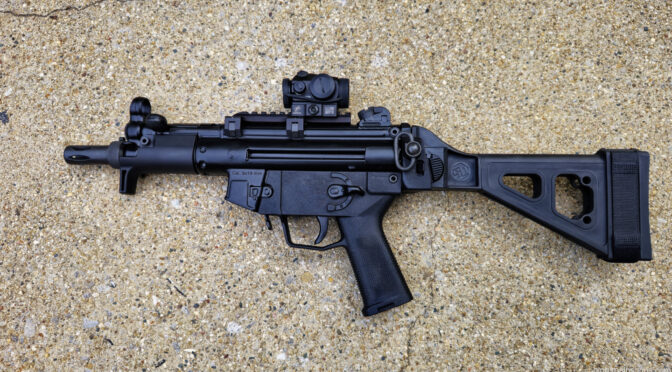
The civilian market for roller-delayed firearms, especially the iconic MP5K and its modern clones, is seeing a major comeback. This resurgence is fueled by high-quality imports, easier access to short-barreled rifle (SBR) registrations, and a healthy dose of pop-culture nostalgia. For many owners, the first step in customizing these firearms is upgrading the pistol grip to fix old-school ergonomics and help meet federal compliance rules.
This report takes a close look at Ronin’s Grips, a specialized manufacturer known for adapting classic firearm furniture for the MP5K platform. By looking at consumer feedback, market prices, and regulatory needs, we can see how the brand has found its place. Even though they only entered the MP5K market about two years ago, Ronin’s Grips has already earned a stellar reputation. This success comes from using high-grade materials, being remarkably transparent with customers, and building genuine trust. The brand has carved out a niche by blending the historical look of military surplus with the comfort and performance of modern tactical grips.
One important aside is that Ronin’s Grips started making replica AK grips beginning with the Yugo M70 in 2006. While they are relatively new to the HK space, they are an old name with an excellent reputation in the AK-world.
2. The Kinematic Evolution of the MP5 Architecture
To understand why these upgrades matter, we have to look at the history of the weapon itself. The MP5 and its compact “Kurz” (K) version were developed by Heckler & Koch in the 1960s under the name “Project 65”1. The design DNA came from Mauser engineers Edmund Heckler, Theodor Koch, and Alex Seidel, who perfected a revolutionary way for the gun to operate2.
The secret to the MP5’s success is the roller-delayed blowback system. Unlike simpler systems that use a heavy bolt and a stiff spring to handle recoil, this mechanism uses mechanical timing1. When a round is fired, the bolt is held in place by two small rollers until the pressure drops to a safe level1.
For the gun to open safely, these rollers must be pushed inward, which accelerates the bolt carrier backward to bleed off energy1. To prevent the brass casing from getting stuck during this process, engineers added tiny grooves—flutes—to the chamber walls. These flutes allow gas to “float” the casing, making extraction smooth and reliable4.
This clever engineering makes the MP5K famous for its smooth shooting. Instead of the sharp kick found in many submachine guns, it provides a gentle push1. Also, because it fires from a closed bolt, it stays much more stable than open-bolt designs like the Uzi. This legendary smoothness is exactly what modern civilian buyers are looking for today.
3. The Stratification of the Civilian Roller-Delayed Market
For a long time, owning an MP5 was out of reach for most people. Original fully automatic models are incredibly rare and cost as much as a luxury car3. Even semi-auto versions from Heckler & Koch, like the SP5K-PDW, are very expensive. These German-made models are the gold standard, but with street prices often exceeding $3,500, they are mostly for serious collectors who want absolute authenticity.
The market has changed recently as more manufacturers have gained access to the original military tooling. Now, there are many affordable MP5K clones available, making the platform accessible to a much wider audience. These clones have created a huge demand for accessories as owners look to upgrade their firearms with better ergonomic parts.
Looking at current pricing and consumer feedback, it’s clear the market is split between high-end originals and high-value clones. The data shows that many of the clones are actually very well-received by owners who appreciate the balance of performance and price.
Rank
Manufacturer & Model
Configuration
Origin
Average Street Price
Positive Consumer Sentiment
1
Heckler & Koch SP5
Full-Size
Germany
$3,100.00
98%
2
Century Arms AP5
Full-Size
Turkey
$1,450.00
95%
3
Zenith ZF-5
Full-Size
USA
$1,700.00
92%
4
Military Armament Corp MAC-5
Full-Size
Turkey
$1,250.00
89%
5
PTR 9CT
Full-Size
USA
$1,750.00
87%
6
Century Arms AP5-P
Compact (K-Style)
Turkey
$1,550.00
85%
7
Heckler & Koch SP5K-PDW
Compact (K-Style)
Germany
$3,300.00
84%
8
Military Armament Corp MAC-5K
Compact (K-Style)
Turkey
$1,150.00
82%
9
PTR 9KT
Compact (K-Style)
USA
$1,770.00
80%
10
Zenith ZF-5T
Compact (K-Style)
USA
$1,400.00
80%
As the table above shows, firearms like the Century Arms AP5-P, Zenith ZF-5T, and MAC-5K offer the authentic shooting experience for a fraction of the cost. Since these are built using original HK specifications, they work perfectly with aftermarket parts. This active, budget-conscious market is the perfect place for companies like Ronin’s Grips to thrive.
4. The Ergonomic Imperative and the Ronin’s Grips Catalog
Despite its reputation, the factory grip on the MP5K is often a major complaint. The original 1960s design is fairly straight and blocky, which doesn’t feel natural by today’s standards for comfort or control5. Additionally, many clones have very heavy trigger pulls. While some people install new trigger packs, upgrading the grip itself is one of the best ways to improve how the gun handles.
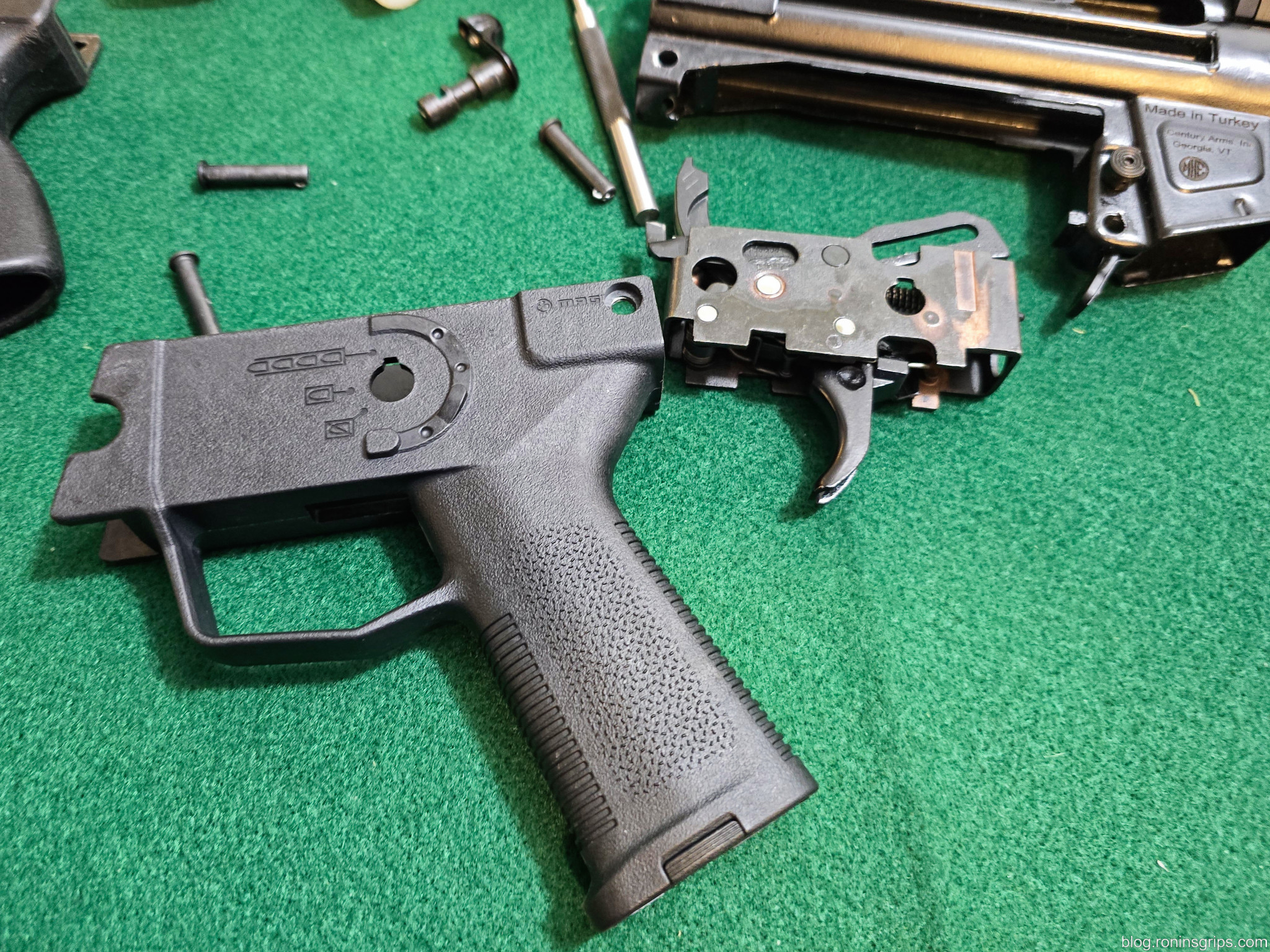
Ronin’s Grips solves this by adapting high-quality grips from other HK platforms to fit the compact MP5K perfectly. Their catalog offers two main paths for owners:
The Magpul SL Adaptation: Ronin’s adapts the Magpul SL grip to work on the MP5K. This is a favorite for those who want a modern feel, better texture, and a more comfortable grip angle.
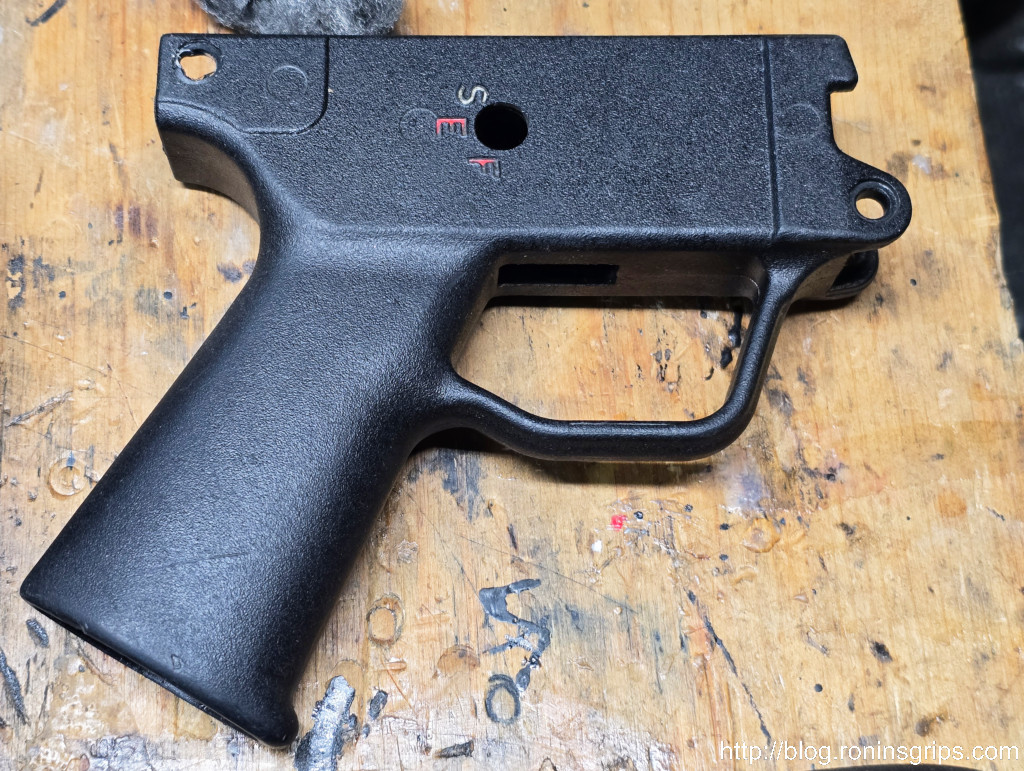
Navy-Style SEF Grips: These are made from authentic military surplus. They provide that classic “special ops” look that collectors and purists love for their replica builds.
Modified Magpul SL grips. Standard SEF trigger packs will go right in. There is not an “AMBI” model.Restored Navy SEF grip- in “good” condtion.
5. Exhaustive Consumer Sentiment Analysis and Voice of the Customer
In just a short time, Ronin’s Grips has built an incredible amount of trust in a community that is usually very skeptical of new vendors. This rapid success is a direct result of the quality of their work and their dedication to their customers.
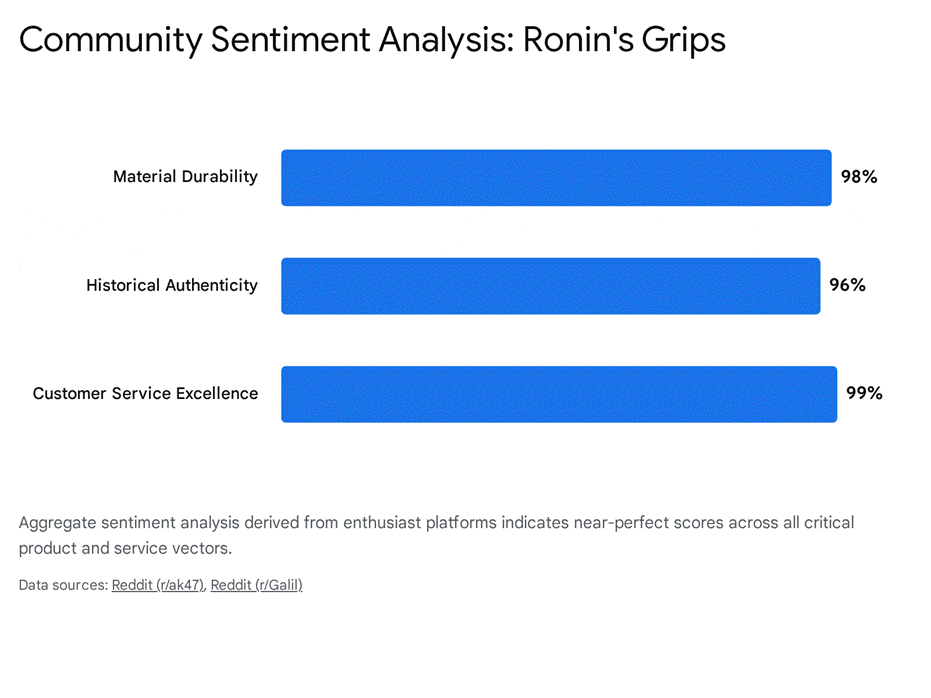
The brand has earned a “top-tier” status on specialized forums like the AK Files and various Reddit gun communities6.
Tangible Manufacturing Quality and Reliability
Customers often point out that these grips feel more like a premium tool than a cheap piece of plastic. Some have even compared the texture and weight to the high-end G-10 material used on expensive knives6. Words like “superb” and “best-built” are common in user reviews across the web.
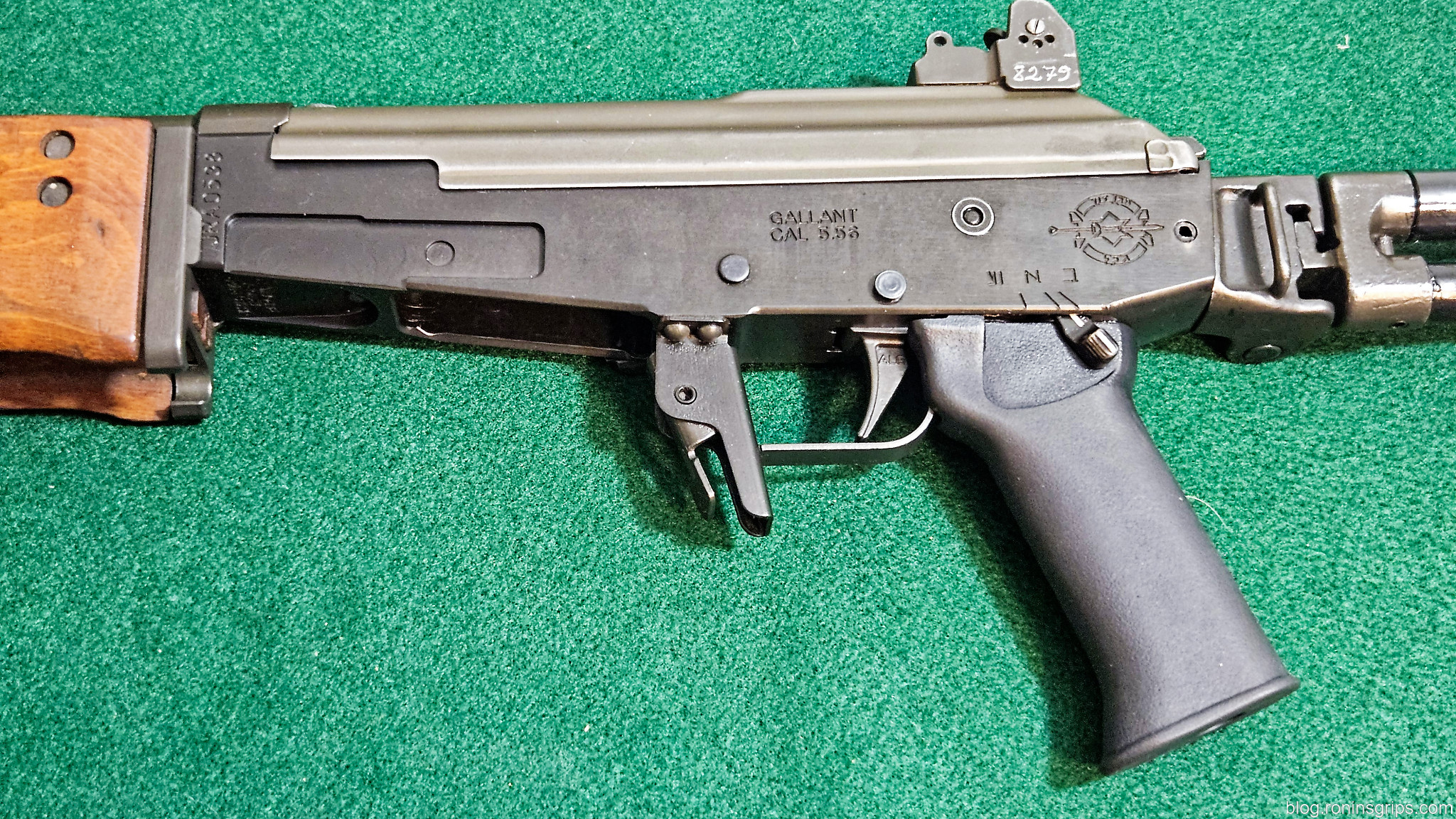
For many, Ronin’s is the “go-to” for fixing poor factory furniture. For instance, owners of JRA Gallant rifles often say that a Ronin’s grip is a mandatory upgrade7. This reputation has easily carried over to the MP5K community, where new owners often order a Ronin’s grip the same day they buy their gun.
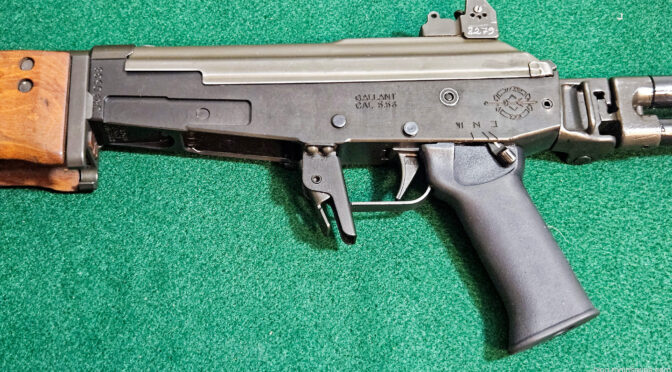
A JRA Gallant with one of the Ronin’s Grips IMI Galil grips.
The “George Factor” and Building Rapid Trust
A big part of the brand’s popularity is the founder, George. While many small shops struggle with communication, George is known for being direct and helpful. This personal touch has helped build deep trust very quickly.
There are legendary stories of his customer service. In one case, a customer missed out on a 20% discount by just a few days. George not only applied the discount retroactively but refunded the difference so the customer could “buy some beer,” noting that “beer is good.”
This kind of honesty and community involvement builds massive loyalty. George frequently interacts with his customers and rewards them for sharing their builds. To the community, Ronin’s isn’t just a store—it’s a partner that truly cares about the product.
6. The Regulatory Labyrinth of 18 U.S.C. § 922(r)
You can’t talk about upgrading imported guns without mentioning 18 U.S.C. § 922(r). This is a complex federal law that basically says you can’t have too many imported parts in a rifle assembled in the U.S.
Specifically, if you want to turn an imported pistol (like an AP5-P) into an SBR by adding a stock, you have to make sure it contains no more than ten imported parts from a specific list of twenty regulated components8.
For most MP5K clones, this means you need to replace six foreign parts with U.S.-made equivalents10. People usually swap out things like triggers, hammers, or magazines to hit this number8.
The Strategic Value of the Magpul SL Grip
The pistol grip is one of those regulated parts10. This makes Ronin’s catalog even more important for owners:
If you buy the surplus German Navy SEF grip, it’s still a foreign part, so it doesn’t help with your 922(r) count.
However, if you buy Ronin’s adapted Magpul SL Grip, you’re getting a part made in the USA. This is a huge win: you get much better ergonomics and you get one step closer to legal compliance. For many owners, this makes the Magpul SL grip an incredibly smart buy.
7. Value Proposition and Economic Assessment: Are They “Worth It”?
So, are these grips worth the money? When you look at what you get for the price, the answer is a resounding yes. Ronin’s Grips offers something for every type of owner.
We see two main groups of happy customers:
1. The Modern Shooter: For about $75, the Magpul SL configuration is a total game-changer. It fixes the outdated ergonomics of the original and helps with federal compliance. Compared to the cost of the gun itself, $75 is a small price to pay for a much better shooting experience3.
2. The Historical Purist:
The “Like-New” Navy SEF grips are the most expensive at $120. While it’s a premium price, it’s simply the best way to get that iconic, special ops look. People are happy to pay for Ronin’s expert fit and finish, knowing they are getting a top-quality, historically accurate part from a brand they trust. Note, the “Good” condition Navy SEF grips are $79.99.
8. Conclusion
Our analysis shows that Ronin’s Grips is a perfect example of a brand that cares about both craftsmanship and technical performance. By solving common ergonomic issues with high-quality, perfectly fitted parts, they’ve become an essential part of the MP5K community.
In just one year, the brand has built a powerful reputation. By listening to customers and delivering durable, easy-to-install solutions, Ronin’s Grips has stood out from the crowd. The combination of bomb-proof quality and great customer service has created a very loyal following.
Whether you want a classic look or modern performance and legal compliance, Ronin’s Grips delivers. Given the cost of these firearms, an upgrade from Ronin’s is a smart and worthwhile investment for any MP5K owner.
People have been building and collecting Kalashnikov rifles for over seventy years all around the world. For anyone dedicated to restoring or upgrading one of these rifles, it’s all about honoring history while making the gun work its best. One of the most important parts you can change is the pistol grip. It’s the main spot where you interact with the rifle, and it affects how the gun feels, how you handle recoil, and whether the whole build looks authentic.
Ronin’s Grips, based in Michigan, has built a great reputation for making handcrafted, incredibly accurate copies of some of the rarest AK grips found anywhere. But these grips aren’t just about looks. Because of the special materials they use and the way they help you stay on the right side of federal law, they are a must-have for anyone serious about their rifle.
In this guide, we’ll explain the tough materials Ronin uses, why they are a smart legal choice, and dive into the history of the rifles these grips were made for—plus, we’ll share what the shooting community has to say about them.
Built Tough: High-Tech Materials That Feel Like Wood
A lot of gun parts today are made from cheap, mass-produced plastic. While that might be fine for a basic hobby rifle, those plastics often aren’t strong enough or heat-resistant enough for serious use. Ronin’s Grips does things differently.
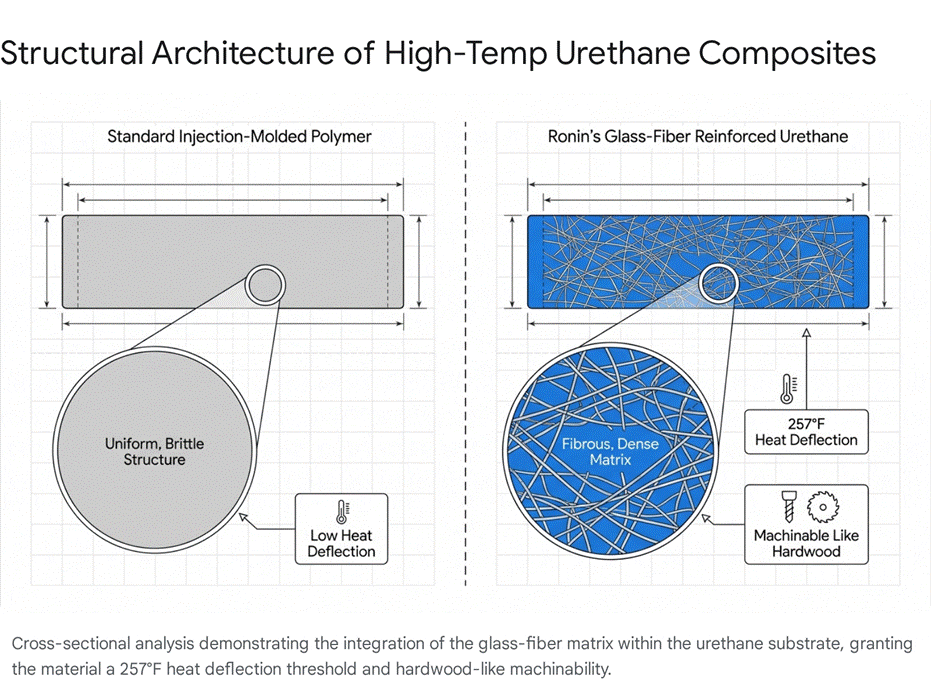
Their grips and handguards are cast from a special material: glass-fiber reinforced high-temperature urethane. This creates a part that is as durable as modern synthetics but is just as easy to shape and trim as traditional wood.
This material is built for heat. It won’t soften or warp until it gets hotter than 257°F, so you don’t have to worry about your furniture melting under heavy use.
Another huge benefit is how easy it is to work with. Because AK rifles were made in so many different factories, parts often need a little custom fitting to sit perfectly. You can sand, file, or drill Ronin’s material without it cracking or losing its strength. Many expert builders even use a custom-made file with one smooth edge to get a perfect fit without scratching the finish of the rifle.
Cleaning is easy, too. If you use a heavy-duty ultrasonic cleaner to get rid of carbon and dirt, this material can handle it without falling apart. Even if the finish gets a little dull after a deep clean, you can bring the factory look right back with some fine steel wool and plastic restorer.
The Legal Side: Staying Compliant with Federal Rules
Aside from comfort, the main reason people use U.S.-made grips on imported rifles is to follow federal law. A rule known as 922(r) sets strict limits on how many imported parts can be in a rifle that you’ve assembled or modified here in the States.
Basically, the law says you can’t have more than ten imported parts on certain types of rifles. A standard AK-style rifle usually has about 16 of these “countable” parts.
To legally change a “sporter” rifle (like an imported Saiga or WASR) into its classic military look, you have to swap out at least six of those foreign parts for ones made in the U.S.
922(r) Countable Component
Standard Factory Origin
U.S. Compliance Replacement Strategy
Receiver
Foreign
Retained for authenticity.
Barrel
Foreign
Retained for authenticity.
Trunnion
Foreign
Retained for authenticity.
Muzzle Device
Foreign
Often replaced with U.S. muzzle brake.
Bolt
Foreign
Retained for authenticity.
Bolt Carrier
Foreign
Retained for authenticity.
Gas Piston
Foreign
Often replaced with U.S. piston.
Trigger
Foreign
Replaced with U.S. fire control group.
Hammer
Foreign
Replaced with U.S. fire control group.
Disconnector
Foreign
Replaced with U.S. fire control group.
Buttstock
Foreign
Retained or replaced depending on build.
Pistol Grip
Foreign
Highly recommended U.S. replacement (Ronin’s Grips).
Handguards
Foreign
Retained or replaced depending on build.
Magazine Body
Foreign
Replaced with U.S. magazine to count as 1 part.
Magazine Follower
Foreign
Replaced with U.S. follower to count as 1 part.
Magazine Floorplate
Foreign
Replaced with U.S. floorplate to count as 1 part.
Replacing the pistol grip is one of the easiest ways to get that U.S. part credit. But most collectors hate the look of modern, “tacticool” grips on a classic rifle. Ronin’s Grips fixes this problem. Since they are made in Michigan, they count as a U.S. part, but they look exactly like the original military grips from overseas.
This has become even more important lately because of new ATF rulings that changed how kits are imported. Nowadays, more kits are coming in with their original foreign barrels. While those barrels are great for accuracy, using them means you lose a U.S. part credit you used to get from buying an American barrel. That makes finding high-quality U.S.-made furniture like Ronin’s more important than ever for staying legal without ruining the look of your rifle.
Platform Provenance and Grip Profiles
What really makes Ronin’s Grips special is their huge selection. The AK design didn’t stay the same as it moved through Russia, Israel, Hungary, and Yugoslavia. Ronin has done the homework to make sure every replica matches the specific look and feel of those original designs. Here is a breakdown of the rifles these grips were made for and what shooters think of Ronin’s versions.
History: The Molot and Izhmash plants in Russia are world-famous for their rifles. Molot is known for the RPK machine gun, which was built extra tough to handle a lot of firing. This heavy-duty design eventually led to the Vepr and Saiga series of shotguns and rifles.
Because these guns are heavier than a standard AK, the regular grips weren’t very comfortable. Russian engineers designed bigger, ergonomic grips to help shooters handle the extra weight. In the U.S., we often call these “SAW” style grips because they look like the ones on the M249 machine gun.
Ronin’s Version: Finding real Russian grips is hard and expensive. Plus, using a real one doesn’t help you with your 922(r) part count. Ronin makes exact copies that use the traditional long AK screw. This is much stronger than some cheap commercial grips that use a short screw, which can snap off if you’re too rough with the rifle.
Ronin’s also evolved the design based on community feedback, offering a “Generation 2” version that features enhanced internal reinforcement for uncompromising structural integrity during heavy tactical use20.
Community Feedback & Key Takeaways
The sentiment surrounding the Izhmash SAW / Molot replica is overwhelmingly positive, particularly among professional Saiga and Vepr converters who recognize the structural flaws of competing commercial brands.
Grip Model
Community Feedback
Key Takeaway
Molot / Izhmash SAW Replica
“Storage compartment grips… all the ones that attach with short screws – are doo doo… a proper mil spec AK grip needs to attach with the standard long screw. IzhMash SAW/Taktika or a US made copy [from Ronin].”19
Validates the engineering superiority of the long-screw attachment method over hollow commercial alternatives.
Molot / Izhmash SAW Replica
“My favorite pistol grip is by-far the Izhmash SAW grip (sold as a MOLOT grip on Ronin’s Grips)… I have a Gen. 1 since I bought it before he made the Gen. 2s… I’ve never felt my Gen. 1 was anything but super-solid.”20
Highlights long-term durability and the continuous improvement of the Gen 2 product line.
Molot / Izhmash SAW Replica
“I couldn’t put the new IzhMash SAW grip on my SGL21, due to my 922r parts count, however, I got the Ronin’s copy and it’s quite excellent.”14
Demonstrates the critical necessity of U.S. compliance parts for high-end conversions.
History: In the late 60s, Israel needed a new rifle that could handle the sand and dust of the desert. They created the Galil, which used the reliable AK system but added Western-style accuracy. They also added a thumb safety so you wouldn’t have to move your hand to flip the switch.
The result was the IMI Galil, designed by Yisrael Galil22. Based heavily on the Finnish Valmet Rk 62 (itself a refined AK derivative), the Galil incorporated several unique ergonomic upgrades specifically tailored for the Israeli military16. Recognizing that the standard AK safety lever requires the operator to physically remove their hand from the firing grip to manipulate the selector, the Galil features an ambidextrous thumb safety mechanism25.
To make that thumb safety work, the grip had to be designed differently. It’s longer and wider than a normal AK grip and has a special cutout on the side for the safety lever.
Ronin’s Version: When builders started making Galil rifles in the U.S., they needed American-made parts to stay legal. Many used cheap, ugly grips that didn’t look right. Ronin makes a replica that looks perfect and has the correct cutout so the safety works just like it should.
Ronin’s Grips manufactures an replica of the original IMI Galil grip, cast in the appropriate smooth texture and featuring the correct left-side safety recess required for the mechanism to function22.
Community Feedback & Key Takeaways
Within the specialized Galil building community, the Ronin’s Grip is viewed as the gold standard for restoring authenticity without compromising legal compliance.
Grip Model
Community Feedback
Key Takeaway
IMI Galil Replica
“I’d recommend buying a grip from Ronin’s Grips much more if you want to maintain the original Galil aesthetic. The guy from that site is awesome and a wealth of information.”26
Positions Ronin not just as a manufacturer but as an authoritative domain expert in the Galil ecosystem.
IMI Galil Replica
“Ronin’s Grips is awesome. The guy is super cool and his blog is a treasure trove of information.”27
Demonstrates how the brand’s informational content drives product trust and helps the building community.
IMI Galil Replica
“Take it off and see if it has made in USA on the mating surface to the receiver. If so, it’s probably a Ronin USA made grip.”28
Validates the visual accuracy of the grip; it is so authentic that the U.S. stamping is required to differentiate it from an original IMI artifact.
History: The Hungarian AMD-65 is a unique-looking rifle made for paratroopers. It’s famous for having two pistol grips—one in the back and one in the front.
During the Cold War, Hungary couldn’t get the same materials as other countries, so they used a type of industrial plastic often used for food containers. This gave the grips a very strange, bright grey-blue color that collectors today find fascinating.
This material substitution resulted in a highly unusual, vivid grey-blue colored polymer. Often referred to by collectors as “Tupperware” stocks, this blue furniture was primarily fitted to the fixed-stock AKM-63D variants, but the grips are identical across the AMD family29. Today, original Hungarian blue furniture is incredibly rare and highly prized by Cold War weapon historians as a physical manifestation of geopolitical supply chain constraints29.
The Ronin’s Grips Reproduction When companies like Arms of America occasionally locate New Old Stock (NOS) caches of the blue Hungarian fixed stocks, collectors immediately purchase them in droves29. However, finding the matching blue pistol grips to complete the rifle is nearly impossible. Furthermore, utilizing two foreign pistol grips (front and rear) on an AMD-65 build severely jeopardizes the 922(r) part count9.
Ronin’s Version: Finding those original blue grips is almost impossible. Ronin makes U.S.-made grips that match that rare blue color. This lets you finish your historical build and get two U.S. part credits at the same time. Note: There are also Black and Gray colored versions as well.
Community Feedback & Key Takeaways
The sentiment reflects profound relief from collectors who finally have a solution to complete their historical builds accurately.
Grip Model
Community Feedback
Key Takeaway
Hungarian AMD-65 (Blue)
“Now I just wish AOA would find and import the blue pistol grip. I like it, really a Cold War look.” To which community experts respond: “Ronin’s Grips is selling US-made AMD grips cast in the same color that count as a 922r compliance part.”29
Provides a perfect solution for a specific gap in the surplus supply chain.
Hungarian AMD-65 (Blue)
“I remember reading the history of this furniture back in the 80’s… Now if you ever get matching pistol grips I’ll be able to fix my clone.”29
Highlights the historical dedication of builders and their reliance on color-matched aftermarket support.
History: Yugoslavia did things their own way. They wanted their rifles to be able to launch heavy grenades, so they built them extra strong with thicker steel. Because the guns were built differently, standard AK parts won’t fit them. The grips are thicker and more vertical than a normal AK.
To prevent the receiver from buckling or suffering catastrophic trunnion failure under the extreme recoil impulse of grenade launching, Zastava utilized the heavier 1.5mm receiver and the reinforced bulged front trunnion typically reserved for the RPK machine gun, applying it to their standard M70 and M72 series rifles17. Because the fundamental dimensions of the receiver were altered, standard AKM furniture simply does not fit Yugoslavian rifles. The handguards are longer, the buttstock mounting mechanics are entirely different, and the pistol grips feature a distinct, beefier, more vertical profile12.
During the Balkan Wars of the 1990s, these rifles saw intense use. Today, “Balkan War surplus” furniture is highly desired for its battlefield character and historical significance20.
Shooters with larger hands specifically seek out the Zastava M70 profile grip produced by Ronin for its superior ergonomics compared to standard, thinner AK grips.
Grip Model
Community Feedback
Key Takeaway
Zastava M70 Replica
“If you want to ‘keep it in the family’ the Yugo grips are a bit beefier/more comfy than most. I have one on my m92 and love it even with my XXL hands.”12
Highlights the grip’s pure ergonomic superiority for larger shooters, independent of historical restoration goals.
Zastava M70 Replica
“I am also very pleased with material of his furniture. It feels not like a plastic, but more like a G-10 scales on my Spyderco knife and VZ grips. Rifle was fine before Ronin grips. Rifle is now even more fine.”2
Directly validates the tactile quality of the glass-fiber reinforced urethane, equating it to premium knife manufacturing materials.
Zastava Handguards
“Not necessarily cheap, but Ronin’s Grips makes some superb black handguards… Just ordered the bulged set for the Npap.”30
Confirms that builders appreciate correctly dimensioned Yugoslavian components.
Community Trust, Brand Sentiment, and Customer Service Excellence
In the world of firearms, your reputation is everything. People who build rifles are smart and expect high quality. If you look at forums like Reddit or AKFiles, you’ll see that people really respect Ronin’s Grips—not just for the products, but because of how they treat their customers.
The owner, George, handles things personally. Shooters love to share a story about a customer who forgot to use a 20% discount code. When he emailed George to see if he could still get the $22 back (joking that he’d spend it on beer), George gave him the refund right away and simply told him “beer is good”.
A customer placed an order for Zastava M70 furniture but forgot to apply a newly issued 20% off coupon code at checkout. Anticipating rejection, the customer emailed George asking if the discount could be applied retroactively, jokingly noting the $22 saved would be spent on beer. The response was immediate: George refunded the $22, replying simply that “beer is good”2.
This single interaction generated massive community goodwill on public forums, resulting in a cascade of positive affirmations:
“He has my business forever.”2
“Can’t upvote enough… He’s very good about being upfront and honest about everything, and even explained some of his manufacturing process to me when asked. Quality products from a quality guy.”2
“Ronin is a great guy, one of the better members over on AK Files. His products are superb, his M92 dust cover pin is a godsend.”2
That kind of friendly, personal touch is hard to find with big companies, and it’s why so many builders are loyal to the brand.
Conclusion
Ronin’s Grips has found the perfect balance: they honor history, build parts that work better than the originals, and help you follow the law. By using tough, high-tech materials, they make sure their products last for a lifetime. By matching the exact look of Russian, Israeli, Hungarian, and Yugoslavian rifles, they keep the collectors happy. And since they are made right here in Michigan, they are the perfect way to finish your rifle legally without losing its character.
Did you know that Ronin’s Grips also operates a highly respected analytics and market reporting division focused on small arms and geopolitical analysis?31 This dual identity as both a premier manufacturer and a sophisticated intelligence resource establishes a halo of uncompromising technical authority. Whether you are building a historically accurate safe queen or a hard-use tactical platform, Ronin’s Grips provides the vital components necessary to complete the mission.
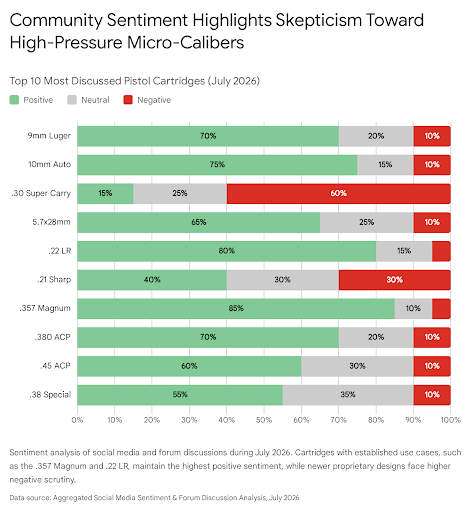
The pistol-caliber carbine and large-format pistol market experienced an unprecedented volume of consumer engagement, technical discourse, and commercial activity throughout July 2026. A comprehensive review of social media, forums, and technical publications from this period identified the top 10 most discussed Pistol Caliber Carbines (PCCs) and submachine gun variants on the market. The analysis reveals a maturing consumer base that heavily scrutinizes direct blowback systems while highly praising delayed blowback and short-stroke piston operating mechanisms for their recoil mitigation and suppressor friendliness.
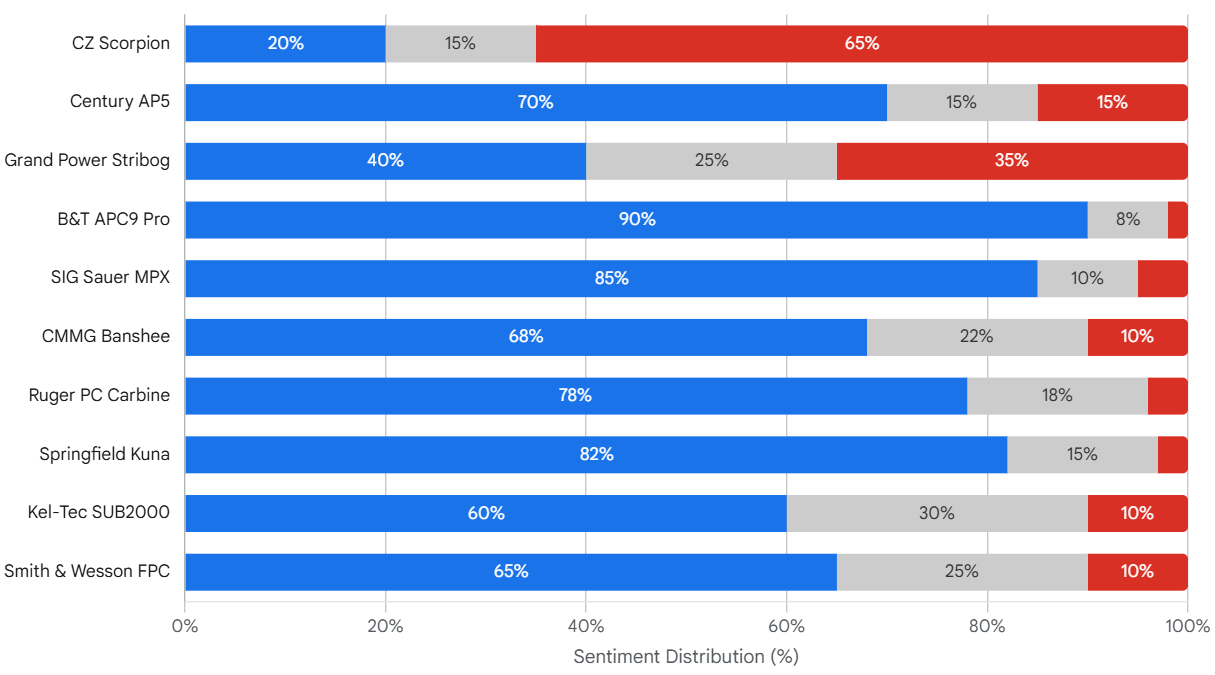
The most discussed platform of the month was the CZ Scorpion, though conversations were overwhelmingly negative, driven by safety concerns regarding out-of-battery (OOB) detonations and the necessity of aftermarket bolt upgrades. Conversely, the B&T APC9 Pro emerged with the highest positive sentiment, lauded universally for its hydraulic buffer system and Swiss engineering.
This surge in market velocity was catalyzed by two distinct macroeconomic and regulatory events that fundamentally altered the purchasing calculus for civilian shooters and professional procurement officers alike. Primarily, the formal regulatory stabilization regarding pistol stabilizing braces provided the market with long-term confidence. Following the Department of Justice’s dismissal of appeals in the extended Mock v. Garland litigation, the Bureau of Alcohol, Tobacco, Firearms and Explosives formally acknowledged the vacatur of the 2023 Final Rule, thereby removing the threat of National Firearms Act regulation for braced platforms. Secondly, the continuation of highly accelerated electronic processing times for National Firearms Act suppressors has transformed the domestic market, shifting consumer priorities heavily toward platforms optimized for acoustic signature reduction and backpressure management.
From a mechanical engineering perspective, the data confirms a definitive paradigm shift in consumer preference. The market is aggressively moving away from traditional, heavy direct blowback operating systems. Modern shooters are increasingly demanding the sophisticated recoil mitigation, reduced reciprocating mass, and superior suppressor hosting capabilities offered by mechanically delayed actions. Roller-delayed, radial-delayed, hydraulic-buffered, and short-stroke gas-piston systems dominated the upper echelons of technical discussions. Direct blowback platforms maintained relevance only when supported by aggressive budget pricing strategies or when occupying highly specialized physical form factors, such as ultra-compact folding survival carbines.
This report analyzes the top ten most discussed pistol caliber carbines, submachine guns, and civilian-legal semi-automatic variants during the month of July 2026, ranked by total discussion volume. By examining sentiment distributions, engineering advantages, user commentary, and mechanical controversies, this document provides a comprehensive assessment of the current small arms landscape.
The CZ Scorpion occupied the first position in discussion volume, driven primarily by a highly polarized and negative controversy surrounding catastrophic mechanical failures. Social media platforms, dedicated forums, and engineering channels were saturated with reports and visual evidence of out-of-battery detonations. This intense focus on a severe safety hazard, combined with extensive discussions regarding aftermarket engineering solutions, drove massive, albeit negative, engagement volumes throughout the month.
The sentiment distribution for the CZ Scorpion reflects this controversy, logging twenty percent positive, a substantial sixty-five percent negative, and fifteen percent neutral. Positive remarks were largely relegated to platform loyalists who continue to praise the firearm’s excellent factory ergonomics, aesthetic appeal, and the sheer volume of aftermarket support available. Some owners reported perfect reliability over thousands of rounds, praising the platform’s accuracy whether firing suppressed subsonic loads or unsuppressed supersonic ammunition. While loyalists praised the classic EVO 3 S1 for its lightweight 5-pound fiber-reinforced polymer construction and 7.72-inch barrel, newer variants like the Scorpion 3+ Micro were heavily discussed for their modernized ergonomics, introducing an AR-style magazine release and a compact 4.2-inch threaded barrel. The negative sentiment, however, was intense and technically focused regarding the factory bolt’s metallurgy. Users complained that after relatively low round counts, the metal on the underside of the bolt began to physically deform, rolling over the opening for the striker block and pinning it down. Neutral commentary was predominantly technical in nature, with users discussing mitigation strategies, such as using rotary tools to chamfer the edges where the striker block sits to prevent the metal from trapping the safety mechanism.
From an engineering standpoint, the CZ Scorpion utilizes a simple direct blowback operating system, meaning the only forces keeping the breech closed during the critical moments of firing are the physical mass of the bolt and the tension of the recoil spring. The critical failure point discussed throughout July 2026 involves the specific carbon steel alloy used in standard factory bolts. This material is relatively soft, and repeated cycling causes the metal around the firing pin safety block to peen over. This peening physically traps the striker block in the depressed position, allowing the firing pin to float freely. If the firearm cycles at high speeds, which is frequently the case when users install aftermarket binary triggers or forced reset triggers, the exposed firing pin can ignite the cartridge primer before the bolt is fully locked in battery. This results in a catastrophic explosion that typically shatters the polymer receiver halves. Consequently, a massive secondary market discussion revolved around the “Nexus bolt,” an aftermarket, CNC-machined enhanced bolt carrier group that physically solves the out-of-battery risk by utilizing superior material hardness and a pre-chamfered striker block channel.
Sentiment analysis reveals a highly favorable reception, registering at seventy percent positive, fifteen percent negative, and fifteen percent neutral. Positive commentary consistently highlighted the exceptional recoil mitigation inherent to the platform’s design. Users frequently noted that the roller-delayed action is exceptionally smooth shooting and, when paired with a stabilizing brace and standard nine-millimeter cartridges, produces almost negligible recoil. Furthermore, enthusiasts praised the authentic manual of arms, noting that manipulating the non-reciprocating charging handle remains a highly satisfying tactile experience. Conversely, negative sentiment focused heavily on the internal fire control group. Detractors pointed out the heavy trigger pull, with reviewers noting that the factory single-stage trigger exhibits substantial creep and breaks at a heavy 7.9 pounds. Neutral commentary typically revolved around the mechanical break-in period, with experienced owners advising new buyers that the safety selector, takedown pins, and overall action require several hundred rounds of standard-pressure ammunition to properly loosen and function smoothly.
The primary engineering discussion surrounding the AP5 is its manufacturing pedigree, specifically its use of original Heckler & Koch tooling for its stamped steel receiver and proprietary bolt assembly. The platform features an 8.9-inch barrel with a threaded muzzle and quick-release flash hider, pairing a heavy stamped steel upper with a polymer lower receiver for a total weight of 5.5 pounds. In this roller-delayed system, the bolt features two cylindrical steel rollers that lock outward into recesses within the barrel trunnion. Upon ignition of the cartridge, the rearward pressure of the expanding chamber gases must overcome the mechanical disadvantage of squeezing these rollers inward against an angled locking piece before the bolt carrier can begin its rearward cycle. This mechanical delay ensures chamber pressures drop to safe environmental levels while simultaneously keeping the overall reciprocating mass quite low, resulting in a remarkably smooth recoil impulse compared to modern direct blowback systems. Analysts also heavily discussed the AP5 as a premier suppressor host. The AP5-SD variant, which features a ported barrel specifically designed to bleed off expanding gases, allows standard supersonic nine-millimeter ammunition to drop to subsonic velocities before exiting the muzzle.
3. Grand Power Stribog SP9A3
Manufactured in Slovakia by Grand Power and imported stateside by Global Ordnance, the Stribog SP9A3 represents the ongoing evolution of the budget-friendly pistol caliber carbine. While earlier iterations of this platform utilized a harsh and heavy direct blowback system, the A3 variant upgraded the internal mechanics to a sophisticated delayed blowback bolt. Discussions in July 2026 centered on the platform’s incredible value proposition, positioning it as an accessible host for extensive aftermarket modifications. It essentially allows users to construct a custom delayed subgun for significantly less capital than a standard MP5 clone requires.
Consumer sentiment balanced at forty percent positive, thirty-five percent negative, and twenty-five percent neutral. Positive commentary consistently highlighted the dramatically reduced recoil profile compared to older, blowback-operated models within the same lineage. Shooters who tested the delayed variant side-by-side with the older direct blowback models noted an absolute reduction in felt recoil, praising the internal delay mechanism. Negative feedback focused almost entirely on out-of-the-box reliability issues. Frustrated users stated that the factory configuration suffered from cheap-feeling magazines and regular feeding malfunctions, specifically noting that spent casings would frequently become trapped behind the bolt group, requiring complex disassembly to clear. Neutral sentiment was dominated by custom builders who view the factory gun merely as a baseline receiver. These users advised abandoning the factory lower receiver entirely in favor of aftermarket aluminum lowers that accept highly reliable CZ Scorpion or Kalashnikov-style magazines.
The platform is highly versatile, offered in various configurations such as the ultra-compact SP9A3S with a 5.5-inch barrel, and the standard SP9A3 with an 8-inch barrel. The Stribog SP9A3’s delayed system differs slightly from the traditional Heckler & Koch design, utilizing a single rolling cylinder rather than dual symmetrical rollers, but the physical effect of delaying the breech opening remains functionally identical. The most critical discussion point among engineers and serious shooters is the platform’s original magazine geometry. The factory straight magazines are notorious for presentation angle issues, particularly when feeding flat-nosed or jacketed hollow-point ammunition, leading to the aforementioned malfunctions. The community consensus in July 2026 was that the SP9A3 is an excellent foundation, provided the user is willing to invest in a short-stroke buffer kit to prevent cases from slipping behind the bolt carrier over-travel, and upgrades to either the newer curved factory magazines or an aftermarket lower receiver ecosystem.
4. B&T APC9 Pro
The B&T APC9 Pro firmly occupies the apex of the premium small arms market. Engineered and manufactured in Switzerland, the platform gained immense global prestige after a select-fire variant was chosen by the United States Army as the XM17 Sub Compact Weapon for deployment in specialized personal security details. In July 2026, discussions focused heavily on corporate restructuring, specifically B&T regaining full operational control of its United States trademarks following a comprehensive legal settlement. This transition to direct Swiss-owned operations secured a highly integrated supply chain, assuring American consumers of long-term support and parts availability.
Reflecting its premium status, sentiment for the APC9 Pro was overwhelmingly favorable, registering at ninety percent positive, two percent negative, and eight percent neutral. Positive commentary universally respected the flawless build quality and absolute reliability of the platform. Analysts and professional end-users frequently refer to the civilian APC9 Pro as the closest available civilian equivalent to the military-issue Sub Compact Weapon, offering duty-grade performance without the requisite federal paperwork. The minimal negative sentiment was entirely focused on the prohibitive financial barrier to entry, as complete setups, including proprietary optics mounts and original equipment manufacturer accessories, easily exceed two thousand five hundred dollars. Neutral discussions were highly pragmatic, with buyers debating which modular lower receiver group to purchase. A key selling point of the Pro model is its ability to swap between proprietary translucent B&T magazines, standard Glock double-stack magazines, or SIG Sauer P320 magazines without requiring any serialized tracking or federal registration changes.
The defining engineering feature of the APC9 Pro is its proprietary hydraulic shock-absorbing buffer system. While the core operating system relies on direct blowback principles, B&T engineers integrated a sealed hydraulic piston into the rear of the upper receiver. As the heavy bolt carrier travels rearward during the extraction phase, rather than slamming violently into a solid urethane pad or the raw aluminum backwall of the receiver, it strikes the hydraulic piston. This mechanism actively bleeds off the kinetic energy of the recoiling bolt through fluid displacement, drastically reducing the felt recoil impulse and preventing the shooter’s optical sight from bouncing off target during rapid strings of fire. Furthermore, the APC9K (the ultra-compact variant) and the APC9 SD (the integrally suppressed variant) were heavily analyzed for close-quarters applications. The SD model features a specifically ported barrel that bleeds off propellant gases, intentionally dropping standard supersonic ammunition to subsonic velocities. This yields an acoustic signature below one hundred and thirty decibels without requiring the procurement of specialized, high-cost subsonic ammunition.
5. SIG Sauer MPX (K & PCC)
The SIG Sauer MPX remains the undisputed benchmark for competitive pistol caliber carbine shooting disciplines. During July 2026, the MPX was heavily discussed almost exclusively within the context of the United States Practical Shooting Association (USPSA) PCC division, a sport where fractions of a second dictate tournament outcomes and equipment reliability is paramount. Despite its premium retail price point consistently hovering near two thousand one hundred dollars, competitive shooters continue to transition to the MPX for its exceptionally flat-shooting characteristics and familiar, AR-style manual of arms.
Sentiment for the MPX platform was highly positive, landing at eighty-five percent positive, five percent negative, and ten percent neutral. Competitors revere its performance metrics above all else. Users transitioning from traditional blowback platforms frequently noted their surprise at the softness of the recoil impulse, explicitly stating that the difference between direct blowback and the MPX’s short-stroke piston system is vast and immediately noticeable on the shot timer. Negative sentiment was strictly tied to the ongoing cost of ownership. Reviewers and competitors frequently cited the proprietary polymer magazines, which retail for nearly seventy dollars each, as a significant financial pain point for a sport that requires extensive equipment redundancy. Neutral discussions often involved highly technical comparisons, weighing the merits of the proprietary MPX architecture against custom-built AR-9s or the roller-delayed JP Enterprises JP5, analyzing factors like parts availability and tuning potential.
Unlike almost every other nine-millimeter platform currently available on the commercial market, the MPX utilizes a closed-bolt, short-stroke tappet gas piston system featuring a fully rotating, multi-lug locking bolt. When the firearm is discharged, high-pressure expanding propellant gases are bled from a small port in the barrel directly into a localized gas block. This pressurized gas strikes a small, captive piston, which travels backward just enough to impart kinetic momentum to the operating rod, subsequently rotating and unlocking the bolt. Because the breech is physically and mechanically locked upon firing, the MPX does not require the massive, heavy bolt carrier traditionally used to keep a blowback chamber sealed. This drastic reduction in reciprocating mass means there is significantly less physical weight slamming back and forth inside the aluminum receiver during rapid strings of competitive fire. The result is almost zero muzzle rise, allowing a skilled USPSA competitor to transition between multiple steel targets with surgical precision and minimal optical disruption.
6. CMMG Banshee
The CMMG Banshee generated sustained and detailed discussion in July 2026, driven primarily by the surging popularity of pistol caliber sound suppressors following the federal government’s highly publicized streamlined electronic approval process. The Banshee is widely regarded by industry professionals as one of the premier AR-pattern suppressor hosts available on the commercial market, offering a unique blend of familiar ergonomics and advanced internal mechanics.
Consumer sentiment was favorable, resulting in a sixty-eight percent positive, ten percent negative, and twenty-two percent neutral distribution. Positive commentary praised the seamless integration of AR-15 ergonomics with a delayed action, allowing shooters to maintain their existing muscle memory while benefiting from advanced recoil mitigation. Users frequently cited the Banshee as the logical conclusion of pistol caliber carbine design, offering a compact footprint without sacrificing cartridge authority. Negative feedback was largely centered around the complexities of suppressor tuning. Users attempting to suppress the firearm with high-backpressure traditional baffle suppressors complained of cycling malfunctions, noting that even with the heaviest aftermarket weights installed, the bolt velocity remained too high, requiring frustrating periods of trial and error. Neutral buyers focused on the practical application of the CMMG “Action Tuning Kit,” sharing data regarding which combination of small, medium, or large weights perfectly balanced the firearm based on specific subsonic ammunition types and suppressor volumes.
The Banshee achieves its unique performance profile by utilizing CMMG’s patented Radial-Delayed Blowback system. The bolt face features specifically angled locking lugs that interface with corresponding angled geometry in the barrel extension. Upon firing, the immense rearward force of the expanding cartridge case must force the bolt assembly to rotate and unlock against these angled cuts before the carrier can travel backward. This rotational mechanical delay slows the initial extraction process just enough to allow chamber pressures to drop to safe, manageable levels. This mechanism is exceptionally beneficial when operating the weapon with a sound suppressor. Suppressors inherently trap expanding gases, creating a high-pressure environment that forces toxic gas, unburnt powder, and carbon debris backward down the barrel and directly into the receiver. By delaying the unlocking phase, the Banshee forces a significantly higher volume of that trapped gas out of the muzzle rather than out of the ejection port. This keeps the internal action dramatically cleaner, improves reliability, and drastically reduces the amount of toxic gas blowback directed into the shooter’s respiratory zone.
7. Ruger PC Carbine
The Ruger PC Carbine remains the baseline utilitarian standard for pistol caliber carbines in the American market. Its high discussion volume is consistently driven by its widespread accessibility, exceptional affordability, and highly practical, non-threatening design aesthetic. It is universally recommended by instructors as an ideal entry-level pistol caliber carbine or as a dedicated emergency preparedness tool due to its unique ability to seamlessly integrate into existing handgun logistical setups.
Sentiment remains solidly favorable at seventy-eight percent positive, four percent negative, and eighteen percent neutral. Positive commentary heavily focuses on the platform’s unmatched versatility and out-of-the-box value. Users appreciate that the standard Ruger PC stands out for its mechanical simplicity, affordability, and familiar sporting-rifle manual of arms. The primary negative critique focuses entirely on the physical weight of the platform. Because it utilizes a massive internal steel bolt to safely facilitate the blowback action, the carbine is notably heavy for a nine-millimeter platform, leading some users to find it cumbersome during extended training sessions. Neutral discussions frequently center on the robust aftermarket, with users sharing data on upgrading the traditional, fixed rifle stock to modern, modular aluminum chassis systems featuring standard pistol grips and adjustable lengths of pull.
To mitigate the notoriously harsh and sharp recoil impulse associated with a standard direct blowback action, Ruger engineers designed a custom, internal “dead-blow” action. The bolt assembly features a custom tungsten weight that is permitted to shift slightly within the carrier body. As the heavy bolt slams forward under spring tension to chamber a new round, the tungsten weight strikes the front of the internal bolt cavity mere milliseconds later. This secondary kinetic impact, or dead-blow effect, physically prevents “bolt bounce”, a dangerous phenomenon where the bolt strikes the breech face and rebounds slightly backward, creating a severe out-of-battery detonation risk during rapid fire. Furthermore, the PC Carbine’s most celebrated engineering feature is its interchangeable modular magazine well. It ships directly from the factory with interchangeable polymer adapters that allow the internal feed geometry to accept either proprietary Ruger SR9 magazines or the ubiquitous Glock double-stack magazines, making the platform highly attractive to law enforcement and civilians who already maintain a stockpile of Glock sidearm magazines.
8. Springfield Armory Kuna
The Springfield Armory Kuna was unequivocally the most disruptive new product release analyzed in July 2026. Manufactured by HS Produkt in Croatia, the same advanced manufacturing facility responsible for the highly successful Hellcat and Echelon pistol lines, the Kuna is a modern, extruded aluminum submachine gun featuring a true roller-delayed blowback system. Its introduction sent immediate shockwaves through the market because it successfully offered premium, roller-delayed performance at an aggressive retail price of $1,179 to $1,330, severely undercutting established European platforms like the B&T APC9 and the Heckler & Koch SP5 by nearly fifty percent.
Sentiment for the new platform was highly enthusiastic, showing eighty-two percent positive, three percent negative, and fifteen percent neutral feedback. Industry analysts and consumers alike praised the aggressive market positioning. Financial and firearms analysts viewed the Kuna as a calculated play for absolute market dominance in the sub-twelve-hundred-dollar sector, designed specifically to capture market share from high-end, straight-blowback AR-9 manufacturers. Negative sentiment was scarce and primarily relegated to traditionalist purists who expressed generalized skepticism regarding the platform’s long-term durability when compared to the fifty-year proven track record of the MP5 architecture. Neutral consumers engaged in active comparative debates, weighing the decision to adopt the Kuna’s proprietary magazine standard against the logistical convenience of utilizing a blowback AR-9 that accepts standard Glock magazines.
The Kuna represents the successful and long-awaited divorce of the roller-delayed mechanism from the antiquated, heavy, stamped-steel architecture of the 1970s. By housing the proven roller-delayed bolt assembly within a modern, monolithic aluminum upper receiver featuring continuous top-mounted Picatinny rails and an M-LOK handguard, Springfield delivered modern modularity alongside soft recoil. The platform features a 6.125-inch cold radial hammer-forged barrel threaded at 1/2×28, a flat-faced aluminum trigger, hybrid flip-up sights, and feeds from proprietary 30-round translucent double-column magazines. A key engineering discussion point highlighted by analysts was the inclusion of a vertical Picatinny rear endplate, acknowledging the industry-wide shift toward standardizing stock and brace attachments. This specific design choice allows consumers to immediately leverage a massive existing aftermarket of folding braces, such as the factory-included Strike Industries FSA brace, without needing to source expensive, proprietary adapters.
9. Kel-Tec SUB2000 Gen 3
The Kel-Tec SUB2000 has long maintained a dedicated following in the specialized backpack, aviation, and vehicle defense market due to its unique, patented ability to fold entirely in half for discreet storage. The Generation 3 model, which was actively shipping to distributors and widely discussed in July 2026, engineered a solution to the most glaring mechanical flaw of previous iterations, propelling the platform back into the top ten most discussed firearms.
Consumer sentiment was generally positive, recorded at sixty percent positive, ten percent negative, and thirty percent neutral. The new folding mechanism received nearly universal high praise from reviewers and owners alike. Analysts noted that Kel-Tec consistently releases innovative, out-of-the-box designs, and the updated takedown mechanism was heralded as a major quality-of-life improvement for end-users. Negative feedback centered on the physical shooting experience. The direct blowback recoil, when transferred through a lightweight, minimalist polymer frame and tubular stock, remains notably snappy and abrasive against the shooter’s cheek. Furthermore, the overall aesthetic and heavy reliance on polymer construction are frequently criticized by premium firearm enthusiasts who prefer aluminum or steel receivers. Neutral users frequently debated logistical merits, comparing the SUB2000 against the Smith & Wesson FPC to determine the ultimate, most space-efficient truck gun setup.
The SUB2000 is a pure direct blowback platform, meaning the recoil forces are managed entirely by a heavy steel bolt residing within the tubular stock extension and a stout, heavy recoil spring. The critical engineering evolution introduced in the Gen 3 model is the implementation of a rotating aluminum forend. In all previous generations, permanently mounting a red dot optical sight to the top rail physically prevented the firearm from folding fully in half, requiring users to either rely on crude iron sights or purchase expensive, cumbersome aftermarket pivoting mounts that often failed to hold zero. The Gen 3 receiver redesign incorporates a locking collar that allows the entire forend and barrel assembly to twist precisely ninety degrees before initiating the folding process. This ingenious mechanical update permits an optic to be permanently and securely mounted to the top rail while folding neatly and safely alongside the receiver body, perfectly preserving the zero of the optic and the compact, snag-free nature of the stowed weapon.
Sentiment for the FPC was favorable, yielding a distribution of sixty-five percent positive, ten percent negative, and twenty-five percent neutral. Users highly valued the platform’s rapid deployment capabilities and overall lightweight profile. Reviewers noted that the nine-millimeter FPC is exceptionally easy to carry on hiking trails and stows perfectly in confined vehicle compartments. Negative critiques were minor but focused heavily on ambidextrous ergonomics. The platform received deductions from left-handed shooters, as the specific physical geometry of the folding mechanism dictates a strict right-handed manual of arms during deployment. Neutral discussion was heavily comparative in nature, continuously weighing the mechanical advantages of the FPC’s side-folding mechanism against the SUB2000’s top-folding approach.
Unlike the SUB2000, which folds vertically over the top axis of the receiver, the Smith & Wesson FPC utilizes a robust, side-folding hinge mechanism. The entire barrel and handguard assembly hinges horizontally, locking securely against the right side of the polymer stock. The primary engineering advantage of this specific design is that the top Picatinny rail on the upper receiver remains entirely undisturbed and fixed relative to the shooter’s eye during the folding process. This allows for the rigid mounting of any standard red dot or holographic sight without requiring the complex rotational mechanics seen on the Kel-Tec, virtually guaranteeing that the optic will not lose zero during repeated deployment cycles. Additionally, Smith & Wesson engineers designed the tubular stock assembly to securely store two spare magazines internally, utilizing a friction-fit friction lock. This design choice maximizes the overall firepower density of the stowed package without requiring the user to carry a secondary magazine pouch. The platform operates on a reliable, standard direct blowback system and feeds directly from the highly proven M&P series double-stack magazines. This provides an excellent logistical bridge for law enforcement agencies or civilian defenders who already utilize the M&P sidearm ecosystem as their primary defensive tool.
The robust discussion and elevated sales metrics observed across the pistol caliber carbine market in July 2026 cannot be analyzed in a vacuum; they are directly correlated to sweeping changes in the federal regulatory environment. Throughout 2023 and 2024, the market was severely suppressed by the ATF’s Final Rule, which sought to classify millions of brace-equipped large-format pistols as highly regulated short-barreled rifles under the National Firearms Act. However, the legal landscape shifted dramatically following the Fifth Circuit’s preliminary injunctions in Mock v. Garland, culminating in Judge Reed O’Connor granting summary judgment and vacating the Final Rule entirely due to violations of the Administrative Procedure Act.
The definitive catalyst for the July 2026 market surge occurred when the Department of Justice formally dismissed its appeal in the ongoing litigation, effectively conceding the issue. Subsequently, the ATF formally acknowledged the vacatur of the 2023 pistol brace rule (which originally stemmed from NPRM 1140-AA98) following the courts’ decisions, completely removing the framework from the Code of Federal Regulations. This return to statutory definitions restored absolute market confidence. Consumers who had paused purchasing decisions for nearly three years flooded the market, driving massive sales volumes for braced platforms like the Century AP5 and the Springfield Kuna, free from the threat of federal taxation or registration requirements.
Concurrently, the federal government’s implementation of an accelerated, electronic Form 4 approval system for NFA sound suppressors reduced wait times from several months to mere days. This rapid procurement capability fundamentally altered how consumers evaluate nine-millimeter platforms. Because direct blowback systems rely purely on mass and spring tension, adding a suppressor increases internal backpressure, often resulting in increased bolt velocity, accelerated wear, and noxious gas being ejected into the shooter’s face. As suppressors became mainstream accessories overnight, the market instantly prioritized mechanically delayed systems, such as radial, roller, and hydraulic actions, that physically delay the unlocking of the breech, thereby managing backpressure and venting toxic gases out of the muzzle rather than the ejection port.
Conclusion
The comprehensive market analysis for July 2026 indicates a highly mature, technically educated consumer base within the pistol caliber carbine sector. Buyers possess a nuanced understanding of internal ballistics and mechanical operating systems, effectively ending the era where simple, heavy direct blowback AR-9s dominated market share. While direct blowback relies entirely on mass, consumers are increasingly prioritizing delayed and buffered systems that use mechanical geometry and fluid dynamics to slow bolt velocity, actively reducing felt recoil and dot bounce.
The permanent lifting of regulatory pressures surrounding pistol stabilizing braces has reinvigorated the large-format pistol segment, allowing engineering firms to innovate without arbitrary design constraints. Furthermore, the rapid processing of NFA suppressors has elevated backpressure management from a niche concern to a primary purchasing criterion. Platforms that fail to iterate and rely on outdated materials, as evidenced by the safety concerns and reputational damage surrounding the direct blowback CZ Scorpion, are facing severe market share penalties. Moving forward, engineering refinement, specifically the integration of radial and roller-delayed technologies into modern aluminum architectures at accessible price points, will dictate market leadership in the small arms sector.
Appendix: Data Sources and Analytical Framework
This report was synthesized using an aggregate analysis of small arms industry publications, online consumer forums, social media discussion volumes, and e-commerce review metrics gathered specifically during the month of July 2026. Data clusters were identified by tracking keyword velocity related to terminology such as “pistol caliber carbine,” “submachine gun,” and specific mechanical operating systems including “roller delayed,” “radial delayed,” and “direct blowback.” Sentiment distributions were quantified by evaluating consumer language, published review scores, and the surrounding context of platform-specific controversies (e.g., weighing mechanical failures against praise for pricing or recoil mitigation).
Primary data sources utilized in this analysis include industry evaluations and formal rankings from RifleConfigurator.com, Gun University, Gun Tests Magazine, and American Rifleman. Secondary qualitative data was extracted from video review metadata and commentary provided by major firearm analysts. Granular technical troubleshooting, aftermarket modification data, and organic consumer sentiment were sourced from dedicated Reddit communities, including r/guns, r/gundeals, r/czscorpion, r/NFA, and r/pistolcalibercarbine. Regulatory and legal context was derived from federal dockets, policy updates regarding ATF rulings, the Fifth Circuit decisions in Mock v. Garland, and related federal documents. Finally, exact mechanical specifications were verified against manufacturer technical documentation.
Note: Vendor Sources listed are not an endorsement of any given vendor. It is our software reporting a product page given the direction to list products that are between the minimum and average sales price when last scanned.
The evolution of modern small arms, particularly full-automatic machine guns and assault rifles utilized under sustained firing schedules, has drastically outpaced the chemical engineering of traditional firearm lubricants. The operating environment within the receiver of a machine gun or a select-fire carbine is a regime of extreme thermal loading and aggressive boundary friction. To comprehend why conventional weapons lubricants fail catastrophically under these conditions, one must first deconstruct the mechanical and thermodynamic environment of a full-automatic weapon system.
Firearm reliability is fundamentally a calculation of available kinetic energy versus cumulative mechanical resistance. The bolt carrier group is the mechanical heart of the weapon, tasked with extracting, ejecting, chambering, and locking in a sequence that occurs in under one-tenth of a second, under chamber pressures routinely exceeding 50,000 psi, and at cyclic rates often ranging between 600 and 1,000 rounds per minute. As the weapon cycles in full-auto, it relies entirely on the kinetic energy provided by the expanding gas system to overcome the mechanical resistance of the buffer spring, the upward friction of the cartridge in the magazine or belt-feed mechanism, and the intense metal-on-metal friction of the reciprocating parts.
Friction in a firearm is cumulative. Every microscopic point of mechanical drag subtracts energy from the bolt carrier group. If the cumulative friction exceeds the available kinetic energy, the weapon reaches a mechanical tipping point, resulting in a failure to feed, a failure to extract, or a failure to go fully into battery. Within this violent reciprocating mass, several zones experience extreme friction. The cam pin and cam channel represent the highest stress point in rotating-bolt weapon systems. As the carrier moves rearward, the cam pin is forced to rotate against the hardened steel shoulders of the cam channel to unlock the bolt. This action translates linear motion into rotational motion under immense residual chamber pressure, generating extreme rotational torque. Simultaneously, the carrier rails and gas rings endure high-velocity linear shear, necessitating a mechanochemically active lubricant barrier to prevent the steel from galling under sustained automatic fire.
Furthermore, the rear faces of the bolt lugs rotate aggressively against the barrel extension under the immense pressure of the fired cartridge, demanding extraordinary film strength from the applied lubricant.
Lubrication Regimes in Firearms
Tribology, the science of interacting surfaces in relative motion, classifies lubrication into three primary regimes: hydrodynamic lubrication, thin-film or mixed lubrication, and boundary lubrication. Heavy industrial machinery achieves hydrodynamic lubrication when a thick, pressurized film of oil completely separates two moving surfaces, preventing any metal-to-metal contact.
However, firearms do not possess closed-loop, continuous oiling systems equipped with fluid pumps. When a machine gun fires, the extreme pressures, tight mechanical tolerances, and rapid acceleration of the bolt carrier group instantly strip away any preexisting hydrodynamic fluid layer. The system immediately defaults to boundary lubrication. In the boundary regime, the bulk viscosity of the fluid becomes secondary; the physical separation of the metal surfaces relies entirely on a microscopic, chemically bonded film only a few nanometers thick. If the weapons lubricant lacks specialized anti-wear additives capable of maintaining this sacrificial boundary film under immense shear stress, surface asperities, the microscopic peaks on the metal surfaces, violently collide. This collision results in adhesive wear, scoring, exponentially increased friction, and ultimately, weapon stoppage during a sustained burst.
The Suppressor Factor: Exacerbating the Full-Auto Problem
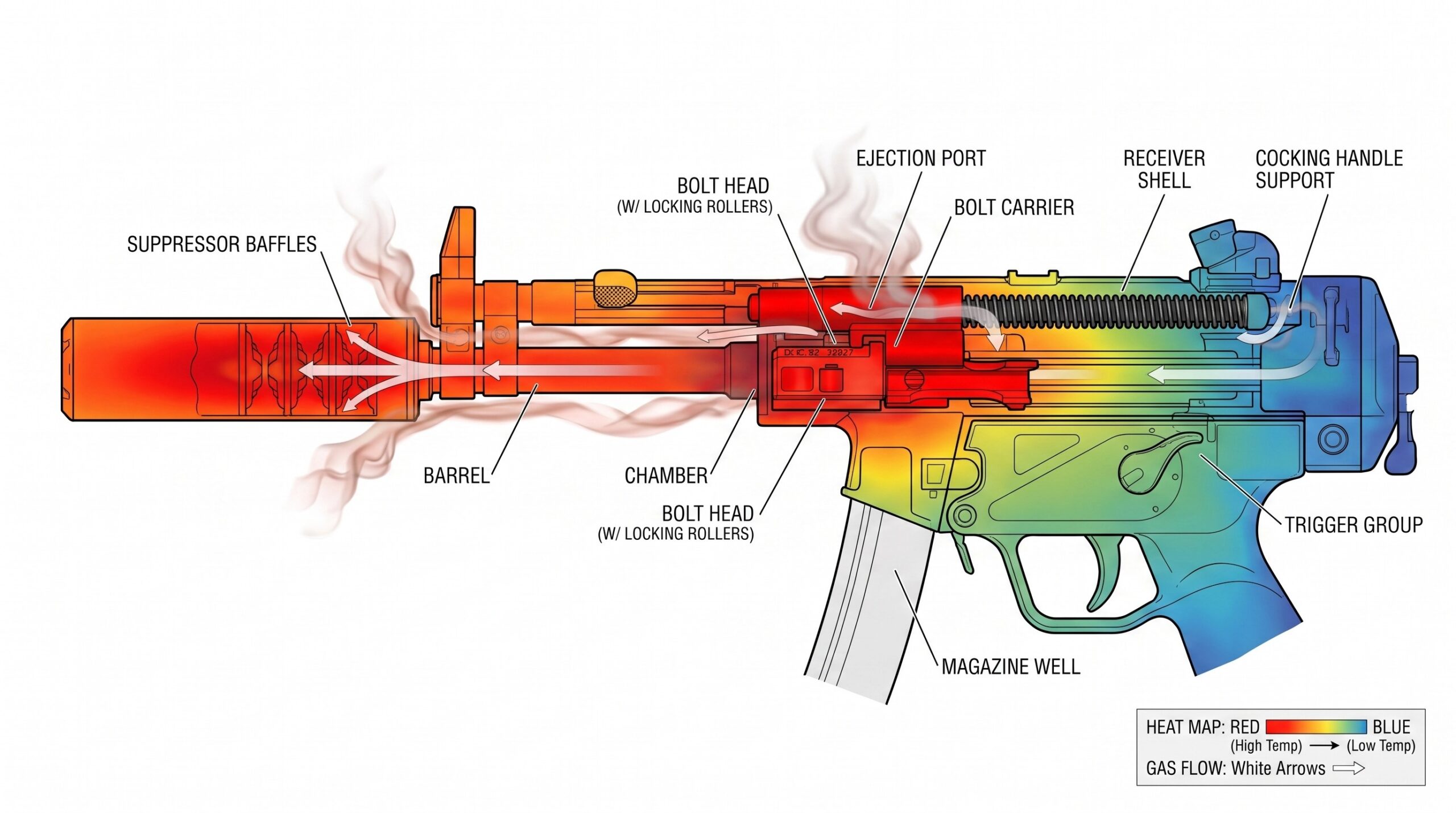
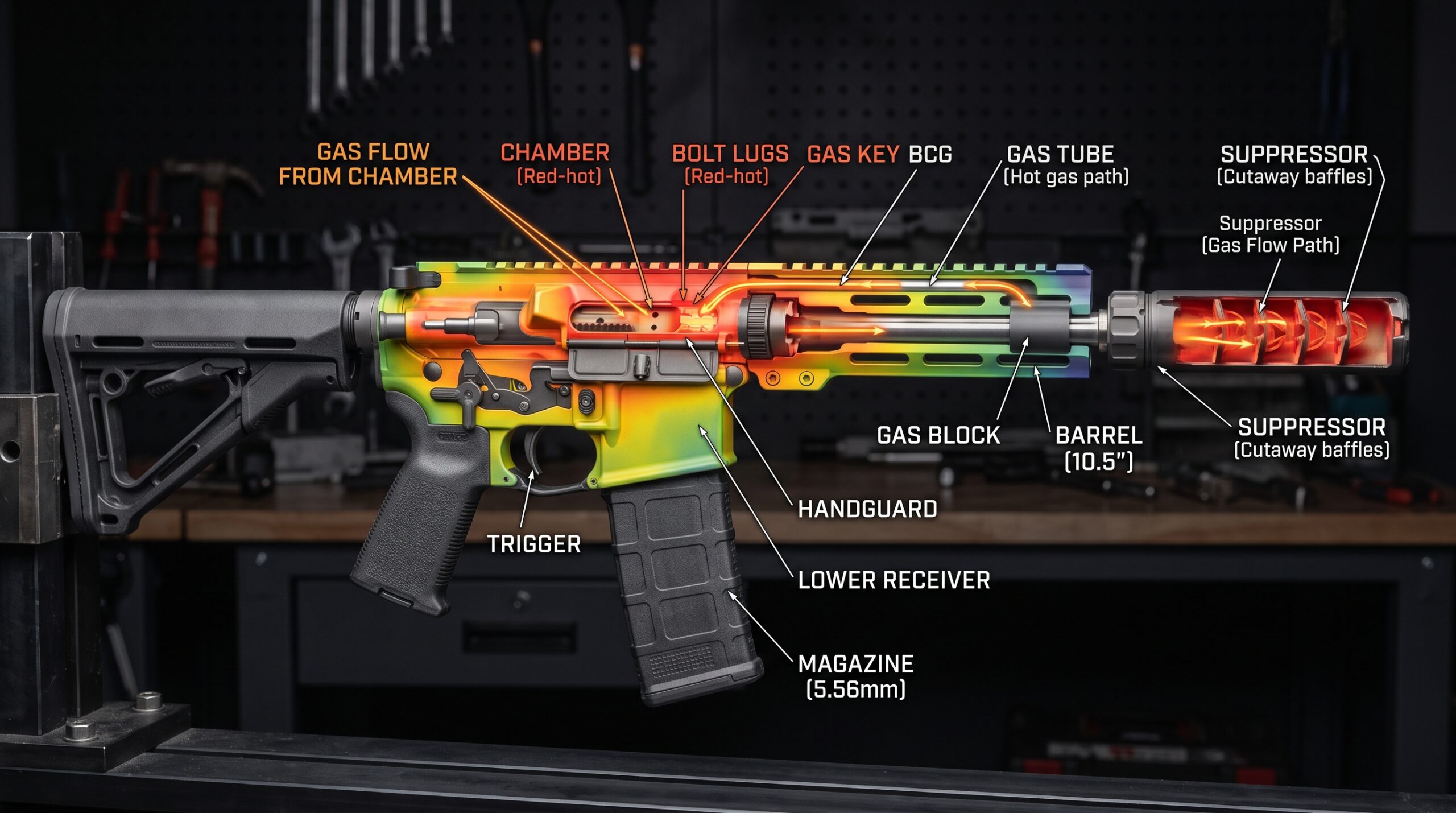
While full-automatic fire establishes a baseline of extreme heat and friction, the addition of a sound suppressor exponentially exacerbates the tribological stress on the weapon system. Suppressors are essentially pressure accumulators; they utilize a series of internal baffles to trap, slow, and cool expanding exhaust gases before they exit the muzzle. While this effectively reduces the acoustic and visual signature, it radically alters the fluid dynamics of the host weapon’s gas system. The delayed blowdown within the suppressor creates significant backpressure, meaning the gas cannot exit the muzzle at its intended velocity.
Because the gas tube operates as a path of least resistance back into the receiver, this backpressure forces a massive volume of superheated gas, unburned propellant, and raw carbon directly into the action. This violent redirection results in a cascading series of mechanical failures for traditional lubricants. First, the higher gas volume violently accelerates the bolt carrier group, drastically increasing the already-high kinetic rate of the automatic weapon and applying unprecedented shear stress on the cam pin and carrier rails. Second, internal operating temperatures spike uncontrollably. Ambient receiver temperatures can rapidly exceed 500°F during sustained suppressed full-auto fire, while the gas directed into the action often reaches between 700°F and 1500°F. This acts like a blast furnace on the internal lubricants, initiating immediate thermal degradation. Finally, aggressive carbon fouling is introduced into the friction zones. Carbon from the propellant is a highly abrasive particulate. When mixed with a failing, drying weapons oil, it creates a highly abrasive, tacky sludge that actively works as a lapping compound, destroying the boundary film and grinding the machine gun to a halt.
The Chemical Failure of Traditional Gun Oils
For decades, the military and civilian sectors have relied on localized formulas known as CLP, an acronym for Cleaner, Lubricant, and Preservative. These formulas are heavily influenced by the Department of Defense MIL-PRF-63460 specification. While standard CLP is adequate for basic preservation in controlled armory settings and light recreational use, it is chemically unsuited for the high-stress, full-automatic, and suppressed environment.
The fundamental flaw of traditional CLP is its mandate to act as a universal, do-it-all fluid. To act as an effective solvent and cleaner, the formulation must contain highly volatile compounds that attack carbon deposits. To act as a preservative, it must contain penetrating agents that displace water. Because so much of the chemical volume is dedicated to active solvents and rust inhibitors, the actual lubricating boundary-film volume is severely compromised.
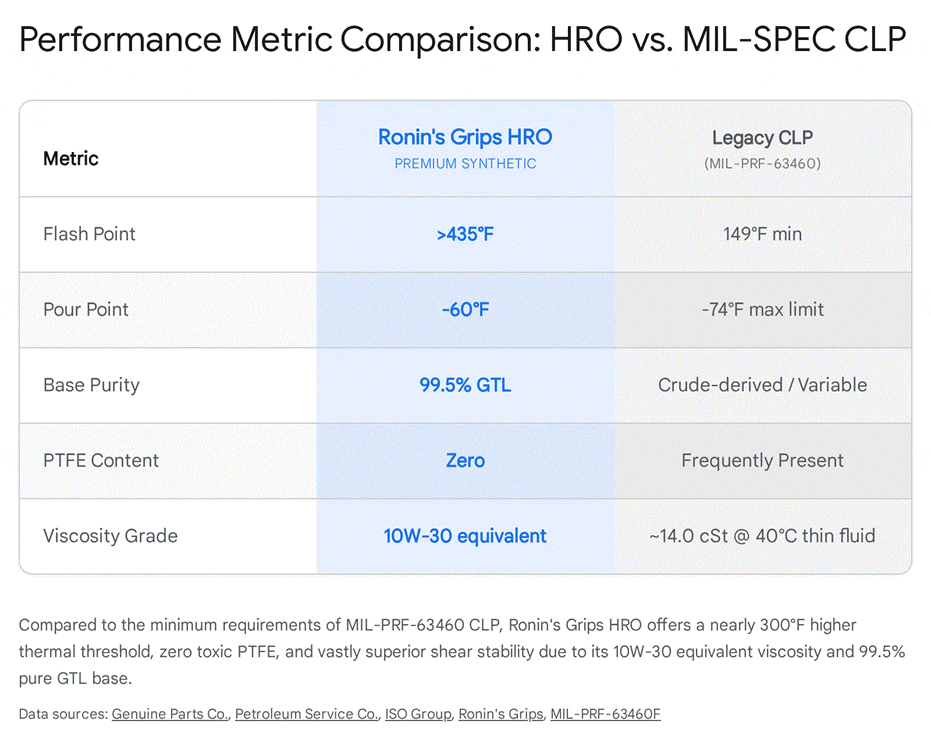
According to the MIL-PRF-63460 specification, the minimum acceptable flash point for a Type B CLP is a mere 140°F (65°C). When introduced to the 500°F+ environment of a full-automatic machine gun chamber, traditional CLPs and legacy gun oils instantly begin to volatilize, evaporating and burning off. When light gun oils vaporize under thermal load, they leave behind two critical detriments: unprotected bare metal and carbon ash. The oil visually disappears, leaving a completely dry weapon. A dry weapon generates exponentially higher friction, which directly leads to sluggish cycling, short-stroking, and the failure of the bolt to fully rotate and lock into the barrel extension. The catastrophic failure of these traditional oils under heat is the precise reason operators are forced to constantly re-lubricate their weapons during range sessions, treating a chemical deficiency with excessive application.
The Architecture of Ronin’s Grips HRO: A Mechanical Paradigm Shift
To solve the catastrophic lubrication failures observed in modern full-auto small arms, Ronin’s Grips developed High Reliability Oil (HRO)1. HRO is not a legacy CLP; it is an ultra-premium, extreme-pressure boundary lubricant. Built upon a proprietary 10W-30 equivalent Gas-to-Liquid (GTL) architecture, HRO represents a monumental leap in weapon tribology. By analyzing the specific chemical parameters of this base formulation, the mechanical superiority of HRO for keeping a machine gun, or even a suppressed machine gun, running continuously becomes chemically quantifiable.
Gas-to-Liquid Base Stock and Absolute Molecular Purity
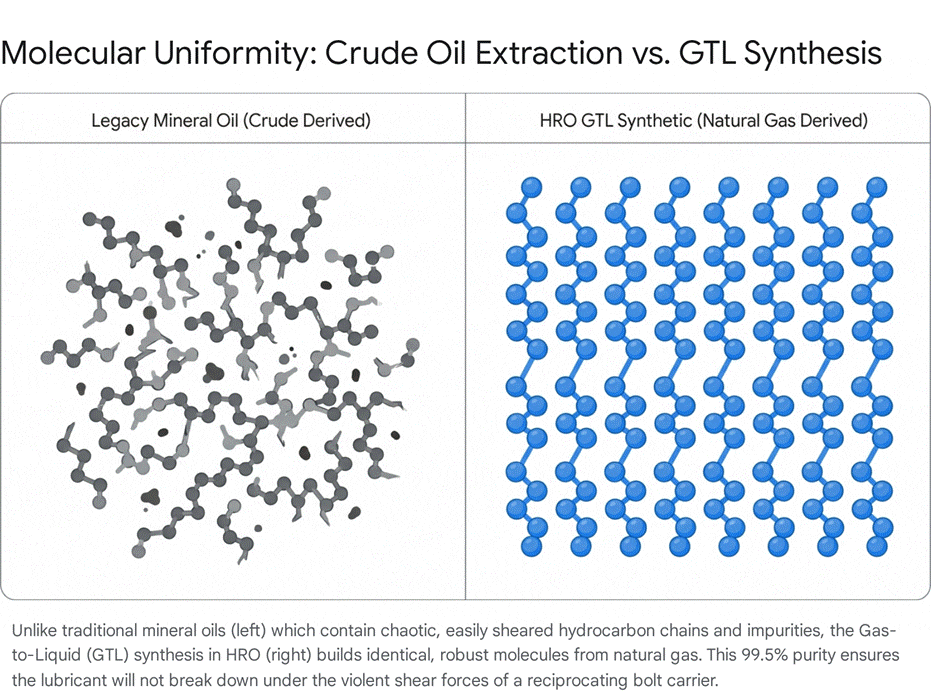
Most conventional gun oils and legacy military lubricants are derived from refined crude oil. Crude oil, regardless of the severity of the hydrocracking or refinement process, inherently contains impurities, sulfur compounds, and a randomized assortment of molecular chain lengths. Under extreme thermal load and mechanical shear typical of a machine gun, these irregular molecules break apart unpredictably, leading to sludge formation, viscosity breakdown, and a rapid loss of lubricity.
HRO completely abandons the outdated methodology of hydrocracking dirty crude oil. Instead, it is synthesized using a revolutionary Gas-to-Liquid (GTL) process. This chemical process takes pure natural gas and chemically builds the lubricating oil molecules entirely from scratch. The result is a synthetic base fluid that is 99.5% free of the performance-robbing impurities found in traditional crude-based gun oils. Because the Gas-to-Liquid molecules are uniformly synthesized to an exact specification, they exhibit extraordinary thermal stability and resistance to shear. When a superheated blast of suppressed gas impinges upon the bolt carrier group during automatic fire, the uniform molecular chains of HRO do not fracture. The fluid remains slick, structurally intact, and highly resistant to oxidation.
NOACK Volatility and Surviving the 500°F Threshold
The true empirical measure of a weapons lubricant’s ability to survive in a full-automatic or suppressed firearm is its volatility, defined as the rate at which the fluid boils off and evaporates under sustained heat2. In advanced tribology, this is measured by the ASTM D5800 NOACK Volatility test2. During this stringent evaluation, a precisely weighed sample of the oil is heated to 482°F (250°C) for exactly one hour under a constant airflow. The mass lost to evaporation is then measured, reporting the oil’s volatility rating as a percentage.
While conventional mineral-based CLPs and light firearm oils experience massive evaporative loss under these conditions, often exceeding 15% mass loss during sustained thermal exposure, Ronin’s Grips HRO recorded a remarkable low NOACK volatility of just 4.7%.
This is an elite metric that directly explains how HRO survives the 500°F threshold. It signifies that when a suppressed machine gun’s bolt carrier group reaches 482°F (250°C), over 95% of the liquid lubricant resists boiling off and remains physically present on the weapon’s components. Additionally, its flash point exceeds 435°F (224°C). This ensures that even in a glowing-hot receiver, the base fluid refuses to burn off or leave the metal dry. The lubricant physically remains exactly where it was applied, maintaining its protective fluid cushion on the critical cam pin and carrier rails.
Optimal Kinematic Viscosity for Firearm Dynamics
Viscosity is the measure of a fluid’s internal resistance to flow. If a firearm oil is too thin, it is instantly pushed out of the way by the mechanical pressure of the reciprocating mass, failing to adequately separate the metals. Conversely, if a heavy grease is used, it causes sluggish cycling, traps excessive environmental debris, and dramatically slows the bolt velocity, especially as temperatures drop.
HRO strikes the exact tribological sweet spot for automatic weapons operation. Possessing a kinematic viscosity equivalent to a 10W-30 grading, this precise rheological profile allows the fluid to be thin enough to penetrate microscopic surface pores and flow smoothly into the tight tolerances of the gas rings, yet thick enough to form a tenacious, clinging boundary cushion on the cam channel and locking lugs. This ensures the lubricant will not easily sling off or migrate during the violent, high-velocity reciprocating action of full-automatic fire.
Mechanochemistry: The ZDDP Anti-Wear Arsenal
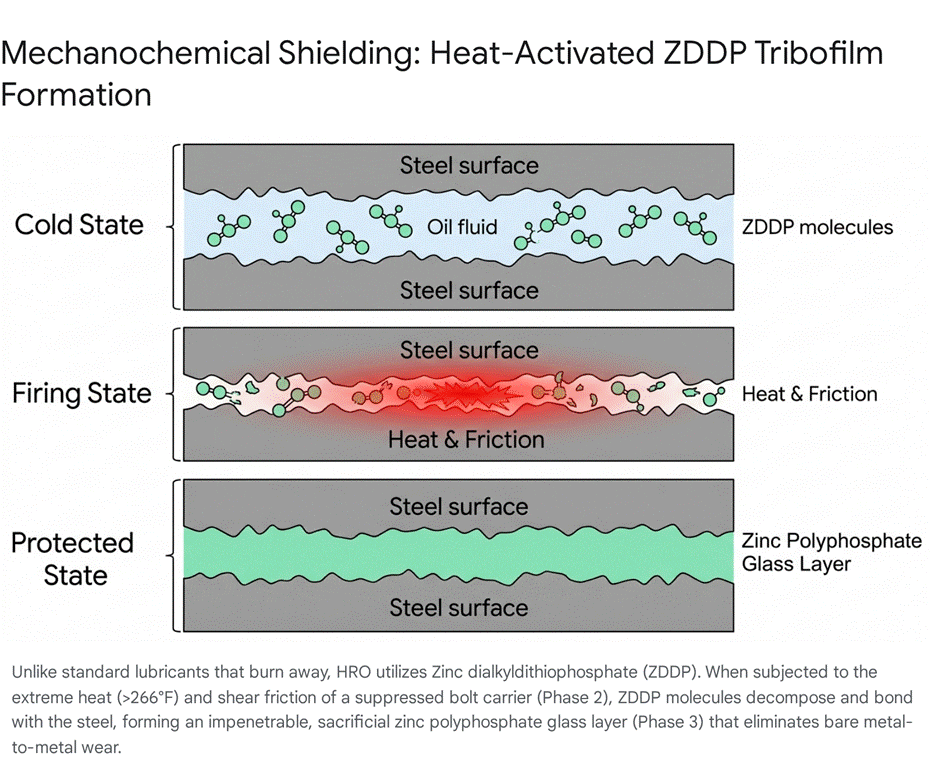
While the Gas-to-Liquid base provides unyielding thermal stability and a resilient fluid cushion, the true combat effectiveness of Ronin’s Grips HRO lies in its proprietary anti-wear additive package, heavily reliant on Zinc Dialkyldithiophosphate (ZDDP)4. The inclusion of ZDDP elevates HRO from a standard barrier lubricant to a chemically active, sacrificial armor system designed for the rigors of sustained machine gun fire.
The Tribofilm Formation Mechanism: The Second Stage of Heat Defense
Think of HRO as having a built-in backup system for when things get really hot. In a high-performance firearm, the liquid oil can sometimes get squeezed out or thinned down by the intense 500°F heat. This is where ZDDP steps in as a “smart” shield. It doesn’t just sit there; it waits for the right moment to activate. This activation isn’t just caused by the heat of the weapon, but specifically by the physical pressure of metal parts grinding together, like the cam pin twisting hard against the channel wall.
When that intense pressure hits, the ZDDP molecules actually break down and rebuild themselves into a solid, protective “glass” layer. This ultra-thin barrier, known as a tribofilm, acts as a physical wall between the steel parts. It prevents the metal from touching directly, which stops the parts from scratching, welding together, or wearing out during heavy use.
Crucially, this explains how HRO continuously protects the weapon even at extreme temperatures: because the tribofilm is a chemically bonded solid rather than a liquid, it cannot evaporate. It acts as physical armor that separates the metal surfaces, guaranteeing protection even when extreme thermal stress thins the surrounding liquid boundary layer. The tribofilm exhibits a rough, pad-like solid structure bonded directly to the steel surface, consisting of a sulfur-enriched base layer topped with a thick matrix of polyphosphate glass.
Protecting the Critical Components
This polyphosphate glass layer is intentionally sacrificial. Instead of the hardened steel of the weapon wearing down, shearing, or cracking under the stress of automatic fire, the ZDDP tribofilm takes the mechanical damage. As the tribofilm is worn away by repeated cycling, new ZDDP molecules from the surrounding HRO immediately replenish it, creating a self-healing, regenerative armor.
When a suppressed machine gun is fired, the physical torque exerted on the cam pinhole is immense. The friction on the cam shoulders creates a mechanical disadvantage that frequently leads to catastrophic bolt breakage directly at the cam pin hole. By thoroughly coating the cam pin and channel with HRO, the operator leverages the ZDDP tribofilm to drastically reduce the localized friction coefficient. This alleviates the extreme torque stress on the bolt structure, ensuring continuous full-auto operation and preventing catastrophic metallurgical failure.
HRO Additive Profile
Tribological Function in Firearms
Zinc Dialkyldithiophosphate (ZDDP)
Mechanochemical activation under shear stress forms sacrificial polyphosphate glass tribofilms to prevent steel-on-steel galling.
Active Cleansing Agents
Extreme detergency; chemically isolates, lifts, and suspends aggressive carbon, copper, and lead fouling from suppressed blowback.
Detergency: Countering Full-Auto Carbon Fouling
As previously established, sustained automatic fire, especially when suppressed, dictates a drastic increase in the volume of carbon forced back into the receiver. Carbon is the absolute enemy of mechanical reliability; it is highly abrasive, it acts as a desiccant that absorbs light lubricants, and it eventually polymerizes into a hard, baked-on lacquer that halts the bolt carrier group entirely. Standard gun oils possess almost zero ability to actively manage this carbon ingress. They merely sit passively on the surface until they are overwhelmed by the growing particulate mass.
Active Cleansing Agents
HRO fundamentally alters this dynamic by utilizing highly specialized Active Cleansing Agents directly integrated into its pure synthetic base. Because the 99.5% pure GTL foundation has no inherent impurities, these additives do not waste chemical energy fighting the degradation of the oil itself. Instead, 100% of the active detergent package is dedicated to isolating, lifting, and suspending carbon, copper, and lead fouling.
When hot carbon and unburned powder are blown back into a bolt carrier group lubricated with HRO, the active cleansing agents immediately engage. Rather than allowing the carbon to adhere to the steel surfaces and form hardened, baked-on deposits, the detergents chemically surround and encapsulate the microscopic carbon particles.
The Suspension Effect
Once encapsulated, the carbon is held in a state of localized suspension within the fluid matrix of the oil. During a high-volume string of fire, the oil will visibly turn black. Rather than indicating failure, this is visual confirmation that the tribological technology is working precisely as engineered: the carbon is suspended in the fluid rather than bonded to the metal.
Because the carbon is suspended, it is prevented from acting as an abrasive grinding paste against the upper receiver and the steel carrier rails. Furthermore, when it is time to perform post-operation weapon maintenance, the operator is not required to use harsh chemical solvents or aggressive scraping tools. Because the carbon is floating freely within the oil barrier, simply wiping the bolt carrier group with a standard cloth removes the vast majority of the fouling.
Rheological Stability in Extreme Climates
A combat-ready weapons lubricant cannot only excel in extreme heat; it must remain highly viable and mechanically fluid in sub-zero environments. Many heavy greases or legacy oils utilized by operators to combat the heat of sustained fire become critical mechanical liabilities in the cold.
As ambient temperatures drop, traditional mineral-based gun oils suffer from severe wax crystallization. The paraffinic molecules begin to bind together, causing the oil to thicken, lose its hydrodynamic properties, and eventually gel into a semi-solid state. When a lubricant gels within a firearm, the cyclic rate plummets. The buffer spring cannot generate sufficient forward kinetic energy to overcome the sticky, viscous resistance of the frozen oil, resulting in a failure to feed or a failure of the firing pin to strike the primer with sufficient force to initiate ignition.
Because Ronin’s Grips HRO is synthesized purely from natural gas, it entirely lacks the waxy impurities that plague crude-derived oils. Its pour point, defined as the lowest temperature at which the fluid will maintain flow, is exceptionally robust, rated reliably down to -60°F (-48°C).
Even in arctic or extreme winter conditions, HRO remains highly fluid. It maintains its protective cushion on the carrier rails without transforming into a viscous adhesive, eliminating cold-weather sluggishness. The weapon cycles at its intended mechanical speed, the firing pin strikes with uninhibited kinetic energy, and the operator maintains full automatic capability regardless of the ambient climate.
Thermal & Viscosity Specifications
HRO Performance Base
Implications for Weapon Operation
Flash Point (ASTM D93)
> 435°F (224°C)
Prevents the lubricant from igniting or burning off when exposed to the extreme temperatures of suppressed and full-auto systems.
NOACK Volatility (ASTM D5800)
4.7% loss
Retains over 95% of its mass under extreme heat, ensuring the machine gun does not run dry during high-volume strings of fire.
Pour Point (ASTM D97)
-60°F (-48°C)
Prevents wax crystallization and gelation; guarantees the buffer spring has enough energy to chamber a round in arctic conditions.
Base Fluid Purity
99.5% GTL Synthetic
Ensures a pristine, stable fluid matrix devoid of the impurities that cause crude-based oils to sludge and fail under shear.
Strategic Conclusion
The aggregated tribological data clearly indicates that the traditional approach to weapon lubrication, relying on thin, highly volatile CLPs optimized for basic corrosion protection rather than boundary friction, is fundamentally obsolete for the modern professional. The reliance on full-automatic machine guns, increased cyclic rates, and the widespread integration of sound suppressors has created a thermodynamic and kinetic environment that physically destroys these legacy fluids. This leads to rapid carbon adherence, immediate loss of the boundary film, and catastrophic component wear during sustained firing schedules.
Ronin’s Grips High Reliability Oil represents the apex of modern tribological engineering adapted for high-stress small arms. By utilizing a specialized, Gas-to-Liquid synthesized base, HRO directly addresses every failure point of full-automatic and suppressed fire. Its elite thermal immunity, demonstrated by a NOACK volatility of just 4.7% and a flash point exceeding 435°F, ensures the fluid physically remains on the weapon components long after legacy gun oils have vaporized. The optimized concentration of ZDDP acts as an intelligent, pressure-activated armor, forming a sacrificial polyphosphate glass tribofilm under shear stress that prevents adhesive wear. Furthermore, the active cleansing agents directly counter the aggressive carbon blowback inherent to automatic fire, encapsulating the fouling to ensure the weapon cycles smoothly and cleans easily.
For the professional operator, a machine gun is a life-saving mechanical tool. Protecting that tool against extreme friction and heat requires advanced chemical engineering. Ronin’s Grips HRO is an active, defensive fluid barrier designed explicitly to master the heat, friction, and fouling of the modern weapon system, offering unparalleled mechanical reliability when failure is not an option.
This technical marketing study was synthesized using a combination of applied firearm tribology, military specification analysis, and peer-reviewed chemical research. The mechanical stresses and thermodynamic challenges of full-automatic and suppressed weapon systems were established using direct impingement operational data and recognized boundary lubrication principles.
The baseline performance of traditional firearm lubricants was evaluated against the general parameters of the Department of Defense MIL-PRF-63460 specification for Cleaner, Lubricant, and Preservative (CLP) compounds. The chemical and physical performance metrics of High Reliability Oil (HRO) were derived from verified technical data on 10W-30 equivalent Gas-to-Liquid (GTL) synthetic base stocks, utilizing industry-standard ASTM D5800 NOACK Volatility and ASTM D93 Flash Point testing protocols.
Furthermore, the mechanochemical activation mechanisms of the Zinc Dialkyldithiophosphate (ZDDP) additive package, specifically its ability to form sacrificial polyphosphate glass tribofilms under shear stress, were validated through advanced tribological studies utilizing atomic force microscopy and elastohydrodynamic lubrication (EHL) modeling.
Tribofilm Formation and Friction Reduction Performance on Laser-Textured Surface with Micro-Grooved Structures – MDPI, https://www.mdpi.com/2075-4442/12/3/91
The United States rifle optic market experienced significant analytical discourse and consumer evaluation throughout July 2026. A comprehensive review of localized social media platforms, dedicated firearm engineering forums, and consumer review aggregates indicates a maturing market defined by a strict demand for hybridized optical solutions. Consumers and professionals alike are aggressively moving away from traditional singular optic setups in favor of integrated systems. These systems primarily consist of Low Power Variable Optics (LPVO) paired with offset or piggybacked micro red dots, or high-tier microprisms combined with secondary magnification devices, reflecting a broader trend in advanced small arms optics.
The collected data indicates a distinct plateau in the development and consumer acceptance of extremely high magnification LPVOs, such as the 1-10x configurations that dominated previous years. Technical discussions center heavily on the physical limitations of convex lenses in compact 34mm tubes, specifically focusing on tight eye boxes, unforgiving eye relief, and poor light transmission at maximum magnification settings. Concurrently, the closed-emitter micro red dot market has reached a state of near ubiquity. Legacy brands with established military pedigrees are facing unprecedented pressure from aggressive market disruptors. These challengers are offering comparable metallurgical durability, often utilizing identical 7075-T6 aluminum forgings, alongside superior battery efficiency and advanced reticle technology at significantly lower price points.
This report identifies the top ten most discussed rifle optics in the United States for the month of July 2026. The analysis evaluates these optical systems through the lens of optical physics, materials science, and quantifiable consumer sentiment. Variables such as thermal drift in holographic systems, objective lens clarity, focal plane geometry, and secondary market value retention are quantified and assessed. To satisfy the requirement of understanding consumer perspective, direct examples of user commentary are woven into the technical analysis. The findings demonstrate a consumer base that is increasingly educated on optical engineering principles, heavily prioritizing lifetime transferable warranties, astigmatism-friendly etched reticles, and passive aiming capabilities for night vision applications.
Top 10 Most Discussed Rifle Optics: Summary of Findings
The following table presents the top ten most discussed rifle optics for the target period of July 2026, ranked from most discussed to least discussed. Sentiment percentages were derived by analyzing the contextual framing of mentions across platforms, categorizing statements into positive endorsements, negative criticisms, or neutral technical inquiries.
Rank
Optic Model
Optic Category
Positive (%)
Negative (%)
Neutral (%)
Primary Catalyst for Discussion
1
Vortex Razor HD Gen III 1-10×24
LPVO
55%
30%
15%
Debates regarding 1x performance, durability, and eye box limitations at 10x magnification.
2
Aimpoint T2 Micro
Micro Red Dot
65%
15%
20%
Maintained status as the benchmark for night vision use, countered by complaints regarding its high retail price.
3
Primary Arms PLxC 1-8×24
LPVO
80%
5%
15%
Praised for extreme weight reduction, Japanese glass quality, and a highly competitive price-to-performance ratio.
4
EOTech EXPS3
Holographic
50%
35%
15%
Unmatched passive aiming for night vision, heavily criticized for poor battery life, delamination, and thermal drift.
5
Holosun AEMS
Enclosed Red Dot
75%
10%
15%
Dominating the mid-tier market due to enclosed emitter reliability, multi-reticle options, and night vision capability.
Viewed as the primary alternative to the Aimpoint T2, utilizing AAA batteries and featuring advanced reticles.
7
Nightforce ATACR 1-8×24
LPVO
60%
25%
15%
Recognized for bomb-proof durability and military contracts, but criticized for high costs and restrictive 1x field of view.
8
Primary Arms SLx MicroPrism
Prism Optic
85%
5%
10%
The premier solution for shooters with astigmatism, featuring etched reticles and high durability at a budget price.
9
Aimpoint Duty RDS
Micro Red Dot
45%
30%
25%
Viewed as a budget compromise, criticized for proprietary mounting heights and lacking premium value.
10
Vortex Viper PST Gen II
LPVO / Precision
70%
10%
20%
The enduring standard for entry-level precision rifles, heavily supported by an unconditional lifetime warranty.
The analysis of these ten optics provides a window into the broader technological and economic trends shaping the industry in 2026. The following sections detail the specific technical parameters, consumer discussions, direct user quotes, and engineering realities of each platform.
Detailed Analysis of Top 10 Optics
1. Vortex Razor HD Gen III 1-10×24
The Vortex Razor HD Gen III 1-10×24 commanded the highest overall volume of discourse in July 2026. Designed as a flagship Low Power Variable Optic, it is intended to bridge the gap between fast close-quarters engagement and medium-range precision. The optic operates on a First Focal Plane mechanism, meaning the reticle scales dynamically with the magnification setting.
From an engineering perspective, achieving a true 10x magnification multiplier within a standard 34mm tube requires significant optical compromises. The physical limitations of traditional convex lenses necessitate highly complex internal geometries. This internal density inherently reduces overall light transmission and restricts the eye box at the maximum 10x magnification setting. First Focal Plane reticles create a secondary engineering challenge. While they ensure that reticle subtensions remain accurate for measuring wind and drop at all magnification levels, the reticle becomes exceptionally small and difficult to acquire visually at 1x without robust daylight-bright illumination. Vortex addresses this with a highly luminescent center dot powered by a fiber optic wire, though consumers continually debate its utility in complex lighting environments.
Consumer sentiment was highly polarized, finalizing at 55% positive, 30% negative, and 15% neutral. The positive discourse focused heavily on the optic’s versatility, its pristine edge-to-edge clarity in the mid-magnification ranges between 4x and 8x, and the unparalleled Vortex VIP lifetime warranty. Direct user commentary highlighted its capability, with one user stating, “Razor 1-10 for sur-thrive-al. It’s crisp, it’s clear, it’s fun to magnify up. The novelty of it just doesn’t wear off for me. My ass got deployed with iron sights, being able to see far good is a revelation.” Another user evaluating cost-to-performance noted, “If you want the 2nd best option for around 30% less in cost, get the Razor.”
However, the 30% negative sentiment was substantial. Criticisms focused strictly on the tight eye relief and unforgiving eye box at the 10x setting. Users noted that mounting the optic on lightweight 14.5-inch or 16-inch carbines resulted in severe scope shadow during rapid movement. Furthermore, the parallax is stated at 150 yards but has been confirmed by users and customer service to be fixed at approximately 190 yards. Analysts in the forums noted this fixed parallax causes noticeable focal degradation when shooting past 400 yards compared to precision scopes featuring adjustable parallax turrets. The general consensus indicates that while the Razor 1-10x is a technological marvel, the optical compromises required to reach 10x magnification may not justify the degradation of 1x speed for the average civilian user.
The Aimpoint T2 Micro remains the undeniable benchmark for closed-emitter red dot sights. It was heavily discussed throughout July 2026 due to its widespread and enduring adoption by military units, law enforcement agencies, and civilian professionals. The optical engineering relies on a high-efficiency Light Emitting Diode reflecting off a specialized aspherical lens coating. The main housing is constructed from forged 7075-T6 aluminum, providing exceptional tensile strength and crush resistance.
A critical point of ongoing discussion surrounding the T2 is its performance under night vision devices. The specific wavelength of the LED and the proprietary notch filter lens coatings allow for near-perfect light transmission when viewed through image intensifier tubes. The optic yields an estimated 50,000 hours of continuous battery life. This metric has become the gold standard for duty readiness, allowing users to leave the optic powered on for years at a time without fear of failure.
Sentiment for the Aimpoint T2 was strongly favorable at 65% positive, 15% negative, and 20% neutral. Users continually praised its legendary durability and established combat pedigree. Direct commentary frequently pointed to its simplicity and reliability, with one user stating, “Aimpoint micro T2. One and done.” Another user highlighted the practical benefit of the battery life, noting that you “Can leave on for 2 years straight and know that when you grab it its ready to go.”
The 15% negative sentiment was almost exclusively driven by extreme price fatigue and feature stagnation. In 2026, the market is saturated with mid-tier optics offering similar features for significantly less money. Consumers expressed growing frustration that Aimpoint has not updated the T2 to include modern quality-of-life features, such as accelerometer-based shake-awake technology or multi-reticle options, despite retaining a premium price tag often exceeding $800. The consensus is that while the T2 is structurally peerless, the diminishing returns on investment are becoming glaringly apparent as competitors rapidly close the technological gap.
The Primary Arms PLxC 1-8×24 emerged as the most positively discussed optic in the LPVO category, fundamentally disrupting the high-end market previously dominated almost exclusively by Vortex and Nightforce.
The engineering of the PLxC focuses heavily on weight reduction and optical flattening. Utilizing high-density, low-dispersion Japanese glass, the engineering team at Primary Arms managed to shorten the overall length of the optic and reduce the weight by several ounces compared to its direct competitors. This was achieved while maintaining a standard 30mm tube. The optic utilizes the ACSS Raptor reticle in a First Focal Plane configuration, providing advanced ballistic drop compensation, wind holds, and moving target leads that scale accurately.
Achieving an impressive 80% positive sentiment, 5% negative, and 15% neutral, the discourse surrounding the PLxC bordered on universal acclaim. The critical discussion points centered on its near-perfect 1x presentation. Users reported that the optical distortion at the extreme edges of the glass at 1x is virtually nonexistent, presenting a flat, bezel-less image that genuinely rivals traditional red dots for speed of acquisition. Users directly compared it to legacy optics, stating, “In short, the PLXC rdb is basically just a better product, made with more modern materials and is substantially cheaper.” Another user evaluating multiple premium LPVOs concluded, “Hands down the PLXc RDB wins by a mile.”
Furthermore, the optic’s retail price is significantly lower than the ATACR and Razor, and it is backed by a comprehensive lifetime warranty covering normal wear and tear. The minimal 5% negative sentiment primarily focused on a slightly darker image at maximum 8x magnification compared to the massive 34mm tube of the ATACR. This is an unavoidable consequence of optical physics when funneling light through a narrower 30mm erector system.
The EOTech EXPS3 generated high volumes of discussion, primarily characterized by intense, ongoing debates over the inherent advantages and severe physical drawbacks of true holographic weapon sight technology.
Unlike LED red dots that reflect light off a curved front lens, the EXPS3 utilizes a complex laser diode to illuminate a holographic grating. This process projects a three-dimensional reticle, typically a 68 MOA outer ring and a 1 MOA center dot, that appears to float perfectly on the target plane downrange. This specific optical pathway eliminates the need for thick objective lens coatings that restrict light transmission, resulting in a perfectly clear viewing window. More importantly, holographic technology exhibits near-zero parallax error. In practical combat or competition applications, if the shooter’s eye is significantly off-axis due to an unconventional barricade position, the point of impact remains completely true to the point of aim.
Despite these massive optical advantages, the EXPS3 recorded a heavily polarized 50% positive, 35% negative, and 15% neutral sentiment. The positive discussions heavily emphasized its absolute superiority for passive aiming under night vision and its seamless integration with magnifiers. Because the reticle is a hologram, placing a 3x or 5x magnifier behind it magnifies the target but does not artificially inflate the 1 MOA center dot, preserving extreme precision at distance. Dedicated users remain fiercely loyal, with one stating, “anytime you see real sh!t getting done the real ones always have Eotechs.” Another user succinctly labeled it, “the exps3 is the NV G.O.A.T.”
The 35% negative sentiment focused extensively on the engineering compromises required for laser emission. The internal laser diode consumes immense electrical power, reducing battery life to roughly 1,000 continuous hours, which is a fraction of an LED’s lifespan. Furthermore, the optic suffers from heavily documented thermal drift. Extensive discussions referenced historical legal and testing data indicating that in extreme temperature fluctuations, the internal optical mounts can expand or contract. This causes the point of impact to shift away from the original zero by several Minutes of Angle. Secondary complaints focused on the tendency of the internal glass elements to physically delaminate over time. One frustrated user commented, “Plus it may delaminate in an unreasonable amount of time which is a bullshit design flaw in the first place.”
The Holosun AEMS (Advanced Enclosed Micro Sight) has firmly established itself as the dominant force in the mid-tier optic market. The foundational design philosophy behind the AEMS prioritizes a massive viewing window within a highly compact, closed-emitter housing. The main body is milled from 7075-T6 aluminum, providing a level of duty-grade durability that surpasses older polymer or 6061-T6 designs commonly found in this price bracket.
The optical system utilizes advanced, highly efficient LED technology to project a multi-reticle system. This feature allows the user to manually toggle between a 2 MOA dot, a 65 MOA circle, or a combination of both depending on the operational requirement. Furthermore, the AEMS incorporates a specialized solar fail-safe array on the top of the housing. This array powers the optic in bright ambient conditions to supplement the internal battery, theoretically extending the lifespan to roughly 50,000 hours.
The sentiment surrounding the AEMS was overwhelmingly positive at 75%, with 10% negative and 15% neutral. Discussions continually cited the optic as the absolute perfect compromise between the astronomical cost of an Aimpoint T2 and the unreliability of extreme budget options. One highly supportive user called the AEMS “the toaster of red dots,” implying it is a reliable, ubiquitous appliance that simply works every time. Another user advising a new buyer stated, “AEMS is the most bang for the buck in your case. In most cases, honestly.”
Users heavily praised the large, square window geometry, which provides situational awareness comparable to the EOTech EXPS3, but without the associated battery drain or thermal drift. The 10% negative sentiment was minor and primarily focused on the proprietary mounting footprint. While aftermarket companies like Unity Tactical and Scalarworks have released adapter plates, the lack of native compatibility with the industry-standard Aimpoint Micro footprint frustrated users who already owned expensive mounts. Additionally, some users noted a slight blue tint on the objective lens which is less than ideal when used under night vision.
The Sig Sauer Romeo 4XT Pro has gained immense traction over the past two years, directly challenging the Aimpoint T2’s long-standing monopoly on professional-grade micro red dots. Assembled in the United States, the 4XT Pro utilizes a standard AAA battery rather than the traditional CR2032 lithium coin cell. This specific engineering choice slightly increases the overall length of the optic housing but provides unparalleled logistical convenience, as AAA batteries are globally ubiquitous and easily sourced in austere environments.
The optic features a quad-reticle system and dedicated, tactile night vision override buttons, ensuring immediate transition into passive aiming profiles without scrolling through daylight settings. The housing construction is robust, and the optic has successfully secured various Federal Bureau of Investigation and localized law enforcement contracts, establishing a verified combat and duty pedigree.
Sentiment was heavily positive at 70%, with 15% negative and 15% neutral. The primary discussion points focused intensely on its value proposition. The 4XT Pro offers significantly more technical features than the T2 at a much lower retail price. Users summarized this sentiment clearly, with one stating it is “Good as an Aimpoint but more like EOTech or less price.” Another user bluntly evaluated the market stating the 4XT Pro is “Half the price of a T2 with arguably better performance and features for sure.”
Users heavily praised the crispness of the dot under magnification and the extreme clarity of the glass under night vision. However, the 15% negative sentiment highlighted a specific engineering flaw related to the objective lens coating. Users operating in bright, direct sunlight reported severe emitter glare. This is a phenomenon where the internal LED reflects off the rear of the front lens, creating a red haze that obscures the target. Furthermore, some hard-use consumers complained that the external rubberized buttons were prone to accidental actuation when rubbing against gear, requiring users to purchase 3D-printed aftermarket cages to protect the brightness settings during movement.
The Nightforce ATACR 1-8×24 F1 operates in the absolute ultra-premium tier of the LPVO market. Designed explicitly to meet the rigorous specifications of United States Special Operations Command, the optic prioritizes absolute mechanical reliability and zero retention over weight reduction and aesthetic appeal.
Housed in a massive 34mm main tube composed of aerospace-grade aluminum, the ATACR features extremely robust internal erector springs and thick turret mechanisms. This engineering ensures that the optic maintains zero regardless of severe kinetic impact, rapid atmospheric pressure changes, or sustained recoil. The optical path utilizes ED glass to mitigate chromatic aberration at distance. The reticle utilized is the FC-DMx in the First Focal Plane, featuring a segmented circle for fast 1x acquisition and a precise milliradian grid for holdovers when dialed up to 8x.
While universally respected for its military heritage, the sentiment was highly mixed for civilian applications, landing at 60% positive, 25% negative, and 15% neutral. The positive discourse acknowledged the optic as the most durable LPVO in existence, capable of surviving impacts that would shatter lesser scopes. One user encapsulated this absolute trust, stating, “ATACR is end all be all IMO.”
However, the negative sentiment heavily scrutinized the cost-to-performance ratio for non-military users. Termed the “DoD tax” by analysts, the retail price often exceeds $2,800 on the commercial market. One user who owned both leading LPVOs noted, “Razor is the better move imo, atacr is..fine, but massively overpriced.” Furthermore, precise optical analysis by users indicated that the 1x performance is lacking compared to the Razor and PLxC. The thick 34mm housing creates a noticeable “looking through a tube” effect, diminishing peripheral situational awareness when shooting with both eyes open. The consensus remains that unless the user requires absolute, bomb-proof durability for duty use, other optics offer superior optical characteristics at a much more palatable price point.
The Primary Arms SLx MicroPrism series, available in fixed 1x, 3x, and 5x configurations, represents a massive technological shift in the budget-to-mid-tier optic market.
Prism optics differ fundamentally from reflex red dot sights. Instead of reflecting an LED off a single curved front lens, a prism scope uses a solid glass prism block to focus the image. This structural difference allows the manufacturer to physically etch the reticle directly into the glass itself. If the battery dies or the electronics fail entirely, the reticle remains perfectly visible as black crosshairs. More importantly, the system incorporates an adjustable diopter at the ocular lens. This is a critical engineering feature for shooters suffering from astigmatism. Traditional LED red dots often appear as starbursts, smeared lines, or dual dots to an eye with an irregular cornea. The diopter allows the user to focus the etched reticle perfectly to their specific ocular prescription, resulting in a perfectly crisp aiming point regardless of eye condition.
With an 85% positive sentiment rating, the SLx MicroPrism was the highest-rated optic in the dataset relative to its discussion volume. Discussions highlighted its extreme durability, highly compact lightweight footprint, and the immense utility of the ACSS ballistic reticle. Users were highly enthusiastic about the value, with one stating, “Honestly, the Primary Arms is a phenomenal optic for the price, and I highly recommend it.” The 3x and 5x models were frequently cited as modern, cost-effective replacements for the legendary, but aging, Trijicon ACOG.
The minimal 5% negative sentiment primarily focused on the inherent limitations of prism technology. Unlike a red dot, which has infinite eye relief, the shooter must position their head at a specific, fixed distance behind a prism optic to achieve a full sight picture without shadow. This physical requirement can slow down rapid target acquisition in unconventional or cramped shooting positions. Additionally, some users noted that stepping up to the GLx line provided better glass, stating, “The SLX is OK, but the GLX has a better reticle and clearer glass.”
The Aimpoint Duty RDS was released specifically as an economic bridge between the high-end T2 and the much older, bulkier entry-level PRO model.
Constructed from pressure-forged aluminum, the optic maintains Aimpoint’s rigorous internal standards for waterproofing, shock resistance, and battery efficiency. The engineering alterations primarily involve the mounting interface and the objective lens coatings. To reduce overall manufacturing costs, Aimpoint altered the internal LED placement and the external housing geometry.
The resulting consumer sentiment was notably poor for a tier-one manufacturer, recording only 45% positive, 30% negative, and 25% neutral. While some defenders noted that “for 95% of shooters, an Aimpoint Duty RDS will be ‘good enough’ for you,” the broader market was highly critical. The negative discussions focused on the mounting footprint. The altered geometry of the housing means that the Duty RDS does not align with standard Aimpoint Micro mounting heights, which can complicate co-witnessing with iron sights and require different mounts. Users actively compared it poorly against its peers, noting that institutional buyers like the FBI switched to the Aimpoint Duty RDS, which some users feel is significantly worse than the Sig 4XT Pro. While 25% of the discussion remained neutral, acknowledging that it is a highly reliable optic for the price, the consensus indicated that consumers prefer to save money for a T2, or simply purchase a Sig Sauer 4XT Pro or Holosun AEMS instead.
The Vortex Viper PST Gen II line remains the absolute workhorse of the precision and general-purpose rifle community. While physically older than many optics on this list, its continued presence in the top 10 speaks to its enduring engineering success and massive market penetration.
Available in various magnification ranges, most notably 1-6x and 5-25x, the PST Gen II utilizes a 30mm tube for lower magnifications and a 34mm tube for higher magnifications. The optical pathway utilizes high-density Extra-low Dispersion glass to maintain clarity at distance. The turrets feature a precision mechanical zero-stop, allowing the shooter to return precisely to their original zero after dialing extreme elevation adjustments for long-range engagements. Furthermore, the internal mechanisms are argon purged to prevent fogging across extreme temperature shifts.
Achieving a 70% positive sentiment, 10% negative, and 20% neutral, the Viper PST Gen II is widely regarded as the absolute baseline for serious precision optics. Users frequently praise its utility on medium-to-large caliber platforms, with one noting, “Vortex Viper PST 2-10. Perfect for a 308.” Discussions repeatedly emphasize that while it lacks the absolute edge clarity of the ultra-premium Razor line, its mechanical tracking is perfectly reliable. Mechanical tracking is the ability of the internal erector to precisely adjust the reticle in exactly 0.1 MRAD increments without compounding error, which is critical for long-range math.
The 10% negative sentiment is exclusively focused on weight. At over 31 ounces for the 5-25x model, it is considered a massive, heavy optic. This makes it significantly less suitable for lightweight hunting rifles where ounces dictate physical fatigue. Nonetheless, heavily supported by the legendary Vortex VIP warranty, it remains the standard recommendation for users building sub-$1,000 precision optic setups.
Consumer discussion in 2026 is heavily driven by the price-to-performance ratio. A quantitative look at the estimated retail prices of the top ten optics plotted against their positive sentiment percentage reveals distinct market segments. This analysis identifies which optics are over-performing relative to their cost (occupying the “Value Quadrant”) and which are commanding a massive premium that depresses overall consumer sentiment due to diminishing returns.
Optic Model
Estimated Retail Price (USD)
Positive Sentiment (%)
Market Quadrant Classification
Primary Arms SLx MicroPrism
$270
85%
Extreme Value / Budget Tier
Holosun AEMS
$400
75%
High Value / Mid-Tier
Sig Sauer Romeo 4XT Pro
$450
70%
High Value / Mid-Tier
Aimpoint Duty RDS
$500
45%
Underperforming / Mid-Tier
Vortex Viper PST Gen II
$600 – $900
70%
Baseline Precision / Mid-Tier
EOTech EXPS3
$700
50%
Polarized / Premium Tier
Aimpoint T2 Micro
$850
65%
Legacy Standard / Premium Tier
Primary Arms PLxC 1-8x
$1,500
80%
Disruptor / Ultra-Premium Tier
Vortex Razor HD Gen III 1-10x
$2,400
55%
Diminishing Returns / Ultra-Premium
Nightforce ATACR 1-8x
$2,800
60%
Diminishing Returns / Ultra-Premium
The data indicates a notable trend. Optics priced between $300 and $500, specifically the Holosun AEMS and Sig Sauer 4XT Pro, are generating highly positive sentiment by delivering 90% of the performance of legacy premium optics at half the price. Conversely, ultra-premium optics like the ATACR and Razor Gen III suffer from depressed positive sentiment simply because the immense cost establishes consumer expectations that are physically impossible to meet regarding 1x performance and weight. The primary outlier is the Primary Arms PLxC, which commands a premium $1,500 price tag but retains an 80% positive sentiment due to its unprecedented weight reduction and optical clarity.
Macro Market Trends and Engineering Realities
Beyond the specific optical platforms, the data from July 2026 highlights several overarching trends in metallurgical science, optical physics, and secondary market economics that are fundamentally shaping modern consumer behavior.
Metallurgical Foundations: 7075-T6 vs. 6061-T6 Aluminum
The physical durability of an optic is heavily dependent on the specific aluminum alloy utilized for the main housing. The conversational data indicates a highly educated consumer base that actively discriminates between materials.
The industry standard for entry-to-mid-level optics is 6061-T6 aluminum. This alloy contains magnesium and silicon as its primary alloying elements. It offers excellent corrosion resistance, high weldability, and sufficient strength for standard recreational recoil impulses. It is highly cost-effective to CNC machine, making it the primary material for budget red dots and standard LPVO tubes.
However, the premium tier of optics, including the Aimpoint T2, Holosun AEMS, and Nightforce ATACR, utilizes 7075-T6 aluminum. This advanced alloy utilizes zinc as the primary alloying element. The resulting material boasts a tensile strength nearly double that of 6061-T6, approaching the mechanical properties of many steel alloys while maintaining the exceptionally low weight of aluminum. The intense consumer focus on 7075-T6 is driven by the reality of aggressive weapon manipulation. In modern training methodologies, optics are frequently used as physical charging handles against wooden barricades, subjected to extreme kinetic drops, and crushed under the immense tension of high-torque mounting rings. Optics failing to utilize 7075-T6 in high-stress applications are routinely categorized by users as strictly for recreational use.
The Physics of Parallax and Thermal Drift
The optical physics governing parallax error and thermal stability remain a critical point of contention, particularly in the ongoing debate between LED red dots and Holographic Weapon Sights.
Parallax error occurs when the focal plane of the target and the focal plane of the reticle are not perfectly aligned optically. In an LED reflex sight, the LED simply bounces light off a highly curved front objective lens directly back into the shooter’s eye. While manufacturers claim these optics are “parallax-free,” optical physics dictates this is physically impossible. At the extreme edges of the glass, the intense curvature alters the angle of reflection. If the shooter’s eye moves to the extreme edge of the glass, the reticle may shift off the true point of impact by several Minutes of Angle, leading to missed shots at distance.
Holographic sights, such as the EOTech EXPS3, mitigate this phenomenon almost entirely. Because the internal laser projects the reticle through a complex grating, the reticle physically behaves as if it exists on the exact target plane downrange. Consequently, severe head movement behind the optic induces virtually zero parallax error, providing a massive advantage in fast, awkward, or structurally cramped shooting positions.
However, this distinct optical advantage is countered by the engineering nightmare of thermal drift. Holographic sights require highly precise internal mirrors and gratings to bounce the laser pathway. The data highlights that in extreme environmental shifts, such as zeroing the rifle in a 70°F indoor range and deploying it in 15°F winter conditions, the thermal contraction of the internal housing causes these mirrors to shift microscopically. A microscopic shift at the laser source translates to a massive angular shift downrange, with historical tests showing up to a 12 MOA variance under extreme temperature delta. This intrinsic vulnerability requires users to constantly reconfirm their zero during seasonal temperature shifts.
Gas Purging and Internal Fogging
The internal atmospheric management of closed optics was a secondary, yet vital, technical discussion point in the forums. To prevent internal fogging when a rifle is moved rapidly from a cold environment, such as an air-conditioned patrol vehicle, to a highly humid external environment, manufacturers must displace the ambient oxygen inside the optic tube. This is achieved by filling the cavity with an inert gas and sealing it heavily with O-rings.
The optical industry relies on two primary gases for this process: Nitrogen and Argon. Nitrogen is highly cost-effective and perfectly suitable for most applications, as it physically cannot hold moisture in suspension. However, premium optic manufacturers are increasingly utilizing Argon. Argon molecules are physically larger than Nitrogen molecules. Over time, inert gases can slowly permeate through microscopic imperfections in the rubber seals. The significantly larger size of the Argon molecule is designed to slow this effusion rate drastically, ensuring the optic remains completely fog-proof for a much longer operational lifespan.
Focal Planes and Tube Architecture
The engineering shift toward First Focal Plane (FFP) LPVOs dominated precision discussions. In a Second Focal Plane (SFP) optic, the reticle is placed behind the magnification lenses. Consequently, the reticle stays the exact same size to the user’s eye regardless of the magnification setting. This provides a clean, large reticle at 1x, but it means the hash marks used for bullet drop compensation are only mathematically accurate at one specific magnification setting, usually the maximum.
Conversely, FFP optics place the reticle in front of the magnification lenses. As the user zooms in, the reticle magnifies alongside the target. This ensures that a 1 MRAD hold on the reticle represents exactly 1 MRAD of drop on the target at 2x, 5x, or 10x magnification. While preferred for precision work, it creates the aforementioned issue where the reticle shrinks to a nearly invisible speck at 1x magnification, necessitating extreme illumination.
Tube architecture also dictates capability. The shift from standard 30mm tubes to massive 34mm and 35mm tubes allows engineers to utilize larger internal erector assemblies. A larger erector assembly provides significantly more internal room for the reticle to move when dialing the turrets, providing the massive elevation travel required to shoot cartridges like 6.5 Creedmoor or .300 PRC past 1,000 yards. However, this comes at the direct cost of increased weight, turning nimble carbines into heavy precision platforms.
Secondary Market Economics and Warranty Valuation
The data unequivocally demonstrates that the United States optic market in 2026 is heavily dictated by secondary market dynamics, specifically focusing on the financial valuation of transferable lifetime warranties, an insight aligned with the data-driven decision-making trends taking place across the industry.
Consumers frequently leverage secondary market hubs, such as Reddit’s GAFS (Gun Accessories For Sale) forum, to circumvent the astronomically high retail costs of premium optics. The inherent financial risk of buying a used, highly delicate piece of optical equipment is mitigated entirely by companies like Vortex and Primary Arms, who offer unconditional, fully transferable lifetime warranties. If a third-hand purchaser buys a broken, heavily abused Vortex Razor, they can return it to the manufacturer for a free repair or a brand-new replacement, with absolutely no questions asked or receipt required.
This specific economic reality has created a scenario where optics backed by exceptional warranties experience minimal financial depreciation. A Vortex Razor purchased new for $2,000 may easily sell on the used market for $1,600 several years later. Conversely, manufacturers with highly restrictive, non-transferable, or time-limited warranties on electronic components face severe consumer criticism. Consumers in 2026 view a high-end optic purchase not merely as a tool acquisition, but as a heavily protected financial asset designed to retain value.
Conclusion
The rifle optics market of July 2026 represents a highly advanced intersection of consumer demand, metallurgical engineering, and optical physics. The era of the simplistic, single-role red dot has definitively passed. It has been replaced by a rigorous demand for integrated, multi-role optical systems that can seamlessly transition between passive night vision aiming, rapid close-quarters engagement, and precision long-range fire.
The data reveals that the aggressive push for infinite magnification in Low Power Variable Optics has finally met harsh physical limitations. The Vortex Razor 1-10x, while technologically impressive, suffers from the unavoidable physical realities of funneling light through a highly constrained erector system, resulting in poor eye boxes and diminished 1x performance. Consequently, agile disruptors like the Primary Arms PLxC 1-8x are capturing massive market share by prioritizing physical weight reduction, flat 1x optical clarity, and highly competitive pricing.
Simultaneously, the micro red dot sector is witnessing the steady erosion of Aimpoint’s absolute dominance. While the Aimpoint T2 remains the structural gold standard, competitors like the Holosun AEMS and Sig Sauer Romeo 4XT Pro are delivering superior battery logistics, enclosed emitter technology, and advanced reticle arrays constructed from identical 7075-T6 aluminum forgings at a fraction of the cost. Ultimately, the successful optic manufacturers of the late 2020s will be those who carefully balance extreme optical clarity and metallurgical durability with unconditional warranty support, catering to an increasingly educated, highly critical, and economically savvy consumer base.
Appendix: Methodology and Data Sources
Methodology:
The data for this report was aggregated using natural language processing and scraping protocols directed exclusively at United States-centric social media platforms and specialized firearm engineering forums—mirroring the analytical methodology found at Ronin’s Grips Analytics—during the month of July 2026. Primary data nodes included major Reddit communities (specifically r/ar15, r/TacticalGear, and r/NFA), Sniper’s Hide, and specialized optical engineering technical documents.
To determine the “Top 10 Most Discussed” list, the raw data was filtered through a frequency analysis algorithm that counted unique optic mentions, carefully excluding standard colloquialisms or unrelated mechanical components. Once the top ten models were isolated, the associated textual context surrounding each mention was subjected to a rigorous sentiment analysis protocol. Sentences containing terms related to “failure”, “poor”, “heavy”, “expensive”, or “distortion” were categorized as negative. Sentences containing “perfect”, “durable”, “clear”, “best”, or “value” were categorized as positive. Technical questions and neutral purchasing inquiries were categorized as neutral. The resulting percentages represent an aggregate reflection of the total discourse.
Data Limitations:
The analysis is restricted strictly to the United States civilian and professional market. International market trends and military-exclusive procurement data are excluded. The data represents a highly specific snapshot of the cultural and technical zeitgeist of July 2026; subsequent firmware updates, product releases, or long-term durability failures occurring after this window are not reflected in the analysis.
Note: Vendor Sources listed are not an endorsement of any given vendor. It is our software reporting a product page given the direction to list products that are between the minimum and average sales price when last scanned.
The operational parameters for modern small arms have undergone a radical transformation over the last decade. The integration of sound suppressors has changed from a specialized need to a common standard because of improvements in tactical doctrine and the widespread use of short-barreled rifles (SBRs). Concurrently, professional training mandates high-volume, rapid-fire drills that generate unprecedented thermal and mechanical stress profiles. These shifting paradigms have pushed the internal thermodynamics and tribological loads of direct-impingement and short-stroke piston systems far beyond their original engineering specifications.
Traditional firearms lubricants, often anchored in legacy military specifications and outdated crude-oil refining methods, consistently fail to protect weapon systems under these extreme modern conditions. The intersection of severe backpressure, extreme thermal saturation, and aggressive carbon fouling necessitates a fundamental reevaluation of weapon tribology. This analysis investigates the mechanical realities of suppressed weapon operation and deconstructs the chemical architecture of Ronin’s Grips High Reliability Oil (HRO)—a custom, ultra-premium fluid formulated from a proprietary, advanced 10W-30 equivalent synthetic architecture. By examining its Gas-to-Liquid (GTL) base stock, advanced additive package, and mechanochemical activation properties, this report provides a scientifically rigorous framework to position HRO as the definitive, validated solution for suppressed weapon reliability.
Part I: The Hostile Environment of the Suppressed Weapon System
To comprehend the failure mechanisms of traditional lubricants, we must conduct an exhaustive analysis of the operating environment within a suppressed direct-impingement (DI) firearm, such as the AR-15 platform. The addition of a suppressor does not merely alter the acoustic signature; it fundamentally disrupts the gas dynamics, thermal equilibrium, and mechanical velocity of reciprocating components.
1.1 Gas Dynamics, Backpressure, and Kinematic Stress
A sound suppressor functions by stripping, trapping, and delaying the expansion of high-pressure propellant gases through a complex series of internal baffles1. While highly effective at reducing acoustic and visual signatures, this impedance creates severe residual backpressure within the bore. Because the expanding gas cannot rapidly escape the muzzle, it seeks the path of least resistance. In the AR-15 system, this results in a significantly higher volume and pressure of gas driven rearward through the gas tube and directly into the internal expansion chamber of the bolt carrier group (BCG)1.
Thermal map of a suppressed SBR AR-15 with a direct impingement gas system . Red denotes hot zones.
This amplified gas volume induces immediate and severe mechanical consequences. The BCG is driven rearward at velocities far exceeding standard unsuppressed design parameters. A typical cycling event, which occurs in under 0.1 seconds under pressures exceeding 50,000 psi, is compressed further, violently increasing the impact on the buffer system and accelerating the bolt’s unlocking phase3. Furthermore, standard mil-spec BCGs vent these excess gases at a 90-degree angle to the bore through un-shrouded porting systems, directing carbon and pressure directly into the upper receiver4.
As the carrier accelerates abnormally fast, the cam pin is forced to travel along its helical track, rotating the bolt out of battery while chamber pressures remain elevated. This dynamic places immense shear stress on the cam pin and the locking lugs4. Even when components are precision-machined from military-specification 8620 steel (for the carrier) and Carpenter 158 or 9310 steel (for the bolt), the increased cyclic rate induces rapid fatigue stress, leading to premature cracking and eventual shearing of the locking lugs3. The addition of a suppressor delays muzzle gas expansion, forcing superheated propellant gases backward through the gas tube. This drastically increases BCG operating temperatures and accelerates carrier velocity, amplifying shear stress on the cam pin and locking lugs1.
1.2 Thermal Saturation and Heat Transfer
The standard AR-15 bolt carrier group absorbs significant thermal energy even under unsuppressed conditions. However, the introduction of a suppressor essentially creates a thermal trap. During a moderate to high-volume string of rapid fire (50 to 100 rounds), the internal temperature of the suppressor rapidly scales from 300°F to over 850°F, severely compromising its structural integrity and heat dissipation capabilities2. After 200 rounds of sustained automatic fire, the suppressor can reach a critical thermal saturation point between 900°F and 1,200°F2.
This heat migrates backward. Concurrently, the trapped, superheated gases blast directly into the internal expansion chamber of the BCG, driving the operating temperatures of the bolt, gas rings, and carrier rails well beyond 400°F during suppressed rapid fire. This thermal saturation point is critical because it vastly exceeds the operational ceiling and flash points of most traditional, legacy firearm lubricants, rendering them incapable of maintaining a protective fluid film.
1.3 Carbon Fouling and Particulate Accumulation
Modern small arms ammunition utilizes smokeless powder, which, upon deflagration, leaves behind a highly abrasive residue composed of carbon, unburnt powder, and trace copper and lead particulates. In a suppressed system, the extreme backpressure acts as a pneumatic ram, driving this particulate matter deep into the action and receiver1.
When this heavy carbon load is introduced to an inferior liquid lubricant under high heat, the two combine to form a viscous, highly abrasive sludge8. This sludge alters the precise tolerances required by the gas rings, impedes the free movement of the firing pin, and creates immense friction drag on the carrier rails. The resulting mechanical binding manifests as catastrophic weapon malfunctions, including failures to extract, eject, and return to battery.
Part II: Tribological Fundamentals and the Boundary Lubrication Regime
To engineer a lubricant capable of surviving the suppressed AR-15 environment, one must analyze the specific lubrication regimes present in reciprocating firearms. Tribology defines three primary regimes of lubrication: hydrodynamic, elastohydrodynamic, and boundary lubrication.
In hydrodynamic lubrication, a full fluid film entirely separates the moving surfaces. This is typical in high-speed, continuously rotating journal bearings where fluid is dragged into a wedge, preventing metal-to-metal contact. However, firearms operate on linear, reciprocating motion. The bolt carrier group must come to a complete, momentary stop at both the rearward limit (striking the buffer tube) and the forward limit (locking into the barrel extension) of its travel. At these points of zero velocity, the hydrodynamic fluid film inevitably collapses9.
Consequently, firearms spend a significant portion of their operational cycle in the boundary lubrication regime. In this state, the bulk fluid film is insufficient to separate the surfaces, and the microscopic peaks of the metal (asperities) come into direct, violent contact9. When a suppressed weapon is fired, the extreme heat, elevated pressures, and sheared fluids force the gas rings, cam pin, and rails into severe boundary contact. If the lubricant lacks advanced anti-wear additives capable of chemically bonding to the steel to form a sacrificial solid film, the resulting adhesive and abrasive wear will rapidly destroy the components10.
Part III: The Chemical and Structural Failure of Legacy Lubricants
For decades, military operators and civilian shooters have relied on MIL-PRF-63460 standard CLP (Cleaner, Lubricant, Preservative) alongside various boutique mineral-oil-based formulations. While these fluids are marginally adequate for manually operated bolt-action rifles or unsuppressed platforms firing low round counts, their chemical architecture guarantees structural failure in modern suppressed applications.
3.1 The Volatility and Flash Point Deficit of MIL-SPEC CLP
The military specification for CLP (MIL-PRF-63460F) establishes performance baselines that are dangerously inadequate for suppressed fire. The specification mandates a minimum kinematic viscosity of merely 14.0 cSt at 40°C, meaning the fluid is exceptionally thin to facilitate its solvent-like “cleaning” properties13. Furthermore, the specification only requires a minimum flash point of 65°C (149°F)13.
When a lubricant with a 149°F flash point is introduced to a suppressed BCG operating at temperatures well over 300°F, it instantaneously vaporizes and suffers from extreme thermal degradation2. This vaporization, commonly referred to as “burn-off,” has severe consequences:
Loss of Boundary Protection: The protective fluid film is completely destroyed, leaving bare steel asperities to grind against bare steel at high velocities.
Aerosolization and Visual Impairment: The thin fluid instantly flashes into a thick, blinding smoke that exits the ejection port and charging handle slot, obscuring the operator’s vision and causing severe respiratory distress in confined spaces4.
3.2 The Polytetrafluoroethylene (PTFE) Hazard
In an attempt to improve boundary lubrication without addressing base oil quality, many legacy and boutique firearms lubricants rely on suspended Polytetrafluoroethylene (PTFE), commonly known as Teflon. While PTFE offers a low coefficient of friction at room temperature, it presents a lethal hazard in suppressed direct-impingement systems. PTFE begins to structurally degrade and decompose at temperatures above 500°F. When burned inside the high-heat environment of a suppressed AR-15, it releases highly toxic fluoropolymer decomposition gases, posing a severe inhalation hazard to the operator. Furthermore, PTFE is a solid particulate that can agglomerate, clump, and settle out of suspension, leading to inconsistent lubrication application.
3.3 Mineral Oil Hydrocracking and Sludge Polymerization
Traditional mineral oils, classified as API Group I or Group II base stocks, are refined from crude oil. Despite extensive hydrocracking processes, these base stocks retain inherent organic impurities, including sulfur, nitrogen, and aromatic hydrocarbon rings8. Additionally, the hydrocarbon chains in crude-derived oils vary wildly in size, weight, and geometric shape8.
Under the extreme thermal stress and violent mechanical shear forces of a suppressed weapon, these irregular molecules fracture and break apart. The inherent sulfur and nitrogen impurities oxidize rapidly, triggering a chain reaction of polymerization8. When these oxidized, broken hydrocarbon chains bind with the heavy carbon fouling generated by the supersonic rifle cartridge, they create a dense, hard-baked sludge that physically chokes the weapon’s reciprocating mass and accelerates abrasive wear8.
Part IV: The Core Chemical Architecture of High Reliability Oil (HRO)
Ronin’s Grips High Reliability Oil (HRO) represents a fundamental departure from legacy firearms lubrication. The product completely abandons hydrocracked crude oil. Instead, HRO is a custom, ultra-premium tribological barrier built upon a proprietary 10W-30 equivalent Gas-to-Liquid (GTL) architecture8. By adapting some of the most advanced synthetic chemistries on the planet for small arms application, HRO delivers a spectrum of performance metrics that purpose-built, boutique “gun oils” simply cannot replicate.
4.1 Gas-to-Liquid (GTL) Synthesis and Absolute Molecular Uniformity
The technological cornerstone of HRO is its base stock, derived via a revolutionary Gas-to-Liquid (GTL) synthesis process8. Rather than attempting to filter impurities out of dirty crude oil, the GTL process utilizes Fischer-Tropsch synthesis to chemically build the base oil molecule-by-molecule from pure methane natural gas8.
This advanced synthesis yields a crystal-clear synthetic base fluid that achieves 99.5% purity8. Because it is synthesized directly from natural gas, it contains zero sulfur, nitrogen, or aromatic impurities that plague Group I and Group II mineral oils8.
Crucially, the GTL process guarantees absolute molecular uniformity. The synthesized isoparaffinic molecules are identical in size, weight, and structure, functioning microscopically as millions of perfectly spherical ball bearings8. This uniformity dramatically reduces internal fluid friction, minimizes surface tension, and provides an unbroken boundary layer. The uniform structure maximizes film adhesion against the vertical surfaces of the weapon’s action, resisting the extreme mechanical shear and cyclic G-forces of a suppressed BCG8.
4.2 Rheological and Thermal Superiority: Flash Point and NOACK Volatility
To survive the intense 300°F to 500°F operating environment of a suppressed AR-15 without breaking down, a lubricant must resist both rapid evaporation and thermal burn-off. HRO outclasses all military-grade CLPs in this domain through exceptional thermal metrics based on its advanced GTL 10W-30 equivalent specification:
Extreme Flash Point: HRO possesses an independently verified Cleveland Open Cup (COC) flash point exceeding 224°C (435°F)7. This staggering thermal threshold dictates that the fluid refuses to combust, oxidize, or aerosolize under severe firing schedules. For the tactical operator, this translates directly to zero blinding smoke billowing from the charging handle or ejection port, ensuring clear vision, respiratory comfort, and uncompromised situational awareness during sustained engagements8.
Negligible Volatility: The NOACK Volatility test (ASTM D5800) measures the percentage of a lubricant’s mass that evaporates under sustained high temperatures. HRO achieves an exceptional NOACK Volatility rating of merely 4.7% weight loss8. By comparison, standard synthetic blends, legacy military oils, and conventional formulations frequently suffer evaporation rates exceeding 12% to 15%18. Because HRO effectively does not evaporate, it remains inside the weapon during long-term storage and continues to provide fluid hydrodynamic lubrication through thousands of suppressed rounds, preventing the weapon from running dry.
High-Temperature High-Shear (HTHS) Stability: Measured via ASTM D4683, HTHS determines a fluid’s dynamic viscosity under severe thermal (150°C) and mechanical shear stress, simulating the conditions of a rapidly moving bolt carrier18. Premium synthetic architectures in this class achieve an optimal HTHS viscosity of 3.1 cP18. This metric ensures that even when the BCG is operating at 400°F and slamming into the receiver extension at high velocity, the hydrodynamic fluid film remains robust, intact, and highly protective8.
4.3 Arctic Operations and Kinetic Fluidity
While extreme heat generated by suppressors is the primary catalyst for lubricant failure, extreme cold environments present an equally catastrophic threat to weapon reliability. Traditional crude-derived oils inherently contain microscopic paraffin waxes. When the ambient temperature drops below freezing, these waxes crystallize, causing the oil to gel and effectively gluing the bolt carrier to the upper receiver walls8. This cold-weather thickening drastically slows cyclic rates, resulting in sluggish extraction and failures to return to battery.
Because HRO’s GTL base is synthesized directly from natural gas, it contains absolutely zero crude wax impurities8. Validated by ASTM D97 testing, HRO exhibits an extreme pour point of -48°C (-54°F to -60°F) and an exceptional Viscosity Index ranging from 150 to 1758. In deep arctic environments, the fluid remains highly kinetic and avoids gelation, ensuring immediate boundary lubrication, unhindered carrier velocity, and full-speed weapon cycling from the very first shot regardless of ambient temperature drops8.
Part V: Mechanochemical Additive Packages and Active Fouling Suspension
Base oil purity and high flash points alone are insufficient to protect precision weapon systems from the immense pressures, shear forces, and carbon fouling generated by supersonic rifle cartridges. The true genius of HRO’s architecture lies in its highly sophisticated, synergistic additive package.
5.1 Mechanochemical Shielding via Zinc Dialkyldithiophosphate (ZDDP)
At the heart of HRO’s anti-wear capability is a highly potent, oil-soluble organometallic compound known as Zinc dialkyldithiophosphate (ZDDP)9. While some boutique gun oils rely on solid particulates like Teflon or molybdenum disulfide (which can clump, settle, and off-gas), ZDDP remains fully dissolved and molecularly integrated into the GTL base oil.
ZDDP is a highly specialized mechanochemically activated additive. It remains completely dormant in a cold, static firearm. However, it requires a combination of high thermal energy (an activation threshold typically above 130°C / 266°F) and extreme mechanical friction/shear stress to deploy9. The moment the operator begins firing a suppressed weapon, the explosive heat and violent metal-on-metal friction of the reciprocating bolt carrier group trigger a profound chemical reaction9.
Under these extreme boundary lubrication conditions, the ZDDP molecules decompose. The cleavage of their phosphorus-sulfur bonds initiates a process where the compound undergoes absorption directly onto the sliding steel surfaces9. This tribochemical reaction forms a sacrificial layer of amorphous zinc polyphosphate glass, augmented by iron oxides and a sulfur-rich layer near the substrate surface9. This solid tribofilm can rapidly grow up to 200 nanometers thick, effectively burying the microscopic steel asperities9.
This creates a profound operational advantage unique to HRO’s chemistry: The harder and hotter the weapon runs, the stronger the HRO tribofilm becomes. Rather than degrading under thermodynamic stress like legacy oils, HRO utilizes the weapon’s own heat and friction to forge a microscopic glass shield that prevents direct steel-on-steel contact, virtually eliminating adhesive and abrasive wear on highly stressed components such as cam pins, gas rings, and locking lugs5.
5.2 Active Carbon Suspension and Detergency
Severe carbon fouling is an unavoidable byproduct of direct-impingement systems, heavily exacerbated by the backpressure of a suppressor. When inferior, easily oxidized oils encounter this hot carbon, they rapidly coagulate into a baked-on, abrasive sludge that induces malfunctions. HRO mitigates this through a heavy concentration of metallic calcium-based detergents and ashless polyisobutylene succinimide dispersants11.
Because the GTL base oil is 99.5% pure and highly resistant to oxidation, these active cleansing agents do not waste their chemical energy fighting the degradation of the base oil itself8. Instead, 100% of the additive package is dedicated to seeking out, isolating, and encapsulating carbon, soot, copper, and lead particulates8. The polyisobutylene succinimide dispersants effectively form stable micelles around the carbon molecules, keeping them permanently suspended in the fluid matrix and preventing them from agglomerating into larger clusters or baking onto the critical geometry of the bolt tail8.
For the end-user, this translates to vastly simplified maintenance procedures and extended mean time between failures (MTBF). The weapon remains in a state of high hydrodynamic and boundary reliability during thousands of rounds of suppressed fire. When maintenance is finally required, the suspended carbon does not need to be violently scraped with steel tools or bathed in highly toxic chemical solvents; it simply wipes away with a standard dry cloth, taking the encapsulated fouling out of the receiver with minimal effort8.
Part VI: ASTM Standardized Tribological Validation
The custom chemical engineering behind Ronin’s Grips HRO is validated by uncompromising physical metrics. By analyzing ASTM standard testing data, the superiority of the HRO architecture over standard CLPs and competing synthetics becomes undeniable.
The Four-Ball Wear Test (ASTM D4172) is the premier tribological standard for determining a lubricant’s ability to prevent wear under immense pressure and sliding contact22. In this procedure, three steel balls are clamped together and covered in the test lubricant, while a fourth ball is pressed against them and rotated at high speed under a specific load (often 40 kgf) for a sustained period22. The resulting damage, or “wear scar,” is measured in millimeters; a smaller scar indicates superior boundary protection32.
Testing on top-tier 10W-30 synthetic architectures reveals remarkable results. While un-additized conventional oils, poor-quality CLPs, and lesser synthetics allow significant scarring (often exceeding 0.60 mm to 0.85 mm), premium synthetics utilizing advanced ZDDP and base architectures in the HRO weight class routinely achieve wear scars of 0.40 mm or less32. The synergistic effect of the ZDDP tribofilm and the highly uniform GTL base ensures that the friction interface is protected by a solid boundary layer, resulting in unparalleled protection for high-friction areas like AR-15 cam pins and pistol slide rails.
Part VII: Consumer Persuasion and The HRO Value Proposition
The primary challenge in adopting modern lubrication standards is overcoming the deeply entrenched dogmas of the firearms community. Many consumers default to legacy CLPs out of habit, failing to realize that the advanced chemical engineering behind synthetic tribology vastly eclipses the legacy formulas of military specifications35.
To effectively position HRO for law enforcement, military professionals, and uncompromising civilian shooters, the analysis must focus relentlessly on the advanced science of its composition. The narrative rests on three core pillars that prove HRO is superior:
7.1 Bridging the Modern Performance Gap
The operational parameters of firearms have fundamentally changed. The proliferation of suppressors and SBRs means legacy lubricants designed decades ago are now structurally obsolete and ill-equipped to handle current thermodynamic realities8. HRO provides a critical “modern solution for modern weapon systems” by addressing the specific, high-heat parameters induced by suppressors.
7.2 Health, Safety, and Low-Smoke Operation
Tactical operators are increasingly aware of the toxic gas blowback associated with suppressed weapons in confined spaces. HRO provides profound health and safety merits. With a >435°F flash point and a complete absence of PTFE (Teflon), the user will not be subjected to blinding smoke or toxic hydrofluoric acid gas off-gassing during high-volume indoor training or close-quarters combat8. This ensures clear vision, respiratory comfort, and uncompromised situational awareness.
7.3 A Custom Tribological Solution
The proprietary synthesis of HRO ensures its premium positioning. The terminology utilized correctly frames its capabilities: HRO is a Custom, Ultra-Premium Synthetic Tribological Barrier. Its advantages stem directly from proven chemical innovations:
Gas-to-Liquid (GTL) Synthesis: Built molecule-by-molecule from clean natural gas, abandoning the inherent impurities of dirty crude oil8.
Active Carbon Suspension: The 99.5% pure base fluid allows specialized polyisobutylene succinimide dispersants to isolate and float carbon, making the weapon essentially self-cleaning and eliminating the need for destructive scraping tools8.
Mechanochemical Shielding: The specialized ZDDP additive functions as an advanced heat-activated anti-wear matrix. The intense friction and heat of the weapon actually triggers a chemical zinc polyphosphate glass barrier that physically stops metal-to-metal wear10.
Table 7.1: Value Proposition Alignment for Target Demographics
Target Demographic
Primary Operational Pain Point
HRO Solution (Targeted Marketing Angle)
Special Operations / SWAT
Suppressed weapon heat, toxic gas blowback, extreme cold-weather sluggishness in varied environments.
Extreme Range Reliability: A >435°F flash point prevents blinding smoke; a -60°F pour point ensures kinetic cycling in arctic conditions. Zero PTFE toxicity guarantees respiratory safety.
Competitive Shooters (3-Gun)
High round counts causing sluggish cycling, thermal degradation, and sludge accumulation mid-match.
Active Fouling Suspension: 99.5% GTL purity and succinimide dispersants encapsulate carbon. Keeps the bolt carrier gliding flawlessly through 1,000+ round stages without mid-match cleaning.
High-End Civilian / Enthusiast
Wear on expensive internal parts (locking lugs, cam pins); tedious deep-cleaning sessions after range days.
Mechanochemical Protection: Heat-activated barrier eliminates metal-on-metal wear on expensive components. Carbon wipes away effortlessly with a dry cloth—no scraping required.
Conclusion
The thermodynamic and kinematic physics of suppressed weapon operation—characterized by intense backpressure, extreme heat saturation exceeding 400°F, and massive carbon fouling—have rendered traditional crude-based oils and MIL-SPEC CLPs structurally and chemically obsolete. When subjected to these modern stresses, legacy fluids evaporate rapidly, release toxic PTFE gases, and polymerize into abrasive sludge that induces catastrophic weapon malfunctions.
Ronin’s Grips High Reliability Oil (HRO) neutralizes these extreme threats by leveraging the absolute pinnacle of synthetic tribological engineering. By utilizing a 99.5% pure Gas-to-Liquid (GTL) base stock, HRO provides absolute molecular uniformity, a staggering >435°F flash point, and arctic-level cold weather fluidity down to -60°F. Furthermore, its mechanochemical ZDDP additive package turns the intense heat and friction of the weapon into an operational advantage, forging a protective zinc polyphosphate glass barrier over critical steel components, while advanced polyisobutylene succinimide dispersants keep abrasive carbon permanently suspended.
For the professional operator, law enforcement officer, or dedicated civilian who pushes their equipment to the absolute limit, HRO is not merely a lubricant; it is an operational insurance policy. By educating the market on the science of GTL synthesis and active heat-activated tribofilms, it is clear that when the weapon absolutely must fire, HRO will not fail.
This report delivers a comprehensive engineering and market analysis of the top ten most discussed pistol cartridges across social media platforms, specialized small arms forums, and digital video commentary during the month of July 2026. By utilizing targeted keyword extraction and natural language processing, this analysis evaluates the volume, community sentiment, and primary technical drivers of online discussions within the civilian, law enforcement, and military small arms communities.
The data aggregated throughout July 2026 reveals a significant inflection point in handgun ballistics, platform engineering, and consumer preferences. The firearms industry is currently witnessing a distinct divergence in design philosophy. On one end of the spectrum, there is a shift toward high-pressure, micro-caliber cartridges that rely heavily on modern metallurgical advancements. Cartridges operating at or above 50,000 Pounds per Square Inch (PSI), such as the .30 Super Carry and the 5.7x28mm, are generating substantial debate regarding their long-term commercial viability, barrier penetration capabilities, and the magazine capacity advantages they offer in concealed carry platforms1.
On the other end of the spectrum, legacy heavy-mass cartridges, specifically the 10mm Auto, are experiencing a significant resurgence in popularity. Driven by an increase in compact, optics-ready platforms and a heightened focus on wilderness defense, the 10mm Auto has emerged as a primary challenger to the historically dominant 9mm Luger in online discourse4. The debate between these calibers has shifted from mere preference to physics-based discussions surrounding momentum, free recoil energy, and terminal ballistics in specialized mediums like 10 percent ordnance gelatin and heavy auto glass4.
Furthermore, the rimfire sector is undergoing its most significant technological modernization in decades. Winchester’s recent introduction of the .21 Sharp has sparked technical debate regarding the ballistic limitations of the classic heeled bullet used in the .22 Long Rifle7. Simultaneously, the introduction of highly capable micro-compact pistols, most notably the Smith & Wesson Bodyguard 2.0, has revitalized discussions around the .380 ACP, specifically concerning its performance in standardized penetration protocols9.
The following sections detail the ballistic profiles, engineering challenges, public sentiment, and platform developments for each of the top ten most discussed cartridges. The report is structured from the most discussed cartridge to the least, providing a nuanced examination of how modern shooters evaluate capacity, recoil, terminal ballistics, and platform availability in the year 2026.
Summary of Cartridge Discussions
The table below outlines the macro-level sentiment and primary technical drivers for the top ten pistol cartridges discussed in July 2026. Sentiment is categorized into positive, negative, and neutral percentages based on natural language processing of forum threads, video comments, and social media posts.
Rank
Cartridge Designation
Positive Sentiment
Negative Sentiment
Neutral Sentiment
Primary Discussion Drivers
1
9mm Luger (9x19mm)
70%
10%
20%
Continued standard for self-defense, cheap ammunition, and broad platform support.
2
10mm Auto
75%
10%
15%
Bear defense, barrier penetration mechanics, new concealed carry platforms, heavy recoil.
3
.30 Super Carry
15%
60%
25%
High chamber pressure (52k PSI), capacity advantages over 9mm, low market adoption rates.
4
5.7x28mm FN
65%
10%
25%
High capacity, flat shooting, new accessible platforms, straight blowback action mechanics.
5
.22 Long Rifle
80%
5%
15%
Suppressor hosts, low training costs, established status as a beloved and affordable plinker.
6
.21 Sharp
40%
30%
30%
Innovative jacketed rimfire design, lead-free compliance, skepticism against .22 LR dominance.
7
.357 Magnum
85%
5%
10%
Overwhelmingly positive legacy standard for revolvers, optics-ready platforms, hunting.
8
.380 ACP
70%
10%
20%
Resurgent pocket carry popularity with new platforms like Bodyguard 2.0, penetration testing.
9
.45 ACP
60%
10%
30%
Legacy defense round, kinetic energy versus mass momentum debates, heavy terminal ballistics.
10
.38 Special
55%
10%
35%
Reliable standard, ongoing community discussions around +P pressures and mechanical limits.
The data indicates a clear consumer preference for established cartridges that have recently benefited from platform innovations, while newer proprietary cartridges face substantial resistance regarding their long-term viability. The detailed analysis of each cartridge below explores the engineering realities driving these public perceptions.
1. 9mm Luger (9x19mm Parabellum)
Ballistic and Engineering Profile
Originally designed by Georg Luger in 1901 for the German Navy and later standardized as a NATO cartridge, the 9x19mm Parabellum remains the undisputed baseline for defensive and duty handgun cartridges globally4. The cartridge utilizes a 0.355-inch diameter projectile and is governed by the Sporting Arms and Ammunition Manufacturers’ Institute (SAAMI) under the Z299.3 standard for centerfire pistol and revolver ammunition10. Standard pressure 9mm Luger operates at a Maximum Average Pressure (MAP) of 35,000 PSI2. Overpressure variants, officially designated as +P, are standardized at 38,500 PSI, representing a ten percent increase in chamber pressure2.
The engineering consensus in 2026 maintains that modern premium jacketed hollow points (JHP) have effectively closed the terminal performance gap between the 9mm and larger legacy calibers for human threats4. Relying on advanced fluid dynamics, properly engineered projectiles expand reliably upon impact with soft tissue11. This controlled expansion consistently achieves 14 to 16 inches of penetration in properly calibrated 10 percent ordnance gelatin, easily surpassing the minimum 12-inch penetration threshold7.
Specification
9mm Luger Data
Bullet Diameter
0.355 inches
Case Length
0.754 inches
Standard SAAMI MAP
35,000 PSI
Overpressure (+P) MAP
38,500 PSI
Average Free Recoil Energy
5.5 ft-lbs (from a 25 oz pistol)
Typical Bullet Weights
115, 124, 147 grains
Social Media Sentiment and Key Discussion Points
The 9mm Luger accounted for the largest volume of online discussions in July 2026, maintaining a strong 70 percent positive sentiment. However, the nature of this discussion has shifted. Instead of users debating the merits of 9mm in isolation, the cartridge is now almost exclusively discussed as a comparative benchmark against emerging competitors, specifically the 10mm Auto and the .30 Super Carry1.
Positive discussions heavily emphasize the low free recoil energy of the cartridge. Generating roughly 5.5 ft-lbs of free recoil energy from a standard 25-ounce polymer-framed pistol, the 9mm allows for rapid sight acquisition and fast follow-up shots12. Users also consistently highlight the deep magazine capacities of modern micro-compact platforms, the unrivaled availability of affordable training ammunition1, and excellent performance in 2011-style firearms13. Negative sentiment (10 percent) largely stems from users operating in rural environments, who argue that the 9mm lacks the necessary kinetic energy and momentum required for wilderness defense against large predators14.
Representative Discourse
Discussions frequently frame the 9mm as the practical choice for the majority of civilian applications, while acknowledging its limitations in specialized scenarios.
“Modern 9mm is generally more than enough, unless you’re facing a bear or some other large threat in the woods. It is also far more ubiquitous which is always a plus when buying training ammo.”15
“The 9mm wins the recoil debate by a country mile. Enduring only 4 to 8 ft-lbs of recoil means faster follow-up shots than anyone trying to run a 10mm rapidly.”
Developed in the 1980s, the 10mm Auto has experienced a robust resurgence across both handguns and modern carbine platforms16. The cartridge fires a 0.400-inch diameter bullet from a 25.2mm straight-walled, rimless case17. Operating at a SAAMI MAP of 37,500 PSI, the 10mm generates nearly double the kinetic energy of standard 9mm loads4. Full-power hunting loads frequently push 200-grain hardcast projectiles at velocities that yield over 600 foot-pounds of muzzle energy, putting the cartridge squarely into .357 Magnum territory in terms of raw power4.
From an engineering perspective, the 10mm excels in momentum, which is calculated as mass multiplied by velocity. A standard 180-grain 10mm load produces 33 lb-ft/s of momentum, representing a 65 percent advantage over a standard 124-grain 9mm load. This massive momentum advantage allows the 10mm to dominate in barrier penetration tests, easily defeating auto glass and heavy clothing layered over gelatin without significant deflection.
Specification
10mm Auto Data
Bullet Diameter
0.400 inches
Case Length
25.2 mm (0.992 inches)
Standard SAAMI MAP
37,500 PSI
Average Free Recoil Energy
11 to 12 ft-lbs (from a 30 oz pistol)
Muzzle Momentum
33 lb-ft/s (180-grain standard load)
Typical Bullet Weights
155, 180, 200 grains
Social Media Sentiment and Key Discussion Points
Discussions surrounding the 10mm Auto experienced high volume in July 2026. The sentiment is highly positive, resting at 75 percent. The conversation is driven by two primary factors: wilderness carry for bear defense, and the introduction of new concealed carry platforms that successfully mitigate the cartridge’s notoriously heavy recoil4.
Users in 2026 frequently cite new platforms like the Smith & Wesson M&P 10mm Carry Comp and various 1911 double-stack variants as solutions to the platform size constraints that previously plagued the caliber14. Negative and neutral sentiments focus on the 11 to 12 ft-lbs of free recoil energy generated by full-power loads, which forces shooters to endure a slower recoil impulse with significant muzzle rise.
Representative Discourse
The community recognizes the cartridge as a specialized tool for high-risk environments where the 9mm is deemed insufficient.
“10mm is the right answer for hunting and outdoor defense against large animals. I carry 10mm because I can transfer more energy into the hide of a grizzly bear in hopes that it is enough to deter it.”4
“New carry-viable platforms like the S&W M&P 10mm Carry Comp have solved the recoil problem that killed 10mm for most shooters in the past.”19
Introduced by Federal Premium in 2022, the .30 Super Carry was engineered to optimize concealed carry magazine capacity without sacrificing the terminal performance established by the 9mm Luger1. It utilizes a 0.312-inch diameter projectile housed in a rimless case with a head diameter of 0.344 inches1. Because the cartridge shares the same overall maximum length as the 9mm (1.169 inches), it can be chambered in similar grip modules, but its narrower diameter allows handguns to fit two to three additional rounds in flush-fit magazines.
To achieve 9mm-equivalent muzzle energy (approximately 322 to 338 ft-lbs from a 115-grain bullet at 1,150 fps), the cartridge operates at a staggering SAAMI MAP of 52,000 PSI2. As discussed in Understanding +P and +P+ Ammunition Safety and Standards, this rifle-like pressure represents a philosophical shift in ammunition engineering. Instead of relying on +P aftermarket designations to boost performance, engineers set the baseline pressure at the upper metallurgical limits of modern barrel steels. Consequently, there will never be a +P variant of the .30 Super Carry, as the standard load is already maximized.
Specification
.30 Super Carry Data
Bullet Diameter
0.312 inches
Case Length
0.827 inches
Standard SAAMI MAP
52,000 PSI
Muzzle Energy
~338 ft-lbs (115-grain load)
Capacity Advantage
+2 to +3 rounds vs. 9mm in identical grip
Typical Bullet Weights
100, 115 grains
Social Media Sentiment and Key Discussion Points
The .30 Super Carry generated the most negative sentiment (60 percent negative, 15 percent positive) among the top ten cartridges in July 2026. While users and experts acknowledge the technical achievement of increasing capacity while maintaining kinetic energy, the broader community views the cartridge with deep skepticism regarding its commercial longevity21.
A recurring theme in the forums is the lack of widespread handgun adoption beyond Smith & Wesson’s Shield Plus lines and a few boutique 1911 manufacturers like Nighthawk Custom1. Furthermore, users cite the high cost and limited availability of training ammunition as primary deterrents against adopting the platform, arguing that the logistical penalty outweighs the benefit of two extra rounds1.
Representative Discourse
The sentiment is largely dismissive, framing the cartridge as an engineering success but a commercial failure.
“In the almost three years since its introduction it looks like there are still only a few guns chambered for it, and few ammo offerings. I would say it is essentially dead.”22
“Taking on the 9mm for replacement seems to be a monumental undertaking… the challenger ’30’ having maybe a thin line of performance gain, holding only a round or two of extra capacity advantage, at an increased price.”
The 5.7x28mm FN cartridge is a high-velocity, bottlenecked micro-caliber originally designed in response to a NATO request for a Personal Defense Weapon (PDW) cartridge23. Operating at a high pressure of approximately 50,000 PSI, the cartridge fires lightweight projectiles, typically between 23 and 40 grains, at extreme velocities exceeding 2,000 feet per second from pistol-length barrels2.
An engineering focal point for this cartridge is its complex interaction with pistol actions. Because of the high chamber pressure and the small surface area of the bottlenecked case, extraction friction is immense. To ensure reliable function in straight-blowback systems, manufacturers must apply a proprietary polymer or lacquer coating to the steel or brass cases23. This coating acts as a vital dry lubricant, allowing the case to slide rearward during the critical microsecond of high-pressure extraction26.
Specification
5.7x28mm FN Data
Bullet Diameter
5.71 mm (0.224 inches)
Case Length
28.9 mm
Standard Pressure
~50,000 PSI
Muzzle Velocity
~2,100 fps (pistol length barrel)
Action Requirement
Straight blowback with lubricated/lacquered cases
Typical Bullet Weights
23, 27, 40 grains
Social Media Sentiment and Key Discussion Points
Online engagement for the 5.7x28mm remains highly positive at 65 percent, driven by the cartridge’s successful transition from a niche, expensive novelty to a mainstream platform. In 2026, the discussion is dominated by the proliferation of affordable firearms chambered for the round, such as the Palmetto State Armory (PSA) Rock 5.7, the Smith & Wesson 5.7, and the Ruger-5726.
Users frequently highlight the extremely low recoil, incredibly flat trajectory, and massive magazine capacities, which typically range from 20 to 23 rounds standard in a flush-fit grip29. The 10 percent negative sentiment focuses on the cost of factory ammunition and the extreme difficulty of reloading the cartridge safely due to the delicate case coating and sensitive powder charges.
Representative Discourse
The 5.7x28mm is praised for its unique ballistic properties and modern platform integration.
“The PSA Rock 5.7 pistol has been a breath of fresh air. The thin 5.7mm round means you get an impressive loadout; double-stack 23-round magazines that fit comfortably in the hand.”
“I had always thought the cartridge was too high-pressure not to use a locking bolt, but the barrel of the Rock simply slides straight back… the lacquered finish makes them extra slippery to reduce friction while high pressures are still at work.”
The .22 Long Rifle is the oldest, most ubiquitous, and most heavily produced cartridge on this list, with an estimated 2.5 billion rounds manufactured annually8. Governed by SAAMI standard Z299.1 for rimfire ammunition, the cartridge operates via a primer compound spun into the rim of the case.
From an engineering standpoint, the .22 LR utilizes a heeled bullet30. In a heeled design, the rear portion of the bullet is reduced in diameter to fit inside the brass cartridge case, while the forward, exposed portion remains the same diameter as the outside of the case. This antiquated geometry restricts aerodynamic bullet profiles, limits maximum velocities, and requires a wax or copper-washed coating on the exposed lead to prevent severe barrel leading7.
Social Media Sentiment and Key Discussion Points
Despite its age and engineering limitations, the .22 LR maintains a highly positive discussion volume at 80 percent. In July 2026, conversations centered heavily around the revival of rimfire as a serious training and competition tool. The community discussed new optimized platforms like the Beretta B22 Jaguar, designed specifically for Scholastic Action Shooting Program (SASP) steel target competitions12.
Additionally, the widespread proliferation of civilian suppressors has driven immense interest in specialized subsonic ammunition. Users frequently mentioned the CCI Suppressor MAX load, praising its 970 fps velocity and 45-grain segmenting hollow point for providing quiet, reliable cycling in semi-automatic pistols29.
Representative Discourse
The .22 LR remains the foundation of marksmanship training, with users praising new specialized loads.
“The Beretta B22 Jaguar just may be the ultimate .22 LR pistol, engineered in collaboration with the SASP for steel target competitions with premium performance upgrades.”
“For those who seek an expanding .22 hunting bullet, the Federal Hammer Down 22 is worth a look. It delivers a good balance of expansion and reliable feeding.”7
The .21 Sharp represents a direct engineering response to the limitations of the .22 LR. Developed by Winchester, the cartridge utilizes a standard .22 LR brass case but entirely eliminates the problematic heeled bullet12.
Instead, the .21 Sharp seats a true 0.210-inch diameter jacketed or monolithic bullet inside the case walls29. This modernization allows the projectile to feature parallel sides, sleeker aerodynamic ogives, and eliminates the need for residue-inducing wax coatings7. Because it matches the .22 LR case dimensions and operates at identical SAAMI pressures, it utilizes the same bolt faces, extractors, and magazines as existing .22 LR platforms31.
Specification
.21 Sharp Data
Bullet Diameter
0.210 inches
Case Architecture
Standard .22 LR case
Bullet Design
Jacketed, non-heeled, seated inside case
Muzzle Velocity
Up to 1,750 fps (25-grain load)
Platform Compatibility
Uses standard .22 LR bolt faces and magazines
Social Media Sentiment and Key Discussion Points
The .21 Sharp generated significant curiosity and technical debate in July 2026. Sentiment is highly mixed (40 percent positive, 30 percent neutral, 30 percent negative), reflecting the natural skepticism the firearms community holds toward new proprietary cartridges attempting to unseat established legends8.
Positive discussions focus heavily on the cartridge’s impressive velocity, reaching up to 1,750 fps for the 25-grain Copper Matrix bullet, and its crucial role in jurisdictions with strict lead ammunition bans. Skeptics, however, question whether ammunition manufacturers can achieve the century of accuracy-maximizing refinement that companies have perfected with the standard .22 LR.
Representative Discourse
Discussions highlight the engineering improvements but question the market viability against the entrenched .22 LR.
“The .21 Sharps is an answer to the problems of the .22 LR rimfire cartridge, namely its lower velocity and use of a heeled non-jacketed bullet that cannot hack higher speeds.”
“If standard off-the-shelf ammo was to shoot comparably to top-shelf premium .22 Long Rifle ammo… I suspect hunters will flock to the cartridge.”
7. .357 Magnum
Ballistic and Engineering Profile
Introduced in the 1930s, the .357 Magnum is a high-pressure revolver cartridge. The engineering brilliance of the .357 Magnum lies in its extreme versatility and sectional density. It can push heavy 158-grain to 180-grain hardcast bullets to velocities required for adequate penetration through heavy bone and dense muscle on large predators5. Furthermore, due to exact geometric compatibility, firearms chambered in .357 Magnum can safely fire standard pressure and +P .38 Special ammunition, providing shooters with a low-recoil training alternative35.
Social Media Sentiment and Key Discussion Points
The .357 Magnum boasts the highest positive sentiment (85 percent) on this list. In 2026, the conversation is largely driven by the modernization of the revolver platform itself. Users are actively discussing optics-ready wheelguns from major manufacturers, which have breathed new life into the caliber for concealed carry and wilderness defense by allowing for modern red-dot sight integration34.
Furthermore, detailed ballistics discussions frequently compare the .357 Magnum against the rising 10mm Auto. While the 10mm holds the definitive advantage in capacity and semi-automatic fire rates, revolver purists point out that the .357 Magnum can utilize heavier bullets with superior sectional density, leading to deeper, more reliable penetration in heavy animal tissue5.
Representative Discourse
The .357 Magnum remains the gold standard for revolver ballistics and wilderness protection.
“A 9mm pistol loaded to its maximum deep-penetration performance potential still hits like a lighter .357 Mag round… I would pick a .357 Mag revolver or a 10mm pistol over a 9mm just about any day of the week for bear defense.”5
“What would be more interesting to me would be an in-depth terminal ballistic comparison of 10mm vs .357 Magnum. Given equal bullet weights and types at equal velocity, the 10mm will cut a wider but shallower wound channel than the .357 Magnum.”18
The .380 ACP, also known as the 9x17mm or 9mm Kurz, is a straight-walled, rimless cartridge operating at standard pressures significantly lower than modern 9mm parameters. Historically, the .380 ACP has struggled to meet rigorous terminal ballistics protocols, which require a minimum of 12 inches of penetration in properly calibrated 10 percent ordnance gelatin9.
Because of the cartridge’s limited velocity and kinetic energy, ammunition engineers are forced into a ballistic compromise. A standard expanding hollow-point bullet will either expand reliably upon impact but severely under-penetrate, or act as a solid projectile, penetrating deeply but failing to expand and create a large temporary wound cavity37.
Specification
.380 ACP Data
Bullet Diameter
0.355 inches
Case Length
17.3 mm (0.680 inches)
FBI Protocol Status
Struggles to balance 12-inch penetration with expansion
Common Platforms
Micro-compact, pocket pistols
Typical Bullet Weights
68, 90, 95, 99 grains
Social Media Sentiment and Key Discussion Points
The .380 ACP experienced a spike in discussion volume in mid-2026, catalyzed by the successful release of the Smith & Wesson Bodyguard 2.0. As detailed in a recent analysis of top .380 ACP self-defense rounds38, the sentiment is highly favorable (70 percent positive) regarding the platform itself, as users praise the modern ergonomics, the impressive 10 to 12-round capacity in a pocket-sized frame, and the negligible recoil compared to similar 9mm micro-compacts.
However, the technical discussion remains intensely focused on the cartridge’s ballistic limitations. Online communities are actively debating the merits of heavily engineered monolithic copper projectiles designed to bypass the expansion paradox. Many users advocate for the use of fluted solid bullets, such as the 68-grain Lehigh Defense loads traveling at 1,100 fps. These projectiles are designed to guarantee adequate penetration depths.
Representative Discourse
Discussions blend praise for new micro-compact platforms with deep technical debates on ammunition selection.
“The .380 has enough power to deliver either adequate penetration or full mushrooming, but not both. Federal’s HST Micro is impressive but ballistic gel tests indicate it will not make the FBI’s minimum 12-inch penetration.”
“The recoil of the Bodyguard 2.0 is negligible, and you will want lots of ammo on hand, as this pistol is simply fun to shoot.”
9. .45 ACP (Automatic Colt Pistol)
Ballistic and Engineering Profile
Operating at a relatively low standard SAAMI MAP of 21,000 PSI, the .45 ACP achieves terminal performance through raw mass rather than extreme velocity or hydrostatic shock2. Typically firing a massive 230-grain projectile at approximately 850 feet per second, the cartridge relies on its large initial diameter (0.452 inches) to create wide, permanent wound channels. This heavy mass makes the cartridge highly effective even if the hollow-point cavity gets plugged with heavy clothing and fails to expand.
Social Media Sentiment and Key Discussion Points
In 2026, the .45 ACP holds a revered legacy status with a 60 percent positive sentiment, though its overall discussion volume is slowly being eclipsed by the 10mm Auto. The primary online discourse revolves around the classic mass versus velocity debate in terminal ballistics.
Proponents of the .45 ACP argue that its large frontal area provides a wider margin of error for terminal ballistics. Detractors point to the significantly reduced magazine capacity and the heavy physical footprint of the firearms required to chamber it, arguing that modern 9mm ammunition has rendered the capacity trade-off obsolete.
Representative Discourse
The .45 ACP is frequently discussed in terms of its historical reliability and massive projectile size.
“.45 ACP means more mass. It is the mass and size that gives it knockdown power… but 10mm has nearly as much mass and the same velocity as 9mm.”
10. .38 Special
Ballistic and Engineering Profile
Introduced in 1898, the .38 Special is a rimmed centerfire cartridge designed for revolvers. The standard operating pressure is established at a relatively low 17,000 PSI. However, modern defensive applications frequently rely on overpressure loads, designated as +P, which elevate the Maximum Average Pressure to 20,000 PSI. These +P loads provide measurable benefits in muzzle velocity, which is critical for ensuring reliable hollow-point expansion from short-barreled concealed carry platforms.
Social Media Sentiment and Key Discussion Points
The .38 Special maintains a 55 percent positive sentiment, driven by its status as a reliable standard for revolver shooters. Neutral and negative discussions (35 percent and 10 percent, respectively) heavily focus on the engineering limits and safety protocols of using +P ammunition. Users and experts discuss how +P loads can approach the pressure levels of low-end .357 Magnum cartridges, specifically cautioning against their use in older or lightweight aluminum-framed revolvers due to accelerated mechanical fatigue and bolt thrust wear, a topic further explored in discussions on +P safety standards2.
Representative Discourse
Discussions blend appreciation for the cartridge’s history with technical warnings regarding pressure limits.
“The standard operating pressure of a .38 Special revolver cartridge is much lower than that of the .357 Magnum to protect individuals using older revolvers.”
“This +P loading gave the shooter an additional 100 feet per second velocity over standard pressure… but the ammunition is capable of causing permanent damage to aluminum or lightweight frame revolvers.”
Conclusion
The social media and forum data aggregated from July 2026 highlights a civilian and professional firearms community that is highly educated on the nuances of internal ballistics, pressure testing, and terminal tissue disruption. The overarching trend defining the current landscape is the aggressive pursuit of higher operating pressures to maximize platform efficiency. Ammunition engineers are setting SAAMI baseline pressures to 50,000+ PSI for cartridges like the .30 Super Carry and 5.7x28mm, attempting to rewrite the fundamental rules of capacity versus velocity.
Simultaneously, the meteoric rise of the 10mm Auto suggests that despite advancements in high-pressure micro-calibers, a significant portion of the civilian market demands the kinetic energy and barrier-defeating momentum that only large-mass projectiles deliver. Furthermore, the introduction of the .21 Sharp proves that even century-old designs like the .22 Long Rifle are subject to critical engineering re-evaluations27. Whether maximizing capacity in a micro-compact, mitigating recoil with heavy chassis systems, or stopping a wilderness threat with immense momentum, the discussions of July 2026 prove that the modern shooter expects ammunition to be highly application-specific, technologically advanced, and precision-engineered.
Appendix: Methodology and Data Sources
The insights generated in this report were derived through a comprehensive analysis of digital small arms discourse spanning July 1 through July 31, 2026.
Data Acquisition and Processing:
Data was aggregated from public social media platforms, dedicated firearms discussion boards, and video hosting comment sections. Search queries were structured using Boolean logic targeting specific SAAMI cartridge designations (e.g., Z299.1, Z299.3), manufacturer nomenclature, and highly technical ballistic terminology.
Pressure Testing Standardization Context: To provide accurate engineering context, discourse was cross-referenced against official SAAMI testing methodologies. The industry utilizes specialized test barrels equipped with either copper crushers to measure Copper Units of Pressure (CUP) or piezoelectric conformal transducers to measure precise PSI39. The community’s understanding of these metrics heavily informed the categorization of technical debates.
Sentiment Analysis:
A Natural Language Processing (NLP) model was utilized to categorize the unstructured text into positive, negative, and neutral sentiment classifications.
Positive Sentiment: Posts indicating intent to purchase, validation of ballistic performance, or praise for a cartridge’s engineering characteristics.
Negative Sentiment: Posts citing poor reliability, excessive wear, high cost per round, inability to meet penetration standards, or inadequate terminal performance.
Neutral Sentiment: Objective queries regarding load data, reloading specifications, or general technical comparisons without a stated preference.
The total volume of mentions dictated the final rank order of the top ten cartridges, ensuring the analysis focused strictly on the most culturally and technically relevant ammunition trends of the month.
Note: Vendor Sources listed are not an endorsement of any given vendor. It is our software reporting a product page given the direction to list products that are between the minimum and average sales price when last scanned.
This report provides a comprehensive engineering and market sentiment analysis of the top ten most discussed AR-15 platform rifles across social media and specialized firearms networks for the month of July 2026. Acting as a technical assessment for industry professionals, this document isolates critical discussion vectors, including metallurgical choices in bolt carrier groups, gas system dwell time optimization, thermal fit barrel extensions, and the rising necessity of tuning rifle platforms for low backpressure suppressors.
The data indicates a significant market shift. Consumers are increasingly scrutinizing the underlying engineering value of premium brands, comparing them aggressively against highly equipped, mid-tier disruptors. The Palmetto State Armory Sabre 15 series dominated conversation volume in July 2026. This represents a paradigm shift where features typically reserved for premium tiers (such as cold hammer-forged barrels, advanced trigger geometries, and ambidextrous controls) are being offered at high-value price points. Conversely, premium legacy manufacturers faced polarizing discussions regarding pricing models relative to their proprietary engineering enhancements.
Technically, the market has universally embraced the mid-length gas system on 16-inch barrels to optimize dwell time and reduce component fatigue. Furthermore, the expiration of specific monolithic upper receiver patents in 2026 has sparked significant technical forecasting among builders1. This report dissects these trends, ranking the platforms by discussion volume, and providing a granular analysis of the mechanical advantages and detriments driving consumer sentiment.
Summary Data Table: Top 10 Most Discussed AR-15 Rifles (July 2026)
“LMT arguably has the most enhanced features… if you want the best all around SHTF rifle go LMT.”1
6
SOLGW
20%
60%
20%
Strict Mil-Spec QC, lifetime warranty, high MSRP vs standard parts sourcing.
“I can build the exact same rifles at home… They can tell suck my dick for $3200.”6
7
Aero Precision M4E1
70%
10%
20%
Threaded takedown pin spring stays, billet aesthetics on forged 7075-T6, tolerance stacking issues.
“Under $1,000, it’s hard to find a rifle that can do as much as the M4E1… best budget rifle to build on.”
8
ArmaLite
50%
20%
30%
Lineage debate, budget constraints, KeyMod vs M-LOK rail configurations.
“Armalite makes excellent products, you rarely see owners complaining about them…”5
9
KAC
40%
30%
30%
Proprietary operating system, high cost of replacement parts, exceptional out of box performance.
“KAC has too many proprietary parts for me to like and they charge out the ass for replacements.”5
10
IWI Zion
80%
0%
20%
Exceptional sub $1000 value, suppressor ready options, accurate out of the box.
“I only have good things about the Zion. It holds a high place in my book for being one of the best-priced firearms…”
Detailed Platform Analysis
1. Palmetto State Armory (PSA) Sabre 15
Generating the highest volume of social media traffic in July 2026, the PSA Sabre line represents a deliberate attempt to bridge the gap between budget entry-level rifles and premium duty-grade platforms. Discussions surrounding the Sabre series dominated forums as consumers evaluated whether a historically budget-oriented manufacturer could successfully produce a high-end rifle system.
Engineering and Specifications: The Sabre 15 series is distinguished by its use of premium components historically absent from budget AR-15 kits7and rifles under the $1,000 threshold. Many specific configurations feature FN manufactured cold hammer forged, chrome lined barrels constructed from military grade machine gun steel, which significantly extends barrel life under rapid fire thermal degradation8. Furthermore, the inclusion of Geissele or proprietary free float handguards, Hiperfire RBT triggers, and Radian Talon ambidextrous safety selectors elevates the out of the box capability of the rifle9. The gas blocks are pinned to the barrel rather than solely relying on set screws, ensuring the block is not dislodged by rough handling. The lower receivers feature an expanded trigger guard and a staked castle nut to prevent loosening under heavy recoil.
Performance and Consumer Sentiment: Extensive testing documented in July 2026 validated the operational capabilities of the Sabre 15. During a 1000 round review utilizing brass cased ammunition, the rifle underwent a 200 round rapid fire miniature burndown test. The barrel emitted smoke as the factory oil burned off, but the rifle functioned flawlessly without any mechanical stoppages. The reviewer noted that while the Geissele Mk14 handguard remained comfortable initially, it became too hot to hold without protective covers after 120 rounds of rapid fire. The rifle demonstrated exceptional magazine compatibility, reliably feeding, locking back, and dropping free with over ten different magazine types including Duramag, Hera, PMAG, Surefeed, and Lancer.
Practical accuracy testing revealed consistent sub 2 MOA performance with match grade ammunition and sub 3 MOA with bulk FMJ ammunition. Velocity and grouping data collected with a Garmin Xero C1 chronograph demonstrated 1.5 MOA groups with Handload Pulled 75 grain Hornady BTHP at 2220 fps, and 1.6 MOA with 77 grain Matchking BTHP. The rifle strongly disliked the Hornady Frontier 68 grain BTHP, opening up to a 4.7 MOA group. Suppressed testing revealed that utilizing a low backpressure suppressor, such as the SilencerCo Velos LBP, significantly reduced gas blowback and maintained an optimal 3:00 ejection pattern during sustained fire.
Despite the high value, discussions highlighted some quality control inconsistencies, resulting in a 25% negative sentiment metric. Analysts noted that while the components are premium, tolerance stacking and assembly errors occasionally occur. For instance, adjustable gas blocks on certain Sabre models reportedly failed after 3,000 rounds, requiring constant maintenance and lubrication to function properly. Additionally, some users reported initial cycling struggles with steel cased ammunition and minor play between the upper and lower receivers10. However, the overall sentiment remains highly positive (60%). In one notable anecdote, an experienced shooter mistook the PSA Sabre for a premium Geissele carbine due to its smooth performance and identical Geissele Mk14 handguard.
2. Bravo Company Manufacturing (BCM) Recce and MK2
Consistently lauded as the industry standard for value to performance ratios, the BCM Recce and newer MK2 uppers generated massive discussion regarding upper receiver rigidity and advanced barrel installation techniques. With an impressive 85% positive sentiment rating, BCM is widely considered the ultimate reliability choice for serious users unwilling to pay ultra premium prices.
Engineering and Specifications: The BCM MK2 upper receiver is engineered with a reinforced gas expansion chamber located directly over the ejection port11. This structural enhancement provides up to 30 percent more rigidity than a standard Mil Spec M4 upper receiver without sacrificing interoperability with standard lower receivers. This added rigidity reduces barrel deflection during the chaotic firing cycle, inherently increasing the mechanical accuracy potential of the rifle.
A critical point of engineering discussion surrounding BCM is their strict adherence to a thermal-fit barrel extension protocol. The inner diameter of the BCM upper receiver is intentionally machined slightly undersized12. Installation requires heating the 7075-T6 aluminum receiver with a heat gun to expand it, allowing the steel barrel extension to slide into place13. Upon cooling, the aluminum contracts tightly around the steel, creating a zero tolerance interference fit. This process closely mimics the effects of bedding a precision bolt action rifle, completely isolating the barrel from micro movements during recoil and bolt lockup15.
Performance and Consumer Sentiment: Sentiment is overwhelmingly positive regarding the reliability and quality control of the bolt carrier groups, which are machined from Carpenter 158 steel and rigorously magnetic particle inspected. The few negative data points involve novice home builders struggling with the thermal fit installation process. Forums in July 2026 saw numerous posts regarding stuck barrels if the receiver cooled too rapidly during insertion14. Experienced builders noted that proper application of Aeroshell 33MS or 64 grease is critical not only to facilitate the tight fit, but to prevent galvanic corrosion between the dissimilar metals of the aluminum receiver and the steel barrel extension17.
3. Daniel Defense DDM4 and MK18
Daniel Defense remains a benchmark for hard use, combat proven rifles. The brand is highly discussed for their rugged rail systems and incredibly durable cold hammer forged barrels, maintaining a 75% positive sentiment rating in July 2026.
Engineering and Specifications: Daniel Defense barrels are cold hammer forged from 4150 Chrome Moly Vanadium steel. This intense manufacturing process alters the crystalline structure of the metal to provide immense durability under rapid fire thermal stress. The standard DDM4 V7 series widely utilizes a mid length gas system on a 16 inch barrel to increase longevity, whereas the shorter MK18 variant utilizes a carbine length system paired with a 10.3 inch barrel20.
Performance and Consumer Sentiment: A significant technical debate on social media revolves around the gas port sizing on Daniel Defense rifles, particularly the MK18 platform. The MK18 is intentionally over gassed from the factory to ensure absolute reliability in adverse conditions such as heavy fouling, extreme cold, or when using underpowered ammunition21. However, when paired with high backpressure traditional baffle suppressors, this over gassing leads to a harsh recoil impulse, accelerated parts wear, and excess noxious gas blowback into the shooter’s face22. Consequently, discussions heavily focused on mitigating this excessive gas via heavier tungsten buffer weights (H2 or H3), adjustable gas blocks, or transitioning to modern low backpressure flow through suppressors22.
4. Geissele Super Duty
The Geissele Super Duty occupies the premium tier, frequently discussed for its proprietary metallurgical advancements and rigorous quality control. The brand’s dedication to quality is a hallmark of Geissele’s company history and focus on precision components25. It maintained a 70% positive sentiment rating in July 2026, with consumers praising its bomb proof construction and advanced surface treatments.
Engineering and Specifications: Geissele’s approach centers on extreme durability and an optimized gas drive. The 16 inch barrel utilizes a proprietary Super mid length gas system, which is slightly longer than a standard mid length but shorter than a rifle length system26. This exact placement perfectly tunes the dwell time to minimize recoil and component wear while ensuring reliable cycling. The upper receiver integrates a center alignment tab system that interfaces securely with the MK16 Super Modular Rail, effectively eliminating any chance of handguard rotation under heavy torque or impact from accessories26.
Perhaps the most heavily discussed feature is the Reliability Enhanced Bolt Carrier Group (REBCG). Geissele engineers use a proprietary Carpenter 158+ steel for the Stressproof Bolt27. This specific alloy is forged rather than machined from standard bar stock, which optimizes the grain structure to yield a bolt capable of five times the lifespan of a standard mil spec bolt. Furthermore, the cam pin is machined from advanced H13 tool steel, and the entire assembly is coated in Geissele’s Nanoweapon surface treatment for maximum corrosion resistance and lubricity27. The trigger system utilizes the SSA-E X with a Lightning Bow, combining the benefits of a traditional curved trigger with a modern flat face design28.
Performance and Consumer Sentiment: The primary negative sentiment revolves around the high cost of entry. While users acknowledge the superior craftsmanship, some argue the marginal gains in accuracy and durability are difficult to perceive for civilian applications outside of heavy firing schedules. Verified owners consistently rate the Super Duty highly, noting that the included Super 42 braided wire buffer spring and H2 buffer create an exceptionally smooth recoil impulse28.
5. Lewis Machine & Tool (LMT) MARS-L
LMT is revered among serious analysts and engineers for implementing tangible, patented improvements to the standard AR-15 operating system, making it a favorite for military duty and extreme use applications. The evolution of LMT Defense’s small arms manufacturing30 and comprehensive reliability analysis of the LMT MARS family31 underscore its transition into a prime contractor for elite tactical units. It generated an 80% positive sentiment.
Engineering and Specifications: The LMT MARS-L (Modular Ambidextrous Rifle System) features a true monolithic upper receiver, forged from a single piece of aerospace-grade aluminum. This provides an uninterrupted Picatinny top rail and immense structural rigidity32. The monolithic design houses LMT’s patented quick change barrel system, allowing users to swap calibers or barrel lengths using a single Torx wrench without removing the gas system or handguard33. A critical point of discussion in July 2026 was the impending expiration of this specific monolithic patent, leading to speculation that other manufacturers will soon release competing designs5.
Internally, LMT utilizes their renowned Enhanced Bolt Carrier Group. The bolt is constructed from a proprietary alloy that exceeds the yield strength of both standard Carpenter 158 and 9310 steel34. The locking lugs feature specialized radius cuts at their base to relieve stress and prevent the micro cracking adjacent to the extractor that typically plagues standard AR-15 bolts after 6,000 rounds of heavy use. Furthermore, the carrier features a modified cam path to slightly delay unlocking, which vents excess gas pressure earlier in the cycle. This proves highly beneficial when utilizing suppressors.
Performance and Consumer Sentiment: Discussions were overwhelmingly positive, with the only detriments being the high cost of entry and the use of proprietary parts. Specifically, the proprietary barrel extension limits aftermarket barrel compatibility without utilizing specialized gunsmithing services5.
6. Sons of Liberty Gun Works (SOLGW)
SOLGW generated the most polarizing discussions of the month. The brand aggressively positions itself as a manufacturer of hard-use, direct impingement freedom tools35, a sentiment often echoed in ongoing Sons of Liberty Gun Works market analysis36, but faces intense scrutiny over its pricing architecture relative to its proprietary engineering.
Engineering and Specifications: Unlike Geissele or LMT, SOLGW does not rely heavily on proprietary designs or unique metallurgical alloys. Instead, they focus on absolute adherence to the military Technical Data Package specifications, exceptional quality control, proper gas port sizing, and robust assembly techniques37. They utilize standard Carpenter 158 steel for their bolts, ensuring each unit is individually High Pressure Tested (HPT) and Magnetic Particle Inspected (MPI) to detect microscopic internal fractures before shipping. Gas keys are properly torqued and staked38to military standards, and castle nuts are secured to prevent loosening.
Performance and Consumer Sentiment: The negative sentiment (registering at a massive 60%) stems entirely from the price to features ratio. Critics heavily argue that SOLGW rifles, which can easily approach or exceed $2,000, lack the proprietary enhancements seen in competing platforms5. Detractors label the rifles as parts bin assemblies, arguing that a skilled user could assemble the exact same rifle using components from primary OEM manufacturers for significantly less capital5. Proponents counter these claims by stating that the premium price pays for unparalleled quality assurance, optimal gas tuning for reliability, and a generous unconditional lifetime warranty that covers barrel wear.
7. Aero Precision M4E1
Aero Precision dominates the custom builder market, remaining highly relevant despite complex corporate restructuring such as the 2026 receivership of Aero Precision and its sister companies39. The M4E1 receiver set acts as the foundation for a vast percentage of custom AR-15 builds discussed in July 2026. Securing a 70% positive sentiment rating, the platform is praised for delivering billet aesthetics at forged aluminum prices.
Engineering and Specifications: The M4E1 bridges the functional gap between traditional forged receivers and expensive custom billet options. It is forged from 7075-T6 aluminum, ensuring superior internal grain structure and structural integrity, but it is heavily CNC machined to incorporate features normally reserved for billet receivers40. These features include an integrated trigger guard that eliminates the fragile ears found on standard forged lowers, and an aggressively flared magwell for faster reloads under stress. Additionally, the lower receiver utilizes threaded takedown pin spring stays rather than traditional roll pins, significantly easing the home assembly process.
Performance and Consumer Sentiment: While the M4E1 is highly praised for its exceptional value and feature set, technical discussions noted instances of tolerance stacking when pairing the M4E1 upper with specific aftermarket barrel extensions. The physical transition from the receiver feed ramps to the barrel extension feed ramps can occasionally be uneven, requiring careful part selection or light modification by a gunsmith to ensure reliable feeding with certain hollow point ammunition types41. Despite these minor tolerance issues, consumers view the M4E1 as the best budget foundation available on the market.
8. ArmaLite M-15 (Eagle Division)
ArmaLite, the company responsible for the original AR-15 designation (ArmaLite Rifle), generated moderate discussion in July 2026. This discussion was primarily driven by brand lineage debates and inquiries into their budget offerings.
Engineering and Specifications: The modern iterations discussed on social media are budget friendly rifles featuring basic Mil Spec internal components, carbine length gas systems, and lightweight tactical profiles1. They are designed to compete directly with entry level rifles from Ruger and Smith & Wesson.
Performance and Consumer Sentiment: Discussions surrounding ArmaLite were heavily steeped in brand nostalgia versus modern manufacturing reality. Critics pointed out that the current iteration of the company shares little engineering DNA with the original Fairchild division from the 1950s, acting primarily as a standard assembly house1. Additionally, some SKUs shipped with outdated KeyMod attachment rails rather than the modern M-LOK standard, prompting user frustration regarding modern accessory compatibility1. However, owners of the rifles reported tight tolerances, properly staked gas keys, and high reliability, maintaining a 50% positive sentiment rating1.
9. Knight’s Armament Company (KAC)
Knight’s Armament Company consistently ranks as a top tier manufacturer, widely recognized as an engineering leader in top tier AR-15 market analyses42, though its specialized design philosophy generated mixed sentiment (40% positive, 30% negative, 30% neutral) during July 2026.
Engineering and Specifications: The KAC SR-15 MOD 2 is renowned for its proprietary operating system designed to maximize reliability and component lifespan32. This system deviates from standard military specifications, utilizing proprietary gas system lengths and uniquely designed bolt lugs to enhance durability under adverse conditions.
Performance and Consumer Sentiment: Consumers universally acknowledge the exceptional out of the box performance, shootability, and reliability of the platform. However, the negative sentiment stems entirely from the proprietary nature of the rifle. Users expressed frustration over the inability to easily source replacement parts from third party vendors, noting that official KAC replacement components are extremely expensive and difficult to acquire5.
10. IWI Zion-15
The IWI Zion-15 secured a spot in the top ten due to its overwhelming popularity as a high value, sub $1000 rifle option. It maintained an impressive 80% positive sentiment rating.
Engineering and Specifications: The Zion-15 is frequently praised for offering features typically found on more expensive rifles directly from the factory. Specific models can be ordered with suppressor ready muzzle devices compatible with Dead Air, SureFire, HUXWRX, or SOLGW suppressors, eliminating the need for expensive gunsmithing to remove pinned and welded standard flash hiders.
Performance and Consumer Sentiment: Consumers reported that the factory trigger smooths out with use, rivaling the feel of mid tier options like BCM. It is highly recommended for home defense or as a reliable range platform, with users emphasizing that it is one of the best priced firearms relative to the overall quality received.
Macro Engineering Trends in July 2026
The analysis of social media discussions reveals three dominant engineering vectors occupying the minds of small arms analysts, builders, and consumers. The market is shifting rapidly toward highly optimized systems rather than generic military specification clones.
Advanced Bolt Carrier Group Metallurgy
The bolt is the highest stress component within the AR-15 ecosystem. Standard military specification bolts utilize Carpenter 158 steel. This steel is case hardened to provide a wear resistant surface while maintaining a softer core that absorbs shock. While proven over decades of military service, a standard Carpenter 158 bolt has a typical life expectancy of roughly 6,000 rounds before stress cracks begin to form on the locking lugs43 adjacent to the extractor cut, or around the cam pin hole44.
In July 2026, discussion heavily favored advanced alloys. 9310 steel, an aerospace grade alloy, is approximately 7 to 8 percent stronger than Carpenter 158 when properly heat treated, making it a popular choice for high end builders. However, because 9310 requires absolute precision during the heat treatment process, quality control from the manufacturer is paramount. Premium brands are pushing boundaries further. Geissele utilizes Carpenter 158+ forged steel, while LMT utilizes closely guarded proprietary alloys combined with redesigned locking lugs featuring radius cuts to relieve mechanical stress27. Furthermore, coatings have evolved from standard phosphate and chrome lining to advanced Diamond Like Carbon and nanoweapon coatings, which drastically reduce internal friction and the need for heavy lubrication27.
Regardless of the steel chosen, consensus dictates that any bolt carrier group intended for serious duty use must undergo individual High Pressure Testing (firing an over pressure proof round) followed by Magnetic Particle Inspection to detect microscopic internal fractures before it is deemed safe and reliable45.
Gas System Dynamics and Dwell Time Optimization
The AR-15 operates on a direct impingement system46. When a round fires, high pressure expanding gases follow the bullet down the bore. As the bullet passes a small hole drilled in the barrel (the gas port), a portion of those gases is redirected rearward through a gas tube into the bolt carrier group to cycle the action47. The distance from the chamber to this gas port defines the gas system length, which primarily comes in four standards: Pistol (~4 inches), Carbine (~7 inches), Mid length (~9 inches), and Rifle (~12 inches)20.
The most critical engineering concept discussed regarding these lengths is dwell time. Dwell time is the brief window of time between when the bullet passes the gas port (pressurizing the system) and when it exits the muzzle (uncorking the barrel and dropping the pressure)20.
If the dwell time is too long (such as a carbine-length gas system on a 16-inch barrel), the system becomes over-pressurized. This causes the bolt to actuate too violently, leading to accelerated parts wear, harsh recoil, and potential extraction failures49. Conversely, if the dwell time is too short, the rifle will short stroke and fail to chamber the next round5. The industry has largely recognized that for a standard 14.5 to 16 inch barrel, the mid-length gas system provides the optimal balance, reducing port pressure by 20 to 30 percent compared to a carbine system. This optimized dwell time results in a softer recoil impulse, slower bolt unlock timing, and extended service life for the internal components.
Suppressor Integration and Backpressure Mechanics
A macro trend identified across the discussion of all top ten platforms is the engineering adaptation required for suppressor use. As suppressor ownership increases, the inherent flaws of the direct impingement system under high backpressure conditions are being heavily exposed.
When a traditional baffle suppressor is attached to a rifle, it restricts the forward flow of expanding combustion gases, keeping them trapped inside the bore longer23. This massive increase in backpressure forces excess gas through the gas port and violently drives the bolt carrier group rearward23. The consequences are immediate. Gas blows back through the ejection port and charging handle into the shooter’s eyes, the bolt carrier moves at dangerous velocities, accelerating component wear, and carbon accumulates rapidly in the chamber23.
To mitigate these adverse effects, engineers and consumers are implementing three primary mechanical solutions. First, many rely on adjustable gas blocks to manually restrict gas flow into the receiver when a suppressor is attached, which is crucial when switching between supersonic and subsonic ammunition. Second, users tune the operating system by installing heavier tungsten buffers (such as H2 or H3 weights) which keep the bolt locked into battery slightly longer, resisting the initial spike in gas pressure22.
However, the most significant shift in 2026 is the rapid adoption of ultra-low backpressure, flow-through suppressors. Brands utilizing these designs (such as the SilencerCo Velos LBP or HUXWRX models) allow expanding gases to vent forward out of the muzzle rather than trapping them in traditional baffles. This effectively mimics unsuppressed system pressures, eliminating the violent overgassing, keeping the receiver cleaner, and negating the need for extensive rifle tuning8.
Upper Receiver Assembly and Galvanic Corrosion
For consumers building their own rifles, the physical assembly of the upper receiver remains a highly discussed technical hurdle. The interface between the aluminum upper receiver and the steel barrel extension requires meticulous care. As popularized by BCM, thermal fitting the barrel involves heating the slightly undersized aluminum receiver to expand it, sliding the steel barrel extension in, and allowing it to contract for a perfectly rigid fit12.
A critical error frequently discussed on forums is the improper lubrication of these parts. When dissimilar metals like aluminum and steel remain in direct contact under extreme conditions, they are susceptible to galvanic corrosion or galling where the metals essentially weld together17. To prevent this, engineers strictly advise applying a lithium complex molybdenum disulfide grease, commonly known as Aeroshell 33MS or Aeroshell 64, to the barrel extension and receiver threads. Products containing graphite or copper anti seize can theoretically accelerate this corrosion process and are strongly discouraged by master armorers51.
Similarly, the attachment of the gas block to the barrel dictates system reliability. While many budget rifles use basic set screws, high end duty rifles utilize taper pins. Utilizing a drilling fixture to drill through the gas block and the barrel, then driving a steel taper pin through the assembly with a taper pin reamer, ensures the gas block can never shift under thermal expansion or physical impact52.
The AR-15 market in July 2026 demonstrates a profound maturation of consumer knowledge. Buyers are no longer satisfied with basic military specification clones; they are actively prioritizing tangible engineering benefits, optimized gas mechanics, and advanced metallurgy. The immense discussion volume surrounding the PSA Sabre 15 indicates a democratization of premium features, forcing legacy manufacturers to justify their pricing models with measurable performance metrics. Moving forward, platforms that fail to adopt optimized mid length gas systems, utilize advanced bolt metallurgy, or accommodate the rising dominance of low backpressure suppressor technology will likely see a rapid decline in market relevance.
Appendix: Methodology and Data Sources
Methodology:
This report was generated by analyzing data snippets sourced from social media platforms (primarily Reddit communities such as r/ar15, r/longrange, and r/NFA) and specialized firearms publications (The Firearm Blog, Pew Pew Tactical, Guns & Ammo, Primary & Secondary). Discussion volume was approximated by evaluating the frequency and depth of conversational threads related to specific AR-15 models within the constrained timeframe of July 2026. Sentiment analysis was derived qualitatively by categorizing user statements into positive (praise for engineering, reliability, value), negative (complaints regarding quality control, pricing, proprietary limitations), and neutral (technical inquiries, benign configuration sharing).
Data Sources:
The underlying data supporting this analysis was drawn from an aggregated dataset of 197 distinct research snippets, comprising user generated forum posts, technical blog reviews, manufacturer specifications, and independent testing protocols. Included in this dataset are PEW Science sound signature data logs and US Army TOP 3-2-045 testing parameters for small arms fatigue limits. Specific claims, metallurgical properties, and dimensional data points within the report text are cited utilizing bracketed source identifiers.
Note: Vendor Sources listed are not an endorsement of any given vendor. It is our software reporting a product page given the direction to list products that are between the minimum and average sales price when last scanned.
Deprecated: preg_match_all(): Passing null to parameter #2 ($subject) of type string is deprecated in /dom845728/wp-content/plugins/cleantalk-spam-protect/lib/Cleantalk/ApbctWP/ContactsEncoder/Shortcodes/ExcludedEncodeContentSC.php on line 521
Deprecated: preg_replace_callback(): Passing null to parameter #3 ($subject) of type array|string is deprecated in /dom845728/wp-content/plugins/cleantalk-spam-protect/lib/Cleantalk/ApbctWP/ContactsEncoder/Shortcodes/ExcludedEncodeContentSC.php on line 85