Category Archives: Military Analytics

The Evolution of FPV Drone Tactics in Modern High-Intensity Conflicts

Executive Summary

The widespread deployment of first-person view unmanned aerial systems has fundamentally altered the tactical and operational realities of modern warfare. Originally adapted from civilian recreational racing models, first-person view drones have transitioned into highly lethal precision-guided munitions that provide organic close air support to small infantry units. This report provides a detailed analysis of the technological and doctrinal evolutions observed between 2022 and 2026. The analysis tracks the maturation of drone warfare from isolated loitering munition strikes to coordinated systems warfare involving multi-domain unmanned assets.

Significant vulnerabilities in the global hardware supply chain have been exposed, particularly regarding critical dependencies on foreign metallurgy and semiconductor manufacturing. In response, military forces and defense industrial bases have accelerated decentralized manufacturing protocols, utilizing additive manufacturing networks to bypass traditional procurement bottlenecks. Concurrently, the electromagnetic spectrum has become a highly contested domain. To mitigate the effects of advanced electronic warfare, localized software modifications have been engineered to bypass signal jamming, while cutting-edge artificial intelligence and visual inertial odometry facilitate navigation and terminal guidance in environments where satellite navigation is denied.

These technological advancements have catalyzed profound paradigm shifts in global military doctrine. Classical principles of mass maneuver and concentration are collapsing under the persistent surveillance of unmanned aerial systems. Infantry units are being forced to disperse into micro-assault groups to survive. Similarly, the deployment of armored vehicles has been drastically curtailed, requiring tanks to operate several kilometers behind the front lines while engineers race to integrate new active protection systems and counter-drone electronic warfare arrays. The integration of unmanned systems into everyday combat operations represents a systemic transformation in global warfighting strategies.

1.0 Introduction

The proliferation of small, low-cost unmanned aerial systems has initiated a structural transformation in land combat. This shift is not merely the introduction of a new tactical tool but represents a foundational change in battlefield dynamics, force structure, and military methodology.1 Unmanned systems across multiple domains have invalidated traditional assumptions regarding airpower, force protection, and the sustainability of armored maneuver.2 By early 2026, the volume of drone deployment reached unprecedented levels, with some nations planning to supply upward of 10 million first-person view drones to frontline units.3 The sheer scale of this deployment has fundamentally altered the geometry of the battlefield.

This volume of deployment has created a highly contested airspace at low altitudes, effectively establishing the air-ground littoral as an independent combat arena that is deeply intertwined with ground operations.1 The current trajectory of drone warfare suggests a shift toward Tactical Network-Centric Warfare, a decentralized operational model that merges precision, autonomy, and information dominance at the lowest tactical echelons.4 The transition from myth to operational reality occurs not over decades, but within weeks, underscoring the compressed timescale of military innovation in high-intensity conflict.2

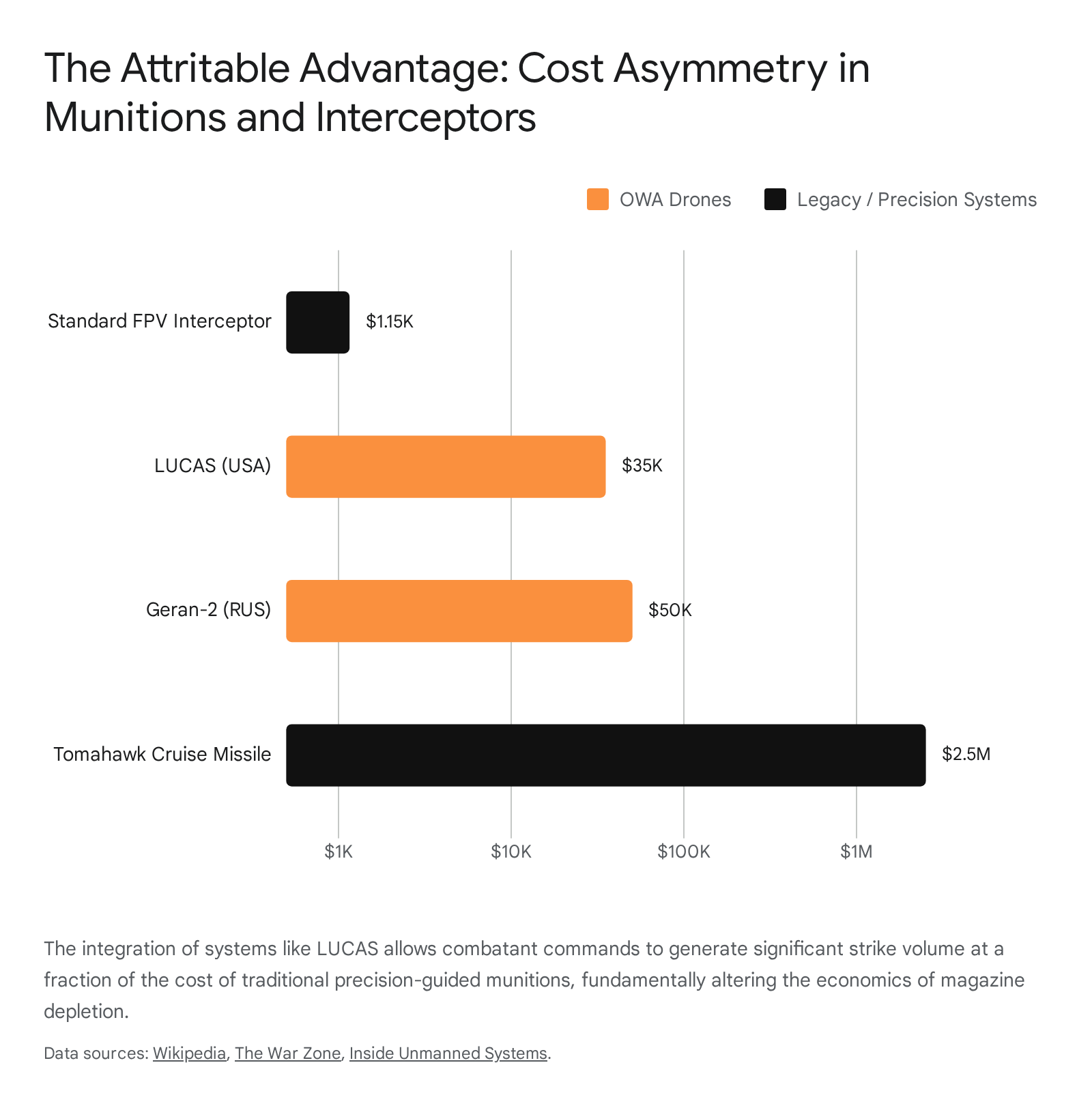
The economics of modern warfare have been shattered by these low-cost systems. A first-person view drone costs roughly $400 to $600 to build and deploy.5 Conversely, an M1 Abrams main battle tank costs approximately $8 million, and a Russian T-90M requires close to $4.5 million to manufacture.6 When a $500 drone routinely destroys a multi-million dollar armored vehicle, the cost-exchange ratio heavily favors the drone operator, forcing militaries to reconsider the financial sustainability of traditional heavy armor.6 The following sections analyze the precise mechanisms of this evolution, focusing on tactical methodologies, hardware supply chain resilience, software adaptations for contested electromagnetic environments, and the subsequent rewrites of infantry and armored doctrines.

2.0 The Evolution of Unmanned Tactical Strike Capabilities

The tactical application of first-person view drones has evolved rapidly from improvised nuisance attacks to synchronized, mass-scale strikes integrated into broader combined arms operations. This evolution is characterized by range extension, the introduction of automated terminal guidance, and the transition toward coordinated systems warfare.

2.1 From Isolated Strikes to Systems Warfare

In the initial phases of recent high-intensity conflicts, first-person view drones were primarily utilized as single-use, line-of-sight precision munitions. Operators targeted isolated infantry positions or light vehicles within a limited radius, often relying on the element of surprise.3 By 2026, this approach evolved into a concept defined as systems warfare.3 Combat operations are now planned with the assumption of persistent unmanned aerial presence.3 Small drones are utilized to adjust artillery fire, disrupt logistics networks, conduct counter-battery operations, and provide direct, organic support to infantry assaults.3 Ukrainian forces, for example, report conducting over 11,000 combat drone missions per day, striking over 150,000 verified targets in a single month.7

A critical development in this phase is the integration of unmanned ground vehicles with aerial platforms. Tactical operations increasingly feature ambush scenarios where unmanned ground vehicles serve as remote launch platforms for first-person view drones, delivering the aerial systems deep into defensive lines before launch.3 This multi-domain integration reduces the risk to human operators while projecting unmanned strike capabilities further into contested territory. The operator’s role is shifting toward that of a tactical manager who selects the target and timing of the attack, oversees a group of drones, and manages the broader deployment scenario rather than controlling every micro-movement of a single aircraft.3

These tactical capabilities have also been weaponized for psychological and cognitive warfare. In areas such as the Nikopol district, drone units have been documented striking civilian infrastructure, markets, and vehicles to restrict movement and instill psychological terror.8 This normalization of drone strikes on non-combatants highlights the easily exportable nature of these tactics, raising significant concerns for global counterterrorism efforts as violent extremist organizations observe and adopt these low-cost precision strike methods.10

2.2 Overcoming Line-of-Sight Limitations, Relays and Motherships

A primary limitation of traditional first-person view drones is their reliance on a continuous radio frequency link between the operator and the aircraft. As these drones drop in altitude during the terminal phase of an attack, ground clutter, foliage, and terrain features frequently obstruct the signal, leading to mission failure and loss of the aircraft.11 To overcome this physical limitation, military engineers have developed and deployed aerial relay systems and mothership drones.

Mothership platforms function as airborne carriers and data-link nodes.11 These larger aircraft, such as the Russian Pchelka or modified Orlan and Molniya fixed-wing drones, transport smaller, battery-limited first-person view drones to the edge of their combat radius before deploying them.11 By loitering at high altitudes, the mothership provides a direct, unobstructed line-of-sight relay between the ground controller and the attacking drone, bypassing terrain interference entirely.11

This relay capability extends the effective strike range to upwards of 60 kilometers, allowing forces to target critical logistics routes, command posts, and staging areas deep in the tactical rear.11 Operation Spiderweb, a coordinated strike operation, demonstrated how deep-penetration drones could successfully strike strategic aviation bases far beyond the immediate front lines, yielding high-value disruption across vast ranges.13 These motherships are considered attritable assets, meaning their cost is low enough that losing them during a mission is an acceptable trade-off for the operational advantages they provide.11

WBP AK barrel assembly with rear sight block and pin, part 6

2.3 Fiber-Optic Command Links

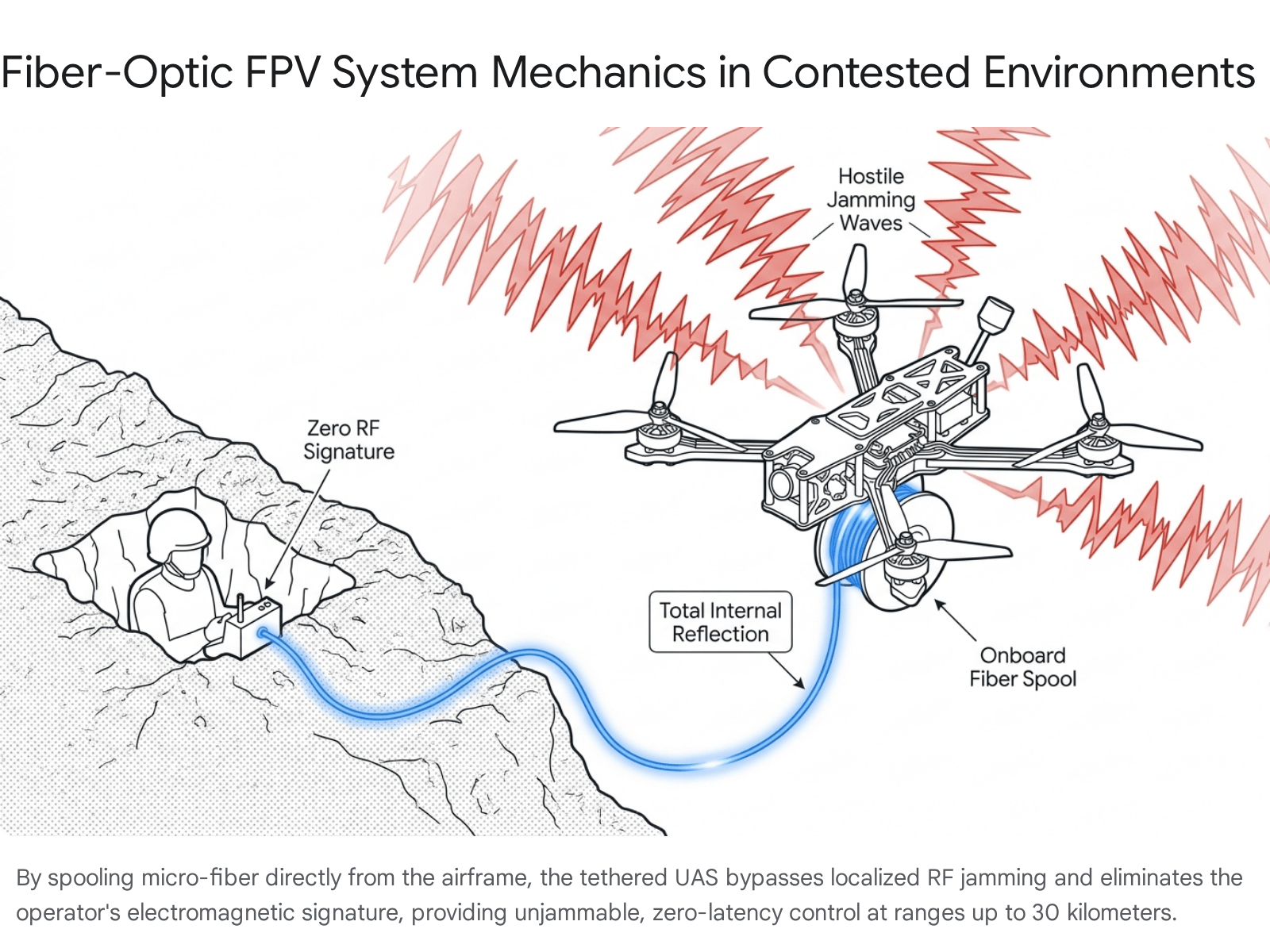
In environments saturated by electronic warfare, traditional radio frequency control links are highly vulnerable to jamming and interference. Both sides in modern conflicts deploy advanced jamming techniques that broadcast high-power electromagnetic energy over specific frequency bands to drown out legitimate control signals.14 To ensure absolute control reliability, developers have introduced fiber-optic controlled drones.15

These platforms trail a spool of lightweight, bend-insensitive fiber-optic cable, typically G657A2 single-mode fiber with a diameter of 0.26 mm to 0.45 mm, which physically connects the drone to the operator.16 Because the control signals and high-definition video feeds travel through light pulses within the fiber rather than across the open electromagnetic spectrum, these drones are entirely immune to radio frequency jamming and spoofing.1 Furthermore, the lack of radio emissions prevents adversary electronic intelligence units from detecting the drone’s presence or geolocating the operator’s position via signal triangulation.1

Operational deployments in 2025 and 2026 have demonstrated that fiber-optic drones can maintain stable video feeds and command links at ranges of up to 50 kilometers, giving them operational parity with highly expensive precision-guided artillery munitions such as the M982 Excalibur.15 The attenuation loss of the fiber over these distances is exceptionally low, ensuring high-bandwidth communication is preserved until the moment of impact.16

2.4 Autonomous Swarming and Target Acquisition

The next evolutionary phase involves fully autonomous drone swarms capable of prosecuting targets without continuous human oversight. Russian forces have established the Rubikon Center for Advanced Unmanned Technologies, focusing on artificial intelligence capabilities that allow a single operator to control multiple drones simultaneously.7 By utilizing cruise control modes and autonomous navigation, operators can manage swarms that dynamically adapt to the environment, bypassing GPS jamming and radio interference.12

Western militaries are pursuing similar capabilities. The United States Department of Defense launched the Replicator initiative, aiming to field thousands of autonomous, attritable systems to overcome adversary mass.20 While initial goals faced technical hurdles regarding software integration and command structures, the push toward multi-agent, artificial intelligence-driven swarms remains a critical priority for achieving drone dominance.20 These swarms leverage decentralized swarm intelligence, mirroring biological patterns where individual units communicate with one another to execute complex, coordinated maneuvers without requiring a central ground-based controller.19

3.0 Hardware Supply Chain Vulnerabilities and Improvisations

The rapid scaling of drone warfare has exposed severe vulnerabilities in global military supply chains. The components required to build millions of tactical drones rely heavily on raw materials and manufacturing bases concentrated in specific geopolitical regions, forcing defense sectors to improvise and onshore production.

3.1 Strategic Raw Material Chokepoints

The architecture of modern drone warfare is fundamentally underpinned by specialized chemistry and metallurgy, areas where Western defense industrial bases are dangerously dependent on foreign sources.21 Analysis indicates that the hardware supply chain is constrained by several strategic material chokepoints 21:

First, the production of structural materials relies heavily on composites and specialized alloys. High-strength carbon fiber, essential for lightweight and rigid airframes, requires a polyacrylonitrile precursor.21 Aerospace-grade carbon fiber production cannot be surged quickly and is limited to specific autoclave facilities globally. Furthermore, aluminum-lithium alloys and specialized titanium, such as Ti-6Al-4V, are critical for high-heat zones, fasteners, and landing gear.21

Second, propulsion systems are highly dependent on rare-earth magnets. Neodymium-iron-boron magnets are critical for the lightweight, high-torque brushless motors used in quadcopters.21 Approximately 90 percent of the global output for sintered-magnet processing and magnetization is concentrated in China.21 Even if rare-earth oxides are mined elsewhere, the critical steps of finishing and magnetization represent a severe bottleneck.

Third, power systems rely on specific battery chemistries. The refining capacity for lithium, graphite anode material, nickel, and cobalt presents a heavier bottleneck than the extraction of the raw ores.21 China processes over seventy percent of the world’s graphite anode material, and modest export controls have previously disrupted assembly lines within weeks.21

Fourth, the “brains” and “eyes” of these systems depend on advanced semiconductors. Gallium-Nitride power amplifiers and infrared detectors utilizing indium antimonide are essential for communication arrays and optical sensors.21 The fabrication facilities for these specialty semiconductors require years to expand and cannot easily absorb export shocks or sudden scaling requirements.21 When foreign suppliers impose export restrictions on critical components, the tactical capabilities of reliant nations are immediately degraded, leading to increased costs and severe battlefield attrition.21

3.2 Decentralized Manufacturing and Additive Printing Networks

To circumvent these massive supply chain vulnerabilities, military operators and civilian engineering networks have pioneered decentralized manufacturing protocols. Additive manufacturing, commonly known as 3D printing, has transformed deployed units and civilian basements into localized micro-production hubs.22

By distributing production across hundreds of independent locations, military forces have created resilient supply networks that cannot be disabled by a single strategic strike.23 In Ukraine, volunteer networks utilize consumer-grade fused deposition modeling printers to continuously manufacture airframe components, antenna mounts, and specialized casings that adapt legacy Soviet munitions for aerial delivery.23 These networks operate via secure online marketplaces where military units post specific component requirements, and independent operators fulfill the orders locally.25 Reports indicate that a single 400-operator network successfully produced over 100 tonnes of polymer parts for frontline units.25

This methodology shifts the military logistics model from rigid just-in-time delivery to agile point-of-need sustainment.22 The United States Army’s 173rd Airborne Brigade Hawkeye Platoon demonstrated this capability by assembling quadcopters from 3D-printed parts directly on base, building battlefield-ready drones in roughly four hours.26 This allows forces to rapidly iterate designs based on immediate tactical feedback without waiting for sluggish, multi-year defense procurement cycles.22

3.3 Regulatory Shifts and Domestic Production Initiatives

In the United States, sweeping regulatory changes have accelerated the development of a domestic drone supply chain. Policies such as the National Defense Authorization Act strictly prohibit the use of specific foreign-produced unmanned systems and critical components, driving immense demand for compliant domestic hardware.27 The Federal Communications Commission has actively updated its Covered List to bar foreign-made drones from obtaining the equipment authorizations required for operation in the United States.28

To fill this void, the Department of Defense launched the Drone Dominance Program and the SkyFoundry initiative.29 SkyFoundry, led by the Army Materiel Command, aims to mass-produce 10,000 small drones per month by late 2026 by establishing high-tech manufacturing hubs, such as the proposed facility at the Red River Army Depot in Texas.30 The goal is to strengthen supply chains and manufacturing capacity to a point where military services can affordably procure the necessary volume of attritable systems through regular budgeting.31 Private companies, such as Unusual Machines, have rapidly scaled their operations to meet this demand, increasing daily domestic motor production to over 1,500 parts per day to serve the enterprise and defense markets.32

3.4 Active Component Sourcing and Validation

Despite the push for bespoke military systems, commercial off-the-shelf components remain the backbone of tactical drone assembly. A validation sweep of leading component vendors as of April 2026 confirms the availability of critical parts required for long-range, heavy-lift, and electronic warfare-resilient applications. Table 1 details specific components currently in stock, reflecting the localization of parts that meet rigorous operational standards.

Table 1: Verified FPV Component Stock and Specifications (April 2026)

ManufacturerComponent CategorySpecific ModelTechnical SpecificationsPrice (USD)Stock VerificationVerified URL
iFlightCinelifter MotorXING2 28091250KV, N52H Curved Arc Magnets, 5mm Titanium Alloy Shaft$37.99In StockProduct Link
iFlightHeavy-Duty FPV MotorXING2 22071750KV / 2050KV / 2750KV variants, 4S-6S Input Voltage$23.99In StockProduct Link
iFlightFlight ControllerBLITZ H7 ProSTM32H743 MCU, In-built OSD, compatible with high-draw ESCs$75.99In StockProduct Link
BetaFPVRadio ReceiverELRS Micro2.4GHz ISM, ESP8285 MCU, PWM or CRSF Output Protocol$12.99In StockProduct Link
Unusual MachinesDomestic Motor AssemblyUMAC NDAA MotorsScaled to 15,000 units/month, compliant with US defense restrictionsN/A (B2B)Scaling Production(https://www.unusualmachines.com/press-release/)

Data sourced directly from manufacturer inventory systems.32 Certain components feature packing updates, such as the inclusion of heavier M3x10 screws for improved structural integrity during high-torque maneuvers.34

4.0 Localized Software Modifications for GNSS-Denied Environments

The electromagnetic spectrum is constantly contested in modern operations. Electronic warfare units routinely deploy high-power jammers to sever the communication links between operators and drones, and to disrupt Global Navigation Satellite Systems.14 When a drone loses its satellite navigation signal, standard autopilots cannot determine precise location, altitude, or speed, leading to severe drift and eventual mission failure.36

4.1 Adapting Open-Source Firmware to Counter Electronic Warfare

To combat command-link spoofing and broad-spectrum jamming, developers have heavily modified open-source flight software. An overwhelming majority of drones rely on software such as Betaflight to configure flight controllers, and the Express Long Range System to link the radio receiver to the ground station.38 In their standard configuration, these systems operate within fixed frequency ranges dictated by peacetime regulations.38

However, because the source code is openly available, military developers have customized these protocols for combat. One significant adaptation observed in the field is Totalitarian LRS, a highly modified version of the ExpressLRS protocol.38 While standard ExpressLRS utilizes LoRa modulation, Totalitarian LRS expands the frequency-hopping spread spectrum across a significantly wider and unconventional spectrum, ranging from 425 to 970 MHz and 2.2 to 2.7 GHz.38 Furthermore, developers completely rewrote the frequency-hopping algorithm to prevent adversary electronic warfare operators from spoofing the signal or injecting fake data packets into the control stream.38

4.2 Failsafe Disablement and Operational Masking

Complementing the radio link modifications, customized flight controller firmware, known as Totalitarian Betaflight, drastically alters how the drone reacts to signal interference. Standard civilian drones are programmed to execute a strict failsafe protocol, cutting power to the motors and dropping from the sky if the connection to the pilot is lost or if a spoofed disarm command is received.38

In a combat environment where signal loss is guaranteed, this safety feature becomes a critical vulnerability. The modified Totalitarian firmware disables the airborne disarm function entirely, ensuring the motors continue running even under severe electronic attack.38 While this prevents spoofing-based crashes, it also means legitimate operators cannot easily disarm the drone once it is armed, requiring strict handling protocols.38 Additionally, the software includes operational masking capabilities, allowing operators to deactivate on-screen telemetry to hide the launch point’s location from adversaries attempting to track the drone’s path via intercepted video feeds.38

4.3 Visual Inertial Odometry and Zero-Shot Global Localization

While firmware modifications protect the radio link, they do not solve the problem of navigating without satellite signals. To achieve true autonomy in satellite-denied environments, modern drones are being equipped with multi-modal sensor fusion and edge-computing artificial intelligence.36

Advanced software frameworks, such as the OMNInav system, replace traditional satellite inputs by utilizing visual inertial odometry and simultaneous localization and mapping techniques.39 These systems continuously fuse data from onboard inertial measurement units, barometers, and magnetometers to track movement precisely.36 However, inertial sensors inevitably accumulate drift over time. To correct for this drift, the software employs artificial intelligence models trained on extensive datasets of satellite imagery.39

By matching the live, real-time feed from the drone’s optical or thermal cameras against pre-loaded geographical maps, the system can determine its exact absolute position globally, an action known as zero-shot global localization.39 These models are highly trained for cross-modality registration, allowing them to match live infrared camera data against pre-stored visible-light maps, ensuring reliable navigation even in low-light conditions or heavily altered urban environments.39

4.4 Automated Terminal Guidance and Machine Vision

The most critical phase of a precision drone strike is the final approach. As the drone dives toward the target, the line-of-sight signal is frequently lost due to the curvature of the earth and the dense presence of local vehicular electronic warfare jammers.11 To ensure target engagement despite total signal loss, drones are being equipped with machine vision and automated terminal guidance modules.40

Software solutions provided by companies like Spleenlab allow the drone to utilize onboard processors to visually lock onto a target.42 Once the operator designates the target on their screen and the drone enters the terminal phase, the artificial intelligence takes complete control of the flight surfaces.41 The drone autonomously tracks the moving object and adjusts its trajectory to intercept with an approach accuracy of ±0.2 meters, completely independent of GPS or radio links.41 This renders local radio jammers entirely ineffective because the drone no longer requires external commands to process the final kinetic strike.41

5.0 Paradigm Shifts in Global Infantry Doctrine

The pervasive presence of highly lethal, precision-guided drones has initiated a profound crisis for traditional ground force doctrine. Military frameworks established during the Cold War, which rely heavily on the massing of troops and the concentration of overwhelming firepower, are proving critically vulnerable to persistent aerial attrition.1

5.1 The Collapse of Classical Mass Maneuver

Historically, military doctrine dictated that forces must concentrate their combat power at decisive points to break through enemy defensive lines.1 However, the modern battlefield has achieved a state of near-total transparency. The skies are saturated with low-cost reconnaissance drones capable of detecting movement instantly and relaying coordinates to artillery units or strike drone operators within seconds.13

Consequently, forces can no longer assemble above the company echelon without triggering immediate detection and catastrophic engagement by networked sensor-shooter systems.1 Any concentration of vehicles or personnel is rapidly identified and targeted, rendering large-scale mechanized assaults operationally unfeasible under current conditions.1 The era of key strongpoints and traditional fortified trenches is ending, replaced by defensive fronts that are thinner, deeper, and heavily reliant on decoys.1

5.2 Tactical Dispersal and the Micro-Assault Group

To survive under persistent aerial surveillance and the constant threat of first-person view drone strikes, infantry units have been forced to adopt extreme dispersal tactics. The traditional platoon-sized assault formation has been reduced to highly distributed micro-assault groups consisting of merely four to six soldiers.44

Ground movement is severely restricted and heavily managed. Forces rely heavily on pre-positioned, concealed fighting positions, often referred to as spider holes, allowing them to rapidly disappear from aerial observation.44 Movement has shifted almost exclusively to short, rapid bounds of 200 to 400 meters, predominantly conducted under the cover of darkness.44 Furthermore, thermal camouflage netting has transitioned from a specialized reconnaissance asset to mandatory, standard-issue equipment down to the individual squad level.44

WBP AK barrel assembly with rear sight block and pin, part 6

5.3 The Dispersion Paradox and Defensive Vulnerabilities

This extreme tactical dispersal creates a severe operational paradox. While scattering troops across the landscape improves survivability against area-of-effect artillery and drone strikes, it isolates individual squads and strips them of their ability to provide mutually supporting fire.44

When soldiers are dispersed into small groups of four to six, they lack the organic firepower to suppress enemy advances or defend against coordinated drone swarms. This geometric failure of tactical positioning has led to instances where fully autonomous or remotely piloted drones have captured fortified positions without deploying human infantry, as isolated soldiers, unable to receive support from neighboring units, are systematically eliminated or forced to surrender directly to the aerial vehicles.44 The inability to concentrate force for defense represents a critical vulnerability in current land warfare adaptations.

5.4 Institutionalizing Organic Squad-Level Air Support

Recognizing the permanence of this shift, global military institutions are actively rewriting their foundational doctrines. The United States Army, for instance, has fundamentally overhauled its capstone operations manual, Field Manual 3-0, to prioritize drone dominance.45 The traditional, multi-year doctrinal update cycle has been abandoned in favor of iterative, experience-driven updates based on immediate battlefield feedback from active conflict zones.45

New operational imperatives explicitly direct commanders to protect against constant observation and to utilize unmanned systems to make initial contact with the enemy, preserving human elements.45 First-person view drones and loitering munitions are now functioning as organic, expeditionary close air support.46 Rather than relying on higher-echelon assets like fighter jets or attack helicopters, which require complex clearance protocols and safe separation distances, infantry squads can now independently strike fortified positions and armored threats with pinpoint accuracy.1 Doctrinal mandates dictate that unmanned systems must be integrated into every infantry squad, forcing soldiers to train with and treat drones as standard organic weapons equivalent to their primary rifles or communication gear.30

6.0 The Transformation of Armored Vehicle Deployment

The proliferation of cheap, highly maneuverable unmanned aircraft has precipitated a severe crisis for mechanized warfare. Main battle tanks, representing millions of dollars in investment and decades of complex engineering, are routinely neutralized by commercial drones carrying retrofitted anti-tank munitions.

6.1 Top-Attack Profiles and Standoff Range Mandates

Armored vehicle design has historically prioritized heavy frontal armor thickness to survive direct kinetic engagements with opposing tanks and anti-tank guided missiles.48 First-person view drones exploit this legacy design paradigm by utilizing complex, multi-axis maneuverability to strike vehicles where their armor is significantly weaker, specifically the engine deck, the rear compartment, and the turret roof.48

The precision of expert drone operators allows them to target specific vulnerable components, such as optics, tracks, or open crew hatches, immobilizing the vehicle even if the main armor plating is not fully breached.50 Because a single drone can achieve a mobility or catastrophic kill on a high-value asset, military commanders are increasingly withholding heavy armor from frontline assaults. Tanks and infantry fighting vehicles are frequently relegated to indirect fire roles, operating at standoff distances of 5 to 10 kilometers behind the zero line to avoid detection and destruction by loitering drone swarms.50

6.2 Vehicular Electronic Warfare Domes and Signal Jamming

To restore the forward maneuverability of armored columns, defense industries are rapidly integrating counter-unmanned aerial system technologies directly onto vehicular platforms.

Electronic warfare suites are becoming standard equipment on modern tanks to combat the radio frequency links of attacking drones. Russian forces, for example, have attempted to standardize the installation of the Volnorez and Saniya electronic warfare systems on their T-80BVM tanks.41 The Saniya system generates a localized electromagnetic dome designed to detect drones from a distance of 1.5 kilometers and sever their command link within a 1 kilometer range, utilizing a power source capacity of up to 1100 watts.41

However, operational assessments indicate that these localized jammers often suffer from frequency loopholes and limited angles of area coverage.41 This leaves the vehicles highly vulnerable to drone operators who rapidly switch to alternative or non-standard radio frequencies.38 Furthermore, the advent of fiber-optic drones and autonomous terminal guidance completely bypasses these electromagnetic defenses, as the drone no longer relies on a vulnerable external radio signal to complete its terminal dive.1

6.3 Next-Generation Active Protection Systems

Kinetic defense mechanisms are also being aggressively upgraded to handle aerial threats. Advanced Active Protection Systems, such as the Israeli-designed Trophy system utilized on the Leopard 2A8, are being adapted.52 These systems utilize sophisticated radar arrays to detect incoming threats, track their trajectory, and fire explosively formed projectiles to neutralize the munitions before they make physical contact with the hull.52

While these systems are highly effective against traditional, horizontally fired anti-tank guided missiles and rocket-propelled grenades, manufacturers are urgently updating the sensor software and interceptor parameters. The goal is to allow the radar arrays to effectively track and engage small, low-altitude drones executing steep top-attack profiles from unconventional angles, a capability highlighted in recent patent filings for systems like the Russian Arena-M.49

WBP AK barrel assembly with rear sight block and pin, part 6

6.4 Field Expedient Modifications and Passive Armor Upgrades

While waiting for the widespread fielding of next-generation active defense systems, combat troops have relied heavily on localized structural modifications. The deployment of physical barriers, colloquially known as top-attack protection screens or cope cages, has become ubiquitous across the battlefield.55

These metal frameworks, grilles, and netting are welded directly onto the turrets and engine decks to physically intercept incoming drones. Their primary function is to pre-detonate shaped-charge warheads before they strike the vehicle’s primary armor, dissipating the explosive jet.56 Even highly advanced Western platforms, such as the American-supplied M1A1 Abrams tanks operating in Ukraine, have been retrofitted in the field with extensive framework cages and dense layers of Kontakt-1 explosive reactive armor to survive the drone-saturated environment.57 The absolute necessity of these heavy, improvised physical defenses highlights the urgency with which military organizations must rethink future vehicle design, balancing the requirement for heavy armor survivability with the need for mobile platforms integrated directly into a network of counter-drone sensor webs.58

7.0 Conclusion

The evolution of first-person view drone tactics has forced a profound reassessment of modern warfare. What originated as a tactical stopgap measure to mitigate severe artillery shortages has rapidly matured into a sophisticated, highly scalable branch of military capability.59 As human operators and automated systems perfect the art of systems warfare, the physical and electronic landscapes of the battlefield are transforming at an unprecedented pace.

To maintain operational viability, global defense institutions are accelerating the decentralization of their hardware supply chains. By embracing additive manufacturing and localized assembly networks, militaries aim to overcome critical international material chokepoints and build resilience against supply disruptions.22 Simultaneously, the software governing these aircraft is being rapidly iterated to ensure robust resilience against intense electronic warfare. Technologies such as visual inertial odometry and autonomous terminal guidance are enabling precise navigation and targeting in regions entirely devoid of satellite coverage or radio connectivity.39

The compounding effects of these technological leaps have effectively collapsed legacy doctrines regarding massed infantry maneuver and concentrated armored assaults.1 Moving forward, survival and success in high-intensity conflict will demand extreme tactical dispersal, the ubiquitous integration of organic unmanned systems down to the individual squad level, and the continuous, rapid adaptation of both offensive drone logic and multi-layered defensive countermeasures.


Please share the link on Facebook, Forums, with colleagues, etc. Your support is much appreciated and if you have any feedback, please email us in**@*********ps.com. If you’d like to request a report or order a reprint, please click here for the corresponding page to open in new tab.


Sources Used

  1. MCU Insights, vol. 16, no. 4 – Marine Corps University, accessed April 18, 2026, https://www.usmcu.edu/Outreach/Marine-Corps-University-Press/MES-Publications/MES-Insights/MCU-Insights-vol-16-no-4/
  2. Drone Warfare in Ukraine: From Myths to Operational Reality – Part 1, accessed April 18, 2026, https://researchcentre.army.gov.au/library/land-power-forum/drone-warfare-ukraine-myths-operational-reality-part-1
  3. From Quantity to Algorithms: How FPV Warfare Is Changing in 2026 – VGI-9, accessed April 18, 2026, https://vgi.com.ua/en/from-quantity-to-algorithms-how-fpv-warfare-is-changing-in-2026/
  4. (PDF) Tactical Network-Centric Warfare in Practice: FPV Drones and the Architecture of a New RMA – ResearchGate, accessed April 18, 2026, https://www.researchgate.net/publication/393440325_Tactical_Network-Centric_Warfare_in_Practice_FPV_Drones_and_the_Architecture_of_a_New_RMA
  5. Ukraine Drone Industry: Data Reports 2026 – WifiTalents, accessed April 18, 2026, https://wifitalents.com/ukraine-drone-industry-statistics/
  6. How $400 FPV Drones Are Destroying Tanks and Rewriting the Rules of War, accessed April 18, 2026, https://militarymachine.com/fpv-drones-destroying-tanks
  7. Russian Offensive Campaign Assessment, April 9, 2026 | ISW, accessed April 18, 2026, https://understandingwar.org/research/russia-ukraine/russian-offensive-campaign-assessment-april-9-2026/
  8. Ukraine Conflict Monitor: Russia-Ukraine war map | ACLED, accessed April 18, 2026, https://acleddata.com/monitor/ukraine-conflict-monitor
  9. Russia’s FPV drone campaign in Ukraine institutionalizes intentional civilian harm as a tool of war – Institute for the Study of War, accessed April 18, 2026, https://understandingwar.org/research/russia-ukraine/russias-fpv-drone-campaign-in-ukraine-institutionalizes-intentional-civilian-harm-as-a-tool-of-war/
  10. Moving Targets: Implications of the Russo-Ukrainian War for Drone Terrorism, accessed April 18, 2026, https://ctc.westpoint.edu/moving-targets-implications-of-the-russo-ukrainian-war-for-drone-terrorism/
  11. FPV Drone Motherships That Also Relay Their Signals Offer Huge …, accessed April 18, 2026, https://www.twz.com/air/fpv-drone-motherships-that-also-relay-their-signals-offer-huge-advantages
  12. Russian Force Generation & Technological Adaptations Update, October 9, 2025, accessed April 18, 2026, https://understandingwar.org/research/russia-ukraine/russian-force-generation-technological-adaptations-update-october-9-2025/
  13. How are Drones Changing War? The Future of the Battlefield – CEPA, accessed April 18, 2026, https://cepa.org/article/how-are-drones-changing-war-the-future-of-the-battlefield/
  14. Ukraine’s Future Vision and Current Capabilities for Waging AI-Enabled Autonomous Warfare – CSIS, accessed April 18, 2026, https://www.csis.org/analysis/ukraines-future-vision-and-current-capabilities-waging-ai-enabled-autonomous-warfare
  15. Russian Fiber-Optic FPV Drones: Operational Scale and Operator Training – RuAviation, accessed April 18, 2026, https://ruavia.su/russian-fiber-optic-fpv-drones-operational-scale-and-operator-training/
  16. Fibre Optics FPV Drone, accessed April 18, 2026, https://5.imimg.com/data5/SELLER/Doc/2026/1/577229561/JX/PC/CX/81615670/fibre-optics-drone.pdf
  17. Ukraine FPV Drone Explained! – YouTube, accessed April 18, 2026, https://www.youtube.com/watch?v=3VfYvVw8sMw
  18. Ptashka Drones Achieves 50 km Range with Successful Fiber Optic Drone Use, accessed April 18, 2026, https://militarnyi.com/en/news/ptashka-drones-achieves-50-km-range-with-successful-fiber-optic-drone-use/
  19. Drone Wars: Developments in Drone Swarm Technology – Defense Security Monitor, accessed April 18, 2026, https://dsm.forecastinternational.com/2025/01/21/drone-wars-developments-in-drone-swarm-technology/
  20. DoD promised a ‘swarm’ of attack drones. We’re still waiting. – Responsible Statecraft, accessed April 18, 2026, https://responsiblestatecraft.org/replicator/
  21. The Drone Supply Chain War: Identifying the Chokepoints to Making a Drone – CSIS, accessed April 18, 2026, https://www.csis.org/analysis/drone-supply-chain-war-identifying-chokepoints-making-drone
  22. Additive Manufacturing and the Land Forces Supply Chain: a Revolution Within a … – Eurosatory, accessed April 18, 2026, https://www.eurosatory.com/en/additive-manufacturing-and-the-land-forces-supply-chain-a-revolution-within-a-revolution/
  23. Not Just “Game of Lego”: How Ukraine Turned 3D-Printing into Decentralized Military Conveyor Belt | Defense Express, accessed April 18, 2026, https://en.defence-ua.com/events/not_just_a_game_of_lego_how_ukraine_turned_3d_printing_into_a_decentralized_military_conveyor_belt-18078.html
  24. Drone Manufacturing: Scaling Production and Cutting Costs with Automated 3D Printing, accessed April 18, 2026, https://dhr.is/blog/drone-manufacturing-scaling-production-and-cutting-costs-with-automated-3d-printing
  25. Secret Decentralized 3D Printing Networks Supply Drone Parts to Ukraine at Scale, accessed April 18, 2026, https://www.fabbaloo.com/news/secret-decentralized-3d-printing-networks-supply-drone-parts-to-ukraine-at-scale
  26. How Ukraine Turned DIY Drones into a Powerful War Force — and What Europe Can Learn, accessed April 18, 2026, https://orbitaltoday.com/2026/04/16/how-ukraine-turned-diy-drones-into-a-powerful-war-force-and-what-europe-can-learn/
  27. Regulatory Changes to Foster US Drone Supply Chains – Capstone DC, accessed April 18, 2026, https://capstonedc.com/insights/regulatory-changes-to-foster-us-drone-supply-chains/
  28. FCC Announces Wide-Ranging New Controls on Drones and Drone Components | HUB, accessed April 18, 2026, https://www.klgates.com/FCC-Announces-Wide-Ranging-New-Controls-on-Drones-and-Drone-Components-1-16-2026
  29. Pentagon must consider force structure in mass drone rollout – Army Technology, accessed April 18, 2026, https://www.army-technology.com/news/pentagon-must-consider-force-structure-in-mass-drone-rollout/
  30. Army aims to manufacture 10,000 drones per month by 2026 …, accessed April 18, 2026, https://defensescoop.com/2025/10/14/army-small-drones-skyfoundry/
  31. As Promised, War Department Moving Out Fast on Drone Dominance, accessed April 18, 2026, https://www.war.gov/News/News-Stories/Article/Article/4399192/as-promised-war-department-moving-out-fast-on-drone-dominance/
  32. Press Release – Unusual Machines, accessed April 18, 2026, https://www.unusualmachines.com/press-release/
  33. U.S. Maker of Drone Parts Now at Key Inflection Point – Streetwise Reports, accessed April 18, 2026, https://www.streetwisereports.com/article/2025/08/29/u-s-maker-of-drone-parts-now-at-key-inflection-point-1.html
  34. FPV Motors – iFlight, accessed April 18, 2026, https://shop.iflight.com/motors-cat88
  35. ELRS Micro Receiver – BETAFPV, accessed April 18, 2026, https://betafpv.com/products/elrs-micro-receiver
  36. AI-Based Navigation in GNSS-Denied Areas, accessed April 18, 2026, https://www.uavnavigation.com/company/blog/ai-based-navigation-gnss-denied-areas
  37. Navigating GPS-Denied Environments: Solutions and Challenges – GNSS Jamming, accessed April 18, 2026, https://www.gnssjamming.com/post/gps-denied-environments
  38. How software modifications affect drone warfare – The Russian …, accessed April 18, 2026, https://en.kkrva.se/how-software-modifications-affects-drone-warfare-the-russian-example/
  39. OMNInav: A Breakthrough in GPS-Denied Navigation for UAS – OKSI, accessed April 18, 2026, https://oksi.ai/omninav-gps-denied-navigation/
  40. Ukrainian Armor Upgrades Its Drone Line with New Warheads and Terminal Guidance, accessed April 18, 2026, https://en.defence-ua.com/industries/ukrainian_armor_upgrades_its_drone_line_with_new_warheads_and_terminal_guidance-18179.html
  41. ​New Saniya EW System Seeks to Protect russian Tanks From FPV Drones, But Where’s Overhyped Volnorez? | Defense Express, accessed April 18, 2026, https://en.defence-ua.com/weapon_and_tech/new_saniya_ew_system_seeks_to_protect_russian_tanks_from_fpv_drones_but_wheres_overhyped_volnorez-9181.html
  42. Terminal Guidance | Spleenlab, accessed April 18, 2026, https://www.spleenlab.ai/product-terminal-guidance
  43. I Fought in Ukraine and Here’s Why FPV Drones Kind of Suck – War on the Rocks, accessed April 18, 2026, https://warontherocks.com/2025/06/i-fought-in-ukraine-and-heres-why-fpv-drones-kind-of-suck/
  44. The Dispersion Paradox: When Sound Tactics Become a Death Sentence, accessed April 18, 2026, https://smallwarsjournal.com/2026/02/13/the-dispersion-paradox/
  45. Army Rewrites Drone Doctrine Force-Wide as “Drone Dominance …, accessed April 18, 2026, https://insideunmannedsystems.com/army-rewrites-drone-doctrine-force-wide-as-drone-dominance-becomes-priority/
  46. Emerging Counter-Drone Technologies and Asymmetric Defence Responses – CeSCube, accessed April 18, 2026, https://www.cescube.com/vp-emerging-counter-drone-technologies-and-asymmetric-defence-responses
  47. How Ukraine’s Drone War Is Forcing the U.S. Army to Rewrite Its Battle Doctrine, accessed April 18, 2026, https://www.military.com/feature/2025/10/19/how-ukraines-drone-war-forcing-us-army-rewrite-its-battle-doctrine.html
  48. Russia’s Changes in the Conduct of War Based on Lessons from Ukraine, accessed April 18, 2026, https://www.armyupress.army.mil/Journals/Military-Review/English-Edition-Archives/September-October-2025/Lessons-from-Ukraine/
  49. Russian Tanks Getting Anti-Drone Protection – New APS Upgrades Revealed – YouTube, accessed April 18, 2026, https://www.youtube.com/watch?v=1n5jfDrQIC8
  50. The New Arms Race: Global Drone Dominance and America’s Tactical Wake-Up Call, accessed April 18, 2026, https://smallwarsjournal.com/2025/12/16/the-new-arms-race/
  51. Russian Offensive Campaign Assessment, March 19, 2026 | ISW, accessed April 18, 2026, https://understandingwar.org/research/russia-ukraine/russian-offensive-campaign-assessment-march-19-2026/
  52. combat proven – Leonardo – Electronics, accessed April 18, 2026, https://electronics.leonardo.com/documents/16277707/18411670/trophy_datasheet.pdf?t=1563282195884
  53. The 5 Best Tanks in the World for 2026: Advanced Armor Redefining Ground Combat, accessed April 18, 2026, https://thedefensewatch.com/military-ordnance/the-5-best-tanks-in-the-world-for-2026/
  54. Do you think drones will eventually render tanks obsolete, just as cannons did with castles in the 16th century? : r/Military – Reddit, accessed April 18, 2026, https://www.reddit.com/r/Military/comments/1pmq9od/do_you_think_drones_will_eventually_render_tanks/
  55. How are Drones Changing Modern Warfare? | Australian Army Research Centre (AARC), accessed April 18, 2026, https://researchcentre.army.gov.au/library/land-power-forum/how-are-drones-changing-modern-warfare
  56. United States Plans to Equip its Tanks With Anti-Drone Grilles, accessed April 18, 2026, https://militarnyi.com/en/news/united-states-plans-to-equip-its-tanks-with-anti-drone-grilles/
  57. Ukraine’s Abrams Tanks Are Being Reinvented for Drone Warfare on the Front Line, accessed April 18, 2026, https://united24media.com/latest-news/ukraines-abrams-tanks-are-being-reinvented-for-drone-warfare-on-the-front-line-17480
  58. Armor in 2025: Getting Armored Brigades Back into the Fight – Line of Departure, accessed April 18, 2026, https://www.lineofdeparture.army.mil/Journals/Air-Defense-Artillery/ADA-Archive/2026-E-Edition/Armor-in-2025/
  59. Results of Ukraine’s Defense Industry in 2025: FPV Drones, accessed April 18, 2026, https://www.rnbo.gov.ua/en/Diialnist/7370.html

Military Artificial Intelligence: 2026 Country Ranking and Capability Assessment

1.0 Executive Summary

The integration of artificial intelligence into military operations has fundamentally altered the character of modern warfare, initiating a structural shift in global power dynamics. As the international security environment grows increasingly volatile, defense ministries worldwide are actively abandoning legacy, hardware-centric procurement models. In their place, military planners are adopting Software-Defined Defense architectures.1 This paradigm shift positions software, massive data processing capabilities, and algorithmic decision-making as the primary drivers of military superiority. Consequently, physical platforms such as aircraft, naval vessels, and ground vehicles are increasingly relegated to the role of delivery mechanisms for advanced digital capabilities.

This research report evaluates and ranks the top ten nations globally in terms of their military utilization of artificial intelligence as of April 2026. The assessment deliberately diverges from traditional military strength metrics that prioritize sheer troop numbers or static equipment inventories, such as those historically prioritized by early iterations of the Global Firepower Index.2 Instead, this report measures the precise capacity of a nation to develop, scale, and operationalize advanced algorithms in contested, high-intensity environments. The analysis reveals a stark divergence between nations treating artificial intelligence as a theoretical or purely academic pursuit and those actively testing machine learning models in active combat zones.

The findings indicate that the United States retains the premier position due to its unparalleled integration of commercial technology into defense applications and its sheer volume of venture-backed defense startups. However, the People’s Republic of China is rapidly closing this gap through state-directed military-civil fusion, heavily prioritizing autonomous systems and simulation.4 Concurrently, nations engaged in active conflicts, specifically Israel, Ukraine, and the Russian Federation, have demonstrated the highest rates of battlefield operationalization. These nations are utilizing algorithmic target generation, drone swarming, and autonomous strike platforms at scales previously unseen in human history.6 The transition from human-speed to machine-speed warfare is no longer a future concept, but a current operational reality.

2.0 Ranking Methodology

To establish an objective and robust hierarchy of global military artificial intelligence capabilities, this report relies on a tripartite methodological framework. This approach synthesizes structural readiness, financial commitment, and empirical battlefield evidence to generate a highly detailed capability profile for each nation. This framework draws inspiration from indices such as the Oxford Insights Government AI Readiness Index and the Tortoise Media Global AI Index, but narrows the focus strictly to defense applications, lethal autonomy, and tactical command capabilities.9

2.1 Theoretical Frameworks and Doctrine

The first pillar evaluates a nation’s strategic architecture and policy environment. Effective military artificial intelligence requires a foundation of coherent doctrine, agile governance structures, and organizational alignment. This metric assesses the presence of dedicated defense innovation units, published national artificial intelligence strategies, and the formal adoption of Software-Defined Defense principles within the military’s central command.1 Furthermore, it examines the frameworks governing the ethical deployment of autonomous systems. These doctrines are critical because they dictate the speed at which commanders can legally and operationally deploy algorithmic tools in the field.12 A military force with advanced technology but restrictive or poorly defined deployment doctrines will ultimately be outpaced by an adversary with streamlined approval processes.

2.2 Investment and Industrial Ecosystem

The second pillar quantifies the depth and vitality of the defense-industrial base. Modern algorithmic warfare relies heavily on the commercial technology sector, as traditional defense contractors have historically struggled with the rapid iteration cycles required for software development. This metric evaluates government defense budgets allocated specifically to digital transformation, alongside the vitality of the private defense-technology ecosystem.9 Nations that successfully bridge the gap between agile technology startups and rigid military procurement systems score highest in this category.14 The capacity to manufacture autonomous platforms domestically, secure semiconductor supply chains, and fund large-scale data infrastructure is heavily weighted.16 Sovereign control over the supply chain is treated as a critical multiplier.

2.3 Demonstrated Operational Outcomes

The final and most heavily weighted pillar assesses actual performance and deployment. Theoretical capabilities and fiscal investments hold limited value if they fail to function under the strain of electronic warfare, degraded communications, and active combat. This metric measures the deployment of artificial intelligence in live operations, including automated target recognition, autonomous swarm coordination, predictive maintenance, and algorithmic battle management.6 Nations that have transitioned systems from controlled testing environments to active deployment receive the highest scores in this domain. Battlefield testing provides an irreplaceable feedback loop, allowing for the rapid refinement of algorithms based on real-world data rather than simulated projections.

Close-up of WBP AK receiver with Polish eagle crest and barrel assembly.

3.0 Summary Ranking of the Top 10 Nations

The following table provides a consolidated view of the top ten nations, highlighting their primary technological focus areas and notable platform deployments based on the established methodology. A thorough validation process confirms that the commercial vendors and platforms listed are currently active and their software solutions are available for defense procurement.

RankNationPrimary Operational FocusKey Deployed Platforms, Vendors, or Systems
1United StatesMulti-domain command and control, advanced autonomous aviation, algorithmic targetingPalantir AIP, Anduril Lattice,(https://shield.ai/enterprise/)
2People’s Republic of ChinaMilitary-civil fusion, intelligentized warfare, strategic simulation, swarm logicDeepSeek military simulations, PLA autonomous vehicles
3IsraelAlgorithmic target generation, facial recognition, rapid decision support systemsGospel, Lavender,(https://www.elbitsystems.com/networked-warfare/robotic-and-autonomous-solutions)
4UkraineRapid prototyping, autonomous drone swarms, asymmetric digital combatSwarmer interceptors, Delta command system, Strilla UAVs
5Russian FederationTerminal autonomous guidance, sovereign drone manufacturing, C2 digitalizationZALA Lancet, Astra Linux C2, adapted open-weight models
6United KingdomAgentic artificial intelligence, joint force integration, synthetic training(https://www.baesystems.com/en-us/article/bae-systems-and-scale-ai-combine-forces-to-bring-agentic-ai-to-defense-missions-and-platforms)
7Republic of KoreaUnmanned surface vessels, force multiplier automation, demographic mitigation(https://www.hd.com/en/newsroom/media-hub/press/view?detailsKey=3444), K-Moonshot strategy
8Republic of TurkiyeAutonomous strike UAVs, networked air dominance, naval drone integration(https://baykartech.com/en/uav/bayraktar-tb3/), Havelsan MAIN AI, SAYZEK cluster
9FranceSovereign data processing, digital independence, classified environment modelingArtemis.IA by(https://www.thalesgroup.com/en/advanced-technologies/artificial-intelligence) / Atos
10IndiaBorder surveillance, force modernization, domestic roboticsSilent Sentry, DRDO ETAI Framework, Defence AI Council

4.0 Detailed Capability Assessments

4.1 United States

The United States secures the premier position in this ranking due to its vast capital markets, deeply integrated software ecosystems, and a deliberate strategic shift toward Software-Defined Defense. The U.S. Department of Defense has recognized that future conflicts will be decided by the speed of data processing and the ability to maintain decision advantage over adversaries.20 Consequently, the nation is racing to embed machine learning models into every layer of its military architecture, from strategic combatant command centers down to tactical edge devices utilized by frontline operators.

4.1.1 Strategic Doctrine and Investment

The strength of the United States lies in its commercial defense-technology sector. Unlike traditional defense prime contractors that prioritize multi-decade hardware programs, a new generation of venture-backed vendors is delivering continuously updated software platforms that can be iteratively improved based on operator feedback. This shift is supported by new software-dedicated acquisition pathways within the military branches, allowing for agile deployment models.1 The defense budget actively funds artificial intelligence research and development, with significant capital dedicated to the Combined Joint All Domain Command and Control (CJADC2) initiative, which seeks to connect sensors from all military branches into a unified, artificial intelligence-powered network.

4.1.2 Demonstrated Outcomes and Vendor Integration

Palantir serves as a critical enabler of this unified network capability. The company’s Artificial Intelligence Platform provides advanced large language model capabilities across classified military networks, ensuring legal and ethical governance while allowing operators to fuse vast amounts of disparate intelligence data into actionable insights.21Palantir’s Maven Smart System forms the software backbone of CJADC2 initiatives, effectively creating an operational digital nervous system that provides near real-time domain awareness from the sensor directly to the end user.21

In the realm of autonomous systems and hardware integration, Anduril Industries has revolutionized the deployment of networked sensors and effectors. Their software platform, Lattice, is currently available and acts as an artificial intelligence-powered battle management engine designed specifically to accelerate complex kill chains.23Lattice integrates thousands of third-party, legacy, and autonomous systems, utilizing intelligent mesh networking to process sensor fusion at the tactical edge.23This software allows a single human operator to command multiple autonomous assets, breaking down complex strategic objectives into discrete, executable tasks for collaborative drone teams across land, sea, and air.23

Furthermore,Shield.AI has achieved extraordinary, highly documented milestones in autonomous military aviation. Their Hivemind autonomy software stack functions as a universal artificial intelligence pilot, capable of flying combat aircraft without reliance on GPS or external communications, a critical requirement for operating in contested electronic warfare environments.25Shield AI has successfully demonstrated this technology on modified F-16 fighter jets under the DARPA Air Combat Evolution program, where the software successfully engaged in dogfighting maneuvers against human pilots.27The company is rapidly scaling this software to control their V-BAT unmanned aerial systems and the newly unveiled X-BAT vertical takeoff and landing fighter, a platform designed to operate independently of traditional runway infrastructure while carrying both air-to-air and air-to-surface munitions.27This capacity to operate intelligently and lethally in heavily degraded environments secures the tactical superiority of the United States.

4.2 People’s Republic of China

The People’s Republic of China holds the second position, driven by a national strategy of “intelligentized” warfare and a strict, state-mandated policy of military-civil fusion.4 Beijing views artificial intelligence not merely as a capability enhancement, but as the foundational technology required to leapfrog legacy systems and erode Western military dominance by the target year of 2035.5

4.2.1 Strategic Doctrine and Investment

China’s approach is characterized by massive state investment and the mandatory integration of civilian technological breakthroughs into the People’s Liberation Army. This synergy allows the military establishment to directly leverage advancements from the nation’s robust commercial technology sector, bypassing the traditional procurement bottlenecks seen in Western democracies.5 Research output has surged dramatically, with Chinese academic institutions now producing highly cited research in computer science and artificial intelligence at rates that frequently surpass United States institutions, particularly in computer vision and drone swarm algorithms.29 The state’s ability to direct corporate resources ensures that breakthroughs in commercial artificial intelligence are immediately repurposed for national security objectives.

4.2.2 Demonstrated Outcomes and Priorities

Procurement data indicates that the People’s Liberation Army is heavily prioritizing intelligent and autonomous vehicles, as well as tools for intelligence, surveillance, and reconnaissance.30 Rather than relying solely on monolithic, state-owned defense contractors, China has cultivated a distributed ecosystem of artificial intelligence suppliers, increasing the resilience and innovation speed of its defense industrial base.30

A notable recent advancement involves the use of the DeepSeek foundation model by military researchers at Xi’an Technological University. This commercial model is being utilized to autonomously generate complex military simulations, providing a highly sophisticated digital testing ground for future combat scenarios against peer adversaries.5 China’s rapid scaling of autonomous infrastructure, combined with its ability to mandate commercial compliance and its vast data collection capabilities, make it the most formidable strategic competitor to the United States in the digital domain.

Close-up of WBP AK receiver with Polish eagle crest and barrel assembly.

4.3 Israel

Israel occupies the third position, distinguished entirely by its unprecedented operationalization of algorithmic systems in active, high-intensity combat environments. While other nations possess larger theoretical research budgets or greater overall manpower, the Israel Defense Forces have deployed artificial intelligence decision support systems at a scale and tempo previously unseen in the history of warfare, compressing the sensor-to-shooter loop from hours to mere seconds.6

4.3.1 Strategic Doctrine and Investment

Israel has invested heavily in integrating artificial intelligence across its military hierarchy. This is evidenced by the establishment of a dedicated AI and Autonomy Administration within the Directorate of Defense Research & Development, as well as empowering the elite signals-intelligence Unit 8200 to develop specialized, in-house software tools.6 The nation leverages its dense, highly innovative domestic startup ecosystem, frequently partnering with commercial entities to rapidly adapt civilian data processing capabilities for military applications.6

4.3.2 Demonstrated Outcomes and Vendor Integration

The most prominent examples of this operational shift are the Gospel and Lavender systems, which gained global attention during operations in the Gaza Strip. Developed to support rapid targeting operations, the Gospel utilizes machine learning to ingest massive streams of surveillance data and automatically identify enemy infrastructure, command posts, and equipment.31 Concurrently, the Lavender system functions as an advanced database that evaluates vast quantities of behavioral and communications intelligence to identify individuals linked to militant organizations. Reports indicate that during the initial phases of high-intensity conflict, Lavender was utilized to generate an active target list of approximately 37,000 individuals.6

The deployment of these algorithmic systems has fundamentally altered traditional operational workflows. Human personnel often have highly constrained timeframes to verify the outputs generated by the machine, relying heavily on the system’s accuracy parameters. This reliance has sparked intense international legal debate regarding accountability, the limits of human review, and adherence to the laws of armed conflict.31

Elbit Systems, a major defense contractor, has deeply integrated algorithmic logic into its product lines to support the fully digital military force. Their Dominion-X system is a powerful, autonomous management tool designed to coordinate multiple robotic platforms across the battlespace efficiently.34Furthermore, Elbit’s Artificial Intelligence-driven Decision Support Systems analyze the aerial arena in real-time, simulating every potential course of action to provide commanders with calculated risks and optimal tactical recommendations.35This tight, real-world coupling of innovative software, established hardware contractors, and active combat units gives Israel a distinct, albeit highly scrutinized, advantage in applied artificial intelligence.

4.4 Ukraine

Ukraine secures the fourth position through absolute necessity and the pressures of existential conflict. The ongoing Russo-Ukrainian war has become the definitive proving ground for algorithmic warfare, transforming the nation into the most vital innovation ecosystem for defense technology globally. Ukraine lacks the massive peacetime budgets of superpower nations, yet it compensates through extreme operational agility, rapid battlefield feedback loops, and a booming venture-backed defense sector.15

4.4.1 Strategic Doctrine and Investment

To institutionalize this rapid innovation, the Ukrainian government established the Brave1 defense technology cluster. This government-backed innovation hub coordinates military technology development and has issued over 600 grants totaling approximately $50 million to scale domestic solutions rapidly.37 The international venture capital community has recognized this potential, with over fifty Ukrainian defense startups securing more than $105 million in private investment in 2025 alone, elevating Ukraine’s status in global startup indices.15

4.4.2 Demonstrated Outcomes and Priorities

A critical focus for Ukrainian developers has been the creation of autonomous capabilities to overcome severe Russian electronic warfare, which frequently jams signals and severs the connection between human operators and their remote-controlled drones. Startups such as Swarmer have gained international prominence by developing autonomous drone swarm technology. Their software allows for the coordination of multiple drone types, and they have successfully tested scenarios involving over 100 coordinated unmanned aerial vehicles in simulated combat conditions.18

Furthermore, Ukraine has effectively absorbed advanced hardware from NATO partners and integrated it with domestic command systems. The deployment of Strilla interceptor drones, funded by the German government and produced as a joint venture between Ukrainian manufacturer WIY Drones and German company Quantum Systems, exemplifies this capability.40 These rocket-boosted quadcopters feature automatic targeting and anti-jamming systems to intercept incoming threat drones.40 Ukrainian forces utilize the domestically developed Delta command system to manage hundreds of these diverse assets simultaneously, providing NATO observers with vital lessons on multi-domain operations.7 By necessity, Ukraine has accelerated the evolution of military artificial intelligence from a strategic luxury to a daily tactical imperative, experiencing an innovation cycle measured in weeks rather than years.36

4.5 Russian Federation

The Russian Federation ranks fifth. Despite facing severe international economic sanctions and possessing a weaker domestic commercial technology sector compared to the United States or China, the Russian military has demonstrated a ruthless capacity to learn, adapt, and scale technologies forged in the crucible of the Ukrainian conflict.41

4.5.1 Strategic Doctrine and Investment

Russia has successfully built a sovereign drone ecosystem that tightly integrates state policy with frontline battlefield lessons.42 The Kremlin has prioritized domestic production and independence from Western supply chains. This strategy extends to cultivating future talent, evidenced by the launch of programs like Berloga, which introduce schoolchildren to combat drone production and operation, setting the conditions for a deeply integrated military-technical workforce.43 Furthermore, the government has provided tax incentives and preferential lending to small technology companies to encourage the rapid innovation of military-applicable software.43

4.5.2 Demonstrated Outcomes and System Integration

This sovereign architecture is most visible in the deployment and continuous refinement of the ZALA Lancet loitering munition, produced by the ZALA Aero Group.8 Recent iterations of the Lancet have been observed utilizing advanced optical-electronic guidance and algorithmic thermal tracking. This allows the munition to autonomously identify, track, and strike targets during the terminal phase of flight, ensuring successful engagements even when subjected to intense Ukrainian electronic jamming that would otherwise sever human control.8

Behind the front lines, the Russian Ministry of Defense is undertaking a massive, systematic data collection initiative. This program aggregates video feeds, operator telemetry, and strike outcomes from thousands of drone deployments to train and refine their proprietary target-recognition models, establishing a direct feedback loop between battlefield performance and software updates.44 To secure their command and control networks, Russian forces have mandated the transition to the domestically controlled Astra Linux operating system, providing a unified technical foundation for future algorithmic integration.44 Notably, Russian developers have demonstrated high proficiency in adapting commercially available, open-weight language and vision models, such as Mistral and Qwen, for military applications. By embedding these civilian models into tightly secured, on-premise military networks, Russia efficiently bridges its software development gaps, allowing it to field lethal autonomous capabilities at scale.44

4.6 United Kingdom

The United Kingdom ranks sixth, characterized by its deep strategic alignment with United States defense initiatives, a highly ambitious national strategy for digital modernization, and a strong academic foundation in machine learning. The British Ministry of Defence has recognized that maintaining interoperability with allied forces and defending the homeland requires a rapid transition toward Software-Defined Defense and autonomous systems.1

4.6.1 Strategic Doctrine and Investment

The UK government has committed significant capital to this transition. The Strategic Defence Review 2025 outlines a vision to establish the UK Armed Forces as a combination of conventional and digital warfighters, where the power of drones and autonomy complements heavy artillery.45 To achieve this, the government established the UK Defence Innovation organization with a ringfenced annual budget of at least £400 million to harness dual-use commercial technologies and foster partnerships with universities to develop talent.45 This is supported by a broader national commitment of £86 billion for research and development over four years, a significant portion of which is allocated to defense to rebuild depleted munitions stockpiles and modernize the nuclear deterrent.47

4.6.2 Demonstrated Outcomes and Industry Partnerships

The UK’s industrial base is aggressively pursuing next-generation capabilities, moving beyond simple automation toward intelligent systems. A prime example is the strategic partnership between major defense contractor BAE Systems and the commercial technology firm Scale AI. This collaboration specifically aims to integrate “agentic” artificial intelligence directly into the architecture of the nation’s combat vehicles and future operational platforms.20

Agentic artificial intelligence represents a significant leap forward; it moves beyond simple data analysis to allow software agents to autonomously plan, execute, and adapt complex tasks within defined parameters. By deploying tools such as BAE Systems’ Aided Target Recognition, the UK aims to translate raw sensor data into coordinated, multi-domain effects in real time, ensuring a critical human-machine advantage at the tactical edge where missions are executed.20 This focus on integrating advanced commercial AI models into heavy military platforms positions the UK as a leader in European defense technology.

4.7 Republic of Korea (South Korea)

The Republic of Korea secures the seventh position. Seoul’s accelerated adoption of military artificial intelligence is driven not only by the persistent, evolving nuclear and conventional threats posed by North Korea but by acute, unavoidable demographic realities. A rapidly shrinking national population is sharply reducing the available pool of military manpower. This structural deficit forces the Ministry of National Defense to rapidly substitute human soldiers with autonomous platforms to maintain combat readiness.17

4.7.1 Strategic Doctrine and Investment

To manage this critical transition, the Defense Acquisition Program Administration (DAPA) has restructured its operational framework to place algorithmic strategies at the forefront of procurement. DAPA has established a dedicated unit specifically tasked with shaping policy for next-generation, AI-driven weapon systems and fostering the domestic defense semiconductor industry.17 At the national level, the government has passed the AI Framework Act, balancing commercial innovation with targeted oversight, while specifically exempting military applications from restrictive regulations to accelerate deployment.51 Furthermore, the government is aggressively fostering dual-use startups through programs like the “Defense Startup Challenge,” bridging the gap between commercial venture capital and military system integrators.14

4.7.2 Demonstrated Outcomes and Naval Innovation

South Korea’s robust commercial technology, semiconductor, and massive shipbuilding sectors provide a unique industrial advantage. This is vividly demonstrated by the Tenebris project, a heavily armed, AI-driven unmanned surface vessel (USV) developed jointly by HD and the United States software firm Palantir Technologies.52

Scheduled for completion by 2026, the 14-ton Tenebris vessel integrates HD Hyundai’s advanced autonomous navigation architecture with Palantir’s artificial intelligence mission autonomy system.53 This vessel represents the leading edge of the Republic of Korea Navy’s “Navy Sea Ghost” combat system, which envisions seamless tactical integration between manned and unmanned naval forces to dominate the maritime domain.52 By combining world-class heavy manufacturing with elite software partnerships, South Korea is effectively mitigating its manpower crisis through intelligent automation.

4.8 Republic of Turkiye

The Republic of Turkiye ranks eighth, having successfully established itself over the past decade as a global powerhouse in the production and export of unmanned combat aerial vehicles. Turkiye’s defense industry has steadily moved toward technological self-sufficiency, with artificial intelligence now serving as the central driver of its national strategy, appropriately branded “AI for Defense”.54

4.8.1 Strategic Doctrine and Investment

The Turkish government views defense technology as both a national security imperative and a major economic export driver. To sustain growth and technological relevance, the Presidency of Defense Industries established the SAYZEK program. This artificial intelligence talent cluster is explicitly designed to channel civilian academic innovation directly into military applications, ensuring a steady pipeline of domestic engineering expertise and shared infrastructure.54 The government actively supports this with massive funding initiatives, such as the $1.6 billion HIT-AI call aimed at expanding cloud infrastructures and artificial intelligence capabilities.56

4.8.2 Demonstrated Outcomes and Platform Capabilities

Bayraktar, a leading Turkish defense contractor, has consistently delivered combat-proven platforms that have altered the course of multiple regional conflicts. The latest iteration of their flagship drone line, the Bayraktar TB3, features highly advanced autonomous capabilities, including fully automated takeoff and landing procedures utilizing visual line tracking and runway identification.57The TB3 recently proved this capability by successfully operating from the short runway of the naval vessel TCG Anadolu during NATO exercises in severe weather conditions.59Equipped with beyond-line-of-sight communication systems, the TB3 serves as a strategic overseas force multiplier.61

Beyond flagship drones, Baykar is developing the K2 Kamikaze UAV, which recently demonstrated intelligent swarm autonomy by completing formation flights involving multiple aircraft.60 Furthermore, state-owned contractor Havelsan is deploying the MAIN AI product, focusing on multi-domain command architectures, advanced simulators, and manned-unmanned teaming algorithms to network these various platforms together.54

4.9 France

France ranks ninth, distinguishing itself through a rigid, uncompromising commitment to digital and technological sovereignty. The French Ministry of the Armed Forces operates under the strict strategic directive that true national security requires absolute domestic control over critical software architecture, cloud infrastructure, and data processing.63 Consequently, France actively avoids over-reliance on foreign commercial technology providers, even allied ones, viewing digital sovereignty as a core security issue equal to physical defense.64

4.9.1 Strategic Doctrine and Investment

This sovereign approach requires significant state involvement and capital. The French military’s spending plan, the LPM 2019-2025, specifically earmarked approximately €700 million toward the development of artificial intelligence technologies.65 The Defence Digital Agency coordinates these efforts, collaborating with a broad domestic industrial ecosystem of startups, major groups, and academic players to develop sovereign solutions that meet the strict security standards of the French National Agency for the Security of Information Systems (ANSSI).63

4.9.2 Demonstrated Outcomes and Specialized AI

The crown jewel of this sovereign architecture is the Artemis.IA program. Awarded to ATHEA, a joint venture between domestic technology giants Thales and Atos, Artemis.IA is a massive data processing and artificial intelligence platform designed exclusively to meet the classified business and operational needs of the French military.66 Designed entirely in France, it provides secure, interoperable Big Data analytics without exposing French military intelligence to foreign servers.66

Thales Group further supports this ecosystem by developing highly specialized models tailored for austere military environments. Their artificial intelligence solutions are engineered to operate in technically constrained environments characterized by limited power, restricted connectivity, and classified training data, setting them apart from general-purpose commercial models.67While the insistence on absolute sovereignty requires substantial time and resources, it ensures that French command networks and autonomous combat functions remain entirely shielded from external supply chain vulnerabilities or foreign intelligence access.63

4.10 India

India completes the top ten. Possessing one of the world’s largest standing militaries and facing complex border security challenges with multiple neighbors, India faces a significant challenge in modernizing its massive conventional forces to meet the standards of algorithmic warfare.68 However, the Ministry of Defence has laid a strong foundational roadmap, emphasizing domestic production to reduce a historical reliance on arms imports through the “Make in India” initiative.68

4.10.1 Strategic Doctrine and Investment

The Indian military has formally mandated the integration of machine learning into combat readiness protocols. The Indian Army implemented an AI Roadmap for 2025-2027, aiming to transform the force into a technologically advanced entity capable of addressing modern warfare challenges.70 To institutionalize this, the government established the Defence AI Council (DAIC) and the Defence AI Project Agency to oversee procurement and development, heavily engaging with domestic startups and innovators.72 India also possesses a unique structural advantage in the Defence Research and Development Organisation’s (DRDO) Evaluating Trustworthy AI (ETAI) Framework. This framework provides a technically informed, ethical roadmap for deployment, positioning India to help shape international norms regarding the governance of military algorithms.12

4.10.2 Demonstrated Outcomes and Border Security

A key milestone in India’s modernization was the launch of 75 specific artificial intelligence products designed for immediate deployment across logistics, surveillance, and robotics.73 Notable among these is the Silent Sentry, an autonomous, rail-mounted robotic system developed by the design bureau of the Indian Army.75 Utilizing facial recognition and 3D printing technology, the Silent Sentry is deployed along highly contested borders, such as the Line of Control, to conduct continuous, autonomous perimeter surveillance.76 The robot can detect intrusions, capture images, and issue alerts without continuous human oversight, effectively closing gaps in human patrol networks and protecting soldiers from hostile covering fire.76 Other products include predictive maintenance for gun fire control systems and AI-enabled maritime domain awareness platforms, demonstrating a broad, albeit nascent, application of the technology across the force.72

5.0 Emerging Contenders and Market Dynamics

While the top ten nations represent current leadership in military artificial intelligence, the landscape is highly fluid. Several other states, driven by shifting geopolitical realities, are initiating massive modernization programs that threaten to disrupt this established hierarchy. Chief among these emerging contenders is Japan.

Historically constrained by post-war pacifist policies, Japan is now facing an increasingly severe security environment characterized by North Korean missile development, Russian military activities, and aggressive Chinese posturing in the East China Sea.78 In response, the Japanese Ministry of Defense is fundamentally reinforcing its defense capabilities and aggressively pivoting away from conventional, slow-moving procurement models.78 The government’s strategic plan explicitly aims to make Japan the most “AI-friendly country in the world,” viewing the technology as directly linked to national survival.79

This urgency has materialized in the SHIELD (Synchronized, Hybrid, Integrated and Enhanced Littoral Defense) program. The fiscal 2026 defense budget bill allocates approximately 100 billion yen (roughly $628.7 million) to establish a layered coastal defense architecture.80 Rather than relying solely on expensive, heavily manned naval vessels, SHIELD envisions networking thousands of uncrewed aerial, surface, and underwater vehicles into a single, cohesive defensive grid.80 The program will utilize over ten types of drones for surveillance, targeting, and direct attack, including plans to procure MQ-9 Sea Guardians and potentially inexpensive attack drones like the Bayraktar TB2.80 Slated for initial operation by 2028, this program reflects a profound doctrinal shift toward affordable mass, autonomous swarming, and rapid deployment. Given Japan’s immense technological and industrial base, the successful execution of the SHIELD program indicates that Japan will likely ascend into the highest tiers of global military artificial intelligence capability before the end of the decade.81

6.0 Strategic Conclusions

The empirical data across the global defense technology landscape points to a singular, unavoidable conclusion: the era of human-speed warfare has effectively ended. Command architectures that rely on manual sensor processing, linear communication channels, and human-in-the-loop target verification are mathematically incapable of surviving against adversaries equipped with autonomous target recognition, swarm logic, and algorithmic decision support systems.

The nations occupying the highest tiers of this ranking share common structural characteristics. First, they have successfully bypassed ossified military procurement bureaucracies, establishing direct, heavily funded pathways for commercial technology startups to integrate with defense prime contractors. Second, they have prioritized data collection and software infrastructure over the acquisition of singular, exquisite hardware platforms. Finally, and most critically, the leading nations have demonstrated a willingness to test imperfect software in live, often chaotic combat scenarios, utilizing the battlefield as an iterative testing ground to refine their algorithms.

As the capability gap between the fully digitalized militaries of the top nations and the legacy forces of the rest of the world continues to widen exponentially, military artificial intelligence has completed its transition. It is no longer viewed merely as a tactical force multiplier or a logistical aid; it has become the fundamental architecture of modern combat and the ultimate arbiter of geopolitical power in the twenty-first century.


Please share the link on Facebook, Forums, with colleagues, etc. Your support is much appreciated and if you have any feedback, please email us in**@*********ps.com. If you’d like to request a report or order a reprint, please click here for the corresponding page to open in new tab.


Sources Used

  1. Software-defined Defence: Algorithms at War – The International …, accessed April 18, 2026, https://www.iiss.org/globalassets/media-library—content–migration/files/research-papers/iiss_software-defined-defence_17022023.pdf
  2. Ranked: The World’s 50 Most Powerful Militaries – Visual Capitalist, accessed April 18, 2026, https://www.visualcapitalist.com/ranked-the-worlds-50-most-powerful-militaries/
  3. World’s most powerful militaries of 2025: Global Firepower Index top 10, accessed April 18, 2026, https://m.economictimes.com/us/news/worlds-most-powerful-militaries-of-2025-global-firepower-index-top-10/articleshow/126461667.cms
  4. The Tech Revolution and Irregular Warfare: Leveraging Commercial Innovation for Great Power Competition – CSIS, accessed April 18, 2026, https://www.csis.org/analysis/tech-revolution-and-irregular-warfare-leveraging-commercial-innovation-great-power
  5. Code, Command, and Conflict: Charting the Future of Military AI – Belfer Center, accessed April 18, 2026, https://www.belfercenter.org/research-analysis/code-command-and-conflict-charting-future-military-ai
  6. The proliferation of AI-enabled military technology in the Middle East, accessed April 18, 2026, https://www.iiss.org/online-analysis/charting-middle-east/2026/04/the-proliferation-of-ai-enabled-military-technology-in-the-middle-east/
  7. Germany Taps Ukraine’s Battlefield Data in Landmark Defense AI Deal, accessed April 18, 2026, https://united24media.com/latest-news/germany-taps-ukraines-battlefield-data-in-landmark-defense-ai-deal-17944
  8. ZALA Lancet – Wikipedia, accessed April 18, 2026, https://en.wikipedia.org/wiki/ZALA_Lancet
  9. Government AI Readiness Index 2025 – Oxford Insights, accessed April 18, 2026, https://oxfordinsights.com/ai-readiness/government-ai-readiness-index-2025/
  10. Saudi Arabia Surges to 14th Position in Global AI Index, 1st in Arab World, accessed April 18, 2026, https://www.spa.gov.sa/en/N2174231
  11. National Strategy for Artificial Intelligence | OECD.AI, accessed April 18, 2026, https://wp.oecd.ai/app/uploads/2021/12/Korea_National_Strategy_for_Artificial_Intelligence_2019.pdf
  12. India’s Approach to Military AI – CSDR, accessed April 18, 2026, https://csdronline.com/wp-content/uploads/2026/02/CSDR_Feb-26_Indias-Approach-to-Military-AI-1.pdf
  13. Turkey Built a Defense Giant. Now It’s Trying to Turn It Into Civilian Tech – Medium, accessed April 18, 2026, https://medium.com/@thecuriousthread/turkey-built-a-defense-giant-now-its-trying-to-turn-it-into-civilian-tech-8a9ba6b668dd
  14. Roadmap Sets 2030 Targets for Defense Startup Growth and Dual-Use Innovation – Ministry of SMEs and Startups, accessed April 18, 2026, https://www.mss.go.kr/site/eng/ex/bbs/View.do?cbIdx=244&bcIdx=1065749
  15. Ukraine’s military tech startups are pushing the boundaries of modern warfare—and rapidly drawing investor interest | Bitget News, accessed April 18, 2026, https://www.bitget.com/news/detail/12560605297370
  16. Artificial Intelligence Index Report 2025 – AWS, accessed April 18, 2026, https://hai-production.s3.amazonaws.com/files/hai_ai_index_report_2025.pdf
  17. South Korea accelerates AI Push in next-generation weapons programs, accessed April 18, 2026, https://www.koreaherald.com/article/10602299
  18. Ukraine’s Most Talked‑About Startups of 2025 – IT Arena Lviv 2026, accessed April 18, 2026, https://itarena.ua/ukraines-most-talked-about-startups-of-2025/
  19. Putin’s New Deadly Weapon: AI-powered Lancet Drone | GRAVITAS – YouTube, accessed April 18, 2026, https://www.youtube.com/watch?v=i9Ye0Rpxrxw
  20. BAE Systems and Scale AI combine forces to bring agentic AI to defense missions and platforms, accessed April 18, 2026, https://www.baesystems.com/en-us/article/bae-systems-and-scale-ai-combine-forces-to-bring-agentic-ai-to-defense-missions-and-platforms
  21. Palantir Defense | US Air & Space Forces, accessed April 18, 2026, https://www.palantir.com/offerings/defense/air-space/
  22. AIP for Defense – Palantir, accessed April 18, 2026, https://www.palantir.com/platforms/aip/defense/
  23. Command & Control – Anduril, accessed April 18, 2026, https://www.anduril.com/lattice/command-and-control
  24. Mission Autonomy – Anduril, accessed April 18, 2026, https://www.anduril.com/lattice/mission-autonomy
  25. About Us – Shield AI, accessed April 18, 2026, https://shield.ai/about/
  26. Shield AI, accessed April 18, 2026, https://shield.ai/
  27. Hivemind Solutions – Shield AI, accessed April 18, 2026, https://shield.ai/hivemind-solutions/
  28. [EARTH IS OUR RUNWAY] X-BAT The world’s first AI-piloted VTOL fighter jet. – Shield AI, accessed April 18, 2026, https://shield.ai/x-bat/
  29. On the new Tortoise Global AI Index. Interview with Alexandra Mousavizadeh. – ODBMS.org, accessed April 18, 2026, https://www.odbms.org/blog/2021/04/on-the-new-tortoise-global-ai-index-interview-with-alexandra-mousavizadeh/
  30. U.S. and Chinese Military AI Purchases | Center for Security and Emerging Technology, accessed April 18, 2026, https://cset.georgetown.edu/publication/u-s-and-chinese-military-ai-purchases/
  31. Israel – Hamas 2024 Symposium – The Gospel, Lavender, and the Law of Armed Conflict, accessed April 18, 2026, https://lieber.westpoint.edu/gospel-lavender-law-armed-conflict/
  32. AI-assisted targeting in the Gaza Strip – Wikipedia, accessed April 18, 2026, https://en.wikipedia.org/wiki/AI-assisted_targeting_in_the_Gaza_Strip
  33. The Use of the ‘Lavender’ in Gaza and the Law of Targeting: ai-Decision Support Systems and Facial Recognition Technology in – Brill, accessed April 18, 2026, https://brill.com/view/journals/ihls/16/2/article-p336_003.xml
  34. Robotic and Autonomous Solutions | Elbit Systems, accessed April 18, 2026, https://www.elbitsystems.com/networked-warfare/robotic-and-autonomous-solutions
  35. AI-Driven Decision Support Systems, accessed April 18, 2026, https://www.elbitsystems.com/ai-driven-decision-support-systems
  36. Drone swarms: The potential AI future of drone warfare – CBS News, accessed April 18, 2026, https://www.cbsnews.com/news/drone-swarms-the-potential-ai-future-of-drone-warfare-60-minutes/
  37. Ukrainian defense technology market hits $6.8 billion in 2025 – Odessa Journal, accessed April 18, 2026, https://odessa-journal.com/ukrainian-defense-technology-market-hits-68-billion-in-2025
  38. Navigating Ukraine’s Defense Tech Market October 2025 – EY, accessed April 18, 2026, https://www.ey.com/content/dam/ey-unified-site/ey-com/en-ua/insights/defense-tech/navigating-ukraine-defense-tech-market.pdf
  39. Drone swarms: The potential AI future of drone warfare – YouTube, accessed April 18, 2026, https://www.youtube.com/watch?v=_7lMQB_QvpU
  40. Ukraine Just Got A Powerful New Fleet Of 15,000 Drones – Here’s How They Work, accessed April 18, 2026, https://www.bgr.com/2142729/ukraine-powerful-fleet-strila-drones/
  41. Intelligence in a Transparent World – CSIS, accessed April 18, 2026, https://www.csis.org/analysis/chapter-7-intelligence-transparent-world
  42. CSIS Report | How Russia Is Building a Sovereign Drone Ecosystem for AI-Driven Autonomy, accessed April 18, 2026, https://smallwarsjournal.com/2026/04/17/russia-ai-drone-ecosystem-csis-report/
  43. Russian Force Generation and Technological Adaptations Update July 25, 2025, accessed April 18, 2026, https://understandingwar.org/research/russia-ukraine/russian-force-generation-and-technological-adaptations-update-july-25-2025/
  44. How Russia Is Reshaping Command and Control for AI-Enabled Warfare – CSIS, accessed April 18, 2026, https://www.csis.org/analysis/how-russia-reshaping-command-and-control-ai-enabled-warfare
  45. The Strategic Defence Review 2025 – Making Britain Safer: secure at home, strong abroad, accessed April 18, 2026, https://www.gov.uk/government/publications/the-strategic-defence-review-2025-making-britain-safer-secure-at-home-strong-abroad
  46. AI and Defence: Insights from the Strategic Defence Review 2025 – Burges Salmon, accessed April 18, 2026, https://www.burges-salmon.com/articles/102kdtq/ai-and-defence-insights-from-the-strategic-defence-review-2025/
  47. Defence: the UK places AI at the heart of its innovation strategy – Maddyness, accessed April 18, 2026, https://www.maddyness.com/uk/2026/04/01/defence-the-uk-places-ai-at-the-heart-of-its-innovation-strategy/
  48. Strategic Defence Review 2025: Key points and paper series – House of Commons Library, accessed April 18, 2026, https://commonslibrary.parliament.uk/research-briefings/cbp-10406/
  49. BAE Systems partners with Scale AI on agentic AI for defence, accessed April 18, 2026, https://www.adsadvance.co.uk/bae-systems-partners-with-scale-ai-on-agentic-ai-for-defence.html
  50. South Korean Military-AI Integration: Opportunities and Risks, accessed April 18, 2026, https://www.apln.network/analysis/policy-briefs/south-korean-military-ai-integration-opportunities-and-risks
  51. South Korea’s New AI Framework Act: A Balancing Act Between Innovation and Regulation, accessed April 18, 2026, https://fpf.org/blog/south-koreas-new-ai-framework-act-a-balancing-act-between-innovation-and-regulation/
  52. Unmanned Vessels Cutting Through the Seas: Where Do We Stand? – Press Releases | HD Hyundai, accessed April 18, 2026, https://www.hd.com/en/newsroom/media-hub/press/view?detailsKey=3444
  53. HD Hyundai showcases USV technology at REAIM Summit – The Korea Times, accessed April 18, 2026, https://www.koreatimes.co.kr/business/tech-science/20240909/hd-hyundai-showcases-usv-technology-at-reaim-summit
  54. Türkiye harnesses AI to power defense industry | Daily Sabah, accessed April 18, 2026, https://www.dailysabah.com/business/tech/turkiye-harnesses-ai-to-power-defense-industry
  55. Defense Industry Artificial Intelligence Talent Cluster – Sayzek, accessed April 18, 2026, https://sayzek.org.tr/en
  56. Türkiye: Introduction of a funding call worth USD 1.6 billion to support investments in cloud infrastructures and AI – Global Trade Alert, accessed April 18, 2026, https://globaltradealert.org/state-act/95015-turkiye-introduction-of-a-funding-call-worth-usd-16-billion-to-support-investments-in-cloud-infrastructures-and-ai
  57. Bayraktar TB3 – BAYKAR Technology, accessed April 18, 2026, https://baykartech.com/en/uav/bayraktar-tb3/
  58. BAYRAKTAR TB3 COMPLETES 100 SORTIES ONBOARD VESSEL – Baykar, accessed April 18, 2026, https://baykartech.com/en/press/bayraktar-tb3-completes-100-sorties-onboard-vessel/
  59. BAYRAKTAR TB3 COMPLETES 4 SUCCESSFUL SORTIES ON TCG ANADOLU – Baykar, accessed April 18, 2026, https://baykartech.com/en/press/bayraktar-tb3-completes-4-successful-sorties-on-tcg-anadolu/
  60. Turkey’s first tech company to develop indigenous UAVs – BAYKAR Technology, accessed April 18, 2026, https://baykartech.com/en/
  61. BAYRAKTAR TB3: IT’S ARMED – BAYKAR Technology, accessed April 18, 2026, https://baykartech.com/en/press/bayraktar-tb3-its-armed/
  62. Turkish defense firm Havelsan showcases AI-supported systems at IDEF 2025, accessed April 18, 2026, https://en.yenisafak.com/technology/turkish-defense-firm-havelsan-showcases-ai-supported-systems-at-idef-2025-3705288
  63. European Digital Defence Priorities in an Uncertain World – RUSI, accessed April 18, 2026, https://static.rusi.org/european-digital-defence-priorities-march-2025.pdf
  64. Digital sovereignty: the other front for the French armed forces – L’IHEDN, accessed April 18, 2026, https://ihedn.fr/en/notre-selection/souverainete-numerique-lautre-front-des-armees-francaises/
  65. France approves final phase of Artemis big-data processing platform – Defense News, accessed April 18, 2026, https://www.defensenews.com/global/europe/2022/07/11/france-approves-final-phase-of-artemis-big-data-processing-platform/
  66. ATHEA selected by the French Ministry of the Armed Forces for last phase of project ARTEMIS.IA | Thales Group, accessed April 18, 2026, https://www.thalesgroup.com/en/news-centre/press-releases/athea-selected-french-ministry-armed-forces-last-phase-project-artemisia
  67. Artificial intelligence | Thales Group, accessed April 18, 2026, https://www.thalesgroup.com/en/advanced-technologies/artificial-intelligence
  68. Defence industry of India – Wikipedia, accessed April 18, 2026, https://en.wikipedia.org/wiki/Defence_industry_of_India
  69. Implementing Artificial Intelligence in the Indian Military – Delhi Policy Group, accessed April 18, 2026, https://www.delhipolicygroup.org/publication/policy-briefs/implementing-artificial-intelligence-in-the-indian-military.html
  70. indian army ai roadmap 2026-27 – defence – P L RAJ IAS & IPS ACADEMY, accessed April 18, 2026, https://plrajiasacademy.com/pdf/current-affairs/20250728-688711f80b5f7.pdf
  71. AI Roadmap for Indian Army Operations – Sanskriti IAS, accessed April 18, 2026, https://www.sanskritiias.com/current-affairs/ai-roadmap-for-indian-army-operations
  72. Artificial Intelligence (AI) in Defence Modernisation – KPMG International, accessed April 18, 2026, https://kpmg.com/in/en/blogs/2025/06/artificial-intelligence-in-defence-modernisation.html
  73. AI – Department of Defence Production, accessed April 18, 2026, https://www.ddpmod.gov.in/sites/default/files/61a0610ef9b3b4b5eaa9f355ad215e0db6c7ec4e236f879128662cc95ac2427d/bafe22f37a8dce18386013646ccd47e5c9885c37597920282791f80479bc4909.pdf
  74. Raksha Mantri launches 75 Artificial Intelligence products/technologies during first-ever ‘AI in Defence’ symposium & exhibition in New Delhi; Terms AI as a revolutionary step in the development of humanity – PIB, accessed April 18, 2026, https://www.pib.gov.in/PressReleasePage.aspx?PRID=1840740
  75. draft National Strategy on Robotics – Ministry of Electronics and Information Technology, accessed April 18, 2026, https://www.meity.gov.in/static/uploads/2024/02/Draft-National-Strategy-Robotics.pdf
  76. Silent Sentry: Rail-mounted robots with AI for surveillance along LoC – Investment Guru, accessed April 18, 2026, https://investmentguruindia.com/newsdetail/Silent-Sentry-Rail-mounted-robots-with-AI-for-surveillance-along-LoC
  77. AI-Driven Tools in the Indian Defense Sector – IndiaAI, accessed April 18, 2026, https://indiaai.gov.in/article/ai-driven-tools-in-the-indian-defense-sector
  78. MINISTRY OF DEFENSE, accessed April 18, 2026, https://www.mod.go.jp/j/press/wp/wp2025/pdf/DOJ2025_Digest_EN.pdf
  79. ARTIFICIAL INTELLIGENCE BASIC PLAN, accessed April 18, 2026, https://www8.cao.go.jp/cstp/ai/ai_plan/aiplan_eng_20260116.pdf
  80. Japan considers mass drone use for coastal defense – The Japan Times, accessed April 18, 2026, https://www.japantimes.co.jp/news/2026/03/13/japan/japan-coastal-defense-drones/
  81. Extraordinary Press Conference by Defense Minister Koizumi on Wednesday, December 24, 2025, at 10:44 AM, accessed April 18, 2026, https://www.mod.go.jp/en/article/2025/12/f8dbd04f42df62f236e232f6f87f1c337fce1885.html
  82. Japan to Build $875M Multi-Domain Coastal Defense Drone Network, accessed April 18, 2026, https://www.govconexec.com/2025/09/japan-coastal-defense-drone-budget/
  83. SHIELD coastal defense program (Japan) – Secret Projects Forum, accessed April 18, 2026, https://www.secretprojects.co.uk/threads/shield-coastal-defense-program-japan.49181/

Redefining Military Strategy in the Age of Asymmetrical Warfare

1. Executive Summary

The fundamental calculus of global military supremacy is undergoing a structural realignment, signaling the definitive end of an era dominated by exquisite, capital-intensive weapons systems. For decades, the United States military has relied on a strategy of conventional overmatch derived from the “Second Offset”—a paradigm defined by stealth, advanced sensing, and highly capable, expensive precision-guided munitions.1 However, the democratization of technology, driven by commercial electronics, artificial intelligence (AI), and satellite navigation, has flattened the precision advantage that the United States once uniquely held.2 Precision is no longer a scarce or expensive commodity; it can now be delivered at massive scale through low-cost, intelligent autonomous systems.2 This rapid transition from “exquisite precision” to “precise mass” introduces an era of extreme asymmetric threats, fundamentally threatening traditional U.S. force posture, base defense, and procurement doctrines.2

This comprehensive report provides a detailed analysis of the strategic, operational, and industrial adaptations required for the U.S. military to counter these extreme asymmetric threats. While the necessity of producing lower-cost weapons is widely acknowledged within the defense establishment, this analysis focuses on the frequently overlooked dimensions of the conflict paradigm. These include the architectural vulnerability of true distributed swarms, the cognitive limitations of human operators in autonomous environments, the fragility of software-defined forces operating in contested electromagnetic spectrums, and the deep logistical and supply chain vulnerabilities inherent in attempting to scale an attritable force.4

Key findings indicate that the current defense architecture is highly vulnerable to adverse cost-exchange ratios, where multimillion-dollar interceptors are routinely expended against inexpensive loitering munitions, creating an unsustainable trajectory of economic and manufacturing attrition.2 Furthermore, while the Department of Defense (DoD) is attempting to pivot toward mass through rapid fielding initiatives like Project Replicator, the defense industrial base (DIB) remains structurally constrained by legacy acquisition models, bureaucratic friction, and a critical, high-risk dependency on foreign adversaries for the foundational elements of modern warfare, particularly microelectronics and rare earth elements.6

To regain and sustain dominance, the U.S. military must look far beyond simply acquiring cheaper platforms. It must systematically invest in multi-layered, non-kinetic defensive architectures—specifically high-power microwave (HPM) and directed energy weapons (DEW)—to neutralize the severe cost-exchange disadvantage.11 Simultaneously, the joint force must redesign its command and control (C2) networks to operate effectively in denied, degraded, intermittent, and limited (DDIL) bandwidth environments, shifting from cloud-dependent software models to resilient edge-computing architectures.7 Finally, military doctrine must evolve to address the “Mind-Tech Nexus,” optimizing the human-machine interface to manage the inevitable cognitive overload of modern combat, and radically rethinking restrictive human-in-the-loop policies that fail to match the speed and scale of machine-driven warfare.14

2. The Strategic Context: The End of Sanctuary and the Economics of Mass

2.1 The Erosion of the Second Offset Strategy

To understand the depth of the current strategic vulnerability, it is necessary to trace the evolution of U.S. military dominance. In the 1970s and 1980s, facing the numerical superiority and rapid nuclear expansion of the Soviet Union, U.S. defense planners recognized that traditional attrition warfare was untenable.1 They subsequently pursued what became known as the “Second Offset” strategy.1 This approach leveraged emerging advancements in microelectronics, precision-guided munitions (PGMs), stealth technology, and highly capable intelligence, surveillance, and reconnaissance (ISR) networks to achieve conventional overmatch.1 The underlying assumption of the Second Offset was that highly sophisticated, highly survivable, and highly expensive platforms could defeat massed, less sophisticated adversary forces through the precise and surgical application of force.1

Today, that foundational assumption has become a strategic liability. The technological barriers to entry for precision guidance have totally collapsed. Adversaries, ranging from near-peer competitors like China and Russia to non-state actors and proxy militias in the Middle East, have unfettered access to commercially derived technologies that replicate the kinetic effects of exquisite PGMs at a fraction of the cost.2 The proliferation of small unmanned aircraft systems (sUAS), loitering munitions, and cheap ballistic missiles has created an environment where precision is ubiquitous. This has led to the emergence of “precise mass”—the high-volume use of low-cost drones—as a defining and permanent feature of modern warfare.2

2.2 The Death of Sanctuary and the Vulnerability of Capital Platforms

The ubiquity of low-cost, pervasive lethality has effectively ended the concept of sanctuary for U.S. forces and their allies.17 Miniaturization, extended battery and fuel endurance, and pervasive connectivity allow autonomous systems to detect, track, and attack combatants, non-combatants, and capital-intensive military assets deep within previously secure, rear-echelon zones.17

In the Indo-Pacific theater, this dynamic is particularly acute and presents the most significant challenge to U.S. operational planning. China’s anti-access/area-denial (A2/AD) strategy utilizes the immense depth of its landmass to posture air, missile, and antisatellite forces, effectively creating robust sanctuaries for the People’s Liberation Army (PLA) while denying the same operational depth to the United States and its regional allies.18 If the PLA is permitted to operate from these defended interiors without the threat of sanctuary denial, they possess the capacity to generate massive air and missile salvos that will severely attrit U.S. forces and completely undermine distributed warfighting strategies.18 Without deep magazines of substantially enhanced counter-drone capabilities, the United States risks having its forces overwhelmed by massed Chinese drone attacks, which could decisively tip the balance in a conflict over Taiwan or operations within the First Island Chain.19

This dynamic forces a profound re-evaluation of the future role of large surface combatants (LSCs) and apex platforms like aircraft carriers. The U.S. Navy operates 11 highly complex aircraft carriers, each representing an investment of tens of billions of dollars when accounting for the ship, the embarked air wing, and the massive logistics infrastructure required to sustain them.20 In an era where adversaries can deploy inexpensive DF-21D “carrier killer” ballistic missiles and next-generation AI-powered cruise missiles in massive salvos, the survivability of a $35 billion carrier strike group is increasingly questionable.22 Similarly, the role of heavy armor and main battle tanks is being rapidly degraded by the proliferation of highly accurate, low-cost first-person view (FPV) drones, which have been used effectively in recent conflicts to destroy multimillion-dollar armored vehicles with strikes costing only a few hundred dollars.10

2.3 The Structural Imbalance of the Cost-Exchange Ratio

The most immediate, severe, and mathematically unforgiving vulnerability facing the U.S. military today is economic attrition via the cost-exchange ratio.8 Modern conflicts, ranging from the defense of shipping lanes in the Red Sea to the ongoing war in Ukraine, repeatedly demonstrate that adversaries are utilizing cheap munitions to impose disproportionate financial and logistical costs on advanced Western militaries.2

Adversarial systems like the Iranian Shahed-136 loitering munition represent a deliberate design philosophy centered entirely on affordability, simplicity, and rapid scalability.23 Unlike exquisite U.S. UAVs equipped with proprietary sensors, these drones rely on basic commercial GPS guidance and simple piston engines, resulting in an estimated unit cost of approximately $20,000 to $50,000.2 In stark contrast, U.S. and allied air defense architectures rely heavily on highly sophisticated kinetic interceptors designed for a previous era of warfare. For example, a single Patriot missile interceptor costs roughly $4 million, a Standard Missile-2 (SM-2) utilized by the U.S. Navy costs approximately $2 million, and a Terminal High Altitude Area Defense (THAAD) interceptor ranges from $12 million to $15 million.2 Even against the relatively rudimentary ballistic missiles these systems are designed to defeat, such as the Iranian Fateh-110 series (estimated at a few hundred thousand dollars each), the financial imbalance is staggering.2

Threat System (Offensive)Estimated Unit CostDefensive InterceptorEstimated Unit CostCost-Exchange Ratio
Commercial Quadcopter~$500Stinger Missile~$100,0001:200
Houthi Attack Drone~$2,000Standard Missile-2 (SM-2)~$2,000,0001:1,000
Shahed-136 Loitering Munition$20,000 – $50,000Patriot Missile Interceptor~$4,000,0001:80 to 1:200
Fateh-110 Class Ballistic Missile~$300,000THAAD Interceptor$12,000,000 – $15,000,0001:40 to 1:50

This profound asymmetry extends well beyond the munitions themselves. The sensor networks required to detect and track these cheap threats are exorbitant capital investments. For instance, the AN/TPY-2 radar system that supports the THAAD network can cost upwards of $1 billion.2 Intelligence reports indicate that two such highly advanced radar systems were recently disabled by Iranian drones costing roughly $30,000 each, resulting in an adverse cost-exchange ratio of greater than 30,000 to one.2

This economic paradigm allows adversaries to employ a strategy of intentional exhaustion. By launching large numbers of relatively cheap drones and missiles in mixed, pulsed salvos, attackers stretch defensive systems to their absolute limits and rapidly consume interceptor inventories.2 Even when these attacks are successfully intercepted with a 100% success rate, they still impose a heavy strategic cost. Every interceptor fired must be replaced via complex, slow-moving supply chains that can take years to replenish, whereas the attacker can rapidly produce additional drones using commercial components and simple manufacturing processes.2 Relying on traditional kinetic interception as the primary means of defense is mathematically and industrially unsustainable against a peer adversary capable of generating millions of attritable systems.19

M92 PAP muzzle cap removal with detent pin installation

3. Beyond “Cheap Weapons”: The Overlooked Dimensions of Asymmetric Threat

The prevailing discourse surrounding military modernization often concludes with the simplistic recommendation that the U.S. must produce lower-cost weapons in greater quantities. This is a severe oversimplification of the threat matrix. While mass is undoubtedly required, focusing solely on the physical platform ignores the underlying architecture, the human element, and the cognitive constraints of future warfare.

3.1 The Architectural Illusion: We Are Not Yet Seeing True Swarms

A critical oversight in current threat assessments is the pervasive mischaracterization of existing drone operations as true “swarms.” What defense observers and analysts frequently witness—whether it is choreographed drone light shows in China, leader-follower autonomous teaming experiments, or massed first-person view (FPV) drone deployments in Ukraine and the Middle East—is merely robotic maneuver en masse.4 One hundred drones operated by a single person, or dozens of loitering munitions pre-programmed to strike specific fixed coordinates, do not constitute a swarm.4

A genuine swarm is, by definition, a distributed system.4 It operates as a singular entity rather than a plural collection of platforms. It is overwhelming not just in its scale, but in its unity, resilience, and capacity to adapt intelligently to changing circumstances at machine speed without a single point of failure.4 In a true swarm, if a percentage of the drones are destroyed by kinetic interceptors, the remaining entities instantly reallocate targeting priorities, share decentralized sensor data, and optimize their attack vectors autonomously. The defense industry has largely failed to deliver the distributed systems infrastructure required for this resilient, collaborative swarming behavior, instead focusing predominantly on platform capability inputs like hardware, manufacturing volume, and GPS integration.4 By labeling groups of remotely piloted products as “swarms,” the defense establishment has robbed the concept of its strategic meaning and blunted the demand signal for true distributed autonomy.4 The transformative strategic leap that analysts are overlooking is the imminent arrival of collaborative autonomy. When adversaries achieve true distributed swarming, current linear defense mechanisms will be instantly paralyzed by the swarm’s non-linear, self-healing adaptability.4

From a publishing perspective, this report was authored before the late-March 2026 Kupiansk strike by Ukraine on a Russian armored column that involved a true swarm. Click here to read a dedicated report on that event.

3.2 The Mind-Tech Nexus and the Threat of Cognitive Overload

As the U.S. military actively integrates more autonomous systems into its ranks, a severe vulnerability emerges regarding human cognitive capacity. The development of Human-Machine Integrated Formations (HMIF) requires human operators to interact with and manage multiple interdependent autonomous systems simultaneously.5 This dynamic convergence of human factors (such as perception, the will to fight, and decision-making capabilities) with advanced technology is formally termed the “Mind-Tech Nexus”.14

However, current user interfaces and command structures are fundamentally ill-equipped to handle the resulting information overload.5 The dynamic interplay of managing multiple uncrewed assets—monitoring sensor feeds, approving targeting data, and coordinating maneuver—rapidly scales cognitive demands beyond the physiological limits of individual human operators.5 This overload extends beyond the individual, impacting wider team and unit-level operational effectiveness.5

Adversaries are acutely aware of this vulnerability. China, through its expansive “China Brain Project,” and Russia, through its pioneering use of AI to exploit cognitive vulnerabilities, are deeply focused on the intersection of neuroscience and artificial intelligence to enhance their own performance while seeking to suppress the cognitive capabilities of U.S. forces.14 If U.S. procurement does not prioritize AI-driven swarm control systems that filter immense datasets and present intuitive, tactical autonomy contracts, operators will be paralyzed by decision fatigue in the heat of battle.26 Future capabilities must lean on intelligent agents that ease the cognitive load, allowing the human tactical leader to concentrate on the broader design of the maneuver and its execution, rather than micro-managing the flight paths of individual drones.26 Additionally, research into Brain-Computer Interfaces (BCI) presents a disruptive, albeit ethically complex, future pathway for direct man-machine neural communication to alleviate these cognitive bottlenecks during high-stress tactical operations.27

3.3 Doctrinal Paralysis: The Human-in-the-Loop Fallacy

Compounding the critical issue of cognitive overload is a widely misunderstood doctrinal limitation regarding lethal autonomous weapons systems. A pervasive myth within defense circles and the broader public is that Department of Defense Directive 3000.09 prohibits fully autonomous weapon systems or strictly mandates that a “human must be in the tactical loop” for all lethal engagements.16 In reality, the directive does not categorically prohibit autonomous engagement, nor does it mandate a human in the loop for every system.16

Robotic weapons are generally categorized by human involvement:

  • Human-in-the-Loop: Robots that can select targets and deliver force only with an explicit human command.28
  • Human-on-the-Loop: Robots that can select targets and deliver force under the active oversight of a human operator who retains the ability to override the machine’s actions.28
  • Human-out-of-the-Loop: Robots capable of selecting targets and delivering force entirely without human input or interaction.28

Maintaining a strict human-in-the-loop or even human-on-the-loop posture creates an artificial and potentially fatal operational bottleneck. Against a true AI-driven adversary swarm executing complex, coordinated decisions at machine speed, human-dependent systems will be vastly outpaced and decisively defeated.4 The ethical, legal, and policy debates surrounding human-out-of-the-loop weapons must rapidly reconcile with the operational reality of the modern battlefield.29 In high-intensity, drone-saturated environments, removing humans from the micro-decision cycle is not a moral failing; it is a baseline requirement for force survival.

Consider a historical counterfactual: During the 1991 Gulf War, General Norman Schwarzkopf directed his air component to degrade Iraqi armor units by 50% prior to ground engagement.15 If, instead of manned aircraft, Schwarzkopf possessed a swarm of AI-enabled lethal autonomous weapons, requiring a human operator to individually validate and approve every single strike against thousands of tanks would negate the speed and shock value of the swarm.15 The failure to prepare command structures and legal frameworks for this inevitable transition toward delegated lethal autonomy represents a critical strategic blind spot that adversaries will exploit.29

4. Software-Defined Warfare and Its Strategic Vulnerabilities

To effectively counter intelligent mass, the DoD is currently undertaking a profound digital transformation, attempting to pivot away from a hardware-centric, industrial-age organization toward a software-centric, digital-age force.31 This transition is absolute essential; rigid, linear, long-lead-time hardware procurement programs are inherently incompatible with the rapid iterations required to field AI capabilities at scale and counter fast-evolving, commercially driven drone threats.33

4.1 Transitioning the Architecture: Open DAGIR and Interoperability

The traditional military procurement model deeply embeds custom software within proprietary hardware solutions (such as those found in legacy fighter jets and the Aegis Weapons System), creating severe vendor lock-in and stifling interoperability.33 Modernization requires forcefully decoupling the two.

Initiatives like the Chief Digital and Artificial Intelligence Office’s (CDAO) “Open DAGIR” blueprint emphasize a transition to data-centric architectures based on the principles of interoperability and replaceability.33 The goal is to function akin to a smartphone app store, where the DoD owns the underlying infrastructure and can rapidly buy, retain, or remove individual software applications from an AI marketplace, deploying them across various existing hardware platforms.33 This modular, capability-driven approach ensures that a radar system or combat vehicle procured today remains operationally relevant for decades via continuous, non-disruptive digital reconfiguration, shifting the focus from buying static platforms to acquiring evolving mission capabilities.34 Furthermore, the bureaucratic Authority to Operate (ATO) process, which has historically hobbled rapid deployment, must shift toward continuous ATOs integrated directly into DevSecOps pipelines, ensuring predictable and secure pathways to deployment.33

4.2 The Testing Dilemma of Non-Deterministic Systems

While software-defined arsenals promise unprecedented agility, they introduce severe validation and testing challenges. The Pentagon’s Office of the Director of Operational Test and Evaluation has historically relied on deterministic testing methodologies, verifying that a specific input always yields a specific, predictable output.35 However, AI and machine learning models are inherently non-deterministic; their outputs change and evolve based on dynamic, unpredictable environmental inputs and continuous learning.35 Racing ahead with software innovation while simultaneously cutting back on rigorous, tech-augmented oversight risks fielding brittle, unproven systems that fail unexpectedly when subjected to the chaos of combat.35 Procurement strategies must pivot to invest heavily in modernized test enterprises, utilizing digital twins, distributed synthetic simulation environments, and continuous combat-data-loop testing to ensure reliability without sacrificing deployment speed.34

4.3 Friction, Fog, and Failure: The DDIL Vulnerability

Perhaps the most profound, yet frequently overlooked, vulnerability of a software-defined force is its absolute reliance on pristine networked connectivity. The military’s overarching vision of Joint All-Domain Command and Control (JADC2)—where sensors seamlessly pass data to effectors via cloud-connected architectures across all domains—assumes an uncontested electromagnetic spectrum.7

In a peer conflict, this assumption is a dangerous illusion. The electromagnetic spectrum (EMS) and cyber domains are now contested key terrain.37 The deep integration of cyber warfare and electronic warfare (EW) down to the tactical level means that sophisticated adversaries will actively target U.S. networks, spoof sensors, poison AI training datasets, and aggressively jam communications.37 In Denied, Degraded, Intermittent, and Limited (DDIL) bandwidth environments, cloud-dependent software architectures will experience catastrophic failure.7 If hardware platforms rely entirely on centralized software algorithms that cannot be reached due to localized communication denial, units will be functionally paralyzed, returning to a state of uncoordinated, blind operations.7 A truly resilient software-defined force must prioritize edge computing—localized AI processing power situated directly on the tactical platform that does not require reach-back to the cloud—and autonomous fallback operations capable of functioning through complete spectrum isolation.7

5. Architectural Shifts in Defense Systems: The Multi-Layered Approach

It must be explicitly understood that there is no single “silver bullet” technology capable of defeating the asymmetric threat of autonomous swarms.24 Exclusively relying on traditional kinetic air and missile defense leaves the joint force highly vulnerable to both physical saturation and economic exhaustion.41 Therefore, military strategy must decisively pivot toward a deep-magazine, multi-layered defensive architecture that seamlessly integrates cyber, electronic warfare (EW), directed energy weapons (DEW), and short-range kinetic interceptors.12

5.1 Reconstituting Short-Range Air Defense (SHORAD)

Decades of unrivaled air dominance following the Cold War led the U.S. Army to largely divest from its organic short-range air defenses, creating a massive, highly exploitable vulnerability at the tactical level.41 Defending forward operating bases and maneuvering forces requires the immediate reconstitution of SHORAD units. These units must be equipped with large stockpiles of high-volume, cost-effective kinetic interceptors.19 A reformed shot doctrine must dictate that these short-range interceptors are reserved explicitly for engagements against low-tier drones, rigorously preserving exquisite, multimillion-dollar missiles for high-value threats like cruise missiles and manned aircraft.19

5.2 Electronic Warfare (EW) as the Invisible Shield

EW represents the crucial first non-kinetic layer of the defensive architecture. By actively dominating the electromagnetic spectrum, defenders can intercept, analyze, and disrupt the navigation, communication, and command links of incoming drone swarms.25 Militaries are developing advanced capabilities, such as the conceptual Modular Electromagnetic Spectrum Deception Suite (MEDS), designed to create intense electromagnetic noise, reproduce the signatures of friendly units for deception, and saturate adversarial sensors and processing capabilities.38 Because EW effectors emit electromagnetic energy rather than expending physical munitions, they offer an infinite magazine depth and highly favorable cost-exchange ratios, crucial for neutralizing or “thinning the herd” of a massive, coordinated attack before it reaches kinetic range.44 However, analysts must recognize that as drones become fully autonomous, relying increasingly on machine vision and internal inertial navigation rather than external GPS or operator RF links, the efficacy of traditional EW jamming will naturally degrade, necessitating the activation of the next defensive layer.12

5.3 Directed Energy Weapons (DEW) and High-Power Microwave (HPM)

The most vital technological investment required to decisively counter the swarm threat is the rapid operationalization and fielding of directed energy capabilities. These systems provide near-instantaneous, light-speed engagement with a virtually unlimited magazine capacity (constrained only by power generation), dropping the cost of engagement to mere pennies or dollars per shot.12

Laser-Based DEWs: High-energy laser systems are highly effective for the precise, sequential targeting of individual drones, loitering munitions, and rocket artillery. They operate by thermally degrading the target’s structural integrity or blinding its optics, typically engaging effectively at ranges of 1 to 5 kilometers.12

High-Power Microwave (HPM): While lasers must engage targets one at a time, HPM systems represent the true counter-swarm capability. Weapons like the Epirus Leonidas and the Marine Corps’ newly delivered Expeditionary Directed Energy Counter-Swarm (ExDECS) do not rely on precision tracking of single targets. Instead, they emit broad, directed bursts of electromagnetic energy capable of instantly disabling the sensitive electronics of massive drone swarms across a wide area in a single engagement.11 Unlike kinetic fragmentation, modern HPM is heavily software-defined; its waveforms can be dynamically adjusted via AI to counter evolving adversarial shielding tactics, and it offers a low-to-no collateral damage profile, allowing intercepted drones to drop safely within pre-identified zones.11 Moving these HPM systems from prototype testing into formalized programs of record is an urgent strategic imperative that cannot be delayed.19

M92 PAP muzzle cap removal with detent pin installation

6. Procurement, the Defense Industrial Base, and the Reality of Scaling

The U.S. Defense Industrial Base (DIB) is fundamentally misaligned with the rapid production requirements of the modern threat environment. Following the Cold War, deep industrial consolidation and a commercial pivot toward just-in-time supply chains optimized the DIB for peacetime efficiency and the low-volume production of highly complex platforms. It was not optimized for the wartime mass, redundancy, or rapid surge capacity required today.48

6.1 The Friction of Transitioning to Attritable Systems

The strategic paradigm is shifting violently from procuring a small number of exquisite, heavily armored, multi-decade platforms to fielding thousands of attritable, autonomous systems designed to be expendable and rapidly replaceable.10 The DoD’s Project Replicator exemplifies this necessary ambition, aiming to field “multiple thousands” of all-domain attritable autonomous (ADA2) systems within an aggressive 18 to 24-month timeframe to directly counter Chinese military mass.50 A second iteration, Replicator 2, has already expanded the initiative to focus urgently on counter-UAS capabilities to protect critical installations.50

However, the bureaucratic “immune system” of defense procurement remains a formidable obstacle to this vision. Independent analysis of Replicator-related contract awards indicates that the average timeline from solicitation to first-article delivery remains approximately 19 months.10 While this technically falls within the original 24-month objective, it is only marginally faster than traditional, sluggish acquisition programs, indicating that Replicator may have met the letter of its mandate while failing to deliver the spirit of deep institutional transformation.10 In stark contrast, Ukrainian drone developers actively iterate and field entirely new systems within weeks based on real-time combat feedback.2 The U.S. acquisition apparatus, burdened by rigid capability requirements, extensive congressional oversight, and an aversion to risk, struggles immensely to adopt the commercial-first, iterative software-development pace necessary to dominate the low-cost autonomy space.10

6.2 Private Capital and the Valley of Death

Venture capital and private equity recognize the shifting paradigm and are pouring record funds into the defense sector. In 2025, venture capital investments exceeding $10 million in defense-focused companies grew dramatically, reaching more than $16 billion annually.54 Investors are placing massive bets on new entrants promising faster timelines, lower costs, and significant capability gains in AI and autonomous systems.54

Yet, this massive influx of private capital alone does not produce military readiness. The protracted defense development cycles and the notoriously treacherous path from successful prototype to scaled production—often referred to as the “Valley of Death”—threaten to stall this wave of innovation.54 Financial backers demand rapid, predictable returns, while the government relies on slow, episodic budgeting cycles and thin supplier networks.49 Without structural reforms to align acquisition pathways with commercial production realities, streamline Authority to Operate (ATO) processes, and provide sustained, multiyear demand signals, private investment will inevitably dry up before it translates into fielded capability at meaningful scale.49

6.3 Additive Manufacturing as a Scaling Mechanism

To achieve industrial speed and resilience, the DIB must embrace decentralized production methodologies. Additive manufacturing (industrial 3D printing) is emerging as a critical, strategic asset.55 With the U.S. Department of Defense’s FY 2026 budget request allocating $3.3 billion specifically for AM-related projects (an 83% increase from the previous year), the technology is moving from the periphery to the core of defense production.55 Additive manufacturing allows the military to bypass delinquent traditional product contracts, enabling the rapid, localized production of quick, limited-use components, munitions, and drone chassis directly at the point of need.55 It facilitates the critical transition from vulnerable, centralized mass production to resilient, point-of-origin manufacturing, significantly mitigating supply chain disruption risks.55

6.4 The Fragility of the Supply Chain: The Rare Earth Dilemma

A profound, systemic vulnerability underpinning the entire U.S. pivot to intelligent mass is the extreme fragility of the sub-tier supply chain, specifically regarding critical minerals and microelectronics. High-performance combat capabilities, drone propulsion motors, advanced optical sensors, and precision munitions all depend absolutely on a reliable supply of Rare Earth Elements (REEs), including gallium, antimony, and germanium.6

Currently, the United States is dangerously dependent on its primary strategic competitor for these materials. China controls approximately 95% of the global output of heavy rare earths.6 The U.S. imports almost 100% of the rare earths it consumes, with nearly three-quarters of those imports originating directly from China.6 This near-monopoly grants Beijing the unchecked capability to weaponize the supply chain, threatening to paralyze the U.S. defense industrial base and compromise military readiness instantly during a geopolitical crisis.6

While the DoD is taking steps to mitigate this by utilizing direct government intervention and public-private partnerships—such as a $400 million equity stake and $150 million debt investment in MP Materials to establish price floors and onshore refinement capabilities, alongside investments in Lithium Americas and Trilogy Metals—these efforts take years to mature.57 The immediate reality remains that scaling to millions of attritable drones requires foundational materials that the U.S. currently does not domestically control.9

M92 PAP muzzle cap removal with detent pin installation

7. The Logistical Realities of Million-Drone Armies

The stated ambition of the U.S. military to acquire millions of unmanned systems—marking a historic expansion of the drone force—forces a fundamental, ground-up redesign of strategic military logistics.58 The agility of modern warfare dictates that low-cost platforms should be moved quickly through R&D, procured rapidly, and then unhesitatingly discarded or expended as superior technologies emerge, closely mirroring the rapid evolution seen in early military aviation.59

This new “attritable mindset” fundamentally changes the logistical equation.58 The military logistics enterprise must forcefully pivot away from a sustainment model based on the complex, long-term maintenance of exquisite platforms. Exquisite sustainment requires deep, expensive inventories of proprietary spare parts, highly specialized mechanics, and secure, rear-echelon repair depots.58 Conversely, the new model must be optimized for rapid throughput, modular component replacement in the field, and the continuous delivery of high-volume consumables (such as drone batteries, commercial motors, and simple munitions).58

Sustaining a million-drone force without collapsing the supply lines requires automating the logistics tail itself. Initiatives like the Autonomous Transport Vehicle Systems (ATV-S), which aims to field heavy HEMTT PLS2 trucks equipped with built-in autonomy suites and collision avoidance, are vital.59 Projections indicate that automating these medium and heavy logistics trucks could increase sustainment throughput by up to 50%, ensuring that the insatiable material demands of a drone-saturated battlefield are met.59 Furthermore, the logistics network must be tightly integrated into a data-centric command and control structure. By leveraging advanced analytics and artificial intelligence, the Army Sustainment Enterprise (ASE) can utilize predictive logistics to preemptively manage the massive flow of attritable assets directly to the tactical edge, preventing human logisticians from being overwhelmed by the sheer scale of the resupply requirements.60

8. Strategic Recommendations for the Post-Exquisite Era

The transition to an era defined by extreme asymmetric threats and intelligent mass requires the Department of Defense to move aggressively beyond incremental modernization. A wholesale, structural restructuring of operational strategy, acquisition culture, and force design is imperative to maintain parity, let alone overmatch.

  1. Rebalance Force Structure Away from Capital Concentration: The U.S. military must critically and objectively assess the survivability and utility of its most capital-intensive platforms in a precise-mass environment. While aircraft carriers and heavy armor will retain specific, highly protected roles in global power projection, their inherent vulnerability to cheap, swarming munitions dictates that future budget allocations must heavily favor distributed, autonomous, and unmanned systems.20 Programs like the Air Force’s Collaborative Combat Aircraft (CCA)—which pairs relatively inexpensive autonomous drones with manned fighters for intelligence gathering and strike missions—must be accelerated and scaled, absorbing combat attrition without resulting in catastrophic strategic or financial failure.62
  2. Mandate Multi-Layered, Non-Kinetic Defense Deployments: The DoD must rapidly transition high-power microwave (HPM) and directed energy weapons (DEW) from the experimental testing phase to scaled, fully funded programs of record.19 Base defense, maritime protection, and mobile force protection must rely primarily on these non-kinetic systems to defeat massive drone swarms economically. Exquisite, multimillion-dollar kinetic interceptors must be strictly reserved, by updated doctrine, for high-tier threats like hypersonic glide vehicles, advanced ballistic missiles, and manned aircraft.19
  3. Restructure the Acquisition Bureaucracy for Software and Attritability: The monolithic acquisition process must be formally decoupled into separate, specialized tracks for hardware and software. Software procurement must be permitted to operate on commercial DevSecOps timelines, utilizing continuous Authorities to Operate (ATO) and adhering to Open DAGIR principles to ensure rapid iteration and cross-platform interoperability.33 For attritable hardware, the DoD must provide sustained, legally binding multiyear demand signals to private capital markets. Furthermore, procurement must prioritize manufacturers capable of modular design and point-of-origin additive manufacturing, aggressively reducing reliance on vulnerable, trans-Pacific rare earth supply chains.49
  4. Harden the Software-Defined Force Against DDIL Environments: The ambitious pursuit of JADC2 and cloud-enabled algorithmic warfare must be aggressively balanced with investments in edge computing capabilities.7 Weapon systems and autonomous platforms must be fundamentally designed to function semi-autonomously, seamlessly transitioning to localized processing and independent engagement protocols when the electromagnetic spectrum is denied by advanced cyber or electronic warfare.7
  5. Adapt Doctrine to the Mind-Tech Nexus: Military leadership must urgently update ethical and operational doctrines regarding delegated autonomous lethality. In true high-speed swarm environments, human-in-the-loop policies will result in operational paralysis and defeat.15 Doctrine must shift to permit human-on-the-loop or fully autonomous localized engagements governed by strict, pre-programmed rules of engagement (tactical autonomy contracts).26 Simultaneously, AI must be utilized to filter battlespace data, preventing debilitating cognitive overload in human commanders and ensuring they remain focused on broader strategic maneuver rather than micro-tactical execution.5

The United States military cannot out-spend the severe economic asymmetry of the modern battlefield, nor can it rely on the historical sanctuary of geographic distance. Victory in future conflicts will be determined not by the exquisite sophistication or unit cost of an individual weapon platform, but by the architectural resilience, software agility, and cognitive integration of a deeply distributed, logistically sustainable, massed force.


Please share the link on Facebook, Forums, with colleagues, etc. Your support is much appreciated and if you have any feedback, please email us in**@*********ps.com. If you’d like to request a report or order a reprint, please click here for the corresponding page to open in new tab.


Sources Used

  1. On Optimism About New Military Technologies – Texas National Security Review, accessed April 8, 2026, https://tnsr.org/roundtable/on-optimism-about-new-military-technologies/
  2. The new economics of warfare – European Policy Centre (EPC), accessed April 8, 2026, https://www.epc.eu/publication/the-new-economics-of-warfare/
  3. First Ukraine, Now Iran: A New Era of Drone Warfare Takes Hold, accessed April 8, 2026, https://www.cfr.org/articles/the-new-era-of-drone-warfare-takes-root-in-iran
  4. Drones Aren’t Swarming Yet — But They Could – War on the Rocks, accessed April 8, 2026, https://warontherocks.com/2025/08/drones-arent-swarming-yet-but-they-could/
  5. (PDF) Cognitive Workload Considerations for Human-Machine Integrated Formations, accessed April 8, 2026, https://www.researchgate.net/publication/390799258_Cognitive_Workload_Considerations_for_Human-Machine_Integrated_Formations
  6. Securing Rare Earth Elements a National Security Imperative, Official Says – Department of War, accessed April 8, 2026, https://www.war.gov/News/News-Stories/Article/Article/4413490/securing-rare-earth-elements-a-national-security-imperative-official-says/
  7. Friction, Fog, and Failure in a Software-Defined Force – War on the Rocks, accessed April 8, 2026, https://warontherocks.com/2025/07/friction-fog-and-failure-in-a-software-defined-force/
  8. Cost and Value in Air and Missile Defense Intercepts – CSIS, accessed April 8, 2026, https://www.csis.org/analysis/cost-and-value-air-and-missile-defense-intercepts
  9. Critical Materials: Action Needed to Implement Requirements That Reduce Supply Chain Risks | U.S. GAO, accessed April 8, 2026, https://www.gao.gov/products/gao-24-107176
  10. The Pentagon’s Replicator Initiatives’ Real Challenge Is Cultural, Not Technical, accessed April 8, 2026, https://www.gotechinsights.com/blog/replicator
  11. A Counter to Drone Swarms: High-Power Microwave Weapons – DroneShield, accessed April 8, 2026, https://www.droneshield.com/blog/a-counter-to-drone-swarms-high-power-microwave-weapons
  12. DEFENCE SCIENCE REVIEW, accessed April 8, 2026, https://www.defencesciencereview.com.pl/pdf-216776-135052?filename=Laser-Based-Directed-Ener.pdf
  13. The Future of Defense Tech – Booz Allen, accessed April 8, 2026, https://www.boozallen.com/insights/defense/the-future-of-defense-tech.html
  14. Human, Machine, War: How the Mind-Tech Nexus will Win Future Wars – Department of War, accessed April 8, 2026, https://media.defense.gov/2025/Apr/18/2003694020/-1/-1/1/B-188%20HMW%20FINAL%204.8.25%20-%20WITH%20508%20CHECK.PDF
  15. Please Stop Saying ‘Human-In-The-Loop’ – Institute for Future Conflict (IFC), accessed April 8, 2026, https://ifc.usafa.edu/articles/please-stop-saying-human-in-the-loop
  16. Autonomous Weapon Systems: No Human-in-the-Loop Required, and Other Myths Dispelled – War on the Rocks, accessed April 8, 2026, https://warontherocks.com/2025/05/autonomous-weapon-systems-no-human-in-the-loop-required-and-other-myths-dispelled/
  17. Killing Sanctuary: The Coming Era of Small, Smart, Pervasive Lethality – War on the Rocks, accessed April 8, 2026, https://warontherocks.com/2017/09/killing-sanctuary-the-coming-era-of-small-smart-pervasive-lethality/
  18. MITCHELL INSTITUTE Policy Paper, accessed April 8, 2026, https://www.mitchellaerospacepower.org/app/uploads/2026/02/Strategic_Attack_Denying_Sanctuary_Policy_Paper_64.pdf
  19. CNAS Report Finds U.S. Military Unprepared for Drone Threat | CNAS, accessed April 8, 2026, https://www.cnas.org/press/press-release/cnas-report-finds-u-s-military-unprepared-for-drone-threat
  20. The Future of Seapower – CSIS, accessed April 8, 2026, https://www.csis.org/analysis/chapter-11-future-seapower
  21. The Future of The Future of Aircraft Carriers – U.S. Naval War College Digital Commons, accessed April 8, 2026, https://digital-commons.usnwc.edu/cgi/viewcontent.cgi?article=1551&context=nwc-review
  22. AI is Shaping the Future of War – NDU Press, accessed April 8, 2026, https://ndupress.ndu.edu/Media/News/News-Article-View/Article/2846375/ai-is-shaping-the-future-of-war/
  23. The Economics of Modern Warfare: Cost–Benefit Dynamics Between Shahed drone and Air Defense Interceptors – Fatuma’s Voice, accessed April 8, 2026, https://fatumasvoice.org/283364/
  24. COUNTERING THE SWARM – Amazon S3, accessed April 8, 2026, https://s3.us-east-1.amazonaws.com/files.cnas.org/documents/Report_CUAS_Defense_Sep-2025_final.pdf
  25. Electronic Warfare vs. Directed Energy: Which C-UAS Approach Wins the Scaling War?, accessed April 8, 2026, https://www.dronesense.ai/electronic-warfare-vs-directed-energy-which-c-uas-approach-wins-the-scaling-war-2/
  26. AI-Driven Swarm Control: The future of drone warfare | Thales Group, accessed April 8, 2026, https://www.thalesgroup.com/en/news-centre/insights/defence/land/ai-driven-swarm-control-future-drone-warfare
  27. Brain-Computer Interfaces: U.S. Military Applications and Implications, An Initial Assessment – RAND, accessed April 8, 2026, https://www.rand.org/content/dam/rand/pubs/research_reports/RR2900/RR2996/RAND_RR2996.pdf
  28. Reality in Autonomous Systems: It starts the Loop | The Cove – Australian Army, accessed April 8, 2026, https://cove.army.gov.au/article/reality-autonomous-systems-it-starts-loop
  29. Cheap Drones, Expensive Lessons: Ethics, Innovation, and Regulation of Autonomous Weapon Systems – The Henry M. Jackson School of International Studies, accessed April 8, 2026, https://jsis.washington.edu/news/cheap-drones-expensive-lessons-ethics-innovation-and-regulation-of-autonomous-weapon-systems/
  30. Unleashing Drone Dominance: Rethinking Department of Defense Weapons Reviews, accessed April 8, 2026, https://lieber.westpoint.edu/unleashing-drone-dominance-rethinking-department-defense-weapons-reviews/
  31. Atlantic Council Commission on Software-Defined Warfare: Final …, accessed April 8, 2026, https://www.atlanticcouncil.org/in-depth-research-reports/report/atlantic-council-commission-on-software-defined-warfare/
  32. DOD Needs to Modernize its Software Architecture for Next-Gen Warfare, Report Says, accessed April 8, 2026, https://www.nextgov.com/modernization/2022/09/dod-needs-modernize-its-software-architecture-next-gen-warfare-report-says/376893/
  33. A Blueprint for Digital Transformation at the Department of Defense, accessed April 8, 2026, https://warontherocks.com/2025/01/a-blueprint-for-digital-transformation-at-the-department-of-defense/
  34. Shaping the future of defence through software | HENSOLDT, accessed April 8, 2026, https://www.hensoldt.net/insights/shaping-the-future-of-defence-through-software-interview-with-sven-heursch
  35. The Pentagon’s Software Revolution and Its Testing Dilemma – War on the Rocks, accessed April 8, 2026, https://warontherocks.com/2025/09/the-pentagons-software-revolution-and-its-testing-dilemma/
  36. Achieving Spectrum Dominance by Defeating the EW Kill Chain: Sponsored Content, accessed April 8, 2026, https://www.afcea.org/signal-media/achieving-spectrum-dominance-defeating-ew-kill-chain-sponsored-content
  37. Reimagining Contested Communications – Modern War Institute -, accessed April 8, 2026, https://mwi.westpoint.edu/reimagining-contested-communications/
  38. Modern Electromagnetic Spectrum Battlefield – NDU Press – National Defense University, accessed April 8, 2026, https://ndupress.ndu.edu/Media/News/News-Article-View/Article/2846737/modern-electromagnetic-spectrum-battlefield/
  39. How NATO can integrate AI to prevail in future algorithmic warfare – Atlantic Council, accessed April 8, 2026, https://www.atlanticcouncil.org/in-depth-research-reports/report/how-nato-can-integrate-ai-to-prevail-in-future-algorithmic-warfare/
  40. What Are Asymmetric Strategies? D O C U M E N T E D B R I E F I N G – RAND, accessed April 8, 2026, https://www.rand.org/content/dam/rand/pubs/documented_briefings/2005/DB246.pdf
  41. CNAS Insights | America Isn’t Ready for a Drone War, accessed April 8, 2026, https://smallwarsjournal.com/2026/02/23/cnas-insights-america-isnt-ready-drone-war/
  42. Counter UAS for Drone Defense and National Security – Lockheed Martin, accessed April 8, 2026, https://www.lockheedmartin.com/en-us/capabilities/counter-unmanned-aerial-systems.html
  43. Spectrum superiority: Electronic warfare and future conflict – TRENDS Research & Advisory, accessed April 8, 2026, https://trendsresearch.org/insight/spectrum-superiority-electronic-warfare-and-future-conflict/
  44. DoD Electromagnetic Spectrum Superiority Strategy 2020 – Department of War, accessed April 8, 2026, https://media.defense.gov/2020/Oct/29/2002525927/-1/-1/0/electromagnetic_spectrum_superiority_strategy.pdf
  45. GOVERNMENT PERSPECTIVE: Directed Energy in Air Base Defense Can Save the Arsenal, accessed April 8, 2026, https://www.nationaldefensemagazine.org/articles/2025/8/11/government-perspective-directed-energy-in-air-base-defense-can-save-the-arsenal
  46. Marines Get Their First High Power Microwave Weapon For Taking On Drone Swarms, accessed April 8, 2026, https://www.twz.com/land/marines-get-their-first-high-power-microwave-weapon-for-taking-on-drone-swarms
  47. Epirus’ Leonidas High-Power Microwave Defeats 49-Drone Swarm, 100% of Drones Flown at Live-Fire Demonstration, accessed April 8, 2026, https://www.epirusinc.com/press-releases/epirus-leonidas-high-power-microwave-defeats-49-drone-swarm-100-of-drones-flown-at-live-fire-demonstration
  48. Rogers: Revitalizing the Defense Industrial Base Is Our Top Priority This Year, accessed April 8, 2026, https://armedservices.house.gov/news/documentsingle.aspx?DocumentID=6411
  49. An Era of Global Rearmament and the U.S. Defense Industrial Base – JPMorgan Chase, accessed April 8, 2026, https://www.jpmorganchase.com/content/dam/jpmorganchase/documents/center-for-geopolitics/jpmc-cfg-us-dib-v4-ada-remediated.pdf
  50. Pentagon’s Replicator Initiative Sets Sights on Counter-UAS – National Defense Magazine, accessed April 8, 2026, https://www.nationaldefensemagazine.org/articles/2024/12/16/pentagons-replicator-initiative-sets-sights-on-counteruas
  51. Is Replicator Replicable? | The Belfer Center for Science and International Affairs, accessed April 8, 2026, https://www.belfercenter.org/research-analysis/replicator-replicable
  52. Joint Interagency Task Force Announces First Replicator 2 Purchase to Counter Homeland Drone Threats – Department of War, accessed April 8, 2026, https://www.war.gov/News/News-Stories/Article/Article/4377021/joint-interagency-task-force-announces-first-replicator-2-purchase-to-counter-h/
  53. Pentagon Efforts to Boost Industrial Base Not Moving Needle Yet, accessed April 8, 2026, https://www.airandspaceforces.com/pentagon-industrial-base-reforms-report/
  54. Will private capital and disruption reshape the defense industrial base?, accessed April 8, 2026, https://breakingdefense.com/2026/04/will-private-capital-and-disruption-reshape-the-defense-industrial-base/
  55. The Expanding Role of Additive Manufacturing in the Defense Industrial Base, accessed April 8, 2026, https://www.rapid3devent.com/event/news/the-expanding-role-of-additive-manufacturing-in-the-defense-industrial-base/
  56. Air Force Global Futures Report, accessed April 8, 2026, https://www.af.mil/Portals/1/documents/2023SAF/Air_Force_Global_Futures_Report.pdf
  57. Washington Goes Shopping: Investing Its Way Out of the Rare Earth Crisis – Defense Security Monitor, accessed April 8, 2026, https://dsm.forecastinternational.com/2025/10/14/washington-goes-shopping-investing-its-way-out-of-the-rare-earth-crisis/
  58. US Army Plans to Acquire One Million Drones, Marking a Historic Expansion – Dronelife, accessed April 8, 2026, https://dronelife.com/2025/11/08/us-army-plans-to-acquire-one-million-drones-marking-a-historic-expansion/
  59. Report: What Unmanned Systems is America’s Military Buying in 2026?, accessed April 8, 2026, https://insideunmannedsystems.com/report-what-unmanned-systems-is-americas-military-buying-in-2026/
  60. currentissue.pdf – Army Sustainment University, accessed April 8, 2026, https://alu.army.mil/alog/currentissue.pdf
  61. Artificial Intelligence and Future Warfare | Hudson Institute, accessed April 8, 2026, https://www.hudson.org/defense-strategy/artificial-intelligence-future-warfare
  62. Air Force wants almost $1B to buy first CCA drones in 2027 | DefenseScoop, accessed April 8, 2026, https://defensescoop.com/2026/04/06/air-force-wants-to-procure-first-cca-drones-in-2027/

Combat Stress: The Impact of Drones on Mental Health

Executive Summary

The proliferation of unmanned aerial systems and loitering munitions has fundamentally altered the character of modern combat, introducing unprecedented psychological stressors to the battlefield. The near-persistent presence of surveillance and strike drones has eroded the traditional concept of secure rear areas, subjecting infantry to continuous anticipatory anxiety. This exposure has precipitated a marked increase in acute stress reactions, burnout, and post-traumatic stress disorder among affected personnel. A critical component of this psychological toll is the psychoacoustic profile of the drones themselves. The distinct tonal frequencies and blade passing frequencies of multirotor systems act as profound auditory triggers, capable of inducing fear and paralysis even when the threat remains unseen. In response to these evolving threats, military medical commands are developing and fielding specialized psychiatric protocols. Frameworks such as the iCOVER peer-support tool and the application of Virtual Reality Exposure Therapy have demonstrated clinical efficacy in mitigating acute trauma and rehabilitating combat-ineffective personnel. Concurrently, advancements in electronic hearing protection offer tactical mitigation strategies, filtering noxious acoustic triggers while preserving critical situational awareness. This report synthesizes current clinical data, frontline observations, and equipment specifications to provide a detailed analysis of drone-induced mental trauma and the emerging protocols designed to sustain infantry resilience.

1.0 The Evolution of Drone-Induced Psychological Trauma

The integration of inexpensive, commercially available unmanned aerial systems into modern military doctrine has transformed the psychological landscape of warfare. While historic conflicts relied on intermittent artillery barrages or localized kinetic engagements to suppress enemy forces, contemporary battlefields are characterized by the continuous, omnipresent threat of aerial observation and precision strikes.1 The scale of this deployment is vast, with nations like Ukraine contracting the production of more than one million unmanned aerial systems in a single year to support combat operations, while adversaries augment domestic fleets with thousands of imported platforms.1 This sheer volume ensures that drone encounters are no longer isolated incidents but rather a defining feature of daily infantry existence.

1.1 Anticipatory Anxiety and the Loss of Sanctuary

The psychological impact of drone warfare extends far beyond the immediate kinetic destruction caused by explosive payloads. The daily deployment of hundreds of First-Person View drones and surveillance quadcopters generates a state of anticipatory anxiety among targeted populations.1 This condition is conceptually similar to the “shell shock” observed during the continuous artillery bombardments of World War I, and the “battle fatigue” documented during the protracted engagements of World War II.1 However, the drone threat introduces novel vectors of psychological pressure that previous generations of infantry did not face.

A primary driver of this trauma is the total loss of battlefield sanctuary. Historically, troops rotated away from the immediate frontline could expect a degree of safety from direct fire, allowing for psychological decompression and physical rest. The extended operational range of modern loitering munitions and First-Person View quadcopters has effectively nullified this security, extending danger zones deep into rear echelons and logistical hubs.2 Furthermore, First-Person View drones possess the maneuverability to bypass traditional cover entirely. Operators can navigate these platforms to pursue infantry into trench networks, through narrow structural openings, and around natural terrain features that would otherwise block direct-fire weapons.2 The realization that standard defensive measures are inadequate against an agile aerial threat severely diminishes an individual’s perceived survivability, fostering a pervasive and deeply entrenched sense of helplessness among ground forces.2

In addition to physical pursuit, the psychological toll is intentionally amplified through adversarial information operations. Combatants actively distribute combat footage featuring successful drone strikes across social media platforms.1 These broadcasts are often augmented with unsettling audio or fast-paced editing to project an aura of inescapable surveillance and impending doom.2 This deliberate psychological warfare accelerates the breakdown of unit cohesion and individual resilience, with frontline reports documenting instances of extreme panic, erratic evasion, and profound despair among troops subjected to relentless aerial pursuit.2 The knowledge that one is being watched, recorded, and potentially targeted by an unseen operator creates a unique psychological dynamic, where the traditional boundaries between combatant and distant observer are erased.3

1.2 The Fear of Devastating Physical Injuries

The psychological dread associated with drone strikes is inextricably linked to the severe physical trauma inflicted by their payloads. Medical personnel operating in active drone threat environments report that the injuries sustained from these aerial platforms are fundamentally altering military surgical requirements. The high-energy explosives deployed by First-Person View drones and loitering munitions create complex, devastating wounds that often eclipse the damage profiles seen in previous asymmetric conflicts like Iraq and Afghanistan.4

Military surgeons emphasize that today’s medics are increasingly required to treat traumatic amputations, severe soft tissue damage, and extensive thermal burns resulting from drone-delivered ordnance.5 The use of thermobaric payloads and chemical irritants attached to commercial drone frames further exacerbates the severity of these injuries.6 The visceral knowledge among infantry that a drone strike is highly likely to result in catastrophic dismemberment or permanent disability amplifies the psychological friction of every patrol and defensive shift. This fear is not limited to frontline assault troops. The targeting capabilities of drones allow adversaries to strike medical evacuation vehicles, civilian ambulances, and forward operating hospitals, meaning that the trauma of potential injury affects the entire logistical and medical supply chain.5

2.0 Clinical Epidemiology of Drone-Induced Psychiatric Disorders

The sustained stress of operating under constant drone surveillance has resulted in a measurable and alarming escalation of psychiatric casualties. Clinical assessments of military personnel and combat-exposed populations reveal a severe deterioration in mental health metrics, underscoring the necessity for immediate systemic intervention.

2.1 Prevalence of Post-Traumatic Stress and Depressive Disorders

Data collected from medical facilities treating cohorts affected by drone warfare indicates that psychiatric trauma is pervasive. Among patients affected by these specific combat conditions, 70 percent exhibit clinical signs of severe burnout, a state characterized by deep emotional exhaustion and depersonalization.5 More critically, an estimated 38 percent of these affected patients meet the diagnostic criteria for post-traumatic stress disorder, demonstrating symptoms such as intrusive memories, hyperarousal, and avoidance behaviors.5 Furthermore, a deeply concerning 11 percent of these individuals report active suicidal ideation, highlighting the acute psychiatric emergencies generated by this specific mode of warfare.5

Longitudinal observations of veteran populations further underscore the trajectory of this crisis. Reports from national ministries overseeing veteran affairs indicate a rapid escalation in depressive disorders among personnel returning from high-intensity drone combat zones. While baseline assessments showed 30 percent of surveyed veterans reporting severe depression in August of 2023, subsequent evaluations recorded an increase to 50 percent by June of 2024.8 The persistent exposure to drone activity leads to an array of debilitating symptoms that persist long after the individual has been removed from the threat environment. These symptoms include exaggerated startle responses to ordinary environmental sounds, chronic insomnia, poor appetite, and severe psychosomatic complaints.1 In the most severe cases, personnel report startled awakenings accompanied by vivid auditory hallucinations of drone engine noises.1

WBP AK barrel assembly with rear sight block and pin, part 6

2.2 Systemic Strain on Military Medical Infrastructure

The influx of psychiatric casualties, combined with the complex physical trauma inflicted by drone strikes, has placed unprecedented strain on military medical systems. Assessments of military healthcare structures operating under large-scale combat operations reveal critical systemic limitations across multiple domains, including training, materiel, doctrine, and policy.9 Traditional triage and treatment doctrines were designed around historical injury patterns, prioritizing gunshot wounds and conventional artillery shrapnel.4 The modern reality of continuous aerial surveillance requires a rapid evolution in medical doctrine.

The military medical apparatus must now account for prolonged field care, as drone activity severely restricts the movement of medical evacuation helicopters and ground ambulances.10 Medics are forced to hold patients in forward positions for extended periods, requiring advanced training in continuous monitoring and the psychological management of conscious casualties who are acutely aware of the ongoing drone threat above them.10 This systemic pressure underscores the urgent requirement for new treatment paradigms that integrate psychological resilience training directly into standard combat lifesaver curriculums.

3.0 The Science of Drone Psychoacoustics

The physical presence of an unmanned aerial vehicle is almost always preceded by its acoustic signature. This auditory warning has evolved into a primary vector for psychological trauma on the modern battlefield. The distinct hum or whine of drone rotors serves as an inescapable reminder of imminent danger, activating high levels of fear and altering infantry behavior long before the aircraft enters visual range.1 To understand why these sounds are so traumatizing, it is necessary to examine the psychoacoustic properties of the noise generated by these platforms.

3.1 Auditory Processing and Annoyance Metrics

The noise generated by small multirotor drones is fundamentally different from conventional aviation noise, natural environmental sounds, or the impulse noises of firearms. Drone acoustics are characterized by high-frequency, tonal noise with significant fluctuations in sound pressure caused by high-speed movements, aerodynamic turbulence, and the constant micro-adjustments required to maintain stable flight.11 Psychoacoustic studies consistently reveal that human subjects find drone noise substantially more annoying, distressing, and distracting than the noise produced by heavy road vehicles or full-sized commercial aircraft.13

This elevated psychological response is deeply connected to specific psychoacoustic metrics, primarily roughness, sharpness, and tonality.13 The acoustic signature of a drone is dominated by the Blade Passing Frequency and its subsequent harmonics.17 Because drones frequently utilize open-rotor configurations rather than enclosed jet turbines, the interaction of the propeller blades with the surrounding air and the drone’s structural frame generates distinct tonal peaks.17 In complex acoustic environments, these distinct high-frequency tones cut through the ambient broadband noise of the battlefield, ensuring that the sound is easily isolated by the human auditory cortex.18

3.2 Tonal Oscillators and Environmental Propagation

Research indicates that the roughness of the drone sound, a key metric for human discomfort, is driven by consistent low-frequency peaks that relate directly to the structural and mechanical attributes of the drone.15 These low-frequency components travel vast distances and penetrate physical barriers, creating a persistent, underlying thrum.12 Simultaneously, the higher frequencies are heavily influenced by the drone’s position relative to the observer and the rapid changes in motor speed control.15

The resulting sound is perceived as an unsteady, whiny, and aggressive buzzing, which triggers an immediate sympathetic nervous system response.11 This unsteady nature is further complicated by environmental factors. When a drone is hovering or moving slowly, destructive interference occurs between the direct sound radiating from the unmanned aerial vehicle and the sound reflecting off the ground.20 This interference causes significant, unpredictable reductions in sound pressure levels at certain frequencies, creating a pulsing or phasing effect.20 This acoustic phasing makes it exceedingly difficult for infantry to accurately judge the distance and precise vector of the approaching threat, significantly increasing psychological tension and paranoia.21 The unpredictability of the sound ensures that the targeted individual’s threat-detection mechanisms remain fully engaged, leading to rapid neurological fatigue.

4.0 Acoustic Profiling of Specific Threat Platforms

Different drone models exhibit unique acoustic profiles based on their size, propulsion systems, and operational parameters. Each classification of drone carries a distinct psychological weight on the battlefield, dictating how infantry respond to their presence and the specific type of trauma they induce.

4.1 First-Person View Quadcopters and the DJI Mavic Series

Commercial platforms adapted for military use, such as the DJI Mavic series and custom-built high-speed racing drones, dominate the tactical airspace immediately above infantry units. Spectrogram analyses of drones like the DJI FPV indicate extraordinary motor performance, with rotational speeds approaching 11,000 revolutions per minute.17 These extreme speeds generate a dominant tonal contribution with sharp Blade Passing Frequencies that vary between 560 Hertz and 600 Hertz during standard flight profiles.17 The harmonics of these frequencies extend well into the 2.5 kilohertz range, accompanied by broad peak emissions in the ultrasonic spectrum.19

The rapid acceleration, deceleration, and sharp banking maneuvers inherent to First-Person View flight cause wild, instantaneous fluctuations in these tonal frequencies, creating a highly erratic acoustic signature.11 This erratic noise prevents targeted infantry from predicting the drone’s exact trajectory.11 The reliance on powerful 2.4 Gigahertz and 5.8 Gigahertz transmission bands ensures that the drone operator maintains a high-definition, real-time video feed, allowing them to pursue targets with terrifying precision.22 The acoustic manifestation of this pursuit is a high-pitched, angry whine that grows louder and more frantic as the drone closes the distance. This specific auditory profile triggers acute panic, erratic evasion behavior, and a profound feeling of inescapable pursuit among ground forces.2

4.2 The “Baba Yaga” Heavy Multirotor Night-Bombers

In stark contrast to the high-pitched whine of small racing drones is the acoustic profile of heavy multirotor systems, colloquially referred to by Russian forces as “Baba Yaga” or the Ukrainian “Vampire”.1 These platforms are often large agricultural hexacopters or octocopters retrofitted to carry heavy explosive payloads, including anti-tank mines and mortar rounds.6 They are specifically named after a terrifying, child-eating figure from Slavic folklore to maximize their psychological impact on adversarial troops.2

These heavy drones operate predominantly under the cover of darkness, utilizing thermal optics to locate targets.2 Their large rotors and heavy payloads produce a loud, deep, low-frequency thrum that resonates across the battlefield.1 The psychological impact of this specific acoustic signature is immense. Frontline reports detail how the approaching hum of a heavy multirotor at night forces troops to instantly disperse vehicles, abandon logistical movements, and seek reinforced cover, effectively paralyzing operational momentum.25 More insidiously, the continuous presence of this noise throughout the night induces profound sleep deprivation and chronic anticipatory dread.21 Soldiers report lying awake in trenches or basements, listening to the drone orbit above, trapped in a state of suspended terror, waiting to hear the release mechanism of the payload.21

4.3 Military Loitering Munitions: The Zala Lancet

Purpose-built military loitering munitions, such as the Russian Zala Lancet, present a completely different auditory and psychological challenge. Unlike commercial multirotors that rely on continuous lift from noisy propellers, the Lancet features aerodynamic wings and is powered by a highly efficient electric motor.26 This design grants the Lancet a remarkably low acoustic and radar cross-section, rendering it exceptionally difficult to detect until it initiates its terminal dive phase.26

The Lancet utilizes encrypted radio frequency channels operating between 868 to 870 Megahertz and 902 to 928 Megahertz, allowing it to interface with communication relays while remaining resistant to standard electronic warfare jamming.26 It cruises at altitudes where its electric motor is entirely inaudible from the ground, scanning for targets using advanced optical-electronic guidance.26 When a target is acquired, the Lancet can accelerate to speeds of up to 300 kilometers per hour in a steep dive.26 The psychological terror of the Lancet lies in its comparative silence. The absence of a prolonged auditory warning means infantry cannot rely on their hearing to seek cover or prepare air defenses. This lack of acoustic warning perpetuates a state of extreme hypervigilance and paranoia, as troops know a strike could occur at any second without the preceding hum that characterizes multirotor attacks.27

4.4 Fixed-Wing Surveillance: The STC Orlan-10

The STC Orlan-10 represents the fixed-wing intelligence, surveillance, and reconnaissance echelon of the drone threat.29 Cruising at speeds between 110 and 150 kilometers per hour, the Orlan-10 utilizes a traditional internal combustion engine, producing a steady, droning acoustic signature that is distinct from the fluctuating whine of quadcopters.29 Operating telemetry channels at frequencies from 921 to 922 Megahertz, the Orlan-10 is primarily utilized for target acquisition and artillery spotting rather than direct kinetic strikes.31

While the drone itself does not drop munitions, its acoustic signature is synonymous with impending destruction. Infantry have been conditioned to understand that the steady hum of an Orlan-10 orbiting overhead will inevitably be followed by a devastating artillery barrage.32 Therefore, the psychological impact of the Orlan-10 is the dread of the subsequent bombardment, forcing troops to remain confined in subterranean bunkers or hardened shelters for extended periods while the drone loiters above, significantly degrading morale and operational flexibility.

Table 1: Acoustic Profiles and Psychological Impacts of Specific Drone Platforms

Drone ClassificationAcoustic CharacteristicsOperational ParametersPrimary Psychological Impact
First-Person View Quadcopters (e.g., DJI FPV)High-frequency whine (560-600 Hz BPF), erratic tonal shifts, ultrasonic harmonics.Speeds up to 140 km/h, highly agile, pursues targets into cover.Acute panic, erratic evasion behavior, feeling of inescapable pursuit.
Heavy Night-Bombers (e.g., “Baba Yaga”)Deep, low-frequency thrum, loud sustained resonance, ground-penetrating acoustics.Night operations, heavy payloads, slow orbiting patterns.Sleep deprivation, chronic anticipatory dread, logistical paralysis.
Loitering Munitions (e.g., Zala Lancet)Exceptionally low acoustic signature, nearly silent electric motor.110 km/h cruise, 300 km/h terminal dive, 868-928 MHz telemetry.Severe hypervigilance, paranoia, inability to rely on auditory early warning.
Fixed-Wing ISR (e.g., Orlan-10)Steady, mechanical droning sound from internal combustion engine.110-150 km/h cruise, high-altitude loitering, artillery spotting.Dread of subsequent artillery bombardment, confinement to hardened shelters.

5.0 Frontline Psychiatric Protocols and Treatment Frameworks

To combat the escalating psychological crisis induced by modern drone warfare, military medical researchers and psychiatric professionals have been forced to rapidly develop and field specialized protocols. These interventions must span the entire continuum of care, ranging from immediate peer-support techniques applied under active fire to advanced digital therapeutics utilized in rear-echelon rehabilitation centers.

5.1 Acute Stress Reaction Management: The iCOVER Protocol

During high-intensity drone strikes, service members frequently experience severe acute stress reactions. Often referred to clinically as an “amygdala hijack,” this state occurs when the brain’s threat detection center overwhelms the prefrontal cortex, resulting in extreme emotional detachment, panic, or a complete physical freeze.33 In this frozen state, the soldier is entirely combat ineffective and highly vulnerable to subsequent strikes.33 Recognizing that professional medical personnel cannot be present at every engagement, the Walter Reed Army Institute of Research, in close collaboration with the Israeli Defense Forces, developed the iCOVER protocol.33

The iCOVER system is a rapid, peer-to-peer intervention designed specifically for far-forward environments. It empowers any service member, regardless of medical training, to break a teammate’s psychological paralysis and restore productive functioning in under 60 seconds.33 The process relies on a rigid, six-step framework:

  1. Identify: The responder must quickly recognize a teammate exhibiting signs of an acute stress reaction, such as freezing in the open, dropping equipment, or displaying erratic behavior.33
  2. Connect: The responder establishes contact. In conventional scenarios, this involves direct eye contact and physical proximity. However, recent adaptations for drone attacks dictate that if the impacted individual is in an unsafe open area, the responder must establish a vocal connection from behind cover, encouraging the frozen soldier to look at them.33
  3. Offer Commitment: The responder verbally assures the affected individual that they are present and fully committed to guiding them to safety, ensuring the soldier knows they are not abandoned.33
  4. Verify Facts: This is the critical cognitive reset. The responder asks a simple, logical question to force the frozen individual’s prefrontal cortex to engage, bypassing the panicked amygdala. In a remote drone scenario, this may involve requesting a physical signal, such as asking the soldier to give a “thumbs up” to confirm they are processing verbal commands.33
  5. Establish Order of Events: The responder reorients the individual to reality by clearly stating a timeline: what just happened, what is happening right now, and what is going to happen next.33
  6. Request Action: The responder gives a specific, simple, mission-related command to restore purposeful movement. During an active drone strike, this entails directing the frozen soldier to move toward structural cover, coaching them “one movement at a time” until safety is reached.33

Crucially, the protocol dictates strict parameters for the responder’s behavior. Before initiating iCOVER, the responder must regulate their own emotional state, often by taking a deliberate breath to ensure they project a calm, authoritative, and mission-oriented tone.33 Using overly emotional or soothing language is strictly prohibited, as it can further confuse or agitate an individual experiencing an amygdala hijack.33 Frontline feedback from the conflict in Ukraine indicates that iCOVER has been exceptionally successful in mitigating drone-induced paralysis, prompting the accelerated deployment of updated training modules tailored specifically for continuous aerial threat environments.36

WBP AK barrel assembly with rear sight block and pin, part 6

5.2 Virtual Reality and the Reconsolidation of Traumatic Memories

For personnel who have been evacuated from the frontline suffering from entrenched post-traumatic stress disorder resulting from repeated drone exposures, advanced clinical therapies are required. Virtual Reality Exposure Therapy has emerged as a highly effective, scalable clinical protocol for treating this specific iteration of combat trauma.37

Utilizing immersive digital environments, clinical psychologists can safely expose veterans to trauma-related stimuli, meticulously recreating the visual signatures and precise acoustic frequencies of various drone platforms.37 Standard Virtual Reality Exposure Therapy protocols involve ten structured, 60-minute sessions.38 Following initial psychological screening and psychoeducation, the patient is gradually exposed to the simulated trauma.38 The therapist maintains total, real-time control over the simulation, adjusting the realism and intensity of the drone sounds based on the patient’s physiological and emotional responses.38 This controlled, heavily supervised exposure facilitates cognitive restructuring, allowing the patient to process the trauma and diminish the severity of their trigger responses without the immense risks associated with real-world, in vivo exposure.37 Clinical trials evaluating Ukrainian veterans have demonstrated that this technological approach significantly reduces anxiety and depressive symptoms, while effectively bypassing the social stigma often associated with traditional, face-to-face talk therapy.8

Concurrently, international collaborations such as the Lux4UA project are introducing the Reconsolidation of Traumatic Memories protocol to the theater.39 Unlike traditional therapies that require the patient to repeatedly recount and relive the granular details of their trauma, the Reconsolidation of Traumatic Memories protocol employs carefully guided imaginary exercises designed to quickly alleviate symptoms.39 This structured approach can yield significant clinical improvements in just three to five sessions.39 The brevity of this protocol is highly advantageous in military contexts, where personnel cannot be sequestered in rehabilitation facilities for extended, multi-month psychiatric programs.

5.3 Decentralized Support via Digital Therapeutics

In addition to formal clinical environments, digital mental health tools are being distributed directly to service members and affected populations via secure mobile applications. Platforms such as the “PTSD INFO” and “PTSD Help” applications have been localized for Ukrainian and Romanian users, developed in cooperation with the United States Department of Veterans Affairs National Center for PTSD.40

These mobile applications provide immediate, decentralized access to evidence-based psychological support.42 Users can access guided meditations, breathing practices, daily mood trackers, and comprehensive psychoeducational materials designed to stabilize emotional states.42 Many of these applications are designed for complete anonymity, allowing users to record their emotional state or request basic psychological guidance without navigating formal military medical channels.42 While military psychologists emphasize that these applications are not a substitute for comprehensive, in-person psychotherapy, they offer a critical, daily support infrastructure.42 By empowering infantry to manage their baseline anxiety levels and recognize the early warning signs of severe trauma, these digital tools serve as a vital stopgap in austere environments where formal clinical psychiatric care is geographically or logistically unavailable.

6.0 Tactical Auditory Mitigation and Electronic Protection

Given that the acoustic signature of an approaching drone is the primary catalyst for anticipatory anxiety and subsequent acute stress reactions, intercepting and managing this auditory input is recognized as a critical tactical priority. Traditional methods of hearing protection, however, are fundamentally unsuited for the modern battlefield.

6.1 The Failure of Passive Attenuation and the Need for Electronic Filtering

Standard passive foam earplugs provide mechanical noise reduction, indiscriminately blocking all sound waves from entering the ear canal. While these devices are highly effective at protecting the eardrum from the concussive blasts of artillery or breaching charges, they critically sever a soldier’s situational awareness.43 Infantry relying on passive foam earplugs cannot hear verbal squad commands, radio transmissions, or the subtle environmental cues necessary to detect enemy movement.43 In an environment where survival depends on early detection, intentionally deafening a soldier is tactically unacceptable.

Consequently, modern military units are shifting toward the procurement of advanced, level-dependent electronic hearing protection. These active systems utilize exterior microphones to capture the surrounding acoustic environment, passing the audio through sophisticated internal digital signal processors before delivering it to speakers inside the earcups.43 The processors are programmed to instantly compress or block high-decibel impulse noises, such as close-quarters gunfire, while simultaneously amplifying low-decibel ambient sounds.43

However, mitigating drone noise presents a unique engineering challenge. Unlike the abrupt, microsecond impulse of a gunshot, drone motor noise is a continuous, fluctuating, high-frequency hum.45 High-end tactical headsets employ advanced algorithms designed to filter these specific continuous frequencies. By utilizing proprietary integrated circuits and advanced environmental listening modes, these electronic headsets can selectively attenuate the fatiguing, high-pitched whine of a multirotor propeller, drastically reducing the psychological friction and auditory exhaustion it causes, while still preserving the user’s ability to communicate clearly with their squad.44

6.2 Commercial Availability and Evaluation of Tactical Headsets

The procurement of specialized electronic hearing protection requires navigating rigorous military supply chains. The most effective technologies are heavily restricted by manufacturers to ensure they remain exclusively in the hands of authorized defense and law enforcement personnel. Below is an evaluation of three prominent systems currently utilized for auditory mitigation and tactical communication.

3M Peltor ComTac VII

The 3M Peltor ComTac VII represents the seventh generation of tactical headsets, featuring a completely redesigned digital signal processor explicitly tailored for complex, multi-threat acoustical environments.47 A core technological feature of the ComTac VII is its Mission Audio Profiles, which provide the operator with advanced ambient listening modes. These profiles utilize sophisticated frequency shaping to enhance overall situational awareness while actively suppressing unwanted, fatiguing noise signatures.47 Furthermore, the headset integrates Natural Interaction Behavior technology, a system that allows for short-range, automatic headset-to-headset communication without the need to route signals through an external radio, vastly improving squad cohesion in chaotic environments.47 Due to its advanced capabilities, 3M restricts the sale of the ComTac VII strictly to verified military and law enforcement personnel.49

Gentex Ops-Core AMP Communication Headset

Manufactured by Gentex Corporation, the Ops-Core AMP headset is highly regarded in special operations communities for its proprietary 3D Hear-Through Technology.50 This advanced processing restores and enhances the natural directional hearing that is typically lost when wearing heavy ear protection.51 This unprecedented spatial audio awareness allows the user to accurately determine the exact directional origin and distance of a sound, a capability that is absolutely vital for locating the precise vector of an incoming drone based solely on its acoustic emissions. For environments requiring extreme noise reduction, the system can be integrated with Near Field Magnetic Induction earplugs, providing double hearing protection without sacrificing the headset’s electronic pass-through capabilities or audio clarity.52

Decibullz Custom-Molded Percussive Shooting Filters

For tactical applications requiring a lower physical profile, or in environments where the bulk of full over-ear headsets interferes with specific helmets or equipment, custom-molded percussive filters offer a highly viable alternative. Decibullz manufactures thermoplastic earplugs that the individual user molds precisely to the exact shape of their own ear canal using hot water, ensuring a perfect, customized acoustic seal.54 Instead of relying on batteries and digital processors, these plugs utilize a mechanical percussive filter. This state-of-the-art physical filter instantly restricts damaging impulse sound waves while allowing safe ambient noise to pass through organically.54 While they lack the electronic amplification and frequency-shaping capabilities of the ComTac or Ops-Core systems, they provide critical protection against concussive blasts without compromising baseline situational awareness.54

Table 2: Tactical Auditory Mitigation Systems, Technical Specifications, and Vendor Availability

Manufacturer & Product ModelPrimary Acoustic Mitigation TechnologyVerified Vendor / DistributorCurrent Listed Price (USD)Stock Availability and Lead Time StatusVerified Vendor URL
3M Peltor ComTac VIIMission Audio Profiles, NIB Wireless, Active DSPAtomic Defense$1,306.00In Stock (Strict Military/LEO verification required)(https://www.atomicdefense.com/products/3m-comtac-vii)
3M Peltor ComTac VIIMission Audio Profiles, NIB Wireless, Active DSPComm Gear SupplyVariable (Dependent on Comms Configuration)Available for Order(https://www.commgearsupply.com/products/3m-peltor-comtac-vii-tactical-headset-w-active-hearing-protection-enhancement-nib-function-headset-only-no-downlead)
Gentex Ops-Core AMP (Connectorized)3D Hear-Through Spatial Audio, NFMI IntegrationGentex Official Store$1,595.95Active Production: 2 to 4 weeks lead time(https://shop.gentexcorp.com/ops-core-amp-communication-headset-connectorized/)
Gentex Ops-Core AMP (Connectorized)3D Hear-Through Spatial Audio, NFMI IntegrationCustom Night Vision$1,099.99In Stock and Ready to ShipCustom Night Vision
Decibullz Percussive Shooting FiltersCustom-Molded Thermoplastic, Mechanical FilterDecibullz Official$69.99 (Current Sale Price)Deferred / Subscription Fulfillment Model(https://decibullz.com/products/custom-molded-percussive-shooting-filter-earplugs)
Decibullz Percussive Shooting FiltersCustom-Molded Thermoplastic, Mechanical FilterBass Pro Shops$79.99Limited Stock (Dependent on local store inventory)(https://www.basspro.com/p/decibullz-custom-molded-percussive-shooting-filter-earplugs)

7.0 Conclusions

The integration of unmanned aerial systems into routine combat operations represents a permanent paradigm shift in modern warfare, necessitating an urgent and fundamental realignment of military psychiatric protocols and tactical equipment provisioning. The synthesized clinical data and frontline reports clearly demonstrate that the constant acoustic and visual threat of drone surveillance generates profound anticipatory anxiety among targeted infantry. This persistent stressor rapidly degrades combat effectiveness and precipitates long-term, debilitating psychiatric disorders, as evidenced by the severe escalation in post-traumatic stress and depressive diagnoses.

The psychoacoustic analysis of these aerial platforms reveals that the high-frequency acoustic signatures of commercial multirotors, alongside the ground-penetrating resonant hum of heavy night-bombers, serve as potent, inescapable psychological triggers. These specific tonal frequencies exploit human evolutionary biology to induce acute panic, severe sleep deprivation, and operational paralysis.

To sustain infantry resilience in these highly contested environments, military organizations must evolve beyond a reliance on purely kinetic countermeasures. The widespread implementation of robust, evidence-based peer-support frameworks, specifically the six-step iCOVER protocol, is essential for arresting acute stress reactions and amygdala hijacks directly at the point of origin. Furthermore, the integration of advanced digital tools, including decentralized mobile psychiatric support applications and Virtual Reality Exposure Therapy, represents the necessary future of rear-echelon rehabilitation and memory reconsolidation. Finally, the procurement and universal deployment of advanced electronic hearing protection systems equipped with spatial audio and frequency shaping capabilities must be prioritized. These systems are no longer optional tactical luxuries; they are vital force-protection assets required to mitigate the noxious auditory stimuli of the modern drone-saturated battlefield. Addressing the cognitive, psychological, and auditory vulnerabilities of the infantry is paramount to maintaining both individual survivability and broader operational momentum in contemporary conflicts.


Note: Vendor Sources listed are not an endorsement of any given vendor. It is our software reporting a product page given the direction to list products that are between the minimum and average sales price when last scanned.


Please share the link on Facebook, Forums, with colleagues, etc. Your support is much appreciated and if you have any feedback, please email us in**@*********ps.com. If you’d like to request a report or order a reprint, please click here for the corresponding page to open in new tab.


Sources Used

  1. Drones Having Psychological Impact On Soldiers | T2COM G2 Operational Environment Enterprise, accessed April 18, 2026, https://oe.t2com.army.mil/product/drones-having-psychological-impact-on-soldiers/
  2. Drones Having Psychological Impact on Soldiers, accessed April 18, 2026, https://g2webcontent.z2.web.core.usgovcloudapi.net/OEE/Red%20Diamond/TRADOC_11DEC2024_Drone_Psychological_Impact_Peno_Pettigrew.pdf
  3. DOD ordered to study mental health impacts among military drone pilots, accessed April 18, 2026, https://www.militarytimes.com/news/your-military/2026/01/30/dod-ordered-to-study-mental-health-impacts-among-military-drone-pilots/
  4. Drone warfare has dramatically changed the battlefield. Is the US medical corps ready? – North Carolina Health News, accessed April 18, 2026, https://www.northcarolinahealthnews.org/2026/04/12/drone-warfare-has-dramatically-changed-the-battlefield-is-the-us-medical-corps-ready/
  5. Beyond the battlefield: Drone warfare’s impact on health — from …, accessed April 18, 2026, https://www.health.mil/News/Dvids-Articles/2025/09/16/news548331
  6. Analysis of the power of drones and limitations of the anti-drone solutions on the Russian-Ukrainian battlefield – Security and Defence Quarterly, accessed April 18, 2026, https://securityanddefence.pl/Analysis-of-the-power-of-drones-and-limitations-of-the-anti-drone-solutions-on-the,208347,0,2.html
  7. Dispatches from a Ukrainian UAS Strike Battalion – Canada.ca, accessed April 18, 2026, https://www.canada.ca/en/army/services/line-sight/articles/2024/12/dispatches-from-a-ukrainian-uas-strike-battalion.html
  8. Effectiveness of immersive VR therapy in reducing stress-associated symptoms in Ukraine, accessed April 18, 2026, https://pmc.ncbi.nlm.nih.gov/articles/PMC12016277/
  9. A Synthesis of Recommendations to Strengthen Health and Trauma Care in Ukraine Since the Start of the Russian Invasion – Oxford Academic, accessed April 18, 2026, https://academic.oup.com/milmed/advance-article-pdf/doi/10.1093/milmed/usaf489/64739331/usaf489.pdf
  10. UKRAINE MEDICAL LESSONS LEARNED REPORT – Line of Departure, accessed April 18, 2026, https://www.lineofdeparture.army.mil/Portals/144/PDF/Journals/Pulse-of-Army-Medicine/June%202025/Ukraine.pdf
  11. Psychological Impact of FPV Drone Sounds on the Battlefield, accessed April 18, 2026, https://real.mtak.hu/218773/1/2024_Honvedorvos_kulonszam_85_93.pdf
  12. Drone Noise Assessment Methods and Noise Containment Approaches – WebThesis, accessed April 18, 2026, https://webthesis.biblio.polito.it/secure/36745/1/tesi.pdf
  13. Short-term noise annoyance towards drones and other transportation noise sources: A laboratory study – AIP Publishing, accessed April 18, 2026, https://pubs.aip.org/asa/jasa/article/156/4/2578/3316980/Short-term-noise-annoyance-towards-drones-and
  14. Drone Noise Emission Characteristics and Noise Effects on Humans—A Systematic Review – PMC, accessed April 18, 2026, https://pmc.ncbi.nlm.nih.gov/articles/PMC8198898/
  15. Drone Acoustic Analysis for Predicting Psychoacoustic Annoyance via Artificial Neural Networks – arXiv, accessed April 18, 2026, https://arxiv.org/html/2410.22208v1
  16. Prediction of perceived annoyance caused by an electric drone noise through its technical, operational, and psychoacoustic parameters – AIP Publishing, accessed April 18, 2026, https://pubs.aip.org/asa/jasa/article/156/3/1929/3313919/Prediction-of-perceived-annoyance-caused-by-an
  17. Aeroacoustics of drones – Aerospace Research Central, accessed April 18, 2026, https://arc.aiaa.org/doi/pdfplus/10.2514/6.2023-4524
  18. The Tactical Acoustic Layer: How Sound AI Reinforces Modern Defense Systems – Medium, accessed April 18, 2026, https://medium.com/cochl/the-tactical-acoustic-layer-how-sound-ai-reinforces-modern-defense-systems-f07f84550be0
  19. Drone auralization model with statistical synthesis of amplitude and …, accessed April 18, 2026, https://acta-acustica.edpsciences.org/articles/aacus/full_html/2024/01/aacus240076/aacus240076.html
  20. Quantification of the Psychoacoustic Effect of Noise from Small Unmanned Aerial Vehicles, accessed April 18, 2026, https://www.mdpi.com/1660-4601/18/17/8893
  21. How the Sound of Drones Inflicts Psychological Trauma in Ukraine – New Lines Magazine, accessed April 18, 2026, https://newlinesmag.com/spotlight/how-the-sound-of-drones-inflicts-psychological-trauma-in-ukraine/
  22. DJI Mavic 3 Classic – Specs, accessed April 18, 2026, https://www.dji.com/mavic-3-classic/specs
  23. Specs – DJI Mavic 3 Enterprise, accessed April 18, 2026, https://enterprise.dji.com/mavic-3-enterprise/specs
  24. DJI Mavic 3M – Specifications, accessed April 18, 2026, https://ag.dji.com/mavic-3-m/specs
  25. Baba Yaga Drone Becomes a Symbol of Ukraine’s Evolving Drone Warfare | TheDefenseWatch.com, accessed April 18, 2026, https://thedefensewatch.com/global-news/baba-yaga-drone-ukraine/
  26. ZALA Lancet – Wikipedia, accessed April 18, 2026, https://en.wikipedia.org/wiki/ZALA_Lancet
  27. ZALA Z-16E — a UAV with resistance to electronic warfare and air defense signals, accessed April 18, 2026, https://zala-aero.com/en/product/zala-z-16/
  28. ZALA Lancet: engagement and countereffort, accessed April 18, 2026, https://militarnyi.com/en/articles/zala-lancet-engagement-and-countereffort/
  29. STC Orlan-10 – Wikipedia, accessed April 18, 2026, https://en.wikipedia.org/wiki/STC_Orlan-10
  30. On the Horizon: The Ukraine War and the Evolving Threat of Drone Terrorism, accessed April 18, 2026, https://ctc.westpoint.edu/on-the-horizon-the-ukraine-war-and-the-evolving-threat-of-drone-terrorism/
  31. Spectrum and spectrogram spectrogram of the telemetry channel signal of the Orlan-10 unmanned aerial vehicle [6, 42, 43] – ResearchGate, accessed April 18, 2026, https://www.researchgate.net/figure/Spectrum-and-spectrogram-spectrogram-of-the-telemetry-channel-signal-of-the-Orlan-10_fig1_373789302
  32. How Russia Fights: A Compendium of Troika Observations on Russia’s Special Military Operations – U.S. Army, accessed April 18, 2026, https://api.army.mil/e2/c/downloads/2025/07/11/f2b1e75e/how-russia-fights-a-compendium-of-troika-observations-on-russia-s-special-military-operations.pdf
  33. This module was developed by the Walter Reed Army Institute of …, accessed April 18, 2026, https://jts.health.mil/assets/docs/cpgs/iCOVER_stand-alone_training_6FEB2026.pdf
  34. RECOGNIZE THE SIGNS OF ACUTE STRESS REACTION HOW YOU CAN HELP, accessed April 18, 2026, https://media.defense.gov/2023/Apr/11/2003197390/-1/-1/1/ICOVER-MED-COVID-19-QUICK-GUIDE-WRAIR-V1.PDF
  35. iCOVER Protocol for Acute Stress Reaction – Internet Archive, accessed April 18, 2026, https://archive.org/details/i-cover-v-4
  36. WRAIR’s iCOVER bolsters resilience in the face of drone attacks – DVIDS, accessed April 18, 2026, https://www.dvidshub.net/news/562560/wrairs-icover-bolsters-resilience-face-drone-attacks
  37. Virtual Reality Exposure Therapy Protocol for Post-Traumatic Stress Disorder Treatment in Military Veterans – Mental Health: Global Challenges Journal, accessed April 18, 2026, https://mhgcj.org/index.php/MHGCJ/article/view/245
  38. NCT06806267 | Study of the Effectiveness of VRET Combined With tDCS in the Treatment of PTSD in Ukrainian Veterans and Civilians | ClinicalTrials.gov, accessed April 18, 2026, https://clinicaltrials.gov/study/NCT06806267
  39. Study Details | NCT07318181 | Building Ukraine’s Strength in PTSD Treatment and Research | ClinicalTrials.gov, accessed April 18, 2026, https://clinicaltrials.gov/study/NCT07318181
  40. PTSD INFO app is now available in Ukrainian, accessed April 18, 2026, https://afuo.org.au/ptsd-info-app-is-now-available-in-ukrainian/
  41. PTSD Help App, your free assistant for managing Post Traumatic Stress Disorder (PTSD), available for Ukrainians all over the world – Commit Global, accessed April 18, 2026, https://commitglobal.org/en/blog/ptsd-help-app-your-free-assistant-for-managing-post-traumatic-stress-disorder-ptsd-available-for-ukrainians-all-over-the-world
  42. Mobile apps help veterans maintain mental health – Humanitarian Media Hub, accessed April 18, 2026, https://hmh.news/en/21916/mobile-apps-help-veterans-maintain-mental-health/
  43. Hearing Protection Tools & Resources | Health.mil, accessed April 18, 2026, https://www.health.mil/Military-Health-Topics/Centers-of-Excellence/HCE/Service-Member-Resources/Protection
  44. PELTOR™ Military & Law Enforcement Hearing Protection – 3M, accessed April 18, 2026, https://www.3m.com/3M/en_US/hearing-protection-us/applications/military-law-enforcement/
  45. Electronic ear protection recommendations? : r/CompetitionShooting – Reddit, accessed April 18, 2026, https://www.reddit.com/r/CompetitionShooting/comments/1irtye6/electronic_ear_protection_recommendations/
  46. How Do Ear Defenders Work? | A Comprehensive Guide – Talking Headsets, accessed April 18, 2026, https://www.talkingheadsets.co.uk/how-do-ear-defenders-work/
  47. 3M™ PELTOR™ ComTac™ VII Headset | 3M United States, accessed April 18, 2026, https://www.3m.com/3M/en_US/p/d/b5005303002/
  48. 3M™ PELTOR™ ComTac™ and SWAT-TAC™ Protection and Communication | Hearing Protection | 3M – US, accessed April 18, 2026, https://www.3m.com/3M/en_US/hearing-protection-us/products/protection-communication-safety-solutions/
  49. 3M Peltor ComTac VII | New Generation w/ TMAS & NIB – Atomic Defense, accessed April 18, 2026, https://www.atomicdefense.com/products/3m-comtac-vii
  50. Ops-Core AMP Communication Headset Connectorized – Own The Night, accessed April 18, 2026, https://ownthenight.com/ops-core-amp-communication-headset-connectorized
  51. Ops-Core AMP Tactical Headset w/ Active Hearing Protection – Comm Gear Supply, accessed April 18, 2026, https://www.commgearsupply.com/products/ops-core-amp-tactical-headset-w-active-hearing-protection-headset-only-fixed-single-lead-u174
  52. OPS-CORE AMP COMMUNICATION HEADSET – FIXED DOWNLEAD – Gentex, accessed April 18, 2026, https://shop.gentexcorp.com/ops-core-amp-communication-headset-fixed-downlead/
  53. OPS-CORE AMP COMMUNICATION HEADSET – CONNECTORIZED – Gentex, accessed April 18, 2026, https://shop.gentexcorp.com/ops-core-amp-communication-headset-connectorized/
  54. Decibullz Custom-Molded Percussive Shooting Filter Earplugs | Bass Pro Shops, accessed April 18, 2026, https://www.basspro.com/p/decibullz-custom-molded-percussive-shooting-filter-earplugs

Agentic Drone Swarms: Countermeasures and Strategic Implications

Executive Summary

The proliferation of unmanned aerial systems has fundamentally altered modern warfare, shifting the strategic paradigm from platform-centric air dominance to distributed, low-cost mass. This report examines the next evolution of this threat, the offensive agentic drone swarm, and provides a comprehensive strategic framework for neutralizing it across current, medium-term, and long-term operational horizons. Unlike legacy drone swarms that rely on constant human-in-the-loop control or rudimentary pre-programmed waypoints, agentic swarms utilize onboard artificial intelligence to autonomously perceive, orient, decide, and act within the battlespace. These proactive, goal-driven systems combine memory, tool utilization, and advanced control logic to execute complex, multi-step actions guided only by broad human intent.1 By processing data and executing decisions at machine speed, these swarms compress the engagement timeframe to a degree that effectively overwhelms traditional human cognitive limits and legacy air defense architectures.1 The strategic implications of this technological shift are profound. In conflict zones ranging from the Battle of Kherson to the Red Sea, and in documented drone incursions over strategic United States military bases, the democratization of mass precision fires has demonstrated that distributed warfighting strategies can be neutralized by coordinated drone attacks.2

To address this rapidly emerging battlespace reality, this report evaluates the realistic viability of human countermeasures through the analytical framework of the Observe, Orient, Decide, Act (OODA) loop. The analysis demonstrates that human physiological and cognitive constraints render manual counter-swarm defense highly vulnerable to saturation attacks.1 A mere human brain is incapable of keeping up with the threat posed by a swarm of hundreds or thousands of intelligent drones.1 Consequently, military formations and critical infrastructure defense networks must transition toward human-on-the-loop systems, where artificial intelligence algorithms delegate tactical execution while human commanders retain strategic and ethical oversight.1

Furthermore, this report details the top ten approaches for countering agentic swarms, systematically categorized by their feasibility timelines. These solutions range from advanced kinetic interceptors, high-power microwave effectors, and radio frequency cyber-takeover systems currently entering scaled production, to medium-term innovations such as bio-inspired collaborative hunting algorithms and distributed passive sensor networks. Finally, the report explores long-term theoretical countermeasures, including cognitive honeypots and space-based edge-AI sensor networks. A validated matrix of active commercial and defense vendors is provided to confirm the procurement readiness of these critical technologies, ensuring that defense planners can transition these concepts into operational realities. The global anti-drone market is projected to reach $14.51 billion by 2030 8, reflecting the urgent necessity for the rapid acquisition and deployment of these layered, multi-domain defenses.

1.0 The Threat Landscape and the Agentic Evolution

The character of modern warfare is undergoing a rapid transformation driven by the integration of artificial intelligence into uncrewed systems. The strategic environment is no longer defined solely by large, exquisite hardware platforms, but by the deployment of small, highly mobile, and adaptable units that rely on intelligent, autonomous swarms for hit-and-run attacks and ambushes.9 During the Battle of Kherson in late 2022, Ukrainian forces utilized swarms of small drones to identify defensive positions and guide long-range fires, demonstrating the ability to shape the battlefield at an unprecedented tempo and scale.2 However, these early deployments primarily relied on multi-operator coordinated groups or surrogate swarms where humans retained direct control over the platforms.10

The transition to the third drone age involves the development of intelligent, agentic swarms that can communicate among individual drones and respond to external stimuli without human intervention.10 Genuine strategic advantage in this new era will not come from stealthier jets or faster missiles alone, but from human-machine integration that drives accelerated decision-making.1 Adversary nations, particularly the People’s Republic of China, recognize this shift and are actively accelerating the development of drone swarm technology for potential use in amphibious assaults or blockades, driven in part by the perceived threat of United States drone capabilities.12 The People’s Liberation Army views advances in artificial intelligence as a mechanism to fully automate the command decision-making cycle for autonomous weapons, driving a broader trend toward machines replacing human observation, judgment, and action.13 As commercial drone technology becomes increasingly democratized, the threat profile extends beyond near-peer adversaries to non-state actors and insurgent militias, necessitating a fundamental reevaluation of air defense strategies.4

2.0 Assessment of Human Countermeasures via the OODA Loop

The fundamental danger of an offensive agentic drone swarm lies in its ability to manipulate mass and tempo.14 By processing sensor data and executing tactical decisions at machine speed, autonomous swarms compress the engagement timeline, forcing defenders into a perpetually reactive and disorganized state. An objective assessment of human capabilities within the Observe, Orient, Decide, and Act loop reveals severe physiological and cognitive limitations when facing saturation attacks.1 A conceptual mapping of human limitations against AI capabilities reveals stark contrasts. Where a human-in-the-loop process features structural bottlenecks and extended duration blocks for observation and decision-making, an AI-agentic system executes rapid, tightly grouped cycles continuously within the exact same total timeframe.

2.1 The Observe Phase: Sensory Overload and Detection Limitations

In the Observe phase, defensive systems must successfully detect, track, and identify incoming threats across multiple domains. Modern counter-unmanned aerial system architectures utilize a combination of radar arrays, electro-optical cameras, infrared sensors, and passive radio frequency scanners to monitor the airspace.11 However, when a swarm consisting of hundreds or thousands of agentic drones approaches a defended perimeter, the sheer volume of multi-modal data generated instantly swamps human operators.1

Human cognitive limits restrict the ability to simultaneously process thousands of distinct telemetry tracks, cross-reference acoustic signatures, and distinguish between primary explosive threats and decoy assets in real time.1 Furthermore, standard detection hardware presents inherent limitations that compound human cognitive overload. Radar systems, while capable of long-range detection, struggle with low-flying targets executing nap-of-the-earth flight profiles designed to exploit topographical masking.11 Radio frequency scanners face limitations in range and their ability to track multiple targets simultaneously, while visual detection requires a direct line of sight and provides highly limited information regarding the exact number and distance of the incoming swarm.11 The start-up costs and human capital required to operate these isolated systems are steep.11 Consequently, relying on manual observation results in a fragmented operational picture, leaving human operators blind to the true scale and vector of the swarm attack.

2.2 The Orient Phase: The Collapse of Situational Awareness

Orientation requires synthesizing observed raw data into a coherent common operating picture to understand the adversary’s intent. Agentic swarms systematically complicate this phase by employing decentralized, highly dynamic flight paths. Instead of approaching from a single, predictable vector, intelligent swarms can autonomously split, converge, and re-route based on the real-time detection of defensive radar emissions or kinetic intercepts.11

Human staff processes rely heavily on linear planning cycles, which often take substantial time to produce static response options.1 By the time a human operator has oriented themselves to the swarm’s initial configuration, the agentic systems have already adapted, rendering the human’s assumptions stale and obsolete.1 Artificial intelligence researchers note that providing humans with rich, unfiltered explanations of complex autonomous behavior tends to overload them with excess information, negatively affecting their understanding of the immediate situation.7 The cognitive load of maintaining situational awareness against a non-linear, self-organizing threat inevitably leads to analysis paralysis, effectively halting the human decision cycle before it can mature into an actionable response.17

2.3 The Decide Phase: Reaction Time Constraints and Bottlenecks

The decision-making window in swarm defense is incredibly narrow. As hostile drones approach critical infrastructure or troop concentrations, military commanders must rapidly select appropriate kinetic or non-kinetic effectors, deconflict the airspace to protect friendly assets, and calculate complex intercept geometries.18 When facing a massed saturation attack, these critical engagement windows often fall inside timeframes that no traditional human chain of command could possibly manage.1

Traditional human-in-the-loop command structures act as a severe bottleneck, delaying the authorization of countermeasures while the swarm continues its terminal approach.1 Furthermore, the introduction of artificial intelligence introduces complex ethical and cognitive dynamics. AI reduces the cognitive load on human operators while ensuring that vital decisions, such as which target to engage first, are made more rapidly.18 However, conditioning what and how data is presented to human decision-makers grants the AI system significant power over human cognitive intake, raising questions about the true extent of human agency in these high-stress environments.13 Ultimately, human operators are forced to rely on the algorithms to prioritize threats based on proximity and mission objectives, transitioning their role from active decision-makers to passive validators of machine logic.18

2.4 The Act Phase: The Execution Deficit

The final step of the OODA loop involves the physical deployment and sustained execution of defensive countermeasures.19 Even if a human operator successfully makes a timely decision, the physiological limits of human reaction time hinder the precise synchronization required for a successful interception.1

Certain counter-drone effectors, such as high-energy lasers, require exact, sustained tracking on small, highly maneuverable targets to deliver enough thermal energy to cause structural failure.11 This requirement, known as dwell time, demands a level of precision that human motor skills cannot reliably maintain under the extreme stress of a combat engagement.11 Similarly, coordinating multi-vector kinetic intercepts against a synchronized swarm requires real-time data adjustments that outpace human input capabilities.19 Therefore, defensive actions must be delegated to specialized software execution agents, allowing human operators to act as mission directors who oversee the system architecture rather than acting as manual combat controllers.14

3.0 Taxonomic Framework for Swarm Mitigation

To systematically understand the necessary defensive architecture, one can map these solutions across a categorical grid. On one axis, the mitigation types are divided into kinetic interception, directed energy, electronic or cyber disruption, and sensor or software orchestration. On the other axis, these are plotted across current, medium-term, and long-term timeframes, illustrating a progression from immediate physical interception to advanced cognitive deception. The defense against agentic swarms demands a layered, multi-domain architecture. Relying on a single capability introduces isolated points of failure that intelligent swarms are programmed to exploit. The following sections detail the top ten strategic approaches for countering agentic swarms, categorized by their developmental maturity and fielding timelines.

4.0 Top 10 Approaches: Current Feasibility (2024 to 2026)

The technologies detailed in this category are actively fielded, combat-proven, or currently entering scaled production and procurement cycles. They form the foundational baseline of modern counter-unmanned aerial system architectures utilized by the United States Department of Defense and allied forces.

4.1 Approach 1: Advanced Kinetic Interception and Recoverable Effectors

The most obvious mechanism to counter a drone is to use existing kinetic weapons to physically destroy the airframe.11 However, traditional surface-to-air missiles, such as the Patriot or S-300 systems, present a severe cost asymmetry when utilized against inexpensive commercial drones.11 High-end air defense batteries risk rapidly depleting their multi-million dollar munitions during a sustained swarm attack.11 To correct this economic imbalance, defense contractors have developed specialized, low-cost kinetic interceptors that feature autonomous loitering capabilities and recoverability.

The Raytheon Coyote Block 3NK represents a premier example of this approach. Engineered specifically to loiter and defeat drone swarms, the Block 3NK utilizes a non-kinetic payload rather than a traditional explosive warhead, minimizing the risk of collateral damage to friendly forces and infrastructure.20 A key operational advantage of the Block 3NK is its recoverability, allowing the effector to be recalled and safely redeployed for future missions if an engagement is aborted, providing commanders with a cost-effective and highly flexible defense layer.20 This effector pairs seamlessly with Raytheon’s Ku-band Radio Frequency Sensor, a 360-degree radar utilizing active electronically scanned array technology to provide persistent detection and highly precise fire control.20 Operating in the short wavelengths of the Ku-band, this sensor offers sharp image resolution capable of discriminating between biological objects and non-biological drone threats, forming a critical component of the United States Army’s Low, slow, small-unmanned aircraft Integrated Defeat System program.20

Similarly, Anduril Industries has developed the Roadrunner-M, an autonomous air vehicle powered by twin turbojet engines that provides vertical takeoff and landing capabilities.22 This high-explosive interceptor variant is designed for ground-based air defense and can rapidly launch, assess an array of aerial threats at high subsonic speeds, and intercept them.23 If the human operator determines that a kinetic strike is unnecessary, the Roadrunner-M can return to base and land at a pre-designated location for rapid refueling and reuse at near-zero cost.24 To meet the growing demand for these systems, Anduril was awarded a $642 million, ten-year program of record by the United States Marine Corps, supported by investments in a software-driven manufacturing facility known as Arsenal-1 to produce these autonomous systems at massive scale.25

A parallel kinetic approach involves drone-on-drone capture mechanisms that entirely eliminate explosive risks. The Fortem Technologies DroneHunter F700 is a fully autonomous hexcopter engineered specifically for counter-unmanned aerial system missions.26 Operating in tandem with the AI-powered SkyDome command-and-control software, the F700 tracks targets using its onboard TrueView R20 radar and optical cameras.26 Depending on the threat profile, the system operates in distinct modes. In Attack Mode, the F700 fires rapidly expanding tether nets to ensnare smaller Group-1 drones, towing them to a safe disposal location.26 For larger, faster Group-2 targets, the system enters Defense Mode, maneuvering to fire specialized entanglers or a drogue parachute to force a slow, predictable landing.26 With over 4,500 documented real-world captures, the F700 was selected by the Pentagon’s counter-UAS task force for the Replicator-2 initiative and received a multimillion-dollar order from the Department of Homeland Security to protect venues during the 2026 FIFA World Cup.26

4.2 Approach 2: High-Power Microwave (HPM) Effectors

High-Power Microwave systems represent a paradigm shift in swarm defeat technologies. Unlike kinetic interceptors that target individual drones sequentially, HPM effectors emit broad bursts of directed electromagnetic energy designed to instantly overload and destroy the internal radio frequency receivers, detector diodes, and navigation electronics of multiple incoming targets simultaneously.27 This non-kinetic approach provides a highly scalable solution against saturation attacks, offering an incredibly deep magazine and a very low cost-per-shot.11

The Epirus Leonidas system utilizes solid-state, software-defined, long-pulse high-power microwave technology to disable both drone swarms and broader electronic threats.29 Its software-defined architecture allows operators to precisely control the waveform, tailoring the electromagnetic effect to specific threat profiles while minimizing interference with friendly military communications and civilian infrastructure.30 Validating the maturity of this technology, Epirus secured a $43.55 million contract from the United States Army to deliver next-generation directed-energy weapons.29 Furthermore, Epirus has partnered with General Dynamics Land Systems and Kodiak AI to integrate the Leonidas payload onto a fully autonomous ground vehicle, creating a highly mobile defense platform capable of autonomously navigating to protect critical assets from sudden swarm attacks.31

High-Power Microwave technology is also being adapted for airborne applications to increase stand-off ranges. The Lockheed Martin MORFIUS system is a reusable, multi-engagement interceptor equipped with a compact HPM payload.32 Integrated onto a modified ALTIUS-600 unmanned aerial system, MORFIUS can be tube-launched from air, ground, or sea platforms.32 By flying directly into the proximity of an incoming swarm and emitting microwave pulses, MORFIUS achieves multi-engagement capabilities at significantly longer ranges than ground-based stationary emitters, relieving sensor requirements for expeditionary forces and serving as a critical force multiplier in a layered defense approach.32

4.3 Approach 3: Mobile Short Range Air Defense (M-SHORAD) and Infantry Optics

Static air defense installations are inherently vulnerable to agentic swarms, which can utilize artificial intelligence to map fixed radar blind spots and coordinate multi-axis strikes that exploit these vulnerabilities. To protect agile maneuver forces, modern militaries rely heavily on Mobile Short Range Air Defense systems.34 These platforms integrate sensors, kinetic weapons, and electronic warfare tools directly onto highly mobile armored vehicles, ensuring that air defense moves at the speed of the combat brigade.

The standard United States Army M-SHORAD configuration, heavily supported by prime contractors including Northrop Grumman, Leonardo DRS, and General Dynamics, mounts a comprehensive mission equipment package atop an 8-wheeled Stryker A1 armored vehicle.34 This integrated package typically includes a 360-degree onboard surveillance radar, a 30mm XM914 cannon, a 7.62mm M240 machine gun, Stinger missile launchers, and AGM-114 Longbow Hellfire missiles.35 This layered, multi-weapon armament allows the vehicle crew to select the most appropriate kinetic response based on the precise range, altitude, and size of the incoming drone threat.34 Following initial testing, these highly capable systems have been rapidly fielded to active duty battalions, including the 5th Battalion, 4th Air Defense Artillery Regiment stationed in Germany, providing critical point defense against Group 3 unmanned aerial systems and rotary-wing threats.35

At the dismounted infantry level, individual soldiers require advanced fire control systems to engage small drones effectively. The SMARTSHOOTER SMASH 2000L is an advanced optic that incorporates proprietary target acquisition and tracking algorithms alongside sophisticated image-processing software.37 This lightweight, ruggedized hardware enables a single soldier to achieve a one-shot, one-hit accuracy rate against highly dynamic, moving targets.37 The system has been actively deployed by the United States Marine Corps, equipping elements of the 11th Marine Expeditionary Unit to provide a combat-proven, highly portable solution against the growing threat of small, low-flying unmanned aerial systems in expeditionary environments.38

4.4 Approach 4: Radio Frequency Cyber-Takeover and Spoofing

Kinetic destruction is not always tactically appropriate or legally permissible, particularly in dense urban environments, near civilian airports, or during large public events where falling debris poses severe risks to innocent bystanders.26 In these sensitive contexts, non-disruptive, non-kinetic mitigation relies on advanced cyber-takeover techniques and precise signal spoofing.

Traditional radio frequency jammers operate by blasting broad spectrum noise to sever the communication link between a drone and its operator.11 While somewhat effective, this brute-force approach can cause the drone to act unpredictably, fall out of the sky uncontrollably, or severely disrupt critical friendly communications networks.11 In stark contrast, next-generation cyber-takeover systems, such as D-Fend Solutions’ EnforceAir2, utilize highly surgical radio frequency techniques to detect, identify, and explicitly assume control of rogue drones.41 Powered by award-winning RF-cyber takeover technology, the EnforceAir2 system executes an autonomous takeover, safely navigating the hostile drone to a pre-defined, secure landing zone without relying on blunt jamming.42 Because this approach targets the specific communication protocols of the drone, it ensures that local law enforcement, emergency medical services, and military communications remain entirely uninterrupted during the mitigation process.41 This capability was recently highlighted when the EnforceAir system was successfully deployed to secure the airspace over the 55th Annual JUNO Awards in Hamilton, Ontario, protecting over 19,000 attendees without interfering with authorized broadcast or security operations.43

Additionally, Global Navigation Satellite System spoofing can be employed to transmit falsified satellite navigation data directly to an autonomous drone.11 By overriding legitimate signals with competing, incorrect data, spoofing forces the drone to veer off course, miss its intended target, or trigger forced landing protocols.11 Due to the potential for inadvertently disrupting civilian navigation systems, GPS spoofing is primarily restricted to active battlefield environments and specialized military operations.40

5.0 Top 10 Approaches: Medium-Term Feasibility (2026 to 2030)

Technologies categorized within the medium-term feasibility window have progressed past foundational laboratory research and are currently undergoing advanced field testing, integration exercises, or early operational deployments. These approaches focus heavily on automating the defensive response network and utilizing artificial intelligence to manage overwhelming sensor data.

5.1 Approach 5: AI-Agentic Command and Control (C2) Orchestration

As the sheer size of adversarial swarms increases, the manual integration of disparate radars, optical cameras, acoustic sensors, and kinetic effectors becomes physically unmanageable for human operators. To compress the defensive OODA loop and match the speed of the threat, military planners are deploying AI-agentic command and control networks.14 These advanced platforms utilize constellations of specialized software agents to completely automate routine administrative and high-speed tactical functions.14

Within this architecture, specialized intelligence agents continuously monitor approved sensor data feeds, assign concrete confidence scores to telemetry tracks, and autonomously filter out false positives and environmental noise.14 Concurrently, command and control agents maintain a unified common operating picture, only escalating alerts to human decision-makers when specific, pre-defined threat thresholds are breached.14 Once a human commander authorizes action, execution agents instantly implement the chosen response, automatically cueing the optimal kinetic or non-kinetic effector based on the target’s precise trajectory, altitude, and the local rules of engagement.14

Platforms such as DroneShield’s DroneSentry-C2 serve as the operational anchor for this methodology, seamlessly unifying multi-domain sensor inputs, including interoperability with OpenWorks Engineering optical sensors.45 This provides operators with automated, AI-driven threat verification and highly streamlined response workflows.46 The viability of these concepts has been rigorously tested through initiatives like the Defense Advanced Research Projects Agency’s OFFensive Swarm-Enabled Tactics program.48 During field experiments at Fort Campbell, researchers deployed over 300 autonomous air and ground vehicles to validate swarm tactics and human-swarm teaming capabilities, proving that an extensible game-based architecture can successfully implement a swarm commander’s intent using advanced algorithms.48 By offloading the intense cognitive burden to AI agents, human personnel can focus purely on strategic oversight and ethical engagement verification, maintaining a human-on-the-loop posture.1

5.2 Approach 6: Distributed Passive Sensor Networks (Acoustic and RF)

Active radar systems, while highly accurate and capable of long-range detection, are expensive to procure, logistically complex to deploy in large numbers, and constantly emit electromagnetic energy signatures that adversary swarms can easily detect and target for destruction.4 To establish a more resilient, scalable, and covert detection grid, defense planners are aggressively investing in highly distributed passive sensor networks.

These innovative networks rely on thousands of inexpensive passive radio frequency scanners and high-fidelity acoustic sensors scattered across wide geographical areas and urban topographies.49 Acoustic sensors capture the unique tonal frequencies and harmonic signatures generated by drone rotors, while RF sensors seamlessly triangulate the communication signals emitted by the swarm’s internal telemetry nodes and ground control stations.11 Because these passive sensors are highly cost-effective, they can be deployed by the thousands, creating a dense, overlapping web of continuous coverage.50

The efficacy of this approach has been proven in active conflict zones. In Ukraine, military forces have successfully deployed a highly distributed network of approximately 9,500 acoustic sensors to defend against incoming drone attacks.50 The raw data collected from these distributed nodes is synthesized by centralized cloud computers in real time to generate highly accurate flight paths for incoming swarms.50 This critical targeting data is then transmitted directly to mobile fire teams equipped with anti-aircraft artillery, allowing personnel with minimal training to effectively intercept the threats.50 This passive acoustic and RF fusion approach provides crucial early warning capabilities, enhances the quality of the integrated air defense system’s data output, and operates entirely without revealing the location of the defensive infrastructure to the enemy.50 Furthermore, advancements in Distributed Acoustic Sensing using fiber optic cables show immense promise for localizing and tracking signals in complex environments, further expanding the potential of passive monitoring architectures.51

5.3 Approach 7: Bio-Inspired Counter-Swarm Collaborative Hunting

Agentic swarms utilize incredibly complex optimization algorithms to navigate challenging environments and actively evade traditional radar detection. Countering these dynamic, non-linear threats with rigid, static defensive logic is highly inefficient and resource-intensive.16 To address this asymmetry, artificial intelligence researchers are developing sophisticated bio-inspired counter-swarm tactics modeled directly on the collaborative hunting behaviors of apex predators, such as the American Harris Hawk.16

These advanced algorithms utilize multi-agent reinforcement learning to orchestrate a highly coordinated, autonomous defense.52 In the initial search phase, the defensive interceptor drones collaboratively build a global thermal confidence map in real time, sharing memory structures and spatial data that explicitly prevent the redundant searching of already cleared operational zones.16 Once an intruder is positively identified, the algorithm rapidly shifts from broad exploration to intense exploitation. By sharing localized find-and-kill data, the defensive swarm dynamically allocates intercept tasks and converges simultaneously on the hostile targets from multiple vectors.16

Crucially, this bio-inspired approach employs nonlinear flexibility, ensuring that the defensive swarm does not become trapped in localized sub-optimal behavioral patterns when pursuing highly maneuverable adversaries.16 Extensive numerical experiments and field simulations, including deployments utilizing PX4 and Gazebo simulation environments, indicate that these AI-driven, bio-inspired tactics significantly outperform traditional grid search methods.16 When tested against varying velocity ratios and complex adversarial tactics, these algorithms consistently demonstrated success rates above 91 percent in intercepting evasive enemy targets, proving their immense value for medium-term swarm neutralization.52

6.0 Top 10 Approaches: Long-Term Feasibility (2030 to 2040)

Long-term solutions address the theoretical and anticipated evolution of highly intelligent swarms that operate with full, unmitigated autonomy, hardened electronics resistant to basic jamming, and deep learning capabilities capable of real-time tactical adaptation. These approaches involve fundamental shifts in defensive physics, orbital sensor integration, and cognitive electronic warfare.

6.1 Approach 8: High-Energy Lasers (HEL) and Directed Energy Integration

High-Energy Lasers offer the ultimate logistical promise for air defense, providing an effectively infinite magazine and a cost-per-shot measured in pennies.11 These directed energy systems utilize highly concentrated photons to generate intense, localized heat, rapidly blinding a drone’s optical targeting sensors or burning directly through its composite airframe to cause catastrophic structural failure.11

While functional prototypes ranging from 10 kilowatts to 50 kilowatts exist today and have undergone rigorous testing, widespread tactical fielding remains a long-term objective due to severe power generation limitations, atmospheric interference issues, and the critical operational challenge of dwell time.11 A high-energy laser must maintain continuous, pinpoint focus on a specific structural element of a highly maneuverable drone for several seconds to transfer enough thermal energy to achieve destruction.11 Against an agentic swarm comprising thousands of drones moving at high subsonic speeds, a single laser requires far too much time per target to effectively halt the massed assault.11 Long-term feasibility relies heavily on the future integration of highly automated, AI-steered optical targeting arrays capable of rapidly shifting the intense laser beam between multiple targets in mere milliseconds, combined with the deployment of massive, vehicle-mounted mobile power grids to sustain continuous multi-beam operations without system degradation.4

6.2 Approach 9: Defensive Swarm Deception and Cognitive Honeypots

As future agentic swarms will rely entirely on their sophisticated onboard artificial intelligence to make independent targeting and navigation decisions, defensive strategies must fundamentally evolve to target the cognitive logic of the swarm itself.56 Defensive deception involves the tactical deployment of cognitive honeypots and advanced software spoofing routines designed specifically to inject uncertainty and false data into the adversary’s machine learning models.56

By deploying specialized hardware and virtual software decoys, defenders can perfectly emulate the network traffic, radio frequency emissions, and thermal signatures of high-value military targets or civilian infrastructure.57 Platforms such as NeroSwarm utilize AI-powered honeypots to emulate real protocols and devices, ranging from Windows and Linux hosts to critical services like SSH, RDP, and LDAP.58 When an agentic swarm processes this falsified environmental data, its internal targeting algorithms are mathematically biased toward engaging the highly visible decoys rather than the genuine, obscured military assets.56 This approach not only wastes the adversary’s limited kinetic payloads but also forces the swarm to reveal its geographic position and operational logic prematurely, providing defenders with critical, actionable intelligence.58 As adversaries inevitably develop more sophisticated visual and electronic screening capabilities, effective defensive deception will require highly dynamic, moving-target defense systems that constantly alter their digital and thermal signatures to prevent the swarm from learning the deception patterns over time.56

6.3 Approach 10: Autonomous Space-Based Sensor Networks and Edge-AI

By the decade of 2030 to 2040, the primary domain for defense against advanced, trans-continental drone swarms will extend firmly into low earth orbit. The rapid proliferation of highly distributed military satellite architectures, such as the Space Development Agency’s Tracking and Transport Layers, will provide unprecedented, persistent global surveillance capabilities.60

These advanced space-based networks will utilize next-generation infrared sensors and wide-field-of-view tracking cameras to instantly detect the thermal blooming and optical signatures associated with massive drone swarm launches from virtually anywhere on the globe.60 In the long term, these orbital constellations will not merely serve as passive observation posts but will incorporate powerful edge-AI processing capabilities directly onto the satellite bus. Built on resilient platforms like the LM 2100 combat bus, these satellites will process vast amounts of telemetry data in orbit, instantaneously calculating the swarm’s exact trajectory and autonomously transmitting targeting data directly to ground-based or airborne effectors.60 This direct sensor-to-shooter architecture, facilitated by seamless, high-bandwidth optical laser communications between satellites, will bypass traditional, slow terrestrial command centers entirely.60 This will create a ubiquitous, inescapable detection net capable of identifying, tracking, and cueing the rapid destruction of massive drone swarms before they ever cross regional borders or approach critical assets.60 Furthermore, initiatives like United States Africa Command’s CURTAIN CALL project are actively evaluating the use of defensive swarms to counter offensive swarms, leveraging these integrated sensor feeds to rapidly generate a synchronized, airborne defensive shield against inbound attacks.61

7.0 Vendor Validation and Active Procurement Capabilities

The successful implementation of a highly layered counter-swarm architecture relies entirely on the procurement of reliable, commercially available, and defense-ready technologies. The following matrix provides a meticulously validated assessment of key industry vendors offering active solutions within the short-to-medium-term feasibility spectrum. All listed products have been validated for active market availability, and operational URLs are provided to facilitate immediate procurement verification and technical evaluation.

Vendor NameTechnology SystemMitigation CategoryOperational Capability and Readiness StatusURL for Verification
Anduril IndustriesRoadrunner-MKinetic InterceptionTwin-turbojet VTOL autonomous interceptor; high-explosive payload, fully recoverable if the engagement is aborted. Active stock confirmed.https://www.anduril.com/roadrunner
EpirusLeonidasDirected Energy (HPM)Solid-state, software-defined high-power microwave effector; highly scalable, disables electronic payloads instantly. Active stock confirmed.https://www.epirusinc.com
DroneShieldDroneSentry-C2C2 / Sensor FusionEnterprise-level command and control software; seamlessly unifies multi-domain passive and active sensors. Active stock confirmed.https://www.droneshield.com/products-software
Raytheon (RTX)Coyote Block 3NKKinetic InterceptionTube-launched, highly recoverable non-kinetic effector designed specifically for multi-target swarm defeat and loitering. Active stock confirmed.https://www.rtx.com/raytheon/what-we-do/integrated-air-and-missile-defense/coyote
Fortem TechnologiesDroneHunter F700Kinetic InterceptionAutonomous, radar-guided hexcopter utilizing tethered nets and drogue parachutes for safe, zero-collateral defeat. Active stock confirmed.https://fortemtech.com/products/dronehunter-f700/
D-Fend SolutionsEnforceAir2Cyber-Takeover (RF)Surgical radio frequency cyber-takeover system; assumes direct control of rogue drones without causing broad-spectrum jamming. Active stock confirmed.https://d-fendsolutions.com/enforceair2-next-gen-c-uas/
Lockheed MartinMORFIUSDirected Energy (HPM)Tube-launched, airborne high-power microwave interceptor integrated onto an ALTIUS-600; provides deep long-range swarm defeat. Active stock confirmed.(https://www.lockheedmartin.com/en-us/products/MORFIUS.html)
SMARTSHOOTERSMASH 2000LKinetic / Fire ControlAdvanced fire control optic featuring proprietary image processing; provides dismounted infantry with precision targeting. Active stock confirmed.https://www.smart-shooter.com/products/
Northrop GrummanM-SHORADKinetic / Multi-WeaponStryker A1-mounted mobile defense system seamlessly integrating 30mm cannons, Stinger missiles, Hellfire missiles, and active radar. Active stock confirmed.https://www.northropgrumman.com/what-we-do/missile-defense/short-range-air-defense-shorad

8.0 Conclusion

The rapid advent of the offensive agentic drone swarm represents a highly asymmetric and dangerous leap in modern warfare capabilities. By utilizing sophisticated onboard artificial intelligence to coordinate massed, autonomous strikes, adversaries can systematically and ruthlessly exploit the inherent cognitive and physiological limitations of human defenders. The traditional OODA loop, severely constrained by the realities of manual data fusion, staff processing bottlenecks, and fundamental human reaction times, is entirely insufficient for identifying, tracking, and intercepting hundreds of rapidly maneuvering targets within heavily compressed and chaotic engagement windows.

To establish true operational resilience, defensive architectures across both military installations and civilian infrastructure must immediately transition toward human-on-the-loop paradigms. This requires fully utilizing AI-agentic command and control networks to seamlessly automate the fusion of multi-modal sensor data and precisely cue the necessary kinetic or non-kinetic effectors. Furthermore, defense planners cannot rely on a singular technological silver bullet. A highly robust, holistic strategy requires immediate, sustained investment in recoverable kinetic interceptors and software-defined high-power microwave technologies to handle present, immediate threats. This must be intimately paired with aggressive, sustained research funding directed toward bio-inspired collaborative hunting algorithms, highly distributed passive acoustic networks, and advanced cognitive deception honeypots for future battlefields. By rigorously maintaining a deeply layered, multi-domain defense posture that continuously evolves alongside the threat, military and civilian authorities can successfully neutralize the extreme tempo and mass advantages inherently possessed by autonomous swarms.

Appendix: Research Methodology

This comprehensive report was meticulously generated through a rigorous, multi-faceted analysis of Open Source Intelligence and highly authoritative defense industry publications. The core methodological approach focused heavily on identifying, extracting, and synthesizing verifiable technical data regarding counter-unmanned aerial systems and the tactical integration of artificial intelligence within the modern battlespace.

Data collection stringently prioritized primary source technical documentation from leading defense contractors, including detailed capability specifications for critical systems such as the Fortem Technologies DroneHunter F700, the Raytheon Coyote Block 3NK, and the Epirus Leonidas high-power microwave effector. Furthermore, established military doctrine and strategic analyses from highly respected organizations, including the Center for Naval Analyses, the Center for Strategic and International Studies, and the United States Department of Defense, were deeply evaluated to thoroughly understand the tactical employment and broader strategic implications of these emerging technologies. All listed vendor capabilities and hardware stock availability were meticulously cross-referenced against recent defense press releases, verified procurement contracts, and official corporate product portals to ensure total accuracy for the current 2024 to 2026 operational timeframe. Finally, the detailed qualitative analysis of human cognitive limitations was synthesized using long-established military theory frameworks, specifically focusing on the direct application of the OODA loop to the highly compressed, chaotic environments that characterize modern algorithmic warfare.


Please share the link on Facebook, Forums, with colleagues, etc. Your support is much appreciated and if you have any feedback, please email us in**@*********ps.com. If you’d like to request a report or order a reprint, please click here for the corresponding page to open in new tab.


Sources Used

  1. The Agentic Revolution in War – Scale AI, accessed April 18, 2026, https://static.scale.com/uploads/6691558a94899f2f65a87a75/Scale_The%20Agentic%20Revolution%20in%20War.pdf
  2. Unmanned Aircraft and the Revolution in Operational Warfare – Army University Press, accessed April 18, 2026, https://www.armyupress.army.mil/Journals/Military-Review/English-Edition-Archives/July-August-2025/Unmanned-Aircraft-Revolution/
  3. U.S. military reveals more details about drone incursions at strategic base | DefenseScoop, accessed April 18, 2026, https://defensescoop.com/2026/03/24/drone-incursions-strategic-us-military-base-jamming/
  4. Countering the Swarm – CNAS, accessed April 18, 2026, https://www.cnas.org/publications/reports/countering-the-swarm
  5. Human-Autonomy Teaming: Supporting Dynamically Adjustable Collaboration – DTIC, accessed April 18, 2026, https://apps.dtic.mil/sti/pdfs/AD1183655.pdf
  6. AI-Driven Swarm Control: The future of drone warfare | Thales Group, accessed April 18, 2026, https://www.thalesgroup.com/en/news-centre/insights/defence/land/ai-driven-swarm-control-future-drone-warfare
  7. Explaining Autonomous Decisions in Swarms of Human-on-the-Loop Small Unmanned Aerial Systems | Proceedings of the AAAI Conference on Human Computation and Crowdsourcing, accessed April 18, 2026, https://ojs.aaai.org/index.php/HCOMP/article/view/18936
  8. Global anti-drone industry to reach over $14.5 billion by 2030 | SecurityWorldMarket.com, accessed April 18, 2026, https://www.securityworldmarket.com/int/News/Business-News/global-anti-drone-industry-to-reach-over-145-billion-by-2030
  9. Technological Evolution on the Battlefield – CSIS, accessed April 18, 2026, https://www.csis.org/analysis/chapter-9-technological-evolution-battlefield
  10. Unmanned Aerial Systems Intelligent Swarm Technology – RAND, accessed April 18, 2026, https://www.rand.org/content/dam/rand/pubs/research_reports/RRA2300/RRA2380-1/RAND_RRA2380-1.pdf
  11. Breaking the Shield: Countering Drone Defenses > National …, accessed April 18, 2026, https://ndupress.ndu.edu/Media/News/News-Article-View/Article/3838997/breaking-the-shield-countering-drone-defenses/
  12. PRC Concepts for UAV Swarms in Future Warfare | CNA.org., accessed April 18, 2026, https://www.cna.org/reports/2025/07/PRC-Concepts-for-UAV-Swarms-in-Future-Warfare.pdf
  13. Full article: Automating the OODA loop in the age of intelligent machines: reaffirming the role of humans in command-and-control decision-making in the digital age – Taylor & Francis, accessed April 18, 2026, https://www.tandfonline.com/doi/full/10.1080/14702436.2022.2102486
  14. Swarms are For Agents, Not Just Drones – War on the Rocks, accessed April 18, 2026, https://warontherocks.com/2025/09/swarms-are-for-agents-not-just-drones/
  15. The Coming Swarm: Drone Technology Continues To Evolve | AFCEA International, accessed April 18, 2026, https://www.afcea.org/signal-media/cyber-edge/coming-swarm-drone-technology-continues-evolve
  16. Bio-inspired, AI-based Systems for Intelligent Counter Swarm- BASICS, accessed April 18, 2026, https://kuscholarworks.ku.edu/entities/publication/28b75b05-39ff-4ba8-b2be-7b17fadca513
  17. PMSCs meet AI-driven swarm drones: the paradigm-shifting issues of accountability – Oxford Academic, accessed April 18, 2026, https://academic.oup.com/jcsl/advance-article/doi/10.1093/jcsl/krag003/8527949
  18. Ukraine’s Future Vision and Current Capabilities for Waging AI-Enabled Autonomous Warfare – CSIS, accessed April 18, 2026, https://www.csis.org/analysis/ukraines-future-vision-and-current-capabilities-waging-ai-enabled-autonomous-warfare
  19. Decision-making at the Speed of Relevance: The OODA Loop in Modern Defense Systems, accessed April 18, 2026, https://www.rti.com/blog/the-ooda-loop-in-modern-defense-systems
  20. Coyote C-UAS | Raytheon – RTX, accessed April 18, 2026, https://www.rtx.com/raytheon/what-we-do/integrated-air-and-missile-defense/coyote
  21. RTX’s Raytheon’s non-kinetic Coyote variant defeats multiple drone swarms | RTX, accessed April 18, 2026, https://www.rtx.com/news/news-center/2026/02/11/rtxs-raytheons-non-kinetic-coyote-variant-defeats-multiple-drone-swarms
  22. Roadrunner | Anduril, accessed April 18, 2026, https://www.anduril.com/roadrunner
  23. Anduril Unveils Roadrunner & Roadrunner-M – YouTube, accessed April 18, 2026, https://www.youtube.com/watch?v=al9ITeP4fUA
  24. Anduril unveils Roadrunner & Roadrunner-M, accessed April 18, 2026, https://www.anduril.com/news/anduril-unveils-roadrunner-and-roadrunner-m
  25. Anduril Awarded 10-Year $642M Program of Record to Deliver CUAS Systems for U.S. Marine Corps, accessed April 18, 2026, https://www.anduril.com/news/anduril-awarded-10-year-642m-program-of-record-to-deliver-cuas-systems-for-u-s-marine-corps
  26. DroneHunter® F700 | Fortem Technologies, accessed April 18, 2026, https://fortemtech.com/products/dronehunter-f700/
  27. Raytheon’s Coyote Block 3NK defeats drone swarms with non-kinetic effect – YouTube, accessed April 18, 2026, https://www.youtube.com/watch?v=QpWl1EmtWNs
  28. Microwave Weapon That Can Destroy Drone Swarms Without Explosions | WION Podcast, accessed April 18, 2026, https://www.youtube.com/watch?v=U6CgdrfYcg4
  29. Epirus Stock | Buy or Sell Shares – Microventures, accessed April 18, 2026, https://invest.microventures.com/stock/epirus
  30. Epirus Leonidas High-Power Microwave: Directed Energy for cUAS, cUAS Swarms, Counter Electronics, accessed April 18, 2026, https://www.epirusinc.com/electronic-warfare
  31. Epirus, General Dynamics Land Systems, and Kodiak AI Launch Leonidas Autonomous Ground Vehicle for Counter-Drone Operations | Quiver Quantitative, accessed April 18, 2026, https://www.quiverquant.com/news/Epirus%2C+General+Dynamics+Land+Systems%2C+and+Kodiak+AI+Launch+Leonidas+Autonomous+Ground+Vehicle+for+Counter-Drone+Operations
  32. MORFIUS – Bavovna AI, accessed April 18, 2026, https://bavovna.ai/uav/morfius/
  33. MORFIUS® – Lockheed Martin, accessed April 18, 2026, https://www.lockheedmartin.com/content/dam/lockheed-martin/mfc/pc/morfius/mfc-morfius-pc-01.pdf
  34. Maneuver Short Range Air Defense (M-SHORAD) | Leonardo DRS, accessed April 18, 2026, https://www.leonardodrs.com/what-we-do/products-and-services/m-shorad/
  35. M-SHORAD – Missile Defense Advocacy Alliance, accessed April 18, 2026, https://www.missiledefenseadvocacy.org/defense-systems/m-shorad/
  36. U.S. Army’s Maneuver Short-Range Air Defense (MSHORAD) System—SGT Stout – EveryCRSReport.com, accessed April 18, 2026, https://www.everycrsreport.com/reports/IF12397.html
  37. Solutions – Smart Shooter, accessed April 18, 2026, https://www.smart-shooter.com/products/
  38. Marines on way to Middle East seen using rifles with anti-drone smart scope, accessed April 18, 2026, https://taskandpurpose.com/news/marines-drone-optic-2026/
  39. Press – Smart Shooter, accessed April 18, 2026, https://www.smart-shooter.com/press/
  40. 10 Types of Counter-drone Technology to Detect and Stop Drones Today – Robin Radar, accessed April 18, 2026, https://www.robinradar.com/resources/10-counter-drone-technologies-to-detect-and-stop-drones-today
  41. EnforceAir2 Next-Gen High-Performance C-UAS | D-fend Solutions, accessed April 18, 2026, https://d-fendsolutions.com/enforceair2-next-gen-c-uas/
  42. EnforceAir – Anti-Drone System – D-Fend Solutions, accessed April 18, 2026, https://d-fendsolutions.com/enforceair/
  43. Airspace Security at 2026 JUNO Awards – Dronelife, accessed April 18, 2026, https://dronelife.com/2026/04/06/d-fend-enforceair-juno-awards-counter-drone/
  44. Press Releases | D-Fend Solutions, accessed April 18, 2026, https://d-fendsolutions.com/newsroom/press-releases/
  45. DroneShield Expands C2 Interoperability Through Partnership with OpenWorks Engineering Optical Sensors, accessed April 18, 2026, https://euro-sd.com/2026/03/news/cyber-coms/50124/droneshield-expands-c2-interoperability/
  46. DroneShield Expands C2 Interoperability Through Partnership with OpenWorks Engineering Optical Sensors, accessed April 18, 2026, https://www.droneshield.com/media/press-releases/droneshield-expands-c2-interoperability-through-partnership-with-openworks-engineering
  47. Counter-UAS Systems Software & Analytics – DroneShield, accessed April 18, 2026, https://www.droneshield.com/products-software
  48. OFFSET Swarms Take Flight in Final Field Experiment – DARPA, accessed April 18, 2026, https://www.darpa.mil/news/2021/offset-swarms-take-flight
  49. (PDF) A Survey of UAVs Detection: From Single UAV to Swarm – ResearchGate, accessed April 18, 2026, https://www.researchgate.net/publication/403454534_A_Survey_of_UAVs_Detection_From_Single_UAV_to_Swarm
  50. Ukraine’s Acoustic Drone Detection Network Eyed By U.S. As Low-Cost Air Defense Option, accessed April 18, 2026, https://www.twz.com/air/ukraines-acoustic-drone-detection-network-eyed-by-u-s-as-low-cost-air-defense-option
  51. Abstract EGU26-19172 – CO Meeting Organizer, accessed April 18, 2026, https://meetingorganizer.copernicus.org/EGU26/EGU26-19172.html
  52. A Bio-Inspired Decision-Making Method of UAV Swarm for Attack-Defense Confrontation via Multi-Agent Reinforcement Learning – MDPI, accessed April 18, 2026, https://www.mdpi.com/2313-7673/8/2/222
  53. Drone Swarming Tactics Using Reinforcement Learning and Policy Optimization – DTIC, accessed April 18, 2026, https://apps.dtic.mil/sti/trecms/pdf/AD1149672.pdf
  54. A bio-inspired swarm UAV framework integrating thermal sensing and optimization-based coordination for efficient search and rescue operations – PMC, accessed April 18, 2026, https://pmc.ncbi.nlm.nih.gov/articles/PMC12835151/
  55. Critical capability: Counter-drone technologies – RTX, accessed April 18, 2026, https://www.rtx.com/news/2026/02/11/counter-drone-technologies
  56. Leveraging Computational Intelligence Techniques for Defensive Deception: A Review, Recent Advances, Open Problems and Future Directions – MDPI, accessed April 18, 2026, https://www.mdpi.com/1424-8220/22/6/2194
  57. Chapter III: Trends in Modern War Driving Adaptation in Military Deception – New America, accessed April 18, 2026, https://www.newamerica.org/insights/the-future-of-deception-in-war/chapter-iii-trends-in-modern-war-driving-adaptation-in-military-deception/
  58. NeroSwarm: Cyber Deception for Threat Defense, accessed April 18, 2026, https://neroswarm.com/
  59. OSINT-Based LPC-MTD and HS-Decoy for Organizational Defensive Deception – Semantic Scholar, accessed April 18, 2026, https://pdfs.semanticscholar.org/fb4f/a790138d706d86d99b694faa47e0116a2375.pdf
  60. Space Technology Trends Shaping The Future | Lockheed Martin, accessed April 18, 2026, https://www.lockheedmartin.com/en-us/news/features/2026/space-technology-trends-shaping-the-future.html
  61. AFRICOM explores drone swarm technology to counter emerging threats, accessed April 18, 2026, https://www.africom.mil/article/36286/africom-explores-drone-swarm-technology-to-counter-emerging-threats

The American Impulse vs. Iranian Patience: A Strategic Analysis

Executive Summary

The ongoing military confrontation between the United States and the Islamic Republic of Iran, which dramatically escalated with the commencement of Operation Epic Fury in early 2026, presents a profound strategic paradox that fundamentally challenges traditional assessments of national power. At the core of this conflict lies a severe temporal mismatch: Washington seeks swift, decisive victory through the application of overwhelming kinetic force and economic blockade, while Tehran aims for long-term endurance, regime survival, and the gradual attrition of adversary resolve.1 This exhaustive intelligence assessment investigates how the American penchant for immediate gratification—rooted deeply in its sociological development, economic systems, and political structures—impacts its strategic calculus and overall efficacy against an adversary operating on a generational time horizon.

By analyzing the conflict across three distinct but deeply interconnected domains—governmental structures, military doctrines, and civilian morale—this report reveals that the United States is essentially playing a “finite game” with strictly defined short-term outcomes (such as restored deterrence and nuclear dismantlement), whereas Iran is engaged in an “infinite game” where success is measured by continuity, the absorption of pressure, and historical survival.1 The failure of American policymakers, military commanders, and the broader civilian populace to reconcile these competing temporal realities frequently leads to a condition of “strategic narcissism,” wherein U.S. policy erroneously assumes the adversary will conform to American timetables, economic pressures, and behavioral expectations.2 Understanding what the American apparatus fails to realize about Iranian time scale perspectives is paramount for recalibrating U.S. strategy, preventing the continuous cycle of inconclusive military engagements, and avoiding long-term strategic overextension in the Middle East.4

1. The Sociological and Historical Roots of Temporal Dissonance

To accurately comprehend the strategic behavior, vulnerabilities, and strengths of both the United States and the Islamic Republic of Iran, it is necessary to examine the underlying cultural, historical, and sociological frameworks that govern their respective concepts of time, success, and sacrifice. The strategies deployed in the Strait of Hormuz or the diplomatic corridors of international summits are direct manifestations of these deeply ingrained societal temporalities.

1.1 The American Transformation: From Enduring Ideals to the Impulse Society

The historical trajectory of American foreign policy reveals a distinct shift in temporal horizons. During the foundational era of the United States, the nation’s architects sought to define a national good that transcended local, immediate interests.5 The strategic purpose was to demonstrate the long-term feasibility of self-government and to establish a sustainable ground for relations among nations, an ideal that required profound patience and a generational perspective on national honor and international justice.5 For much of its early history, the United States focused on becoming an “Empire of Liberty,” expanding across the continent, and gradually asserting its role in global affairs without the urgent necessity of rapid global dominance.6 Even in the aftermath of World War I, Woodrow Wilson’s promotion of liberal internationalism laid the groundwork for institutions that were designed to endure over decades, reflecting a capacity for long-term strategic architectural planning.6

However, the modern American strategic mindset is now deeply intertwined with, and heavily constrained by, the nation’s post-World War II socio-economic evolution. Following the end of the Second World War, vast wartime industrial production capacities were seamlessly redirected to fuel a dynamic mass-consumption economy.8 The American citizen was increasingly defined as a consumer, and national economic recovery depended directly on the rapid, continuous acquisition of goods, creating a pervasive cultural expectation for “more, newer, and better”.8 Purchasing for the home and upgrading living standards became synonymous with patriotic duty, permanently altering the societal baseline for delayed gratification.8 The notion of human beings as consumers, which took shape before World War I, became the undeniable center of American life.9

Over subsequent decades, this consumer-centric identity transitioned into what sociologists term the “Impulse Society,” where discretionary consumption and the pursuit of short-term corporate profitability became the absolute center of economic activity.10 As individualistic identity merged with purchasing habits, the American populace transitioned from being active, long-term civic participants to passive consumers demanding immediate satisfaction.10 In the contemporary digital age, this expectation of immediate returns has been exponentially amplified by the “attention economy”.11 Algorithmic social media platforms and digital environments cultivate highly compressed attention spans, an urgent desire to keep up with rapidly shifting trends, and a culture of severe overconsumption.11

When translated into the realm of foreign policy and national security, this cultural penchant demands rapid returns on military and diplomatic investments. The American societal baseline expects rapid solutions, immediate feedback, and swift resolutions to complex geopolitical problems. The American public, heavily influenced by this consumer paradigm, consistently demonstrates an inability to tolerate prolonged, inconclusive foreign engagements, preferring strategies that promise quick, highly visible, and measurable victories.13 This overconsumption and demand for immediate results form the psychological fuel for America’s economic and military power, yet simultaneously constitute its greatest strategic vulnerability when facing an adversary capable of enduring long-term hardship.12

1.2 The Iranian Paradigm: Historical Consciousness and Strategic Patience

In stark contrast to the American impulse-driven temporality, Iranian strategic culture is underpinned by an expansive, deeply rooted conception of time. This perspective is drawn from a national and political history that spans twenty-five centuries of empires, catastrophic invasions, systemic collapses, and eventual resurrections.13 The Iranian national consciousness is built upon an “accumulated” political experience, allowing the state to contextualize present conflicts—even highly destructive ones like the current U.S.-Israeli military campaign—within a vast historical continuum.13 While the United States views history largely as a post-1776 phenomenon driven by progress and technological innovation, the Iranian cultural memory recognizes the cyclical nature of power and the inevitability of enduring periods of severe adversity.

This temporal depth is powerfully reinforced by Shiite historical narratives and Islamic theology, which elevate the virtues of patience, endurance, and long-term triumph over immediate, short-term gratification. Iranian leaders and military commanders frequently reference historical precedents to justify their operational timelines. For instance, Imam Ali was initially passed over to lead the ummah after the death of the Prophet Muhammad but demonstrated strategic patience and eventually ascended to become the fourth caliph.14 Similarly, following the Arab conquest of Iran, the underlying Persian culture and influence did not immediately rebel in a decisive, catastrophic war; instead, it bided its time, eventually prevailing and dominating the Islamic empire with the rise of the Abbasid dynasty more than a century later.14 Culturally, this preference for delay and indirection is mirrored in classical literature, such as Sheherezade’s strategy of extending her survival night by night in One Thousand and One Nights.14

Consequently, the leadership of the Islamic Republic has operationalized and formalized “strategic patience” as a core tenet of its foreign policy and military doctrine.14 This approach deliberately utilizes delay, indirection, and attrition, operating on the fundamental assumption that time inherently favors the defender.13 Iranian strategists calculate that the United States, constrained by the impatience of its own domestic populace and the rigidities of its electoral and financial systems, cannot sustain an open-ended conflict.13

Temporal asymmetry of US and Iranian strategic cultures: finite vs infinite game.

2. Governmental Horizons: Electoral Ephemera vs. Regime Perpetuity

The temporal dissonance highlighted in the sociological domain is most visibly and consequentially manifested at the highest levels of government policy formulation. The structural mechanisms of governance in Washington and Tehran create fundamentally incompatible strategic rhythms, dictating how each state engages in diplomacy, threat assessment, and crisis management.

2.1 The United States: Policy Oscillation and Strategic Narcissism

The American political system is strictly dictated by two-year congressional and four-year presidential electoral cycles. This rigid, short-term structural reality forces U.S. administrations to prioritize foreign policy “wins” that can be easily communicated to the electorate within a highly compressed timeframe.16 Because American voters expect a tangible return on their political investment rapidly, administrations frequently oscillate in their strategic approach to Iran, perpetually seeking a silver bullet that will resolve the conflict before the next election. Since the 1979 Islamic Revolution, Washington’s policy has been characterized by a constant state of “recovery” mode, playing a double-speed game that rapidly shifts between attempted engagement and punitive coercion.18 Policy has swung from the “dual containment” strategies of the 1990s, to conciliation during moderate Iranian administrations, to the aggressive “maximum pressure” campaigns of recent years, creating an environment that appears to the outside world as chronically lacking in long-term consistency.16

This structural inconsistency is profoundly exacerbated by the modern 24-hour news cycle, which compresses the time policymakers have to deliberate and respond to international crises.20 The advent of real-time, emotive news coverage—often referred to historically as the “CNN Effect”—forces the government to react to sudden global developments instantly to appease public demand, occasionally overriding sober, long-term strategic deliberation.20 The classic example occurred in 1993, when heartbreaking footage from Somalia pressured U.S. officials to deploy troops, and subsequent horrifying footage of American casualties prompted an equally rapid withdrawal, demonstrating how live media can completely dictate military deployment timelines.20 Today, algorithms further polarize the public into partisan information bubbles, heavily favoring extreme liberal or conservative viewpoints.22 This media ecosystem deprives viewers of opposing perspectives, intensifying domestic divisions and making nuanced, long-term, bipartisan foreign policy discourse regarding Iran nearly impossible.22

The culmination of these electoral and media pressures leads directly to what former National Security Advisor H.R. McMaster identifies as “strategic narcissism”—the pervasive tendency of American policymakers to define the world only in relation to the United States and to assume that U.S. actions alone are the decisive factors in achieving favorable global outcomes.2 Drawing upon concepts formulated by classical realist Hans Morgenthau, strategic narcissism fosters a dangerous optimism bias within the U.S. government.3 American administrations frequently develop policies based on their own preferences rather than what the situational reality demands.3 Consequently, the U.S. engages in wishful thinking, believing that brief, intense applications of military or economic pressure will instantly force a fundamental change in the nature of the Iranian regime.3 American leaders repeatedly fail to account for the agency, influence, and long-term authorship that Iranian leaders possess over their own future, operating under the delusion that adversaries will simply capitulate according to Washington’s desired timeline.3

2.2 Iran: Institutional Continuity, “Maslahat,” and Iranian Realism

Conversely, the Islamic Republic of Iran operates under a system explicitly designed for regime perpetuity rather than public accountability. Key political, intelligence, and military figures often hold their positions for decades, allowing for seamless, uninterrupted generational planning.14 This institutional continuity largely inoculates the regime against the erratic, short-term shifts characteristic of Western democracies, enabling Tehran to plot strategic objectives spanning decades rather than mere months.

Iranian decision-making is heavily insulated from immediate public pressure and is guided by the foundational principle of maslahat (the expediency and interest of the regime).14 Established by Ayatollah Ruhollah Khomeini, the doctrine of maslahat formalizes the supremacy of raison d’etat over all other considerations, mandating that the preservation of the Islamic Republic supersedes all other religious obligations and tenets.14 Under this axiom, the regime has no theological or moral qualms about violating ordinary Islamic rules, engaging in deception, or sacrificing immediate tactical positions if it serves the ultimate goal of state survival.14 This highly pragmatic framework enables the regime to absorb immense short-term tactical losses while keeping its focus locked on long-term endurance. When the devastating Iran-Iraq war became existentially untenable in 1988, Khomeini famously “drank the cup of poison” to accept a ceasefire, demonstrating conclusively that the regime will prioritize survival and continuity over ideological purity or immediate victory when facing true existential threats.14

Furthermore, Iran’s foreign policy is driven by an indigenous theoretical framework defined as “Iranian Realism”.28 This doctrine harbors a profound, structural distrust of American diplomacy and the broader international system.28 Iranian leadership views U.S. behavior—such as the unilateral withdrawal from the Joint Comprehensive Plan of Action (JCPOA), the sudden abandonment of allies in Afghanistan, and the broader withdrawal from numerous international treaties under the Trump administration—as empirical evidence of an inherent inability of the American system to uphold long-term commitments.28 Therefore, Tehran places zero intrinsic value on diplomatic assurances, written agreements, or international institutions, viewing them as functions of classical liberal diplomacy that are wholly ineffectual against America’s structural interests and habitual pattern of abrogating agreements.28 Instead, Iranian Realism dictates that only tangible, operational capabilities on the ground and a posture of “active deterrence” can guarantee national security and regime survival.28 To Tehran, negotiations are merely an extension of the battlefield; recognition at the diplomatic table is only accorded to the power that has already been unequivocally established in the theater of conflict.28

3. Military Doctrines: The “American Way of War” vs. Asymmetric Attrition

The stark contrast in government timeframes trickles down directly into military doctrine and procurement, where the U.S. reliance on immediate tactical dominance clashes inevitably with Iran’s complex architecture of protracted, asymmetric attrition.

3.1 The Military-Industrial Complex and the Illusion of Decisive Force

The U.S. military doctrine is historically predicated on achieving rapid, decisive victories through the application of overwhelming industrial capacity and technological superiority—a paradigm often referred to by military historians as the “American Way of War”.13 Supported by the ideological belief in “Manifest Destiny,” the American military apparatus is designed to press forward through massive destruction until the enemy is entirely annihilated.13 This approach was highly effective during periods of immeasurable economic superiority, such as the American Civil War and World War II, but has consistently struggled against determined resistance in prolonged, geographically diffuse conflicts, as evidenced by the wars in Vietnam, Iraq, and Afghanistan.13 The United States can strike targets with extraordinary precision and project force across multiple theaters, yet translating that raw kinetic power into stable, long-term political outcomes has become an enduring challenge.29

The U.S. expectation of rapid military results is inextricably tied to its military-industrial complex and its domestic procurement cycles. As President Dwight D. Eisenhower warned in 1961, the intricate network of governmental and private industrial entities exerts unwarranted influence over national security policy.30 Defense contractors, functioning as for-profit corporate entities, rely heavily on annual congressional budgets and the continuous development of next-generation, high-cost military hardware.24 These entities underwent massive restructuring and consolidation in the 1990s, increasing their reliance on continuous government revenues.34

When conflicts arise, the financial burn rate of the U.S. military is staggering, demanding rapid operational success before political will evaporates. For instance, during the early phases of Operation Epic Fury against Iran, the Pentagon expended an estimated $11.3 billion within just the first six days.35 The Center for Strategic and International Studies estimated that the first 100 hours of the operation cost roughly $891.4 million each day.35 This exorbitant burn rate demands quick victories, as prolonged operations rapidly deplete finite congressional funding and trigger fierce domestic political debates regarding the massive opportunity costs. Critics immediately point out that the $12 billion spent in mere days on an inconclusive war could have fully funded the training of 100,000 new nurses or provided healthcare for 1.3 million Americans for an entire year.35 Because the U.S. cannot sustain these financial and political costs indefinitely without congressional authorization—which is often politically fraught or entirely absent—the military is forced to seek rapid, decisive blows.35

However, against an adversary like Iran, the U.S. operates under the dangerous illusion that destroying physical infrastructure inherently changes the strategic calculus of the enemy.29 Hegemonic powers often experience an erosion of authority long before their physical capabilities decline; they transition from an ability to organically compel outcomes to a desperate need to enforce them through visible demonstrations of force, consuming vital political capital in the process.29

Structural asymmetry: U.S. conventional might (high burn rate) vs. Iranian mosaic defense (risk management & deniability).

3.2 Iranian Doctrine: The Fabian Strategy and “Mosaic Defense”

Iran, acutely aware of its inability to match the conventional military hardware, air supremacy, or defense budgets of the United States, has spent decades engineering an entirely asymmetric military doctrine designed specifically to exploit American impatience and the structural weaknesses of the American Way of War. The Iranian military approach is fundamentally “Fabian”—centered on delay, indirection, the conservation of forces, and the absolute avoidance of direct, decisive, head-on confrontations.14

To counter technologically advanced opponents, Iran utilizes a sophisticated “layered defense strategy,” commonly referred to as a “mosaic defense”.38 This involves a highly decentralized command structure designed to survive decapitation strikes, the massive proliferation of relatively inexpensive ballistic missiles and suicide drones, offensive cyber warfare capabilities, and, most crucially, a vast, deeply entrenched network of regional proxy militias (such as Lebanese Hezbollah, the Houthis in Yemen, and various Iraqi Shia militias).38 By distributing its forces and military assets across various geographic domains, subterranean facilities, and non-state actors, Iran effectively prevents the possibility of a single, decisive defeat that the U.S. military is structurally designed to inflict.38

Furthermore, Iran manages existential risk through deliberate ambiguity and plausible deniability. By operating primarily through these surrogates, Iran aims to drain the political will and resources of its adversaries without triggering massive, regime-ending conventional retaliation against the Iranian homeland.14 When the United States initiates kinetic campaigns aimed at degrading Iranian capabilities, it often mistakenly assumes that the destruction of naval assets or missile silos equates to strategic capitulation.37 However, Iran’s objective is not to “win” the military exchange in a traditional, territorial sense. Its goal is to endure the barrage, regenerate its capabilities through its decentralized networks, and impose ongoing, unacceptable psychological and economic costs on the United States and its allies until American public support inevitably collapses.1 The Iranian strategy recognizes that a ground invasion of Iran by the U.S. is strategically unfeasible, given that modeling points to a U.S. inability to actually win and pacify such a vast, mountainous, and heavily populated terrain; such an invasion would only demonstrate the limits of U.S. strength.38

4. Civilian Morale, Information Ecosystems, and Economic Endurance

The ultimate determinant of foreign policy sustainability in any protracted conflict is the resilience of the civilian populace. The United States and Iran possess highly divergent thresholds for economic hardship, human casualties, and societal disruption, driven by distinct historical experiences and information environments.

4.1 The Fragility of American Public Support and the 24-Hour News Cycle

Historically, American public opinion regarding Iran has not been guided by consistent strategic principles, but rather has been abruptly molded by moments of acute crisis. During the early years of the Cold War in 1952, only 35% of Americans believed it would matter a “great deal” if communists took control of Iran, demonstrating a general apathy toward the region.41 Even by 1976, public appetite for involvement remained limited, with merely 23% of the populace supporting military aid to the Shah.41

This apathy was violently shattered by the 1979 Iran Hostage Crisis, a defining watershed moment that permanently cemented Iran as a primary, visceral adversary in the American imagination. Driven by daily television coverage of the crisis, an overwhelming 66% of Americans supported a direct military attack on Iran if hostages were harmed.41 Following the September 11, 2001 attacks, perceptions became inextricably tied to overarching national security anxieties. By 2004, 77% of Americans viewed Iran unfavorably, and 58% explicitly viewed the nation as a long-term threat to the United States, fearing nuclear attacks on Israel or the provisioning of weapons of mass destruction to transnational terrorist groups.41

YearMilestone Event / Polling ContextKey U.S. Public Sentiment Data
1952Cold War / Communism ThreatOnly 35% believed communist control of Iran would matter a “great deal.” 41
1976Pre-RevolutionJust 23% supported sending military aid to the Shah of Iran. 41
1979Iran Hostage Crisis66% supported an attack on Iran if hostages were harmed. 41
2004Post-9/11 Threat Assessment77% viewed Iran unfavorably; 58% viewed it as a long-term threat. 41
2015Mid-2010s Tensions84% held an unfavorable view (highest recorded negative perception). 41
2026Operation Epic FurySupport for the war remains below 40%; major opposition among younger cohorts. 41

Despite recognizing Iran as a consistent, long-term threat, American support for direct, sustained military conflict remains remarkably low and highly hesitant. During the initial phases of the current 2026 conflict, support for the war was mostly stable but hovered at just below the 40% mark.42 As undecided Americans formed opinions, disapproval climbed steeply.42 The primary catalyst for this rapid erosion of support is not necessarily the volume of military casualties, but severe economic sentiment and domestic financial pain. The conflict’s disruption of the Strait of Hormuz caused immediate spikes in gasoline prices to near-record highs, contributing to one of the steepest month-over-month drops in U.S. consumer confidence since the COVID-19 pandemic.42 When half of the American populace reports that a foreign conflict is having a direct, negative impact on their personal finances, the political pressure on elected officials to terminate the engagement mounts exponentially.42 The American public is unwilling to weather economic uncertainty for abstract strategic gains in the Middle East without a massive, galvanizing domestic attack.42

Furthermore, generational divides and shifts in media consumption heavily influence the U.S. time horizon. Younger cohorts (Millennials and Generation Z), whose political socialization occurs primarily via online platforms rather than traditional broadcast networks, overwhelmingly oppose protracted military interventions.23 These demographics find it increasingly difficult to determine if news is accurate, exacerbating societal divisions and a lack of consensus on foreign policy objectives.23 As these younger, highly digitally-native cohorts age into greater political power, the societal appetite for sustained overseas military commitments is expected to wane even further, severely limiting the options available to future administrations.23

War costs vs. US public support: Expenditure rises to $11.3B by day 6, approval stagnant at 39%.

4.2 Iranian Civilian Resilience and the Mechanisms of State Control

Conversely, the Iranian populace has historically demonstrated a demonstrably higher threshold for pain absorption, heavily influenced by intense state indoctrination, a deep security apparatus, and cultural conditioning. The psychological asymmetry in this conflict tilts decisively in Iran’s favor because the state successfully frames its conflicts as existential struggles for defense and survival against imperialist aggressors—a narrative that generally generates much stronger national cohesion than the elective wars of choice frequently undertaken by the United States.13 Culturally, the Iranian regime continually leverages the narratives of sacrifice and martyrdom, heavily utilized during the brutal eight-year war with Iraq, to maintain a populace accustomed to enduring immense hardship without capitulation.13

To survive decades of crippling Western economic sanctions, Iran has proactively engineered a “Resistance Economy”.45 The state has minimized its exposure to U.S.-dominated financial systems by fundamentally restructuring its internal markets. Reduced oil revenues have compelled the government to rely more heavily on domestic taxation and assume direct control over manufacturing and services sectors.47 This process has deeply expanded the state’s reach into the daily economy and society, while simultaneously expanding the deep state security apparatus.47 Furthermore, Tehran has cultivated a strategic, continent-wide alignment with a Eurasian zone encompassing Russia and China, effectively creating alternate global economic pathways and black-market trade networks that blunt the immediate, catastrophic impact of Western financial embargoes.46

However, intelligence assessments must maintain strict analytical nuance: Iranian civilian resilience is formidable, but it is not infinite. Decades of heavy sanctions have undeniably degraded public health, reduced access to critical drugs and medical equipment, and fostered severe, persistent economic crises characterized by income inequality and poverty.48 The Iranian state is currently facing an internal “perfect storm” composed of poor economic management, crippling inflation, and deep-seated public unrest.51 Nationwide protests, particularly those following the death of Mahsa Amini in late 2022 and continuing into recent years, reveal that the regime’s foundational social contract is severely fraying.51 A highly diverse range of Iranians are increasingly willing to openly challenge the state despite the certainty of lethal repression.51

Despite these glaring domestic vulnerabilities, the Iranian state apparatus remains ruthlessly efficient at ensuring regime survival. Much of the domestic activism is localized, and the state successfully utilizes violent suppression to hinder broader, organized cross-community or nationwide mobilization.48 The U.S. tendency to eagerly interpret localized domestic Iranian protests as the imminent, inevitable collapse of the entire regime is a classic symptom of American strategic optimism bias and strategic narcissism.3 The regime’s security forces are heavily militarized, and current intelligence assessments strongly suggest that external military strikes on the homeland by the U.S. and Israel may inadvertently cause the government to emerge even more hardline, heavily militarized, and dangerous, rather than causing it to fracture.14

5. Economic Horizons: Market Pressures vs. Institutional Funding Mechanisms

The disparate time horizons between the two states are acutely visible in their respective macroeconomic arenas and defense funding mechanisms. The U.S. relies on immediate market stability and congressional approval, whereas Iran relies on opaque, deeply entrenched institutional funding that bypasses traditional markets entirely.

5.1 The Velocity of U.S. Capital and Domestic Markets

American foreign policy is deeply sensitive to the velocity of global capital and the immediate reactions of financial markets. Even within the U.S. defense sector, investors exhibit a strictly short-term mentality. Analysts note that during the military buildup prior to Operation Epic Fury, U.S. defense stocks initially surged due to a perceived “conflict premium.” However, these stocks quickly declined by nearly 8% in March as the war dragged on without clear resolution, as investors rapidly unwound their positions to secure immediate profits rather than waiting for long-term defense contracts to materialize.54 This dynamic demonstrates that even the domestic sectors directly benefiting from kinetic operations are subject to rapid, short-term valuation cycles rather than long-term strategic commitments.54

Furthermore, broader financial markets view prolonged geopolitical instability as a severe risk to underlying economic themes, particularly regarding inflation.55 The closure of the Strait of Hormuz by Iran, which prompted major marine insurers to withdraw coverage for vessels, instantly reverberated through global energy markets, causing oil prices to surge.43 Prolonged disruptions to energy supplies introduce inflation risks that the U.S. Federal Reserve and political leaders are loath to manage during election cycles.44 Because U.S. political pressures demand rapid resolutions to avoid alienating voters through economic strain, financial analysts often correctly predict that Washington will seek a swift “off-ramp” or declare a premature “victory” to placate domestic markets, invariably leaving the underlying strategic threats unresolved.44

5.2 Iran’s Institutional Funding and Evasion Networks

Iran, largely cut off from the SWIFT banking system and traditional global capital markets, does not face the same immediate market volatility or shareholder pressure. Instead, it plays a highly sophisticated, long-term game of financial evasion and institutional funding. The economic system is explicitly designed around the paramount goal of ensuring the regime can divert streams of income to fund its military and proxy terror operations, often to the profound detriment of all other forms of civilian economic activity.56

The Islamic Revolutionary Guard Corps (IRGC) benefits from opaque, long-term strategic funding streams that are not subject to public democratic debate. The IRGC operates expansive economic empires through religious-political foundations (bonyads) that control vast swaths of the domestic economy with virtually zero oversight from the Supreme Audit Court or parliament, ensuring their operations are well-capitalized regardless of domestic political shifts or civilian poverty.48 For example, in recent budgets, the regime increased funding for the IRGC’s Shahid Ebrahimi program by 386%, and the budget for the Ministry of Intelligence increased by nearly 30%, which included a 326% increase to the Shahid Shateri program.56 Iran’s financing is often conducted directly through the Central Bank of Iran, utilizing complex networks of front companies to evade sanctions.56

Moreover, the imposition of broad U.S. sanctions on multiple global actors has inadvertently facilitated Iran’s long-term survival strategy. By alienating countries like Russia and China from the Western financial order, the United States has allowed Iran to forge strategic alliances with these major powers.40 These states benefit strategically from prolonged U.S. entanglement in the Middle East—Russia profits immensely from sanction-free, high-priced oil, while China studies U.S. multi-domain warfare capabilities in real-time—and in return, they provide Iran with vital economic relief, intelligence, and a guaranteed market for its heavily sanctioned energy exports.40 Iran’s expansive time horizon allows it to painstakingly build these alternate international architectures, permanently insulating itself from the immediate economic shocks that so heavily dictate Washington’s erratic behavior.47

6. Operation Epic Fury: The Collision of Temporal Realities

The theoretical mismatch in time horizons detailed in the preceding sections is currently playing out in real-time through the kinetic events of early 2026. The U.S. and Israeli military campaign, dubbed Operation Epic Fury, commenced with highly defined, immediate, and ambitious objectives: destroying Iranian missile production sites, degrading proxy networks, annihilating the Iranian navy, and permanently preventing nuclear acquisition.4

In pursuit of these rapid objectives, the United States amassed a massive naval armada—including the USS Gerald R. Ford and the USS Abraham Lincoln carrier strike groups, alongside 16 surface warships—to launch punitive strikes and institute a severe naval blockade of Iranian ports in the Strait of Hormuz.57 Concurrently, the U.S. Treasury initiated the financial equivalent of a military campaign, expanding sanctions and actively pursuing ships worldwide attempting to provide material support to Iran.58

From a purely kinetic standpoint, the United States has undeniably achieved significant short-term degradation of Iranian physical military assets and leadership.37 However, as the conflict extends into its second month and multiple rounds of ceasefire negotiations in Islamabad and Qatar continuously falter, the severe limits of American temporal endurance are becoming glaringly apparent.57 The U.S. delegation, driven by domestic political necessity for swift resolution, has sought comprehensive capitulation from Iran—demanding zero Iranian enrichment, the complete destruction of major nuclear facilities, the elimination of uranium stockpiles, and a full reopening of the Strait of Hormuz—all while offering virtually zero long-term incentives that Iran can trust to outlast the current U.S. administration.24

Iran’s response is highly characteristic of its infinite game strategy and its reliance on asymmetric attrition. Rather than attempting to meet U.S. carrier groups in decisive conventional naval battles, Iran’s escalation strategy centers on unrestrained, widely distributed retaliation.61 Tehran is hitting back by expanding the theater of war, launching waves of ballistic missiles and drones against civilian and military infrastructure across Bahrain, Kuwait, Iraq, Saudi Arabia, Israel, and the UAE.39 Furthermore, Iran is utilizing aggressive cyber and electronic warfare to target U.S. critical infrastructure and military logistics globally, demonstrating an intent to inflict pain beyond the immediate theater.62

The Iranian strategic calculus is remarkably straightforward: they do not need to militarily defeat the U.S. Navy; they merely need to endure the physical damage while systematically increasing the economic and psychological pain felt by the United States and its allies. They aim to push the conflict to a point where the political and economic cost of maintaining the blockade and the bombing campaign becomes domestically unviable in Washington.39 By threatening an increase in international terrorism and maintaining the closure of the Strait of Hormuz, Tehran is actively, deliberately draining the finite political will of the American administration and its impatient electorate.39

7. Strategic Implications and Conclusions

The American penchant for immediate gratification, rooted deeply in its consumer-driven society, reinforced by the 24-hour digital news cycle, and mandated by rigid electoral and budgetary timelines, acts as a severe, systemic vulnerability when engaged in protracted conflict with the Islamic Republic of Iran. The primary intelligence takeaway is that American policymakers, military planners, and the civilian populace consistently fail to realize that their adversaries are operating on an entirely different, generational temporal plane. To mitigate further strategic overextension, U.S. planners must internalize several critical assessments:

  1. The Fallacy of Decisive Force: The United States must abandon the deep-seated assumption that overwhelming kinetic strikes and infrastructure destruction will yield rapid political capitulation.1 Iran’s mosaic defense, distributed proxy networks, and resistance economy are specifically engineered to absorb such strikes, prevent decisive defeat, and prolong the conflict indefinitely.38
  2. Vulnerability to Economic Attrition: The U.S. government must recognize that its highest strategic vulnerability in the Middle East is not conventional military defeat, but rather the rapid erosion of domestic public support caused by economic shocks (such as fluctuating gas prices) and media fatigue.20 Iran’s entire asymmetric strategy is built around exploiting this specific domestic American vulnerability.38
  3. The Danger of Strategic Narcissism: U.S. strategy must account for Iranian agency and historical continuity. Iran’s leadership will rely on absolute pragmatism (maslahat) and generational planning to outlast American attention spans.3 Attempting to force an immediate, fundamental regime change through maximum pressure often backfires, resulting in a more militarized, hardline, and dangerous adversary rather than a compliant one.45

To successfully manage the ongoing conflict and broader relationship with Iran, the United States must fundamentally transition from a strategy of rapid escalation aimed at decisive victory toward a patient, endurance-based, incentive-driven strategy.1 This requires securing bipartisan, long-term diplomatic frameworks that do not wildly vacillate with every presidential election cycle.18 It also requires redefining strategic success not as immediate, total adversary capitulation, but as the steady, long-term management of regional stability and deterrence. Until the United States adjusts its temporal horizons to match the endurance of its adversary, it will continue to achieve localized tactical military successes that ultimately fail to translate into durable, long-term strategic victories.


Please share the link on Facebook, Forums, with colleagues, etc. Your support is much appreciated and if you have any feedback, please email us in**@*********ps.com. If you’d like to request a report or order a reprint, please click here for the corresponding page to open in new tab.


Sources Used

  1. America Wants Victory, Iran Wants Time – Fair Observer, accessed April 20, 2026, https://www.fairobserver.com/world-news/middle-east-news/america-wants-victory-iran-wants-time/
  2. Testimony of Lt. General H.R. McMaster (U.S. Army, Retired) Senior Fellow, Hoover Institution at Stanford University Before the, accessed April 20, 2026, https://www.hoover.org/sites/default/files/research/docs/FILE_1998.pdf
  3. The Need to Compete on Multiple Battlegrounds: An Interview with Lt. Gen. H.R. McMaster, accessed April 20, 2026, https://smallwarsjournal.com/2020/11/17/need-compete-multiple-battlegrounds-interview-lt-gen-hr-mcmaster/
  4. The War Against Iran and Global Risks: “Tell Me How This Ends”, accessed April 20, 2026, https://gjia.georgetown.edu/conflict-security/the-war-against-iran-and-global-risks-tell-me-how-this-ends/
  5. America’s Founders and the Principles of Foreign Policy: Sovereign Independence, National Interests, and the Cause of Liberty in the World | The Heritage Foundation, accessed April 20, 2026, https://www.heritage.org/political-process/report/americas-founders-and-the-principles-foreign-policy-sovereign-independence
  6. History of the foreign policy of the United States – Wikipedia, accessed April 20, 2026, https://en.wikipedia.org/wiki/History_of_the_foreign_policy_of_the_United_States
  7. The Top Ten Decisions in U.S. Foreign Policy – The Institute of World Politics, accessed April 20, 2026, https://www.iwp.edu/articles/2023/02/08/the-top-ten-decisions-in-u-s-foreign-policy/
  8. The Rise of American Consumerism | American Experience | Official Site – PBS, accessed April 20, 2026, https://www.pbs.org/wgbh/americanexperience/features/tupperware-consumer/
  9. A Brief History of Consumer Culture | The MIT Press Reader, accessed April 20, 2026, https://thereader.mitpress.mit.edu/a-brief-history-of-consumer-culture/
  10. American Consumer Culture and Social Media Polarization: Analyzing Twentieth Century Trends and Their Effects on Twenty First Ce – PDXScholar, accessed April 20, 2026, https://pdxscholar.library.pdx.edu/cgi/viewcontent.cgi?article=2884&context=honorstheses
  11. The Excessive Nature of Overconsumption in American Culture – The University of Alabama at Birmingham, accessed April 20, 2026, https://sites.uab.edu/humanrights/2023/10/24/the-excessive-nature-of-overconsumption-in-american-culture/
  12. Social Engineering, The Consumer Culture And US Foreign Policy – Resilience.org, accessed April 20, 2026, https://www.resilience.org/stories/2024-08-30/social-engineering-the-consumer-culture-and-us-foreign-policy/
  13. The Real Asymmetric War Between the United States and Iran, accessed April 20, 2026, https://www.spykmancenter.org/the-real-asymmetric-war-between-the-us-and-iran
  14. The Strategic Culture of the Islamic Republic of Iran – GovInfo, accessed April 20, 2026, https://www.govinfo.gov/content/pkg/GOVPUB-D214-PURL-gpo81047/pdf/GOVPUB-D214-PURL-gpo81047.pdf
  15. The Strategic Culture of the Islamic Republic of Iran – The Washington Institute, accessed April 20, 2026, https://www.washingtoninstitute.org/media/2293
  16. The US Policy Towards the Persian Gulf: Continuity and Change, accessed April 20, 2026, https://ciaotest.cc.columbia.edu/olj/sa/sa_may01khm01.html
  17. U.S. Elections and Iran – Brookings Institution, accessed April 20, 2026, https://www.brookings.edu/articles/u-s-elections-and-iran/
  18. The Presidential Elections in the United States: What Impact on Iranian-American Relations?, accessed April 20, 2026, https://ras-nsa.ca/the-presidential-elections-in-the-united-states-what-impact-on-iranian-american-relations/
  19. U.S.-Iran Relations: 40 Years of Antagonism, Distrust, and Frustration Reflected in New Volume of Declassified Documents, accessed April 20, 2026, https://nsarchive.gwu.edu/briefing-book/iran/2021-09-20/us-iran-relations-40-years-antagonism-distrust-and-frustration
  20. View of Effects of Real-Time News Coverage on Foreign Policy | Journal of Conflict Studies, accessed April 20, 2026, https://journals.lib.unb.ca/index.php/jcs/article/view/4309/4920
  21. “The CNN Effect”: How 24-Hour News Coverage Affects Government Decisions and Public Opinion | Brookings, accessed April 20, 2026, https://www.brookings.edu/events/the-cnn-effect-how-24-hour-news-coverage-affects-government-decisions-and-public-opinion/
  22. 24-Hour News Deepening Partisan Divides – – College of Liberal Arts – Purdue University, accessed April 20, 2026, https://www.cla.purdue.edu/academic/history/debate/opeds/Op-Ed-jake.html
  23. How Media Habits Shape American Foreign Policy Views, accessed April 20, 2026, https://globalaffairs.org/research/public-opinion-survey/how-media-habits-shape-american-foreign-policy-views
  24. THE FUTURE OF US STRATEGY TOWARD IRAN – Atlantic Council, accessed April 20, 2026, https://www.atlanticcouncil.org/wp-content/uploads/2024/10/The-future-of-US-strategy-toward-Iran.pdf
  25. Contending With McMaster – War on the Rocks, accessed April 20, 2026, https://warontherocks.com/2021/03/battlegrounds-the-fight-for-american-foreign-policy/
  26. Statement of LTG HR McMaster (US Army, retired), accessed April 20, 2026, https://www.armed-services.senate.gov/imo/media/doc/McMaster–Statement%20for%20the%20Record_03-02-21.pdf
  27. Ali Khamenei: the guardian of Iran’s strategic patience doctrine | Al Majalla, accessed April 20, 2026, https://en.majalla.com/node/326120/profiles/ali-khamenei-guardian-irans-strategic-patience-doctrine
  28. Iran’s Strategic Options: Rethinking Negotiation with America | Al …, accessed April 20, 2026, https://studies.aljazeera.net/en/analyses/iran%E2%80%99s-strategic-options-rethinking-negotiation-america
  29. The Iran war and the limits of American power, accessed April 20, 2026, https://www.epc.eu/publication/the-iran-war-and-the-limits-of-american-power/
  30. U.S. Politics: The Military-Industrial Complex | Social Sciences and Humanities – EBSCO, accessed April 20, 2026, https://www.ebsco.com/research-starters/social-sciences-and-humanities/us-politics-military-industrial-complex
  31. Ike’s Fears Reexamined: Modern Developments in the Military Industrial Complex, accessed April 20, 2026, https://www.youtube.com/watch?v=PiSd2dC8Aac
  32. The Complex | Article | The United States Army, accessed April 20, 2026, https://www.army.mil/article/281926/the_complex
  33. Policy Forum: The Military-Industrial Complex at 50 | Cato Institute, accessed April 20, 2026, https://www.cato.org/policy-report/march/april-2011/policy-forum-military-industrial-complex-50
  34. The Military-Industrial Complex and US Military Spending After 9/11 – Semantic Scholar, accessed April 20, 2026, https://pdfs.semanticscholar.org/27ce/a90a3ddf7c508ea2862a319b12828938f3ee.pdf
  35. What US Spending on the War in Iran Could Fund Instead – Time Magazine, accessed April 20, 2026, https://time.com/article/2026/03/16/what-us-spending-on-the-war-in-iran-could-fund-instead/
  36. BWAF Podcast — Ep. 111: Iran, War Powers, and the Budget, accessed April 20, 2026, https://www.taxpayer.net/national-security/bwaf-podcast-ep-111-iran-war-powers-and-the-budget/
  37. Mission Accomplished? Taking Stock of the War in Iran | Council on Foreign Relations, accessed April 20, 2026, https://www.cfr.org/articles/taking-stock-of-the-war-in-iran
  38. A Ground War in Iran Would Be America’s Worst Strategic Mistake Yet – FPIF, accessed April 20, 2026, https://fpif.org/a-ground-war-in-iran-would-be-americas-worst-strategic-mistake-yet/
  39. What Are the Unintended Consequences of the U.S.-Iran Conflict for Defense and Security?, accessed April 20, 2026, https://www.csis.org/analysis/what-are-unintended-consequences-us-iran-conflict-defense-and-security
  40. How the Iran War Confirmed, Contradicted, and Complicated U.S. Policy, accessed April 20, 2026, https://www.cfr.org/articles/how-the-iran-war-confirmed-contradicted-and-complicated-u-s-policy
  41. Time Machine: Iran from the American Perspective – Home of the …, accessed April 20, 2026, https://maristpoll.marist.edu/time-machine-iran-from-the-american-perspective/
  42. How public opinion on the Iran war has evolved | Ipsos, accessed April 20, 2026, https://www.ipsos.com/en-us/how-public-opinion-iran-war-has-evolved
  43. US & Iran Conflict: What it means for the Markets | Lifetime Wealth Strategies, accessed April 20, 2026, https://www.lifetimewealthstrategies.net/blog/us-iran-conflict-what-it-means-markets
  44. Investment considerations of prolonged uncertainty over Iran – Janus Henderson Investors, accessed April 20, 2026, https://www.janushenderson.com/en-us/advisor/article/investment-considerations-of-prolonged-uncertainty-over-iran/
  45. U.S. Intel’s Sobering Assessment of Iran’s War Resilience – The Cipher Brief, accessed April 20, 2026, https://www.thecipherbrief.com/sobering-assessment-of-irans-resilience
  46. Iran – Intelligence and Security Committee of Parliament, accessed April 20, 2026, https://isc.independent.gov.uk/wp-content/uploads/2025/07/Intelligence-and-Security-Committee-of-Parliament-Iran.pdf
  47. Competing visions of international order | 04 Resistance: the mantra …, accessed April 20, 2026, https://www.chathamhouse.org/2025/03/competing-visions-international-order/04-resistance-mantra-behind-irans-worldview
  48. Iran Country Report 2026 – Bti-project.org, accessed April 20, 2026, https://bti-project.org/en/reports/country-report/IRN
  49. The Impact of Economic Sanctions on Health and Strategies for Mitigation: A Glance at the Case of Iran – PMC, accessed April 20, 2026, https://pmc.ncbi.nlm.nih.gov/articles/PMC12440346/
  50. Sanctions and Impacts on Lasting Peace with Iran, accessed April 20, 2026, https://ucfglobalperspectives.org/blog/2025/01/03/sanctions-and-impacts-on-lasting-peace-with-iran/
  51. About the unravelling of Iran’s social contract – Clingendael, accessed April 20, 2026, https://www.clingendael.org/publication/about-unravelling-irans-social-contract
  52. Is Iran on the brink of change? – Brookings Institution, accessed April 20, 2026, https://www.brookings.edu/articles/is-iran-on-the-brink-of-change/
  53. Fact-checking Trump and Hegseth’s claims of U.S. ‘victory’ in the Iran war | PBS News, accessed April 20, 2026, https://www.pbs.org/newshour/politics/fact-checking-trump-and-hegseths-claims-of-u-s-victory-in-the-iran-war
  54. Analysis-US defense stocks see no Iran war lift after early surge By Reuters – Investing.com, accessed April 20, 2026, https://www.investing.com/news/stock-market-news/analysisus-defense-stocks-see-no-iran-war-lift-after-early-surge-4595559
  55. The War with Iran and the Impact On Investment Portfolios – NEPC, accessed April 20, 2026, https://www.nepc.com/the-war-with-iran-and-the-impact-on-investment-portfolios/
  56. How America and Its Allies Can Stop Hamas, Hezbollah, and Iran from Evading Sanctions and Financing Terror – House.gov, accessed April 20, 2026, https://docs.house.gov/meetings/ba/ba10/20231025/116509/hhrg-118-ba10-wstate-noronhag-20231025.pdf
  57. The global ripple effects of the United States’ diplomacy with Iran – Defense Priorities, accessed April 20, 2026, https://www.defensepriorities.org/opinion/the-global-ripple-effects-of-the-united-states-diplomacy-with-iran/
  58. U.S. Continues Economic and Diplomatic Pressure on Iran | Council on Foreign Relations, accessed April 20, 2026, https://www.cfr.org/articles/u-s-continues-economic-and-diplomatic-pressure-on-iran
  59. U.S. Military in the Middle East: Numbers Behind Trump’s Threats Against Iran – CSIS, accessed April 20, 2026, https://www.csis.org/analysis/us-military-middle-east-numbers-behind-trumps-threats-against-iran
  60. Who Is Winning the Iran War? – CSIS, accessed April 20, 2026, https://www.csis.org/analysis/who-winning-iran-war
  61. Visualizing Iran’s Escalation Strategy – CSIS, accessed April 20, 2026, https://www.csis.org/analysis/visualizing-irans-escalation-strategy
  62. Iran War: Kinetic, Cyber, Electronic and Psychological Warfare Convergence – Resecurity, accessed April 20, 2026, https://www.resecurity.com/blog/article/iran-war-kinetic-cyber-electronic-and-psychological-warfare-convergence

Meeting the Demands For Agility and Precise Mass within the United States Defense Industrial Base

1.0 Executive Summary

The transition of the United States military apparatus from a posture optimized for counterinsurgency operations to one capable of deterring and defeating great-power rivals necessitates a fundamental restructuring of its procurement, development, and operational frameworks.1 A critical strategic question has emerged regarding whether the immense size, scale, and deeply entrenched operating models of the United States military and its traditional prime contractors will act as a structural vulnerability in future conflicts. The operational environment is rapidly evolving toward an era defined by “precise mass,” where low-cost, attritable, and highly autonomous systems can be deployed at unprecedented scales to overwhelm exquisitely engineered, highly expensive legacy platforms.2

The intelligence analysis indicates that the vast size and traditional mindsets of the defense establishment and its legacy industrial base present severe risks to the agility required for modern warfare. The traditional procurement system is characterized by extreme risk aversion, rigid doctrinal requirements, and prolonged development cycles. This system is fundamentally poorly equipped to integrate rapidly evolving commercial technologies, such as artificial intelligence and autonomous unmanned aerial systems.3 While initiatives like the Replicator program and the recent Drone Dominance initiative represent concerted efforts to bypass bureaucratic inertia, data from 2026 indicates that the institutional immune system of the defense establishment continues to resist transformational speed.6 Rapid acquisition timelines for the Replicator initiative still average nineteen months from solicitation to first-article delivery, a pace that fails to match the iteration cycles of commercial technology or the demands of a high-intensity conflict.7

Furthermore, the operating models of traditional defense prime contractors stand in direct opposition to the requirements of the modern battlefield.4 These legacy entities favor corporate consolidation, vendor lock-in, and the production of low-quantity but high-margin exquisite systems.4 A failure to pivot decisively from exquisite platforms to attritable systems risks an unfavorable cost-exchange ratio that could rapidly deplete United States resources in a protracted symmetric conflict.2 The emergence of venture-backed defense technology disruptors provides a viable pathway to agility, but integrating these entities requires overcoming profound policy vacuums, particularly concerning artificial intelligence governance and the misapplication of supply chain risk assessments.3 The strategic risk is not a lack of domestic technological capacity, but rather an institutional inability to adapt acquisition models to the speed of modern technological evolution.

2.0 The Strategic Environment and the Evolution of Modern Warfare

For several decades following the Cold War, the United States maintained an unquestioned monopoly on sophisticated military technologies, particularly those enabling long-range precision strikes.2 This technological overmatch allowed the military to prioritize quality over quantity, investing heavily in stealth, advanced sensors, and multi-role capabilities packed into a limited number of platforms. However, the global proliferation of commercial processing power, advanced sensors, and artificial intelligence has eroded the historical binary between scale and sophistication.2

2.1 The Erosion of the Precision Strike Advantage

The democratization of technology over the last decade has fundamentally altered the global threat landscape. Adversaries ranging from near-peer competitors to non-state militant groups now possess the capability to produce and deploy deadly accurate systems at scale.2The utilization of Iranian-designed Shahed-136 one-way precision attack systems by Houthi forces in Yemen to disrupt global shipping in the Red Sea serves as a primary indicator of this shift.2These relatively inexpensive uncrewed systems force the United States Navy to utilize interceptor missiles that cost millions of dollars each, generating a strategically unsustainable economic burden on defending forces.2

This environment has been formally categorized by defense analysts as the era of “precise mass”.2 In this paradigm, comparatively cheap uncrewed systems can be deployed in overwhelming numbers while retaining advanced targeting capabilities and lethal accuracy.2 The United States can no longer rely solely on the technological edge of its precision strike complex, as the core components of that complex have been replicated, commoditized, and weaponized by global competitors.2 The strategic implications of this shift are profound, as the cost of entry for precision strike capabilities has plummeted, allowing lesser-resourced adversaries to pose significant threats to critical infrastructure and high-value military assets.

2.2 The Unsustainability of Exquisite Platforms

The risk of failing to pivot toward attritable systems is not merely a matter of doctrinal debate, it is an acutely mathematical vulnerability. Competing against massed, low-cost autonomous weapons using only highly complex, exquisite systems leads to an inherent disadvantage in the cost-exchange ratio.2 When a defending force must expend a two-million-dollar interceptor to neutralize a drone that costs mere tens of thousands of dollars to manufacture, the defending force will inevitably face financial and logistical exhaustion before the offensive force depletes its munitions.2

The financial footprint of the current United States legacy systems illustrates this vulnerability clearly. The Fiscal Year 2025 investment funding requested by the Department of Defense totaled $310.7 billion, which included $167.5 billion for procurement and $143.2 billion for research, development, test, and evaluation.8 Within this massive budget, traditional platforms consume the vast majority of resources. For example, the F-35 Lightning II program continues to demand massive capital, with the average flyaway cost for Production Lots 15 through 17 ranging from $82.5 million for the F-35A variant to $109 million for the F-35B variant, and $102.1 million for the F-35C.9 These figures only represent the initial procurement costs, excluding the massive sustainment, maintenance, and upgrade expenses that accompany the lifecycle of the aircraft.9

In the maritime domain, the financial burden of exquisite platforms is even more pronounced. The Virginia-class attack submarine, a cornerstone of United States naval superiority, carries an estimated unit cost ranging from $2.8 billion to $4.3 billion.10 The proposed successor to this platform, the SSN(X) class submarine, is currently facing projected unit costs escalating to between $6.2 billion and $8.0 billion per hull.11 These astronomical costs force the military to procure fewer units, centralizing combat power into highly valuable, tightly concentrated assets. Congress has already shown hesitation to fully back the SSN(X) program due to these staggering costs and industrial base limitations.13

In the era of precise mass, these exquisite assets become prime targets that can be overwhelmed by swarms of autonomous systems.2 Even a nation with the vast economic capacity of the United States possesses finite resources and cannot sustain a protracted conflict against a near-peer adversary if its fundamental unit of combat power requires years to build and billions of dollars to replace.2 Failing to invest in lower-end, attritable capabilities means the military will inevitably lack the depth required for sustained conflict against nation-states.2

Tap Magic cutting fluid can on a metalworking machine

2.3 The Necessity of Tactical Synergy

The transition away from an exclusive reliance on exquisite platforms does not imply the complete abandonment of advanced systems. Instead, strategic analysis highlights the necessity of tactical synergy between mass and sophistication. A future force requires attritable systems to overwhelm enemy defenses, generate sensor data across vast geographic areas, and execute localized strikes in highly contested airspace.2 Concurrently, expensive stealthy systems must be retained and utilized to strike principal, high-value targets with absolute confidence.2 However, prioritizing quality at the complete expense of platforms that leverage mass is considered a severe strategic risk.2 The global defense landscape demonstrates that wars today are fought with drones functioning not merely as niche enablers, but as the central instruments of warfare.14 In ongoing global conflicts, attritable drones have become the primary means of reconnaissance and targeting, carrying out continuous strikes that account for the majority of battlefield casualties.14

3.0 Structural Vulnerabilities of the Defense Industrial Base

The architecture of the United States defense industrial base is largely a product of post-Cold War market forces and deliberate government policies. During the 1990s, in response to declining defense budgets, traditional defense prime contractors executed a strategy of massive mergers and acquisitions.4 This consolidation was explicitly intended to optimize peacetime efficiency and handle limited budgets by dominating specific doctrinal domains of warfare.4

3.1 Consolidation and the Legacy Prime Contractor Model

While this consolidation playbook achieved corporate efficiency and stabilized the industrial base during a period of reduced military threat, it resulted in a structural framework that is fundamentally flawed for the current threat environment. The modern defense industrial base is hampered by severe risk aversion, diminished surge capacity, pervasive cost overruns, and routine schedule delays.4 The operating models of these traditional organizations are characterized by prolonged research and development cycles designed to produce the ultimate, flawless platform before fielding it to the operational forces.

This legacy approach inherently results in “vendor lock-in,” a scenario where the government becomes permanently tied to a single supplier for the entire lifecycle of a platform.4 Because traditional primes integrate highly proprietary hardware and software systems, the government cannot easily upgrade specific components using third-party commercial technology.4 In areas such as artificial intelligence, satellite constellations, and unmanned platforms, these traditional firms often fail to invest their own capital into rapidly emerging technologies, relying instead on guaranteed, cost-plus government contracts to fund their research and development efforts.15 As a result, the size and scale of these legacy organizations act as a massive impediment to agility. Their corporate structures are highly incentivized to produce massive, generational platforms that secure decades of sustainment revenue, rather than cheap, expendable hardware or open-architecture software.4

3.2 The Bureaucratic Immune System and Acquisition Paralysis

The structural inertia of the prime contractors is mirrored, and indeed fostered, by the bureaucratic rigidity of the defense establishment itself. The Pentagon’s acquisition system was engineered over decades to manage the procurement of aircraft carriers, strategic bombers, and fighter jets.5 It was not designed to rapidly iterate software code or to procure artificial intelligence models that can become obsolete within months.5 This bureaucratic inertia is deeply embedded in the federal acquisition regulations, which demand extensive requirements gathering, protracted testing phases, and rigid budget cycles.3

Congressional hearings and independent investigations repeatedly demonstrate that the acquisition system is not built to meet a moment where rapid technological change is shifting the very definition of military capability.5 The focus on exquisite systems has created a culture where failure is not tolerated, leading to an extreme aversion to risk that suffocates rapid prototyping and iterative design. When facing adversaries that are rapidly producing missiles, fighters, ships, and drones that appear on par with or superior to United States capabilities, this lack of acquisition speed becomes a critical point of failure.5

3.3 Assessing the Replicator Initiative and the Illusion of Speed

The Department of Defense has recognized this vulnerability and attempted to circumvent it through specialized initiatives. A primary example is the Replicator initiative, announced in August 2023 by Deputy Secretary of Defense Kathleen Hicks.17 The Replicator program was explicitly designed to bypass the traditional “valley of death” in defense procurement, a term describing the gap between successful prototype development and large-scale production contracts.7 The stated mission of the initiative was to field attritable autonomous systems at a scale of multiple thousands, across multiple domains, within an aggressive eighteen to twenty-four month timeframe.17 The Defense Innovation Unit was charged with spearheading this effort, focusing on systems that are small, smart, cheap, and many.17

However, intelligence collected in early 2026 indicates that the bureaucratic “immune system” of the defense establishment is successfully resisting this push for ultimate speed.7 An analysis of twenty-seven publicly disclosed Replicator-related contract awards reveals that the average timeline from initial solicitation to the delivery of the first article is approximately nineteen months.7 While this timeframe technically falls within the original twenty-four-month objective, it is only marginally faster than standard expedited acquisition programs within the traditional system, which often exceed two years.7

The initiative successfully selected different maritime and aerial drones, and associated counter-drone assets for mass domestic manufacturing through its Replicator 1.1 and 1.2 tranches.17 Yet, the program met the letter of its mandate while struggling to deliver the spirit of genuine industrial transformation.7 The reality remains that future conflicts will not reward exquisite reliability or flawless integration, they will reward the ability to generate, lose, and regenerate combat power at industrial speeds.7 The failure to compress the acquisition timeline significantly below the nineteen-month mark suggests that the sheer size and established processes of the military organization remain a profound weakness.

4.0 The Policy Vacuum and Artificial Intelligence Integration Risks

The integration of artificial intelligence into military operations exposes another critical vulnerability stemming from the traditional mindset of the defense establishment. The future of United States military capabilities depends heavily on technologies developed by commercial research laboratories and startups located entirely outside the traditional defense industry ecosystem.3 However, integrating these commercial entities requires navigating a profound policy vacuum regarding artificial intelligence governance and procurement rules.3

4.1 Governance Ambiguity and the Defense Department Mindset

The United States currently operates without comprehensive statutory guardrails set by Congress regarding the use of artificial intelligence in military systems.3 Instead, policy relies on general guidance from the defense establishment calling for “appropriate levels of human judgment”.3 This language is highly ambiguous and leaves critical questions unanswered regarding the ethical and operational boundaries of autonomous systems.3 Because artificial intelligence is increasingly developed by commercial entities, there is a lack of historical precedent and established rules for adapting this commercial technology for military applications, particularly those involving lethal force.3 Consequently, the boundaries for these uses are often left to be negotiated in real-time between government contracting officers and corporate executives, creating massive friction.3

Traditional government contracts are fundamentally not designed to resolve disputes over the basic rules of artificial intelligence use.3 Furthermore, there is a severe lack of baseline safety and governance standards within the Federal Acquisition Regulations that artificial intelligence laboratories must meet before operational integration occurs.3 This ambiguity places immense strain on the agility of the procurement process, as risk-averse contracting officers struggle to evaluate capabilities that do not fit into legacy frameworks.

4.2 The Anthropic Precedent and Supply Chain Risk Designation

The tension between traditional military operating models and commercial technology providers reached a critical and highly public inflection point in early 2026 during a dispute with the artificial intelligence firm Anthropic. Anthropic was a significant partner to the defense establishment, holding a $200 million contract and functioning as the only artificial intelligence company deployed directly on classified military networks.21 However, Anthropic, known for its safety-first principles, sought to retain strict ethical guardrails on its “Claude” model.21 The company pushed for explicit contractual clauses banning the military from using its technology to power fully autonomous lethal weapons or to conduct mass domestic surveillance on civilians.21

The defense establishment, operating under its traditional mandate for absolute control over procured capabilities, demanded unrestricted use of the advanced models for “all lawful purposes”.21 Officials argued that the specific uses Anthropic feared were already regulated by existing military laws of armed conflict and that accepting corporate-mandated ethical limits would set a dangerous precedent for future acquisitions.21 When negotiations reached an impasse, Defense Secretary Pete Hegseth took the unprecedented step of formally designating Anthropic as a “supply chain risk” and ordered the phasing out of the technology from all military networks within six months.21

This incident exposes a fundamental structural weakness in how the massive military organization handles agile commercial partners. The government attempted to utilize procurement authorities originally intended to mitigate espionage threats from foreign adversaries to punish a domestic commercial entity over an ethical and contractual dispute.3This approach threatens to alienate the exact sector the military desperately needs to innovate. If commercial innovators believe that cooperating with the United States government risks their corporate reputation, or exposes them to national security threat designations upon disagreement, they will simply refuse defense contracts.3This chilling effect on Silicon Valley represents a massive risk to the agility of the defense industrial base.

4.3 Programmatic Deficiencies in Software Acquisition

The structural inability to procure modern technology efficiently is further corroborated by government watchdog reports analyzing software and artificial intelligence acquisitions throughout 2024 and 2025.24 Federal agencies reported that their use of artificial intelligence more than doubled during this period, yet they completely lack standardized approaches for acquisition.25

The Government Accountability Office identified several strategic and programmatic challenges facing agencies. A major point of friction involves the dichotomy between agency-directed and vendor-driven approaches.25 In many instances, commercial industry introduces highly capable artificial intelligence systems to defense agencies in the absence of specific military requirements.25 The traditional acquisition system, which relies on the government defining the requirement before soliciting bids, struggles to procure solutions that it did not explicitly invent or request.25

Furthermore, defense agencies struggle with the distinction between buying artificial intelligence as a product versus acquiring it as a service.25 When artificial intelligence is delivered as a service, the vendor provides capabilities and outputs on an ongoing basis, requiring complex, flexible contracts that legacy procurement models handle poorly.25 Agency officials also report immense difficulty in accessing qualified technical experts, such as data scientists, to adequately evaluate contractor proposals, leading to poor understanding of artificial intelligence-related costs.27

Crucially, the Government Accountability Office found that defense agencies were systematically failing to collect or share lessons learned from these novel acquisitions.24 By failing to capture this knowledge, the massive military bureaucracy ensures that the same contractual mistakes and delays are repeated across different branches, severely degrading the overall agility of the enterprise.26

5.0 The Rise of Venture-Backed Defense Technology Disruptors

To counteract the stagnation of traditional prime contractors and the bureaucratic hurdles of the acquisition system, a new generation of defense technology companies has emerged. These disruptors are heavily backed by private venture capital, aiming to fundamentally alter the industrial base.4 Data from 2026 indicates that over $130 billion in private capital has been injected into this sector over recent years, funding companies that prioritize software integration, rapid iteration, and large-scale manufacturing of attritable systems.4

5.1 Agile Capital and the New Operating Model

Firms such as Anduril Industries, Shield AI, Skydio, and Neros Technologies operate on a premise that directly challenges the traditional defense industry mindset. Rather than waiting for complex government requirements and guaranteed cost-plus contracts, these companies utilize agile capital markets to fund the development of prototype systems internally.4 They test these emerging technologies continuously in active field environments to ensure they meet the demands of modern warfare before securing massive government contracts.15

A critical distinction of this new operating model is the championing of a modular open systems architecture.4 Unlike the vendor lock-in strategies of legacy primes, these disruptors build hardware and software that can be integrated via standard government reference interfaces.4 This “plug and play” approach ensures continuous competition among suppliers and allows the military to rapidly upgrade individual components without overhauling entire platforms.4 Furthermore, these technology companies position smaller businesses as vital partners rather than competitors, often bringing dozens of small businesses into their supply chains to foster resilience and diversity.4

Despite their positioning as disruptors, these combined defense technology companies currently account for a fraction of total defense contract awards when compared to the legacy giants.4 The challenge remains whether these agile firms can scale their operations quickly enough to meet the demands of a global conflict.

5.2 Overcoming Manufacturing and Scaling Challenges

While the software-first mentality of these disruptors provides immense agility, they face significant hurdles as they transition into large-scale hardware manufacturing. Most defense technology companies ultimately become hardware companies, and they are now facing the same scaling challenges as their established competitors.29 Maintaining manufacturing speed, ensuring quality control, building resilient supply chains, and acquiring technical machining talent are massive hurdles for rapidly growing startups.29

To overcome these challenges, strategic analysis indicates that these firms must build scaling infrastructure into their initial business plans, moving beyond prototyping into mass production rapidly.29 The establishment of the Office of Strategic Capital within the defense establishment, designed to employ financial tools such as loans and guarantees rather than traditional contracts, aims to support these startups in crossing the manufacturing threshold.15

To fully understand the landscape of this new industrial base, it is essential to map the key disruptors according to their technological focus and operational domains.

Defense Technology DisruptorPrimary Operational DomainCore Technological Focus
Anduril IndustriesTactical Strike & ISR (Multi-Domain)Hardware/Software Hybrid (Autonomous platforms & Lattice OS)
Shield AIAir Combat & Tactical EdgeSoftware/Autonomy Focus (Hivemind AI pilot)
SkydioTactical ISR (Ground & Air units)Hardware/Autonomy Focus (GPS-denied navigation)
Palantir TechnologiesEnterprise Data & Command ArchitectureSoftware Focus (AIP for Defense, secure data meshes)
Neros TechnologiesTactical Strike & Kinetic InterceptionHardware Focus (Attritable FPV drones, secure supply chains)
Napatree TechnologyCounter-UAS (Infrastructure & Unit Defense)Hardware Focus (Semi-autonomous kinetic interceptors)

6.0 Validated Capabilities and the Asymmetric Arsenal

Despite the immense bureaucratic friction inherent in the United States military organization, several key vendors have successfully navigated the procurement maze to deliver agile, artificial intelligence-enabled capabilities to the armed forces. A validation pass of current market offerings in 2026 confirms the availability and deployment status of several critical systems designed to enable the “precise mass” doctrine.

6.1 Tactical Intelligence, Surveillance, and Reconnaissance

The demand for organic, unit-level intelligence collection in highly contested, GPS-denied environments has driven massive procurement of small unmanned aerial systems. The traditional military reliance on large, expensive aircraft for intelligence gathering is shifting toward decentralized, attritable platforms.30

A primary vendor satisfying this requirement is(https://www.skydio.com/solutions/national-security/tactical-isr), which currently supplies the Skydio X10D platform. The X10D is fully compliant with the National Defense Authorization Act, carries Blue UAS certification, and is actively available for procurement via GSA Advantage.31 The viability of this platform was definitively proven in March 2026, when the United States Army awarded Skydio a record-setting order exceeding $52 million to procure over 2,500 X10D drones.30 This contract represents the largest small unmanned aircraft system procurement from a single manufacturer in Army history, and notably, the process moved from bid to award in less than seventy-two hours.30

The X10D system delivers world-leading tactical intelligence capabilities directly to the platoon level.34 Crucially, the drone is specifically engineered for environments subjected to severe electronic warfare. It operates without relying on GPS, utilizing onboard navigation cameras and computer vision to map terrain in real time, a feature critical for maintaining flight in contested zones.30 The platform features a multiband radio system that optimizes frequency use to maintain connectivity in high-interference areas, and includes “NightSense” technology for autonomous navigation in total darkness.30 The rapid acquisition of the X10D demonstrates a rare instance of procurement agility, reflecting the immediate operational necessity of these systems.

6.2 Autonomous Strike and Loitering Munitions

To extend lethality beyond the visual line of sight without expending exquisite, multi-million dollar missiles, the military is rapidly adopting autonomous air vehicles capable of executing kinetic strikes. These loitering munitions offer a cost-effective alternative to traditional air support, allowing ground units to prosecute targets at significant ranges.

Anduril Industries has emerged as a dominant provider in this category with its ALTIUS family of autonomous air vehicles, specifically the ALTIUS-600M and ALTIUS-700M.35 The production status and availability of these systems are active, validated by a highly significant $1.1 billion foreign military sale authorization to Taiwan in late 2025 and early 2026.36 This transaction involves the procurement of 1,554 ALTIUS-700M systems specifically designed for attacks against armored targets, alongside 478 ALTIUS-600ISR units.36

The ALTIUS platforms exemplify the modular, attritable design philosophy. They are tube-launched and can be deployed from various ground vehicles, helicopters, naval vessels, and even larger unmanned aircraft like the MQ-9.35 The ALTIUS-700M variant delivers immense kinetic potential, carrying a thirty-three-pound warhead with an operational range of approximately 160 kilometers.35 The smaller ALTIUS-600M carries a nine-pound warhead with similar range capabilities.35 These hardware platforms are tightly integrated with Anduril’s Lattice software, an autonomous sensemaking and command platform that utilizes artificial intelligence to detect and classify threats across domains, drastically reducing the cognitive load on human operators.40

6.3 Artificial Intelligence Pilots and Combat Autonomy

The transition from remote-controlled drones to fully autonomous combat aircraft requires highly sophisticated software capable of executing complex maneuvers and tactical decision-making at machine speed.

(https://shield.ai/) is at the forefront of this software revolution, providing its Hivemind artificial intelligence pilot to the defense establishment.41 The availability of Shield AI’s technology is confirmed by its selection in February 2026 as the mission autonomy provider for the United States Air Force Collaborative Combat Aircraft program.43 Under this critical program, the Hivemind software has been successfully integrated onto Anduril’s Fury aircraft to support system-level testing for future combat operations.43

Hivemind acts as an artificial intelligence pilot that assumes the role of a human operator, enabling unmanned defense systems to sense, decide, and act autonomously.43 Unlike traditional autopilots that follow preplanned routes, Hivemind can dynamically reroute around no-fly zones, engage obstacles, and safely complete missions in degraded environments where communication links are severed and GPS is denied.42 Shield AI also continues to offer the Nova 2 quadcopter, an attritable drone designed for autonomous close-quarters room clearance, and the long-range V-BAT system.41

6.4 The Drone Dominance Program and Kinetic Interception

The proliferation of enemy drones necessitates the deployment of cheap, kinetic interceptors to protect critical infrastructure and combat personnel. Relying on expensive air defense missiles to shoot down commercial quadcopters is an unsustainable strategy. Recognizing this vulnerability, the defense establishment launched the “Drone Dominance” initiative, an iterative $1 billion plan to purchase over 200,000 small, lethal drones by 2027.6 Guided by a “fight tonight” philosophy, the initiative utilizes rapid “Gauntlet” competitions to bypass traditional procurement delays and rapidly award production contracts to commercial vendors.6

The results of the Gauntlet I competition in early 2026 validate the emergence of several highly capable, agile vendors producing National Defense Authorization Act-compliant systems.

(https://www.neros.tech/) secured a top-tier ranking in the Gauntlet competition, earning significant production orders for its systems.47 The company produces the Archer, a first-person view drone built for modular payloads and resilient communications.49 Notably, the Archer is mass-produced utilizing a completely secure, allied supply chain devoid of Chinese components, and has achieved Blue UAS certification.49 To meet the scaling demands of modern conflict, Neros recently announced a £10 million investment to establish a manufacturing headquarters in the United Kingdom, strengthening the industrial base of allied nations.50 Furthermore, Neros has partnered with counter-drone technology firm CX2 to integrate radio-frequency seeking capabilities onto the Archer drone, creating an attritable system capable of autonomously locating and destroying enemy drone operators.51

(https://sam.gov/opp/e488b3bedea847e3af0f481e75f3696e/view) also emerged as a critical vendor through its partnership with Perennial Autonomy to produce the Bumblebee V2 kinetic interceptor.52 Napatree secured a $5.2 million agreement in January 2026 from the Joint Interagency Task Force 401, with deliveries to the Army’s Global Response Force commencing immediately in March.52 The Bumblebee V2 functions as a semi-autonomous interceptor designed to physically collide with hostile small unmanned aircraft systems.52 This drone-on-drone collision method provides a precise, low-collateral damage countermeasure that is essential for protecting troops on the battlefield and infrastructure in populated areas.52

6.5 Enterprise Data Integration and Command Architecture

The ability to deploy thousands of attritable drones is strategically meaningless without a robust, secure enterprise data architecture capable of processing the massive volume of sensor data generated by these systems. Managing swarms and executing distributed operations requires artificial intelligence platforms that can operate across all classification levels and geographic domains.

(https://www.palantir.com/platforms/aip/defense/) provides the foundational software architecture for this requirement through its Artificial Intelligence Platform for Defense.55 The platform enables military organizations to securely activate large language models and advanced analytics on private, classified networks.55 The active procurement and availability of this platform were highlighted during the Army’s “Vantage Edge 2” event in April 2026, where over 300 military personnel utilized Palantir’s tooling to build production-ready artificial intelligence workflows designed to solve real-world operational problems.56

To address the critical issue of data readiness at the tactical edge, Palantir and Anduril formed a strategic consortium in early 2024.57 This partnership aims to integrate Anduril’s tactical hardware with Palantir’s enterprise software, ensuring that data collected by drones and sensors on the battlefield is securely backhauled into government enclaves.57 This data retention is vital for training the next generation of artificial intelligence models, turning raw battlefield information into a sustained asymmetric advantage.57

7.0 Strategic Conclusions and Risk Prognosis

The central inquiry of this intelligence assessment questions whether the vast size and deeply ingrained operating models of the United States military and its traditional contractor base constitute a strategic weakness in preparing for future warfare. The aggregated intelligence and analysis strongly affirm this hypothesis.

The traditional defense apparatus is optimized for a strategic environment that no longer exists. The pursuit of highly integrated, generational weapon systems developed over decades by monopolistic prime contractors has resulted in a fragile force structure. While these exquisite platforms remain technologically superior in isolated, asymmetrical engagements, they are economically and logistically unsuited for the emerging era of precise mass. If a conflict requires the United States to absorb significant equipment losses, the traditional industrial base simply lacks the velocity to regenerate combat power at the speed required to sustain operations.

The emergence of agile, venture-backed technology firms provides the necessary hardware and software to execute an attritable warfare doctrine. These disruptors have proven capable of delivering autonomous intelligence platforms, kinetic interceptors, and robust artificial intelligence architectures at commercial speeds, often utilizing their own capital for research and development. However, the military’s bureaucratic immune system, characterized by rigid procurement cycles, an adversarial approach to dual-use technology governance, and a failure to standardize software acquisition, continuously throttles the integration of these critical capabilities.

The immediate strategic risk facing the United States is not a lack of domestic technological capability or innovation. The true vulnerability is an institutional refusal to fully abandon obsolete acquisition philosophies. To secure an asymmetric advantage in future conflicts, the defense establishment must structurally decentralize its procurement mechanisms, normalize the rapid, continuous acquisition of consumable autonomous systems, and establish stable, statute-driven governance for artificial intelligence that respects the nuances of the commercial technology sector. Failure to implement these structural reforms will ensure that the massive size of the United States military remains its greatest operational vulnerability in the wars of the future.


Please share the link on Facebook, Forums, with colleagues, etc. Your support is much appreciated and if you have any feedback, please email us in**@*********ps.com. If you’d like to request a report or order a reprint, please click here for the corresponding page to open in new tab.


Sources Used

  1. Defense Industry – Atlantic Council, accessed April 19, 2026, https://www.atlanticcouncil.org/issue/defense-industry/
  2. Stealth and Scale: Quality, Quantity, and Modern Military Power, accessed April 19, 2026, https://warontherocks.com/2024/12/stealth-and-scale-quality-quantity-and-modern-military-power/
  3. A policy gap is threatening the Pentagon’s AI innovation pipeline …, accessed April 19, 2026, https://defensescoop.com/2026/03/26/policy-gap-threatening-pentagon-ai-innovation-pipeline/
  4. Giants and the Myth of America’s New Defense Consolidation, accessed April 19, 2026, https://warontherocks.com/2025/06/giants-and-the-myth-of-americas-new-defense-consolidation/
  5. Time to Accept Risk in Defense Acquisitions | Council on Foreign Relations, accessed April 19, 2026, https://www.cfr.org/articles/time-accept-risk-defense-acquisitions
  6. Drone Dominance, accessed April 19, 2026, https://drone-dominance.io/
  7. The Pentagon’s Replicator Initiatives’ Real Challenge Is Cultural, Not Technical, accessed April 19, 2026, https://www.gotechinsights.com/blog/replicator
  8. FY 2025 Program Acquisition Cost by Weapon System – Under Secretary of War (Comptroller), accessed April 19, 2026, https://comptroller.war.gov/portals/45/Documents/defbudget/FY2025/FY2025_Weapons.pdf
  9. How Much Does Lockheed Martin’s F-35 Program Cost In 2026? – Simple Flying, accessed April 19, 2026, https://simpleflying.com/how-much-lockheed-martin-f-35-program-cost-2026/
  10. Virginia-class submarine – Wikipedia, accessed April 19, 2026, https://en.wikipedia.org/wiki/Virginia-class_submarine
  11. SSN(X)-class submarine – Wikipedia, accessed April 19, 2026, https://en.wikipedia.org/wiki/SSN(X)-class_submarine
  12. Too Much for a U.S. Navy Attack Submarine? Meet SSN(X) – The National Interest, accessed April 19, 2026, https://nationalinterest.org/blog/buzz/6200000000-too-much-us-navy-attack-submarine-meet-ssnx-213575
  13. The Navy’s $8 Billion SSN(X) Stealth Submarine Is Now a Giant Headache – 19FortyFive, accessed April 19, 2026, https://www.19fortyfive.com/2026/02/the-navys-8-billion-ssnx-stealth-submarine-is-now-a-giant-headache/
  14. The Drone Gap: Why the U.S. Industrial Base Continues to Fall Behind in a World at War by Drone, accessed April 19, 2026, https://www.icitech.org/post/the-drone-gap-why-the-u-s-industrial-base-continues-to-fall-behind-in-a-world-at-war-by-drone
  15. FOOL’S GOLD: OVERHYPED TECH STARTUPS DISTRACT FROM MILITARY INNOVATION, accessed April 19, 2026, https://warroom.armywarcollege.edu/articles/fools-gold/
  16. The most innovative defense tech companies of 2026, accessed April 19, 2026, https://www.fastcompany.com/91497105/defense-tech-most-innovative-companies-2026
  17. DOD touts ‘successful transition’ for Replicator initiative — but questions linger, accessed April 19, 2026, https://defensescoop.com/2025/09/03/dod-replicator-drone-tech-transition-fielding-questions-linger/
  18. DOD Innovation Official Discusses Progress on Replicator – Department of War, accessed April 19, 2026, https://www.war.gov/News/News-Stories/Article/Article/3999474/dod-innovation-official-discusses-progress-on-replicator/
  19. Replicator: A Bold New Path for DoD | Center for Security and Emerging Technology %, accessed April 19, 2026, https://cset.georgetown.edu/article/replicator-a-bold-new-path-for-dod/
  20. The latest news and events from DIU – Defense Innovation Unit, accessed April 19, 2026, https://www.diu.mil/latest?categoryType=news&newsFilter=true
  21. Pentagon formally designates Anthropic a supply chain risk amid feud over AI guardrails, accessed April 19, 2026, https://www.cbsnews.com/news/pentagon-anthropic-supply-chain-risk-feud-ai-guardrails/
  22. Media Tip Sheet: Pentagon Threatens “Supply Chain Risk” Label Over AI Guardrails, accessed April 19, 2026, https://mediarelations.gwu.edu/media-tip-sheet-pentagon-threatens-supply-chain-risk-label-over-ai-guardrails
  23. Pentagon Designates Anthropic a Supply Chain Risk — What Government Contractors Need to Know | Insights | Mayer Brown, accessed April 19, 2026, https://www.mayerbrown.com/en/insights/publications/2026/03/pentagon-designates-anthropic-a-supply-chain-risk-what-government-contractors-need-to-know
  24. GAO-26-107859, ARTIFICIAL INTELLIGENCE ACQUISITIONS: Agencies Should Collect and Apply Lessons Learned to Improve Future Procure, accessed April 19, 2026, https://www.gao.gov/assets/gao-26-107859.pdf
  25. GAO-26-107859 Highlights, ARTIFICIAL INTELLIGENCE ACQUISITIONS: Agencies Should Collect and Apply Lessons Learned to Improve Fut, accessed April 19, 2026, https://www.gao.gov/assets/gao-26-107859-highlights.pdf
  26. GAO-26-107859, ARTIFICIAL INTELLIGENCE ACQUISITIONS: Agencies Should Collect and Apply Lessons Learned to Improve Future Procurements, accessed April 19, 2026, https://files.gao.gov/reports/GAO-26-107859/index.html
  27. Artificial Intelligence Acquisitions: Agencies Should Collect and Apply Lessons Learned to Improve Future Procurements – GAO, accessed April 19, 2026, https://www.gao.gov/products/gao-26-107859
  28. GAO: Agencies Must Strengthen AI Procurement Practices by Capturing Lessons Learned – HSToday, accessed April 19, 2026, https://www.hstoday.us/federal-pages/dhs/gao-agencies-must-strengthen-ai-procurement-practices-by-capturing-lessons-learned/
  29. A rising wave of tech disruptors: The future of defense innovation? – McKinsey, accessed April 19, 2026, https://www.mckinsey.com/industries/aerospace-and-defense/our-insights/a-rising-wave-of-tech-disruptors-the-future-of-defense-innovation
  30. US Army orders 2500 Skydio drones in record deal – DroneDJ, accessed April 19, 2026, https://dronedj.com/2026/03/24/skydio-us-army-drone-order/
  31. Military and Tactical Drones | Skydio, accessed April 19, 2026, https://www.skydio.com/solutions/national-security/tactical-isr
  32. Contracts – Skydio, accessed April 19, 2026, https://www.skydio.com/contracts
  33. U.S. Army Places $52M Order for 2,500 Skydio X10D ISR Drones for Platoon Reconnaissance, accessed April 19, 2026, https://www.armyrecognition.com/news/army-news/2026/u-s-army-places-52m-order-for-2-500-skydio-x10d-isr-drones-for-platoon-reconnaissance
  34. U.S. Army Places $52+ Million Order for Skydio X10D, the Largest Single-Vendor Tactical sUAS Order in Army History, accessed April 19, 2026, https://www.skydio.com/blog/u-s-army-usd52-million-order-skydio-x10d
  35. Altius | Anduril, accessed April 19, 2026, https://www.anduril.com/altius
  36. Taiwan’s Armed Forces will move forward with the purchase of thousands of ALTIUS 600 and 700 loitering munitions from the U.S – Zona Militar, accessed April 19, 2026, https://www.zona-militar.com/en/2026/01/20/taiwans-armed-forces-will-move-forward-with-the-purchase-of-thousands-of-altius-600-and-700-loitering-munitions-from-the-u-s/
  37. For US$1.1 billion, the US authorized the sale of thousands of ALTIUS loitering munitions to the Taiwanese Armed Forces – Zona Militar, accessed April 19, 2026, https://www.zona-militar.com/en/2025/12/19/for-us1-1-billion-the-us-authorized-the-sale-of-thousands-of-altius-loitering-munitions-to-the-taiwanese-armed-forces/
  38. Air Force Buying $50M in Small Drones to Support Special Ops, accessed April 19, 2026, https://www.airandspaceforces.com/air-force-anduril-altius-drones-afsoc-mq-9/
  39. IAI’s Loitering Munitions Family – Security & Defence European, accessed April 19, 2026, https://euro-sd.com/wp-content/uploads/2023/11/ESD_11_12_2023.pdf
  40. 9 Innovative AI Companies Shaping The Future of National Security – Karve International, accessed April 19, 2026, https://www.karveinternational.com/insights/9-innovative-ai-companies-shaping-the-future-of-national-security
  41. Invest in Series Shield AI | StartEngine, accessed April 19, 2026, https://www.startengine.com/offering/shield-ai
  42. Shield AI, accessed April 19, 2026, https://shield.ai/
  43. Shield AI selected as mission autonomy provider for the U.S. Air Force Collaborative Combat Aircraft program, accessed April 19, 2026, https://shield.ai/shield-ai-selected-as-mission-autonomy-provider-for-the-u-s-air-force-collaborative-combat-aircraft-program/
  44. Invest In Shield AI Stock | Buy Pre-IPO Shares – EquityZen, accessed April 19, 2026, https://equityzen.com/company/shieldai/
  45. Shield AI Stock: $12.7B Valuation — Is It a Buy? | TSG Invest, accessed April 19, 2026, https://tsginvest.com/shield-ai/
  46. 30000 New Drones: Pentagon Names Winners Of Air Dominance ‘Gauntlet’ – SlashGear, accessed April 19, 2026, https://www.slashgear.com/2133463/pentagon-drone-dominance-initiative-winners/
  47. Drone Dominance Gauntlet I: Skycutter Tops Leaderboard As Pentagon Prepares $150 Million Attack Drone Order, accessed April 19, 2026, https://dronexl.co/2026/03/06/drone-dominance-program-gauntlet-1-winners/
  48. Leaderboard – Drone Dominance, accessed April 19, 2026, https://drone-dominance.io/leaderboard.html
  49. Neros Technologies, accessed April 19, 2026, https://www.neros.tech/
  50. Neros launches UK subsidiary with up to £10m investment into British defence, accessed April 19, 2026, https://www.neros.tech/articles/neros-launches-uk-subsidiary-with-up-to-ps10m-investment-into-british-defence
  51. Exclusive: Neros and CX2 Team Up – Tectonic Defense, accessed April 19, 2026, https://www.tectonicdefense.com/exclusive-neros-and-cx2-team-up/
  52. JIATF-401 acquires advanced kinetic counter-drone system to enhance warfighter lethality, accessed April 19, 2026, https://www.army.mil/article/290392/jiatf_401_acquires_advanced_kinetic_counter_drone_system_to_enhance_warfighter_lethality
  53. US Army to debut FPV Bumblebee V2 drone interceptor next month – Military Times, accessed April 19, 2026, https://www.militarytimes.com/news/your-military/2026/02/13/us-army-to-debut-fpv-bumblebee-v2-drone-interceptor-next-month/
  54. Bumblebee drone to bolster US counter-UAS capabilities – Calibre Defence, accessed April 19, 2026, https://www.calibredefence.co.uk/bumblebee-drone-to-bolster-us-counter-uas-capabilities/
  55. Palantir AIP for Defense, accessed April 19, 2026, https://www.palantir.com/platforms/aip/defense/
  56. Soldiers Don’t Wait for AI. They Build It. | Article | The United States Army, accessed April 19, 2026, https://www.army.mil/article/291806/soldiers_dont_wait_for_ai_they_build_it
  57. Anduril and Palantir to Accelerate AI Capabilities for National Security, accessed April 19, 2026, https://investors.palantir.com/news-details/2024/Anduril-and-Palantir-to-Accelerate-AI-Capabilities-for-National-Security/
  58. Anduril and Palantir to Accelerate AI Capabilities for National Security, accessed April 19, 2026, https://www.anduril.com/news/anduril-and-palantir-to-accelerate-ai-capabilities-for-national-security

Military Drone Evolution: Top 10 Nations of 2026

Executive Summary

The character of modern warfare has undergone a structural transformation, driven by the rapid maturation and proliferation of unmanned aerial systems. By 2026, the military drone sector is no longer a niche domain reserved for high-end intelligence, surveillance, and reconnaissance operations. Instead, it has evolved into a central pillar of global defense strategy, fundamentally altering the economics of combat, force generation, and deterrence. World military expenditure reached $2.7 trillion in 2024, representing a 9.4 percent year-on-year increase, with an estimated global military burden of 2.5 percent of world gross domestic product.1 Within this expanding financial envelope, the global drone market is forecast to reach $209.91 billion by 2025 and continue its upward trajectory, fueled by urgent procurement signals and shifting tactical doctrines.1

This report provides an objective analysis of the top ten nations leading the military application of drone technology in 2026. The ranking methodology departs from traditional assessments that prioritize exquisite, high-cost platforms. Instead, it embraces a multidimensional framework that weighs theoretical doctrine, research and development investment, and demonstrated battlefield outcomes. As recent conflicts in Eastern Europe and the Middle East have proven, a higher unit cost does not equate to superior capability. Operational success is increasingly dictated by cost-imposition ratios, replacement speed, and the ability to field attritable mass alongside intelligent, autonomous swarms.

The United States retains the top position through sheer investment scale and its recent operational successes in Operation Epic Fury, leveraging both high-end platforms and low-cost swarm technologies.4 Ukraine occupies the second position, having practically rewritten the doctrine of unmanned warfare through its mastery of attrition economics and high-volume interceptor production.6 Russia and China follow closely, leveraging massive industrial capacity and rapid physical integration of artificial intelligence.8 Iran, despite recent strategic setbacks, remains a critical force due to its pioneering of low-cost, highly effective loitering munitions.10 The latter half of the ranking includes Turkey, South Korea, India, Taiwan, and Poland, each demonstrating highly specialized approaches to unmanned systems, ranging from drone training initiatives for half a million troops to sophisticated multi-layered anti-drone defense networks.12

The analysis underscores a critical strategic reality, which is that the exposed human warfighter is operating at a growing economic disadvantage relative to low-cost, rapidly replaceable machine systems.15 Future military dominance will belong to nations that can successfully integrate advanced artificial intelligence, secure robust supply chains, and master the brutal economics of sustained attrition.

1.0 Theoretical Frameworks of Modern Drone Warfare

To accurately assess and rank national drone capabilities, it is necessary to establish the theoretical frameworks governing modern unmanned combat. The proliferation of cheap, precise drones has challenged traditional principles of force concentration and maneuverability, requiring a reassessment of how militaries achieve mass and saturation effects.16 The fundamentals of land warfare rely on holding and occupying territory, an endeavor that centers of gravity traditionally placed on armies and capitals.17 However, the methods of protecting or attacking these centers have fundamentally shifted.

1.1 Attrition Economics and the Cost-Imposition Asymmetry

Recent global conflicts have demonstrated a structural inversion in the economics of warfare. Historically, military effectiveness was closely tied to platform sophistication and the extensive training of the human operator. In 2026, the battlefield is increasingly governed by logistics, replacement dynamics, and cost asymmetry.15

The concept of attrition economics centers on the cost-exchange ratio between an offensive weapon and the defensive countermeasure required to defeat it. In several recent theaters, low-cost unmanned aerial systems have successfully targeted air defense networks worth millions of dollars, creating an unsustainable cost-imposition challenge for advanced military forces.6 The production cost of an Iranian Shahed-136 one-way attack drone is estimated at $20,000 to $35,000.6 When defending nations utilize traditional kinetic interceptors, such as the Patriot missile system which costs over $1 million per shot, the economic advantage shifts decisively to the attacker.6 This asymmetry is a deliberate strategy. By launching large numbers of inexpensive drones alongside more advanced weapons, attackers force defenders to expend costly interceptors and draw down stockpiles that cannot be replenished quickly.18

This dynamic is further explained by Jevons’s Paradox, which posits that as technological progress increases the efficiency with which a resource is used, the rate of consumption of that resource rises due to increasing demand.16 In military terms, as precision strike capabilities become cheaper and more efficient through drone technology, their usage proliferates exponentially, demanding an unprecedented mass of production. Simultaneously, the Red Queen Effect dictates that adversaries must constantly adapt just to maintain parity, leading to rapid cycles of countermeasure and counter-countermeasure development.16 Lanchester’s Laws and Hughes’s Salvo Equations further illustrate how numerical superiority in a salvo of autonomous weapons will predictably overwhelm a technologically superior but numerically inferior defense system.16 In environments characterized by sustained attrition, the human warfighter becomes economically non-viable in the highest-attrition exposure layers, accelerating the push toward attritable unmanned platforms.15

Economic inversion of air defense: low-cost drones vs. high-cost interceptors. "Global Military Drone Applications 2026

1.2 Intelligentized Warfare and Artificial Intelligence Integration

While attrition economics favors cheap mass, the concept of intelligentized warfare focuses on maximizing the effectiveness of those assets through artificial intelligence and autonomous networking. Intelligentized warfare is a concept deeply embedded in modern defense white papers, envisioning combat where artificial intelligence enables machine-speed decision-making, target recognition, and swarm coordination.19

The integration of artificial intelligence addresses the primary vulnerabilities of remotely piloted systems, specifically their reliance on continuous data links and global navigation satellite systems. In heavily contested electronic warfare environments, traditional command links are routinely jammed. Next-generation platforms mitigate this through onboard edge computing, visual terrain navigation, and algorithmic swarm logic.20 Furthermore, artificial intelligence enables the shift from a single-operator paradigm to a framework where one soldier manages a coordinated swarm of hundreds of autonomous vehicles.19 This intelligent synergy allows platforms to split into sub-swarms, dynamically assign targets, and maintain formation without human intervention, thereby exponentially increasing the lethality of a strike package.21

2.0 Evaluation Methodology

The ranking of the top ten nations in military drone usage relies on a strict methodology designed to look past pure procurement numbers and theoretical unit costs. Better capability is evaluated as a judgment based on total system cost relative to targets destroyed, overall effectiveness, resilience in contested environments, and the ability to scale operations rapidly under pressure. The evaluation utilizes three primary dimensions.

The first dimension is the Theoretical Foundation and Doctrine of the assessed nation. This evaluates how deeply a nation has integrated unmanned systems into its core military strategy, assessing whether drones are treated as auxiliary assets or as central components of combined arms operations and force structure.

The second dimension is the Investment in Research and Development. This metric analyzes capital expenditure and institutional focus on next-generation capabilities, specifically artificial intelligence, swarm networking, domestic industrial base expansion, and the development of cost-effective platforms designed for mass production.

The third dimension relies on Demonstrated Operational Outcomes. This measures actual battlefield performance utilizing open-source intelligence. Key metrics include verified kill-to-loss ratios, success in cost-imposition strategies, and the ability to rapidly iterate countermeasures in response to adversary adaptations in active theaters of conflict.

The detailed data points for these criteria were sourced from national defense budgets, operational reports from conflicts such as the war in Ukraine and Operation Epic Fury, and authoritative defense industry analysis updated through April 2026. A detailed breakdown of the source parameters and analytical frameworks is located in the Appendix of this report.

3.0 Summary Ranking of the Top 10 Nations

The following table summarizes the top ten countries leading the global application of military drone technology, highlighting their estimated inventory scale and primary doctrinal focus. These estimates account for persistent operational fleets but do not fully capture the rapid churn rate of highly expendable tactical munitions utilized on active frontlines.

RankCountryEstimated Unmanned Fleet SizePrimary Doctrinal FocusKey Platforms and Initiatives
1United States12,000 to 13,000High-end ISR, Attritable Mass, AI IntegrationMQ-9A Reaper, Switchblade 600, LUCAS, Replicator
2Ukraine1,500 to 2,000 (Excludes millions of expendables)Attrition Economics, High-Volume Domestic ProductionMagura-7, Interceptor Drones, FPV Dominance
3Russia4,000 to 5,000Mass Scale, Deep Strike, Decoy OperationsShahed/Geran-2, Lancet-3, Molniya
4China8,000 to 9,000Export Dominance, Intelligentized WarfareWing Loong II/III, Swarm AI
5Islamic Republic of Iran3,500 to 4,000Asymmetric Cost-Imposition, Regional ProliferationShahed 131/136
6Turkey2,500 to 3,000Cost-Effective Strike, GNSS-Denied SwarmsBaykar K2, STM Kargu, TB2/TB3
7South Korea800 to 1,000 (Targeting 60,000)Mass Infantry Training, Border Surveillance500k Drone Warrior Initiative, LIG Nex1 Swarms
8India2,000 to 2,200Border Monitoring, Collaborative SwarmsShield AI V-BAT, Sheshnaag-150
9Taiwan (ROC)Rapidly GrowingMulti-Layered Defense, Porcupine StrategyT-Dome Network, Chien Hsiang
10Poland1,000 to 1,200Eastern Border Security, Rapid ProcurementEU SAFE Anti-Drone Wall
Close-up of WBP AK receiver with Polish eagle crest and barrel assembly.

4.0 Detailed Country Analysis and Justification

4.1 United States

The United States secures the top ranking through an unmatched combination of legacy high-end platforms, massive capital allocation for future autonomy, and recent operational validation of its shifting doctrines. Recognizing the need to balance exquisite platforms with attritable mass, the Department of Defense requested a $13.4 billion autonomy line in its fiscal year 2026 budget.1 This funding includes $9.4 billion specifically allocated for unmanned and remotely operated aerial vehicles, alongside a $3.1 billion request for counter-unmanned aircraft system efforts.1 Furthermore, the United States Army allocated $803.9 million in the 2026 fiscal year to institutionalize small drones as standard equipment across its formations, allocating $747.9 million for procurement and $56 million for research and development.1 The Replicator initiative, designed to field large numbers of low-cost drones, received a $300 million reprogramming request in fiscal year 2023, $200 million in appropriations for 2024, and a $500 million request for 2025, although fielding thousands of systems has faced operational delays, resulting in only hundreds deployed by summer 2025.1

The United States continues to operate the world’s largest and most advanced legacy drone fleet, counting approximately 12,000 to 13,000 active persistent platforms.22 This fleet is anchored by systems like the General Atomics MQ-9A Reaper. The Reaper boasts an endurance of over 27 hours, a 50,000-foot operational altitude, and a payload capacity of 3,850 pounds, making it a premier intelligence collection and precision strike asset.24 It carries a fault-tolerant flight control system and is powered by a Honeywell TPE331-10 turboprop engine, delivering high performance and reliability.25 However, the cost dynamics of modern warfare have forced an evolution. During the 2026 Operation Epic Fury against Iran, the United States lost over a dozen MQ-9 Reapers, valued at $16 million each, highlighting the vulnerability of high-value assets in contested airspace.6

In response to these vulnerabilities, the United States demonstrated a profound strategic pivot during the same conflict. United States Central Command integrated hundreds of Low-cost Uncrewed Combat Attack Systems into offensive operations.5 These platforms, featuring autonomy, anti-jamming capabilities, and a unit cost under $55,000, proved highly effective in saturating enemy defenses.5 The success of Operation Epic Fury, which saw over 13,000 targets struck in just 38 days, relied heavily on this layered approach of high-end command platforms and low-cost attritable swarms.4 Additionally, the United States Army recently placed a $186 million order for AeroVironment’s Switchblade 600 Block 2 loitering munitions.27 This next-generation munition, capable of autonomous target recognition and boasting an extended endurance of over 50 minutes and a range exceeding 110 kilometers, confirms a firm commitment to long-range, anti-armor precision at the tactical edge.27

4.2 Ukraine

Ukraine ranks second due to its unprecedented role as the global laboratory for modern drone warfare. Lacking the massive defense budgets of global superpowers, Ukraine has achieved remarkable success through ruthless innovation and a mastery of attrition economics. The Ukrainian government allocated approximately $2.6 billion for drone procurement in 2025, aiming to purchase 4.5 million first-person view drones, an increase from 1.5 million purchased in 2024, with 96 percent sourced directly from domestic manufacturers.1 This massive domestic production scale ensures that the nation maintains operational persistence despite extreme battlefield attrition.

The operational outcomes are staggering. In March 2026, the Ukrainian armed forces reported that drones accounted for 96 percent of all Russian casualties, with a monthly total exceeding 35,000 casualties.29 The strategic integration of drones has allowed Ukraine to maintain a 1:5 kill-to-loss ratio against Russian forces, inflicting roughly 150 to 157 casualties per square kilometer captured by the adversary.7 The sheer volume of drone strikes, which constitute an estimated 80 to 90 percent of all successful target destructions, demonstrates a complete doctrinal shift toward unmanned mass.7

Ukraine has also excelled in developing low-cost countermeasures against asymmetric threats. Facing saturation attacks from Russian Shahed drones, Ukraine produced over 100,000 interceptor drones in 2025.6 Costing only $3,000 to $5,000 apiece, these interceptors rely on the tactic of manually ramming incoming threats, a method that accounts for downing one in three Russian aerial targets and vastly improving the economic exchange ratio compared to firing million-dollar Patriot missiles.6 The ingenuity of Ukrainian operators extends into the maritime and ground domains. Networked unmanned ground vehicles have transitioned from experimentation to active fielding for logistics and fire support missions, while AI-powered Magura-7 surface drones equipped with air-to-air missiles successfully recorded the world’s first shootdown of fighter aircraft, downing two Russian Sukhoi Su-30 jets over Novorossiysk and Crimea in May 2025.6 Ukraine’s decentralized communications model, utilizing dispersed radio nodes, further protects these operations from electronic jamming.30 This relentless, cost-effective innovation secures Ukraine’s position at the forefront of applied unmanned warfare.

4.3 Russia

Russia commands the third position driven by its immense industrial capacity, its deep integration of drone logistics, and its commitment to large-scale, deep-strike drone operations. While initially reliant on imports, Russia has aggressively localized its production capabilities, most notably at the Alabuga Special Economic Zone in the Republic of Tatarstan.9 This facility has undergone rapid expansion, featuring domed structures of 2,200 square meters and 900 square meters constructed specifically to shield manufacturing activities.32 This localized capacity is central to the domestic manufacturing of the Geran-2, a variant of the Iranian Shahed-136, enabling Russia to produce over 6,000 one-way attack drones in 2024, with goals to increase production significantly through 2025.9

Russia’s operational strategy heavily emphasizes cost-imposition and the exhaustion of adversary defenses. To maximize the economic drain on Ukrainian air defense systems, Russia has evolved its tactics to include a high percentage of decoys.33 Systems like the polystyrene and plywood Gerbera and Parodya decoys cost approximately $10,000 each and currently represent roughly 40 percent of all Russian drone launches.33 By mixing these decoys with armed Geran-2s in synchronized waves, Russian forces force defenders to expend scarce and expensive interceptors, acting as combat reconnaissance to pave the way for subsequent ballistic and cruise missile strikes.33 In April 2026, Russia launched a coordinated strike involving 324 drones and multiple Iskander-M ballistic missiles, underscoring this saturation strategy.35

On the tactical front, Russia has utilized the ZALA Lancet-3 loitering munition against high-value targets, requiring specialized operators and target designation from reconnaissance assets.36 However, the Lancet highlights the constraints of modern drone economics. Its $35,000 unit cost and the requirement for highly specialized operators have limited its scalable deployment compared to cheaper alternatives.31 Consequently, Russian forces have increasingly pivoted to cheaper alternatives like the Molniya strike drone to maintain mass on the frontlines.31 Despite challenges in high-tech component acquisition and personnel generation, Russia’s sheer volume of production and brutal application of attrition warfare keep it firmly near the top of the global hierarchy.

4.4 China

China ranks fourth, combining vast manufacturing supremacy with a highly focused strategy on intelligentized warfare and export dominance. Chinese policymakers approach artificial intelligence not merely as an auxiliary tool but as a general-purpose technology meant for deep physical integration across all military and civilian platforms.8 The nation operates a massive fleet of 8,000 to 9,000 estimated persistent drones.22 While open-source analysis suggests China maintains a cautious posture regarding achieving short-term overall parity with the United States in frontier artificial intelligence models, its military is aggressively testing autonomous swarm capabilities, demonstrating exercises where a single soldier manages 200 autonomous vehicles simultaneously.8 Furthermore, the Chinese navy has integrated artificial intelligence algorithms into guided-missile frigates like the Qinzhou to illuminate blind spots during air defense engagements.19

China’s influence is profoundly felt through its export of the Wing Loong series, developed by the Aviation Industry Corporation of China and the Chengdu Aircraft Design Institute.37 The Wing Loong II, a medium-altitude long-endurance platform with satellite link capability, has seen extensive use globally and has recently been deployed by the Chinese Coast Guard for maritime patrols.38 This deployment marks a critical escalation in projecting state power and utilizing advanced surveillance platforms for paramilitary operations in contested waters around Taiwan.39

The scope of China’s strategic ambitions was firmly underscored by a monumental $5 billion agreement signed in 2026 with Saudi Arabia’s General Authority for Military Industries.40 This deal establishes a full assembly line in Jeddah capable of producing 48 Wing Loong-3 unmanned combat aerial vehicles annually, shifting Riyadh’s procurement strategy amid regional conflict.40 The Wing Loong-3 is a massive platform capable of flying 10,000 kilometers with a maximum take-off weight of 6,200 kilograms, integrating intelligent recognition systems capable of locking onto targets in 0.3 seconds.41 This industrial partnership represents a significant transfer of technology, comprehensive training pipelines, and a calculated move by Beijing to embed its aerospace manufacturing capabilities within the strategic infrastructure of key regional powers, effectively altering the drone power balance in the Middle East.43

4.5 Islamic Republic of Iran

Iran occupies the fifth position, recognized primarily as the architect of the low-cost, high-impact drone warfare model that currently defines global conflict. The cornerstone of Iran’s influence is the Shahed series of loitering munitions, particularly the Shahed-136 and Shahed-131.9 Produced at an estimated unit cost of $20,000 to $35,000, these platforms lack the exquisite sensors and survivability of Western systems, but they compensate through sheer volume, simple pre-programmed navigation, and undeniable cost-effectiveness.6 The Shahed-136, carrying a 50-kilogram warhead, has forced militaries globally to rethink air defense architecture.33

Iran’s strategic doctrine leverages these platforms to project power asymmetrically, creating severe sustainment crises for adversaries forced to intercept them with multimillion-dollar munitions.18 This approach proved highly disruptive globally, fueled by extensive proliferation and technology transfers to state and non-state actors alike, including large-scale technology transfers to Russia for domestic Geran-2 production.9

However, Iran’s ranking reflects a recent and severe degradation of its domestic capabilities. During the 2026 Operation Epic Fury, coordinated strikes shattered Iran’s defense industrial base.4 Open-source reports indicate that over 10,200 total air sorties systematically dismantled more than two-thirds of Iran’s drone and missile production facilities.4 The campaign involved strikes on over 1,450 defense and industrial base targets and approximately 800 attack drone targets.4 Furthermore, United States and allied integrated air defense systems successfully intercepted over 1,000 incoming attack drones and 700 ballistic missiles during the 38-day conflict, achieving interception rates between 80 percent and 90 percent.4 While Iran’s theoretical model of attrition warfare remains highly influential, its physical capacity to generate and deploy mass has been critically compromised, halting its upward momentum in the global rankings.

4.6 Turkey

Turkey secures the sixth spot by successfully merging cost-effective manufacturing with cutting-edge artificial intelligence, creating highly exportable platforms that have proven decisive in multiple theaters. Operating a fleet of 2,500 to 3,000 drones, Turkish defense contractors, notably Baykar and STM, have pioneered the development of autonomous systems designed to operate in highly contested environments.22

In early 2026, STM announced the successful execution of Turkey’s first live-fire drone swarm attack using 20 KARGU rotary-wing loitering munitions.21 The KARGU swarm operated autonomously, utilizing distributed intelligence to navigate, split into sub-swarms, and strike targets simultaneously without reliance on global navigation satellite systems.21 The system features electronic warfare resistance and mission continuity algorithms despite attrition.21

Concurrently, Baykar unveiled the K2 Kamikaze unmanned aerial vehicle, a fixed-wing loitering munition with a range exceeding 2,000 kilometers, a 200-kilogram warhead, and a maximum take-off weight of 800 kilograms.20 During multi-sortie tests over the Gulf of Saros in March 2026, a swarm of five K2 platforms demonstrated advanced artificial intelligence synergy, executing complex formation flights alongside an AKINCI unmanned combat aerial vehicle.49 The K2 embodies Turkey’s strategic intent, which is to field high-impact platforms that deliver cruise missile-like effects at a fraction of the cost, utilizing terrain-referenced visual navigation to bypass severe electronic warfare jamming.20 Supported by the continued global demand for systems like the Bayraktar TB2 and the recent successful operational demonstration of the Bayraktar TB3 aboard the TCG ANADOLU during NATO’s Steadfast Dart 2026 exercise, Turkey maintains a highly robust and innovative drone industrial base.52

4.7 South Korea

South Korea is ranked seventh, driven by an urgent national mandate to integrate unmanned mass into its ground forces to counter regional asymmetric threats. Facing demographic challenges and a rapidly evolving threat landscape, the Ministry of National Defense approved a $44.7 billion defense budget, or 65.86 trillion Korean Won, for 2026, heavily emphasizing force modernization and the three-axis defense system.54

The cornerstone of South Korea’s strategy is the initiative to foster 500,000 drone warriors.14 This policy aims to embed drone operating skills across all ranks, ensuring that piloting an unmanned system becomes as routine as handling a standard-issue K2 rifle.56 To achieve this, the defense ministry expanded its training budget to $22 million, or 33 billion Korean Won, in 2026, facilitating the rapid procurement of 11,000 to 17,000 commercial training drones, with a goal of acquiring 60,000 units by 2029.55 The Republic of Korea Army’s 36th Infantry Division in Wonju serves as the central test bed for these pilot programs.14

Beyond mass infantry training, South Korean defense contractors are developing highly sophisticated platforms to enhance intelligence and strike capabilities. At the 2026 Drone Show Korea, LIG Nex1 showcased advanced artificial intelligence-driven swarm drones, the Block-I small unmanned aerial vehicle response system, and autonomous surface vehicles like the Sea Sword.59 The Block-I system acts as a soft-kill jammer capable of emitting signals to deviate paths or induce crashes of enemy drones.61 South Korea’s ranking reflects its aggressive, society-wide integration of drone technology, prioritizing rapid commercial acquisition to build an immediate, scalable capability.14

4.8 India

India holds the eighth position, characterized by a rapid acceleration in domestic innovation and the strategic procurement of advanced autonomous systems to secure its contested borders. Operating a fleet of 2,000 to 2,200 systems, the Indian military has recognized the necessity of bridging the capability gap with regional competitors by prioritizing cross-service integration and asymmetric tools.22 The Indian armed forces have integrated artificial intelligence across command-and-control systems, predictive maintenance, and targeting, ensuring that ultimate command responsibility remains with humans.62

The Indian Army has aggressively expanded its tactical footprint, establishing 19 dedicated drone training centers in 2026 and inaugurating a state-of-the-art laboratory at the Madras Regimental Centre.64 Operationally, India has demonstrated a commitment to kinetic and non-kinetic measures. Following the Pahalgam terror attack in 2025, India launched Operation Sindoor, a tri-services mission employing indigenous unmanned aerial systems to execute precision strikes on nine terrorist camps and neutralize enemy radar units.65 Additionally, India has advanced its collaborative swarm technology. In early 2026, startup Newspace Research Technologies successfully flight-tested the Sheshnaag-150, a long-range collaborative attack swarming system.66 Designed for saturation attacks, the Sheshnaag-150 boasts an operational range of over 1,000 kilometers, a five-hour endurance, and the ability to autonomously identify and engage targets with a 25 to 40 kilogram warhead, signifying a major leap in indigenous software development.66

Furthermore, India has bolstered its intelligence and surveillance capabilities through strategic international partnerships. In January 2026, India selected Shield AI to supply the Indian Army with V-BAT unmanned aircraft systems, uniquely integrating Shield AI’s Hivemind autonomy software.67 This allows Indian forces to deploy long-endurance platforms in contested environments without relying on runways or continuous communication links, essential for intelligence, surveillance, and reconnaissance operations in challenging terrains like the Himalayas.67

4.9 Taiwan (Republic of China)

Taiwan occupies the ninth rank, driven by an existential imperative to develop an asymmetric porcupine strategy against the overwhelming numerical superiority of the People’s Liberation Army. Recognizing that traditional air defense missiles could be rapidly depleted by millions of low-cost Chinese drone swarms, Taiwan is heavily investing in affordable interception methods and counter-drone measures.12

Central to this defense posture is the development of the T-Dome, a $32 billion integrated, multi-layered air defense network inspired by Israel’s Iron Dome and the United States’ Golden Dome.12 First announced in October 2025, the T-Dome aims to unify various defense assets, including incoming United States-supplied systems and domestic interception units, to detect, track, and intercept missiles, aircraft, and drones across multiple altitudes while ignoring harmless decoys.12

In the offensive and deterrent domain, the National Chung-Shan Institute of Science and Technology has developed the Chien Hsiang anti-radiation loitering munition.71 Measuring 1.2 meters long with a 2-meter wingspan, the Chien Hsiang has a loiter time of 100 hours, a top speed of 185 kilometers per hour, and a range of 1,000 kilometers.71 It is specifically designed to autonomously hunt and destroy enemy radar installations using an anti-radiation seeker, providing a critical deterrent capability against adversary air defense networks.71 The institute is also planning to develop low-cost munitions domestically to counter enemy rockets, with test flights expected soon.68 Taiwan’s approach illustrates how smaller nations must prioritize specialized, defensive unmanned integration over broad force projection.

4.10 Poland

Poland rounds out the top ten, distinguished by its massive and rapid capital deployment to secure its eastern borders following incursions by Russian unmanned systems.73 Operating a fleet of 1,000 to 1,200 systems, Poland does not possess the massive indigenous drone manufacturing base of a nation like Turkey, but its strategic positioning, integration with NATO standards, and purchasing power make it a formidable actor.22

In early 2026, the Polish government announced the allocation of a massive $51.6 billion loan via the European Union’s Security Action for Europe program, dedicating a significant portion to defense modernization between 2026 and 2030.13 The centerpiece of this effort is the San program, which aims to establish a comprehensive anti-drone wall along its borders to intercept cross-border drone activity.13 Utilizing the Kongsberg-PGZ consortium, Poland plans to deploy a dozen anti-drone batteries rapidly, with the first units scheduled to enter service as early as 2026 and the final battery expected by 2027.13 Poland is also balancing its maritime capabilities, evaluating the procurement of Swedish Saab A26 submarines under the Orka program, though debate continues over the exclusion of cruise missile armaments in favor of classical torpedo configurations.76 Poland’s ranking underscores the critical importance of massive, rapid procurement and the implementation of robust defensive drone architectures in high-threat geopolitical environments.

5.0 Global Industrial Base and Vendor Ecosystem

The capabilities demonstrated by the top ten nations are underpinned by a robust and highly competitive global industrial base. The ecosystem includes legacy defense contractors transitioning to autonomy, alongside agile technology firms specializing in artificial intelligence and edge computing. The market dynamics reflect a shift toward companies that can produce scalable, interoperable, and attritable systems.

The following table summarizes key vendors, their flagship products, and their production availability status based on current market intelligence.

VendorFlagship PlatformPrimary FunctionProduction and Stock StatusVendor Official URL
General AtomicsMQ-9A Reaper / SkyGuardianHigh-altitude long-endurance intelligence and strikeIn active production; 575 units built as of 2026.ga-asi.com
AeroVironmentSwitchblade 600 Block 2Precision tactical loitering munitionIn active production; fulfilling $186M US Army order.avinc.com
BaykarBayraktar TB2 / K2 Kamikaze / AKINCIMedium-altitude strike and AI swarm munitionsIn active mass production; extensive export fulfillment.baykartech.com
Shield AIV-BAT (with Hivemind autonomy)Vertical takeoff, GNSS-denied reconnaissanceIn active production; deployed by Indian Army and Netherlands Navy.shield.ai
STMKARGU Rotary-Wing UAVPrecision attack and autonomous swarm operationsIn active production; exported to over 15 countries.stm.com.tr
LIG Nex1Sea Sword / Block-I JammerUnmanned surface operations and counter-drone systemsIn active production; integrated into South Korean defense infrastructure.lignex1.com

Note: Vendor apparel and civilian merchandise availability varies independently of military hardware. For example, the Baykar store lists the Bayraktar KIZILELMA Patch and AKINCI Pin as out of stock, while the TB2 Pin remains available, but this does not reflect the robust production lines of their actual combat aircraft.77

The financial markets further validate the immense growth in this sector. Major public defense companies involved in unmanned systems carry massive market capitalizations, indicating strong institutional confidence. Airbus SE leads with a market capitalization of approximately $176.48 billion, followed by Lockheed Martin at $140.17 billion, and Northrop Grumman at nearly $100.05 billion.79 Pure-play drone operators and specialized defense technology firms also show robust valuations, with Kratos Defense and Security Solutions valued at nearly $15.42 billion and AeroVironment at $11.82 billion.79 The inclusion of these companies in thematic exchange-traded funds, such as the ARK Autonomous Technology and Robotics ETF, signals ongoing interest in scalable, artificial intelligence-enabled uncrewed systems.80

6.0 Strategic Conclusions and Future Outlook

The landscape of military drone application in 2026 confirms a definitive shift away from a paradigm dominated solely by high-cost, multi-role platforms. While systems like the MQ-9 Reaper maintain utility in permissive environments, maritime surveillance, or specialized command roles, the vanguard of modern warfare belongs to attritable mass, intelligent swarms, and brutal cost-imposition strategies.

Nations that fail to adapt their procurement structures will find their expensive interceptor magazines rapidly depleted by swarms of low-cost munitions. Future tactical overmatch will require a delicate balance. Militaries must maintain high-end platforms for coordination while rapidly generating massive volumes of inexpensive, artificial intelligence-enabled tactical drones. Furthermore, as global navigation satellite systems become increasingly contested through spoofing and jamming, the integration of edge-computing, artificial intelligence, and visual terrain navigation will be the defining technical differentiator between operational success and catastrophic failure.

The rapid industrial expansion seen in countries like China, Russia, and Turkey, contrasted with the agile, decentralized innovation in Ukraine and the massive scale adjustments in the United States and South Korea, sets the stage for a highly volatile and technologically accelerated future. The economic logic of the battlefield has permanently changed, dictating that victory relies not just on who has the best technology, but who can produce good enough technology in overwhelming quantities.

7.0 Appendix: Methodology Documentation

The research methodology utilized for this report relied on a qualitative and quantitative synthesis of open-source intelligence and authoritative defense industry reporting updated through April 2026.

The analytical process involved aggregating data from major defense budgets, specialized market research forecasts, and combat outcome reports from recent conflicts, including the war in Ukraine and Operation Epic Fury. Fleet size estimations were derived from compiled defense analyses and triangulated against known production capacities of major manufacturing hubs, such as the Alabuga Special Economic Zone in Russia and Aviation Industry Corporation of China facilities.9

To establish the rankings, data points were categorized into three primary dimensions: Theoretical Foundation, Research and Development Investment, and Demonstrated Outcomes. Countries were evaluated not merely on gross spending, but on the efficiency of their capital deployment regarding cost-imposition economics. Success was measured by a nation’s ability to inflict disproportionate costs on adversaries, maintain high kill-to-loss ratios through unmanned systems, and successfully integrate autonomous networking software into their tactical doctrine.

All vendor status updates and product availabilities were verified against contemporary defense procurement announcements and open-source validation to ensure that listed products are actively deployed or in stated production pipelines. Stock valuations and market capitalizations were sourced from public financial indices relevant to aerospace and defense equities in 2026.


Please share the link on Facebook, Forums, with colleagues, etc. Your support is much appreciated and if you have any feedback, please email us in**@*********ps.com. If you’d like to request a report or order a reprint, please click here for the corresponding page to open in new tab.


Sources Used

  1. Military Drones Report 2026 [Free PDF] | StartUs Insights, accessed April 18, 2026, https://www.startus-insights.com/innovators-guide/military-drones-report/
  2. Global Ai In Drone Market Research Report: Forecast (2026-2032) – MarkNtel Advisors, accessed April 18, 2026, https://www.marknteladvisors.com/research-library/ai-in-drone-market.html
  3. Why 2026 will be a big year for drones | VettaFi, accessed April 18, 2026, https://www.vettafi.com/insights/indexing-article-why-2026-will-be-a-big-year-for-drones
  4. Peace Through Strength: Operation Epic Fury Crushes Iranian Threat as Ceasefire Takes Hold – The White House, accessed April 18, 2026, https://www.whitehouse.gov/releases/2026/04/peace-through-strength-operation-epic-fury-crushes-iranian-threat-as-ceasefire-takes-hold/
  5. Centcom commander says ‘hundreds’ of U.S. drones are involved in Iran war, accessed April 18, 2026, https://defensescoop.com/2026/04/07/us-launches-more-attack-drones-iran-epic-fury-adm-cooper-centcom/
  6. Monthly Drone Report – March 2026 | SOF News, accessed April 18, 2026, https://sof.news/drones/march-2026/
  7. 1:5 kill ratio: Ukraine inflicts heavy Russian losses using drones, says Finnish president, accessed April 18, 2026, https://breakingdefense.com/2026/04/15-kill-ratio-ukraine-inflicts-heavy-russian-losses-using-drones-says-finnish-president/
  8. Competing AI strategies for the US and China | Brookings, accessed April 18, 2026, https://www.brookings.edu/articles/competing-ai-strategies-for-the-us-and-china/
  9. Russia doubles down on the Shahed – The International Institute for Strategic Studies, accessed April 18, 2026, https://www.iiss.org/online-analysis/military-balance/2025/04/russia-doubles-down-on-the-shahed/
  10. Asymmetric Warfare and the Rise of Low-Tech Defense: Lessons …, accessed April 18, 2026, https://atlasinstitute.org/asymmetric-warfare-and-the-rise-of-low-tech-defense-lessons-and-opportunities-for-europe-to-enhance-strategic-autonomy/
  11. Epic Fury Reveals Vulnerabilities in the Axis Behind Iran, accessed April 18, 2026, https://jinsa.org/jinsa_report/epic-fury-reveals-vulnerabilities-in-the-axis-behind-iran/
  12. The Perfect Swarm: Taiwan’s T-Dome in the Era of Drone Warfare – Small Wars Journal, accessed April 18, 2026, https://smallwarsjournal.com/2026/03/17/taiwan-t-dome-drone-warfare/
  13. Poland picks Kongsberg-PGZ consortium to build anti-drone ‘wall’ – Defense News, accessed April 18, 2026, https://www.defensenews.com/global/europe/2026/02/02/poland-picks-kongsberg-pgz-consortium-to-build-anti-drone-wall/
  14. S. Korean military to boost unmanned capabilities by training 500000 ‘drone warriors’, accessed April 18, 2026, https://www.koreaherald.com/article/10568760
  15. The End of the Exposed Warfighter—Cost Asymmetry and Attrition Economics in Modern Combat – Preprints.org, accessed April 18, 2026, https://www.preprints.org/manuscript/202601.0190
  16. Drones and the Changing Character of War – USAWC Press, accessed April 18, 2026, https://press.armywarcollege.edu/cgi/viewcontent.cgi?article=3369&context=parameters
  17. Drones Are Game-Changing, But They Are Not the Answer to the Inherent Challenges of Land War, accessed April 18, 2026, https://smallwarsjournal.com/2025/08/06/drones-are-game-changing/
  18. The dangerous economics of drone warfare – Resilience Media, accessed April 18, 2026, https://resiliencemedia.co/the-dangerous-economics-of-drone-warfare/
  19. Outpaced by the US, China’s military places selective bets on artificial intelligence, accessed April 18, 2026, https://www.defensenews.com/global/asia-pacific/2026/04/07/outpaced-by-the-us-chinas-military-places-selective-bets-on-artificial-intelligence/
  20. Turkey’s Baykar tests swarm behavior of its K2 one-way attack drone – Defense News, accessed April 18, 2026, https://www.defensenews.com/global/europe/2026/03/16/turkeys-baykar-tests-swarm-behavior-of-its-k2-one-way-attack-drone/
  21. Türkiye Just Launched Its First Live-Fire KARGU Drone Swarm – YouTube, accessed April 18, 2026, https://www.youtube.com/shorts/2ssthO09Nzk
  22. 10 Countries Leading The Way In Military Drones – Mavdrones, accessed April 18, 2026, https://www.mavdrones.com/top-10-country-leading-military-drones-drone-news/
  23. Top 10 countries with most military drones in the world – The Times of India, accessed April 18, 2026, https://timesofindia.indiatimes.com/world/top-10-countries-with-most-military-drones-in-the-world/articleshow/113983550.cms
  24. Top 10 Most Advanced Military Drones in the World Right Now – insideFPV, accessed April 18, 2026, https://insidefpv.com/blogs/blogs/top-10-most-advanced-military-drones-in-the-world-right-now
  25. MQ-9A Reaper (Predator B) | General Atomics Aeronautical Systems Inc., accessed April 18, 2026, https://www.ga-asi.com/remotely-piloted-aircraft/mq-9a
  26. MQ-9 Reaper > Air Force > Fact Sheet Display, accessed April 18, 2026, https://www.af.mil/About-Us/Fact-Sheets/Display/Article/104470/mq-9-reaper/
  27. AV Receives $186 Million U.S. Army Delivery Order for Next-Generation Switchblade Systems – Investor Relations | AeroVironment, Inc., accessed April 18, 2026, https://investor.avinc.com/news-releases/news-release-details/av-receives-186-million-us-army-delivery-order-next-generation
  28. Switchblade 600 Block 2 – AeroVironment, Inc., accessed April 18, 2026, https://www.avinc.com/lms/switchblade-600-block2
  29. Russia suffers ‘record’ soldier casualties as Ukraine ups drone production, accessed April 18, 2026, https://www.aljazeera.com/news/2026/4/10/ukraine-says-russia-suffers-record-losses-of-soldiers
  30. Technological Evolution on the Battlefield – CSIS, accessed April 18, 2026, https://www.csis.org/analysis/chapter-9-technological-evolution-battlefield
  31. Russian Force Generation and Technological Adaptations Update July 25, 2025, accessed April 18, 2026, https://understandingwar.org/research/russia-ukraine/russian-force-generation-and-technological-adaptations-update-july-25-2025/
  32. A Closer Look at the Yelabuga UAV Factory – Beyond Parallel – CSIS, accessed April 18, 2026, https://beyondparallel.csis.org/a-closer-look-at-the-yelabuga-uav-factory/
  33. Shahed is evolving threat that will keep haunting Ukraine. And rest of us, accessed April 18, 2026, https://kyivindependent.com/the-shahed-is-an-evolving-threat-that-will-keep-haunting-ukraine-and-the-rest-of-us/
  34. Russian Offensive Campaign Assessment, April 16, 2026, accessed April 18, 2026, https://understandingwar.org/research/russia-ukraine/russian-offensive-campaign-assessment-april-16-2026/
  35. Russian Offensive Campaign Assessment, April 15, 2026, accessed April 18, 2026, https://understandingwar.org/research/russia-ukraine/russian-offensive-campaign-assessment-april-15-2026/
  36. ZALA Lancet – Wikipedia, accessed April 18, 2026, https://en.wikipedia.org/wiki/ZALA_Lancet
  37. CAIG Wing Loong – Wikipedia, accessed April 18, 2026, https://en.wikipedia.org/wiki/CAIG_Wing_Loong
  38. CAIG Wing Loong II – Wikipedia, accessed April 18, 2026, https://en.wikipedia.org/wiki/CAIG_Wing_Loong_II
  39. China Deploys Wing Loong II Drones for Coast Guard Patrols Around Taiwan, accessed April 18, 2026, https://www.armyrecognition.com/news/navy-news/2026/china-deploys-wing-loong-ii-drones-for-coast-guard-patrols-around-taiwan
  40. Saudi Arabia Signs $5B Deal for Chinese Wing Loong-3 Drones – House of Saud, accessed April 18, 2026, https://houseofsaud.com/saudi-arabia-china-5-billion-wing-loong-3-drone-factory-jeddah/
  41. Rs 459667500000: Bad news for US as Saudi Arabia inks deal with… for drones amid Iran war tensions, advanced UAV capable of… – News24, accessed April 18, 2026, https://news24online.com/world/rs-459667500000-bad-news-for-us-as-saudi-arabia-inks-deal-with-china-for-drones-amid-iran-war-tensions-advanced-uav-capable-of-lightning-fast-attacks/768177/
  42. Chengdu Wing Loong-3 – Wikipedia, accessed April 18, 2026, https://en.wikipedia.org/wiki/Chengdu_Wing_Loong-3
  43. China–Saudi $5 Billion Wing Loong-3 Drone Factory Deal Signals Major Shift in Middle East Military Power Balance – Defence Security Asia, accessed April 18, 2026, https://defencesecurityasia.com/en/china-saudi-5-billion-wing-loong-3-drone-factory-middle-east-uav-power-balance/
  44. U.S. military to continue dispatching counter-drone capabilities to the Middle East | DefenseScoop, accessed April 18, 2026, https://defensescoop.com/2026/04/10/drone-defense-middle-east-centcom-jiatf-401/
  45. Background on Iran and Operation Epic Fury – Republican Policy Committee |, accessed April 18, 2026, https://republicanpolicy.house.gov/sites/evo-subsites/republicanpolicy.house.gov/files/evo-media-document/rpc-iran-operation-epic-fury-memo.pdf
  46. The proliferation of AI-enabled military technology in the Middle East, accessed April 18, 2026, https://www.iiss.org/online-analysis/charting-middle-east/2026/04/the-proliferation-of-ai-enabled-military-technology-in-the-middle-east/
  47. STM – KARGU Combat Proven Rotary Wing Loitering Munition System, accessed April 18, 2026, https://www.stm.com.tr/en/kargu-autonomous-tactical-multi-rotor-attack-uav
  48. Baykar Unveils K2: A Cruise Missile That Costs Like A Drone, accessed April 18, 2026, https://dronexl.co/2026/03/22/baykar-k2-cruise-missile-drone/
  49. K2 KAMIKAZE UAV TAKES THE FIELD – Baykar, accessed April 18, 2026, https://baykartech.com/en/press/k2-kamikaze-uav-takes-the-field/
  50. Baykar’s K2 Kamikaze UAV Completes Swarm Test with AKINCI – TURDEF, accessed April 18, 2026, https://turdef.com/article/baykar-s-k2-kamikaze-uav-completes-swarm-test-with-akinci
  51. Baykar’s K2 Kamikaze UAV completes autonomous swarm flight tests, accessed April 18, 2026, https://www.airforce-technology.com/news/baykar-k2-kamikaze-uav-flight/
  52. Turkey’s first tech company to develop indigenous UAVs – BAYKAR Technology, accessed April 18, 2026, https://baykartech.com/en/
  53. Unmanned Aerial Vehicle Systems – BAYKAR Technology, accessed April 18, 2026, https://baykartech.com/en/unmanned-aerial-vehicle-systems/
  54. Military’s 2026 plan features 3-axis system, 500K war drones – Korea.net, accessed April 18, 2026, https://www.korea.net/NewsFocus/policies/view?articleId=284412
  55. South Korea approves defense budget increase – The Defence Blog, accessed April 18, 2026, https://defence-blog.com/south-korea-approves-defense-budget-increase/
  56. South Korea expands drone training to equip every squad by 2029 – CHOSUNBIZ, accessed April 18, 2026, https://biz.chosun.com/en/en-policy/2026/04/16/HPSAW77X7ZCBXC3VFZ4COON53E/
  57. South Korea to Train 500000 ‘Drone Warriors’ as Military Expands Unmanned Capabilities, accessed April 18, 2026, http://koreabizwire.com/south-korea-to-train-500000-drone-warriors-as-military-expands-unmanned-capabilities/332147
  58. South Korea to Acquire 11,000 Drones for Military Training – GuruFocus, accessed April 18, 2026, https://www.gurufocus.com/news/8791422/south-korea-to-acquire-11000-drones-for-military-training?mobile=true%3Fmobile%3Dtrue&mobile=true%3Fmobile%3Dtrue%3Fmobile%3Dtrue&mobile=true&mobile=true
  59. Unmanned Systems & Future Warfare – LIG Defense&Aerospace, accessed April 18, 2026, https://www.ligdefenseaerospace.com/eng/business/unmnFtrwList.do
  60. LIG Nex1 Unveils AI Swarm Drone at DSK 2026 – Businesskorea, accessed April 18, 2026, https://www.businesskorea.co.kr/news/articleView.html?idxno=263808
  61. News – LIG Defense&Aerospace, accessed April 18, 2026, https://www.ligdefenseaerospace.com/eng/news/nex1newsNewView.do?bbs_no=7104
  62. AI in Modern Warfare: India’s Strategic Challenges and Opportunities, accessed April 18, 2026, https://www.orfonline.org/english/expert-speak/ai-in-modern-warfare-india-s-strategic-challenges-and-opportunities
  63. India’s Approach to Military AI – CSDR, accessed April 18, 2026, https://csdronline.com/wp-content/uploads/2026/02/CSDR_Feb-26_Indias-Approach-to-Military-AI-1.pdf
  64. Indian Army Soars into the Future: Every Soldier to be a Drone Operator by 2027, accessed April 18, 2026, https://markets.financialcontent.com/wral/article/tokenring-2025-11-5-indian-army-soars-into-the-future-every-soldier-to-be-a-drone-operator-by-2027
  65. Operation Sindoor: The Emergence of India’s Drone Doctrine, accessed April 18, 2026, https://www.dronefederation.in/media-hub/operation-sindoor-the-emergence-of-india’s-drone-doctrine
  66. India’s Own Long-Range Swarming Killer Drone Flies – Livefist, accessed April 18, 2026, https://www.livefistdefence.com/indian-own-long-range-swarming-killer-drone-flies/
  67. Shield AI selected to provide V-BAT unmanned aircraft systems and Hivemind autonomy software to the Indian Army, accessed April 18, 2026, https://shield.ai/shield-ai-selected-to-provide-v-bat-unmanned-aircraft-systems-and-hivemind-autonomy-software-to-the-indian-army/
  68. NCSIST plans low-cost munitions to counter China’s potential attack – OCAC.R.O.C.(TAIWAN) – News, accessed April 18, 2026, https://www.ocac.gov.tw/OCAC/Pages/Detail.aspx?nodeid=329&pid=84595313
  69. T-Dome: political instrument or operational solution? | Taiwan Security and Diplomacy Program | Foundation for Strategic Research | FRS, accessed April 18, 2026, https://www.frstrategie.org/en/programs/taiwan-security-and-diplomacy-program/t-dome-political-instrument-or-operational-solution-2026
  70. to enhance Taiwan’s multi-layer air defense capabilities – OCAC.R.O.C.(TAIWAN) – News, accessed April 18, 2026, https://www.ocac.gov.tw/OCAC/Pages/Detail.aspx?nodeid=329&pid=80273032
  71. NCSIST Chien Hsiang – Wikipedia, accessed April 18, 2026, https://en.wikipedia.org/wiki/NCSIST_Chien_Hsiang
  72. Loitering munition – Wikipedia, accessed April 18, 2026, https://en.wikipedia.org/wiki/Loitering_munition
  73. Poland signs contract for anti-drone system in wake of Russian incursions, accessed April 18, 2026, https://www.globaldefensecorp.com/2026/02/03/poland-signs-contract-for-anti-drone-system-in-wake-of-russian-incursions/
  74. A major anti-drone program is being introduced in the [Polish] military. : r/europe – Reddit, accessed April 18, 2026, https://www.reddit.com/r/europe/comments/1qkwa56/a_major_antidrone_program_is_being_introduced_in/
  75. Poland unveils detailed defense spending for $51B in EU SAFE loans, accessed April 18, 2026, https://breakingdefense.com/2026/02/poland-unveils-detailed-defense-spending-for-51b-in-eu-safe-loans/
  76. Poland Expresses Concern Over Lack of Cruise Missiles on Future Orka Submarines, accessed April 18, 2026, https://militarnyi.com/en/news/poland-concern-cruise-missiles-submarines/
  77. Bayraktar Kızılelma – Wikipedia, accessed April 18, 2026, https://en.wikipedia.org/wiki/Bayraktar_K%C4%B1z%C4%B1lelma
  78. BAYKAR Store | Products, accessed April 18, 2026, https://baykarmagaza.com/en/product/product-list/
  79. Top 10 Public Drone Companies in 2026 Ranked by Market Cap – FOREX.com, accessed April 18, 2026, https://www.forex.com/ie/news-and-analysis/top-10-public-drone-companies-in-2026-ranked-by-market-cap/
  80. Best Drone Stocks to Buy in 2026 and How to Invest | The Motley Fool, accessed April 18, 2026, https://www.fool.com/investing/stock-market/market-sectors/industrials/drone-stocks/
  81. What Is the Best Drone Stock to Buy in 2026? RCAT Stock, DPRO Stock or the Others? – TradingKey, accessed April 18, 2026, https://www.tradingkey.com/analysis/stocks/us-stocks/261694603-drone-stock-2026-rcat-dpro-tradingkey