
1. Executive Summary
A prevailing observation in modern military analysis asserts that the contemporary airspace, particularly the low-altitude tier extending from the surface to 10,000 feet, is now saturated with precision-guided interceptors to such a degree that the deployment of traditional close air support via rotary assets is viewed as tactically obsolete against a peer adversary. This assessment is fundamentally correct regarding the specific tactic of close air support (CAS)—defined by fixed-wing or rotary assets flying in immediate proximity to friendly forces to deliver direct, line-of-sight fires. The transparent nature of the modern battlefield, combined with the proliferation of integrated air defense systems (IADS) and unmanned aerial systems (UAS), renders low-altitude penetration highly vulnerable to rapid attrition.1
However, the obsolescence of a singular tactical application does not equate to the obsolescence of the rotary-wing platform itself. While helicopters are no longer the undisputed apex predators of the lower airspace acting as heavily armored aerial brawlers, they have rapidly evolved into specialized, multi-domain integration nodes.4 The future utility and survivability of manned military rotorcraft rely entirely on a triad of adaptations: a transition toward extreme standoff strike capabilities, the implementation of manned-unmanned teaming (MUM-T) utilizing Air-Launched Effects (ALE), and the radical decentralization of their operational and logistical footprints.6 By leveraging these advanced technologies and doctrinal shifts, rotary aviation can generate devastating lethal effects while remaining safely outside the engagement envelopes of modern Short-Range Air Defense (SHORAD) networks.7
Concurrently, the sustainment of ground forces in Large-Scale Combat Operations (LSCO) introduces severe challenges regarding contested logistics and medical evacuation (MEDEVAC). Ground lines of communication are increasingly vulnerable to long-range precision fires, necessitating the unique vertical lift, speed, and terrain-independent capabilities that only rotary assets can provide.9 This report provides an in-depth structural assessment of the evolving threat environment, the tactical lessons extracted from contemporary high-intensity conflicts, the modernization of platform survivability systems, and the doctrinal realignments required to maintain rotary-wing relevance in the multi-domain fight of the near future.
2. The Densification of the Lower Airspace: Defining the Threat Environment
The foundational premise challenging the utility of rotary-wing aviation is the unprecedented densification of anti-access/area denial (A2/AD) capabilities in the lower altitude tier. Against a peer competitor, the localized air overmatch that Western militaries have enjoyed for decades can no longer be assumed as a baseline operational condition.11
2.1. The Proliferation and Layering of SHORAD and MANPADS
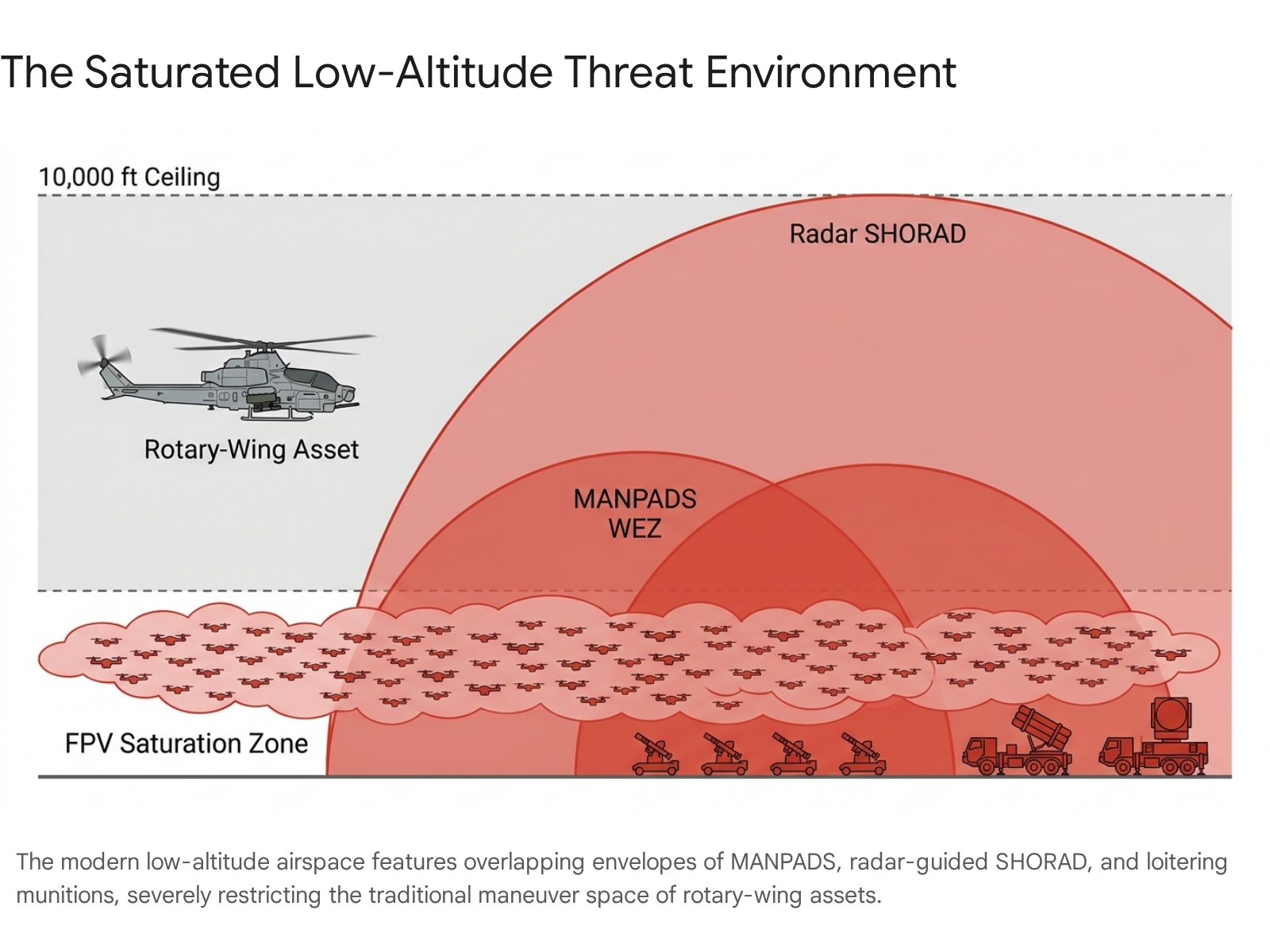
Modern land armies have invested heavily in ground-based air defense, pushing defense density to historically significant levels.12 The deployment of these systems is no longer restricted to strategic rear areas; they are organically integrated into frontline maneuver formations. For instance, a typical advancing heavy combined arms battalion in the Chinese People’s Liberation Army (PLA) operates beneath a highly mobile, layered air defense umbrella. This umbrella incorporates radar-controlled antiaircraft artillery (such as the PGZ-07 and PGZ-95), mobile short-range surface-to-air missile systems (like the HQ-17), and dozens of dispersed Man-Portable Air-Defense Systems (MANPADS) teams equipped with modern, dual-band infrared seekers.13
The sheer density of these systems per kilometer of the forward edge of the battle area (FEBA) makes traditional low-altitude penetration a high-risk endeavor.12 Legacy attack helicopter tactics relied heavily on nap-of-the-earth (NOE) flight and terrain masking to evade long-range early warning radars, popping up momentarily over a tree line or ridge to visually acquire targets and fire line-of-sight missiles. In the contemporary environment, popping up exposes the aircraft to a dense, localized web of electro-optical and infrared (EO/IR) sensors and radar-guided interceptors capable of prosecuting a target within seconds.13
2.2. The Democratization of Precision Strike via FPV Drones
Beyond traditional missile systems, the lower airspace has been radically altered by the emergence of First-Person View (FPV) drones and small loitering munitions. Initially utilized as improvised surveillance tools, these systems are now produced in massive industrial quantities, providing infantry squads with organic precision strike capabilities at a fraction of the cost of traditional guided weapons.16
These attritable systems pose a dual threat to rotary assets. First, they operate in the exact same low-altitude airspace, creating severe physical and cognitive congestion for pilots. Second, they have evolved from anti-armor platforms into ad-hoc anti-helicopter weapons. Adversaries have successfully deployed FPV drones to hunt helicopters both in flight and during vulnerable hover phases.18
Furthermore, the introduction of fiber-optic guided FPVs represents a significant tactical escalation. Traditional drones rely on radio frequency (RF) links, which can be disrupted by electronic warfare (EW) jamming. Fiber-optic drones trail a physical data tether, rendering them entirely immune to RF jamming and spoofing.18 This technological shift has stripped away a critical layer of passive defense, rendering airspace within 10 to 20 kilometers of the front lines exceptionally hazardous for any slow-moving or hovering aircraft.18 Adversaries are also utilizing “mothership” unmanned aerial vehicles (UAVs), such as variants of the Orlan and Molniya fixed-wing drones, to carry FPVs deeper into the rear, effectively extending the tactical drone threat range up to 60 kilometers.18
2.3. The Doctrinal Death of High-Threat Close Air Support
The culmination of these factors is the functional cessation of traditional CAS in peer-level conflicts. CAS is doctrinally defined as air action against hostile targets in close proximity to friendly forces, a proximity that demands detailed integration of each air mission with the fire and movement of those forces.1
Historically, this required the pilot to visually acquire the target or fly directly overhead to deliver unguided rockets or autocannon fire. In a transparent battlefield where any exposed asset can be targeted and destroyed by precision-guided munitions, committing a multi-million dollar attack helicopter to strafe a fortified trench line is an untenable tactical calculus.3 As analysts have noted, the concept of a dedicated aircraft surviving in a high-threat CAS environment is fundamentally flawed; the air defenses are simply too lethal, and the sensor-to-shooter latency is too short to allow for traditional loitering.2 Deep Air Support (DAS), which involves striking targets at a distance where detailed integration with friendly ground movement is not required, is rapidly replacing CAS as the primary aerial fire support mechanism.21
3. Case Study: The Russo-Ukrainian War and the Forging of New Rotary Tactics
The ongoing conflict in Ukraine serves as the definitive crucible for modern rotary-wing operations. The war has forcibly transitioned attack helicopter forces from acting as frontline tank hunters to assuming roles as standoff artillery platforms and specialized support nodes. This shift was born out of catastrophic early-war losses and subsequent rapid adaptation.7
3.1. Initial Failures and High-Value Attrition
During the initial phases of the invasion, Russian airborne and rotary forces attempted deep penetrations and traditional air assault maneuvers, most notably the assault on Hostomel airport.23 These operations, conducted without establishing air superiority or fully suppressing the Ukrainian IADS, resulted in extraordinary personnel and material losses.23
The Russian Ka-52 “Alligator,” heavily touted as a premier attack helicopter featuring an armored cockpit and a unique coaxial rotor system, suffered deeply. Analysis of its combat record revealed significant vulnerabilities when forced into traditional CAS roles. Despite its heavy armor and the K-37-800M ejection system—a rarity among helicopters designed to save crews if shot down—the Ka-52’s targeting systems proved inadequate for the modern battlefield.24 Its GOES-451 optical suite struggled to identify targets at medium and long ranges, leading to high-profile misidentifications where crews expended anti-tank guided missiles on civilian agricultural equipment, mistaking them for Leopard tanks.24 Furthermore, the L-370 “Vitebsk” electronic warfare suite, designed to decoy radar and IR missiles, failed to provide consistent protection against dense Ukrainian MANPADS networks.24 The requirement to close the distance for visual identification directly exposed the helicopters to the dense SHORAD threat.
3.2. Doctrinal Shift: From Penetration to Standoff Artillery
Recognizing the unsustainability of traditional operations and the high attrition rates, Russian forces abandoned direct tank-hunting missions.19 Instead, rotary forces adapted to the reality of the saturated airspace by transitioning to extreme standoff tactics.
The primary adaptation was the use of helicopters for “pitch-up” or “lobbing” unguided rockets. By flying at extremely low altitudes, pitching the nose up sharply, and firing rockets in a ballistic arc, helicopters could strike area targets from several kilometers away without ever crossing the forward line of own troops or entering the visual acquisition range of enemy MANPADS.7 While this method is highly inaccurate compared to direct-fire guided missiles, the tactic preserved the platforms, essentially transforming them into highly mobile, hit-and-run rocket artillery.19 This adaptation demonstrates that while the airspace directly above the enemy is denied, the airspace adjacent to the threat ring can still be utilized if tactics are appropriately modified.
3.3. The Enduring Rotary Requirement Amidst Drone Proliferation
The pervasive use of FPVs and strike drones in Ukraine has led some observers to conclude that cheap, attritable drones will entirely replace helicopters.27 However, frontline combat leaders and military strategists emphasize that drones augment, rather than replace, conventional aviation capacity.28 The Ukrainians characterize this evolution as a “new battle triangle,” merging traditional intelligence, conventional operations, and the integration of drones and electronic warfare.28
The fundamental limitation of unmanned platforms is dictated by the laws of physics: a drone’s payload capacity is inversely related to its range and endurance. To carry a payload equivalent to the sixteen Hellfire missiles mounted on an AH-64 Apache or an AH-1Z Viper, a drone must be substantially larger, thereby drastically increasing its radar cross-section, procurement cost, and operational vulnerability.7 Attack helicopters maintain their relevance due to their heavy, reloadable magazines and their ability to sustain high-intensity firepower over prolonged engagements, capabilities that small-scale attritable drones simply cannot replicate.7 A 200 mile-per-hour missile carrier that can utilize complex terrain masking fills a niche that remains unmatched by current uncrewed technology.5
4. The Vulnerability of the Ground: Redefining the Tactical Assembly Area
The threat to rotary assets extends far beyond the airspace. In a multi-domain fight characterized by pervasive intelligence, surveillance, and reconnaissance (ISR), helicopters are arguably at their most vulnerable while parked on the ground undergoing maintenance or refueling.
4.1. The Fallacy of the “Iron Mountain”
A critical vulnerability identified in recent joint readiness exercises is the persistence of the “Iron Mountain” mentality. Conditioned by two decades of counter-insurgency (COIN) operations in uncontested airspace, aviation task forces routinely prioritize logistical convenience over tactical survivability.29
Observations from the Joint Multinational Readiness Center (JMRC) in Germany reveal that units frequently establish large, static Tactical Assembly Areas (TAAs) that resemble exposed flight lines.29 Helicopters are parked in neat rows adjacent to massive fuel bladders and maintenance tents, often entirely devoid of overhead cover or camouflage, operating approximately 50 kilometers behind the FLOT.29 In a modern conflict, this assumption of rear-area sanctuary is fatal. The distinctive visual signatures of helicopter rotor blades and fuselages are easily identifiable by machine learning algorithms analyzing commercial and military satellite imagery, as well as by persistent high-altitude drone surveillance.29
4.2. Sensor-to-Shooter Kill Chains
Once an exposed TAA is identified, peer adversaries possess the capability to close the sensor-to-shooter kill chain within minutes. In simulated combat environments, these static, densely packed aviation nodes are routinely decimated by long-range artillery fires and one-way attack UAS barrages.29 Operating a centralized Forward Arming and Refueling Point (FARP) consolidates high-value targets, simplifying the adversary’s targeting matrix.29
4.3. The Dispersal Imperative
To survive, rotary aviation doctrine must undergo a radical shift toward dispersal, strict signature management, and constant mobility. Survivability must become the foremost priority in TAA planning and execution.29
Aviation brigades must break their combat power into decentralized, semi-autonomous nodes.29 Instead of massing an entire company for maintenance, commanders must assume logistical risk, dispersing aircraft across varied terrain and conducting only minor maintenance (e.g., 50-hour inspections) in austere, camouflaged locations.29 Crucially, to disrupt the enemy’s targeting cycle, helicopters must be relocated continuously—moving every 24 hours, even if the displacement is only a few hundred meters.29
This decentralized operational model is enabled by modernized command and control (C2) architectures. The integration of low-earth orbit (LEO) satellite communications, such as Starlink or Starshield, allows aviation commanders to maintain high-bandwidth C2 over a widely distributed footprint without emitting the massive, easily detectable radio frequency signatures typical of legacy command posts.29 Furthermore, TAAs must incorporate layered defense strategies against UAS, integrating passive concealment with active measures like early warning systems, jammers, and kinetic defeat mechanisms.29
| TAA Characteristic | Legacy COIN Posture (The “Iron Mountain”) | Modern LSCO Posture (Dispersed Operations) |
| Operational Footprint | Centralized, dense concentrations of assets. | Widely dispersed, decentralized autonomous nodes. |
| Typical Location | Open airfields, large clearings, hardstands. | Forested terrain, urban hide-sites, complex topography. |
| Movement Tempo | Static for weeks or months at a time. | Relocating every 12 to 24 hours to break targeting cycles. |
| Maintenance Posture | All echelons of maintenance conducted centrally. | Minor maintenance decentralized; major overhauls sent rearward. |
| Electromagnetic Signature | Highly visible; massive RF emissions from C2 nodes. | Strict emission control (EMCON), utilization of LEO comms. |
| Defensive Measures | Perimeter security, assumed air sanctuary. | Layered Counter-UAS (kinetic/electronic), scatter plans. |
Table 1: The Doctrinal Evolution of Aviation Tactical Assembly Areas (TAAs). 29
5. Manned-Unmanned Teaming (MUM-T) and Air-Launched Effects (ALE)
The most significant doctrinal evolution preserving the utility of the attack helicopter is its transformation from a direct-fire weapons platform into an airborne command and control node for uncrewed systems. The concept of Manned-Unmanned Teaming and the employment of Air-Launched Effects fundamentally alter the geometry of aerial combat.7
5.1. The Helicopter as a Tactical “Mothership”
Instead of breaching an adversary’s A2/AD bubble directly, a modern attack helicopter stands off at a safe distance and launches a swarm of smaller, expendable drones (ALEs).7 A critical tactical evolution involves attack helicopters operating safely behind terrain, acting as “motherships” that launch and control these swarms. These ALEs penetrate the high-threat A2/AD zone to scout targets and jam enemy sensors. By deploying these ALEs, manned rotary assets remain masked behind terrain, extending their sensor reach and disrupting enemy air defenses without entering the lethal engagement zone.
This mothership concept provides a deeply symbiotic relationship.7 The ALEs extend the sensor range of the helicopter by tens of kilometers, mapping air defense radars and transmitting high-definition targeting data back to the pilot via secure data links.7 Experiments such as the Army’s Project Convergence and the Experimentation Demonstration Gateway Event have successfully demonstrated the launch and control of drone swarms operating up to 60 kilometers ahead of the launching aircraft.7
5.2. Cognitive Overload and System Disintegration
ALEs are not solely ISR assets; they are active combatants designed to induce cognitive overload within enemy defense networks. Operating as a networked swarm, these drones force the adversary into a severe tactical dilemma. The enemy must choose between expending highly expensive, limited-stock surface-to-air interceptors on cheap, expendable drones, or allowing the drones to penetrate their airspace.7
Furthermore, specialized ALEs are equipped with electronic warfare payloads. They can fly directly into the radar lobes of enemy IADS, blinding early warning radars, jamming communications, and deploying physical decoys.7 By disintegrating the enemy’s sensory network, the ALE swarm creates temporary, localized corridors of uncontested airspace through which the manned helicopter, or deeper joint strike assets, can safely deploy precision munitions.7
5.3. The Human-in-the-Loop Imperative
A frequent counter-argument suggests that if drones are performing the high-risk penetration tasks, the manned helicopter should be eliminated entirely in favor of ground-controlled drone swarms. However, military strategists highlight the enduring necessity of the human pilot remaining in the tactical loop.7
Remote operations suffer from inherent latency and are highly vulnerable to localized EW and cyber-attacks that sever the data link between the drone and the ground station. A human pilot located forward in the battlespace cannot be “jammed” or cyber-attacked.7 If the ALE swarm is neutralized by enemy EW, the human pilot can seamlessly transition to alternative kill chains—utilizing GPS-guided munitions, laser-guided weapons, or leveraging organic electro-optical sensors to continue the mission autonomously.7 The manned platform provides a resilient, adaptable decision-making node at the very edge of the battlespace, capable of instantaneous tactical adjustments that remote operators cannot replicate.7
6. The Paradigm of Standoff Strike: Outranging the Enemy
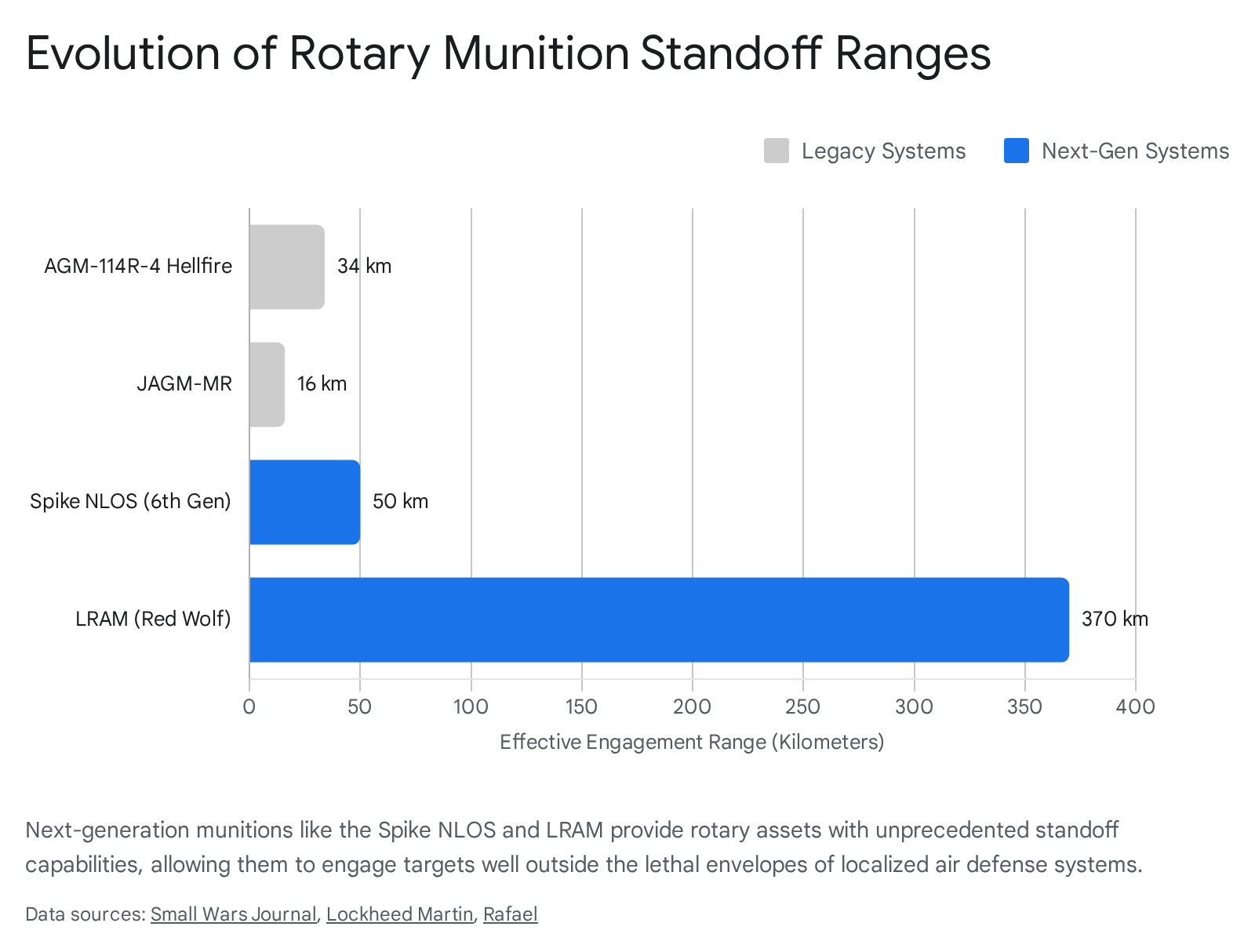
If the helicopter must remain outside the enemy’s Weapon Engagement Zone (WEZ) to survive, its organic munitions must be capable of striking across vast distances. The era of the AGM-114 Hellfire missile—which boasts a range of roughly 8 to 11 kilometers and often requires line-of-sight targeting—is sunsetting in the context of peer conflict.7 The future of rotary aviation relies entirely on extreme standoff precision strikes.
6.1. Spike NLOS Integration
To bridge the immediate capability gap, Western militaries are actively integrating the Spike Non-Line-Of-Sight (NLOS) missile system onto existing rotary fleets. The Spike NLOS is a multi-purpose, electro-optical/infrared missile that significantly extends the attack helicopter’s reach to between 32 and 50 kilometers.8
Crucially, the system features a wireless datalink that provides the gunner with real-time video imagery and “man-in-the-loop” control throughout the missile’s flight.8 This capability allows the helicopter to launch the weapon from complete defilade (e.g., hovering securely behind a forest canopy or ridge), guide the missile over the obstacle, and acquire the target mid-flight.8 In recent campaigns, U.S. Army Soldiers of the 12th Combat Aviation Brigade successfully demonstrated the Spike NLOS from an AH-64Ev6 Apache Guardian helicopter in Poland, engaging sea-based targets at distances of up to 25 kilometers.32 This marked a critical milestone for allied long-range precision strike capabilities, validating the platform’s ability to operate safely in contested environments and supporting Poland’s procurement of 96 AH-64E Apache Guardian helicopters.32
6.2. Long Range Attack Missile (LRAM) and Deep Maritime Strike
Looking toward theaters defined by vast geographic expanses, such as the Indo-Pacific, the ranges required for survivability increase exponentially. To address the sophisticated coastal A2/AD networks of adversaries, the U.S. Marine Corps is advancing the Long Range Attack Missile (LRAM) program, specifically utilizing the “Red Wolf” launched-effect vehicle.7
The LRAM is a turbojet-powered, missile-class vehicle capable of being launched from an AH-1Z Viper helicopter, boasting a staggering range exceeding 200 nautical miles (approximately 370 kilometers).7 This revolutionary reach allows rotary assets to strike enemy shipborne SAM systems and coastal defenses from distances that completely negate the adversary’s counter-fire capabilities.7 The munition is versatile, capable of both kinetic precision strikes and non-kinetic roles such as electronic attack, signal detection, or serving as a communications relay.7 With an estimated unit cost of $300,000, it provides a cost-effective standoff solution that transforms the helicopter from a frontline combatant into a deep-strike platform.7
| Munition System | Primary Platform Integration | Maximum Range | Propulsion / Guidance | Primary Role |
| AGM-114 Hellfire | AH-64, AH-1Z, MH-60 | ~11 km | Solid-propellant / Semi-active Laser | Legacy line-of-sight anti-armor. |
| Spike NLOS | AH-64E | 32 – 50 km | Solid-propellant / EO-IR with Datalink | Medium-range standoff, man-in-the-loop. |
| LRAM (Red Wolf) | AH-1Z | >370 km (200 nm) | Turbojet / Networked Targeting | Deep strike, A2/AD network degradation. |
Table 2: Comparison of Current and Next-Generation Rotary Munitions. 7
7. Platform Modernization: Next-Generation Survivability Systems
To ensure helicopters can survive both in transit and while executing standoff engagements, their onboard defensive suites are undergoing a rapid evolution. Traditional countermeasures—such as standard flares and chaff—are increasingly inadequate against multispectral seekers and modern radar-guided interceptors. The aerospace industry is responding with a shift toward active, intelligent countermeasures designed to provide a holistic defensive shield.34
7.1. Directed Infrared Countermeasures (DIRCM)
To defeat advanced IR-guided MANPADS, modern rotary assets are being retrofitted with Directed Infrared Countermeasure systems. Systems such as the Common Infrared Countermeasures (CIRCM) and Leonardo’s Miysis DIRCM utilize advanced electro-optical threat detection to identify incoming missile launches.36 Once detected, a precision turret directs a high-energy laser directly into the missile’s seeker head, blinding the optics, disrupting its tracking ability, and causing the missile to fall away harmlessly.36
The CIRCM system, built with an open architecture to allow for rapid technology upgrades against emerging threats, has proven highly effective. It has achieved more than 70,000 operational flight hours on Army AH-64, CH-47, and UH-60 rotary aircraft without a single aircraft loss to targeted IR threats.36 The global demand for this survivability is evident, with nations like Germany actively procuring CIRCM systems to protect their newly ordered CH-47 Chinook fleets, fulfilling NATO combat readiness requirements.36
7.2. Active Expendable Decoys and Electronic Warfare
While DIRCM effectively addresses the infrared threat, radar-guided missiles represent a distinct and highly lethal challenge. To combat sophisticated Radio Frequency threats, defense contractors have developed active expendable decoys, representing a generational technological leap over traditional chaff dispersal.
A prime example is the Leonardo BriteCloud system.38 Originally designed to protect fast jets like the F-35 Lightning II and Eurofighter Typhoon, this technology is actively being adapted across broader platforms, including military transport aircraft and helicopters.39 BriteCloud is a self-contained Digital Radio Frequency Memory (DRFM) jammer housed within a standard flare-sized cartridge.39 When ejected, the decoy detects the incoming radar signal, records the specific waveform, and broadcasts a manipulated “ghost” signal to lure the missile away from the host aircraft, generating significant miss distances.38
The programmable nature of the decoy allows end users to update the software rapidly to counter newly identified enemy radar emitters encountered in a specific theater of operations.42 The U.S. Navy’s recent sole-source contract to equip the F-35 with BriteCloud underscores the critical necessity of active expendable decoys as an outer layer of defense, a technology that seamlessly translates to enhancing rotary-wing survivability.41
8. The Imperative of Contested Logistics and Medical Evacuation (MEDEVAC)
While attack helicopters adapt to specialized strike and reconnaissance roles, the utility of transport and cargo rotary assets is becoming the bedrock of operational sustainability. In LSCO, the ability to sustain forces and evacuate casualties is severely compromised by long-range precision fires targeting ground infrastructure.10
8.1. Sustaining the Force Beyond the GLOC
In geographically fragmented theaters like the Indo-Pacific, or in European environments where bridges, rail lines, and highways are pre-sighted by artillery, relying solely on Ground Lines of Communication (GLOC) for resupply is operationally risky and tactically insufficient.9 Ground transport is predictable and easily interdicted by drone swarms and ballistic missiles.
Military logisticians emphasize the absolute necessity of integrating rotary-wing assets into contested logistics frameworks.9 Transport helicopters (e.g., CH-47 Chinooks, UH-60 Black Hawks, MV-22 Ospreys) offer a parallel distribution method, providing rapid, unpredictable resupply of critical Class III (fuel) and Class V (ammunition) commodities directly to dispersed maneuver forces.9 Assessments from recent exercises, such as Freedom Shield 2024 and Warfighter 2025 involving the 593rd Corps Sustainment Command, revealed that rotary assets were initially underutilized due to a lack of familiarity among sustainment planners.9 However, when logisticians demanded parallel employment of both ground and air assets, resupply speed and operational distribution improved markedly.9
To institutionalize this capability, structural changes through the DOTMLPF framework (Doctrine, Organization, Training, Materiel, Leadership, Personnel, Facilities) are required.9 Current doctrine manuals must be revised to embed air resupply as a core sustainment function, and sustainment brigades must establish permanent aviation coordination elements to ensure seamless integration with Combat Aviation Brigades.9
8.2. The Crisis of Combat Casualty Care and the “Golden Hour”
Perhaps the most sobering reality of peer conflict is the collapse of the “golden hour”—the doctrinal standard dictating that wounded personnel must reach surgical care within 60 minutes of injury.44
In a contested airspace heavily saturated with A2/AD systems, dedicated MEDEVAC helicopters will routinely be denied freedom of movement. Near-peer adversaries will establish anti-access zones that prevent immediate, direct-line evacuation.44 Consequently, initial estimates from warfighter exercises suggest casualty rates could soar to as high as 55 percent, rapidly overwhelming the current military medical system.44 The statistical category of “died of wounds,” largely absent during the last twenty years of conflict due to high survival rates and uncontested air superiority, has already returned in the Ukraine conflict.44
To mitigate this, medical planners are shifting focus to long-range, prolonged field care.45 Transport helicopters will be required to manage critical care patients for flights exceeding two hours, navigating circuitous, terrain-masked routes to avoid threat envelopes.45 The demand for rotary-wing CASEVAC (Casualty Evacuation) platforms of opportunity will vastly outstrip supply, making the heavy lift and rapid transit capacity of surviving helicopters a strategic imperative for force preservation.44
9. Strategic Posture, Force Generation, and Future Vertical Lift (FVL)
The enduring relevance of rotary assets is further supported by the massive institutional investments being made in pilot generation and the development of next-generation platforms engineered specifically to operate in environments where legacy helicopters struggle.
9.1. Pilot Production and Fleet Manning
If rotary assets were viewed as genuinely obsolete by military leadership, one would expect a concurrent divestment in training infrastructure. However, current data indicates the opposite. The U.S. military is aggressively expanding pilot production. The Naval Air Training Command (CNATRA) flew over 265,000 flight hours in 2024, achieving over 100% of required wingers for Fleet Replacement Squadrons.46 By implementing innovative programs like the Contract Operated Pilot Training – Rotary (COPT-R), the Navy is producing highly trained helicopter pilots in two-thirds of the traditional time, intentionally overproducing to ensure first-seat fleet manning in all deployable air wings.46 This massive investment in human capital confirms the long-term strategic reliance on rotary aviation.
9.2. The V-280 Valor and the Speed Imperative
The United States Army’s selection of the Bell V-280 Valor tiltrotor for the Future Long-Range Assault Aircraft (FLRAA) program is a direct, material response to the A2/AD challenge.47 Traditional helicopters suffer from an inherent aerodynamic speed limit caused by retreating blade stall, rendering them relatively slow and vulnerable over long transit routes.49
The V-280 Valor dramatically alters this survivability equation. By combining the vertical takeoff and landing capability of a helicopter with the speed and range of a turboprop airplane, the V-280 can penetrate contested zones faster, significantly reducing the adversary’s engagement window.49 Unlike the legacy V-22 Osprey, the V-280’s engines remain fixed while only the rotors and drive shafts tilt, reducing mechanical complexity and increasing aircraft availability.51 Its extended range allows it to launch from staging bases hundreds of miles outside the enemy’s immediate threat ring, bypass dense defenses, and insert forces or deliver logistics deep into contested territory.49 With range and speed, the military effectively buys back relevance in the lower airspace.49
9.3. Chinese People’s Liberation Army (PLA) Aviation Doctrine
The global utility of rotary assets is perhaps most starkly evidenced by the aggressive investments being made by peer adversaries. The PLA Army Aviation branch has rapidly expanded its helicopter forces, focusing heavily on the Z-10 attack helicopter and the Z-20 medium-lift utility helicopter.52
Notably, since 2017, the PLA has constructed a dense network of new and upgraded heliports along the high-altitude, highly contested Sino-Indian border.52 Operating helicopters in the extreme elevations and harsh environmental conditions of Tibet and Xinjiang is exceptionally taxing on airframes and engines. Yet, the PLA views vertical lift as so critical to modern force projection that they are aggressively pursuing this capability despite the geographical challenges.52
In PLA doctrine, Army Aviation is heavily integrated into the operational level of warfare. During Large-Scale Combat Operations, PLA attack helicopters (like the Z-10 and Z-19) are doctrinally tasked with executing counter-UAS missions and providing deep reconnaissance to support advancing ground forces.13 The PLA’s commitment to expanding its rotary-wing fleet—organizing them comprehensively across all Theater Commands—underscores that America’s primary strategic competitors view helicopters as a central, indispensable pillar of future land warfare.53
| PLA Theater Command | Associated Aviation Brigade | Primary Attack Platforms | Primary Transport Platforms |
| Eastern | 71st, 72nd, 73rd | Z-10, Z-19 | Z-8A, Z-8B, Z-20, Mi-17 |
| Southern | 74th, 121st Air Assault | Z-10, Z-19 | Z-8B, Z-8G, Z-20, Mi-17 |
| Western | 76th, 77th, 84th, 85th | Z-10 | Z-8G, Z-20, Mi-17 |
| Northern | 78th, 79th, 80th | Z-10, Z-19 | Z-8A, Z-8B, Z-8G, Mi-17 |
| Central | 81st, 82nd, 161st Air Assault | Z-10, Z-19 | Z-8A, Z-8B, Z-8G, Z-8L, Z-20, Mi-17 |
Table 3: Disposition of Chinese PLA Army Aviation Brigades and Primary Platforms. 53
10. Conclusion and Strategic Assessment
The assertion that rotary assets are obsolete in modern airspace relies on a rigid, historically bound definition of their utility. It is highly accurate to conclude that the era of helicopters hovering directly over the battlefield to provide visual Close Air Support against a peer adversary is decisively over. The rapid proliferation of MANPADS, mobile radar-guided SHORAD, and fiber-optic FPV drones has rendered the airspace from the surface to 10,000 feet a lethal, highly saturated environment where slow-moving, exposed platforms cannot survive.
However, rotary-wing aviation has fundamentally adapted to this new reality. Far from becoming obsolete, the military helicopter is transitioning into an indispensable integration node for multi-domain operations. By leveraging Manned-Unmanned Teaming, deploying Air-Launched Effects to blind and degrade enemy sensors, and utilizing extreme standoff munitions like the Spike NLOS and the Long Range Attack Missile, attack helicopters can outrange ground-based air defenses and project power with comparative impunity. Simultaneously, transport and utility fleets remain the only viable, agile solution for contested logistics and long-range casualty evacuation when ground routes are inevitably interdicted.
The integration of advanced survivability suites, coupled with a doctrinal shift toward dispersed, highly mobile Tactical Assembly Areas, provides a viable framework for survivability. Furthermore, the development of high-speed tiltrotor platforms like the V-280 Valor, alongside massive ongoing investments by peer adversaries like China, confirms that vertical lift remains a strategic imperative. The helicopter is not dead; it has evolved from a frontline brawler into a sophisticated, long-range enabler vital to the execution of modern combined arms warfare.
Please share the link on Facebook, Forums, with colleagues, etc. Your support is much appreciated and if you have any feedback, please email us in**@*********ps.com. If you’d like to request a report or order a reprint, please click here for the corresponding page to open in new tab.
Sources Used
- Close air support – Wikipedia, accessed April 26, 2026, https://en.wikipedia.org/wiki/Close_air_support
- The Myth of High-Threat Close Air Support – War on the Rocks, accessed April 26, 2026, https://warontherocks.com/the-myth-of-high-threat-close-air-support/
- Bell v280 “Valor” chosen as successor to the Blackhawk : r/WarplanePorn – Reddit, accessed April 26, 2026, https://www.reddit.com/r/WarplanePorn/comments/zds4kk/bell_v280_valor_chosen_as_successor_to_the/
- Are Attack Helicopters Still Relevant in 2025? – YouTube, accessed April 26, 2026, https://www.youtube.com/watch?v=Zo_MTvGMnsU
- Are attack helicopters becoming obsolete in modern warfare? : r/WarCollege – Reddit, accessed April 26, 2026, https://www.reddit.com/r/WarCollege/comments/188hpxm/are_attack_helicopters_becoming_obsolete_in/
- U.S. Military Rotorcraft 2025: Strong Deliveries & Next-Gen Tech – Defense Security Monitor, accessed April 26, 2026, https://dsm.forecastinternational.com/2026/03/24/us-military-rotorcraft-market-2025-deliveries/
- Attack Helicopters Remain Vital to the American Way of War, accessed April 26, 2026, https://smallwarsjournal.com/2026/03/27/attack-helicopters-remain-vital-to-the-american-way-of-war/
- Spike NLOS | Lockheed Martin, accessed April 26, 2026, https://www.lockheedmartin.com/en-us/products/Spike-NLOS.html
- Planes, Trains, Automobiles … and Now Helicopters: Integrating Air …, accessed April 26, 2026, https://www.armyupress.army.mil/Journals/Military-Review/English-Edition-Archives/January-February-2026/Planes-Trains-Automobiles/
- Bridging Sky and Sea: Joint Strategies for Medical Evacuation in the Indo-Pacific, accessed April 26, 2026, https://publications.armywarcollege.edu/News/Display/Article/4129379/bridging-sky-and-sea-joint-strategies-for-medical-evacuation-in-the-indo-pacific/
- Lessons and Best Practices – U.S. Army, accessed April 26, 2026, https://api.army.mil/e2/c/downloads/2023/01/19/18849503/18-16-maneuver-leader-s-guide-to-stinger-handbook-apr-18-public.pdf
- Defense Density in Modern Air Warfare – Al Habtoor Research Centre, accessed April 26, 2026, https://www.habtoorresearch.com/wp-content/uploads/2026/03/Defense-Density-in-Modern-Air-Warfare.pdf
- How China Fights – Against a US Army Brigade Combat Team, accessed April 26, 2026, https://g2webcontent.z2.web.core.usgovcloudapi.net/OEE/China%20Landing%20Zone/2026JAN29_T2COMG2_How_CHI_Fights_LSCO_Assessment1-1.1%202.pdf
- feasibility of a realistic air defense experimentation system for evaluating short-range and man-portable weapon systems operators – DTIC, accessed April 26, 2026, https://apps.dtic.mil/sti/tr/pdf/ADA136234.pdf
- The Evolution of Air Defense: Adapting to Emerging Threats – Army University Press, accessed April 26, 2026, https://www.armyupress.army.mil/Journals/Military-Review/English-Edition-Archives/September-October-2025/Air-Defense/
- Beyond the Gauntlet: Drone Dominance and the Lessons of Ukraine’s FPV War, accessed April 26, 2026, https://insideunmannedsystems.com/beyond-the-gauntlet-drone-dominance-and-the-lessons-of-ukraines-fpv-war/
- Russia’s Changes in the Conduct of War Based on Lessons from Ukraine – Army University Press, accessed April 26, 2026, https://www.armyupress.army.mil/Journals/Military-Review/English-Edition-Archives/September-October-2025/Lessons-from-Ukraine/
- Russian Force Generation & Technological Adaptations Update, October 9, 2025, accessed April 26, 2026, https://understandingwar.org/research/russia-ukraine/russian-force-generation-technological-adaptations-update-october-9-2025/
- How are helicopters performing in Ukraine? Do they still act as tank killers? Photo shows a heavily armed Ka-52 “Alligator” – Reddit, accessed April 26, 2026, https://www.reddit.com/r/Helicopters/comments/1g02smv/how_are_helicopters_performing_in_ukraine_do_they/
- Hunting The Hunters: FPV Drone-Killing Devices Emerge On Ukraine’s Front Lines, accessed April 26, 2026, https://www.rferl.org/a/anti-drone-technology-russia-invasion-ukraine-elka-fpv-threat/33737266.html
- MCWP 3-23.2 Deep Air Support – Marines.mil, accessed April 26, 2026, https://www.marines.mil/Portals/1/Publications/MCWP%203-23.2%20Deep%20Air%20Support.pdf
- The Enduring Role of Fires on the Modern Battlefield – CSIS, accessed April 26, 2026, https://www.csis.org/analysis/chapter-6-enduring-role-fires
- Helicopters Remain a Vital Part of the Joint-Force | Royal United …, accessed April 26, 2026, https://my.rusi.org/resource/helicopters-remain-a-vital-part-of-the-joint-force.html
- Ka-52 Alligator: The Nearly-Crushed Backbone of Russia’s Attack Helicopter Fleet, accessed April 26, 2026, https://united24media.com/latest-news/ka-52-alligator-the-nearly-crushed-backbone-of-russias-attack-helicopter-fleet-8820
- Russian Helicopters Vs. Ukrainian Armor: A Detailed Analysis – Ftp, accessed April 26, 2026, https://ftp.bills.com.au/lunar-tips/russian-helicopters-vs-ukrainian-armor-a-detailed-analysis-1764798226
- Russian Ka-52 Alligator has become an ‘Air Force nightmare’ – BulgarianMilitary.com, accessed April 26, 2026, https://bulgarianmilitary.com/2024/09/10/russian-ka-52-alligator-has-become-an-air-force-nightmare/
- Are attack helicopters obsolete? : r/WarCollege – Reddit, accessed April 26, 2026, https://www.reddit.com/r/WarCollege/comments/e73quw/are_attack_helicopters_obsolete/
- Seven Contemporary Insights on the State of the Ukraine War – CSIS, accessed April 26, 2026, https://www.csis.org/analysis/seven-contemporary-insights-state-ukraine-war
- Aviation TAA Survivability in the Multi-Domain Fight | Article | The …, accessed April 26, 2026, https://www.army.mil/article/289112/aviation_taa_survivability_in_the_multi_domain_fight
- Forging Ahead Into Rotary-Wing Aviation’s Crewed-Uncrewed Future – Defence Leaders, accessed April 26, 2026, https://defenceleaders.com/news/forging-ahead-into-rotary-wing-aviations-crewed-uncrewed-future/
- Helicopters Armament Upgrade & Advanced Attack Systems – Rafael, accessed April 26, 2026, https://www.rafael.co.il/system/spike-for-helicopters/
- U.S. Army tests spike missile from AH-64 in Poland, accessed April 26, 2026, https://www.army.mil/article/288130/u_s_army_tests_spike_missile_from_ah_64_in_poland
- shownews – Polish APACHE fleet gains extended reach with SPIKE NLOS integration, accessed April 26, 2026, https://www.fw-mag.com/shownews/678/polish-apache-fleet-gains-extended-reach-with-spike-nlos-integration
- Future Vertical Lift (FVL) Solutions – BAE Systems, accessed April 26, 2026, https://www.baesystems.com/en-us/product/future-vertical-lift-solutions
- Ten Things to Know about the Future of Vertical Lift | Northrop Grumman, accessed April 26, 2026, https://www.northropgrumman.com/what-we-do/aircraft/future-vertical-lift/ten-things-to-know
- Northrop Grumman to supply aircraft protection systems to Germany – Investing.com, accessed April 26, 2026, https://www.investing.com/news/stock-market-news/northrop-grumman-to-supply-aircraft-protection-systems-to-germany-93CH-4544537
- Electro Optics | Leonardo in the UK, accessed April 26, 2026, https://uk.leonardo.com/en/electronics/electro-optics
- Airborne Systems for Electronic Warfare and Self-protection | Leonardo, accessed April 26, 2026, https://electronics.leonardo.com/en/electronic-warfare
- BriteCloud | Leonardo in the UK, accessed April 26, 2026, https://uk.leonardo.com/en/innovation/britecloud
- U.S. Navy Awards Leonardo UK Contract to Equip F-35 with BriteCloud Active Expendable Decoys – The Aviationist, accessed April 26, 2026, https://theaviationist.com/2025/12/26/us-navy-contract-f-35-britecloud-active-expendable-decoys/
- U.S. Navy Orders Leonardo UK BriteCloud Missile Defense Decoys for F-35 Fighter Jet Self-Protection – Army Recognition, accessed April 26, 2026, https://www.armyrecognition.com/news/navy-news/2025/u-s-navy-orders-leonardo-uk-britecloud-missile-defense-decoys-for-f-35-fighter-jet-self-protection
- BriteCloud Manufacturing – Leonardo, accessed April 26, 2026, https://www.leonardo.com/en/news-and-stories-detail/-/detail/britecloud-manufacturing
- The Value of the V-22 in a Dangerous World – Defense Opinion, accessed April 26, 2026, https://defenseopinion.com/the-value-of-the-v-22-in-a-dangerous-world/1132/
- Large-Scale Combat Operations Will Bring New Medical Ethics Challenges, accessed April 26, 2026, https://warontherocks.com/2023/12/large-scale-combat-operations-will-bring-new-medical-ethics-challenges/
- A Case Study of Long-Range Rotary Wing Critical Care Transport in the Battlefield Environment – PubMed, accessed April 26, 2026, https://pubmed.ncbi.nlm.nih.gov/34105126/
- NAVAL AVIATION 2025, accessed April 26, 2026, https://www.airpac.navy.mil/Portals/53/Playbook%202025.pdf
- Future Vertical Lift Cross-Functional – Army Aviation Magazine, accessed April 26, 2026, https://armyaviationmagazine.com/future-vertical-lift-cross-functional/
- BELL V-280 VALOR, What do you think? : r/Helicopters – Reddit, accessed April 26, 2026, https://www.reddit.com/r/Helicopters/comments/1qciw12/bell_v280_valor_what_do_you_think/
- A Reality Check On The Army Picking V-280 Valor Over SB>1 Defiant – The War Zone, accessed April 26, 2026, https://www.twz.com/a-reality-check-on-the-army-picking-v-280-valor-over-sb1-defiant
- We Talk V-280 Valor Versus V-22 Osprey With Bell’s Head Of Tiltrotor Systems, accessed April 26, 2026, https://www.twz.com/21162/we-talk-v-280-valor-versus-v-22-osprey-with-bells-head-of-tiltrotor-systems
- did the army make the right choice with the v-280 valor aircraft? – Sandboxx, accessed April 26, 2026, https://www.sandboxx.us/news/did-the-army-make-the-right-choice-with-the-v-280-valor/
- China’s High-Altitude Heliports: Examining PLA Helicopter Force Changes – Tearline.mil, accessed April 26, 2026, https://www.tearline.mil/public_page/china-pla-helicopters
- PLA Aerospace Power: – Air University, accessed April 26, 2026, https://www.airuniversity.af.edu/Portals/10/CASI/documents/Research/Other-Topics/2024-07-16%20Primer%204th%20ed.pdf
- tradoc-g2-how-china-fights-in-lsco-apr-25-public.pdf – U.S. Army, accessed April 26, 2026, https://api.army.mil/e2/c/downloads/2025/05/08/1888a601/tradoc-g2-how-china-fights-in-lsco-apr-25-public.pdf