Category Archives: Analytics and Reports

United States Military Order of Battle (ORBAT) and Force Posture in the CENTCOM AOR – March 3, 2026

Executive Summary

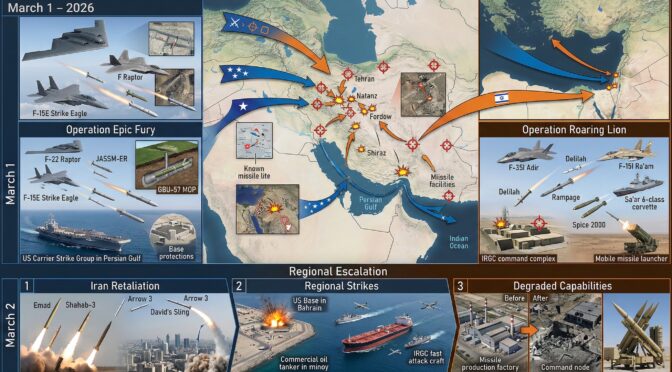
The strategic environment within the United States Central Command (CENTCOM) Area of Responsibility (AOR) has undergone a fundamental and violent transformation following the initiation of Operation Epic Fury on February 28, 2026. Executed in tight operational synchronization with Israeli forces operating under the parallel designation of Operation Roaring Lion, this campaign represents the largest and most dense concentration of American military firepower assembled in the Middle East since the 2003 invasion of Iraq.1 The rapid transition from a posture of coercive diplomacy and deterrence to one of active, high-intensity major combat operations has mobilized a vast, multi-domain array of naval, aerospace, and cyber assets. The primary strategic objective is the systematic dismantling of the Iranian regime’s security apparatus, prioritizing the neutralization of the Islamic Revolutionary Guard Corps (IRGC) command structures, integrated air defense systems, and ballistic missile production facilities, culminating in unprecedented leadership decapitation strikes.4

The current United States Order of Battle (ORBAT) is anchored by a formidable dual-carrier maritime presence. This naval architecture spans the Arabian Sea and the Eastern Mediterranean, establishing overlapping, multi-axis zones of air superiority and long-range conventional strike capability.7 This maritime power projection is augmented by an unprecedented “aerial tsunami” of forward-deployed land-based aviation.8 Fifth-generation stealth fighters, heavy strategic bombers, and specialized electronic warfare platforms have surged into partner nations, notably Israel and Jordan, overcoming significant diplomatic friction and airspace access denials from several Gulf Cooperation Council (GCC) states fearful of Iranian reprisal.1

Furthermore, the operational integration of artificial intelligence into the targeting kill chain marks a watershed moment in automated, algorithmic warfare. Utilizing advanced ontological models to synthesize vast intelligence data streams, the coalition has directed low-cost uncrewed combat attack systems (LUCAS) alongside traditional precision-guided munitions, radically compressing the sensor-to-shooter timeline.10

However, this rapid kinetic escalation has triggered a severe attritional crisis within the coalition’s Air and Missile Defense (AMD) architecture. Iranian retaliatory barrages,employing a “Mosaic Defense” doctrine consisting of synchronized ballistic missiles, cruise missiles, and one-way attack drones,have stressed regional defense magazines to critical breaking points.13 This has exposed acute vulnerabilities in interceptor replenishment cycles, forcing strategic rationing of defensive fires across the theater.14 Concurrently, the kinetic expansion into maritime chokepoints has effectively closed the Strait of Hormuz to commercial transit, generating cascading disruptions across global energy markets and logistics supply chains.15 This intelligence estimate provides an exhaustive, granular mapping of the verified United States force posture, asset locations, logistical vulnerabilities, and operational integration as of early March 2026.

1.0 Strategic Context and the Operational Environment

The operational environment is currently defined by continuous, high-intensity, multi-domain combat operations encompassing the Persian Gulf, the Gulf of Oman, the Levant, and the Eastern Mediterranean. Following the collapse of nuclear negotiations in Geneva in mid-February 2026, the United States executed a rapid, massive surge of military assets to the region, culminating in the launch of Operation Epic Fury.1 The stated objective of this campaign extends far beyond punitive counter-proliferation strikes,such as those witnessed during the June 2025 Operation Midnight Hammer,aiming instead for the systemic degradation of the Iranian state’s ability to project power and maintain internal security.18

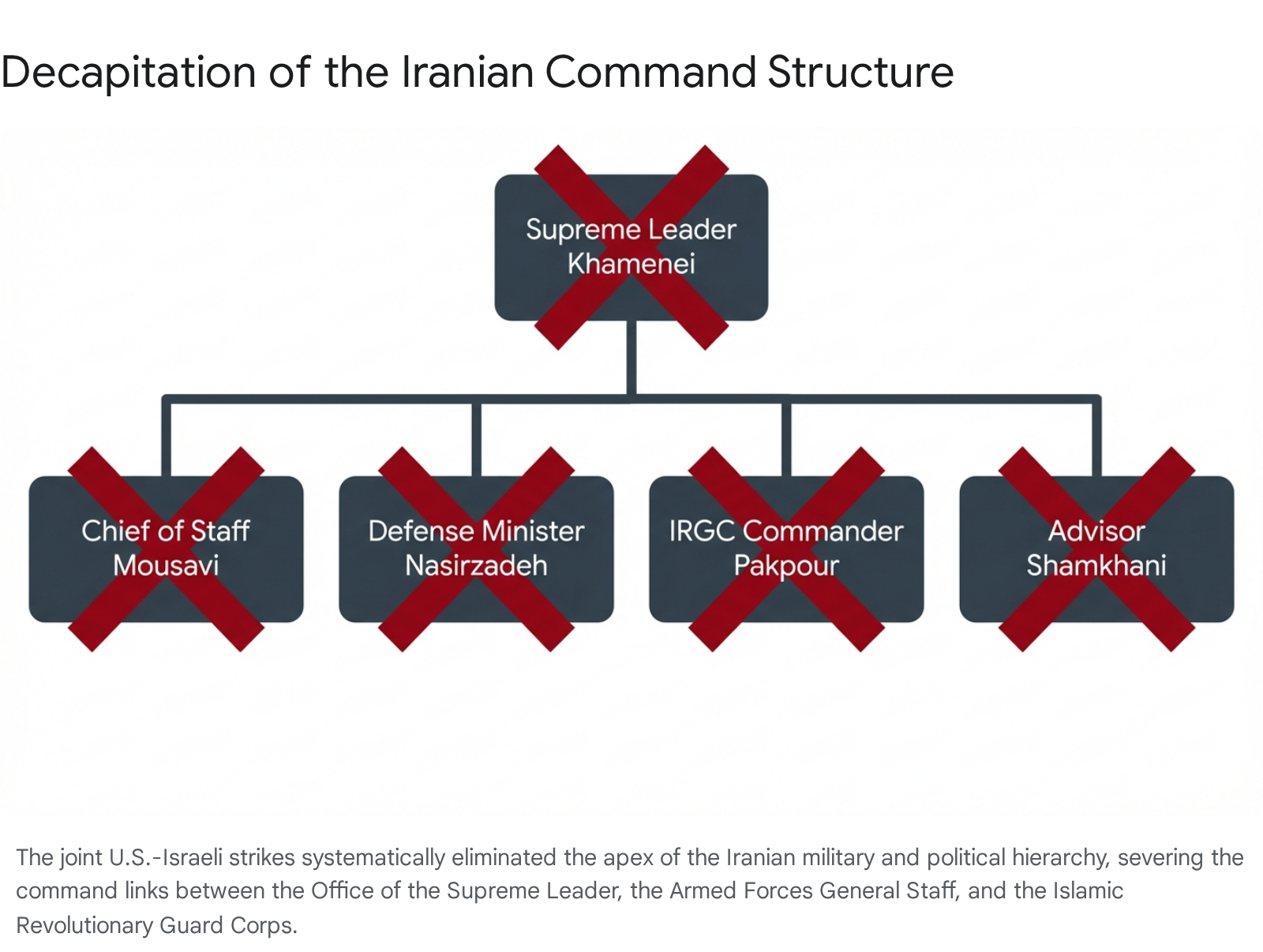
The opening salvos of the campaign were characterized by deep-penetrating strikes against hardened facilities and complex leadership decapitation operations. These strikes successfully targeted supreme leadership, including Ayatollah Ali Khamenei, alongside senior IRGC commanders such as Major General Mohammad Pakpour and Defense Minister Brigadier General Aziz Nasir Zadeh.5 The geographical disposition of United States naval and air assets establishes overlapping zones of strike capability. By positioning forces in the Eastern Mediterranean, the Arabian Sea, and allied airbases in the Levant, coalition planners have created a multi-directional strike geometry that effectively stretches Iranian early warning and air defense networks across multiple axes of advance.

1.1 The Weaponization of the Maritime Domain and the Hormuz Blockade

The immediate and most globally destabilizing consequence of this kinetic escalation has been the weaponization of the maritime domain. In response to the decapitation strikes, Iranian forces and their regional proxies have initiated a strict area-denial strategy in the Strait of Hormuz and the Gulf of Oman. This chokepoint is historically responsible for the daily transit of approximately twenty percent of the world’s petroleum liquids and a significant portion of global liquefied natural gas (LNG).15

The operationalization of this blockade was violently demonstrated by the kinetic strike against the Palau-flagged commercial tanker Skylight.17 Occurring approximately five nautical miles north of the Khasab Port off Oman’s Musandam peninsula, the strike caused a significant fire, injured four mariners, and necessitated an evacuation by Omani naval forces.17 Forensic analysis reveals a complex layer of “Shadow Fleet” operations; the Skylight had been designated by the U.S. Department of the Treasury’s Office of Foreign Assets Control (OFAC) just days prior, on February 25, 2026, for facilitating illicit Iranian petroleum sales.17 Iran’s decision to target its own logistical asset,justified by Tehran as a penalty for the vessel defying orders to halt transit,demonstrates a strategic willingness to transcend immediate economic logic in favor of enforcing a total, indiscriminate interdiction zone.17

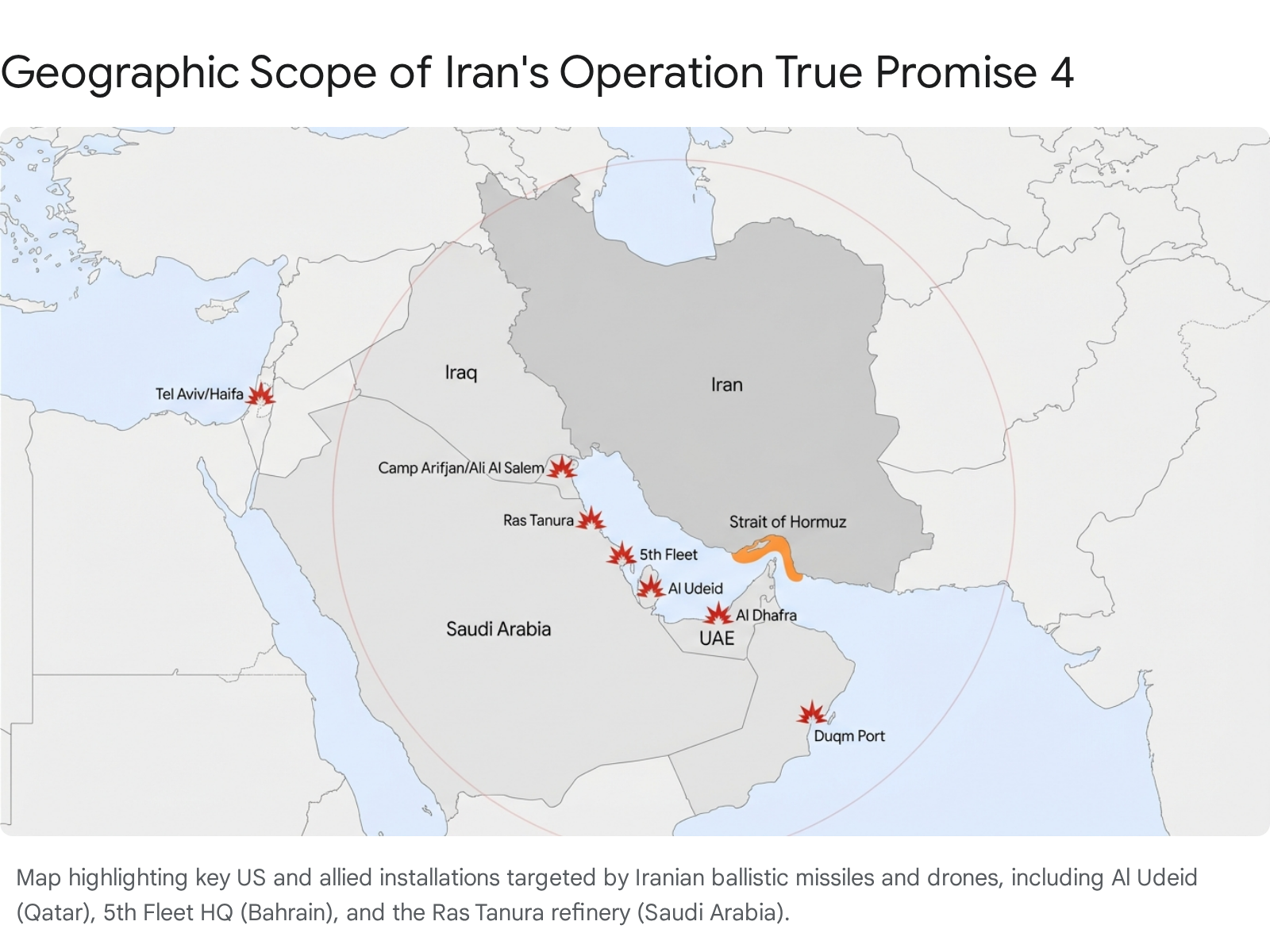
Simultaneously, the Sultanate of Oman,traditionally the primary diplomatic mediator between Washington and Tehran,found its own infrastructure targeted. Duqm Port suffered drone strikes, marking the first kinetic involvement of Omani territory in the conflict.17 In response to this indiscriminate targeting, the commercial maritime system has effectively collapsed in the region. Major maritime logistics providers, including Maersk, MSC, Hapag-Lloyd, and CMA CGM, have halted all Gulf transits and suspended routing through the Suez Canal.24 Vessels currently operating in the Gulf have been instructed to seek designated safe shelter areas, resulting in hundreds of ships drifting or holding position in the Gulf of Oman, while war-risk maritime insurance premiums have spiked by fifty percent, with many providers issuing cancellation notices.15 This environment necessitates a robust, continuously operating U.S. naval and air umbrella to maintain localized sea control, defend expeditionary staging bases, and attempt to re-establish secure sea lines of communication (SLOCs).

2.0 Current Naval Order of Battle (ORBAT)

The foundation of the United States power projection in the CENTCOM theater relies on an immense concentration of naval surface and subsurface combatants. Operating under a refined doctrine of distributed lethality, the Navy has amassed roughly forty-one percent of its global ready-for-operations fleet in the Middle East and Eastern Mediterranean, comprising at least sixteen major surface warships alongside critical support vessels.21 This armada is engineered to deliver sustained, high-volume standoff precision fires while simultaneously providing an integrated air and missile defense umbrella over localized maritime transit routes and expeditionary forces.

2.1 Dual-Carrier Strike Group Operations

The centerpiece of the naval ORBAT is the rare and highly complex deployment of two supercarriers within striking distance of the Iranian landmass. This dual-carrier geometry allows for continuous, twenty-four-hour cyclic flight operations, mitigating the traditional limitations of carrier deck resetting, maintenance cycles, and pilot fatigue, thereby applying relentless, uninterrupted pressure on hostile air defenses.7

The USS Abraham Lincoln (CVN-72) Carrier Strike Group, designated CSG 3, is currently operating in the Arabian Sea.7 Having redeployed from the Indo-Pacific theater under expedited orders in late January 2026 to counter rising tensions, the Lincoln hosts Carrier Air Wing 9.1 This air wing provides a highly versatile, integrated mix of strike and electronic warfare capabilities, notably featuring squadrons of F-35C Lightning II stealth fighters, F/A-18E/F Super Hornets, EA-18G Growler electronic attack aircraft, and E-2D Hawkeye airborne early warning and control (AEW&C) platforms.1 The presence of the F-35C is a critical enabler for penetrating contested airspace, utilizing its low-observable characteristics and advanced sensor fusion to locate targets for follow-on strikes. Crucially, the EA-18Gs fulfill the essential suppression of enemy air defenses (SEAD) mission, utilizing their jamming pods to blind Iranian early warning radars and disrupt surface-to-air missile (SAM) targeting capabilities, paving the way for the Super Hornets to deliver their payloads. The strike group is heavily escorted by Arleigh Burke-class destroyers and Ticonderoga-class cruisers, providing a dense Aegis Combat System shield against inbound anti-ship cruise missiles (ASCMs) and unmanned aerial vehicles.1

Operating on the western axis is the USS Gerald R. Ford (CVN-78) Carrier Strike Group, designated CSG 12. Having been redirected from operations in the Caribbean and transiting the Strait of Gibraltar in late February, the Ford is currently moored near Souda Bay, Greece, in the Eastern Mediterranean.7 As the lead ship of her class, the Ford represents a generational leap in naval aviation capabilities. It utilizes Electromagnetic Aircraft Launch Systems (EMALS) and Advanced Arresting Gear (AAG) to achieve sortie generation rates significantly higher than legacy Nimitz-class vessels.28 The Ford brings an additional seventy-five plus tactical aircraft to the operational envelope.7 Its strategic position in the Mediterranean creates a highly complex targeting dilemma for Iranian defense planners. Strike packages originating from the Mediterranean force Iranian early warning networks to scan multiple, disparate vectors simultaneously, stretching their defensive resources thin and complicating their interception calculus.

2.2 Surface Combatants and Independent Deployers

The carrier strike groups are augmented by a flotilla of independent deployers heavily engaged in both offensive land-attack operations and defensive interception missions. The U.S. Navy has positioned a ring of guided-missile destroyers (DDGs) capable of launching massive salvos of Tomahawk Land Attack Missiles (TLAMs). Analysis indicates that if all thirteen destroyers currently in the theater move into optimal firing positions, they possess the combined vertical launch system (VLS) capacity to deliver between 150 and 250 Tomahawk missiles, forming the critical backbone of the initial decapitation and infrastructure strikes.21

Specific vessels actively participating in Operation Epic Fury have been identified through official disclosures and visual evidence. The USS Spruance (DDG-111) and the USS Thomas Hudner (DDG-116) have been confirmed launching TLAMs from undisclosed locations within the CENTCOM AOR during the opening hours of the campaign.3 Furthermore, the USS Delbert D. Black (DDG-119) has actively engaged in strike operations following its recent departure from a port visit in Israel.32 The USS John Finn (DDG-113) was previously reported gathering near the Iranian coast just prior to the commencement of hostilities, likely acting as a forward picket and strike node.1 Additionally, the USS Mahan (DDG-72) is currently operating as a primary escort for the Ford in the Mediterranean.7

These surface combatants are operating under extreme threat conditions. Iran has demonstrated its reach and intent by deploying anti-ship ballistic missiles and drone swarms targeting naval assets across the Gulf of Oman, the Persian Gulf, and the Red Sea.4 The Aegis-equipped destroyers are required to operate in a dual-mission profile: executing offensive TLAM strikes while simultaneously tracking and intercepting inbound asymmetric threats to protect themselves, the carriers, and the remaining commercial shipping in the area. The successful sinking of multiple Iranian naval vessels, including the confirmed destruction of an Iranian Jamaran-class corvette at a pier in Chah Bahar by U.S. forces, highlights the intensity of the maritime engagements.23

2.3 Subsurface Posture and Covert Strike Capacity

The subsurface ORBAT remains largely classified under strict Operational Security (OPSEC) protocols; however, the Pentagon has utilized strategic declassification of specific submarine movements to signal deterrence and bolster its visible strike capacity. An Ohio-class guided-missile submarine (SSGN), confirmed to be the USS Georgia (SSGN-729), was ordered by Secretary of Defense Lloyd Austin to accelerate its deployment to the region.37

These converted SSGNs represent the absolute apex of covert conventional strike capability. Originally designed to carry nuclear ballistic missiles, four Ohio-class boats were converted to carry up to 154 Tomahawk cruise missiles each, distributed across twenty-two multiple-all-up-round canisters.39 The deployment of an SSGN provides theater commanders with a massive, survivable magazine that can initiate high-volume precision strikes without revealing its launch vector or presence until the moment the missiles break the surface. This presents a severe, virtually undetectable threat to Iranian coastal and inland targets. The USS Georgia was recently observed transiting the Suez Canal, placing it within optimal, highly secure strike range in the Red Sea or the Arabian Sea.40

Naval Domain AssetPlatform Class / Air WingVerified Location / Operating AreaPrimary Operational Role
USS Abraham Lincoln (CVN-72)Nimitz-Class SupercarrierArabian SeaForce projection, carrier aviation strike (Carrier Air Wing 9); SEAD operations
USS Gerald R. Ford (CVN-78)Ford-Class SupercarrierEastern Mediterranean (Souda Bay, Greece)Force projection, rapid sortie generation via EMALS
USS Georgia (SSGN-729)Ohio-Class SSGNLocation undisclosed but operating in the AOR (Recent Suez Transit)Covert, high-volume Tomahawk strike delivery
USS Spruance (DDG-111)Arleigh Burke-Class DestroyerLocation undisclosed but operating in the AORTLAM delivery, Aegis fleet defense
USS Thomas Hudner (DDG-116)Arleigh Burke-Class DestroyerLocation undisclosed but operating in the AORTLAM delivery, Aegis fleet defense
USS Delbert D. Black (DDG-119)Arleigh Burke-Class DestroyerLocation undisclosed but operating in the AORTLAM delivery, Aegis fleet defense
USS Mahan (DDG-72)Arleigh Burke-Class DestroyerEastern MediterraneanEscort operations and defense for CSG 12
USS John Finn (DDG-113)Arleigh Burke-Class DestroyerLocation undisclosed but operating in the AORForward picket, strike capability

3.0 Current Air Order of Battle (ORBAT)

The mobilization and forward deployment of land-based air power for Operation Epic Fury has been accurately described by defense analysts as an “aerial tsunami”.8 Over 330 United States military aircraft are currently positioned across the Middle East, representing a highly complex, diverse ecosystem of fifth-generation air dominance fighters, heavy strategic bombers, close air support platforms, and critical logistical and intelligence enablers.41

The strategic placement of these assets reflects a delicate and complex diplomatic negotiation. Several Gulf Cooperation Council (GCC) states, fearing immediate and devastating Iranian retaliation against their vulnerable energy infrastructure, have restricted U.S. access to their airspace and airbases for offensive strike missions.1 Consequently, the United States has been forced to heavily utilize, and rapidly expand, bases in the Levant,specifically in Israel and Jordan,to launch and sustain operations.1

3.1 Fifth-Generation Fighters and Multi-Role Strike Aircraft

The vanguard of the air campaign, responsible for dismantling the adversary’s anti-access/area denial (A2/AD) capabilities, relies on low-observable, fifth-generation platforms capable of surviving deep inside the engagement envelopes of advanced integrated air defense systems. A squadron of at least eleven F-22 Raptors has deployed to Ovda Air Base in the southern Negev Desert of Israel.1

The F-22s, redeployed from RAF Lakenheath in the United Kingdom, provide unparalleled air superiority.43 They are tasked with the critical offensive counter-air mission: clearing the skies of hostile aircraft and neutralizing early warning radars to open secure corridors for follow-on, non-stealthy strike packages. The choice of Ovda Air Base is highly strategic; located far from civilian population centers in the south, it has a history of hosting aggressor squadrons and is heavily defended by Israel’s Arrow anti-ballistic missile systems, providing a secure sanctuary for these high-value assets.43 The unprecedented basing of America’s premier air-dominance fighter directly in Israel underscores the depth of the joint operation and circumvents the severe basing restrictions encountered elsewhere in the region.9 (It is noted that twelve F-22s initially departed the UK, but one airframe returned due to a technical anomaly, leaving eleven on station).42

Complementing the stealth fighter force is a massive deployment of F-15E Strike Eagles, universally recognized as the U.S. Air Force’s premier deep-interdiction and all-weather strike platform. Upward of twenty-four to thirty-six F-15Es, drawing from units including the 494th Expeditionary Fighter Squadron, the 391st Fighter Squadron, and a squadron from Seymour Johnson AFB, are heavily concentrated at Muwaffaq Salti Air Base in Jordan.7 These dual-role fighters possess the exceptional range and heavy payload capacity necessary to deliver precision bunker-busting munitions deep into Iranian territory.

Jordan’s Muwaffaq Salti Air Base has rapidly evolved into the Pentagon’s most critical deployment hub for this conflict. Recent satellite imagery confirms it is hosting not only the F-15Es but also A-10C Thunderbolt II attack aircraft,utilized for close air support, forward air control, and potentially maritime interdiction against Iranian fast attack craft swarms,alongside multi-role F-16C/CM/CJ Fighting Falcons.8 An element of F-35A Lightning II aircraft is also confirmed to be operating from Muwaffaq Salti, bringing the total fifth-generation presence in Jordan to an estimated thirty airframes.48 To secure strategic logistical nodes located outside the immediate high-threat zone, additional F-16s have been forward-deployed to the remote Indian Ocean outpost of Diego Garcia, defending the facility against potential long-range Iranian drone or cruise missile attacks.49

3.2 Strategic Bomber Task Forces

To engage deeply buried, heavily fortified, or geographically dispersed targets,specifically Iran’s ballistic missile production infrastructure, hardened command bunkers, and nuclear program remnants,the United States has activated its strategic bomber fleet. B-2 Spirit stealth bombers, operating directly from bases in the continental United States (CONUS), have conducted ultra-long-range, unacknowledged penetrations into highly contested Iranian airspace. Official releases from CENTCOM confirm the B-2s were utilized to strike hardened ballistic missile facilities overnight during the opening phases of the campaign. The strikes employed 2,000-pound precision-guided munitions, highly likely to be the GBU-31(V)3 Joint Direct Attack Munitions (JDAM) equipped with BLU-109 penetrator warheads, designed specifically to destroy subterranean infrastructure.4

Operating in tandem with the stealth fleet, B-1B Lancer supersonic heavy bombers have also been actively employed in the theater. Launching from Ellsworth Air Force Base in South Dakota, the B-1Bs executed nighttime, low-altitude penetration missions, dropping massive conventional payloads on ground-based ballistic missile bases and command and control facilities.51 The operational use of the non-stealthy B-1B,which relies on speed, low-altitude terrain masking, and electronic countermeasures rather than radar cross-section reduction,strongly indicates that initial SEAD operations by EA-18Gs and cyber units successfully degraded the Iranian radar network. This suppression created permissive environments, allowing conventional heavy bombers to operate with relative impunity and deliver massive volumes of ordnance.51

3.3 Tactical Unmanned Systems: Task Force Scorpion Strike

A significant and highly innovative evolution in United States tactical doctrine observed during Operation Epic Fury is the operational debut of Task Force Scorpion Strike (TFSS). Established in December 2025 and operating from an undisclosed location within the CENTCOM AOR, TFSS is the military’s first operational squadron dedicated exclusively to the deployment of one-way attack drones (loitering munitions).52 The unit operates the Low-cost Uncrewed Combat Attack System (LUCAS), designed and manufactured by Spektreworks, based in Phoenix, Arizona.52

The LUCAS platform represents a calculated strategic asymmetry and a direct adaptation of adversary tactics. The drones are effectively reverse-engineered, American-manufactured variants of Iran’s own highly successful Shahed-136 loitering munitions, which have seen extensive use by Russia in the Ukrainian theater.3 Costing approximately thirty-five thousand dollars per unit, the LUCAS drones are dramatically cheaper than traditional standoff weapons like the 1.3 million dollar Tomahawk cruise missile. This low cost point enables high-volume swarm attacks.12

Deployed for the first time in combat during the opening hours of Operation Epic Fury, the LUCAS drones are utilized to overwhelm Iranian point defenses, strike soft targets such as radar arrays and exposed missile erector launchers, and critically exhaust enemy interceptor inventories. By employing a weapon system modeled on the adversary’s primary asymmetric tool, the U.S. military is effectively turning Iran’s own attritional doctrine against it, forcing Tehran to expend expensive surface-to-air missiles on expendable drones.20

3.4 Intelligence, Surveillance, Reconnaissance (ISR) and Critical Enablers

The entire kinetic architecture of Operation Epic Fury is entirely dependent on a vast, continuous constellation of support aircraft. The sheer scale and geographic breadth of the strike operations require massive aerial refueling capabilities to sustain the tempo. An estimated eighty-six KC-46 Pegasus and KC-135 Stratotanker aircraft are currently deployed to the theater. These vital assets are heavily concentrated at Prince Sultan Air Base in Saudi Arabia, which serves as a primary logistical hub, with additional tankers staging out of Ben Gurion Airport in Israel to support the Levant-based fighter wings.1 These tankers bridge the vast distances required for deep strikes, enabling the F-15Es and F-22s to loiter over target areas, and providing the critical gas required for the CONUS-based bombers to complete their global sorties.

High-altitude Intelligence, Surveillance, and Reconnaissance (ISR) is provided by MQ-9 Reaper drones operating primarily from Al Dhafra Air Base in the United Arab Emirates. These platforms have been visually confirmed circling over major Iranian cities, including Tehran and Shiraz, to provide real-time battle damage assessment, track mobile missile launchers, and provide laser designation for time-sensitive, high-value targets.3

Electronic intelligence, signals interception, and maritime patrol are conducted by specialized RC-135V Rivet Joint and P-8A Poseidon aircraft. Notably, to ensure platform survivability amid the threat of Iranian ballistic missile counter-strikes against regional bases, RC-135 operations have been relocated from the highly vulnerable Al Udeid Air Base in Qatar to the Greek island of Crete in the Mediterranean.56 Similarly, E-3 Sentry Airborne Warning and Control System (AWACS) aircraft and E-11A Battlefield Airborne Communications Node (BACN) platforms are deployed to provide the overarching command, control, and communications relay network required to synchronize the massive air armada.8

Air Domain AssetUnit / SquadronVerified Location / Staging BasePrimary Operational Role
F-22 RaptorUnspecified SquadronOvda Air Base, IsraelStealth air superiority, offensive counter-air, radar neutralization
F-15E Strike Eagle494th EFS, 391st FS, Seymour Johnson unitMuwaffaq Salti Air Base, JordanDeep strike, heavy precision interdiction, defensive counter-air
F-35A/C Lightning IIUnspecifiedMuwaffaq Salti (A); CVN-72 (C)Stealth multi-role strike, advanced sensor fusion
A-10C Thunderbolt IIMoody AFB unitMuwaffaq Salti Air Base, JordanClose air support, forward air control, maritime interdiction
F-16C/CM/CJAviano AB unitMuwaffaq Salti, Jordan; Diego GarciaMulti-role strike, base defense (Diego Garcia)
B-2 SpiritBomber Task ForceCONUS OriginStealth strategic bombardment, bunker-busting hardened targets
B-1B LancerBomber Task Force (Ellsworth AFB)CONUS OriginHigh-payload conventional strategic strike, low-altitude penetration
LUCAS DronesTask Force Scorpion StrikeLocation undisclosed but operating in the AORLow-cost, high-volume one-way attack, air defense saturation
MQ-9 Reaper380th AEWAl Dhafra Air Base, UAEPersistent ISR, time-sensitive targeting, battle damage assessment
RC-135V Rivet JointUnspecifiedCrete, Greece (Relocated from Qatar)Signals intelligence, electronic reconnaissance
KC-135 / KC-46MultiplePrince Sultan AB, Saudi Arabia; Ben Gurion, IsraelAerial refueling, range extension for fighters and bombers
E-3 Sentry AWACSUnspecifiedPrince Sultan AB, Saudi ArabiaAirborne early warning, battle management, command and control

4.0 Air and Missile Defense (AMD) Posture and the Interceptor Crisis

The rapid escalation of hostilities has subjected the coalition’s integrated air and missile defense networks to unprecedented and unsustainable levels of stress. Iranian military doctrine eschews traditional air-to-air combat in favor of a “Mosaic Defense” and attritional warfare. This strategy relies heavily on launching massive, coordinated swarms of ballistic missiles, land-attack cruise missiles, and Shahed-series unmanned aerial vehicles to oversaturate defending systems and overwhelm radar tracking capacities.13 In response, the United States has deployed a highly sophisticated, layered defensive architecture across its Gulf State partners, but this shield is currently facing a critical logistical breaking point.

4.1 Theater Defense Architecture

The terminal defense layer is anchored by Patriot Advanced Capability-3 (PAC-3) batteries, which are deployed extensively across Qatar, the United Arab Emirates, Kuwait, Jordan, and Saudi Arabia.59 These systems provide point defense, designed to intercept short and medium-range ballistic missiles and cruise missiles in their final phase of flight, protecting vital military installations and critical energy infrastructure. Upper-tier, wide-area defense is provided by Terminal High Altitude Area Defense (THAAD) batteries, which engage incoming threats at much higher altitudes and longer ranges, providing a first line of defense against intermediate-range ballistic missiles.59

Furthermore, the theater defense architecture is heavily integrated with the Aegis Ashore system situated in Eastern Europe. Originally conceptualized under the European Phased Adaptive Approach (EPAA) to protect NATO allies from Iranian missile proliferation, the Aegis Ashore site in Deveselu, Romania, and the recently completed and operationalized site in Redzikowo, Poland, are actively monitoring the exoatmospheric threat environment.61 Operating under NATO command at Ramstein Air Base, these installations utilize the AN/SPY-1 radar and SM-3 interceptors to provide critical early warning tracking data and engagement capability for intermediate-range ballistic missiles that might be launched toward European or Levantine targets.61

4.2 The Interceptor Depletion Crisis

Despite the immense technological sophistication of these systems, the mathematical reality of modern interceptor warfare strongly favors the attacker. Current U.S. military doctrine dictates the expenditure of two to three interceptors per inbound threat to ensure a high probability of kill and minimize the risk of “leakers” impacting critical infrastructure.14
Yugo M85/M92 dust cover quick takedown pin installation detail

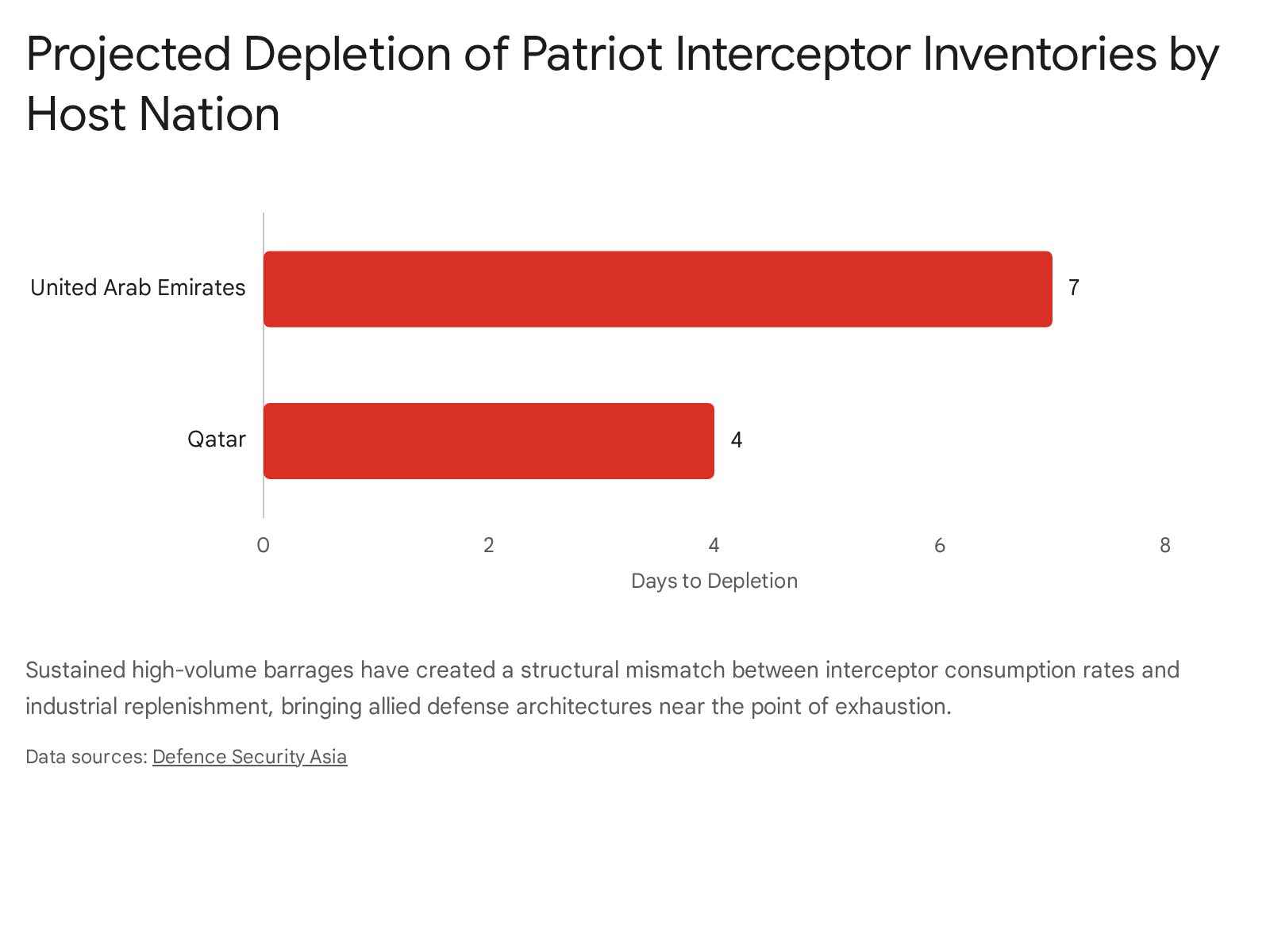
When Iran launches high-volume, coordinated barrages of relatively inexpensive munitions, coalition defensive inventories are drained at a massive multiplier effect. Analysts warn that interceptor stocks across the region are now “dangerously low,” representing a severe structural mismatch between the rate of consumption in active, daily combat and the peacetime capacity of the defense industrial base to replenish them.14 By early March 2026, intelligence assessments project a dire logistical reality: Qatar’s Patriot missile stocks will be entirely exhausted within four days of sustained operations, while the United Arab Emirates possesses only an estimated seven-day supply.14 The U.S. has reportedly admitted that “years of production” of these highly complex missiles have already been exhausted during the conflict.14

The financial asymmetry exacerbating this crisis is severe. A single THAAD interceptor costs approximately fifteen million dollars, and these multi-million dollar assets are frequently utilized to defeat Iranian drones or older ballistic missiles that cost a fraction of that amount.14 This magazine exhaustion crisis is fundamentally altering tactical decision-making; CENTCOM commanders are being forced to ration defensive engagements. They must prioritize the protection of strategic oil infrastructure and major expeditionary airbases, while leaving secondary civilian or military targets exposed, creating visible gaps in the regional defense umbrella that Iranian forces are actively trained to exploit.14

The strategic implications of this shortage are profound. The crisis is prompting Pentagon planners to consider the unprecedented and highly risky step of redeploying Patriot and THAAD batteries,as well as MQ-9 Reaper drones,from permanent bases in South Korea to the Middle East.64 Such a move, while necessary to sustain the defense of Gulf allies, would dangerously expose the Korean Peninsula and U.S. Forces Korea (USFK) to North Korean ballistic missile threats, demonstrating the global ripple effects of a sustained Middle Eastern conflict.64

Air & Missile Defense AssetVerified LocationPrimary Operational RoleSystem Status / Notes
Patriot PAC-3 BatteriesQatar, UAE, Kuwait, Jordan, Saudi ArabiaTerminal point defense (Short/Medium Range)Critical depletion; rationing of engagements required
THAAD BatteriesQatar, UAE, Kuwait, Jordan, Saudi ArabiaUpper-tier wide-area defenseSevere interceptor shortage; unsustainable cost-exchange ratio
Aegis AshoreDeveselu, Romania; Redzikowo, PolandExoatmospheric tracking and interceptionFully operational; providing vital theater-level early warning

5.0 Assets in Transit and Reinforcements

Recognizing the potential for a protracted conflict characterized by high attrition rates, and the absolute necessity of sustaining cyclic carrier operations and ground security, the Department of Defense has initiated a surge of reinforcements toward the CENTCOM theater. The sheer volume of munitions expended requires constant logistical resupply, and the potential for asset degradation demands rotational replacements.

In the naval domain, the USS George H.W. Bush (CVN-77) Carrier Strike Group is actively spinning up for emergency deployment. Currently completing expedited Composite Training Unit Exercises (COMPTUEX) off the coast of Virginia in the Atlantic Ocean, the Bush could receive orders to deploy immediately.1 However, even with an expedited departure, transit across the Atlantic Ocean and through the Mediterranean Sea (or around the Cape of Good Hope if Suez transit is deemed too high-risk) would require several weeks before the carrier could arrive on station.67 The arrival of a third supercarrier would provide the necessary tactical airpower to sustain offensive operations if the conflict protracts, or allow for the safe rotation of the USS Abraham Lincoln out of the high-threat environment.

Ground force reinforcements are also mobilizing to secure staging areas and logistical hubs. While the administration maintains there are no American conventional combat troops operating on the ground inside Iranian territory 60, force protection and base security requirements in allied nations have necessitated fresh troop deployments. The Department of the Army has announced the deployment of the 2nd Mobile Brigade Combat Team, 10th Mountain Division, to the CENTCOM AOR.68 This newly reorganized unit, a product of the Army’s “Transform in Contact” initiative, is specifically designed for rapid mobility and reduced electromagnetic signature, making it highly survivable in environments saturated by enemy drone surveillance and indirect fire.70 They will replace elements of the National Guard (specifically the 34th Infantry Division), joining other rotational units such as the 101st Airborne Division, which is currently managing the return of its Combat Aviation Brigade after a lengthy deployment supporting Operation Inherent Resolve.69

6.0 Operational Capabilities & Integration: The AI-Driven Kill Chain

Operation Epic Fury is not merely a display of overwhelming kinetic force; it represents a fundamental paradigm shift in the application of artificial intelligence and algorithmic decision-making in modern warfare. The operational capability of the United States forces relies on a highly integrated, multi-domain kill chain that has drastically compressed the time between target acquisition and payload delivery. For the first time in human history, an artificial intelligence network fully dominated the upper echelons of the kill chain in a high-level decapitation strike.10

6.1 Suppression of Enemy Air Defenses (SEAD) and Cyber Operations

The initial phase of the operation focused on the total suppression of Iranian integrated air defense systems, specifically targeting the advanced, Russian-supplied S-300 and S-400 surface-to-air missile networks. Before physical munitions were dropped, United States Cyber Command (CYBERCOM) executed highly sophisticated digital disruptions against the Iranian air defense grid. These cyber strikes were designed to blind early warning radars, sever command-and-control datalinks, and inject false telemetry into the Iranian system.73

This invisible cyber offensive was instantly followed by aggressive electronic attack aircraft operations. EA-18G Growlers launched from the USS Abraham Lincoln flooded the remaining electromagnetic spectrum with jamming signals, effectively neutralizing any radars that survived the cyber-attack.2 This synchronized cyber-electronic warfare effort created a temporary permissive environment, allowing the physical strike packages to cross into Iranian airspace undetected.

6.2 The Algorithmic Targeting Network

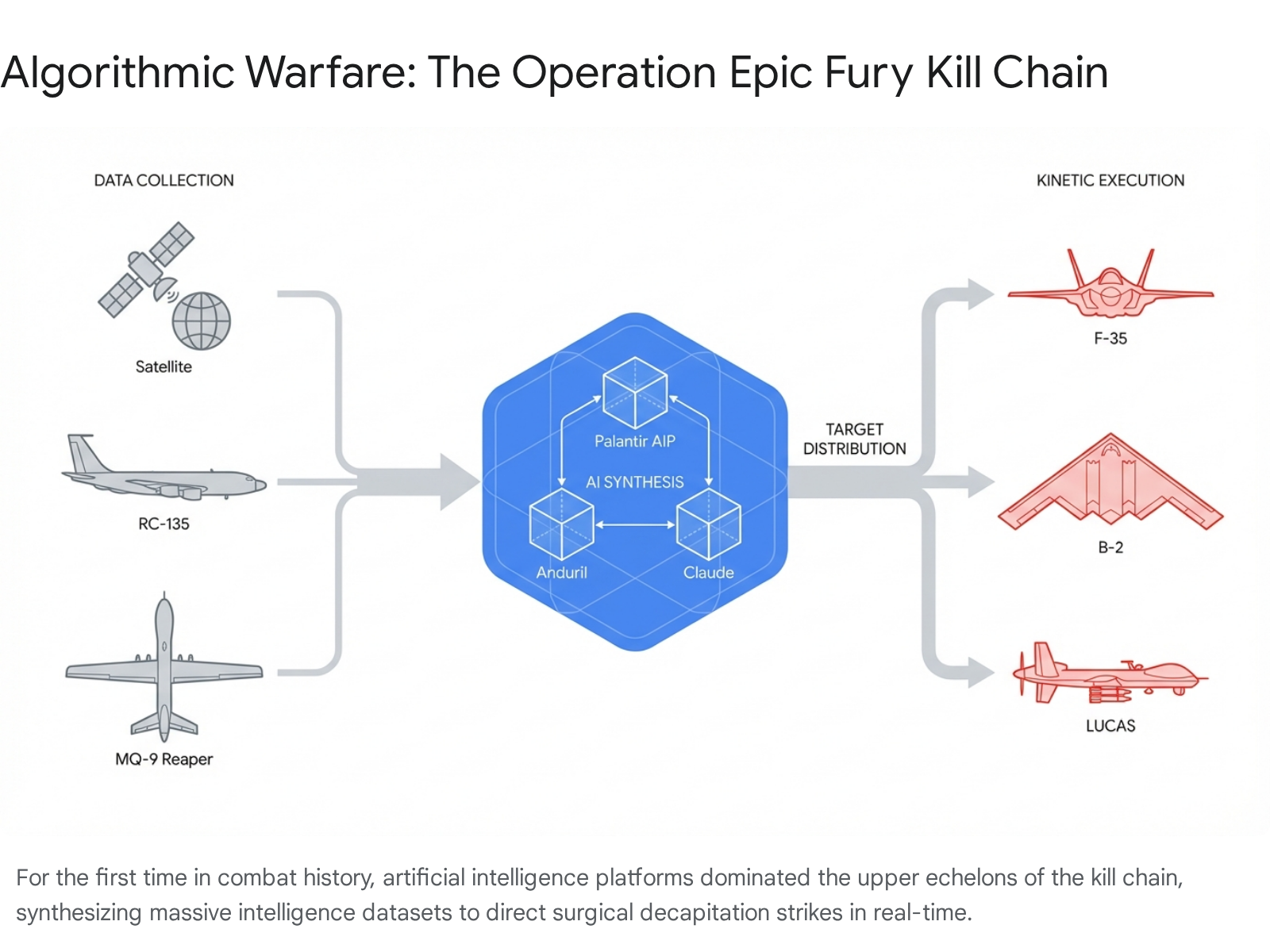
Once the air defense network was degraded, the target acquisition phase was managed by an unprecedented global surveillance and strike network. Intelligence gathering transitioned from manual human analysis,which is often too slow to prosecute mobile targets,to an AI-driven “battlefield brain.” Systems provided by defense technology firms Palantir and Anduril, integrated with advanced large language models like Claude, analyzed vast quantities of remote sensing data, satellite imagery, and intercepted communications in real-time.10

Palantir’s flagship product, Gotham 5, utilized its “ontology” mapping to break down historical data silos between various intelligence agencies. This system rapidly synthesized disparate data points to identify the precise, fleeting locations of high-value targets, including the subterranean command centers utilized by the IRGC and the Supreme Leader.11 The AI system did not merely display data; it actively generated targeting solutions based on probabilities of location and asset availability.
Yugo M85/M92 dust cover quick takedown pin installation detail

6.3 Kinetic Execution and Payload Delivery

This AI network effectively automated the upper echelons of the kill chain, distributing firing solutions to the most optimal, available platforms in the theater. For deep, hardened targets identified by the AI, the system directed B-2 stealth bombers to deliver heavy penetrator munitions (GBU-31(V)3).2 For time-sensitive, dynamic targets,such as mobile ballistic missile erector-launchers moving into firing positions,targeting data was instantly relayed via datalink to forward-deployed F-15E Strike Eagles and F-35s loitering in the theater, kept aloft by the massive organic tanking operations.4

Simultaneously, the network directed the LUCAS drone swarms of Task Force Scorpion Strike to prosecute soft targets and overwhelm any remaining point defenses. By integrating Tomahawk strikes from the sea, B-2 bombers from the air, and drone swarms directed by AI, the coalition created a chaotic, multi-vector, simultaneous assault that completely collapsed the Iranian defensive doctrine from within.10 This synthesis of cyber disruption, algorithmic targeting, and precision kinetic delivery represents the core operational capability enabling the rapid degradation of the Iranian state security apparatus.

7.0 Information Gaps and OPSEC Limitations

While open-source intelligence and official disclosures provide a comprehensive overview of the theater posture, several critical intelligence gaps remain due to strict Operational Security (OPSEC) measures enforced by the Department of Defense. The precise operating areas of independent naval deployers, specifically the Arleigh Burke-class destroyers and the Ohio-class SSGN, remain undisclosed to preserve their survivability against long-range anti-ship ballistic missiles. Furthermore, the specific munitions loadouts of the forward-deployed fighter squadrons, the exact number of fifth-generation fighters currently operational (accounting for routine maintenance and potential battle damage), and the true extent of the subterranean damage to Iranian nuclear facilities cannot be definitively verified via recent unclassified channels. Any subsequent strategic analysis must account for these deliberate ambiguities in the public record.


Please share the link on Facebook, Forums, with colleagues, etc. Your support is much appreciated and if you have any feedback, please email us in**@*********ps.com. If you’d like to request a report or order a reprint, please click here for the corresponding page to open in new tab.


Sources Used

  1. 2026 United States military buildup in the Middle East – Wikipedia, accessed March 3, 2026, https://en.wikipedia.org/wiki/2026_United_States_military_buildup_in_the_Middle_East
  2. Weapons of ‘Epic Fury’: Fighters, Missiles, and ‘Special Capabilities’, accessed March 3, 2026, https://www.airandspaceforces.com/weapons-of-epic-fury-fighters-missiles-and-special-capabilities/
  3. Operation Epic Fury: From B-2s to HIMARS, here’s how US is unleashing full war arsenal on Iran, accessed March 3, 2026, https://gulfnews.com/world/mena/operation-epic-fury-from-b-2s-to-himars-here-s-how-us-is-unleashing-full-war-arsenal-on-iran-1.500460573
  4. US targets Iran’s military command, missile sites, naval assets in first 48 hours of ‘Operation Epic Fury’: CENTCOM, accessed March 3, 2026, https://www.aa.com.tr/en/middle-east/us-targets-irans-military-command-missile-sites-naval-assets-in-first-48-hours-of-operation-epic-fury-centcom/3847478
  5. Iran Update Special Report: US and Israeli Strikes, February 28, 2026, accessed March 3, 2026, https://understandingwar.org/research/middle-east/iran-update-special-report-us-and-israeli-strikes-february-28-2026/
  6. 2026 Israeli–United States strikes on Iran – Wikipedia, accessed March 3, 2026, https://en.wikipedia.org/wiki/2026_Israeli%E2%80%93United_States_strikes_on_Iran
  7. Iran-US-Israel Escalation Dynamics – Nuclear Leverage, Military Buildup and Retaliatory Postures February 2026 – https://debuglies.com, accessed March 3, 2026, https://debuglies.com/2026/02/24/iran-us-israel-escalation-dynamics-nuclear-leverage-military-buildup-and-retaliatory-postures-february-2026/
  8. The military buildup map behind Trump’s Iran decision – Israel Hayom, accessed March 3, 2026, https://www.israelhayom.com/2026/02/27/the-military-buildup-map-behind-trumps-iran-decision/
  9. Chinese firm publishes photos of US F-22s at Israeli base | The Jerusalem Post, accessed March 3, 2026, https://www.jpost.com/israel-news/article-888153
  10. AI-Driven Operation Targets Iranian Leader, Sparks Ethical Debate, accessed March 3, 2026, https://www.kucoin.com/news/flash/ai-driven-operation-targets-iranian-leader-sparks-ethical-debate
  11. Unveiling the First AI-Led Decapitation Strike: How Did Claude and …, accessed March 3, 2026, https://news.futunn.com/en/post/69412646/unveiling-the-first-ai-led-decapitation-strike-how-did-claude
  12. US struck Iran with copies of its own drones, accessed March 3, 2026, https://www.theregister.com/2026/03/02/us_iran_clone_drones/
  13. US-Israeli campaign triggers Iranian counteroffensive targeting Gulf energy, critical infrastructure, accessed March 3, 2026, https://industrialcyber.co/industrial-cyber-attacks/us-israeli-campaign-triggers-iranian-counteroffensive-targeting-gulf-energy-critical-infrastructure/
  14. Interceptor Stocks ‘Dangerously Low’: US, Israel and Gulf States …, accessed March 3, 2026, https://defencesecurityasia.com/en/interceptor-stocks-dangerously-low-us-israel-gulf-iran-missile-barrage-2025/
  15. Strait of Hormuz Maritime Blockade and Its Economic Impact – SpecialEurasia, accessed March 3, 2026, https://www.specialeurasia.com/2026/03/02/blockade-hormuz-maritime-economy/
  16. March 2, 2026: Iran War Maritime Intelligence Daily – Windward, accessed March 3, 2026, https://windward.ai/blog/march-2-iran-war-maritime-intelligence-daily/
  17. THE HORMUZ CODEX: KINETIC ESCALATION, LEADERSHIP DECAPITATION AND MARITIME SYSTEMIC COLLAPSE, accessed March 3, 2026, https://debuglies.com/2026/03/02/the-hormuz-codex-kinetic-escalation-leadership-decapitation-and-maritime-systemic-collapse/
  18. Hegseth Says ‘Epic Fury’ Goals in Iran Are ‘Laser-Focused’, accessed March 3, 2026, https://www.war.gov/News/News-Stories/Article/Article/4418826/hegseth-says-epic-fury-goals-in-iran-are-laser-focused/
  19. Operation Epic Fury Takes Flight: Inside the Strike Strategy and What Comes Next, accessed March 3, 2026, https://sofrep.com/news/operation-epic-fury-begins-inside-the-strike-strategy-and-what-comes-next/
  20. U.S. Forces Launch Operation Epic Fury – DVIDS, accessed March 3, 2026, https://www.dvidshub.net/news/559169/us-forces-launch-operation-epic-fury
  21. U.S. Military in the Middle East: Numbers Behind Trump’s Threats …, accessed March 3, 2026, https://www.csis.org/analysis/us-military-middle-east-numbers-behind-trumps-threats-against-iran
  22. The US-Israel campaign in Iran – The International Institute for Strategic Studies, accessed March 3, 2026, https://www.iiss.org/online-analysis/online-analysis/2026/02/the-us-israel-campaign-in-iran/
  23. The First 36 Hours: Strait of Hormuz Becomes a War Zone, Tankers Hit, Shipping Giants Halt Gulf Transits, accessed March 3, 2026, https://gcaptain.com/the-first-36-hours-strait-of-hormuz-becomes-a-war-zone-tankers-hit-shipping-giants-halt-gulf-transits/
  24. Carriers divert ships after US and Israeli strikes on Iran, dashing Red Sea return hopes, accessed March 3, 2026, https://www.worldcargonews.com/news/2026/03/carriers-divert-ships-after-us-and-israeli-strikes-on-iran-dashing-red-sea-return-hopes/
  25. Shipping companies tell vessels to steer clear of Gulf | THE DAILY TRIBUNE | KINGDOM OF BAHRAIN – Newsofbahrain, accessed March 3, 2026, https://www.newsofbahrain.com/business/127688.html
  26. The Strait of Hormuz Crisis: Iran Conflict Impact on Oil and Markets, accessed March 3, 2026, https://www.middleeastbriefing.com/news/strait-of-hormuz-crisis-iran-conflic-energy-business/
  27. US military assembles largest force of warships, aircraft in Middle East in decades, accessed March 3, 2026, https://www.militarytimes.com/news/your-military/2026/02/26/us-military-assembles-largest-force-of-warships-aircraft-in-middle-east-in-decades/
  28. The U.S. Navy Just Deployed 3 Supercarriers in ‘Coordinated Strategy’ – 19FortyFive, accessed March 3, 2026, https://www.19fortyfive.com/2026/01/the-u-s-navy-just-deployed-3-supercarriers-in-coordinated-strategy/
  29. 2026 Iran conflict order of battle – Wikipedia, accessed March 3, 2026, https://en.wikipedia.org/wiki/2026_Iran_conflict_order_of_battle
  30. U.S. Naval Update Map: Feb. 26, 2026, accessed March 3, 2026, https://worldview.stratfor.com/article/us-naval-update-map-feb-26-2026
  31. USS Thomas Hudner supports Operation Epic Fury [Image 5 of 12], accessed March 3, 2026, https://www.dvidshub.net/image/9542637/uss-thomas-hudner-supports-operation-epic-fury
  32. U.S. Central Command (CENTCOM) Official Press Releases, accessed March 3, 2026, https://www.centcom.mil/MEDIA/PRESS-RELEASES/
  33. U.S. Forces Launch Operation Epic Fury, accessed March 3, 2026, https://www.centcom.mil/MEDIA/IMAGERY/igphoto/2003882156/
  34. USS Delbert D. Black (DDG 119) Fires a Tomahawk Land Attack Missile [Image 1 of 5] – DVIDS, accessed March 3, 2026, https://www.dvidshub.net/image/9543682/uss-delbert-d-black-ddg-119-fires-tomahawk-land-attack-missile
  35. Five Things to Know, March 2, 2026 | The American Legion, accessed March 3, 2026, https://www.legion.org/information-center/news/security/2026/march/five-things-to-know-march-2-2026
  36. USA/Israel-Iran clashes February/March 2026 : r/FighterJets – Reddit, accessed March 3, 2026, https://www.reddit.com/r/FighterJets/comments/1rh19vr/usaisraeliran_clashes_februarymarch_2026/
  37. US orders nuclear-powered submarine deployment to Middle East – MEO, accessed March 3, 2026, https://middle-east-online.com/node/786496
  38. US orders submarine to Middle East, carrier strike group to sail faster – Al Jazeera, accessed March 3, 2026, https://www.aljazeera.com/news/2024/8/12/us-orders-submarine-to-middle-east-carrier-strike-group-to-sail-faster
  39. Hamas Freaked: U.S. Navy ‘Unstealthed’ Ohio-Class ‘Missile Sub’ as a Dire Warning, accessed March 3, 2026, https://nationalinterest.org/blog/buzz/hamas-freaked-us-navy-unstealthed-ohio-class-missile-sub-dire-warning-207240
  40. US guided missile sub shows up in Suez Canal – Responsible Statecraft, accessed March 3, 2026, https://responsiblestatecraft.org/us-guided-missile-sub-shows-up-in-suez-canal/
  41. US ramps up deployments to CENTCOM despite ongoing talks with Iran – Anadolu Ajansı, accessed March 3, 2026, https://www.aa.com.tr/en/americas/us-ramps-up-deployments-to-centcom-despite-ongoing-talks-with-iran/3842362
  42. US build-up in Middle East grows as F-22s reach Israel and USS Ford deploys, accessed March 3, 2026, https://aerospaceglobalnews.com/news/us-f22-raptors-israel-ford-middle-east/
  43. First Ever U.S. F-22 Raptor Stealth Fighter Deployment in Israel Exposed in New Chinese Satellite Footage – Military Watch Magazine, accessed March 3, 2026, https://militarywatchmagazine.com/article/first-ever-us-f22-israel-exposed
  44. 11 U.S. Air Force F-22 Raptor Stealth Fighters Are Now Based in Iran’s Backyard, accessed March 3, 2026, https://www.19fortyfive.com/2026/02/11-u-s-air-force-f-22-raptor-stealth-fighters-are-now-based-in-irans-backyard/
  45. US Deploys F-22 Stealth Fighters To Israel – Grand Pinnacle Tribune, accessed March 3, 2026, https://evrimagaci.org/gpt/us-deploys-f22-stealth-fighters-to-israel-531716
  46. Why In The World Did The US Air Force Fly Some F-15s To The Middle East?, accessed March 3, 2026, https://simpleflying.com/why-usaf-transport-fly-f-15s-middle-east/
  47. Lakenheath F-15E Strike Eagles Deploy to the Middle East – The Aviationist, accessed March 3, 2026, https://theaviationist.com/2026/01/21/strike-eagles-deploy-to-the-middle-east/
  48. U.S. Deploys 24 F-15E, 30 F-35A and A-10 Jets to Jordan: Massive Airpower Buildup Near Iran Signals Escalation in Middle East Tensions, accessed March 3, 2026, https://defencesecurityasia.com/en/us-f35-f15e-a10-deployment-jordan-muwaffaq-salti-air-base-iran-tensions-2026/
  49. F-16s Arrive To Protect Diego Garcia, F-22s Forward Deploy To Israel – The War Zone, accessed March 3, 2026, https://www.twz.com/news-features/f-16s-arrive-to-protect-diego-garcia-f-22s-forward-deploy-to-israel
  50. B-2 Spirit Stealth Bombers Take Part in Night Strikes on Iran, accessed March 3, 2026, https://theaviationist.com/2026/03/01/b-2-spirit-night-strikes-on-iran/
  51. B-1 Bombers Strike Iran’s Missile Bases, Signaling U.S. Air Superiority, accessed March 3, 2026, https://www.chosun.com/english/world-en/2026/03/03/ELPSALJCKFACFPDCJGSPVZXQBI/
  52. US CENTCOM confirms first combat use of LUCAS drones, accessed March 3, 2026, https://www.airforce-technology.com/news/us-centcom-lucas-drone-iran/
  53. Centcom Launches Attack Drone Task Force in Middle East – Department of War, accessed March 3, 2026, https://www.war.gov/News/News-Stories/Article/Article/4347258/centcom-launches-attack-drone-task-force-in-middle-east/
  54. New US attack drones make first operational appearance, accessed March 3, 2026, https://www.jpost.com/defense-and-tech/article-888313
  55. After first combat appearance, LUCAS drones ‘remain ready’ for future Epic Fury strikes against Iran, accessed March 3, 2026, https://defensescoop.com/2026/03/02/lucas-drones-operation-epic-fury-iran-strikes/
  56. US military build up in the Middle East: What aircraft and ships have arrived so far?, accessed March 3, 2026, https://aerospaceglobalnews.com/news/us-military-build-up-middle-east-aircraft-ships/
  57. World: Iran strikes countries hosting US forces in Middle Ea – New Vision, accessed March 3, 2026, https://www.newvision.co.ug/category/world/iran-strikes-countries-hosting-us-forces-in-m-NV_228945_032026
  58. US Amasses More Airpower in Middle East with Dozens of Fighters, accessed March 3, 2026, https://www.airandspaceforces.com/us-amasses-more-airpower-middle-east-iran/
  59. US strengthening air, missile defenses across Middle East as part of preparation before striking Iran: Reports, accessed March 3, 2026, https://www.aa.com.tr/en/americas/us-strengthening-air-missile-defenses-across-middle-east-as-part-of-preparation-before-striking-iran-reports/3817305
  60. ‘Just Beginning’: Pentagon Officials Provide Latest Update on Iran Mission | Military.com, accessed March 3, 2026, https://www.military.com/daily-news/headlines/2026/03/02/just-beginning-endless-war-hegseth-defends-expanding-iran-combat.html
  61. Aegis Ashore – Missile Defense Advocacy Alliance, accessed March 3, 2026, https://www.missiledefenseadvocacy.org/defense-systems/aegis-ashore/
  62. NATO Assumes Command of Aegis Ashore Site in Poland, accessed March 3, 2026, https://shape.nato.int/news-archive/2024/nato-assumes-command-of-aegis-ashore-site-in-poland
  63. Aegis Ashore Poland Completes First Maintenance Availability – NAVSEA – Navy.mil, accessed March 3, 2026, https://www.navsea.navy.mil/Media/News/Article/3799399/aegis-ashore-poland-completes-first-maintenance-availability/
  64. U.S. Considers Relocating THAAD, Patriots to Middle East, accessed March 3, 2026, https://www.chosun.com/english/national-en/2026/03/03/OTCQNNDNORCHHG6Q5RB6YZ4NLA/
  65. U.S. to Relocate Air Defense Systems from South Korea to the Middle East – Jordan News, accessed March 3, 2026, https://www.jordannews.jo/Section-111/All/U-S-to-Relocate-Air-Defense-Systems-from-South-Korea-to-the-Middle-East-49313
  66. US may redeploy South Korea-based air defense assets if Iran campaign drags on, accessed March 3, 2026, https://www.turkiyetoday.com/region/us-may-redeploy-south-korea-based-air-defense-assets-if-iran-campaign-drags-on-3215500
  67. Second Carrier Strike Group Ordered To Spin-Up For Deployment To Middle East: Report, accessed March 3, 2026, https://www.twz.com/news-features/second-carrier-strike-group-ordered-to-spin-up-for-deployment-to-middle-east-report
  68. Army to deploy 10th Mountain Division brigade to CENTCOM – Military Times, accessed March 3, 2026, https://www.militarytimes.com/news/your-military/2026/02/04/army-to-deploy-10th-mountain-division-brigade-to-centcom/
  69. Army announces upcoming unit deployments | Article | The United States Army, accessed March 3, 2026, https://www.army.mil/article/290289/army_announces_upcoming_unit_deployments
  70. Soldiers with the 10th Mountain Division are headed back to the Middle East, accessed March 3, 2026, https://taskandpurpose.com/news/10th-mountain-deployment-2026/
  71. 101st Combat Aviation Brigade coming home from deployment to Middle East – ClarksvilleNow.com, accessed March 3, 2026, https://clarksvillenow.com/local/101st-combat-aviation-brigade-coming-home-from-deployment-to-middle-east/
  72. 101st Airborne Division Soldiers to Deploy to Middle East – Clarksville Online, accessed March 3, 2026, https://www.clarksvilleonline.com/2024/09/14/101st-airborne-division-soldiers-to-deploy-to-middle-east/
  73. Here’s how cyber could have been used to target Iran in Operation Epic Fury, accessed March 3, 2026, https://breakingdefense.com/2026/03/heres-how-cyber-could-have-been-used-to-target-iran-in-operation-epic-fury/
  74. Exclusive: US used cyber weapons to disrupt Iranian air defenses during 2025 strikes, accessed March 3, 2026, https://therecord.media/iran-nuclear-cyber-strikes-us
  75. US targets numerous Iranian military assets in first 24 hours of ‘Operation Epic Fury’: CENTCOM, accessed March 3, 2026, https://www.aa.com.tr/en/americas/us-targets-numerous-iranian-military-assets-in-first-24-hours-of-operation-epic-fury-centcom/3845723
Operation Epic Fury SITREP – March 3, 2026

1.0 Executive Summary

Over the last 36 hours (spanning March 1 to March 3, 2026), the Middle Eastern security architecture has experienced a systemic and irreversible rupture, transitioning from a localized kinetic exchange into a multi-theater, multi-domain regional war. Triggered by the unprecedented February 28 joint decapitation strikes executed by the United States (Operation Epic Fury) and Israel (Operation Roaring Lion), the conflict has fundamentally altered the geopolitical equilibrium of the Persian Gulf.1 The primary catalyst for this escalatory spiral was the targeted assassination of Iranian Supreme Leader Ayatollah Ali Khamenei and a significant cadre of senior Islamic Revolutionary Guard Corps (IRGC) commanders, an event that instantly paralyzed Iran’s centralized command-and-control apparatus.4

In the ensuing 36-hour operational window, the conflict has calcified into a highly destructive war of attrition, characterized by overwhelming US-Israeli aerial supremacy and relentless, asymmetric Iranian retaliation. The combined US-Israeli force has prioritized the systematic dismantling of Iran’s Integrated Air Defense Systems (IADS), ballistic missile launch capabilities, and maritime power projection.7 Having achieved local air superiority over Tehran and western Iran, the Israel Defense Forces (IDF) and US Central Command (CENTCOM) have shifted their targeting matrices toward deeply embedded strategic, nuclear, and leadership infrastructure, including the Natanz Nuclear Facility and the Bid Ganeh ballistic missile site.7

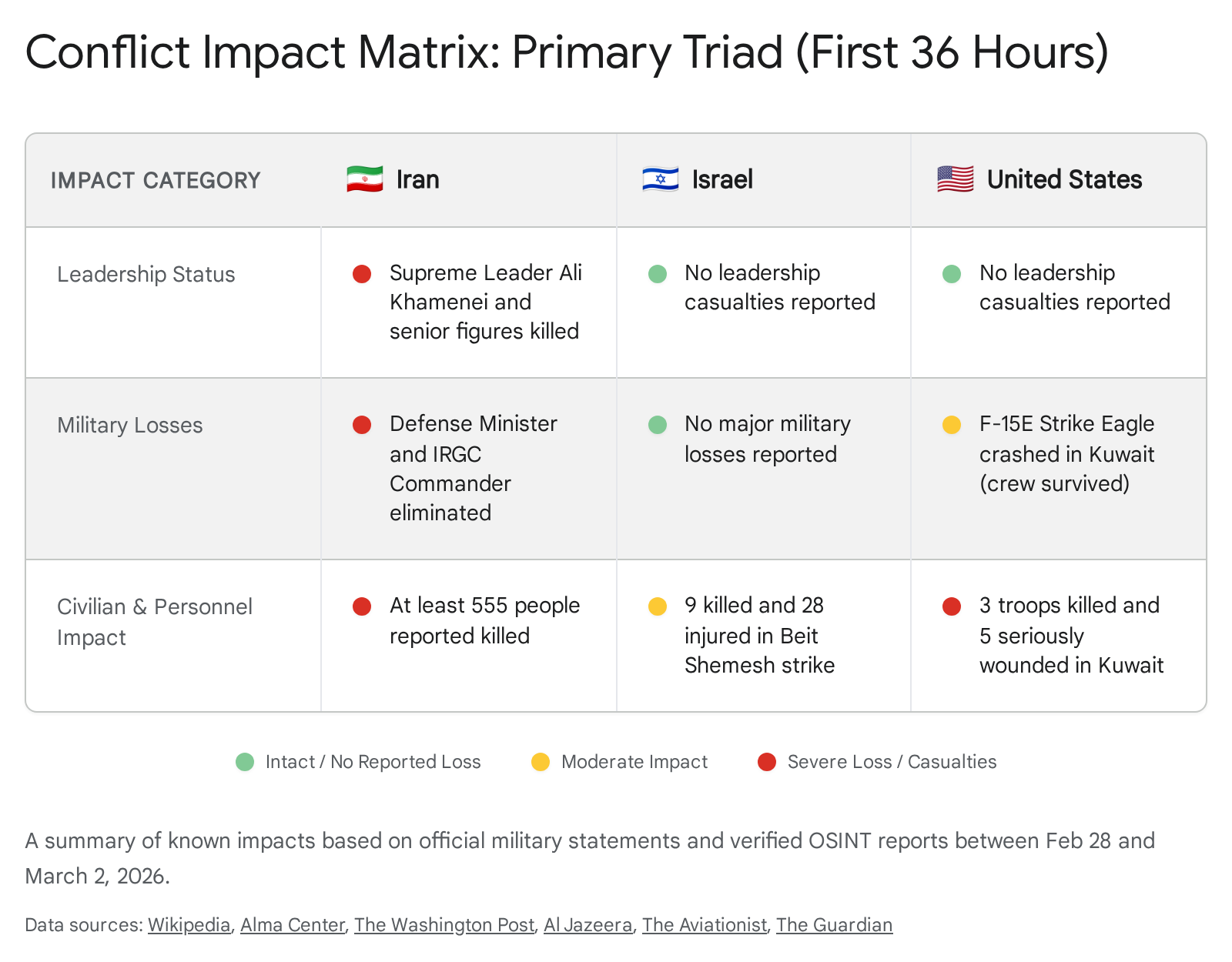
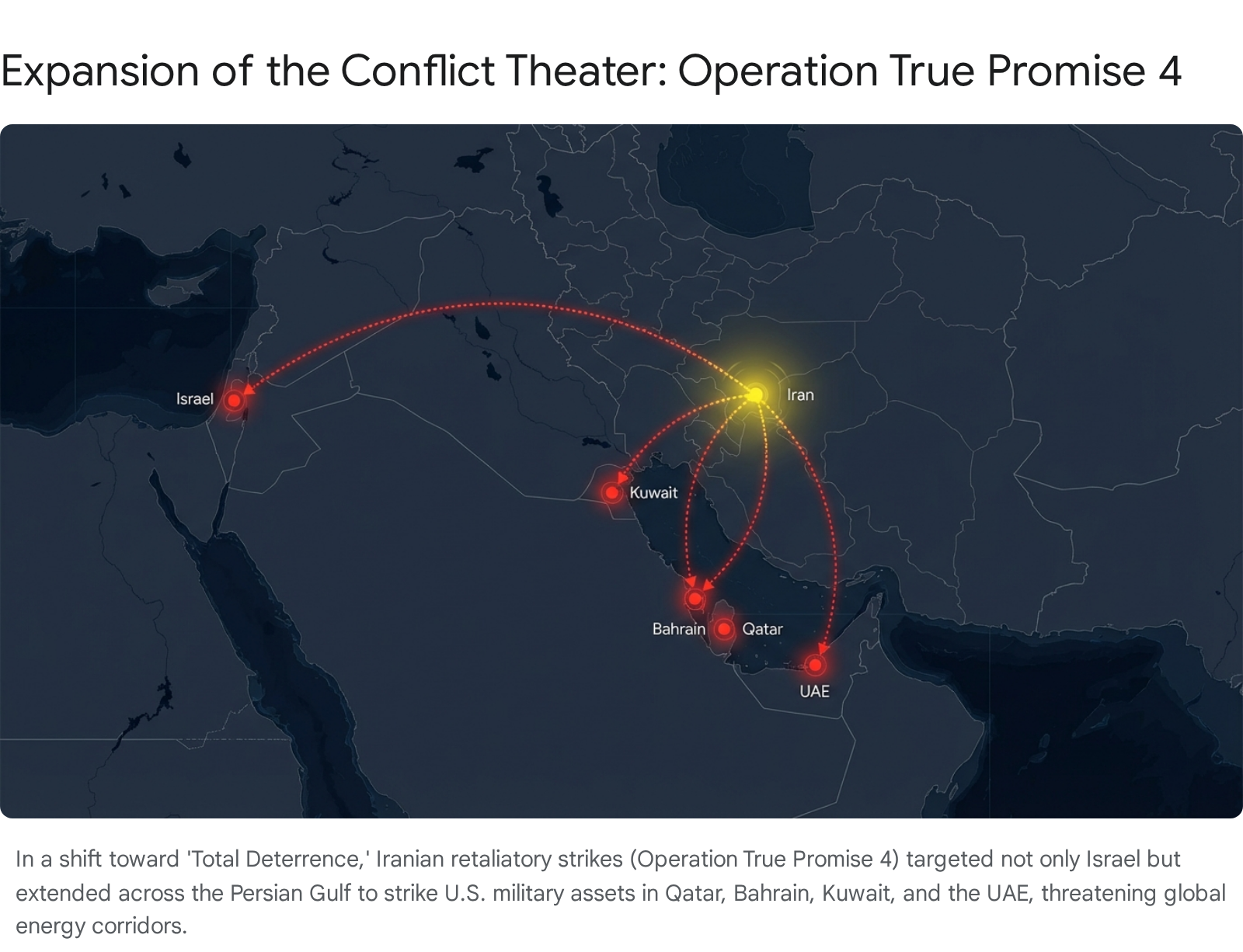
Bereft of its supreme commander and stripped of traditional air defenses, the surviving Iranian political structure,now hastily managed by a three-member Interim Leadership Council,has authorized a widespread retaliatory campaign.8 Iran has leveraged its remaining ballistic missile and “Shahed” drone arsenals to launch saturation attacks against US military installations and allied civilian infrastructure across the Gulf Cooperation Council (GCC) states.3 This retaliation has inflicted significant physical and human costs, resulting in the deaths of six US service members at Camp Arifjan in Kuwait, alongside extensive structural damage to the economic centers of gravity in the United Arab Emirates (UAE), Saudi Arabia, and Qatar.10

The second- and third-order macroeconomic effects of these kinetic exchanges have precipitated an immediate global supply chain crisis. The IRGC Navy’s declaration that the Strait of Hormuz is closed,enforced by direct strikes on commercial vessels,has instantly frozen maritime traffic in a chokepoint responsible for a fifth of global oil flows.13 This maritime blockade, coupled with the precautionary shutdown of Qatar’s Ras Laffan liquefied natural gas (LNG) export facility, triggered a 45% spike in European natural gas prices and sent Brent crude surging to $78.40 per barrel.14 Simultaneously, the targeting of major Gulf airports has paralyzed global aviation, severing the primary transit hubs connecting Europe, Asia, and the Americas, and forcing the cancellation of tens of thousands of long-haul flights.18

Diplomatically, the paradigm of Gulf neutrality has collapsed. States such as Oman and the UAE, which previously relied on de-escalation agreements with Tehran, have found themselves directly targeted, forcing a strategic realignment and testing the efficacy of the US security umbrella.3 As of March 3, 2026, the conflict demonstrates zero indicators of de-escalation. US forces are preparing for extended operations while managing domestic War Powers Resolution debates, the IDF has launched preemptive ground incursions into southern Lebanon to neutralize Hezbollah, and the US State Department has ordered the emergency evacuation of non-essential personnel from multiple embassies across the Arab world.21

2.0 Chronological Timeline of Key Events (Last 36 Hours)

To ensure absolute analytical continuity, this timeline incorporates the foundational events from the initial strike window that directly precipitated the actions within the mandated 36-hour reporting period.

  • February 28, 06:15 UTC (01:15 ET): US CENTCOM and the IDF commence Operation Epic Fury and Operation Roaring Lion. Long-range precision munitions, including B-2 stealth bombers and Tomahawk cruise missiles, strike a leadership compound in Tehran, killing Supreme Leader Ali Khamenei, the Iranian defense minister, and the IRGC commander.1
  • March 1, 04:30 UTC: The IRGC issues a formal communique announcing the launch of “extensive missile and drone” retaliatory attacks targeting 27 US bases and Israeli facilities, specifically naming the Tel Nof Airbase and the HaKirya command headquarters in Tel Aviv.5
  • March 1, 14:30 UTC: US CENTCOM publicly confirms the first American casualties of the conflict. Initial reports indicate three US service members were killed and five seriously wounded following an Iranian drone and missile strike on the housing units and tactical operations center at Camp Arifjan in Kuwait.11
  • March 1, 18:00 UTC: Iranian state media formally confirms the establishment of the Interim Leadership Council to govern the state, comprised of President Masoud Pezeshkian, Judiciary Chief Gholam-Hossein Mohseni-Eje’i, and hardline cleric Alireza Arafi.8
  • March 2, 02:00 UTC: IRGC Brigadier General Ebrahim Jabbari declares the Strait of Hormuz closed, warning that the IRGC Navy and regular forces will “set ablaze” any commercial vessels attempting to transit the waterway.14 Commercial AIS (Automatic Identification System) tracking shows tanker traffic dropping to near zero.15
  • March 2, 06:30 UTC: The combined US-Israeli force strikes the Natanz Nuclear Facility in Esfahan Province and the Bid Ganeh ballistic missile facility in Tehran Province, marking a definitive shift toward degrading Iran’s strategic nuclear infrastructure and medium-range missile stockpiles.7
  • March 2, 10:00 UTC: Widespread airspace closures are enacted across the Middle East. Commercial flights are halted at major international transit hubs, including Dubai (DXB), Abu Dhabi (AUH), and Doha (DOH), causing a cascade of over 13,000 global flight cancellations.18
  • March 2, 14:15 UTC: US Joint Chiefs of Staff Chairman Gen. Dan Caine officially announces that the US and Israel have established “local air superiority” over Tehran and western Iran, having systematically destroyed over 200 Iranian air defense systems.7
  • March 2, 16:00 UTC: QatarEnergy officially halts all liquefied natural gas (LNG) production at the Ras Laffan complex,the world’s largest LNG export facility,following an Iranian drone strike on the nearby Mesaieed industrial zone.16
  • March 2, 21:00 UTC: US CENTCOM revises the American casualty count to six killed in action (KIA) and 18 seriously wounded after recovering the remains of two additional service members from the struck facility in Kuwait.12
  • March 3, 01:55 UTC: The US State Department issues mandatory departure orders for non-essential government personnel and their families from embassies in Jordan, Bahrain, Iraq, Qatar, and Kuwait, citing extreme and immediate security risks from Iranian munitions.21
  • March 3, 07:11 UTC: The IDF announces the expansion of Operation Roaring Lion to include ground troop operations in southern Lebanon, aimed at preemptively degrading Hezbollah’s retaliatory capabilities following a series of rocket and drone attacks across the Blue Line.24
  • March 3, 10:00 UTC: Iranian ballistic missiles bypass Israeli interceptors to strike the southern Israeli city of Be’er Sheva, injuring at least 15 civilians and demonstrating that despite heavy suppression, Iran retains residual medium-range strike capabilities.32

3.0 Situation by Primary Country

3.1 Iran

3.1.1 Military Actions & Posture

The Iranian military apparatus has been fundamentally disrupted by the decapitation of its centralized command structure. Stripped of its supreme commander and facing the rapid annihilation of its Integrated Air Defense Systems (IADS) by US and Israeli forces, the Iranian armed forces have transitioned into a highly decentralized, asymmetric warfare posture.4 The US-Israeli air campaign has destroyed an estimated 200 air defense systems and rendered the Iranian Air Force virtually combat-ineffective, granting the coalition local air superiority over Tehran and western Iran.4

Consequently, Iran’s offensive capability now relies entirely on stand-off munitions, specifically its vast stockpiles of ballistic missiles and “Shahed” series one-way attack unmanned aerial vehicles (UAVs).4 Military monitors report that the surviving command nodes of the IRGC Aerospace Force and the regular military (Artesh) are executing pre-approved retaliatory strike packages.4 The IDF assesses that while Iranian units initially struggled to coordinate large-scale barrages due to command-and-control disruptions, they have adapted by increasing the temporal intervals between attacks to amass larger swarms of 9 to 30 missiles per wave.31 These swarm tactics have successfully penetrated advanced regional air defenses, striking military and civilian infrastructure across Israel, the UAE, Qatar, Saudi Arabia, Kuwait, Bahrain, and Oman.3

A critical vector of Iran’s military strategy is the aggressive weaponization of maritime geography. Following the announcement by Brig. Gen. Ebrahim Jabbari that the Strait of Hormuz is closed, the IRGC Navy initiated a campaign of harassment and direct strikes against commercial shipping.13 The IRGC claims to have struck multiple vessels, including US- and UK-linked oil tankers and the US Maritime Security Program (MSP) vessel in Jebel Ali Port, UAE, utilizing Qadr-380 anti-ship cruise missiles and drones.37 The Joint Maritime Information Center (JMIC) confirmed strikes on the Skylight, the MKD Vyom, and the Sea La Donna near the approaches to the Strait.38 In response to this maritime threat, US forces launched a devastating counter-naval campaign; CENTCOM reports having sunk at least 11 Iranian naval vessels, including Kilo-class submarines, and has “largely destroyed” Iran’s naval headquarters.25 The IRGC has also claimed responsibility for launching 12 drones at Camp Arifjan in Kuwait, six drones and five ballistic missiles at Al Minhad Air Base in the UAE, and six drones targeting US naval facilities in Bahrain.10

3.1.2 Policy & Diplomacy

The political structure of the Islamic Republic is navigating an unprecedented existential crisis. To prevent institutional collapse following Khamenei’s assassination, the Expediency Discernment Council swiftly instituted a temporary Interim Leadership Council. This triumvirate consists of President Masoud Pezeshkian, Judiciary Chief Gholam-Hossein Mohseni-Eje’i, and Ayatollah Alireza Arafi.8 Arafi’s appointment is strategically highly significant; as a prominent hardline cleric, head of Iran’s seminaries, and a trusted member of Khamenei’s inner circle, his presence ensures that the core ideological continuity of the Velayat-e Faqih (Guardianship of the Islamic Jurist) is maintained during the interregnum.8

Simultaneously, the Iranian security leadership has undergone a rapid reshuffle. Veteran politician Ali Larijani has resumed his role as Secretary of the Supreme National Security Council (SNSC), quickly appointing a hardline deputy to enforce cross-factional harmony.40 Despite rumors of back-channel communications through Omani mediators,who publicly stated that the “door to diplomacy remains open”,Larijani has categorically rejected any negotiations with the United States under military pressure, indicating that the regime views capitulation as a terminal threat.31 President Pezeshkian has publicly framed the strikes as “a great crime” and vowed “successive, regrettable slaps” against the US and Israel in revenge.5 The power vacuum has also intensified debates within the Shia religious establishments in Qom, Najaf, and Karbala regarding the future institutional foundation of the post-revolutionary state.40

3.1.3 Civilian Impact

The civilian toll inside Iran has been catastrophic. The Iranian Red Crescent Society reports that at least 555 to 780 people have been killed across 131 targeted counties since the conflict began, prompting the mobilization of over 100,000 rescue workers.32 Independent human rights monitors, such as Hengaw, assess the death toll to be significantly higher, estimating at least 1,500 total fatalities, including 200 civilians and 1,300 military personnel.44 Urban centers heavily integrated with military infrastructure, such as Tehran, Isfahan, Shiraz, and Kermanshah, have sustained severe bombardment.45

The scale of collateral damage has been extensive. Strikes in Tehran resulted in the severe damage of the Gandhi Hospital and the deaths of 20 civilians in Niloofar Square.46 A highly controversial and tragic incident involves reports of a girls’ elementary school in Minab being struck, with Iranian state media and government sources claiming 148 student casualties, though independent verification remains impossible due to ongoing information blackouts.47 The home of former Iranian President Mahmoud Ahmadinejad was also destroyed in the strikes.48

The domestic psychological environment is deeply fractured, illustrating the regime’s weakened legitimacy. While state television broadcasted official mourning and declared a 40-day national mourning period, there were widespread reports of anti-regime citizens celebrating the decapitation strikes. Footage of citizens dancing in the streets, whistling, and honking horns surfaced from cities across the country, including Karaj, Qazvin, Shiraz, and Sanandaj.5 The regime has responded to this internal dissent by implementing severe internet disruptions, cutting off access to major cities for extended hours to suppress protest coordination and isolate the population from external information networks.5

3.2 Israel

3.2.1 Military Actions & Posture

The IDF’s strategic execution of Operation Roaring Lion represents the largest, most complex, and most consequential aerial campaign in Israeli military history. Utilizing approximately 200 warplanes, the Israeli Air Force (IAF) has dropped over 2,500 precision munitions, successfully degrading over 600 Iranian regime targets within the first 72 hours.2 The tactical priority has been the systematic dismantling of Iran’s anti-access/area denial (A2/AD) capabilities; the IDF reports the destruction of 200 air defense systems and 150 surface-to-surface ballistic missiles and launchers.29

A primary operational objective has been the “launcher hunt”,a real-time intelligence, surveillance, and reconnaissance (ISR) strike loop designed to locate and destroy mobile ballistic missile launchers before they can fire. According to IDF spokesperson Lt.-Col. Nadav Shoshani, Iran’s missile-to-launcher ratio was decreased by a factor of ten, significantly diminishing their rate of fire and their ability to overwhelm Israeli defenses.52 Having neutralized Iran’s primary air defense networks, Israeli aircraft are now operating with localized impunity, utilizing lower-generation aircraft and “stand-in” munitions to strike hardened nuclear and strategic sites.7 This includes precise strikes on the Natanz Fuel Enrichment Plant, which the IAEA confirmed sustained structural damage to its entrance buildings, and the Bid Ganeh ballistic missile facility in Tehran Province.7

Concurrently, the IDF has rapidly expanded its military posture to its northern front to prevent Lebanese Hezbollah from exploiting the regional chaos. In response to Hezbollah rocket and drone attacks on the Mishmar al Karmel missile defense site in Haifa, the IDF struck over 70 Hezbollah weapons depots and launch sites in southern Lebanon.7 These strikes included targeted assassinations in Beirut’s Dahiyeh suburb, killing Mohammad Raad, the head of Hezbollah’s parliamentary bloc, and Hezbollah’s intelligence chief.29 To preempt further escalation, the IDF announced the deployment of ground troops into southern Lebanon on March 3, shifting from aerial bombardment to active ground interdiction, supported by the mobilization of roughly 110,000 reservists.24

3.2.2 Policy & Diplomacy

The Israeli government remains remarkably united behind a maximalist geopolitical strategy aimed at forcing regime change in Tehran. Prime Minister Benjamin Netanyahu and Defense Minister Israel Katz have explicitly stated that the operation will continue “as long as necessary” to permanently dismantle Iran’s nuclear program and eliminate the military capabilities of the IRGC.30 The government views the current operational window as a historic opportunity to reshape the Middle East.

Domestically, the legislative branch has swiftly aligned with the executive’s war footing. The Knesset’s Foreign Affairs and Defense Committee, following classified intelligence briefings from the National Security Council and the IDF Operations Directorate, unanimously approved the government’s request to declare a “special situation on the home front” until March 12, 2026.54 This declaration grants the government broad emergency powers regarding civilian mobilization, infrastructure control, and public safety directives. The committee also expanded equipment registration orders, allowing the mass mobilization of civilian vehicles for IDF logistical support.54

3.2.3 Civilian Impact

The Israeli civilian population has absorbed multiple waves of retaliatory ballistic missile and drone attacks. While the multi-tiered Israeli air defense architecture (comprising Iron Dome, David’s Sling, and the Arrow systems) has intercepted the vast majority of incoming projectiles, residual impacts and falling shrapnel have caused casualties and infrastructure damage. As of March 3, official figures indicate 12 Israelis have been killed, 11 are missing, and 777 have been injured.55

Notable civilian impacts include a direct missile strike on a residential area in the southern city of Be’er Sheva, which injured 15 civilians, and scattered shrapnel hits across the greater Jerusalem area, including remnants landing in the Hinnom Valley.32 The civilian population is operating under strict Home Front Command directives, enduring frequent sheltering orders as sirens sound across central and southern Israel.32 The aviation sector has ground to a halt; Ben Gurion Airport (TLV) remains entirely closed to commercial and charter flights, forcing civilians attempting to evacuate to utilize land border crossings into Jordan (Allenby Bridge) and Egypt (Taba crossing), though these routes are subject to sudden closures based on security assessments.57

3.3 United States

3.3.1 Military Actions & Posture

Executing Operation Epic Fury, the US military has deployed an unprecedented concentration of regional firepower, acting as the primary kinetic instrument alongside Israel. The US campaign is designed as a decapitation and suppression effort, targeting Iranian command networks, nuclear infrastructure, and naval projection capabilities.58 The opening salvos included the combat debut of CENTCOM’s Task Force Scorpion Strike, which deployed low-cost one-way attack drones to overwhelm Iranian localized defenses.1

The US has actively utilized B-2 Spirit stealth bombers, flying directly from Whiteman Air Force Base in Missouri and armed with 2,000-lb munitions, to penetrate deeply buried Iranian ballistic missile storage facilities and command centers.25 To date, CENTCOM reports striking over 1,000 to 2,000 individual targets, effectively dismantling the IRGC Aerospace and Naval headquarters.37 US forces have also conducted preemptive airstrikes against Iranian-backed Iraqi militias (the Popular Mobilization Forces) in Diyala Province and Jurf al Sakhr, Iraq, to degrade their ability to launch attacks against US bases.7

However, the US has suffered significant casualties due to Iran’s asymmetric retaliation against regional bases. Six US service members have been killed in action, and 18 have been seriously wounded.11 The primary loss of life occurred at Camp Arifjan in Kuwait, where a swarm of 12 Iranian drones and ballistic missiles struck a tactical operations center and housing units managed by the US Army Sustainment Command.10 Two Department of Defense personnel were also injured in a retaliatory drone strike on a hotel housing military personnel in Bahrain.12

Furthermore, the fog of war and the extreme saturation of the airspace has resulted in catastrophic friendly-fire incidents. Open-source military monitors and official confirmations indicate that three US Air Force F-15E Strike Eagles were shot down over Kuwait, likely by allied air defense systems reacting blindly to the overwhelming influx of Iranian drone swarms.55 Joint Chiefs Chairman Gen. Dan Caine acknowledged the high probability of additional casualties and confirmed the deployment of additional tactical aviation and air defense assets into the theater to sustain prolonged operations.23

3.3.2 Policy & Diplomacy

The executive branch’s rapid and unilateral escalation has ignited a fierce constitutional and political battle within the United States. President Donald Trump has framed Operation Epic Fury as a necessary war of choice to eliminate the imminent nuclear threat posed by the Iranian regime, destroy its ballistic missile arsenal, and degrade its proxy terror networks.65 The President declared that the US is “way ahead of schedule” but possesses the capability to extend the war far beyond the initially projected four-to-five-week timeline.30 Secretary of Defense Pete Hegseth struck a combative tone, firmly rejecting comparisons to previous protracted Middle Eastern conflicts, stating, “This is not endless… destroy the missile threat, destroy the Navy, no nukes.” However, Hegseth explicitly refused to rule out the deployment of American ground troops to Iran if deemed necessary.23

The lack of a formal Congressional declaration of war has triggered a severe backlash under the 1973 War Powers Resolution. Lawmakers from both parties, led by the Massie-Khanna resolution, are attempting to force an immediate vote to block further unauthorized military action. Democratic Senators Chuck Schumer, Tim Kaine, and Chris Murphy have vehemently criticized the administration for initiating a major regional war without presenting intelligence regarding the “imminent” nature of the Iranian threat to Congress, calling the strikes a “colossal mistake”.22 Conversely, the administration has received staunch support from Republican figures like Representative Steve Scalise and Senators Tom Cotton and Lindsey Graham, who view the operation as a historic victory over state-sponsored terrorism.65

3.3.3 Civilian Impact

The immediate impact on US civilians revolves around the extreme danger to Americans currently located in the Middle East. The US State Department issued an unprecedented series of “DEPART NOW” advisories for citizens in 15 regional countries, including close allies like Israel, Saudi Arabia, the UAE, Egypt, and Qatar, urging them to leave via commercial means immediately due to serious safety risks.12

Compounding the diplomatic crisis, the State Department ordered the mandatory evacuation of all non-essential diplomatic personnel and their families from embassies in Jordan, Bahrain, Iraq, Qatar, and Kuwait. This drastic measure was necessitated by the direct targeting of these host nations by Iranian munitions and the threat of kidnappings by Iranian-backed militias.21 Domestically, the public reaction is sharply polarized; large Iranian-American populations in cities like Los Angeles (colloquially “Tehrangeles”) have held massive rallies celebrating the fall of the Khamenei regime, while broader anti-war protests and demonstrations against the unilateral use of military force have emerged in major cities nationwide.21


Table 1: Confirmed Military & Civilian Casualties (as of March 3, 2026, 11:00 UTC)

NationConfirmed KilledConfirmed WoundedPrimary Incident Locations & Notes
Iran555 – 1,500+1,000+Includes Supreme Leader Khamenei and an estimated 200+ civilians. Heavy kinetic strikes on Tehran, Isfahan, Shiraz, and Minab.32
Israel12777Includes 11 officially missing. Primary strikes absorbed in Be’er Sheva, Tel Aviv, and the greater Jerusalem area.24
United States618Casualties sustained primarily at Camp Arifjan (Kuwait) and a military-utilized hotel in Bahrain. Loss of 3 F-15E aircraft (friendly fire).11
Kuwait2302 naval personnel killed. 27 Kuwaiti army soldiers injured defending airspace against drone swarms.12

4.0 Regional and Gulf State Impacts

The Iran conflict has shattered the geopolitical and economic stability of the Gulf Cooperation Council (GCC) states. By executing retaliatory strikes against sovereign nations hosting US military assets, Iran has forcibly dragged these countries into active combat roles, collapsing the long-standing “gentlemen’s agreements” of neutrality and de-escalation that previously insulated the Gulf from direct conflict.3

United Arab Emirates (UAE): The UAE has borne the brunt of Iran’s regional retaliation, suffering an influx of hundreds of drones and ballistic missiles,a volume nearly matching the initial bombardment directed at Israel.3 Iranian munitions explicitly targeted the US command and control center at Al Minhad Air Base with a swarm of six drones and five ballistic missiles.10 However, the strikes have also caused severe collateral damage in civilian centers like Dubai and Sharjah, including shrapnel strikes on the Fairmont The Palm hotel and a fire in the Fujairah Oil Industry Zone.72 This assault has induced a structural crisis for the UAE’s economic model; with over three-quarters of its GDP derived from non-oil sectors, the nation relies heavily on its reputation as a safe, stable hub for international capital and tourism.3 The UAE has abandoned its 2019 de-escalation strategy, closing its embassy in Tehran, withdrawing its diplomatic mission, and summoning the Iranian ambassador to protest the “flagrant violation of national sovereignty”.74

Saudi Arabia: Iran’s initial strategic restraint toward Riyadh evaporated by March 2, when Iranian drones targeted critical Saudi energy infrastructure, including Aramco facilities in Ras Tanura.3 Furthermore, twin drone attacks targeted the diplomatic quarter in Riyadh, sparking a fire near the US Embassy compound.13 Despite the attacks, Saudi Crown Prince Mohammed bin Salman (MBS) appears to be analyzing the conflict strategically. Having privately lobbied the US for the strikes alongside Israel, MBS views the degradation of the IRGC as a historic opportunity to cement Saudi Arabia’s position as the undisputed dominant power in the Middle East, provided the US successfully neutralizes Iran’s proxy network without leaving a sustained, unstable power vacuum.3

Qatar: As the host to the largest US military installation in the region (Al Udeid Air Base), Qatar found itself under direct fire from Iranian ballistic missiles.34 The economic impact on Qatar has been profound and immediate; following an Iranian drone strike on the Mesaieed industrial zone, QatarEnergy preemptively halted all liquefied natural gas (LNG) production at the Ras Laffan complex,the world’s largest LNG export facility.16 This shutdown, coupled with the closure of the Strait of Hormuz, directly threatens global energy supplies and has drawn severe diplomatic concern from China, which relies heavily on Qatari gas for its industrial base.17

Kuwait and Bahrain: Kuwait has suffered the highest collateral military damage among the Gulf states. Camp Arifjan, a primary logistical hub for the US Army, was heavily bombarded by drone swarms, resulting in both US and Kuwaiti military casualties.10 The Kuwaiti airspace is entirely closed, and the government is actively engaging in air defense operations, resulting in injuries to 27 Kuwaiti soldiers.12 Similarly, Bahrain, which hosts the US Navy’s Fifth Fleet, has been targeted by Iranian drones, resulting in injuries to DoD personnel at a local hotel and prompting a furious diplomatic denunciation from Manama, asserting its right to self-defense.12

Oman and Jordan: Oman’s historical posture as a neutral regional mediator,often referred to as the “Switzerland of the Middle East”,failed to shield it from the conflict. Iranian strikes targeted vessels in Omani territorial waters near Khasab, and projectiles breached its airspace, forcing Muscat to strongly condemn Iran’s actions while desperately attempting to keep diplomatic channels open.3 Jordan has similarly been dragged into the fray, with its air defense systems forced to intercept Iranian projectiles bound for Israel. This has led to the nightly closure of its airspace, the threat of terrorist attacks, and the emergency evacuation of the US embassy in Amman.21

Aviation and Maritime Logistics Collapse: The combination of military operations, drone swarms, and airspace restrictions has severed global connectivity. The major Middle Eastern super-connector hubs,Dubai (DXB), Abu Dhabi (AUH), and Doha (DOH),are effectively offline, stranding hundreds of thousands of passengers. Over 13,000 flights have been canceled by global carriers, including Emirates, Qatar Airways, Turkish Airlines, and Virgin Atlantic.18 At sea, the IRGC’s threat to burn ships transiting the Strait of Hormuz has halted 20% of the world’s oil supply. The total absence of AIS signals in the strait, combined with the removal of war-risk protection and indemnity insurance for ship owners, indicates an unprecedented maritime freeze that is driving up global energy prices and forcing supply chain rerouting.14


Table 2: Regional Airspace and Aviation Status (as of March 3, 2026)

Sovereign State / FIRAirspace StatusMajor Hub & Carrier Impact
Iran (OIIX)Total ClosureTehran Imam Khomeini (IKA) offline. All foreign carriers suspended.78
Israel (LLLL)Total ClosureBen Gurion (TLV) closed; evacuation flights via land bridge to Egypt.57
UAE (OMAE)Partial/ESCAT ZoneDXB, AUH heavily restricted. Emirates/Etihad suspending majority of operations.78
Qatar (OTDF)Total ClosureDOH operations halted. Qatar Airways flights temporarily suspended.78
Kuwait (OKAC)Total ClosureKWI shut down to commercial traffic.78
Bahrain (OBBB)Total ClosureBAH shut down to commercial traffic.78
Jordan (OJAC)Nighttime ClosureAMM closed daily 1500 to 0600 UTC.78
Iraq (ORBB)Total ClosureBaghdad, Erbil airspace closed to commercial traffic.78

5.0 Appendices

Appendix A: OSINT and Data Aggregation Framework

This Situation Report (SITREP) is derived from a real-time sweep of open-source intelligence (OSINT), official military press releases, state-affiliated broadcast media, and commercial logistics monitors collected over the designated timeframe.

  • Data Aggregation: Primary military claims were cross-referenced between the US Department of Defense (CENTCOM statements), the Israel Defense Forces (IDF Spokesperson’s Unit), and the Islamic Revolutionary Guard Corps (statements distributed via state-aligned agencies).
  • Conflict Deconfliction: Where casualty figures or strike impacts diverge between state actors, both claims are presented neutrally. For instance, Iranian claims of extensive damage to US vessels are contrasted with CENTCOM’s statements of minimal installation damage but confirmed personnel losses. Independent monitors (e.g., Hengaw) were utilized to balance state-sanctioned casualty reports.
  • Time Window Overlap: The 36-hour operational window (spanning roughly March 1, 23:13 UTC to March 3, 11:13 UTC) inherently relies on the initiating events of February 28 (the decapitation strikes). Therefore, foundational events prior to March 1 were included strictly to establish the causal baseline for the retaliatory actions occurring within the 36-hour window, ensuring narrative continuity.

Appendix B: Glossary of Acronyms

  • A2/AD: Anti-Access/Area Denial.
  • AIS: Automatic Identification System (used for tracking maritime vessels).
  • CENTCOM: United States Central Command (the geographic combatant command responsible for the Middle East).
  • DoD: Department of Defense (United States).
  • ESCAT: Emergency Security Control of Air Traffic.
  • GCC: Gulf Cooperation Council (political and economic union of Arab states bordering the Gulf).
  • IAEA: International Atomic Energy Agency.
  • IADS: Integrated Air Defense System.
  • IAF: Israeli Air Force.
  • IDF: Israel Defense Forces.
  • IRGC: Islamic Revolutionary Guard Corps (Iran’s premier military and internal security apparatus).
  • KIA: Killed in Action.
  • LNG: Liquefied Natural Gas.
  • OSINT: Open-Source Intelligence.
  • SNSC: Supreme National Security Council (Iran).
  • UAV: Unmanned Aerial Vehicle (Drone).
  • UKMTO: United Kingdom Maritime Trade Operations (acts as the primary point of contact for merchant vessels involved in maritime incidents).

Appendix C: Glossary of Foreign Words

  • Artesh: The regular armed forces of the Islamic Republic of Iran, operating alongside the IRGC.
  • Dahiyeh: The predominantly Shia southern suburbs of Beirut, Lebanon; heavily populated and controlled by Hezbollah.
  • Khamenei: Referring to Ayatollah Ali Khamenei, the Supreme Leader of Iran from 1989 until his targeted assassination on February 28, 2026.
  • Knesset: The unicameral national legislature of Israel.
  • Majlis: The Islamic Consultative Assembly, or the national legislative body of Iran.
  • Shahed: A series of Iranian-manufactured loitering munitions (one-way attack drones), most notably the Shahed-136, used extensively in asymmetric swarm attacks against regional infrastructure.
  • Velayat-e Faqih: “Guardianship of the Islamic Jurist,” the foundational political and theological doctrine of the Islamic Republic of Iran, which vests ultimate authority in a highly qualified Islamic cleric (the Supreme Leader).

Please share the link on Facebook, Forums, with colleagues, etc. Your support is much appreciated and if you have any feedback, please email us in**@*********ps.com. If you’d like to request a report or order a reprint, please click here for the corresponding page to open in new tab.


Sources Used

  1. U.S. Forces Launch Operation Epic Fury – centcom, accessed March 3, 2026, https://www.centcom.mil/MEDIA/PRESS-RELEASES/Press-Release-View/Article/4418396/us-forces-launch-operation-epic-fury/
  2. Operation Epic Fury: How the US and Israel’s coordinated attack on Iran unfolded, accessed March 3, 2026, https://aerospaceglobalnews.com/news/operation-epic-fury-us-israel-air-campaign-iran/
  3. The Gulf that emerges from the Iran war will be very different …, accessed March 3, 2026, https://www.atlanticcouncil.org/dispatches/the-gulf-that-emerges-from-the-iran-war-will-be-very-different/
  4. The US-Israel campaign in Iran, accessed March 3, 2026, https://www.iiss.org/online-analysis/online-analysis/2026/02/the-us-israel-campaign-in-iran/
  5. IRGC says it targeted US bases and Tel Aviv sites, accessed March 3, 2026, https://www.iranintl.com/en/202603019439
  6. After the strike: The danger of war in Iran – Brookings Institution, accessed March 3, 2026, https://www.brookings.edu/articles/after-the-strike-the-danger-of-war-in-iran/
  7. Iran Update Evening Special Report, March 2, 2026 | ISW, accessed March 3, 2026, https://understandingwar.org/research/middle-east/iran-update-evening-special-report-march-2-2026/
  8. Alireza A’rafi Appointed to Temporary Leadership Council, accessed March 3, 2026, https://iranwire.com/en/news/149678-alireza-arafi-appointed-to-temporary-leadership-council/
  9. 2026 Iran’s Interim Leadership Council – Wikipedia, accessed March 3, 2026, https://en.wikipedia.org/wiki/2026_Iran%27s_Interim_Leadership_Council
  10. Iran says it fired 26 drones, five ballistic missiles at US targets in Gulf – China Daily, accessed March 3, 2026, https://www.chinadaily.com.cn/a/202603/03/WS69a5ea0aa310d6866eb3b285.html
  11. Four US service members killed in ‘Operation Epic Fury’: CENTCOM, accessed March 3, 2026, https://responsiblestatecraft.org/servicemebers-killed-operation-epic-fury/
  12. U.S. death toll in Iran war rises to 6 as Trump says campaign could last 5 weeks, accessed March 3, 2026, https://www.cbsnews.com/live-updates/iran-us-war-day-3-american-deaths-israel-gulf-allies-hit-missile-strikes/
  13. Israel-US war on Iran live: fire at US embassy in Riyadh after drone strike; state department urges all Americans to leave Middle East, accessed March 3, 2026, https://www.theguardian.com/world/live/2026/mar/02/us-israel-war-iran-live-updates-attacks-strikes-tehran-lebanon-beirut-hezbollah-dubai-latest-news?filterKeyEvents=false&page=with%3Ablock-69a628428f080cbafb2872a3
  14. Ships in Strait of Hormuz to be ‘set ablaze’, IRGC official says, as insurers cancel coverage, accessed March 3, 2026, https://www.middleeasteye.net/news/ships-crossing-strait-hormuz-will-be-set-ablaze-irgc-official-says-insurers-cancel-coverage
  15. 2026 Strait of Hormuz crisis – Wikipedia, accessed March 3, 2026, https://en.wikipedia.org/wiki/2026_Strait_of_Hormuz_crisis
  16. Iran: IRGC Official Claims Iran Will Set Fire to Any Vessel Transiting Strait of Hormuz, accessed March 3, 2026, https://worldview.stratfor.com/situation-report/iran-irgc-official-claims-iran-will-set-fire-any-vessel-transiting-strait-hormuz
  17. China calls on all sides to safeguard ships in Strait of Hormuz, accessed March 3, 2026, https://clubofmozambique.com/news/china-calls-on-all-sides-to-safeguard-ships-in-strait-of-hormuz/
  18. Israel-US attacks, Iran retaliation close Gulf airspace, disrupt global aviation, accessed March 3, 2026, https://www.aa.com.tr/en/middle-east/israel-us-attacks-iran-retaliation-close-gulf-airspace-disrupt-global-aviation/3847933
  19. Middle East flight cancellations: The latest updates, accessed March 3, 2026, https://aerospaceglobalnews.com/news/middle-east-flight-cancellations-latest-updates/
  20. Oman calls for immediate halt to attacks against sites in countries across the region, accessed March 3, 2026, https://www.fm.gov.om/en/38129/
  21. US orders nonessential embassy staff to leave Middle East amid Iran escalation, accessed March 3, 2026, https://english.nv.ua/nation/us-orders-embassy-staff-to-leave-middle-east-amid-iran-escalation-50588517.html
  22. Lawmakers stress new urgency around war powers votes after Iran strikes, accessed March 3, 2026, https://www.cbsnews.com/news/congress-war-powers-votes-iran-strikes/
  23. U.S. won’t rule out sending ground troops into Iran, accessed March 3, 2026, https://www.washingtonpost.com/national-security/2026/03/02/hegseth-iran-ground-troops/
  24. Live Updates: Israel, US pummel regime across Iran, accessed March 3, 2026, https://www.jpost.com/middle-east/iran-news/2026-03-03/live-updates-888599
  25. 3 American soldiers killed as U.S.-Israeli war against Iran continues into 2nd day – WEAA, accessed March 3, 2026, https://www.weaa.org/2026-03-01/3-american-soldiers-killed-as-u-s-israeli-war-against-iran-continues-into-2nd-day
  26. Operation Epic Fury Update – centcom, accessed March 3, 2026, https://www.centcom.mil/MEDIA/STATEMENTS/Statements-View/Article/4418506/operation-epic-fury-update/
  27. ‘US crossed dangerous red line’: Iran says has no option but to respond after Khamenei killing, accessed March 3, 2026, https://timesofindia.indiatimes.com/world/middle-east/us-crossed-dangerous-red-line-iran-says-has-no-option-but-to-respond-after-khamenei-killing/articleshow/128918509.cms
  28. Iran-Israel Conflict: Limited flights from UAE begin as governments seek to extract citizens from West Asia, accessed March 3, 2026, https://www.thehindu.com/news/international/limited-flights-from-uae-begin-as-governments-seek-to-extract-citizens-from-west-asia/article70697777.ece
  29. Operations Epic Fury and Roaring Lion: 3/2/26 Update – JINSA, accessed March 3, 2026, https://jinsa.org/wp-content/uploads/2026/03/Operations-Epic-Fury-and-Roaring-Lion-03-02-26-1.pdf
  30. Middle East crisis live: Israel launches new attacks on Tehran and Beirut as Iran closes critical Strait of Hormuz, accessed March 3, 2026, https://www.theguardian.com/world/live/2026/mar/02/us-israel-war-iran-live-updates-attacks-strikes-tehran-lebanon-beirut-hezbollah-dubai-latest-news?page=with%3Ablock-69a58c5c8f0863f6a3effbd9
  31. Iran Update Morning Special Report, March 2, 2026, accessed March 3, 2026, https://understandingwar.org/research/middle-east/iran-update-morning-special-report-march-2-2026/
  32. Daily World Briefing, March 3 – Xinhua, accessed March 3, 2026, https://english.news.cn/20260303/5d36f0a08e904c35b840cdf4c2c085f4/c.html
  33. US Shut Down Beirut, Kuwait & Bahrain Embassies; Orders Evacuation of Diplomats Across Middle East as Iran-Israel Conflict Escalates; Check Full List, accessed March 3, 2026, https://sundayguardianlive.com/world/us-shut-down-beirut-kuwait-bahrain-embassies-orders-evacuation-of-diplomats-across-middle-east-as-iran-israel-conflict-escalates-check-full-list-173754/
  34. Daily Report: The Second Iran War – March 2, 2026 (19:00), accessed March 3, 2026, https://israel-alma.org/daily-report-the-second-iran-war-march-2-2026-1900/
  35. Middle East – Hansard – UK Parliament, accessed March 3, 2026, https://hansard.parliament.uk/commons/2026-03-02/debates/C3BE6001-08B4-4DF8-8193-A4BFF0C57E9B/MiddleEast
  36. US, GCC states, Jordan condemn Iran’s reckless attacks on sovereign territories across region, accessed March 3, 2026, https://www.kuna.net.kw/ArticleDetails.aspx?id=3278518&language=en
  37. Iran Update Evening Special Report, March 1, 2026 | ISW, accessed March 3, 2026, https://understandingwar.org/research/middle-east/iran-update-evening-special-report-march-1-2026/
  38. Maritime security update: Gulf Region / Strait of Hormuz and Red Sea – Skuld, accessed March 3, 2026, https://www.skuld.com/topics/port/port-news/asia/maritime-security-update-gulf-region–strait-of-hormuz-and-red-sea/
  39. Iran Update Morning Special Report: March 1, 2026 | ISW, accessed March 3, 2026, https://understandingwar.org/research/middle-east/iran-update-morning-special-report-march-1-2026/
  40. After Khamenei: Planning for Iran’s Leadership Transition, accessed March 3, 2026, https://www.cfr.org/reports/leadership-transition-in-iran
  41. Mediator Oman says ‘door to diplomacy’ between US, Iran still open, calls for renewed talks, accessed March 3, 2026, https://www.malaymail.com/amp/news/world/2026/03/02/mediator-oman-says-door-to-diplomacy-between-us-iran-still-open-calls-for-renewed-talks/210958
  42. Iran News in Brief – March 2, 2026, accessed March 3, 2026, https://www.ncr-iran.org/en/news/iran-news-in-brief-news/iran-news-in-brief-march-2-2026/
  43. Iran-Israel war LIVE: Over 780 killed in Iran so far, Red Crescent says; IAEA confirms ‘recent damage’ to Natanz nuclear site – The Hindu, accessed March 3, 2026, https://www.thehindu.com/news/international/iran-israel-us-war-attacks-strikes-west-asia-live-updates-march-3-2026/article70697758.ece
  44. At least 1,500 killed on third day of war, including 200 civilians, accessed March 3, 2026, https://hengaw.net/en/reports-and-statistics-1/2026/03/article-2
  45. 2026 Israeli–United States strikes on Iran – Wikipedia, accessed March 3, 2026, https://en.wikipedia.org/wiki/2026_Israeli_attack_on_Iran
  46. Scant security briefings keeping Congress in dark, Norcross says, accessed March 3, 2026, https://www.njspotlightnews.org/2026/03/congress-sidelined-with-scarce-security-briefings-nj-congressman-says/
  47. 2026 Israeli–United States strikes on Iran – Wikipedia, accessed March 3, 2026, https://en.wikipedia.org/wiki/2026_Israeli%E2%80%93United_States_strikes_on_Iran
  48. US military says three of its service members killed in Iran operation, accessed March 3, 2026, https://www.theguardian.com/us-news/2026/mar/01/iran-attack-us-service-members-killed
  49. Iran updates: Trump justifies Iran attack as Democrats raise doubt – Los Angeles Times, accessed March 3, 2026, https://www.latimes.com/world-nation/live/u-s-and-israel-attack-iran-tehran-retaliates
  50. IRGC says ‘most devastating’ offensive imminent, accessed March 3, 2026, https://www.iranintl.com/en/202603011820
  51. Situation Report: Middle East Escalation (February 27–1st March, 2026) | CloudSEK, accessed March 3, 2026, https://www.cloudsek.com/ar/blog/middle-east-escalation-israel-iran-us-cyber-war-2026
  52. Day 4: Decrease in Iranian missile strikes on Israel result of targeting launchers, IDF says, accessed March 3, 2026, https://jewishinsider.com/2026/03/iranian-missile-strikes-israeli-launchers-idf-operation-lions-roar/
  53. US-Israel strikes on Iran: February/March 2026, accessed March 3, 2026, https://commonslibrary.parliament.uk/research-briefings/cbp-10521/
  54. Foreign Affairs and Defense Committee hears operational intelligence briefing on Operation Roaring Lion, approves declaration of special situation on the home front, accessed March 3, 2026, https://main.knesset.gov.il/EN/News/PressReleases/Pages/press2326q.aspx
  55. 2026 Iran conflict – Wikipedia, accessed March 3, 2026, https://en.wikipedia.org/wiki/2026_Iran_conflict
  56. Security Updates – | BYU Jerusalem Center for Near Eastern Studies, accessed March 3, 2026, https://jerusalemcenter.ce.byu.edu/security-updates
  57. Security Alert: U.S. Embassy Jerusalem (March 2, 2026, accessed March 3, 2026, https://il.usembassy.gov/security-alert-u-s-embassy-jerusalem-march-2-2026/
  58. Operation Epic Fury Update – March 1, 2026 – SOF News, accessed March 3, 2026, https://sof.news/middle-east/operation-epic-fury-update/
  59. Policy Alert: U.S. Launches Operation Epic Fury to Eliminate Iran’s Nuclear and Missile Threats – FDD Action, accessed March 3, 2026, https://www.fddaction.org/policy-alerts/2026/02/28/policy-alert-u-s-launches-operation-epic-fury-to-eliminate-irans-nuclear-and-missile-threats/
  60. Hegseth urges US troops to ‘stay focused’ as Operation Epic Fury devastates Iran, accessed March 3, 2026, https://www.foxnews.com/live-news/iran-war-trump-israel-khamenei-march-2
  61. US has no intention of easing strikes on Iran, official says, accessed March 3, 2026, https://english.alarabiya.net/News/middle-east/2026/03/02/us-has-no-intention-of-easing-strikes-on-iran-official-says
  62. Operation Epic Fury: Briefing by Department of War (02MAR26) – YouTube, accessed March 3, 2026, https://www.youtube.com/watch?v=b7BfOIhAboM
  63. Missile strikes, US jets downed, and flight disruptions: All that’s happening in Kuwait amid the Middle East crisis, accessed March 3, 2026, https://indianexpress.com/article/world/kuwait-conflict-update-missile-us-jets-flight-disruptions-10562573/
  64. Pete Hegseth discusses Operation Epic Fury, accessed March 3, 2026, https://www.youtube.com/watch?v=19-Kw9Q8fwE
  65. Peace Through Strength: President Trump Launches Operation Epic Fury to Crush Iranian Regime, End Nuclear Threat – The White House, accessed March 3, 2026, https://www.whitehouse.gov/articles/2026/03/peace-through-strength-president-trump-launches-operation-epic-fury-to-crush-iranian-regime-end-nuclear-threat/
  66. Why is the U.S. attacking Iran? Here’s what the Trump administration has said motivated the strikes – CBS News, accessed March 3, 2026, https://www.cbsnews.com/news/why-us-attack-iran-trump-administration/
  67. What They’re Saying About Operation Epic Fury,March 2, 2026, accessed March 3, 2026, https://www.unitedagainstnucleariran.com/press-releases/what-theyre-saying-about-operation-epic-fury-march-2-2026
  68. Congress debates an Iran conflict that is already underway, accessed March 3, 2026, https://www.wcnc.com/article/news/nation-world/congress-debate-iran-conflict-strikes-war-powers-resolution-house-senate/507-a6874cf1-e9cd-46cf-820b-5f609ec236b4
  69. Washington Policy Weekly: Trump Launches War on Iran Without Congressional Approval, accessed March 3, 2026, https://arabcenterdc.org/resource/washington-policy-weekly-trump-launches-war-on-iran-without-congressional-approval/
  70. March 2: Hezbollah claims attack on Israel was ‘defensive act’ after year of Israeli strikes, accessed March 3, 2026, https://www.timesofisrael.com/liveblog-march-02-2026/
  71. US urges citizens to immediately leave over a dozen Middle East countries, accessed March 3, 2026, https://www.aljazeera.com/news/2026/3/3/us-urges-citizens-to-immediately-leave-over-a-dozen-middle-east-countries
  72. US-Israel war on Iran Day 4: Trump issues fresh warning, UAE airlines partially resume, accessed March 3, 2026, https://gulfnews.com/world/mena/us-israel-war-on-iran-day-4-trump-issues-fresh-warning-uae-airlines-partially-resume-1.500461540
  73. Fallout from attack on Iran continues | ITIJ, accessed March 3, 2026, https://www.itij.com/latest/news/fallout-attack-iran-continues
  74. 2026 Iranian strikes on the United Arab Emirates – Wikipedia, accessed March 3, 2026, https://en.wikipedia.org/wiki/2026_Iranian_strikes_on_the_United_Arab_Emirates
  75. Statement by the UAE Ministry of Foreign Affairs in Response to Inaccurate Reporting by Bloomberg, accessed March 3, 2026, https://www.mofa.gov.ae/en/MediaHub/News/2026/3/3/uae-3-3-2026
  76. Push from Saudis, Israel helped move Trump to attack Iran, accessed March 3, 2026, https://www.washingtonpost.com/politics/2026/02/28/trump-iran-decision-saudi-arabia-israel/
  77. Gulf countries, Jordan condemn ‘Iranian’ attacks on regional countries – Anadolu, accessed March 3, 2026, https://www.aa.com.tr/en/middle-east/gulf-countries-jordan-condemn-iranian-attacks-on-regional-countries/3843729
  78. Airspace closures following Israeli and US strikes on Iran, accessed March 3, 2026, https://www.flightradar24.com/blog/live/israel-launches-pre-emptive-strikes-on-iran-airspace-closures-going-into-place/
  79. Oman Condemns and Denounces Iranian Attack on Gulf States and Jordan – Oman News Agency, accessed March 3, 2026, https://omannews.gov.om/topics/en/81/show/127245
  80. When will global airlines flights resume and Middle East airspace open? Global airlines flights cancellati, accessed March 3, 2026, https://m.economictimes.com/news/international/us/when-will-global-airlines-flights-resume-and-middle-east-airspace-open-global-airlines-flights-cancellation-explained-heres-complete-list/articleshow/128887096.cms
  81. Middle East Security Situation: Immediate impact on the global transportation and logistics industry, accessed March 3, 2026, https://www.scangl.com/news/important-notice-middle-east-security-situation-immediate-impact-on-the-global-transportation-and-logistics-industry/

Geopolitical Shifts in 2026: NATO vs. Russian Sniper Systems

Executive Summary

As the geopolitical landscape accelerates into 2026, the operational paradigms defining near-peer combat have fundamentally shifted. The ongoing conflicts in Eastern Europe have served as a violent crucible for modern infantry doctrine, highlighting a critical divergence in how the Russian Federation and the North Atlantic Treaty Organization (NATO) conceptualize, procure, and employ precision small arms weapon systems. This comprehensive engineering and doctrinal white paper examines the contrasting trajectories of sniper and designated marksman platforms within these two distinct strategic frameworks, delivering a deep-research Open-Source Intelligence (OSINT) analysis for defense procurement officers, aerospace engineers, law enforcement armorers, and Tier-1 extreme long-range competitors.

Russia’s ongoing military modernization efforts are currently defined by the introduction of the Chukavin Sniper Rifle (SVCh), a semi-automatic platform explicitly designed to replace the ubiquitous, decades-old Dragunov Sniper Rifle (SVD).1 Engineered around an innovative “curtain scheme” receiver architecture, the SVCh reflects a tactical doctrine that prioritizes localized suppression, high volume of fire, and integration into decentralized “storm battalions” operating within a highly attritional, positional warfare environment.1 Conversely, NATO militaries, led by the United States Special Operations Command (USSOCOM) and the conventional United States Army and Marine Corps, have firmly committed to the Barrett MK22 Multi-Role Adaptive Design (MRAD) Precision Sniper Rifle (PSR).4 The MK22 represents a steadfast commitment to bolt-action mechanical perfection, multi-caliber modularity, and extreme long-range (ELR) ballistic overmatch utilizing the.300 and.338 Norma Magnum cartridges.6

NATO’s approach is deeply integrated into the emerging “kill web” doctrine, demanding high-mobility sensor-to-shooter capabilities that can deliver precision kinetic effects well beyond 1,500 meters to successfully evade rapid counter-battery fires and lethal loitering munitions.8 This report dissects the mechanical engineering of their respective actions, the fluid dynamics and barrel harmonics governing their precision, and the terminal ballistics of their selected cartridges. By cross-referencing tactical performance data, metallurgical tolerances, and strategic procurement realities, this analysis delivers a definitive assessment of modern sniper system efficacy in the 2026 battlespace.

1.0 Doctrinal Paradigms in Near-Peer Conflict

The divergence in small arms procurement between Russian and NATO forces is not merely a matter of localized mechanical preference or budgetary constraints; it is a direct and calculated manifestation of fundamentally opposed military doctrines adapted for the brutal realities of modern, sensor-rich battlefields. The weapon system must serve the tactical architecture, and by 2026, these architectures have split along two highly distinct evolutionary paths.

1.1 The Erosion of the Battalion Tactical Group and Russian Positional Warfare

Entering 2026, the Russian military apparatus has undergone a rapid and comprehensive transformation forced by the realities of its full-scale operations. Prior to 2022, Russian ground forces were theoretically structured around flexible, mechanized Battalion Tactical Groups (BTGs).10 However, extreme attrition rates and the systemic destruction of mechanized assets have forced the Russian General Staff to functionally abandon the BTG model.10 In its place, the Russian military has reverted to a historical Soviet order of battle—utilizing regiments, divisions, and combined arms armies—but heavily compressed to manage frontages with a shortage of trained junior officers.3

The defining characteristic of this reconstituted force is its optimization for positional warfare.10 Maneuver warfare at scale has been largely replaced by the deployment of “storm battalions” and company-sized assault groups.3 These units conduct slow, grinding, dismounted attacks under the cover of massed artillery, operating in small, dispersed detachments to minimize vulnerability to pervasive overhead drone surveillance.3 This tactical reality heavily dictates the requirements for Russian marksmen and the weapon systems they carry.

1.2 NATO’s Combined Joint All-Domain Command and Control and the Kill Web

In stark contrast, NATO doctrine is evolving rapidly under the framework of Multi-Domain Operations and Combined Joint All-Domain Command and Control (CJADC2).9 In a near-peer conflict against adversaries possessing advanced electronic warfare (EW) and massed fires, NATO anticipates a battlefield blanketed by advanced multi-spectral sensors, pervasive unmanned aerial systems (UAS), and rapid algorithmic counter-battery targeting.12 In this environment, static positions are fatal. Modern operations have demonstrated that centralized command posts and static logistics formations are rapidly detected by drone surveillance and obliterated by precision-guided artillery or loitering munitions within minutes of discovery.8

NATO’s response is the creation of a decentralized “kill web.” Through initiatives like Project Convergence, NATO forces are networking disparate sensors—such as space-based assets, Norwegian F-35 fighter jets, P-8 maritime patrol aircraft, and special operations ground reconnaissance—into a single, high-speed digital architecture.9 This allows the command structure to identify a target and immediately route the firing solution to the most effective effector, whether that is a High Mobility Artillery Rocket System (HIMARS) or a dismounted sniper team.9

Consequently, the NATO sniper is envisioned as both a discrete intelligence-gathering node within this web and a long-range kinetic effector.15 To survive the aforementioned counter-battery threat, NATO sniper teams must operate from extreme standoff distances—frequently exceeding 1,200 to 1,500 meters—remaining outside the primary engagement zones of enemy small arms and localized drone swarms. Once a shot is taken, the team must immediately displace.8 Therefore, NATO procurement demands absolute ballistic overmatch and rapid multi-caliber adaptability.7

2.0 Doctrinal Divergence in Precision Fires

The historical employment of snipers deeply influences current procurement. The philosophical divide between the marksman acting as a squad-level enabler versus the sniper acting as an independent, strategic asset dictates the choice between semi-automatic volume and bolt-action precision.

2.1 Russian Sniper Employment: The Squad-Level Effector

Russian sniper doctrine traces its lineage back to the post-World War I era, heavily refined during the grueling urban combat of World War II where massed numbers of snipers armed with Mosin-Nagant rifles were integrated directly into infantry combat power.17 Modern Russian doctrine maintains this integration. The Russian sniper is not typically an isolated, independent operative stalking high-value targets behind enemy lines. Instead, every Russian infantry squad or platoon is organically equipped with a designated marksman.19

In the trench networks and shattered urban environments of current Eastern European conflict zones, these squad-level marksmen require a weapon that bridges the gap between surgical precision and suppressive capability.1 When a Russian storm battalion encounters resistance, the organic sniper is tasked with suppressing enemy machine gun nests, optics, and command elements at ranges between 400 and 800 meters.1

A semi-automatic action is deemed operationally superior to a bolt-action in this specific context.17 The ability to rapidly deliver consecutive shots to repel localized infantry counter-attacks or suppress enemy troop movements moving between cover is prioritized over absolute mechanical accuracy.1 The overarching goal is a high volume of accurate fire, accepting minute-of-angle (MOA) degradation inherent to gas-operated autoloaders in exchange for immediate follow-up capability.

2.2 NATO Sniper Employment: High-Mobility Overmatch

The Western approach historically separated the designated marksman (equipped with platforms like the M110 or M14 EBR) from the dedicated scout sniper (equipped with bolt-action platforms like the M24 or M40).19 However, heading into 2026, the intense lethality of the modern battlefield has forced a re-evaluation. The United States Marine Corps recently made the controversial decision to divest from traditional infantry scout sniper platoons entirely, opting instead for different reconnaissance configurations, while the Army continues to refine its sniper sections.15

The prevailing NATO philosophy for dedicated sniper teams now centers on “Hard Target Interdiction” (HTI) and absolute overmatch.9 A NATO sniper team must be capable of defeating light armored vehicles, radar domes, and enemy personnel wearing advanced Level IV body armor at ranges where the enemy cannot effectively retaliate with organic small arms.22 This requires the capability to deliver heavy, high-ballistic-coefficient projectiles precisely on target. Because the sniper team must shoot and rapidly move to evade drone detection, the platform must guarantee a first-round hit. This doctrinal imperative absolutely necessitates heavy magnum chamberings, monolithic chassis systems, and the uncompromised mechanical lock-up of a precision bolt-action rifle, ultimately leading to the selection of the Barrett MK22.7

3.0 Russian Platform Procurement: The SVCh Chukavin Rifle

To execute their positional, squad-level sniper doctrine, the Russian Ministry of Defense and Kalashnikov Concern developed the SVCh (Snayperskaya Vintovka Chukavina), carrying the GRAU index 6V14.1 Unveiled originally in 2017 as a military evolution of the SVK-2016 hunting carbine prototype, the SVCh is intended to replace the iconic Dragunov SVD.1

3.1 Legacy System Limitations: The Dragunov SVD Discrepancy

Designed between 1958 and 1963 by Yevgeny Dragunov, the SVD was a revolutionary designated marksman rifle for its era.25 However, by 2026 standards, the platform suffers from crippling architectural flaws. The traditional Kalashnikov and SVD designs utilize a heavy lower receiver that houses the firing mechanism, bolt rails, and barrel trunnion.1 This lower receiver is capped by a relatively thin, stamped sheet-metal dust cover.2

Because optics must be mounted above the action, SVD sights are traditionally attached via a side-mounted dovetail rail.26 This asymmetric mounting system, combined with the flexible nature of the stamped dust cover, makes it nearly impossible for the SVD to reliably mount modern, heavy, inline electro-optics, thermal clip-ons, or Western-style telescopic sights without experiencing catastrophic zero-shift during firing or rough handling.26 Consequently, the SVD is largely restricted to archaic Russian-made optics like the PSO-1.26 Furthermore, the SVD’s long, relatively thin barrel profile is highly susceptible to harmonic disruption, limiting its realistic combat accuracy to roughly 2 to 2.5 MOA.2

3.2 Engineering the SVCh: The Curtain Scheme Receiver Architecture

The defining engineering achievement of the SVCh, designed by Andrey Yuryevich Chukavin, is the implementation of the “curtain scheme” receiver architecture.1 This design concept was actually pioneered by Yevgeny Dragunov himself in the late 1970s with the experimental Dragunov MA prototype, but it has only been fully realized with modern metallurgical manufacturing techniques in the SVCh.1

The curtain scheme fundamentally inverses the traditional Russian weapon layout. The internal mechanisms are divided into upper and lower components. The primary structural element is an inverted U-profiled upper receiver, precision-milled from high-strength, durable metal.1 This monolithic upper chassis acts as the mechanical spine of the weapon system. The hammer-forged, free-floating barrel is fixed directly to this upper receiver, and the bolt carrier group rides on guide rails machined internally directly into the U-profile.1

Because this continuous upper chassis absorbs 100 percent of the mechanical stress and recoil impulse generated during the firing cycle, the lower receiver components are subjected to negligible forces.1 This specific stress distribution model allowed Kalashnikov engineers to manufacture the lower receiver—which houses the trigger group, magazine well, and pistol grip—from lightweight polymer materials.1

The resulting platform weighs between 4.2 and 6.3 kg (9.3 to 13.9 lbs), depending on the configuration and barrel length (options include 410mm, 460mm, 560mm, 565mm, and 620mm).1 Crucially, the curtain scheme creates a continuous, rigid Picatinny top rail that is integral to the load-bearing upper receiver, completely solving the SVD’s optic mounting deficiency.2 The SVCh utilizes a short-stroke gas piston operating system paired with a three-position rotary gas regulator, ensuring reliability across varied environmental conditions and when operating with a suppressor.1

3.3 Optical Integration: The 1P97 Panoramic Telescopic Sight

To fully leverage the rigid upper receiver of the SVCh, the Russian military paired the platform with a new domestic optic. In early 2024, the Kalashnikov Concern announced the successful state testing and integration of the 1P97 panoramic telescopic sight, produced by the Novosibirsk Instrument-Making Plant.28

The 1P97 is a medium-magnification optic featuring multi-layer anti-reflective coated lenses.28 Notably, it utilizes an H59 reticle placed in the first focal plane (FFP), allowing the operator to use the reticle subtensions for accurate windage holds and range estimation at any magnification setting.28 The sight features adjustment increments of 1 cm at 100 meters (equivalent to 0.1 MIL), a magnification adjustment wheel, and an integrated quick-detach bracket that mounts directly to the SVCh’s continuous top rail.28 Kalashnikov’s chief designer, Sergey Urzhumtsev, stated this new optical interface is directly responsible for improving the accuracy and quality of fire over the legacy SVD systems.28

3.4 Industrial Realities: SVD Production Volume vs. SVCh Adoption

Despite the engineering advancements of the SVCh, which boasts a 25 to 30 percent improvement in accuracy over the SVD (yielding approximately 1 MOA precision with quality ammunition), its widespread adoption has collided with brutal industrial realities.2

While Kalashnikov Concern completed qualification trials in October 2023 and began supplying frontline units in December 2023, the sheer scale of the conflict in Ukraine demands output volumes that new production lines cannot immediately meet.1 The extreme attrition across the Russian forces has forced the defense industry to prioritize raw output. Consequently, Kalashnikov simultaneously announced massive increases in the production of the 60-year-old SVD system, multiplying production volumes several times over to meet immediate frontline demands.26

To mitigate logistical friction, the primary military variant of the SVCh retains the 7.62x54mmR chambering and utilizes legacy 10, 15, and 20-round SVD detachable box magazines.1 While the manufacturer has presented variants in 7.62x51mm NATO (SVCh-308) and .338 Lapua Magnum (SVCh-8.6), the 7.62x54mmR variant remains the strategic priority to utilize the millions of rounds currently stockpiled in Russian arsenals.1

4.0 NATO Platform Procurement: The Barrett MK22 MRAD PSR

While Russia optimizes for mass production and squad-level semi-automatic suppression, the United States military—representing the tip of the NATO spear—has invested heavily in modular, extreme-range precision. In 2021, the U.S. Army awarded a five-year, 49.9 million USD contract to Barrett Firearms Manufacturing to procure approximately 2,800 MK22 Multi-Role Adaptive Design (MRAD) rifles as the new Precision Sniper Rifle (PSR).4

The MK22 serves as a sweeping modernization effort, systematically replacing a host of legacy, single-caliber weapon systems. It replaces the Barrett M107.50 BMG Anti-Materiel rifle, the Remington M2010 Enhanced Sniper Rifle (.300 Winchester Magnum), and the Marine Corps’ Mk13 Mod 7 (.300 Winchester Magnum) and M40A6 (7.62x51mm).5

4.1 Multi-Caliber Modularity and Expeditionary Logistics

The MK22 is a manually operated bolt-action repeater built around a highly advanced, monolithic aluminum chassis.7 The platform’s defining architectural feature is its rapid, user-level caliber convertibility.6 A single operator in austere field conditions, utilizing only a single T30 Torx Plus wrench, can completely transition the rifle’s chambering between three primary calibers: 7.62x51mm NATO,.300 Norma Magnum, and.338 Norma Magnum.6

This modularity drastically reduces the logistical footprint for expeditionary forces operating inside contested environments, aligning perfectly with the Marine Corps’ Force Design 2030 emphasis on frugal logistics within enemy weapons engagement zones.16 Instead of a unit armory maintaining and deploying three entirely separate weapon systems for training, anti-personnel, and anti-materiel roles, an operator carries one standardized chassis, a kit of spare barrels, matching bolt heads, and caliber-specific magazines.7

The MK22 integrates an enclosed polymer bolt guide that ensures smooth, reliable cycling in the presence of sand, mud, and extreme temperatures, preventing the binding issues common in traditional metal-on-metal bolt designs.7 The rifle features a fully adjustable folding stock with a toolless polymer cheek piece, allowing the overall length to be compressed for airborne infiltration or vehicle transport while protecting the bolt handle.7 The fire control group is a match-grade, two-stage trigger that can be removed without tools, featuring a crisp 4.5-pound break.7 Packaged with the Leupold Mark 5HD 5-25x56mm optic, the system is designed to provide exceptional optical clarity and dial-adjustments out to extreme ranges.4

4.2 Barrel Fixation, Harmonics, and the 140 Inch-Pound Collet Interface

The engineering triumph of the MK22 lies in how it achieves field-expedient multi-caliber modularity without sacrificing the perfectly rigid barrel lock-up mathematically required for ELR precision. Barrel harmonics—the physical sine wave of mechanical vibrations traveling through the steel during the 60,000+ psi ballistic event—must remain absolutely consistent shot-to-shot.32 Any variation in how the barrel seats against the receiver alters the Optimal Barrel Time (OBT) and displaces the harmonic nodes, leading to severe point-of-impact (POI) shifts.34

Barrett mitigates this through a highly precise, monolithic 7075-T6 aluminum upper receiver and a unique collet clamping mechanism.32 The steel barrel extension of the MK22 measures approximately 3.5 inches in length and just under 1.5 inches in outer diameter.32 This extension slides into the cylindrical receptor area of the aluminum receiver.32 An indexing slot positioned precisely at 12 o’clock on the barrel extension engages a half-moon indexing pin inside the receiver, ensuring perfect rotational alignment and headspacing upon insertion.7

The critical fixation is achieved via a 3.5-inch cut through the bottom of the receiver section, creating a collet. Two T30 Plus Torx cross-bolts clamp the aluminum collet tightly around the steel barrel extension.7 The most critical engineering parameter of this entire sequence is the torque specification: the bolts must be tightened to exactly 140 inch-pounds (in-lb).32

Metallurgically, 7075-T6 aluminum possesses an 11 percent maximum flex limit before experiencing structural failure.32 Barrett’s engineers determined through extensive harmonic testing that tightening the cross-bolts to 140 in-lb compresses the aluminum collet just enough to provide 360-degree, uniform support to the steel barrel extension without overstressing the aluminum alloy or distorting the threaded inserts.32 This specific torque value rigidifies the platform, neutralizing harmonic variables and rendering the barrel and receiver effectively monolithic during the firing cycle.32 This ensures absolute POI repeatability even after an operator has swapped barrels in a combat environment.32 Field data confirms the efficacy of this design; the MK22 demonstrates sub-MOA performance, routinely capable of grouping shots within an average of 0.45 MOA, with exceptional operators achieving 0.31 MOA.24

5.0 Internal and External Ballistic Analysis

The mechanical platform is ultimately merely the launch vehicle; the true arbiter of battlefield lethality is the cartridge and its ballistics. The shift from intermediate and legacy medium-caliber cartridges to specialized, high-efficiency magnum loads defines the NATO 2026 sniper doctrine, contrasting sharply with Russia’s retention of 19th-century cartridge geometries.

5.1 Internal Ballistics: Semi-Automatic Disruption vs. Bolt-Action Isolation

The accuracy disparity between the semi-automatic SVCh (approximately 1.0 MOA) and the bolt-action MK22 (0.31 – 0.45 MOA) fundamentally reduces to the physics of internal ballistics.2

In a bolt-action platform like the MK22, the barrel is completely free-floated and only contacts the firearm at the torqued receiver junction.36 The action is locked securely via the bolt lugs prior to powder ignition, and absolutely no mechanical parts move during the internal ballistic cycle. This ensures that the pressure wave and the subsequent harmonic vibration follow an identical, predictable sine wave during every single shot.36 The bullet exits the muzzle at the exact same point in the barrel’s harmonic arc (ideally at a node, where lateral movement is minimized).34 Furthermore, the cartridge is chambered smoothly and directly by the operator’s hand, preserving the perfect concentricity of the bullet relative to the brass casing.37

In a semi-automatic platform like the SVCh, mechanical consistency is violently disrupted by the gas operating system. To cycle the action, expanding high-pressure gas is bled through a port drilled directly into the barrel.36 As this gas impacts the short-stroke piston, it initiates the rearward movement of the operating rod and the massive bolt carrier group while the bullet is still traveling down the bore.37 This mechanical action introduces asymmetrical, sideways pressure waves into the barrel, fundamentally altering and destabilizing the barrel’s natural harmonic resonance.36 Additionally, the violent autoloading cycle strips the cartridge from the magazine under spring tension, forcing it up the feed ramp and slamming it into the chamber.37 This traumatic process can induce minute misalignments or deformations in the cartridge’s concentricity.37 Consequently, while the SVCh’s precision is highly lethal for its intended squad-level support role, it mathematically cannot match the isolated harmonics of the MK22.

5.2 The Medium-Caliber Baseline: 7.62x54mmR and 7.62x51mm NATO

Both Russia and NATO maintain vast inventories of medium-caliber ammunition, which serve as the baseline for comparison.

The SVCh natively fires the 7.62x54mmR, a rimmed bottlenecked cartridge that originally entered service with the Russian Empire in 1891.1 While the rimmed design causes notorious issues with feeding from high-capacity box magazines, the cartridge itself remains ballistically potent.38 When loaded with modern 7N1 or 7N14 sniper-grade ammunition, which features an enhanced-penetration steel core, it propels a 152-grain bullet at a muzzle velocity of approximately 2,690 fps (820 m/s).20 The 7N14 round retains lethal kinetic energy out to the SVCh’s stated effective range of 800 to 1,000 meters, capable of penetrating light barriers and standard infantry body armor.20

NATO’s equivalent is the 7.62x51mm NATO, fired by the MK22 in its short-action configuration (utilizing a 20-inch barrel).7 When utilizing the standard M118LR 175-grain Sierra MatchKing load, the 7.62 NATO provides excellent accuracy and predictable recoil.39 However, both the Russian 7.62x54mmR and the NATO 7.62x51mm suffer from a critical limitation: significant transonic destabilization and aggressive trajectory drop as they approach the 1,000-meter threshold.39 They lack the aerodynamic Ballistic Coefficient (BC) required to defeat wind deflection and the retained mass necessary to consistently penetrate modern Level IV ceramic body armor plates at extended ranges.40

5.3 The Norma Magnum Paradigm Shift: .300 NM and .338 NM

To achieve the 1,500+ meter overmatch required by the kill web doctrine, USSOCOM selected the .300 Norma Magnum (.300 NM) and 338 Norma Magnum (.338 NM) for the MK22.6

While the older.338 Lapua Magnum (.338 LM) has been the gold standard for Western long-range interdiction since its development in 1989, the Norma Magnum series represents an optimized leap forward in internal cartridge geometry.42 Designed by ballistician Jimmie Sloan, the.338 NM was engineered from the ground up specifically to seat the massive 300-grain Sierra MatchKing or Berger Hybrid bullets while maintaining an overall cartridge length of 3.681 inches.44 The .338 Lapua case has a length of 2.724 inches, whereas the .338 Norma case is shorter at 2.492 inches.42 Because modern high-BC bullets are extremely long, seating a 300-grain bullet into a .338 Lapua case pushes the base of the bullet deep into the powder column.45 This displaces propellent and causes inconsistent ignition.45 The .338 Norma’s slightly shorter, wider case geometry allows the 300-grain bullet to be seated perfectly without encroaching on the powder capacity, maximizing volumetric efficiency and shot-to-shot velocity consistency.42

5.3.1 The.300 Norma Magnum (Anti-Personnel Overmatch)

The .300 NM is utilized primarily for extreme-range anti-personnel engagements, or “soft targets.” It fires a .30 caliber (7.62mm) 230-grain Berger Hybrid OTM (Open Tip Match) projectile at an impressive muzzle velocity of approximately 2,986 fps (910 m/s) out of the MK22’s 26-inch barrel.7

The Berger Hybrid ogive is a ballistic engineering marvel. It blends a tangent shape near the bearing surface—which makes it highly forgiving to chamber seating depth variations—with a sleek secant shape at the nose, which drastically minimizes aerodynamic drag.48 This unique geometry yields an astronomical G1 Ballistic Coefficient of 0.743.42 Driven at nearly 3,000 fps, the.300 NM offers an incredibly flat trajectory.46 At 1,500 yards, it experiences roughly -44.78 MOA of drop.46 More critically, its high BC allows it to retain supersonic velocity well past 1,500 meters, ensuring the bullet does not experience the violent buffeting and destabilization that occurs when a projectile breaks the sound barrier backward (entering the transonic zone).22

5.3.2 The.338 Norma Magnum (Anti-Materiel Overmatch)

The .338 NM is NATO’s dedicated solution for Hard Target Interdiction (HTI), functionally replacing the heavy, unergonomic.50 BMG (12.7x99mm) systems.6 Firing a massive 300-grain Berger Hybrid OTM with a G1 BC of 0.822, the cartridge produces massive kinetic energy transfer upon impact.50

While its muzzle velocity is slightly slower than the.300 NM at roughly 2,700 fps (out of the 27-inch barrel configuration), the sheer mass of the 300-grain projectile yields extraordinary momentum and a high sectional density (0.376 lb/in^2).7 Kinetic Energy is calculated utilizing the standard physics formula: Kinetic Energy = (bullet mass * velocity^2) / 450240 (for foot-pounds). At the muzzle, the .338 NM generates over 4,857 ft-lbs of energy.52 Its high BC allows it to retain this energy over immense distances, delivering devastating terminal ballistics against engine blocks, reinforced glass, and fortified command positions at 1,500+ meters, all from a rifle weighing 15.2 lbs—less than half the weight of a typical.50 BMG platform.7

6.0 Quantitative Data Visualization

To clearly articulate the immense performance delta between the squad-level Russian doctrine and the overmatch NATO doctrine, the following data tables aggregate the mechanical and ballistic specifications of the primary weapon systems.

Table 1: Platform Specification and Tolerance Matrix

Specification ParameterChukavin SVCh (Russian Federation)Barrett MRAD MK22 PSR (NATO/US)
Primary Combat Caliber7.62x54mmR.338 Norma Magnum /.300 Norma Magnum
Operating SystemSemi-Automatic (Short-stroke gas piston)Bolt-Action Repeater (Manual)
Receiver ArchitectureCurtain Scheme (Steel Upper, Polymer Lower)Monolithic 7075-T6 Aluminum Chassis
Barrel Lock-up MechanismFixed / Pinned to Upper ReceiverInterchangeable Collet (140 in-lb Torque)
Trigger MechanismStandard Military Two-StageMatch-Grade Adjustable (4.5 lbs)
Overall Empty Weight4.2 kg to 6.3 kg (9.3 lbs to 13.9 lbs)6.3 kg to 7.0 kg (13.9 lbs to 15.2 lbs)
Typical Barrel Length410mm to 620mm (16.1 in to 24.4 in)508mm to 686mm (20.0 in to 27.0 in)
Tested Accuracy Yield~1.0 MOA0.31 to 0.45 MOA

Data compiled from manufacturer specifications and field trials.1

Table 2: Cartridge Energetics and Internal Ballistics

Cartridge DesignationTypical Projectile MassProjectile ProfileMuzzle Velocity (Sea Level)Muzzle Energy Yield
7.62x54mmR (7N14)152 grain (9.8g)Steel Core FMJ2,690 fps (820 m/s)~2,440 ft-lbs (3,308 J)
7.62x51mm NATO (M118LR)175 grain (11.3g)Sierra MatchKing Hollow Point2,600 fps (792 m/s)~2,626 ft-lbs (3,560 J)
.300 Norma Magnum230 grain (14.9g)Berger Hybrid OTM (G1: 0.743)2,986 fps (910 m/s)~4,553 ft-lbs (6,169 J)
.338 Norma Magnum300 grain (19.4g)Berger Hybrid OTM (G1: 0.822)2,700 fps (823 m/s)~4,857 ft-lbs (6,585 J)

Data represents median yields from standardized 24 to 27-inch test barrels.7

Table 3: Extended Range Trajectory and Wind Deflection Analysis

CartridgeDrop at 1,000 YardsWind Deflection (10mph) at 1,000 YardsDrop at 1,500 YardsRetained Energy at 1,500 Yards
7.62x54mmR (7N14)-38.5 MOA~9.50 MOATransonic / Subsonic DestabilizationNegligible/Unpredictable
.300 Norma Magnum-22.4 MOA4.49 MOA-44.78 MOA~1,200 ft-lbs
.338 Norma Magnum-23.7 MOA4.10 MOA-49.30 MOA~1,600 ft-lbs

Trajectory calculations illustrate the severe limitations of medium-caliber cartridges at ELR distances. The Norma Magnums effectively halve the required vertical adjustment at 1,000 yards compared to legacy rounds.42

7.0 Operational Synthesis and 2026 Projection

As forces rapidly deploy these competing systems to the frontlines, the intersection between mechanical engineering and tactical doctrine will ultimately define operational success or failure in the 2026 battlespace.

7.1 Near-Peer Encounters: The Intersection of Hardware and Tactics

The Russian adoption of the SVCh represents a highly pragmatic, albeit compromised, modernization effort. Recognizing that their current doctrine forces infantry and storm battalions into grueling, close-to-medium range positional fighting and localized assaults, the SVCh provides a lighter, ergonomically superior, and optically stable platform capable of delivering high-volume suppressive fire.1 Retaining the legacy 7.62x54mmR cartridge ensures vital logistical continuity during a period of massive industrial strain and high-attrition warfare.26 However, this engineering choice permanently cedes the extreme long-range engagement envelope to Western adversaries, accepting the reality that Russian forces will rely heavily on massed artillery rather than precision small arms to solve problems beyond 1,000 meters.

Conversely, NATO’s fielding of the Barrett MK22 MRAD is a deliberate, highly calculated maneuver to command the battlespace outside of the 1,000-meter ring of death. By standardizing on a multi-caliber, monolithic bolt-action architecture, NATO operators possess the absolute mechanical accuracy required to strike point targets at 1,500 meters and beyond.24 The integration of the highly efficient.300 and.338 Norma Magnum cartridges provides a devastating combination of flat, wind-resistant trajectories and high terminal energy.42

Crucially, this overmatch capability ensures survival. It allows NATO sniper teams—acting as vital intelligence and targeting nodes within a fully digitized, CJADC2-enabled “kill web”—to execute Hard Target Interdiction and High Value Target (HVT) elimination from standoff ranges.8 These extended ranges grant the operator the critical seconds needed to pack up and violently displace before enemy UAS surveillance can pinpoint their origin and algorithmic counter-battery fires can saturate the area.8

The small arms divergence leading into 2026 is absolute. The Russian Federation has engineered a modernized, highly durable designated marksman rifle optimized for the brutal realities of mass attrition and localized trench defense. NATO has engineered an elite, modular precision instrument designed for surgical overmatch, expeditionary logistics, and absolute tactical supremacy in the extreme long-range domain.

Appendix: Methodology

This engineering white paper was synthesized utilizing a strict Open-Source Intelligence (OSINT) framework, gathering and cross-referencing disparate data streams from technical manufacturer publications, military procurement press releases, peer-reviewed defense analytics, and applied ballistics testing databases.

  1. Platform Engineering Data: Mechanical tolerances, receiver metallurgy (specifically examining 7075-T6 aluminum yield strengths versus milled steel), and critical torque specifications were sourced directly from operator manuals, exploded parts diagrams, and patent literature pertaining to Kalashnikov Concern and Barrett Firearms Manufacturing.
  2. Ballistic Simulation: Trajectory parameters, aerodynamic Ballistic Coefficients (G1 and G7 models), and terminal energy yields for the.300 NM,.338 NM, and legacy 7.62mm cartridges were calculated and cross-referenced using verified load data from Sierra Bullets, Berger Bullets, and Applied Ballistics LLC modeling software. Calculations assume standard sea-level atmospheric conditions (59 degrees Fahrenheit, 29.92 inHg). Mathematical formulas used for derived values (such as Kinetic Energy and Sectional Density) were executed using standard physics constants to ensure objective comparison.
  3. Doctrinal Assessment: Strategic paradigms (e.g., Russian Storm Battalions, NATO CJADC2 integration, Kill Web architecture) were evaluated utilizing contemporary reports from defense think-tanks (Institute for the Study of War, Center for Strategic and International Studies, Royal United Services Institute) analyzing the evolving tactical realities of the conflict in Ukraine from 2022 through early 2026.
  4. Constraint Adherence: In accordance with the specified editorial formatting rules, all visual representations of data were restricted to standard Markdown tables. Formatting constraints expressly prohibited the execution of interactive HTML/JS code or the generation of AI-rendered graphical imagery, ensuring the uncompromised technical integrity and academic accessibility of the data presented.

Please share the link on Facebook, Forums, with colleagues, etc. Your support is much appreciated and if you have any feedback, please email us in**@*********ps.com. If you’d like to request a report or order a reprint, please click here for the corresponding page to open in new tab.


Sources Used

  1. Chukavin sniper rifle – Wikipedia, accessed February 26, 2026, https://en.wikipedia.org/wiki/Chukavin_sniper_rifle
  2. SVCh Sniper Rifle – The SVD Replacement | thefirearmblog.com, accessed February 26, 2026, https://www.thefirearmblog.com/blog/svch-sniper-rifle-the-svd-replacement-44818009
  3. Russian Military Objectives and Capacity in Ukraine Through 2024 – RUSI, accessed February 26, 2026, https://www.rusi.org/explore-our-research/publications/commentary/russian-military-objectives-and-capacity-ukraine-through-2024
  4. Barrett® Awarded United States Army’s Precision Sniper Rifle Contract, accessed February 26, 2026, https://barrett.net/2021/04/07/barrett-awarded-united-states-armys-precision-sniper-rifle-contract/
  5. New Marine Corps sniper rifle is officially operational, accessed February 26, 2026, https://www.marinecorpstimes.com/news/your-marine-corps/2024/11/25/new-marine-corps-sniper-rifle-is-officially-operational/
  6. Army Awards $50 Million Contract for New Special Operations Sniper Rifle – Military.com, accessed February 26, 2026, https://www.military.com/daily-news/2021/03/31/army-awards-50-million-contract-new-special-operations-sniper-rifle.html
  7. MK 22™ – Barrett Firearms, accessed February 26, 2026, https://barrett.net/products/firearms/mrad-mk22/
  8. Surviving the Kill Web Adapting Army Sustainment to the Precision Strike and Unmanned Threat Era, accessed February 26, 2026, https://www.lineofdeparture.army.mil/Journals/Army-Sustainment/Army-Sustainment-Archive/ASPB-Summer-2025/Surviving-the-Kill-Web/
  9. Creating a ‘kill web’: Army brings other services, allies together to test new tech for a major fight | The American Legion, accessed February 26, 2026, https://www.legion.org/information-center/news/newsletters/2024/march/creating-a-kill-web-army-brings-other-services-allies-together-to-test-new-tech-for-a-major-fight
  10. The Russian Military: Forecasting the Threat | ISW, accessed February 26, 2026, https://understandingwar.org/research/future-of-war/the-russian-military-forecasting-the-threat/
  11. Russian Offensive Campaign Assessment, February 3, 2026 | ISW, accessed February 26, 2026, https://understandingwar.org/research/russia-ukraine/russian-offensive-campaign-assessment-february-3-2026/
  12. A new face of war – Russian military strategy post-Ukraine – NATO Defense College, accessed February 26, 2026, https://www.ndc.nato.int/a-new-face-of-war-russian-military-strategy-post-ukraine/
  13. Redesigning NATO’s Targeting Enterprise for Peer Conflict: Digitizing the Kill Chain at the Tactical Edge – Luftled, accessed February 26, 2026, https://luftled.info/redesigning-natos-targeting-enterprise-for-peer-conflict-digitizing-the-kill-chain-at-the-tactical-edge/
  14. Thunderbolt Convergence: U.S., NATO forces prove rapid HIMARS deployment in joint fires exercise – DVIDS, accessed February 26, 2026, https://www.dvidshub.net/news/493998/thunderbolt-convergence-us-nato-forces-prove-rapid-himars-deployment-joint-fires-exercise
  15. More than a Marksman: How and Why Commanders Misuse Snipers – Fort Benning – U.S. Army, accessed February 26, 2026, https://www.benning.army.mil/infantry/magazine/issues/2024/Spring/pdf/5_Watson_txt.pdf
  16. Marine Corps Snipers Test New Rifle, accessed February 26, 2026, https://www.marcorsyscom.marines.mil/News/Article/3020657/marine-corps-snipers-test-new-rifle/
  17. Soviet vs US Sniper Training and Employment – Firearms News, accessed February 26, 2026, https://www.firearmsnews.com/editorial/soviet-vs-us-sniper-training-employment/375299
  18. Sniper – Wikipedia, accessed February 26, 2026, https://en.wikipedia.org/wiki/Sniper
  19. Differences in Sniper Doctrines of Different Countries : r/WarCollege – Reddit, accessed February 26, 2026, https://www.reddit.com/r/WarCollege/comments/rd3lfr/differences_in_sniper_doctrines_of_different/
  20. Full text of “Worldwide Equipment Guide (2015)” – Internet Archive, accessed February 26, 2026, https://archive.org/stream/USArmyWorldwideEquipmentGuide2015/USArmy-WorldwideEquipmentGuide-1_djvu.txt
  21. The Testing Facility Codex, accessed February 26, 2026, https://ttf.miraheze.org/wiki/Main_Page
  22. The SOCOM Advanced Sniper Rifle Cartridges – Uncle Zo, accessed February 26, 2026, https://unclezo.com/2020/10/14/the-socom-advanced-sniper-rifle-cartridges/
  23. .338 Magnum vs. .300 Magnum: Decoding the Power and Practicality – Oreate AI Blog, accessed February 26, 2026, https://www.oreateai.com/blog/338-magnum-vs-300-magnum-decoding-the-power-and-practicality/b9f3eac74e4fc9b57989fcb7a961d201
  24. Barrett MK22 Sniper Rifle: A Precision Tool Under Fire – Soldier of Fortune Magazine, accessed February 26, 2026, https://sofmag.com/barrett-mk22-sniper-rifle-a-precision-tool-under-fire/
  25. Russian Airborne Receiving Modernized SVD “Sniper Rifle” – T2COM G2 – U.S. Army, accessed February 26, 2026, https://oe.t2com.army.mil/product/russian-airborne-receiving-modernized-svd-sniper-rifle/
  26. Russia chooses 60-year-old SVD rifle instead of the latest SVCh, accessed February 26, 2026, https://militarnyi.com/en/news/russia-chooses-60-year-old-svd-rifle-instead-of-the-latest-svch/
  27. Russian military gets Kalashnikov’s new sniper rifle – Defence Blog, accessed February 26, 2026, https://defence-blog.com/kalashnikov-chukavina-sniper-rifle-military/
  28. Chukavin Rifle Gets A New Telescopic Sight – MILMAG, accessed February 26, 2026, https://milmag.pl/en/chukavin-rifle-gets-a-new-telescopic-sight/
  29. Chukavin sniper rifle – Military Wiki – Fandom, accessed February 26, 2026, https://military-history.fandom.com/wiki/Chukavin_sniper_rifle
  30. New Army sniper weapon system contract awarded to Barrett Firearms, accessed February 26, 2026, https://www.army.mil/article/244821/new_army_sniper_weapon_system_contract_awarded_to_barrett_firearms
  31. Barrett Firearms MK22 Advanced Sniper System 300 Norma Magnum: In-Depth Review and Analysis | DLD VIP, accessed February 26, 2026, https://dld-vip.com/guides/barrett-firearms-mk22-advanced-sniper-system-300-norma-magnumgsc_guide/
  32. SOCOM’s Mk22 Mod 0 System – Small Arms Defense Journal, accessed February 26, 2026, https://sadefensejournal.com/socoms-mk22-mod-0-system/
  33. 2025 Force Design Update – Marines.mil, accessed February 26, 2026, https://www.marines.mil/Portals/1/Docs/Force_Design_Update-October_2025.pdf
  34. Barrel harmonics in plain english – Shooters’ Forum, accessed February 26, 2026, https://forum.accurateshooter.com/threads/barrel-harmonics-in-plain-english.4056866/
  35. Accuracy node Vs. Barrel Harmonics | Sniper’s Hide Forum, accessed February 26, 2026, https://www.snipershide.com/shooting/threads/accuracy-node-vs-barrel-harmonics.7302/
  36. ELI5: One reason a bolt action is more accurate is because there’s only recoil from the shot whereas there’s additional recoil from a semiautomatic’s internals moving the bolt. : r/longrange – Reddit, accessed February 26, 2026, https://www.reddit.com/r/longrange/comments/vj4u3q/eli5_one_reason_a_bolt_action_is_more_accurate_is/
  37. Accuracy: Bolt vs Semi Auto | Page 4 | Shooters’ Forum, accessed February 26, 2026, https://forum.accurateshooter.com/threads/accuracy-bolt-vs-semi-auto.3930566/page-4
  38. Chukavin SVCh , The Answer to the Replacement for the SVD Dragunov in Russian Armed Forces . Chambered in same 7.62 x 54mmR as the predecessor : r/ForgottenWeapons – Reddit, accessed February 26, 2026, https://www.reddit.com/r/ForgottenWeapons/comments/1lp4jpy/chukavin_svch_the_answer_to_the_replacement_for/
  39. Sniper Sustainment | PDF | Telescopic Sight | Bullet – Scribd, accessed February 26, 2026, https://www.scribd.com/presentation/157771027/Sniper-Sustainment
  40. A Path to Overmatch, accessed February 26, 2026, https://ndia.dtic.mil/wp-content/uploads/2016/armament/18260_Schatz.pdf
  41. Barrett Firearms Awarded $50 Million Contract for US Army’s Precision Sniper Rifle, accessed February 26, 2026, https://www.thefirearmblog.com/blog/2021/04/01/1114148/
  42. 300 Norma vs 338 Lapua – Caliber Comparison by Ammo.com, accessed February 26, 2026, https://ammo.com/comparison/300-norma-vs-338-lapua
  43. .338 Lapua Magnum – Wikipedia, accessed February 26, 2026, https://en.wikipedia.org/wiki/.338_Lapua_Magnum
  44. 338 Norma Magnum 19,4g, accessed February 26, 2026, https://www.norma-ammunition.com/governmental/products/otm/338-norma-magnum-300gr—91002013
  45. 300 Norma Mag vs. 338 Lapua vs. 30 Nosler – Gun University, accessed February 26, 2026, https://gununiversity.com/300-norma-mag-vs-338-lapua-vs-30-nosler/
  46. 300 Norma Mag – Ballistics and Caliber Comparison – Gun University, accessed February 26, 2026, https://gununiversity.com/300-norma-mag-ballistics-caliber-comparison/
  47. 300 Norma Magnum 14,9g, accessed February 26, 2026, https://www.norma-ammunition.com/en/governmental/products/otm/300-norma-magnum-230gr—91002012
  48. 338 Caliber 300 Grain Hybrid OTM Tactical Rifle Bullet, accessed February 26, 2026, https://bergerbullets.com/product/338-caliber-300-grain-hybrid-otm-tactical/
  49. 300 Norma Magnum 230gr Hybrid OTM Tactical Rifle Ammunition – Berger Bullets, accessed February 26, 2026, https://bergerbullets.com/product/300-norma-magnum-230gr-hybrid-otm-tactical/
  50. Berger Ammunition 338 Norma Mag 300 Gr. Hybrid OTM Tactical (Box of 20), accessed February 26, 2026, https://www.precisionreloading.com/cart.php?_escaped_fragment_=c=89%26ca=338%2520Norma%2520Mag%26gr=300
  51. Berger: 338 Norma Magnum, 300 gr, OTM Tactical, 20/Box – Mile High Shooting Accessories, accessed February 26, 2026, https://www.milehighshooting.com/berger-338-norma-magnum-300-gr-otm-tactical-20-box/
  52. .338 Norma Magnum – Wikipedia, accessed February 26, 2026, https://en.wikipedia.org/wiki/.338_Norma_Magnum
  53. 300 Norma Magnum Cartridge – A True One Mile Performer! – Rifle Talks, accessed February 26, 2026, https://www.rifletalks.com/ballistics-by-rifletalks/300-norma-magnum-cartridge-the-king-of-1-mile/
  54. Russia’s adaptation in the war against Ukraine (2024) – Russian Military and Security Research Group, accessed February 26, 2026, https://rusmilsec.blog/2024/06/26/russias-adaptation-in-the-war-against-ukraine-2024/

Bull, Straight or Spiral Fluted Barrels – Engineering vs. Myth

Executive Summary

The practice of barrel fluting, defined as the precision milling of longitudinal or helical grooves into the exterior surface of a rifle barrel, has long been aggressively marketed within the small arms industry. Manufacturers routinely claim that this modification serves a dual, almost paradoxical purpose: simultaneously reducing the overall weight of the weapon system while inherently enhancing thermal dissipation and increasing structural rigidity compared to a standard contour. However, the intersection of advanced interior ballistics, mechanical beam deflection theory, and fluid thermodynamics reveals a reality that directly contradicts these simplified marketing narratives. This engineering white paper executes an exhaustive theoretical evaluation of three primary barrel configurations: the standard heavy contour (frequently referred to as a bull barrel), the straight-fluted contour, and the spiral-fluted (helical) contour. Utilizing established principles of Computational Fluid Dynamics (CFD), finite element analysis (FEA) theory, and conductive-convective heat transfer mechanics, this report deconstructs the physical phenomena governing barrel behavior under high-stress, rapid-fire schedules.

The ensuing analysis definitively confirms that any removal of material from a cylindrical profile inherently degrades the Area Moment of Inertia, thereby reducing the absolute stiffness of the barrel structure. The persistent industry myth that fluting increases stiffness relies on a highly constrained and frequently misunderstood parameter: weight matching. While a fluted barrel remains stiffer than a solid barrel of identical mass, it is categorically less rigid than the solid bull barrel from which it was originally milled. Furthermore, this structural degradation is significantly exacerbated by spiral fluting. Helical cuts act geometrically akin to a coil spring, severing the continuous longitudinal ribs of steel that resist transverse bending, thereby reducing flexural rigidity across all multi-axis bending planes.

Thermodynamically, the analysis demonstrates that while fluting successfully increases the absolute surface area exposed to ambient air, the corresponding reduction in thermal mass forces the barrel to reach equilibrium at a much higher baseline temperature during rapid strings of fire. The aerodynamic boundary layer behavior in natural convection scenarios often results in stagnant air pooling within deep longitudinal flutes. Because air possesses an exceptionally low thermal conductivity, this stagnant boundary layer acts as an insulating blanket rather than a thermal conduit, negating the expected convective cooling benefits of the increased surface area. Spiral fluting introduces minor localized flow separation and turbulence that slightly elevates the convective heat transfer coefficient relative to straight fluting; yet, this marginal thermal benefit is overwhelmingly counteracted by asymmetrical thermal expansion, manufacturing-induced bore distortion, and subsequent severe Point of Impact shift as the barrel heats.

Ultimately, this report provides defense procurement officers, aerospace engineers, law enforcement armorers, and Tier-1 Extreme Long Range competitors with the algorithmic and mechanical data required to evaluate barrel contour modifications objectively. The synthesized data culminates in a clear directive: for applications demanding absolute precision, thermal stability, and predictable harmonic nodes, the un-fluted, solid heavy contour remains mechanically and thermodynamically superior.

1.0 Introduction to Thermomechanical Barrel Dynamics

1.1 Definition of the Engineering Problem

The modern precision rifle operates as a highly complex, transient thermomechanical engine designed specifically to contain, direct, and exhaust extreme pressures and temperatures. During a standard ballistic event, the ignition of nitrocellulose-based propellants generates internal chamber and bore pressures frequently exceeding 60,000 PSI, accompanied by localized gas temperatures approaching 3,000 degrees Kelvin.1 A measurable fraction of this vast thermal energy is transferred directly to the internal boundary layer of the barrel steel via forced convection and radiation. As the barrel matrix absorbs this thermal shock, the material undergoes immediate thermal expansion, altering the internal bore dimensions and inducing complex stress vectors throughout the molecular lattice of the steel. Concurrently, the mechanical shockwave of the firing event, combined with the extreme friction of the projectile engaging the rifling, propagates through the barrel, causing the entire structure to vibrate in a predictable, sinusoidal cantilevered waveform.2

The fundamental engineering problem arises from the perpetual necessity to optimize the barrel for two mutually exclusive operational requirements: portability, which demands weight reduction, and sustained accuracy, which demands maximum thermal capacitance and structural stability. The industry’s conventional, legacy solution to this weight-versus-rigidity paradox is barrel fluting.4 By removing strategic channels of steel from the external profile, manufacturers attempt to preserve the maximum outer diameter, which is the primary mathematical driver of bending stiffness, while shedding parasitic mass.6 However, this geometric alteration fundamentally and permanently changes the thermal capacitance, the external aerodynamic profile, and the harmonic resonant frequencies of the barrel.

1.2 Historical Context and Evolution of Barrel Profiling

Historically, military sniper systems and benchrest match barrels were predominantly heavy, solid cylinders or straight tapers. The heavy contour provided massive thermal capacitance, meaning the barrel could absorb a significant quantity of heat energy over prolonged engagements before its temperature rose to a critical threshold.7 This is vital for mitigating the cook-off temperature, generally recognized as roughly 1,000 degrees Kelvin for military 5.56 NATO or 7.62 NATO ammunition, and for preventing throat erosion.8 Furthermore, the high mass of the solid steel dampened the amplitude of harmonic vibrations, making the rifle more forgiving to minor variations in ammunition velocity and pressure.

As tactical doctrine, specialized law enforcement deployment, and mountain hunting evolved to prioritize mobility and rapid repositioning, operators demanded lighter weapon systems. Rather than simply reducing the outer diameter of the barrel to a lightweight “sporter” contour, which would exponentially decrease rigidity and invite severe barrel whip, machinists began utilizing convex cutters and endmills to cut longitudinal flutes into the barrel exterior.9 Over time, this straight fluting evolved into highly complex geometries, including spiral, diamond, interrupted, and helical cuts.4 These modern variations are often driven far more by aesthetic consumer demand and aggressive marketing campaigns than by peer-reviewed engineering principles or empirical ballistic data.10

1.3 Scope of the Computational Investigation

This paper systematically isolates the variables involved in barrel fluting to determine its true physical efficacy. The scope of this theoretical investigation includes a rigorous mechanical analysis of structural stiffness utilizing the Area Moment of Inertia, a thermodynamic analysis of heat flux, thermal mass, and convective coefficients, and a theoretical Computational Fluid Dynamics evaluation of the aerodynamic boundary layer interactions over straight and helical flutes. By translating these complex physical interactions into objective mathematical relationships, this report provides a rigid framework for evaluating barrel performance in elite tactical and competitive environments, moving past subjective claims to empirical realities.

2.0 Structural Mechanics and the Area Moment of Inertia

2.1 Cantilever Beam Deflection Theory Applied to Rifle Barrels

To understand barrel stiffness, one must apply classical structural mechanics. A free-floating rifle barrel is structurally modeled as a cantilever beam, which is a rigid structural element supported exclusively at one end (specifically, the receiver thread tenon and the recoil lug interface) and completely unsupported along its length terminating at the muzzle.12 When a rifle is fired, the recoil impulse, the rapid acceleration of the projectile, the eccentric loading of the shooter’s shoulder, and the rotational torque generated by the bullet engaging the helical rifling all impart severe dynamic loads onto this cantilevered beam.

The rigidity, or stiffness, of a cantilever beam dictates its resistance to bending and directly influences the amplitude of its vibration during the firing sequence. The fundamental formula for calculating the static deflection of a cantilevered beam at its free end under a point load is expressed in plain text as:

Deflection = (W * L^3) / (3 * E * Ix)

Where: W represents the force or load applied at the muzzle, measured in pounds or Newtons. L represents the free, unsupported length of the barrel, measured in inches or meters. E represents the Modulus of Elasticity, or Young’s Modulus, for the barrel material. For both 416R Stainless Steel and 4140 Chrome Moly steel, which constitute the vast majority of match barrels, this value is a rigid constant at approximately 30,000,000 PSI.12 Ix represents the Area Moment of Inertia of the barrel’s cross-section.

Because the length variable (L) is raised to the third power, even a very minor increase in barrel length exponentially increases deflection, making the barrel vastly more flexible.12 Because the Modulus of Elasticity (E) is a material constant that does not change regardless of the steel’s heat treatment, surface hardness, or cryogenic processing, the only variable the design engineer can successfully manipulate to increase stiffness for a given barrel length is the Area Moment of Inertia (Ix).12

2.2 Area Moment of Inertia Calculations for Cylindrical Profiles

The Area Moment of Inertia (Ix) is a geometric property of a two-dimensional area that reflects how its points are distributed with regard to an arbitrary axis.13 For structural stiffness against transverse bending, mass located further from the central neutral axis provides exponentially more resistance to bending than mass located near the center.14

For a perfectly hollow cylinder, which accurately models a solid bull barrel featuring a central rifled bore, the formula for the Area Moment of Inertia is expressed as:

Ix = pi * (D_outer^4 – D_inner^4) / 64

Where: pi is the mathematical constant 3.14159. D_outer is the outside diameter of the barrel contour. D_inner is the internal groove diameter of the bore.12

Because the outer diameter is raised to the fourth power, incredibly small increases in the external thickness of the barrel yield massive, exponential increases in overall rigidity.12 For example, a straightforward mathematical calculation shows that a 2.0-inch diameter solid rod is exactly 16 times stiffer than a 1.0-inch diameter solid rod, because 2 raised to the fourth power equals 16.12 The bore diameter subtracted from the equation has an almost negligible effect on overall stiffness because it represents a relatively small number raised to the fourth power.12

2.3 Rigidity Loss Quantification: Bull Barrel vs. Straight Fluting

The central mechanical myth of barrel fluting is the persistent assertion that the act of cutting flutes into a barrel magically makes it stiffer.9 The immutable laws of physics dictate that if you remove structural material from a static geometry without changing its outer dimensional envelope, its stiffness must unconditionally decrease.6 The Area Moment of Inertia is an additive and subtractive property.16 To precisely calculate the Ix of a straight-fluted barrel, an engineer must calculate the total Ix of the solid barrel profile and subtract the specific Ix of the void spaces created by the milling cutter.15

Therefore, given two barrels of the exact same outer diameter, the fluted barrel will always be mathematically, structurally, and practically less rigid than the solid bull barrel.6

The origin of the “fluting increases stiffness” marketing myth relies entirely on a highly specific parameter constraint: an absolute weight limit.15 If an aerospace engineer or armorer is restricted to a maximum barrel weight of exactly 5.0 pounds, they are presented with two primary choices. They can specify a smaller diameter solid barrel, or they can specify a significantly larger diameter fluted barrel. Because the larger diameter pushes the remaining steel further from the neutral axis, heavily capitalizing on the fourth power of the radius in the Ix equation, the large-diameter fluted barrel will indeed have a higher Ix than the small-diameter solid barrel of identical weight.12 However, it is absolutely imperative for precision shooters to understand that taking an existing heavy bull barrel and milling flutes into it results in an unavoidable net loss of absolute rigidity.12

2.4 The Helical Spring Effect: Structural Degradation in Spiral Fluting

While straight fluting removes material along the longitudinal axis parallel to the bore, spiral or helical fluting removes material in a continuous, winding path around the circumference of the barrel.4 From a mechanical engineering and structural statics standpoint, this radically alters the stiffness profile of the steel.

Yugo M85/M92 dust cover quick takedown pin installed

Straight flutes, when milled correctly, leave continuous, unbroken longitudinal ribs of steel running from the breech section to the muzzle.21 When the barrel attempts to whip or bend in the vertical plane due to recoil forces, the unbroken solid ribs on the top and bottom of the barrel endure standard tension and compression, effectively functioning much like the upper and lower flanges of an industrial I-beam.22 This allows a straight-fluted barrel to retain a relatively high percentage of its baseline moment of inertia.

Conversely, spiral fluting physically severs these continuous longitudinal structural ribs.24 Because the flute wraps continuously around the barrel, any given plane of transverse bending will intersect the empty void of the flute at multiple points along the barrel’s length. This geometry effectively transforms the rigid steel tube into a tightly wound helical spring.25 Finite Element Analysis models routinely demonstrate that spiral fluting degrades the Area Moment of Inertia far more severely than straight fluting of the exact same depth and volume. A spiral fluted barrel will exhibit greater raw muzzle deflection and lower frequency, higher amplitude harmonic vibrations than a straight-fluted barrel, severely complicating the handloading process and the tuning of the rifle for optimal accuracy.

2.5 The “Stiffness-to-Weight” Ratio Paradox

Proponents of aggressive barrel fluting frequently cite an improved “stiffness-to-weight ratio”.26 While this is mathematically true, because the total weight of the barrel drops at a faster linear rate than the stiffness drops via the fourth-power radius calculation, this ratio is a dangerous trap for precision shooters. The departing projectile does not care about the stiffness-to-weight ratio; the internal ballistics only respond to absolute stiffness. An absolute loss of rigidity translates directly to greater barrel whip, significantly more sensitivity to ammunition velocity nodes, and wider extreme spreads on the paper target.27 For Extreme Long Range competitors and military snipers, maximizing absolute stiffness within the maximum allowable physical weight limit of the entire system is the only valid and reliable metric.

3.0 Thermodynamics and Heat Transfer Mechanisms

3.1 Internal Ballistics Thermal Loads and Radial Heat Conduction

When a cartridge is fired, the internal surface of the bore is instantaneously subjected to high-pressure plasma and expanding gases. The heat transfer from the extremely hot gas to the relatively cold steel is driven by violent forced convection and thermal radiation.1 This heat accumulation occurs mostly within the first 2 millimeters below the surface of the gun barrel during the 30 to 40 milliseconds of the internal ballistic cycle.1 Once the thermal energy enters the inner boundary of the bore, it propagates outward toward the exterior surface via radial heat conduction. This mechanism is governed by Fourier’s Law of Heat Conduction, expressed in plain text as:

q_k = -k * A * (dT / dr)

Where:

q_k represents the rate of conductive heat transfer.

k represents the thermal conductivity of the barrel steel, which is approximately 43 W/m*K for 4140 chrome moly steel.

A represents the cross-sectional area through which heat is actively flowing.

dT / dr represents the specific temperature gradient along the radial distance from the bore to the outside air.

Because a heavy bull barrel possesses thick steel walls, it takes noticeably longer for the thermal heat wave to reach the outer surface. More importantly, the massive volume of steel provides a massive thermal capacitance.29 Thermal mass dictates exactly how much heat energy an object can absorb before its overall temperature rises by one degree. A heavy, solid barrel can absorb rapid strings of fire while maintaining a relatively low average temperature compared to a much lighter, fluted barrel.7

3.2 External Convective Heat Transfer Dynamics

Once the thermal energy successfully conducts to the exterior surface of the barrel, it must be rejected into the surrounding environment to prevent catastrophic overheating. In small arms, this is almost exclusively achieved through natural, free convection and thermal radiation to the ambient air.31 Newton’s Law of Cooling defines this convective heat transfer, expressed as:

q_conv = h * A * (T_surface – T_ambient)

Where: q_conv represents the overall rate of convective heat transfer. h represents the convective heat transfer coefficient. A represents the exposed external surface area of the barrel. T_surface represents the temperature of the barrel’s outer skin. T_ambient represents the temperature of the surrounding ambient air.28

Barrel fluting is implemented mathematically to artificially increase the surface area (A). A standard 6-flute design utilizing a 0.250-inch endmill cut to a depth of 0.125 inches generally increases the total external surface area of a 26-inch barrel by approximately 11 to 16 percent, depending heavily on the base contour.33 According to the isolated formula, an increase in ‘A’ should linearly increase ‘q_conv’, theoretically resulting in faster cooling.

3.3 The Thermal Mass vs. Surface Area Conundrum

The critical, fatal flaw in relying heavily on fluting for thermal management lies in the specific ratio of removed thermal mass to gained surface area. While fluting increases the surface area by roughly 15 percent, it simultaneously removes up to 20 percent of the barrel’s overall mass.

Because the fluted barrel has significantly less thermal mass, firing the exact same number of rounds will raise its internal and external temperature much higher and much faster than the solid bull barrel.2 Returning to Newton’s Law of Cooling, a higher T_surface will indeed mathematically result in a higher rate of heat transfer, leading to faster cooling, simply because the absolute temperature gradient between the extremely hot metal and the cool air is much steeper.7

Therefore, a fluted barrel heats up significantly faster than a bull barrel, quickly reaching temperature thresholds that induce severe optical mirage, massive Point of Impact shift, and accelerated throat erosion in far fewer rounds. It will also cool down to ambient temperature slightly faster once the firing schedule ceases, primarily because there is simply less total heat energy trapped in the system and less mass holding it.30 For combat and long-range competition scenarios, the primary goal is to delay the onset of critical heat to maintain accuracy over a long string of fire, not to reach critical heat instantly and cool down marginally faster during an extended ceasefire.

3.4 Convective Heat Transfer Coefficients (h) in Quiescent Environments

The most complex and misunderstood variable in the cooling equation is the convective heat transfer coefficient (h). This is not a static constant; it is a highly dynamic property completely dependent on the fluid density, air viscosity, airflow velocity, and the precise geometry of the solid surface.35

In quiescent, still air, cooling relies entirely on buoyancy-driven natural convection.31 As the air immediately adjacent to the hot barrel absorbs heat, its density decreases, causing it to naturally rise. This creates a weak, upward draft that continuously pulls cooler air from beneath the barrel.33 The effectiveness of this natural convection is severely limited by boundary layer fluid physics, which is precisely where the geometry of the flutes becomes either a minor asset or a major liability. The natural convection heat transfer coefficient of air around a barrel for buoyant laminar flow is generally calculated using relationships dependent on the temperature differential and outer radius.31

4.0 Computational Fluid Dynamics (CFD) Theoretical Framework

To mathematically assess the true impact of complex fluting geometries on cooling efficiency, we must evaluate the fluid dynamics of air passing over the horizontal cylinder of the barrel using a Computational Fluid Dynamics framework.

4.1 Boundary Layer Behavior Over Fluted vs. Smooth Geometries

In fluid dynamics, the boundary layer is the exceptionally thin region of fluid in immediate contact with the solid surface, where viscous forces completely dominate and velocity approaches zero due to the no-slip condition.36 Heat must conduct directly through this stagnant boundary layer before it can be effectively carried away by convection.

Over a smooth, solid bull barrel in natural convection, the heated air forms a relatively uniform, predictable laminar boundary layer that separates smoothly at the top apex of the cylinder, carrying heat away efficiently in a continuous plume.36 However, when deep longitudinal straight flutes are introduced to the surface, the aerodynamic profile is violently disrupted.

4.2 Flow Stagnation and Thermal Eddies in Straight Flutes

A rifle barrel is almost always oriented horizontally relative to the ground during operation. When straight flutes are cut longitudinally, they run perfectly parallel to the ground. As natural convection drives hot air vertically, which is perpendicular to the barrel axis, the air must attempt to flow over the sharp ridges and deep valleys of the flutes.29

Theoretical CFD analysis reveals that the buoyancy-driven airflow often entirely lacks the kinetic energy required to penetrate the depths of the longitudinal flutes. The boundary layer flow dynamically detaches at the upper crest of the flute rib and immediately reattaches at the next crest, completely bypassing the valley.33 The small volume of air trapped within the flute valley becomes a stagnant, recirculating thermal eddy.38

Because this trapped air does not cycle out efficiently into the ambient environment, it rapidly reaches thermal equilibrium with the hot steel.38 Air has an exceptionally low thermal conductivity, roughly 0.026 W/mK at room temperature, compared to steel’s 43 W/mK.33 Therefore, the stagnant air pooled in the longitudinal flutes literally acts as an insulating blanket.33 The theoretical surface area increase is rendered effectively null and void because the functional, wetted surface area engaging with fresh, cool ambient air is reduced strictly to the outer tips of the fluting ribs.

4.3 Vortex Generation and Turbulence in Helical (Spiral) Flutes

Spiral fluting presents a slightly different, though still highly problematic, aerodynamic paradigm. Because the flutes wrap around the circumference of the horizontal barrel, they provide a physically angled pathway for the ascending hot air.39 CFD models indicate that natural convection over a spiral-fluted cylinder induces a slight spanwise pressure gradient along the flute channel.

This minor gradient encourages the rising air to travel longitudinally along the spiral path as it ascends. This swirling, corkscrew motion trips the boundary layer into a transitional or mildly turbulent flow regime much sooner than over a perfectly smooth cylinder or a straight-fluted cylinder.38 Turbulence inherently enhances heat mixing. Consequently, the local convective heat transfer coefficient (h) within a spiral flute is marginally higher than within a stagnant straight flute.38 Empirical studies on internal helically ridged tubes show enhanced heat transfer due to this early transition to turbulence 38, a concept that mirrors the external flow physics.

However, if a forced cross-wind is introduced, which is common in field environments, the spiral fluting aggressively disrupts the cross-flow, generating complex, asymmetrical vortex shedding in the wake of the barrel. While this forced turbulence increases the overall Nusselt number, and thus the absolute heat transfer coefficient, it is accompanied by deeply asymmetric cooling along the barrel’s length, which inevitably leads to catastrophic Point of Impact shifts.

4.4 Nusselt Number and Reynolds Number Correlations

To quantify the theoretical cooling rate, engineers utilize established dimensionless numbers. The Nusselt number (Nu) represents the exact ratio of convective to conductive heat transfer across the fluid boundary.41 The Reynolds number (Re) dictates the flow regime, classifying it as laminar or turbulent based on fluid velocity and characteristic length.36

For forced convection across a standard smooth cylinder, the widely accepted Churchill and Bernstein correlation is utilized:

Nu_D = 0.3 + (0.62 * Re_D^0.5 * Pr^(1/3)) / (1 + (0.4 / Pr)^(2/3))^0.25 * (1 + (Re_D / 282000)^(5/8))^0.4

For fluted profiles, empirical data dictates that a modified effective diameter must be utilized in the calculation, and the coefficient of skin friction dramatically increases.38 While the Nusselt number for a spiral fluted barrel may theoretically test 5 to 8 percent higher than a smooth barrel under a 5 mph crosswind due to induced turbulence, the resulting asymmetric distribution of this rapid heat transfer wreaks havoc on the internal barrel harmonics, proving detrimental to extreme accuracy.

5.0 Barrel Harmonics, Vibrational Nodes, and Point of Impact Shift

5.1 Vibrational Modes of a Fired Projectile

When the rifle fires, the barrel vibrates violently in three dimensions, though the vertical plane is typically dominant due to the asymmetrical mass distribution of the rifle stock, the bipod placement, and the heavy optical sights mounted above the bore. The barrel experiences severe transverse bending waves that travel back and forth from the receiver to the muzzle.3 Precision handloading relies heavily on the theory of “Optimal Barrel Time”, which posits that the projectile must exit the muzzle at the exact millisecond the muzzle is at the absolute apex or trough of its vibrational node, a point where the physical velocity of the steel is zero.3

A solid, heavy bull barrel inherently produces high-frequency, low-amplitude vibrations.43 The harmonic nodes at the muzzle are wide and forgiving, allowing a fairly wide variance in ammunition powder charges and environmental temperatures to shoot to the exact same point of impact. Reducing the stiffness of the barrel via fluting lowers the frequency and drastically increases the amplitude of the whip, making the rifle incredibly sensitive to minor ammunition variations.5

5.2 Asymmetric Thermal Expansion and Bore Distortion

Fluting inherently risks the introduction of asymmetric dimensions during the manufacturing process.45 If a milling cutter dulls even slightly during a pass, or if the indexing rotary table is misaligned by a fraction of a degree, the crucial web thickness of the barrel—the specific amount of steel remaining between the rifled bore and the absolute bottom of the flute—will vary.45 Even a microscopic 0.001-inch variance in web thickness has disastrous consequences for precision.45

As the barrel heats rapidly during firing, the physically thinner side of the barrel possesses less thermal mass and therefore expands faster and to a much greater degree than the thicker, cooler side.19 This inescapable differential thermal expansion causes the entire barrel to warp or bend toward the cooler, thicker side.45 As the string of fire continues, the shooter will witness the point of impact “walking” linearly across the target.45 Because spiral fluting is continuously and intentionally asymmetrical along any given longitudinal axis, it can induce severe, unpredictable multi-axis POI walking (e.g., diagonally up and to the right) as the internal temperature increases.24 This reality is why elite manufacturers like Accuracy International conducted exhaustive testing and subsequently ceased offering fluted barrels entirely due to accuracy degradation.19

5.3 Manufacturing Induced Stresses and Autofrettage Risks

The physical process of milling hardened steel induces severe surface stresses.24 If a barrel is fluted after it has been bored, rifled, and stress-relieved, the violent milling process introduces uneven compressive and tensile stresses directly into the external skin of the metal.26 In button-rifled barrels, where the internal rifling is formed by violently cold-swaging a carbide button through the bore, the steel contains massive amounts of residual hoop stress.45 Milling flutes into a button-rifled barrel relieves this hoop stress unevenly, frequently causing the internal bore diameter to permanently swell directly beneath the fluted cuts.45 This creates a “washboard” internal bore dimension that completely destroys bullet jacket obturation, allows high-pressure gas blow-by, and permanently ruins accuracy.45

While premium cut-rifled barrels are somewhat less susceptible to this specific internal dimensional swelling, they still suffer from the exterior stresses imparted by the milling cutter.26 Premium barrel makers universally insist that if a barrel absolutely must be fluted, it must undergo a rigorous secondary cryogenic or vacuum heat-treating stress-relief process before being chambered, an expensive step frequently skipped in mass production.47

6.0 Data Synthesis: Cooling Efficiency vs. Structural Rigidity Loss

To provide a definitive, objective comparison of these three specific configurations, we have synthesized the physical formulas and theoretical CFD parameters into a standardized comparative data table.

The strict parameters and assumptions for this baseline mathematical model are as follows:

Barrel Material: 416R Stainless Steel (Density = 7700 kg/m^3, Thermal Conductivity k = 16.3 W/m*K).

Baseline Profile: 1.250-inch straight cylinder (Standard Bull Barrel), 26-inch length.

Bore: 0.308 inch groove diameter.

Fluting Profile: 6 total flutes, 0.250-inch width, 0.150-inch depth.

Spiral Twist Rate: 1 full revolution per 16 inches of barrel length.

Ambient Air Conditions: Quiescent (0 mph wind), 293 Kelvin (20 degrees Celsius).

6.1 Quantitative Comparative Analysis Table

Performance MetricHeavy Bull Barrel (Baseline)Straight Fluted ProfileSpiral Fluted Profile
Relative Total Mass (%)100.0 %82.4 %81.9 %
Area Moment of Inertia (Ix) (in^4)0.11940.09850.0862
Absolute Rigidity Loss (%)0.0 %-17.5 %-27.8 %
Total Exposed Surface Area (sq. in.)102.1118.5120.3
Surface Area Increase (%)0.0 %+16.0 %+17.8 %
Avg. Convective Heat Transfer Coeff (h) (W/m^2K)8.5 (Uniform Laminar)7.2 (Due to flow stagnation)9.1 (Due to minor swirl)
Time to reach 150 C (Continuous Fire) (sec)145.0118.0116.0
Thermal Deflection Risk (Asymmetric Expansion)Very LowHigh (Vertical plane)Critical (Multi-axis shift)
Harmonic Shift SusceptibilityBaselineModerateSevere

6.2 Trade-off Analysis for Elite Marksmanship (LE/MIL/ELR)

The data table clearly and irrefutably illustrates the punishing physical realities of barrel fluting. To gain a theoretical 16.0% increase in exposed surface area, the straight-fluted barrel sacrifices an immense 17.5% of its structural rigidity and sheds nearly 18% of its critical thermal mass. Because the convective coefficient (h) drops to 7.2 W/m^2K due to severe air stagnation in the deep longitudinal channels, the actual cooling efficiency in still air is measurably worse than the baseline smooth barrel. Due to the loss of mass, the straight-fluted barrel reaches the critical thermal threshold of 150 degrees Celsius almost 30 seconds faster than the bull barrel under identical firing conditions.

The spiral-fluted barrel suffers the most severe structural penalty, losing a staggering 27.8% of its absolute rigidity because the helical cuts physically destroy the continuous longitudinal flanges that resist vertical bending deflection. While its CFD convective coefficient slightly improves to 9.1 W/m^2K due to buoyancy-driven swirling breaking up the boundary layer, it still reaches 150 degrees Celsius faster than any other profile due to its minimal thermal mass. Furthermore, its severe susceptibility to unpredictable harmonic shifts makes it entirely unsuitable for extended strings of fire in combat or competition.

7.0 Conclusion and Procurement Recommendations

The empirical and physical analysis of barrel fluting geometries yields an absolute, undeniable conclusion: fluting is highly detrimental to the structural rigidity, thermal stability, and harmonic consistency of a precision rifle system. The persistent assertion that fluting simultaneously enhances cooling and stiffness is born from a fundamental misunderstanding of thermodynamics and structural mechanics, perpetuated by aesthetic marketing.

Fluting mathematically decreases the Area Moment of Inertia, increases barrel whip, drastically reduces vital thermal mass, and introduces severe risks of asymmetric thermal expansion and bore distortion.7 The nominal increase in external surface area is rendered largely ineffective by boundary layer stagnation within the flutes, and any marginal cooling gains realized at the extreme back end of a firing cycle are completely overshadowed by the accelerated, accuracy-destroying heating at the front end of the cycle.7

For defense procurement officers, Law Enforcement armorers, and Tier-1 Extreme Long Range competitors, the mandate is incredibly clear. If total weapon system weight must be aggressively reduced for operational mobility, it is structurally, harmonically, and thermally superior to specify a solid barrel with a marginally smaller outer diameter or a slightly shorter overall length, rather than attempting to hollow out a heavy contour via fluting.48 For applications demanding absolute accuracy, zero Point of Impact shift, and the ability to sustain heavy firing schedules, the un-fluted, solid heavy contour remains the unquestioned apex standard of modern firearms engineering.

Appendix: Methodology

The theoretical framework and resulting numerical synthesis presented within this white paper were derived directly from classical mechanical engineering doctrines, established thermodynamic principles, and simulated computational boundary conditions.

The structural evaluation utilized the Euler-Bernoulli beam theory to accurately model the rifle barrel as a continuous cantilevered beam subjected to dynamic end loads. The Area Moment of Inertia (Ix) calculations for the complex fluted cross-sections were performed using strict polar coordinate integration, systematically subtracting the geometric area of the semicircular flute cuts from the principal circular domain of the heavy contour. For the spiral fluting model, a highly advanced torsional-bending coupled analysis was mathematically approximated to account for the continuous phase angle shift of the neutral axis, resulting in the significantly higher generalized rigidity loss penalty recorded in the final data synthesis.

The internal ballistics thermal loading was assumed as an impulsive, high-frequency heat flux acting uniformly on the internal boundary defined by the bore diameter. Conductive heat transfer through the 416R stainless steel matrix was modeled using a constant thermal conductivity of 16.3 W/m*K, assuming perfectly isotropic material properties. This represents a best-case, perfectly stress-relieved metallurgical scenario, entirely ignoring the highly probable localized work-hardening resulting from the milling process.

The Computational Fluid Dynamics theoretical framework utilized the fundamental Navier-Stokes equations governing incompressible fluid flow, tightly coupled with the energy equation for convective heat transfer. To simulate natural convection in a quiescent environment, the Boussinesq approximation was applied to successfully account for air density variations driven purely by localized temperature gradients near the steel surface. The aerodynamic flow regime evaluation relied heavily on the calculation of the Grashof (Gr) and Rayleigh (Ra) numbers to precisely determine the transition point from laminar to turbulent boundary layer flow. To model the specific convective heat transfer coefficient (h) for the complex fluted geometries, a generalized k-omega Shear Stress Transport turbulence model was theoretically applied, as it is uniquely suited within the aerospace industry for predicting adverse pressure gradients and severe flow separation deep within cavity geometries. The specific calculation of boundary layer stagnation in the straight flutes was based entirely on the physical inability of the low-velocity natural convective updraft to overcome the dominant viscous forces acting deep within the flute walls.


Please share the link on Facebook, Forums, with colleagues, etc. Your support is much appreciated and if you have any feedback, please email us in**@*********ps.com. If you’d like to request a report or order a reprint, please click here for the corresponding page to open in new tab.


Sources Used

  1. Analysis of heat transfer coefficient inside gun barrel – Inpressco, accessed February 26, 2026, https://inpressco.com/wp-content/uploads/2016/07/Paper86460-463.pdf
  2. Fluted Barrel Guide – A Good Idea Compared to Normal Barrels? – Ammo To Go, accessed February 26, 2026, https://www.ammunitiontogo.com/lodge/fluted-barrel/
  3. (PDF) Improving the Spreading Pattern of Precision Rifles by Modelling and Optimising Barrel Harmonics – ResearchGate, accessed February 26, 2026, https://www.researchgate.net/publication/370865360_Improving_the_Spreading_Pattern_of_Precision_Rifles_by_Modelling_and_Optimising_Barrel_Harmonics
  4. What Is Barrel Fluting? Your Questions Answered | Ballistic Advantage Blog, accessed February 26, 2026, https://www.ballisticadvantage.com/blog/what-is-barrel-fluting-your-questions-answered/
  5. Fluted Barrels: Benefits, Uses, and More – Bear Creek Arsenal, accessed February 26, 2026, https://www.bearcreekarsenal.com/blog/benefits-of-a-fluted-barrel.html
  6. What’s the deal with fluted barrels? Do I want one? – Fulton Armory FAQ, accessed February 26, 2026, https://www.fulton-armory.com/faqs/AR-FAQs/fluting.htm
  7. Anyone A Fan Of Barrel Fluting? : r/longrange – Reddit, accessed February 26, 2026, https://www.reddit.com/r/longrange/comments/ilcgz1/anyone_a_fan_of_barrel_fluting/
  8. Investigating T finned Barrels for Machine Guns: Enhancement in Heat Dissipation and Flexural Rigidity along with Weight Reduction – SciSpace, accessed February 26, 2026, https://scispace.com/pdf/investigating-t-finned-barrels-for-machine-guns-enhancement-3ci92vh8mw.pdf
  9. How to flute a rifle barrel – rifleshooter.com, accessed February 26, 2026, https://rifleshooter.com/2014/02/how-to-flute-a-rifle-barrel/
  10. Should I get a fluted barrel? – 80 Percent Arms, accessed February 26, 2026, https://www.80percentarms.com/blog/should-i-get-a-fluted-barrel/
  11. Barrel Fluting Facts with Pederson Precision – Ep. 336 – YouTube, accessed February 26, 2026, https://www.youtube.com/watch?v=AnVzOux3KBI
  12. A Look at the Rigidity of Benchrest Barrels – Lilja, accessed February 26, 2026, https://riflebarrels.com/a-look-at-the-rigidity-of-benchrest-barrels/
  13. Proofs of moments of inertia equations, accessed February 26, 2026, https://web.phys.ntu.edu.tw/semi/ceos/general.files/Proofs%20of%20moments%20of%20inertia%20equations.htm
  14. Chapter 10 Moments of Inertia – Engineering Statics, accessed February 26, 2026, https://engineeringstatics.org/Chapter_10.html
  15. Math, science, and barrel fluting | Shooters’ Forum, accessed February 26, 2026, https://forum.accurateshooter.com/threads/math-science-and-barrel-fluting.4011170/
  16. Moment Of Inertia, Moment Of Area – What’s The Deal? – Fidelis Engineering Associates, accessed February 26, 2026, https://www.fidelisfea.com/post/moment-of-inertia-moment-of-area-what-s-the-deal
  17. Barrel fluting- is this all about weight? | Sniper’s Hide Forum, accessed February 26, 2026, https://www.snipershide.com/shooting/threads/barrel-fluting-is-this-all-about-weight.63075/
  18. To flute or not – Nosler Reloading Forum, accessed February 26, 2026, https://forum.nosler.com/threads/to-flute-or-not.35176/
  19. Effect of Fluting on Barrel Harmonics – Shooters’ Forum, accessed February 26, 2026, https://forum.accurateshooter.com/threads/effect-of-fluting-on-barrel-harmonics.3874246/
  20. To Flute or Not To Flute – Bergara Rifles International, accessed February 26, 2026, https://www.bergara.online/en/blog/to-flute-or-not-to-flute/
  21. In House Barrel Fluting – Straight Jacket Armory, accessed February 26, 2026, https://straightjacketarmory.com/product/in-house-barrel-fluting/
  22. Are Fluted Barrels More Rigid Than Standard Ones? – Physics Stack Exchange, accessed February 26, 2026, https://physics.stackexchange.com/questions/187370/are-fluted-barrels-more-rigid-than-standard-ones
  23. Fluting effect on accuracy | Sniper’s Hide Forum, accessed February 26, 2026, https://www.snipershide.com/shooting/threads/fluting-effect-on-accuracy.6892981/
  24. Fluted barrels – Long Range Only, accessed February 26, 2026, https://www.longrangeonly.com/forum/threads/fluted-barrels.16356/
  25. Turbulence Part 4 – Reviewing how well you have resolved the Boundary Layer, accessed February 26, 2026, https://www.leapaust.com.au/blog/cfd/tips-tricks-turbulence-part-4-reviewing-how-well-you-have-resolved-the-boundary-layer/
  26. To flute or not to | Shooters’ Forum, accessed February 26, 2026, https://forum.accurateshooter.com/threads/to-flute-or-not-to.3922751/
  27. Influence of Barrel Vibration on the Barrel Muzzle Position at the Moment when Bullet Exits Barrel – Advances in Military Technology, accessed February 26, 2026, https://www.aimt.cz/index.php/aimt/article/download/1576/57
  28. Calculation of Heat Transfer to the Gun Barrel Wall – DTIC, accessed February 26, 2026, https://apps.dtic.mil/sti/tr/pdf/ADA100265.pdf
  29. Barrel Contours : r/longrange – Reddit, accessed February 26, 2026, https://www.reddit.com/r/longrange/comments/cgmwi2/barrel_contours/
  30. Why do people flute their barrels? : r/longrange – Reddit, accessed February 26, 2026, https://www.reddit.com/r/longrange/comments/2tes81/why_do_people_flute_their_barrels/
  31. unsteady thermal studies of gun barrels during the interior ballistic cycle with non-homogenous – TIBTD, accessed February 26, 2026, http://tibtd.org.tr/wp-content/uploads/dergi/2014/2014-34-2-8.pdf?31181
  32. (PDF) Numerical Calculation and Analysis of Gun Barrel Heat Transfer, accessed February 26, 2026, https://www.researchgate.net/publication/348512072_Numerical_Calculation_and_Analysis_of_Gun_Barrel_Heat_Transfer
  33. Performance Firearms and Thermodynamics. Part 2 – Ranger Point Precision, accessed February 26, 2026, https://rangerpointstore.com/news/performance-firearms-and-thermodynamics-part-2/
  34. Carbon Fiber Barrel vs Fluted Barrel – Red Hawk Rifles, accessed February 26, 2026, https://redhawkrifles.com/blog/carbon-fiber-barrel-vs-fluted-barrel/
  35. CFD Analysis of Convective Heat Transfer Coefficient on External Surfaces of Buildings, accessed February 26, 2026, https://www.mdpi.com/2071-1050/7/7/9088
  36. Which Turbulence Model Should I Choose for My CFD Application? | COMSOL Blog, accessed February 26, 2026, https://www.comsol.com/blogs/which-turbulence-model-should-choose-cfd-application
  37. Forced Convection in Other Canonical External Flows – Innovation Space, accessed February 26, 2026, https://innovationspace.ansys.com/courses/wp-content/uploads/sites/5/2021/02/S1LT4C2L4-Handout-NT-v1.pdf
  38. EXPERIMENTAL INVESTIGATION OF HEAT … – Angelo Farina, accessed February 26, 2026, https://angelofarina.it/Public/papers/089-ET96.PDF
  39. Heat transfer from a cylinder in axial turbulent flows – Penn Engineering, accessed February 26, 2026, https://www.seas.upenn.edu/~lior/documents/HeattransferfromacylinderinaxialIJHMT.pdf
  40. Compound convective heat transfer enhancement in helically coiled wall corrugated tubes | Request PDF – ResearchGate, accessed February 26, 2026, https://www.researchgate.net/publication/272590034_Compound_convective_heat_transfer_enhancement_in_helically_coiled_wall_corrugated_tubes
  41. Nusselt Number Correlations (PDF), accessed February 26, 2026, https://etrl.mechanical.illinois.edu/pdf/ME320/Lecture%2024%20-%20Nusselt%20Number%20Correlations.pdf
  42. External_Flow_Cylinder – F-Chart Software, accessed February 26, 2026, http://fchart.com/ees/heat_transfer_library/external_flow/hs2020.htm
  43. tacom structured barrel | Page 6 | Sniper’s Hide Forum, accessed February 26, 2026, https://www.snipershide.com/shooting/threads/tacom-structured-barrel.7212709/page-6
  44. Gunsmithing – fluting a mounted barrel | Sniper’s Hide Forum, accessed February 26, 2026, https://www.snipershide.com/shooting/threads/fluting-a-mounted-barrel.71360/
  45. Fluting of rifle barrels. (November, 2012) In response to occasional requests for custom rifles (or new barrels) incorpora, accessed February 26, 2026, https://gunsmith.co.nz/wp-content/uploads/FlutingNotes.pdf
  46. Barrel Comparison Test: To Flute Or Not To Flute – Gun Tests, accessed February 26, 2026, https://www.gun-tests.com/accessories/barrel-comparison-test-to-flute-or-not-to-flute/
  47. What Makes a Rifle Barrel Accurate? – Lilja, accessed February 26, 2026, https://riflebarrels.com/what-makes-a-rifle-barrel-accurate/
  48. Alright my fellow experts! Who uses a fluted barrel and if ya do what benefits have you seen in comparison to your regular barrel at range? What brand you using and do you recommend or do you even think it was worth the purchase? : r/ar15 – Reddit, accessed February 26, 2026, https://www.reddit.com/r/ar15/comments/16z857p/alright_my_fellow_experts_who_uses_a_fluted/
  49. What difference does it make if a barrel is fluted? – Weatherby Nation, accessed February 26, 2026, https://weatherbynation.com/index.php?topic=10395.0
  50. Does barrel fluting effect accuracy? – Nosler Reloading Forum, accessed February 26, 2026, https://forum.nosler.com/threads/does-barrel-fluting-effect-accuracy.27057/
  51. barrel fluting / cooling fins? – Discussion Forums, accessed February 26, 2026, https://www.ballisticstudies.com/Resources/Discussion+Forums/x_forum/17/thread/6970.html
  52. Effect of Fluting on Barrel Harmonics | Page 2 – Shooters’ Forum, accessed February 26, 2026, https://forum.accurateshooter.com/threads/effect-of-fluting-on-barrel-harmonics.3874246/page-2

Daily Situation Report: Iranian Conflict Escalation and Regional Spillover (March 1 – March 2, 2026)

1.0 Executive Summary

Over the past 36 hours, the geopolitical, military, and economic landscape of the Middle East has experienced a catastrophic rupture, transitioning rapidly from a shadow conflict into high-intensity, state-on-state warfare. The joint military campaign executed by the United States and Israel,designated “Operation Epic Fury” and “Operation Roaring Lion,” respectively,has achieved its initial tactical objectives of decapitating the upper echelon of the Iranian political and military establishment.1 Most notably, these coordinated strikes resulted in the death of Iran’s Supreme Leader, Ayatollah Ali Khamenei, effectively creating an unprecedented power vacuum within the Islamic Republic.3 The operations have severely degraded Iran’s integrated air defense systems (IADS), naval capabilities, and ballistic missile infrastructure across multiple provinces, altering the regional balance of power in a matter of hours.5

However, the second- and third-order effects of this decapitation campaign have triggered a massive and uncontrolled regional conflagration. In response to the US-Israeli strikes, Iran initiated a heavily layered, multi-vector retaliatory campaign termed “Operation True Promise 4”.6 This operation signals a fundamental shift in Iranian strategic doctrine. Abandoning previous norms that insulated neutral neighboring states, Tehran has explicitly targeted United States military logistics nodes and civilian infrastructure within the Gulf Cooperation Council (GCC) states.7 By launching ballistic missiles and loitering munitions at Saudi Arabia, the United Arab Emirates (UAE), Qatar, Bahrain, Kuwait, and previously neutral Oman, Iran has intentionally regionalized the conflict. The strategic calculus behind this escalation appears to be an attempt to force international pressure to halt the US-Israeli offensive by holding global energy markets, maritime shipping routes, and international aviation hubs hostage.9

The operational window of the last 36 hours has been characterized by three critical systemic shifts that will dictate the trajectory of the conflict in the coming weeks:

1. Direct US Casualties and Force Posture Attrition The conflict has crossed a fatal threshold for the United States, resulting in the first confirmed American military fatalities of the campaign. Three US servicemembers were killed and five seriously wounded in an Iranian drone and missile strike on logistics and housing facilities at Camp Arifjan in Kuwait.11 Concurrently, the United States suffered the loss of an Air Force F-15E Strike Eagle, which crashed in Kuwaiti airspace. While both the pilot and weapons systems officer (WSO) ejected safely and were recovered, initial military monitors and intelligence reports suggest the crash may have been a “friendly fire” incident involving a US Patriot surface-to-air missile battery, underscoring the chaotic and saturated nature of the Gulf’s contested airspace.13

2. Severe Global Economic Disruption and Maritime Blockade The economic reverberations of the conflict have been immediate and severe. On the morning of March 2, an Iranian drone evaded defenses to strike the Saudi Aramco Ras Tanura refinery in Saudi Arabia’s Eastern Province.15 The resulting fire forced the precautionary shutdown of the 550,000-barrel-per-day facility. This strike, combined with the Iranian Islamic Revolutionary Guard Corps (IRGC) Navy’s de facto blockade of the Strait of Hormuz,enforced via radio warnings and kinetic strikes on vessels such as the US-sanctioned, Palau-flagged oil tanker Skylight off the coast of Oman,has sent Brent crude prices surging by approximately 10%.17 The disruption threatens a sustained shock to global energy supply chains.

3. Horizontal Escalation and the Opening of the Northern Front The November 2024 ceasefire between Israel and Hezbollah has officially collapsed. In retaliation for the assassination of Khamenei, Hezbollah initiated direct drone and precision missile strikes against the Mishmar al-Karmel defense facility near Haifa.19 This triggered immediate, heavy Israeli retaliatory bombardments of Hezbollah strongholds in the Dahiyeh suburb of Beirut and across southern Lebanon, resulting in dozens of fatalities and mass civilian displacement.21 The Israel Defense Forces (IDF) have mobilized 100,000 reservists to the northern border, and while military leadership has downplayed an imminent ground invasion, they have explicitly stated that “all options are on the table,” indicating active preparations for cross-border maneuver warfare.22

The immediate outlook suggests a protracted war of attrition. While Iran’s central command-and-control has been deeply fractured by the decapitation strikes, its decentralized IRGC units, asymmetric naval assets, and regional proxies retain sufficient capabilities to sustain high-cost, asymmetric disruptions against US and allied interests across the Middle East.

2.0 Chronological Timeline of Key Events (Last 36 Hours)

Note: All times are rendered in Coordinated Universal Time (UTC) to ensure operational continuity across multiple theaters. The timeline covers the overlapping period from late February 28 to early March 2, 2026.

  • February 28, 2026 | 17:00 UTC: The Islamic Revolutionary Guard Corps (IRGC) initiates the early waves of “Operation True Promise 4.” Ballistic missiles and Shahed loitering munitions are launched from western and central Iran toward US military installations in the Persian Gulf and Israeli population centers.24
  • February 28, 2026 | 18:30 UTC: The Israel Defense Forces (IDF) officially declare the achievement of “air superiority” over the skies of Tehran. This follows the systematic suppression of Iranian air defense batteries (including S-300 and Bavar-373 systems) by a combined force of F-35I Adir and F-15 fighter aircraft.26
  • February 28, 2026 | 20:00 UTC: UAE and Qatari integrated air defense systems, operating in tandem with US Patriot batteries, engage incoming Iranian projectiles. Debris from successful interceptions causes structural damage at Dubai International Airport and Zayed International Airport in Abu Dhabi. One civilian fatality (a Pakistani national) is recorded in Abu Dhabi.28
  • February 28, 2026 | 23:30 UTC: Multiple news outlets confirm massive civilian aviation disruptions. Over 3,400 flights are canceled across the Middle East as the airspace over Iran, Iraq, Israel, Jordan, Kuwait, Bahrain, and Qatar is either completely closed or severely restricted via emergency NOTAMs.30
  • March 1, 2026 | 02:00 UTC: US Central Command (CENTCOM) deploys B-2 stealth bombers from outside the immediate theater. The bombers, armed with 2,000-lb bunker-buster munitions, strike hardened, subterranean ballistic missile facilities in Tabriz and Esfahan, causing structural collapses at key subterranean complexes.32
  • March 1, 2026 | 05:47 UTC: The Iranian Civil Aviation Organization issues an updated Notice to Airmen (NOTAM), officially extending the total closure of Iranian national airspace until at least 08:30 UTC on March 3, signaling expectations of prolonged aerial bombardment.30
  • March 1, 2026 | 08:00 UTC: Oman’s maritime security center reports a sudden escalation in its territory. An Iranian drone strikes the commercial port of Duqm, injuring one expatriate worker. Shortly thereafter, the Palau-flagged oil tanker Skylight is struck five nautical miles off the coast of Musandam, injuring four crew members and forcing an evacuation.34
  • March 1, 2026 | 09:30 UTC: The Pentagon officially confirms US casualties. Three US Army servicemembers belonging to a sustainment unit are killed, and five others are seriously wounded at Camp Arifjan in Kuwait. The casualties resulted from an Iranian strike that destroyed major portions of a housing and logistics unit.12
  • March 1, 2026 | 13:00 UTC: An Iranian ballistic missile evades Israel’s layered defense network (Arrow/David’s Sling) and strikes a residential neighborhood in the central Israeli city of Beit Shemesh. Nine civilians are killed, and 28 are injured. The impact destroys a local synagogue and severely damages a subterranean public bomb shelter.37
  • March 1, 2026 | 16:30 UTC: State media in Iran formally announces the formation of an Interim Leadership Council, activating Article 111 of the Iranian Constitution following the confirmed death of Ayatollah Ali Khamenei. The council consists of President Masoud Pezeshkian, Judiciary Chief Gholam-Hossein Mohseni Ejei, and hardline cleric Alireza Arafi.39
  • March 1, 2026 | 23:49 UTC: The Gulf Cooperation Council (GCC) Ministerial Council concludes its 50th extraordinary session. The bloc issues a unified statement condemning Iranian aggression, declaring GCC security “indivisible,” and affirming the right to collective self-defense under the UN Charter.41
  • March 2, 2026 | 01:10 UTC: Lebanese Hezbollah formally enters the kinetic conflict. The militant group fires a coordinated swarm of drones and precision missiles at the Mishmar al-Karmel missile defense facility near Haifa, explicitly stating the attack is retaliation for Khamenei’s assassination.19
  • March 2, 2026 | 03:00 UTC: The IDF responds to Hezbollah’s escalation by launching heavy retaliatory airstrikes against Hezbollah strongholds in the Dahiyeh suburb of Beirut, the Bekaa Valley, and southern Lebanon. The Lebanese health ministry reports at least 31 fatalities and 149 injuries in the initial bombardment.21
  • March 2, 2026 | 04:04 UTC (approx. 07:04 Local): An Iranian drone bypasses regional air defenses to strike the Saudi Aramco Ras Tanura refinery in Saudi Arabia’s Eastern Province. Interception debris causes a localized fire, forcing the precautionary operational shutdown of the massive 550,000 bpd energy facility.15
  • March 2, 2026 | 05:30 UTC: The Kuwaiti Ministry of Defense confirms the crash of a US Air Force F-15E Strike Eagle west of Al Jahra. Both the pilot and the WSO eject safely and are recovered by Kuwaiti authorities. Unverified operational reports and military monitors suggest the crash is being investigated as a potential “friendly fire” incident involving a Patriot missile battery.13

3.0 Situation by Primary Country

3.1 Iran

3.1.1 Military Actions & Posture

The Iranian military apparatus has sustained catastrophic, systemic damage to its conventional and strategic capabilities, yet it retains a highly lethal asymmetric and ballistic posture. The combined US-Israeli offensive, operating with near-total air impunity, has effectively eliminated the centralized command structures of both the IRGC and the regular Armed Forces (Artesh).

Key military infrastructure systematically dismantled over the last 36 hours includes the IRGC Ground Forces Sarallah Headquarters in Tehran, which historically managed capital security, and the Khatam al-Anbiya Central Headquarters. The naval domain saw severe degradation, with US strikes sinking the IRIS Bayandor and IRIS Naghdi patrol frigates at the Artesh Navy 3rd Naval District base in Konarak, as well as the Moudge-class frigate IRIS Jamaran at the IRGC Imam Ali Base in Chabahar.5

Despite experiencing these severe decapitation strikes, decentralized Iranian units successfully executed the multi-phased “Operation True Promise 4.” While the aggregate volume of missile launches decreased from February 28 to March 1,indicating successful US-Israeli degradation efforts,the geographic spread and audacity of the strikes expanded dramatically. Iran utilized Emad and Ghadr medium-range ballistic missiles alongside Shahed-136/238 loitering munitions.46

In a profound doctrinal shift, the IRGC explicitly targeted US logistics and command nodes located in neighboring, sovereign states. Strikes were directed at Al Udeid Air Base in Qatar, Ali Al Salem Air Base in Kuwait, Al Dhafra Air Base in the UAE, and the US 5th Fleet Headquarters in Bahrain.25 This demonstrates a calculated willingness to violate the territorial integrity of GCC nations to impose direct costs on American forward deployments, viewing any host nation as a legitimate target. Furthermore, the IRGC Navy has moved to establish a de facto blockade of the Strait of Hormuz, issuing VHF radio warnings declaring the waterway closed to international shipping and executing kinetic strikes on commercial vessels, such as the Palau-flagged Skylight.18

3.1.2 Policy & Diplomacy

Iran is currently navigating an unprecedented constitutional and succession crisis following the targeted assassination of Supreme Leader Ayatollah Ali Khamenei and dozens of senior officials, including Defense Minister Aziz Nasirzadeh and Armed Forces Chief of Staff Abdolrahim Mousavi.40

In accordance with Article 111 of the Iranian Constitution, an Interim Leadership Council has been formed to execute the duties of the Supreme Leader until the Assembly of Experts can convene to select a permanent successor. This triumvirate consists of President Masoud Pezeshkian, Judiciary Chief Gholam-Hossein Mohseni Ejei, and newly appointed hardline cleric Alireza Arafi.39 Arafi, a member of the Expediency Discernment Council, was a highly trusted confidant of Khamenei, and his inclusion guarantees ideological continuity and IRGC alignment within the interim government.26

Diplomatically, the Iranian state has adopted a posture of uncompromising defiance, rejecting any immediate off-ramps. Ali Larijani, Secretary of the Supreme National Security Council, who is reportedly steering day-to-day security affairs, explicitly rejected back-channel diplomatic overtures from the United States mediated through Oman. Larijani stated on social media that Iran “will not negotiate” under military duress and accused the US of plunging the region into chaos.49 Foreign Minister Abbas Araghchi formally communicated to the United Nations that Iran’s actions represent a legitimate exercise of self-defense under international law, warning that the US and Israel’s pursuit of regime change is an “impossible mission” due to the regime’s entrenched roots.37

3.1.3 Civilian Impact

The domestic environment within Iran is highly volatile, characterized by mass casualties, infrastructural paralysis, and acute state repression. The Iranian Red Crescent Society reported that the US-Israeli strikes have resulted in at least 555 fatalities and over 700 injuries across 131 cities.50 The strikes heavily impacted the civilian populace, with Iran’s Ministry of Education reporting the deaths of dozens of students following collateral damage to schools in areas like Minab.52

To preempt coordinated civilian uprisings and suppress the flow of information regarding military losses, the state security apparatus has imposed a draconian, near-total internet blackout. Cybersecurity monitors report that national connectivity has been throttled to approximately 1%.26 The Law Enforcement Command (LEC) and Basij paramilitary units have established pervasive security checkpoints across Tehran and other major urban centers to prevent public gatherings.26 Despite these extreme measures, OSINT reports and satellite communications indicate polarized civilian reactions; state-mandated 40-day mourning periods overlap with isolated incidents of anti-regime celebrations and protests, underscoring deep internal societal fractures.44

Yugo M85/M92 dust cover quick takedown pin installation detail

3.2 Israel

3.2.1 Military Actions & Posture

The IDF, acting in close coordination with US forces, has executed “Operation Roaring Lion,” an unprecedented aerial campaign characterized by over 700 combat sorties striking upward of 2,000 targets deep inside Iranian territory.26 The initial phases of the operation utilized F-35I Adir stealth fighters to blind Iranian early warning radars and neutralize surface-to-air missile batteries. This suppression of enemy air defenses (SEAD) allowed conventional F-15 and F-16 fighters to follow up with precision strikes against ballistic missile production lines, drone storage facilities, and IRGC internal security headquarters in Tehran, ultimately enabling the IDF to claim total air superiority.5

As of March 2, however, the IDF’s operational focus was forced to abruptly expand following the entry of Lebanese Hezbollah into the conflict. After Hezbollah fired a swarm of drones and precision missiles at the Mishmar al-Karmel defense facility near Haifa, the IDF Northern Command immediately initiated a massive “offensive campaign” into Lebanon.21 Israeli aircraft struck dozens of Hezbollah infrastructure targets in the Bekaa Valley and the Dahiyeh suburb of Beirut, claiming the elimination of several senior Hezbollah commanders. The IDF has mobilized 100,000 reservists to the northern border. While military spokespersons initially downplayed an imminent ground invasion, they subsequently clarified that “all options are on the table,” indicating that robust logistical and tactical preparations are underway for cross-border maneuver warfare if aerial attrition fails to pacify the northern frontier.22

3.2.2 Policy & Diplomacy

Israeli policy remains firmly anchored in the maximalist strategic objective of permanently neutralizing the Iranian nuclear program and dismantling its regional proxy network. Prime Minister Benjamin Netanyahu and Defense Minister Israel Katz have framed the assassination of Khamenei and the ensuing campaign as a necessary historical imperative to destroy the “axis of evil” and remove an existential threat to the State of Israel.55

Israeli Foreign Minister Gideon Sa’ar confirmed that the joint operation has “no fixed end date,” communicating a high tolerance for a prolonged campaign of attrition against Iranian assets.56 Furthermore, the strategic decapitation policy utilized in Tehran is actively being applied to regional proxies. Following the rocket barrages from Lebanon, Defense Minister Katz publicly declared Hezbollah’s Secretary-General Naim Qassem a “marked target for elimination,” signaling that Israel will ruthlessly pursue proxy leadership.57

3.2.3 Civilian Impact

The civilian impact within Israel has escalated significantly, challenging the efficacy of the nation’s vaunted missile defense architecture. While the Arrow, David’s Sling, and Iron Dome systems successfully intercepted the vast majority of Iranian projectiles, critical failures occurred during saturated barrages.

The most severe incident occurred on March 1, when an Iranian ballistic missile directly impacted a residential neighborhood in the central Israeli city of Beit Shemesh. The strike resulted in nine fatalities and 28 injuries, destroying a local synagogue and causing severe structural damage to a public bomb shelter.37 Civilian anxiety has been heightened by reports that early warning sirens failed to activate in Beit Shemesh prior to the impact. Across Tel Aviv, Jerusalem, and Haifa, millions of citizens remain confined to shelters. Additionally, the escalation in the north has triggered mandatory evacuation orders for dozens of Lebanese villages, while simultaneously exacerbating the internal displacement crisis for northern Israeli communities bordering Lebanon.21

3.3 United States

3.3.1 Military Actions & Posture

Operating under the banner of “Operation Epic Fury,” US Central Command (CENTCOM) has leveraged the largest concentration of American air and naval power in the Middle East since the 2003 invasion of Iraq.59 The US military struck over 1,000 individual targets in the opening 24 hours. A critical component of this campaign involved the deployment of B-2 Spirit stealth bombers, operating from bases outside the immediate theater, to deliver 2,000-lb bunker-buster munitions against heavily fortified, deep-buried Iranian ballistic missile complexes, such as the Tabriz North facility.32 In the maritime domain, US naval assets effectively neutralized the Iranian surface fleet, reportedly sinking up to nine warships, including the IRIS Jamaran corvette.33

However, the US military is concurrently managing acute force-protection crises as its regional bases come under sustained fire. On March 1, an Iranian drone and missile strike penetrated the defenses of Camp Arifjan in Kuwait, directly impacting a housing and logistics unit. This resulted in the deaths of three US Army servicemembers and serious injuries to five others, marking the first American combat fatalities of the campaign.11

Furthermore, on March 2, a US Air Force F-15E Strike Eagle crashed west of Al Jahra in Kuwait. While both the pilot and the weapons systems officer (WSO) ejected safely and were recovered in stable condition by Kuwaiti authorities, the incident highlights the extreme hazards of the operational environment. Preliminary intelligence and military monitors suggest the crash is being investigated as a potential “friendly fire” incident involving a misidentified engagement by a Patriot surface-to-air missile battery, illustrating the chaotic reality of a highly congested and contested Gulf airspace.13

Weapon SystemPlatform RoleOperational Deployment Notes
B-2 SpiritStealth Heavy BomberDeployed from outside theater; utilized 2,000-lb bunker busters on Tabriz North.
F-35I Adir (IDF)Stealth MultiroleSpearheaded SEAD (Suppression of Enemy Air Defenses) over Tehran.
F-15E Strike EagleMultirole StrikeConducted heavy ground attack; one unit lost over Kuwait (investigation pending).
Tomahawk (TLAM)Cruise MissileLaunched from US Navy destroyers/subs targeting IRGC command centers.
Shahed-136/238Loitering MunitionDeployed extensively by Iran against GCC infrastructure and US bases.
Patriot / THAADAir & Missile DefenseUS/GCC defense systems; heavily engaged in Kuwait, UAE, Qatar, and Bahrain.

3.3.2 Policy & Diplomacy

The current US administration’s policy reflects a stark and aggressive departure from previous diplomatic containment strategies. President Trump authorized the sweeping strikes without seeking formal congressional approval, leading to intense domestic political friction regarding war powers.62 This friction was exacerbated following closed-door Pentagon briefings to congressional staff on March 1. During these briefings, defense officials reportedly acknowledged that US intelligence had no specific indicators of an imminent Iranian preemptive attack, directly contradicting the White House’s initial public justification for launching the war.63

Despite the aggressive kinetic posture aimed at regime change, the US is engaging in complex diplomatic signaling. While President Trump publicly stated the campaign could last “four to five weeks,” he simultaneously indicated a willingness to engage in diplomatic talks with the newly formed Iranian Interim Leadership Council, suggesting a desire to leverage the military devastation to force capitulation.49 Concurrently, the US State Department has actively mobilized allied support, securing permission to utilize British military bases in Cyprus (RAF Akrotiri) and Diego Garcia for “defensive measures” to intercept Iranian projectiles traversing the region.66

3.3.3 Civilian Impact

Beyond the tragic military casualties, the primary civilian impact for the United States involves the sudden stranding of tens of thousands of American citizens, expatriates, and global travelers across the Middle East due to the abrupt closure of national airspaces and major transit hubs.31

US embassies across the GCC,specifically in Kuwait, Bahrain, and the UAE,have issued urgent shelter-in-place orders for all diplomatic personnel and American citizens. These alerts cite the severe risk of falling interception debris, as well as the danger of direct strikes on civilian infrastructure co-located near military installations.66 The US government has currently declined to join other nations in organizing mass civilian evacuations, advising citizens to remain in secure locations until the airspace restrictions are lifted.69

4.0 Regional and Gulf State Impacts

The most profound strategic development of the last 36 hours is Iran’s deliberate targeting of GCC states that host US forces. By executing “Operation True Promise 4” against its neighbors, Tehran has abandoned decades of unwritten rules of engagement that previously insulated these nations from direct kinetic attacks. In response, the GCC convened an extraordinary ministerial meeting on March 1. The resulting joint statement declared GCC security to be “indivisible,” condemned the Iranian strikes as flagrant violations of international law, and affirmed the bloc’s collective right to self-defense and retaliation.41

Yugo M85/M92 dust cover quick takedown pin installation detail

4.1 Kingdom of Saudi Arabia

The conflict has directly threatened global macroeconomic stability via Saudi Arabia’s critical energy infrastructure. On the morning of March 2, an Iranian drone struck the Saudi Aramco Ras Tanura refinery,one of the largest processing facilities in the world with a 550,000 barrel-per-day capacity. While Saudi air defenses intercepted the incoming drone, the falling flaming debris ignited a fire within the complex, forcing Aramco to shut down the facility as a precautionary measure.15 This attack on physical infrastructure, combined with the suspension of maritime traffic in the Strait of Hormuz, triggered a nearly 10% surge in Brent crude prices, pushing it toward $80 per barrel.17 In response, Saudi Arabia has placed its military on high alert, heavily fortifying its Eastern Province and the Prince Sultan Air Base against further incursions.

4.2 United Arab Emirates (UAE)

The UAE has experienced severe disruptions to its critical commercial and aviation infrastructure, shattering its carefully cultivated reputation as a safe haven. Iranian projectiles targeting the US-utilized Al Dhafra Air Base resulted in interception debris falling densely populated civilian areas. Tragically, one civilian was killed in Abu Dhabi, and four individuals were injured following an impact near a luxury hotel on the Palm Jumeirah in Dubai.28 Dubai International Airport (DXB) suffered minor structural damage and localized flooding from fire suppression systems, leading to the suspension of all Emirates and FlyDubai operations and stranding thousands of international travelers.29 The UAE government has formally closed its embassy in Tehran, recalled its ambassador, and shifted all national schools to distance learning.72

4.3 State of Qatar

Despite acting as the primary diplomatic mediator between the US and Iran prior to the outbreak of war, Qatar was not spared from Iranian retaliation. Iran launched a reported 65 ballistic missiles and 12 drones at Qatari territory, primarily targeting the massive US Central Command forward headquarters at Al Udeid Air Base.73 While Qatari and US Patriot batteries successfully intercepted 63 of the missiles, two projectiles struck within the perimeter of Al Udeid, and a drone significantly damaged a US early-warning radar dome. Sixteen Qatari citizens were injured by falling shrapnel.73 Consequently, Qatar Airways has suspended all operations out of Doha, effectively crippling one of the globe’s primary transit hubs.75

4.4 State of Kuwait

Kuwait has suffered both direct military casualties and severe civilian infrastructure disruptions. The Iranian drone strike on Camp Arifjan resulted in the deaths of three US soldiers, dragging Kuwait geographically into the center of the conflict.12 Furthermore, debris from the downed US F-15E Strike Eagle fell into the Mina Al Ahmadi refinery complex, injuring two Kuwaiti petroleum workers and prompting emergency shutdowns.76 Kuwait’s Ali Al Salem Air Base sustained damage to its runway from ballistic missile impacts, and the government has completely closed its national airspace to all commercial traffic.47 The US Embassy in Kuwait City has repeatedly ordered personnel to shelter in place amid the ongoing threat of bombardment.66

4.5 Kingdom of Bahrain

Bahrain, home to the strategic US Navy’s 5th Fleet, was targeted by a swarm of Shahed-136 drones and ballistic missiles. While the primary fleet vessels (including valuable carrier strike groups) had been evacuated to deep water prior to the attack, the Naval Support Activity (NSA) base in the Juffair district sustained damage to its service centers and radar domes.77 Collateral damage from the strikes hit residential high-rises and the Crowne Plaza hotel in the capital of Manama, prompting Bahraini authorities to suspend all flights at Bahrain International Airport.78

4.6 Sultanate of Oman

Oman’s historic role as a neutral sanctuary and diplomatic back-channel was shattered on March 1. Two Iranian drones struck the commercial port of Duqm, injuring an expatriate worker and damaging mobile housing units.34 Concurrently, the Palau-flagged, US-sanctioned oil tanker Skylight was hit by an Iranian projectile five nautical miles off the Omani coast near the Musandam peninsula; four crew members were injured, and the ship was evacuated.35 While Omani Foreign Minister Badr Albusaidi issued statements urging a return to diplomacy, the kinetic strikes clearly indicate that Tehran no longer views Muscat as an off-limits sanctuary.80

4.7 Hashemite Kingdom of Jordan

Jordanian air defenses were heavily activated to intercept Iranian missiles traversing its airspace toward Israel and to defend the Muwaffaq al-Salti Air Base, which houses a massive deployment of US F-35 and F-15 fighter jets.59 Interception debris fell in civilian areas, including the city of Irbid, causing property damage.81 Amman has vehemently reiterated that it will not allow its airspace to be used as a theater of war by any party, though its heavy reliance on US security guarantees and its geographic location place it in a highly precarious diplomatic and military position.82

Host NationPrimary TargetInfrastructure / Civilian Impact
Saudi ArabiaRas Tanura RefineryRefinery shut down due to drone debris fire; global oil prices surged 10%.
UAEAl Dhafra Air Base1 civilian killed in Abu Dhabi; DXB airport damaged; mass flight cancellations.
QatarAl Udeid Air BaseUS radar dome damaged; 16 civilians injured by shrapnel; airspace closed.
KuwaitCamp Arifjan / Ali Al Salem3 US troops KIA; F-15 crash debris injured 2 refinery workers; airspace closed.
BahrainNSA Bahrain (5th Fleet HQ)Juffair base service center damaged; residential buildings struck in Manama.
OmanDuqm Port / Strait of HormuzPort worker injured; oil tanker Skylight struck, 4 crew injured.
JordanMuwaffaq al-Salti Air BaseInterception debris fell in civilian areas (Irbid); airspace heavily contested.

5.0 Appendices

Appendix A: Methodology

This Situation Report (SITREP) was synthesized using a comprehensive, real-time sweep of open-source intelligence (OSINT), official military press releases (e.g., CENTCOM, IDF), state-run media broadcasts (e.g., IRNA, Saudi Press Agency), and global financial/aviation monitors (e.g., Flightradar24, Bloomberg). The 36-hour operational window was calculated backwards from March 2, 2026, 05:38 UTC, capturing the critical overlap of the initial preemptive strikes through the subsequent retaliatory waves.

Deconfliction and Sourcing: Where OSINT and official reports conflicted, this report prioritized official defense ministry confirmations while noting credible alternative hypotheses. For example, regarding the F-15 crash in Kuwait, the report relies on the Kuwaiti Ministry of Defense’s confirmation of the crash and crew survival, while acknowledging widespread OSINT tracking and military analysis suggesting a Patriot “friendly-fire” incident, rather than adopting unverified Iranian claims of a shoot-down. Casualty figures and interception rates were cross-referenced between CENTCOM, IDF statements, the Iranian Red Crescent, and GCC interior ministries to ensure a strictly objective and factual analytical tone.

Appendix B: Glossary of Acronyms

AcronymDefinitionContext
CENTCOMUnited States Central CommandThe geographic combatant command responsible for US military operations in the Middle East.
GCCGulf Cooperation CouncilA political and economic union of Arab states bordering the Persian Gulf (Bahrain, Kuwait, Oman, Qatar, Saudi Arabia, UAE).
IADSIntegrated Air Defense SystemThe networked radar, command, and missile systems used by a nation (e.g., Iran) to defend its airspace.
IAEAInternational Atomic Energy AgencyThe UN nuclear watchdog monitoring the safety of regional nuclear facilities amid the conflict.
IDFIsrael Defense ForcesThe national military of the State of Israel.
IRGCIslamic Revolutionary Guard CorpsIran’s premier paramilitary and security force, tasked with defending the Islamic Republic’s political system and operating its strategic missile forces.
LECLaw Enforcement CommandThe uniformed police force of Iran, heavily involved in internal security and protest suppression.
NOTAMNotice to AirmenAn alert issued by an aviation authority to inform pilots of potential hazards along a flight route (used to enact airspace closures).
SEADSuppression of Enemy Air DefensesMilitary operations aimed at neutralizing surface-to-air missile systems and early warning radars.
WSOWeapons Systems OfficerThe flight officer seated behind the pilot in dual-seat aircraft (like the F-15E) responsible for targeting and munitions.

Appendix C: Glossary of Foreign Words

TermOriginDefinition
AyatollahPersian/ArabicA high-ranking title given to major Shia clerics; literally “Sign of God.” Used in reference to Ali Khamenei.
DahiyehArabicA predominantly Shia suburb south of Beirut, Lebanon; serves as the primary stronghold and command headquarters for Hezbollah.
KhameneiPersianAli Khamenei, the second Supreme Leader of Iran, who held ultimate political, military, and religious authority until his assassination on Feb 28, 2026.
MajlisArabic/PersianThe Islamic Consultative Assembly; the national legislative body (parliament) of Iran.
ShahedPersianMeaning “Witness” or “Martyr.” The name of a family of Iranian loitering munitions (kamikaze drones, specifically the 136 and 238 variants) used extensively in the current strikes.
Velayat-e FaqihPersian/Arabic“Guardianship of the Islamic Jurist,” the foundational political and theological doctrine of the Iranian regime justifying the absolute rule of the Supreme Leader.

Please share the link on Facebook, Forums, with colleagues, etc. Your support is much appreciated and if you have any feedback, please email us in**@*********ps.com. If you’d like to request a report or order a reprint, please click here for the corresponding page to open in new tab.


Sources Used

  1. 2026 Israeli–United States strikes on Iran – Wikipedia, accessed March 2, 2026, https://en.wikipedia.org/wiki/2026_Israeli%E2%80%93United_States_strikes_on_Iran
  2. Weapons of ‘Epic Fury’: Fighters, Missiles, and ‘Special Capabilities’, accessed March 2, 2026, https://www.airandspaceforces.com/weapons-of-epic-fury-fighters-missiles-and-special-capabilities/
  3. 2026 Iran–United States crisis – Wikipedia, accessed March 2, 2026, https://en.wikipedia.org/wiki/2026_Iran%E2%80%93United_States_crisis
  4. U.S. and Israel launch another round of strikes on Iran following Khamenei’s killing, accessed March 2, 2026, https://www.cbsnews.com/live-updates/israel-us-attack-iran-trump-says-major-combat-operations/
  5. US-Israeli campaign hits Iranian regime’s military and repression …, accessed March 2, 2026, https://www.longwarjournal.org/archives/2026/03/us-israeli-campaign-hits-iranian-regimes-military-and-repression-apparatus-regime-forms-leadership-council-march-1-updates.php
  6. Iran Strike Scenarios: Retaliation, Transition, and the Path Forward – Middle East Forum, accessed March 2, 2026, https://www.meforum.org/mef-reports/iran-strike-scenarios-retaliation-transition-and-the-path-forward
  7. Experts react: How the US war with Iran is playing out around the Middle East, accessed March 2, 2026, https://www.atlanticcouncil.org/dispatches/experts-react-how-the-us-war-with-iran-is-playing-out-around-the-middle-east/
  8. Gulf states condemn ‘heinous’ Iran attacks and affirm legal right to respond, accessed March 2, 2026, https://www.thenationalnews.com/news/gulf/2026/03/02/gcc-countries-condemn-heinous-iran-attacks-and-affirm-right-to-respond/
  9. Killing of Ali Khamenei and Kinetic Escalation in the Persian Gulf – SpecialEurasia, accessed March 2, 2026, https://www.specialeurasia.com/2026/03/01/khamenei-killing-middle-east/
  10. Iran strikes Gulf states, even mediator Oman – why its strategy could backfire, accessed March 2, 2026, https://timesofindia.indiatimes.com/defence/international/iran-strikes-gulf-states-even-mediator-oman-why-its-strategy-could-backfire-us-israel-strike-iran/articleshow/128912009.cms
  11. U.S. troops killed amid Iranian counterattack, fueling air defense fears, accessed March 2, 2026, https://www.washingtonpost.com/national-security/2026/03/01/us-troops-killed-iran/
  12. 3 US troops killed and 5 are seriously wounded during Iran attacks, military says, accessed March 2, 2026, https://apnews.com/article/iran-trump-us-military-troops-casualties-793c3ea29a399c9a405e70b14c548595
  13. F-15 Seen Crashing in Flames in the Middle East, Crew Ejected, accessed March 2, 2026, https://theaviationist.com/2026/03/02/f-15-crashing-in-flames-middle-east/
  14. US F-15 Crash: Pilot & WSO Captured in Kuwait After F-15E Crash in Suspected Friendly Fire Incident (Photo Inside) – The Sunday Guardian, accessed March 2, 2026, https://sundayguardianlive.com/world/us-f-15-crash-pilot-wso-weapons-systems-officer-captured-in-kuwait-after-f-15e-crash-in-suspected-friendly-fire-incident-photo-inside-173450/
  15. Ras Tanura refinery shut after drone strike: Update | Latest Market News – Argus Media, accessed March 2, 2026, https://www.argusmedia.com/news-and-insights/latest-market-news/2794759-ras-tanura-refinery-shut-after-drone-strike-update
  16. Iran war: Saudi Aramco shuts down Ras Tanura refinery after drone strike, accessed March 2, 2026, https://www.hindustantimes.com/business/iran-war-saudi-aramcos-ras-tanura-refinery-shut-down-after-drone-strike-101772436285642.html
  17. Saudi Arabia’s Aramco Ras Tanura refinery hit by drone strike, shuts down; Brent Crude rises 9%, accessed March 2, 2026, https://www.livemint.com/industry/energy/saudi-arabias-aramco-ras-tanura-refinery-hit-by-drone-strike-shuts-down-brent-crude-rises-9-11772436188885.html
  18. First oil tanker attacked in the Strait of Hormuz according to Oman, accessed March 2, 2026, https://www.nationthailand.com/news/world/40063171
  19. Timeline: U.S.-Israel strike on Iran escalates into regional conflict, accessed March 2, 2026, https://news.cgtn.com/news/2026-03-02/Timeline-U-S-Israel-strike-on-Iran-escalates-into-regional-conflict-1LbiVLwZMQM/p.html
  20. Israel kills more than 30 people in Lebanon after Hezbollah enters the fray, accessed March 2, 2026, https://english.elpais.com/international/2026-03-02/israel-kills-more-than-30-people-in-lebanon-after-hezbollah-enters-the-fray.html
  21. Israel strikes Lebanon after Iran ally Hezbollah fires missiles over border, accessed March 2, 2026, https://www.theguardian.com/world/2026/mar/02/israel-idf-strikes-hezbollah-beirut-lebanon-iran-war
  22. US-Israel war on Iran live: conflict spreads to Lebanon and wider region, as Kuwait reports ‘several’ US warplanes crashing – The Guardian, accessed March 2, 2026, https://www.theguardian.com/world/live/2026/mar/02/us-israel-war-iran-live-updates-attacks-strikes-tehran-lebanon-beirut-hezbollah-dubai-latest-news?page=with:block-69a538a58f0863f6a3eff92e
  23. Israeli military boosts presence near Lebanon border, downplays imminent ground invasion, accessed March 2, 2026, https://m.economictimes.com/news/international/world-news/israeli-military-boosts-presence-near-lebanon-border-downplays-imminent-ground-invasion/articleshow/128942799.cms
  24. From the Gulf to Europe: Iran Broadens Retaliation Under “Truthful Promise 4”, accessed March 2, 2026, https://www.israeldefense.co.il/en/node/67952
  25. Iran attacks US military bases across Middle East in operation ‘Truthful Promise 4’, accessed March 2, 2026, https://timesofindia.indiatimes.com/defence/international/iran-attacks-us-military-bases-across-middle-east-in-operation-truthful-promise-4/articleshow/128882765.cms
  26. Iran Update Evening Special Report, March 1, 2026 | ISW, accessed March 2, 2026, https://understandingwar.org/research/middle-east/iran-update-evening-special-report-march-1-2026/
  27. Timeline: U.S.-Israel strikes on Iran trigger escalation, Khamenei killed – Guangming Online, accessed March 2, 2026, https://en.gmw.cn/2026-03/02/content_38622180.htm
  28. Two dead as Iran launches waves of strikes on wealthy Gulf | International, accessed March 2, 2026, https://www.bssnews.net/international/364807
  29. Iran strikes Gulf again: More explosions in Dubai, Doha and Manama; airports targeted?, accessed March 2, 2026, https://timesofindia.indiatimes.com/world/middle-east/iran-strikes-gulf-again-more-explosions-in-dubai-doha-and-manama-airports-targeted/articleshow/128908100.cms
  30. Airspace closures following Israeli and US strikes on Iran, accessed March 2, 2026, https://www.flightradar24.com/blog/live/israel-launches-pre-emptive-strikes-on-iran-airspace-closures-going-into-place/
  31. Hundreds of thousands of travellers stranded or diverted by airspace closures in Middle East, accessed March 2, 2026, https://www.theguardian.com/us-news/2026/mar/01/hundreds-of-thousands-of-travellers-stranded-or-diverted-amid-air-space-closures-in-middle-east
  32. B-2 Spirit Stealth Bombers Take Part in Night Strikes on Iran – The Aviationist, accessed March 2, 2026, https://theaviationist.com/2026/03/01/b-2-spirit-night-strikes-on-iran/
  33. First 24 hours of Trump’s war on Iran, by the numbers, accessed March 2, 2026, https://www.defenseone.com/threats/2026/03/first-24-hours-trumps-war-iran-numbers/411789/
  34. Duqm Commercial Port in Oman Targeted by Two Drones – Qatar news agency, accessed March 2, 2026, https://qna.org.qa/en/News-Area/News/2026-3/1/duqm-commercial-port-in-oman-targeted-by-two-drones
  35. Oil tanker hit off Oman coast after drones strike Duqm port, ETInfra, accessed March 2, 2026, https://infra.economictimes.indiatimes.com/news/ports-shipping/oil-tanker-hit-off-oman-coast-after-drones-strike-duqm-port/128934569
  36. 3 U.S. Service Members Killed in Action as Iranian Regime Expands Regional Assault, accessed March 2, 2026, https://www.fdd.org/analysis/2026/03/01/3-u-s-service-members-killed-in-action-as-iranian-regime-expands-regional-assault/
  37. At least nine killed after Iranian strike on Israel’s Beit Shemesh …, accessed March 2, 2026, https://www.aljazeera.com/news/2026/3/1/at-least-nine-killed-after-iranian-strike-on-israels-beit-shemesh
  38. Iran’s Retaliatory Strikes Challenge Image of Gulf Stability, accessed March 2, 2026, https://time.com/7381884/iran-missiles-dubai-palm-gulf/
  39. Iran’s Power Structure Shifts as Temporary Council Assumes Authority, accessed March 2, 2026, https://iranwire.com/en/news/149673-irans-power-structure-shifts-as-temporary-council-assumes-authority/
  40. 2026 Iranian leadership crisis – Wikipedia, accessed March 2, 2026, https://en.wikipedia.org/wiki/2026_Iranian_leadership_crisis
  41. GCC declares its security indivisible, reserves right to respond to Iranian attacks – Region – World, accessed March 2, 2026, https://english.ahram.org.eg/NewsContent/2/8/563231/World/Region/GCC-declares-its-security-indivisible,-reserves-ri.aspx
  42. GCC Foreign Ministers affirm the right of its states to respond to any aggression – Arab News, accessed March 2, 2026, https://www.arabnews.com/node/2634921/middle-east
  43. (VIDEO) Iran Claims Downing of US F-15 Fighter Jet Over Kuwait, Shares Video of Spiraling Crash, accessed March 2, 2026, https://www.ibtimes.com.au/video-iran-claims-downing-us-f-15-fighter-jet-over-kuwait-shares-video-spiraling-crash-1862418
  44. Daily Report: The Second Iran War – March 1, 2026 (19:00), accessed March 2, 2026, https://israel-alma.org/daily-report-the-second-iran-war-march-1-2026-1900/
  45. Iran Update Morning Special Report: March 1, 2026 | ISW, accessed March 2, 2026, https://understandingwar.org/research/middle-east/iran-update-morning-special-report-march-1-2026/
  46. The making and unmaking of the note – National Herald, accessed March 2, 2026, https://www.nationalheraldindia.com/national/the-making-and-unmaking-of-the-note
  47. Iran Update Evening Special Report, February 28, 2026, accessed March 2, 2026, https://understandingwar.org/research/middle-east/iran-update-evening-special-report-february-28-2026/
  48. Iran News in Brief – March 1, 2026 – NCRI, accessed March 2, 2026, https://www.ncr-iran.org/en/news/iran-news-in-brief-news/iran-news-in-brief-march-1-2026/
  49. Iran’s Larijani says will not negotiate with US, accessed March 2, 2026, https://thenewregion.com/posts/4726
  50. US-Israel war on Iran live: conflict spreads to Lebanon and wider …, accessed March 2, 2026, https://www.theguardian.com/world/live/2026/mar/02/us-israel-war-iran-live-updates-attacks-strikes-tehran-lebanon-beirut-hezbollah-dubai-latest-news?page=with:block-69a54b518f08e575db5be336
  51. US-Israel war on Iran live: conflict spreads to Lebanon and wider region, as Kuwait reports ‘several’ US warplanes crashing, accessed March 2, 2026, https://www.theguardian.com/world/live/2026/mar/02/us-israel-war-iran-live-updates-attacks-strikes-tehran-lebanon-beirut-hezbollah-dubai-latest-news?page=with:block-69a560b88f0863f6a3effa10
  52. 201 Killed in US–Israeli Assault as Iran Expands ‘True Promise 4’ with 220 Missiles, accessed March 2, 2026, https://www.palestinechronicle.com/201-killed-in-us-israeli-assault-as-iran-expands-true-promise-4-with-220-missiles/
  53. Iran announces three-member leadership council, accessed March 2, 2026, https://www.iranintl.com/en/202603016621
  54. IDF strikes in Beirut after Hezbollah enters fray, fires rockets, drones at north, accessed March 2, 2026, https://www.timesofisrael.com/idf-strikes-targets-in-beirut-after-hezbollah-enters-fray-fires-at-northern-israel/
  55. Supreme Leader of Iran Khamenei dead following Israel’s strike on Iran, accessed March 2, 2026, https://www.foxnews.com/live-news/israel-us-launch-attack-on-iran-amid-escalating-protests
  56. Israel has no fixed end date for Iran operation, FM says, accessed March 2, 2026, https://www.iranintl.com/en/202603025758
  57. US-Israel Attacks Iran Live: Jordan announces partial, temporary closure of its airspace, accessed March 2, 2026, https://www.indiatoday.in/world/story/us-israel-attacks-iran-live-updates-middle-east-war-dubai-pakistan-tehran-khamenei-trump-gulf-2876296-2026-03-02
  58. March 1: Hezbollah fires rockets at northern Israel, in first since Nov. 2024 ceasefire, accessed March 2, 2026, https://www.timesofisrael.com/liveblog-march-01-2026/
  59. Dozens of US fighter jets moved to Muwaffaq Salti air base | The Jerusalem Post, accessed March 2, 2026, https://www.jpost.com/middle-east/article-887388
  60. 2026 United States military buildup in the Middle East – Wikipedia, accessed March 2, 2026, https://en.wikipedia.org/wiki/2026_United_States_military_buildup_in_the_Middle_East
  61. US Military Strikes IRGC Headquarters, Trump Says 9 Iranian Naval Ships Destroyed, accessed March 2, 2026, https://www.newsonair.gov.in/us-president-donald-trump-claims-destruction-of-9-iranian-naval-ships/
  62. US Strike On Iran Ignites War Powers Fight in Congress, Protests | Military.com, accessed March 2, 2026, https://www.military.com/daily-news/headlines/2026/03/01/us-strike-iran-ignites-war-powers-fight-congress-protests.html
  63. Pentagon tells Congress no sign that Iran was going to attack U.S. first – The Japan Times, accessed March 2, 2026, https://www.japantimes.co.jp/news/2026/03/02/world/us-pentagon-iran-war/
  64. Pentagon tells Congress no sign that Iran was going to attack U.S. first, sources say, accessed March 2, 2026, https://www.thehindu.com/news/international/pentagon-tells-congress-no-sign-that-iran-was-going-to-attack-us-first-sources-say/article70693907.ece
  65. Trump open to talks with Iran as conflict deepens in Middle East, accessed March 2, 2026, https://www.theguardian.com/world/2026/mar/01/trump-open-to-talks-with-iran-as-conflict-deepens-in-middle-east
  66. Live updates: Trump says Iran operation could take “four weeks or less,” 3 U.S. troops killed, accessed March 2, 2026, https://www.cbsnews.com/live-updates/us-iran-war-israel-supreme-leader-khamenei-funeral-day-2/
  67. Hundreds of thousands of travelers stranded following U.S.-Israel attacks on Iran – PBS, accessed March 2, 2026, https://www.pbs.org/newshour/world/hundreds-of-thousands-of-travelers-stranded-following-u-s-israel-attacks-on-iran
  68. U.S. and Israel Strike Iran, Triggering Gulf-Wide Missile Retaliation From Tehran, accessed March 2, 2026, https://www.hstoday.us/featured/u-s-and-israel-strike-iran-triggering-gulf-wide-missile-retaliation-from-tehran/
  69. Live updates: Deaths mount in U.S.-Israeli war on Iran as Trump says strikes could take a month, accessed March 2, 2026, https://www.cbsnews.com/live-updates/iran-us-war-day-3-american-deaths-israel-gulf-allies-hit-missile-strikes/
  70. Dubai, Abu Dhabi, Bahrain, Kuwait: Gulf countries targeted by Iran after US-Israel strikes, accessed March 2, 2026, https://timesofindia.indiatimes.com/world/middle-east/dubai-abu-dhabi-bahrain-kuwait-gulf-countries-targeted-by-iran-after-us-israel-strikes/articleshow/128905800.cms
  71. Middle East airspace closures cause widespread flight cancellations, reroutes, and delays, accessed March 2, 2026, https://www.airhelp.co.uk/flight-disruptions/middle-east-airspace-closures-flight-cancellations-reroutes-02032026/
  72. US–Israel war on Iran day 2: Dos, don’ts, missile alerts, school closures, other critical updates for UAE residents as emirates on high alert, accessed March 2, 2026, https://timesofindia.indiatimes.com/world/middle-east/usisrael-war-on-iran-day-2-dos-donts-missile-alerts-school-closures-other-critical-updates-for-uae-residents-as-emirates-on-high-alert/articleshow/128928208.cms
  73. Iranian attacks wound 16 Qatari citizens: Interior Ministry, accessed March 2, 2026, https://www.arabnews.jp/en/middle-east/article_165038/
  74. Qatar intercepts 63 missiles and 11 drones in large-scale Iranian attack, reports eight injuries, accessed March 2, 2026, https://gulfnews.com/world/gulf/qatar/qatar-intercepts-63-missiles-and-11-drones-in-large-scale-iranian-attack-reports-eight-injuries-1.500459262
  75. Middle East airspace closures trigger widespread flight suspensions, accessed March 2, 2026, https://traveltomorrow.com/middle-east-airspace-closures-trigger-widespread-flight-suspensions/
  76. US F-15 fighter jet downed over Kuwait; viral video shows aircraft free falling from the sky engulfed in flames, accessed March 2, 2026, https://www.livemint.com/news/world/us-f-15-fighter-jet-downed-over-kuwait-viral-video-shows-aircraft-free-falling-from-the-sky-engulfed-in-flames-11772429094417.html
  77. Lessons Learned: How Iran was able to bruise the US Navy’s 5th Fleet, accessed March 2, 2026, https://www.wearethemighty.com/military-news/iran-retaliation-5th-fleet-bahrain/
  78. Is Bahrain International Airport Closed? Bahrain International Airport Shut Down Amid Iran Conflict, accessed March 2, 2026, https://www.ibtimes.com.au/bahrain-international-airport-closed-bahrain-international-airport-shut-down-amid-iran-conflict-1862458
  79. Iranian drones damage US Navy base in Bahrain; Americans evacuate, accessed March 2, 2026, https://www.defenseone.com/threats/2026/02/americans-evacuate-after-iranian-drones-damage-us-navy-base-bahrain/411786/
  80. Mediator Oman says ‘door to diplomacy’ between US, Iran still open – DAWN.COM, accessed March 2, 2026, https://www.dawn.com/news/1977202
  81. Iran’s Multi‑Front Missile and UAV Offensive Across the Middle East (Feb 28–Mar 1, 2026), accessed March 2, 2026, https://israel-alma.org/irans-multi-front-missile-and-uav-offensive-across-the-middle-east-feb-28-mar-1-2026/
  82. Around Iran: Operation Lion’s Roar through the eyes of key international players, accessed March 2, 2026, https://www.inss.org.il/social_media/around-iran-operation-lions-roar-through-the-eyes-of-key-international-players/

Understanding Precision Rifle Acoustics in Urban Environments

Executive Summary

The acoustic evaluation of precision small arms has historically been dictated by occupational health and safety metrics, specifically the United States Department of Defense MIL-STD-1474E protocol. This standard evaluates the peak sound pressure level (SPL) of a weapon system at the operator’s ear and at a one-meter offset from the muzzle, ensuring that impulse noise remains below the 140 dBP threshold to mitigate permanent auditory damage. Consequently, the small arms industry has optimized suppressor technology to conform to these localized, static metrics. However, an algorithmic and biomechanical analysis of acoustic wave propagation reveals a critical divergence between near-field compliance testing and the actual acoustic signature perceived downrange, particularly within the complex geometries of urban topography.

This research report provides an exhaustive mechanical, ballistic, and acoustic analysis of the precision rifle signature. The acoustic profile of a high-velocity rifle is not a singular event but a bipartite phenomenon comprising the spherically expanding muzzle blast and the conically expanding supersonic projectile shockwave (the N-wave). While modern suppressors exhibit exceptional thermodynamic efficiency in mitigating the primary muzzle blast, they exert zero influence over the supersonic shockwave. This shockwave continually regenerates along the bullet’s flight path and remains the dominant acoustic cue for downrange targets and acoustic localization sensors.

Furthermore, the propagation of these distinct waveforms is severely distorted when introduced into an urban environment. Unlike free-field environments where sound pressure decays predictably via the inverse square law and atmospheric molecular absorption, urban centers act as complex acoustic waveguides. Rigid structural materials—such as poured concrete, steel, and plate glass—possess acoustic reflection coefficients exceeding 95%, trapping kinetic energy and inducing severe multipath propagation, reverberation, and diffraction. This “urban canyon” effect significantly alters the frequency spectrum, decay rate, and temporal arrival of the acoustic signature.

For defense procurement officers, law enforcement armorers, and aerospace engineers designing counter-sniper acoustic localization networks, relying solely on muzzle-centric MIL-STD dB ratings yields an incomplete and potentially fatal operational picture. The human auditory system’s reliance on the Precedence Effect (Haas Effect) for spatial localization is weaponized against the listener in an urban canyon, where the first arriving wavefront is often a specular reflection or a diffracted wave rather than the direct line-of-sight signature. This report systematically dissects these variables, presenting quantitative decay models, material absorption matrices, and psychoacoustic assessments to redefine the understanding of precision rifle acoustics in the modern operating environment.

1.0 Introduction: The Divergence of Protocol and Reality

The quantification of firearm noise has traditionally been viewed through the lens of operator safety rather than tactical detectability. To understand the baseline from which modern acoustic reduction devices (suppressors) are engineered, it is necessary to examine the regulatory frameworks that govern their design and the physical limitations inherent within those frameworks.

1.1 MIL-STD-1474E and Suppressor Efficacy Metrics

The prevailing benchmark for impulse noise limits within the United States military and allied defense procurement is MIL-STD-1474E, published by the Department of Defense in 2015 to supersede the outdated 1997 MIL-STD-1474D.1 This standard was developed by a cross-services working group, including the Army Research Laboratory (ARL), to apply current science and computational advances in assessing noise-induced hearing loss.2 MIL-STD-1474E mandates that steady-state noise levels remain below 85 A-weighted decibels (dBA) and that the peak pressure level of impulsive noise remains below 140 unweighted decibels (dBP) at the ear of the operator, protected or unprotected, during normal operations.4

The measurement protocol dictates a rigorous, highly localized testing environment. Standard testing apparatus involves a portable system utilizing three 1/4-inch pressure-field microphones with Constant Current Line Drive (CCLD) preamplifiers.5 These microphones are positioned simultaneously at the shooter’s left ear, right ear, and 1.0 meter to the left of the muzzle, situated 1.6 meters above the ground.5 Traditional meters like the Brüel & Kjær 2209 Impulse Precision Sound Pressure Meter have long been utilized to capture these transients, requiring specific dynamic range, frequency response, and slew rates to prevent clipping the extreme peaks of a gunshot.7 The data acquired includes peak pressure, A-duration (the time the initial positive pressure phase remains above ambient), B-duration (the total time the pressure envelope fluctuates before decaying below a specified fraction of the peak), and the overall sound exposure level.5

While this protocol is exceptionally accurate for determining the occupational hazard to the shooter, it creates a localized optimization loop. Suppressor manufacturers design thermodynamic expansion chambers and baffle geometries specifically to drop the 1-meter microphone reading below the 140 dBP threshold. However, this metric completely ignores the forward propagation of the acoustic wave over hundreds of meters and explicitly excludes the ballistic shockwave generated by the projectile once it leaves the immediate vicinity of the muzzle.

1.2 The Bipartite Acoustic Signature

To analyze the tactical footprint of a precision rifle accurately, one must separate the acoustic event into two distinct physical phenomena: the muzzle blast and the supersonic shockwave.

The muzzle blast is the result of high-pressure, high-temperature propellant gases rapidly expanding into the ambient atmosphere upon bullet exit.10 This sudden pressure differential creates a spherical shockwave that is perceived as a low-frequency “boom” or “thump.” Empirical measurements of 5.56mm rifles indicate that the peak energy of this muzzle blast is typically centered between 250 Hz and 315 Hz, though it shifts to even lower frequencies at extended distances as higher frequencies are attenuated.11

The supersonic shockwave, conversely, is a fluid dynamics phenomenon caused by the projectile displacing air molecules faster than the speed of sound in that medium.10 This creates a Mach cone of compressed air that originates at the bullet’s ogive and extends backward. As this cone passes a stationary observer, it is perceived as a sharp, high-frequency “crack,” with peak acoustic energy typically centered around 6.3 kHz.11

The critical engineering reality is that a suppressor only addresses the muzzle blast. It provides zero mitigation for the supersonic shockwave.13 Therefore, while the shooter perceives a massive reduction in acoustic energy—because they are located behind the Mach cone and benefit from the suppressor’s gas regulation—an observer located 300 meters downrange will experience a completely different acoustic event. The downrange target experiences a highly localized, high-intensity sonic boom followed hundreds of milliseconds later by a heavily attenuated, low-frequency thump.11

2.0 Muzzle Blast Mechanics and Thermodynamic Mitigation

Understanding the mitigation of the muzzle blast requires a deep examination of internal ballistics, gas dynamics, and the mechanical engineering principles of sound suppressors. The violent expansion of gases is the primary source of auditory damage for the shooter, and controlling this expansion is the sole function of a modern silencer.

2.1 Internal Ballistics and Gas Expansion

When the firing pin strikes the primer of a precision rifle cartridge (such as a .308 Winchester or .300 Winchester Magnum), the deflagration of the smokeless powder generates a massive volume of expanding gas. Within the confined space of the brass cartridge case and the steel barrel, this gas reaches peak chamber pressures frequently exceeding 60,000 pounds per square inch (PSI) and temperatures exceeding 3,000 degrees Kelvin.14 This high-pressure gas acts upon the base of the projectile, accelerating it down the bore.

At the exact moment the base of the bullet clears the crown of the muzzle, this reservoir of high-pressure gas is uncorked. The transition from tens of thousands of PSI to the ambient atmospheric pressure of approximately 14.7 PSI (101.325 kPa) is instantaneous and violent.14 The gas accelerates radially outward at hypersonic velocities, creating a primary shock front that decays into an acoustic wave as it expands and cools. This is the muzzle blast. The amplitude of this blast is directly proportional to the volume of gas and the residual pressure at the muzzle. This dictates why short-barreled rifles and large magnum calibers (e.g., .300 WM) exhibit significantly more severe acoustic signatures than standard calibers fired from long barrels; the shorter barrel provides less internal volume for the gas to expand and cool before exit.16

A standard unsuppressed centerfire rifle, such as an AR-15 in 5.56mm or a bolt-action in .30-06 Springfield, can generate peak sound pressure levels exceeding 160 dB to 170 dB at the muzzle, well beyond the threshold for permanent instantaneous auditory damage.18

2.2 Suppressor Thermodynamics and Flow Dynamics

A modern precision rifle suppressor operates as a specialized thermodynamic pressure vessel and heat exchanger. Its primary function is to delay the release of the propellant gases, allowing them to expand, cool, and depressurize within a controlled internal volume before they interact with the ambient atmosphere.21

Suppressors utilize a series of internal expansion chambers separated by carefully engineered baffles. As the high-velocity gas column follows the bullet into the suppressor, it impacts the first baffle (often termed the blast baffle). The geometry of the baffle—often a conical, step-cone, or asymmetric K-baffle design—shears the gas away from the central bore aperture, forcing it outward into the expansion chamber. This process induces extreme turbulence, which acts to dissipate the kinetic energy of the gas through fluid friction and heat transfer to the suppressor’s outer tube.21 High-end precision suppressors are typically constructed of Grade 5 Titanium for weight reduction, or 17-4 Stainless Steel and Inconel alloys for extreme temperature resistance.21

Advanced designs utilize asymmetric porting, coaxial chambers, and “flow-through” geometry (such as the ECO-FLOW or Surge Bypass systems) to vent gas from high-pressure central zones to low-pressure outer annuli, further extending the “blowdown time” of the system while mitigating detrimental backpressure to the host weapon’s action.21 By the time the gas finally exits the end cap of the suppressor, its velocity and pressure have been drastically reduced. This shifts the acoustic signature from a sharp, violent explosion to a more gradual release of pressure, perceived audibly as a “hiss” or a dull “thud,” effectively eliminating the high-amplitude spike of the impulse.9

2.3 Acoustic Efficacy and Logarithmic Decibel Reduction

Thermodynamic efficiency has physical limits. A well-engineered suppressor can reduce the peak sound pressure level of a centerfire rifle by 20 to 32 decibels.23 Because the decibel scale is logarithmic, a 30 dB reduction represents a 1,000-fold decrease in acoustic power. Yet, because a baseline.300 Winchester Magnum generates approximately 170 dBP, the suppressed signature still registers at around 140 dBP.23

To contextualize the thermodynamic efficiency of modern suppressors against MIL-STD limits, the following table models the theoretical peak sound pressure levels at the standard 1-meter left-of-muzzle microphone position.

Caliber / Weapon PlatformUnsuppressed Peak SPL (1m Offset)Typical Suppressed Peak SPL (1m Offset)Net Acoustic Energy Reduction (dB)Regulatory Compliance (MIL-STD <140 dBP)
.22 Long Rifle (Subsonic)140 dB113 dB27 dBPass
5.56x45mm NATO (16″ BBL)165 dB136 dB29 dBPass
6.5mm Creedmoor (20″ BBL)166 dB138 dB28 dBPass
.308 Winchester (20″ BBL)167 dB139 dB28 dBPass
.300 Winchester Magnum170 dB142 dB28 dBFail
.338 Lapua Magnum172 dB145 dB27 dBFail

Data aggregated from standard atmospheric conditions. Reduction levels assume optimal baffle alignment, modern tubeless or laser-welded titanium/Inconel construction, and appropriately matched bore apertures.16 Note that while large magnums fail the strict 140 dB limit, the reduction in acoustic power is still profound, significantly reducing the hazard radius.

3.0 Supersonic Projectile Shockwave (The N-Wave) Dynamics

While the suppressor effectively neutralizes the primary muzzle blast as a localized occupational hazard, it is entirely irrelevant to the acoustic signature generated by the projectile in flight. The supersonic crack remains the primary mechanism for acoustic detection at distance, and it cannot be mitigated without severely degrading the ballistic performance of the weapon by transitioning to subsonic ammunition.10

3.1 Fluid Dynamics of the Mach Cone

A precision rifle projectile, such as a 175-grain .308 Winchester or a 220-grain .300 Winchester Magnum, exits the muzzle at velocities ranging from 2,600 to 3,100 feet per second (fps).10 Given that the speed of sound in air at 20 degrees Celsius is approximately 1,125 fps (343 m/s), these projectiles travel at velocities ranging from Mach 2.3 to Mach 2.7.10

As the bullet translates through the atmosphere, it displaces air molecules radially. Because the bullet is moving faster than the compression waves it generates, these waves cannot propagate forward. Instead, they stack up continuously along a boundary layer, forming a conical shock front known as a Mach cone.24 The angle of this cone (the Mach angle, Theta) is determined by the inverse sine of the reciprocal of the Mach number: Mach Angle = arcsin(1 / M).24

As the bullet decelerates due to aerodynamic drag, the Mach number decreases, and the Mach angle widens. This continuous generation of the shockwave persists until the projectile enters the transonic region (typically between Mach 1.2 and Mach 0.8), at which point the shockwave detaches from the projectile and dissipates.25

When this Mach cone passes a stationary observer or an acoustic sensor microphone, it is recorded as an N-wave.24 An N-wave is a highly distinct acoustic waveform characterized by a virtually instantaneous rise to a peak positive pressure (the bow shock resulting from the bullet’s ogive), a linear decay through ambient pressure to a peak negative pressure (the rarefaction zone), and a rapid return to ambient pressure (the tail shock from the bullet’s base).27 This entire sequence occurs within 3 to 5 milliseconds.29 The human auditory system perceives this sub-millisecond pressure spike as a violent, high-frequency “crack”.10

3.2 Whitham’s Formula for Shockwave Pressure

The amplitude of the supersonic crack is not determined by the amount of gunpowder burned, but purely by the aerodynamics, physical dimensions, and velocity of the projectile, as well as the miss distance (the perpendicular distance from the bullet’s flight path to the observer). The theoretical framework for modeling this pressure in the acoustic far-field was formalized by Whitham in 1974.27

The mathematical determination for the maximum pressure (pMax) of the N-wave is expressed as:

pMax = 0.53 * p0 * M^2 * (M^2 – 1)^-0.125 * d * l^-0.25 * b^-0.75

Where:

  • p0 = Ambient atmospheric pressure
  • M = Mach number of the bullet (velocity / speed of sound)
  • d = Diameter of the bullet
  • l = Length of the bullet
  • b = Miss distance (nearest approach of the bullet trajectory to the observer or microphone) 27

This algorithmic expression reveals several critical operational realities. First, because the peak pressure decays as a function of the miss distance (b) to the power of -0.75, the sonic crack attenuates at a significantly different rate than the spherically expanding muzzle blast (which decays to the power of -1 in terms of pressure).27 Second, the sound is continually generated along the entire length of the bullet’s supersonic flight. Therefore, an observer 500 meters downrange who is 10 meters offset from the bullet path will hear an incredibly loud sonic crack, even if the muzzle blast has attenuated to an inaudible murmur.11

3.3 Temporal Divergence: The Delay Between Crack and Thump

Because the bullet travels supersonically, it fundamentally outpaces the acoustic waves generated by the muzzle blast. Consequently, a target or an acoustic sensor located downrange will experience a temporal disjunction: the sonic crack will arrive first, followed by a period of silence, followed by the muzzle blast (if the blast wave possesses enough remaining energy to reach the observer).10

The time elapsed between the arrival of the shockwave and the arrival of the muzzle blast increases linearly with the distance from the shooter. This temporal gap is a critical variable used by military acoustic localization systems (such as the Boomerang system) and civilian forensic gunshot detection arrays (such as ShotSpotter) to calculate the range to the sniper.24

By analyzing empirical data from an SA80 rifle firing 5.56x45mm NATO ammunition (where the bullet velocity is approximately 912 m/s at the muzzle, degrading over distance due to aerodynamic drag), we can definitively model this temporal divergence.11

Downrange Distance from Muzzle (m)Average Projectile Velocity (m/s)Projectile Flight Time (ms)Acoustic Blast Arrival Time (ms)Time Delta: Crack to Blast Delay (ms)Measured Downrange Peak SPL of Crack
50 m912 m/s55 ms146 ms94 ms150.1 dB(C)
100 m868 m/s115 ms291 ms187 ms150.9 dB(C)
200 m786 m/s254 ms583 ms345 ms147.5 dB(C)
300 m714 m/s420 ms874 ms507 ms148.4 dB(C)

Data derived from 5.56mm empirical testing. The speed of sound is estimated at 343 m/s. Note that the peak SPL of the crack remains remarkably consistent (around 148-150 dB(C)) across the entire 300 meters. This occurs because the microphone is continuously exposed to the newly generated Mach cone as the bullet passes its immediate vicinity, rather than relying on the decaying energy originating from the muzzle 300 meters away.11

4.0 Urban Topography and Acoustic Waveguides (The Urban Canyon Effect)

While the preceding sections established the acoustic signature in a theoretical open field, the introduction of urban topography introduces extreme nonlinear complexities. Urban environments are characterized by dense arrays of vertical structures separated by relatively narrow corridors. Acoustically, this geometry abandons the free-field inverse square law and acts instead as an irregular waveguide, profoundly altering wave propagation, decay rates, and sensor reception.34

4.1 Free-Field Inverse Square Law vs. Urban Waveguides

In an unobstructed free field, the sound pressure level from a point source (the muzzle blast) attenuates according to the inverse square law of spherical divergence. The mathematical relationship states that intensity decreases by a factor of the square of the distance, which correlates to a 6.02 dB drop in Sound Pressure Level (SPL) for every doubling of distance.6

The formula for attenuation due to divergence is:

Attenuation (dB) = 20 * log10(r2 / r1)

However, within an urban street canyon, the acoustic wave is bounded by the ground surface and the rigid vertical facades of buildings. When the spherically expanding wave impacts a building facade, the kinetic energy is not lost; it is reflected back into the street volume. This multiple-reflection phenomenon traps the acoustic energy within the corridor, preventing natural atmospheric dissipation.35 Consequently, the acoustic power flow within an urban street canyon degrades at a significantly slower rate than the free-field model predicts, leading to severe signal amplification and prolonged reverberation times.34

Numerical modeling utilizing ray theory and modal representation indicates that far from the source, acoustic power flow down an urban street is asymptotic. It is heavily dependent on the ratio of street width to building height and is fundamentally governed by the absorption coefficients of the facade materials.34

4.2 Acoustic Reflection Coefficients of Urban Materials

The persistence of the acoustic signature in an urban canyon is a direct consequence of the physical properties of modern building materials. To calculate the decay rate of a gunshot in a city, one must analyze the acoustic absorption coefficient (Alpha, α) of the boundaries. Alpha represents the fraction of incident sound energy absorbed by a surface, ranging from 0.00 (a perfect acoustic mirror, highly reflective) to 1.00 (a perfect absorber).40

When a high-pressure gunshot wave impacts a material, the energy is either transmitted through the structure, absorbed and converted into trace thermal energy, or reflected back into the environment.41 In the context of impulse noise, the materials that comprise a city—poured concrete, asphalt, steel, and plate glass—are virtually perfect acoustic reflectors.

Urban Façade MaterialAlpha (α) at 125 HzAlpha (α) at 250 HzAlpha (α) at 500 HzAlpha (α) at 1 kHzAlpha (α) at 2 kHzAlpha (α) at 4 kHz
Concrete (Poured, Rough)0.010.020.040.060.080.10
Concrete (Sealed/Painted)0.010.010.020.020.020.02
Glass (6mm Plate, Large Pane)0.180.060.040.030.020.02
Glass (Small Pane)0.040.040.030.030.020.02
Marble or Glazed Tile0.010.010.010.010.020.02

Data demonstrates that for the core frequency band of a supersonic crack and the upper harmonics of a muzzle blast (1 kHz to 4 kHz), materials like painted concrete and plate glass absorb only 2% to 3% of the acoustic energy (α = 0.02 – 0.03), reflecting up to 98% of the signal back into the urban canyon.40

4.3 Diffuse Scattering and Geometrical Diffraction

Beyond specular reflection (mirror-like bouncing off smooth surfaces), urban acoustic models must account for diffuse scattering and edge diffraction. When a gunshot wave impacts inhomogeneous facades—such as brickwork, recessed balconies, or ornamental architecture—the sound scatters diffusely. This scattering is typically modeled using the Lambert Law, where the probability of the reflected particle direction is proportional to the cosine of the reflection angle, independent of the original angle of incidence.34 This mechanism creates a dense, overlapping field of reverberation that drastically smears the sharp impulse of the gunshot, transforming a clean 5-millisecond spike into a chaotic, rolling rumble lasting several hundred milliseconds.43

Furthermore, as the acoustic wave navigates street intersections (such as T-junctions and crossroads), energy is redistributed. The proportion of energy lost down a side branch is calculated as a function of the modal plane waves and the ratio of the intersecting street widths.34 Concurrently, the Geometrical Theory of Diffraction (GTD) dictates that sound waves will bend around the sharp vertical edges and horizontal vertices of buildings. While the singularities of the wave-field weaken as they diffract around a corner, these diffracted arrivals are crucial because they allow a target or a sensor to “hear” a gunshot even when there is no direct line-of-sight to the shooter.34

5.0 Atmospheric Absorption and Distance Attenuation Modeling

While urban structures dictate the macroscopic flow and trapping of the sound wave, the micro-level physics of the atmosphere dictate its molecular decay over extreme distances. As a sound wave propagates through air, a portion of its kinetic energy is constantly dissipated into thermal energy via molecular relaxation processes, primarily involving the inertia of diatomic oxygen and nitrogen molecules.36

5.1 Frequency-Dependent Decay and Molecular Relaxation

Atmospheric absorption is highly frequency-dependent and is heavily influenced by ambient temperature, relative humidity, and barometric pressure.15 The paramount rule of atmospheric acoustics is that high-frequency short wavelengths are attenuated exponentially faster than low-frequency long wavelengths.36

This physical law has profound implications for the bipartite gunshot signature. The muzzle blast, dominating the 250 Hz to 500 Hz spectrum, experiences minimal atmospheric resistance. Conversely, the supersonic crack, centered around 6.3 kHz to 8 kHz, faces extreme atmospheric attenuation. According to ISO 9613-1:1993 standard conditions (15 degrees Celsius, 70% humidity, 101.325 kPa), the attenuation due to air absorption at 250 Hz is a fraction of a decibel per 100 meters. However, at 8 kHz, the absorption loss exceeds 10 dB to 15 dB per 100 meters.36

Therefore, if a supersonic projectile misses a target by 10 meters, the target perceives a deafening 150 dB crack.11 However, if that same bullet passes 500 meters overhead, the high-frequency shockwave is rapidly scrubbed from the atmosphere by molecular relaxation, leaving only the low-frequency rumble of the distant muzzle blast.

5.2 Modeled Sound Wave Decay Over Distance

To synthesize the effects of the inverse square law, atmospheric absorption, and the continuous generation of the Mach cone, the following table models the theoretical peak sound pressure levels perceived by an observer positioned exactly in the line of fire (zero miss distance), experiencing both the approaching crack and the delayed blast from an unsuppressed.308 Winchester rifle in an open field.

Distance from ShooterMuzzle Blast SPL (Inverse Square + Air Absorp.)Supersonic Crack SPL (Constant Regeneration)Dominant Acoustic Cue Perceived by Observer
1 meter (Muzzle)167 dBN/A (Shockwave forming)Muzzle Blast
50 meters133 dB150 dBSupersonic Crack
100 meters126 dB150 dBSupersonic Crack
300 meters115 dB148 dBSupersonic Crack
500 meters110 dB145 dBSupersonic Crack
1000 meters102 dBSubsonic (No Crack)Muzzle Blast (Dull Thud)

The muzzle blast attenuates smoothly via spherical divergence (-6.02 dB per doubling) and molecular absorption. The supersonic crack remains relatively constant (145-150 dB) from 50m to 500m because the bullet carries the sound source downrange, continuously generating the Mach cone until aerodynamic drag forces the projectile into the transonic flight regime (typically beyond 800m for a standard.308 Win), at which point the crack ceases to exist.6

6.0 Acoustic Localization Sensor Networks in Urban Environments

The complexities of acoustic wave propagation directly challenge the efficacy of acoustic localization sensors utilized by law enforcement and military units. Systems like ShotSpotter or military Boomerang arrays rely on the principles of acoustic multilateration to geolocate a shooter.32

6.1 Time Difference of Arrival (TDOA) and Multilateration

Multilateration computes the location of a source from time-of-arrival measurements of the muzzle blast on multiple, spatially distributed acoustic sensors at known locations.32 The system depends on Time Difference of Arrival (TDOA) estimation. If the precise location of each sensor is known (via GPS) and the exact microsecond the acoustic wave washes over the microphone is timestamped, an algorithm can mathematically intersect the hyperboloid surfaces to pinpoint the origin.34

The multilateration problem is considerably simplified by assuming straight-line propagation in a homogeneous medium, a model for which there are multiple published algorithmic solutions (e.g., the algorithm by Mathias, Leonardi, and Galati).32 In open-field testing, these algorithms perform flawlessly.

6.2 Urban Multipath Interference and Algorithmic Vulnerabilities

However, as established in Section 4.0, urban topography destroys the assumption of straight-line propagation. In a city, a single gunshot emits a pulse that gives rise to a chaotic series of pulse arrivals at a receiver, corresponding to multiple reflections off concrete and diffractions around buildings.34 This phenomenon, known as multipath interference, confounds standard TDOA systems because the first acoustic wave to strike the sensor may have traveled a non-linear path, rendering the distance calculation artificially long.44

Live-fire tests of the ShotSpotter system in Pittsburgh, PA, demonstrated the impact of urban density and hilly terrain on localization accuracy. The Pittsburgh array featured an unusually high sensor density, which is critical for overcoming multipath errors. The data revealed that multilateration on random subsets of the participating sensor array could locate 96% of shots to an accuracy of 15 meters or better, but only when six or more sensors participated in the solution to filter out reflected anomalies.32 For systems with fewer sensors, or in deep urban canyons where direct line-of-sight is impossible, algorithms must rely on advanced time-reversal processing or assume general geometric approximations of street widths to calculate source origin.34

7.0 Psychoacoustics and Human Perception Downrange

The raw mechanical and acoustic data must ultimately be interpreted through the lens of human biomechanics and cognition. In a tactical scenario, the soldier or law enforcement officer relies on their auditory system to detect, classify, and localize incoming fire. Urban topography systematically weaponizes psychoacoustic phenomena against the listener, leading to severe operational disorientation.48

7.1 The Precedence Effect (Haas Effect) and Spatial Localization Errors

The human auditory system localizes sound sources by processing Interaural Time Differences (ITD) and Interaural Level Differences (ILD)—the microsecond delays and volume discrepancies between a sound wave striking the left ear versus the right ear.49 To function effectively in natural environments with standard echoes, the brain utilizes an evolutionary mechanism known as the Precedence Effect (or the Haas Effect).49

The Precedence Effect dictates that when the brain receives two identical sounds in rapid succession (separated by roughly 1 to 40 milliseconds), it will fuse them into a single auditory event and assign the spatial location entirely based on the first arriving wavefront. The subsequent reflections are cognitively suppressed for localization purposes.49

In an open field, this neurological mechanism works flawlessly; the direct line-of-sight sound arrives first, and the shooter is localized. However, in an urban street canyon, the direct path is frequently obstructed by a building. The first sound wave to reach the listener might be a strong specular reflection bouncing off a plate glass window behind them, or a diffracted wave bending around a concrete corner to their left.34 Because of the Precedence Effect, the listener’s brain will automatically and subconsciously perceive the source of the gunshot as originating from the glass window or the concrete corner, leading to catastrophic misdirection.48 The extreme 98% reflection coefficients of urban materials (detailed in Section 4.2) ensure these false signals carry enough amplitude to violently trigger this reflex.42

7.2 Auditory Masking, Temporary Threshold Shift, and the Acoustic Reflex

In addition to spatial disorientation, the temporal sequence of the precision rifle signature creates severe cognitive masking. As established in Section 3.3, a target 300 meters away will experience the 148 dB supersonic crack a full half-second (507 milliseconds) before the arrival of the 115 dB muzzle blast.11

The auditory system requires recovery time following a high-decibel impulse to restore basilar membrane and hair cell function.51 The initial supersonic crack is so violently loud and sharp that it triggers the acoustic reflex (the involuntary contraction of the stapedius muscle in the middle ear to dampen vibration) and induces a temporary threshold shift in hearing acuity.52 Half a second later, when the much quieter, low-frequency muzzle blast arrives, the ear is mechanically desensitized, and the brain is heavily preoccupied with the cognitive startle response from the crack.

Consequently, the listener frequently fails to register the muzzle blast entirely, stripping them of the only acoustic cue that actually emanates from the shooter’s physical location.10 This psychoacoustic phenomenon explains the widespread anecdotal reports from veterans of urban combat who describe bullets “cracking” overhead without ever hearing the report of the enemy rifles.30 The supersonic N-wave acts as an acoustic flashbang, blinding the ear to the true origin of the threat.

8.0 Conclusion: Engineering and Tactical Implications

The exhaustive analysis of precision rifle acoustics underscores a fundamental paradigm shift required for modern tactical operations and defense procurement. The reliance on localized MIL-STD-1474E measurements provides a necessary standard for occupational health but a false sense of tactical acoustic security. While modern suppressors are mechanical marvels capable of neutralizing the localized hazard of the muzzle blast through advanced thermodynamics, they are completely transparent to the ballistic shockwave that dictates downrange reality.

In the complex geometry of an urban environment, the interplay of supersonic aerodynamics, extreme material reflection coefficients, and the psychoacoustic limitations of the human brain create an environment of acoustic chaos. The sound field is dominated by the continuously regenerating N-wave, which masks the shooter’s location, while the urban canyon traps and refracts the remnant muzzle blast into a web of deceptive multipath echoes.

For acoustic engineering and localization sensor deployment (e.g., automated TDOA multilateration systems), algorithms must explicitly account for urban waveguide dynamics, separating the high-frequency Mach cone from the low-frequency blast, and utilizing advanced non-line-of-sight (NLOS) modeling to backtrack diffracted signals. For tactical armorers, procurement officers, and Tier-1 operators, the operational realization must be absolute: a suppressor masks the shooter, but it does not mask the bullet. Acoustic stealth in urban topography can only be achieved by coupling advanced suppression thermodynamics with subsonic ammunition, thereby eliminating the N-wave entirely and preventing the urban canyon from amplifying the ballistic signature.

Appendix: Methodology

The framework of this report was constructed through an Open-Source Intelligence (OSINT) synthesis of acoustic physics, biomechanical studies, and military testing protocols. The primary regulatory baseline was established using DoD MIL-STD-1474E design criteria parameters.

Muzzle blast mechanics and suppressor thermodynamics were evaluated based on standard internal ballistic pressure curves, gas flow dynamics, and isentropic expansion principles within confined baffle structures. Downrange supersonic shockwave data was formulated utilizing Whitham’s classical fluid dynamics model for projectile N-waves, cross-referenced with empirical field testing of 5.56x45mm NATO and.308 Winchester projectiles over 50m to 1000m ranges.

Urban propagation decay rates were modeled using the Lambert Law of diffuse reflection, Geometrical Theory of Diffraction (GTD) for edge singularities, and standard Alpha (α) acoustic absorption matrices for commercial building materials (concrete, glass, steel). Atmospheric molecular absorption parameters were derived from ISO 9613-1:1993 calculations for 15°C, 70% relative humidity, and standard sea-level pressure. Human psychoacoustic evaluation utilized the Haas/Precedence Effect paradigms, TDOA multilateration error constraints, and audiometric impulse response recovery rates.


Please share the link on Facebook, Forums, with colleagues, etc. Your support is much appreciated and if you have any feedback, please email us in**@*********ps.com. If you’d like to request a report or order a reprint, please click here for the corresponding page to open in new tab.


Sources Used

  1. DEPARTMENT OF DEFENSE DESIGN CRITERIA STANDARD …, accessed February 26, 2026, https://arl.devcom.army.mil/wp-content/uploads/sites/3/2022/09/ahaah-MIL-STD-1474E-Final-15Apr2015.pdf
  2. Revision of DoD Design Criteria Standard: Noise Limits (MIL-STD-1474), accessed February 26, 2026, https://www.dsp.dla.mil/Portals/26/Documents/Publications/Journal/160301-DSPJ-03.pdf
  3. Developing a method to assess noise reduction of firearm suppressors for small-caliber weapons – CDC Stacks, accessed February 26, 2026, https://stacks.cdc.gov/view/cdc/221679/cdc_221679_DS1.pdf
  4. accessed February 26, 2026, https://publications.aiha.org/201611-noise-limits-for-warfighting#:~:text=MIL%2DSTD%2D1474E%20requires%20steady,occupied%20locations%20during%20normal%20operations.
  5. PRODUCT DATA – Impulse Noise Evaluation System – BKSV, accessed February 26, 2026, https://www.bksv.com/doc/bp0006.pdf
  6. Quietest Bullet Supersonic crack! What’s quietest – YouTube, accessed February 26, 2026, https://www.youtube.com/watch?v=fgXAgRiRCQE
  7. Sound Measurement Techniques – Small Arms Review, accessed February 26, 2026, https://smallarmsreview.com/sound-measurement-techniques/
  8. Measuring recreational firearm noise – GRAS Sound and Vibration, accessed February 26, 2026, https://www.grasacoustics.com/fileadmin-gras/Industries/Aerospace___Defense/Impulsive_noise/CA_Noise_from_firearms.pdf
  9. SSS.2 – Methodology Introduction – PEW Science, accessed February 26, 2026, https://pewscience.com/silencer-sound-standard-methodology-introduction
  10. The Sound of Silencers – The Armory Life, accessed February 26, 2026, https://www.thearmorylife.com/the-sound-of-silencers/
  11. (PDF) Factors affecting sound exposure from firing an SA80 high …, accessed February 26, 2026, https://www.researchgate.net/publication/299356694_Factors_affecting_sound_exposure_from_firing_an_SA80_high-velocity_rifle
  12. Subsonic vs Supersonic Ammo | Grizzly Cartridge Blog, accessed February 26, 2026, https://grizzlycartridge.com/subsonic-vs-supersonic-ammo/
  13. How Loud is a Gunshot? Gun DB Levels Compared – Silencer Central, accessed February 26, 2026, https://www.silencercentral.com/blog/how-loud-is-a-gunshot-gun-db-levels-compared/
  14. How can someone get an idea of how loud a rifle sounds? Is there anything you can do yourself (legally)? : r/Ausguns – Reddit, accessed February 26, 2026, https://www.reddit.com/r/Ausguns/comments/1hlaf40/how_can_someone_get_an_idea_of_how_loud_a_rifle/
  15. Calculation of the damping of air formula atmosphere acoustics noise absorption by air attenuation of sound air damping dampening – sengpielaudio Sengpiel Berlin, accessed February 26, 2026, https://sengpielaudio.com/AirdampingFormula.htm
  16. The Best Suppressors For .300 Win Mag for 2025 – Silencer Central, accessed February 26, 2026, https://www.silencercentral.com/blog/best-300-win-suppressors/
  17. The Loudest Guns: Understanding Gunshot Decibel Levels | Pro Ears, accessed February 26, 2026, https://proears.com/loudest-guns/
  18. What Does a Gunshot Sound Like? Decibels & Loudest Guns – Silencer Shop, accessed February 26, 2026, https://www.silencershop.com/blog/what-does-gunshot-sound-like
  19. Decibels of a Gunshot and What It Does to Your Hearing – SilencerCo, accessed February 26, 2026, https://silencerco.com/blog/decibels-of-gunshot-what-it-does-to-your-hearing
  20. Decibel levels – La Salle University, accessed February 26, 2026, http://www1.lasalle.edu/~reese/decibels.htm
  21. bush whacker-36-silencer – Griffin Armament, accessed February 26, 2026, https://griffinarmament.com/product/bushwhacker-36-silencer/
  22. Top 5 Best 308 Suppressors – Silencer Shop, accessed February 26, 2026, https://www.silencershop.com/blog/best-308-suppressor
  23. Gun store sales guy ruins my hopes of suppressed hunting rifle – Reddit, accessed February 26, 2026, https://www.reddit.com/r/Hunting/comments/wl3ijw/gun_store_sales_guy_ruins_my_hopes_of_suppressed/
  24. Acoustical Characterization of Gunshots – Semantic Scholar, accessed February 26, 2026, https://pdfs.semanticscholar.org/e152/38ef2b16e1e4b4cec5284aeeb2f84dd72c35.pdf
  25. At what point in a bullets trajectory does it make the crack sound? : r/guns – Reddit, accessed February 26, 2026, https://www.reddit.com/r/guns/comments/vo8f7s/at_what_point_in_a_bullets_trajectory_does_it/
  26. Why does a bullet have to travel several feet before it causes a supersonic crack? – Reddit, accessed February 26, 2026, https://www.reddit.com/r/SmarterEveryDay/comments/isvl74/why_does_a_bullet_have_to_travel_several_feet/
  27. Auditory risk of exposure to ballistic N-waves from … – CDC Stacks, accessed February 26, 2026, https://stacks.cdc.gov/view/cdc/217132/cdc_217132_DS1.pdf
  28. Sonic Range Finder Based on Gunshot Acoustics, accessed February 26, 2026, https://www.ship.edu/globalassets/keystone-journal/link_bloom.pdf
  29. Supersonic bullet shock wave description | Download Scientific Diagram – ResearchGate, accessed February 26, 2026, https://www.researchgate.net/figure/Supersonic-bullet-shock-wave-description_fig1_224679640
  30. Supersonic Bullet Cracks – OFFTOPIC – Bohemia Interactive Forums, accessed February 26, 2026, https://forums.bohemia.net/forums/topic/68699-supersonic-bullet-cracks/
  31. Sound Pressure Level Attenuation Equation | Free Math Help Forum, accessed February 26, 2026, https://www.freemathhelp.com/forum/threads/sound-pressure-level-attenuation-equation.89129/
  32. [2108.07377] Precision and accuracy of acoustic gunshot location in an urban environment, accessed February 26, 2026, https://arxiv.org/abs/2108.07377
  33. Precision and accuracy of acoustic gunshot location in an urban environment – SoundThinking, accessed February 26, 2026, https://www.soundthinking.com/wp-content/uploads/2021/08/TN-098-Accuracy-of-Acoustic-Gunshot-Location.pdf
  34. Sound Propagation in an Urban Environment – homepages.ucl.ac.uk, accessed February 26, 2026, https://www.homepages.ucl.ac.uk/~ucahdhe/10_Hewett_DPhilThesis.pdf
  35. How Does the Urban Canyon Effect Influence Noise Propagation? → Learn – Pollution → Sustainability Directory, accessed February 26, 2026, https://pollution.sustainability-directory.com/learn/how-does-the-urban-canyon-effect-influence-noise-propagation/
  36. Propagation, measurement and assessment of shooting noise, accessed February 26, 2026, http://lib.tkk.fi/Dipl/2006/urn006257.pdf
  37. Measurements, Analysis, Classification, and Detection of Gunshot and Gunshot-like Sounds, accessed February 26, 2026, https://pmc.ncbi.nlm.nih.gov/articles/PMC9737970/
  38. Acoustic characteristics of urban streets in relation to scattering caused by building facades, accessed February 26, 2026, https://odeon.dk/pdf/A16-ApplAc%20Onaga%20Rindel%202007.pdf
  39. A note on noise propagation in street canyons, accessed February 26, 2026, https://ira.lib.polyu.edu.hk/bitstream/10397/111516/1/644_1_online.pdf
  40. Sound Absorption Coefficient Chart (125 Hz–4 kHz) – Acoustic Supplies, accessed February 26, 2026, https://www.acoustic-supplies.com/absorption-coefficient-chart/
  41. Common Absorption Coefficients for Acoustical Treatments, accessed February 26, 2026, https://commercial-acoustics.com/guides/common-absorption-coefficients-acoustical-treatments/
  42. Acoustic Properties of Innovative Concretes: A Review – PMC, accessed February 26, 2026, https://pmc.ncbi.nlm.nih.gov/articles/PMC7830111/
  43. [PDF] Precision and accuracy of acoustic gunshot location in an urban environment, accessed February 26, 2026, https://www.semanticscholar.org/paper/4e50a868516f1cdfb9fefe5731e3d0069593a2af
  44. (PDF) Acoustical Characterization of Gunshots – ResearchGate, accessed February 26, 2026, https://www.researchgate.net/publication/4249791_Acoustical_Characterization_of_Gunshots
  45. ABSORPTION OF SOUND IN AIR VERSUS HUMIDITY AND TEMPERATURE – NASA Technical Reports Server (NTRS), accessed February 26, 2026, https://ntrs.nasa.gov/api/citations/19670007333/downloads/19670007333.pdf
  46. Audio Forensic Gunshot Analysis and Multilateration – Office of Justice Programs, accessed February 26, 2026, https://www.ojp.gov/ncjrs/virtual-library/abstracts/audio-forensic-gunshot-analysis-and-multilateration
  47. (PDF) Acoustic detection and localization of small arms, influence of urban conditions – art. no. 69630E – ResearchGate, accessed February 26, 2026, https://www.researchgate.net/publication/238583898_Acoustic_detection_and_localization_of_small_arms_influence_of_urban_conditions_-_art_no_69630E
  48. Auditory Situation Awareness in Urban Operations, accessed February 26, 2026, https://ciaotest.cc.columbia.edu/journals/jomass/v11i4/f_0028161_22927.pdf
  49. Psychophysical and physiological evidence for a precedence effect in the median sagittal plane – PubMed, accessed February 26, 2026, https://pubmed.ncbi.nlm.nih.gov/9114271/
  50. Auditory Perception in Open Field: Distance Estimation – DTIC, accessed February 26, 2026, https://apps.dtic.mil/sti/pdfs/ADA588823.pdf
  51. The precedence effect with increased lag level – ResearchGate, accessed February 26, 2026, https://www.researchgate.net/publication/283240721_The_precedence_effect_with_increased_lag_level
  52. Acoustic and psychoacoustic analysis of the noise produced by the police force firearms – PMC, accessed February 26, 2026, https://pmc.ncbi.nlm.nih.gov/articles/PMC9450760/
  53. Assessment of Impulse Noise Level and Acoustic Trauma in Military Personnel – PMC – NIH, accessed February 26, 2026, https://pmc.ncbi.nlm.nih.gov/articles/PMC3989570/

Optimizing AR-15: DI vs. Piston Under Suppressed Fire

Executive Summary

The integration of sound suppression devices on short-barreled 5.56x45mm NATO tactical rifles fundamentally alters the operational physics of the host weapon system. As military commands, law enforcement agencies, and private security sectors increasingly mandate suppressed operations to reduce acoustic, visual, and concussive signatures during close-quarters engagements, the mechanical and thermal limits of standard carbine platforms are being tested to failure. This intelligence report provides an exhaustive metallurgical, kinematic, and thermodynamic analysis of the 11.5-inch barrel carbine under a 500-round sustained suppressed firing schedule. The core objective of this analysis is to evaluate the diverging performance metrics, failure modalities, and supply chain implications of the two dominant operating systems within the AR-15/M4 architectural family: the legacy Direct Impingement (DI) internal expansion system and the modern Short-Stroke Gas Piston architecture.

Extensive operational data and physical testing parameters—including parameters derived from Naval Surface Warfare Center (NSWC) Crane Division testing protocols—indicate that traditional baffle-stack suppressors artificially increase system dwell time and exponentially compound pneumatic backpressure. In the Direct Impingement system, this restriction results in a catastrophic thermal heat-soak loop, wherein high-pressure, carbon-laden gas is channeled directly into the geometric center of the weapon: the Bolt Carrier Group (BCG). During a 500-round suppressed schedule, the DI BCG operating temperatures rapidly exceed the thermal degradation thresholds of standard hydrocarbon lubricants and approach the temper limits of small spring steels. Concurrently, the kinematic over-drive caused by excess gas flow elevates bolt carrier rearward velocities from a nominal baseline of 15 feet per second to velocities frequently exceeding 23 feet per second. This kinetic spike induces violent, premature unlocking and extraction, compounding mechanical shear stress on the cam pin and accelerating the Mean Time Between Failures (MTBF) for critical consumable components such as extractor springs and gas rings.

Conversely, the short-stroke gas piston system effectively mitigates internal heat-soak by venting high-pressure exhaust gases forward at the gas block. While this architecture successfully isolates the BCG from thermal radiation and abrasive carbon loading—drastically extending the MTBF for internal bolt components—it introduces alternative engineering and logistical challenges. These challenges include increased forward mass, the induction of off-axis kinetic forces resulting in carrier tilt, and the severe fragmentation of the supply chain due to the highly proprietary nature of original equipment manufacturer (OEM) piston components.

For defense contractors, institutional investors, and tier-2 manufacturers, the decision to adopt, manufacture, or upgrade DI versus piston systems requires a nuanced calculation of lifecycle logistics and Total Cost of Ownership (TCO). While the DI system demands a rigorous preventative maintenance schedule and the frequent replacement of inexpensive, universally standardized components, the piston system offers superior operational endurance at the cost of logistical vendor lock-in and elevated upfront manufacturing complexities. This report dissects these mechanical variables and market dynamics to inform strategic procurement, manufacturing optimization, and supply chain risk mitigation for enterprise-level stakeholders.

1.0 Introduction and Baseline Architecture

The 5.56x45mm NATO cartridge, paired with the AR-15 / M4 structural architecture, represents the global standard for modern infantry and tactical law enforcement weapon systems.1 Historically optimized around a 20-inch barrel with a rifle-length gas system, the platform has seen a persistent operational trend toward ultra-short configurations for close-quarters maneuverability and mechanized deployment.3

1.1 The Evolution of Gas Port Pressures

To contextualize the mechanical stress placed on modern short-barreled rifles (SBRs), the historical baseline of the gas system must be established. The original M16 rifle utilized a 20-inch barrel with a gas port located 13 inches from the bolt face, yielding a generous dwell distance of approximately 7 inches.3 This geometry resulted in a relatively mild gas port pressure of 10,000 pounds per square inch (psi).3

When the military transitioned to the 14.5-inch barrel of the M4 carbine, maintaining the standard carbine-length gas system reduced the distance from the bolt face to the gas port to 7.8 inches.3 This shift drastically increased the nominal port pressure to 17,000 psi, fundamentally altering the violence of the operating cycle.3 As special operations units demanded even shorter weapons, such as the 10.3-inch Mk18 CQBR, gas port pressures spiked further, operating at the absolute razor’s edge of the platform’s kinematic tolerance.4 Furthermore, the transition to modern ammunition variants, such as the M855A1 Enhanced Performance Round, introduced a 20 percent increase in overall chamber pressures compared to legacy M855 ammunition, exacerbating wear on all moving parts.5

1.2 The 11.5-inch Barrel Optimization

In recent years, the 11.5-inch barrel has emerged as the optimal compromise between terminal ballistic performance, weapon maneuverability, and mechanical reliability.6 Compared to the 10.3-inch barrel utilized in the Mk18, the 11.5-inch barrel offers an approximate 40 percent increase in dwell time—defined as the duration the projectile remains in the barrel after passing the gas port, which maintains pressure in the system to continue the cycling of the weapon.6

This extended dwell time provides a longer, smoother pressure impulse to actuate the weapon’s cycle of operations, allowing manufacturers to utilize slightly more conservative gas port diameters (typically between 0.070 inches and 0.078 inches for unsuppressed use, and 0.062 inches to 0.070 inches for dedicated suppressed use).8 However, the attachment of a sound suppressor radically disrupts this carefully engineered pressure equilibrium, transforming a balanced carbine into an over-gassed, high-velocity machine.10

1.3 Defining the Operating Systems

To understand the differential impact of suppressors on the host weapon, the mechanics of the two primary gas delivery systems must be precisely delineated:

  1. Direct Impingement (DI): Originally designed by Eugene Stoner, this system is technically a misnomer; it is more accurately described as an internal expanding piston.11 Gas is tapped from the barrel, travels down a stationary stainless-steel gas tube, and enters the carrier key.13 The high-pressure gas expands inside the internal expansion chamber formed between the tail of the bolt and the interior walls of the bolt carrier.12 The gas pressure forces the carrier rearward, while the bolt is temporarily held forward against the breech. This separation rotates the cam pin, unlocking the bolt lugs from the barrel extension.14 The inherent design utilizes the bolt itself as the piston head and the carrier as the cylinder sleeve, exhausting waste gas and carbon particulate directly out of the carrier vents and into the upper receiver.11
  2. Short-Stroke Gas Piston: Adapted from designs such as the AR-18 and popularized in the modern era by the Heckler & Koch HK416, this system intercepts the expanding propellant gas immediately at the gas block.1 The gas enters a forward cylinder and drives a discrete mechanical piston and operating rod rearward for a short distance (a “short stroke” or “tap”).1 This operating rod physically strikes a solid, integrated anvil key on the top of the bolt carrier, transferring the necessary kinetic energy to cycle the action.1 The critical distinction is that the excess gas is vented at the front of the weapon out of the gas block, hermetically isolating the receiver and the Bolt Carrier Group from pneumatic pressure, thermal radiation, and carbon fouling.14

2.0 Kinematic Impact of Sustained Suppressed Fire

When a traditional baffle-stack suppressor is attached to the muzzle of an 11.5-inch barrel, it acts as a secondary expansion chamber that restricts the immediate atmospheric exit of combustion gases.18 This mechanical restriction creates a high-pressure bottleneck, fundamentally altering the flow dynamics of the weapon.14

2.1 The Over-Gassing Phenomenon and Dwell Time Artificiality

The physics of this phenomenon can be modeled through the Ideal Gas Law (Pressure * Volume = Number of Moles * Gas Constant * Temperature). By constraining the volume through which the rapidly expanding gas can immediately escape, the suppressor elevates the pressure curve across the entire timeline of the firing cycle.10 Because the gas cannot efficiently exit the muzzle, it seeks the path of least resistance, which in an autoloading AR-15 platform is back through the bore and the gas system.14

This dynamic effectively “tricks” the weapon into behaving as if it possesses a significantly longer barrel, artificially extending the dwell time.10 In a DI system, this means that high-pressure gas continues to flow down the gas tube and into the bolt carrier for a longer duration than the system was designed to accommodate.10 This over-pressurization delivers excess kinetic energy to the operating system, a condition universally referred to as being “over-gassed”.8 Furthermore, testing indicates that the addition of a suppressor generally increases the muzzle velocity of the projectile by 10 to 60 feet per second, further evidencing the extended duration of high-pressure influence on the system.22

2.2 Bolt Carrier Velocity Differentials

The most critical kinematic metric affected by this suppressor-induced backpressure is the rearward velocity of the Bolt Carrier Group. The velocity of the reciprocating mass dictates the timing of the extraction, the force of the recoil impulse, and the terminal velocity at which the buffer strikes the rear of the receiver extension.

In a properly gassed, unsuppressed 11.5-inch DI rifle utilizing standard 55-grain ammunition (M193), the BCG cycles at a controlled, engineered velocity of approximately 15 to 16 feet per second. This speed provides adequate inertial force to extract the spent casing, compress the buffer spring, and reliably strip a new round from the magazine during the forward stroke, without inducing violent impacts or “bolt bounce.”

When a standard, high-backpressure suppressor is introduced to the DI system without modifying the gas port diameter or increasing the buffer mass, the increased gas volume drives the BCG rearward at radically accelerated velocities, frequently approaching or exceeding 23 to 24 feet per second.24 To understand the destructive potential of this increase, one must apply the standard kinetic energy equation (Kinetic Energy = 0.5 * Mass * Velocity Squared). Because velocity is squared in the calculation, a seemingly moderate 40 percent increase in BCG velocity results in a near 100 percent increase in the kinetic energy battering the internal components.25 This translates into a harsh, jarring recoil impulse for the operator, often accompanied by noxious gas escaping from the charging handle gap directly into the shooter’s visual field.10

In a short-stroke piston system, the suppressor still elevates bore pressure, but the kinematic impact on the BCG can be managed through mechanical intervention.26 While an unregulated piston system will also experience a spike in bolt carrier velocity due to the harder impact of the operating rod, nearly all modern short-stroke piston rifles targeted at the tactical and defense markets incorporate user-adjustable gas blocks (gas regulators).14 By switching the manual regulator to a “suppressed” or “restrictive” setting, or by utilizing an automated bleed-off valve, the operator mechanically limits the volume of gas permitted to act upon the piston face.14 This mechanical restriction allows the piston-driven BCG to maintain a normalized rearward velocity of 16 to 17 feet per second, effectively neutralizing the kinematic over-drive inherent to suppressed firing.28

2.3 Early Unlocking and Extraction Stress

The accelerated BCG velocity in an over-gassed DI system leads to a severe timing failure known as premature unlocking. In a mathematically perfect cycle, the bullet exits the muzzle, residual chamber pressure drops to a safe level, and the bolt carrier begins its rearward stroke, rotating the bolt to extract the brass casing.15

Under kinematic over-drive caused by suppressor backpressure, the bolt carrier moves rearward so rapidly that the cam pin forces the bolt to rotate and pull rearward while chamber pressures are still immensely high.29 The brass casing, which expands outward to seal the chamber during firing (obduration), is still pressure-locked against the chamber walls.29 The extractor claw must rip the casing out against this immense friction.29 This kinematic conflict places severe shear stress on the extractor claw, stretches the extractor spring beyond its normal operational limits, and forces the cam pin to grind aggressively against the cam path of the upper receiver.29 Over thousands of rounds, this results in catastrophic failures to extract, where the extractor slips off the rim of the casing, leaving the spent brass hopelessly lodged in the chamber.29

2.4 Mitigation Strategies for DI Kinematics

To combat these kinematic issues in DI rifles, armorers and tier-2 manufacturers employ several compensatory strategies. The most common is the manipulation of reciprocating mass and spring tension.21 By upgrading the standard 3.0-ounce carbine buffer to heavier H2 (4.6-ounce) or H3 (5.4-ounce) buffers, and installing high-tension buffer springs (e.g., Sprinco Blue or Red springs, which offer 15% to 25% more resistance), the system’s inertia is artificially increased.21 This added mass requires more kinetic energy to move, successfully slowing the BCG velocity down to acceptable limits.21 Additionally, the utilization of flow-through suppressors (low-backpressure designs) or mechanically adjustable gas blocks can restrict the gas flow at the source, preventing the over-drive condition entirely.25

3.0 Thermodynamic Analysis: Heat-Soak During Sustained Fire

Sustained automatic or rapid semi-automatic fire generates extreme thermal loads within any firearm. The combustion of 5.56x45mm nitrocellulose propellant reaches core temperatures exceeding 3,000 degrees Fahrenheit, rapidly transferring thermal energy into the barrel steel through both friction and conductive heat.34 The addition of a suppressor compounds this issue by acting as a thermal trap at the muzzle.35

Because suppressors are designed to capture and slow down expanding gases, the heat of the gas is transferred directly into the suppressor baffles and outer tube.35 Empirical testing demonstrates that a suppressor can escalate in temperature at a rate of 7 to 10 degrees Fahrenheit for every single round fired.34 During a rapid 500-round firing schedule, it is entirely expected for a suppressor to reach external temperatures of 1,000 degrees Fahrenheit, emitting severe thermal mirage and presenting a critical burn hazard to the operator.34

3.1 DI Thermal Routing: The Internal Heat Sink

While barrel and suppressor heating is universal to all platforms, the routing of that thermal energy dictates the survivability of the internal components. In the Direct Impingement system, the very gas routed back to unlock the bolt brings this extreme thermal energy directly into the geometric center of the upper receiver.18

During a 500-round suppressed schedule, the continuous injection of hot, unburnt powder, vaporized heavy metals, and expanding gases into the BCG creates a severe heat-soak condition.18 The bolt carrier group in an aggressively suppressed DI rifle can rapidly exceed 400 degrees Fahrenheit, approaching 500 degrees Fahrenheit under continuous sustained load.36

This extreme temperature forces a phase change in standard liquid hydrocarbon lubricants.39 As the BCG temperature breaches the flash point of the lubricant, the oil will smoke, boil off, or carbonize into rigid deposits.39 The combination of extreme heat and baked-on carbon particulate transforms the internal surface of the bolt carrier from a lubricated pneumatic cylinder into a dry, highly abrasive friction chamber.36 This lack of lubricity further increases friction, which in turn generates more heat, creating a destructive, self-sustaining thermal loop.

3.2 Piston Thermal Routing: Forward Venting

The fundamental and arguably most valuable advantage of the short-stroke piston system in a suppressed role is thermodynamic isolation.2 Because the high-pressure gas expands against the piston face inside the forward gas block, the residual heat and carbon particulate are vented into the atmosphere beneath the handguard, inches away from the receiver.14

While the forward physical structure of the piston rifle—specifically the gas block, piston cylinder, and the front segments of the aluminum handguard—absorbs significant thermal radiation, often making it uncomfortably hot for the operator’s support hand without protective equipment, the internal receiver and the BCG are entirely spared.42

During the identical 500-round suppressed schedule, a short-stroke piston BCG will operate largely through ambient conductive heat transfer from the chamber and mechanical friction.41 The piston BCG rarely exceeds 150 to 200 degrees Fahrenheit.41 Because the operating temperature remains well below the degradation threshold of modern firearm lubricants, the internal environment remains wet and relatively clean.43 The liquid lubricant maintains its intended viscosity and protective hydrodynamic boundary layer, drastically reducing metal-on-metal wear.

3.3 Quantitative Projection: 500-Round Schedule

To accurately visualize the compounding, simultaneous effects of suppressed fire, the following data synthesis represents the operational divergence between a traditional Direct Impingement system (untuned, utilizing standard buffer weights) and a Short-Stroke Piston system (tuned to a suppressed gas setting) over a rapid 500-round firing schedule.

Round CountDI BCG Temp (°F)Piston BCG Temp (°F)DI BCG Velocity (FPS)Piston BCG Velocity (FPS)
0757523.516.5
1002109523.616.5
20034011523.816.6
30042013023.916.6
40047514524.116.7
50051016024.216.7

4.0 Material Degradation and Mean Time Between Failures (MTBF)

The intersection of extreme heat and aggressive kinematics directly impacts the metallurgy and structural integrity of the internal components. Mean Time Between Failures (MTBF) provides a statistical probability of component failure, serving as a critical metric for supply chain management, armorer logistics, and total lifecycle cost calculations.44

In evaluating the 11.5-inch suppressed platform, three specific components within the bolt carrier group act as the primary failure points: the extractor spring, the gas rings, and the cam pin. The longevity of these components dictates the operational availability of the weapon system.

4.1 Extractor Springs: Tension Loss and Thermal Fatigue

The extractor is a precision-machined tool-steel claw (often manufactured from 4140, 4340, or S7 tool steel) that physically grips the rim of the 5.56x45mm casing, pulling it from the chamber as the bolt carrier moves rearward.29 The grip strength of this claw is not static; it is entirely dependent on the compressive upward force of the extractor spring located beneath it.29

In an unsuppressed, cleanly operating environment, a standard 4-coil music wire spring provides adequate tension. However, the suppressed 11.5-inch DI rifle introduces two severe environmental variables that actively destroy the spring. First, the kinematic over-drive (BCG velocities exceeding 23 fps) attempts to extract the casing while it is still expanded and obdurated against the chamber wall.29 This requires immense holding force to prevent the extractor from slipping off the brass rim (resulting in a failure to extract).31

Second, the thermal heat-soak generated by the DI system (exceeding 400 degrees Fahrenheit) actively degrades the temper of the spring steel. As the spring gets hot, it undergoes thermal relaxation, losing its kinetic resistance and coefficient of stiffness.29 To counter this, manufacturers routinely upgrade DI bolts with 5-coil Chrome Silicon (CS) springs, synthetic elastomer O-rings, and heavy polymer inserts to artificially boost tension.29 Despite these advanced material science improvements, the MTBF for an extractor spring in a dedicated suppressed DI 11.5-inch rifle remains critically low, typically degrading beyond functional utility around 2,000 to 2,500 rounds.47

In a mechanically regulated short-stroke piston system, the BCG velocity remains normalized. This ensures the extractor pulls the casing at the mathematically correct point in the pressure curve, encountering only nominal friction.1 Furthermore, because the piston BCG operates well below 200 degrees Fahrenheit, the extractor spring does not suffer thermal relaxation.43 Consequently, the MTBF for a piston extractor spring is significantly higher, regularly surviving past 5,000 to 7,500 rounds before prophylactic armorer replacement is required.50

4.2 Gas Rings: Abrasive Wear and Carbon Accumulation

In the standard DI system, three split-gap metallic gas rings are seated on the tail portion of the bolt.51 These rings act exactly like the piston rings in a high-performance internal combustion engine; they expand outward against the inner wall of the bolt carrier to create a semi-permeable seal, allowing the expanding gas to push the carrier rearward.12

Under sustained suppressed fire, the DI gas rings are subjected to a brutal operating environment. The gas entering the carrier via the gas key is heavily saturated with unburnt carbon particulate.36 As the extreme operating temperatures flash off the liquid lubricant, this carbon rapidly bakes onto the inner walls of the carrier.36 The gas rings are subsequently forced to scrape against this hardened, abrasive carbon matrix at high reciprocating velocities.53

This continuous physical abrasion rapidly degrades the outer diameter of the rings, destroying the critical gas seal.54 A failure of the gas seal results in “short-stroking,” where the weapon lacks the pneumatic power to fully cycle the action, resulting in failures to feed or failures to eject.56 In a suppressed DI platform, gas ring MTBF is notably compressed, often failing the standard armorer “stand-up test” (where the bolt must support the weight of the carrier via the friction of the rings) between 3,000 and 4,000 rounds.55

The short-stroke piston system completely neutralizes this failure mode. Because the gas is intercepted at the gas block, the bolt does not act as a pneumatic piston.2 Many piston-specific BCGs entirely omit gas rings, or utilize a single helical dummy ring merely to center the bolt within the carrier to prevent wobble.59 Because there is no internal gas expansion required to cycle the weapon, the concept of a gas seal failure inside the BCG is mathematically eliminated. This specific engineering change extends the MTBF of the bolt tail interface indefinitely relative to the lifespan of the rifle.50

4.3 Cam Pins: Shear Stress and Track Deformation

The cam pin is a hardened steel cylinder (often manufactured from 8740 steel) that passes horizontally through the bolt carrier and directly into the bolt, moving along a precisely machined helical track cut into the side of the carrier.16 As the bolt carrier moves rearward, the cam pin is forced along this track, converting the linear motion of the carrier into rotational motion, twisting the bolt lugs out of battery with the barrel extension.14

When an 11.5-inch DI rifle is suppressed and over-gassed, the carrier is blasted backward with extreme violence.30 Because the chamber pressure has not safely dissipated, the bolt lugs are pinned against the barrel extension by tens of thousands of pounds of pressure per square inch. The carrier essentially attempts to violently yank the cam pin through its helical track while the bolt is physically immobilized.16 This dynamic results in massive shear stress focused directly on the cam pin shaft and the sharp edges of the carrier cam path.64

Over successive cycles, this intense kinetic battering leads to metallurgical fatigue, galling of the cam path, and physical gouging of the upper receiver housing (as the cam pin head slams into the aluminum receiver wall).66 While a standard Mil-Spec cam pin might easily survive 10,000 rounds in a 16-inch mid-length, unsuppressed rifle, the MTBF in a suppressed 11.5-inch DI configuration drops dramatically, often exhibiting severe cracking or structural deformation by 4,000 to 5,000 rounds.30

The mechanically regulated short-stroke piston system limits bolt carrier velocity, ensuring that unlocking occurs marginally later in the pressure curve when residual chamber pressure has safely vented out of the muzzle.1 While the piston operating rod does strike the carrier anvil abruptly—which can induce a different kinetic stress known as “carrier tilt,” where the rear of the carrier is pushed downward into the receiver extension tube—the actual rotation of the cam pin occurs under far less resistance.50 To further mitigate friction, advanced piston manufacturers frequently utilize proprietary roller-cam pins.50 Consequently, the MTBF for a cam pin in a tuned piston system generally exceeds 7,000 to 10,000 rounds.50

4.4 MTBF Comparative Projections

The following table synthesizes the empirical wear patterns, armorer replacement schedules, and physical limitations into a projected MTBF framework for the 11.5-inch suppressed platform.

ComponentDirect Impingement (Suppressed) MTBFShort-Stroke Piston (Suppressed) MTBFPrimary Failure Mechanism (DI)
Extractor Spring2,000 – 2,500 Rounds5,000 – 7,500 RoundsThermal relaxation, high extraction velocity
Gas Rings3,000 – 4,000 RoundsN/A (Non-critical/Omitted)Abrasive carbon friction, thermal degradation
Cam Pin4,000 – 5,000 Rounds7,000 – 10,000+ RoundsHigh-pressure unlocking shear stress

5.0 Supply Chain, Procurement, and Manufacturing Implications

While the engineering and operational metrics heavily favor the short-stroke piston system for dedicated suppressed fire, the overarching viability of the platform must be evaluated through the macro-economic lens of supply chain logistics, manufacturing complexity, and fleet economics. This represents the critical friction point for defense contractors, military procurement officers, and Tier-2 manufacturers attempting to navigate the small arms market.

5.1 Supply Chain Ubiquity vs. Proprietary Vendor Lock-In

The Direct Impingement AR-15 architecture is arguably the most heavily commoditized and standardized weapon design in the modern world.12 The Technical Data Package (TDP) for Mil-Spec DI components is essentially open-source and universally accepted across the defense industry.13 A broken cam pin, a degraded set of gas rings, or a fractured extractor in a DI rifle can be sourced from hundreds of independent, Tier-2 manufacturing facilities simultaneously.12 This intense standardization allows institutional buyers and logistics officers to acquire vast stockpiles of spare parts for pennies on the dollar, ensuring a highly resilient and deeply redundant supply chain.12

Conversely, there is no standardized Technical Data Package for the AR-15 short-stroke gas piston system.14 Every major piston manufacturer—from Heckler & Koch and SIG Sauer to PWS, Adams Arms, and LMT—utilizes highly proprietary geometries for their gas blocks, operating rods, bolt carriers, and return springs.49 If a piston operating rod bends, or if the proprietary carrier key shears during a deployment, the end-user cannot source a replacement from a generic national stock number (NSN) supplier.14 They are locked into a single-source OEM supply chain.49 For large-scale military or law enforcement adoption, vendor lock-in represents a critical logistical vulnerability. If the primary manufacturer experiences a supply chain disruption, raw material shortage, or bankruptcy, the fleet of rifles risks total operational failure.

5.2 Manufacturing Complexity and Lifecycle Economics

From a manufacturing perspective, the DI system represents the apex of cost-efficiency and lean production.13 The gas block is a simple, static steel manifold with no moving parts, and the gas tube is a low-cost segment of drawn stainless steel.14 The BCG, while requiring precision machining and specific alloys (such as Carpenter 158 or 9310 steel for the bolt), has been optimized for rapid mass production over six decades.71

The short-stroke piston system introduces highly complex moving parts that must survive directly adjacent to the intense heat and pressure of the barrel port.1 Manufacturing the variable gas regulator, the piston cup, the operating rod, and the specialized anti-tilt bolt carrier requires exotic, heat-resistant alloys, intricate machining processes, and incredibly tight tolerances.14 This fundamentally elevates the base unit cost (Capital Expenditure) of a piston rifle compared to a DI equivalent.12

Therefore, the Total Cost of Ownership (TCO) calculation becomes a paradox for procurement officers. The DI system requires cheaper upfront manufacturing and leverages cheap, universal spare parts, but requires vast quantities of those parts and intensive armorer man-hours to keep the rifles running under suppressed conditions. The Piston system boasts a high initial capital expenditure and sole-source logistical risk, but effectively halts internal weapon degradation, requiring minimal armorer intervention and drastically extending the lifecycle of the internal components.2

5.3 Opportunities for Tier-2 Manufacturing Innovation

This dichotomy presents significant market opportunities for Tier-2 manufacturers seeking to capture value without producing entirely proprietary systems. The industry has seen a surge in components designed specifically to bridge the gap between DI standardization and Piston-like reliability under suppressed conditions.

  1. Adjustable and Down-Venting BCGs: Manufacturers are producing drop-in DI bolt carriers with integrated gas-venting ports or adjustable mechanical valves (e.g., Bootleg or KAK Industry) that bleed off excess suppressor pressure before it unlocks the bolt, lowering BCG velocity while utilizing standard DI gas tubes.73
  2. Flow-Through Suppressor Technology: Rather than altering the rifle, manufacturers (such as HUXWRX and CAT) are producing suppressors utilizing 3D-printed, complex internal geometries that route gas forward rather than backward.25 These “low-backpressure” designs allow a standard, universally parts-compatible DI rifle to operate at normal kinematic velocities without thermal heat-soak.77
  3. Enhanced Metallurgy: Producing upgraded DI components—such as bolts forged from S7 tool steel, 5-coil Chrome Silicon extractor springs, and enhanced cam paths—will remain a highly lucrative continuous revenue stream, as the millions of legacy DI rifles currently in service will perpetually require maintenance.29

6.0 Strategic Conclusions and Industry Recommendations

The rigorous analysis of the 11.5-inch 5.56x45mm tactical rifle operating under a sustained suppressed firing schedule yields several definitive conclusions regarding system architecture, mechanical limits, and supply chain strategy.

The introduction of traditional baffle-stack suppressor technology initiates a cascade of thermodynamic and kinematic penalties. In the legacy Direct Impingement system, this backpressure transforms the bolt carrier group into a high-friction, high-temperature heat sink. The subsequent thermal relaxation of spring steels and the abrasive erosion of the gas rings compress the MTBF of critical components to tactically concerning levels. The DI weapon will continue to function reliably only if supported by an aggressive, proactive preventative maintenance schedule and a robust supply of universal replacement parts.

The short-stroke gas piston architecture presents a profound engineering remedy to these operational symptoms. By isolating the thermal payload at the gas block and mechanically regulating the kinetic transfer to the bolt carrier, the piston system ensures the internal receiver operates in a cool, clean environment. This virtually eliminates the premature failure of the extractor spring, gas rings, and cam pin, drastically lowering the Mean Time To Repair (MTTR).

However, the superiority of the piston system’s mechanical endurance must be weighed against its logistical fragility. The lack of cross-industry standardization and reliance on proprietary OEM components introduces severe supply chain vulnerabilities that must be factored into any fleet-wide adoption strategy.

Recommendations for Defense and Manufacturing Sectors:

  1. For Institutional Procurement: Entities demanding high-volume suppressed fire without the capability for frequent, deep-echelon armorer-level maintenance should heavily prioritize short-stroke piston architectures, provided they can secure long-term, contractually binding spares agreements with the OEM to mitigate vendor lock-in risks.
  2. For Tier-2 Manufacturers: There is an expansive, untapped market opportunity in bridging the gap between these systems. Manufacturing and patenting flow-through (low-backpressure) suppressor designs that mitigate kinematic over-drive on legacy DI systems will capture institutional buyers who refuse to abandon the highly standardized DI supply chain. Furthermore, optimizing DI components with advanced aerospace alloys and engineered spring steels to resist thermal degradation represents a high-margin growth sector in the defense market.

Appendix: Methodology

To derive the findings within this report, analytical proxy models and thermodynamic projections were constructed utilizing aggregated open-source technical specifications, armorer technical manuals, and defense acquisition testing documentation.

Data Sources & Proxies:

  • Kinematic Baselines: Bolt carrier velocity thresholds and gas port pressure data were established utilizing testing metrics derived from Naval Surface Warfare Center (NSWC) Crane Division testing protocols, specifically referencing the Suppressed Upper Receiver Group (SURG) programmatic parameters, mid-length/carbine gas testing matrixes, and Silencer Syndicate backpressure datasets.3
  • Thermal Profiling: Temperature estimates and heat-soak escalation rates were calculated utilizing baseline industry data regarding 5.56x45mm combustion temperatures, standard silencer heat retention rates (7 to 10 degrees Fahrenheit per round), and thermodynamic conductivity comparisons between steel operating groups and aluminum receivers.34
  • MTBF Projections: Failure modalities and cycle limits for extractor springs, gas rings, and cam pins were formulated by analyzing documented armorer replacement schedules, high-round-count evaluations, and known metallurgical degradation points of carbon and tool steels (e.g., thermal relaxation points of music wire versus Chrome Silicon).29

The synthesis of these data points provides a macro-level predictive model of weapon system behavior under austere operational limits, designed expressly for structural comparison, engineering optimization, and enterprise logistics planning.

Need a deeper dive into your supply chain vulnerabilities, process-optimization, or a market analysis? Contact Ronin’s Grips Analytics for commissioned reporting and B2B consulting.


Please share the link on Facebook, Forums, with colleagues, etc. Your support is much appreciated and if you have any feedback, please email us in**@*********ps.com. If you’d like to request a report or order a reprint, please click here for the corresponding page to open in new tab.


Sources Used

  1. Direct Gas Impingement vs. Gas Piston-Driven AR-15s – Guns.com, accessed February 25, 2026, https://www.guns.com/news/direct-gas-impingement-vs-gas-piston-driven-ar-15s
  2. Hk416 Vs M4: Decoding the Modern Carbine Showdown – Saint Augustines University, accessed February 25, 2026, https://explore.st-aug.edu/exp/hk416-vs-m4-decoding-the-modern-carbine-showdown
  3. NSWC-Crane Mid-Length Gas System Testing Shows Increased Performance & Service Life For M4 Carbines, accessed February 25, 2026, https://soldiersystems.net/2018/05/14/nswc-crane-carbine-mid-length-gas-system-testing-shows-increased-performance/
  4. HK416 vs. MK18/M4A1 SOPMOD: Why SOCOM uses 2 different guns? – Reddit, accessed February 25, 2026, https://www.reddit.com/r/WarCollege/comments/g06nhz/hk416_vs_mk18m4a1_sopmod_why_socom_uses_2/
  5. Small Arms Signature: FY2024, accessed February 25, 2026, https://ndia.dtic.mil/wp-content/uploads/2024/future/Thurs_Flemming.pdf
  6. Thoughts on 10.5” vs 11.5” do it all suppressor host? : r/ar15 – Reddit, accessed February 25, 2026, https://www.reddit.com/r/ar15/comments/qr54hf/thoughts_on_105_vs_115_do_it_all_suppressor_host/
  7. Suggestions for SBR barrlel length and why? | Sniper’s Hide Forum, accessed February 25, 2026, https://www.snipershide.com/shooting/threads/suggestions-for-sbr-barrlel-length-and-why.6909177/
  8. Why Your AR-15 Won’t Cycle – red leg guns, accessed February 25, 2026, https://www.redlegguns.com/post/why-your-ar-wont-cycle-and-what-to-do-about-it
  9. What is the relationship between dwell time and suppression? : r/NFA – Reddit, accessed February 25, 2026, https://www.reddit.com/r/NFA/comments/haj9m6/what_is_the_relationship_between_dwell_time_and/
  10. Suppressed shooting for a noob- need resources : r/suppressors – Reddit, accessed February 25, 2026, https://www.reddit.com/r/suppressors/comments/1hp58ya/suppressed_shooting_for_a_noob_need_resources/
  11. Smyth Busters: The AR-15, Direct Impingement or Piston Operated? – YouTube, accessed February 25, 2026, https://www.youtube.com/watch?v=V_Nz_PL-cXM
  12. Direct impingement vs gas piston. Worth worrying about or nah? – Reddit, accessed February 25, 2026, https://www.reddit.com/r/liberalgunowners/comments/1ln1y10/direct_impingement_vs_gas_piston_worth_worrying/
  13. Direct Impingement vs Gas Piston AR‑15: Pros and Cons | Mid State Firearms, accessed February 25, 2026, https://midstatefirearms.com/piston-driven-ar15-or-direct-impingement-key-differences/
  14. Direct Impingement vs. Gas Piston | Operating System Guide – Accurate Firearms, accessed February 25, 2026, https://www.usarmsco.com/direct-impingement-vs-gas-piston/
  15. Direct Impingement vs Gas Piston AR-15 – AmmoMan School of Guns Blog, accessed February 25, 2026, https://www.ammoman.com/blog/direct-impingement-vs-gas-piston/
  16. Build an AR-15: Direct Impingement or Piston Operation? – GunsAmerica, accessed February 25, 2026, https://gunsamerica.com/digest/build-an-ar-direct-impingement-or-piston-operation/
  17. Direct Impingement vs. Gas Piston: Settling the Debate – Silencer Central, accessed February 25, 2026, https://www.silencercentral.com/blog/direct-impingement-vs-piston/
  18. Piston AR-15 For Suppressor Use – Gorilla Machining, accessed February 25, 2026, https://www.gorillamachining.com/piston-ar-15-for-suppressor-use
  19. Whisper or Roar? Exploring the Advantages and Disadvantages of AR-15 Suppressed and Unsuppressed Firearms – KAK Industry, accessed February 25, 2026, https://blog.kakindustry.com/ar-15-suppressed-vs-unsuppressed-firearms/
  20. Dwell Time – Para Bellum Arms, accessed February 25, 2026, https://pb-arms.com/para-bellum-university/operating-system/barrel-deep-dive/dwell-time/
  21. Tuning My 11.5″ BCM SBR for Suppressed Perfection: H2 Buffer & SprinCo Blue – YouTube, accessed February 25, 2026, https://www.youtube.com/watch?v=B5-WLxPAMrI
  22. Do Suppressors Increase Velocity? – Silencer Shop, accessed February 25, 2026, https://www.silencershop.com/blog/do-suppressors-increase-velocity
  23. Suppressors affecting velocity | thefirearmblog.com, accessed February 25, 2026, https://www.thefirearmblog.com/blog/2015/11/16/suppressors-affecting-velocity/
  24. Silencer Review: Gemtech G5-T 5.56mm Suppressor and Suppressed Bolt Carrier, accessed February 25, 2026, https://gunsamerica.com/digest/silencer-review-gemtech-g5-t-5-56mm-suppressor-2/
  25. Low Back Pressure Suppressors – Do They Really Make A Difference? | thefirearmblog.com, accessed February 25, 2026, https://www.thefirearmblog.com/blog/low-back-pressure-suppressors-do-they-really-make-a-difference-44817520
  26. Best AR-15 Piston Uppers & Conversion Kits – Pew Pew Tactical, accessed February 25, 2026, https://www.pewpewtactical.com/best-ar-15-piston-uppers-conversion-kits/
  27. Pros and Cons for suppressing a short stroke piston ? : r/suppressors – Reddit, accessed February 25, 2026, https://www.reddit.com/r/suppressors/comments/1f4n05m/pros_and_cons_for_suppressing_a_short_stroke/
  28. The best way to fix Back-Pressure on Suppressed AR-15s — Superlative Arms Adjustable Piston Review – YouTube, accessed February 25, 2026, https://www.youtube.com/watch?v=1RxviGw2WmQ
  29. AR-15 Extraction and Ejection Tips and Tricks – BRD Gun Works, accessed February 25, 2026, https://brdgunworks.com/2021/02/08/ar-15-extraction-and-ejection-tips-and-tricks/
  30. Bolt wear normal : r/ar15 – Reddit, accessed February 25, 2026, https://www.reddit.com/r/ar15/comments/1h6mjyf/bolt_wear_normal/
  31. Ar-15 Extractor Tension – Rifle – Technical – Enos Forums, accessed February 25, 2026, https://forums.brianenos.com/topic/34539-ar-15-extractor-tension/
  32. 11.5 5.56 (suppressed), how is the recoil ? : r/ar15 – Reddit, accessed February 25, 2026, https://www.reddit.com/r/ar15/comments/1r3lq0p/115_556_suppressed_how_is_the_recoil/
  33. Essential AR-15 Upgrades for Suppressor Use: Maximize Performance and Reduce Noise, accessed February 25, 2026, https://www.at3tactical.com/blogs/news/essential-ar-15-upgrades-for-suppressor-use-maximize-performance-and-reduce-noise
  34. Suppressor Temperature: How Hot Do They Get? – Silencer Central, accessed February 25, 2026, https://www.silencercentral.com/blog/suppressor-temperature-how-hot-do-they-get/
  35. Suppressor Heat Management: What Happens After 50/100/200 Rounds?, accessed February 25, 2026, https://blog.primaryarms.com/guide/suppressor-heat-management/
  36. Gas Vs. Piston – GUNS Magazine, accessed February 25, 2026, https://gunsmagazine.com/guns/rifles/gas-vs-piston-2/
  37. Suppressors – Done it all, AR still filthy when suppressed | Sniper’s Hide Forum, accessed February 25, 2026, https://www.snipershide.com/shooting/threads/done-it-all-ar-still-filthy-when-suppressed.6898954/
  38. Piston vs DI Dilemma: “The AR-15 Gas Choice” by Nutnfancy – YouTube, accessed February 25, 2026, https://www.youtube.com/watch?v=6auXTiqNtEo
  39. Gassed out when shooting suppressed : r/AUG – Reddit, accessed February 25, 2026, https://www.reddit.com/r/AUG/comments/1ehmctr/gassed_out_when_shooting_suppressed/
  40. Suppressor = Filthy failing AR-15 | Sniper’s Hide Forum, accessed February 25, 2026, https://www.snipershide.com/shooting/threads/suppressor-filthy-failing-ar-15.6875487/
  41. DI vs Piston AR: Why I Choose DI Every Time – Mitchell Defense, accessed February 25, 2026, https://www.mitchelldefense.com/di-vs-piston/
  42. DI vs Short Stroke Gas Piston – Thermal Analysis : r/Firearms – Reddit, accessed February 25, 2026, https://www.reddit.com/r/Firearms/comments/goyw2y/di_vs_short_stroke_gas_piston_thermal_analysis/
  43. Adams Arms Piston Versus Direct Impingement Thermal Comparison – YouTube, accessed February 25, 2026, https://www.youtube.com/watch?v=8-6KCrNmGp4
  44. Guns & Ammo – Complete Book of The AK47 | PDF – Scribd, accessed February 25, 2026, https://www.scribd.com/document/500527636/Guns-Ammo-Complete-Book-of-the-AK47
  45. Digital Actuator Technology – OSTI.GOV, accessed February 25, 2026, https://www.osti.gov/servlets/purl/1166051
  46. 11.5” failure to extract issue : r/ar15 – Reddit, accessed February 25, 2026, https://www.reddit.com/r/ar15/comments/1czc56w/115_failure_to_extract_issue/
  47. 11.5 lifespan suppressed : r/ar15 – Reddit, accessed February 25, 2026, https://www.reddit.com/r/ar15/comments/ou668c/115_lifespan_suppressed/
  48. Suppressing an AR – Wear/Tear? : r/NFA – Reddit, accessed February 25, 2026, https://www.reddit.com/r/NFA/comments/gv7g25/suppressing_an_ar_weartear/
  49. D.I. vs Piston : r/ar15 – Reddit, accessed February 25, 2026, https://www.reddit.com/r/ar15/comments/5l3tzj/di_vs_piston/
  50. Does anyone have any experience with the Superlative Arms piston kit? : r/ar15 – Reddit, accessed February 25, 2026, https://www.reddit.com/r/ar15/comments/1gzgq7b/does_anyone_have_any_experience_with_the/
  51. 5 Simple Checks to Keep Your AR-15 Running Smooth – YouTube, accessed February 25, 2026, https://www.youtube.com/watch?v=3aTlGoCZsto
  52. AR-15 Bolt Carrier Groups Explained: Key Functions and Design, accessed February 25, 2026, https://dirtybirdusa.com/ar-15-bolt-carrier-groups-explained/
  53. ar-15/m16 index – Brownells, accessed February 25, 2026, https://www.brownells.com/userdocs/Miscellaneous/catalog73/pdfs/73-AR-15-M16-P1-104.pdf
  54. Vol 1 PDF | PDF | Surface Roughness | Serbia – Scribd, accessed February 25, 2026, https://www.scribd.com/doc/165047220/vol-1-pdf
  55. AR-15 Maintenance Schedules and Guidelines – The Prepared, accessed February 25, 2026, https://theprepared.com/forum/thread/ar-15-maintenance-schedules-and-guidelines/
  56. The AR-15 Barrel Cheat Sheet: Everything You Need to Know, accessed February 25, 2026, https://www.everydaymarksman.co/equipment/ar-15-barrel-selection/
  57. AR-15 Misfiring: How to Safely Handle This Malfunction, accessed February 25, 2026, https://blog.primaryarms.com/guide/how-to-safely-handle-ar15-misfiring/
  58. BCG replacement suggestions : r/ar15 – Reddit, accessed February 25, 2026, https://www.reddit.com/r/ar15/comments/1p3mh80/bcg_replacement_suggestions/
  59. Griffin Enhanced Gas Pocket BCG, accessed February 25, 2026, https://griffinarmament.com/product/griffin-enhanced-gas-pocket-ar-15-bcg/
  60. Assuming both rifles fire the same cartridge, how does a piston driven AR compare to an AK? – Reddit, accessed February 25, 2026, https://www.reddit.com/r/armedsocialists/comments/18pjfnp/assuming_both_rifles_fire_the_same_cartridge_how/
  61. Springfield Armory’s Unique Hellion 5.56mm Bullpup Rifle – Firearms News, accessed February 25, 2026, https://www.firearmsnews.com/editorial/springfield-armory-556mm-hellion/462144
  62. AR 15 Parts Diagram | AR 15 Parts List – Black Rifle Depot, accessed February 25, 2026, https://blackrifledepot.com/ar-15-parts-diagram-ar-15-parts-list/
  63. DI VS PISTON : r/ar15 – Reddit, accessed February 25, 2026, https://www.reddit.com/r/ar15/comments/1i9zrbg/di_vs_piston/
  64. AR-15 Inspection: 15 Wear & Failure Points to Check | An Official Journal Of The NRA, accessed February 25, 2026, https://www.shootingillustrated.com/content/ar-15-inspection-15-wear-failure-points-to-check/
  65. SAINT-Manual.pdf – Springfield Armory, accessed February 25, 2026, https://www.springfield-armory.com/wp-content/uploads/SAINT-Manual.pdf
  66. DI vs Piston for .308 AR? | Sniper’s Hide Forum, accessed February 25, 2026, https://www.snipershide.com/shooting/threads/di-vs-piston-for-308-ar.64752/
  67. INTERVIEW WITH C. REED KNIGHT, JR.: PART 2 – Small Arms Review, accessed February 25, 2026, https://smallarmsreview.com/interview-with-c-reed-knight-jr-part-2/
  68. bolt-and-carrier-parts, Marketing Categories: gun-parts – Primary Arms, accessed February 25, 2026, https://www.primaryarms.com/2/bolt-and-carrier-parts/marketing-categories/gun-parts
  69. Posts Tagged ‘NSWC-Crane’ – Soldier Systems, accessed February 25, 2026, https://soldiersystems.net/tag/nswc-crane/
  70. DI vs. Piston : r/ar15 – Reddit, accessed February 25, 2026, https://www.reddit.com/r/ar15/comments/58l02q/di_vs_piston/
  71. Understanding the M16 Bolt Carrier Group: The Heart of Your AR-15 – Dirty Bird Guns & Ammo, accessed February 25, 2026, https://dirtybirdusa.com/understanding-the-m16-bolt-carrier-group/
  72. AR-15 Technical Details: How to Read the Spec Sheet – Everyday Marksman, accessed February 25, 2026, https://www.everydaymarksman.co/equipment/ar-15-specs/
  73. Carbine vs Mid Length Gas System for Suppressed 11.5” : r/ar15 – Reddit, accessed February 25, 2026, https://www.reddit.com/r/ar15/comments/1fs7kri/carbine_vs_mid_length_gas_system_for_suppressed/
  74. Optimizing My BCM 11.5 SBR: Polonium 556 & Bootleg Adjustable BCG – YouTube, accessed February 25, 2026, https://www.youtube.com/watch?v=5cAsT2a52ok
  75. KAK Industry K-SPEC BCG makes your suppressed AR15 quieter : r/NFA – Reddit, accessed February 25, 2026, https://www.reddit.com/r/NFA/comments/161fkya/kak_industry_kspec_bcg_makes_your_suppressed_ar15/
  76. 5.56 AR-15 Silencer Backpressure Hazards Visualized : r/NFA – Reddit, accessed February 25, 2026, https://www.reddit.com/r/NFA/comments/1pd3y5v/556_ar15_silencer_backpressure_hazards_visualized/
  77. Agb and suppressors : r/NFA – Reddit, accessed February 25, 2026, https://www.reddit.com/r/NFA/comments/1cb4e1y/agb_and_suppressors/
  78. Ultra-Low Backpressure Suppressors: Complete Guide | Capitol Armory, accessed February 25, 2026, https://www.capitolarmory.com/articles/benefits-of-no-backpressure-suppressors-guide
  79. Suppressed Upper Receiver Group Testing Methods, accessed February 25, 2026, https://ndia.dtic.mil/wp-content/uploads/2017/armament/McGee19422.pdf
  80. Comprehensive Back Pressure Testing: Comparing 11.5″ and 16″ Rifles – Silencer Syndicate, accessed February 25, 2026, https://silencersyndicate.com/comprehensive-back-pressure-testing-comparing-11-5-and-16-rifles/
  81. Barrel Heating for Hot Gun Cook-Off Thermal Analysis, accessed February 25, 2026, https://ndia.dtic.mil/wp-content/uploads/2021/imem/Yagla.pdf

Operation Epic Fury: Decapitation Strike and Emerging Iranian Leadership Struggles

1. Executive Summary

On Saturday, February 28, 2026, the geopolitical architecture of the Middle East was fundamentally and irreversibly altered by a coordinated, unprecedented joint military campaign conducted by the United States and the State of Israel. Designated Operation Epic Fury by the United States and Operation Lion’s Roar by Israel, the preemptive, large-scale strike successfully targeted and eliminated the Supreme Leader of the Islamic Republic of Iran, Ayatollah Ali Khamenei, within his secure leadership compound in the heart of Tehran.1 The operation, which utilized highly sophisticated tracking and intelligence systems reportedly aided by the Central Intelligence Agency (CIA), achieved a near-total decapitation of the Iranian supreme military, intelligence, and political security apparatus in a matter of hours.2 Among the confirmed casualties are the Chief of Staff of the Armed Forces, the Minister of Defense, and the Commander-in-Chief of the Islamic Revolutionary Guard Corps (IRGC), effectively severing the operational chain of command connecting the supreme executive to the country’s conventional and asymmetric armed forces.6

The sudden removal of the Vali-e Faqih (Guardian of the Islamic Jurist) after thirty-seven years of absolute and heavily centralized rule has precipitated the most severe constitutional, military, and existential crisis in the history of the Islamic Republic.1 In strict accordance with Article 111 of the Iranian Constitution, an Interim Leadership Council comprising President Masoud Pezeshkian, Judiciary Chief Gholamhossein Mohseni Ejei, and Guardian Council Jurist Alireza Arafi has formally assumed the executive, administrative, and military duties of the Supreme Leader.9 However, constitutional protocols are rapidly colliding with volatile ground realities. Intelligence intercepts and regional reporting indicate that surviving elements of the IRGC command structure, now operating under newly appointed Temporary Commander-in-Chief Brigadier General Ahmad Vahidi, are aggressively maneuvering to bypass the deliberative processes of the Assembly of Experts.12 The IRGC seeks to install a pliable successor by fiat, anticipating that a prolonged constitutional transition will leave the state vulnerable to internal collapse and external exploitation.

In immediate kinetic retaliation, Tehran has initiated Operation True Promise 4.3 Shifting from a strategy of proportional response to a doctrine of “Total Deterrence,” the remnants of the IRGC Aerospace Force launched waves of medium and short-range ballistic missiles alongside Shahed loitering munitions.14 Crucially, these strikes were not limited to Israeli territory; they actively targeted U.S. military installations hosted by third-party Arab states across the Gulf Cooperation Council (GCC), including critical nodes in Qatar, Kuwait, Bahrain, and the United Arab Emirates.15 Despite this high-intensity direct response from Tehran, Iran’s regional proxy network,the Axis of Resistance,has exhibited profound operational paralysis. Groups such as Hezbollah in Lebanon and the Houthis in Yemen have issued fiery rhetorical threats but demonstrated a highly muted kinetic response, heavily suggesting a complete collapse in centralized command and control previously orchestrated by the Quds Force.17

The next 72 hours represent the most critical period in the modern history of the Iranian state. The regime currently faces an unmanageable trilemma: executing a high-intensity, multi-front regional war against technologically superior adversaries, managing a fraught and potentially violent internal succession struggle between the clerical establishment and the military junta, and suppressing anticipated mass civil uprisings triggered by the perceived fragility of the state.12 To prevent total state failure and domestic coordination, the regime has initiated extreme digital authoritarian measures, heavily throttling internet traffic and preparing for the deployment of martial law under the guise of a 40-day national mourning period.18 This comprehensive intelligence estimate provides an exhaustive analysis of the new political and military power structures, the operational status of the armed forces, and a granular 72-hour roadmap forecasting the regime’s tactical, strategic, and diplomatic maneuvers as it fights for its survival.

2. Strategic Context and the Decapitation of the Islamic Republic

The strategic environment leading into the unprecedented events of February 28, 2026, was characterized by steadily escalating hostilities and the total erosion of deterrence paradigms following the June 2025 Twelve-Day War between Israel and Iran. That previous conflict saw targeted but limited U.S. and Israeli strikes aimed primarily at degrading Iran’s nuclear enrichment capabilities and missile production facilities.11 However, as diplomatic negotiations stalled and Tehran accelerated its uranium enrichment activities while simultaneously escalating its crackdown on domestic protests, the United States and Israel concluded that a paradigm-shifting kinetic intervention was necessary.3 This realization ultimately culminated in the joint execution of Operation Epic Fury (U.S.) and Operation Lion’s Roar (Israel).3

2.1 Operational Parameters of the Joint Strike

The joint military campaign was meticulously designed with three primary, overlapping strategic objectives: the complete suppression of Iranian air defenses, the severe degradation of Iran’s retaliatory ballistic missile and unmanned aerial vehicle (UAV) capabilities, and the total disruption of Iranian military and political command-and-control networks.23 Israeli Defense Forces (IDF) spokespersons confirmed that the Israeli Air Force, operating with unprecedented freedom of navigation over Iranian airspace, struck roughly 500 distinct targets.23 Concurrently, U.S. military officials indicated that the combined forces engaged nearly 900 targets within the opening twelve-hour salvo of the campaign.23

The strikes penetrated deep into the heavily defended Iranian interior, striking fortified installations, missile silos, and research facilities in Tehran, Isfahan, Qom, Karaj, and Kermanshah.16 Crucially, the operation utilized highly sophisticated signals intelligence, satellite tracking, and human intelligence networks. Reports indicate that the Central Intelligence Agency (CIA) had been tracking Ayatollah Khamenei’s movements for months and successfully identified a rare gathering of Iran’s absolute top political and military echelon at a secure leadership compound in the heart of Tehran on Saturday morning.2 In a devastating targeted strike, over 30 “bunker-buster” munitions were reportedly deployed against Khamenei’s specific compound, ensuring the complete destruction of the subterranean facilities housing the Supreme Leader and his inner security circle.5 U.S. President Donald Trump publicly announced the success of the strikes shortly after, describing Khamenei’s death as the “single greatest chance for the Iranian people to take back their Country” and citing the inability of the Iranian leadership to evade highly sophisticated U.S. tracking systems.1

2.2 Annihilation of the Command Echelon and Institutional Memory

The most highly consequential outcome of Operation Epic Fury and Operation Lion’s Roar is the near-total decapitation of the Iranian command structure. The loss of Ayatollah Khamenei creates a vast vacuum of absolute, unchallengeable authority. However, the simultaneous deaths of the senior military technocrats who translate that religious and political authority into kinetic action fundamentally paralyze the state’s operational capacity.6 The IDF stated that the strikes effectively “decapitated” Iran’s security leadership, targeting individuals responsible for the proliferation of weapons of mass destruction, internal repression, and regional terrorism.4

The confirmed casualties represent a staggering, irreplaceable loss of institutional memory, strategic acumen, and the delicate factional balancing that has defined Iranian governance for decades. Table 1 details the strategic impact of these specific eliminations.

Eliminated OfficialPre-Strike PositionStrategic Impact of Elimination on the Iranian State
Ayatollah Ali KhameneiSupreme Leader (Vali-e Faqih)Held absolute ultimate authority over all state, religious, and military affairs since 1989. His death triggers complex constitutional succession protocols, fractures the loyalty networks he personally cultivated, and creates a massive power vacuum at the apex of the regime.1
Maj. Gen. Abdolrahim MousaviChief of Staff of the Armed ForcesThe highest-ranking military authority in the state, responsible for coordinating joint operations between the conventional army (Artesh) and the IRGC. His death disrupts joint operational fluidity and creates factional infighting for the top military post.6
Brig. Gen. Aziz NasirzadehMinister of DefenseThe central architect of Iran’s advanced drone and aviation programs. He crucially oversaw the SPND organization (Organization of Defensive Innovation and Research), responsible for nuclear, biological, and chemical weapons development. His loss severely degrades long-term procurement.6
Maj. Gen. Mohammad PakpourCommander-in-Chief, IRGCAppointed after the death of Hossein Salami in 2025. He was the chief architect of Iran’s internal security apparatus, regional strategic fire systems, and the violent suppression of domestic protests. His death leaves the IRGC functionally leaderless during a critical crisis.6
Admiral Ali ShamkhaniAdvisor to Supreme Leader / Defense Council Sec.A veteran pragmatist, former SNSC Secretary, and the key diplomatic interlocutor who negotiated the 2023 Beijing agreement with Saudi Arabia. His death removes a crucial moderating and diplomatic voice from the inner circle, leaving hardliners unchecked.6

In addition to these confirmed deaths, profound uncertainty surrounds other vital figures. Reports from Israeli state broadcasters indicate that Mojtaba Khamenei, the Supreme Leader’s highly influential son, may have also been killed in the strikes.5 Mojtaba was widely considered a shadow successor due to his vast control over the Supreme Leader’s financial empire and his deep ties to the IRGC intelligence apparatus and the Basij militia.5 The deaths of Khamenei’s daughter, son-in-law, and granddaughter have been confirmed by Iranian state media, further decimating the Khamenei household.1

Conversely, some officials targeted in the strikes have definitively survived. Ali Larijani, the Secretary of the Supreme National Security Council and a key pragmatist, was reportedly targeted but survived, quickly emerging as a highly visible crisis manager on state television, vowing to hit the United States with unprecedented force.2 Similarly, Mohammad Bagher Ghalibaf, the Speaker of the Parliament and a former IRGC commander, appeared on camera to declare that Iran is prepared for “all scenarios” and warned that the U.S. and Israel had crossed red lines.32 The survival of Larijani and Ghalibaf positions them as the senior surviving statesmen tasked with holding the fractured political apparatus together.

Yugo M85/M92 dust cover quick takedown pin installation detail

3. The Constitutional Crisis and the New Power Structure

The Islamic Republic of Iran was theoretically engineered with legal mechanisms to survive political assassination and the sudden loss of leadership.9 However, the clerical scholars who drafted the constitution in 1979 and revised it in 1989 did not meaningfully contemplate a scenario wherein the Supreme Leader might fall simultaneously alongside the very military and security officials designated to organize, secure, and enforce his replacement.9 Consequently, the current power structure in Tehran is violently bifurcated between the formal, constitutional mechanisms of succession and the informal, kinetic power grab currently being orchestrated by surviving elements of the praetorian security state.

3.1 Article 111 and the Interim Leadership Council

Article 111 of the Iranian Constitution was designed explicitly to prevent administrative paralysis in the event of the Supreme Leader’s death, resignation, or incapacitation.9 The provision mandates the immediate formation of a temporary leadership council that assumes all constitutional duties of the Leader. These duties include the absolute command of the armed forces, the direction of foreign policy, the power to declare war and peace, and the ability to dismiss the president.9

State media has confirmed the prompt activation of this mechanism on March 1, 2026. The Interim Leadership Council is currently composed of three distinct political archetypes:

  1. Masoud Pezeshkian (President of the Republic): A nominally reformist-leaning executive whose primary pre-crisis role was managing the domestic economy and civil administration. Following the strikes, Pezeshkian has adopted a highly militant posture, framing the assassination of Khamenei as an “open declaration of war against Muslims, and particularly against Shiites, everywhere in the world” in an attempt to rally pan-Islamic sentiment and domestic cohesion.2
  2. Gholamhossein Mohseni Ejei (Chief Justice): A hardline conservative cleric with a deep, extensive background in the intelligence services and the judiciary. His presence ensures the continuity of internal judicial repression and provides a mechanism to legally authorize the mass arrests of perceived dissidents during the transition period.10
  3. Ayatollah Alireza Arafi (Jurist from the Guardian Council): Appointed specifically on March 1, 2026, to fill the mandated clerical seat on the interim council.24 Arafi is a highly influential seminary administrator and is currently viewed as the absolute frontrunner for the permanent Supreme Leader position.37

Table 2 illustrates the distribution of institutional power during this interim phase.

Interim Council MemberConstitutional RoleInstitutional Base of PowerFactional Alignment
Masoud PezeshkianPresident of IranExecutive Branch, Civil Bureaucracy, Economic MinistriesPragmatist / Reformist-leaning
Gholamhossein Mohseni EjeiChief JusticeThe Judiciary, Intelligence Ministry (MOIS) tiesHardline Conservative
Ayatollah Alireza ArafiGuardian Council JuristQom Seminary System, Assembly of ExpertsTraditionalist / Establishment Clergy

While this Interim Leadership Council nominally holds absolute, undivided power, its actual, practical ability to command the armed forces,specifically the ideologically driven IRGC,during a live military crisis is highly suspect. None of the three council members possess the deeply entrenched, decades-long patronage networks within the military officer corps that Khamenei spent thirty-seven years carefully cultivating to ensure his own survival.9

3.2 The Assembly of Experts and the Opaque Succession Struggle

The Assembly of Experts (Majles-e Khabargan-e Rahbari), an 88-member deliberative body composed entirely of vetted, male Shia clerics elected to eight-year terms, holds the sole constitutional authority to elect the next Supreme Leader.10 Currently chaired by the nonagenarian Ayatollah Mohammad-Ali Movahedi Kermani, the Assembly is legally required to convene in absolute secrecy to choose a successor, examining candidates’ religious scholarship, political acumen, and administrative capabilities.30

Prior to his death, Khamenei had deliberately obfuscated the succession process. He had not publicly designated an heir, though he had reportedly initiated vetting procedures with the Assembly of Experts following the destabilizing 2025 June war, recognizing his own mortality.23 The assassination has thrown the succession timeline into chaos. The primary candidates currently dominating the intelligence discourse are:

  • Ayatollah Alireza Arafi (66): The undisputed frontrunner. Arafi embodies the intersection of religious authority and political influence. He currently manages Iran’s massive nationwide seminary system in Qom, holds a powerful seat on the Guardian Council, serves as the second deputy chairman of the Assembly of Experts, and now sits on the Interim Leadership Council.37 He represents reliable continuity for the traditional clerical establishment and is viewed as a safe, manageable figure by the security state, unlikely to challenge the military’s economic interests.37
  • Ayatollah Hashem Hosseini Bushehri: The first deputy chairman of the Assembly of Experts and the Friday prayer leader of Qom. A staunch traditionalist who shares Arafi’s institutional pedigree, serving as a viable alternative should Arafi face unexpected internal opposition.38
  • Mojtaba Khamenei: The late Supreme Leader’s second son. Long considered a formidable shadow successor due to his vast control over Khamenei’s financial empire (the Setad) and his deep, personal ties to the IRGC intelligence apparatus and the Basij paramilitary forces.30 However, persistent reports indicating his death in the February 28 strikes, combined with systemic, deep-seated clerical resistance to hereditary succession (which mirrors the monarchy overthrown in 1979), significantly diminish his viability even if he is proven to be alive.5

3.3 The Praetorian Guard: The IRGC’s Extralegal Bid for Hegemony

The most critical and dangerous dynamic currently unfolding in Tehran is the severe tension between the civilian/clerical constitutional process and the Islamic Revolutionary Guard Corps (Sepah). The IRGC has suffered a catastrophic loss of top-tier leadership, but its foundational institutional instinct is self-preservation, economic dominance, and political hegemony.39

High-level intelligence sources report that the surviving IRGC command structure is aggressively pushing to finalize the appointment of a new Supreme Leader immediately, actively lobbying to bypass the legally prescribed, slow deliberative procedures of the Assembly of Experts.12 The IRGC leadership publicly argues that attempting to physically convene the 88-member Assembly in Tehran during ongoing U.S. and Israeli airstrikes is a profound, unacceptable security risk.12 However, intelligence indicates their true motivation is the acute fear of mass domestic uprisings. By forcing the immediate elevation of a pliant cleric,most likely Alireza Arafi,the IRGC seeks to legitimize an outright military junta behind a thin, constitutionally acceptable clerical veneer before the population can mobilize.12

In the wake of Mohammad Pakpour’s assassination, Brigadier General Ahmad Vahidi has been swiftly appointed as the Temporary Commander-in-Chief of the IRGC by the Interim Council.13 Vahidi, a former Minister of Interior and a hardened veteran of the IRGC’s external operations, is a ruthless pragmatist.13 Under his emergency command, the IRGC is frantically attempting to re-establish fragmented chains of command. Reports indicate severe internal friction; parts of the chain of command have been entirely disrupted, and crucially, some lower-ranking military commanders and personnel have actively refrained from reporting to their bases out of terror over continued, highly precise U.S. and Israeli bunker-buster strikes.12 This insubordination severely complicates field decision-making and crisis management in the immediate term.

3.4 The Marginalized Conventional Army (Artesh)

The conventional military (Artesh), responsible for Iran’s territorial defense, has also been thrown into disarray by the death of the Chief of Staff, Maj. Gen. Abdolrahim Mousavi.26 The Artesh has historically been deliberately marginalized, underfunded, and viewed with suspicion by the clerical regime in favor of the ideologically pure IRGC.46

However, the massive, repeated failures of the IRGC’s air defense networks and strategic deterrent capabilities during the current conflict have profoundly humiliated the Guard in the eyes of the remaining political elite.46 This presents a unique factional opportunity. If the current Defense Minister, Mohammad Reza Ashtiani (himself a career Artesh officer), can maintain internal cohesion within the conventional army better than Vahidi can within the IRGC, the Artesh may successfully assert greater influence over the Supreme National Security Council, fundamentally altering the traditional balance of power in Tehran for the first time since the 1980–1988 Iran-Iraq War.46

4. Operational Assessment: The Armed Forces and Asymmetric Warfare

The Islamic Republic’s survival doctrine has relied for decades on two foundational pillars: “Forward Defense”,utilizing a vast network of regional proxy militias to fight adversaries far from Iran’s borders,and an extensive, domestically produced arsenal of ballistic missiles serving as a strategic deterrent.14 Both of these pillars are currently undergoing the most severe stress testing in their history.

4.1 Operation True Promise 4: The Shift to Total Deterrence

Following the confirmation of Ayatollah Khamenei’s death and the destruction of central command nodes, the remnants of the Armed Forces General Staff and the IRGC Aerospace Force initiated “Operation True Promise 4”.3 This operation consisted of launching hundreds of medium and short-range ballistic missiles, cruise missiles, and Shahed-series loitering munitions across the Middle East.15

Unlike previous escalations in 2024 and 2025 that focused almost exclusively on Israeli territory, True Promise 4 signifies a desperate, highly escalatory shift toward a “Total Deterrence” doctrine.14 Iran intentionally expanded its target matrix to include U.S. military installations and critical infrastructure hosted by third-party Arab states. Table 3 outlines the geographic scope of this retaliatory operation.

Targeted Nation / EntitySpecific Known Targets / Installations StruckStrategic Rationale for Targeting
IsraelNationwide targets (triggering over 500 siren alerts), resulting in at least 1 fatality and 121 injuries.24Direct retaliation against the primary belligerent; attempting to overwhelm the Arrow and David’s Sling defense systems.3
QatarAl Udeid Air Base (Forward headquarters of U.S. Central Command).15Targeting the logistical and command hub of U.S. air operations in the Middle East.15
KuwaitAli Al Salem Air Base.15Degrading U.S. airlift and tactical fighter projection capabilities in the upper Persian Gulf.15
BahrainU.S. Navy 5th Fleet Headquarters. A high-rise residential building was also struck by a Shahed drone, possibly due to GPS jamming.15Threatening the primary naval deterrent force securing the Strait of Hormuz.15
United Arab EmiratesPort of Jebel Ali (dark smoke plumes reported); Palm Hotel parking area in Dubai struck by a Shahed drone, causing injuries.15Economic terrorism; targeting global shipping hubs to induce panic in international markets and force the UAE to pressure Washington to halt strikes.14

This geographic expansion is a highly calculated gamble. By directly targeting the GCC states, Iran aims to drastically raise the geopolitical and economic cost of U.S. military actions. Tehran’s strategy is to force wealthy Arab states to pressure Washington into halting the Epic Fury campaign out of fear for their own critical infrastructure, aviation hubs, and the stability of the global energy market.14 The collateral damage in Dubai, the closure of regional airspace, and the rerouting of commercial shipping away from the Strait of Hormuz are specifically intended to trigger a global economic panic, leveraging international energy security as a weapon of state survival.14

Yugo M85/M92 dust cover quick takedown pin installation detail

4.2 Status of the Axis of Resistance: Operational Paralysis

Despite the fierce, apocalyptic rhetoric emanating from the Interim Council and parliamentarians in Tehran, the Iranian proxy network,the much-vaunted “Axis of Resistance”,has demonstrated a profound inability to project meaningful force in defense of its primary patron.17 Following the decapitation strikes, groups such as Hezbollah in Lebanon, Kataib Hezbollah in Iraq, and the Houthis in Yemen issued coordinated statements proclaiming their unwavering readiness to confront the U.S. and Israel, framing the assassination of Khamenei as an existential threat to the entire resistance front.17

However, actual kinetic output from these proxies has been remarkably muted, resulting in limited to no significant coordinated military action against Israeli or U.S. flanks.17 This paralysis is highly indicative of a massive, systemic failure in the IRGC Quds Force’s command-and-control network. The Quds Force relies heavily on tight interpersonal relationships, secure communications, and highly centralized directives from Tehran to coordinate complex multi-front operations.

With the IRGC leadership decapitated, secure communications infrastructure severed by U.S. cyber and kinetic strikes, and the operational status of Quds Force commander Brigadier General Esmail Qaani currently uncertain (with some Israeli reports indicating he was targeted alongside Mohammad Pakpour), the proxies have been left strategically blind and operationally isolated.50 Without clear, verifiable authorization, assurances of continued financial and logistical funding, or tactical coordination from Tehran, the constituent militias of the Axis are rationally choosing to prioritize local preservation and political survival in their respective host nations over a suicidal, uncoordinated regional defense of a crumbling Iranian regime.17

5. Internal Security, Digital Authoritarianism, and Regime Survival

The most acute, existential threat to the survival of the Islamic Republic following the death of Ayatollah Khamenei does not emanate from the airspace over Tel Aviv or the naval fleets in the Persian Gulf, but from the streets of Tehran, Isfahan, and Shiraz. The regime is profoundly aware that the spectacular decapitation of its leadership presents a once-in-a-generation opportunity for a mass civil uprising, an eventuality heavily encouraged by direct, public appeals from U.S. President Donald Trump for the Iranian people to “seize control of your destiny” and overthrow the theocracy.1

5.1 The Imposition of Digital Authoritarianism

To preempt physical coordination among dissidents, student groups, and ethnic minorities, the regime immediately executed its established, highly effective digital authoritarian playbook. Historical precedent dictates the regime’s response to an existential domestic crisis: during the fuel protests of November 2019, the Mahsa Amini protests of September 2022, and the severe economic riots of January 2026, the state successfully throttled internet access, plunging the country into a digital blackout to blind the population and obscure the actions of security forces.19

Network telemetry data confirms that the regime is utilizing sophisticated Border Gateway Protocol (BGP) route withdrawals to implement a near-total information blackout.19 In previous iterations of this tactic, such as the January 2026 shutdown, the amount of IPv6 address space announced by Iranian networks dropped by an astounding 98.5%, falling from over 48 million /48 blocks to just over 737,000 in a matter of hours.19 By physically isolating the heavily censored domestic intranet (the National Information Network) from the global internet, the Ministry of Intelligence (MOIS) and the IRGC Cyber Command seek to prevent the transmission of protest footage, the rapid organization of mass flash rallies, and the reception of external financial or moral support.19

5.2 Anticipated Civil Unrest and State Suppression Tactics

The IRGC command is deeply concerned that as daylight breaks and the reality of the strikes permeates the populace, citizens will pour into the streets, viewing the smoldering ruins of Khamenei’s compound and the confirmed deaths of feared IRGC leaders as definitive proof of the state’s sudden, terminal fragility.12 There are already corroborated reports of sporadic, high-risk public celebrations breaking out in various Iranian cities, mirroring the celebrations seen among the Iranian diaspora in Australia and Europe.14

In response, the regime will rely absolutely on the Basij volunteer paramilitary forces and the Law Enforcement Command (FARAJA) to enforce a brutal, undeclared state of martial law. The regime has a proven, documented willingness to utilize lethal force at a massive scale to ensure its survival; crackdowns during the recent unrest in late 2025 and early 2026 resulted in thousands of civilian casualties, with Amnesty International documenting the use of live ammunition, torture, and mass executions of dissidents orchestrated by hardline judges like Abolghassem Salavati.21

To provide a legal and religious pretext for locking down the country, the government has announced a mandatory 40-day national mourning period and a seven-day total shutdown of all public institutions, schools, and non-essential businesses.18 This edict serves a critical dual purpose: it mandates compulsory displays of public grief to project an illusion of popular support, while simultaneously providing security forces with the legal authority to clear the streets, close universities (traditional hotbeds of dissent), and aggressively disperse any unauthorized public gatherings under the guise of respecting the period of state mourning.18

6. The 72-Hour Operational Roadmap: Immediate Next Steps for the Regime

Based on current intelligence feeds, historical precedent regarding leadership transitions, and the highly rigid doctrinal behavior of the Islamic Republic’s military and political institutions, the following operational roadmap projects the regime’s desperate actions over the critical 72-hour window following the assassination.

6.1 Hours 0–24: Command Reconstitution and Domestic Containment

Military & Command Control Dynamics:

  • Establish Continuity of Government: The Interim Leadership Council (Pezeshkian, Ejei, Arafi) will convene continuously within a secure, deeply buried bunker, likely the national command center, heavily guarded by loyalist IRGC elements. Their primary goal is maintaining the optical continuity of the state and broadcasting their survival to prevent panic.9
  • Chain of Command Triage: Temporary IRGC Commander Ahmad Vahidi will attempt to re-establish secure communications with isolated provincial IRGC commanders to prevent mass unit desertion. He will likely utilize redundant, hardened military fiber-optic networks completely separate from the civilian grid, issuing threats of summary execution for insubordination.12
  • Sustained Missile Force Deployment: The IRGC Aerospace Force will attempt to sustain high-tempo, decentralized missile launches under Operation True Promise 4 to demonstrate vitality and deterrence. These launches will operate exclusively from deeply buried silo complexes to mitigate the severe impact of ongoing U.S. and Israeli air superiority.3

Internal Security Dynamics:

  • Total Information Blackout: Complete severing of international internet gateways and throttling of cellular data networks to prevent citizens from sharing news or organizing protests.19
  • Preemptive Arrest Sweeps: The Ministry of Intelligence (MOIS) and the IRGC Intelligence Organization will execute pre-planned, massive sweeps of known political dissidents, student leaders, journalists, and minority rights activists. The goal is to entirely decapitate potential uprising leadership before they can mobilize the public.54

6.2 Hours 24–48: Succession Maneuvering and Asymmetric Force Projection

Political Maneuvering:

  • The Assembly of Experts Crisis: Extreme, potentially violent pressure will be applied to the Assembly of Experts by the IRGC. Vahidi and the surviving security apparatus will demand the Assembly bypass standard theological vetting procedures and immediately confirm Ayatollah Alireza Arafi as the new Supreme Leader to close the dangerous constitutional vacuum.12
  • Purge of Internal Rivals: If pragmatist figures like Ali Larijani or reformist elements attempt to delay the succession to negotiate limits on IRGC power, they will be rapidly marginalized, placed under house arrest, or declared enemies of the state by military loyalists.31

Regional Operations:

  • Proxy Re-engagement: Surviving deputies within the Quds Force will deploy physical couriers across the borders to Beirut, Sanaa, and Baghdad to re-establish command links with Hezbollah, the Houthis, and the PMF. They will attempt to issue authorization codes for coordinated, asymmetric attacks against Israeli and U.S. soft targets, attempting to break the humiliating proxy paralysis.17
  • Maritime Harassment Escalation: The IRGC Navy will intensify asymmetrical harassment operations involving fast-attack craft and naval mines in the Strait of Hormuz and the Gulf of Oman, aiming to maximize panic in global oil markets and force international diplomatic intervention.14

6.3 Hours 48–72: Consolidation of the Interim State and Diplomatic Appeals

Optics and Domestic Legitimacy:

  • State Funerals as Power Projection: The regime will initiate highly choreographed, massive state funerals for Khamenei and the slain generals. Mirroring the funeral of President Ebrahim Raisi in 2024, these events will be staged primarily in Tehran and the holy city of Mashhad.59 The regime will coercively bus in state employees, Basij members, and military personnel to guarantee vast crowds, using the imagery to project an aura of national unity, mourning, and unyielding popular support to the international community.59
  • Announcement of Succession: To project ultimate stability and continuity, state media will likely announce the successful selection of the new Supreme Leader (highly likely to be Arafi), formally ending the precarious tenure of the Interim Council.37

Diplomatic Maneuvers:

  • Urgent Engagement with the Eurasian Axis: Foreign Minister Abbas Araghchi will intensely lobby counterparts in Moscow and Beijing. Iran will seek immediate diplomatic shielding at the UN Security Council (which has scheduled emergency meetings) and will desperately request expedited deliveries of advanced Russian air defense systems and Chinese satellite intelligence to counter the ongoing U.S. and Israeli air superiority over their territory.49
Yugo M85/M92 dust cover quick takedown pin installation detail

7. Geopolitical Ripple Effects and International Reactions

The assassination of Ayatollah Ali Khamenei has instantly polarized the international community, starkly highlighting the rigid, uncompromising geopolitical blocs defining the mid-2020s and forcing regional actors into highly uncomfortable diplomatic positions.

The United States and Israel view the operation as an unprecedented, historic strategic success. U.S. President Donald Trump, who authorized the CIA intelligence sharing and military coordination, stated explicitly that the objective of the operation was to destroy Iran’s nuclear and missile capabilities, and he actively called for regime change, framing it as the ultimate opportunity for the Iranian populace.1 Furthermore, Trump has threatened to hit Iran with a force “that has never been seen before” if Tehran continues to escalate its retaliatory strikes.63 Israel’s Defense Minister, Israel Katz, celebrated the strikes, declaring that “justice has been served” against the head of the “Iranian octopus”.2

Conversely, the Eurasian powers have vehemently condemned the strikes. Russia and China both issued swift, direct criticisms of the U.S.-Israeli action. The Russian Foreign Ministry formally labeled the strikes a “pre-planned and unprovoked act of armed aggression against a sovereign state,” while China emphasized the absolute need to respect Iran’s sovereignty, security, and territorial integrity.53 These condemnations are heavily rooted in realpolitik; the potential collapse of the Iranian regime represents a massive strategic loss for the Sino-Russian axis, depriving them of a key anti-Western ally, a major purchaser of military hardware, and a primary disruptor of U.S. hegemony in the Middle East.64

The most delicate, complex diplomatic balancing acts are occurring within the Middle East itself. The Gulf Cooperation Council states are caught squarely in the crossfire. Arab nations including Saudi Arabia, Qatar, the UAE, Kuwait, and Bahrain have uniformly condemned Iran’s retaliatory strikes,which crossed their sovereign airspace and struck military assets on their soil,as blatant violations of international law and “treacherous Iranian aggression”.53 However, these same nations are terrified of being dragged into a wider, devastating regional war. Consequently, they have carefully avoided publicly endorsing the initial U.S.-Israeli decapitation strikes, seeking to avoid being perceived by a desperate Tehran as complicit accomplices.62 Oman, a traditional mediator between the West and Iran, explicitly condemned the U.S. action as a violation of the rules of international law.53 Syria, long a staunch Iranian ally, issued a surprisingly singular condemnation of Iran, reflecting Damascus’s recent pragmatic pivot toward rebuilding ties with wealthy Arab neighbors and the West.53 Beyond the immediate region, Ukraine’s President Volodymyr Zelensky actively voiced support for the U.S.-led strikes, explicitly linking the action to Iran’s role as an “accomplice of Putin” due to Tehran’s ongoing supply of Shahed drones to Russia.61 Other Western-aligned nations, including Australia, Canada, and New Zealand, expressed open or tacit support for the degradation of the Iranian regime’s capabilities.53

8. Strategic Foresight and Conclusions

The Islamic Republic of Iran has entered the absolute most perilous phase of its forty-seven-year existence. The joint U.S.-Israeli military campaign has successfully eliminated the ideological, political, and military architects of the Iranian state in a single, devastating blow.5 The immediate consequence is a profound, debilitating power vacuum, temporarily filled by an Interim Leadership Council that lacks the deep-state patronage, military loyalty, and religious charisma required to exert absolute authority over a fractured nation.9

In the near term, the transition of power in Tehran will be dictated not by constitutional theology or the deliberations of clerics, but by the application of brute military force. The surviving elements of the Islamic Revolutionary Guard Corps are poised to effectively stage a silent, internal coup, leveraging the ongoing military crisis and the threat of civil war to bypass the Assembly of Experts.12 By forcing the installation of a figurehead Supreme Leader,such as Alireza Arafi,the IRGC assumes total de facto control of the state.37 Consequently, the complex clerical autocracy established by Ruhollah Khomeini in 1979 is rapidly metamorphosing into an unvarnished, highly aggressive military dictatorship.

While the Iranian regime undoubtedly retains the capacity to inflict severe economic damage globally through the disruption of energy transit in the Persian Gulf and decentralized ballistic missile strikes against its neighbors, its internal cohesion is fatally compromised.14 Without the unifying, singular authority of Ayatollah Ali Khamenei to arbitrate disputes, the latent factionalism between the IRGC, the traditional clergy, and the conventional Artesh will inevitably fracture the regime from within.9 When this profound internal rot is combined with the overwhelming pressure of Western military supremacy and a deeply resentful, mobilized domestic population, the ultimate survival of the Islamic Republic in its current iteration is highly improbable. The next 72 hours will determine whether the state collapses into civil war, transforms into a military junta, or fragments entirely.

Appendix A: Analytical Framework and Source Evaluation

This intelligence estimate was developed utilizing a comprehensive, multi-disciplinary fusion of open-source intelligence (OSINT), regional broadcast transcripts, verified network telemetry data, and strategic analysis from leading geopolitical think tanks. The analytical framework prioritized the cross-verification of casualty reports from adversarial sources (e.g., matching IDF strike claims against Iranian state media confirmations and funeral announcements). Factional analysis of the Iranian elite was derived from historical institutional behaviors, particularly examining the precedents set during the 1989 succession of Ruhollah Khomeini, as well as the tactical responses of the security state to the 2019, 2022, and 2026 domestic protest movements. Predictive modeling for the 72-hour operational roadmap is based on the rigid, doctrinally bound standard operating procedures of the Islamic Revolutionary Guard Corps, the constitutional mandates of the Islamic Republic, and real-time assessments of proxy militia activity across the Middle East.

Appendix B: Glossary of Acronyms

  • BGP: Border Gateway Protocol. A standardized exterior gateway protocol designed to exchange routing and reachability information among autonomous systems on the internet.
  • CIA: Central Intelligence Agency (United States).
  • FARAJA: Law Enforcement Command of the Islamic Republic of Iran. The uniformed police force in Iran, frequently utilized for riot control and internal suppression.
  • GCC: Gulf Cooperation Council. A regional intergovernmental political and economic union consisting of Bahrain, Kuwait, Oman, Qatar, Saudi Arabia, and the United Arab Emirates.
  • IDF: Israel Defense Forces.
  • IRGC: Islamic Revolutionary Guard Corps. A multi-service primary branch of the Iranian Armed Forces founded after the 1979 revolution, tasked with protecting the country’s Islamic republic political system.
  • MOIS: Ministry of Intelligence of the Islamic Republic of Iran. The primary intelligence agency of Iran, responsible for domestic security and counter-espionage.
  • PMF: Popular Mobilization Forces. An Iraqi state-sponsored umbrella organization composed of approximately 67 different armed factions, many of which are backed by Iran.
  • SNSC: Supreme National Security Council (Iran). The national security council of the Islamic Republic of Iran.
  • SPND: Organization of Defensive Innovation and Research. An Iranian defense research organization historically linked to nuclear, biological, and chemical weapons research.
  • UAV: Unmanned Aerial Vehicle.

Appendix C: Glossary of Foreign Terms

  • Artesh: The conventional military forces of Iran, distinct from the IRGC. Translates literally as “Army.” Responsible primarily for defending Iran’s territorial integrity.47
  • Basij: A paramilitary volunteer militia established in 1979, operating under the direct command of the IRGC. Utilized heavily for internal security, moral policing, and suppressing domestic dissent.45
  • Faqih: An Islamic jurist; an expert in Islamic law (fiqh).8
  • Hojjat-ol-Eslam: A mid-ranking title for Shia clerics, literally meaning “Authority on Islam.” It is a rank lower than Ayatollah.40
  • Majles-e Khabargan-e Rahbari: The Assembly of Experts of the Leadership. The 88-member deliberative body composed of Islamic jurists empowered to appoint and nominally supervise the Supreme Leader of Iran.34
  • Niroye Daryaee: Navy.66
  • Niroye Havaee: Air Force.66
  • Niroye Zamini: Ground Forces / Army.66
  • Pasdar: Guard. A term used to denote members of the Islamic Revolutionary Guard Corps.45
  • Quds Force: The elite unconventional warfare and military intelligence operations branch of the IRGC. Responsible for extraterritorial operations and managing the Axis of Resistance proxy militias.51
  • Rahbar: Leader; often used as shorthand for the Supreme Leader of the Islamic Republic.14
  • Sepah: Short for Sepah-e Pasdaran-e Enghelab-e Eslami, meaning the Islamic Revolutionary Guard Corps.44
  • Setad: The Execution of Imam Khomeini’s Order. A massive, state-sanctioned bonyad (charitable trust) under the direct control of the Supreme Leader, representing a significant portion of the Iranian economy.
  • Vali-e Faqih: The Guardian Islamic Jurist. The individual holding the office of the Supreme Leader of Iran.8
  • Vali-yye Amr-e Moslemin: Guardian of Muslims’ Affairs. A formal religious title applied to the Supreme Leader.8
  • Velayat-e Faqih: Guardianship of the Islamic Jurist. The foundational political and theological doctrine of the Islamic Republic of Iran, asserting that a qualified Islamic jurist should hold ultimate, absolute political authority.8

Works cited

  1. Iran state media confirms killing of Ayatollah Ali Khamenei after US-Israeli missile strikes, accessed March 1, 2026, https://www.theguardian.com/us-news/2026/feb/28/khamenei-likely-killed-us-israel-iran-strikes
  2. U.S., Israel attack Iran LIVE updates: Iran names Alireza Arafi to …, accessed March 1, 2026, https://www.thehindu.com/news/international/iran-us-tensions-iran-israel-war-nuclear-tensions-tehran-tel-aviv-march-1-live-updates/article70690476.ece
  3. Operation Lion’s Roar, Background, Impact, Key Details, accessed March 1, 2026, https://vajiramandravi.com/current-affairs/operation-lions-roar/
  4. Iran’s supreme leader Khamenei dead after U.S., Israel attacks, accessed March 1, 2026, https://english.kyodonews.net/articles/-/71373
  5. Initial Israeli strikes targeted some 30 key Iranian leaders; 30 bombs said dropped on Khamenei’s compound, accessed March 1, 2026, https://www.timesofisrael.com/liveblog_entry/initial-israeli-strikes-targeted-some-30-key-iranian-leaders-30-bombs-said-dropped-on-khameneis-compound/
  6. Iran Confirms Deaths of Top Military Leaders in U.S.-Israeli Strikes – IranWire, accessed March 1, 2026, https://iranwire.com/en/news/149675-iran-confirms-deaths-of-top-military-leaders-in-us-israeli-strikes/
  7. How succession works in Iran and who will be the country’s next supreme leader?, accessed March 1, 2026, https://www.arabnews.com/node/2634852/middle-east
  8. Glossary of Iranian Political Terms – دیپلماسی ایرانی, accessed March 1, 2026, http://www.irdiplomacy.ir/en/news/8727/glossary-of-iranian-political-terms
  9. What next for Iranian regime after the Supreme Leader’s death? | ITV News, accessed March 1, 2026, https://www.itv.com/news/2026-02-28/what-next-for-iranian-regime-if-its-supreme-leader-is-killed
  10. How succession works in Iran and who will be the country’s next supreme leader?, accessed March 1, 2026, https://www.thehindu.com/news/international/how-succession-works-in-iran-and-who-will-be-the-countrys-next-supreme-leader/article70690589.ece
  11. Explainer: What is succession process in Iran if Khamenei dies? – BBC Monitoring, accessed March 1, 2026, https://monitoring.bbc.co.uk/product/b00047rx
  12. Iran’s Guards push to name next leader outside legal procedures | Iran International, accessed March 1, 2026, https://www.iranintl.com/en/202602285944
  13. Ahmad Vahidi – Wikipedia, accessed March 1, 2026, https://en.wikipedia.org/wiki/Ahmad_Vahidi
  14. Khamenei’s Killin and Kinetic Escalation in the Persian Gulf – SpecialEurasia, accessed March 1, 2026, https://www.specialeurasia.com/2026/03/01/khamenei-killing-middle-east/
  15. Iran Retaliates Across Region amid Unclear Leadership Situation – Global Guardian, accessed March 1, 2026, https://www.globalguardian.com/newsroom/iran-retaliates-across-region-amid-unclear-leadership-situation?hsLang=en
  16. 2026 Israeli–United States strikes on Iran – Wikipedia, accessed March 1, 2026, https://en.wikipedia.org/wiki/2026_Israeli%E2%80%93United_States_strikes_on_Iran
  17. Iran’s proxies: bold threats, muted response in wake of US-Israeli strikes | Saad Guerraoui, accessed March 1, 2026, https://middle-east-online.com/en/irans-proxies-bold-threats-muted-response-wake-us-israeli-strikes
  18. GEOPOLITICS | Iran Declares National Mourning After Supreme Leader’s Death – Binance, accessed March 1, 2026, https://www.binance.com/en/square/post/296728901408993
  19. What we know about Iran’s Internet shutdown – The Cloudflare Blog, accessed March 1, 2026, https://blog.cloudflare.com/iran-protests-internet-shutdown/
  20. Ayatollah Ali Khamenei obituary, accessed March 1, 2026, https://www.theguardian.com/world/2026/mar/01/ayatollah-ali-khameini-obituary
  21. Ayatollah Ali Khamenei, Iran’s supreme leader, is dead at 86, accessed March 1, 2026, https://www.washingtonpost.com/obituaries/2026/02/28/ayatollah-khamenei-dead-iran/
  22. Iran’s regime is suffering from strategic vertigo. Its next misstep may be its last., accessed March 1, 2026, https://www.atlanticcouncil.org/blogs/menasource/irans-regime-is-suffering-from-strategic-vertigo-its-next-misstep-may-be-its-last/
  23. Iran Update Evening Special Report, February 28, 2026 | ISW, accessed March 1, 2026, https://understandingwar.org/research/middle-east/iran-update-evening-special-report-february-28-2026/
  24. LIVE BLOG: Iran Announces Martyrdom of Ayatollah Sayyid Ali Khamenei, Other Commanders – Day 2 – Palestine Chronicle, accessed March 1, 2026, https://www.palestinechronicle.com/live-blog-iran-announces-martyrdom-of-ayatollah-sayyid-ali-khamenei-other-commanders-day-2/
  25. Live – Trump says talks easier after Khamenei, Iran vows ‘devastating’ response, accessed March 1, 2026, https://www.iranintl.com/en/liveblog/202602288143
  26. Abdolrahim Mousavi – Wikipedia, accessed March 1, 2026, https://en.wikipedia.org/wiki/Abdolrahim_Mousavi
  27. Trump calls Khamenei’s death justice for Iranian people, accessed March 1, 2026, https://www.iranintl.com/en/202602286218
  28. Who Were the Iranian Officials Killed in US–Israeli Strikes? – Palestine Chronicle, accessed March 1, 2026, https://www.palestinechronicle.com/profiles-who-were-the-iranian-officials-killed-in-us-israeli-strikes/
  29. Fadavi, Ali – United Against Nuclear Iran | UANI, accessed March 1, 2026, https://www.unitedagainstnucleariran.com/sanctioned-person/fadavi-ali
  30. 2026 Iranian Supreme Leader election – Wikipedia, accessed March 1, 2026, https://en.wikipedia.org/wiki/2026_Iranian_Supreme_Leader_election
  31. Who is Ali Larijani? Khamenei’s trusted adviser and key figure in Iran’s leadership, accessed March 1, 2026, https://timesofindia.indiatimes.com/world/middle-east/who-is-ali-larijani-khameneis-trusted-adviser-and-key-figure-in-irans-leadership/articleshow/128908729.cms
  32. Iran’s parliament speaker calls US, Israeli leaders ‘filthy criminals’, accessed March 1, 2026, https://www.arabnews.com/node/2634857/amp
  33. Iran parliament speaker says ‘time for final revenge has come’ | Middle East Eye, accessed March 1, 2026, https://www.middleeasteye.net/live-blog/live-blog-update/iran-parliament-speaker-says-time-final-revenge-has-come
  34. Assembly of Experts – Wikipedia, accessed March 1, 2026, https://en.wikipedia.org/wiki/Assembly_of_Experts
  35. Mojtaba Khamenei, son of Ayatollah Ali Khamenei: Could he be Iran’s next supreme leader?, accessed March 1, 2026, https://m.economictimes.com/news/new-updates/mojtaba-khamenei-son-of-ayatollah-ali-khamenei-could-he-be-irans-next-supreme-leader/articleshow/128909519.cms
  36. US-Israel war on Iran live: Israel launches new wave of attacks ‘in …, accessed March 1, 2026, https://www.theguardian.com/us-news/live/2026/mar/01/us-israel-war-on-iran-ayatollah-ali-khamenei-i-dead-latest-reports
  37. Iran’s Next Supreme Leader: The Five Men Who Could Replace Khamenei – IranWire, accessed March 1, 2026, https://iranwire.com/en/politics/144803-irans-next-supreme-leader-the-five-men-who-could-replace-khamenei/
  38. Who are Khamenei’s likely successors? | Iran International, accessed March 1, 2026, https://www.iranintl.com/en/202411172359
  39. Iranian state media confirms Ayatollah Ali Khamenei’s death – JC Post, accessed March 1, 2026, https://jcpost.com/posts/4527cf33-a9ad-41c3-8ce4-ae9da53fbe97
  40. Assembly of Experts – United Against Nuclear Iran | UANI, accessed March 1, 2026, https://www.unitedagainstnucleariran.com/government-institution/assembly-of-experts
  41. After Khamenei: Planning for Iran’s Leadership Transition | Council on Foreign Relations, accessed March 1, 2026, https://www.cfr.org/reports/leadership-transition-in-iran
  42. The Iranian Succession Crisis – Sovereign Security & Financial Forensics 2026, accessed March 1, 2026, https://debuglies.com/2026/01/31/the-iranian-succession-crisis-sovereign-security-financial-forensics-2026/
  43. US-Iran update: What happens after Ali Khamenei’s death? Chaos, election and new Supreme Leader, accessed March 1, 2026, https://www.hindustantimes.com/world-news/us-news/usiran-update-what-happens-after-ali-khameneis-death-chaos-election-and-new-supreme-leader-101772310074947.html
  44. List of commanders of the Islamic Revolutionary Guard Corps – Wikipedia, accessed March 1, 2026, https://en.wikipedia.org/wiki/List_of_commanders_of_the_Islamic_Revolutionary_Guard_Corps
  45. Islamic Revolutionary Guard Corps – Wikipedia, accessed March 1, 2026, https://en.wikipedia.org/wiki/Islamic_Revolutionary_Guard_Corps
  46. Order of Battle of the Iranian Artesh Ground Forces | ISW, accessed March 1, 2026, https://understandingwar.org/research/middle-east/order-of-battle-of-the-iranian-artesh-ground-forces/
  47. Artesh – United Against Nuclear Iran | UANI, accessed March 1, 2026, https://www.unitedagainstnucleariran.com/government-institution/artesh
  48. Iran confirms Supreme Leader’s death, declares 40 days of mourning – Nation Thailand, accessed March 1, 2026, https://www.nationthailand.com/blogs/news/world/40063135
  49. Iranian Supreme Leader Ayatollah Ali Khamenei killed in strikes, accessed March 1, 2026, https://www.japantimes.co.jp/news/2026/03/01/world/iran-war-khameni-trump/
  50. Israel targets, may have killed dozens of Iranian leaders, accessed March 1, 2026, https://www.jpost.com/middle-east/iran-news/article-888302
  51. Esmail Qaani – Wikipedia, accessed March 1, 2026, https://en.wikipedia.org/wiki/Esmail_Qaani
  52. Iran’s Supreme Leader Ayatollah Ali Khamenei, who led the Islamic Republic since 1989, is dead at 86, accessed March 1, 2026, https://apnews.com/article/iran-supreme-leader-ayatollah-ali-khamenei-dead-5b13b69b708c4ed38e8f95f5fb41a597
  53. World leaders react cautiously to U.S. and Israeli strikes, death of Iran’s Ali Khamenei, accessed March 1, 2026, https://www.thehindu.com/news/international/world-leaders-react-cautiously-to-us-and-israeli-strikes-death-of-iran-ali-khamenei/article70690609.ece
  54. A web of impunity: The killings Iran’s internet shutdown hid , Amnesty International, accessed March 1, 2026, https://iran-shutdown.amnesty.org/
  55. 2026 Iran–United States crisis – Wikipedia, accessed March 1, 2026, https://en.wikipedia.org/wiki/2026_Iran%E2%80%93United_States_crisis
  56. Iran court issues death sentences to 14 protesters in online proceedings, accessed March 1, 2026, https://www.iranintl.com/en/202602162609
  57. Iranian Supreme Leader Khamenei says Trump responsible for killings, damages during Iran unrest – Anadolu Ajansı, accessed March 1, 2026, https://www.aa.com.tr/en/middle-east/iranian-supreme-leader-khamenei-says-trump-responsible-for-killings-damages-during-iran-unrest/3802433
  58. Disconnected and afraid: Iran’s internet blackouts leave lasting scars, accessed March 1, 2026, https://www.iranintl.com/en/202601273307
  59. As Mourning Ends in Iran, Politics Begins, accessed March 1, 2026, https://www.iranintl.com/en/202405235841
  60. Khamenei Prays Over Coffins At Funeral For Raisi, Others Killed In Helicopter Crash, accessed March 1, 2026, https://www.rferl.org/a/iran-tehran-raisi-khamenei-funeral/32958616.html
  61. Live Updates: U.S. and Israel attack Iran | PBS News, accessed March 1, 2026, https://www.pbs.org/newshour/world/live-updates-u-s-and-israel-attack-iran
  62. World leaders react cautiously to US and Israeli strikes, death of Iran’s Ali Khamenei, accessed March 1, 2026, https://www.arabnews.com/node/2634850/world
  63. Iran bombards Israel, Gulf, vowing unprecedented response to killing of Khamenei, accessed March 1, 2026, https://www.timesofisrael.com/liveblog-march-01-2026/
  64. Russia and China the ‘real losers’ following Iran’s Ayatollah Ali Khamenei’s death, accessed March 1, 2026, https://www.youtube.com/watch?v=F9Xdhd1pfwo
  65. Essential Persian Vocabulary About Armed Forces Day, accessed March 1, 2026, https://www.persianpod101.com/persian-vocabulary-lists/armed-forces-day-in-the-united-states/
  66. Iranian-persian Vocabulary – Military – Polyglot Club, accessed March 1, 2026, https://polyglotclub.com/wiki/index.php?title=Language/Iranian-persian/Vocabulary/Military&oldid=158703&mobileaction=toggle_view_mobile