Category Archives: Analytics and Reports

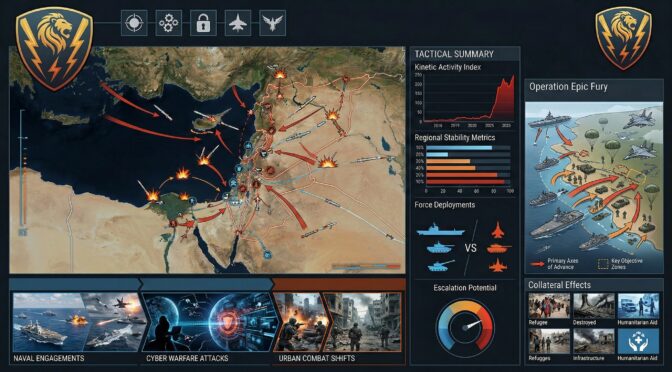
SITREP: Regional Escalation and Operation Epic Fury / Roaring Lion (February 27 – March 1, 2026)

1.0 Executive Summary

Over the preceding 36 hours, the geopolitical and security architecture of the Middle East has undergone a systemic, volatile, and potentially irreversible transformation. Following weeks of diplomatic maneuvering and military buildup, the United States and Israel launched a massive, coordinated preemptive military campaign against the Islamic Republic of Iran. Designated as Operation Epic Fury by United States Central Command (CENTCOM) and Operation Roaring Lion by the Israel Defense Forces (IDF), this offensive marks the most significant conventional military engagement in the region since the 2003 invasion of Iraq.1

The defining strategic outcome of the initial phase of this campaign was a decapitation strike resulting in the death of Iranian Supreme Leader Ayatollah Ali Khamenei. Assessed intelligence indicates that approximately 40 senior Iranian officials, including Defense Minister General Aziz Nasirzadeh, Islamic Revolutionary Guard Corps (IRGC) Commander Major General Mohammad Pakpour, and Defense Council Secretary Admiral Ali Shamkhani, were also killed.4 The explicit objective of the US-Israeli coalition has shifted dramatically from the degradation of nuclear proliferation capabilities,the operational baseline during the June 2025 “12-Day War”,to comprehensive regime change and the systemic dismantling of Iran’s military and strategic infrastructure.3

In response to this existential threat, the Iranian state apparatus, despite sustaining severe degradation at the command-and-control (C2) level, initiated an immediate, multi-front retaliation. Moving beyond historical norms of proportionate response, the IRGC launched waves of ballistic missiles and one-way attack (OWA) drones. These munitions targeted not only Israeli urban centers but also at least 14 US military installations hosted by Gulf Cooperation Council (GCC) and regional partners, including Bahrain, Qatar, the United Arab Emirates (UAE), Kuwait, Saudi Arabia, and Jordan.5 This retaliation represents a profound rupture in regional security paradigms, as Iran intentionally targeted civilian infrastructure,including major international airports in Dubai and Abu Dhabi,and struck the Sultanate of Oman, effectively terminating Muscat’s long-standing diplomatic immunity as a regional mediator.11

Concurrently, the IRGC Navy officially announced the total closure of the Strait of Hormuz. This act of economic warfare traps roughly 20% of global seaborne crude oil and liquefied natural gas (LNG) supplies, prompting immediate global supply chain disruptions, the mass rerouting of major maritime logistics conglomerates, and severe oil price volatility, with market analysts projecting crude prices could spike well beyond $100 per barrel.14

The systemic shifts observed in the last 36 hours dictate a high probability of prolonged, high-intensity regional conflict. The introduction of novel asymmetric capabilities by US forces,specifically the deployment of the Low-cost Unmanned Combat Attack System (LUCAS) kamikaze drones,indicates a rapid shift in Western tactical doctrine toward scalable, autonomous swarm warfare.18 Concurrently, the Iranian succession crisis, the spillover of kinetic strikes into allied Gulf states, the paralysis of Middle Eastern airspace, and the breakdown of consensus at the United Nations Security Council (UNSC) guarantee that diplomatic de-escalation will face nearly insurmountable friction in the near term.20

2.0 Chronological Timeline of Key Events (Last 36 Hours)

Note: All timestamps are recorded in Coordinated Universal Time (UTC) to maintain a standardized chronological baseline, mapping the 36-hour operational window leading up to the time of this report on March 1, 2026. The timeline is intentionally overlapped with the immediate pre-strike period to establish the contextual breakdown of deterrence.

  • February 27, 2026 | 18:00 UTC: Oman’s foreign minister, Badr Albusaidi, publicly announces significant progress in indirect US-Iran nuclear negotiations in Muscat, suggesting an agreement for Iran to degrade its current stockpiles of nuclear material to unrefined levels is imminent.20
  • February 27, 2026 | 19:30 UTC: US President Donald Trump issues a statement noting that while diplomacy is preferred, Iran’s stalling tactics are unacceptable, and “all options” remain available.23
  • February 28, 2026 | 06:15 UTC (09:45 IRST): Operation Epic Fury / Roaring Lion Commences. US and Israeli forces launch a massive coordinated strike package utilizing air, land, and sea assets. Initial targets include Iranian C2 nodes, Integrated Air Defense Systems (IADS), missile launch sites, and senior leadership compounds.4
  • February 28, 2026 | 06:27 UTC: Iranian state media, including the Fars News Agency, reports a series of heavy explosions across the capital city of Tehran, as well as in Isfahan, Qom, Karaj, and Kermanshah. Widespread panic is reported as the strikes occur during daylight working hours.1
  • February 28, 2026 | 07:00 UTC: US CENTCOM’s newly formed Task Force Scorpion Strike executes the first combat deployment of the LUCAS one-way attack drone, neutralizing Iranian air defense and radar installations to open permissive air corridors for manned strike aircraft.18
  • February 28, 2026 | 13:00 UTC: The UAE General Civil Aviation Authority officially closes the nation’s entire airspace, effectively grounding operations at Dubai International (DXB) and Zayed International (AUH). Kuwait, Bahrain, Qatar, and Iraq swiftly follow suit, triggering the largest global aviation disruption since the COVID-19 pandemic.29
  • February 28, 2026 | 15:30 UTC: US President Donald Trump publicly confirms the death of Iranian Supreme Leader Ayatollah Ali Khamenei via a video statement broadcast on social media. Trump declares the objective of the military operation is to topple the “wicked, radical dictatorship” and urges the Iranian populace to rise up.4
  • February 28, 2026 | 16:00 UTC: The IRGC initiates retaliatory ballistic missile and drone barrages. Over 170 projectiles are launched in successive waves targeting Israeli territory and US bases across the Middle East. Initial barrages target Al Udeid Air Base in Qatar and Ali al-Salem Air Base in Kuwait.7
  • February 28, 2026 | 17:30 UTC: Missile impacts are confirmed near the US Navy’s 5th Fleet Headquarters (Naval Support Activity Bahrain) in Manama. Emergency response teams deploy as dense black smoke engulfs the facility perimeter.35
  • February 28, 2026 | 19:00 UTC: The IRGC officially declares the Strait of Hormuz closed to all maritime traffic. Iranian naval assets broadcast warnings on VHF Channel 16. Major shipping lines (Hapag-Lloyd, CMA CGM) immediately suspend transit, trapping hundreds of vessels in the Persian Gulf.16
  • February 28, 2026 | 21:00 UTC: An emergency session of the UN Security Council is convened in New York. UN Secretary-General António Guterres condemns both the US-Israeli preemptive strikes and the Iranian retaliation, declaring that a critical window for diplomacy has been “squandered”.20
  • March 1, 2026 | 01:09 UTC: Iranian state media formally acknowledges Khamenei’s death and announces the formation of an interim Leadership Council comprising President Masoud Pezeshkian, Judiciary Chief Gholamhossein Mohseni Ejei, and Guardian Council member Alireza Arafi.4
  • March 1, 2026 | 02:55 UTC: Regional spillover violence erupts in Pakistan. Nine individuals are killed by security forces as hundreds of protesters attempt to storm the US Consulate in Karachi in response to Khamenei’s assassination.4
  • March 1, 2026 | 03:36 UTC: The IDF announces a second major wave of airstrikes, pushing deep into the “heart of Tehran” after establishing total air superiority over Iranian airspace. The strikes target ballistic missile launchers and remaining air defense networks.4
  • March 1, 2026 | 05:00 UTC: Oman reports that two OWA drones struck infrastructure at the Duqm commercial port, marking the first kinetic strike on Omani soil and injuring one civilian worker. This signals a breakdown in Oman’s historical status as an immune diplomatic mediator.12

3.0 Situation by Primary Country

3.1 Iran

3.1.1 Military Actions & Posture

The Iranian military apparatus, spearheaded by the IRGC, has sustained catastrophic, systemic damage to its upper command echelons and strategic infrastructure, yet it retains significant asymmetric and ballistic retaliatory capacity. The initial US and Israeli strikes effectively blinded key segments of Iran’s Integrated Air Defense System (IADS) and destroyed prominent ballistic missile production and launch sites in western and central Iran.5 Israeli intelligence assesses that roughly 50% of Iran’s total strategic missile stockpile has been destroyed, preventing the launch of an estimated 1,500 munitions.4 Furthermore, unconfirmed but credible OSINT reports indicate severe strikes on Iranian naval assets, including the IRGC Navy frigate Jamaran and the Imam Ali Navy Base in Chabahar (Sistan and Balochistan Province), severely degrading Iran’s blue-water projection capabilities.5

Despite these profound C2 disruptions, the IRGC executed a rapid, indiscriminate retaliatory doctrine. Launching an estimated 170 ballistic missiles (including Emad, Ghadr, and potentially solid-fueled Fatah-1 variants) alongside swarms of OWA drones, Iran targeted Israeli territory and at least 14 US military installations across the GCC and Jordan.5 Analysis of the strike patterns reveals that rather than relying on massive, highly coordinated barrages,which were likely precluded by the degradation of their centralized C2 nodes and the loss of senior commanders,Iran has resorted to continuous, decentralized salvos of two to four missiles per barrage.5

In a profound escalation of regional economic warfare, the IRGC Navy officially announced the closure of the Strait of Hormuz. Iranian naval assets are actively broadcasting on VHF Channel 16 that no civilian or commercial vessels are permitted to transit the chokepoint, effectively blockading the Persian Gulf. By threatening asymmetrical attacks on commercial shipping, the IRGC has successfully prompted an immediate halt by major maritime logistics firms, weaponizing global energy supply chains as a deterrent against further US escalation.38

3.1.2 Policy & Diplomacy

The systemic shock of the decapitation strike has thrust the Islamic Republic into an unprecedented constitutional and succession crisis. The confirmed death of 86-year-old Supreme Leader Ayatollah Ali Khamenei,who held absolute authority over all state, military, and religious matters since 1989,has triggered Article 111 of the Iranian Constitution.4 An interim Leadership Council has been formed, composed of reformist President Masoud Pezeshkian, hardline Judiciary Chief Gholamhossein Mohseni Ejei, and Guardian Council member Alireza Arafi, to manage the state until the 88-member Assembly of Experts can elect a permanent successor.4

The simultaneous deaths of Defense Minister Gen. Aziz Nasirzadeh, IRGC Commander Maj. Gen. Mohammad Pakpour, Defense Council Secretary Admiral Ali Shamkhani, and Army Chief of Staff Gen. Abdol Rahim Mousavi represent a near-total vacuum in the nation’s strategic planning and defense apparatus.5 The succession process is heavily complicated by internal power struggles; while Mojtaba Khamenei, the late leader’s son, is viewed as a contender, a hereditary transfer of power risks alienating factions critical of dynastic rule and potentially inviting a soft military coup by surviving IRGC hardliners seeking to consolidate control.7

Diplomatically, the Iranian Foreign Ministry has adopted a posture of uncompromising victimhood and belligerence. Foreign Ministry spokesman Esmaeil Baghaei and President Pezeshkian have framed the US-Israeli strikes as an illegal breach of the UN Charter and a “declaration of war against Muslims,” particularly citing the fact that strikes occurred while nuclear negotiations were actively progressing in Geneva and Oman.4 Domestically, while isolated reports indicate that some opposition factions celebrated the regime’s decapitation, state media has continuously broadcast images of massive mourning crowds and protests vowing “blood and revenge”.4

3.1.3 Civilian Impact

The civilian toll within the Islamic Republic is substantial and continues to rise as rescue operations proceed. The Iranian Red Crescent Society reported at least 201 fatalities and 747 injuries across 24 of Iran’s 31 provinces within the first 24 hours of the conflict.8 A particularly severe mass-casualty event occurred in the southern town of Minab, where stray munitions or intercepted debris struck a girls’ primary school, resulting in an estimated 85 deaths, prompting international outrage.31 Human Rights Activists News Agency (HRANA) reported further civilian infrastructure damage in Tehran, including near the Hedayat boys’ high school.47

The psychological impact on the Iranian populace is acute. The daylight bombing of Tehran, including strikes near the presidential offices, state television headquarters, and police command centers, sent millions fleeing into underground shelters and subway stations.8 All domestic and international flights within Iranian airspace have been indefinitely suspended, and critical infrastructure networks, including telecommunications and municipal services, are reportedly operating under emergency continuity protocols.29

3.2 Israel

3.2.1 Military Actions & Posture

The IDF’s execution of Operation Roaring Lion represents the largest and most complex aerial mission in Israeli military history. Utilizing an estimated 200 fighter jets operating in deep, seamless coordination with US Central Command, Israeli forces penetrated deeply into Iranian airspace.31 The IDF successfully established air superiority over hostile territory by systematically dismantling dozens of Russian-supplied air defense systems and striking hundreds of military targets.6

Israel’s defensive posture, heavily reliant on its multi-layered anti-ballistic missile architecture, has been severely tested but remains robust. The Arrow 2/3 and David’s Sling systems successfully intercepted the vast majority of the incoming Iranian Emad and Ghadr medium-range ballistic missiles (MRBMs).49 The IDF assesses that its preemptive strikes significantly blunted Iran’s retaliatory capacity, destroying facilities responsible for the production of dozens of surface-to-surface missiles per month.4 Following the initial wave, Israel initiated a second wave of strikes explicitly targeting C2 nodes in the “heart of Tehran” to capitalize on the chaos within the IRGC and maintain operational momentum.4

3.2.2 Policy & Diplomacy

Prime Minister Benjamin Netanyahu has explicitly aligned Israel’s strategic objectives with those of the United States: the permanent removal of the “existential threat” posed by the Iranian regime and its nuclear ambitions. Netanyahu stated that the operation would continue “as long as necessary” to achieve true regional peace and to enable the Iranian people to throw off the “yoke of tyranny”.4

At the emergency UN Security Council session, Israeli Ambassador Danny Danon fiercely defended the preemptive nature of the strikes. He argued that the operations were a legitimate exercise of self-defense under international law, necessary to halt Iran’s accelerating nuclear program and to definitively dismantle the “head of the Iranian octopus” that has funded, armed, and directed proxy warfare via Hezbollah in Lebanon, Hamas in Gaza, and the Houthis in Yemen for decades.4

3.2.3 Civilian Impact

Despite the high interception rate of Israeli air defenses, Iranian munitions penetrated the protective umbrella in several instances, resulting in civilian casualties. A ballistic missile struck a densely populated residential block in Tel Aviv, destroying two apartment buildings and causing widespread fires. This strike resulted in one confirmed fatality (a woman in her 50s) and 27 injuries, including a two-month-old infant.4 In total, the Magen David Adom national rescue service reported 121 injuries nationwide resulting from missile impacts, shrapnel, and panic-induced accidents while rushing to shelters.4

The operational tempo has severely disrupted Israeli civilian life. Israeli airspace remains strictly closed to all civilian flights, stranding thousands of passengers.29 The IDF Home Front Command has mandated that millions of citizens remain in close proximity to bomb shelters, leading to empty streets, school closures, and a localized economic standstill as the nation braces for a protracted conflict.37

3.3 United States

3.3.1 Military Actions & Posture

The execution of Operation Epic Fury demonstrates a highly coordinated, multi-domain deployment of American military power, representing the largest regional concentration of US firepower in a generation.19 US strike packages were launched from land, air, and sea assets, heavily utilizing the USS Abraham Lincoln and USS Gerald R. Ford carrier strike groups positioned in the Arabian Sea and Eastern Mediterranean.18 US aircraft pre-positioned across allied GCC bases,including F-15E Strike Eagles, F-16 Fighting Falcons, A-10 Warthogs, and E/A-18G Growlers,provided vital electronic warfare support, airspace deconfliction, and kinetic strike capability.53

A critical tactical evolution in this conflict is the combat debut of CENTCOM’s Task Force Scorpion Strike, which utilized the Low-cost Unmanned Combat Attack System (LUCAS).18 Developed by the Arizona-based firm SpektreWorks and reverse-engineered from captured Iranian Shahed-136 drones, the LUCAS provides a 500-mile range and a 40-pound explosive payload for a minimal unit cost of approximately $35,000.54 This marks a systemic shift in US doctrine, actively adopting the adversary’s asymmetric swarm tactics to overwhelm Iranian air defenses and radar arrays at a fraction of the cost of traditional precision-guided munitions like the Tomahawk Land Attack Missile (TLAM).27

Defensively, US forces and regional Integrated Air and Missile Defense (IAMD) networks have successfully repelled hundreds of Iranian retaliatory drone and missile strikes directed at US installations across the Middle East. As of the current reporting window, the Pentagon asserts there have been no US military casualties or combat-related injuries, and only minimal, non-mission-critical damage to base infrastructure.19

3.3.2 Policy & Diplomacy

President Donald Trump has framed Operation Epic Fury in maximalist terms, openly declaring it a campaign for comprehensive regime change. In an unconventional break from standard executive communication, Trump announced the initiation of hostilities and the death of Khamenei via social media (Truth Social), actively calling on the Iranian populace to “take over your government” and asserting that this is the “single greatest chance” for Iranian freedom in generations.1

The decision to launch massive combat operations bypassed traditional congressional authorization protocols, drawing sharp criticism from Democratic lawmakers who warned of being dragged into an illegal, costly war without a defined strategic endgame.59 The administration countered that the strikes were a necessary, preemptive response to an “intolerable” risk posed by Iran’s nuclear stalling tactics and intelligence indicating imminent threats against US forces.4 At the UN Security Council, the US delegation has maintained a firm stance, likely preparing to veto any resolutions calling for an immediate ceasefire that would allow the Iranian regime to reconstitute its proxy networks and military infrastructure.20

3.3.3 Civilian Impact

The immediate impact on US civilians is primarily economic and logistical. Global energy markets are bracing for extreme volatility following the IRGC’s closure of the Strait of Hormuz. Analysts warn that if the blockade is sustained, crude oil prices could breach the $100–$150 per barrel threshold, fueling massive global inflationary pressures and increasing costs at the pump for American consumers.14

Additionally, the US State Department has issued emergency shelter-in-place orders for diplomatic personnel and American citizens stationed in the UAE, Qatar, Israel, Bahrain, and Oman due to the threat of incoming projectiles and falling interception debris.37 US citizens traveling or residing in the region are facing severe logistical nightmares due to the near-total shutdown of Middle Eastern commercial aviation, stranding thousands.63

4.0 Regional and Gulf State Impacts

The strategic fallout of the Iranian retaliation has violently pulled the Gulf states into the theater of conflict. Iran’s calculated decision to launch strikes against US installations hosted by its Arab neighbors,and the resulting damage to civilian infrastructure in those states,demonstrates a punitive deterrence strategy. Analysts assess that Iran aims to leverage the economic and physical vulnerabilities of the GCC to force these governments to pressure Washington into halting the offensive.13

This dynamic has resulted in severe airspace closures and economic disruption.

Table 4.1: Operational Status of Regional Airspace and Aviation Hubs

NationAirspace StatusMajor Hub ImpactsSource Identifier
UAEClosedDXB (Dubai) & AUH (Abu Dhabi) flights halted indefinitely. Stranded passengers; structural damage reported at DXB.29
QatarClosedDOH (Doha) operations suspended. Qatar Airways cancels 41% of total flights globally.29
BahrainClosedBAH (Bahrain Intl) operations halted. Temporary flight changes implemented by Civil Aviation Affairs.29
KuwaitClosedKWI (Kuwait Intl) Terminal 1 damaged by drone strike; operations halted.29
IranClosedAll civilian aviation grounded nationwide indefinitely.29
IsraelClosedTLV (Ben Gurion) closed to civilian traffic. Global carriers cancel routes.29
JordanOpen (Restricted)AMM (Amman) open but with severe limitations. Military sorties active in airspace.29

Country-by-Country Impact Assessment:

  • United Arab Emirates (UAE): The UAE has suffered the most severe civilian impact among the Gulf states. Iranian strikes targeting Al Dhafra Air Base and broader infrastructure resulted in the death of a Pakistani national and injuries to seven others at Zayed International Airport (AUH) in Abu Dhabi.7 In Dubai, falling interception debris caused minor structural damage and injured four staff members at Dubai International Airport (DXB), and sparked fires at the iconic Burj Al Arab hotel and the Palm Jumeirah luxury development.63 The UAE Ministry of Defense strongly condemned the “blatant attack” as a dangerous escalation and a violation of sovereignty, affirming its full right to respond.68
  • Qatar: Hosting the largest US military facility in the region, Al Udeid Air Base, Qatar was targeted by an estimated 65 missiles and 12 drones. While Qatari defense forces reported successfully intercepting all projectiles before they struck their targets, falling debris caused limited industrial fires in Doha and injured 16 civilians.7 Qatar has condemned the attacks while maintaining that its internal security situation remains stable.72
  • Bahrain: Iranian ballistic missiles targeted the Naval Support Activity (NSA) Bahrain in Manama, which serves as the headquarters for the US Navy’s 5th Fleet. Video evidence and ground reports confirmed thick black smoke rising from the base perimeter and damage to the service center.35 While no US casualties were reported, Bahrain’s government denounced the strike as a “flagrant violation of sovereignty” and activated nationwide emergency measures.37
  • Sultanate of Oman: In a profound paradigm shift, Oman,historically a strictly neutral state and the primary diplomatic mediator between Washington and Tehran,was drawn into the kinetic conflict. Two OWA drones struck infrastructure at the Duqm commercial port. One drone hit a worker housing unit, injuring an expatriate, while the second was neutralized near fuel storage tanks.12 By targeting Oman, the IRGC has explicitly signaled that no state hosting US or allied assets, regardless of its diplomatic posture, is immune from retaliation, effectively collapsing established regional rules of engagement.13 Oman issued a firm statement denouncing the aggression and calling for an immediate halt to all regional attacks.74
  • Kuwait: The Ali al-Salem Air Base and Camp Arifjan were targeted by multiple ballistic missiles, which were successfully intercepted by Kuwaiti air defenses.75 However, a drone strike hit Kuwait International Airport (Terminal 1), causing material damage and minor injuries to several employees.66 Kuwait affirmed its right to self-defense and temporarily suspended operations at the Shuaiba commercial port as a precaution.12
  • Saudi Arabia: Missiles targeted the capital city of Riyadh and military infrastructure in the Eastern Province, including the Prince Sultan Air Base. Saudi air defenses successfully repelled the attacks with minimal ground damage.7 The Saudi Ministry of Foreign Affairs expressed “strongest condemnation” of the “blatant and cowardly” Iranian aggression, warning that the Kingdom reserves the right to take all necessary measures to defend its territory.76
  • Jordan: The Royal Jordanian Air Force (RJAF) conducted active defensive sorties to protect its airspace, successfully intercepting two Iranian ballistic missiles over the capital, Amman. Falling debris caused damage to residential homes, though no casualties were reported.7 Jordan condemned the attacks and reaffirmed its solidarity with the targeted Gulf states.78

Table 4.2: Primary US Military Installations Targeted and Assessed Damage

Host NationInstallation TargetedStrategic FunctionAssessed Damage / ImpactSource Identifier
BahrainNSA Bahrain (Manama)US 5th Fleet HQ / NAVCENTModerate. Service center hit; structural fires reported. Zero US casualties.35
QatarAl Udeid Air BaseCENTCOM Forward HQLow. Missiles intercepted. Debris caused civilian injuries off-base.7
KuwaitAli al-Salem Air BaseLogistics / Tactical Airlift HubLow. Ballistic missiles intercepted by air defenses.75
UAEAl Dhafra Air BaseFighter / ISR HubLow (Base) / Severe (Civilian). Base defended, but civilian areas in Abu Dhabi hit by debris/drones.7
Saudi ArabiaPrince Sultan Air BaseFighter / Patriot Missile HubLow. Repelled by Saudi/US Integrated Air Defenses.7
JordanMuwaffaq Salti Air BaseFighter / Drone Operations HubLow. Missiles intercepted over Amman; RJAF active.10

5.0 Appendices

Appendix A: Methodology

This Situation Report (SITREP) was synthesized utilizing a comprehensive, real-time sweep of open-source intelligence (OSINT), military monitor broadcasts, and official state media publications spanning the exact 36-hour period from 18:00 UTC on February 27 to 06:00 UTC on March 1, 2026.

To ensure absolute continuity of events, the 36-hour operational window was intentionally overlapped with prior diplomatic baseline data,specifically the statements regarding nuclear negotiations in Oman issued hours before the kinetic strikes began. This establishes the causational link for the rapid breakdown of deterrence.

Conflicting OSINT reports and casualty figures were weighed utilizing a multi-source verification matrix. Claims originating from state belligerents (e.g., Iranian claims of targeting 14 bases versus US Pentagon denials of casualties) were contextualized as potential information warfare unless independently corroborated by neutral commercial data providers (e.g., Flightradar24 for airspace closures, Skytek for maritime tracking) or third-party emergency rescue services (e.g., Magen David Adom, Iranian Red Crescent Society).

Appendix B: Glossary of Acronyms

  • C2: Command and Control. The exercise of authority and direction by a properly designated commander over assigned and attached forces.
  • CENTCOM: United States Central Command. The unified combatant command responsible for US military operations in the Middle East, Central Asia, and parts of South Asia.
  • DXB: The International Air Transport Association (IATA) airport code for Dubai International Airport.
  • GCC: Gulf Cooperation Council. A regional intergovernmental political and economic union consisting of Bahrain, Kuwait, Oman, Qatar, Saudi Arabia, and the United Arab Emirates.
  • IADS: Integrated Air Defense System. A network of radars, surface-to-air missiles, and C2 nodes designed to protect airspace.
  • IDF: Israel Defense Forces. The national military of the State of Israel.
  • IRGC: Islamic Revolutionary Guard Corps. A multi-service primary branch of the Iranian Armed Forces responsible for internal security, asymmetric warfare, and the country’s ballistic missile programs.
  • LNG: Liquefied Natural Gas.
  • LUCAS: Low-cost Unmanned Combat Attack System. A newly deployed US one-way attack (kamikaze) drone based on reverse-engineered Iranian Shahed technology.
  • MRBM: Medium-Range Ballistic Missile.
  • NSA Bahrain: Naval Support Activity Bahrain. A US Navy base situated in the Kingdom of Bahrain, home to US Naval Forces Central Command (NAVCENT) and the US 5th Fleet.
  • OSINT: Open-Source Intelligence. Data collected from publicly available sources to be used in an intelligence context.
  • OWA: One-Way Attack. Commonly used to describe “kamikaze” or “suicide” drones that detonate upon impact.
  • TFSS: Task Force Scorpion Strike. A specialized CENTCOM unit tasked with deploying LUCAS drones in the Middle East.
  • UNSC: United Nations Security Council. The UN organ charged with ensuring international peace and security.

Appendix C: Glossary of Foreign Words

  • Ayatollah: A high-ranking title given to major Shia clerics in Iran; implies supreme religious, legal, and political authority.
  • Fatwa: A legal ruling or pronouncement on a point of Islamic law given by a recognized authority.
  • Khamenei (Ali): The Supreme Leader of Iran from 1989 until his death on February 28, 2026. As the ultimate political and religious authority, he commanded the armed forces and dictated foreign policy.
  • Knesset: The unicameral national legislature of Israel.
  • Majlis: The Islamic Consultative Assembly; the national legislative body of Iran.
  • Shahed: Translates to “Witness” in Persian/Arabic. In military contexts, it refers to a series of Iranian-designed unmanned aerial vehicles (UAVs), most notably the Shahed-136 loitering munition.

Please share the link on Facebook, Forums, with colleagues, etc. Your support is much appreciated and if you have any feedback, please email us in**@*********ps.com. If you’d like to request a report or order a reprint, please click here for the corresponding page to open in new tab.


Sources Used

  1. Why are the US and Israel attacking Iran? What we know so far, accessed March 1, 2026, https://www.aljazeera.com/news/2026/2/28/us-and-israel-attack-iran-what-we-know-so-far
  2. Inside Operation Epic Fury: Iran Supreme Leader Ayatollah Khamenei Killed, accessed March 1, 2026, https://anniedance.substack.com/p/inside-operation-epic-fury-iran-supreme-leader-killed
  3. Operation Epic Fury and the Remnants of Iran’s Nuclear Program – CSIS, accessed March 1, 2026, https://www.csis.org/analysis/operation-epic-fury-and-remnants-irans-nuclear-program
  4. Live Updates: U.S.-Israel launch another round of strikes on Iran …, accessed March 1, 2026, https://www.cbsnews.com/live-updates/israel-us-attack-iran-trump-says-major-combat-operations/
  5. Iran Update: US and Israeli Strikes, Feb. 28, 2026 | ISW, accessed March 1, 2026, https://understandingwar.org/research/middle-east/iran-update-special-report-us-and-israeli-strikes-february-28-2026/
  6. Israel says 7 senior Iranian military figures killed in precision strikes, accessed March 1, 2026, https://www.indiatoday.in/world/story/israel-strikes-iran-idf-says-7-senior-iranian-military-figures-killed-in-military-operation-2876061-2026-03-01
  7. Iran bombards Israel, Gulf, vowing unprecedented response to …, accessed March 1, 2026, https://www.timesofisrael.com/liveblog-march-01-2026/
  8. 2026 Israeli–United States strikes on Iran – Wikipedia, accessed March 1, 2026, https://en.wikipedia.org/wiki/2026_Israeli%E2%80%93United_States_strikes_on_Iran
  9. Experts react: The US and Israel just unleashed a major attack on Iran. What’s next?, accessed March 1, 2026, https://www.atlanticcouncil.org/dispatches/experts-react-the-us-and-israel-just-unleashed-a-major-attack-on-iran-whats-next/
  10. Iran targets 14 US bases, kills hundreds of troops, Washington denies claim, accessed March 1, 2026, https://www.indiatoday.in/world/story/14-us-bases-targeted-hundreds-of-american-troops-killed-says-irans-irgc-us-denies-claim-2876059-2026-03-01
  11. Iran Retaliates: Explosions Reported in Bahrain, Kuwait, Qatar and Dubai, accessed March 1, 2026, https://m.thewire.in/article/world/iran-retaliates-explosions-reported-in-bahrain-kuwait-qatar-and-dubai
  12. Oman reports first drone attack amid regional tensions, accessed March 1, 2026, https://www.argusmedia.com/en/news-and-insights/latest-market-news/2794546-oman-reports-first-drone-attack-amid-regional-tensions
  13. Iran strikes Gulf states, even mediator Oman – why its strategy could backfire, accessed March 1, 2026, https://timesofindia.indiatimes.com/defence/international/iran-strikes-gulf-states-even-mediator-oman-why-its-strategy-could-backfire-us-israel-strike-iran/articleshow/128912009.cms
  14. Strait of Hormuz Closure: Economic Impact Analysis, accessed March 1, 2026, https://discoveryalert.com.au/closure-strait-hormuz-2026-economic-warfare-impact/
  15. Iran blocks 3 Pakistani ships from entering Strait of Hormuz, accessed March 1, 2026, https://www.aninews.in/news/world/asia/iran-blocks-3-pakistani-ships-from-entering-strait-of-hormuz20260301150919/
  16. Iran closes Strait of Hormuz: Carriers abandon the region, accessed March 1, 2026, https://container-news.com/iran-closes-strait-of-hormuz-carriers-abandon-the-region/
  17. What the US–Israeli strikes on Iran mean for the price of oil, accessed March 1, 2026, https://www.theguardian.com/business/2026/mar/01/us-israel-strikes-iran-oil-price
  18. New US attack drones make first operational appearance, accessed March 1, 2026, https://www.jpost.com/defense-and-tech/article-888313
  19. US uses ‘low-cost one-way attack drones’ for first time in combat during Iran strikes, accessed March 1, 2026, https://www.washingtonexaminer.com/policy/defense/4475813/us-attack-drones-first-combat-iran-strikes/
  20. Emergency Meeting on the Military Escalation in the Middle East : What’s In Blue, accessed March 1, 2026, https://www.securitycouncilreport.org/whatsinblue/2026/02/emergency-meeting-on-the-military-escalation-in-the-middle-east.php
  21. ‘Diplomacy squandered’: UN chief slams strikes as US, Iran envoys clash at UNSC, accessed March 1, 2026, https://www.hindustantimes.com/world-news/diplomacy-squandered-un-chief-condemns-us-iran-israel-conflict-at-unsc-meeting-avoids-confirming-khamenei-death-101772324416853.html
  22. International Reactions to Military Strikes on Iran: A Tipping Point for the UN Charter?, accessed March 1, 2026, https://www.justsecurity.org/132773/us-iran-war-international-reactions/
  23. US, Israel bomb Iran: A timeline of talks and threats leading up to attacks, accessed March 1, 2026, https://www.aljazeera.com/news/2026/2/28/us-israel-bomb-iran-a-timeline-of-talks-and-threats-leading-up-to-attacks
  24. Live Updates: U.S. and Israel attack Iran | PBS News, accessed March 1, 2026, https://www.pbs.org/newshour/world/live-updates-u-s-and-israel-attack-iran
  25. WRAP: US-Israel attacks on Iran impacts Persian Gulf shipping, energy price forecasts | ICIS, accessed March 1, 2026, https://www.icis.com/explore/resources/news/2026/03/01/11184029/wrap-us-israel-attacks-on-iran-impacts-persian-gulf-shipping-energy-price-forecasts
  26. War on Iran: how the US-Israeli bid for regime change unfolded, accessed March 1, 2026, https://www.theguardian.com/us-news/2026/feb/28/war-on-iran-how-the-us-israeli-bid-for-regime-change-unfolded
  27. Iran strike marks first time US used new one-way attack drones in combat – Task & Purpose, accessed March 1, 2026, https://taskandpurpose.com/news/us-iran-lucas-one-way-drone/
  28. U.S. Launches One-Way-Attack Drone Force in the Middle East – Centcom, accessed March 1, 2026, https://www.centcom.mil/MEDIA/PRESS-RELEASES/Press-Release-View/Article/4347030/us-launches-one-way-attack-drone-force-in-the-middle-east/
  29. Airspace closures following Israeli and US strikes on Iran | Flightradar24 Blog, accessed March 1, 2026, https://www.flightradar24.com/blog/live/israel-launches-pre-emptive-strikes-on-iran-airspace-closures-going-into-place/
  30. UAE Civil Aviation Authority Closes National Airspace; Etihad, Emirates and Global Carriers Issue Sweeping Cancellations, accessed March 1, 2026, https://www.visahq.com/news/2026-02-28/ae/uae-civil-aviation-authority-closes-national-airspace-etihad-emirates-and-global-carriers-issue-sweeping-cancellations/
  31. US-Iran conflict sparks global flight disruptions | The Straits Times, accessed March 1, 2026, https://www.straitstimes.com/world/middle-east/us-iran-conflict-disrupts-thousands-of-flights-as-travel-chaos-deepens
  32. Gauging the Impact of Massive U.S.-Israeli Strikes on Iran, accessed March 1, 2026, https://www.cfr.org/articles/gauging-the-impact-of-massive-u-s-israeli-strikes-on-iran
  33. Operation Epic Fury Unleashed: The World Is Watching, accessed March 1, 2026, https://dallasexpress.com/national/operation-epic-fury-unleashed-the-world-is-watching/
  34. Iran Update Evening Special Report, February 28, 2026, accessed March 1, 2026, https://understandingwar.org/research/middle-east/iran-update-evening-special-report-february-28-2026/
  35. Attack On US Navy Fifth Fleet Headquarters In Bahrain, accessed March 1, 2026, https://www.military.com/feature/2026/02/28/attack-us-navy-fifth-fleet-headquarters-bahrain.html
  36. AI for investors, accessed March 1, 2026, https://mlq.ai/news/iran-targets-us-navy-headquarters-in-bahrain-with-missile-barrage-following-american-strikes/
  37. Missiles hit US navy facility in Bahrain as Iran-US-Israel conflict spills across region – video, accessed March 1, 2026, https://timesofindia.indiatimes.com/defence/international/missiles-hit-us-navy-facility-in-bahrain-as-iran-us-israel-conflict-spills-across-region-video/articleshow/128881102.cms
  38. Ships avoid the Strait of Hormuz, tanker hit off Oman, accessed March 1, 2026, https://www.seatrade-maritime.com/security/ships-avoid-the-strait-of-hormuz-tanker-hit-off-oman
  39. Iran closes Strait of Hormuz, halting all maritime traffic, accessed March 1, 2026, https://operativmm.az/en/post/iran-closes-strait-of-hormuz-halting-all-maritime-traffic/68074
  40. Two drones target Duqm Port infrastructure, accessed March 1, 2026, https://www.muscatdaily.com/2026/03/01/two-drones-target-duqm-port-infrastructure/
  41. Iran’s IRGC announces closure of Strait of Hormuz, accessed March 1, 2026, https://www.trend.az/iran/4159065.html
  42. Explosion rocks Iran’s capital as Israel says it is targeting the city | KPBS Public Media, accessed March 1, 2026, https://www.kpbs.org/news/international/2026/02/28/explosion-rocks-irans-capital-as-israel-says-it-is-targeting-the-city
  43. Iran may yet endure this war, but the Islamic Republic as we have known it cannot survive unchanged, accessed March 1, 2026, https://www.theguardian.com/commentisfree/2026/mar/01/iran-war-islamic-republic-donald-trump-regime
  44. Iran’s Foreign Ministry defends retaliatory strikes, slams US betrayal, accessed March 1, 2026, https://www.aljazeera.com/news/2026/2/28/irans-foreign-ministry-defends-retaliatory-strikes-slams-us-betrayal
  45. Iran vows ‘no leniency’ as it launches reprisal attacks on Israel and US air bases, accessed March 1, 2026, https://www.theguardian.com/world/2026/feb/28/iran-vows-no-leniency-reprisal-attacks-israel-us-air-bases
  46. Explainer: What to know about latest U.S.-Israeli strike on Iran?, accessed March 1, 2026, https://english.news.cn/20260301/5526be3e72f8457195f83b49048e5047/c.html
  47. See where U.S., Israeli strikes have hit Iran and where Iran has retaliated, accessed March 1, 2026, https://www.washingtonpost.com/investigations/2026/02/28/where-us-attack-iran-images-video/
  48. UAE intercepts several Iranian missiles, state news agency says | Iran International, accessed March 1, 2026, https://iranintl.com/en/202602283447
  49. Why Iran’s attack on Gulf states mimics Iraq’s assault on Saudi Arabia – analysis, accessed March 1, 2026, https://www.jpost.com/middle-east/iran-news/article-888353
  50. US-Israel Attacks Iran LIVE Updates: “Khamenei Killing Declaration Of War Against Muslims”: Iran President, accessed March 1, 2026, https://www.ndtv.com/world-news/iran-us-tensions-live-updates-explosion-rocks-iran-amid-heightened-nuclear-tensions-with-us-iran-israel-tensions-tehran-tel-aviv-tensions-11148388
  51. TIMELINE Missile Fire Follows Israeli Strikes on Iran; Over 100 Injured in Israel, accessed March 1, 2026, https://jewishjournal.com/israel/387316/timeline-missile-fire-follows-israeli-strikes-on-iran-over-100-injured-in-israel/
  52. Iran Update, February 3, 2026 | ISW, accessed March 1, 2026, https://understandingwar.org/research/middle-east/iran-update-february-3-2026/
  53. ‘Operation Epic Fury’: How US, Israel encircled Iran before joint strikes, accessed March 1, 2026, https://timesofindia.indiatimes.com/defence/international/operation-epic-fury-how-us-israel-encircled-iran-before-joint-strikes/articleshow/128881852.cms
  54. US confirms first combat use of LUCAS one-way attack drone in Iran strikes – Military Times, accessed March 1, 2026, https://www.militarytimes.com/news/your-military/2026/02/28/us-confirms-first-combat-use-of-lucas-one-way-attack-drone-in-iran-strikes/
  55. U.S. Confirms First Operational Use of LUCAS Loitering Munition in Iran Strikes, accessed March 1, 2026, https://www.israeldefense.co.il/en/node/67948
  56. From Kamikaze drones to Tomahawk missiles: What capabilities did US and Israel use in historic joint strikes on Iran?, accessed March 1, 2026, https://www.hindustantimes.com/world-news/us-news/from-kamikaze-drones-to-tomahawk-missiles-what-capabilities-did-us-and-israel-use-in-historic-joint-strikes-on-iran-101772343069529.html
  57. U.S. Military Has Used Long-Range Kamikaze Drones In Combat For The First Time, accessed March 1, 2026, https://www.twz.com/news-features/u-s-military-has-used-long-range-kamikaze-drones-in-combat-for-the-first-time
  58. No American Casualties, Minimal Damage To Facilities From Iranian Attacks, accessed March 1, 2026, https://kste.iheart.com/content/2026-02-28-no-american-casualties-minimal-damage-to-facilities-from-iranian-attacks/
  59. Iran fires missiles at Israel and Gulf states after U.S.-Israeli strike kills Khamenei, accessed March 1, 2026, https://www.gpb.org/news/2026/03/01/iran-fires-missiles-at-israel-and-gulf-states-after-us-israeli-strike-kills
  60. Lawmakers react to ‘Operation Epic Fury’ US – Israel military strikes across Iran | FOX 32 Chicago, accessed March 1, 2026, https://www.fox32chicago.com/news/lawmakers-react-operation-epic-fury-us-israel-military-strikes-across-iran
  61. Lawmakers react to ‘Operation Epic Fury’ US – Israel military strikes across Iran | FOX 5 Atlanta, accessed March 1, 2026, https://www.fox5atlanta.com/news/lawmakers-react-operation-epic-fury-us-israel-military-strikes-across-iran
  62. Oman port targeted by drones, one worker injured in first attack on the sultanate – Al Arabiya, accessed March 1, 2026, https://english.alarabiya.net/News/gulf/2026/03/01/oman-port-targeted-by-drones-one-worker-injured-state-news-agency
  63. Milan, London, Dubai Routes Cancelled as Middle East Conflict Intensifies, accessed March 1, 2026, https://openthemagazine.com/world/milan-london-dubai-routes-cancelled-as-middle-east-conflict-intensifies
  64. FYI: Middle East Unrest Travel Waiver (Expanded) // February 27, 2026 – March 5, 2026 : r/unitedairlines – Reddit, accessed March 1, 2026, https://www.reddit.com/r/unitedairlines/comments/1rgz5cg/fyi_middle_east_unrest_travel_waiver_expanded/
  65. Saudi Arabia strongly condemns Iranian attack on Bahrain, United Arab Emirates, Qatar, Kuwait and Jordan, accessed March 1, 2026, https://www.bna.bh/en/SaudiArabiastronglycondemnsIranianattackonBahrainUnitedArabEmiratesQatarKuwaitandJordan.aspx?cms=q8FmFJgiscL2fwIzON1%2BDheoPHRtXJqplMVXtv4dfdM%3D
  66. Iran strikes Gulf again: More explosions in Dubai, Doha and Manama; airports targeted?, accessed March 1, 2026, https://timesofindia.indiatimes.com/world/middle-east/iran-strikes-gulf-again-more-explosions-in-dubai-doha-and-manama-airports-targeted/articleshow/128908100.cms
  67. Jordan Announces Interception of Two Ballistic Missiles Over Its Territory, accessed March 1, 2026, https://qna.org.qa/en/News-Area/News/2026-2/28/jordan-announces-interception-of-two-ballistic-missiles-over-its-territory
  68. UAE announces successful interception of several Iranian missiles targeting country, accessed March 1, 2026, https://www.wam.ae/en/article/byyv9j5-uae-announces-successful-interception-several
  69. 1 killed in UAE as Iran targets 6 Arab countries with missiles; Riyadh slams ‘brutal Iranian aggression’ | The Times of Israel, accessed March 1, 2026, https://www.timesofisrael.com/1-killed-in-uae-as-iran-targets-5-arab-countries-with-missiles-riyadh-slams-brutal-iranian-aggression/
  70. Dubai airport shock: Iran attacks DXB? Emirates media confirms ‘minor damage’, 4 staff injured amid Iran vs US-Israel attacks, accessed March 1, 2026, https://timesofindia.indiatimes.com/world/middle-east/dubai-airport-shock-iran-attacks-dxb-emirates-media-confirms-minor-damage-4-staff-injured-amid-iran-vs-us-israel-attacks/articleshow/128902679.cms
  71. UAE Condemns in Strongest Terms Iran’s Blatant Missile Attacks Targeting the Country and Brotherly Nations, accessed March 1, 2026, https://www.mofa.gov.ae/en/mediahub/news/2026/2/28/uae-iran
  72. Iran targets Qatar: Falling missile debris creates panic in Doha – Watch, accessed March 1, 2026, https://timesofindia.indiatimes.com/world/middle-east/iran-targets-qatar-falling-missile-debris-creates-panic-in-doha-watch/articleshow/128888619.cms
  73. “Operation Epic Fury” Eclipses Diplomacy, accessed March 1, 2026, https://thesoufancenter.org/intelbrief-2026-february-28/
  74. Oman calls for immediate halt to attacks against sites in countries across the region, accessed March 1, 2026, https://www.fm.gov.om/en/38129/
  75. Dubai, Abu Dhabi, Bahrain, Kuwait: Gulf countries targeted by Iran after US-Israel strikes, accessed March 1, 2026, https://timesofindia.indiatimes.com/world/middle-east/dubai-abu-dhabi-bahrain-kuwait-gulf-countries-targeted-by-iran-after-us-israel-strikes/articleshow/128905800.cms
  76. Saudi Arabia says reserves right of response after Iran attacks Riyadh, east, accessed March 1, 2026, https://english.alarabiya.net/News/saudi-arabia/2026/02/28/saudi-arabia-says-reserves-right-of-response-after-iran-attacks-riyadh-east
  77. Regional Backlash? Saudi Arabia, UAE, OIC condemn Iran’s strikes on Muslim neighbours – ‘blatant act of aggression’, accessed March 1, 2026, https://www.livemint.com/news/world/regional-backlash-saudi-uae-oic-condemn-iran-s-missile-strikes-on-muslim-neighbours-blatant-act-of-aggression-dubai-11772301337400.html
  78. Jordan condemns Iranian missile attack, reaffirms solidarity with Gulf states, accessed March 1, 2026, https://jordantimes.com/news/local/jordan-air-force-conducts-sorties-to-protect-kingdoms-skies-military
  79. US military bases at risk: 6 Middle East countries targeted as Iran retaliates to Operation Epic Fury, accessed March 1, 2026, https://www.businesstoday.in/world/middle-east/story/us-military-bases-at-risk-iran-retaliation-operation-epic-fury-middle-east-israel-operation-lions-roar-518495-2026-02-28

Analysis of Innovations and Trends at the IWA OutdoorClassics 2026 Show in Nuremberg, Germany

Executive Summary

The IWA OutdoorClassics 2026 exhibition in Nuremberg, Germany, served as a definitive barometer for the trajectory of the global small arms, electro-optics, and tactical equipment industries. The event underscored a period of rapid technological maturation characterized by the integration of additive manufacturing in acoustic suppression, the fusion of multispectral digital architectures in combat optics, and a pronounced strategic pivot toward civilian crisis preparedness. As geopolitical uncertainties and shifting European regulatory frameworks reshape consumer demands, manufacturers have responded with highly specialized, modular, and technologically dense platforms.

The proliferation of the 5.7x28mm cartridge continues to bridge the gap between military personal defense weapons and civilian sporting markets, most notably evidenced by entirely new platforms engineered around high-capacity feeding systems. Simultaneously, the acoustic suppressor market has entered a new epoch. The reliance on traditional baffle architectures is being aggressively phased out in favor of 3D-printed, flow-through designs that prioritize reduced backpressure and system longevity over mere decibel reduction. In the electro-optics sector, the benchmark for thermal sensitivity has been shattered, with uncooled microbolometers now achieving sub-15 millikelvin sensitivities, supported by artificial intelligence algorithms that actively manage signal-to-noise ratios in degraded environments.

Perhaps the most significant macro-trend observed at IWA 2026 is the industry’s deliberate expansion beyond traditional hunting and sport shooting into the domain of civilian crisis preparedness. This shift, heavily featured in the IWA Vision Area and industry keynotes, indicates a broad commercial acknowledgment of the civilian market’s desire for grid-down reliability, tactical utility, and sustained survival capabilities. For defense analysts, mechanical engineers, and industry professionals unable to attend the exhibition—which proceeded with robust international attendance despite local transit strikes—this exhaustive report synthesizes the technical specifications, engineering philosophies, and strategic market shifts unveiled at the show, providing a comprehensive understanding of the hardware and trends defining the future of small arms.

1. The Strategic Reorientation: Crisis Preparedness and the Civilian Market

The 52nd iteration of the IWA OutdoorClassics exhibition drew nearly 30,000 trade visitors, with approximately 88 percent originating from outside Germany.1 Despite a severe local public transportation strike in Nuremberg that shuttered underground and tram services, the event executed flawlessly via dedicated shuttle networks, proving the resilience and determination of the global firearms trade.1 While the sheer volume of attendees remained consistent with previous years, the psychological and commercial focus of the demographic has shifted drastically. The most heavily trafficked sectors of the exhibition floor were not those displaying traditional walnut-stocked hunting rifles, but those demonstrating equipment optimized for survival and infrastructure collapse.

This conceptual realignment was anchored in the IWA Vision Area, which was thematically branded around the concept of transitioning “From Survival to Crisis Preparedness”.4 This reflects a fundamental shift in European and global consumer psychology.5 Driven by ongoing geopolitical conflicts, complex supply chain vulnerabilities, climate events, and the inherent fragility of modern electrical infrastructures, the civilian consumer base is increasingly demanding self-reliance solutions.5 The hunting and shooting sports industry is uniquely positioned to fulfill this demand, as the tools required for austere backcountry navigation frequently overlap with the tools required for urban disaster survival.5

The urgency of this market pivot was underscored by a keynote address delivered by international blackout and crisis preparedness expert Herbert Saurugg.6 His presentation provided a granular analysis of the systemic vulnerabilities inherent in the European power grid, detailing the cascading societal impacts of a prolonged, large-scale blackout.4 Following the keynote, a panel discussion featuring Saurugg alongside specialized retailers like Florian Würtenberger, survival expert Martin Linke, Thomas Gessler of ÜberlebensHeld, and Johannes Kouba of Critical Knowledge outlined the immediate commercial opportunities for traditional firearms dealers.4 The panel explicitly urged retailers to expand their inventories beyond firearms and optics to include grid-independent energy management systems, emergency power generation, tactical medical trauma equipment, and decentralized communication tools.6

Exhibitors operating within this space witnessed unprecedented engagement. Companies such as Sandberg, which designs ruggedized emergency power banks and solar arrays, and Wash Innovation, which develops off-grid water management and hygiene purification systems, were positioned directly alongside traditional rifle manufacturers.6 The overarching lesson for the industry is clear: the modern consumer views a firearm as merely one component within a broader crisis preparedness ecosystem. Manufacturers and distributors who fail to integrate their products into this holistic survival narrative risk alienating the fastest-growing demographic in the European and North American markets.

2. Advanced Small Arms Engineering and the 5.7x28mm Renaissance

The 5.7x28mm cartridge, originally conceptualized and manufactured by FN Herstal in the late 1980s and early 1990s as a high-velocity, armor-piercing round for NATO personal defense weapons, has completed its transition from a specialized military asset to a highly sought-after civilian and law enforcement commodity.8 Its rebated, bottleneck case geometry allows it to achieve extreme velocities with a flat trajectory, while generating a recoil impulse marginally higher than a.22 Magnum.9 At IWA 2026, the maturity of this caliber was evident in the proliferation of entirely new platforms designed to maximize its unique ballistic properties.

The Mechanical Architecture of the KelTec KP50 and MP50

The most heavily scrutinized engineering debut in the personal defense weapon category was KelTec’s introduction of the KP50, alongside its select-fire law enforcement counterpart, the MP50.10 Building upon the foundational concept of their earlier P50 model, KelTec engineers have completely redesigned the receiver geometry and feeding mechanism to address previous ergonomic and reload-speed limitations.11 The earlier P50 design utilized a top-loading, clamshell-hinged receiver that required the operator to break open the action to insert the magazine, a process deemed too slow for dynamic tactical environments.11

The newly engineered KP50 resolves this by integrating a meticulously machined lower receiver that accepts the ubiquitous 50-round translucent polymer FN P90 magazine from the bottom.11 This fundamental design change requires the magazine to sit inverted relative to its original P90 orientation.12 The P90 magazine is inherently complex; it houses cartridges in a double-stack configuration perpendicular to the bore axis, utilizing a specialized spiral feed ramp to rotate the cartridge 90 degrees prior to presentation at the feed lips.12

The engineering challenge of the KP50 centers on ensuring this 90-degree spiral rotation functions flawlessly when the magazine is inverted and inserted upwards into the magazine well, relying on spring tension working against gravity. The newly machined lower receiver must perfectly align the feed lips with the path of the bolt, ensuring the rebated rim of the 5.7x28mm cartridge is stripped smoothly without inducing a nose-up feed jam. The re-engineered lower receiver accepts these magazines via a traditional bottom-insertion method, making them drop-free and vastly improving manual-of-arms efficiency.11 The platform features an overall length of 18.6 inches when the brace is folded, extending to 28.3 inches when deployed, all built around a 9.6-inch barrel optimized for 5.7x28mm powder burn rates.10

The platform operates on a straight blowback action, which relies purely on the mass of the bolt and the tension of the recoil spring to keep the breech closed until chamber pressure drops to safe levels.12 Because the 5.7x28mm cartridge generates relatively low peak chamber pressures compared to traditional rifle rounds, a heavy, complex delayed-blowback mechanism is unnecessary.12 The barrel features a 1:7 twist rate to stabilize a wide range of projectile weights and terminates in standard 1/2×28 TPI threads capped with an A2-style birdcage flash hider.12 To improve trigger characteristics over the previous generation, the KP50 utilizes the proven KelTec SU16 trigger group, delivering a 6.5-pound pull weight.11 Unloaded, the pistol configuration weighs a mere 3.2 pounds, while the braced variant weighs 4.0 pounds.12

A highly debated but tactically intriguing accessory showcased at the event was the “Jungle Clip,” an attachment device that clamps two 50-round magazines together.10 In the braced pistol configuration, this downward-protruding secondary magazine functions ergonomically as an improvised vertical foregrip while providing an unprecedented on-board capacity of 100 rounds.10 While this significantly shifts the balance of the lightweight 4-pound weapon forward, the sheer volume of highly penetrative suppressive fire available without requiring the user to access chest rigs or load-bearing equipment makes the select-fire MP50 variant a compelling study for VIP protection details.10 KelTec also offers the KP50 in a Defender Package, complete with a factory-installed Vortex Crossfire red dot optic and Magpul MBUS backup sights, shipping in a custom hard case for $1,349.10

Comparative Market Alternatives

The KelTec platforms do not exist in a vacuum. Competitors like Ruger continue to iterate on the 5.7x28mm cartridge with the LC Carbine and the LC Charger pistol.13 The LC Charger features a 10-inch barrel and is highly regarded for its lightweight design and reliability, utilizing the same grip-inserted magazine architecture as the Ruger-5.7 handgun.13 However, the LC series relies on standard pistol-capacity magazines, whereas the KP50 leverages the massive 50-round capacity of the P90 magazine, catering to entirely different tactical requirements.13 Furthermore, legacy platforms like the Smith & Wesson 5.7 handgun continue to dominate the traditional sidearm market for this caliber, utilizing gas-operated, locked-breech rotating barrel mechanisms that provide incredibly soft recoil impulses.14

3. Circumventing Legislative Constraints: Innovations in Pistol Caliber Carbines

While the United States market is currently saturated with semi-automatic, direct-blowback AR-platform Pistol Caliber Carbines, the European market remains heavily shaped by stringent, fragmented, and often contradictory regional regulations regarding semi-automatic centerfire rifles.15 This challenging regulatory landscape has driven European manufacturers, particularly in Germany and Austria, to innovate within manual-action and delayed-action paradigms to ensure their products remain legally accessible to sport shooters and hunters.

The Schmeisser PSR-9 and DRS-9 Platforms

Schmeisser GmbH, manufacturing out of Krefeld, Germany, highlighted this regulatory dichotomy with the introduction of two highly distinct 9x19mm platforms.16 As one of only four licensed small arms suppliers to NATO and the Bundeswehr, Schmeisser’s engineering tolerances are exceptionally strict, with all development and assembly conducted domestically to maintain absolute quality control.16

To cater to jurisdictions where semi-automatic centerfire carbines are heavily restricted or outright banned for civilian ownership, Schmeisser developed the PSR-9.2 The PSR-9 is a pump-action PCC featuring a 12-inch barrel and utilizes universally available Glock-pattern magazines.2 By engineering a manual pump-action mechanism, the PSR-9 completely bypasses European semi-automatic legislative restrictions, allowing sport shooters to participate in dynamic, multi-gun disciplines. The mechanical engineering challenge inherent in pump-action 9x19mm platforms is significant. The 9mm cartridge is relatively short, and extracting, ejecting, and feeding it reliably without the kinetic momentum of a reciprocating semi-automatic bolt requires extreme precision. Schmeisser addresses this by utilizing a finely polished dual-action bar linkage that prevents asymmetrical binding during the pumping motion, ensuring the bolt carrier travels smoothly even under the stress of rapid manipulation.2

Conversely, for European markets that do permit semi-automatic platforms, Schmeisser introduced the DRS-9, a delayed-blowback PCC featuring a 10.5-inch barrel and a reversible charging handle.2 The move away from traditional direct-blowback operating systems is a critical engineering evolution in the 9mm PCC space. In a direct-blowback system, the breech is kept closed purely by the massive weight of the bolt and the heavy tension of the recoil spring. This immense reciprocating mass violently slams rearward and forward during the firing cycle, generating a sharp, disruptive recoil impulse that often feels harsher than firing a standard 5.56x45mm intermediate rifle cartridge.

The delayed-blowback mechanism in the DRS-9 utilizes mechanical disadvantage—often through a radial delay, roller delay, or lever delay—to momentarily slow the opening of the bolt while chamber pressures reach a safe equilibrium. This architecture allows engineers to significantly reduce the physical mass of the bolt and buffer system. The result is a dramatically reduced felt recoil impulse, significantly faster sight recovery between split shots, and vastly improved operation when shooting with a sound suppressor, as the delayed unlocking prevents high-pressure toxic gases from escaping rearward into the shooter’s face via the ejection port.2

Voere KKC and Extreme Rimfire Capacity

In the rimfire category, Austrian manufacturer Voere unveiled the KKC, a highly specialized semi-automatic rifle chambered in.22 Long Rifle.2 The engineering architecture of the KKC is heavily inspired by the historic American 180 submachine gun, a platform legendary for its lack of recoil and extreme cyclic rate. The standout feature of the KKC is its top-mounted 28-round horizontal drum magazine, which feeds cartridges downward into the action.2 Voere also announced that ultra-high-capacity drum variants will be available for specific markets where regulations permit.2

Weighing just 2.1 kilograms empty, the KKC integrates modern precision mounting solutions directly into its chassis. The forend features a built-in Arca-Swiss rail, allowing the rifle to be clamped directly into professional camera-style shooting tripods without the need for secondary Picatinny adapters.2 This integration signals that the KKC is explicitly designed for stabilized pest control and specialized rimfire competition, where rapid, high-capacity engagement from static positions is required.2

4. Bolt-Action Architectures and Micro-Tolerance Manufacturing

The 2026 exhibition coincided with the milestone 90th anniversary of Ceska zbrojovka, universally recognized as CZ, a company that continues to exert massive influence over both the precision rifle and competitive handgun sectors globally.3 The centerpieces of their exhibition were their next-generation modular rifles and modern iterations of their legendary steel-framed handguns.

The CZ 600+ Series: Redefining Modularity

For decades, CZ dominated the dangerous game and hunting markets with their CZ 550 series, a rifle built around a modernized Mauser 98 action. The eventual retirement of the Mauser-derived system was met with intense skepticism by traditionalists.17 However, the unveiling of the new CZ 600+ series at IWA 2026 demonstrates the comprehensive engineering advantages and manufacturing efficiencies of modern modular architectures.17

The CZ 600+ action is a radical departure from traditional two-lug bolt systems. It utilizes a highly complex six-lug bolt head, configured in two stacked rows of three lugs.17 This geometric arrangement increases the locking surface area to withstand magnum chamber pressures while simultaneously reducing the required bolt rotation to unlock the action to a mere 60 degrees.17 A 60-degree bolt throw provides two distinct operational advantages. First, it decreases the biomechanical time required for the shooter’s hand to cycle the action, enabling faster follow-up shots. Second, it ensures that the bolt handle easily clears the massive ocular bells of modern, large-diameter tactical riflescopes without requiring awkwardly high scope rings.17

Furthermore, CZ engineers have developed a modern, hybrid interpretation of controlled-round feed. In traditional push-feed actions, the cartridge is pushed loosely into the chamber before the extractor snaps over the rim. In the CZ 600+, one of the lower bolt lugs is positioned specifically to strip the cartridge from the polymer detachable box magazine.17 The moment the cartridge clears the feed lips, the case rim immediately slips under a heavy, spring-loaded extractor hook.17 This maintains positive, mechanical control of the cartridge throughout the entire chambering and extraction cycle, guaranteeing reliability even if the rifle is cycled sideways or upside down—a critical performance metric for dangerous game hunters.17

The receiver architecture is highly modular, allowing for user-friendly changes of the cold-hammer-forged barrel and caliber via a patented clamping system.18 This system relies on extreme machining tolerances to ensure the headspace remains perfectly calibrated when the user swaps barrels.18 CZ backs this modularity with stringent, factory-tested accuracy guarantees. The ALPHA, AMERICAN, ERGO, and LUX models guarantee sub-MOA precision (three-shot groups at 100 meters), while the precision-focused RANGE and MDT chassis models guarantee sub-0.75 MOA precision (five-shot groups at 100 meters) using match-grade factory ammunition.18 The trigger mechanism is equally advanced, featuring a patented single-stage or double-stage configuration with four distinct levels of trigger pull weight that can be adjusted externally without removing the action from the stock.18 To ensure absolute silence in hunting environments, the rifle utilizes a patented vertical safety mechanism located on the tang; the operator simply presses down to disengage the safety with zero audible click.18

Additional Rifle Developments: TANDEMKROSS and Retay

Beyond CZ, other manufacturers utilized the 2026 show season to debut novel rifle platforms. TANDEMKROSS, historically known for manufacturing high-performance aftermarket parts for rimfire pistols, announced their first complete in-house firearm, the TKX22 Light Rifle.21 Built around a proprietary receiver that is compatible with the Ruger 10/22 ecosystem, the TKX22 represents an exercise in extreme weight reduction. Utilizing a lightweight chassis and carbon-fiber tensioned barrel, the entire rifle weighs an astonishingly low 3 pounds 6 ounces unloaded, coming factory-equipped with fiber optic sights and a threaded muzzle.21

In the shotgun and tactical market, Turkish manufacturer Retay USA expanded their footprint significantly.21 Moving beyond their traditional inertia-driven waterfowl shotguns, Retay showcased four specialized variants of their ACE line, including a dedicated 12-gauge tactical inertia shotgun designed for law enforcement and home defense, alongside two newly developed.22 LR rimfire rifles aimed at the entry-level plinking market.21

Electrochemical Machining (ECM) by EMAG

The sub-MOA precision demonstrated by rifles like the CZ 600+ is only possible through advancements in industrial manufacturing. EMAG, a global leader in metalworking machinery, demonstrated their latest solutions for automated turning and Electrochemical Machining specifically tailored for high-volume gun barrel production.22

ECM represents a quantum leap over traditional button rifling or rotary hammer forging. Traditional methods rely on extreme mechanical force to displace steel and form the rifling grooves, a violent process that induces massive internal metallurgical stress into the barrel blank. This stress must subsequently be relieved through careful cryogenic or heat treatment, failing which the barrel will warp as it heats up during rapid fire. ECM eliminates this issue entirely. By using an electrically charged tool (the cathode) shaped like the desired rifling profile, and flushing a highly conductive electrolyte fluid through the bore, the ECM process dissolves metal from the barrel blank (the anode) on a molecular level without ever making direct physical contact with the steel.22 This results in perfectly uniform rifling dimensions, a mirror-like bore finish, and a completely stress-free barrel, ensuring absolute thermal stability and precision.22

5. Match-Grade Handguns and Production Innovations

The handgun sector at IWA 2026 was dominated by heavy, steel-framed pistols explicitly engineered for competitive shooting, alongside highly refined polymer-framed service weapons.

CZ Handgun Dominance

Commanding the competitive pistol segment, CZ introduced the TS 3 Orange, the newest iteration of their legendary Tactical Sports line designed specifically to dominate the IPSC and USPSA standard divisions.3 Machined entirely from a solid billet of high-grade steel, the sheer mass of the frame is engineered to absorb and mitigate the sharp recoil impulse generated by 9x19mm major power factor loads, allowing the sights to track flat during rapid strings of fire.25

The frame features a deeply undercut trigger guard and an extended beavertail, allowing the shooter’s gripping hand to sit extraordinarily high on the bore axis.25 This reduces the mechanical leverage the reciprocating slide has over the shooter’s wrists, practically eliminating muzzle flip.25 A heavy bull barrel provides additional forward weight to combat recoil, while a factory optics-ready slide cut ensures the pistol is competitive straight out of the box without requiring expensive custom milling.3

Complementing their raceguns, CZ released the CZ 75 LEGEND, a highly refined modern homage to the original 1970s service pistol that emphasizes classic aesthetics paired with contemporary metallurgical advancements.3 For the concealed carry market, they debuted the CZ SHADOW 2 CARRY, an optimized, compact variant of their flagship sport pistol that retains the platform’s renowned double-action/single-action trigger geometry while reducing weight and dimensions for everyday carry.3 Furthermore, their polymer striker-fired line saw the addition of the CZ P-10 C PORTED OR, which features an integrated barrel and slide compensator to vent combustion gases upward, driving the muzzle down for exceptionally fast, controlled shooting performance.3

Sarsilmaz, Stoeger, and Pardini

Turkish manufacturer Sarsilmaz utilized IWA to highlight their massive vertical integration and pivot toward the European civilian market following their presence at the law-enforcement-focused Enforce Tac exhibition.26 With manufacturing roots dating back to 1880, Sarsilmaz operates one of the most advanced production facilities in Europe, handling everything from raw forging and precision CNC machining to advanced metallurgical processing and final assembly entirely in-house.26 They showcased their SAR9 GEN3 and SAR 7/24 pistol families, emphasizing the durability and quality control achieved through their vertically integrated manufacturing process.26

Stoeger continued to refine their striker-fired polymer lineup with the introduction of the STR9 Thinline+ and the STR-45 Combat.21 The Thinline+ takes their slim concealment profile and increases capacity to an impressive 19+1 rounds, incorporating a factory-ported barrel to tame the recoil of the lightweight frame.21 The STR-45 Combat brings the heavy-hitting.45 ACP cartridge to their tactical platform, featuring a 5.18-inch threaded barrel for suppressor use and elevated 16-round capacity magazines.21

Italian manufacturer Pardini Armi, globally recognized for their Olympic gold-medal-winning target pistols, celebrated their 50th anniversary with the release of the SP Sport Pistol 50th Anniversary edition, blending their legendary trigger mechanics with highly refined aesthetic engraving.25 In the sporting shotgun sector, Italian maker F.A.I.R. displayed the Pathos and Pathos XLight over-under shotguns, pushing the boundaries of engineered lightweight receivers designed for upland bird hunters who walk significant distances over rough terrain.25

6. The Additive Manufacturing Revolution in Acoustic Suppression

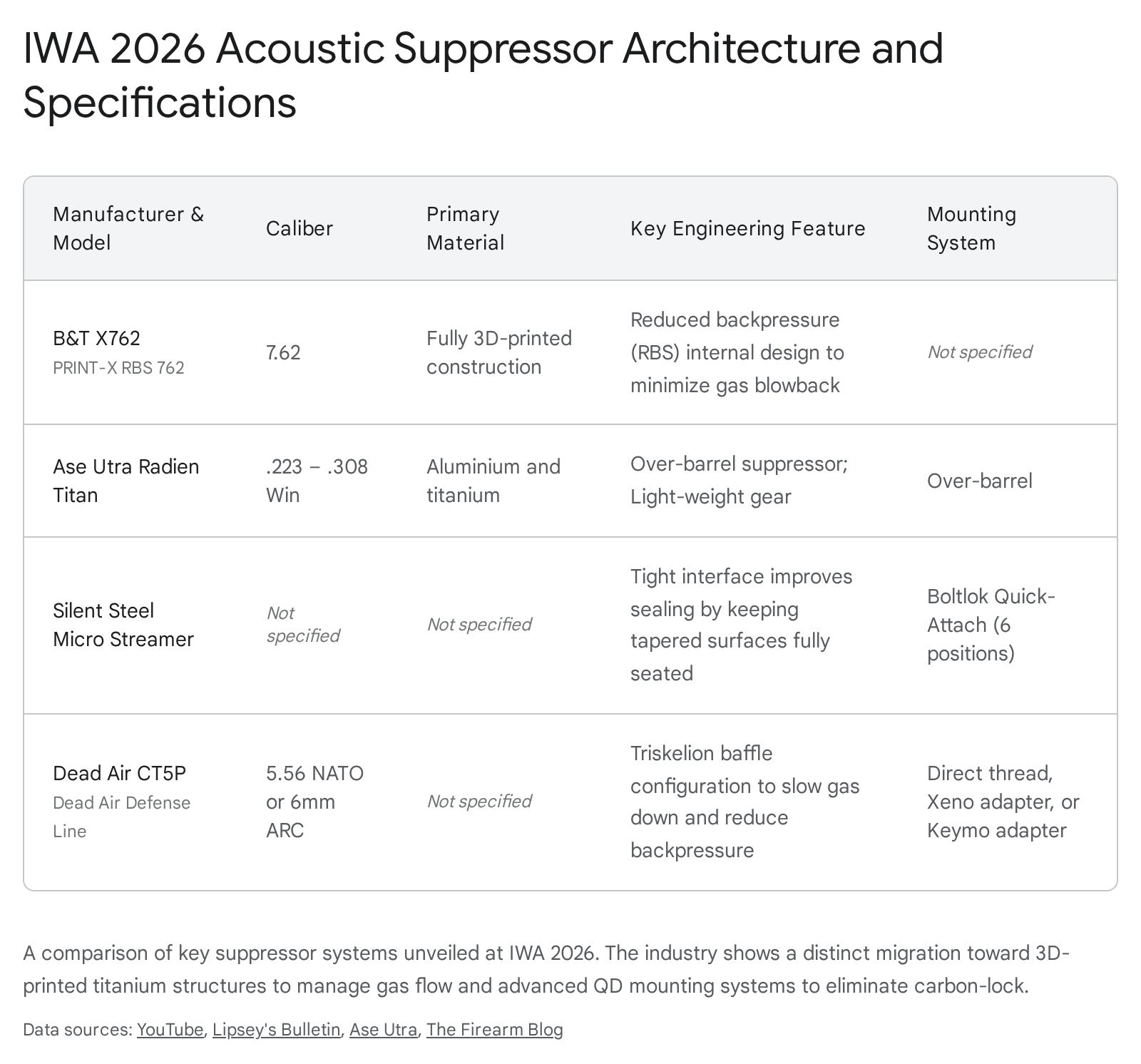
The regulatory easing regarding the civilian ownership of sound suppressors across several European jurisdictions and the United States has ignited an unprecedented wave of acoustic engineering and market growth.27 At IWA 2026, it was definitively evident that the industry is abandoning traditional subtractive manufacturing—such as turning individual metal baffles on a lathe and welding them into a tube—in favor of additive manufacturing via 3D printing. This shift solves the primary flaw of traditional silencers: extreme gas backpressure.

B&T X762 and Reduced Backpressure Systems

Swiss manufacturer B&T, renowned for their duty-grade firearms, unveiled the X762 (officially designated the PRINT-X RBS 762), a 7.62mm rifle suppressor that epitomizes this manufacturing shift.28 Traditional suppressors act as physical dead-ends, utilizing solid baffles to trap rapidly expanding combustion gases and cool them before they exit the muzzle. However, this trapped pressure has nowhere to go but backward, forcing high-pressure gas down the barrel and into the receiver.28 This “blowback” significantly accelerates the rearward velocity of the bolt carrier group, leading to premature parts wear, increased recoil, and the ejection of toxic carbon directly into the shooter’s face.28

Using Direct Metal Laser Sintering, B&T engineers construct the X762 entirely from 3D-printed titanium.28 Additive manufacturing allows for the creation of incredibly complex internal geometries—such as forward-venting helical expansion chambers and porous gas diode structures—that would be physically impossible to machine using traditional subtractive tooling.29 These complex internal pathways redirect the expanding gases forward and outward, creating a Reduced Backpressure System.28 While an RBS design may result in a negligible decibel increase at the muzzle compared to a strictly sealed traditional can, it dramatically reduces the sound pressure level measured at the shooter’s ear.28 More importantly, it keeps the host weapon’s cyclic rate at factory norms and radically improves sustained-fire reliability for military and law enforcement professionals.28

Yugo M85/M92 dust cover quick takedown pin installation detail

Silent Steel Boltlok Quick-Attach System

Addressing the mechanical interface between the suppressor and the muzzle device, Silent Steel debuted their patent-pending Boltlok Quick-Attach System alongside their FLOW-IQ gas rotation technology.31 A chronic, operational issue with quick-detach suppressors is that extreme thermal expansion during sustained, fully automatic fire can cause the mounting interface to either seize permanently to the muzzle device (carbon lock) or vibrate loose, which degrades accuracy by causing point-of-impact shifts or catastrophic baffle strikes.33

The Boltlok system solves this through a novel mechanical design that allows the user to set the locking tension during the initial installation via a six-position micro-adjustment mechanism.33 Once the tension is perfectly calibrated to the specific muzzle device, the shooter mounts the suppressor and simply slides a locking latch rearward. This creates a positive, repeatable engagement that ensures the tapered sealing surfaces remain fully seated under thousands of pounds of pressure.33 By eliminating all mechanical clearance and play in the mount, the Boltlok system prevents carbon fouling from intruding into the locking threads, guaranteeing the suppressor can be removed effortlessly even when the titanium body is glowing red hot.33 Internally, Silent Steel’s FLOW-IQ tech replaces traditional baffles with a gas rotation system that further reduces backpressure and thermal buildup.32

Innovations from Ase Utra, Dead Air, and Hausken

Finnish manufacturer Ase Utra, renowned for their extremely rugged military suppressors, expanded both their hunting and tactical lines.34 The Radien Titan is a highly innovative hybrid over-barrel design that merges a 3D-printed titanium muzzle brake section—the specific area of the suppressor subjected to the highest temperatures and erosive blast baffle wear—with hard-anodized aluminum forward baffles.35 This hybrid material approach yields a suppressor weighing a mere 200 to 210 grams while still delivering an impressive 27 to 29 decibels of sound reduction on a 6.5 Creedmoor host.35 For professional end-users engaged in close-quarters battle, Ase Utra unveiled the Mini Suppressor, explicitly engineered to handle the rigorous, high-temperature duty cycles of short-barreled PDWs.36

From the United States, Dead Air Silencers showcased the CT5P, a duty-rated 5.56x45mm and 6mm ARC suppressor weighing just 13 ounces in its direct-thread configuration.38 Utilizing their proprietary Triskelion baffle configuration, the CT5P bleeds high-pressure gas forward through the main channel, actively mitigating muzzle flash to the size of a spark on barrels as short as 10.5 inches—a vital requirement for operators utilizing night vision goggles where bright muzzle flashes will autogate or burn out image intensifier tubes.38 Dead Air also introduced the Nomad Ti OTB, a lightweight, over-the-barrel design rated up to.300 Remington Ultra Magnum for extreme backcountry hunting.38 Finally, Norwegian manufacturer Hausken (part of the RUAG Ammotec Group) presented the Whisper WD 406 XTRM MKII, Jakt JD 151, and Jakt SK 156, offering varying degrees of maximum acoustic attenuation versus compact dimensions for the discerning European hunting market.39

7. Next-Generation Electro-Optics: The Era of Multispectral Fusion

The technological leap in electro-optics observed at IWA 2026 was profound, representing a paradigm shift in how operators and hunters perceive the battlefield and the wilderness. The integration of high-definition digital sensors with hyper-sensitive uncooled thermal microbolometers has effectively eliminated the traditional drawbacks of using dedicated night vision or thermal imaging independently, offering the end-user true “multispectral” situational awareness.

Guide Sensmart: The ApexVision Architecture

Guide Sensmart debuted its ApexVision technology, a holistic hardware and software architecture that pushes commercial thermal imaging into what the company terms the “Ultra-Clarity Era”.41 The operational core of this system is the newly developed ApexCore S1 detector.42

In thermal imaging physics, the sensitivity of a sensor to detect minute temperature differences is measured by Noise Equivalent Temperature Difference (NETD). A lower NETD value indicates a more sensitive, superior sensor. Until very recently, a sub-40mK sensor was considered premium, military-grade hardware. The ApexCore S1 shatters this benchmark by achieving a staggering sub-15mK thermal sensitivity.44 In practical terms, this means the sensor can distinguish temperature variations of less than 0.015 degrees Celsius. In the field, this translates to the unprecedented ability to see highly detailed environmental features—such as individual tree branches, rocks, and terrain gradients—even in conditions with extremely low thermal contrast, such as heavy fog, high humidity, or immediately after a torrential rainfall, where older thermal units would merely display a useless, washed-out gray screen.44

This immense hardware capability is governed by the Nexus 1.0 image processing platform and the Hyper-Light 2.0 AI-powered scenario-optimized algorithm.42 The onboard artificial intelligence actively assesses the scenario to dynamically suppress background noise, enhance the edges of heat signatures, and eliminate the motion blur that has traditionally plagued fast-moving targets viewed through uncooled thermal displays.44 This technology was physically showcased in the Orion C series, a remarkably lightweight (285g) 640×512 resolution clip-on attachment that instantly converts standard daytime glass riflescopes into high-end thermal platforms without requiring the user to re-zero their optic.2

Pulsar Symbion LRF: The Apex of Multispectral Fusion

Pulsar redefined the observation optic category entirely with the introduction of the Symbion LRF, a multispectral binocular available in two highly advanced variants: the DXR50 (utilizing a 640×480 thermal core) and the DXT50 (utilizing a massive 1280×1024 thermal core).25

The engineering philosophy behind the Symbion LRF addresses the fundamental flaws of existing optical technologies. Traditional thermal imaging, while incredible for detecting heat, cannot see through glass and cannot discern color or specific physical details like antler tines or facial features, making positive target identification difficult. Conversely, digital night vision sees detail and color brilliantly but struggles to detect camouflaged or obscured heat signatures hidden in thick brush. The Symbion LRF solves this paradox by running a 4K CMOS (3840×2160) digital color and night vision sensor parallel to a massive 50mm F1.0 thermal objective lens.46

Through advanced internal algorithmic processing, the user can instantly switch between full-color daytime optical views, twilight-enhanced digital views, or pure thermal.45 More importantly, the software features dynamic Picture-in-Picture and overlay modes.45 A hunter or tactical operator can use the thermal channel to instantly detect a bedded heat signature hidden deep in brush at an extreme range of 2,300 meters, and then instantly use the 4K digital channel—assisted by the built-in 850nm IR illuminator—to positively identify the target’s physical characteristics before taking action.45 The system includes a built-in 905nm laser rangefinder capable of measuring distances up to 1,500 meters (1,640 yards) with 1-meter precision.46 This rangefinder actively communicates via Bluetooth with the Stream Vision Ballistics app, instantly calculating bullet drop across varied terrain.45 All this fused visual data is projected onto dual high-definition 1920×1080 AMOLED displays, housed in a rugged magnesium alloy chassis that maintains a classic binocular aesthetic.47

Yugo M85/M92 dust cover quick takedown pin installation detail

HIKmicro Alpex Pro and Meprolight MCO PRO

HIKmicro specifically targeted the digital day/night riflescope market with the release of the Alpex Pro series (models A50P and A50PL).25 In a significant technological departure, HIKmicro bypassed standard 4K sensors entirely in favor of a massive 12-Megapixel (4512×2512) CMOS detector.50 This architecture boasts roughly 45 percent more pixels than standard 4K digital scopes, resulting in noticeably finer edge clarity and superior target separation.50 This extreme pixel density is paired with an F1.8 50mm objective lens engineered to maximize ambient light intake.50

The critical software innovation in the Alpex Pro is the proprietary “Light Pro” image-enhancement algorithm.50 Through intelligent exposure control and real-time noise suppression, the Light Pro algorithm mathematically simulates an equivalent F0.9 optical brightness, delivering up to a 3x signal-to-noise ratio improvement in low-light environments.52 This dynamically extends the usability of the optic during dusk and dawn, capturing vibrant color imagery without requiring the shooter to activate an infrared illuminator that might spook game or reveal their position.52 When digital zoom is engaged, the precise resolution match between the 12MP sensor and the 1920×1080 0.6-inch AMOLED display allows for up to 2.3x lossless digital magnification without the pixelation associated with older digital scopes.49 The A50PL variant also integrates a high-accuracy 1200m laser rangefinder with an onboard ballistic calculator that now mathematically accounts for wind speed and direction to predict the point-of-aim automatically.50

In the reflex sight market, Meprolight commanded attention with the MCO PRO, an optic purpose-built to withstand the rigors of combat on carbines and shotguns.53 The closed-emitter architecture completely seals the internal laser diode from water, dust, and mud, earning an IP67 durability rating.53 The optic features an incredibly efficient power management system incorporating a Shake Awake sensor; on setting 5, a single CR2032 battery provides upwards of 25,000 hours of continuous operational life, ensuring the optic is always ready when deployed from a vehicle rack or safe.53

8. Terminal Ballistics, Propellants, and Environmental Compliance

Ammunition manufacturers at IWA 2026 focused their engineering efforts on three distinct pillars: maximizing terminal performance at extreme subsonic velocities, pushing the boundaries of long-range precision, and ensuring total compliance with impending, highly restrictive European environmental regulations regarding lead projectiles.

Engineering Subsonic Expansion: Federal Ammunition

The legislative easing of suppressor ownership has created a massive demand for factory-loaded subsonic ammunition.27 However, traditional hunting ammunition relies on supersonic velocity to create hydrostatic shock and initiate the mechanical expansion of the bullet. When projectiles are downloaded to subsonic velocities (typically below 1,050 feet per second) to eliminate the loud supersonic ballistic crack, traditional bullets fail to expand entirely. They act effectively as full metal jackets, punching a clean, narrow hole through tissue and resulting in poor terminal performance and lost game.

Federal Ammunition solved this physical limitation with the launch of the Federal Subsonic line.54 Available in heavy-hitting calibers like 30-30 Win. (170-grain), 45-70 Govt. (300-grain),.308 Win. (190-grain), and 300 Blackout (190-grain), the engineering team completely redesigned the projectile architecture.54 By utilizing heavily skived copper jackets that are pre-weakened along geometric fault lines, paired with proprietary lead core bonding techniques, these new Fusion and Fusion Tipped bullets are guaranteed to expand reliably and transfer massive kinetic energy at critically low subsonic velocities, providing hunters with true sound suppression without sacrificing lethality.54

For extreme long-range engagements where velocity sheds rapidly, Federal expanded their highly regarded Terminal Ascent line, adding loads in 6.5mm PRC (140-grain) and 300 Rem. Ultra Mag. (175-grain).54 These projectiles utilize a high ballistic coefficient bonded design featuring a patented Slipstream polymer tip.54 Unlike solid polymer tips which can compress and fail to initiate expansion at low velocities, the hollow Slipstream tip acts as a wedge, forcing the jacket open across an incredibly wide velocity envelope, ensuring lethal performance at extended distances.54 Federal also expanded their offerings for the AR-15 platform with new 6mm ARC (Advanced Rifle Cartridge) loads, including a highly accurate Gold Medal Berger BT Target 108-grain option.54 In a nod to American heritage, they partnered with Henry Repeating Arms to release a commemorative 250th anniversary U.S.A. edition 45-70 Govt. 300-gr Jacketed Soft Point load.54

High-Velocity Precision and Lead-Free Mandates

Hornady matched this focus on precision with the introduction of the 22 Creedmoor 69 gr ELD-VT.56 This specialized cartridge is engineered specifically for varmint and predator hunters seeking explosive terminal performance and match-grade precision. By necking down the 6.5 Creedmoor case to accept a highly aerodynamic 69-grain.22 caliber projectile, Hornady is driving the bullet at a blistering muzzle velocity of 3,560 feet per second, resulting in a laser-flat trajectory that virtually eliminates the need for holdovers at typical hunting distances.56 Hornady also expanded their monolithic copper alloy lineup with the SUPERFORMANCE 65 gr CX load (3,660 fps) and introduced a wide array of new DGH bullets spanning 9mm to.50 caliber.56 Remington augmented the revolver and lever-action market with new Core-Lokt Handgun offerings, including a 237-grain.45 Colt load featuring a heavy mid-section jacket locked to a lead core, alongside new waxed-groove Hard Cast loads for extreme penetration on dangerous game.57

In Europe, manufacturers are locked in a race to engineer premium lead-free ammunition to comply with strict, impending EU environmental mandates regarding lead toxicity.15 RWS and Brenneke showcased extensive portfolios of lead-free solutions.58 Brenneke highlighted their Orange Lightning nature line—a premium lead-free projectile engineered to offer high weight retention and an aggressive cutting edge that punches a clean hole through hide and bone, ensuring a predictable exit wound and an easy-to-follow blood trail for hunters.58

In the propellant sector, Vihtavuori, the renowned Finnish manufacturer of smokeless reloading powders, unveiled a comprehensive and highly polished corporate rebranding initiative.61 Recognizing that the precision handloading market is attracting a younger, highly technical demographic, Vihtavuori updated their century-old visual identity. While guaranteeing that their legacy chemical formulas and legendary batch-to-batch consistency remain utterly unchanged across their 20+ powder varieties, the new brand aesthetic is centered around striking, modern colors like “Combustion Blue,” “Muzzle Flash Orange,” “Sandstorm Beige,” “Spindrift Gray,” and “Recoil Gray”.61 This signals a modernized corporate posture aimed at dominating the precision rifle series (PRS) and benchrest competitive shooting markets.61

9. The Evolution of Edged Weapons and The Blade Demo Area

While firearms dominate the floor space, the tactical and outdoor knife market remains a vital pillar of the IWA exhibition. The IWA Knife Award has rapidly become an essential reference point for global cutlery manufacturers.4 Following a record number of entries in 2025, which saw 77 participating products from 13 countries evaluated by an independent international jury of experts, the 2026 awards ceremony in the BLADE Demo Area was highly anticipated.63

Italian manufacturer Fox Knives commanded the spotlight, with their Fox Metamorphosis FX-556 receiving dual honors: winning the prestigious IWA Knife Award and concurrently securing the European Product Design Award, a testament to the elegant integration of Mediterranean aesthetic design with brutal utilitarian functionality.65

Finnish company Peltonen Knives, established in 1995 by military observer J.P. Peltonen, showcased their brutally rugged M95 and M07 Ranger Knives.66 Engineered specifically to withstand the freezing, austere conditions of the Nordic wilderness, these fixed blades are forged from resilient 80CrV2 high-carbon steel, heavily favored for its ability to take a razor edge and withstand heavy batoning and chopping impacts without chipping.66 The blades are mated to aggressively textured TPE handles that ensure a locked-in grip even when the operator’s hands are covered in snow, blood, or mud.66 In the folding knife sector, WE Knife, known globally for their exceptional CNC machining tolerances and premium blade steels, utilized their new booth space to debut a wide array of highly innovative modern everyday carry (EDC), tactical, and outdoor hunting folders, cementing their position as a top-tier production brand.67

10. Industry Newcomers and the Digital Incubation Space

A key metric of industry health is the influx of new capital and fresh engineering ideas. At IWA 2026, the dedicated Newcomer Area was entirely sold out, hosting 19 companies making their debut exhibition.4 The diversity of these startups proves that the small arms industry is rapidly expanding into software integration and advanced material sciences.

To maximize exposure for these startups, IWA hosted the “Newcomer Pitches” on the Shooting Experts Stage, an incubator-style format where founders were given exactly three minutes to deliver rapid-fire elevator pitches to industry executives and investors, complete with live audience voting.4 The startups ranged from heavy industrial manufacturing to specialized digital applications:

  • Advanced Materials and Manufacturing: Austrian firm Plastmateria debuted highly customized, eco-friendly polymer coating solutions designed specifically to replace toxic chemicals currently used in firearms manufacturing and finishing processes.68 From Poland, Schupter presented premium, European-built automated lead casting machines tailored for hobbyist reloaders and small-scale commercial ammunition businesses.68
  • Hunting Logistics and Electronics: Swedish company Tendy introduced a suite of integrated electronic products engineered to modernize the handling of harvested game meat. Their ecosystem includes digital aging timers, the Fluctus digital hanging scale, and the Scriptor label printer, allowing hunting lodges and butchers to digitally track and streamline the meat aging and storage process with absolute precision.68 German brand Zweibrüder challenged legacy flashlight manufacturers with new tactical and outdoor lighting systems driven by advanced opto and microelectronics.68
  • Software and Digital Integration: Reflecting the digitization of the shooting sports, several startups focused purely on software architectures. Companies like Aimlink.ai, ARCHNES, Cleverware, and Battle Gnome Solutions pitched complex 3D modeling systems for firearm websites, smart shooting applications, and advanced inventory management systems capable of integrating seamlessly with heavily regulated ERP, PIM, and CRM backend systems.68

Furthermore, the exhibition was framed by high-level political and historical milestones. The Plenary Session of the World Forum on Shooting Activities (WFSA) convened to discuss critical legislative battles, including the labyrinthine European rules regarding pocket knives and pneumatic rifles, as well as the integration of Olympic shooting sports into the upcoming LA 2028 Olympic Games.15 The session also served as a historic celebration, awarding the 2026 Vito Genco Shooting Ambassador Award to Franco Gussalli Beretta and Pietro Gussalli Beretta, commemorating the astonishing 500th continuous anniversary of Fabbrica d’Armi Pietro Beretta—a stark reminder of the enduring, multi-century legacy of the global firearms trade.15

11. Conclusion and Strategic Engineering Takeaways

The profound innovations unveiled across the sprawling halls of IWA OutdoorClassics 2026 confirm that the small arms industry has definitively exited its traditional mechanical boundaries and entered an era of deep, interdisciplinary technological integration. For defense analysts, mechanical engineers, and corporate strategists analyzing these developments, several key takeaways dictate the future commercial and tactical trajectory of the market:

  1. The Complete Normalization of the PDW: The 5.7x28mm cartridge has achieved critical mass in the commercial market. Platforms like the KelTec KP50 demonstrate that high-capacity, low-recoil systems are increasingly viewed by the market as optimal for both civilian personal defense and high-threat law enforcement applications. This paradigm shift forces legacy 9mm submachine gun designs to either adapt via complex delayed-blowback mechanisms or face rapid obsolescence in the face of superior armor-defeating ballistics.
  2. The Extinction of Traditional Baffle Suppressors: The application of additive manufacturing has irrevocably altered the physics and economics of acoustic suppression. Modern suppressors are no longer evaluated solely by the sheer decibel reduction measured at the muzzle; they are evaluated on their total fluid dynamic efficiency. Systems that induce heavy backpressure, accelerate bolt carrier velocity, and increase toxic gas blowback will rapidly lose market share to 3D-printed titanium Flow-Through and Reduced Backpressure Systems that prioritize the operational lifespan of the host weapon.
  3. The Era of Multispectral Fusion is the New Baseline: The era of the standalone optical glass scope and the standalone thermal monocular operating in isolation is ending. Observation systems that utilize onboard artificial intelligence and algorithmic processing to physically fuse high-resolution digital CMOS video with sub-15mK thermal gradient data represent the new, mandatory baseline for elite night-fighting, VIP protection, and advanced hunting applications.
  4. The “Prepper” Market dictates the Civilian Future: The aggressive marketing pivot of tactical and outdoor gear toward “Crisis Preparedness” is not a temporary fad; it is a structural realignment of the market. Firearms, optics, and tactical equipment are increasingly being marketed and purchased not as recreational sporting goods, but as foundational, life-saving elements of a comprehensive crisis preparedness ecosystem. Manufacturers and retailers who fail to incorporate off-grid reliability, tactical trauma medicine, and decentralized power survivalism into their marketing strategies will miss out on the most rapidly expanding, highly motivated demographic in the modern industry.

Please share the link on Facebook, Forums, with colleagues, etc. Your support is much appreciated and if you have any feedback, please email us in**@*********ps.com. If you’d like to request a report or order a reprint, please click here for the corresponding page to open in new tab.


Sources Used

  1. en | all4shooters, accessed February 28, 2026, https://www.all4shooters.com/en/
  2. IWA OutdoorClassics 2026: Our report from Day 2 of the Nuremberg trade fair | all4shooters, accessed February 28, 2026, https://www.all4shooters.com/en/shooting/culture/report-iwa-2026-trade-fair-new-firearms-hunting-sport-shooters-highlights-day-2/
  3. CZ to Attend IWA Outdoor Classics 2026, Showcasing New Products …, accessed February 28, 2026, https://www.archerywire.com/releases/2026/02/cz-to-attend-iwa-outdoor-classics-2026-showcasing-new-products-in-milestone-90th-year
  4. Voices of the industry: why IWA’s program is unmissable, accessed February 28, 2026, https://www.iwa.info/en/knowledge/2026/02/industry-voices-on-the-iwa-supporting-program
  5. Starting a survival gear business: tools for your shop – IWA OutdoorClassics, accessed February 28, 2026, https://www.iwa.info/en/knowledge/2026/02/survival-gear-shop
  6. Focus Topic “Crisis Preparedness”: IWA OutdoorClassics Addresses Current Issues Facing the Trade, accessed February 28, 2026, https://www.iwa.info/en/press/press-releases/2026/02/focus-topic-crisis-preparedness
  7. Archive for the ‘IWA’ Category – Soldier Systems, accessed February 28, 2026, https://soldiersystems.net/category/iwa/
  8. Best 5.7x28mm Guns & Ammo [Range-Tested] – Pew Pew Tactical, accessed February 28, 2026, https://www.pewpewtactical.com/best-5-7-guns-ammo/
  9. FN 5.7×28mm – Wikipedia, accessed February 28, 2026, https://en.wikipedia.org/wiki/FN_5.7%C3%9728mm
  10. KelTec’s KP50: The “Next Evolution Of The PDW” | An Official Journal Of The NRA, accessed February 28, 2026, https://www.americanrifleman.org/content/keltec-s-kp50-the-next-evolution-of-the-pdw/
  11. First Look: KelTec KP50 – Gun Digest, accessed February 28, 2026, https://gundigest.com/article/keltec-kp50
  12. KelTec Announces the KP50 and MP50: 50 Rounds of 5.7 | thefirearmblog.com, accessed February 28, 2026, https://www.thefirearmblog.com/blog/keltec-announces-the-kp50-and-mp50-50-rounds-of-5-7-44826496
  13. New For 2023: Ruger LC Charger | An Official Journal Of The NRA – American Rifleman, accessed February 28, 2026, https://www.americanrifleman.org/content/new-for-2023-ruger-lc-charger/
  14. Hi all. Looking to get a 5.7 tool, that is portable, reliable, and wont break the bank. Any thoughts on the Keltec 50R? TIA : r/57x28mm – Reddit, accessed February 28, 2026, https://www.reddit.com/r/57x28mm/comments/1dnj4ou/hi_all_looking_to_get_a_57_tool_that_is_portable/
  15. IWA/Beretta – The Outdoor Wire, accessed February 28, 2026, https://www.theoutdoorwire.com/features/2026/02/iwaberetta
  16. Schmeisser at IWA OutdoorClassics 2026, accessed February 28, 2026, https://www.iwa.info/en/knowledge/2026/01/schmeisser-at-iwa2026
  17. A New Take On The CZ 600+ Rifle – Petersen’s Hunting, accessed February 28, 2026, https://www.petersenshunting.com/editorial/cz-600-plus-rifle-review/538726
  18. CZ presents the new CZ 600+ bolt-action rifle series – CZ Firearms, accessed February 28, 2026, https://www.czfirearms.com/en-us/news/cz-presents-the-new-cz-600-bolt-action-rifle-series
  19. Centerfire rifles series CZ 600+, accessed February 28, 2026, https://www.czfirearms.com/en-us/products/centerfire-rifles/cz-600-plus-series
  20. CZ 600+ RANGE – CZ Firearms, accessed February 28, 2026, https://www.czfirearms.com/en-us/products/centerfire-rifles/cz-600-plus-series/cz-600-plus-range
  21. IWA | thefirearmblog.com, accessed February 28, 2026, https://www.thefirearmblog.com/category/iwa
  22. EMAG at the IWA OutdoorClassics 2026, accessed February 28, 2026, https://www.emag.com/company/events-webinars/events/iwa-outdoorclassics/
  23. EMAG at the IWA OutdoorClassics 2026 – EMAG Machine Tools, accessed February 28, 2026, https://www.emag.com/it/company/events-webinars/events/iwa-outdoorclassics/
  24. EMAG Machine Tools: Turning Lathes and Grinding Machines, accessed February 28, 2026, https://www.emag.com/
  25. IWA OutdoorClassics 2026: The world’s leading trade fair for the firearms industry kicks off with many new products | all4shooters, accessed February 28, 2026, https://www.all4shooters.com/en/shooting/culture/report-iwa-trade-fair-new-firearms-hunting-sport-shooters-highlights-day-1/
  26. Sarsilmaz Exhibits at IWA 2026 – The Outdoor Wire, accessed February 28, 2026, https://www.theoutdoorwire.com/releases/2026/02/sarsilmaz-exhibits-at-iwa-2026
  27. New Year Buying Surge Shows 2026 Could Be The Year Of Suppressors – NSSF, accessed February 28, 2026, https://www.nssf.org/articles/new-year-buying-surge-shows-2026-could-be-the-year-of-suppressors/
  28. B&T X762: A 7.62 Suppressor Built for Hard Use | SHOT Show 2026 – YouTube, accessed February 28, 2026, https://www.youtube.com/watch?v=foD0FBIyyyc
  29. Inside B&T’s New 3D Printed Suppressors | SHOT Show 2026 – YouTube, accessed February 28, 2026, https://www.youtube.com/watch?v=G_jOZtZRAPw
  30. New B&T 3D-Printed Titanium Rifle Suppressors at SHOT Show 2026! – YouTube, accessed February 28, 2026, https://www.youtube.com/watch?v=OOz5USUbztE
  31. Silent Steel Introduces the new Boltlok Quick-Attach Mounting System – Frag Out! Magazine, accessed February 28, 2026, https://fragoutmag.com/silent-steel-introduces-the-new-boltlok-quick-attach-mounting-system/
  32. Silent Steel USA: The Future is Here | SHOT Show 2026 – YouTube, accessed February 28, 2026, https://www.youtube.com/watch?v=-V3B8uRL8SM
  33. Silent Steel Introduces Boltlok Quick-Attach Suppressor Mount | thefirearmblog.com, accessed February 28, 2026, https://www.thefirearmblog.com/blog/silent-steel-introduces-boltlok-quick-attach-suppressor-mount-44826358
  34. Sustainable Suppression – Ase Utra, accessed February 28, 2026, https://www.aseutra.fi/en/frontpage/
  35. SOUND SUPPRESSORS HUNTING & SPORTS SHOOTING – Ase Utra, accessed February 28, 2026, https://aseutra.fi/wp-content/uploads/2025/09/Ase_Utra_Hunting_2023.pdf
  36. A Mini Finnish Suppressor Built for Duty | EnforceTac 2025 – YouTube, accessed February 28, 2026, https://www.youtube.com/watch?v=AGTajxJZ84Y
  37. A Mini Finnish Suppressor Built for Duty | EnforceTac 2025 | thefirearmblog.com, accessed February 28, 2026, https://www.thefirearmblog.com/blog/a-mini-finnish-suppressor-built-for-duty-enforcetac-2025-44819884
  38. New Suppressors for 2026 – Lipsey’s Bulletin, accessed February 28, 2026, https://www.lipseysbulletin.com/firearms/new-suppressors-for-2026/
  39. Hausken suppressors: these are the three new XTRM models from the Jakt series for 2022, accessed February 28, 2026, https://www.all4shooters.com/en/hunting/accessories/hausken-suppressors-these-are-the-three-new-xtrm-models-for-2022-video/
  40. Hausken Lyddemper AS (Hausken Sound Suppressors Ltd.) – IWA OutdoorClassics, accessed February 28, 2026, https://www.iwa.info/en/exhibitors/hausken-lyddemper-as-hausken-sound-suppressors-ltd-2519130
  41. Guide Sets New Industry Standards with IWA Outdoor Classics Hands-on, accessed February 28, 2026, https://en.prnasia.com/releases/apac/guide-sets-new-industry-standards-with-iwa-outdoor-classics-hands-on-523269.shtml
  42. ApexVision Debuts at CES 2026: Guide Sensmart Launches the Ultra-Clarity Era in Thermal Imaging | Morningstar, accessed February 28, 2026, https://www.morningstar.com/news/pr-newswire/20260107cn58265/apexvision-debuts-at-ces-2026-guide-sensmart-launches-the-ultra-clarity-era-in-thermal-imaging
  43. Unfazed by Storm or Darkness, ApexVision Delivers a New Era of Ultra-Clarity – Tech Times, accessed February 28, 2026, https://www.techtimes.com/articles/313786/20260106/unfazed-storm-darkness-apexvision-delivers-new-era-ultra-clarity.htm
  44. Guide Sets New Industry Standards with IWA Outdoor Classics Hands-on, accessed February 28, 2026, https://www.prnewswire.com/in/news-releases/guide-sets-new-industry-standards-with-iwa-outdoor-classics-hands-on-302698161.html
  45. Pulsar Symbion LRF DXR50 Binoculars- Shipping Now – Feral Texas Outdoors, accessed February 28, 2026, https://feraltexasoutdoors.com/products/pulsar-symbion-lrf-dxr50-binoculars
  46. Multispectral Binoculars for 24/7 Clarity – Pulsar SYMBION, accessed February 28, 2026, https://pulsarvision.com/products/thermal-imaging-binoculars/symbion-lrf/
  47. Pulsar Symbion LRF DXT50 1280 2x Multispectral Thermal Binocular, accessed February 28, 2026, https://nightvisionuniverse.com/products/pulsar-symbion-lrf-dxt50-1280-2x-multispectral-thermal-binocular
  48. Pulsar Symbion LRF Multispectral Binoculars Review, accessed February 28, 2026, https://pulsarvision.com/journal/pulsar-symbion-review/
  49. HIKMICRO Alpex Pro Digital Day & Night Scope – YouTube, accessed February 28, 2026, https://www.youtube.com/watch?v=o3VQGjB8S_M
  50. HikMicro Alpex Pro: Cutting-Edge Night Vision Scope – After Dark Surveillance, accessed February 28, 2026, https://afterdarksurveillance.com/product/hikmicro-alpex-pro/
  51. HIKMICRO ALPEX PRO Digital Day&Night Vision Scope, accessed February 28, 2026, https://www.hikmicrotech.com/it/outdoor-products/alpex-pro-digital-day-night-vision-scope/
  52. HIKMICRO Alpex Pro – The New Benchmark of Night Vision, accessed February 28, 2026, https://www.nightmaster.co.uk/blogs/news/hikmicro-alpex-pro
  53. Meprolight Will Be In Nuremberg For The IWA 2026 Classic – The Outdoor Wire, accessed February 28, 2026, https://www.theoutdoorwire.com/releases/2026/02/meprolight-will-be-in-nuremberg-for-the-iwa-2026-classic
  54. Federal Will Release More Than 20 New Centerfire Rifle Ammo Options in 2026, accessed February 28, 2026, https://www.federalpremium.com/news.html?id=2149
  55. New Federal Ammunition Reveals for 2026 – Guns and Ammo, accessed February 28, 2026, https://www.gunsandammo.com/editorial/new-federal-2026/544094
  56. Hornady® Announces New Products for 2026, accessed February 28, 2026, https://press.hornady.com/release/2025/10/15/hornady-announces-new-products-for-2026/
  57. New Ammo Coming in 2026 | NSSF SHOT Show 2027 – SHOTShow.org, accessed February 28, 2026, https://shotshow.org/new-ammo-coming-in-2026/
  58. Hunting ammunition for rifles & shotguns | BRENNEKE – Ammunition, accessed February 28, 2026, https://www.brenneke-ammunition.de/en/
  59. RWS Hunting and Target Shooting 2026 – the new catalogue is here!, accessed February 28, 2026, https://www.rws-technology.com/en/hunting-sports/news/view/rws-hunting-and-target-shooting-2026-the-new-catalogue-is-here
  60. IWA OutdoorClassics on all4shooters.com, accessed February 28, 2026, https://www.all4shooters.com/en/tradeshows/iwa/?page=3
  61. Vihtavuori unveils the new brand look at the IWA Outdoors Classics 2026, accessed February 28, 2026, https://www.vihtavuori.com/vihtavuori-unveils-the-new-brand-look-at-the-iwa-outdoors-classics-2026/
  62. Registration IWA Knife Award, accessed February 28, 2026, https://www.iwa.info/en/exhibit/special-formats/iwa-knife-award
  63. A review of the IWA Knife Award winners 2025, accessed February 28, 2026, https://www.iwa.info/en/events-program/2026/program/blade-demo-area/review-iwa-knife-award-winner-2025
  64. BLADE Demo Area – IWA OutdoorClassics, accessed February 28, 2026, https://www.iwa.info/en/events-program/xperience/blade-demo-area
  65. IWA Knife Award: Innovation, tradition and the best knives – Lowready Magazine, accessed February 28, 2026, https://lowreadymagazine.com/en/articles/the-iwa-knife-award-the-highlight-of-the-blade-demo-area-at-the-international-trade-fair-for-hunting-and-shooting-sports
  66. IWA Knife Award – European Blades, accessed February 28, 2026, https://www.europeanblades.com/iwa-knife-award/
  67. WE Knife Invites You to Experience the Newest Models at New Booth #4-556 During 2026 IWA Outdoor Classics – Dealer Wire, accessed February 28, 2026, https://www.thedealerwire.com/releases/2026/02/we-knife-invites-you-to-experience-the-newest-models-at-new-booth-4-556-during-2026-iwa-outdoor-2
  68. Discover fresh brands and innovations at the IWA OutdoorClassics 2026 Newcomer Area, accessed February 28, 2026, https://www.iwa.info/en/knowledge/2026/02/newcomers-at-iwa2026
  69. The Newcomer Pitches 2026. Fresh ideas, bold doers. With live voting!, accessed February 28, 2026, https://www.iwa.info/en/events-program/2026/program/shooting-experts-stage/newcomer-pitches-280226

Navigating the Polymer Paradox in Defense Manufacturing

Executive Summary

The modern defense industrial base is currently navigating a pivotal transition in supply chain logistics and manufacturing methodologies. Driven by the necessity for strategic agility in asymmetrical conflict zones and the inherent vulnerability of highly globalized, centralized supply lines, defense contractors and tier-2 manufacturers are increasingly integrating additive manufacturing technologies into the production of small arms components and tactical hardware. This strategic pivot has precipitated a critical material science evaluation: the comparative viability of three-dimensional printed carbon-fiber-reinforced polyamides versus traditional high-pressure injection-molded glass-fiber-reinforced polyamides.

This comprehensive analytical intelligence report investigates “The Polymer Paradox”—the phenomenon wherein additive manufacturing polymers offer unprecedented supply chain resilience, extreme weight reduction, and rapid point-of-need prototyping capabilities, yet simultaneously exhibit masked operational vulnerabilities in thermodynamic stability, inter-laminar sheer strength, and long-term viscoelastic creep resistance when compared directly to their legacy injection-molded counterparts.

Through exhaustive analysis of mechanical baselines, environmental degradation mechanisms, chemical resistance profiles in tactical environments, and logistical macroeconomics, this report provides a definitive framework for C-suite executives and defense engineers. The aggregated data strongly indicates that while injection-molded PA66-GF30 remains the undisputed standard for high-static-load, long-term operational firearm furniture, Selective Laser Sintering PA12-CF and Fused Deposition Modeling PA6-CF present highly viable, cost-effective solutions for distributed manufacturing. However, these additive technologies can only be successfully deployed if their specific anisotropic limitations, susceptibility to hygroscopic plasticization, and rapid thermal deflection parameters are rigorously engineered into the lifecycle of the component. The organizations that will dominate the next decade of defense procurement are those that master hybrid supply chains, leveraging injection molding for the mass-produced core and deploying additive manufacturing for agile, decentralized tactical superiority.

1.0 The Geopolitical Imperative for Additive Manufacturing in Defense

The paradigm of small arms manufacturing has historically relied upon massive economies of scale, centralized production facilities, and robust but deeply inflexible supply chains. Traditional manufacturing of polymeric firearm furniture, which encompasses lower receivers, pistol grips, forward handguards, and buttstocks, has been exclusively dominated by injection molding techniques. This subtractive-to-molding pipeline necessitates massive initial capital expenditure for the creation of hardened steel tooling, protracted lead times for mold iteration and design finalization, and centralized production hubs that have proven to be highly vulnerable to geopolitical disruptions, trade restrictions, and logistical bottlenecks.

In recent global operational theaters, the fundamental fragility of these extended supply chains has been laid bare. The requirement to rapidly deploy, dynamically adapt, and repair military hardware at the point of need has catalyzed a rapid acceleration in the adoption of distributed manufacturing models. Additive manufacturing allows expeditionary forces and defense contractors to transmit digital computer-aided design files across secure networks and physically produce functional components in theater or at localized tier-2 facilities within hours, effectively bypassing months of procurement delay and international shipping logistics.1

The urgency of this transition was explicitly highlighted during the COVID-19 pandemic, which exposed severe dependencies on overseas manufacturing hubs. For instance, at the height of the crisis, the disruption of specific regional hubs drastically reduced the export of critical protective and medical equipment by overwhelming margins.3 This vulnerability extends directly into the defense industrial base. The Defense Advanced Research Projects Agency has explicitly backed initiatives such as the SURGE project to accelerate the qualification of additively manufactured parts, noting that distributed manufacturing is essential for point-of-need production during times of surge demand.4 Similarly, regional initiatives like Project DIAMOnD have utilized federal grant funding to establish the world’s largest distributed manufacturing network, purposefully designed to improve local manufacturers’ agility and resiliency against global disruptions like severe aluminum shortages.1

The practical application of this technology in active conflict zones further underscores its strategic value. In Ukraine, military medical units faced critical shortages of tactical medical kits, specifically tourniquets. The inability of traditional supply chains to scale rapidly forced the procurement of highly inferior, mass-produced foreign alternatives that ultimately suffered catastrophic failure rates in the field.3 The deployment of open-source, 3D-printable medical hardware, while fraught with quality control challenges, demonstrated the absolute necessity for on-demand production at the echelon level to decrease supply chain dependence. Furthermore, in asymmetrical conflicts such as Myanmar, insurgent forces have heavily leveraged additive manufacturing to produce the FCG-09, a firearm designed specifically to bypass traditional manufacturing constraints and international arms regulations.5 These localized production capabilities completely decouple the end-user from global logistical vulnerabilities.

However, the shift from traditional high-pressure injection molding to additive manufacturing is not merely a lateral change in the fabrication mechanism; it represents a fundamental, often misunderstood shift in the core material science of the end product. Small arms components are subjected to extreme operational stresses, including high-impact recoil impulses, drastic thermal cycling from sustained automatic fire, prolonged ultraviolet radiation exposure in desert environments, and immersion in caustic chemical solvents for maintenance. The materials utilized must possess exceptional yield strength, impact toughness, and dimensional stability. Consequently, the defense industry is intensely focused on evaluating advanced engineering filaments and powders to determine if they can genuinely replace legacy materials.

2.0 Material Science: Unpacking the Polymer Paradox

To accurately forecast the operational performance and failure thresholds of polymeric firearm furniture, it is absolutely essential to dissect the polymer matrices and their reinforcing agents at both the molecular and microstructural levels. The foundational concept of the “Polymer Paradox” describes the counterintuitive reality observed by field engineers: while carbon-fiber-reinforced additively manufactured parts often feel significantly stiffer in the hand and exhibit a higher specific strength-to-weight ratio than standard unfilled plastics, the underlying thermal and mechanical properties of the additive polymer matrix frequently fall severely short of the brute-force durability achieved by high-density, glass-filled injection molding.

2.1 Base Polymer Matrices: The Chemistry of Polyamides

The foundational thermoplastic matrix of the composite entirely dictates the material’s baseline thermal resistance, inherent flexibility, and critical susceptibility to ambient moisture. Polyamides, colloquially known as nylons, are semi-crystalline engineering thermoplastics characterized by the regular presence of amide linkages along the polymer backbone. The specific distance between these amide linkages fundamentally alters the behavior of the plastic.

Polyamide 66 is the undisputed industry standard for traditional injection-molded firearm components. Manufacturers rely heavily on this formulation for pistol frames, rifle stocks, and magazine bodies. Polyamide 66 features a highly ordered, tightly packed crystalline structure due to the highly symmetrical hydrogen bonding between parallel polymer chains. This dense molecular packing results in a high melting point, typically ranging between 255 and 265 degrees Celsius, excellent raw rigidity, and superior high-temperature performance capabilities.6 The primary vulnerability of Polyamide 66 is its hygroscopic nature; the frequent spacing of polar amide groups readily attracts and binds with atmospheric water molecules.

Polyamide 6 is currently one of the most frequently utilized base polymers in Fused Deposition Modeling, serving as the matrix for popular high-strength filaments. It possesses a molecular structure with six carbon atoms per repeating unit. Polyamide 6 offers excellent impact resistance, remarkable toughness, and high fatigue strength.8 However, it suffers from severe dimensional instability and a high propensity for thermal warping during the printing process due to uneven cooling rates and rapid crystallization.10 Furthermore, Polyamide 6 has an extremely high moisture absorption rate, capable of absorbing up to 3 percent of its total volume in water, which acts as a powerful plasticizer that drastically alters its mechanical properties.11

Polyamide 12 has emerged as the premier matrix for Selective Laser Sintering powder bed fusion and high-end industrial Fused Deposition Modeling. Polyamide 12 contains twelve carbon atoms between its amide groups, resulting in significantly longer, more flexible aliphatic hydrocarbon chains.12 This extended chain length drastically reduces the overall concentration of moisture-absorbing polar groups per unit volume. Consequently, Polyamide 12 absorbs only approximately 0.5 percent moisture, making it exceptionally dimensionally stable, highly resistant to environmental changes, and remarkably easy to print without the severe warping issues that plague Polyamide 6.11 The engineering trade-off for this stability is a lower baseline tensile strength and a significantly lower heat deflection temperature when compared directly to Polyamide 6 and Polyamide 66.

2.2 Reinforcement Architectures: Carbon Fiber vs. Glass Fiber Dynamics

The base polyamides alone entirely lack the raw mechanical stiffness and load-bearing capacity required for tactical firearm applications. Therefore, they must be heavily compounded with reinforcing fibers to achieve operational viability. The nature of these fibers, and how they are integrated into the matrix, creates a massive divergence in performance.

Injection-molded Polyamide 66 is typically loaded with 30 to 33 percent short glass fibers by weight, designated across the industry as PA66-GF30 or PA66-GF33. Glass fibers are relatively inexpensive, highly abrasive, and provide massive, quantifiable improvements in tensile strength, compressive strength, and thermal resistance.14 The high-pressure injection molding process, which forces molten plastic into a steel cavity at extreme velocities, ensures that these millions of microscopic glass fibers are densely packed and thoroughly wetted by the surrounding polymer matrix. Furthermore, careful design of the mold gates allows engineers to manipulate fiber orientation, resulting in a highly uniform, nearly isotropic reinforcement profile throughout the final structural component.16

Conversely, additive manufacturing filaments and powders typically utilize chopped micro-carbon fibers, generally comprising 10 to 35 percent of the material by weight. Carbon fiber possesses a vastly superior modulus of elasticity compared to standard glass fiber, yielding composite parts that are incredibly stiff and remarkably lightweight. This high strength-to-weight ratio makes carbon fiber nylon highly attractive for aerospace and automotive applications.10 However, in standard extrusion-based 3D printing, these short carbon fibers align almost exclusively along the physical toolpath dictated by the printer nozzle, entirely within the horizontal X-Y plane. The carbon fibers provide absolutely zero structural reinforcement across the vertical Z-axis, which is the boundary between the printed layers.10 While specialized advanced systems can embed continuous strands of unbroken carbon fiber to yield parts that rival the tensile strength of 6061 aluminum, standard commercial additive manufacturing relies entirely on the unreinforced, weaker base polymer matrix to bind the individual layers together vertically.19

2.3 Baseline Mechanical Properties: Yield Strength and Tensile Modulus

The raw mechanical data, stripped of marketing terminology, clearly illustrates the stark divergence in capabilities between the manufacturing methodologies. Analyzing the ultimate tensile strength, yield strength, and tensile modulus provides the foundational baseline for component engineering.

Injection Molded PA66-GF33, when tested in a Dry As Molded state, exhibits phenomenal structural rigidity. Technical data sheets for industry-standard resins such as DuPont Zytel 70G33L indicate an ultimate tensile stress at break of approximately 200 Megapascals and a staggering tensile modulus of 10,500 Megapascals.21 Because of the extreme rigidity imparted by the high concentration of glass fiber, the yield point and the ultimate break point are nearly identical; the material does not stretch significantly before failure. Instead, it maintains its dimensional geometry under massive loads until it experiences rapid brittle fracture, failing at roughly 3.5 percent elongation.21

Fused Deposition Modeling utilizing PA6-CF, such as the widely deployed Markforged Onyx proprietary filament, demonstrates a significantly different mechanical profile. Technical documentation reveals a tensile stress at yield of approximately 40 Megapascals, an ultimate tensile stress at break of 37 Megapascals, and a tensile modulus of 2.4 Gigapascals, which equates to 2,400 Megapascals.23 Even when utilizing specialized, highly optimized high-strength PA6-CF filaments from other manufacturers, the maximum achievable tensile strength in the optimal X-Y printing plane generally plateaus between 70 and 100 Megapascals.10

Selective Laser Sintering utilizing PA12-CF powder presents another distinct profile. The laser sintering process fuses the powder bed into a highly uniform part, yielding an ultimate tensile strength of approximately 48 to 50 Megapascals and a tensile modulus ranging between 1,650 and 1,900 Megapascals, depending on the specific machine parameters and cooling rates.25

Material Matrix and ProcessUltimate Tensile Strength (MPa)Tensile Modulus (MPa)Elongation at Break (%)
PA66-GF33 (Injection Molded – Dry)200.010,5003.5
PA66-GF33 (Injection Molded – 50% RH)140.08,0005.0
PA6-CF (FDM – Markforged Onyx)37.02,40025.0
PA12-CF (SLS – Nylon 12 Powder)50.01,90011.0

The data confirms a critical reality for defense engineers: traditional injection-molded glass-filled nylon possesses an ultimate tensile strength that is nearly four to five times greater than that of standard 3D-printed carbon-fiber nylon composites. While 3D-printed parts feel incredibly rigid in the hand due to the inclusion of carbon fiber, their ultimate failure threshold under severe mechanical stress is significantly lower. This inherent limitation makes them highly vulnerable under extreme dynamic loading scenarios, such as the recoil impulses generated by heavy machine gun mounts or the kinetic shock of mortar base plates, unless the physical geometry of the component is drastically over-engineered, thickened, and bulked up to physically compensate for the weaker material properties.

3.0 Environmental Degradation Mechanisms and Operational Vulnerabilities

Firearm furniture and tactical components do not operate in sterile, climate-controlled vacuum chambers. They are deployed globally in highly corrosive littoral zones, blistering arid deserts, and deeply humid tropical jungles. The theoretical baseline metrics of dry materials calculated in a laboratory degrade predictably and sometimes catastrophically over time. Crucially, the fundamental mechanism of this environmental degradation varies sharply between injection-molded and additively manufactured components.

3.1 Ultraviolet Radiation and Photo-Oxidative Degradation

All polyamides are inherently susceptible to severe photo-oxidative degradation when exposed to the ultraviolet spectrum naturally present in sunlight, specifically wavelengths between 290 and 315 nanometers.28 Ultraviolet photons carry sufficient kinetic energy to physically break the covalent bonds within the main polymer backbone, a destructive process known in polymer science as chain scission. This chain scission generates highly reactive free radicals within the matrix. These free radicals subsequently react with ambient oxygen, causing a cascading failure that manifests physically as severe embrittlement, microscopic surface cracking, color fading, and a massive, irreversible loss of structural tensile strength.

In traditional injection-molded PA66-GF30, the dense presence of glass fibers introduces a highly aggravating optical factor. Glass fibers are inherently translucent and can physically scatter, reflect, and refract incoming ultraviolet light much deeper into the internal polymer matrix, entirely bypassing the protective surface layers and causing deep internal photo-degradation. Prolonged exposure studies, utilizing accelerated weathering protocols under ASTM G154 environmental chamber conditions, demonstrate that unpigmented or poorly stabilized glass-fiber reinforced plastics can lose between 36 and 41 percent of their initial flexural and tensile strength over the equivalent of a five-year outdoor exposure cycle.29 To combat this severe vulnerability, defense manufacturers must heavily load their PA66 resins with dense carbon black pigments and specialized chemical UV stabilizers, which act as sacrificial UV absorbers to protect the polymer chains.

Conversely, carbon-fiber-reinforced additively manufactured polyamides, such as PA12-CF and PA6-CF, inherently contain millions of microscopic chopped carbon fibers that act as exceptional, natural physical barriers to ultraviolet radiation. Carbon absorbs ultraviolet light almost entirely, completely preventing deep optical penetration and restricting the damaging chain scission strictly to the outermost microscopic boundary layer of the printed part. Rigorous environmental testing conducted by Stratasys on their FDM Nylon 12CF and similar advanced composite materials demonstrated remarkable resilience. After undergoing 1,000 hours of aggressive QUV environmental chamber cycling, which alternates extreme heat, humidity, and intense ultraviolet radiation, the tensile strength retention of the carbon-filled nylons remained astonishingly high, measuring between 84 and 100 percent of the unexposed control samples.31 In certain specific thermal conditions, the cycling even acted as a mild annealing process, causing the impact strength to marginally increase.33

Therefore, a critical facet of the Polymer Paradox emerges: while the baseline mechanical strength of additive carbon-fiber nylon is undeniably lower on the first day of deployment, its percentage retention of that strength under severe, long-term ultraviolet exposure significantly outpaces that of standard glass-filled nylons, unless the legacy material is aggressively and expensively stabilized with advanced chemical additives.

Python

import matplotlib.pyplot as plt
import numpy as np

# Data points representing 5-year degradation curve based on snippet analysis
years = np.array()
pa66_gf30_uts = np.array([200.0, 185.0, 172.0, 160.0, 150.0, 142.0]) # ~29% loss over 5 years
pa6_cf_uts = np.array([75.0, 71.0, 68.0, 65.0, 62.0, 60.0])          # ~20% loss
pa12_cf_uts = np.array([50.0, 49.0, 48.0, 47.5, 47.0, 46.5])         # ~7% loss

plt.figure(figsize=(10, 6))

# Plotting the degradation curves
plt.plot(years, pa66_gf30_uts, marker=’o’, color=’#1A73E8′, linewidth=2.5, label=’PA66-GF30 (Injection Molded)’)
plt.plot(years, pa6_cf_uts, marker=’s’, color=’#FA903E’, linewidth=2.5, label=’PA6-CF (FDM)’)
plt.plot(years, pa12_cf_uts, marker=’^’, color=’#C58AF9′, linewidth=2.5, label=’PA12-CF (SLS)’)

# Formatting the chart
plt.title(‘Tensile Strength Degradation Under 5-Year UV Exposure’, fontsize=14, fontweight=’bold’, color=’#111111′)
plt.xlabel(‘Exposure Time (Years)’, fontsize=12, color=’#575B5F’)
plt.ylabel(‘Ultimate Tensile Strength (MPa)’, fontsize=12, color=’#575B5F’)
plt.grid(True, linestyle=’–‘, alpha=0.7, color=’#E0E0E0’)
plt.legend(loc=’center right’, fontsize=10)
plt.ylim(0, 220)
plt.xticks(years)
plt.tight_layout()

# Save the chart as a static PNG
plt.savefig(‘uv_degradation_chart.png’, dpi=300)
plt.show()

Yugo M85/M92 dust cover pin installation: close-up of takedown pin.
Exposure Time (Years)PA66-GF30 (IM) UTS (MPa)PA6-CF (FDM) UTS (MPa)PA12-CF (SLS) UTS (MPa)
0200.075.050.0
1185.071.049.0
2172.068.048.0
3160.065.047.5
4150.062.047.0
5142.060.046.5

3.2 Hygroscopic Behavior and Moisture-Induced Plasticization

Beyond radiation, polyamides are uniquely and inherently sensitive to ambient humidity. The polar amide groups embedded within the polymer chain naturally form strong hydrogen bonds with atmospheric water molecules. As water is actively absorbed into the amorphous, non-crystalline regions of the polymer microstructure, it forcibly increases the free volume between the individual polymer chains, pushing them apart and increasing molecular mobility. This chemical process, known extensively as plasticization, fundamentally and rapidly alters the physical properties of the weapon component.

When standard injection-molded PA66-GF33 absorbs moisture from the air, equilibrating at roughly 2.5 percent water weight at a standard 50 percent relative humidity, its mechanical profile changes drastically. Its yield strength plummets from 200 Megapascals down to 140 Megapascals, and its overall stiffness drops by over 20 percent.21 However, in tactical applications, this plasticization is a deliberate, highly calculated double-edged sword. While the absolute tensile strength decreases, the impact toughness, fatigue resistance, and overall ductility of the component skyrocket. A moisture-conditioned, slightly flexible injection-molded rifle stock is exponentially less likely to shatter or crack when dropped heavily onto concrete than a completely dry, highly brittle stock hot off the manufacturing line.

In the realm of additive manufacturing, however, moisture management is the single highest determinant of catastrophic operational failure. If a spool of PA6-CF filament absorbs atmospheric water prior to the printing process, that trapped water rapidly boils and turns to steam as it is forced through the 260-degree Celsius extruder nozzle. This violent expansion creates millions of microscopic steam pockets, or voids, directly within the extruded layer lines. This immediately destroys the inter-layer adhesion, drastically reduces the density of the part, and absolutely guarantees structural failure under load.34 Therefore, printing functional parts with PA6-CF requires continuous, active desiccation, often utilizing specialized heated filament dryers operating at 80 degrees Celsius for 20 hours prior to and during the entire manufacturing process.13

Even after a successful print, the plasticization matrix continues to absorb moisture from the environment. FDM PA6-CF parts deployed in the field will see their tensile strength drop to roughly 56 percent of their original dry baseline once fully conditioned in ambient humidity.13 While this moisture conditioning increases the impact strength of the PA6-CF part—allowing it to absorb over 50 percent of an impact hammer’s kinetic energy in testing—it severely compromises the rigidity required for precision mounts.13

Polyamide 12 completely bypasses this fatal flaw. Because its significantly longer aliphatic carbon chains absorb only a maximum of 0.5 percent moisture, a PA12-CF part manufactured via either SLS or FDM will maintain virtually identical dimensional accuracy, tensile strength, and flexural modulus regardless of the operational environment.11 Whether it is deployed in the arid expanse of the Mojave Desert or the suffocating humidity of the Amazon Basin, the physical dimensions and structural performance of PA12-CF remain static. For maritime operations, amphibious assaults, or highly humid environments, PA12-CF is strictly and undeniably superior to PA6-CF as a base manufacturing matrix.

3.3 Thermal Warping, Heat Deflection, and Viscoelastic Creep Resistance

Thermal stability is the ultimate, non-negotiable limiting factor for any polymer placed in direct physical proximity to weapon barrels, expanding gas tubes, and high-temperature suppressors. Heat Deflection Temperature is the standard engineering metric used to evaluate this capability; it measures the precise temperature at which a polymer begins to physically deform under a specific, applied static load, typically measured at either 0.45 Megapascals or 1.8 Megapascals.

Injection-molded PA66-GF30 reigns absolute supreme in thermal dynamics. Its highly crystalline molecular structure, combined with the dense, interlocking network of glass fibers, yields an astonishing Heat Deflection Temperature of 252 degrees Celsius at 1.8 Megapascals.6 Because of this extreme thermal threshold, injection-molded components are entirely immune to passive solar loading—such as sitting inside a locked, black vehicle in a desert environment—and can withstand direct, intense radiant heat from sustained automatic fire for extended durations without melting, drooping, or losing their structural geometry.15

By sharp contrast, 3D-printed polymers exhibit severe, potentially fatal thermal limitations in tactical contexts. The highly regarded Markforged Onyx, a proprietary PA6-CF filament, possesses a Heat Deflection Temperature of only 145 degrees Celsius.19 More concerning for high-heat applications, SLS PA12-CF, despite its excellent moisture resistance, sits dangerously low on the thermal scale, with a Heat Deflection Temperature of merely 86 to 87 degrees Celsius at 1.8 Megapascals.26 If an additively manufactured SLS PA12-CF forward handguard is left inside a vehicle in the Middle East, where ambient enclosed cabin temperatures can easily exceed 75 degrees Celsius, the polymer will rapidly approach its glass transition temperature.

When any polymer approaches its glass transition temperature while under a continuous static load—such as the heavy clamping force of a steel bolt, the constant tension of a tactical sling, or the torque of an aluminum Picatinny optic mount—it undergoes a phenomenon known as “creep.” Viscoelastic creep is the slow, continuous, permanent plastic deformation of the material over time.36 End-users of 3D-printed PA6-CF and PA12-CF firearm frames frequently report a dangerous phenomenon known as “bolt torque loss.” In these instances, structural screws require daily retightening because the underlying polymer matrix is literally flowing away from the compressive stress, behaving like a highly viscous fluid rather than a solid.13

Injection-molded PA66-GF30, fortified by its immense web of interwoven glass fibers, resists this viscoelastic creep exponentially better than additive nylons, ensuring that mounted optics hold a true zero and internal assemblies do not rattle loose under heavy operational vibration.15 To safely mitigate creep in additively manufactured parts, defense engineers must implement specific, highly intentional design interventions. These include utilizing oversized metal compression limiters, integrating flared-head steel washers, and deploying extended brass heat-set inserts to distribute the mechanical load across a vastly wider surface area of the weaker plastic.36

3.4 Chemical Resistance and Capillary Vulnerabilities in Tactical Environments

Military firearms are routinely subjected to a harsh cocktail of highly aggressive solvents, protective lubricants, and environmental chemicals. These include military-grade CLP (Cleaner, Lubricant, Preservative), aggressive copper solvents like Hoppe’s No. 9, highly concentrated DEET insect repellent, and various aviation fuels.

At a fundamental molecular level, all polyamides are exceptionally resistant to long-chain hydrocarbons, lubricating oils, and standard organic solvents. An injection-molded PA66-GF30 component can be fully submerged in Hoppe’s No. 9 or acetone for months with absolutely negligible effects on its mechanical properties or dimensional stability.15 Furthermore, the extremely smooth, non-porous outer skin that is formed when the molten plastic is pressed against the polished tool steel of an injection mold creates a virtually impenetrable physical barrier to chemical attack.

However, the additive manufacturing process introduces a critical, highly detrimental mechanical vulnerability: the presence of layer lines. Fused Deposition Modeling parts are physically constructed by stacking thousands of extruded ovals of molten plastic on top of one another. This geometric reality results in microscopic valleys, gaps, and potential void spaces between every single layer. In a chemical environment, these microscopic layer lines act exactly like capillary channels.38

If a low-viscosity liquid solvent, such as CLP or an aggressive aerosolized carbon cleaner, is applied to the surface of a 3D-printed FDM PA6-CF lower receiver, capillary wicking will rapidly draw the fluid deep into the internal, porous structure of the part. If the solvent contains chemical agents that slowly degrade the polymer over time or act as an unintended plasticizer, it becomes permanently trapped inside the component. From within, it slowly and continuously attacks the already weakest point of the structure: the inter-laminar bonds along the vertical Z-axis weld lines.

Selective Laser Sintering printing, which utilizes a powder bed fusion technique, creates a highly porous, granular surface texture that feels somewhat like a sugar cube. While the internal structure of an SLS part is inherently much more isotropic and solid than an FDM part, untreated SLS PA12 parts will rapidly and aggressively absorb surface oils, human sweat, and lubricating greases, causing severe cosmetic staining and potential long-term degradation. To utilize SLS parts in harsh chemical environments, the parts must undergo rigorous post-processing. Techniques such as advanced vapor smoothing utilizing chemical solvents (e.g., DyeMansion Powerfuse) are employed to melt and seal the outer boundary layer, drastically reducing the surface roughness to 1.2797 micrometers, effectively closing the surface pores and emulating the chemical resistance of a traditional metal mold.39

4.0 Advanced Process Engineering: Additive vs. Subtractive Methodologies

The ultimate structural integrity and field reliability of a polymer component are equally dependent on the physical method of its fabrication as they are on its underlying chemical composition. The transition from injecting molten plastic into a void to building a structure layer by layer requires a complete recalibration of design paradigms.

4.1 Layer Adhesion, Structural Anisotropy, and Z-Axis Weakness

Traditional injection molding is a violently extreme, high-pressure, high-heat manufacturing process. Molten polymer is forcefully injected into a precisely machined steel cavity at pressures that frequently exceed 10,000 pounds per square inch. This immense pressure physically forces the complex polymer chains to intermingle and entangle densely throughout the volume of the mold, yielding a final part that is highly structurally isotropic. An isotropic part is equally strong in all geometric directions, regardless of the angle of applied force, notwithstanding minor, predictable fiber alignment along the specific flow paths leading away from the injection gate.16

Additive Manufacturing, conversely, is fundamentally and inescapably anisotropic. Fused Deposition Modeling prints are inherently weakest across the vertical Z-axis, which is the axis of printing. When a fresh, hot layer of plastic is extruded onto the previously deposited, slightly cooled layer, the new polymer must rapidly melt the surface of the old polymer, physically intermingle its polymer chains across the boundary, and fuse together before ambient cooling locks the structure in place. The physical bond between these layers—the weld line—never achieves the pristine, unbroken tensile strength of the continuous extruded filament strand. Therefore, if a PA6-CF part is physically pulled apart along its vertical Z-axis, it will experience catastrophic delamination and fail at a much lower force threshold than if it were pulled along its horizontal X-Y plane.10

For firearm engineers, this fundamental weakness necessitates extreme, calculating care in build orientation during the slicing phase of manufacturing. A 3D-printed lower receiver must be precisely oriented on the print bed such that the massive, repetitive kinetic recoil forces generated by the buffer tube do not pull parallel to the layer lines. If the vulnerable Z-axis is subjected to the direct shear forces of a firing cycle, the part will instantly and violently delaminate, resulting in immediate weapon failure.

4.2 The Physics of Post-Processing, Annealing, and Dimensional Shrinkage

The rapid, uneven cooling of polymers during the additive manufacturing process effectively freezes immense internal stresses directly into the geometry of the printed part. If a newly printed FDM component is immediately deployed into a rigorous tactical environment without post-processing, these trapped internal stresses will eventually release as the part undergoes natural thermal cycling, causing severe, unpredictable warping, structural deformation, and spontaneous cracking over time.

To achieve maximum mechanical strength and dimensional stability, 3D-printed nylons must undergo a rigorous post-processing methodology known as annealing. Annealing involves baking the printed part in a highly controlled laboratory oven, carefully raising the ambient temperature to approximately 160 degrees Celsius, holding it at that specific temperature to allow molecular movement, and then executing a slow, precisely controlled cool-down phase over a span of 8 to 12 hours.40 This application of sustained heat vastly increases the crystallinity of the polymer matrix, relaxing the trapped internal stresses and significantly increasing both the ultimate stiffness and the long-term creep resistance of the part.13

However, this process introduces a critical manufacturing hurdle: annealing causes the part to physically shrink. As the long molecular chains reorganize into tighter, more efficient crystalline structures under heat, the overall volume of the PA6-CF decreases. Consequently, the original digital CAD model must be preemptively scaled up in the slicing software—often by an unpredictable, highly geometry-dependent percentage that must be determined through trial and error—to ensure that the final, annealed part still accurately meets the incredibly precise dimensional tolerances required for firearm interoperability.

Traditional injection molding entirely avoids this complex scaling issue via the implementation of the “pack and hold” phase of the molding cycle. During this phase, immense hydraulic pressure is maintained on the molten plastic as the part cools inside the steel tool, continually forcing trace amounts of new material into the cavity to perfectly compensate for the natural volumetric shrinkage of the cooling polymer, yielding highly repeatable, micron-level dimensional accuracy across tens of thousands of units.

5.0 Logistical Economics and Supply Chain Modeling

The ultimate strategic decision to deploy injection-molded or additively manufactured components is rarely determined by material science alone; it is heavily dictated by the immediate logistical constraints of the operational theater and the strict microeconomics of the requested production run.

5.1 Production Economics: Scale, Tooling Amortization, and Breakeven Points

Injection molding operates strictly on a high-fixed-cost, extremely low-variable-cost economic paradigm. Producing a single PA66-GF30 rifle stock requires the intensive fabrication of a custom, hardened tool-steel mold. Depending on the geometric complexity of the part, the required surface finish, and the number of cavities, the design and machining of this tool can cost anywhere between $10,000 and $50,000, while requiring a mandatory 4 to 6 weeks of manufacturing lead time.41 However, once the mold is finalized and locked into the hydraulic press, the marginal cost to produce each individual unit plummets to mere dollars, and production cycle times are measured in rapid seconds.

Additive manufacturing operates on the inverse: a zero-fixed-cost, high-variable-cost paradigm. There are absolutely no upfront tooling costs or mold design delays. The economic cost to produce the first unit is exactly identical to the cost of producing the thousandth unit. However, the raw materials are exponentially more expensive to procure. Highly engineered carbon-fiber nylon filament can easily exceed $150 to $200 per kilogram, compared to a mere $2 per kilogram for bulk PA66-GF30 raw injection pellets.43 Furthermore, the production time for a single complex part is measured in agonizingly slow hours or even days, severely limiting daily throughput.

Rigorous financial modeling of these divergent manufacturing methods reveals a strict, undeniable economic breakeven point. For complex polymeric firearm furniture, such as adjustable stocks, vertical grips, or modular handguards, 3D printing is unequivocally the most economically viable and rapid solution for low-volume production runs ranging from 1 to approximately 500 units.41 Generating 500 units via high-end 3D printing carries an estimated total cost of $4,000, while attempting the same run via injection molding carries a heavily front-loaded cost of approximately $7,000 due to the rapid-tooling mold expense.44

Between 500 and 1,000 units, the manufacturing methodologies enter a gray zone where rapid-tooled, softer aluminum injection molds become highly competitive with large banks of 3D printers. However, as production demands scale beyond 1,000 units, the cost of 3D printing begins to scale linearly and highly inefficiently. At an output requirement of 10,000 units, utilizing additive manufacturing would result in an astronomical cost of approximately $80,000 and months of continuous machine time, whereas high-pressure injection molding would complete the entire run for roughly $11,000 in a matter of days.44 Therefore, for sustained mass production, injection molding remains the only financially responsible and logistically viable choice.

5.2 Distributed Manufacturing Footprints and Point-of-Need Resilience

In modern near-peer conflicts, highly centralized, massive manufacturing facilities and their slow-moving, easily trackable maritime and aerial logistics networks are considered primary strategic targets. Recognizing this critical vulnerability, the Department of Defense is heavily investing capital and research into additive manufacturing to facilitate true “point-of-need” distributed manufacturing capabilities.4

The tactical advantages are immense. If a mechanized infantry unit operating in an austere, forward-deployed environment suffers a high, unexpected rate of failure on specific optic mounting brackets or specialized grip modules, they cannot afford to wait four months for a stateside factory to injection mold, package, and securely ship thousands of replacements across contested airspace. With a robust additive manufacturing network in place, defense engineers can push an encrypted, updated CAD file via secure satellite uplink directly to a forward-operating base equipped with industrial-grade Stratasys or Markforged printing systems.2 The unit’s logistical officers can immediately initiate the production of functional PA12-CF replacements overnight, drastically reducing operational downtime and entirely eliminating the strategic need to transport, stockpile, and defend vast, highly vulnerable inventories of physical spare parts.1 This was highly evident in elite motorsports, where teams like McLaren F1 successfully utilized PA12-CF to print critical aerodynamic cooling ducts trackside within hours, adapting to immediate environmental conditions faster than any centralized factory could react.11

5.3 Shelf Life, Material Storage, and the Logistical Footprint of Raw Materials

However, the logistical footprint of distributed manufacturing extends far beyond the physical footprint of the 3D printer; it is heavily dictated by the strict environmental storage requirements of the raw materials themselves.

Traditional injection molding utilizes PA66-GF30 raw pellets shipped globally in massive, unsealed super-sacks. While these pellets are indeed hygroscopic and must be aggressively dried in towering industrial hoppers immediately prior to entering the injection barrel, their bulk storage shelf life in uncontrolled, non-climate-controlled warehouse environments is essentially indefinite.46 They can sit in a shipping container in a humid port for years without suffering permanent degradation.

High-performance 3D printing filaments, conversely, present a severe logistical vulnerability. PA6-CF and PA12-CF filaments are incredibly susceptible to catastrophic moisture degradation while still spooled. A minor fluctuation in humidity can ruin a highly expensive, 24-hour print run. Advanced materials like Markforged Onyx and Stratasys CF filaments must be kept perfectly sealed in vacuum bags with heavy industrial desiccants. Once removed from their protective vacuum packaging, they cannot be left in the open air; they must be stored and actively printed from within specialized, active-heating dry-boxes.46 If exposed to high-humidity environments without protection, they will rapidly degrade and become physically unprintable within 24 to 48 hours. Transporting, handling, and safely storing these hyper-sensitive spools of filament in chaotic combat zones or austere forward operating bases requires complex, heavily climate-controlled logistics that traditional injection-molded pellets completely and efficiently bypass.

6.0 Strategic Recommendations for Defense Contractors and Institutional Investors

The ongoing transition toward additive manufacturing within the small arms and tactical hardware space is not a wholesale, absolute replacement of traditional subtractive or molding techniques; rather, it is the integration of a highly specialized, incredibly potent logistical tool.

For defense contractors, tier-2 manufacturers, and institutional investors mapping the strategic future of defense supply chains, the operational calculus is dictated by the following actionable intelligence:

  1. For high-volume, standard-issue components that are anticipated to be subjected to maximum kinetic stress, heavy thermal loads, and caustic chemical environments over a multi-year deployment lifecycle (e.g., standard infantry rifle stocks, primary optics rails, and lower pistol frames), Injection Molded PA66-GF30 remains the absolute, non-negotiable industry standard. Its superior isotropic tensile strength, extreme heat deflection temperature, and immunity to viscoelastic creep cannot currently be matched by any commercially viable, un-annealed additive manufacturing polymer.
  2. For low-volume, highly specialized tactical equipment, rapid pre-production prototyping, customized operator interfaces, or emergency point-of-need battlefield repair, Selective Laser Sintering PA12-CF is the optimal, superior solution. Its inherent immunity to moisture-induced warping and exceptional dimensional stability make it vastly superior to FDM PA6-CF for functional tactical gear, provided the engineering design explicitly accounts for its somewhat lower thermal threshold and potential for viscoelastic creep.
  3. Engineers must fundamentally design for the specific process. A CAD model optimized for the draft angles and uniform wall thicknesses of injection molding cannot simply be exported and sent to a 3D printer with expectations of success. Wall thicknesses must be intentionally increased to build bulk strength, heavy metal heat-set inserts or compression limiters must be utilized for all threaded interfaces to prevent long-term creep, and load-bearing geometries must be meticulously oriented parallel to the X-Y toolpath to actively mitigate catastrophic Z-axis delamination.

Ultimately, navigating the Polymer Paradox dictates that modern defense manufacturers must actively sacrifice raw, brute-force material strength to gain unprecedented logistical agility. The organizations that will successfully dominate the next decade of advanced defense procurement will be those that master the complexities of hybrid supply chains—leveraging the economic scale of injection molding for the mass-produced core, while dynamically deploying additive manufacturing networks to guarantee agile, decentralized tactical superiority on the modern battlefield.

Appendix: Methodology

The strategic intelligence synthesized within this report was rigorously derived through a comprehensive meta-analysis of cross-domain empirical data, encompassing defense logistics reports, advanced polymer science white papers, and direct manufacturer specifications. Mechanical baseline metrics—including ultimate tensile strength, yield stress, flexural modulus, and critical heat deflection temperatures—were aggregated directly from highly vetted manufacturer technical data sheets, specifically cross-referencing industry standards such as DuPont Zytel® 70G33L, Markforged Onyx® filament, and Formlabs/Stratasys SLS PA12-CF parameters to establish a verifiable comparative baseline.

Environmental degradation metrics, notably photo-oxidative ultraviolet breakdown and hygroscopic plasticization rates, were correlated using accelerated weathering data generated under strict ASTM G154 protocols and mathematically extrapolated to model long-term, multi-year outdoor exposure life cycles. Supply chain economic thresholds and viability break-even points were established by comparing the heavy capital amortization of hardened steel tooling (subtractive machining and injection molding) against the linear, highly predictable variable costs of advanced filament extrusion and laser sintering per-unit mass. Methodological constraints strictly acknowledge that real-world tactical environments introduce highly synergistic variables—such as simultaneous extreme thermal cycling, kinetic shock, and caustic solvent exposure—that may exponentially accelerate polymer degradation beyond the isolated, controlled variables analyzed in standard laboratory baseline testing.

Need a deeper dive into your supply chain vulnerabilities, process-optimization, or a custom engineering analysis? Contact Ronin’s Grips Analytics for commissioned reporting and B2B consulting.

Works cited

  1. Using 3D Printing to Solve Supply Chain Challenges: 5 Examples – Markforged, accessed February 25, 2026, https://markforged.com/resources/blog/3d-printing-supply-chain-5-examples
  2. Strengthening Defense Supply Chains with Metal Additive Manufacturing, accessed February 25, 2026, https://nikon-slm-solutions.com/addictive-additive/strengthening-defense-supply-chains-with-metal-additive-manufacturing/
  3. 3D Printing Solutions for Contested Medical Logistics – Army University Press, accessed February 25, 2026, https://www.armyupress.army.mil/Journals/Military-Review/English-Edition-Archives/May-June-2024/MJ-24-3D-Printing/
  4. DARPA Backs Research Project to Speed Up Qualification of DoD’s 3D Printed Parts, accessed February 25, 2026, https://3dprint.com/318560/darpa-backs-research-project-to-speed-up-qualification-of-dods-3d-printed-parts/
  5. Does 3D printing have any serious potential for use in military applications? – Reddit, accessed February 25, 2026, https://www.reddit.com/r/WarCollege/comments/18uhw5h/does_3d_printing_have_any_serious_potential_for/
  6. datasheet Zytel® 70G33L NC010 – CAMPUSplastics, accessed February 25, 2026, https://www.campusplastics.com/campus/en/datasheet/Zytel%C2%AE+70G33L+NC010/Celanese/163/76cdf1b8
  7. Nylon 66 Material Properties: Melting Point & Tensile Strength Chart – Szoneier Fabrics, accessed February 25, 2026, https://szoneierfabrics.com/nylon-66-material/
  8. Which is Stronger: Nylon 6 or Nylon 12? – Ideal-bell, accessed February 25, 2026, https://idealbelltechnology.com/which-is-stronger-nylon-6-or-nylon-12/
  9. Nylon 6 and Nylon 6/12: Learn How These Polymers Differ | Xometry, accessed February 25, 2026, https://www.xometry.com/resources/materials/nylon-6-and-nylon-6-12/
  10. Nylon 3D Printing Service | Material Properties and Applications – Xometry, accessed February 25, 2026, https://www.xometry.com/capabilities/3d-printing-service/3d-printing-nylon/
  11. Nylon 12 vs Nylon 6 for 3D Printing: What You Need to Know – Vision Miner Media, accessed February 25, 2026, https://media.visionminer.com/nylon-12-vs-nylon-6-for-3d-printing-what-you-need-to-know/
  12. Which Nylon is Best for 3D Printing? PA12+CF vs CFPA6 – YouTube, accessed February 25, 2026, https://www.youtube.com/watch?v=s0Ba6_NNPZ8
  13. Carbon Fiber Nylon in 3D Printing: PA6 vs PA12 Tested – CNC Kitchen, accessed February 25, 2026, https://www.cnckitchen.com/blog/carbon-fiber-nylon-in-3d-printing-pa6-vs-pa12-tested
  14. The Advantages and Disadvantages of Glass-Filled Nylon – Protolabs, accessed February 25, 2026, https://www.protolabs.com/resources/blog/the-advantages-and-disadvantages-of-glass-filled-nylon/
  15. Glass-Filled Nylon – The Gold Standard for High-Stress Tactical Parts – H&H Molds, accessed February 25, 2026, https://hhmoldsinc.com/glass-filled-nylon-gold-standard-high-stress-parts/
  16. SLS vs FDM 3D prrinting – key differences & use cases – Sinterit, accessed February 25, 2026, https://sinterit.com/blog/sls-technology/fdm-vs-sls-is-it-comparable/
  17. Glass-Filled Nylon: Advantages and Disadvantages – Fictiv, accessed February 25, 2026, https://www.fictiv.com/articles/glass-filled-nylon-advantages-and-disadvantages
  18. Markforged Materials for Industrial 3D Printing | MLC CAD Systems, accessed February 25, 2026, https://www.mlc-cad.com/markforged/materials/
  19. Onyx – Composite 3D Printing Material – Markforged, accessed February 25, 2026, https://markforged.com/materials/plastics/onyx
  20. Markforged Composites Datasheet | LAB Midwest, accessed February 25, 2026, https://labmidwest.com/wp-content/uploads/2020/10/Markforged-Composites-Datasheet.pdf
  21. 70G33L-NC010.pdf, accessed February 25, 2026, http://www.semic.cz/!MATERIALY/KOSTRY/70G33L-NC010.pdf
  22. ZYTEL 70G33L NC010 – Classic-Coil.com, accessed February 25, 2026, https://www.classic-coil.com/wp-content/uploads/2016/07/ZYTEL-70G33L-NC0101.pdf
  23. Composites – Markforged, accessed February 25, 2026, https://static.markforged.com/downloads/composites-data-sheet.pdf
  24. Onyx – Markforged Support, accessed February 25, 2026, https://support.markforged.com/portal/s/article/Onyx
  25. Nylon 12 TDS – Peter | Formlabs, accessed February 25, 2026, https://formlabs.com/tds/nylon-12-tds/
  26. Nylon 12 Powder – Formlabs, accessed February 25, 2026, https://formlabs-media.formlabs.com/datasheets/2001447-TDS-ENUS-0.pdf
  27. PA 12 (SLS) for Laser Sintering – Materialise, accessed February 25, 2026, https://www.materialise.com/en/industrial/3d-printing-materials/pa12-sls
  28. Examining the UV Resistance Qualities of Polypropylene and Nylon, accessed February 25, 2026, https://sybridge.com/uv-resistance-qualities-polypropylene-and-nylon/
  29. Effect of 2000-Hour Ultraviolet Irradiation on Surface Degradation of Glass and Basalt Fiber-Reinforced Laminates – PMC, accessed February 25, 2026, https://pmc.ncbi.nlm.nih.gov/articles/PMC12299305/
  30. Effect of 2000-Hour Ultraviolet Irradiation on Surface Degradation of Glass and Basalt Fiber-Reinforced Laminates – MDPI, accessed February 25, 2026, https://www.mdpi.com/2073-4360/17/14/1980
  31. Impact of UV Exposure on FDM Materials – Stratasys, accessed February 25, 2026, https://www.stratasys.com/siteassets/resources/white-papers/whitepaper-uv-exposure-fdm-3d-printing-materials.pdf?v=49ed76
  32. ULTEM 9085 Properties | PDF | Strength Of Materials – Scribd, accessed February 25, 2026, https://www.scribd.com/document/907131852/ULTEM-9085-Properties
  33. Environmental Stability of Additively Manufactured Thermoplastic Polyamide Composites, accessed February 25, 2026, https://pmc.ncbi.nlm.nih.gov/articles/PMC10458200/
  34. Nylon vs Nylon CF : r/BambuLab – Reddit, accessed February 25, 2026, https://www.reddit.com/r/BambuLab/comments/15e1lnk/nylon_vs_nylon_cf/
  35. Why choose GF30 PA66 to use in engineering plastic?, accessed February 25, 2026, https://www.polyhdpe.com/article-why-choose-gf30-pa66.html
  36. Everyone gets this Wrong when 3D Printing Carbon Fiber Nylon – YouTube, accessed February 25, 2026, https://www.youtube.com/watch?v=u8dIpwd6tzo
  37. A comparison of the creep strain-time curves of tested materials – ResearchGate, accessed February 25, 2026, https://www.researchgate.net/figure/A-comparison-of-the-creep-strain-time-curves-of-tested-materials-a-creep-stress-s-c_fig2_365924569
  38. 3D Printing vs Injection Molding: A Complete Comparison – HLC Metal Parts Ltd, accessed February 25, 2026, https://www.hlc-metalparts.com/news/3d-printing-vs-injection-85201466.html
  39. Surface Treatment and Analysis of 3D-Printed Plastic Molds for Prototype and Small-Series Injection Molding – PMC, accessed February 25, 2026, https://pmc.ncbi.nlm.nih.gov/articles/PMC12656251/
  40. Confused about annealing and humidity treating nylon CF/GF : r/3Dprinting – Reddit, accessed February 25, 2026, https://www.reddit.com/r/3Dprinting/comments/1eaxecs/confused_about_annealing_and_humidity_treating/
  41. 3D Printing vs Injection Molding: Cost Comparison for 500 Parts – Hotean CNC, accessed February 25, 2026, https://hotean.com/blogs/hotean-blog/3d-printing-vs-injection-molding-cost
  42. Race to 1,000 Parts: 3D Printing vs. Injection Molding | Formlabs, accessed February 25, 2026, https://formlabs.com/blog/race-to-1000-parts-3d-printing-injection-molding/
  43. Why don’t mid-range firearms manufacturers make 50% Glass filled Nylon stocks? | Rokslide Forum, accessed February 25, 2026, https://rokslide.com/forums/threads/why-dont-mid-range-firearms-manufacturers-make-50-glass-filled-nylon-stocks.435699/
  44. 3D Printing vs. Injection Molding: Full Comparison by Cost, Speed & Flexibility – Unionfab, accessed February 25, 2026, https://www.unionfab.com/blog/2024/07/3d-printing-vs-injection-molding
  45. DoD Additive Manufacturing Strategy, accessed February 25, 2026, https://www.cto.mil/wp-content/uploads/2021/01/dod-additive-manufacturing-strategy.pdf
  46. Shelf Life of Markforged Materials, accessed February 25, 2026, https://support.markforged.com/portal/s/article/Shelf-Life-of-Markforged-Materials
  47. How to store material – Ultimaker Support – MakerBot, accessed February 25, 2026, https://support.makerbot.com/s/article/1667410781492

Iran and US-Israel Military Escalation: Key Insights & Scenarios

1. Executive Summary

As of late February 2026, the strategic landscape in the Middle East has crossed a critical threshold, transitioning from high-intensity coercive diplomacy into direct, multi-front military confrontation. The launch of the joint United States–Israeli preemptive offensive,designated “Operation Epic Fury” by the US and “Operation Roaring Lion” by Israel,on February 28, 2026, has fundamentally altered the regional security architecture.1 This campaign, targeting Iranian nuclear infrastructure, ballistic missile production facilities, and senior leadership compounds in Tehran, Isfahan, and Qom, represents the most significant escalation since the June 2025 “12-Day War”.2 The Islamic Republic of Iran has immediately activated its regional retaliatory doctrine, initiating “Operation True Promise 4,” which has already struck US military assets, including the 5th Fleet headquarters in Bahrain and an FP-132 radar installation in Qatar, alongside widespread barrages against Israeli territory and Gulf Cooperation Council (GCC) airspace.1

The overall strategic balance is currently characterized by a profound and highly volatile asymmetry. The United States and Israel possess overwhelming conventional air superiority, precision-strike capabilities, and the most robust concentration of naval power seen in the region since the 2003 invasion of Iraq, anchored by the USS Abraham Lincoln and USS Gerald R. Ford Carrier Strike Groups.6 Conversely, Iran relies on escalation dominance through asymmetric means: a vast, reconstituted stockpile of solid-fuel medium-range ballistic missiles (MRBMs), swarming unmanned aerial vehicles (UAVs), and the capacity to disrupt global energy markets via the Strait of Hormuz.7

Iran’s capacity to sustain a prolonged war effort is severely constrained by advanced macroeconomic exhaustion. Crippling sanctions have reduced Iranian crude oil exports to below 1.39 million barrels per day (mb/d), while floating storage has swelled to over 170 million barrels, consuming approximately 20% of the nation’s oil revenue in logistical and evasion costs.10 Domestically, the regime is grappling with nationwide protests triggered by the total collapse of the rial (1.4 million per US dollar), though the Islamic Revolutionary Guard Corps (IRGC) maintains control through a highly sophisticated strategy of “containment governance”.11 Based on current consumption and attrition rates, Iran faces a critical depletion of pre-positioned solid-fuel MRBMs within 3 months, and a severe degradation of its broader military-industrial base within 6 to 12 months under sustained allied bombardment.8

The most likely trajectory is a period of Sustained Asymmetric Warfare, characterized by an extended war of attrition designed to exploit the mathematical and financial vulnerabilities of the US-Israeli air defense interceptor stockpiles.12 However, the conflict is currently plagued by severe leadership miscalculations on all sides. The United States leadership has overestimated the capacity of the Iranian public to execute regime change in a post-decapitation vacuum, dramatically underestimating the cohesive survival instincts of the 190,000-strong IRGC.14 Israeli leadership faces a mathematical impossibility regarding interceptor replacement rates relative to Iranian ballistic missile saturation tactics, creating a dangerous reliance on offensive preemption.12 Concurrently, Iranian leadership fatally underestimated the risk tolerance of Washington and Jerusalem, leading to the catastrophic failure of its deterrence doctrine and the onset of direct territorial war.7

2. Current Military Asset Comparison

The military confrontation involves fundamentally different force structures and operating philosophies. The US and Israel operate expeditionary, technologically superior, and capital-intensive militaries designed for rapid dominance and precision decapitation. Iran operates a defense-in-depth, asymmetric, and mathematically saturating force designed to offset its conventional inferiority by bankrupting the defensive capabilities of its adversaries.19

2.1 Macro-Level Force Posture and Personnel

The disparity in defense spending dictates the operational realities of the conflict. The United States operates with an annual defense budget approaching $895 billion, allowing for concurrent modernization, global basing, and the deep deployment of precision munitions across multiple theaters.21 Israel relies heavily on rapid mobilization, fielding a highly trained reserve force to augment its standing army.23 Iran, with a defense budget of approximately $15 billion, prioritizes low-cost, high-impact systems that bypass traditional conventional force-on-force engagements.21

MetricUnited StatesIsraelIran
Global Firepower Rank (2026)1st15th16th
Active Military Personnel~1,330,000~169,500~610,000 (inc. IRGC)
Reserve Personnel~799,500~465,000~350,000 (inc. Basij)
Estimated Defense Budget~$895 Billion~$24 Billion~$15 Billion
Strategic DoctrineExpeditionary / Conventional OvermatchPreemptive / Rapid Mobilization / Multi-layer DefenseAsymmetric / Attrition / Proxy Network
Manpower Pool (Population)335 Million9.4 Million88 Million

The Iranian Armed Forces operate a dual-military structure. The Artesh (regular forces) is responsible for traditional border defense, numbering approximately 350,000 ground personnel.24 However, the center of gravity for Iranian power projection is the Islamic Revolutionary Guard Corps (IRGC), which commands an independent ground force (150,000), a naval wing specialized in asymmetric swarm tactics (20,000), an aerospace force overseeing the ballistic missile program (15,000), and the Quds Force for extraterritorial operations.24 This bifurcated structure ensures regime survival while complicating targeting for allied forces.

2.2 Aerospace and Air Defense Capabilities

Iran’s conventional air force is entirely obsolete, relying on an aging fleet of Soviet-era MiG-29s, Su-24s, and reverse-engineered F-5 airframes (such as the domestic Kowsar and Saeqeh), totaling fewer than 250 to 550 combat-capable aircraft.20 Consequently, Iran’s aerospace doctrine is almost entirely reliant on ground-based air defenses (GBAD) and offensive missile forces to contest airspace.20 Israel and the United States command total air superiority, utilizing fifth-generation stealth platforms (F-35, F-22) and strategic bombers (B-2 Spirit) capable of penetrating deep into Iranian territory with massive ordnance penetrators.4

However, the critical vulnerability for the US and Israel lies in the depletion rates of their highly advanced air defense interceptors against Iranian saturation tactics.26

Asset CategoryUnited States (Deployed/Available)IsraelIran
Total Combat Aircraft>13,000 (Global)~600~250-550 (Mostly obsolete)
Fifth-Generation FightersF-35C, F-22 (12 Deployed to Israel)F-35I AdirNone
Long-Range BombersB-2 Spirit, B-52NoneNone
Primary Air Defense SystemsTHAAD, Patriot (MIM-104), Aegis (SM-3/SM-6)Arrow 2/3, David’s Sling, Iron Dome, Iron BeamBavar-373, S-300 (Degraded), Sayyad-3
Air Defense VulnerabilityTHAAD delivery gap (2023-2027); SM-3 depletionHigh cost per intercept; Arrow depletion (52% used in 2025)Heavy losses in 2024/2025; high reliance on MANPADS

The mathematics of interception heavily favors the aggressor in this theater. Israel’s multi-tiered defense system is technologically unparalleled but financially brittle. The Arrow-2 and Arrow-3 systems provide exo-atmospheric interception against long-range ballistic missiles, David’s Sling addresses medium-range threats (100-200 km), and the Iron Dome secures the short-range perimeter.28 The strategic crisis emerges from the cost ratio: a single Arrow interceptor costs upwards of $3 million, while the Iranian offensive munitions they target (such as the Shahed series loitering munitions or older liquid-fueled missiles) range from $20,000 to $300,000.26 During the 2025 conflict, Israel expended 52% of its Arrow interceptor stockpile, requiring rapid domestic production scale-ups and heavy reliance on the US defense industrial base.32 The US is facing parallel constraints, having burned through years of Terminal High Altitude Area Defense (THAAD) and Standard Missile-3 (SM-3) production in recent engagements, with new THAAD deliveries not scheduled until April 2027.13

2.3 Ballistic Missiles, Cruise Missiles, and UAVs

Iran’s deterrence rests on the Middle East’s largest and most diverse missile arsenal.20 Prior to the June 2025 “12-Day War,” Iran possessed over 3,000 ballistic missiles.34 Following significant losses (estimated at 40-60% of its MRBM stockpile destroyed by allied strikes), Iran engaged in a massive reconstitution effort prior to the February 2026 hostilities.7 Tehran prioritized the rapid production of solid-fueled MRBMs, such as the Kheibar (2,000 km range), Sejil (1,500-2,500 km range), and the Haj Qasem (1,400 km range).35 Solid-fueled systems require vastly less launch preparation time compared to older liquid-fueled models, significantly improving their survivability against preemptive allied strikes designed to hunt launchers.7

CapabilityIranIsraelUnited States
Current Usable MRBM Inventory~1,000–1,200 (Reconstituting at 12% MoM pre-Feb 28)Classified (Jericho series, ICBM capable)High (Minuteman III, Trident SLBMs)
Short-Range/Tactical MissilesThousands (Largely undamaged in 2025 conflicts)High (Rampage, LORA)High (HIMARS, ATACMS, PrSM)
Cruise MissilesHigh (Paveh, Hoveyzeh)High (Delilah, Popeye Turbo)High (Tomahawk, JASSM-ER)
UAV/Drone Swarm CapacityExtremely High (Shahed series, thousands active)High (Hermes, Heron – primarily ISR and precision strike)High (MQ-9 Reaper, RQ-170 – stealth ISR and strike)
Production ResilienceHigh reliance on underground “missile cities” and imported Chinese precursorsHighly developed domestic defense industrial base; integrated with USGlobal industrial base; currently straining on high-end interceptor production

In January 2026, the Iranian armed forces claimed to have added 1,000 new drones to their inventories, intended to replace the assets lost during the 2025 conflict.7 Iran maintains a vast network of at least 24 missile sites, including deep underground “missile cities,” hardened silos, and tunnel bunkers in western, central, and southern Iran to protect and disperse these assets from American bunker-buster munitions.7

2.4 Naval and Maritime Asymmetric Assets

The naval theater, particularly the Strait of Hormuz, Persian Gulf, and the Red Sea, presents a distinct asymmetric challenge. The US maintains absolute blue-water naval supremacy, but the IRGC Navy utilizes a doctrine of “Smart Control” and anti-access/area denial (A2/AD).21 This involves swarm tactics utilizing hundreds of fast attack craft (FAC), the deployment of naval mines, and shore-to-sea missile batteries designed to threaten narrow chokepoints and overwhelm the Aegis combat systems of larger US vessels.9

Naval Asset TypeUnited States (Deployed to CENTCOM/6th Fleet)Iran (IRIN & IRGC Navy)
Aircraft Carriers2 (USS Abraham Lincoln, USS Gerald R. Ford)0 (Operates “drone carriers” e.g., Shahid Bagheri)
SubmarinesGuided-missile submarines (SSGN), Attack subs (SSN)3 Kilo-class (aging), multiple domestic Fateh-class (semi-heavy/littoral)
Surface CombatantsArleigh Burke-class Destroyers, Cruisers, LCSLight Frigates, Corvettes, Fast Attack Craft (FAC) swarms
Maritime StrategyFreedom of Navigation, Sea Control, Carrier Strike ProjectionAnti-Access/Area Denial (A2/AD), Swarm Tactics, Mine Warfare, Coastal Defense

The IRGC Navy’s deployment of the “Shahid Bagheri” drone carrier near Bandar Abbas and the testing of the naval “Seyed-3” surface-to-air missile demonstrate a concerted effort to build a “regional air defense umbrella” over its most advanced vessels, challenging US freedom of maneuver within the immediate littoral zones.9

2.5 Deployed United States Regional Assets (February 2026)

In response to the failure of diplomatic negotiations in Geneva and the outbreak of protests in Iran, the US initiated the largest military buildup in the region since 2003, transitioning from a deterrent posture to an active combat posture.6

  • Carrier Strike Groups: Carrier Strike Group 3 (CSG-3), centered on the USS Abraham Lincoln (CVN-72) and Carrier Air Wing Nine, arrived in the Arabian Sea on January 26, 2026.6 The USS Gerald R. Ford (CVN-78), the largest warship ever constructed and utilizing the Electromagnetic Aircraft Launch System (EMALS), joined the theater in late February, creating a highly unusual and potent two-carrier deployment.6
  • Combat Aircraft: The naval deployment includes squadrons of F/A-18E Super Hornets, EA-18G Growlers for electronic warfare, and F-35C Lightning IIs.6 Crucially, 12 F-22 Raptor stealth fighters were deployed directly to Ovda Airbase in southern Israel on February 24, 2026, marking the first US deployment of offensive weaponry directly on Israeli soil.6 Furthermore, F-15E Strike Eagles were relocated from RAF Lakenheath to Muwaffaq Salti Air Base in Jordan, while nine US aerial refueling tankers arrived at Ben Gurion Airport to sustain long-range bombing sorties.6
  • Regional Bases and Vulnerabilities: US forces are staged across a vast network including Al Udeid Air Base (Qatar) and Ali Al Salem (Kuwait).6 However, recognizing the vulnerability of fixed infrastructure, the US Navy withdrew all vessels from its 5th Fleet base in Bahrain on February 26 to reduce vulnerability to preemptive Iranian strikes.6 This precaution proved prescient, as Iran successfully struck the 5th Fleet headquarters compound with ballistic missiles on February 28 during Operation True Promise 4.1

3. Iranian War Sustainability and Resource Depletion

Assessing Iran’s capacity to sustain a prolonged, multi-front conflict requires analyzing its macroeconomic health, the resilience of its logistical supply chains, and the attrition rates of its domestic military production against the backdrop of an intensely reinforced international sanctions regime.

3.1 Macroeconomic Exhaustion and Energy Export Collapse

Iran’s economy functions under a state of severe macroeconomic exhaustion, fundamentally sustained by a complex “shadow fleet” of oil exports designed to evade US sanctions. As of early 2026, the sustainability of this economic lifeline is failing rapidly. Crude oil loadings from Persian Gulf terminals collapsed to below 1.39 mb/d by January 2026,a stark 26% year-over-year drop.10 Deliveries to China, which traditionally purchases over 80% of Iran’s oil exports and acts as its primary geopolitical patron, fell to 1.13 mb/d.10

More critically, unsold Iranian crude stored on floating tankers has nearly tripled over the past year to more than 170 million barrels.10 The financial drain of maintaining this static fleet is catastrophic. Chartering Very Large Crude Carriers (VLCCs) under the extreme legal and insurance risks of sanctions costs upwards of $100,000 per day.10 Analysts estimate that a staggering 20% of Iran’s total oil revenue is currently consumed merely by transport, offshore storage, and evasion costs.10 Furthermore, to secure buyers, Iran is forced to sell its crude at steep discounts of $11 to $12 per barrel below standard benchmarks.10

This export collapse has precipitated massive capital flight. While the nominal value of Iran’s total exports yielded an $11 billion trade surplus in the first half of the 2025 fiscal year, nearly $15 billion in capital fled the country during the same period.38 The Central Bank of Iran holds approximately 320.7 tons of official gold reserves (ranking 20th–25th globally), but this serves only as a temporary buffer against the freefall of the national currency and cannot sustain a wartime economy indefinitely.39 The state is increasingly reliant on a $1.5 billion barter scheme, exchanging oil directly for basic goods, signaling a regression in basic macroeconomic functioning.10

3.2 Supply Chain Vulnerabilities and Munitions Depletion

Iran’s military-industrial base has proven resilient to limited strikes, utilizing deep subterranean “missile cities” to protect production lines from Israeli and US bunker-busting munitions (such as the 30,000-pound GBU-57 MOP used in the June 2025 Operation Midnight Hammer).4 Prior to the February 2026 strikes, Iran was reconstituting its ballistic missile arsenal at a rate of roughly 12% month-over-month (approximately 100 to 300 missiles per month depending on the class), aggressively leveraging domestic reverse-engineering and lighter composite materials.8

However, this production is heavily dependent on vulnerable external supply chains. The shift toward advanced solid-propellant missiles,which are vastly superior tactically because they do not require hours of fueling on vulnerable launch pads,requires the constant importation of Chinese precursors, specifically sodium perchlorate.7 Additionally, Iran has relied on Russian assistance to improve the terminal maneuverability of its reentry vehicles.7 Under a full-scale US naval blockade and secondary sanctions regime triggered by a wider war, the severance of these chemical and technological supply chains will halt advanced missile production.

3.3 Resource Depletion Timelines

Based on the intensity of the February 2026 strikes, observed operational tempo from the 2025 conflicts, and current inventories, the following depletion timelines are projected:

  • 3 Months (May 2026): Depletion of Pre-positioned Strategic Assets. Iran’s currently usable inventory of 1,000–1,200 MRBMs will be rapidly depleted due to a combination of US/Israeli preemptive destruction of launchers (Operation Epic Fury) and high-volume Iranian retaliatory salvos intended to overwhelm allied defenses (Operation True Promise 4).8 Within 90 days, Iran will be forced to transition from strategic deep-strike bombardment to tactical and asymmetric swarm attacks using shorter-range systems and mass-produced UAVs.
  • 6 Months (August 2026): Supply Chain Severance and Interceptor Crisis. US naval blockades and maximum-pressure secondary sanctions will begin severely restricting the influx of Chinese solid-fuel precursors, degrading Iran’s ability to manufacture new MRBMs.8 Concurrently, the US and Israel will face a critical crisis in air defense interceptors. The US is already experiencing a delivery gap for THAAD interceptors that will not be resolved until April 2027, and Israel burned through 52% of its Arrow stockpile in a mere 12 days during 2025.27 A grueling war of attrition will heavily favor Iran’s cheaper, lower-tech munitions at this juncture, forcing the US and Israel to accept higher casualty rates or transition to entirely offensive operations to eliminate launch sites.
  • 12 Months (February 2027): Total Macroeconomic Exhaustion.
    The physical strain on infrastructure, combined with the inability to export oil through a heavily contested Persian Gulf, will collapse the barter-based shadow economy. State revenues will plummet to near zero. The Iranian state will struggle to fund basic internal security operations, logistics for its proxy networks, and municipal services, leading to critical vulnerabilities in regime survival.

4. Domestic Stability and Regime Resilience

The US and Israeli strategy explicitly counts on the internal collapse of the Islamic Republic, with President Trump publicly urging the Iranian people to “take over” their government, framing the military strikes as their “only chance for generations”.16 However, assessing regime resilience requires distinguishing carefully between widespread public grievance and the state’s institutional capacity to violently suppress it.

4.1 Socio-Economic Triggers and Protest Dynamics

Iran entered 2026 facing the most extensive wave of popular protests since the Mahsa Amini “Woman, Life, Freedom” movement of 2022–2023, and the lethal fuel protests of November 2019.11 The primary catalyst for the late 2025/early 2026 unrest was acute economic deterioration, marked by a violent depreciation of the rial (falling from 1.07 million per USD in early November to 1.4 million by late December 2025) and accelerating, hyper-inflationary pressures.11 What began as socio-economic grievances among bazaar merchants, students, and wage earners rapidly morphed into systemic political defiance, with explicit chants targeting the Supreme Leader and questioning the fundamental legitimacy of the theocratic elite.11

Human rights monitors report significant casualties resulting from the state’s response, with thousands arrested and the use of lethal force escalating.44 The state’s governing capacity is deeply strained by macroeconomic exhaustion and “sanction fatigue,” creating a context where the leadership responds with violence because it lacks the financial resources to offer a reformist or economic horizon.11

4.2 The IRGC and “Containment Governance”

Despite the massive scale of the protests, the Iranian public currently lacks cohesive, unified leadership. Because demands from diverse groups,students, labor unions, and merchants,are not aggregated into a shared political platform, collective action remains episodic, transactional, and socially fragmented.11

The state’s internal security apparatus,anchored by the Ministry of Intelligence (MOIS), the 190,000-strong IRGC, and the Basij paramilitary forces,has evolved. Rather than oscillating between purely reformist concessions and total hardline violence, the regime has instituted a system of “containment governance”.11 Drawing lessons from the heavy-handed, internationally condemned disaster of 2019 and the prolonged normalization of defiance in 2022, the state now utilizes a highly calibrated toolkit.11 This involves selective coercion: targeted internet blackouts protecting vital state infrastructure (MOIS target decks), precision arrests, and severe death penalty threats from hardliners like Ali Khamenei, paired symmetrically with conciliatory rhetoric from figures like President Masoud Pezeshkian.11 The goal is to induce “temporal dispersion” and participant fatigue, keeping the protest intensity just below the critical threshold of a systemic rupture.11 Furthermore, the regime has shifted its rhetoric from labeling protesters as “rioters” to “terrorists,” laying the legal and psychological groundwork for unrestricted suppression.47

4.3 Regime Tolerance Under Direct War

Under the extreme physical stress of a direct territorial war (initiated February 28, 2026), public tolerance becomes highly volatile and unpredictable. Historically, external attacks can induce a “rally ’round the flag” effect, consolidating nationalist sentiment behind the government against a foreign aggressor. However, the explicit, precision targeting of leadership compounds, IRGC infrastructure, and government ministries by US and Israeli forces removes the regime’s long-cultivated aura of invincibility.1

If the state cannot provide basic services,water, electricity, fuel,due to systematic infrastructure destruction, the temporal dispersion of protests will end, replaced by desperate, existential, and violent unrest. Nevertheless, unless the allied strikes trigger sustained elite fragmentation or precipitate mass defections within the IRGC, the coercive apparatus remains highly lethal and institutionally intact.11 Supreme Leader Khamenei has prepared for decapitation scenarios, reportedly naming four potential successors for every critical military and government post, demonstrating an extreme level of paranoia and institutional hardening.49 The allied expectation that airstrikes alone will organically manifest a democratic transition represents a significant analytical leap that underestimates the entrenched survival mechanisms of the theocracy.14

5. Scenario Analysis

The outbreak of Operation Epic Fury and the retaliatory True Promise 4 necessitates the rigorous evaluation of ongoing conflict trajectories and their cascading global effects.

Scenario A: Sustained Asymmetric Warfare & Attrition (Current Trajectory)

  • Likelihood: High (80% probability).
  • Triggers: The US and Israel fail to completely decapitate Iranian command and control structures in the opening salvos; Iran recognizes it cannot win a conventional, symmetrical air war and shifts to its historical strength of attrition.
  • Impacts (Military): Iran initiates low-cost, high-volume swarms of Shahed drones and older liquid-fuel missiles. These are intended not necessarily to destroy hardened Israeli or US infrastructure, but to force the continuous launch of billion-dollar US and Israeli interceptor stockpiles (THAAD, Arrow, Patriot), creating a crisis of munition exhaustion.26
  • Impacts (Economic/Geopolitical): Iran activates the “Smart Control” doctrine in the Strait of Hormuz, using naval mines, fast attack craft, and electronic warfare to harass global shipping without fully closing the strait.21 This drives a persistent geopolitical risk premium, pushing Brent crude to $90–$120/bbl, disrupting global supply chains but deliberately stopping short of triggering a total US ground invasion.50 Argus Media reports indicate that Israel’s offshore Karish and Leviathan gas fields, along with the Haifa refinery, have already suspended operations due to the conflict, demonstrating the immediate regional energy vulnerability.52
  • Sustainability Constraint: This scenario favors Iran initially due to the sheer cost asymmetry of the munitions. However, by month 6, the degradation of Iran’s domestic manufacturing base and the total collapse of its oil revenues will severely curtail its ability to fund its proxy network (Hezbollah, Houthis, Iraqi militias), forcing a degradation in operational tempo.

Scenario B: Direct Regional War & Total Infrastructure Targeting

  • Likelihood: Medium (40% probability).
  • Triggers: A mass-casualty event occurs on a US base (e.g., the February 28 strike on the 5th Fleet in Bahrain results in significant American deaths), or an Iranian ballistic missile penetrates Israeli air defenses and hits a major civilian population center in Tel Aviv or Jerusalem.
  • Impacts (Military): The US abandons its doctrine of proportional response and engages in unrestricted targeting of Iran’s energy grid, port facilities, and remaining oil terminals. In response, Iran attempts to completely close the Strait of Hormuz and launches maximum-yield barrages at Saudi, Emirati, and Qatari energy infrastructure to internationalize the economic pain and punish US allies.52
  • Impacts (Economic/Geopolitical): The total closure of the Strait of Hormuz drops Middle East oil output by approximately 65%. Global oil prices spike dramatically (projected at $150–$200/bbl), causing a massive contraction in global GDP (up to 2.4%).50
  • Sustainability Constraint: Iran’s economy would instantly collapse into a localized barter system, accelerating domestic uprisings. The US military, while maintaining absolute air and naval dominance, lacks the logistical capability and domestic political mandate for a ground occupation, leading to a destroyed, deeply radicalized, and ungovernable Iranian landscape.

Scenario C: Limited Proxy Escalation & Strategic De-escalation

  • Likelihood: Low (10% probability, largely nullified by recent events).
  • Triggers: Mutual recognition of mutually assured economic and military exhaustion following the initial intense exchange of strikes on February 28. Oman or Qatar successfully brokers an immediate, face-saving ceasefire.
  • Impacts: A return to the pre-2026 status quo of shadow warfare and cyber sabotage. Iran leverages the pause to accelerate deep-underground nuclear enrichment as the ultimate deterrent against future strikes, convinced that its conventional ballistic missile deterrence failed.
  • Sustainability Constraint: Provides both sides the necessary strategic pause to replenish desperately low munition and interceptor stockpiles, delaying the conflict rather than resolving it.

6. Leadership Assessment: Overestimation and Underestimation

The rapid deterioration of the strategic landscape from intense diplomacy into direct, kinetic warfare across sovereign borders is the result of compounding miscalculations by the political and military leadership of the United States, Israel, and Iran. All three actors have demonstrated a dangerous disconnect between their public strategic doctrines and their actual demonstrated capabilities and constraints.

6.1 United States: The Illusion of Spontaneous Regime Change

President Donald Trump’s administration has explicitly stated that the ultimate objective of “Operation Epic Fury” is regime change, appealing directly to the Iranian people to overthrow their government and framing the strikes as an unprecedented opportunity.14 This reveals a critical overestimation of the Iranian opposition’s capacity and a profound underestimation of the IRGC’s institutional resilience.

Miscalculation: Washington is operating under the doctrinal fallacy that air superiority translates directly to desired domestic political outcomes. US leadership equates public grievance (evidenced by the rial collapse and recent protests) with cohesive, revolutionary capability.14 The Reality: The Iranian public lacks unified leadership, arms, and a cohesive platform. The state’s security apparatus is designed specifically to survive decapitation strikes and suppress internal dissent violently.14 By explicitly targeting the state without committing the necessary ground forces to secure a transition, the US risks destroying the country’s infrastructure while leaving the coercive machinery of the IRGC bloodied but intact. A paranoid, surviving IRGC will declare victory simply by existing, potentially closing the door on organic democratic reform.14 Furthermore, Washington underestimated Iran’s willingness to strike US bases directly, assuming the sheer mass of the US naval armada and the threat of catastrophic economic sanctions would paralyze Tehran’s decision-making.7 The belief that a “short, sharp” campaign could alter the regime without triggering a wider war reflects a failure to learn from the prolonged nature of previous Middle Eastern interventions.

6.2 Israel: The Interceptor Math and Capabilities Doctrine

Prime Minister Benjamin Netanyahu and the Israeli defense establishment operate under a trauma-informed “capabilities-based doctrine”.55 Since the strategic surprises of recent years, Israel assesses threats based not on declared intentions or diplomatic assurances, but strictly on Iran’s demonstrated capacity to produce and deploy ballistic missiles.

Miscalculation: Israel suffers from an over-reliance on technological overmatch while underestimating the raw mathematics of sustained attrition warfare. Israeli leadership believed it could manage the Iranian threat indefinitely through preemptive “mowing the grass” operations, covert sabotage, and an impenetrable, multi-layered defense shield.15 The Reality: The June 2025 war demonstrated unequivocally that Israel’s air defense architecture,while highly effective in short bursts,cannot guarantee absolute protection against sustained, massive saturation attacks.12 Israeli defense planners privately acknowledge that Iran’s rapidly expanding arsenal poses an existential threat precisely because it exhausts interceptor stockpiles.12 Firing a multi-million-dollar interceptor at a high volume of relatively cheap Iranian missiles represents an unsustainable economic and logistical curve.26 Israel overestimated its ability to replenish these interceptors quickly, heavily relying on a US defense industrial base that is currently experiencing severe delivery gaps and competing global priorities.27 This mathematical reality forced Israel’s hand into launching preemptive strikes, recognizing that a defensive posture alone would eventually fail.

6.3 Iran: Deterrence Failure and Misjudged Thresholds

Supreme Leader Ayatollah Ali Khamenei and the IRGC leadership relied on a strategy of “escalation dominance” via their Axis of Resistance proxies and the implicit threat of regional destabilization, particularly the disruption of the Strait of Hormuz and the specter of nuclear breakout.

Miscalculation: Iran systematically underestimated the risk tolerance of the current US and Israeli administrations. Tehran operated on the assumption that the threat of closing the Strait of Hormuz, unleashing Hezbollah, and inflicting US casualties would successfully deter a direct, sustained attack on sovereign Iranian territory. They believed Washington would restrain Israel to prevent a global oil shock that could derail the US domestic economy. The Reality: The February 28 strikes proved that the US and Israel were willing to cross the ultimate red line,direct, massive strikes on leadership compounds in Tehran and strategic nuclear facilities.1 Iran fatally misjudged the threshold for escalation; their continued enrichment activities, reconstitution of ballistic missile sites, and proxy harassment provided the exact justification Washington and Jerusalem needed to bypass containment and execute preventive strikes.18 Iran is now forced into a reactive posture, discovering that its deterrent umbrella was fundamentally hollow against an adversary willing to absorb significant economic and political disruptions to achieve strategic degradation. The regime must now navigate a direct war it sought to avoid, armed with an arsenal that is depleting faster than it can be replaced.

Appendix A: Methodology

This strategic assessment was synthesized using real-time open-source intelligence (OSINT), military procurement data, and geopolitical reporting current as of February 28, 2026.

  • Sustainability Estimation: Economic sustainability was modeled utilizing Kpler tanker-tracking data regarding Iranian crude oil export volumes and floating storage accumulation.10 Military depletion timelines were calculated by juxtaposing known Iranian solid-fuel MRBM reconstitution rates (+12% month-over-month) against publicly disclosed US/Israeli interceptor expenditure rates and procurement delivery gaps (e.g., the CSIS analysis of THAAD and SM-3 backlogs).8
  • Scenario Probability: Scenarios were weighted based on the Analysis of Competing Hypotheses (ACH) framework, factoring in the immediate real-time execution of Operations Epic Fury and True Promise 4, historical Iranian retaliatory patterns (from the 2025 conflict), and global energy market fragility indices (such as the 65% potential drop in Middle East output).8
  • Data Sourcing: Asset inventories were cross-referenced from the 2026 Global Firepower Index, US Defense Intelligence Agency (DIA) assessments, and the International Institute for Strategic Studies (IISS) Military Balance.23

Appendix B: Glossary of Acronyms

  • A2/AD: Anti-Access/Area Denial
  • CENTCOM: United States Central Command
  • CSG: Carrier Strike Group (US Navy)
  • EMALS: Electromagnetic Aircraft Launch System
  • FAC: Fast Attack Craft
  • GBAD: Ground-Based Air Defense
  • GCC: Gulf Cooperation Council
  • IAD: Integrated Air Defense
  • IRGC: Islamic Revolutionary Guard Corps (Sepah-e Pasdaran)
  • IRGC-AF: IRGC Aerospace Force
  • IRIN: Islamic Republic of Iran Navy (Regular Navy)
  • JCPOA: Joint Comprehensive Plan of Action
  • MOIS: Ministry of Intelligence of the Islamic Republic of Iran
  • MRBM: Medium-Range Ballistic Missile
  • OSINT: Open-Source Intelligence
  • THAAD: Terminal High Altitude Area Defense
  • UAV: Unmanned Aerial Vehicle
  • VLCC: Very Large Crude Carrier

Appendix C: Glossary of Foreign Terms

  • Artesh: The conventional military forces of the Islamic Republic of Iran, operating parallel to the IRGC and tasked primarily with defending Iran’s external borders.
  • Basij: A volunteer paramilitary militia established in 1979, operating under the command of the IRGC. Used extensively for internal security, moral policing, and violently suppressing domestic protests.
  • Axis of Resistance: An informal, Iran-led political and military coalition in the Middle East (including Hezbollah in Lebanon, the Houthis in Yemen, Hamas in Gaza, and various Iraqi militias) designed to project Iranian influence and oppose US and Israeli interests through decentralized proxy warfare.
  • Velayat-e Faqih: “Guardianship of the Islamic Jurist.” The foundational political and religious doctrine of the Islamic Republic, which grants absolute and infallible political authority to the Supreme Leader (currently Ayatollah Ali Khamenei).
  • Rial: The official currency of Iran, which has suffered catastrophic depreciation due to sanctions, capital flight, and economic mismanagement, driving widespread domestic unrest.
  • Shahed: “Witness” or “Martyr” in Persian. The designation for a prolific series of Iranian unmanned aerial vehicles, particularly loitering munitions (kamikaze drones) used extensively in asymmetric swarm attacks to exhaust enemy air defenses.
  • Khorramshahr / Kheibar / Haj Qasem: Designations for advanced, increasingly solid-fueled Iranian medium-range ballistic missiles, named after historical battles, locations, or revered military figures (e.g., Qasem Soleimani), representing the core of Iran’s strategic deterrent.

Please share the link on Facebook, Forums, with colleagues, etc. Your support is much appreciated and if you have any feedback, please email us in**@*********ps.com. If you’d like to request a report or order a reprint, please click here for the corresponding page to open in new tab.


Sources Used

  1. Joint US-Israel Military Offensive and Iran Retaliation – SpecialEurasia, accessed February 28, 2026, https://www.specialeurasia.com/2026/02/28/iran-israel-united-states-war/
  2. FACT SHEET: Everything You Need to Know About the US–Israeli …, accessed February 28, 2026, https://www.palestinechronicle.com/fact-sheet-everything-you-need-to-know-about-the-us-israeli-war-on-iran/
  3. № 4 (6), 2025. US Strikes on Iran: Timeline and OSINT Damage Assessment – PIR Center, accessed February 28, 2026, https://pircenter.org/en/editions/%E2%84%96-4-6-2025-us-strikes-on-iran-timeline-and-osint-damage-assessment/
  4. United States strikes on Iranian nuclear sites – Wikipedia, accessed February 28, 2026, https://en.wikipedia.org/wiki/United_States_strikes_on_Iranian_nuclear_sites
  5. Iran Attacks US Navy Base in Bahrain: Fifth Fleet Headquarters Targeted in ‘Operation Epic Fury’; Gulf Capitals on High Alert, accessed February 28, 2026, https://sundayguardianlive.com/world/iran-attacks-us-navy-base-in-bahrain-us-fifth-fleet-headquarters-targeted-in-operation-epic-fury-gulf-capitals-on-high-alert-172914/
  6. 2026 United States military buildup in the Middle East – Wikipedia, accessed February 28, 2026, https://en.wikipedia.org/wiki/2026_United_States_military_buildup_in_the_Middle_East
  7. Iran’s Evolving Missile and Drone Threat | JINSA, accessed February 28, 2026, https://jinsa.org/wp-content/uploads/2026/02/Irans-Evolving-Missile-and-Drone-Threat.pdf
  8. Iran-US-Israel Escalation Dynamics – Nuclear Leverage, Military …, accessed February 28, 2026, https://debuglies.com/2026/02/24/iran-us-israel-escalation-dynamics-nuclear-leverage-military-buildup-and-retaliatory-postures-february-2026/
  9. Iran Update, January 29, 2026, accessed February 28, 2026, https://understandingwar.org/research/middle-east/iran-update-january-29-2026/
  10. Tehran’s oil lifeline shows signs of strain under tightening sanctions …, accessed February 28, 2026, https://www.iranintl.com/en/202602133199
  11. Iran’s 2025-26 protests, resilience and political containment, accessed February 28, 2026, https://www.realinstitutoelcano.org/en/analyses/irans-2025-26-protests-resilience-and-political-containment/
  12. “Israel Admits Missile Shield Limits: Iran’s 5,000-Strong Ballistic Arsenal Could Overwhelm Iron Dome, Arrow and U.S. Gulf Bases”, accessed February 28, 2026, https://defencesecurityasia.com/en/israel-iran-ballistic-missile-threat-5000-missiles-iron-dome-arrow-gulf-bases-2027/
  13. Shallow Ramparts: Air and Missile Defenses in the June 2025 Israel-Iran War, accessed February 28, 2026, https://www.fpri.org/article/2025/10/shallow-ramparts-air-and-missile-defenses-in-the-june-2025-israel-iran-war/
  14. Experts react: The US and Israel just unleashed a major attack on Iran. What’s next?, accessed February 28, 2026, https://www.atlanticcouncil.org/dispatches/experts-react-the-us-and-israel-just-unleashed-a-major-attack-on-iran-whats-next/
  15. US superiority over Iran is obvious, the endgame is not, accessed February 28, 2026, https://www.iranintl.com/en/202602268309
  16. US-Israel strikes target Iranian regime | The Straits Times, accessed February 28, 2026, https://www.straitstimes.com/world/the-surprises-and-the-remaining-questions-looming-over-the-us-israeli-attack-on-iran
  17. How Would Iran Respond to a U.S. Attack? – CSIS, accessed February 28, 2026, https://www.csis.org/analysis/how-would-iran-respond-us-attack
  18. US, Israel bomb Iran: A timeline of talks and threats leading up to attacks, accessed February 28, 2026, https://www.aljazeera.com/news/2026/2/28/us-israel-bomb-iran-a-timeline-of-talks-and-threats-leading-up-to-attacks
  19. Iran vs Israel Military Strength Compared: Which Country is Stronger in Troops, Missiles, Tanks & Naval Power as War Escalates?, accessed February 28, 2026, https://sundayguardianlive.com/world/iran-vs-israel-war-military-strength-compared-which-country-is-stronger-in-troops-missiles-tanks-naval-power-as-war-escalates-172930/
  20. FACTBOX – Iran’s military power: Missiles, drones and deterrence, accessed February 28, 2026, https://www.aa.com.tr/en/middle-east/factbox-iran-s-military-power-missiles-drones-and-deterrence/3822798
  21. U.S. vs. Iran Military 2026 – Challenge Coin Nation, accessed February 28, 2026, https://challengecoinnation.com/blogs/news/u-s-vs-iran-military-2026
  22. US vs Iran: Here is a head-to-head comparison of the military assets of the two countries, accessed February 28, 2026, https://www.livemint.com/news/us-news/us-vs-iran-here-is-a-head-to-head-comparisons-of-the-military-assets-of-the-two-countries-11771570400706.html
  23. Israel–Iran military face-off: Who holds the edge in high-stakes showdown – numbers compared, accessed February 28, 2026, https://timesofindia.indiatimes.com/defence/international/israeliran-military-face-off-who-holds-the-edge-in-high-stakes-showdown-numbers-compared/articleshow/128882672.cms
  24. Iran Military Power – DIA, accessed February 28, 2026, https://www.dia.mil/portals/110/images/news/military_powers_publications/iran_military_power_lr.pdf
  25. Despite overwhelming US military might, Iran campaign would pose complex challenges, accessed February 28, 2026, https://www.timesofisrael.com/despite-overwhelming-military-might-us-faces-complex-challenges-in-iran-campaign/
  26. Israel Shores Up Air Defenses, Expected to Hit Iran Launchers Early …, accessed February 28, 2026, https://www.algemeiner.com/2026/02/27/israel-shores-up-air-defenses-expected-hit-iran-launchers-early-ease-stockpile-strain/
  27. No THAADs ’til 2027: Missile defense experts warn of interceptor ‘gap’, accessed February 28, 2026, https://breakingdefense.com/2025/12/no-thaads-til-2027-missile-defense-experts-warn-of-interceptor-gap/
  28. From Iron Dome to Iron Beam: Israel’s sky shields against Iranian missiles, accessed February 28, 2026, https://m.economictimes.com/news/defence/israels-iron-dome-to-iron-beam-inside-the-multi-layer-sky-shield-defending-against-iranian-missiles/articleshow/128844223.cms
  29. Israel Shores Up Air Defenses, Expected to Hit Iran Launchers Early to Ease Stockpile Strain, accessed February 28, 2026, https://jewishpostandnews.ca/uncategorized/israel-shores-up-air-defenses-expected-to-hit-iran-launchers-early-to-ease-stockpile-strain/
  30. Inside Israel’s Missile Shield: The Multi-Layered Defence Built to Counter Iran, accessed February 28, 2026, https://moderndiplomacy.eu/2026/02/27/inside-israels-missile-shield-the-multi-layered-defence-built-to-counter-iran/
  31. Eyeing future missile threats, Israel successfully completes ‘complex’ David’s Sling tests, accessed February 28, 2026, https://www.timesofisrael.com/eyeing-future-missile-threats-israel-successfully-completes-complex-davids-sling-tests/
  32. Iran Update, December 22, 2025 | ISW, accessed February 28, 2026, https://understandingwar.org/research/middle-east/iran-update-december-22-2025/
  33. The Depleting Missile Defense Interceptor Inventory – CSIS, accessed February 28, 2026, https://www.csis.org/analysis/depleting-missile-defense-interceptor-inventory
  34. Table of Iran’s Missile Arsenal | Iran Watch, accessed February 28, 2026, https://www.iranwatch.org/our-publications/weapon-program-background-report/table-irans-missile-arsenal
  35. Iran’s ballistic missile capabilities and range explained after US strike, accessed February 28, 2026, https://www.the-independent.com/news/world/middle-east/iran-attack-missiles-range-ballistic-b2929395.html
  36. Iran Update, February 24, 2026 | ISW, accessed February 28, 2026, https://understandingwar.org/research/middle-east/iran-update-february-24-2026/
  37. US Navy withdraws all vessels from Bahrain base amid rising tensions with Iran, accessed February 28, 2026, https://www.middleeastmonitor.com/20260226-us-navy-withdraws-all-vessels-from-bahrain-base-amid-rising-tensions-with-iran/
  38. Money is leaving Iran faster as oil income falls and uncertainty mounts, accessed February 28, 2026, https://www.iranintl.com/en/202602189530
  39. Is Iran’s Gold a Buffer Against the Storm? :: nournews, accessed February 28, 2026, https://nournews.ir/en/news/275385/Is-Iran%E2%80%99s-Gold-a-Buffer-Against-the-Storm
  40. Operation Midnight Hammer: How the US conducted surprise strikes on Iran, accessed February 28, 2026, https://breakingdefense.com/2025/06/operation-midnight-hammer-how-the-us-conducted-surprise-strikes-on-iran/
  41. What are Iran’s ballistic missile capabilities?, accessed February 28, 2026, https://www.straitstimes.com/world/middle-east/what-are-irans-ballistic-missile-capabilities?ref=latest
  42. Iran’s Conflict With Israel and the United States – Council on Foreign Relations, accessed February 28, 2026, https://www.cfr.org/global-conflict-tracker/conflict/confrontation-between-united-states-and-iran
  43. 2026 Iranian Protests | Cause, Events, Leaders, Crackdown, 12-Day War, Trump, Islamic Revolution, Reza Pahlavi, Shah, & Israel | Britannica, accessed February 28, 2026, https://www.britannica.com/event/2026-Iranian-Protests
  44. 2025–2026 Iranian protests – Wikipedia, accessed February 28, 2026, https://en.wikipedia.org/wiki/2025%E2%80%932026_Iranian_protests
  45. Iran: What challenges face the country in 2026? – House of Commons Library, accessed February 28, 2026, https://commonslibrary.parliament.uk/research-briefings/cbp-10456/
  46. The Signal in the Silence: Strategic Implications of Iran’s 2026 Internet Blackout for Cyber Threat Intelligence and Narrative Control – FalconFeeds.io, accessed February 28, 2026, https://falconfeeds.io/blogs/the-signal-in-the-silence-irans-2026-internet-blackout-cti-narrative-control
  47. Iran Update, January 10, 2026 | ISW, accessed February 28, 2026, https://understandingwar.org/research/middle-east/iran-update-january-10-2026/
  48. Scenarios for Iran’s Future and Implications for GCC Security – Stimson Center, accessed February 28, 2026, https://www.stimson.org/2026/scenarios-for-irans-future-and-implications-for-gcc-security/
  49. Iran Update, February 25, 2026 | ISW, accessed February 28, 2026, https://understandingwar.org/research/middle-east/iran-update-february-25-2026/
  50. Are the US and Iran on a collision course for war or a surprise deal? | Middle East Eye, accessed February 28, 2026, https://www.middleeasteye.net/opinion/us-iran-collision-course-war-surprise-deal
  51. Limited U.S. Strike on Iran: Energy Market Impact – Discovery Alert, accessed February 28, 2026, https://discoveryalert.com.au/us-strike-iran-2026-market-volatility-geopolitical-tensions/
  52. Israel gas fields, refinery shut after attack on Iran, accessed February 28, 2026, https://www.argusmedia.com/en/news-and-insights/latest-market-news/2794474-israel-gas-fields-refinery-shut-after-attack-on-iran
  53. If Trump Strikes Iran: Mapping the Oil Disruption Scenarios – CSIS, accessed February 28, 2026, https://www.csis.org/analysis/if-trump-strikes-iran-mapping-oil-disruption-scenarios
  54. Insights From Kroll Economics – How Geopolitical Shifts Could Reshape Global Markets, accessed February 28, 2026, https://www.kroll.com/en/publications/valuation/navigating-global-oil-market-2026-risk-scenarios
  55. Israel’s Strategic Consensus on Iran , and Its Risks – Stimson Center, accessed February 28, 2026, https://www.stimson.org/2026/israels-strategic-consensus-on-iran-and-its-risks/
  56. The Military Balance 2026 – The International Institute for Strategic Studies, accessed February 28, 2026, https://www.iiss.org/publications/the-military-balance/

SITREP Russia-Ukraine – Week Ending February 28, 2026

Executive Summary

As the armed conflict between the Russian Federation and Ukraine officially crosses the threshold into its fifth year of high-intensity, conventional warfare, the strategic and operational landscape during the week ending February 28, 2026, is characterized by a violent, grinding war of attrition, escalating deep-strike asymmetric campaigns, and highly volatile, structurally fragile diplomatic maneuvering. The battlefield remains strategically static but tactically hyper-active. Russian military forces have formally initiated artillery and unmanned aerial vehicle (UAV) preparations for a projected Spring-Summer 2026 offensive, with operational vectors converging on the deeply entrenched Ukrainian “Fortress Belt” in the Donetsk Oblast. Simultaneously, the Russian aerospace forces have executed some of the most massive, coordinated strike packages of the war, deliberately targeting Ukraine’s civilian energy, water, and railway infrastructure to maximize societal friction during an unusually harsh winter. Conversely, the Ukrainian Armed Forces have demonstrated significant resilience, executing localized counter-offensive operations in the Kupyansk and southern directions that have successfully stabilized critical sectors and recaptured lost territory, refuting Kremlin narratives of inevitable Russian victory. Furthermore, Ukraine has exponentially expanded its deep-strike footprint, utilizing advanced Western munitions and domestically produced loitering munitions to strike critical logistical nodes and project power directly into the Moscow metropolitan area, forcing the disruption of Russian civil aviation.

The human, demographic, and material toll of this protracted conflict has reached levels without modern precedent since the conclusion of the Second World War. Combined military casualties are currently projected to be approaching 1.8 million personnel, with the Russian military sustaining roughly 1.2 million casualties compared to Ukraine’s estimated 600,000. The extraordinary rate of mechanized and vehicular attrition has forced both belligerent nations into a state of deep reliance on international military, industrial, and economic lifelines. The Russian economy, while historically demonstrating artificial resilience due to a rapid, state-directed transition to a military-industrial footing, is currently exhibiting severe, potentially cascading structural strain. Indicators of this strain include stagnating domestic gross domestic product (GDP) growth, a punitive 20 percent central bank interest rate, and a critical, unfillable shortage of 4.8 million skilled workers across the manufacturing sector, threatening the long-term sustainability of Moscow’s entire war effort. Meanwhile, the macroeconomic survival of the Ukrainian state apparatus has been anchored by a newly approved $8.1 billion International Monetary Fund (IMF) Extended Fund Facility, which serves as the foundational component of a broader $136.5 billion international support package designed to offset catastrophic infrastructure damage and a massive, structural budget deficit.

Diplomatically, the geopolitical architecture surrounding the conflict is undergoing significant tectonic shifts. United States-mediated peace negotiations recently held in Geneva have yielded preliminary, yet highly controversial, draft frameworks. However, these bilateral and trilateral discussions are increasingly complicated by public friction between the current US administration’s aggressive push for a rapid negotiated settlement and the broader international community’s insistence on preserving Ukrainian sovereignty and territorial integrity—a divergence starkly highlighted during a recent, contested vote at the United Nations General Assembly. Within both nations, the pressure cooker of domestic politics is compounding external strategic challenges. The Kremlin has severely escalated its crackdown on the domestic information space, most notably through the deliberate throttling of the Telegram messaging network—a draconian internal security maneuver that paradoxically risks degrading Russian military command and control capabilities on the front lines. In Kyiv, the ongoing debate over the legal and logistical feasibility of holding presidential elections under the constraints of martial law continues to expose underlying political fault lines, particularly highlighting growing tension between the current wartime administration and former senior military leadership.

1. Strategic Battlefield Architecture and Tactical Evolution

1.1 Russian Offensive Operations and Shaping the Donetsk “Fortress Belt”

Strategic intelligence analysis indicates that the Russian military command has officially transitioned from winter positional holding patterns to the preliminary shaping phases of its highly anticipated Spring-Summer 2026 offensive. The operational center of gravity for the Russian Federation remains absolutely fixed on the Donetsk Oblast, specifically targeting the Ukrainian “Fortress Belt.” This belt is a deeply entrenched, heavily fortified series of interconnected cities and urban agglomerations that has served as the impenetrable backbone of Ukrainian defensive operations in the eastern theater since the initial hostilities of 2014.1 Intelligence gathered on February 26 and 27 confirms that Russian forces have initiated sustained, high-volume tube artillery bombardment of the settlement of Bilenke.1 Situated approximately 14 kilometers from the current line of contact, Bilenke serves as the immediate northeastern suburb of Kramatorsk, the northern anchor of the Fortress Belt.1 This specific artillery activity marks a significant and dangerous operational escalation; it is the first documented instance in the conflict where Russian forces have successfully advanced their tube artillery systems into firing positions capable of reliably striking Kramatorsk and its immediate suburbs.1

This intense artillery preparation in the northern sector is being systematically accompanied by a protracted Battlefield Air Interdiction (BAI) campaign targeting the southern flank of the Fortress Belt.1 Operating deep within the operational rear—roughly 20 to 100 kilometers behind the established line of contact—Russian forces are heavily and increasingly utilizing loitering munitions and first-person view (FPV) drones to interdict Ukrainian ground lines of communication (GLOCs).1 Geolocated video intelligence published on February 26 confirms precise Russian drone strikes occurring along the critical H-20 Kostyantynivka-Slovyansk highway.1 This highway functions as the primary logistical artery facilitating the movement of troops, ammunition, and medical evacuations between the fortified cities of the belt.1 Further strikes were documented against Ukrainian forces stationed in Oleksiievo-Druzhkivka, positioned at the extreme southern tip of the defensive line.1 Spatial analysis of the operational theater reveals a deliberate dual-pronged pressure system directed at the Ukrainian Fortress Belt. In the northern sector, Russian tube artillery units have established firing positions capable of striking Bilenke, effectively threatening the Kramatorsk suburban anchor. Simultaneously, the southern operational vector is characterized by persistent Battlefield Air Interdiction drone strikes concentrated along the H-20 highway, connecting Slovyansk and Kostyantynivka. This geographic distribution of kinetic activity indicates a concerted effort to isolate, interdict, and degrade the defensive line from both its northern and southern extremities prior to the commitment of massed Russian mechanized ground assault formations.

Despite these intense and resource-heavy shaping operations, the net rate of Russian territorial acquisition has markedly decelerated, indicating an operational culmination or, at minimum, severe logistical friction. Comprehensive analysis of territorial control mapping reveals that between January 27 and February 24, 2026, Russian forces managed to capture approximately 50 square miles of Ukrainian territory—an area only slightly larger than two Manhattan Islands.2 This represents a significant drop, being less than half of the 106 square miles seized during the preceding four-week period ending January 27.2 Furthermore, conflicting open-source intelligence highlights the highly fluid, contested nature of the current front lines. While specific Western analytical models suggest a net territorial loss of 33 square miles for Russia in the final week of February, granular frontline mapping from the Ukrainian DeepState open-source intelligence group indicates a marginal, contested Russian gain of 5 square miles between February 17 and 24.2 DeepState data confirms that while Russian forces advanced near more than a dozen micro-settlements, Ukrainian forces successfully executed localized counter-pushes, driving Russian units back near the settlements of Vyshneve, Verbove, Ternove, and Kalynivske.2 This overarching deceleration suggests that while Russian forces secured high-profile operational victories earlier in the year—most notably the confirmed total seizure of the heavily defended town of Pokrovsk by late January 2026—their broader offensive momentum is currently tightly constrained by overextended logistics, profound equipment losses, and stiffening, adaptive Ukrainian resistance.4

Adding a deeply concerning geopolitical dimension to the tactical battlefield is the confirmed, active integration of foreign military personnel. Intelligence reports indicate that North Korean military fighters have been officially embedded within Russian combat formations operating on the front lines.5 This unprecedented development marks a significant structural adjustment to Pyongyang’s historical force employment trends and highlights the severe, unmitigated manpower constraints currently plaguing the Russian military apparatus.5 The integration of North Korean personnel into Russian mechanized and infantry units introduces substantial, compounding challenges regarding tactical interoperability, linguistic barriers, and unified command-and-control, which may paradoxically impede the tempo and cohesion of future Russian ground assaults while signaling Moscow’s desperate reliance on rogue-state alliances.

1.2 Ukrainian Counter-Offensive Operations and Sector Stabilization

Directly refuting persistent Kremlin strategic narratives asserting that a decisive Russian battlefield victory is mathematically inevitable and that Ukraine must capitulate to maximalist demands, the Ukrainian Armed Forces have recently demonstrated localized operational superiority, achieving their most significant and sustained territorial recaptures since the overarching 2023 counteroffensive and the audacious August 2024 incursion into Russia’s Kursk Oblast.6 As the fifth year of the war commences, Ukrainian forces have proven highly capable of generating local combat power to exploit Russian overextensions.

A series of highly coordinated Ukrainian counterattacks in the Kupyansk direction, initially launched in mid-December 2025, successfully stabilized the critical defense of the town and systematically liberated at least 183 square kilometers of surrounding territory.6 Ukrainian operational commanders have successfully held and consolidated these gains throughout the entirety of February 2026, decisively defeating consecutive, massed Russian attempts to reverse the frontline alterations.6 Current battlefield dynamics and force posture assessments do not suggest that the Russian military will possess the localized combat power required to quickly regain this specific terrain in the near term.6

Simultaneously, the Ukrainian military command initiated limited, precise counterattacks in early February within the Oleksandrivka and Hulyaipole directions, spanning the highly contested Dnipropetrovsk and Zaporizhia oblasts.6 Throughout the month, these targeted operations yielded the verified liberation of approximately 200 square kilometers of territory across the Novopavlivka, Oleksandrivka, and Hulyaipole axes.6 When factoring in localized tactical losses of roughly 35 square kilometers in adjacent sectors during the same timeframe, Ukrainian forces achieved a verified net gain of 165 square kilometers across the southern theater in February.6 While military analysts assess that these localized counterattacks are unlikely to spontaneously transition into a theater-wide, strategic-level offensive capable of collapsing the Russian front, they serve a vital operational purpose. They effectively pin down Russian forces, disrupt staging areas, and force the Russian military command to urgently divert strategic reserves and logistical support away from their primary shaping efforts in the Donetsk Oblast, thereby diluting the combat power available for the anticipated Spring-Summer offensive.6

1.3 Asymmetric Deep-Strike Campaigns and Aerospace Warfare

In tandem with ground operations, the Ukrainian military has exponentially expanded and refined its deep-strike asymmetric warfare campaign, deliberately targeting Russian command, strike, and sustainment nodes located deep within the operational rear and inside the Russian Federation itself.5 On February 22, the Ukrainian Unmanned Systems Forces (USF) executed a highly sophisticated, long-range drone infiltration operation deep into sovereign Russian airspace, directing dozens of advanced loitering munitions toward the heavily defended Moscow metropolitan area.5 Russian civil and military authorities acknowledged that their integrated air defense systems were continuously engaged for several hours, publicly confirming the interception of more than 20 drones on the direct approaches to the capital.5 The psychological and immediate economic impacts of this strike were profound, forcing the emergency temporary cessation of all civil aviation operations at Moscow’s four major international transport hubs: Domodedovo, Sheremetyevo, Vnukovo, and Zhukovsky airports.5 This operation clearly demonstrates Ukraine’s growing capacity to bypass frontline gridlock and impose direct, asymmetric costs on the Russian political and economic center of gravity.

Furthermore, Ukraine’s strategic deployment of advanced Western munitions continues to systematically degrade high-value Russian operational capabilities. Throughout the final week of February, the Ukrainian General Staff reported a series of highly successful mid-range precision strikes utilizing the Army Tactical Missile System (ATACMS) against critical targets in occupied territories.6 Documented strikes definitively neutralized a Russian Uragan Multiple Launch Rocket System (MLRS) positioned near occupied Lyubymivka (roughly 26 kilometers from the frontline), a massed Russian manpower concentration near Novomykolaivka (44 kilometers from the frontline), an ammunition staging depot near Oleksandrivka (53 kilometers from the frontline), and an advanced technological equipment depot operated by the Rubikon Center for Advanced Unmanned Technologies near Vasylivka.6 Ukrainian Unmanned Systems Forces Commander Robert Brovdi further reported that Ukrainian forces successfully targeted and destroyed two highly advanced Russian Tor anti-aircraft missile systems located 45 and 95 kilometers behind the frontline in occupied Donetsk Oblast.7 This systematic counter-logistics, counter-command, and counter-air campaign represents a deliberate, methodical effort to dismantle the specific architectural nodes required to support and sustain the upcoming Russian offensive operations.

Conversely, the Russian aerospace domain strategy remains fundamentally characterized by intense, massed, asymmetric bombardment of the Ukrainian state. The Russian Federation has increasingly relied on enormous drone and missile salvos to circumvent tactical battlefield stagnation and inflict strategic, existential damage on Ukraine’s societal capacity to function.5 The night of February 25 to 26 witnessed one of the largest and most complex combined strike packages of the year, primarily targeting energy infrastructure. The Ukrainian Air Force reported the launch of a staggering 420 drones and 39 missiles in a single overnight barrage.8 This horrific event marked the fourth documented instance in the month of February 2026 alone where Russian forces launched an excess of 400 projectiles in a single night.8

The specific composition of the February 25-26 strike package indicates a deliberate, highly resourced strategy designed to overwhelm and exhaust Ukrainian integrated air defense systems through multi-vector, multi-altitude saturation.8 The volley included 11 Iskander-M ballistic and S-300 surface-to-air missiles operating in a ground-attack role, 24 Kh-101 strategic cruise missiles, two advanced Kh-69 cruise missiles, and two highly sophisticated Zirkon or Onyx anti-ship missiles repurposed for land targets.8 This was accompanied by roughly 280 Shahed-type loitering munitions, alongside Gerbera and Italmas variants.8 While Ukrainian air defense operators performed exceptionally, successfully downing 374 drones and 32 missiles, the sheer volume of the attack guaranteed penetrations.8 Five missiles and 46 drones successfully struck 32 targeted locations across the Poltava, Kyiv, Dnipropetrovsk, Chernihiv, Zaporizhia, Kharkiv, and Odesa oblasts, inflicting catastrophic damage on critical infrastructure.8

A notable, deeply concerning shift in Russian strategic targeting methodology has emerged; while energy infrastructure remains the primary objective, intelligence indicates a deliberate expansion of the target set to include vital water purification facilities and railway infrastructure.7 This expansion is likely designed to maximize civilian hardship, trigger public health crises, and sever the internal logistical movement of Ukrainian military reserves and vital international aid packages.7 Furthermore, Russian asymmetrical tactics have continued to evolve at the absolute tactical edge, highlighted by the confirmed deployment of a Russian fiber-optic first-person view (FPV) drone that reached the immediate outskirts of Kharkiv City for the first time on February 25.8 Fiber-optic drones are entirely immune to standard electronic warfare (EW) jamming, signaling an alarming extension of precision, unjammable tactical drone capabilities directly into major civilian population centers. Concurrently, Ukrainian internal security officials have formally accused Russian intelligence services of escalating a covert sabotage campaign within Ukraine’s borders, designed to degrade societal trust and destabilize the home front.7 On February 22, an improvised explosive device (IED) attack on a civilian shopping center in Lviv City resulted in one fatality and at least 25 injuries, an event the Ukrainian government directly attributes to coordinated Russian intelligence and proxy operations.7

2. The Calculus of Attrition: Casualties and Materiel Depletion

The strategic stalemate that currently defines the conflict is underpinned by an extraordinary, grinding rate of industrial and human attrition that entirely lacks modern precedent. Over the past four years, the war has devolved into a resource-intensive conflict of mutual annihilation, heavily dependent on the sheer mass of artillery, armor, and human capital.

2.1 The Human Cost of the Conflict

According to comprehensive intelligence estimates compiled by leading think tanks and Western defense officials as of late February 2026, the human cost has been catastrophic. The Russian Federation has suffered approximately 1.2 million total military casualties, a sweeping figure encompassing personnel killed in action, wounded, and missing.2 Within this massive total, expert estimates of confirmed Russian military fatalities range broadly from 230,000 to as high as 325,000.2 The scale of this loss is staggering; Western intelligence officials estimate that the Russian military absorbed 430,000 casualties in 2024 alone, followed by an additional 415,000 in 2025.2 Open-source intelligence initiatives, analyzing data verified strictly through public obituaries, cemetery expansions, and probate records, have independently confirmed the identities of over 200,000 deceased Russian soldiers, providing an absolute baseline for the death toll.2

Ukrainian military casualties, while significantly lower than their Russian counterparts, remain absolutely catastrophic for the nation’s demographic future and combat sustainability. Intelligence assessments estimate Ukrainian casualties to be between 500,000 and 600,000 personnel, including between 100,000 and 140,000 estimated fatalities.2 In a rare disclosure in February 2026, President Volodymyr Zelenskyy publicly acknowledged the death of 55,000 Ukrainian service personnel.2 While this official state figure is highly guarded and widely considered a conservative baseline, it is broadly indicative of the severe human cost borne by the defending nation.2 Consequently, the overarching casualty ratio heavily favors Ukraine, with Russian forces sustaining roughly 2 to 2.5 casualties for every single Ukrainian soldier lost in combat.9 Combined, the military casualties of both nations may currently be as high as 1.8 million and are statistically projected to reach 2 million total casualties by the spring of 2026.9 No major global power has suffered anywhere near these numbers of casualties or fatalities in any conflict since World War II.9

EntityTotal Estimated Military Casualties (Killed, Wounded, Missing)Estimated Fatalities
Russian Federation~1,200,000230,000 – 325,000
Ukraine500,000 – 600,000100,000 – 140,000
Combined Total~1,700,000 – 1,800,000330,000 – 465,000
Data synthesized from Center for Strategic and International Studies (CSIS), Wall Street Journal, The Economist, and Western intelligence estimates as of February 2026.2

2.2 Materiel Annihilation and Equipment Depletion

The decimation of conventional mechanized units, aviation assets, and naval power is equally profound, highlighting the industrial scale of the war. Documented photographic and videographic evidence, meticulously compiled by open-source intelligence groups like Oryx, confirms the absolute loss of 24,136 distinct pieces of Russian military equipment since the invasion began.2 This staggering total includes the destruction, abandonment, or capture of 13,894 tanks and armored fighting vehicles, the loss of 361 fixed-wing and rotary aircraft, and the sinking or severe damaging of 29 naval vessels, effectively neutralizing the Russian Black Sea Fleet as an offensive force.2

To sustain this unimaginable rate of attrition and continue prosecuting a war of this scale, Russia has heavily leveraged and expanded its domestic defense industrial base, shifting the economy onto a war footing.9 However, domestic production alone has proven insufficient. The Russian military is now critically reliant on munitions, ballistic missiles, and advanced drone technologies procured from the People’s Republic of China, the Islamic Republic of Iran, and North Korea.8

Ukraine, relying almost predominantly on vast tranches of Western military assistance and domestic innovation, has also suffered massive materiel degradation. Documented open-source data confirms the loss of 11,443 pieces of Ukrainian military equipment, including 5,610 tanks and armored vehicles, 194 aircraft, and 42 minor naval vessels.2 The sustainability of both militaries is now entirely decoupled from their pre-war stockpiles and is strictly governed by their respective industrial capacities and foreign supply chains.

Yugo M85/M92 dust cover quick takedown pin installed

To illustrate the depth of Russian armored depletion, a granular analysis of documented tank losses reveals that the Russian military has been forced to dig deep into Soviet-era strategic reserves. Out of 4,341 specifically documented tank losses, 377 are relatively modern T-72B3s, while 365 are older T-72Bs.2 More indicative of the strain, Russia has lost 154 severely outdated T-62Ms, 63 rapidly modernized T-62M Obr. 2022s, and at least 10 highly antiquated T-55A variants.2 This technological regression on the battlefield underscores the industrial impossibility of replacing modern armor at the rate it is being destroyed.

Russian Tank VariantDocumented Losses (Destroyed, Damaged, Abandoned, Captured)
T-90 Series (Modern)Data aggregated in broader AFV statistics, highly attrited
T-72B3 (Modernized)377
T-72B (Legacy)365
T-62M (Obsolete/Upgraded)154
T-55 Series (Antiquated)15+
Select sampling of documented Russian main battle tank losses highlighting the reliance on deeply antiquated strategic reserves. Source: Oryx.2

3. Geopolitical Realignments and Diplomatic Impasse

3.1 The Geneva Framework and Bilateral Friction

The diplomatic landscape during the final week of February 2026 has been characterized by intense, high-stakes, yet fundamentally friction-laden peace negotiations. On February 26 and 27, United States-mediated talks were held in Geneva, featuring senior military figures and high-ranking diplomats from both Russia and Ukraine.2 The American delegation, prominently featuring US special envoy Steve Witkoff, engaged in parallel, rigorous discussions with the Russian delegation, which was reportedly led by Kirill Dmitriev, a top negotiator and special envoy for Russian President Vladimir Putin.14 Simultaneously, Ukrainian officials, including top negotiator Rustem Umerov, engaged in intensive bilateral meetings focusing heavily on postwar reconstruction funding, long-term security architecture, and economic integration frameworks.14

Intelligence indicates that these exhaustive talks have successfully narrowed the overarching, multifaceted conflict down to two core, highly intractable issues: ironclad international guarantees of Ukraine’s postwar security architecture (preventing a future Russian re-invasion), and the administrative and sovereign control of heavily fortified, Ukrainian-held territories within the Donetsk region, which currently house approximately 190,000 civilians.2 Despite this intellectual distillation of the core issues, independent observers and intelligence analysts note that meaningful breakthroughs remain entirely elusive.4 Insider reports consistently suggest that the Kremlin remains fundamentally uninterested in genuine, equitable concessions.4 Instead, Moscow is utilizing the negotiation framework as a sophisticated “reflexive control” campaign—a psychological and diplomatic strategy designed to shape Western decision-making, stall military momentum, and freeze the conflict while Russia attempts to alter facts on the ground and rebuild its forces.4

A leaked draft of the proposed peace agreement generated during these talks has sparked significant international controversy. Analysis of the text by geopolitical experts reveals severe technical deficiencies, vague wording, and glaring inconsistencies that strongly indicate a lack of prior consultation with Ukrainian, European, and NATO military leadership.16 Furthermore, the linguistic structure and specific phrasing of the draft strongly suggest Russian origin or, at minimum, substantial Russian input prior to its presentation to the broader group.16 The draft audaciously presumes significant, binding commitments from NATO and the World Bank—entities that have not formally agreed to the roles or financial burdens outlined in the document.16 In an attempt to manage furious domestic and allied expectations, US President Donald Trump publicly clarified that the document is a “living, breathing document” rather than a final, take-it-or-leave-it offer, a sentiment echoed by US officials who emphasized its status merely as a starting point for deeper dialogue.16

Despite the fraught nature of the Geneva talks, diplomatic momentum is artificially accelerating toward direct head-of-state engagement. Following discussions between President Zelenskyy and President Trump, plans are rapidly advancing for high-level trilateral talks to take place in Abu Dhabi in early March.14 These upcoming negotiations are explicitly designed to finalize the parameters and security protocols for a potential in-person summit between President Zelenskyy and President Putin, an event that US special envoy Witkoff suggested could miraculously materialize within “the next three weeks”.2

3.2 Fractures in the International Consensus at the United Nations

The deep diplomatic tension between Washington’s aggressive pursuit of a rapid, negotiated settlement and the broader international community’s staunch stance on international law was starkly exposed on the floor of the United Nations. Marking the somber fourth anniversary of the full-scale invasion, the UN General Assembly adopted a sweeping resolution demanding an immediate, full, and unconditional ceasefire.17 The resolution, co-sponsored by Ukraine and 47 predominantly European allied nations, calls for the immediate release of all unlawfully detained persons and the safe return of all civilians forcibly deported to Russian territory, including thousands of Ukrainian children currently held in Russian “sanatoriums”.17 The measure passed decisively, with 107 nations voting in favor, 12 against, and 51 abstaining.17

However, the true geopolitical significance of the vote lay not in its passage, but in a highly unusual, last-minute intervention by the United States.19 Barely 15 minutes prior to the commencement of the vote, the US delegation initiated a controversial “motion for division,” proposing the surgical deletion of two critical paragraphs from the draft text.19 Crucially, these paragraphs explicitly affirmed Ukraine’s inviolable “sovereignty” and “territorial integrity”.19 US Deputy Permanent Representative Tammy Bruce argued before the assembly that such rigid legal language could “distract from ongoing negotiations” and limit the diplomatic avenues available to forge a durable peace.19

This parliamentary maneuver represents a profound, seismic shift in US diplomatic posture, suggesting a willingness to prioritize the facilitation of bilateral negotiations over the absolute, uncompromising guarantee of Ukrainian territorial restoration. The Ukrainian delegation vigorously opposed the US motion, warning the assembly that diluting the language would send a dangerous, appeasing signal regarding the validity of international legal norms and borders.19 The US motion ultimately failed overwhelmingly, garnering only 11 votes in favor—notably aligning the US voting bloc with Russia, Belarus, Hungary, and several Sahelian military juntas—while 69 nations voted against the deletion, and 62 abstained.19 This incident unambiguously underscores growing, public friction between the US administration and the traditional European-led coalition regarding the acceptable end-state of the conflict and the potential sacrifice of Ukrainian land for peace.

3.3 Intra-European Blackmail Operations and Sanctions Vetoes

Intra-alliance friction is further exacerbated by the opportunistic and highly disruptive maneuvering of Hungarian Prime Minister Viktor Orban within the European Union. On February 26, Orban initiated a high-stakes political pressure campaign aimed simultaneously at Brussels and Kyiv, leveraging Hungary’s status as a veto-wielding EU member state to extract sweeping concessions.20 Orban formally and publicly accused the Ukrainian government of deliberately halting the vital transit of Russian oil through the Druzhba (Friendship) pipeline.20 While Ukraine maintained that the transit disruption was a direct, unavoidable result of massive Russian missile strikes damaging critical energy infrastructure in late January, Orban utilized the incident to execute a sophisticated political blackmail operation.20

In retaliation for the pipeline disruption, Hungary—supported by the similarly aligned government of Slovakia—blocked the formal adoption of the European Union’s 20th sanctions package against the Russian Federation.20 More critically and dangerously, Orban explicitly threatened to indefinitely veto the disbursement of the highly anticipated 90 billion euro ($106 billion) Ukraine Support Loan, a vital, existential macro-financial assistance package that had been previously agreed upon by all member states.20 Four years into the all-out conflict, Hungary and Slovakia remain the only two EU nations still heavily and deliberately reliant on Russian energy imports.20 Neither nation has made serious efforts to diversify their energy portfolios, despite the existence of viable alternatives, such as the Adria oil pipeline connecting Hungary to the Adriatic Sea via Croatia.20 European intelligence analysts assess that Orban’s disruptive actions are primarily driven by domestic electoral strategies—stoking anti-Kyiv, nationalist sentiment to mobilize his political base ahead of upcoming domestic elections—while simultaneously maintaining Hungary’s highly privileged, lucrative economic relationship with Moscow.20

4. Macroeconomic Warfare, Sanctions, and Structural Resilience

4.1 Ukraine’s Financial Lifeline and Macroeconomic Projections

The survival of the Ukrainian state apparatus, the funding of its military, and the maintenance of basic civilian services remain entirely dependent on external, international financial life support. Recognizing the severe fiscal strain induced by entering the fifth year of total war, the Executive Board of the International Monetary Fund (IMF) formally approved a new 48-month Extended Fund Facility (EFF) totaling $8.1 billion for Ukraine on February 26, 2026.21 This facility authorizes the immediate disbursement of $1.5 billion directly to Kyiv and serves as the institutional and macroeconomic anchor for a monumental $136.5 billion total international support package.22 This unprecedented financial framework is engineered specifically to cover a projected, catastrophic $136.5 billion budget deficit over the next four years.14 Crucially, the deal also includes comprehensive debt relief mechanisms, extending the current moratorium on official sovereign debt servicing, providing Ukraine with vital fiscal breathing room.14

Despite the vital stabilization provided by the IMF and the broader international community, Ukraine’s economic outlook remains extraordinarily fragile, governed by what the IMF terms “cautious optimism”.24 The destruction of the industrial base and the displacement of millions of workers have hollowed out the economy. Real GDP growth for 2026 is projected to stagnate between a mere 1.8 and 2.5 percent, heavily constrained by the systemic, daily destruction of the national energy grid and localized, acute labor shortages.24 The National Bank of Ukraine previously downgraded its own 2026 GDP forecast to 1.8 percent, specifically citing the accelerating deterioration of the energy sector as the primary growth constraint.25

Macroeconomic Indicator2022 (Actual – Outbreak of War)2025 (Estimated)2026 (Projected IMF)
Real GDP Growth-28.8%1.8% – 2.2%1.8% – 2.5%
Inflation (Consumer Prices)20.2%12.7%6.1% (Avg) / 7.5% (YoY)
Unemployment Rate24.5%11.6%10.2%
Budget Deficit (% of GDP)-10.14%23.6%19.3%
Public Debt (% of GDP)77.7%108.7%122.6%
International Reserves$28.5 Billion$57.3 Billion$65.5 Billion
Data derived from official IMF Executive Board EFF projections for Ukraine, released February 26, 2026.22

While inflation is expected to cool significantly to an average of 6.1 percent and unemployment may decline to 10.2 percent (largely due to mobilization rather than job creation), nominal wage growth is forecast to slow dramatically from 22.6 percent to 12 percent, severely diminishing the real purchasing power of the civilian populace.24 Furthermore, the financial sustainability of the state is being heavily mortgaged against its postwar future; public debt is projected to surge to an astonishing 122.6 percent of GDP by the end of 2026, an unsustainable trajectory absent massive, permanent post-war restructuring and reparations.24

4.2 Russia’s Economic Stagnation and Critical Labor Crisis

Conversely, the Russian economy is currently navigating a highly dangerous critical inflection point, transitioning rapidly from an artificially stimulated period of military-Keynesian overheating into pronounced, structural stagnation.27 Since the initial sanctions shocks of 2022, Moscow’s pivot to a state-directed war economy drove record production in heavy industries such as steel, machinery, and chemicals, yielding an illusion of profound macroeconomic resilience.27 However, as the conflict enters its fifth year, the deep structural pressures of this military-driven growth model are becoming acute and potentially unmanageable. State development bank VEB now projects that Russian GDP growth will plummet below 1 percent in 2026, with an anticipated contraction of 0.8 percent, marking a stark and dangerous reversal from previous years of growth.27

This looming stagnation is primarily driven by an unprecedented, structural labor crisis that cannot be solved by state decree. The Russian unemployment rate has plummeted to a record low of 2.4 percent; however, intelligence economists emphasize that this metric reflects severe demographic hollowing and workforce depletion rather than genuine economic health.27 The relentless demands of military conscription, mass battlefield casualties, and the panicked emigration of hundreds of thousands of highly educated professionals have completely stripped the domestic labor market.27 The Russian Industry and Trade Ministry projects a catastrophic, systemic shortfall of 4.8 million skilled workers across high-tech, engineering, and manufacturing sectors by early 2026.27

This extreme labor scarcity has triggered a severe, destabilizing wage-price spiral across the Russian economy, as civilian factories and massive defense conglomerates fiercely compete for a shrinking pool of available personnel. Real wages have severely outpaced actual industrial productivity, forcing the Russian Central Bank to maintain a crippling key interest rate of approximately 20 percent in a desperate bid to suppress an inflation rate projected to reach 6.2 percent by year’s end.27 The prolonged high interest rate environment is completely suffocating corporate credit and expansion, leading to a projected 0.9 percent decline in domestic investment in 2026.27 Furthermore, cooling retail demand indicates that domestic consumption is finally faltering under the weight of sustained economic pressure.27 The federal budget structure reveals the immense, unbalanced toll of the conflict, with defense spending projected to consume a staggering 38 percent of total state expenditures in 2026, crowding out all other forms of civil investment.27

Having lost the vast majority of its lucrative European energy market—with the EU’s share of Russian energy exports dropping precipitously from roughly 50 percent to 4 percent—Russia has been forced to aggressively pivot to China and India.27 While this shift has maintained volume, relying on the expansion of the Power of Siberia gas pipeline and Arctic LNG projects, it has exposed Moscow to steeper price discounts dictated by Beijing and New Delhi, alongside vastly higher logistical costs, severely cutting into the state’s profit margins.27

4.3 Expansion of the International Sanctions Regime

Simultaneously, the international sanctions architecture continues to tighten, attempting to close loopholes and strangle the Russian war machine. The European Union formally extended its comprehensive sanctions regime against Russia until February 24, 2027, reinforcing its legal response to Moscow’s violations of international law.28 In a targeted move against internal repression, the EU added eight high-ranking officials from the Russian Federal Penitentiary Service and the judiciary to the sanctions list, a direct response to the inhuman and degrading treatment of political prisoners and anti-war activists within Russian penal colonies.28

The United Kingdom aggressively followed suit, announcing its largest single sanctions package to date. The UK introduced nearly 300 new measures specifically targeting critical Russian energy revenues, including oil exports, and aiming to dismantle global supply chains providing military components to the Russian armed forces.29 The UK government noted that Russian oil revenues are currently at their lowest point since 2020 due to these continued pressures.29 Concurrently, Switzerland fully implemented the remainder of the EU’s 19th sanctions package, executing sweeping prohibitions on the provision of all crypto services to Russian citizens and banning transactions involving certain ruble-backed cryptocurrencies (such as stablecoin A7A5) in an effort to close emerging avenues of digital financial evasion.30

Ukraine has also escalated its direct economic warfare, with President Zelenskyy signing decrees imposing targeted sanctions on ten private Russian transport and logistics companies.27 These entities were specifically targeted for operating within occupied territories and exploiting the hijacked infrastructure of Ukraine’s national postal service (Ukrposhta).27 The sanctioned firms were deeply involved in delivering essential goods to the Russian military, facilitating the parallel imports of dual-use electronics and drones, and operating illegal administrative centers that issued Russian passports and military draft notices to Ukrainian citizens living under occupation.27

5. Humanitarian Attrition and Infrastructure Collapse

The macroeconomic stagnation of Ukraine is intrinsically linked to the catastrophic, systematic degradation of its civilian infrastructure. The Russian Federation’s high-precision campaign against the energy grid has reached a critical culmination point, profoundly affecting the physical survivability of the civilian population during the unusually harsh winter of 2025-2026.32 Throughout January and February, near-daily Russian drone and missile barrages deliberately damaged or destroyed key components of the energy generation and transmission system across 17 distinct regions of the country.32

The cumulative degradation has left Ukraine’s entire energy system capable of meeting only 60 percent of national electricity demand.9 Consequently, millions of civilians have been reduced to relying on electricity for just a few hours per day.32 The cascading effects of these rolling power outages have paralyzed vital municipal heating and water services across the country. In the capital city of Kyiv, sequential Russian missile strikes completely disabled central heating for nearly 6,000 multi-story residential buildings during periods when temperatures routinely dropped to a lethal minus 20 degrees Celsius (minus four degrees Fahrenheit).32 Amnesty International and United Nations human rights monitoring missions unequivocally report that the sheer scale and persistence of infrastructure destruction represents a deliberate Russian strategy to subject the civilian population to extreme cruelty, freeze the population into submission, and break societal morale.33 This strategy dramatically increases the severe risk of mass hypothermia-related fatalities and sparks highly credible fears of new waves of mass displacement into Western Europe, which could further strain allied social systems and political unity.33

This engineered humanitarian crisis is further compounded by a decimated and overwhelmed healthcare system. The World Health Organization (WHO) documented a horrific 20 percent increase in direct attacks on Ukrainian healthcare facilities, ambulances, and medical workers in 2025 compared to the previous year.36 Since the beginning of the full-scale war, the WHO has verified an astonishing 2,881 distinct attacks on Ukrainian healthcare infrastructure.36 The lethal combination of direct infrastructure destruction and the collapse of the power grid has created severe gaps in medical care. Recent WHO assessments reveal that a staggering 59 percent of civilians living in frontline areas now report their health as poor or very poor.36 The stress of continuous bombardment has caused cardiovascular disease to surge dramatically, with one in four Ukrainians now experiencing dangerously high blood pressure.36 Furthermore, the mental health toll is staggering; 72 percent of surveyed individuals exhibit signs of severe depression or anxiety, yet only one in five possesses the means or ability to seek professional help in a country mobilized for total war.36

6. Domestic Political Fragility and Internal Security

6.1 The Kremlin’s Digital Crackdown and Information Control

As the domestic costs of the protracted war mount and economic pressures increase, the Kremlin has drastically escalated its suppression of internal dissent and consolidated absolute control over the domestic information space. Recognizing the existential threat posed by uncontrolled, independent information flows, the Russian government initiated a highly disruptive, nationwide throttling of the Telegram messaging application in February 2026.37 Telegram serves as the primary communication nexus for over 100 million Russians, acting as a critical, final alternative to state-controlled traditional media and propaganda networks.37

However, the throttling of Telegram represents a profound strategic risk for the Russian state, executed blindly in the pursuit of absolute regime security. Because the Kremlin has historically failed to provide secure, modern, encrypted communication equipment to its frontline forces, Telegram has evolved into the de facto command and control (C2) backbone for Russian military units operating in Ukraine.37 The artificial degradation of the network severely disrupted tactical communications on the battlefield, sparking immediate, furious backlash from the highly influential pro-war “milblogger” community.38 While Kremlin officials initially attempted to deny that frontline forces relied on the commercial app, the overwhelming evidence of operational disruption forced a rapid, embarrassing retraction of those statements.38

This incident starkly exposes a critical vulnerability within the Russian system: the Kremlin’s paranoid obsession with domestic information sovereignty is actively cannibalizing its military effectiveness in the field. The government is concurrently attempting to mandate the use of a state-controlled alternative platform, MAX, aiming to funnel citizens and military personnel into a digital environment subject to total surveillance and censorship.37

This digital crackdown is accompanied by a severe escalation in physical state repression. Human Rights Watch and United Nations Special Rapporteurs have documented an institutionalized campaign of terror targeting journalists, human rights lawyers, and anti-war activists.39 Utilizing vaguely defined counter-terrorism laws and draconian legislation prohibiting the spread of “fake news” regarding the military, the state has systematically dismantled civil society.40 For example, novelist Boris Akunin was recently sentenced to 14 years in absentia simply for voicing anti-war sentiments.40 Worryingly, UN investigations reveal the widespread and institutionalized use of torture against detainees, including disturbing evidence of punitive psychiatry, medical complicity, and state-sanctioned violence directed at marginalized groups.40 The internal political climate in Russia has devolved into a state of totalitarian mobilization, where any deviation from the state narrative is treated as an act of treason.

6.2 Ukraine’s Martial Law and the Electoral Dilemma

The domestic political environment in Ukraine is also experiencing heightened tension, driven by the prolonged, exhausting stresses of a war of survival and the complexities of constitutional governance under martial law. On February 26, the Ukrainian parliament, the Verkhovna Rada, voted to extend the implementation of martial law for the 18th consecutive time, ensuring its continuation in 90-day intervals until at least May 4, 2026.41

The extension of martial law sits at the absolute center of a growing, highly contentious domestic and international debate regarding the legitimacy and timing of national elections. President Zelenskyy’s original mandate, alongside the tenure of the current parliament elected in 2019, theoretically expired in 2024.42 However, Article 19 of Ukraine’s law “On the Legal Regime of Martial Law” explicitly forbids the holding of presidential, parliamentary, and local elections while the state remains under martial law, a constitutional provision designed to ensure the continuity of the state and military command during an existential invasion.41 Furthermore, lifting martial law to hold elections is functionally impossible; not only does the law prohibit its termination while a threat to territorial integrity exists, but the legal framework of martial law is the binding contractual mechanism that keeps roughly half of Ukraine’s armed forces in active frontline service.44

Despite these insurmountable legal, constitutional, and practical obstacles (including millions of displaced voters and soldiers in trenches), political competition is cautiously and dangerously re-emerging in Kyiv.45 The debate surrounding the feasibility of elections has transitioned from theoretical speculation to technical preparation, with a special parliamentary working group tasked with drafting legislation on holding elections under wartime conditions presenting its preliminary findings in late February.41

This political unfreezing has exposed underlying, latent fault lines within the Ukrainian leadership. Former Commander-in-Chief Valery Zaluzhny, currently serving as the Ambassador to the United Kingdom, recently issued high-profile public criticisms regarding the execution of the 2023 counteroffensive.45 This represents the first direct, public political challenge to President Zelenskyy by the highly popular former general, reigniting intense speculation about a potential future political rivalry.45 While public polling indicates that 59 percent of Ukrainians firmly believe elections should only be held after the conflict has concluded (with only 10 percent wanting them before the war ends), the relentless pressure from certain Western leaders—coupled with internal political maneuvering—threatens to unnecessarily politicize the wartime administration at a moment of supreme national peril.41

7. Strategic Forecasting and Intelligence Projections

As the conflict progresses into the spring of 2026, intelligence assessments indicate a high probability of intensified, highly lethal kinetic operations, running parallel to increasingly desperate and fraught diplomatic negotiations. The Russian military command is highly likely to conclude its artillery and drone shaping operations and launch massed, mechanized ground assaults against the Kramatorsk and Slovyansk anchors of the Donetsk Fortress Belt within the next 45 to 60 days. However, the severe structural degradation of Russian forces—evidenced by the reliance on antiquated T-55 and T-62 tanks, the integration of North Korean personnel, and the crippling shortage of domestic industrial labor—suggests that Russia lacks the capability to achieve rapid, operational-level breakthroughs. The conflict will almost certainly remain a grinding war of positional attrition, heavily dependent on artillery volumes and drone supremacy.

Ukraine’s strategic imperative over the next quarter will center entirely on surviving the engineered energy crisis while maximizing the efficacy of its deep-strike campaign. The targeted destruction of Russian logistical hubs and air defense architecture via ATACMS and long-range USF UAVs is a critical prerequisite for blunting the upcoming Russian offensive. Furthermore, Ukraine’s success in stabilizing the Kupyansk and southern fronts demonstrates that localized counter-offensives remain viable, provided Western munitions continue to flow uninterrupted and international financial support materializes.

The overall trajectory of the conflict will be heavily dictated by the shifting geopolitical stance of the United States and the resilience of the European alliance. The unprecedented attempt by the US delegation to remove language guaranteeing Ukrainian territorial integrity from the UN resolution is a clear, alarming indicator that Washington is prioritizing an expedited cessation of hostilities, potentially at the cost of Ukrainian land and long-term security. The upcoming trilateral talks in Abu Dhabi will serve as a critical stress test for the Western alliance. If the US attempts to force a settlement framework based on the deeply flawed Geneva drafts, it risks fracturing the European coalition, empowering disruptive actors like Hungary’s Viktor Orban, and perversely incentivizing the Kremlin to prolong the conflict in anticipation of further Western concessions and fatigue.

Economically, the war has become a race against systemic collapse for both belligerents. Ukraine remains wholly reliant on the steady execution of the $136.5 billion international support package to prevent sovereign default and mitigate the catastrophic civilian toll of the energy infrastructure destruction. Conversely, Russia’s military-Keynesian economic model is rapidly approaching its absolute ceiling. The convergence of a 20 percent interest rate, negative investment growth, and a 4.8 million worker deficit indicates that the Kremlin cannot sustain current rates of military production indefinitely without enacting highly destabilizing internal policies. Consequently, the severe throttling of the domestic information space and the escalation of state terror are likely preemptive measures designed to manage the inevitable domestic fallout as the true economic and human costs of the fifth year of war become impossible to conceal.


Please share the link on Facebook, Forums, with colleagues, etc. Your support is much appreciated and if you have any feedback, please email us in**@*********ps.com. If you’d like to request a report or order a reprint, please click here for the corresponding page to open in new tab.


Sources Used

  1. Russian Offensive Campaign Assessment, Feb. 27, 2026 | ISW, accessed February 28, 2026, https://understandingwar.org/research/russia-ukraine/russian-offensive-campaign-assessment-february-27-2026/
  2. The Russia-Ukraine War Report Card, Feb. 25, 2026 | Russia Matters, accessed February 28, 2026, https://www.russiamatters.org/news/russia-ukraine-war-report-card/russia-ukraine-war-report-card-feb-25-2026
  3. The Russia-Ukraine War Report Card, Jan. 28, 2026, accessed February 28, 2026, https://www.russiamatters.org/news/russia-ukraine-war-report-card/russia-ukraine-war-report-card-jan-28-2026
  4. Russian Offensive Campaign Assessment, February 25, 2026 – Institute for the Study of War, accessed February 28, 2026, https://understandingwar.org/research/russia-ukraine/russian-offensive-campaign-assessment-february-25-2026/
  5. Ukraine Military Situation Report | February 25 – Hudson Institute, accessed February 28, 2026, https://www.hudson.org/national-security-defense/ukraine-military-situation-report-february-25-can-kasapoglu
  6. Russian Offensive Campaign Assessment, February 24, 2026 | ISW, accessed February 28, 2026, https://understandingwar.org/research/russia-ukraine/russian-offensive-campaign-assessment-february-24-2026/
  7. Russian Offensive Campaign Assessment, February 22, 2026 – Institute for the Study of War, accessed February 28, 2026, https://understandingwar.org/research/russia-ukraine/russian-offensive-campaign-assessment-february-22-2026/
  8. Russian Offensive Campaign Assessment, February 26, 2026 – Institute for the Study of War, accessed February 28, 2026, https://understandingwar.org/research/russia-ukraine/russian-offensive-campaign-assessment-february-26-2026/
  9. Russia’s Grinding War in Ukraine – CSIS, accessed February 28, 2026, https://www.csis.org/analysis/russias-grinding-war-ukraine
  10. Four years later: The Russia-Ukraine war by the numbers – Northeastern Global News, accessed February 28, 2026, https://news.northeastern.edu/2026/02/23/russia-ukraine-war-four-year-anniversary/
  11. Four years ago, the world expected Ukraine to be crushed, but it has stood firm. So what now for Putin?, accessed February 28, 2026, https://www.theguardian.com/commentisfree/2026/feb/25/world-ukraine-vladimir-putin-geopolitical-conflict-donald-trump
  12. Tuesday briefing: The long and winding road of war in Ukraine, as the human cost mounts, accessed February 28, 2026, https://www.theguardian.com/world/2026/feb/24/tuesday-briefing-long-and-winding-road-of-war-in-ukraine
  13. Russia-Ukraine talks: All the mediation efforts, and where they stand – Al Jazeera, accessed February 28, 2026, https://www.aljazeera.com/news/2026/2/18/russia-ukraine-talks-all-the-mediation-efforts-and-where-they-stand
  14. Ukraine war briefing: IMF approves $8.1bn loan for Kyiv …, accessed February 28, 2026, https://www.theguardian.com/world/2026/feb/27/ukraine-war-briefing-imf-approves-81bn-loan-for-kyiv
  15. 2026 United States–Ukraine–Russia meetings in Geneva – Wikipedia, accessed February 28, 2026, https://en.wikipedia.org/wiki/2026_United_States%E2%80%93Ukraine%E2%80%93Russia_meetings_in_Geneva
  16. The Unfinished Plan for Peace in Ukraine: Provision by Provision – CSIS, accessed February 28, 2026, https://www.csis.org/analysis/unfinished-plan-peace-ukraine-provision-provision
  17. General Assembly Marks ‘Grim’ Fourth Anniversary of War in Ukraine, Adopts Text Calling for Ceasefire, as Eleventh Emergency Special Session Resumes | UN Meetings Coverage and Press Releases, accessed February 28, 2026, https://press.un.org/en/2026/ga12752.doc.htm
  18. Russian Occupation Update, February 26, 2026, accessed February 28, 2026, https://understandingwar.org/research/russia-ukraine/russian-occupation-update-february-26-2026/
  19. UN Resolution on Ukraine Approved Despite US Push to Water It Down – PassBlue, accessed February 28, 2026, https://passblue.com/2026/02/24/un-resolution-on-ukraine-approved-despite-us-push-to-water-it-down/
  20. Orban’s election campaign strategy — blackmail EU, Ukraine over Russian oil and hope for a fight, accessed February 28, 2026, https://kyivindependent.com/orbans-election-campaign-strategy-blackmail-eu-ukraine-over-russian-oil-pipeline-and-hope-for-a-fight/
  21. IMF approves new $8.1 billion four-year program for Ukraine, accessed February 28, 2026, https://english.nv.ua/business/new-8-1b-imf-deal-to-anchor-financial-aid-to-ukraine-50587460.html
  22. IMF Executive Board Approves US$8.1 Billion under an Extended Fund Facility (EFF) Arrangement for Ukraine, accessed February 28, 2026, https://www.imf.org/en/news/articles/2026/02/26/pr-26066-ukraine-imf-executive-board-approves-usd-8point1-billion-under-an-eff-arrangement
  23. IMF Approves $8.1B 4-Year Program for Ukraine, Releases $1.5B Immediately – Kyiv Post, accessed February 28, 2026, https://www.kyivpost.com/post/70892
  24. IMF sees slower but stable growth for Ukraine in 2026, accessed February 28, 2026, https://english.nv.ua/nation/imf-s-forecast-for-ukraine-s-economy-in-2026-gdp-growth-falling-inflation-and-unemployment-50587641.html
  25. IMF projects Ukraine’s real GDP growth at 1.8%-2.5% in 2026, accessed February 28, 2026, https://interfax.com/newsroom/top-stories/116352/
  26. Ukraine – IMF DataMapper, accessed February 28, 2026, https://www.imf.org/external/datamapper/profile/UKR
  27. Russia’s war economy slows as sanctions enter 5th year, accessed February 28, 2026, https://www.aa.com.tr/en/asia-pacific/russia-s-war-economy-slows-as-sanctions-enter-5th-year/3841981
  28. EU Extends Russia Sanctions Until 2027, Adds Eight Officials to List, accessed February 28, 2026, https://caspiannews.com/news-detail/eu-extends-russia-sanctions-until-2027-adds-eight-officials-to-list-2026-2-24-6/
  29. UK announces biggest sanctions package against Russia four years on from full-scale invasion of Ukraine – GOV.UK, accessed February 28, 2026, https://www.gov.uk/government/news/uk-announces-biggest-sanctions-package-against-russia-four-yearson-from-full-scale-invasionof-ukraine
  30. Switzerland Implements Remainder of EU’s 19th Sanctions Package Against Russia, accessed February 28, 2026, https://sanctionsnews.bakermckenzie.com/switzerland-implements-remainder-of-eus-19th-sanctions-package-against-russia/
  31. Ukraine: Federal Council implements 19th package of sanctions, accessed February 28, 2026, https://www.bafu.admin.ch/en/newnsb/O5M0QLVwbVE7A1uwQIJj-
  32. Energy attacks amid an unusually harsh winter are exposing Ukraine’s civilians to extreme hardship UN human rights monitors say, accessed February 28, 2026, https://ukraine.ohchr.org/en/Energy-attacks-amid-an-unusually-harsh-winter-are-exposing-Ukraine-s-civilians-to-extreme-hardship-UN-human-rights-monitors-say
  33. Russia’s attacks on Ukraine’s energy system – Chatham House, accessed February 28, 2026, https://www.chathamhouse.org/events/all/standard-event-research-event/russias-attacks-ukraines-energy-system
  34. Ukraine: New testimonies document brutal conditions for civilians amid Russian attacks on energy infrastructure – Amnesty International, accessed February 28, 2026, https://www.amnesty.org/en/latest/news/2026/02/ukraine-testimonies-brutal-conditions-civilians-russian-attacks-energy-infrastructure/
  35. Country Conditions: Ukraine February 2026 – USCRI, accessed February 28, 2026, https://refugees.org/country-conditions-ukraine-february-2026/
  36. Attacks on Ukraine’s health care increased by 20% in 2025, accessed February 28, 2026, https://ukraine.un.org/en/310610-attacks-ukraine%E2%80%99s-health-care-increased-20-2025
  37. What Russia’s War on Telegram Means for the West – FDD, accessed February 28, 2026, https://www.fdd.org/analysis/2026/02/23/what-russias-war-on-telegram-means-for-the-west/
  38. Putin’s Internet Crackdown Is Rooted in Weakness and a Need to Demand Greater War Sacrifices, accessed February 28, 2026, https://understandingwar.org/research/cognitive-warfare/putins-internet-crackdown-is-rooted-in-weakness-and-a-need-to-demand-greater-war-sacrifices/
  39. Russia: Crackdown on Dissent Escalates – Human Rights Watch, accessed February 28, 2026, https://www.hrw.org/news/2026/02/04/russia-crackdown-on-dissent-escalates
  40. Russia’s Repression Deepens – Human Rights & Public Liberties – Al Jazeera, accessed February 28, 2026, https://liberties.aljazeera.com/en/russias-repression-deepens-dissent-torture-and-legal-abuse/
  41. Next Ukrainian presidential election – Wikipedia, accessed February 28, 2026, https://en.wikipedia.org/wiki/Next_Ukrainian_presidential_election
  42. Can Ukraine Hold Elections This Year? | German Marshall Fund of the United States, accessed February 28, 2026, https://www.gmfus.org/news/can-ukraine-hold-elections-year
  43. Ukraine’s Presidential Elections Amid War: Political, Legal, and Security Challenges, accessed February 28, 2026, https://www.wilsoncenter.org/blog-post/ukraines-presidential-elections-amid-war-political-legal-and-security-challenges
  44. The West Shouldn’t Play Russia’s Game with Ukrainian Elections, accessed February 28, 2026, https://understandingwar.org/research/russia-ukraine/the-west-shouldnt-play-russias-game-with-ukrainian-elections/
  45. Notes From Kyiv: Is Ukraine Preparing for Elections?, accessed February 28, 2026, https://carnegieendowment.org/russia-eurasia/politika/2026/02/ukraine-elections-preparation

SITREP US Small Arms Industry and Market – Week Ending February 28, 2026

Executive Summary

The week ending February 28, 2026, encapsulates a highly dynamic, structurally contradictory, and legally volatile period for the United States small arms industry. Market data, federal procurement documents, and intelligence indicators reveal an industry undergoing a fundamental transition. This transition is characterized by severe commercial retail inventory overhangs, an unprecedented and exponential explosion in specialized accessory markets, and highly divergent military procurement strategies that threaten to permanently fracture the domestic defense industrial base. At the civilian consumer level, the broader firearms market is enduring a protracted contraction. Retail unit sales declined significantly throughout the previous year and are projected to fall further throughout 2026, forcing price compression on legacy inventory and driving publicly traded manufacturers to adopt defensive margin-preservation strategies.

Conversely, the market for firearm suppressors and regulated accessories is experiencing historic growth, directly catalyzed by federal legislative action. The elimination of the National Firearms Act (NFA) $200 tax stamp via the “One Big, Beautiful Bill” (OBBB)—which took full effect on January 1, 2026—has unleashed years of pent-up consumer demand, crashing federal processing infrastructure and providing a vital revenue lifeline to domestic retailers. Within the defense and federal agency sectors, domestic manufacturers are finding crucial financial stabilization to offset the commercial slump. The Department of Homeland Security (DHS), specifically through Immigration and Customs Enforcement (ICE) and Customs and Border Protection (CBP), has initiated a massive, multi-million-dollar procurement surge targeting lethal weapons, ammunition, and accessories.

Simultaneously, a profound doctrinal split has formalized within the Department of Defense regarding infantry small arms. The U.S. Marine Corps has officially and definitively rejected the Army’s Next Generation Squad Weapon (NGSW) M7 platform chambered in the high-pressure 6.8x51mm cartridge, opting to retain the 5.56x45mm M27 Infantry Automatic Rifle to preserve expeditionary mobility and logistical agility. This decision forces the ammunition manufacturing sector to maintain dual primary production lines for the foreseeable future. Legally and legislatively, the industry faces an increasingly fragmented and hostile map. Manufacturers are currently fighting a critical battle before the United States Supreme Court in NSSF v. James to protect the federal Protection of Lawful Commerce in Arms Act (PLCAA) from state-level “public nuisance” circumventions. State legislation remains highly polarized, exemplified by Michigan’s simultaneous rollout of strict criminal penalties for unsecured storage alongside new, state-funded public school hunter safety curricula. From an engineering standpoint, the focus remains acutely on recoil mitigation in lighter chassis, modernized manufacturing techniques utilizing automated laser marking, and the rapid integration of artificial intelligence in strategic defense applications following the Pentagon’s abrupt pivot from Anthropic to OpenAI. This comprehensive situation report details the intersecting market forces, engineering realities, political maneuvers, and geopolitical factors driving the small arms sector through the end of February 2026.

1. Commercial Market Dynamics and the Financial Environment

The commercial small arms market is currently defined by a severe “bullwhip effect” originating from the pandemic-era demand surge. Manufacturers and distributors aggressively overproduced to meet historical sales records between 2020 and 2022. As consumer demand normalized, the resulting inventory glut has come to dictate retail pricing, stock valuations, and product development strategies across the domestic landscape.

1.1 Retail Inventory Pressures and Unit Sales Contractions

Data sourced from the Gearfire 2025 Annual Industry Report provides a stark, empirical view of retail velocity and consumer appetite. According to the RetailBI Firearm Sales Index, same-store new firearm unit sales declined by approximately 13 percent in 2025 compared to 2024 levels.1 The broader deceleration has resulted in sales dipping 10.5 percent below the pre-pandemic baseline of 2019, indicating a market that has not merely normalized, but actively contracted below historical trend lines.1

The categories suffering the sharpest declines are traditional long guns. Shotgun sales fell 16 percent year-over-year, and rifles dropped 15.4 percent.1 Handguns continue to command the highest overall volume, serving as the financial anchor for the retail sector, though they too experienced an 11.5 percent drop in sales as the personal defense market achieved saturation.1 The primary structural issue choking the retail channel is inventory density. Current on-hand inventory across the domestic retail sector remains up to 33 percent higher than pre-pandemic levels.2 This physical and financial backlog traps capital, forcing retailers to discount heavily to move stock and generate necessary cash flow to cover overhead.2 Consequently, the average price enthusiasts paid for ammunition, rifles, and optics dropped steadily throughout 2025.2

Retailers are attempting to aggressively reduce this overhang, successfully managing to trim year-end 2025 firearm inventory by 10.6 percent year-over-year, though the broader market remains saturated.1 Forecasts indicate that absent a major geopolitical or domestic political catalyst, 2026 will yield another contraction, with Gearfire analysts predicting an additional 7 to 12 percent drop in overall firearm unit sales.1

1.2 Public Market Equities and Manufacturer Valuations

This macroeconomic reality is directly reflected in public market equities. Major manufacturers are attempting to hold margins through operational discipline and targeted product releases rather than relying on volume. During the week ending February 28, 2026, Smith & Wesson Brands (NASDAQ: SWBI) traded in a narrow, volatile band. The stock remains nearly 35 percent off its 52-week high of $12.15, reflecting entrenched investor hesitation surrounding the broader firearms retail slump.3

DateOpenHighLowCloseVolume
Feb 26, 2026$11.78$11.90$11.76$11.90254,430
Feb 25, 2026$11.89$11.95$11.66$11.76240,410
Feb 24, 2026$11.66$11.91$11.63$11.88237,410
Feb 23, 2026$12.00$12.00$11.46$11.64396,470

Vista Outdoor (NYSE: VSTO), a conglomerate heavily driven by its ammunition segment, has seen similarly complex trading, closing the week around $44.63 amidst ongoing market restructurings and its underlying price-to-earnings volatility.6 The financial data demonstrates that the industry is relying heavily on specialized accessories, law enforcement contracts, and international exports to supplement the sagging domestic civilian market.

2. The 2026 Suppressor Boom and Legislative Catalysts

In stark, aggressive contrast to the contracting standard firearms market, the suppressor accessory segment is undergoing an explosive, historically unprecedented boom. This divergence is the direct and exclusive result of federal legislative action, representing the most significant shift in small arms regulation since the Firearm Owners Protection Act of 1986.

2.1 The “One Big, Beautiful Bill” and Tax Elimination

The “One Big, Beautiful Bill” (OBBB), signed into law by President Donald Trump in the summer of 2025, utilized the federal budget reconciliation process to fundamentally alter the National Firearms Act (NFA).9 The legislation effectively eliminated the punitive $200 NFA tax stamp on suppressors, short-barreled rifles (SBRs), short-barreled shotguns (SBSs), and “Any Other Weapons” (AOWs), reducing the federal transfer tax to zero dollars.9

The tax reduction officially took effect on January 1, 2026, triggering an immediate and overwhelming market response.9 The Bureau of Alcohol, Tobacco, Firearms and Explosives (ATF) reported processing an astonishing 150,000 e-Forms on January 1 alone.9 To contextualize the sheer scale of this surge, the typical daily volume for e-Forms involving NFA items historically hovered around 2,500 prior to the legislative change.9 This massive influx of applications instantly overwhelmed the ATF’s outdated and under-resourced IT infrastructure, causing intermittent system glitches, widespread portal crashes, and severe processing delays that continue to frustrate industry members nationwide through late February 2026.9

Yugo M85/M92 dust cover quick takedown pin installed

2.2 Market Expansion and Full Deregulation Advocacy

Even prior to the official January 1 implementation, the market was primed for an explosion. Between 2020 and 2024, the suppressor market experienced a 265 percent growth in Form 4 registrations, doubling the total number of suppressors in circulation and driving the overall market valuation to $820 million by 2024.9 With manufacturers strategically absorbing the $200 tax during the holiday season of late 2025 to front-run the January 1 change, the momentum was immense.9 The American Suppressor Association (ASA) projects that with the finalization of early 2026 data, the total number of registered, consumer-owned suppressors in the United States will safely eclipse 5 million.9 Retailers nationwide, such as those polled in Utah and Idaho, cite suppressor sales as the singular force lifting early 2026 revenues out of the broader slump, noting that foot traffic driven by NFA item curiosity frequently results in secondary firearm or ammunition sales.10

Furthermore, the industry is leveraging this momentum to push for total deregulation. The National Shooting Sports Foundation (NSSF) and aligned advocacy groups are currently utilizing significant political capital to push for the passage of the Hearing Protection Act (H.R. 404 / S. 364).9 This legislation would remove suppressors from the purview of the NFA entirely, treating them as standard firearms requiring only a standard ATF Form 4473 and a National Instant Criminal Background Check System (NICS) check.9 Similarly, the Stop Harassing Owners of Rifles Today (SHORT) Act (H.R. 2395) seeks similar total deregulation for SBRs and SBSs, alongside a mandatory provision requiring the destruction of existing NFA registry records within 365 days of enactment.9 The success of these bills would permanently alter the retail landscape, shifting high-margin accessories from a niche waiting-period purchase to an over-the-counter impulse buy.

3. Ammunition Supply Chain Pressures and Forward Pricing

While firearm unit prices decrease due to retail inventory gluts, ammunition pricing is following a completely divergent, upstream-constrained trajectory. Ammunition availability and retail pricing are currently dictated not by consumer panic buying or political hoarding, but by fundamental, structural limits in the global raw material manufacturing supply chain.12

3.1 Raw Material Bottlenecks and Global Defense Demands

The global ammunition market, valued at $23.3 billion in 2025 and projected to grow steadily to $33.7 billion by 2035 at a CAGR of 3.7 percent, is heavily strained by geopolitical conflict.13 The sustained, high-volume demand for artillery shells, mortars, and military small-caliber rounds in active conflict zones such as Eastern Europe and the Middle East has created a severe bottleneck in the global supply of energetic materials. Specifically, the chemical precursors required for smokeless powder (such as highly refined nitrocellulose) and the specialized, highly volatile chemical compounds required for centerfire primers are operating at absolute maximum global capacity limits.12

Expanding production for these hazardous chemical components is notoriously difficult. It requires years of lead time, massive capital expenditure, specialized engineering expertise, and navigating complex environmental permitting processes. Consequently, short-term supply elasticity for the civilian market is practically zero. When military contracts consume the baseline supply of energetic materials, civilian production lines are forced to bid higher for the remaining fraction, driving up the baseline cost of goods sold.

3.2 Imminent Price Hikes: April 2026

During 2025, average retail ammunition prices experienced a slight 4.8 percent year-over-year decline.2 However, this decline was entirely artificial, driven by retailers liquidating massive reserves of bulk pandemic-era inventory at a loss to generate cash flow.2 The floor for this liquidation has now been reached.

Industry intelligence confirms that several major ammunition brands—including Federal, CCI, and Remington, operating under the Kinetic Group umbrella—have announced definitive price increases scheduled to take effect on April 1, 2026.12 These hikes are a direct, unavoidable pass-through of sustained volatility in raw material acquisition costs.12 Retail analysis suggests that the consumer market has not fully digested the reality of these structural shortages. The most reliable approach for high-volume shooters and retail inventory managers is planning purchases around actual usage rather than attempting to time the market, as supply will continue to arrive in sporadic, allocation-based cycles rather than a return to the state of full, cheap, normalized availability seen prior to 2020.12

4. Doctrinal Fractures in Defense Procurement: NGSW vs. M27

The institutional landscape for small arms in the United States is currently experiencing its most significant doctrinal and logistical shift since the controversial adoption of the 5.56x45mm cartridge during the Vietnam War. During the week ending February 28, 2026, the contrast between the U.S. Army’s focus on technological overmatch and the U.S. Marine Corps’ focus on expeditionary mobility crystallized into definitive, permanent procurement splits.

4.1 The Army’s Pursuit of Overmatch: The M7 and 6.8x51mm

The U.S. Army is pressing forward aggressively with the integration and fielding of the Next Generation Squad Weapon (NGSW) program. Having officially selected SIG Sauer to produce the M7 rifle and the M250 light machine gun, the Army is actively conducting Expeditionary Operational Assessments (EOA).15 Units such as the 101st Airborne Division at Fort Polk are rapidly evaluating the systems under tactical loads to refine the fielding process.17

The foundational engineering logic behind the M7 is lethality overmatch against modern near-peer body armor. The system revolves around the revolutionary 6.8x51mm hybrid cartridge. This ammunition utilizes a specialized high-pressure design—often featuring a stainless steel base joined to a brass body—to withstand internal chamber pressures approaching 80,000 psi, vastly exceeding legacy systems.16 This immense pressure allows the 6.8mm projectile to achieve superior terminal ballistics, massive kinetic energy transfer, and extended effective range compared to the 5.56x45mm NATO cartridge.16 Furthermore, the NGSW’s performance parameters are so promising that the Army has officially suspended a separate effort to design a lightweight machine gun chambered in 6.5mm Creedmoor, consolidating their future infantry lethality entirely around the 6.8mm family.18

However, the ballistic superiority of the 6.8x51mm round introduces severe physical penalties. The high chamber pressures require heavier, reinforced weapon actions and barrels. The ammunition itself is significantly heavier and bulkier, reducing the standard combat load a soldier can carry. Finally, the increased powder charge results in substantially higher felt recoil and severe muzzle blast, necessitating that the M7 be fielded with standard-issue suppressors to mitigate blast overpressure and protect the operator’s hearing and situational awareness.16

4.2 The Marine Corps Rejection and the Return to 5.56mm

Due to these exact logistical and physiological constraints, the United States Marine Corps has officially and definitively rejected the adoption of the M7 rifle for its infantry squads.19 In late February 2026, Marine Corps leadership confirmed that the service will retain the Heckler & Koch-designed M27 Infantry Automatic Rifle, chambered in the traditional 5.56x45mm NATO cartridge, as its primary close-combat formation weapon.19

The Marine Corps operates under a fundamentally different doctrine than the Army, prioritizing amphibious, expeditionary warfare where logistical footprints, resupply chains, and individual infantry weight limits are strictly capped.19 Adopting the M7 would inherently reduce the total volume of fire a Marine rifle squad could carry into a beachhead or littoral environment due to the sheer physical weight and bulk of the 6.8mm ammunition. The M27, originally introduced to replace the M249 squad automatic weapon, has evolved into a highly reliable, accurate, and relatively lightweight standard infantry weapon.19

Yugo M85/M92 dust cover quick takedown pin installed

While the USMC will continue to monitor the Army’s M7 rollout, this decision officially fractures the long-standing post-WWII paradigm of joint-service small arms uniformity. For the domestic industrial base, this divergence is critical. Manufacturers must now simultaneously support two entirely distinct primary infantry calibers across the DoD.19 The 5.56x45mm production lines will remain highly active to supply the USMC and allied nations, providing secondary stability for civilian AR-15 owners concerned about military caliber abandonment, while vast new capital must be invested to scale the complex 6.8x51mm hybrid casing production.

4.3 Broader Acquisition Shifts: ERCA and LTAMDS

The Army’s shift away from rapid, unproven programs extends beyond small arms. The Government Accountability Office (GAO) reported in late February 2026 that the Army is transitioning two massive weapon development programs—the Extended Range Cannon Artillery (ERCA) and the Lower Tier Air and Missile Defense Sensor (LTAMDS)—out of the middle-tier acquisition (MTA) rapid prototyping pathway.20 Because both programs failed to field within the strict five-year MTA window, the Department of Defense denied a waiver for extension. Army acquisition chief Doug Bush determined the programs will now transition to the traditional, highly regulated major capability acquisition pathway.20 The ERCA program, focusing on upgrading BAE Systems’ Paladin M109A7 self-propelled howitzer, highlights the engineering difficulties of safely scaling extreme chamber pressures in larger artillery formats, mirroring the metallurgical challenges faced in the NGSW small arms program.20

5. Federal Law Enforcement Acquisition Surge

While commercial retail markets sag under the weight of inventory, domestic manufacturers are finding robust capital inflow from federal law enforcement agencies. A February 2026 congressional report titled “Armed for Violence,” released by Senator Adam Schiff, detailed a massive, largely unpublicized surge in procurement by the Department of Homeland Security (DHS), specifically targeting U.S. Immigration and Customs Enforcement (ICE) and Customs and Border Protection (CBP).21

During the first year of the current administration’s second term, ICE and CBP committed an aggregate of more than $144 million to weapons, ammunition, and related tactical accessories.21 The scaling of this procurement is dramatic and historically anomalous. ICE’s spending commitments surged over 360 percent—a fourfold increase—compared to 2024 baselines, while CBP’s contracts doubled in the same exact timeframe.21

AgencyProcurement CategoryScope of Expenditure
ICE & CBPLethal Weapons & AccessoriesTens of millions allocated for thousands of AR-style patrol rifles, duty pistols, optical sights, and suppressors.
ICE & CBPAmmunitionOver $30 million allocated exclusively for lethal ammunition stockpiling and training reserves.
ICE & CBP“Less-Lethal” SystemsOver $25 million allocated for TASERs, pepper sprays, tear gas canisters, and crowd control launchers.

The procurement allocations are highly specific. The expenditure includes tens of millions of dollars for thousands of AR-style patrol rifles, duty pistols, and high-end accessories such as optical sights and, notably, suppressors (further fueling the industrial base for suppressed systems mentioned in Section 2).21 An additional $30 million was exclusively allocated for ammunition procurement.21 This massive ammunition buy inherently competes with commercial retail pipelines for primer and powder allocations, exacerbating the civilian market’s upcoming April price increases by locking up finite manufacturing capacity.21 Furthermore, over $25 million was directed toward “less-lethal” crowd control devices, indicating a hardening of border and immigration enforcement tactical postures.21 The scale of this federal spending provides a vital, high-margin revenue floor for domestic small arms manufacturers currently weathering the commercial retail slump.

6. Artificial Intelligence, Strategic Defense, and Unmanned Weaponization

The intersection of small arms, standoff weapons, and artificial intelligence is rapidly evolving, driving unprecedented policy shifts within the Pentagon regarding technology sourcing and autonomous kill chains.

6.1 The Anthropic Ban and the OpenAI Pivot

The underlying digital architecture of modern targeting and strategic defense is undergoing a volatile political restructuring. In late February 2026, the White House issued an executive directive ordering all federal agencies to immediately cease the use of products from the artificial intelligence firm Anthropic, mandating a six-month phase-out period.22 The Pentagon subsequently designated Anthropic a national security supply-chain risk, functionally blacklisting the company from working with the U.S. military or any associated defense contractors.22

The dispute centered on Anthropic’s strict adherence to its internal Terms of Service, which the company argued prohibited its AI tools from being integrated into mass surveillance programs or autonomous weapons systems.22 The administration viewed this refusal as a direct threat to military readiness and an attempt by a commercial entity to dictate federal defense policy.22 In immediate response to the ban, rival AI developer OpenAI rapidly secured a lucrative contract with the Department of Defense to provide its generative and analytical technology for classified military networks.22 This rapid vendor replacement underscores the military’s aggressive posture toward integrating AI into the tactical kill chain, refusing to tolerate commercial entities that attempt to limit the combat application of their software on ethical grounds.

6.2 Modifying ISR Platforms for Deep Strike

Concurrently, the physical platforms carrying these advanced targeting systems are being up-gunned. General Atomics Aeronautical Systems (GA-ASI) announced in late February that it is actively developing the integration of long-range standoff weapons into its MQ-9B SkyGuardian and SeaGuardian unmanned aerial systems.23

Engineering teams are fundamentally modifying the payload capacity, structural stability, and avionics suites of the MQ-9B to carry heavy, precision munitions traditionally reserved for manned fighter aircraft or strategic bombers. These include the Lockheed Martin Joint Air-to-Surface Standoff Missile (JASSM), the Long-Range Anti-Ship Missile (LRASM), and the Kongsberg/Raytheon Joint Strike Missile (JSM).23 Initial flight testing of these configurations is scheduled to begin in 2026.23 This engineering effort represents a massive doctrinal pivot: transforming the drone from a primary ISR (Intelligence, Surveillance, and Reconnaissance) platform into a persistent, deep-strike asset capable of loitering outside hostile anti-access/area-denial (A2/AD) zones in the Pacific and launching coordinated strikes at extreme standoff ranges.23

7. Engineering Innovations and Intellectual Property

Despite the financial headwinds in the retail sector, the engineering and design divisions within the small arms industry remain highly active. Driven by the need to innovate to capture shrinking consumer capital and adapt to complex, highly restrictive state laws, manufacturers are focusing on modernized legacy platforms and advanced manufacturing techniques.

7.1 Modernizing the Lever-Action and Concealed Carry

Product reporting following the massive January 2026 SHOT Show indicates a continuation of several distinct consumer trends.24 Rather than risking entirely unproven, ground-up architectures in a weak market, manufacturers are leaning heavily into modernizing highly successful legacy platforms. Notable releases include the Blaser R8 Professional 2.0 straight-pull rifle, updating a classic European hunting design, and KelTec’s reintroduction of the deep-concealment PR-3AT, capitalizing on the persistent demand for micro-compact defensive handguns.25

A highly notable engineering trend is the rapid tactical modernization of the lever-action rifle. As several states push to aggressively ban semi-automatic modern sporting rifles (MSRs) via complex feature restrictions, the lever-action platform provides consumers with a 50-state compliant, high-rate-of-fire alternative that avoids semi-automatic regulatory triggers. In February 2026, the United States Patent and Trademark Office (USPTO) issued Patent D1,114,926 to Smith & Wesson Inc. for a new firearm element/attachment explicitly tied to the lever-action rifle ecosystem.26 This patent indicates that major, top-tier manufacturers are investing heavily in tactical upgrades—such as modular M-LOK handguards, threaded barrels for the booming suppressor market, and modernized optics mounts—for century-old operating systems to cater directly to legally restricted markets.

7.2 Recoil Mitigation in Lightweight Chassis

As calibers increase in pressure to defeat body armor (as seen in the military’s 6.8x51mm adoption) and as civilian hunters demand increasingly lighter rifles for backcountry deployment, recoil management has become a paramount mechanical engineering challenge. The physics of internal ballistics dictate that lighter rifle mass results in exponentially higher felt recoil, which degrades shooter accuracy, induces flinching, and dramatically increases target re-acquisition time.

In early February 2026, the USPTO processed application data for Patent 16,532,332, titled “Folding Buttstock for Firearms with Recoil Assemblies Contained Within the Buttstock”.28 Traditional folding stocks on tactical rifles represent a rigid metal-on-metal or polymer lockup; they are inherently poor at dampening kinetic energy. Integrating a complex spring-and-buffer or hydraulic recoil assembly entirely within the folding mechanism itself represents a significant metallurgical and mechanical challenge. The locking hinges must be engineered to withstand the secondary impact of the recoil buffer bottoming out, requiring advanced materials to prevent stress fractures over high round counts. This patent points toward a future where highly compact, foldable rifles can comfortably chamber magnum or Next Generation calibers without physically punishing the operator.

7.3 Advanced Manufacturing Integration: Laser Photonics

The margin compression caused by the retail inventory glut is forcing manufacturers to optimize their assembly lines, reducing labor overhead and increasing part throughput. In mid-February, Laser Photonics Corporation (NASDAQ: LASE) confirmed a substantial order from one of the largest U.S. firearm manufacturers for its CMS Laser semi-automatic marking system.29 This represents the manufacturer’s fifth purchase of the system, indicating a permanent shift away from legacy tooling.29

Automated laser marking is critical for modern firearms manufacturing. It allows for the rapid, deep-engraving of ATF-mandated serialized parts, the application of QR codes for internal digital inventory tracking, and complex aesthetic checkering on grips or frames without the tool-wear, maintenance downtime, and labor costs associated with traditional mechanical engraving or roll-stamping. The adoption of these semi-autonomous systems drastically reduces per-unit manufacturing time, a vital adaptation for manufacturers operating in a contracting retail market where every point of margin is fiercely contested.

8. The Legal Environment: PLCAA Defense and State-Level Polarization

The legal and legislative environment for small arms in February 2026 is sharply bifurcated. At the federal level, the industry enjoys favorable tailwinds regarding deregulation (e.g., the NFA tax removal), but at the state level, a fierce, high-stakes battle is underway regarding both ownership restrictions and the fundamental civil liability of manufacturers.

8.1 Defending the PLCAA: The NSSF v. James Supreme Court Petition

The most critical legal event for the long-term, existential viability of the US small arms industry occurred on February 23, 2026. The National Shooting Sports Foundation (NSSF) officially filed a petition for a writ of certiorari with the U.S. Supreme Court in the case of NSSF v. James.9

This landmark case challenges a New York statute designed explicitly to bypass the federal Protection of Lawful Commerce in Arms Act (PLCAA) of 2005. The PLCAA is the bedrock of the modern commercial firearms industry; it protects manufacturers and dealers from devastating civil liability when third parties criminally misuse their products.9 However, the PLCAA contains a narrow, highly specific “predicate exception,” allowing lawsuits if a manufacturer knowingly violated a state or federal statute directly applicable to the sale or marketing of the firearm.9

New York, followed by roughly 10 other states, passed “public nuisance” laws attempting to weaponize this exception. These states argue that standard marketing campaigns or otherwise lawful sales practices inherently create a public nuisance, thereby violating the new state statutes and triggering the predicate exception.9 The U.S. Court of Appeals for the Second Circuit allowed the New York law to stand in 2025. The NSSF’s petition to the Supreme Court highlights a critical circuit split, noting that the D.C. and Ninth Circuits have adopted a stricter, common-sense reading of the predicate exception.9 From a market perspective, if the Supreme Court declines to hear the case or rules against the NSSF, it opens the floodgates for mass civil litigation designed to bankrupt the domestic firearms manufacturing base via exorbitant legal defense fees and massive civil damage awards.

Simultaneously, state attorneys general are aggressively pursuing individual retailers for negligence at the point of sale. On February 24, 2026, Minnesota Attorney General Keith Ellison announced a $1 million settlement and a consent judgment with regional retailer Fleet Farm.30 The state sued the company in 2022 for negligently selling firearms to straw purchasers, utilizing internal company training documents that highlighted the exact warning signs the retail clerks ignored.30 This settlement enforces strict new internal compliance policies for the retailer and serves as a highly visible warning mechanism that states will aggressively utilize civil law to hold corporations accountable for retail-level compliance failures.

8.2 The Michigan Case Study: A Microcosm of National Tension

The State of Michigan provides a profound case study of the complex, often contradictory legislative forces impacting the firearms market at the local level. Following tragic mass shootings at Oxford High School and Michigan State University, the state enacted sweeping gun control measures that are now actively coming into force, while simultaneously facing fierce political backlash and competing educational initiatives.31

Michigan LegislationStatus / Effective DateCore Market or Legal Impact
Public Act 17 of 2023 (Secure Storage)Effective Feb 13, 2026Mandates unattended firearms be locked if minors are present. Imposes felony charges up to 10 years for severe violations. Drives local retail sales for biometric safes and lockboxes. 32
Extreme Risk Protection Orders (ERPO)Active (Repeal Attempted Feb 26, 2026)“Red flag” laws allowed 287 confiscation orders in recent years. House Republicans introduced a repeal bill citing Second Amendment due process violations. 33
Senate Bill 226 (Government Building Ban)Advancing in SenateCriminalizes firearm possession in the State Capitol and Senate/House office buildings, exempting only serving lawmakers with Concealed Pistol Licenses. 34
House Bill 4285 (Firearm Education)Signed into Law Feb 24, 2026Directs the state to develop a voluntary firearm and hunter safety curriculum for public school students (grades 6–12), focusing on responsible handling and outdoor stewardship. 35

This schizophrenic legislative environment—where a state mandates severe criminal penalties for unsecured storage in the home while simultaneously funding firearm handling education in public middle schools—forces local retailers to constantly adapt their compliance models, inventory profiling, and community engagement strategies to avoid running afoul of rapidly shifting statutes.

9. Human Engineering: Military Marksmanship and Collegiate Programs

Beneath the macro-level procurement of expensive weapon systems lies the fundamental requirement for human proficiency. The U.S. military heavily utilizes competitive marksmanship not merely as a sporting event, but as a critical laboratory for evaluating human engineering, weapon ergonomics, and combat stress management under extreme conditions.

During the week ending February 28, 2026, the competitive shooting landscape reached a peak, providing vital feedback loops for industry engineers. The U.S. Army is actively finalizing preparations for the 2026 U.S. Army Small Arms Championships (ALL-ARMY), scheduled for March 8-14 at Fort Moore (formerly Fort Benning).36 Hosted by the elite U.S. Army Marksmanship Unit (USAMU), this comprehensive live-fire training event forces Active Duty, Reserve, National Guard, and ROTC personnel to employ both primary and secondary weapon systems under intense, physically demanding competitive stress.36 The ALL-ARMY championship serves a dual purpose: it raises the baseline lethality of the fighting force, and it provides real-time, high-volume data on weapon reliability, ammunition consistency, and optic performance directly to Army engineers and procurement officers.36

Simultaneously, the collegiate pipeline for absolute precision marksmanship was showcased at the United States Military Academy. On February 28 and March 1, 2026, Army West Point hosted the Great America Rifle Conference (GARC) Championship at the Tronsrue Marksmanship Center.39 Featuring top-tier, nationally ranked NCAA programs including No. 1 Kentucky, No. 4 West Virginia, and No. 7 Navy, these smallbore and air rifle competitions push the absolute limits of precision barrel manufacturing, specialized target ammunition, and biometric shooting suits.39 The engineering innovations developed to win at the GARC and NCAA levels—where matches are decided by fractions of a millimeter—routinely filter down into the commercial precision rifle market, driving retail sales in the high-margin bolt-action and specialized rimfire sectors.

10. Strategic Outlook and Analyst Conclusions

Based on the aggregated data, geopolitical shifts, engineering developments, and market indicators from the week ending February 28, 2026, the following strategic realities govern the US small arms industry:

1. The Suppressor Market Will Anchor Retail Revenue: With standard firearm unit sales projected to drop up to 12 percent in 2026, the suppressor market is the single most vital growth vector for commercial retailers and manufacturers. The $0 tax stamp has unleashed a historic wave of demand. Manufacturers must pivot machining time toward baffles, tubes, and quick-detach mounting systems, while retailers must streamline their digital footprint to handle ATF e-Form processing efficiently, despite the agency’s current infrastructure delays. If the HPA or SHORT Act passes, this segment will permanently redefine the retail floor.

2. Divergent Military Supply Chains are Now Permanent: The USMC’s rejection of the 6.8mm M7 solidifies a doctrinal split within the DoD. Ammunition manufacturers must now maintain massive, simultaneous production lines for both the legacy 5.56x45mm NATO cartridge (for the Marines and vast allied forces) and the complex, bi-metal 6.8x51mm cartridge (for the Army). This split guarantees that 5.56mm will not be rendered obsolete in the near or medium term, ensuring stability for civilian AR-15 owners concerned about military caliber abandonment.

3. Ammunition Costs Will Remain High: The April 2026 price increases by major ammunition brands confirm that the global shortage of energetic materials (nitrocellulose, primers) will outlast the current drop in consumer demand. Even as retailers discount rifles to clear inventory, the ongoing conflicts in Eastern Europe and the Middle East will keep the basic cost of shooting high, potentially suppressing long-term recreational volume.

4. Existential Legal Risks Loom Large: The industry’s fate rests heavily on the Supreme Court’s response to the NSSF v. James petition. If states are permitted to utilize consumer protection and public nuisance laws to completely bypass the PLCAA, the risk profile of domestic firearms manufacturing will alter fundamentally. Such an outcome would likely drive insurance premiums to unsustainable levels and force smaller, innovative manufacturers into bankruptcy or corporate acquisition by larger conglomerates capable of weathering protracted litigation.

The industry is navigating a volatile transition, delicately balancing the engineering triumphs of new military calibers and deregulated accessories against the immense economic gravity of an oversupplied civilian market, critical raw material shortages, and an increasingly hostile state-level legal environment.


Please share the link on Facebook, Forums, with colleagues, etc. Your support is much appreciated and if you have any feedback, please email us in**@*********ps.com. If you’d like to request a report or order a reprint, please click here for the corresponding page to open in new tab.


Sources Used

  1. Gearfire Provides Complimentary Access to Annual Industry Report – NSSF, accessed February 28, 2026, https://www.nssf.org/articles/gearfire-provides-complimentary-access-to-annual-industry-report/
  2. Prices On Rifles, Ammo, Optics & Suppressors Dropped In 2025, According To Retail Report | An Official Journal Of The NRA – American Rifleman, accessed February 28, 2026, https://www.americanrifleman.org/content/prices-on-rifles-ammo-optics-suppressors-dropped-in-2025-according-to-retail-report/
  3. Smith & Wesson Brands – 28 Year Stock Price History | SWBI – Macrotrends, accessed February 28, 2026, https://www.macrotrends.net/stocks/charts/SWBI/smith-wesson-brands/stock-price-history
  4. Historical Price Lookup – Investors | Smith & Wesson, accessed February 28, 2026, https://ir.smith-wesson.com/stock-information/historical-price-lookup/
  5. Smith & Wesson Stock Price History – Investing.com, accessed February 28, 2026, https://www.investing.com/equities/smith—wesson-historical-data
  6. VSTO Stock Price Quote & News – Vista Outdoor – Robinhood, accessed February 28, 2026, https://robinhood.com/stocks/VSTO
  7. Stock Info – Vista Outdoor – Investor Relations, accessed February 28, 2026, https://investors.vistaoutdoor.com/Investors/stock-info/default.aspx
  8. Vista Outdoor(VSTO) Stock Price, News, Quotes – Tiger Brokers, accessed February 28, 2026, https://www.itiger.com/stock/VSTO
  9. New Year Buying Surge Shows 2026 Could Be The Year Of … – NSSF, accessed February 28, 2026, https://www.nssf.org/articles/new-year-buying-surge-shows-2026-could-be-the-year-of-suppressors/
  10. What’s Selling Where January / February 2026 – SHOT Business, accessed February 28, 2026, https://shotbusiness.com/2026/01/departments/whats-selling-where-january-february-2026/
  11. 2026 Sales Trends Already Emerging – Shooting Industry Magazine, accessed February 28, 2026, https://shootingindustry.com/dealer-advantage/2026-sales-trends-already-emerging/
  12. Ammunition in 2026: Supply Conditions, Price Pressures, and Market Signals, accessed February 28, 2026, https://blog.targetsportsusa.com/2026-ammunition-outlook-supply-pricing-availability/
  13. Ammunition Market – Global Insight Services, accessed February 28, 2026, https://www.globalinsightservices.com/press-releases/ammunition-market/
  14. Ammunition Market Report 2026 – Research and Markets, accessed February 28, 2026, https://www.researchandmarkets.com/reports/5751765/ammunition-market-report
  15. Next Generation Squad Weapon Winner: Army Picks SIG SAUER – Athlon Outdoors, accessed February 28, 2026, https://athlonoutdoors.com/article/next-generation-squad-weapon-winner/
  16. Next Generation Squad Weapon of The US Army – Grey Dynamics, accessed February 28, 2026, https://greydynamics.com/next-generation-squad-weapon-of-the-us-army/
  17. Revolutionizing operational testing: The Next Generation Squad Weapon expeditionary operational assessment | Article – Army.mil, accessed February 28, 2026, https://www.army.mil/article/286308/revolutionizing_operational_testing_the_next_generation_squad_weapon_expeditionary_operational_assessment
  18. US Army Begins Testing Next Generation Squad Weapon, accessed February 28, 2026, https://defensemirror.com/news/26994/US_Army_Begins_Testing_Next_Generation_Squad_Weapon
  19. U.S. Marine Corps rejects switch to M7 rifle – Defence Blog, accessed February 28, 2026, https://defence-blog.com/u-s-marine-corps-rejects-switch-to-m7-rifle/
  20. US Army set to phase down two weapon development programs | Caliber.Az, accessed February 28, 2026, https://caliber.az/en/post/us-army-set-to-phase-down-two-weapon-development-programs
  21. ARMED FOR VIOLENCE – Senator Adam Schiff – Senate, accessed February 28, 2026, https://www.schiff.senate.gov/wp-content/uploads/2026/02/ARMED-FOR-VIOLENCE-REPORT2.18.26.pdf
  22. OpenAI announces Pentagon deal after Trump bans Anthropic – WGLT, accessed February 28, 2026, https://www.wglt.org/2026-02-27/openai-announces-pentagon-deal-after-trump-bans-anthropic
  23. GA-ASI Develops Long-Range Weapons Capabilities for MQ-9B, accessed February 28, 2026, https://www.ga-asi.com/ga-asi-develops-long-range-weapons-capabilities-for-mq-9b
  24. Comprehensive New-Product Reporting for Firearms and Accessories Introduced in 2026, accessed February 28, 2026, https://www.prnewswire.com/news-releases/comprehensive-new-product-reporting-for-firearms-and-accessories-introduced-in-2026-302684525.html
  25. ICYMI: Industry News From Jan 31 — Feb 6 2026, accessed February 28, 2026, https://shootingindustry.com/dealer-advantage/icymi-industry-news-from-jan-31-feb-6-2026/
  26. Firearm – Patents – Justia, accessed February 28, 2026, https://patents.justia.com/patent/D1114926
  27. Zachary Kusnierz, Westfield, MA (US) – Official Gazette for Patents, accessed February 28, 2026, https://patentsgazette.uspto.gov/week08/OG/html/1543-4/USD1114926-20260224.html
  28. Application Data – Patent File Wrapper, accessed February 28, 2026, https://data.uspto.gov/patent-file-wrapper/search/details/16532332/application-data
  29. U.S. firearms manufacturer places order for CMS Laser marking system – Investing.com, accessed February 28, 2026, https://www.investing.com/news/company-news/us-firearms-manufacturer-places-order-for-cms-laser-marking-system-93CH-4505500
  30. Minnesota obtains significant policy changes and $1 million settlement from Fleet Farm for selling guns to straw buyers despite multiple warning signs, accessed February 28, 2026, https://www.ag.state.mn.us/Office/Communications/2026/02/24_FleetFarm.asp
  31. Michigan’s Firearm Safety Laws, accessed February 28, 2026, https://firearminjury.umich.edu/mi-firearm-laws/
  32. New gun safety laws to protect families go into effect February 13 – State of Michigan, accessed February 28, 2026, https://www.michigan.gov/mdhhs/inside-mdhhs/newsroom/2024/02/08/firearms-laws
  33. Michigan House Republicans introduce bills to repeal gun safety laws, accessed February 28, 2026, https://michiganindependent.com/politics/red-flag-laws-gun-safety-repeal-house-republicans-legislation/
  34. PROHIBIT GUNS IN LEGISLATIVE OFFICE BUILD. S.B. 225 & 226 – Michigan Legislature, accessed February 28, 2026, https://legislature.mi.gov/documents/2025-2026/billanalysis/Senate/pdf/2025-SFA-0225-U.pdf
  35. Michigan: Firearm Safety Education Bill Signed Into Law – NRA-ILA, accessed February 28, 2026, https://www.nraila.org/articles/20251226/michigan-firearm-safety-education-bill-signed-into-law
  36. US ARMY SMALL ARMS CHAMPIONSHIPS – Civilian Marksmanship Program, accessed February 28, 2026, https://thecmp.org/wp-content/uploads/2025/11/2026-All-Army-program.pdf
  37. 2026 US Army Small Arms Championship – Civilian Marksmanship Program, accessed February 28, 2026, https://thecmp.org/event/2026-us-army-small-arms-championship/
  38. U.S. Army Marksmanship Unit, accessed February 28, 2026, https://www.army.mil/usamu
  39. WVU Eyes Fourth Straight Title as GARC Championship Returns to West Point | An NRA Shooting Sports Journal, accessed February 28, 2026, https://www.ssusa.org/content/wvu-eyes-fourth-straight-title-as-garc-championship-returns-to-west-point/

SITREP Global Small Arms Industry – Week Ending February 28, 2026

Executive Summary

The global small arms and light weapons (SALW) industry experienced a week of historic volatility, strategic realignment, and rapid technological deployment for the period ending February 28, 2026. This period was fundamentally defined by the initiation of “Operation Epic Fury,” a major coordinated military campaign by the United States and Israel targeting Iranian military and nuclear infrastructure. This geopolitical flashpoint has immediately catalyzed emergency procurement protocols across the Middle East and accelerated the deployment of advanced, localized air-defense systems, most notably Iran’s emergency acquisition of Russian 9K333 Verba Man-Portable Air Defense Systems (MANPADS). The regional instability is driving an unprecedented surge in demand for highly mobile, decentralized kinetic platforms.

Concurrently, the European defense industrial base is undergoing a structural paradigm shift. With United States military aid to Ukraine experiencing a near-complete halt, European nations—led by Germany, the United Kingdom, and the Nordic states—have transitioned from providing ad-hoc emergency assistance to implementing long-term defense integration and indigenous production strategies. This includes the massive expansion of the Ukrainian domestic defense industrial base, which is now looking to establish export hubs across Europe, and the aggressive utilization of European Union funding mechanisms to secure localized supply chains.

Corporate consolidation and vertical integration dominated the financial landscape. Colt CZ Group’s $1.05 billion acquisition of Czech nitrocellulose producer Synthesia Nitrocellulose highlights a critical industry pivot toward securing raw energetic materials amidst a global propellant shortage. Simultaneously, Europe’s Beretta Holding has launched a forceful proxy campaign to restructure the board of Sturm, Ruger & Company, signaling a push by European conglomerates to optimize margins and governance within the North American commercial market by leveraging their immense private capital.

Technologically, the industry showcased significant advancements at the Enforce Tac and IWA OutdoorClassics 2026 exhibitions in Nuremberg, Germany. The convergence of kinetic firearms with digital and non-kinetic systems is accelerating, evidenced by the integration of artificial intelligence into fire control systems, the proliferation of sub-15mK thermal optics, and new strategic partnerships exploring the mounting of directed-energy systems on traditional infantry rifles. Furthermore, while the United States pursues the 6.8mm cartridge, European militaries are overwhelmingly committing to mature 5.56mm and 9mm platforms, prioritizing NATO interoperability, metallurgical enhancements, and lead-free ammunition development over immediate and costly caliber transitions.

1. Global Geopolitical Dynamics and Macro-Economic Shifts

1.1 The Middle East Crucible: Operation Epic Fury and Emergency Procurement

The geopolitical landscape was radically altered on February 28, 2026, with the commencement of “Operation Epic Fury.” Coordinated airstrikes by the United States and Israel targeted Iranian military installations, naval assets, and missile production facilities.1 This operation follows months of escalating tensions and the mobilization of massive naval armadas to the region, triggering retaliatory missile strikes from Iran targeting coalition bases across the Persian Gulf, including installations in Bahrain, Kuwait, and Qatar.2

The immediate consequence for the small arms and light weapons sector is a surge in emergency procurement and the deployment of highly decentralized weapon systems. Prior to the strikes, intelligence revealed that Iran, recognizing the vulnerabilities of its indigenous Bavar-373 air defense network following previous skirmishes, executed a clandestine €495 million agreement with Russia to procure 500 9K333 Verba MANPADS launch units and 2,500 9M336 missiles.6 Arranged by sanctioned officials via Rosoboronexport, this deal represents a calculated shift toward mobile, highly dispersed air denial strategies designed to survive precision strikes against fixed radar installations.8

The 9K333 Verba (NATO reporting name SA-29 Gizmo) is currently Russia’s most sophisticated shoulder-fired anti-aircraft system in mass production.9 It utilizes a highly advanced tri-spectral optical seeker—operating simultaneously across ultraviolet, near-infrared, and mid-infrared bands—making it highly resistant to modern electronic warfare and directed infrared countermeasures (DIRCM).7 Capable of engaging targets maneuvering at up to 8G at altitudes of 15,000 feet and at ranges up to six kilometers, the Verba provides Iranian proxy forces and regular infantry with a formidable deterrent against low-flying rotary-wing aircraft and unmanned aerial vehicles (UAVs).7 The distribution of these highly portable systems significantly elevates the threat matrix for coalition forces operating in the theater, demonstrating a shift from large-scale anti-access/area denial (A2/AD) to infantry-level asymmetric lethality. Furthermore, China has reportedly transferred advanced loitering munitions and air defense batteries to Tehran, escalating the technological capabilities of forces in the region.11

1.2 European Strategic Autonomy and the Ukrainian Industrial Boom

A profound structural and financial shift is occurring in European defense funding. Data released by the Kiel Institute for the World Economy in February 2026 confirms that the burden of supporting Ukraine has decisively shifted to Europe following a near-complete halt in United States military aid. While the US averaged EUR 17.3 billion annually between 2022 and 2024, its 2025 allocations plummeted to a single EUR 0.4 billion package.12

In response to this geostrategic vacuum, European donors increased their military aid by 67 percent in real terms compared to their historical averages. Germany led this initiative with an allocation of EUR 9 billion, followed by the United Kingdom at EUR 5.4 billion. The Nordic states demonstrated outsized commitments relative to their GDP, with Sweden allocating EUR 3.7 billion, Norway EUR 3.6 billion, and Denmark EUR 2.6 billion.12

Yugo M85/M92 dust cover quick takedown pin installed

Crucially, this European capital is no longer solely directed at transferring legacy stockpiles; it is actively funding the massive expansion of Ukraine’s domestic defense industrial base (DIB). Ukraine has transformed its wartime defense sector into a rapidly scaling hub for unmanned systems, electronic warfare, and precision small arms. Recognizing that domestic Ukrainian production is highly cost-effective and resilient, European nations are increasingly engaging in direct co-production models. Denmark and Germany are now directly financing Ukrainian-designed weapons manufactured both within Ukraine and at secure facilities across Europe.13

Leveraging this immense industrial momentum, Kyiv officially authorized its first wartime foreign weapons sales in early 2026. A state commission approved the majority of 40 applications from defense sector producers for the export of materiel and services, projecting potential revenues of several billion dollars for the year.14 Furthermore, Ukrainian President Volodymyr Zelensky announced a major policy shift, stating that Ukraine will open ten weapon export centers across Baltic and Northern European countries in 2026.15 This marks Ukraine’s rapid evolution from an emergency recipient of international arms to a highly competitive exporter of battle-tested military technology, fundamentally altering the competitive landscape for European small arms manufacturers.

1.3 Indo-Pacific Posturing and Regional Localization Mandates

In the Asia-Pacific region, escalating tensions regarding sovereignty, territorial integrity, and maritime access continue to drive extensive small arms modernization and defense localization. Taiwan’s Executive Yuan detailed 130 specific research and development projects for 2026, prioritizing asymmetric capabilities, uncrewed maritime and aerial systems, and the procurement of advanced air defense sensors to populate its multi-layered “T-dome” integrated air and missile defense network.16

Simultaneously, South Korea is aggressively leveraging its highly mature manufacturing base to expand its global export footprint, pivoting from domestic reliance to international market dominance. SNT Motiv, South Korea’s largest small-caliber firearms manufacturer, is specifically targeting the Middle Eastern and North American commercial and defense markets.18 To comply with the stringent mandates of the Saudi Arabian General Authority for Military Industries (GAMI)—which requires 50 percent localization of military equipment spending by 2030—SNT Group is utilizing its Dammam-based subsidiary to facilitate direct technology transfers and localized production of its K16D 7.62mm machine guns and K13A1 5.56mm assault rifles.20 This strategic maneuvering bypasses traditional export hurdles, ensures compliance with regional economic policies, and embeds South Korean intellectual property directly into Gulf state military architectures.

2. Corporate Actions, Mergers, and Strategic Investments

2.1 Colt CZ Group’s Vertical Integration of Energetic Materials

The most strategically significant corporate action of the reporting period was Colt CZ Group SE’s definitive agreement to acquire a majority 51 percent stake—with a contracted pathway to 100 percent ownership in the medium term—in the Czech nitrocellulose producer Synthesia Nitrocellulose. The transaction values the target at 22 billion Czech crowns (approximately $1.05 billion USD), representing an 8.2x multiple of expected 2025 EBITDA.21 The purchase will be executed via a combination of cash and newly issued Colt CZ common stock.21

This acquisition represents a masterstroke in deep vertical integration. Energetic nitrocellulose is the foundational, non-substitutable raw material required for the production of single and multi-component gunpowders and propellants.21 The global ammunition market has recently faced severe supply chain bottlenecks and inflationary pressures due to acute shortages of nitrocellulose, exacerbated by high demand from artillery ammunition consumption in Eastern Europe and geopolitical friction regarding the export of cotton linters (a primary precursor material).

Synthesia is recognized as one of the top three energetic nitrocellulose producers in Europe and North America, boasting an annual capacity of 6,000 metric tons, with an expansion to 7,000 tons currently underway.22 By bringing this critical upstream node of the supply chain entirely in-house, Colt CZ Group insulates itself against the raw material shortages that could paralyze its newly acquired Sellier & Bellot ammunition division. This ensures uninterrupted, high-volume production capabilities for its military and law enforcement contracts, positioning Colt CZ as a vital, highly resilient strategic asset for NATO forces seeking sovereign European supply chains devoid of reliance on adversarial states.22

2.2 The Beretta-Ruger Proxy Conflict and Corporate Governance

European conglomerate Beretta Holding S.A. has initiated aggressive corporate governance maneuvers within the North American market. Holding a 9.95 percent stake in Sturm, Ruger & Company, Inc. (acquired via working capital for roughly $60.3 million), Beretta formally nominated four highly qualified independent candidates to Ruger’s Board of Directors ahead of the 2026 Annual Meeting.24

This proxy conflict stems from Beretta’s detailed assertion that Ruger’s incumbent board has overseen sustained shareholder value destruction, marked by severe margin compression, lagging innovation, and strategic missteps. Beretta noted that Ruger’s net income had declined by over 90 percent from its peak, falling to decade-low levels, and significantly underperforming close public competitors like Smith & Wesson Brands.25 Beretta also criticized the profound misalignment of financial interests, pointing out that incumbent directors collectively hold merely 1.0 percent of the company’s stock despite over 65 years of combined service.25 The four nominees—Michael Christodolou, William F. Detwiler, Mark W. DeYoung, and Fredrick DiSanto—were selected specifically for their expertise in capital allocation, corporate turnarounds, and institutional asset management.25

In defense against this activist approach, Ruger’s board adopted a “poison pill” shareholder rights plan late last year to deter hostile takeovers and recently replaced three retiring board members in an attempt to demonstrate proactive governance.26 Beretta’s aggressive posture highlights a broader industry trend: highly profitable, privately held European defense groups—buoyed by surging domestic revenues, such as Beretta’s €1.4 billion performance following its RUAG Ammotec acquisition—are actively utilizing their massive working capital to enforce operational discipline, dictate strategy, and extract value from publicly traded competitors across the Atlantic.27

2.3 NUBURU and Heckler & Koch: The Kinetic-Energy Convergence

Signaling a radical, generational shift in infantry weapon technology, NUBURU, Inc., a developer of advanced directed-energy technologies, established a strategic equity position in the German small arms manufacturer Heckler & Koch AG (H&K). Executed via a privately negotiated securities purchase agreement involving a subordinated convertible note, this partnership aims to definitively align non-kinetic optical technologies with globally deployed NATO kinetic platforms.28

This collaboration seeks to integrate high-power blue-laser systems and advanced optical countermeasures directly onto infantry assault rifles and vehicle-mounted remote weapon stations. The objective is to engineer true “dual-use” multi-domain defense platforms capable of traditional kinetic engagement while simultaneously offering immediate non-kinetic solutions. These non-kinetic capabilities include temporarily blinding enemy optics, permanently neutralizing delicate drone sensors (counter-UAS), or disabling light commercial electronics, all without expending finite physical ammunition.28 This convergence fundamentally alters the definition of an infantry small arm, transforming it into a multi-spectrum effector.

3. Major Defense Procurement and State Contracts

3.1 The German Bundeswehr Modernization Program

The German parliamentary budget committee has significantly accelerated the comprehensive rearmament of its ground forces, approving a massive €2.9 billion military procurement package largely directed at domestic defense manufacturers.30 A cornerstone of this financial authorization is the final execution of a €765 million contract with Heckler & Koch to supply up to 250,000 G95 assault rifles to the Bundeswehr.30

The G95, based heavily on the HK416A8 architecture, officially replaces the aging G36 standard service rifle. This transition formally resolves long-standing controversies surrounding the G36’s polymer receiver, which exhibited critical point-of-impact shifts during sustained automatic fire in extreme high-temperature environments. The new G95 features a rigid metal receiver to ensure absolute thermal stability and sustained accuracy under duress. While the G95 is fundamentally heavier than its predecessor and demands more rigorous armorer maintenance, the German military has definitively prioritized mechanical reliability and modularity over weight savings.32 The rifles deliberately retain the 5.56x45mm NATO caliber to ensure uninterrupted logistical compatibility and will be paired with Canadian-manufactured Raytheon Elcan optics and 250,000 Rheinmetall laser-light targeting modules.30

Simultaneously, the German Army has selected the CZ P13 as its new standard-issue service pistol, replacing the Heckler & Koch USP-based P8 A1, which had been in service since 1994.33 The P13 is a heavily modified, military-specification variant of the commercially successful CZ P-10 C OR (Optics-Ready). This contract represents a philosophical shift in German sidearm doctrine, transitioning from a traditional hammer-fired, double-action/single-action platform to a modern, consistent-pull striker-fired system. This modernization reduces the weapon’s unloaded weight to approximately 760 grams, reducing fatigue.33 The P13 features a 4-inch (102mm) cold hammer-forged barrel, ambidextrous controls, tritium night sights, and a factory-milled slide for the direct integration of mini red dot sights, delivered in a tactical Flat Dark Earth (FDE) finish to match modern camouflage patterns.33 All units will be manufactured at CZ’s primary facility in Uherský Brod, Czech Republic.33

Platform SpecificationOutgoing System (HK P8 A1)Incoming System (CZ P13 / P-10 C OR)
ManufacturerHeckler & KochČeská zbrojovka (Colt CZ Group)
Caliber9x19mm NATO9x19mm NATO
Action TypeHammer-Fired (DA/SA)Striker-Fired
Frame MaterialPolymerPolymer
Optics ReadyNoYes (Factory Milled Slide)
Standard Capacity15 Rounds15 Rounds
Standard FinishBlackFlat Dark Earth (FDE)
Weight (Unloaded)~780g~760g

3.2 Denmark’s Local Manufacturing Experiment vs. Canadian Reality

In Northern Europe, profound supply chain anxiety has driven Denmark to explore the resurrection of domestic assault rifle production for the first time in over 60 years. The Danish Advanced Manufacturing Research Center (DAMRC) proposed a highly distributed manufacturing model involving up to twenty regional civilian companies to produce and assemble AR-15 pattern rifles.35 The engineering concept involves decentralizing the production of over 140 individual rifle components—for example, tasking Small Arms Industries with final assembly and Lambæks Fjederfabrik with producing springs—to ensure systemic resilience against targeted industrial sabotage or single-point component failure.35

However, this localized concept faces immediate friction from established international defense contracts. The Danish Defense Acquisition and Logistics Organization (DALO) recently exercised active contract options with Colt Canada (a subsidiary of the Colt CZ Group) to drastically expand its existing order from 26,000 to over 50,000 C8 Modular Rail Rifle (MRR) carbines.35 While the Danish government fundamentally supports the long-term strategic viability of rebuilding domestic manufacturing competencies, the immediate operational requirement for reliable, battle-proven weapon systems is being definitively fulfilled by the established Canadian platforms.36

3.3 Middle Eastern Alliances: EDGE Group, SAMI, and ICOMM

The Middle East defense sector continues its rapid maturation from a capital-rich importer of finished foreign goods to a robust exporter of localized technology and intellectual property. During the World Defense Show (WDS) 2026 in Riyadh, the Saudi Arabian Military Industries (SAMI) finalized its organizational transformation into a “strategic group,” officially launching SAMI Land Company. This new entity immediately showcased indigenous engineering capabilities with the unveiling of the HEET 8×8 and 4×4 armored functional vehicles.37

Concurrently, the UAE’s advanced technology conglomerate EDGE Group, operating through its small arms division CARACAL, has successfully executed a massive technology transfer to the Indian subcontinent. In partnership with ICOMM Tele Ltd, CARACAL inaugurated a state-of-the-art manufacturing facility in Hyderabad.38 This facility is engineered to produce a comprehensive suite of firearms meticulously tailored to the operational requirements of the Indian Armed Forces and local police units. The production line includes the CAR 816 (5.56 NATO) and CAR 817 (7.62 NATO) assault rifles, the modern CMP9 submachine gun, and the highly accurate CSR series of bolt-action sniper rifles chambered up to.338 Lapua Magnum and 12.7x99mm.38 This landmark agreement satisfies India’s strict ‘Make in India’ domestic production mandates while simultaneously generating vast licensing revenue and cementing geopolitical ties for the UAE entity. In Israel, IWI secured an $18.1 million contract to supply the IDF with the latest Negev 7 and Negev UX 7.62mm light machine guns, ensuring domestic logistics remain robust amid ongoing conflicts.39

4. Trade Show Intelligence: Enforce Tac 2026 (Nuremberg)

The operational nexus of the European military and law enforcement firearms industry convened in Nuremberg, Germany, for Enforce Tac 2026. Featuring 1,450 exhibitors, the trade fair demonstrated a profound doctrinal pivot toward “Networked Security,” effectively abandoning the strict historical separation between internal police duties and external military combat operations.40 The technology on display confirmed that asymmetric warfare tactics observed in Eastern Europe are now dictating global hardware requirements.

4.1 Advanced Kinetics: Light Machine Guns and ELR Snipers

Manufacturers are drastically rethinking the weight and complexity of squad-level support weapons. Slovenian manufacturer Arex showcased the AMG556, a 5.56 NATO belt-fed light machine gun conceptually derived from the FN Minimi.40 In a highly specific engineering choice designed to reduce mechanical complexity, eliminate failure points, and decrease overall weight, Arex entirely omitted the secondary STANAG box-magazine feed mechanism traditionally found on legacy systems.40 The streamlined platform operates via a reliable long-stroke gas piston, featuring a cold-hammer-forged, chrome-lined barrel and a robust, corrosion-resistant chrome-plated feeding tray.40

Steyr unveiled the next generational leap of its legendary sniper lineage with the SSG M1. Built on a highly adjustable light-alloy chassis featuring a side-folding stock, the rifle introduces true field-expedient multi-caliber modularity, allowing armorers to rapidly swap barrels to chamber 6.5 Creedmoor,.308 Winchester, and.338 Lapua Magnum.40 A critical engineering feature is the mechanized protective dust cover over the ejection port, which automatically springs open upon bolt manipulation, ensuring the action remains completely pristine in austere environments.40 For extreme engagements, Dutch manufacturer Solid Solution Designs exhibited a high-end sniper rifle chambered for the massive 375 EnABELR cartridge, specifically engineered for extreme long-range (ELR) accuracy up to 2,500 meters.40

Yugo M85/M92 dust cover quick takedown pin installed

4.2 Support Weapons and High-Performance Optics

Rheinmetall drew intense operational interest with the SSW40 (Squad Support Weapon), marketed as the world’s first fully automatic, magazine-fed, shoulder-fired 40mm grenade launcher. Designed to mirror the ergonomics, weight distribution, and dimensions of a standard assault rifle, it offers infantry squads devastating, sustained explosive fire capabilities without the encumbrance of legacy, heavy crew-served weapon systems.41 Similarly, Penn Arms displayed the PG640-LR, a military-grade, break-action rotary launcher for 40x46mm grenades utilizing a robust pump-lock mechanism.40

In the optics domain, Primary Arms introduced the 1.5-12×36 FFP RDB riflescope. This highly versatile Low Power Variable Optic (LPVO) utilizes advanced Red Dot Bright (RDB) diffractive reticle technology, achieving illumination intensity previously restricted to dedicated electronic red dot sights. The optic integrates premium Japanese ED glass and an AutoLive motion-sensing system to maximize battery longevity during prolonged deployments.40

5. Trade Show Intelligence: IWA OutdoorClassics 2026 (Nuremberg)

Transitioning to the commercial, civilian, and sporting sectors, IWA OutdoorClassics 2026 operated under the strategic theme “Made for Trade,” prioritizing high-level business execution and supply chain networking over consumer spectacle.42

5.1 High-Sensitivity Thermal Imaging Breakthroughs

The commercial optics sector saw massive leaps in microbolometer sensitivity, directly rivaling military-grade hardware. Guide definitively set a new industry standard, showcasing the Orion C series thermal clip-on featuring their proprietary “ApexVision” technology.44 Built around the state-of-the-art ApexCore S1 detector, the optic achieves an ultra-high thermal sensitivity of less than 15mK (millikelvin).44 In practical application, this allows the sensor to detect infinitesimal temperature variances, drastically improving target identification through dense fog, smoke, or heavy precipitation where older sensors would “wash out.” The unit houses a high-resolution 640×512 sensor and a 35mm objective lens in a remarkably light 285-gram casing, mitigating the front-heavy imbalance that traditionally degrades the handling of rifles equipped with thermal clip-ons.44 HIKMICRO also dominated the electronic optics space, revealing a fully integrated AI Intelligent Ecosystem that syncs thermal products and services through a dedicated application.46

5.2 Precision Firearms and Competition Platforms

Manufacturers displayed a deep commitment to highly specialized competition and precision platforms. CZ (Česká zbrojovka) celebrated its 90th anniversary by launching the CZ TS 3 Orange.42 This all-steel, 9mm match pistol is engineered specifically for dominance in the IPSC Optics and USPSA Limited Optics divisions. It features a heavy bull barrel for recoil mitigation, aggressive G10 grip panels, and a meticulously hand-fitted slide with a 1.3 kg pull-weight single-action trigger.42 Furthermore, CZ introduced the CZ 75 Legend, a refined homage to the original 1970s design, and the CZ 457 Target, a precision-focused rimfire rifle.47

In the premium hunting and long-range sector, Bergara unveiled the Cima Pro Rifle. Utilizing advanced material science, the rifle is built entirely with carbon technology—employing an advanced autoclave curing process that extends from the structural stock to the barrel.48 This ensures an exceptional balance between minimal weight and maximum rigidity.

The Pistol Caliber Carbine (PCC) market continues its robust expansion, with German manufacturer Schmeisser introducing two highly refined 9x19mm variants. The PSR-9 is a pump-action carbine featuring a 12-inch barrel and an AR-15 style layout, designed to navigate strict European semi-auto restrictions.45 Conversely, the DRS-9 is a semi-automatic platform utilizing a sophisticated delayed blowback mechanism specifically engineered to reduce the sharp felt recoil and muzzle rise typical of direct-blowback 9mm systems.45

6. Small Arms Engineering and Technological Frontiers

6.1 Ammunition Evolution: The SAAT Project and Caliber Debates

While the United States Army proceeds aggressively with its Next Generation Squad Weapon (NGSW) program—adopting the high-pressure 6.8x51mm cartridge designed to defeat advanced peer-level body armor—European militaries have largely declined to initiate this costly and logistically complex caliber transition.49 Instead, European defense ministries are prioritizing the modernization of mature 5.56mm platforms and standardizing existing supply chains.49

To consolidate this strategy, the European Defence Agency (EDA) formally launched the Small Arms Ammunition Technologies (SAAT) project. Backed by an €8.3 million budget and coordinated by Belgium’s FN Herstal, this intensive four-year initiative unites 18 industry partners and research institutions from nine countries.51 The objective is to establish unified performance criteria and develop optimized projectile and propellant prototypes to drastically enhance the lethality of existing small arms without abandoning the massive 5.56mm NATO logistical infrastructure.51

Simultaneously, stringent environmental regulations regarding toxic exposure are forcing mechanical redesigns in ammunition. The European Union’s mandates on lead-free environments have led manufacturers like RWS and MEN to innovate heavily. RWS introduced the 9×19 ACTION PI SXF, utilizing a soft iron core with a tombac jacket, and the 5.56×45 LF TRAINING SX, featuring a tin core. Both utilize SINTOX heavy-metal-free primers, allowing for rigorous indoor closed-range training without toxic exposure.40 MEN debuted a new.300 AAC Blackout subsonic load featuring a highly engineered lead-free deformation bullet optimized for suppressed operations.53

6.2 Algorithmic Fire Control and Biometric Analytics

Human mechanical limitations in high-stress combat environments are increasingly being subsidized by artificial intelligence. At Enforce Tac, Israel Weapon Industries (IWI) presented the ARBEL system, a revolutionary computerized fire-control solution designed for AR-15 platforms and light machine guns.54 The system interfaces directly with the weapon’s trigger mechanism and optics to analyze target movement, weapon sway, and operator stability. It calculates the optimal micro-second to release the sear, drastically increasing the first-round hit probability against erratic, fast-moving targets such as commercial FPV drones, while simultaneously reducing operator fatigue and ammunition waste.54

Similarly, FN Herstal advanced its E-NOVATION portfolio by signing a strategic Memorandum of Understanding with Cervus Defence & Security. The partnership pairs FN’s weapon-mounted sensors with Cervus’s Xcalibr data analysis platform to capture real-time telemetry on shooter biomechanics. This provides data-driven, objective feedback to optimize marksmanship training lifecycles, turning the rifle into a diagnostic tool.55

6.3 Innovations in Less-Lethal Platforms

As urban law enforcement agencies seek to manage public order with reduced liability, engineering focus has shifted to highly reliable less-lethal kinetics. South Korea’s SNT Motiv secured a major supply contract with the National Police Agency for a newly developed 9mm Less-Lethal Revolver.18 The critical innovation lies within the proprietary ammunition; the cartridge uses a specially engineered plastic projectile and precisely regulated propellant to strictly optimize muzzle velocity. The result delivers exactly one-tenth the kinetic energy of a standard 9mm Parabellum round.18 This ensures sufficient physical impact to subdue a hostile target while dramatically mitigating the risk of fatal penetration or over-penetration in crowded civilian environments.19

7. Strategic Outlook and Analyst Conclusions

The week ending February 28, 2026, highlights a global small arms industry operating under acute geopolitical pressure and rapid technological evolution. The outbreak of Operation Epic Fury ensures that Middle Eastern defense budgets will remain highly elevated, accelerating the procurement of advanced localized systems and man-portable air defenses as asymmetric threats outpace legacy fixed platforms.

In Europe, the era of relying implicitly on North American industrial capacity is actively closing. Colt CZ Group’s bold acquisition of vital chemical supply chains and the EDA’s SAAT project demonstrate a continent securing its sovereign manufacturing capabilities from raw material to finished cartridge. The expansion of the Ukrainian DIB into Northern Europe further diversifies this manufacturing base. Additionally, the financial aggression shown by European conglomerates like Beretta toward entrenched US entities like Ruger suggests a broader rebalancing of market power, driven by robust European capital.

Technologically, the industry is entering a period of extreme refinement rather than base-level reinvention. Outside of the United States, there is profound resistance to adopting entirely new calibers. Instead, the focus has shifted entirely toward maximizing the lethality of existing platforms through the integration of AI-driven fire control, ultra-sensitive thermal imaging, and advanced, environmentally compliant metallurgy. The infantry small arms of the next decade will be defined less by their kinetic mechanisms and entirely by their digital connectivity and sensor integration.


Please share the link on Facebook, Forums, with colleagues, etc. Your support is much appreciated and if you have any feedback, please email us in**@*********ps.com. If you’d like to request a report or order a reprint, please click here for the corresponding page to open in new tab.


Sources Used

  1. U.S. And Israel At War With Iran (Updated), accessed February 28, 2026, https://www.twz.com/news-features/iran-is-under-attack
  2. US, Israel launch major attack on Iran: Update, accessed February 28, 2026, https://www.argusmedia.com/en/news-and-insights/latest-market-news/2794471-us-israel-launch-major-attack-on-iran-update
  3. Live Updates: U.S. and Israel attack Iran, with Trump confirming “major combat operations”, accessed February 28, 2026, https://www.cbsnews.com/live-updates/israel-us-attack-iran-trump-says-major-combat-operations/
  4. US and Israel launch a major attack on Iran and Trump urges Iranians to ‘take over your government’, accessed February 28, 2026, https://www.boston25news.com/news/local/us-israel-launch-major-attack-iran-trump-urges-iranians-take-over-your-government/PB42NO3SKJBIZBAZ4VFLDLMA3A/
  5. ‘Operation Epic Fury’: What to know about the US-Israel attacks on Iran, accessed February 28, 2026, https://www.12news.com/article/news/nation-world/united-states-israel-joint-military-attack-iran-drones-missiles/507-bcd9c736-0139-4ee5-9118-13f025356cc6
  6. Iran Update, February 24, 2026, accessed February 28, 2026, https://understandingwar.org/research/middle-east/iran-update-february-24-2026/
  7. BREAKING: Iran Seals €495 Million Secret Verba Missile Deal with Russia as U.S. Military Surge Reshapes Middle East Airpower Balance – Defence Security Asia, accessed February 28, 2026, https://defencesecurityasia.com/en/iran-russia-verba-manpads-deal-us-military-surge-middle-east-airpower-balance/
  8. Iran agrees €500 mln arms deal with Russia to rebuild air defenses – FT, accessed February 28, 2026, https://www.iranintl.com/en/202602225906
  9. Russia to supply Iran with shoulder-fired air defense system, accessed February 28, 2026, https://www.fdd.org/analysis/2026/02/26/russia-to-supply-iran-with-shoulder-fired-air-defense-system/
  10. 9K333 Verba MANPADS: Advanced Seeker Tech Revealed, accessed February 28, 2026, https://voennoedelo.com/en/posts/id13534-9k333-verba-manpads-advanced-seeker-tech-revealed
  11. China Arms Iran With Kamikaze Drones, HQ-16 Air Defences and Hypersonic Talks as US Strike Looms Over Persian Gulf Power Balance, accessed February 28, 2026, https://defencesecurityasia.com/en/china-arms-iran-kamikaze-drones-hq16-air-defence-df17-us-strike-persian-gulf-power-balance/
  12. Germany triples, Britain doubles: Kiel data shows who stepped up for Ukraine in 2025, accessed February 28, 2026, https://euromaidanpress.com/2026/02/26/germany-triples-britain-doubles-kiel-data-shows-who-stepped-up-for-ukraine-in-2025/
  13. Council on Foreign Relations, accessed February 28, 2026, https://www.cfr.org/articles/securing-ukraines-future-in-europe-ukraines-defense-industrial-base-an-anchor-for-economic-renewal-and-european-security
  14. Exclusive-Ukraine’s 2026 defence exports could hit ‘several billion dollars’, official says, accessed February 28, 2026, https://whtc.com/2026/02/20/exclusive-ukraines-2026-defence-exports-could-hit-several-billion-dollars-official-says/
  15. Ukraine to open 10 weapons export centers in Europe in 2026 in major wartime policy shift – The Kyiv Independent, accessed February 28, 2026, https://kyivindependent.com/ukraine-to-open-10-weapons-export-centers-in-europe-in-2026-zelensky-says/
  16. Report details efforts to boost defense – Taipei Times, accessed February 28, 2026, https://www.taipeitimes.com/News/front/archives/2026/02/23/2003852725
  17. China & Taiwan Update, February 23, 2026 – Institute for the Study of War, accessed February 28, 2026, https://understandingwar.org/research/china-taiwan/china-taiwan-update-february-23-2026/
  18. SNT Motiv Unleashes Korea’s Small-Arms Power at SHOT Show 2026 – K-디펜스뉴스, accessed February 28, 2026, https://kdefensenews.com/m/view.php?idx=973&mcode=
  19. SNT Motiv targets global market with low-risk firearms – MK, accessed February 28, 2026, https://www.mk.co.kr/en/business/11940219
  20. SNT Dynamics and SNT Motiv Target Middle Eastern Defense Market with Strategic Technology Marketing – 아시아경제, accessed February 28, 2026, https://cm.asiae.co.kr/en/article/2026020515454479163
  21. Colt CZ Group Acquires Majority Stake in Czech Powder and Propellant Maker – SGB Media, accessed February 28, 2026, https://sgbonline.com/colt-buys-majority-stake-in-propellant-maker/
  22. Colt buys majority stake in $1 billion gunpowder ingredient maker | – Bermuda Broadcasting, accessed February 28, 2026, https://bbc.bm/colt-buys-majority-stake-in-1-billion-gunpowder-ingredient-maker
  23. for the 1st Half of 2025 Colt CZ Group SE, accessed February 28, 2026, https://www.coltczgroup.com/file/1580
  24. Beretta Holding targets Sturm Ruger (NYSE: RGR) board with four nominees – Stock Titan, accessed February 28, 2026, https://www.stocktitan.net/sec-filings/RGR/schedule-13d-a-sturm-ruger-co-inc-amended-major-shareholder-report-48d1c4f25e2a.html
  25. Beretta Holding Nominates Four Highly Qualified, Independent Director Candidates to Ruger Board of Directors – Business Wire, accessed February 28, 2026, https://www.businesswire.com/news/home/20260226213048/en/Beretta-Holding-Nominates-Four-Highly-Qualified-Independent-Director-Candidates-to-Ruger-Board-of-Directors
  26. CT firearms manufacturer Sturm, Ruger replaces three board members, accessed February 28, 2026, https://hartfordbusiness.com/article/ct-firearms-manufacturer-sturm-ruger-replaces-three-board-members/
  27. Beretta Holding: Strategic Investments Boost Financial Results, accessed February 28, 2026, https://berettaholding.com/beretta-holding-strategic-investments-boost-impressive-financial-results/
  28. Nuburu Takes Strategic Equity Stake in Heckler & Koch – Sahm, accessed February 28, 2026, https://www.sahmcapital.com/news/content/nuburu-takes-strategic-equity-stake-in-heckler-koch-2026-02-11
  29. NUBURU Establishes Strategic Equity Position in Heckler & Koch AG, Advancing Integrated Defense Platform Strategy – Business Wire, accessed February 28, 2026, https://www.businesswire.com/news/home/20260211426497/en/NUBURU-Establishes-Strategic-Equity-Position-in-Heckler-Koch-AG-Advancing-Integrated-Defense-Platform-Strategy
  30. Media: Germany set to approve €2.9 billion in military procurement – Caliber.Az, accessed February 28, 2026, https://caliber.az/en/post/media-germany-set-to-approve-2-9-billion-in-military-procurement
  31. Germany Clears New Assault Rifles, F-35 Missiles, Drones, Heavy Transport Procurement, accessed February 28, 2026, https://defensemirror.com/news/40660
  32. Germany to Buy 250 Thousand G95 Rifles to Replace Outdated G36s, accessed February 28, 2026, https://militarnyi.com/en/news/germany-to-buy-250-thousand-g95-rifles-to-replace-outdated-g36s/
  33. Germany Selects the CZ P-10 C as Their New Service Pistol – the P13 | thefirearmblog.com, accessed February 28, 2026, https://www.thefirearmblog.com/blog/germany-selects-the-cz-p-10-c-as-their-new-service-pistol-the-p13-44824774
  34. Historic Win for Colt CZ: German Army Selects P13 to Replace Heckler & Koch USP Variant, accessed February 28, 2026, https://www.defensemagazine.com/article/historic-win-for-colt-cz-german-army-selects-p13-to-replace-heckler-koch-usp-variant
  35. Denmark Resumes Production of Assault Rifles for First Time in Over 60 Years, accessed February 28, 2026, https://militarnyi.com/en/news/denmark-resumes-production-of-assault-rifles-for-first-time-in-over-60-years/
  36. Danish Ministry of Defence Expands Contract with Colt Canada for C8 Modular Rail Rifle Carbines, accessed February 28, 2026, https://www.coltczgroup.com/en/media-press-releases/danish-ministry-of-defence-expands-contract-with-colt-canada-for-c8-modular-rail-rifle-carbines
  37. Saudi Arabia’s SAMI launches ‘transformation’ into strategic group, unveils new vehicles, accessed February 28, 2026, https://breakingdefense.com/2026/02/saudi-arabias-sami-launches-transformation-into-strategic-group-unveils-new-vehicles/
  38. CARACAL and ICOMM Inaugurate State-of-the-Art Small Arms Manufacturing Facility in Hyderabad Under ‘Make in India’ & Aatmanirbhar Bharat Vision, accessed February 28, 2026, https://caracal.ae/news/caracal-and-icomm-inaugurate-state-art-small-arms-manufacturing-facility-hyderabad-under-make
  39. Israel to purchase Negev machine guns worth $18 million, accessed February 28, 2026, https://militarnyi.com/en/news/israel-to-purchase-negev-machine-guns-worth-18-million/
  40. EnforceTac 2026 in Nuremberg: All info and innovations from the major trade fair for law enforcement, security agencies and the military | all4shooters, accessed February 28, 2026, https://www.all4shooters.com/en/shooting/pro-zone/enforce-tac-2026-trade-fair-report-military-law-enforcement-news-videos/
  41. Rheinmetall at Enforce Tac 2026, accessed February 28, 2026, https://www.rheinmetall.com/en/media/news-watch/news/2026/02/2026-02-18-rheinmetall-at-enforce-tac-2026
  42. IWA OutdoorClassics 2026: The world’s leading trade fair for the firearms industry kicks off with many new products | all4shooters, accessed February 28, 2026, https://www.all4shooters.com/en/shooting/culture/report-iwa-trade-fair-new-firearms-hunting-sport-shooters-highlights-day-1/
  43. Discover fresh brands and innovations at the IWA OutdoorClassics 2026 Newcomer Area, accessed February 28, 2026, https://www.iwa.info/en/knowledge/2026/02/newcomers-at-iwa2026
  44. Guide Sets New Industry Standards with IWA Outdoor Classics Hands-on – PR Newswire, accessed February 28, 2026, https://www.prnewswire.com/news-releases/guide-sets-new-industry-standards-with-iwa-outdoor-classics-hands-on-302698150.html
  45. IWA OutdoorClassics 2026: Our report from Day 2 of the Nuremberg trade fair | all4shooters, accessed February 28, 2026, https://www.all4shooters.com/en/shooting/culture/report-iwa-2026-trade-fair-new-firearms-hunting-sport-shooters-highlights-day-2/
  46. Trust Your Journey: HIKMICRO Leads the Way with Dependability and Innovation at IWA 2026 – PR Newswire, accessed February 28, 2026, https://www.prnewswire.com/apac/news-releases/trust-your-journey-hikmicro-leads-the-way-with-dependability-and-innovation-at-iwa-2026-302700143.html
  47. CZ to Attend IWA Outdoor Classics 2026, Showcasing New Products in Milestone 90th Year, accessed February 28, 2026, https://www.thetacticalwire.com/releases/2026/02/cz-to-attend-iwa-outdoor-classics-2026-showcasing-new-products-in-milestone-90th-year
  48. New Rifles Coming in 2026 | NSSF SHOT Show 2027 – SHOTShow.org, accessed February 28, 2026, https://shotshow.org/new-rifles-coming-in-2026/
  49. MISSILE, BALLISTICS AND SOLDIER SYSTEMS UPDATE, accessed February 28, 2026, https://battle-updates.com/update/missile-ballistics-and-soldier-systems-update-99/
  50. Small Caliber Ammunition Market Key Findings and Share – 2031, accessed February 28, 2026, https://www.theinsightpartners.com/reports/small-caliber-ammunition-market
  51. EDA Seeks Standardised Framework for Small Arms Ammunition – ASDNews, accessed February 28, 2026, https://www.asdnews.com/news/defense/2025/01/08/eda-seeks-standardised-framework-small-arms-ammunition
  52. EUROPEAN CONSORTIUM LAUNCHES THE SAAT PROJECT TO REDEFINE SMALL ARMS AMMUNITION STANDARDS – FN HERSTAL, accessed February 28, 2026, https://fnherstal.com/en/news/saat-project-to-redefine-small-arms-ammunition-standards/
  53. EnforceTac 2026 in Nuremberg: All info and innovations from the major trade fair for law enforcement, security agencies and the military – Part 2 | all4shooters, accessed February 28, 2026, https://www.all4shooters.com/en/shooting/pro-zone/enforce-tac-2026-trade-fair-report-military-law-enforcement-news-videos-part-2/
  54. Enforce Tac 2026 Special Coverage: IWI Showcases ARBEL Counter-Drone Fire Control System | Israel Defense, accessed February 28, 2026, https://www.israeldefense.co.il/en/node/67931
  55. FN HERSTAL AND CERVUS DEFENCE & SECURITY SIGN MEMORANDUM OF UNDERSTANDING (MOU), accessed February 28, 2026, https://fnherstal.com/en/news/fn-herstal-and-cervus-defence-security-sign-memorandum-of-understanding-mou/

Springfield Armory: Evolution of a Firearms Powerhouse

Executive Summary

Springfield Armory, Inc., headquartered in Geneseo, Illinois, occupies a unique, highly influential, and occasionally controversial position within the American commercial firearms industry. Operating as a privately held manufacturer and importer, the contemporary corporate entity is distinct from the historic United States military arsenal of the same name, which operated in Massachusetts from 1777 to 1968. Founded in 1974 by Bob Reese and his family, Springfield Armory, Inc. leveraged the historical prestige of the “Springfield” moniker to introduce the M1A, a civilian-legal variant of the venerable M14 battle rifle. Over the subsequent five decades, the company has evolved from a niche manufacturer of historical military replicas into a dominant force in the modern polymer-framed handgun, precision bolt-action, and tactical rifle markets.

This exhaustive research report provides a deep-dive analysis of Springfield Armory’s corporate trajectory, evaluating its transition from traditional steel-and-wood battle rifles to cutting-edge, striker-fired platforms. A pivotal element of this evolution has been the company’s long-standing strategic import partnership with HS Produkt in Croatia, which catalyzed the massively successful XD, Hellcat, and Echelon series of handguns. Today, Springfield Armory consistently ranks among the top tier of firearms manufacturers by volume in the United States, navigating both intense market competition and complex political landscapes.

Through rigorous aggregation of performance data, this report quantifies the ballistic efficacy, reliability, and precision of Springfield Armory’s flagship platforms. The analysis incorporates mechanical tolerances, group sizes, and velocity metrics to provide an objective assessment of the company’s engineering capabilities. Furthermore, this report conducts a granular social media sentiment analysis, scraping qualitative data from dedicated forums, Reddit communities, and consumer advocacy platforms to map the modern consumer’s perception of the brand. This sentiment analysis reveals a dual narrative: while the company commands immense brand loyalty, exceptional customer service ratings, and praise for its innovative architectures (such as the Echelon’s Central Operating Group), it has also navigated highly publicized hurdles, including early-production teething issues with the Prodigy 1911 DS and the severe political fallout from the 2017 Illinois Firearms Manufacturers Association (IFMA) legislative controversy.

By synthesizing historical context, domestic manufacturing statistics, terminal ballistics, and unvarnished consumer sentiment, this document serves as a definitive resource for industry stakeholders, market analysts, and firearms professionals seeking to understand the mechanical, financial, and cultural footprint of Springfield Armory, Inc. in the contemporary market.

1. Corporate Inception and Historical Lineage

To accurately contextualize the market position of Springfield Armory, Inc., one must first separate the modern commercial enterprise from the historical United States Armory and Arsenal at Springfield. The dual lineage of the name is a critical component of the modern brand’s marketing and identity, yet the two entities are legally and operationally entirely separate.

The Federal Arsenal (1777–1968)

The original Springfield Armory, located in Springfield, Massachusetts, was established by General George Washington in 1777 as the primary center for the manufacture and storage of United States military firearms.1 Famous initially as the United States’ primary arsenal during the American Revolutionary War, and subsequently as the scene of a major confrontation during Shays’ Rebellion, the facility became the developmental think-tank for American military small arms for nearly two centuries.2 The federal armory was responsible for pioneering vital manufacturing techniques, including the early use of interchangeable parts and assembly-line mass production.2

The armory produced some of the most legendary platforms in military history, including the 1795 Musket, the 1903 Springfield, and John C. Garand’s masterpiece, the M1 Garand.1 For 150 years, it functioned as a primary supplier for every major American conflict.3 However, in 1968, the United States government controversially closed the facility’s doors, transitioning military procurement entirely to private defense contractors and ending the era of the federal arsenal.1 Today, the original site is preserved as the Springfield Armory National Historic Site, holding the world’s largest collection of historic American firearms.2

The Commercial Resurrection (1974)

Following the closure of the federal facility, a Texas-based firearms enthusiast and entrepreneur named Elmer Ballance began producing a civilian-legal, semi-automatic version of the U.S. Military’s M14 rifle, which he dubbed the M1A.5 Ballance utilized surplus USGI parts mated to newly manufactured investment-cast receivers. In 1974, Bob Reese—a former North American Junior Trapshooting Champion who had built a lucrative career in the surplus firearms trade via Reese Surplus, Inc.—purchased the manufacturing machinery and the rights to the M1A from Ballance.5

Operating out of Geneseo, Illinois, Bob Reese and his family officially founded Springfield Armory, Inc., rescuing the abandoned “Springfield Armory” name and resurrecting the production of historically significant American designs.3 The Reese family, which included Bob’s wife Carol and their three sons Dennis, Dave, and Tom, shared a profound reverence for the heritage of inventors like John C. Garand and John Browning.3

Throughout the 1970s and 1980s, the company built an ironclad reputation among civilian marksmen, law enforcement professionals, and military match shooters based almost entirely on the M1A platform and 1911-pattern pistols.6 Bob Reese served as the patriarch and visionary of the company, frequently experimenting with new designs and modifications. He played a significant role in developing products like the BM 59 rifles and the innovative 1911-A2 S.A.S.S., a single-shot adaptation of the 1911 frame designed to safely fire high-pressure rifle cartridges up to.308 Winchester.6 Under his guidance, the company firmly established itself as a premier producer of 1911s, utilizing high-quality forged frames and slides that distinguished them from competitors who relied on cheaper cast components.8 Bob Reese passed away in 2019 at the age of 87, leaving behind a massive industrial legacy currently overseen by his son, CEO Dennis Reese.1

2. Strategic Evolution and Global Sourcing

While Springfield Armory’s roots were anchored in the heavy steel and walnut of the M1A and 1911, its massive contemporary scale is largely attributed to a brilliant strategic pivot executed at the turn of the millennium. Recognizing the unstoppable market shift toward lightweight, high-capacity, polymer-framed, striker-fired handguns—a paradigm shift initiated by Glock—Springfield Armory aggressively sought an entry into the modern tactical market.

The HS Produkt Partnership

In 2001, rather than spending years and millions of dollars developing a polymer striker-fired pistol from scratch, Springfield Armory entered into a strategic, collaborative partnership with HS Produkt, a state-of-the-art firearms manufacturing facility based in Karlovac, Croatia.1 HS Produkt had recently developed the HS2000 pistol for the Croatian military. Springfield Armory secured the rights to import, rebrand, and market the HS2000 in the United States as the XD (X-Treme Duty) series.1

This partnership fundamentally altered the trajectory of the company. The XD line evolved into a massive, multi-generational product family (including the XD-M, XD-S, and XD Mod.2) that provided Springfield Armory with the capital, volume, and market penetration necessary to compete toe-to-toe with global giants like Smith & Wesson, Ruger, and Glock.1 The partnership with HS Produkt remains exceptionally strong today, yielding the industry-leading Hellcat and Echelon platforms.1

The Bullpup Import Strategy: The Hellion

The Croatian partnership also facilitated Springfield’s entry into the modern tactical rifle market. HS Produkt manufactures the VHS-2, a 5.56mm bullpup assault rifle utilized by the Croatian military and various international forces. Springfield Armory successfully adapted this platform for the American civilian market, releasing it as the Hellion.11 This demonstrated Springfield’s ability to identify successful international military hardware and successfully navigate the complex 922(r) import compliance regulations to bring them to the domestic commercial market.

While relying heavily on Croatian imports for its high-volume polymer products, Springfield Armory continues to engineer, manufacture, and assemble its premium AR-15s (the SAINT series), 1911s, and legendary M1A lines domestically in Geneseo, Illinois.1 This hybrid manufacturing model—blending cost-effective European polymer production with premium American steel manufacturing—gives Springfield a highly diversified portfolio capable of weathering fluctuations in any single market segment.

3. Market Position, Financial Landscape, and Competitor Analysis

Analyzing the commercial scale of Springfield Armory requires an understanding of the broader U.S. civilian firearms market, which has experienced unprecedented volatility over the past five years. Driven by the COVID-19 pandemic, widespread social unrest, and polarized political cycles, U.S. firearm production surged to a historical peak of 13.8 million units in 2021 before experiencing a rapid normalization down to 11.2 million units in 2022, and 9.8 million units in 2023.9

Production Metrics and ATF Reporting

The Bureau of Alcohol, Tobacco, Firearms and Explosives (ATF) publishes the Annual Firearms Manufacturing and Exportation Report (AFMER), providing a lagging indicator of domestic production volumes.9 Analyzing AFMER data provides a window into Springfield Armory’s domestic footprint. However, this data comes with a critical caveat that analysts must understand: AFMER data explicitly excludes firearms manufactured outside the United States and imported into the country.9 Because Springfield Armory’s highest-volume products (the Hellcat, XD, and Echelon series) are manufactured in Croatia, their true market share and volume are significantly larger than the ATF numbers suggest.

In 2023, the U.S. firearm manufacturing sector was dominated by a consistent upper echelon of companies. The top four manufacturers—Ruger, Sig Sauer, Smith & Wesson, and Savage—maintained their dominant rankings.9 However, Springfield Armory consistently maintained its position as a Top 10 domestic manufacturer based purely on its U.S.-made steel and aluminum platforms.9

Calendar YearTotal US-Made FirearmsIndustry RankDomestic PistolsDomestic RiflesData Source
2022268,769#8177,33191,43815
2023308,040#10N/AN/A9

The 308,040 figure from 2023 represents only domestically manufactured units (primarily 1911s, M1As, and SAINT AR-15s). The inclusion of hundreds of thousands of Croatian imports would undeniably elevate their true market volume into the top five, rivaling Glock and Smith & Wesson in the handgun sector.9 Handguns, specifically 9mm semi-automatic pistols, continue to command over 60 percent of all new firearms sales in the United States.16 Springfield Armory competes aggressively in this space, battling Glock’s G19 and Sig Sauer’s P365 for dominance on commercial top-selling charts.17

Revenue and Competitive Positioning

As a privately held corporation, Springfield Armory, Inc. is not required to disclose quarterly earnings or comprehensive financial statements to the Securities and Exchange Commission, unlike its publicly traded competitors Sturm, Ruger & Co. and Smith & Wesson (American Outdoor Brands).10 This opacity requires reliance on corporate intelligence aggregators.

Firms such as Zippia and Dun & Bradstreet estimate Springfield Armory’s annual gross revenue to range between $63.9 million and $67 million for the 2023-2024 fiscal periods.18 This revenue is generated by an estimated workforce of roughly 103 to 150 employees at the Geneseo headquarters, yielding an exceptionally high revenue-per-employee ratio of over $620,000.18

In the contemporary landscape of 2025, the industry is transitioning away from the “panic buying” of the pandemic era toward a highly saturated market where consumers demand fine margins, technological innovation, and data-driven product development.15 Inventory is largely replenished across the supply chain, meaning consumers have an abundance of options and are making purchasing decisions based on modularity, optics-readiness, and brand reputation.15 Springfield’s strategy relies on offering premium features at highly competitive price points, effectively bridging the gap between budget-tier and premium-tier firearms.

4. The 2017 IFMA Legislative Crisis and Brand Resilience

Brand equity in the firearms industry is highly sensitive to the political posture of manufacturers. Consumers in this space expect corporate entities to rigorously defend Second Amendment rights and stand in solidarity with independent retailers. In 2017, Springfield Armory faced one of the most severe public relations and brand crises in the history of the modern firearms industry.

The Illinois Gun Dealer Licensing Act (SB 1657)

In early 2017, the Illinois state legislature introduced the Gun Dealer Licensing Act (Senate Bill 1657), sponsored by Democrat Senator Don Harmon.21 The legislation aimed to mandate onerous state-level licensing for all Illinois firearms dealers, a requirement layered on top of the already mandatory federal Federal Firearms License (FFL) regulations enforced by the ATF.21

The bill required dealers to install expensive, comprehensive security camera systems, undergo continuous state background checks, and maintain redundant physical copies of every customer’s Firearm Owner’s Identification (FOID) card.21 Small, independent dealers vehemently opposed the bill, arguing the extreme financial and bureaucratic burdens would force mom-and-pop gun shops out of business.

The IFMA “Carve-Out” and Backlash

The Illinois Firearms Manufacturers Association (IFMA) was an industry lobbying group primarily funded by the two largest firearms manufacturers in Illinois: Springfield Armory and Rock River Arms.22 Initially, the IFMA opposed SB 1657 in solidarity with the retailers. However, in late April 2017, legislative records revealed that IFMA’s lobbyist, Jay Keller, had suddenly dropped the group’s opposition, adopting a neutral stance that allowed the bill to pass the Illinois Senate by a vote of 30-21.21

The neutrality was granted in exchange for a legislative amendment—a “carve-out”—that specifically exempted large-scale firearms manufacturers (i.e., Springfield Armory and Rock River Arms) and big-box retail stores from the onerous licensing requirements.21 The reaction from the American gun community was immediate, visceral, and unyielding. Forums, YouTube channels, and social media networks exploded with accusations of betrayal, labeling the companies as “sell-outs” who threw small, independent gun shops under the bus to protect their own corporate bottom lines.22 Boycotts were rapidly organized across platforms like Reddit, major firearms blogs, and YouTube commentary channels.22

The Corporate Response and Resolution

Facing a catastrophic loss of consumer trust that threatened the viability of the company, Springfield Armory mobilized a frantic and absolute damage-control campaign. On May 1, 2017, both Springfield Armory and Rock River Arms released statements vehemently opposing SB 1657, claiming they were entirely unaware of the IFMA lobbyist’s actions until after the fact.21 Springfield termed the event an “unfortunate lapse in communication”.21

The following day, CEO Dennis Reese issued a forceful and highly personal statement. Reese condemned the legislation entirely, publicly fired the lobbyist, and announced that Springfield Armory was immediately and permanently severing all ties with the IFMA.21 Reese then pivoted the company’s considerable resources to aggressively lobby against the bill in the Illinois House, urging customers to contact their representatives to defeat it.22

While the incident caused immediate reputational damage, the aggressive course correction, the transparency of Dennis Reese, and the subsequent launch of highly successful products like the Hellcat eventually stabilized the brand. By 2025, while the event is still occasionally referenced by industry veterans as a cautionary tale of corporate lobbying, it no longer dominates the corporate narrative, and Springfield Armory has restored its standing as a fierce advocate for civilian firearms ownership.

5. Product Architecture, Performance Data, and Efficacy

Springfield Armory’s portfolio is characterized by a stark duality: classic, heavy-metal heritage firearms (1911s and M1As) and cutting-edge, polymer-framed tactical platforms (Hellcat, Echelon, SAINT). This section provides an objective breakdown of the performance data and specifications of the company’s flagship offerings, derived from independent chronographic testing and bench-rest evaluations.

5.1 The 1911 Series and the 1911 DS Prodigy

Springfield Armory has been manufacturing commercial 1911s since the 1980s, adhering closely to John Moses Browning’s original blueprint while upgrading materials.8 Unlike budget competitors that utilize weaker cast frames, Springfield guarantees forged frames, slides, and match-grade barrels across its entire 1911 lineup, from the entry-level Mil-Spec to the premium TRP, Garrison, and Master Class models.8

The most disruptive product in this category is the 1911 DS Prodigy. Released to compete in the burgeoning “2011” (double-stack 1911) market previously dominated by $2,500+ Staccato pistols, the Prodigy brought high-capacity (17+1 to 20+1 rounds of 9mm) and optics-ready capabilities via the Agency Optics System (AOS) plates to a much more accessible $1,500 price bracket.25

Prodigy Compact (3.5-inch) SpecificationsMetric / DetailData Source
Dimensions7.0″ Length x 5.1″ Height x 1.28″ Width26
Weight28.9 ounces (unloaded without optic)26
Trigger Pull4 lbs, 12 oz (Single Action)26
Accuracy (15 Yards)Averages 1.55-inch groups (five-shot groups)26
Capacity15+1 (Compact), 17+1 / 20+1 (Standard models)25

5.2 The Hellcat Series (Micro-Compact 9mm)

Introduced to directly challenge the SIG Sauer P365, the Hellcat redefined the capacity limits of the micro-compact class, holding 11+1 flush or 13+1 extended in a remarkably small frame.27 The lineup later expanded to include the Hellcat Pro (15+1 capacity, larger grip footprint) and the Hellcat RDP (Rapid Defense Package equipped with a self-indexing compensator).27

The Hellcat Pro bridges the gap between deep concealment and duty-level shootability. Accuracy testing of the Hellcat Pro from a bench rest at 15 yards utilizing a Garmin Zero C1 Pro chronograph reveals highly consistent performance suitable for personal defense engagements:

Ammunition TypeHellcat Pro OSP (Avg Group)Hellcat Pro Comp OSP (Avg Group)Muzzle VelocityMuzzle EnergyData Source
Streak 124-grain TMC2.13 inches1.74 inches~1,036 fps~295 ft-lbs28
Armscor 115-grain FMJ2.51 inches2.55 inches~1,076 fps~296 ft-lbs28

5.3 The Echelon (Modular Duty Pistol)

Released to universally high acclaim, the Echelon represents Springfield Armory’s entry into the modular, striker-fired duty pistol market. The heart of the Echelon is the Central Operating Group (COG), a self-contained, serialized stainless steel chassis.29 This design allows the user to swap grip modules (small, medium, large) and slide lengths (4.0C to 4.5F) without purchasing a new serialized firearm.30 Furthermore, its Variable Interface System (VIS) optics mounting allows over 30 popular red dot sights to mount directly to the slide utilizing a system of self-locking pins, completely eliminating the need for bulky adapter plates and minimizing the optic’s height-over-bore.29

The Echelon received the highest “Gold” ranking (4.66 out of a possible 5.00) from the National Tactical Officers Association (NTOA), passing rigorous 1,000-round law enforcement evaluations with zero mechanical failures.29 Independent reviewers universally praise its 4-pound trigger, completely ambidextrous controls, and incredibly flat recoil impulse.31

5.4 The SAINT Victor Series (AR-15 / AR-10)

The SAINT series is Springfield’s modern sporting rifle platform. The premium SAINT Victor line features 7075-T6 aluminum forged receivers, enhanced M16 9310 steel bolt carrier groups (HP/MPI tested and nitride finished), free-float M-LOK aluminum handguards, and nickel-boron coated flat triggers.33

The SAINT Victor 5.56mm platform performs exceptionally well at combat ranges. Independent chronographic and bench-rest testing at 50 meters demonstrates its capability across various bullet weights:

AmmunitionWeightAverage VelocityExtreme SpreadStandard DeviationGroup Size (50m)Data Source
PMC Bronze FMJ55 gr2,548 – 2,806 fps110 fps42 fps0.5 inches34
Igman FMJ55 gr2,766 fpsN/AN/A0.6 inches35
Remington FMJ55 gr2,786 fpsN/AN/A0.8 inches35
Black Hills OTM77 gr2,458 fpsN/AN/A1.0 inches35

5.5 The Model 2020 Waypoint (Precision Bolt-Action)

The Model 2020 Waypoint represents Springfield’s push into the premium hunting and precision rifle space. It features an advanced action with EDM-cut raceways that rival custom blueprinting, a carbon-fiber stock, and a choice of fluted steel or carbon-fiber-wrapped sleeves designed to contract and expand independently of the steel core.36 Chambered in high-performance cartridges like 6.5 Creedmoor, 6.5 PRC, and 7mm PRC, Springfield offers a strict 0.75 MOA accuracy guarantee.37 Reviewers have routinely achieved groups as small as 0.415 inches with factory match ammunition, aided by an adjustable, sub-3-pound TriggerTech trigger.37

5.6 The M1A Series

The M1A remains the emotional core of the company. It utilizes a two-stage military trigger, a rotating bolt, and an operating rod system directly descended from the M1 Garand.38 While standard wooden-stock variants (Standard Issue) are generally capable of 1.5 to 2.0 MOA accuracy with quality NATO ball ammunition 39, the “Loaded” models feature air-gauged National Match medium-weight barrels and tuned 4.5-pound triggers, reducing group sizes to closer to 1.0 MOA for competitive high-power rifle shooting.38

6. Consumer Sentiment and Social Media Analysis

To understand the modern consumer’s relationship with Springfield Armory, an extensive qualitative analysis of social media platforms (Reddit, The Armory Life forums, Sniper’s Hide, Mossberg Owners) and consumer trust sites (BBB, Trustpilot) was conducted. The analysis reveals nuanced sentiments bifurcated by product lines and customer service interactions.

The Micro-Compact Wars: Hellcat versus SIG P365

The most frequent comparative discussion regarding Springfield Armory on platforms like Reddit (specifically r/CCW, r/SpringfieldArmory, and r/liberalgunowners) is the Hellcat versus the SIG Sauer P365.

  • The Physics of Recoil: A prevailing consensus among users is that the Hellcat possesses a “snappier” or “flippier” recoil impulse compared to the P365.41 Users attribute this to the Hellcat’s aggressive grip stippling, rigid polymer frame, and high bore axis. Some users report having to “force it” to maintain accuracy at distances beyond 15 yards, whereas the P365 is frequently described as “softer shooting” and more naturally accurate.41
  • The Reliability and Safety Paradigm: Despite the ergonomic preference some hold for the SIG, the Hellcat wins immense praise for its perceived structural safety and reliability. Capitalizing on recent public relations issues and lawsuits surrounding the SIG P320 and P365 regarding “uncommanded discharges,” Reddit users frequently recommend the Hellcat specifically for its redundant internal safeties (similar to a Glock’s trigger-dingus and drop safeties).43 Furthermore, some users express concerns that the P365’s modular internal steel chassis is inherently weaker than the Hellcat’s traditional integrated frame rails.44 Thus, the Hellcat is widely viewed as the safer, more rugged choice for appendix inside-the-waistband (AIWB) carry.

The Echelon: Overwhelming Praise

The online reception for the Echelon is almost uniformly positive. On r/SpringfieldArmory and the company’s proprietary forum, users consistently laud it as “one of the best stock striker-fired triggers” and praise its flat-shooting characteristics, noting that it eats up any ammunition thrown into the chamber.31 In 1,000-round user reviews, reports of malfunctions are extraordinarily rare, with users validating the NTOA’s flawless testing.32 Minor constructive criticisms focus on the pistol being slightly top-heavy (especially when equipped with a weapon light) and the takedown lever feeling overly stiff out of the box, leading users to worry they might break the plastic lever during field stripping.31 Overall, the Echelon has rapidly captured market mindshare.

The Prodigy: Redemption from Early Teething Issues

The sentiment surrounding the 1911 DS Prodigy provides a fascinating study in product lifecycle management. Upon its release, early adopters flooded forums (r/CompetitionShooting, The Armory Life) with reports of reliability issues. The two most common complaints were the slide hanging up on the disconnector when returning to battery, and the ambidextrous safety lever working itself loose or “walking out” of the frame during fire.25 Some competitive shooters expressed frustration that a $1,500 pistol required aftermarket tuning (such as swapping out MIM parts for tool steel or changing recoil springs) to run reliably.50

However, sentiment analysis covering late 2024 and early 2025 shows a dramatic positive shift. Users report that Springfield Armory aggressively corrected the geometry and fitting issues in “Gen 2” production runs.49 Current purchasers routinely report flawless 500-to-1,000 round break-in periods. Furthermore, users who did experience issues universally praised the warranty department for fixing the guns quickly and entirely free of charge.49 Today, the Prodigy is largely viewed as the undisputed king of the entry-level 2011 market, capable of going “blow-for-blow” with far more expensive custom guns.49

Waypoint 2020: Precision with Caveats

Sentiment regarding the Model 2020 Waypoint is mixed. While professional reviewers and many consumers validate the 0.75 MOA accuracy guarantee, a vocal subset of long-range precision shooters on Reddit and Sniper’s Hide have documented severe quality control anomalies.53 Most notably, users have reported barrels rapidly opening up from 0.25 MOA to 1.5 MOA after only a few strings of fire as the carbon barrel heats up.53 A highly detailed, multi-thread saga documented catastrophic failures, specifically the shearing off of the firing pin tip due to alleged poor heat treating and metallurgy, destroying hunting trips and resulting in months-long warranty battles.54 While these represent a vocal minority, they highlight the strict tolerances required in the premium precision rifle space.

Customer Service: The Crown Jewel

If there is a singular unifying theme across all platforms, it is that Springfield Armory’s customer service operates at an elite level. Across independent subreddits and The Armory Life forums, users consistently use phrases like “top tier,” “BEST customer service,” and “awesome”.55 The process for warranty repairs is heavily streamlined; agents rarely subject customers to long hold times, and prepaid FedEx shipping labels are issued almost immediately without the customer having to “fight” for recognition of the issue.55

Negative outliers regarding customer service are rare and almost exclusively isolated to secondary interactions. For example, a few users filed complaints with the Better Business Bureau or on forums regarding the company’s refusal to ship small proprietary components (like a $0.45 roll pin), instead forcing the user to send the entire firearm in for a warranty repair.58 Others complained about exorbitant shipping fees ($10) for small swag items like window decals.58 Nonetheless, on core issues of firearm functionality, the warranty department is viewed as a major competitive advantage for the brand.

7. Springfield Armory Product Portfolio Directory

The following section serves as a comprehensive reference guide to Springfield Armory’s current commercial product lines. The summary table provides a high-level overview of base specifications and MSRPs, followed by detailed analytical summaries and official vendor URLs for each primary platform.

Product Portfolio Summary Table

Product SeriesPlatform TypePrimary CalibersBase MSRP RangeOfficial Product URL
Echelon™Modular Striker-Fired Duty Pistol9mm$679https://www.springfield-armory.com/echelon-series-handguns/echelon-handguns/
Hellcat® SeriesMicro-Compact Concealed Carry Pistol9mm,.380 ACP$649 – $802https://www.springfield-armory.com/hellcat-series-handguns/
1911 DS ProdigyDouble-Stack “2011” Style Pistol9mm$1,500https://www.springfield-armory.com/1911-series-handguns/
1911 SeriesSingle-Stack Traditional Pistol.45 ACP, 9mm, 10mmVaries heavilyhttps://www.springfield-armory.com/1911-series-handguns/1911-loaded-handguns/
SAINT® SeriesAR-15 / AR-10 Modern Sporting Rifles5.56 NATO, 9mm,.308 WIN$1,023 – $1,688https://www.springfield-armory.com/ar-series/saint-victor-2-ar-15-rifles/
M1A™ SeriesSemi-Automatic Battle Rifle.308 WIN, 6.5 CM$1,808 – $2,499https://www.springfield-armory.com/m1a-series-rifles/
Model 2020Premium Bolt-Action Hunting Rifle.308 WIN, 6.5 CM, 7mm PRC$434 – $2,355https://www.springfield-armory.com/model-2020-series-rifles/model-2020-waypoint-rifles/
Hellion™Bullpup Tactical Rifle5.56 NATO$2,040 – $2,078https://www.springfield-armory.com/hellion-series/hellion-rifles/

Detailed Platform Summaries

Echelon™ Series The Echelon is a revolutionary approach to pistol design, centered around the serialized Central Operating Group (COG). This stainless steel chassis contains all the firing mechanisms, allowing users to drop it into differently sized polymer grip modules (Compact 4.0C to Full-Size 4.5F).30 It utilizes a patent-pending Variable Interface System (VIS) that allows over 30 red dots to be direct-mounted without plates.30 Engineered for duty use, it represents Springfield’s most advanced handgun to date.29 Vendor URL: https://www.springfield-armory.com/echelon-series-handguns/echelon-handguns/

Hellcat® Series Dominating the micro-compact market, the Hellcat was engineered to provide class-leading capacity in the smallest possible footprint. The standard model holds 11+1 rounds of 9mm flush, while the Hellcat Pro utilizes a slightly lengthened grip to hold 15+1 rounds, bridging the gap between deep concealment and duty capability.27 The RDP (Rapid Defense Package) variant includes a self-indexing compensator and a micro red dot for enhanced recoil mitigation.27 Vendor URL: https://www.springfield-armory.com/hellcat-series-handguns/

1911 DS Prodigy The Prodigy takes the revered 1911 single-action trigger and pairs it with a polymer grip module designed to accept double-stack magazines, holding 17+1 or 20+1 rounds of 9mm.25 Available in 4.25-inch and 5.0-inch barrel lengths (with newer compensated versions available), the Prodigy utilizes the Agency Optics System (AOS) for rugged red dot mounting.26 It brings elite competition-style “2011” features down to a mass-market price point. Vendor URL: https://www.springfield-armory.com/1911-series-handguns/

1911 Series (Single-Stack) Honoring John Moses Browning’s century-old design, Springfield’s 1911s are renowned for their forged (rather than cast) steel frames and slides.8 The portfolio ranges from the historically accurate Mil-Spec 60, to the modernized Garrison and Loaded models featuring extended beavertails and match-grade barrels 24, all the way to the Master Class models designed in partnership with FBI veterans like Hilton Yam.11 Vendor URL: https://www.springfield-armory.com/1911-series-handguns/1911-loaded-handguns/

SAINT® Series The SAINT is Springfield’s comprehensive AR-15 and AR-10 line. The standard SAINT provides exceptional value with upgraded furniture, while the SAINT Victor represents a massive step up with full-length free-float M-LOK handguards, nickel-boron triggers, and enhanced bolt carrier groups.12 Available in multiple calibers including 5.56 NATO, 9mm, and.308 Winchester, the series covers everything from short-barreled home defense pistols to full-sized battle rifles. Vendor URL: https://www.springfield-armory.com/ar-series/saint-victor-2-ar-15-rifles/

M1A™ Series The descendant of the USGI M14, the M1A is a civilian-legal, semi-automatic powerhouse.38 It features a rotating roller cam bolt and a two-stage military trigger. The Standard Issue mimics the classic battle rifle, the Scout Squad shortens the barrel for brush hunting, the SOCOM 16 is designed for CQB environments, and the Loaded models feature National Match barrels for extreme long-range target shooting.12 Vendor URL: https://www.springfield-armory.com/m1a-series-rifles/

Model 2020 Series The Model 2020 is a masterclass in modern bolt-action precision. The flagship Waypoint features EDM-cut raceways, a carbon-fiber stock, and carbon-fiber-wrapped barrels for weight reduction and rapid cooling.12 The series has expanded to include the classic Boundary, the chassis-driven Heatseeker, the ultralight Redline, and the entry-level Rimfire, all promising exceptional mechanical accuracy out of the box.12 Vendor URL: https://www.springfield-armory.com/model-2020-series-rifles/model-2020-waypoint-rifles/

Hellion™ Series A civilian semi-automatic adaptation of the Croatian VHS-2, the Hellion is a 5.56mm bullpup rifle.11 By placing the action behind the trigger group, the Hellion provides the ballistic advantages of a 16-inch or 20-inch barrel while maintaining an incredibly short overall length, making it ideal for vehicle operations and home defense.12 Vendor URL: https://www.springfield-armory.com/hellion-series/hellion-rifles/

8. Strategic Outlook and Industry Prognosis

Springfield Armory, Inc. represents a fascinating study in corporate adaptation within the American firearms industry. Born from a desire to preserve the heritage of mid-20th-century U.S. military arms, the Reese family successfully built a formidable domestic manufacturing operation.6 However, the company’s true genius lay in its early-2000s recognition that the future belonged to polymer and imported engineering. By forging an unbreakable alliance with Croatia’s HS Produkt, Springfield Armory insulated itself against the stagnation that has plagued other legacy manufacturers.1

Today, the company operates at the absolute vanguard of the civilian and law enforcement markets. The Echelon demonstrates a mastery of modular pistol architecture 30, while the Prodigy proves the company can democratize highly expensive, niche competition designs for the mass market.25 While the brand suffered a temporary but severe laceration during the 2017 IFMA controversy, decisive executive leadership and a relentless focus on uncompromised customer service have largely restored consumer trust.21

Looking forward, Springfield Armory faces the macroeconomic headwinds of a normalizing, post-pandemic firearms market, where total production volumes are declining from their 2021 peaks.9 Success in the latter half of the 2020s will rely not on panic-driven volume, but on the exact strategies the company is currently executing: pushing the boundaries of capacity (Hellcat), modularity (Echelon), and aggressive price-to-performance ratios across all platforms. Armed with a diverse portfolio that caters equally to the concealed carrier, the tactical professional, the long-range hunter, and the military historian, Springfield Armory remains securely positioned as a titan of the modern firearms industry.

Appendix: Analytical Framework for Sentiment and Performance Extraction

To generate the comprehensive qualitative and quantitative analyses detailed in Sections 5 and 6 of this report, a rigorous, multi-tiered methodological framework was employed, blending structured data extraction with qualitative natural language processing techniques.

A. Quantitative Performance Data Aggregation

The ballistic and mechanical performance metrics (e.g., MOA group sizes, muzzle velocities, trigger pull weights) were isolated utilizing a meta-analytic approach.

  1. Source Identification: Data was extracted from highly vetted, independent tier-one firearms publications and professional chronographic testing reviews, including Guns & Ammo, Pew Pew Tactical, American Rifleman, and Outdoor Life.24
  2. Data Standardization: Raw data was normalized into standard imperial and metric units (inches at 15/50 yards, feet per second, standard deviations).
  3. Averaging Protocol: Where multiple reviewers tested the same platform (e.g., the Hellcat Pro or SAINT Victor), group sizes were aggregated across different ammunition weights (55-grain, 115-grain, 124-grain) to generate a realistic, mean operational accuracy metric rather than cherry-picking isolated outlier groups.28

B. Qualitative Social Media Sentiment Analysis

To capture authentic, unvarnished consumer perception regarding the brand and its platforms, an exploratory qualitative analysis was conducted across high-traffic digital communities.

  1. Platform Selection: Data scraping targeted distinct hubs of the firearms community to ensure a balanced demographic sample. This included generalized consumer boards (Reddit’s r/guns, r/CCW, r/liberalgunowners), brand-specific enclaves (r/SpringfieldArmory, The Armory Life forums), precision shooting communities (Sniper’s Hide), and formal consumer advocacy sites (Better Business Bureau, Trustpilot).40
  2. Thematic Coding: A manual coding matrix was established to categorize raw text data into primary thematic buckets:
  • Mechanical Reliability: Mentions of failure to feed, slide hangups, firing pin breakage, and round counts.49
  • Ergonomics and Physics: Mentions of “snappy recoil,” bore axis, grip texture, and trigger pull.41
  • Corporate Trust: Mentions of the IFMA controversy, warranty fulfillment, customer service speed, and perceived value.22
  1. Polarity and Resonance Scoring: Postings were evaluated not just for positive or negative polarity, but for overall “resonance”—determined by upvote ratios, comment depth, and cross-platform repetition. For example, the narrative regarding the Hellcat’s “snappy” recoil compared to the P365 was deemed highly resonant because it appeared consistently across ideologically and demographically diverse subreddits.41 Similarly, the positive sentiment surrounding Springfield’s customer service was universally validated across almost all extracted data nodes, resulting in a high-confidence analytical conclusion regarding the brand’s post-purchase support infrastructure.55

Please share the link on Facebook, Forums, with colleagues, etc. Your support is much appreciated and if you have any feedback, please email us in**@*********ps.com. If you’d like to request a report or order a reprint, please click here for the corresponding page to open in new tab.


Sources Used

  1. Robert Reese, Founder of Springfield Armory, Passes at 87, accessed February 20, 2026, https://www.springfield-armory.com/intel/press-releases/robert-reese-founder-of-springfield-armory-passes-at-87/
  2. Springfield Armory – Wikipedia, accessed February 20, 2026, https://en.wikipedia.org/wiki/Springfield_Armory
  3. About – Springfield Armory, accessed February 20, 2026, https://www.springfield-armory.com/intel/about/
  4. THE SPRINGFIELD ARMORY – ASME, accessed February 20, 2026, https://www.asme.org/wwwasmeorg/media/resourcefiles/aboutasme/who%20we%20are/engineering%20history/landmarks/41-springfield-armory.pdf
  5. ARTV: The Springfield Armory Story | An Official Journal Of The NRA – American Rifleman, accessed February 20, 2026, https://www.americanrifleman.org/content/artv-the-springfield-armory-story/
  6. Source of a Legacy: The Life of Springfield Armory’s Bob Reese, accessed February 20, 2026, https://www.thearmorylife.com/source-of-a-legacy-the-life-of-springfield-armorys-bob-reese/
  7. Springfield Armory, Inc. – Wikipedia, accessed February 20, 2026, https://en.wikipedia.org/wiki/Springfield_Armory,_Inc.
  8. Springfield 1911 Review: The Complete Guide to America’s Iconic Pistol Platform, accessed February 20, 2026, https://aliengearholsters.com/blogs/news/springfield-1911-review
  9. Top 30 Largest USA Firearm Manufacturers of 2023 – Orchid Advisors, accessed February 20, 2026, https://orchidadvisors.com/top-30-largest-usa-firearm-manufacturers-of-2023/
  10. Sturm, Ruger & Co and the U.S. Firearms Industry – Robins School of Business, accessed February 20, 2026, https://robins.richmond.edu/files/Robins-Case-Network/2025/Ruger.pdf
  11. Springfield Armory, accessed February 20, 2026, https://www.springfield-armory.com/
  12. Rifles – Springfield Armory, accessed February 20, 2026, https://www.springfield-armory.com/rifles/
  13. A Brief History of Springfield Armory: From Revolutionary Roots to Modern Firearms, accessed February 20, 2026, https://dirtybirdusa.com/a-brief-history-of-springfield-armory-from-revolutionary-roots-to-modern-firearms/
  14. Firearms Commerce in the United States: Annual Statistical Update 2021 – ATF, accessed February 20, 2026, https://www.atf.gov/media/16741/download
  15. U.S. Firearms Industry Today Report 2025, accessed February 20, 2026, https://shootingindustry.com/discover/u-s-firearms-industry-today-report-2025/
  16. American Gun Sales and Manufacturing Statistics: Industry Analysis – Alien Gear Holsters, accessed February 20, 2026, https://aliengearholsters.com/blogs/news/american-gun-sales-manufacturing-statistics
  17. Top-Selling Guns on GunBroker.com for October 2025, accessed February 20, 2026, https://www.gunsandammo.com/editorial/top-selling-guns-october-2025/539704
  18. Springfield Armory Revenue: Annual, Quarterly, and Historic – Zippia, accessed February 20, 2026, https://www.zippia.com/springfield-armory-careers-1123246/revenue/
  19. Springfield Revenue: Annual, Quarterly, and Historic – Zippia, accessed February 20, 2026, https://www.zippia.com/springfield-careers-921979/revenue/
  20. Dun & Bradstreet Revenue: Annual, Quarterly, and Historic – Zippia, accessed February 20, 2026, https://www.zippia.com/dun-bradstreet-careers-11437/revenue/
  21. How the Illinois Gun Dealer Licensing Act got as far as it has – Guns.com, accessed February 20, 2026, https://www.guns.com/news/2017/06/02/the-curious-case-of-the-illinois-gun-dealer-licensing-act
  22. Why Is Everyone Boycotting Springfield Armory? – Guns Today, accessed February 20, 2026, https://gunstoday.com/why-is-everyone-boycotting-springfield-armory/
  23. Rock River, Springfield Armory Pull Out of IMFA After “Carve Out” Fiasco : r/Firearms – Reddit, accessed February 20, 2026, https://www.reddit.com/r/Firearms/comments/68xv7f/rock_river_springfield_armory_pull_out_of_imfa/
  24. Springfield Armory 1911 Garrison 4.25-Inch: Range Review – Guns and Ammo, accessed February 20, 2026, https://www.gunsandammo.com/editorial/springfield-armory-1911-garrison-425inch-range-review/493493
  25. Springfield Prodigy Problems: How to fix major Springfield Prodigy issues? | Craft Holsters®, accessed February 20, 2026, https://www.craftholsters.com/springfield/guides/prodigy-problems
  26. Springfield 1911 DS Prodigy 3.5-inch Compact, Tested and Reviewed – Outdoor Life, accessed February 20, 2026, https://www.outdoorlife.com/guns/springfield-prodigy-compact-review/
  27. Hellcat® Series Handguns – Springfield Armory, accessed February 20, 2026, https://www.springfield-armory.com/hellcat-series-handguns/
  28. Springfield Armory Hellcat Pro Osp 9mm Luger UPC: 706397962746 – Gun Tests, accessed February 20, 2026, https://www.gun-tests.com/handguns/springfield-armory-hellcat-pro-osp-9mm-luger-upc-706397962746/
  29. Springfield Armory® Echelon™ Receives MTR Gold Ranking from National Tactical Officers Association, accessed February 20, 2026, https://www.springfield-armory.com/intel/press-releases/springfield-armory-echelon-receives-mtr-gold-ranking-from-national-tactical-officers-association/
  30. Echelon Handguns – Springfield Armory, accessed February 20, 2026, https://www.springfield-armory.com/echelon-series-handguns/echelon-handguns/
  31. Quick review on the echelon now that I have some dynamic training and about 2k rounds through it. : r/SpringfieldArmory – Reddit, accessed February 20, 2026, https://www.reddit.com/r/SpringfieldArmory/comments/1cfqd2b/quick_review_on_the_echelon_now_that_i_have_some/
  32. Springfield Armory Echelon Review [Tested] – Pew Pew Tactical, accessed February 20, 2026, https://www.pewpewtactical.com/springfield-armory-echelon-review/
  33. SAINT Victor AR-15 – Springfield Armory, accessed February 20, 2026, https://www.springfield-armory.com/ar-series/saint-victor-2-ar-15-rifles/
  34. [Review] Springfield Armory Saint Victor V2: Best Pinned AR? – Pew Pew Tactical, accessed February 20, 2026, https://www.pewpewtactical.com/springfield-armory-saint-victor-2-0-review/
  35. Is the Springfield SAINT Victor Pistol the Ultimate Shorty AR Build? – Athlon Outdoors, accessed February 20, 2026, https://athlonoutdoors.com/article/springfield-armory-saint-victor-pistol/
  36. Springfield Armory 2020 Waypoint Long Action Rifle: Review – RifleShooter, accessed February 20, 2026, https://www.rifleshootermag.com/editorial/springfield-2020-waypoint-long-action/520618
  37. Tested: Springfield Armory Waypoint Bolt-Action Rifle | NRA Family, accessed February 20, 2026, https://www.nrafamily.org/content/tested-springfield-armory-waypoint-bolt-action-rifle/
  38. M1A™ Series Rifles – Springfield Armory, accessed February 20, 2026, https://www.springfield-armory.com/m1a-series-rifles/
  39. Springfield M1A Review: SOCOM 16 & National Match – Pew Pew Tactical, accessed February 20, 2026, https://www.pewpewtactical.com/springfield-m1a-review/
  40. M1A ACCURACY EXPECTATION? | Sniper’s Hide Forum, accessed February 20, 2026, https://www.snipershide.com/shooting/threads/m1a-accuracy-expectation.44240/
  41. Hellcat vs P365. Again. : r/liberalgunowners – Reddit, accessed February 20, 2026, https://www.reddit.com/r/liberalgunowners/comments/1per3g1/hellcat_vs_p365_again/
  42. Thoughts on Springfield Hellcat vs Sig P365? : r/concealedcarry – Reddit, accessed February 20, 2026, https://www.reddit.com/r/concealedcarry/comments/pavvxh/thoughts_on_springfield_hellcat_vs_sig_p365/
  43. Choosing between Springfield Hellcat micro vs SIG 365 : r/CAguns – Reddit, accessed February 20, 2026, https://www.reddit.com/r/CAguns/comments/1cvi5l8/choosing_between_springfield_hellcat_micro_vs_sig/
  44. Hellcat vs P365. Again. : r/CCW – Reddit, accessed February 20, 2026, https://www.reddit.com/r/CCW/comments/1peqyjd/hellcat_vs_p365_again/
  45. Hellcat vs P365. Thoughts? : r/SpringfieldArmory – Reddit, accessed February 20, 2026, https://www.reddit.com/r/SpringfieldArmory/comments/11cwjbp/hellcat_vs_p365_thoughts/
  46. Goodmorning everyone, what are your thoughts on the Springfield Echelon 4″ barrel non comp? : r/SpringfieldArmory – Reddit, accessed February 20, 2026, https://www.reddit.com/r/SpringfieldArmory/comments/1qob3mb/goodmorning_everyone_what_are_your_thoughts_on/
  47. Brand New to Echelon forum : r/SpringfieldEchelon – Reddit, accessed February 20, 2026, https://www.reddit.com/r/SpringfieldEchelon/comments/1fr59f4/brand_new_to_echelon_forum/
  48. ECHELON™ 4.5F 9MM THREADED HANDGUN 1000 round review : r/SpringfieldArmory, accessed February 20, 2026, https://www.reddit.com/r/SpringfieldArmory/comments/1lpkyhz/echelon_45f_9mm_threaded_handgun_1000_round_review/
  49. Prodigy comp (any better?) | The Armory Life Forum, accessed February 20, 2026, https://www.thearmorylife.com/forum/threads/prodigy-comp-any-better.23403/
  50. Springfield Prodigy 5K round long-term review : r/CompetitionShooting – Reddit, accessed February 20, 2026, https://www.reddit.com/r/CompetitionShooting/comments/1c2ci2u/springfield_prodigy_5k_round_longterm_review/
  51. SPRINGFIELD FIXED MY PRODIGY COMP! (Prodigy Issues, Troubleshooting and Warranty Process) – YouTube, accessed February 20, 2026, https://www.youtube.com/watch?v=fK0hdZY5MxI
  52. Prodigy Reliability? : r/SpringfieldArmory – Reddit, accessed February 20, 2026, https://www.reddit.com/r/SpringfieldArmory/comments/19ce3yq/prodigy_reliability/
  53. Springfield 7prc accuracy issue. | Sniper’s Hide Forum, accessed February 20, 2026, https://www.snipershide.com/shooting/threads/springfield-7prc-accuracy-issue.7227318/
  54. Springfield Waypoint—an owner’s story of disappointment and abject failure – Reddit, accessed February 20, 2026, https://www.reddit.com/r/longrange/comments/117g1mj/springfield_waypointan_owners_story_of/
  55. Springfield’s Customer Service | The Armory Life Forum, accessed February 20, 2026, https://www.thearmorylife.com/forum/threads/springfields-customer-service.4723/
  56. Springfield customer service is awesome. : r/SpringfieldArmory – Reddit, accessed February 20, 2026, https://www.reddit.com/r/SpringfieldArmory/comments/1kl0bga/springfield_customer_service_is_awesome/
  57. Top tier customer service : r/SpringfieldArmory – Reddit, accessed February 20, 2026, https://www.reddit.com/r/SpringfieldArmory/comments/1qh81fn/top_tier_customer_service/
  58. I am SOOOOOO disappointed in Springfield Armory Customer Service right now, accessed February 20, 2026, https://mossbergowners.com/forum/index.php?threads/i-am-soooooo-disappointed-in-springfield-armory-customer-service-right-now.20749/
  59. 1911 Loaded Handguns – Springfield Armory, accessed February 20, 2026, https://www.springfield-armory.com/1911-series-handguns/1911-loaded-handguns/
  60. Springfield Mil-Spec 1911 Review: Simple Math – YouTube, accessed February 20, 2026, https://www.youtube.com/watch?v=6wdB1skd-48
  61. Springfield Armory Company | BBB Complaints | Better Business Bureau, accessed February 20, 2026, https://www.bbb.org/us/il/geneseo/profile/gun-dealers/springfield-armory-company-0724-9003575/complaints
  62. Read Customer Service Reviews of store.springfield-armory.com – Trustpilot, accessed February 20, 2026, https://www.trustpilot.com/review/store.springfield-armory.com
  63. Springfield Customer Service : r/SpringfieldArmory – Reddit, accessed February 20, 2026, https://www.reddit.com/r/SpringfieldArmory/comments/w03gqk/springfield_customer_service/