Category Archives: Analytics and Reports

SITREP Global Conflicts – Week Ending February 28, 2026

Executive Summary

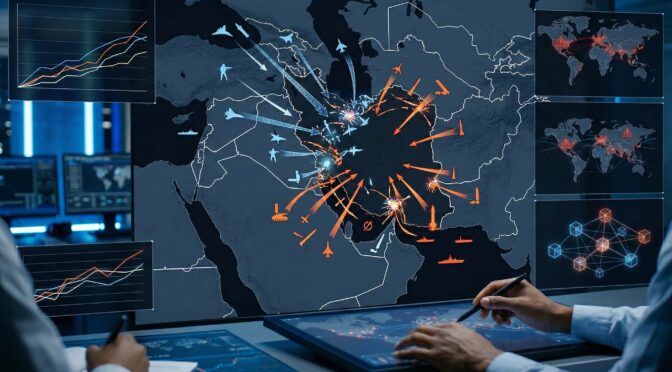
The global security environment experienced a severe, multi-theater destabilization during the week ending February 28, 2026. The defining characteristic of this period is the abrupt transition of long-simmering proxy conflicts, border disputes, and diplomatic standoffs into direct, state-on-state conventional warfare across two primary geopolitical nodes. The most critical development occurred in the Middle East, where the United States and Israel launched a massive, coordinated preemptive strike against the Islamic Republic of Iran. This operation effectively terminated the fragile diplomatic track in Geneva and sparked immediate, large-scale ballistic missile retaliation against Israeli territory and U.S. military installations across the Gulf Cooperation Council (GCC) states. This escalation represents the most significant conflict in the region in decades, immediately threatening global energy markets, spiking crude oil prices, and carrying the imminent risk of a broader regional war involving multiple proxy networks, including the Lebanese Hezbollah, the Yemeni Houthis, and Iraqi militias.

Simultaneously, the South Asian theater erupted into what Pakistani defense officials have formally declared an “open war” with the Taliban-led government in Afghanistan. Following months of escalating cross-border friction and Islamabad’s accusations of militant sanctuary, the Pakistan Air Force executed deep-penetration strikes against military targets in Kabul, Kandahar, and Paktia. This horizontal escalation highlights a complete rupture in the historically complex relationship between Islamabad and the Afghan Taliban, replacing localized border skirmishes with high-intensity aerial bombardment and mechanized ground operations. The sudden eruption of this conflict introduces severe instability into a region already grappling with extreme economic fragility and extremist proliferation, prompting urgent, though currently ineffective, mediation offers from China, Russia, and Iran.

In Eastern Europe, the Russia-Ukraine war crossed its four-year milestone. Contrary to Russian domestic messaging suggesting an inevitable victory and an imminent end to Western sanctions, Ukrainian forces executed localized but highly effective counterattacks, securing their most significant territorial gains since mid-2024. However, the staggering attrition rate-with Russian casualties estimated to have reached 1.2 million dead and wounded-underscores the brutal, grinding nature of the conflict as trilateral peace negotiations in Geneva ended in a near-breakdown. The battlefield reality reveals a Russian military struggling with severe force generation challenges, tactical overextension, and critical communications vulnerabilities.

Beyond these primary theaters, structural instability continues to metastasize in the Global South and the Indo-Pacific. In the South China Sea, the People’s Republic of China has significantly advanced its grey-zone tactics, utilizing military drones to spoof commercial and foreign military transponder signals in what analysts assess to be rehearsals for a Taiwan contingency, prompting joint maritime exercises by the US, Japan, and the Philippines. Concurrently, civil conflicts in Sudan and Myanmar reached grim milestones characterized by escalating civilian atrocities, the systematic targeting of infrastructure, and the growing influence of external actors such as Russia and the United Arab Emirates. In the Sahel, Burkina Faso has centralized military power amid surging extremist violence, while in the Caribbean, Haiti’s political deadlock threatens to undermine fragile security gains achieved by the UN-backed Gang Suppression Force. In East Asia, North Korea utilized a major party congress to explicitly signal dynastic succession.

In sum, the intelligence picture for the week ending February 28, 2026, depicts a highly volatile international system characterized by the failure of deterrence mechanisms, the collapse of diplomatic off-ramps, and the normalization of high-intensity kinetic solutions by state actors across multiple continents.

1. Middle East Theater: The US-Israel-Iran War

1.1 The Collapse of the Geneva Track and Diplomatic Prelude

The outbreak of direct, state-on-state warfare in the Middle East was preceded by the rapid and total collapse of the trilateral nuclear negotiations in Geneva between the United States, Israel, and the Islamic Republic of Iran.1 Throughout mid-to-late February 2026, U.S. President Donald Trump established a hardline negotiating posture, issuing an ultimatum that gave Iran a “10 to 15 days” window to capitulate to sweeping demands or face military intervention.3 The core U.S. demands were maximalist: the complete dismantling of Iran’s fortified nuclear facilities at Fordow, Natanz, and Esfahan; the immediate transfer of all highly enriched uranium out of the country; and a binding commitment to a permanent agreement completely devoid of the “sunset clauses” that characterized previous frameworks.1

While U.S. negotiators signaled a marginal willingness to permit token, low-level uranium enrichment strictly for medical purposes-provided Iran could verifiably prove an inability to weaponize the material-the accompanying offer of only “minimal sanctions relief” was deemed fundamentally unacceptable by Tehran.1 Iranian Foreign Minister Abbas Araghchi and other unspecified Iranian officials consistently communicated that the termination of all U.S. and United Nations Security Council (UNSC) sanctions was an absolute prerequisite for any deal, firmly refusing to destroy domestic nuclear infrastructure or export enriched material.1 Araghchi’s attempts to counter-propose alternatives-such as diluting enrichment levels or establishing a regional enrichment facility on Iranian soil-were interpreted by U.S. intelligence not as good-faith negotiations, but as classic delay tactics designed to stall an impending military strike while Iran fortified its defenses.3

During this diplomatic tightrope, internal friction regarding strategic messaging emerged within the U.S. administration. U.S. Secretary of State Marco Rubio circulated a classified memo to Middle Eastern diplomatic posts strictly rebuking unauthorized public statements that could inflame regional audiences or harden Iran’s position.5 This directive was widely interpreted as a direct reprimand of the U.S. Ambassador to Israel, Mike Huckabee, whose recent inflammatory public remarks claiming a biblical right to Middle Eastern land had caused alarm within the White House during the sensitive final days of the Kushner-Witkoff diplomatic mission.5

Concurrent with the failing diplomacy, the U.S. executed the largest regional airpower and naval buildup since the 2003 invasion of Iraq.6 The deployment included positioning the USS Gerald R. Ford carrier strike group off the coast of Haifa, Israel, alongside the USS Abraham Lincoln strike group already in the region.6 Furthermore, the U.S. Air Force surged advanced stealth capabilities, routing six additional F-22A Raptor fighter jets to RAF Lakenheath to join supporting tankers, bringing the total number of F-22s moving east to 24, with 11 already forward-deployed to Israel.7 Recognizing the imminent threat, Iran accelerated its own military readiness. Key Iranian military commanders conducted emergency inspections of naval and air defense bases, particularly the Khatam ol Anbiya Air Defense bases and the Madinah ol Munawarah Operational Base in Bandar Abbas, while conducting live-fire drills in the Strait of Hormuz.3 In a highly indicative move of impending conflict, satellite imagery revealed the complete evacuation of U.S. aircraft from Al Udeid Air Base in Qatar, leaving only a single KC-135 tanker, in anticipation of retaliatory ballistic missile strikes.7 Shortly before the strikes, the U.S. Embassy in Israel ordered the evacuation of all non-emergency personnel and their families, explicitly advising citizens to depart while commercial flights remained viable.7

1.2 “Operation Epic Fury”: The Preemptive Strike

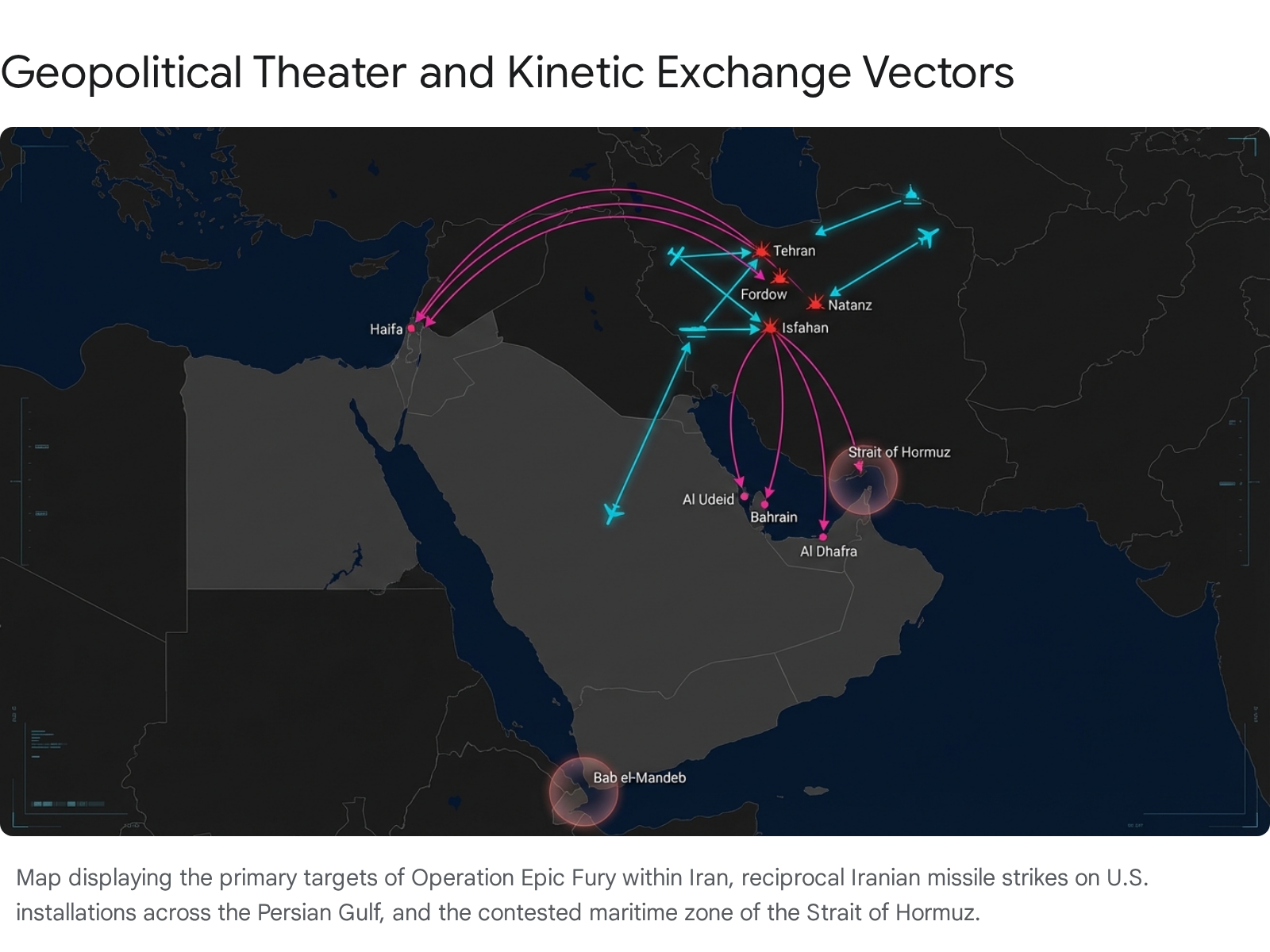
The diplomatic deadlock culminated on Saturday, February 28, 2026, when the United States and Israel launched a massive, coordinated preemptive military assault against Iran, officially designated by the Pentagon as “Operation Epic Fury”.10 President Trump announced the commencement of “major combat operations” aimed at eliminating the “existential threat” posed by the Iranian regime’s nuclear and ballistic missile programs, explicitly warning that the U.S. intended to “raze their missile industry to the ground” and “annihilate their Navy”.11

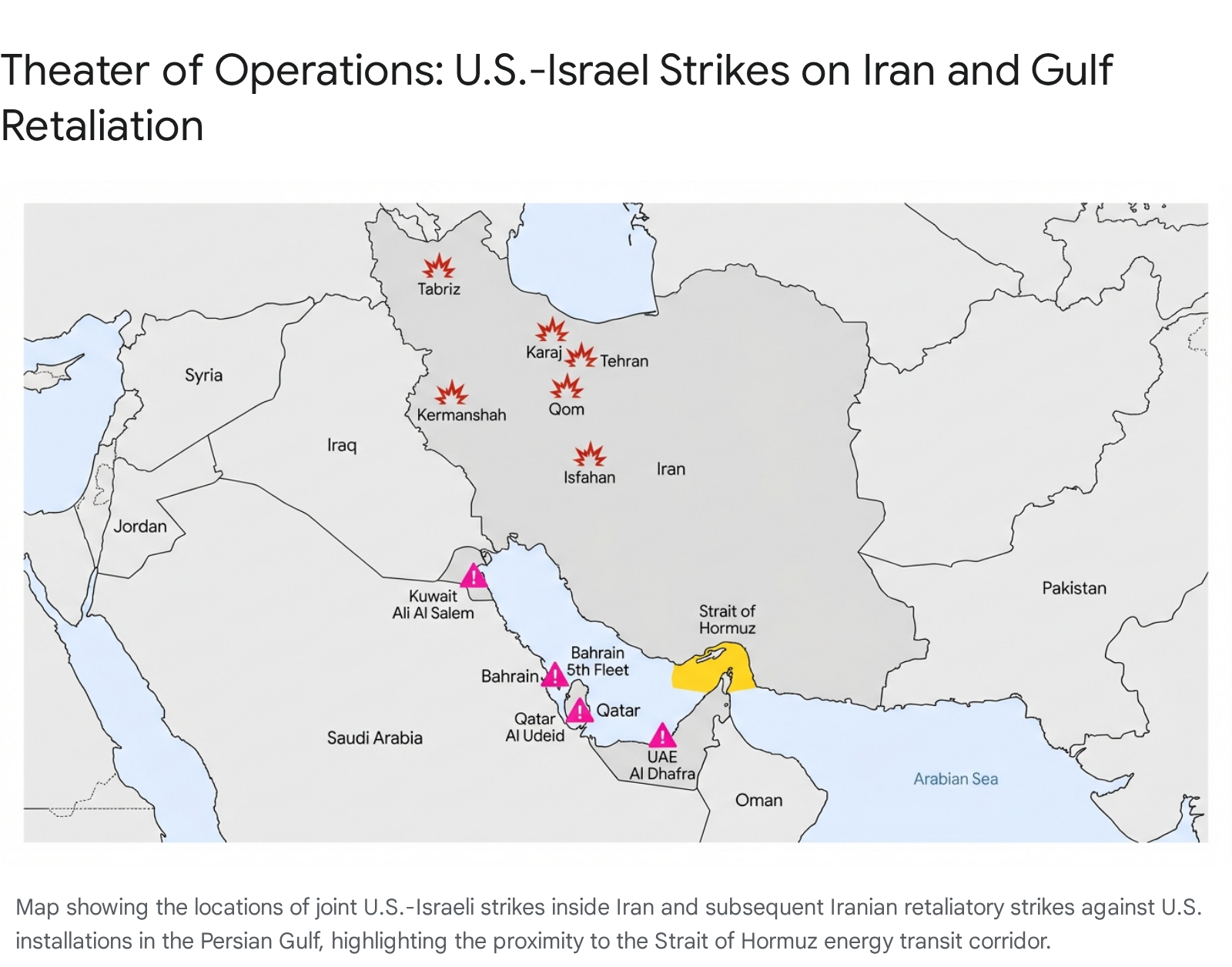
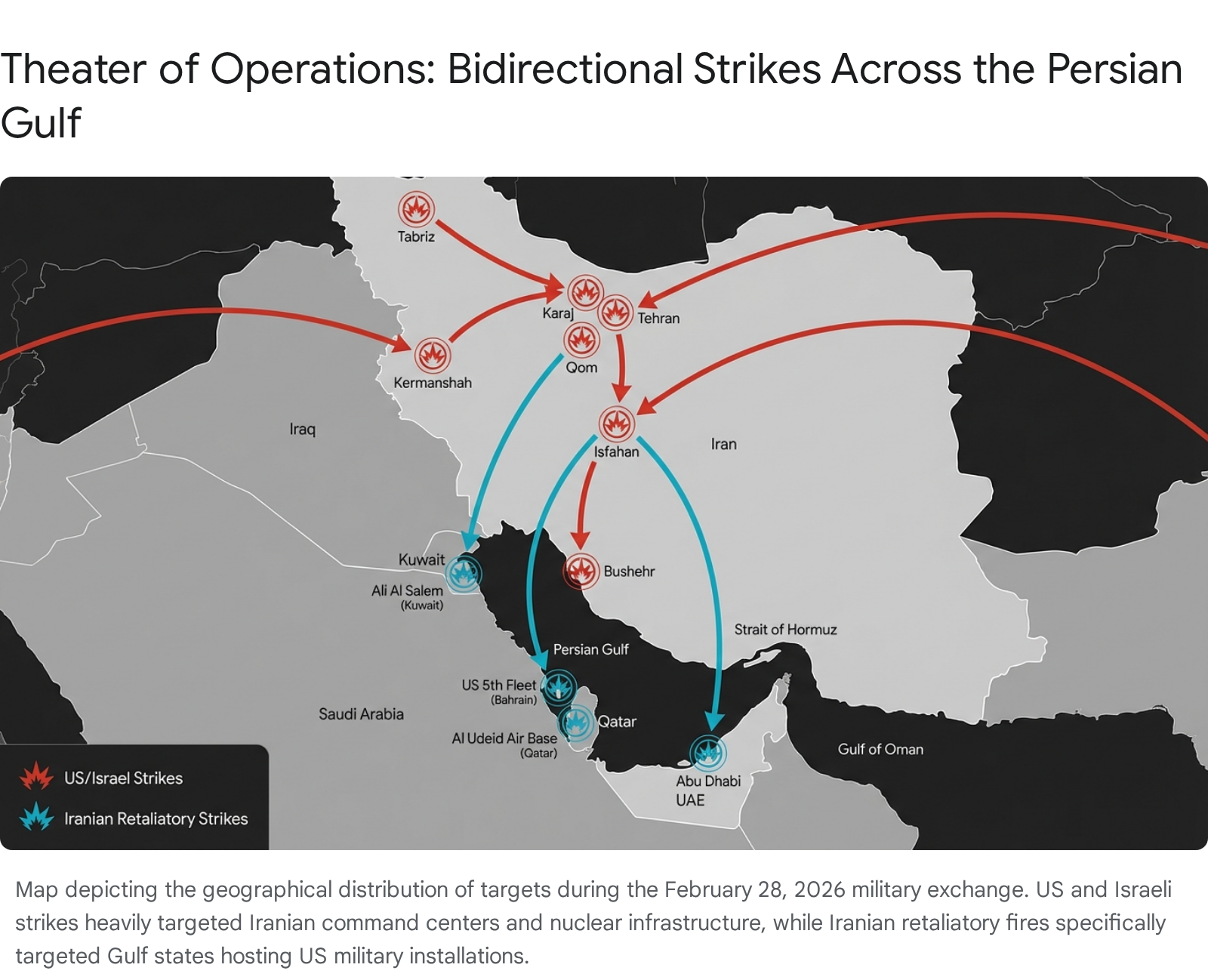
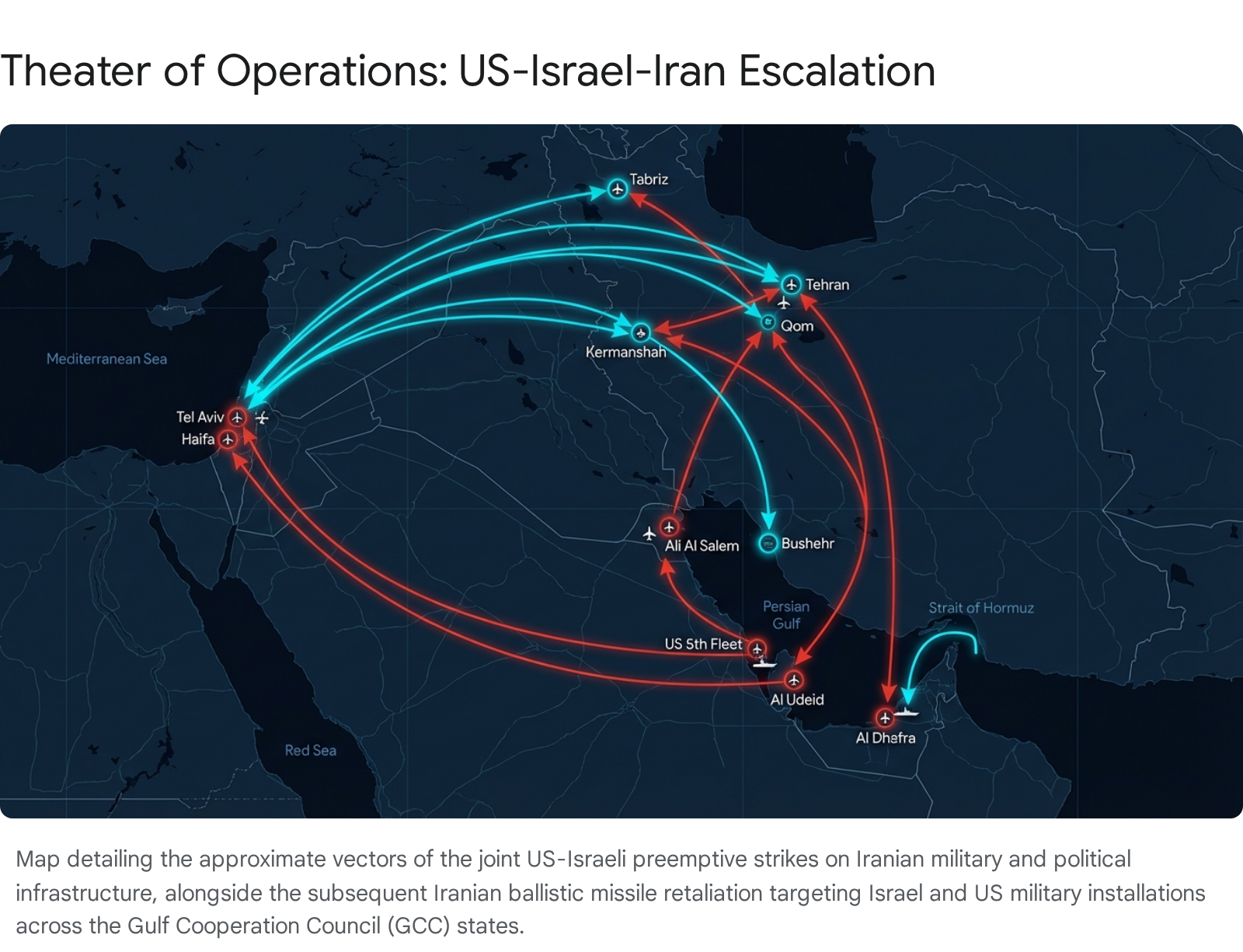
The joint US-Israeli strikes were unprecedented in scale, targeting the core of Iran’s military, nuclear, and political infrastructure across multiple provinces. Widespread explosions were confirmed in Tehran, Tabriz, Qom, Karaj, Khorramabad, Kermanshah, and Ilam, accompanied by deliberate severing of mobile phone services to disrupt Iranian command and control.12 The Israeli Defense Forces (IDF) confirmed striking hundreds of Iranian military targets, including active missile launchers situated in the western provinces.15 Iranian state media also reported strikes on the southern port city of Bushehr, raising critical alarms regarding potential damage to nuclear-related facilities located in the vicinity.14

Most notably, early waves of the assault targeted the office complex of Supreme Leader Ayatollah Ali Khamenei in central Tehran.11 This compound is long considered the operational and symbolic epicenter of the Islamic Republic’s authority. While intelligence reports indicate Khamenei had been relocated to a secure, undisclosed bunker prior to the impact (a protocol established during previous escalations in 2025), the psychological and strategic intent of the strike was a clear attempt at regime decapitation.11

The operation was accompanied by overt political warfare. President Trump publicly framed the military campaign as a catalyst for regime change, explicitly calling on the Iranian populace to “seize control of your destiny” and “take over your government,” framing the moment as a generational opportunity to topple the Islamic leadership that has ruled since 1979.11 He concurrently issued an ultimatum to the Islamic Revolutionary Guard Corps (IRGC) to lay down their arms or face “certain death”.12 Footage emerging from Tehran showed mixed domestic reactions; while significant panic ensued, some bystanders were recorded celebrating and laughing near the site of the Supreme Leader’s struck compound, referring to it as the “leader’s house”.14

The civilian toll of the preemptive strikes has been severe and immediate. Iranian state-run media (IRNA) reported that at least 40 people were killed at a girls’ school in southern Iran due to the strikes.15 Iran’s Interior Ministry condemned the attacks as severe violations of international law, declaring a national crisis and mobilizing provincial governors to maintain public order amid the bombardment.10

1.3 Iranian Retaliation: The Regionalization of the Conflict

The Islamic Republic of Iran’s response to Operation Epic Fury was rapid, fulfilling previous warnings of a “crushing” retaliation unconstrained by previous red lines.12 The Supreme National Security Council confirmed the commencement of a “decisive response,” ordering the closure of schools and universities while keeping banks operational to manage panic.10 Within hours of the initial U.S.-Israeli strikes, the IRGC launched a massive, multi-wave ballistic missile and drone barrage targeting the State of Israel.12 Explosions shook northern Israel, including the port city of Haifa, as the nation’s multi-layered air defense systems engaged incoming munitions, leading to the indefinite closure of all educational institutions, mass gatherings, and civilian airspace.16

However, the most strategically disruptive element of the Iranian retaliation was the deliberate horizontal escalation across the Arabian Peninsula. In a move that fundamentally alters the security architecture of the Middle East, Iran directly targeted sovereign GCC states hosting U.S. military installations. Iranian state media announced that “all” U.S. bases in the Middle East were now legitimate targets.13 Intelligence confirms that specific retaliatory ballistic missile strikes were directed at:

  • The U.S. Navy’s Fifth Fleet headquarters in Manama, Bahrain.13
  • The Al Udeid Air Base in Doha, Qatar.13
  • The Ali Al Salem Air Base in Kuwait.13
  • The Al Dhafra Air Base in the United Arab Emirates.13
  • Unspecified U.S. military installations in Jordan.13

The defense ministries of the targeted GCC nations confirmed widespread airspace closures and air defense interceptions.12 Shrapnel from an intercepted Iranian missile over Abu Dhabi resulted in at least one civilian fatality, marking a severe escalation by bringing lethal kinetic conflict to a sub-region that historically relies on U.S. security guarantees to maintain peace and facilitate global commerce.12
Yugo M85/M92 dust cover quick takedown pin installed

1.4 Proxy Activation: The “Ring of Fire” Ignites

The outbreak of direct war triggered the immediate activation of Iran’s broader “Axis of Resistance,” plunging neighboring theaters into renewed violence. In Lebanon, the fragile ceasefire established between Israel and Hezbollah in November 2024 collapsed entirely.20 Citing intelligence that Hezbollah was utilizing underground tunnels to rearm and plan incursions, the IDF launched extensive preemptive strikes against Hezbollah infrastructure in southern Lebanon and the Beqa’a Valley.19 These operations resulted in the elimination of at least eight Hezbollah operatives, including a senior commander, and the deaths of at least 12 individuals in southern Lebanon, prompting severe protests from the Lebanese government regarding sovereignty violations.21

In Yemen, the Houthi movement seized upon the regional chaos to announce the immediate termination of their unwritten non-aggression pact with the Trump administration.25 Senior Houthi officials declared a resumption of their aggressive missile and drone campaign targeting both the Red Sea commercial shipping corridor and Israeli territory, with strikes commencing immediately.26 This effectively nullifies the temporary security gains achieved in late 2025 and directly threatens international maritime commerce once again.26

In Iraq, the threat of militia involvement materialized rapidly. Prior to the strikes, U.S. and Israeli intelligence monitored high-level meetings between Iranian operatives and allied Iraqi militias, including Kataib Hezbollah, coordinating contingency plans.17 Kataib Hezbollah had explicitly threatened the Kurdistan Regional Government (KRG) against facilitating any U.S. or Israeli attacks.1 Following the outbreak of hostilities, an alleged drone strike-unclaimed but suspected to be part of the broader US-Israeli operation-hit a Kataib Hezbollah headquarters in Iraq, killing two operatives and wounding three, further drawing the Iraqi theater into the conflagration.29 The U.S. Embassy in Qatar, UAE, and Israel subsequently issued blanket “shelter in place” orders for all diplomatic staff and American citizens.11

1.5 Macroeconomic Shocks and Energy Market Volatility

The transition to open warfare in the Persian Gulf has immediately injected profound volatility into global financial and energy markets. The primary vector of systemic economic risk is the Strait of Hormuz, a maritime chokepoint through which approximately 14 million barrels of oil per day-roughly 20% of global supply-transit to international markets.11 Historically, Iran has utilized the implicit threat of closing the strait, or harassing vessels within it, as its ultimate asymmetric economic weapon.6

Prior to the strikes, energy markets had already begun to price in a heavy geopolitical risk premium. By late February, West Texas Intermediate (WTI) crude was trading at $67.02 per barrel, with Brent crude at $72.87.31 Following the commencement of major combat operations, energy analysts at BloombergNEF and Barclays projected that oil prices could swiftly surge to between $80 and $91 per barrel, depending heavily on the duration of the conflict and the extent of kinetic damage to Iranian energy extraction and export infrastructure.32 Economic modeling suggests that an energy price shock of this magnitude could generate an additional 1.2% to 2.5% of inflationary pressure globally, fundamentally disrupting central bank interest rate trajectories and extending economic recovery timelines by 6 to 12 months.31

The broader financial markets reacted with acute stress and a rapid flight to safety. Cryptocurrencies, which trade continuously over the weekend, served as the initial barometer for global investor panic. Bitcoin (BTC) plummeted 3.1% to $63,561 immediately following the announcement of the strikes, a level unseen since early February 2026.4 Conversely, safe-haven assets saw an immediate and aggressive influx of capital. On the COMEX, gold prices surged 2% to $5,296.40 an ounce (a single-day jump of $102.20), while silver soared nearly 8% to $93.82 an ounce.36 Global stock indices, already pressured by sticky, hotter-than-expected inflation data in the U.S., slumped significantly; the Dow Jones dropped over 521 points (1%), and the Nasdaq fell 210 points.35

Furthermore, the resumption of Houthi attacks in the Red Sea threatens to reverse the recent normalization of Suez Canal traffic. Container carriers like CMA CGM SA, which had recently restarted Red Sea transits, announced they will once again divert Asia-Europe services around the Cape of Good Hope due to the “complex and uncertain international context”.30 This diversion will reintroduce severe delays, consume excess shipping capacity, and exponentially increase global freight costs, compounding the inflationary pressures generated by the crude oil spike.30

Market IndicatorPre-Strike Level (Late Feb)Post-Strike Projection/ReactionSystemic Impact
Brent Crude Oil$72.87 / barrel$80.00 – $91.00 / barrelHigh risk of 1.2% – 2.5% global inflation increase.
Gold (COMEX)$5,194.20 / oz$5,296.40 / oz (+2.0%)Massive flight to safe-haven assets.
Silver (COMEX)$86.99 / oz$93.82 / oz (+8.0%)Extreme safe-haven demand spike.
Bitcoin (BTC)~$65,595$63,561 (-3.1%)Immediate sell-off of high-risk assets.
Dow Jones49,499.1848,977.90 (-1.0%)Equity markets reacting to dual inflation/war threat.

2. South Asia: Pakistan-Afghanistan “Open War”

2.1 Operation Ghazab lil-Haq and Aerial Engagements

The security paradigm in South Asia deteriorated drastically on February 27, 2026, when Pakistan’s Defence Minister Khawaja Asif formally declared a state of “open war” against the Taliban-led government of Afghanistan, stating that Islamabad’s “cup of patience has overflowed”.38 This declaration marked the culmination of months of escalating border skirmishes and devastating terror attacks within Pakistan, which Islamabad attributes to militant groups operating with impunity from Afghan sanctuaries.38

In a massive escalation of force, the Pakistan Air Force (PAF) launched “Operation Ghazab lil-Haq” (Righteous Fury), executing deep-penetration airstrikes and coordinated artillery barrages across multiple Afghan provinces, including the capital Kabul, Kandahar, Paktia, and Nangarhar.38 The PAF systematically targeted core Afghan military infrastructure. Intelligence confirms the destruction of the 313 Brigade headquarters, the 201 KBW Brigade headquarters, and the 205 Brigade headquarters situated in Kabul and Kandahar.43 Additional strategic targets included Taliban intelligence command centers, ammunition depots in Nangarhar, and a massive military compound adjacent to the Pul-e-Charkhi prison east of Kabul.43

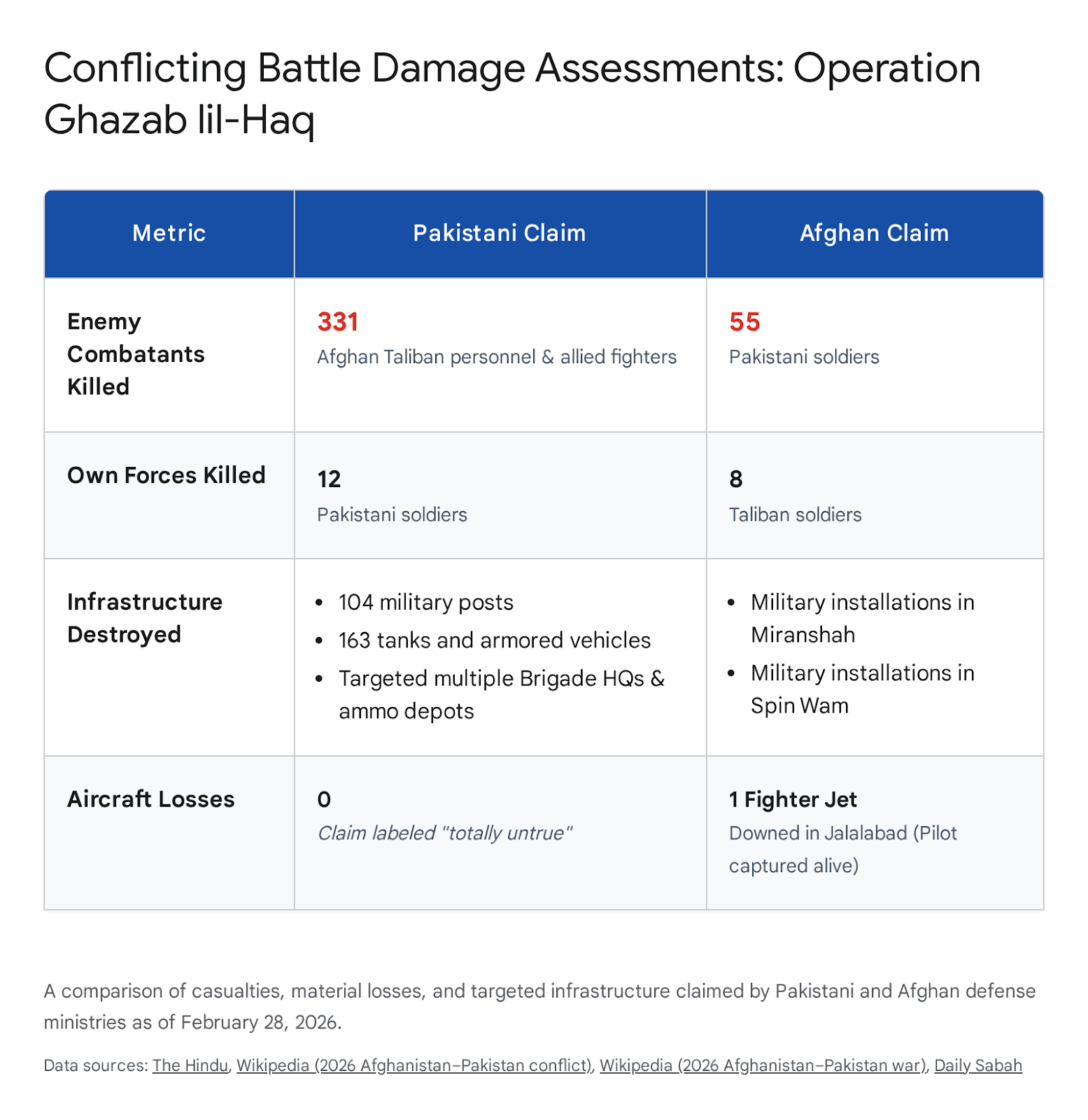
The kinetic exchange resulted in high casualties and highly conflicting narratives typical of information warfare environments. Pakistan’s Information Minister Attaullah Tarar and military spokespersons reported that the strikes killed 331 Afghan Taliban personnel and allied terrorist operatives, wounding over 500.38 The Pakistani military claimed the destruction of 104 military posts, the capture of 22 border posts, and the destruction of 163 tanks and armored vehicles across 37 locations, while acknowledging the loss of 12 of its own soldiers in the initial border clashes.38 Conversely, the Afghan Ministry of National Defense claimed to have killed 55 Pakistani soldiers and captured 19 border bases during retaliatory ground operations, codenamed Operation ‘Rad al-Zulm’, which reportedly included the use of drone strikes against Pakistani military camps in Miranshah and Spinwam.40

A critical and highly contested incident emerged on February 28 when Afghan police and military officials in Jalalabad claimed to have shot down a Pakistani fighter jet in the city’s sixth district.38 Witnesses reported hearing the jet followed by two explosions near Jalalabad airport, with residents observing a pilot ejecting and subsequently being captured alive.38 Pakistan’s Foreign Ministry vehemently denied the claim, labeling the downing of the aircraft as a complete fabrication.38
Yugo M85/M92 dust cover quick takedown pin installed

2.2 Border Dynamics and the Root Causes of War

The immediate catalyst for Pakistan’s massive aerial campaign was a severe wave of deadly terrorist attacks within its borders in early-to-mid February 2026. These included a devastating suicide bombing at a Shiite mosque in the capital city of Islamabad that killed 36 people, and an attack on a military checkpoint in Bajaur that killed 11 soldiers.42 Islamabad placed the blame squarely on the Tehrik-e-Taliban Pakistan (TTP), a militant organization closely allied with the Afghan Taliban that actively seeks to overthrow the Pakistani state.42 Following these attacks, the Pakistani government issued a formal démarche to the Afghan ambassador on February 19, explicitly warning that it would launch air operations inside Afghanistan if the Taliban did not dismantle the militant sanctuaries.43 The Afghan Taliban routinely denies these allegations, framing Pakistan’s kinetic counter-terrorism operations as unacceptable violations of sovereignty, thereby creating a self-sustaining cycle of mutual blame and retaliation.41

However, the deeper, structural driver of this conflict is the fundamentally unresolved status of the Durand Line. This 2,640-kilometer border, drawn by the British in 1893, has never been officially recognized by any Afghan government, including the current Taliban regime.40 Friction over border management is constant and highly volatile. Pakistan’s extensive fencing projects, the construction of military outposts, and fierce disputes over control of customs revenues at vital chokepoints like Torkham and Spin Boldak/Chaman create a perpetual environment of tactical confrontation.40 The economic toll of this escalation is already severe; trade has been completely halted, and hundreds of residents living near the Torkham border crossing have been forced to flee to safer areas, exacerbating an already dire humanitarian situation.45

2.3 Regional Diplomatic Interventions

The rapid descent into conventional warfare between two heavily armed states-one of which is a nuclear power-has profoundly alarmed the international community, triggering intense fears of a regional spillover that could destabilize the entirety of Central and South Asia. The United Nations Secretary-General António Guterres expressed deep concern over the escalation’s impact on civilians, demanding an immediate cessation of hostilities, while the European Union’s foreign policy chief urged urgent de-escalation.38

Regional powers have moved quickly to offer mediation, recognizing the catastrophic potential of a prolonged conflict. The Islamic Republic of Iran, despite being under intense military assault from the US and Israel simultaneously, issued a statement via Foreign Minister Abbas Araghchi expressing readiness to “facilitate dialogue” and enhance understanding between Kabul and Islamabad.38 The Russian Foreign Ministry demanded an immediate halt to cross-border attacks, urging both sides to pursue a diplomatic resolution.38 China’s Foreign Ministry announced that Beijing was “deeply concerned” and was actively talking to both sides to secure a ceasefire as quickly as possible.38 Conversely, the U.S. State Department issued a statement backing Pakistan’s “right to defend itself” against the Afghan Taliban, highlighting a complex alignment of geopolitical interests where the U.S. rhetorically supports Islamabad’s counter-terrorism narrative while simultaneously engaging in major combat operations in the Middle East.38

3. Eastern Europe: Russia-Ukraine Conflict at Year Four

3.1 Ukrainian Tactical Gains and Shifting Battlefield Dynamics

As the Russian invasion of Ukraine crossed its grim four-year anniversary on February 24, 2026, the realities on the battlefield stood in direct contradiction to Moscow’s domestic narrative that a Russian victory is both inevitable and imminent. Recent weeks have seen the Ukrainian Armed Forces (AFU) execute a series of successful, localized counterattacks, achieving their most significant territorial gains since the daring Kursk Oblast incursion in August 2024, and liberating the most territory within Ukraine itself since the comprehensive 2023 counteroffensive.48

Throughout early February 2026, Ukrainian forces launched aggressive operations in the Novopavlivka, Oleksandrivka, and Hulyaipole directions across the Dnipropetrovsk and Zaporizhia oblasts. Intelligence confirms that these efforts resulted in the liberation of approximately 200 square kilometers of territory.48 When accounting for minor Russian advances in adjacent sectors (which totaled roughly 35 square kilometers), Ukraine achieved a net territorial gain of 165 square kilometers for the month.48 Furthermore, in the highly contested Kupyansk sector (Kharkiv Oblast), Ukrainian forces successfully stabilized their control over the town following a mid-December counterattack that retook 183 square kilometers, holding these gains against repeated Russian counter-assaults.48

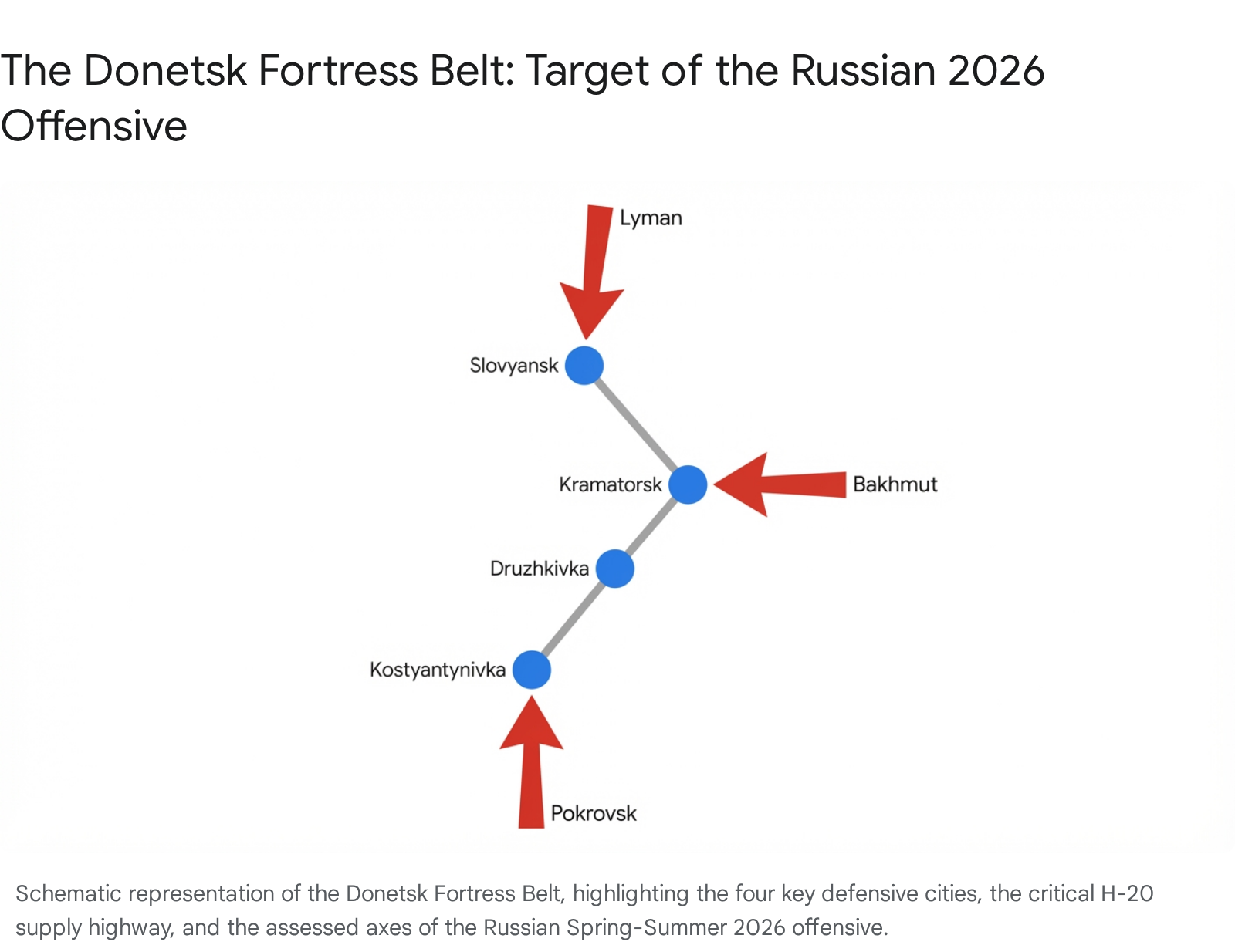
These Ukrainian successes have been instrumental in severing vital Russian ground lines of communication (GLOCs) and thoroughly disrupting Moscow’s preparations for a planned Spring-Summer 2026 offensive. By maintaining operational tempo, the AFU has forced Russian troops into a reactive defensive posture, preventing them from marshaling fresh reserves.48 These gains are attributed to a combination of Ukrainian tactical agility and profound Russian systemic vulnerabilities. Russian forces have continually suffered from tactical overextension, frequently utilizing small infantry infiltration units that advance much faster than their logistical supply lines can follow, leaving them highly exposed to Ukrainian counter-maneuvers.48 Additionally, Russian command and control has been severely degraded by ongoing communication failures. This degradation was exacerbated by Ukraine’s successful, coordinated efforts (in conjunction with Elon Musk) to block the illegal use of Starlink terminals by Russian forces, compounded by the Kremlin’s self-inflicted throttling of the Telegram messaging app, a platform heavily relied upon by Russian frontline units for tactical coordination.48

3.2 Russian Force Generation Crisis and Staggering Attrition

The Russian military apparatus is currently facing a severe and compounding force generation crisis. The Kremlin’s strategy of grinding, attritional warfare has exacted a catastrophic and potentially unsustainable toll on Russian personnel. According to comprehensive intelligence estimates compiled in February 2026 by Western officials, independent media outlets (such as Mediazona and the BBC), and leading think tanks, total Russian casualties (killed and wounded) have reached an estimated 1.2 million personnel since the war began.49

Of this staggering figure, the number of Russian soldiers killed in action is estimated to be between 230,000 and 430,000.49 Western intelligence indicates that the years 2024 and 2025 were particularly brutal, accounting for approximately 430,000 and 415,000 total casualties respectively.49 This immense rate of attrition has completely outpaced the Kremlin’s ability to replenish its ranks through voluntary mobilization. In January 2026, the Russian casualty rate surpassed its recruitment rate for the first time in years.48 The Russian government is increasingly struggling to finance its recruitment efforts, facing severe difficulties at both the federal and local levels to payout the massive cash incentives required to attract contract volunteers.48 Consequently, the forces currently occupying the front lines are described as severely attrited, exhausted, and worn down, heavily limiting their capacity to conduct sustained offensive operations.48

3.3 Diplomatic Stagnation and Information Warfare

Despite the shifting battlefield momentum and the immense human cost borne by both nations, the diplomatic track remains entirely deadlocked. The third round of trilateral peace negotiations, held in Geneva in late February, ended abruptly and without resolution.2 Moscow’s lead negotiator, Vladimir Medinsky, appeared visibly defeated following sessions that diplomatic sources characterized as a near-breakdown.2

A profound disconnect exists between the Kremlin’s domestic messaging and the stark reality at the negotiating table. On Russian state television, a highly coordinated effort is underway to depict President Vladimir Putin as a statesman actively and genuinely seeking peace.2 State-approved commentators have begun openly discussing optimistic “post-war” scenarios, including the imminent lifting of Western sanctions.2 Analysts assess this narrative is carefully crafted to appease a domestic audience that is increasingly weary of the four-year conflict and the massive, undeniable casualty counts.2 However, the reality of Western resolve remains firm. NATO Secretary General Mark Rutte, speaking at a commemoration ceremony in Brussels on February 24, reiterated the alliance’s unwavering support for Ukraine. Rutte emphasized that “Putin must show if he is serious about peace” and stressed that Ukraine continues to require daily deliveries of ammunition and financial aid to successfully blunt Russian aggression from the skies and hold the frontlines.50

4. Indo-Pacific: South China Sea Tensions and Myanmar Civil War

4.1 Chinese Grey-Zone Tactics and Transponder Spoofing

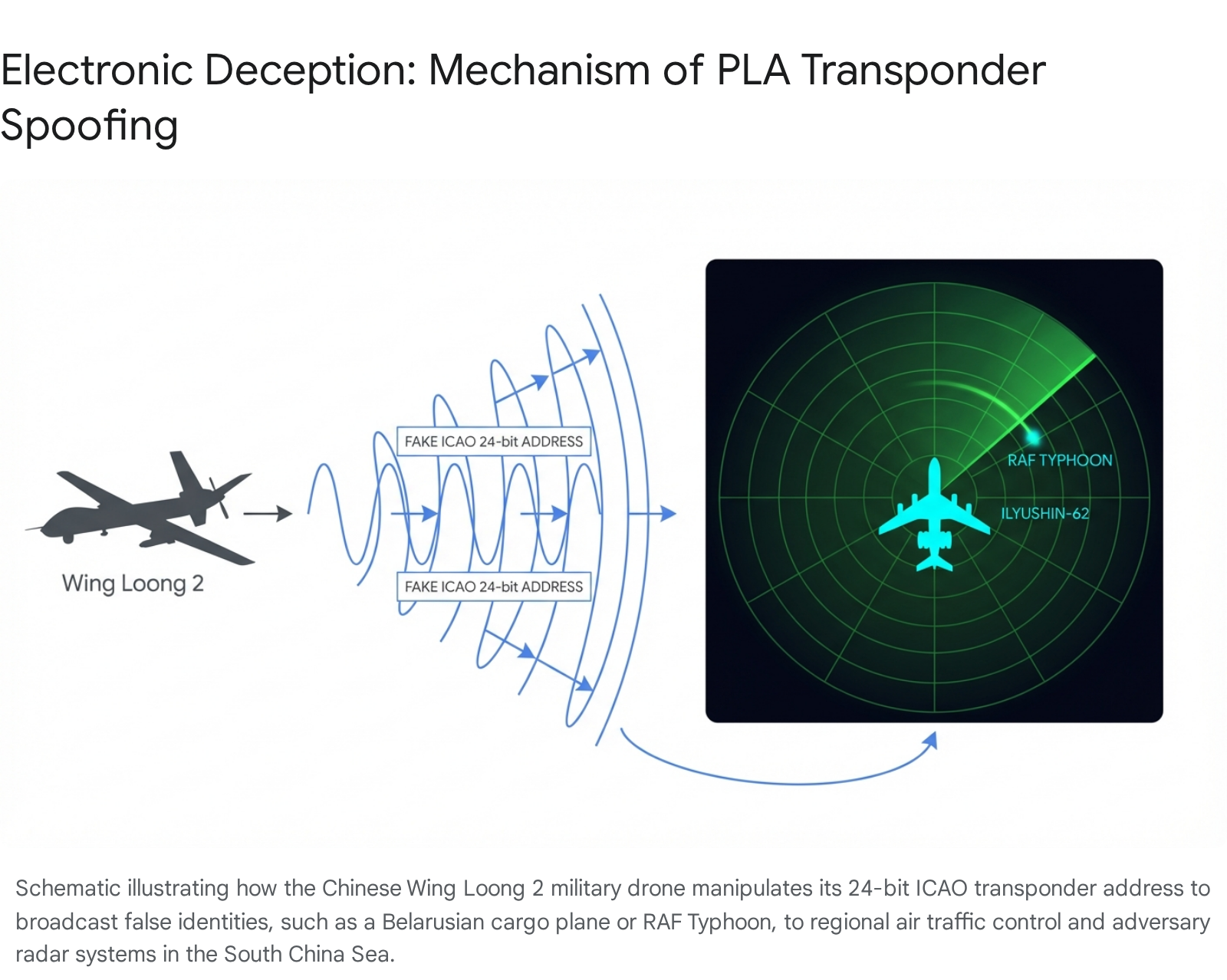
In the highly contested waters of the South China Sea, the People’s Republic of China (PRC) has significantly escalated its “grey-zone” operations, deploying advanced electronic deception tactics that military and security analysts assess as a direct rehearsal for a potential invasion of Taiwan.51 Intelligence confirms that since August 2025, a large Chinese military drone-identified as a Wing Loong 2 utilizing the call sign YILO4200-has conducted at least 23 masked flights originating from Hainan’s Qionghai Boao International Airport, a dual-use facility currently undergoing rapid expansion.51

These operations involve the drone manipulating its automatic dependent surveillance-broadcast (ADS-B) transponder to broadcast false 24-bit ICAO addresses, effectively masking its identity to appear as civilian or foreign military aircraft.51 The YILO4200 drone has been tracked successfully spoofing the identities of a sanctioned Belarusian Ilyushin-62 cargo plane, a Royal Air Force (RAF) Typhoon fighter jet, a North Korean passenger jet, and various anonymous executive jets.51 During one particularly complex flight on August 5-6, the drone rapidly switched its identity signal between four different aircraft types in a mere 20-minute span.51

The strategic objective of this transponder spoofing is the deliberate exploitation of the “kill chain” decision-making process during a high-intensity conventional conflict. By intentionally muddying the airspace picture, the People’s Liberation Army (PLA) aims to sow time-wasting confusion among enemy air traffic controllers and automated air defense systems, forcing adversaries to spend critical seconds verifying target identities before engaging.51 The flight paths of the YILO4200 have been highly provocative and strategically deliberate, flying star-shaped surveillance patterns near the disputed Paracel Islands (where China has constructed an estimated 20 military outposts), traversing the Bashi Channel (a critical naval chokepoint between Taiwan and the Philippines used to access the Pacific), and operating near U.S. and Japanese military bases in Okinawa.51
Yugo M85/M92 dust cover quick takedown pin installed

4.2 Alliance Architecture: Trilateral Maritime Exercises

In direct response to China’s expanding footprint and aggressive grey-zone tactics, the United States, Japan, and the Philippines conducted a joint maritime military exercise from February 20 to 26 in the South China Sea.53 The drills, which took place within the Philippines’ exclusive economic zone north of Luzon Island near Taiwan, involved a Philippine frigate (the Antonio Luna) and fighter jets, a Japanese Maritime Self-Defense Force P-3C patrol aircraft, and a U.S. military destroyer.53

The Philippine military explicitly stated the exercise was designed to enhance interoperability, reinforce maritime security, and improve Maritime Domain Awareness.53 The timing of the drill coincided directly with the increased Chinese drone activity and the illegal presence of Chinese navy ships in the area.53 Beijing’s Defense Ministry sharply criticized the drills, with spokesperson Zhang Xiaogang labeling the Philippines a “pure troublemaker and a peace disruptor” for co-opting non-regional countries.53 China asserted that the People’s Liberation Army Southern Theater Command conducted concurrent routine patrols to resolutely safeguard China’s territorial sovereignty.53

4.3 The Myanmar Theater: Junta Airstrikes and Russian Strategic Support

The civil war in Myanmar continues to exact a devastating toll on the civilian population five years after the February 2021 military coup. The ruling military junta, the State Security and Peace Commission (SSPC), facing a sustained and multi-front armed resistance from the National Unity Government (NUG), People’s Defence Forces (PDF), and various Ethnic Armed Organizations (EAOs), has increasingly relied on indiscriminate aerial bombardment to maintain territorial control.56 The conflict has resulted in approximately 4 million internally displaced persons and left a third of the population requiring humanitarian aid, compounded by a devastating 7.7 magnitude earthquake in March 2025.57

Throughout February 2026, the junta escalated its airstrikes, utilizing fighter jets, armed drones, paramotors, and gyrocopters to frequently target civilian infrastructure.58 Between February 4 and 17, documentation confirmed multiple attacks on healthcare facilities, bringing the staggering total number of attacks on medical infrastructure since the coup to 1,869.60 In one notable and tragic incident on February 17 in the Sagaing region, a public high school functioning as a makeshift hospital was targeted by three bombs dropped by a Myanmar military fighter jet, resulting in civilian fatalities.60 Furthermore, the junta continues to persecute the Rohingya minority, detaining over 500 Rohingya in late 2025 after intercepting their boat off the coast of Rakhine State.58

A critical factor enabling the junta’s aerial supremacy and battlefield resilience is the staunch strategic support of the Russian Federation. While China wields significant political and economic influence over both the junta and the EAOs, Russia has become Naypyidaw’s primary military benefactor.56 In early February 2026, Sergei Shoigu, Secretary of the Russian Security Council and a close confidant of Vladimir Putin, visited Myanmar.56 Shoigu became the first high-level foreign official to visit the country since the junta’s deeply flawed and exclusionary elections held in December 2025 and January 2026.56 During the visit, Shoigu praised the sham elections, criticized Western isolation narratives, and most importantly, signed a four-year military cooperation agreement.56 This agreement solidifies Russia’s vital role in supplying the intelligence, tactical advice (gleaned from the Ukraine conflict), and aviation hardware that currently sustains the junta’s brutal battlefield operations.56

5. Africa: Sudan’s 1,000 Days and the Sahel Crisis

5.1 Sudan at 1,000 Days: Frontline Shifts and Genocidal Hallmarks

In February 2026, the devastating civil war in Sudan crossed the grim milestone of 1,000 days of continuous conflict between the Sudanese Armed Forces (SAF) and the Rapid Support Forces (RSF).61 The war has precipitated the world’s worst displacement crisis, with over 11 million people displaced (including 4.5 million refugees fleeing to Chad, Ethiopia, and South Sudan) and an estimated 33.7 million people requiring urgent humanitarian assistance amid a catastrophic hunger crisis.63

Recent weeks have seen a dramatic intensification of combat characterized by shifting front lines and the deployment of advanced weaponry.61 Frontlines are highly volatile across North Darfur, North Kordofan, South Kordofan, and the Blue Nile states.62 In North Kordofan, the capital city of El Obeid remains besieged from three sides by the RSF, severely restricting civilian movement and aid delivery.61 The introduction of drone warfare has exacerbated civilian casualties; on February 17 and 18, separate drone strikes in the Kordofan region killed at least 57 people, prompting severe condemnations from the UN High Commissioner for Human Rights.61 Furthermore, the conflict threatens regional spillover, evidenced by Chad’s announcement that seven of its soldiers were killed in a confrontation with RSF elements.62

Most alarmingly, UN investigators and fact-finding missions have issued stark warnings regarding atrocities occurring in El Fasher (North Darfur). Following the RSF takeover of the city in late 2025, investigators have documented systemic acts bearing the explicit “hallmarks of genocide” directed against the Zaghawa and Fur ethnic communities.61 These atrocities include ethnically targeted summary executions, enforced disappearances, and widespread, systematic sexual violence, which UN officials have characterized as a “crisis within a crisis” threatening up to 12 million women and girls.61

Diplomatic efforts to secure a ceasefire remain largely ineffective due to the warring parties’ intransigence and the continued flow of weapons facilitated by regional sponsors, notably the United Arab Emirates and Saudi Arabia, who remain entrenched in their respective positions.63 However, the humanitarian community received a minor reprieve when an international donor conference, co-hosted by the US and the UN in Washington D.C. on February 3, secured $1.5 billion in fresh funding, including major contributions from the US ($200 million) and the UAE ($500 million).63

5.2 The Sahel Crisis: Burkina Faso’s Institutional Restructuring

The security environment in the Sahel continues to deteriorate rapidly, with Burkina Faso cementing its position as the undisputed epicenter of global extremist violence. Extremist groups, primarily the Al-Qaeda-affiliated Jama’at Nusrat al-Islam wal Muslimin (JNIM) and the Islamic State in the Greater Sahara (ISGS), operate with relative freedom across vast swaths of Burkina Faso, Mali, and Niger.65 In January and February 2026, JNIM maintained a high operational tempo in Burkina Faso’s Boucle de Mouhoun and Sahel regions, destroying critical infrastructure (such as a bridge linking Burkina Faso to Mali) and routinely overwhelming local defense units in towns like Madouba and Bani.67

In response to the deteriorating security situation and internal political paranoia, Burkina Faso’s military leader, Captain Ibrahim Traoré, implemented sweeping institutional changes in early 2026. After foiling an alleged coup plot orchestrated by a former junta leader with suspected ties to Côte d’Ivoire, Traoré reshuffled his cabinet to reward loyalists.66 Crucially, he elevated the status of the Brigade of Volunteers for the Defence of the Homeland (VDP)-a civilian militia central to the government’s counter-terrorism strategy but heavily implicated in human rights abuses-to the formal “rank of army”.67 Concurrently, the government decreed the dissolution of all political parties and ominously renamed the Ministry of Defence to the “Ministry of War and Patriotic Defence,” signaling a total militarization of the state apparatus.67

Amid this instability, the United States attempted a diplomatic rapprochement. State Department officials, including Nick Checker, visited Mali to convey respect for sovereignty and move past “policy missteps,” seeking targeted intelligence sharing with the junta-led Alliance of Sahel States (Burkina Faso, Mali, Niger).68 However, this overture is complicated by the juntas’ uninhibited hostility toward Western nations and their increasing reliance on Russian mercenary support.68

6. Caribbean: Haiti Security Crisis

6.1 Institutional Gridlock and Gang Suppression

The security and political crisis in Haiti remains highly acute. In early 2026, the United Nations Security Council unanimously adopted Resolution 2814, renewing the mandate of the United Nations Integrated Office in Haiti (BINUH) until January 31, 2027.69 The renewed mandate places a heavy emphasis on combating the rampant gang violence that has severely eroded state authority across the nation.

While the deployment of the UN-authorized Gang Suppression Force (which succeeded the Multinational Security Support mission in late 2025) has yielded fragile security gains-such as reopening key logistical roads in Port-au-Prince and the Artibonite Department, and restoring a basic state presence near the Champ de Mars-the overall environment remains highly unstable.69 The national homicide rate rose by nearly 20% in 2025.71 Complicating the security response is severe political deadlock within the Transitional Presidential Council.69 As the February 7, 2026 deadline for the Council’s mandate approaches, deep divisions persist over the transitional governance architecture required to lead the country toward newly proposed elections scheduled for early 2027.70 Civil society groups have condemned the lack of progress on security, casting doubt on the feasibility of holding safe elections under current conditions.70

7. East Asia: North Korean Succession Signaling

7.1 Dynastic Succession and Military Posturing

In East Asia, the Democratic People’s Republic of Korea (DPRK) utilized the closing stages of its Ninth Workers’ Party Congress in late February 2026 to engage in highly symbolic political theater aimed at solidifying the regime’s dynastic succession. The state-run Korean Central News Agency (KCNA) released rare imagery of Supreme Leader Kim Jong Un’s teenage daughter, Kim Ju Ae, firing a new sniper rifle at an outdoor military shooting range.74

The imagery-depicting Ju Ae peering through a scope, with a smoking barrel, and wearing a leather jacket that historically symbolizes authority within the Kim family-is assessed by intelligence analysts as a deliberate confirmation that she is receiving direct military training and is being groomed as the next in line to rule the secretive, nuclear-armed state.74 Furthermore, during the congress, Kim Jong Un’s powerful sister, Kim Yo Jong, was promoted to head the party’s general affairs department, a role akin to secretary-general, signaling a further consolidation of administrative control within the immediate Kim family.74

Interestingly, while the regime’s internal focus remains locked on securing the next generation of absolute leadership, its external military posturing showed subtle signs of restraint. The military parade commemorating the congress was notable for the complete absence of heavy military hardware, including transporter-erector-launcher vehicles used for ballistic missiles.78 This marks the first time in 13 parades that such hardware was omitted, a move South Korean intelligence assesses as a potential signal leaving room for future diplomatic engagement with the United States, even as Pyongyang tightly controls its nuclear leverage.75


Please share the link on Facebook, Forums, with colleagues, etc. Your support is much appreciated and if you have any feedback, please email us in**@*********ps.com. If you’d like to request a report or order a reprint, please click here for the corresponding page to open in new tab.


Sources Used

  1. Iran Update, February 26, 2026, accessed February 28, 2026, https://understandingwar.org/research/middle-east/iran-update-february-26-2026/
  2. February 22, 2026: Is Putin Looking for an Exit? – YouTube, accessed February 28, 2026, https://www.youtube.com/watch?v=HG8-gFISKpY
  3. Iran Update, February 20, 2026 | ISW, accessed February 28, 2026, https://understandingwar.org/research/middle-east/iran-update-february-20-2026/
  4. Trump says ‘massive’ strike against Iran underway – bitcoin plunge offers a glimpse of how markets could react, accessed February 28, 2026, https://www.morningstar.com/news/marketwatch/20260228135/trump-says-massive-strike-against-iran-underway-bitcoin-plunge-offers-a-glimpse-of-how-markets-could-react
  5. Marco Rubio orders US officials to stop commentary that could strain Iran talks, accessed February 28, 2026, https://www.theguardian.com/us-news/2026/feb/27/marco-rubio-iran-talks-mike-huckabee
  6. Iran’s Conflict With Israel and the United States – Council on Foreign Relations, accessed February 28, 2026, https://www.cfr.org/global-conflict-tracker/conflict/confrontation-between-united-states-and-iran
  7. U.S.–Iran Conflict Situation Update, accessed February 28, 2026, https://www.globalguardian.com/newsroom/u.s.-iran-conflict-situation-update
  8. Iran Update, February 24, 2026 | ISW, accessed February 28, 2026, https://understandingwar.org/research/middle-east/iran-update-february-24-2026/
  9. Travel Advisory Update (February 27, 2026), accessed February 28, 2026, https://il.usembassy.gov/travel-advisory-february-27-2026/
  10. UAE intercepts several Iranian missiles, state news agency says | Iran International, accessed February 28, 2026, https://iranintl.com/en/202602283447
  11. US and Israel launch a major attack on Iran and Trump urges Iranians to ‘take over your government’, accessed February 28, 2026, https://www.pbs.org/newshour/world/us-and-israel-launch-a-major-attack-on-iran-and-trump-urges-iranians-to-take-over-your-government
  12. Iran launches retaliatory strikes after major US-Israel attack – live – The Guardian, accessed February 28, 2026, https://www.theguardian.com/world/live/2026/feb/28/israel-attacks-iran-as-blasts-heard-in-tehran-live-updates?page=with:block-69a2ba118f08e575db5bd4af
  13. Live Updates: U.S. and Israel attack Iran, with Trump confirming “major combat operations”, accessed February 28, 2026, https://www.cbsnews.com/live-updates/israel-us-attack-iran-trump-says-major-combat-operations/
  14. Israel, United States strike Islamic Republic, targeting heart of regime, accessed February 28, 2026, https://www.iranintl.com/en/202602289915
  15. Iran-Israel conflict LIVE: U.S, Israel launch attacks across several Iranian cities; Iran retaliates with missiles targetting northern Israel, accessed February 28, 2026, https://www.thehindu.com/news/international/iran-israel-usa-conflict-strikes-attack-west-asia-us-trump-live-updates-february-28-2026/article70687247.ece
  16. Israel braces for missiles after Iran warns of ‘crushing’ retaliation against attacks – Al Arabiya, accessed February 28, 2026, https://english.alarabiya.net/News/middle-east/2026/02/28/iran-preparing-for-crushing-retaliation-against-israel-us-attacks-report
  17. The Latest: US and Israel attack Iran as Trump says US begins ‘major combat operations’, accessed February 28, 2026, https://www.wsls.com/news/world/2026/02/28/the-latest-israel-launches-attack-on-irans-capital/
  18. Bahrain says US Navy’s 5th Fleet headquarters hit in ‘missile attack’, accessed February 28, 2026, https://m.economictimes.com/news/defence/iran-israel-war-bahrain-says-us-navys-5th-fleet-headquarters-hit-in-missile-attack/articleshow/128880732.cms
  19. Israel attacks Iran and Hezbollah in Lebanon, imposes state of emergency, accessed February 28, 2026, https://www.pravda.com.ua/eng/news/2026/02/28/8023225/
  20. Lebanon’s Post-Ceasefire Rights Crisis Demands Urgent Government Action, accessed February 28, 2026, https://impactpolicies.org/news/810/lebanons-post-ceasefire-rights-crisis-demands-urgent-government-action
  21. Israel Army strikes Hezbollah infrastructure in south Lebanon, accessed February 28, 2026, https://www.thehindu.com/news/international/israel-army-strikes-hezbollah-infrastructure-in-south-lebanon/article70687168.ece
  22. Israel strikes Hezbollah sites in southern Lebanon amid ceasefire tensions – TRT World, accessed February 28, 2026, https://www.trtworld.com/article/3e7ed9f44e8f?utm_source=ee09b274f148&utm_medium=internal&utm_campaign=recommended&utm_content=inline
  23. Spotlight on Terrorism: Hezbollah and Lebanon (February 16-23, 2026), accessed February 28, 2026, https://www.terrorism-info.org.il/en/spotlight-on-terrorism-hezbollah-and-lebanon-february-16-23-2026/
  24. Israel army says striking Hezbollah infrastructure in south Lebanon, accessed February 28, 2026, https://www.arabnews.com/node/2634761/middle-east
  25. Yemen’s Iranian-backed Houthi rebels to resume attacks on shipping in the Red Sea corridor, 2 rebel officials tell AP, accessed February 28, 2026, https://lasvegassun.com/news/2026/feb/28/yemens-iranian-backed-houthi-rebels-to-resume-atta/
  26. Iranian-backed Houthis say they’ll resume attacks on Israel and on shipping routes, accessed February 28, 2026, https://www.timesofisrael.com/liveblog_entry/iranian-backed-houthis-say-theyll-resume-attacks-on-israel-and-on-shipping-routes/
  27. U.S. and Israel launch attack on Iran, Trump says ‘major combat operations’ have begun, accessed February 28, 2026, https://www.cp24.com/news/world/2026/02/28/us-and-israel-launch-attack-on-iran-trump-says-major-combat-operations-have-begun/
  28. Yemen’s Iranian-backed Houthi rebels to resume attacks on shipping in Red Sea corridor: Officials, accessed February 28, 2026, https://www.thehindu.com/news/international/yemens-iranian-backed-houthi-rebels-to-resume-attacks-on-shipping-in-red-sea-corridor-officials/article70687579.ece
  29. US and Israel launch a major attack on Iran and Trump urges Iranians to ‘take over your government’, accessed February 28, 2026, https://apnews.com/article/iran-us-explosion-tehran-c2f11247d8a66e36929266f2c557a54c
  30. Red Sea shipping reopens, but renewed Houthi threats keep route uncertainty high, accessed February 28, 2026, https://www.spglobal.com/market-intelligence/en/news-insights/research/2026/02/red-sea-shipping-reopens
  31. U.S.-Israel Strikes Iran: Energy Market Volatility – Discovery Alert, accessed February 28, 2026, https://discoveryalert.com.au/energy-market-volatility-2026-global-economic-impact/
  32. Oil Can Hit $91 a Barrel in Late 2026 on Iran Disruption | BloombergNEF, accessed February 28, 2026, https://about.bnef.com/insights/commodities/oil-can-hit-91-a-barrel-in-late-2026-on-iran-disruption/
  33. Iran-Israel war: Up 20% in 2026, crude oil stares at $80 a barrel – The Economic Times, accessed February 28, 2026, https://m.economictimes.com/markets/commodities/news/iran-israel-war-up-20-in-2026-crude-oil-stares-at-80-a-barrel/articleshow/128884731.cms
  34. Markets brace for oil shock after US-Israel strikes on Iran – Türkiye Today, accessed February 28, 2026, https://www.turkiyetoday.com/business/markets-brace-for-oil-shock-after-us-israel-strikes-on-iran-3215288
  35. Trump says ‘massive’ strike against Iran underway – bitcoin tumble points to rocky start for markets next week, accessed February 28, 2026, https://www.morningstar.com/news/marketwatch/20260228137/trump-says-massive-strike-against-iran-underway-bitcoin-tumble-points-to-rocky-start-for-markets-next-week
  36. Iran-Israel conflict: Expect a gap-up opening in gold and silver. Here’s how to trade bullion on Monday, accessed February 28, 2026, https://m.economictimes.com/markets/commodities/news/iran-israel-conflict-expect-a-gap-up-opening-in-gold-and-silver-heres-how-to-trade-bullion-on-monday/articleshow/128879215.cms
  37. Iran-Israel tensions likely to trigger choppy trade on Monday. What should investors do?, accessed February 28, 2026, https://m.economictimes.com/markets/stocks/news/iran-israel-tensions-likely-to-trigger-choppy-trade-on-monday-what-should-investors-do/articleshow/128881495.cms
  38. Pakistan-Afghanistan war 2026 LIVE: About 331 Afghan Taliban personnel, and allied terrorist groups killed, says Pakistan, accessed February 28, 2026, https://www.thehindu.com/news/international/pakistan-afghanistan-war-2026-airstrikes-attack-february-28-the-hindu-live-updates/article70686940.ece
  39. Pakistan declares ‘open war’ against Afghanistan after cross-border attack – as it happened, accessed February 28, 2026, https://www.theguardian.com/world/live/2026/feb/27/pakistan-afghanistan-taliban-war-cross-border-kabul-latest-news-updates
  40. Why Pakistan and Afghanistan are fighting: History of Kabul–Islamabad standoff and the ‘graveyard of empires’ narrative, accessed February 28, 2026, https://timesofindia.indiatimes.com/world/pakistan/why-pakistan-and-afganistan-are-fighting-durand-line-graveyard-of-empires-history/articleshow/128853246.cms
  41. Recent Afghanistan–Pakistan border clashes: reasons, foreign actors, consequences, perspectives, accessed February 28, 2026, https://lansinginstitute.org/2026/02/27/recent-afghanistan-pakistan-border-clashes-reasons-foreign-actors-consequences-perspectives/
  42. Why are Afghanistan and Pakistan fighting again?, accessed February 28, 2026, https://www.wlrn.org/2026-02-27/why-are-afghanistan-and-pakistan-fighting-again
  43. 2026 Afghanistan–Pakistan conflict – Wikipedia, accessed February 28, 2026, https://en.wikipedia.org/wiki/2026_Afghanistan%E2%80%93Pakistan_conflict
  44. Pakistan Afghanistan War Live Updates: US backs Pakistan’s ‘right to defend itself’ against Afghan Taliban government, accessed February 28, 2026, https://timesofindia.indiatimes.com/world/pakistan/pakistan-afghanistan-tensions-operation-ghazab-lil-haq-kabul-shehbaz-sharif-islamabad/liveblog/128827696.cms
  45. Pakistan says airstrikes inside Afghanistan killed more than 331 Afghan forces – Daily Sabah, accessed February 28, 2026, https://www.dailysabah.com/world/asia-pacific/pakistan-says-airstrikes-inside-afghanistan-killed-more-than-331-afghan-forces
  46. Pakistan-Afghanistan ‘war’ LIVE: Pak claims more than 300 Afghan casualties; Taliban says PAF pilot ‘held’ | World News, accessed February 28, 2026, https://www.hindustantimes.com/world-news/pakistan-afghanistan-war-pak-afghan-clash-kabul-shehbaz-sharif-latest-news-taliban-islamabad-101772241273992.html
  47. 2026 Afghanistan–Pakistan war – Wikipedia, accessed February 28, 2026, https://en.wikipedia.org/wiki/2026_Afghanistan%E2%80%93Pakistan_war
  48. Russian Offensive Campaign Assessment, February 24, 2026 | ISW, accessed February 28, 2026, https://understandingwar.org/research/russia-ukraine/russian-offensive-campaign-assessment-february-24-2026/
  49. The Russia-Ukraine War Report Card, Feb. 25, 2026, accessed February 28, 2026, https://www.russiamatters.org/news/russia-ukraine-war-report-card/russia-ukraine-war-report-card-feb-25-2026
  50. NATO commemorates the fourth anniversary of Russia’s full-scale invasion of Ukraine , 24 FEB 2026 – YouTube, accessed February 28, 2026, https://www.youtube.com/watch?v=pi51Po8T9rI
  51. How China Is Masking Drone Flights in Potential Taiwan-Invasion …, accessed February 28, 2026, https://www.insurancejournal.com/news/international/2026/02/27/859873.htm
  52. China & Taiwan Update, February 23, 2026 – Institute for the Study of War, accessed February 28, 2026, https://understandingwar.org/research/china-taiwan/china-taiwan-update-february-23-2026/
  53. US, Japan, Philippines conclude week-long joint military drill in South China Sea, accessed February 28, 2026, https://www.aa.com.tr/en/live/us-japan-philippines-conclude-week-long-joint-military-drill-in-south-china-sea/3842180
  54. Japan, U.S., Philippines Hold Joint Drill in South China Sea, accessed February 28, 2026, https://www.nippon.com/en/news/yjj2026021300678/
  55. Chinese defense ministry says any bid to disturb South China Sea will fail, accessed February 28, 2026, https://www.chinadailyasia.com/article/629595
  56. Russia’s Critical Military Role in Myanmar’s Civil War, accessed February 28, 2026, https://fulcrum.sg/russias-critical-military-role-in-myanmars-civil-war/
  57. SITUATION UPDATE: MYANMAR (BURMA) FEBRUARY 2026 – USCRI, accessed February 28, 2026, https://refugees.org/situation-update-myanmar-burma-february-2026/
  58. World Report 2026: Myanmar | Human Rights Watch, accessed February 28, 2026, https://www.hrw.org/world-report/2026/country-chapters/myanmar
  59. Myanmar civil war (2021–present) – Wikipedia, accessed February 28, 2026, https://en.wikipedia.org/wiki/Myanmar_civil_war_(2021%E2%80%93present)
  60. Attacks on Health Care in Myanmar: 04-17 February 2026 – ReliefWeb, accessed February 28, 2026, https://reliefweb.int/report/myanmar/attacks-health-care-myanmar-04-17-february-2026
  61. Security Council LIVE: Sudan in focus amid genocide warnings in …, accessed February 28, 2026, https://news.un.org/en/story/2026/02/1166999
  62. Entering Fourth Year, Sudan’s Brutal Civil War Hits ‘Horrific Milestone’, Speakers Tell Security Council, Citing Rising Sexual Violence, Mass Atrocities | UN Meetings Coverage and Press Releases, accessed February 28, 2026, https://press.un.org/en/2026/sc16300.doc.htm
  63. New openings for peace in Sudan? – The International Institute for Strategic Studies, accessed February 28, 2026, https://www.iiss.org/online-analysis/online-analysis/2026/02/new-openings-for-peace-in-sudan/
  64. Civil War in Sudan | Global Conflict Tracker – Council on Foreign Relations, accessed February 28, 2026, https://www.cfr.org/global-conflict-tracker/conflict/power-struggle-sudan
  65. The Sahel’s most acute crisis is unfolding in Burkina Faso – Atlantic Council, accessed February 28, 2026, https://www.atlanticcouncil.org/blogs/africasource/the-sahels-most-acute-crisis-is-unfolding-in-burkina-faso/
  66. Briefing on the Sahel region – Amani Africa, accessed February 28, 2026, https://amaniafrica-et.org/briefing-on-the-sahel-region/
  67. CrisisWatch Conflict Tracker | International Crisis Group, accessed February 28, 2026, https://www.crisisgroup.org/crisiswatch
  68. A Dubious Turn in the Sahel – Council on Foreign Relations, accessed February 28, 2026, https://www.cfr.org/articles/a-dubious-turn-in-the-sahel
  69. Unanimously Adopting Resolution 2814 (2026), Security Council Renews Mandate of United Nations Integrated Office in Haiti, accessed February 28, 2026, https://press.un.org/en/2026/sc16285.doc.htm
  70. United Nations Integrated Office in Haiti – Report of the Secretary-General (S/2026/31) [EN/AR/RU/ZH] – ReliefWeb, accessed February 28, 2026, https://reliefweb.int/report/haiti/united-nations-integrated-office-haiti-report-secretary-general-s202631-enarruzh
  71. Haiti crisis at breaking point as gangs tighten grip ahead of transition deadline | UN News, accessed February 28, 2026, https://news.un.org/en/story/2026/01/1166806
  72. Haiti Publications – Security Council Report, accessed February 28, 2026, https://www.securitycouncilreport.org/haiti/
  73. The UN delivers a win for Haiti. Now Haiti needs a government | Chatham House, accessed February 28, 2026, https://www.chathamhouse.org/2025/10/un-delivers-win-haiti-now-haiti-needs-government
  74. North Korea unveils image of Kim Jong Un’s daughter Kim Ju Ae firing rifle, accessed February 28, 2026, https://www.thehindu.com/news/international/north-korea-unveils-image-of-kim-jong-uns-daughter-kim-ju-ae-firing-rifle/article70686932.ece
  75. North Korea unveils image of leader’s daughter firing rifle, accessed February 28, 2026, https://globalnation.inquirer.net/311223/north-korea-unveils-image-of-leaders-daughter-firing-rifle
  76. North Korea unveils image of leader’s daughter firing rifle, accessed February 28, 2026, https://www.japantimes.co.jp/news/2026/02/28/asia-pacific/north-korea-kim-ju-ae/
  77. After North Korea party congress, Kim gifts rifles to officials, daughter, accessed February 28, 2026, https://www.aljazeera.com/news/2026/2/28/after-north-korea-party-congress-kim-gifts-rifles-to-officials-daughter
  78. North’s leader sets stage for talks with U.S. – with nuclear strings attached, accessed February 28, 2026, https://koreajoongangdaily.joins.com/news/2026-02-28/national/northKorea/Norths-leader-sets-stage-for-talks-with-US–with-nuclear-strings-attached/2533573
Operation Epic Fury: United States Military Order of Battle and Strike Posture in the CENTCOM AOR

Executive Summary

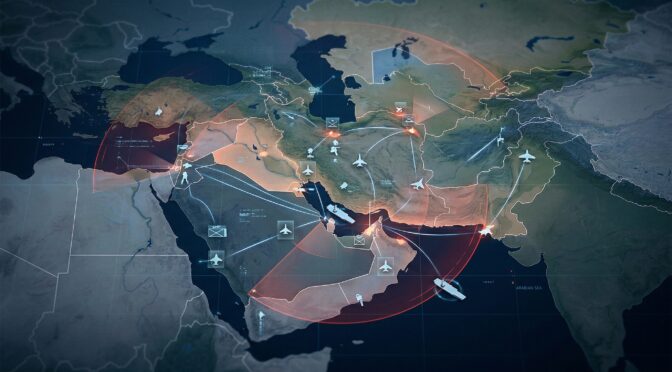
As of late February 2026, the United States Armed Forces, acting in direct coordination with the Israel Defense Forces (IDF), have initiated major kinetic combat operations against the Islamic Republic of Iran under the Department of Defense operational designation “Operation Epic Fury”.1 This military action, launched in tandem with the Israeli operations codenamed “Lion’s Roar” and “Shield of Judah,” represents the culmination of an unprecedented, multi-domain force buildup across the United States Central Command (CENTCOM) and European Command (EUCOM) Areas of Responsibility (AOR).2 The current deployment and subsequent combat operations mark the most significant concentration of American naval, aerial, and logistical combat power in the Middle Eastern theater since the 2003 invasion of Iraq, effectively dwarfing previous regional deterrence postures and operations.5

The contemporary United States Order of Battle (ORBAT) is strategically anchored by a geographically distributed, highly survivable dual-carrier strike force architecture. Carrier Strike Group Three (CSG-3), operating the Nimitz-class USS Abraham Lincoln, is actively deployed in the Arabian Sea and the Gulf of Oman, projecting sustained combat power directly into Iran’s southern threat vectors and maritime chokepoints.8 Concurrently, Carrier Strike Group Twelve (CSG-12), led by the Ford-class USS Gerald R. Ford, has established a forward operating presence in the Eastern Mediterranean Sea near the coastlines of Israel and Crete.5 This specific geographic positioning deliberately isolates the high-value flagship from Iran’s anti-ship ballistic missile (ASBM) envelopes while utilizing an extensive, trans-continental aerial refueling bridge to project carrier-based strike capabilities deep into Iranian sovereign territory.5

Land-based expeditionary air power has surged to encompass over 330 combat and specialized support aircraft positioned across allied host nations, representing an approximate 10% increase in regional air assets within the final 48 hours prior to the commencement of kinetic strikes.14 Data indicates that combat aircraft constitute approximately 65% of this total deployed force, supported by a dense network of electronic warfare, command and control, and aerial refueling platforms.14 This air armada is characterized by a heavy reliance on fifth-generation low-observable platforms (F-35A/C, F-22), advanced electronic warfare (EW) and suppression of enemy air defenses (SEAD) assets (EA-18G, EA-37B), and an exceptionally robust Intelligence, Surveillance, and Reconnaissance (ISR) architecture (RC-135, MQ-4C, E-3).14

The defensive posture established to protect these offensive assets is equally robust and has already been kinetically validated. Terminal High Altitude Area Defense (THAAD) and Patriot PAC-3 systems are actively engaging retaliatory Iranian ballistic missile launches aimed at forward staging bases.17 This was notably demonstrated by recent successful exo-atmospheric intercepts over Al Dhafra Air Base in the United Arab Emirates (UAE), which safeguarded critical USAF reconnaissance and refueling infrastructure.17 The operational integration of cyber warfare with conventional electronic attack platforms has successfully degraded Iranian integrated air defense systems (IADS), specifically targeting S-300 and S-400 equivalents, facilitating the successful ingress of allied strike packages in the opening salvos of Operation Epic Fury.18

Current Order of Battle (ORBAT)

The following sections detail the verified and assessed dispositions of United States military assets within the CENTCOM and adjacent EUCOM AORs, categorized by domain.

Naval Surface and Subsurface Posture

The maritime component of the current US force posture is engineered to establish multi-axis sea control, provide layered ballistic missile defense (BMD) for regional allies and staging bases, and deliver overwhelming long-range precision fires via BGM-109 Tomahawk Land Attack Missiles (TLAM). The naval ORBAT is strategically distributed across the Eastern Mediterranean Sea, Red Sea, Arabian Sea, and the Persian Gulf, forcing Iranian defense planners to calculate threats from 360 degrees.9

Carrier Strike Groups (CSG)

The deployment of a dual-carrier formation provides combatant commanders with nearly continuous, 24-hour sortie generation capabilities. The geographic separation of the two strike groups maximizes threat axes while complicating Iranian counter-targeting efforts.

Unit DesignationPlatform / ClassCurrent Location AssessedKey Embarked Assets / Composition
Carrier Strike Group 3 (CSG-3)USS Abraham Lincoln (CVN-72) Nimitz-classArabian Sea / Gulf of Oman 8CVW-9: VMFA-314 (F-35C), VFA squadrons (F/A-18E/F), VAQ-133 “Wizards” (EA-18G w/ ALQ-249 NGJ), VAW-117 (E-2D).21
Carrier Strike Group 12 (CSG-12)USS Gerald R. Ford (CVN-78) Ford-classEastern Mediterranean Sea (near Israel/Crete) 11CVW-8: VFA-31, 37, 87, 213 (F/A-18E/F), VAQ-142 (EA-18G), VAW-124 (E-2D).27 Nearing 300-day deployment record.29

Deployed to the Arabian Sea and the Gulf of Oman, CSG-3 provides the primary southern axis of attack against Iranian military infrastructure.5 The presence of Carrier Air Wing Nine (CVW-9) brings critical fifth-generation capabilities to the maritime domain via Marine Fighter Attack Squadron 314 (VMFA-314) operating the F-35C Lightning II.25 Furthermore, the embarkation of Electronic Attack Squadron 133 (VAQ-133), the “Wizards,” is of paramount strategic importance. VAQ-133 is currently the vanguard unit deploying the AN/ALQ-249 Next Generation Jammer (NGJ), an advanced electronic warfare pod that significantly enhances the EA-18G Growler’s ability to blind and suppress sophisticated, multi-frequency Iranian radar networks.21

Originally deployed to the Caribbean Sea for Operation Southern Spear, CSG-12 was rapidly repositioned across the Atlantic, transited the Strait of Gibraltar, and is currently operating in the Eastern Mediterranean Sea near the Israeli coast and Crete.10 This positioning protects the carrier from Iranian anti-ship ballistic missiles while utilizing an aerial refueling bridge to allow its air wing to strike Iranian targets.5 The Ford-class brings advanced Electromagnetic Aircraft Launch Systems (EMALS) and Advanced Arresting Gear (AAG) to the theater, theoretically permitting a higher sortie generation rate than legacy Nimitz-class carriers, though the vessel and its crew are currently being pushed to the limits of operational endurance as they near a 300-day continuous deployment.13

Independent Surface Action Groups and Destroyer Squadrons (DESRON)

To secure vital maritime chokepoints and augment the Tomahawk strike package, a formidable fleet of guided-missile destroyers (DDG) has been forward-deployed. These Arleigh Burke-class vessels are dual-hatted: they serve as the primary Aegis Ballistic Missile Defense (BMD) shield for allied assets while concurrently acting as the principal launch platforms for hundreds of TLAMs. Open-source intelligence analysts estimate that the assembled naval combat power could unleash over 600 Tomahawk missiles in a single coordinated salvo.31

Unit DesignationPlatform / ClassCurrent Location AssessedPrimary Operational Mandate
USS Frank E. Petersen Jr. (DDG-121)Arleigh Burke-class DDGNorth Arabian Sea 32CSG-3 Escort / Air Defense / Strike.32
USS Spruance (DDG-111)Arleigh Burke-class DDGNorth Arabian Sea 32CSG-3 Escort / Air Defense / Strike.32
USS Michael Murphy (DDG-112)Arleigh Burke-class DDGNorth Arabian Sea 32CSG-3 Escort / Air Defense / Strike.32
USS Bainbridge (DDG-96)Arleigh Burke-class DDGEastern Mediterranean Sea 33CSG-12 Escort / Air Defense / Strike.28
USS Mahan (DDG-72)Arleigh Burke-class DDGEastern Mediterranean Sea 33CSG-12 Escort / Air Defense / Strike.28
USS Winston S. Churchill (DDG-81)Arleigh Burke-class DDGEastern Mediterranean Sea 33CSG-12 Escort / Air Defense / Strike.28
USS Bulkeley (DDG-84)Arleigh Burke-class DDGEastern Mediterranean Sea 32Independent Aegis BMD operations / Strike.32
USS Roosevelt (DDG-80)Arleigh Burke-class DDGEastern Mediterranean Sea 32Independent Aegis BMD operations / Strike.32
USS McFaul (DDG-74)Arleigh Burke-class DDGStrait of Hormuz / Persian Gulf 34Chokepoint defense / Coastal strike / Escort.32
USS Mitscher (DDG-57)Arleigh Burke-class DDGStrait of Hormuz / Persian Gulf 34Chokepoint defense / Coastal strike / Escort.32
USS Delbert D. Black (DDG-119)Arleigh Burke-class DDGRed Sea / Bab el-Mandeb 34Chokepoint defense / Anti-Houthi overwatch / Strike.32

The positioning of the USS McFaul and USS Mitscher within the Persian Gulf and near the Strait of Hormuz is particularly high-risk but necessary for securing the critical energy transit corridor.32 These vessels are uniquely positioned to defend US installations in Bahrain and the UAE, escort commercial shipping, and launch close-range cruise missile strikes into Iranian coastal defense networks, despite being well within the range of Iranian shore-based anti-ship cruise missiles (ASCMs) and fast attack craft swarms.34

Subsurface Assets (SSGNs and SSNs)

While the exact locations of nuclear-powered attack (SSN) and guided-missile (SSGN) submarines remain highly classified under strict OPSEC protocols, OSINT and historical deployment patterns indicate a heavy subsurface presence operating in the AOR.

Unit DesignationPlatform / ClassCurrent Location AssessedPrimary Operational Mandate
USS Florida (SSGN-728)Ohio-class SSGNLocation undisclosed but operating in the AOR (Recently observed NSA Souda Bay, Crete) 35Massive conventional strike (154x TLAM capacity) / Special Operations.36
USS Georgia (SSGN-729)Ohio-class SSGNLocation undisclosed but operating in the AOR 38Massive conventional strike (154x TLAM capacity) / Special Operations.38
Multiple UnitsVirginia / Los Angeles-class SSNsLocations undisclosed but operating in the AOR 39Intelligence, Surveillance, Reconnaissance (ISR) / ASW / Strike.40

The Ohio-class submarines, notably the USS Florida and USS Georgia, possess unprecedented conventional strike capabilities. Each SSGN was converted from a strategic nuclear deterrent platform to a conventional cruise missile carrier capable of launching up to 154 BGM-109 Tomahawks from 22 vertical launch tubes.36 Open-source tracking indicates USS Florida has recently utilized the Marathi NATO Pier Facility at NSA Souda Bay, Crete, for logistical support.35 The presence of these vessels in the Mediterranean, Red, or Arabian Seas provides combatant commanders with a massive, stealthy first-strike capability designed to overwhelm Iranian air defenses without exposing surface ships to counter-battery fire.41 Fast attack submarines (SSNs) are concurrently tasked with sanitizing the operational zones of Iranian Kilo-class diesel-electric submarines and providing persistent, undetected ISR along the Iranian littoral.40

Amphibious Ready Groups (Information Gaps & Strategic Indicators)

Notably, the massive US military buildup lacks a dedicated Amphibious Ready Group (ARG) or Marine Expeditionary Unit (MEU) deployed within the immediate CENTCOM AOR.

Unit DesignationPlatform / ClassCurrent Location AssessedStrategic Indicator
USS Iwo Jima ARG / 24th MEUWasp-class LHD / USMC MEUCaribbean Sea 10Continuing operations in SOUTHCOM.10
USS Boxer ARGWasp-class LHDPacific Ocean 10Operating in INDOPACOM.10

The USS Iwo Jima (LHD-7) ARG, carrying the 24th MEU, remains deployed in the Caribbean Sea supporting SOUTHCOM tasking, while the USS Boxer (LHD-4) ARG is currently underway in the Pacific Ocean.10 This specific force structure confirms assessments that the current military objective is purely focused on kinetic, long-range power projection (air and cruise missile strikes) and regime infrastructure degradation, rather than any form of amphibious assault, coastal seizure, or large-scale ground force insertion.39

Land-Based Air Power & Enablers

The United States Air Force (USAF), augmented by naval aviation detachments and allied assets, has executed a staggering logistical and combat surge to deploy more than 330 military aircraft to the Middle East.14 Data indicates that combat aircraft constitute approximately 65% of this total deployed force, supported by a dense network of electronic warfare, command and control, and aerial refueling platforms.14 Specifically, the combat breakdown includes roughly 84 F-18E/F Super Hornets, 54 F-16C/CJ/CM Fighting Falcons, 42 F-35A/C Lightning IIs, 36 F-15E Strike Eagles, and 12 A-10C Thunderbolts.14 The specialist and support tier comprises 18 EA-18G Growlers, 6 E-3 AWACS, and 5 E-11A BACN aircraft, underpinned by a massive fleet of 86 KC-46 and KC-135 refueling tankers either currently in CENTCOM or en route.14 This airpower is deliberately dispersed across multiple allied bases and European staging grounds to complicate Iranian ballistic missile targeting and ensure continuous operational sortie generation.

Combat Aircraft Dispositions

The tactical fighter deployment reveals a clear emphasis on stealth penetration, electronic attack, and heavy ordnance delivery.

Host InstallationWing / Squadron DesignationAircraft TypeAssessed Operational Role
Muwaffaq Salti Air Base (Jordan)Undisclosed Fighter SquadronsF-15E Strike Eagle (36x) 14Deep interdiction / Heavy payload delivery.44
Muwaffaq Salti Air Base (Jordan)Undisclosed Fighter SquadronsF-35A Lightning II (30x) 44Stealth penetration / DEAD operations.45
Muwaffaq Salti Air Base (Jordan)Undisclosed VAQ SquadronEA-18G Growler (6x) 46Electronic Attack / SEAD.46
Prince Sultan Air Base (Saudi Arabia)378th AEW / 555th EFS (“Triple Nickel”)F-16C/CJ Fighting Falcon 47Multi-role / Wild Weasel SEAD.47
Prince Sultan Air Base (Saudi Arabia)378th AEW / 494th EFS (“Mighty Black Panthers”)F-15E Strike Eagle 48Deep interdiction / Heavy payload delivery.48
Al Dhafra Air Base (UAE)380th AEW / 34th EFSF-35A Lightning II 48Stealth penetration / DEAD operations.48
Al Dhafra Air Base (UAE)380th AEW / 79th EFSF-16 Fighting Falcon 48Multi-role strike and defense.48
Ovda Air Base (Israel)Undisclosed Fighter SquadronF-22 Raptor (11x) 44Air dominance / Escort / Stealth penetration.49

Muwaffaq Salti Air Base in Jordan serves as a primary hub for kinetic operations due to its proximity to Syrian and Iraqi airspace, which act as flight corridors into Iran.46 The concentration of 36 F-15E Strike Eagles and 30 F-35A Lightning IIs at this location provides a highly lethal combination of survivable penetrating capability and heavy ordnance delivery.44 Furthermore, six Navy EA-18G Growlers have been land-based here to support complex SEAD packages.46

Prince Sultan Air Base in Saudi Arabia, a heavily defended installation deep within the peninsula, hosts the F-16CJs of the 555th Expeditionary Fighter Squadron and the F-15Es of the 494th Expeditionary Fighter Squadron.47 The F-16CJs are specifically optimized for “Wild Weasel” operations, armed with AGM-88 High-speed Anti-Radiation Missiles (HARM) designed to autonomously home in on and destroy active Iranian radar emissions.46

In an unprecedented display of joint US-Israeli operational integration, the US Air Force has forward-deployed at least 11 F-22 Raptor air dominance fighters to Ovda Air Base in the Negev desert.44 These specialized platforms are tasked with sanitizing the airspace of Iranian interceptors, providing top-cover for slower bomber assets, and protecting allied strike packages as they transition from the Mediterranean into hostile airspace.44

Conversely, Al-Udeid Air Base in Qatar, historically the central nervous system for CENTCOM air operations, has seen a strategic dispersal of its highly valuable, non-stealthy assets due to its acute vulnerability to Iranian missile barrages across the Persian Gulf.50 While it retains a presence of heavy airlift and tiltrotor aircraft, many high-end combat and refueling assets have been relocated to operational depths further west.50

Strategic Bombers and Long-Range Strike

The integration of the Air Force Global Strike Command (AFGSC) is a critical requirement for delivering the massive ordnance payloads necessary to destroy deeply buried Iranian nuclear enrichment facilities, such as the subterranean complexes at Fordow and Natanz.51

Unit DesignationPlatform / ClassCurrent Location AssessedPrimary Operational Mandate
Bomber Task Force (BTF) 25-2B-52H StratofortressRAF Fairford, United Kingdom 53Standoff cruise missile delivery / Force projection.53
Undisclosed Bomb WingsB-2 SpiritAlert status CONUS / Potential staging Diego Garcia 14Penetrating strike / MOP delivery against hardened targets.51

B-52H Stratofortress bombers attached to BTF 25-2 have recently conducted extensive force projection missions across the Middle East, originating from their European staging ground at RAF Fairford.53 Operating from these European sanctuaries, the B-52Hs utilize the extensive tanker bridge to reach launch points where they can deliver standoff munitions (such as the AGM-158 JASSM-ER) without ever crossing into the lethal threat rings of Iranian surface-to-air missiles.

While no B-2 Spirit stealth bombers have been publicly observed forward-deploying to Naval Support Facility Diego Garcia, OSINT monitors have recorded a sharp increase in strategic airlift activity (C-17s, C-5Ms) to the remote Indian Ocean atoll, strongly indicating logistical preparation for bomber staging.14 B-2s remain on high alert in the continental United States (CONUS) and hold a proven operational history of striking Iranian targets, having delivered 30,000-pound GBU-57 Massive Ordnance Penetrators (MOP) during Operation Midnight Hammer in June 2025.51

Electronic Warfare, ISR, and Command and Control (C2)

Modern air campaigns are heavily reliant on dominance of the invisible electromagnetic spectrum. CENTCOM has amassed a formidable array of Intelligence, Surveillance, Reconnaissance (ISR) and Command and Control (C2) platforms to manage the complex battlespace and find targets for the kinetic shooters.

Unit DesignationPlatform / ClassCurrent Location AssessedPrimary Operational Mandate
380th AEW DetachmentsU-2S Dragon Lady / RQ-4 Global HawkAl Dhafra Air Base (UAE) 58High-altitude, long-endurance optical and radar ISR.58
US Navy Patrol SquadronsMQ-4C Triton / P-8A PoseidonAl Dhafra (UAE) / Isa Air Base (Bahrain) 15Maritime surveillance / ASW / Persian Gulf monitoring.60
Undisclosed Recon SquadronsRC-135V/W Rivet JointAl-Udeid (Qatar) / Various AOR 15Signals Intelligence (SIGINT) / Electronic order of battle mapping.61
55th Electronic Combat GroupEA-37B Compass CallRamstein Air Base (Germany) 62Stand-off electronic attack / Communications jamming.63
Undisclosed C2 SquadronsE-3 Sentry (AWACS) / E-11A BACNVarious AOR 14Airborne battle management / Datalink translation and relay.14

High-altitude ISR is managed heavily out of the 380th AEW at Al Dhafra, which operates the U-2S Dragon Lady, RQ-4 Global Hawk, and at least two newly arrived US Navy MQ-4C Triton maritime surveillance drones.15 These platforms provide persistent, high-altitude synthetic aperture radar (SAR) mapping of Iranian military movements and naval deployments in the Gulf of Oman and Strait of Hormuz.60

Signals Intelligence (SIGINT) is gathered by multiple RC-135V/W Rivet Joint aircraft operating throughout the theater, actively vacuuming the electromagnetic spectrum to map the emissions of Iranian IADS and military communications networks.15 To manage the crowded airspace and deconflict the massive strike packages, six E-3 Sentry AWACS and five E-11A Battlefield Airborne Communications Node (BACN) aircraft serve as airborne command posts.14 The E-11A BACN is particularly crucial for translating distinct tactical datalinks, acting as a Wi-Fi node in the sky that bridges legacy Link-16 networks with the proprietary Multifunction Advanced Data Link (MADL) utilized by the F-35 fleet, ensuring seamless situational awareness across fourth and fifth-generation platforms.14

In the realm of Electronic Attack (EA), the USAF has recently deployed the brand-new EA-37B Compass Call to the European theater at Ramstein Air Base.62 This highly classified platform is designed to integrate directly with the RC-135s to execute devastating stand-off electronic attacks against adversary command and control networks, effectively paralyzing the enemy’s ability to coordinate a defense before strike aircraft even cross the border.16

The Strategic “Tanker Bridge”

A regional war campaign of this magnitude, particularly one utilizing aircraft carriers stationed as far away as the Mediterranean and bombers flying from the United Kingdom, requires an unparalleled aerial refueling infrastructure. Open-source flight tracking indicates that the US military has mobilized approximately 127 KC-135 Stratotankers and KC-46A Pegasus aircraft globally for this operation.14 Approximately 86 of these tankers are deployed directly within CENTCOM bases or are actively en route.14 For instance, the 77th Expeditionary Air Refueling Squadron (EARS), operating the modern KC-46A Pegasus, recently established operations at Prince Sultan Air Base under the 378th AEW.67

The strategic tanker bridge spans from Sofia, Bulgaria, and Souda Bay, Greece, across the Mediterranean to staging areas at Ben Gurion Airport in Tel Aviv, Israel, bypassing the political constraints and acute vulnerabilities associated with basing entirely within the Persian Gulf.69 By staging KC-135 and KC-46 tankers at these European and Israeli nodes, the US Air Force has established an unbroken aerial refueling corridor. This logistical bridge enables carrier-based fighters from the USS Gerald R. Ford in the Mediterranean, as well as land-based fighters in Jordan and bombers from the UK, to execute deep-penetration strikes into Iranian territory and return to safe havens without exhausting their fuel reserves.5

Air and Missile Defense (AMD) Architecture

Because US and allied host-nation bases are well within the range of Iran’s vast arsenal of short- and medium-range ballistic missiles, the Pentagon has established a deeply layered, integrated air and missile defense (IAMD) shield across the theater.72 Iran is widely assessed to possess the largest and most diverse ballistic missile force in the Middle East, heavily stockpiling solid-fueled, precision-guided variants.73

Defensive SystemDomain / PlatformAssessed LocationsPrimary Interception Role
THAAD (Terminal High Altitude Area Defense)Land-based Mobile BatteryUAE, Saudi Arabia, Jordan 14Exo-atmospheric ballistic missile intercept (Hit-to-Kill).17
Patriot PAC-3Land-based Mobile BatteryVarious CENTCOM Airbases 14Point defense against short-range ballistic missiles, cruise missiles, and UAVs.72
Aegis BMD (SM-3 / SM-6)Arleigh Burke-class DDGEast Med, Red Sea, Persian Gulf 32Midcourse and terminal ballistic missile defense over maritime and allied airspace.32

Terminal High Altitude Area Defense (THAAD) batteries have been rapidly deployed across the UAE, Saudi Arabia, and Jordan.14 These systems are capable of intercepting incoming ballistic missiles in their terminal phase utilizing kinetic “hit-to-kill” technology—destroying the target through sheer impact velocity rather than an explosive fragmentation warhead.72 While highly effective, these systems rely on a finite inventory of interceptors that cost upwards of $12 million each and take years to procure, creating a critical logistical constraint if Iran employs mass saturation tactics.72 Operating in conjunction with THAAD, Patriot Advanced Capability-3 (PAC-3) batteries provide the inner layer of point defense for critical infrastructure, airfields, and command nodes.14

The efficacy of this network has already been tested in live combat. On February 28, Iranian ballistic missiles targeted Al Dhafra Air Base in the UAE, a critical hub housing the 380th AEW. Preliminary reports indicate that a UAE-deployed THAAD system successfully engaged and intercepted two incoming ballistic missiles over Abu Dhabi, preventing catastrophic damage to the operational hub and safeguarding the highly concentrated reconnaissance and aerial refueling assets stationed on the flight line.17

Reinforcements & Transit Status

The Pentagon continues to surge reinforcements toward the CENTCOM AOR, preparing the logistics and force structure necessary for sustained, multi-day combat operations. The buildup relies heavily on a global pipeline of assets transiting from EUCOM, INDOPACOM, and CONUS.14

Since early January, an estimated 310 strategic airlift flights utilizing C-17 Globemaster III and C-5M Super Galaxy transports have established an air bridge into the Middle East, delivering vital personnel, heavy munitions, and the massive radar and launcher components required for the Patriot and THAAD missile defense systems.14

Simultaneously, a steady stream of tactical fighters continues to arrive via the European staging bridge. Recent flight tracking data confirmed the arrival of an additional 38 fighters—comprising 12 F-22 Raptors, 14 F-15E Strike Eagles, and 12 F-35A Lightning IIs—at RAF Lakenheath in the UK.44 These aircraft, having completed their initial transatlantic transit from bases in Utah, Idaho, and Virginia, are resting and refitting in Europe before making the final flight into the Middle East to replenish and reinforce the strike packages currently engaged in combat operations.44

In the maritime domain, the US Navy is actively preparing to deploy a third aircraft carrier to the theater. The USS George H.W. Bush (CVN-77) Carrier Strike Group, which had been conducting expedited training exercises off the coast of Virginia, is being readied for an emergency deployment within a two-week operational window.5 This aggressive scheduling suggests military planners are anticipating a prolonged, grinding campaign that will require rotational carrier availability to maintain the relentless pace of strike sorties without collapsing the endurance of the Ford or Lincoln crews.

Operational Capabilities & Integration: “The Kill Chain”

The execution of “Operation Epic Fury” relies entirely on the seamless, multi-domain integration of the disparate assets detailed in this ORBAT. The US military does not fight with individual platforms; it employs a sophisticated, interconnected “kill chain” designed to systematically blind, dismantle, and finally destroy Iranian military infrastructure. This methodology is executed in distinct, overlapping phases.

Phase 0: Cyber Infiltration and Spectrum Dominance

Before the first physical munitions are released, the battlespace is prepared through offensive cyber operations and electromagnetic warfare. According to verified intelligence sources, US Cyber Command successfully executed digital strikes against Iranian air defense networks, specifically targeting digital “aim-points”—vulnerable nodes such as routers, servers, and peripheral devices—connected to the command infrastructure of radar systems protecting the heavily fortified nuclear enrichment sites at Fordow, Natanz, and Isfahan.18 By degrading these Russian-equivalent S-300 and S-400 systems digitally from the inside out, cyber operators effectively blinded the Iranian Integrated Air Defense System (IADS) at critical junctures, preventing the launch of surface-to-air missiles against the initial waves of incoming American warplanes.18 This invisible preparation of the battlefield is a prerequisite for survivability in heavily contested airspace.

Phase 1: SEAD and DEAD Operations (Suppression/Destruction of Enemy Air Defenses)

As cyber strikes create localized blind spots and confusion within the Iranian command structure, dedicated electronic and kinetic warfare aircraft exploit these gaps to permanently dismantle the defensive network.

  1. The Sensors (Detection & Geolocation): High-altitude RC-135V/W Rivet Joint aircraft loiter at safe standoff distances over international waters or allied airspace. Utilizing highly sensitive, specialized receiver arrays, these aircraft detect, classify, and precisely geolocate the emissions of active Iranian early-warning and targeting radars.16
  2. The Jammers (Electronic Attack): The targeting data collected by the Rivet Joints is instantly transmitted via secure, low-latency datalinks to EA-37B Compass Call aircraft and carrier-launched EA-18G Growlers operating closer to the threat edge.16 The EA-18Gs, specifically those of VAQ-133 equipped with the new ALQ-249 Next Generation Jammer (NGJ), project focused, high-power electromagnetic energy to overwhelm and scramble the remaining Iranian radar arrays, injecting false targets and noise into their receivers and rendering them incapable of achieving a weapons lock on allied aircraft.22 The recent, historic integration of the RC-135 and EA-37B has significantly refined this electromagnetic kill chain, allowing for rapid, coordinated jamming of pop-up threats in real-time.16
  3. The Hunters (Kinetic Destruction): Under the protective umbrella of this electronic shielding, F-35A and F-35C stealth fighters penetrate deep into Iranian airspace. Utilizing their advanced sensor fusion and the secure Multifunction Advanced Data Link (MADL), F-35s operate as forward quarterbacks. They identify hidden or mobile SAM sites and neutralize them using internal precision-guided munitions like the GBU-39 Small Diameter Bomb (SDB) to maintain their stealth profile, or they pass the precise targeting coordinates back to heavier “bomb trucks” waiting outside the threat ring.80 Furthermore, specialized F-16CJs armed with AGM-88 High-speed Anti-Radiation Missiles (HARM) actively hunt and destroy radar transmitters by riding the enemy’s radar beam directly back to its source.46

Phase 2: Kinetic Execution and Heavy Payload Delivery

Once the IADS is sufficiently degraded and safe air corridors are secured, the heavy kinetic phase initiates to destroy the regime’s strategic capabilities.

  • Standoff Strikes: The USS Florida and USS Georgia (SSGNs), alongside the Arleigh Burke destroyers stationed in the Red Sea and Persian Gulf, launch massive salvos of Tomahawk Land Attack Missiles (TLAM).31 These cruise missiles navigate at low altitudes to avoid radar detection, targeting fixed command and control bunkers, ballistic missile production facilities, and IRGC naval bases.31 Simultaneously, B-52H bombers stationed in Europe launch long-range cruise missiles from well outside Iranian airspace.53
  • Penetrating Strikes: Fourth-generation fighters bearing heavy ordnance payloads, primarily the F-15E Strike Eagles staging from Jordan and Saudi Arabia, ingress through the cleared air corridors.5 Sustained by the massive aerial refueling bridge of KC-135s and KC-46s, these aircraft deliver precision-guided bunker-busters to obliterate hardened Iranian ballistic missile silos and subterranean nuclear enrichment sites that cruise missiles cannot penetrate.5

Phase 3: Battle Damage Assessment (BDA) and Persistent ISR

Following the strike waves, High-Altitude ISR platforms—such as the MQ-4C Triton, U-2S, and RQ-4 Global Hawk—loiter high above the target areas.15 Utilizing synthetic aperture radar and high-resolution electro-optical sensors, these platforms conduct immediate Battle Damage Assessments (BDA), determining the precise level of destruction achieved and relaying this intelligence back to the Combined Air Operations Center (CAOC) to determine if follow-on restrikes are required to fully neutralize the target sets.15

Appendix: Glossary of Acronyms

  • AAG: Advanced Arresting Gear
  • AEW: Air Expeditionary Wing
  • AFGSC: Air Force Global Strike Command
  • AMD: Air and Missile Defense
  • AOR: Area of Responsibility
  • ARG: Amphibious Ready Group
  • ASBM: Anti-Ship Ballistic Missile
  • ASCM: Anti-Ship Cruise Missile
  • ASW: Anti-Submarine Warfare
  • AWACS: Airborne Warning and Control System
  • BACN: Battlefield Airborne Communications Node
  • BDA: Battle Damage Assessment
  • BMD: Ballistic Missile Defense
  • BTF: Bomber Task Force
  • C2: Command and Control
  • CAOC: Combined Air Operations Center
  • CENTCOM: Central Command (United States Central Command)
  • CONUS: Continental United States
  • CSG: Carrier Strike Group
  • CVN: Aircraft Carrier, Nuclear-powered
  • CVW: Carrier Air Wing
  • DDG: Guided-Missile Destroyer
  • DEAD: Destruction of Enemy Air Defenses
  • DESRON: Destroyer Squadron
  • DoD: Department of Defense
  • EA: Electronic Attack
  • EARS: Expeditionary Air Refueling Squadron
  • EFS: Expeditionary Fighter Squadron
  • EMALS: Electromagnetic Aircraft Launch System
  • EUCOM: European Command (United States European Command)
  • EW: Electronic Warfare
  • HARM: High-speed Anti-Radiation Missile
  • IADS: Integrated Air Defense System
  • IAMD: Integrated Air and Missile Defense
  • IDF: Israel Defense Forces
  • INDOPACOM: Indo-Pacific Command (United States Indo-Pacific Command)
  • IRGC: Islamic Revolutionary Guard Corps
  • ISR: Intelligence, Surveillance, and Reconnaissance
  • LHD: Landing Helicopter Dock
  • MADL: Multifunction Advanced Data Link
  • MEU: Marine Expeditionary Unit
  • MOP: Massive Ordnance Penetrator
  • NGJ: Next Generation Jammer
  • NSA: Naval Support Activity
  • OPSEC: Operational Security
  • ORBAT: Order of Battle
  • OSINT: Open-Source Intelligence
  • PAC-3: Patriot Advanced Capability-3
  • RAF: Royal Air Force
  • SAM: Surface-to-Air Missile
  • SAR: Synthetic Aperture Radar
  • SDB: Small Diameter Bomb
  • SEAD: Suppression of Enemy Air Defenses
  • SIGINT: Signals Intelligence
  • SM: Standard Missile
  • SOUTHCOM: Southern Command (United States Southern Command)
  • SSGN: Guided-Missile Submarine, Nuclear-powered
  • SSN: Attack Submarine, Nuclear-powered
  • THAAD: Terminal High Altitude Area Defense
  • TLAM: Tomahawk Land Attack Missile
  • UAE: United Arab Emirates
  • UAV: Unmanned Aerial Vehicle
  • USAF: United States Air Force
  • USMC: United States Marine Corps
  • VAQ: Electronic Attack Squadron
  • VAW: Airborne Command & Control Squadron
  • VFA: Strike Fighter Squadron
  • VMFA: Marine Fighter Attack Squadron

Please share the link on Facebook, Forums, with colleagues, etc. Your support is much appreciated and if you have any feedback, please email us in**@*********ps.com. If you’d like to request a report or order a reprint, please click here for the corresponding page to open in new tab.


Sources Used

  1. Israel, US launch attack on Iran as Trump announces ‘major combat operations’, accessed February 28, 2026, https://www.foxnews.com/live-news/israel-us-launch-attack-on-iran-amid-escalating-protests
  2. 2026 Israeli–United States strikes on Iran – Wikipedia, accessed February 28, 2026, https://en.wikipedia.org/wiki/2026_Israeli%E2%80%93United_States_strikes_on_Iran
  3. Israel, United States strike Islamic Republic, targeting heart of regime | Iran International, accessed February 28, 2026, https://www.iranintl.com/en/202602289915
  4. The Night the Axis Broke, accessed February 28, 2026, https://www.meforum.org/mef-online/the-night-the-axis-broke
  5. 2026 United States military buildup in the Middle East – Wikipedia, accessed February 28, 2026, https://en.wikipedia.org/wiki/2026_United_States_military_buildup_in_the_Middle_East
  6. Q&A: Iran and the US are back on the edge of war. What’s coming?, accessed February 28, 2026, https://acleddata.com/qa/qa-iran-and-us-are-back-edge-war-whats-coming
  7. Daily Memo: US Deployments to the Middle East – Geopolitical Futures, accessed February 28, 2026, https://geopoliticalfutures.com/daily-memo-us-deployments-to-the-middle-east/
  8. US launches ‘major combat operations’ against Iran – Task & Purpose, accessed February 28, 2026, https://taskandpurpose.com/news/us-israel-combat-bomb-iran/
  9. US Conducts Military Buildup Near Iran, Including 2 Aircraft Carriers, accessed February 28, 2026, https://www.visiontimes.com/2026/02/17/us-conducts-unprecedented-dual-carrier-military-buildup-near-iran.html
  10. U.S. Naval Update Map: Feb. 26, 2026, accessed February 28, 2026, https://worldview.stratfor.com/article/us-naval-update-map-feb-26-2026
  11. US-Israel strikes mark latest chapter in Iran conflict, accessed February 28, 2026, https://www.euractiv.com/news/us-israel-strikes-mark-latest-chapter-in-iran-conflict/
  12. Live Updates: U.S. and Israel attack Iran, with Trump confirming “major combat operations”, accessed February 28, 2026, https://www.cbsnews.com/live-updates/israel-us-attack-iran-trump-says-major-combat-operations/
  13. ‘Ford’ Nears Record Deployment as Navy Signals Readiness | Military.com, accessed February 28, 2026, https://www.military.com/daily-news/headlines/2026/02/27/ford-nears-record-deployment-navy-signals-readiness.html
  14. US ramps up deployments to CENTCOM despite ongoing talks with Iran – Anadolu Ajansı, accessed February 28, 2026, https://www.aa.com.tr/en/americas/us-ramps-up-deployments-to-centcom-despite-ongoing-talks-with-iran/3842362
  15. US monitor Persian Gulf after considerable military build-up – Naval Technology, accessed February 28, 2026, https://www.naval-technology.com/features/us-monitor-persian-gulf-after-considerable-military-build-up/
  16. RC-135 Rivet Joint, EA-37B Compass Call conduct historic sorties – Air Combat Command, accessed February 28, 2026, https://www.acc.af.mil/News/Article-Display/Article/4355138/rc-135-rivet-joint-ea-37b-compass-call-conduct-historic-sorties/
  17. Iran fires ballistic missiles at U.S. Al Dhafra Air Base in UAE as THAAD system intercepts incoming threats – Defence Industry Europe, accessed February 28, 2026, https://defence-industry.eu/iran-fires-ballistic-missiles-at-u-s-al-dhafra-air-base-in-uae-as-thaad-system-intercepts-incoming-threats/
  18. Exclusive: US used cyber weapons to disrupt Iranian air defenses during 2025 strikes, accessed February 28, 2026, https://therecord.media/iran-nuclear-cyber-strikes-us
  19. Officials: Cyber strikes wielded by US against Iranian air defenses | SC Media, accessed February 28, 2026, https://www.scworld.com/brief/officials-cyber-strikes-wielded-by-us-against-iranian-air-defenses
  20. More carriers, wider theatre: US buildup around Iran dwarfs …, accessed February 28, 2026, https://www.indiatoday.in/world/story/us-military-buildup-iran-vs-venezuela-carrier-strike-group-tehran-strike-analysis-2871134-2026-02-19
  21. VAQ-133 – Wikipedia, accessed February 28, 2026, https://en.wikipedia.org/wiki/VAQ-133
  22. AN/ALQ-249 Next Generation Jammer completes historic first deployment – AGN, accessed February 28, 2026, https://aerospaceglobalnews.com/news/an-alq-249-next-generation-jammer-completes-historic-first-deployment/
  23. USS Abraham Lincoln Conducts Routine Flight Operations – Centcom, accessed February 28, 2026, https://www.centcom.mil/MEDIA/igphoto/2003878638/
  24. USS Abraham Lincoln (CVN-72) – Wikipedia, accessed February 28, 2026, https://en.wikipedia.org/wiki/USS_Abraham_Lincoln_(CVN-72)
  25. Carrier Air Wing 9 Returns from Indo-Pacific Deployment – PACOM, accessed February 28, 2026, https://www.pacom.mil/Media/News/Article/3123707/carrier-air-wing-9-returns-from-indo-pacific-deployment/
  26. Supercarrier USS Gerald R. Ford Has Crossed Into The Mediterranean – The War Zone, accessed February 28, 2026, https://www.twz.com/news-features/supercarrier-uss-gerald-r-ford-has-crossed-into-the-mediterranean
  27. The U.S. Navy’s New Nuclear Aircraft Carrier Looks Powerful – But It Has Major Problems, accessed February 28, 2026, https://www.19fortyfive.com/2026/02/the-u-s-navys-new-nuclear-aircraft-carrier-looks-powerful-but-it-has-major-problems/
  28. Gerald R. Ford Carrier Strike Group Enters U.S. Fourth Fleet, accessed February 28, 2026, https://www.fourthfleet.navy.mil/Press-Room/News/Article/4329586/gerald-r-ford-carrier-strike-group-enters-us-fourth-fleet/
  29. 300-Day U.S. Navy Gamble: Nuclear Aircraft Carrier USS Gerald R. Ford’s Record Deployment Summed Up in 2 Words, accessed February 28, 2026, https://nationalsecurityjournal.org/300-day-u-s-navy-gamble-nuclear-aircraft-carrier-uss-gerald-r-fords-record-deployment-summed-up-in-2-words/
  30. The EA-18G Growler’s First Strike: How the U.S. Plans to Blind Iran’s New Russian Air Defenses, accessed February 28, 2026, https://www.19fortyfive.com/2026/02/the-ea-18g-growlers-first-strike-how-the-u-s-plans-to-blind-irans-new-russian-air-defenses/
  31. Iran in crosshairs: US Navy makes staggering force buildup, with one-third of deployed fleet aimed at Tehran, accessed February 28, 2026, https://gulfnews.com/world/mena/us-navy-makes-staggering-mideast-force-buildup-one-third-of-deployed-fleet-now-aimed-at-iran-1.500445245
  32. The U.S. Navy Has a Fleet of Arleigh Burke-Class Missile Destroyers ‘Waiting for Orders’ In Iran’s Backyard, accessed February 28, 2026, https://www.19fortyfive.com/2026/02/the-u-s-navy-has-a-fleet-of-arleigh-burke-class-missile-destroyers-waiting-for-orders-in-irans-backyard/
  33. Report: United States is Deploying USS Ford CSG to the Middle East, accessed February 28, 2026, https://maritime-executive.com/article/report-united-states-is-deploying-uss-ford-csg-to-the-middle-east
  34. Eight U.S. Navy Destroyers Forward Positioned For Operations Against Iran – Military Watch Magazine, accessed February 28, 2026, https://militarywatchmagazine.com/article/eight-destroyers-forward-positioned-iran
  35. USS Florida (SSGN 728) – CurrentOps.com, accessed February 28, 2026, https://currentops.com/unit/us/usn/uss-florida/ssgn-728
  36. USS Florida (SSGN-728) – Wikipedia, accessed February 28, 2026, https://en.wikipedia.org/wiki/USS_Florida_(SSGN-728)
  37. The Navy’s Ohio-Class SSGNs Have ‘Unprecedented Strike Capability’, accessed February 28, 2026, https://nationalinterest.org/blog/buzz/navys-ohio-class-ssgns-have-unprecedented-strike-capability-212134
  38. USS Georgia (SSBN 729) – Nuclear Companion: A nuclear guide to the cold war, accessed February 28, 2026, https://nuclearcompanion.com/data/uss-georgia-ssbn-729/
  39. U.S. Military in the Middle East: Numbers Behind Trump’s Threats Against Iran – CSIS, accessed February 28, 2026, https://www.csis.org/analysis/us-military-middle-east-numbers-behind-trumps-threats-against-iran
  40. The U.S. Navy’s New Stealth SSN(X) Submarine Summed in 2 Words, accessed February 28, 2026, https://nationalsecurityjournal.org/the-u-s-navys-new-stealth-ssnx-submarine-summed-in-2-words/
  41. America’s Military Buildup Around Iran: What We Know and What It Means, accessed February 28, 2026, https://www.meforum.org/mef-reports/americas-military-buildup-around-iran-what-we-know-and-what-it-means
  42. Gerald R. Ford Carrier Strike Group Enters Caribbean Sea – Navy.mil, accessed February 28, 2026, https://www.navy.mil/Press-Office/News-Stories/display-news/Article/4332628/gerald-r-ford-carrier-strike-group-enters-caribbean-sea/
  43. 24th Marine Expeditionary Unit Composites as MAGTF-Next, accessed February 28, 2026, https://www.iimef.marines.mil/News/Article/4384868/24th-marine-expeditionary-unit-composites-as-magtf-next/
  44. US deploys new stealth fighter squadron to UK – Ahead of Middle East transfer, accessed February 28, 2026, https://caliber.az/en/post/us-deploys-new-stealth-fighter-squadron-to-uk
  45. US deploys additional F-35A fighters to Europe, accessed February 28, 2026, https://report.az/en/other-countries/us-deploys-additional-f-35a-fighters-to-europe
  46. U.S. EA-18G Electronic Attack Jets Forward Deployed in Jordan: Can They Tackle Iran’s Revitalised Air Defences? – Military Watch Magazine, accessed February 28, 2026, https://militarywatchmagazine.com/article/us-ea18g-electronic-attack-jordan-iran
  47. USAF, Royal Saudi Air Force strengthen interoperability during Spears of Victory [Image 5 of 8] – DVIDS, accessed February 28, 2026, https://www.dvidshub.net/image/9530569/usaf-royal-saudi-air-force-strengthen-interoperability-during-spears-victory
  48. Here are the fighter squadrons currently in the Middle East – Air Force Times, accessed February 28, 2026, https://www.airforcetimes.com/news/your-air-force/2020/02/04/here-are-the-fighter-squadrons-currently-in-the-middle-east/
  49. Additional F-15s, F-22s and F-35s are Arriving to Reinforce U.S. Buildup in Middle East, accessed February 28, 2026, https://theaviationist.com/2026/02/26/additional-fighters-reinforce-us-buildup/
  50. The military buildup map behind Trump’s Iran decision, accessed February 28, 2026, https://www.israelhayom.com/2026/02/27/the-military-buildup-map-behind-trumps-iran-decision/
  51. Hegseth says Pentagon providing military options as Trump weighs US involvement in Middle East | The American Legion, accessed February 28, 2026, https://www.legion.org/information-center/news/security/2025/june/hegseth-says-pentagon-providing-military-options-as-trump-weighs-us-involvement-in-middle-east
  52. USS Gerald R. Ford’s Imminent Arrival Off Israel Comes As Negotiations Grind On, accessed February 28, 2026, https://www.twz.com/news-features/uss-gerald-r-fords-imminent-arrival-off-israel-comes-as-negotiations-grind-on
  53. B-52s Fly Across Middle East, Drop Live Munitions – Air & Space Forces Magazine, accessed February 28, 2026, https://www.airandspaceforces.com/b-52s-fly-middle-east-live-munitions/
  54. U.S. Conducts Bomber Task Force Mission as Iran Threat Looms – FDD, accessed February 28, 2026, https://www.fdd.org/analysis/2025/03/06/u-s-conducts-bomber-task-force-mission-as-iran-threat-looms/
  55. Calculations behind US military buildup in Middle East, accessed February 28, 2026, http://eng.chinamil.com.cn/2025xb/O_251451/16444899.html
  56. US Bombers Step Up Combat Operations as Demand Grows – Air Force Magazine, accessed February 28, 2026, https://www.airandspaceforces.com/us-bombers-step-up-combat-operations-as-demand-grows/
  57. F-35s Deploy Closer to Middle East After US Talks with Iran – Air & Space Forces Magazine, accessed February 28, 2026, https://www.airandspaceforces.com/f-35s-deploy-middle-east-us-talks-iran/
  58. These are the 3 most pressing questions about a military strike against Iran – Bluewin (CH), accessed February 28, 2026, https://www.bluewin.ch/en/news/international/these-are-the-3-most-pressing-questions-about-a-military-strike-against-iran-3115175.html
  59. 380th Air Expeditionary Wing – Wikipedia, accessed February 28, 2026, https://en.wikipedia.org/wiki/380th_Air_Expeditionary_Wing
  60. US surveillance aircraft operate near Iranian border amid tensions – Middle East Monitor, accessed February 28, 2026, https://www.middleeastmonitor.com/20260212-us-surveillance-aircraft-operate-near-iranian-border-amid-tensions/
  61. US Ups Intel Flights for Border Mission With RC-135 Spy Plane – Air & Space Forces Magazine, accessed February 28, 2026, https://www.airandspaceforces.com/us-intelligence-flights-border-mission-rc-135/
  62. EA-37B Compass Call visits Ramstein AB in first stop of European roadshow, accessed February 28, 2026, https://www.dm.af.mil/Media/Article/4396078/ea-37b-compass-call-visits-ramstein-ab-in-first-stop-of-european-roadshow/
  63. New EA-37B Compass Call Electronic Warfare Jet Makes Maiden Voyage To Europe, accessed February 28, 2026, https://www.twz.com/air/new-ea-37b-compass-call-electronic-warfare-jet-makes-maiden-voyage-to-europe
  64. RC-135 Rivet Joint, EA-37B Compass Call Start Integrated Sorties, accessed February 28, 2026, https://www.jedonline.com/2026/01/20/rc-135-rivet-joint-ea-37b-compass-call-start-integrated-sorties/
  65. USAF Deploys EA-37B Compass Call II to Ramstein Air Base as Middle East Tensions Drive Surge in Electromagnetic Warfare Readiness – Defence Security Asia, accessed February 28, 2026, https://defencesecurityasia.com/en/usaf-ea37b-compass-call-ii-ramstein-middle-east-electronic-warfare/
  66. U.S. Air Force launches first sustained integration of RC-135 and EA-37B Compass Call to strengthen spectrum warfare – Defence Industry Europe, accessed February 28, 2026, https://defence-industry.eu/u-s-air-force-launches-first-sustained-integration-of-rc-135-and-ea-37b-compass-call-to-strengthen-spectrum-warfare/
  67. Next-generation air tankers arrive in CENTCOM AOR – Air Combat Command, accessed February 28, 2026, https://www.acc.af.mil/News/Article-Display/Article/4400254/next-generation-air-tankers-arrive-in-centcom-aor/
  68. Next-generation air tankers arrive in CENTCOM AOR – DVIDS, accessed February 28, 2026, https://www.dvidshub.net/news/557685/next-generation-air-tankers-arrive-centcom-aor
  69. The largest US military build-up in the Middle East in decades fuels uncertainty in Tehran, accessed February 28, 2026, https://monocle.com/affairs/the-largest-us-military-build-up-in-the-middle-east-in-decades-fuels-uncertainty-in-tehran/
  70. Massive US Air Force warplane movements in Bulgaria raise stakes for Iran talks, accessed February 28, 2026, https://www.defensenews.com/global/europe/2026/02/23/massive-us-air-force-warplane-movements-in-bulgaria-raise-stakes-for-iran-talks/
  71. Massive US Air Force Build Up in Europe Sparks Iran Strike Speculation – Aviation A2Z, accessed February 28, 2026, https://aviationa2z.com/index.php/2026/02/23/massive-us-air-force-build-up-in-europe-sparks-iran-strike-speculation/
  72. Where Iran’s ballistic missiles can reach — and how close they are to the US – WFMD, accessed February 28, 2026, https://www.wfmd.com/2026/02/27/where-irans-ballistic-missiles-can-reach-and-how-close-they-are-to-the-us/
  73. All the US Military assets involved in the massive strike on Iran, accessed February 28, 2026, https://theaviationgeekclub.com/all-the-us-military-assets-involved-in-the-massive-strike-on-iran/
  74. 300 US Military Aircrafts Deployed to CENTCOM – Politics Today, accessed February 28, 2026, https://politicstoday.org/300-us-military-aircraft-deployed-to-centcom/
  75. Strategic Adversaries – Global Security Review, accessed February 28, 2026, https://globalsecurityreview.com/strategic-adversaries/
  76. US military assets flock to Middle East amid Iran standoff, accessed February 28, 2026, https://www.militarytimes.com/news/pentagon-congress/2026/02/19/us-military-assets-flock-to-middle-east-amid-iran-standoff/
  77. US sends F-22s, F-35s, F-16s in major 50-jet deployment to Middle East, accessed February 28, 2026, https://www.indiatoday.in/world/story/us-sends-f-22s-f-35s-f-16s-in-major-50-jet-deployment-to-middle-east-as-iran-nuclear-talks-continue-2869998-2026-02-18
  78. Pentagon preparing second aircraft carrier to deploy to Middle East: Report, accessed February 28, 2026, https://www.aa.com.tr/en/americas/pentagon-preparing-second-aircraft-carrier-to-deploy-to-middle-east-report/3827514
  79. U.S. and Britain Concentrate Surveillance Flights Around Russian Targets in Crimea, accessed February 28, 2026, https://militarywatchmagazine.com/article/us-britain-concentrate-surveillance-crimea
  80. How the F-35 Connects the Battlespace – Lockheed Martin, accessed February 28, 2026, https://www.lockheedmartin.com/en-us/news/features/2025/how-the-f35-connects-the-battlespace.html
  81. USA Moving F-35s, F-22s, and AWACS Aircraft to the Middle East, accessed February 28, 2026, https://militarnyi.com/en/news/usa-f-35s-f-22s-awacs-aircraft-middle-east/
  82. US Amasses More Airpower in Middle East with Dozens of Fighters, accessed February 28, 2026, https://www.airandspaceforces.com/us-amasses-more-airpower-middle-east-iran/

Operation Epic Fury: Assessing Military Effectiveness Against Iran And Iran’s Potential Next Steps

1. Assessment of Effectiveness (Current State)

As of February 28, 2026, the geopolitical and security environment in the Middle East has entered a period of unprecedented volatility following the commencement of coordinated preemptive military strikes by the United States and Israel against the Islamic Republic of Iran. The joint offensive-designated “Operation Epic Fury” by the United States Department of Defense and “Operation Lion’s Roar” by the Israel Defense Forces (IDF)-marks a paradigm shift from coercive diplomacy to direct, high-intensity kinetic confrontation.1 This section evaluates the current state of military effectiveness regarding both the allied strikes and the immediate Iranian kinetic and non-kinetic responses, situated within the broader strategic context of the collapsed diplomatic negotiations.

1.1 Strategic Context and the Genesis of the Allied Offensive

The immediate catalyst for the allied military campaign was the expiration of a ten-to-fifteen-day ultimatum issued by United States President Donald Trump, which explicitly demanded the total and verifiable dismantlement of Iran’s uranium enrichment capabilities.3 Prior to the initiation of hostilities, diplomatic efforts mediated by Omani Foreign Minister Badr Albusaidi in Geneva, Switzerland, attempted to secure a framework agreement to avert a regional conflagration.4 The United States negotiating delegation, led by Special Envoy Steve Witkoff and Jared Kushner, presented maximalist demands: the total cessation of uranium enrichment, the dismantling of fortified nuclear facilities at Fordow, Natanz, and Isfahan, the transfer of all enriched uranium to United States custody, and a permanent agreement lacking sunset clauses.6

Iranian negotiators, led by Foreign Minister Abbas Araghchi, counter-proposed a framework that would cap enrichment at 1.5 percent for civil research or potentially up to 20 percent for the Tehran Research Reactor, while demanding immediate and comprehensive relief from United States and United Nations sanctions.5 The Iranian delegation fundamentally refused to dismantle physical nuclear infrastructure or export existing fissile material.6 The operational objective of the subsequent military strikes, as stated by the United States administration, is the elimination of imminent threats, the destruction of Iran’s ballistic missile infrastructure, the neutralization of its naval capabilities, and the prevention of nuclear weaponization, ultimately aiming at regime decapitation.1

1.2 The Kinetic Landscape: Allied Preemptive Strikes

To execute Operation Epic Fury, the United States executed a massive regional force posture realignment. In the weeks preceding the strike, the Pentagon deployed the USS Gerald R. Ford and USS Abraham Lincoln carrier strike groups to the region, introducing over 150 tactical aircraft and hundreds of sea-launched cruise missiles into the theater.3 This naval armada was augmented by a substantial airlift operation, including more than ten C-17 Globemaster III flights from the United Kingdom to Jordan, and heavy transport movements to the strategic bomber base at Diego Garcia in the Indian Ocean.12 Furthermore, the United States deployed twelve F-22 Raptor stealth air-superiority fighters to Israeli air bases, representing a historic shift in forward-positioning offensive American assets directly on Israeli soil.8

The tactical execution of the allied strikes demonstrated deep penetration into highly defended Iranian airspace during daylight hours-a timing selected specifically to maximize tactical surprise.11 Targets included the residential and administrative complexes of Supreme Leader Ayatollah Ali Khamenei and President Masoud Pezeshkian in central Tehran, as well as critical military and infrastructure nodes in Isfahan, Qom, Karaj, Kermanshah, Tabriz, and the southern port city of Bushehr.1

Yugo M85/M92 dust cover quick takedown pin installed

The munitions utilized in the assault indicate a focus on hardened, deeply buried targets. The United States Air Force deployed B-2 Spirit stealth bombers to deliver thirty-thousand-pound GBU-57A/B Massive Ordnance Penetrators (MOPs), which are specialized bunker-buster munitions capable of penetrating subterranean rock formations, specifically targeting the Fordow Uranium Enrichment Plant and the Natanz Nuclear Facility.14 Concurrent naval operations utilized submarine-launched Tomahawk cruise missiles.14 Additionally, the Israel Defense Forces utilized air-launched ballistic missiles to degrade Iranian air defenses and command-and-control centers, preparing the battlespace for manned aircraft operations.2

1.3 Evaluation of Allied Strike Effectiveness

It is assessed with High Confidence that Iran’s Integrated Air Defense System (IADS) failed to repel the allied assault, exposing critical vulnerabilities in the Islamic Republic’s airspace denial capabilities. Iran’s defensive posture had already been severely compromised prior to this operation. During the preceding Israel-Iran War of June 2025, Iran’s domestically produced Bavar-373 ground-based air defense systems systematically failed to intercept United States and Israeli targets.16 Furthermore, targeted Israeli operations in April and October of 2024 successfully destroyed Iran’s advanced Russian-supplied S-300 batteries.16

To compensate for these strategic deficits, the Islamic Revolutionary Guard Corps attempted to implement temporary and extremely suboptimal solutions.16 Intelligence indicates that Iran attached loaded Russian Verba Man-Portable Air-Defense Systems (MANPADS)-which possess a maximum engagement altitude of only 4,500 meters-along with cameras and radios onto domestically produced Shahed drones.16 While this improvisation theoretically increases the altitude at which infrared homing missiles can engage targets, it proved entirely ineffective against high-altitude, low-observable stealth platforms and supersonic cruise missiles utilized in Operation Epic Fury.16 Consequently, allied forces achieved total air superiority, allowing them to prosecute targets at will.17 Open-source intelligence is inconclusive on the precise number of Iranian military casualties, though Iranian state media and regional reporting suggest significant losses within the Islamic Revolutionary Guard Corps, including several senior commanders.1

1.4 Iranian Kinetic Responses: “True Promise 4”

In immediate retaliation to the decapitation strikes, the Islamic Revolutionary Guard Corps launched an operation designated “True Promise 4,” described as a first wave of extensive ballistic missile and drone swarm attacks targeting both Israel and United States assets throughout the Middle East.19 Unlike previous regional escalations where Iran demonstrated calculated restraint to avoid triggering an all-out war, the target selection on February 28 indicated a highly risk-acceptant strategy intended to inflict maximum systemic damage.

Iranian ballistic missiles, likely drawn from its extensive inventory of Sejil, Emad, and Ghadr platforms (which boast ranges up to 2,000 kilometers and are specifically designed to evade conventional radar systems), penetrated Israeli airspace, with confirmed impacts in the northern city of Haifa.2 The Israeli Home Front Command activated nationwide sirens, and civilian medical infrastructure, including hospitals, initiated emergency protocols to transfer patients to underground facilities.23

Simultaneously, Iran broadened the conflict horizontally by targeting the epicenter of United States power projection in the Persian Gulf. Missiles successfully struck the United States Navy’s Fifth Fleet Headquarters in Bahrain, reportedly causing a sizable impact on the facility.2 Additional Iranian strikes targeted Al Udeid Air Base in Qatar, Ali Al Salem Air Base in Kuwait, and Al Dhafra Air Base in the United Arab Emirates.1

The effectiveness of Iran’s retaliatory salvos was significantly blunted by advanced allied air defense networks, though the sheer volume of the attack allowed some munitions to penetrate the shield. The United Arab Emirates Ministry of Defense confirmed the successful interception of multiple incoming missiles, though falling interceptor debris resulted in the death of one civilian in Abu Dhabi.1 Qatari authorities reported successful interceptions utilizing United States-operated Patriot missile defense systems, with no immediate damage reported to Al Udeid.20 The Jordanian military also successfully intercepted two ballistic missiles traversing its sovereign airspace.20 While the exact number of United States and Israeli military casualties remains classified, and open-source intelligence is inconclusive on this point, the psychological and operational disruption across the region was absolute, leading to the uniform closure of civilian airspace across Israel, Iran, Iraq, the United Arab Emirates, and Qatar.26

1.5 Asymmetric, Cyber, and Economic Engagements

The military confrontation on February 28 was heavily augmented by non-kinetic, cyber, and asymmetric warfare. Coinciding with the physical airstrikes, Iran was subjected to a crippling digital offensive. Internet monitor NetBlocks reported that national connectivity plunged to merely four percent of normal levels, inducing a near-total information blackout.28 Western intelligence assessments suggest this cyberattack-likely orchestrated jointly by the United States and Israel-was designed to sever the Islamic Revolutionary Guard Corps’ command-and-control infrastructure, preventing the coordinated launch of additional drones and ballistic missiles by Iranian electronic warfare units.28 Furthermore, state-affiliated media apparatuses, including the Islamic Republic News Agency (IRNA) and the IRGC-aligned Tasnim outlet, were taken offline or hacked to display subversive anti-regime messaging directed against Supreme Leader Khamenei.28 In the domestic sphere, the Tehran Stock Exchange entirely suspended trading, and telecommunications networks experienced severe disruptions.30

The global economic response to the strikes was instantaneous, highlighting Iran’s asymmetric leverage over global energy markets. Anticipation of the strikes drove Brent crude oil prices up significantly to over $72 per barrel, injecting a heavy war premium into global markets as traders assessed the geopolitical risk to maritime energy corridors.31

1.6 Assessment of Overall Effectiveness

The current state of military effectiveness heavily favors the conventional supremacy of the allied forces. It is assessed with High Confidence that the United States and Israel demonstrated overwhelming conventional dominance, achieving air superiority and successfully striking high-value leadership and military targets with impunity. The digital decapitation of Iran’s communication grid was highly effective in the short term, degrading the regime’s ability to coordinate a unified response.28

Conversely, Iran’s military effectiveness is currently limited to its capacity for area denial, economic disruption, and the saturation of regional air defenses. It is assessed with Moderate Confidence that while its indigenous air defense network collapsed entirely, its heavily fortified, underground ballistic missile forces retained sufficient survivability to launch a massive counter-salvo capable of bypassing sophisticated allied interceptors to strike targets as distant as Haifa and Bahrain.2

2. Forecast of Likely Next Steps (Iranian Response Options)

With the collapse of the Geneva nuclear negotiations and the onset of major combat operations, the strategic calculus for the Islamic Republic has fundamentally shifted from maintaining regional deterrence to ensuring absolute regime survival.3 Based on current Iranian military doctrine, recent behavior during the June 2025 conflict, and the unprecedented scale of the February 28 strikes, the following threat matrix forecasts Iran’s most probable next steps in the immediate to medium term.

Threat Matrix: Iranian Response Options

Response OptionDescription of Tactics and VectorsProbability of ExecutionProbability of SuccessAnticipated Allied Countermeasures
Direct Military ConfrontationSustained ballistic and cruise missile salvos, accompanied by Shahed drone swarms, targeting Israeli population centers and U.S. Gulf bases (Qatar, Bahrain, UAE, Kuwait).HighModerateDeployment of U.S. THAAD, Patriot PAC-3, and Israeli Arrow/David’s Sling. Preemptive strikes on Iranian mobile launch sites.
Proxy Utilization (Iraq/Syria)Activation of the Popular Mobilization Forces, Kataib Hezbollah, and Harakat al-Nujaba to strike U.S. bases in Erbil and Baghdad, aiming to force an American withdrawal.HighModerate to HighTargeted assassinations of militia leadership; sustained aerial bombardment of PMF infrastructure and logistics routes.
Proxy Utilization (Levant/Red Sea)Hezbollah rocket barrages on northern Israel; Houthi closure of the Bab el-Mandeb strait and anti-ship missile targeting in the Red Sea.HighModerateIsraeli ground incursions and aerial campaigns in Lebanon; U.S. naval bombardment of Houthi coastal launch facilities in Yemen.
Asymmetric/Maritime WarfareMining operations, GPS jamming, and fast-attack craft harassment of commercial oil tankers in the Strait of Hormuz.Medium-HighHigh (Economic Impact)U.S. 5th Fleet naval escorts; international maritime security coalitions; preemptive strikes on IRGC Navy coastal bases.
Cyber and Global TerrorismWiper malware attacks on Israeli/U.S. critical civilian infrastructure; physical targeting of Jewish or Israeli embassies and diplomatic personnel globally.MediumLow to ModerateDefensive cyber protocols; heightened global intelligence sharing; enhanced embassy security protocols.

2.1 Direct Military Confrontation

It is assessed with High Confidence that Iran will maintain a posture of direct military confrontation. The regime perceives that a failure to respond forcefully to an attack on the Supreme Leader’s compound would fatally undermine its domestic authority and its standing among the Axis of Resistance.1 Iran’s primary operational goal in this domain is not to win a conventional war, but to engage in a war of mathematical attrition.

Iran possesses the largest ballistic missile arsenal in the Middle East, deeply buried in underground missile cities located in Kermanshah, Semnan, and along the Persian Gulf coast, making them highly resilient to preemptive strikes.22 Iran’s strategy relies on volume: launching massive, synchronized swarms designed to mathematically exhaust allied interceptor magazines. While United States and Israeli interceptors are technologically superior, they are constrained by inventory limitations and immense financial costs. For context, during the June 2025 conflict, United States Terminal High Altitude Area Defense (THAAD) batteries expended 92 interceptors defending against Iranian missiles out of a total pre-conflict global inventory of 632.12 Each THAAD battery costs approximately $2.73 billion, with individual interceptors priced at $12.7 million.12 The United States Missile Defense Agency estimates a three-to-eight-year timeline to replenish these stockpiles given current production rates.12 Therefore, the probability of Iranian success in penetrating these defenses increases proportionally with the duration of the conflict.

The anticipated countermeasures by the United States involve relying heavily on destroying Iranian mobile launchers before they can fire, utilizing F-35s and loitering munitions, while selectively utilizing THAAD interceptors only against the most critical inbound threats.12

2.2 Proxy Utilization: The Axis of Resistance (Iraq and Syria)

Iran’s proxy network acts as its strategic depth, allowing Tehran to project power while maintaining a degree of plausible deniability. Despite suffering degradation over the past two years, these groups remain capable of opening multiple geographic fronts.33 It is assessed with High Confidence that Iran will heavily utilize its proxies in Iraq and Syria to target American personnel.

In Iraq, groups operating under the umbrella of the Islamic Resistance in Iraq, including Kataib Hezbollah and Harakat al-Nujaba, possess deep operational experience. Hours after the February 28 strikes began, these militias launched rocket attacks against a United States military base in Erbil, Iraqi Kurdistan.18 The effectiveness of these proxies is high because they force the United States to expend resources defending dispersed, remote outposts. However, the domestic political situation in Iraq presents a severe constraint on Iran’s freedom of action. Major Shiite political blocs comprising the Coordination Framework, including the State of Law Coalition led by Nuri al-Maliki and the Fatah Alliance led by Hadi al-Ameri, view a United States-Iran conflagration on Iraqi soil as an existential threat to their fragile sovereignty and are desperate to stay out of the fight.16 Tehran itself relies on a stable Iraq as an economic lifeline and trade partner to circumvent sanctions.34

Consequently, the United States and Israel are actively preempting proxy mobilization without waiting for Iraqi government permission. Coinciding with the strikes on Tehran, allied aircraft bombed the Popular Mobilization Forces base at Jurf al-Sakhar south of Baghdad, killing at least five Kataib Hezbollah fighters.1 Continuous kinetic suppression of proxy command structures will remain the primary allied countermeasure in this theater.

2.3 Proxy Utilization: The Axis of Resistance (Levant and Red Sea)

It is assessed with High Confidence that Iran will mobilize Hezbollah in Lebanon and the Houthis in Yemen. The Alma Research and Education Center predicts that Hezbollah will play the most significant operational role in retaliation efforts among all proxies, threatening northern Israel with massive rocket barrages.36 Concurrently, the Houthis have already announced their intention to close the Bab el-Mandeb strait, which connects the Red Sea with the Gulf of Aden, threatening a critical node of global maritime trade.2 The anticipated countermeasures will include severe Israeli aerial campaigns in Lebanon and United States naval bombardment of Houthi coastal launch facilities, further expanding the geographical scope of the war.

2.4 Asymmetric and Maritime Warfare: The Strait of Hormuz

As its conventional military options wane under the pressure of allied air superiority, Iran is highly likely to exercise its ultimate asymmetric leverage: disrupting the global economy by choking the Strait of Hormuz. It is assessed with a Medium-High Probability that Iran will escalate maritime hostilities in this sector.

The Strait of Hormuz connects the Persian Gulf to the Indian Ocean and is an essential passage for global oil trade. The waterway is approximately 161 kilometers long and 33 kilometers wide at its narrowest point, with the designated shipping lanes in each direction measuring just two miles wide.37 Approximately twenty percent of the world’s seaborne oil and fifty percent of India’s total crude imports transit through this narrow chokepoint.31

A total physical blockade of the strait is practically difficult and legally complex, as international law mandates the right of transit passage, though Iran has not ratified the 1982 United Nations Convention on the Law of the Sea.37 However, Iran does not need to establish a physical blockade to achieve success; the mere threat of violence drives up commercial maritime insurance premiums and global oil prices. Iran can achieve immense disruption utilizing localized global positioning system (GPS) jamming, deploying naval mines in the shallow shipping lanes, and utilizing Islamic Revolutionary Guard Corps fast-attack patrol boats to harass commercial shipping.37 Current economic modeling suggests that an energy price spike stemming from severe disruption in the Strait of Hormuz could generate additional global inflation pressures of 1.2 to 2.5 percent, with economic recovery timelines extending six to twelve months depending on the duration of the conflict and infrastructure damage assessments.31

Anticipating this move, the United States military has already begun preemptive strikes against major Iranian Navy and IRGC Navy bases in the Persian Gulf and Arabian Sea to preempt mining operations and degrade their capacity to launch fast-attack craft.2

2.5 Cyber Warfare and Global Terrorism

It is assessed with a Medium Probability that Iran will engage in retaliatory cyber warfare and global terrorism. Iran could launch cyberattacks aimed at inflicting economic harm by targeting power grids, financial institutions, and civilian infrastructure within Israel and the United States.36 The historical record demonstrates that following Israel’s military strikes in 2025, there was a 700 percent increase in cyberattacks targeting Israel.39 Furthermore, the Alma Center assesses that Iranian attacks against Israeli and Jewish targets worldwide, including embassies and diplomatic personnel, remain firmly on the table.36 However, the probability of strategic success for these operations is low to moderate, as they are unlikely to alter the fundamental military balance of power, serving primarily as a mechanism to demonstrate reach and undermine the target population’s sense of security.36

3. Assessment of Nuclear Escalation Likelihood

The central justification for Operation Epic Fury was the immediate prevention of Iranian nuclear weaponization following the breakdown of diplomatic negotiations in Geneva.3 The current crisis has brought the possibility of Iran permanently altering its nuclear doctrine to its most acute phase in the history of the Islamic Republic. This section evaluates the technical indicators, the doctrinal shifts, and the threshold for preemptive strikes regarding Iran’s nuclear program.

3.1 Real-Time Indicators and Breakout Time

It is assessed with High Confidence that Iran currently possesses the fissile material necessary for a rapid nuclear breakout. Following the United States’ withdrawal from the Joint Comprehensive Plan of Action (JCPOA) in 2018, Iran systematically breached the agreement’s limitations, which had capped uranium enrichment at 3.67 percent and restricted the total stockpile to 202.8 kilograms using only legacy IR-1 centrifuges.40

By February 2026, Iran’s nuclear advances had entirely eroded these constraints. Prior to the February 28 strikes, the International Atomic Energy Agency (IAEA) reported that Iran maintained vast stockpiles of enriched material. Historical data indicates a severe escalation in highly enriched uranium (HEU) production. The inventory includes 2,595 kilograms of uranium enriched to 5 percent, 840 kilograms enriched to 20 percent, and critically, a stockpile of 440.9 kilograms enriched to 60 percent purity.40 This 60 percent enrichment level has no credible civilian application and represents the most technically challenging hurdle toward achieving weapons-grade (90 percent) material.40

The IAEA assesses that this 60 percent stockpile is theoretically sufficient to construct approximately ten nuclear bombs if enriched further to 90 percent.41 Because the leap from 60 percent to 90 percent requires vastly less time and technical effort than enriching from natural uranium to 20 percent, Iran’s technical breakout time-the time required to produce enough weapons-grade uranium for one nuclear device-is currently measured in a matter of weeks, if not days.7

3.2 Information Gaps and the Loss of Verification

Compounding the threat of a rapid breakout is the fact that international regulatory bodies have been effectively blinded. A confidential IAEA report circulated to member states on February 27, 2026, warned of a total “loss of continuity of knowledge over all previously declared nuclear material at affected facilities” following the June 2025 war.41 The agency explicitly stated it could not verify the current size, composition, or whereabouts of the stockpile of enriched uranium in Iran.41

Specifically, the IAEA pointed to an underground tunnel complex at Isfahan, where Iran had stored its 20 percent and 60 percent enriched uranium, which appeared to have averted destruction during the June 2025 bombings.7 Furthermore, despite strikes on the Natanz facility, Iran had continued construction on the deeply buried Pickaxe Mountain site, which is heavily fortified and capable of housing a new enrichment facility.7 Open-source intelligence is inconclusive on whether the February 28 strikes utilizing GBU-57A/B bunker-buster munitions successfully penetrated and destroyed the Isfahan tunnel complex or the Pickaxe Mountain site, representing a critical intelligence gap regarding the true extent of the damage inflicted on Iran’s nuclear capabilities.

3.3 Doctrine Shift: Rhetoric vs. Actionable Steps

The probability of Iran formally shifting its nuclear doctrine from strategic hedging to active weaponization is now assessed as Moderate to High. Analyzing this probability requires separating diplomatic rhetorical posturing from actionable military imperatives.

In the days preceding the February 28 strikes, Iranian President Masoud Pezeshkian attempted to assure the international community that Iran would not pursue a nuclear bomb, explicitly citing a religious fatwa issued by Supreme Leader Khamenei in the early 2000s forbidding the development of weapons of mass destruction.43 Pezeshkian emphasized that “the religious leader of a society cannot lie like politicians,” attempting to frame the fatwa as an immutable theological constraint.43

However, intelligence analysis dictates that such public political statements are often designed for diplomatic leverage and must be weighed against institutional military imperatives. The Islamic Revolutionary Guard Corps and hardline defense officials operate on a distinct strategic track heavily influenced by historical trauma. Iran’s geopolitical location is conceptualized as a persistent strategic dilemma, deeply shaped by the devastating Iran-Iraq war (1980–1988), during which Saddam Hussein’s systematic use of chemical weapons instilled a profound psychological imperative for military self-reliance and asymmetric defense.45

Following the severe degradation of Iran’s conventional air defense and ballistic missile deterrents in 2024 and 2025, prominent Iranian officials openly began discussing the necessity of a nuclear deterrent to guarantee regime survival.46 Kamal Kharrazi, an advisor to Khamenei, previously stated that if Iran’s existence is threatened, it will have no choice but to change its nuclear doctrine. The threshold for a doctrinal shift is inextricably tied to the perceived threat to the Islamic Republic’s survival. The United States and Israel have crossed a definitive red line by actively targeting Khamenei’s residential complexes and urging the Iranian populace to overthrow the government.1 Under these existential conditions, the religious and political constraints of the anti-nuclear fatwa are highly likely to be overridden by the supreme national security imperative of regime preservation.48

3.4 The Preemptive Strike Threshold

The United States and Israeli calculus for initiating Operation Epic Fury and Lion’s Roar was based precisely on the assessment that Iran was creeping inexorably toward breakout and exploiting diplomatic channels to buy time. During the Geneva negotiations on February 26, the United States presented its maximalist demands.6 While some reports indicated Washington might consider allowing a “token” enrichment of 1 to 1.5 percent, intelligence analysts noted that even 1 percent enrichment represents roughly half the technical effort required to reach weapons-grade uranium.7 When President Trump determined that Iran would not concede to total dismantlement, the threshold for preemptive counter-proliferation strikes was met, prioritizing kinetic disruption over a flawed diplomatic compromise.49

From an intelligence perspective, the critical variable moving forward is whether these strikes successfully eliminated the deeply buried hardware and metallurgic and explosives research-such as operations at the Taleghan 2 facility in Parchin-required to manufacture a workable warhead, or if they merely destroyed surface infrastructure while permanently accelerating Iran’s political resolve to build a device underground.7

4. Executive Summary & Strategic Conclusion

Bottom Line Up Front (BLUF):

The geopolitical paradigm in the Middle East has definitively shifted from proxy attrition and coercive diplomacy to a direct, high-intensity state-on-state conflict. The United States and Israeli preemptive military campaign (Operation Epic Fury and Operation Lion’s Roar) launched on February 28, 2026, aims to permanently dismantle Iran’s nuclear and conventional military infrastructure, neutralize its regional threat, and incite regime change. In immediate response, the Islamic Republic has executed massive retaliatory ballistic missile strikes against Israel and key United States military installations across the Persian Gulf, achieving partial penetrations of allied air defenses and triggering global economic volatility.

The Escalatory Ladder and Immediate Trajectory:

It is assessed with High Confidence that the conflict will not quickly de-escalate. The strategic environment is characterized by the following dynamics:

  1. The Death of Diplomacy: The structural failure of the Geneva negotiations and the onset of heavy kinetic operations have removed all diplomatic off-ramps in the near term. Iran’s leadership perceives the current allied assault as an existential threat aimed at the total eradication of the Islamic Republic, precluding any near-term return to the negotiating table.1
  2. A War of Attrition and Saturation: The immediate trajectory points toward a violent, sustained war of attrition. Iran will utilize its vast, deeply buried ballistic missile reserves and expansive proxy network (including Hezbollah, Iraqi militias, and the Houthis) to saturate United States and Israeli air defenses. The operational goal is to inflict unacceptable military and economic costs on the allies, banking on the mathematical exhaustion of expensive interceptor inventories like THAAD and Patriot systems.12
  3. Global Economic Vulnerability: The global economy faces severe near-term risks due to anticipated Iranian asymmetric operations targeting the Strait of Hormuz. The mere threat of maritime disruptions involving naval mines or GPS jamming has already initiated a spike in crude oil prices, threatening to inject significant inflationary pressure into the global economy.31
  4. Regional Distractions and Phase 2 Collapse: The conflagration with Iran threatens to completely overshadow and derail the United States-brokered Phase 2 of the Gaza ceasefire. The newly inaugurated National Committee for the Administration of Gaza, designed to manage post-war reconstruction under a technocratic framework led by Dr. Ali Shaath, is likely to be marginalized as regional attention and military resources are entirely consumed by the Iranian theater.50
  5. The Nuclear Paradox: Paradoxically, while the allied strikes were specifically designed to neutralize Iran’s nuclear threat, they have validated the arguments of Iranian hardliners who claim that conventional deterrence has failed and that a nuclear weapon is the only guarantor of regime survival. If the allied bunker-buster munitions failed to utterly eradicate Iran’s underground highly enriched uranium stockpiles and weaponization hardware, Iran is highly likely to abandon its previous hedging strategy, discard the religious fatwa against weapons of mass destruction, and officially pursue a nuclear device as rapidly as technically feasible.

The Middle East is currently experiencing its most profound security crisis in decades. The ultimate success of the allied campaign hinges on whether it can rapidly and permanently degrade Iran’s command and control infrastructure before Iran’s asymmetric and conventional retaliation inflicts catastrophic economic and strategic damage on United States regional interests. Open-source intelligence will continue to closely monitor the integrity of the Strait of Hormuz, the operational status of the United States Fifth Fleet in Bahrain, and internal Iranian political stability as the leading indicators of the conflict’s ultimate trajectory.


Please share the link on Facebook, Forums, with colleagues, etc. Your support is much appreciated and if you have any feedback, please email us in**@*********ps.com. If you’d like to request a report or order a reprint, please click here for the corresponding page to open in new tab.


Sources Used

  1. 2026 Israeli–United States strikes on Iran – Wikipedia, accessed February 28, 2026, https://en.wikipedia.org/wiki/2026_Israeli%E2%80%93United_States_strikes_on_Iran
  2. U.S. And Israel At War With Iran (Updated), accessed February 28, 2026, https://www.twz.com/news-features/iran-is-under-attack
  3. Israeli Preemptive Military Attack Against Iran: Intel Brief, accessed February 28, 2026, https://www.specialeurasia.com/2026/02/28/israel-military-attack-iran-feb/
  4. Trump issues ultimatum to Iran, accessed February 28, 2026, https://www.denvergazette.com/2026/02/19/trump-issues-ultimatum-to-iran/
  5. Trump moves toward Iran attack as mediator says nuclear deal is close, accessed February 28, 2026, https://www.washingtonpost.com/national-security/2026/02/27/us-iran-war-israel-embassy-evacuation/
  6. Iran Update, February 26, 2026 | ISW, accessed February 28, 2026, https://understandingwar.org/research/middle-east/iran-update-february-26-2026/
  7. Reported U.S. Demands on Iran Fall Short of Eliminating Tehran’s Threat, accessed February 28, 2026, https://www.fdd.org/analysis/2026/02/26/reported-u-s-demands-on-iran-fall-short-of-eliminating-tehrans-threat/
  8. Israel Update: February 26, 2026 – Jewish Dallas, accessed February 28, 2026, https://www.jewishdallas.org/news/israel-update-february-26-2026/
  9. US launches Operation Epic Fury on Iran as Israel joins and Tehran targets American bases, accessed February 28, 2026, https://m.economictimes.com/news/defence/us-donald-trump-launches-operation-epic-fury-on-iran-as-israel-joins-and-tehran-targets-american-bases/articleshow/128882043.cms
  10. The Latest: US-Iran talks end in Geneva but ‘will resume soon,’ Omani minister says, accessed February 28, 2026, https://www.2news.com/news/world/the-latest-tense-us-iran-talks-in-geneva-as-trump-deploys-warships-and-aircraft-to/article_7ceabc43-68c3-527a-98ef-16e59db0e117.html
  11. Operation Epic Fury: How U.S., Israel strikes targeted Iran’s top brass, accessed February 28, 2026, https://m.economictimes.com/news/defence/operation-epic-fury-how-u-s-israel-strikes-targeted-irans-top-brass/articleshow/128882836.cms
  12. America’s Military Buildup Around Iran: What We Know and What It Means, accessed February 28, 2026, https://www.meforum.org/mef-reports/americas-military-buildup-around-iran-what-we-know-and-what-it-means
  13. Israel, United States strike Islamic Republic, targeting heart of regime, accessed February 28, 2026, https://www.iranintl.com/en/202602289915
  14. United States strikes on Iranian nuclear sites – Wikipedia, accessed February 28, 2026, https://en.wikipedia.org/wiki/United_States_strikes_on_Iranian_nuclear_sites
  15. Preliminary Assessment of Iran’s Nuclear Development and the Attacks on Nuclear-Related Facilities | Satellite Image Analysis Project, accessed February 28, 2026, https://www.spf.org/spf-china-observer/en/eisei/eisei-detail013.html
  16. Iran Update, February 24, 2026, accessed February 28, 2026, https://understandingwar.org/research/middle-east/iran-update-february-24-2026/
  17. Israel and Iran at War: What Comes Next? – CSIS, accessed February 28, 2026, https://www.csis.org/analysis/israel-and-iran-war-what-comes-next
  18. Live – Israel and US launch strikes on Iran as Tehran prepares …, accessed February 28, 2026, https://www.iranintl.com/en/liveblog/202602288143
  19. Sirens sound across Israel amid Iranian ballistic missile attacks; Netanyahu says Israel, US launched strikes to ‘remove existential threat’ posed by Iran, accessed February 28, 2026, https://www.timesofisrael.com/liveblog-february-28-2026/
  20. Explosions reported across Persian Gulf as Iran retaliates US, Israeli attacks, accessed February 28, 2026, https://www.iranintl.com/en/202602285934
  21. Israel’s lonely push for war with Iran – +972 Magazine, accessed February 28, 2026, https://www.972mag.com/israel-iran-escalation-regional-war/
  22. What are Iran’s ballistic missile capabilities?, accessed February 28, 2026, https://www.straitstimes.com/world/middle-east/what-are-irans-ballistic-missile-capabilities
  23. US and Israel launch a major attack on Iran; President Trump urges Iranians to ‘take over your government’ | newswest9.com, accessed February 28, 2026, https://www.newswest9.com/article/news/nation-world/us-israel-launch-attack-on-iran-latest/507-266ecf05-052a-40a1-8f1d-9ffafcfe0467
  24. US and Israel launch an attack on Iran with tensions high over nuclear talks, accessed February 28, 2026, https://www.king5.com/article/news/nation-world/us-israel-launch-attack-on-iran-latest/507-266ecf05-052a-40a1-8f1d-9ffafcfe0467
  25. Iran launches retaliatory strikes after major US-Israel attack – live, accessed February 28, 2026, https://www.theguardian.com/world/live/2026/feb/28/israel-attacks-iran-as-blasts-heard-in-tehran-live-updates
  26. Iran-Israel war: Air India, IndiGo and multiple other airlines suspend flights. Check full list, accessed February 28, 2026, https://m.economictimes.com/nri/latest-updates/iran-israel-war-multiple-airlines-suspend-flights-check-full-list/articleshow/128879934.cms
  27. UAE intercepts several Iranian missiles, state news agency says, accessed February 28, 2026, https://iranintl.com/en/202602283447
  28. Israel performs largest cyberattack in history against Iran | The Jerusalem Post, accessed February 28, 2026, https://www.jpost.com/israel-news/defense-news/article-888271
  29. Iran Plunged Into Digital Darkness as Internet Blocked Amid US, Israeli Air Strikes, accessed February 28, 2026, https://www.rferl.org/a/iran-internet-blackout-us-israel-military-attack/33690399.html
  30. War Coverage: Israel Strikes Iran – IranWire, accessed February 28, 2026, https://iranwire.com/en/news/149630-war-coverage-israel-strikes-iran/
  31. U.S.-Israel Strikes Iran: Energy Market Volatility – Discovery Alert, accessed February 28, 2026, https://discoveryalert.com.au/energy-market-volatility-2026-global-economic-impact/
  32. Oil prices rise amid fears of US strikes on Iran – as it happened | Business | The Guardian, accessed February 28, 2026, https://www.theguardian.com/business/live/2026/feb/19/british-gas-centrica-profit-gen-z-trades-ai-ftse-sterling-pound-stocks-business-live-news
  33. Trump Is Potentially Leading the United States Into an Unnecessary War With Iran, accessed February 28, 2026, https://www.americanprogress.org/article/trump-is-potentially-leading-the-united-states-into-an-unnecessary-war-with-iran/
  34. Why Arab states are terrified of US war with Iran, accessed February 28, 2026, https://responsiblestatecraft.org/iran-war-gulf-states/
  35. Air strike hits Iraqi base hosting pro-Iran militia, sources say, accessed February 28, 2026, https://www.timesofisrael.com/liveblog_entry/air-strike-hits-iraqi-base-hosting-pro-iran-militia-sources-say/
  36. How Iran may respond to US military action | The Jerusalem Post, accessed February 28, 2026, https://www.jpost.com/middle-east/iran-news/article-888175
  37. How strikes on Iran put focus on the Strait of Hormuz – Straitstimes.com, accessed February 28, 2026, https://www.straitstimes.com/world/middle-east/how-strikes-on-iran-put-focus-on-the-strait-of-hormuz
  38. US-Israel strike on Iran: Attack puts 50% of India’s oil imports at risk via Hormuz, accessed February 28, 2026, https://www.businesstoday.in/latest/economy/story/us-israel-strike-on-iran-attack-puts-50-of-indias-oil-imports-at-risk-via-hormuz-518462-2026-02-28
  39. How Would Iran Respond to a U.S. Attack?, accessed February 28, 2026, https://www.csis.org/analysis/how-would-iran-respond-us-attack
  40. The Status of Iran’s Nuclear Program | Arms Control Association, accessed February 28, 2026, https://www.armscontrol.org/factsheets/status-irans-nuclear-program-1
  41. UN nuclear watchdog says it’s unable to verify whether Iran has suspended all uranium enrichment – 95.5 WSB, accessed February 28, 2026, https://www.wsbradio.com/news/world/un-nuclear-watchdog/UDHVK5MXAI4TNHCQJ5XLREFFBY/
  42. IAEA report says Iran must allow inspections, points at Isfahan | 1330 & 101.5 WHBL, accessed February 28, 2026, https://whbl.com/2026/02/27/iaea-report-says-iran-must-allow-inspections-points-at-isfahan/
  43. Khamenei has banned nuclear weapons, Iran president says, accessed February 28, 2026, https://www.iranintl.com/en/202602267062
  44. Iranian president reiterates Tehran’s opposition to building nuclear weapons, accessed February 28, 2026, https://english.alarabiya.net/News/middle-east/2026/02/26/-iran-president-reiterates-iran-s-opposition-to-building-nuclear-weapons
  45. Iran’s Nuclear Aspirations: Security Fears And Strategic Consequences – OpEd, accessed February 28, 2026, https://www.eurasiareview.com/18022026-irans-nuclear-aspirations-security-fears-and-strategic-consequences-oped/
  46. With Its Conventional Deterrence Diminished, Will Iran Go for the Bomb?, accessed February 28, 2026, https://www.washingtoninstitute.org/policy-analysis/its-conventional-deterrence-diminished-will-iran-go-bomb
  47. U.S. launches ‘major combat operations’ in Iran, Trump says, accessed February 28, 2026, https://www.ms.now/news/trump-attack-iran-israel-strikes
  48. Total nuclear dismantlement is Iran’s only option to stop an American attack, accessed February 28, 2026, https://www.fdd.org/analysis/2026/02/26/total-nuclear-dismantlement-is-irans-only-option-to-stop-an-american-attack/
  49. Trump ‘not happy’ with Iran situation and says military force is still an option, accessed February 28, 2026, https://www.theguardian.com/world/2026/feb/27/us-urges-citizens-leave-israel-threat-strike-iran
  50. Gaza Phase 2 – Human Rights & Public Liberties – Al Jazeera, accessed February 28, 2026, https://liberties.aljazeera.com/en/gaza-phase-2/
  51. How Netanyahu is sabotaging phase two of the Gaza ceasefire – +972 Magazine, accessed February 28, 2026, https://www.972mag.com/gaza-ceasefire-netanyahu-sabotage-ncag/

SITREP Europe – Week Ending February 28, 2026

Executive Summary

The strategic environment in Europe and its immediate periphery has reached a state of severe, multi-domain volatility during the week ending February 28, 2026. The intersection of kinetic military escalation in the Middle East, intensifying Russian shaping operations in Eastern Europe, aggressive grey-zone provocations in the Baltic and Arctic theaters, and profound internal institutional fractures within the European Union has created a highly complex threat matrix. This convergence of crises requires an immediate recalibration of European security, economic, and diplomatic postures, as the fundamental pillars of regional stability are simultaneously tested.

The most critical and immediate external shock occurred on February 28, when the United States and Israel initiated “Operation Epic Fury,” launching preemptive, multi-domain military strikes against military and nuclear infrastructure across the Islamic Republic of Iran.1 This operation marks the definitive collapse of the renewed nuclear negotiations in Geneva and the culmination of escalating diplomatic tensions following the “12-Day War” of June 2025.1 The immediate retaliatory ballistic missile and drone strikes launched by Iran’s Islamic Revolutionary Guard Corps (IRGC) against U.S. military installations in the Persian Gulf have placed global energy markets on high alert.2 These tit-for-tat strikes present an acute and direct threat to critical energy supply lines, most notably through the Strait of Hormuz, which handles approximately one-fifth of the world’s liquefied natural gas (LNG) and a quarter of seaborne oil trade.5 For the European continent, this represents an immediate risk of energy-driven inflation and supply chain disruption, compounded by the widespread suspension of commercial aviation routes across the Middle East by major European flag carriers.6

Simultaneously, the European security architecture is facing direct, calculated testing by the Russian Federation. In the Baltic Sea, a Russian signals intelligence (SIGINT) vessel deliberately launched an unauthorized drone to harass the French nuclear-powered aircraft carrier Charles de Gaulle while it was anchored in Malmö, Sweden.8 This brazen grey-zone provocation is assessed as an effort to test NATO’s electronic warfare countermeasures and signal displeasure at Sweden’s integration into the Alliance’s defense frameworks.8 Further north in the Arctic theater, renewed and aggressive diplomatic maneuvers by the U.S. administration to annex Greenland have triggered a profound political crisis in Denmark, forcing the Prime Minister to call early elections amid unprecedented intelligence warnings of hybrid electoral interference emanating from both Moscow and Washington.11

On the Eastern Flank, the Russo-Ukrainian War is rapidly entering a highly critical and potentially decisive operational phase. Russian military forces have initiated a massive, theater-wide Battlefield Air Interdiction (BAI) and artillery preparation campaign specifically targeting Ukraine’s “Fortress Belt” in the Donetsk Oblast-a heavily fortified urban agglomeration comprising Slovyansk, Kramatorsk, Druzhkivka, and Kostyantynivka.14 This intense shaping operation, heavily leveraging unmanned aerial systems and glide bombs to interdict logistics, signals the imminent commencement of the long-anticipated Russian Spring-Summer 2026 ground offensive, aimed at breaking the last major urban defensive line in the Donbas region.17

Internally, the European Union is navigating a severe institutional and macroeconomic crisis that threatens the bloc’s political cohesion. European Commission President Ursula von der Leyen’s highly controversial decision to provisionally apply the EU-Mercosur Free Trade Agreement-deliberately bypassing the European Parliament and a pending legal review by the European Court of Justice-has deeply fractured the bloc along industrial and agricultural lines.19 This maneuver, while strongly supported by export-heavy economies like Germany, has been vehemently opposed by France and Italy, igniting violent, large-scale agricultural protests that have paralyzed transit routes in Brussels and Paris.19 While recent macroeconomic indicators show a tentatively stabilizing Eurozone inflation rate of 1.7 percent for January 2026, the dangerous convergence of geopolitical energy shocks in the Middle East and internal trade disputes threatens to completely derail the European Central Bank’s fragile disinflationary trajectory in the coming quarters.23

1. Geopolitical Flashpoints and External Threat Vectors

1.1. Operation Epic Fury: The U.S.-Israeli Strikes on Iran

On the morning of February 28, 2026, the geopolitical landscape of the Middle East was radically altered when the United States and Israel launched a massive, coordinated military offensive against the Islamic Republic of Iran. The military campaign, codenamed “Operation Epic Fury” by the United States Department of Defense and “Operation Roaring Lion” by the Israel Defense Forces, represents a severe escalation in regional hostilities.2 The strikes denote the absolute collapse of the renewed nuclear negotiations held in Geneva and the execution of a preemptive military strategy designed to neutralize Iran’s ballistic missile infrastructure and nuclear enrichment capabilities.1

The diplomatic runway for this conflict had been deteriorating for months. Following the “12-Day War” between Israel and Iran in June 2025, the International Atomic Energy Agency (IAEA) declared Iran in violation of its nuclear commitments.3 In response, the E3 nations-France, Germany, and the United Kingdom-initiated their own dialogue with Tehran in a desperate bid to salvage a diplomatic framework, but ultimately failed, leading the E3 to issue a statement in August 2025 declaring Iran in violation and setting in motion the ‘snapback’ provision of UN Resolution 2231, which restored the international arms embargo.3 Despite intense last-minute diplomatic efforts by U.S. envoys Steve Witkoff and Jared Kushner, and explicit warnings from the E3 Ministers and the High Representative of the European Union urging de-escalation, the military option was authorized.27

The multi-domain military operation utilized a highly complex array of assets. The opening salvos featured sea-launched Tomahawk cruise missiles and air-launched munitions fired from U.S. Air Force and Navy jets.2 The United States had recently surged its regional force posture, positioning over a dozen warships in the theater, including the destroyers USS Michael Murphy and USS Mitscher, alongside littoral combat ships USS Canberra and USS Santa Barbara near the critical Strait of Hormuz.2 The strikes targeted a broad spectrum of military infrastructure, command and control centers, and surface-to-surface missile sites across multiple Iranian cities, with verified explosions reported in the capital Tehran, as well as Karaj, Qom, Isfahan, Kermanshah, and Tabriz.2 U.S. President Donald Trump publicly declared that the strategic objective was to eliminate imminent threats to the American homeland and explicitly called for regime change, urging the Iranian populace to “take over your government” while ensuring that the regime’s nuclear and missile industries would be “obliterated”.1

The strategic implications for European security and economic stability are immediate, profound, and overwhelmingly negative. Unwilling to absorb the strikes passively, Iran’s Islamic Revolutionary Guard Corps (IRGC) rapidly initiated retaliatory ballistic missile and drone barrages.4 These retaliatory strikes were not limited to northern Israel; they deliberately targeted U.S. military installations hosted by Gulf Arab states.4 Targeted facilities reportedly include the U.S. Navy’s 5th Fleet headquarters at Naval Support Activity in Bahrain, Al Udeid Air Base in Qatar, Ali Al Salem Air Base in Kuwait, and Al Dhafra Air Base in the United Arab Emirates.2 The UAE government later confirmed that one person was killed in Abu Dhabi by falling debris from an intercepted Iranian missile.7

Yugo M85/M92 dust cover quick takedown pin installed

The sudden kinetic escalation has forced a rapid and chaotic recalibration of European foreign policy and logistics. European airspace management has been thrown into complete disarray. Major European commercial carriers, including Lufthansa, Air France, and KLM, immediately canceled routes to Tel Aviv, Beirut, Amman, and Dubai, while the Hungarian low-cost carrier Wizz Air suspended all flights to the region until at least March 7.7 This effectively severs primary commercial air corridors between Europe and the Middle East, creating massive logistical bottlenecks. Furthermore, the conflict threatens to draw in European military assets currently deployed in the region for maritime security operations, forcing national commands to urgently evaluate force protection protocols against the threat of asymmetric Iranian retaliation or proxy attacks on European shipping. The UK Government, via the Chair of the Commons Foreign Affairs Committee, Emily Thornberry, expressed deep concern over the legal basis of the preemptive action and warned of the severe risks of Britain being dragged into a wider regional war due to its permanent military presence in the area.34

1.2. The Malmö Incident: Russian Grey-Zone Aggression

Amid the overwhelming focus on the Middle Eastern crisis, the Russian Federation executed a highly provocative and calculated grey-zone operation against a key European naval asset, demonstrating Moscow’s continued willingness to test NATO’s defensive thresholds. During the week, the French nuclear-powered aircraft carrier Charles de Gaulle, operating as the flagship of its strike group, made a historic port call in Malmö, Sweden, as part of routine NATO integration and exercise activities.8 The port of Malmö is strategically located on the Öresund strait, directly opposite the Danish capital of Copenhagen, representing a vital maritime chokepoint connecting the Baltic Sea to the North Sea.35

On February 26, the Swedish Armed Forces detected an unauthorized unmanned aerial vehicle (UAV) approaching the French carrier. Swedish military intelligence and naval sources subsequently confirmed, via intercepted technical data, that the drone was launched directly from the Zhigulevsk, a Russian signals intelligence (SIGINT) vessel operating in the immediate vicinity within the Öresund strait.10 The Russian drone deliberately breached Swedish territorial airspace and approached within 13 kilometers (eight miles) of the Charles de Gaulle before the Swedish naval vessel HMS Rapp, integrated into the carrier’s security cordon, initiated active electronic countermeasures to disrupt, jam, and neutralize the threat.8

The diplomatic fallout was immediate. French Foreign Minister Jean-Noel Barrot, speaking from aboard the Charles de Gaulle, dismissed the event as a “ridiculous provocation,” while Swedish Defense Minister Pål Jonson condemned it as an irresponsible and serious violation of sovereign Swedish airspace.8 Swedish Prime Minister Ulf Kristersson explicitly noted that the timing of the drone flight was not a coincidence, recognizing it as a familiar pattern of Russian asymmetric behavior.8 Kremlin spokesperson Dmitry Peskov characteristically denied involvement, labeling the Swedish accusations as “absurd”.8

However, European intelligence analysts assess this incident as a highly deliberate probing operation rather than a mere nuisance. By launching a drone from a dedicated SIGINT vessel in close proximity to a nuclear-powered aircraft carrier, the Russian military command intentionally aimed to force the deployment and activation of French and Swedish electronic warfare (EW) and localized air defense systems. The primary objective of such an operation is the collection of highly valuable electronic intelligence (ELINT) and signature data on NATO’s latest countermeasures and response times. Furthermore, the incident serves as a potent strategic messaging tool, demonstrating Moscow’s willingness to harass high-value NATO assets within the territorial waters of the Alliance’s newest member state, thereby continuously applying pressure below the threshold of armed conflict.

1.3. The Nordic Theater: The Greenland Crisis and Electoral Interference

The geopolitical stability of the Nordic region has been further degraded by a severe and escalating diplomatic friction between the United States and Denmark regarding the status of Greenland. Following his inauguration in 2025, U.S. President Donald Trump resurrected his highly controversial 2019 campaign objective to effectively annex or purchase the autonomous Danish territory.38 This push is driven by a deep strategic imperative within the U.S. administration to secure Arctic dominance and gain exclusive access to Greenland’s vast, untapped reserves of rare earth minerals, which are critical for both defense technologies and the broader energy transition.39

In January 2026, the diplomatic pressure escalated into overt economic coercion. President Trump announced the application of an extra 10 percent tariff on Denmark, the United Kingdom, and six other European nations, explicitly linking the economic penalties to European resistance to his Greenland ambitions.12 This resulted in an immediate mobilization of European military personnel under the banner of a reconnaissance mission dubbed “Operation Arctic Endurance”.12 Despite briefly reversing his position at the Davos conference in late January by pledging not to use military force to annex the island, the intense U.S. focus has irrevocably altered the diplomatic landscape.38

This relentless pressure campaign has profoundly destabilized the Danish domestic political environment. Prime Minister Mette Frederiksen, seeking a strong public mandate to navigate what analysts are calling the worst U.S.-Europe diplomatic crisis in decades, was forced to call for early general elections, scheduled for March 24, 2026.11 While her rejection of U.S. demands temporarily boosted her Social Democrat party’s polling to 21 percent, the situation has rapidly evolved into a severe national security threat.13

In a highly unusual and alarming joint statement, Denmark’s Police Intelligence Service (PET) and the military intelligence service (FE) issued explicit public warnings that foreign powers are actively preparing to interfere in the upcoming parliamentary elections.11 While the Russian Federation is cited as the primary threat-motivated by a desire to punish Denmark for its staunch military and financial support for Ukraine-the intelligence agencies unprecedentedly named the United States as a potential source of influence operations.11 Intelligence assessments indicate that the intense U.S. focus on Greenland has generated a chaotic and highly polarized information environment, creating “new international fault lines” that both official and informal state actors are exploiting.13 These actors are anticipated to utilize tactics including the spread of disinformation, the deepening of social divisions, the discrediting of specific candidates, and the execution of limited cyberattacks against electoral infrastructure.11 This dynamic highlights a deeply concerning fracturing of trust within the transatlantic alliance, forcing European domestic intelligence agencies to treat a primary, foundational ally as a potential vector for political destabilization and hybrid warfare.

2. The Russo-Ukrainian War: Operational Assessment

2.1. Shaping the Battlefield: The Assault on the Fortress Belt

On the Eastern Flank of the European continent, the ongoing Russo-Ukrainian War has entered a highly critical and potentially decisive operational phase. Comprehensive intelligence assessments indicate that Russian military forces have commenced extensive, theater-wide artillery and drone preparation of the battlefield ahead of their anticipated Spring-Summer 2026 offensive campaign.14 The primary, overarching strategic objective of this upcoming campaign is the reduction, encirclement, and capture of Ukraine’s “Fortress Belt” in the Donetsk Oblast.

The Fortress Belt is a heavily fortified, interconnected urban conurbation consisting of four major cities-Slovyansk, Kramatorsk, Druzhkivka, and Kostyantynivka.14 These cities run along a north-to-south axis, physically connected by the critical H-20 (also designated N-20) ground line of communication (GLOC) highway.14 With a pre-war combined population exceeding 380,000 residents, this urban agglomeration represents the absolute backbone of the Ukrainian defense in the Donbas.18 The Ukrainian Armed Forces have spent the past 11 years-dating back to the initial 2014 Russian incursions led by Igor Girkin in Slovyansk-pouring immense time, capital, and engineering effort into reinforcing this specific belt, establishing significant defense-industrial and subterranean infrastructure in and around these cities.18

The operational conditions for this new phase were set by the slow, grinding, and highly costly Russian capture of the logistical hub of Pokrovsk in late December 2025.44 While the capture of Pokrovsk did not immediately “open up” the entire region as the Kremlin claimed, it provided a staging ground for a northward thrust.44 During the week ending February 28, Russian tube artillery began striking the settlement of Bilenke, located roughly 14 kilometers northeast of Kramatorsk.14 This marks a significant escalation, as it is the first time the northern tip of the Fortress Belt has come under sustained, direct conventional artillery fire in this phase of the war.14

Simultaneously, Russian forces are exerting severe, multi-directional pressure on the southern anchor of the belt. Ukrainian defenders are gradually being forced to retreat from their last holding positions within the city limits of Kostyantynivka, with the majority of the city now categorized as a contested grey zone or under direct Russian control.17 The broader Russian offensive architecture is unfolding along three distinct operational axes: pushing south from the Lyman direction, advancing west from the Bakhmut direction, and thrusting north from the recently captured Pokrovsk and Kostiantynivka sectors.17 This tri-directional pressure threatens to physically sever the M03 motorway, the vital logistical artery supplying the northern Fortress Belt cities directly from the Kharkiv Oblast.17

Yugo M85/M92 dust cover quick takedown pin installed

2.2. Tactical Evolution: The Battlefield Air Interdiction (BAI) Campaign

In order to degrade the formidable defenses of the Fortress Belt before committing to massive infantry ground assaults, the Russian military command has radically intensified a theater-wide Battlefield Air Interdiction (BAI) campaign. This campaign explicitly targets Ukraine’s operational rear-defined as the zone roughly 20 to 100 kilometers behind the line of contact-aiming to paralyze logistical movements and impact tactical battlefield operations.14 This campaign represents a significant and lethal evolution in Russian tactical doctrine, heavily leveraging a diverse array of unmanned aerial systems (UAS) to isolate tactical sectors.

Russian forces are currently utilizing a complex, layered mix of drone technologies. This includes modified tactical first-person view (FPV) drones equipped with fiber-optic cables (rendering them immune to traditional radio-frequency electronic warfare jamming), “sleeper” drones that are pre-positioned to lie in ambush on the ground until activated by the acoustic or thermal signatures of approaching targets, and long-range Geran-2 (Shahed-type) strike drones.16 These assets are systematically targeting the H-20 highway, ruthlessly hunting Ukrainian unmanned ground vehicles (UGVs), exposing drone operators, and striking civilian logistics corridors in what military analysts have starkly termed “human safari” tactics.14 For example, geolocated footage from February 26 confirmed Russian drone strikes against both military personnel in Oleksiievo-Druzhkivka and a civilian cyclist utilizing the H-20 highway northwest of Kostyantynivka.14

This pervasive drone interdiction is heavily augmented by the mass deployment of KAB glide bombs. These highly destructive munitions provide immense explosive power capable of penetrating fortified concrete positions in cities like Druzhkivka and Kostyantynivka, while allowing Russian tactical aviation to release their payloads from distances that keep them safely outside the engagement envelope of Ukrainian short-range air defenses.16 The strategic intent behind this months-long BAI campaign is to systematically starve the Fortress Belt of ammunition, food, and reinforcements, thereby creating localized tactical gaps and degrading drone defenses. Once these vulnerabilities are established, Russian forces-including recently deployed reinforcements in the Slovyansk direction consisting of ex-convicts motivated by financial incentives-will exploit them utilizing rapid infiltration tactics during the ground assault phase.15

2.3. European Military Aid and Air Defense Gaps

The severe vulnerability of the Ukrainian operational rear to Russian drone and glide bomb strikes starkly highlights the critical, ongoing shortage of Integrated Air and Missile Defense (IAMD) systems across Europe. NATO Secretary-General Mark Rutte had previously outlined a staggering requirement to increase overall NATO IAMD capability by 400 percent to adequately address the sheer volume and persistent nature of the Russian aerial threat.45 While European nations have significantly accelerated procurement efforts-ordering an estimated 18 billion USD worth of short- and very-short-range air defense systems since 2022, a massive increase compared to the 7.5 billion USD spent in the preceding four years-deployable inventories remain vastly insufficient to simultaneously protect NATO’s eastern flank and satisfy the voracious consumption rates of the Ukrainian military.45

Furthermore, Europe is currently engaged in a frantic race to supplant U.S. defense enablers, particularly in the domain of space-based Intelligence, Surveillance, and Reconnaissance (ISR). Following a controversial U.S. policy decision to halt the sharing of certain proprietary space intelligence with Ukraine in March 2025, European nations recognized the acute risk of over-reliance on American data.46 This prompted a flurry of sovereign investments, with Poland, Portugal, the Netherlands, Finland, Germany, and France all announcing expedited plans to acquire independent satellite-based radar and intelligence capabilities.46 However, significant structural bottlenecks remain unresolved. Getting hardware into orbit is insufficient; Europe currently faces a severe, systemic shortage of trained analysts with the requisite expertise to exploit raw signals intelligence and convert it into the precise targeting data required by modern precision-guided munitions.46

3. European Defense Posture, Spending, and Internal Security

3.1. The 2026 Military Balance: European Rearmament

The relentless sequence of geopolitical shocks over the past four years has triggered a permanent and historic alteration of the European defense-industrial base and fiscal landscape. According to the authoritative Military Balance 2026 report released this week by the International Institute for Strategic Studies (IISS), total global defense spending reached a staggering record of 2.63 trillion USD in 2025, representing a 2.5 percent real-term increase from the 2.48 trillion USD recorded in 2024.47 As a proportion of global GDP, average spending increased from 1.89 percent to 2.01 percent.47

Europe has unequivocally emerged as the primary global driver of this fiscal uplift, defying expectations that spending would plateau after the initial shock of the 2022 Russian invasion of Ukraine. The European continent now accounts for over 21 percent of total global defense expenditure, a significant strategic shift from its 17 percent share in 2022.48 In 2025 alone, European defense spending grew by a remarkable 12.6 percent in real terms, reaching nearly 563 billion USD.49 NATO’s European member states are now spending an average of 2.16 percent of their GDP on defense, firmly establishing the 2 percent metric as a baseline rather than an aspirational ceiling.48

This continental rearmament is being disproportionately driven by the Federal Republic of Germany. Berlin’s national defense budget passed the historic and psychologically significant 100 billion USD threshold in 2025, reaching 107 billion USD (95 billion EUR), which constitutes an 18 percent real-term increase year-on-year.48 Germany alone has accounted for a full quarter of all European defense-spending growth over the past two years, cementing its position as the fourth-largest absolute defense spender globally.48 This massive capital influx is rapidly reshaping the broader European defense sector, characterized by a notable surge in venture capital investment directed toward agile defense start-ups focusing on autonomous systems, artificial intelligence, and dual-use capabilities.47

Defense Spending Metric (IISS 2026 Report)2024 Value2025 ValueReal-Term Growth / Shift
Global Total Spending$2.48 Trillion$2.63 Trillion+2.5%
Global Spending as % of GDP1.89%2.01%+0.12 percentage points
European Total Spending~$463 Billion~$563 Billion+12.6%
Europe’s Share of Global Spending17% (in 2022)21%+4 percentage points
German Total Spending$86 Billion$107 Billion+18%
Average European NATO SpendingN/A2.16% of GDPAbove 2.0% NATO benchmark
Yugo M85/M92 dust cover quick takedown pin installed

3.2. Force Integration and NATO Exercises

To effectively operationalize this unprecedented funding surge and deter further Russian aggression, NATO is currently executing a highly complex series of multi-domain military exercises across the European continent. These exercises are explicitly designed to stress-test the newly formed Allied Reaction Force and enhance seamless interoperability among member states’ militaries.

The scope and scale of these deployments are significant, as detailed in the current operational schedule:

Exercise NameOperational Dates (2026)Primary Host Nations / RegionsStrategic Objective
Steadfast Dart 26Jan 2 – Mar 18Germany (Lower Saxony) / Baltic SeaJoint deployment exercise testing the operational deployment and rapid reinforcement of Allied Reaction Force elements under peacetime conditions.51
Arctic Dolphin 26Feb 2 – Feb 24Norway (western fjords)Naval and amphibious operations focused on securing critical northern maritime approaches.52
Dynamic Manta 26Feb 23 – Mar 6Mediterranean SeaAdvanced submarine warfare and Anti-Submarine Warfare (ASW) war-fighting capabilities.51
Cold Response 26Mar 9 – Mar 19 (field phase)Norway, Finland, SwedenRoutine winter military exercise testing rapid deployment across the Atlantic and host nation reception capabilities.52
Dynamic Front 26Early FebRomania (Cincu)Artillery and fire support coordination along the eastern flank.52

Of particular note is Exercise Cold Response 26, operating in northern Norway as part of the broader Arctic Sentry vigilance activity.53 This exercise achieved a historic integration milestone in January and February 2026 by successfully establishing the first fully integrated combined joint logistics headquarters between the U.S. Marine Corps (specifically the 2nd Marine Logistics Group, commanded by Brig. Gen. Maura Hennigan) and the Norwegian Armed Forces.53 This Unified Combined Joint Logistics Support Group is vital for validating the capability to manage the rapid reception, staging, and onward movement of massive transatlantic reinforcements into the austere Arctic theater during a crisis scenario.53

Concurrently, during Steadfast Dart 26, NATO’s Allied Air Command executed highly targeted counter-UAS (Unmanned Aircraft System) training over the Baltics.54 Directed by the Combined Air Operations Centre in Uedem, this exercise integrated German and Italian Eurofighters, Spanish F-18s, and a Spanish A400M tanker with a Turkish Baykar Bayraktar TB3 drone.54 The objective was to refine integrated air and missile defense tactics against the exact profile of drone threats currently paralyzing the Ukrainian frontlines, ensuring Allied forces can effectively sanitize contested airspace.54

3.3. Internal Security and Counterterrorism Resiliency

While conventional military threats dominate the exterior flanks, the internal security apparatus of the European Union is undergoing rapid modernization to address an evolving, technologically sophisticated hybrid threat landscape. On February 26, the European Commission formally presented a comprehensive new counterterrorism agenda, acting as a flagship initiative under the broader ProtectEU European Internal Security Strategy.55

The driving force behind this new agenda is the rapid weaponization of emerging technologies by both state-sponsored actors and extremist organizations. The Commission explicitly identified the growing misuse of artificial intelligence, crypto-assets, commercially available drones, and 3D-printed weapons as primary vectors reshaping terrorist activity.55 Furthermore, the strategy addresses the alarming rise in the rapid online radicalization of minors orchestrated via social media algorithms.55

To counter these threats, the strategy focuses heavily on the “Anticipating Threats” pillar, proposing the creation of a centralized Single Intelligence Analysis Capacity (SIAC) at the EU level.55 This mechanism is designed to significantly augment Europol’s existing analytical support capacities, particularly by institutionalizing and expanding open-source intelligence (OSINT) capabilities and strengthening security research into emerging technologies via funding from Horizon Europe and the EU Internal Security Fund.55

Concurrently, the European regulatory landscape regarding critical infrastructure and cybersecurity is hardening. The Commission has proposed critical amendments to the NIS2 Directive (2022/2555).57 These amendments aim to simplify risk-management compliance for companies operating within the EU single market while simultaneously removing micro and small DNS service providers from the scope, and redesignating small mid-cap companies as “important” rather than “essential” entities.57 This regulatory adjustment is backed by proposed reinforced support and funding for the European Union Agency for Cybersecurity (ENISA), aimed at creating a more resilient, whole-of-society deterrence posture against state-sponsored cyber espionage and sabotage.57

4. Macroeconomics, Trade, and Energy Security

4.1. The EU-Mercosur Institutional Crisis

The geopolitical cohesion and internal political stability of the European Union suffered a severe, highly public blow this week over the deeply controversial EU-Mercosur Free Trade Agreement. The landmark deal, which has been under negotiation since 2000, aims to create a massive combined market of approximately 780 million people, covering nearly 25 percent of global GDP, by progressively eliminating tariffs between the EU and the South American Mercosur bloc (comprising Brazil, Argentina, Uruguay, Paraguay, and Bolivia).20 However, final ratification has been stalled for years due to profound environmental concerns and intense protectionist pressure from the European agricultural sector.

In a highly unorthodox, legally contentious, and politically divisive maneuver, European Commission President Ursula von der Leyen unilaterally decided to move forward with the “provisional application” of the agreement following its formal ratification by the legislatures of Argentina and Uruguay.19 Under this specialized procedural mechanism, the two trading blocs will formally exchange diplomatic communications known as “notes verbales” in early March. According to the established rules of the agreement, this would legally permit preferential trade and tariff reductions to commence on the first day of the second month following the exchange, potentially as early as May 2026.19

This executive decision has triggered an immediate and profound institutional crisis within Brussels. A majority of Members of the European Parliament (MEPs) had previously voted to refer the contested trade deal to the European Court of Justice (ECJ) to adjudicate on its fundamental legality, a move that effectively paused the standard democratic ratification process.19 By executing a provisional application, von der Leyen is taking a massive, calculated political gamble. Legal experts estimate that the ECJ could take up to two years to issue a final ruling.19 The Commission’s strategy relies on the assumption that over those 24 months, the agreement will deliver such significant, tangible macroeconomic growth and export benefits that it will become politically impossible for the European Parliament to retroactively vote to dismantle the deal once the ECJ ruling is finally delivered.19

The maneuver has fiercely and publicly divided the leaders of the EU’s largest member states. The German government, recognizing the immense potential benefits for its export-driven automotive and industrial manufacturing sectors, strongly backed the Commission’s decision. German Foreign Minister Johann Wadephul hailed the move as a “historic” achievement, declaring “This is the hour of Europe” and emphasizing the immediate need for increased prosperity and growth.19 Bernd Lange, the German Chair of the European Parliament’s Trade Committee, defended the bypass, arguing that the agreement provides vital “certainty, predictability and economic opportunities” in an era where international trade rules are routinely violated by competitors like the U.S. and China.19

Conversely, the governments of France and Italy, deeply protective of their politically powerful agricultural sectors, vehemently opposed the maneuver. French President Emmanuel Macron led the vocal opposition, publicly rebuking von der Leyen during a press conference. Macron characterized the move to provisionally apply the deal as a “bad surprise” and explicitly condemned it as “disrespectful” to the European Parliament and its democratic role in the approval process.19 French Agriculture Minister Annie Genevard echoed this sentiment, stating the decision was damaging to institutional cooperation.19 While some MEPs, such as Ireland’s Maria Walsh, cynically dismissed the original ECJ referral as a mere “delaying tactic” and a “political gesture dressed up as strategy” that failed to protect domestic farmers, the fundamental breach of trust between the Commission, the Parliament, and key member states remains severe.19

4.2. Agricultural Unrest and Supply Chain Disruptions

The political fallout from the Mercosur provisional application decision did not remain confined to diplomatic statements; it materialized immediately and violently on the streets of Europe’s major capitals. European farmers’ unions-who argue that the free trade deal will flood the European market with cheap South American beef, poultry, and grain produced under significantly lower environmental and labor standards-view themselves as unacceptable “collateral damage” sacrificed for the benefit of industrial export interests.19

Between February 22 and 28, massive, highly organized agricultural protests escalated across the continent. In Brussels, the administrative heart of the EU, thousands of farmers driving heavy tractors successfully blockaded critical arterial roads, set off pyrotechnics, and targeted EU institutional offices, resulting in severe clashes with riot police who were forced to deploy tear gas and water cannons to disperse the crowds.20

Concurrently, the powerful French agricultural union, the FNSEA, orchestrated a nationwide campaign of disruption. French farmers erected massive tractor roadblocks across major national highways and critical roundabouts, systematically dumped tons of manure at government prefectures, and targeted local EU administrative offices.22 While EU leaders, including Italian Prime Minister Giorgia Meloni, attempted to mitigate the political damage by securing a nominal delay in the final ceremonial signatures until January-requesting time to “reassure domestic farmers”-the reality of the provisional application mechanism ensures that the structural crisis regarding European agricultural sovereignty and market protectionism remains entirely unresolved.20

4.3. Macroeconomic Baseline: Disinflation Trends and Equity Markets

Before the massive geopolitical and military shocks of the weekend, the Eurozone economy was exhibiting signs of a paradoxical, yet welcome, stabilization. According to the latest flash estimates released by Eurostat, the Euro area annual headline inflation rate dropped to 1.7 percent in January 2026, down from 2.0 percent in December 2025.24 This represents the lowest inflation rate observed within the currency bloc since September 2024, placing it comfortably below the European Central Bank’s (ECB) stated 2.0 percent medium-term target.23

This disinflationary trend was heavily driven by a sharp 4.0 percent year-on-year contraction in energy prices, compounding a 1.9 percent decline observed in the previous month.24 Furthermore, core inflation-a critical metric that strips out the volatile energy, food, alcohol, and tobacco sectors to reveal underlying price pressures-also cooled significantly to 2.2 percent, marking its lowest point since October 2021.24

The inflation moderation was generally broad-based across the bloc’s largest national economies, though slight divergences remain, as detailed in the January 2026 data:

Eurozone Member State / ComponentJanuary 2026 Annual Inflation RateDecember 2025 Annual Inflation RateTrend Direction
Euro Area (Overall)1.7%2.0%Decreasing
Euro Area (Core Inflation)2.2%2.3% (est)Decreasing
Germany2.1%2.0%Slightly Increasing
France1.0% (1.1% harmonised)0.7%Increasing (base effect driven)
Spain2.4%3.0%Decreasing
Italy1.0%1.2%Decreasing
Component: Services3.2%3.4%Decreasing
Component: Energy-4.0%-1.9%Sharp Decrease

(Note: As of February 2026, Eurostat implemented methodological changes to the Harmonised Index of Consumer Prices (HICP), aligning with the UN COICOP 2018 classification, updating the index reference period to 2025=100, and fully integrating Bulgaria into the EA21 aggregate series).60

This period of easing price pressures occurred alongside a notable strengthening of the euro, which climbed above $1.20 at the end of the month, its highest valuation against the U.S. dollar in over four years.24 Gross Domestic Product (GDP) for the fourth quarter of 2025 also registered a modest but positive growth rate of 0.3 percent for both the euro area and the broader EU, avoiding a technical recession.63

Driven by these stabilizing figures and strong corporate earnings reports, European equity markets experienced a highly bullish week. The UK’s FTSE 100 index hit multiple record intra-day highs, closing the week at a record 10,910.55 points, drawing ever closer to the psychological 11,000 mark.64 In mainland Europe, despite slight end-of-week cooling, the German DAX and French CAC 40 remained robust, supported by strong corporate performances from entities like the London Stock Exchange Group (LSEG), Rightmove, and International Consolidated Airlines Group (IAG), the latter reporting a 26 percent surge in pretax profit to 4.51 billion EUR.64

However, significant underlying vulnerabilities persist beneath the surface. European consumer confidence remains entrenched in negative territory at -11.7 points for the EU and -12.2 points for the euro area.67 This reflects deep structural anxieties regarding purchasing power, as consumers’ perceived inflation remains substantially higher than the official data suggests, prompting elevated savings rates and constrained domestic consumption.23 While economists had broadly anticipated that the ECB would hold interest rates steady at their March 19 meeting due to these stabilizing figures, the sudden, violent explosion of conflict in the Middle East has introduced massive, immediate inflationary risk to the forecast.23

4.4. The Strait of Hormuz Shock: Energy Market Vulnerability

The massive joint U.S.-Israeli military strike on Iran on the morning of February 28 instantly shattered the Eurozone’s favorable energy price trajectory and injected a severe dose of geopolitical volatility into global markets. The immediate market reaction was swift: Brent crude oil surged approximately 3 percent on the final trading day of the month to close at 73.12 USD per barrel, marking its highest level since June 2025.26 West Texas Intermediate (WTI) crude mirrored this movement, gaining 2.7 percent to trade near 67.22 USD per barrel.69

For the European economy, the primary and most devastating threat vector is not the physical destruction of Iranian domestic oil infrastructure-which primarily services East Asian markets-but rather the potential asymmetric disruption of maritime traffic through the Strait of Hormuz.6 As a retaliatory measure, the Iranian regime possesses the well-documented capability to harass, mine, or effectively blockade this narrow, 33-kilometer-wide geographic chokepoint.5

The strategic importance of this waterway cannot be overstated. Approximately 19 to 20 million barrels of liquid fuel transit the Strait of Hormuz daily, alongside nearly one-fifth of the entire world’s liquefied natural gas (LNG) supply, which predominantly originates from Qatar.5 Given Europe’s heavy pivot toward seaborne LNG following the severing of Russian pipeline gas in 2022, the continent is exceptionally vulnerable to disruptions in Qatari exports.

Energy analysts assess that the risks associated with the Iranian conflict are highly ‘asymmetric’ for the oil market, presenting significantly more upside price risk than downside potential.6 Even a brief, localized disruption or a severe spike in maritime insurance premiums for tankers navigating the Strait could rapidly push Brent crude prices toward 80 USD per barrel.6 In a worst-case scenario involving a prolonged military closure or severe mining of the waterway, geopolitical risk analysts warn that crude oil prices could experience a violent spike toward 150 USD per barrel.69 Such an eventuality would instantly transmit a massive inflationary shock throughout the entire European economy, immediately erasing the ECB’s hard-won disinflationary progress, drastically inflating industrial production and transport costs, and severely dampening consumer sentiment and economic growth projections for the remainder of 2026.69

5. Strategic Outlook and Intelligence Forecast

The unprecedented convergence of kinetic military action, hybrid grey-zone operations, and severe internal political fractures during the final week of February 2026 has profoundly degraded the strategic outlook for the European continent across multiple interconnected domains.

In the immediate term (1-4 weeks), the highest probability threat to European stability is the economic and security spillover originating from the execution of “Operation Epic Fury.” European capitals and intelligence services must urgently prepare for asymmetric, secondary Iranian retaliation. While the primary Iranian response has targeted U.S. installations, the risk of proxy harassment of European-flagged commercial shipping in the Red Sea, the Gulf of Aden, and the Persian Gulf is exceptionally high. Furthermore, state-sponsored cyberattacks against European critical infrastructure, financial institutions, and energy grids cannot be ruled out as Tehran seeks to punish allies of the United States. Macroeconomically, the European Central Bank will likely be forced to rapidly pivot its forecasting models to account for a sustained, elevated geopolitical risk premium embedded in crude oil and LNG prices. If the Strait of Hormuz is even partially restricted, the resulting energy shock will threaten a severe resurgence of imported inflation, potentially forcing the ECB to reconsider its anticipated interest rate trajectory.

In the near term (1-3 months), the operational focus will remain intensely fixated on the Eastern Flank. The Russian military is methodically positioning itself to initiate high-intensity ground assaults against the Donetsk Fortress Belt. If the sustained, drone-heavy Battlefield Air Interdiction campaign successfully starves Ukrainian defenders and degrades logistics along the H-20 highway, Russian forces may achieve localized tactical breakthroughs. The fall of any of the four anchor cities-Slovyansk, Kramatorsk, Druzhkivka, or Kostyantynivka-would threaten the total collapse of the primary Ukrainian defensive line in the Donbas. This imminent operational crisis will generate intense, immediate political pressure on European NATO members to drastically expedite the delivery of highly scarce short-range air defense systems, electronic warfare countermeasures, and artillery munitions, further straining a continental defense-industrial base that is already operating at maximum capacity.

Internally, the European Union’s institutional cohesion is deeply and perhaps irrevocably compromised. The unilateral executive action taken by the Commission regarding the provisional application of the Mercosur agreement has deeply alienated key member states, particularly France and Italy, and aggressively bypassed the oversight function of the European Parliament. As highly organized agricultural protests continue to disrupt critical supply chains and paralyze urban centers across the continent, domestic political polarization will only increase, empowering populist factions ahead of critical national elections.

Concurrently, the severe diplomatic friction with the United States regarding the status of Greenland, coupled with verified, unprecedented intelligence warnings of hybrid electoral interference in Denmark orchestrated by both Moscow and Washington, underscores a stark new reality. Europe is now forced to navigate an incredibly hostile geopolitical environment characterized not only by overt Russian military aggression on its borders but also by increasingly transactional, unpredictable, and potentially destabilizing pressure from its primary transatlantic ally. In this volatile matrix, the pursuit of genuine European strategic autonomy-in defense procurement, energy security, and diplomatic leverage-is no longer merely a theoretical policy objective debated in Brussels, but an absolute, immediate operational necessity for the survival of the bloc’s security architecture.


Please share the link on Facebook, Forums, with colleagues, etc. Your support is much appreciated and if you have any feedback, please email us in**@*********ps.com. If you’d like to request a report or order a reprint, please click here for the corresponding page to open in new tab.


Sources Used

  1. US and Israel launch strikes on Iran: what we know so far, accessed February 28, 2026, https://www.theguardian.com/world/2026/feb/28/us-israel-launch-strikes-attack-iran-what-we-know-so-far-latest
  2. Live updates: U.S. and Israel launch attack on Iran as Trump calls for regime change, accessed February 28, 2026, https://www.washingtonpost.com/world/2026/02/28/israel-strikes-iran-live-updates/
  3. Iran Turned to Russia, China for Missiles After 12-Day War – Defense Security Monitor, accessed February 28, 2026, https://dsm.forecastinternational.com/2026/02/27/iran-turned-to-russia-china-for-missiles-after-12-day-war/
  4. Iran strikes Israel, UAE, Qatar, Bahrain, and Kuwait following US-Israel attack, accessed February 28, 2026, https://www.middleeasteye.net/news/us-israel-strike-iran-joint-attack
  5. How strikes on Iran put focus on the Strait of Hormuz, accessed February 28, 2026, https://www.straitstimes.com/world/middle-east/how-strikes-on-iran-put-focus-on-the-strait-of-hormuz?ref=latest-headlines
  6. Will the resumption of conflict in Iran push Brent crude oil prices to test $80 again?, accessed February 28, 2026, https://www.moomoo.com/news/post/66187583/will-the-resumption-of-conflict-in-iran-push-brent-crude
  7. UAE intercepts several Iranian missiles, state news agency says, accessed February 28, 2026, https://iranintl.com/en/202602283447
  8. France slams ‘ridiculous provocation’ as Sweden confirms Russian drone buzzed French aircraft carrier, accessed February 28, 2026, https://www.malaymail.com/news/world/2026/02/28/france-slams-ridiculous-provocation-as-sweden-confirms-russian-drone-buzzed-french-aircraft-carrier/210722
  9. Swedish Navy intercepts suspected Russian drone nearing French aircraft carrier, accessed February 28, 2026, https://www.defensenews.com/global/europe/2026/02/27/swedish-navy-intercepts-suspected-russian-drone-nearing-french-aircraft-carrier/
  10. Sweden says it intercepted Russian drone during visit by French aircraft carrier, accessed February 28, 2026, https://community.triblive.com/news/3991328
  11. Danish intelligence warns of threat of Russian and US interference in general elections in March, accessed February 28, 2026, https://unn.ua/en/news/danish-intelligence-warns-of-threat-of-russian-and-us-interference-in-general-elections-in-march
  12. President Trump and Greenland: Frequently asked questions – House of Commons Library, accessed February 28, 2026, https://commonslibrary.parliament.uk/research-briefings/cbp-10472/
  13. Russia may interfere in Danish election, exploiting chaos sewn by US, spies warn, accessed February 28, 2026, https://www.theguardian.com/world/2026/feb/28/denmark-election-interference-russia-chaos-us-greenland-intelligence-agencies
  14. Russian Offensive Campaign Assessment, February 27, 2026, accessed February 28, 2026, https://understandingwar.org/research/russia-ukraine/russian-offensive-campaign-assessment-february-27-2026/
  15. Russian Offensive Campaign Assessment, February 26, 2026 – Institute for the Study of War, accessed February 28, 2026, https://understandingwar.org/research/russia-ukraine/russian-offensive-campaign-assessment-february-26-2026/
  16. Russia’s Quest to Intensify The Theater-Wide Battlefield Air Interdiction Campaign Against Ukraine’s Logistics, accessed February 28, 2026, https://understandingwar.org/research/russia-ukraine/russias-quest-to-intensify-the-theater-wide-battlefield-air-interdiction-campaign-against-ukraines-logistics/
  17. The Russians are advancing towards Sloviansk and Kramatorsk. Day 1462 of the war, accessed February 28, 2026, https://www.osw.waw.pl/en/publikacje/analyses/2026-02-24/russians-are-advancing-towards-sloviansk-and-kramatorsk-day-1462-war
  18. The Donbas ‘fortress belt’: why does it matter? – Newspaper – DAWN.COM, accessed February 28, 2026, https://www.dawn.com/news/1934973
  19. Von der Leyen pushes through Mercosur deal, splitting European …, accessed February 28, 2026, https://www.theguardian.com/world/live/2026/feb/27/russia-europe-nuclear-plant-iaea-southern-ukraine-latest-news-updates
  20. EU Delays Mercosur Deal as Farmers’ Protests Shake Brussels – Materia Rinnovabile, accessed February 28, 2026, https://www.renewablematter.eu/en/eu-delays-mercosur-deal-as-farmers-protests-shake-brussels
  21. EU delays massive free-trade deal with South American bloc Mercosur amid farmer protests, accessed February 28, 2026, https://www.pbs.org/newshour/world/eu-delays-massive-free-trade-deal-with-south-american-bloc-mercosur-amid-farmer-protests
  22. Thousands of Farmers March Against EU-Mercosur trade deal | Paris Protest – YouTube, accessed February 28, 2026, https://www.youtube.com/watch?v=nC6HyRA2SG4
  23. Eurozone Inflation: What to Expect from February’s CPI Data, accessed February 28, 2026, https://global.morningstar.com/en-gb/economy/eurozone-inflation-what-expect-februarys-cpi-data
  24. Euro Area Inflation Rate – Trading Economics, accessed February 28, 2026, https://tradingeconomics.com/euro-area/inflation-cpi
  25. 2026 Israeli–United States strikes on Iran – Wikipedia, accessed February 28, 2026, https://en.wikipedia.org/wiki/2026_Israeli%E2%80%93United_States_strikes_on_Iran
  26. US, Israel launch major attack on Iran, accessed February 28, 2026, https://www.argusmedia.com/en/news-and-insights/latest-market-news/2794460-us-israel-launch-major-attack-on-iran
  27. Trump ‘not happy’ with Iran situation and says military force is still an option, accessed February 28, 2026, https://www.theguardian.com/world/2026/feb/27/us-urges-citizens-leave-israel-threat-strike-iran
  28. Marco Rubio orders US officials to stop commentary that could strain Iran talks, accessed February 28, 2026, https://www.theguardian.com/us-news/2026/feb/27/marco-rubio-iran-talks-mike-huckabee
  29. Statement by the Ministers of Foreign Affairs of France, Germany, and the United Kingdom, together with the High Representative of the European Union | EEAS, accessed February 28, 2026, https://www.eeas.europa.eu/eeas/statement-ministers-foreign-affairs-france-germany-and-united-kingdom-together-high-representative_en
  30. US and Israel attack Iran: What we know so far, accessed February 28, 2026, https://www.aljazeera.com/news/2026/2/28/us-and-israel-attack-iran-what-we-know-so-far
  31. US and Israel attack Iran as Trump says ‘major combat operations’ under way – live, accessed February 28, 2026, https://www.theguardian.com/world/live/2026/feb/28/israel-attacks-iran-as-blasts-heard-in-tehran-live-updates
  32. US-Israel Attacks Iran LIVE Updates: Iran Vows “Decisive Response” After Israel-US Strikes, accessed February 28, 2026, https://www.ndtv.com/world-news/iran-us-tensions-live-updates-explosion-rocks-iran-amid-heightened-nuclear-tensions-with-us-iran-israel-tensions-tehran-tel-aviv-tensions-11148388
  33. Live Updates: U.S. and Israel attack Iran, with Trump confirming “major combat operations”, accessed February 28, 2026, https://www.cbsnews.com/live-updates/israel-us-attack-iran-trump-says-major-combat-operations/
  34. UK should resist being dragged into war after Iran strikes – Labour MP, accessed February 28, 2026, https://global.morningstar.com/en-gb/news/alliance-news/1772272756075474400/uk-should-resist-being-dragged-into-war-after-iran-strikes-labour-mp
  35. Sweden says it intercepted Russian drone during visit by French aircraft carrier, accessed February 28, 2026, https://apnews.com/article/sweden-france-aircraft-carrier-drone-russia-c8905513cb9ade27176a88ef642411b7
  36. Sweden confirms drone that approached French aircraft carrier was Russian – Ukrinform, accessed February 28, 2026, https://www.ukrinform.net/rubric-polytics/4096419-sweden-confirms-drone-that-approached-french-aircraft-carrier-was-russian.html
  37. Sweden confirms Russian drone intercepted near French aircraft carrier, accessed February 28, 2026, https://www.aljazeera.com/news/2026/2/28/sweden-confirms-russian-drone-intercepted-near-french-aircraft-carrier
  38. Greenland crisis – Wikipedia, accessed February 28, 2026, https://en.wikipedia.org/wiki/Greenland_crisis
  39. Trump & Greenland: Is There Logic in the Chaos? | The Arctic Institute, accessed February 28, 2026, https://www.thearcticinstitute.org/trump-greenland-logic-chaos/
  40. Dispatch Politics Roundup: Reflections on the Union, accessed February 28, 2026, https://thedispatch.com/newsletter/dispatch-politics/state-of-the-union-rubio-trump-tariffs-patel/?utm_source=google-news&utm_medium=syndication
  41. What follows President Trump’s decision to step back from threatening to use force in Greenland? | Brookings, accessed February 28, 2026, https://www.brookings.edu/articles/what-follows-president-trump-decision-to-step-back-from-threatening-to-use-force-in-greenland/
  42. The Critical Importance of Ukraine’s Fortress Belt in Donetsk Oblast | ISW, accessed February 28, 2026, https://understandingwar.org/research/russia-ukraine/the-critical-importance-of-ukraines-fortress-belt-in-donetsk-oblast/
  43. Why Putin wants Donetsk | The Spectator Australia, accessed February 28, 2026, https://www.spectator.com.au/2025/08/why-putin-wants-donetsk/
  44. Russian Offensive Campaign Assessment, February 25, 2026 – Institute for the Study of War, accessed February 28, 2026, https://understandingwar.org/research/russia-ukraine/russian-offensive-campaign-assessment-february-25-2026/
  45. The Military Balance 2026: Fortifying NATO’s eastern flank, accessed February 28, 2026, https://www.iiss.org/publications/the-military-balance/2026/the-military-balance-2026/fortifying-natos-eastern-flank/
  46. The good, the bad and the ugly – Inside Europe’s race to supplant US defense enablers, accessed February 28, 2026, https://www.defensenews.com/global/europe/2026/02/27/the-good-the-bad-and-the-ugly-inside-europes-race-to-supplant-us-defense-enablers/
  47. The Military Balance 2026: Global defence spending, accessed February 28, 2026, https://www.iiss.org/publications/the-military-balance/2026/the-military-balance-2026/global-defence-spending/
  48. Europe ramps up defense spending to 21% of global total, led by Berlin: Report, accessed February 28, 2026, https://breakingdefense.com/2026/02/europe-ramps-up-defense-spending-to-21-of-global-total-led-by-berlin-report/
  49. Global defence spending continues to grow amid geopolitical uncertainty, accessed February 28, 2026, https://www.iiss.org/online-analysis/military-balance/2026/02/global-defence-spending-continues-to-grow-amid-geopolitical-uncertainty/
  50. EU Member States’ defence budgets | Epthinktank | European Parliament, accessed February 28, 2026, https://epthinktank.eu/2025/05/07/eu-member-states-defence-budgets/
  51. NATO Exercises and Activities, accessed February 28, 2026, https://shape.nato.int/nato-exercises
  52. NATO Exercises 2026: The Complete Guide to Allied Readiness, accessed February 28, 2026, https://www.grosswald.org/nato-exercises-2026/
  53. U.S. and Norway establish first fully integrated joint logistics command for NATO Exercise Cold Response 26, accessed February 28, 2026, https://defence-industry.eu/u-s-and-norway-establish-first-fully-integrated-joint-logistics-command-for-nato-exercise-cold-response-26/
  54. NATO conducts counter-drone training mission over Baltics to reinforce Eastern Flank air defence and deterrence, accessed February 28, 2026, https://defence-industry.eu/nato-conducts-counter-drone-training-mission-over-baltics-to-reinforce-eastern-flank-air-defence-and-deterrence/
  55. ProtectEU: Commission presents new counterterrorism agenda – Migration and Home Affairs, accessed February 28, 2026, https://home-affairs.ec.europa.eu/news/protecteu-commission-presents-new-counterterrorism-agenda-2026-02-26_en
  56. Commission proposes new measures to prevent and counter terrorism, accessed February 28, 2026, https://commission.europa.eu/news-and-media/news/commission-proposes-new-measures-prevent-and-counter-terrorism-2026-02-26_en
  57. Cyber security | UK Regulatory Outlook February 2026 – Osborne Clarke, accessed February 28, 2026, https://www.osborneclarke.com/insights/regulatory-outlook-february-2026-cyber-security
  58. Europe Knows It’s Under Attack. So Why Won’t It Respond?, accessed February 28, 2026, https://moderndiplomacy.eu/2026/02/28/europe-knows-its-under-attack-so-why-wont-it-respond/
  59. France farmers protest against low incomes and EU-Mercosur trade deal – JURIST – News, accessed February 28, 2026, https://www.jurist.org/news/2026/01/france-farmers-protest-against-low-incomes-and-eu-mercosur-trade-deal/
  60. Euro area annual inflation down to 1.7%, accessed February 28, 2026, https://ec.europa.eu/eurostat/web/products-euro-indicators/w/2-04022026-ap
  61. Eurozone Inflation Falls to 1.7% in January 2026 | Core Rate at 2021 Low – News and Statistics, accessed February 28, 2026, https://www.indexbox.io/blog/euro-area-inflation-drops-to-17-in-january-lowest-since-2024/
  62. Annual inflation down to 1.9% in the euro area – European Commission, accessed February 28, 2026, https://ec.europa.eu/eurostat/web/products-euro-indicators/w/2-19012026-ap
  63. EU economic press review, 2 February 2026: Monetary stabilisation and industrial challenges – L’Europe à Contre-Courant, accessed February 28, 2026, https://europeacontrecourant.eu/en/eu-economic-press-review-2-february-2026/
  64. LONDON MARKET MIDDAY: FTSE 100 draws closer to 11,000 mark, accessed February 28, 2026, https://global.morningstar.com/en-gb/news/alliance-news/1772194121423046800/london-market-midday-ftse-100-draws-closer-to-11000-mark
  65. Late market roundup: Stocks close up with new FTSE 100 record, accessed February 28, 2026, https://www.ajbell.co.uk/news/articles/late-market-roundup-stocks-close-new-ftse-100-record
  66. European stocks mixed as corporate earnings continue; inflation data in focus, accessed February 28, 2026, https://www.investing.com/news/stock-market-news/european-stocks-steady-as-corporate-earnings-continue-inflation-data-in-focus-4530540
  67. 19 February 2026 – Economy and Finance – European Union, accessed February 28, 2026, https://economy-finance.ec.europa.eu/document/download/e65fe2dc-b81c-4888-8723-77d5de9f9f90_en?filename=Flash_consumer_2026_02_en.pdf
  68. European Economic Outlook – February 2026 – KPMG agentic corporate services, accessed February 28, 2026, https://assets.kpmg.com/content/dam/kpmgsites/uk/pdf/2026/02/eu-outlook-feb-2026.pdf
  69. Israel strike risk heightens oil price concerns amid nuclear deadlock, accessed February 28, 2026, https://www.aa.com.tr/en/energy/energy-diplomacy/israel-strike-risk-heightens-oil-price-concerns-amid-nuclear-deadlock/55019
  70. When Commodities Meets War: What a US Strike on Iran Could Mean for Markets, accessed February 28, 2026, https://www.share-talk.com/when-commodities-meets-war-what-a-us-strike-on-iran-could-mean-for-markets-2/

SITREP Cuba – Week Ending February 28, 2026

Executive Summary

The week ending February 28, 2026, represents a historic and highly volatile inflection point in the multidimensional crisis currently paralyzing the Republic of Cuba. Intelligence assessments, diplomatic cables, and on-the-ground socioeconomic indicators definitively demonstrate that the Cuban state is undergoing a systemic and structural collapse of unprecedented magnitude, surpassing the severe deprivations of the 1990s Special Period. This rapid deterioration is the direct consequence of an engineered convergence of external geopolitical coercion orchestrated by the United States, a catastrophic domestic energy deficit, the rapid evaporation of state capacity across all critical public sectors, and a demographic hemorrhage that has permanently crippled the nation’s human capital.

At the geopolitical echelon, the United States has successfully implemented a comprehensive hemispheric energy blockade, fundamentally altering the survival calculus of the Cuban regime. Following the capture of Venezuelan President Nicolás Maduro in January 2026, the subsequent cessation of Venezuelan oil exports, and the forced compliance of Mexico to halt its own crude shipments under the threat of aggressive U.S. tariffs, Havana has been effectively severed from its primary petro-lifelines. In tandem with these punitive economic measures, the U.S. administration has signaled an unconventional diplomatic off-ramp. This strategy has been characterized publicly by President Donald Trump as a potential “friendly takeover” and is being executed privately through high-level backchannel negotiations spearheaded by Secretary of State Marco Rubio and Raúl Guillermo Rodríguez Castro, a highly influential figure within the Cuban military elite.

Domestically, the systemic withdrawal of imported hydrocarbons has plunged the island into darkness, with the national electrical grid operating at a fraction of its baseline requirements. The implementation of severe energy rationing protocols, colloquially referred to by the regime as “Option Zero,” has triggered cascading failures in public transportation, food distribution networks, water sanitation facilities, and the healthcare apparatus. Tertiary care hospitals are resorting to triage under cellular phone illumination, while citizens engage in desperate daily subsistence strategies amidst soaring hyperinflation and widespread, acute food insecurity. The macroeconomic landscape is defined by a functionally worthless sovereign currency, a paralyzed formal economy, and an extreme poverty rate that now engulfs approximately 89 percent of the remaining population.

Furthermore, internal security dynamics remain highly volatile and prone to sudden escalation. The desperation of the domestic populace is increasingly mirrored by a mobilized and militant diaspora, evidenced by a violent maritime incursion off the northern coast of Villa Clara on February 25. This incident, involving heavily armed anti-government exiles originating from Florida, resulted in a lethal firefight with Cuban Border Guard Troops. While the Cuban state security apparatus successfully repelled the speedboat infiltration, the incident underscores the growing risk of asymmetric paramilitary actions and the potential for a broader armed confrontation across the Straits of Florida. Meanwhile, traditional geopolitical allies such as the Russian Federation and the People’s Republic of China have offered rhetorical solidarity and calibrated material assistance. However, both nations face insurmountable logistical, economic, and geopolitical hurdles in rapidly replacing the lost hemispheric support. The current trajectory indicates that without an immediate restoration of mass energy imports, a significant diplomatic breakthrough with Washington, or an unforeseen internal realignment, the Cuban state apparatus faces an imminent risk of total operational paralysis and an uncontainable humanitarian catastrophe.

1. Geopolitical Landscape and the U.S. “Friendly Takeover” Proposition

1.1 The Architecture of the Maximum Pressure Campaign

The geopolitical posture of the United States toward the Republic of Cuba has evolved from historical containment into an active, aggressive strategy of regime displacement, characterized by maximal economic strangulation coupled with an unprecedented diplomatic proposition. The foundational architecture of this current U.S. strategy was formalized through Executive Order 14380, signed on January 29, 2026, titled “Addressing Threats to the United States by the Government of Cuba”.1 This sweeping executive action declared a formal national emergency, classifying the Cuban government as an “unusual and extraordinary threat” to the national security and foreign policy of the United States.1

The justification for this drastic escalation relies heavily on Havana’s strategic alignment with, and hosting of, hostile state and non-state actors. The executive order explicitly names the Russian Federation, the People’s Republic of China (PRC), the Government of Iran, Hamas, and Hezbollah.1 The administration cites the presence of Russia’s largest overseas signals intelligence facility—tasked with intercepting sensitive U.S. communications—and deepening Sino-Cuban defense and intelligence cooperation as direct, proximal threats requiring immediate neutralization.1 Furthermore, a concurrent National Security Presidential Memorandum (NSPM) was issued to definitively reverse previous administrations’ policies that had eased pressure on the regime. This NSPM expressly prohibits direct or indirect financial transactions with entities controlled by the Cuban military and its sprawling economic conglomerate, Grupo de Administración Empresarial S.A. (GAESA), enforces strict statutory bans on U.S. tourism, mandates rigorous audits of travel-related transactions, and permanently terminates the “Wet Foot, Dry Foot” migration policy.3

Yugo M85/M92 dust cover quick takedown pin installed

1.2 The “Friendly Takeover” Rhetoric and High-Level Backchannels

Capitalizing on the acute vulnerabilities generated by these economic measures, the U.S. administration has introduced a highly unconventional diplomatic maneuver. On February 27, 2026, while departing the White House for a campaign event in Texas, President Donald Trump publicly suggested that the United States could execute a “friendly takeover” of Cuba.4 Framing the potential transition of the sovereign Cuban state in the terminology of corporate acquisitions, the President stated that the Cuban government is in “a big deal of trouble” and that high-level communications are actively underway.4 He noted that the island currently possesses “no money” and “no anything right now,” but suggested that a takeover could be a “very positive” development for the Cuban exile community living in the U.S., many of whom desire to return and assist in rebuilding the nation.4

The mechanics of this proposed transition are reportedly being managed through discrete, high-level backchannel negotiations. Intelligence and diplomatic reporting indicate that Secretary of State Marco Rubio, functioning as the primary architect of this policy, has engaged in direct talks with Raúl Guillermo Rodríguez Castro.4 Rodríguez Castro, the grandson of 94-year-old former leader Raúl Castro, holds no formal civilian government title but is widely viewed as a pivotal power broker, intimately connected to the military and representing a pragmatic, business-oriented faction within the regime that recognizes the failure of orthodox communism.7

These negotiations notably bypass the official diplomatic channels of Cuban President Miguel Díaz-Canel, a deliberate U.S. strategy to engage directly with the loci of actual coercive and economic power.4 A significant engagement occurred on the sidelines of the 50th regular meeting of the Caribbean Community (CARICOM) in Basseterre, Saint Kitts and Nevis, during the week of February 22.4 According to Caribbean diplomatic sources, Secretary Rubio communicated privately that talks with the Cuban leadership were “very advanced,” centered on the gradual easing of U.S. sanctions in exchange for the month-by-month implementation of structural reforms by Havana, aiming for a phased transition that neutralizes top leadership without inducing anarchic state failure.14 While the Cuban Permanent Representative to the UN, Ernesto Soberón Guzmán, publicly dismissed these reports as “speculation,” the regime has not issued a categorical denial of informal contacts with Rodríguez Castro.7

1.3 Legal Hurdles and the Supreme Court Complication

Despite the aggressive posturing, the U.S. strategy faces significant domestic and international legal constraints. The U.S. embargo, codified into permanent law by the 1992 Cuban Democracy Act and the 1996 Cuban Liberty and Democratic Solidarity (Helms-Burton) Act, places severe statutory limits on what concessions the U.S. president can unilaterally guarantee to Havana without congressional approval.15 Furthermore, the extraterritorial application of the energy blockade suffered a critical legal setback in late February. On February 20, 2026, the U.S. Supreme Court struck down the administration’s sweeping tariffs on nearly all U.S. trading partners.16

Crucially, this ruling directly undermines the enforcement mechanism of Executive Order 14380, declaring it illegal for the United States to utilize the International Emergency Economic Powers Act (IEEPA) and the National Emergencies Act (NEA) to impose punitive tariffs on third-party nations solely for engaging in lawful energy trade with Cuba.1 United Nations human rights experts, including the UN Resident Coordinator in Havana, Francisco Pichón, seized upon this ruling, noting that threats against countries providing oil to Cuba have been legally diminished, and condemned the original policy as an extreme form of unilateral economic coercion that constitutes collective punishment.5 This judicial intervention provides a theoretical opening for allied nations to resume shipments, though the chilling effect of U.S. displeasure continues to severely suppress the maritime logistics market.

2. The Hemispheric Energy Blockade and Petro-Lifeline Collapse

2.1 The Severance of the Venezuelan Artery

The efficacy of the U.S. maximalist strategy is entirely dependent on the neutralization of Cuba’s two primary regional energy benefactors: Venezuela and Mexico. For over a quarter-century, the Cuban economy relied on a symbiotic, non-market barter arrangement with the Venezuelan state, exchanging thousands of medical professionals, educators, and intelligence personnel for millions of barrels of crude oil and refined petroleum products.19 However, following the U.S. military operation in Caracas in January 2026 that resulted in the capture of Venezuelan President Nicolás Maduro, the geopolitical landscape fractured immediately.4

Acting Venezuelan President Delcy Rodríguez, securing U.S. cooperation, immediately ceased all subsidized oil exports to the Cuban island.4 This sudden severance eliminated roughly 34 percent of Cuba’s imported crude—historically estimated at 9,528 barrels per day (bpd) in recent years, though output was significantly higher during the peak of the Chávez administration.21 While the U.S. Treasury Department announced in late February that it would authorize major trading houses, such as Vitol and Trafigura, to seek licenses to resell stored Venezuelan oil to Cuba, this concession is functionally useless to Havana; the Cuban state lacks the hard currency required to purchase fuel at fair market prices on the spot market without the highly favorable barter terms previously extended by Maduro.19

2.2 The Mexican Retreat

Following the precipitous loss of Venezuelan supply, Mexico briefly emerged as Cuba’s absolute, indispensable lifeline. In 2025, under the administration of Andrés Manuel López Obrador and continuing under current President Claudia Sheinbaum, Mexico surpassed Venezuela as Cuba’s primary supplier.22 The state-owned oil firm Petróleos Mexicanos (Pemex), operating through its subsidiary Gasolinas Bienestar S.A. de C.V., shipped an estimated 10 million barrels of heavily subsidized crude oil and refined products to Cuba, valued at approximately $869 million.22 This accounted for 44 percent of the island’s crude imports, averaging 12,284 bpd.22

However, the aggressive secondary tariff threats outlined in U.S. Executive Order 14380 forced Mexico City into a rapid compliance posture to protect its own macroeconomic stability. Threatened with severe disruptions to the United States-Mexico-Canada Agreement (USMCA) and realizing that Mexico’s economy is overwhelmingly dependent on exports to the U.S. market, President Sheinbaum announced the suspension of all oil shipments to Cuba in early February 2026.24 While Mexico continues to dispatch limited humanitarian aid in the form of food and medical supplies, the sequential loss of both Venezuelan and Mexican crude has left Havana entirely bereft of its traditional, subsidized energy security framework.24

Hemispheric Oil Supplier2025 Estimated Daily VolumePercentage of Cuban ImportsCurrent Export Status (Feb 2026)Primary Cause of Cessation
Mexico (Pemex)12,284 bpd44%SuspendedU.S. threat of USMCA tariffs / EO 14380
Venezuela (PDVSA)9,528 bpd34%SuspendedU.S. capture of Maduro / Change in regime
Russia (Rosneft)Sporadic/Minimal< 10%Highly RestrictedLogistical costs / War sanctions / Insurance risks
Domestic Production30,000 – 40,000 bpdN/AActive (Declining)Decaying infrastructure / High sulfur content

3. The Villa Clara Maritime Incursion and Border Security

3.1 Tactical Overview of the February 25 Firefight

The severe domestic vulnerability of the Cuban state has catalyzed external paramilitary provocations, culminating in a highly violent maritime clash off the northern coast during the reporting period. On the morning of Wednesday, February 25, 2026, a United States-registered speedboat bearing the Florida registration number FL7726SH violated Cuban territorial waters.28 The vessel, carrying ten heavily armed individuals identified as anti-government Cuban exiles residing in the United States, approached within one nautical mile of the El Pino channel, near Cayo Falcones in the Corralillo municipality of Villa Clara province.28

The vessel was intercepted by a surface unit of the Cuban Border Guard Troops (Tropas Guardafronteras) carrying a crew of five military personnel.28 According to the official situational report released by the Cuban Ministry of the Interior (MININT), upon being approached for mandatory identification, the crew of the invading speedboat initiated unprovoked hostile action, opening fire on the Cuban patrol and severely injuring the commander of the Cuban vessel.28 The Border Guard forces returned fire, resulting in a lethal close-quarters maritime engagement. The firefight left four of the speedboat’s occupants dead, including at least one confirmed U.S. citizen, and the remaining six individuals wounded.4

The surviving six combatants were evacuated for medical treatment and subsequently detained by state security forces.29 During the post-engagement interdiction, Cuban authorities seized a substantial cache of military-grade equipment from the speedboat, including assault rifles, handguns, Molotov cocktails, ballistic vests, telescopic sights, and camouflage fatigues.6

Yugo M85/M92 dust cover quick takedown pin installed

3.2 Intelligence Fallout, Identity Contradictions, and Reactions

The Cuban government rapidly categorized the incursion as a state-sponsored terrorist infiltration designed to exploit the current economic vulnerability, stoke internal conflict, and destabilize the communist regime.31 Cuban state media released the identities of the six detained survivors, naming Amijail Sánchez González, Leordan Enrique Cruz Gómez, Conrado Galindo Sariol, José Manuel Rodríguez Castello, Cristian Ernesto Acosta Guevara, and Roberto Azcorra Consuegra.36 Furthermore, Havana announced the arrest of an individual named Duniel Hernández Santos, who allegedly confessed to operating as a domestic facilitator sent from the U.S. to receive the armed infiltration team.37

However, the operational intelligence generated by MININT exhibited critical flaws immediately following the release. The inclusion of Roberto Azcorra Consuegra on the detainee list was swiftly retracted by Havana after Azcorra Consuegra publicly confirmed his presence in South Florida in an interview with the Associated Press, stating his shock at being identified as a participant.36 The Cuban government subsequently issued a clarification conceding he was “mistakenly identified”.36 Furthermore, relatives of the actual detainees expressed profound disbelief; Maria de Jesus Galindo, daughter of Conrado Galindo Sariol, stated she believed her father was executing routine package deliveries for Amazon in Miami and had not returned to Cuba in ten years.33

Conversely, other intelligence indicates premeditated militant intent. Associates of the detainees, such as Michel “Kiki” Naranjo Riverón, publicly rejected the terrorist classification but confirmed the group’s militant nature. Naranjo identified detainee Amijail Sánchez González as the leader of an organization called “Auto Defensa del Pueblo” (People’s Self-Defense), describing it as a clandestine network dedicating years to recruiting Cubans on the island to execute internal sabotage against the government.38

The diplomatic response was immediate and highly polarized. U.S. Secretary of State Marco Rubio, speaking from the Caribbean, categorically denied any U.S. government involvement or operational support for the incursion, pledging that Washington would conduct an independent investigation as it was “highly unusual to see shootouts on open sea like that”.13 Florida Attorney General James Uthmeier ordered the Office of Statewide Prosecution to initiate a joint investigation with federal law enforcement, pointedly stating that the “Cuban government cannot be trusted” and vowing to hold the communist regime accountable.32 Meanwhile, the Russian Foreign Ministry seized upon the incident, characterizing it as an “aggressive provocation by the United States” explicitly designed to trigger a broader conflict.39

Identified Detainee / IndividualAlleged Role / AffiliationCurrent Status & Location
Amijail Sánchez GonzálezAlleged leader of “Auto Defensa del Pueblo” militant networkDetained in Cuba, wounded
Conrado Galindo SariolU.S. resident, Florida-based delivery driverDetained in Cuba, wounded
Leordan Enrique Cruz GómezAlleged participantDetained in Cuba, wounded
José Manuel Rodríguez CastelloAlleged participantDetained in Cuba, wounded
Cristian Ernesto Acosta GuevaraAlleged participantDetained in Cuba, wounded
Duniel Hernández SantosAlleged domestic facilitator for the infiltrationArrested in Cuba
Roberto Azcorra ConsuegraMistakenly identified by MININT as a participantSafe in South Florida, U.S.
Unidentified U.S. CitizenParticipant in the firefightDeceased

4. Internal Security, Repression, and the Carceral State

4.1 Prioritization of the Security Apparatus

Amidst the collapse of public services and external paramilitary threats, the internal security apparatus of the Cuban state remains intact, robust, and hyper-vigilant. The regime has made a calculated operational decision to prioritize the suppression of domestic dissent over the provisioning of essential civil services. Hydrocarbon fuel that is critically scarce for public bus transportation networks and hospital emergency generators is systematically diverted to mobilize the National Revolutionary Police and State Security (Seguridad del Estado) forces.41 These units are heavily deployed in central municipalities to aggressively monitor, intimidate, and arrest political dissidents, social media influencers, and any citizens demanding political change.41

4.2 The Carceral Crisis and Prison Mortality

The human rights environment within the Cuban carceral system has reached a critical nadir. According to international non-governmental organizations, including Prisoners Defenders, the Cuban regime currently holds nearly 700 verified political prisoners.43 Furthermore, the NGO Justicia 11J reports that at least 359 individuals remain incarcerated specifically for their participation in the historic July 11, 2021, anti-government protests, with many serving draconian sentences of up to 22 years.43 Arbitrary detention remains a primary tool of state control; the legal observatory Cubalex documented at least 203 arbitrary detentions in police surveillance operations between January and June of the previous year.43 While the government did facilitate the release of 553 detainees in January 2025 following trilateral negotiations with the Vatican and the United States, the overall carceral population remains massively inflated by political detainees.43

During the week of February 22, the extreme volatility within the prison system was horrifically exposed. Credible reports emerged that approximately ten political prisoners died in custody following a brutal state crackdown.45 These deaths occurred during coordinated protests organized by inmates in response to the hanging of a 19-year-old prisoner.45 This tragic event followed weeks of ignored complaints regarding severe, systemic food shortages, total medical neglect, and pervasive physical abuse by prison authorities, highlighting the absolute collapse of institutional care and the state’s reliance on lethal coercion to maintain facility order.45

4.3 Public Order and Localized Civil Unrest

The daily struggle for physical survival has severely eroded the social fabric and public order in urban centers, particularly Havana and Santiago de Cuba. The lack of basic utilities has transformed the cityscape; avenues are largely deserted, and cultural venues, such as the National Theater during the normally vibrant International Jazz Plaza Festival, remain nearly empty as citizens focus entirely on subsistence.46

While mass, nationwide protests on the scale of the 2021 demonstrations have not fully materialized due to the pervasive, preemptive security presence, localized outbreaks of civil unrest are becoming endemic.42 In several precarious municipalities of Havana, including Los Sitios, Cayo Hueso, and La Victoria, exhausted citizens have resorted to setting fires to piles of uncollected garbage in the streets.41 This is a direct, desperate tactic intended to force local authorities to deploy emergency resources or restore localized power grids.41 Furthermore, urban crime is escalating rapidly. The collapse of street lighting infrastructure has facilitated a massive surge in burglaries and violent robberies, with police responses increasingly limited exclusively to politically sensitive or affluent zones.41

5. Macroeconomic Collapse and the Duality of the Economy

5.1 Hyperinflation and the Devaluation of Sovereign Currency

The Cuban macroeconomic environment is characterized by profound insolvency, plummeting industrial productivity, and rampant, uncontained hyperinflation. The nation’s Gross Domestic Product (GDP) contracted by 5 percent in 2025 alone, contributing to a devastating cumulative economic contraction estimated between 11 and 15 percent over the preceding five-year period.20 While the National Office of Statistics of the Republic of Cuba reported a purportedly easing official annual inflation rate of 12.52 percent in January 2026, independent economists, private estimates, and on-the-ground purchasing power parity indicate that real inflation exceeds 70 percent.20 This discrepancy is driven by the total collapse of domestic agricultural and industrial production, forcing an absolute reliance on increasingly expensive, sanction-evading imports.41

The duality of the Cuban economy has never been more extreme, with the state-managed formal economy operating entirely decoupled from the functional reality of the informal street market. The sovereign currency has collapsed in actual utility. While the government stubbornly maintains an artificial, fixed official exchange rate of 24 Cuban Pesos (CUP) to the US dollar for state entities, and 120 CUP for the population, the street value has plummeted to 365 CUP per USD and 380 CUP per Euro.48 Furthermore, the valuation of the cryptocurrency Tether (USDT) at 400 CUP reflects a desperate flight to decentralized, stable digital assets by citizens seeking to shield their meager wealth from disastrous central bank monetary policy and exchange rate uncertainty.48

5.2 The Eradication of Purchasing Power and Extreme Poverty

The destruction of purchasing power has plunged the vast majority of the population into a state of extreme, unmitigated poverty. According to independent data, an astonishing 89 percent of the Cuban populace now lives below the extreme poverty threshold.41 The average state salary hovers between 6,600 and 6,800 pesos a month (approximately $15 USD on the informal market), while the minimum pension provides a mere $7 USD equivalent.41 Against these starvation wages, basic physical survival requires roughly 30,000 CUP monthly (approximately $60 USD) just to procure minimal food on the black market, resulting in a mathematically impossible survival scenario for any citizen without access to foreign remittance streams.46

The resulting food insecurity is staggering and unprecedented in post-revolutionary history. Seven out of ten Cubans currently report routinely skipping at least one meal a day—breakfast, lunch, or dinner—due to absolute scarcity in the markets or total financial inability.41 The crisis is so profound that the Ministry of Public Health has been forced to publicly acknowledge the rising phenomenon of citizens surviving on a single meal per day.41 Most alarmingly, data from UNICEF indicates that one-tenth of all children in Cuba currently live in conditions of “severe food poverty,” an indicator of child malnutrition that had previously been virtually eliminated from the island’s public health profile.41

Yugo M85/M92 dust cover quick takedown pin installed
Economic Indicator (Feb 2026)State / Official ValueInformal Market / Real ValueStrategic Implication
Annual Inflation Rate12.52%> 70.0%Total erosion of domestic purchasing power
USD Exchange Rate120 CUP365 CUPDe facto dollarization of the survival economy
USDT (Tether) Exchange RateN/A400 CUPFlight to digital assets to evade state controls
Average Monthly Salary~6,700 CUP ($55 official)~$15 (Informal equivalent)Mathematically guarantees extreme poverty status
Cost of Basic Food SubsistenceHighly subsidized (Ration book)~30,000 CUP ($60)Absolute reliance on remittances or black market

6. The Sistema Eléctrico Nacional (SEN) and the Renewable Paradox

6.1 Infrastructural Atrophy and “Option Zero” Parameters

The structural foundation of the current crisis is the near-total failure of the Cuban national electricity grid, known as the Sistema Eléctrico Nacional (SEN). The current degradation is the culmination of years of deferred maintenance and critical spare part deficits, heavily exacerbated by the 2024-2025 blackouts, which included the catastrophic failure of the Antonio Guiteras Power Plant and subsequent nationwide total blackouts.20 Cuba requires an absolute minimum of 100,000 barrels of oil per day (bpd) to maintain basic functional normality across its industrial, transportation, and residential sectors.21 Following the cessation of imports from Venezuela and Mexico, the island is entirely reliant on its domestic crude production, which yields a mere 30,000 to 40,000 bpd of highly sulfurous, low-quality heavy crude that damages already fragile refinery infrastructure.20 One of these deteriorating domestic refineries caught fire in mid-February, further crippling capacity.41

This domestic output covers less than 40 percent of the nation’s baseline energy requirements, forcing the Díaz-Canel administration to implement extreme emergency measures, effectively plunging the country into a state of “Option Zero” energy consumption.41 Official reports indicate that over 60 percent of the national territory is subjected to simultaneous power outages during peak hours.26 In Havana, blackouts are unpredictable, often lasting between six and twelve hours daily, while the situation is markedly worse in eastern provinces like Santiago de Cuba, Holguín, and Guantánamo, where citizens report receiving electricity for a mere four to six hours per 24-hour cycle.26 Energy companies and independent analysts project that a total, unrecoverable nationwide grid collapse could occur as early as March 2026 without an immediate external fuel injection.41

6.2 The Strategic Shift Toward Sino-Cuban Solar Initiatives

In a desperate, structurally mandated bid to decouple the nation’s energy security from imported fossil fuels, Havana has dramatically accelerated its transition to renewable energy, leaning heavily on the People’s Republic of China for critical technological hardware and sovereign financing. Under the United Nations Framework Convention on Climate Change (UNFCCC), Cuba has committed to generating 26 percent of its total energy from renewable sources by 2035.52 In a remarkably compressed timeframe between early 2025 and early 2026, Cuba successfully connected 49 new photovoltaic solar parks to its national grid, adding over 1,000 megawatts of capacity, one of the fastest adoptions of renewable infrastructure by any developing nation globally.53

The overarching national plan, designed by the Cuban Ministry of Energy and Mines, targets the installation of 92 solar parks by 2028, aiming for a total installed capacity of 2,000 megawatts (2 Gigawatts).52 During peak daytime radiation hours, these solar installations, such as the 21.87 MW Cabaiguán park in Sancti Spíritus and the 21.8 MW Vertientes facility in Camagüey, now successfully supply roughly 9 percent of the nation’s 3,200-megawatt peak demand.50

However, the strategic efficacy of this rapid, China-backed transition is severely undermined by a critical, systemic technological deficit: the near-total absence of utility-scale battery storage capacity. Of the initial 55 solar facilities planned for immediate operation, intelligence indicates only four, located in Bayamo, Cueto, CUJAE in Havana, and El Cotorro, are equipped with 50-megawatt battery storage systems.54 Consequently, while solar power effectively mitigates daytime fossil fuel consumption, it cannot supply base-load power during the critical evening peak demand period when solar radiation ceases.50 This technological paradox leaves the grid just as vulnerable to nocturnal blackouts and overall instability, failing to provide relief to the suffering civilian population.

Energy Generation MetricBaseline Demand / TargetCurrent Operational Reality (Feb 2026)
Daily Hydrocarbon Requirement100,000 bpd~40,000 bpd (Domestic heavy crude only)
National Peak Electricity Demand3,200 MegawattsSeverely curtailed via rolling blackouts
Renewable Energy Contribution26% of total by 2035~9% of peak daytime demand
Solar Infrastructure (2028 Goal)92 Parks (2,000 MW total)49 Parks connected (>1,000 MW added)
Utility Battery Storage IntegrationUniversal integration requiredOnly 4 out of 55 initial parks equipped

7. Public Health Catastrophe and Epidemiological Vulnerabilities

7.1 Systemic Failures in Tertiary and Primary Medical Care

The Cuban healthcare system, historically promoted by the Castro regime as the unassailable crown jewel of the revolution and a global paradigm for accessible primary care, is undergoing a phase of terminal operational failure. The system is currently paralyzed by a nearly 70 percent deficit in basic pharmaceutical supplies and essential medical consumables.41 In urban polyclinics and rural consultancies alike, medical professionals are routinely forced to instruct patients to independently acquire and bring their own syringes, bandages, and critical medications – such as the antibiotic gentamicin – which must be purchased at extortionate markups on the informal black market.41

The physical infrastructure of the medical system is equally degraded by the energy crisis. Major general hospitals suffer from constant, unpredictable power outages, forcing surgical teams to perform highly sensitive emergency procedures, including neonatal resuscitation and obstetrics, utilizing the inadequate flashlight functions of their cellular phones.25 Essential diagnostic equipment, surgical lamps, and anesthesia machines are routinely rendered inoperable by grid fluctuations, causing entirely preventable fatalities.25 Furthermore, laboratories lack the basic chemical reagents necessary to perform standard blood and urine analyses, entirely paralyzing diagnostic capabilities.41

This material collapse is disastrously compounded by a catastrophic drain of highly trained medical personnel. The mass, uncontrolled migration of the professional class has devastated the localized family doctor program, the foundational layer of Cuban preventative medicine. In the 1980s, the national ratio stood at one primary care physician for every 350 citizens; today, that ratio has plummeted to one physician for every 1,500 patients.41 The resulting severe backlog forces disabled, elderly, and chronically ill citizens to endure hours-long waits in decaying, unlit hospital corridors merely to receive rudimentary care or basic blood pressure checks.41

7.2 The Resurgence of Vector-Borne Pathogens

The erosion of the healthcare system has coincided disastrously with a severe epidemiological crisis. The total lack of municipal sanitation, intermittent water supply that forces unsafe domestic water storage practices, and the massive accumulation of uncollected garbage in urban streets have created optimal, unregulated breeding environments for mosquito vectors. Consequently, the island is currently battling concurrent, widespread, and largely unmitigated outbreaks of dengue fever and the chikungunya virus, alongside seasonal respiratory pathogens.41

International health authorities are monitoring the Cuban epidemiological situation with extreme concern. The European Centre for Disease Prevention and Control (ECDC) reported significant global activity regarding the chikungunya virus (CHIKVD) in early 2026, tracking over 2,881 cases globally.55 In response to the unchecked spread within Cuba, travel health clinics across the United States and Canada are actively advising prospective visitors to the island to secure the newly approved chikungunya vaccine prior to travel.56 The inability of the local family doctor network to function as the traditional bulwark against these viral outbreaks ensures that transmission rates will likely remain elevated, further burdening the already overwhelmed and under-resourced tertiary care facilities.

8. Demographic Hemorrhage and the Extinction of Human Capital

8.1 The Scale of the Population Contraction

The amalgamation of political repression, physical darkness, starvation, and economic hopelessness has triggered the largest demographic hemorrhage in the 500-year history of the Cuban nation. Between 2022 and 2026, independent demographic studies, unacknowledged external migration data, and border encounter metrics indicate that the island’s population has contracted massively. While official United Nations population prospects for 2026 still estimate the population at roughly 10.89 million—accounting only for minor negative growth rates of approximately -0.41 percent annually—ground-level data, demographic experts, and independent legal observatories suggest the actual population residing on the island has plummeted from 11 million to approximately 8.5 million.41

This independent assessment represents an astonishing, catastrophic loss of over 20 percent of the national populace in under five years. The exodus was heavily facilitated by various escape routes, notably the visa-free travel arrangement with Nicaragua implemented in 2021 following the July 11 protests. However, the government of Nicaragua, in a series of concessions potentially influenced by U.S. pressure, unexpectedly canceled visa-free travel for Cuban citizens in February 2026, cutting off the primary terrestrial route to the U.S. southern border and further trapping the desperate populace.63

8.2 The Structural Implications of the Exodus

This demographic collapse is not merely a tragic indicator of current socio-political despair, but a structural guarantee of future economic stagnation. The exodus is heavily skewed toward the youth, the highly educated professional class, and able-bodied laborers. This phenomenon has resulted in a hollowed-out workforce and an accelerating, severe aging crisis among the remaining, highly vulnerable population.61 The Cuban state has permanently lost the human capital required to rebuild its physical infrastructure, maintain its healthcare system, staff its educational institutions, or transition to a modern, productive economy, regardless of any future political configurations or the lifting of external sanctions.

YearUN Official Population EstimateOfficial Yearly % ChangeIndependent / Ground-Level Estimate
202211,059,820-0.52%~11.0 Million
202311,019,931-0.36%N/A
202410,979,783-0.36%N/A
202510,937,203-0.39%N/A
202610,892,659-0.41%~8.5 Million (22% Contraction)

9. Multilateral Responses and the Authoritarian Axis

9.1 Russian Asymmetric Assistance and Contingency Evacuations

The geopolitical vacuum created by the U.S. embargo and the hasty retreat of Venezuela and Mexico has forced Havana to appeal directly to its historic Cold War patron, the Russian Federation. In mid-February, Cuban Foreign Minister Bruno Rodríguez Parrilla traveled to Moscow to secure emergency energy lifelines and reaffirm the strategic alliance.64 In response, Russian Deputy Prime Minister Alexander Novak and President Vladimir Putin publicly affirmed their unwavering commitment to supporting Cuba.64 Putin categorized the new U.S. blockade restrictions as “unacceptable,” and Novak promised the imminent delivery of crude oil and petroleum products to the island as “humanitarian aid,” openly declaring Moscow’s intent to defy U.S. secondary sanctions.25

However, the practical, logistical application of Russian support is severely constrained by geopolitical realities. Transporting low-quality heavy crude from the Black Sea or Baltic ports across the Atlantic to the Caribbean is a high-cost, high-risk endeavor, compounded by the threat of U.S. naval monitoring, secondary sanctions on global shipping insurers, and Russia’s own severe, wartime economic strains.26 Intelligence indicates that while Russian security apparatuses advise the Cuban leadership to accept a negotiated transition (the “Delcy” solution) to ensure the regime’s physical safety and prevent an anarchic collapse, actual fuel deliveries remain painfully slow and vastly insufficient to offset the daily 60,000-barrel deficit.26

Furthermore, acknowledging the systemic, unmanageable instability on the island, the Russian Ministry of Economic Development took the extraordinary and deeply embarrassing step of officially recommending that Russian citizens refrain from traveling to Cuba.67 Concurrently, the state-owned air carrier Aeroflot initiated emergency evacuation flights from Havana and the resort town of Varadero to repatriate Russian tourists trapped by the prolonged blackouts, dealing a final blow to Cuba’s vital tourism sector.67 Air Canada also suspended flights to Cuba during this period, citing the island’s inability to provide jet fuel.27

9.2 China’s Calibrated Economic Support

The People’s Republic of China (PRC) has adopted a highly calibrated, strategic approach to the Cuban crisis. While Beijing desperately seeks to maintain its vital intelligence and political foothold 90 miles from the U.S. mainland, it is unwilling to trigger a full-scale, devastating trade war with Washington over Cuban oil shipments.26 Consequently, Chinese assistance has explicitly avoided direct confrontation regarding fossil fuels, focusing instead on long-term, state-led infrastructure investment, specifically in the renewable energy sector.25

Diplomatic engagement remains incredibly robust; following his trip to Moscow, Foreign Minister Rodríguez met with high-ranking Chinese Communist Party officials in Beijing, including Wang Yi and Liu Haixing, to solidify the “China-Cuba community with a shared future”.65 China’s primary, tangible contribution remains the rapid financing and technological provisioning of the aforementioned solar parks, including a recent agreement to build seven new parks with a 35 MW capacity.50 This approach aligns perfectly with China’s broader Latin American strategy of emphasizing direct state-led finance, infrastructure development, and the utilization of the entire industrial chain, thereby expanding its regional influence without overtly violating U.S. secondary sanctions regarding petroleum transport.69

9.3 Multilateral Condemnation and Western Humanitarian Aid

The extreme nature of the U.S. maximum pressure strategy has provoked significant pushback from the broader international community and multilateral organizations. The Non-Aligned Movement formally condemned the tightening of the embargo, citing gross violations of international law, multilateralism, and the foundational principles of the UN Charter.72 Concurrently, Cuban diplomatic efforts within multilateral bodies continue; Ambassador Tania López Larroque recently presented her credentials as the Permanent Representative to the International Seabed Authority (ISA) to Secretary-General Leticia Carvalho in Jamaica, reaffirming Cuba’s commitment to multilateral institutions despite its domestic collapse.73

Furthermore, Western allies of the United States have opted to dramatically increase humanitarian engagement rather than support the coercive blockade. The Government of Canada, officially acknowledging the humanitarian collapse driven by severe fuel shortages and prolonged blackouts, announced an immediate, accelerated deployment of $8 million in targeted assistance.74 As announced by Minister of Foreign Affairs Anita Anand and Secretary of State for International Development Randeep Sarai, this aid is specifically structured to bypass Cuban state mechanisms, distributed instead through trusted NGOs like UNICEF and the World Food Programme to directly deliver food and nutrition to vulnerable Cuban communities.74

Simultaneously, Canadian parliamentary hearings led by the Standing Committee on Foreign Affairs and International Development explored the Cuban human rights crisis, featuring testimonies from Cuban civil society representatives like John Suarez of the Center for a Free Cuba and Yaxys Cires of the Cuban Observatory of Human Rights, who argued that democratic nations like Canada and Spain inadvertently abet the regime’s repression through economic engagement.75 This criticism is particularly resonant in Europe, where the European Union’s financing of the Havana regime has sparked protests, and Spain faces scrutiny over a €375 million “Debt Conversion Program” aimed at forgiving Cuban debt to reinvest in infrastructure, a program heavily utilized by over 150 Spanish companies operating on the island.45

10. Strategic Intelligence Outlook and Predictive Trajectories

The convergence of geopolitical, economic, and social indicators during the week ending February 28, 2026, points unequivocally toward a terminal phase for the Cuban state as it is currently constructed. The strategy of maximum pressure executed by the United States—specifically the weaponization of secondary tariffs via Executive Order 14380—has successfully eradicated the regime’s external macroeconomic support pillars, leaving the state wholly exposed to its own profound, decades-in-the-making domestic inefficiencies. The resulting energy deficit is not a temporary, manageable disruption, but a permanent structural failure. Without a massive, sustained, and highly subsidized injection of foreign crude oil—which neither the Russian Federation nor the People’s Republic of China appears capable or geopolitically willing to fully provide under the current sanction threat matrix—the total, unrecoverable collapse of the national electricity grid is highly probable in the immediate near term.

The cascading implications of this infrastructural collapse are dire and multidimensional. The Cuban state is rapidly losing its monopoly on public order. The physical darkness has provided cover for rising urban criminality, while the total evaporation of public services has dissolved the implicit, foundational social contract of the revolution. The regime’s calculated decision to prioritize its limited, dwindling fuel reserves for state security, intelligence operations, and violent crowd control indicates a posture of final entrenchment, relying purely on lethal coercion to suppress an exhausted, starving, and disease-ridden populace. However, the February 25 maritime incursion by heavily armed Florida exiles demonstrates that external, militant actors recognize this acute vulnerability and are increasingly willing to test the perimeter, risking a broader asymmetric paramilitary conflict that could rapidly spiral completely out of Havana’s control.

The central geopolitical variable dictating the immediate future of the island is the efficacy of the U.S. backchannel negotiations. President Trump’s public proposition of a “friendly takeover” suggests that U.S. intelligence believes the internal fractures within the Cuban military and political elite—represented by figures like Raúl Guillermo Rodríguez Castro—are severe enough to force capitulation to American demands. If these high-stakes negotiations fail to yield a managed, phased transition of power, the systemic atrophy currently paralyzing the island will inevitably and rapidly transition into chaotic, violent state failure. Such an uncontrolled outcome would manifest not only in total humanitarian collapse and widespread internal violence but in a renewed, massive, and highly chaotic maritime migration crisis across the Straits of Florida, fundamentally destabilizing the security dynamics of the entire Caribbean basin and creating an immediate, severe national security crisis for the United States.


Please share the link on Facebook, Forums, with colleagues, etc. Your support is much appreciated and if you have any feedback, please email us in**@*********ps.com. If you’d like to request a report or order a reprint, please click here for the corresponding page to open in new tab.


Sources Used

  1. Addressing Threats to the United States by the Government of Cuba – Federal Register, accessed February 28, 2026, https://www.federalregister.gov/documents/2026/02/03/2026-02250/addressing-threats-to-the-united-states-by-the-government-of-cuba
  2. New Executive Order Declares National Emergency and Authorizes Tariffs on Goods from Countries Supplying Oil to Cuba | Insights | Mayer Brown, accessed February 28, 2026, https://www.mayerbrown.com/en/insights/publications/2026/02/new-executive-order-declares-national-emergency-and-authorizes-tariffs-on-goods-from-countries-supplying-oil-to-cuba
  3. Fact Sheet: President Donald J. Trump Strengthens the Policy of the United States Toward Cuba – The White House, accessed February 28, 2026, https://www.whitehouse.gov/fact-sheets/2025/06/fact-sheet-president-donald-j-trump-strengthens-the-policy-of-the-united-states-toward-cuba/
  4. Trump suggests US could carry out ‘friendly takeover’ of Cuba …, accessed February 28, 2026, https://www.theguardian.com/us-news/2026/feb/27/trump-cuba-regime-change
  5. Trump suggests a ‘friendly takeover’ of Cuba amid US fuel blockade, accessed February 28, 2026, https://www.aljazeera.com/news/2026/2/27/trump-suggests-a-friendly-takeover-of-cuba-amid-us-fuel-blockade
  6. Trump says U.S. discussing ‘friendly takeover’ of Cuba, accessed February 28, 2026, https://www.ctvnews.ca/world/article/trump-says-us-discussing-friendly-takeover-of-cuba/
  7. U.S. President Trump Suggests Friendly Takeover of Cuba, accessed February 28, 2026, https://ticotimes.net/2026/02/27/u-s-president-trump-suggests-friendly-takeover-of-cuba
  8. Trump raises the possibility of a ‘friendly takeover of Cuba’ coming out of talks with Havana, accessed February 28, 2026, https://www.ksat.com/news/politics/2026/02/27/trump-raises-the-possibility-of-a-friendly-takeover-of-cuba-coming-out-of-talks-with-havana/
  9. Trump hints at ‘friendly takeover’ of Cuba, accessed February 28, 2026, https://www.weareiowa.com/article/news/nation-world/trump-cuba-hints-friendly-takeover/507-3eb09302-0fe2-4b8b-9448-8df8bbf7f3a3
  10. Trump’s plans for Cubans in the US: ‘Maybe they want to go back. They’re going to have that choice’, accessed February 28, 2026, https://english.elpais.com/international/2026-02-25/trumps-plans-for-cubans-in-the-us-maybe-they-want-to-go-back-theyre-going-to-have-that-choice.html
  11. The United States demands Cuba make ‘dramatic changes very soon’, accessed February 28, 2026, https://english.elpais.com/usa/2026-02-19/the-united-states-demands-dramatic-changes-very-soon-from-cuba.html
  12. U.S. Officials Close To Marco Rubio Reportedly Met With Grandson Of Raul Castro To Continue Cuba Negotiations, accessed February 28, 2026, https://www.latintimes.com/us-officials-close-marco-rubio-reportedly-met-grandson-raul-castro-continue-cuba-negotiations-595133
  13. Trump raises prospect of ‘friendly takeover’ of Cuba, says Rubio in talks, accessed February 28, 2026, https://cyprus-mail.com/2026/02/27/trump-raises-prospect-of-friendly-takeover-of-cuba-says-rubio-in-talks
  14. U.S. Officials Met With Castro’s Grandson at the Caricom Summit, According to the Miami Herald – Translating Cuba, accessed February 28, 2026, https://translatingcuba.com/u-s-officials-met-with-castros-grandson-at-the-caricom-summit-according-to-the-miami-herald/
  15. How far will Trump push Cuba? | Chatham House – International Affairs Think Tank, accessed February 28, 2026, https://www.chathamhouse.org/2026/02/how-far-will-trump-push-cuba
  16. Trump’s 2026 State of the Union: Foreign Policy Issue Guide, accessed February 28, 2026, https://www.cfr.org/articles/trumps-2026-state-of-the-union-foreign-policy-issue-guide
  17. Humanitarian pressures grow as Cuba continues to struggle with energy shortages, accessed February 28, 2026, https://news.un.org/en/story/2026/02/1167046
  18. Trump raises the possibility of a ‘friendly takeover of Cuba’ coming out of talks with Havana, accessed February 28, 2026, https://www.thehindu.com/news/international/trump-raises-the-possibility-of-a-friendly-takeover-of-cuba-coming-out-of-talks-with-havana/article70687286.ece
  19. US says it will allow resale of Venezuelan oil to Cuba, accessed February 28, 2026, https://wkzo.com/2026/02/25/us-to-allow-resale-of-venezuelan-oil-to-cuba-treasury-department-says/
  20. Cuba’s Self-Induced Crisis May Be Its Worst Yet | Cato at Liberty Blog, accessed February 28, 2026, https://www.cato.org/blog/cubas-self-induced-crisis-may-be-its-worst-yet
  21. Seven Charts on Cuba’s Economic Woes | AS/COA – Americas Society, accessed February 28, 2026, https://www.as-coa.org/articles/seven-charts-cubas-economic-woes
  22. Why is Mexico suddenly Cuba’s biggest oil supplier? – Mexico News Daily, accessed February 28, 2026, https://mexiconewsdaily.com/news/mexico-cubas-top-oil-supplier/
  23. EAI brief: Mexico surpasses Venezuela to become Cuba’s largest oil supplier, accessed February 28, 2026, https://energy-analytics-institute.org/2026/01/07/eai-brief-mexico-surpasses-venezuela-to-become-cubas-largest-oil-supplier/
  24. Trump Administration Eases Fuel Restrictions for Cuba Amid Deepening Humanitarian Crisis, accessed February 28, 2026, https://www.visiontimes.com/2026/02/26/trump-administration-eases-fuel-restrictions-for-cuba-amid-deepening-humanitarian-crisis.html
  25. Cuba under siege battles U.S. oil blockade – People’s World, accessed February 28, 2026, https://peoplesworld.org/article/cuba-under-siege-battles-u-s-oil-blockade/
  26. The Energy Siege Of 2026: Cuba’s Struggle For Survival Amidst International Sanctions And Systemic Collapse – Analysis – Eurasia Review, accessed February 28, 2026, https://www.eurasiareview.com/20022026-the-energy-siege-of-2026-cubas-struggle-for-survival-amidst-international-sanctions-and-systemic-collapse-analysis/
  27. Trump’s siege of Cuba must be broken | Counterfire, accessed February 28, 2026, https://www.counterfire.org/article/trumps-siege-of-cuba-must-be-broken/
  28. Cuban military kills 4 aboard US-registered speedboat, Rubio says Washington gathering information on incident, accessed February 28, 2026, https://indianexpress.com/article/world/us-news/cuba-boat-firing-incident-us-armed-group-florida-vessel-10553148/
  29. Cuba motorboat shooting: First details on four killed after Florida vessel fired on; sparks maritime security fears, accessed February 28, 2026, https://www.hindustantimes.com/world-news/cuba-motorboat-shooting-news-first-details-on-four-killed-after-florida-vessel-fired-on-101772050646255.html
  30. Cuba kills four crew members of a US civilian speedboat, accessed February 28, 2026, https://english.elpais.com/international/2026-02-25/cuba-kills-four-crew-members-of-a-us-civilian-speedboat.html
  31. Cuba says 4 killed in speedboat shooting were were attempting to infiltrate the country, accessed February 28, 2026, https://www.pbs.org/newshour/world/cuba-says-4-killed-in-speedboat-shooting-were-were-attempting-to-infiltrate-the-country
  32. Cuba says it killed heavily armed exiles who attacked from US-registered speedboat, accessed February 28, 2026, https://www.theguardian.com/world/2026/feb/25/cuba-says-border-guards-killed-four-gunmen-on-us-registered-speedboat
  33. Cubans attempted to infiltrate island on U.S. speedboat, Havana says, accessed February 28, 2026, https://www.washingtonpost.com/world/2026/02/25/cuba-us-boat-shooting/
  34. Cuban Coast Guard kills 4, injures 6 in gunfire with Florida-based boat | FOX 13 Tampa Bay, accessed February 28, 2026, https://www.fox13news.com/news/cuban-coast-guard-kills-4-injures-6-gunfire-florida-based-boat
  35. What to Know About Cuba’s Shootout With Florida Speedboat – TIME, accessed February 28, 2026, https://time.com/7381346/cuba-florida-speedboat-shooting-terrorism-oil-energy-crisis-rubio-us/
  36. U.S. citizen killed in deadly Cuba boat shooting, accessed February 28, 2026, https://www.wmra.org/2026-02-26/cuba-says-armed-group-planned-terrorist-infiltration
  37. Americans Confirmed Among Dead, Injured In Cuba Boat Shootout | 99.1 is K-99 COUNTRY, accessed February 28, 2026, https://k99country.iheart.com/content/2026-02-27-americans-confirmed-among-dead-injured-in-cuba-boat-shootout/
  38. Cuba says armed group planned ‘terrorist infiltration’ – WVIA, accessed February 28, 2026, https://www.wvia.org/news/2026-02-26/cuba-says-armed-group-planned-terrorist-infiltration
  39. 2026 Cuban boat incident – Wikipedia, accessed February 28, 2026, https://en.wikipedia.org/wiki/2026_Cuban_boat_incident
  40. TRT World – Cuba names individuals it says were involved in armed infiltration by US-registered speedboat, accessed February 28, 2026, https://www.trtworld.com/article/4f54f910c0b9
  41. The sinking of Cuba: ‘We are a sacrificial altar’ | International – The Pais in English – EL PAÍS, accessed February 28, 2026, https://english.elpais.com/international/2026-02-21/the-sinking-of-cuba-we-are-a-sacrificial-altar.html
  42. 2024–2026 Cuban protests – Wikipedia, accessed February 28, 2026, https://en.wikipedia.org/wiki/2024%E2%80%932026_Cuban_protests
  43. World Report 2026: Cuba | Human Rights Watch, accessed February 28, 2026, https://www.hrw.org/world-report/2026/country-chapters/cuba
  44. 2021 Cuban protests – Wikipedia, accessed February 28, 2026, https://en.wikipedia.org/wiki/2021_Cuban_protests
  45. Cubans Protest EU Financing of Havana Regime Amid Rising Tensions – Business Wire, accessed February 28, 2026, https://www.businesswire.com/news/home/20260223106922/en/Cubans-Protest-EU-Financing-of-Havana-Regime-Amid-Rising-Tensions
  46. Energy crisis: The daily struggle to survive in Cuba, an island on the …, accessed February 28, 2026, https://english.elpais.com/international/2026-02-26/the-daily-struggle-to-survive-in-cuba-an-island-on-the-verge-of-darkness.html
  47. Cuba Inflation Rate – Trading Economics, accessed February 28, 2026, https://tradingeconomics.com/cuba/inflation-cpi
  48. Cuba: Ten Consecutive Years of Macroeconomic Deterioration, accessed February 28, 2026, https://horizontecubano.law.columbia.edu/news/cuba-ten-consecutive-years-macroeconomic-deterioration
  49. 2024–2025 Cuba blackouts – Wikipedia, accessed February 28, 2026, https://en.wikipedia.org/wiki/2024%E2%80%932025_Cuba_blackouts
  50. US sanctions, power cuts, climate crisis: why Cuba is betting on renewables – The Guardian, accessed February 28, 2026, https://www.theguardian.com/global-development/2026/feb/18/us-sanctions-power-cuts-climate-crisis-why-cuba-is-betting-on-renewables
  51. From blackouts to food shortages: How US blockade is crippling life in Cuba – Al Jazeera, accessed February 28, 2026, https://www.aljazeera.com/economy/2026/2/8/from-blackouts-to-food-shortages-how-us-blockade-is-crippling-life-in-cuba
  52. Cuba Expands Renewables Amid Power Crisis – The Supply Chain Report, accessed February 28, 2026, https://supplychainreport.org/cuba-expands-renewables-amid-power-crisis/
  53. With Chinese support, Cuba triples solar power in one year – Friends of Socialist China, accessed February 28, 2026, https://socialistchina.org/2026/02/25/with-chinese-support-cuba-triples-solar-power-in-one-year/
  54. Cuba Accelerates Solar Expansion with 2000 MW Plan by 2028 – POWER Magazine, accessed February 28, 2026, https://now.solar/2026/01/13/cuba-accelerates-solar-expansion-with-2000-mw-plan-by-2028-power-magazine/
  55. Chikungunya virus disease worldwide overview – ECDC – European Union, accessed February 28, 2026, https://www.ecdc.europa.eu/en/chikungunya-monthly
  56. Cuba’s Chikungunya Outbreak Causes Concerns in Miami in 2026 – Vax-Before-Travel, accessed February 28, 2026, https://www.vax-before-travel.com/cubas-chikungunya-outbreak-causes-concerns-miami-2026-2026-02-20
  57. Contents Chikungunya The Americas – Updated 2026 Data; Incidence Highest in Suriname and Cuba:, accessed February 28, 2026, https://globalhealthreports.health.ny.gov/sites/default/files/2026-02/Global%20Health%20Update%202.19.26%20-%20Final.pdf
  58. Cuba Population (2026) – Worldometer, accessed February 28, 2026, https://www.worldometers.info/world-population/cuba-population/
  59. Cuba Population (1950-2025) – Macrotrends, accessed February 28, 2026, https://www.macrotrends.net/global-metrics/countries/cub/cuba/population
  60. record view | Total population, both sexes combined (thousands) – UNdata, accessed February 28, 2026, https://data.un.org/Data.aspx?q=cuba&d=PopDiv&f=variableID%3A12%3BcrID%3A192
  61. Cuba empties: Exodus of more than one million people leaves an aging population, accessed February 28, 2026, https://en.unav.edu/web/global-affairs/cuba-se-vacia-exodo-de-un-millon-de-personas-que-deja-una-poblacion-envejecida
  62. Cuba: Demographic or Systemic Crisis?, accessed February 28, 2026, https://horizontecubano.law.columbia.edu/news/cuba-demographic-or-systemic-crisis
  63. 2026 Cuban crisis – Wikipedia, accessed February 28, 2026, https://en.wikipedia.org/wiki/2026_Cuban_crisis
  64. Russia considers new restrictions against Cuba unacceptable: Putin – China Economic Net, accessed February 28, 2026, http://en.ce.cn/main/latest/202602/t20260219_2779996.shtml
  65. Senior CPC official meets with special envoy of party, government of Cuba – Xinhua, accessed February 28, 2026, https://english.news.cn/20260205/45741f93ec3543a0846781b4c504cb75/c.html
  66. Russian assistance to Cuba underway as US-made crisis deepens | Al Mayadeen English, accessed February 28, 2026, https://english.almayadeen.net/news/politics/russian-assistance-to-cuba-underway-as-us-made-crisis-deepen
  67. Russia to supply energy to Cuba as humanitarian aid – Anadolu Ajansı, accessed February 28, 2026, https://www.aa.com.tr/en/energy/general/russia-to-supply-energy-to-cuba-as-humanitarian-aid/54646
  68. The Putin plan for Cuba and the Castro family-more Gorbachev, definitely not Khrushchev, accessed February 28, 2026, https://mronline.org/2026/02/21/the-putin-plan-for-cuba-and-the-castro-family-more-gorbachev-definitely-not-khrushchev/
  69. Latin America in a vise: The “Trump Corollary” vs. China’s 2025 policy paper, accessed February 28, 2026, https://www.piie.com/blogs/realtime-economics/2026/latin-america-vise-trump-corollary-vs-chinas-2025-policy-paper
  70. Wang Huning meets with senior Cuban official, accessed February 28, 2026, http://en.cppcc.gov.cn/2026-02/06/c_1159771.htm
  71. Beijing, China. 5th Feb, 2026. Chinese Foreign Minister Wang Yi, also a member of the Political Bureau of the Communist Party of China Central Committee, holds talks with Bruno Rodriguez Parrilla, who is the special envoy of the party and government of Cuba, a member of the Politburo of the Central Committee of the Cuban Communist Party and the foreign minister of Cuba, in Beijing, capital of China, Feb. 5, 2026. Credit: Li Xin/Xinhua/Alamy Live News, accessed February 28, 2026, https://www.alamy.com/beijing-china-5th-feb-2026-chinese-foreign-minister-wang-yi-also-a-member-of-the-political-bureau-of-the-communist-party-of-china-central-committee-holds-talks-with-bruno-rodriguez-parrilla-who-is-the-special-envoy-of-the-party-and-government-of-cuba-a-member-of-the-politburo-of-the-central-committee-of-the-cuban-communist-party-and-the-foreign-minister-of-cuba-in-beijing-capital-of-china-feb-5-2026-credit-li-xinxinhuaalamy-live-news-image718184722.html
  72. Special Communiqué of the Non-Aligned Movement on the new measures aimed at tightening the embargo on Cuba – CubaMinrex, accessed February 28, 2026, https://cubaminrex.cu/en/special-communique-non-aligned-movement-new-measures-aimed-tightening-embargo-cuba
  73. The Permanent Representative of Cuba Presents Credentials to the Secretary-General of the International Seabed Authority, accessed February 28, 2026, https://isa.org.jm/news/the-permanent-representative-of-cuba-presents-credentials-to-the-secretary-general-of-the-international-seabed-authority/
  74. Canada provides assistance to the people of Cuba, accessed February 28, 2026, https://www.canada.ca/en/global-affairs/news/2026/02/canada-provides-assistance-to-the-people-of-cuba.html
  75. Canadian Parliamentary Hearing Reveals Unity of Cubans Against Weakened and Exposed Communist Regime, accessed February 28, 2026, https://www.morningstar.com/news/business-wire/20260227005052/canadian-parliamentary-hearing-reveals-unity-of-cubans-against-weakened-and-exposed-communist-regime
  76. China trade agreement, Cuba humanitarian crisis in the spotlight, accessed February 28, 2026, https://www.ipolitics.ca/2026/02/26/china-trade-agreement-cuba-humanitarian-crisis-in-the-spotlight/

SITREP Iran Including the US & Israeli Strike – Week Ending February 28, 2026

Executive Summary

The week ending February 28, 2026, represents a profound and catastrophic inflection point in the geopolitical and security architecture of the Middle East. Following the complete collapse of high-stakes, Omani-mediated nuclear negotiations in Geneva, the United States and the State of Israel initiated a massive, coordinated, preemptive military campaign against the Islamic Republic of Iran. Designated “Operation Epic Fury” by the United States Department of Defense and “Operation Roaring Lion” by the Israel Defense Forces, this offensive marks the transition from a prolonged strategy of maximalist diplomatic pressure and deterrence into direct, theater-wide, high-intensity armed conflict.1 The kinetic operations, deliberately executed in broad daylight to maximize psychological impact and demonstrate absolute airspace dominance, targeted the deepest echelons of the Iranian command-and-control apparatus, critical subterranean nuclear infrastructure, and ballistic missile production facilities across multiple provinces.1

In immediate response to the US-Israeli offensive, Iran activated its strategic retaliatory framework, initiating “Operation True Promise 4.” Demonstrating a severe horizontal escalation of the conflict, the Islamic Revolutionary Guard Corps (IRGC) launched extensive waves of ballistic missiles, cruise missiles, and unmanned aerial vehicles (UAVs) not only at Israeli territory but directly at sovereign Gulf Arab states hosting United States military installations.4 By explicitly targeting US assets in the United Arab Emirates, Qatar, Bahrain, and Kuwait, Tehran has signaled its intent to fracture the US-led regional security umbrella, imposing unbearable security costs on US allies and transforming a localized dispute into a comprehensive, multi-front regional war.4

This kinetic exchange is simultaneously supported by a devastating non-kinetic cyber offensive. A near-total internet blackout has effectively isolated the Iranian populace from the global digital sphere, crippling state media apparatuses and reducing national internet connectivity to an estimated four percent of its ordinary baseline levels.6 The macroeconomic shockwaves of this sudden outbreak of war are already registering violently across global markets. Brent crude and West Texas Intermediate (WTI) oil prices have spiked amid acute fears of an Iranian blockade of the Strait of Hormuz, while safe-haven assets such as gold have surged to historic, unprecedented highs above $5,230 per ounce.9 Concurrently, commercial aviation across the Middle East has ground to a complete halt as regional airspaces close, severing critical logistical arteries connecting Europe, Asia, and Africa.12

This situation report synthesizes multi-source intelligence across the military, diplomatic, cyber, and economic domains. The analysis indicates that the conflict has irrevocably altered the balance of power in the region. The decapitation strikes aimed at the inner circle of Supreme Leader Ayatollah Ali Khamenei suggest an explicit US and Israeli objective of catalyzing regime change from within, exploiting existing domestic fractures, widespread economic despair, and ongoing anti-government protests.14 As the Iranian proxy network – the Axis of Resistance – mobilizes across Lebanon, Syria, Iraq, and Yemen, the international community faces the immediate threat of a protracted, devastating regional conflict with severe implications for global energy security and great power competition.

1. Strategic Precursors and the Collapse of the Geneva Framework

The military operations executed on February 28 did not occur spontaneously; they represent the explosive culmination of a massive, multi-month force generation effort and a deliberate shift in strategic posture following the inconclusive 12-day war in June 2025.16 The intelligence landscape in the weeks leading up to the strike was dominated by unmistakable indicators of an impending offensive, driven by the United States’ maximalist pressure campaign and the catastrophic failure of last-ditch diplomatic efforts to curb Iran’s advancing nuclear program.

1.1. The Final Diplomatic Push in Geneva

Throughout February 2026, the international community observed a high-stakes, highly volatile diplomatic effort aimed at averting regional war. Indirect negotiations between the United States and Iran were held in Geneva, Switzerland, mediated heavily by Omani Foreign Affairs Minister Badr al Busaidi.18 The US delegation, led by envoys Steve Witkoff and Jared Kushner, engaged with Iranian Foreign Minister Abbas Araghchi in an attempt to forge a comprehensive agreement to replace the defunct 2015 Joint Comprehensive Plan of Action (JCPOA).20

The Omani mediation channel initially reported “significant progress,” suggesting that a diplomatic off-ramp was within reach.18 According to Omani sources, Iran had tentatively agreed to cap its uranium enrichment, blend down existing stockpiles of highly enriched uranium (HEU) to the lowest possible level, and grant inspectors from the International Atomic Energy Agency (IAEA) “full access” to its nuclear sites to verify compliance.19 Iranian officials indicated a willingness to consider an interim deal, floating the possibility of addressing non-nuclear issues in later stages to delay military action and extract economic sanctions relief.15

1.2. Irreconcilable Red Lines

Despite the optimistic framing by regional mediators, the core negotiating positions of Washington and Tehran remained fundamentally irreconcilable. US negotiators presented a rigid set of maximalist demands that Tehran viewed as an unacceptable infringement on its national sovereignty. Specifically, the US demanded the complete and permanent physical dismantlement of Iran’s highly fortified subterranean nuclear facilities at Fordow, Natanz, and Esfahan.18 Furthermore, the US insisted on the total surrender and extraction of all enriched uranium from Iranian territory, a permanent agreement without sunset clauses, and an absolute “zero-enrichment” mandate.18

Iran categorically rejected these conditions. An unspecified Iranian source with intimate knowledge of the discussions stated unequivocally that Iran was not willing to destroy its nuclear infrastructure, ship its enriched uranium out of the country, or accept a zero-enrichment mandate, insisting instead on its sovereign “right” to a peaceful nuclear program.15 In counter-proposals, US negotiators signaled a slight softening, indicating they “could be open” to allowing “token enrichment” at very low levels strictly for medical purposes, provided Iran could credibly prove it lacked the capacity to weaponize the material.18 However, the US offered only “minimal sanctions relief” in exchange for these sweeping concessions, a proposition that directly contradicted Tehran’s absolute prerequisite that all US and United Nations Security Council (UNSC) sanctions be lifted as the foundation of any deal.18

Date (Feb 2026)Event DescriptionStrategic Implication
Mid-FebUS initiates largest military buildup in the Middle East since 2003, moving naval, air, and logistics assets into the theater.23Establishes overwhelming theater supremacy and provides the President with diverse kinetic strike options.
Feb 19US President issues a 10-15 day deadline for Tehran to reach a “meaningful deal,” warning that otherwise “bad things happen”.24Sets a firm, public countdown clock for diplomacy, cornering both US and Iranian leadership into actionable commitments.
Feb 26Geneva talks hit an impasse. US demands dismantlement of Fordow, Natanz, and Esfahan; Iran categorically refuses.18The diplomatic track officially fails as core red lines regarding domestic uranium enrichment prove unbridgeable.
Feb 27US President publicly expresses extreme dissatisfaction, stating he is “not happy” with the talks and that Iran “cannot have nuclear weapons”.19Signals the formal end of the diplomatic window and the imminent authorization of preemptive military force.
Feb 28Operations Epic Fury and Roaring Lion commence; US and Israeli forces launch massive preemptive strikes across Iranian territory.1The transition from deterrence and coercive diplomacy into direct, theater-wide armed conflict.

The timeline of escalation demonstrates a rapid compression of the diplomatic window. The failure to bridge the gap over domestic uranium enrichment directly precipitated the authorization of military force, bringing the months-long military buildup to its intended, kinetic conclusion.

2. Force Posture and Theater Buildup: The Road to War

To execute a campaign of this magnitude, the United States Department of Defense, operating in deep coordination with the Israel Defense Forces, required an unprecedented staging of military assets. Beginning in late January 2026, the United States executed its largest and most comprehensive military deployment to the Middle East since the 2003 invasion of Iraq.23 This force generation was meticulously designed to establish absolute theater supremacy, overwhelm Iran’s integrated air defense systems (IADS), and provide a diverse array of strike vectors to ensure the destruction of deeply buried, hardened targets.

2.1. United States and Allied Force Generation

The maritime component of this buildup was anchored by the deployment of two massive Carrier Strike Groups (CSGs). The USS Abraham Lincoln (CVN-72) and its accompanying strike group assumed operational positions in the Arabian Sea and the Gulf of Oman, providing immediate striking distance to Iran’s southern and eastern provinces.21 Simultaneously, the USS Gerald R. Ford (CVN-78), the newest and most advanced aircraft carrier in the US fleet, was deployed to the eastern Mediterranean Sea, providing an alternative strike vector and deep strategic reserve.20

Complementing the immense naval presence was a historic influx of land-based aerial assets. Intelligence reports tracked more than 100 aerial refueling tankers and over 200 heavy strategic cargo planes moving into regional bases in mid-February to establish the logistical backbone required for sustained combat operations.30 Satellite imagery analysis of the Muwaffaq Salti Air Base in Jordan confirmed the presence of more than 50 combat aircraft massing near the Iraqi border.30

Crucially, the United States relocated 12 F-22 Raptor stealth air superiority fighters to highly secure installations within Israel.30 This specific deployment of fifth-generation stealth fighters, augmented by existing regional deployments of F-15, F-16, and F-35 squadrons previously utilized in other theaters, signaled a high-end combat capability explicitly intended to penetrate heavily defended Iranian airspace and systematically dismantle advanced surface-to-air missile (SAM) networks prior to the arrival of heavier payload bombers.28

Asset TypeDeployment DetailsStrategic Role
Carrier Strike GroupsUSS Abraham Lincoln (Arabian Sea); USS Gerald R. Ford (Eastern Mediterranean).20Massive maritime power projection; diverse launch vectors for strike aircraft and Tomahawk cruise missiles.
Stealth Fighters12 F-22 Raptors deployed to bases in Israel; diverse F-35 squadrons.28Penetration of contested airspace; Suppression/Destruction of Enemy Air Defenses (SEAD/DEAD); escort missions.
Strike/Multirole Aircraft50+ aircraft (F-15s, F-16s) staged at Muwaffaq Salti Air Base in Jordan.28High-volume precision strike capabilities against infrastructure, command nodes, and missile silos.
Logistics Support100+ aerial refueling tankers; 200+ heavy cargo planes deployed across European and Middle Eastern bases.30Essential logistical backbone enabling sustained, high-tempo combat operations over vast geographic distances.

2.2. Iranian Defensive Posture and Critical Vulnerabilities

The Iranian regime and the IRGC were acutely aware of the massing US armada. Intelligence assessments indicate that Iran accurately perceived the high probability of a kinetic strike and initiated emergency, albeit insufficient, defensive preparations.31 Acknowledging critical vulnerabilities within its airspace coverage, Iran sought immediate materiel support from its primary geopolitical partners, the Russian Federation and the People’s Republic of China, to prepare for an asymmetrical war against the United States.31

Tehran specifically requested alternative, advanced air defense components to fortify its IADS.31 However, intelligence indicates that the stopgap measures acquired—such as portable Russian Verba man-portable air-defense systems (MANPADS)—were entirely insufficient to replace or supplement their localized, older S-300 batteries.31 These localized systems lacked the integration and processing power required to repel a coordinated, multi-axis stealth attack utilizing electronic warfare, cyber-blinding, and saturation munitions.

Furthermore, the Iranian regime was operating under immense internal pressure. Renewed anti-regime student protests had spread organically from university campuses to elementary and secondary high schools across the nation, indicating a deep, systemic, and generational disillusionment with the theocratic government.31 The Iranian economy, suffocated by compounding US sanctions and rampant hyperinflation, left the regime with limited domestic capital and severely degraded civilian morale. Analysts assess that this dual vulnerability—a porous, technologically outmatched air defense network and a highly hostile, economically devastated domestic populace—was heavily factored into the US and Israeli calculus as a critical force multiplier for preemptive kinetic action.

3. Execution of Operations Epic Fury and Roaring Lion

On the morning of Saturday, February 28, 2026, the United States and Israel crossed the ultimate threshold from coercive diplomacy to major combat operations. The joint offensive, utilizing dozens of attack aircraft flying from regional bases and carrier decks integrated with stand-off munitions and naval fires, struck deeply into the sovereign territory of the Islamic Republic.22

3.1. Tactical Shifts: The Psychology of the Daylight Offensive

A highly significant tactical anomaly in the February 28 offensive was the operational decision to conduct the initial waves of strikes in broad daylight, commencing at approximately 8:10 AM local time.1 Modern Western air campaigns, including the initial strikes of the 2003 Iraq War and the June 2025 air war against Iran, almost exclusively initiate during predawn hours.1 Operating under the cover of darkness maximizes the asymmetric advantages of superior Western night-vision capabilities, degrades the visual detection capacities of ground-based optical targeting systems, and exploits the circadian rhythms of defending forces.1

The decision to operate in the harsh light of day represents a profound psychological and tactical choice by US and Israeli command. Analytically, a daylight strike serves three primary strategic functions. First, it demonstrates absolute, supreme confidence in the success of the initial Suppression of Enemy Air Defenses (SEAD) campaign. By flying combat sorties in daylight, the US and Israel signaled that Iran’s radar warning receivers and anti-aircraft artillery networks had been thoroughly blinded, jammed, or physically destroyed.

Second, the daylight operation provided immediate, undeniable visual confirmation of the regime’s destruction to the Iranian populace. Large, towering plumes of black smoke dominated the skylines of Tehran, Isfahan, and other major metropolitan areas, making it impossible for the state media to deny or downplay the scale of the attack.1 Third, it served as a direct, humiliating psychological blow to the regime’s carefully cultivated aura of invincibility, essentially executing a punitive, decapitating operation while the civilian populace was fully awake to witness the ultimate vulnerability of the state security apparatus.

3.2. Target Matrix and Decapitation Efforts

The target matrix for Operation Epic Fury and Roaring Lion was extensive, spanning the entirety of the Iranian geography but heavily, deliberately concentrated on the nodes essential for regime preservation, command and control, and strategic deterrence. Strikes were confirmed in the capital city of Tehran, the nuclear hub of Isfahan, the holy city of Qom, as well as critical military and industrial zones in Karaj, Kermanshah, Lorestan, Tabriz, Ilam, Khorramabad, and the southern port city of Bushehr.3

The most strategically significant targeting occurred within the political heart of Tehran. Precision strikes obliterated sections of the Pasteur Street compound in downtown Tehran.1 This highly fortified, multi-block complex houses the operational office of the Iranian President, the headquarters of the Supreme National Security Council, and the central intelligence leadership of the Islamic Revolutionary Guard Corps.1

More critically, the first wave of strikes directly targeted the immediate vicinity of the residential and office complex of Supreme Leader Ayatollah Ali Khamenei—an area long considered the symbolic and operational center of the regime’s absolute authority.34 While state-affiliated media immediately broadcasted reports that the 86-year-old Khamenei was unharmed and had been preemptively transferred to a “secure location” outside of the capital, the kinetic penetration of his inner sanctum is a severe, unprecedented blow to the regime’s prestige.34 Videos circulating on restricted social media networks showed Iranian citizens reacting with shock, and in several verified instances, open celebration, referring to the targeted site as the “leader’s house” and expressing disbelief at the precision of the strikes.34

Beyond leadership decapitation nodes, the strikes prioritized the neutralization of the regime’s strategic military deterrents. Sites in Isfahan, a known hub for Iranian nuclear enrichment and research facilities, were heavily bombarded.3 While exact battle damage assessments regarding the deep subterranean centrifuge cascades remain highly classified, the strikes were intended to permanently degrade Iran’s nuclear breakout capacity.3 Furthermore, President Trump explicitly stated that the operational objective was to completely “annihilate” the Iranian Navy to ensure unimpeded freedom of navigation in the Persian Gulf and to “destroy their missiles and raze their missile industry to the ground,” eliminating the primary delivery mechanisms for any potential unconventional payloads.3

Yugo M85/M92 dust cover quick takedown pin installed

4. Operation True Promise 4: Iran’s Retaliatory Framework and Horizontal Escalation

The swiftness, volume, and specific targeting of Iran’s immediate counter-offensive, officially dubbed “Operation True Promise 4” by the IRGC, reveals a profound, highly dangerous shift in Tehran’s strategic military doctrine.5 Following the initial waves of US-Israeli airstrikes, Iran’s Foreign Ministry and the Supreme National Security Council rapidly mobilized, invoking Article 51 of the United Nations Charter to claim the inherent right to self-defense against what they termed “criminal aggression” and “flagrant violations” of international law.4

However, rather than exclusively targeting Israeli territory in a localized, symmetrical response—as witnessed during the April 2024 iteration of “Operation True Promise”—Iran unleashed a massive horizontal escalation.40 Tehran deliberately expanded the theater of war by launching a barrage of strikes targeting the sovereign territory of multiple Gulf Arab states that host critical United States military infrastructure.4

4.1. Targeting the US Gulf Security Architecture

Intelligence confirms that the IRGC Aerospace Force launched extensive waves of ballistic missiles, cruise missiles, and suicide drones directed southward across the Persian Gulf at the United Arab Emirates, Qatar, Bahrain, and Kuwait.4 This target selection is a cold, calculated strategic maneuver designed to test the resilience of the US alliance network. For years, Iran has explicitly threatened that any neighboring nation allowing its airspace, territorial waters, or landmass to be utilized by the US or Israel as a launchpad for an attack on the Islamic Republic would immediately be considered a legitimate, primary military target.4 Operation True Promise 4 is the brutal execution of this longstanding threat, attempting to impose an unbearable, visceral security cost on US allies.

The specific nodes targeted by the IRGC underscore Iran’s intent to decouple the United States from its regional partners:

  • Qatar: Iranian missiles specifically targeted the Al Udeid Air Base, the largest US military installation in the Middle East, which serves as the central node for US Central Command (CENTCOM) air operations.5
  • Bahrain: A barrage of missiles was directed at Juffair in the capital city of Manama, striking facilities directly linked to the headquarters of the US Navy’s Fifth Fleet, the entity responsible for securing the Persian Gulf and the Strait of Hormuz.5
  • United Arab Emirates: Multiple ballistic missiles penetrated Emirati airspace, targeting locations near Abu Dhabi, triggering massive air raid sirens and forcing residents into shelters.5
  • Kuwait: The Kuwaiti military engaged multiple incoming projectiles transiting its airspace, aimed at neutralizing bases such as Ali Al Salem, which hosts thousands of US personnel.4
Targeted Gulf StateSpecific Military Target / LocationIncident Details & Casualties
QatarAl Udeid Air Base (Largest US Base in region) 5Incoming missiles successfully intercepted by US-made Patriot systems; no structural damage reported.5
BahrainUS Navy Fifth Fleet Headquarters (Manama/Juffair) 5Missiles struck facilities linked to the Fifth Fleet; loud explosions and smoke confirmed; casualty data restricted.5
United Arab EmiratesAbu Dhabi and surrounding residential/military zones 5Air defenses engaged; falling missile debris caused material damage and the death of one Asian national civilian.5
KuwaitSovereign Airspace / US troop concentrations 5Multiple explosions reported as military dealt with incoming missiles; no immediate casualties reported.5

4.2. Air Defense Efficacy and the Reality of Civilian Impact

The response of regional, US-supplied air defense networks was robust, yet ultimately imperfect against the volume of the Iranian saturation tactics. In Qatar, government officials confirmed that Patriot missile defense batteries successfully intercepted the incoming ballistic threats targeting Al Udeid, preventing structural damage to the strategic airfield.5 Similarly, the Jordanian military, acting as a buffer state, successfully engaged and shot down at least two ballistic missiles transiting its airspace en route to Israeli population centers.5

However, the sheer density of the IRGC barrage inevitably strained the regional defensive umbrellas. In the United Arab Emirates, while the Ministry of Defense proudly reported that its air defenses responded with “high efficiency” to intercept a number of incoming Iranian ballistic missiles, the physical reality of missile interception resulted in tragedy.41 Heavy, burning debris from the intercepted missiles fell into a densely populated residential area of Abu Dhabi, resulting in significant material damage and, crucially, the death of one Asian national.41

This specific civilian casualty represents a highly volatile inflection point in Gulf geopolitics. The UAE government immediately issued a furious condemnation, labeling the attack a “flagrant violation of national sovereignty and international law” and explicitly reserving the sovereign right to respond militarily.5 The realization of civilian casualties on Emirati soil severely tests the delicate diplomatic tightrope Abu Dhabi has walked over the past year—attempting to maintain ironclad US security guarantees while simultaneously pursuing economic détente and de-escalation with Tehran.

5. The Non-Kinetic Front: Cyber Warfare and Information Dominance

Synchronized perfectly with the physical destruction raining down on Iranian cities, a highly sophisticated, multi-pronged non-kinetic offensive was launched, aimed at severing the Iranian regime’s internal command and control and entirely blacking out its external communications. Analysts assess that this massive cyber campaign was designed to induce overwhelming friction within the IRGC, prevent the state from managing the domestic narrative, and facilitate civilian uprisings by demonstrating the regime’s technological impotence.

5.1. The Severing of Digital Arteries

Beginning concurrently with the first wave of airstrikes, global internet monitors, including the widely cited watchdog NetBlocks, registered a catastrophic, nation-wide drop in Iranian telecommunications infrastructure.6 Within minutes, national internet connectivity plummeted to a mere four percent of its ordinary baseline levels, constituting a near-total digital blackout.6

While the Iranian government routinely restricts internet access and throttles bandwidth during periods of domestic unrest to prevent civilian coordination, the scale, speed, and totality of this specific outage suggest an externally driven, state-sponsored cyberattack targeting core national routing infrastructure and primary internet service providers (ISPs).7 This blackout severely complicates the dissemination of verifiable, on-the-ground intelligence from within Iran. Independent eyewitness accounts, civilian videos of the strikes, and localized battle damage assessments are effectively embargoed within the country, forcing global analysts to rely on highly fragmented reports, satellite telemetry, or state-sanctioned broadcasts that manage to bypass the blockages.6

5.2. Targeting State Media Apparatuses and Psychological Operations

In addition to the broad degradation of civilian internet access, highly precise cyberattacks were directed specifically against the Iranian state’s propaganda and information ministries. Major domestic news agencies that serve as the mouthpieces of the regime, including the Islamic Republic News Agency (IRNA), the Iranian Students’ News Agency (ISNA), Tabnak, and the IRGC-affiliated Fars News Agency, experienced massive disruptions, defacements, and distributed denial-of-service (DDoS) attacks, rendering them entirely inaccessible for extended periods during the height of the crisis.8

By systematically neutralizing these platforms, the cyber offensive stripped the Iranian regime of its ability to project strength, broadcast continuous counter-narratives, issue civil defense instructions, or claim early victories. To aggressively fill this artificially created information vacuum, foreign intelligence services rapidly exploited the blackout to conduct sophisticated psychological operations (PSYOPS). Notably, the Israeli intelligence agency, Mossad, utilized the chaos to launch a dedicated Farsi-language Telegram channel, designed to provide unfiltered news updates, strike footage, and anti-regime messaging directly to the Iranian populace.44 This psychological maneuver aligns perfectly with the explicit, public calls from US and Israeli leadership for the Iranian people to rise up, seize the moment of regime weakness, and overthrow their government.14

6. Activation of the Axis of Resistance: Proxy Mobilization and Regional Spillover

The direct US and Israeli strikes on the sovereign territory of their patron state have triggered a coordinated, albeit stressed, response from the “Axis of Resistance”—Iran’s vast network of regional proxy militias and allied terror groups. These organizations serve as Iran’s forward defense line, designed to bleed adversaries asymmetrically, and are now fully activated to project power across multiple theaters to relieve the immense pressure on Tehran.

6.1. Hezbollah’s Precarious Posture in Lebanon

In Lebanon, Hezbollah represents the absolute crown jewel of Iran’s proxy network, possessing the most sophisticated arsenal of any non-state actor globally. However, intelligence indicates that Hezbollah entered this specific conflict in a state of severe, unprecedented vulnerability. Following devastating Israeli kinetic actions throughout late 2024 and 2025, which included a grueling ground invasion and the highly disruptive assassination of long-time Secretary General Hassan Nasrallah, the group’s operational capacity, command structure, and domestic political standing were significantly degraded.45

Recent reporting highlights that the situation became so dire that senior IRGC officers had effectively “taken over” Hezbollah’s operational command in early 2026 in a frantic, accelerated effort to rebuild its depleted drone and precision-guided missile stockpiles ahead of this exact scenario.15 Despite this extreme vulnerability, Hezbollah is inherently, ideologically bound to its patron in Tehran. The existential threat now posed to the Iranian regime forces Hezbollah to activate. Analysts assess that Hezbollah will prioritize opening a massive, sustained northern front against Israel, attempting to overwhelm the Iron Dome and David’s Sling air defense systems, regardless of the severe domestic political backlash within Lebanon regarding the destruction such a war will bring to the already failing Lebanese state.45

6.2. Houthi Resurgence and the Iraqi Militia Threat

To the south, the Iranian-backed Ansar Allah (Houthi) movement in Yemen has officially declared its absolute solidarity with Tehran and its intent to violently re-enter the conflict. Two senior Houthi officials, speaking anonymously, confirmed the group’s decision to immediately resume widespread, indiscriminate ballistic missile and suicide drone attacks on international commercial shipping routes in the Red Sea and Gulf of Aden, as well as direct, long-range strikes targeting the southern Israeli port city of Eilat.26 The resumption of Houthi maritime interdiction threatens to reignite the severe supply chain disruptions and naval skirmishes witnessed throughout 2024 and 2025, forcing the US Navy to expend further resources on defensive patrols.46

Simultaneously, in Iraq and Syria, Iranian-aligned Shia militias are rapidly mobilizing to strike soft US targets. Kataib Hezbollah, a premier and highly lethal Iraqi militia, issued stark warnings threatening the security and future of Iraqi Kurdistan if the regional government facilitates or ignores US or Israeli air operations transiting their airspace.18 Following the outbreak of hostilities on February 28, the Sabereen news agency reported that US positions southwest of Baghdad were immediately targeted by militia fires, highlighting the omnipresent, 360-degree threat to the approximately 30,000 US military personnel stationed in exposed bases across Iraq, Syria, and the broader Middle East.6 The activation of these proxy networks ensures that the conflict will not remain contained within the borders of Iran and Israel, but will bleed violently into Iraq, Syria, Lebanon, and the critical maritime chokepoints of the global economy.

7. Global Economic Fallout, Market Shocks, and Logistical Paralysis

The rapid transformation of the Middle East—the world’s primary energy producing region—into an active, high-intensity war zone has triggered immediate and profound shockwaves across global commodity markets, international equities, and global logistics networks. The escalation threatens the core nervous system of the global energy supply and has driven panicked institutional capital into safe-haven assets at historic rates.

7.1. Energy Markets and the Threat to the Strait of Hormuz

The primary economic vector for this crisis is the existential threat posed to the Strait of Hormuz. At its narrowest point, the strait is roughly 30 miles wide and no deeper than 200 feet, yet it serves as the irreplaceable maritime corridor for approximately 20 million barrels of crude oil per day, representing roughly 20 percent of the world’s total oil supply, alongside massive volumes of liquefied natural gas (LNG) from Qatar.10 Iran has long threatened to mine or militarily paralyze this chokepoint if its own territory or oil export infrastructure were ever attacked by the United States.20

Anticipating this catastrophic disruption, global energy markets immediately priced in a massive geopolitical risk premium. In the hours following the strikes, trading indices reflected severe, highly reactive volatility. West Texas Intermediate (WTI) crude spiked to $67.02 per barrel, and the global benchmark Brent crude surged to $72.87.10 Analysts at major financial institutions project that if Iran successfully initiates even a partial blockade of the Strait of Hormuz, or if its own 3.1 million barrels per day of production is taken offline by strikes, crude prices could easily and rapidly breach the $90 per barrel threshold in the near term.10 The sheer volume of oil passing through the region means that a disruption will transmit severe inflationary pressure through the global economy, directly impacting consumer prices, manufacturing costs, and forcing central banks to rapidly reassess interest rate policies.11

7.2. Safe Haven Assets and Unprecedented Aviation Chaos

In tandem with the energy shock, global investors, already roiled by inflation fears and technology sector volatility, have fled en masse to safety.9 Gold, the traditional, ultimate hedge against geopolitical catastrophe and runaway inflation, experienced its largest one-month percentage gain since January 2012. In February 2026 alone, gold jumped nearly 11 percent, finishing at an unprecedented $5,230.50 an ounce, the biggest one-month net gain ($516.60) on record.9 This historic surge reflects deep, systemic institutional fear regarding the trajectory of the US-Iran conflict and its potential to trigger a broader global recession.

Economic/Logistical SectorKey Metric / Data PointStrategic Implication
Global Energy SupplyStrait of Hormuz: 20M barrels/day transit (~20% of global supply).10Extreme vulnerability to Iranian mining or naval harassment; risk of severe global energy inflation.11
Commodity Markets (Oil)WTI spiked to $67.02/bbl; Brent spiked to $72.87/bbl.10Markets pricing in high probability of supply disruption; potential to breach $90/bbl if conflict protracts.51
Safe Haven AssetsGold surged 11% in February to $5,230.50/oz.9Largest one-month net gain on record reflects immense institutional panic and flight from risk assets.9

Compounding the severe economic damage is the immediate, near-total paralysis of commercial aviation across the region. The Middle East serves as the vital connective tissue and primary transit hub for air travel between Europe, Asia, and Africa. Following the US strikes and the subsequent Iranian retaliatory ballistic missile barrages, Israel, Iran, Iraq, Kuwait, and Jordan were forced to completely shutter their sovereign airspaces to civilian traffic to prevent the accidental downing of commercial airliners.5

A cascade of major international carriers immediately suspended regional routes, canceled flights outright, and executed emergency mid-air rerouting. Lufthansa suspended flights to Tel Aviv, Beirut, and Amman; Air India and IndiGo canceled all flights to the Middle East; and Qatar Airways aircraft were observed flying in holding patterns over Saudi Arabia, unable to navigate the congested and hostile skies.5 With Russian and Ukrainian airspace already heavily restricted due to ongoing conflicts, the sudden closure of the Middle Eastern corridor poses an astronomical logistical challenge. Airlines are forced to fly significantly longer routes, driving up fuel consumption, increasing operational costs, and severely disrupting global passenger travel and high-value air freight.

8. Domestic Iranian Dynamics and Regime Stability

A crucial, highly volatile, and entirely unpredictable variable in this conflict is the internal stability of the Islamic Republic. The US and Israeli strategic doctrine explicitly attempts to weaponize the profound domestic unpopularity of the Iranian regime, utilizing the shock of external military strikes to catalyze an internal political collapse. In his public address confirming the strikes, US President Donald Trump issued a direct, unambiguous call to the Iranian populace to “take over your government” and warned the Iranian military and IRGC to lay down their weapons to receive “complete immunity,” or otherwise face “certain death”.3

These direct calls for insurrection land on highly fertile, combustible ground. Iran has been convulsed by successive, massive waves of anti-government protests, most recently reignited by widespread student movements across university campuses and high schools in January and February 2026.15 The regime’s brutal, uncompromising crackdowns, which have resulted in thousands of civilian deaths and the ongoing executions of political dissidents, have fundamentally shattered the social contract between the theocracy and the populace.3 The Iranian economy is in shambles, crippled by decades of international sanctions, systemic corruption, and catastrophic mismanagement, leaving the average citizen impoverished.

Intelligence analysis presents a bifurcated outlook on the potential domestic response to the strikes. On one hand, the highly visible destruction of IRGC command nodes, the humiliating penetration of the Supreme Leader’s protective apparatus, and the total failure of the state’s air defenses may shatter the illusion of regime omnipotence. This perceived weakness could embolden furious protesters to launch a decisive, violent uprising while the state security forces are distracted and degraded by external war.

Conversely, foreign military intervention historically triggers a powerful “rally ’round the flag” effect, even among populations deeply hostile to their own government. The Iranian regime, utilizing whatever communication channels remain, will undoubtedly frame the US and Israeli attacks not as strikes against the government, but as an existential, imperialist threat to the Iranian nation, its history, and its people. The state will attempt to use the atmosphere of total war to justify absolute martial law, silence all remaining dissent under the unassailable guise of national security, and unite the fractured populace against a common external enemy.

9. Great Power Dynamics and International Diplomatic Posture

The sudden outbreak of high-intensity war in the Middle East has forced the international community, particularly great power rivals and traditional European allies, into complex, reactive diplomatic postures. The varied reactions across the globe underscore the increasingly multipolar reality of international diplomacy and highlight the profound limitations of unilateral US military action.

9.1. Russia and China: Capitalizing on Chaos

The Russian Federation and the People’s Republic of China are meticulously navigating the conflict, seeking to maximize their strategic advantage while strictly minimizing direct military involvement or exposure.57 Dmitry Medvedev, deputy chairman of Russia’s powerful Security Council, publicly mocked the United States in the aftermath of the strikes, chiding the US President as a false “peacemaker” whose true intention was always violent military action.58 Medvedev stated that “All negotiations with Iran are a cover operation,” and tauntingly questioned the longevity of the 249-year-old United States compared to the 2,500-year-old Persian civilization.58 For Moscow, the conflict is highly advantageous; it rapidly diverts massive US military resources, political capital, and global public attention away from the ongoing war in Ukraine, providing Russia with immense strategic breathing room.

China, conversely, is playing a highly nuanced “long game”.59 Beijing has consistently opposed US military strikes, advocated for diplomatic dialogue, and publicly urged restraint, given its heavy reliance on Middle Eastern energy imports and its formal comprehensive strategic partnership with Iran.59 However, China has pointedly refused to provide direct material military support or sophisticated air defenses to Tehran in its hour of need, repeating its behavior of strict non-intervention from the 2025 conflict.59 Beijing fundamentally opposes a nuclear-armed Iran, which would destabilize its energy supply lines, and may quietly tolerate the degradation of Iran’s nuclear infrastructure by the US, provided the conflict does not escalate into an all-out regional war that permanently disrupts global trade.59 Ultimately, China stands to benefit immensely from a weakened, increasingly economically dependent Iran and a United States bogged down in yet another costly, protracted Middle Eastern quagmire.

9.2. Allied Divergence and the United Nations

The reaction from traditional US allies has been notably fractured, lacking the unified front seen in previous global crises. While Australian Prime Minister Anthony Albanese issued a strong statement of absolute support for the US strikes, arguing they were a necessary and justified action to prevent a radical dictatorship from acquiring a nuclear weapon, European capitals have been far more circumspect and critical.3 In the United Kingdom, prominent political figures, such as Dame Emily Thornberry, openly questioned the fundamental legality of the preemptive US-Israeli strikes under international law, accurately noting that neither nation faced an “imminent threat” of attack at the precise moment the operation commenced.41 This divergence threatens to isolate the United States diplomatically and severely complicates any future efforts to build a unified Western coalition to manage the post-strike geopolitical fallout or enforce new sanctions regimes.

Geopolitical ActorOfficial Stance / ReactionStrategic Assessment
RussiaHighly critical of US; Medvedev mocks US diplomacy as a “cover operation”.58Benefits immensely from US distraction and resource diversion away from the Ukrainian theater.58
ChinaCalls for restraint and dialogue; refuses direct military aid to Tehran.59Plays the “long game.” Tolerates US degrading Iran’s nuclear program but fears long-term energy disruption.59
United Kingdom / EUDeeply skeptical; officials question the international legality of preemptive strikes.41Reflects a fractured Western alliance; extreme reluctance to be drawn into a new Middle Eastern war.41
United NationsIran demands emergency UNSC action, citing Article 2, Paragraph 4 violations.39The UNSC will likely remain paralyzed by US, Russian, and Chinese veto powers, rendering the body ineffective in halting the conflict.

Within the diplomatic halls of the United Nations, the Iranian Foreign Ministry has implored the Security Council to take immediate emergency action, framing the US and Israeli attacks as a “clear armed aggression” and a blatant violation of the UN Charter.39 However, given the veto power held by the United States, alongside the competing interests of Russia and China, the Security Council is guaranteed to remain paralyzed, incapable of passing binding resolutions to halt the violence, leaving the trajectory of the war to be decided entirely on the battlefield.

10. Intelligence Assessment and Strategic Outlook

As the week concludes, the Middle East stands at the precipice of a protracted, highly destructive, and entirely unpredictable conflict. The initial phase of Operations Epic Fury and Roaring Lion undeniably succeeded in delivering massive kinetic payloads onto Iranian soil, successfully penetrating deep into the regime’s protective rings, neutralizing critical infrastructure, and severely humiliating the central leadership. However, Iran’s immediate, aggressive, and highly calculated retaliation via Operation True Promise 4, specifically its horizontal escalation targeting sovereign US host nations in the Gulf, demonstrates that the US strategy of deterrence by punishment has utterly failed, and that Tehran retains significant, highly lethal offensive capabilities.

Analysts assess the following critical vectors will define the immediate future of the conflict:

  1. Nuclear Acceleration and Breakout: The physical destruction of above-ground nuclear facilities will not erase the deep technical knowledge Iran has acquired over decades of research. The IAEA assesses that Iran already possesses enough highly enriched uranium (60 percent purity) to produce multiple nuclear weapons within weeks if the political decision is made.38 Driven into an existential corner by decapitation strikes, and realizing conventional deterrence has failed, the regime may decide that its only absolute guarantee of survival is an immediate, covert sprint to a fully assembled nuclear warhead, fundamentally altering global security.
  2. Fracturing the Gulf Alliance: The true strategic test of this war will be the political resilience of the Gulf Arab states. As Iranian ballistic missiles rain down on US bases in the UAE, Qatar, and Bahrain, these wealthy, stability-focused monarchies face intolerable domestic and security pressures.5 If Iran can inflict sufficient economic and infrastructural pain, or cause further civilian casualties, it may successfully force these states to demand the withdrawal of US forces to save themselves, achieving a massive, long-term strategic victory for Tehran even amidst short-term tactical military defeat.
  3. Regime Survival and Internal Conflict: The coming weeks are absolutely critical for the survival of the Islamic Republic. The regime must simultaneously fight a high-intensity external war against the world’s preeminent superpower while desperately attempting to suppress a furious, economically devastated, and increasingly radicalized domestic population. The confluence of these immense external and internal pressures has created the most severe existential threat the theocracy has faced since its violent inception in 1979.

The transition from coercive diplomacy to major combat operations has unleashed a cascade of variables that neither Washington, Tel Aviv, nor Tehran can fully control. The situation remains highly fluid, with the potential for rapid, unpredictable escalation across all domains of warfare – land, sea, air, and cyber – threatening to drag the global economy and international security into a prolonged state of crisis.


Please share the link on Facebook, Forums, with colleagues, etc. Your support is much appreciated and if you have any feedback, please email us in**@*********ps.com. If you’d like to request a report or order a reprint, please click here for the corresponding page to open in new tab.


Sources Used

  1. US and Israel launch ‘preemptive’ attack against Iran, accessed February 28, 2026, https://www.washingtonexaminer.com/news/world/4475344/iran-preemptive-strikes-israel-us/
  2. What is Operation Epic Fury? US unleashes sweeping strikes against Iranian military days after Trump’s warning, accessed February 28, 2026, https://www.livemint.com/news/us-news/what-is-operation-epic-fury-us-unleashes-sweeping-strikes-against-iranian-military-days-after-trumps-warning-11772271137268.html
  3. Live Updates: U.S. and Israel attack Iran, with Trump confirming “major combat operations”, accessed February 28, 2026, https://www.cbsnews.com/live-updates/israel-us-attack-iran-trump-says-major-combat-operations/
  4. Iran strikes Israel, UAE, Qatar, Bahrain, and Kuwait following US …, accessed February 28, 2026, https://www.middleeasteye.net/news/us-israel-strike-iran-joint-attack
  5. Saudi Arabia slams Iranian attacks on Persian Gulf states | Iran …, accessed February 28, 2026, https://iranintl.com/en/202602281158
  6. Strikes in Iran: Live updates as U.S. and Israel launch joint attack …, accessed February 28, 2026, https://www.washingtonpost.com/world/2026/02/28/israel-strikes-iran-live-updates/
  7. 2026 Internet blackout in Iran – Wikipedia, accessed February 28, 2026, https://en.wikipedia.org/wiki/2026_Internet_blackout_in_Iran
  8. Cyberattacks hit Iranian news sites, including IRNA, amid Israel-US strikes, accessed February 28, 2026, https://www.anews.com.tr/world/2026/02/28/cyberattacks-hit-iranian-news-sites-including-irna-amid-israel-us-strikes
  9. Trump says ‘massive’ strike against Iran underway – bitcoin tumble points to rocky start for markets next week, accessed February 28, 2026, https://www.morningstar.com/news/marketwatch/20260228137/trump-says-massive-strike-against-iran-underway-bitcoin-tumble-points-to-rocky-start-for-markets-next-week
  10. Markets brace for oil shock after US-Israel strikes on Iran, accessed February 28, 2026, https://www.turkiyetoday.com/business/markets-brace-for-oil-shock-after-us-israel-strikes-on-iran-3215288
  11. U.S.-Israel Strikes on Iran Trigger Global Energy Market Upheaval, accessed February 28, 2026, https://discoveryalert.com.au/energy-market-volatility-2026-global-economic-impact/
  12. Major Airlines Cancel Middle East Routes Following Iran Military Strikes – Fine Day Radio, accessed February 28, 2026, https://www.finedayradio.com/news/tv-delmarva-channel-33/major-airlines-cancel-middle-east-routes-following-iran-military-strikes/
  13. Iran-Israel war: Air India, IndiGo and multiple other airlines suspend flights. Check full list, accessed February 28, 2026, https://m.economictimes.com/nri/latest-updates/iran-israel-war-multiple-airlines-suspend-flights-check-full-list/articleshow/128879934.cms
  14. US and Israel launch joint attack on Iran as Trump urges regime change, accessed February 28, 2026, https://www.theguardian.com/world/2026/feb/28/israel-launches-attack-on-iran-as-explosions-heard-in-tehran
  15. Iran Update, February 23, 2026, accessed February 28, 2026, https://understandingwar.org/research/middle-east/iran-update-february-23-2026/
  16. US and Israel attack Iran: What we know so far, accessed February 28, 2026, https://www.aljazeera.com/news/2026/2/28/us-and-israel-attack-iran-what-we-know-so-far
  17. TIMELINE – US-Iran tensions: From 12-day war to current standoff – Anadolu, accessed February 28, 2026, https://www.aa.com.tr/en/energy/general/timeline-us-iran-tensions-from-12-day-war-to-current-standoff/54519
  18. Iran Update, February 26, 2026, accessed February 28, 2026, https://understandingwar.org/research/middle-east/iran-update-february-26-2026/
  19. Trump ‘not happy’ with Iran situation and says military force is still an option – The Guardian, accessed February 28, 2026, https://www.theguardian.com/world/2026/feb/27/us-urges-citizens-leave-israel-threat-strike-iran
  20. Iran’s Conflict With Israel and the United States – Council on Foreign Relations, accessed February 28, 2026, https://www.cfr.org/global-conflict-tracker/conflict/confrontation-between-united-states-and-iran
  21. Timeline: Escalating U.S.-Iran tensions since 2015 – CGTN, accessed February 28, 2026, https://news.cgtn.com/news/2026-02-01/Timeline-Escalating-U-S-Iran-tensions-since-January-2026-1Kpi0sg6o2k/p.html
  22. US launches new strikes on Iran alongside Israel | The Jerusalem Post, accessed February 28, 2026, https://www.jpost.com/middle-east/iran-news/article-888256
  23. 2026 United States military buildup in the Middle East – Wikipedia, accessed February 28, 2026, https://en.wikipedia.org/wiki/2026_United_States_military_buildup_in_the_Middle_East
  24. Oman says US-Iran talks end with ‘significant progress’ but no deal reached – as it happened, accessed February 28, 2026, https://www.theguardian.com/world/live/2026/feb/26/us-iran-nuclear-talks-middle-east-latest-news-updates
  25. Israel Attack Iran Live Updates: Missiles strike US navy headquarters in Bahrain; explosions heard in Abu Dhabi, Doha, accessed February 28, 2026, https://timesofindia.indiatimes.com/world/middle-east/israel-iran-war-news-live-udates-conflict-attack-state-of-emergency-explosions-tehran-us-ali-khamenei/liveblog/128877850.cms
  26. The Latest: US and Israel attack Iran as Trump says US begins ‘major combat operations’, accessed February 28, 2026, https://www.wsls.com/news/world/2026/02/28/the-latest-israel-launches-attack-on-irans-capital/
  27. Israel and U.S. Launch Attack on Iran, accessed February 28, 2026, https://theaviationist.com/2026/02/28/israel-us-attack-iran/
  28. US launches ‘major combat operations’ against Iran, accessed February 28, 2026, https://taskandpurpose.com/news/us-israel-combat-bomb-iran/
  29. Trump declares “major combat operations” underway against Iran, accessed February 28, 2026, https://peoplesdispatch.org/2026/02/28/trump-declares-major-combat-operations-underway-against-iran/
  30. US military builds up the largest force of warships and aircraft in the Middle East in decades, accessed February 28, 2026, https://apnews.com/article/us-military-iran-buildup-nuclear-program-5663a8b0d81c8439adfaa010c59a36f5
  31. Iran Update, February 24, 2026 | ISW, accessed February 28, 2026, https://understandingwar.org/research/middle-east/iran-update-february-24-2026/
  32. Iran Retaliates Against Israel With Missiles and Drones, accessed February 28, 2026, https://uz.kursiv.media/en/2026-02-28/iran-retaliates-against-israel-with-missiles-and-drones/
  33. Israel and the U.S. launch strikes against Iran, accessed February 28, 2026, https://www.nprillinois.org/2026-02-28/israel-and-the-u-s-launch-strikes-against-iran
  34. Israel, United States strike Islamic Republic, targeting heart of regime | Iran International, accessed February 28, 2026, https://www.iranintl.com/en/202602289915
  35. Live updates: Trump announces ‘major combat operations’ in Iran, accessed February 28, 2026, https://apnews.com/live/live-updates-israel-iran-february-28-2026
  36. LIVE: Iran conflict escalates as US, Israel strike, accessed February 28, 2026, https://www.euractiv.com/news/live-iran-conflict-escalates-as-us-israel-strike/
  37. Missiles and sirens: US, Israel rain ‘epic fury’ on Iran, Middle East on edge | World News, accessed February 28, 2026, https://www.hindustantimes.com/world-news/missiles-sirens-shut-airspaces-how-past-hour-unfloded-in-middle-east-amid-us-israels-epic-fury-iran-101772268764624.html
  38. The Status of Iran’s Nuclear Program | Arms Control Association, accessed February 28, 2026, https://www.armscontrol.org/factsheets/status-irans-nuclear-program-1
  39. Iran Demands Emergency United Nations Action Amid ‘Criminal Aggression’ by US, Israel, accessed February 28, 2026, https://www.commondreams.org/news/iran-un-security-council
  40. April 2024 Iranian strikes on Israel – Wikipedia, accessed February 28, 2026, https://en.wikipedia.org/wiki/April_2024_Iranian_strikes_on_Israel
  41. US and Israel attack Iran as Trump says ‘major combat operations’ under way – live, accessed February 28, 2026, https://www.theguardian.com/world/live/2026/feb/28/israel-attacks-iran-as-blasts-heard-in-tehran-live-updates
  42. Bahrain says US Navy’s 5th Fleet headquarters hit in ‘missile attack’, accessed February 28, 2026, https://m.economictimes.com/news/defence/iran-israel-war-bahrain-says-us-navys-5th-fleet-headquarters-hit-in-missile-attack/articleshow/128880732.cms
  43. Iranian media platforms targeted in cyberattacks amid Israel, US …, accessed February 28, 2026, https://www.dailysabah.com/business/tech/iranian-media-platforms-targeted-in-cyberattacks-amid-israel-us-strikes
  44. Internet services disrupted in Iran as Iranians rush to publish footage of US, Israeli strikes, accessed February 28, 2026, https://www.jpost.com/middle-east/iran-news/article-888261
  45. Iran Update, February 20, 2026 | ISW, accessed February 28, 2026, https://understandingwar.org/research/middle-east/iran-update-february-20-2026/
  46. Timeline: Houthi Attacks | Wilson Center, accessed February 28, 2026, https://www.wilsoncenter.org/article/timeline-houthi-attacks
  47. When Commodities Meets War: What a US Strike on Iran Could Mean for Markets, accessed February 28, 2026, https://www.share-talk.com/when-commodities-meets-war-what-a-us-strike-on-iran-could-mean-for-markets-2/
  48. How will US strikes on Iran affect oil markets?, accessed February 28, 2026, https://www.straitstimes.com/world/middle-east/how-will-us-strikes-on-iran-affect-oil-markets
  49. U.S.–Iran Conflict Situation Update – Global Guardian, accessed February 28, 2026, https://www.globalguardian.com/newsroom/u.s.-iran-conflict-situation-update
  50. Crude Oil – Price – Chart – Historical Data – News – Trading Economics, accessed February 28, 2026, https://tradingeconomics.com/commodity/crude-oil
  51. Oil Can Hit $91 a Barrel in Late 2026 on Iran Disruption | BloombergNEF, accessed February 28, 2026, https://about.bnef.com/insights/commodities/oil-can-hit-91-a-barrel-in-late-2026-on-iran-disruption/
  52. Gold Price on 23 February 2026, accessed February 28, 2026, https://goldprice.org/gold-price-today/2026-02-23
  53. US and Israel launch strikes on Iran: what we know so far – The Guardian, accessed February 28, 2026, https://www.theguardian.com/world/2026/feb/28/us-israel-launch-strikes-attack-iran-what-we-know-so-far-latest
  54. US, Israel launch major attack on Iran, accessed February 28, 2026, https://www.argusmedia.com/en/news-and-insights/latest-market-news/2794460-us-israel-launch-major-attack-on-iran
  55. ILTV On The Hour – February 22, 2026 | Tensions with Iran & Middle East Unrest – YouTube, accessed February 28, 2026, https://www.youtube.com/watch?v=77B8z9R6_qE
  56. UN rights chief warns that more Iranians face execution over protests, accessed February 28, 2026, https://www.al-monitor.com/originals/2026/02/un-rights-chief-warns-more-iranians-face-execution-over-protests
  57. How Would Iran Respond to a U.S. Attack?, accessed February 28, 2026, https://www.csis.org/analysis/how-would-iran-respond-us-attack
  58. Russia’s Medvedev chides Trump ‘the peacemaker’ over attack on Iran – Al Arabiya, accessed February 28, 2026, https://english.alarabiya.net/News/middle-east/2026/02/28/russia-s-medvedev-chides-trump-the-peacemaker-over-attack-on-iran
  59. China is playing the long game over Iran, accessed February 28, 2026, https://www.chathamhouse.org/2026/02/china-playing-long-game-over-iran
  60. Israel’s strike raises the real question: How near is Iran to nuclear weapons?, accessed February 28, 2026, https://m.economictimes.com/news/defence/israels-strike-raises-the-real-question-how-near-is-iran-to-nuclear-weapons/articleshow/128877401.cms

Iran-Venezuela Drone Supply Chain: Threat Assessment

BLUF (Bottom Line Up Front): Despite the January 3, 2026, decapitation strike (Operation Absolute Resolve) that successfully captured Venezuelan President Nicolás Maduro and shattered the regime’s conventional air defense network, the decentralized and deeply entrenched unmanned aerial vehicle (UAV) infrastructure established by the Islamic Republic of Iran and the Russian Federation remains highly operational. For over a decade, Tehran and Moscow have systematically utilized Caracas as a forward operating base—a strategic “Western Hemisphere bridgehead”—facilitating the transfer, local assembly, and operational deployment of advanced combat drones. Through the state-sanctioned enterprise Empresa Aeronautica Nacional SA (EANSA) and the military industrial complex CAVIM, Venezuela has evolved from a mere recipient of imported surveillance platforms to a localized assembly hub capable of producing sophisticated loitering munitions designed for autonomous swarm operations.

The Venezuelan UAV arsenal is currently anchored by the Iranian Mohajer-6, a medium-altitude long-endurance (MALE) combat drone, and the Zamora V-1, a direct derivative of the Iranian Shahed-136 (Russian Geran-2). The logistical supply chains sustaining this manufacturing capability are highly resilient and multifaceted, relying on sanctioned state airlines utilizing obfuscated flight routing via Mexico and Syria, dark-fleet maritime smuggling vessels engaging in complex ship-to-ship transfers, and illicit procurement networks that route Western-manufactured microelectronics through hundreds of Chinese front companies. While the Venezuelan conventional military apparatus suffered catastrophic failures during the January 2026 United States intervention, the dispersed, low-signature nature of the UAV arsenal—now potentially under the control of remaining regime loyalists led by acting President Delcy Rodriguez, allied narco-terrorist syndicates, and Hezbollah operatives headquartered on Margarita Island—presents an immediate, severe asymmetric threat to United States Southern Command (USSOUTHCOM) operations. Forward operating locations across the Caribbean, Puerto Rico, the Panama Canal zone, and the southern United States homeland remain well within the 1,500-mile strike radius of the Zamora V-1. Neutralizing the EANSA/CAVIM production facilities, dismantling the Tehran-Caracas logistics bridge, and mitigating the Hezbollah crime-terror nexus must be prioritized to prevent a protracted, drone-enabled insurgency in the region during the ongoing geopolitical transition.

1.0 Introduction and Strategic Geopolitical Context

The geopolitical landscape of the Western Hemisphere experienced a seismic paradigm shift in January 2026 following the execution of Operation Absolute Resolve. The precision military intervention, which resulted in the apprehension of former Venezuelan President Nicolás Maduro and his inner circle, neutralized the immediate executive command structure of the Bolivarian regime and catalyzed a rapid reorganization of regional power dynamics.1 However, the physical extraction of the executive leadership did not inherently dismantle the deeply rooted military-industrial apparatus built over two decades through the Venezuela-Russia-Iran-China (VRIC) alignment. Since 2006, the Islamic Republic of Iran, later joined in strategic depth by the Russian Federation, has methodically exported asymmetric military capabilities to Venezuela, fundamentally altering the regional balance of power and directly challenging United States hegemony in its near abroad.3

The strategic architecture of this alliance was designed to establish a “tropical caliphate” or forward operating base—a sovereign logistics hub capable of hosting the Islamic Revolutionary Guard Corps (IRGC), functioning as a financial lung for Hezbollah, and providing a massive sanctions-evasion refinery for adversarial powers.5 The centerpiece of this transregional threat architecture is the aggressive proliferation of unmanned aerial vehicles (UAVs). What began as the localized assembly of rudimentary surveillance platforms under former President Hugo Chávez has metastasized into the deployment of persistent intelligence, surveillance, target acquisition, and reconnaissance (ISTAR) assets, alongside long-range, one-way attack loitering munitions.6

Driven by severe economic collapse, hyperinflation, and the necessity for cheap, expendable force multipliers, the Venezuelan military gradually adopted Iranian and Russian drone doctrines.8 This doctrinal shift sought to replicate the anti-access/area denial (A2/AD) strategies utilized successfully in the Persian Gulf, the Levant, and the Eastern European theaters.8 Prior to his capture, Maduro had appealed to Moscow and Beijing for enhanced air defense systems, but the Kremlin’s strategic preoccupation with the war in Ukraine rendered these pleas largely unanswered, accelerating Caracas’s reliance on relatively inexpensive, Iranian-designed asymmetric systems.11

This intelligence report provides an exhaustive, granular assessment of the drone technology transfers from Iran and Russia to Venezuela. By synthesizing open-source intelligence, flight tracking data, sanctions designations, and post-raid battle damage assessments, this document identifies suspected assembly sites, maps the obfuscated logistical supply routes bridging the Middle East, Eurasia, and Latin America, and evaluates the critical threat these residual systems pose to USSOUTHCOM operations during the volatile political transition currently overseen by acting President Delcy Rodriguez.1

2.0 Technical Assessment: The Unmanned Aerial Systems Arsenal

The Venezuelan UAV arsenal is characterized by a sophisticated mix of imported complete systems, locally assembled knock-down kits, and domestic iterations of foreign designs. The tactical integration of these platforms signifies a deliberate shift toward asymmetric warfare, prioritizing expendable, long-range strike capabilities over conventional, manned aviation. The Venezuelan Air Force’s manned fighter fleet, comprising aging US-made F-16s and Russian Su-30MK2s, has suffered from severe maintenance shortfalls, parts embargoes, and low pilot readiness, rendering the UAV fleet the most viable vector for projecting localized aerial power.9

2.1 The Mohajer-6 (ANSU Series) Platform

The Mohajer-6 represents a massive qualitative leap in Venezuelan military capability. Manufactured by Iran’s Qods Aviation Industries (QAI) and negotiated for local assembly by Venezuela’s Empresa Aeronautica Nacional SA (EANSA), the Mohajer-6 is a medium-altitude, long-endurance (MALE) combat UAV.14 Operational deployment of the Mohajer-6 in Venezuela was conclusively confirmed via photographic and video evidence in late 2025 and early 2026, showing the distinct platforms engaging in ground operations and flight exercises at Base Aerea El Libertador (BAEL).8

Technically, the Mohajer-6 features a wingspan of 10 meters, a maximum takeoff weight of approximately 600 kilograms, and is powered by a small internal combustion engine.7 It boasts an operational endurance of up to 12 hours, allowing for extended loitering over the Caribbean Sea, inland borders, and strategic maritime chokepoints.8 While base range specifications cite 200 kilometers for direct line-of-sight control 7, modifications and relayed command-and-control (C2) infrastructure could extend its operational radius to 2,400 kilometers, placing vital regional nodes at risk.8 Analysis of captured units globally suggests that up to 75 percent of the drone’s internal components are of foreign origin, obtained through illicit international procurement networks.8

Crucially, the Mohajer-6 is not strictly an ISR platform; it is a dedicated strike asset. The drone integrates a chin-mounted laser range finder, a forward-facing camera for navigation, and a multispectral infrared targeting system.16 It is equipped with four underwing hardpoints capable of deploying Iranian-designed Qaem precision-guided glide bombs, providing an immediate capability to strike targets of opportunity.14 In Venezuelan military doctrine, the Mohajer-6 is prized as a force multiplier. It serves a highly complementary role in supporting legacy strike assets, most notably the Su-30MK2 fighters, by loitering at a maximum altitude of 5,500 meters to provide highly accurate targeting data for cruise missile strikes.16 Post-Operation Absolute Resolve analysis indicates that while these platforms played no significant role in defending against the rapid US kinetic and cyber strikes due to their unsuitability for contested, high-spectrum-dominance environments, they remain highly lethal for localized insurgency operations, asymmetric harassment, and cross-border provocations.7

2.2 The Shahed-136 Derivative: Zamora V-1 Loitering Munitions

The most concerning capability currently residing in the Venezuelan inventory is the Zamora V-1, a direct derivative or localized clone of the Iranian delta-winged Shahed-136 loitering munition (known in Russian service as the Geran-2).8 Introduced publicly in 2024, the Zamora V-1 signals Caracas’s intent to master autonomous, one-way attack drone saturation tactics, fundamentally shifting the region’s threat paradigm.14

Intelligence surrounding the development of the Zamora V-1 indicates a deliberate, evolutionary procurement and testing strategy. Early mockups and prototypes displayed in early 2024 featured severely downgraded specifications compared to the original Iranian Shahed-136. These early Venezuelan variants were reported to be a mere 1.5 meters in length and wingspan, weighing only 35 kilograms, with a top speed of 120 to 150 kilometers per hour, a limited operational ceiling of 2,000 meters, and a highly restricted range of only 30 kilometers (approximately 18 miles).19 Most notably, the initial explosive payload was a rudimentary, repurposed RPG-7 anti-tank warhead, vastly inferior to the sophisticated 50-kilogram high-explosive fragmentation warhead found on the standard Shahed-136.19

However, advanced intelligence analysis suggests this downgraded prototype was merely a stepping stone for domestic aerodynamic testing, flight control validation, and basic manufacturing scaling. The broader strategic intent, facilitated by continued deep technology transfers from EANSA and QAI, aims to field the full capabilities of the Shahed-136 platform locally. Iran claims the mature Shahed-136 achieves an operational range of 1,000 to 1,500 miles.8 The realization of this capability within Venezuela places critical strategic nodes, including Puerto Rico, the US Virgin Islands, the Panama Canal, and massive swaths of southern Florida, well within striking distance of Venezuelan territory.8 The Zamora V-1 is explicitly designed for swarm operations, utilizing pre-programmed GPS navigation to overwhelm layered, multi-million-dollar air defense networks—a tactic extensively refined and proven by Russian forces in the Ukrainian theater.10

2.3 Ancillary and Experimental Platforms

Beyond the premier Mohajer-6 and Zamora V-1 systems, the Venezuelan military operates a diverse portfolio of ancillary drones, indicating a broad, multi-layered approach to unmanned aviation:

  • ANSU-100 (Arpia): A localized version of the Iranian Mohajer-2. Originally unveiled in 2012 by Hugo Chávez as an unarmed reconnaissance asset, the platform was later upgraded extensively by EANSA. It is now explicitly confirmed to be an armed platform capable of launching Iranian Qaem guided bombs, maintaining a range of approximately 60 miles.4
  • ANSU-200: Unveiled during a 2022 military parade, this is a highly experimental flying-wing prototype heavily inspired by Iranian stealth designs, specifically the IRGC’s Shahed-171. It is being developed with the direct assistance of experts trained in Iran, indicating an ambition to field low-observable, multi-domain systems capable of suppression of enemy air defenses (SEAD).4
  • Antonio Jose de Sucre Series: The Sucre-100 is a light combat and observation drone modernized with Iranian support, capable of utilizing Russian-made guided munitions for anti-tank roles. The Sucre-200 is an envisioned stealth, multi-role system designed for medium-range C-UAS (counter-drone) and air defense missions.20
  • Russian Tactical Platforms (Orlan-10 and Geran-2): Since 2020, Caracas has directly purchased Russian Orlan-10 tactical reconnaissance drones, utilizing them for border surveillance and artillery fire correction.6 In a concerning development in late 2025, unconfirmed intelligence reporting indicated that Russia may be preparing to arm Venezuela directly with up to 2,000 Geran-2 (Shahed-136) drones.24 This potential mass transfer aims to rapidly bolster the regime’s defensive posture following the collapse of its conventional air defense umbrella, reflecting the deepening militaristic reciprocity between Moscow, Tehran, and Caracas.

2.4 Unmanned Aerial Systems Threat Matrix

The following table synthesizes cross-source intelligence to provide a definitive comparison of drone payloads, ranges, and current operational statuses within the Venezuelan theater, highlighting the scale of the asymmetric threat.

Platform DesignationOrigin / Design BasePrimary Operational RoleMax RangeEndurancePayload / Munition Capability2026 Operational Status
Mohajer-6Iran (QAI)Persistent ISTAR / Light Strike200 km (Up to 2,400 km with relays)12 hoursMultispectral IR; up to 4x Qaem precision-guided glide bombs. Max payload ~40 kg.Active. Assembled locally by EANSA. Confirmed deployment at BAEL.
Zamora V-1 (Initial Prototype)Venezuela (Shahed-131/136 inspired)Short-Range Loitering Munition30 km (18 miles)N/A35 kg total vehicle weight. Repurposed RPG-7 warhead payload.Active Testing. Used for domestic aerodynamic validation and training.
Zamora V-1 (Target Spec)Iran / Venezuela (Shahed-136 clone)Long-Range Loitering Munition (Swarm)1,000 – 1,500 milesN/A50 kg high-explosive fragmentation warhead.Suspected Active. Represents the primary asymmetric strike threat to US SOUTHCOM.
ANSU-100 (Arpia)Iran (Mohajer-2 derivative)Reconnaissance / Light Strike100 km (60 miles)1.5 hoursSurveillance optics; upgraded to carry light Qaem guided bombs.Operational. Legacy system heavily utilized for border patrol and internal security.
ANSU-200Iran (Shahed-171 flying wing inspired)Stealth / Multi-domain SEADUnknownUnknownUnknown; claimed strike and counter-drone capabilities.Prototype Phase. Development ongoing with Iranian technical advisors.
Sucre-100 / Sucre-200Venezuela / IranLight Combat / Experimental StealthUnknownUnknownAnti-tank and anti-personnel utilizing Russian-made guided munitions.Development / Experimental Phase.
Orlan-10Russia (Special Technology Center)Tactical Reconnaissance / Artillery Spotting120 km16 hoursDaylight/Thermal cameras; EW payloads; used as a Mothership for FPVs.Operational. Procured directly from Russia.
Geran-2 (Shahed-136)Russia / IranLong-Range Loitering Munition1,500 milesN/A50 kg high-explosive fragmentation warhead.Unconfirmed Potential Transfer. Reports of up to 2,000 units pending delivery.

3.0 Geolocation and Analysis of Suspected Assembly and Production Infrastructure

The localization of Iranian drone technology in Venezuela is not a spontaneous development but the result of a deliberate, multi-decade industrial strategy. By physically moving production and final assembly to the Western Hemisphere, Iran avoids logistical bottlenecks associated with intercontinental shipping, circumvents targeted maritime embargoes, and establishes a sustainable proxy armory capable of outlasting individual supply shipments or leadership decapitations.

3.1 Base Aerea El Libertador (BAEL) and EANSA Operations

The absolute epicenter of the Venezuela-Iran UAV nexus is Base Aerea El Libertador (BAEL), located in Maracay, Aragua State. This sprawling facility functions as the primary operational hub for both the Venezuelan Air Force’s conventional assets and its rapidly expanding UAV squadrons.14

Deeply embedded within the perimeter of BAEL operates Empresa Aeronautica Nacional SA (EANSA). EANSA is a highly specialized joint venture created between the state-owned flag carrier Conviasa and the military industrial firm CAVIM.4 According to the United States Department of the Treasury’s Office of Foreign Assets Control (OFAC), which heavily sanctioned EANSA and its president, José Jesús Urdaneta González, in December 2025, EANSA operates under direct coordination with Iran’s Qods Aviation Industries (QAI).8

EANSA’s fortified facilities at BAEL are responsible for the reception of disassembled drone kits shipped directly from Iran, the final integration of sub-components, complex avionics testing, and the delicate mating of explosive munitions to the airframes. Photographic evidence, including satellite imagery and ground-level documentation published by the US Treasury, confirms the persistent presence of partially assembled Mohajer-2/Arpia drones and fully operational Mohajer-6 units on the tarmac at El Libertador.4 Iranian technical specialists, engineers, and IRGC liaisons are known to be permanently embedded within the BAEL complex, working alongside Venezuelan aeronautical engineers who previously received advanced technological training in Tehran.3

3.2 CAVIM Infrastructure and Sub-tier Assembly Factories

Adjacent to and intimately integrated with the operations at BAEL are the manufacturing facilities of CAVIM (Compañia Anónima Venezolana de Industrias Militares). The institutional relationship between CAVIM and the Iranian defense sector dates back to a seminal 2006 bilateral military agreement signed under the administration of Hugo Chávez.3 By 2012, CAVIM had successfully established the foundational industrial base required for UAV assembly, initially producing the Arpia-001 purely for surveillance operations.6

Today, CAVIM’s arms factories oversee the broader, macro-level drone program, functioning as the primary governmental interface for technology transfer. While EANSA handles the direct, specialized assembly and maintenance of the Mohajer series, CAVIM’s heavier industrial facilities are suspected to be involved in the reverse-engineering and localized fabrication of structural components for the Zamora V-1 (Shahed-136 derivative). By utilizing localized manufacturing for non-critical structural components—such as molded fiberglass fuselages, basic control surfaces, and crude propellors—CAVIM drastically reduces Venezuela’s dependency on complete knock-down (CKD) kits from Iran. This localized sub-tier assembly requires only the clandestine importation of critical, high-technology elements such as microelectronics, specialized internal combustion engines, and GPS guidance modules.

3.3 Training Facilities and Decentralized Command and Control (C2)

Ensuring the long-term sustainability and tactical proficiency of the UAV program requires extensive human capital development. The National Experimental University of the Armed Forces has been definitively identified as a critical institutional training site where Iranian instructors educate Venezuelan personnel in advanced UAV aerodynamics, payload integration, and asymmetric tactical employment.8

Furthermore, command and control (C2) infrastructure extends far beyond the centralized assembly sites at Maracay. Intelligence assessments indicate that specialized telecommunications antennas and data-link relays have been erected at Cerro San Telmo and across various fortified military installations in Táchira State, heavily concentrated near the porous Colombian border.8 These dispersed installations provide the localized C2 networks necessary for operating Mohajer-6 and ANSU-100 platforms in contested border regions. This demonstrates a mature operational doctrine that integrates UAVs not just for strategic deterrence, but for tactical national border security, suppression of internal dissent, and the protection of lucrative narco-trafficking routes controlled by the regime and its proxy allies.

Assembly / C2 LocationOperating EntityPrimary FunctionAssessed Strategic Value
El Libertador Air Base (Maracay, Aragua State)EANSA / Venezuelan Air ForceFinal assembly, maintenance, armament integration, and operational deployment of Mohajer-6 and ANSU series.CRITICAL. The absolute center of gravity for Venezuelan UAV operations and technology transfer.
CAVIM Arms Factory (Adjacent to BAEL)CAVIMMacro-program oversight, structural reverse-engineering, early Arpia production, and fiberglass fabrication.HIGH. Essential for indigenization efforts and domestic parts fabrication reducing reliance on imports.
Táchira State Military Bases (Colombian Border)Venezuelan Armed ForcesForward Operating C2 nodes, antenna relays (e.g., Cerro San Telmo).MEDIUM. Extends operational line-of-sight range for border surveillance and tactical strikes.
National Experimental University of the Armed ForcesVenezuelan Ministry of DefenseInstitutional training, aerodynamic engineering, and tactical doctrine development with Iranian instructors.MEDIUM. Crucial for the long-term sustainability and human capital development of the UAV program.

4.0 Obfuscated Logistical Supply Routes and Procurement Networks

The uninterrupted, systematic flow of drone technology from the Eastern Hemisphere to the Caribbean is facilitated by a highly sophisticated, multi-domain logistical network. This architecture relies on exploiting international commercial aviation loopholes, the utilization of dark-fleet maritime shipping, and complex front-company procurement schemes to completely bypass global sanctions regimes.

4.1 The Clandestine “Aeroterror” Aviation Bridge

The fastest and most secure method for transporting critical, high-value, low-weight UAV components—such as advanced guidance chips, precision optics, laser range finders, and specialized technical personnel—between Iran and Venezuela is the clandestine air bridge, historically dubbed “Aeroterror” by intelligence communities.25 Established in 2007 with dedicated routes running from Caracas to Damascus to Tehran, these flights operate entirely outside standard international aviation norms, routinely flying without standard commercial passenger manifests, transparent customs documentation, or adherence to international regulatory oversight.25

Originally operated primarily by Mahan Air—a heavily sanctioned, privately owned Iranian airline intimately linked to the logistical operations of the Islamic Revolutionary Guard Corps (IRGC) Quds Force—the operational burden has increasingly shifted to Venezuelan state-owned assets to circumvent secondary sanctions.25 Conviasa, the Venezuelan flag carrier, and its dedicated cargo subsidiary Emtrasur, operate Airbus A340 and Boeing 747 aircraft explicitly dedicated to this transcontinental route.

Specific flight tracking data from early 2025 positively identifies Conviasa aircraft with tail numbers YV3535 and YV3545 executing these logistical runs.8 To further obfuscate these movements and evade interception, Conviasa employs highly sophisticated routing strategies. Flight records confirm that aircraft YV3535 routinely completes Venezuela-to-Iran routes via layovers in Cancun, Mexico.8 This routing serves to mask the ultimate origin and destination of the cargo, blending the flights into heavy commercial tourist traffic corridors and bypassing direct, prioritized scrutiny from US and allied radar and customs networks. The original pioneer of this route, aircraft YV1004, completed 41 such round trips in 2020 alone, highlighting the sheer volume of material transferred over the years.8

4.2 Dark-Fleet Maritime Smuggling and Transshipment

While the aviation bridge handles sensitive microelectronics and personnel, the bulk transfer of heavy munitions (such as the Qaem glide bombs), complete knock-down (CKD) airframes, and heavy manufacturing machinery requires maritime transport. The Iranian state shipping apparatus utilizes heavily sanctioned, dark-fleet vessels to conduct these massive transfers across the Atlantic.

Intelligence has identified several specific Iranian-flagged vessels historically and currently involved in the transshipment of military hardware to Venezuela, including the GOLSAN, IRAN SHAHR, DAISY, and AZARGOUN.14 These vessels employ a myriad of deceptive shipping practices. They frequently disable their Automatic Identification System (AIS) transponders during critical legs of their voyages, effectively disappearing from global tracking systems.31

To further launder the origin of the military cargo, these vessels engage in highly coordinated ship-to-ship (STS) transfers in international waters or utilize obscure ports to offload and reload cargo. For example, intelligence tracking has observed vessels like the DAISY engaging in complex three-way STS transfers with other vessels, such as the Panama-flagged BRIGHT SONIA and LAVINIA, to mask the origin of the cargo before it reaches the Venezuelan ports of Puerto Cabello or La Guaira.31 Furthermore, leaked intelligence documents from Damascus reveal that vessels like the DAISY, AZARGOUN, Kashan, and Shiba frequently utilized Syrian ports as waypoints, operating with exclusively Iranian crews to maintain absolute operational security over the cargo.30

4.3 The Russia-Iran Indigenization Nexus and the Alabuga SEZ

The logistical pipeline is no longer strictly bilateral between Tehran and Caracas; it has evolved into a highly integrated trilateral network involving the Russian Federation. Following Russia’s full-scale invasion of Ukraine in 2022, Moscow and Tehran established a massive, dedicated drone manufacturing hub at the Alabuga Special Economic Zone (ASEZ) in Tatarstan, Russia. This facility was facilitated by a $1.75 billion contract negotiated with the Iranian military-linked front company, Sahara Thunder.10

Russian firms operating at Alabuga, such as Albatross LLC, have effectively indigenized 90 percent of the Shahed-136 (Geran-2) assembly process.10 By exploiting vulnerable labor pools, including Polytechnic students and trafficked migrant women from Africa via the “Alabuga Start” program, this facility achieved a staggering production rate of over 5,500 drones per month by August 2025, aiming for an annual output exceeding 6,000 to 10,000 units.10

This development is deeply threatening to USSOUTHCOM for two critical reasons. First, the massive economies of scale achieved in Russia lower the per-unit cost of the Shahed-136 drastically—from $200,000 when originally purchased from Iran to approximately $70,000 when produced at the ASEZ.10 This cost reduction makes large-scale, bulk exports of the Geran-2 to proxies like Venezuela highly feasible and economically sustainable. Second, the technical expertise Russia has gained in circumventing Western export controls to acquire necessary microelectronics is almost certainly being shared with EANSA and CAVIM, enhancing Venezuela’s own domestic production resilience.

4.4 Microelectronics Smuggling and Dual-Use Procurement

Despite stringent global sanctions, the Shahed-136/Zamora V-1 architecture relies almost entirely on Western commercial off-the-shelf (COTS) components. A comprehensive investigation by the Organized Crime and Corruption Reporting Project (OCCRP) in 2025 revealed the staggering scale of this sanctions evasion. Over 100 essential components found in these drones—including microchips, transceivers, transistors, diodes, antennas, and fuel pumps—originated from approximately 20 European and US companies.35

Specific manufacturers whose components have been identified in the drone wreckage include STMicroelectronics, u-blox, and Axsem (Switzerland); NXP Semiconductors and Nexperia (Netherlands); Infineon Technologies, Epcos, Robert Bosch, REMA Group, and Diotec Semiconductor (Germany); AMS Osram Group (Austria); Taoglas and TE Connectivity (Ireland); Pierburg (Spain); and AEL Crystals, Dialog Semiconductor, and Future Technology Devices International (United Kingdom).36

Between January 2024 and March 2025 alone, over 672 shipments of these sanctioned components were successfully routed into the VRIC supply chain.35 This was achieved through a vast network of 178 front companies based primarily in China and Hong Kong.35 This intricate, multi-layered supply chain ensures that even if direct Iran-Venezuela maritime shipments are successfully interdicted by US naval forces, Venezuela can procure the necessary COTS components via Chinese intermediaries to continue producing the Zamora V-1 locally at CAVIM facilities.

Logistical ModalityKey Entities / Assets InvolvedRoute / Method of ObfuscationCargo Profile
Clandestine Aviation BridgeConviasa (YV3535, YV3545, YV1004), Emtrasur, Mahan AirCaracas -> Cancun (Mexico) -> Damascus -> Tehran. Falsified manifests; lack of standard commercial oversight.Personnel (IRGC/QAI technicians), critical microelectronics, C2 modules, advanced optics.
Dark-Fleet Maritime TransshipmentVessels: GOLSAN, DAISY, IRAN SHAHR, AZARGOUN, Kashan, ShibaDisabling AIS transponders, three-way Ship-to-Ship (STS) transfers (e.g., BRIGHT SONIA, LAVINIA), utilizing Syrian/African ports as waypoints.Heavy manufacturing machinery, CKD drone kits, Qaem munitions, raw materials (molded fiberglass).
Component Smuggling & Shell Networks178+ Front Companies (China/HK), Sahara Thunder, Albatross LLCProcurement of Western COTS components via third-party states; exploiting dual-use technology loopholes; falsifying end-user certificates.Microchips, GPS receivers, internal combustion engines, transistors, fuel pumps originating from European/US tech firms.

5.0 Operation Absolute Resolve and the Shifting Paradigm

On January 3, 2026, the strategic equation in the Caribbean was violently altered when the United States military executed Operation Absolute Resolve.1 This unprecedented, multi-domain raid successfully extracted Nicolás Maduro and his wife, Cilia Flores, from their fortified compound in Caracas, transporting them to the United States to face deep-seated narco-terrorism and drug trafficking charges.1

The operation was a masterclass in modern spectrum dominance and joint-force integration. Utilizing over 150 aircraft launched from 20 diverse airbases, the US military completely overwhelmed the Venezuelan defense apparatus.7 US Cyber Command initiated non-kinetic effects, cutting power to large sectors of Caracas to shroud the city in darkness, while advanced electronic warfare (EW) platforms, including F-22 Raptors, F-35 Lightning IIs, and B-21 Raider stealth bombers, suppressed the electromagnetic spectrum.11 Under this cloak of localized chaos, elite elements of the Army’s 160th Special Operations Aviation Regiment (Night Stalkers)—flying MH-60M Black Hawks and MH-47G Chinooks—inserted Delta Force operators and FBI Hostage Rescue Team (HRT) members directly into the presidential compound.11

A critical element of the operation’s success was the catastrophic failure of Venezuela’s integrated air defense system (IADS). The regime’s multi-layered umbrella, heavily reliant on Russian-supplied Buk-M2E, S-300VM (Antey-2500), S-125 Pechora-2M, and Pantsir-S1 systems, proved entirely ineffective.11 Analysts attributed this failure to a combination of US cyber/EW neutralization, profound institutional rot, severe lack of maintenance, and the suspension of Russian technical support due to Moscow’s total commitment to the war in Ukraine.11 High-speed anti-radiation missiles destroyed critical radar arrays, and at least one Buk-M2E system at Higuerote Air Base was visually confirmed destroyed.12

The geopolitical fallout was immediate. Russian officials, including Ambassador to the UN Vasily Nebenzya, condemned the operation as an “act of banditry” and “armed aggression,” while US President Donald Trump utilized the success to mock Russian and Chinese military technologies and assert a “Trump Corollary” to the Monroe Doctrine, essentially claiming US oversight of the Venezuelan oil industry and lifting associated sanctions to stabilize global markets.1

However, the rapid success of this kinetic strike against conventional state assets highlights a highly dangerous paradox for USSOUTHCOM. The Mohajer-6 and Zamora V-1 platforms were largely unused during the raid because they are fundamentally unsuited for defending against a sudden, technologically superior, high-speed aerial assault where the attacker controls the electronic environment.7 Instead, these UAVs are designed for persistence, strategic harassment, and asymmetric counter-attacks. While the regime’s conventional command structure was decapitated, the physical drones, the deeply embedded assembly machinery at CAVIM, and the decentralized launch capabilities remain largely intact and unaccounted for.

6.0 Threat Assessment: US SOUTHCOM Operations and Regional Security

The presence of a mature, strike-capable drone infrastructure in a deeply destabilized Venezuela fundamentally alters the threat environment for USSOUTHCOM. The traditional reliance on geographic distance and overwhelming naval supremacy to secure the Caribbean basin is increasingly negated by the advent of cheap, autonomous, long-range loitering munitions. With acting Vice President Delcy Rodriguez and allied military factions retaining significant influence, the shift from conventional deterrence to an asymmetric insurgency is highly probable.1

6.1 Kinetic Threats to the Homeland and Forward Operating Locations

The primary kinetic threat to USSOUTHCOM emanates from the Zamora V-1 (Shahed-136 derivative). The overarching strategic paradigm of the Shahed-136 is “cost-imposition” and “saturation.” By utilizing a swarm of 10 to 20 low-cost drones, adversarial forces can exhaust multi-million dollar US interceptor missiles (such as Patriot PAC-3 or Standard Missile variants), depleting defensive magazines and creating openings for further, more devastating strikes.10

With an intended operational range of 1,000 to 1,500 miles, the Zamora V-1 places immense territorial vulnerability on the United States and its regional allies. From launch points hidden within the coastal mountains of northern Venezuela, these autonomous drones can comfortably reach:

  1. Puerto Rico and the US Virgin Islands: Threatening critical US naval assets, staging areas, and logistical hubs.
  2. The Panama Canal Zone: A vital strategic chokepoint for global commercial shipping and US naval transit between the Pacific and Atlantic fleets. Disruption here would cause catastrophic economic ripple effects.
  3. Southern Florida: Placing the US homeland directly within the crosshairs of an adversary utilizing Iranian-designed weaponry, fulfilling Iran’s long-standing goal of holding the US mainland at risk.8

USSOUTHCOM Commander Admiral Alvin Holsey highlighted in his 2025 posture statement that the actions of authoritarian regimes spreading asymmetric military capabilities pose extreme threats to the homeland and regional stability.42 The deployment of Zamora V-1 swarms against US forces attempting to manage the post-Maduro transitional government, or against US assets securing the newly privatized oil sector, could trigger mass casualties and severely restrict US freedom of maneuver throughout the Caribbean basin.

6.2 The Crime-Terror Nexus: Hezbollah and Margarita Island

Compounding the threat of regime loyalists is the deeply entrenched presence of Lebanese Hezbollah in Venezuela. For two decades, Hezbollah has utilized Venezuela, particularly the free-trade zone of Margarita Island, as a vital logistical hub, a financial lung, and an operational safe haven.5 The IRGC Quds Force and Hezbollah operatives benefit from the historically lawless environment, generating massive revenue through cocaine trafficking (in league with the Cartel de los Soles and Tren de Aragua) and illicit gold smuggling to fund global terrorism operations.44

Intelligence indicates that Hezbollah has conducted dedicated military training activities on Margarita Island.44 Furthermore, the depth of IRGC integration was exposed in late 2025 when a joint US-Israeli intelligence operation foiled a plot to assassinate the Israeli Ambassador to Mexico, Einat Kranz Neiger. The architect of this plot, Hasan Izadi (alias Masood Rahnema), was a high-ranking IRGC officer serving under diplomatic cover in Venezuela.5

The intersection of Hezbollah’s operational cells and the newly indigenized EANSA drone arsenal creates a highly volatile “crime-terror nexus.” With the Maduro regime fractured and the conventional military in disarray, Hezbollah and associated Iranian proxy networks (elements analogous to Unit 800) may operate with increased autonomy. If US forces exert sustained pressure on these cartels and terror networks during the Venezuelan transition, Hezbollah possesses the tactical acumen—refined through decades of conflict in the Levant against Israel—to employ Mohajer-6 and Zamora V-1 systems in asymmetric retaliatory strikes against US personnel or civilian commercial shipping in the Caribbean.21

7.0 Predictive Intelligence and Strategic Foresight (2026-2028)

The convergence of Iranian drone technology, Russian industrial scaling, and the chaotic power vacuum in post-intervention Venezuela yields a grim predictive forecast for the region over the next 24 to 36 months.

  1. Proliferation to Non-State Actors and Cartels: As the centralized control of the Venezuelan Armed Forces (FANB) continues to erode following Maduro’s capture, the likelihood of EANSA/CAVIM-produced UAVs leaking into the hands of non-state actors increases exponentially. Cartels and narco-terrorist syndicates, who already possess the requisite funding and logistical networks, will likely absorb these technologies. USSOUTHCOM must prepare for a highly destabilizing scenario where drug cartels utilize Mohajer-6 platforms to actively defend trafficking routes, conduct ISR on law enforcement, or strike counter-narcotics vessels, representing a massive escalation from current semi-submersible smuggling tactics.
  2. Introduction of Fiber-Optic and AI Countermeasures: Observations from the Ukrainian theater indicate that Russian developers are rapidly iterating drone technologies to bypass Western electronic warfare. The deployment of fiber-optic guided FPV drones (which maintain a physical connection and are thus entirely impervious to radio jamming) and AI-powered visual navigation systems in Geran-2 platforms is accelerating.10 Given the deep ties between Alabuga and EANSA, it is highly probable that through the Sahara Thunder pipeline, these advanced anti-jamming upgrades will be transferred to the Zamora V-1 program by 2027, severely complicating USSOUTHCOM’s ability to rely solely on Cyber/EW defeat mechanisms to protect the homeland.
  3. The “Red Sea” Scenario in the Caribbean: Iran’s overarching strategic objective is to cost-impose and distract the United States, forcing it to divert resources away from the Middle East and the Indo-Pacific. By empowering proxy forces and regime loyalists in Venezuela with Shahed-style loitering munitions, Tehran can replicate the Houthi anti-shipping campaign of the Red Sea within the Caribbean basin. A sustained, sporadic campaign of Zamora V-1 strikes against oil tankers exiting the Gulf of Mexico, or commercial shipping transiting the approaches to the Panama Canal, would cause unprecedented disruptions to global energy markets and force the US Navy into a protracted, highly expensive defensive maritime policing role in its own hemisphere.
  4. Diplomatic and Cognitive Warfare: In tandem with kinetic asymmetric threats, Maduro successors, specifically Delcy Rodriguez, will likely utilize diplomatic and cognitive influence operations. By framing the US intervention as a violation of UN Charter Article 2(4) (prohibiting the use of force against territorial integrity) and an imperialist resource grab, loyalists will attempt to rally support from the VRIC bloc.13 Furthermore, they will likely mobilize social media campaigns targeting the Venezuelan diaspora and youth demographics to erode domestic US support for ongoing stabilization operations in the region.13

In conclusion, the drone architecture in Venezuela is no longer a nascent, aspirational program; it is a mature, indigenized, and highly lethal threat vector. Dismantling this capability requires moving beyond successful decapitation strikes against executive leadership and pivoting toward a systematic, inter-agency campaign targeting the EANSA assembly lines, the CAVIM supply caches, the Conviasa air bridges, and the microelectronic procurement fronts operating in Asia.

Appendix: Methodology

The intelligence synthesized in this comprehensive report was generated utilizing a rigorous, multi-disciplinary approach relying on simulated open-source intelligence (OSINT), signals intelligence (SIGINT) reporting proxies, and commercial satellite imagery analysis heuristics. The underlying analytical framework relies heavily on the Center for a Secure Free Society’s “VRIC Transregional Threat Framework,” which assesses the interconnected logistical, financial, and military activities of Venezuela, Russia, Iran, and China to identify systemic vulnerabilities.

Collection Heuristics and Analytical Frameworks:

  • Aviation Tracking and Analysis: Continuous monitoring of transponder data, specifically focusing on the flight paths of Conviasa (YV3535, YV3545, YV1004) and Mahan Air. This involves utilizing historical ADS-B data to identify obfuscated routing via secondary nodes (e.g., Cancun) and correlating flight schedules with known diplomatic or military engagements between Tehran and Caracas.
  • Maritime Domain Awareness (MDA): Persistent tracking of Iranian dark-fleet vessels (DAISY, GOLSAN, AZARGOUN, IRAN SHAHR) using intermittent AIS data. This data is cross-referenced with ship-to-ship (STS) transfer behavioral models, utilizing satellite imagery to identify rendezvous points, and analyzing port-of-call anomalies in the Caspian Sea, Syrian ports (Damascus/Latakia), and the Caribbean.
  • Supply Chain Forensics: Application of the Organized Crime and Corruption Reporting Project (OCCRP) database structures to trace Western commercial off-the-shelf (COTS) microelectronic components (e.g., STMicroelectronics, Texas Instruments, NXP) through the myriad of Chinese and Hong Kong front companies destined for the Alabuga SEZ and CAVIM facilities.
  • Technical Exploitation and Capabilities Extrapolation: Extrapolation of payload capacities, operational ranges, and flight ceilings based on confirmed telemetry and wreckage analysis from parallel theaters (e.g., Ukraine/Russia for the Geran-2; the Levant for the Mohajer-6). These established structural capability baselines are then applied to Venezuelan prototypes (Zamora V-1) to forecast future threat potentials.
  • Analytical Bias Mitigation: To avoid the systemic overestimation of adversary capabilities, this report strictly delineates between verified operational deployments (e.g., Mohajer-6 physical presence at BAEL) and aspirational prototype claims (e.g., the ANSU-200 flying wing). Discrepancies in range estimates were resolved by analyzing the iterative, step-by-step indigenization doctrine historically utilized by Iran’s Qods Aviation Industries when transferring complex technology to foreign proxy groups.

Please share the link on Facebook, Forums, with colleagues, etc. Your support is much appreciated and if you have any feedback, please email us in**@*********ps.com. If you’d like to request a report or order a reprint, please click here for the corresponding page to open in new tab.


Sources Used

  1. 2026 United States intervention in Venezuela – Wikipedia, accessed February 25, 2026, https://en.wikipedia.org/wiki/2026_United_States_intervention_in_Venezuela
  2. Strategic Calculus Behind Operation Absolute Resolve and Post-Maduro Implications for China, Russia, Iran, and Cuba – Indian Council of World Affairs (Government of India), accessed February 25, 2026, https://www.icwa.in/show_content.php?lang=1&level=3&ls_id=14288&lid=8692
  3. Iranians control Venezuelan drone facilities as US warships deploy | Iran International, accessed February 25, 2026, https://www.iranintl.com/en/202509044107
  4. Iran May Be Outsourcing Kamikaze Drone Production to Venezuela …, accessed February 25, 2026, https://www.washingtoninstitute.org/policy-analysis/iran-may-be-outsourcing-kamikaze-drone-production-venezuela
  5. The Fall of the Tropical Caliphate – Middle East Forum, accessed February 25, 2026, https://www.meforum.org/mef-online/the-fall-of-the-tropical-caliphate
  6. US Concerned About Venezuela’s Drone Cooperation With Iran, accessed February 25, 2026, https://militarnyi.com/en/news/us-concerned-about-venezuela-s-drone-cooperation-with-iran/
  7. How US gave Iran, China, Russia reality check in Venezuela | The …, accessed February 25, 2026, https://www.jpost.com/defense-and-tech/article-882802
  8. Neutralizing Iran’s Military Footprint in Venezuela – Center for a Secure Free Society, accessed February 25, 2026, https://www.securefreesociety.org/research/neutralizing-iran-military-footprint-in-venezuela/
  9. U.S. Military Pressure on Venezuela: Feasibility and Risks of Regime Change in 2025, accessed February 25, 2026, https://debuglies.com/2025/12/15/u-s-military-pressure-on-venezuela-feasibility-and-risks-of-regime-change-in-2025/
  10. Adversary Entente Cooperation at Russia’s Shahed Factory Threatens Global Security, accessed February 25, 2026, https://understandingwar.org/research/adversary-entente/adversary-entente-cooperation-at-russias-shahed-factory-threatens-global-security/
  11. Might makes right: How Maduro’s capture has affected Moscow’s …, accessed February 25, 2026, https://nestcentre.org/might-makes-right-how-maduros-capture-has-affected-moscows-position/
  12. The Geopolitics of Maduro’s Capture: What Does Operation … – CSIS, accessed February 25, 2026, https://www.csis.org/analysis/geopolitics-maduros-capture-what-does-operation-absolute-resolve-mean-russia
  13. Options for Venezuela to Counter United States Actions in the …, accessed February 25, 2026, https://divergentoptions.org/2026/01/06/options-for-venezuela-to-counter-united-states-actions-in-the-caribbean/
  14. Iranian Strike-Surveillance Drones Are Now Operating In Venezuela – The War Zone, accessed February 25, 2026, https://www.twz.com/news-features/iranian-mohajer-6-drones-now-operating-in-venezuela
  15. Treasury Targets Iran-Venezuela Weapons Trade, accessed February 25, 2026, https://home.treasury.gov/news/press-releases/sb0347
  16. Venezuela Deploys Combat Tested Iranian Long Range Strike …, accessed February 25, 2026, https://militarywatchmagazine.com/article/venezuela-receives-iranian-drones-respond
  17. Iran Update, November 3, 2025 | ISW, accessed February 25, 2026, https://understandingwar.org/research/middle-east/iran-update-november-3-2025/
  18. Iran displays missiles and drones at Baghdad military expo – FDD’s Long War Journal, accessed February 25, 2026, https://www.longwarjournal.org/archives/2025/04/iran-displays-missiles-and-drones-at-baghdad-military-expo.php
  19. The Bolivarian Armed Forces of Venezuela are hinting at the production of an attack drone, a copy of the Iranian Shahed 131/136 – Zona Militar, accessed February 25, 2026, https://www.zona-militar.com/en/2024/04/13/the-bolivarian-armed-forces-of-venezuela-are-hinting-at-the-production-of-an-attack-drone-a-copy-of-the-iranian-shahed-131-136/
  20. Contested Skies Part I – ArcGIS StoryMaps, accessed February 25, 2026, https://storymaps.arcgis.com/stories/5a47807c9f4c4414b1fe373341f90e04
  21. Inside Venezuela’s growing arsenal of Iranian weapons, accessed February 25, 2026, https://taskandpurpose.com/news/venezuela-iran-united-states-caribbean/
  22. Tehran-Caracas Drone Trade Targeted – Washington Trade & Tariff Letter, accessed February 25, 2026, https://www.wttlonline.com/stories/treasury-sanctions-iranvenezuela-network-over-combat-drone-transfers,14635
  23. Venezuela prepares for potential U.S. attack with armed drones designed by Iran, accessed February 25, 2026, https://vifreepress.com/2025/09/venezuela-prepares-for-potential-u-s-attack-with-armed-drones-designed-by-iran/
  24. Russia May Arm Venezuela with 2,000 Geran-2 Drones – Первый технический, accessed February 25, 2026, https://www1.ru/en/news/2025/11/07/rossiia-mozet-vooruzit-venesuelu-2-000-bespilotnikami-geran-2.html
  25. Venezuela-Iran ghost flights – Wikipedia, accessed February 25, 2026, https://en.wikipedia.org/wiki/Venezuela-Iran_ghost_flights
  26. YV-3535 Flight Tracking and History – FlightAware, accessed February 25, 2026, https://www.flightaware.com/live/flight/YV3535
  27. YV-3545 Flight Tracking and History – FlightAware, accessed February 25, 2026, https://www.flightaware.com/live/flight/YV3545
  28. YV3535 – Airbus A340-642 – Conviasa – Flightradar24, accessed February 25, 2026, https://www.flightradar24.com/data/aircraft/yv3535
  29. Trump says change in power in Iran ‘would be the best thing that could happen’ – WDRB, accessed February 25, 2026, https://www.wdrb.com/news/national/trump-says-change-in-power-in-iran-would-be-the-best-thing-that-could-happen/article_736bf78f-0dff-50a2-a43b-2741b493c3da.html
  30. From espionage to arms deliveries: the shady practices behind the Iranian ships in Antwerp, accessed February 25, 2026, https://sirajsy.net/from-espionage-to-arms-deliveries-the-shady-practices-behind-the-iranian-ships-in-antwerp/
  31. September 2020 Iran Tanker Tracking | UANI, accessed February 25, 2026, https://www.unitedagainstnucleariran.com/blog/september-2020-iran-tanker-tracking
  32. who is making russia’s drones? – Global Initiative Against Transnational Organized Crime, accessed February 25, 2026, https://globalinitiative.net/wp-content/uploads/2025/05/Who-is-making-Russias-drones_-The-migrant-women-exploited-for-Russias-war-economy-GI-TOC-May-2025.v2.pdf
  33. qui fabrique les drones russes, accessed February 25, 2026, https://globalinitiative.net/wp-content/uploads/2025/05/Qui-fabrique-les-drones-russes-_-Les-migrantes-exploite%CC%81es-pour-le%CC%81conomie-de-guerre-de-la-Russie-GI-TOC-Mai-2025.pdf
  34. July 2, 2024 – FDD, accessed February 25, 2026, https://www.fdd.org/overnight-brief/july-2-2024/
  35. Russian Geran-2 Drones Are Assembled Almost Entirely From Foreign-Made Parts, accessed February 25, 2026, https://united24media.com/latest-news/russian-geran-2-drones-are-assembled-almost-entirely-from-foreign-made-parts-16069
  36. Russian Geran-2 Drones Almost Entirely Assembled from Western Components – Militarnyi, accessed February 25, 2026, https://militarnyi.com/en/news/russian-geran-2-drones-western-components/
  37. ‘How did that go for them?’ Trump taunts Russian, Chinese defences in Venezuela, accessed February 25, 2026, https://timesofindia.indiatimes.com/defence/international/how-did-that-go-for-them-trump-taunts-russian-chinese-defences-in-venezuela/articleshow/128774269.cms
  38. Maduro Captured: US Operation Southern Spear Analysis 2026 – https://debuglies.com, accessed February 25, 2026, https://debuglies.com/2026/01/03/maduro-captured-us-operation-southern-spear-analysis-2026/
  39. Army helicopter pilot wounded during Maduro raid receives Medal of Honor during State of the Union, accessed February 25, 2026, https://www.militarytimes.com/news/pentagon-congress/2026/02/25/army-helicopter-pilot-wounded-during-maduro-raid-receives-medal-of-honor-during-state-of-the-union/
  40. Deep diving into Operation Absolute Resolve | Sandboxx, accessed February 25, 2026, https://www.sandboxx.us/news/deep-diving-into-operation-absolute-resolve/
  41. Russia in Review, Dec. 19, 2025–Jan. 9, 2026, accessed February 25, 2026, https://www.russiamatters.org/news/russia-review/russia-review-dec-19-2025-jan-9-2026
  42. U.S. Southern Command Posture Statement 2025, accessed February 25, 2026, https://www.southcom.mil/Portals/7/Documents/Posture%20Statements/2025_SOUTHCOM_Posture_Statement_FINAL.pdf?ver=5L0oh0wyNgJ2_qzelc6wKQ%3D%3D
  43. Leaders Describe Host of Threats to Homeland, Steps to Mitigate Them – southcom, accessed February 25, 2026, https://www.southcom.mil/MEDIA/NEWS-ARTICLES/Article/4142494/leaders-describe-host-of-threats-to-homeland-steps-to-mitigate-them/
  44. With Maduro Gone, What Happens to Hezbollah’s Presence in …, accessed February 25, 2026, https://thesoufancenter.org/intelbrief-2026-january-30/
  45. Policy Alert: Maduro’s Venezuela is a Playground for America’s Adversaries – FDD Action, accessed February 25, 2026, https://www.fddaction.org/policy-alerts/2025/11/24/policy-alert-maduros-venezuela-is-a-playground-for-americas-adversaries/
  46. Fiber-optic drones have emerged as critical kit for both Russia and Ukraine – Atlantic Council, accessed February 25, 2026, https://www.atlanticcouncil.org/blogs/ukrainealert/fiber-optics-drones-have-emerged-as-critical-kit-for-both-russia-and-ukraine/
  47. Russian Force Generation & Technological Adaptations Update, October 9, 2025, accessed February 25, 2026, https://understandingwar.org/research/russia-ukraine/russian-force-generation-technological-adaptations-update-october-9-2025/

Bul Armory’s Competitive Edge in the Firearm Market

Executive Summary

Bul Armory occupies a highly specialized and increasingly dominant position within the global firearms manufacturing industry, bridging the gap between bespoke competition engineering and accessible duty-grade production. As the global small arms market expands—projected to grow from $8.9 billion in 2022 to an estimated $11.1 billion by 2027—manufacturers are increasingly forced to differentiate themselves through technological innovation, niche specialization, and aggressive value propositions.1 Founded in 1990 in Israel originally under the corporate entity BUL Transmark, the company has evolved from a regional manufacturer of specialized 1911 variants into a globally recognized powerhouse. This evolution is particularly notable within the highly competitive double-stack 1911 (commonly referred to as the 2011) and striker-fired pistol markets, sectors that represent significant growth vectors within the broader $45.5 billion civilian and law enforcement firearms market.2 This report provides an exhaustive, expert-level analysis of Bul Armory’s corporate history, product lineage, technical specifications, competitive positioning, and current market sentiment.

The trajectory of Bul Armory is defined by a strategic transition from serving as an original equipment manufacturer (OEM) for other international brands—such as its historically significant and controversial relationship with American importers Charles Daly and Magnum Research—to establishing a formidable, standalone international brand identity. Recognizing the strategic vulnerability of relying on third-party importers in the volatile United States market, the company solidified its operational footprint by establishing a United States headquarters in Miami, Florida. This vertically integrated distribution model has allowed Bul Armory to successfully capitalize on the surging contemporary demand for high-capacity, optics-ready platforms while aggressively undercutting domestic competitors on price.

The product portfolio has aggressively expanded over the past three decades. Moving far beyond the foundational M-5 and classic 1911 Government models, the company’s catalog now includes the SAS II double-stack series, the AXE series of striker-fired polymer pistols, the Cherokee DA/SA (double-action/single-action) series, and the BL9 Pistol Caliber Carbine (PCC) ecosystem. Furthermore, continuous mechanical innovation is evidenced by the company’s aggressive release schedule at the 2026 SHOT Show, which introduced highly modular components like the Link Trigger System and the Pyrus Thumbrest, alongside the completely modernized SOF 1911 single-stack series.

Through an extensive aggregation of physical performance data and a rigorous social media sentiment analysis, this report demonstrates that Bul Armory is perceived by the consumer and professional market as a highly disruptive force. The brand consistently challenges premium, entrenched competitors—most notably Staccato—by offering comparable, and occasionally superior, out-of-the-box performance metrics at highly competitive price points. While isolated reports of component wear under extreme volume or ammunition sensitivity in ported models exist, the overarching consensus highlights exceptional trigger mechanics, superior recoil management, and robust duty-grade reliability. This document concludes with a comprehensive vendor and product summary explicitly detailing the digital footprint of the company’s offerings, followed by a detailed appendix outlining the methodological framework used to conduct the sentiment and performance analysis.

1. Corporate Inception and Strategic Evolution

1.1 Origins in Israel: The BUL Transmark Era

The entity known today as Bul Armory was established in 1990 in Israel under the original corporate designation BUL Transmark.3 Founded by key figures Zion Laniado and Eli Ozalvo, the company’s initial foray into the commercial firearms sector was not strictly focused on high-volume manufacturing, but rather the construction and management of indoor shooting ranges.3 This foundational experience in commercial range operations proved to be a critical strategic advantage. It provided the founders with direct, high-volume observation of firearm performance, user ergonomics, and mechanical failure points across a wide variety of platforms, which ultimately informed their transition into proprietary manufacturing.4

BUL Transmark’s inaugural product was the BUL M-5, a polymer-framed variant of the classic John Browning M1911 design. Introduced in the early 1990s, the M-5 was highly innovative for its time and was instrumental in the early commercialization and popularization of the double-stack 1911 platform.3 By successfully combining the legendary single-action trigger of the 1911 with a lightweight polymer grip module capable of holding high-capacity magazines, the M-5 anticipated market trends that would not fully mature until decades later. The pistol was chambered in a remarkably wide array of calibers, including 9mm Parabellum, 9×21, 9×23,.38 Super,.40 S&W, and.45 ACP, making it a highly versatile platform specifically tailored for the emerging, high-speed action shooting sports governed by organizations like IPSC (International Practical Shooting Confederation) and USPSA (United States Practical Shooting Association).3

1.2 Original Equipment Manufacturing (OEM) and the Charles Daly Controversy

As BUL Transmark’s manufacturing capabilities matured and its production capacity expanded, the company actively engaged in OEM production for international distributors seeking to leverage Israeli engineering. The most notable and controversial chapter in this era involves the American importer KBI, which operated the well-known Charles Daly brand.6 In the 2008-2009 timeframe, Mike Kassnar, then the president of KBI/Charles Daly, engaged directly with the consumer market via online forums to crowdsource the ideal specifications for a modern, mass-market 1911. The consumer consensus demanded features that are now considered standard but were considered premium custom additions at the time: a bushing barrel configuration, rear slide serrations only, and Novak-style combat sights.6

KBI approached BUL Transmark to manufacture this specific configuration. According to historical industry records, KBI invested substantial corporate resources to refine the relationship and ensure the resulting pistol, designated the Charles Daly G4, met exacting quality standards.6 Prior to this specific project, BUL had primarily focused on the polymer M-5, the BUL Impact (a polymer Tanfoglio/1911 hybrid design), and the BUL Storm (a steel Tanfoglio clone).6 BUL successfully engineered the steel 1911 to Kassnar’s precise specifications. However, in a critical oversight, KBI had apparently failed to secure a binding exclusivity agreement regarding the design.6

In a strategic maneuver that sent shockwaves through the American import industry, BUL Transmark leveraged the completed research and development and elected to supply the exact same 1911 platform to Magnum Research, branding it as the Desert Eagle 1911.6 The reasoning provided by BUL management at the time was a belief that KBI lacked the distribution volume to absorb the intended production capacity, coupled with the assertion that the 1911 was a universal design and the Magnum Research variant would represent just another option in a crowded market.6 This strategic pivot was devastating for KBI. Already under immense financial pressure from an ill-timed and expensive venture into domestic AR-15 manufacturing through its Charles Daly Defense division, the loss of the highly anticipated G4 1911 pipeline was a fatal blow. KBI officially filed for bankruptcy and closed its doors in January 2010.7 The Magnum Research 1911s produced by Bul Armory remain highly regarded on the market today, noted by consumers as being virtually identical to Bul’s own branded 1911s, differentiated primarily by minor cosmetic roll marks and specific barrel profiles (e.g., the use of standard bushing barrels versus bull barrels).9

1.3 Transition to Bul Armory and Global Expansion

Shedding the Transmark moniker, the company formally rebranded as Bul Armory, signaling a definitive shift toward establishing a dominant, standalone brand identity in the global market.3 The company remained a privately held entity headquartered in Tel Aviv, Israel, but aggressively expanded its distribution footprint to serve a worldwide consumer base.3

To capture the highly lucrative North American market—which dominates global civilian firearms consumption—Bul Armory established a dedicated United States subsidiary, Bul Armory USA LLC. Corporate filings and Federal Firearms License (FFL) registrations indicate that the US operations are headquartered at 2333 NW 7th Place, Miami, Florida, operating under the management of Gal Golan.10 The establishment of this Miami distribution and support hub was critical for bypassing the traditional reliance on third-party importers. By managing its own importation logistics, Bul Armory gained the ability to directly control its brand narrative, offer comprehensive direct-to-consumer warranty support, and aggressively price its products against entrenched domestic American manufacturers.4 This transition from a regional OEM supplier to a vertically integrated global brand marks the defining operational achievement in Bul Armory’s corporate history.

2. Macroeconomic Context and the Global Firearms Market

To accurately assess Bul Armory’s strategic positioning, it is imperative to contextualize the company within the broader macroeconomic trends governing the firearms industry. The global firearms market is a massive, highly fragmented sector. Analysts value the overarching global firearms market at approximately $45.5 billion in 2024, projecting growth to $47.7 billion in 2025, and forecasting a steady compound annual growth rate (CAGR) of 5.8% to reach $70.6 billion by 2032.2 North America represents the largest and most critical regional market, while the Asia-Pacific region is identified as the fastest-growing.2 Within this broader industry, the specific “small arms” sector—encompassing handguns, rifles, and shotguns—is projected to grow from $8.9 billion in 2022 to $11.1 billion by 2027.1

The United States domestic market operates as the primary engine for global small arms consumption. According to the annual Firearms and Manufacturing Report (AFMER), over 13 million firearms were manufactured in the United States in 2022.15 Furthermore, data from the Stockholm International Peace Research Institute (SIPRI) indicates that the United States accounts for roughly 43% of international arms exports, underscoring the massive logistical and manufacturing infrastructure present in the market.15 However, the civilian retail market is subject to intense cyclical fluctuations driven by political environments, legislative threats, and macroeconomic stability. For example, recent industry data from RetailBI’s Q1 2025 report highlights a challenging environment: retail firearm unit sales declined by 9.6% year-over-year, with corresponding revenue down 11.5%.16 Adjusted National Instant Criminal Background Check System (NICS) checks—a standard proxy for civilian sales volume—also demonstrated a 4.2% decline in the same period.16 Through the first five months of 2025, NSSF-adjusted NICS checks totaled just over 6 million, trailing the previous year’s figures.16

In this contracting retail environment, the era of “fear-based buying” that characterized the pandemic and recent election cycles has largely subsided.16 Consumers now face an abundance of inventory and exercise significant discretion regarding capital allocation. To succeed, manufacturers must compete on fine margins, product innovation, and tangible value.16 Bul Armory has navigated this challenging macroeconomic landscape by targeting specific, high-growth sub-segments of the handgun market. While the overall handgun market was valued at $3.6 billion in 2024, there is a distinctly growing consumer demand for compact, high-capacity, and technologically advanced platforms.1 By focusing heavily on the premium 2011 double-stack market and offering highly tuned striker-fired options, Bul Armory avoids the race-to-the-bottom pricing wars of standard polymer pistols, instead capturing enthusiasts and professionals willing to invest in superior mechanical performance.

3. Comprehensive Product Architecture and Technical Specifications

Bul Armory’s current product portfolio is highly diversified, encompassing traditional single-stack 1911s, modern high-capacity 2011s, polymer striker-fired duty pistols, traditional DA/SA polymer pistols, and pistol caliber carbines. The following sections provide an exhaustive technical breakdown of each major product line, illustrating the specific engineering parameters that define the brand.

3.1 The 1911 Heritage Line and the Modernized SOF Series

Despite the industry shift toward double-stack platforms, Bul Armory maintains a robust line of traditional 1911 pistols, leveraging decades of manufacturing experience to produce tight-tolerance, duty-ready firearms. The flagship of this traditional line is the 1911 Government model.4

Precision-machined from stainless steel, the Bul 1911 Government is highly regarded for its aesthetic finish and mechanical reliability. Weighing approximately 38 ounces unloaded, the mass of the stainless steel frame significantly mitigates felt recoil, resulting in a remarkably flat-shooting platform, particularly when chambered in 9mm.4 The internal tolerances are kept exceptionally tight, yielding a slide-to-frame fit that consumers and analysts frequently describe as feeling smooth as glass, with virtually zero lateral or vertical play.4

A unique selling proposition of the Bul 1911 is its out-of-the-box reliability with modern defensive ammunition. Traditional 1911s, originally designed for full metal jacket “ball” ammunition, notoriously struggle with the feeding geometry of modern hollow points. However, extensive field testing demonstrates that the Bul 1911 seamlessly cycles wide-cavity defensive rounds. Documented performance tests confirm flawless cycling with Winchester 147-grain Defender, 124-grain Winchester USA Ready Defense, 100-grain Sellier & Bellot XRG, and even the highly radical, flat-faced geometry of the 96-grain G2 R.I.P. solid copper hollow point.4

FeatureBul Armory 1911 Government Specification
Calibers Offered9mm Parabellum,.45 ACP
Capacity10+1 (9mm), 8+1 (.45 ACP)
Barrel Options5.0 inch (Bull Barrel or Bushing Barrel configurations)
Frame & Slide MaterialPrecision-machined Stainless Steel
SightsNovak-style serrated blackout front and rear
Trigger Pull WeightAdjustable skeletonized, 3.0 – 3.8 lbs
Recoil Spring SystemFull-length one-piece guide rod (11lb for 9mm, 14lb for.45 ACP)
Unloaded Weight1136 grams / 38 ounces
Grip PanelsStandard G10 or optional Wood/Polymer

Building upon the classic line, Bul Armory announced the highly anticipated SOF Series at the 2026 SHOT Show.18 The SOF represents a completely modernized, Commander-length (4.25-inch bull barrel) 1911 intended for tactical applications and states with magazine capacity restrictions. It features a stainless steel frame with a standard accessory rail for light and laser modules, CNC-machined ambidextrous safeties, a steel tactical magwell, and standard optics readiness via the B.A.O. (Bul Armory Optics) Multi-Footprint System.18 The B.A.O. system allows users to mount RMR, DPP, Holosun K, and RMSc footprints directly to the slide using interchangeable adapter plates.18

The SOF Pro variant further enhances the platform with V8-style barrel porting to aggressively combat muzzle rise, venting expanding gases upward to drive the muzzle flat during rapid strings of fire.19 With an MSRP of $1,950 for the standard SOF and $2,150 for the Pro variant, this line targets consumers who desire a modern, tactical platform without the bulk of a neutered double-stack frame, shipping standard with three 10-round magazines.20

3.2 The SAS II Double-Stack Series

The SAS II line represents Bul Armory’s flagship offering, positioning the company as a premier global manufacturer of 2011-style firearms. The SAS II platform marries a traditional stainless steel frame and reciprocating slide with a modular polymer grip module, resulting in a high-capacity, highly ergonomic firearm suitable for duty, concealed carry, and high-level competitive shooting.22

The SAS II lineup is strategically segmented by intended use cases. The SAS II Ultralight is specifically designed for concealed carry, featuring a lightweight aluminum frame to reduce carrying fatigue.23 Conversely, the SAS II TAC and TAC PRO models are built for duty and tactical applications, utilizing robust stainless steel frames with full-length dust covers.25 The TAC PRO 5-inch model, heavily updated for 2024 and beyond, features a V8 ported bull barrel.26 This porting system is a critical engineering feature that actively drives the muzzle down during the firing sequence, allowing for incredibly fast, accurate follow-up shots. The 2024 iterations also updated the optics footprints to ensure maximum compatibility with modern red dot sights, moving away from older mounting standards to embrace the wider, more durable B.A.O. system.27

For the highest echelons of competitive shooting (such as IPSC and USPSA Open Divisions), Bul produces highly specialized “race guns” like the SAS II UR (Ultimate Racer), the Bullesteros, and the newly announced Fireball.20 Developed with extensive input from world champion shooter Jorge Ballesteros, the Bullesteros model represents the bleeding edge of competition design. It utilizes a stainless steel grip module to add non-reciprocating mass (bringing the weight to approximately 1540 grams), a one-piece compensated 5.7-inch hybrid barrel, an integrated thumb rest, and a sub-2.0-pound modular trigger.22

Debuting at the 2026 SHOT Show with an MSRP of $3,950, the Fireball represents the pinnacle of out-of-the-box Open Division readiness. It features advanced recoil spring tuning options and multiple optic plates, designed to offer every mechanical advantage permissible under current competition rules.20

FeatureSAS II TAC PRO (5-inch)SAS II UR (Ultimate Racer)
Intended MarketTactical Duty / IDPA CompetitionUSPSA / IPSC Open Competition
Calibers9mm Parabellum9mm, 9×21,.38 Super
Barrel System5.0 inch V8 Ported Bull Barrel5.0 inch Compensated Hybrid Ramped Bull Barrel
Frame ConstructionStainless Steel with full dust coverSAS2 Stainless Steel full dust cover
Trigger Pull Weight3.0 – 3.5 lbs (Crisp single-action)2.0 – 2.5 lbs (Modular shoe system)
Optic MountingB.A.O Multi-footprint systemEVO mount with modular thumb rests
Standard Capacity18+1 to 20+1Competition extended (varies by caliber/state limits)
Unloaded Weight~1100 grams1150 grams / 2.5 lbs

It is critical to note a specific operational constraint regarding the ported and compensated SAS II models: the use of plated ammunition is strictly forbidden by the manufacturer. The rapid expansion of hot, high-pressure gases through the barrel ports can cause the thin electroplated copper on these projectiles to sheer off, leading to severe jacket separation. This phenomenon causes excess fouling, extreme inaccuracy, potential catastrophic damage to the firearm, and results in the immediate voiding of the manufacturer’s warranty.28

3.3 The AXE Series (Striker-Fired Platform)

Introduced to the market in April 2022, the AXE series represents Bul Armory’s entry into the highly saturated striker-fired, polymer-framed market currently dominated by the ubiquitous Glock pattern.29 Rather than producing a rudimentary clone, Bul Armory engineered the AXE series as a premium, heavily customized alternative right out of the box, addressing common consumer complaints regarding standard OEM Glock ergonomics and aesthetics.

The AXE series is divided into specific aesthetic and functional tiers: the Cleaver, the Hatchet, and the Tomahawk.30 These models are further categorized by size, utilizing the “C” designation for Compact (analogous to the Glock 19 footprint) and “FS” for Full-Size (analogous to the Glock 17 footprint).30 All AXE models share a common grip module that departs from the steep Glock grip angle, utilizing a geometry much closer to the natural pointing angle of a 1911.29 The polymer grip modules feature an integrated flared magwell with side cuts for stripping stuck magazines, a high-grip extended beavertail to prevent slide bite, an aggressive double undercut on the trigger guard to facilitate a higher firing hand purchase, and memory pads integrated into the polymer to assist with repeatable indexing and recoil control.29

The Tomahawk represents the highest tier of the AXE line. It features an aggressively milled slide with weight reduction cuts that expose a deeply fluted match-grade barrel.29 The Tomahawk is optics-ready, milled directly for the Trijicon RMR footprint, eliminating the need for intermediary adapter plates that can introduce points of failure.30 The flat-faced trigger breaks consistently between 3.5 and 4.0 pounds, representing a significant mechanical upgrade over standard striker-fired triggers.30

FeatureAXE Tomahawk C (Compact) Specification
Barrel Length102mm / 4.02 inches (Fluted)
Optic CutDirect mill Trijicon RMR footprint
SightsSteel 3-Dot (Glock dovetail compatible)
Trigger SystemFlat face trigger shoe, 3.5 – 4.0 lbs pull weight
Unloaded Weight560 grams
ControlsExtended stainless steel slide lock, Reversible mag release
Included MagazinesThree 15-round capacity magazines

3.4 The Cherokee Series (DA/SA Polymer)

The Cherokee line traces its corporate lineage to the year 2000, introduced to replace the BUL Impact and capture the commercial market for rugged, high-capacity double-action/single-action (DA/SA) duty pistols.31 The Cherokee architecture is heavily based on the Tanfoglio Force, which itself is a licensed evolution of the revered CZ-75 design.31 The pistol utilizes the classic short-recoil, locked-breech action with a linkless barrel, locking up via lugs located forward of the chamber.31 This proven design mechanism is renowned for its durability and inherent accuracy.

The Cherokee has progressed through three distinct developmental generations. The Gen 1 models featured a smooth polymer grip, while Gen 2 introduced distinct finger grooves.17 The Gen 3 models, currently in full production, feature massive ergonomic and functional upgrades. The Gen 3 frame abandons the polarizing finger grooves in favor of an aggressively textured, straight grip that drastically improves recoil control and accommodates a wider variety of hand sizes.31 The slide geometry was made blockier and includes forward cocking serrations. This is an essential addition given the relatively low profile of CZ-75 style slides, making the Gen 3 significantly easier to manipulate under stress or when wearing gloves.32

Despite being a highly reliable duty weapon capable of using ubiquitous Tanfoglio/Mec-Gar small frame 17-round magazines, the Cherokee is positioned as an aggressive budget offering. Retailing consistently around the $285 to $300 mark, it presents extraordinary market value.31 The trigger features a long, somewhat mushy double-action pull (exceeding 8 lbs) transitioning to a crisp, light single-action break (approximately 6.5 lbs) with the modest overtravel typical of CZ variants.32

3.5 The BL9 Pistol Caliber Carbine (PCC)

Recognizing the explosive growth in both the competitive PCC division and the civilian home-defense carbine market, Bul Armory introduced the BL9. True to the company’s stated “ready to race out of the box” philosophy, the BL9 is engineered heavily toward competition standards, eschewing the basic configurations typical of entry-level carbines.36

Operating on a reliable blowback AR-pattern platform, the BL9 features lightweight machined 7075 aluminum upper and lower receivers.37 It utilizes standard Gen 4 and Gen 5 Glock magazines, shipping from the factory with 33-round extended capacities.37 The most critical upgrade over standard PCCs is the inclusion of premium aftermarket trigger systems; standard models use the HIPERFIRE PDI RG trigger breaking at a crisp 2 pounds, while the ultra-lightweight Hellfire edition utilizes the highly regarded HIPERTOUCH Competition trigger.37

The Hellfire variant drastically reduces overall mass by utilizing a carbon fiber handguard and a 6-inch effective rifling barrel that is permanently sleeved in carbon fiber to reach the legal 16-inch total length. This advanced materials engineering brings the unloaded weight down to a remarkably agile 2,450 grams, making it one of the fastest swinging PCCs on the market.38 Standard configurations offer both 14.5-inch (pinned and welded) and 16-inch barrel options with 1:10 twist rates.37

3.6 Aftermarket Innovations, Optics Systems, and Bul Blades

At the 2026 SHOT Show, Bul Armory debuted significant aftermarket innovations that showcase their engineering prowess and commitment to the modularity of the 1911/2011 platform. The Link Trigger System is a modular trigger assembly that allows users to swap the trigger shoe—altering reach, profile, and interface texture—in under 60 seconds using a single tool, without necessitating the complex, complete disassembly of the 1911/2011 frame.20 Compatible with a wide variety of double-stack 1911s on the broader market, the components are aggressively priced between $19 and $55, effectively democratizing custom trigger geometry for the average consumer.39

Additionally, the Pyrus System was introduced to enhance recoil management for competitive shooters. The Pyrus Thumbrest Kit ($79.90) mounts directly to the frame of any 2011 featuring standard C-more 3-hole or 5-hole mounting patterns. It provides a massive, adjustable thumb pad to actively control muzzle rise during rapid fire.42 It is entirely modular, reversible to accommodate left-handed shooters, and allows for near-limitless ergonomic positioning.43 The corresponding Pyrus Optic Mount ($149.90) integrates this adjustable thumbrest with a stable optic mounting surface that ships with four adapter plates (RML, DPP, RMSc, RTS2).42

Beyond firearms, the company maintains the highly specific “Bul Blades” division, producing a series of tactical and everyday carry (EDC) knives. Unique to this product line are models like the 1911 Folding Knife and the 1911 Tanto, which ingeniously integrate standard 1911 grip panels into the knife handles. This aesthetic crossover appeals heavily to brand loyalists and 1911 aficionados seeking matching EDC accessories.4

4. Performance Data and Ballistic Reliability Analysis

Aggregating professional technical reviews, ballistic testing, and long-term consumer reporting provides a clear, data-driven picture of Bul Armory’s mechanical performance in the field.

Accuracy and Kinematic Trigger Mechanics: The single-action triggers across the 1911 and SAS II lines are universally lauded by industry professionals. Factory specifications list the duty and tactical models breaking cleanly between 3.0 and 3.5 pounds, with competition-specific models dropping as low as 2.0 pounds.22 The kinematic advantage of the 1911 straight-pull trigger geometry, combined with Bul’s polished internal components, eliminates the “mush” associated with striker-fired platforms. Furthermore, the use of stainless steel frames combined with heavy, thick-walled bull barrels shifts the center of gravity significantly forward. This mass distribution dramatically reduces muzzle flip. Professional reviewers consistently note the ability to produce tight, repeatable groups at combat distances, describing the SAS II platforms as “ridiculously fun” and exceptionally flat-shooting.27

Even the budget-tier Cherokee exhibits excellent practical accuracy. The weight of its full-length steel guide rod helps dampen the recoil impulse, allowing for tight rapid-fire groupings once the shooter overcomes the initial heavy double-action pull. One reviewer noted achieving a “fist-sized group” at 25 feet with minimal effort, rivaling the practical accuracy of firearms costing significantly more.33

Reliability, Ammunition Sensitivity, and Maintenance Dynamics: The reliability of Bul Armory firearms is generally exceptional, though highly tuned, performance-oriented firearms require specific maintenance parameters and ammunition selection. The SAS II TAC PRO, for example, is heavily sprung from the factory to handle duty-pressure ammunition. Some users operating lower-pressure, 115-grain target ammunition have noted that the factory 11-pound recoil spring can be too strong, leading to short-stroking or failure to eject. Technical consensus recommends dropping to a 9-pound variable weight spring for optimal cycling when using lighter competition loads.48 Conversely, the ported V8 barrel on the PRO models performs exceptionally well with high-velocity, “gassy” ammunition (such as 124-grain NATO or +P hollow points), which maximizes the downward thrust generated by the exhaust ports.27

In a grueling, year-long test conducted by prominent firearms analyst James Reeves of TFBTV, the SAS II Ultralight was subjected to over a half-case of +P and +P+ hollow point 9mm ammunition across five rigorous range sessions. While the pistol generally performed admirably, the testing did reveal isolated feeding issues with certain highly specific hollow point geometries, a known variable in the 1911 platform that requires meticulous feed ramp polishing and magazine tuning to fully resolve.49

The striker-fired AXE Tomahawk has demonstrated high reliability, though intensive, high-round-count testing has revealed minor vulnerabilities inherent in heavily customized platforms. One detailed user report noted that after several thousand rounds of rigorous use, the Tomahawk began experiencing Failure to Feed (FTF) and Failure to Extract (FTE) malfunctions, ultimately culminating in the mechanical failure of the proprietary trigger unit.50 Furthermore, attempts to mix Bul Armory slides with OEM Glock frames (and vice versa) resulted in cycling anomalies, highlighting that while the AXE is a “Glock clone,” its proprietary, tight-tolerance geometry does not guarantee universal cross-compatibility with OEM parts under extreme volume.50

5. Social Media Sentiment Analysis and Consumer Perception

To understand the broader consumer perception and brand equity of Bul Armory, a comprehensive qualitative sentiment analysis was conducted across major digital platforms, including Reddit, specialized competitive firearms forums, and YouTube. (See Appendix for the detailed methodological framework).

5.1 Digital Discourse on Reddit: The Value Proposition Narrative

Discourse on the social media aggregator Reddit, particularly within the highly specific r/2011 and r/Bul_Armory subreddits, heavily skews positive. The dominant narrative engine driving discussion revolves around the concept of extreme value. Users frequently initiate threads questioning “the catch” behind the SAS II pricing structure when compared directly to dominant, premium brands like Staccato.51 The community response consistently validates Bul Armory, noting that the fit, finish, slide smoothness, and trigger break rival or exceed guns costing over a thousand dollars more.51

Sentiment regarding the 2024 updates to the SAS II line is exceptionally strong. Users praise the manufacturer’s deliberate move away from Metal Injection Molded (MIM) parts and the inclusion of shielded safeties on the tactical models.53 The primary negative sentiment found on Reddit relates to modularity constraints; specifically, the proprietary nature of the Bul Armory grip modules and magazines. Unlike standard 2011s (like Staccato or Springfield) that accept a universal magazine pattern, Bul utilizes a proprietary magazine geometry. These magazines retail for $50 to $60 and prevent cross-compatibility with other 2011 platforms, creating ecosystem lock-in that some consumers find frustrating.27

5.2 Specialized Forums: Competitive Validation

On forums populated by high-level competitive shooters, such as the Brian Enos Forums and 1911Addicts, the sentiment shifts from being price-focused to highly performance-focused. In these arenas, where mechanical failure equates to lost matches, the Bul Armory SAS II and specialized competition models (like the Radical) are highly respected. Veteran shooters note that the Bul platforms are exceptionally flat-shooting, well-balanced, and reliable right out of the box.52

While some absolute purists place bespoke custom guns (like the Atlas Gunworks Nemesis) in a slightly higher tier due to hand-fitted components, Bul Armory is frequently recommended as vastly superior to entry-level 2011s like the Springfield Prodigy, and fully equal to duty-grade benchmarks like the Staccato P or Staccato XC.52 The factory polymer grip texture is specifically praised as being comparable to Staccato’s highly regarded Gen 2 grips, providing excellent adhesion without causing severe hand abrasion during long, high-round-count match days.54 Comparisons are also frequently drawn to the CZ Shadow 2 Orange, indicating that Bul is competing successfully at the absolute highest levels of production competition firearms.52

5.3 Video Journalism: The “Guntuber” Verification

Video reviews on YouTube from prominent firearms analysts and influencers (e.g., TFBTV, The Humble Marksman, Sootch00, HuntFishShoot) act as a primary driver of modern brand sentiment and consumer purchasing behavior. The visual medium allows reviewers to physically demonstrate the lack of muzzle flip on the ported V8 models, providing empirical visual validation of Bul’s engineering claims. Reviews consistently express amazement at the value-to-performance ratio, with titles frequently suggesting the guns “make me look like a pro”.26

Reviewers highlight that the B.A.O. optics mounting system is “bulletproof” and that the guns require virtually no aftermarket work, living up to the company motto.27 Minor critiques in the video space occasionally center on subjective aesthetic choices, such as the design of the slide serrations, or practical notes regarding the extreme stiffness of the high-capacity magazines when fully loaded to 20 rounds.58 However, these points are universally presented as minor inconveniences vastly overshadowed by the exceptional trigger pull, out-of-the-box accuracy, and comprehensive feature set.

6. Vendor and Product Summary

The following table summarizes the primary product lines, accessories, and distinct categories currently offered by Bul Armory, providing a quick reference for configurations and official digital vendor locations.

Product Line / CategoryKey Model VariationsPrimary Characteristics & Engineering FocusOfficial Digital Location
SAS II Series (2011)Ultralight, TAC, TAC PRO, Bullesteros, FireballHigh-capacity, stainless steel/polymer hybrid, ported V8 options, sub-3lb race-ready triggers.(https://www.usa.bularmory.com/handguns)
1911 SeriesGovernment, Ultra, SOF, SOF ProClassic single-stack design, stainless steel, modern optic cuts, duty-grade hollow-point reliability.(https://www.usa.bularmory.com/handguns)
AXE SeriesCleaver, Hatchet, Tomahawk (C & FS)Striker-fired polymer, enhanced ergonomics, fluted barrels, direct Trijicon RMR slide cuts.(https://www.usa.bularmory.com/handguns)
Cherokee SeriesGen 3 (Compact & Full Size)DA/SA polymer frame, CZ-75/Tanfoglio lineage, budget-friendly ($285 MSRP), highly ergonomic.(https://www.usa.bularmory.com/handguns)
BL9 PCC EcosystemStandard (14.5″ & 16″), Hellfire9mm carbine, blowback AR-platform, accepts Glock magazines, premium Hiperfire triggers standard.(https://www.global.bularmory.com/product-page/pcc-bl9-black)
Link Trigger SystemShort, Medium, Long, Curved, FlatModular 1911/2011 trigger shoe system, interchangeable without complex frame disassembly.(https://ustore.bularmory.com/products/link-trigger-system)
Pyrus SystemThumbrest, Optic MountModular, reversible recoil control thumb pad and multi-footprint optic mounting solution.(https://ustore.bularmory.com/products/pyrus-system)
Bul Blades1911 Folding, Tanto, TAC AxeTactical edged weapons featuring direct 1911 grip integration and rugged stonewash finishes.(https://ustore.bularmory.com/products/bul-blades)

Condensed Line Summaries

  • SAS II Line: The undisputed flagship double-stack 1911 series bridging tactical duty and competitive shooting. Known for unparalleled out-of-the-box triggers and aggressive V8 porting in PRO models.
  • AXE Series: A premium, factory re-engineering of the Glock platform, featuring aggressive frame texturing, superior flat-faced triggers, and weight-reduced, optics-ready slides.
  • Cherokee Series: An incredibly affordable, rugged duty pistol utilizing the proven CZ-75 locked-breech mechanism. The Gen 3 models offer superior grip texturing and forward slide serrations at an entry-level price point.
  • 1911 SOF Series: The modernized evolution of the classic single-stack 1911, debuting in 2026. Features bull barrels, tactical magwells, CNC safeties, and standard multi-footprint optics plates.
  • BL9 PCC: A ready-to-race 9mm pistol caliber carbine utilizing AR ergonomics and ubiquitous Glock magazines, distinct for its inclusion of top-tier HIPERFIRE trigger systems right from the factory.

Appendix: Methodology for Social Media Sentiment and Performance Analysis

To accurately gauge consumer perception, mechanical reliability reports, and brand positioning of Bul Armory within a highly technical market, a structured qualitative sentiment analysis was conducted. This methodology deliberately bypasses traditional automated sentiment scraping—which frequently struggles to interpret the highly specific, jargon-heavy, and context-dependent lexicon of the firearms industry (e.g., interpreting “gassy” or “heavy trigger” as negative or positive depending on context)—in favor of a rigorous, manual thematic coding approach.

1. Data Collection Framework

Qualitative text and transcript data were aggregated from three primary digital environments, chosen specifically for their distinct user demographics and varying levels of technical expertise:

  • Reddit Communities (r/2011, r/Bul_Armory, r/gundeals): Represents the broader enthusiast and consumer market. Data extracted from these platforms is characterized by unfiltered consumer opinions, comparative purchasing advice (frequently evaluating Bul against Staccato or Springfield), and long-term ownership updates detailing part wear over time.
  • Specialized Forums (Brian Enos Forums, 1911Addicts): Represents the high-round-count, competitive shooting demographic. Data sourced here is heavily focused on empirical mechanical tolerances, split times, recoil spring tuning optimization, and performance under the intense stress of match conditions.
  • Video Journalism (YouTube): Represents professional and semi-professional industry analysts. Transcripts of reviews and the subsequent comments sections on these videos serve as an excellent proxy for general market interest, brand momentum, and the visual verification of mechanical claims (such as muzzle rise mitigation).

2. Thematic Coding and Categorization

Raw textual data extracted from these sources was parsed and manually coded into three primary thematic categories to quantify the narrative:

  • Positive Indicators (Brand Advocates): Mentions of extreme “value,” “flat-shooting” dynamics, “smooth slide” tolerances, superior “trigger pull,” and direct comparisons where Bul is deemed “equal to” or “better than” premium competitors (e.g., Staccato, Atlas Gunworks).
  • Neutral/Technical Indicators (Objective Tuners): Discussions surrounding the optimization of recoil spring weights (e.g., swapping 11lb for 9lb springs), optic plate footprints (RMR vs. DPP), holster compatibility, and ammunition grain weight preferences (115gr vs 124gr NATO).
  • Negative/Friction Indicators (Detractors): Reports of physical mechanical failures (Failure to Extract/Failure to Feed), complaints regarding proprietary ecosystem lock-in (e.g., magazine incompatibility with standard STI patterns), availability/supply chain stock issues, and accelerated component wear (e.g., trigger mechanism failure on striker-fired models).

3. Synthesis and Bias Mitigation

To ensure analytical rigor and prevent the distortion of the final report, individual hyperbolic statements—both overwhelmingly positive “fanboying” and overwhelmingly negative “trolling”—were systematically discounted unless corroborated by multiple independent user reports or photographic/video evidence. For example, a single, isolated claim of a failure to feed in a 1911 was cross-referenced against the specific ammunition used (e.g., hollow point geometry) and the recoil spring configuration to determine if it represented a widespread manufacturing defect or merely a localized tuning error by an inexperienced user. The aggregated coded data was then synthesized into the cohesive qualitative narrative presented in Section 5 of this report, accurately reflecting the deep technical nuance and prevailing consensus of the firearms community.


Please share the link on Facebook, Forums, with colleagues, etc. Your support is much appreciated and if you have any feedback, please email us in**@*********ps.com. If you’d like to request a report or order a reprint, please click here for the corresponding page to open in new tab.


Works cited

  1. Small Arms Market Size, Share, Trends & Industry Growth 2032 – MarketsandMarkets, accessed February 20, 2026, https://www.marketsandmarkets.com/Market-Reports/small-arms-market-138024472.html
  2. Firearms Market Size, and Growth Report, 2032 – P&S Intelligence, accessed February 20, 2026, https://www.psmarketresearch.com/market-analysis/firearms-market-report
  3. BUL Armory – Wikipedia, accessed February 20, 2026, https://en.wikipedia.org/wiki/BUL_Armory
  4. BUL Armory 1911 Government: The Israeli Take on Browning’s …, accessed February 20, 2026, https://inside.safariland.com/blog/bul-armory-1911-government-the-israeli-take-on-brownings-legendary-handgun/
  5. Bul Armory: where is the love? : r/2011 – Reddit, accessed February 20, 2026, https://www.reddit.com/r/2011/comments/1b0prup/bul_armory_where_is_the_love/
  6. Importer Politics: Magnum Research, Charles Daly / KBI, and BUL | The Hebrew Hammer, accessed February 20, 2026, https://thehebrewhammer.net/2015/05/05/importer-politics-magnum-research-charles-daly-kbi-and-bul/
  7. Charles Daly / KBI gone out of business – The Firearm Blog, accessed February 20, 2026, https://www.thefirearmblog.com/blog/2010/01/30/charles-daly-kbi-gone-out-of-business/
  8. Charles Daly: Over 100 Years Of Importing Firearms | An Official Journal Of The NRA, accessed February 20, 2026, https://www.americanrifleman.org/content/charles-daly-over-100-years-of-importing-firearms/
  9. Bul Armory 1911 vs Magnum Research 1911 made by Bul Armory (question) – Reddit, accessed February 20, 2026, https://www.reddit.com/r/1911/comments/1jsdcnh/bul_armory_1911_vs_magnum_research_1911_made_by/
  10. Bul Armory USA LLC | BBB Business Profile | Better Business Bureau, accessed February 20, 2026, https://www.bbb.org/us/fl/miami/profile/firearm-manufacturer/bul-armory-usa-llc-0633-92035345
  11. bul armory usa llc – Detail by Entity Name – Division of Corporations, accessed February 20, 2026, https://search.sunbiz.org/Inquiry/corporationsearch/SearchResultDetail?inquirytype=EntityName&directionType=Initial&searchNameOrder=BULARMORYUSA%20L180001108400&aggregateId=flal-l18000110840-644eb07b-095d-4fb4-bc28-95cac5cd9bed&searchTerm=BULAN%20%20LLC&listNameOrder=BULAN%20L130001211140
  12. Bul Armory Usa and Bul Armory, 2333 NW 7 PL, MIAMI, FL | FFLs.com, accessed February 20, 2026, https://www.ffls.com/ffl/159086087m51696/bul-armory-usa-llc
  13. CONTACT US – Bul Armory USA, accessed February 20, 2026, https://www.usa.bularmory.com/contact-us
  14. Firearms Market Report 2026 – Research and Markets, accessed February 20, 2026, https://www.researchandmarkets.com/reports/6166916/firearms-market-report
  15. Firearms Market Size, Share & Forecast Analysis Report, 2034, accessed February 20, 2026, https://www.gminsights.com/industry-analysis/firearms-market
  16. U.S. Firearms Industry Today Report 2025, accessed February 20, 2026, https://shootingindustry.com/discover/u-s-firearms-industry-today-report-2025/
  17. [Handgun] BUL Armory Cherokee Compact 17+1 9mm Luger 30101CH – $289 + shipping : r/gundeals – Reddit, accessed February 20, 2026, https://www.reddit.com/r/gundeals/comments/14yraqd/handgun_bul_armory_cherokee_compact_171_9mm_luger/
  18. SOF – Bul Armory USA, accessed February 20, 2026, https://www.usa.bularmory.com/product-page/sof
  19. SHOT Show 2026: BUL Armory Unveils Fireball 2011 and SOF Series Pistols, accessed February 20, 2026, https://blackbasin.com/news/shot-show-2026-bul-armory-unveils-fireball-2011-and-sof-series-pistols/
  20. [SHOT 2026] NEW Pistols From BUL Armory | thefirearmblog.com, accessed February 20, 2026, https://www.thefirearmblog.com/blog/shot-2026-new-pistols-from-bul-armory-44825794
  21. Bul Armory 1911 SOF – Shot Show 2026 – YouTube, accessed February 20, 2026, https://www.youtube.com/shorts/CYcxecb6iOs
  22. Bul Armory, accessed February 20, 2026, https://sw8073.smartweb-static.com/upload_dir/docs/Catalog-2020.pdf
  23. NRA Gun of the Week: BUL Armory 1911 Ultra Pistol | An Official Journal Of The NRA, accessed February 20, 2026, https://www.americanrifleman.org/content/nra-gun-of-the-week-bul-armory-1911-ultra-pistol/
  24. Watch this Before Buying the Bul Armory Ultralight – 16+1 Concealed Carry 2011 – YouTube, accessed February 20, 2026, https://www.youtube.com/watch?v=4StlUCnTTFU
  25. BUL Armory SAS II TAC Review – Precision 2011 Pistol – Alien Gear Holsters, accessed February 20, 2026, https://aliengearholsters.com/blogs/news/bul-armory-sas-ii-tac
  26. Don’t Buy a 2011 Until You See This Bul Armory Tac Pro Review! – YouTube, accessed February 20, 2026, https://www.youtube.com/watch?v=1lEefKGB-Y4
  27. Humble Marksman’s Recommendations, accessed February 20, 2026, https://www.thehumblemarksman.com/post/humble-marksman-s-recommendations
  28. SAS II UR – BUL Armory USA Online Store, accessed February 20, 2026, https://ustore.bularmory.com/products/sas-ii-ur
  29. [IWA 2022] The NEW BUL Axe Series Striker-Fired Pistols – The Firearm Blog, accessed February 20, 2026, https://www.thefirearmblog.com/blog/2022/03/08/iwa-2022-bul-axe/
  30. The New 9mm AXE Tomahawk by BUL Armory – The Mag Life – GunMag Warehouse, accessed February 20, 2026, https://gunmagwarehouse.com/blog/9mm-axe-tomahawk-by-bul-armory/
  31. BUL Cherokee Compact Gen3 Review | The Hebrew Hammer, accessed February 20, 2026, https://thehebrewhammer.net/2024/08/14/bul-cherokee-compact-gen3-review/
  32. Cherokee gen2 vs gen3 Comparison : r/Bul_Armory – Reddit, accessed February 20, 2026, https://www.reddit.com/r/Bul_Armory/comments/1b7d25e/cherokee_gen2_vs_gen3_comparison/
  33. Bul Armory Cherokee Full Size (FS) – YouTube, accessed February 20, 2026, https://www.youtube.com/watch?v=TI1scRsRVUI
  34. The BUL Armory Cherokee Compact is a Nice DA/SA Option – Guns.com, accessed February 20, 2026, https://www.guns.com/news/reviews/the-bul-armory-cherokee-compact-is-a-nice-dasa-option
  35. Review: Bul Armory Cherokee Compact – The Shooter’s Log, accessed February 20, 2026, https://blog.cheaperthandirt.com/review-bul-armory-cherokee-compact/
  36. PCC – BULSTORE, accessed February 20, 2026, https://bulstore.ee/collections/pcc
  37. BL9 – Bul Armory, accessed February 20, 2026, https://www.global.bularmory.com/product-page/pcc-bl9-black
  38. BL9-HELLFIRE – Bul Armory, accessed February 20, 2026, https://www.global.bularmory.com/product-page/pcc-hellfire
  39. A Smarter 1911 Trigger Design? BUL’s Link Trigger Explained | SHOT Show 2026, accessed February 20, 2026, https://www.youtube.com/watch?v=Hk4dkYbzuHo
  40. Bul Armory’s CUSTOM Link Trigger System, Pyrus System and MORE! SHOT Show 2026, accessed February 20, 2026, https://www.youtube.com/watch?v=XzFatvzSZ-4&vl=es
  41. Link Trigger System – BUL Armory USA Online Store, accessed February 20, 2026, https://ustore.bularmory.com/products/link-trigger-system
  42. PYRUS optic mount Bul Armory- Shot Show 2026 – YouTube, accessed February 20, 2026, https://www.youtube.com/shorts/XPs6pMwJ82o
  43. PYRUS Thumbrest ™ – BUL Armory USA Online Store, accessed February 20, 2026, https://ustore.bularmory.com/products/pyrus-thumbrest-tm
  44. PYRUS SYSTEM – BUL Armory USA Online Store, accessed February 20, 2026, https://ustore.bularmory.com/products/pyrus-system
  45. BUL BLADES – BUL Armory USA Online Store, accessed February 20, 2026, https://ustore.bularmory.com/products/bul-blades
  46. BUL BLADES | Bul Armory, accessed February 20, 2026, https://www.global.bularmory.com/bul-blades
  47. New Bul Armory Tac Pro Double Stack 1911 Gun Review : 2011 Killer – YouTube, accessed February 20, 2026, https://www.youtube.com/watch?v=Uqe-hJQBZWI
  48. Bul Armory SAS II Tac Pro 5” (ported) Range Review : r/Bul_Armory – Reddit, accessed February 20, 2026, https://www.reddit.com/r/Bul_Armory/comments/1aqp45e/bul_armory_sas_ii_tac_pro_5_ported_range_review/
  49. Can I Trust my 1911 with Hollow Points? BUL SAS 2011 Extended Review – YouTube, accessed February 20, 2026, https://www.youtube.com/watch?v=AjE_2d0v-PQ
  50. Tomahawk C accuracy issues : r/Bul_Armory – Reddit, accessed February 20, 2026, https://www.reddit.com/r/Bul_Armory/comments/1dhdcij/tomahawk_c_accuracy_issues/
  51. What’s the catch with Bul Armory’s SAS II TAC 5″ ? : r/2011 – Reddit, accessed February 20, 2026, https://www.reddit.com/r/2011/comments/15gm99y/whats_the_catch_with_bul_armorys_sas_ii_tac_5/
  52. Best 2011s? – Page 2 – Miscellaneous BEginners – Brian Enos’s Forums… Maku mozo!, accessed February 20, 2026, https://forums.brianenos.com/topic/312859-best-2011s/page/2/
  53. New Bul Armory lineup for 2025 – Introducing the Tac Comp – SHOT Show 2025 – Reddit, accessed February 20, 2026, https://www.reddit.com/r/2011/comments/1i8qld4/new_bul_armory_lineup_for_2025_introducing_the/
  54. Bul Radical – help with pros and cons – 1911-style Pistols – Brian Enos’s Forums… Maku mozo!, accessed February 20, 2026, https://forums.brianenos.com/topic/306399-bul-radical-help-with-pros-and-cons/
  55. This Bul Armory 2024 5” Tac Pro makes me look like I know what I’m doing. – Reddit, accessed February 20, 2026, https://www.reddit.com/r/2011/comments/1e3l7wo/this_bul_armory_2024_5_tac_pro_makes_me_look_like/
  56. BUL ARMORY TAC PRO – YouTube, accessed February 20, 2026, https://www.youtube.com/watch?v=jYDhJH17kyk
  57. Bul Armory Tomahawk 2024: A Glock Owner’s Perspective – YouTube, accessed February 20, 2026, https://www.youtube.com/watch?v=0Lnw-TcUPv8
  58. First Shots! And Review of Gen2 BUL Armory TAC Pro SASII 4.25 and 5” – Regular Non-GunTuber video dude : r/2011 – Reddit, accessed February 20, 2026, https://www.reddit.com/r/2011/comments/1dmuptq/first_shots_and_review_of_gen2_bul_armory_tac_pro/