Category Archives: Military Analytics

HK Mark 23 Mod 0: The Offensive Handgun Weapon System (OHWS)

Executive Summary

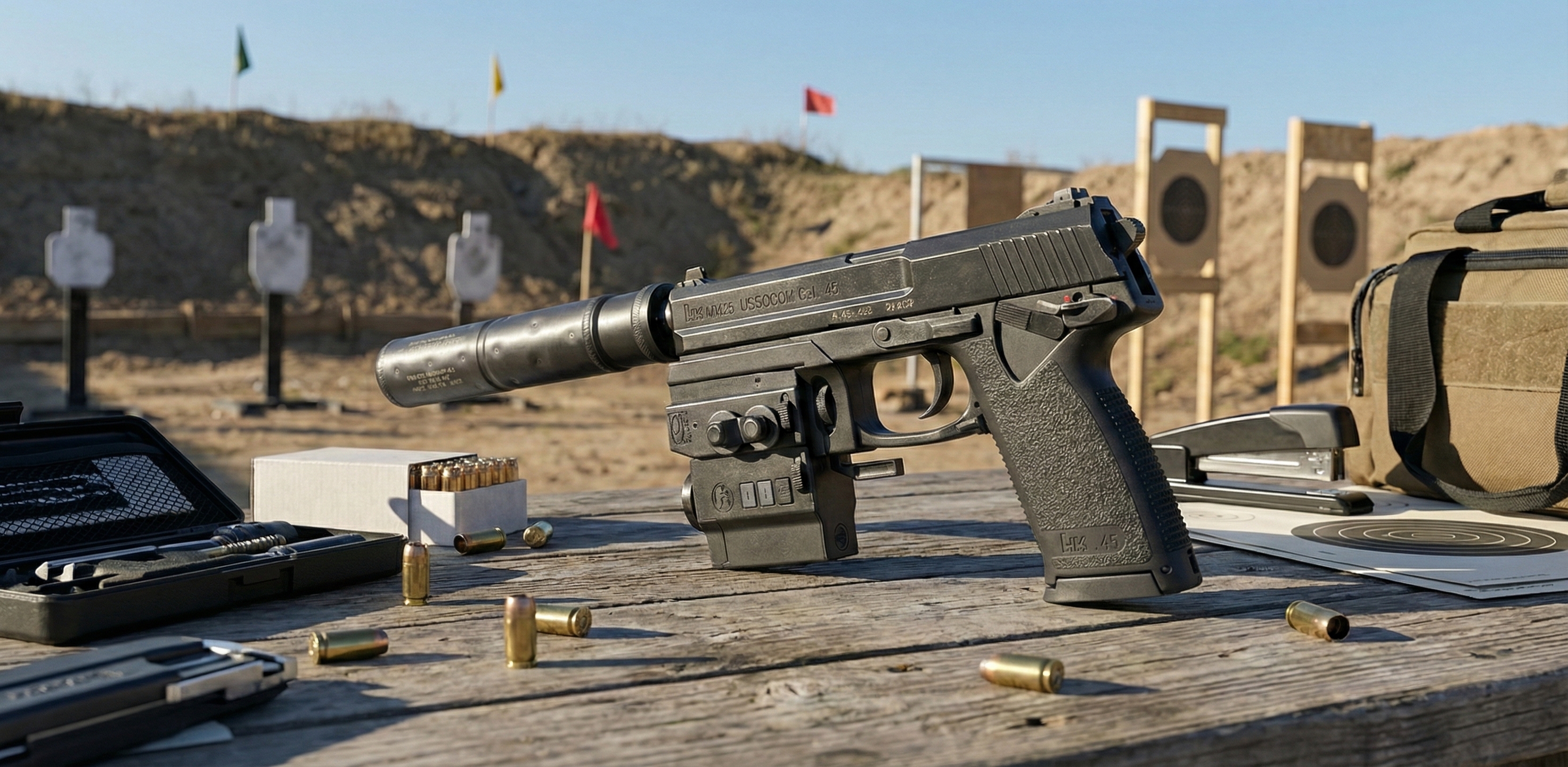
The Heckler & Koch (HK) Mark 23 represents a singular, perhaps unrepeatable, milestone in the history of small arms engineering. Designated the MK23 MOD 0 by the United States Special Operations Command (USSOCOM), this firearm was the result of the Offensive Handgun Weapon System (OHWS) program initiated in the late 1980s.1 Unlike virtually every other sidearm in military service, which are designed as defensive, secondary weapons, the Mark 23 was specifically engineered to serve as a primary offensive tool for special operations forces, intended to provide the terminal ballistics, accuracy, and reliability of a submachine gun in a holstered platform.2 The weapon system is defined by its extreme over-engineering, featuring a 5.87-inch cold hammer-forged barrel with polygonal rifling, a proprietary dual-spring recoil reduction system, and a capacity to withstand tens of thousands of rounds of high-pressure.45 ACP +P ammunition without structural failure.1

Market sentiment for the Mark 23 is categorized by a stark divergence between practical tactical utility and historical/collector prestige. Within the professional community, it is often critiqued for its immense physical footprint—frequently colloquially dubbed a “crew-served handgun”—and its lack of modern modular features such as integrated Picatinny rails or optics-ready slides.3 However, among collectors and enthusiasts, it retains a “grail” status due to its unmatched mechanical accuracy (capable of 2-inch groups at 50 yards) and its legendary performance as a suppressor host.1

Benchmarked against modern rivals like the FN FNX-45 Tactical, Sig Sauer P220 Legion, and Glock 21 Gen 5 MOS, the Mark 23 is technically superior in terms of raw durability and mechanical precision but lags in ergonomic efficiency and “utility density”.4 For a potential buyer, the Mark 23 is a logical acquisition if the intended use case is static precision shooting, high-reliability home defense, or as a centerpiece of a historic small arms collection.6 It is not recommended for duty carry or missions requiring rapid transitional maneuvers.4 This report provides an exhaustive engineering and market analysis of the Mark 23, its competitors, and its place in the modern tactical landscape.
Yugo M85/M92 dust cover quick takedown pin and ring from Ronin's Grips

1. Historical Genesis and the OHWS Doctrine

The existence of the Heckler & Koch Mark 23 is inextricably linked to the geopolitical and institutional shifts of the late 1980s. Following the formation of USSOCOM, special operations representatives identified a critical gap in the small arms inventory. At the time, various units within the command utilized an estimated 120 different types and configurations of small arms, leading to logistical inefficiencies and inconsistent performance standards.2 The Offensive Handgun Weapon System (OHWS) program was conceived not just to replace the 9mm M9 service pistol—which was deemed to have insufficient stopping power for special operations—but to create the first joint SOCOM weapon that could serve as a primary engagement tool.2

The technical requirements for the OHWS were unprecedented. The command sought a handgun chambered in.45 ACP that could achieve one-shot incapacitation of enemy personnel at close range, even when suppressed.2 This necessitated the development of a specific high-pressure cartridge: a 185-grain +P load that delivered significantly higher velocities than the standard 230-grain ball ammunition.2 While existing platforms like the M1911 were considered, they were ultimately rejected because the increased pressure of the +P loads would rapidly accelerate wear and eventually destroy the frames of traditional handguns.3

Heckler & Koch entered the competition in 1991, competing against Colt’s OHWS submission.1 While Colt essentially adapted existing technologies, HK leveraged the early development of its USP (Universal Self-loading Pistol) to create a platform specifically “built for the extremes”.2 HK’s engineering philosophy focused on an “overbuilt” approach, prioritizing ultimate durability and the integration of specialized equipment like the Insight Technology Laser Aiming Module (LAM) and the Knight’s Armament Company (KAC) sound suppressor.2 Following Phase I testing, Colt was eliminated, leaving HK to proceed to some of the most rigorous reliability trials ever conducted in the history of firearm procurement.5

2. Engineering Architecture and Technical Specifications

The Mark 23 is a short-recoil, modified Browning action, semi-automatic pistol designed around a fiber-reinforced polymer frame and a nitro-carburized steel slide.1 Its physical presence is dominated by its dimensions: a length of 9.65 inches without a suppressor and a weight of 3.2 lbs when loaded with 12 rounds of.45 ACP.1 This mass is not merely a byproduct of size but a calculated engineering decision to provide the necessary inertia to handle high-pressure loads and the added weight of muzzle-mounted suppressors.14

2.1 Technical Specifications and Dimensional Analysis

MetricSpecificationSource
Caliber.45 ACP (Supports +P and.45 Super)1
ActionShort Recoil, DA/SA, Modified Browning1
Barrel Length5.87 in (149.10 mm)1
RiflingPolygonal, Chrome-lined5
Weight (Empty)2.43 lbs (1.2 kg)1
Weight (Loaded)3.2 lbs (1.47 kg)1
Overall Length9.65 in (421 mm with suppressor)1
Width1.54 in (39.116 mm)1
Magazine Capacity12 Rounds (Standard)1
Trigger Pull12.13 lbs (DA) / 4.85 lbs (SA)5

The barrel is manufactured with polygonal rifling, a significantly more expensive production method that increases bore life and provides a superior gas seal for increased muzzle velocity.5 Furthermore, the barrel features a rubber O-ring near the muzzle, which serves to center the barrel within the slide consistently for every shot, contributing to the pistol’s match-grade accuracy.15 This engineering detail allows the Mark 23 to achieve 2-inch groups at 25 meters (and even 50 yards), an accuracy standard that rivals custom-built match pistols.5

2.2 Control Surface Engineering

A unique aspect of the Mark 23’s design is the separation of its manual safety and decocking lever.15 In contrast to the later USP series, which often combined these functions into a single lever, the Mark 23 requirement dictated that a separate decocker be present to allow the hammer to be lowered silently—a critical feature for covert offensive operations.1 The manual safety is ambidextrous, allowing the weapon to be carried in “Condition 1” (cocked and locked), which provides the operator with a crisp, light single-action trigger pull for the first shot.2

The trigger guard is intentionally oversized to accommodate shooters wearing heavy gloves, and the magazine release utilizes the HK-signature paddle system at the rear of the guard.1 While some modern users find the paddle release unconventional, it is highly efficient once mastered, as it can be operated by the trigger finger or thumb without requiring a significant shift in the firing grip.15

3. Reliability Testing and Environmental Resilience

The Mark 23 passed what are arguably the strictest reliability tests any handgun has ever endured. During Phase II of the OHWS trials, the requirement was for the pistol to fire no less than 2,000 Mean Rounds Before Failure (MRBF).3 The HK Mark 23 significantly exceeded this, averaging 6,027 MRBF and in one instance reaching 15,122 MRBF.3 This indicates that a user could theoretically expect to fire over 6,000 rounds before experiencing even a minor stoppage—a level of reliability that far outclasses standard duty sidearms.4

Three test pistols were put through a 30,000-round endurance test, maintaining an accuracy of 2.5 inches at 25 meters throughout the entire trial.3 Remarkably, the only component that required replacement during this 30,000-round cycle was the rubber O-ring after 20,000 rounds.5 This speaks to a degree of metallurgical and mechanical durability that makes the Mark 23 a “bombproof” investment for long-term ownership.4

The weapon’s environmental resilience was similarly pushed to the extreme. It was required to function in temperatures ranging from -25 degrees Fahrenheit to 140 degrees Fahrenheit while exposed to salt spray, mud, ice, and sand.3 To achieve this, HK utilized a specialized “Maritime” finish on early military and civilian models—a glossy, black lacquer-like coating designed specifically for salt-water corrosion resistance.18 While later civilian models transitioned to the “Hostile Environment” (HE) matte finish common to the USP line, both coatings utilize a multi-part process involving nitrocarburizing and phosphate layers to ensure the steel remains impervious to the elements.19

4. Suppressor Performance and Offensive Utility

The “Offensive” in OHWS was largely predicated on the ability to eliminate sentries and clear rooms quietly.2 The Mark 23 was designed as a “complete system,” including a dedicated suppressor from Knight’s Armament Company.1 Because the pistol was engineered with the suppressor in mind, it features a long barrel dwell time and a heavy slide mass that ensures reliable cycling even with the added backpressure of a sound suppressor.14

Users and industry analysts frequently rank the Mark 23 as the best suppressed.45 ACP pistol experience available.7 Its dual-spring recoil reduction system—which includes a secondary buffer spring to soak up the impact of the slide on the frame—drastically reduces felt recoil and stress on the weapon when firing suppressed loads.2 This results in a “soft shooting” characteristic that allows for rapid, accurate follow-up shots that are “comically quiet” compared to other platforms.3

One notable engineering detail is the thread pitch: the Mark 23 uses a 16x1mm Right-Hand (RH) thread pattern, whereas the subsequent USP Tactical series uses a 16x1mm Left-Hand (LH) pattern.5 Buyers must ensure they acquire the correct piston for their suppressors to avoid compatibility issues.21 Despite its age, the Mark 23’s performance as a “host” remains the benchmark against which modern tactical.45s are measured.7

5. Competitive Benchmarking and Market Comparison

To determine whether the Mark 23 remains a viable purchase today, it must be compared against its modern counterparts. The primary competitors in the high-capacity, tactical.45 ACP market include the FN FNX-45 Tactical, the HK USP45 Tactical, the Sig Sauer P220 Legion, and the Glock 21 Gen 5 MOS.9

5.1 Tactical.45 ACP Platform Matrix

The following matrix visualizes the trade-offs between the Mark 23 and its closest rivals across key performance indicators.
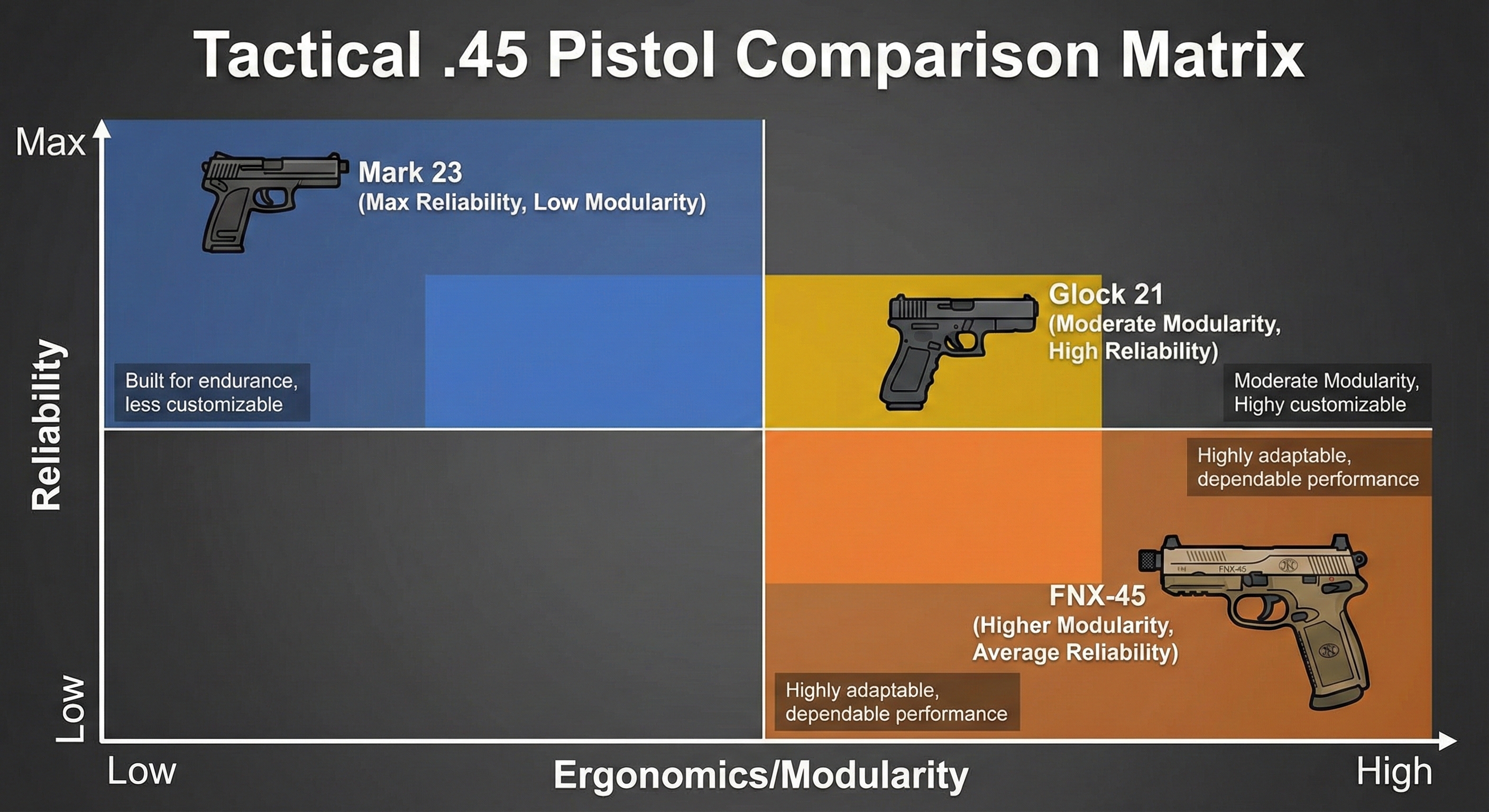
Yugo M85/M92 dust cover quick takedown pin and ring from Ronin's Grips
ModelCapacityOptics ReadyWeight (oz)MSRP (Est)Performance Category
HK Mark 2312+1No39.4$2,969Offensive / Specialist
FN FNX-45 Tac15+1Yes33.3$1,379Tactical / Modern
HK USP45 Tac12+1No32.8$1,749Professional / Duty
Sig P220 Legion8+1Yes30.4$1,299Precision / Target
Glock 21 Gen 513+1Yes29.1$754Utilitarian / Duty

Data synthesized from.10

5.2 Deep Dive: Mark 23 vs. FN FNX-45 Tactical

The FN FNX-45 Tactical is the most direct modern competitor to the Mark 23, offering a feature set that addresses many of the HK’s perceived shortcomings.9

  • Capacity and Modularity: The FNX-45 offers a superior 15+1 capacity and comes factory-milled for micro red-dot optics, a feature that the Mark 23 lacks without expensive custom gunsmithing.4 It also utilizes a standard MIL-STD-1913 Picatinny rail, allowing for the immediate attachment of modern lights and lasers, whereas the Mark 23 requires a proprietary adapter for the same functionality.4
  • Engineering Nuance: While the FNX is more “modern,” industry sentiment suggests it does not match the Mark 23’s “bombproof” build quality.6 Some users have reported “flex” in the FNX polymer frame when squeezed and a “mushy” double-action trigger pull that lacks the refined break of the HK’s match-grade components.20 The FNX is a more versatile tool for the modern operator, but the Mark 23 is a superior engineering artifact for those prioritizing mechanical longevity.14

5.3 Internal Rivalry: Mark 23 vs. USP45 Tactical

The USP45 Tactical was developed precisely because the Mark 23 was considered too large for many missions.5 Constructed on the standard USP45 frame, the Tactical model retains the threaded O-ring barrel and match trigger of the Mark 23 but in a significantly more compact and lighter package (32.8 oz vs 39.4 oz).5

  • The Verdict: If the user requires a duty-sized weapon for active carry, the USP Tactical is a more practical choice that sacrifices very little in terms of precision.14 However, the Mark 23’s increased slide mass and larger frame provide a “softer” shooting experience that is arguably superior for sustained suppressed fire.7

6. Buyer Sentiment and Cultural Legacy

The Mark 23 occupies a unique space in the firearm market, driven as much by its cultural legacy as its technical prowess. It achieved widespread notoriety through its prominent use in the Metal Gear Solid video game series and the film Tears of the Sun, cementing its image as the ultimate tool of the elite operative.3

6.1 Collector Psychographics

Among enthusiasts, the Mark 23 is often a “must-have” novelty.6 Forum sentiment indicates that many owners buy the pistol as part of a “grail” acquisition, valuing its over-engineered nature even if they find its size impractical for daily use.6 Comments like “it’s built like a tank” and “it gets a ton of attention at the range” are common.6 Collectors particularly value early “Maritime” finish models (KG date codes) and units with the “MK23 USSOCOM” slide markings, which command higher prices on the used market.5

6.2 Practical Criticisms and the “Meme Gun” Narrative

Conversely, a subset of the community views the Mark 23 as a “meme gun” due to its comically large dimensions.4 Critics argue that modern handguns have rendered the Mark 23 “outdated” because they provide similar reliability in much smaller, lighter, and more adaptable packages.4 The pistol’s inability to mount modern optics without milling the slide is a significant detractor for contemporary shooters who have moved toward red-dot sights for all tactical applications.4

The price point—typically between $1,800 and $2,500—is another barrier.6 Many shooters argue that for the price of one Mark 23, they could purchase two high-quality modern duty pistols (like a Glock 21 and a USP Tactical) and still have money left for ammunition.6

7. Purchase Recommendation and Use Case Logic

Should a person buy an HK Mark 23? The answer depends entirely on the intended application.

  1. Static Range Precision: For shooters who enjoy punching tight groups at 25 or 50 yards, the Mark 23 is one of the few production handguns that can match the accuracy of custom-tuned match pistols.5
  2. Dedicated Suppressor Host: If the primary goal is a quiet, reliable suppressed shooting experience, the Mark 23 remains the “king”.7 Its engineering specifically accounts for the backpressure and weight of a suppressor, ensuring a long service life and exceptional performance.14
  3. Home Defense (Dedicated): In a home defense role where concealment is not a factor, the Mark 23 is an excellent choice.12 Its soft recoil, high reliability, and match accuracy make it easy to shoot under stress, provided the user has hands large enough to manage the grip.3
  4. Specialist / Collector Interest: For those interested in the history of special operations small arms or the peak of 1990s German engineering, the Mark 23 is a cornerstone of any collection.6
  1. Concealed Carry: The Mark 23 is fundamentally unsuited for concealment. Its weight and length make it uncomfortable for daily carry and impossible to hide without extreme clothing accommodations.1
  2. Modern Tactical Drills / Competition: For USPSA, IDPA, or rapid-transition tactical courses, the Mark 23 is hampered by its “slow” handling characteristics compared to modern 2011s or striker-fired duty pistols.6
  3. Utility-to-Value Seekers: Those looking for the best “bang for their buck” will find better value in the FNX-45 Tactical or Glock 21, which provide more features and modern compatibility for half the cost.6

8. Final Engineering Conclusion

The HK Mark 23 is a masterpiece of small arms design from an era that prioritized absolute mechanical perfection over market modularity.13 Its 30,000-round endurance certification and 6,000+ MRBF reliability rating remain the industry’s highest benchmarks.3 While it has been surpassed by rivals like the FNX-45 Tactical in terms of capacity and optics readiness, it has never been equaled in terms of raw durability or the intrinsic quality of its manufacturing.20

If the objective is to own the most reliable and accurate.45 ACP handgun ever produced—and the buyer is willing to accept the ergonomic trade-offs of its colossal size—the Mark 23 is an unparalleled acquisition.4 It is a “professional’s instrument” masquerading as a collector’s item, and its status as the first and last “offensive handgun” ensures it will remain a legend for decades to come.3

Appendix: Methodology

The findings in this report are based on a multifaceted engineering and market analysis utilizing 84 discrete research data points. Technical specifications and historical context were derived from official USSOCOM program documentation and HK engineering records from the 1990s.1 Reliability and durability metrics were sourced from the OHWS Phase II and Phase III testing protocols.3

Buyer sentiment analysis was performed by synthesizing qualitative data from professional tactical forums (e.g., Sniper’s Hide), user communities (r/HecklerKoch, r/USPmasterrace), and industry reviews from 2020 through 2025.4 Competitive benchmarking was conducted using contemporary MSRP data and comparative testing reports for.45 ACP platforms.10 Regional Michigan procurement data was gathered by auditing current FFL and NFA dealer registries and verifying local transfer policies in the Southwest Michigan region.35 Acoustic and ergonomic comparisons were based on peer-reviewed industry testing of suppressed handguns.22


Please share the link on Facebook, Forums, with colleagues, etc. Your support is much appreciated and if you have any feedback, please email us in**@*********ps.com. If you’d like to request a report or order a reprint, please click here for the corresponding page to open in new tab.


Sources Used

  1. Heckler & Koch MK23 – Gun Wiki | Fandom, accessed February 7, 2026, https://guns.fandom.com/wiki/Heckler_%26_Koch_MK23
  2. THE CREW-SERVED PISTOL – HK USA, accessed February 7, 2026, https://hk-usa.com/wp-content/uploads/2023/09/MK23-MOD-0-.pdf
  3. The HK MK23 built for SOCOM was the first and last offensive handgun | Sandboxx, accessed February 7, 2026, https://www.sandboxx.us/news/socoms-hk-mk23-was-the-first-and-last-offensive-handgun/
  4. Anyone know why people say the mk23 is “outdated” besides the fact that it’s old? What about it is really outdated? It is better than practically every pistol in a lot of ways. : r/HecklerKoch – Reddit, accessed February 7, 2026, https://www.reddit.com/r/HecklerKoch/comments/1gykdmv/anyone_know_why_people_say_the_mk23_is_outdated/
  5. Heckler & Koch Mark 23 – Wikipedia, accessed February 7, 2026, https://en.wikipedia.org/wiki/Heckler_%26_Koch_Mark_23
  6. Mark 23 Pros : r/HecklerKoch – Reddit, accessed February 7, 2026, https://www.reddit.com/r/HecklerKoch/comments/144unuh/mark_23_pros/
  7. What Is the Actual Difference – USP v.s. USP Tactical v.s. Mk23 – and Which Should I Buy? : r/USPmasterrace – Reddit, accessed February 7, 2026, https://www.reddit.com/r/USPmasterrace/comments/1hk5bdv/what_is_the_actual_difference_usp_vs_usp_tactical/
  8. Mk 23 or USP 45 Tac : r/USPmasterrace – Reddit, accessed February 7, 2026, https://www.reddit.com/r/USPmasterrace/comments/1dfelz7/mk_23_or_usp_45_tac/
  9. FNX 45 vs Glock 21: Which .45 ACP Handgun is Right for You? – Alien Gear Holsters, accessed February 7, 2026, https://aliengearholsters.com/blogs/news/fnx-45-vs-glock-21
  10. 7 Best 45 ACP Pistols in 2026 – Gun University, accessed February 7, 2026, https://gununiversity.com/best-45-acp-pistols/
  11. The BIGGEST, STUPIDEST handgun: HK MK23 review – YouTube, accessed February 7, 2026, https://www.youtube.com/watch?v=2YHqeNHYDLs
  12. Sig Sauer Pistol P220 45 ACP 4.4″LEGION SAO X-RAY 8RD SRT – DEGuns, accessed February 7, 2026, https://www.deguns.com/sig-sauer-pistol-p220-45-acp-4-4legion-sao-x-ray-8rd-srt
  13. HK MK23 vs USP: A Detailed Comparison of Two Iconic Handguns – You Should Know, accessed February 7, 2026, https://web.good-win-racing.com/lou/17-hk-mk23-vs-usp-a-detailed-comparison-of-two-iconic-handguns-14885/
  14. Mk23 vs. USP 45: A Deep Dive into Two Legendary .45 ACP Pistols – You Should Know, accessed February 7, 2026, https://demo.data.nichq.org/vhur/29-mk23-vs-usp-45-a-deep-dive-into-two-legendary-45-acp-pistols-6451/
  15. The H+K Mark 23…thoughts and observations | Canadian Gun Nutz, accessed February 7, 2026, https://www.canadiangunnutz.com/forum/threads/the-h-k-mark-23-thoughts-and-observations.1965391/
  16. HK Mark 23 Caliber SOCOM 45 ACP 5.87 in. Threaded Barrel 10 Rnd Pistol – Exchange, accessed February 7, 2026, https://www.shopmyexchange.com/hk-mark-23-caliber-socom-45-acp-587-in-threaded-barrel-10-rnd-pistol–3332400/3332400
  17. USP45 Tactical vs FNX45 Tactical : r/Firearms – Reddit, accessed February 7, 2026, https://www.reddit.com/r/Firearms/comments/typp3z/usp45_tactical_vs_fnx45_tactical/
  18. Can someone explain the difference between the Mk23 SOCOM and the Mk23 civilian version? : r/HecklerKoch – Reddit, accessed February 7, 2026, https://www.reddit.com/r/HecklerKoch/comments/1g8hr2e/can_someone_explain_the_difference_between_the/
  19. MK23 + TLR2HLG : r/HecklerKoch – Reddit, accessed February 7, 2026, https://www.reddit.com/r/HecklerKoch/comments/n5i9ei/mk23_tlr2hlg/
  20. Next 45 : r/SigSauer – Reddit, accessed February 7, 2026, https://www.reddit.com/r/SigSauer/comments/1oplv1y/next_45/
  21. I have a suppressor on the way, torn between buying the HK USP .45 or FNX .45 Tac. Thoughts? : r/guns – Reddit, accessed February 7, 2026, https://www.reddit.com/r/guns/comments/3a6jlp/i_have_a_suppressor_on_the_way_torn_between/
  22. FNX-45 vs USP-T 45 : r/NFA – Reddit, accessed February 7, 2026, https://www.reddit.com/r/NFA/comments/1pdmk37/fnx45_vs_uspt_45/
  23. Best .45 ACP Pistols (That Aren’t 1911s) – Pew Pew Tactical, accessed February 7, 2026, https://www.pewpewtactical.com/best-45-acp-pistols/
  24. MARK 23 – HK USA, accessed February 7, 2026, https://hk-usa.com/product/mark-23/
  25. FNX™-45 Tactical | FN® Firearms, accessed February 7, 2026, https://fnamerica.com/products/pistols/fnx-45-tactical/
  26. Sig Sauer P220 Legion .45ACP 4.4″ 8rd Pistol – RifleGear, accessed February 7, 2026, https://www.riflegear.com/p-20169-sig-sauer-p220-legion-45acp-44-8rd-pistol.aspx
  27. Test: Glock G21 Gen5 MOS, a full size polymer pistol in .45 ACP | all4shooters, accessed February 7, 2026, https://www.all4shooters.com/en/shooting/pistols/glock-g21-gen5-mos-45-acp-polymer-pistol-test-report-shooting-range-infos/
  28. FNX™-45 Tactical FDE/BLK | FN® Firearms, accessed February 7, 2026, https://fnamerica.com/products/discontinued-products/fnx-45-tactical-fdeblk/
  29. FNX™-45 TACTICAL, accessed February 7, 2026, https://specialops.org/wp-content/uploads/2018/11/1607_FNX_45_Tactical_sellsheet_R2.pdf
  30. USP TACTICAL – HK USA, accessed February 7, 2026, https://hk-usa.com/product/usp-tactical/
  31. Mk23: New or used? : r/HecklerKoch – Reddit, accessed February 7, 2026, https://www.reddit.com/r/HecklerKoch/comments/1ms2vcr/mk23_new_or_used/
  32. HK USP Tactical vs. FNX Tactical – YouTube, accessed February 7, 2026, https://www.youtube.com/watch?v=cyu2R9l5G8A
  33. HK Mark 23 Semi-Auto Pistol – .45 ACP – Bass Pro Shops, accessed February 7, 2026, https://www.basspro.com/p/hk-mark-23-semi-auto-pistol-with-12-round-magazine-45-acp
  34. The MK23 SOCOM: A Legacy of Precision and Power – Oreate AI Blog, accessed February 7, 2026, https://www.oreateai.com/blog/the-mk23-socom-a-legacy-of-precision-and-power/e130f08e867cab2f908dad9ce63f10d6
  35. Dealer Locator – HK USA, accessed February 7, 2026, https://hk-usa.com/dealer-locator/
  36. SHERIDAN ARMS LLC., accessed February 7, 2026, https://www.sheridanarms.com/
  37. Uncoiled Firearms & Range – Michigan’s #1 NFA Dealer, accessed February 7, 2026, https://uncoiledfirearms.com/
  38. Huron Valley Guns | Gun store, Range, Classes, Tactical Training, Uniforms, Barber shop, Molly Pitchers restaurant, accessed February 7, 2026, https://www.huronvalleyguns.com/
  39. Village Do It Best Hardware, 106 W FERRY STREET, BERRIEN SPGS, MI | FFLs.com, accessed February 7, 2026, https://www.ffls.com/ffl/438021017b06228/village-hardware-of-berrien-inc
  40. MK23 SOCOM for Sale | Buy Online at GunBroker, accessed February 7, 2026, https://www.gunbroker.com/mk23-socom/search?keywords=mk23%20socom&s=f&cats=3026
  41. FFL Dealers in Benton Harbor, MI – DLD VIP, accessed February 7, 2026, https://dld-vip.com/ffl-dealers/MI/benton-harbor/
  42. FFL Transfers | Hilltop Sports, accessed February 7, 2026, https://www.hilltopsports.com/ffl-transfers
  43. Firearm Transfers – Gerbrand Defense, LLC, accessed February 7, 2026, https://gerbranddefense.com/firearm-transfers/
  44. FFL Transfer Services – Armed in Michigan, accessed February 7, 2026, https://armedinmichigan.com/services/ffl-transfers/
  45. NFA Class III Weapons for Sale – Taylor – Westborn Gun Shop, accessed February 7, 2026, https://westborngunshop.com/department/nfa/
  46. BARK RIVER PRECISION – Custom Rifles, Suppressors, accessed February 7, 2026, https://barkriverprecision.com/
  47. Torn between hk45 and sig220 or fnx45 : r/guns – Reddit, accessed February 7, 2026, https://www.reddit.com/r/guns/comments/1gybncy/torn_between_hk45_and_sig220_or_fnx45/
  48. See Class 3 dealers in Michigan – FFL123.com, accessed February 7, 2026, https://www.ffl123.com/class-3-dealer-list-michigan-class-3-dealers/
  49. This Or That? HK Mark 23 or FN FNX-45 Tactical – YouTube, accessed February 7, 2026, https://www.youtube.com/watch?v=KLEULDuk0Oc

The Kill Web: Architecting Decision Superiority in Multi-Domain Warfare

Executive Summary

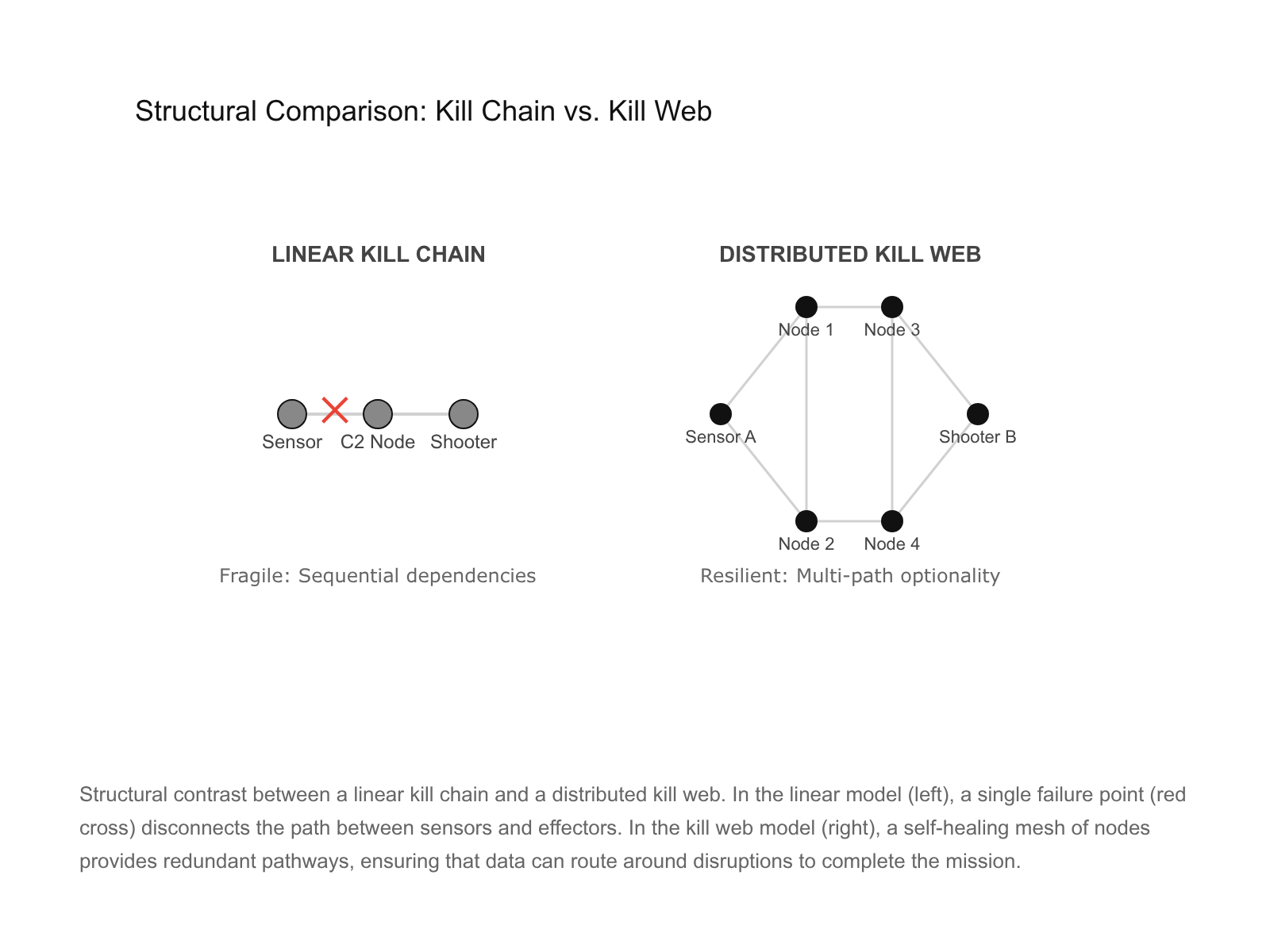
The fundamental character of modern warfare is undergoing a rapid transformation, shifting from a focus on individual, high-value platforms to a decentralized, network-centric architecture known as the kill web. Historically, the United States military relied on the “kill chain,” a linear and sequential process summarized by the find-fix-track-target-engage-assess (F2T2EA) model. While effective in permissive environments, this linear structure is inherently brittle; the disruption of a single node or data link can cause the entire chain to collapse. In response to the sophisticated anti-access/area denial (A2/AD) capabilities of peer competitors like China and Russia, the Department of Defense is transitioning toward a kill web. This concept, born from DARPA’s Mosaic Warfare research, replaces the single, fragile chain with a self-healing mesh of sensors, shooters, and command nodes.

Operating within a kill web requires a cognitive revolution for the individual warfighter, who evolves from a platform operator into a “node of command” or a “quarterback,” managing multiple simultaneous information streams and directing effects across land, sea, air, space, and cyberspace. Conversely, operating as a kill web involves the systemic emergence of the force as a single, integrated organism. This systemic operation is characterized by a “capability marketplace” where AI-driven algorithms match the optimal effector to a specific target in real-time, leveraging the latent capacity of the entire joint force. This report analyzes the technical enablers of this shift—including Joint All-Domain Command and Control (JADC2), edge computing, and artificial intelligence—while addressing the mathematical modeling of resilience and the profound legal and moral implications of machine-interceded agency on the battlefield.

1. The Paradigm Shift: From Asymmetric Advantage to Decision Superiority

The strategic environment facing the United States has shifted from a period of uncontested dominance to one defined by great-power competition. For decades, American military superiority was predicated on a “Second Offset” strategy, which utilized airborne sensors and precision-guided munitions to overcome numerical disadvantages.1 This paradigm matured into the Air-Land Battle concept, which proved triumphant during Operation Desert Storm.1 However, the proliferation of advanced technologies has democratized these advantages. Peer adversaries have developed “system destruction” strategies specifically designed to exploit the vulnerabilities of the traditional American way of war.3

1.1 The Erosion of Traditional Asymmetries

Legacy military power is concentrated in monolithic, multi-capability platforms such as aircraft carriers, stealth bombers, and advanced satellites.2 These platforms are exceptionally capable but represent single points of failure. The loss of a single F-35 or an Arleigh Burke-class destroyer is not only a significant loss of combat power but also a massive financial and strategic blow.2 Adversaries have optimized their forces to target these specific nodes using long-range anti-ship missiles, electronic warfare, and cyber attacks.3

The conventional kill chain is the mechanism by which these platforms are employed. It is a “sensor-to-shooter” path that must remain unbroken to achieve an effect.5 In a contested environment, the adversary’s goal is to “snap” this chain.5 If they can jam the link between a drone and its controller, or destroy the radar station providing coordinates to a missile battery, they have successfully neutralized the threat without necessarily having to destroy every weapon system.3

1.2 The Shift to Decision-Centric Warfare

Military analysts now recognize that the next conflict will be won by the side that can achieve “decision superiority”—the ability to sense, make sense, and act at a speed and scale that the adversary cannot match.6 This is the core principle of Mosaic Warfare. Instead of packing every tool into one elite system, the military is disaggregating capabilities across multiple smaller platforms.2

This shift moves the center of gravity from the platform to the network. The objective is to present the enemy with a “mosaic” of thousands of diverse, fluid pieces that can be rapidly composed and recomposed into a battle plan.1 This complexity is intended to overwhelm the opponent’s decision-making cycle (the OODA loop), forcing them to respond to a wide front of parallel attacks rather than a predictable, linear strike.1

2. Deconstructing the Kill Web

The term “kill web” describes the lethal application of fused data from a highly scalable and resilient battle network.9 It is the technical and operational evolution of the kill chain, designed to preserve the ability to strike even when parts of the system are destroyed or degraded.3

2.1 Defining the Architectural Shift

A kill web is a non-linear, networked approach that unites forces, commanders, and technologies across all domains.10 While a chain is a sequence, a web is a mesh.3 The following comparison clarifies these differences:

Table 1: Comparison of Linear Kill Chains and Kill Webs

FeatureLinear Kill ChainKill Web
Core PhilosophySequential and platform-centricDistributed and network-centric
Node InterdependencyHigh; one failure stops the sequenceLow; multiple paths to completion
Domain IntegrationOften “stovepiped” by serviceInherently cross-domain (All-Domain)
Decision LogicCentralized C2Decentralized/Distributed C2
ResiliencyBrittle; easy to target key nodesSelf-healing; redundant and adaptive
ScalabilityDifficult and rigidHigh; “plug-and-play” capability

2

The transition to a kill web permits the military to operate like a “single organism,” with units moving and acting in concert against numerous objectives.10 This is made possible by advanced sensing technologies that provide a common operational picture (COP) actionable across the full spectrum of operations.10

2.2 The Non-Linearity of F2T2EA

In a kill web, the six tactical functions of the kill chain—Find, Fix, Track, Target, Engage, and Assess—are no longer bound to a single platform or a specific sequence.1 Instead, they are distributed functions that can be executed by any capable node in the network.12

  • Find: Ubiquitous sensors (satellites, drones, acoustic sensors, cyber monitors) provide the initial detection.10
  • Fix: Cross-domain data fusion determines the target’s precise location, often using different sensing modalities to overcome enemy deception.10
  • Track: A target identified by an Air Force jet can be tracked by a Navy ship or a ground-based radar, ensuring continuity even if the original sensor must move or is jammed.5
  • Target: AI-enabled matchmaking tools evaluate every available weapon system in the theater to choose the most efficient option.15
  • Engage: The selected effector—whether a kinetic missile, a cyber-payload, or an electronic jammer—is directed to the target.5
  • Assess: The results are immediately fed back into the web to determine if further action is needed.13

This non-linearity means that a mission does not “restart” if a link is broken; it simply reroutes through the next available node.5

3. DARPA and the Mosaic Warfare Construct

Mosaic Warfare is the conceptual foundation for the kill web. Developed by DARPA, this approach seeks to achieve complex effects through the coordination of many small, diverse, and simple systems.1

3.1 Quantization of Combat Power

Mosaic Warfare relies on the “fractionation” or “quantization” of capabilities.4 In the traditional model, an F-35 is a “monolithic” platform that must find, fix, and target an enemy aircraft itself. In a Mosaic construct, the “find” function might be performed by a swarm of small, inexpensive drones, the “fix” by a distant high-altitude platform, and the “engage” by a missile launched from a cargo plane miles away.1

This quantization allows the military to:

  1. Increase the number of targets the enemy must engage.1
  2. Reduce the cost of individual losses.2
  3. Mass firepower without having to mass forces physically.1
  4. Rapidly compose a set of needed capabilities for a specific mission.4

3.2 The Logic of the Rhizome

In organizational theory, Mosaic Warfare represents a shift from a “hierarchical” structure to a “rhizome” form.7 A hierarchy is a tree-like structure with a central trunk; if the trunk is severed, the branches die. A rhizome is a decentralized, interconnected network—like a root system or the internet.7 This form is inherently more resilient to targeted disruptions because it lacks a perceivable center or primary point of vulnerability.7

4. Technological Enablers: JADC2 and the Advanced Battle Management System

The realization of the kill web requires a robust digital infrastructure. This is being pursued through the Joint All-Domain Command and Control (JADC2) initiative, which aims to produce a warfighting capability to sense, make sense, and act at all levels and phases of war.17

4.1 ABMS: The Internet of Military Things

The Air Force’s contribution to JADC2 is the Advanced Battle Management System (ABMS).19 ABMS is not a single platform but a “network of networks” or an “internet of military things” (IoMT).17 It provides the digital architecture needed to link sensors and shooters across all domains.8

Key components tested in ABMS “on-ramp” exercises include:

  • Cloud-at-the-Edge: Deploying computing systems (supported by vendors like AWS) to process AI algorithms at the tactical front, rather than in distant data centers.22
  • Mesh Networking: Using software-defined systems to maintain connectivity across air, land, sea, and space.23
  • Airborne Edge Nodes: Specialized platforms designed to bridge communication gaps between incompatible legacy systems, such as the F-22 and F-35, which use different data links.17

4.2 Project Convergence and Project Overmatch

While the Air Force develops the “backbone” via ABMS, the Army and Navy have their own integrated efforts. The Army’s “Project Convergence” focuses on using AI to analyze information and streamline C2 to meet fast-paced threats.19 This program has successfully tested AI-driven tools like “Firestorm,” which can reduce the sensor-to-shooter timeline from hours to minutes.24

The Navy’s “Project Overmatch” is focused on fleet-wide distributed lethality, ensuring that carrier strike groups can operate as a powerful node within a wider web, where any ship’s radar can cue any other ship’s missile.14

5. Operating Within a Kill Web: The Tactical Node

To “operate within” a kill web means that an individual warfighter or platform no longer acts as an isolated player but as an integrated node within a larger system.12

5.1 The Human in the Loop: Cognitive Revolution

The pilot of a fifth-generation fighter jet operating within a kill web undergoes a “cognitive revolution”.12 Their role shifts from executing predefined roles within a linear chain to making distributed, autonomous decisions within an adaptive web.12

Table 2: Evolution of the Combat Aviator’s Role

Legacy Platform OperatorModern Kill Web Node
Focus: Individual platform proficiencyFocus: Integrated force effectiveness
Mindset: Tactical performer executing a missionMindset: Strategic decision-maker
Inputs: Onboard sensors and voice commsInputs: Multi-source sensor fusion and AI analytics
Decision Space: Myopic/LocalDecision Space: Holistic/Battlespace Awareness
Responsibility: Executing a pre-planned roleResponsibility: Orchestrating effects across the web

12

This “Quarterback in the Cockpit” must process simultaneous information streams and assess a dynamic battlespace populated with friendly and enemy forces across all six domains (air, land, sea, space, cyber, and electromagnetic spectrum).12

5.2 Live, Virtual, and Constructive (LVC) Training

Preparing warfighters to operate within this complexity requires new training environments. Integrated LVC environments combine real people in real systems (Live), real people in simulated systems (Virtual), and computer-generated forces (Constructive).12 This allows pilots and commanders to practice the “distributed lethality” of the kill web at a scale and complexity that would be impossible—and too expensive—to replicate in purely live exercises.12

6. Operating As the Kill Web: Systemic Emergence

Operating “as” a kill web is a systemic phenomenon where the entire force acts as a complex adaptive system. This goes beyond simple coordination; it is about “convergence”—the ability of the system to self-organize and produce emergent effects that cannot be achieved by individual parts.25

6.1 Algorithmic Bidding and the Capability Marketplace

One of the most disruptive elements of operating as a kill web is the transition of C2 from a manual, hierarchical process to a machine-enabled “capability marketplace”.6 Programs like DARPA’s Adapting Cross-Domain Kill-Webs (ACK) utilize algorithms adapted from commercial e-commerce to manage this complexity.16

The mechanism works as follows:

  1. Consumer Requirement: A commander identifies a target and the desired effect (e.g., “neutralize radar site”).16
  2. Bid and Offer: Every available sensor and shooter in the web—regardless of service or domain—”bids” on the task.6
  3. Valuation: The bid’s quality depends on the platform’s proximity, speed, material condition, success likelihood, and efficiency.6
  4. Selection: A “Virtual Liaison” selects the best option and tasks the asset, balancing the load across the entire force.16

This process allows the force to operate at “combat speed,” capitalizing on latent capacity that would be missed in a traditional, manual C2 structure.16

6.2 Emergent Complexity and Strategic Surprise

When a military operates as a kill web, it becomes a “non-linear system”.25 The interactions between thousands of sensors, shooters, and AI agents produce “emergent” behaviors that are unpredictable to the enemy.1 This makes the force “operationally and tactically unpredictable,” a key advantage in deteriorating strategic environments.18

By attacking in parallel and using different engagement modalities (e.g., a cyber attack followed by a kinetic strike and an electronic jam), the web forces the adversary to solve multiple distinct problems simultaneously.14 This creates “information-driven shock,” fracturing the adversary’s perception of control and injecting uncertainty into their own decision-making loops.9

7. Mathematical and Probabilistic Foundations

To analyze the effectiveness of a kill web, military analysts utilize various mathematical frameworks. These models help quantify the resilience of a web versus the fragility of a chain.26

7.1 Modeling Chain Fragility

The traditional kill chain is modeled as a Bernoulli process, where each step (m) is a binary event: 1 for success, 0 for failure.26 The probability of the entire chain succeeding (P_Success) is the product of the probabilities of each individual step:

P_Success = p_find * p_fix * p_track * p_target * p_engage * p_assess

In a sequential chain, if each of the six steps has a success probability of 0.9, the overall probability of success is:

0.9 * 0.9 * 0.9 * 0.9 * 0.9 * 0.9 = 0.531 (approximately 53 percent).

If the probability of any single step drops to 0.5 (for example, due to enemy jamming), the entire chain’s success probability drops to roughly 5 percent.26

7.2 Quantifying Web Resilience

A kill web introduces “redundancy” and “multi-path optionality”.3 Analysts use graph-theoretic methods and reinforcement learning to find the optimal path through the web.26

If the “find” step can be performed by three different sensors (A, B, and C), each with a 0.5 probability of success, the probability of the “find” step succeeding in a web is the probability that at least one sensor succeeds:

P_Find_Web = 1 – ( (1 – pA) * (1 – pB) * (1 – pC) )

P_Find_Web = 1 – (0.5 * 0.5 * 0.5) = 0.875 (87.5 percent).

By providing multiple paths for every step of the F2T2EA process, the kill web maintains a high probability of mission success even when individual nodes have a high failure rate.3

Yugo M85/M92 dust cover quick takedown pin installation

2

8. Infrastructure at the Edge

The “connective tissue” of the kill web must be able to function in “denied or degraded” environments where central command links are severed.2

8.1 Edge AI and Latency Optimization

“Edge AI” refers to running artificial intelligence inference directly on the devices where data is generated—drones, sensors, and soldier-worn computers.27 This offers several critical advantages:

  • Latency Reduction: Decisions happen in milliseconds, which is critical for intercepting missiles or maneuvering drone swarms.27
  • Bandwidth Preservation: Only essential insights are transmitted upstream, preventing the network from being saturated by raw video data.27
  • Operational Resilience: Autonomous units can continue to operate and coordinate with nearby partners even if their link to the central cloud is cut.27

Table 3: Comparison of Cloud AI vs. Edge AI for the Kill Web

MetricCloud-Based AITactical Edge AI
Compute PowerHigh (Data Centers)Moderate (Ruggedized Chips)
LatencyHigh (Round-trip to HQ)Near-Zero (On-device)
Connectivity RequisiteContinuous high-bandwidthIntermittent or None
SecurityVulnerable at transmissionLocal data remains isolated
ApplicationStrategic planningReal-time targeting/navigation

27

8.2 Security, Zero Trust, and Bandwidth as Terrain

In the kill web, “data is ammunition”.31 Protecting this data requires a shift to “Zero Trust” architectures, where every device must be constantly authenticated.32 Furthermore, military leaders must now “fight for bandwidth” as they once fought for hills.31 If the electromagnetic spectrum is dominated by the adversary, the web’s nodes cannot communicate, reverting the force back into a collection of isolated, less-effective platforms.18

The transition to a machine-enabled kill web introduces profound challenges to the traditional concepts of responsibility and accountability.25

  • Legal Causation: Traditional legal tests for “causation” break down in emergent systems. If an AI “bidding” system selects an effector that causes unintended collateral damage, identifying whether the commander, the software developer, or the sensor operator is responsible becomes a complex legal problem.25
  • Traceability of Agency: As machine autonomy intercedes on human agency, it becomes “problematic” to identify where a human’s intent ends and a machine’s logic begins.25
  • Moral Responsibility: The speed of kill web operations may outpace the ability of humans to exercise “meaningful human control” in every individual strike, requiring a shift in how we ascribe moral weight to combat actions.25

10. Conclusions: Maintaining the Competitive Edge

The development of the kill web is not merely a technical upgrade; it is a strategic necessity to counter the “system destruction” capabilities of peer adversaries. By transitioning from a linear, platform-centric force to a distributed, network-centric mosaic, the United States can achieve decision superiority—the ultimate high ground of 21st-century warfare.

Operating within a kill web demands a more cognitively agile force, where every warfighter is a node of strategic consequence. Operating as a kill web allows the military to leverage the full, latent capacity of its diverse assets, creating a self-healing and unpredictable system-of-systems. While technical hurdles in AI, edge computing, and secure communications remain, the primary challenge is cultural: the military must move away from legacy mindsets that prioritize the individual platform over the integrated network. In the age of decision-centric warfare, victory will belong to the side that can most effectively sense, make sense, and act as a unified, lethal web.


Please share the link on Facebook, Forums, with colleagues, etc. Your support is much appreciated and if you have any feedback, please email us in**@*********ps.com. If you’d like to request a report or order a reprint, please click here for the corresponding page to open in new tab.


Sources Used

  1. DARPA Tiles Together a Vision of Mosaic Warfare, accessed February 16, 2026, https://www.darpa.mil/news/features/mosaic-warfare
  2. Mosaic Warfare: DARPA’s Answer to Combating America’s Advanced Foes, accessed February 16, 2026, https://www.airandspaceforces.com/mosaic-warfare-darpas-answer-to-combating-americas-advanced-foes/
  3. MITCHELL INSTITUTE Policy Paper – Mitchell Institute for …, accessed February 16, 2026, https://www.mitchellaerospacepower.org/app/uploads/2023/05/Scale_Scope_Speed_Survivability_-KillChain_-Policy_Paper_40-New.pdf
  4. Findings on Mosaic Warfare from a Colonel Blotto Game – DTIC, accessed February 16, 2026, https://apps.dtic.mil/sti/trecms/pdf/AD1119628.pdf
  5. Kill Web – UNordinary Group, accessed February 16, 2026, https://www.unordinarygroup.com/home/services/kill-web
  6. MOSAIC WARFARE – CSBA, accessed February 16, 2026, https://csbaonline.org/uploads/documents/Mosaic_Warfare_Web.pdf
  7. Aligning Emerging Concepts and Capabilities With Mosaic Warfare, accessed February 16, 2026, https://ciasp.scholasticahq.com/article/127303-aligning-emerging-concepts-and-capabilities-with-mosaic-warfare.pdf
  8. Quantum Optimization for CJADC2: Enhancing Multi-Domain Command and Control, accessed February 16, 2026, https://www.davidson-tech.com/post/quantum-optimization-for-cjadc2-enhancing-multi-domain-command-and-control
  9. Operational Art in the Age of Battle Networks – CSIS, accessed February 16, 2026, https://www.csis.org/analysis/chapter-4-operational-art-age-battle-networks
  10. Sensing: Evolving from Kill Chain to Kill Web in Target Engagement – Sumaria Blog, accessed February 16, 2026, https://blog.sumaria.com/sensing
  11. A method for kill web operational viewpoint design based on Inf-ProA – SPIE Digital Library, accessed February 16, 2026, https://www.spiedigitallibrary.org/conference-proceedings-of-spie/13442/1344229/A-method-for-kill-web-operational-viewpoint-design-based-on/10.1117/12.3053045.full
  12. The Kill Web Imperative: A Strategic Analysis of the Paradigm Shift in Combat Pilot Training – Second Line of Defense – SLDinfo.com, accessed February 16, 2026, https://sldinfo.com/2025/11/the-kill-web-imperative-a-strategic-analysis-of-the-paradigm-shift-in-combat-pilot-training/
  13. Mapping Artificial Intelligence to the Naval Tactical Kill Chain, accessed February 16, 2026, https://nps.edu/documents/10180/142489929/NEJ+Hybrid+Force+Issue_Mapping+AI+to+The+Naval+Kill+Chain.pdf
  14. How AI-Empowered Kill Webs Enhance Carrier Operations | Defense.info, accessed February 16, 2026, https://defense.info/maritime-dynamics/2025/12/how-ai-empowered-kill-webs-enhance-carrier-operations/
  15. 133 – Kill webs and super swarms – building survivable CPs for decision superiority | The Principles of War Podcast, accessed February 16, 2026, https://theprinciplesofwar.com/podcast/133-kill-webs-and-super-swarms-building-survivable-cps-for-decision-superiority/
  16. ACK: Adapting Cross-Domain Kill-Webs | DARPA, accessed February 16, 2026, https://www.darpa.mil/research/programs/adapting-cross-domain-kill-webs
  17. Decision Superiority: ABMS and the USAF’s Digital … – Air University, accessed February 16, 2026, https://www.airuniversity.af.edu/Portals/10/ASOR/Journals/Volume-1_Number-2/Piubeni2.pdf
  18. Realising a data-centric all-domain kill-web through network-driven system design | Future Forge, accessed February 16, 2026, https://theforge.defence.gov.au/war-college-papers-2022/realising-data-centric-all-domain-kill-web-through-network-driven-system-design
  19. Mission (Command) Complete: Implications of JADC2 – NDU Press, accessed February 16, 2026, https://ndupress.ndu.edu/Media/News/News-Article-View/Article/3841502/mission-command-complete-implications-of-jadc2/
  20. Valenzia: ABMS will deliver the “Decision Advantage” > > Display – Airman Magazine, accessed February 16, 2026, https://www.airmanmagazine.af.mil/Features/Display/Article/2634972/valenzia-abms-will-deliver-the-decision-advantage/
  21. Mosaic Warfare Strategy in Air Power | Information Sharing Nework, accessed February 16, 2026, http://theairpowerjournal.com/mosaic-warfare-information-interconnectivity-airpower/
  22. Latest ABMS tests break new barriers on AI and edge cloud capabilities | FedScoop, accessed February 16, 2026, https://fedscoop.com/latest-abms-tests-ai-cloud-cybersecurity/
  23. Military conducts first test of Advanced Battle Management System – Northern Command, accessed February 16, 2026, https://www.northcom.mil/Newsroom/News/Article/Article/2051047/military-conducts-first-test-of-advanced-battle-management-system/
  24. Project Convergence: Revolutionizing Targeting in Large-Scale Combat Operations, accessed February 16, 2026, https://www.lineofdeparture.army.mil/Journals/Field-Artillery/Field-Artillery-Archive/Field-Artillery-2025-E-Edition/Project-Convergence/
  25. Joint All-Domain Kill Webs – Marine Corps Association, accessed February 16, 2026, https://www.mca-marines.org/wp-content/uploads/Pavlak-Oct23.pdf
  26. Probabilistic Models for Military Kill Chains – MDPI, accessed February 16, 2026, https://www.mdpi.com/2079-8954/13/10/924
  27. Harnessing Edge AI to Strengthen National Security | Strategic Technologies Blog | CSIS, accessed February 16, 2026, https://www.csis.org/blogs/strategic-technologies-blog/harnessing-edge-ai-strengthen-national-security
  28. Edge AI in Tactical Defense: Empowering the Future of Military and Aerospace Operations, accessed February 16, 2026, https://dedicatedcomputing.com/edge-ai-in-tactical-defense-empowering-the-future-of-military-and-aerospace-operations/
  29. Artificial Intelligence Applications Military Network Edge – Curtiss-Wright Defense Solutions, accessed February 16, 2026, https://defense-solutions.curtisswright.com/media-center/blog/artificial-intelligence-applications-military-network-edge
  30. (PDF) A Survey on the Convergence of Edge Computing and AI for UAVs: Opportunities and Challenges – ResearchGate, accessed February 16, 2026, https://www.researchgate.net/publication/360594094_A_Survey_on_the_Convergence_of_Edge_Computing_and_AI_for_UAVs_Opportunities_and_Challenges
  31. Beyond the Network: The Army Signal Corps and the Future of Warfare, accessed February 16, 2026, https://www.armyupress.army.mil/journals/military-review/online-exclusive/2025-ole/beyond-the-network/
  32. Advanced Battle Management System (ABMS) Coverage – Breaking Defense, accessed February 16, 2026, https://breakingdefense.com/tag/advanced-battle-management-system/

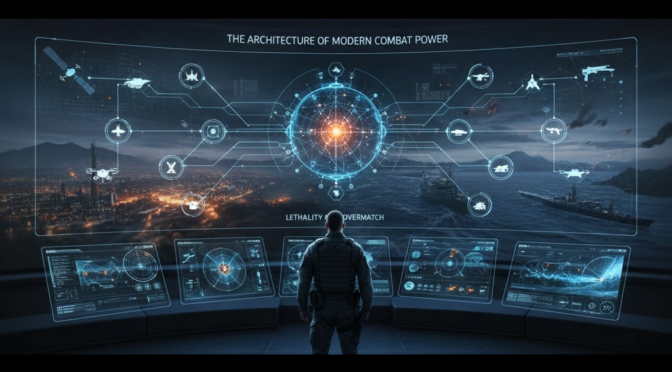
The Architecture of Modern Combat Power: A Technical Analysis of Lethality and Overmatch

Executive Summary

The global security landscape is experiencing a paradigm shift as the era of counter-insurgency gives way to Great Power Competition and the looming requirement for large-scale combat operations. In this context, the United States Army has redefined its core warfighting principles, centering its modernization strategy on the twin concepts of lethality and overmatch. Traditionally viewed as the physical capacity to destroy a target, lethality has evolved into a holistic framework that integrates technical proficiency, adaptive innovation, and human vitality. This report examines how the Army transitions from a purely technoscientific understanding of lethality toward a regenerative model that encompasses the cognitive and emotional resilience of the force. 1

Simultaneously, the concept of overmatch has been expanded beyond simple numerical or technological superiority. In the modern multi-domain operational environment, overmatch is defined as the creation of a position of relative advantage through the convergence of capabilities across land, air, maritime, space, and cyberspace. This report details the mechanisms of convergence—how the synchronized application of long-range precision fires, next-generation combat vehicles, and advanced sensor networks creates simultaneous dilemmas for an adversary that render their defensive systems ineffective. 3

A critical component of this analysis is the compression of decision cycles, modeled through the Observe-Orient-Decide-Act (OODA) loop. As artificial intelligence and autonomous systems are integrated into the “Super OODA” loop, the speed of information processing has become a primary determinant of victory. This report explores the transition from human-centric decision-making to AI-augmented “Prediction-Centric Warfare,” where the ability to out-think an opponent is as vital as the ability to out-range them. 5

Finally, the report analyzes the specific materiel solutions driving these concepts, including the Long-Range Precision Fires portfolio and the XM30 Mechanized Infantry Combat Vehicle. By synthesizing doctrinal theory with empirical performance data from Combat Training Centers and mathematical models of kill probability, this analysis provides a comprehensive roadmap for how a modern force achieves and maintains dominance in a relentlessly lethal and contested environment. 7

1.0 Doctrinal Foundations of Lethality and Combat Power

The American military’s return to large-scale combat operations (LSCO) has necessitated a rigorous re-examination of Field Manual (FM) 3-0, Operations. Within this capstone doctrine, lethality is positioned not merely as a characteristic of a weapon system, but as the fundamental capability and capacity to effectively neutralize or destroy an enemy target to achieve mission objectives. 1

1.1 Historical Context and the Shift to Multi-Domain Operations

The current focus on lethality is a direct response to the erosion of long-held U.S. freedom of action. For decades, the joint force operated with relative impunity in the air and maritime domains, but peer threats—specifically Russia and China—have fielded capabilities designed to contest every domain. 10 This reality has driven the Army to adopt Multi-Domain Operations (MDO), a concept that focuses on the integration of all elements of combat power to create and exploit relative advantages. 3

1.2 The Relationship Between Lethality and Maneuver

Doctrine specifies that lethality is enabled by formations maneuvering into positions of relative advantage. 1 Once in these positions, units employ weapon systems and mass effects to destroy enemy forces or place them at such a high risk of destruction that their will to fight is broken. 1 This relationship highlights that lethality is not an isolated variable; it is the culmination of a unit’s ability to shoot, move, and communicate effectively. 1

2.0 The Holistic Lethality Framework: Procedural, Adaptive, and Regenerative

While traditional metrics for measuring combat readiness—personnel, equipment on hand, and training proficiency—provide a baseline, they often fail to capture the complexities of real-world combat. 1 To address this, military theorists have introduced a multi-dimensional lethality framework that looks beyond the capacity to kill and considers how force is sustained and adapted in conflict. 12

2.1 Procedural Lethality and Task Proficiency

Procedural lethality is conceptualized as the specific sequence of required steps to achieve mission success within a known context. 12 It is the most measurable form of lethality, closely tied to the Integrated Weapons Training Strategy (IWTS). Procedural lethality ensures that every soldier is qualified and proficient on their assigned weapon system, from individual marksmanship to collective live-fire events. 1

2.2 Adaptive Lethality and Innovation

Adaptive lethality is the ability of a unit to remain lethal in multiple and novel contexts, even when standardized procedures fail or are interrupted. 12 This construct relies on individual and organizational character, trust, and risk acceptance. 12 In a multi-domain environment where communications may be jammed and GPS denied, adaptive lethality allows a unit to innovate on the fly, using available assets to achieve the commander’s intent. 14

2.3 Regenerative Lethality and Vitality

Regenerative lethality focuses on the foundational elements enabling the attainment of personal and organizational vitality. 12 It views the human soldier as the central component of the lethality chain, requiring the continuous restoration of physical and psychological effectiveness. 12

Table 1: The Components of Regenerative Lethality (Vitality) 12

ElementFocus AreaImpact on Lethality
MindCognitive and psychological beliefsBuilding or breaking resolve; resilience against cognitive warfare.
HeartAffective and emotional valuesFostering trust within the formation; maintaining the “warrior ethos”.
HandBehavioral and physiological skillsSustaining physical capability; Holistic Health and Fitness (H2F).

3.0 The Mechanics of Overmatch: Achieving Relative Advantage

Overmatch is the application of capabilities in such a manner that the adversary is unable to respond effectively. 4 It is not necessarily a permanent state of superiority but a condition created at a specific time and place to achieve a tactical or operational objective. 3

3.1 Convergence as the Engine of Overmatch

In the MDO context, overmatch is achieved through convergence—the concerted employment of capabilities from multiple domains (land, air, maritime, space, and cyberspace) and echelons. 14 Convergence attacks the adversary’s integrated defensive and offensive networks at combinations of decisive points. 14

Yugo M85/M92 dust cover quick takedown pin installation

3.2 Temporal and Cognitive Overmatch

Overmatch is often categorized by its primary effect on the adversary:

Table 2: Dimensions of Overmatch 17

DimensionMechanismDesired Outcome
PhysicalSuperior range, firepower, and armor protection.Destruction of enemy hardware and personnel.
TemporalFaster decision-making and execution cycles.Getting “inside” the enemy’s decision cycle (OODA loop).
CognitiveOverwhelming the enemy’s ability to process information.Decision paralysis, confusion, and loss of will to fight.

4.0 Decision Dominance: The OODA Loop and AI Augmentation

The OODA loop—Observe, Orient, Decide, Act—remains the primary mental model for understanding decision speed in combat. 20 Developed by Colonel John Boyd, the model posits that the entity that cycles through these four stages most rapidly will win. 19

4.1 The Traditional OODA Loop

In traditional, human-centered OODA loops, the “Orient” phase is the most critical and complex. 19 It involves synthesizing observations with cultural, experiential, and contextual factors to form a meaningful understanding of the environment. 22 However, human processing is limited by cognitive load, fatigue, and stress. 23

4.2 The Transition to the “Super OODA” Loop

Artificial intelligence (AI) is transforming the OODA loop by automating the Observe and Orient phases. 5 AI systems can process massive quantities of sensor data at machine speed, identifying patterns and targets that would be invisible to human operators. 5

Table 3: Decision Cycle Time Comparison (Conceptual) 23

System TypeObserve/Orient TimeDecide/Act TimeTotal Cycle Time
Human-CentricMinutes/SecondsSecondsVariable (High Latency)
Technology-EnhancedSecondsSecondsFast
AI-Augmented (Super OODA)MillisecondsMillisecondsNear-Instantaneous

5.0 Modernization Priority: Long-Range Precision Fires (LRPF)

To achieve overmatch in the “Deep Fight,” the Army has identified Long-Range Precision Fires as its number one modernization priority. 17

5.1 The LRPF Portfolio and Technological Goals

The LRPF Cross-Functional Team (CFT) is developing a family of interconnected weapons designed to attack targets across the entire theater of operations. 17

Table 4: Key Long-Range Precision Fires Programs 17

ProgramIntended RangePrimary Target Set
Extended Range Cannon Artillery (ERCA)70 kmTactical fires; enemy artillery and forward air defense.
Precision Strike Missile (PrSM)499+ kmOperational fires; C2 nodes, ballistic missiles, A2/AD systems.
Mid-Range Capability (MRC)IntermediateMobile land and maritime targets.
Strategic Long-Range Cannon (SLRC)Up to 1,000 milesStrategic targets; high-value infrastructure.
Long-Range Hypersonic Weapon (LRHW)StrategicTime-sensitive, heavily defended high-value targets.

6.0 The Evolution of Close Combat: The XM30 and Robotic Systems

While LRPF handles the deep fight, the Next Generation Combat Vehicle (NGCV) portfolio is designed to ensure overmatch in the close fight. 27 The centerpiece of this effort is the XM30 Mechanized Infantry Combat Vehicle. 29

6.1 XM30 Lethality and Capability Parameters

The XM30 is engineered with a “soldier-centric” design, intended to improve how infantry formations maneuver and engage the enemy. 30

Table 5: XM30 Performance and Lethality Requirements 27

RequirementSpecificationTactical Significance
Main Armament30mm or 50mm AutocannonDefeats enemy IFVs beyond their engagement range.
Secondary WeaponsATGMs and SHORAD (Stinger/Coyote)Multi-domain defense against armor and drones.
ManningOptionally MannedAllows for remote operation in high-risk zones.
Squad Capacity6 Dismounts (plus 2 crew)Optimized infantry delivery under armor.
Air Transport2 vehicles per C-17Ensures rapid global deployability.

6.2 Robotic Combat Vehicles (RCV) as Force Multipliers

Complementing the XM30 are the Robotic Combat Vehicles, which come in Light, Medium, and Heavy variants. 29

Table 6: Robotic Combat Vehicle (RCV) Classifications 29

ClassWeightPrimary ArmamentRole
RCV-Light< 10 TonsLight weapon station / ATGMReconnaissance and stealthy sensing.
RCV-Medium10-20 TonsMedium caliber cannonDirect fire support and durability.
RCV-Heavy20-30 TonsMain gun (Tank-like)Decisive lethality and armored overmatch.

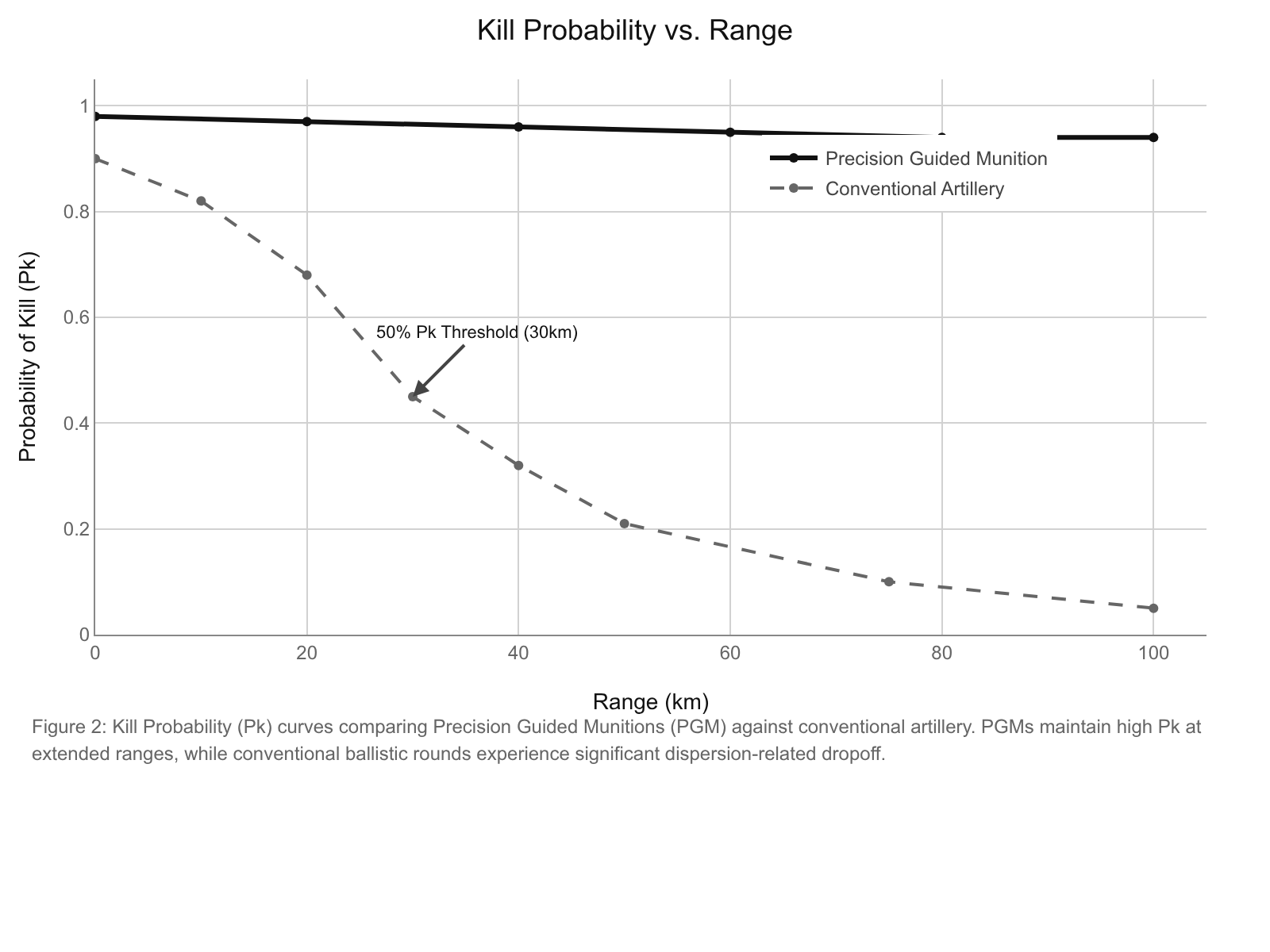
7.0 The Mathematics of Lethality: Pk and Range Curves

Military analysts use the Probability of Kill (Pk) to statistically determine the effectiveness of an engagement. 35

7.1 The Pk Formula

The probability of kill for a single engagement is generally calculated as:

Pk = Phit * Pd * Rsys * Rw

In this formula, Phit is the probability of a hit; Pd is the probability of detection by sensors; Rsys is the reliability of the targeting system; and Rw is the reliability of the weapon. 9

7.2 Lethal Radius and Damage Functions

The “lethality” of a weapon is often expressed through its damage function, D(r), representing the probability that a target is killed by a weapon at a miss distance of r. 36

Yugo M85/M92 dust cover quick takedown pin installation

8.0 Cognitive Maneuver and Information Dominance

In the 21st century, lethality is not just about destroying physical targets; it is about “Information Overmatch”—the ability to use data to achieve strategic, operational, and tactical effects. 18

8.1 Cognitive Warfare and the Target of the Mind

Cognitive warfare is the art of using technologies to alter the cognition of human targets. 37 By distorting an adversary’s perception of the battlespace, a force can induce hesitation and ultimately break the enemy’s will to resist. 37

8.2 Non-Lethal Weapons (NLW) as a Strategic Lever

The Department of Defense Non-Lethal Weapons Program provides options in the “gray zone” between presence and lethal force. 39 NLWs create decision space for commanders and prevent miscalculation. 39

9.0 Strategic Synthesis: Deterrence by Denial

The ultimate purpose of building a lethal force capable of achieving overmatch is to support a strategy of deterrence by denial. 40 Deterrence by denial seeks to make aggression unprofitable by rendering the target harder to take and keep. 41

9.1 Implications for the Indo-Pacific and Beyond

The current U.S. defense strategy focuses on deterrence by denial vis-à-vis China in the Asia-Pacific theater. 40 This requires robust constellations of space assets, long-range precision fires capable of sinking ships, and hardened ground formations. 42

10.0 Future Trajectories of Combat Power

The character of war is shifting rapidly, driven by drones, long-range precision fires, cyber effects, and electronic warfare. 44 Victory in future conflict will belong to the side that adapts faster and endures longer. 44 The architecture of combat power in 2030 and beyond will be defined by its ability to sense, think, and strike with a speed and precision that renders enemy resistance futile. 44


Please share the link on Facebook, Forums, with colleagues, etc. Your support is much appreciated and if you have any feedback, please email us in**@*********ps.com. If you’d like to request a report or order a reprint, please click here for the corresponding page to open in new tab.


Sources Used

  1. Decoding Lethality: Measuring What Matters; Command Sgt. Maj …, accessed February 16, 2026, https://www.armyupress.army.mil/Portals/7/military-review/Archives/English/Online-Exclusive/2024/Decoding-Lethality/Holland-Decoding%20Lethality-UA.pdf
  2. Decoding Lethality – Army University Press, accessed February 16, 2026, https://www.armyupress.army.mil/Journals/Military-Review/Online-Exclusive/2024-OLE/Decoding-Lethality/
  3. FM 3-0, Operations – Cyberwar.nl, accessed February 16, 2026, https://cyberwar.nl/d/20171005_US-Army-Field-Manual-FM-3-0-Operations.pdf
  4. Field Manual 3-0 Doctrine Addressing Today’s Fight – Army University Press, accessed February 16, 2026, https://www.armyupress.army.mil/Journals/Military-Review/English-Edition-Archives/Jan-Feb-2019/FM-3-0/
  5. FM 3-0 | Soldat & Technik, accessed February 16, 2026, https://soldat-und-technik.de/wp-content/uploads/2022/10/ARN36290-FM_3-0.pdf
  6. Outthinking Adversaries: The Future of Warfare in a Multi-Domain World | Article – U.S. Army, accessed February 16, 2026, https://www.army.mil/article/289600/outthinking_adversaries_the_future_of_warfare_in_a_multi_domain_world
  7. On Lethality: Toward a More Complete Definition and Formation of …, accessed February 16, 2026, https://press.armywarcollege.edu/cgi/viewcontent.cgi?article=3371&context=parameters
  8. On Lethality: Toward a More Complete Definition and Formation of the Lethality Framework, accessed February 16, 2026, https://publications.armywarcollege.edu/News/Display/Article/4361788/on-lethality-toward-a-more-complete-definition-and-formation-of-the-lethality-f/
  9. Who “Does” MDO? What Multi-Domain Operations Will Mean For …, accessed February 16, 2026, https://mwi.westpoint.edu/who-does-mdo-what-multi-domain-operations-will-mean-for-and-require-of-the-armys-tactical-units/
  10. When Automation Accelerates War, Identity Determines Victory, accessed February 16, 2026, https://mwi.westpoint.edu/when-automation-accelerates-war-identity-determines-victory/
  11. What Does Lethality Really Mean in Modern War? – CSIS, accessed February 16, 2026, https://www.csis.org/analysis/what-does-lethality-really-mean-modern-war
  12. Preparing for future battlefields: The Next Generation Combat Vehicle | Article – Army, accessed February 16, 2026, https://www.army.mil/article/211236/preparing_for_future_battlefields_the_next_generation_combat_vehicle
  13. Transforming the Multidomain Battlefield with AI: Object Detection, Predictive Analysis, and Autonomous Systems – Army University Press, accessed February 16, 2026, https://www.armyupress.army.mil/Journals/Military-Review/Online-Exclusive/2024-OLE/Multidomain-Battlefield-AI/
  14. Multi-Domain Operations: Bridging the Gaps for Dominance – Air University, accessed February 16, 2026, https://www.airuniversity.af.edu/Wild-Blue-Yonder/Articles/Article-Display/Article/2109784/multi-domain-operations-bridging-the-gaps-for-dominance/
  15. The U.S. Army’s No. 1 Modernization Priority: Long-Range Precision Fires, accessed February 16, 2026, https://nationalinterest.org/blog/reboot/us-armys-no-1-modernization-priority-long-range-precision-fires-197449
  16. Information Overmatch: How Information Dominance Will Win Our Nation’s Wars – USAASC, accessed February 16, 2026, https://asc.army.mil/web/news-information-overmatch-how-information-dominance-will-win-our-nations-wars/
  17. OODA loop – Wikipedia, accessed February 16, 2026, https://en.wikipedia.org/wiki/OODA_loop
  18. The Power of Cognitive Maneuver: Don’t Underestimate its Value – Threat Tec, accessed February 16, 2026, https://threattec.com/the-power-of-cognitive-maneuver-dont-underestimate-its-value/
  19. What’s an OODA Loop and How to Use It | Miro, accessed February 16, 2026, https://miro.com/strategic-planning/what-is-ooda-loop/
  20. WHY TIMING IS EVERYTHING, accessed February 16, 2026, https://www.europarl.europa.eu/cmsdata/155280/WendyRAnderson_CognitiveTimes_OODA%20LoopArticle.pdf
  21. Stuck between real and ideal: the OODA loop and military AI – Luftled, accessed February 16, 2026, https://luftled.info/stuck-between-real-and-ideal-the-ooda-loop-and-military-ai/
  22. Reshaping Air Power Doctrines: Creating AI-Enabled ‘Super-OODA Loops’ – Shift Paradigm., accessed February 16, 2026, https://theairpowerjournal.com/reshaping-air-power-doctrines-creating-ai-enabled-super-ooda-loops/
  23. The Army’s Top 3 Strategic Priorities for Long-Range Precision Fires – IDGA, accessed February 16, 2026, https://www.idga.org/events-futureindirectfires/downloads/the-armys-top-3-strategic-priorities-for-long-range-precision-fires
  24. RDECOM’s road map to modernizing the Army: Long-range precision fires – DVIDS, accessed February 16, 2026, https://www.dvidshub.net/news/294463/rdecoms-road-map-modernizing-army-long-range-precision-fires
  25. U.S. Army Long-Range Precision Fires: Background and Issues for Congress, accessed February 16, 2026, https://www.congress.gov/crs_external_products/R/PDF/R46721/R46721.2.pdf
  26. Army Developing Next Generation Combat Vehicles – Mobility Engineering Technology, accessed February 16, 2026, https://www.mobilityengineeringtech.com/component/content/article/33157-army-developing-next-generation-combat-vehicles
  27. Next Generation Combat Vehicle – Wikipedia, accessed February 16, 2026, https://en.wikipedia.org/wiki/Next_Generation_Combat_Vehicle
  28. The Army’s XM-30 Mechanized Infantry Combat Vehicle (Formerly Known as the Optionally Manned Fighting Vehicle [OMFV]) – Congress.gov, accessed February 16, 2026, https://www.congress.gov/crs_external_products/IF/PDF/IF12094/IF12094.8.pdf
  29. The Army’s XM-30 Mechanized Infantry Combat Vehicle (Formerly Known as the Optionally Manned Fighting Vehicle [OMFV]) | Congress.gov, accessed February 16, 2026, https://www.congress.gov/crs-product/IF12094
  30. The XM30 Infantry Fighting Vehicle Has A Message for the U.S. …, accessed February 16, 2026, https://nationalsecurityjournal.org/the-xm30-infantry-fighting-vehicle-has-a-message-for-the-u-s-army/
  31. OMFV & RCV Programme Updates – European Security & Defence – Euro-sd, accessed February 16, 2026, https://euro-sd.com/2022/10/news/27528/omfv-rcv-programme-updates/
  32. XM30 Mechanized Infantry Combat Vehicle – Wikipedia, accessed February 16, 2026, https://en.wikipedia.org/wiki/XM30_Mechanized_Infantry_Combat_Vehicle
  33. Next-Gen Robotic Combat Vehicles | Military Insight – Advanced Conversion Technology, accessed February 16, 2026, https://www.actpower.com/blog/next-generation-combat-vehicle-rcv/
  34. Probability of Kill | www.dau.edu, accessed February 16, 2026, https://www.dau.edu/glossary/probability-kill
  35. Probability of kill – Wikipedia, accessed February 16, 2026, https://en.wikipedia.org/wiki/Probability_of_kill
  36. Notes on Firing Theory – Faculty, accessed February 16, 2026, https://faculty.nps.edu/awashburn/Files/Notes/FiringTheory.pdf
  37. On Guidance and Control for Guided Artillery Projectiles, Part 1: General Considerations – FOI, accessed February 16, 2026, https://www.foi.se/rest-api/report/FOI-R–3291–SE
  38. Assessing “Cognitive Warfare”, accessed February 16, 2026, https://irregularwarfare.org/articles/assessing-cognitive-warfare/
  39. The “Ins” and “Outs” of Cognitive Warfare: What’s the Next Move?, accessed February 16, 2026, https://inss.ndu.edu/Media/News/Article/4217626/the-ins-and-outs-of-cognitive-warfare-whats-the-next-move/
  40. UNCLASSIFIED UNCLASSIFIED WHITE PAPER “WAR WITHOUT GUN SMOKE” USING NON-LETHAL WEAPONS TO COUNTER CHINA’S ASYMMETRIC MARIT, accessed February 16, 2026, https://media.defense.gov/2025/Dec/30/2003849801/-1/-1/0/WHITE%20PAPER-J8%20FORCE%20PROTECTION_NLWS%20TO%20COUNTER%20CHINA%20ASYMMETRIC%20MARITIME%20A2AD_FINAL_V1.1_16MAR22.PDF
  41. Adapting US Defense Strategy to Great-Power Competition – US Army War College – Publications, accessed February 16, 2026, https://publications.armywarcollege.edu/News/Display/Article/4129357/adapting-us-defense-strategy-to-great-power-competition/
  42. The-Case-for-Deterrence-by-Denial-150812, accessed February 16, 2026, https://www.mca-marines.org/wp-content/uploads/The-Case-for-Deterrence-by-Denial-150812.docx
  43. The Army Strategy – CASCOM, accessed February 16, 2026, https://cascom.army.mil/docs/army-strategy.pdf
  44. Space Denial: A Deterrence Strategy – NDU Press – National Defense University, accessed February 16, 2026, https://ndupress.ndu.edu/Joint-Force-Quarterly/Joint-Force-Quarterly-111/Article/Article/3569640/space-denial-a-deterrence-strategy/
  45. 2025 Force Design Update – Marines.mil, accessed February 16, 2026, https://www.marines.mil/Portals/1/Docs/Force_Design_Update-October_2025.pdf

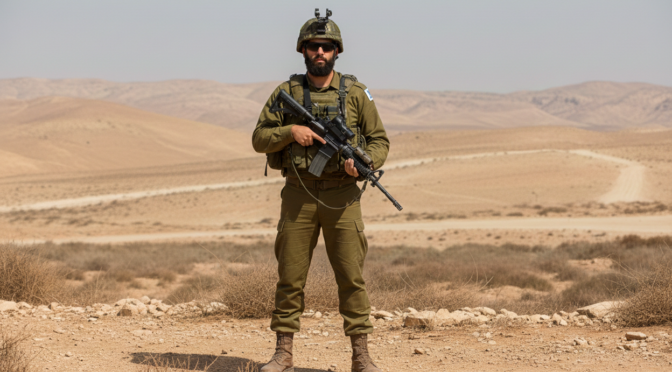
Modernizing the IDF: Transition to Next-Gen Small Arms

Executive Summary

The Israel Defense Forces (IDF) are currently navigating a pivotal era of small arms doctrine, shifting from a decades-long focus on specialized bullpup platforms toward a unified, high-precision AR-15 architecture for its primary infantry and special operations components.1 This transition is anchored by the historical 2024 procurement of the ARI Arms OR-4, a domestically designed assault rifle slated to replace the IWI Tavor and X95 series in frontline brigades.1 This shift is not merely ergonomic but strategic, aiming to close the training and maintenance gap between active duty and reserve units while reducing reliance on foreign-produced small arms through a “Blue and White” (domestic) procurement policy.2

Across the three branches—the Ground Forces, the Navy, and the Air Force—small arms selection is driven by diverse operational requirements. The Ground Forces are prioritizing “tactical overmatch” through the integration of the Sig Sauer M250 light machine gun and the MMG 338 in.338 Norma Magnum, providing long-range suppression and terminal lethality.4 The Israeli Navy continues to maintain highly specialized arsenals for its elite Shayetet 13 commandos, who utilize unique platforms for maritime and underwater warfare, while its Snapir security units focus on port defense.6 The Israeli Air Force’s small arms inventory is concentrated within the Shaldag special operations unit and ground defense forces, which protect high-value aerial and missile defense assets.8

This report provides an exhaustive technical and strategic overview of the IDF’s small arms ecosystem, detailing the transition from legacy systems to next-generation platforms, the industrial base supporting these developments, and the branch-specific nuances of deployment. Through a synthesis of procurement data, technical specifications, and operational history, the following analysis articulates the trajectory of Israeli tactical weaponry in the mid-2020s.

The Industrial Foundation: IMI, IWI, and the Emergence of Domestic Competition

The history of Israeli small arms is inextricably linked to the nation’s survival and its drive for self-reliance. The industrial base began in 1933 with Israel Military Industries (IMI) Ltd., established during the British Mandate to provide a clandestine manufacturing capability for Jewish defense forces.10 Over decades, IMI produced iconic platforms such as the Uzi submachine gun and the Galil assault rifle, which defined the IDF’s tactical profile through the late 20th century.10 The 2005 privatization of IMI’s Small Arms Division into Israel Weapon Industries (IWI) marked a new era of global commercial success and specialized research and development.11

However, the dominance of IWI is currently being challenged by a growing ecosystem of domestic competitors, most notably ARI Arms and Emtan. These companies have leveraged the IDF’s move away from bullpup designs to secure historic contracts.1 The Ministry of Defense (IMOD) has increasingly favored a multi-source procurement strategy to ensure supply chain resilience and foster technical innovation within the “SK Group” and beyond.1

Table 1: Primary Israeli Small Arms Manufacturers and Strategic Roles

ManufacturerCore CompetenciesKey Platforms in IDF ServiceStrategic Role
IWI (Israel Weapon Industries)Bullpup design, LMGs, PistolsTavor X95, Negev NG5/NG7, Arad, Jericho 941, MasadaPrimary supplier of LMGs and legacy infantry rifles.11
ARI ArmsAR-15 Platform variantsOR-4 Assault Rifle, OR-300New standard for unified infantry weaponry.1
EmtanAR-15 and Piston platformsMZ-4, MZ-4P, MZ-15 DMRSupplier of specialized AR variants to police and security forces.14
Rafael Advanced Defense SystemsRemote weapon stationsTyphoon, Samson RCWSIntegration of small arms into naval and armored platforms.6
Elbit SystemsElectro-optics and munitionsMeprolight sights, 5.56mm/7.62mm ammoProviding the “intelligent” layer to standard small arms.10

The IMOD’s International Defense Cooperation Directorate (SIBAT) plays a crucial role in this industrial cycle by managing the marketing and sales of surplus IDF systems.19 As the Ground Forces transition to the OR-4, SIBAT facilitates the sale of retired Tavor TAR-21s and older M16/M4 carbines to international clients, thereby recycling capital into new procurement programs.11

The Israeli Ground Forces: Doctrine of Unification and Maneuver

The Israeli Ground Forces (IGF) represent the primary echelon of small arms deployment. For much of the 2000s and 2010s, the IGF utilized a split-tier system: elite infantry brigades (Golani, Givati, Nahal) were equipped with the IWI Tavor and later the Micro-Tavor (X95), while other infantry units and the reserves utilized American-supplied M4A1s.2 This divergence created significant logistical and training challenges, particularly during the rapid mobilization of reservists who were often unfamiliar with the bullpup’s manual of arms.3

The Shift from Bullpup to Unified AR-Pattern

The decision to phase out the Tavor in favor of the ARI OR-4 and other AR-15 variants stems from detailed operational feedback from recent conflicts in Gaza and Lebanon.1 While the Tavor was praised for its compactness and reliability—utilizing a long-stroke piston system similar to the AK-47—the bullpup configuration presented ergonomic disadvantages in high-intensity urban combat.2 Senior IDF officers noted that the AR-15’s center of gravity and more intuitive magazine release allowed for faster transitions and more effective handling in “closed spaces”.2

Table 2: Ground Forces Infantry Standard Individual Weapons

Weapon ModelTypeCaliberStatusOperational Context
ARI OR-4Assault Rifle5.56x45mm NATOEntering Service (2025)New standard unified rifle for all infantry brigades.1
IWI Tavor X95Bullpup Carbine5.56x45mm NATOBeing Phased OutFormer standard for elite brigades; noted for CQB performance.2
M4A1 CarbineCarbine5.56x45mm NATOStandard IssueWidespread use across active and reserve units; highly modular.6
IWI AradAssault Rifle5.56x45mm /.300 BLKSF / SpecializedShort-stroke piston AR used by Border Police and special units.15
CAR-15 / M16A1Carbine5.56x45mm NATOReserves / TrainingShortened legacy rifles used by rear-echelon and training units.6

The procurement of the OR-4 is a strategic move to create an “all-arms” weapon system.1 The OR-4, based on the AR-15 platform, incorporates modern adaptations to meet current requirements, such as enhanced accuracy for extended-range engagements and modular rail systems for advanced optics.1 This shift also allows the IDF to leverage domestic production for its primary rifle, reducing the “on-again/off-again” uncertainty of foreign military funding (FMF) relationships.20

Machine Gun Modernization: From Negev to Sig Sauer

The IDF’s light machine gun (LMG) doctrine is undergoing a parallel transformation. Since 1997, the IWI Negev has been the standard squad automatic weapon, unique for its dual-feed system that accepts both disintegrating belts and standard assault rifle magazines.23 The Negev’s performance in desert environments was found to be superior to the Belgian Minimi, leading to its widespread adoption.26

However, the need for lighter platforms with greater range has led to the acquisition of Sig Sauer systems. The Sig Sauer M250, chambered in 7.62x51mm NATO, represents a massive leap in weight efficiency.4 Weighing only 13 pounds empty—significantly less than the 17.5-pound Negev NG7—the M250 allows machine gunners to maintain pace with maneuvering infantry while providing the superior terminal effects of the 7.62mm round.4

Table 3: Ground Forces Machine Gun Inventory

Weapon ModelCaliberWeight (Empty)Rate of FireRole
IWI Negev NG55.56x45mm16.5 lbs (approx)850-1150 RPMSquad Automatic Weapon (SAW).27
IWI Negev NG77.62x51mm17.5 lbs600-750 RPMGeneral Purpose / Light Support.27
Sig Sauer M2507.62x51mm13.0 lbsVariableNext-generation lightweight LMG.4
Sig MMG 338.338 Norma Mag21.4 lbs600 RPMOvermatch medium machine gun.5
FN MAG 587.62x51mm26.0 lbs650-1000 RPMStandard General Purpose MG (GPMG).30
M2 Browning.50 BMG84 lbs450-600 RPMHeavy Machine Gun (HMG) / Anti-material.12

The integration of the Sig Sauer MMG 338 is particularly noteworthy for its “overmatch” capabilities. By utilizing the.338 Norma Magnum cartridge, the IDF can engage targets at ranges up to 1,700 meters—nearly twice the effective range of the 7.62mm NATO—with terminal ballistics that can penetrate Level III armor at 1,000 meters.5 This weapon provides the infantry platoon with anti-material capabilities previously reserved for heavy vehicle-mounted weapons.5

The Israeli Navy: Maritime Security and Elite Commando Requirements

The Israeli Navy (IN) operates in a high-threat maritime environment, ranging from the littoral waters of the Gaza Strip to deep-water missions in the Red Sea and Persian Gulf.31 Its small arms requirements are split between the elite Shayetet 13 commando unit and the Snapir naval security units.

Shayetet 13: The Naval Commando Arsenal

Shayetet 13 is one of the world’s most secretive and elite special operations units, often compared to the US Navy SEALs.7 Their weapon selection is dictated by the need for multi-domain reliability—transitioning seamlessly from underwater to land operations.7 This has led to the retention of the AK-47 and AKM assault rifles, which are valued for their extreme tolerance to saltwater and sand ingestion.6

For clandestine maritime operations, the unit utilizes the Heckler & Koch P11 underwater pistol.6 This specialized weapon uses a five-round barrel cluster to fire 7.62x36mm steel darts, allowing operators to engage sentries or harbor security underwater.6 Additionally, the unit has been documented using suppressed MAC-10 machine pistols and suppressed X95 submachine guns for “Visit, Board, Search, and Seizure” (VBSS) operations.6

Table 4: Israeli Navy Small Arms and Boarding Equipment

Weapon ModelTypeCaliberNote
AK-47 / AKMAssault Rifle7.62x39mmPreferred by Shayetet 13 for extreme reliability.6
IWI X95 SMGSubmachine Gun9x19mmCompact bullpup, often suppressed for boarding.6
HK P11Underwater Pistol7.62x36mmDart-firing; specialized for combat divers.6
Glock 19Sidearm9x19mmStandard issue for Snapir and S13.35
Sig Sauer P226Sidearm9x19mmSpecialized SF use.6
M4A1 CarbineCarbine5.56x45mm NATOStandard for Snapir and general naval security.6

Snapir and Port Defense

The Snapir units are responsible for the security of Israeli ports and the inspection of incoming vessels.7 Their role requires a blend of high firepower and compact handling. Operators are typically equipped with the M4A1 or shortened M16 variants, augmented by advanced multi-optic reflex sights that combine visible and infrared lasers.35 These optics allow for rapid target acquisition in the complex, low-light environments of a ship’s interior.35

On patrol boats like the Shaldag and Super Dvora classes, the small arms inventory is supplemented by 12.7mm M2 Browning machine guns and 7.62mm FN MAGs, often mounted on stabilized Typhoon weapon stations that allow for remote operation from within the cabin.17

The Israeli Air Force: Asset Protection and Shaldag Specialization

Small arms in the Israeli Air Force (IAF) are primarily focused on the protection of high-value platforms—such as the F-35I Lightning II and the Arrow missile defense batteries—and the missions of the Shaldag special operations unit.9

Shaldag: Air Force Special Operations

Shaldag is tasked with specialized reconnaissance, laser designation of targets, and combat search and rescue (CSAR).18 Their requirements for precision at range have led to the adoption of the Barrett REC10.38 The REC10 is a semi-automatic, direct-impingement rifle chambered in 7.62x51mm, providing a “battle rifle” capability in a platform that shares the ergonomics of the standard M4 carbine.40 This allows Shaldag operators to maintain high accuracy at mid-to-long ranges without the bulk of a dedicated sniper system.39

Table 5: Israeli Air Force Ground Component Small Arms

UnitPrimary WeaponSecondary WeaponTactical Role
ShaldagBarrett REC10Glock 17/19Special reconnaissance and precision strike.38
Airbase SecurityM4 Carbine / M16A2Glock 19Protection of F-35 and strategic assets.9
Air Defense UnitsCAR-15 / M16Security for Iron Dome/Arrow batteries.6
669 (SAR)IWI X95 / M4A1Glock 19Rescue in hostile environments.23

The IAF’s ground defense units rely on the “M16 Katzar” (short M16) or M4 carbine for perimeter security.6 Given the small strategic depth of Israel, the rapid achievement of air superiority is paramount, and the security of airbases from ground-based threats is a critical component of IAF doctrine.9 These units are increasingly utilizing the IWI Masada pistol as their standard-issue sidearm, benefiting from its modular striker-fired design.10

Advanced Marksmanship and Sniper Systems: Range and Precision

The IDF maintains a sophisticated sniper hierarchy that bridges the gap between the individual infantryman and the specialized long-range operative. This system is increasingly reliant on designated marksman rifles (DMRs) to provide organic precision fire at the squad level.30

The DMR and Semi-Automatic Hierarchy

The Barrett REC10 and the Arad 7 DMR are the flagship platforms for modern Israeli marksmen.15 These rifles provide semi-automatic fire in 7.62x51mm, allowing for rapid follow-up shots that are critical in urban environments.39 The Arad 7 DMR, in particular, offers accuracy of less than 1 MOA and features a quick-change barrel system that allows for rapid transition between 7.62mm and 6.5mm Creedmoor calibers.15

Table 6: IDF Sniper and Designated Marksman Platforms

PlatformCaliberEffective RangeOperating ActionStatus
IWI Galatz7.62x51mm800m – 1,000mSemi-AutomaticStandard Infantry Sniper.11
Barrett REC107.62x51mm600m – 800mSemi-AutomaticSpecialized SF DMR.38
IWI DAN.338.338 Lapua Mag1,200m+Bolt-ActionLong-range precision.11
Barrett MRADMulti-Caliber1,000m – 1,500mBolt-ActionModular elite sniper system.23
McMillan TAC-5012.7x99mm2,000m+Bolt-ActionAnti-material / Extreme range.12
M89SR7.62x51mm800m – 1,000mSemi-AutomaticBullpup sniper (limited use).6

The McMillan TAC-50 serves as the IDF’s primary anti-material rifle, capable of defeating light armor and fortifications from distances exceeding 2,000 meters.12 For “soft” targets at extreme ranges, the IWI DAN.338 and the Barrett MRAD provide the necessary ballistic coefficient to overcome wind and environmental factors that would negate the effectiveness of standard 7.62mm rounds.5

Technical Deep Dive: The Evolution of the Israeli AR-15

The decision to adopt the ARI Arms OR-4 and the IWI Arad represents a significant technical pivot. Unlike the traditional M16 or M4, which utilize a direct impingement (DI) system, many of the next-generation Israeli rifles incorporate short-stroke gas piston systems.15

Direct Impingement vs. Piston Systems

The traditional DI system of the M4 vents gas directly into the bolt carrier, which can lead to fouling and heat buildup during sustained fire—an issue particularly pronounced in the dusty environments of the Levant.3 The IWI Arad and the Emtan MZ-4P utilize a short-stroke piston system, where gas pushes a rod to cycle the action, keeping the bolt assembly clean and cool.15 This is especially advantageous for special forces who frequently utilize suppressors, which increase backpressure and fouling in DI systems.16

Table 7: Technical Comparison of Next-Generation Service Rifles

SpecificationARI Arms OR-4IWI Arad 5Emtan MZ-4P
Operating SystemDirect ImpingementShort-Stroke PistonShort-Stroke Piston.16
Caliber5.56x45mm NATO5.56x45mm /.300 BLK5.56x45mm NATO.14
Barrel Lengths10.3″ / 11.5″ / 14.5″11.5″ / 14.5″7.5″ / 11.5″ / 14.5″.45
Weight (Empty)2.92 Kg2.85 Kg3.1 Kg.16
Accuracy~1 MOA1 MOAMil-Spec
AmbidextrousSelective100%Optional.15

The ARI OR-4’s selection as the standard infantry rifle indicates that the IDF still finds value in the DI system for general infantry due to its lighter weight and reduced recoil impulse, provided the platform is manufactured to modern, tight tolerances.1 The OR-4’s barrel is cold hammer-forged and chrome-lined to extend its lifespan in harsh conditions.25

Sidearms: The Transition to Striker-Fired Platforms

The IDF is currently phasing out its remaining stocks of the Jericho 941, the legendary double-action/single-action pistol that served for three decades.11 The new standard is defined by striker-fired, polymer-framed pistols that offer consistent trigger pulls and higher reliability.10

The Glock and Masada Era

The Glock 19 and 17 are the dominant sidearms for Special Forces and infantry officers, valued for their “safe action” system and widespread aftermarket support.6 Simultaneously, IWI’s Masada has been introduced as a domestic alternative, featuring a low bore axis and modular grip frames to accommodate the diverse range of hand sizes in the conscript-based IDF.10

Table 8: IDF Sidearm and Pistol Inventory

ModelCaliberOperating ActionNotes
Glock 199x19mmStriker-FiredCurrent favorite for SF and officers.6
IWI Masada9x19mmStriker-FiredModern domestic polymer pistol.10
Jericho 9419x19mmDA/SALegacy platform; being phased out.11
Browning Hi-Power9x19mmSingle ActionFound in older reserve stocks.6
BUL M-5 / Storm9x19mmSemi-AutomaticUsed by some specialized security units.6
Sig Sauer P2269x19mmDA/SAPreferred by some Shayetet 13 units.6

The transition to 9x19mm as the universal pistol caliber is total, with only rare exceptions for specialized stopping power or underwater utility.23

Specialized Firepower: Submachine Guns and PDWs

While the assault rifle is the primary weapon of the IDF, submachine guns (SMGs) and Personal Defense Weapons (PDWs) maintain a critical role for vehicle crews, tunnel clearing, and VIP protection.23

The Uzi Legacy and the X95 Conversion

The original Uzi submachine gun netted billions for Israel and remains an icon of military hardware.11 Today, this legacy is carried by the Uzi Pro and the SMG variants of the X95.11 The X95 is particularly valuable because it can be converted from a 5.56mm assault rifle to a 9mm SMG in the field using a simple conversion kit.22 This allows units like Yahalom (Combat Engineering) to maintain caliber commonality during subterranean missions where a full-power rifle round might cause excessive over-penetration or noise.34

ModelCaliberOperating ActionNote
IWI Uzi Pro9x19mmBlowbackModern compact version of the Uzi.11
IWI X95 SMG9x19mmBlowback (converted)Modular bullpup SMG.22
Micro Galil5.56x45mmGas-OperatedExtremely compact assault rifle.6
Hezi SM-15.56x45mmSemi-AutoSpecialized PDW variant.6

Operational Lessons from the Gaza Conflict

The ongoing conflict in Gaza has served as a crucible for the IDF’s small arms policy, leading to several rapid procurement adjustments. The “Negev UX” project is a direct result of this, creating a lighter, more mobile LMG specifically for ground maneuvering in complex, built-up areas.48

The “Urban Warfare” Paradigm

Gaza has emphasized the need for “fire-ready” systems. Unlike older designs that required a stock to be unfolded or a manual safety to be navigated, modern Israeli platforms like the OR-4 and X95 are designed to be “always at the ready”.2 The trend toward suppressors has also accelerated; once the exclusive domain of special forces, suppressors are increasingly issued to standard infantry to preserve unit communication and situational awareness during indoor fighting.4

The conflict also reinforced the importance of unified logistics. The IDF found that significant gaps emerged in reserve battalions composed of soldiers from different units, some of whom were trained on the Tavor and others on the M4.2 This friction led to the current mandate for a “unified weapon system” to reduce the reasons for soldiers to transition between active and reserve status without retraining.2

Future Outlook: Caliber Overmatch and AI Integration

The IDF is already looking beyond the current 5.56mm and 7.62mm NATO standards. The acquisition of.338 Norma Magnum machine guns indicates a growing interest in “intermediate” heavy calibers that provide superior range without the weight of.50 BMG platforms.4

AI-Assisted Small Arms

One of the most innovative developments is the modular AI-controlled Negev NG-7, an Indian-Israeli derivative.27 This system is capable of automatic target detection, friend-foe classification, and autonomous target acquisition at ranges up to 600 meters.27 While currently being tested for perimeter security and convoy protection, the integration of AI sensors into the infantryman’s rifle is the likely next step for the IDF’s Technology and Logistics Directorate.27

Table 9: Future Small Arms Technology and Calibration

TechnologyPlatformStatusObjective
.338 Norma MagnumSig MMG 338Frontline AdoptionTactical overmatch vs. 7.62mm.5
AI EngagementNegev NG-7 (BSS)Testing PhaseAutonomous/Assisted targeting.27
6.5mm CreedmoorArad 7 / MRADProcurementSuperior long-range ballistics.15
Integrated OpticsMeprolight / SigStandard IssueMulti-mode (Day/Night/Laser).4

Strategic Synthesis

The modernization of the Israeli Defense Forces’ small arms inventory is a multifaceted effort that balances domestic industrial capability with the tactical lessons of modern urban warfare. The shift to the ARI OR-4 as the primary infantry rifle signifies the end of the “bullpup era” for Israel’s frontline brigades, prioritizing the ergonomic and logistical advantages of the AR-15 platform. Simultaneously, the adoption of advanced machine guns from Sig Sauer and specialized DMRs from Barrett ensures that the IDF maintains a technological edge over regional adversaries.

Whether in the hands of a Shayetet 13 commando deep underwater or a Shaldag operator designating a target from a rooftop, the IDF’s small arms are characterized by extreme specialization and a rapid feedback loop between the battlefield and the factory floor. As the “Blue and White” policy continues to drive domestic manufacturing, the IDF is poised to achieve unprecedented levels of weapon unification and tactical proficiency in the years to come.


Please share the link on Facebook, Forums, with colleagues, etc. Your support is much appreciated and if you have any feedback, please email us in**@*********ps.com. If you’d like to request a report or order a reprint, please click here for the corresponding page to open in new tab.


Sources Used

  1. IDF Picks ARI’s OR-4 as New Rifle – Raksha Anirveda, accessed February 1, 2026, https://raksha-anirveda.com/significant-shift-israel-defence-forces-selects-ari-arms-or-4-assault-rifle-as-new-standard-infantry-rifle/
  2. IDF gears up for arsenal overhaul with homegrown assault rifles – Ynetnews, accessed February 1, 2026, https://www.ynetnews.com/article/hju8hfrat
  3. What are the reason why the IDF phasing out the Tavor rifle : r/WarCollege – Reddit, accessed February 1, 2026, https://www.reddit.com/r/WarCollege/comments/1bvjo5s/what_are_the_reason_why_the_idf_phasing_out_the/
  4. Israel Buys 7.62x51mm Version Of U.S. Army’s New Sig Sauer M250 Light Machine Gun: Report – The War Zone, accessed February 1, 2026, https://www.twz.com/land/israel-buys-7-62x51mm-version-of-u-s-armys-new-sig-sauer-m250-light-machine-gun-report
  5. SIG Sauer MMG 338 – Wikipedia, accessed February 1, 2026, https://en.wikipedia.org/wiki/SIG_Sauer_MMG_338
  6. List of equipment of the Israel Defense Forces – Wikipedia, accessed February 1, 2026, https://en.wikipedia.org/wiki/List_of_equipment_of_the_Israel_Defense_Forces
  7. Shayetet 13 – Wikipedia, accessed February 1, 2026, https://en.wikipedia.org/wiki/Shayetet_13
  8. Shaldag Unit – Wikipedia, accessed February 1, 2026, https://en.wikipedia.org/wiki/Shaldag_Unit
  9. Air Superiority in the Twenty-First Century: Lessons from Iran and Ukraine – CSIS, accessed February 1, 2026, https://www.csis.org/analysis/air-superiority-twenty-first-century-lessons-iran-and-ukraine
  10. Learn More About IWI US – Our Story, accessed February 1, 2026, https://iwi.us/our-story/
  11. Israel Weapon Industries – Wikipedia, accessed February 1, 2026, https://en.wikipedia.org/wiki/Israel_Weapon_Industries
  12. Longest Reach Rifle in Israeli Service: U.S. TAC-50 Hits Targets 6,561 ft Away – 24/7 Wall St., accessed February 1, 2026, https://247wallst.com/military/2025/07/19/longest-reach-rifle-in-israeli-service-u-s-tac-50-hits-targets-6561-ft-away/
  13. The Storied History of IWI, accessed February 1, 2026, https://iwi.us/blog/the-storied-history-of-iwi/
  14. MZ-4 14.5″ – Emtan, accessed February 1, 2026, https://emtan.co.il/products/mz-4-14-5/
  15. IWI ARAD – Wikipedia, accessed February 1, 2026, https://en.wikipedia.org/wiki/IWI_ARAD
  16. MZ-4P 11.5″ – Emtan, accessed February 1, 2026, https://emtan.co.il/products/mz-4p-11-5/
  17. Israeli Navy – Wikipedia, accessed February 1, 2026, https://en.wikipedia.org/wiki/Israeli_Navy
  18. Structure of the Israel Defense Forces – Wikipedia, accessed February 1, 2026, https://en.wikipedia.org/wiki/Structure_of_the_Israel_Defense_Forces
  19. Defense Inventory Unit | Homepage – משרד הביטחון, accessed February 1, 2026, https://mod.gov.il/en/defense-inventory/defense-inventory-unit
  20. IDF phasing out Tavor and M4, in favor of locally made AR15 platform | Canadian Gun Nutz, accessed February 1, 2026, https://www.canadiangunnutz.com/forum/threads/idf-phasing-out-tavor-and-m4-in-favor-of-locally-made-ar15-platform.2439774/
  21. Why the IDF Chose the TAVOR® Over the M4 – IWI US, accessed February 1, 2026, https://iwi.us/blog/why-the-idf-chose-the-tavor-over-the-m4/
  22. IWI Tavor X95 – Wikipedia, accessed February 1, 2026, https://en.wikipedia.org/wiki/IWI_Tavor_X95
  23. Israel Military Guns: A Comprehensive Overview – Nimc, accessed February 1, 2026, https://vault.nimc.gov.ng/blog/israel-military-guns-a-comprehensive-overview-1764799370
  24. IWI ARAD HIGHLY EFFICIENT & RELIABLE MODULAR BATTLE RIFLE, accessed February 1, 2026, https://iwi.net/arad/
  25. or-4 – automatic rifle – ARI Arms, accessed February 1, 2026, https://www.ari-arms.com/images/Products_leaflets_OR%204.pdf
  26. IMI Negev – Gun Wiki | Fandom, accessed February 1, 2026, https://guns.fandom.com/wiki/IMI_Negev
  27. IWI Negev – Wikipedia, accessed February 1, 2026, https://en.wikipedia.org/wiki/IWI_Negev
  28. 5.56X45mm | 7.62X51mm LMG (Light Machine Gun) – IWI, accessed February 1, 2026, https://iwi.net/wp-content/uploads/2021/03/IWI_negev_brochure_2021_EN.pdf
  29. NEGEV NG7 7.62 NATO – Lightweight Machine Gun | IWI US, accessed February 1, 2026, https://iwi.us/firearms/negev/ng7-lmg/
  30. Israeli Armed Forces (Manpower) – Warpower: Israel, accessed February 1, 2026, https://www.warpowerisrael.com/manpower.php
  31. Victory At Sea? The Israeli Navy’s Gains And Gaps Since October 7 – Hoover Institution, accessed February 1, 2026, https://www.hoover.org/research/victory-sea-israeli-navys-gains-and-gaps-october-7
  32. Shayetet 13 | Israeli Navy Seals – Agilite, accessed February 1, 2026, https://agilitegear.com/blogs/news/shayetet-13
  33. Israeli Special Forces: A Comprehensive Guide – Grey Dynamics, accessed February 1, 2026, https://greydynamics.com/the-israeli-special-forces/
  34. The Tavor X95: An Iconic Israeli Modern Weapon of War – SOFREP, accessed February 1, 2026, https://sofrep.com/gear/tavor-x95-iconic-modern-warfare-weapon/
  35. How an Israeli Navy SEAL sets up his Guns & Gear – YouTube, accessed February 1, 2026, https://www.youtube.com/watch?v=5X1QmBjj7mk
  36. Israeli Navy – Warpower: Israel, accessed February 1, 2026, https://www.warpowerisrael.com/navalpower.php
  37. Units – Draft IDF, accessed February 1, 2026, https://draftidf.co.il/units/
  38. POTD: Israeli Defense Forces – The Shaldag Unit | thefirearmblog.com, accessed February 1, 2026, https://www.thefirearmblog.com/blog/potd-israeli-defense-forces-the-shaldag-unit-44817919
  39. SOFREP Pic of the Day: An IDF Soldier Fires a Suppressed Barrett REC10 in Gaza, accessed February 1, 2026, https://sofrep.com/news/sofrep-pic-of-the-day-an-idf-soldier-fires-a-suppressed-barrett-rec10-in-gaza/
  40. REC10® – Barrett Firearms, accessed February 1, 2026, https://barrett.net/products/firearms/rec10/
  41. Here’s an inside look at the new REC10 battle rifle from Barrett – Military Times, accessed February 1, 2026, https://www.militarytimes.com/off-duty/gearscout/irons/2019/01/04/heres-an-inside-look-at-the-new-rec10-battle-rifle-from-barrett/
  42. Israeli Air Force – Wikipedia, accessed February 1, 2026, https://en.wikipedia.org/wiki/Israeli_Air_Force
  43. IWI ARAD 7 7.62x51mm MULTI CALIBER ASSAULT RIFLE, accessed February 1, 2026, https://iwi.net/arad-7/
  44. IWI Arad – Gun Wiki | Fandom, accessed February 1, 2026, https://guns.fandom.com/wiki/IWI_Arad
  45. MZ-4 7.5″ – Emtan, accessed February 1, 2026, https://emtan.co.il/products/mz-4-7-5/
  46. MZ-4P 14.5″ – Emtan, accessed February 1, 2026, https://emtan.co.il/products/mz-4p-14-5/
  47. MZ-4 Assault Rifle Specifications | PDF | Gun Barrel | Cartridge (Firearms) – Scribd, accessed February 1, 2026, https://es.scribd.com/document/587887159/Emtan-MZ4
  48. Israel MOD to Procure Advanced Negev Machine Guns for Ground Forces in Approximately $20M Deal, accessed February 1, 2026, https://mod.gov.il/en/press-releases/press-room/israel-mod-to-procure-advanced-negev-machine-guns-for-ground-forces-in-approximately-20m-deal
  49. Israel Defense Forces – Wikipedia, accessed February 1, 2026, https://en.wikipedia.org/wiki/Israel_Defense_Forces

Bundeswehr Small Arms Modernization: Key Changes and Implications

Executive Summary

The German Bundeswehr is currently navigating a period of unprecedented structural and technological transformation, catalyzed by the Zeitenwende policy shift. This report provides a detailed examination of the small arms systems utilized across the four primary military branches: the German Army (Heer), the German Navy (Marine), the German Air Force (Luftwaffe), and the Cyber and Information Domain Service (CIR), as well as the Joint Support and Medical Services. The current modernization trajectory is defined by a transition from the legacy G36 assault rifle and P8 pistol to the G95A1 (Heckler & Koch HK416 A8) and P13 (CZ P-10 C) weapon systems respectively.1 This shift represents more than a mere equipment update; it signifies a doctrinal pivot from international crisis management toward high-intensity National and Alliance Defense (LV/BV).3

The Army remains the primary driver of small arms requirements, focusing on the “System of Systems” where small arms are integrated with advanced optics, digital communications, and thermal imaging.5 The Special Operations Forces (KSK and KSM) are pioneering new calibers, such as the.300 Blackout in the G39 carbine, while the Navy emphasizes corrosive-resistant systems for maritime boarding operations.7 As of late 2025, the German defense budget has surged to $127 billion for 2026, facilitating the procurement of up to 250,000 new rifles and 203,000 new pistols.4 This report analyzes the technical mechanisms, procurement history, and tactical roles of these systems within the broader context of European security.

Strategic Architecture and Force Composition

The Federal Ministry of Defence (BMVg), headed by Boris Pistorius, serves as the supreme military command authority, overseeing the most substantial rearmament program in the Federal Republic’s history.4 Under the leadership of Chief of Defence Carsten Breuer, the Bundeswehr is restructuring its active-duty strength of 184,324 personnel to meet the demands of NATO’s eastern flank, specifically focusing on the standing deployment of Panzerbrigade 45 in Lithuania by 2026.4

Small arms procurement is managed by the Federal Office of Bundeswehr Equipment, Information Technology and In-Service Support (BAAINBw), which has navigated complex legal and industrial challenges to standardize modern platforms across the branches.13 The shift in personnel distribution, particularly the growth in the Cyber (CIR) and Logistics sectors, has necessitated a rethink of Personal Defense Weapon (PDW) strategies, favoring compact systems like the MP7 for non-frontline combatants.3

Table 1: Bundeswehr Personnel Distribution and Small Arms Requirements (2025)

Branch / CommandActive Military PersonnelPrimary Small Arms RoleStandard Sidearm Status
Army (Heer)61,332Frontline Combat / Mechanized InfTransitioning to P13 2
Air Force (Luftwaffe)27,741Airbase Security / Pilot SurvivalP8A1 / MP7 3
Navy (Marine)15,437Boarding Ops / Maritime DefenseP9A1 / P14 3
Cyber (CIR)13,925Technical Force ProtectionMP7A1 / P13 3
Joint Support Service23,507Logistics and Guard DutyG36A4 / P8 3
Medical Service20,572Field Trauma SecurityP8 / G36K 3

The German Army (Deutsches Heer): Individual Lethality and Standard Systems

The German Army is the largest organizational element of the Bundeswehr and the primary user of individual small arms.3 Army doctrine emphasizes the “Infanterist der Zukunft” (IdZ) concept, where the individual soldier is equipped with a modular weapon system tailored to mission-specific requirements.5

The Evolution of the Standard Service Rifle: G36 to G95A1

The Heckler & Koch G36 has been the standard assault rifle of the Heer since its introduction in 1997.1 Chambered in 5.56×45mm NATO, the G36 utilized a unique carbon-fiber-reinforced polyamide receiver to minimize weight.1 However, operational experience in high-temperature environments, specifically during long-duration firefights in Afghanistan, led to concerns regarding point-of-aim shifts due to thermal variations in the polymer housing.20 While subsequent investigations by the manufacturer and the Bundeswehr provided nuanced results, the Ministry of Defence prioritized a transition to a metallic-receiver system for increased durability and precision under sustained fire.20

The G95A1, based on the Heckler & Koch HK416 A8, was selected after a rigorous tender process that initially saw the C.G. Haenel MK 556 emerge as the winner before being excluded due to patent litigation.1 The G95A1 features a short-stroke gas piston system and a traditional aluminum receiver, ensuring higher thermal stability.20 Two primary variants are being fielded: the G95A1 with a 16.5-inch barrel for general infantry use, and the G95KA1 with a 14-inch barrel for specialized units and vehicle crews.1 The transition involves the procurement of up to 250,000 units, with initial deliveries starting in late 2025 and 2026 for frontline units like the Panzergrenadier Battalion 122.12

Sidearm Modernization: The P13 Program

For three decades, the Heckler & Koch P8 (a variant of the USP) has served as the standard sidearm.26 While highly reliable, the P8 lacked the modularity and optics-readiness demanded by modern combat scenarios.2 In 2025, the Bundeswehr concluded an international tender by selecting the CZ P-10 C OR (Optics-Ready), designated as the P13.2 This decision was groundbreaking, as it awarded a major small arms contract to a non-domestic manufacturer, Česká zbrojovka, emphasizing cost-effectiveness and technical compliance over traditional industrial favoritism.2 The P13 is a striker-fired, polymer-framed pistol chambered in 9×19mm NATO, featuring Flat Dark Earth (FDE) finishes and a 15-round magazine capacity.2 A framework agreement for up to 203,000 pistols reflects the Bundeswehr’s intent to standardize this sidearm across all services.2

Table 2: Primary Infantry Weapons of the German Army (2025-2026)

DesignationWeapon TypeCaliberFeed SystemStatus
G95A1Assault Rifle5.56×45mm NATO30-round STANAGRolling Out 24
G95KA1Carbine5.56×45mm NATO30-round STANAGRolling Out 24
P13Service Pistol9×19mm NATO15-round DetachableSelected 2
MG4Light Machine Gun5.56×45mm NATOBelt-fed (M27)In Service 29
MG5General Purpose MG7.62×51mm NATOBelt-fed (M13)Standard 30
G28DMR7.62×51mm NATO10/20-round MagIn Service 5
G22A2Sniper Rifle7.62×67mm (.300 WM)5-round InternalUpgraded 5

Machine Gun Doctrine and Squad Support

German machine gun doctrine has shifted significantly with the retirement of the MG3 in the squad support role.33 The MG3, a modernization of the WWII-era MG42, was prized for its psychological impact and 1,200 RPM rate of fire but suffered from excessive ammunition consumption and a lack of integrated optics.34

The introduction of the Heckler & Koch MG5 (HK121) addressed these limitations. The MG5 is a gas-operated, 7.62×51mm NATO weapon with an adjustable rate of fire (640, 720, or 800 RPM), allowing the gunner to conserve ammunition or increase suppression as needed.30 It is substantially more accurate than the MG3 due to its free-floating barrel and integrated Hensoldt 4x30i optics.34 The Heer maintains several variants: the Universal (MG5), the Vehicle-mounted (MG5A1), and the Infantry version (MG5A2) with a shorter barrel and folding stock.34 Complementing the MG5 at the squad level is the MG4, a 5.56mm light machine gun that provides mobile, sustained fire for paratroopers and infantry squads.29

Specialized Units and the KSK Modernization

The Kommando Spezialkräfte (KSK) and Kommando Spezialkräfte Marine (KSM) utilize a specialized tier of small arms designed for unconventional warfare and counter-terrorism.7 These units often lead the Bundeswehr in adopting new calibers and ergonomic standards.

The Rise of the G39 and.300 Blackout

The KSK has recently adopted the G39 (HK437) as a “specialized suppressed SOF weapon”.7 Chambered in 7.62×35mm (.300 AAC Blackout), the G39 replaces the legendary MP5SD for operations requiring stealth combined with high stopping power.7 The.300 Blackout cartridge provides superior energy retention at short-to-medium ranges compared to the 9mm Parabellum, especially when using subsonic loads with a sound suppressor.7 The G39 features a 9-inch barrel and a retractable stock, optimizing it for close-quarters battle (CQB).7

Precision Rifles: G210 and G29

The sniper inventory of the special forces is arguably the most diverse in the Bundeswehr. For short-range sharpshooting (up to 600 meters), the KSK adopted the G210 (MR308 A6), a semi-automatic 7.62mm rifle developed specifically for the SOF requirement of rapid, precise fire in urban terrain.7 The G210 is equipped with a Schmidt & Bender 5-20×50 PM II Ultra Short scope and a side-mounted loading lever for improved ergonomics in the prone position.14

For long-range engagements, the KSK utilizes the G29 (Haenel RS9) in 8.6×70mm (.338 Lapua Magnum).5 This weapon bridges the gap between the 7.62mm DMRs and the.50 BMG anti-materiel rifles, providing a lethal effective range of up to 1,500 meters.5

Table 3: Specialized Small Arms for KSK and KSM (2025-2026)

DesignationModelCaliberPrimary Use
G95KHK416 A75.56×45mm NATOSOF Assault Rifle 5
G39HK4377.62×35mm (.300 BLK)Suppressed Carbine 7
G210MR308 A67.62×51mm NATOSemi-Auto Sniper 7
G29Haenel RS98.6×70mm (.338 LM)Tactical Precision 5
P14 / P14KWalther PDP9×19mm NATOSOF Sidearm 17
P11HK P117.62×36mmUnderwater Combat 5

The German Navy (Marine): Maritime Security and Boarding Operations

The German Navy’s small arms requirement is dictated by the corrosive maritime environment and the specific needs of boarding teams (VBSS) and ship protection.8 Naval forces must defend against asymmetric threats such as fast-attack craft and piracy, leading to a focus on high-rate-of-fire deck weapons and compact personal defense systems.42

The Seebataillon and Combat Swimmers

The Seebataillon is the Navy’s naval infantry branch, containing boarding companies, force protection companies, and mine clearance divers.42 Their primary assault rifle remains the G36K (and eventually the G95KA1), which is valued for its reliable performance in salt-water environments.1 The Navy’s combat swimmers (Kampfschwimmer) have traditionally utilized the Glock 17 (P9A1) and the P11 underwater pistol.5 However, under the SysPi SpezKr Bw program, both the KSK and KSM have adopted the Walther PDP as the P14 and P14K.17 These pistols feature Aimpoint ACRO P2 red-dot sights and are specifically treated for maritime durability.17

Shipboard and Aviation Deck Weapons

Larger naval platforms, such as the Baden-Württemberg-class (F125) frigates and Braunschweig-class (K130) corvettes, utilize a mix of manual and remote-controlled heavy weapons.42 The MLG 27 remote-controlled autocannon serves as the primary close-in defense weapon against surface targets.42 For manually operated positions, the Navy uses the M2 Browning.50 caliber machine gun and the MG5A1.42 Naval aviation, including the NH90 Sea Lion and Sea Tiger, is equipped with the FN Herstal M3M (GAU-21) heavy machine gun in door mounts to provide suppressive fire for boarding teams and search-and-rescue (SAR) operations.42

Table 4: Naval Small Arms and Shipboard Protection Systems

CategorySystemCaliberPlatform / Unit
Heavy Machine GunM2 Browning12.7×99mm NATOManual Pintle Mounts 42
Heavy Machine GunM3M (GAU-21)12.7×99mm NATONH90 / Sea Lynx Door Gun 42
AutocannonMLG 2727×145mmRemote Controlled (F125/K130) 42
SidearmP9A1 (Glock 17)9×19mm NATOCombat Swimmers (Legacy) 5
SidearmP14 (Walther PDP)9×19mm NATONaval Special Forces (New) 17
ShotgunRemington 87012 gaugeBoarding / Breaching 32

The German Air Force (Luftwaffe): Base Defense and Pilot Survival

The Luftwaffe’s small arms utilization is concentrated in the Objektschutzregiment der Luftwaffe (Force Protection Regiment “Friesland”), which is responsible for the ground defense of airbases and modular deployment of anti-aircraft systems.8

Objektschutzregiment “Friesland”

This regiment is essentially a specialized infantry force trained for airfield seizure and defense.10 They utilize the full range of Army small arms, including the G36A3/A4, the MG5, and the MP7A1.8 In high-threat environments, they also deploy the MG6 (Dillon-Aero M134-D minigun), which is mounted on light utility vehicles to provide a massive volume of fire (up to 3,000 RPM) to counter ground-based insurgent attacks.35

Aircrew Survival Weapons

Luftwaffe pilots operating in hostile territory must carry survival weapons that are compact enough to fit within an ejection seat survival kit.15 Traditionally, this was limited to the P8 pistol.26 However, the adoption of the MP7 (Personal Defense Weapon) has changed survival tactics.15 The MP7, chambered in the high-velocity 4.6×30mm NATO cartridge, provides a pilot with the ability to penetrate modern body armor at ranges up to 200 meters, which is impossible with standard 9mm sidearms.15 Its lightweight polymer construction (1.9 kg) and holstering options make it a critical survival asset for fixed-wing and helicopter aircrews.15

Table 5: Air Force Small Arms and Support Systems

Unit / RolePrimary WeaponCaliberTactical Application
Force ProtectionG36A4 / G95A15.56×45mm NATOAirbase Perimeter Security 8
Force ProtectionMG6 (M134-D)7.62×51mm NATOHigh-rate Point Defense 35
Pilot SurvivalMP7A14.6×30mmDowned Pilot E&E 15
Security SquadsMP5A59×19mm NATOGuard / Police Duty 5

Cyber and Information Domain (CIR) and Central Services

The Cyber and Information Domain Command (CIR) is the newest branch of the Bundeswehr, focused on electronic warfare, IT security, and intelligence.3 While primarily a technical force, CIR personnel are soldiers first and must maintain proficiency with self-defense weapons.3

Personal Defense for Technical Personnel

Soldiers in the CIR, as well as those in the Joint Medical Service (Zentraler Sanitätsdienst), are generally issued the MP7A1 or the G36K.5 The MP7 is particularly suited for cyber operators who may need to work in confined server environments or mobile IT containers while maintaining a high degree of personal protection.15 The Medical Service uses the G36K and the P8, focusing on lightweight systems that do not hinder the primary task of casualty care.18

The Wachbataillon: Protocol and Ceremonial Weapons

The Wachbataillon at the Federal Ministry of Defence maintains a unique inventory for ceremonial and protocol duties.50 For state visits and funerals, they utilize the Karabiner 98k (bolt-action) rifle.50 This weapon is chosen for its traditional aesthetic and its superior balance for military drill compared to modern assault rifles.50 For active security missions, however, the Wachbataillon is equipped with the standard G36 and P8.50

Technical Comparison and Ammunition Logistics

The transition between weapon systems involves significant changes in technical mechanisms and logistics. The shift from the MG3 to the MG5, for example, required a new approach to barrel management and fire control.30

The MG5 (HK121) vs. MG3

The MG3 relied on a recoil-operated, roller-locked mechanism, while the MG5 utilizes a gas-operated, rotating bolt system.30 The MG5’s ability to fire from an open bolt with an adjustable gas port allows for greater reliability in adverse conditions.30 Furthermore, the MG5’s barrel can be changed in seconds without the need for protective gloves, a major improvement over the MG3.31

Ammunition and 30mm IFV Integration

Ammunition logistics are currently a top priority, with the Bundeswehr signing framework contracts with Rheinmetall for several hundred million euros worth of 30mm ammunition for the Puma Infantry Fighting Vehicle.51 The Puma’s MK30-2/ABM (Airburst Munition) is capable of engaging targets out to 2,000 meters using programmable rounds that detonate at a specific distance to strike infantry behind cover.51 This integration of small arms technology with heavy vehicle systems is a cornerstone of the “Zeitenwende” modernization effort.10

Table 6: Ammunition and Caliber Standardization (2026)

CaliberTypePrimary PlatformPrimary Use
5.56×45mm NATOSS109 / DM11G95A1 / MG4Standard Infantry Rifle / LMG 24
7.62×51mm NATODM111 / MatchMG5 / G28 / G210General Support / Sharpshooting 14
9×19mm NATOFMJ / APP13 / P8 / MP5Standard Sidearm / SMG 2
4.6×30mm NATODM11 APMP7A1Personal Defense Weapon 15
8.6×70mm (.338 LM)PrecisionG29Long-Range Sniper 5
12.7×99mm NATOM33 / APIM2 / M3M / G82Heavy MG / Anti-Materiel 5
7.62×35mm (.300 BLK)Subsonic/SupersonicG39SOF Suppressed Ops 7

Vehicle-Mounted Weapons and Anti-Tank Systems

The Bundeswehr’s ground mobility units, such as those equipped with the Boxer (GTK), Fuchs (TPz), and Puma (SPz), integrate small arms as part of a multi-layered defense.10

Remote Weapon Stations (FLW)

The Fernbedienbare Leichte Waffenstation (FLW) 100 and 200 series are used across the vehicle fleet.10 The FLW 100 typically mounts the MG3 or MG5, while the FLW 200 can accommodate the M2 Browning.50 caliber heavy machine gun or the 40mm GMG (Granatmaschinenwaffe).10 These systems allow the crew to engage targets from within the safety of the armored hull using high-definition cameras and laser rangefinders.10

Anti-Tank and Anti-Structure Weapons

For infantry-level anti-tank defense, the Bundeswehr relies on the Panzerfaust 3 and the newer RGW 90 (Recoilless Grenade Weapon).32 The Panzerfaust 3, with its 110mm warhead, remains effective against older main battle tanks, while the RGW 90 is optimized for urban warfare, capable of creating breaches in reinforced walls or destroying light armored vehicles.32 For longer-range engagements (up to 4,000 meters), the Heer uses the MELLS (Spike-LR), a man-portable or vehicle-mounted guided missile system.5

Strategic Implications and Geopolitical Context

The re-standardization of the Bundeswehr’s small arms is not just a domestic project; it is a signal of German commitment to European security.4 The deployment of Panzerbrigade 45 to Lithuania is the most visible manifestation of this shift.4 This brigade will be the first to be fully equipped with the G95A1 and P13, serving as a template for the modernization of the rest of the Heer.9

The decision to adopt the HK416 A8 (G95A1) also aligns Germany with other NATO partners such as France, Norway, and the United States Marine Corps, all of whom utilize variants of the HK416.23 This interoperability extends beyond the weapon itself to the ammunition, magazines, and optics, simplifying the logistics of joint NATO operations on the eastern flank.9

Conclusion: A High-Lethality Future

The Bundeswehr of 2026 is a force that has prioritized lethality and durability over the lightweight requirements of previous expeditionary decades.3 The transition to the G95A1 and P13 provides every German soldier with a robust, modular platform capable of performing in the most demanding environments.1 While the procurement process has been marked by industrial competition and legal hurdles, the end result is a suite of small arms that places Germany at the forefront of individual weapon technology within NATO.2

As the €100 billion special fund continues to be allocated, the focus will remain on building “full-spectrum readiness”.3 This includes the continued expansion of the sniper inventory, the modernization of vehicle-mounted weapon stations, and the replenishment of ammunition stockpiles to meet the realities of a potential peer conflict in Europe.9 The small arms of the German military are no longer just tools for international stabilization; they are the bedrock of a reinvigorated National and Alliance Defense.3


Please share the link on Facebook, Forums, with colleagues, etc. Your support is much appreciated and if you have any feedback, please email us in**@*********ps.com. If you’d like to request a report or order a reprint, please click here for the corresponding page to open in new tab.


Sources Used

  1. Heckler & Koch G36 – Wikipedia, accessed February 1, 2026, https://en.wikipedia.org/wiki/Heckler_%26_Koch_G36
  2. The CZ P-10 C is the new German Army service pistol – All4Shooters.com, accessed February 1, 2026, https://www.all4shooters.com/en/shooting/pistols/new-german-army-service-pistol-cz-p-10-c/
  3. Bundeswehr Personnel 2025: Full Breakdown of Germany’s Military and Civilian Force Structure – Großwald, accessed February 1, 2026, https://www.grosswald.org/bundeswehr-personnel-2025-breakdown/
  4. Bundeswehr – Wikipedia, accessed February 1, 2026, https://en.wikipedia.org/wiki/Bundeswehr
  5. List of modern equipment of the German Army – Wikipedia, accessed February 1, 2026, https://en.wikipedia.org/wiki/List_of_modern_equipment_of_the_German_Army
  6. What Will Be the G36 Assault Rifle’s Replacement? – Small Arms Defense Journal, accessed February 1, 2026, https://sadefensejournal.com/what-will-be-the-g36-assault-rifles-replacement/
  7. New tools for special operations forces – Euro-sd, accessed February 1, 2026, https://euro-sd.com/2025/05/articles/43917/new-tools-for-special-operations-forces/
  8. G36 – Heckler & Koch, accessed February 1, 2026, https://www.heckler-koch.com/en/Products/Military%20and%20Law%20Enforcement/Assault%20rifles/G36
  9. New projects bring German 2025 military-equipment spending near $40bn – Defense News, accessed February 1, 2026, https://www.defensenews.com/global/europe/2025/12/04/new-projects-bring-german-2025-military-equipment-spending-near-40bn/
  10. Future equipment of the German Army – Wikipedia, accessed February 1, 2026, https://en.wikipedia.org/wiki/Future_equipment_of_the_German_Army
  11. Organisation of the Federal Ministry of Defence | BMVg.de, accessed February 1, 2026, https://www.bmvg.de/en/organisation
  12. Germany Clears New Assault Rifles, F-35 Missiles, Drones, Heavy Transport Procurement, accessed February 1, 2026, https://defensemirror.com/news/40660
  13. Assault Rifle Bundeswehr: Here we go | SPARTANAT, accessed February 1, 2026, https://spartanat.com/en/sturmgewehr-bundeswehr-es-geht-los
  14. The German Army Selects Heckler & Koch G210 | thefirearmblog.com, accessed February 1, 2026, https://www.thefirearmblog.com/blog/the-german-army-selects-heckler-koch-g210-44815771
  15. MP7 – Heckler & Koch, accessed February 1, 2026, https://www.heckler-koch.com/en/Products/Military%20and%20Law%20Enforcement/Submachine%20guns/MP7
  16. Heckler & Koch MP7 – Wikipedia, accessed February 1, 2026, https://en.wikipedia.org/wiki/Heckler_%26_Koch_MP7
  17. German commandos get an extremely modern new handgun – Sandboxx, accessed February 1, 2026, https://www.sandboxx.us/news/german-commandos-get-an-extremely-progressive-new-handgun/
  18. Joint Medical Service (Germany) – Wikipedia, accessed February 1, 2026, https://en.wikipedia.org/wiki/Joint_Medical_Service_(Germany)
  19. Heckler & Koch G-36 | Military Wiki – Fandom, accessed February 1, 2026, https://military-history.fandom.com/wiki/Heckler_%26_Koch_G-36
  20. The G95A1 Rifle: Germany’s Next-Gen Standard Assault Weapon – Oreate AI Blog, accessed February 1, 2026, https://www.oreateai.com/blog/the-g95a1-rifle-germanys-nextgen-standard-assault-weapon/63dbec5cae6c7b264cc210c57458d4f2
  21. G36 – That’s what Heckler & Koch says | SPARTANAT, accessed February 1, 2026, https://spartanat.com/en/g36-das-sagt-heckler-koch
  22. The Bundeswehr begins delivery of their new standard issue rifle, the G95KA1 / G95A1. It supercedes the G36 after 30 years in service. The new standard optic is a Specter DR1-4x. [1800×1013] : r/MilitaryPorn – Reddit, accessed February 1, 2026, https://www.reddit.com/r/MilitaryPorn/comments/1pet8r8/the_bundeswehr_begins_delivery_of_their_new/
  23. Heckler & Koch HK416 – Wikipedia, accessed February 1, 2026, https://en.wikipedia.org/wiki/Heckler_%26_Koch_HK416
  24. German Army Issues First New Heckler & Koch G95s | thefirearmblog.com, accessed February 1, 2026, https://www.thefirearmblog.com/blog/german-army-issues-first-new-heckler-koch-g95s-44824459
  25. POTD: From G36 to G95 – Germany’s New Service Rifle Arrives – taskernetwork.com, accessed February 1, 2026, https://taskernetwork.com/potd-from-g36-to-g95-germanys-new-service-rifle-arrives/
  26. P8 A1 – HK USA, accessed February 1, 2026, https://hk-usa.com/product/p8-a1/
  27. Czech CZ P-10 Pistol to Become New Bundeswehr Service Weapon – Militarnyi, accessed February 1, 2026, https://militarnyi.com/en/news/czech-cz-p-10-pistol-to-become-new-bundeswehr-service-weapon/
  28. CZ P-10 C – Wikipedia, accessed February 1, 2026, https://en.wikipedia.org/wiki/CZ_P-10_C
  29. H&K MG4: Germany’s New 5.56mm Squad Machine Gun – Forgotten Weapons, accessed February 1, 2026, https://www.forgottenweapons.com/hk-mg4-germanys-new-5-56mm-squad-machine-gun/
  30. Heckler & Koch MG5 – Wikipedia, accessed February 1, 2026, https://en.wikipedia.org/wiki/Heckler_%26_Koch_MG5
  31. MG5 – Heckler & Koch, accessed February 1, 2026, https://www.heckler-koch.com/en/Products/Military%20and%20Law%20Enforcement/Machine%20guns/MG5
  32. List of modern equipment of the German Army – Military Wiki – Fandom, accessed February 1, 2026, https://military-history.fandom.com/wiki/List_of_modern_equipment_of_the_German_Army
  33. MG5 – HK USA, accessed February 1, 2026, https://hk-usa.com/product/mg5/
  34. Lightweight with Full Power Belt- Feds – Small Arms Defense Journal, accessed February 1, 2026, https://sadefensejournal.com/lightweight-with-full-power-belt-feds/
  35. Heckler & Koch MG5 machine gun on the way for the German Army – All4Shooters.com, accessed February 1, 2026, https://www.all4shooters.com/en/shooting/pro-zone/heckler-koch-mg5-machine-gun-german-army/
  36. The German Army Is Getting a New Machine Gun | by Joseph Trevithick – Medium, accessed February 1, 2026, https://medium.com/war-is-boring/the-german-army-is-getting-a-new-machine-gun-509a1d9c0de5
  37. Deutsches Heer | Marshall Wiki | Fandom, accessed February 1, 2026, https://themarshall.fandom.com/wiki/Deutsches_Heer
  38. G210 – new semi-sniper for the Bundeswehr | SPARTANAT, accessed February 1, 2026, https://spartanat.com/en/g210-neuer-semi-sniper-fuer-bundeswehr
  39. New Rifle from HK: Bundeswehr orders HKs G210 – Lowready Magazine, accessed February 1, 2026, https://lowreadymagazine.com/en/articles/new-bundeswehr-sniper-rifle-what-makes-the-g210-so-special-en
  40. U.S. Army Tropic Regions Test Center tests German Bundeswehr’s G95 rifles, accessed February 1, 2026, https://www.army.mil/article/279617/u_s_army_tropic_regions_test_center_tests_german_bundeswehrs_g95_rifles
  41. Walther’s CEO Talks About the Walther PDP Selected by the German KSK | thefirearmblog.com, accessed February 1, 2026, https://www.thefirearmblog.com/blog/walther-s-ceo-talks-about-the-walther-pdp-selected-by-the-german-ksk-44819611
  42. List of active weapons of the German Navy – Wikipedia, accessed February 1, 2026, https://en.wikipedia.org/wiki/List_of_active_weapons_of_the_German_Navy
  43. Naval Guns of Germany – NavWeaps, accessed February 1, 2026, http://www.navweaps.com/Weapons/WNGER_Main.php
  44. T-ACT Navigation Systems for German Navy Small Craft Operations, accessed February 1, 2026, https://www.defenseadvancement.com/news/t-act-navigation-systems-for-german-navy-small-craft-operations/
  45. German Navy – Wikipedia, accessed February 1, 2026, https://en.wikipedia.org/wiki/German_Navy
  46. The HK MP7: A Modern Marvel in Personal Defense Weapons – Oreate AI Blog, accessed February 1, 2026, https://www.oreateai.com/blog/the-hk-mp7-a-modern-marvel-in-personal-defense-weapons/fa4bd00362b9df39a2abc51d3a5156b7
  47. MP7 – Rules of Survival Wiki | Fandom, accessed February 1, 2026, https://rosg.fandom.com/wiki/MP7
  48. Report: Bundeswehr Launches Transition to New G95 Rifles Based on HK416 – M5 Dergi, accessed February 1, 2026, https://defence.m5dergi.com/one-cikan/report-bundeswehr-launches-transition-to-new-g95-rifles-based-on-hk416/
  49. Army Medical Service – Bundeswehr, accessed February 1, 2026, https://www.bundeswehr.de/en/organization/army/organization/branches/army-medical-service
  50. Wachbataillon – Wikipedia, accessed February 1, 2026, https://en.wikipedia.org/wiki/Wachbataillon
  51. Framework Contract Extended: Bundeswehr Orders 30mm Ammunition for Puma IFVs from Rheinmetall – ASDNews, accessed February 1, 2026, https://www.asdnews.com/news/defense/2026/01/05/framework-contract-extended-bundeswehr-orders-30mm-ammunition-puma-ifvs-rheinmetall

Iran’s Small Arms Modernization Trends (2024-2026)

Executive Summary

The small arms architecture of the Islamic Republic of Iran represents a complex, bifurcated system designed to serve two distinct military philosophies: the conventional territorial defense of the Islamic Republic of Iran Army (Artesh) and the ideological, asymmetric power projection of the Islamic Revolutionary Guard Corps (IRGC). Managed under the strategic oversight of the Ministry of Defense and Armed Forces Logistics (MODAFL) and its primary industrial arm, the Defense Industries Organization (DIO), Iran has achieved a high degree of “defensive autarky.” This self-sufficiency is a direct response to decades of international sanctions and the traumatic experience of the Iran-Iraq War, which acted as the foundational catalyst for the country’s domestic military-industrial complex.1

This assessment identifies three primary trends in the Iranian small arms landscape for the 2024-2026 period. First, there is a clear shift toward caliber modernization and modularity, exemplified by the “Masaf” project, which seeks to transition elite units from the aging 7.62x51mm G3 and 7.62x39mm AKM platforms to modern, short-stroke piston-driven systems.3 Second, the “Axis of Resistance” strategy has transformed Iranian small arms production into a regional logistical backbone, with weapons like the AM-50 Sayyad and KL-series rifles serving as standardized equipment for proxy forces in Yemen, Iraq, and the Palestinian territories.5 Third, the elevation of the Law Enforcement Command (Faraja) to a status equal to the Artesh and IRGC has led to a significant professionalization of its tactical inventory, focusing on urban counter-terrorism and high-intensity internal suppression.8

The report provides a branch-by-branch analysis of standard-issue and specialized small arms, detailing technical specifications, manufacturing origins, and the doctrinal implications of their deployment. It concludes that while the Artesh maintains a traditional posture with battle rifles, the IRGC’s rapid adoption of modernized AK-variants and specialized sniper systems reflects a military that is increasingly optimized for decentralized, expeditionary warfare and regime survival in an era of heightened regional instability.11

The Industrial Foundation: Defense Industries Organization (DIO) and the Mandate of Self-Sufficiency

The central nervous system of Iranian small arms is the Defense Industries Organization (DIO), a massive state-owned conglomerate subordinate to MODAFL. Founded in its modern form in 1981, the DIO was born out of the necessity to reorganize the disorganized remnants of the Shah’s Military Industries Organization (MIO) during the Western arms embargo.2 Today, the DIO employs between 35,000 and 45,000 personnel, many of whom are university graduates specializing in metallurgy, chemical engineering, and precision manufacturing.2

The DIO operates through specialized clusters, most notably the Individual Combat Industries Group (ICIG), which is directly responsible for small caliber weapons and light support systems.16 A critical component of Iran’s ability to sustain this industry is its “chemical autarky.” As a major oil producer with a robust petrochemical sector, Iran produces the essential chemical inputs—such as ammonium nitrate, sulfuric acid, nitrocellulose, and toluene—required for the manufacture of powders, primers, and explosives.1 This allows the DIO to bypass international restrictions on the “Dual-Use” technology and precursors necessary for ammunition production, ensuring that the Iranian armed forces have a continuous supply of ball, armor-piercing, and tracer rounds in calibers ranging from 9mm to 12.7mm.16

Table 1: DIO Small Arms Production Capabilities and Calibration

Production GroupPrimary FocusStandard Calibers ProducedNotable Platform
ICIG (Individual Combat)Pistols, Rifles, SMGs9x19mm, 7.62x39mm, 7.62x51mm, 5.56x45mmMasaf, KL-7.62, G3
AMIG (Ammunition & Metallurgy)Ammo, Fuzes, Heavy Support12.7x108mm, 14.5x114mm, 20x102mm, 23mmAM-50 Sayyad, Shaher
Sasadja DepartmentSpecialized Combat GearN/ANight Vision, Thermal Optics
Shahid Sayyad ShiraziHigh-Precision ComponentsPrecision Barrel ForgingSniper Systems

The DIO has transitioned from simple reverse-engineering to “adaptive innovation.” This process begins with the procurement or capture of Western and Eastern platforms, followed by the integration of modern features—such as Picatinny rails and polymer components—to suit the Iranian tactical environment.1 This capability has allowed Iran to become a significant regional exporter, reportedly supplying weapons to 57 countries, many of which are in conflict zones where Iranian small arms provide a low-cost, reliable alternative to major power exports.2

Small Arms Inventory of the Islamic Republic of Iran Army (Artesh)

The Artesh is the conventional bedrock of the Iranian defense posture, maintaining a manpower-heavy structure centered on the Ground Forces (NEZAJA). Its small arms philosophy is historically rooted in the West German influence of the 1970s, emphasizing the “Battle Rifle” concept—weapons chambered in full-power calibers like 7.62x51mm NATO that provide superior range and terminal ballistics in the vast, open topographies of the Iranian plateau.4

Artesh Ground Forces (NEZAJA)

The standard-issue service rifle for the Artesh Ground Forces remains the Heckler & Koch G3, produced under license as the G3A6.4 The Iranian G3A6 is distinguished from the original German A3 by its dark-green slimline handguard and a modified trigger pack.4 While the G3 is often criticized for its weight and heavy recoil, the Artesh continues to favor it because of the high lethality of the 7.62x51mm round against light cover and vehicles, which is a doctrinal requirement for repelling a conventional foreign invasion.11

However, by 2025, the Artesh has begun a phased transition to the “Masaf-2.” This is a domestically designed 7.62x51battle rifle based on a short-stroke piston-driven platform.4 The Masaf-2 was first issued to elite units like the 35th Rapid Reactionary Brigade, signaling an intent to modernize the entire force with a rifle that combines the stopping power of the G3 with modern modularity and reduced recoil.4

For squad-level support, the Artesh relies on the MG3-A3, another licensed German design. The MG3 remains one of the fastest-firing general-purpose machine guns in the world, and its 7.62x51mm chambering ensures logistical commonality with the G3 rifles.16 Sniper and marksman roles are typically filled by the “Nakhjir,” an Iranian version of the Soviet SVD Dragunov chambered in 7.62x54mmR.18

Artesh Navy (NEDAJA) and Takavaran

The Artesh Navy’s special forces, known as the Takavaran-e Daryayi (Marines), maintain an inventory more suited for maritime interdiction and amphibious assault. While the G3 is still used, there is a higher prevalence of AK-variants, particularly the KL-7.62, which is more resistant to the corrosive effects of saltwater.21 The Takavaran are also significant users of the AM-50 Sayyad anti-materiel rifle, using it to disable the engine blocks of small vessels or to penetrate light armor from coastal positions.4

Artesh Air Force (IRIAF)

The Islamic Republic of Iran Air Force (IRIAF) utilizes small arms primarily for base security and pilot survival. Security personnel are frequently seen with the Tondar (MPT9) submachine gun, a licensed copy of the MP5.4 For pilots, survival weapons have historically included compact 9mm pistols such as the PC-9 “Zoaf,” an Iranian version of the SIG P226 platform.4

Table 2: Artesh Small Arms Summary

CategoryPlatformCaliberRoleStatus
Battle RifleG3A67.62x39mmGeneral InfantryStandard Issue
Battle RifleMasaf-27.62x39mmElite InfantryEntering Service
GPMGMG3-A35.56x45mmSquad SupportStandard Issue
Sniper RifleNakhjir (SVD)5.56x45mmMarksmanStandard Issue
PistolPC-9 Zoaf9x19mmSidearmStandard Issue
Anti-MaterielSayyad (AM-50)12.7x99mmAnti-ArmorSpecialized

Small Arms Inventory of the Islamic Revolutionary Guard Corps (IRGC)

The IRGC is a parallel military institution with a distinct mission: the preservation of the Islamic Revolution and the execution of asymmetric warfare.11 This mission requires a more nimble, lightweight, and adaptable small arms suite than the Artesh. The IRGC’s reliance on the AK-platform is not merely a matter of preference but a strategic choice that aligns with its decentralized command structure and its role in coordinating with regional proxies who almost exclusively use the Kalashnikov system.11

IRGC Ground Forces (NEZSA)

The backbone of the IRGC-GF is the KL-7.62, an unlicensed copy of the Chinese Type 56.20 The DIO produces the KL in three primary variants: the KLS (fixed stock), the KLF (under-folding stock), and the KLT (side-folding stock).20 These weapons are characterized by their ruggedness and ability to function in extreme environmental conditions with minimal maintenance.

The most significant recent development in the IRGC arsenal is the large-scale introduction of the KL-103 (AK-133), a licensed version of the Russian AK-103.4 Iran purchased a significant quantity of AK-103s directly from Russia in 2016 for its special forces and subsequently established domestic production lines.4 The KL-103 uses high-strength polymer furniture and modern side-rails for optics, representing a substantial leap in ergonomics over the older KL-7.62 series while retaining the 7.62x39mm caliber.18

The Quds Force (IRGC-QF) and Saberin

The Quds Force and the elite Saberin commandos utilize the most advanced small arms in the Iranian inventory. This includes the S-5.56 (Sayyad-5.56), which is a copy of the Chinese Norinco CQ (itself a clone of the American M16A1).4 The move to 5.56x45mm NATO for these units reflects a desire for high-velocity, low-recoil weapons suited for high-stakes hostage rescue and “black ops” where precision is paramount.4

Furthermore, the Quds Force is the primary conduit for the proliferation of “designer” Iranian small arms to proxies. For example, the AM-50 Sayyad anti-materiel rifle has been smuggled in large numbers to the West Bank and Yemen, where it allows proxy forces to challenge Israeli or Saudi armor without the need for complex anti-tank guided missiles (ATGMs).5

IRGC Navy (NEDSA) and SBS

The IRGC Navy specializes in “swarming” tactics using fast attack craft. Their small arms focus on compactness. The Star Model Z84, an amphibious 9mm submachine gun from Spain, is used by IRGCN frogmen because of its ability to be fired immediately after surfacing.18 They also utilize the “Fajr 224,” an Iranian version of the M4 carbine, which provides a compact 5.56mm platform for boarding parties.4

Table 3: IRGC Small Arms Summary

CategoryPlatformCaliberRoleStatus
Assault RifleKL-7.627.62x39mmGeneral GuardsmanStandard Issue
Assault RifleKL-103 (AK-133)7.62x39mmModernized UnitsStandard Issue
Assault RifleSayyad 5.565.56x45mmSpecial ForcesSpecialized
CarbineFajr 2245.56x45mmNaval OperationsSpecialized
PistolKaveh 179x19mmSidearm (Glock Clone)Elite Units
Anti-MaterielSayyad (AM-50)12.7x99mmAsymmetric Anti-ArmorStandard Issue

Small Arms Inventory of the Law Enforcement Command (Faraja)

The Law Enforcement Command (Faraja), formerly NAJA, has undergone a massive transformation since 2021. Elevated to a General Command status under the direct control of the Supreme Leader, Faraja is now considered the “third pillar” of Iranian security alongside the Artesh and IRGC.8 This elevation has coincided with a modernization of their small arms to facilitate intense urban suppression and counter-terrorism.

Special Units and NOPO

The “Special Units Command” of Faraja is responsible for riot control and high-risk tactical operations.24 Within this command is NOPO (Counter-Terror Special Force), arguably the most highly trained unit in the Iranian security apparatus.10 NOPO’s primary weapon is the T9 (Tondar) submachine gun, which is an Iranian-produced MP5.4 The T9 is often seen in the “K” (Kurz) variant for close-quarters battle (CQB) or with fixed stocks for urban precision.20

Sidearms in Faraja are dominated by the PC-9 “Zoaf” and the “Raad” pistol.18 During the 2022-2023 protests, Faraja units were documented using these automatic and semi-automatic weapons with lethal effect.10 However, their inventory also includes a massive array of “less-lethal” but dangerous weapons, such as the Maher shotgun and various pellet rifles designed to blind or maim protesters.26

Border Guard Command

The Border Guard Command operates as a light infantry force in the volatile border regions with Afghanistan and Pakistan. Their inventory is largely identical to the IRGC-GF, relying on the KL-7.62 and PKM machine guns (locally produced as the T-80) to combat drug smugglers and Baluchi insurgents.16 They also deploy the DShK 12.7mm heavy machine gun on technicals (pickup trucks) for mobile fire support in desert terrain.18

Table 4: Faraja Small Arms Summary

CategoryPlatformCaliberRoleStatus
SMGTondar / T99x19mmNOPO / TacticalStandard Issue
Assault RifleKL-7.627.62x39mmBorder GuardStandard Issue
PistolRaad / Zoaf9x19mmGeneral PoliceStandard Issue
ShotgunMaher12-GaugeRiot ControlStandard Issue
Sniper RifleTaher7.62x51mmCounter-SniperSpecialized
HMGDShK12.7x108mmBorder SupportMobile Units

Technical Assessment: The “Masaf” and the Shift toward Western Design Philosophy

The emergence of the Masaf individual assault rifle represents a pivotal moment in Iranian small arms doctrine. Historically, Iran was forced to choose between the ergonomic but sensitive Western M16/G3 platforms and the rugged but unrefined Eastern AK systems. The Masaf, first unveiled in 2016 and expanded into a family of weapons by 2021, attempts to synthesize these two worlds.3

Mechanical Evolution of the Masaf

The Masaf is a short-stroke piston-driven rifle chambered in 5.56x45mm.3 Unlike the direct-impingement system of the M16, which vents hot gas and carbon directly into the bolt carrier, the Masaf’s piston system keeps the action clean and cool, significantly increasing reliability in the dusty, high-heat environments common in Iran.3

The rifle features a fully modular structure with four Picatinny rails (MIL-STD-1913), allowing for the rapid attachment of optical sights, thermal cameras, and grenade launchers.3 Its telescopic stock and ambidextrous controls reflect a modern understanding of soldier ergonomics that was absent in older Iranian platforms like the Khaybar KH-2002.3

Tactical Specifications of the Masaf Platform

The DIO’s 2023-2024 export literature highlights the following technical performance metrics for the Masaf, which position it as a peer-competitor to modern Western carbines like the HK416 or the FN SCAR.3

  • Weight: 3,070 grams (without magazine), making it significantly lighter than the G3 (4.4 kg) and comparable to the M4 Carbine.3
  • Barrel Life: 6,000 rounds, achieved through modern chrome-lining and heat-treatment processes at the Shahid Sayyad Shirazi plants.3
  • Muzzle Velocity: 900 meters per second, providing a flat trajectory and high accuracy at its 500-meter effective range.3
  • Feed System: Compatible with standard 20, 30, and 40-round STANAG magazines.3

The deployment of the Masaf-2 (the 7.62x51mm version) to the Artesh suggests that Iran intends to move away from the G3’s roller-delayed blowback mechanism in favor of the more reliable and easier-to-manufacture short-stroke piston system.4

The Sniper Doctrine: “Shoulder-Fired Artillery” and Area Denial

A unique feature of the Iranian small arms ecosystem is its obsession with ultra-heavy sniper and anti-materiel rifles. This is a direct consequence of Iran’s asymmetric defense doctrine: if the military cannot match the armored strength of the United States or Israel, it must empower individual soldiers to disable or destroy expensive enemy assets from a distance.11

The AM-50 Sayyad: A Regional Proliferation Phenomenon

The AM-50 Sayyad is an Iranian copy of the Austrian Steyr HS.50.4 It is a single-shot, bolt-action rifle chambered in 12.7x99mm (.50 BMG).20 Its simplicity is its greatest strength; with no complex feeding mechanism, it rarely jams and can be maintained by semi-skilled insurgent forces.4 The Sayyad has an effective range of 1,500 meters and is capable of penetrating light armored vehicles, helicopters, and reinforced concrete walls.18

The Sayyad’s presence across the “Axis of Resistance” is so widespread that it has become a “signature” weapon of Iranian influence.6 Intelligence reports from 2024-2025 show that the IRGC-QF has prioritized the smuggling of these rifles to proxy groups in the West Bank to enable them to engage Israeli IDF armored bulldozers and transport vehicles from urban cover.5

The Shaher and the 14.5mm Capability

For even greater range and penetration, the DIO produces the “Shaher,” a 14.5x114mm anti-materiel rifle.18 The 14.5mm round, originally designed for Soviet heavy machine guns, possesses significantly more kinetic energy than the .50 BMG. The Shaher has an effective range of over 3,000 meters, allowing Iranian marksmen to threaten enemy logistics and command-and-control hubs from outside the range of most conventional infantry weapons.18

Table 5: Sniper and Anti-Materiel Systems Comparison

ModelCaliberOriginEffective RangeWeight
Nakhjir7.62x54mmRUSSR/Iran800 m4.3 kg
Siyavash7.62x51mmIran1,000 m6.5 kg
Taher7.62x51mmIran1,200 m4.4 kg
Sayyad AM-5012.7x99mmAustria/Iran1,500 m12.0 kg
Shaher14.5x114mmIran3,000 m22.0 kg
Arash20x102mmIran2,000 m18.5 kg

Logistics, Maintenance, and the Proxy Smuggling Pipeline

The efficacy of Iran’s small arms program is deeply tied to its clandestine logistical networks. The IRGC Quds Force utilizes “Unit 700,” a secret logistical department responsible for the transfer of military equipment to proxies in Syria and Lebanon.30 These transfers are often disguised through front companies or “Sports Federations” that facilitate the import and export of “hunting” equipment that is actually military-grade hardware.26

Ammunition Standardization and Metallurgy

A major challenge for the Iranian military is the simultaneous use of five different rifle calibers: 7.62x39mm, 7.62x51mm, 7.62xr4mmR, 5.56x45mm, and 5.45x39mm (found in limited amounts of captured or imported AK-74s).4 The DIO’s Ammunition & Metallurgy Industries Group (AMIG) has streamlined production by creating modular assembly lines that can switch between these calibers by changing only the dies and headers for the brass cases.31

Furthermore, the DIO’s metallurgy plants in Yazd and Khorasan produce high-quality steel for rifle barrels and tungsten-copper alloys for armor-piercing projectile cores.32 This ensures that Iranian-made ammunition—such as the 7.62mm AP round—can reliably penetrate NIJ Level III and IV body armor at standard combat distances, a fact that has significant implications for Western forces operating in the region.16

Impact of the 2024-2025 Israel-Iran War on Small Arms Stocks

During the war in June 2025, Israeli airstrikes targeted several planetary mixers and production buildings at the Parchin and Shahroud facilities.33 While these mixers were primarily intended for solid-fuel missile production, the strikes also impacted the broader military-industrial infrastructure, including workshops involved in precision barrel-making for high-end sniper rifles.32

By December 2025, however, reports indicated that Iran was rapidly rebuilding these facilities.34 The “organizational inertia” of the Iranian defense apparatus ensures that even after a major kinetic event, the priority remains the restoration of small arms and missile production to “restore deterrence”.34 The IRGC Aerospace Force, despite losing key commanders in the war, has maintained oversight of the “Smart” missile tunnels, which serve as secure, underground storage depots for vast caches of small arms intended for the defense of the Strait of Hormuz.36

Small Arms Doctrine: Internal Security vs. External Projection

The distribution of small arms in Iran reveals a regime that is as concerned with internal survival as it is with external defense. The small arms utilized by Faraja and the IRGC Ground Forces are optimized for “protest suppression” and “urban defense,” which are the most likely threats to the clerical establishment.10

The “Less-Lethal” Facade

During the 2022 protests, the security forces transitioned from the sporadic use of live ammunition to the widespread deployment of shotguns and paintball guns.26 However, forensic investigations revealed that these were not “less-lethal” in practice. Security forces deliberately targeted the heads and eyes of protesters with 12-gauge birdshot and metal pellets, causing permanent blindness in hundreds of cases.26 The use of the DIO-manufactured “Maher” shotgun allowed the regime to maintain a degree of “plausible deniability” regarding its intent to kill, while still effectively neutralizing the protest movement through terror and mass-injury.9

Asymmetric Interoperability

For external projection, the IRGC’s “Axis of Resistance” doctrine relies on “Asymmetric Interoperability.” This means that an IRGC advisor from the Quds Force can travel to Yemen, pick up a Houthi “Toofan” rifle (which is actually an Iranian KL-7.62 or AK-103), and find that it is functionally identical to the weapon he used in training at the Imam Ali Academy.6 This standardization reduces the training time required for proxies and allows Iran to act as a “force multiplier” across the region.17

Future Outlook: Projections for 2026-2030

The Iranian small arms ecosystem is entering a period of refinement. With the basic requirements of “defensive autarky” met, the DIO is now focusing on the “high-end” segment of the market: precision optics, silenced weapons, and lightweight materials.3

Proliferation of Optical Sights and Night Vision

The most significant force multiplier for Iranian infantry in the next five years will be the widespread issue of the Sasadja-made thermal and night-vision optics.2 Historically, Iranian infantry were outmatched at night by Western forces. However, the integration of Picatinny-compatible thermal scopes onto the Masaf and KL-103 rifles will bridge this gap, allowing IRGC and Artesh units to conduct high-intensity night operations.3

Transition to 5.56mm for Elite Units

While the 7.62x39mm and 7.62x51mm rounds will remain the mainstay for general infantry, the transition to 5.56x45mm NATO for elite units (Saberin, NOPO, and the 65th Airborne) will continue.3 This shift allows these units to benefit from the reduced weight and higher ammunition capacity of the 5.56mm platform, which is critical for the “nimble” and “rapid response” roles the regime has prioritized after the 2024-2025 war.11

Continued Export Orientation

The DIO will likely increase its efforts to export the Masaf and Sayyad platforms to “non-traditional” partners in South America and Africa, as seen in the drone trade with Venezuela.2 By exporting these weapons, Iran not only generates hard currency to bypass sanctions but also builds “security dependencies” with foreign governments, further insulating the regime from diplomatic isolation.1

Strategic Conclusion

For the foreign intelligence analyst, the Iranian small arms inventory is a primary indicator of the regime’s strategic health. Far from being a “museum” of outdated Cold War technology, the Iranian military is now equipped with domestically produced, modernized platforms that reflect a sophisticated understanding of contemporary warfare.1

The bifurcation between the Artesh and IRGC small arms suites is narrowing as both branches adopt the “Masaf” design philosophy, yet their doctrinal differences remain. The Artesh remains a “holding” force, using battle rifles to defend the mountains and deserts.11 The IRGC remains an “active” force, using light, modular assault rifles and heavy anti-materiel systems to project power across the “Ring of Fire” surrounding its regional adversaries.5

The resilience of the DIO, demonstrated by its rapid recovery from the 2025 airstrikes, ensures that Iran will remain a “small arms superpower” in the Middle East.1 Any future conflict involving Iran or its proxies will not be fought against an “obsolete” force, but against a highly standardized, well-equipped infantry equipped with domestic platforms designed specifically to exploit the weaknesses of modern conventional armies. Understanding the technical specifications and doctrinal employment of these weapons—from the T9 submachine gun in the hands of a NOPO operator to the AM-50 Sayyad in the hands of a Houthi militant—is essential for any realistic assessment of regional security in the 21st century.6


Please share the link on Facebook, Forums, with colleagues, etc. Your support is much appreciated and if you have any feedback, please email us in**@*********ps.com. If you’d like to request a report or order a reprint, please click here for the corresponding page to open in new tab.


Sources Used:

  1. Iran’s military-industrial complex: weaponizing constraints, accessed January 31, 2026, https://rsdi.ae/en/publications/irans-military-industrial-complex-weaponizing-constraints
  2. Defense Industries Organization – Wikipedia, accessed January 31, 2026, https://en.wikipedia.org/wiki/Defense_Industries_Organization
  3. Individual Assault Rifle (MASAF) – Mindex, accessed January 31, 2026, https://mindex-center.ir/en/products/individual-assault-rifle-masaf
  4. List of equipment of the Iranian Army – Wikipedia, accessed January 31, 2026, https://en.wikipedia.org/wiki/List_of_equipment_of_the_Iranian_Army
  5. Iran Smuggling Advanced Weaponry to Growing Terrorist Proxy Network in West Bank, accessed January 31, 2026, https://freebeacon.com/israel/iran-smuggling-advanced-weaponry-to-growing-terrorist-proxy-network-in-west-bank/
  6. Iran’s military supply line to Houthi terrorists exposed by dissident group – NCRI-US, accessed January 31, 2026, https://www.ncrius.org/irans-military-supply-line-to-houthi-terrorists-exposed-by-dissident-group.html
  7. The Iranian Regime’s Transfer of Arms to Proxy Groups and Ongoing Missile Development, accessed January 31, 2026, https://2017-2021.state.gov/the-iranian-regimes-transfer-of-arms-to-proxy-groups-and-ongoing-missile-development-2/
  8. Police Command of the Islamic Republic of Iran – Wikipedia, accessed January 31, 2026, https://en.wikipedia.org/wiki/Police_Command_of_the_Islamic_Republic_of_Iran
  9. Institution: The Police (FARAJA) – Faces of Crime, accessed January 31, 2026, https://facesofcrime.org/institution/210/the-police-naja/
  10. Iran’s Counter-Terror Special Forces (NOPO) | UANI, accessed January 31, 2026, https://www.unitedagainstnucleariran.com/sanctioned-person/irans-counter-terror-special-forces-nopo
  11. Explainer: the Iranian Armed Forces | ISW, accessed January 31, 2026, https://understandingwar.org/research/middle-east/explainer-the-iranian-armed-forces/
  12. Order Of Battle Of The Iranian Artesh Ground Forces | Critical Threats, accessed January 31, 2026, https://www.criticalthreats.org/analysis/order-of-battle-of-the-iranian-artesh-ground-forces
  13. Islamic Revolutionary Guard Corps – Wikipedia, accessed January 31, 2026, https://en.wikipedia.org/wiki/Islamic_Revolutionary_Guard_Corps
  14. DIO | Gun Wiki | Fandom, accessed January 31, 2026, https://guns.fandom.com/wiki/DIO
  15. Iran’s Defence Industry, accessed January 31, 2026, https://icds.ee/wp-content/uploads/dlm_uploads/2023/01/ICDS_Brief_Iran%C2%B4s_Defence_Industry_Tato_Kvamladze_January_2023.pdf
  16. defense industries – organization – Military, accessed January 31, 2026, http://military.ddns.net/Iran_weapon_industry/Section1.pdf
  17. How Iran’s Revived Weapons Exports Could Boost Its Proxies | The Washington Institute, accessed January 31, 2026, https://www.washingtoninstitute.org/policy-analysis/how-irans-revived-weapons-exports-could-boost-its-proxies
  18. List of equipment of the Iranian Army – Military Wiki – Fandom, accessed January 31, 2026, https://military-history.fandom.com/wiki/List_of_equipment_of_the_Iranian_Army
  19. Get to Know Iran’s Police Special Units who killed 1,500 people? – Iran Freedom, accessed January 31, 2026, https://iranfreedom.org/en/articles/2020/01/get-to-know-irans-police-special-units-who-killed-1500-people/14689/
  20. KL-7.62 mm Assault Rifle – Mindex, accessed January 31, 2026, https://mindex-center.ir/en/products/kl-762-mm-assault-rifle
  21. Special forces of Iran – Wikipedia, accessed January 31, 2026, https://en.wikipedia.org/wiki/Special_forces_of_Iran
  22. KL-7.62 – Gun Wiki | Fandom, accessed January 31, 2026, https://guns.fandom.com/wiki/KL-7.62
  23. AK-103 – Wikipedia, accessed January 31, 2026, https://en.wikipedia.org/wiki/AK-103
  24. Iranian Police Special Units – Wikipedia, accessed January 31, 2026, https://en.wikipedia.org/wiki/Iranian_Police_Special_Units
  25. Inside Iran’s MP5 Submachine Gun Copy: The Tondar TK9 with firearms expert Jonathan Ferguson – YouTube, accessed January 31, 2026, https://www.youtube.com/watch?v=kdPWZC2ZyHQ
  26. Weapons Without Borders: How Imported Weapons Fuel State Violence in Iran, accessed January 31, 2026, https://iranhrdc.org/weapons-without-borders-how-imported-weapons-fuel-state-violence-in-iran/
  27. Iran Update, December 17, 2025 | ISW, accessed January 31, 2026, https://understandingwar.org/research/middle-east/iran-update-december-17-2025/
  28. Iranian Land Forces – Warpower: Iran, accessed January 31, 2026, https://www.warpoweriran.com/landpower.php
  29. MASAF Small Arms Iran Army Defense Industries Organization Brochure Gun | eBay, accessed January 31, 2026, https://www.ebay.com/itm/387911375291
  30. UK sanctions secret IRGC Quds Force unit arming Iran’s proxies, accessed January 31, 2026, https://www.iranintl.com/en/202409023772
  31. DIO (Defence Industries Organisation) Ammunition Catalogue Iran | PDF – Scribd, accessed January 31, 2026, https://www.scribd.com/doc/237403547/DIO-Defence-Industries-Organisation-ammunition-Catalogue-Iran
  32. Defense Industries Organization (DIO) | Iran Watch, accessed January 31, 2026, https://www.iranwatch.org/iranian-entities/defense-industries-organization-dio
  33. Iran’s Ballistic Missile Programs: Background and Context | Congress.gov, accessed January 31, 2026, https://www.congress.gov/crs-product/IF13035
  34. Iran Update, December 22, 2025 | Critical Threats, accessed January 31, 2026, https://www.criticalthreats.org/analysis/iran-update-december-22-2025
  35. Iran Update, December 1, 2025 | Critical Threats, accessed January 31, 2026, https://www.criticalthreats.org/analysis/iran-update-december-1-2025-692e23c7eb501
  36. US, Iran flaunt military capabilities ahead of possible attacks – The New Arab, accessed January 31, 2026, https://www.newarab.com/news/us-iran-flaunt-military-capabilities-ahead-possible-attacks
  37. Iran Update, June 26, 2025 | Critical Threats, accessed January 31, 2026, https://www.criticalthreats.org/analysis/iran-update-june-26-2025
  38. The Collapse of Iran’s Proxy Strategy and Asymmetric Warfare – SOF Support Foundation, accessed January 31, 2026, https://sofsupport.org/the-collapse-of-irans-proxy-strategy-exposes-the-limits-of-asymmetric-warfare/
  39. Iran’s proxy war paradox: strategic gains, control issues, and operational constraints, accessed January 31, 2026, https://www.tandfonline.com/doi/full/10.1080/09592318.2025.2512807
  40. Treasury Targets Iran-Venezuela Weapons Trade, accessed January 31, 2026, https://home.treasury.gov/news/press-releases/sb0347

Modernizing the Canadian Military’s Small Arms

The defense landscape of Canada is currently undergoing a systemic transformation in its small arms inventory, transitioning from the foundational platforms of the mid-to-late Cold War era into a modern, modular, and technologically integrated suite of tactical systems. This evolution is not merely a replacement of aging hardware but represents a fundamental shift in Canadian defense doctrine, moving toward high-intensity, multi-domain operations. As the Canadian Armed Forces (CAF) recalibrate for a future defined by near-peer competition and the complexities of Arctic sovereignty, the selection, procurement, and deployment of small arms have become primary indicators of the nation’s strategic priorities. This analysis explores the technical specifications, organizational distribution, and intelligence implications of the small arms utilized by the Canadian Army, Royal Canadian Navy, Royal Canadian Air Force, and the specialized elements within the Canadian Special Operations Forces Command.

Executive Summary

The modernization of the Canadian small arms fleet is characterized by three primary strategic pillars: the transition to modular multi-caliber platforms, the universal adoption of suppressed systems, and the preservation of a robust domestic defense industrial base. The core of this transition is evidenced by the “Modular Pistol Project,” which has successfully replaced the venerable Browning Hi-Power with the SIG Sauer P320 (designated C22 for general service and C24 for military police).1 In the precision fire domain, the Canadian Army has bifurcated its requirements into a domestic semi-automatic solution, the Colt Canada C20, and an international bolt-action system, the Sako TRG M10, designated as the C21 Multi-Caliber Sniper Weapon.3

Furthermore, the Canadian Modular Assault Rifle (CMAR) program represents an accelerated effort to replace the C7 and C8 family with a new generation of rifles featuring integrated suppression and advanced optical suites.5 This programmatic shift reflects a move away from the “Maple Twist” modifications of American designs toward a unique Canadian standard that emphasizes ergonomic adaptability for diverse personnel and operational reliability in extreme environments ranging from the high Arctic to urban combat zones. The industrial commitment to Colt Canada as a “strategic source” under the Munitions Supply Program remains a central tenet of Canadian procurement, ensuring sovereign control over small arms maintenance and production while selectively leveraging international innovation for niche capabilities.5

Historical Context and the Strategic Role of Domestic Industry

The history of Canadian small arms is defined by the selective adaptation of global designs to meet the specific rigors of the Canadian theater. In 1955, Canada became the first NATO nation to adopt the FN FAL, designated as the FN C1.8 This decision set a precedent for Canadian small arms procurement: taking a proven international platform and modifying it for extreme cold-weather reliability. The Canadian C1 featured an “Arctic trigger” that allowed the trigger guard to be removed for use with heavy mittens and incorporated the ability to top-load the magazine with five-round charger clips.8

The shift to the 5.56x45mm NATO cartridge in 1985 led to the adoption of the C7 and C8 series, manufactured by Diemaco (now Colt Canada). These weapons, while based on the ArmaLite AR-15 architecture, utilized cold-hammer-forged barrels and reinforced furniture to exceed the durability standards of contemporaneous American M16A2 and M4 platforms.10 The current state of Canadian small arms is thus the result of decades of industrial refinement, where the domestic producer, Colt Canada, serves as a “Center of Excellence” for the small arms fleet.5

Summary of General Service Small Arms

CategoryModelCalibreStatusPrimary Users
Service PistolSIG Sauer P320 (C22)9x19mm NATOIn ServiceArmy, RCN, RCAF
Compact PistolSIG Sauer P320 (C24)9x19mm NATOIn ServiceMilitary Police
Assault RifleColt Canada C7A25.56x45mm NATOIn ServiceArmy (Infantry)
CarbineColt Canada C8A35.56x45mm NATOIn ServiceRCN, RCAF, Army Support
Section SAWFN/Colt Canada C9A25.56x45mm NATOIn ServiceArmy (Infantry)
General Purpose MGFN/Colt Canada C6A17.62x51mm NATOIn ServiceAll Branches
Heavy Machine GunM2HB-QCB12.7x99mm NATOIn ServiceArmy, RCN, CANSOFCOM

The Canadian Army: Land Force Modernization and Lethality

The Canadian Army is the primary stakeholder in the CAF’s small arms fleet, driving the requirements for the majority of standard-issue and specialized weaponry. Current land force doctrine emphasizes high-readiness dismounted infantry capable of operating in complex urban terrain and austere Arctic environments.

The Modular Pistol Project: C22 and C24

The transition from the Browning Hi-Power to the SIG Sauer P320 represents one of the most significant upgrades in individual lethality for the Canadian soldier in nearly eight decades. The legacy Browning platforms, adopted in 1944, suffered from a critical lack of replacement parts and lacked the ergonomics required for modern tactical usage.1 The C22 Full Frame Modular Pistol introduced in 2023 provides a striker-fired mechanism with a 17-round magazine capacity and fully ambidextrous controls.1

One of the most innovative aspects of the C22/C24 procurement is the modularity of the fire control unit (FCU). The serialized portion of the weapon is a removable chassis, allowing the grip module to be changed to suit different hand sizes without requiring new firearm registrations.2 This is particularly relevant given the Army’s focus on inclusivity and ensuring that every member can operate their weapon with maximum efficiency. The C24 variant, specifically issued to the Military Police, is a compact version of the P320, optimized for the diverse duty requirements of security and policing roles.14

The C7 and C8 Ecosystem: Evolution Toward CMAR

While the C7A2 remains the standard infantry rifle, it is reaching the end of its viable service life. The A2 variant was a mid-life upgrade that introduced green furniture, a four-point telescoping stock (standardizing it with the C8), and an ambidextrous suite.15 However, the mounting system—initially a “Canadian Rail” that predated the Picatinny standard—is increasingly incompatible with modern accessories.10

The Canadian Modular Assault Rifle (CMAR) project is intended to replace the nearly 90,000 rifles currently in the inventory.5 Intelligence from internal Department of National Defence briefings suggests a “Two-Tier” approach to the CMAR fleet. The Full Spectrum (CMAR-FS) rifle will be optimized for offensive operations with a longer barrel and advanced optics, while the General Service (CMAR-GS) variant will be issued to support personnel and vehicle crews.16 The likely candidate for this program is an evolution of the Colt Canada Modular Rail Rifle (MRR), featuring a monolithic upper receiver and the M-LOK attachment system.6

Precision Fire and the Sniper System Project

The Canadian Army has historically prided itself on the world-class capability of its snipers. The modern sniper section now operates with a sophisticated mix of semi-automatic and multi-caliber bolt-action systems.

The Colt Canada C20 Semi-Automatic Sniper Weapon (SASW) was adopted to fill the gap for an intermediate sniper weapon that provides rapid follow-up shots.3 Chambered in 7.62x51mm NATO, the C20 replaced the C8 carbines previously used by sniper teams as personal protection weapons.3 In testing, the C20 demonstrated extreme precision, achieving 0.66 MOA over 144 groups of five rounds during endurance trials of 8,000 rounds.19 This rifle uses a direct gas impingement system and a monolithic upper receiver, providing a rigid platform for the Schmidt & Bender 3-20×50 Ultra Short riflescope.3

For primary long-range engagements, the Army selected the Sako TRG M10, designated as the C21 Multi-Caliber Sniper Weapon. This bolt-action system allows the operator to switch calibers in the field between 7.62x51mm and.338 Lapua Magnum.4 This multi-caliber capability allows for cost-effective training with the 7.62mm round while maintaining identical ergonomics when configured for the high-power.338 Magnum for active missions.4

Precision Weaponry Specifications

ModelDesignationCalibreActionEffective Range
Colt Canada C20SASW7.62x51mm NATOSemi-Auto800 m
Sako TRG M10 (C21)MCSW7.62mm /.338 LMBolt-Action1,500 m+
McMillan TAC-50 (C15)LRSW12.7x99mm NATOBolt-Action2,500 m+
Accuracy Intl. AWSniper7.62x51mm NATOBolt-Action800 m

Support and Suppression Systems

Land force lethality is augmented by a range of section-level and platoon-level support weapons. The C9A2 Light Machine Gun is the current standard for the infantry section, based on the FN Minimi. It is unique for its ability to accept both linked ammunition and STANAG rifle magazines in emergency situations.8 The Army is also completing the fielding of the C6A1 FLEX General Purpose Machine Gun. This modernized GPMG replaces the old wooden-stocked C6 with a version featuring a polymer stock, integrated Picatinny rails for optics, and an external gas regulator to control the rate of fire.14

In the domain of heavy support, the M2HB-QCB (Quick Change Barrel) provides sustained fire in 12.7x99mm. The C16 Close Area Suppression Weapon (CASW) is a digitized 40mm automatic grenade launcher based on the Heckler & Koch GMG.25 Produced under license by Rheinmetall Canada, the C16 provides airburst capability, allowing the infantry to engage hidden targets in defilade.25

Royal Canadian Navy: Boarding and Ship Defense

Small arms operations within the Royal Canadian Navy (RCN) are specialized around the needs of Naval Boarding Parties (NBP) and the elite Naval Tactical Operations Group (NTOG). The operating environment is characterized by high humidity, salt-water corrosion, and extremely confined spaces.

Naval Boarding Party (NBP) Weaponry

The NBP is tasked with cooperative boardings and the investigation of vessels of interest. Their standard weapon suite emphasizes compact firepower and rapid target acquisition. The Colt Canada C8 carbine is the primary long gun for boarding parties, often equipped with the Integrated Upper Receiver (IUR) to streamline accessory mounting.28

The RCN was a primary driver for the adoption of the C22 pistol, as the polymer frame of the P320 is far better suited to the maritime environment than the steel-framed SIG P226 or Browning Hi-Power.2 For high-threat close-quarters battle (CQB), the Navy continues to utilize the Heckler & Koch MP5 submachine gun in various configurations (MP5A3, MP5SD), valued for its controllability and the stealth provided by suppressed variants during night operations.14

Ship-Self Defense and Specialized Roles

For shipboard defense, the RCN utilizes the M2HB-QCB and the GAU-21 (a high-rate-of-fire version of the.50 caliber machine gun) mounted on pedestal mounts to counter asymmetric threats such as small boat swarms.14 These weapons are critical for protection during transit through narrow straits and littoral waters.

The NTOG, which performs higher-risk maritime interdiction missions, utilizes a more specialized inventory. While specific details of NTOG’s kit are often classified, they have been observed utilizing advanced variants of the C8 with suppressed upper receivers and specialized optics.14

Maritime Small Arms Inventory

PlatformModelCalibreApplication
Boarding CarbineColt Canada C8A3/IUR5.56x45mm NATOPrimary NBP Weapon
Submachine GunH&K MP59x19mm NATOCQB / Boarding
Service PistolSIG Sauer P320 (C22)9x19mm NATOSidearm
Tactical ShotgunRemington 870P12-gaugeBreaching / Security
Heavy Machine GunM2HB-QCB / GAU-2112.7x99mm NATOShip Defense

Royal Canadian Air Force: Protection and Arctic Survival

The Royal Canadian Air Force (RCAF) manages a unique small arms requirement that encompasses base security (Force Protection) and the specialized survival needs of aircrews operating in the high Arctic.

Force Protection and Base Security

RCAF security forces, often operating alongside Military Police, utilize the standard C7A2 and C8A3 platforms for airfield defense. The introduction of the C24 compact pistol provides security personnel with a more concealable and ergonomic sidearm for duty in the confined spaces of aircraft hangars and command centers.14 These forces are increasingly focused on countering unmanned aerial systems (UAS), leading to a greater integration of optics and electronic sighting systems on their standard rifles.

The SAR Rifle: Ruger M77 in.30-06

The most distinctive firearm in the RCAF inventory is the SAR Rifle, a modified Ruger M77 Mk II chambered in.30-06 Springfield.30 This weapon is not intended for combat against human adversaries but is a survival tool for Search and Rescue Technicians (SAR Techs) and aircrews who may find themselves downed in wilderness environments inhabited by dangerous predators.30

The choice of.30-06 Springfield is deliberate, as it provides the necessary kinetic energy to stop a large grizzly or polar bear, a capability that the standard 5.56mm NATO round lacks.30 The rifle is highly customized: it features a 14.5-inch barrel and an international orange folding buttstock made of fiberglass.30 The folding stock reduces the overall length to approximately 25 inches, allowing it to be stored in seat packs or attached to a parachute harness.30 Furthermore, the buttstock contains a trapdoor that stores six extra rounds, ensuring the user has immediate access to ammunition in a survival scenario.30

SAR Rifle Technical Specifications

MetricDetail
ManufacturerSturm, Ruger & Co. / Diemaco
Calibre.30-06 Springfield (7.62x63mm)
ActionBolt-action (Mauser-style Claw Extractor)
Barrel Length36.83 cm (14.5 in)
Total Length (Folded)64.44 cm (25.37 in)
Capacity5-round integral + 6 in stock
Weight (Loaded)3.34 kg (7.37 lbs)
Visual IdentificationInternational Orange Furniture

CANSOFCOM: Specialized Capability and Advanced Tech

The Canadian Special Operations Forces Command (CANSOFCOM), comprising JTF2 and the Canadian Special Operations Regiment (CSOR), maintains a “vault” of specialized weaponry that reflects its status as a high-readiness, multi-domain force.

CSOR and the C8 IUR

CSOR utilizes the standard Army kit but often augments it with specialized components. The C8 IUR (Integrated Upper Receiver) is the primary platform, featuring a monolithic rail that allows for the permanent mounting of advanced laser designators (like the LA-5) and specialized optics (EOTech) without loss of zero.29 CSOR operators often utilize the SIG Sauer P226R as a secondary weapon, though the transition to the C22 platform is underway to align with broader CAF logistics.29

JTF2: Exclusive Weaponry

As Canada’s primary counter-terrorism unit, Joint Task Force 2 (JTF2) has access to a range of weapons not found in any other branch of the CAF. This includes the FN P90 personal defense weapon (PDW), chambered in 5.7x28mm, which provides high magazine capacity and armor-piercing capability in a compact bullpup design.14 JTF2 also utilizes the Benelli M3 Super 90 shotgun, which offers both pump-action and semi-automatic modes, and the Barrett M82A1 anti-materiel rifle for long-range interdiction and vehicle disablement.14

For precision fire, JTF2 utilizes the Accuracy International AW (Arctic Warfare) in 7.62x51mm, a rifle designed to operate in temperatures as low as -40 degrees Celsius.14 The JTF2 inventory reflects a requirement for absolute reliability in extreme maritime, urban, and Arctic conditions.

CANSOFCOM Specialized Inventory

RoleWeapon SystemCalibreBranch Usage
Personal DefenseFN P905.7x28mmJTF2 Exclusive
Semi-Auto ShotgunBenelli M3 Super 9012-gaugeJTF2 Exclusive
Anti-Materiel RifleBarrett M82A112.7x99mm NATOJTF2 Exclusive
High-Precision RifleAccuracy Intl. AW7.62x51mm NATOJTF2 Exclusive
Special Ops CarbineColt Canada C8 IUR5.56x45mm NATOCSOR / JTF2
Heavy Sniper RifleMcMillan TAC-5012.7x99mm NATOCSOR / JTF2

The Future of Canadian Small Arms: Strategic Modernization

The current procurement cycle represents a fundamental shift in how Canada views small arms—from static tools of the infantry to dynamic, modular systems integrated into a digital battlefield.

The CMAR Program: A Shift to Integrated Suppression

The Canadian Modular Assault Rifle (CMAR) program is not merely a rifle replacement; it is a doctrine-shifting initiative. The likely selection of the Colt Canada C8A4 variant introduces several critical upgrades. First, the move to an 11.6-inch or 14.5-inch barrel with a standard-issue suppressor reflects an understanding of the modern acoustic battlefield.6 Suppressed rifles reduce the noise of a firefight, allowing for better voice command and control, while also mitigating the muzzle flash that can give away a soldier’s position.16

The CMAR project is also evaluating new optics. The ELCAN C79 is being phased out in favor of variable power optics like the SAI 1-6x LPVO or the ELCAN Spectre DR 1/4x.6 This allows the soldier to effectively engage targets from close quarters out to the maximum effective range of the 5.56mm cartridge. Furthermore, there is ongoing research into a 77gr 5.56mm cartridge to replace the current 62gr standard, which would provide better terminal ballistics from the shorter carbine barrels of the CMAR fleet.35

Small Arms Modernization Timeline

PhaseMilestoneExpected Date
C22/C24 DeliveryComplete replacement of Browning Hi-PowerMarch 2024
C20 SASW FieldingIntroduction to sniper sections2021-2022
C21 MCSW DeliveryFull distribution to Army snipersApril 2025
CMAR DefinitionFinalization of FS/GS variantsLate 2022
CMAR ContractInitial tranche order (65,401 rifles)2025-2026
CMAR DeploymentFirst units to receive new modular rifles2026

Industrial Intelligence and the Munitions Supply Program (MSP)

The decision to maintain Colt Canada as a “strategic source” for small arms is a calculated intelligence and economic move. While it might be cheaper to buy off-the-shelf rifles from international manufacturers, the MSP ensures that Canada maintains the technical drawings, tooling, and expert personnel required to maintain and modify its own fleet.7 This sovereign capability proved vital during the Afghan conflict, where rapid modifications to the C8 were required based on frontline feedback.10

However, the procurement of the Sako C21 shows a pragmatic evolution of this policy. When the requirement is for a small quantity of highly specialized bolt-action rifles (only 229 units), the DND determined that it was more cost-effective to compete the contract internationally rather than funding a new production line at Colt Canada.7 This “Hybrid Procurement” model allows Canada to sustain its strategic industrial base for high-volume service rifles while leveraging global innovation for niche, high-precision tools.

Strategic Implications of Small Arms Proliferation

The modernization of Canada’s small arms has broader implications for NATO interoperability and national security. The standardization on the SIG Sauer P320 (already used by the US, Denmark, and others) and the move toward M-LOK and Picatinny rails ensures that Canadian troops can seamlessly integrate with allied logistics and shared tactical equipment.35

Furthermore, the “Assault-Style Firearms Compensation Program” currently underway in Canada’s domestic sector reflects a decoupling of military and civilian small arms standards.37 While the military is moving toward more advanced, suppressed, and modular “assault-style” platforms, the civilian ownership of these same designs is being restricted. This ensures that the CAF maintains a distinct “operational edge” over non-state actors or internal threats, while also standardizing the military’s inventory on platforms that are purpose-built for high-intensity warfare rather than civilian or sporting use.

Technical Conclusion

The Canadian Armed Forces small arms inventory in the 2024-2026 period represents a comprehensive modernization of the “Soldier System.” By transitioning to the C22/C24 modular pistols, the C20/C21 precision rifles, and the upcoming CMAR family, the CAF has addressed nearly a century of cumulative technical debt. The shift toward integrated suppression, multi-caliber capability, and modular ergonomics reflects a sophisticated understanding of the modern combat environment. Whether in the hands of a SAR Tech in the Yukon, a boarding party member in the Persian Gulf, or a dismounted infantryman in an Arctic sovereignty patrol, the small arms of the CAF are increasingly modular, reliable, and tailored to the unique demands of Canadian defense.


Please share the link on Facebook, Forums, with colleagues, etc. Your support is much appreciated and if you have any feedback, please email us in**@*********ps.com. If you’d like to request a report or order a reprint, please click here for the corresponding page to open in new tab.


Sources Used

  1. Canadian Armed Forces Transitions to SIG SAUER P320, accessed January 31, 2026, https://www.sigsauer.com/blog/canadian-armed-forces-transitions-to-sig-sauer-p320
  2. C22 Full Frame Modular Pistol – Canada.ca, accessed January 31, 2026, https://www.canada.ca/en/army/services/equipment/weapons/c22-modular-pistol.html
  3. Colt Canada C20 – Wikipedia, accessed January 31, 2026, https://en.wikipedia.org/wiki/Colt_Canada_C20
  4. Snipers set sights on new rifle | Canadian Army Today, accessed January 31, 2026, https://canadianarmytoday.com/snipers-set-sights-on-new-rifle/
  5. New rifles on the way for Canada’s soldiers as defence spending ramps up | CBC News, accessed January 31, 2026, https://www.cbc.ca/news/politics/colt-modular-assault-rifles-army-9.7011113
  6. Colt Canada Unveils New C8A4 Carbine for Canadian Armed Forces at CANSEC 2024, accessed January 31, 2026, https://militaryleak.com/2024/06/05/colt-canada-unveils-new-c8a4-carbine-for-canadian-armed-forces-at-cansec-2024/
  7. ANALYSIS: Is It Time To Open Canadian Military Small Arms Contracts To Competition?, accessed January 31, 2026, https://www.espritdecorps.ca/feature/analysis-is-it-time-to-open-canadian-military-small-arms-contracts-to-competition
  8. FN C1 Self-Loading Rifle | The Canadian Encyclopedia, accessed January 31, 2026, https://thecanadianencyclopedia.ca/en/article/fn-c1-self-loading-rifle
  9. L1A1 Self-Loading Rifle – Wikipedia, accessed January 31, 2026, https://en.wikipedia.org/wiki/L1A1_Self-Loading_Rifle
  10. Canada’s superior C7 and C8 – Service rifles from around the world | – Sandboxx, accessed January 31, 2026, https://www.sandboxx.us/news/colt-canadas-c7-and-c8-service-rifles-around-the-world/
  11. Colt Canada | RAMPART Canada’s Leading Supplier Of Operational Equipment, accessed January 31, 2026, https://rampartcorp.com/colt-canada/
  12. Canadian Armed Forces Receive New C22 (Sig Sauer P320) Modular Pistols, accessed January 31, 2026, https://militaryleak.com/2023/05/30/canadian-armed-forces-receive-new-c22-sig-sauer-p320-modular-pistols/
  13. SIG Sauer P320 – Wikipedia, accessed January 31, 2026, https://en.wikipedia.org/wiki/SIG_Sauer_P320
  14. List of equipment of the Canadian Armed Forces – Wikipedia, accessed January 31, 2026, https://en.wikipedia.org/wiki/List_of_equipment_of_the_Canadian_Armed_Forces
  15. Colt Canada C7 – Wikipedia, accessed January 31, 2026, https://en.wikipedia.org/wiki/Colt_Canada_C7
  16. What’s replacing the C7 assault rifle? | Canadian Army Today, accessed January 31, 2026, https://canadianarmytoday.com/whats-replacing-the-c7-assault-rifle/
  17. Army has two variants in development for the next modular assault rifle, accessed January 31, 2026, https://canadianarmytoday.com/army-has-two-variants-in-development-for-the-next-modular-assault-rifle/
  18. MRR – Colt Canada, accessed January 31, 2026, https://www.coltcanada.com/mrr/
  19. colt canada, semi-automatic sniper rifle, c20, 7.62x51mm, accessed January 31, 2026, https://www.coltcanada.com/c20/
  20. Van Arty Association and RUSI Van Members News May 19, 2020 World War 2 – 1945 – vancouver gunners, accessed January 31, 2026, https://www.vancouvergunners.ca/uploads/2/5/3/2/25322670/19_may_2020__van_gunners_and_rusi_vancouver_members_news_.pdf
  21. FIRST LOOK: Colt Canada’s C20 Sniper Rifle | thefirearmblog.com, accessed January 31, 2026, https://www.thefirearmblog.com/blog/2019/09/26/first-look-colt-canadas-c20-sniper-rifle/
  22. C20 LE | Rampart Corp, accessed January 31, 2026, https://rampartcorp.com/product/c20-le/
  23. Sako TRG M10, accessed January 31, 2026, https://www.sako.global/rifle/sako-trg-m10
  24. C6 and C6A1 7.62-mm Medium Machine Gun – Canada.ca, accessed January 31, 2026, https://www.canada.ca/en/army/services/equipment/weapons/c6-general-purpose-machine-gun.html
  25. Heckler & Koch GMG – Wikipedia, accessed January 31, 2026, https://en.wikipedia.org/wiki/Heckler_%26_Koch_GMG
  26. Our weapon systems – Rheinmetall Canada Inc., accessed January 31, 2026, https://www.rheinmetall.com/en/company/subsidiaries/rheinmetall-canada/systems-and-products/weapon-systems
  27. GMG – Weapon Systems, accessed January 31, 2026, https://old.weaponsystems.net/weaponsystem/BB02%20-%20GMG.html
  28. Students aim for results – Pacific Navy News – The Lookout Newspaper, accessed January 31, 2026, https://lookoutnewspaper.com/students-aim-for-results/
  29. CSOR: The Canadian Special Operations Regiment – Grey Dynamics, accessed January 31, 2026, https://greydynamics.com/csor-the-canadian-special-operations-regiment/
  30. Interesting Canadian milsurp?, accessed January 31, 2026, https://www.canadiangunnutz.com/forum/threads/interesting-canadian-milsurp.2326770/
  31. Ruger M77 – Wikipedia, accessed January 31, 2026, https://en.wikipedia.org/wiki/Ruger_M77
  32. Ruger M77 | Military Wiki – Fandom, accessed January 31, 2026, https://military-history.fandom.com/wiki/Ruger_M77
  33. The History of the M77 Rifle – RIFLE BASIX, accessed January 31, 2026, https://riflebasix.com/blog/the-history-of-the-m77-rifle/
  34. Cansof Kit Guide | PDF | Cbrn Defense – Scribd, accessed January 31, 2026, https://www.scribd.com/document/820461000/Cansof-Kit-Guide
  35. Any Servicemembers on here able to give a really dumbed down (I mean extremely simplified so an ignorant leftist can understand it) explanation of the Canadian Modular Assault Rifle program, C7 vs C8 features, etc.? Essentially, what was standard and what will be the new normal? – Reddit, accessed January 31, 2026, https://www.reddit.com/r/canadaguns/comments/1pk29lt/any_servicemembers_on_here_able_to_give_a_really/
  36. Tag: C22 – The Armourers Bench, accessed January 31, 2026, https://armourersbench.com/tag/c22/
  37. List of firearms: for individuals – Canada.ca, accessed January 31, 2026, https://www.canada.ca/en/public-safety-canada/campaigns/firearms-buyback/individual-lists-firearms-lower-upper-receivers/list-firearms-individuals.html
  38. Lists of firearms and upper receivers: for individuals – Canada.ca, accessed January 31, 2026, https://www.canada.ca/en/public-safety-canada/campaigns/firearms-buyback/individual-lists-firearms-lower-upper-receivers.html

Impact of China’s Demographic Shift on PLA Strategy

Executive Summary

The People’s Liberation Army (PLA) is confronting a “demographic gravity” that threatens to undermine its goal of becoming a “world-class force” by 2049. China’s transition to a rapidly aging society, marked by a shrinking youth population and the sociopsychological legacy of the One-Child Policy (OCP), has shifted the military’s foundational human capital. With the 18-to-24-year-old cohort expected to contract significantly—mirroring a projected 28 percent decline in the total labor force by 2050—the PLA is forced to compete more aggressively with the civilian sector for high-quality talent.1 Beyond pure numbers, the “only-child” generation presents a unique psychological profile characterized by higher risk aversion and increased casualty sensitivity due to the “four-two-one” family structure, where one soldier represents the sole support for six elders.2 To cope, the PLA is pivoting from a mass-mobilization “People’s War” model to a streamlined, professionalized force that prioritizes STEM graduates, “Targeted Training NCOs,” and “intelligentization”—the integration of AI and autonomous systems to offset human attrition and mitigate operational risks.4

Table 1: Strategic Summary of Demographic Impacts and PLA Responses

Key DriverPrimary Military ImpactStrategic Mitigation
Aging & Shrinking Population28 percent labor force decline by 2050 1; shrinking pool of eligible recruits 1Prioritizing STEM/University graduates; Targeted Training NCO program 8
One-Child Policy Legacy“Little Emperor” syndrome: higher risk aversion, lower trust, and reduced conscientiousness 9Enhanced psychological resilience training; shift toward inclusive “democratic” command styles 10
Gender Imbalance35 million surplus males (“Bare Branches”) 11; increased risk of internal instability/trafficking 12Use of military to absorb surplus males; potential for “Peaking Power” diversionary conflict 13
Family Structure (4-2-1)Extreme casualty sensitivity; losing an only child risks social stability and regime legitimacy 3“Intelligentization” (AI, UAVs, and Robotics) to reduce human attrition in combat 6

The People’s Republic of China (PRC) is currently navigating a demographic transformation that is unprecedented in both its speed and its scale. For the People’s Liberation Army (PLA), this transformation represents a fundamental shift in the foundational elements of national power. As the military wing of the Chinese Communist Party (CCP), the PLA is tasked with achieving “national rejuvenation” and transforming into a “world-class force” by 2049, yet it must do so against a backdrop of a rapidly aging society, a shrinking youth population, and the complex sociopsychological legacies of decades of radical population control.1 The intersection of these trends creates a set of unique pressures that influence recruitment, training, operational doctrine, and the strategic risk calculus of the Central Military Commission (CMC). To understand the future of Chinese military power, one must analyze the military not merely as a collection of platforms and weapons, but as a human institution struggling to adapt to the reality of demographic decline.

The Strategic Weight of Demographic Gravity: Trajectories through 2050

The demographic landscape of China in the 2020s is the result of a long-term transition from high fertility to one of the lowest birth rates in the world. Following the rapid population growth of the mid-twentieth century—where the population increased by nearly 50 percent between 1950 and 1970—the CCP implemented a series of restrictive policies culminating in the 1980 One-Child Policy (OCP).17 By 2024, the national fertility rate had plummeted to approximately 0.93 to 1.0 children per woman, a figure significantly below the replacement level of 2.1.18 This decline is not a temporary dip but a sustained trend that has led to the first absolute population contraction in 2022.1

For military planners, the most critical metric is the size and health of the 18-to-24-year-old cohort, the primary pool for conscription and officer recruitment. Projections indicate that China’s labor force will experience a 28 percent decrease by 2050 from its 2015 peak.1 While the absolute number of youth in China remains approximately three times larger than that of the United States in the near term, the shrinking share of young people in the total population creates a more competitive labor market where the PLA must vie with a maturing, high-tech civilian economy for the best talent.

Table 2: Comparative Demographic and Economic Projections (2024–2050)

Metric2024 Estimate2050 ProjectionStrategic Implication
Total Fertility Rate (TFR)1.0 181.1 – 1.3Sustained Population Decline
Labor Force Size (vs 2015 Peak)95 percent72 percent 1Severe Manpower Contraction
Old-Age Dependency Ratio0.21 10.52 1Fiscal Pressure on Defense
Urbanization Rate60 percent 180 percent 1Death of the Peasant Army Model
Median Age39.8 Years~50 YearsAging Society vs. Combat Vitality

The aging of the population introduces a “guns-versus-butter” trade-off that is increasingly visible in Chinese public discourse. As the old-age dependency ratio doubles by 2050, the state will be forced to allocate a larger share of the Gross Domestic Product (GDP) to healthcare and elderly support. Although official defense spending reached 1.78 trillion RMB ($246.5 billion) in 2025—a nominal increase of 7.2 percent—outside estimates suggest the actual figure is significantly higher, including costs for the People’s Armed Police (PAP) and retired senior officer perquisites that are often excluded from the official budget. The internal pressure to maintain performance legitimacy through economic growth, while simultaneously funding a massive social safety net, may eventually constrain the PLA’s ability to sustain its breakneck modernization pace.

The One-Child Policy Legacy: Sociopsychological Profiles of the “Little Emperor” Soldier

The One-Child Policy did more than alter the quantity of people; it fundamentally changed the character of the Chinese soldier. The generation of “only children” born between 1980 and 2016, often referred to as “Little Emperors,” now makes up over 70 percent of the PLA’s personnel.10 From an intelligence and military perspective, this cohort presents a psychological profile that is markedly different from the peasant-based, sibling-rich force of the Mao and Deng eras.

Research into the behavioral traits of these only children identifies a consistent pattern of increased risk aversion, reduced competitiveness, and lower levels of interpersonal trust compared to those with siblings.9 These traits are not merely academic; they have direct implications for combat motivation and unit cohesion. Only children are found to be more prone to neuroticism and pessimism, characteristics that are detrimental to the high-stress, unpredictable environment of modern warfare.2

Risk Aversion and the “Four-Two-One” Constraint

The “four-two-one” family structure—where one child is responsible for two parents and four grandparents—creates a unique burden of responsibility that influences the soldier’s risk calculus. Survey data indicates that only-child parents are significantly more risk-avoidant in health and finance because the loss of their only child would mean a total lack of support in their old age.3 This parental anxiety filters down to the soldiers themselves, who are acutely aware that their death in combat would leave their entire extended family without a primary caretaker or provider.3

The PLA has responded to this challenge by attempting to build a more inclusive and supportive military culture. Initiatives such as the “three democracies” and “golden ideas” suggest a move away from strictly authoritarian command toward a model that incorporates lower-level input, potentially to build the trust and “buy-in” that only children often lack.10 Furthermore, the military is investing heavily in “resilience training” and psychological wellness to combat the perception that military life is excessively harsh, a perception that discourages many only children from joining or remaining in the force.10

Gender Imbalance and the “Bare Branches” Paradox: Internal and External Security Risks

The cultural preference for sons, combined with the strictures of the OCP, has resulted in a severe gender imbalance in the Chinese population. By the year 2020, it was estimated that 12 to 15 percent of young adult males in China would be unable to find wives.12 These surplus males are known as guang gun-er, or “bare branches”—individuals who will never marry or produce offspring.12

Surplus Males as a Driver of Violence

The sociology of high sex ratios suggests that societies with a surplus of young, unmarried, low-status males are more prone to domestic instability and international aggression.21 These “bare branches” often lack the stabilizing social bonds of marriage and fatherhood, making them more susceptible to recruitment by criminal gangs or involvement in riots.12 Historically, the PLA has been used to manage such surplus populations by absorbing them into the ranks, keeping them away from urban centers, and utilizing them for high-risk public works projects.21

However, this surplus also creates a potential driver for “diversionary war.” According to some theorists, an authoritarian regime facing internal dissatisfaction due to economic slowdown or social volatility (such as that caused by tens of millions of frustrated bachelors) may turn to aggressive foreign policy to redirect public attention and appeal to popular nationalism.23 While some scholars argue that the CCP’s ability to control domestic information makes diversionary conflict less likely, the structural pressure of the surplus male population remains a primary concern for internal security forces like the People’s Armed Police.24

Table 3: Sex Ratio and Gender Imbalance Indicators (2024)

CohortMale-to-Female RatioEstimated Missing FemalesStrategic Risk
At Birth1.09 18~40 Million (Total) 13Future “Bare Branches”
Under 151.14 18~15 Million 25Volatile Youth Cohort
15–64 Years1.06 18~20 Million 25Workforce/Military Imbalance
65+ Years0.86 18N/AAging Female Population

The extreme sex ratio at birth, which peaked in 2005 at 118.6 male births per 100 female births, ensures that this gender imbalance will persist for decades, creating a long-term deficit of women that fuels human trafficking and chattel markets, further destabilizing the social environment in which the PLA operates.12

Foreign Adoption and Postnatal Discrimination: The “Lost Daughters” and Military Morale

The phenomenon of international adoption provides a window into the depth of female devaluation during the OCP era. Since 1992, over 160,000 Chinese children—90 percent of whom are girls—have been adopted by families abroad, primarily in the United States. While the absolute number of adoptions is demographically minimal, the underlying cause—widespread abandonment and postnatal discrimination—has left a lasting scar on the national psyche.26

For the military, the “lost daughters” represent more than just a missing cohort of potential female recruits. The devaluation of female life has contributed to a “bride price” crisis in rural areas, where the cost of marriage has skyrocketed due to the scarcity of women.28 This crisis disproportionately affects the poor, who historically provided the bulk of the PLA’s infantry. A soldier who cannot afford to marry and “carry on the family line” is a soldier with potentially lower morale and a higher sense of betrayal by the state.13

Furthermore, as the PLA attempts to increase female recruitment—which saw a 15.6 percent increase in recruitment slots for military academic institutions in 2024—it must contend with the cultural legacy of sexism and the “model minority myth” that often surrounds female roles in Chinese society. The integration of women into combat roles is not merely a personnel solution; it is a direct challenge to the patriarchal norms that the OCP reinforced.26

Recruitment Modernization and the Human Capital War: Quality over Quantity

Faced with a shrinking manpower pool and the demands of “informatized” and “intelligentized” warfare, the PLA has radically shifted its recruitment strategy. The goal is no longer to field a massive army of peasants, but a streamlined, professional force of technical specialists.4

The Shift to College Graduates and STEM Talent

The PLA’s 2024 and 2025 recruitment plans highlight a prioritization of university-educated youth, particularly those with backgrounds in science and engineering. Nearly 90 percent of recruits are now expected to be high school graduates or have higher education credentials.10 Admission to military academic institutions has become highly competitive, with candidates requiring Gaokao (National College Entrance Exam) scores nearly 90 points higher than the admission floor for key provincial universities.8

The specialization of the officer corps is evident in the 51:1 ratio of science to liberal arts students admitted to military schools.8 This focus on the “physics” category track is essential for a military that is re-orienting its force structure around cyber, space, and electronic warfare.8 Following the dissolution of the Strategic Support Force (SSF) in April 2024, the PLA re-affiliated its Space Engineering and Information Engineering universities to the Aerospace Force (ASF) and Cyberspace Force (CSF) respectively, ensuring a direct pipeline of technical talent to the most advanced warfighting domains.8

Professionalizing the NCO Corps

The most significant change in the PLA’s human resource management is the professionalization of the Non-Commissioned Officer (NCO) corps. Historically, NCOs were drawn from the conscript pool after one year of service, but the short two-year conscription cycle made it difficult to develop and retain technical experts.4 To solve this, the PLA launched the “Targeted Training NCO” program in 2012.

Under this program, the military collaborates with civilian vocational colleges to recruit high school graduates. These students spend 2.5 years in a “quasi-militarized” college environment—wearing uniforms and living in NCO dormitories—before completing six months of military training.4 This model allows the military to leverage civilian expertise while contractually securing a minimum five-year service commitment, effectively mitigating the training waste of the conscription cycle.4

Table 4: PLA NCO Recruitment and Pay Structure (2025)

CategoryRecruitment TargetPrimary MajorsSalary/Rank
Targeted Training NCO21,000 Students 4UAV Tech, Marine Eng, Cyber~6,000 RMB (Corporal) 4
Direct Recruitment NCOGraduating Civilians 31Specialty Technical SkillsEarly Promotion (Sergeant) 4
Traditional ConscriptHigh School Graduates 4General Operations~1,000 RMB Allowance 4
Priority ForcesASF, CSF, ISF, PLARF 8Sports Training, ElectronicsHigher Retention Bonuses 4

The 2025 recruitment data reveals a strategic shift away from the Army (PLAA) toward the Navy (PLAN) and Air Force (PLAAF), as well as the new strategic forces. For example, UAV Application Technology has become a top priority for both the PLAA and PLAAF, while Marine Engineering dominates the PLAN’s recruitment.4 The inclusion of “sports training” experts in the Rocket Force (PLARF) recruitment reflects a concern for the physical and psychological maintenance of operators handling high-stress technical equipment.4

Intelligentization as a Structural Offset: The Technological Solution to Demographic Decline

The PLA’s “intelligentization” strategy is perhaps the most ambitious demographic offset program in human history. By integrating AI, quantum computing, big data, and autonomous systems, the PLA seeks to maintain its military overmatch while reducing its reliance on human labor.5

Unmanned Systems and “Meta-War”

Unmanned intelligent combat systems are the centerpiece of this effort. PLA theorists have articulated a vision of “Meta-War” [元战争] or “Battleverse” [战场元宇宙], where AI processes enormous amounts of data to provide situational awareness and decision-making capabilities that exceed human limits.5 Unmanned weapons—including bionic robots, humanoid systems, and autonomous swarms—are viewed as the solution to several demographic problems:

  • Reduced Attrition Sensitivity: Unmanned systems can be lost in combat without the political fallout associated with human casualties.6
  • Overcoming Physiological Limits: Machines do not need sleep, are not affected by the “Little Emperor” psychology, and can operate in environments (such as deep sea or high-radiation zones) that are lethal to humans.6
  • Collective Intelligence: By networking AI-equipped platforms, the PLA can create a “distributed intelligence” that allows smaller, stealthier units to challenge superior conventional forces, such as U.S. carrier strike groups.6

The PLA expects to be “basically” mechanized by 2020, informatized by 2027, and fully intelligentized by 2035. This timeline is not coincidental; it aligns with the period of steepest demographic contraction in China’s youth population.

The Military Metaverse and Training

The use of the metaverse for training is another key coping mechanism. By allowing officers and soldiers to “seamlessly switch between the real-world battlefield and a virtual parallel battlefield,” the PLA hopes to rapidly mature a generation of soldiers who lack real-world combat experience.5 This immersive environment is used to simulate the “horrors of war” to build psychological resilience, as well as to predict enemy intentions through millions of system-to-system simulations.5

Geopolitical Windows and the “Peaking Power” Trap: Timing the Conflict

The interaction between China’s demographic decline and its military modernization has led to the “Peaking Power” theory, most notably articulated by Hal Brands and Michael Beckley. This theory posits that China is a “peaking power” whose economic growth has slowed but whose military capabilities have reached a point where it can disrupt the international order.32

The Closing Strategic Window

According to this theory, peaking powers are the most dangerous kind of country. Unlike rising powers that can “bide their time,” peaking powers perceive a “closing window of opportunity” before their demographic and economic foundations begin to erode significantly.14 For Chinese leaders, this creates a “now or never” mentality, especially regarding the unification of Taiwan.

  • Aggressive Revisionism: Since 2008–2010, as growth rates began to slide, Chinese leaders have explicitly called for more “offensive moves” in regional hotspots.14
  • Mercantilist Expansion: To counter excess capacity and a shrinking domestic market, China has pursued industrial policies and overseas market expansion that require a more expansive military footprint to protect trade routes and international chokepoints.14
  • Regime Survival: The CCP’s legitimacy is tied to its ability to “deliver the goods” and achieve national rejuvenation. If demographic decline makes peaceful growth impossible, the Party may see military assertiveness as the only way to maintain its grip on power.14

This theory suggests that the risk of conflict is highest in the 2020s and early 2030s, as China realizes it may not catch its rivals through peaceful development alone.14

Operational Risk Calculus: Casualty Sensitivity in High-Intensity Conflict

Any military conflict involving the PLA, particularly a major war over Taiwan, must account for the extreme casualty sensitivity of the “only-child” generation. From a cross-functional perspective, this sensitivity is a primary constraint on Chinese operational planning.

Wargaming the Taiwan Scenario

In a major conflict lasting several months, wargames suggest the PLA could suffer up to 100,000 fatalities, with hundreds of thousands more wounded.16 Such losses would have “catastrophic” consequences for social stability in China.33

  • The End of the Family Line: For millions of Chinese families, the death of an only son would mean the end of their ancestral line and a total loss of old-age security.19
  • Elite and Public Response: High casualties or “spectacular losses,” such as the sinking of an aircraft carrier, could lead to a revolt against civilian leaders perceived to have sacrificed the nation’s youth for political ambition.33
  • Political Authority: Xi Jinping has tied his personal legitimacy to the “China Dream.” A military failure or a high-casualty stalemate could turn that dream into a “nightmare” and undermine his authority.16

Table 5: Casualty Sensitivity and Conflict Scenarios

Conflict TypeDuration/IntensityPLA CasualtiesDomestic Impact
Limited SkirmishSeveral WeeksDozens 16Manageable Social Unrest
Maritime BlockadeWeeks/MonthsHundreds/Thousands 16High Economic/Social Strain
Amphibious InvasionMonths~100,000 Fatalities 16Risk of Regime Collapse
Modern Urban WarHigh Intensity“Costly, Lengthy, Bloody”Significant Morale Degradation 37

To mitigate these risks, the PLA has increased its study of urban warfare and amphibious operations, focusing on the capacity to seize control of Taiwan “quickly enough to enable a fait accompli”.37 The success of such a campaign depends on the PLA’s ability to achieve victory before the cumulative effect of combat deaths triggers widespread social unrest in the mainland.33

Institutional Responses and the Path to Adaptation

To cope with the changing demographics, the Chinese government and the PLA have begun implementing a multi-pronged adaptation strategy. These efforts go beyond military modernization and include broader social and economic reforms.

Policy Interventions

Since 2017, the government has tested various interventions to boost fertility, including financial rewards, longer maternity leave, and making it more difficult to obtain birth control.10 However, the “lessons taught by the one-child policy” are difficult for the public to forget, and birth rates remain critically low.10 Other potential policy responses include:

  • Immigration: While historically rare in China, some analysts suggest that importing labor may be necessary to offset the shrinking workforce.1
  • Hukou Reform: Revising the household registration system could ease the urbanization of the remaining rural working-age population, providing a final boost to the urban labor pool.1
  • Raising the Retirement Age: To mitigate the labor contraction and the old-age dependency ratio, the state is considering extending the working life of its citizens.

Integrating the Female Workforce

In both the civilian and military sectors, increasing female participation is viewed as a way to offset GDP losses and labor shortages.25 The PLA’s move to increase female recruitment slots by 15.6 percent in 2024 is a clear indicator of this trend.8 However, this requires significant cultural shifts and a “new type of marriage and childbearing culture” that the CCP is currently attempting to foster.10

Synthesis and Strategic Outlook

The impact of shifting age demographics on the Chinese military is comprehensive, affecting every level of the organization from individual psychology to national strategy. The transition from a labor-abundant to a labor-scarce society has forced the PLA to abandon the “People’s War” model of mass mobilization in favor of a “world-class force” defined by technical excellence and intelligentized systems.

The One-Child Policy and the resulting gender imbalance have created a military that is technologically potent but sociologically fragile. The “Little Emperor” syndrome and the “Bare Branches” phenomenon create unique risks of internal instability and casualty sensitivity that the CCP must manage through increased repression or high-tech operational offsets.

As China enters its “peaking power” phase, the strategic window for achieving its regional ambitions may be closing. The next decade will be the most critical for the PLA, as it seeks to integrate AI and autonomous systems fast enough to compensate for the attrition of its human capital. Whether the PLA can achieve its 2049 goals depends not only on its mastery of technology but on its ability to navigate the profound social changes triggered by decades of population control. The future of Chinese military power is inextricably linked to the demographic destiny of the Chinese people, and for the CCP, the clock is ticking.


Please share the link on Facebook, Forums, with colleagues, etc. Your support is much appreciated and if you have any feedback, please email us in**@*********ps.com. If you’d like to request a report or order a reprint, please click here for the corresponding page to open in new tab.


Sources Used

  1. Fertility Decline in China and Its National, Military, Structural … – RAND, accessed February 8, 2026, https://www.rand.org/content/dam/rand/pubs/research_reports/RRA3300/RRA3372-1/RAND_RRA3372-1.pdf
  2. Little Emperors—Behavioral Impacts of China’s One-Child Policy1, accessed February 8, 2026, https://conference.nber.org/confer/2011/CE11/Cameron_Erkal_Gangadharan_Meng.pdf
  3. Risk Behaviors of Only-Child Parents: Evidence from the One-Child Policy in China – American Economic Association, accessed February 8, 2026, https://www.aeaweb.org/conference/2024/program/paper/nZDkEFnn
  4. The Technical Backbone: Analyzing the 2025 … – Air University, accessed February 8, 2026, https://www.airuniversity.af.edu/Portals/10/CASI/documents/Research/Other-Topics/2026-01-05%20NCO%20Recruitment%20PLA.pdf?ver=iqpSBD2WTjMWzBsJ0_jxag%3D%3D
  5. The Path to China’s Intelligentized Warfare: Converging on the Metaverse Battlefield – The Cyber Defense Review, accessed February 8, 2026, https://cyberdefensereview.army.mil/Portals/6/Documents/2024-Fall/Baughman_CDRV9N3-Fall-2024.pdf
  6. Is the PLA Overestimating the Potential of Artificial Intelligence? – NDU Press, accessed February 8, 2026, https://ndupress.ndu.edu/Media/News/News-Article-View/Article/4042798/is-the-pla-overestimating-the-potential-of-artificial-intelligence/
  7. China’s Military Employment of Artificial Intelligence and Its Security Implications, accessed February 8, 2026, https://www.iar-gwu.org/print-archive/blog-post-title-four-xgtap
  8. 2024 Military Academic Institution Recruitment Plan – Air University, accessed February 8, 2026, https://www.airuniversity.af.edu/Portals/10/CASI/documents/Research/Other-Topics/2025-02-27%20PLA%202024%20Military%20Academic%20Institution%20Recruitment%20Plan.pdf
  9. The effects of China’s One Child Policy on its children – Monash University, accessed February 8, 2026, https://www.monash.edu/news/articles/the-effects-of-chinas-one-child-policy-on-its-children
  10. Factors Shaping the Future of China’s Military – RAND, accessed February 8, 2026, https://www.rand.org/content/dam/rand/pubs/research_reports/RRA2600/RRA2618-1/RAND_RRA2618-1.pdf
  11. China Faces Consequences of the One-Child Policy – Providence, accessed February 8, 2026, https://providencemag.com/2024/02/china-faces-the-consequences-of-one-child-policy/
  12. Missing Women and Bare Branches: Gender Balance and Conflict – Wilson Center, accessed February 8, 2026, https://www.wilsoncenter.org/sites/default/files/media/documents/publication/Hudson%2526denBoer.pdf
  13. Book Review Bare Branches: The Security Implications of Asia’s Surplus Male Population. By Valerie M. Hudson and Andrea M. den Boer. Cambridge, MA: MIT Press, 2004. Militarized Modernity and Gendered Citizenship in South Korea. By Seungsook Moon. Durham, NC: Duke University Press, 2005. | Signs: Journal of, accessed February 8, 2026, https://www.journals.uchicago.edu/doi/10.1086/518267
  14. The Peril of Peaking Powers: Economic Slowdowns and …, accessed February 8, 2026, https://direct.mit.edu/isec/article/48/1/7/117122/The-Peril-of-Peaking-Powers-Economic-Slowdowns-and
  15. Political implications of natural disasters: regime consolidation and political contestation – WIT Press, accessed February 8, 2026, https://www.witpress.com/Secure/elibrary/papers/DMAN15/DMAN15024FU1.pdf
  16. If China Attacks Taiwan – German Marshall Fund, accessed February 8, 2026, https://www.gmfus.org/sites/default/files/2026-01/If%20China%20Attacks%20Taiwan.pdf
  17. How Severe Are China’s Demographic Challenges? – ChinaPower Project, accessed February 8, 2026, https://chinapower.csis.org/china-demographics-challenges/
  18. Demographics of China – Wikipedia, accessed February 8, 2026, https://en.wikipedia.org/wiki/Demographics_of_China
  19. Twitter and Tear Gas. The Power and Fragility of Networked Protest, accessed February 8, 2026, https://d-nb.info/124031910X/34
  20. Bare Branches: The Security Implications of Asia’s Surplus Male Population – Belfer Center, accessed February 8, 2026, https://www.belfercenter.org/publication/bare-branches-security-implications-asias-surplus-male-population
  21. Bare Branches: The Security Implications of Asia’s Surplus Male Population (review), accessed February 8, 2026, https://populationreview.com/files/185207pp83-85.pdf
  22. Bare Branches: The Security Implications of Asia’s Surplus Male Population, accessed February 8, 2026, https://giwps.georgetown.edu/resource/bare-branches-the-security-implications-of-asias-surplus-male-population/
  23. Domestic Kindling, International Sparks? | International Studies Quarterly – Oxford Academic, accessed February 8, 2026, https://academic.oup.com/isq/article/69/4/sqaf083/8383052
  24. What Does China Really Spend on its Military? – ChinaPower Project, accessed February 8, 2026, https://chinapower.csis.org/military-spending/
  25. Promoting Gender Equality and Tackling Demographic Challenges – IMF eLibrary, accessed February 8, 2026, https://www.elibrary.imf.org/downloadpdf/view/journals/067/2024/002/article-A001-en.pdf
  26. Chinese Adoption: A Complex Narrative of Power Abuse, Sexism, and Unintended Consequences | by Paper Bridges | Medium, accessed February 8, 2026, https://medium.com/@paperbridges/chinese-adoption-a-complex-narrative-of-power-abuse-sexism-and-unintended-consequences-1552836ecb64
  27. A Closed Door for Orphans? Unpacking China’s International Adoption Policy, accessed February 8, 2026, https://www.cfr.org/articles/closed-door-orphans-unpacking-chinas-international-adoption-policy
  28. China’s one-child policy: Impacts on adopted girls – The Journalist’s Resource, accessed February 8, 2026, https://journalistsresource.org/economics/china-one-child-girls-adopt/
  29. Mitigating Civilian Harm in an Asia-Pacific Conflict – Just Security, accessed February 8, 2026, https://www.justsecurity.org/124864/mitigating-civilian-harm-asia-pacific-conflict/
  30. PLA Information Support to the Battlefield: UAV Employment Concepts and Challenges, accessed February 8, 2026, https://www.airuniversity.af.edu/CASI/Display/Article/4147737/pla-information-support-to-the-battlefield-uav-employment-concepts-and-challeng/
  31. Chinese military to recruit more officers from college students, accessed February 8, 2026, http://eng.chinamil.com.cn/CHINA_209163/TopStories_209189/16376002.html
  32. China Is a Declining Power—and That’s the Problem – Scribd, accessed February 8, 2026, https://www.scribd.com/document/557972677/China-Is-a-Declining-Power-and-That-s-the-Problem
  33. PLA would suffer 100000 casualties in failed Taiwan invasion, study says, accessed February 8, 2026, https://ipdefenseforum.com/2026/01/pla-would-suffer-100000-casualties-in-failed-taiwan-invasion-study-says/
  34. If China Attacks Taiwan: The Consequences for China of “Minor Conflict” and “Major War” Scenarios – US Army War College – Strategic Studies Institute, accessed February 8, 2026, https://ssi.armywarcollege.edu/SSI-Media/Recent-Publications/Article/4371652/if-china-attacks-taiwan-the-consequences-for-china-of-minor-conflict-and-major/
  35. If China Attacks Taiwan: Beijing Risks Social Instability in a Conflict – German Marshall Fund, accessed February 8, 2026, https://www.gmfus.org/news/if-china-attacks-taiwan-beijing-risks-social-instability-conflict
  36. (PDF) War and the trauma of child combatant: A thematic extrapolation of Uzodinma Iweala’s Beasts of No Nation (2005) – ResearchGate, accessed February 8, 2026, https://www.researchgate.net/publication/362158588_War_and_the_trauma_of_child_combatant_A_thematic_extrapolation_of_Uzodinma_Iweala’s_Beasts_of_No_Nation_2005
  37. the pla’s evolving outlook on urban warfare: – learning, training, and implications for taiwan – Institute for the Study of War, accessed February 8, 2026, https://understandingwar.org/wp-content/uploads/2025/04/The20PLA20Outlook20on20Urban20Warfare20ISW20April202022_0.pdf