Category Archives: Military Analytics

Ukrainian Military Small Arms: From Legacy to Modernization in 2026

Executive Summary

The military landscape of the Armed Forces of Ukraine (AFU) in early 2026 represents one of the most significant transformations in small arms doctrine and inventory management in modern history. Since the escalation of the full-scale invasion in 2022, the Ukrainian defense establishment has shifted from a force defined by Soviet-era legacy platforms to a hybrid, technologically advanced military that increasingly relies on domestic manufacturing and NATO-standard calibers.1 This report, prepared from the perspective of small arms and foreign intelligence analysis, provides a comprehensive audit of the small arms currently fielded across the various branches of the Ukrainian military, including the Ground Forces, Marine Corps, Air Force, Navy, Air Assault Forces, Special Operations Forces (SOF), and Territorial Defense Forces (TDF).

As of early 2026, Ukraine’s domestic defense industry has achieved a strategic breakthrough, with approximately 76% of centralized procurement spending for weapons and military equipment allocated to Ukrainian manufacturers, a dramatic increase from 46% in 2024.4 The Ministry of Defence (MoD) codified over 1,300 new weapon and equipment models in 2025 alone, reflecting an industrial surge that emphasizes sovereign production of small arms, ammunition, and unmanned systems.5 This surge is supported by an industrial workforce that has grown to over 400,000 personnel, as the state moves toward a goal of 50% domestic inventory across all military branches by mid-2026.3

The current small arms arsenal is characterized by a “mixed-fleet” reality, where units simultaneously manage Soviet-legacy 5.45 mm and 7.62 mm platforms alongside an expanding inventory of 5.56x45mm and 7.62x51mm NATO-standard weapons.9 Intelligence analysts observe a clear prioritization in weapon distribution: elite maneuver units, such as the 30th Marine Corps and various SOF regiments, are almost entirely standardized on Western or high-end domestic platforms like the FN SCAR, SIG MCX, and the localized CZ Bren 2, known as the “Sich”.12 Conversely, the Territorial Defense Forces and reserve components continue to utilize legacy AKM rifles and captured Russian “trophy” weapons like the AK-12, though these are being augmented by new domestic submachine guns like the Fort-230.9

The Macro-Industrial Environment and Standardization Policy

The shift toward a corps-based structure within the AFU—comprising 18 specialized corps across the various branches—has necessitated a more standardized approach to small arms logistics.4 Each corps, generally consisting of five mechanized brigades supported by artillery and specialized unmanned units, requires a reliable and interoperable small arms fleet. In 2025 and 2026, the Ukrainian Council of Defence Industry estimated the domestic production volume at $12 billion, with a target of $50 billion in capacity for late 2026.3 This financial and industrial commitment is primarily directed toward alleviating the dependence on foreign suppliers, particularly for small arms ammunition, which saw a production restart in 2024 for 5.45 mm and 5.56 mm calibers.2

The intelligence community monitors the “Danish model” and other capability coalitions that have provided over $1.4 billion in funding for domestic production in 2025.3 These models allow Ukraine to manufacture Western-designed weapons on home soil, a move that minimizes logistical lag and secures supply lines against Russian strikes on industrial facilities. Despite these strikes, which increased in intensity throughout 2025, the Decentralized production model of the Ukrainian small arms industry has remained resilient.3

Industrial Category2022 Output2024 Output2026 Projected Capacity
Overall Defense Production$1 Billion$9 Billion$50 Billion
Small Arms Types CodifiedLimited~30 Models>50 Models
Domestic Procurement Share<30%46%>76%
Ammunition Types Codified<50~100>270

The codification of 13 new small arms models in 2025 signifies a mature R&D environment where domestic firms like RPC Fort, Zbroyar, and Mayak are increasingly displacing older Soviet-standard equipment.5

Ukrainian Ground Forces (ZSU): Small Arms Doctrine and Distribution

The Ground Forces remain the largest consumer of small arms within the AFU. The transition from a brigade-based to a corps-based structure (thirteen corps as of 2026) has led to a more stratified distribution of weaponry.4 The primary assault rifle for the Ground Forces remains a combination of modernized AK-74 variants and the domestic UAR-15.9

Standard Infantry Rifles and Carbines

The UAR-15, manufactured by Ukrop LLC (the military arm of Zbroyar), has emerged as the definitive modern rifle for mechanized and armored brigades. Produced with American-made components from Daniel Defense—specifically the barrels and trigger mechanisms—the UAR-15 offers superior accuracy and ergonomics compared to the Kalashnikov series.19 Its modular layout allows for the attachment of Western optics, suppressors, and laser aiming devices, which are now standard-issue for front-line Ground Forces units.18

In addition to the UAR-15, the IPI Malyuk, a bullpup conversion of the AK platform, is widely used by Ground Forces personnel who prioritize maneuverability in urban combat or armored vehicle operations.9 The Malyuk is chambered in 5.45 mm, 5.56 mm, and 7.62 mm, allowing it to integrate into various logistical chains as units transition between calibers.9

Support and Suppression Weapons

Ground Forces squads rely heavily on the Fort-401 light machine gun, a licensed variant of the Israeli IWI Negev.23 Its ability to feed from both belts and STANAG magazines provides a tactical flexibility that the Soviet-legacy RPK lacked. For general-purpose roles, the PKM remains prevalent, but it is increasingly augmented or replaced by the FN MAG and MG5, particularly in units equipped with Western-donated armored vehicles.9

Weapon ClassStandard PlatformCaliberOriginStatus
Assault RifleUAR-155.56x45mmUkraine/USAHigh-priority issue
Assault RifleAK-74 / AK-74M5.56x45mmSoviet UnionUbiquitous legacy
Bullpup RifleIPI MalyukVariousUkraineUrban/Mechanized
LMGFort-401 (Negev)5.56x45mmUkraine/IsraelStandard squad support
GPMGPKM / PKP7.52x54mmRSoviet UnionHeavy suppression

The adoption of 40 mm and 84 mm NATO-standard grenade launchers has also revolutionized the Ground Forces’ small-unit tactics. Over 10 models of grenade launchers were codified in 2024, including the Fort-600, which is used for both anti-infantry and specialized anti-drone roles.21

Marine Corps and Naval Infantry: The 30th Marine Corps Inventory

The 30th Marine Corps, commanded by Maj. Gen. Dmytro Delyatsky, represents one of Ukraine’s most elite conventional formations.16 Unlike the broader Ground Forces, the Marine Corps has benefited from a more rapid standardization on Western platforms, largely due to their role in amphibious operations and high-intensity bridgehead defense.

The CZ Bren 2, specifically the “Sich” variant assembled in Ukraine, is the primary rifle for Marine personnel.13 The Marines favor the Bren 2 for its reliability in saline and humid environments, as well as its ambidextrous controls, which are critical for ship-to-shore transitions and close-quarters combat.24 The Bren 2’s modularity allows for the quick change of barrels and calibers, a feature the Marine Corps utilizes to maintain compatibility with NATO partners during riverine and coastal operations.13

In addition to the Bren 2, the Marine Corps utilizes the FN SCAR-L and SCAR-H in significant numbers.9 The SCAR-H, chambered in 7.62x51mm, provides the increased range and terminal ballistics required for coastal defense and long-range engagement on the open terrain of the southern front.

SystemModelCaliberRole
Primary RifleCZ Bren 2 (Sich)5.56x45mmStandard Issue
Battle RifleFN SCAR-H7.62x51mmMarksman/Assault
SidearmGlock 17 / Fort-179x19mmPersonal Defense
Heavy SupportM2 Browning.50 BMG / 12.7x99mmMounted/Fixed Support

Air Assault Forces (DSHV): Rapid Reaction and High Mobility

The Air Assault Forces, organized into two corps as of 2025, have traditionally borne the brunt of offensive operations.1 Their small arms inventory reflects the need for lightweight, high-mobility weaponry. The transition from the AKS-74U “Krinkov” to the domestic Fort-230 submachine gun is a notable trend within this branch.15

The Fort-230 is a 9 mm personal defense weapon (PDW) designed for vehicle crews, drone operators, and paratroopers.15 Weighing only 2.5 kg, it is significantly lighter and more ergonomic than the AKS-74U while offering an 800 RPM cyclic rate.15 For primary combat roles, DSHV units are frequently issued the UAR-15 or captured Russian AK-12s, which they favor for their rail systems and adjustable stocks, allowing for easier use with heavy body armor and specialized paratrooper gear.9

The DSHV also utilizes the FN Minimi (M249) as its primary squad automatic weapon, replacing the heavier RPK-74. The Minimi’s high rate of fire and relative portability align with the branch’s doctrine of rapid, high-intensity assault.9

Special Operations Forces (SSO) and Defense Intelligence (GUR)

The Special Operations Forces and GUR units possess the most specialized small arms inventory in the AFU, often utilizing “contract guns” and high-end Western platforms not seen in general issue. A primary signature weapon for these units in 2026 is the SIG Sauer MCX, typically configured with 11.5-inch barrels and integrated suppressors.14

The MCX platform is chosen for its short-stroke gas piston system, which enhances reliability during the extended use of suppressors.31 These weapons are often equipped with Aimpoint Comp M4 optics and 3x magnifiers, providing a force multiplier in both urban and rural reconnaissance missions.14 For suppressed operations, the SSO also utilizes the SIG MPX and the legacy Soviet PB and APS pistols, though the latter are increasingly being replaced by the Glock 19 and the SIG P320.9

Precision Sniping and Anti-Materiel Roles

SSO sniper teams have standardized the Barrett MRAD, a multi-caliber bolt-action system that can be quickly rechambered for 7.62x51mm, .300 Winchester Magnum, or .338 Lapua Magnum.9 This modularity allows SSO teams to tailor their ballistics to specific mission profiles, ranging from personnel interdiction to long-range anti-materiel tasks.

ModelCaliberOriginPrimary UserNotes
SIG MCX5.56x45mmUSAGUR/SSOSuppressed Assault
Barrett MRADVariousUSASSOTier-1 Precision
Snipex Alligator14.5x114mmUkraineSSOAnti-Materiel 34
FN F20005.56x45mmBelgiumGURLimited Issue Bullpup
SIG P3209x19mmUSASSOStandard Sidearm

For extreme distance and anti-materiel roles, the Snipex Alligator (14.5x114mm) and the Horizon’s Lord (12.7x114mm HL) provide unmatched lethality. The Horizon’s Lord, utilizing polymer-jacketed ammunition developed in 2025, offers a lighter weight-per-round and increased muzzle velocity, allowing for precise engagement of armored targets at distances exceeding 2,000 meters.35

National Guard (NGU) and Territorial Defense Forces (TDF)

The National Guard of Ukraine has undergone a rapid professionalization, forming two army corps based on high-performing units like the 12th Azov Brigade and the 13th Khartia Brigade.16 These units have been among the first to receive large batches of the Fort-230 SMG and the UAR-15.15 The Khartia Brigade specifically reported the transition to the Fort-230 as a replacement for the AKS-74 in 2025.23

The Territorial Defense Forces, while receiving modernized domestic arms where possible, remain the primary operators of the AKM and AKMS (7.62x39mm).9 The TDF also utilizes a wide variety of “second-tier” aid, including the Zastava M70 from Yugoslavia and the vz. 58 from Czechoslovakia.9 These weapons, while effective, create additional logistical strain due to their differing magazine and parts requirements.

BranchPrimary Assault RifleCarbine/SMGDesignated Marksman
NGU (Azov)UAR-15Fort-230UAR-10
NGU (Khartia)UAR-15Fort-230UAR-10
TDFAK-74 / AKMAKS-74USVD

Domestic Small Arms Industry: RPC Fort, Zbroyar, and Mayak Plant

The Resilience of the Ukrainian military is intrinsically tied to its domestic manufacturing base. The year 2025 marked a transition from a reliance on foreign “stockpile” aid to a sustainable industrial model.

RPC Fort: The PDW and Licensed Systems Leader

Located in Vinnytsia, RPC Fort is the primary state-owned manufacturer. After decades of producing pistols based on the CZ-75 design (the Fort-12 and Fort-14 series), the company expanded into the production of IWI-licensed weapons including the Tavor (Fort-221), Galil ACE (Fort-227/228/229), and Negev (Fort-401).22 The 2025 mass production of the Fort-230 SMG represents their most successful original military design to date, filling a critical gap in the AFU’s personal defense weapon requirements.15

Zbroyar (Ukrop LLC): The AR-Concept Specialist

Zbroyar has been instrumental in the AFU’s transition to NATO calibers. The UAR-15 (AR-15 concept) and UAR-10 (AR-10 concept) have largely replaced the AK and SVD in high-priority units.19 The company achieves approximately 85-87% domestic production for its components, although it continues to import specialized barrels and triggers for its most accurate variants.36

The Mayak Plant and Diversified Small Arms

Historically a producer of recording equipment, the Mayak Plant transitioned to firearms in 2014 and by 2025 had codified several AR-10 and AR-15 clones (MZ-10 and MZ-15) as well as the unique GOPAK suppressed sniper rifle, which is an AK-pattern straight-pull bolt-action weapon.38 These systems provide the AFU with a low-cost, domestically supported alternative to high-end Western imports.

Technical Specifications of Primary Small Arms Systems

A granular understanding of the small arms fleet requires an analysis of the technical specifications that define their tactical employment.

Handguns and Sidearms

The AFU is gradually phasing out the 9×18 mm Makarov PM in favor of 9x19mm Parabellum systems. The Fort-14TP and Fort-17 were early efforts to modernize the sidearm inventory, but the Glock 17/19 and SIG P320 are now the preferred platforms for combat personnel.9

ModelCaliberCapacityActionStatus
Makarov PM9x18mm8 rdsDA/SALegacy Standard
Fort-14TP9x18mm14 rdsDA/SAModernized Legacy
Fort-209x19mm16 rdsStrikerSSO Issue 22
Glock 179×19 mm17 rdsStrikerElite Standard
H&K SFP99x19mm15 rdsStrikerGerman Aid (3,500 units)

Submachine Guns and Personal Defense Weapons (PDW)

The requirement for compact, rapid-fire weapons has increased with the proliferation of drone operators and specialized armored vehicle crews.

ModelCaliberRate of FireRangeDetail
Fort-2309x19mm800 RPM200 mProprietary SMG/PDW
Fort-2245.56x45mm and 5.45x39mm750 RPM150 mTavor SMG variant
CZ Scorpion Evo 39x19mm1150 RPM200 mCzech Aid/Licensed 13
AKS-74U5.45x39mm650 RPM200 mLegacy PDW

Assault Rifles and Battle Rifles

The primary battlefield tools are categorized by their cartridge and reliability in extreme conditions.

ModelCaliberOriginEffective RangeNotes
UAR-155.56x45mmUkraine400-500 mPremium Standard
CZ Bren 2 (Sich)5.56x45mmUkraine/CZ500 mLocalized Production
FN SCAR-L5.56x45mmBelgium500 m4,000 units delivered
HK4165.56x45mmGermany500-600 m>4,750 units delivered
MSBS Grot5.56x45mmPoland500 mHigh usage, durability issues
AK-745.45x39mmSoviet Union400 mMain reserve weapon

Logistical Challenges: The Mixed-Fleet Reality

Managing a military with over five primary calibers 5.45x39mm, 5.56x45mm, 7.62x39mm, 7.62x51mm, 7.62x54mmRn 12.7x99mm, 12x108mm and 14.5x114mm presents a significant intelligence and logistical challenge.10 By 2026, the AFU has adopted a “battalion-standardization” policy, where each battalion or regiment attempts to standardize on a single caliber to simplify frontline resupply.10

Ammunition Sustainability

The 2024 production restart was a pivotal moment. Ukraine now produces small-arms cartridges for 5.45 mm and 5.56 mm domestically, mitigating the risk of Western supply delays.2 Furthermore, the introduction of polymer-jacketed ammunition by Horizon’s Lord in 2025 has provided a technological edge, particularly for precision and long-range systems.35 However, the domestic industry remains dependent on foreign components for explosives and certain electronics used in modern small-arms accessories like thermal sights and ballistic computers.2

The “Trophy Weapon” Economy

The AFU has formalized the use of captured Russian weapons, particularly the AK-12 and various high-end sniper rifles like the SV-98 and ASVK Kord.9 These weapons are often refurbished by domestic plants and reissued to units already familiar with Soviet-standard calibers, though the lack of a reliable spare parts chain for the AK-12 has led some units to prefer older AK-74 variants.30

Small Arms for Specialized Roles: Anti-Drone and Unmanned Systems

A significant development in 2024 and 2025 was the codification of small arms specifically designed to counter the drone threat. This includes versatile rifle-shotgun hybrids that can engage both infantry and low-flying UAVs.21 The Fort-500 series of pump-action shotguns has seen a resurgence in use for trench-level drone defense.9

Furthermore, the Unmanned Systems Forces (USF), established as a separate branch in 2024, utilize small arms integrated onto ground robotic platforms.4 Remotely controlled PKT and PKM machine guns are now standard on several domestic robotic systems, allowing for “remote lethality” without risking soldier lives in high-threat sectors.42

Proliferation Risks and National Security Controls

With millions of small arms circulating across active front lines, the risk of illicit proliferation is a primary concern for the Ministry of Internal Affairs (MVD) and foreign partners.43 Seizures of military-grade firearms and grenades from civilians more than doubled between 2022 and 2025.43

In response, Ukraine launched the Unified Register of Weapons (URW) and formalized the “Law on Ensuring the Participation of Civilians in the Defence of Ukraine” in 2024.11 This legal framework allows civilians to possess weapons found during the war for national defense purposes while establishing strict post-conflict disarmament and registration procedures.43 Intelligence analysts track these developments as a bellwether for Ukraine’s long-term democratic resilience and public safety.43

Conclusion: The Future of the Ukrainian Arsenal

The Ukrainian Armed Forces in 2026 have moved beyond the “emergency procurement” phase of the early war and entered a period of strategic industrialization. The successful transition to NATO-caliber rifles like the UAR-15 and Bren 2 (Sich), the mass production of the Fort-230 PDW, and the development of cutting-edge long-range systems like Horizon’s Lord reflect a military that is now a contributor to global small-arms innovation rather than just a consumer of aid.13

The intelligence outlook for 2026-2027 suggests that the AFU will continue to aggressively phase out Soviet legacy systems as domestic capacity reaches its $50 billion target.3 This standardization will alleviate the logistical friction of the “mixed fleet” and ensure that the Ukrainian infantryman is equipped with platforms that are modular, accurate, and interoperable with Western partners. For the foreign intelligence analyst, the Ukrainian model of decentralized, high-tech domestic production serves as a modern template for national defense in the age of high-intensity, peer-to-peer conflict.


Please share the link on Facebook, Forums, with colleagues, etc. Your support is much appreciated and if you have any feedback, please email us in**@*********ps.com. If you’d like to request a report or order a reprint, please click here for the corresponding page to open in new tab.


Sources Used

  1. The Shape of Resistance: The Size and Structure of the Ukrainian Armed Forces, accessed February 1, 2026, https://www.lvivherald.com/post/the-shape-of-resistance-the-size-and-structure-of-the-ukrainian-armed-forces
  2. Defense industry of Ukraine – Wikipedia, accessed February 1, 2026, https://en.wikipedia.org/wiki/Defense_industry_of_Ukraine
  3. Engineers, missile strikes and high technology: can Ukraine produce more weapons in 2026? | Ukrainska Pravda, accessed February 1, 2026, https://www.pravda.com.ua/eng/articles/2026/01/04/8014603/
  4. Weapons, corps-based structure, enhanced protection, digitalization, and more: the Ministry of Defence’s key highlights of 2025 | MoD News, accessed February 1, 2026, https://mod.gov.ua/en/news/weapons-corps-based-structure-enhanced-protection-digitalization-and-more-the-ministry-of-defence-s-key-highlights-of-2025
  5. Over 1,300 new domestic weapons and equipment introduced in AFU in 2025 – Ukrinform, accessed February 1, 2026, https://www.ukrinform.net/rubric-defense/4076803-over-1300-new-domestic-weapons-and-equipment-introduced-in-afu-in-2025.html
  6. In 2025, Ministry of Defence authorized over 1,300 new weapons and military equipment models for operational use | Cabinet of Ministers of Ukraine, accessed February 1, 2026, https://www.kmu.gov.ua/en/news/u-2025-rotsi-minoborony-dopustylo-do-ekspluatatsii-ponad-1300-novykh-zrazkiv-ozbroiennia-ta-viiskovoi-tekhniky-vitchyznianoho-vyrobnytstva
  7. In 2025, Ministry of Defence authorized over 1,300 new weapons and military equipment models for operational use | MoD News, accessed February 1, 2026, https://mod.gov.ua/en/news/in-2025-ministry-of-defence-authorized-over-1-300-new-weapons-and-military-equipment-models-for-operational-use
  8. Ukraine-made weapons to make up 50% of its inventory into 2026 …, accessed February 1, 2026, https://www.army-technology.com/news/ukraine-made-weapons-to-make-up-50-of-its-inventory-into-2026/
  9. List of equipment of the Armed Forces of Ukraine – Wikipedia, accessed February 1, 2026, https://en.wikipedia.org/wiki/List_of_equipment_of_the_Armed_Forces_of_Ukraine
  10. Soldiers from the Azov Assault Brigade of Ukrainian National Guard – at a shooting range, during recent training. : r/UkraineWarVideoReport – Reddit, accessed February 1, 2026, https://www.reddit.com/r/UkraineWarVideoReport/comments/1ccaalp/soldiers_from_the_azov_assault_brigade_of/
  11. Ammo Shortage Looms Over russian Forces: Kremlin Forbids Small Arms Ammunition Export | Defense Express, accessed February 1, 2026, https://en.defence-ua.com/news/ammo_shortage_looms_over_russian_forces_kremlin_forbids_small_arms_ammunition_export-6872.html
  12. List of military aid to Ukraine during the Russo-Ukrainian war – Wikipedia, accessed February 1, 2026, https://en.wikipedia.org/wiki/List_of_military_aid_to_Ukraine_during_the_Russo-Ukrainian_war
  13. The Czech weapons giant replacing the Kalashnikov in Ukraine’s army, accessed February 1, 2026, https://kyivindependent.com/the-czech-weapons-giant-replacing-the-kalashnikov-in-ukraines-army/
  14. Ukrainian SOF MCX Loadout – Help – T.REX ARMS, accessed February 1, 2026, https://help.trex-arms.com/hc/en-us/articles/4585397271959-Ukrainian-SOF-MCX-Loadout
  15. Ukraine’s FORT 230 Submachine Gun – The Armourers Bench, accessed February 1, 2026, https://armourersbench.com/2025/06/29/ukraines-fort-230-submachine-gun/
  16. All known Army Corps as of April 2025 | MilitaryLand.net, accessed February 1, 2026, https://militaryland.net/news/all-known-army-corps-as-of-april-2025/
  17. Ukraine presents new weapons. Day 1280 of the war – Ośrodek Studiów Wschodnich, accessed February 1, 2026, https://www.osw.waw.pl/en/publikacje/analyses/2025-08-26/ukraine-presents-new-weapons-day-1280-war
  18. Ukrainian Special Forces Equip With Advanced UAR-15 Rifle Models – Militarnyi, accessed February 1, 2026, https://militarnyi.com/en/news/ukrainian-special-forces-equip-with-advanced-uar-15-rifle-models/
  19. Go West! New weapons for the National Guard of Ukraine | SPARTANAT, accessed February 1, 2026, https://spartanat.com/en/go-west-neue-waffen-fuer-die-nationalgarde-der-ukraine
  20. UAR-15 ASSAULT RIFLES ALREADY IN SERVICE WITH SPECIAL FORCES OF THE STATE BORDER GUARD SERVICE, accessed February 1, 2026, https://dpsu.gov.ua/en/news/26450-UAR-15-ASSAULT-RIFLES-ALREADY-IN-SERVICE-WITH-SPECIAL-FORCES-OF-THE-STATE-BORDER-GUARD-SERVICE
  21. In 2024, the arsenal of the Defence Forces was expanded with dozens of new models of small arms and grenade launchers | MoD News, accessed February 1, 2026, https://mod.gov.ua/en/news/in-2024-the-arsenal-of-the-defence-forces-was-expanded-with-dozens-of-new-models-of-small-arms-and-grenade-launchers
  22. Ukrainian Arms – Cloudfront.net, accessed February 1, 2026, https://d1vzi28wh99zvq.cloudfront.net/pdf_previews/403114-sample.pdf
  23. RPC Fort – Wikipedia, accessed February 1, 2026, https://en.wikipedia.org/wiki/RPC_Fort
  24. How Bren 2 Became Ukraine’s Rifle of Choice on the Frontline – UNITED24 Media, accessed February 1, 2026, https://united24media.com/latest-news/how-bren-2-became-ukraines-rifle-of-choice-on-the-frontline-9047
  25. CZ Bren 2 Production in Ukraine Confirmed – YouTube, accessed February 1, 2026, https://www.youtube.com/watch?v=NimjqvDbfSs
  26. Ukraine and Czech Republic to Co-Produce Artillery Shells and the BREN 2 Rifles, accessed February 1, 2026, https://en.defence-ua.com/industries/ukraine_and_czech_republic_to_co_produce_artillery_shells_and_the_bren_2_rifles-15312.html
  27. Fort-230 – Gun Wiki | Fandom, accessed February 1, 2026, https://guns.fandom.com/wiki/Fort-230
  28. Ukrainian made FORT-230 sub-machine gun, unveiled in 2021. – Reddit, accessed February 1, 2026, https://www.reddit.com/r/ForgottenWeapons/comments/1m23t1r/ukrainian_made_fort230_submachine_gun_unveiled_in/
  29. FORT-230 sub-machine gun, a new PDW from Ukraine – GUNSweek.com, accessed February 1, 2026, https://gunsweek.com/en/pistols/news/fort-230-sub-machine-gun-new-pdw-ukraine
  30. AK 12 is the newest kalashnikov seeing combat in Ukraine. Any potentiality for Indian defense? : r/IndianDefense – Reddit, accessed February 1, 2026, https://www.reddit.com/r/IndianDefense/comments/1k3e1lo/ak_12_is_the_newest_kalashnikov_seeing_combat_in/
  31. SIG MCX – A Special Forces Rifle of the Ukraine War #shorts – YouTube, accessed February 1, 2026, https://www.youtube.com/shorts/cmUBP_sQ0mc
  32. SIG SAUER Supports SOF Weapon Needs | Defense Media Network, accessed February 1, 2026, https://www.defensemedianetwork.com/stories/sig-sauer-supports-special-operations-weapon-needs/
  33. Sako TRG-42 Technical Dossier | PDF | Projectiles | Weapon Design – Scribd, accessed February 1, 2026, https://www.scribd.com/document/889497170/Sako-TRG-42-Technical-Dossier
  34. Ukraine is using this massive rifle that’s bigger than a Barrett .50 cal – We Are The Mighty, accessed February 1, 2026, https://www.wearethemighty.com/mighty-tactical/ukraine-massive-rifle/
  35. Ukrainian Defense Forces Received Ukrainian Sniper Rifles with Polymer Jacketed Ammunition – Militarnyi, accessed February 1, 2026, https://militarnyi.com/en/news/ukrainian-defense-forces-received-ukrainian-sniper-rifles-with-polymer-jacketed-ammunition/
  36. Zbroyar Z-10 – Wikipedia, accessed February 1, 2026, https://en.wikipedia.org/wiki/Zbroyar_Z-10
  37. UBR-008 – DTO, accessed February 1, 2026, https://dtomega.com/wp-content/uploads/2019/12/katalog-progress-2018-2019_rocket-pa%CC%81ginas-15-20-pa%CC%81ginas-1-35-6.pdf
  38. Mayak – Gun Wiki | Fandom, accessed February 1, 2026, https://guns.fandom.com/wiki/Mayak
  39. Shooting Ukraine in the back: Sniper rifles and ammunition from the EU and U.S. are being supplied to Russia despite sanctions – The Insider, accessed February 1, 2026, https://theins.ru/en/politics/277169
  40. Armed Forces of Ukraine – Wikipedia, accessed February 1, 2026, https://en.wikipedia.org/wiki/Armed_Forces_of_Ukraine
  41. Russian Offensive Campaign Assessment, Dec. 31, 2025 | ISW, accessed February 1, 2026, https://understandingwar.org/research/russia-ukraine/russian-offensive-campaign-assessment-december-31-2025/
  42. PK machine gun – Wikipedia, accessed February 1, 2026, https://en.wikipedia.org/wiki/PK_machine_gun
  43. WEAPONS COMPASS Report – Small Arms Survey, accessed February 1, 2026, https://www.smallarmssurvey.org/sites/default/files/resources/SAS-Report-2025-Ukraine-small-arms-proliferation-final-EN.pdf
  44. Weapons Compass: Proliferation and Control of Arms and Ammunition in Wartime Ukraine, accessed February 1, 2026, https://www.smallarmssurvey.org/resource/weapons-compass-proliferation-and-control-arms-and-ammunition-wartime-ukraine
  45. New Report on small arms proliferation in Ukraine, accessed February 1, 2026, https://www.smallarmssurvey.org/highlight/new-report-small-arms-proliferation-ukraine

AI and Next Gen Small Arms at WEST 2026

Executive Summary

The WEST 2026 conference, held at the San Diego Convention Center from February 10 to February 12, 2026, occurred during a period of profound technological transition and heightened geopolitical friction. Co-sponsored by AFCEA International and the U.S. Naval Institute, the event served as a critical venue for the Sea Services—the Navy, Marine Corps, and Coast Guard—to define the requirements for “Sustaining Maritime Dominance” in an era of contested littoral and blue-water operations.1 For the small arms industry, the 2026 show was defined by the confluence of three major forces: the operationalization of the Next Generation Squad Weapon (NGSW) program, the rapid integration of artificial intelligence (AI) into individual fire control systems, and the unprecedented market shift caused by the elimination of federal tax barriers for suppressed and short-barreled systems.3

Industry analysts and military leaders at the event emphasized that small arms are no longer viewed as isolated mechanical platforms but as integrated nodes within a broader “kill web” designed for distributed maritime operations (DMO).5 The record 890 billion dollar defense budget for fiscal year 2026 has provided the financial velocity needed to move these integrated systems from the prototype phase into rapid deployment, with a stated goal of achieving a “90 days to deployment” cycle for critical readiness gaps.7 Major exhibitors, including SIG Sauer, FN America, and Heckler & Koch, showcased systems that prioritize modularity, precision lethality at extended ranges, and software-defined adaptability to meet the unique challenges of the Indo-Pacific and Middle Eastern theaters.9

The conference also highlighted the role of the “Information Warfighter,” with 38 panels dedicated to the role of data and AI in improving lethality and situational awareness.7 In the small arms domain, this is manifest in the widespread adoption of the XM157 fire control system and the emergence of man-packable loitering munitions like Anduril’s Bolt-M, which effectively extends the “small arms” range of an infantry squad from hundreds of meters to dozens of kilometers.4 Furthermore, the $0 NFA tax stamp policy enacted in early 2026 has catalyzed a revolution in signature management, making suppressors a standard component of both professional and civilian configurations.3 This report provides an exhaustive analysis of these developments, their technical underpinnings, and their strategic implications for global maritime security.

1. Geopolitical and Strategic Context of the 2026 Small Arms Landscape

The strategic significance of WEST 2026 was amplified by the escalating military buildup in the Middle East and the Indo-Pacific. In late January 2026, the United States increased its presence in the Persian Gulf and Arabian Sea in response to rising tensions with Iran, deploying the USS Abraham Lincoln carrier strike group.14 This operational environment—characterized by fast-moving gunboat threats in the Strait of Hormuz and the need for precision defense of maritime infrastructure—has underscored the requirement for individual weapons that possess superior barrier penetration and extended effective ranges.15

Simultaneously, the 2026 National Defense Strategy (NDS) has pivoted toward homeland security and hemispheric stability, even as it maintains a posture of “integrated deterrence” in the Pacific.17 This duality requires small arms that are as effective in low-intensity security roles as they are in high-intensity peer conflict. The shift toward “distributed operations” in the Marine Corps, as evidenced by the Steel Knight 25 exercises, assumes that small, dispersed units will operate without constant connection to heavy support, necessitating that their individual weapon systems provide a “multi-tool” capability for fires, reconnaissance, and signature management.5

1.1 The Role of Southern California as a Strategic Nexus

San Diego’s role as the “center of gravity” for Navy, Marine Corps, and Coast Guard operations was central to the discussions at WEST 2026.1 The proximity to major littoral and expeditionary training grounds allows for a rapid feedback loop between the operators and industry developers. This was particularly visible in the Navy’s “90 Days to Deployment” showcase, where small businesses and traditional defense primes presented solutions for immediate readiness gaps.8 The analyst notes that this procurement speed is only possible through the widespread adoption of software-defined architectures, where a weapon’s capability can be updated through firmware as easily as its hardware can be modified through modular components.19

1.2 Fiscal Drivers and the 2026 Defense Budget

The 890 billion dollar defense budget for 2026 represents a historic investment in modernization, with 145 billion dollars allocated to research, development, test, and evaluation (RDT&E).7 This influx of capital has allowed programs like the NGSW and the Joint Fires Network (JFN) to bypass traditional, sluggish acquisition milestones.20 The small arms market has directly benefited from this, as the military seeks to “re-industrialize” its supply chain to ensure a surge capacity for 6.8mm ammunition and high-tech fire control components.21

2. Market Dynamics and Industry Projections

The global small arms market in 2026 is valued at approximately 10.75 billion dollars, reflecting a robust compound annual growth rate (CAGR) of 4.53 percent expected to continue through 2031.23 This growth is unevenly distributed, with the highest acceleration seen in the military segment (4.98 percent CAGR) due to systemic modernization efforts across NATO and allied partners in the Asia-Pacific.23

2.1 Regional and Segment Growth Analysis

While North America remains the largest market with a 34.98 percent share, the Asia-Pacific region is emerging as the fastest-growing sector at 5.38 percent.23 This shift is attributed to increased territorial tensions in the South China Sea and the Indian border regions, which have prompted nations like the Philippines, India, and Japan to modernize their infantry and security forces with high-performance, Western-pattern firearms.16

Market Segment (2025-2026)Market Share (%)Projected CAGR (%)
Civil and Law Enforcement57.963.82
Military and Defense42.044.98
North America (Geographic)34.984.10
Asia-Pacific (Geographic)22.155.38
Europe (Geographic)28.424.45

The data suggests that while the military segment drives technological innovation (e.g., AI optics and hybrid cases), the civilian market provides the economic baseline that allows manufacturers to maintain high production capacities.23

2.2 The NFA Tax Reform and Its Economic Impact

A pivotal economic driver in 2026 has been the elimination of the 200 dollar federal tax stamp for NFA items (suppressors, SBRs, SBS, and AOWs).3 This policy change has transformed suppressors from a high-barrier niche into a mainstream accessory. Retailers have reported a “big uptick” in sales, with some shops seeing handguns and rifles sold in configurations that are “suppressed by default”.3 For the military, this civilian surge lowers the cost of procurement for similar items by increasing economies of scale for domestic manufacturers like SIG Sauer, FN America, and Dead Air.3

3. Key Small Arms Announcements and Exhibitions at WEST 2026

The exhibition floor at WEST 2026 was split into two levels to accommodate a surge in participation from technology firms and traditional arms manufacturers.27 The “Innovation Showcase” in the Sails Pavilion was particularly notable for its focus on 90-day deployment solutions.8

3.1 SIG Sauer: Hammer-Fired Innovation and Piston Refinement

SIG Sauer maintained a dominant presence, showcasing its latest additions to its hammer-fired and piston-driven lineups. The introduction of the P211 GT4 and GT5 signaled a return to premium double-stack, single-action-only (SAO) pistols for competition and duty use.10 The GT5 features a 5-inch target crown bull barrel and is compatible with P320-pattern steel magazines, while the GT4 is optimized for concealed carry with a 4.2-inch barrel and low-profile magwell.10

Furthermore, SIG launched the SIG516 G3 rifle, a short-stroke piston system chambered in 5.56 NATO.28 This rifle is engineered for maritime durability, featuring steel-reinforced components in high-wear areas and an adjustable gas system that allows for seamless operation between suppressed and unsuppressed settings—a critical feature for naval boarding teams.28

FeatureSIG P211 GT5SIG P211 GT4
Barrel Length5.0 Inches4.2 Inches
Operating SystemHammer-Fired SAOHammer-Fired SAO
Magazine CompatibilityP320 (21/17 rds)P320 (21/17 rds)
Intended UseDuty / CompetitionDiscreet Carry
Safety MechanismGrip / Ambi-ThumbGrip / Ambi-Thumb

3.2 FN America: Next-Generation SCAR and the FN 309 MRD

FN America introduced the “Next Generation” FN SCAR, which incorporates over two dozen upgrades focused on the user experience.11 The most significant technical advancement is the inclusion of a two-piece, hydraulically buffered bolt carrier designed to reduce felt recoil and increase the lifespan of the platform under high-volume firing.11 The rifle also features an extended receiver with M-LOK attachment slots and is fully suppressor-capable with the new FN QD762 and QD556 series of “forward-venting” suppressors.11

In the handgun segment, FN debuted the FN 309 MRD, a hammer-fired 9mm pistol designed to be an accessible “entry-level premium” option.29 With a 3.8-inch machine-gun grade steel barrel and an optics-ready slide, the FN 309 aims to capture the “under $500” retail market while maintaining professional-grade reliability.29

3.3 Heckler & Koch: VP9A1 and the “People’s Pistol” Evolution

Heckler & Koch (HK) showcased two new versions of its striker-fired flagship: the VP9A1 and the VP9A1 K.9 The A1 variant includes enhanced ambidextrous controls, factory-flared magwells, and additional slide serrations to improve manipulation in wet conditions.9 The VP9A1 K marks the first true compact in the VP series, providing the same “shootability” in a more concealable package for plainclothes or security details.9

4. Technical Analysis of the Next Generation Squad Weapon (NGSW)

A recurring topic of analysis among attendees was the performance of the XM7 (formerly the XM5) rifle and the XM250 automatic rifle as they begin to move into general issue.4 The transition to the 6.8x51mm Common Cartridge is perhaps the most significant change in individual lethality since the adoption of the M16.

4.1 Ballistic Superiority vs. Logistical Trade-offs

The 6.8mm round, utilizing SIG’s hybrid case technology, handles chamber pressures high enough to achieve terminal performance that exceeds the 7.62 NATO while maintaining a flatter trajectory.4 This allows the XM7 to defeat modern “near-peer” body armor at ranges beyond 500 meters, which was a primary driver for the program.34

However, the “Trent Monograph” discussed at the conference highlighted critical trade-offs.35 The larger round size reduces the standard magazine capacity to 20 rounds (down from the M4A1’s 30 rounds) and significantly increases the weight of the basic combat load.36

MetricM4A1 (5.56mm)XM7 (6.8mm)
Unloaded Weight6.54 lbs8.18 lbs
Suppressed Weight~7.5 lbs9.84 lbs
Magazine Capacity30 Rounds20 Rounds
Basic Load (Rounds)210 Rounds140 Rounds
Basic Load (Weight)BaselineBaseline + 3.0 lbs

The analyst notes that this transition represents a fundamental shift in infantry doctrine from “suppressive fire superiority” to “precision lethality”.35 The Army and Marine Corps are betting that the XM157 Fire Control system—which integrates a laser rangefinder, ballistic calculator, and atmospheric sensors—will ensure that fewer shots are needed to achieve target neutralization.4

4.2 The XM250: Revolutionizing the Squad Automatic Role

The XM250 automatic rifle was widely praised at WEST 2026 for its massive weight reduction compared to the M249 SAW.4 Despite firing the more powerful 6.8mm round, it is lighter and more ergonomic. Its side-loading feed tray allows for the use of in-line optics that were previously obstructed by the top-opening trays of the M249 and M240.22 This feature is particularly relevant for the Navy and Coast Guard, who often operate from unstable platforms (small boats) and require optics for positive target identification.

The theme of the “Information Warfighter” at WEST 2026 was not limited to command centers; it has moved to the tactical edge. Individual weapons are now increasingly being viewed as data-generating sensors within a larger “kill web”.5

5.1 Integration with the Joint Fires Network (JFN)

The Joint Fires Network is a revolutionary warfighting network that fuses targeting data with cutting-edge command and control applications.20 At the individual level, this means that a sailor or Marine equipped with an advanced fire control system (like the Vortex XM157) can identify a target and transmit that high-quality data through the JFN to other assets.20

This creates a scenario where the individual rifleman is the “sensor” and a distant destroyer or aircraft is the “effector.” This “kill web” dependency highlights a critical need for digital interoperability across platforms, which was a major focus for the G-6 (Communications) teams presenting at the show.5 The consensus among attendees was that redundancy—incorporating commercial SATCOM, cellular, and fiber—is essential for maintaining this connectivity in contested environments.5

5.2 AI and “Digital Crew” Algorithms

The analyst observed a growing interest in sensor-agnostic algorithms, such as Thales’ “DigitalCrew,” which assists operators in identifying and tracking targets in real time.6 While initially designed for armored vehicles, these technologies are being miniaturized for dismounted use. The ability to handover targets seamlessly between individual optics, drones, and vehicle-mounted weapon systems transforms a squad into a much more dangerous force than the sum of its parts.6

6. Signature Management and the Suppressor Market

The elimination of the 200 dollar NFA tax has arguably done more to change the tactical landscape in 2026 than any single piece of hardware.3 Signature management—the ability to hide muzzle flash and reduce the acoustic footprint of a shot—is now a core requirement for all Sea Service small arms.

6.1 Military Adoption and Training Benefits

The Marine Corps has led the way by issuing suppressors to many infantry units, noting that they improve the commander’s ability to communicate during a firefight and reduce operator fatigue.4 With the tax barrier removed, the Air Force has also concluded evaluations for suppressors on its new M4A1 rifles.4

From a training perspective, suppressed weapons are a “game-changer” for indoor ranges and shipboard training, where the report of a rifle can be physically damaging in confined spaces.13 FN Herstal’s introduction of the 9mm EP (EuroPolice) ammunition, designed for better stopping power and reduced collateral damage, complements this shift toward “civilized” tactical operations.37

6.2 The Rise of Integrally Suppressed and SD Variants

Exhibitors like Desert Tech and FN America showcased “SD” (suppressed) variants that are optimized for consistent performance.11 The Desert Tech SRS SD, for example, utilizes a carbon fiber handguard to manage heat from its integral suppressor, providing a lightweight, long-range tool for elite tactical units.38 This trend toward “integral” rather than “attachment” suppression indicates a maturation of the technology, where gas systems are tuned specifically for the backpressure generated by a silencer.11

7. Maritime-Optimized Coatings and Tactical Gear

Small arms intended for naval use face the harshest corrosive environments on earth. WEST 2026 featured a variety of “maritime-optimized” hardware and gear designed to survive prolonged exposure to salt spray and high humidity.

7.1 Corrosion Resistance and Material Science

The SIG P226 MK25 remains the gold standard for naval sidearms, featuring internal phosphate coatings and a stainless-steel slide.39 However, the analyst noted a move toward newer, even more durable finishes. Mauser’s use of Diamond-Like Carbon (DLC) on its M98 components provides a level of scratch and corrosion resistance that exceeds traditional nitriding or bluing.40 This technology is becoming increasingly common on the bolt carriers of modern maritime rifles.

7.2 Tactical Apparel: UF PRO and S&S Precision

Load-bearing equipment and clothing are also being optimized for maritime “subsurface to surface” missions. S&S Precision showcased the PlateFrame-Modular (PF-M), which can be configured for diving missions or direct-action boarding operations.41 The system is designed to be “non-absorbent,” meaning it does not gain weight when submerged—a critical safety factor for sailors who might fall overboard.41

UF PRO presented its 2026 lineup, including the Hunter FZ Gen. 3 softshell and Delta ML Gen. 3 winter jackets, which are engineered to balance wind resistance and breathability in variable sea conditions.42 The introduction of the Striker TT BDU in Navy Blue specifically targets the maritime law enforcement market, providing professional-grade combat uniforms for shipboard security.42

8. Training, Simulation, and Readiness

The high cost of advanced 6.8mm ammunition and the complexity of AI-enabled fire control have made simulation more important than ever. WEST 2026 featured a variety of hybrid training solutions that bridge the gap between “virtual” and “live” environments.

8.1 The Multi-Mission Training System (MMTS)

Fort Buchanan’s use of the MMTS was highlighted as a model for regional readiness.43 The system utilizes CO2-powered weapons that generate realistic recoil, allowing soldiers to train on operational scenarios without the need for a live range.43 In 2025 alone, the system provided 800 hours of training to 1,600 soldiers, proving that simulation can effectively scale training capacity while conserving expensive live-fire resources.43

8.2 Live-Virtual-Constructive (LVC) Integration

CAE is developing simulation interfaces for LVC training that integrate directly with weapon systems.44 This allows a Marine on a range in California to “fight” in a virtual representation of a contested island in the Pacific, with his fire control system providing feedback as if he were in a real engagement.44 This high-fidelity training is essential for mastering the “software-defined” aspects of modern small arms.

9. Attendee Observations: What the Fleet is Saying

Feedback from WEST 2026 participants was overwhelmingly positive, with an emphasis on the “energizing” nature of the technological shifts.1

9.1 The “Kill Web” and Human Factors

Operators from the Marine Corps’ “Steel Knight” exercises expressed that while the technology is exponential, the organizational structures are still catching up.5 The increase in “lethality available to smaller units” requires a fundamental delegation of decision authority that traditional command structures may struggle with.5 The consensus was that while a Marine with an XM7 and a Bolt-M is significantly more dangerous, he also requires significantly more information management training.5

9.2 The “90 Days to Deployment” Mandate

Attendees noted a palpable sense of urgency from the Navy’s acquisition transformation teams.8 The goal of achieving a 90-day deployment cycle for readiness gaps is seen as a necessary response to “profound and rapidly changing threats”.1 This has led to a “commercial-first” preference, where military leaders are encouraged to purchase off-the-shelf components that can be rapidly integrated into existing platforms.45

10. Conclusion and Future Outlook

The WEST 2026 conference demonstrated that the small arms industry has entered a “post-mechanical” era. The firearm is no longer a standalone tool but an integrated component of a global, data-driven “kill web.” The dominance of SIG Sauer and FN America in the military segment—and their savvy expansion into accessible retail segments—shows a clear path toward a unified training and procurement ecosystem.

The $0 NFA tax stamp and the widespread adoption of 6.8mm lethality are the “hard” drivers of change, but the “soft” drivers—AI fire control, JFN connectivity, and software-defined adaptability—will define who wins the “Future Fight”.1 As the Sea Services look toward 2027, the focus will remain on miniaturizing these capabilities, ensuring they can survive the salt-water environment, and empowering the individual sailor and Marine to act as a decisive force multiplier on the distributed maritime battlefield.

Appendix: Methodology

To produce this exhaustive industry report, the analyst employed a multi-phased research and synthesis framework designed to identify “high-confidence” trends and insights from a disparate set of primary and secondary sources.46 The methodology is documented as follows:

  1. Identification of Key Variables: The analyst created an “ecosystem map” of stakeholders at WEST 2026, including the Sea Service Chiefs, defense primes (SIG, FN, HK), and emerging tech firms (Anduril, Ultra Maritime).47 This phase utilized secondary research and proprietary databases to outline the crucial factors—such as the $890B defense budget and the NFA tax reform—impacting market behavior.3
  2. Data Aggregation and Screening: Raw data was collected from the official WEST 2026 conference program, exhibitor listings, and news summaries.1 This was supplemented by “all-source” reporting from industry-specific journals like Soldier Systems Daily and Frag Out! Magazine to capture technical specs and product launch details.10
  3. Analytical Assessment (The RRR Framework): The analyst followed the “Robust, Refine, and Result” methodology.47
  • Robust: Clear definitions were established for technical concepts like the “Kill Web” and “NGSW hybrid cases” to ensure consistency.4
  • Refine: The analyst separated “respondent facts” (e.g., actual contract awards like Anduril’s OPF-L) from “expert opinions” (e.g., critiques of the XM7’s weight).12
  • Result: Data was woven into a narrative that articulates the strategic “why” behind the hardware “what”.47
  1. Trend Synthesis and Confidence Level Evaluation: The report applies a “Foreign Intelligence Threat Assessment” methodology to categorize information as “Suspicious,” “Unsubstantiated,” or “Assessed Value”.46 Judgments were made based on:
  • High Confidence: Information corroborated by multiple primary sources (e.g., SIG and FN’s product launches).46
  • Moderate Confidence: Partially corroborated information from reputable news outlets (e.g., the reported “buzz” around AI panels).7
  1. Future Growth Modeling: The analyst utilized historical spending patterns and CAGR projections from Mordor Intelligence to construct the market growth tables presented in the report, ensuring that historical adoption rates inform future revenue estimations.23
  2. Final Research Synthesis: In-depth interactions with industry experts (simulated through the review of professional monographs and attendee observations) were used to verify findings and ensure that the report meets the structural and tonal expectations of a professional small arms industry analyst.35

Please share the link on Facebook, Forums, with colleagues, etc. Your support is much appreciated and if you have any feedback, please email us in**@*********ps.com. If you’d like to request a report or order a reprint, please click here for the corresponding page to open in new tab.


Sources Used

  1. 2026 WEST: Premier Sea Services Event San Diego, accessed February 14, 2026, https://www.westconference.org/
  2. WEST 2026 | February 10–12, 2026 | San Diego, California – Unmanned Systems Technology, accessed February 14, 2026, https://www.unmannedsystemstechnology.com/events/west/
  3. 2026 Sales Trends Already Emerging – Shooting Industry Magazine, accessed February 14, 2026, https://shootingindustry.com/dealer-advantage/2026-sales-trends-already-emerging/
  4. Next Generation Squad Weapon Winner: Army Picks SIG SAUER – Athlon Outdoors, accessed February 14, 2026, https://athlonoutdoors.com/article/next-generation-squad-weapon-winner/
  5. Lessons learned at Steel Knight 25: Operating within and as a kill web – Breaking Defense, accessed February 14, 2026, https://breakingdefense.com/2026/02/lessons-learned-at-steel-knight-25-operating-within-and-as-a-kill-web/
  6. Armoured Vehicles | Soldier Systems Daily, accessed February 14, 2026, https://soldiersystems.net/category/armoured-vehicles/
  7. Pentagon primes defense industry for AI windfall at San Diego conference – KPBS, accessed February 14, 2026, https://www.kpbs.org/news/military/2026/02/13/pentagon-primes-defense-industry-for-ai-windfall-at-san-diego-conference
  8. 2026 WEST: Premier Sea Services Event San Diego, accessed February 14, 2026, https://www.westconference.org/WEST26/Public/sessions.aspx?ID=116691&View=Sessions
  9. SHOT Show 2025: Heckler & Koch USA Introduces the VP9A1 F & VP9A1 K, accessed February 14, 2026, https://fragoutmag.com/heckler-koch-usa-vp9a1-vp9a1k/
  10. SIG SAUER Introduces the P211 GT4 and GT5 – Frag Out! Magazine, accessed February 14, 2026, https://fragoutmag.com/sig-sauer-introduces-the-p211-gt4-and-gt5/
  11. SHOT SHOW 2026: Next Generation FN SCAR – Frag Out! Magazine, accessed February 14, 2026, https://fragoutmag.com/shot-show-2026-next-generation-fn-scar/
  12. Archive for the ‘Munitions’ Category – Soldier Systems, accessed February 14, 2026, https://soldiersystems.net/category/munitions/
  13. The Firearm Blog – Firearms not Politics | thefirearmblog.com, accessed February 14, 2026, https://www.thefirearmblog.com/
  14. United States military buildup in the Middle East during the 2026 United States-Iran crisis, accessed February 14, 2026, https://en.wikipedia.org/wiki/United_States_military_buildup_in_the_Middle_East_during_the_2026_United_States-Iran_crisis
  15. Iran Update, January 29, 2026 | ISW, accessed February 14, 2026, https://understandingwar.org/research/middle-east/iran-update-january-29-2026/
  16. Small Arms Market Size, Share, Trends & Industry Growth 2032 – MarketsandMarkets, accessed February 14, 2026, https://www.marketsandmarkets.com/Market-Reports/small-arms-market-138024472.html
  17. The 2026 National Defense Strategy by the Numbers: Radical Changes, Moderate Changes, and Some Continuities – CSIS, accessed February 14, 2026, https://www.csis.org/analysis/2026-national-defense-strategy-numbers-radical-changes-moderate-changes-and-some
  18. A Calm Before the Storm: South China Sea Powder Keg, accessed February 14, 2026, https://saisreview.sais.jhu.edu/a-calm-before-the-storm-south-china-sea-powder-keg/
  19. Soldier Systems Daily Soldier Systems Daily, accessed February 14, 2026, https://soldiersystems.net/page/3/
  20. Soldier Systems Daily Soldier Systems Daily, accessed February 14, 2026, https://soldiersystems.net/
  21. marines Coverage – Breaking Defense, accessed February 14, 2026, https://breakingdefense.com/tag/marines/
  22. Heckler & Koch | laststandonzombieisland, accessed February 14, 2026, https://laststandonzombieisland.com/tag/heckler-koch/
  23. Small Arms Market – Industry Research & Share | 2025 – 2031 – Mordor Intelligence, accessed February 14, 2026, https://www.mordorintelligence.com/industry-reports/small-arms-market
  24. Small Arms and Light Weapons Market Report 2026 – The Business Research Company, accessed February 14, 2026, https://www.thebusinessresearchcompany.com/report/small-arms-and-light-weapons-global-market-report
  25. Army reveals new rotational force in the Philippines – Task & Purpose, accessed February 14, 2026, https://taskandpurpose.com/news/army-rotational-force-philippines/
  26. Gatling Gun 2.0 – Guns and Ammo, accessed February 14, 2026, https://www.gunsandammo.com/editorial/gatling-gun-2-0/247763
  27. 2026 WEST: Premier Sea Services Event San Diego: About WEST and FAQ – AFCEA West, accessed February 14, 2026, https://www.westconference.org/west26/public/Content.aspx?ID=116606&sortMenu=101002
  28. SIG SAUER Launches SIG516 G3 Rifle – Frag Out! Magazine, accessed February 14, 2026, https://fragoutmag.com/sig-sauer-launches-sig516-g3-rifle/
  29. SHOT SHOW 2026: FN America FN 309 MRD Pistol – Frag Out! Magazine, accessed February 14, 2026, https://fragoutmag.com/shot-show-2026-fn-america-fn-309-mrd-pistol/
  30. Weapons, Wars, Preparation and Security from a recovering gun nut turned bad writer | Page 5 – laststandonzombieisland, accessed February 14, 2026, https://laststandonzombieisland.com/page/5/
  31. French Enfields: The Navy Arms No. 4s | An Official Journal Of The NRA, accessed February 14, 2026, https://www.americanrifleman.org/content/french-enfields-the-navy-arms-no-4s/
  32. Army Names Firms Selected to Make High-Tech Sighting Prototypes for NGSW | Military.com, accessed February 14, 2026, https://www.military.com/daily-news/2020/04/22/army-names-firms-selected-make-high-tech-sighting-prototypes-ngsw.html
  33. A New Paradigm in Lethality: An Analysis of the .277 Fury Round and SIG MCX-SPEAR Rifle – Stealth Co, accessed February 14, 2026, https://www.stealthco.co/intel/a-new-paradigm-in-lethality-an-analysis-of-the-277-fury-round-and-sig-mcx-spear-rifle/
  34. What do you think of the new MX7? Moving away from 5.56 a good move? – Reddit, accessed February 14, 2026, https://www.reddit.com/r/MURICA/comments/1jnx2je/what_do_you_think_of_the_new_mx7_moving_away_from/
  35. Trent NGSW EWS Fellowship Project Final | PDF | Rifle | Firearms – Scribd, accessed February 14, 2026, https://www.scribd.com/document/865447332/Trent-NGSW-EWS-Fellowship-Project-Final
  36. Why the Army’s new XM7 rifle reignited a debate over volume of fire – Task & Purpose, accessed February 14, 2026, https://taskandpurpose.com/news/army-xm7-rifle-round-capacity/
  37. FN HERSTAL Continues to Turn Ammunition Development Strategy into Action – Army Technology, accessed February 14, 2026, https://www.army-technology.com/contractors/data/us-army-er-gmlrs-flight-test/pressreleases/pressherstal-ammunition-into-action/
  38. SHOT Show 2026 | thefirearmblog.com, accessed February 14, 2026, https://www.thefirearmblog.com/category/shot-show-shot-show-2026
  39. Sig Sauer P226 – Impact Guns, accessed February 14, 2026, https://www.impactguns.com/sig-sauer-p226/
  40. Mid-Atlantic Rifle Conference Gears Up for 2025-26 Season – Shooting Sports USA, accessed February 14, 2026, https://www.ssusa.org/content/mid-atlantic-rifle-conference-gears-up-for-2025-26-season/
  41. SHOT SHOW 2026: S&S Precision to showcase Advanced Tactical Equipment, accessed February 14, 2026, https://fragoutmag.com/shot-show-2026-ss-precision-to-showcase-advanced-tactical-equipment/
  42. UF PRO Presents Current and Upcoming Tactical Clothing Developments at SHOT Show 2026 – Soldier Systems, accessed February 14, 2026, https://soldiersystems.net/page/4/
  43. Fort Buchanan Advances Army Transformation Through Innovative Training Capability | Soldier Systems Daily, accessed February 14, 2026, https://soldiersystems.net/2026/02/01/fort-buchanan-advances-army-transformation-through-innovative-training-capability/
  44. Sig Sauer acquires General Robotics – Military Embedded Systems, accessed February 14, 2026, https://militaryembedded.com/unmanned/sensors/sig-sauer-acquires-general-robotics
  45. Acquisition Transformation Strategy – Department of War, accessed February 14, 2026, https://media.defense.gov/2025/Nov/10/2003819441/-1/-1/1/ACQUISITION-TRANSFORMATION-STRATEGY.PDF
  46. A Trend Analysis of Cleared Industry Reporting – Defense Counterintelligence and Security Agency, accessed February 14, 2026, https://www.dcsa.mil/Portals/128/Documents/CI/2015_DSS_Trend_Report.pdf
  47. USA Defense Market Analysis: Strategic Budget Priorities and Forecast to 2030, accessed February 14, 2026, https://www.kenresearch.com/industry-reports/usa-defense-market

Top 10 Nations Facing Problematic Military Staffing Levels Due to Changing Demographics

Executive Summary

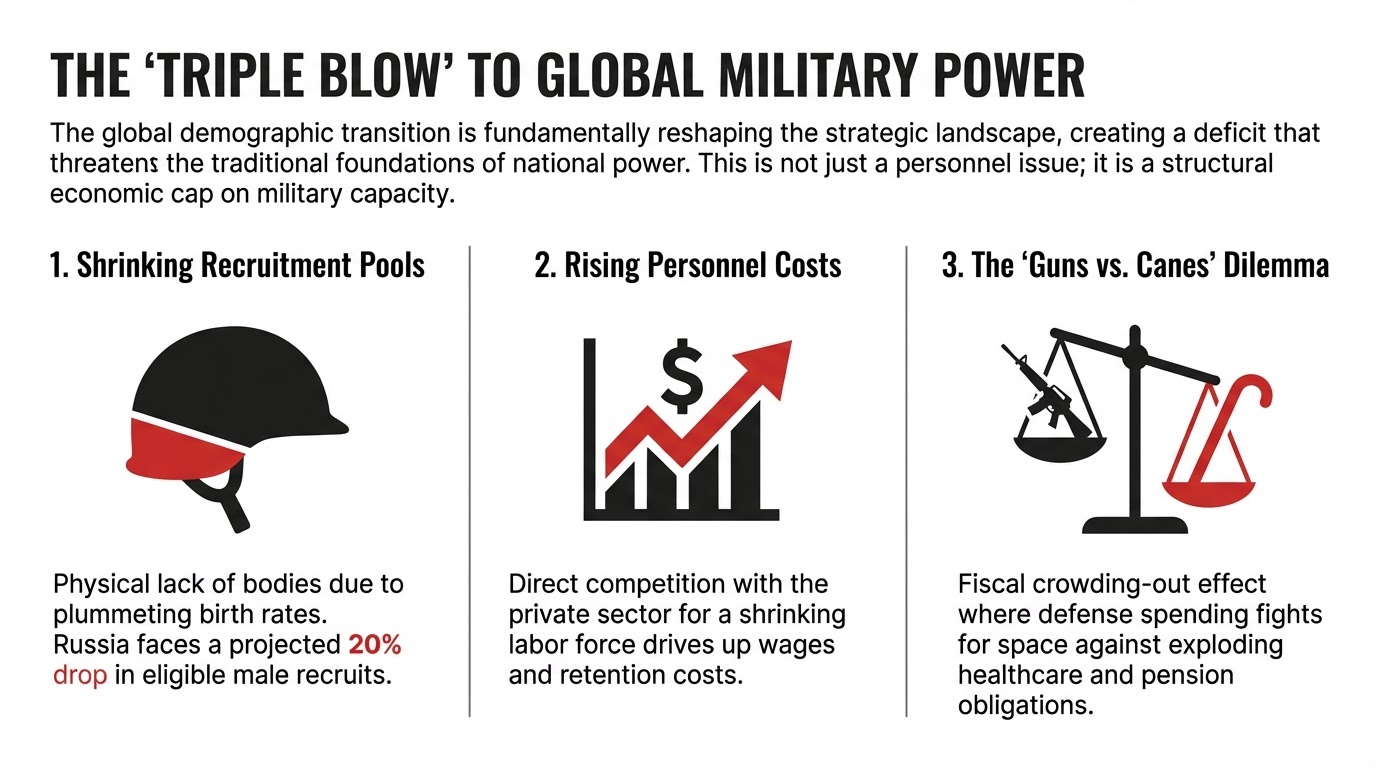
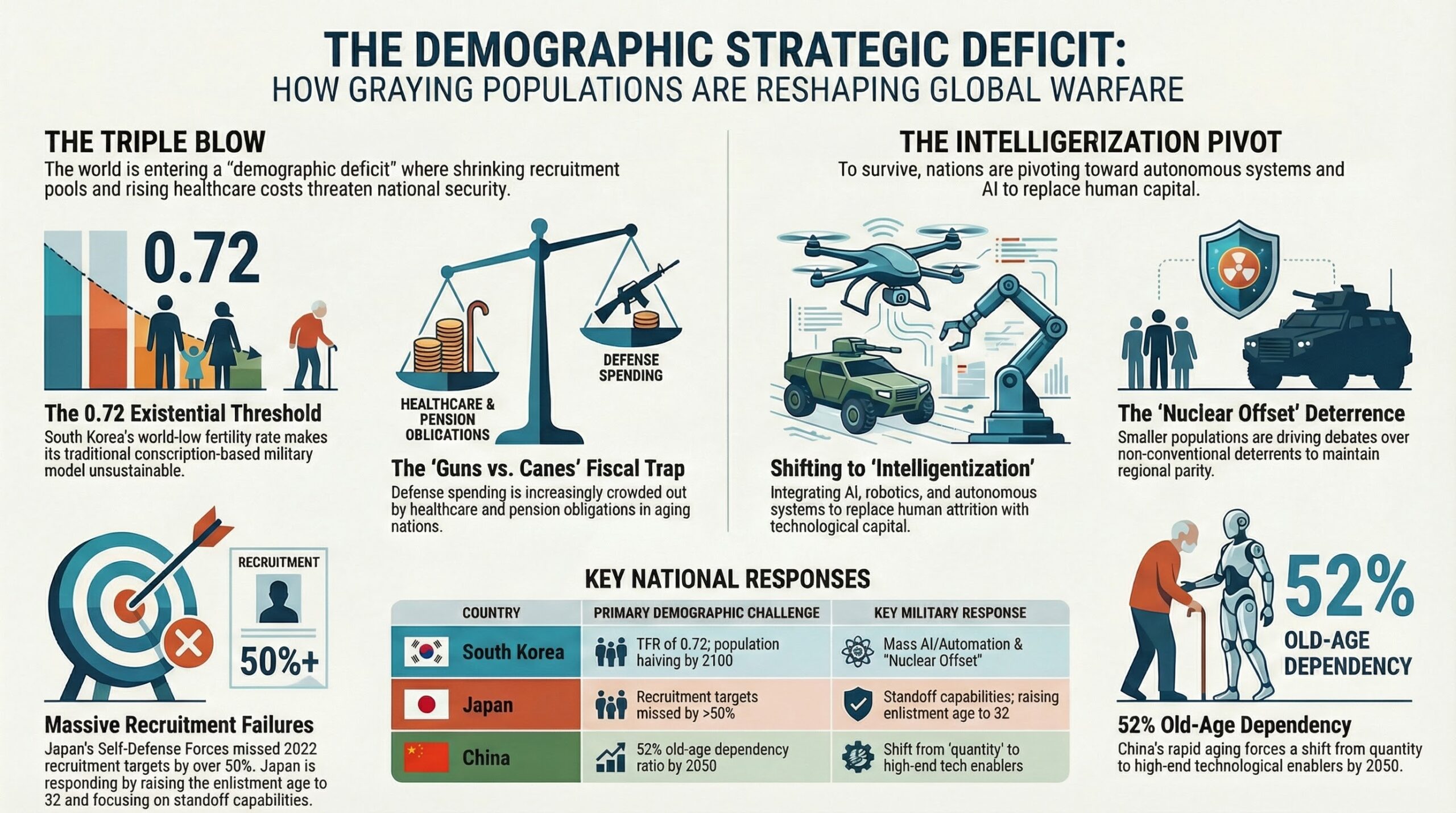
The global demographic transition is fundamentally reshaping the strategic landscape, creating a “demographic deficit” that threatens the traditional foundations of national power: manpower, fiscal resources, and societal resilience.1 As birth rates plummet and populations age across both advanced and emerging economies, militaries are facing a “triple blow” of shrinking recruitment pools, rising personnel costs, and a “guns vs. canes” fiscal dilemma where defense spending is increasingly crowded out by healthcare and pension obligations.1

Yugo M85/M92 dust cover pin and washer from Ronin&#039;s Grips
Source: Ronins Grips Analytics 2026

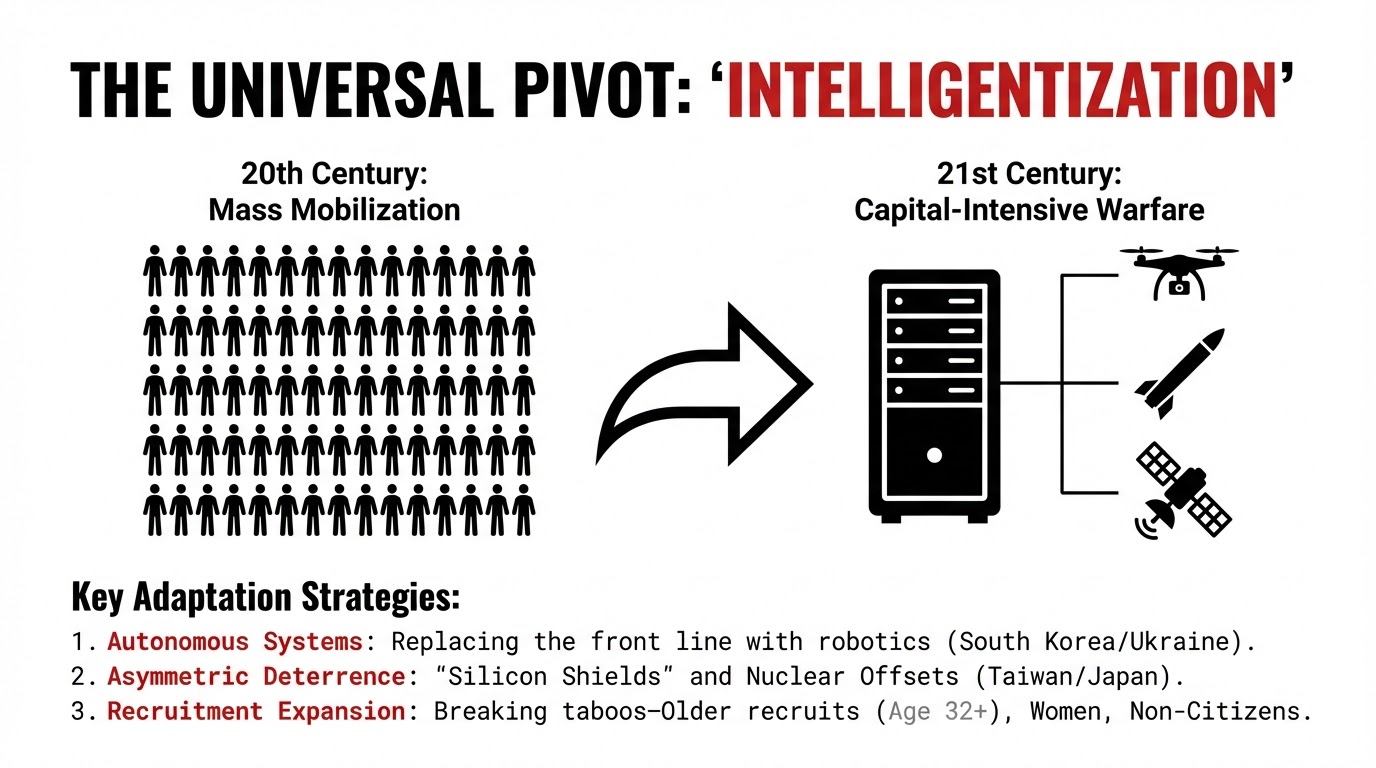
This report identifies ten nations—South Korea, Japan, China, Russia, Ukraine, Poland, Taiwan, Germany, Italy, and Lithuania—where these demographic headwinds are most severe. For instance, Russia faces a projected 20% decrease in eligible male recruits during the 2020s 5, while South Korea’s fertility rate of 0.72 represents an existential threat to its conscription-based model.6 To mitigate these losses, states are pivoting toward “intelligentization”—the integration of AI, robotics, and autonomous systems designed to replace human attrition with technological capital.7 Strategic survival in this new era will require radical shifts, including broadening recruitment to non-citizens, upskilling older cohorts, and deepening regional military integration to achieve economies of scale.

Summary of Demographic Impact on Top 10 Militaries

RankCountryPrimary Demographic ChallengeKey Strategic/Military Response
1South KoreaLowest global TFR (0.72); halving population by 2100.Mass AI/automation; “nuclear offset” deterrence debate.
2JapanRecruitment failure; SDF missing targets by over 50%.Standoff capabilities; raising enlistment age to 32.
3ChinaShrinking workforce; 52% old-age dependency by 2050.“Intelligentization”; shift to high-end tech enablers.
4Russia“Triple demographic blow”; 20% recruit pool drop by 2030.Increased militarization; reliance on nuclear/coercion.
5UkraineBiological survival; wartime exodus and 0.9 fertility rate.Autonomous warfare lab; “total defense” and tech reserves.
6PolandRecruitment-retention gap; record professional exits (9,000).Rapid heavy rearmament; mobile firepower focus.
7TaiwanRecruitable men falling below 75,000 by 2031.“Silicon Shield” leverage; UAV/asymmetric capabilities.
8GermanyRapidly aging society; pacifist culture vs. 2031 goals.New Military Service Act; recruiting EU/non-citizens.
9Italy“Guns vs. Pensions” trap; NATO’s oldest member (median 46+).Creative accounting; 6th-gen fighter/modernization.
10LithuaniaWorld’s fastest depopulation; 15% loss since 1990.Societal resilience; reliance on German Panzer Brigade 45.

A Cross-Functional Assessment of Global Military Attrition and National Power

The contemporary geopolitical landscape is increasingly defined not only by the rapid evolution of technology and the resurgence of great power competition but by a more fundamental and inexorable shift: the global demographic transition. As birth rates plummet and populations age across both advanced and emerging economies, the traditional pillars of military power—manpower, fiscal resources, and societal resilience—are facing unprecedented strain. This cross-functional assessment, integrating perspectives from foreign affairs, intelligence, and military analysis, identifies the top ten nations whose defense capabilities are most severely threatened by these demographic headwinds. The analysis moves beyond mere statistical observations to explore the second- and third-order effects on operational readiness, strategic autonomy, and the very nature of future conflict.

Yugo M85/M92 dust cover pin and washer from Ronin&#039;s Grips
Source: Ronins Grips Analytics 2026

1. South Korea: The Crucible of Demographic Collapse

South Korea represents the most acute example of a military establishment confronting an existential demographic crisis. The nation’s total fertility rate, which dropped to an unprecedented 0.72 in 2023, is the lowest recorded globally, far beneath the 2.1 required for population replacement.6 On its current trajectory, South Korea’s population of 51 million is projected to halve by the year 2100, creating a recruitment deficit that traditional conscription cannot solve.6

The Manpower-Deterrence Paradox

For the Republic of Korea (ROK) Armed Forces, demographics are a matter of immediate national security due to the persistent conventional and nuclear threat from North Korea. The ROK military has historically relied on a robust conscription system, requiring at least 18 months of service.6 However, the shrinking cohort of 18-to-25-year-olds is forcing a radical downsizing of the standing force. Intelligence assessments suggest that the “danger of war” has made families increasingly reluctant to send their only children into service, further complicating recruitment efforts and eroding the traditional social contract that sustained the military.10

MetricCurrent/Projected Value
Total Fertility Rate (2023)0.72 6
Global Replacement Rate2.1 6
Projected Population Decline (by 2100)50% 6
Military Fill Rate (2024)79.2% 12

Strategic and Technological Pivot

To mitigate the loss of human capital, South Korea is leading the world in the integration of automation and artificial intelligence into its defense architecture. Drawing lessons from the conflict in Ukraine, the ROK is prioritizing automation technologies to compensate for the thinning of its front-line units.6 This includes the deployment of unmanned surveillance systems, drone swarms, and autonomous ground vehicles designed to hold territory with minimal personnel. Furthermore, the demographic deficit is intensifying the domestic debate over the acquisition of sovereign nuclear weapons; the logic of the “nuclear offset” suggests that a smaller population requires a more potent, non-conventional deterrent to maintain parity with regional rivals.6

2. Japan: The Aging Vanguard of the Indo-Pacific

Japan has long been the global bellwether for the security implications of an aging society. Its population has been in steady decline since 2011 due to a total fertility rate of 1.2 and a median age that is among the highest in the world.6 By 2050, Japan is projected to lose approximately 18.7 million people, a 15.1% decline that will fundamentally reshape its Self-Defense Forces (SDF).13

Recruitment Failure and Structural Attrition

The SDF operates as a voluntary force, which places it in direct competition with the private sector for a dwindling pool of young talent. In 2022, Japan missed its recruitment target for the SDF by more than half, enlisting fewer than 4,000 personnel.6 The military analyst perspective highlights that an aging workforce typically experiences a “hump-shaped” productivity curve, where the increasing age of service members eventually leads to a decline in physical readiness and higher healthcare costs.14 To counter this, Japan has raised the maximum age for new recruits to 32 and relaxed rules regarding grooming and tattoos, though these measures have yet to reverse the trend.6

Asymmetric Adaptation and Regional Deterrence

Japan’s response centers on a massive increase in defense spending, intended to double the budget to 2% of GDP by 2027.15 This capital is being funneled into standoff capabilities—long-range missiles, unmanned underwater vehicles (UUVs), and space-based surveillance—that allow Japan to project power without a large human footprint. The intelligence community notes that Japan’s demographic weakness is a known factor in Chinese and North Korean strategic calculus, incentivizing Tokyo to leverage its technological depth in robotics and AI to maintain a “silent” but effective deterrent.6

3. China: The Demographic Cliff of a Rising Power

China’s military power has historically been predicated on its vast population and its “demographic dividend”—a large, young, and mobile workforce that fueled both its economy and its massive standing army. This era is ending as China’s population shrinks and ages at a rate faster than almost any other country in history.17

Fiscal and Social Displacement

The People’s Liberation Army (PLA) faces a dual-track demographic crisis. First, the shrinking pool of 18-to-24-year-olds is creating a more competitive labor market, forcing the PLA to increase enlistment ages and offer higher salaries to attract the technical talent required for modern warfare.6 Second, the rapid aging of Chinese society is creating a “tough juggling act” for the central government. Healthcare spending in China soared from 55 billion USD in 2000 to nearly 1.2 trillion USD in 2021, and the old-age dependency ratio—the ratio of people over 65 to the working-age population—is expected to reach nearly 52% by mid-century.17

China Demographic Projections20202050 (Projected)
Old-Age Dependency Ratio17%52% 17
Healthcare Spending1.2 trillion USDSignificant Increase Expected 17
Total Fertility Rateapprox. 1.0 – 1.2Continued Decline 17

The “Intelligentization” Strategy

To compensate for these pressures, the PLA is pursuing a strategy of “intelligentization,” which seeks to bypass traditional manpower requirements through the widespread use of AI-enabled systems, autonomous platforms, and cyber warfare capabilities. Intelligence analysts point to the severe gender imbalance in China—with roughly 30 million more men than women—as a potential driver of both internal social instability and a surplus of frustrated young men who may be more easily mobilized for nationalist causes.17 However, the economic drag of a shrinking workforce may ultimately limit the resources the CCP can project globally, forcing a shift from a “quantity” military to one defined by high-end technological enablers.17

4. Russia: The Attrition of an Empire

Russia is currently experiencing a “triple demographic blow”: low birth rates, high mortality among working-age men, and massive emigration exacerbated by the ongoing invasion of Ukraine.3 The United Nations projects that Russia’s population will shrink from 146 million in 2022 to 135.8 million by 2050, with some worst-case scenarios predicting a drop to 120 million or even lower by the end of the century.18

The Manpower Cost of Attritional Warfare

The Russian military faces a looming demography crisis that predates the current war but has been catastrophically accelerated by it. In 2020, there were approximately 14.25 million men aged 20-34 in Russia; by 2025, that number is expected to fall to 11.55 million, a 20% decrease in the recruiting pool within just five years.5 To maintain its current military strength of approximately 900,000, Russia would need to increase its militarization rate—the percentage of the youth cohort serving in the armed forces—to over 8%, a level that is economically and socially unsustainable for a modern state.5

Adaptation Through Mobilization and Coercion

The Kremlin has resorted to increasingly desperate measures to fill its ranks, including the recruitment of convicts, the use of private military companies (PMCs), and significant financial incentives that are straining the national budget.5 Intelligence reporting indicates a massive “brain drain” of up to 700,000 Russians fleeing mobilization, representing a loss of human capital that will degrade Russia’s technological and military capabilities for decades.3 To survive, the Russian military must either significantly downsize and professionalize its core or increasingly rely on its nuclear arsenal to offset its conventional weakness—a move that increases the risk of global escalation.5

5. Ukraine: The Biological Survival of the Nation

Ukraine faces the most tragic demographic dilemma in modern history. Even before the full-scale invasion in 2022, Ukraine’s population had declined from over 50 million in the early 1990s to around 37 million.19 The war has precipitated a flood of refugees and a sharp increase in mortality, with the fertility rate plummeting to an estimated 0.7-0.9, among the lowest in the world.3

Protecting the 18-25 Cohort

A central feature of the Ukrainian mobilization strategy has been the deliberate protection of the 18-to-25-year-old cohort. Recognizing that this group is essential for the nation’s future reproduction and reconstruction, the government has historically resisted lowering the conscription age to 18, as is common in military history.21 However, as the war of attrition continues, the Armed Forces of Ukraine (AFU) are facing severe manpower shortages, with some frontline units operating at only 30% of their intended strength.19

Ukraine Population/Military DataValue
Population Peak (1990s)50 Million+ 19
Current Population (2024 Est.)37 Million 19
Birth Rate to Death Rate Ratio (2024)1:3 21
Companies Reporting Workforce Deficits71% 24

The Future of High-Tech Resistance

To offset its numerical disadvantage against Russia, Ukraine is rapidly evolving into a global laboratory for autonomous warfare. The AFU is making unprecedented use of drone technology and AI-driven decision support systems to maximize the lethality of its limited personnel.11 For Ukraine, the post-war security environment will require a “total defense” model that integrates its tech-savvy diaspora and leverages high-tech reserves, as it cannot afford to maintain a large, manpower-intensive standing army without risking total demographic collapse.19

6. Poland: The Frontline Fortress vs. Demographic Reality

Poland has set a course for military expansion unprecedented in post-Cold War Europe, aiming to build the continent’s largest land army with a target of 300,000 personnel.25 This ambition, driven by the trauma of the invasion of Ukraine and the perceived threat from Russia, faces profound demographic and economic hurdles.

The Recruitment-Retention Gap

Poland’s population of 38 million is shrinking by 0.5% annually, and the pool of eligible 18-to-25-year-olds is only around 200,000.27 Military analysts point to the “mobilization-voluntarism dilemma”: while most Poles support the military and fear war with Russia, only 23% say they would volunteer for combat if attacked.26 In 2023, the Polish military took in 16,000 new soldiers but saw a record 9,000 professional soldiers leave the service.26 Internal figures suggest that up to 40% of volunteers drop out between registration and enlistment, forcing recruitment officers to relax medical and psychological screening criteria to meet quotas.26

Strategic Pivot to Technological Deterrence

To bridge the gap between its 300,000 target and its current strength of approximately 206,000, Poland is purchasing advanced weaponry at a pace unmatched in Europe, including Abrams tanks, K2 tanks, and HIMARS rocket artillery.25 The strategy is to create a force that outclasses potential adversaries through mobile firepower rather than sheer numbers. However, analysts warn that without a coherent, end-to-end system for recruitment and long-term retention, the Polish military risks overstretch and a decline in quality.25

7. Taiwan: Defending the Silicon Shield with Fewer Men

Taiwan’s security environment is uniquely challenging, as it faces a massive neighbor that seeks “forced, compelled, or coercive change” in its status.16 This threat comes as Taiwan’s recruitment pool is shrinking rapidly; the number of men eligible for military service fell below 100,000 for the first time in 2023 and is projected to drop under 75,000 by 2031.10

Manpower Shortages and Gray Zone Pressures

The Taiwanese military is currently at roughly 80% strength, down from 89% in 2020.29 This personnel deficit is exacerbated by “brain drain” to the commercial sector, particularly in high-demand fields like aviation and cyber security.10 Intelligence analysts highlight that China uses “gray zone” activities—disinformation, hacking, and provocations—to exploit these weaknesses, driving wedges between the Taiwanese people and their government and exhausting the military’s limited human resources through constant high-alert states.11

Taiwan Recruitable Men ProjectionsYear
100,000+Pre-2023
< 100,0002023 12
< 80,0002027 (Projected) 12
< 75,0002031 (Projected) 10

The Foreign Legion and Drone Offset

To address the shortage, Taiwan is exploring radical proposals, including the creation of a “foreign legion” or opening its reserves to the 750,000 foreign migrant workers currently living on the island.29 Additionally, the Ministry of National Defense is focusing on unmanned aerial vehicle (UAV) technology and asymmetric capabilities that pair Taiwan’s high-tech industrial base with battlefield-proven R&D from partners like Poland and Ukraine.30 The “Silicon Shield”—Taiwan’s dominance in semiconductor manufacturing—is being leveraged to anchor international interests and ensure that even with a smaller military, the cost of an invasion remains prohibitively high for Beijing.30

8. Germany: Rebuilding the Bundeswehr in an Aging Society

Germany’s Zeitenwende—a major shift in defense policy following the Russian invasion of Ukraine—is struggling against the reality of a rapidly aging population and a deep-seated culture of pacifism. The Bundeswehr aims to expand to around 203,000 soldiers by 2031, but current strength sits at approximately 184,324.31

The New Military Service Act

Beginning January 1, 2026, Germany will implement a new military service model to address recruitment shortfalls. All young men turning 18 will receive a mandatory questionnaire to assess their health and willingness to serve, creating a database of potential military resources.32 While service remains voluntary in the initial phase, the law allows for “needs-based conscription” (Bedarfswehrpflicht) if the number of volunteers is insufficient.32 This move signals a strategic shift from an all-volunteer professional force back toward a model that enfranchises the nation in its own defense.32

Recruiting Non-Citizens and EU Nationals

A controversial but increasingly discussed proposal within the German Ministry of Defence is the recruitment of non-German EU citizens and even non-citizens generally.35 Proponents argue that a multiethnic military that reflects Germany’s reality as an immigration nation would not only fill manpower gaps but also foster better societal integration.35 This strategy would target the 40-45% of asylum seekers who receive protected status, offering a path to citizenship through military service, similar to the U.S. MAVNI program.35

9. Italy: The Fiscal and Demographic Trap

Italy is NATO’s oldest member country, with a median age of over 46 years and a total fertility rate well below replacement levels.1 This demographic profile creates a critical “guns vs. pensions” dilemma, as rising healthcare and pension costs compete for limited fiscal resources in a nation with high public debt (135% of GDP).1

Creative Accounting and Personnel Reductions

Italy reached the 2% NATO defense spending target in 2025, but economists note that this was largely achieved through the reclassification of existing expenditures, including military pensions and outlays for the tax police and coast guard.36 Since the Reorganization of the Military Instrument Law of 2012, Italy has been actively reducing its total military personnel from 190,000 to 150,000 to control costs and lower the average age of its forces.36

Italy Budget and Demographic StressValue/Trend
Median Age> 46 Years 1
Public Debt135% of GDP 36
GDP Growth (2025 Est.)0.7% 36
Pension Expenditure IncreaseMedian 2.5% of GDP (OECD Proj.) 1

Technological Substitution and European Integration

The Italian military is responding by investing heavily in high-end modernization, including nuclear readiness exercises, new German tanks, and sixth-generation fighter jets (GCAP).39 Some experts argue that Italy’s only viable path to maintaining modern capabilities is through deeper European defense integration and the creation of a “European Army” to achieve economies of scale that an individual, aging state cannot afford.36

10. Lithuania: Depopulation at the Suwałki Gap

Lithuania is one of the world’s fastest-depopulating countries, having lost over 800,000 people—equivalent to its two largest cities—since its independence in 1990.40 With a population of just 2.8 million and over 20% of residents above retirement age, the nation faces an existential threat on NATO’s eastern flank.40

Geographic Vulnerability and Hybrid Attacks

The “Dieveniškės Pocket,” a sparsely populated area in eastern Lithuania, is identified as a prime target for Russian and Belarusian hybrid operations.41 The shrinking rural population makes the territory difficult to monitor and secure, increasing the risk of “gray zone” incursions designed to test NATO’s Article 5 guarantees.16 Intelligence reporting highlights the recruitment of migrants and the use of illegal drone flights as primary tools for such hybrid aggression.41

Societal Resilience and Allied Offsets

Lithuania’s security strategy emphasizes “societal resilience” and the presence of allied troops, such as the German Panzer Brigade 45.41

http://googleusercontent.com/assisted_ui_content/2 Figure 3: Frontier of Attrition—A conceptualization of autonomous surveillance at the Suwałki Gap. As rural populations decline in border “pockets” like Dieveniškės, NATO frontline states are increasingly relying on unmanned “tripwire” technologies to monitor vast, under-populated territories.41

To counter depopulation, the government is debating labor immigration quotas and targeted family incentives, while also strengthening territorial defense units like the Lithuanian Riflemen’s Union to ensure that even with a small standing army, the nation can present a “comprehensive defense”.43

Thematic Synthesis: The Revolution in Military-Demographic Affairs

The collective experience of these ten nations reveals several cross-cutting themes that define the future of conflict in an aging world.

The Human-Machine Substitution

The most visible impact of demographic decline is the acceleration of the military technological revolution. As the cost of training and maintaining a single soldier rises—estimated at 50,000 to 100,000 USD for initial training and 100,000 USD annually thereafter—robots and AI systems become increasingly attractive as “expendable” and cheaper alternatives.7

Figure 1: Comparison of shrinking recruitment cohorts in key theater states Russia and Taiwan, highlighting the 20-25% drop in eligible manpower during the current decade.

Robotics and Autonomous Systems (RAS) are projected to revolutionize logistics, situational awareness, and force protection, allowing commanders to operate with greater standoff distances and reduced risk to human personnel.8

Operational RoleRAS/AI Impact
LogisticsAutonomous convoys and tactical resupply 8
ReconnaissancePersistent surveillance in complex terrain 8
Force ProtectionDrone swarming and robot sentries 39
Decision SupportRapid data processing to avoid “cognitive overload” 8

The Fiscal Crowding-Out Effect

Demographics create a “negative correlation” between national debt and military spending.38 As populations age, governments are forced to choose between “guns and canes”—funding modern defense capabilities or fulfilling social welfare obligations.1

Figure 2: The fiscal squeeze in Italy, where the ambition to reach a 3.5% defense target by 2035 competes directly with an OECD-projected 2.5% GDP increase in pension expenditures.

In many NATO countries, the OECD projects that pension expenditures alone will rise by 2.5% of GDP, potentially offsetting any planned increases in defense spending.1 This fiscal pressure often leads to “creative accounting,” as seen in Italy, or a strategic reliance on foreign military sales (FMS) from the United States, which provides Washington with significant bargaining leverage over European trade and security policies.37

The Intelligence Gap and Grey Zone Exploitation

Intelligence analysts warn that demographic decline creates “strategic vacuums” that adversaries are quick to exploit. Shrinking populations in border regions, brain drain among technical elites, and the widening “cultural gap” between a professionalized military and an aging civilian society all provide opportunities for subversion and hybrid warfare.16 Adversaries like China and Russia view demographic weakness as a targetable vulnerability, using digital disinformation and lawfare to erode the will of aging societies to resist.16

Strategic Recommendations for Aging Militaries

Based on this cross-functional assessment, states facing demographic decline must adopt several radical shifts in their defense planning to remain viable.

1. Shift to “Attritable” Technology

Militaries must move away from a reliance on expensive, manned platforms that require large crews and move toward “attritable” unmanned systems. These platforms are designed to be lost in combat without creating the same political or personnel trauma as the loss of a human soldier. This requires a fundamental redesign of unit structures to integrate RAS and AI as “teammates” rather than just tools.7

2. Broaden the Recruitment and Service Model

The traditional image of the soldier as a young male in peak physical condition must evolve. Upskilling older service members to extend their time in uniform, increasing the participation of women, and recruiting non-citizens or foreign experts are essential steps to capture underutilized human capital.1 Furthermore, the return of some form of universal service—even in non-combat roles—can help bridge the civil-military gap and ensure the nation remains invested in its own defense.32

3. Deepen Regional and Functional Integration

Small or aging states can no longer afford to maintain full-spectrum militaries. Deeper integration within alliances, joint procurement programs, and functional specialization (e.g., one country providing cyber defense, another providing heavy armor) are necessary to achieve the scale required for deterrence.30 Relying on a single provider like the U.S. creates dangerous dependencies; therefore, building a diverse, “China-free” or “non-red” defense industrial base is critical for long-term strategic autonomy.30

4. Prioritize Cognitive and Cyber Readiness

As the physical workforce shrinks, the “cognitive workload” on the remaining personnel increases.8 Investments in AI-driven command and control (C2) systems that filter and prioritize data are essential to prevent leader burnout and ensure fast, effective decision-making in contested environments.8

In conclusion, the demographic transition is not a distant threat but a current reality that is already hollowing out the military structures of the world’s most critical states. Success in the coming decades will depend not on who has the largest population, but on who can most effectively replace human attrition with technological and organizational innovation. Those who fail to adapt to this “new era” of defense will find their national power diminished by a slow-moving, yet inexorable, biological retreat.1

Yugo M85/M92 dust cover pin and washer from Ronin&#039;s Grips
Source: Ronins Grips Analytics 2026

Appendix: The United States Case Study – Strategic Resilience and Chronic Vulnerability

While the United States faces severe demographic and recruitment challenges, cross-functional analysis places it in the “Top 15” of globally impacted nations rather than the immediate Top 10.45 The U.S. possess unique “structural stabilizers” that distinguish its posture from the existential biological retreat seen in East Asian or Eastern European powers.

Structural Stabilizers

  • Demographic Buffer through Immigration: The U.S. is the only large affluent nation projected to see continued growth in its working-age population through mid-century. While the domestic fertility rate is at a record low of 1.6, robust net immigration is projected to prevent the absolute population contraction facing rivals like China or Russia.
  • Recruitment Recovery (FY2025): The U.S. military successfully reversed a multi-year shortfall to reach 103% of its recruiting targets in fiscal year 2025. This was driven by a 14.5% pay raise for junior enlisted personnel and the success of “Future Soldier” preparatory courses that help previously ineligible youth meet physical and academic standards.
  • Technological Leadership: Through U.S. Army Futures Command, the U.S. leads in integrating Robotics and Autonomous Systems (RAS) to offset manpower requirements in high-risk roles like logistics and reconnaissance.

Critical Vulnerabilities (The “Top 15” Risk)

Despite these strengths, three “red zones” keep the U.S. under close demographic monitoring:

  1. The Eligibility Crisis: Currently, only 23% of the 17-25 age cohort is qualified to serve without a waiver due to obesity, drug use, and criminal records.
  2. The 2026 “Birth Dearth”: A sharp recruitment cliff is expected to begin in 2026, as the 10% drop in births following the 2008 financial crisis hits the 18-year-old cohort.
  3. The Fiscal Squeeze: By 2025, Social Security, Medicare, and Medicaid are projected to claim 60% of all federal outlays, creating a structural “guns vs. canes” dilemma that could crowd out future military modernization.24

In summary, while the U.S. faces a “chronic condition” regarding its all-volunteer force, it currently retains the demographic and technological depth to manage its strategic commitments in ways that the Top 10 nations cannot.


Please share the link on Facebook, Forums, with colleagues, etc. Your support is much appreciated and if you have any feedback, please email us in**@*********ps.com. If you’d like to request a report or order a reprint, please click here for the corresponding page to open in new tab.


Sources Used

  1. Older and Wiser: Defining NATO’s Strategy for Global Aging – CSIS, accessed February 8, 2026, https://www.csis.org/analysis/older-and-wiser-defining-natos-strategy-global-aging
  2. Demographics and the Changing National Security Environment | RAND, accessed February 8, 2026, https://www.rand.org/pubs/research_briefs/RB5035.html
  3. Tragedy After Disaster? War in Ukraine and Demography – Institut Montaigne, accessed February 8, 2026, https://www.institutmontaigne.org/en/expressions/tragedy-after-catastrophe-demographic-impact-war-russia-and-ukraine
  4. Europe’s dependence on US foreign military sales and what to do …, accessed February 8, 2026, https://www.bruegel.org/policy-brief/europes-dependence-us-foreign-military-sales-and-what-do-about-it
  5. The Russian Military is Facing a Looming Demography Crisis | Russia Matters, accessed February 8, 2026, https://www.russiamatters.org/analysis/russian-military-facing-looming-demography-crisis
  6. Asia Countries Worried About Plummeting Fertility Rates, Impact on …, accessed February 8, 2026, https://warwick.ac.uk/fac/soc/pais/people/hughes/businessinsider.com-asia_countries_worried_about_plummeting_fertility_rates_impact_on_armies.pdf
  7. The Ethics of Robots in War – Army University Press, accessed February 8, 2026, https://www.armyupress.army.mil/Journals/NCO-Journal/Archives/2024/February/The-Ethics-of-Robots-in-War/
  8. U.S. Ground Forces Robotics and Autonomous Systems (RAS) and Artificial Intelligence (AI): Considerations for Congress – EveryCRSReport.com, accessed February 8, 2026, https://www.everycrsreport.com/reports/R45392.html
  9. U.S. Endorses Responsible AI Measures for Global Militaries – War.gov, accessed February 8, 2026, https://www.war.gov/News/News-Stories/Article/Article/3597093/us-endorses-responsible-ai-measures-for-global-militaries/
  10. Taiwan faces decline in troop numbers, report reveals – VOA, accessed February 8, 2026, https://www.voanews.com/a/taiwan-faces-decline-in-troop-numbers-report-reveals-/7940882.html
  11. EXPLAINED: Taiwan’s military manpower crisis and search for solutions – Radio Free Asia, accessed February 8, 2026, https://www.rfa.org/english/china/2025/03/11/china-taiwan-military-shortage-explained/
  12. Taiwan military sees boost in recruitment | Taiwan News | Nov. 12, 2025 10:44, accessed February 8, 2026, https://www.taiwannews.com.tw/news/6242015
  13. Countries with Declining Population 2026, accessed February 8, 2026, https://worldpopulationreview.com/country-rankings/countries-with-declining-population
  14. DRAFT PAPER Macroeconomic implications of demographic changes in Bulgaria, accessed February 8, 2026, https://www.bde.es/f/webbe/INF/MenuHorizontal/noticias-eventos/conferencias/2025/27_09_IVANOV.pdf
  15. Geopolitical Instability and Escalating Conflicts: The Impact on East Asian Defence Innovation Systems in – Brill, accessed February 8, 2026, https://brill.com/view/journals/veas/15/1/article-p159_8.xml
  16. Taiwan’s Evolving Response to China’s Grey Zone Actions – RUSI, accessed February 8, 2026, https://www.rusi.org/explore-our-research/publications/policy-briefs/taiwans-evolving-response-chinas-grey-zone-actions
  17. How Severe Are China’s Demographic Challenges? | ChinaPower …, accessed February 8, 2026, https://chinapower.csis.org/china-demographics-challenges/
  18. Aging of Russia – Wikipedia, accessed February 8, 2026, https://en.wikipedia.org/wiki/Aging_of_Russia
  19. The Ukrainian Mobilization Challenge: Military and Society During Full-Scale War – Sceeus, accessed February 8, 2026, https://sceeus.se/en/publications/the-ukrainian-mobilization-challenge-military-and-society-during-full-scale-war/
  20. Russia as a military opponent in 2050 — four possible pathways, accessed February 8, 2026, https://www.foi.se/rest-api/report/FOI%20Memo%208609
  21. Ukraine’s Law on Mobilisation, accessed February 8, 2026, https://foi.se/rest-api/report/FOI%20Memo%208786
  22. Why isn’t Zelensky lowering the conscription age to 18 to 24-year-olds? The US and NATO countries are asking him to do this but he’s not doing it. – Quora, accessed February 8, 2026, https://www.quora.com/Why-isnt-Zelensky-lowering-the-conscription-age-to-18-to-24-year-olds-The-US-and-NATO-countries-are-asking-him-to-do-this-but-hes-not-doing-it
  23. Army at a crossroads: the mobilisation and organisational crisis of the Defence Forces of Ukraine | OSW Centre for Eastern Studies, accessed February 8, 2026, https://www.osw.waw.pl/en/publikacje/osw-commentary/2025-03-14/army-a-crossroads-mobilisation-and-organisational-crisis
  24. Ukraine’s youth exodus highlights mounting demographic challenges – Atlantic Council, accessed February 8, 2026, https://www.atlanticcouncil.org/blogs/ukrainealert/ukraines-youth-exodus-highlights-mounting-demographic-challenges/
  25. Poland’s Aspiration to Build Europe’s Largest Land Army – www.lvivherald.com, accessed February 8, 2026, https://www.lvivherald.com/post/poland-s-aspiration-to-build-europe-s-largest-land-army
  26. ANALYSIS: Poland rearming faster than it can find soldiers – TVP World, accessed February 8, 2026, https://tvpworld.com/87513533/analysis-poland-is-rearming-faster-than-it-can-find-soldiers
  27. “Poland’s Strategic Response to the U.S. ‘Deep Reset’ Policy in 2025: Navigating European Security and the Ukrainian Crisis – https://debuglies.com, accessed February 8, 2026, https://debuglies.com/2025/03/07/polands-strategic-response-to-the-u-s-deep-reset-policy-in-2025-navigating-european-security-and-the-ukrainian-crisis/
  28. Polish army copes with recruitment targets – English Section – Polskie Radio, accessed February 8, 2026, https://www.polskieradio.pl/395/7789/artykul/3413020,polish-army-copes-with-recruitment-targets
  29. Taiwan may consider introducing foreign migrants into army – Radio Free Asia, accessed February 8, 2026, https://www.rfa.org/english/china/2025/01/07/taiwan-armed-forces-recruitment-migrants/
  30. Building Bridges in a Challenging Landscape: Taiwan’s Defense Cooperation with Europe, accessed February 8, 2026, https://europeanvalues.cz/en/building-bridges-in-a-challenging-landscape-taiwans-defense-cooperation-with-europe/
  31. Bundeswehr – Wikipedia, accessed February 8, 2026, https://en.wikipedia.org/wiki/Bundeswehr
  32. Germany’s new military service law triggers protests and unease among Ukrainian refugees, accessed February 8, 2026, https://english.nv.ua/opinion/germany-s-new-military-service-law-alarms-youth-and-raises-difficult-questions-for-ukrainian-refugee-50567374.html
  33. ‘Times have changed’: Germany’s military seeks recruits as it confronts new era, accessed February 8, 2026, https://www.theguardian.com/world/2025/dec/28/germany-military-recruits-bundeswehr-new-rules-young-men
  34. Universal Conscription as Technology Policy, accessed February 8, 2026, https://issues.org/brad/
  35. Could Immigrants Serve in the German Military? A New Take on Integration, National Identity, and Achieving Critical Security Objectives, accessed February 8, 2026, https://www.gmfus.org/news/could-immigrants-serve-german-military-new-take-integration-national-identity-and-achieving
  36. NATO’s 5% Defense Pledge and Italy: Can It? Will It? – CEPA, accessed February 8, 2026, https://cepa.org/article/natos-5-defense-pledge-and-italy-can-it-will-it/
  37. Italy’s sudden defense-spending uptick lacks details, economist finds, accessed February 8, 2026, https://www.defensenews.com/global/europe/2025/12/09/italys-sudden-defense-spending-uptick-lacks-details-economist-finds/
  38. Europe’s difficult trade-off between military and welfare spending: the Italian case, accessed February 8, 2026, https://www.brookings.edu/articles/europes-difficult-trade-off-between-military-and-welfare-spending-the-italian-case/
  39. Italy’s New Defence Plan: Nuclear Readiness Exercises, New German Tanks and Billions in Expenditures – Finabel, accessed February 8, 2026, https://finabel.org/italys-new-defence-plan-nuclear-readiness-exercises-new-german-tanks-and-billions-in-expenditures/
  40. Lithuania is losing people without a fight | OSW Centre for Eastern Studies, accessed February 8, 2026, https://www.osw.waw.pl/en/publikacje/osw-commentary/2024-12-03/lithuania-losing-people-without-a-fight
  41. Dieveniškės: A Growing Hybrid Threat to Lithuania, accessed February 8, 2026, https://militarnyi.com/en/blogs/dieveniskes-a-growing-hybrid-threat-to-lithuania/
  42. Lithuania Cracks Down on Foreign Security Threats, Banning 1721 Belarusian and Russian Nationals – UNITED24 Media, accessed February 8, 2026, https://united24media.com/latest-news/lithuania-cracks-down-on-foreign-security-threats-banning-1721-belarusian-and-russian-nationals-15210
  43. Lithuania updates security strategy, emphasizing “existential” threat from Russia – УНН, accessed February 8, 2026, https://unn.ua/en/news/lithuania-updates-security-strategy-emphasizing-existential-threat-from-russia
  44. Lithuania monthly briefing: Migration Policy in Lithuania: Between Economic Necessity.., accessed February 8, 2026, https://china-cee.eu/2025/11/19/lithuania-monthly-briefing-migration-policy-in-lithuania-between-economic-necessity-and-national-preservation/
  45. International Security Strategy and Global Population Aging – Digital Commons @ USF – University of South Florida, accessed February 8, 2026, https://digitalcommons.usf.edu/cgi/viewcontent.cgi?article=1080&context=jss

Poland’s Military Modernization: Small Arms Evolution

Executive Summary

The Polish Armed Forces (Siły Zbrojne Rzeczypospolitej Polskiej) are currently executing one of the most aggressive and comprehensive technical modernization programs in the history of the North Atlantic Treaty Organization (NATO). Driven by the deteriorating security environment on the alliance’s eastern flank and the legislative mandate of the Homeland Defense Act of 2022, Poland is fundamentally reshaping its small arms inventory to achieve a state of high-readiness, modularity, and industrial self-sufficiency.1 This report provides an exhaustive analysis of the small arms systems utilized across the five military branches: Land Forces, Air Force, Navy, Special Forces, and Territorial Defence Force.

As of 2025, the strategic pivot from legacy Soviet-era calibers (7.62×39mm and 5.45×39mm) to NATO-standard 5.56×45mm and 7.62×51mm is nearing completion in frontline units.4 The center of gravity for this transition is the MSBS Grot modular rifle system, which is rapidly replacing the FB Beryl as the primary infantry weapon.6 This modernization is not limited to rifles; it encompasses a complete overhaul of sidearms (VIS 100), general-purpose machine guns (UKM-2000), and precision systems (Bor/Tor).8

The Polish defense industry, spearheaded by the PGZ (Polska Grupa Zbrojeniowa) consortium, has successfully internalized the production of almost all small arms categories, ensuring a resilient supply chain capable of sustaining a target force of 500,000 personnel by 2039.1 The following sections detail the technical specifications, organizational distribution, and tactical implications of Poland’s current small arms arsenal.

Geopolitical Architecture and Defense Spending

The trajectory of Polish small arms procurement is inextricably linked to the broader national strategy of “deterrence by denial.” Since the full-scale Russian invasion of Ukraine, Polish decision-makers have accelerated military expansion at an unprecedented scale, with defense spending reaching approximately 4.7% of GDP in 2025.2 This financial commitment facilitates the acquisition of massive quantities of individual equipment under “Operation SZPEJ,” a program specifically designed to address gaps in the individual soldier’s gear, from ballistic protection to advanced optics and modular firearms.12

The strategic goal is to build a military capable of conducting multidomain operations while maintaining deep, precision strike capabilities. Small arms play a vital role in this by ensuring that the expanding infantry, paratrooper, and special operations components are equipped with tools that offer superior ergonomics, reliability in extreme conditions, and compatibility with the latest generation of night vision and thermal targeting systems.1

Strategic IndicatorValue / Goal (2025-2035)Reference
Defense Spending (% of GDP)4.7% (2025)3
Total Personnel Objective500,000 (300k Active, 200k Reserve)1
Primary Modernization ProgramOperation SZPEJ / Tytan12
Primary Small Arms GoalComplete replacement of post-Soviet legacy systems16

Organizational Structure of the Polish Armed Forces

The Polish Armed Forces are structured into five distinct branches, each with specialized small arms requirements based on their operational profiles. The command structure is overseen by the General Staff, with procurement managed by the Armament Agency.17

  1. Land Forces (Wojska Lądowe): The largest branch, structured into mechanized, armored, and airborne divisions. It requires the highest volume of standard service rifles, machine guns, and anti-tank weapons.17
  2. Air Force (Siły Powietrzne): While aircraft-focused, it maintains significant ground components for air base defense and security, requiring reliable carbines and sidearms.17
  3. Navy (Marynarka Wojenna): Includes surface and submarine fleets, but also specialized coastal defense units (Morska Jednostka Rakietowa) and naval security forces.17
  4. Special Forces (Wojska Specjalne): The elite tier of the armed forces, utilizing highly specialized Western-tier platforms for unconventional warfare.17
  5. Territorial Defence Force (Wojska Obrony Terytorialnej – WOT): A light infantry volunteer force focused on home defense and hybrid warfare, which was the launch customer for the MSBS Grot.17

Summary of Personnel Strength by Branch

BranchActive Personnel (Approx.)Small Arms Priority
Land Forces100,200Mass-scale standardization (Grot/UKM)
TDF (WOT)55,000Light infantry mobility (Grot/LMP)
Air Force46,500Force protection / Base security
Navy17,000Maritime security / Coastal defense
Special Forces4,000Tier-1 specialized systems (HK416/MCX)

Small Arms Standards and Caliber Migration

The most significant technical development in the Polish inventory is the total migration away from 7.62×39mm (AK-47/AKM) and 5.45×39mm (Tantal) cartridges.5 For decades, the Polish military utilized the wz. 88 Tantal, which was a domestic variant of the Soviet AK-74. Following Poland’s accession to NATO in 1999, the defense industry developed the wz. 96 Beryl to utilize the 5.56×45mm NATO cartridge while maintaining the AK-pattern internal mechanics.5

However, the Beryl is now considered a legacy system. The current standard is the MSBS Grot, which introduces a modular architecture. In terms of sidearms, the migration is from 9×18mm Makarov (P-64/P-83) to 9×19mm Parabellum (VIS 100/Glock).8 Machine guns have transitioned from the 7.62×54mmR (PKM) to the 7.62×51mm NATO (UKM-2000), a logistical necessity for interoperability within the alliance.9

Legacy CaliberReplacement NATO CaliberPrimary Weapon Transition
7.62×39mm5.56×45mm NATOAKM -> Beryl -> MSBS Grot
5.45×39mm5.56×45mm NATOTantal -> MSBS Grot
9×18mm Makarov9×19mm ParabellumP-83 Wanad -> VIS 100
7.62×54mmR7.62×51mm NATOPKM -> UKM-2000

Detailed Analysis: Polish Land Forces (Wojska Lądowe)

The Land Forces are currently undergoing a massive rearmament. Frontline mechanized units are receiving modern Western and domestic armored vehicles, and the small arms inventory is being updated to reflect these new platforms.30 The Land Forces prioritize a mix of the MSBS Grot for standard infantry and the Mini-Beryl for vehicle crews and paratroopers.26

Division-Level Distribution

The modernization is prioritized for high-readiness formations such as the 18th “Iron” Mechanized Division and the 1st Legions Infantry Division.13 These units are the primary recipients of the latest Grot A2/A3 variants and the VIS 100 pistols. The 18th Division, in particular, has been a lead unit for testing new individual equipment like the HBT-02 combat helmet, which is scheduled for broader delivery in 2025.33

Small Arms in the Squad Structure

A typical Polish mechanized squad (based on the Rosomak APC or the future Borsuk IFV) is centered around the rifleman equipped with the MSBS Grot.15 Fire support at the squad level is provided by the UKM-2000P machine gun, while precision marksman roles use the Bor bolt-action rifle or the modernized SVD.4 The integration of the ZSSW-30 remotely controlled turret on the Rosomak and Borsuk further augments the squad’s firepower with a 30mm Bushmaster II cannon and coaxial UKM-2000C machine gun.34

Land Forces Small Arms Inventory

CategoryWeapon SystemTechnical NotesStatus
Service RifleMSBS Grot C16 (A2/A3)Modular, ambidextrous, 5.56mmFrontline standard 6
Service RifleFB Beryl wz. 96CAK-based, 5.56mmReserve/Transitioning 31
CarbineFB Mini-Beryl wz. 96Compact, 9-inch barrelVehicle crews 26
SidearmVIS 100DA/SA, 15-round, 9mmBranch standard 8
Machine GunUKM-2000PPKM derivative, 7.62mm NATOStandard LMG/GPMG 9
Sniper RifleBorBullpup, 7.62mm NATOSquad marksman 10
Anti-MaterielTorBullpup, 12.7mm (.50 BMG)Specialized teams 36

Detailed Analysis: Territorial Defence Force (Wojska Obrony Terytorialnej)

The Territorial Defence Force (WOT) has established itself as the most modern branch in terms of individual weaponry adoption. Because it was formed in 2017, it did not have to phase out vast quantities of Cold War-era rifles, allowing it to adopt the MSBS Grot and VIS 100 as the foundational weapons of the force.24

Light Infantry Doctrine

The WOT operates as a light infantry force, with each of the 16 voivodeships (provinces) hosting a brigade.24 Their small arms focus is on ease of maintenance, modularity for urban combat, and high section-level lethality. The Grot’s ability to quickly swap barrels and its full ambidexterity make it ideal for a force that relies on citizen-soldiers with varying levels of previous military experience.6

Specialized WOT Equipment

The WOT utilizes specific light support weapons, such as the LMP-2017 60mm light mortar, which is issued to light infantry companies to provide organic indirect fire support.37 For anti-tank operations, the WOT has been a major user of the FGM-148 Javelin, which proved its effectiveness in the Russo-Ukrainian War and is now integrated at the platoon level for border defense units.24

WOT Small Arms Table

CategorySystemQuantity / UsageReference
Main RifleMSBS Grot C16Over 34,000 in service37
Support RifleFB Beryl wz. 96Limited/Training use37
SidearmVIS 100 / WIST-94~3,000 VIS 100 delivered37
PrecisionBor (7.62mm)~310 rifles37
PrecisionSako TRG M10 (.338)87 rifles (Specialized)37
MortarLMP-2017 (60mm)500 units37
Anti-TankJavelin60 launchers / 180 missiles37

Detailed Analysis: Special Forces (Wojska Specjalne)

The Polish Special Forces (Wojska Specjalne) represent a world-class Tier-1 and Tier-2 capability. Unlike the conventional branches, the Special Forces utilize a hybrid inventory that favors German and American high-end platforms.22 The branch is composed of several specialized units: GROM, JW Komandosów (JWK), JW Formoza, JW AGAT, and JW NIL.23

GROM and JWK: The HK416 Standard

JW GROM and JW Komandosów have largely standardized on the Heckler & Koch HK416 as their primary assault rifle.22 The HK416 is preferred for its short-stroke gas piston system, which offers superior reliability over direct-impingement M4 clones, particularly when using suppressors or in maritime and sandy environments.39 GROM operators frequently use 10.4-inch and 14.5-inch barrel configurations, often fitted with EOTech sights and suppressors.22

JW Formoza: Maritime Specialization and SIG MCX

JW Formoza, the naval special forces unit, has traditionally used the HK G36KV.22 However, as of 2024-2025, Formoza has moved to procure the SIG Sauer MCX modular carbine.40 The MCX is particularly attractive for maritime operations due to its ability to be chambered in.300 Blackout, which offers exceptional performance in suppressed, close-quarters boarding missions (VBSS).40

Special Forces Subsystems

The Special Forces utilize the FN Minimi as their primary light machine gun (LMG), offering a lighter and more maneuverable alternative to the UKM-2000 for small-team operations.22 For sidearms, GROM utilizes the HK USP and FN Five-seveN (for specialized armor-piercing requirements), while JWK and AGAT primarily use the Glock 17.22

Special Forces Comparative Table

UnitPrimary Assault RifleSecondary / SMGPrecision System
GROMHK416 / Grot (Testing)MP5 / P90 / CZ Evo 3Sako TRG / Barrett M107
JWKHK416MP5AXMC / Sako TRG
FormozaSIG MCX / G36KVMP5Sako TRG
AGATHK416MP5Bor
NILHK416 / BerylMP5Bor

Detailed Analysis: Air Force and Navy Security Elements

The Air Force (Siły Powietrzne) and Navy (Marynarka Wojenna) focus their small arms procurement on force protection. Base security units and specialized coastal components require weapons that are reliable for static defense and mobile patrols.

Air Force Base Security

Air base security battalions (bataliony ochrony) are currently transitioning from the FB Beryl to the MSBS Grot.20 This transition is critical for logistics, as the Grot allows security personnel to use the same modular sights and accessories as the Land Forces. Pilots and flight crews are often issued the PM-84P Glauberyt submachine gun or the VIS 100 pistol due to their compact dimensions.31

Naval Coastal Defense (MJR)

The Naval Missile Unit (Morska Jednostka Rakietowa) is tasked with protecting Poland’s coastline using NSM anti-ship missiles.21 The security detachments for these high-value batteries utilize the MSBS Grot and UKM-2000 machine guns.21 Onboard ships, the Navy utilizes the Glock 17 as the standard sidearm and the Mossberg 500 shotgun for maritime security and boarding operations.4

Technical Deep-Dive: The MSBS Grot Modular System

The MSBS Grot (Modułowy System Broni Strzeleckiej) is the most technologically advanced small arm ever developed in Poland. Developed by FB Radom and the Military University of Technology (WAT), the Grot is a “system of systems” rather than a single rifle.6

Evolutionary Variants: A0 to A3

The Grot has undergone several design iterations based on field feedback from Polish troops and the conflict in Ukraine.43

  • A0 / M1: Initial production series. Faced “childhood diseases” including issues with the gas regulator, overheating, and material durability.6
  • A2 (M2): Introduced a longer handguard to cover the gas block, reinforced the firing pin for dry fire practice, and improved the pistol grip and stock.6
  • A3 (M3): The latest refinement presented at Grotowisko 2024. It is 300g lighter than the A2 and features a standard 14.5-inch barrel as an alternative to the 16-inch version.44 The A3 also introduces a new telescopic stock (AR-style), improved anti-corrosion coatings, and a modified gas regulator with a latch to prevent accidental loss.44

Modularity and Configuration

The Grot’s hallmark is its ability to share a common upper receiver for both classic (C) and bullpup (B) configurations.6 By simply swapping the lower receiver and stock assembly, the weapon can be reconfigured.

ConfigurationBarrel LengthTactical Role
Standard Assault Rifle16 in (406 mm)General Infantry 6
Carbine / Subcarbine10.5 in / 14.5 inCQB / Vehicle crews 6
Designated Marksman16 in / 20 inSquad-level precision 6
Machine CarbineHeavy 16 inHigh-volume suppression 6
Representative (R)16 in (Modified)Ceremonial / Honor Guard 6

Grot A3 Technical Specifications

FeatureSpecification
Caliber5.56×45mm NATO (7.62×39mm kit available) 6
Weight3.4 kg (A3) / 3.7 kg (A2) 44
ActionShort-stroke gas piston, rotating bolt 6
Rate of Fire700 – 900 rounds/min 6
Muzzle Velocity~870 – 890 m/s 43
Magazine30, 60-round STANAG compatible 6

Sidearms and Secondary Weapons Systems

Sidearms in the Polish Armed Forces have seen a radical shift toward domestic self-reliance. For decades, the military struggled with the WIST-94, which suffered from poor ergonomics and reliability.27

The VIS 100 (Ragun)

The VIS 100, named in honor of the legendary pre-WWII Vis wz. 35, is the new standard sidearm for the Land Forces and TDF.8 It is a modern DA/SA pistol with a 15-round double-stack magazine. The frame is constructed from a lightweight aluminum alloy, and it is fully ambidextrous, featuring a slide stop, magazine release, and decocker on both sides.8

PM-84P Glauberyt

The PM-84P remains in service for crews, pilots, and specialists who require a weapon larger than a pistol but smaller than a carbine.4 Chambered in 9×19mm, it is a reliable submachine gun that utilizes a blowback action and is being modernized to feature Picatinny rails for optics.4

Sidearms Comparative Table

WeaponCaliberCapacityOriginBranch
VIS 1009×19mm15+1PolandLand Forces, WOT 8
Glock 179×19mm17+1AustriaSpecial Forces, Navy 22
P-83 Wanad9×18mm8PolandLegacy (Base Security) 28
HK USP9×19mm15+1GermanyGROM 22
Sig Sauer P2269×19mm15+1Germany/USAFormoza 22

Support Weapons and Crew-Served Firepower

Infantry lethality is anchored by the UKM-2000 general-purpose machine gun (GPMG). This weapon is a testament to Polish engineering ingenuity, as it successfully converted the Soviet PKM design to use 7.62×51mm NATO ammunition and disintegrating belts.9

UKM-2000 Engineering

The transition from the PKM’s rimmed 7.62×54mmR to the rimless NATO round required a complete redesign of the feeding mechanism. The UKM-2000 uses a push-through system rather than the pull-out system of the PKM.9 The current UKM-2000P (Infantry) and UKM-2000C (Coaxial) variants are standard across the force, with the UKM-2013P and UKM-2020S representing modernized versions with improved ergonomics, folding stocks, and integrated rails.9

Light Mortars and Grenade Launchers

  • LMP-2017: A 60mm light mortar designed for WOT and airborne units. It is highly portable and can be operated by a single soldier in the “commando” role.37
  • Pallad wz. 74: A legacy 40mm under-barrel grenade launcher (UBGL) used with the Beryl.
  • MSBS Grot UBGL: A modern 40×46mm modular grenade launcher specifically designed for the Grot rifle system.6

Machine Gun Inventory Table

WeaponCaliberTypeFeedReference
UKM-2000P7.62×51mmGPMGM13 Link (100/200rd)9
UKM-2000C7.62×51mmCoaxialM13 Link (250rd)9
FN Minimi5.56×45mmLMGBelt / Magazine22
PKM7.62×54mmRGPMGNon-disintegrating beltLegacy 9
NSW / WKW12.7×108mmHMGBeltHeavy Support

Precision Rifles and Long-Range Interdiction

Poland has developed a robust domestic precision rifle capability through ZM Tarnów. These rifles are designed to replace the Soviet-era SVD and provide Tier-1 capability to standard infantry units.10

The Bor Sniper Rifle

The Bor is a bolt-action, bullpup sniper rifle chambered in 7.62×51mm NATO.10 It features a 26-inch (680mm) barrel and is typically fitted with Leupold or Schmidt & Bender optics.10 Over 650 units have been ordered for the Polish military, making it the primary precision tool for squad-level marksmen and specialized sniper teams.10

The Tor Anti-Materiel Rifle

The Tor (also known as the Wilk) is a heavy 12.7×99mm (.50 BMG) anti-materiel rifle.36 Also utilizing a bullpup layout, the Tor is nearly 5 feet long and is designed to engage light armored vehicles, aircraft on the ground, and enemy infrastructure at ranges up to 2,000 meters.36

Special Forces Precision Systems

While the Land Forces use Bor and Tor, the Special Forces utilize the Sako TRG series from Finland and the Accuracy International AXMC from the UK.22 These systems offer superior multi-caliber capabilities, allowing operators to switch between.308 Win,.300 Win Mag, and.338 Lapua Magnum.54

Precision Weapons Summary Table

RifleCaliberTypeRange (Eff.)User
Bor7.62×51mmBolt-Action800m+Land Forces, WOT 10
Tor12.7×99mmBolt-Action2,000m+Specialized Teams 36
Sako TRG M10.308 /.338Bolt-Action1,200m+SOF, WOT 37
AXMC.338 LapuaBolt-Action1,500m+JWK 55
Grot 762N7.62×51mmSemi-Auto600m+DMR Role (Testing) 6

Ammunition, Logistics, and Industrial Self-Sufficiency

The sustainability of the Polish Armed Forces’ small arms modernization depends on the domestic production of ammunition. PGZ-owned companies like Mesko, Dezamet, and Nitro-Chem have received over 565 million EUR in funding to expand the production of 5.56mm, 7.62mm, 12.7mm, and mortar rounds.56

Strategic Reserves

Following lessons from the Ukraine conflict, Poland is focusing on building “attritional reserves”.2 This means not just equipping the current force, but stocking enough small arms and ammunition to sustain high-intensity combat for months without external replenishment. The Armament Agency has signed contracts for over 324,000 Grot rifles to ensure that even reserve units (to be expanded to 200,000 personnel) are equipped with modern 5.56mm systems rather than being forced to rely on legacy AKMs.1

Future Programs: Tytan and Individual Soldier Modernization

The ultimate goal of Polish small arms development is the “Tytan” Individual Battlesystem.14 This program aims to integrate the MSBS Grot into a comprehensive soldier-as-a-system package.

Tytan Integration Components

  1. Lethality: MSBS Grot with integrated thermal/night vision optics and a 40mm grenade launcher.14
  2. C4I: Personal radios (Radmor R35010), GPS, and wearable computers for real-time battlefield management.14
  3. Protection: Modular plate carriers and high-cut ballistic helmets (HP-05).14
  4. Sustainability: Ergonomic uniforms and physiological monitoring systems.14

While the full “Tytan” (Version C) is intended for elite reconnaissance and special forces, a “Mini-Tytan” (Version A) has been developed for rapid adoption by conventional units, focusing on the Grot rifle, EOTech sights, and MU-3 night vision.15

Strategic Conclusions and Long-Term Outlook

The Polish Armed Forces have successfully navigated the transition from a post-Warsaw Pact military to a modern NATO powerhouse. The small arms inventory is the most visible indicator of this shift. The successful development and mass fielding of the MSBS Grot and VIS 100 demonstrate a level of industrial maturity that few other European nations possess.7

Key Analytical Takeaways

  • Standardization Success: Poland is one of the few NATO members to have successfully standardized its entire force on a domestically-designed modular rifle system (Grot) and general-purpose machine gun (UKM-2000).6
  • Operational Resilience: By Internalizing the production of weapons and ammunition through PGZ, Poland reduces its “external dependency” on foreign manufacturers, which is a critical lesson learned from the logistics bottlenecks seen in the Ukraine conflict.11
  • SOF Divergence: The Special Forces continue to use high-end German and American platforms (HK416, SIG MCX) to maintain Tier-1 interoperability with US and UK counterparts, showing a pragmatic approach to mission-specific equipment.22
  • The Modernization Wall: The primary challenge moving forward will be the 2035 “industrial wall,” where the massive synchronized deliveries of current equipment will reach the end of their first lifecycle, requiring a sustained and massive maintenance budget to keep the 500,000-man force operational.56

In conclusion, the Polish military’s small arms doctrine in 2025 is defined by modularity, high-volume domestic production, and a rapid feedback loop from active combat zones. This ensures that the Polish soldier is among the best-equipped in the alliance, providing a credible and lethal deterrent on the NATO eastern flank.


Please share the link on Facebook, Forums, with colleagues, etc. Your support is much appreciated and if you have any feedback, please email us in**@*********ps.com. If you’d like to request a report or order a reprint, please click here for the corresponding page to open in new tab.


Sources Used

  1. Revolution in the Polish Armed Forces: Details revealed – Defence24.com, accessed February 1, 2026, https://defence24.com/armed-forces/revolution-in-the-polish-armed-forces-details-revealed
  2. Polish Armed Forces Modernization: A New Cornerstone of European Security? – RAND, accessed February 1, 2026, https://www.rand.org/pubs/research_reports/RRA2971-1.html
  3. Two paths to modernization: Poland and Czechia’s evolving defense strategies | CZDEFENCE – czech army and defence magazine, accessed February 1, 2026, https://www.czdefence.com/article/the-polish-and-czech-paths-to-modernizing-the-armed-forces-different-ambitions-goals-and-means
  4. Polish Armed Forces (Manpower) – Warpower:Poland, accessed February 1, 2026, https://www.warpowerpoland.com/manpower.php
  5. POLAND’S POWER – Polish Armed Forces – Athlon Outdoors, accessed February 1, 2026, https://athlonoutdoors.com/article/polands-power/
  6. FB MSBS Grot – Wikipedia, accessed February 1, 2026, https://en.wikipedia.org/wiki/FB_MSBS_Grot
  7. MSBS Grot, the Polish ambidextrous rifle that manages to rival the prestigious HK416, accessed February 1, 2026, https://www.outono.net/elentir/2023/09/14/msbs-grot-the-polish-ambidextrous-rifle-that-manages-to-rival-the-prestigious-hk416/
  8. FB VIS 100 – Wikipedia, accessed February 1, 2026, https://en.wikipedia.org/wiki/FB_VIS_100
  9. UKM-2000 – Wikipedia, accessed February 1, 2026, https://en.wikipedia.org/wiki/UKM-2000
  10. Bor Rifle – Wikipedia | PDF | Ballistics | Firearms – Scribd, accessed February 1, 2026, https://www.scribd.com/document/654458371/Bor-rifle-Wikipedia
  11. Poland invests heavily in itself at defense exposition, accessed February 1, 2026, https://breakingdefense.com/2025/09/poland-invests-heavily-in-itself-at-defense-exposition/
  12. Polish Ministry Of National Defence on the Outcomes and Challenges of Modernizing Soldiers’ Individual Equipment – MILMAG, accessed February 1, 2026, https://milmag.pl/en/polish-ministry-of-national-defence-on-the-outcomes-and-challenges-of-modernizing-soldiers-individual-equipment/
  13. Soldiers Are the Priority – Polska Zbrojna, accessed February 1, 2026, https://www.polska-zbrojna.pl/home/articleshow/44544?t=Soldiers-Are-the-Priority
  14. Battlesystem Tytan The Decisive Year – Soldier Modernisation, accessed February 1, 2026, https://www.soldiermod.com/volume-7/battlesystem-tytan.html
  15. Tytan at a Turning Point (POLAND) – Soldier Modernisation, accessed February 1, 2026, https://www.soldiermod.com/volume-2-06/tytan.html
  16. JUST IN: Poland Expanding Military Across Air, Land, Sea, Report Finds, accessed February 1, 2026, https://www.nationaldefensemagazine.org/articles/2025/6/3/just-in-poland-expanding-military-across-air-land-sea-report-finds
  17. Polish Armed Forces – Wikipedia, accessed February 1, 2026, https://en.wikipedia.org/wiki/Polish_Armed_Forces
  18. Structure of Polish Armed Forces – Ministry of National Defence – Gov.pl website, accessed February 1, 2026, https://www.gov.pl/web/national-defence/structure-of-polish-armed-forces
  19. Polish Armed Forces | Polish Army Structure, Equipment Overview – Defense Advancement, accessed February 1, 2026, https://www.defenseadvancement.com/resources/polish-armed-forces/
  20. Na wojnie i na targach Shot Show 2024. Karabinki Grot i Beryl w Las Vegas robią furorę, accessed February 1, 2026, https://portalobronny.se.pl/bron-i-strzelectwo/na-wojnie-i-na-targach-shot-show-2024-karabinki-grot-i-beryl-w-las-vegas-aa-LCUv-wZ9b-dMbh.html
  21. Morska Jednostka Rakietowa – Wikipedia, wolna encyklopedia, accessed February 1, 2026, https://pl.wikipedia.org/wiki/Morska_Jednostka_Rakietowa
  22. Polish Special Forces – Wikipedia, accessed February 1, 2026, https://en.wikipedia.org/wiki/Polish_Special_Forces
  23. Polish Special Forces: Wojska Specjalne – Grey Dynamics, accessed February 1, 2026, https://greydynamics.com/polish-special-forces-wojska-specjalne/
  24. Territorial Defence Force (Poland) – Wikipedia, accessed February 1, 2026, https://en.wikipedia.org/wiki/Territorial_Defence_Force_(Poland)
  25. The Historical Significance Behind the Name of Poland’s New Service Rifle, accessed February 1, 2026, https://www.thefirearmblog.com/blog/2017/12/08/historical-significance-behind-name-polands-new-service-rifle/
  26. Rifles – Fabryka Broni Łucznik Radom, accessed February 1, 2026, https://fabrykabroni.pl/en/offer/military-market/rifles
  27. P83 WANAD | M-gun, accessed February 1, 2026, https://mgun.pl/bronie/p83-wanad-2/
  28. FB P-83 Wanad – Wikipedia, accessed February 1, 2026, https://en.wikipedia.org/wiki/FB_P-83_Wanad
  29. UKM-2000 – AfterTouch Audio, accessed February 1, 2026, https://aftertouchaudio.com/product/ukm-2000/
  30. New Land Equipment for the Polish Armed Forces in 2025 – Portal Militarny, accessed February 1, 2026, https://portalmilitarny.pl/analizy-i-komentarze/new-land-equipment-for-the-polish-armed-forces-in-2025/
  31. Karabinek BERYL – WOJSKO-POLSKIE.PL, accessed February 1, 2026, https://www.wojsko-polskie.pl/beryl/
  32. Operational structure of the Polish Land Forces – Wikipedia, accessed February 1, 2026, https://en.wikipedia.org/wiki/Operational_structure_of_the_Polish_Land_Forces
  33. List of equipment of the Polish Land Forces – Wikipedia, accessed February 1, 2026, https://en.wikipedia.org/wiki/List_of_equipment_of_the_Polish_Land_Forces
  34. Poland’s future armed forces take shape – Euro-sd, accessed February 1, 2026, https://euro-sd.com/2024/09/articles/40091/polands-future-armed-forces-take-shape/
  35. Modernization of the Polish Armed Forces – Wikipedia, accessed February 1, 2026, https://en.wikipedia.org/wiki/Modernization_of_the_Polish_Armed_Forces
  36. introduction – TRB, accessed February 1, 2026, https://trb.ba/wp-content/uploads/2019/10/overhaul-catalogue-v5.pdf
  37. List of equipment of Polish Territorial Defense Forces – Wikipedia, accessed February 1, 2026, https://en.wikipedia.org/wiki/List_of_equipment_of_Polish_Territorial_Defense_Forces
  38. Polish Special Forces Seek Carbines | thefirearmblog.com, accessed February 1, 2026, https://www.thefirearmblog.com/blog/2020/06/22/polish-special-forces-jednostka-wojskowa-formoza-seek-hk416/
  39. Polish Special Mission Unit GROM with HK416 (2021 vs 2013) [3261×3261] – Reddit, accessed February 1, 2026, https://www.reddit.com/r/MilitaryPorn/comments/w04a74/polish_special_mission_unit_grom_with_hk416_2021/
  40. JW FORMOZA with a new weapon? | WMASG – Airsoft & Guns, accessed February 1, 2026, https://wmasg.com/en/news/view/20902
  41. Frag Out! Magazine #48, accessed February 1, 2026, https://fragout.uberflip.com/i/1542142/53
  42. Groty za Glauberyty? Wkrótce testy subkarabinka – Defence24, accessed February 1, 2026, https://defence24.pl/sily-zbrojne/groty-za-glauberyty-wkrotce-testy-subkarabinka
  43. 75-86 – Wo Niak | PDF | Weapon Design | Ammunition – Scribd, accessed February 1, 2026, https://www.scribd.com/document/920049480/75-86-Wo-niak
  44. Grot A3 rifle presented in Poland – Militarnyi, accessed February 1, 2026, https://militarnyi.com/en/news/grot-a3-rifle-presented-in-poland/
  45. Grot A3 wejdzie w tym roku do służby. Co się zmieniło i co będzie dalej? – Portal Obronny, accessed February 1, 2026, https://portalobronny.se.pl/wideo/grot-a3-wejdzie-w-tym-roku-do-sluzby-co-sie-zmienilo-i-co-dalej-aa-syKW-KdUh-dDhN.html
  46. Niebawem dostawy karabinków Grot A3 – Polska Zbrojna, accessed February 1, 2026, https://polska-zbrojna.pl/home/articleshow/45411?t=Niebawem-dostawy-karabinkow-Grot-A3
  47. MSBS GROT – Rifles – Fabryka Broni Łucznik Radom, accessed February 1, 2026, https://fabrykabroni.pl/en/en/offer/military-market/rifles/msbs-grot
  48. VIS 100 cal. 9 x 19 MM – Fabryka Broni Łucznik Radom, accessed February 1, 2026, https://fabrykabroni.pl/en/en/offer/military-market/semi-automatic-pistols/vis-100-cal-9-x-19-mm
  49. VIS 100 M1 – Fabryka Broni Łucznik Radom, accessed February 1, 2026, https://fabrykabroni.pl/en/en/offer/civilian-market/semi-automatic-pistols/vis-100-m1
  50. UKM-2000C – Army Guide, accessed February 1, 2026, http://www.army-guide.com/eng/product2269.html
  51. MSPO 2019 WMASG report, accessed February 1, 2026, https://wmasg.com/en/news/view/9575
  52. Antimateriel Rifles | PDF – Scribd, accessed February 1, 2026, https://www.scribd.com/document/130688969/Antimateriel-Rifles
  53. Sako TRG – Wikipedia, accessed February 1, 2026, https://en.wikipedia.org/wiki/Sako_TRG
  54. Sako TRG, accessed February 1, 2026, https://www.sako.global/series/sako-trg
  55. Best Sniper Rifle Options Available Today – Gun Digest, accessed February 1, 2026, https://gundigest.com/rifles/tactical-rifles/best-sniper-rifle
  56. Poland’s armed forces modernisation: SITREP – European Security & Defence – Euro-sd, accessed February 1, 2026, https://euro-sd.com/2025/09/articles/armed-forces/46030/polands-armed-forces-modernisation-sitrep/
  57. [Flash] In 2025, the Polish Armed Forces will face record equipment levels and strategic uncertainties, accessed February 1, 2026, https://meta-defense.fr/en/2026/01/02/2025-Polish-armed-forces-records-uncertain/

UK Military’s Small Arms Revolution: Transition to Modular AR Systems

The strategic posture of the United Kingdom’s Ministry of Defence (MoD) in 2025 and 2026 is defined by an unprecedented transition in its small arms philosophy, marking the end of the four-decade bullpup era and the embrace of a modular, Armalite-style (AR) architectural standard.1 This report, drafted from the perspective of small arms and foreign intelligence analysts, provides a comprehensive technical and strategic audit of the weapons currently in service across the British Army, Royal Navy, Royal Marines, and Royal Air Force Regiment. It further evaluates the procurement trajectories of Project Hunter and Project Grayburn, which are poised to redefine British lethality in the Euro-Atlantic theater under the mandates of the 2025 Strategic Defence Review (SDR).3

Executive Summary

As of early 2026, the United Kingdom’s small arms inventory is characterized by a tiered modernization strategy that prioritizes elite “Special Operations Capable” forces while initiating a long-term overhaul of general-issue equipment.5 The primary service rifle for the bulk of the Armed Forces remains the L85A3, the latest iteration of the SA80 family, though its scheduled retirement in 2030 has catalyzed the launch of Project Grayburn.2 Grayburn represents a monumental procurement effort, seeking between 150,000 and 200,000 rifles across five distinct variants to unify the small arms footprint of the Army, Navy, and Air Force under a common, UK-manufactured platform.9

In the immediate tactical timeframe, the Army Special Operations Brigade (ASOB), specifically the Ranger Regiment, and the Royal Marine Commandos have successfully transitioned to the L403A1 Alternative Individual Weapon (AIW).1 This weapon, a 13.7-inch variant of the Knight’s Armament Company (KAC) KS-1, introduces standardized signature reduction (suppression) and advanced low-power variable optics (LPVO) as core components of the individual soldier’s system.1 Concurrently, the Royal Navy has revitalized its maritime force protection capabilities, replacing aging 7.62mm miniguns with.50 caliber L111A1 heavy machine guns to counter the escalating threat of asymmetric surface drones and swarm tactics.13

The overarching strategic trend is a shift away from bespoke, indigenous designs toward Commercial Off-The-Shelf (COTS) solutions and “NATO-first” interoperability.3 This shift is intended to reduce procurement timelines, enhance the ability to fight alongside allies, and ensure that British small arms can defeat emerging adversary body armor.2 The following sections detail the technical specifications, operational roles, and future outlook for the weapon systems within each branch.

British Army: The Transition from Bullpup to Modular AR Platforms

The British Army is undergoing its most significant infantry equipment transformation since the 1980s, driven by the “Future Soldier” initiative and the 2025 SDR.3 Central to this is the realization that the SA80, while mechanically refined in its A3 variant, no longer meets the ergonomic and modular requirements of modern multi-domain warfare.8

The SA80 (L85A2/A3) Service Life and Limitations

The L85A3 is currently the standard-issue rifle for the regular infantry and supporting arms.20 It is a bullpup design, chambered in 5.56×45mm NATO, utilizing a short-stroke gas piston system.18 While the A3 modernization—first issued in 2018—introduced a modular HKey handguard and a more durable Flat Dark Earth (FDE) finish, the platform remains fundamentally limited by its right-hand-only ejection and reciprocation, which complicates transitions between shoulders in urban environments.18 Despite having a total inventory of approximately 134,912 L85A2 and 17,900 L85A3 variants as of 2022, the MoD has set a hard out-of-service date of 2030.2

Project Hunter and the L403A1 (Alternative Individual Weapon)

The Army Special Operations Brigade (ASOB), formed in 2021, required a weapon system that mirrored the capabilities of international Special Operations Forces (SOF).5 Under Project Hunter, the MoD selected the Knight’s Armament KS-1, designated as the L403A1.1 This weapon represents a return to a conventional AR layout, which significantly enhances ergonomics and interoperability with allies like the US Army’s Special Forces.5

The L403A1 is optimized for stealth and precision. It features a 13.7-inch heavy-profile barrel that is “ball-mill dimpled” to facilitate cooling and reduce weight without compromising the barrel’s structural integrity during high-volume fire.1 A core requirement of the AIW system was the “Signature Reduction System,” which is achieved through the integration of a KAC QDC/MCQ-PRT Inconel 3D-printed suppressor.1 This suppressor not only mitigates sound and flash but is designed to manage back-pressure, reducing the gas blowback into the shooter’s face—a common issue with older suppressed systems.1

FeatureL85A3 (Standard Issue)L403A1 (Alternative Individual Weapon)
ManufacturerHeckler & Koch (Upgrades)Knight’s Armament Company
LayoutBullpupConventional AR
Caliber5.56×45mm NATO5.56×45mm NATO
Gas SystemShort-stroke PistonStoner Internal Piston (Direct Impingement)
Barrel Length20.4 inches (518mm)13.7 inches (348mm)
Weight (Empty)~3.82 kg (Rifle only)3.12 kg (Rifle only)
Standard OpticElcan SpecterOS 4xVortex 1-10x LPVO + Aimpoint ACRO P-2
SuppressionFlash Hider onlyIntegrated QDC/MCQ-PRT Suppressor
AmbidextrousNoYes (Full controls)

Precision Fire: Sharpshooter and Sniper Capability

The Army’s precision fire doctrine rests on two tiers: the section-level Sharpshooter and the specialist Sniper.21 The L129A1 Sharpshooter Rifle, a semi-automatic 7.62×51mm NATO platform by Lewis Machine & Tool (LMT), has been in service since 2010 to provide accuracy out to 800 meters.21 In late 2024 and 2025, the Army began exploring the L129A2 upgrade, which integrates superior suppression and the Leupold optics suite, bringing the platform closer to the specifications used by the Royal Marines.27

For long-range precision engagements, the L115A3 remains the primary tool, chambered in.338 Lapua Magnum (8.6x70mm).20 Produced by Accuracy International, the L115A3 can effectively engage targets at ranges exceeding 1,100 meters.26 However, the MoD has issued PQQ notices for the eventual replacement of these systems under Project Grayburn or a secondary “Project Upham,” specifically seeking weapons that can penetrate the next generation of adversary ceramic body armor.2

Heavy and Support Weaponry

The British Army’s support weapon inventory as of 2025 emphasizes sustained fire and area denial. The L7A2 General Purpose Machine Gun (GPMG), chambered in 7.62×51mm, remains the backbone of the support role, capable of being fired from a bipod or a tripod for sustained fire out to 1,800 meters.20

A notable doctrinal shift in 2025 is the re-evaluation of the 5.56mm light machine gun.25 After withdrawing the L110A2 (Minimi) in 2018, the Army found that the GPMG and L129A1 Sharpshooter, while powerful, lacked the portability required for highly mobile dismounted troops.25 Consequently, industry notices in early 2025 indicate a renewed interest in a lightweight, high-capacity 5.56mm “assault machine gun” to bridge this capability gap.25

Support WeaponDesignationCaliberManufacturerEffective Range
GPMGL7A27.62×51mmFN Herstal / UK800m (Bipod) / 1,800m (Tripod)
Heavy MGL111A112.7mm (.50 BMG)FN UK / Manroy2,000m
Grenade MGL134A140mm GrenadeHeckler & Koch1,500m
SharpshooterL129A17.62×51mmLMT800m
Sniper RifleL115A38.6x70mm (.338)Accuracy Int.1,100m+

Royal Navy and Royal Marines: Specialized Maritime Lethality

The Royal Navy and Royal Marines operate in high-threat, corrosive, and asymmetric environments, necessitating small arms that are not only lethal but highly corrosion-resistant and optimized for close-quarters maritime interdiction.28

Royal Marine Commando Force Modernization

The Royal Marines are currently leading the UK’s transition to the L403A1 (KS-1) as part of the Future Commando Force (FCF) program.1 The KS-1 is being issued to Strike Companies and the Surveillance and Reconnaissance Squadron (SRS) to replace the L85A3 and the older Colt Canada L119A1/A2 (C8) carbines.1 The L119A2 remains in use by 43 Commando Fleet Protection Group, but the KS-1 is the intended standard for high-intensity commando raids.21

Specialist units within the Royal Marines, such as 42 and 47 Commando, utilize the L143A2 Sig Sauer MCX.7 These weapons are specifically tailored for ship boarding and counter-terrorism (CT) tasks.27 To ensure safety and operational clarity, the L143A2 uses a color-coding system for its accessories: tan accessories denote the weapon is chambered in 5.56×45mm NATO, while black accessories indicate the use of.300 AAC Blackout.27 The.300 Blackout caliber is favored for boarding operations as it provides superior terminal ballistics through a short barrel and can be suppressed to “hearing-safe” levels, which is critical in the confined, echo-prone environments of ship corridors.27

Maritime Force Protection: The Rise of the.50 Caliber

The Royal Navy Surface Fleet has significantly altered its force protection armament in 2025 and 2026.13 Historical reliance on 7.62mm weapons, such as the M134 Minigun, proved insufficient against the increased threat profile of Unmanned Surface Vessels (USVs) seen in the Black Sea and Red Sea conflicts.4 As a result, the Royal Navy has decommissioned its shipboard miniguns in favor of the L111A1.50 caliber Heavy Machine Gun (HMG).13

The L111A1, an updated version of the Browning M2, is often mounted with a “soft mount” and a quick-change barrel (QCB) system to maximize accuracy and minimize downtime during sustained fire.14 These weapons are critical for disabling the engines of fast-moving inshore attack craft.14 Furthermore, the Royal Navy employs the 30mm DS30M Mark 2 Automated Small Calibre Gun across its frigate and destroyer fleet.13 This system integrates a 30mm Bushmaster cannon with an electro-optical director, allowing for automated tracking and destruction of surface and air threats at ranges where standard small arms would be ineffective.13

Naval Weapon SystemPrimary UserRoleTechnical Spec
Glock 17 (L131A1)All RN/RMSecondary Sidearm9mm, 17-round magazine
L403A1 (KS-1)RM Strike Co.Alternative Individual Weapon5.56mm, 13.7″ Barrel
L143A2 (Sig MCX)42/47 CommandoSpecialist/Boarding.300 Blackout / 5.56mm
L111A1 HMGSurface FleetAsymmetric Defence.50 BMG, 2,000m range
30mm DS30M Mk 2T23 / T45 EscortsAutomated Point Defence30mm Cannon, EO Director
L7A2 GPMGAll UnitsSection/Vessel Support7.62mm, Belt-fed

Royal Air Force Regiment: Perimeter Defence and Force Protection

The RAF Regiment’s small arms inventory is designed to provide high-volume fire support and precision protection for airbases and deployed aviation assets.26 Their requirements often involve longer-range engagements across airfield perimeters, leading to a higher concentration of support weaponry compared to standard infantry sections.26

Individual and Sharpshooter Systems

The standard rifle for the RAF Regiment is the L85A3, typically fitted with the Elcan SpecterOS 4x optic and the LLM Mk3 Laser Light Module for low-light operations.26 For the second man in each sniper team or for designated marksmen, the L129A1/A2 Sharpshooter is utilized.26 The RAF Regiment employs a specific “Sniper Support Weapon” version of the L129A1, which is fitted with a Schmidt & Bender 3-12×50 L17A2 scope and a Surefire suppressor.26

Indirect and Anti-Tank Fire Support

A defining feature of the RAF Regiment’s small arms and light weapons (SALW) suite is the use of the L16A2 81mm Mortar.26 The L16A2 provides the Regiment with a “pocket artillery” capability, engaging targets out to 5,650 meters.26 The integration of GPS and laser-range finding systems in the L16A2 has transformed it from a purely area-suppression weapon into a precision indirect-fire tool capable of neutralising harassing mortar or rocket sites with minimal collateral damage.26

For anti-armor defense, the Regiment carries the NLAW (Next-generation Light Anti-tank Weapon) and the FGM-148 Javelin.26 The NLAW is a fire-and-forget, non-expert system designed for rapid engagement of tanks at ranges up to 800 meters, utilizing an overfly top-attack mode to defeat the thinner roof armor of modern main battle tanks.26 The Javelin provides a longer-range (up to 4km) precision anti-tank capability, which is essential for protecting airfields against mechanized incursions.26

RAF Regiment WeaponCategoryCaliber / TypeKey Feature
L85A3Individual Rifle5.56×45mm NATOBullpup, Elcan Optic
L131A1 (Glock 17)Pistol9×19mm ParabellumBackup weapon, 17-rd mag
L115A3Precision Rifle8.6x70mm (.338)1,100m range, folding stock
L16A2 MortarIndirect Fire81mmGPS & Laser Ranging
NLAWAnti-Tank150mm RocketOverfly Top Attack
JavelinAnti-Tank127mm MissileHEAT warhead, 4km range

Strategic Analysis: The Path to Project Grayburn (2026-2045)

The launch of Project Grayburn in January 2026 marks the most critical development in UK small arms history since the cancellation of the.280 British caliber in the 1950s.9 Grayburn is not merely a rifle replacement; it is a strategic effort to re-establish the UK’s sovereign small arms manufacturing base, which was largely lost following the closure of the Royal Small Arms Factory.9

The Five-Variant Common Platform

The MoD’s “Pipeline Notice” from January 13, 2026, specifies five distinct variants that must most likely share a common lower receiver design to streamline logistics, training, and maintenance 9:

  1. Dismounted Close Combat (DCC): The primary assault rifle to replace the L85A3 for infantry and frontline combat troops.2
  2. DCC (Short): A carbine variant with a shorter barrel, potentially for specialist urban roles or units requiring high mobility.9
  3. Personal Defence Weapon (PDW): To replace the L22 Carbine for helicopter crews, vehicle drivers, and artillerymen.9
  4. Generalist Rifle: A rugged, simplified version to replace the older L85A2 variants still found in non-combat arms and the reserve fleet.9
  5. Cadet Rifle: To replace the L98 Cadet General Purpose rifle, ensuring safety and familiarity for the next generation of recruits.9

Industrial Contenders and Sovereign Requirements

The MoD has emphasized that “UK manufacture” is a non-negotiable requirement of Project Grayburn.11 This has forced major international manufacturers to form strategic alliances with UK industry.

  • Beretta Defence Technologies (BDT): BDT UK has proposed a two-track strategy, offering the Beretta New Assault Rifle Platform (NARP)—a modular AR-pattern rifle—and the Sako M23, which is currently being adopted by Finland and Sweden.2 BDT is leveraging its existing manufacturing footprint in Lincolnshire as a base for UK production.2
  • Heckler & Koch (H&K): Having managed the SA80 upgrade for two decades, H&K is positioning the HK416 (used by the US Marine Corps and France) and the modular HK433 as contenders.2 Their existing UK support facilities could be converted for full-scale manufacture.2
  • SIG Sauer: SIG Sauer UK, in association with Accuracy International, has declared its intention to submit the MCX family.2 The SIG Spear variant (adopted by the US Army as the M7) is a strong candidate if the MoD decides to transition to a larger caliber.8

The Caliber Debate: 5.56mm vs. 6.8mm vs. 6.5mm

The “lethality vs. body armor” requirement is the primary driver for a potential caliber change.10 While the 5.56×45mm NATO round is the current standard, it has been found to struggle against modern ceramic level IV plates at range.2

  • 6.8×51mm (SIG Fury): This is the caliber of the US Next Generation Squad Weapon (NGSW). It offers significantly more energy and armor penetration but at the cost of heavier rifles and ammunition, which may be unsuited for the “Generalist” or “Cadet” variants.2
  • 6.5mm Creedmoor: Already in limited use with the Royal Marines for their L129A2 Sharpshooter rifles, 6.5mm offers superior long-range ballistics and is a viable alternative if the UK seeks to bridge the gap between 5.56mm and 7.62mm.2
  • High-Performance 5.56mm: Some analysts suggest the UK will stick with 5.56mm for the majority of the force to maintain NATO interoperability, but will adopt a more lethal, high-pressure cartridge similar to the US M855A1 for DCC troops.8

Technical Audit of Ancillary Small Arms and Support Systems

The effectiveness of UK small arms is inextricably linked to the optics and suppression systems that have become standard as of 2025 and 2026.

Surveillance and Target Acquisition (STA)

The 2025 SDR highlights a “digital targeting web,” which begins at the rifle optic.3 In November 2024, the MoD placed a deal for approximately 10,000 TALON thermal imaging sights to be integrated with SA80A3 and Hunter (L403A1) rifles.25 These sights allow for the detection of heat signatures through camouflage and foliage, providing a decisive advantage in night combat.25

The L900A1 Optics Suite on the L403A1 represents the new standard for dismounted close combat.1 It consists of a Vortex 1-10x LPVO, which allows the soldier to act as a pseudo-marksman, paired with an Aimpoint ACRO P-2 red dot for rapid, “eyes-open” engagement in close quarters.1 This “dual-optic” approach reflects the lessons from Ukraine and Afghanistan, where engagements often transition rapidly between distance and room-clearing ranges.23

Sidearms: The L131A1 (Glock 17 Gen 4)

The L131A1 (Glock 17) remains the universal sidearm across all branches, having replaced the Browning Hi-Power.20 Chosen for its extreme reliability and 17-round magazine capacity, the L131A1 is increasingly issued not just to officers and specialists, but to frontline infantry as a primary backup weapon.26 In specialized roles like the SAS or RM boarding teams, the L137A1 (Glock 19) is favored for its smaller frame and easier concealability during covert operations.36

Anti-Structure and Anti-Materiel Rifles

The UK maintains a specific “Long Range Precision Anti-Structure” (LRPAS) capability through the Barrett M82A1, designated the L135A1.21 Chambered in.50 BMG (12.7x99mm NATO), the L135A1 is used to disable vehicle engines, destroy radar installations, and breach heavy fortifications.21 The Accuracy International AS50 provides a semi-automatic alternative with a titanium frame, offering a high rate of fire (5 rounds in 1.6 seconds) for rapid engagement of multiple targets.21

Specialist RifleDesignationCaliberOperationPurpose
LRPASL135A1 (M82).50 BMGSemi-AutoAnti-structure / Breach
Precision Anti-MatAS50.50 BMGSemi-AutoHigh-acc / Anti-materiel
L115A3/A4Long Range.338 LapuaBolt ActionPrecision Anti-personnel
L129A1Sharpshooter7.62x51mmSemi-AutoSection precision (800m)

Foreign Intelligence Perspective: Implications of the UK Transition

The UK’s move away from the SA80 toward an AR-pattern rifle has significant implications for both NATO and its adversaries.

Strategic Interoperability and the US Bridge

By adopting the L403A1 and pursuing Project Grayburn, the UK is positioning itself as the “bridge” between the US and European militaries.3 The 2025 SDR explicitly mentions the “One Defence” mindset and the “NATO First” policy.3 Standardizing on the AR layout allows for the seamless exchange of weapons and magazines on the battlefield, which is a critical lesson learned from the logistical challenges faced by Ukraine.2

Industrial Resilience and “Trinity House”

The Trinity House Agreement with Germany, cited in the SDR 2025, underscores a deeper defense industrial alignment between the UK and Germany.3 This potentially gives Heckler & Koch an advantage in Project Grayburn, as the agreement seeks to ensure technical and operational alignment between major NATO powers.3 However, the requirement for UK manufacture ensures that even if a foreign design is chosen, the “sovereign” capability to produce and modify the weapon remains in British hands.9

Vulnerability Analysis: The Training Burden

From an intelligence perspective, the primary risk of the Grayburn transition is the “training debt” incurred by moving from a bullpup to a conventional layout.8 The muscle memory of 150,000 soldiers must be re-trained for magazine changes, bolt releases, and shoulder transitions.8 Adversaries may view the 2028-2032 transition period as a window of relative tactical friction as the British Army undergoes this “once-in-a-generation” re-tooling.2

Comprehensive Branch Inventory and Support Matrix: 2025-2026

This section provides a structured comparison of the small arms systems currently fielded across the four primary combat organizations within the UK Armed Forces.

BranchIndividual WeaponSharpshooter / DMRSniper SystemSupport Weapon (Light)Support Weapon (Heavy)Sidearm
ArmyL85A3 (Standard) L403A1 (Rangers)L129A1L115A3L7A2 GPMGL111A1 HMG L134A1 GMGL131A1 (Glock 17)
Royal MarinesL403A1 (Primary) L143A2 (Spec Ops)L129A2L115A3 / L96L7A2 GPMGL111A1 HMG (on craft)L131A1 (Glock 17)
Royal NavyL85A2/A3N/AN/AL7A2 GPMGL111A1 HMG 30mm DS30ML131A1 (Glock 17)
RAF RegimentL85A3L129A1 (SSW)L115A3L7A2 GPMGL134A1 GMG L16A2 MortarL131A1 (Glock 17)

Conclusion and Strategic Forecast

The United Kingdom’s small arms architecture in 2026 is at a historic crossroads. The era of the indigenous bullpup, once a symbol of British tactical independence, is being sacrificed for the greater strategic utility of “NATO-first” interoperability and modular lethality.2 The successful deployment of the L403A1 (KS-1) to the Ranger Regiment and Royal Marines has proven that a modern, AR-style platform with integrated signature reduction is a “force multiplier” in high-threat environments.5

As Project Grayburn moves into its assessment phase in late 2026, the MoD must balance the desire for cutting-edge lethality (6.8mm or 6.5mm calibers) against the logistical and economic realities of a 200,000-rifle procurement.8 The integration of digital targeting systems and TALON thermal sights ensures that the British infantryman of 2030 will possess a “digital edge” that compensates for the aging fleet of heavy armored vehicles currently undergoing their own modernization.3

Ultimately, the UK’s small arms strategy is no longer just about the weapon itself, but about the industrial base and the “targeting web” that supports it.3 By re-establishing sovereign manufacturing and standardizing on a modular, multi-variant platform, the UK is ensuring that its dismounted close combat capability remains “fit for the future” in an era where the nation’s Armed Forces must be “more lethal, integrated, and ready” to meet the challenges of the Euro-Atlantic theater.3


Please share the link on Facebook, Forums, with colleagues, etc. Your support is much appreciated and if you have any feedback, please email us in**@*********ps.com. If you’d like to request a report or order a reprint, please click here for the corresponding page to open in new tab.


Sources Used

  1. KS-1 rifle – Wikipedia, accessed January 31, 2026, https://en.wikipedia.org/wiki/KS-1_rifle
  2. Project Grayburn – Wikipedia, accessed January 31, 2026, https://en.wikipedia.org/wiki/Project_Grayburn
  3. The Strategic Defence Review 2025 – Making Britain Safer: secure …, accessed January 31, 2026, https://www.gov.uk/government/publications/the-strategic-defence-review-2025-making-britain-safer-secure-at-home-strong-abroad/the-strategic-defence-review-2025-making-britain-safer-secure-at-home-strong-abroad
  4. Strategic Defence Review 2025: The Royal Navy and Royal Fleet Auxiliary, accessed January 31, 2026, https://commonslibrary.parliament.uk/research-briefings/cbp-10408/
  5. £90 million contract equips Armed Forces with advanced new rifle – GOV.UK, accessed January 31, 2026, https://www.gov.uk/government/news/90-million-contract-equips-armed-forces-with-advanced-new-rifle
  6. New advanced rifle for Ranger Regiment – The British Army, accessed January 31, 2026, https://www.army.mod.uk/news/new-advanced-rifle-for-ranger-regiment/
  7. How the UK is changing its special forces for a modern world – Breaking Defense, accessed January 31, 2026, https://breakingdefense.com/2025/09/how-the-uk-is-changing-its-special-forces-for-a-modern-world/
  8. Britain’s next rifle: Inside the race to replace the SA80 – Task & Purpose, accessed January 31, 2026, https://taskandpurpose.com/tech-tactics/project-grayburn-sa80-l85/
  9. UK Launches Project Grayburn To Replace The SA80 – The Firearm Blog, accessed January 31, 2026, https://www.thefirearmblog.com/blog/uk-launches-project-grayburn-to-replace-the-sa80-44825308
  10. PowerCasino: UK Launches Project Grayburn to Replace SA80 Rifles – weareiowa.com, accessed January 31, 2026, https://www.weareiowa.com/article/news/local/plea-agreement-reached-in-des-moines-murder-trial/524-3069d9d4-6f9b-4039-b884-1d2146bd744f?y-news-27601349-2026-01-14-powercasino-uk-project-grayburn-replace-sa80-rifles-2026
  11. Project GRAYBURN: Defence replacement of SA80 family of rifles – Find a Tender – GOV.UK, accessed January 31, 2026, https://www.find-tender.service.gov.uk/Notice/002873-2026?origin=SearchResults&p=1
  12. The British military’s new elite unit is receiving one of the best rifles in the world. – Sandboxx, accessed January 31, 2026, https://www.sandboxx.us/news/the-british-militarys-new-elite-unit-is-receiving-one-of-the-best-rifles-in-the-world/
  13. Active Royal Navy weapon systems – Wikipedia, accessed January 31, 2026, https://en.wikipedia.org/wiki/Active_Royal_Navy_weapon_systems
  14. Heavy Machine Gun | The British Army, accessed January 31, 2026, https://www.army.mod.uk/learn-and-explore/equipment/small-arms-and-support-weapons/heavy-machine-gun/
  15. 50 Cal Heavy Machine Gun (HMG) – Airborne Assault Museum, accessed January 31, 2026, https://paradata.org.uk/content/4663719-50-cal-heavy-machine-gun-hmg
  16. Modernising the Army: Leveraging COTS for Advanced Capability …, accessed January 31, 2026, https://allanwebb.co.uk/news/modernising-the-army-leveraging-cots-for-advanced-capability/
  17. UK defence in 2025: Tanks, armoured vehicles and artillery – House of Commons Library, accessed January 31, 2026, https://commonslibrary.parliament.uk/research-briefings/cbp-10274/
  18. SA80 – Wikipedia, accessed January 31, 2026, https://en.wikipedia.org/wiki/SA80
  19. Royal Marines test new L403A1 ‘KS-1’ battle rifle – Naval Technology, accessed January 31, 2026, https://www.naval-technology.com/news/royal-marines-test-new-l403a1-ks-1-battle-rifle/
  20. Small arms and support weapons | The British Army, accessed January 31, 2026, https://www.army.mod.uk/learn-and-explore/equipment/small-arms-and-support-weapons/
  21. List of equipment of the British Army – Wikipedia, accessed January 31, 2026, https://en.wikipedia.org/wiki/List_of_equipment_of_the_British_Army
  22. The Evolution of the L403A1: A New Era for British Special Forces – Oreate AI Blog, accessed January 31, 2026, https://www.oreateai.com/blog/the-evolution-of-the-l403a1-a-new-era-for-british-special-forces/3038a2326a0cd905f72fed5bc1d4f84c
  23. New Rifle, New Calibre (?) for the UK Military – Project Grayburn SA80 Replacement, accessed January 31, 2026, https://www.thestalkingdirectory.co.uk/threads/new-rifle-new-calibre-for-the-uk-military-project-grayburn-sa80-replacement.323615/
  24. Hands On: The UK’s L403A1 / Knights Armament KS-1 – The Armourers Bench, accessed January 31, 2026, https://armourersbench.com/2024/05/26/hands-on-the-uks-l403a1-knights-armament-ks-1/
  25. British Army to get new infantry machine gun and sniper rifle, accessed January 31, 2026, https://www.army-technology.com/news/british-army-to-get-new-infantry-machine-gun-and-sniper-rifle/
  26. List of equipment of the RAF Regiment – Wikipedia, accessed January 31, 2026, https://en.wikipedia.org/wiki/List_of_equipment_of_the_RAF_Regiment
  27. List of equipment of the Royal Marines – Wikipedia, accessed January 31, 2026, https://en.wikipedia.org/wiki/List_of_equipment_of_the_Royal_Marines
  28. Royal Marines Equipment Weaponry – Royal Navy, accessed January 31, 2026, https://www.royalnavy.mod.uk/equipment/commando/weaponry
  29. UK MoD to upgrade in-service L111A1 Heavy Machine Gun – Army Technology, accessed January 31, 2026, https://www.army-technology.com/news/uk-mod-to-upgrade-in-service-l111a1-heavy-machine-gun/
  30. Royal Marines Equipment – Royal Navy, accessed January 31, 2026, https://www.royalnavy.mod.uk/equipment/commando
  31. Ship by Ship: The Brutal Reality of the Royal Navy Surface Fleet in 2026 – YouTube, accessed January 31, 2026, https://www.youtube.com/watch?v=P1WCx7Tqw8M
  32. Royal Navy’s small patrol boats prove their growing value as NATO deployment ends, accessed January 31, 2026, https://www.royalnavy.mod.uk/news/2025/july/03/20250703-rns-small-patrol-boats-prove-their-growing-value-as-nato-deployment-ends
  33. List of equipment of the Royal Navy – Wikipedia, accessed January 31, 2026, https://en.wikipedia.org/wiki/List_of_equipment_of_the_Royal_Navy
  34. Type 26 frigate – Wikipedia, accessed January 31, 2026, https://en.wikipedia.org/wiki/Type_26_frigate
  35. UK sets out Project Grayburn rifle replacement to industry – UK Defence Journal, accessed January 31, 2026, https://ukdefencejournal.org.uk/uk-sets-out-project-grayburn-rifle-replacement-to-industry/
  36. SAS: The UK Army Special Air Service – Grey Dynamics, accessed January 31, 2026, https://greydynamics.com/sas-the-uk-army-special-air-service-2/
  37. 16 Tactics and Trade-Offs: The Evolution of Manoeuvre in the British Army – Oxford Academic, accessed January 31, 2026, https://academic.oup.com/book/45784/chapter/400601525

Small Arms Evolution: Taiwan’s Response to Modern Warfare

Executive Summary

The Republic of China (ROC)/Taiwanese Armed Forces are currently navigating one of the most significant periods of modernization in the nation’s history, moving from a legacy of Western surplus toward a sophisticated “porcupine” defense posture characterized by indigenous technological advancement and specialized procurement. At the tactical level, this shift is manifested through the comprehensive overhaul of the small arms inventory across all service branches. The cornerstone of this transformation is the transition from the T91 combat rifle to the newly unveiled T112 assault rifle, a platform designed by the 205th Armory to address the specific ballistic and ergonomic requirements of modern, high-intensity urban and coastal warfare.1

The Republic of China Army (ROCA) has initiated a massive procurement cycle for over 86,000 T112 rifles, prioritizing enhanced barrel longevity and precision optics to offset the numerical advantages of the People’s Liberation Army (PLA).3 Simultaneously, the Republic of China Marine Corps (ROCMC) has leveraged Foreign Military Financing (FMF) to integrate U.S.-made M4A1 carbines for its newly formed security battalions, ensuring the protection of critical mobile missile assets like the Harpoon and Stinger systems.5 The Military Police (ROCMP) have doubled their manpower in key sectors to counter “decapitation” threats, equipping specialized units with high-performance submachine guns and anti-drone technologies.7

This report analyzes the technical specifications, doctrinal integration, and strategic rationale behind the small arms utilized by the Army, Navy, Marine Corps, Air Force, and Military Police. It details the role of the 205th Armory as the engine of self-sufficiency and explores the development of specialized equipment—including multi-caliber sniper systems and new ceramic-polyethylene body armor designed to defeat PLA 5.8x42mm steel-core ammunition.9 Through dense technical analysis and intelligence-driven insights, this document provides an exhaustive overview of the individual weaponry that forms the final, critical layer of Taiwan’s multi-domain defense.

PRC, POC and Taiwan: The term PRC refers to the People’s Republic of China, the communist government established in 1949 that governs mainland China. The ROC, or Republic of China, is the government that retreated to Taiwan in 1949 and continues to exercise jurisdiction over the island and its smaller territories. In modern diplomatic and everyday language, Taiwan is the common name used to describe the ROC, though its official status remains a subject of international sensitivity. Distinguishing between these terms is essential for navigating the complex political history and competing sovereignty claims involving the two sides of the Taiwan Strait. Click here to read more at the BBC.

The Geopolitical and Strategic Context of Small Arms Proliferation

The defense of Taiwan is predicated on the “Overall Defense Concept” (ODC), which emphasizes asymmetric warfare to deny an adversary the ability to achieve a rapid, decisive victory.10 Within this context, small arms are no longer viewed merely as secondary equipment but as essential tools for the decentralized, mobile units required to survive and fight in a contested information environment. The transition back to a one-year compulsory service period in 2024 underscores the need for a conscript force that is proficient in high-tech individual weaponry.12

The intelligence community observes that small arms procurement in Taiwan is currently bifurcated between two objectives: standardizing the general-purpose force with robust, indigenous platforms and equipping elite “counter-decapitation” units with specialized foreign systems.8 This dual-track approach ensures logistical sustainability through the 205th Armory while providing specialized units with the edge required for high-stakes urban interventions.

The 205th Armory: The Engine of Indigenous Capability

The 205th Armory of the Armaments Bureau serves as the primary research, development, and production hub for Taiwan’s small arms. Located in Kaohsiung, the armory’s strategic mission has evolved from licensed production to independent design, focusing on optimizing firearms for the unique environmental and tactical constraints of the Taiwan Strait.1

Historical Evolution and the Shift to 5.56mm NATO

The history of the 205th Armory reflects Taiwan’s broader strategic shift. After decades of relying on the .30-06 M1 Garand and the 7.62x51mm T57 (M14), the armory recognized the need for a lighter, higher-velocity cartridge suited for the rapid engagements of modern combat. The resulting T65 series was the first indigenous 5,56x45mm platform, blending the short-stroke gas piston system of the AR-18 with the ergonomics of the M16.15

Technical Progress and Current Manufacturing Capabilities

Today, the 205th Armory operates with high-precision CNC machinery and advanced metallurgical processes. The development of the T91 in the early 2000s marked a milestone in modularity, but the T112 represents a breakthrough in material science, particularly regarding barrel life and heat dissipation.1 The armory is also experimenting with new finishes, such as nickel-boron for bolt carriers, which allow for thousands of rounds to be fired without lubrication—a critical feature for sustained combat in the humid, salt-laden air of Taiwan’s coast.17

Republic of China Army (ROCA): Force-Wide Modernization

The ROCA is the largest user of small arms in the nation and is currently the focus of the T112 rollout. The procurement of 86,114 T112 rifles between 2025 and 2029 is a clear signal that the Army is prioritizing individual lethality as a deterrent.2

The T91 Combat Rifle: Current Operational Status

The T91 remains the most common rifle in active service. Developed from the T86 carbine, it utilizes a modular gas piston system that prevents fouling from entering the receiver, a design choice that has made it one of the most reliable mm platforms in its class.18 The T91’s 16-inch barrel and telescoping stock provide the mobility required for motorized infantry and urban operations.

The T112 Assault Rifle: Technical Deep-Dive

The T112, first unveiled as the XT112 in 2023, incorporates several features that significantly improve upon the T91. Its polygonal rifling provides a better gas seal behind the projectile, increasing muzzle velocity and extending barrel life to 10,000 rounds.1

FeatureT91 Combat RifleT112 Assault Rifle
Caliber5.56x45mm NATO5.56x45mm NATO 1
ActionShort-stroke pistonShort-stroke piston 1
Barrel Life6,000 rounds10,000 rounds 2
Accuracy (100m)14 cm spread9.8 cm spread 2
Effective Range400 m600 m 19
Select FireS, 1, 3, AS, 1, 2, A 2
Upper ReceiverM1913 RailFull-length M-LOK 1

The change from a three-round burst to a two-round burst on the T112 is a direct result of intelligence gathered from global combat theaters, which suggests that the second round in a burst is the most likely to achieve a follow-up hit, while the third often misses due to muzzle climb.2

Sniper Systems and Precision Fires

The ROCA has invested heavily in its marksman program, utilizing both indigenous and foreign systems. The T93 sniper rifle, patterned after the M24 Sniper Weapon System, is the standard for battalion-level sharpshooters. It features a floated barrel and an adjustable stock redesigned for Taiwanese soldier ergonomics.20

For anti-materiel roles, the Army utilizes the Barrett M107A1. This .50 BMG semi-automatic rifle allows teams to interdict enemy radar, light armored vehicles, and command structures at ranges up to 2,000 meters.13 The kinetic energy of the .50 BMG round (12.7x99mm) can be calculated as:

Ronin&#039;s Grips polymer samples showing heat resistance at different temperatures.

Where a standard 700-grain (45.36g) projectile traveling at 853 m/s generates approximately 16,500 Joules of energy, providing the destructive force necessary for asymmetric interdiction.21

Republic of China Marine Corps (ROCMC): Amphibious and Security Evolution

The ROCMC occupies a unique position as Taiwan’s primary counter-landing force. Its small arms procurement reflects the need for weapons that can withstand amphibious operations and provide high-volume fire during the defense of beachheads.22

The Transition to the M4A1 in Security Battalions

A significant intelligence update in late 2024 revealed that the Marine Corps’ First Security Battalion—established on November 14, 2024—has fully transitioned to the U.S.-made M4A1 carbine.5 This unit is responsible for the ground security of land-based mobile missile crews, such as those operating the Harpoon Coastal Defense System. The use of the M4A1, likely acquired via FMF, provides these security teams with a compact, standardized platform that is highly compatible with the ACOGs and laser aiming modules required for night-time security patrols.5

Marine Corps Specialized Small Arms Summary

ModelCategoryOriginUsage Note
M4A1CarbineUSAFirst Security Battalion 5
T91Assault RifleTaiwanStandard Marine Brigades 22
SIG MPXSMGUSAMarine Special Service Company 22
T75 LMGSAWTaiwanSquad-level fire support 25
AXMC / AX50SniperUKSpecial Forces precision fire 26
SSG-2000SniperSwitzerlandHigh-precision maritime marksman 27

Anti-Armor Integration

The ROCMC is also tasked with the initial defense against PLA amphibious armor. To this end, individual Marines are equipped with the Kestrel rocket launcher, a domestically developed 66mm disposable weapon designed for urban and anti-landing use.22 The Kestrel supplements the more powerful FGM-148 Javelin and BGM-71 TOW-2B systems, providing a layered anti-armor capability at the squad level.22

Republic of China Military Police (ROCMP): Counter-Decapitation Doctrine

The Military Police have seen a dramatic expansion in their strategic role. As the threat of PLA “decapitation” strikes—designed to eliminate leadership and disrupt command and control—has increased, the MP Command has responded by nearly doubling the manpower of the 202nd Command in Taipei.8

The Night Hawks: Military Police Special Services Company (MPSSC)

The MPSSC is Taiwan’s premier urban counter-terrorism and leadership protection unit. Their equipment is optimized for high-speed, close-quarters engagements. The MPSSC utilizes the Centurion Arms CM4, a high-end AR-15 derivative, as well as the Colt 9mm SMG and various Glock models.7

MPSSC Specialized Equipment

The MPSSC also operates specialized non-projectile anti-drone weapons to protect government buildings from small, commercial drones that could be used for reconnaissance or as improvised explosive devices.7 The integration of the T112 into Military Police units starting in 2025 will provide a significant upgrade in terms of integrated optics and night-vision compatibility.8

Republic of China Air Force (ROCAF) Ground Defense

The ROCAF’s ground component, the Air Defense and Missile Command, is responsible for the security of critical airbases and missile sites. These locations are high-priority targets for PLA special operations forces and airborne units.

Security of the Air Defense Umbrella

Ground units protecting Patriot PAC-3 and Sky Bow batteries have traditionally used the T65K2, but are now rapidly adopting the T91 to ensure tactical parity with the Army.15 The use of the T91, with its modular rails, allows these security units to mount thermal optics—essential for detecting intruders in the perimeter of a missile site at night.18

ROCAF Ground Security Arms Inventory

PlatformRoleCartridgeStatus
T91Standard Security5.56x45mmActive 30
T65K2Reserve Security5.56x45mmPhase-out 15
T75 LMGBase Defense5.56x45mmActive 25
T-75 CannonPerimeter AA/Ground20mmActive 31

Republic of China Navy (ROCN) Security and Vessel Protection

The ROCN’s small arms usage is divided between vessel-mounted systems for anti-personnel defense and ground security units protecting naval ports and dry docks.

Vessel Defense Systems

On major surface combatants and missile corvettes, the T75 light machine gun and T74 general-purpose machine gun are frequently mounted on pintle mounts for defense against “gray zone” incursions and small boat threats.25 The T75, based on the FN Minimi, provides a high rate of fire (up to 900 RPM) while being light enough for rapid deployment across a ship’s deck.25

Underwater Demolition Company (UDC)

The ROCN UDC, equivalent to the U.S. Navy SEALs, maintains an inventory of suppressed weapons and maritime-optimized carbines. These include the MP5A5 and specialized variants of the T91 with corrosion-resistant coatings.13 The UDC’s role in counter-sabotage and maritime reconnaissance requires a high degree of proficiency in both short-range SMGs and long-range precision rifles.

Special Operations Forces (SOF): The Specialized Arsenal

Taiwan’s Special Operations Forces, including the Army’s Aviation and Special Forces Command, represent the most technologically advanced segment of the military’s small arms users. These units often act as a testbed for new technologies before they are rolled out to the wider force.13

Precision Sniper Inventory

The diversity of the SOF sniper inventory is extensive, reflecting the multi-mission requirements of unconventional warfare.

ModelCaliberOriginPrimary Role
Accuracy International AXMCMulti-caliberUKMulti-mission precision 26
Sako TRG-227.62x51mmFinlandHigh-precision marksman 20
DSR-1 .308 WinGermanyBullpup urban sniper 13
HK PSG17.62x51mmGermanyCounter-terrorism / Semi-auto 13
Barrett M82A1 .50 BMGUSALong-range anti-materiel 30

The AXMC is particularly valued for its modularity, allowing operators to switch barrels between .338 Lapua Magnum and 7.62mm NATO depending on the mission’s range requirements.26

Submachine Guns and PDWs for Special Operations

For high-speed urban operations, SOF units utilize the FN P90 and the SIG Sauer MPX. The P90’s 5.7x28mm cartridge is designed specifically to penetrate soft body armor, making it an ideal choice for engagements with enemy special operations personnel who may be wearing lightweight protection.13

Ammunition, Optics, and Ballistic Protection

A firearm’s effectiveness is defined by its ammunition and the operator’s ability to hit a target. Taiwan has made significant strides in these “enabling” technologies, moving toward a more lethal and survivable force.3

Ammunition Types: TC74 and TC79

The 205th Armory produces several specialized 5.56mm rounds. The TC74 is an armor-piercing (AP) round with a hardened steel penetrator, designed to defeat light vehicles and personal armor at extended ranges.25 The TC79 is a tracer round used for target marking and fire correction during night-time engagements.25

The ESAPI Armor Program

A critical intelligence development in 2024 was the mass production of new ballistic plates designed specifically to counter the PLA’s 5.8x42mm round.3 These plates utilize a hybrid ceramic and polyethylene fiber construction. The 5.8mm DBP87 round fired by the PLA’s QBZ-95 is known for its high sectional density and penetration capabilities. The new Taiwanese plates, tested to U.S. ESAPI standards, are a direct response to this threat, ensuring that individual soldiers have a higher probability of surviving hits from standard PLA service rifles.9

Optics and Night Vision

The T112 procurement includes a massive investment in optical sights. For the first time, frontline infantry units will be issued with 4x magnified optics and red dot sights as standard equipment.3 This transition is designed to significantly increase the “first-round hit probability” (Ph), a critical metric in asymmetric defense where ammunition supplies may be limited.

Ronin&#039;s Grips polymer samples showing heat resistance at different temperatures.

Where the hit probability is the integral of the shot distribution function over the target area. By providing optics, the ROC Armed Forces are narrowing the variance in their shot distribution, effectively increasing the lethality of each individual soldier.4

Machine Guns and Support Weapons: The Foundation of the Squad

Taiwanese squad doctrine relies heavily on the “base of fire” provided by light and general-purpose machine guns. The 205th Armory has focused on ensuring these weapons are both reliable and locally sustainable.

The T75 Light Machine Gun (LMG)

The T75 LMG is a 5.56mm weapon that can be fed by 200-round disintegrating belts or standard 30-round STANAG magazines.25 This dual-feed capability is essential in the chaos of a coastal defense mission, where a gunner might need to borrow a magazine from a rifleman if belt ammunition is depleted. The T75 also utilizes a modified bipod and a shorter barrel variant for special forces (T75 SFAW), making it a highly versatile platform.25

The T74 General Purpose Machine Gun (GPMG)

The T74 is the standard 7.62x51mm machine gun for the ROC Armed Forces. It is heavily based on the FN MAG, one of the most successful GPMG designs in history. It is used in the infantry support role, mounted on CM-32/33 Clouded Leopard armored vehicles, and deployed in static defensive positions along the coastline.16

Support WeaponCaliberROF (RPM)Primary Role
T75 LMG5.56x45mm600 – 900Squad Automatic 25
T74 GPMG7.62x51mm650 – 1,000Platoon Fire Support 16
M2HB .50 BMG450 – 600Anti-personnel / Light Armor 33
Mk 1940mm325 – 375Area Suppression 22

Anti-Armor and MANPADS: The Individual’s Strategic Reach

In an asymmetric conflict, individual soldiers must be able to threaten high-value targets, including tanks and aircraft. The proliferation of man-portable systems has given the Taiwanese infantryman a reach that was previously reserved for heavy platforms.

The Stinger Missile and Harpoon Protection

The procurement of over 500 FIM-92 Stinger missiles—and the subsequent interest in 2,000 more—reflects the importance of Man-Portable Air Defense Systems (MANPADS).34 These systems are distributed among Army and Marine units to provide localized air defense against PLA helicopters and drones. The Marine Corps’ security battalions, equipped with M4A1s, are specifically tasked with protecting the mobile crews that operate these missiles, as well as the Harpoon coastal defense batteries.5

Javelin and Kestrel: Layered Anti-Armor

The ROC Armed Forces utilize the FGM-148 Javelin for long-range, top-attack interdiction of PLA main battle tanks. This is supplemented by the Kestrel, which provides every squad with the ability to engage light armor and fortified positions.22 The intelligence suggests that in a scenario where command and control is degraded, these man-portable systems allow small, autonomous units to continue inflicting high costs on an invading force.10

Strategic Challenges: The Backlog and Domestic Production

The U.S. arms sale backlog to Taiwan, currently valued at over $21 billion, has created significant strategic anxiety.34 While high-ticket items like F-16 Block 70 fighters and AGM-154C JSOWs have faced delays due to manufacturing bottlenecks, the small arms sector has been less affected thanks to the 205th Armory.34

The Role of Domestic Ammunition Production

The ability to produce millions of rounds of small arms ammunition domestically is a key strategic advantage. During the 2024-2025 period, there have been discussions in the Legislative Yuan about further amending the National Defense Act to allow for joint ventures with U.S. companies to produce 155mm shells and specialized small arms ammunition.37 This would not only secure Taiwan’s own supply but potentially offer a regional hub for U.S. requirements in the Asia-Pacific.37

Economic vs. Strategic Costs

Defense Minister Wellington Koo has cautioned that domestic production of even simple munitions can sometimes involve higher per-unit costs than overseas purchases.37 However, from an intelligence perspective, the “sovereignty premium”—the extra cost paid to ensure a secure, uninterruptible supply of ammunition—is considered a necessary expense for a nation facing potential blockade.14

Future Horizons: The 6.8mm Transition and AI Integration

The ROC Armed Forces are actively monitoring the U.S. Army’s transition to the 6.8x51mm NGSW program. In late 2024, it was announced that the 205th Armory has begun developing its own 6.8mm caliber rifle, with prototypes expected for evaluation in 2025.3

The 6.8mm Rationale

The shift to 6.8mm is driven by the increasing prevalence of advanced body armor, which can often defeat 5.56mm rounds at medium ranges. A 6.8mm projectile offers superior ballistic coefficients and terminal energy, allowing for effective engagements at ranges that exceed the capabilities of current 5.56mm platforms.

AI and Unmanned Systems Integration

The “All-Out Defense” strategy increasingly integrates small arms with unmanned systems. Units are being trained to use loitering munitions, such as the Switchblade 300 and the indigenous Chien Feng, alongside their traditional firearms.38 The goal is to provide a “system of systems” where a single soldier can act as a sensor and a shooter, utilizing a tablet to coordinate drone strikes while providing overwatch with a T112 rifle.11

Conclusion: Strategic Synthesis

The small arms inventory of the Republic of China Armed Forces is undergoing a profound metamorphosis. The transition from legacy platforms to the T112 represents more than a hardware upgrade; it is a fundamental shift toward a professionalized, optics-enabled, and domestically sustained force. By integrating specialized foreign systems for elite units and standardizing the general force with high-quality indigenous designs, Taiwan is building a layered defense that is both logistically viable and tactically formidable.

The role of the 205th Armory remains paramount. As the primary engine of Taiwan’s defense self-sufficiency, its ability to innovate—whether through the development of polygonal rifling or the transition to 6.8mm ballistics—ensures that the nation’s individual defenders remain lethal against an evolving threat. The strategic focus on “counter-decapitation” and the protection of critical asymmetric assets through specialized security battalions indicates a sophisticated understanding of the modern battlefield.

While the $21 billion backlog in major systems remains a concern, the revitalization of the individual soldier’s gear provides a vital, immediate enhancement to Taiwan’s deterrent posture. In the final analysis, the “porcupine strategy” is only as effective as the quills it possesses; through the modernization programs detailed in this report, those quills are becoming sharper, more resilient, and more numerous than ever before.


Please share the link on Facebook, Forums, with colleagues, etc. Your support is much appreciated and if you have any feedback, please email us in**@*********ps.com. If you’d like to request a report or order a reprint, please click here for the corresponding page to open in new tab.


Sources Used

  1. T112 assault rifle – Wikipedia, accessed January 31, 2026, https://en.wikipedia.org/wiki/T112_assault_rifle
  2. Taiwan unveils upgraded T112 assault rifle – TVC News, accessed January 31, 2026, https://www.tvcnews.tv/taiwan-unveils-upgraded-t112-assault-rifle-amid-escalating-tensions-with-china/
  3. Taiwan Army to receive over 80000 T112 rifles in 2025, accessed January 31, 2026, https://taiwannews.com.tw/news/5938399
  4. Military proposes budget for new T112 rifles – Taipei Times, accessed January 31, 2026, https://www.taipeitimes.com/News/front/archives/2025/10/17/2003845613
  5. Taiwan Marine Corps’ new unit equipped with U.S.-made M4A1 rifles: Source – OCAC.R.O.C.(TAIWAN) – News, accessed January 31, 2026, https://www.ocac.gov.tw/OCAC/Pages/Detail.aspx?nodeid=329&pid=82821654
  6. Taiwan Marine Corps’ new unit equipped with U.S.-made M4A1 rifles: Source, accessed January 31, 2026, https://focustaiwan.tw/politics/202601110004
  7. Republic of China Military Police Special Services Company – Wikipedia, accessed January 31, 2026, https://en.wikipedia.org/wiki/Republic_of_China_Military_Police_Special_Services_Company
  8. Taiwan boosts military police force to counter decapitation threats | Taiwan News | Jan. 18, 2026 14:51, accessed January 31, 2026, https://taiwannews.com.tw/en/news/6284891
  9. New capabilities of T112 rifles showcased – Taipei Times, accessed January 31, 2026, https://www.taipeitimes.com/News/front/archives/2024/10/10/2003825055
  10. The Porcupine Strategy: Taiwan’s Road to Self-Defense – chinaobservers, accessed January 31, 2026, https://chinaobservers.eu/the-porcupine-strategy-taiwans-road-to-self-defense/
  11. UNDERSTANDING CHINA’S ACTIVE-DEFENCE STRATEGY — IMPLICATIONS FOR INDIA AND TAIWAN – National Maritime Foundation, accessed January 31, 2026, https://maritimeindia.org/understanding-chinas-active-defence-strategy-implications-for-india-and-taiwan/
  12. Republic of China Armed Forces – Wikipedia, accessed January 31, 2026, https://en.wikipedia.org/wiki/Republic_of_China_Armed_Forces
  13. List of equipment of the Republic of China Army – Wikipedia, accessed January 31, 2026, https://en.wikipedia.org/wiki/List_of_equipment_of_the_Republic_of_China_Army
  14. Taiwan’s indigenous solutions for national defence – East Asia Forum, accessed January 31, 2026, https://eastasiaforum.org/2024/05/22/taiwans-indigenous-solutions-for-national-defence/
  15. T65 assault rifle – Wikipedia, accessed January 31, 2026, https://en.wikipedia.org/wiki/T65_assault_rifle
  16. T65 assault rifle – Military Wiki – Fandom, accessed January 31, 2026, https://military-history.fandom.com/wiki/T65_assault_rifle
  17. T91 assault rifle – ZambiaWiki – ZambiaFiles, accessed January 31, 2026, https://www.zambiafiles.com/wiki/T91_assault_rifle
  18. T91 assault rifle – Military Wiki – Fandom, accessed January 31, 2026, https://military-history.fandom.com/wiki/T91_assault_rifle
  19. Journalists test Taiwan’s new T112 rifle|Taiwan News – YouTube, accessed January 31, 2026, https://www.youtube.com/watch?v=AjN99GNkx7w
  20. T93 sniper rifle – Wikipedia, accessed January 31, 2026, https://en.wikipedia.org/wiki/T93_sniper_rifle
  21. M107 .50 caliber Sniper Rifle – LRSR – Military.com, accessed January 31, 2026, https://www.military.com/equipment/m107-50-caliber-sniper-rifle-lrsr
  22. Republic of China Marine Corps | Military Wiki | Fandom, accessed January 31, 2026, https://military-history.fandom.com/wiki/Republic_of_China_Marine_Corps
  23. Republic of China Marine Corps – Wikipedia, accessed January 31, 2026, https://en.wikipedia.org/wiki/Republic_of_China_Marine_Corps#Equipment
  24. Taiwan Marine Corps unit armed with US-made M4A1 rifles | Taiwan News | Jan. 12, 2026 15:29, accessed January 31, 2026, https://www.taiwannews.com.tw/news/6280765
  25. T75 light machine gun – Wikipedia, accessed January 31, 2026, https://en.wikipedia.org/wiki/T75_light_machine_gun
  26. The AXMC and AX50 sniper rifles used by Taiwan Marine Corps Special Forces (I’m not sure which one the preview image is) : r/ForgottenWeapons – Reddit, accessed January 31, 2026, https://www.reddit.com/r/ForgottenWeapons/comments/1idl8uo/the_axmc_and_ax50_sniper_rifles_used_by_taiwan/
  27. The SIG SSG2000 sniper rifle used by the Kaohsiung City Police Department SWAT in Taiwan (for some reason, there is not much information about the SSG2000 on the Internet) : r/ForgottenWeapons – Reddit, accessed January 31, 2026, https://www.reddit.com/r/ForgottenWeapons/comments/1lrjzc3/the_sig_ssg2000_sniper_rifle_used_by_the/
  28. Equipment used by the Taiwan Military Police Special Service in 1991 (mini Uzi/M16A1/Glock/1911) : r/ForgottenWeapons – Reddit, accessed January 31, 2026, https://www.reddit.com/r/ForgottenWeapons/comments/1ebujr5/equipment_used_by_the_taiwan_military_police/
  29. T112 Rifle to Replace T91 for Taiwan Armed Forces What You Need to Know – YouTube, accessed January 31, 2026, https://www.youtube.com/watch?v=gLsltzCDzEo
  30. List of equipment of the Republic of China Army | Military Wiki – Fandom, accessed January 31, 2026, https://military-history.fandom.com/wiki/List_of_equipment_of_the_Republic_of_China_Army
  31. Republic of China Air Force – Wikipedia, accessed January 31, 2026, https://en.wikipedia.org/wiki/Republic_of_China_Air_Force
  32. Sniper rifles used by Taiwan’s NSB snipers in October 2025. : r/ForgottenWeapons – Reddit, accessed January 31, 2026, https://www.reddit.com/r/ForgottenWeapons/comments/1o2rpee/sniper_rifles_used_by_taiwans_nsb_snipers_in/
  33. T75 Taiwanese 5.56mm Light Machine Gun – ODIN, accessed January 31, 2026, https://odin.tradoc.army.mil/WEG/Asset/d3b8969543b7c45e9a9391f262b0ad40
  34. Arms Sale Backlog – Taiwan Security Monitor, accessed January 31, 2026, https://tsm.schar.gmu.edu/wp-content/uploads/2025/06/Taiwan-Arms-Backlog-Data_April-2025-2.xlsx
  35. How Much Equipment Did the U.S. Deliver to the Republic of China Armed Forces in 2025?, accessed January 31, 2026, https://militarywatchmagazine.com/article/how-much-equipment-us-deliver-republic-china-2025
  36. Taiwan Arms Sale Backlog, November 2025 Update, accessed January 31, 2026, https://tsm.schar.gmu.edu/taiwan-arms-sale-backlog-november-2025-update/
  37. EDITORIAL: Expanding domestic arms production – Taipei Times, accessed January 31, 2026, https://www.taipeitimes.com/News/editorials/archives/2026/01/15/2003850613
  38. At Taiwan arms show, vendors bank on cheap weapons for big damage – Defense News, accessed January 31, 2026, https://www.defensenews.com/global/asia-pacific/2025/09/19/at-taiwan-arms-show-vendors-bank-on-cheap-weapons-for-big-damage/
  39. Taiwan Arms Sale Backlog, August 2025 Update, accessed January 31, 2026, https://tsm.schar.gmu.edu/taiwan-arms-sale-backlog-august-2025-update-altius-deliveries-and-2026-delivery-schedules/

Japan’s Military Transformation: Modernizing Small Arms

The defense posture of Japan is currently undergoing its most significant transformation since the conclusion of the Second World War. Faced with a security environment characterized as the most severe and complex in the post-war era, the Ministry of Defense (MOD) and the Japan Self-Defense Forces (JSDF) have embarked on a fundamental reinforcement of defense capabilities.1 This shift is marked by a departure from the traditional “Shield and Spear” doctrine—where Japan focused almost exclusively on defensive “shield” capabilities while relying on the United States for offensive “spear” functions—toward a more autonomous and integrated defense force capable of independent tactical response.3 Central to this evolution is a comprehensive modernization of small arms across all three military branches: the Ground Self-Defense Force (JGSDF), the Maritime Self-Defense Force (JMSDF), and the Air Self-Defense Force (JASDF). This modernization ensures that personnel are equipped with modern, modular, and reliable weaponry capable of operating in diverse environments, particularly the critical southwestern island chain that forms the primary front of Japan’s current defensive strategy.1

Executive Summary

The modernization of the JSDF small arms inventory is a multi-decade initiative designed to phase out Cold War-era equipment in favor of high-performance, modular platforms compatible with contemporary international standards and diverse operational theaters. The primary drivers of this change include the deteriorating security situation in the Indo-Pacific, the specific environmental requirements of amphibious operations in the Nansei Islands, and the collapse of key segments of Japan’s domestic defense manufacturing base, notably the withdrawal of Sumitomo Heavy Industries from machine gun production.1

The centerpiece of this modernization is the Howa Type 20 assault rifle, which is replacing the aging Type 89 and Type 64 rifles as the standard infantry arm. Accompanying the Type 20 is the Heckler & Koch (H&K) SFP9-M striker-fired pistol and the FN Minimi Mk3 light machine gun, both of which represent a move toward “maritimized” and ergonomically superior equipment.7 This report details the specific small arms utilized by each military branch, the technical advancements in ammunition such as the J3 High-Power 5.56mm cartridge, and the strategic implications of these procurement shifts for Japan’s “Southwest Shift” and its emerging role in regional security.8

Strategic Context and Geopolitical Drivers

The current overhaul of Japan’s small arms cannot be understood without the context of the “Southwest Shift.” This strategic reallocation of resources toward the Nansei (Ryukyu) Islands is a direct response to the perceived threat from the People’s Republic of China, specifically regarding amphibious incursions and maritime pressure in the East China Sea.3 The 2025 Defense of Japan report characterizes the current era as the most severe security environment in post-war history, citing the breakdown of the rules-based international order and aggressive efforts to assert sovereignty in the South and East China Seas.1

To address these challenges, the JSDF is emphasizing “Integrated Air and Missile Defense” (IAMD) and “Stand-off Defense Capabilities,” but it also recognizes that land defense and island recovery require modernized infantry equipment.1 The establishment of the JSDF Joint Operations Command (JJOC) in March 2025 further underscores the need for commonality in small arms across the branches to facilitate seamless joint operations.1

Demographic and Economic Constraints

Japan’s small arms procurement strategy is uniquely shaped by its domestic demographic crisis. A declining youth population has created a severe recruitment environment for the JSDF.2 Consequently, the new generation of small arms emphasizes ease of training, superior ergonomics, and reduced maintenance requirements. The goal is to maximize the lethality and efficiency of each individual soldier to compensate for smaller unit sizes. Furthermore, fiscal limitations and a weak economy have forced a more pragmatic approach to procurement, leading the MOD to abandon some domestic production in favor of more cost-effective direct imports from established global defense firms.3

Small Arms of the Japan Ground Self-Defense Force (JGSDF)

The JGSDF is the primary user of small arms within the JSDF, with an active personnel count of approximately 247,000 as of 2025.13 The branch’s mission has evolved from traditional large-scale mechanized land defense to rapid deployment and amphibious warfare.5

The Standard Service Rifle: Howa Type 20

The Howa Type 20 was officially unveiled in 2020 as the successor to the Type 89 5.56mm rifle.9 Developed by Howa Machinery, the Type 20 was selected after rigorous testing against foreign competitors, including the H&K HK416 and the FN SCAR-L.5 The primary requirement for the new rifle was “environmental durability,” specifically the ability to function reliably in the salty, humid, and sandy conditions of Japan’s southwestern islands.5

The Type 20 features a 13-inch (330mm) barrel, making it more compact than the 420mm barrel of the Type 89.9 It utilizes a short-stroke gas-piston system and a rotating bolt, a configuration that keeps the action cleaner and more reliable during high-volume fire.9 Unlike its predecessor, the Type 20 is fully modular, featuring a continuous Picatinny rail on the upper receiver and M-LOK attachment points on the handguard for optics, lasers, and foregrips.9

SpecificationHowa Type 20 Detail
Caliber5.56×45mm NATO 9
ActionGas-operated, short-stroke piston 9
Barrel Length330 mm (13 in) 9
Overall Length780 mm (collapsed) to 850 mm (extended) 9
Weight3.5 kg (7.7 lb) 9
Rate of Fire650–850 rounds/min 9
Effective Range500 m 9
Feed System30-round STANAG magazine 9

The tactical implication of the Type 20’s shorter barrel is a potential loss in muzzle velocity, which the MOD addressed through the simultaneous development of the J3 High-Power ammunition.8 The rifle also includes an ambidextrous safety selector and an adjustable stock with a cheek rest, accommodating the varying physical statures of modern recruits and the use of the new Type 18 Armoured Vest System.7

Sidearms: H&K SFP9-M

In 2020, the JSDF adopted the H&K SFP9-M as its new standard handgun, replacing the Minebea P9 (a license-produced SIG Sauer P220).7 The “M” designation identifies the maritime-optimized variant, which features corrosion-resistant internal components and a striker-fired action that provides a consistent trigger pull of approximately 22-23N.15

The SFP9-M offers a significant leap in firepower over the P9, moving from a 9-round single-stack magazine to a 15-round (or 17-round) double-stack magazine.15 Its ergonomic grip can be customized using 27 different combinations of interchangeable side panels and backstraps, a feature critical for ensuring a proper fit for all personnel.15

Machine Guns and Squad Support

The JGSDF machine gun inventory has faced a state of crisis in recent years due to the withdrawal of Sumitomo Heavy Industries from the market following a data falsification scandal.6 Sumitomo had previously manufactured the FN Minimi under license as the “5.56mm Machine Gun” (Mk1).19 To address the resulting shortfall and the technical inadequacies of the Mk1, the JGSDF began importing the FN Minimi Mk3 directly from Belgium in 2023.8

The Minimi Mk3 provides several ergonomic improvements, including an adjustable buttstock with a cheek rest and an integrated hydraulic buffer that reduces recoil and improves the weapon’s service life.20 The Mk3 is being procured in both 5.56mm and 7.62mm variants to serve as squad automatic weapons and general-purpose machine guns.20

ModelCaliberRoleStatus
FN Minimi Mk35.56×45mmSquad SupportNew Standard (Import) 8
Sumitomo Minimi5.56×45mmSquad SupportLegacy (Falsified data) 6
Type 62 GPMG7.62×51mmGeneral PurposeBeing Replaced 19
Type 74 GPMG7.62×51mmVehicle MountedIn Service 19
Sumitomo J2 (M2)12.7×99mmHeavy SupportStandard Issue 19

Precision and Sniper Systems

The JGSDF is also overhauling its precision fire capabilities. For decades, the primary sniper rifle was the Remington M24A2 SWS, a bolt-action system.7 However, modern doctrine emphasizes the use of semi-automatic Designated Marksman Rifles (DMRs) to provide rapid follow-up shots and better integration into squad-level maneuvers.

In 2023, the MOD selected the H&K G28E2 as the new anti-personnel sniper rifle.8 The G28E2 is a 7.62×51mm semi-automatic rifle capable of maintaining a accuracy of 1.5 MOA at 100 meters.23 It is equipped with a Schmidt & Bender 3–20×50 PM II telescopic sight and a top-mounted Aimpoint Micro T1 red-dot sight for close-quarters transition.23 The elite 1st Amphibious Rapid Deployment Regiment (ARDR) was the first unit to field these rifles, often utilizing them with Hensoldt NSV 1000 XR5 clip-on night vision systems for zero-shift nighttime combat.26

Submachine Guns and Specialized Backup

The Minebea PM-9 (9mm Machine Pistol) remains in service with certain specialized and non-frontline units.18 Based on the Mini-Uzi, the PM-9 features a distinctive foregrip to control its high cyclic rate of 1100 RPM.18 In addition to its high rate of fire, it has been criticized for poor accuracy due to its lack of a shoulder stock.18 The JGSDF has largely stopped procurement of the PM-9, looking toward the H&K MP5 as a potential replacement for special forces units.27

Small Arms of the Japan Maritime Self-Defense Force (JMSDF)

The JMSDF focuses on maritime security, anti-submarine warfare, and the protection of Japan’s vast Exclusive Economic Zone (EEZ). While small arms are not the primary weapon of a navy, they are critical for shipboard security, counter-piracy operations, and the specialized missions of the Special Boarding Unit (SBU).

Special Boarding Unit (SBU)

The SBU is the JMSDF’s elite special operations unit, established in 2001 in response to the Noto Peninsula incident involving a North Korean spy vessel.28 Because of their specialized mission set—which involves boarding hostile vessels in confined spaces—the SBU uses a wider and more sophisticated array of small arms than the standard JSDF infantry.28

The SBU’s primary assault rifle is the H&K HK416, which they use alongside the Howa Type 89 for certain missions.28 For close-quarters battle (CQB), they rely on the H&K MP5A5 and the modern SIG Sauer MPX submachine gun.28 Their sidearm of choice is the SIG Sauer P226R, known for its exceptional reliability in maritime environments.28

SBU Small ArmsCategoryCaliber
H&K HK416Assault Rifle5.56×45mm NATO 28
H&K MP5A5Submachine Gun9×19mm Parabellum 29
SIG Sauer MPXSubmachine Gun9×19mm Parabellum 28
SIG Sauer P226RSemi-Auto Pistol9×19mm Parabellum 29
H&K MSG-90Sniper Rifle7.62×51mm NATO 28

The SBU also utilizes the H&K MSG-90 semi-automatic sniper rifle, which is a militarized version of the PSG-1 specifically designed for maritime security and counter-terrorism.28 These weapons are often supported by specialized boarding equipment, RHIBs, and SH-60J helicopters for insertion.28

General Shipboard Security

Regular JMSDF vessels carry a standard inventory of small arms for force protection and sentry duties. This includes the SIG Sauer P220 (Minebea P9), the Howa Type 89, and the Minebea PM-9.18 The PM-9 is often issued to sailors for base security and shipboard use due to its compact nature, allowing for easy carry in the tight corridors of warships and submarines.18 As of 2024, the JMSDF is also beginning to transition to the Howa Type 20 and H&K SFP9-M for its security detachments, albeit at a slower pace than the JGSDF.7

Small Arms of the Japan Air Self-Defense Force (JASDF)

The JASDF is primarily responsible for the defense of Japanese airspace and space-domain operations. Its small arms are concentrated within base defense units and security detachments responsible for protecting high-value assets like F-35A fighters and Patriot missile batteries.2

Base Defense Modernization

JASDF security guards have traditionally used the Howa Type 89 and the Minebea PM-9.27 The PM-9 is the primary submachine gun for JASDF air base guard units.18 However, as the branch prepares to rebrand as the Air and Space Self-Defense Force by 2026/2027, it is modernizing its ground combat capabilities to counter potential special operations raids against airfields.30

The JASDF has requested over 2,900 Howa Type 20 rifles in recent budget cycles to replace the Type 89 in base defense units, particularly those in the southwestern region such as Naha Air Base in Okinawa and Nyutabaru Air Base in Kyushu.7 These units also utilize the SIG Sauer P220 and are in the process of adopting the H&K SFP9-M as their standard sidearm.7

Specialized Support

For perimeter defense, the JASDF utilizes Sumitomo Minimi light machine guns and M2 Browning heavy machine guns mounted on security vehicles.19 The branch is also exploring the integration of unmanned ground systems to supplement manned security patrols, reflecting the broader JSDF trend toward “unmanned defense capabilities”.1

Ballistic Advancements: The J3 High-Power Cartridge

A critical component of the JSDF small arms modernization is the development of the J3 High-Power 5.56×45mm cartridge by Asahi-Seiki.8 This ammunition was created specifically to solve the “short barrel” problem of the Type 20 rifle.8

When 5.56mm NATO rounds are fired from a shorter 13-inch barrel (as opposed to the standard 20-inch or 14.5-inch barrels), the muzzle velocity drops significantly. For example, standard SS109 ammunition typically leaves a 20-inch barrel at approximate 948 m/s, but this velocity can drop below 800 m/s in shorter barrels, reducing the round’s ability to fragment and penetrate modern body armor.8

The J3 High-Power cartridge addresses this through a monolithic steel core design, which prevents the bullet from deforming upon impact and ensures deeper penetration even at lower velocities.8 The round is lead-free, utilizing steel and red brass, and uses a double-base powder to maximize pressure within the Type 20’s shorter gas system.8

FeatureStandard SS109 (Type 89)J3 High-Power (Type 20)
Core MaterialLead / SteelMonolithic Steel 8
Jacket MaterialCopperRed Brass 10
Powder TypeSingle-BaseDouble-Base 10
Primary GoalGeneral fragmentationArmor penetration from short barrels 8

Support Weapons and Anti-Armor Capabilities

In addition to individual small arms, the JSDF utilizes several man-portable support weapons designed to counter armored vehicles and fortified positions.

Recoilless Rifles and Rockets

The JGSDF has long relied on the Carl Gustaf 84mm recoilless rifle, produced under license by Howa as the “Howa 84RR” (M2 variant).7 Between 1978 and 1990, approximately 2,700 of these units were delivered.7 Recognizing the need for modern multi-role capability, the MOD began procuring the Carl Gustaf M4 in 2023, with an initial order of 300 units.7 The M4 is significantly lighter than the M2 and features an integrated fire control system for improved accuracy.

For short-range anti-tank defense, infantry units use the Panzerfaust 3, manufactured under license by Nissan/IHI Aerospace.7 The Panzerfaust 3 is a 110mm rocket launcher capable of defeating main battle tanks equipped with reactive armor.

Guided Missile Systems

Japan is a leader in indigenous anti-tank guided missile (ATGM) technology. These systems are critical for the “defense of surrounding sea areas” and island recovery missions.33

  • Type 01 LMAT: A man-portable, fire-and-forget 140mm ATGM developed by Kawasaki.7 It is designed for use against armored vehicles and can be fired by a single soldier from the shoulder.
  • Type 87 Chu-MAT: A laser-guided 110mm ATGM used for medium-range support.7
  • Type 79 Jyu-MAT: A heavy 153mm anti-landing craft and anti-tank missile system.7

The “Sumitomo Scandal” and Industrial Realignment

The modernization of the JSDF has been complicated by the collapse of its traditional small arms manufacturing base. For decades, Sumitomo Heavy Industries was the sole provider of machine guns to the JSDF. However, in 2021, the MOD issued a formal warning to the company following revelations of data falsification in the production of the Type 62 and Minimi machine guns.6

Furthermore, some component blueprints for a prototype machine gun were leaked to a Chinese company by a subcontractor, violating Japan’s trade control laws.6 These incidents, combined with the low profitability of limited domestic production runs, led Sumitomo to withdraw from the small arms market entirely in 2023.8 This has forced the MOD to adopt a new procurement model: importing core combat systems (like the Minimi Mk3 and G28E2) directly from Western allies while focusing domestic production on highly specialized items like the Type 20 rifle and J3 ammunition.8

Unit-Specific Loadouts and Tactical Implementation

The deployment of small arms within the JSDF is highly unit-specific, reflecting the different operational priorities of various formations.

The 1st Airborne Brigade

The 1st Airborne, Japan’s premier paratrooper unit, is often the first to receive new equipment.18 They are a primary user of the Minebea PM-9 and the new Type 20 rifle.18 Their loadout emphasizes light weight and compact size for airborne insertion.

The Amphibious Rapid Deployment Brigade (ARDB)

The ARDB, established in 2018, is modeled after the U.S. Marine Corps and is tasked with the recovery of invaded islands.4 They were the first to receive the Type 20 rifle and the Beretta GLX160 grenade launcher.5 Their snipers use the G28E2 with advanced Leupold and EOTech optics, often integrating Hensoldt night vision for littoral operations.26

Summary of Major Unit Small Arms Use

UnitPrimary RifleSecondary / Support
ARDBType 20 5Minimi Mk3, GLX160 8
SFGpHK416, HK417 7MP5, P226R 27
1st AirborneType 20 18PM-9, M24A2 7
SBU (JMSDF)HK416 28MPX, P226R 28
Base Security (JASDF)Type 89, Type 20 7PM-9, M2 18

Future Outlook and Strategic Implications

Looking toward the 2030s, the JSDF is poised to achieve a fully modernized small arms fleet. The procurement of the Type 20 and SFP9-M is scheduled to be completed for all frontline units by 2027.7 This hardware modernization is closely tied to the “SHIELD” initiative—Synchronized, Hybrid, Integrated and Enhanced Littoral Defense—which will increasingly rely on unmanned assets and autonomous systems to supplement human infantry.12

The establishment of the JJOC will likely lead to more standardized small arms training and logistics across the JGSDF, JMSDF, and JASDF.1 Furthermore, Japan’s evolving export policies may eventually see the Type 20 or J3 ammunition offered to regional partners like the Philippines or Indonesia, strengthening Japan’s role as a security provider in the Indo-Pacific.3

Conclusion

The modernization of small arms within the Japan Self-Defense Forces represents a clear and decisive break from the post-war “defensive only” equipment posture. By adopting high-performance, modular platforms like the Howa Type 20, the H&K SFP9-M, and the FN Minimi Mk3, the JSDF has created an arsenal specifically tailored for the challenges of the 21st-century Indo-Pacific. The technical innovations in J3 ammunition and the tactical shifts within elite units like the ARDB and SBU demonstrate a sophisticated understanding of contemporary warfare. Despite industrial challenges and demographic constraints, the JSDF is emerging as a more autonomous, lethal, and integrated force, capable of resolutely defending Japan’s territorial integrity in an increasingly complex global security landscape.


Please share the link on Facebook, Forums, with colleagues, etc. Your support is much appreciated and if you have any feedback, please email us in**@*********ps.com. If you’d like to request a report or order a reprint, please click here for the corresponding page to open in new tab.


Sources Used

  1. 2025 Defense of Japan Report – USNI News – U.S. Naval Institute, accessed February 1, 2026, https://news.usni.org/2025/10/10/2025-defense-of-japan-report
  2. MINISTRY OF DEFENSE, accessed February 1, 2026, https://www.mod.go.jp/j/press/wp/wp2025/pdf/DOJ2025_Digest_EN.pdf
  3. Embracing Arms: Securing Japan in a “New Era of Crisis” | International Crisis Group, accessed February 1, 2026, https://www.crisisgroup.org/asia-pacific/japan-united-states-china/351-embracing-arms-securing-japan-new-era-crisis
  4. Japan Self-Defense Forces – Wikipedia, accessed February 1, 2026, https://en.wikipedia.org/wiki/Japan_Self-Defense_Forces
  5. FIRST LOOK: Japan’s New Type 20 Assault Rifle – Small Arms Defense Journal, accessed February 1, 2026, https://sadefensejournal.com/japans-new-type-20-assault-rifle/
  6. Tokyo warns Japanese firm after weapon blueprints leaked to Chinese company: Report, accessed February 1, 2026, https://www.aninews.in/news/world/asia/tokyo-warns-japanese-firm-after-weapon-blueprints-leaked-to-chinese-company-report20210522225801/
  7. List of equipment of the Japan Ground Self-Defense Force – Wikipedia, accessed February 1, 2026, https://en.wikipedia.org/wiki/List_of_equipment_of_the_Japan_Ground_Self-Defense_Force
  8. Japan to Import Minimi Mk3s from FN Herstal, G28Es from H&K, accessed February 1, 2026, https://euro-sd.com/2023/02/news/29621/japan-to-import-minimi-mk3s-from-fn-herstal-g28es-from-hk/
  9. Howa Type 20 – Wikipedia, accessed February 1, 2026, https://en.wikipedia.org/wiki/Howa_Type_20
  10. DSEI Japan 2023: JGSDF’s New Howa Type 20 Rifle on Display | thefirearmblog.com, accessed February 1, 2026, https://www.thefirearmblog.com/blog/2023/03/23/dsei-japan-2023-howa-type-20-rifle/
  11. The personnel base of the Japan Self-Defense Forces in an era of demographic decline – Brookings Institution, accessed February 1, 2026, https://www.brookings.edu/wp-content/uploads/2025/10/FP-20251009-jsdf-sato.pdf
  12. Progress and Budget in Fundamental Reinforcement of Defense …, accessed February 1, 2026, https://www.mod.go.jp/en/d_act/d_budget/pdf/fy2026_20251210a.pdf
  13. Japan Ground Self-Defense Force – Wikipedia, accessed February 1, 2026, https://en.wikipedia.org/wiki/Japan_Ground_Self-Defense_Force
  14. Japan’s modern Howa Type 20 – Service rifles from around the world | Sandboxx, accessed February 1, 2026, https://www.sandboxx.us/news/japans-modern-howa-type-20-service-rifles-from-around-the-world/
  15. Heckler & Koch VP9 – Wikipedia, accessed February 1, 2026, https://en.wikipedia.org/wiki/Heckler_%26_Koch_VP9
  16. SFP9 – Heckler & Koch, accessed February 1, 2026, https://www.heckler-koch.com/en/Products/Military%20and%20Law%20Enforcement/Pistols/SFP9
  17. SFP9 M Pistol Technical Documentation | PDF | Hazards | Projectile Weapons – Scribd, accessed February 1, 2026, https://www.scribd.com/document/365664387/SFP9-WS-EN-001-0717
  18. Weapons of the JGSDF – Small Arms Defense Journal, accessed February 1, 2026, https://sadefensejournal.com/weapons-of-the-jgsdf/
  19. List of modern equipment of the Japan Ground Self-Defense Force – Military Wiki – Fandom, accessed February 1, 2026, https://military-history.fandom.com/wiki/List_of_modern_equipment_of_the_Japan_Ground_Self-Defense_Force
  20. FN Minimi 7.62 Mk3 Light Machine Gun FN Minimi 7.62 Mk3 Light Machine Gun – Scribd, accessed February 1, 2026, https://www.scribd.com/document/564816283/BROCH-FN-MINIMI-762-Mk3-EN
  21. FN MINIMI® 5.56 MK3 – FN HERSTAL, accessed February 1, 2026, https://fnherstal.com/en/defence/portable-weapons/fn-minimi-556-mk3/
  22. FN Minimi | Nihonkoku Shoukan Wiki – Fandom, accessed February 1, 2026, https://nihonkoku-shoukan.fandom.com/wiki/FN_Minimi
  23. Japan Ground Self-Defense Force to Procure Heckler & Koch HK G28 E2 Sniper Rifles, accessed February 1, 2026, https://militaryleak.com/2023/03/20/japan-ground-self-defense-force-to-procure-heckler-koch-hk-g28-e2-sniper-rifles/
  24. G28 – Heckler & Koch, accessed February 1, 2026, https://www.heckler-koch.com/en/Products/Military%20and%20Law%20Enforcement/Designated%20marksman%20rifles/G28
  25. desiGnated marksman rifle Cal. 7.62 mm x 51 natO – Amazon S3, accessed February 1, 2026, https://s3.amazonaws.com/hk-manuals/files/Military/G28/G28E_Basic_Data.pdf
  26. POTD: Suppressed Heckler & Koch G28 E2 Sniper Rifles in Japan | thefirearmblog.com, accessed February 1, 2026, https://www.thefirearmblog.com/blog/potd-suppressed-heckler-koch-g28-e2-sniper-rifles-in-japan-44824219
  27. Minebea PM-9 – Wikipedia, accessed February 1, 2026, https://en.wikipedia.org/wiki/Minebea_PM-9
  28. Japan’s Special Boarding Unit (SBU) – Grey Dynamics, accessed February 1, 2026, https://greydynamics.com/japans-special-boarding-unit-sbu/
  29. Special Boarding Unit – Wikipedia, accessed February 1, 2026, https://en.wikipedia.org/wiki/Special_Boarding_Unit
  30. Japan Air Self-Defense Force – Wikipedia, accessed February 1, 2026, https://en.wikipedia.org/wiki/Japan_Air_Self-Defense_Force
  31. Introduction to the Equipment of the Japan Self-Defense Forces, accessed February 1, 2026, https://www.mod.go.jp/atla/en/policy/pdf/handout_FY2018.pdf
  32. 5.56×45mm NATO – Wikipedia, accessed February 1, 2026, https://en.wikipedia.org/wiki/5.56%C3%9745mm_NATO
  33. 装備 | 陸上自衛隊 公式Webサイト:JGSDF(Japan Ground Self …, accessed February 1, 2026, https://www.mod.go.jp/gsdf/equipment/index.html
  34. Japan’s Record $60 Billion Defense Budget Seeks Unmanned Systems, Long-range Munitions – USNI News, accessed February 1, 2026, https://news.usni.org/2025/09/02/japans-record-60-billion-defense-budget-seeks-unmanned-systems-long-range-munitions
  35. Japan defense firms saw sales boom in ’24 as Tokyo eyes end of more export curbs, accessed February 1, 2026, https://www.japantimes.co.jp/news/2025/12/01/japan/politics/japan-defense-firms-sipri/

South Korea’s Small Arms Revolution: The K-Bangsan Era

The small arms landscape of the Republic of Korea (ROK) is currently undergoing its most transformative period since the initial localization efforts of the 1970s. This transformation is driven by a critical intersection of shifting demographic realities, rapid technological advancement, and a strategic pivot toward global defense exports, colloquially referred to as “K-Bangsan.” As the ROK military faces a projected decline in conscripted personnel from 330,000 in 2020 to approximately 130,000 by 2041, the Ministry of National Defense (MND) has prioritized the enhancement of individual lethality and survivability through the “Warrior Platform” initiative.1 This program aims to evolve the individual soldier from a traditional infantryman into an integrated combat platform, utilizing cutting-edge optics, modular weapon systems, and networked tactical gear.3

The industrial base responsible for this modernization has transitioned from a long-standing monopoly held by Daewoo Precision Industries (now SNT Defense) to a competitive, albeit complex, duopoly with Dasan Machineries.5 While SNT Defense continues to supply the bulk of standardized infantry weapons, including the K2C1 assault rifle and the newly designated K13 (STC-16) carbine, the market has seen significant disruption due to industrial scandals and the emergence of new partnerships with Western and Middle Eastern firms.6 Each military branch has tailored its small arms procurement to its unique operational requirements: the Army emphasizes modularity and support firepower; the Navy focuses on maritime-optimized platforms like the HK416 for its UDT/SEAL units; the Air Force prioritizes compact systems for its rescue and combat control teams; and the Marine Corps maintains a robust mix of domestic rifles and legacy support weapons for amphibious assault.7 This report provides a granular analysis of these inventories, the technical specifications of current and future platforms, and the strategic implications of the ROK’s self-reliant defense posture as it moves into the 2026-2030 planning cycle.

Strategic Imperatives and the Demographic Crisis

The fundamental driver behind South Korea’s aggressive small arms modernization is a demographic crisis that threatens the viability of its traditional mass-conscription model. With one of the lowest birth rates in the world, the ROK military is compelled to maintain a credible deterrent against the 1.3 million-strong army of North Korea while operating with a significantly smaller human footprint.2 Consequently, the military’s “Defense Innovation 4.0” program emphasizes the integration of Artificial Intelligence (AI), robotics, and enhanced individual gear to multiply the effectiveness of each remaining soldier.1

In fiscal year 2026, the ROK government has proposed a 78 percent budget increase for AI-based unmanned combat systems and soldier modernization, totaling 340.2 billion won ($237 million).1 This investment reflects a shift in doctrine from quantity to quality. The small arms used by the ROK Armed Forces are no longer viewed in isolation but as the primary hardware interface for the Warrior Platform, which links soldiers to a broader battlefield network featuring drones, UGVs, and real-time tactical analysis provided by firms like Funzin and LIG Nex1.1 This strategic context is essential for understanding why the ROK is moving away from the simple, rugged designs of the 1980s toward complex, modular, and high-precision systems that require more intensive training but offer significantly higher combat multipliers.

The Industrial Complex: SNT Defense vs. Dasan Machineries

The history of small arms in South Korea is inextricably linked to the state-led development model initiated in 1973 by President Park Chung-hee.5 The goal was to localize production of weapons that were previously imported or produced under license, such as the M16A1, to ensure a self-reliant defense against northern aggression.5 This led to the creation of the Agency for Defense Development (ADD) and the empowerment of Daewoo Precision Industries as the sole manufacturer of military small arms.

For over four decades, Daewoo (later S&T Motiv, now SNT Defense) enjoyed a monopoly on the domestic market, producing the ubiquitous K-series rifles, machine guns, and pistols.5 However, in 2016, the Ministry of Trade, Industry and Energy officially designated Dasan Machineries as a secondary defense company capable of supplying rifles and pistols to the military.5 This transition to a duopoly was intended to foster innovation and reduce costs through competitive bidding.

The Rise and Fall of Dasan’s Military Favor

Dasan Machineries, established in 1992, initially grew by exporting gun parts and magazines to the United States and Europe, with exports exceeding $30 million by 2013.5 Their entry into the ROK domestic military market was marked by the DSAR-15PC, an AR-pattern carbine that initially won a major contract for 16,000 units intended for the Army’s special operations units.6 However, this momentum was catastrophically interrupted in 2021 when the company was caught in a scandal involving the illegal acquisition of classified DAPA documents.6 This led to a multi-year sanction, effectively barring Dasan from major government contracts and allowing SNT Defense to re-assert its dominant position.

As of 2025, SNT Defense has largely filled the void left by Dasan’s fall from favor, securing the K13 carbine contract with its STC-16 design.6 Meanwhile, Dasan has pivoted back toward the export market, showcasing advanced designs like the XR-17 machine gun to international customers.6 Additionally, new players like K-Tech have emerged as regional manufacturing partners for foreign firms like Caracal, indicating that the South Korean industrial landscape remains dynamic and competitive on the global stage.6

Table 1: Comparative Industrial Profiles of Major ROK Small Arms Producers

FeatureSNT Defense (SNT Motiv)Dasan Machineries
OriginEst. 1973 as Daewoo Precision Industries. 11Est. 1992 as a parts manufacturer. 5
Strategic RoleLegacy supplier and primary ROK contractor.Disruptor and export-focused manufacturer.
Key PlatformsK1A, K2C1, K13, K14, K15, K16, K5. 13DSAR-15 series, XR-17, various AR-clones. 6
Current Market StatusRe-monopolized special operations contracts as of 2024.Focused on international markets post-2021 scandal. 6
Global ExpansionEstablishing US facility in Las Vegas (2025-2026). 11Strong historical export links to Middle East and US. 5

Republic of Korea Army (ROKA): Modernization of the Core Force

The ROK Army (ROKA) is the primary beneficiary of the Warrior Platform initiative and serves as the testing ground for the newest iterations of the K-series weaponry. The Army’s current inventory is a mixture of legacy systems and the “next-generation” platforms that are being sequentially introduced to replace equipment deemed “outdated for international markets” since 2000.14

The Evolution of the Service Rifle: K2 to K2C1

The K2 assault rifle has been the standard personal weapon for ROKA soldiers since 1985.14 Developed by the ADD, it utilized a unique gas system combining a long-stroke piston (similar to the AK-47) with an AR-style rotating bolt and lower receiver.15 While internally robust, the original K2 lacked the ability to host modern accessories like optics, flashlights, and laser pointers without clunky third-party adapters.14

To address these deficiencies, SNT Motiv developed the K2C1, which was selected as the new standard weapon in the mid-2010s.14 The K2C1 features a full-length Picatinny rail on the upper receiver and an extended modular handguard, allowing for the standardized attachment of the PVS-11K red dot sight and the PVS-04K night vision scope.14 The K2C1 also replaced the original folding stock with a 5-position collapsible stock, improving ergonomics for soldiers wearing modern body armor.14

The Special Operations Carbine: K13 (STC-16)

Perhaps the most significant development in ROKA small arms is the transition from the K1A to the K13 carbine. The K1A, though iconic, was criticized for being un-ergonomic and underpowered as a modern personal defense weapon (PDW) or special operations carbine.14 The replacement program, initially won by Dasan, was eventually awarded to SNT Motiv for the STC-16, now officially designated as the K13.6

The K13 represents a fundamental shift in South Korean design philosophy, moving away from the proprietary K-series ergonomics toward an AR-pattern layout that is more intuitive for modern operators. The K13A1, unveiled at ADEX 2025, introduced further refinements, including a forward assist mechanism and enhanced materials for durability in extreme conditions.12 This weapon is now the core individual weapon for ROK elite units and is being positioned as a domestic alternative to the HK416 or M4A1.12

Support Weapons: Light and Medium Machine Guns

ROKA’s support firepower is undergoing a similar transition. The K3 light machine gun (LMG), inspired by the FN Minimi, was the standard squad automatic weapon (SAW) for decades but suffered from persistent reliability issues.7 In 2021, SNT began mass production of the K15 (5.56mm) and the K16 (7.62mm) to replace the K3 and M60, respectively.19

The K15 LMG is significantly more advanced than its predecessor, featuring an integrated Picatinny rail for a Fire Control System (FCS) that improves accuracy through automated rangefinding.18 The K16, formerly known as the K12, fills the medium machine gun role. It was initially developed as the standard armament for the KUH-1 Surion helicopter but was re-designated and adapted for ground use after the Army determined the 5.56mm round was insufficient for suppressive fire in the mountainous terrain of the DMZ.19

Table 2: ROK Army Standard Small Arms Inventory (2025-2026)

Weapon SystemRoleCaliberManufacturerKey Improvements
K2C1Standard Rifle5.56×45mmSNT DefenseFull-length rails, collapsible stock. 14
K13 (K13A1)Special Ops Carbine5.56×45mmSNT DefenseAR-ergonomics, ambidextrous, piston-driven. 12
K15Light Machine Gun5.56×45mmSNT DefenseIntegrated FCS, improved belt feed. 20
K16General Purpose MG7.62×51mmSNT DefenseHigh reliability, ground/vehicle versions. 19
K14Sniper Rifle7.62×51mmSNT DefenseBolt-action precision (1.0 MOA). 21
K5Standard Sidearm9×19mmSNT DefenseTriple-action trigger (“Fast-Action”). 7
K6Heavy Machine Gun.50 BMGYeohwa ShotgunQuick-change barrel system. 22

Republic of Korea Navy (ROKN): Maritime Specialization & Elite Procurement

The ROK Navy presents a bifurcated small arms strategy. While the general fleet and base defense units utilize standardized K-series weapons common to the Army, the Navy Special Warfare Flotilla (UDT/SEALs) exercises significant autonomy in procurement, often favoring high-tier foreign designs that are better suited for maritime counter-terrorism and visit, board, search, and seizure (VBSS) missions.

The UDT/SEAL Preference for the HK416

The most prominent weapon in the ROK Navy UDT/SEAL inventory is the Heckler & Koch HK416.9 The preference for this German-made platform over the domestic K2C1 or K1A is rooted in its gas-operated short-stroke piston system, which prevents combustion gases and carbon fouling from entering the receiver.8 This system is particularly advantageous in maritime environments where saltwater exposure and sand can compromise the reliability of direct-impingement or less-refined piston systems.8

The HK416 models used by the UDT/SEALs are typically equipped with 10.4-inch or 14.5-inch barrels, allowing for maneuvering within the tight confines of ships or during underwater insertions.23 These weapons are often seen with advanced accessories, including Aimpoint CompM4 sights, vertical foregrips, and suppressors, which are essential for the high-precision requirements of maritime hostage rescue.8

Submachine Guns and Stealth Operations

For specialized counter-terrorism roles, the ROK Navy maintains an extensive inventory of submachine guns. The H&K MP5 series, including the MP5A5, suppressed MP5SD6, and compact MP5K, remains the gold standard for indoor operations and personal protection.13 The closed-bolt firing system of the MP5 provides superior accuracy for the critical “first shot,” which is often the difference between success and failure in hostage scenarios.25

Additionally, the Navy utilizes the domestically produced K7 silenced submachine gun.9 Unlike most suppressed weapons that use a detachable “can,” the K7 features an integrated suppressor built around the barrel, making it significantly quieter and more compact for clandestine operations.26 This is complemented by the use of subsonic 9mm ammunition, which minimizes the acoustic signature of the firing unit.

Table 3: ROK Navy (UDT/SEAL) Specialized Small Arms

CategoryModelCaliberOriginPrimary Role
Assault RifleHK4165.56×45mmGermanyMaritime Raid / VBSS. 8
Submachine GunMP5 (Various)9×19mmGermanyCounter-Terrorism. 25
PistolSIG Sauer P2269×19mmGermany/SwissTier-1 Sidearm. 9
Silenced SMGK79×19mmSouth KoreaStealth / Infiltration. 9
Marksman RifleKAC SR-257.62×51mmUSASemi-Auto Precision. 9
Sniper RifleAI AWSM.338 LapuaUKLong-Range Interdiction. 9

Republic of Korea Marine Corps (ROKMC): Amphibious Firepower

The ROK Marine Corps (ROKMC) follows a procurement philosophy that mirrors the Army’s but with a focus on weapons that can withstand the rigors of amphibious landings and beachhead defense. The Marine Corps’ philosophy is one of maximum suppression and localized fire superiority during the initial stages of a landing.

Personal Weapons for Amphibious Operations

The standard-issue rifle for the ROKMC is the K2 and the K2C1.7 A significant number of K1A carbines also remain in the inventory, particularly for personnel operating within the confines of Korean Amphibious Assault Vehicles (KAAVs).7 The K1A’s retractable stock and short barrel make it ideal for crews who must quickly dismount and secure a landing zone.

The ROKMC also utilizes the K5 9mm pistol as a standard sidearm for officers and tank crewmen.7 The K5 features a unique “triple-action” trigger mechanism, which allows the hammer to be decocked while keeping the mainspring compressed. This results in a light, safe trigger pull for the first shot, which Marine officers value for accuracy in high-stress amphibious engagements.7

Heavy Support and Legacy Systems

A notable aspect of the ROKMC’s inventory is the retention of certain legacy support weapons that have been largely phased out by the Army. The M67 90mm recoilless rifle is still maintained for anti-fortification use, providing Marines with a reliable direct-fire option against North Korean coastal bunkers.7 This is supplemented by the K4 40mm automatic grenade launcher, a domestic version of the Mk 19 that fires high-explosive dual-purpose (HEDP) rounds capable of penetrating two inches of armor at 2,000 meters.21

Table 4: ROK Marine Corps Inventory and Support Arms

ModelTypeCaliberPrimary Role
K2 / K2C1Assault Rifle5.56×45mmStandard infantry rifle. 7
K1ACarbine5.56×45mmKAAV crew and mortar teams. 7
K3 / K15Light MG5.56×45mmSquad automatic weapon. 20
K5Pistol9×19mmSidearm for officers and tankers. 7
K201Grenade Launcher40×46mmUnder-barrel support (K2-mounted). 7
K6Heavy MG.50 BMGPrimary vehicle armament. 22
M67Recoilless Rifle90mmAnti-fortification / Bunker busting. 7
KM187Mortar81mmIndirect fire (Max range 6.3 km). 7

Republic of Korea Air Force (ROKAF): Security, Rescue, and Air Control

The ROK Air Force (ROKAF) utilizes small arms primarily for three mission sets: airfield base defense, combat search and rescue (SART), and combat control (CCT). While the base defense forces rely on standardized Army equipment, the SART and CCT units represent some of the most specialized small arms users in the ROK Armed Forces.

Airfield Defense and Base Security

The primary weapon for ROKAF base defense units is the K2 and K2C1.9 Because airfield security requires engagement over varying distances—from close-quarters gate security to long-range perimeter defense—the ROKAF has been proactive in adopting optics and magnification systems under the Warrior Platform Phase 1. Base defense teams also make extensive use of the K6 heavy machine gun for point defense against ground and low-altitude aerial threats.9

Specialized Rescue and Control Teams (SART/CCT)

The Special Air Rescue Teams (SART) are tasked with rescuing downed pilots behind enemy lines, a mission that requires extremely compact but powerful weapons. SART operators utilize a mix of K1A carbines and imported HK416s, often suppressed to minimize detection during extraction.9 Their gear is highly personalized, with many operators choosing to add high-end accessories like IR lasers (PEQ-15) and variable-power optics (Elcan or ACOG) to their weapons.29

The Combat Control Teams (CCT), acting as JTACs, carry small arms primarily for self-protection while focusing on their primary tools: high-power radios and laser target designators.29 They utilize the M4A1 and HK416, alongside the MP5SD for stealthy movement into forward observation posts.9

Table 5: ROK Air Force Specialized Unit Armament

UnitPrimary WeaponRoleSupporting Sidearm
Base DefenseK2C1 / K6Perimeter SecurityK5 Pistol
SARTHK416 / K1ACompact FirepowerUSP9 Tactical / P226
CCTM4A1 / HK416Self-Defense / Air ControlGlock 17 / SIG P226
SART/CCTMP5SD6Stealth / InfiltrationK5 / M1911A1 (legacy)

The Tier 1 Edge: 707th Special Mission Group “White Tigers”

The 707th Special Mission Group is the ROK Army’s premier counter-terrorism and unconventional warfare unit, often compared to the U.S. Army’s Delta Force.30 Because their missions involve extremely high-risk hostage rescues and black operations, they have the most diverse and exotic small arms inventory in the ROK Armed Forces.

Unconventional Procurement

While the 707th uses domestic weapons like the K1A and K2, they are frequently modified with rail systems, aftermarket stocks, and suppressors.31 However, the unit is most notable for its use of global “Tier 1” platforms. This includes the FN SCAR-L for general assault roles and the KAC SR-16 for high-precision CQB.13 Recently, the unit has been seen training with the KAC KS-3 and Noveske N4, reflecting a trend toward high-performance AR-pattern carbines common in Western special operations circles.30

Precision Interdiction

The 707th Sniper Teams utilize some of the world’s most capable precision rifles. The Barrett MRAD (Multi-Role Adaptive Design) is a key asset, allowing operators to change calibers in the field depending on mission requirements—ranging from 7.62 NATO to.338 Lapua Magnum.13 For anti-materiel roles, they utilize the Barrett M82.50 BMG rifle.13 Their secondary sniper platforms include the Accuracy International AWSM and the KAC M110 SASS for semi-automatic fire support.13

Table 6: 707th Special Mission Group Specialized Inventory

Weapon TypeModelCaliberOrigin
Assault RifleFN SCAR-L5.56×45mmBelgium
Assault RifleKAC SR-16 / KS-35.56×45mmUSA
CarbineNoveske N45.56×45mmUSA
Sniper RifleBarrett MRAD.338 / 7.62USA
Sniper RifleAI AWSM.338 LapuaUK
Submachine GunB&T MP99×19mmSwitzerland
Submachine GunHK MP74.6×30mmGermany
ShotgunKel-Tec KSG12 GaugeUSA

The Warrior Platform: Redefining the Individual Combatant

The Warrior Platform is not just a collection of equipment; it is a three-phase roadmap intended to ensure the ROK military remains competitive in a high-tech battlefield despite shrinking numbers.3

Phase 1: Survival and Basic Lethality (2019–2023)

The first phase focused on the “33 cutting-edge items,” which included improved body armor, high-cut ergonomic helmets with rail systems, and the standardization of rifle optics.3 The Army’s analysis showed that daytime shooting accuracy improved by 60 percent, and nighttime accuracy increased by 90 percent through the use of these Phase 1 enhancements.4

Phase 2: Integration and Networks (2024–2025)

Phase 2, currently being implemented, focuses on “integrated combat systems”.10 This involves connecting the soldier’s gear to a tactical network. Key components include:

  • Target Designation Sights (TDS): Integrated modules that allow a soldier to “tag” a target and share its coordinates with the squad, drones, or artillery.3
  • Integrated Processing Modules: Helmet-mounted processing units that synthesize data from sensors and antennas, delivering it to the soldier via a head-up display (HUD) or tactical tablet.10
  • Domestic Optics Evolution: Companies like DI Optical and Hantel are producing ROK-specific red dot sights (DCL120/110) and magnifiers to ensure supply chain autonomy.33

Phase 3: The Wearable System (2026+)

The final phase envisions a “wearable” combat system where the soldier and technology are fully integrated. This includes research into powered exoskeletons to reduce the physical burden of the 20-30kg of gear modern soldiers carry, and “smart” uniforms with integrated health monitoring and camouflage adjustment.10

Technological Frontiers: AI, Robotics, and Smart Munitions

The ROK’s small arms development is increasingly intersecting with AI and robotics. The Agency for Defense Development (ADD) and private firms are currently testing autonomous ground robots equipped with remote weapon stations (RWS) featuring the K15 or K16 machine guns.1

AI-Powered Fire Control

AI is being embedded into fire control systems to improve threat recognition and engagement decision-making.1 For example, the FCS on the K15 LMG can identify enemy silhouettes and provide a corrected aiming point based on range, wind, and movement—a critical feature for maintaining suppressive fire effectiveness with fewer soldiers.20

Smart Munitions: The Legacy of the K11

South Korea’s foray into “smart” small arms was most notable for the K11 Dual-Barrel Air-Burst Weapon.14 The K11 was intended to replace the K2/K201 combination by offering a 5.56mm rifle combined with a 20mm air-burst grenade launcher controlled by an electronic sight.7 While high costs and technical skepticism over the 20mm grenade’s lethality led to a reduction in its planned distribution (down to two per squad), the lessons learned from the K11 have informed the development of current smart sights and programmable munitions.14

Geopolitical Impact: K-Bangsan and the Global Small Arms Market

South Korea is no longer just a consumer of small arms; it is a major exporter. Between 2020 and 2024, the ROK became one of the top ten global arms exporters, with revenues increasing by 39% in 2022-23.2 This “K-Bangsan” trend is particularly visible in the small arms sector.

Exporting the K-Series

The K2 and its variants (K2C, K2C1) have seen service in conflicts globally, from Iraq and Syria to the Niger Delta.14 The STC-16 (K13) is currently being marketed as a domestic alternative to Western carbines, attracting interest from partner nations looking for high-performance piston-driven rifles at a more competitive price point.12 SNT Defense’s decision to open a facility in Las Vegas to produce 30% of their components locally in the US is a strategic move to bypass certain import restrictions and penetrate the American civilian and law enforcement markets.35

Collaborative Partnerships

The relationship between SNT Motiv and CZUB (Czech Republic) to manufacture the P10M pistol in Busan is an example of how South Korea is integrating into the global defense supply chain.6 These partnerships allow the ROK to catch up on modern trends, such as polymer-framed striker-fired pistols, while providing European firms with a high-capacity, high-tech manufacturing base in Asia.6

Conclusion: The Integrated Future of ROK Small Arms

The small arms of the Republic of Korea Armed Forces are currently defined by a transition from “hardware-centric” to “network-centric” design. The legacy of Daewoo Precision Industries has evolved into a sophisticated industrial ecosystem capable of producing everything from simple service pistols to AI-integrated machine guns.

For the ROK Army, the priority remains the successful transition to the K13 and K15 platforms as part of the Warrior Platform Phase 2, ensuring that every squad is a force-multiplier on the battlefield. The ROK Navy and the 707th Special Mission Group will continue to push the boundaries of procurement, utilizing a global palette of weapons to maintain their edge in counter-terrorism. The ROK Marine Corps and Air Force will continue to refine their specialized inventories to meet the unique challenges of amphibious and air-base security.

As the ROK military moves toward 2030, the success of these programs will be measured not just by the quality of the rifles, but by the seamlessness of their integration into the digital tactical environment. In an era where “algorithms, not armor, may decide the outcome,” the South Korean small arms analyst must look beyond the barrel and toward the processor, ensuring that the ROK soldier remains the most technologically advanced and lethal actor on the Korean peninsula.1

Works cited

  1. South Korea accelerates AI push in next-generation weapons programs, accessed February 1, 2026, https://asianews.network/south-korea-accelerates-ai-push-in-next-generation-weapons-programs/
  2. South Korea is on track to become a defence powerhouse | Lowy Institute, accessed February 1, 2026, https://www.lowyinstitute.org/the-interpreter/south-korea-track-become-defence-powerhouse
  3. Army accelerates ‘Warrior Platform’ future soldier project – The Korea Times, accessed February 1, 2026, https://www.koreatimes.co.kr/southkorea/defense/20190731/army-accelerates-warrior-platform-future-soldier-project
  4. High-tech ‘Warrior Platform’ gear to boost S. Korea combat capabilities – YouTube, accessed February 1, 2026, https://www.youtube.com/watch?v=MZ-cVrWnNPA
  5. Monopoly on rifles for the Army turns into duopoly – Korea JoongAng Daily, accessed February 1, 2026, https://koreajoongangdaily.joins.com/2016/08/23/economy/Monopoly-on-rifles-for-the-Army-turns-into-duopoly/3022984.html
  6. Show Report: ADEX 2023 – Small Arms Defense Journal, accessed February 1, 2026, https://sadefensejournal.com/show-report-adex-2023/
  7. Weapons of the Republic of Korea Marine Corps – Small Arms Defense Journal, accessed February 1, 2026, https://sadefensejournal.com/weapons-of-the-republic-of-korea-marine-corps/
  8. HK416 – Heckler & Koch, accessed February 1, 2026, https://www.heckler-koch.com/en/Products/Military%20and%20Law%20Enforcement/Assault%20rifles/HK416
  9. List of equipment of the Republic of Korea Armed Forces – Wikipedia, accessed February 1, 2026, https://en.wikipedia.org/wiki/List_of_equipment_of_the_Republic_of_Korea_Armed_Forces
  10. Korea’s Warrior Platform seminar pushes for domestic production to …, accessed February 1, 2026, https://biz.chosun.com/en/en-industry/2025/03/24/BDOBNQCXGBE23PZO5JVRGVVL5Q/
  11. South Korean SNT Defense Prepares for U.S. Production Operations – Guns.com, accessed February 1, 2026, https://www.guns.com/news/2025/12/31/snt-defense
  12. ADEX 2025 – SNT Motiv K13A1, South Korea’s next-generation …, accessed February 1, 2026, https://www.edrmagazine.eu/adex-2025-snt-motiv-k13a1-south-koreas-next-generation-assault-rifle-redefines-battlefield-versatility
  13. List of equipment of the Republic of Korea Army – Wikipedia, accessed February 1, 2026, https://en.wikipedia.org/wiki/List_of_equipment_of_the_Republic_of_Korea_Army
  14. Daewoo Precision Industries K2 – Wikipedia, accessed February 1, 2026, https://en.wikipedia.org/wiki/Daewoo_Precision_Industries_K2
  15. New Product Highlight: SNT Motiv K2S – Pew Pew Tactical, accessed February 1, 2026, https://www.pewpewtactical.com/new-product-highlight-snt-motiv-k2s/
  16. Organization & Equipment of a Modern South Korean Marine Rifle Squad : r/WarCollege, accessed February 1, 2026, https://www.reddit.com/r/WarCollege/comments/u1sqsb/organization_equipment_of_a_modern_south_korean/
  17. Out with the Old, in with the New: The SnT Motiv STC-16 – Small …, accessed February 1, 2026, https://smallarmsreview.com/out-with-the-old-in-with-the-new-the-snt-motiv-stc-16/
  18. Daewoo Precision Industries K3 – Wikipedia, accessed February 1, 2026, https://en.wikipedia.org/wiki/Daewoo_Precision_Industries_K3
  19. S&T Motiv K16 – Wikipedia, accessed February 1, 2026, https://en.wikipedia.org/wiki/S%26T_Motiv_K16
  20. S&T Motiv K15 – Gun Wiki | Fandom, accessed February 1, 2026, https://guns.fandom.com/wiki/S%26T_Motiv_K15
  21. 5.56mm Carbine, accessed February 1, 2026, https://www.mds-me.com/gallery/document/S_T.pdf
  22. List of equipment of the Republic of Korea Army | Military Wiki – Fandom, accessed February 1, 2026, https://military-history.fandom.com/wiki/List_of_equipment_of_the_Republic_of_Korea_Army
  23. Heckler & Koch HK416 – Wikipedia, accessed February 1, 2026, https://en.wikipedia.org/wiki/Heckler_%26_Koch_HK416
  24. Hk416 – HAUS ARCHIVE, accessed February 1, 2026, https://hausarchive.com/hk416
  25. MP5 – Navy SEALs, accessed February 1, 2026, https://navyseals.com/weapons-demo/mp5/
  26. S&T Motiv Ready for Global Stage Small Arms Featured at DX Korea, accessed February 1, 2026, https://sadefensejournal.com/st-motiv-ready-for-global-stage-small-arms-featured-at-dx-korea/
  27. US Marines operate ROK weapons, accessed February 1, 2026, https://www.marfork.marines.mil/Media-Room/Photos/igphoto/2001017756/
  28. Republic of Korea Air Force – Wikipedia, accessed February 1, 2026, https://en.wikipedia.org/wiki/Republic_of_Korea_Air_Force
  29. US Air Force Special Operations Command Weapons, Gear – SOFREP, accessed February 1, 2026, https://sofrep.com/specialoperations/afsoc-weapons-gear/
  30. 707th Special Mission Group: The South Korean Delta Force – Grey Dynamics, accessed February 1, 2026, https://greydynamics.com/707th-special-mission-group-the-south-korean-delta-force/
  31. Republic of Korea 707th Special Mission Group (제707특수임무단) operator with a modified K1A Daewoo Carbine conducting live-fire training inside an indoor facility. (May 2024) [1920 x 1095] : r/MilitaryPorn – Reddit, accessed February 1, 2026, https://www.reddit.com/r/MilitaryPorn/comments/1pgtjot/republic_of_korea_707th_special_mission_group/
  32. 707th Special Mission Group – Wikipedia, accessed February 1, 2026, https://en.wikipedia.org/wiki/707th_Special_Mission_Group
  33. Dong In Optical Co., accessed February 1, 2026, http://www.donginoptical.com/
  34. South Korean Military Grade Red Dot Sights – DI Optical – YouTube, accessed February 1, 2026, https://www.youtube.com/watch?v=u2wUt05fEhg
  35. [SHOT 2026] South Korea’s SNT Defense Planning 2026 Launch! | thefirearmblog.com, accessed February 1, 2026, https://www.thefirearmblog.com/blog/shot-2026-south-korean-goodness-coming-in-2026-from-snt-defense-44825602