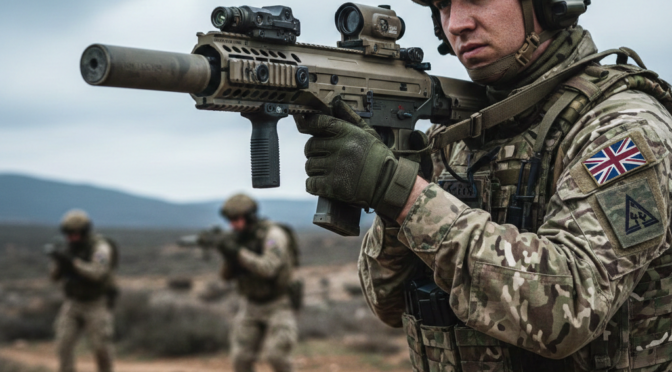
The strategic posture of the United Kingdom’s Ministry of Defence (MoD) in 2025 and 2026 is defined by an unprecedented transition in its small arms philosophy, marking the end of the four-decade bullpup era and the embrace of a modular, Armalite-style (AR) architectural standard.1 This report, drafted from the perspective of small arms and foreign intelligence analysts, provides a comprehensive technical and strategic audit of the weapons currently in service across the British Army, Royal Navy, Royal Marines, and Royal Air Force Regiment. It further evaluates the procurement trajectories of Project Hunter and Project Grayburn, which are poised to redefine British lethality in the Euro-Atlantic theater under the mandates of the 2025 Strategic Defence Review (SDR).3
Executive Summary
As of early 2026, the United Kingdom’s small arms inventory is characterized by a tiered modernization strategy that prioritizes elite “Special Operations Capable” forces while initiating a long-term overhaul of general-issue equipment.5 The primary service rifle for the bulk of the Armed Forces remains the L85A3, the latest iteration of the SA80 family, though its scheduled retirement in 2030 has catalyzed the launch of Project Grayburn.2 Grayburn represents a monumental procurement effort, seeking between 150,000 and 200,000 rifles across five distinct variants to unify the small arms footprint of the Army, Navy, and Air Force under a common, UK-manufactured platform.9
In the immediate tactical timeframe, the Army Special Operations Brigade (ASOB), specifically the Ranger Regiment, and the Royal Marine Commandos have successfully transitioned to the L403A1 Alternative Individual Weapon (AIW).1 This weapon, a 13.7-inch variant of the Knight’s Armament Company (KAC) KS-1, introduces standardized signature reduction (suppression) and advanced low-power variable optics (LPVO) as core components of the individual soldier’s system.1 Concurrently, the Royal Navy has revitalized its maritime force protection capabilities, replacing aging 7.62mm miniguns with.50 caliber L111A1 heavy machine guns to counter the escalating threat of asymmetric surface drones and swarm tactics.13
The overarching strategic trend is a shift away from bespoke, indigenous designs toward Commercial Off-The-Shelf (COTS) solutions and “NATO-first” interoperability.3 This shift is intended to reduce procurement timelines, enhance the ability to fight alongside allies, and ensure that British small arms can defeat emerging adversary body armor.2 The following sections detail the technical specifications, operational roles, and future outlook for the weapon systems within each branch.
British Army: The Transition from Bullpup to Modular AR Platforms
The British Army is undergoing its most significant infantry equipment transformation since the 1980s, driven by the “Future Soldier” initiative and the 2025 SDR.3 Central to this is the realization that the SA80, while mechanically refined in its A3 variant, no longer meets the ergonomic and modular requirements of modern multi-domain warfare.8
The SA80 (L85A2/A3) Service Life and Limitations
The L85A3 is currently the standard-issue rifle for the regular infantry and supporting arms.20 It is a bullpup design, chambered in 5.56×45mm NATO, utilizing a short-stroke gas piston system.18 While the A3 modernization—first issued in 2018—introduced a modular HKey handguard and a more durable Flat Dark Earth (FDE) finish, the platform remains fundamentally limited by its right-hand-only ejection and reciprocation, which complicates transitions between shoulders in urban environments.18 Despite having a total inventory of approximately 134,912 L85A2 and 17,900 L85A3 variants as of 2022, the MoD has set a hard out-of-service date of 2030.2
Project Hunter and the L403A1 (Alternative Individual Weapon)
The Army Special Operations Brigade (ASOB), formed in 2021, required a weapon system that mirrored the capabilities of international Special Operations Forces (SOF).5 Under Project Hunter, the MoD selected the Knight’s Armament KS-1, designated as the L403A1.1 This weapon represents a return to a conventional AR layout, which significantly enhances ergonomics and interoperability with allies like the US Army’s Special Forces.5
The L403A1 is optimized for stealth and precision. It features a 13.7-inch heavy-profile barrel that is “ball-mill dimpled” to facilitate cooling and reduce weight without compromising the barrel’s structural integrity during high-volume fire.1 A core requirement of the AIW system was the “Signature Reduction System,” which is achieved through the integration of a KAC QDC/MCQ-PRT Inconel 3D-printed suppressor.1 This suppressor not only mitigates sound and flash but is designed to manage back-pressure, reducing the gas blowback into the shooter’s face—a common issue with older suppressed systems.1
| Feature | L85A3 (Standard Issue) | L403A1 (Alternative Individual Weapon) |
| Manufacturer | Heckler & Koch (Upgrades) | Knight’s Armament Company |
| Layout | Bullpup | Conventional AR |
| Caliber | 5.56×45mm NATO | 5.56×45mm NATO |
| Gas System | Short-stroke Piston | Stoner Internal Piston (Direct Impingement) |
| Barrel Length | 20.4 inches (518mm) | 13.7 inches (348mm) |
| Weight (Empty) | ~3.82 kg (Rifle only) | 3.12 kg (Rifle only) |
| Standard Optic | Elcan SpecterOS 4x | Vortex 1-10x LPVO + Aimpoint ACRO P-2 |
| Suppression | Flash Hider only | Integrated QDC/MCQ-PRT Suppressor |
| Ambidextrous | No | Yes (Full controls) |
Precision Fire: Sharpshooter and Sniper Capability
The Army’s precision fire doctrine rests on two tiers: the section-level Sharpshooter and the specialist Sniper.21 The L129A1 Sharpshooter Rifle, a semi-automatic 7.62×51mm NATO platform by Lewis Machine & Tool (LMT), has been in service since 2010 to provide accuracy out to 800 meters.21 In late 2024 and 2025, the Army began exploring the L129A2 upgrade, which integrates superior suppression and the Leupold optics suite, bringing the platform closer to the specifications used by the Royal Marines.27
For long-range precision engagements, the L115A3 remains the primary tool, chambered in.338 Lapua Magnum (8.6x70mm).20 Produced by Accuracy International, the L115A3 can effectively engage targets at ranges exceeding 1,100 meters.26 However, the MoD has issued PQQ notices for the eventual replacement of these systems under Project Grayburn or a secondary “Project Upham,” specifically seeking weapons that can penetrate the next generation of adversary ceramic body armor.2
Heavy and Support Weaponry
The British Army’s support weapon inventory as of 2025 emphasizes sustained fire and area denial. The L7A2 General Purpose Machine Gun (GPMG), chambered in 7.62×51mm, remains the backbone of the support role, capable of being fired from a bipod or a tripod for sustained fire out to 1,800 meters.20
A notable doctrinal shift in 2025 is the re-evaluation of the 5.56mm light machine gun.25 After withdrawing the L110A2 (Minimi) in 2018, the Army found that the GPMG and L129A1 Sharpshooter, while powerful, lacked the portability required for highly mobile dismounted troops.25 Consequently, industry notices in early 2025 indicate a renewed interest in a lightweight, high-capacity 5.56mm “assault machine gun” to bridge this capability gap.25
| Support Weapon | Designation | Caliber | Manufacturer | Effective Range |
| GPMG | L7A2 | 7.62×51mm | FN Herstal / UK | 800m (Bipod) / 1,800m (Tripod) |
| Heavy MG | L111A1 | 12.7mm (.50 BMG) | FN UK / Manroy | 2,000m |
| Grenade MG | L134A1 | 40mm Grenade | Heckler & Koch | 1,500m |
| Sharpshooter | L129A1 | 7.62×51mm | LMT | 800m |
| Sniper Rifle | L115A3 | 8.6x70mm (.338) | Accuracy Int. | 1,100m+ |
Royal Navy and Royal Marines: Specialized Maritime Lethality
The Royal Navy and Royal Marines operate in high-threat, corrosive, and asymmetric environments, necessitating small arms that are not only lethal but highly corrosion-resistant and optimized for close-quarters maritime interdiction.28
Royal Marine Commando Force Modernization
The Royal Marines are currently leading the UK’s transition to the L403A1 (KS-1) as part of the Future Commando Force (FCF) program.1 The KS-1 is being issued to Strike Companies and the Surveillance and Reconnaissance Squadron (SRS) to replace the L85A3 and the older Colt Canada L119A1/A2 (C8) carbines.1 The L119A2 remains in use by 43 Commando Fleet Protection Group, but the KS-1 is the intended standard for high-intensity commando raids.21
Specialist units within the Royal Marines, such as 42 and 47 Commando, utilize the L143A2 Sig Sauer MCX.7 These weapons are specifically tailored for ship boarding and counter-terrorism (CT) tasks.27 To ensure safety and operational clarity, the L143A2 uses a color-coding system for its accessories: tan accessories denote the weapon is chambered in 5.56×45mm NATO, while black accessories indicate the use of.300 AAC Blackout.27 The.300 Blackout caliber is favored for boarding operations as it provides superior terminal ballistics through a short barrel and can be suppressed to “hearing-safe” levels, which is critical in the confined, echo-prone environments of ship corridors.27
Maritime Force Protection: The Rise of the.50 Caliber
The Royal Navy Surface Fleet has significantly altered its force protection armament in 2025 and 2026.13 Historical reliance on 7.62mm weapons, such as the M134 Minigun, proved insufficient against the increased threat profile of Unmanned Surface Vessels (USVs) seen in the Black Sea and Red Sea conflicts.4 As a result, the Royal Navy has decommissioned its shipboard miniguns in favor of the L111A1.50 caliber Heavy Machine Gun (HMG).13
The L111A1, an updated version of the Browning M2, is often mounted with a “soft mount” and a quick-change barrel (QCB) system to maximize accuracy and minimize downtime during sustained fire.14 These weapons are critical for disabling the engines of fast-moving inshore attack craft.14 Furthermore, the Royal Navy employs the 30mm DS30M Mark 2 Automated Small Calibre Gun across its frigate and destroyer fleet.13 This system integrates a 30mm Bushmaster cannon with an electro-optical director, allowing for automated tracking and destruction of surface and air threats at ranges where standard small arms would be ineffective.13
| Naval Weapon System | Primary User | Role | Technical Spec |
| Glock 17 (L131A1) | All RN/RM | Secondary Sidearm | 9mm, 17-round magazine |
| L403A1 (KS-1) | RM Strike Co. | Alternative Individual Weapon | 5.56mm, 13.7″ Barrel |
| L143A2 (Sig MCX) | 42/47 Commando | Specialist/Boarding | .300 Blackout / 5.56mm |
| L111A1 HMG | Surface Fleet | Asymmetric Defence | .50 BMG, 2,000m range |
| 30mm DS30M Mk 2 | T23 / T45 Escorts | Automated Point Defence | 30mm Cannon, EO Director |
| L7A2 GPMG | All Units | Section/Vessel Support | 7.62mm, Belt-fed |
Royal Air Force Regiment: Perimeter Defence and Force Protection
The RAF Regiment’s small arms inventory is designed to provide high-volume fire support and precision protection for airbases and deployed aviation assets.26 Their requirements often involve longer-range engagements across airfield perimeters, leading to a higher concentration of support weaponry compared to standard infantry sections.26
Individual and Sharpshooter Systems
The standard rifle for the RAF Regiment is the L85A3, typically fitted with the Elcan SpecterOS 4x optic and the LLM Mk3 Laser Light Module for low-light operations.26 For the second man in each sniper team or for designated marksmen, the L129A1/A2 Sharpshooter is utilized.26 The RAF Regiment employs a specific “Sniper Support Weapon” version of the L129A1, which is fitted with a Schmidt & Bender 3-12×50 L17A2 scope and a Surefire suppressor.26
Indirect and Anti-Tank Fire Support
A defining feature of the RAF Regiment’s small arms and light weapons (SALW) suite is the use of the L16A2 81mm Mortar.26 The L16A2 provides the Regiment with a “pocket artillery” capability, engaging targets out to 5,650 meters.26 The integration of GPS and laser-range finding systems in the L16A2 has transformed it from a purely area-suppression weapon into a precision indirect-fire tool capable of neutralising harassing mortar or rocket sites with minimal collateral damage.26
For anti-armor defense, the Regiment carries the NLAW (Next-generation Light Anti-tank Weapon) and the FGM-148 Javelin.26 The NLAW is a fire-and-forget, non-expert system designed for rapid engagement of tanks at ranges up to 800 meters, utilizing an overfly top-attack mode to defeat the thinner roof armor of modern main battle tanks.26 The Javelin provides a longer-range (up to 4km) precision anti-tank capability, which is essential for protecting airfields against mechanized incursions.26
| RAF Regiment Weapon | Category | Caliber / Type | Key Feature |
| L85A3 | Individual Rifle | 5.56×45mm NATO | Bullpup, Elcan Optic |
| L131A1 (Glock 17) | Pistol | 9×19mm Parabellum | Backup weapon, 17-rd mag |
| L115A3 | Precision Rifle | 8.6x70mm (.338) | 1,100m range, folding stock |
| L16A2 Mortar | Indirect Fire | 81mm | GPS & Laser Ranging |
| NLAW | Anti-Tank | 150mm Rocket | Overfly Top Attack |
| Javelin | Anti-Tank | 127mm Missile | HEAT warhead, 4km range |
Strategic Analysis: The Path to Project Grayburn (2026-2045)
The launch of Project Grayburn in January 2026 marks the most critical development in UK small arms history since the cancellation of the.280 British caliber in the 1950s.9 Grayburn is not merely a rifle replacement; it is a strategic effort to re-establish the UK’s sovereign small arms manufacturing base, which was largely lost following the closure of the Royal Small Arms Factory.9
The Five-Variant Common Platform
The MoD’s “Pipeline Notice” from January 13, 2026, specifies five distinct variants that must most likely share a common lower receiver design to streamline logistics, training, and maintenance 9:
- Dismounted Close Combat (DCC): The primary assault rifle to replace the L85A3 for infantry and frontline combat troops.2
- DCC (Short): A carbine variant with a shorter barrel, potentially for specialist urban roles or units requiring high mobility.9
- Personal Defence Weapon (PDW): To replace the L22 Carbine for helicopter crews, vehicle drivers, and artillerymen.9
- Generalist Rifle: A rugged, simplified version to replace the older L85A2 variants still found in non-combat arms and the reserve fleet.9
- Cadet Rifle: To replace the L98 Cadet General Purpose rifle, ensuring safety and familiarity for the next generation of recruits.9
Industrial Contenders and Sovereign Requirements
The MoD has emphasized that “UK manufacture” is a non-negotiable requirement of Project Grayburn.11 This has forced major international manufacturers to form strategic alliances with UK industry.
- Beretta Defence Technologies (BDT): BDT UK has proposed a two-track strategy, offering the Beretta New Assault Rifle Platform (NARP)—a modular AR-pattern rifle—and the Sako M23, which is currently being adopted by Finland and Sweden.2 BDT is leveraging its existing manufacturing footprint in Lincolnshire as a base for UK production.2
- Heckler & Koch (H&K): Having managed the SA80 upgrade for two decades, H&K is positioning the HK416 (used by the US Marine Corps and France) and the modular HK433 as contenders.2 Their existing UK support facilities could be converted for full-scale manufacture.2
- SIG Sauer: SIG Sauer UK, in association with Accuracy International, has declared its intention to submit the MCX family.2 The SIG Spear variant (adopted by the US Army as the M7) is a strong candidate if the MoD decides to transition to a larger caliber.8
The Caliber Debate: 5.56mm vs. 6.8mm vs. 6.5mm
The “lethality vs. body armor” requirement is the primary driver for a potential caliber change.10 While the 5.56×45mm NATO round is the current standard, it has been found to struggle against modern ceramic level IV plates at range.2
- 6.8×51mm (SIG Fury): This is the caliber of the US Next Generation Squad Weapon (NGSW). It offers significantly more energy and armor penetration but at the cost of heavier rifles and ammunition, which may be unsuited for the “Generalist” or “Cadet” variants.2
- 6.5mm Creedmoor: Already in limited use with the Royal Marines for their L129A2 Sharpshooter rifles, 6.5mm offers superior long-range ballistics and is a viable alternative if the UK seeks to bridge the gap between 5.56mm and 7.62mm.2
- High-Performance 5.56mm: Some analysts suggest the UK will stick with 5.56mm for the majority of the force to maintain NATO interoperability, but will adopt a more lethal, high-pressure cartridge similar to the US M855A1 for DCC troops.8
Technical Audit of Ancillary Small Arms and Support Systems
The effectiveness of UK small arms is inextricably linked to the optics and suppression systems that have become standard as of 2025 and 2026.
Surveillance and Target Acquisition (STA)
The 2025 SDR highlights a “digital targeting web,” which begins at the rifle optic.3 In November 2024, the MoD placed a deal for approximately 10,000 TALON thermal imaging sights to be integrated with SA80A3 and Hunter (L403A1) rifles.25 These sights allow for the detection of heat signatures through camouflage and foliage, providing a decisive advantage in night combat.25
The L900A1 Optics Suite on the L403A1 represents the new standard for dismounted close combat.1 It consists of a Vortex 1-10x LPVO, which allows the soldier to act as a pseudo-marksman, paired with an Aimpoint ACRO P-2 red dot for rapid, “eyes-open” engagement in close quarters.1 This “dual-optic” approach reflects the lessons from Ukraine and Afghanistan, where engagements often transition rapidly between distance and room-clearing ranges.23
Sidearms: The L131A1 (Glock 17 Gen 4)
The L131A1 (Glock 17) remains the universal sidearm across all branches, having replaced the Browning Hi-Power.20 Chosen for its extreme reliability and 17-round magazine capacity, the L131A1 is increasingly issued not just to officers and specialists, but to frontline infantry as a primary backup weapon.26 In specialized roles like the SAS or RM boarding teams, the L137A1 (Glock 19) is favored for its smaller frame and easier concealability during covert operations.36
Anti-Structure and Anti-Materiel Rifles
The UK maintains a specific “Long Range Precision Anti-Structure” (LRPAS) capability through the Barrett M82A1, designated the L135A1.21 Chambered in.50 BMG (12.7x99mm NATO), the L135A1 is used to disable vehicle engines, destroy radar installations, and breach heavy fortifications.21 The Accuracy International AS50 provides a semi-automatic alternative with a titanium frame, offering a high rate of fire (5 rounds in 1.6 seconds) for rapid engagement of multiple targets.21
| Specialist Rifle | Designation | Caliber | Operation | Purpose |
| LRPAS | L135A1 (M82) | .50 BMG | Semi-Auto | Anti-structure / Breach |
| Precision Anti-Mat | AS50 | .50 BMG | Semi-Auto | High-acc / Anti-materiel |
| L115A3/A4 | Long Range | .338 Lapua | Bolt Action | Precision Anti-personnel |
| L129A1 | Sharpshooter | 7.62x51mm | Semi-Auto | Section precision (800m) |
Foreign Intelligence Perspective: Implications of the UK Transition
The UK’s move away from the SA80 toward an AR-pattern rifle has significant implications for both NATO and its adversaries.
Strategic Interoperability and the US Bridge
By adopting the L403A1 and pursuing Project Grayburn, the UK is positioning itself as the “bridge” between the US and European militaries.3 The 2025 SDR explicitly mentions the “One Defence” mindset and the “NATO First” policy.3 Standardizing on the AR layout allows for the seamless exchange of weapons and magazines on the battlefield, which is a critical lesson learned from the logistical challenges faced by Ukraine.2
Industrial Resilience and “Trinity House”
The Trinity House Agreement with Germany, cited in the SDR 2025, underscores a deeper defense industrial alignment between the UK and Germany.3 This potentially gives Heckler & Koch an advantage in Project Grayburn, as the agreement seeks to ensure technical and operational alignment between major NATO powers.3 However, the requirement for UK manufacture ensures that even if a foreign design is chosen, the “sovereign” capability to produce and modify the weapon remains in British hands.9
Vulnerability Analysis: The Training Burden
From an intelligence perspective, the primary risk of the Grayburn transition is the “training debt” incurred by moving from a bullpup to a conventional layout.8 The muscle memory of 150,000 soldiers must be re-trained for magazine changes, bolt releases, and shoulder transitions.8 Adversaries may view the 2028-2032 transition period as a window of relative tactical friction as the British Army undergoes this “once-in-a-generation” re-tooling.2
Comprehensive Branch Inventory and Support Matrix: 2025-2026
This section provides a structured comparison of the small arms systems currently fielded across the four primary combat organizations within the UK Armed Forces.
| Branch | Individual Weapon | Sharpshooter / DMR | Sniper System | Support Weapon (Light) | Support Weapon (Heavy) | Sidearm |
| Army | L85A3 (Standard) L403A1 (Rangers) | L129A1 | L115A3 | L7A2 GPMG | L111A1 HMG L134A1 GMG | L131A1 (Glock 17) |
| Royal Marines | L403A1 (Primary) L143A2 (Spec Ops) | L129A2 | L115A3 / L96 | L7A2 GPMG | L111A1 HMG (on craft) | L131A1 (Glock 17) |
| Royal Navy | L85A2/A3 | N/A | N/A | L7A2 GPMG | L111A1 HMG 30mm DS30M | L131A1 (Glock 17) |
| RAF Regiment | L85A3 | L129A1 (SSW) | L115A3 | L7A2 GPMG | L134A1 GMG L16A2 Mortar | L131A1 (Glock 17) |
Conclusion and Strategic Forecast
The United Kingdom’s small arms architecture in 2026 is at a historic crossroads. The era of the indigenous bullpup, once a symbol of British tactical independence, is being sacrificed for the greater strategic utility of “NATO-first” interoperability and modular lethality.2 The successful deployment of the L403A1 (KS-1) to the Ranger Regiment and Royal Marines has proven that a modern, AR-style platform with integrated signature reduction is a “force multiplier” in high-threat environments.5
As Project Grayburn moves into its assessment phase in late 2026, the MoD must balance the desire for cutting-edge lethality (6.8mm or 6.5mm calibers) against the logistical and economic realities of a 200,000-rifle procurement.8 The integration of digital targeting systems and TALON thermal sights ensures that the British infantryman of 2030 will possess a “digital edge” that compensates for the aging fleet of heavy armored vehicles currently undergoing their own modernization.3
Ultimately, the UK’s small arms strategy is no longer just about the weapon itself, but about the industrial base and the “targeting web” that supports it.3 By re-establishing sovereign manufacturing and standardizing on a modular, multi-variant platform, the UK is ensuring that its dismounted close combat capability remains “fit for the future” in an era where the nation’s Armed Forces must be “more lethal, integrated, and ready” to meet the challenges of the Euro-Atlantic theater.3
Please share the link on Facebook, Forums, with colleagues, etc. Your support is much appreciated and if you have any feedback, please email us in**@*********ps.com. If you’d like to request a report or order a reprint, please click here for the corresponding page to open in new tab.
Sources Used
- KS-1 rifle – Wikipedia, accessed January 31, 2026, https://en.wikipedia.org/wiki/KS-1_rifle
- Project Grayburn – Wikipedia, accessed January 31, 2026, https://en.wikipedia.org/wiki/Project_Grayburn
- The Strategic Defence Review 2025 – Making Britain Safer: secure …, accessed January 31, 2026, https://www.gov.uk/government/publications/the-strategic-defence-review-2025-making-britain-safer-secure-at-home-strong-abroad/the-strategic-defence-review-2025-making-britain-safer-secure-at-home-strong-abroad
- Strategic Defence Review 2025: The Royal Navy and Royal Fleet Auxiliary, accessed January 31, 2026, https://commonslibrary.parliament.uk/research-briefings/cbp-10408/
- £90 million contract equips Armed Forces with advanced new rifle – GOV.UK, accessed January 31, 2026, https://www.gov.uk/government/news/90-million-contract-equips-armed-forces-with-advanced-new-rifle
- New advanced rifle for Ranger Regiment – The British Army, accessed January 31, 2026, https://www.army.mod.uk/news/new-advanced-rifle-for-ranger-regiment/
- How the UK is changing its special forces for a modern world – Breaking Defense, accessed January 31, 2026, https://breakingdefense.com/2025/09/how-the-uk-is-changing-its-special-forces-for-a-modern-world/
- Britain’s next rifle: Inside the race to replace the SA80 – Task & Purpose, accessed January 31, 2026, https://taskandpurpose.com/tech-tactics/project-grayburn-sa80-l85/
- UK Launches Project Grayburn To Replace The SA80 – The Firearm Blog, accessed January 31, 2026, https://www.thefirearmblog.com/blog/uk-launches-project-grayburn-to-replace-the-sa80-44825308
- PowerCasino: UK Launches Project Grayburn to Replace SA80 Rifles – weareiowa.com, accessed January 31, 2026, https://www.weareiowa.com/article/news/local/plea-agreement-reached-in-des-moines-murder-trial/524-3069d9d4-6f9b-4039-b884-1d2146bd744f?y-news-27601349-2026-01-14-powercasino-uk-project-grayburn-replace-sa80-rifles-2026
- Project GRAYBURN: Defence replacement of SA80 family of rifles – Find a Tender – GOV.UK, accessed January 31, 2026, https://www.find-tender.service.gov.uk/Notice/002873-2026?origin=SearchResults&p=1
- The British military’s new elite unit is receiving one of the best rifles in the world. – Sandboxx, accessed January 31, 2026, https://www.sandboxx.us/news/the-british-militarys-new-elite-unit-is-receiving-one-of-the-best-rifles-in-the-world/
- Active Royal Navy weapon systems – Wikipedia, accessed January 31, 2026, https://en.wikipedia.org/wiki/Active_Royal_Navy_weapon_systems
- Heavy Machine Gun | The British Army, accessed January 31, 2026, https://www.army.mod.uk/learn-and-explore/equipment/small-arms-and-support-weapons/heavy-machine-gun/
- 50 Cal Heavy Machine Gun (HMG) – Airborne Assault Museum, accessed January 31, 2026, https://paradata.org.uk/content/4663719-50-cal-heavy-machine-gun-hmg
- Modernising the Army: Leveraging COTS for Advanced Capability …, accessed January 31, 2026, https://allanwebb.co.uk/news/modernising-the-army-leveraging-cots-for-advanced-capability/
- UK defence in 2025: Tanks, armoured vehicles and artillery – House of Commons Library, accessed January 31, 2026, https://commonslibrary.parliament.uk/research-briefings/cbp-10274/
- SA80 – Wikipedia, accessed January 31, 2026, https://en.wikipedia.org/wiki/SA80
- Royal Marines test new L403A1 ‘KS-1’ battle rifle – Naval Technology, accessed January 31, 2026, https://www.naval-technology.com/news/royal-marines-test-new-l403a1-ks-1-battle-rifle/
- Small arms and support weapons | The British Army, accessed January 31, 2026, https://www.army.mod.uk/learn-and-explore/equipment/small-arms-and-support-weapons/
- List of equipment of the British Army – Wikipedia, accessed January 31, 2026, https://en.wikipedia.org/wiki/List_of_equipment_of_the_British_Army
- The Evolution of the L403A1: A New Era for British Special Forces – Oreate AI Blog, accessed January 31, 2026, https://www.oreateai.com/blog/the-evolution-of-the-l403a1-a-new-era-for-british-special-forces/3038a2326a0cd905f72fed5bc1d4f84c
- New Rifle, New Calibre (?) for the UK Military – Project Grayburn SA80 Replacement, accessed January 31, 2026, https://www.thestalkingdirectory.co.uk/threads/new-rifle-new-calibre-for-the-uk-military-project-grayburn-sa80-replacement.323615/
- Hands On: The UK’s L403A1 / Knights Armament KS-1 – The Armourers Bench, accessed January 31, 2026, https://armourersbench.com/2024/05/26/hands-on-the-uks-l403a1-knights-armament-ks-1/
- British Army to get new infantry machine gun and sniper rifle, accessed January 31, 2026, https://www.army-technology.com/news/british-army-to-get-new-infantry-machine-gun-and-sniper-rifle/
- List of equipment of the RAF Regiment – Wikipedia, accessed January 31, 2026, https://en.wikipedia.org/wiki/List_of_equipment_of_the_RAF_Regiment
- List of equipment of the Royal Marines – Wikipedia, accessed January 31, 2026, https://en.wikipedia.org/wiki/List_of_equipment_of_the_Royal_Marines
- Royal Marines Equipment Weaponry – Royal Navy, accessed January 31, 2026, https://www.royalnavy.mod.uk/equipment/commando/weaponry
- UK MoD to upgrade in-service L111A1 Heavy Machine Gun – Army Technology, accessed January 31, 2026, https://www.army-technology.com/news/uk-mod-to-upgrade-in-service-l111a1-heavy-machine-gun/
- Royal Marines Equipment – Royal Navy, accessed January 31, 2026, https://www.royalnavy.mod.uk/equipment/commando
- Ship by Ship: The Brutal Reality of the Royal Navy Surface Fleet in 2026 – YouTube, accessed January 31, 2026, https://www.youtube.com/watch?v=P1WCx7Tqw8M
- Royal Navy’s small patrol boats prove their growing value as NATO deployment ends, accessed January 31, 2026, https://www.royalnavy.mod.uk/news/2025/july/03/20250703-rns-small-patrol-boats-prove-their-growing-value-as-nato-deployment-ends
- List of equipment of the Royal Navy – Wikipedia, accessed January 31, 2026, https://en.wikipedia.org/wiki/List_of_equipment_of_the_Royal_Navy
- Type 26 frigate – Wikipedia, accessed January 31, 2026, https://en.wikipedia.org/wiki/Type_26_frigate
- UK sets out Project Grayburn rifle replacement to industry – UK Defence Journal, accessed January 31, 2026, https://ukdefencejournal.org.uk/uk-sets-out-project-grayburn-rifle-replacement-to-industry/
- SAS: The UK Army Special Air Service – Grey Dynamics, accessed January 31, 2026, https://greydynamics.com/sas-the-uk-army-special-air-service-2/
- 16 Tactics and Trade-Offs: The Evolution of Manoeuvre in the British Army – Oxford Academic, accessed January 31, 2026, https://academic.oup.com/book/45784/chapter/400601525