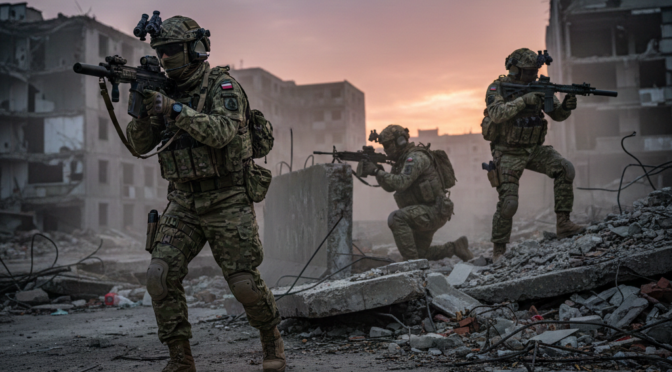
Executive Summary
The Polish Armed Forces (Siły Zbrojne Rzeczypospolitej Polskiej) are currently executing one of the most aggressive and comprehensive technical modernization programs in the history of the North Atlantic Treaty Organization (NATO). Driven by the deteriorating security environment on the alliance’s eastern flank and the legislative mandate of the Homeland Defense Act of 2022, Poland is fundamentally reshaping its small arms inventory to achieve a state of high-readiness, modularity, and industrial self-sufficiency.1 This report provides an exhaustive analysis of the small arms systems utilized across the five military branches: Land Forces, Air Force, Navy, Special Forces, and Territorial Defence Force.
As of 2025, the strategic pivot from legacy Soviet-era calibers (7.62×39mm and 5.45×39mm) to NATO-standard 5.56×45mm and 7.62×51mm is nearing completion in frontline units.4 The center of gravity for this transition is the MSBS Grot modular rifle system, which is rapidly replacing the FB Beryl as the primary infantry weapon.6 This modernization is not limited to rifles; it encompasses a complete overhaul of sidearms (VIS 100), general-purpose machine guns (UKM-2000), and precision systems (Bor/Tor).8
The Polish defense industry, spearheaded by the PGZ (Polska Grupa Zbrojeniowa) consortium, has successfully internalized the production of almost all small arms categories, ensuring a resilient supply chain capable of sustaining a target force of 500,000 personnel by 2039.1 The following sections detail the technical specifications, organizational distribution, and tactical implications of Poland’s current small arms arsenal.
Geopolitical Architecture and Defense Spending
The trajectory of Polish small arms procurement is inextricably linked to the broader national strategy of “deterrence by denial.” Since the full-scale Russian invasion of Ukraine, Polish decision-makers have accelerated military expansion at an unprecedented scale, with defense spending reaching approximately 4.7% of GDP in 2025.2 This financial commitment facilitates the acquisition of massive quantities of individual equipment under “Operation SZPEJ,” a program specifically designed to address gaps in the individual soldier’s gear, from ballistic protection to advanced optics and modular firearms.12
The strategic goal is to build a military capable of conducting multidomain operations while maintaining deep, precision strike capabilities. Small arms play a vital role in this by ensuring that the expanding infantry, paratrooper, and special operations components are equipped with tools that offer superior ergonomics, reliability in extreme conditions, and compatibility with the latest generation of night vision and thermal targeting systems.1
| Strategic Indicator | Value / Goal (2025-2035) | Reference |
| Defense Spending (% of GDP) | 4.7% (2025) | 3 |
| Total Personnel Objective | 500,000 (300k Active, 200k Reserve) | 1 |
| Primary Modernization Program | Operation SZPEJ / Tytan | 12 |
| Primary Small Arms Goal | Complete replacement of post-Soviet legacy systems | 16 |
Organizational Structure of the Polish Armed Forces
The Polish Armed Forces are structured into five distinct branches, each with specialized small arms requirements based on their operational profiles. The command structure is overseen by the General Staff, with procurement managed by the Armament Agency.17
- Land Forces (Wojska Lądowe): The largest branch, structured into mechanized, armored, and airborne divisions. It requires the highest volume of standard service rifles, machine guns, and anti-tank weapons.17
- Air Force (Siły Powietrzne): While aircraft-focused, it maintains significant ground components for air base defense and security, requiring reliable carbines and sidearms.17
- Navy (Marynarka Wojenna): Includes surface and submarine fleets, but also specialized coastal defense units (Morska Jednostka Rakietowa) and naval security forces.17
- Special Forces (Wojska Specjalne): The elite tier of the armed forces, utilizing highly specialized Western-tier platforms for unconventional warfare.17
- Territorial Defence Force (Wojska Obrony Terytorialnej – WOT): A light infantry volunteer force focused on home defense and hybrid warfare, which was the launch customer for the MSBS Grot.17
Summary of Personnel Strength by Branch
| Branch | Active Personnel (Approx.) | Small Arms Priority |
| Land Forces | 100,200 | Mass-scale standardization (Grot/UKM) |
| TDF (WOT) | 55,000 | Light infantry mobility (Grot/LMP) |
| Air Force | 46,500 | Force protection / Base security |
| Navy | 17,000 | Maritime security / Coastal defense |
| Special Forces | 4,000 | Tier-1 specialized systems (HK416/MCX) |
Small Arms Standards and Caliber Migration
The most significant technical development in the Polish inventory is the total migration away from 7.62×39mm (AK-47/AKM) and 5.45×39mm (Tantal) cartridges.5 For decades, the Polish military utilized the wz. 88 Tantal, which was a domestic variant of the Soviet AK-74. Following Poland’s accession to NATO in 1999, the defense industry developed the wz. 96 Beryl to utilize the 5.56×45mm NATO cartridge while maintaining the AK-pattern internal mechanics.5
However, the Beryl is now considered a legacy system. The current standard is the MSBS Grot, which introduces a modular architecture. In terms of sidearms, the migration is from 9×18mm Makarov (P-64/P-83) to 9×19mm Parabellum (VIS 100/Glock).8 Machine guns have transitioned from the 7.62×54mmR (PKM) to the 7.62×51mm NATO (UKM-2000), a logistical necessity for interoperability within the alliance.9
| Legacy Caliber | Replacement NATO Caliber | Primary Weapon Transition |
| 7.62×39mm | 5.56×45mm NATO | AKM -> Beryl -> MSBS Grot |
| 5.45×39mm | 5.56×45mm NATO | Tantal -> MSBS Grot |
| 9×18mm Makarov | 9×19mm Parabellum | P-83 Wanad -> VIS 100 |
| 7.62×54mmR | 7.62×51mm NATO | PKM -> UKM-2000 |
Detailed Analysis: Polish Land Forces (Wojska Lądowe)
The Land Forces are currently undergoing a massive rearmament. Frontline mechanized units are receiving modern Western and domestic armored vehicles, and the small arms inventory is being updated to reflect these new platforms.30 The Land Forces prioritize a mix of the MSBS Grot for standard infantry and the Mini-Beryl for vehicle crews and paratroopers.26
Division-Level Distribution
The modernization is prioritized for high-readiness formations such as the 18th “Iron” Mechanized Division and the 1st Legions Infantry Division.13 These units are the primary recipients of the latest Grot A2/A3 variants and the VIS 100 pistols. The 18th Division, in particular, has been a lead unit for testing new individual equipment like the HBT-02 combat helmet, which is scheduled for broader delivery in 2025.33
Small Arms in the Squad Structure
A typical Polish mechanized squad (based on the Rosomak APC or the future Borsuk IFV) is centered around the rifleman equipped with the MSBS Grot.15 Fire support at the squad level is provided by the UKM-2000P machine gun, while precision marksman roles use the Bor bolt-action rifle or the modernized SVD.4 The integration of the ZSSW-30 remotely controlled turret on the Rosomak and Borsuk further augments the squad’s firepower with a 30mm Bushmaster II cannon and coaxial UKM-2000C machine gun.34
Land Forces Small Arms Inventory
| Category | Weapon System | Technical Notes | Status |
| Service Rifle | MSBS Grot C16 (A2/A3) | Modular, ambidextrous, 5.56mm | Frontline standard 6 |
| Service Rifle | FB Beryl wz. 96C | AK-based, 5.56mm | Reserve/Transitioning 31 |
| Carbine | FB Mini-Beryl wz. 96 | Compact, 9-inch barrel | Vehicle crews 26 |
| Sidearm | VIS 100 | DA/SA, 15-round, 9mm | Branch standard 8 |
| Machine Gun | UKM-2000P | PKM derivative, 7.62mm NATO | Standard LMG/GPMG 9 |
| Sniper Rifle | Bor | Bullpup, 7.62mm NATO | Squad marksman 10 |
| Anti-Materiel | Tor | Bullpup, 12.7mm (.50 BMG) | Specialized teams 36 |
Detailed Analysis: Territorial Defence Force (Wojska Obrony Terytorialnej)
The Territorial Defence Force (WOT) has established itself as the most modern branch in terms of individual weaponry adoption. Because it was formed in 2017, it did not have to phase out vast quantities of Cold War-era rifles, allowing it to adopt the MSBS Grot and VIS 100 as the foundational weapons of the force.24
Light Infantry Doctrine
The WOT operates as a light infantry force, with each of the 16 voivodeships (provinces) hosting a brigade.24 Their small arms focus is on ease of maintenance, modularity for urban combat, and high section-level lethality. The Grot’s ability to quickly swap barrels and its full ambidexterity make it ideal for a force that relies on citizen-soldiers with varying levels of previous military experience.6
Specialized WOT Equipment
The WOT utilizes specific light support weapons, such as the LMP-2017 60mm light mortar, which is issued to light infantry companies to provide organic indirect fire support.37 For anti-tank operations, the WOT has been a major user of the FGM-148 Javelin, which proved its effectiveness in the Russo-Ukrainian War and is now integrated at the platoon level for border defense units.24
WOT Small Arms Table
| Category | System | Quantity / Usage | Reference |
| Main Rifle | MSBS Grot C16 | Over 34,000 in service | 37 |
| Support Rifle | FB Beryl wz. 96 | Limited/Training use | 37 |
| Sidearm | VIS 100 / WIST-94 | ~3,000 VIS 100 delivered | 37 |
| Precision | Bor (7.62mm) | ~310 rifles | 37 |
| Precision | Sako TRG M10 (.338) | 87 rifles (Specialized) | 37 |
| Mortar | LMP-2017 (60mm) | 500 units | 37 |
| Anti-Tank | Javelin | 60 launchers / 180 missiles | 37 |
Detailed Analysis: Special Forces (Wojska Specjalne)
The Polish Special Forces (Wojska Specjalne) represent a world-class Tier-1 and Tier-2 capability. Unlike the conventional branches, the Special Forces utilize a hybrid inventory that favors German and American high-end platforms.22 The branch is composed of several specialized units: GROM, JW Komandosów (JWK), JW Formoza, JW AGAT, and JW NIL.23
GROM and JWK: The HK416 Standard
JW GROM and JW Komandosów have largely standardized on the Heckler & Koch HK416 as their primary assault rifle.22 The HK416 is preferred for its short-stroke gas piston system, which offers superior reliability over direct-impingement M4 clones, particularly when using suppressors or in maritime and sandy environments.39 GROM operators frequently use 10.4-inch and 14.5-inch barrel configurations, often fitted with EOTech sights and suppressors.22
JW Formoza: Maritime Specialization and SIG MCX
JW Formoza, the naval special forces unit, has traditionally used the HK G36KV.22 However, as of 2024-2025, Formoza has moved to procure the SIG Sauer MCX modular carbine.40 The MCX is particularly attractive for maritime operations due to its ability to be chambered in.300 Blackout, which offers exceptional performance in suppressed, close-quarters boarding missions (VBSS).40
Special Forces Subsystems
The Special Forces utilize the FN Minimi as their primary light machine gun (LMG), offering a lighter and more maneuverable alternative to the UKM-2000 for small-team operations.22 For sidearms, GROM utilizes the HK USP and FN Five-seveN (for specialized armor-piercing requirements), while JWK and AGAT primarily use the Glock 17.22
Special Forces Comparative Table
| Unit | Primary Assault Rifle | Secondary / SMG | Precision System |
| GROM | HK416 / Grot (Testing) | MP5 / P90 / CZ Evo 3 | Sako TRG / Barrett M107 |
| JWK | HK416 | MP5 | AXMC / Sako TRG |
| Formoza | SIG MCX / G36KV | MP5 | Sako TRG |
| AGAT | HK416 | MP5 | Bor |
| NIL | HK416 / Beryl | MP5 | Bor |
Detailed Analysis: Air Force and Navy Security Elements
The Air Force (Siły Powietrzne) and Navy (Marynarka Wojenna) focus their small arms procurement on force protection. Base security units and specialized coastal components require weapons that are reliable for static defense and mobile patrols.
Air Force Base Security
Air base security battalions (bataliony ochrony) are currently transitioning from the FB Beryl to the MSBS Grot.20 This transition is critical for logistics, as the Grot allows security personnel to use the same modular sights and accessories as the Land Forces. Pilots and flight crews are often issued the PM-84P Glauberyt submachine gun or the VIS 100 pistol due to their compact dimensions.31
Naval Coastal Defense (MJR)
The Naval Missile Unit (Morska Jednostka Rakietowa) is tasked with protecting Poland’s coastline using NSM anti-ship missiles.21 The security detachments for these high-value batteries utilize the MSBS Grot and UKM-2000 machine guns.21 Onboard ships, the Navy utilizes the Glock 17 as the standard sidearm and the Mossberg 500 shotgun for maritime security and boarding operations.4
Technical Deep-Dive: The MSBS Grot Modular System
The MSBS Grot (Modułowy System Broni Strzeleckiej) is the most technologically advanced small arm ever developed in Poland. Developed by FB Radom and the Military University of Technology (WAT), the Grot is a “system of systems” rather than a single rifle.6
Evolutionary Variants: A0 to A3
The Grot has undergone several design iterations based on field feedback from Polish troops and the conflict in Ukraine.43
- A0 / M1: Initial production series. Faced “childhood diseases” including issues with the gas regulator, overheating, and material durability.6
- A2 (M2): Introduced a longer handguard to cover the gas block, reinforced the firing pin for dry fire practice, and improved the pistol grip and stock.6
- A3 (M3): The latest refinement presented at Grotowisko 2024. It is 300g lighter than the A2 and features a standard 14.5-inch barrel as an alternative to the 16-inch version.44 The A3 also introduces a new telescopic stock (AR-style), improved anti-corrosion coatings, and a modified gas regulator with a latch to prevent accidental loss.44
Modularity and Configuration
The Grot’s hallmark is its ability to share a common upper receiver for both classic (C) and bullpup (B) configurations.6 By simply swapping the lower receiver and stock assembly, the weapon can be reconfigured.
| Configuration | Barrel Length | Tactical Role |
| Standard Assault Rifle | 16 in (406 mm) | General Infantry 6 |
| Carbine / Subcarbine | 10.5 in / 14.5 in | CQB / Vehicle crews 6 |
| Designated Marksman | 16 in / 20 in | Squad-level precision 6 |
| Machine Carbine | Heavy 16 in | High-volume suppression 6 |
| Representative (R) | 16 in (Modified) | Ceremonial / Honor Guard 6 |
Grot A3 Technical Specifications
| Feature | Specification |
| Caliber | 5.56×45mm NATO (7.62×39mm kit available) 6 |
| Weight | 3.4 kg (A3) / 3.7 kg (A2) 44 |
| Action | Short-stroke gas piston, rotating bolt 6 |
| Rate of Fire | 700 – 900 rounds/min 6 |
| Muzzle Velocity | ~870 – 890 m/s 43 |
| Magazine | 30, 60-round STANAG compatible 6 |
Sidearms and Secondary Weapons Systems
Sidearms in the Polish Armed Forces have seen a radical shift toward domestic self-reliance. For decades, the military struggled with the WIST-94, which suffered from poor ergonomics and reliability.27
The VIS 100 (Ragun)
The VIS 100, named in honor of the legendary pre-WWII Vis wz. 35, is the new standard sidearm for the Land Forces and TDF.8 It is a modern DA/SA pistol with a 15-round double-stack magazine. The frame is constructed from a lightweight aluminum alloy, and it is fully ambidextrous, featuring a slide stop, magazine release, and decocker on both sides.8
PM-84P Glauberyt
The PM-84P remains in service for crews, pilots, and specialists who require a weapon larger than a pistol but smaller than a carbine.4 Chambered in 9×19mm, it is a reliable submachine gun that utilizes a blowback action and is being modernized to feature Picatinny rails for optics.4
Sidearms Comparative Table
| Weapon | Caliber | Capacity | Origin | Branch |
| VIS 100 | 9×19mm | 15+1 | Poland | Land Forces, WOT 8 |
| Glock 17 | 9×19mm | 17+1 | Austria | Special Forces, Navy 22 |
| P-83 Wanad | 9×18mm | 8 | Poland | Legacy (Base Security) 28 |
| HK USP | 9×19mm | 15+1 | Germany | GROM 22 |
| Sig Sauer P226 | 9×19mm | 15+1 | Germany/USA | Formoza 22 |
Support Weapons and Crew-Served Firepower
Infantry lethality is anchored by the UKM-2000 general-purpose machine gun (GPMG). This weapon is a testament to Polish engineering ingenuity, as it successfully converted the Soviet PKM design to use 7.62×51mm NATO ammunition and disintegrating belts.9
UKM-2000 Engineering
The transition from the PKM’s rimmed 7.62×54mmR to the rimless NATO round required a complete redesign of the feeding mechanism. The UKM-2000 uses a push-through system rather than the pull-out system of the PKM.9 The current UKM-2000P (Infantry) and UKM-2000C (Coaxial) variants are standard across the force, with the UKM-2013P and UKM-2020S representing modernized versions with improved ergonomics, folding stocks, and integrated rails.9
Light Mortars and Grenade Launchers
- LMP-2017: A 60mm light mortar designed for WOT and airborne units. It is highly portable and can be operated by a single soldier in the “commando” role.37
- Pallad wz. 74: A legacy 40mm under-barrel grenade launcher (UBGL) used with the Beryl.
- MSBS Grot UBGL: A modern 40×46mm modular grenade launcher specifically designed for the Grot rifle system.6
Machine Gun Inventory Table
| Weapon | Caliber | Type | Feed | Reference |
| UKM-2000P | 7.62×51mm | GPMG | M13 Link (100/200rd) | 9 |
| UKM-2000C | 7.62×51mm | Coaxial | M13 Link (250rd) | 9 |
| FN Minimi | 5.56×45mm | LMG | Belt / Magazine | 22 |
| PKM | 7.62×54mmR | GPMG | Non-disintegrating belt | Legacy 9 |
| NSW / WKW | 12.7×108mm | HMG | Belt | Heavy Support |
Precision Rifles and Long-Range Interdiction
Poland has developed a robust domestic precision rifle capability through ZM Tarnów. These rifles are designed to replace the Soviet-era SVD and provide Tier-1 capability to standard infantry units.10
The Bor Sniper Rifle
The Bor is a bolt-action, bullpup sniper rifle chambered in 7.62×51mm NATO.10 It features a 26-inch (680mm) barrel and is typically fitted with Leupold or Schmidt & Bender optics.10 Over 650 units have been ordered for the Polish military, making it the primary precision tool for squad-level marksmen and specialized sniper teams.10
The Tor Anti-Materiel Rifle
The Tor (also known as the Wilk) is a heavy 12.7×99mm (.50 BMG) anti-materiel rifle.36 Also utilizing a bullpup layout, the Tor is nearly 5 feet long and is designed to engage light armored vehicles, aircraft on the ground, and enemy infrastructure at ranges up to 2,000 meters.36
Special Forces Precision Systems
While the Land Forces use Bor and Tor, the Special Forces utilize the Sako TRG series from Finland and the Accuracy International AXMC from the UK.22 These systems offer superior multi-caliber capabilities, allowing operators to switch between.308 Win,.300 Win Mag, and.338 Lapua Magnum.54
Precision Weapons Summary Table
| Rifle | Caliber | Type | Range (Eff.) | User |
| Bor | 7.62×51mm | Bolt-Action | 800m+ | Land Forces, WOT 10 |
| Tor | 12.7×99mm | Bolt-Action | 2,000m+ | Specialized Teams 36 |
| Sako TRG M10 | .308 /.338 | Bolt-Action | 1,200m+ | SOF, WOT 37 |
| AXMC | .338 Lapua | Bolt-Action | 1,500m+ | JWK 55 |
| Grot 762N | 7.62×51mm | Semi-Auto | 600m+ | DMR Role (Testing) 6 |
Ammunition, Logistics, and Industrial Self-Sufficiency
The sustainability of the Polish Armed Forces’ small arms modernization depends on the domestic production of ammunition. PGZ-owned companies like Mesko, Dezamet, and Nitro-Chem have received over 565 million EUR in funding to expand the production of 5.56mm, 7.62mm, 12.7mm, and mortar rounds.56
Strategic Reserves
Following lessons from the Ukraine conflict, Poland is focusing on building “attritional reserves”.2 This means not just equipping the current force, but stocking enough small arms and ammunition to sustain high-intensity combat for months without external replenishment. The Armament Agency has signed contracts for over 324,000 Grot rifles to ensure that even reserve units (to be expanded to 200,000 personnel) are equipped with modern 5.56mm systems rather than being forced to rely on legacy AKMs.1
Future Programs: Tytan and Individual Soldier Modernization
The ultimate goal of Polish small arms development is the “Tytan” Individual Battlesystem.14 This program aims to integrate the MSBS Grot into a comprehensive soldier-as-a-system package.
Tytan Integration Components
- Lethality: MSBS Grot with integrated thermal/night vision optics and a 40mm grenade launcher.14
- C4I: Personal radios (Radmor R35010), GPS, and wearable computers for real-time battlefield management.14
- Protection: Modular plate carriers and high-cut ballistic helmets (HP-05).14
- Sustainability: Ergonomic uniforms and physiological monitoring systems.14
While the full “Tytan” (Version C) is intended for elite reconnaissance and special forces, a “Mini-Tytan” (Version A) has been developed for rapid adoption by conventional units, focusing on the Grot rifle, EOTech sights, and MU-3 night vision.15
Strategic Conclusions and Long-Term Outlook
The Polish Armed Forces have successfully navigated the transition from a post-Warsaw Pact military to a modern NATO powerhouse. The small arms inventory is the most visible indicator of this shift. The successful development and mass fielding of the MSBS Grot and VIS 100 demonstrate a level of industrial maturity that few other European nations possess.7
Key Analytical Takeaways
- Standardization Success: Poland is one of the few NATO members to have successfully standardized its entire force on a domestically-designed modular rifle system (Grot) and general-purpose machine gun (UKM-2000).6
- Operational Resilience: By Internalizing the production of weapons and ammunition through PGZ, Poland reduces its “external dependency” on foreign manufacturers, which is a critical lesson learned from the logistics bottlenecks seen in the Ukraine conflict.11
- SOF Divergence: The Special Forces continue to use high-end German and American platforms (HK416, SIG MCX) to maintain Tier-1 interoperability with US and UK counterparts, showing a pragmatic approach to mission-specific equipment.22
- The Modernization Wall: The primary challenge moving forward will be the 2035 “industrial wall,” where the massive synchronized deliveries of current equipment will reach the end of their first lifecycle, requiring a sustained and massive maintenance budget to keep the 500,000-man force operational.56
In conclusion, the Polish military’s small arms doctrine in 2025 is defined by modularity, high-volume domestic production, and a rapid feedback loop from active combat zones. This ensures that the Polish soldier is among the best-equipped in the alliance, providing a credible and lethal deterrent on the NATO eastern flank.
Please share the link on Facebook, Forums, with colleagues, etc. Your support is much appreciated and if you have any feedback, please email us in**@*********ps.com. If you’d like to request a report or order a reprint, please click here for the corresponding page to open in new tab.
Sources Used
- Revolution in the Polish Armed Forces: Details revealed – Defence24.com, accessed February 1, 2026, https://defence24.com/armed-forces/revolution-in-the-polish-armed-forces-details-revealed
- Polish Armed Forces Modernization: A New Cornerstone of European Security? – RAND, accessed February 1, 2026, https://www.rand.org/pubs/research_reports/RRA2971-1.html
- Two paths to modernization: Poland and Czechia’s evolving defense strategies | CZDEFENCE – czech army and defence magazine, accessed February 1, 2026, https://www.czdefence.com/article/the-polish-and-czech-paths-to-modernizing-the-armed-forces-different-ambitions-goals-and-means
- Polish Armed Forces (Manpower) – Warpower:Poland, accessed February 1, 2026, https://www.warpowerpoland.com/manpower.php
- POLAND’S POWER – Polish Armed Forces – Athlon Outdoors, accessed February 1, 2026, https://athlonoutdoors.com/article/polands-power/
- FB MSBS Grot – Wikipedia, accessed February 1, 2026, https://en.wikipedia.org/wiki/FB_MSBS_Grot
- MSBS Grot, the Polish ambidextrous rifle that manages to rival the prestigious HK416, accessed February 1, 2026, https://www.outono.net/elentir/2023/09/14/msbs-grot-the-polish-ambidextrous-rifle-that-manages-to-rival-the-prestigious-hk416/
- FB VIS 100 – Wikipedia, accessed February 1, 2026, https://en.wikipedia.org/wiki/FB_VIS_100
- UKM-2000 – Wikipedia, accessed February 1, 2026, https://en.wikipedia.org/wiki/UKM-2000
- Bor Rifle – Wikipedia | PDF | Ballistics | Firearms – Scribd, accessed February 1, 2026, https://www.scribd.com/document/654458371/Bor-rifle-Wikipedia
- Poland invests heavily in itself at defense exposition, accessed February 1, 2026, https://breakingdefense.com/2025/09/poland-invests-heavily-in-itself-at-defense-exposition/
- Polish Ministry Of National Defence on the Outcomes and Challenges of Modernizing Soldiers’ Individual Equipment – MILMAG, accessed February 1, 2026, https://milmag.pl/en/polish-ministry-of-national-defence-on-the-outcomes-and-challenges-of-modernizing-soldiers-individual-equipment/
- Soldiers Are the Priority – Polska Zbrojna, accessed February 1, 2026, https://www.polska-zbrojna.pl/home/articleshow/44544?t=Soldiers-Are-the-Priority
- Battlesystem Tytan The Decisive Year – Soldier Modernisation, accessed February 1, 2026, https://www.soldiermod.com/volume-7/battlesystem-tytan.html
- Tytan at a Turning Point (POLAND) – Soldier Modernisation, accessed February 1, 2026, https://www.soldiermod.com/volume-2-06/tytan.html
- JUST IN: Poland Expanding Military Across Air, Land, Sea, Report Finds, accessed February 1, 2026, https://www.nationaldefensemagazine.org/articles/2025/6/3/just-in-poland-expanding-military-across-air-land-sea-report-finds
- Polish Armed Forces – Wikipedia, accessed February 1, 2026, https://en.wikipedia.org/wiki/Polish_Armed_Forces
- Structure of Polish Armed Forces – Ministry of National Defence – Gov.pl website, accessed February 1, 2026, https://www.gov.pl/web/national-defence/structure-of-polish-armed-forces
- Polish Armed Forces | Polish Army Structure, Equipment Overview – Defense Advancement, accessed February 1, 2026, https://www.defenseadvancement.com/resources/polish-armed-forces/
- Na wojnie i na targach Shot Show 2024. Karabinki Grot i Beryl w Las Vegas robią furorę, accessed February 1, 2026, https://portalobronny.se.pl/bron-i-strzelectwo/na-wojnie-i-na-targach-shot-show-2024-karabinki-grot-i-beryl-w-las-vegas-aa-LCUv-wZ9b-dMbh.html
- Morska Jednostka Rakietowa – Wikipedia, wolna encyklopedia, accessed February 1, 2026, https://pl.wikipedia.org/wiki/Morska_Jednostka_Rakietowa
- Polish Special Forces – Wikipedia, accessed February 1, 2026, https://en.wikipedia.org/wiki/Polish_Special_Forces
- Polish Special Forces: Wojska Specjalne – Grey Dynamics, accessed February 1, 2026, https://greydynamics.com/polish-special-forces-wojska-specjalne/
- Territorial Defence Force (Poland) – Wikipedia, accessed February 1, 2026, https://en.wikipedia.org/wiki/Territorial_Defence_Force_(Poland)
- The Historical Significance Behind the Name of Poland’s New Service Rifle, accessed February 1, 2026, https://www.thefirearmblog.com/blog/2017/12/08/historical-significance-behind-name-polands-new-service-rifle/
- Rifles – Fabryka Broni Łucznik Radom, accessed February 1, 2026, https://fabrykabroni.pl/en/offer/military-market/rifles
- P83 WANAD | M-gun, accessed February 1, 2026, https://mgun.pl/bronie/p83-wanad-2/
- FB P-83 Wanad – Wikipedia, accessed February 1, 2026, https://en.wikipedia.org/wiki/FB_P-83_Wanad
- UKM-2000 – AfterTouch Audio, accessed February 1, 2026, https://aftertouchaudio.com/product/ukm-2000/
- New Land Equipment for the Polish Armed Forces in 2025 – Portal Militarny, accessed February 1, 2026, https://portalmilitarny.pl/analizy-i-komentarze/new-land-equipment-for-the-polish-armed-forces-in-2025/
- Karabinek BERYL – WOJSKO-POLSKIE.PL, accessed February 1, 2026, https://www.wojsko-polskie.pl/beryl/
- Operational structure of the Polish Land Forces – Wikipedia, accessed February 1, 2026, https://en.wikipedia.org/wiki/Operational_structure_of_the_Polish_Land_Forces
- List of equipment of the Polish Land Forces – Wikipedia, accessed February 1, 2026, https://en.wikipedia.org/wiki/List_of_equipment_of_the_Polish_Land_Forces
- Poland’s future armed forces take shape – Euro-sd, accessed February 1, 2026, https://euro-sd.com/2024/09/articles/40091/polands-future-armed-forces-take-shape/
- Modernization of the Polish Armed Forces – Wikipedia, accessed February 1, 2026, https://en.wikipedia.org/wiki/Modernization_of_the_Polish_Armed_Forces
- introduction – TRB, accessed February 1, 2026, https://trb.ba/wp-content/uploads/2019/10/overhaul-catalogue-v5.pdf
- List of equipment of Polish Territorial Defense Forces – Wikipedia, accessed February 1, 2026, https://en.wikipedia.org/wiki/List_of_equipment_of_Polish_Territorial_Defense_Forces
- Polish Special Forces Seek Carbines | thefirearmblog.com, accessed February 1, 2026, https://www.thefirearmblog.com/blog/2020/06/22/polish-special-forces-jednostka-wojskowa-formoza-seek-hk416/
- Polish Special Mission Unit GROM with HK416 (2021 vs 2013) [3261×3261] – Reddit, accessed February 1, 2026, https://www.reddit.com/r/MilitaryPorn/comments/w04a74/polish_special_mission_unit_grom_with_hk416_2021/
- JW FORMOZA with a new weapon? | WMASG – Airsoft & Guns, accessed February 1, 2026, https://wmasg.com/en/news/view/20902
- Frag Out! Magazine #48, accessed February 1, 2026, https://fragout.uberflip.com/i/1542142/53
- Groty za Glauberyty? Wkrótce testy subkarabinka – Defence24, accessed February 1, 2026, https://defence24.pl/sily-zbrojne/groty-za-glauberyty-wkrotce-testy-subkarabinka
- 75-86 – Wo Niak | PDF | Weapon Design | Ammunition – Scribd, accessed February 1, 2026, https://www.scribd.com/document/920049480/75-86-Wo-niak
- Grot A3 rifle presented in Poland – Militarnyi, accessed February 1, 2026, https://militarnyi.com/en/news/grot-a3-rifle-presented-in-poland/
- Grot A3 wejdzie w tym roku do służby. Co się zmieniło i co będzie dalej? – Portal Obronny, accessed February 1, 2026, https://portalobronny.se.pl/wideo/grot-a3-wejdzie-w-tym-roku-do-sluzby-co-sie-zmienilo-i-co-dalej-aa-syKW-KdUh-dDhN.html
- Niebawem dostawy karabinków Grot A3 – Polska Zbrojna, accessed February 1, 2026, https://polska-zbrojna.pl/home/articleshow/45411?t=Niebawem-dostawy-karabinkow-Grot-A3
- MSBS GROT – Rifles – Fabryka Broni Łucznik Radom, accessed February 1, 2026, https://fabrykabroni.pl/en/en/offer/military-market/rifles/msbs-grot
- VIS 100 cal. 9 x 19 MM – Fabryka Broni Łucznik Radom, accessed February 1, 2026, https://fabrykabroni.pl/en/en/offer/military-market/semi-automatic-pistols/vis-100-cal-9-x-19-mm
- VIS 100 M1 – Fabryka Broni Łucznik Radom, accessed February 1, 2026, https://fabrykabroni.pl/en/en/offer/civilian-market/semi-automatic-pistols/vis-100-m1
- UKM-2000C – Army Guide, accessed February 1, 2026, http://www.army-guide.com/eng/product2269.html
- MSPO 2019 WMASG report, accessed February 1, 2026, https://wmasg.com/en/news/view/9575
- Antimateriel Rifles | PDF – Scribd, accessed February 1, 2026, https://www.scribd.com/document/130688969/Antimateriel-Rifles
- Sako TRG – Wikipedia, accessed February 1, 2026, https://en.wikipedia.org/wiki/Sako_TRG
- Sako TRG, accessed February 1, 2026, https://www.sako.global/series/sako-trg
- Best Sniper Rifle Options Available Today – Gun Digest, accessed February 1, 2026, https://gundigest.com/rifles/tactical-rifles/best-sniper-rifle
- Poland’s armed forces modernisation: SITREP – European Security & Defence – Euro-sd, accessed February 1, 2026, https://euro-sd.com/2025/09/articles/armed-forces/46030/polands-armed-forces-modernisation-sitrep/
- [Flash] In 2025, the Polish Armed Forces will face record equipment levels and strategic uncertainties, accessed February 1, 2026, https://meta-defense.fr/en/2026/01/02/2025-Polish-armed-forces-records-uncertain/