Executive Assessment
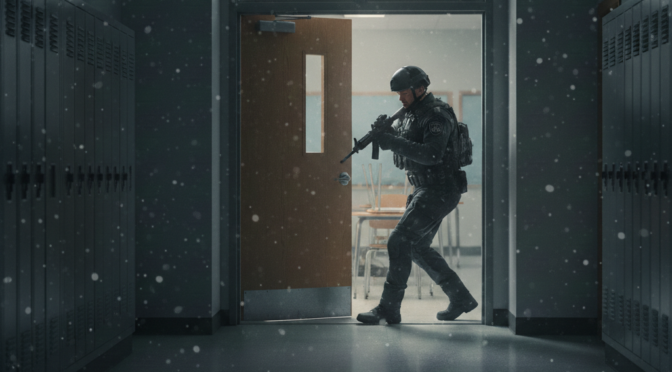
The paradigm of law enforcement response to active shooter incidents has undergone a radical transformation over the last two and a half decades. From the containment strategies of the late 20th century to the aggressive team formations of the early 2000s, the doctrine has continuously adapted to the grim reality of mass casualty events: time equals lives. The current frontier of this evolution is Solo Officer Rapid Deployment (SORD). This operational doctrine necessitates that the first arriving officer—regardless of rank, unit, or equipment—immediately enters the crisis site to isolate, distract, or neutralize the threat.1
The necessity for this shift is underscored by a brutal calculus: active shooter events typically last between five and eight minutes, with 60% ending before law enforcement arrives. In those critical minutes, a shooter can inflict casualties at a rate that outpaces the assembly of a traditional tactical team. The historical data, reinforced by FBI studies, indicates that even waiting for a second or third officer to form a “quad” or “diamond” formation can result in significant additional loss of life.1 Consequently, the law enforcement community is moving toward a model where the first badge at the door constitutes the initial contact team.
This report provides an analysis of SORD, designed for law enforcement executives, training directors, and tactical officers. It explores the historical drivers of this shift, specifically the failures at Columbine, Parkland, and Uvalde, and the successes in incidents like Thousand Oaks and Hesston.2 It dissects the tactical nuances of solo entry, including the fierce debate between “peek” and “push” room clearing techniques and the geometry of threshold evaluation.7 Furthermore, it addresses the critical implementation challenges facing police chiefs: liability concerns, union opposition, equipment procurement, and the psychological toll on officers forced to act alone in high-threat environments.9
The analysis indicates that while SORD represents a significant increase in risk to the individual officer, it remains the only viable countermeasure to the rapid casualty accumulation characteristic of modern active shooter events.1 The implications for agency leadership are profound, requiring a complete re-evaluation of training standards, equipment procurement, and operational policy to support the solo responder.
Section I: The Historical Evolution of Active Shooter Response
To understand the necessity of Solo Officer Rapid Deployment, one must analyze the trajectory of police tactics from a historical perspective. The evolution of response protocols is not merely a change in training manuals; it is a blood-written history of lessons learned from tragedies where seconds of hesitation resulted in catastrophic loss of life. The progression of tactics reveals a shrinking tolerance for delay, moving from hour-long standoffs to second-measured interventions.
The Pre-Columbine Era: Contain and Wait
Prior to April 20, 1999, the standard law enforcement response to a shooting in progress was predicated on the “contain and negotiate” model. This doctrine was derived from handling barricaded suspects and hostage situations, where time was considered an ally. The primary objective of the first responding patrol officer was to establish a perimeter, secure the scene to prevent escape, and await the arrival of Special Weapons and Tactics (SWAT) teams.1
This approach assumed that the suspect’s goal was negotiation or escape. However, the dynamics of an active shooter—defined as an individual actively engaged in killing or attempting to kill people in a confined and populated area—fundamentally differ. The active shooter’s goal is a high body count in a short duration.2 The traditional metrics of success, which prioritized officer safety and methodical negotiation, were inverted in these scenarios. In a bank robbery or domestic barricade, rushing in might provoke violence; in an active shooter event, staying out guarantees it.
The Columbine Catalyst (1999)
The attack on Columbine High School in Littleton, Colorado, irrevocably shattered the “contain and wait” paradigm. On that day, officers adhered to their training: they established a perimeter and waited for SWAT. The SWAT team entered the building 47 minutes after the shooting began. By that time, 12 students and one teacher were dead, and 24 others were injured. The perpetrators had committed suicide long before the tactical teams made contact.2
The after-action analysis revealed a horrifying truth: victims bled to death while armed officers stood outside. The delay inherent in assembling a SWAT team—often taking 45 to 60 minutes—was incompatible with the timeline of an active shooter event, which typically lasts only 5 to 8 minutes.2 This failure birthed the concept of “Immediate Action Rapid Deployment” (IARD), a doctrine that mandated patrol officers to intervene rather than wait for specialized units.
The Era of Team Formations (2000–2010)
In the wake of Columbine, agencies adopted the “Team Response” model. The initial iteration, often termed the “Quad” or “Diamond” formation, required patrol officers to wait until four officers arrived to form a contact team. This team would then move toward the sound of gunfire in a tight, 360-degree coverage formation.1
This formation was designed to maximize force protection. The point officer covered the front, the wings covered the sides, and the rear guard protected the “six.” While an improvement over waiting for SWAT, the Quad formation still presented logistical delays. In rural or suburban jurisdictions, waiting for a fourth officer could take 10 to 20 minutes.13 Recognizing this, training evolved to accommodate smaller teams—three or even two officers (the “T” or “Partner” formations). The formation provided officer safety and 360-degree security but still prioritized force protection over immediate neutralization in scenarios where backup was distant. The friction of assembly—waiting for units to arrive, designating roles, and coordinating movement—still consumed vital minutes.
The Shift to Solo Officer Response (2010–Present)
The progression toward Solo Officer Rapid Deployment (SORD) was driven by data and tragedy. Studies by the FBI and the Advanced Law Enforcement Rapid Response Training (ALERRT) Center indicated that 60% of active shooter events end before law enforcement arrives, and those that are ongoing require immediate intervention.1
The critical realization was that even waiting for a second officer to form a two-man team could cost lives. If a shooter fires one round every few seconds, a three-minute wait for backup equates to dozens of potential casualties. High-profile failures to engage, such as the inaction of the School Resource Officer (SRO) at Marjory Stoneman Douglas High School in Parkland (2018), and the catastrophic hesitation at Robb Elementary School in Uvalde (2022), solidified the public and professional expectation: the first officer must act alone.4
Conversely, successful interventions by solo officers, such as the actions of Chief Doug Schroeder in Hesston, Kansas, and the initial entry by Sgt. Ron Helus in Thousand Oaks, California, demonstrated that a single officer could distract or neutralize a threat, saving countless lives even at great personal risk.5 In Hesston, Chief Schroeder entered the manufacturing plant alone, engaging the shooter and drawing fire away from employees. In Thousand Oaks, Sgt. Helus made entry immediately upon arrival, and although he was tragically killed, his actions forced the shooter to engage him rather than continue executing civilians. These examples serve as the operational proof-of-concept for SORD: the intervention of a single officer disrupts the shooter’s OODA (Observe, Orient, Decide, Act) loop, forcing them to transition from predator to prey.
Section II: The Operational Doctrine of SORD
Solo Officer Rapid Deployment is not simply “running into the building.” It is a highly technical skill set that adapts team-based Close Quarters Battle (CQB) principles for a single operator. The cognitive load on a solo officer is immense; they must simultaneously process environmental information, navigate complex structures, identify threats, and manage their own physiological stress response without the 360-degree security provided by teammates.17 The doctrine demands a fundamental shift in mindset from “officer safety first” to “hostage survival first.”
The Core Mandate: Stop the Killing
The primary mission of SORD is to “Stop the Killing.” This supersedes all other police duties, including caring for the wounded, preserving evidence, or even absolute officer safety.17
The doctrine operates on a “Priority of Life” scale:
- Innocent Civilians / Hostages (Highest Priority)
- Law Enforcement Officers
- Suspects (Lowest Priority) 15
If the killing has stopped (e.g., the shooter has barricaded themselves and is no longer firing), the solo officer’s mandate shifts to “Stop the Dying” (medical intervention) or containment. However, as long as gunfire is active, the solo officer must move to the sound of the guns.17 This distinction is crucial. In Uvalde, officers misidentified the situation as a barricade (Stop the Dying/Containment phase) while the killing was arguably still possible or ongoing, leading to a fatal paralysis of action.16
Driving Force and Decision Making
A critical concept in SORD is “Driving Force.” This refers to the stimuli that compel an officer to bypass standard safety protocols (like waiting for backup) and enter immediately.
- Active Driving Force: Gunshots, screaming, visual confirmation of a shooter. This requires immediate entry and movement direct-to-threat. The presence of active driving force negates the option to wait for a team.15
- Static/Passive Situation: Silence, no visible targets. In this scenario, a solo officer might hold a threshold or conduct a deliberate search, but the urgency is dictated by intelligence. If there is no driving force, the officer acts as a scout, gathering intelligence for the arriving contact team rather than rushing blindly into a potential ambush.15
The failure at Uvalde was partially attributed to a misclassification of the situation. Officers treated the active threat (active driving force) as a barricaded suspect (static situation), reverting to a containment mindset while victims remained accessible to the shooter.1 This highlights the necessity for training officers to constantly re-evaluate the “driving force” indicators throughout the incident.
Solo Movement Techniques
Moving alone in a hostile environment requires specific adaptations to minimize exposure. The solo officer does not have a rear guard; they are exposed from 360 degrees.
1. Speed vs. Security
The solo officer must balance the need for speed (to stop the killing) with the need for security (to survive the encounter).
- Dynamic Movement: Used when shots are actively being fired. The officer moves quickly toward the threat, bypassing uncleared rooms. The risk of being ambushed from the rear is accepted because the known threat is actively killing. The logic is that every second spent checking an empty room is a second the shooter has to kill another victim.17
- Deliberate Movement: Used when the location of the shooter is unknown (silence). The officer clears angles methodically (“slicing the pie”) before advancing. This reduces the risk of walking into an ambush. In a deliberate search, the officer utilizes “limited penetration” techniques to check rooms without fully committing.5
2. Flashlight and Weapon Manipulation
Solo officers must be proficient in one-handed weapon manipulation if they are using a hand-held light or radio. However, weapon-mounted lights are strongly preferred for SORD to allow a two-handed firing grip. The officer cannot rely on a partner to cover a danger area while they reload or clear a malfunction; they must seek cover immediately if their weapon goes down. The concept of “working the problem” while maintaining lethal coverage is exponentially more difficult solo.3
3. 540-Degree Coverage
A solo officer cannot maintain 360-degree security. They must practice “540-degree” awareness—scanning not just horizontally (360 degrees) but also vertically (overhead walkways, stairwells).17 They must frequently check their “six” (rear) but acknowledge that their rear is always vulnerable. This vulnerability necessitates a faster operational tempo to close the distance to the threat, minimizing the time exposed in transition areas like hallways.
Section III: The Great Debate – Entry Tactics and Room Clearing
One of the most contentious areas of SORD doctrine is how a single officer should enter a room containing a threat. The traditional dynamic entry (flooding the room) used by SWAT teams is suicidal for a solo officer. Two primary schools of thought dominate the SORD training landscape: Limited Penetration (Peek) vs. Traditional Entry (Push).

Threshold Evaluation: Slicing the Pie
Before entering any room, SORD doctrine universally emphasizes Threshold Evaluation, commonly known as “slicing the pie.” The officer stands back from the doorway and moves in a semi-circular arc, visually clearing the room in segments from the outside. This allows the officer to engage a threat from a position of cover (the door frame/wall) and distance.5 By maximizing distance from the opening, the officer widens their field of view into the room while presenting a smaller target to anyone inside.
- Tactical Advantage: The officer can see deep into the room without exposing their entire body.
- Limitation: The “hard corners” (the corners of the room on the same wall as the door) cannot be seen without making entry or leaning significantly.5
The “Peek” (Limited Penetration)
The “Peek” or Limited Penetration technique advocates that the solo officer should not fully enter the room unless absolutely necessary. After slicing the pie, the officer leans aggressively to check the hard corners or keeps their body in the hallway while engaging.5
- Arguments For: It minimizes exposure. If the officer encounters overwhelming fire, they are already in the hallway and can retreat. It prevents the officer from getting “sucked in” to a room where they can be flanked.5
- Arguments Against: Some studies suggest that “peeking” may present the officer’s head as the primary target, potentially increasing the risk of a fatal headshot, although suspect accuracy data is mixed.7
The “Push” (Full Entry)
The “Push” technique involves the officer moving rapidly into the room, often using a “Buttonhook” (turning tight around the doorframe) or “Crossover” (moving across the threshold to the opposite wall) maneuver.
- Arguments For: Lateral movement is a key component of surviving a gunfight. By moving quickly into the room, the officer forces the suspect to track a moving target, theoretically reducing the suspect’s accuracy. It allows the officer to dominate the room and clear dead space behind furniture.5
- Arguments Against: Once inside, the officer is committed. There is no retreat. If there are multiple suspects or the officer is wounded, they are trapped in the “kill box” without backup.20
Empirical Evidence: ALERRT Research
Research conducted by ALERRT (Advanced Law Enforcement Rapid Response Training) compared these two methods. The study found “limited differences” in suspect shooting accuracy between the two. However, suspects facing a “Push” entry were more likely to shoot before the officer could fire, likely due to the officer’s full body appearing suddenly. Conversely, officers using the “Peek” were moderately more likely to be shot in the head, as it was the only target available.7
Tactical Consensus: Current best practices lean toward Limited Penetration for solo officers, reserving full entry (Push) only for situations where there is a known victim requiring immediate rescue inside the room, or if the geometry of the room demands it.20 The consensus is that SORD is an interim tactic; the solo officer’s goal is to neutralize the threat or pin them down until the team arrives, and limited penetration offers a better survival probability for the officer to achieve that sustainment.
Section IV: The Link-Up and Blue-on-Blue Mitigation
One of the most dangerous phases of a SORD operation is the arrival of backup. A solo officer is already in a hyper-vigilant state, hunting an armed threat. When a second officer (or team) enters the scene, the risk of “Blue-on-Blue” (fratricide) is extreme. The chaotic environment, combined with physiological stress (tunnel vision, auditory exclusion), makes identifying a plainclothes officer or even a uniformed colleague difficult in low light or smoky conditions.3
The Solo-to-Team Transition
SORD is rarely a permanent state; it is a stop-gap until a contact team can be formed. Protocols must exist for how a solo officer integrates with arriving units. The transition from solo to team is a critical vulnerability point where momentum can be lost or accidents can happen.
- Communication: The solo officer must broadcast their location and description continuously via radio. “I am on the second floor, north hallway, moving south. White male, plain clothes, blue armband.” This provides situational awareness to arriving units and the incident commander.28
- Verbal Challenges: Upon encountering another armed individual, strict verbal challenge protocols must be used. “POLICE! DON’T MOVE!” followed by visual identification of badges or uniforms. SORD training emphasizes the “challenge and response” mechanic to verify friendlies before lowering weapons.27
- Link-Up Procedure:
- Static Link-Up: The solo officer holds a secure position (e.g., a cleared stairwell) and waits for the contact team to come to them. This is safer but halts forward momentum.
- Dynamic Link-Up: The solo officer continues moving, and the contact team tracks them by sound. This is riskier but maintains pressure on the shooter. The arriving team must be trained to approach from the rear and announce their presence (“Contact Rear!”) to avoid startling the point officer.5
Identification Friend or Foe (IFF)
With many officers responding in plain clothes or off-duty capacity, visual identification is critical. An officer responding from home or an administrative role may not be in full uniform, increasing the risk of misidentification by responding patrol units.
- High-Visibility Identifiers: SORD training emphasizes the use of deploying badge carriers around the neck, high-visibility armbands, or “POLICE” marked placards on plate carriers immediately upon deployment.27
- Off-Duty Carry Considerations: Officers carrying concealed off-duty must practice retrieving and donning this identification gear under stress. An officer holding a gun without a badge is indistinguishable from a shooter to a responding patrolman. The “Challenge” phase is often the only barrier to tragedy.3
- Behavioral Compliance: If challenged by uniformed officers, the solo/plainclothes officer must immediately comply, even if they are in the middle of a tactical maneuver. The “freeze and identify” drill is a core component of SORD training to prevent friendly fire.27
Section V: Essential Equipment for the Solo Responder
The “Patrol Rifle and distinct uniform” standard is insufficient for SORD, particularly for plainclothes or off-duty responses. The equipment must be self-sufficient, as the officer will not have a partner to share ammo or medical supplies with. A solo officer is an island; their loadout must sustain them through the fight and the immediate aftermath.
1. Lethality and Ballistics
- Primary Weapon: While a patrol rifle (AR-15 platform) is preferred due to accuracy and stopping power against body armor, the reality is that many solo responses begin with a handgun. The handgun is the primary tool of the unexpected responder. Proficiency with the duty pistol at extended ranges (25+ yards) is a SORD prerequisite.3
- Ammunition: Officers should carry a minimum of three spare magazines. SORD engagements may turn into sustained firefights without quick resupply. A “Go-Bag” with extra rifle and pistol magazines is recommended for every patrol car.3
2. Medical Self-Sufficiency (Stop the Dying)
A solo officer who is wounded is their own medic until backup arrives. The “Golden Hour” becomes the “Platinum Ten Minutes” in active shooter scenarios.
- IFAK (Individual First Aid Kit): Must be carried on the person (belt or vest), not left in the car. It must be accessible with either hand in case of arm injury.
- Tourniquets: At least one, preferably two, accessible with either hand. This is non-negotiable standard equipment.
- Hemostatic Agents: For packing junctional wounds (groin, armpit) where tourniquets cannot be applied. The solo officer must be trained in self-application under duress.31
3. Breaching Tools
Locked doors are a major tactical obstacle in schools and offices (e.g., Uvalde). Waiting for a battering ram or Halligan tool can be fatal.
- Lightweight Breaching: Solo officers should have access to lightweight pry tools, sledgehammers, or shotgun breaching rounds in their vehicle. Some agencies are issuing backpack-portable hydraulic breach tools designed for single-operator use. Even simple tools like door wedges are critical for preventing doors from locking behind the officer, securing their retreat path.31
4. Identification
As noted in Section IV, visible identification is a life-saving device.
- DSM (Don’t Shoot Me) Banners: High-viz sashes or banners that can be pulled from a pouch and worn over plain clothes.
- Badge Neck Chains: Essential for off-duty carry. These provide a recognizable symbol of authority to both civilians and responding officers.3
Section VI: The Human Factor – Psychological and Physiological Challenges
The demand for SORD places an unprecedented psychological burden on the individual officer. They are asked to confront a homicidal threat alone, often in environments filled with the screams of victims. Understanding the physiological response to this stress is crucial for training. The “lone wolf” responder faces a unique set of stressors that team-based responders do not.
The Sympathetic Nervous System (SNS) Response
When the “fight or flight” mechanism activates, the body dumps cortisol and adrenaline.
- Tunnel Vision: Peripheral vision collapses to a narrow cone. Officers may not see threats flanking them or innocent civilians in the crossfire. SORD training emphasizes “breaking the tunnel” by physically moving the head to scan.9
- Auditory Exclusion: Officers often report not hearing their own gunshots or radio traffic. This makes command and control difficult. Dispatchers and commanders must understand that a solo officer under fire may not respond to radio calls immediately.9
- Tachypsychia: The distortion of time. Events may seem to move in slow motion or fast forward. This can affect the officer’s perception of how long they have been engaged or how quickly backup is arriving.9
Decision-Making Under Fire
The cognitive load of SORD degrades decision-making. The officer must identify targets (Shoot/Don’t Shoot) in milliseconds. “Analysis Paralysis” can occur when the brain is overwhelmed by stimuli. Training must inoculate officers against this by building “muscle memory” and cognitive scripts for specific scenarios. Decision-making models like the OODA Loop (Observe, Orient, Decide, Act) must be drilled until they are subconscious.36
Post-Traumatic Stress
Officers involved in solo shootings often experience profound isolation. Unlike a SWAT entry where the team shares the burden, the solo officer carries the weight of every decision alone. The rate of PTSD and “post-shooting trauma” is significant, manifesting as sleep disturbances, flashbacks, and anxiety. The burden of “what if” scenarios—what if I had moved faster? what if I missed?—can be debilitating. Agencies must have robust peer support and psychological services ready immediately following a SORD deployment.9
Section VII: Challenges for Leadership – Liability, Unions, and Policy
For Chiefs of Police and Sheriffs, implementing SORD is not just a tactical decision; it is a political and legal minefield. The shift requires navigating complex labor relations, liability statutes, and budget constraints.
The Union Opposition
Police unions and benevolent associations often resist SORD policies, citing officer safety. The argument is that mandating solo entry violates the principle of “two-man rule” and unnecessarily exposes officers to death. This resistance is often rooted in collective bargaining agreements that stipulate staffing levels and safety protocols.
- The Counter-Argument: The “Special Relationship” doctrine and public expectation. While courts generally rule that police have no constitutional duty to protect specific individuals ( DeShaney v. Winnebago), the public and political fallout from “waiting outside” (Parkland, Uvalde) is survivable for neither the agency nor the union. The reputational damage to the profession when officers fail to act is immense.12
- Negotiation Strategy: Chiefs must frame SORD not as a suicide mission, but as a trained response with proper equipment. Unions are more likely to accept SORD if it is accompanied by increased training budgets, better body armor, and rifle programs. It must be presented as an authorization to act to save lives, supported by the agency, rather than a reckless mandate.10
Legal Liability
- Failure to Train: Municipalities can be held liable under Canton v. Harris if they fail to train officers for foreseeable duties. Given the prevalence of active shooters, SORD is now a foreseeable duty. A department that forbids solo entry or fails to train for it faces massive liability if citizens die during a delay. The argument “we didn’t train for solo entry because it’s dangerous” is no longer a valid legal defense.11
- State-Created Danger: If police prevent civilians from saving themselves (e.g., blocking parents from entering) while refusing to enter themselves, they may face liability under the “State-Created Danger” theory. The inaction of police creates a zone of danger that prevents escape or rescue.16
IACP Model Policy
The International Association of Chiefs of Police (IACP) Model Policy on Active Shooters explicitly supports solo entry. It states that if a solo officer arrives, they “may move to stop the threat” if they reasonably believe delaying for backup would result in further loss of life.43 This model policy serves as a critical shield for Chiefs implementing SORD against union or legal challenges, providing a nationally recognized standard of care.
Section VIII: Training Implementation Roadmap
Implementing SORD requires a comprehensive training overhaul. Static target practice on a square range is insufficient. Agencies must transition to reality-based training (RBT) that simulates the stress and complexity of a solo response.
Phase 1: Policy and Mindset
- Policy Revision: Adopt the IACP or ALERRT model policy authorizing solo entry. Ensure the policy explicitly defines “driving force” and the transition from “Stop the Killing” to “Stop the Dying”.44
- Mindset Training: Classroom instruction on the history of active shooters, the “Stop the Killing” mandate, and the psychological realities of combat. Officers must mentally accept the risk before they can physically perform the tactic.21
Phase 2: Technical Skills (The “Flat Range”)
- CQB Geometry: Teaching threshold evaluation (slicing the pie) using mock doors or tape on the floor. This establishes the fundamental mechanics of safe movement.
- Live Fire: One-handed shooting, shooting on the move, and engaging targets from cover. Officers must prove proficiency in manipulating their weapon systems independently of a team.3
Phase 3: Force-on-Force Scenarios
This is the most critical component. Using Simunition® or airsoft:
- Solo Entry Drills: Officers must face active resistance alone. They must experience the stress of clearing a room with a “live” suspect. This inoculates them against the “shock” of combat.26
- Decision Making: Scenarios must not always end in a shooting. Officers must encounter “shoot/no-shoot” targets (e.g., a student holding a cell phone) to train target discrimination. This reduces the risk of “mistake-of-fact” shootings.21
- Medical Integration: Drills should require the officer to apply a tourniquet to themselves or a victim after neutralizing the threat. This trains the transition from “combat mode” to “medic mode”.31
Phase 4: Integrated Response
- Link-Up Drills: Practice the moment a second officer arrives. Verbal challenges and formation building. This phase minimizes the risk of friendly fire.
- Rescue Task Force (RTF): Coordinating with Fire/EMS to enter “Warm Zones” (areas cleared but not secured) to treat victims while the solo officer maintains security. This ensures that the “Stop the Dying” phase begins as soon as possible.48
Section IX: Conclusions and Strategic Recommendations
The rise of Solo Officer Rapid Deployment is a direct response to the failure of previous doctrines to match the lethality of modern active shooters. The lesson from Columbine to Uvalde is consistent: delay kills. In the absence of immediate intervention, casualty counts rise with a grim linearity. Data from major incidents indicates a strong correlation between the duration of the event prior to law enforcement intervention and the total number of victims. The prompt initiation of SORD aims to shift incidents away from high-casualty outcomes by minimizing the shooter’s uncontested time.
While SORD imposes a severe burden on the individual officer, it is an operational necessity. The “team” is no longer the four officers you arrive with; the “team” is the first badge at the door.
Strategic Recommendations for Chiefs of Police:
- Authorize SORD Explicitly: Ambiguity in policy leads to hesitation in the field (e.g., Uvalde). Policy must clearly state that solo entry is authorized and expected when active killing is occurring. Chiefs must stand behind this policy publicly.17
- Equip for Independence: Every officer must be issued a tourniquet, a heavy vest/plate carrier (if budget allows), and breaching tools. Relying on trunk gear is insufficient if the gear takes too long to access. The officer must be a self-contained tactical unit.31
- Train for Isolation: Training must simulate the psychological isolation of solo entry. Instructors should not coach officers through the scenario; officers must learn to make independent decisions under stress. Failure in training should be encouraged as a learning tool.47
- Engage the Community and Unions: Proactively address safety concerns by highlighting that SORD, while risky, is safer than a disorganized response. Use the “Priority of Life” scale to justify the risk to officers to the unions and the public. Transparency about the risks and the necessity of the tactic builds trust.10
The transition to SORD is not merely a change in tactics; it is a shift in the fundamental contract between law enforcement and the community. It reaffirms that the police officer’s highest duty is to place themselves between the innocent and the predator, even—and especially—when they stand alone.
Please share the link on Facebook, Forums, with colleagues, etc. Your support is much appreciated and if you have any feedback, please email us in**@*********ps.com. If you’d like to request a report or order a reprint, please click here for the corresponding page to open in new tab.
Sources Used
- The Evolution of Active Shooter Response Training Protocols Since Columbine: Lessons From the Advanced Law Enforcement Rapid Res – Alerrt, accessed January 25, 2026, https://alerrt.org/r/16
- How Has Active Shooter Response Changed? – Total Security Solutions, accessed January 25, 2026, https://www.tssbulletproof.com/blog/how-active-shooter-response-changed
- SORD – Solo Officer Rapid Deployment – Advanced Law Enforcement Rapid Response Training, accessed January 25, 2026, https://alerrt.org/course_types/SORD
- Lessons Learned from the Robb Elementary School, Uvalde, Texas School Shooting, accessed January 25, 2026, https://www.scirp.org/journal/paperinformation?paperid=132478
- Peek or Push: An Examination of Two Types of Room Clearing Tactics for Active Shooter Event Response – Alerrt, accessed January 25, 2026, https://alerrt.org/r/20
- Despite risks, solo officer active shooter response saves lives – Police1, accessed January 25, 2026, https://www.police1.com/active-shooter/articles/rapid-response-despite-risks-solo-officer-active-shooter-response-saves-lives-cHCntd7E6vbp3AhP/
- Advanced Law Enforcement Rapid Response Training: Recommended Reading – Alerrt, accessed January 25, 2026, https://alerrt.org/reading
- Active Shooter Incident Management Checklist Endorsed by the NTOA as National Standard, accessed January 25, 2026, https://www.ntoa.org/active-shooter-incident-management-checklist-endorsed-as-national-standard/
- The Psychological Effect on Law Enforcement Officers involved in Deadly Police-Involved Shootings, accessed January 25, 2026, https://www.fdle.state.fl.us/getContentAsset/0925fc82-0d16-416a-95de-03d5d2fd57c4/73aabf56-e6e5-4330-95a3-5f2a270a1d2b/Solis-Benny-paper.pdf?language=en
- The Police Response to Active Shooter Incidents, accessed January 25, 2026, https://www.policeforum.org/assets/docs/Critical_Issues_Series/the%20police%20response%20to%20active%20shooter%20incidents%202014.pdf
- Law Enforcement Liability – Feerick Nugent MacCartney PLLC, accessed January 25, 2026, https://fnmlawfirm.com/practice-area/law-enforcement-liability/
- How police officers are shot and killed during active shooter events: Implications for response and training | Alerrt, accessed January 25, 2026, https://alerrt.org/r/30
- Those Terrible First Few Minutes: Revisiting Active-Shooter Protocols for Schools | FBI – LEB, accessed January 25, 2026, https://leb.fbi.gov/articles/featured-articles/those-terrible-first-few-minutes-revisiting-active-shooter-protocols-for-schools
- (PDF) The Evolution of Active Shooter Response Training Protocols Since Columbine: Lessons From the Advanced Law Enforcement Rapid Response Training Center – ResearchGate, accessed January 25, 2026, https://www.researchgate.net/publication/332322545_The_Evolution_of_Active_Shooter_Response_Training_Protocols_Since_Columbine_Lessons_From_the_Advanced_Law_Enforcement_Rapid_Response_Training_Center
- Wait for backup or not? How police officers view their role when responding to an active shooter event – Alerrt, accessed January 25, 2026, https://alerrt.org/r/73
- Uvalde school shooting response was a failure, says DOJ, accessed January 25, 2026, https://www.texastribune.org/2024/01/18/uvalde-school-shooting-federal-investigation-police-response/
- ALERRT Best Practice Policy, accessed January 25, 2026, https://www.lemitonline.org/programs/documents/14TPCLS/ALERRT%20-%20Monday/ALERRT%20Active%20Attack%20Best%20Practice%20Policy.pdf
- Active Shooter Response-Schools 2023.docx, accessed January 25, 2026, https://almonline.org/Assets/Files/LossControl/ReferenceDocuments/Active%20Shooter%20Response-Schools%202023.docx
- Active Shooter Response – Monterey, accessed January 25, 2026, https://monterey.gov/Document-Center/Departments/Police/Inside-MPD/Policies-Procedures-Training/Misc-Training/Active-Shooter-4hr-outline-2024.pdf?t=202509301228010
- The Science Behind One Man Room Clearing Tactics: Peek or Push, accessed January 25, 2026, https://www.tierthreetactical.com/the-science-behind-one-man-room-clearing-tactics-peek-or-push/
- SOLO Officer Response: Active Killing Events and Immediate Entry Tactics, accessed January 25, 2026, https://ncc.nebraska.gov/sites/default/files/doc/091924%20Solo%20Officer%20Response%20Zoom.pdf
- Threshold Evaluation: Room Entries Concepts : r/CQB – Reddit, accessed January 25, 2026, https://www.reddit.com/r/CQB/comments/cahcrb/threshold_evaluation_room_entries_concepts/
- CROSSING THE THRESHOLD: FLOW VS BUTTON HOOK CQB ENTRY TECHNIQUES, accessed January 25, 2026, https://www.youtube.com/watch?v=hsIzzS2o1wk
- CQB: Limited Penetration vs. Points of Domination – Iron Survival, accessed January 25, 2026, https://ironsurvival.com/blog/cqb-limited-versus-deep-penetration
- Solo Door Operations in CQB: Technical Considerations for Single-Opera – UNIT Solutions, accessed January 25, 2026, https://unitsolutions.com/blogs/news/solo-door-operations-in-cqb-technical-considerations-for-single-operator-entry
- ALERRT Solo Officer Rapid Deployment (SORD) Train-the-Trainer 05/05/2025 – Virginia Department of Criminal Justice Services, accessed January 25, 2026, https://www.dcjs.virginia.gov/training-events/alerrt-solo-officer-rapid-deployment-sord-train-trainer
- 8 ways to prevent blue-on-blue shootings – Police1, accessed January 25, 2026, https://www.police1.com/officer-safety/articles/8-ways-to-prevent-blue-on-blue-shootings-lCVUx6Zu8MPca8Sd/
- Active Shooter – Course Outline – San Bernardino, CA, accessed January 25, 2026, https://www.sanbernardino.gov/584/Active-Shooter-Course-Outline-PDF
- Immediate Action Rapid Deployment – PowerDMS, accessed January 25, 2026, https://public.powerdms.com/UPDSL/documents/1821239
- Active Shooter Threat Training Program | Federal Law Enforcement Training Centers – FLETC, accessed January 25, 2026, https://www.fletc.gov/active-shooter-threat-training-program
- How to equip and train cops for solo officer active shooter response – Police1, accessed January 25, 2026, https://www.police1.com/police-products/body-armor/articles/how-to-equip-and-train-cops-for-solo-officer-active-shooter-response-gj2eNNVsDAnRZ4Zv/
- 15 Essential Gear For Law Enforcement: Officers Should Carry – Chase Tactical, accessed January 25, 2026, https://www.chasetactical.com/guides/essential-gear-for-law-enforcement
- SOLO Medical Kit – Spiritus Systems, accessed January 25, 2026, https://www.spiritussystems.com/solo-medical-kit/
- Active Shooter Response, Door Breaching System | Engineering Interdisciplinary Capstone, accessed January 25, 2026, https://icap.engineering.arizona.edu/node/614
- Breaching tools for every officer – Police1, accessed January 25, 2026, https://www.police1.com/police-products/tactical/tactical-entry-tools/articles/breaching-tools-for-every-officer-BJ1quaYGjPNvXB6A/
- How to Create Tactical Decision Games: A 5-Minute Overview – YouTube, accessed January 25, 2026, https://www.youtube.com/watch?v=7g30X5-S4zY
- RMBLC Shift Briefing Series: Tactical Decision Making – YouTube, accessed January 25, 2026, https://www.youtube.com/watch?v=5HGvSegpqhM
- Officer-Involved Shooting: Reaction Patterns, Response Protocols, and Psychological Intervention Strategies, accessed January 25, 2026, https://ovc.ojp.gov/sites/g/files/xyckuh226/files/media/document/imp_officer_involved_shooting-508.pdf
- Police Stress and Deleterious Outcomes: Efforts Towards Improving Police Mental Health, accessed January 25, 2026, https://pmc.ncbi.nlm.nih.gov/articles/PMC8575544/
- Solo officers vs. active killers: Officers speak out – Police1, accessed January 25, 2026, https://www.police1.com/police-products/firearms/articles/solo-officers-vs-active-killers-officers-speak-out-CP7rkhwVxCHl5d0w/
- Solo officer response – American Police Beat Magazine, accessed January 25, 2026, https://apbweb.com/2022/07/solo-officer-response/
- Legal/Liability Issues in the Training Function – LLRMI – Police Training and Expert Services for Law Enforcement, Jails & Corrections, Insurance Pools, Risk Managers, and Attorneys, accessed January 25, 2026, https://www.llrmi.com/articles/legal_update/liabilitytraining/
- Coordinating Resources and Neutralizing the Threat, accessed January 25, 2026, https://www.theiacp.org/coordinating-resources-and-neutralizing-the-threat
- active shooter – IACP National Law Enforcement Policy Center, accessed January 25, 2026, https://www.ncpea.org/wp-content/uploads/IACP-ActiveShooter-Sample-Policy.pdf
- Active Attack – International Association of Chiefs of Police, accessed January 25, 2026, https://www.theiacp.org/resources/policy-center-resource/active-attack
- RAIDER Solo-Engagement Tactics Program – YouTube, accessed January 25, 2026, https://www.youtube.com/watch?v=ST9nQsHfglw
- Single Officer Response to an Active Shooter Training | DeAngelis Center Foundation, accessed January 25, 2026, https://deangeliscenter.org/single-officer-response-to-an-active-shooter-training/
- Course Catalog – Advanced Law Enforcement Rapid Response Training, accessed January 25, 2026, https://alerrt.org/Course-Catalog
- Law enforcement active shooter response policy – PowerDMS, accessed January 25, 2026, https://www.powerdms.com/policy-learning-center/law-enforcement-active-shooter-response-policy
- model policy response to active assailant events – FDLE, accessed January 25, 2026, https://www.fdle.state.fl.us/getContentAsset/838fd31b-1d71-4a89-8604-3254b1dca230/73aabf56-e6e5-4330-95a3-5f2a270a1d2b/MSD-Commission-Active-Assailant-Model-Policy-FINAL-010923.pdf?language=en