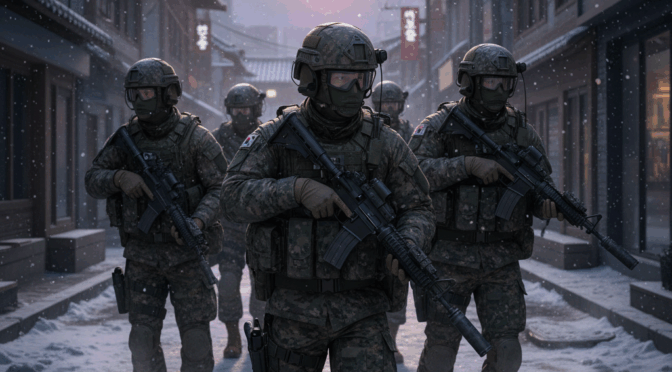
The small arms landscape of the Republic of Korea (ROK) is currently undergoing its most transformative period since the initial localization efforts of the 1970s. This transformation is driven by a critical intersection of shifting demographic realities, rapid technological advancement, and a strategic pivot toward global defense exports, colloquially referred to as “K-Bangsan.” As the ROK military faces a projected decline in conscripted personnel from 330,000 in 2020 to approximately 130,000 by 2041, the Ministry of National Defense (MND) has prioritized the enhancement of individual lethality and survivability through the “Warrior Platform” initiative.1 This program aims to evolve the individual soldier from a traditional infantryman into an integrated combat platform, utilizing cutting-edge optics, modular weapon systems, and networked tactical gear.3
The industrial base responsible for this modernization has transitioned from a long-standing monopoly held by Daewoo Precision Industries (now SNT Defense) to a competitive, albeit complex, duopoly with Dasan Machineries.5 While SNT Defense continues to supply the bulk of standardized infantry weapons, including the K2C1 assault rifle and the newly designated K13 (STC-16) carbine, the market has seen significant disruption due to industrial scandals and the emergence of new partnerships with Western and Middle Eastern firms.6 Each military branch has tailored its small arms procurement to its unique operational requirements: the Army emphasizes modularity and support firepower; the Navy focuses on maritime-optimized platforms like the HK416 for its UDT/SEAL units; the Air Force prioritizes compact systems for its rescue and combat control teams; and the Marine Corps maintains a robust mix of domestic rifles and legacy support weapons for amphibious assault.7 This report provides a granular analysis of these inventories, the technical specifications of current and future platforms, and the strategic implications of the ROK’s self-reliant defense posture as it moves into the 2026-2030 planning cycle.
Strategic Imperatives and the Demographic Crisis
The fundamental driver behind South Korea’s aggressive small arms modernization is a demographic crisis that threatens the viability of its traditional mass-conscription model. With one of the lowest birth rates in the world, the ROK military is compelled to maintain a credible deterrent against the 1.3 million-strong army of North Korea while operating with a significantly smaller human footprint.2 Consequently, the military’s “Defense Innovation 4.0” program emphasizes the integration of Artificial Intelligence (AI), robotics, and enhanced individual gear to multiply the effectiveness of each remaining soldier.1
In fiscal year 2026, the ROK government has proposed a 78 percent budget increase for AI-based unmanned combat systems and soldier modernization, totaling 340.2 billion won ($237 million).1 This investment reflects a shift in doctrine from quantity to quality. The small arms used by the ROK Armed Forces are no longer viewed in isolation but as the primary hardware interface for the Warrior Platform, which links soldiers to a broader battlefield network featuring drones, UGVs, and real-time tactical analysis provided by firms like Funzin and LIG Nex1.1 This strategic context is essential for understanding why the ROK is moving away from the simple, rugged designs of the 1980s toward complex, modular, and high-precision systems that require more intensive training but offer significantly higher combat multipliers.
The Industrial Complex: SNT Defense vs. Dasan Machineries
The history of small arms in South Korea is inextricably linked to the state-led development model initiated in 1973 by President Park Chung-hee.5 The goal was to localize production of weapons that were previously imported or produced under license, such as the M16A1, to ensure a self-reliant defense against northern aggression.5 This led to the creation of the Agency for Defense Development (ADD) and the empowerment of Daewoo Precision Industries as the sole manufacturer of military small arms.
For over four decades, Daewoo (later S&T Motiv, now SNT Defense) enjoyed a monopoly on the domestic market, producing the ubiquitous K-series rifles, machine guns, and pistols.5 However, in 2016, the Ministry of Trade, Industry and Energy officially designated Dasan Machineries as a secondary defense company capable of supplying rifles and pistols to the military.5 This transition to a duopoly was intended to foster innovation and reduce costs through competitive bidding.
The Rise and Fall of Dasan’s Military Favor
Dasan Machineries, established in 1992, initially grew by exporting gun parts and magazines to the United States and Europe, with exports exceeding $30 million by 2013.5 Their entry into the ROK domestic military market was marked by the DSAR-15PC, an AR-pattern carbine that initially won a major contract for 16,000 units intended for the Army’s special operations units.6 However, this momentum was catastrophically interrupted in 2021 when the company was caught in a scandal involving the illegal acquisition of classified DAPA documents.6 This led to a multi-year sanction, effectively barring Dasan from major government contracts and allowing SNT Defense to re-assert its dominant position.
As of 2025, SNT Defense has largely filled the void left by Dasan’s fall from favor, securing the K13 carbine contract with its STC-16 design.6 Meanwhile, Dasan has pivoted back toward the export market, showcasing advanced designs like the XR-17 machine gun to international customers.6 Additionally, new players like K-Tech have emerged as regional manufacturing partners for foreign firms like Caracal, indicating that the South Korean industrial landscape remains dynamic and competitive on the global stage.6
Table 1: Comparative Industrial Profiles of Major ROK Small Arms Producers
| Feature | SNT Defense (SNT Motiv) | Dasan Machineries |
| Origin | Est. 1973 as Daewoo Precision Industries. 11 | Est. 1992 as a parts manufacturer. 5 |
| Strategic Role | Legacy supplier and primary ROK contractor. | Disruptor and export-focused manufacturer. |
| Key Platforms | K1A, K2C1, K13, K14, K15, K16, K5. 13 | DSAR-15 series, XR-17, various AR-clones. 6 |
| Current Market Status | Re-monopolized special operations contracts as of 2024. | Focused on international markets post-2021 scandal. 6 |
| Global Expansion | Establishing US facility in Las Vegas (2025-2026). 11 | Strong historical export links to Middle East and US. 5 |
Republic of Korea Army (ROKA): Modernization of the Core Force
The ROK Army (ROKA) is the primary beneficiary of the Warrior Platform initiative and serves as the testing ground for the newest iterations of the K-series weaponry. The Army’s current inventory is a mixture of legacy systems and the “next-generation” platforms that are being sequentially introduced to replace equipment deemed “outdated for international markets” since 2000.14
The Evolution of the Service Rifle: K2 to K2C1
The K2 assault rifle has been the standard personal weapon for ROKA soldiers since 1985.14 Developed by the ADD, it utilized a unique gas system combining a long-stroke piston (similar to the AK-47) with an AR-style rotating bolt and lower receiver.15 While internally robust, the original K2 lacked the ability to host modern accessories like optics, flashlights, and laser pointers without clunky third-party adapters.14
To address these deficiencies, SNT Motiv developed the K2C1, which was selected as the new standard weapon in the mid-2010s.14 The K2C1 features a full-length Picatinny rail on the upper receiver and an extended modular handguard, allowing for the standardized attachment of the PVS-11K red dot sight and the PVS-04K night vision scope.14 The K2C1 also replaced the original folding stock with a 5-position collapsible stock, improving ergonomics for soldiers wearing modern body armor.14
The Special Operations Carbine: K13 (STC-16)
Perhaps the most significant development in ROKA small arms is the transition from the K1A to the K13 carbine. The K1A, though iconic, was criticized for being un-ergonomic and underpowered as a modern personal defense weapon (PDW) or special operations carbine.14 The replacement program, initially won by Dasan, was eventually awarded to SNT Motiv for the STC-16, now officially designated as the K13.6
The K13 represents a fundamental shift in South Korean design philosophy, moving away from the proprietary K-series ergonomics toward an AR-pattern layout that is more intuitive for modern operators. The K13A1, unveiled at ADEX 2025, introduced further refinements, including a forward assist mechanism and enhanced materials for durability in extreme conditions.12 This weapon is now the core individual weapon for ROK elite units and is being positioned as a domestic alternative to the HK416 or M4A1.12
Support Weapons: Light and Medium Machine Guns
ROKA’s support firepower is undergoing a similar transition. The K3 light machine gun (LMG), inspired by the FN Minimi, was the standard squad automatic weapon (SAW) for decades but suffered from persistent reliability issues.7 In 2021, SNT began mass production of the K15 (5.56mm) and the K16 (7.62mm) to replace the K3 and M60, respectively.19
The K15 LMG is significantly more advanced than its predecessor, featuring an integrated Picatinny rail for a Fire Control System (FCS) that improves accuracy through automated rangefinding.18 The K16, formerly known as the K12, fills the medium machine gun role. It was initially developed as the standard armament for the KUH-1 Surion helicopter but was re-designated and adapted for ground use after the Army determined the 5.56mm round was insufficient for suppressive fire in the mountainous terrain of the DMZ.19
Table 2: ROK Army Standard Small Arms Inventory (2025-2026)
| Weapon System | Role | Caliber | Manufacturer | Key Improvements |
| K2C1 | Standard Rifle | 5.56×45mm | SNT Defense | Full-length rails, collapsible stock. 14 |
| K13 (K13A1) | Special Ops Carbine | 5.56×45mm | SNT Defense | AR-ergonomics, ambidextrous, piston-driven. 12 |
| K15 | Light Machine Gun | 5.56×45mm | SNT Defense | Integrated FCS, improved belt feed. 20 |
| K16 | General Purpose MG | 7.62×51mm | SNT Defense | High reliability, ground/vehicle versions. 19 |
| K14 | Sniper Rifle | 7.62×51mm | SNT Defense | Bolt-action precision (1.0 MOA). 21 |
| K5 | Standard Sidearm | 9×19mm | SNT Defense | Triple-action trigger (“Fast-Action”). 7 |
| K6 | Heavy Machine Gun | .50 BMG | Yeohwa Shotgun | Quick-change barrel system. 22 |
Republic of Korea Navy (ROKN): Maritime Specialization & Elite Procurement
The ROK Navy presents a bifurcated small arms strategy. While the general fleet and base defense units utilize standardized K-series weapons common to the Army, the Navy Special Warfare Flotilla (UDT/SEALs) exercises significant autonomy in procurement, often favoring high-tier foreign designs that are better suited for maritime counter-terrorism and visit, board, search, and seizure (VBSS) missions.
The UDT/SEAL Preference for the HK416
The most prominent weapon in the ROK Navy UDT/SEAL inventory is the Heckler & Koch HK416.9 The preference for this German-made platform over the domestic K2C1 or K1A is rooted in its gas-operated short-stroke piston system, which prevents combustion gases and carbon fouling from entering the receiver.8 This system is particularly advantageous in maritime environments where saltwater exposure and sand can compromise the reliability of direct-impingement or less-refined piston systems.8
The HK416 models used by the UDT/SEALs are typically equipped with 10.4-inch or 14.5-inch barrels, allowing for maneuvering within the tight confines of ships or during underwater insertions.23 These weapons are often seen with advanced accessories, including Aimpoint CompM4 sights, vertical foregrips, and suppressors, which are essential for the high-precision requirements of maritime hostage rescue.8
Submachine Guns and Stealth Operations
For specialized counter-terrorism roles, the ROK Navy maintains an extensive inventory of submachine guns. The H&K MP5 series, including the MP5A5, suppressed MP5SD6, and compact MP5K, remains the gold standard for indoor operations and personal protection.13 The closed-bolt firing system of the MP5 provides superior accuracy for the critical “first shot,” which is often the difference between success and failure in hostage scenarios.25
Additionally, the Navy utilizes the domestically produced K7 silenced submachine gun.9 Unlike most suppressed weapons that use a detachable “can,” the K7 features an integrated suppressor built around the barrel, making it significantly quieter and more compact for clandestine operations.26 This is complemented by the use of subsonic 9mm ammunition, which minimizes the acoustic signature of the firing unit.
Table 3: ROK Navy (UDT/SEAL) Specialized Small Arms
| Category | Model | Caliber | Origin | Primary Role |
| Assault Rifle | HK416 | 5.56×45mm | Germany | Maritime Raid / VBSS. 8 |
| Submachine Gun | MP5 (Various) | 9×19mm | Germany | Counter-Terrorism. 25 |
| Pistol | SIG Sauer P226 | 9×19mm | Germany/Swiss | Tier-1 Sidearm. 9 |
| Silenced SMG | K7 | 9×19mm | South Korea | Stealth / Infiltration. 9 |
| Marksman Rifle | KAC SR-25 | 7.62×51mm | USA | Semi-Auto Precision. 9 |
| Sniper Rifle | AI AWSM | .338 Lapua | UK | Long-Range Interdiction. 9 |
Republic of Korea Marine Corps (ROKMC): Amphibious Firepower
The ROK Marine Corps (ROKMC) follows a procurement philosophy that mirrors the Army’s but with a focus on weapons that can withstand the rigors of amphibious landings and beachhead defense. The Marine Corps’ philosophy is one of maximum suppression and localized fire superiority during the initial stages of a landing.
Personal Weapons for Amphibious Operations
The standard-issue rifle for the ROKMC is the K2 and the K2C1.7 A significant number of K1A carbines also remain in the inventory, particularly for personnel operating within the confines of Korean Amphibious Assault Vehicles (KAAVs).7 The K1A’s retractable stock and short barrel make it ideal for crews who must quickly dismount and secure a landing zone.
The ROKMC also utilizes the K5 9mm pistol as a standard sidearm for officers and tank crewmen.7 The K5 features a unique “triple-action” trigger mechanism, which allows the hammer to be decocked while keeping the mainspring compressed. This results in a light, safe trigger pull for the first shot, which Marine officers value for accuracy in high-stress amphibious engagements.7
Heavy Support and Legacy Systems
A notable aspect of the ROKMC’s inventory is the retention of certain legacy support weapons that have been largely phased out by the Army. The M67 90mm recoilless rifle is still maintained for anti-fortification use, providing Marines with a reliable direct-fire option against North Korean coastal bunkers.7 This is supplemented by the K4 40mm automatic grenade launcher, a domestic version of the Mk 19 that fires high-explosive dual-purpose (HEDP) rounds capable of penetrating two inches of armor at 2,000 meters.21
Table 4: ROK Marine Corps Inventory and Support Arms
| Model | Type | Caliber | Primary Role |
| K2 / K2C1 | Assault Rifle | 5.56×45mm | Standard infantry rifle. 7 |
| K1A | Carbine | 5.56×45mm | KAAV crew and mortar teams. 7 |
| K3 / K15 | Light MG | 5.56×45mm | Squad automatic weapon. 20 |
| K5 | Pistol | 9×19mm | Sidearm for officers and tankers. 7 |
| K201 | Grenade Launcher | 40×46mm | Under-barrel support (K2-mounted). 7 |
| K6 | Heavy MG | .50 BMG | Primary vehicle armament. 22 |
| M67 | Recoilless Rifle | 90mm | Anti-fortification / Bunker busting. 7 |
| KM187 | Mortar | 81mm | Indirect fire (Max range 6.3 km). 7 |
Republic of Korea Air Force (ROKAF): Security, Rescue, and Air Control
The ROK Air Force (ROKAF) utilizes small arms primarily for three mission sets: airfield base defense, combat search and rescue (SART), and combat control (CCT). While the base defense forces rely on standardized Army equipment, the SART and CCT units represent some of the most specialized small arms users in the ROK Armed Forces.
Airfield Defense and Base Security
The primary weapon for ROKAF base defense units is the K2 and K2C1.9 Because airfield security requires engagement over varying distances—from close-quarters gate security to long-range perimeter defense—the ROKAF has been proactive in adopting optics and magnification systems under the Warrior Platform Phase 1. Base defense teams also make extensive use of the K6 heavy machine gun for point defense against ground and low-altitude aerial threats.9
Specialized Rescue and Control Teams (SART/CCT)
The Special Air Rescue Teams (SART) are tasked with rescuing downed pilots behind enemy lines, a mission that requires extremely compact but powerful weapons. SART operators utilize a mix of K1A carbines and imported HK416s, often suppressed to minimize detection during extraction.9 Their gear is highly personalized, with many operators choosing to add high-end accessories like IR lasers (PEQ-15) and variable-power optics (Elcan or ACOG) to their weapons.29
The Combat Control Teams (CCT), acting as JTACs, carry small arms primarily for self-protection while focusing on their primary tools: high-power radios and laser target designators.29 They utilize the M4A1 and HK416, alongside the MP5SD for stealthy movement into forward observation posts.9
Table 5: ROK Air Force Specialized Unit Armament
| Unit | Primary Weapon | Role | Supporting Sidearm |
| Base Defense | K2C1 / K6 | Perimeter Security | K5 Pistol |
| SART | HK416 / K1A | Compact Firepower | USP9 Tactical / P226 |
| CCT | M4A1 / HK416 | Self-Defense / Air Control | Glock 17 / SIG P226 |
| SART/CCT | MP5SD6 | Stealth / Infiltration | K5 / M1911A1 (legacy) |
The Tier 1 Edge: 707th Special Mission Group “White Tigers”
The 707th Special Mission Group is the ROK Army’s premier counter-terrorism and unconventional warfare unit, often compared to the U.S. Army’s Delta Force.30 Because their missions involve extremely high-risk hostage rescues and black operations, they have the most diverse and exotic small arms inventory in the ROK Armed Forces.
Unconventional Procurement
While the 707th uses domestic weapons like the K1A and K2, they are frequently modified with rail systems, aftermarket stocks, and suppressors.31 However, the unit is most notable for its use of global “Tier 1” platforms. This includes the FN SCAR-L for general assault roles and the KAC SR-16 for high-precision CQB.13 Recently, the unit has been seen training with the KAC KS-3 and Noveske N4, reflecting a trend toward high-performance AR-pattern carbines common in Western special operations circles.30
Precision Interdiction
The 707th Sniper Teams utilize some of the world’s most capable precision rifles. The Barrett MRAD (Multi-Role Adaptive Design) is a key asset, allowing operators to change calibers in the field depending on mission requirements—ranging from 7.62 NATO to.338 Lapua Magnum.13 For anti-materiel roles, they utilize the Barrett M82.50 BMG rifle.13 Their secondary sniper platforms include the Accuracy International AWSM and the KAC M110 SASS for semi-automatic fire support.13
Table 6: 707th Special Mission Group Specialized Inventory
| Weapon Type | Model | Caliber | Origin |
| Assault Rifle | FN SCAR-L | 5.56×45mm | Belgium |
| Assault Rifle | KAC SR-16 / KS-3 | 5.56×45mm | USA |
| Carbine | Noveske N4 | 5.56×45mm | USA |
| Sniper Rifle | Barrett MRAD | .338 / 7.62 | USA |
| Sniper Rifle | AI AWSM | .338 Lapua | UK |
| Submachine Gun | B&T MP9 | 9×19mm | Switzerland |
| Submachine Gun | HK MP7 | 4.6×30mm | Germany |
| Shotgun | Kel-Tec KSG | 12 Gauge | USA |
The Warrior Platform: Redefining the Individual Combatant
The Warrior Platform is not just a collection of equipment; it is a three-phase roadmap intended to ensure the ROK military remains competitive in a high-tech battlefield despite shrinking numbers.3
Phase 1: Survival and Basic Lethality (2019–2023)
The first phase focused on the “33 cutting-edge items,” which included improved body armor, high-cut ergonomic helmets with rail systems, and the standardization of rifle optics.3 The Army’s analysis showed that daytime shooting accuracy improved by 60 percent, and nighttime accuracy increased by 90 percent through the use of these Phase 1 enhancements.4
Phase 2: Integration and Networks (2024–2025)
Phase 2, currently being implemented, focuses on “integrated combat systems”.10 This involves connecting the soldier’s gear to a tactical network. Key components include:
- Target Designation Sights (TDS): Integrated modules that allow a soldier to “tag” a target and share its coordinates with the squad, drones, or artillery.3
- Integrated Processing Modules: Helmet-mounted processing units that synthesize data from sensors and antennas, delivering it to the soldier via a head-up display (HUD) or tactical tablet.10
- Domestic Optics Evolution: Companies like DI Optical and Hantel are producing ROK-specific red dot sights (DCL120/110) and magnifiers to ensure supply chain autonomy.33
Phase 3: The Wearable System (2026+)
The final phase envisions a “wearable” combat system where the soldier and technology are fully integrated. This includes research into powered exoskeletons to reduce the physical burden of the 20-30kg of gear modern soldiers carry, and “smart” uniforms with integrated health monitoring and camouflage adjustment.10
Technological Frontiers: AI, Robotics, and Smart Munitions
The ROK’s small arms development is increasingly intersecting with AI and robotics. The Agency for Defense Development (ADD) and private firms are currently testing autonomous ground robots equipped with remote weapon stations (RWS) featuring the K15 or K16 machine guns.1
AI-Powered Fire Control
AI is being embedded into fire control systems to improve threat recognition and engagement decision-making.1 For example, the FCS on the K15 LMG can identify enemy silhouettes and provide a corrected aiming point based on range, wind, and movement—a critical feature for maintaining suppressive fire effectiveness with fewer soldiers.20
Smart Munitions: The Legacy of the K11
South Korea’s foray into “smart” small arms was most notable for the K11 Dual-Barrel Air-Burst Weapon.14 The K11 was intended to replace the K2/K201 combination by offering a 5.56mm rifle combined with a 20mm air-burst grenade launcher controlled by an electronic sight.7 While high costs and technical skepticism over the 20mm grenade’s lethality led to a reduction in its planned distribution (down to two per squad), the lessons learned from the K11 have informed the development of current smart sights and programmable munitions.14
Geopolitical Impact: K-Bangsan and the Global Small Arms Market
South Korea is no longer just a consumer of small arms; it is a major exporter. Between 2020 and 2024, the ROK became one of the top ten global arms exporters, with revenues increasing by 39% in 2022-23.2 This “K-Bangsan” trend is particularly visible in the small arms sector.
Exporting the K-Series
The K2 and its variants (K2C, K2C1) have seen service in conflicts globally, from Iraq and Syria to the Niger Delta.14 The STC-16 (K13) is currently being marketed as a domestic alternative to Western carbines, attracting interest from partner nations looking for high-performance piston-driven rifles at a more competitive price point.12 SNT Defense’s decision to open a facility in Las Vegas to produce 30% of their components locally in the US is a strategic move to bypass certain import restrictions and penetrate the American civilian and law enforcement markets.35
Collaborative Partnerships
The relationship between SNT Motiv and CZUB (Czech Republic) to manufacture the P10M pistol in Busan is an example of how South Korea is integrating into the global defense supply chain.6 These partnerships allow the ROK to catch up on modern trends, such as polymer-framed striker-fired pistols, while providing European firms with a high-capacity, high-tech manufacturing base in Asia.6
Conclusion: The Integrated Future of ROK Small Arms
The small arms of the Republic of Korea Armed Forces are currently defined by a transition from “hardware-centric” to “network-centric” design. The legacy of Daewoo Precision Industries has evolved into a sophisticated industrial ecosystem capable of producing everything from simple service pistols to AI-integrated machine guns.
For the ROK Army, the priority remains the successful transition to the K13 and K15 platforms as part of the Warrior Platform Phase 2, ensuring that every squad is a force-multiplier on the battlefield. The ROK Navy and the 707th Special Mission Group will continue to push the boundaries of procurement, utilizing a global palette of weapons to maintain their edge in counter-terrorism. The ROK Marine Corps and Air Force will continue to refine their specialized inventories to meet the unique challenges of amphibious and air-base security.
As the ROK military moves toward 2030, the success of these programs will be measured not just by the quality of the rifles, but by the seamlessness of their integration into the digital tactical environment. In an era where “algorithms, not armor, may decide the outcome,” the South Korean small arms analyst must look beyond the barrel and toward the processor, ensuring that the ROK soldier remains the most technologically advanced and lethal actor on the Korean peninsula.1
Works cited
- South Korea accelerates AI push in next-generation weapons programs, accessed February 1, 2026, https://asianews.network/south-korea-accelerates-ai-push-in-next-generation-weapons-programs/
- South Korea is on track to become a defence powerhouse | Lowy Institute, accessed February 1, 2026, https://www.lowyinstitute.org/the-interpreter/south-korea-track-become-defence-powerhouse
- Army accelerates ‘Warrior Platform’ future soldier project – The Korea Times, accessed February 1, 2026, https://www.koreatimes.co.kr/southkorea/defense/20190731/army-accelerates-warrior-platform-future-soldier-project
- High-tech ‘Warrior Platform’ gear to boost S. Korea combat capabilities – YouTube, accessed February 1, 2026, https://www.youtube.com/watch?v=MZ-cVrWnNPA
- Monopoly on rifles for the Army turns into duopoly – Korea JoongAng Daily, accessed February 1, 2026, https://koreajoongangdaily.joins.com/2016/08/23/economy/Monopoly-on-rifles-for-the-Army-turns-into-duopoly/3022984.html
- Show Report: ADEX 2023 – Small Arms Defense Journal, accessed February 1, 2026, https://sadefensejournal.com/show-report-adex-2023/
- Weapons of the Republic of Korea Marine Corps – Small Arms Defense Journal, accessed February 1, 2026, https://sadefensejournal.com/weapons-of-the-republic-of-korea-marine-corps/
- HK416 – Heckler & Koch, accessed February 1, 2026, https://www.heckler-koch.com/en/Products/Military%20and%20Law%20Enforcement/Assault%20rifles/HK416
- List of equipment of the Republic of Korea Armed Forces – Wikipedia, accessed February 1, 2026, https://en.wikipedia.org/wiki/List_of_equipment_of_the_Republic_of_Korea_Armed_Forces
- Korea’s Warrior Platform seminar pushes for domestic production to …, accessed February 1, 2026, https://biz.chosun.com/en/en-industry/2025/03/24/BDOBNQCXGBE23PZO5JVRGVVL5Q/
- South Korean SNT Defense Prepares for U.S. Production Operations – Guns.com, accessed February 1, 2026, https://www.guns.com/news/2025/12/31/snt-defense
- ADEX 2025 – SNT Motiv K13A1, South Korea’s next-generation …, accessed February 1, 2026, https://www.edrmagazine.eu/adex-2025-snt-motiv-k13a1-south-koreas-next-generation-assault-rifle-redefines-battlefield-versatility
- List of equipment of the Republic of Korea Army – Wikipedia, accessed February 1, 2026, https://en.wikipedia.org/wiki/List_of_equipment_of_the_Republic_of_Korea_Army
- Daewoo Precision Industries K2 – Wikipedia, accessed February 1, 2026, https://en.wikipedia.org/wiki/Daewoo_Precision_Industries_K2
- New Product Highlight: SNT Motiv K2S – Pew Pew Tactical, accessed February 1, 2026, https://www.pewpewtactical.com/new-product-highlight-snt-motiv-k2s/
- Organization & Equipment of a Modern South Korean Marine Rifle Squad : r/WarCollege, accessed February 1, 2026, https://www.reddit.com/r/WarCollege/comments/u1sqsb/organization_equipment_of_a_modern_south_korean/
- Out with the Old, in with the New: The SnT Motiv STC-16 – Small …, accessed February 1, 2026, https://smallarmsreview.com/out-with-the-old-in-with-the-new-the-snt-motiv-stc-16/
- Daewoo Precision Industries K3 – Wikipedia, accessed February 1, 2026, https://en.wikipedia.org/wiki/Daewoo_Precision_Industries_K3
- S&T Motiv K16 – Wikipedia, accessed February 1, 2026, https://en.wikipedia.org/wiki/S%26T_Motiv_K16
- S&T Motiv K15 – Gun Wiki | Fandom, accessed February 1, 2026, https://guns.fandom.com/wiki/S%26T_Motiv_K15
- 5.56mm Carbine, accessed February 1, 2026, https://www.mds-me.com/gallery/document/S_T.pdf
- List of equipment of the Republic of Korea Army | Military Wiki – Fandom, accessed February 1, 2026, https://military-history.fandom.com/wiki/List_of_equipment_of_the_Republic_of_Korea_Army
- Heckler & Koch HK416 – Wikipedia, accessed February 1, 2026, https://en.wikipedia.org/wiki/Heckler_%26_Koch_HK416
- Hk416 – HAUS ARCHIVE, accessed February 1, 2026, https://hausarchive.com/hk416
- MP5 – Navy SEALs, accessed February 1, 2026, https://navyseals.com/weapons-demo/mp5/
- S&T Motiv Ready for Global Stage Small Arms Featured at DX Korea, accessed February 1, 2026, https://sadefensejournal.com/st-motiv-ready-for-global-stage-small-arms-featured-at-dx-korea/
- US Marines operate ROK weapons, accessed February 1, 2026, https://www.marfork.marines.mil/Media-Room/Photos/igphoto/2001017756/
- Republic of Korea Air Force – Wikipedia, accessed February 1, 2026, https://en.wikipedia.org/wiki/Republic_of_Korea_Air_Force
- US Air Force Special Operations Command Weapons, Gear – SOFREP, accessed February 1, 2026, https://sofrep.com/specialoperations/afsoc-weapons-gear/
- 707th Special Mission Group: The South Korean Delta Force – Grey Dynamics, accessed February 1, 2026, https://greydynamics.com/707th-special-mission-group-the-south-korean-delta-force/
- Republic of Korea 707th Special Mission Group (제707특수임무단) operator with a modified K1A Daewoo Carbine conducting live-fire training inside an indoor facility. (May 2024) [1920 x 1095] : r/MilitaryPorn – Reddit, accessed February 1, 2026, https://www.reddit.com/r/MilitaryPorn/comments/1pgtjot/republic_of_korea_707th_special_mission_group/
- 707th Special Mission Group – Wikipedia, accessed February 1, 2026, https://en.wikipedia.org/wiki/707th_Special_Mission_Group
- Dong In Optical Co., accessed February 1, 2026, http://www.donginoptical.com/
- South Korean Military Grade Red Dot Sights – DI Optical – YouTube, accessed February 1, 2026, https://www.youtube.com/watch?v=u2wUt05fEhg
- [SHOT 2026] South Korea’s SNT Defense Planning 2026 Launch! | thefirearmblog.com, accessed February 1, 2026, https://www.thefirearmblog.com/blog/shot-2026-south-korean-goodness-coming-in-2026-from-snt-defense-44825602