Category Archives: Military Analytics

2026 Global Military Strength Top 20 Summary Rankings

The international security landscape in early 2026 has transitioned into a state of heightened volatility, defined by the convergence of conventional attritional warfare, the maturation of autonomous systems, and a decisive shift in superpower priorities toward regional containment and hemispheric security.1 As the global defense expenditure crosses the $2.7 trillion threshold, the traditional metrics of military power—manpower, tonnage, and airframes—are increasingly being re-evaluated through the lens of technological integration, industrial surge capacity, and real-world combat performance in high-intensity environments.4 The ranking of the world’s most powerful militaries in 2026 reflects a tri-polar global order where the United States maintains its qualitative and expeditionary lead, China pursues quantitative naval supremacy, and Russia sustains its relevance through total war mobilization and nuclear deterrence.1

Executive Summary

The 2026 military hierarchy is characterized by the resilience of established powers and the rapid ascent of middle powers that have prioritized domestic defense-industrial autonomy and technological “leapfrogging”.1 The United States remains the pre-eminent global military power, a position reaffirmed by the successful execution of Operation Absolute Resolve in January 2026—a multi-domain campaign resulting in the capture of Venezuelan leader Nicolás Maduro.9 This operation showcased the lethal integration of US Cyber Command effects, fifth-generation air power, and elite special operations, reinforcing Washington’s ability to project power unilaterally in its home hemisphere while maintaining a global deterrent posture.2

Russia and China continue to contest the second and third positions. Russia’s ranking is sustained by its transition to a full war economy, which has allowed it to maintain massive artillery and drone salvos despite nearly four years of attritional combat in Ukraine that has seen combined casualties approach two million by early 2026.12 Conversely, China’s power is driven by a massive, sustained naval expansion program, highlighted by the commissioning of the aircraft carrier Fujian in late 2025 and the initiation of nuclear-powered carrier projects intended to project power into the Indian Ocean and beyond.7

Middle powers such as South Korea, Turkiye, and India have seen significant increases in their relative power scores. South Korea has emerged as a primary “arsenal of the West,” filling the procurement vacuum created by the depletion of NATO stocks, while Turkiye has established itself as a global leader in unmanned aerial systems and indigenous fighter development.5 In the Middle East, the 12-day Israel-Iran war of June 2025 serves as a watershed moment, demonstrating the critical importance of multi-layered missile defense and the vulnerabilities of even highly advanced states to saturation drone attacks.18

The 2026 rankings also reflect a tectonic shift in NATO, as member states committed to a 5% GDP defense spending target by 2035 during the Hague Summit.20 This “quantum leap” in collective defense is mirrored by the maturation of AUKUS Pillar II, which is accelerating the deployment of AI, quantum computing, and autonomous undersea capabilities across the United States, United Kingdom, and Australia.22 The following table summarizes the 20 most powerful militaries in the world based on the 2026 PowerIndex (PwrIndx), latest estimated budgetary allocations, and intelligence-driven capability assessments.

Table 1: 2026 Global Military Strength Summary Rankings

RankNationPwrIndxPrimary Strength DriversStrategic PostureLatest Est. Military Budget (USD)
1United States0.0741Expeditionary Reach, Budgetary Hegemony, Cyber IntegrationGlobal Hegemon$980.0 Billion
2Russia0.0791Nuclear Triad, Attritional Experience, War EconomyResurgent Revisionist$149.0 Billion
3China0.0919Naval Mass, Industrial Capacity, Technological ParityPeer Competitor$314.0 Billion (Est.)
4India0.1346Manpower, Regional Hegemony, Indigenous TechEmerging Global Power$86.1 Billion
5South Korea0.1642Advanced Industrial Base, Readiness, Missile CapabilityRegional Anchor$50.0 Billion 27
6France0.1798Nuclear Deterrence, Blue-Water Navy, SovereigntyIndependent Major Power$66.5 Billion
7Japan0.1876Maritime Superiority, Counterstrike Policy, Space CapabilityRising Regional Power$57.0 Billion 27
8United Kingdom0.1881Global Carrier Projection, Special Forces, AUKUS Pillar IIGlobal Reach$90.5 Billion
9Turkiye0.1975Unmanned Systems, Regional Influence, Industrial AutonomyRising Middle Power$32.6 Billion
10Italy0.2211Naval Modernization, NATO Integration, Advanced AviationMediterranean Power$48.8 Billion
11Brazil0.2374Regional Dominance, Submarine Modernization (PROSUB)Southern Atlantic Hegemon$24.4 Billion
12Germany0.2463Rapid Budgetary Expansion, Logistics, Land ModernizationRising Continental Power$93.7 Billion
13Indonesia0.2582Multi-Tranche Modernization (Rafale), Strategic GeographyEmerging Regional Power$11.0 Billion
14Pakistan0.2626Nuclear Capability, Large Manpower, Strategic PositioningRegional Power$13.0 Billion 27
15Israel0.2707Qualitative Edge, Air Defense (Arrow 4), IntelligenceRegional Hegemon$33.7 Billion
16Iran0.3199Ballistic Missiles, Asymmetric Drone Warfare, Proxy NetworkRegional Challenger$9.2 Billion
17Australia0.3208AUKUS Integration, Space/AI Investments, Naval ReachRegional Power$36.4 Billion
18Spain0.3247Naval Expansion (S-80 Plus), Mediterranean SupportMiddle Power$35.7 Billion
19Egypt0.3651Regional Stability Role, Massive Manpower, Modern GearRegional AnchorEst. $11.0 Billion
20Ukraine0.3691Combat Experience, FPV Innovation, Total MobilizationAttritional Defender$66.4 Billion

1. United States

The United States maintains the premier position in global military power, a status sustained through an unparalleled combination of fiscal dominance, global logistics networks, and a decisive shift toward high-intensity multi-domain operations.1 The US defense budget for 2025-2026, estimated at $980 billion, represents approximately 62% of total NATO defense spending and ensures the continuous modernization of the nuclear triad and the expansion of the “Golden Dome” missile defense initiative.2

The strategic utility of US power was most recently demonstrated in Operation Absolute Resolve (January 2026), a lightning campaign that culminated in the capture of Venezuelan President Nicolás Maduro.9 This operation was significant not for its scale—though it involved 150 aircraft and 15,000 personnel—but for its complexity.9 Intelligence reports indicate that US Cyber Command provided “nonkinetic effects” that paralyzed Venezuelan radar networks, while Navy EA-18G Growler aircraft and Air Force F-35s suppressed air defenses, allowing the Army’s elite Delta Force to conduct a surgical extraction in Caracas.10 This operation underscored a core tenet of the 2026 National Defense Strategy (NDS): the integration of “warrior ethos” with cutting-edge electronic and cyber warfare to achieve political ends with minimal US casualties.2

Table 2: United States Strategic Capability Matrix 2026

DomainKey Assets / IndicatorsStrategic Impact
Maritime11 Nuclear Carriers, Virginia-class SSNsUnmatched Global Power Projection 24
Aerospace~13,300 Aircraft, F-35 DominanceGlobal Aerial Supremacy and ISR 24
Cyber/SpaceUS Cyber Command, Space CommandParalyzing Nonkinetic Effects 11
Special OpsDelta Force, Navy SEALs, SOCOMPrecision Regime Change / Targeted Strikes 10
Logistics800+ Overseas Bases, 610 Tanker AircraftAbility to Wage War Anywhere 24

The US Navy, while facing a quantitative challenge from China, remains qualitatively superior due to its unmatched tonnage and the maturity of its carrier strike groups.14 The FY2026 naval submission projects a deployable battle force of 287 ships, prioritizing the procurement of next-generation destroyers and the sustainment of the nuclear-powered submarine fleet, which is increasingly viewed as the ultimate deterrent in the Indo-Pacific.28 Furthermore, the AUKUS partnership is serving as an incubator for US defense innovation, allowing the Pentagon to “leapfrog” bureaucratic hurdles in AI and autonomous undersea systems by co-developing technology with Australian and British partners.22

2. Russia

Russia retains the second position in the global military ranking, a status derived from its resilience in the face of nearly four years of high-attrition warfare and its successful pivot to a permanent war economy.1 Despite suffering an estimated 1.2 million military casualties (killed, wounded, and missing) since February 2022, Moscow has maintained battlefield initiative through a combination of mass mobilization and the rapid expansion of its drone and missile industrial base.12 In late 2024, Russia was dedicating 7.1% of its GDP to defense, a figure that has likely remained elevated as the Kremlin prioritizes the “grinding down” of Ukrainian defenses.5

The Russian military in 2026 is defined by “dynamic stagnation”—intense combat with marginal geographic changes—yet it remains a formidable land power with the world’s largest artillery and tank reserves.30 Moscow has notably increased the operational tempo of its Shahed-pattern drone strikes, with salvos now averaging over 200 units per day, supported by hypersonic Zirkon and Iskander missile systems.13 This capability allows Russia to inflict catastrophic damage on enemy civilian and energy infrastructure while preserving its high-end cruise missile stocks for strategic targets.32

Table 3: Russian Military Attrition and Regeneration 2025-2026

MetricEstimated ValueContext / Source
Personnel Casualties1.2 MillionTotal since Feb 2022 12
Fatalities (Killed)275,000 – 325,000Confirmed by name-based counts 13
Tank Losses~1,400 in 2025Replaced by refurbished Soviet stock 16
Drone Strike Tempo150 – 200+ per dayPrimarily Shahed-pattern systems 13
Defense Spending7.1% of GDPTransitioned to war economy 5

Russia’s ranking is further secured by its nuclear triad, which remains the most extensive in the world, with 5,889 warheads.27 Moscow has leveraged its “hard-won expertise” in drone warfare and electronic warfare to refine its conventional doctrine, making it the only modern military with extensive experience in the full spectrum of high-intensity electronic-to-kinetic combat.5 However, Russia’s reliance on Iranian and North Korean hardware and personnel highlights a growing vulnerability: the erosion of its own military-industrial autonomy under the strain of prolonged war.16

3. China

China occupies the third position, possessing the world’s most rapidly modernizing military and the largest standing army by personnel.1 The People’s Liberation Army (PLA) has reached a decisive milestone in its transition to a “blue-water” force, with the commissioning of the aircraft carrier Fujian (Type 003) on November 5, 2025.14 The Fujian, featuring electromagnetic catapults and a larger tonnage than its predecessors, significantly expands China’s ability to generate persistent air power far from its shores.15

China’s naval shipbuilding juggernaut continues to outpace all global competitors. As of 2025, the PLAN’s battle force stood at 395 warships, compared to 296 for the US Navy, and is projected to reach 435 ships by 2030.7 Construction of the Type 004 nuclear-powered carrier is reportedly underway in Dalian, a project that will allow China to maintain a sustained presence in the Indian Ocean and Middle East.7 This expansion is supported by the world’s largest shipyard infrastructure, which has integrated civil and military production to achieve the fastest expansion of naval capacity since World War II.14

Table 4: China’s Strategic Military Indicators 2026

CategoryCapability / CountStrategic Significance
Active Personnel2 MillionWorld’s largest standing army 5
Naval Fleet395 warships (2025)Numerical maritime supremacy 7
Aircraft Carriers3 active, 6 by 2035 (est)Blue-water power projection 14
AerospaceJ-20, J-35 (5th Gen)Closing the tech gap with US 7
UAV/Drone TechGJ-11, Type 076 shipAdvanced drone mothership capability 7

Despite its massive resources, China lacks the recent large-scale combat experience of the US and Russia, which remains a primary variable in its 2026 ranking.5 Furthermore, China faces a “bottleneck” in carrier-based aviation training and a lack of established global logistics bases compared to the US.34 Nevertheless, China’s lead in area denial (A2/AD) capabilities, including hypersonic missiles and advanced cyber warfare, makes any intervention in the “Near Seas” an incredibly high-risk proposition for foreign powers.14

4. India

India ranks fourth, leveraging its status as a critical regional balancer and a major power in the Indo-Pacific.1 In 2025, India reached “major power status” according to regional indices, spurred by strong economic growth and a deliberate pivot toward indigenous defense technology.33 India’s military strength is anchored by its massive manpower—approximately 1.45 million active personnel and 5.1 million total, including reserves and paramilitary forces.30

The Indian military has successfully accelerated its modernization drive to counter the two-front threat from China and Pakistan.27 Key achievements include the expansion of the carrier fleet and the procurement of advanced multi-role fighter aircraft. India’s defense budget of approximately $75-86 billion is now one of the top five globally, and the nation has made significant strides in indigenous production of tanks, missiles, and naval assets.6 Unlike many European powers, India maintains a “warfighting readiness” mindset driven by persistent border tensions in the Himalayas.27

However, the analysis suggests that India’s influence in Asia, while growing, remains below the potential of its resources.33 While India is a formidable conventional power, it continues to struggle with military-industrial efficiency and the integration of diverse foreign platforms into a cohesive digital architecture. Nevertheless, its role as a “third-tier” military power with nuclear capability and massive demographic depth ensures its position as a global tier-one player in any long-term conflict scenario.5

5. South Korea

South Korea occupies the fifth position, a rank justified by its status as one of the most militarized states on earth and its emergence as a global leader in conventional arms manufacturing.1 Facing a nuclear-armed neighbor to the north, Seoul maintains a highly mechanized force of 500,000 active troops and a staggering 3.1 million reservists.37 The South Korean military is built for immediate, high-intensity conflict, possessing over 2,400 main battle tanks and 1,560 aircraft.5

The ROK Navy has significantly expanded its blue-water reach, operating approximately 155 commissioned vessels and 22 conventional submarines, including the KSS-III class.28 Furthermore, South Korea’s “arsenal of democracy” role has seen its K-9 Thunder howitzers and K-2 Black Panther tanks exported across Europe and Southeast Asia, providing a massive financial and industrial boost to its own modernization programs.5

South Korea’s ranking is further bolstered by its advanced missile defense technology and a domestic defense industry that is rapidly closing the gap with Western standards.30 While South Korea lacks recent combat experience compared to Russia or the US, its mandatory conscription model and frequent large-scale joint exercises with the US ensure a level of readiness that is unmatched by most Western European powers.5

6. France

France ranks sixth, maintaining its position as the premier military power in Western Europe through its independent nuclear deterrent, carrier-borne power projection, and global expeditionary reach.1 In 2025, France increased its defense spending to $66.5 billion, prioritizing the modernization of the Rafale fighter fleet and the development of next-generation drone and AI systems.25

France retains full-spectrum capabilities, allowing it to act as a sovereign military actor in Africa, the Mediterranean, and the Indo-Pacific.38 The French Navy, centered on the nuclear-powered Charles de Gaulle aircraft carrier, provides a blue-water capability that few nations can match.27 Additionally, France has seen its defense sales to Europe and Southeast Asia grow significantly, with Indonesia taking delivery of its first Rafale jets in January 2026, consolidating France’s role as a major alternative supplier to the US and Russia.16

7. Japan

Japan occupies the seventh position, reflecting a historic shift in its defense policy toward the acquisition of “counterstrike” capabilities and the expansion of its maritime and air defenses.1 Under the shadow of China’s naval expansion, Japan has increased its defense spending to $57 billion and has begun converting its Izumo-class helicopter carriers to operate F-35B stealth fighters.25

The Japan Self-Defense Forces (JSDF) possess one of the world’s most capable destroyer fleets and highly advanced missile defense systems.25 Japan’s ranking is further secured by its lead in high-tech robotics and space capabilities, which are being integrated into a “network-centric” defense architecture.30 While Japan maintains its post-WWII pacifist constitution, its “Self-Defense” force is now, by any conventional metric, a major power capable of high-end maritime and air denial.25

8. United Kingdom

The United Kingdom ranks eighth, maintaining a global reach through its two Queen Elizabeth-class aircraft carriers and its lead role in NATO and AUKUS.22 Despite a relatively small active army of 144,400 personnel, the UK maintains expeditionary capacity disproportionate to its size, pairing a modern combined force with elite special forces and unmatched cyber capabilities.25

In 2025, the UK’s defense spending reached $90.5 billion, the second-highest in NATO, though the military continues to struggle with personnel recruitment and retention in high-tech trades.16 The UK’s ranking is preserved by its deep integration with US forces and its role as an incubator for AUKUS Pillar II technologies, particularly in quantum sensors and autonomous undersea warfare.22

9. Turkiye

Turkiye (Turkey) ranks ninth, a position achieved through a decade of relentless focus on defense industrial autonomy and the successful application of drone warfare in regional conflicts.6 The Turkish military operates a large, modernized force of 355,200 active troops and nearly 900,000 total personnel, supported by a domestic industry that now supplies 80% of its equipment needs.6

Turkiye’s drone technology (Bayraktar/Anka) has fundamentally altered the calculus of modern land warfare, and the nation is now transitioning into fifth-generation aviation with the KAAN fighter project.6 With a defense budget that has seen rapid increases to approximately $32 billion, Turkiye has expanded its influence across the Middle East, Africa, and the Eastern Mediterranean, acting as a sovereign regional power that frequently operates independently of NATO mandates.25

10. Italy

Italy occupies the tenth position, possessing a modern, balanced force with a particular strength in naval and aerospace domains.8 The Italian Navy is one of the most capable in Europe, operating two aircraft carriers and a fleet of 180 naval vessels including advanced PPA-class frigates.28 Italy’s defense spending of $48.8 billion in 2025 reflects a commitment to high-tech warfare, including advanced drone systems and cyber defense.25

Italy is a key partner in the F-35 program and the Global Combat Air Programme (GCAP), ensuring its air force remains at the technological forefront of the NATO alliance.44 While its land forces are smaller than those of Turkiye or South Korea, Italy’s specialized units and significant involvement in international maritime security missions ensure its place among the top ten world powers.30

11. Brazil

Brazil ranks 11th, a position that cements its role as the dominant military power in Latin America.25 Brazil’s ranking is driven by its long-term Submarine Development Program (PROSUB), which reached a critical milestone in late 2025 with the commissioning of the Tonelero (S42), the third Scorpène-class submarine built locally under a technology transfer agreement with France.46 Simultaneously, the fourth unit, Almirante Karam (S43), was launched, while construction has begun on the Álvaro Alberto, the country’s first nuclear-powered submarine—a project that will make Brazil the first nation in the Southern Hemisphere to possess such technology.46

Table 5: Brazil’s Strategic Naval and Air Modernization

ProgramAsset Type2025-2026 StatusStrategic Implication
PROSUBScorpène Submarines3 active, 4th launched 46Deep-water denial and regional deterrence
F-X2Gripen E (F-39)Meteor Missile tests Jan 2026 48BVR air superiority in South America
Nuclear SubÁlvaro AlbertoFull-scale construction 47Sovereignty and technological autonomy

Brazil’s Air Force (FAB) has also significantly enhanced its deterrent power by completing the first firings of the METEOR beyond-visual-range missile from its new Gripen E fighters in early 2026.48 With a total personnel strength of 2.1 million (including a large reserve pool), Brazil possesses a massive demographic depth for territorial defense, though its primary focus remains the protection of its “Blue Amazon” maritime resources.37

12. Germany

Germany occupies the 12th position, representing the most notable “riser” in the 2026 rankings following a period of rapid budgetary and structural transformation.1 In 2025, Germany’s defense spending surged to $93.7 billion—approximately 2.4% of its GDP—marking a historic shift away from decades of military restraint.20 Berlin is projected to raise its defense budget to $190 billion by 2029 (3.5% of GDP) as it seeks to fulfill NATO’s new long-term capability targets.21

Germany’s modernization is focused on the procurement of F-35 aircraft for its nuclear sharing mission, the expansion of its armored brigades, and the development of the “Golden Dome” missile defense network.2 Despite these financial gains, Germany still faces significant challenges in personnel recruitment (179,850 active) and the “glacial pace” of equipment integration.21 However, the IPO of major defense firms like Czechoslovak Group (CSG) and the consolidation of KNDS signal that Germany is once again becoming the industrial engine of European defense.20

13. Indonesia

Indonesia ranks 13th, a status achieved through a “dramatic transformation” of its air and naval power under a major multi-billion-dollar modernization push.39 On January 23, 2026, Indonesia received its first three Dassault Rafale fighter jets from France, the opening move in a 42-jet order intended to replace its aging F-16 and Su-27 fleets.39 Jakarta has simultaneously ordered French Scorpène submarines and Italian frigates, positioning itself as France’s largest arms client in Southeast Asia.17

Indonesia’s “non-aligned” modernization strategy is characterized by the diversification of suppliers, including ongoing discussions for US F-15EX fighters, Turkish KAAN fifth-generation jets, and Chinese J-10Cs.17 With over 1 million total personnel and a strategic location controlling key maritime chokepoints like the Malacca Strait, Indonesia’s military is increasingly capable of high-end anti-access and blue-water operations.37

14. Pakistan

Pakistan ranks 14th, maintaining a formidable force through its nuclear arsenal, a large standing army of 660,000 active personnel, and a strategic partnership with China.30 Pakistan’s military doctrine is hyper-focused on countering India, leading to high levels of investment in ballistic missiles and armored forces.27 Despite its 14th-place rank, Pakistan’s “Total Personnel” including reserves and paramilitary exceeds 1.5 million, providing a depth of manpower that secures its border integrity.37

Pakistan’s ranking has seen a gradual decline from 9th in 2024 to 14th in 2026, largely due to economic instability and the rapid modernization of rivals.8 However, its nuclear capability and the introduction of advanced Chinese-origin fighters and Turkish-origin drones ensure it remains a tier-one regional power.17

15. Israel

Israel occupies the 15th position, a rank that belies its true qualitative edge and high-tech combat proficiency.8 Israel’s military is perhaps the most combat-ready in the world, having conducted a 12-day war against Iran in June 2025 and ongoing operations against Hezbollah and Hamas.18 While the 2025 war depleted interceptor stockpiles, Israel has since “significantly accelerated” the production of Arrow and Iron Dome systems and successfully tested the Arrow 4 for countering advanced ballistic threats.19

Israel’s intelligence and cyber capabilities (Aman/Unit 8200) are among the world’s elite, frequently providing requested intelligence to the US on Iranian nuclear sites like the “Pickaxe Mountain” facility.19 With a defense budget of $24 billion and a mandatory conscription model that yields a total mobilized force of 642,500, Israel remains the dominant qualitative force in the Middle East.27

16. Iran

Iran ranks 16th, representing the primary asymmetric threat to regional stability.18 Iran’s power is derived from its massive ballistic missile arsenal—the largest in the region—and its “Axis of Resistance” proxy network.18 Despite having nuclear sites “largely destroyed” in the 2025 war, Iran has demonstrated a “fingers on the trigger” readiness to strike back using precision-guided drone saturation attacks.19

Iran maintains an active military of 610,000 and a paramilitary force of 1 million.37 Its ability to strike Israel and US bases directly, as seen in the targeting of the Al Udeid base in Qatar during the 2025 war, makes it a tier-one threat despite its aging conventional air force and navy.18

17. Australia

Australia ranks 17th, moving up the list as it actively engages in regional alliance building and a radical overhaul of its defense posture under AUKUS.1 Australia’s military is transitioning from a regional patrol force into a high-end, long-range expeditionary power, focused on the acquisition of nuclear-powered submarines and the development of Pillar II advanced capabilities in AI, quantum computing, and autonomous underwater systems.22

Australia’s ranking is further bolstered by its lead role in “Maritime Big Play” trilateral exercises and its investment in military space command.1 While its active personnel count is relatively low (58,540), Australia’s qualitative edge and integration with US and UK forces make it a critical player in any high-end Pacific conflict.37

18. Spain

Spain ranks 18th, entering a period of significant naval revitalization with the S-80 Plus submarine program.53 In 2026, the Spanish Navy is due to commission its second attack submarine, Narciso Monturiol (S82), which features bio-ethanol stealth technology (BEST) enhanced air-independent propulsion (AIP).55 Spain has invested approximately 550 million euros in a massive naval modernization involving 37 warships to safeguard its maritime borders and fulfill NATO obligations.54

Spain’s role as a Mediterranean anchor was highlighted in October 2025 when its first S-80 Plus submarine, Isaac Peral (S81), participated in its first NATO maritime security operation, Sea Guardian.57 This program has transformed Spain’s domestic shipyard, Navantia, into a global player in conventional submarine construction.55

19. Egypt

Egypt occupies the 19th position, serving as the leading military power in Africa and a critical regional stabilizer in the Middle East.43 Egypt’s strength is rooted in its massive manpower—438,500 active and 1.3 million total personnel—and its modernization into a “force showcase”.37 Cairo has recently deepened its strategic military partnership with the DRC and continues to modernize its air force with Rafale and F-15EX considerations.17

Egypt’s role as a regional anchor is highlighted by its indispensable mediation in Gaza and Sudan and its rising military partnership with Turkiye, including joint naval drills in late 2025.42 While facing economic challenges, Egypt’s military remains a modernized, high-readiness force that bridges the strategic gap between Africa and the Middle East.42

20. Ukraine

Ukraine enters the top 20 in 2026, a rank justified by its status as the world’s most combat-hardened military after four years of high-intensity conventional warfare against a superpower.5 Ukraine’s military power is characterized by “total militarization,” with 34% of its GDP dedicated to defense and an active force of 730,000 personnel.5 Ukraine has become a global leader in “FPV drone innovation” and high-tech sabotage, effectively neutralizing Russia’s Black Sea Fleet and stalling massive armored offensives through decentralized command.31

While Ukraine faces acute personnel shortages and is under “military and diplomatic pressure” to cede territory, its ability to “outgun” Russia in technology-enabled shadow warfare makes it a unique modern power.13 The hard-won expertise of Ukrainian troops is currently being studied by militaries worldwide as the definitive blueprint for modern attritional warfare.5

21. Cross-Cutting Themes: The Future of Conflict in 2026

The rankings of 2026 are increasingly defined not by the static inventories of the past, but by a military’s ability to integrate emerging technologies across all domains. This transition is most evident in three primary areas: Agentic Artificial Intelligence, Space Dominance, and the “Quantum Countdown”.3

Agentic AI and Autonomous SOCs: By early 2026, Artificial Intelligence has shifted from a predictive tool to an autonomous actor. In 94% of surveyed defense organizations, AI is cited as the most significant driver of cybersecurity changes.3 “Agentic AI” is now used to autonomously defend military networks, with Tier-1 Security Operations Center (SOC) analysts being replaced by autonomous systems that can react at machine speed to multi-vector attacks.62 This technology proved pivotal during the US operation in Venezuela, where autonomous cyber effects paralyzed the Maduro regime’s communication links before kinetic forces even entered the theater.11

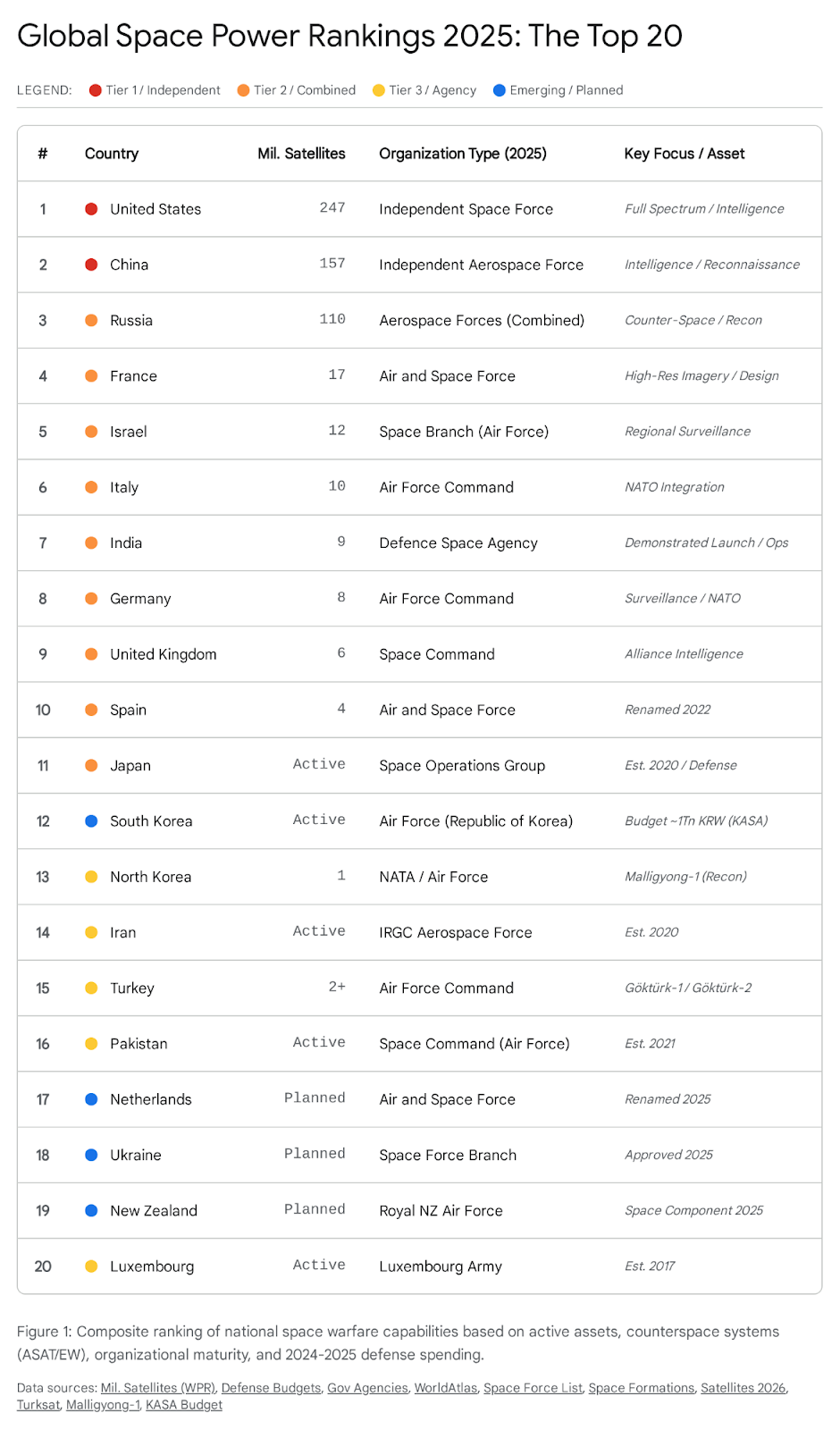
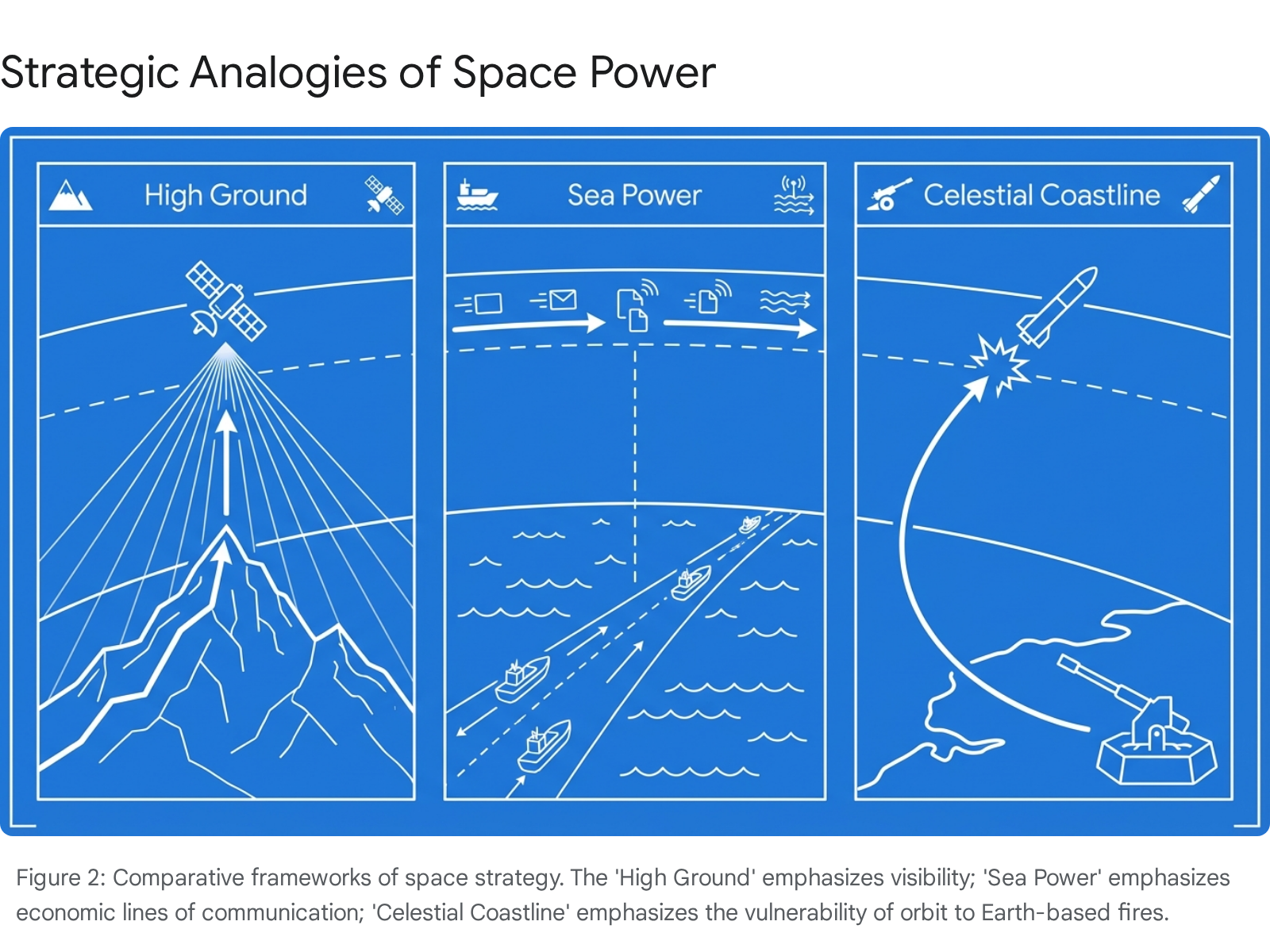
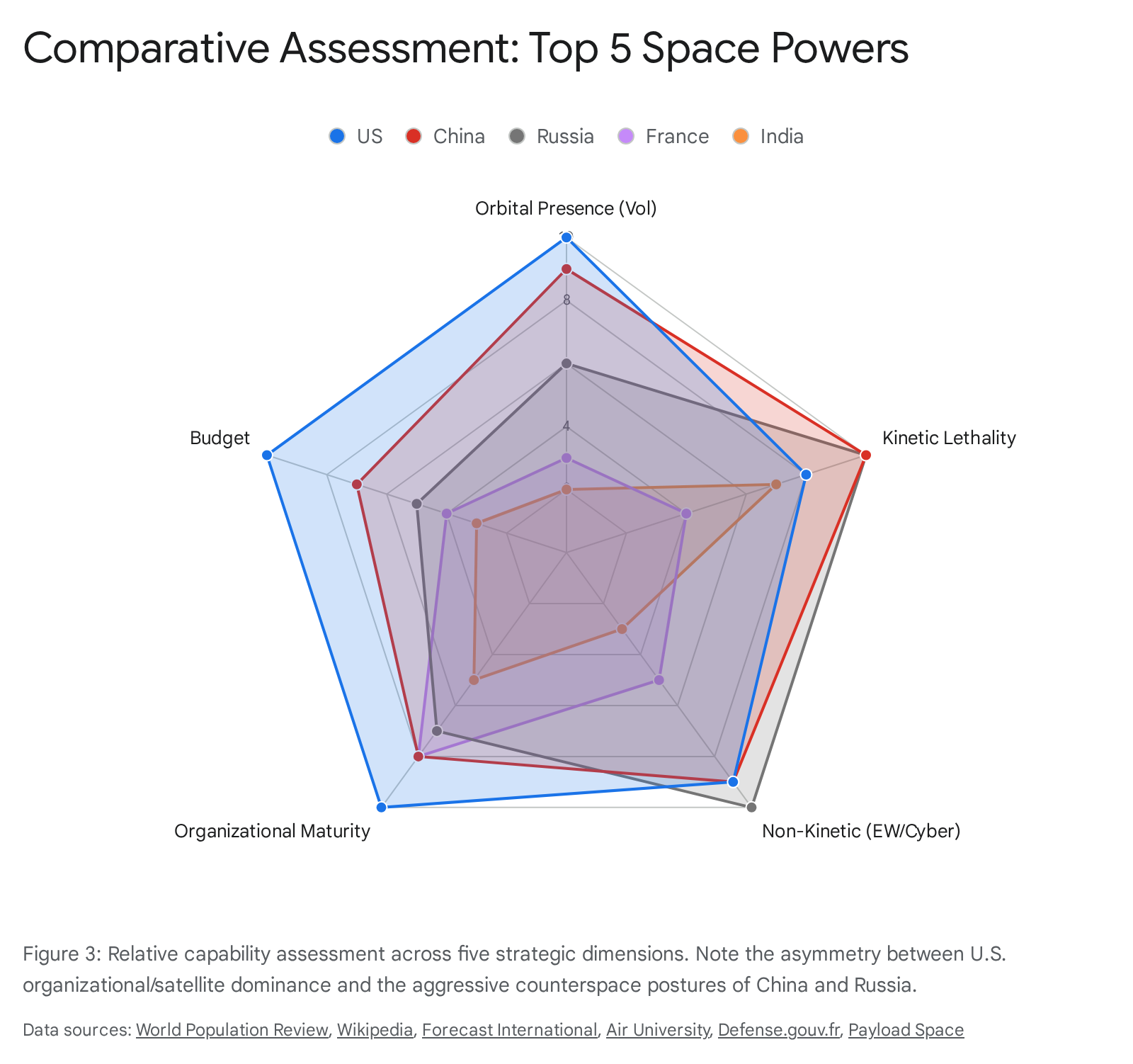
The Military Space Command Ranking: The domain of space has become the ultimate high ground for the top ten powers. The United States maintains a decisive lead with its dedicated Space Command, but China and Russia are aggressively expanding their counter-space capabilities, including ground-based lasers and co-orbital jammers.24 Middle powers like Japan and France have also established dedicated space commands to protect their sovereign satellite constellations, which are essential for the precision-guided munitions that define modern warfare.30

The Quantum Turning Point: Intelligence assessments indicate that 2026 marks a “turning point” for quantum computing.62 AUKUS Pillar II has successfully progressed quantum sensor trials for “undersea navigation in GPS-denied environments,” a capability that allows submarines to operate with absolute stealth.22 Simultaneously, the rise of post-quantum cryptography (PQC) has become a priority for Thales and other European defense firms, as the threat of “Harvest Now, Decrypt Later” looms over current encryption standards.62

Table 6: 2026 Emerging Tech Capability Maturity

Technology DomainLeader2026 StatusImpact on PowerIndex
Agentic AIUSA / IsraelOperational in Cyber/EW 11High (Multiplies Force)
HypersonicsRussia / ChinaActive in Conflict/Drills 7High (Defeats Air Defense)
Quantum SensorsAUKUS (US/UK/AU)Pilot phase for Subs/Nav 22Medium (Stealth Multiplier)
Autonomous SwarmsTurkiye / UkraineMass-produced Attritable Units 6High (Cost-Effective Mass)

Appendix: 2026 World Military Strength Methodology

The methodology utilized to determine the 2026 Global Power Rankings is a multi-layered analytical framework that combines quantitative asset counts with qualitative intelligence-driven performance indicators. This model, developed by a joint team of intelligence and military analysts, is referred to as the Multi-Domain Capability Matrix (MDCM). Unlike traditional indices that rely solely on inventory lists, the MDCM weights actual combat performance, industrial surge capacity, and non-kinetic dominance as primary power drivers.1

A. Core Quantitative Indices (Weight: 40%)

This category evaluates the “hard” assets of a nation’s conventional fighting force.

  • Manpower Index: Total active, reserve, and paramilitary personnel. Crucially, the model applies a “Fit-for-Service” modifier based on age demographics and health standards.37
  • Aerospace Tonnage: Total aircraft fleet, weighted by the percentage of 4th and 5th-generation airframes. Tanker and AEW&C aircraft receive high multipliers for expeditionary reach.24
  • Naval Displacement: Total tonnage of the battle force, with specific bonuses for nuclear propulsion and aircraft carrier quantity/quality.14
  • Land Firepower: Tank strength and armored fighting vehicles, with a 20% weight assigned to self-propelled and towed artillery mass.6

B. The Combat Experience & Readiness Multiplier (Weight: 20%)

The 2026 model introduces a significant bonus for nations with recent large-scale conventional combat experience.

  • Combat Experience (CE): Nations involved in high-intensity war in the last 24 months (e.g., USA, Russia, Ukraine, Israel) receive a 15% bonus to their “Ready Force” score. This reflects the maturation of doctrine, troop hardening, and the identification of tactical failures.5
  • Training and Readiness: Expert survey-based evaluations of command and control (C2), training frequency, and troop morale.36

C. Industrial and Economic Sustainability (Weight: 15%)

Military power is unsustainable without an industrial base capable of replacing losses and an economy that can absorb the costs of total war.4

  • Defense Budget vs. PPP: Absolute spending adjusted for local purchasing power parity. This identifies “budgetary outliers” like Turkiye or Russia that achieve higher output per dollar.6
  • Industrial Surge Capacity: Evaluation of the “shipyard-to-battlefield” pipeline and the ability to produce high-tech munitions (e.g., 155mm shells, interceptor missiles) under pressure.14

D. Non-Kinetic and Emerging Technology (Weight: 25%)

Reflecting the realities of 2026 warfare, this category weights the digital and scientific underpinnings of power.

  • Cyber Warfare Index: Defensive and offensive cyber capability, including the integration of AI for network paralysis.3
  • Nuclear Triad: A “Boolean” multiplier—possession of sea, land, and air-based nuclear deterrents provides a fundamental floor to a nation’s power score.27
  • Space and Quantum: Ability to maintain orbital situational awareness and develop quantum-safe encryption.41

The PowerIndex Formula: The PowerIndex (PwrIndx) is calculated as the sum of weighted scores, where a perfect score of 0.0000 represents the theoretical maximum capability. Penalties are applied for external debt, geographical isolation, and reliance on foreign suppliers.1

PwrIndex=Sumi=1 to n[(Wi x Si) – (Bcombat + Bnuclear) + (Plogistics)]

Where Wi is the weighting, Si is the domain score, B represents bonuses, and P represents penalties. This methodology ensures that a nation like Israel, with a smaller total army, can outrank larger powers through superior technological and combat readiness.18


Please share the link on Facebook, Forums, with colleagues, etc. Your support is much appreciated and if you have any feedback, please email us in**@*********ps.com. If you’d like to request a report or order a reprint, please click here for the corresponding page to open in new tab.


Sources Used

  1. Global Firepower – 2026 World Military Strength Rankings, accessed February 1, 2026, https://www.globalfirepower.com/
  2. The 2026 National Defense Strategy by the Numbers: Radical Changes, Moderate Changes, and Some Continuities – CSIS, accessed February 1, 2026, https://www.csis.org/analysis/2026-national-defense-strategy-numbers-radical-changes-moderate-changes-and-some
  3. Global Cybersecurity Outlook 2026 – World Economic Forum, accessed February 1, 2026, https://reports.weforum.org/docs/WEF_Global_Cybersecurity_Outlook_2026.pdf
  4. Rebalancing Military Spending Towards Achieving Sustainable Development – SIPRI, accessed February 1, 2026, https://www.sipri.org/publications/2025/policy-reports/rebalancing-military-spending-towards-achieving-sustainable-development
  5. Russia And Ukraine Top Global Army Rankings In 2026 – Grand Pinnacle Tribune, accessed February 1, 2026, https://evrimagaci.org/gpt/russia-and-ukraine-top-global-army-rankings-in-2026-525303
  6. Top 10 Powerful Countries In the World 2026 By Military Strength, accessed February 1, 2026, https://vajiramandravi.com/upsc-exam/top-10-powerful-countries-in-the-world-by-military-strength/
  7. Chinese Navy’s goal of projecting power around globe gains steam – The Japan Times, accessed February 1, 2026, https://www.japantimes.co.jp/news/2026/01/15/asia-pacific/chinese-naval-power-analysis/
  8. Global Firepower Military Index 2026: US Leads Top 10; India vs China, Pakistan – The Indian Express, accessed February 1, 2026, https://indianexpress.com/article/trending/top-10-listing/global-firepower-military-2026-us-leads-top-10-india-rank-vs-pakistan-10496390/
  9. United States military buildup in the Caribbean during Operation Southern Spear, accessed February 1, 2026, https://en.wikipedia.org/wiki/United_States_military_buildup_in_the_Caribbean_during_Operation_Southern_Spear
  10. Trump Announces U.S. Military’s Capture of Maduro – Department of War, accessed February 1, 2026, https://www.war.gov/News/News-Stories/Article/Article/4370431/trump-announces-us-militarys-capture-of-maduro/
  11. In Wake of Venezuela, Nonkinetic Effects ‘at the Forefront of Everything We Do’: Official, accessed February 1, 2026, https://www.airandspaceforces.com/venezuela-nonkinetic-effects-forefront/
  12. Russia’s Grinding War in Ukraine – CSIS, accessed February 1, 2026, https://www.csis.org/analysis/russias-grinding-war-ukraine
  13. Russia in Review, Jan. 23–30, 2026, accessed February 1, 2026, https://www.russiamatters.org/news/russia-review/russia-review-jan-23-30-2026
  14. Start 2026 with Most Comprehensive Unclassified Order of Battle for China’s Sea Services! Today’s New “Modern Chinese Maritime Forces” Edition Includes 003 Aircraft Carrier Commissioning & 004 Future Nuclear Carrier! | Andrew S. Erickson, accessed February 1, 2026, https://www.andrewerickson.com/2026/01/start-2026-most-comprehensive-unclassified-order-of-battle-for-chinas-sea-services-todays-new-modern-chinese-maritime-forces-edition-includes-003-aircraft-carrier/
  15. Reviewing The Chinese Navy In 2025 – Part I: The Surface Fleet – Naval News, accessed February 1, 2026, https://www.navalnews.com/naval-news/2026/01/reviewing-the-chinese-navy-in-2025-part-i-the-surface-fleet/
  16. The Military Balance 2025: Editor’s Introduction, accessed February 1, 2026, https://www.iiss.org/publications/the-military-balance/2025/editors-introduction/
  17. Indonesia receives first Rafale advanced fighter jets from France, official says – WHTC, accessed February 1, 2026, https://whtc.com/2026/01/26/indonesia-receives-first-rafale-advanced-fighter-jets-from-france-official-says/
  18. Israel and Iran on the brink: Preventing the next war, accessed February 1, 2026, https://www.iss.europa.eu/publications/briefs/israel-and-iran-brink-preventing-next-war
  19. The Israel-Iran Détente Won’t Last | RAND, accessed February 1, 2026, https://www.rand.org/pubs/commentary/2026/01/the-israel-iran-detente-wont-last.html
  20. NATO Spending Overview: A Structural Change to the Defense Industry – Gabelli, accessed February 1, 2026, https://gabelli.com/research/nato-spending-overview-a-structural-change-to-the-defense-industry/
  21. Strategy & Policy: NATO Members Sign Up for More Spending, accessed February 1, 2026, https://www.airandspaceforces.com/article/strategy-policy-nato-members-sign-up-for-more-spending/
  22. Impact and effort: A menu of AI and autonomy options for AUKUS Pillar II, accessed February 1, 2026, https://www.ussc.edu.au/a-menu-of-ai-and-autonomy-options-for-aukus-pillar-ii
  23. The AUKUS Alliance Has a Lot More to Offer Than Submarines, accessed February 1, 2026, https://www.cfr.org/articles/aukus-alliance-has-lot-more-offer-submarines
  24. 2026 United States Military Strength – Global Firepower, accessed February 1, 2026, https://www.globalfirepower.com/country-military-strength-detail.php?country_id=united-states-of-america
  25. Ranked: The World’s 50 Most Powerful Militaries – Visual Capitalist, accessed February 1, 2026, https://www.visualcapitalist.com/ranked-the-worlds-50-most-powerful-militaries/
  26. Measuring Congressional Sentiment Toward the Maduro Strike, accessed February 1, 2026, https://www.lawfaremedia.org/article/measuring-congressional-sentiment-toward-the-maduro-strike
  27. Top 10 Most Powerful Militaries in the World 2026 Guide – Jaynevy Tours, accessed February 1, 2026, https://www.jaynevytours.com/top-10-most-powerful-militaries-in-the-world.html
  28. Top 5 Navies on Planet Earth in 2026, Now Ranked – 19FortyFive, accessed February 1, 2026, https://www.19fortyfive.com/2026/01/top-5-navies-on-planet-earth-in-2026-now-ranked/
  29. 10 Hot Cyber Range Companies To Watch In 2026 – Cybercrime Magazine, accessed February 1, 2026, https://cybersecurityventures.com/10-hot-cyber-range-companies-to-watch-in-2026/
  30. Strongest Militaries in the World 2026 – Top 10 Most Powerful Armies Ranked, accessed February 1, 2026, https://www.pw.live/defence/exams/top-10-powerful-countries-in-the-world-by-military-strength
  31. ‘Ukraine Is Not Losing, Russia Is Not Winning’: Amid Push For Peace, Here’s How Things Look On The Battlefield, accessed February 1, 2026, https://www.rferl.org/a/ukraine-russia-war-battlefield-defenses-cold/33664826.html
  32. Attrition, Not Victory – Riddle Russia, accessed February 1, 2026, https://ridl.io/attrition-not-victory/
  33. Asia Power Index: United States weakens, China and India rise amid shifting regional dynamics | Lowy Institute, accessed February 1, 2026, https://www.lowyinstitute.org/asia-power-index-united-states-weakens-china-india-rise-amid-shifting-regional-dynamics
  34. [Analysis] The Chinese Navy will have 6 aircraft carriers by 2035, according to the Pentagon, accessed February 1, 2026, https://meta-defense.fr/en/2026/01/06/6-Chinese-naval-aircraft-carriers-by-2035/
  35. Lowy Institute 2025 Asia Power Index Key Findings Report – Scribd, accessed February 1, 2026, https://www.scribd.com/document/957565421/Lowy-Institute-2025-Asia-Power-Index-Key-Findings-Report
  36. lowy-institute-2025-asia-power-index-key-findings-report.pdf, accessed February 1, 2026, https://power.lowyinstitute.org/downloads/lowy-institute-2025-asia-power-index-key-findings-report.pdf
  37. Military Size by Country 2026 – World Population Review, accessed February 1, 2026, https://worldpopulationreview.com/country-rankings/military-size-by-country
  38. Top 10 Militaries In 2026: Powers That Will Decide The Next War’s Outcome – Times Now, accessed February 1, 2026, https://www.timesnownews.com/world/top-10-militaries-in-2026-powers-that-will-decide-the-next-wars-outcome-photo-gallery-153515367
  39. Indonesia receives first Rafale fighter jets from France – Defensehere, accessed February 1, 2026, https://defensehere.com/en/indonesia-receives-first-rafale-fighter-jets-from-france/
  40. Indonesia receives its first 3 Dassault Rafale fighter jets – Aerospace Global News, accessed February 1, 2026, https://aerospaceglobalnews.com/news/indonesia-first-dassault-rafale-fighter-delivery/
  41. The UK R&D ecosystem’s strategic capability towards AUKUS Pillar II: Barriers and opportunities | United States Studies Centre, accessed February 1, 2026, https://www.ussc.edu.au/the-uk-r-and-d-ecosystems-strategic-capability-towards-aukus-pillar-ii
  42. Egypt’s foreign policy will remain too little, too late in 2026 | Chatham House, accessed February 1, 2026, https://www.chathamhouse.org/2025/12/egypts-foreign-policy-will-remain-too-little-too-late-2026
  43. DRC–Egypt Defence Axis: Kinshasa Deepens Strategic Military Partnerships Amid Accelerating Security Pressures, accessed February 1, 2026, https://www.africansecurityanalysis.com/updates/drc-egypt-defence-axis-kinshasa-deepens-strategic-military-partnerships-amid-accelerating-security-pressures
  44. The Military Balance 2025 – The International Institute for Strategic Studies, accessed February 1, 2026, https://www.iiss.org/publications/the-military-balance/2025/the-military-balance-2025/
  45. 2026 Military Strength Ranking – Global Firepower, accessed February 1, 2026, https://www.globalfirepower.com/countries-listing.php
  46. Brazil launches fourth Scorpène submarine – Naval News, accessed February 1, 2026, https://www.navalnews.com/naval-news/2025/11/brazil-launches-fourth-scorpene-submarine/
  47. Brazil Navy receives third Scorpene-class submarine, advancing construction of fourth unit, accessed February 1, 2026, https://www.ir-ia.com/news/brazil-navy-receives-third-scorpene-class-submarine-advancing-construction-of-fourth-unit/
  48. Brazilian Air Force conducts METEOR missile firings with Gripen E – Saab, accessed February 1, 2026, https://www.saab.com/newsroom/press-releases/2025/brazilian-air-force-conducts-meteor-missile-firings-with-gripen-e
  49. Indonesia Takes Delivery of First Rafale Jets Heralding New Era of Air Power in Southeast Asia. – Global Tenders, accessed February 1, 2026, https://global.tendernews.com/newsdetails.aspx?s=8089&t=Indonesia-Takes-Delivery-of-First-Rafale-Jets-Heralding-New-Era-of-Air-Power-in-Southeast-Asia.
  50. Tehran braces for war while testing the limits of diplomacy, accessed February 1, 2026, https://www.iranintl.com/en/202601309750
  51. Israel’s military intelligence chief briefs US officials on Iran: Media, accessed February 1, 2026, https://www.middleeastmonitor.com/20260129-israels-military-intelligence-chief-briefs-us-officials-on-iran-media/
  52. Iran Update, January 30, 2026, accessed February 1, 2026, https://understandingwar.org/research/middle-east/iran-update-january-30-2026/
  53. Military Strength Index by Country 2026 – World Population Review, accessed February 1, 2026, https://worldpopulationreview.com/country-rankings/military-strength-index-by-country
  54. BetEstate Analyzes Spain’s Massive Naval Modernization with 37 Warships and 4 Submarines S-80 – weareiowa.com, accessed February 1, 2026, https://www.weareiowa.com/article/news/local/plea-agreement-reached-in-des-moines-murder-trial/524-3069d9d4-6f9b-4039-b884-1d2146bd744f?y-news-25168175-2026-01-09-betestate-analyzes-spains-massive-naval-modernization-with-37-warships-and-4-submarines-s-80-for-550-million-euros
  55. Spain’s S-80 attack submarine programme progresses – Naval Forces, accessed February 1, 2026, https://naval-forces.info/spains-s-80-attack-submarine-programme-progresses/
  56. The S-80 and the Spanish Submarine Force – University of Navarra, accessed February 1, 2026, https://en.unav.edu/web/global-affairs/el-s-80-y-la-fuerza-submarina-espanola
  57. Spain’s First S-80 Plus Submarine Deploys on First NATO Operation – Naval News, accessed February 1, 2026, https://www.navalnews.com/naval-news/2025/10/spains-first-s-80-plus-submarine-deploys-on-first-nato-operation/
  58. S-80 Plus-class submarine – Wikipedia, accessed February 1, 2026, https://en.wikipedia.org/wiki/S-80_Plus-class_submarine
  59. From shield to showcase: Egypt’s military envoys briefed on 2026 economic ‘turning point’, accessed February 1, 2026, https://www.dailynewsegypt.com/2025/12/27/from-shield-to-showcase-egypts-military-envoys-briefed-on-2026-economic-turning-point/
  60. EU praises Egypt’s constructive role in supporting regional security and stability – Foreign Affairs – Ahram Online, accessed February 1, 2026, https://english.ahram.org.eg/NewsContent/1/1234/561470/Egypt/Foreign-Affairs/EU-praises-Egypt%E2%80%99s-constructive-role-in-supporting.aspx
  61. Ukraine Conflict Monitor: Russia-Ukraine war map – ACLED, accessed February 1, 2026, https://acleddata.com/monitor/ukraine-conflict-monitor
  62. The Top 26 Security Predictions for 2026 (Part 2) – GovTech, accessed February 1, 2026, https://www.govtech.com/blogs/lohrmann-on-cybersecurity/the-top-26-security-predictions-for-2026-part-2
  63. PwC’s 2026 Global Digital Trust Insights report flags OT, IIoT and talent gaps as top cybersecurity challenges – Industrial Cyber, accessed February 1, 2026, https://industrialcyber.co/reports/pwcs-2026-global-digital-trust-insights-report-flags-ot-iiot-and-talent-gaps-as-top-cybersecurity-challenges/
  64. SIPRI Yearbook 2025, accessed February 1, 2026, https://www.sipri.org/yearbook/2025
  65. Top cybersecurity companies to watch in 2026 | Nomios Group, accessed February 1, 2026, https://www.nomios.com/news-blog/top-cybersecurity-companies-2026/
  66. The Military Balance 2026: launch – The International Institute for Strategic Studies, accessed February 1, 2026, https://www.iiss.org/events/2026/02/the-military-balance-2026-launch/

The Strategic Evolution of U.S.-Philippine Defense Relations in the Trump 2.0 Era (2025–2026)

Executive Summary

The geopolitical landscape of Southeast Asia has undergone a fundamental transformation since the re-election of Donald Trump, characterized by a rapid institutionalization of the U.S.-Philippine defense alliance and a pivot toward an aggressive “Strong Denial Defense” posture.1 Guided by the 2025 National Security Strategy (NSS) and the 2026 National Defense Strategy (NDS), the United States has shifted its focus from labeling China a “pacing challenge” to a more nuanced framework of “Realistic Diplomacy” backed by devastating force projection capabilities.1 At the heart of this shift is the establishment of Task Force Philippines in October 2025, a dedicated 60-person joint command based in Manila designed to synchronize bilateral operations, enhance intelligence sharing, and re-establish deterrence in the South China Sea.2

This report examines the multi-domain buildup that has occurred over the past year, including the expansion of the Enhanced Defense Cooperation Agreement (EDCA) to nine strategic locations, the deployment of MQ-9A Reaper drones for persistent surveillance, and the integration of long-range fires such as the Typhon missile system.5 Furthermore, the financial underpinning of this alliance has reached unprecedented levels, with the 2026 National Defense Authorization Act (NDAA) authorizing $2.5 billion in security assistance through the Philippine Enhanced Resilience Act (PERA).8 The results of these initiatives are evidenced by the massive scale of Exercise Balikatan 2025 and more frequent Maritime Cooperative Activities (MCAs) that challenge China’s maritime claims.10 Beijing’s response has been an escalatory pattern of at-sea attrition, doubling its coast guard presence at flashpoints like Scarborough Shoal and conducting high-profile military maneuvers as the region approaches the critical “2027 Window” for potential conflict.13

The Strategic Framework: Realistic Diplomacy and the Strong Denial Doctrine

The return of the Trump administration has introduced a distinct strategic philosophy known as “Realistic Diplomacy,” codified in the 2026 National Defense Strategy.1 This doctrine seeks to de-escalate tensions with the People’s Republic of China (PRC) through “hardnosed realism” while simultaneously building the military capacity to deny China the ability to dominate the First Island Chain.1 Unlike the previous administration’s rhetoric, which emphasized a persistent “pacing challenge,” the 2026 NDS acknowledges that a “decent peace” is possible if the United States maintains a “strong denial defense” that makes the cost of aggression prohibitive.1

The Trump Corollary and Hemispheric Strategic Realignment

A pivotal element of the new strategy is the “Trump Corollary to the Monroe Doctrine,” which aims to restore American preeminence in the Western Hemisphere.16 While primarily focused on securing the U.S. “strategic backyard” and denying regional access to competitors like China and Russia, the corollary has profound implications for the Philippines.16 The strategy posits that a secure Western Hemisphere allows the United States to concentrate its overseas military power more effectively in the Indo-Pacific.16 The January 2026 intervention in Venezuela to capture Nicolás Maduro serves as a demonstration of the administration’s willingness to use overt military force to secure regional interests, a precedent that informs the U.S. approach to contested maritime borders in Asia.16 For the Philippines, this indicates a U.S. that is more transactional and focused on “burden-sharing,” but also more decisive in its regional interventions.16

The Fiscal Foundation: The $1.5 Trillion Defense Budget Goal

The administration’s vision for “peace through strength” is supported by a proposed defense budget topline of $1.5 trillion for fiscal 2027, an increase of more than $500 billion above 2026 levels.1 This massive influx of capital is intended to “supercharge” the defense industrial base and accelerate the production of the next generation of air and sea power.1 In the context of the Philippines, this budget provides the resources necessary to fund the “acquisition bow-wave” required for Re-Horizon 3, the Philippines’ primary military modernization initiative.1

Budget ComponentFY 2026 ProjectedFY 2027 Proposed (Trump Goal)Implications for Pacific Operations
Defense Topline~$850 Billion$1.5 TrillionAccelerated fleet renewal and base hardening 1
Air Force Share (20%)~$170 Billion$300 BillionProcurement of B-21s, F-35As, and E-7s 1
Space Force Share~$30 Billion$45 BillionDevelopment of the “Golden Dome” missile defense 1
Philippine Security Aid$500 Million (PERA)$500 Million (PERA Baseline)Persistent infrastructure and ISR support 8

Institutionalizing Command: The Birth of Task Force Philippines

In one of the most consequential organizational shifts in the history of the alliance, Secretary of War Pete Hegseth announced the establishment of “Task Force Philippines” on October 31, 2025.2 This joint task force represents a transition from episodic support to a “year-round commitment” of staff and resources designed to manage the complexity of a multi-domain theater.4

Structure, Leadership, and Mandate

Based at Camp Aguinaldo in Manila, Task Force Philippines is led by a U.S. Marine Corps one-star general or flag officer.3 The force comprises approximately 60 dedicated personnel from all branches of the U.S. military, working in lockstep with the Armed Forces of the Philippines (AFP).3 The task force’s mandate is broad, covering the entire archipelago and its maritime borders, with a focus on:

  • Operational Interoperability: Improving combined planning and executing joint maritime exercises.2
  • Crisis Response: Enhancing the ability to respond decisively to aggression or natural disasters.3
  • Information Sharing: Facilitating the flow of classified military information and intelligence to counter “gray zone” activities.3
  • Coordination of Activities: Converging all bilateral activities under a single command-and-control umbrella.20

The establishment of this unit signals that the U.S. presence is no longer merely rotational but has an “institutionalized” core that persists between major exercises like Balikatan.3 Critics and analysts suggest that China may test the cohesion of this task force through increased at-sea pressure to see if it truly enhances the Philippine defensive umbrella.3

Evolution from Task Force Ayungin

Task Force Philippines is an expansion of the more narrowly focused “Task Force Ayungin,” which was established in 2024 to support resupply missions to the BRP Sierra Madre at Second Thomas Shoal.4 While Task Force Ayungin was limited to providing intelligence, surveillance, and training support for these specific missions, the new Task Force Philippines is designed to address “all domains of warfare” across the entire Philippine Exclusive Economic Zone (EEZ).20 This change reflects a realization that the Chinese threat is not confined to a single shoal but is a systemic effort to erode Philippine sovereignty across the West Philippine Sea (WPS).6

The EDCA Architecture: Expanding the Strategic Footprint

The Enhanced Defense Cooperation Agreement (EDCA) serves as the primary legal and logistical framework for the U.S. military buildup.5 Since 2023, the number of agreed locations has expanded to nine, with four new sites strategically positioned to face Taiwan and the South China Sea.5

The Nine Strategic Hubs

The nine EDCA sites are distributed to provide a comprehensive defensive net across the First Island Chain.22 The four sites added in 2023—Naval Base Camilo Osias, Camp Melchor Dela Cruz, Lal-lo Airport, and Balabac Island—have been the focus of rapid modernization efforts throughout 2025 and early 2026.5

EDCA SiteLocationStrategic PurposeRecent Developments (2025-2026)
Naval Base Camilo OsiasSanta Ana, CagayanFacing Taiwan; Monitor Bashi ChannelInfrastructure upgrades for joint naval ops 5
Camp Melchor Dela CruzGamu, IsabelaNorthern Luzon defensePrepositioning of ground-based fires 5
Lal-lo AirportLal-lo, CagayanLogistics and Air support hubMultipurpose disaster/military facility 22
Balabac IslandPalawanSouthern flank of South China SeaCoastal defense and radar stationing 5
Basa Air BasePampangaCentral air operations hubMQ-9A Reaper deployment; Runway expansion 6
Fort MagsaysayNueva EcijaLarge-scale troop trainingEnhanced logistics and storage 27
Antonio Bautista ABPalawanProximity to SpratlysMaritime patrol and ISR hub 22
Benito Ebuen ABCebuCentral logistics nexusHumanitarian assistance/disaster hub 5
Lumbia AirportCagayan de OroSouthern surveillanceCounter-terrorism and ISR coordination 5

These locations allow the U.S. to rotate troops for extended stays and build facilities such as warehouses, runways, and fuel storage.5 Under President Ferdinand Marcos Jr., the Philippines has gravitated toward the U.S., allowing for this expansion despite domestic political sensitivities.5

The Taiwan Funding Proposal and Allied Burden-Sharing

In a novel development, the U.S.-China Economic and Security Review Commission recommended in late 2025 that Taiwan help finance upgrades to EDCA sites in the Philippines.22 This proposal aims to strengthen the U.S. ability to defend Taiwan by using the Foreign Military Sales (FMS) program as a mechanism for Taiwan to pay for infrastructure and support services—but not weaponry—at Philippine bases.24 This would provide “political cover” for both nations while enhancing the deterrence capacity of the First Island Chain.24 This recommendation is part of a broader set of 28 proposals to help Manila counter Chinese “malign influence,” including investments in shipbuilding and cyber defense.24

Advanced Capability Deployment: Drones, Missiles, and ACE

The physical presence of U.S. troops is augmented by the deployment of high-end capabilities that significantly alter the tactical balance of the South China Sea.

The MQ-9A Reaper and Persistent Surveillance

In mid-November 2025, the U.S. Marine Corps temporarily deployed MQ-9A Reaper drones to Basa Air Base.6 Belonging to Marine Unmanned Aerial Vehicle Squadron (VMU)-1, these unarmed drones are designed to reinforce the Philippines’ Intelligence, Surveillance, and Reconnaissance (ISR) capabilities.6 The Reaper’s ability to remain airborne for over 27 consecutive hours makes it ideal for monitoring the vast waters of the South China Sea, documenting Chinese maritime coercion in real-time.6 This deployment aligns with the “distributed operations” concept of Force Design 2030, allowing the alliance to provide verified evidence of Chinese actions to the global community.6

The Typhon Missile System and the Strike Range Dilemma

The Typhon missile system, a land-based medium-range launcher capable of firing Tomahawk and SM-6 missiles, remains a critical and controversial fixture in the Philippines.7 First deployed to northern Luzon in April 2024, the system has a strike range of 500 to 2,000 kilometers, sufficient to cover China’s southeastern coast.31 Beijing has repeatedly warned that the prolonged deployment of this “offensive weapon” puts regional security at risk and urges Manila to withdraw it.32

Despite these warnings, the Philippine military has welcomed the system’s presence, with spokesperson Colonel Francel Margaret Padilla stating that “the more [assets] the merrier” for training purposes.34 The U.S. Army’s Third Multi-Domain Task Force is reportedly preparing a second Typhon battery for potential deployment in the Pacific theater, suggesting that land-based fires will be a permanent pillar of the “Strong Denial Defense”.31

Agile Combat Employment (ACE) and Passive Defense

To survive an “opening salvo” attack, the 2026 NDS emphasizes Agile Combat Employment (ACE).1 This concept involves small teams of airmen setting up ad-hoc airfields in remote locations to disperse airpower, making it more difficult for the PLA to mount accurate strikes.1 Experts such as retired Air Force Lt. Gen. David Deptula emphasize that these dispersed sites must be pre-positioned with weapons, fuel, and command systems.1 Passive defense measures, including robust reinforced hangars and hardened shelters, are also prioritized to ensure that U.S. and Philippine assets can withstand a surprise attack.1

High-Intensity Training: Balikatan and Maritime Cooperation

The operational readiness of the alliance is tested through increasingly complex military exercises that simulate real-world regional contingencies.

Exercise Balikatan 2025: All-Domain Readiness

Balikatan 2025 was the largest annual combined military exercise between the U.S. and the Philippines, involving over 14,000 service members from four nations (Philippines, U.S., Australia, and Japan).10 The exercise focused on air and missile defense, maritime security, and counter-landing operations.10 A key event was the sea denial training in the Luzon Strait, which included the deployment of the NMESIS (Navy/Marine Expeditionary Ship Interdiction System) to Batan Island.10 These drills are no longer symbolic; they are “real-world rehearsals” for scenarios involving the defense of Philippine territory and potential spillover from a Taiwan conflict.22

Maritime Cooperative Activities (MCAs) and the Scarborough Flashpoint

Since November 2023, the U.S. and the Philippines have conducted 11 Maritime Cooperative Activities (MCAs) in the South China Sea.37 The first MCA of 2026 took place on January 25-26 near Scarborough Shoal, involving the USS John Finn, the frigate BRP Antonio Luna, and Philippine Air Force FA-50 fighters.11 These activities emphasize interoperability through maneuver exercises and shared maritime domain awareness.12 During the January drill, U.S. carrier strike groups maintained a persistent presence off Western Luzon to provide a protective buffer for the joint maneuvers.11

Exercise/ActivityParticipating AssetsPrimary Mission Focus
Balikatan 202514,000+ troops; NMESIS; B-1 bombersAll-domain defense; Sea denial; Counter-landing 3
Salaknib 2025U.S. & Philippine Army unitsBilateral land-power interoperability; Urban/Jungle ops 27
MCA (Jan 2026)USS John Finn; BRP Antonio Luna; FA-50sFreedom of navigation near Scarborough Shoal 11
ALON 2025Philippine and U.S. MarinesCoastal defense and drone-integrated patrolling 26

Modernizing the AFP: The Re-Horizon 3 Initiative

The Armed Forces of the Philippines are currently undergoing a strategic shift from internal security to territorial defense, a process known as Re-Horizon 3.18 This program, approved by President Marcos Jr. in January 2024, allocates $35 billion over 10 years to procure advanced platforms.28

Procurement Priorities and U.S. Financial Support

The 2026 NDAA provides $2.5 billion in security assistance over five years through the PERA framework, including $500 million in direct grants and $1 billion in loan guarantees.8 This funding is prioritized for:

  • Coastal Defense and Long-Range Fires: Procurement of the Mid-Range Capability (Tomahawk) and HIMARS.8
  • Air Defense: Developing a credible umbrella against aerial incursions.8
  • Maritime Domain Awareness: Strengthening the ability to sense and share data across the archipelago.9

The AFP is also seeking multi-role fighters (likely F-16 C/D Block 70/72) and diesel-electric submarines to establish a sub-surface deterrent.18 The Philippine Navy has recently commissioned its first modern corvettes from South Korea and is integrating the BrahMos supersonic cruise missile into its coastal defense batteries.28

Performance of the TA-50 / FA-50 Light Attack Fleet

The Philippine Air Force (PAF) has focused on the South Korean-built TA-50 and FA-50 aircraft as the backbone of its current fleet. These aircraft are frequently used in MCAs and joint patrols with U.S. forces.11

Manila plans to potentially acquire up to 100 TA-50/FA-50 variants to achieve a high-volume, cost-effective air presence.8

The Adversary Perspective: China’s Escalatory Counter-Strategy

Beijing has viewed the U.S. buildup as a direct threat to its sovereignty and regional stability, leading to a “downward spiral” in bilateral ties.41

Doubling Down at Scarborough Shoal

In 2025, China more than doubled its patrol resources at Scarborough Shoal (Bajo de Masinloc).13 Automatic identification system (AIS) data shows that the China Coast Guard (CCG) recorded 1,099 ship-days at the shoal in 2025, up from 516 in 2024.13 This represents a nearly constant presence of at least three hulls on an average day.13

Feature2024 Ship-Days2025 Ship-DaysStrategic Intent
Scarborough Shoal5161,099Consolidation of control; Nature reserve claim 11
Sabina Shoal~200405Monitor Second Thomas Shoal resupply 13
Second Thomas Shoal288131Reduction due to blockade shift to Sabina 14
Thitu (Pag-asa) Island28151Strategic shift of resources elsewhere 14

In August 2025, a Chinese navy destroyer collided with a CCG vessel while pursuing a Philippine boat near Scarborough, the most severe maritime incident of the year.13 Furthermore, China has declared plans to turn the shoal into a “national nature reserve,” a move seen as a precursor to permanent reclamation.11

Retaliatory PLA Maneuvers and Cognitive Warfare

The PLA Southern Theater Command has begun conducting its own “combat readiness patrols” in direct response to U.S.-Philippine MCAs.11 These patrols involve H-6K bombers armed with anti-ship missiles flying over the shoal area, often crossing into Manila’s designated exercise zones.38 Beijing’s cognitive operations portray the U.S. as a source of instability and the Philippines as a “pawn” in Washington’s Indo-Pacific strategy.19 The MFA urges the Philippines to “take effective measures to undo the egregious impact” of their defense ties or bear the “consequences for their despicable moves”.41

Intelligence Forecast: The “2027 Window” and Alliance Risks

Intelligence analysts widely regard 2027 as a critical point of departure for regional security.15 This date marks the target year for the PLA to achieve the capability to forcibly unify Taiwan with the mainland, a directive allegedly issued by Xi Jinping.15

The Convergence of “Clocks”

The assessment that China may take military action by 2027 is driven by several “clocks” synchronizing for the first time:

  • The Modernization Clock: The PLA’s centenary goal of basic modernization and regional war-winning capability by 2027.15
  • The Political Clock: The end of Xi Jinping’s third term and the January 2028 presidential election in Taiwan, which may signal the end of peaceful unification prospects.15
  • The Deterrence Clock: The U.S. shift toward land-based forces and base hardening (the “Davidson Window”) which Beijing may feel a need to preempt before the U.S. posture becomes impregnable.42

The Stability-Instability Paradox

The alliance faces a stability-instability paradox. While the “Strong Denial Defense” and Task Force Philippines create macro-level stability by deterring a full-scale invasion, they simultaneously encourage China to increase “gray zone” provocations—such as water-cannoning and maritime swarming—to challenge the alliance without crossing the threshold of the Mutual Defense Treaty.3 The risk of a tactical miscalculation resulting in a broader conflict is currently higher than at any time since the 1950s.31

Conclusion: Strategic Resilience and Future Outlook

The U.S. military presence in the Philippines has entered a new phase of permanence and high-intensity integration. The combination of Task Force Philippines, the nine EDCA sites, and the $2.5 billion PERA funding framework provides the Philippines with the tools to transition into a credible regional defender. However, this buildup has also triggered a reciprocal escalation from Beijing, doubling its maritime presence and increasing the lethality of its maneuvers.

As the alliance navigates the “2027 Window,” its success will depend on:

  1. Institutional Continuity: Ensuring Task Force Philippines remains operational and staffed regardless of domestic political shifts in either country.3
  2. Infrastructure Hardening: Accelerating the construction of passive defenses at EDCA sites to survive a potential “opening salvo”.1
  3. Multilateral Expansion: Effectively integrating Japan and Australia into the “Quad Plus” or “SQUAD” frameworks to share the burden of regional security.20
  4. Managing Gray Zone Escalation: Utilizing advanced ISR, such as the MQ-9A Reaper, to document and expose Chinese actions while maintaining “Realistic Diplomacy” to prevent tactical skirmishes from becoming theater-wide wars.1

The U.S.-Philippine alliance is no longer a relationship of convenience but a central pillar of the First Island Chain’s defense architecture, poised at the front line of the most significant strategic competition of the era.


Please share the link on Facebook, Forums, with colleagues, etc. Your support is much appreciated and if you have any feedback, please email us in**@*********ps.com. If you’d like to request a report or order a reprint, please click here for the corresponding page to open in new tab.


Sources Used

  1. National Defense Strategy Prioritizes Western Hemisphere. Where …, accessed January 31, 2026, https://www.airandspaceforces.com/experts-dissect-u-s-resolve-in-pacific-in-new-defense-strategy/
  2. Readout of Secretary of War Pete Hegseth’s Meeting With Philippine Secretary of National Defense – Department of War, accessed January 31, 2026, https://www.war.gov/News/Releases/Release/Article/4333084/readout-of-secretary-of-war-pete-hegseths-meeting-with-philippine-secretary-of/
  3. US-Philippine task force to reestablish South China Sea ‘deterrence’ – Defense News, accessed January 31, 2026, https://www.defensenews.com/global/asia-pacific/2025/11/21/us-philippine-task-force-to-reestablish-south-china-sea-deterrence/
  4. U.S. Unveils Philippine Task Force to Deter Chinese Coercion – USNI News, accessed January 31, 2026, https://news.usni.org/2025/10/31/u-s-unveils-philippine-task-force-to-deter-chinese-coercion
  5. Enhanced Defense Cooperation Agreement – Wikipedia, accessed January 31, 2026, https://en.wikipedia.org/wiki/Enhanced_Defense_Cooperation_Agreement
  6. U.S. Deploys MQ-9A Reaper Drones to the Philippines as South China Sea Tensions Reach New High – Defence Security Asia, accessed January 31, 2026, https://defencesecurityasia.com/en/us-mq9a-reaper-drones-philippines-south-china-sea-tensions/
  7. Dangerous move by the US and Japan heightens the risk of regional confrontation, accessed January 31, 2026, https://www.globaltimes.cn/page/202509/1343663.shtml
  8. Philippines Could Receive $2.5 Billion in Security Aid from U.S. Defense Bill – USNI News, accessed January 31, 2026, https://news.usni.org/2025/12/18/philippines-could-receive-2-5-billion-in-security-aid-from-u-s-defense-bill
  9. NDAA2026 makes available $1.5 billion for the Philippines – Pacific Island Times, accessed January 31, 2026, https://www.pacificislandtimes.com/post/ndaa2026-makes-available-1-5-billion-for-the-philippines
  10. Philippines, U.S. conclude Exercise Balikatan 25 – PACOM, accessed January 31, 2026, https://www.pacom.mil/Media/NEWS/News-Article-View/Article/4180743/philippines-us-conclude-exercise-balikatan-25/
  11. U.S. Destroyer Drills with Philippine Forces Near Scarborough Shoal, accessed January 31, 2026, https://news.usni.org/2026/01/28/u-s-destroyer-drills-with-philippine-forces-near-scarborough-shoal
  12. Philippines, U.S. conduct bilateral Maritime Cooperative Activity – Navy.mil, accessed January 31, 2026, https://www.navy.mil/Press-Office/News-Stories/display-news/Article/4390339/philippines-us-conduct-bilateral-maritime-cooperative-activity/
  13. AMTI: China Coast Guard Focuses its Patrols on Scarborough Shoal, accessed January 31, 2026, https://maritime-executive.com/article/amti-china-coast-guard-focuses-its-patrols-on-scarborough-shoal
  14. China doubled patrols at Scarborough Shoal in 2025, new data shows, accessed January 31, 2026, https://www.philstar.com/headlines/2026/01/30/2504571/china-doubled-patrols-scarborough-shoal-2025-new-data-shows
  15. The Dragon and the Clock—2027 as the Turning Point Year Between China and Taiwan, accessed January 31, 2026, https://www.inss.org.il/publication/china-taiwan-2027/
  16. Trump 2.0 National Security Strategy, Venezuela, And The …, accessed January 31, 2026, https://www.eurasiareview.com/11012026-trump-2-0-national-security-strategy-venezuela-and-the-philippines-analysis/
  17. America’s Military Buildup Around Iran: What We Know and What It Means, accessed January 31, 2026, https://www.meforum.org/mef-reports/americas-military-buildup-around-iran-what-we-know-and-what-it-means
  18. Philippines military modernisation: revamped but not resolved, accessed January 31, 2026, https://www.iiss.org/online-analysis/military-balance/2025/062/philippines-military-modernisation-revamped-but-not-resolved/
  19. China & Taiwan Update, November 7, 2025 | ISW, accessed January 31, 2026, https://understandingwar.org/research/china-taiwan/china-taiwan-update-november-7-2025/
  20. New U.S.-Philippine military task force could evolve into multinational unit, accessed January 31, 2026, https://www.japantimes.co.jp/news/2025/11/28/world/politics/us-philippine-military-task-force/
  21. US media unveils composition of US military task force in Philippines; Chinese experts say it merely ‘placates’ Manila – Global Times, accessed January 31, 2026, https://www.globaltimes.cn/page/202511/1349399.shtml
  22. U.S. report urges Taiwan to fund bases upgrades in the Philippines – Naval News, accessed January 31, 2026, https://www.navalnews.com/naval-news/2025/11/u-s-report-urges-taiwan-to-fund-bases-upgrades-in-the-philippines/
  23. New EDCA Sites Named in the Philippines – Secretary of the Air Force International Affairs, accessed January 31, 2026, https://www.safia.hq.af.mil/IA-News/Article/3357767/new-edca-sites-named-in-the-philippines/
  24. US body wants Taiwan to quietly fund EDCA upgrades in …, accessed January 31, 2026, https://www.philstar.com/headlines/2025/11/21/2488700/us-congressional-panel-taiwan-could-fund-edca-upgrades-philippines
  25. Balikatan 2025 builds Philippine resilience, multinational military capacity, accessed January 31, 2026, https://ipdefenseforum.com/2025/10/balikatan-2025-builds-philippine-resilience-multinational-military-capacity/
  26. US Marines boosts Philippine maritime patrols with drones – Manila Standard, accessed January 31, 2026, https://manilastandard.net/news/314668144/us-marines-boosts-philippine-maritime-patrols-with-drones.html
  27. Philippine and US Army Soldiers commence Salaknib 25, accessed January 31, 2026, https://www.usarpac.army.mil/Our-Story/Our-News/Article-Display/Article/4137299/philippine-and-us-army-soldiers-commence-salaknib-25/
  28. AFP Modernization Act – Wikipedia, accessed January 31, 2026, https://en.wikipedia.org/wiki/AFP_Modernization_Act
  29. New EDCA Sites Named in the Philippines – Department of War, accessed January 31, 2026, https://www.war.gov/News/News-Stories/Article/article/3350297/new-edca-sites-named-in-the-philippines/
  30. The U.S. Marines deployed their MQ-9A drones in support of surveillance tasks in the South China Sea – Zona Militar, accessed January 31, 2026, https://www.zona-militar.com/en/2025/11/21/the-u-s-marines-deployed-their-mq-9a-drones-in-support-of-surveillance-tasks-in-the-south-china-sea/
  31. US expands deployment of Typhon system, stoking up tensions in Northeast Asia, accessed January 31, 2026, http://eng.chinamil.com.cn/2025xb/O_251451/16410639.html
  32. China warns Philippines of dangers of prolonged US missile system deployment, accessed January 31, 2026, http://english.scio.gov.cn/pressroom/2025-02/13/content_117710535.html
  33. US Typhon missile system in Philippines is a subtle headache for China – Defense News, accessed January 31, 2026, https://www.defensenews.com/global/asia-pacific/2025/05/14/us-typhon-missile-system-in-philippines-is-a-subtle-headache-for-china/
  34. Why the deployment of American Typhon System in the Philippines is unsettling news for China ? – YouTube, accessed January 31, 2026, https://www.youtube.com/watch?v=D7bOy8f8D5Y
  35. Philippines, U.S. conclude Exercise Balikatan 25 > U.S. Pacific Fleet > News, accessed January 31, 2026, https://www.cpf.navy.mil/Newsroom/News/Article/4181821/philippines-us-conclude-exercise-balikatan-25/
  36. The steady march of the AFP modernization | Inquirer Opinion, accessed January 31, 2026, https://opinion.inquirer.net/183717/the-steady-march-of-the-afp-modernization
  37. China conducts naval, air patrols around disputed South China Sea shoal, accessed January 31, 2026, https://whtc.com/2026/01/30/china-conducts-naval-air-patrols-around-disputed-south-china-sea-shoal/
  38. China conducts patrols around Scarborough Shoal, days after US-Philippine drills, accessed January 31, 2026, https://www.scmp.com/news/china/military/article/3341949/chinese-military-patrols-scarborough-shoal-5-days-after-us-philippine-drills-area
  39. U.S. Navy Destroyer Joins Philippine Navy Near Contested S. China Sea Shoal, accessed January 31, 2026, https://maritime-executive.com/article/u-s-navy-destroyer-joins-philippine-navy-near-contested-s-china-sea-shoal
  40. Riding Unruly Waves: The Philippines’ Military Modernisation Effort – International Crisis Group, accessed January 31, 2026, https://www.crisisgroup.org/sites/default/files/2025-08/349-philippines-military-modernisation.pdf
  41. Foreign Ministry Spokesperson Guo Jiakun’s Regular Press Conference on January 29, 2026_Ministry of Foreign Affairs of the People’s Republic of China, accessed January 31, 2026, https://www.fmprc.gov.cn/mfa_eng/xw/fyrbt/202601/t20260129_11847373.html
  42. House Select Committee Warns: “The Window to Deter War with China is Closing Fast”, accessed January 31, 2026, https://chinaselectcommittee.house.gov/media/press-releases/house-select-committee-warns-window-deter-war-china-closing-fast
  43. President’s Commentary: Two Countdowns to 2027: Cybersecurity and Indo-Pacific Readiness | AFCEA International, accessed January 31, 2026, https://www.afcea.org/signal-media/test-signal-landing-page-format/presidents-commentary-two-countdowns-2027
  44. The Next Taiwan Crisis Won’t Be Like the Last | Council on Foreign Relations, accessed January 31, 2026, https://www.cfr.org/reports/next-taiwan-crisis-wont-be-last

French Military Small Arms Modernization Overview

The French military apparatus is currently navigating a period of profound technical and doctrinal reconfiguration, necessitated by the shift from expeditionary counter-insurgency operations toward preparations for high-intensity, peer-to-peer conflict. This transformation is anchored in the 2024–2030 Military Programming Law (Loi de Programmation Militaire or LPM), which has significantly increased the defense budget, targeting a €67 billion annual spend by 2030.1 Central to this evolution is a comprehensive overhaul of the small arms inventory across all branches: the Armée de Terre (Army), the Marine Nationale (Navy), the Armée de l’Air et de l’Espace (Air and Space Force), and the Gendarmerie Nationale.

The strategic signature of this period is the final abandonment of the legacy FAMAS bullpup system in favor of the German-engineered Heckler & Koch HK416F, which has successfully standardized the 5.56 mm assault rifle across the armed services.2 This is mirrored in the sidearm category by the mass adoption of the Glock 17 Gen 5 (designated Glock 17 FR), effectively retiring the decades-old MAC 50 and PAMAS G1 pistols.4 Precision fires capability has been revitalized through the acquisition of the FN SCAR-H PR and the HK417, which have marginalized the bolt-action FR F2 in conventional roles.6

For a foreign intelligence analyst, the primary insight lies not merely in the hardware, but in the industrial and doctrinal shift it represents. The closure of the Manufacture d’Armes de Saint-Étienne (MAS) in 2001 marked the end of French domestic small arms production, forcing a transition to a “European strategic autonomy” model. Under this framework, the Directorate-General for Armament (DGA) prioritizes European Union-based procurement, ensuring that while the designs may be foreign, the strategic supply chain remains within the European defense technological and industrial base (EDTIB).8 Furthermore, small arms are now integral components of the “Scorpion” collaborative combat program, where individual weapon systems are networked through the SICS (Information and Combat System) to provide a force-multiplier effect on the modern battlefield.10

Strategic and Doctrinal Context: The “Armée de Combat

The overarching doctrine guiding French small arms procurement in 2025 is the “Armée de combat” (Combat Army) concept. This represents a pivot from the “Peacekeeping” models of the post-Cold War era to a posture capable of high-intensity warfare against technologically sophisticated adversaries.12 The National Strategic Review of 2025 highlights a broader range of threats, including hybrid warfare, sub-threshold competition, and renewed conventional state conflict.1 Consequently, small arms are no longer viewed in isolation but as nodes within a broader ecosystem of lethality and connectivity.

The DGA has accelerated the transition to a “war economy,” characterized by simplified procurement and rapid industrial scaling. This is evident in the relocation of propellant powder production to French territory by companies like Eurenco, aimed at securing the supply of 5.56x45mm and 9x19mm ammunition.11 The shift is also reflected in the “Reactive Acquisition Force,” a DGA task force established to bypass traditional bureaucratic bottlenecks and field urgent capabilities, such as anti-drone technologies, within months rather than years.11

Armée de Terre: The Backbone of Infantry Modernization

The French Army remains the largest consumer of small arms and the primary driver of the “Arme Individuelle Futur” (AIF) program. The integration of new small arms is intrinsically linked to the Scorpion program, which replaces legacy vehicle platforms (VAB, AMX-10RC) with a new generation of interconnected vehicles: the VBMR Griffon, EBRC Jaguar, and VBMR-L Serval.10

The Standard Issue Assault Rifle: Heckler & Koch HK416F

The HK416F is the cornerstone of the Army’s modernization. Selected in 2016 to replace the FAMAS, the HK416F is a customized variant of the HK416A5.2 The Army’s transition to this platform is nearly complete, with over 93,000 units delivered to the Armée de Terre alone as of late 2025.3 The HK416F utilizes a short-stroke gas piston system, which prevents combustion gases from entering the receiver, thereby increasing reliability and reducing heat buildup compared to direct impingement systems.2

The selection of the HK416F was driven by the need for a platform that could easily integrate with the FELIN (Fantassin à Équipement et Liaisons Intégrés) system and the Scorpion networking infrastructure. The rifle features a cold hammer-forged barrel and a four-rail handguard that supports the HK269F 40 mm grenade launcher, laser designators, and various tactical lights.2

Table 1: Technical Specifications of the HK416F Variants

FeatureHK416F-S (Standard)HK416F-C (Short/Commando)
Caliber 5.56×45 mm NATO5.56×45 mm NATO
Barrel Length14.5 inches (368 mm)11 inches (279 mm)
Overall Length (Stock Ext.)931 mm840 mm
Weight (Empty)3.75 kg3.45 kg
Effective Range400 m300 m
Rate of Fire850 rounds/min850 rounds/min
Feed System30-round STANAG magazine30-round STANAG magazine
2

The HK416F-S is the standard version for infantry units, while the F-C is issued to specialized personnel, vehicle crews, and support troops who require a more compact weapon. The standard optic for both variants is the Aimpoint CompM5 red dot sight, which provides rapid target acquisition and a battery life of 50,000 hours.2

Sidearm Modernization: Glock 17 Gen 5 FR

In early 2020, the DGA announced the selection of the Glock 17 Gen 5 as the new “Pistolet Automatique de Nouvelle Génération” (PANG) to replace the MAC 50 and the PAMAS G1 (a licensed Beretta 92FS).4 The total contract covers 74,596 pistols, with approximately 80% destined for the Army.5

The “FR” variant is specifically tailored for French requirements, featuring a coyote tan polymer frame and a black slide. It incorporates a threaded barrel for use with suppressors and features luminescent sights for low-light conditions. The Glock 17 FR utilizes the “Safe Action” system, which includes three independent mechanical safeties, making it a reliable choice for frontline troops who require a weapon that can be drawn and fired without a manual safety lever.4

Table 2: Technical Specifications of the Glock 17 Gen 5 FR

ParameterSpecification
Caliber9×19 mm NATO
ActionStriker-Fired (Safe Action)
Capacity17 rounds (standard)
Weight (Loaded)911 g
Length202 mm
Standard AccessoriesB&T Suppressor, Blackhawk T-Series Holster
Source: 4

Precision Fires and Designated Marksman Rifles

The French Army has significantly overhauled its precision fire capabilities by replacing the aging bolt-action FR F2 with the semi-automatic FN SCAR-H PR (Precision Rifle).6 This platform, chambered in 7.62×51 mm NATO, allows designated marksmen (Tireur de Précision) to engage targets at distances up to 800 meters with rapid follow-up shots.6

The SCAR-H PR is complemented by the HK417 A2, which is utilized by both special forces and conventional marksmen. The HK417 is essentially a larger-caliber version of the HK416, sharing many of the same ergonomics and mechanical principles.5 For long-range anti-materiel and sniper roles, the PGM Hécate II remains the primary system, capable of engaging targets up to 1,800 meters with its powerful.50 BMG cartridge.5

Table 3: Precision and Sniper Systems Spectrum

Weapon SystemCaliberEffective RangeRole
FN SCAR-H PR mm800 mDesignated Marksman
HK417 A2 mm800 mDesignated Marksman
Sako TRG-42.338 Lapua Mag1,200 mSniper / Special Forces
PGM Hécate II.50 BMG1,800 mAnti-Materiel / Sniper
Source: 5

Support Weapons: Machine Guns and Anti-Drone Systems

Squad-level suppressive fire is provided by the FN Minimi, which is available in both 5.56×45 mm and 7.62×51 mm variants.5 The 7.62 mm variant is increasingly favored for its superior range and barrier penetration, a lesson reinforced by combat experience in diverse environments. For medium machine gun roles, the FN MAG 58 has replaced the older AANF1, providing a highly reliable general-purpose machine gun (GPMG) for both dismounted and vehicle-mounted use.6

A notable addition to the Army’s arsenal is the Benelli Supernova Tactical shotgun. While traditionally used for breaching, the French military has procured a 28-inch barrel variant specifically for anti-drone operations.15 This model utilizes 3.5-inch magnum shells, which can pack a higher density of shot pellets, making it an effective kinetic solution for neutralizing low-flying micro-UAVs on the front lines.16

Marine Nationale: Specialization and Shipboard Security

The small arms profile of the French Navy is divided into three distinct spheres: standard shipboard security (Equipages), the Naval Riflemen (Fusiliers Marins) for base and vessel protection, and the elite Naval Commandos (Commandos Marine) for special operations.

Shipboard Security and Fusiliers Marins

The Marine Nationale has mirrored the Army’s adoption of the HK416F as its standard-issue rifle.5 The Fusiliers Marins, responsible for the security of naval bases and sensitive installations (such as the strategic nuclear submarine base at Île Longue), utilize the HK416F-S and F-C depending on their specific assignment.17 The sidearm for these units is the Glock 17 FR, which has replaced the PAMAS G1.5

For boarding teams (Equipe de Visite) conducting Maritime Interdiction Operations (MIO), the HK416F-C is the preferred weapon due to its maneuverability within the cramped confines of a vessel. These teams also utilize the Benelli Supernova for breaching locked hatches and doors.6

Commandos Marine (FORFUSCO)

The Commandos Marine, part of the Special Operations Command (COS), operate with a highly specialized inventory that diverges significantly from conventional forces. Combat swimmers within the Hubert Commando favor the SIG SG 553, which is highly regarded for its corrosion resistance and reliability in marine environments.14

For precision work, the Commandos Marine utilize the Barrett M107A1 in.50 BMG, which offers semi-automatic fire capability for long-range interdiction and anti-materiel tasks.14 They also employ the FN Evolys, a lightweight machine gun that provides belt-fed fire capability in a platform only slightly heavier than a standard assault rifle.14

Table 4: Specialized Small Arms of the Marine Nationale

Unit / RolePrimary SystemSidearmSpecialist Tool
Fusiliers MarinsHK416F-SGlock 17 FRFN Minimi 7.62
Equipe de VisiteHK416F-CGlock 17 FRBenelli Supernova
Commandos MarineHK416A5 / SIG 553Glock 17 / USPBarrett M107A1
Combat DiversSIG SG 553HK USPUnderwater Pistols
5

Armée de l’Air et de l’Espace: Base Protection and CSAR

The Air and Space Force’s small arms requirement is focused on two primary mission sets: the protection of high-value airbases and the Combat Search and Rescue (CSAR) of downed aircrews. The primary units responsible for these missions are the Fusiliers Commandos de l’Air (FCA) and the specialized Air Parachute Commandos (CPA 10, 20, and 30).19

Base Defense: CPA 20 and 30

The CPA 20 and CPA 30 units utilize the HK416F as their standard assault rifle.3 Their role involves the active defense of airbases and the recovery of personnel in contested environments.19 For perimeter security, they utilize the FN Minimi and the HK417.5 Given their frequent proximity to sensitive aircraft, these units are increasingly equipped with anti-drone systems, including the handheld NEROD F5 microwave jammer, which can neutralize the control signals of unauthorized drones without damaging nearby friendly electronics.5

Specialized and CSAR Missions: CPA 10 and Aircrews

CPA 10, which serves as a special operations unit under COS, utilizes more advanced platforms like the SIG MCX VIRTUS. This weapon is prized for its modularity and its ability to fire the.300 AAC Blackout cartridge, which is exceptionally quiet when suppressed, making it ideal for covert infiltration and personnel recovery.14

For aircrew survival, French helicopter and transport crews are equipped with the HK MP7A1 Personal Defense Weapon (PDW).14 Chambered in the high-velocity 4.6 x 30 mm round, the MP7A1 is compact enough to be worn in a holster while in the cockpit but offers far greater range and armor-penetrating capability than a traditional 9 mm handgun.18

Table 5: Air Force Small Arms and Specialist Gear

CategoryPrimary SystemCaliberStrategic Value
Standard FCA RifleHK416F5.56 mmStandardization / Logistics
Aircrew PDWHK MP7A14.6 mmCompact / AP Capability
CPA 10 SpecializedSIG MCX VIRTUS.300 BLKStealth / Modularity
Precision SniperCadex CDX-40.408 CheyTacExtreme Range Neutralization
Source: 14

Gendarmerie Nationale: The Internal-Military Hybrid

The Gendarmerie Nationale occupies a unique position as a military force with police status. Their small arms inventory reflects this dual mission, requiring weapons suitable for both routine law enforcement and counter-terrorism/military intervention.

Standard Sidearm: SIG Pro SP 2022

The Gendarmerie continues to use the SIG Pro SP 2022 as its standard-issue pistol.13 Selected in 2002 for its durability and polymer construction, the SP 2022 is a double-action/single-action (DA/SA) hammer-fired pistol, which provides a layer of safety for officers in high-stress situations due to its heavy first trigger pull.23 Despite the military’s shift to the Glock 17, the Gendarmerie remains satisfied with the SIG platform for domestic security duties.22

Submachine Gun Procurement: HK UMP

In response to a solicitation for a collective weapon with greater range and fire volume than a handgun, the Gendarmerie (along with the National Police) selected the HK UMP in 9 x 19 mm.25 The contract awarded to Heckler & Koch France SAS includes 2,000 operational units.25 The UMP utilizes a simple blowback action and a polymer frame, making it lighter and more cost-effective than the legacy MP5, while its Picatinny rails allow for the easy mounting of tactical lights and optical sights.25

Table 6: Gendarmerie Small Arms Profile

Weapon CategorySystemCaliberPrimary User
Duty PistolSIG SP 20229 x 19 mmGeneral Duty
Intervention SMGHK UMP99 x 19 mmPSIG / Specialized Units
High-Threat RifleHK G365.56 mmGIGN / AGIGN
Intervention RifleHK4165.56 mmGIGN
Source: 13

Elite Intervention: GIGN

The Groupe d’Intervention de la Gendarmerie Nationale (GIGN) possesses an expansive arsenal, ranging from the HK G36 to the HK416. They are known for utilizing niche systems like the CZ 805 BREN 2 in 7.62 x 39 mm, which was selected for its superior stopping power in close-quarters urban environments. They also employ various precision rifles, including the PGM Ultima Ratio in 7.62 mm for short-to-medium range surgical intervention.13

Special Operations Command (COS): Technical Excellence

The Commandement des Opérations Spéciales (COS) oversees special operations across all branches, ensuring that units like the 1er RPIMa (Army), Commandos Marine (Navy), and CPA 10 (Air Force) have access to the most advanced hardware available. COS units often serve as the first to field new technologies that later trickle down to conventional forces.

Standardized vs. Specialist Weapons

While special operations forces use the HK416A5 as their baseline rifle, they have heavily adopted the SIG MCX VIRTUS for missions requiring specialized suppression and compactness.14 They also utilize the FN SCAR-L and SCAR-H for specific mission profiles requiring modularity and range.5

For heavy suppression, COS units are equipped with the Dillon Aero M134D Minigun, mounted on vehicles and helicopters.14 They also utilize the HK GMG automatic grenade launcher for engaging clustered enemy infantry and light vehicles at distances up to 2,000 meters.14

Table 7: COS Specialized Small Arms Inventory

SystemCaliberApplicationAdvantage
SIG MCX VIRTUS5.56 /.300 BLKInfiltration / CQBCaliber Modularity
FN Evolys5.56 / 7.62 mmLight SupportHigh Lethality/Low Weight
Dillon M134D7.62 mmAerial/Vehicle Defense3,000 rounds/min ROF
HK MP5 SD9 mmStealth / Hostage RescueIntegrated Silencer
Source: 14

Anti-Tank and Heavy Infantry Systems

The modernization of French small arms extends to man-portable anti-tank and support systems. The Army has fully transitioned to the Akeron MP (Moyenne Portée), a fifth-generation anti-tank guided missile (ATGM) that replaces the MILAN and Javelin.5 The Akeron MP is a “fire-and-forget” system that also allows for manual intervention via a fiber-optic link, enabling the operator to engage targets out of the line of sight.5

For shorter-range engagement, the Saab AT4CS and the Nammo M72 LAW remain standard for their reliability and ease of use in urban warfare.14 Furthermore, the introduction of the Carl Gustaf M4 (84 mm recoilless rifle) has provided infantry squads with a versatile platform capable of firing anti-armor, anti-structure, and anti-personnel rounds, including programmable airburst munitions.6

Table 8: Man-Portable Support Weapons

SystemTypeCaliberTactical Role
Akeron MPATGM140 mmHigh-Precision Anti-Tank
Carl Gustaf M4Recoilless Rifle84 mmVersatile Direct Fire
Saab AT4CSRocket Launcher84 mmCompact Anti-Armor
HK GMGAuto Grenade Launcher40 mmArea Suppression
Source: 5

Individual Equipment and Optronics: The Force Multiplier

The effectiveness of modern French small arms is fundamentally tied to the “small equipment” modernization initiative, which includes new ballistic protection, uniforms, and optronics.5

Night Vision and Thermal Sights

The Thales JVN O-NYX night vision goggles have replaced the older Lucie models, providing soldiers with a wider field of view and improved image clarity.5 For precision shooters, the SCROME and Schmidt & Bender day scopes are complemented by thermal imaging clip-on systems, such as the Safran JIM Compact and the Thales Sophie, which allow for target detection in complete darkness and through obscurants like smoke and fog.5

Handheld Jammers and Electronic Warfare

Reflecting the modern threat environment, the French infantry is increasingly equipped with handheld electronic warfare tools. The NEROD RF and NEROD F5-5 jammers are designed to disrupt the control and GPS signals of enemy drones, providing a critical defensive layer for ground units.13 These systems are man-portable and shaped like a rifle, allowing for intuitive aiming and deployment in high-stress situations.13

Industrial Realities and Strategic Autonomy

From an intelligence perspective, the most critical aspect of French small arms procurement is the reliance on foreign manufacturers. The closure of the Saint-Étienne arsenal created a void that has been filled primarily by German (Heckler & Koch), Belgian (FN Herstal), and Austrian (Glock) firms.2

To mitigate this dependency, France has emphasized a “European pillar” within its procurement strategy. The DGA ensures that contracts are awarded to European firms and often requires that a portion of the maintenance or component production be handled within France or the broader EU.8 For instance, the recent contract for anti-tank mines mandates that all design and assembly occur within EU territory, a clause aimed at protecting the strategic sovereignty of the European defense industrial base.9

Moreover, the “war economy” model introduced in response to the Russia-Ukraine conflict has seen a massive effort to stockpile small-caliber ammunition. The relocation of propellant powder manufacturing back to France is a clear indicator that the Ministry of the Armed Forces views domestic logistics as a critical component of military readiness in the 2025–2030 timeframe.11

Future Outlook: Caliber Standardization and the 6.8 mm Debate

As the French Armed Forces conclude their transition to the HK416F and Glock 17 FR, the next major strategic hurdle will be the potential emergence of a new NATO caliber. The U.S. Army’s Next Generation Squad Weapons (NGSW) program, which utilizes the 6.8×51 mm cartridge, has initiated discussions within French defense circles regarding the longevity of the 5.56 mm standard.3

While there is currently no formal plan for France to move toward 6.8 mm, the DGA and the Defence Staff are closely monitoring the operational feedback from the U.S. deployment of the XM7 rifle. Any future transition would likely be a decade-long process, given that the delivery of the HK416F fleet is scheduled to conclude in 2028.3 For the immediate future (2025–2030), the focus remains on perfecting the integration of the current 5.56 mm and 7.62 mm platforms into the Scorpion digital battlefield.

Conclusion

The small arms of the French Armed Forces in 2025 represent a balance between technical maturity and strategic necessity. By standardizing the HK416F and Glock 17 FR across all branches, France has simplified its logistics while significantly enhancing the lethality and reliability of its infantry. The specialization of Naval Commandos and Air Force CSAR units with systems like the SIG MCX and HK MP7 ensures that niche requirements are met with world-class technology.

Underpinning these physical assets is a robust digital and industrial framework. The Scorpion program transforms the individual soldier from an isolated combatant into a networked sensor, while the DGA’s focus on European strategic autonomy and a “war economy” ensures that the French military remains resilient in the face of shifting global power dynamics. As France moves toward 2030, its small arms inventory will continue to be a reflection of its broader ambition: to be a globally influential power capable of autonomous action in an increasingly volatile security landscape.


Please share the link on Facebook, Forums, with colleagues, etc. Your support is much appreciated and if you have any feedback, please email us in**@*********ps.com. If you’d like to request a report or order a reprint, please click here for the corresponding page to open in new tab.


Sources Used

  1. French rearmament: Between strategic review and financial realities – European Security & Defence – Euro-sd, accessed February 1, 2026, https://euro-sd.com/2025/11/articles/armament/47665/french-rearmament-between-strategic-review-and-financial-realities/
  2. In-Depth Analysis of the French Army’s Adoption of the German …, accessed February 1, 2026, http://oreateai.com/blog/indepth-analysis-of-the-french-armys-adoption-of-the-german-hk416f-assault-rifle-and-its-bayonet/0721cc0f19d3c0e562224b1611667e33
  3. Assault rifle programmes: Continuity and change – Euro-sd, accessed February 1, 2026, https://euro-sd.com/2025/03/articles/43053/assault-rifle-programmes-continuity-and-change/
  4. Glock 17 Gen5 for France: the “Pistolet Automatique de Nouvelle Génération” (PANG), accessed February 1, 2026, https://www.all4shooters.com/en/shooting/pro-zone/glock-17-gen5-for-france-here-is-the-pistolet-automatique-de-nouvelle-generation-pang/
  5. List of equipment of the French Army – Wikipedia, accessed February 1, 2026, https://en.wikipedia.org/wiki/List_of_equipment_of_the_French_Army
  6. French Foreign Legion Equipment, accessed February 1, 2026, http://foreignlegion.info/equipment/
  7. New Guns for The French Army – Small Arms Defense Journal, accessed February 1, 2026, https://sadefensejournal.com/new-guns-for-the-french-army/
  8. Strategic autonomy and European competitiveness: Security now comes first, accessed February 1, 2026, https://www.europarl.europa.eu/RegData/etudes/STUD/2025/764371/ECTI_STU(2025)764371_EN.pdf
  9. France’s Strategic Pursuit of Defense Autonomy: The 2025 MI-AC PR Anti-Tank Mine Tender and the Evolution of European Security Industrial Policy – https://debuglies.com, accessed February 1, 2026, https://debuglies.com/2025/07/29/frances-strategic-pursuit-of-defense-autonomy-the-2025-mi-ac-pr-anti-tank-mine-tender-and-the-evolution-of-european-security-industrial-policy/
  10. Benchmarking the French Army’s ‘model’ modernisation program, accessed February 1, 2026, https://researchcentre.army.gov.au/library/land-power-forum/benchmarking-french-armys-model-modernisation-program
  11. How is the French Army changing? – Ministère des Armées, accessed February 1, 2026, http://www.defense.gouv.fr/en/news/how-french-army-changing
  12. French Foreign Legion in 2025, accessed February 1, 2026, http://foreignlegion.info/2025/01/15/french-foreign-legion-in-2025/
  13. The different weapons used in the French army – Vet securite, accessed February 1, 2026, https://vetsecurite.com/en/blog/the-different-weapons-used-in-the-french-army-n423
  14. French special forces equipment – Euro-sd, accessed February 1, 2026, https://euro-sd.com/2025/04/articles/43433/french-special-forces-equipment/
  15. Benelli Supernova – Wikipedia, accessed February 1, 2026, https://en.wikipedia.org/wiki/Benelli_Supernova
  16. This is why France chose the Benelli SuperNova as its new shotgun – Sandboxx, accessed February 1, 2026, https://www.sandboxx.us/news/this-is-why-france-chose-the-benelli-supernova-as-its-new-shotgun/
  17. Fusiliers marins – Wikipedia, accessed February 1, 2026, https://en.wikipedia.org/wiki/Fusiliers_marins
  18. French special forces: composition and equipment. Part I – ВПК.name, accessed February 1, 2026, https://vpk.name/en/995046_french-special-forces-composition-and-equipment-part-i.html
  19. French Air and Space Force Special Forces Brigade (BFSA) – Grey Dynamics, accessed February 1, 2026, https://greydynamics.com/french-air-and-space-force-special-forces-brigade-bfsa/
  20. French Air and Space Force Facts for Kids, accessed February 1, 2026, https://kids.kiddle.co/French_Air_and_Space_Force
  21. MP7 – Heckler & Koch, accessed February 1, 2026, https://www.heckler-koch.com/en/Products/Military%20and%20Law%20Enforcement/Submachine%20guns/MP7
  22. Sig Sauer Had a Strategy to Defeat Glock’s Guns—Did It Work? – The National Interest, accessed February 1, 2026, https://nationalinterest.org/blog/reboot/sig-sauer-had-strategy-defeat-glocks-guns-did-it-work-190438/
  23. Glock 17 vs. Sig SP2022: What’s the Difference? – Wright Leather Works, accessed February 1, 2026, https://www.wrightleatherworks.com/blogs/article/glock-17-vs-sig-sp2022
  24. SIG Sauer SP2022 – Police Magazine, accessed February 1, 2026, https://www.policemag.com/articles/sig-sauer-sp2022
  25. REPORT: French National Police, Gendarmerie Select the HK UMP …, accessed February 1, 2026, https://athlonoutdoors.com/article/french-national-police-hk-ump/
  26. The HK UMP: Heckler & Koch’s versatile submachine gun – Vet securite, accessed February 1, 2026, https://vetsecurite.com/en/blog/the-hk-ump-the-versatile-submachine-gun-from-heckler-koch-n428
  27. MP5 – Heckler & Koch, accessed February 1, 2026, https://www.heckler-koch.com/en/Products/Military%20and%20Law%20Enforcement/Submachine%20guns/MP5

SITREP Global Conflicts & Disputes- Week Ending February 06, 2026

Executive Summary

The geopolitical landscape for the week ending February 6, 2026, is characterized by the convergence of kinetic escalation, the collapse of short-term diplomatic truces, and a transformative shift in the nature of non-state actor participation in global conflict. In Eastern Europe, the termination of a brief energy moratorium has led to the most intensive aerial bombardment of the Ukrainian power grid since the conflict’s inception, signaling a Russian commitment to a protracted war of attrition despite immense casualty rates.1 Concurrently, the Middle East is navigating a precarious “new geopolitical moment” defined by Iranian ballistic missile deployments and the fragile implementation of a landmark agreement between the Syrian government and Kurdish forces.3

In Sub-Saharan Africa, the Sudanese civil war has reached a grim milestone of 1,000 days, increasingly fueled by regional rivalries and the involvement of international mercenary networks.6 The central Sahel region is witnessing a qualitative shift as the Russian-controlled Africa Corps formally assumes the operational mantle from the disbanded Wagner Group, further entrenching Moscow’s influence in Mali and Burkina Faso amidst a failing regional security architecture.8

The Indo-Pacific is under strain from both internal and external pressures. The People’s Republic of China is undergoing a significant internal military purge targeting the highest echelons of the People’s Liberation Army leadership, a move interpreted by intelligence analysts as a consolidation of power ahead of 2027 modernization milestones.10 In Southeast Asia, Myanmar’s military junta has utilized a disputed electoral process to entrench its authority, even as resistance forces consolidate control over nearly 80 percent of the territory.11 Finally, in the Americas, Haiti faces a critical governance vacuum as the transitional government’s mandate expires, leaving the capital almost entirely in the hands of sophisticated criminal coalitions.13 These crises are underpinned by a global economic environment of resource scarcity and a cyber domain increasingly dominated by AI-enabled disinformation and infrastructure disruption.15

Eastern Europe: Russia-Ukraine Attrition and Infrastructure Degradation

Escalation of the Strategic Bombing Campaign

The tactical pause in energy infrastructure strikes, previously facilitated by international mediation, collapsed on February 2, 2026. Russian forces subsequently launched a massive, coordinated aerial assault involving approximately 450 drones and 71 missiles.1 This strike was meticulously timed to coincide with a severe cold front, with temperatures in parts of Ukraine plummeting to -13 degrees Fahrenheit.1 Intelligence suggests this campaign aims not merely at technical degradation but at a systematic dismantling of the civilian will to resist by weaponizing the winter.

The impact has been catastrophic for the Ukrainian energy sector. In Kharkiv, a primary power plant was damaged beyond repair, a loss that has left approximately 300,000 residents without electricity.1 In the capital, Kyiv, the assault resulted in the cessation of heating for over 1,170 high-rise buildings.1 This degradation follows a period of earlier grid fragility; on January 31, a major shutdown occurred on the 400-kW and 750-kW lines connecting the Moldovan and Romanian systems with central Ukraine.17 Although Ukrainian authorities initially characterized the January 31 event as a technological disruption rather than a direct kinetic strike, the cumulative effect of nearly four years of sustained attacks has left the national grid in a state of terminal vulnerability.17

Frontline Dynamics and Territorial Realities

On the ground, the war remains a grinding conflict of attrition. Data analysis for the period between January 6 and February 3, 2026, indicates that Russian forces gained approximately 123 square miles of Ukrainian territory, an increase from the 74 square miles gained in the preceding four-week cycle.1 This territorial expansion, primarily located in the Dnipropetrovsk and Zaporizhzhia regions, underscores a shift in the strategic initiative toward the Russian military.1

The Russian command appears to be exploiting adverse winter conditions to negate Ukrainian advantages in drone surveillance. Ukrainian units in northern Kharkiv and Sumy report that Russian forces are launching high-attrition assaults during periods of poor visibility that grounded traditional reconnaissance drones.17 In response, Ukrainian forces have pivoted to First-Person View drones for patrolling heavily forested areas, such as the Serebryanske forest, to detect Russian infiltrators.17 Despite these tactical gains, Russia’s broader strategic performance remains characterized by extreme costs; casualty rates are projected to reach a cumulative total of 2 million for both sides by the spring of 2026.2

Economic Warfare and Sanctions Evasion

The international community continues to leverage economic tools to degrade the Russian war effort, but circumvention remains a pervasive challenge. In late January 2026, the European Anti-Fraud Office (OLAF) coordinated an investigation into the suspected circumvention of EU sanctions involving 766 transport vehicles.18 These vehicles were declared as destined for Turkey but were diverted to Russia via intermediaries in Armenia, Georgia, Kazakhstan, Kyrgyzstan, and Moldova.18 Furthermore, the EU has formally adopted a regulation to phase out Russian pipeline gas and LNG imports by late 2027, and a ban on refined oil products produced in third countries using Russian crude took effect on January 21, 2026.18

Military MetricStatistic (as of Feb 3, 2026)Source
Russian Territorial Gain (4 Weeks)123 Square Miles1
Total Russian Territorial Control~45,762 Square Miles (13% of Ukraine)1
Combined Projected Casualties2,000,000 (by Spring 2026)2
Daily Rate of Advance15–70 Meters2
Russian Casualties (Since Feb 2022)~1.2 Million2

The Middle East: Strategic Posturing and Regional Realignments

Iran: The Khorramshahr-4 Deployment and Coercive Diplomacy

The Iranian government has significantly hardened its military and diplomatic posture this week. On February 4, 2026, Tehran announced the combat deployment of the Khorramshahr-4 medium-range ballistic missile.4 This system represents a critical evolution in Iran’s deterrent capabilities, utilizing hypergolic liquid fuel that reduces launch preparation time to approximately 12 minutes.4 With a range and payload capacity capable of delivering warheads between 1,500 and 1,800 kilograms, the Khorramshahr-4 is explicitly designed to penetrate layered missile defense systems.4

The deployment occurred mere hours before scheduled diplomatic talks in Oman, a move that intelligence analysts interpret as a “calculated effort to harden Iran’s negotiating posture” by establishing irreversible military facts on the ground.4 Within the Iranian regime, a consensus is reportedly forming that limited retaliatory actions are no longer sufficient to deter U.S. or Israeli military intervention; instead, some policymakers believe that only the credible threat of a “prolonged, costly war” can prevent an attack on the Iranian homeland.5 This strategic shift takes place against a backdrop of domestic instability, following an exceptionally violent crackdown on nationwide protests that resulted in thousands of deaths.19

The Levant: Conflict Resilience in Gaza and the West Bank

In the Palestinian territories, the October 2025 ceasefire is increasingly fragile. The transition toward the “Trump peace plan” has stalled as Hamas refuses to disarm, a prerequisite for the full withdrawal of Israeli forces.20 This deadlock has exacerbated a humanitarian crisis that is now entering its third winter. Between October 7, 2023, and late January 2026, at least 71,667 Palestinians have been killed in the Gaza Strip.21 By January 27, 2026, hypothermia had already claimed the lives of 11 children in makeshift shelters.21

In the West Bank, the security situation is deteriorating as Israeli forces extended a military order linked to operation “Iron Wall” until March 31, 2026.21 This operation has resulted in the emptying of major refugee camps, including Jenin, Nur Shams, and Tulkarm, with 33,000 residents currently displaced.21 Economic and social pressures are mounting as UNRWA installations in East Jerusalem have seen their water and electricity services cut following the implementation of Israeli laws targeting the agency’s operations.21

Syria and the Red Sea: Shifting Proxies and Maritime Threats

A significant geopolitical development occurred in Syria on January 30, 2026, when the Syrian government and the Kurdish-led Syrian Democratic Forces (SDF) reached a 14-point agreement for the gradual integration of the SDF into the Syrian state.5 Public endorsement of the deal by high-ranking SDF commanders, such as Sipan Hamo, suggests that internal Kurdish opposition to state integration may be softening, potentially reducing the risk of a Kurdish-led insurgency in the northeast.5

However, the threat of maritime escalation persists. The Houthi movement in Yemen remains a critical variable; while they largely paused attacks on commercial shipping after the October ceasefire, analysts warn that any resumption of large-scale kinetic activity in Gaza will trigger a renewed Houthi campaign in the Red Sea.20 Furthermore, internal divisions in Yemen are deepening, with southern factions increasingly at odds with both the Houthi movement and each other, potentially leading to the formal secession of southern Yemen.20

Iranian Missile CapabilitySpecification (Khorramshahr-4)Source
TypeMedium-Range Ballistic Missile (MRBM)4
Fuel SystemLiquid-fuel (Hypergolic)4
Preparation Time~12 Minutes4
Payload Capacity1,500–1,800 kg4
Strike Time (to Israel)10–12 Minutes4

Sub-Saharan Africa: Civil War, Fragmentation, and Paramilitary Influence

The Crisis in Sudan: 1,000 Days of Conflict

As of January 2026, the civil war in Sudan has passed the 1,000-day mark, transitioning into a deeply regionalized conflict of power and profit.6 This week, the Sudanese Armed Forces (SAF) achieved a notable tactical breakthrough by lifting the siege on Kadugli, the capital of South Kordofan, which had been surrounded by the Rapid Support Forces (RSF) for months.23 However, this gain was offset by RSF drone strikes on the city, which killed 15 civilians and struck a military hospital.7

The conflict is increasingly characterized by the use of sophisticated technology and the recruitment of international mercenaries. The SAF recently claimed to have downed a Turkish-made Bayraktar Akıncı drone operated by the RSF.7 Simultaneously, the United Kingdom has imposed sanctions on Colombian nationals accused of recruiting former soldiers as mercenaries for the RSF, highlighting the globalized nature of the Sudanese war economy.7 The humanitarian toll is staggering; approximately 11.7 million people have been displaced, and 7 million face catastrophic levels of famine.6

The Sahel and the Formalization of Russian Influence

The security situation in the central Sahel—Mali, Burkina Faso, and Niger—is deteriorating as jihadist groups consolidate territorial influence and target strategic economic nodes, such as fuel and logistics routes.24 A critical shift in the regional security architecture occurred this week with the consolidation of the Russian “Africa Corps,” an entity managed by the Russian Ministry of Defense that has largely subsumed the operations of the former Wagner Group.9

In Mali, the Africa Corps has established its primary concentration in Bamako and the central regions, while approximately 1,500 Wagner personnel remain in the north.9 In Burkina Faso, the Africa Corps has established a military base in Loumbila to support the Traoré regime.9 This transition represents a shift from a “military-business model” to a more explicit state-controlled deployment designed to counter Western influence and secure access to strategic resources, including gold in Mali and uranium in Niger.9 Despite these deployments, the security situation remains unstable; an ongoing fuel blockade in Mali is testing the junta’s legitimacy, and Burkina Faso has emerged as the country most affected by terrorism globally.8

South Sudan: Renewed Internal Conflict

South Sudan is experiencing a significant escalation in sub-national violence. In Jonglei State, clashes between the national army (SSPDF) and the SPLM-iO opposition have displaced approximately 280,000 people since late December 2025.26 Airstrikes were reported in Akobo County on February 2, leading to an immediate suspension of humanitarian activities in the region.26 This instability has facilitated a national cholera outbreak, with nearly 98,000 cases recorded as of early February 2026, further straining the country’s threadbare healthcare system.26

Regional ActorKey Operation / DevelopmentImpact / OutcomeSource
Africa CorpsSubsumed Wagner Group structures in Sahel.Centralized Russian MoD control in Mali/Niger.9
Sudanese Army (SAF)Retook Al-Dashol; broke Kadugli siege.Temporary relief of urban blockades.7
RSF (Sudan)Cross-border attack into Chad; drone strikes.Externalization of conflict; urban terror.7
SPLM-iO (S. Sudan)Conflict with SSPDF in Jonglei.Displacement of 280,000 civilians.26

Indo-Pacific: Contested Hegemony and Internal PLA Purges

The People’s Republic of China: Internal Purges and Military Readiness

A profound structural shift is underway within the leadership of the People’s Liberation Army (PLA). On January 25, 2026, the PRC announced investigations into CMC Vice Chairman Zhang Youxia and CMC Joint Staff Department Chief Liu Zhenli.10 Intelligence reports from the PLA Daily on January 31 and February 2 indicate these purges were necessary to “remove political threats” and ensure absolute obedience to General Secretary Xi Jinping’s command.10

Analysts suggest that Zhang and Liu may have disagreed with the rapid modernization goals set for 2027, which include the capability to successfully execute an invasion of Taiwan.10 This purge is distinct from previous anti-corruption efforts as it explicitly cites political obstacles rather than financial crimes, signaling a “ideological hardening” of the military leadership ahead of potential regional conflict.10

Taiwan Strait and South China Sea Coercion

Maritime and aerial pressure on Taiwan remains at historically high levels. In January 2026, the PRC sent 30 high-altitude balloons into Taiwan’s ADIZ, 21 of which violated territorial airspace.10 Simultaneously, the Taiwan Coast Guard Administration expanded its list of “suspicious” PRC vessels from 300 to 1,900, following reports of massive blockade-like formations involving the Chinese Maritime Militia in the East China Sea.10

Taiwan’s internal political landscape is complicating its defense posture. Opposition parties have repeatedly blocked the proposed $40 billion defense budget, favoring a reduced $13 billion version that omits critical funding for the “T-dome” air defense network and a mass-drone program.10 In the South China Sea, the PLA conducted a record 163 operations in 2025, shifting its most aggressive naval harassment tactics away from the Second Thomas Shoal toward the Scarborough Shoal to further pressure Philippine sovereignty.27

Myanmar: The Post-Election Failed State Trajectory

The week ending February 6, 2026, saw the military junta in Myanmar formalize its control following widely disputed elections. On February 4, the junta-backed Union Solidarity and Development Party (USDP) was declared the winner.11 Senior General Min Aung Hlaing has signed laws allowing him to run a new governing council, effectively institutionalizing the military’s 2021 coup.11

The military has intensified its air campaign, reportedly utilizing Iranian jet fuel and urea deliveries to strike more than 1,000 civilian locations over the past year.11 However, resistance forces have made historic gains, now controlling nearly 80 percent of the country’s territory.12 Despite these battlefield successes, the opposition remains politically fragmented, lacking a viable institutional alternative to the regime.28 The UN projects that over 16 million people will require humanitarian assistance in 2026 as the country slides toward total state failure.29

Naval Procurement Plan (Taiwan)Targeted QuantityCompletion HorizonSource
Yushan-class LPD12028–203410
Anti-Air Light Frigates5204010
Anti-Submarine Light Frigates5204010
Submarine Rescue Ship12027–203310
Panshi-class Support Ship1Ongoing10

The Americas: Haiti’s Governance Crisis and Gang Supremacy

The February 7 Deadline and the Governance Vacuum

Haiti is currently at a critical impasse as the mandate of the Transitional Presidential Council (TPC) is set to expire on February 7, 2026.13 With no elected national officials in place since January 2023, the country faces a total governance vacuum. Internal infighting within the Council has prevented the formation of a succession plan, even as international partners like the United States have called for the Council to adhere to the February 7 deadline.14

Armed gangs now control an estimated 90 percent of the capital, Port-au-Prince, and are expanding into strategic agricultural corridors in the Artibonite Department.31 These gangs have reorganized from fragmented local crews into structured criminal networks with defined leadership and diversified revenue streams, including kidnapping, extortion, and drug trafficking.31 The security gains made by the UN-authorized Gang Suppression Force remain fragile, as gang coalitions like “Viv Ansanm” continue to mount coordinated attacks on prisons and economic infrastructure.31

Regional and Humanitarian Implications

The collapse of order in Haiti is driving a regional migration crisis. The United States has positioned naval ships off the Haitian coast and signaled a shift toward a “security-first” posture focused on containment.14 Furthermore, the termination of Temporary Protected Status (TPS) for Haitians in the U.S., effective February 3, 2026, has placed 350,000 people at risk of deportation, a move that local officials in stable northern cities like Cap-Haitien warn will overwhelm limited municipal services.33

Transversal Security Threats and Global Risks

Cyberwarfare: The Convergence of AI and Infrastructure Disruption

Cybersecurity risks in 2026 are accelerating due to the weaponization of artificial intelligence. Survey data indicates that 94% of organizations identify AI as the most significant driver of cyber change.15 This week, intelligence reports highlighted the “Milkyway” ransomware, a sophisticated strain that uses “double extortion” tactics, including threats to report victims to tax authorities and contact their business partners directly.35

Another trending threat is the “Pulsar” Remote Access Trojan (RAT), which prioritizes stealth over speed by operating primarily in system memory to evade traditional signature-based detection.35 The blurring of lines between state-sponsored espionage and cybercrime is increasingly evident; for example, the Russia-linked group ELECTRUM recently disabled key equipment at 30 distributed energy resource sites in Poland, demonstrating the potential for cyberattacks to cause permanent kinetic damage to national power grids.35

Resource Scarcity: Water and Mineral Security

Water scarcity has emerged as a primary threat to regional stability in Central Asia. Over the past 40 years, water availability per capita has decreased more than threefold, from 8,400 to 2,500 cubic meters annually.36 Tensions over the transboundary Amu Darya and Syr Darya rivers are rising as upstream and downstream nations struggle to coordinate resource management.36

In the domain of critical minerals, global cooperation is faltering. At the UN Environment Assembly, efforts to establish a legally binding treaty for supply chain traceability were defeated by resistance from major resource producers, including Russia, Iran, and Saudi Arabia.37 This “national security” framing of mineral extraction is expected to intensify geoeconomic confrontation, which experts rank as the most severe short-term risk to global stability in 2026.16

Global Risk CategoryShort-Term (2 Year) RankLong-Term (10 Year) RankSource
Geoeconomic Confrontation1816
State-Based Armed Conflict21216
Extreme Weather Events3116
Misinformation/Disinformation4216
AI Adverse Outcomes5316

Strategic Conclusion

The week ending February 6, 2026, serves as a harbinger of a more violent and fragmented international system. The transition from private military companies to state-controlled paramilitary groups in Africa, the ideological purging of military leadership in China, and the weaponization of winter in Europe all point to a world where state actors are increasingly willing to incur extreme costs to achieve strategic aims. The “new geopolitical moment” in the Middle East suggests that diplomacy is now being conducted under the immediate shadow of high-speed ballistic delivery systems, while in the Americas and Southeast Asia, the rise of “criminal governance” and failed-state dynamics creates persistent vacuums that international stabilization efforts have thus far failed to fill. For global policymakers, the challenge of 2026 is not merely to manage individual conflicts but to navigate a systemic breakdown in the norms that previously governed international security and resource management.


Please share the link on Facebook, Forums, with colleagues, etc. Your support is much appreciated and if you have any feedback, please email us in**@*********ps.com. If you’d like to request a report or order a reprint, please click here for the corresponding page to open in new tab.


Sources Used

  1. The Russia-Ukraine War Report Card, Feb. 4, 2026, accessed February 7, 2026, https://www.russiamatters.org/news/russia-ukraine-war-report-card/russia-ukraine-war-report-card-feb-4-2026
  2. Russia’s Grinding War in Ukraine – CSIS, accessed February 7, 2026, https://www.csis.org/analysis/russias-grinding-war-ukraine
  3. Iran and the New Geopolitical Moment, accessed February 7, 2026, https://carnegieendowment.org/middle-east/diwan/2026/02/the-iran-crisis-in-a-new-geopolitical-moment
  4. Iran Deploys Khorramshahr-4 Ballistic Missile for Combat Duty, Redefining Middle East Deterrence and Escalation Dynamics – Defence Security Asia, accessed February 7, 2026, https://defencesecurityasia.com/en/iran-deploys-khorramshahr-4-ballistic-missile-combat-duty-middle-east-deterrence/
  5. Iran Update, February 4, 2026 | ISW, accessed February 7, 2026, https://understandingwar.org/research/middle-east/iran-update-february-4-2026/
  6. Sudan: Foreign Secretary’s statement, 5 February 2026 – GOV.UK, accessed February 7, 2026, https://www.gov.uk/government/speeches/sudan-foreign-secretarys-statement-5-february-2026
  7. Timeline of the Sudanese civil war (2026) – Wikipedia, accessed February 7, 2026, https://en.wikipedia.org/wiki/Timeline_of_the_Sudanese_civil_war_(2026)
  8. The Waiting Game: Signposts of Russia’s Coming Failure in Africa – Small Wars Journal, accessed February 7, 2026, https://smallwarsjournal.com/2026/01/01/the-waiting-game-signposts-of-russias-coming-failure-in-africa/
  9. Africa Corps (Russia) – Wikipedia, accessed February 7, 2026, https://en.wikipedia.org/wiki/Africa_Corps_(Russia)
  10. China & Taiwan Update, February 6, 2026 | ISW, accessed February 7, 2026, https://understandingwar.org/research/china-taiwan/china-taiwan-update-february-6-2026/
  11. Civil War in Myanmar | Global Conflict Tracker – Council on Foreign Relations, accessed February 7, 2026, https://www.cfr.org/global-conflict-tracker/conflict/rohingya-crisis-myanmar
  12. February 26: Junta on the Defense – Making Sense of Myanmar in 2026, accessed February 7, 2026, https://iis.berkeley.edu/news/february-26-junta-defense-making-sense-myanmar-2026
  13. A roadmap for security and governance reform in Haiti | Chatham House, accessed February 7, 2026, https://www.chathamhouse.org/2026/01/roadmap-security-and-governance-reform-haiti
  14. Haiti’s Political Crisis Deepens Amid a Slide Into Criminal Governance – Americas Quarterly, accessed February 7, 2026, https://americasquarterly.org/article/haitis-political-crisis-deepens-amid-a-slide-into-criminal-governance/
  15. Global Cybersecurity Outlook 2026 – World Economic Forum, accessed February 7, 2026, https://reports.weforum.org/docs/WEF_Global_Cybersecurity_Outlook_2026.pdf
  16. Global Risks Report 2026: What climate, conflict and economy mean for water and environment, accessed February 7, 2026, https://www.indiawaterportal.org/environment/global-risks-report-2026-what-climate-conflict-and-economy-mean-for-water-and-environment
  17. Russian Offensive Campaign Assessment, January 31, 2026 | ISW, accessed February 7, 2026, https://understandingwar.org/research/russia-ukraine/russian-offensive-campaign-assessment-january-31-2026/
  18. Russia/Ukraine Sanctions Update – Month of January 2026 | Insights – Mayer Brown, accessed February 7, 2026, https://www.mayerbrown.com/en/insights/publications/2026/01/russiaukraine-sanctions-update–month-of-january-2026
  19. CrisisWatch: January Trends and February Alerts 2026, accessed February 7, 2026, https://www.crisisgroup.org/crisiswatch/january-trends-and-february-alerts-2026
  20. Middle East Forecast for 2026, accessed February 7, 2026, https://thesoufancenter.org/intelbrief-2026-january-9/
  21. UNRWA Situation Report #207 on the Humanitarian Crisis in the …, accessed February 7, 2026, https://www.unrwa.org/resources/reports/unrwa-situation-report-207-situation-gaza-strip-and-west-bank-including-east-jerusalem
  22. More Spasms of Violence Await the Middle East in 2026 – Stimson Center, accessed February 7, 2026, https://www.stimson.org/2026/more-spasms-of-violence-await-the-middle-east-in-2026/
  23. In Washington, Fletcher presses for action as Sudan war grinds on – UN News, accessed February 7, 2026, https://news.un.org/en/story/2026/02/1166885
  24. West Africa & the Sahel: Escalating Fragmentation, Expanding Extremism, and Regional Political Volatility | African Security Analysis, accessed February 7, 2026, https://www.africansecurityanalysis.org/reports/west-africa-and-the-sahel-escalating-fragmentation-expanding-extremism-and-regional-political-volatility
  25. Russia’s Security Operations in Africa – Congress.gov, accessed February 7, 2026, https://www.congress.gov/crs_external_products/IF/PDF/IF12389/IF12389.8.pdf
  26. South Sudan: Conflict in Jonglei State – Flash Update No. 4 (as of 3 February 2026), accessed February 7, 2026, https://www.unocha.org/publications/report/south-sudan/south-sudan-conflict-jonglei-state-flash-update-no-4-3-february-2026
  27. Tracking China’s Increased Military Activities in the Indo-Pacific in 2025, accessed February 7, 2026, https://chinapower.csis.org/china-increased-military-activities-indo-pacific-2025/
  28. Download English – ISP-Myanmar, accessed February 7, 2026, https://ispmyanmar.com/community/wp-content/uploads/2026/01/SOM01_English_20260131.pdf
  29. Myanmar Crisis Situation Analysis: 22/12/25 – 28/12/25 – ReliefWeb, accessed February 7, 2026, https://reliefweb.int/report/myanmar/myanmar-crisis-situation-analysis-221225-281225
  30. U.S. sends warning as Haiti transitional council’s term is set to expire Saturday, accessed February 7, 2026, https://www.cbsnews.com/miami/news/haiti-government-unrest-tps-battle/
  31. Haiti crisis at breaking point as gangs tighten grip ahead of transition deadline, accessed February 7, 2026, https://news.un.org/en/story/2026/01/1166806
  32. Haiti’s gang violence crisis: What to know and how to help, accessed February 7, 2026, https://www.rescue.org/article/haitis-gang-violence-crisis-what-know-and-how-help
  33. Termination of the Designation of Haiti for Temporary Protected Status – Federal Register, accessed February 7, 2026, https://www.federalregister.gov/documents/2025/11/28/2025-21379/termination-of-the-designation-of-haiti-for-temporary-protected-status
  34. Haiti’s week ahead is the next test for Trump’s Western Hemisphere focus, accessed February 7, 2026, https://www.atlanticcouncil.org/dispatches/haitis-week-ahead-is-the-next-test-for-trumps-western-hemisphere-focus/
  35. Weekly Intelligence Report – 06 February 2026 – CYFIRMA, accessed February 7, 2026, https://www.cyfirma.com/news/weekly-intelligence-report-06-february-2026/
  36. New Lines Institute: “Water shortage becomes a key threat to economic development in Central Asia”, accessed February 7, 2026, https://asiaplustj.info/en/node/357697
  37. Environmental Security Weekly Watch: February 2-6, 2026 | New …, accessed February 7, 2026, https://www.newsecuritybeat.org/2026/02/environmental-security-weekly-watch-february-2-6-2026/
  38. World Economic Forum – Global Risks Report 2026, accessed February 7, 2026, https://reports.weforum.org/docs/WEF_Global_Risks_Report_2026.pdf
  39. Ranked: The World’s Biggest Risks Today vs. in 10 Years – Visual Capitalist, accessed February 7, 2026, https://www.visualcapitalist.com/ranked-global-risks-today-vs-10-years-wef/

Modernization of Indian Armed Forces: A Shift in Small Arms Strategy

The Indian Armed Forces are currently navigating an unprecedented phase of modernization in their small arms inventory, a transition prompted by the evolving threats along the Line of Control (LoC) with Pakistan and the Line of Actual Control (LAC) with China. Traditionally reliant on a mixture of Soviet-era platforms and the indigenous but troubled Indian Small Arms System (INSAS), the Indian military has shifted toward a multi-caliber, “lethality-first” doctrine. This transformation is underpinned by the “Aatmanirbhar Bharat” initiative, which seeks to balance the immediate need for high-end imports—such as the American SIG Sauer SIG 716i—with long-term domestic manufacturing projects like the AK-203 joint venture and the massive 2025 carbine contracts. The Army, Navy, and Air Force have each refined their specialized requirements, with elite units like the Para SF, MARCOS, and Garud commandos adopting modular Western and Israeli systems, while the regular infantry prepares for a wholesale replacement of legacy systems with modern 7.62mm and 5.56mm platforms. As of late 2025, the defense industrial landscape has been redefined by the entry of private players such as Bharat Forge and SSS Defence, who are now winning significant contracts previously held by state monopolies. This report provides a detailed technical and strategic analysis of the small arms across all three branches, the logistics of their multi-caliber inventory, and the geopolitical implications of India’s pivot toward indigenous sovereignty in infantry weaponry.

The Evolution of Small Arms Doctrine in the Indian Subcontinent

To understand the current state of India’s small arms inventory, one must first analyze the historical and strategic pressures that led to the present modernization drive. For much of the late 20th century, the Indian military operated on a doctrine influenced by British colonial heritage and Soviet strategic alignment. The transition from the.303 Lee-Enfield to the 7.62×51mm L1A1 Self-Loading Rifle (SLR) in the 1960s marked the first major step toward semi-automatic capability.1 However, the 1980s saw a global shift toward the 5.56×45mm NATO caliber, which was thought to be superior due to its lighter weight, allowing soldiers to carry more ammunition, and its tendency to wound rather than kill, thereby straining the enemy’s logistical and medical infrastructure.3

This philosophy led to the development of the INSAS (Indian Small Arms System), which was intended to be a family of weapons including a rifle, a carbine, and a light machine gun (LMG). While the INSAS rifle became the mainstay of the infantry for nearly three decades, it was plagued by design flaws that became painfully evident during high-altitude combat, most notably during the 1999 Kargil War.4 Soldiers reported magazines cracking in sub-zero temperatures, oil splashing into the operator’s eyes during firing, and a lack of consistency in the three-round burst mode.3 These failures catalyzed an emergency procurement of AK-47 variants from Eastern Europe, marking the beginning of a “search for lethality” that would eventually lead to the abandonment of the wounding-centered 5.56mm doctrine for frontline infantry.3

In the contemporary landscape of 2025, the Indian Army has largely returned to the 7.62mm caliber for its primary combat roles. The reasoning is twofold: first, the increasing prevalence of body armor among adversaries renders the 5.56mm round less effective at range; and second, the terrain of the LoC and LAC requires high stopping power and effective engagement ranges beyond 500 meters, where the 7.62×51mm caliber excels.3 Consequently, the current inventory is a sophisticated mix of imported battle rifles for frontline troops and locally produced assault rifles for the wider force, creating a complex but lethal logistical ecosystem.6

Summary Table: Historical Transition of Primary Service Rifles

EraPrimary RifleCaliberOriginStatus
1950s – 1960sSMLE Mk III*.303 BritishUnited Kingdom / IndiaRetired
1960s – 1990sL1A1 SLR (1A1)7.62×51mmUK (Licensed) / IndiaLimited Police / Reserve Use
1990s – 2020s1B1 INSAS5.56×45mmIndia (OFB)Being phased out 8
2020 – 2025+SIG Sauer SIG 716i7.62×51mmUSA / India (Nibe)Standard Frontline 9
2023 – 2025+AK-2037.62×39mmRussia / India (IRRPL)Standard Infantry 8

Indian Army Small Arms Inventory: The Push for Lethality

The Indian Army, with its massive personnel count and diverse operational theaters, is the primary driver of small arms demand in the country. The current strategy involves a clear demarcation between the “frontline infantry,” who require high-performance battle rifles, and the “general infantry” and specialized units engaged in counter-insurgency (CI) and counter-terrorism (CT) operations.3

Primary Assault and Battle Rifles

The centerpiece of the Army’s modernization is the SIG Sauer SIG 716i “Patrol” rifle. Procured under a Fast Track Procedure (FTP) in 2019 and followed by a second major order in 2024, the SIG 716i is chambered in 7.62×51mm NATO.6 This weapon was selected specifically for its range and stopping power, with an effective “kill” range of 500 meters, making it ideal for the long-range engagements typical of the Himalayan borders.6 As of late 2025, the Indian Army has integrated approximately 145,400 SIG rifles into its frontline battalions.6 While initial reports indicated some minor issues with recoil and the need for local modifications like additional grips and bipods to improve stability, the platform is widely regarded by soldiers as a significant upgrade over the INSAS in terms of reliability and terminal ballistics.6

For the broader force, the Army has standardized the AK-203, a modernized variant of the ubiquitous Kalashnikov series. Manufactured in Korwa, Uttar Pradesh, through the Indo-Russia Rifles Private Limited (IRRPL) joint venture, the AK-203 fires the 7.62×39mm round.10 It offers the ruggedness of the classic AK system with modern enhancements, including a folding adjustable stock, ergonomic pistol grips, and Picatinny rails for mounting optics and tactical accessories.10 The AK-203 is intended to replace the INSAS across nearly all infantry units not deployed on the high-altitude borders.8

Carbines and Close-Quarter Battle Weapons

A significant gap in the Army’s arsenal for over a decade was the lack of a modern Close Quarter Battle (CQB) carbine. The legacy 9mm Sterling submachine gun (SAF 1A1) was long considered obsolete for modern urban warfare.13 This requirement was finally addressed in late 2025 with the signing of contracts for 425,000 5.56×45mm carbines.13 The selection of the DRDO-developed CQB carbine (manufactured by Bharat Forge/KSSL) and the Adani-IWI “Jeet” (a Galil ACE variant) represents a major milestone for indigenous manufacturing.8 These carbines utilize a short-stroke gas piston system and are designed for high-intensity urban combat, where compactness and a high rate of fire are paramount.13

Summary Table: Indian Army Primary Small Arms (2025)

CategoryWeapon ModelCaliberOriginNotes
Battle RifleSIG Sauer SIG 716i7.62×51mmUSA / IndiaFrontline border units 9
Assault RifleAK-2037.62×39mmIndia / RussiaStandard general issue 8
Assault RifleIWI Tavor TAR-215.56×45mmIsraelSpecial Forces (Para SF) 8
Assault RifleAKM (Various)7.62×39mmE. Europe / IndiaCounter-insurgency standard 2
CarbineDRDO CQB Carbine5.56×45mmIndia255,128 on order (2025) 13
CarbineAdani Jeet (ACE)5.56×45mmIndia / Israel170,085 on order (2025) 13
Submachine GunASMI Machine Pistol9×19mmIndia550 units for Para SF 8
Submachine GunH&K MP59×19mmGermanySpecial Forces use 8
Pistol9mm Pistol 1A9×19mmIndiaBeing replaced by new RFI 14
PistolGlock 17/199×19mmAustriaSpecial Forces standard 8

The Specialized Arsenal of the Para (Special Forces)

The Para (Special Forces) units maintain a highly distinct and modular arsenal compared to the regular infantry. Their primary weapon for several years has been the Israeli IWI Tavor TAR-21 and its more compact variant, the X95.8 The bullpup configuration of the Tavor is highly valued for airborne operations and vehicle-borne insertions, as it provides a full-length barrel in a compact package.1 For direct action and urban raids, the Para SF also utilizes the Colt M4A1 carbine, which is often heavily customized with SOPMOD accessories, including advanced optics, suppressors, and laser aiming modules.2

The Para SF has also been the primary recipient of newer indigenous innovations, such as the ASMI machine pistol. Developed in collaboration between the DRDO and Lokesh Machines, the ASMI is a 9mm submachine gun with a high rate of fire and 3D-printed components, intended for personal defense and room clearing.14 This unit’s adoption of the ASMI indicates a growing confidence in high-end indigenous designs for elite roles.

Indian Navy: Maritime Special Operations and Fleet Security

The Indian Navy’s small arms requirements are specialized around the unique challenges of the maritime environment, where corrosion resistance and compactness for shipborne operations are critical. The force is divided into the general sailor population responsible for ship security and the elite Marine Commando (MARCOS) unit.18

MARCOS: The “Crocodiles” of the Indian Ocean

The MARCOS are trained for a diverse array of missions, including amphibious raids, maritime counter-terrorism (MCT), and clandestine diving operations.15 Their weaponry reflects this versatility. The standard assault rifle for MARCOS is the AK-103, a 7.62×39mm modernized Kalashnikov that offers superior stopping power compared to 5.56mm rifles when engaging targets on vessels.2 For specialized maritime tasks, the MARCOS employ the APS underwater assault rifle, which fires 5.66mm steel bolts capable of penetrating thick neoprene and diving gear at depth—a capability shared by only a few elite units globally.15

For close-range ship intervention and boarding, search, and seizure (VBSS) missions, MARCOS heavily rely on the Heckler & Koch MP5 and the IWI Tavor X95.15 The MP5, despite its age, remains a favorite for its low recoil and “point-ability” in the tight confines of a ship’s engine room or corridor.16

Fleet and Shore Security

The general security of naval installations and warships is transitioning toward more modern systems. While the 9mm 1A pistol and INSAS rifle have been the standard, the Navy has received an allocation of approximately 2,000 SIG 716i battle rifles to provide a heavier punch for pier sentries and magazine security watches.3 This is particularly relevant given the increasing threat of asymmetrical attacks by maritime militia or non-state actors in the Indian Ocean Region.21

Summary Table: Indian Navy Small Arms Inventory (2025)

BranchWeapon ModelCaliberRoleStatus
MARCOSAK-1037.62×39mmPrimary Assault RifleStandard Issue 15
MARCOSAPS Amphibious Rifle5.66×120mmUnderwater CombatSpecialized 15
MARCOSIWI Tavor X955.56×45mmClose-Quarter BattleStandard Issue 15
MARCOSH&K MP59×19mmVBSS / InterventionSpecial Operations 15
MARCOSIWI Negev NG-77.62×51mmLight Machine GunSupport Weapon 15
General NavySIG Sauer SIG 716i7.62×51mmShip/Base Security2,000 units in service 9
General Navy9mm Pistol 1A9×19mmSidearmStandard issue 8
General NavyINSAS Rifle5.56×45mmSentry DutyBeing phased out 8

Indian Air Force: Protecting the High Ground

The Indian Air Force (IAF) manages its small arms inventory through its Air Force Police and the elite Garud Commando Force. The primary focus for the IAF is base defense and the recovery of downed pilots behind enemy lines.23

Garud Commando Force

Raised in the aftermath of terrorist attacks on Indian airbases, the Garuds are specialized in airfield seizure and combat search and rescue (CSAR).24 Like other special forces, they have standardized on the IWI Tavor TAR-21 for its compactness.26 However, the IAF has recently pushed for greater indigenization, issuing a request for pistols and submachine guns with at least 60% indigenous content.26 This is a strategic move to ensure that even its elite units are not entirely dependent on foreign supply lines for ammunition and spare parts.

The Garuds also operate approximately 4,000 SIG 716i battle rifles, providing them with the range necessary to protect large airbase perimeters from stand-off attacks.9 Their sniper capabilities have been bolstered with the Beretta Scorpio TGT and the Finnish Sako TRG-42, ensuring they can neutralize threats before they reach critical assets like fighter jets or radar installations.16

Summary Table: Indian Air Force Small Arms (2025)

UnitWeapon ModelCaliberOriginUse Case
Garud CommandoIWI Tavor TAR-215.56×45mmIsraelPrimary Service Rifle 26
Garud CommandoSIG Sauer SIG 716i7.62×51mmUSAPerimeter Security 9
Garud CommandoGlock 179×19mmAustriaStandard Sidearm 26
Garud CommandoH&K MP59×19mmGermanyCSAR / Base Recovery 25
AF Police / DSCAKM / Variants7.62×39mmVariousStandard Base Defense 2
AF Police / DSCINSAS Rifle5.56×45mmIndiaRoutine Guard Duty 8

Support and Heavy Weapons: Sustaining Infantry Firepower

Beyond the individual soldier’s rifle, the effectiveness of the Indian infantry depends on its light and medium support weapons. This category has seen a massive shift toward 7.62×51mm belt-fed systems to provide superior suppressive fire compared to the magazine-fed 5.56mm INSAS LMG.3

Light and General-Purpose Machine Guns

The Indian Army has aggressively inducted the IWI Negev NG-7, a 7.62×51mm light machine gun that allows for sustained fire with high accuracy.16 Unlike the older INSAS LMG, the Negev NG-7 is battle-proven and can be fired in both semi-automatic and fully automatic modes, offering flexibility in both offensive and defensive postures.16 For the medium machine gun role, the Army continues to rely on the indigenous MG 2A1, a licensed copy of the FN MAG 58. This general-purpose machine gun (GPMG) is often mounted on vehicles or used by infantry sections to provide heavy suppressive fire up to 1,200 meters.15

Heavy Machine Guns and Anti-Material Capabilities

For anti-material roles and long-range suppression, the NSV and DShK heavy machine guns (12.7×108mm) are standardized across the military.28 These weapons are critical for disabling light-skinned vehicles and low-flying aerial threats. The Vidhwansak, an indigenous anti-material rifle available in 14.5mm and 20mm calibers, provides a bolt-action solution for precise strikes on hardened targets such as bunkers and communication arrays.28

Summary Table: Support and Heavy Weapons (2025)

Weapon ModelTypeCaliberStatusRole
IWI Negev NG-7LMG7.62×51mmInduction (40,000+)Section Support 14
MG 2A1 (FN MAG)GPMG7.62×51mmStandard IssueMedium Support 15
PKMGPMG7.62×54mmRIn Service (RR/SF)Rugged CI Support 2
NSV / BhishmaHMG12.7×108mmVehicle/SentryHeavy Suppression 28
VidhwansakAMR14.5 / 20mmStandard IssueHard Target Interdiction 28
AGS-30AGL30mmStandard IssueArea Denial 15

Precision Marksmanship: The New Sniper Doctrine

India’s sniper doctrine has undergone a renaissance, moving from a secondary infantry role to a dedicated professional trade. The reliance on the aging Dragunov SVD (7.62×54mmR) is being mitigated by the induction of Western .338 Lapua Magnum and .50 BMG systems, which offer significantly greater reach and precision.3

Long-Range Interdiction

The Beretta Scorpio TGT and Sako TRG-42 are now the primary long-range rifles for infantry snipers.3 Chambered in .338 Lapua Magnum, these rifles allow snipers to engage targets effectively at ranges exceeding 1,500 meters.16 This is a critical capability in the high-altitude theaters of Ladakh and Sikkim, where visibility is high and the ability to interdict enemy movements from a distance is a significant force multiplier.

The Rise of Indigenous Sniping Solutions

SSS Defence has disrupted the sniper market with its Saber and Viper rifles.31 The Saber, chambered in.338 Lapua Magnum, has demonstrated sub-MOA accuracy and has been exported to countries like Armenia, showcasing that Indian private sector firms can compete with established European and American brands.17 The Viper (7.62×51mm) is being positioned as a replacement for the Dragunov SVD in the designated marksman role, offering better ergonomics and the ability to mount modern thermals and ballistics computers.31

Summary Table: Sniper and Marksman Rifles (2025)

Weapon ModelCaliberOriginEffective RangeStatus
Sako TRG-42.338 Lapua MagFinland1,500mSF Standard 16
Beretta Scorpio TGT.338 Lapua MagItaly1,500mInfantry Standard 3
SSS Defence Saber.338 Lapua MagIndia1,500mTrial/Export 31
Dragunov SVD7.62×54mmRRussia800mLegacy/Updated 28
Barrett M95.50 BMGUSA1,800m+Special Forces 25
OSV-9612.7×108mmRussia1,800mNaval/Special Forces 28

The Industrial Ecosystem: Corporatization and the Private Pivot

The structural shift from the state-monopoly Ordnance Factory Board (OFB) to the corporatized Advanced Weapons and Equipment India Limited (AWEIL) and other DPSUs has fundamentally changed how the Indian military procures small arms.35 This change was necessary to address the historic inefficiencies and quality control issues that plagued the INSAS program.3

AWEIL and the Joint Venture Model

AWEIL now operates as a corporate entity focusing on high-volume production of systems like the AK-203 and the JVPC (Joint Venture Protective Carbine).37 The AK-203 project at Korwa is a flagship of the Indo-Russian partnership, aiming to produce over 600,000 rifles with full technology transfer.8 This project ensures that even as India diversifies its imports, its core infantry weapon is secured through a domestic supply chain.

The Private Sector: Catalysts of Innovation

The emergence of private OEMs like SSS Defence, Bharat Forge (KSSL), and PLR Systems has introduced competitive pressure that was previously absent. The 2025 carbine contract is a prime example: the DRDO-developed CQB carbine, which had languished in testing for years, was successfully optimized and brought to production by Bharat Forge.8 Similarly, SSS Defence has focused on high-end niche products like precision sniper rifles and modular assault rifles (the P-72 family), which are now being adopted by state police forces and considered for central paramilitary units.31

PLR Systems, a joint venture between Adani and Israel Weapon Industries (IWI), has localized the production of the Tavor, X95, and Negev series in India.8 This ensures that the specialized weapons used by elite units like MARCOS and Para SF can be serviced and supported domestically, reducing the risk of being cutoff from spares during a conflict.

Strategic and Logistical Implications of the 2025 Inventory

For a foreign intelligence analyst, the Indian small arms landscape in 2025 presents a paradoxical mixture of extreme diversity and a strong push for standardization.

The Logistics of the Multi-Caliber Force

Maintaining an inventory that includes 7.62×51mm, 7.62×39mm, 5.56×45mm, and 7.62×54mmR (for legacy snipers) creates a complex logistical tail.7 The Indian Army’s strategy to manage this complexity is geographic and role-based segregation. SIG 716i rifles (7.62×51mm) are concentrated in frontline battalions where their range is a tactical necessity, while AK-203s (7.62×39mm) are slated for the bulk of the force engaged in varied operations.3

The massive induction of 100,000 indigenous 9mm pistols in late 2025 is a further attempt to standardize sidearms across the force, moving away from the aging Browning Hi-Power clones to a modular system that can accept modern lights, lasers, and suppressors—essential for urban counter-terrorism.14

Geopolitical Diversification as a Defense Strategy

India’s pivot toward the United States (SIG Sauer) and Israel (IWI) while maintaining ties with Russia (Kalashnikov) is a calculated move to avoid strategic over-dependence.41 The “Make in India” requirement attached to these deals ensures that even if diplomatic relations sour, the manufacturing capability remains on Indian soil.41 The tensions with the US over tariffs and oil imports in 2025 have only reinforced New Delhi’s belief that absolute self-reliance in infantry weapons is the only way to ensure national security.42

Terminal Ballistics and Modern Body Armor

The shift back to the 7.62mm caliber is a direct response to the proliferation of modern Type III and IV ballistic plates. Intelligence suggests that both Chinese and Pakistani forces have significantly improved their individual protection systems. The 7.62×51mm NATO round, with its superior kinetic energy and barrier penetration, ensures that Indian soldiers can defeat these protections at engagement ranges that would leave a 5.56mm user vulnerable.3

Future Outlook: Technology and Global Export Ambitions

As India looks toward 2030 and beyond, the small arms sector is no longer viewed merely as a tool for internal security, but as a potential engine for economic growth through exports.

The Next Generation of Infantry Weapons

The DRDO and private firms are already working on “smart” rifles that integrate augmented reality (AR) sights and network-centric systems.47 The goal is to create a soldier who is linked to the broader battlefield management system (BMS), with their weapon serving as a data point for situational awareness.49 The 2025 trials of robotic mules and logistical drones indicate that the future infantryman will be supported by autonomous systems that can carry heavy weapon loads and ammunition through difficult terrain.51

India as a Global Small Arms Hub

With defense exports reaching an all-time high of Rs 23,622 crore in FY 2024-25, India is increasingly being viewed as a reliable supplier to the Global South.43 The success of the Saber sniper rifle and the BrahMos missile has paved the way for smaller infantry systems to find markets in Africa, Southeast Asia, and Eastern Europe.33 By leveraging lower production costs and a maturing R&D ecosystem, India aims to become a top-five global defense exporter by 2047.47

Conclusion

The Indian Armed Forces in 2025 have successfully navigated the “post-INSAS” crisis by adopting a pragmatic and lethal mix of international and indigenous systems. The Army’s two-rifle doctrine provides both the precision needed for border defense and the reliability required for counter-insurgency. The Navy and Air Force have specialized their elite units with world-class Israeli and Western platforms, while simultaneously investing in indigenous backups. The corporatization of the DPSUs and the rise of private sector OEMs have created a vibrant industrial base that is now capable of meeting domestic needs and competing on the global stage. While logistical hurdles remain due to the diversity of calibers, the move toward “Aatmanirbharta” ensures that India is building the strategic resilience necessary to face a two-front threat in the 21st century. The 2025 modernization drive is more than a simple equipment upgrade; it is a fundamental reimagining of the Indian soldier as a high-tech, lethal, and self-reliant component of a burgeoning global power.


Please share the link on Facebook, Forums, with colleagues, etc. Your support is much appreciated and if you have any feedback, please email us in**@*********ps.com. If you’d like to request a report or order a reprint, please click here for the corresponding page to open in new tab.


Sources Used

  1. Service Rifles of Indian Army: 1947-Present – DefenceXP, accessed February 1, 2026, https://www.defencexp.com/service-rifles-of-indian-army-1947-present/
  2. Indian Armed Forces/Central Armed Police Force Weapons – Far East Tactical, accessed February 1, 2026, https://fareastmilsim.com/indian-armed-forcespolice-weapons
  3. Surgical Changes in the Small Arms Inventory of Indian Armed Forces – Bharatshakti, accessed February 1, 2026, https://bharatshakti.in/surgical-changes-in-the-small-arms-inventory-of-indian-armed-forces/
  4. India’s soldiers still have to fight with clunky, outdated and unreliable rifles – Quartz, accessed February 1, 2026, https://qz.com/india/443678/indias-soldiers-still-have-to-fight-with-clunky-outdated-and-unreliable-rifles
  5. Multiple Misfires: India’s Elusive Quest For a Quality Rifle – Raksha Anirveda, accessed February 1, 2026, https://raksha-anirveda.com/multiple-misfires-indias-elusive-quest-for-a-quality-rifle/
  6. India Orders 73,000 SiG-716 Rifles, Deliveries by 2025 – Raksha Anirveda, accessed February 1, 2026, https://raksha-anirveda.com/india-orders-73000-sig-716-rifles-deliveries-by-2025/
  7. The raw truth about the procurement of small arms – The Tribune, accessed February 1, 2026, https://www.tribuneindia.com/news/comment/the-raw-truth-about-the-procurement-of-small-arms/
  8. List of infantry equipment of the Indian Army – Wikipedia, accessed February 1, 2026, https://en.wikipedia.org/wiki/List_of_infantry_equipment_of_the_Indian_Army
  9. SIG Sauer SIG516 – Wikipedia, accessed February 1, 2026, https://en.wikipedia.org/wiki/SIG_Sauer_SIG516
  10. Top 10 Assault Rifles Used by Indian Armed Forces in 2025, accessed February 1, 2026, https://shop.ssbcrack.com/blogs/blog/top-10-assault-rifles-deployed-by-indian-armed-forces-in-2025
  11. India’s Assault Rifle Induction Woes Continue With Delays in Indigenous Ak-203 Production, accessed February 1, 2026, https://thewire.in/security/indias-assault-rifle-induction-woes-continue-with-delays-in-indigenous-ak-203-production
  12. Indian Army Orders Additional SIG716 Rifles | An Official Journal Of The NRA, accessed February 1, 2026, https://www.shootingillustrated.com/content/indian-army-orders-additional-sig716-rifles/
  13. Indian Army Orders More Than 400,000 Carbines | thefirearmblog.com, accessed February 1, 2026, https://www.thefirearmblog.com/blog/indian-army-orders-more-than-400-000-carbines-44825311
  14. Indian Army Advances Small-Arms Modernisation with Induction of One Lakh Indigenous 9-mm Pistols – Shop SSBCrack, accessed February 1, 2026, https://shop.ssbcrack.com/blogs/blog/indian-army-advances-small-arms-modernisation-with-induction-of-one-lakh-indigenous-9-mm-pistols
  15. MARCOS – Wikipedia, accessed February 1, 2026, https://en.wikipedia.org/wiki/MARCOS
  16. 7 Weapons used by Indian Special Forces in 2024 – Dehradun Defence College, accessed February 1, 2026, https://www.dehradundefencecollege.com/7-weapons-used-by-indian-special-forces/
  17. indigenous guns shown in International police expo 2025, New Delhi, India. – Reddit, accessed February 1, 2026, https://www.reddit.com/r/ForgottenWeapons/comments/1mfl6zl/indigenous_guns_shown_in_international_police/
  18. SEALs vs MARCOS – Which Naval Special Forces Unit Is More Powerful? – Shop SSBCrack, accessed February 1, 2026, https://shop.ssbcrack.com/blogs/blog/seals-vs-marcos-which-naval-special-forces-unit-is-more-powerful
  19. Indian Navy Marine Commandos (MARCOS) – Boot Camp & Military Fitness Institute, accessed February 1, 2026, https://bootcampmilitaryfitnessinstitute.com/elite-special-forces/indian-elite-special-forces/indian-navy-marine-commandos-marcos/
  20. SIG 716 Assault Rifle: Game changer for Indian Army? – Afa Aspirants – WordPress.com, accessed February 1, 2026, https://afaaspirants.wordpress.com/2020/03/26/sig-716-assault-rifle-game-changer-for-indian-army/
  21. India’s Strategic Leverage in the Philippines-China Confrontation at Second Thomas Shoal (2023–2025) – CeSCube, accessed February 1, 2026, https://www.cescube.com/vp-india-s-strategic-leverage-in-the-philippines-china-confrontation-at-second-thomas-shoal-2023-2025
  22. The Indian Navy After 2025: Taking Stock And Setting Course For 2026 – Analysis, accessed February 1, 2026, https://www.eurasiareview.com/05012026-the-indian-navy-after-2025-taking-stock-and-setting-course-for-2026-analysis/
  23. Special forces of India – Wikipedia, accessed February 1, 2026, https://en.wikipedia.org/wiki/Special_forces_of_India
  24. Garud Commando Force – Wikipedia, accessed February 1, 2026, https://en.wikipedia.org/wiki/Garud_Commando_Force
  25. Indian Special Forces: Details, Differences and Similarities – DefenceXP, accessed February 1, 2026, https://www.defencexp.com/indian-special-forces-details-differences-and-similarities/
  26. IAF Garud commandos look for guns with high indigenous content but no prospects in local market – The Tribune, accessed February 1, 2026, https://www.tribuneindia.com/news/uncategorized/iaf-garud-commandos-look-for-guns-with-high-indigenous-content-but-no-prospects-in-local-market-450568/
  27. Evaluating the Toughness of India’s Elite Special Forces: Para SF, MARCOS, and Garud, accessed February 1, 2026, https://shop.ssbcrack.com/blogs/blog/evaluating-the-toughness-of-indias-elite-special-forces-para-sf-marcos-and-garud
  28. Indian Army Weapons 2023: Complete List of New & Future Weapons – Testbook, accessed February 1, 2026, https://testbook.com/defence/indian-army-weapons
  29. SMALL ARMS, accessed February 1, 2026, https://media.defense.gov/2014/Feb/21/2002655449/-1/-1/1/140221-N-ZZ182-5358.pdf
  30. Indian Army Weapons: Tech and Tactics in 2025 – Indian Defence Institute, accessed February 1, 2026, https://indiandefenceinstitute.com/indian-army-weapons/
  31. SSS Defence – Wikipedia, accessed February 1, 2026, https://en.wikipedia.org/wiki/SSS_Defence
  32. SSS Defence: India’s Indigenous Small Arms Pioneer …, accessed February 1, 2026, https://alphadefense.in/index.php/2026/01/17/sss-defence-indias-indigenous-small-arms-pioneer/
  33. Forging a New Frontier: India’s Emergence as a Global Leader in Ammunition, Artillery, and Small Arms Manufacturing – Council for Strategic and Defense Research, accessed February 1, 2026, https://csdronline.com/wp-content/uploads/2025/03/Forging-a-New-Frontier-Indias-Emergence-as-a-Global-Leader-in-Ammunition-Artillery-and-Small-Arms-Manufacturing-2.pdf
  34. Indian Military Platform Modernisation: Uncertainties, Challenges, and Progress, accessed February 1, 2026, https://www.orfonline.org/research/indian-military-platform-modernisation-uncertainties-challenges-and-progress
  35. Our Organisations | DDPMoD – Department of Defence Production, accessed February 1, 2026, https://www.ddpmod.gov.in/ministry/our-organisations
  36. Indian Armed Forces – Wikipedia, accessed February 1, 2026, https://en.wikipedia.org/wiki/Indian_Armed_Forces
  37. ministry of defence; year end review – 2025 – PIB, accessed February 1, 2026, https://www.pib.gov.in/PressReleseDetailm.aspx?PRID=2210154®=3&lang=1
  38. Joint Venture Protective Carbine – Wikipedia, accessed February 1, 2026, https://en.wikipedia.org/wiki/Joint_Venture_Protective_Carbine
  39. Top Gun Companies in India (2025): Legal Gun Facts – Geam Guns, accessed February 1, 2026, https://geamguns.com/top-gun-companies-in-india/
  40. Indian Army 9mm Pistol Induction: One Lakh Indigenous Sidearms Set to Redefine Urban Warfare and Counter-Terror Operations – https://indianmasterminds.com, accessed February 1, 2026, https://indianmasterminds.com/news/defence/indian-army-induct-one-lakh-indigenous-9mm-pistols-170257/
  41. India’s strategic shift: new alliances beyond Russia | The Jerusalem Post, accessed February 1, 2026, https://www.jpost.com/defense-and-tech/article-866706
  42. Implications of Russia-India-China Trilateral Cooperation – Recorded Future, accessed February 1, 2026, https://www.recordedfuture.com/research/implications-of-russia-india-china-trilateral-cooperation
  43. ministry of defence; year end review – 2025 – PIB, accessed February 1, 2026, https://www.pib.gov.in/PressReleasePage.aspx?PRID=2210154®=3&lang=2
  44. Atmanirbhar Bharat: indigenous defence manufacturing powers India’s rise as global exporter | DD News, accessed February 1, 2026, https://ddnews.gov.in/en/atmanirbhar-bharat-indigenous-defence-manufacturing-powers-indias-rise-as-global-exporter/
  45. Why geopolitics, not just trade, finally sealed the EU–India deal – European Policy Centre, accessed February 1, 2026, https://www.epc.eu/publication/why-geopolitics-not-just-trade-finally-sealed-the-euindia-deal/
  46. Assault Rifles and Their Ammunition | PDF – Scribd, accessed February 1, 2026, https://www.scribd.com/doc/222354633/Assault-Rifles-and-Their-Ammunition
  47. How Bharat is defending the republic with indigenous weapons – Organiser, accessed February 1, 2026, https://organiser.org/2026/01/26/336818/bharat/how-bharat-is-defending-the-republic-with-indigenous-weapons/
  48. The Gold Standard for Small Arms – SP’s Land Forces, accessed February 1, 2026, https://www.spslandforces.com/story/?id=609&h=The-Gold-Standard-for-Small-Arms
  49. Yearender Special: India’s Defence Build-Up Accelerated in 2025 – Raksha Anirveda, accessed February 1, 2026, https://raksha-anirveda.com/indias-defence-build-up-accelerated-in-2025/
  50. Indian Army Hits Key Modernisation Milestones In 2025: Precision Long-Range Strikes And Fresh Battlefield Formations, accessed February 1, 2026, https://www.indiandefensenews.in/2026/01/indian-army-hits-key-modernisation.html
  51. How Indian Army’s Bold Logistics Strategy Safeguards Borders at LAC – YouTube, accessed February 1, 2026, https://www.youtube.com/watch?v=5YMaizIFrBs
  52. INDIA’S EXPORT OF CONVENTIONAL WEAPONS TO CONFLICT ZONES: ETHICAL AND STRATEGIC IMPLICATIONS – International Journal of Social Sciences Bulletin Volume 1, Issue, accessed February 1, 2026, https://pjssrjournal.com/index.php/Journal/article/download/305/310
  53. Guns, tech and trust: EU’s defence reset is India’s big moment – The Economic Times, accessed February 1, 2026, https://m.economictimes.com/news/defence/india-eu-trade-deal-eu-india-strategic-defence-ties-guns-tech-and-trust-eus-defence-reset-is-indias-big-moment/articleshow/127261431.cms

Global Space Power Dynamics in 2026

Executive Summary

The transformation of near-Earth space from a global commons of scientific inquiry into a contested warfighting domain is now operationally complete. This report, synthesized by a team of national security analysts, intelligence specialists, and space warfare strategists, offers a comprehensive net assessment of the global distribution of space power as of early 2026. The analysis proceeds from the foundational premise that space superiority is no longer merely an enabler of terrestrial operations but a prerequisite for national survival in high-intensity conflict. The ability to access orbit, maneuver within it, and deny that access to adversaries has become the central nervous system of modern military power.

Our assessment indicates that the unipolar moment of United States space dominance has ended. A multipolar security environment has emerged, characterized by the aggressive development of counterspace capabilities by peer competitors and the rapid proliferation of dual-use technologies among middle powers. The People’s Republic of China (PRC) has achieved near-parity in specific counterspace vectors, notably in co-orbital robotics and directed energy, while the Russian Federation retains a potent, battle-tested electronic warfare (EW) arsenal capable of holding critical orbital regimes at risk. Simultaneously, a “second tier” of space powers—led by France, India, and Japan—is operationalizing doctrines of “active defense,” fundamentally altering the strategic calculus by introducing independent deterrence mechanisms into the orbital domain.

The following assessment identifies the top twenty nations possessing significant military space capabilities. This ranking is derived not merely from satellite quantity but from a weighted analysis of kinetic and non-kinetic lethality, organizational maturity, industrial resilience, and the integration of space assets into joint force operations.

Ronin's Grips polymer samples showing heat resistance at different temperatures.

Data Table: Global Space Power Rankings 2025

RankCountryEst. Mil. SatsKinetic ASATElectronic WarfareDedicated CommandStrategic Focus
1United States~247+Yes (DA-ASAT)High (CCS 10.2)USSFSpace Superiority / Resilience
2China~157+Yes (DA-ASAT)High (Jam/Cyber)PLASSFCounter-Intervention / Info Dominance
3Russia~110+Yes (Nudol)High (Tirada)VKSThreat Negation / EW Coercion
4France~17No (Dev. Laser)Med (Planned)CDEActive Defense / Strategic Autonomy
5India~9Yes (Shakti)Low (Dev.)DSARegional Deterrence / ASAT
6Japan~10-15No (Interceptor)Med (Dev.)SOGSDA / Missile Defense Support
7United Kingdom~6NoMed (SkyNet)UKSCIntegration / Allied Support
8Israel~12Yes (Arrow-3*)Med (Jamming)Sp. BranchMissile Defense / Reconnaissance
9Germany~8NoMed (Radar)WRKdoSpace Situational Awareness / SAR
10Italy~10NoLow (Comms)COSDual-Use Comms / Observation
11South Korea~5NoLow (Dev.)Sp. Op.Reconnaissance (425) / Kill Chain
12Australia~4NoLow (Dev.)DSCSDA / Resilient Comms
13Iran~2-3NoMed (Jamming)IRGCAsymmetric / Launch Vehicle Dev.
14North Korea~1-2NoLow (Jamming)NATAReconnaissance / ICBM Support
15Spain~4NoLowSASFSecure Comms (SpainSat NG)
16Turkey~6NoLowTSAReconnaissance (Göktürk)
17UAE~3NoLowUAESAImagery Intelligence (Falcon Eye)
18Canada~4NoLow3 CSDSurveillance (Sapphire) / SAR
19Brazil~1NoLowCOPESecure Comms (SGDC)
20Saudi Arabia~2NoLowSSAComms / Dual-Use Imagery

Note: Israel’s Arrow-3 is primarily a missile defense interceptor but possesses inherent exo-atmospheric capabilities theoretically applicable to ASAT roles.

1. The Strategic Significance of Space Power

To comprehend the stakes of the current geopolitical competition, one must first dismantle the misconception that space is a peripheral domain. In 2025, space is not merely an adjunct to terrestrial warfare; it is the strategic center of gravity for global power projection. The significance of space capabilities stems from their role as the foundational infrastructure for C4ISR (Command, Control, Communications, Computers, Intelligence, Surveillance, and Reconnaissance) and PNT (Positioning, Navigation, and Timing). Without these space-based enablers, modern militaries revert to the operational limitations of the mid-20th century.

1.1 The Central Nervous System of Modern Warfare

In the pre-space era, the “fog of war” was an accepted constant, limiting commanders to line-of-sight communications and delayed intelligence. Space power has thinned this fog, providing a “god’s eye view” that creates near-real-time transparency of the battlefield. The ability to see, hear, and direct forces globally is entirely dependent on orbital assets.

For instance, the command and control (C2) of a drone operating in the Middle East by a pilot in Nevada is physically impossible without satellite communications (SATCOM) to bridge the curvature of the Earth.1 Similarly, the projection of naval power relies on satellites to track adversary fleets and coordinate carrier strike groups across vast oceans. Capabilities such as the Chinese and Russian robust space-based ISR networks now allow them to monitor, track, and potentially target U.S. and allied forces worldwide, fundamentally challenging the assumption of unhindered American expeditionary warfare.2

1.2 The Precision and Lethality Revolution

The lethality of modern warfare is inextricably linked to PNT services provided by constellations like GPS (USA), Galileo (EU), BeiDou (China), and GLONASS (Russia). These systems provide the invisible timing signals necessary to synchronize encrypted communications and guide precision-guided munitions (PGMs).1 A Joint Direct Attack Munition (JDAM), for example, relies on GPS to achieve accuracy within meters. If this signal is jammed or spoofed, the munition becomes a “dumb bomb,” requiring more sorties and risking greater collateral damage to achieve the same effect.3

Consequently, the disruption of PNT services has become a primary objective for adversaries. Iranian and North Korean forces have already demonstrated jamming capabilities to disrupt civil and military operations, illustrating that the “barrier to entry” for space warfare is lower than often assumed.2

1.3 Missile Warning and Nuclear Stability

Perhaps the most critical function of military space power is its role in strategic stability. Satellites equipped with infrared sensors—such as the U.S. Space Based Infrared System (SBIRS) and its successor, the Next-Generation Overhead Persistent Infrared (Next-Gen OPIR)—provide the only reliable means of detecting the heat signatures of ballistic missile launches in their boost phase.4 This “strategic warning” is the trigger for nuclear decision-making.

The emergence of hypersonic glide vehicles (HGVs) has further elevated the importance of space-based sensing. Because HGVs fly lower and maneuver unpredictably compared to ballistic missiles, terrestrial radars have limited detection horizons due to the Earth’s curvature. Only a proliferated space sensor layer can track these threats continuously from launch to impact.5 Therefore, an attack on early-warning satellites is not merely a tactical move; it is a strategic signal that could be interpreted as a prelude to a nuclear first strike, creating a dangerous escalation dynamic known as the “Space-Nuclear Nexus”.6

2. Theoretical Frameworks: The “High Ground” and its Limits

Strategic thought regarding space has historically relied on analogies to terrestrial domains—land, sea, and air—to explain the complex physics and geopolitics of orbit. While useful, these analogies often fail to capture the unique orbital mechanics that govern the domain.

2.1 The “Ultimate High Ground” Analogy

The most pervasive analogy describes space as the “ultimate high ground.” In land warfare, holding the high ground offers a decisive advantage in visibility and the range of fire—gravity aids the projectile moving downward.

  • Parallels: This analogy holds true for surveillance and visibility. A satellite in Low Earth Orbit (LEO) or Geostationary Orbit (GEO) possesses an unobstructed line of sight over deep adversary territory, much like a scout on a mountain peak.3 This global visibility forces adversaries to invest heavily in concealment and mobility, imposing a constant cost on their operations.
  • Divergence: The analogy fails in the context of maneuver. Unlike a soldier on a hill who can stop, turn, or dig in, a satellite is in a state of constant freefall, governed by Keplerian mechanics.7 It cannot “stop” without falling out of orbit. Its path is predictable days in advance, making it a sitting duck for ground-based interceptors unless it expends precious, finite fuel to maneuver. As strategic theorist Bleddyn Bowen argues, space is not a static hill to be conquered but a dynamic environment where “command” is fleeting.7

2.2 The “Command of the Sea” Analogy (Mahanian View)

Many modern strategists prefer the naval analogy, viewing space as a “cosmic blue water.” This framework draws on Alfred Thayer Mahan’s theories of sea power.

  • Lines of Communication: Just as Mahan argued that sea power exists to protect Sea Lines of Communication (SLOCs) for trade, space power exists to protect “Celestial Lines of Communication” (CLOCs) for data.8 The global economy depends on the free flow of information through space just as it depends on the flow of goods across the oceans.1
  • Chokepoints: The sea has straits (Malacca, Hormuz); space has orbital slots and launch windows. The Geostationary belt is a limited natural resource, and access to specific orbits can be contested. “Commanding” space, in this view, means ensuring one’s own access while denying it to the enemy.8
  • Fleet in Being: A space force acts as a “fleet in being.” Its mere existence restricts the enemy’s freedom of action. The knowledge that a reconnaissance satellite will pass overhead at a specific time forces an adversary to halt operations, suppressing their tempo without a single shot being fired.

2.3 The “Command of the Air” Analogy (Douhetian View)

Giulio Douhet’s air power theory emphasizes the offensive, arguing that “the bomber will always get through” and that air superiority is the prerequisite for all other operations.

  • Parallels: This is the most alarming analogy. If space is like the air, then Space Superiority is the prerequisite for victory on Earth.3 If an adversary can “blind” the U.S. (deny space superiority), the U.S. cannot effectively conduct air or naval operations. This creates a “first-mover advantage,” incentivizing preemptive strikes against satellites to blind the enemy before they can strike back.
  • Active Defense: Just as air power evolved from passive reconnaissance planes to fighters capable of shooting down other planes, space is evolving from passive observation to “active defense.” Concepts like France’s “Yoda” bodyguard satellites mirror the development of fighter escorts—assets designed specifically to protect high-value platforms from enemy interceptors.9

2.4 The “Celestial Coastline” (A Nuanced View)

A more sophisticated analogy is the “Coastal” or “Littoral” analogy.8 Space is not a distant ocean but a coastline immediately adjacent to Earth. Events in space have immediate, tactical effects on the ground. Just as coastal artillery can deny the use of the sea to a navy, Earth-based ASATs (missiles, lasers) can deny the use of space to satellites. This implies that space warfare will not just be “satellite vs. satellite” (dogfights) but “Earth vs. space” (surface-to-air fires).

Ronin's Grips polymer samples showing heat resistance at different temperatures.

3. Global Space Warfare Capabilities: The Top Five

The landscape of space warfare is dominated by three established superpowers and two rapidly ascending challengers who have carved out unique strategic niches.

3.1 United States of America

Strategic Posture: Space Superiority and Resilience

The United States remains the undisputed hegemon in space, possessing the largest number of military satellites and the most integrated space architecture. However, this dominance is increasingly fragile due to the heavy reliance of the U.S. military on space for every aspect of its operations.

  • Organizational Structure: The U.S. Space Force (USSF), established in 2019, is the world’s first and only independent military service branch dedicated solely to space. It organizes, trains, and equips forces for the U.S. Space Command (USSPACECOM), the unified combatant command responsible for warfighting operations.3
  • Capabilities:
  • Offensive Space Control: The USSF operates the Counter Communications System (CCS) Block 10.2.11 This is a transportable, ground-based electronic warfare system capable of reversibly denying adversary satellite communications (SATCOM). By jamming enemy links, the U.S. can disrupt command and control without creating permanent orbital debris.
  • Space Situational Awareness (SSA): The U.S. maintains the world’s most comprehensive Space Surveillance Network (SSN), utilizing ground-based radars and the GSSAP (Geosynchronous Space Situational Awareness Program) satellites. These assets drift near the GEO belt to inspect other objects, providing attribution and intelligence on potential threats.13
  • Resilience: Recognizing the vulnerability of large, expensive satellites, the U.S. is shifting toward “Proliferated Warfighter Space Architectures” (PWSA). This strategy involves launching hundreds of smaller satellites into LEO, creating a mesh network that is resilient to attack—destroying one node has negligible impact on the whole system.14
  • Budget: The U.S. military space budget is unrivaled, estimated at over $53 billion for 2024 alone.15

3.2 People’s Republic of China (PRC)

Strategic Posture: Counter-Intervention and Information Dominance

China views space as the “soft underbelly” of U.S. military power. Its strategy focuses on “assassin’s mace” weapons—asymmetric capabilities designed to negate the advantages of a technologically superior foe.

  • Organizational Structure: Space operations are centralized under the PLA Strategic Support Force (PLASSF) (noting recent reorganizations that continue to emphasize integrated information warfare). This structure reflects a doctrine of “Informationized Warfare,” where space, cyber, and electronic warfare are fused into a single operational domain.16
  • Capabilities:
  • Kinetic ASAT: China demonstrated its kinetic capability in 2007 by destroying a weather satellite with a direct-ascent missile. It continues to field operational ground-based missiles (such as the SC-19) capable of destroying LEO satellites.15
  • Co-Orbital Grapplers: The Shijian (SJ) series of satellites have demonstrated sophisticated dual-use capabilities. Shijian-17 and Shijian-21 are equipped with robotic arms, ostensibly for debris mitigation. However, in 2022, SJ-21 successfully towed a defunct Beidou satellite to a graveyard orbit.18 In a wartime scenario, this capability could be repurposed to physically capture or de-orbit adversary assets.19
  • Directed Energy: China has developed ground-based laser systems capable of “dazzling” (blinding) or damaging the optical sensors of reconnaissance satellites.2
  • Scale: China operates over 157 military satellites 21 and maintains a rapid launch cadence, launching 43 military satellites in 2024 alone.22

3.3 Russia

Strategic Posture: Threat Negation and Coercion

Russia, inheriting the vast Soviet space legacy, retains deep expertise but faces resource constraints. Its doctrine emphasizes the denial of space to adversaries to offset its conventional military inferiority.

  • Organizational Structure: Space operations are managed by the Russian Aerospace Forces (VKS), which integrates air and space defenses.23
  • Capabilities:
  • Direct Ascent ASAT: In November 2021, Russia demonstrated the Nudol system (PL-19) by destroying a defunct Soviet satellite (Cosmos 1408), creating a massive debris field that threatened the International Space Station.24 This test confirmed Russia’s possession of a mobile, operational ASAT capability.
  • Electronic Warfare (EW): Russia is a global leader in high-power jamming. Systems like Tirada-2 and Bylina-MM are designed to jam communications and reconnaissance satellites from the ground.2 The pervasive use of GPS spoofing in the Ukraine conflict demonstrates the operational maturity of these systems.26
  • Co-Orbital “Inspectors”: Russian satellites, such as Cosmos 2542 and 2543, have been observed shadowing U.S. KH-11 spy satellites, behaving in ways that suggest an inspection or weaponization role. In one instance, a Russian satellite released a high-speed projectile into orbit, signaling a potential kinetic capability.13
  • Scale: Russia operates approximately 110 military satellites 21, utilizing them for strategic warning and targeting support.

3.4 France

Strategic Posture: Active Defense and Strategic Autonomy

France has emerged as the leading European military space power, breaking from the continent’s traditionally passive stance to adopt a doctrine of “Active Defense.”

  • Organizational Structure: In 2019, France established the Commandement de l’Espace (CDE) (Space Command) within the renamed Air and Space Force.28
  • Capabilities:
  • YODA Program: The Yeux en Orbite pour un Démonstrateur Agile (Eyes in Orbit for an Agile Demonstrator) program aims to develop patrol satellites capable of detecting and maneuvering around hostile satellites in GEO.9 These “bodyguard” satellites are designed to protect high-value French assets (like the Syracuse communications satellites) from inspection or attack.29
  • Laser Weapons: France is developing the BLOOMLASE program, a ground-based laser system intended to dazzle spy satellites passing over French territory, denying them imagery of sensitive sites.30
  • Surveillance: France operates the GRAVES radar system, a unique asset in Europe for tracking satellites in Low Earth Orbit.
  • Philosophy: France explicitly reserves the right to use kinetic or non-kinetic means to defend its assets, a significant doctrinal shift for a medium power.31

3.5 India

Strategic Posture: Regional Deterrence and Sovereign Capability

India has entered the elite club of space powers with a demonstration of “hard power,” driven primarily by the need to deter China and Pakistan.

  • Organizational Structure: The Defence Space Agency (DSA) was established to aggregate space assets from the Army, Navy, and Air Force, creating a joint command structure.32
  • Capabilities:
  • Kinetic ASAT (Mission Shakti): In 2019, India successfully conducted a kinetic ASAT test, destroying one of its own satellites (Microsat-R) with a PDV Mk-II interceptor missile.32 This test made India only the fourth nation to demonstrate such a capability, signaling to regional adversaries that it can hold their assets at risk.
  • ISR & ELINT: India operates dedicated military satellites like GSAT-7 (Naval communications) and EMISAT (Electronic Intelligence).33 The RISAT series provides radar imaging capabilities crucial for all-weather monitoring of the Himalayan border regions.34
  • Strategic Context: India’s space posture is defensive-deterrent. The development of ASAT capability is viewed as a necessary equalizer in a region where both primary adversaries (China and Pakistan) are advancing their own missile and space technologies.35
Ronin's Grips polymer samples showing heat resistance at different temperatures.

4. Extended Analysis: The “Top 20” Context

Beyond the superpowers and the rising giants, the global distribution of space power is widening. A diverse array of nations is investing in military space capabilities, ranging from committed U.S. allies integrating their architectures to asymmetric challengers seeking to disrupt the status quo.

4.1 The “Integrators”: NATO and Five Eyes Allies

These nations are characterized by their deep integration with U.S. space architectures. Their strategy is one of interoperability and niche specialization, contributing specific capabilities (like radar or secure communications) to the broader alliance network.

  • Japan (Rank 6): Historically bound by pacifist constraints, Japan is rapidly pivoting its space posture in response to threats from North Korea and China. The Space Operations Group (SOG) was established within the Air Self-Defense Force to monitor the space domain.36 Japan operates the Quasi-Zenith Satellite System (QZSS), a regional PNT constellation that enhances GPS accuracy over Japan. Strategically, Japan is focusing heavily on Space Domain Awareness (SDA) and is developing a dedicated SDA satellite for launch in 2026 to track “killer satellites”.37 The 2025 defense budget, a record high, includes funding for these “interceptor” concepts and deeper integration with U.S. Space Command.38
  • United Kingdom (Rank 7): The UK established its own Space Command in 2021, emphasizing its role as a key integrator within the Five Eyes intelligence alliance.10 While the UK currently lacks an indigenous launch capability or kinetic ASATs, it is a global heavyweight in satellite manufacturing (via Airbus UK) and secure military communications through the Skynet constellation.39 The UK’s strategy focuses on allied support, protecting the spectrum, and enhancing orbital tracking from sites like RAF Fylingdales.
  • Germany (Rank 9): Germany inaugurated its Space Command (Weltraumkommando) in 2021.40 The Bundeswehr specializes in synthetic aperture radar (SAR) reconnaissance through the SAR-Lupe and SARah systems, which provide all-weather imaging capabilities.40 Germany is also investing in the GESTRA radar system to track space debris and potential hostile objects, contributing to the European SDA picture.41
  • Italy (Rank 10): A robust industrial player, Italy operates the COSMO-SkyMed constellation, a dual-use radar system that provides high-resolution imagery for both civil and military users.42 Italy also operates the SICRAL series of military communications satellites 43, ensuring secure command links for its armed forces and NATO allies.
  • Australia (Rank 12): Australia’s geography makes it indispensable for Southern Hemisphere space tracking. It hosts critical U.S. C-Band radars and is a core member of the “Combined Space Operations” (CSpO) initiative. While the government recently cancelled the JP9102 single-orbit satellite program in favor of a more resilient, multi-orbit approach 44, Australia remains focused on SDA and ensuring resilient communications for its dispersed forces.45
  • Canada (Rank 18): Canada contributes niche expertise in space-based radar surveillance. The Sapphire satellite tracks objects in deep space, contributing to the U.S. Space Surveillance Network. Additionally, the Radarsat Constellation Mission provides maritime domain awareness, crucial for monitoring the Arctic approaches.46 Canada recently increased its investment in ESA programs to bolster its R&D base.47
  • Spain (Rank 15): Spain is modernizing its secure communications with the SpainSat NG (Next Generation) program. SpainSat NG-I, launched in early 2025, provides secure X-band and Ka-band communications for the Spanish Armed Forces and NATO, featuring advanced anti-jamming and anti-spoofing technologies.48

4.2 The “Niche” Specialists

These nations have developed specialized capabilities tailored to their unique security environments, often punching above their weight in specific technologies.

  • Israel (Rank 8): Israel occupies a unique position as a space power. It launches its Ofeq reconnaissance satellites westward—against the Earth’s rotation—to avoid flying over hostile Arab neighbors during launch. The Arrow-3 missile defense system, designed to intercept ballistic missiles outside the atmosphere, possesses an inherent, de facto kinetic ASAT capability.32 While primarily defensive, this capability serves as a potent deterrent.
  • South Korea (Rank 11): Driven by the existential threat from the North, South Korea has aggressively pursued independent space capabilities. The 425 Project is deploying a constellation of five high-resolution spy satellites (4 SAR, 1 Optical) to monitor North Korean missile sites in near-real-time.51 South Korea established a Space Operations Command and is developing indigenous solid-fuel rockets to reduce reliance on foreign launch providers.52
  • Turkey (Rank 16): Turkey has steadily built a sovereign space capability with the Göktürk series of Earth observation satellites. Göktürk-1 provides sub-meter resolution imagery for intelligence and counter-terrorism operations.53 Turkey’s space agency has ambitious goals, including a moon mission, and the military views space assets as critical for its regional power projection.54
  • United Arab Emirates (Rank 17): The UAE has emerged as the most advanced Arab space power. The Falcon Eye satellites provide very high-resolution optical imagery for military use.55 The UAE views space not just as a military necessity but as a strategic pillar of its post-oil economy, heavily investing in human spaceflight and planetary exploration to build a knowledge-based sector.56
  • Brazil (Rank 19): As the dominant power in South America, Brazil operates the SGDC (Geostationary Defense and Strategic Communications) satellite to secure government communications over its vast territory and the South Atlantic.57 This asset is critical for sovereignty and the integration of remote border regions.
  • Saudi Arabia (Rank 20): Saudi Arabia is investing heavily in space through the Saudi Space Agency. The SaudiSat-5A and 5B satellites provide high-resolution imagery for development and security purposes.58 The Kingdom is leveraging partnerships to build a domestic space industry as part of its Vision 2030 modernization plan.59

4.3 The “Asymmetric” Challengers

These nations possess limited but dangerous capabilities. They often rely on “dual-use” technologies and view space as a domain for asymmetric warfare against superior adversaries.

  • Iran (Rank 13): Iran’s military space program is run by the Islamic Revolutionary Guard Corps (IRGC), separate from its civilian agency. The Noor series of small military satellites provides a rudimentary reconnaissance capability.60 Of greater concern is the Qased launch vehicle, which uses solid-fuel technology virtually identical to that required for Intercontinental Ballistic Missiles (ICBMs).61 Iran has also demonstrated GPS jamming capabilities.
  • North Korea (Rank 14): North Korea successfully placed the Malligyong-1 reconnaissance satellite into orbit in November 2023.62 While its imaging resolution is likely low compared to modern standards, the ability to conduct independent Battle Damage Assessment (BDA) or target U.S. carrier groups fundamentally changes the tactical equation on the Korean peninsula. The regime has threatened to treat any interference with its satellites as a declaration of war.63

5. Future Outlook: The Trend Toward Proliferation

The trajectory of space warfare is defined by two converging trends: Proliferation and Counterspace Normalization.

We are witnessing the end of the “Battlestar Galactica” era—the dominance of massive, monolithic, billion-dollar satellites like the U.S. KH-11. The future belongs to “swarms” and proliferated architectures. The war in Ukraine demonstrated the resilience of Starlink, a commercial mega-constellation that Russian electronic warfare failed to permanently silence. This lesson has been absorbed by all major powers. The U.S., China, and Europe are all rushing to build proliferated LEO architectures that are “anti-fragile”—networks where the loss of any single node is operationally irrelevant.

Simultaneously, capabilities that were once theoretical “doomsday” weapons are becoming standardized parts of military doctrine. As evidenced by the French and Japanese pivots to “Active Defense” and the deployment of jammers by Iran and Russia, the taboo against weaponizing space is eroding. The future will likely see “grey zone” warfare in orbit—dazzling, reversible jamming, and cyber-intrusions—becoming a daily reality of geopolitical competition, blurring the lines between peace and war in the vacuum of space.

Appendix: Methodology

This report employed a multi-source analysis methodology to synthesize the “Top 20” ranking and strategic assessments.

  1. Snippet Analysis: Information was extracted and synthesized from 318 provided research snippets 1, comprising government policy documents, intelligence reports, industry news, and academic analyses.
  2. Composite Ranking Metric: The Top 20 ranking was derived not solely from raw satellite counts (which can skew towards commercial-heavy nations) but from a weighted “Space Warfare Capability” score. This score aggregated the following factors:
  • Kinetic Potential (30%): Proven ability to destroy or physically disable on-orbit assets (e.g., ASAT tests).
  • Electronic/Cyber Warfare (25%): Proven ability to jam, spoof, or hack space links (e.g., GPS jamming, uplink denial).
  • Orbital Presence (20%): Number of active military-designated satellites (ISR, Comms, PNT).
  • Organizational Maturity (15%): Presence of a dedicated Space Command/Force and articulated military doctrine.
  • Budget/Industry (10%): Sustainable funding levels and the existence of an indigenous launch and manufacturing base.
  1. Data Harmonization: Where snippets provided conflicting data (e.g., specific satellite counts), priority was given to the most recent specialized reports (e.g., Union of Concerned Scientists 2024 database updates) over general news articles.
  2. Analogical Framework: Strategic analogies were derived directly from the works of space power theorists (Bowen, Mahan, Douhet) referenced in the provided research materials to ensure a grounded theoretical basis.

Data Tables for Visuals

Table 1: Data for Top 20 Matrix (Figure 1)

RankCountrySatellite CountKinetic ASATEW CapabilityCommand Structure
1USA247YesHighUSSF
2China157YesHighPLASSF
3Russia110YesHighVKS
4France17DevMedCDE
5India9YesLowDSA
6Japan15NoMedSOG
7UK6NoMedUKSC
8Israel12Yes*MedSp. Branch
9Germany8NoMedWRKdo
10Italy10NoLowCOS
11S. Korea5NoLowSp. Op.
12Australia4NoLowDSC
13Iran3NoMedIRGC
14N. Korea2NoLowNATA
15Spain4NoLowSASF
16Turkey6NoLowTSA
17UAE3NoLowUAESA
18Canada4NoLow3 CSD
19Brazil1NoLowCOPE
20Saudi Arabia2NoLowSSA

Table 2: Data for Radar Chart (Figure 3)

DimensionUSAChinaRussiaFranceIndia
Orbital Presence109632
Kinetic Lethality8101047
Non-Kinetic Cap (EW)991053
Org Maturity108785
Budget107543

Please share the link on Facebook, Forums, with colleagues, etc. Your support is much appreciated and if you have any feedback, please email us in**@*********ps.com. If you’d like to request a report or order a reprint, please click here for the corresponding page to open in new tab.


Sources Used

  1. The Advancement of Space Warfare – RMC Global, accessed January 26, 2026, https://rmcglobal.com/the-advancement-of-space-warfare/
  2. Challenges to Security in Space, accessed January 26, 2026, https://aerospace.csis.org/wp-content/uploads/2019/03/20190101_ChallengestoSecurityinSpace_DIA.pdf
  3. Space is ultimate high ground > Air Force > Article Display, accessed January 26, 2026, https://www.af.mil/news/article-display/article/139149/space-is-ultimate-high-ground/
  4. the 21st century revolution in military affairs: space primacy, accessed January 26, 2026, https://nssaspace.org/wp-content/uploads/2025/04/space-primacy-brown.pdf
  5. Chapter: 2 Strategic Framework: Future Operational Concepts and Space Needs – National Academies of Sciences, Engineering, and Medicine, accessed January 26, 2026, https://www.nationalacademies.org/read/11299/chapter/4
  6. Escalation Risks at the Space–Nuclear Nexus – SIPRI, accessed January 26, 2026, https://www.sipri.org/sites/default/files/2024-02/2402_rpp_space-nuclear_nexus.pdf
  7. War in Space: Strategy, Spacepower, Geopolitics > Air University …, accessed January 26, 2026, https://www.airuniversity.af.edu/Aether-ASOR/Book-Reviews/Article/3649189/war-in-space-strategy-spacepower-geopolitics/
  8. 7 Principles of Space Warfare – Edinburgh University Press Blog, accessed January 26, 2026, https://euppublishingblog.com/2022/02/23/7-principles-of-space-warfare/
  9. Our Military Space Operations – Ministère des Armées, accessed January 26, 2026, http://www.defense.gouv.fr/en/cde/our-military-space-operations
  10. Joint Doctrine Publication 0-40 – GOV.UK, accessed January 26, 2026, https://assets.publishing.service.gov.uk/media/653a5261e6c968000daa9b8a/JDP_0_40_UK_Space_Power_web.pdf
  11. Counter Communications System | L3Harris® Fast. Forward., accessed January 26, 2026, https://www.l3harris.com/all-capabilities/counter-communications-system
  12. Counter Communications System Block 10.2 achieves IOC, ready for the warfighter > United States Space Force > News, accessed January 26, 2026, https://www.spaceforce.mil/News/article/2113447/counter-communications-system-block-102-achieves-ioc-ready-for-the-warfighter/
  13. 2025 Global Counterspace Capabilities Report – Secure World Foundation, accessed January 26, 2026, https://www.swfound.org/publications-and-reports/2025-global-counterspace-capabilities-report
  14. Space Technology Trends 2025 | Lockheed Martin, accessed January 26, 2026, https://www.lockheedmartin.com/en-us/news/features/2024/space-technology-trends-2025.html
  15. The New Era of Space Warfare – Defense Security Monitor, accessed January 26, 2026, https://dsm.forecastinternational.com/2025/09/23/the-new-era-of-space-warfare/
  16. Space Threat Fact Sheet, accessed January 26, 2026, https://www.spaceforce.mil/About-Us/Fact-Sheets/Fact-Sheet-Display/Article/4297159/space-threat-fact-sheet/
  17. An Interactive Look at the U.S.-China Military Scorecard – RAND, accessed January 26, 2026, https://www.rand.org/paf/projects/us-china-scorecard.html
  18. A review of Chinese counterspace activities – The Space Review, accessed January 26, 2026, https://www.thespacereview.com/article/4431/1
  19. China’s SJ-21 Framed as Demonstrating Growing On-Orbit Servicing, Assembly, and Manufacturing (OSAM) Capabilities – Air University, accessed January 26, 2026, https://www.airuniversity.af.edu/Portals/10/CASI/documents/Research/Space/2021-12-09%20SJ-21%20and%20China’s%20OSAM%20Capabilities.pdf
  20. China says it has launched a space debris mitigation tech demo satellite – Spaceflight Now, accessed January 26, 2026, https://spaceflightnow.com/2021/10/25/china-says-it-has-launched-a-space-debris-mitigation-tech-demo-satellite/
  21. Countries By Number Of Military Satellites – World Atlas, accessed January 26, 2026, https://www.worldatlas.com/space/countries-by-number-of-military-satellites.html
  22. Military satellites – TAdviser, accessed January 26, 2026, https://tadviser.com/index.php/Article:Military_satellites
  23. Space force – Wikipedia, accessed January 26, 2026, https://en.wikipedia.org/wiki/Space_force
  24. ARMS CONTROL TODAY – Sma.nasa.gov., accessed January 26, 2026, https://sma.nasa.gov/SignificantIncidents/assets/armscontroltoday_russianasat.pdf
  25. Russia conducts direct-ascent anti-satellite test, accessed January 26, 2026, https://www.iiss.org/online-analysis/online-analysis/2021/11/russia-conducts-direct-ascent-anti-satellite-test/
  26. CSIS 2025 Space Threat Assessment: Cyberattacks on space systems persist, tracking harder amid infrastructure threats – Industrial Cyber, accessed January 26, 2026, https://industrialcyber.co/reports/csis-2025-space-threat-assessment-cyberattacks-on-space-systems-persist-tracking-harder-amid-infrastructure-threats/
  27. Russia Working on New Space-Based Anti-Satellite Capabilities – PISM, accessed January 26, 2026, https://pism.pl/publications/russia-working-on-new-space-based-anti-satellite-capabilities
  28. France’s Space Command and the Strategic Stakes of Commercial Satellite Warfare, accessed January 26, 2026, https://bisi.org.uk/reports/frances-space-command-and-the-strategic-stakes-of-commercial-satellite-warfare
  29. Implementing the French Space Defence Strategy: Towards Space Control? :: Note de la FRS :: Foundation for Strategic Research, accessed January 26, 2026, https://www.frstrategie.org/en/publications/notes/implementing-french-space-defence-strategy-towards-space-control-2023
  30. The Evolution of French Space Security, accessed January 26, 2026, http://aerospace.csis.org/wp-content/uploads/2024/04/240314_Young_French_Space.pdf
  31. National space strategy 2025 – 2040 – SGDSN, accessed January 26, 2026, https://www.sgdsn.gouv.fr/files/files/Publications/National%20space%20strategy%202025%20-%202040.pdf
  32. New Report Catalogs Military Capabilities in Orbit – Payload Space, accessed January 26, 2026, https://payloadspace.com/secure-world-foundation-catalogs-global-space-military-capabilities/
  33. Military Satellites by Country 2026 – World Population Review, accessed January 26, 2026, https://worldpopulationreview.com/country-rankings/military-satellite-by-country
  34. Pakistan’s Need For Defensive Space Capabilities – The Defence Horizon Journal, accessed January 26, 2026, https://tdhj.org/blog/post/pakistan-space-capabilities/
  35. “Pakistan’s Space Program: From Sounding Rockets to Satellite Setbacks” by Sannia Abdullah – DigitalCommons@UNO, accessed January 26, 2026, https://digitalcommons.unomaha.edu/spaceanddefense/vol12/iss3/5/
  36. SPECIAL FEATURE | JDF – Japan Defense Focus (No.125), accessed January 26, 2026, https://www.mod.go.jp/en/jdf/no125/specialfeature.html
  37. Japan boosts defense satellite investments to strengthen space resilience, communications, accessed January 26, 2026, https://ipdefenseforum.com/2025/02/japan-boosts-defense-satellite-investments-to-strengthen-space-resilience-communications/
  38. Japan Ministry of Defense Unveils Record High FY 2025 Budget Request – USNI News, accessed January 26, 2026, https://news.usni.org/2024/09/04/japan-ministry-of-defense-unveils-record-high-fy-2025-budget-request
  39. The UK Defence Space Strategy | Royal United Services Institute – RUSI, accessed January 26, 2026, https://www.rusi.org/explore-our-research/publications/commentary/uk-defence-space-strategy
  40. Space Component Command – Bundeswehr, accessed January 26, 2026, https://www.bundeswehr.de/en/organization/german-air-force/organization/space-component-command-
  41. Germany’s first space security strategy aims at independent defensive, offensive capabilities, accessed January 26, 2026, https://breakingdefense.com/2025/11/germanys-first-space-security-strategy-aims-at-independent-defensive-offensive-capabilities/
  42. Reach for the Stars: Bridging Italy’s Potential in Space with Its Foreign and Security Policy, accessed January 26, 2026, https://www.iai.it/en/publications/c05/reach-stars-bridging-italys-potential-space-its-foreign-and-security-policy
  43. MILITARY SATELLITE COMMUNICATIONS – Telespazio, accessed January 26, 2026, https://www.telespazio.com/documents/559023/8275902/MILSATCOM_ENG_072016.pdf?t=1561108269814
  44. Australia kills $5.3B military space program with Lockheed – Breaking Defense, accessed January 26, 2026, https://breakingdefense.com/2024/11/australia-kills-5-3b-military-space-program-with-lockheed/
  45. Australian Space Command considers ‘space control’ options: Senior officer, accessed January 26, 2026, https://breakingdefense.com/2025/10/australian-space-command-considers-space-control-options-senior-officer/
  46. Chapter 4: Protecting Canada’s sovereignty and security | Budget 2025, accessed January 26, 2026, https://budget.canada.ca/2025/report-rapport/chap4-en.html
  47. Canada Deepens Space Ties with Europe Through Historic Investment, accessed January 26, 2026, https://www.canada.ca/en/space-agency/news/2025/11/canada-deepens-space-ties-with-europe-through-historic-investment.html
  48. Airbus-built SpainSat NG-I satellite successfully launched, accessed January 26, 2026, https://www.airbus.com/en/newsroom/press-releases/2025-01-airbus-built-spainsat-ng-i-satellite-successfully-launched
  49. SPAINSAT NG Program – hisdesat.es, accessed January 26, 2026, https://www.hisdesat.es/en/s-communications/spainsat-ng-program/
  50. Arrow (missile family) – Wikipedia, accessed January 26, 2026, https://en.wikipedia.org/wiki/Arrow_(missile_family)
  51. South Korea’s Fifth Satellite Enters Orbit, Boosting North Korea Surveillance, accessed January 26, 2026, https://www.chosun.com/english/national-en/2025/11/02/DDVFGHWSJVELRC2PZHZE3LDJLA/
  52. Space Forces – Korea stands up first forward operating CJSpOC in support of FS25, accessed January 26, 2026, https://www.safia.hq.af.mil/IA-News/Article/4132492/space-forces-korea-stands-up-first-forward-operating-cjspoc-in-support-of-fs25/
  53. Gokturk-1 Imaging Mission, Turkey – eoPortal, accessed January 26, 2026, https://www.eoportal.org/satellite-missions/gokturk-1
  54. Turkey’s eyes in space – Türksat, accessed January 26, 2026, https://www.turksat.com.tr/en/haberler/turkeys-eyes-space
  55. Launch success for UAE’s FalconEye satellite | Thales Group, accessed January 26, 2026, https://www.thalesgroup.com/en/news-centre/press-releases/launch-success-uaes-falconeye-satellite
  56. UAE shaping future of Earth observation, satellites and space exploration, accessed January 26, 2026, https://space.gov.ae/en/media-center/blogs/2/3/2020/uae-shaping-future-of-earth-observation-satellites-and-space-exploration
  57. Geostationary Satellite for Defense and Strategic Communications – Wikipedia, accessed January 26, 2026, https://en.wikipedia.org/wiki/Geostationary_Satellite_for_Defense_and_Strategic_Communications
  58. SaudiSat 5A,5B – Wikipedia, accessed January 26, 2026, https://en.wikipedia.org/wiki/SaudiSat_5A,5B
  59. Middle East Embraces Space Race, accessed January 26, 2026, https://spaceproject.govexec.com/defense/2024/10/middle-east-embraces-space-race/400189/
  60. Noor (satellite) – Wikipedia, accessed January 26, 2026, https://en.wikipedia.org/wiki/Noor_(satellite)
  61. Iran Launches Satellite Using Ballistic Missile Technology – FDD, accessed January 26, 2026, https://www.fdd.org/analysis/2023/09/29/iran-launches-satellite-using-ballistic-missile-technology/
  62. Malligyong-1 – Wikipedia, accessed January 26, 2026, https://en.wikipedia.org/wiki/Malligyong-1
  63. The Korean Space Race – Lieber Institute – West Point, accessed January 26, 2026, https://lieber.westpoint.edu/korean-space-race/
  64. Thales Alenia Space strengthens Spanish space industry leadership through its participation in SpainSat NG II satellite, accessed January 26, 2026, https://www.thalesaleniaspace.com/en/press-releases/thales-alenia-space-strengthens-spanish-space-industry-leadership-through-its

U.S. Military Small Arms Modernization for 2026

Executive Summary

The United States military enters 2026 in the midst of its most significant small arms overhaul since the conclusion of the Vietnam War. This transition is not merely a replacement of hardware but a fundamental shift in tactical philosophy, driven by the requirement for “overmatch” in potential conflicts with peer and near-peer adversaries, specifically the People’s Republic of China and the Russian Federation.1 The cornerstone of this modernization is the U.S. Army’s Next Generation Squad Weapon (NGSW) program, which has successfully transitioned the M7 rifle and M250 automatic rifle into active service, chambered in the high-pressure 6.8×51mm Common Cartridge.4 This move effectively ends the sixty-year reign of the 5.56×45mm NATO round as the primary caliber for close combat forces, addressing identified lethality gaps against modern ballistic protection.3

Simultaneously, the U.S. Marine Corps has completed the standardization of the M27 Infantry Automatic Rifle (IAR) across its rifle squads, moving away from volume-based suppression toward a doctrine of high-precision individual fire.9 The U.S. Navy and Coast Guard have streamlined their sidearm inventories, with the Coast Guard finalizing a multi-year transition to the 9mm Glock 19 Gen5 to align with Department of Homeland Security (DHS) partners.11 The U.S. Air Force has unified its personal defense weapon inventory under the M18 Modular Handgun System while maintaining specialized survival platforms like the GAU-5A for aircrew defense in contested environments.13

By 2026, the joint force has largely standardized its sniper and precision systems around the Mk22 Advanced Sniper Rifle (ASR), a multi-caliber platform that allows operators to tailor their ballistic profiles to specific mission requirements.15 This report details the technical specifications, procurement status, and strategic implications of these weapon systems across all six branches of the U.S. military.

U.S. Army: The Next Generation Squad Weapon and Lethality Overmatch

The U.S. Army’s small arms strategy for 2026 is defined by the successful fielding of the Next Generation Squad Weapon (NGSW) suite. This program was initiated in 2017 following a realization that the legacy 5.56mm ammunition lacked the terminal energy to defeat evolving threat body armor at ranges common in modern combat.3 The Army awarded a ten-year contract to SIG Sauer in April 2022 to produce the M7 rifle (formerly the XM7/XM5) and the M250 automatic rifle (formerly the XM250).4

The M7 Rifle and the 6.8mm Revolution

The M7 is a gas-operated, short-stroke piston-driven assault rifle based on the SIG MCX-SPEAR architecture.4 Its adoption marks a departure from the direct impingement system of the M4 carbine, offering improved reliability and cleanliness under sustained fire.4 The primary innovation of the M7 is its chambering in 6.8×51mm. Unlike traditional brass-cased ammunition, this “Common Cartridge” utilizes a hybrid design: a stainless steel base mated to a brass body with an aluminum washer.8 This configuration allows the round to withstand significantly higher chamber pressures—reportedly up to 80,000 psi—compared to the 60,000 psi limit of standard 5.56mm rounds.8

As of January 2026, the M7 has begun widespread fielding, with the 1st Battalion, 506th Infantry Regiment of the 101st Airborne Division being the first to receive the system in March 2024, followed by the 25th Infantry Division in early 2026.4 However, the program has faced scrutiny regarding the weapon’s weight and magazine capacity. The standard M7 initially weighed 8.38 lbs unsuppressed, compared to the 6.34 lbs of the M4 carbine.4 In response to feedback from Soldiers and criticism from analysts like Captain Braden Trent, SIG Sauer developed the Product Improvement Effort (PIE) M7.19

Table 1: U.S. Army Primary Infantry Small Arms (2026 Status)

Weapon SystemTypeCaliberWeight (Unsuppressed)2026 Deployment Status
M7 RifleAssault Rifle6.8×51mm7.6 lbs (PIE version)Primary issue for Close Combat Forces 4
M250Automatic Rifle6.8×51mm13.0 lbsReplacing M249 SAW in CCF units 6
M4A1Carbine5.56×45mm6.34 lbsRetained for support and non-combat units 4
M17 / M18Handgun9×19mm1.8 lbs / 1.6 lbsStandardized service pistol 22
Mk22 PSRSniper RifleMulti (.338 NM, .300 NM, 7.62mm)15.2 lbsReplacing M2010 and M107 15

The PIE M7, showcased at the AUSA conference in October 2025, reduced the weight to 7.6 lbs by optimizing the receiver design and thinning the barrel profile.4 Furthermore, a “carbine” version with a 10-inch barrel was introduced, weighing only 7.3 lbs, which aligns more closely with the weight of the legacy M4.19 Despite these improvements, the M7 carries a lower basic load of 140 rounds (seven 20-round magazines) compared to the 210 rounds carried for the M4, a doctrinal trade-off favoring individual lethality over volume.4

The M250 Automatic Rifle and Suppressive Fire Evolution

The M250 automatic rifle replaces the M249 Squad Automatic Weapon (SAW) in Close Combat Forces.4 It is a belt-fed, lightweight machine gun that provides a substantial weight reduction—nearly 5 lbs lighter than the M249 while offering superior range and terminal effects.6 Army officials and Soldiers from the 75th Ranger Regiment have praised the M250 for its ergonomics and recoil management, which are reportedly superior to the M249, allowing for more accurate suppressive fire.25 The M250 also features increased M1913 rail space and quick-detach magazines, facilitating its use in both offensive and defensive postures.6

U.S. Marine Corps: Force Design 2030 and Precision Lethality

The U.S. Marine Corps (USMC) has taken a different path than the Army, focusing on the refinement of the 5.56mm platform and the integration of precision systems to support its decentralized “Force Design 2030” concept.10

The M27 Infantry Automatic Rifle (IAR)

The M27 IAR is the standard-issue rifle for all infantrymen in the Marine Corps in 2026, marking the end of the M4/M16 era for frontline Marines.9 Developed from the HK416, the M27 utilizes a short-stroke gas piston system that enhances reliability, particularly in the humid, sandy, or maritime environments common to the Indo-Pacific theater.9 The weapon was originally intended to replace the M249 SAW for automatic riflemen, but the Corps expanded its fielding to every member of the squad to provide universal fully automatic capability combined with match-grade accuracy.9

The Marine Corps’ doctrine focuses on precision-based suppression. Instead of the high-volume, low-accuracy fire of a belt-fed machine gun, the M27 allows every Marine to engage targets with pinpoint accuracy out to 550 meters while retaining the ability to provide suppressive fire when necessary.9 This commonality also makes it difficult for enemy snipers to identify the automatic rifleman in a squad, as the M27 blends in with the profile of a standard rifle.9

Table 2: U.S. Marine Corps Infantry Small Arms (2026 Status)

Weapon SystemTypeCaliberOptics2026 Deployment Status
M27 IARAssault Rifle5.56×45mmSquad Common Optic (SCO)Standard infantry service rifle 9
M38 SDMRMarksman Rifle5.56×45mmLeupold Mark 4 2.5-8x36mmIssued one per squad 9
M27 RWKCarbine5.56×45mmVaries (Red Dot / Magnifier)Shorter 11″ barrel for Recon units 9
Mk22 ASRSniper RifleMulti-CaliberM317 Precision Day OpticReached Full Operational Capability (FOC) 16
M18Handgun9×19mmStandard Iron SightsReplacing Beretta M9 and M45A1 23

The Corps has also introduced the M27 Reconnaissance Weapons Kit (RWK), which features an 11-inch barrel upper receiver.9 This kit is primarily issued to Recon Marines and members of the Maritime Special Purpose Force (MSPF), providing a more maneuverable package for close-quarters combat (CQB) during maritime interdiction operations.29 For precision engagements, the M38 Squad Designated Marksman Rifle (SDMR) remains in service, utilizing a standard M27 platform paired with a variable power Leupold scope to engage targets out to 600 meters.9

U.S. Navy and Special Warfare: Shipboard Security and the SEAL Arsenal

The U.S. Navy’s small arms inventory is split between conventional shipboard security forces and the elite Naval Special Warfare (NSW) community. Shipboard security relies on standardized, rugged platforms for force protection, while NSW utilizes a vast array of specialized weapons designated with “Mk” (Mark) numbers.30

Conventional Navy Small Arms and Force Protection

For sailors involved in Visit, Board, Search, and Seizure (VBSS) operations or shipboard security details, the M4A1 carbine remains the primary weapon.32 However, the Navy still utilizes the M14 rifle for specialized roles, such as line-throwing and as a standoff weapon for security watches.27 For close-range security, the Mossberg 590A1 is the standard shotgun, favored for its durability in saltwater environments and its heavy-walled barrel that resists bending during rigorous maritime use.35

The M2HB heavy machine gun and the M240B medium machine gun are the primary crew-served weapons on Navy vessels, providing defense against small surface craft and suicide boat threats.32 The M2HB, or “Ma Deuce,” remains a critical asset due to its ability to disable light vessels and its significant range.38

Naval Special Warfare (SEALs) and the Mk Series

Navy SEALs and Special Warfare Combatant-craft Crewmen (SWCC) utilize a highly specialized inventory. In 2026, the Mk 27 (Glock 19) is the primary sidearm for most SEAL teams, having largely replaced the venerable SIG Sauer Mk 25 (P226).31 The Mk 27 is favored for its reliability, ease of maintenance, and compatibility with the optics-ready MOS system.31

For clandestine and specialized roles, NSW utilizes several other handguns:

  • Mk 26 (Glock 26): A subcompact pistol for concealed carry in covert operations.31
  • Mk 24 Mod 0 (HK45 Compact Tactical): A .45 ACP pistol with a threaded barrel for suppressed use, favored by specialized units like SEAL Team Six.31
  • Mk 23 Mod 0 (Heckler & Koch): A massive, offensive .45 ACP handgun system designed for extreme environmental conditions.31

For primary weapons, the Mk 18 Mod 0 (Close Quarters Battle Receiver or CQBR) remains the “gold standard” for maritime boarding operations.27 Its 10.3-inch barrel makes it exceptionally maneuverable inside the narrow corridors of ships and submarines.40 NSW also utilizes the FN SCAR-H (Mk 17) for long-range engagements and the Mk 20 Sniper Support Rifle (SSR) for precision work.27

Table 3: U.S. Navy and Naval Special Warfare Small Arms (2026 Status)

Weapon SystemUser GroupTypeCaliberRole / Status
Mk 27 (Glock 19)NSW / SEALsPistol9×19mmPrimary favorite SEAL sidearm 31
Mk 18 Mod 0NSW / SEALsCarbine5.56×45mmPrimary for boarding and CQB 27
M590A1FleetShotgun12 GaugeStandard shipboard security shotgun 36
M4A1Fleet / NSWCarbine5.56×45mmGeneral purpose service rifle 32
Mk 48NSWMachine Gun7.62×51mmLightweight medium machine gun 27

A key doctrinal difference for the Navy SEALs is their approach to marksmanship. Unlike conventional infantry, SEAL training focuses on “judgment under pressure” and “shot accountability” over suppressive volume.30 This philosophy is reflected in their weapon configurations, which prioritize precision optics and suppressors to maintain stealth and control in confined spaces.30

U.S. Air Force and Space Force: Airbase Defense and Space Resilience

The Department of the Air Force (DAF), comprising both the Air Force and the newly matured Space Force, has focused its 2026 small arms strategy on base defense and aircrew protection.2

Aircrew Survival and the GAU-5A

One of the most specialized small arms in the Air Force inventory is the GAU-5A Aircrew Self-Defense Weapon.14 Designed to fit inside the standard ACES II ejection seat survival kit, the GAU-5A is a 5.56mm carbine that can be broken down into two components without tools.14 It features a 12.5-inch barrel and a folding stock, allowing it to fit into a 16x14x3.5 inch compartment alongside four 30-round magazines.14 This provides a downed pilot with significantly more firepower than a standard handgun, which is critical for survival in the contested environments of the Indo-Pacific or Eastern Europe.14

Security Forces and the M18 Handgun

The Air Force Security Forces finalized the fielding of the M18 Modular Handgun System (MHS) to all units by late 2020, replacing the Beretta M9.13 The M18’s modular design is a significant advantage for the Air Force, as it allows armorers to customize the grip size for individual Airmen, improving ergonomics and accuracy across a diverse force.13 The M18 is also the sidearm of choice for the Air Force Office of Special Investigations (AFOSI) and Special Warfare Airmen (Pararescue, TACP).13

Space Force: Ground Security in 2026

As the Space Force transitions to “full-spectrum warfighting” in 2026, its ground security needs are met by Air Force Security Forces and Guardians trained in air base ground defense.1 While the Space Force prioritizes space-based interceptors and electronic warfare, the physical security of ground-based GPS stations, mission control facilities, and launch sites remains a priority.1 Guardians and their security counterparts utilize the M4A1 and M18, with the FY2026 budget allocating approximately $26.3 million for “Small Arms” to sustain these capabilities.44

Table 4: Air Force and Space Force Small Arms (2026 Status)

Weapon SystemTypeCaliberPrimary UserRole
GAU-5ASurvival Rifle5.56×45mmCombat AircrewSelf-defense for downed pilots 14
M18Handgun9×19mmAll UnitsStandardized MHS platform 13
M4A1Carbine5.56×45mmSecurity ForcesPrimary base defense weapon 21
M240B / LMachine Gun7.62×51mmSecurity ForcesMedium support fire for airfields 47
M107 (M82)Sniper Rifle.50 BMGSecurity ForcesAnti-materiel / Standoff defense 46

The Air Force FY2026 budget also emphasizes the replacement of “condemned items” and the procurement of advanced optics and laser designators to enhance the effectiveness of Security Forces during night operations.44 This ensures that even as the service focuses on high-technology space assets, the “last line of defense” on the ground remains lethally equipped.1

U.S. Coast Guard: The Glock Transition and Maritime Law Enforcement

The U.S. Coast Guard (USCG) maintains a unique small arms inventory, balancing its role as a military service with its responsibilities as the lead federal maritime law enforcement agency.51

The Move to the Glock 19 Gen5 MOS

The most significant change for the Coast Guard in 2026 is the completion of the transition from the SIG Sauer P229 DAK to the Glock 19 Gen5 MOS.11 The Coast Guard officially began this multi-phased transition in August 2023.11 The decision was guided by several factors:

  1. Interoperability: The Glock 19 aligns the Coast Guard with other DHS agencies like U.S. Customs and Border Protection (CBP), which conducted exhaustive testing on the platform.12
  2. Performance: Feedback from early fielding in Districts 8 and 9 showed higher qualification rates and better shooter comfort.11
  3. Maintenance: The Glock 19 is simpler to maintain and repair than the legacy SIG platform.11

The Glock 19 Gen5 MOS is “Optics Ready,” allowing Coast Guardsmen to mount red-dot collimator sights directly to the slide.54 This is a critical advantage for maritime boarding parties, where split-second target acquisition in low-light environments (such as ship holds) can be a life-saving capability.30

Specialized Law Enforcement and Boarding Tactics

The Coast Guard’s Maritime Security Response Teams (MSRT) and Maritime Safety and Security Teams (MSST) utilize more specialized small arms for high-risk interdictions.55 These units frequently employ the Mk 18 carbine and the HK416, often modified with suppressors and advanced optics for CQB.29 For anti-smuggling operations, the Coast Guard also employs the M1014 semi-automatic shotgun, which provides rapid, reliable fire for engine disabling or shipboard clearing.27

Table 5: U.S. Coast Guard Primary Small Arms (2026 Status)

Weapon SystemTypeCaliberPrimary Role2026 Status
Glock 19 Gen5Pistol9×19mmStandard PDWTransition finalized in FY24-26 11
M4 / M4A1Carbine5.56×45mmBoarding / SecurityStandard service carbine 57
M590A1Shotgun12 GaugeBreaching / SecurityStandard USCG service shotgun 36
Mk 18Carbine5.56×45mmMSRT / SpecializedUsed for high-risk boardings 40
M240BMachine Gun7.62×51mmCutter MountedGeneral purpose support 47

The Coast Guard has also acquired SIG AIR Pro Force P229 airsoft pistols for training purposes, allowing Cadets and Guardsmen to practice gun handling and force-on-force scenarios in a realistic, low-cost environment.58 This training emphasizes the service’s commitment to marksmanship proficiency even as it transitions to a new firearm platform.58

Sniper and Precision Systems: The Modular Future

By 2026, the “Sniper Gap” with peer adversaries has been addressed through the standardization of the Mk22 Precision Sniper Rifle (PSR) across almost all branches of the military.15

The Barrett Mk22 MRAD Platform

The Mk22 is a multi-role, bolt-action sniper rifle based on the Barrett MRAD (Multi-Role Adaptive Design).16 Its defining feature is its modularity; a sniper team can change the rifle’s caliber by swapping the barrel and bolt face in under two minutes.59 This allows the same platform to fire three different rounds:

  • 7.62×51mm NATO: For training and short-range engagements.24
  • .300 Norma Magnum: Offering an effective range of 1,200 meters with superior ballistics compared to the legacy .300 Win Mag.15
  • .338 Norma Magnum: Providing extreme long-range capability out to 1,500 meters, effectively replacing the M107 .50 caliber rifle for many personnel-engagement missions.15

The Mk22 reached Full Operational Capability (FOC) with the Marine Corps in late 2024, replacing the long-serving M40A6 and the Mk13 Mod 7.16 The Army is similarly replacing its M2010 and M107 systems with the Mk22.15 This standardization saves on logistics, as armorers only need to support one platform instead of three.16

Table 6: Comparison of Precision Sniper System Performance

SystemCaliberEffective RangeWeight (Suppressed)2026 Primary User
Mk22 (PSR/ASR).338 NM1,500 m16.8 lbsArmy, USMC, SOCOM 15
Mk22 (PSR/ASR).300 NM1,500 m16.7 lbsArmy, USMC, SOCOM 15
Mk22 (PSR/ASR)7.62mm1,000 m15.5 lbsArmy, USMC, SOCOM 15
M110A1 SDMR7.62mm800 m12.8 lbsArmy (Marksman role) 16
M38 (M27)5.56mm600 m9.8 lbsUSMC (Squad level) 9

The inclusion of the Leupold Mk5 7-35x56mm scope as the standard Precision Day Optic (PDO) for the Mk22 ensures that snipers can take full advantage of the .338 Norma Magnum’s flat trajectory.15 This level of precision is essential for modern snipers, who must operate with greater dispersion and at longer ranges to survive against adversaries with sophisticated counter-sniper capabilities.10

Foreign Intelligence Perspective and Geopolitical Implications

From a foreign intelligence standpoint, the U.S. small arms modernization of 2026 is a reactive response to the “pacing threat” posed by China’s People’s Liberation Army (PLA).

Countering PLA Body Armor and Technology

Intelligence assessments from 2025 indicated that China had successfully mass-produced high-quality Level IV ceramic body armor, which could effectively neutralize standard 5.56mm NATO and even some 7.62mm NATO armor-piercing rounds at common combat distances.3 The U.S. Army’s NGSW program and the 6.8mm cartridge were specifically designed to defeat this armor at ranges exceeding 600 meters.3 This “armor-piercing overmatch” is a critical deterrent, as it ensures that U.S. infantry units retain the ability to engage PLA ground forces effectively in a potential conflict over Taiwan or the Second Island Chain.2

The Indo-Pacific “Race to Resilience”

The Space Force and Air Force focus on 2026 as a “critical near-term goal” to stay ahead of China’s rapid orbital expansion and anti-satellite (ASAT) capabilities.1 Small arms plays a subtle but vital role in this “Race to Resilience.” The protection of ground-based Command, Control, and Communications (C3) infrastructure is essential to maintaining space superiority.1 Any disruption of these ground sites by Chinese or Russian special operations forces (SOF) could impair the entire joint force’s ability to navigate or communicate.1 Thus, the modernization of Security Forces weapons (M4A1, M18, M240L) is viewed by analysts as a necessary component of high-end deterrence.2

Foreign Military Sales and Middle Eastern Stability

U.S. small arms doctrine also heavily influences Middle Eastern allies. In late 2025 and January 2026, the U.S. approved massive arms sales to Israel and Saudi Arabia.61 While these sales focused on high-ticket items like Patriot missiles and Apache helicopters, they also included over 3,250 light tactical vehicles and related infantry equipment for Israel to “extend lines of communication” and enhance logistics for the IDF.62 The standardization of small arms calibers and platforms across NATO and major non-NATO allies ensures that the U.S. defense industrial base remains the “world standard” for heavy machine guns and sniper systems, such as the M2HB and the Mk22.38

Doctrinal Controversy: The Capt. Braden Trent Report

The transition to the M7 and M250 has not been without significant internal pushback. In April 2025, Captain Braden Trent presented a 52-page report at the Modern Day Marine exhibition, asserting that the XM7 (now M7) was “unfit for use as a modern service rifle”.20 His research, which involved ballistic testing and Soldier feedback, raised three primary concerns:

  1. Ammunition Capacity: The reduction from a 30-round magazine to a 20-round magazine was found to cause Soldiers to run out of ammunition significantly faster during high-intensity live-fire exercises.20
  2. Weight and Maneuverability: The weight of the weapon system, especially when suppressed, makes it difficult for Soldiers to maneuver in urban environments compared to the M4A1.6
  3. Mechanical Reliability: Trent reported “gouges and scratches” forming in the barrels of some rifles after as few as 2,000 rounds, questioning the platform’s long-term durability in sustained combat.20

SIG Sauer and the Army’s Program Executive Office (PEO) Soldier countered these claims, highlighting that the NGSW has undergone over 1.5 million rounds of testing and thousands of hours of Soldier touchpoints.20 They argue that the M7 is a “mechanically sound design” and that the lethality benefits of the 6.8mm round far outweigh the logistical challenges of a heavier weapon.20 This debate highlights the tension in 2026 military procurement between “legacy” tactical speed and “future” kinetic lethality.

Conclusion: Small Arms as a Strategic Asset

In 2026, the small arms inventory of the United States military is more diverse and technically advanced than at any point in its history. The divergence in caliber between the Army (6.8mm) and the other branches (5.56mm) suggests a specialized approach to lethality, where close combat forces are equipped for “peer overmatch” while support and naval forces maintain the logistical efficiency of NATO-standard calibers.4

The move toward modularity—exemplified by the M18 pistol and the Mk22 sniper rifle—allows for a more adaptable force, while the integration of fire control optics like the M157 represents a paradigm shift in how individual Soldiers engage targets.6 As the military shifts its focus to the “Race to Resilience” in the Pacific, these small arms are not merely tools of the trade; they are critical components of a broader strategic architecture designed to deter aggression and, if necessary, prevail in a high-end conventional conflict.1 The success of these systems over the next decade will depend on the military’s ability to balance the weight of technology with the physical and logistical realities of the individual warfighter.


Please share the link on Facebook, Forums, with colleagues, etc. Your support is much appreciated and if you have any feedback, please email us in**@*********ps.com. If you’d like to request a report or order a reprint, please click here for the corresponding page to open in new tab.


Sources Used

  1. Space warfare in 2026: A pivotal year for US readiness – Defense News, accessed January 31, 2026, https://www.defensenews.com/space/2026/01/05/space-warfare-in-2026-a-pivotal-year-for-us-readiness/
  2. Department of the Air Force Posture Statement Fiscal Year 2026 – U.S. Senate Committee on Armed Services, accessed January 31, 2026, https://www.armed-services.senate.gov/imo/media/doc/meink_opening_statement.pdf
  3. Small Arms Market – Industry Research & Share | 2025 – 2031 – Mordor Intelligence, accessed January 31, 2026, https://www.mordorintelligence.com/industry-reports/small-arms-market
  4. M7 rifle – Wikipedia, accessed January 31, 2026, https://en.wikipedia.org/wiki/M7_rifle
  5. US Army Designates Type Classification Milestone for the NGS – ASDNews, accessed January 31, 2026, https://www.asdnews.com/news/defense/2025/05/20/us-army-designates-type-classification-milestone-ngsw-lethality-programngsw-type-classified
  6. The Army Has Finally Fielded Its Next Generation Squad Weapons | Military.com, accessed January 31, 2026, https://www.military.com/daily-news/2024/03/29/army-has-finally-fielded-its-next-generation-squad-weapons.html
  7. NGSW (Next Generation Squad Weapon) – Sig Sauer, accessed January 31, 2026, https://www.sigsauer.com/glossary/ngsw-next-generation-squad-weapon/
  8. U.S. Special Forces Can’t Get Enough of these Next Generation Squad Weapons, accessed January 31, 2026, https://nationalinterest.org/blog/reboot/us-special-forces-cant-get-enough-these-next-generation-squad-weapons-189143/
  9. M27 Infantry Automatic Rifle – Wikipedia, accessed January 31, 2026, https://en.wikipedia.org/wiki/M27_Infantry_Automatic_Rifle
  10. Marines to receive more M27s, accessed January 31, 2026, https://www.marcorsyscom.marines.mil/News/News-Article-Display/Article/1505738/marines-to-receive-more-m27s/
  11. After 20 years the Coast Guard is changing their Personal Defense …, accessed January 31, 2026, https://www.mycg.uscg.mil/News/Article/3607044/after-20-years-the-coast-guard-is-changing-their-personal-defense-weapon/
  12. The Coast Guard is officially going Glock – Task & Purpose, accessed January 31, 2026, https://taskandpurpose.com/news/coast-guard-glock-pistol-contract/
  13. AFSFC begins delivery of new Air Force-wide handgun, accessed January 31, 2026, https://www.af.mil/News/Article-Display/Article/1773597/afsfc-begins-delivery-of-new-air-force-wide-handgun/
  14. The GAU-5A – Why Air Force’s mini rifle works – Sandboxx, accessed January 31, 2026, https://www.sandboxx.us/news/the-gau-5a-the-air-forces-mini-rifle/
  15. Portfolio – PM SL – MK22 Precision Sniper Rifle (PSR) – PEO Soldier, accessed January 31, 2026, https://www.peosoldier.army.mil/Equipment/Equipment-Portfolio/Project-Manager-Soldier-Lethality-Portfolio/MK22-Precision-Sniper-Rifle/
  16. New Marine Sniper Rifle Reaches Full Operational Capability Ahead of Schedule, accessed January 31, 2026, https://www.military.com/daily-news/2024/11/22/marine-corps-new-sniper-rifle-officially-ready-fight.html
  17. Marines’ New Sniper Rifle Declared Fully Operational A Year Early – The War Zone, accessed January 31, 2026, https://www.twz.com/land/marines-new-sniper-rifle-declared-fully-operational-a-year-early
  18. Project Manager Soldier Lethality Announces Type Classification Approval for Next Generation Squad Weapons (NGSW) | Article | The United States Army, accessed January 31, 2026, https://www.army.mil/article/285678/project_manager_soldier_lethality_announces_type_classification_approval_for_next_generation_squad_weapons_ngsw
  19. Sig Sauer’s M7 Rifle For The Army Is Now Lighter After Controversy – The War Zone, accessed January 31, 2026, https://www.twz.com/land/sig-sauers-m7-rifle-for-the-army-is-now-lighter-after-controversy
  20. Army infantry officer calls new XM7 ‘unfit for use as a modern service rifle’ – Task & Purpose, accessed January 31, 2026, https://taskandpurpose.com/news/army-sig-sauer-xm7/
  21. Equipment | US Air Force Security Forces | Virtual Museum | Memorial | Military Police | USAF | SP | AP | SF – USAF Police Alumni Association, accessed January 31, 2026, https://www.usafpolice.org/equipment.html
  22. SIG SAUER M17 Full Size & M18 Carry | Modular Handgun System, accessed January 31, 2026, https://www.sigsauer.com/firearms/pistols/m17.html
  23. US Marine Corps Adoption of M18 Underscores Success of SIG SAUER Modular Handgun System Program, accessed January 31, 2026, https://soldiersystems.net/2019/06/17/us-marine-corps-adoption-of-m18-underscores-success-of-sig-sauer-modular-handgun-system-program/
  24. MK 22 – Barrett Firearms, accessed January 31, 2026, https://barrett.net/products/firearms/mrad-mk22/
  25. Army moving forward with Next Generation Squad Weapon program | Article, accessed January 31, 2026, https://www.army.mil/article/264799/army_moving_forward_with_next_generation_squad_weapon_program
  26. The M27 IAR: Revolutionizing the U.S. Marine Corps’ Infantry Firepower – Oreate AI Blog, accessed January 31, 2026, https://www.oreateai.com/blog/the-m27-iar-revolutionizing-the-us-marine-corps-infantry-firepower/9685a23eb6f3337f3a5520596d8d3170
  27. US Special Operations | Weapons – American Special Ops, accessed January 31, 2026, https://www.americanspecialops.com/special-ops-weapons/
  28. This is My Rifle: Episode 13 – M27 Infantry Automatic Rifle – YouTube, accessed January 31, 2026, https://www.youtube.com/watch?v=5Jksc6zTGhA
  29. Marines Show off Shorty HK416s, M18s in Underway Small Arms Drills – Guns.com, accessed January 31, 2026, https://www.guns.com/news/2023/08/08/marines-show-off-shorty-hk416s-m18s-in-underway-small-arms-drills
  30. Why Navy SEAL Weapons Training Breaks All the Rules, accessed January 31, 2026, https://247wallst.com/special-report/2026/01/26/why-navy-seal-weapons-training-breaks-all-the-rules/
  31. The MK Series of Navy Handguns – Inside Safariland, accessed January 31, 2026, https://inside.safariland.com/blog/the-mk-series-of-navy-handguns/
  32. List of equipment of the United States Navy – Wikipedia, accessed January 31, 2026, https://en.wikipedia.org/wiki/List_of_equipment_of_the_United_States_Navy
  33. The 30 Guns and Other Small Arms Used by the US Navy – 24/7 Wall St., accessed January 31, 2026, https://247wallst.com/special-report/2023/09/04/the-30-guns-and-other-small-arms-used-by-the-us-navy/2/
  34. SMALL ARMS, accessed January 31, 2026, https://media.defense.gov/2014/Feb/21/2002655449/-1/-1/1/140221-N-ZZ182-5358.pdf
  35. Mossberg 500 vs. 590: Which Is Better? (& Best Models), accessed January 31, 2026, https://www.pewpewtactical.com/mossberg-500-vs-590/
  36. U.S. Army Awards Mossberg Contract for Additional 590A1 Shotguns – Guns and Ammo, accessed January 31, 2026, https://www.gunsandammo.com/editorial/army-mossberg-contract-590a1/541240
  37. U.S. Army Purchasing Additional Mossberg 590A1 Pump-Action Shotguns | An Official Journal Of The NRA – Shooting Illustrated, accessed January 31, 2026, https://www.shootingillustrated.com/content/u-s-army-purchasing-additional-mossberg-590a1-pump-action-shotguns/
  38. M2HB | Weapons – US Ordnance, accessed January 31, 2026, http://www.usord.com/weapons/m2hb
  39. USA 0.50″/90 (12.7 mm) M2 Browning MG – NavWeaps, accessed January 31, 2026, http://www.navweaps.com/Weapons/WNUS_50cal-M2_MG.php
  40. US Coast Guard MSRT members armed with MK18 Mod 0 carbines, January 2024 [3015 x 5359] : r/MilitaryPorn – Reddit, accessed January 31, 2026, https://www.reddit.com/r/MilitaryPorn/comments/1bpmitq/us_coast_guard_msrt_members_armed_with_mk18_mod_0/
  41. U.S. Army Re-Ups With Mossberg: More 590A1 Pump Shotguns – Athlon Outdoors, accessed January 31, 2026, https://athlonoutdoors.com/article/us-army-re-ups-mossberg-590a1/
  42. Every Gun Currently Used by the US Military – 24/7 Wall St., accessed January 31, 2026, https://247wallst.com/special-report/2023/09/12/every-gun-currently-used-by-the-us-military/
  43. Department of the Air Force President’s Budget Request FY26, accessed January 31, 2026, https://www.saffm.hq.af.mil/FM-Resources/Budget/Air-Force-Presidents-Budget-FY26/
  44. Small Arms 2026 Budget – HigherGov, accessed January 31, 2026, https://www.highergov.com/budget/small-arms-02d944b/
  45. Race To Resilience – Space Systems Command, accessed January 31, 2026, https://www.ssc.spaceforce.mil/about-us/race-to-resilience
  46. List of equipment of the United States Air Force – Wikipedia, accessed January 31, 2026, https://en.wikipedia.org/wiki/List_of_equipment_of_the_United_States_Air_Force
  47. M240B | Military.com, accessed January 31, 2026, https://www.military.com/equipment/m240b-machine-gun
  48. Portfolio – PM SL – M240B/L/H 7.62mm Medium Machine Gun – PEO Soldier, accessed January 31, 2026, https://www.peosoldier.army.mil/Equipment/Equipment-Portfolio/Project-Manager-Soldier-Lethality-Portfolio/M240B-L-H-Medium-Machine-Gun/
  49. Weapons | Military.com, accessed January 31, 2026, https://www.military.com/equipment/weapons
  50. ISOF Range 2026 – SAM.gov, accessed January 31, 2026, https://sam.gov/workspace/contract/opp/8dcaceb2be1f4ef7ac4e22ffd91564e7/view
  51. U.S. Coast Guard Fact Sheet FY 2026 President’s Budget, accessed January 31, 2026, https://media.defense.gov/2025/Jun/11/2003737161/-1/-1/0/FY%202026%20PRESIDENT’S%20BUDGET%20FACT%20SHEET_6.3.25%20508%20COMPLIANT%2006112025.PDF
  52. Maritime Law Enforcement Program – MyCG.uscg.mil – Coast Guard, accessed January 31, 2026, https://www.mycg.uscg.mil/Missions/maritime_law/
  53. U. S. Coast Guard Selects GLOCK Pistols, accessed January 31, 2026, https://us.glock.com/press-release/news-page/coast-guard
  54. US Coast Guard purchases Glock 19 pistols | WMASG – Airsoft & Guns, accessed January 31, 2026, https://wmasg.com/en/news/view/20693
  55. MEDIA ADVISORY: Subcommittee Chairman Gimenez Announces Hearing on U.S. Coast Guard’s Deployable Specialized Forces – Homeland Security Committee, accessed January 31, 2026, https://homeland.house.gov/2026/01/30/media-advisory-subcommittee-chairman-gimenez-announces-hearing-on-u-s-coast-guards-deployable-specialized-forces/
  56. List of individual weapons of the U.S. Armed Forces – Military Wiki, accessed January 31, 2026, https://military-history.fandom.com/wiki/List_of_individual_weapons_of_the_U.S._Armed_Forces
  57. List of equipment of the United States Coast Guard – Wikipedia, accessed January 31, 2026, https://en.wikipedia.org/wiki/List_of_equipment_of_the_United_States_Coast_Guard
  58. U.S. Coast Guard to Acquire SIG AIR Pro Force P229 Airsoft Pistol for Training, accessed January 31, 2026, https://www.sigsauer.com/blog/u-s-coast-guard-to-acquire-sig-air-pro-force-p229-airsoft-pistol-for-training
  59. MK22 Multi-Caliber Sniper Rifle – The New Standard for U.S. Military Snipers – YouTube, accessed January 31, 2026, https://www.youtube.com/watch?v=Ntz_Jg7DmhU
  60. Department of the Air Force Posture Statement Fiscal Year 2026 – Congress.gov, accessed January 31, 2026, https://www.congress.gov/119/meeting/house/118187/documents/HHRG-119-AP02-20250506-SD001.pdf
  61. Major Arms Sales – Defense Security Cooperation Agency (DSCA), accessed January 31, 2026, https://www.dsca.mil/Press-Media/Major-Arms-Sales
  62. US Approves Major New Arms Sales to Israel Worth $6.67 Billion and to Saudi Arabia Worth $9 Billion | Military.com, accessed January 31, 2026, https://www.military.com/daily-news/2026/01/31/us-approves-major-new-arms-sales-israel-worth-667-billion-and-saudi-arabia-worth-9-billion.html

China’s PLA Modernizes: The Shift to Type 20 Small Arms

The People’s Liberation Army (PLA) of the People’s Republic of China is currently finalizing one of the most significant overhauls of its small arms architecture in the history of modern warfare. This transition, moving from the idiosyncratic bullpup designs of the 1990s to the modular, conventional-layout “Type 20” weapon family, represents a fundamental shift in Beijing’s military doctrine from a focus on regional “local wars” to a requirement for “world-class” status and global “intelligentized” joint operations.1 As of 2025, the proliferation of the QBZ-191 series across the PLA Army (PLAA), Navy (PLAN), Air Force (PLAAF), and Rocket Force (PLARF) signals the realization of a decade-long modernization program aimed at 2027 and 2035 operational benchmarks.3

The core of this transformation is the “Integrated Soldier Combat System,” developed by the Norinco 208 Research Institute, which integrates individual small arms into a broader network of sensors, command-and-control interfaces, and precision-strike assets.5 The technical centerpiece is the 5.8×42mm DBP-191 universal cartridge, designed to resolve long-standing terminal ballistic and logistical inconsistencies within the Chinese inventory.6 From the high-altitude plateaus of the Western Theater Command to the littoral environments of the South China Sea, the PLA’s branch-specific inventories have been tailored to meet unique environmental and operational demands. The Navy has prioritized compact carbines like the QBZ-192 for confined shipboard environments, while the Marine Corps (PLANMC) and Special Operations Forces (SOF) have adopted high-precision sniper systems such as the QBU-202 and QBU-203 to facilitate long-range interdiction in contested island-chain scenarios.7

This report details the technical specifications, organizational deployment, and strategic implications of China’s contemporary small arms inventory. It assesses the role of the Norinco industrial base in enabling this rapid modernization through “smart factory” production and examines how these developments posture the PLA against peer competitors, particularly in the context of emerging joint-force operating concepts in the Indo-Pacific region.

Historical Evolution and the Doctrinal Shift Toward Intelligentization

The trajectory of Chinese small arms development began a radical transformation in the 1980s under the leadership of Deng Xiaoping, who prioritized military professionalization and the reduction of the PLA’s non-military domestic roles.1 This era saw the introduction of the Type 81 assault rifle, a design that merged elements of the SKS and AK-47 but utilized a more accurate short-stroke gas piston system.10 However, the defining moment for modern Chinese small arms was the “744 Conference,” where officials narrowed the future service caliber to 5.8mm, rejecting the Soviet 7.62mm and the Western 5.56mm in favor of a proprietary solution that promised superior armor penetration and a flatter trajectory.6

By the late 1990s, the PLA adopted the bullpup QBZ-95 to project a “modern and unique” image as it resumed control of Hong Kong.10 Despite its iconic status, the QBZ-95 family suffered from inherent bullpup limitations, including poor ergonomics, high sight-over-bore measurements, and a lack of modularity that hindered the attachment of modern optics and accessories.5 The current “Type 20” family—comprised of the QBZ-191 (Standard Rifle), QBZ-192 (Carbine), QBU-191 (DMR), and several machine gun variants—represents a return to conventional layouts that prioritize human-machine interaction and modularity.5 This shift is essential for “intelligentization,” a doctrinal goal where individual weapons serve as data nodes in a networked battlefield, linking the individual soldier to “algorithmic warfare” capabilities.1

EraKey SystemDesign PhilosophyCaliberDoctrinal Role
1960s-70sType 56 (AK clone)People’s War / Attrition7.62×39mmMassive infantry fire-volume 13
1980s-90sType 81 / Type 87Transitional Accuracy7.62mm / 5.8mmProfessionalization of infantry 10
2000s-10sQBZ-95 / 95-1Bullpup / Modernization5.8×42mmUrban/mechanized versatility 10
2020s-PresType 20 FamilyModular / Intelligentized5.8×42mm (DBP-191)Networked joint operations 2

The Industrial Base: Norinco and the 208 Research Institute

The modernization of China’s small arms is driven by a massive, state-directed industrial complex led by the China North Industries Group (Norinco) and the China Ordnance and Equipment Group.14 The Norinco 208 Research Institute serves as the primary architect of the PLA’s small arms, conducting the fundamental R&D for the 191 series and its precursors.5 This industrial base has increasingly embraced “Military-Civil Fusion” (MCF), integrating civilian advancements in metallurgy and smart manufacturing to improve the durability and precision of infantry weapons.15

Field reports from “smart factory” facilities indicate the widespread adoption of automated production lines, robotic arms, and intelligent inventory systems designed to maintain surge capacity during national mobilization.16 These factories utilize advanced aluminum casting and molding techniques to produce receiver components that were previously manufactured through more labor-intensive processes.15 This allows Norinco to maintain a peacetime production level sufficient for stockpile replenishment while possessing the capacity to surge production by 150 to 250 percent for key munition types during high-intensity campaigns, such as a potential Taiwan contingency.16

The revenue generated by Norinco—reported at RMB 219 billion in 2024—funds the continuous development of “new concept” weapons, including directed-energy systems and integrated electronic-optical sights.14 This economic strength ensures that the PLA is not only self-sufficient in its small arms production but is also a dominant player in the international arms market, exporting variants of its service rifles in 5.56mm and 7.62mm calibers to various global partners.14

Technical Deep-Dive: The 5.8×42mm DBP-191 Ammunition

The efficacy of the PLA’s new small arms inventory is intrinsically tied to the evolution of its proprietary 5.8×42mm ammunition. Historically, the PLA utilized a fragmented system of “light” rounds (DBP-87/95) for assault rifles and “heavy” rounds (DBP-88) for machine guns and designated marksman rifles.6 Firing heavy rounds in standard rifles accelerated barrel wear, while using light rounds in support weapons compromised effective range and accuracy.19

The introduction of the DBP-191 universal round addresses these systemic failures.6 The DBP-191 optimizes the projectile structure and propellant ratio to achieve a high muzzle velocity of approximately 900-915 m/s while strictly controlling chamber pressure fluctuations within a ±2.5% range.6 Unlike previous generations that relied heavily on lacquered steel cases to reduce cost, the DBP-191 appears to utilize brass or high-quality copper-washed steel, improving extraction reliability and barrel longevity.18

Cartridge VariantProjectile WeightMuzzle VelocityPrimary ApplicationKey Improvement
DBP-874.15g (64 gr)930 m/sQBZ-95First generation 5.8mm 6
DBP-88 (Heavy)5.0g (77 gr)870 m/sQJY-88 / QBU-88Long-range penetration 6
DBP-104.6g (71 gr)915 m/sUniversal (95-1)Unified rifle/MG round 6
DBP-191Redesigned~900 m/sType 20 FamilyMedium-to-long range ballistics 6
DBS-06 (Underwater)Needle-like Dart~150 m/sQBS-06Hydrodynamic stability 22

The terminal performance of the DBP-191 is specifically tailored to counter modern body armor. The PLA claims the 5.8mm round provides superior armor penetration compared to the 5.56×45mm NATO SS109, stating it can penetrate 10mm of steel plate at 300 meters.6 This capability is critical in a theater like the Indo-Pacific, where any potential peer conflict would involve highly equipped adversarial infantry forces.24

Service Branch Inventory: PLA Army (PLAA)

The PLAA is the primary beneficiary of the transition to the Type 20 family. The organizational shift toward Combined Arms Brigades (CABs) has redefined the infantry squad as a high-firepower, semi-autonomous unit.1 The standard PLAA infantry squad is now equipped with a suite of weapons designed for multi-theater versatility, from the humid southern jungles to the arid high-altitude borders.1

Individual and Squad-Level Weaponry

The QBZ-191 assault rifle is now the ubiquitous service weapon for PLAA frontline units.5 Featuring a 14.5-inch barrel and a 4-position telescoping stock, the rifle provides improved ergonomics for soldiers wearing tactical vests and cold-weather gear.5 The integration of the QMK-152 3x prismatic optic as standard issue significantly increases the lethality of the average rifleman at ranges out to 400 meters.18

For squad-level suppression, the PLAA is fielding the QJB-201 5.8mm squad automatic weapon. This belt-fed, lightweight machine gun provides a sustained volume of fire that the previous drum-fed QJB-95 could not match, while maintaining commonality with the 191 series’ ergonomics.26 At the platoon level, the QJY-201 general-purpose machine gun (7.62×51mm) provides the necessary range and barrier penetration to engage targets at 800-1,000 meters.26

Heavy Infantry and Anti-Armor Systems

The PLAA infantry squad is often supported by heavy-duty shoulder-launched systems to address fortified positions and armored threats. The PF-98 120mm reusable recoilless gun remains the cornerstone of company-level anti-tank support, firing HEAT and multipurpose rounds with an effective range of 800 meters.13 For more mobile operations, the HJ-12 (Red Arrow 12) man-portable anti-tank missile provides a fire-and-forget, top-attack capability similar to the US Javelin, enabling infantry to neutralize modern main battle tanks at ranges up to 4,000 meters.13

RoleWeapon SystemCaliberCapacity/FeedKey Note
Standard IssueQBZ-1915.8×42mm30-rd BoxStandard 3x optic 21
Squad SupportQJB-2015.8×42mmBelt / DrumLightweight 5.8mm MG 26
MarksmanQBU-1915.8×42mm30-rd BoxSelect-fire DMR 5
Anti-ArmorHJ-12MissileSingle shotFire-and-forget 13
SidearmQSZ-92A/B9×19mm15-rd BoxStandard for officers/SOF 28

Service Branch Inventory: PLA Navy (PLAN) and Marine Corps

The PLA Navy’s small arms inventory is split between the shipboard security detachments and the elite PLA Marine Corps (PLANMC). Both have specialized requirements driven by the “Force Design” shift toward island-seizure and littoral combat.24

Shipboard Security and Close-Quarters Combat

Naval vessels present a unique challenge for small arms: confined corridors, ladder-wells, and machinery-dense spaces. To address this, the PLAN has adopted the QBZ-192 carbine as its primary service weapon for sailors and security teams.5 With a 10.5-inch barrel, the QBZ-192 is significantly more maneuverable than the standard 191, yet it retains full parts commonality and ballistic capability for engagement on deck or during VBSS (Visit, Board, Search, and Seizure) operations.7

For high-security roles on larger vessels and at naval bases, the PLAN utilizes the QCW-05 suppressed submachine gun.28 Chambered in 5.8×21mm subsonic ammunition, the QCW-05 provides a high-capacity (50-round) option for security personnel who must operate in areas where muzzle flash and noise could disrupt sensitive equipment or compromise stealth during anti-piracy operations.32

Marine Corps and Frogman Equipment

The PLANMC (Marine Corps) is increasingly functioning as a “stand-in force” optimized for the First Island Chain.24 Marines are equipped with the QBU-10 12.7mm anti-materiel rifle, which features an integrated laser rangefinder and ballistic computer, allowing them to engage light vessels and coastal sensors at long range.33

For underwater operations, the Jiaolong Commandos utilize the QBS-06 underwater assault rifle.22 This weapon is designed to fire fin-stabilized 5.8mm darts that can maintain a lethal trajectory underwater for roughly 30 meters, a critical capability for neutralizing enemy divers or guarding sensitive harbor infrastructure.22 The QSS-05 underwater pistol complements this for sidearm-level concealment.23

EnvironmentPrimary WeaponCaliberFeaturesTactical Role
ShipboardQBZ-192 Carbine5.8×42mm10.5″ BarrelVBSS and security 7
AmphibiousQBU-1915.8×42mm800m rangeCoastal overwatch 21
UnderwaterQBS-065.8mm Dart25-rd MagFrogman assault 22
Special OpsQSW-06 Pistol5.8×21mmSuppressedStealth elimination 13
Heavy SupportQJZ-89 HMG12.7×108mmTripod/VehicleAnti-air/Anti-materiel 28

Service Branch Inventory: PLA Air Force (PLAAF) and Airborne Corps

The PLAAF’s small arms presence is most notable in its Airborne Corps, which acts as a strategic rapid-response force. Weight reduction and firepower density are the primary drivers for airborne weaponry.37

Airborne Infantry Armament

Paratroopers are transitioning to the Type 20 family, with a preference for the QBZ-192 carbine during the initial drop phase due to its compact size.5 However, once on the ground, the QBU-191 selective-fire marksman rifle is leveraged to provide long-range precision and suppressive fire, acting as a force multiplier for light infantry units operating without heavy armored support.5

The Airborne Corps also utilizes the QCQ-171 9mm submachine gun, which has been seen in increasing numbers with paratroopers and vehicle crews.13 The QCQ-171 is a conventional-layout 9mm SMG that uses 50-round magazines, providing a more ergonomic alternative to the bullpup QCW-05 for troops who prefer a traditional manual of arms.11

Lightweight Support and Firepower

To compensate for the lack of traditional artillery during the early stages of an airborne operation, the PLAAF utilizes the QLU-11 35mm “sniper” grenade launcher.13 This weapon allows airborne troops to engage point targets with high-explosive grenades at ranges up to 1,000 meters, effectively serving as a man-portable artillery piece.13

Service Branch Inventory: PLA Rocket Force (PLARF)

The PLARF maintains a highly specialized small arms inventory focused on the security of its strategic land-based nuclear and conventional missile forces.38 Security regiments are tasked with protecting missile silos, road-mobile TELs (Transporter-Erector-Launchers), and underground storage facilities.39

Security and Silo Defense

Personnel guarding PLARF Bases (such as Base 61 in Anhui or Base 64 in the northwest) are equipped with standard QBZ-191 rifles for perimeter defense.5 However, the PLARF has a higher-than-average allocation of suppressed weaponry. The QCW-05 suppressed submachine gun is a staple for personnel operating within the “Deep Underground Great Wall”—a massive network of tunnels used to hide and protect China’s ICBMs.32 The compact bullpup design of the QCW-05 is ideal for the tight confines of underground command centers and missile galleries.32

Service BranchPrimary Service RifleSpecialized WeaponryMission Profile
PLAAQBZ-191 (Standard)PF-98, HJ-12Combined Arms / Land War 1
PLANQBZ-192 (Carbine)QBS-06, QCW-05Shipboard / Littoral 7
PLAAFQBZ-192 / 191QLU-11, QCQ-171Rapid Response / Airborne 37
PLARFQBZ-191 / 95-1QCW-05 SuppressedStrategic Base Security 32
ISF / ASFQBZ-95-1 / 191QSZ-193 CompactCyber/Space Base Security 1

Special Operations Forces and the Integrated Soldier Combat System

The most advanced small arms are concentrated in the PLA’s Special Operations Forces (SOF) units, such as the Sky Wolf Commandos.34 These units have served as the vanguard for the “Integrated Soldier Combat System,” which incorporates advanced electronics into the individual weapon platform.5

The QTS-11 “OICW” System

The QTS-11 is a dual-caliber weapon system that integrates a 5.8mm assault rifle with a 20mm airburst grenade launcher.34 Although only produced in limited numbers (at least 50,000 as of 2018), it provides SOF units with a revolutionary capability: the ability to engage enemies behind cover using grenades that are pre-programmed via an electronic sight and laser rangefinder.34 The 20mm grenade has a damage radius of approximately 7.7 meters, making it highly effective in urban or trench warfare where direct-fire weapons are less viable.34

Compact Precision: The QSZ-193 and QSW-06

For SOF personnel and officers, the PLA has introduced the QSZ-193, a subcompact 9mm pistol designed for concealed carry and specialized operations.11 This is often paired with the QSW-06 silenced pistol, which uses specialized 5.8×21mm subsonic ammunition to ensure absolute noise and flash suppression during sentry neutralization or covert entries.13

Precision Interdiction: The 20-Series Sniper Inventory

Perhaps the most dramatic shift in the PLA’s small arms capability is the recent introduction of the “20-series” bolt-action sniper rifles. This marks the move from the Soviet-inspired “Designated Marksman” concept toward a true high-precision sniper capability.9

QBU-203 (7.62×51mm)

The QBU-203 is the PLA’s new standard-issue high-precision sniper rifle, chambered in the international 7.62×51mm caliber.9 Developed from the CS/LR4, the QBU-203 features a free-floating barrel, a fully adjustable folding stock, and a customized trigger pull weight.8 The rifle is reported to achieve sub-MOA (Minute of Angle) accuracy at ranges up to 1,000 meters, providing a level of precision that the semi-automatic QBU-88 could never attain.9

QBU-202 (8.6×70mm)

Recognizing the need for a “bridge” between standard 7.62mm rifles and heavy 12.7mm anti-materiel systems, the PLA adopted the QBU-202 chambered in 8.6×70mm (.338 Lapua Magnum equivalent).8 This caliber provides sufficient energy to penetrate standard body armor at distances of 1,200 to 1,500 meters, making it the ideal tool for neutralizing high-value personnel or optics in contested island-chain environments.8

QBU-201 (12.7×108mm) Anti-Materiel Rifle

For the neutralization of technical targets—such as satellite dishes, radar arrays, and light vehicle engines—the PLAA and PLANMC utilize the QBU-201.13 This bolt-action anti-materiel rifle uses a 5-round box magazine and high-precision 12.7mm ammunition. Unlike the older QBU-10, which prioritized rapid semi-automatic fire, the QBU-201 is designed for extreme accuracy at ranges exceeding 1,500 meters, utilizing a dual-chamber compensator and retractable recoil reducer to maintain shooter stability.13

Sniper SystemCaliberFeed SystemEffective RangeSights/Optics
QBU-2037.62×51mm5-rd Box1,000mQMK-201A 8
QBU-2028.6×70mm5-rd Box1,200m+QMK-201 8
QBU-20112.7×108mm5-rd Box1,500m+Variable Telescopic 42
QBU-1915.8×42mm30-rd Box800m3x-8.6x Variable 5
QBU-1012.7×108mm5-rd Box1,000m+IR/Ballistic PC 33

Logistic Integration and the Role of the JLSF

The transition to a more diverse and modular small arms inventory has necessitated a fundamental reorganization of PLA logistics. The creation of the Joint Logistics Support Force (JLSF) and the Information Support Force (ISF) has streamlined the procurement and distribution of “intelligentized” weaponry.1

The JLSF and Additive Manufacturing

The JLSF manages centrally managed reserves and pre-positioned units designed to support rapid mobilization.16 A key innovation in this domain is the deployment of mobile “Expeditionary Fabrication Labs”.24 These labs utilize high-resolution 3D printing and advanced milling to manufacture small arms parts and specialized accessories directly in the field. This capability reduces the reliance on vulnerable trans-oceanic or trans-continental supply lines and ensures that units in the First Island Chain can maintain their equipment during contested logistics conditions.24

Information Dominance and Integrated Sights

The ISF plays a critical role in ensuring the digital interoperability of small arms.45 Modern PLA sights, such as the IR5118 thermal scope and the QMK-series prismatic sights, are increasingly capable of streaming video data to helmet-mounted eyepieces or to higher-level command nodes.5 This allows squad leaders to “see around corners” and coordinate precision fires with real-time intelligence, fulfilling the PLA’s requirement for “system destruction warfare” where the side with superior information dominance prevails.34

Comparative Strategic Analysis: PLA vs. Peer Competitors

The small arms modernization of the PLA occurs in direct response to Western developments, specifically the US Marine Corps “Force Design 2030”.30 The USMC’s shift toward dispersed, lethal units in the Pacific mirrors the PLA’s reorganization of its Combined Arms Brigades and Marine Corps.1

Modularity and Caliber Standardization

Both the PLA and the US military have prioritized the transition to “universal” cartridges—the DBP-191 for the PLA and the.277 Fury (6.8mm) for the US Army’s Next Generation Squad Weapon (NGSW) program.6 While the US has chosen a larger caliber to maximize energy at long range, the PLA has stuck with the 5.8mm caliber, betting on superior armor-piercing metallurgy and the lower recoil of the intermediate round to maintain high hit probability across its massive conscript-based force.6

The End of the Bullpup Era

The PLA’s abandonment of the bullpup QBZ-95 in favor of the conventional QBZ-191 aligns with a global trend.5 Peer competitors like the French and British navies have also moved away from bullpups in recent years, citing the same ergonomic and modularity constraints that the PLA encountered.5 The conventional layout of the 191 series makes the PLA’s inventory more comparable to the HK416 or AR-platform rifles used by Western SOF, potentially narrowing the tactical proficiency gap between Chinese and Western infantry forces.18

Conclusion: Strategic Outlook and Force Readiness

The People’s Liberation Army has successfully navigated the transition from a legacy force to a modern, technologically integrated infantry powerhouse. The “Type 20” family of small arms, supported by a robust and automated industrial base, provides each military branch with the specific tools required for China’s multi-domain security objectives.1

By 2027, it is likely that the QBZ-95 family will be entirely relegated to reserve and militia units, with the 191 series serving as the primary face of the “world-class” PLA.5 The integration of “intelligentized” features—such as airburst grenades, thermal networking, and long-range bolt-action precision—ensures that the PLA can contest any environment, from the high-altitude borders of the Himalayas to the contested littorals of the Pacific.8 For the foreign intelligence analyst, the proliferation of these weapons is the clearest indicator yet of China’s intent to build a military capable of not only defending its sovereignty but also projecting decisive lethal force on the global stage.

Works cited

  1. Mapping the Recent Trends in China’s Military Modernisation – 2025, accessed January 31, 2026, https://www.orfonline.org/research/mapping-the-recent-trends-in-china-s-military-modernisation-2025
  2. China’s Military Modernisation | IISS Strategic Survey 2022, accessed January 31, 2026, https://www.iiss.org/online-analysis/online-analysis/2022/12/strategic-survey-2022-chinas-military-modernisation/
  3. Modernization of the People’s Liberation Army – Wikipedia, accessed January 31, 2026, https://en.wikipedia.org/wiki/Modernization_of_the_People%27s_Liberation_Army
  4. PLA in Transition: U.S. Reports on China’s Military (2020–2025), accessed January 31, 2026, https://behorizon.org/pla-in-transition-u-s-reports-on-chinas-military-2020-2025/
  5. QBZ-191 – Wikipedia, accessed January 31, 2026, https://en.wikipedia.org/wiki/QBZ-191
  6. 5.8×42mm – Wikipedia, accessed January 31, 2026, https://en.wikipedia.org/wiki/5.8%C3%9742mm
  7. Big PLA Naval News Of The Day: QBZ-192 … – China Defense Blog, accessed January 31, 2026, http://china-defense.blogspot.com/2025/11/big-pla-naval-news-of-day-qbz-192.html
  8. CS/LR35 – Wikipedia, accessed January 31, 2026, https://en.wikipedia.org/wiki/CS/LR35
  9. CS/LR4 | Military Wiki – Fandom, accessed January 31, 2026, https://military-history.fandom.com/wiki/CS/LR4
  10. Why did the PLA abandon the AK series rifle and use a bad gun like QBZ? – Quora, accessed January 31, 2026, https://www.quora.com/Why-did-the-PLA-abandon-the-AK-series-rifle-and-use-a-bad-gun-like-QBZ
  11. List of equipment of the People’s Liberation Army Ground Force | Military Wiki | Fandom, accessed January 31, 2026, https://military-history.fandom.com/wiki/List_of_equipment_of_the_People%27s_Liberation_Army_Ground_Force
  12. Which Assault Rifle do you think is better QBZ-95 or QBZ-191 : r/AskChina – Reddit, accessed January 31, 2026, https://www.reddit.com/r/AskChina/comments/1p9xf9s/which_assault_rifle_do_you_think_is_better_qbz95/
  13. List of infantry equipment of the People’s Liberation Army of China – Wikipedia, accessed January 31, 2026, https://en.wikipedia.org/wiki/List_of_infantry_equipment_of_the_People%27s_Liberation_Army_of_China
  14. About NORINCO, accessed January 31, 2026, http://en.norinco.cn/col/col6486/index.html
  15. Chinese Weapons Industry Booming as Overall Economy in Decline – Vision Times, accessed January 31, 2026, https://www.visiontimes.com/2024/02/28/chinese-weapons-industry-booming-as-overall-economy-in-decline.html
  16. Chapter 4: Assessing the PRC Military Munitions System – The Heritage Foundation, accessed January 31, 2026, https://www.heritage.org/tidalwave/chapters/chapter-4-assessing-the-prc-military-munitions-system
  17. China’s Strategic Modernization: Implications for the United States, – DTIC, accessed January 31, 2026, https://apps.dtic.mil/sti/tr/pdf/ADA372021.pdf
  18. China’s New Assault Rifle – The QBZ-191 | thefirearmblog.com, accessed January 31, 2026, https://www.thefirearmblog.com/blog/chinas-new-assault-rifle-the-qbz-191-44817586
  19. China’s 5.8x42mm Rifle Cartridge – How Good Is It? – Firearms News, accessed January 31, 2026, https://www.firearmsnews.com/editorial/china-58x42mm-cartridge/384452
  20. Exploring the QBZ-191 Assault Rifle: Technological Breakthroughs and Strategic Value of a New Era in Military Strength – Oreate AI Blog, accessed January 31, 2026, http://oreateai.com/blog/exploring-the-qbz191-assault-rifle-technological-breakthroughs-and-strategic-value-of-a-new-era-in-military-strength/3376da7380d0761be976a00034e2a9a2
  21. QBZ-191 | Military Wiki – Fandom, accessed January 31, 2026, https://military-history.fandom.com/wiki/QBZ-191
  22. QBS-06 – Wikipedia, accessed January 31, 2026, https://en.wikipedia.org/wiki/QBS-06
  23. Watch Chinese Frogmen Fire Their Special Underwater Guns – The War Zone, accessed January 31, 2026, https://www.twz.com/35578/watch-chinese-naval-commandos-fire-their-special-underwater-guns
  24. Marine Corps’ latest plan for war in the Pacific emphasizes logistics, firepower, accessed January 31, 2026, https://taskandpurpose.com/news/marine-corps-force-design-update/
  25. U.S. Marine Corps Force Design Update – USNI News, accessed January 31, 2026, https://news.usni.org/2025/10/23/u-s-marine-corps-force-design-update
  26. QBU-203 sniper rifle and QJY-201 machine gun leaked – China-Arms, accessed January 31, 2026, https://www.china-arms.com/2021/06/qbu203-qjy201-leaked/
  27. Overview of the new generation of PLA standard-issue small arms [2000 x 1414] – Reddit, accessed January 31, 2026, https://www.reddit.com/r/MilitaryPorn/comments/15dkqus/overview_of_the_new_generation_of_pla/
  28. PLA Infantry Weapons: Small Arms of the World’s Largest Army …, accessed January 31, 2026, https://sadefensejournal.com/pla-infantry-weapons-small-arms-of-the-worlds-largest-army/
  29. List of equipment of the People’s Liberation Army Ground Force – Wikipedia, accessed January 31, 2026, https://en.wikipedia.org/wiki/List_of_equipment_of_the_People%27s_Liberation_Army_Ground_Force
  30. 2025 Force Design Update – Marines.mil, accessed January 31, 2026, https://www.marines.mil/Portals/1/Docs/Force_Design_Update-October_2025.pdf
  31. Marine Corps Force Design Update: What Every Marine Needs to Know – Military.com, accessed January 31, 2026, https://www.military.com/feature/2025/10/26/marine-corps-force-design-update-what-every-marine-needs-know.html
  32. QCW-05 – Wikipedia, accessed January 31, 2026, https://en.wikipedia.org/wiki/QCW-05
  33. Seeing Red: A Photographic Exploration of Recent Infantry Weapons Of China’s PLA, accessed January 31, 2026, https://sadefensejournal.com/seeing-red-a-photographic-exploration-of-recent-infantry-weapons-of-chinas-pla/
  34. QTS-11 – Wikipedia, accessed January 31, 2026, https://en.wikipedia.org/wiki/QTS-11
  35. The Dragon’s Fishing Spear: QBS-06 Frogman Rifle | thefirearmblog.com, accessed January 31, 2026, https://www.thefirearmblog.com/blog/2015/04/20/the-dragons-fishing-spear-qbs-06-frogman-rifle/
  36. DAMTOYS Dam PLA Marine Corps Combat Frogman Action Soldier 1/6 Model Toys | eBay, accessed January 31, 2026, https://www.ebay.com/itm/364815393451
  37. China’s September 2025 Military Parade: How PLA Ground Forces Are Adapting to Future Wars, accessed January 31, 2026, https://ssi.armywarcollege.edu/SSI-Media/Recent-Publications/Article/4294886/chinas-september-2025-military-parade-how-pla-ground-forces-are-adapting-to-fut/
  38. Understanding the People’s Liberation Army Rocket Force, accessed January 31, 2026, https://www.armyupress.army.mil/Portals/7/military-review/Archives/English/SE-S21/SES21-Mihal-PLA-Rocket-Force.pdf
  39. People’s Liberation Army Rocket Force – Wikipedia, accessed January 31, 2026, https://en.wikipedia.org/wiki/People%27s_Liberation_Army_Rocket_Force
  40. PLA Rocket Force Vital To China’s Way Of War – T2COM G2, accessed January 31, 2026, https://oe.t2com.army.mil/product/pla-rocket-force-vital-to-chinas-way-of-war/
  41. PLA ROCKET FORCE ORGANIZATION – Air University, accessed January 31, 2026, https://www.airuniversity.af.edu/Portals/10/CASI/documents/Research/PLARF/2022-01-05%20PLARF%20Organization%20ExecSum.pdf
  42. QBU-201 – Wikipedia, accessed January 31, 2026, https://en.wikipedia.org/wiki/QBU-201
  43. CS/LR4 – Wikipedia, accessed January 31, 2026, https://en.wikipedia.org/wiki/CS/LR4
  44. Sniper Rifles of Reputation: From America’s M107 to China’s QBU-202 – 24/7 Wall St., accessed January 31, 2026, https://247wallst.com/military/2025/10/08/sniper-rifles-of-reputation-from-americas-m107-to-chinas-qbu-202/
  45. A New Step in China’s Military Reform – NDU Press, accessed January 31, 2026, https://ndupress.ndu.edu/Media/News/News-Article-View/Article/4157257/a-new-step-in-chinas-military-reform/
  46. QBZ-191 with different aftermarket parts used by Chinese Soldiers, the parts are mostly a longer handguard and sometimes see-through magazines : r/ForgottenWeapons – Reddit, accessed January 31, 2026, https://www.reddit.com/r/ForgottenWeapons/comments/1peyz0e/qbz191_with_different_aftermarket_parts_used_by/