1. Executive Summary
Between May 7 and May 10, 2025 1, the South Asian strategic theater witnessed a highly localized but intensely kinetic conventional military confrontation between the Republic of India and the Islamic Republic of Pakistan. Triggered by a terrorist attack on civilian populations in Pahalgam, Jammu and Kashmir, the resulting conflict rapidly escalated into a multi-domain engagement characterized by unprecedented beyond-visual-range (BVR) aerial combat, precision standoff strikes, electronic warfare (EW) saturation, and the deployment of autonomous loitering munitions. The Indian military response, codenamed Operation Sindoor, successfully targeted terrorist infrastructure and key military installations deep within Pakistani territory. In immediate retaliation, the Pakistan Armed Forces launched Operation Bunyan-un-Marsoos 15, an aggressive counter-campaign attempting to neutralize Indian forward operating bases and saturate its layered air defense grids. The conflict ultimately concluded with a mutually agreed ceasefire on the afternoon of May 10, 2025, following the establishment of localized air superiority by Indian forces.
Extensive post-conflict battle damage assessments and intelligence reviews indicate a decisive asymmetry in operational outcomes. This asymmetry was largely driven by the catastrophic and systemic failure of Pakistan’s Chinese-supplied integrated air defense systems (IADS) and command-and-control (C2) networks. Over the preceding four years, Islamabad had invested an estimated $5 billion in establishing a layered defense architecture reliant on post-2010 Chinese export hardware. For the first time in combat history, premier Chinese military exports—including the HQ-9 long-range surface-to-air missile (SAM) system, the YLC-8E counter-stealth radar, and the PL-15 beyond-visual-range air-to-air missile—faced sustained electronic warfare and precision kinetic strikes in a peer-level contested environment. The systems uniformly failed to perform to their advertised capabilities, resulting in the rapid collapse of the defensive kill chain within an eighty-eight-hour window.
The strategic implications of the May 2025 conflict extend far beyond the immediate geographic boundaries of the Indian subcontinent. Operation Sindoor validated the normalization of air power as a highly effective tool for controlled conventional escalation operating strictly beneath the threshold of a nuclear exchange. Furthermore, the stark performance disparity between the indigenous and Western systems deployed by India and the Chinese systems deployed by Pakistan has catalyzed a significant structural shift in the global defense industrial base. The combat data derived from this conflict has severely damaged the credibility of Chinese arms exports on the international market, while simultaneously accelerating global demand for battle-proven Indian defense platforms, most notably the BrahMos supersonic cruise missile and locally developed autonomous loitering munitions.
2. Strategic Context and the Catalyst for Escalation
2.1 The Pahalgam Attack and the Escalation Matrix
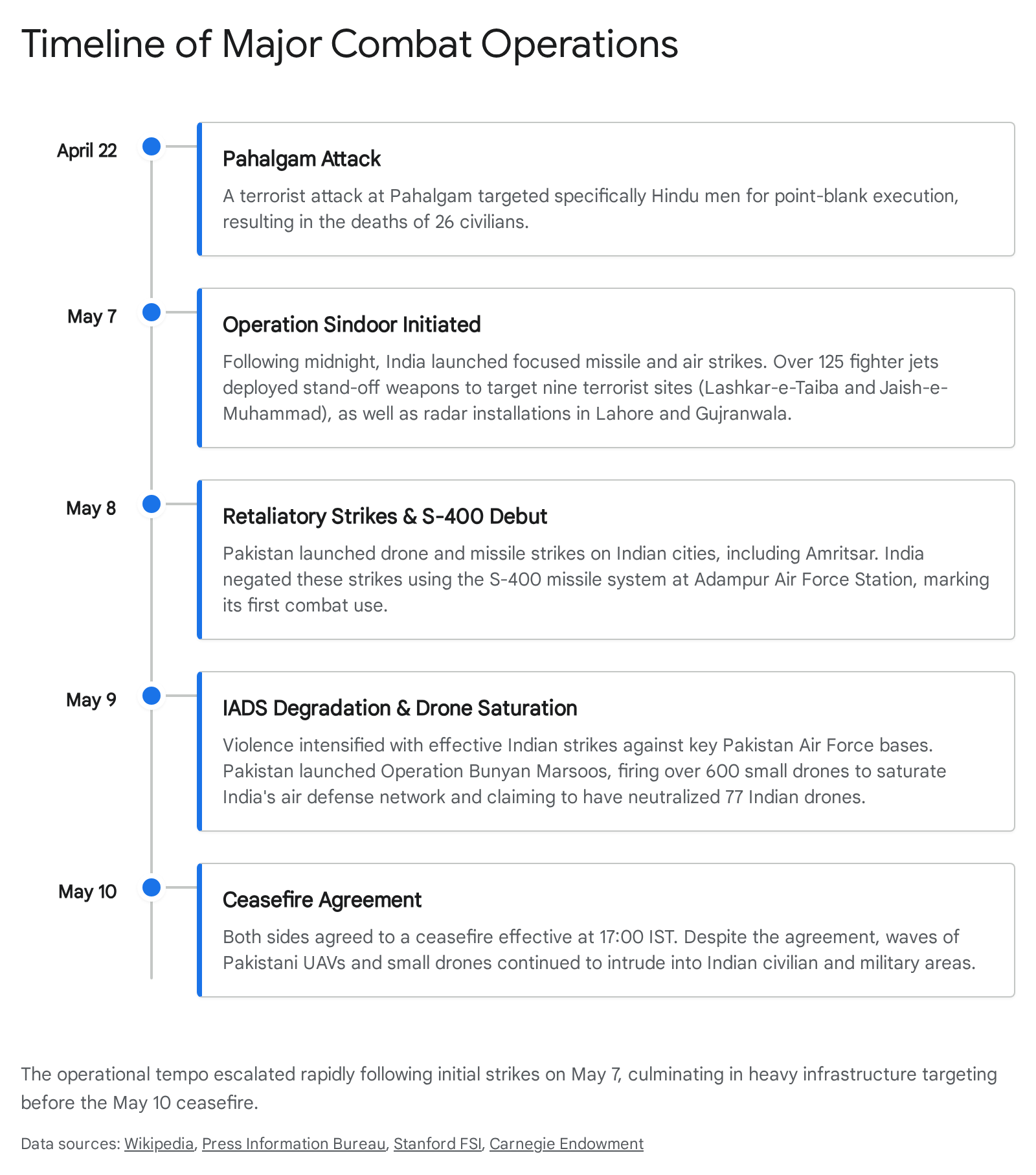
The direct catalyst for the May 2025 conflict was a sophisticated terrorist incident executed on April 22, 2025, in Pahalgam. During this event, twenty-six civilians were killed in a calculated operation involving point-blank executions.2 Comprehensive intelligence assessments rapidly confirmed the direct involvement of Pakistan-based militant organizations, specifically identifying operational linkages to Lashkar-e-Taiba (LeT) and Jaish-e-Mohammed (JeM).3 The highly targeted nature of the attack, combined with a protracted historical pattern of cross-border provocations and asymmetric proxy warfare, necessitated a fundamental recalibration of India’s strategic and military posture.
Indian military planners utilized the fourteen-day window following the Pahalgam incident to integrate multi-source intelligence, refine target selection, and pre-position vital force multipliers. Tactical planning officially commenced on April 29, identifying nine principal terrorist camps and staging areas situated across Pakistan-administered Azad Kashmir and the Punjab province.5 Unlike previous reactive postures that often relied on limited ground incursions, the Indian government established a robust framework for controlled, vertical escalation within the conventional military space. Chief of Defense Staff General Anil Chauhan outlined three core principles that governed this escalation matrix to ensure operations remained beneath the threshold of nuclear conflict: first, a strict adherence to India’s established “no-first-use” nuclear policy; second, a reliance on Pakistan to initiate the first strikes against sovereign military targets, thereby placing the burden of subsequent escalation on Islamabad; and third, a rigid parameter ensuring Indian kinetic strikes were specifically targeted at terrorist infrastructure with absolutely no intent to capture, hold, or occupy sovereign Pakistani territory.4
2.2 Doctrinal Evolution: From Cold Start to Cold Strike
Operation Sindoor marked the definitive operational debut of India’s “Cold Strike” doctrine, representing a significant conceptual evolution of the older “Cold Start” framework formulated more than two decades prior. While Cold Start focused heavily on rapid mobilization of armored formations across the plains, Cold Strike shifts the primary military intent from reactive deterrence to the active, immediate imposition of severe survival costs on terrorist groups and their state sponsors.6 To operationalize this modernized doctrine, the Indian military had recently accelerated a series of sweeping organizational adaptations. Foremost among these reforms was the deployment of specialized rapid-response formations, such as the newly established Rudra Brigades and the highly specialized Bhairav commando units, which are tailored for rapid insertion and precision operations.6
Concurrently, the Indian armed forces had restructured their strategic approach through the release of updated doctrinal manuals earlier in 2025. These included the Joint Doctrine for Multi-Domain Operations, the Joint Doctrine for Cyberspace Operations & Amphibious Operations, and the Joint Doctrine for Airborne and Heliborne Operations.6 These foundational documents facilitated a substantially higher degree of inter-service jointness. By institutionalizing these frameworks, the Chief of Defense Staff was empowered to coordinate highly centralized strategic planning while enabling rapid, decentralized tactical execution across the Indian Army, Navy, and Air Force, a dynamic that proved critical during the fast-paced eighty-eight-hour window of Operation Sindoor.4
3. Order of Battle: Pre-Conflict Posture and Defense Acquisitions
The respective orders of battle leading into the conflict highlighted two distinctly divergent approaches to defense procurement and layered network architecture. The performance of these networks would ultimately define the outcome of the engagement.
3.1 Pakistan’s Chinese-Supplied Integrated Air Defense Network
Recognizing the inherent numerical and qualitative advantages of the Indian Air Force (IAF), military planners in Islamabad had spent the previous four years investing heavily in an integrated air defense system (IADS) designed to create an impenetrable anti-access/area denial (A2/AD) envelope over critical airspace. This architecture was built almost exclusively on post-2010 Chinese export hardware, representing an estimated capital expenditure of $5 billion.7
The apex of this defensive shield was the HQ-9 long-range surface-to-air missile system, which China heavily marketed as a peer competitor to the Russian S-300/S-400 and the American Patriot systems. Pakistan operated four distinct HQ-9 batteries, dividing operational command with two under the Pakistan Air Force and two under Army Air Defence.8 The system was advertised with robust anti-ballistic missile (ABM) capabilities up to thirty kilometers and high-fidelity tracking radars.8 Beneath this high-altitude umbrella, Pakistan deployed the Chinese LY-80 (HQ-16) for medium-range engagements, complemented by specialized sensor platforms such as the YLC-8E anti-stealth radar, valued at up to $20 million, and the YLC-18A gap-filler radars.9 For airborne early warning and command, Pakistan relied on the Saab Erieye AWACS platforms to vector its fighter fleets, which increasingly consisted of Chinese-supplied JF-17 Block III and advanced J-10C aircraft.7
3.2 India’s Layered Defense, Sensor Fusion, and Emergency Procurements
Conversely, India’s defensive and offensive posture was characterized by a diverse amalgamation of indigenous, Western, and Russian platforms, unified by robust sensor fusion technologies. The foundation of this network was the Integrated Air Command and Control System (IACCS) operated by the IAF. During the buildup to the conflict, the Indian Army’s indigenous air defense command architecture, known as Akashteer, was directly plugged into the IACCS.4 This unprecedented integration allowed for the seamless sharing of real-time telemetry across multiple platforms, generating a persistent, round-the-clock picture of the contested airspace. The layered defense incorporated the Russian S-400 Triumf long-range system, the Israeli Spyder, the indigenous Akash medium-range surface-to-air missile (MRSAM), and various point-defense systems.4
A critical component of India’s readiness was the effective utilization of Emergency Procurement (EP) mechanisms. Acknowledging the chronic delays inherent in the standard Defence Acquisition Procedure (DAP), military headquarters heavily leveraged EP powers to rapidly acquire critical systems with delivery timelines of under one year.4 Previous tranches (EP-2 and EP-4) had facilitated the urgent procurement of Russian Igla-S MANPADs, filling crucial low-altitude capability voids. Furthermore, delays in regular procurement cycles resulted in the retention of legacy air defense guns, including the L-70, Zu-23, Pechora, and OSA-AK systems.4 Suitably retrofitted with modern optical tracking sights, upgraded target-acquisition motors, and advanced airburst ammunition, these older legacy platforms were transformed into highly cost-effective hard-kill solutions uniquely suited for neutralizing low-flying, low-cost unmanned aerial vehicles.4
4. Operational Chronology: The 88-Hour Conflict
The kinetic phase of the conflict was characterized by a rapid, intense compression of modern multi-domain warfare tactics. Over the span of eighty-eight hours, the theater transitioned fluidly from counter-terror precision strikes to massed drone saturation and the systematic suppression of enemy air defenses (SEAD).
4.1 May 7: Initiation of Operation Sindoor and Counter-Terror Strikes
Following rigorous intelligence preparation, the Indian military initiated Operation Sindoor shortly after midnight on May 7, 2025.1 The initial tactical objective was the decapitation of terrorist command structures across nine pre-selected LeT and JeM sites located near the border and deeper within the Punjab province.5 The scale of this opening engagement was massive, representing the largest recent aerial engagement featuring fourth-generation fighter jets, with at least 125 aircraft from both nations operating simultaneously at standoff ranges.4
The Indian Air Force orchestrated the initial strike phase utilizing French-origin SCALP cruise missiles alongside advanced AASM Hammer munitions. These standoff precision weapons were specifically selected for their low radar cross-section and extended operational ranges, which enabled Indian launch platforms to remain well within friendly airspace while effectively bypassing the forward-deployed radar detection networks stationed along the Pakistani border.13 The Lashkar-e-Taiba operational headquarters sustained catastrophic damage following targeted strikes using advanced Crystal Maze missiles, ensuring the complete structural destruction of the facility.14 Simultaneously, multiple Jaish-e-Mohammed staging camps were dismantled in coordinated strike waves. To prevent localized counter-attacks and eliminate fallback defensive layers, Indian artillery units deployed M7 howitzers to systematically dismantle the Pakistani Army’s secondary border defenses, effectively neutralizing established pincer formations.14
4.2 May 8-9: Symmetrical Retaliation via Operation Bunyan-un-Marsoos
Recognizing the severe degradation of their forward terror infrastructure and the immediate threat to their broader defensive layers, the Pakistan Armed Forces launched Operation Bunyan-un-Marsoos 15 on the morning of May 8. The stated objectives of this campaign were to demonstrate robust deterrence capabilities by striking critical Indian military infrastructure, promote domestic national unity, and restore the operational narrative following the initial Indian incursions.15
Pakistan adopted a strategy of multi-vector saturation, deploying Fatah-1 guided multi-launch rocket systems (MLRS) 17 and tactical ballistic missiles.17 These strikes targeted Indian forward operating bases and military installations, with confirmed engagements occurring near Pathankot, Adampur, Udhampur, and brigade headquarters located in Uri.15 Pakistani forces also concentrated their offensive fire on high-value Indian airborne assets, particularly the recently acquired Rafale fighter jets.5
During this phase, a critical component of the Pakistani strategy involved the deployment of up to 1,000 small unmanned aerial vehicles (UAVs) launched in a massive volley across India’s western front.7 This drone swarm, consisting of commercial quadcopters alongside Chinese-origin CH-4A and Wing Loong armed platforms, was primarily intended to saturate the Indian air defense network, force active radar emissions to map defensive layouts, and deplete Indian interceptor stockpiles.4 While Pakistan’s military claimed it neutralized 77 Indian drones during the early phase of the conflict 34, it also publicly asserted the destruction of an Indian S-400 air defense battery in Udhampur (and propagated similar claims regarding Adampur) and the downing of five Indian fighter jets.15 However, the Indian Ministry of External Affairs confirmed the S-400 battery at Adampur successfully negated incoming strikes and dismissed the destruction reports as a malicious misinformation campaign.
4.3 May 9-10: SEAD Operations, Drone Interception, and the Ceasefire
The Indian response to the Pakistani counter-offensive demonstrated a high degree of sensor fusion and layered defense networking. A study by the Centre for Military History and Perspective Studies (CHPM) in Switzerland noted that while Pakistan achieved some initial tactical successes in the early aerial exchanges, they failed to deliver in subsequent strikes due to the highly efficient Indian air defense system.5 The integrated Akashteer and IACCS architecture effectively managed the massive drone threat. While the upgraded legacy air defense guns provided a highly efficient hard-kill layer, Indian electronic warfare units engaged in sophisticated jamming operations against the command links of the incoming UAVs. Of the massive swarm deployed by Pakistan, 237 drones were intercepted and neutralized entirely by Indian electronic warfare alone, forcing the autonomous vehicles to soft-land without detonating their payloads.77
When the Indian Air Force retaliated in strength, it transitioned its operational focus toward a comprehensive SEAD campaign designed to permanently blind the Pakistani radar network and neutralize key command centers.5 The CHPM study highlighted that the Indian Air Force achieved clear air superiority by exposing profound weaknesses in the Pakistani air defense architecture, enabling a series of spectacular strikes against Pakistan’s principal air force stations.5 The IAF launched its deep air interdiction campaign, utilizing a mix of autonomous loitering munitions and long-range cruise missiles to methodically dismantle Pakistan’s airfields and air defense batteries.4 Faced with a systematically degraded airspace sovereignty, mounting infrastructure losses, and the failure of their primary defensive networks, Pakistan’s Director General of Military Operations (DGMO) initiated emergency contact with his Indian counterpart. Following rapid negotiations, a comprehensive ceasefire was implemented across all domains—land, air, and sea—taking effect at 1700 hours Indian Standard Time on May 10, 2025.2
5. The Systemic Degradation of Chinese Integrated Air Defenses
A primary technical outcome and the most consequential global revelation of the May 2025 conflict was the rigorous combat evaluation of the Chinese-supplied ground-based air defense systems deployed by Pakistan. Analysis of the eighty-eight-hour engagement indicates that the $5 billion kill chain suffered a catastrophic and systemic failure, driven by fundamental flaws in radar processing algorithms, data-link stability, and centralized command-and-control synchronization.7
5.1 HQ-9 Long-Range SAM Vulnerabilities and Data-Link Severance
The HQ-9 long-range surface-to-air missile system formed the foundational pillar of Pakistan’s high-altitude defense strategy. However, the system’s performance during Operation Sindoor revealed critical vulnerabilities when subjected to modern, peer-level electronic warfare.8 In a defining moment of the conflict, an active HQ-9 battery stationed in Lahore was targeted and entirely destroyed by an Israeli-origin Harpy loitering munition deployed by the IAF.10 This event marked the first time an HQ-9 system had been eliminated in combat anywhere in the world.7
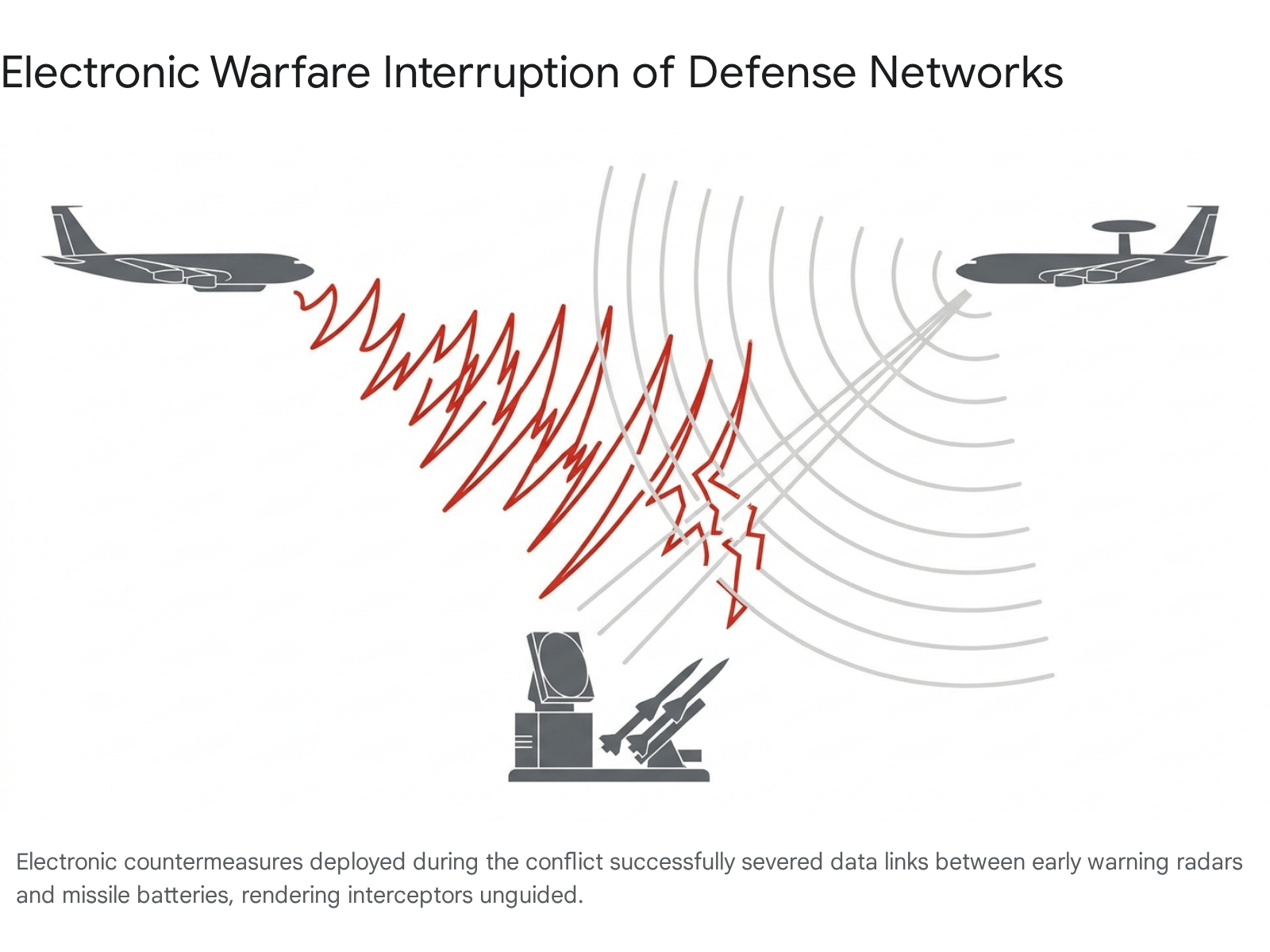
The failure of the HQ-9 to detect and engage incoming threats with low radar cross-sections highlighted severe deficiencies in its lower-tier radar tracking capabilities. More alarmingly for operators of Chinese defense hardware, post-action technical analysis indicated that the system’s failure was predominantly electronic rather than purely kinetic. Modern SAM systems rely heavily on continuous telemetry updates transmitted via data links from airborne early warning platforms to guide interceptors toward a target box before the missile’s own active seeker activates. During the conflict, the data link connecting the Pakistani HQ-9 batteries to their overarching command network was easily identified and severed by Indian electronic warfare jamming. This electronic isolation rendered the missiles unguided and entirely ineffective, explaining why fully operational batteries failed to protect critical military installations despite launching multiple interceptors.9
5.2 Counter-Stealth Radar and Early Warning Platform Failures
The degradation of Pakistan’s situational awareness was rapidly compounded by the systematic destruction of highly specialized radar systems specifically procured to counter the exact types of standoff munitions India employed. At the Chunian airbase located in central Punjab, India executed a precision strike that successfully destroyed a Chinese YLC-8E anti-stealth radar.7 Valued at an estimated $15 to $20 million, the YLC-8E was explicitly marketed by Beijing for its advanced ultra-high frequency capabilities, purportedly allowing it to detect low-observable aircraft and stealth munitions.10 Its failure to identify the incoming projectiles that ultimately destroyed it dealt a massive blow to the credibility of Chinese radar technology.10
This pattern of sensor failure was replicated across the medium-range defense tiers. An LY-80 (HQ-16) fire control radar, representing a $70 million investment, was targeted and neutralized in Lahore, creating significant, exploitable gaps in medium-range aerial coverage.10 The vulnerability extended beyond Chinese-origin hardware; two United States-supplied AN/TPQ-43 automatic tracking radars, typically utilized for high-precision artillery and missile trajectory tracking and valued at $25 million each, were also identified and destroyed deep inside Pakistani territory.10 The systemic blinding of the Pakistani defense network culminated in the kinetic destruction of a Swedish-origin SAB-2000 Airborne Early Warning and Control (AEW&C) aircraft 10 while it was stationed on the tarmac at the Bholari airbase. The loss of this critical airborne asset, which resulted in the death of Squadron Leader Usman Yousaf, severely limited the Pakistan Air Force’s ability to maintain a macro-level view of the battlespace or effectively vector fighter aircraft to intercept Indian incursions.7
| System Designation | Equipment Category | Estimated Valuation (USD) | Combat Performance / Outcome Assessment |
| HQ-9 | Long-Range SAM Battery | $100M – $200M | Data-links effectively severed by EW; one battery destroyed in Lahore by loitering munition. 7 |
| YLC-8E | Anti-Stealth Radar | $15M – $20M | Failed to detect incoming standoff munitions; completely destroyed at Chunian airbase. 7 |
| LY-80 (HQ-16) | Medium-Range Fire Control Radar | $70M | Neutralized by precision strikes, severely degrading medium-range intercept capabilities. 10 |
| SAB-2000 | AEW&C Platform | N/A | Destroyed on the ground at Bholari airbase, resulting in the loss of critical personnel (Sqn Ldr Usman Yousaf KIA).107 |
| AN/TPQ-43 | Tracking Radar (US-origin) | $25M (per unit) | Two units destroyed deep inside Pakistani territory during SEAD operations. 10 |
5.3 C2 Vulnerabilities and Global Strategic Comparisons
The overarching failure observed during the conflict was not merely the isolated destruction of individual hardware platforms, but rather a holistic, systemic collapse of the command-and-control (C2) architecture governing the entire IADS. Under sustained electronic attack from integrated Indian platforms, the Chinese C2 systems repeatedly demonstrated an inability to coordinate disparate weapons and sensors.18 Intelligence analysts noted that uncoordinated power outages completely disabled the defense network at several critical operational junctures. This exposed a fundamentally poor system design that prioritized cost-efficiency over redundancy, lacking adequate localized backup power capabilities to maintain operations during infrastructure stress.18
Within defense intelligence circles, debates emerged regarding the root cause of these failures. Hypotheses included the possibility that China had provided Pakistan with heavily “nerfed” export versions of their domestic systems, that the original Chinese systems themselves were inherently flawed due to reverse-engineered Soviet designs, that Pakistan failed to layer the batteries effectively, or that operator incompetence played a defining role.9 However, the vulnerability of these systems to advanced electronic warfare is not an isolated incident confined to the South Asian theater. Defense analysts have drawn direct parallels to Operation Absolute Resolve in Venezuela, which occurred in 2026. During that operation, United States EA-18 Growler aircraft—platforms specifically built for controlling the electromagnetic battlefield—effectively paralyzed Chinese-supplied JY-27A radar networks.18 The JY-27A, similarly marketed as a “stealth-killer,” was described by analysts as sluggish and full of flaws when confronted with US electronic warfare, enabling special forces aircraft to penetrate Venezuelan airspace with minimal resistance.18 The repeated, catastrophic failure of these systems in heavily contested electromagnetic environments across multiple continents suggests foundational, systemic weaknesses in Chinese radar algorithms, data processing capabilities, and signal filtration hardware.
6. Air-to-Air Dynamics and Aerial Platform Efficacy
While the ground-based defensive networks faltered, the BVR air-to-air domain provided an equally crucial dataset regarding the relative capabilities of imported Chinese aviation technology when pitted against the Western and Russian platforms operated by the IAF.
6.1 The PL-15 Intelligence Coup and EW Integration
The Chinese-made PL-15 beyond-visual-range air-to-air missile was heavily touted in international arms markets as a superior rival to Western counterparts, such as the American AIM-120D, primarily due to its advanced active electronically scanned array (AESA) seeker. During the intense aerial engagements of Operation Sindoor, Pakistani J-10C and JF-17 fighters fired multiple salvos of the PL-15 at Indian formations, concentrating fire on the IAF’s advanced Rafale jets.5 However, comprehensive technical analysis indicates that the missiles systematically failed to acquire, track, or hit their intended targets. The failure is attributed directly to the electronic jamming countermeasures deployed by the IAF platforms, which successfully confused the missile’s onboard guidance software mid-flight.18
In what is considered one of the most significant intelligence coups of the decade, an intact, unexploded export variant of the PL-15 (the PL-15E) landed softly in Ghagwal village, situated within the Dasuya area of the Hoshiarpur district in Punjab. The physical condition of the recovered munition definitively proved that electronic countermeasures successfully defeated the missile’s logic systems, causing a soft-landing rather than a kinetic failure or detonation. The Indian Defence Research and Development Organisation (DRDO), in conjunction with the IAF, rapidly disassembled the recovered weapon, successfully decoding its most closely guarded secrets, including its radar frequencies, communication link protocols, and the proprietary AESA seeker technology.24 This rapid exploitation of captured technology immediately fed into urgent software updates for the electronic warfare suites on Indian Rafale, Tejas Mk1A, and Sukhoi-30MKI aircraft, theoretically compromising the future effectiveness of the PL-15 across the entire theater.24 While some pro-Chinese media outlets attempted to claim PL-15 successes during the conflict, these assertions lacked verifiable proof and were broadly dismissed by international observers as state propaganda.23
6.2 Fighter Aircraft Performance: J-10C and JF-17 vs IAF Assets
The broader air combat environment forced the Chinese-supplied J-10C and JF-17 Block III platforms into direct confrontation with the IAF’s diverse fleet, which included Rafales, upgraded Mirage 2000s, and heavily networked Su-30MKIs. Despite the significant technological upgrades present in the Block III variants of the JF-17 and the advertised 4.5-generation capabilities of the J-10C, these platforms failed to meaningfully alter the airspace dynamic or successfully contest Indian air operations.18
The operational effectiveness of the Pakistani fighter fleets was severely handicapped by their reliance on degraded ground-control intercepts. Following the destruction of the SAB-2000 AEW&C 10 and the critical YLC-8E radar installations, Pakistani pilots were forced to operate with highly restricted situational awareness against Indian formations that were seamlessly networked via the IACCS.4 While Islamabad subsequently claimed the destruction of six Indian aircraft over an hour-long sequence—including three Rafales, one Su-30MKI, and one MiG-29UPG—these broader claims remained contested. However, the operation did expose notable vulnerabilities for India, as technical analysis later confirmed the shootdown of one Dassault Rafale, marking the aircraft’s first confirmed combat loss.5 Conversely, the Indian layered defense network proved highly lethal; the S-400 batteries alone were credited with shooting down up to five F-16 and JF-17 fighters between May 7 and May 10, severely restricting the freedom of action for the Pakistan Air Force and forcing their assets into defensive postures.5
7. Unmanned Aerial Systems (UAS) and Autonomous Strike Capabilities
The integration of unmanned aerial systems (UAS) and autonomous loitering munitions fundamentally defined the tactical approaches of both militaries, shifting the paradigm of aerial engagement away from exclusive reliance on manned fighter aircraft.
7.1 Loitering Munitions as Premier SEAD Assets
While Pakistan utilized drones primarily for mass saturation and low-level reconnaissance, India deployed autonomous systems as highly lethal precision strike assets tailored specifically for SEAD operations. The Indian armed forces utilized the Israeli-origin Harpy and Harop loitering munitions with devastating operational effect. The Harpy, functioning as an advanced anti-radiation drone designed to detect, track, and kinetically crash into active radar emissions, was directly responsible for the destruction of the HQ-9 and LY-80 batteries situated in Lahore.10
During the critical SEAD phase of the conflict, the Indian military deployed approximately thirty Harop drones, representing roughly twenty percent of its total estimated 154-drone arsenal, incurring a deployment cost of roughly $300 million.10 The undeniable success of these autonomous platforms in heavily jammed, highly contested environments cemented their permanent role in future Indian military planning.19 Recognizing the strategic imperative of domestic production for these assets, India expedited the procurement of indigenous loitering munitions immediately following the ceasefire. The Indian Army recently took delivery of 106 domestically produced SMPP Agniveg systems, which demonstrated precision strike capabilities and an operational range of nearly 180 kilometers while operating effectively in heavily jammed environments.19 Furthermore, Indian firm SMPP finalized agreements with the European defense consortium KNDS to manufacture their advanced loitering munitions—including the Colibri, Larinae, Veloce, and Rodeur platforms—within India, ensuring hybrid GNSS–INS guidance and fire-and-forget functionality for neutralizing high-value threats in future engagements.19
8. Target Degradation and Infrastructure Damage Assessment
The precision strikes executed by the IAF utilizing standoff munitions, cruise missiles, and loitering platforms resulted in extensive, long-term degradation of Pakistan’s vital military infrastructure. High-resolution commercial satellite imagery and post-damage intelligence assessments revealed a systematic, methodical targeting of runways, technical facilities, and operational support structures distributed across multiple provinces.4
- Sargodha Airbase (Mushaf Airbase): Widely considered the operational crown jewel of the Pakistan Air Force and home to its premier US-supplied F-16 squadrons, this sprawling complex suffered direct, sustained missile strikes targeting its main runways and support infrastructure. The precision strikes utilizing standoff weapons successfully degraded its operational readiness, sending immediate alarm bells through both Pakistani military circles and the Pentagon regarding the vulnerability of American-supplied assets.11
- Bholari Airbase: Recognized as one of Pakistan’s newest and most modern installations, Bholari sustained heavy, localized damage to its hangars and resident fighter fleets. Recent satellite imagery confirms that previously struck hangars remain covered with tarpaulin, indicating ongoing, protracted repair activities. The strike on this specific base was highly lethal, resulting in the death of Squadron Leader Usman Yousaf.20
- Jacobabad Airbase: Operating as a critical host for advanced fighters (and historically utilized as a NATO base during the war on terrorism), a hardened hangar at Jacobabad was hit during the strikes. Reports indicated that three Jordanian F-16s sustained damage, effectively grounding all PAF aircraft at the facility during the operational window.10
- Murid and Rafiqui Airbases: Murid, serving as a vital forward-operating base for air defense and combat drone readiness, was transitioned to a “degraded” status following strikes on its drone housing facilities.10 Rafiqui airbase in Shorkot, which hosts crucial fighter squadrons, similarly sustained operational disruptions.16
- Chunian and Pasrur Airfields: At Chunian, specialized technical facilities, fuel depots, and the primary YLC-8E radar were incinerated, leaving the base in a state of long-term recovery. Concurrently, strategic surveillance capabilities at the Pasrur airfield were rendered entirely nonexistent following the precision destruction of its primary radar sites.10
- Additional Radar and Airfield Degradation: The systemic degradation of Pakistan’s surveillance and operational network was further expanded via targeted strikes on radar sites and facilities at Arifwala, Sukkur (a facility that also doubles as a civilian airport), and Rahim Yar Khan, which were effectively neutralized using precision air-launched munitions.
- Sialkot and Skardu Airbases: Essential support infrastructure for fighter jets at Sialkot remained crippled due to localized drone strikes. Skardu airbase, vital for high-altitude operational readiness, was severely compromised following the targeted destruction of its fuel reserves and equipment support structures.25
9. The Ascension of the Indian Domestic Defense Industrial Base
Operation Sindoor served as an invaluable, real-world combat validation ground for several indigenous Indian weapon systems, accelerating the military’s long-stated strategic shift away from its historical reliance on foreign defense imports.28 The operational performance of domestic platforms during the conflict forced the global defense community to recognize the true quality and lethality of Indian engineering.28
9.1 The BrahMos Combat Validation and Global Export Trajectory
The BrahMos supersonic cruise missile, jointly developed by India’s Defence Research and Development Organisation (DRDO) and Russia’s NPO Mashinostroyenia, emerged as one of the most critical offensive assets of the war. Its integration with the Su-30MKI platform proved highly successful. This integration project was a testament to domestic engineering capability; while Russia had initially offered to undertake the integration project for approximately $200 million, India executed the project domestically for just $9.6 million, proving the immense financial and strategic value of self-reliance.4 The air-launched variant allowed the IAF to strike deep inside Pakistani territory without crossing into hostile airspace, successfully hitting eleven distinct Pakistani airbases while demonstrating remarkable resilience against interception attempts by the HQ-9 and other layered IADS.4
This successful combat application during Operation Sindoor, described by BrahMos Aerospace Chief Jaiteerth Joshi as a “live test… on our adversary,” has spurred unprecedented international interest in the platform.29 Post-conflict export negotiations with Vietnam rapidly entered their final stages.30 More notably, the Russian government expressed formal intent to induct the BrahMos missile into its own armed forces. Discussions are currently underway regarding Indian industry potentially augmenting existing Russian production capacities to meet this new demand, marking a historic reversal where India transitions from a buyer of Russian technology to a supplier of combat-proven, jointly developed systems.29
9.2 Emergency Procurements and Capability Replenishment
The conflict also underscored the strategic necessity of agile procurement frameworks. The Emergency Procurement (EP) powers delegated to service headquarters allowed the military to bypass the cumbersome regular procurement processes to quickly buy weapon systems worth up to $36 million with rapid delivery timelines.4 In the immediate aftermath of the May 10 ceasefire, the Indian government sanctioned EP-6, focusing on a massive $4.8 billion allocation to rapidly replenish spent ammunition and guided weapon stocks, ensuring the military maintained peak operational readiness to deter any secondary provocations.4
10. Multi-Domain Warfare: Information, Diplomatic, and Economic Theaters
Modern warfare is intrinsically multi-domain, extending far beyond the kinetic exchange of munitions. Operation Sindoor highlighted the sophisticated weaponization of information, diplomatic isolation, and targeted economic leverage as core components of national strategy.
10.1 Narrative Warfare and Algorithmic Information Control
Throughout the eighty-eight-hour conflict, both nations engaged in intense narrative control operations to shape domestic morale and influence international perceptions. War expert John Spencer highlighted that modern conflicts are heavily defined by social media narratives and ‘algorithm-driven’ information warfare, which actively shape global perceptions while masking broader strategic outcomes.32
The Indian strategic communications approach adopted a highly methodical, composed stance, deliberately focusing on precise strategic outcomes and the successful targeting of terror infrastructure rather than sensationalizing combat footage. Indian authorities actively exposed the manipulation tactics utilized by Pakistan-based digital accounts, resulting in heightened scrutiny by international social media platforms, while simultaneously launching domestic media literacy campaigns to foster a more resilient digital environment.2 In contrast, the Pakistani narrative, heavily amplified by domestic outlets, emphasized national resilience while attempting to minimize infrastructure losses. Media narratives sharply reflected this strategic divide: major Indian publications like the Hindustan Times celebrated the operation as a precise strategic maneuver with potent messaging, while Pakistani outlets such as Dawn aggressively critiqued the Hindu religious symbolism of the term ‘Sindoor’, portraying the Indian response as exaggerated theatrics aimed at emotional manipulation.35
To counter domestic anxiety regarding structural losses, Pakistan officially branded its retaliation “Bunyan-un-Marsoos”—a Quranic phrase translating to “a solid cemented structure” or “a structure made of lead” 16—aiming to promote national unity and mask the severe systemic degradation of its military capabilities.15
10.2 Diplomatic Isolation and Economic Statecraft
Diplomatically, India leveraged the unprovoked nature of the Pahalgam attack to forcefully isolate Pakistan on the global stage, affirming its commitment to a zero-tolerance policy against terrorism. This diplomatic offensive resulted in tangible punitive actions, including the formal declaration of Defense, Naval, and Air Advisors in the Pakistani High Commission in New Delhi as Persona Non Grata, and the mandate to reduce the overall strength of the High Commission from fifty-five to thirty personnel.2
Furthermore, the conflict triggered severe secondary economic consequences for nations that actively provided military support to Pakistan during the hostilities. Throughout the conflict, Turkey openly backed Islamabad, supplying more than 350 Turkey-manufactured Bayraktar TB2 and Asisguard Songar drones.33 In direct economic retaliation, the Indian Ministry of Civil Aviation abruptly revoked the security clearance of Celebi Aviation, a prominent Turkish aviation services firm. Celebi had been a dominant force in the Indian market since 2000, managing highly lucrative ground-handling operations at major hubs including New Delhi, Mumbai, and Bengaluru. The immediate revocation of its operating license on May 15, citing critical national security concerns, resulted in the seizure of equipment and the termination of contracts, wiping out an estimated $500 million in market value for the company overnight. This action decisively signaled India’s willingness to utilize aggressive economic statecraft to punish nations interfering in regional conflicts.33
11. Broader Geopolitical Implications and Defense Market Realignment
The systemic, highly public failure of Chinese armaments during Operation Sindoor has triggered profound ripple effects across the global defense industrial base. Over the past two decades, Beijing has aggressively positioned itself as a credible, highly cost-effective alternative to traditional Western and Russian arms suppliers, securing massive procurement contracts across Africa, the Middle East, and South America.22
The combat data generated between May 7 and May 10 shattered this value proposition. The inability of Chinese radar networks to detect incoming threats, combined with the catastrophic failure of its C2 networks under electronic duress and the spoofing of its premier air-to-air missiles, validated long-standing international skepticism regarding the quality control, critical component reliability, and combat effectiveness of these systems.23 Within twelve months of the conflict, the market valuation of major Chinese defense contractors, such as AVIC Chengdu, experienced significant structural declines.7
This international fallout was heavily compounded by internal Chinese military politics. Intelligence reports indicate that the exposure of these severe technological vulnerabilities has been directly linked to pervasive, systemic corruption within the People’s Liberation Army (PLA) and the broader Chinese defense manufacturing sector. This corruption has critically undermined the quality and reliability of exported weapon systems, eroding institutional trust.9 Ironically, despite the undeniable failure of the air defense network, Pakistan remains a functionally trapped customer due to profound financial constraints and geopolitical isolation. Islamabad is proceeding with the acquisition of the J-35 stealth fighter from the exact same industrial base that just failed to protect its sovereign airspace.7 However, recognizing the vulnerability of an exclusively Chinese-supplied network, there are indications of a strategic pivot; Islamabad has reportedly begun exploring NATO-standard procurements, including the IRIS-T and CAMM-ER systems 7, while also procuring additional Chinese HQ-16, HQ-17, and L-17 medium-range systems to urgently plug the exposed gaps.7
Conversely, the massive credibility gap exposed by Chinese systems has provided a generational strategic opening for India. The battle-proven performance of the BrahMos, the Akash systems, and various domestic electronic warfare suites has allowed Indian defense manufacturers to aggressively emphasize reliability and combat pedigree on the world stage.23 Total Indian defense production has surged 174 percent since 2014, yielding massive domestic production value and expanding exports to nations like Indonesia and Vietnam.28 Operation Sindoor effectively transitioned India’s global perception from that of a net importer seeking technology transfers to a credible, independent exporter of highly lethal, combat-tested hardware.28
12. Doctrinal Conclusions and Strategic Outlook
Operation Sindoor represents a permanent watershed moment in South Asian strategic dynamics and modern military doctrine. The conflict yielded several critical conclusions regarding the nature of modern warfare and the shifting requirements for regional deterrence:
- The Normalization of Air Power: The conflict definitively proved that air power, once viewed by policymakers as inherently escalatory and excessively dangerous beneath a nuclear umbrella, can be utilized effectively and predictably within the conventional space. The integration of long-range precision weapons and autonomous loitering munitions allows state actors to achieve definitive military objectives without crossing established nuclear redlines or necessitating the seizure of territory.4
- The Absolute Primacy of Sensor Fusion and EW: The era of relying on standalone defensive platforms is completely obsolete. The rapid, total collapse of Pakistan’s defense network was not due to a lack of physical hardware or interceptors, but rather the inability to protect its data links, radar frequencies, and command structures from sophisticated electronic suppression. Modern warfare is entirely reliant on the seamless integration and electromagnetic protection of the kill chain; without it, high-value kinetic assets are rendered useless.18
- The Limitations of Conventional Deterrence: While India successfully established a significantly higher level of conventional deterrence and demonstrated clear military asymmetry through Operation Sindoor, senior military leadership, including Indian Army Chief General Upendra Dwivedi, formally acknowledges that kinetic strikes alone are highly unlikely to entirely halt the deep-rooted infrastructure of proxy cross-border terrorism.4
- The Imperative of Open-Architecture Integration: As India continues to rapidly modernize its forces, it must prioritize open-architecture systems. The conflict highlighted the inherent dangers and inefficiencies of operating diverse fleets procured from multiple countries, which can create severe communication bottlenecks and limit platform integration. A prime example is the recent failure to integrate the European-made Meteor BVR missile with the indigenous Tejas jet, as the manufacturer refused to share sensitive details unless an Indian or European radar was chosen over the currently selected Israeli radar.4
Moving forward, the regional balance of power remains volatile. Pakistan is highly likely to attempt to restore strategic equilibrium by accelerating the procurement of advanced asymmetric technologies, including stealth fighters and next-generation early warning platforms (such as the HQ-19 air defense systems and KJ-500 airborne early warning aircraft) from China.4 However, the legacy of Operation Sindoor—defined by the systemic degradation of closed, networked defenses and the rapid ascendancy of Indian precision strike and electronic warfare capabilities—has fundamentally altered the baseline calculus for any future conflicts within the theater.
Please share the link on Facebook, Forums, with colleagues, etc. Your support is much appreciated and if you have any feedback, please email us in**@*********ps.com. If you’d like to request a report or order a reprint, please click here for the corresponding page to open in new tab.
Sources Used
- 2025 India–Pakistan conflict – Wikipedia, accessed June 19, 2026, https://en.wikipedia.org/wiki/2025_India%E2%80%93Pakistan_conflict
- Operation SINDOOR: India’s Strategic Clarity and Calculated Force – PIB, accessed June 19, 2026, https://www.pib.gov.in/Pressreleaseshare.aspx?PRID=2128748®=3&lang=2
- Operation Sindoor and the Evolution of India’s Military Strategy Against Pakistan | FSI, accessed June 19, 2026, https://fsi.stanford.edu/publication/operation-sindoor-and-evolution-indias-military-strategy-against-pakistan
- Military Lessons from Operation Sindoor | Carnegie Endowment for …, accessed June 19, 2026, https://carnegieendowment.org/research/2025/10/military-lessons-from-operation-sindoor
- How Pakistan Failed To Follow Through On Its Initial Success In …, accessed June 19, 2026, https://www.eurasiareview.com/28012026-how-pakistan-failed-to-follow-through-on-its-initial-success-in-operation-sindoor-oped/
- The Evolution of India’s Military Doctrine and Posture After Operation Sindoor, accessed June 19, 2026, https://www.orfonline.org/expert-speak/the-evolution-of-india-s-military-doctrine-and-posture-after-operation-sindoor
- How Operation Sindoor Killed China’s Arms Reputation – YouTube, accessed June 19, 2026, https://www.youtube.com/watch?v=-kAZtY1zyuY
- How effective were Pakistani HQ-9Bs at stopping Indian ballistic missiles during Operation Sindoor? : r/WarCollege – Reddit, accessed June 19, 2026, https://www.reddit.com/r/WarCollege/comments/1u3bzli/how_effective_were_pakistani_hq9bs_at_stopping/
- Dual Fault Lines in China’s Military: Weapons Fail, Generals Jailed, accessed June 19, 2026, https://www.orfonline.org/expert-speak/dual-fault-lines-in-china-s-military-weapons-fail-generals-jailed
- Operation Sindoor: Raising the Cost of Terrorism for Pakistan, accessed June 19, 2026, https://www.orfonline.org/expert-speak/operation-sindoor-raising-the-cost-of-terrorism-for-pakistan
- Why Pakistan’s Sargodha, targeted by the IAF during Operation Sindoor, is central to Imtiaz Ali’s Main Vaapas Aaunga, accessed June 19, 2026, https://m.economictimes.com/news/new-updates/why-pakistans-sargodha-targeted-by-the-iaf-during-operation-sindoor-is-central-to-imtiaz-alis-main-vaapas-aaunga/articleshow/131688912.cms
- Operation Sindoor Exposes Deficiencies in Chinese Weapon Systems – AP7AM, accessed June 19, 2026, https://www.ap7am.com/en/101164/operation-sindoor-exposes-deficiencies-in-chinese-weapon-systems
- How chinese air defence systems badly failed and How India executed Operation Sindoor ⁉️ : r/IndianDefense – Reddit, accessed June 19, 2026, https://www.reddit.com/r/IndianDefense/comments/1khl6ow/how_chinese_air_defence_systems_badly_failed_and/
- Operation Sindoor: India Destroys Pakistan’s Key Military Assets | Explained – YouTube, accessed June 19, 2026, https://www.youtube.com/watch?v=aez4WaspQzw
- (PDF) Operation Bunyan-un-Marsoos: A Defining Strategic Lesson for India – ResearchGate, accessed June 19, 2026, https://www.researchgate.net/publication/394886169_Operation_Bunyan-un-Marsoos_A_Defining_Strategic_Lesson_for_India
- Pakistan launches Operation Bunyan Marsoos: What we know so far – Al Jazeera, accessed June 19, 2026, https://www.aljazeera.com/news/2025/5/10/pakistan-launches-operation-bunyan-marsoos-what-we-know-so-far
- All it took was Operation Bunyan ul Marsoos to humble our dear neighbours – Reddit, accessed June 19, 2026, https://www.reddit.com/r/pakistan/comments/1kj8ysj/all_it_took_was_operation_bunyan_ul_marsoos_to/
- Chinese Defense Systems Fail in Operations Sindoor & Absolute …, accessed June 19, 2026, https://askfuzz.ai/discover/news/global/chinese-weapons-fail-in-operation-sindoor-venezuela
- India and a European defence giant join hands to build the type of weapon that once knocked out Lahore’s air defences, accessed June 19, 2026, https://timesofindia.indiatimes.com/defence/international/india-european-defence-giant-join-hands-to-build-weapon-that-once-knocked-out-lahores-air-defences/articleshow/131848562.cms
- Pakistan Confirms Heavy Losses in IAF’s Operation Sindoor Strikes on Terror Bases, Airbases – YouTube, accessed June 19, 2026, https://www.youtube.com/watch?v=p32AljSp9Sg
- An Assesment of Chinese Air Defense System’s Performance During Operation SINDOOR : r/IndianDefense – Reddit, accessed June 19, 2026, https://www.reddit.com/r/IndianDefense/comments/1km1wgt/an_assesment_of_chinese_air_defense_systems/
- From Operation Sindoor to Venezuela: How Chinese weapons, radars keep failing — Explained – The Times of India, accessed June 19, 2026, https://timesofindia.indiatimes.com/world/china/from-operation-sindoor-to-venezuela-how-chinese-weapons-radars-keep-failing-explained/articleshow/126412700.cms
- Op Sindoor exposed pattern of failures, underperformance by …, accessed June 19, 2026, https://timesofindia.indiatimes.com/india/op-sindoor-exposed-pattern-of-failures-underperformance-by-chinese-weapons-systems-report/articleshow/121251371.cms
- Defence Inconnect : Pak Fired Missile at India? The Secret Decoded | Latest News, accessed June 19, 2026, https://www.youtube.com/watch?v=7ls1NJFyiGs
- Pakistan airbases stuck by India during Operation Sindoor – India Today, accessed June 19, 2026, https://www.indiatoday.in/india/story/pakistan-airbases-damage-repair-india-stuck-operation-sindoor-status-2844557-2025-12-31
- Operation Sindoor: The 10-Hour Indian Air Blitzkrieg That Broke Pakistan’s Back, accessed June 19, 2026, https://stratnewsglobal.com/world-news/operation-sindoor-the-10-hour-indian-air-blitzkrieg-that-broke-pakistans-back/
- Pakistan Admits Heavy Losses By Indian Airstrikes During Operation Sindoor – YouTube, accessed June 19, 2026, https://www.youtube.com/watch?v=IJB5ayNk7U8
- Op Sindoor showed capability of India’s indigenous defence manufacturing: Jitendra Singh, accessed June 19, 2026, https://www.aninews.in/news/national/general-news/op-sindoor-showed-capability-of-indias-indigenous-defence-manufacturing-jitendra-singh20260612230343
- ‘Russia is keen on taking it’: BrahMos chief says talks on missile induction under way, accessed June 19, 2026, https://www.indiatodayne.in/national/story/russia-is-keen-on-taking-it-brahmos-chief-says-talks-on-missile-induction-under-way-1410238-2026-06-18
- Vietnam set to seal BrahMos missile deal as export talks enter final stage: BrahMos Aerospace Chief Jaiteerth Joshi, accessed June 19, 2026, https://www.aninews.in/news/national/general-news/vietnam-set-to-seal-brahmos-missile-deal-as-export-talks-enter-final-stage-brahmos-aerospace-chief-jaiteerth-joshi20260618142727
- Russia keen to induct BrahMos missile, India to supply systems: BrahMos Aerospace chief, accessed June 19, 2026, https://www.aninews.in/news/national/general-news/russia-keen-to-induct-brahmos-missile-india-to-supply-systems-brahmos-aerospace-chief20260618150135
- Operation Sindoor Changed India’s Strategic Doctrine: US War Expert | Vantage Select | 4K, accessed June 19, 2026, https://www.youtube.com/watch?v=m4xxE1SAveA
- $500 million in value wiped out in a day: Turkey’s Celebi on India ouster amid Op Sindoor, accessed June 19, 2026, https://www.indiatoday.in/world/story/turkey-celebi-aviation-airports-security-clearance-revoked-canan-celebioglu-pakistan-operation-sindoor-2927719-2026-06-16
- Four Days in May: The India-Pakistan Crisis of 2025 – Stimson Center, accessed June 19, 2026, https://www.stimson.org/2025/four-days-in-may-the-india-pakistan-crisis-of-2025/
- Pakistan’s Information Warfare: Strategic Implications and India’s Response, accessed June 19, 2026, https://www.orfonline.org/research/pakistan-s-information-warfare-strategic-implications-and-india-s-response