Category Archives: Military Analytics

Operation Epic Fury Daily SITREP – March 07, 2026

1.0 Executive Summary

The preceding 36 hours of the ongoing conflict in the Middle East,defined by the United States’ Operation Epic Fury and Israel’s corresponding Operation Roaring Lion,have generated a profound strategic realignment across the region. As the joint military campaign against the Islamic Republic of Iran enters its second week following the February 28 decapitation strikes that eliminated Supreme Leader Ayatollah Ali Khamenei and senior military cadres, the operational environment has transitioned from sudden, high-intensity shock strikes into a grinding, multi-domain war of attrition.1 The analysis of the latest intelligence indicates three primary systemic shifts: the achievement of near-complete allied air superiority, the transition of Iranian retaliatory forces toward asymmetric economic warfare in the maritime domain, and a rapidly deepening constitutional and succession crisis within the Iranian political establishment.3

Militarily, the United States Central Command (CENTCOM) and the Israel Defense Forces (IDF) have systematically dismantled the bulk of Iran’s Integrated Air Defense Systems (IADS) and its ballistic missile launch infrastructure. Western intelligence and defense officials assess that Iranian ballistic missile launches have decreased by 90%, and unmanned aerial vehicle (UAV) attacks have fallen by 83% since the conflict’s inception.3 However, this degradation has not neutralized the Iranian threat; rather, it has forced the Islamic Revolutionary Guard Corps (IRGC) to adapt. Unable to penetrate layered Israeli and American missile defense screens with mass salvos, Iranian forces have increasingly targeted softer, closer installations in neighboring Gulf states and have initiated a de facto maritime blockade in the Strait of Hormuz. The deliberate drone strike on the commercial oil tanker Prima on March 7 signals Tehran’s strategic intent to weaponize global energy markets, applying macroeconomic pressure on the West to force an operational halt.4

Politically, the Iranian regime is attempting to manage an unprecedented internal crisis while executing a complex diplomatic maneuver aimed at fracturing the US-Gulf security architecture. The Interim Leadership Council, operating with expanded emergency powers, has faced severe difficulties in orchestrating a smooth succession. The Assembly of Experts, physically displaced by Israeli airstrikes, is reportedly deadlocked in virtual sessions over the proposed succession of Mojtaba Khamenei, facing internal revolts against the perception of a new “hereditary leadership”.5 Concurrently, Iranian President Masoud Pezeshkian issued a highly irregular public apology to the Gulf Cooperation Council (GCC) states for collateral damage, conditionally offering to halt all strikes on neighboring sovereign territories if those states refuse to allow their US-operated military bases to be used for offensive sorties against Iran.7

In Washington and Tel Aviv, the policy posture has hardened into maximalist demands that preclude near-term diplomatic off-ramps. US President Donald Trump has publicly rejected any negotiated settlement short of Iran’s “unconditional surrender,” linking the military campaign to a broader regime-change and reconstruction doctrine stylized as “Make Iran Great Again” (MIGA).7 Israeli leadership mirrors this stance, explicitly stating that the objective is the permanent dismantling of Iran’s nuclear and proxy capabilities before any ceasefire can be considered.14

The cumulative effect of these developments is the severe destabilization of the US-aligned Gulf states. Saudi Arabia, the United Arab Emirates (UAE), Qatar, Kuwait, Bahrain, and Oman are currently enduring daily airspace violations, infrastructural damage, and the looming threat of a global economic shock driven by a potential shutdown of regional energy exports.15 As the conflict expands to include Russian intelligence sharing with Iran and active IDF ground incursions into Lebanon to dismantle Hezbollah, the geopolitical containment of the war has decisively failed, plunging the broader Middle East into a protracted state of total conflict.17

2.0 Chronological Timeline of Key Events (Last 36 Hours)

Note: All chronological timestamps are documented in Coordinated Universal Time (UTC) to ensure standardized tracking of multi-theater operations spanning the March 5 to March 7 reporting window.

  • March 5, 18:18 UTC: The Iranian Expediency Discernment Council formally approves the emergency transfer of key constitutional leadership powers to the three-member Interim Leadership Council, securing the authority required to make wartime command decisions following the death of the Supreme Leader.9
  • March 5, 22:22 UTC: Kuwaiti national air defense systems are activated as a wave of Iranian ballistic missiles and one-way attack drones breach sovereign airspace, specifically targeting the US staging areas at the Ali al Salem Airbase.19
  • March 5, 22:30 UTC: Saudi Arabian air and missile defense networks successfully intercept three inbound Iranian ballistic missiles over the Al-Kharj region, neutralizing threats directed at the US-operated Prince Sultan Air Base.20
  • March 6, 04:00 UTC: Iranian armed UAVs execute a strike on Nakhchivan International Airport in the Azerbaijani exclave. The attack injures four civilians and forces the Azerbaijani government to suspend all cross-border commercial traffic, formally expanding the conflict’s geographic footprint into the Caucasus.3
  • March 6, 06:30 UTC: Following localized evacuation warnings, Israeli Air Force (IAF) fighter jets strike the Shokouhiyeh Industrial Zone in Qom Province. The targeted facilities belong to the Oje Parvaz Mado Nafar Company (Mado), a heavily sanctioned entity responsible for reverse-engineering and producing propulsion systems for the Shahed-series drones.17
  • March 6, 09:37 UTC: Regional aviation authorities issue updated Notices to Air Missions (NOTAMs) confirming prolonged and severe airspace closures. The airspaces over Iran, Iraq, and Bahrain maintain absolute Level 1 (Moderate to High Risk) No-Fly status, with severe intermittent restrictions paralyzing commercial logistics across the broader GCC.22
  • March 6, 16:55 UTC: Expanding operations deep into the northern theater, the Israel Defense Forces (IDF) execute a precision naval strike in Tripoli, Lebanon, resulting in the elimination of Wasim Attallah Ali, a senior Hamas commander responsible for military training operations in the Levant.25
  • March 6, 17:56 UTC: The IAF initiates the 13th distinct wave of Operation Roaring Lion, deploying a highly complex strike package of over 80 fighter jets. The operation targets heavily fortified regime-linked sites in Tehran and Isfahan, including Imam Hossein University (an IRGC officer training facility) and a subterranean command bunker in the Pastour neighborhood.25
  • March 7, 01:27 UTC: Undeterred by the degradation of their launch infrastructure, IRGC Aerospace Forces launch the 23rd wave of retaliatory strikes. The combined drone and ballistic missile barrage is directed at central population centers in Israel and major US military installations in the UAE, specifically the Al-Minhad and Al-Dhafra air bases.3
  • March 7, 03:45 UTC: Incoming international flights bound for Dubai International Airport (DXB) are forced to execute emergency go-arounds and enter prolonged holding patterns over neighboring Saudi Arabia. The disruption follows significant explosions and the descent of interceptor shrapnel in close proximity to the airfield, leading to a temporary suspension of all terminal operations.7
  • March 7, 05:00 UTC: United States President Donald Trump issues a definitive policy statement via social media, explicitly demanding the “unconditional surrender” of the Iranian regime. He publicly rejects any diplomatic off-ramps and announces intentions for the US and its allies to directly select Iran’s next leadership cadre.13
  • March 7, 07:25 UTC: The IRGC Navy conducts a direct kinetic strike utilizing an explosive UAV against the commercial oil tanker Prima transiting the Strait of Hormuz. Iranian state media claims the vessel ignored repeated warnings regarding the active maritime blockade and the “insecurity” of the strategic waterway.4
  • March 7, 10:00 UTC (approximate broadcast time): Iranian President Masoud Pezeshkian delivers a prerecorded national television address. In an unprecedented diplomatic maneuver, he formally apologizes to neighboring GCC states for the collateral impacts of Iranian strikes and pledges a cessation of cross-border attacks, strictly contingent upon GCC states denying the US the use of their sovereign territory for offensive military operations.7

3.0 Situation by Primary Country

3.1 Iran

3.1.1 Military Actions & Posture

The Iranian military apparatus, predominantly commanded by the Islamic Revolutionary Guard Corps (IRGC), has been forced into a significant strategic pivot over the past 36 hours. The sheer volume and precision of the combined US and Israeli air campaigns have severely degraded Iran’s Integrated Air Defense Systems (IADS) and its domestic military-industrial complex. Assessments from the White House and the IDF indicate that the joint allied forces have achieved “near-complete air superiority” over the Iranian landmass. Consequently, Iran’s capacity to launch centralized, mass-salvo ballistic missile barrages has collapsed; telemetry data indicates a 90% reduction in ballistic missile launches and an 83% reduction in drone swarm deployments since the first 72 hours of the conflict.3

In response to this systemic attrition, the IRGC has transitioned from conventional deterrence to highly asymmetric, localized strikes and maritime economic warfare. Recognizing that their remaining projectiles are easily intercepted by the dense, layered defense networks of Israel (Iron Dome, David’s Sling, Arrow 3), Iranian forces have increasingly targeted softer, geographically closer installations. Over the past 36 hours, the IRGC initiated its 23rd wave of retaliatory strikes, heavily focusing on Gulf Cooperation Council (GCC) states that host US personnel. This includes direct drone and missile attacks against the Al-Minhad and Al-Dhafra air bases in the UAE, the Ali al Salem Airbase in Kuwait, and the Prince Sultan Air Base in Saudi Arabia.3 Furthermore, Iran has demonstrated a willingness to expand the geographic scope of the conflict to inflict political costs on perceived US allies, evidenced by the unprecedented drone strike on Nakhchivan International Airport in Azerbaijan.3

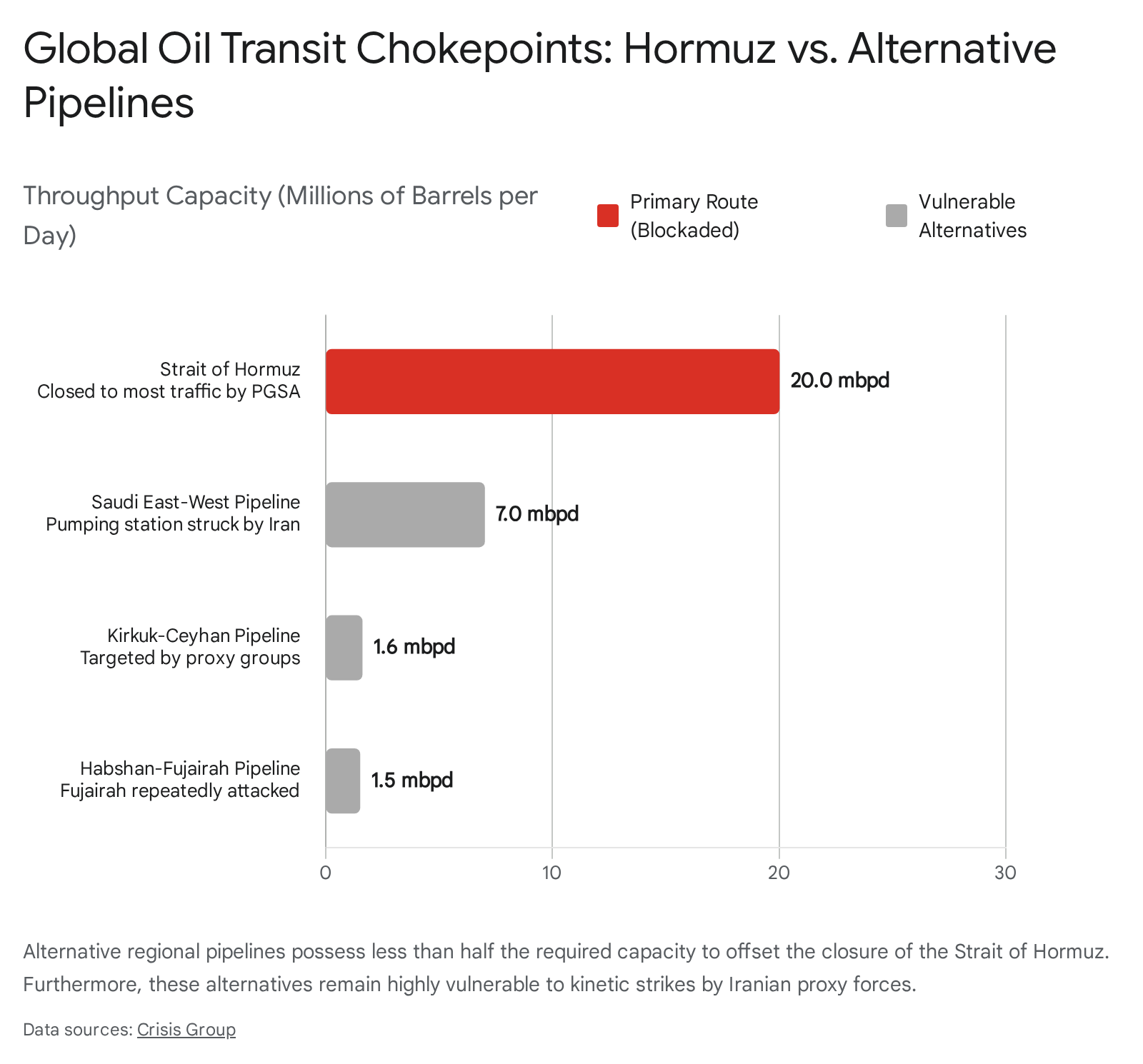
The most critical evolution in Iranian military posture is the explicit weaponization of the maritime domain. Following the destruction of significant portions of the conventional Iranian Navy by US CENTCOM forces,including the sinking of the IRIS Dena,the IRGC Naval Forces have implemented a de facto blockade of the Strait of Hormuz.15 On March 7, the IRGC utilized a one-way attack drone to strike the commercial oil tanker Prima.4 The IRGC subsequently released statements confirming that the vessel was targeted for ignoring warnings regarding the “prohibition of traffic,” definitively signaling that Tehran intends to leverage the global economic reliance on the Strait (which facilitates approximately 20% of global oil consumption) as its primary asymmetric deterrent.4

To sustain its degraded command and control (C2) networks and improve targeting against US regional assets, intelligence reports indicate that Russian state actors are currently sharing actionable intelligence with Iran. This development highlights a deepening strategic alignment between Moscow and Tehran and severely complicates US force protection efforts across the Middle East.17

3.1.2 Policy & Diplomacy

The systemic shock generated by the February 28 decapitation strikes has triggered a profound and highly volatile succession crisis within the Iranian political and clerical establishment. Following the assassination of Supreme Leader Ayatollah Ali Khamenei, the Iranian state is currently governed by a three-member Interim Leadership Council. This body comprises President Masoud Pezeshkian, Chief Justice Gholam-Hossein Mohseni-Eje’i, and Ayatollah Alireza Arafi.31 On March 5, the Expediency Discernment Council formally approved the transfer of expanded wartime powers to this triumvirate, theoretically granting them full authority over the armed forces and strategic directives.9

However, the constitutional mechanism designed to permanently resolve the leadership vacuum,the 88-member Assembly of Experts,is operating under severe duress and internal division. Following an Israeli airstrike that destroyed the Assembly’s physical headquarters in Qom on March 3, the clerical body has been forced to conduct emergency virtual sessions.5 Intelligence sources indicate a fierce internal power struggle. The IRGC is reportedly exerting immense pressure on the Assembly to rapidly appoint Mojtaba Khamenei, the late Supreme Leader’s son, to ensure regime continuity and centralized wartime control.5 This maneuver has met significant resistance from an anti-hereditary faction within the Assembly. Clerics have warned that elevating Mojtaba would legitimize a “hereditary leadership” structure reminiscent of the pre-1979 monarchy, with at least eight members threatening to boycott the emergency voting sessions.5

Amidst this internal turmoil, the Interim Leadership Council is executing a complex external diplomatic strategy aimed at fracturing the coalition arrayed against it. In an unprecedented move on March 7, President Pezeshkian utilized a prerecorded television address to formally apologize to the neighboring GCC states for the collateral damage inflicted by Iranian strikes over the past week. He announced a new policy directive stipulating that Iran will cease firing upon Saudi Arabia, the UAE, Qatar, Kuwait, Bahrain, and Oman, strictly on the condition that these nations assert their sovereignty and deny the United States the use of their territory, airspace, and host bases to launch attacks against Iran.7

This diplomatic overture serves a dual strategic purpose. First, it aims to exploit the deep anxieties of the Gulf states, forcing Arab leaders to choose between the perceived security of the American defense umbrella and the immediate cessation of crippling economic and infrastructural damage inflicted by Iran. Second, it provides Tehran with a geopolitical and legal pretext; if GCC states fail to expel US forces, Iran can frame continued strikes on Gulf infrastructure as legitimate self-defense against active staging grounds.34 Simultaneously, Pezeshkian maintained a defiant posture toward Washington, flatly rejecting the US demand for “unconditional surrender” and warning that American leadership will “take their dreams to the grave”.35

3.1.3 Civilian Impact

The civilian toll within the Islamic Republic has escalated dramatically as the allied air campaign systematically dismantles dual-use infrastructure and operates within densely populated urban centers. Reports from the Iranian Red Crescent and international human rights organizations estimate total fatalities between 1,332 and 2,400 since the conflict commenced.3

March 6 was widely documented by Iranian officials, academics, and residents as the “bloodiest single day” for civilians in Tehran. Coordinated US-Israeli strikes rippled across multiple districts of the capital simultaneously. A specific strike targeting an alleged regime asset in the densely populated Niloofar Square in southern Tehran resulted in significant collateral damage, killing over twenty civilians, collapsing residential buildings, and overwhelming the city’s emergency response infrastructure.38

The systemic targeting of Iran’s defense industrial base has also severely impacted civilian employment centers and the broader economy. Strikes on the Esteghlal Industrial Zone in Tehran Province and the Shokouhiyeh Industrial Zone in Qom Province,intended to degrade drone production networks,have reduced major manufacturing hubs to rubble.17 Basic infrastructure is heavily degraded, with power outages and severe communication blackouts documented nationwide. The nation’s macroeconomic functions have effectively paralyzed; the Tehran Stock Exchange remains closed until further notice, and citizens are experiencing acute shortages of essential goods amid widespread panic.7

Key Iranian Institutional BodiesCurrent Status / Recent Developments (Last 36 Hours)Strategic Implication
Interim Leadership CouncilGranted expanded wartime powers by the Expediency Council. Led by Pezeshkian, Mohseni-Eje’i, and Arafi.Consolidates executive and military command during the succession crisis.
Assembly of ExpertsHQ in Qom destroyed by IDF strike. Attempting virtual emergency sessions.Paralyzed by internal factional disputes regarding the appointment of Mojtaba Khamenei.
IRGC Aerospace / NavyLaunch capacity severely degraded. Transitioned to asymmetric maritime interdiction (Strait of Hormuz).Shifts the Iranian threat from direct military confrontation to global economic sabotage.
Civilian InfrastructureTelecoms degraded to 1-4% connectivity. Major industrial zones in Tehran and Qom destroyed.Total socioeconomic paralysis; rising domestic pressure on the interim government.

3.2 Israel

3.2.1 Military Actions & Posture

Operating under the strategic framework of Operation Roaring Lion, the Israel Defense Forces (IDF) and the Israeli Air Force (IAF) have transitioned from initial decapitation strikes to the systematic, grinding dismantlement of Iran’s military-industrial complex and the neutralization of its proxy forces across the Levant.25 Within the last 36 hours, the IAF executed its 13th distinct wave of strikes into Iranian territory, a complex operation involving approximately 80 fighter jets. This wave struck over 400 targets heavily concentrated in western Iran, Tehran, and Isfahan.3 Specific targets included Imam Hossein University in Tehran,which Israeli intelligence identified as a primary training facility for IRGC officer cadres,and a heavily fortified subterranean command bunker located beneath the supreme leader’s compound in the Pastour neighborhood.26

Recognizing that Iran inherently relies on its “Ring of Fire” proxy network,the “Axis of Resistance”,to project power while its domestic capabilities are suppressed, Israel has aggressively escalated operations on its northern front. Following Hezbollah’s formal entry into the conflict on March 2, the IDF has battered southern Lebanon with over 500 airstrikes in a single week.3 To permanently alter the security reality in the north, the IDF has initiated limited ground operations. Infantry and armored units have advanced beyond the Blue Line, establishing forward positions in Khiam and Mays al Jabal to dismantle Hezbollah’s direct-fire capabilities.19 The operational tempo has also reached deep into sovereign Lebanese territory, evidenced by a precision naval strike in Tripoli that successfully eliminated Hamas commander Wasim Attallah Ali.25

3.2.2 Policy & Diplomacy

Israeli political and diplomatic leadership maintains an inflexible stance regarding war termination conditions, mirroring but remaining distinct from the posture of the United States. Prime Minister Benjamin Netanyahu and his war cabinet view the current conflict as a historic, generational opportunity to permanently eliminate Iran’s nuclear program and its ballistic missile threat, framing the regime as an existential danger that cannot be managed through diplomacy.25

Israeli Ambassador to the United Nations Danny Danon explicitly stated that international calls for a ceasefire are premature. He asserted that Israel must “finish the job” and continue to “hammer, to dismantle” Iranian capabilities,including nuclear sites, ballistic networks, regional proxies, and naval threats,before any diplomatic off-ramps can be considered.14 The Israeli strategic calculus is heavily reliant on Washington’s military umbrella, but differences in long-term objectives remain. While Israel’s primary focus is the neutralization of the existential physical threat, US rhetoric has explicitly integrated regime change and internal Iranian uprisings into its end-state goals, a scenario Israeli planners view cautiously due to the potential for protracted regional chaos.44

3.2.3 Civilian Impact

The civilian impact within Israel remains significant, driven primarily by sustained rocket, drone, and ballistic missile attacks launched by Iran and Hezbollah. Over the past 36 hours, air raid sirens sounded across central Israel, the greater Tel Aviv metropolitan area, and Jerusalem.7 While the Iron Dome, David’s Sling, and Arrow defense systems have intercepted the vast majority of inbound projectiles, shrapnel from interceptions and direct impacts have caused localized damage to residential buildings.47

At least 11 civilian fatalities have been reported in Israel since the conflict’s inception.15 The psychological and societal impact is profound; the Iranian strategy of targeting densely populated urban centers is clearly designed to raise the domestic costs of the intervention for the Israeli public.37 Furthermore, due to the acute and ongoing security threats, civil authorities implemented emergency closures of all holy sites within Jerusalem’s Old City and canceled Friday prayers.3 In the north, the conflict has displaced significant populations as the IDF mandates the evacuation of communities near the Lebanese border to facilitate military operations.18

3.3 United States

3.3.1 Military Actions & Posture

Operation Epic Fury constitutes the largest regional concentration of American military firepower in a generation, designed to execute a rapid, overwhelming degradation of the Iranian state’s ability to wage war.29 Directed by US Central Command (CENTCOM), the operation has already struck over 1,700 targets utilizing a vast array of assets, including B-1, B-2 stealth, and B-52 bombers, F-22 and F-35 stealth fighters, and naval guided-missile destroyers firing Tomahawk land-attack missiles.49

The primary operational focus of the last 36 hours has been the complete annihilation of the Iranian Navy to secure freedom of navigation, and the systematic hunting of mobile ballistic missile launchers.29 US forces have achieved significant tactical success in the maritime domain; a US Navy submarine notably engaged and sank the Iranian warship IRIS Dena off the coast of Sri Lanka, while the IRIS Bushehr was forced to seek emergency harbor and request assistance, effectively neutralizing Iran’s blue-water naval projection.15

However, the human cost for US forces is mounting. The Department of Defense confirmed that the number of US Service Members Killed in Action (KIA) has risen to six.51 The Army identified four Reserve soldiers from the 103rd Sustainment Command who were killed by an Iranian drone strike at the Port of Shuaiba in Kuwait.52 Additionally, the remains of two unaccounted-for personnel were recovered from a facility struck earlier in the campaign.51 The financial burden of the conflict is also immense; the Center for Strategic and International Studies (CSIS) estimates the cost of the first 100 hours of Operation Epic Fury at $3.7 billion,averaging $891 million per day,the vast majority of which was not previously budgeted.3

3.3.2 Policy & Diplomacy

President Donald Trump’s administration has adopted an uncompromising, maximalist diplomatic posture. In statements issued on March 6 and 7, President Trump flatly ruled out any negotiated settlement short of the Iranian regime’s “unconditional surrender.”.7 Trump has explicitly linked the military campaign to a broader regime-change doctrine, announcing his intention to oversee the reconstruction of the Iranian state under the slogan “Make Iran Great Again” (MIGA).11 Furthermore, he has inserted the United States directly into the Iranian succession crisis, publicly declaring that any succession by Mojtaba Khamenei is “unacceptable” and that the US will have a role in selecting “acceptable” leaders.3

To sustain the operational tempo of its primary regional ally, the US State Department bypassed standard congressional review protocols to approve an emergency $151.8 million munitions sale to Israel.7 Secretary of War/Defense Pete Hegseth indicated that the conflict will escalate further, warning that the US is preparing a forthcoming bombing campaign that will be “the most intense of the weeklong conflict,” designed to irrevocably break the regime’s will to fight.7 Anticipating the severe economic fallout of the Iranian blockade of the Strait of Hormuz, the administration has also ordered the US Development Finance Corporation to begin underwriting war-risk insurance for maritime shipping in the Persian Gulf, accompanied by promises of US Navy escorts for commercial vessels.54

3.3.3 Civilian Impact

Domestically, the conflict has polarized the American public and raised significant homeland security concerns. Early polling data indicates a deeply divided electorate; a YouGov poll found that 45% of respondents believe the administration made “the wrong decision” in attacking Iran, compared to 31% who support it, while Morning Consult showed a near-even split (42% prefer diplomacy, 41% support airstrikes).55

The homeland security apparatus is on heightened alert due to Iranian asymmetric retaliation strategies, which historical precedent suggests may target US soil or interests abroad. On March 6, a Pakistani national was convicted in the US for a plot to assassinate Donald Trump and other politicians,an operation orchestrated by Iranian intelligence in delayed retaliation for the 2020 killing of Qasem Soleimani.7 Simultaneously, British authorities arrested four men in London suspected of aiding Iranian intelligence by spying on the local Jewish community.53 Furthermore, the conflict has triggered a massive logistical crisis for American citizens abroad; an estimated 20,000 Americans have evacuated or are attempting to evacuate the Middle East, leading to severe bottlenecks at regional transit hubs as commercial aviation routes collapse.3

4.0 Regional and Gulf State Impacts

The geopolitical containment of the US-Israel-Iran war has decisively failed, transforming the Arabian Peninsula and the broader Gulf into an active, multi-domain combat theater. The Gulf Cooperation Council (GCC) states, which host critical US military infrastructure, logistical hubs, and naval headquarters, have been violently drawn into the conflict. This reality shatters years of intense pre-war diplomatic lobbying by these states, which had sought to balance relations with Washington while pursuing détente with Tehran to prevent their territories from becoming a battleground.34 The regional security architecture is now under existential threat, characterized by daily airspace violations, targeted infrastructural damage, and the looming specter of a global economic crisis.

Saudi Arabia The Kingdom of Saudi Arabia finds itself in a highly precarious position, attempting to defend its sovereignty while desperately seeking a diplomatic off-ramp. Riyadh is utilizing urgent diplomatic backchannels to engage directly with Tehran, aiming to defuse tensions and prevent further military spillover.6 However, the military reality on the ground contradicts these diplomatic efforts. Over the last 36 hours, the Royal Saudi Air Defense Forces successfully intercepted an inbound Iranian ballistic missile near the capital, Riyadh, and intercepted an additional three ballistic missiles over Al-Kharj. The latter strikes were explicitly targeting the US military presence at the Prince Sultan Air Base.7 In response to these provocations, Saudi Defense Minister Prince Khalid bin Salman issued a stern public warning to Iran to “avoid miscalculation,” highlighting the fragility of the landmark 2023 Chinese-brokered normalization agreement between the two nations, which now appears functionally obsolete.7

United Arab Emirates (UAE) The UAE has sustained profound and lasting economic and infrastructural disruptions, bearing the brunt of Iran’s early retaliatory strategy. Over 120 Iranian attack drones and multiple ballistic missiles have breached Emirati airspace, specifically targeting the US assets stationed at the Al-Minhad and Al-Dhafra air bases.3 The civilian impact of these interceptions has been severe; explosions and falling interceptor shrapnel near Dubai International Airport (DXB),the world’s second-busiest international aviation hub,forced the immediate suspension of operations. Incoming commercial flights were forced to execute emergency go-arounds and enter prolonged holding patterns over neighboring Saudi airspace, causing minor civilian injuries on the ground.7 The economic shock to the UAE’s tourism, finance, and logistics-driven economy is critical, threatening the state’s foundational model of regional stability.

Qatar & Energy Markets Qatar, which houses the forward headquarters of US CENTCOM at the sprawling Al Udeid Air Base, has been subjected to missile and drone barrages directly targeting the capital, Doha.3 While the physical damage has been mitigated by air defenses, the macroeconomic impact originating from Qatar is unparalleled. QatarEnergy, the world’s largest producer of Liquefied Natural Gas (LNG), has officially halted production due to the extreme regional insecurity.54 Qatari Energy Minister Saad al-Kaabi issued a dire warning that a prolonged shutdown of Gulf energy exports, coupled with the Iranian blockade of the Strait of Hormuz, could push global oil prices to $150 per barrel. Al-Kaabi stated unequivocally that the continuation of the conflict could “bring down the economies of the world”.15

Kuwait, Bahrain, and Oman The northern Gulf states are absorbing direct kinetic damage and human losses. Kuwait has suffered the only confirmed US fatalities of the conflict thus far. Following the devastating drone strike at Port Shuaiba that killed four US Army Reserve soldiers, Iranian forces have repeatedly targeted the Ali al Salem Airbase. These strikes have successfully penetrated local defenses, severely damaging aircraft shelters, equipment warehouses, and critical logistics infrastructure.19 In response to the deteriorating security environment, the United States has suspended all operations at its embassy in Kuwait City, and the German government announced the withdrawal of its military personnel from both Kuwait and Bahrain.3

In Bahrain, home to the US Navy’s Fifth Fleet Headquarters, Iranian aggression resulted in a direct missile strike on a state-run oil refinery, causing significant fires and infrastructural damage.3 Oman, a nation that has traditionally maintained a strict posture of neutrality and served as the primary diplomatic mediator between Tehran and Washington, saw its vital Port of Duqm targeted. While Iranian sources unofficially claimed the strike was a “mistake” by the IRGC, the incident has shattered Muscat’s “friend to all” security posture, forcing the Sultanate to re-evaluate its strategic vulnerability.60

Airspace, Logistics, and Global Supply Chains The Middle East is currently experiencing an unprecedented, region-wide aviation and logistical lockdown. Commercial airspace over Iran, Iraq, Israel, Lebanon, and Bahrain is classified as a Level 1 (Moderate to High Risk) No-Fly zone by the FAA, EASA, and other major international aviation authorities.22 The closure of these vital corridors has stranded hundreds of thousands of passengers globally and forced the cancellation of over 19,000 scheduled flights.56

Furthermore, the maritime logistics sector is facing near-total paralysis. Global shipping conglomerates, including Danish giant Maersk, have suspended all cargo booking acceptance in and out of the UAE, Oman, Iraq, Kuwait, Qatar, Bahrain, and Saudi Arabia.19 The combination of airspace closures, port strikes, and the active IRGC blockade of the Strait of Hormuz severely threatens global supply chains, presenting an imminent risk of global economic recession if the operational environment does not stabilize.

NationStrategic US Assets HostedRecent Kinetic Impact / Incident (Last 36 Hours)Stated Security Posture / Diplomatic Action
Saudi ArabiaPrince Sultan Air BaseIntercepted multiple ballistic missiles over Riyadh and Al-Kharj.Issued stern warnings to Iran; actively utilizing diplomatic backchannels to defuse tension.
UAEAl-Dhafra, Al-Minhad Air BasesDXB Airport suspended operations due to shrapnel; 120+ drones intercepted.Managing severe economic shock; directly targeted by continuous IRGC strikes.
QatarAl Udeid Air Base (CENTCOM HQ)Missile and drone barrage targeted Doha.Halting LNG production; warning international community of $150/barrel oil threat.
KuwaitAli al Salem Airbase, Camp ArifjanEmbassy closed; Airbase infrastructure damaged; US casualties confirmed.German troop withdrawal; recovering from the loss of US logistics personnel.
BahrainUS Fifth Fleet HeadquartersState-run oil refinery struck by missile; civilian areas targeted.Condemned Iranian aggression via the Arab League; managing German troop withdrawal.
OmanPort of Duqm / Logistics HubsPort targeted (claimed as a “mistake” by the IRGC).Re-evaluating historical neutral mediator status and vulnerability.

5.0 Appendices

Appendix A: Methodology

This Situation Report (SITREP) was generated through a comprehensive, real-time synthesis of global Open-Source Intelligence (OSINT), official state broadcasts, military press releases (e.g., CENTCOM, IDF), and geopolitical security monitors. The analytical window strictly covers the 36 hours from March 5, 18:00 UTC to March 7, 06:00 UTC, 2026. An intentional contextual overlap spanning the campaign’s initiation on February 28 was utilized to ensure narrative continuity regarding force degradation, casualty figures, and strategic intent.

Conflicting reports within the intelligence stream were evaluated based on source credibility and historical patterns of state media. For example, early claims that the Assembly of Experts formally elected Mojtaba Khamenei on March 4 were weighed against later, more granular intelligence indicating severe internal resistance, boycotts, and delayed virtual meetings extending into March 6 and 7. The latter, depicting a deadlocked succession crisis, was deemed highly credible and integrated into the report. Where casualty figures or battle damage assessments (BDA) diverged between belligerents, independent assessments,such as financial estimates by the Center for Strategic and International Studies (CSIS) and casualty reports from the Iranian Red Crescent,were prioritized to maintain absolute analytical neutrality and factual rigor.

Appendix B: Glossary of Acronyms

  • BDA: Battle Damage Assessment
  • C2: Command and Control
  • CENTCOM: United States Central Command (Geographic combatant command covering the Middle East, Egypt, and Central Asia)
  • CSIS: Center for Strategic and International Studies (Washington D.C.-based think tank)
  • DXB: Dubai International Airport
  • EASA: European Union Aviation Safety Agency
  • FAA: Federal Aviation Administration (United States)
  • GCC: Gulf Cooperation Council (Political and economic union of Bahrain, Kuwait, Oman, Qatar, Saudi Arabia, and the UAE)
  • IADS: Integrated Air Defense Systems (A networked array of radars, surface-to-air missiles, and C2 nodes)
  • IAF: Israeli Air Force
  • IDF: Israel Defense Forces
  • IRGC: Islamic Revolutionary Guard Corps (A multi-service primary branch of the Iranian Armed Forces)
  • KIA: Killed in Action
  • LNG: Liquefied Natural Gas
  • MIGA: “Make Iran Great Again” (A political slogan utilized by US President Donald Trump regarding the post-war reconstruction of Iran)
  • NOTAM: Notice to Air Missions (Alerts filed with an aviation authority to alert aircraft pilots of potential hazards)
  • OSINT: Open-Source Intelligence
  • UAV: Unmanned Aerial Vehicle (Drone)

Appendix C: Glossary of Foreign Words

  • Ayatollah: A high-ranking title given to Usuli Twelver Shī‘ah clerics, denoting significant expertise in Islamic studies.
  • Dahiyeh: The predominantly Shia southern suburbs of Beirut, Lebanon; a known demographic stronghold and operational headquarters for Hezbollah.
  • Khamenei (Ali / Mojtaba): Ali Khamenei was the second Supreme Leader of Iran, assassinated by US-Israeli strikes on February 28, 2026. Mojtaba Khamenei is his son, a highly influential cleric, and a central, highly contested figure in the current succession crisis.
  • Majlis: The Islamic Consultative Assembly; the national legislative body (parliament) of the Islamic Republic of Iran.
  • Pezeshkian (Masoud): The incumbent President of Iran and a leading member of the wartime Interim Leadership Council.
  • Velayat-e-Faqih: “Guardianship of the Islamic Jurist,” the foundational political and religious doctrine of the Iranian state post-1979, which justifies the absolute temporal and spiritual rule of the Supreme Leader.

Please share the link on Facebook, Forums, with colleagues, etc. Your support is much appreciated and if you have any feedback, please email us in**@*********ps.com. If you’d like to request a report or order a reprint, please click here for the corresponding page to open in new tab.


Sources Used

  1. The US-Israel campaign in Iran – The International Institute for Strategic Studies, accessed March 7, 2026, https://www.iiss.org/online-analysis/online-analysis/2026/02/the-us-israel-campaign-in-iran/
  2. US-Israel strikes on Iran: February/March 2026 – The House of Commons Library, accessed March 7, 2026, https://commonslibrary.parliament.uk/research-briefings/cbp-10521/
  3. Iran war: What is happening on day seven of US-Israel attacks …, accessed March 7, 2026, https://www.aljazeera.com/news/2026/3/6/iran-war-what-is-happening-on-day-seven-of-us-israel-attacks
  4. IRGC Targets Oil Tanker in the Gulf…, accessed March 7, 2026, https://www.jordannews.jo/Section-111/All/IRGC-Targets-Oil-Tanker-in-the-Gulf-49452
  5. Guards push fast Mojtaba Khamenei announcement amid dissent over hereditary rule | Iran International, accessed March 7, 2026, https://www.iranintl.com/en/202603052337
  6. Saudi Arabia said to intensify talks with Iran to defuse Mideast war | The Times of Israel, accessed March 7, 2026, https://www.timesofisrael.com/saudi-arabia-said-to-intensify-talks-with-iran-to-defuse-mideast-war/
  7. Israel-Iran war LIVE: Iran vows no surrender as air strikes hit Tehran …, accessed March 7, 2026, https://www.thehindu.com/news/international/iran-israel-us-war-live-west-asia-conflict-march-7-2026-trump-middle-east-crisis-oil-prices-air-strikes-drone-attacks-lebanon-strikes-gulf-region/article70714560.ece
  8. IRGC strikes Prima tanker with drone in Strait of Hormuz, accessed March 7, 2026, https://operativmm.az/en/post/irgc-strikes-prima-tanker-with-drone-in-strait-of-hormuz/68545
  9. Iran grants interim leadership council expanded powers after Khamenei killing, accessed March 7, 2026, https://www.middleeasteye.net/live-blog/live-blog-update/iran-grants-interim-leadership-council-expanded-powers-after-khamenei
  10. Assembly of Experts – Wikipedia, accessed March 7, 2026, https://en.wikipedia.org/wiki/Assembly_of_Experts
  11. No more attacks on neighbouring countries, says Iran’s President; rules out question of ‘surrender’ – Times of Oman, accessed March 7, 2026, https://timesofoman.com/article/169167-no-more-attacks-on-neighbouring-countries-says-irans-president-rules-out-question-of-surrender
  12. Iran pledges to halt strikes on neighbours as conflict with US and Israel enters second week, accessed March 7, 2026, https://theonlinecitizen.com/2026/03/07/iran-pledges-to-halt-strikes-on-neighbours-as-conflict-with-us-and-israel-enters-second-week
  13. Trump’s ever-changing rationale for war on Iran – how the story has shifted – The Guardian, accessed March 7, 2026, https://www.theguardian.com/us-news/2026/mar/07/trump-rationale-war-iran-story
  14. The Latest: New Iranian attacks target Israel and US bases as more Israeli strikes hit Lebanon, accessed March 7, 2026, https://www.click2houston.com/news/2026/03/05/the-latest-new-iranian-attacks-target-israel-and-us-bases-as-more-israeli-strikes-hit-lebanon/
  15. Iran’s president apologizes for strikes on neighboring countries as conflict continues, accessed March 7, 2026, https://www.wwltv.com/article/news/nation-world/attack-on-iran/iran-us-israel-attack-missiles-drones-strikes/507-7206fa4b-38d7-4b56-9119-20b89c0e8e3e
  16. Middle East Conflict: Regional Escalation, Travel Disruption, and What to do Now | Crisis24, accessed March 7, 2026, https://www.crisis24.com/articles/middle-east-conflict-regional-escalation-travel-disruption-and-what-to-do-now
  17. Iran Update Evening Special Report, March 6, 2026 | ISW, accessed March 7, 2026, https://understandingwar.org/research/middle-east/iran-update-evening-special-report-march-6-2026/
  18. Lebanon: Humanitarian consequences of the Israeli military offensive (Briefing Note 5 March 2026) – ReliefWeb, accessed March 7, 2026, https://reliefweb.int/report/lebanon/lebanon-humanitarian-consequences-israeli-military-offensive-briefing-note-5-march-2026
  19. Iran Update Evening Special Report, March 4, 2026, accessed March 7, 2026, https://understandingwar.org/research/middle-east/iran-update-evening-special-report-march-4-2026/
  20. Operation Epic Fury Takes Flight: Inside the Strike Strategy and What Comes Next, accessed March 7, 2026, https://sofrep.com/news/operation-epic-fury-begins-inside-the-strike-strategy-and-what-comes-next/
  21. Escalation in the Middle East: Tracking “Operation Epic Fury” Across Military and Cyber Domains, accessed March 7, 2026, https://flashpoint.io/blog/escalation-in-the-middle-east-operation-epic-fury/
  22. Risk Summary 07 Mar 2026 – Safe Airspace, accessed March 7, 2026, https://safeairspace.net/summary/
  23. Airspace closures following Israeli and US strikes on Iran | Flightradar24 Blog, accessed March 7, 2026, https://www.flightradar24.com/blog/live/israel-launches-pre-emptive-strikes-on-iran-airspace-closures-going-into-place/
  24. Middle East Tension Escalation – March 6, 2026 – Expeditors, accessed March 7, 2026, https://info.expeditors.com/operational-impact/middle-east-tension-escalation-march-6-2026
  25. Timeline of Events Operation Roaring Lion, accessed March 7, 2026, https://www.idf.il/en/mini-sites/operation-roaring-lion/operation-roaring-lion-updates/
  26. Iran Update Morning Special Report, March 6, 2026 | ISW, accessed March 7, 2026, https://understandingwar.org/research/middle-east/iran-update-morning-special-report-march-6-2026/
  27. Live Updates: Iran’s president calls U.S. demand for surrender “a dream that they should take to their grave”, accessed March 7, 2026, https://www.cbsnews.com/live-updates/us-iran-war-israel-strikes-regime-targets/
  28. Iran claims to have intercepted an oil tanker forcibly entering the Strait of Hormuz – Bitget, accessed March 7, 2026, https://www.bitget.com/amp/news/detail/12560605246275
  29. Operation Epic Fury: Unmatched Power, Unrelenting Force of America’s Warriors, accessed March 7, 2026, https://www.whitehouse.gov/articles/2026/03/operation-epic-fury-unmatched-power-unrelenting-force-of-americas-warriors/
  30. IRGC strikes “Prima” tanker in Strait of Hormuz with drone – Apa.az, accessed March 7, 2026, https://en.apa.az/asia/irgc-strikes-prima-tanker-in-strait-of-hormuz-with-drone-495503
  31. Who is running Iran now?, accessed March 7, 2026, https://www.washingtonexaminer.com/news/world/4476891/iran-leading-government-military-us-war/
  32. Who Will Run Iran?, accessed March 7, 2026, https://www.meforum.org/mef-online/who-will-run-iran
  33. Israel Strikes Tehran Regime’s Assembly of Experts, Underlining Efforts to Disrupt Succession Process – FDD, accessed March 7, 2026, https://www.fdd.org/analysis/2026/03/03/israel-strikes-tehran-regimes-assembly-of-experts-underlining-efforts-to-disrupt-succession-process/
  34. Iran’s legal case for striking the Gulf collapses under scrutiny, accessed March 7, 2026, https://www.aljazeera.com/opinions/2026/3/7/irans-legal-case-for-striking-the-gulf-collapses-under-scrutiny
  35. Iran’s president defies US demands while apologizing for strikes on neighbors | النهار, accessed March 7, 2026, https://www.annahar.com/en/region/middle-east/284594/irans-president-defies-us-demands-while-apologizing-for-strikes-on-neighbors
  36. Iran is halting attacks on neighboring countries unless they launch strikes first: President, accessed March 7, 2026, https://www.middleeastmonitor.com/20260307-iran-is-halting-attacks-on-neighboring-countries-unless-they-launch-strikes-first-president/
  37. Middle East Special Issue: March 2026 | ACLED, accessed March 7, 2026, https://acleddata.com/update/middle-east-special-issue-march-2026
  38. ‘Bloodiest single day for civilians’ in Iran amid US-Israel war – The New Arab, accessed March 7, 2026, https://www.newarab.com/news/bloodiest-single-day-civilians-iran-amid-us-israel-war
  39. Threat Brief: March 2026 Escalation of Cyber Risk Related to Iran, accessed March 7, 2026, https://unit42.paloaltonetworks.com/iranian-cyberattacks-2026/
  40. Operation “Epic Fury:” SITREP (3 MAR 2026), accessed March 7, 2026, https://ict.org.il/operation-epic-fury-sitrep-3-mar-2026/
  41. Operation Roaring Lion: IDF unveils dramatic footage of first-ever strike in ‘heart of Tehran’ , watch, accessed March 7, 2026, https://timesofindia.indiatimes.com/defence/international/operation-roaring-lion-idf-unveils-dramatic-footage-of-first-ever-strike-in-heart-of-tehran-watch/articleshow/128912234.cms
  42. Operation “Epic Fury:” SITREP (2 MAR 2026), accessed March 7, 2026, https://ict.org.il/operation-epic-fury-sitrep-2-mar-2026/
  43. Operation Roaring Lion: Netanyahu vows to ”save the world” from Iran’s nuclear tyranny during visit to bombarded site, accessed March 7, 2026, https://www.aninews.in/news/world/middle-east/operation-roaring-lion-netanyahu-vows-to-save-the-world-from-irans-nuclear-tyranny-during-visit-to-bombarded-site20260302231028
  44. Trump and Netanyahu’s Iran Gambit: The Strategic Calculations behind Epic Fury, accessed March 7, 2026, https://arabcenterdc.org/resource/trump-and-netanyahus-iran-gambit-the-strategic-calculations-behind-epic-fury/
  45. Epic Fury and Roaring Lion: From War Scenarios to Pressing Postwar Questions in Iran, accessed March 7, 2026, https://www.washingtoninstitute.org/policy-analysis/epic-fury-and-roaring-lion-war-scenarios-pressing-postwar-questions-iran
  46. Analysis: Similarities and differences in US and Israeli targets and objectives in Iran campaign, accessed March 7, 2026, https://www.longwarjournal.org/archives/2026/03/analysis-similarities-and-differences-in-us-and-israeli-targets-and-objectives-in-iran-campaign.php
  47. Iran launches new attacks and calls for ‘Trump’s blood’ while Israel strikes Iranian infrastructure, accessed March 7, 2026, https://www.wsls.com/news/world/2026/03/05/iran-launches-new-wave-of-attacks-on-israeli-and-us-bases-while-israel-begins-new-strikes-in-lebanon/
  48. U.S. Forces Launch Operation Epic Fury – centcom, accessed March 7, 2026, https://www.centcom.mil/MEDIA/PRESS-RELEASES/Press-Release-View/Article/4418396/us-forces-launch-operation-epic-fury/
  49. Operation Epic Fury Fact Sheet 260303, accessed March 7, 2026, https://media.defense.gov/2026/Mar/03/2003882557/-1/-1/1/OPERATION-EPIC-FURY-FACT-SHEET-260303.PDF
  50. This Week in DOW: Delivering ‘Shock and Awe’ to Iran, Defense Leaders’ Declaration, Updates on AI, accessed March 7, 2026, https://www.war.gov/News/News-Stories/Article/Article/4425242/this-week-in-dow-delivering-shock-and-awe-to-iran-defense-leaders-declaration-u/
  51. Operation Epic Fury Update > U.S. Central Command > Statements View, accessed March 7, 2026, https://www.centcom.mil/MEDIA/STATEMENTS/Statements-View/Article/4419315/operation-epic-fury-update/
  52. Update: Pentagon identifies 4 Soldiers Killed in Drone Strike – Military.com, accessed March 7, 2026, https://www.military.com/daily-news/2026/03/01/three-us-service-members-killed-several-injured-operation-epic-fury.html
  53. As Iran war expands, Trump says he must have a role in choosing the country’s next leader, accessed March 7, 2026, https://www.cbsnews.com/live-updates/us-iran-war-spreads-azerbaijan-israel-strikes-tehran-lebanon/
  54. Day Four of the War with Iran: An Update, accessed March 7, 2026, https://www.meforum.org/mef-online/day-four-of-the-war-with-iran-an-update
  55. Americans Are Skeptical About Operation Epic Fury, accessed March 7, 2026, https://www.cfr.org/articles/americans-are-skeptical-about-operation-epic-fury
  56. Anxious travelers scramble as Iran war strands hundreds of thousands across the Middle East – Oregon Public Broadcasting, accessed March 7, 2026, https://www.opb.org/article/2026/03/03/anxious-travelers-scramble-as-iran-war-strands-hundreds-of-thousands-across-the-middle-east/
  57. Iran Is Pushing Its Neighbors Toward the United States, accessed March 7, 2026, https://carnegieendowment.org/emissary/2026/03/iran-collective-security-gulf-states-us-security
  58. Why Arab states are terrified of US war with Iran – Responsible Statecraft, accessed March 7, 2026, https://responsiblestatecraft.org/iran-war-gulf-states/
  59. Iran’s strikes on the Gulf: Burning the bridges of good neighbourliness, accessed March 7, 2026, https://www.aljazeera.com/opinions/2026/3/7/irans-strikes-on-the-gulf-burning-the-bridges-of-good-neighbourliness
  60. The Gulf that emerges from the Iran war will be very different – Atlantic Council, accessed March 7, 2026, https://www.atlanticcouncil.org/dispatches/the-gulf-that-emerges-from-the-iran-war-will-be-very-different/
  61. What the War on Iran Means for the Horn of Africa’s Security Posture?, accessed March 7, 2026, https://www.hiiraan.com/op4/2026/Mar/204586/what_the_war_on_iran_means_for_the_horn_of_africas_security_posture.aspx
  62. Iran to halt attacks on GCC countries, if they bar attacks on Iran from their territory – Pezeshkian – bne IntelliNews, accessed March 7, 2026, https://www.intellinews.com/iran-to-halt-attacks-on-gcc-countries-if-they-bar-attacks-on-iran-from-their-territory-pezeshkian-430086/?source=israel
  63. Middle East Airspace – Current Operational Picture – International Ops 2025 – OpsGroup, accessed March 7, 2026, https://ops.group/blog/middle-east-airspace-current-operational-picture/

Analyzing USSOCOM’s Maritime Strategy in CENTCOM

Executive Summary

This intelligence estimate assesses the probability that the United States Special Operations Command (USSOCOM) is currently operating a covert “sister ship” to the Maritime Support Vessel (MSV) MV Ocean Trader (IMO 9457218) within the United States Central Command (CENTCOM) Area of Responsibility (AOR). The operational imperative for such a vessel in the Middle East-specifically in the Red Sea, Gulf of Aden, Arabian Sea, and Persian Gulf-is ostensibly high. This demand is driven by the persistent requirement to interdict Iranian lethal aid smuggling networks and to conduct clandestine direct action and reconnaissance operations against Houthi militant infrastructure in Yemen.

Through an exhaustive aggregation of open-source intelligence (OSINT), defense procurement forensics, global maritime tracking data, and aviation deployment anomalies spanning from 2014 to February 2026, this analysis yields a highly calculated, probabilistic intelligence estimate. The findings definitively point away from the presence of a covert sister ship in the Middle East, revealing instead a paradigm shift in how USSOCOM projects maritime power in highly contested littorals.

The primary probabilistic conclusions are as follows:

  1. Probability of a Structural Twin (A converted 20,000-ton commercial Ro-Ro): LOW (<15%). Bureaucratic and financial footprints indicate that concerted attempts by the Department of Defense to procure a direct structural sister ship to the MV Ocean Trader were actively pursued but ultimately abandoned due to severe funding constraints. This is most notably evidenced by the cancellation of the Military Sealift Command (MSC) Request for Proposals (RFP) N32205-19-R-3510 in 2019 following unaffordable commercial bids.1 Subsequent USSOCOM procurement budgets have been heavily diverted toward aviation assets, such as the Armed Overwatch program, leaving the massive capital required for a Ro-Ro conversion unfunded.2
  2. Probability of a Functional Shadow Fleet Equivalent in CENTCOM: LOW (10-15%). If a structural twin does not exist, USSOCOM historically relies on a “shadow fleet” of functional proxy vessels-smaller, highly modified Offshore Supply Vessels (OSVs) that fulfill the Afloat Forward Staging Base (AFSB) role. However, the known roster of these functional proxies, including the T-AGSE submarine support fleet and the Edison Chouest Offshore (ECO) special mission ships, is mathematically and geographically accounted for in the United States Indo-Pacific Command (INDOPACOM), United States Strategic Command (STRATCOM), and United States Southern Command (SOUTHCOM) AORs.4
  3. Probability of Overt/Tactical Substitution in CENTCOM: HIGH (95%). Geopolitical and tactical realities in early 2026 dictate that the traditional disguise of an MSV-mimicking a civilian merchant vessel to blend into background maritime traffic-has devolved from a strategic asset into a severe tactical liability. In the Red Sea, indiscriminate Houthi anti-ship ballistic missile (ASBM) and unmanned surface vehicle (USV) attacks actively target commercial shipping.7 Consequently, USSOCOM has pivoted away from the covert MSV doctrine in CENTCOM. Instead, operations rely on a bifurcated strategy of overt heavy staging via Expeditionary Sea Bases (e.g., USS Lewis B. Puller) 6 and discreet, decentralized tactical staging utilizing Arleigh Burke-class destroyers hosting specially modified 160th Special Operations Aviation Regiment (SOAR) elements.10

The MV Ocean Trader itself is currently deployed to the Caribbean Sea in support of Operation Absolute Resolve and Operation Southern Spear.11 In its absence, the CENTCOM AOR is not relying on a dark, covert Ro-Ro surrogate, but rather a modernized framework of overt naval power projection and integrated surface combatant lethality.

Section 1: The Maritime Support Vessel Doctrine and the MV Ocean Trader Baseline

To accurately hunt for a sister ship, it is methodologically necessary to first establish the baseline parameters, operational doctrine, and physical characteristics of the MV Ocean Trader. The concept of the Afloat Forward Staging Base and the specialized MSV evolved out of the necessity for USSOCOM to possess sovereign, highly mobile, and clandestine platforms capable of projecting Special Operations Forces (SOF) without relying on the diplomatic clearances and host-nation footprint associated with terrestrial bases.

Historical Context and Doctrinal Evolution

The requirement for maritime staging bases has deep roots in modern U.S. naval history, most notably crystalizing during the “Tanker War” phase of the Iran-Iraq War in the late 1980s. During Operation Prime Chance and Operation Earnest Will, U.S. forces utilized leased oil barges (such as the Hercules and Wimbrown VII) to host 160th SOAR helicopters and Navy SEALs to interdict Iranian minelaying operations.14 This ad-hoc, improvisational approach proved highly effective but exposed the dire need for dedicated, purpose-built platforms.

Over the decades, this requirement was partially filled by legacy amphibious ships and the hybrid-crewed USS Ponce (AFSB(I)-15), which gained significant media attention as an interim staging base.15 However, overt U.S. Navy warships broadcast their presence, making clandestine insertion and intelligence gathering exceedingly difficult in gray-zone conflicts. USSOCOM required a vessel that could entirely “disappear amid an ocean filled with commercial shipping” while retaining the lethality and command-and-control capabilities of a capital warship.16

The Acquisition and Conversion of the MV Cragside

The MV Ocean Trader represents the zenith of this covert staging doctrine. Originally constructed as the MV Cragside, the vessel was built in 2011 at the Odense Steel Shipyard in Denmark (Yard #222) for the prominent shipping conglomerate Maersk Line.17 The ship was designed as a Flensburger-derived roll-on/roll-off (Ro-Ro) cargo ferry, a ubiquitous and highly common design in European and global commercial shipping.15 Between 2011 and 2014, the Cragside operated under various commercial entities, including DFDS Seaways, Grimaldi Lines, Visemar Line, and LD Lines, effectively establishing a verifiable, mundane commercial legend.18

In November 2013, the Military Sealift Command (MSC)-the agency responsible for providing sealift and ocean transportation for the Department of Defense-awarded Maersk Line Limited an initial $73 million firm-fixed contract to heavily modify the vessel.16 After facing and surviving a legal protest from rival maritime firm Crowley, the Cragside was sent to the BAE Systems shipyard in Mobile, Alabama, in January 2014 to undergo radical militarization.19 The contract, built around a highly modified time charter format specific to the MSV mission, included options that extended its potential value to over $143 million.16 Following its conversion, the ship was chartered by MSC under the Special Mission program explicitly for USSOCOM and renamed the MV Ocean Trader.16

Technical Specifications and SOF Capabilities

The resulting platform is a 20,650-long-ton, 633-foot floating command center that hides in plain sight.17 By retaining its original white livery and commercial silhouette, it is designed to meld seamlessly into the background of global maritime trade.21 However, its internal and external military modifications are formidable, effectively transforming it into a “secretive helicopter carrier”.15

  • Endurance, Range, and Propulsion: The vessel possesses a draft of 18.4 feet and a beam of 85.3 feet.17 Powered by dual MaK 9M43 engines, it is capable of sustaining a transit speed of 20 to 21.5 knots and boasts an unrefueled range of 8,000 nautical miles.17 Crucially for SOCOM operations, it is designed for extreme endurance, capable of operating for 45 days without resupply while hosting a full complement of 209 personnel (comprising 50 civilian mariners and up to 159 special operations forces).17 It is also fully capable of Fuel At Sea (FAS) via instream single probe procedures and Vertical Replenishment (VERTREP), allowing it to remain deployed for over a year.16
  • Aviation Integration: Addressing the primary shortfall of previous, smaller proxy vessels, the Ocean Trader features massive aviation upgrades. A NAVAIR Level I Class 2 certified flight deck was constructed forward of the main house, surrounded by drop-down safety nets.15 This deck is capable of simultaneously launching and recovering two MH-60 class helicopters or a single massive CH-53E/MH-53E heavy-lift helicopter in both day and night Instrument Meteorological Conditions (IMC).22 It supports the full spectrum of USSOCOM rotary-wing assets, including the MH-6 Little Bird, MH-47G Chinook, and the MV-22 Osprey.22 Behind the flight deck, an extensive, humidity-controlled hangar facility was added, capable of housing two MH-60 class helicopters with rotors folded, alongside space for unmanned aerial vehicles (UAVs), spare parts, and dedicated aviation maintenance workshops.17 To sustain high-tempo flight operations, the ship possesses a 150,000-gallon capacity for JP-5 aviation fuel.17
  • Surface and Subsurface Projection: The vessel’s commercial Ro-Ro rear ramps and internal upper cargo decks were highly customized for maritime strike operations. The ship can simultaneously launch and recover up to four 12.5-meter combat craft (weighing up to 30,000 lbs each) within a twenty-minute window.17 These bays are known to deploy stealthy Naval Special Warfare Combatant Craft Assault (CCA) speedboats, rigid-hull inflatable boats (RHIBs), and specialized personal watercraft (jet skis) used for coastal infiltration.19 Furthermore, the vessel’s crane architecture suggests it is the primary launch platform for the Lockheed Martin Dry Combat Submersible (DCS), a surface-launched mini-submarine utilized by Navy SEALs.24
  • Command, Control, and Sustainment: The ship’s superstructure is festooned with concealed communications arrays and satellite domes.17 Internally, it houses a 40-person Sensitive Compartmented Information Facility (SCIF) built to rigorous ICD 705 standards, enabling top-secret intelligence fusion and mission planning.17 It contains 22 climate-controlled Ready Service Lockers (RSLs) for ordnance, dive lockers for up to 60 Naval Special Warfare personnel, a 2,600-square-foot gymnasium, and an emergency medical/surgical suite capable of handling up to 10 trauma casualties simultaneously.17 For localized self-defense, it is equipped with external FLIR monitoring and mounts for 0.50-caliber machine guns.17

Operating under a cloak of plausible deniability, the Ocean Trader does not broadcast its location on commercial Automatic Identification System (AIS) trackers, rendering it a “ghost ship” that only appears when actively engaged in forward operations or captured by high-resolution satellite imagery.20

Section 2: Phase 1 Analysis – The “Structural” Sister Ship Investigation

The initial phase of this intelligence estimate investigates whether the Department of Defense successfully procured, converted, and deployed a direct, structural twin to the MV Ocean Trader. Because the Ocean Trader is a highly specialized, $143 million conversion of a massive Odense-built Ro-Ro, a structural sister ship would inherently require a similarly enormous commercial hull, a massive shipyard conversion footprint, and a highly visible budgetary appropriation.

Hull Forensics and Commercial Lineage

To ascertain if a duplicate vessel was acquired, one must examine the specific commercial lineage of the MV Cragside. The ship was not a bespoke naval design but rather part of a distinct, mass-produced class of Ro-Ro vessels. Its near sister ships, based on the broader Flensburger design, include the four Point-class vessels (e.g., Hurst Point, Eddystone) that were chartered by the United Kingdom Ministry of Defense for their Strategic RORO Service in 2002.15

More specifically, the exact sister hulls constructed at the Odense Staalskibsværft A/S yard in Denmark alongside the Cragside are thoroughly documented in global shipping registries. These include the Cabo Star, California Star, Francesco Nullo, Lista, Paqize, Pol Stella, and Stena Shipper.18

A rigorous, exhaustive search of port state control inspection databases, maritime insurance registries, and global shipbreaking records reveals a stark lack of anomalies regarding these specific sister hulls. When the MV Cragside was acquired by the U.S. Navy in 2013, it abruptly dropped out of standard commercial charter circulation, transitioning to the BAE Systems shipyard in Mobile, Alabama, for its multi-year, highly visible militarization.19

In contrast, the remaining Odense-built sister hulls have maintained uninterrupted, verifiable commercial operations. There are no sudden transfers of ownership to Maersk Line Limited (the U.S. flag subsidiary that manages the Ocean Trader), nor are there any unexplained, multi-year disappearances into specialized defense shipyards like BAE Systems, Detyens Shipyards, or General Dynamics NASSCO. Open-source maritime intelligence confirms that the physical raw materials required to construct a structural twin-a matching 20,000-ton hull-were never diverted from the commercial sector to the military sector.

Budgetary Forensics and the Failure of the MSV-3 Program

While hull tracking provides strong negative evidence, the absence of a structural twin is conclusively proven by the bureaucratic, legal, and financial paper trail within the Department of Defense.

The procurement of these vessels requires immense bureaucratic coordination. Operating under the PM8 (Expeditionary Fast Transport / Special Mission) and PM2 programs, the Military Sealift Command is responsible for the actual chartering of the base vessel using Navy Working Capital Funds.23 Concurrently, USSOCOM must utilize its specialized Major Force Program 11 (MFP-11) funding to pay for the massive, SOF-peculiar modifications, such as the SCIFs, flight decks, and secure armories.25

A critical and highly illuminating inflection point in USSOCOM’s maritime procurement occurred in early 2019. Recognizing the operational strain on the single MV Ocean Trader and the growing necessity for dispersed maritime staging in an era of great power competition, MSC issued Request for Proposals (RFP) No. N32205-19-R-3510 for the long-term charter and conversion of a new Maritime Support Vessel.1 In defense procurement circles, this initiative was colloquially referred to as “MSV-3”.1

To fund this ambitious acquisition, USSOCOM generated a Military Interdepartmental Purchase Request (MIPR), officially certifying to the Navy that $120 million in Fiscal Year 2019 (FY19) funds were available and allocated for the MSV-3 procurement.1 This confirms that USSOCOM desperately wanted a sister ship.

However, the reality of the commercial defense industrial base shattered these plans. Two major defense maritime contractors, including U.S. Marine Management, Inc. (USMMI), submitted proposals by the April 18, 2019, closing date.1 The bids received substantially exceeded the rigid $120 million budget cap established by the USSOCOM MIPR.1 Faced with a massive funding shortfall and an inability to legally award a contract that exceeded available appropriations, the MSC Contracting Officer made the difficult decision to officially cancel the solicitation entirely.1

Unwilling to lose the lucrative contract, USMMI protested the cancellation to the Government Accountability Office (GAO). The GAO subsequently reviewed the financial data and denied the protest, issuing a formal ruling (GAO Decision B-417353.3) that confirmed the agency’s decision to cancel the RFP due to a lack of available funding was entirely reasonable and legally sound.1

The documented collapse of the MSV-3 solicitation is the defining piece of evidence in this phase of the investigation. It proves unequivocally that while USSOCOM recognized the strategic necessity for an additional massive MSV platform in 2019, they failed to acquire one due to an insurmountable financial roadblock.

Since the 2019 cancellation, USSOCOM budgets have been increasingly stretched by shifting strategic mandates. A comprehensive review of USSOCOM Research, Development, Test, and Evaluation (RDT&E) and Procurement budget justifications from FY2020 through FY2026 demonstrates that the command’s capital expenditures have heavily pivoted toward aviation modernization and unmanned systems.3 Specifically, massive outlays have been dedicated to the procurement of the Armed Overwatch program (Program Number 814), which seeks to field deployable OA-1K crewed aircraft for close air support and armed reconnaissance.2 The FY2026 budget alone requests funds for the procurement of six OA-1K aircraft.3 Furthermore, maritime RDT&E funds (PE 1160483BB) have been intensely focused on underwater systems, such as next-generation mixed gas breathing apparatuses and diver propulsive equipment, rather than massive surface vessel conversions.26 There is absolutely no subsequent budgetary allocation of the $150M+ that would be required to revive the defunct MSV-3 Ro-Ro conversion project.

Phase 1 Conclusion: Based on the continuous commercial operation of the Odense sister hulls, the documented financial collapse of the MSV-3 solicitation in 2019, and the subsequent diversion of USSOCOM procurement funds toward the Armed Overwatch program, the probability that a literal structural twin of the MV Ocean Trader exists and is operating covertly in CENTCOM is assessed as extremely low (<15%).

Section 3: Phase 2 Analysis – Disposition of the Functional Shadow Fleet

If a 20,000-ton Ro-Ro structural twin does not exist due to cost prohibitions, standard USSOCOM doctrine dictates a reliance on functional surrogates. These vessels-often referred to as the “shadow fleet”-are smaller, contractor-owned, highly modified Offshore Supply Vessels (OSVs) or deep-water tugs that fulfill the Afloat Forward Staging Base and covert mothership roles on a reduced, localized scale.22

To determine if one of these functional sister ships is currently operating in the Middle East to support operations against the Houthis, the entire known inventory of MSC’s Special Mission (PM2) and Service Support (PM4) fleet must be meticulously accounted for. If a vessel can be definitively tracked to another global theater, it eliminates the possibility of its presence in the CENTCOM AOR.

The T-AGSE Submarine and Special Warfare Support Fleet

The most prominent functional proxies are the vessels of the Transportation Auxiliary General Submarine Escort (T-AGSE) fleet. This specialized squadron consists of four primary vessels: the USNS Black Powder (T-AGSE-1), USNS Westwind (T-AGSE-2), USNS Eagleview (T-AGSE-3), and USNS Arrowhead (T-AGSE-4).6

Originally constructed as 250EDF class offshore supply vessels for the commercial firm Hornbeck Offshore Services, they were subsequently acquired by the U.S. government and heavily modified to support Naval Special Warfare, open-ocean passenger transfers, and ballistic missile submarine (SSBN) escort missions.6 While these 250-foot vessels possess the exact low-profile, commercial silhouette ideal for a covert mothership, forensic contracting data and real-time tracking confirm their operational tempo is strictly tethered to the continental United States (CONUS) and the Navy’s strategic nuclear deterrent force.

  • Contractual Anchoring: In February 2025, the Department of Defense awarded Hornbeck Offshore Operators a $48.3 million firm-fixed-price contract (N3220525C4134) for the operation and maintenance of all four T-AGSE vessels.5 The contract stipulates that performance will take place explicitly at the two primary SSBN hubs: Kings Bay, Georgia, and Bangor, Washington.5 The contract covers the period from March 2025 through February 2026, with options extending into 2031.5 This legally binds the vessels to domestic strategic support roles.
  • Geospatial Confirmation: Real-time Automatic Identification System (AIS) tracking in late February 2026 provides undeniable geospatial confirmation of this contractual lock. The USNS Arrowhead and USNS Westwind are documented operating near Port Angeles, Washington, directly supporting the Bangor submarine base in the Pacific Northwest.30 Simultaneously, the USNS Eagleview is moored in Port Angeles.33 On the eastern seaboard, the USNS Black Powder is actively operating off the U.S. East Coast, en route to its homeport in Kings Bay, Georgia.34

The T-AGSE fleet is therefore entirely accounted for and mathematically excluded from the CENTCOM AOR.

The Edison Chouest Offshore (ECO) Fleet

Beyond the T-AGSE vessels, the defense contractor Edison Chouest Offshore has long been the premier provider of specialized contractor-owned, contractor-operated (COCO) vessels for USSOCOM and the Navy. The MV C-Champion, a 220-foot ECO specialty vessel converted for a mere $7 million, served as a highly successful early proof-of-concept for the MSV doctrine, proving that civilian OSVs could yield immense tactical value for special forces support, despite lacking robust aviation facilities.22

However, an analysis of the current status of the ECO special mission fleet precludes their involvement in the Middle East:

  • MV Carolyn Chouest: This 238-foot vessel has a storied history, originally serving as the primary tender for the Navy’s NR-1 nuclear research submarine, assisting in the recovery of EgyptAir Flight 990, and surveying the wreck of the HMHS Britannic.23 Following the NR-1’s decommissioning, it was heavily modified with communications arrays and drone catapults, serving for years as the primary Afloat Forward Staging Base for Special Operations Command Pacific (SOCPAC).23 It operated under a 5-year, $60.1 million Indefinite Delivery Indefinite Quantity (IDIQ) contract.23 However, in late 2022, the Pentagon moved to permanently discontinue its lease to trim $2.7 billion in legacy programs and reallocate funds toward modernization.23 It is no longer an active USSOCOM asset.
  • MV Kellie Chouest: This vessel remains highly active but is securely deployed to the Western Hemisphere. It is currently operating under a $71 million MSC Special Time Charter that extends through January 2026, assigned specifically to U.S. Southern Command (SOUTHCOM).4 The Kellie Chouest acts as an afloat forward staging base and logistics support vessel supporting Joint Interagency Task Force South (JIATF-S), primarily engaged in counter-illicit drug trafficking operations and bilateral maritime interdiction exercises in the Caribbean and Eastern Pacific (such as those conducted with the Dominican Republic).38
  • MV Malama and MV HOS Dominator: These specialized vessels are structurally dedicated to U.S. Pacific Fleet (INDOPACOM) operations, focusing on submarine rescue training, open-ocean passenger transfer, and logistics support for the Pacific submarine force, firmly rooting them far outside the Middle East.6
Yugo M85/M92 dust cover quick takedown pin installed

Short-Term Special Time Charters

If the permanent shadow fleet is occupied, the Military Sealift Command possesses the authority and capability to rapidly militarize civilian OSVs via short-term “Special Time Charters.” A comprehensive review of late 2025 and 2026 MSC contracting activity reveals several active solicitations, but none point to a dark SOF mothership in the Middle East.

For instance, an active MSC solicitation seeks information for a Special Time Charter for a U.S.-flagged, Jones Act-compliant Maritime Support Vessel to assist in counternarcotics operations in the Caribbean Sea and Eastern Pacific Ocean from May 2026 to April 2027.41 This simply reinforces the intense focus on the SOUTHCOM AOR. In the CENTCOM AOR (5th Fleet), a December 2025 solicitation sought a two-helicopter detachment capable of Vertical Replenishment (VERTREP) based out of Bahrain.43 However, this clearly points to standard logistical support for the overt fleet rather than the chartering of a highly classified SOF staging base.

Phase 2 Conclusion: The established functional shadow fleet is entirely accounted for and fully deployed to SOUTHCOM, INDOPACOM, and CONUS strategic bases. Furthermore, there is no forensic contracting evidence of an obscured short-term charter of sufficient size operating in the Red Sea, Gulf of Aden, or Arabian Sea. The probability of a functional surrogate operating in CENTCOM is assessed as low (10-15%).

Section 4: The 2026 Global Force Posture and the Inversion of Covert Utility

To understand precisely why USSOCOM is not operating a covert sister ship in CENTCOM-despite the intense operational need to counter Iranian weapons smuggling to the Houthis-one must analyze the strategic macro-environment of early 2026. The deployment of scarce, high-value maritime SOF assets is currently dictated by a brutal competition between two major theaters of crisis: the Caribbean/Venezuela and the Red Sea/Yemen.

The Caribbean Surge: Operation Absolute Resolve

In January and February 2026, the United States executed a series of massive, highly kinetic operations in the Western Hemisphere. These included Operation Absolute Resolve, a daring decapitation strike against Venezuelan leadership that resulted in the capture of dictator Nicolás Maduro, and Operation Southern Spear, a comprehensive counter-narcoterrorism interdiction campaign targeting cartel shipping.11

These complex operations demanded the totality of USSOCOM’s premier maritime assets. The MV Ocean Trader itself was definitively geolocated via open-source satellite imagery (Sentinel-2) southwest of St. Kitts in the Caribbean in late 2025 and early 2026.13 Functioning as the ultimate mobile “lily pad,” the Ocean Trader operated alongside the USS Iwo Jima Amphibious Ready Group and the USS Gerald R. Ford Carrier Strike Group.45 The Ocean Trader provided crucial signals intelligence (SIGINT) collection, communications relay, and served as the primary command-and-control node for the Delta Force and 160th SOAR elements executing the daring Caracas raid.46 With the Ocean Trader actively engaged as the linchpin of the Venezuelan operation, CENTCOM was stripped of its primary covert MSV capability.

The Red Sea Threat Environment: Operation Rough Rider

Simultaneously, the CENTCOM AOR witnessed unprecedented maritime hostilities. From mid-March to May 2025, the U.S. military executed Operation Rough Rider, an unrelenting air and naval bombardment campaign targeting Houthi infrastructure in Yemen.48 Despite expending over $1 billion in advanced munitions, conducting over 1,000 airstrikes, and suffering the loss of multiple aircraft (including F/A-18 Super Hornets and MQ-9 Reapers), the campaign failed to fully degrade Houthi capabilities or restore deterrence in the Red Sea.50

In the aftermath of Operation Rough Rider, Houthi militants have maintained a highly sophisticated anti-access/area denial (A2/AD) campaign.54 They utilize a potent mix of anti-ship ballistic missiles (ASBMs), cruise missiles, and increasingly lethal Unmanned Surface Vehicles (USVs), such as the sleek, high-speed Tufan-1 drone boat.8

Crucially, the Houthis have specifically and successfully targeted civilian commercial vessels with perceived U.S., UK, or Israeli affiliations.7 This systematic targeting has resulted in catastrophic damage to global shipping, highlighted by the hijacking and repurposing of the Bahamas-flagged car carrier Galaxy Leader into a floating Houthi radar station, and the outright sinking of the bulk carriers Magic Seas and Eternity C in July 2025, which resulted in the deaths of multiple civilian seafarers.7

The Third-Order Insight: The Inversion of Covert Utility

Analyzing the intersection of the MSV doctrine and the Houthi A2/AD campaign reveals a profound third-order strategic insight: the “Inversion of Covert Utility.”

The original tactical premise of the MV Ocean Trader and its functional surrogates was to achieve stealth by blending seamlessly into the dense flow of commercial maritime traffic.15 By adopting the visual profile of a standard civilian Ro-Ro cargo ship or an offshore supply vessel, an MSV could loiter off the coast of Somalia or Yemen without drawing the attention of state militaries or insurgent spotters.

However, in the Red Sea environment of 2026, this paradigm has violently inverted. Because the Houthis are utilizing coastal radar, Iranian intelligence ship targeting data, and visual spotters to actively hunt, hijack, and sink commercial merchant vessels, looking like a civilian cargo ship is now the single most dangerous profile a vessel can adopt in the region. A slow-moving, white-hulled civilian ferry profile no longer provides the protection of obscurity; it invites catastrophic attack.

Operating a covert, lightly armored MSV in the Bab el-Mandeb Strait today would require an immense, continuous escort of Arleigh Burke-class destroyers to provide a protective Aegis combat system air defense umbrella. The sheer presence of a multi-destroyer escort immediately shatters the illusion that the vessel is merely a civilian merchant ship, entirely negating the foundational value of the MSV’s disguise. Therefore, placing a highly valuable, multi-hundred-million-dollar covert MSV into the Red Sea is a tactical paradox that USSOCOM planners have almost certainly rejected. The disguise has become the target.

Yugo M85/M92 dust cover quick takedown pin installed

Section 5: Phase 3 Analysis – CENTCOM Proxies and Overt Alternatives

If USSOCOM has eschewed the covert MSV model in CENTCOM due to the unavailability of the Ocean Trader and the extreme threat environment, how are they executing their mandatory maritime special operations against Iranian smuggling networks? Real-time OSINT tracking of aviation anomalies, fleet replenishment logistical constraints, and the deployment of overt staging bases reveals a decentralized, heavily defended approach that substitutes the MSV.

Aviation OSINT: The 160th SOAR Surface Integration

The 160th Special Operations Aviation Regiment (Airborne)-the “Night Stalkers”-is the premier aviation support element for USSOCOM, providing heavily modified helicopters for high-risk attack, assault, and reconnaissance missions.14 Operating aircraft such as the MH-6M Little Bird transport, the heavily weaponized MH-60M Direct Action Penetrator (DAP), and the long-range MH-47G Chinook, the regiment requires specialized flight decks to project power over water.14

In mid-2024, highly significant visual anomalies emerged regarding the 160th SOAR’s maritime posture. U.S. Army Special Operations Aviation Command (USASOAC) released imagery showing MH-6 Little Birds painted in a unique, multi-tone blue maritime camouflage scheme.10 Crucially, these blue-painted SOF helicopters were not documented operating from a massive, secretive aviation mothership. Instead, they were photographed conducting deck landing qualifications and integrated training directly on the flight deck of the Arleigh Burke-class guided-missile destroyer USS Bainbridge (DDG-96).10

This visual evidence provides a vital proxy indicator for current CENTCOM operations. Rather than centralizing SOF aviation on a single, vulnerable, and undefended covert mothership, USSOCOM is dispersing its aviation assets across the fleet’s premier air-defense platforms. By operating MH-6s and MH-60s directly from Aegis destroyers, special operations forces maintain a persistent, lethal proximity to Houthi smuggling routes while operating safely within a virtually impenetrable air and missile defense umbrella.

Logistics OSINT: CLF Oiler Strain and Loitering Patterns

If a covert MSV were indeed loitering “dark” (AIS disabled) in the vastness of the Arabian Sea or the Gulf of Aden, it would inevitably require periodic underway replenishment (UNREP) of fuel, stores, and ammunition. Tracking the Military Sealift Command’s Combat Logistics Force (CLF)-specifically fleet replenishment oilers like the USNS Arctic, USNS Kanawha, and USNS Patuxent-often reveals the presence of dark vessels. When oilers abruptly diverge from scheduled Carrier Strike Group (CSG) support routes to loiter in empty sectors of the ocean, it is a strong indicator they are refueling a covert SOF vessel.6

However, MSC operational reports for 2025 and early 2026 demonstrate that the CLF is heavily strained, leaving no logistical slack to support a phantom 20,000-ton Ro-Ro. During the intense sortie generation rates of Operation Rough Rider, the fast combat support ship USNS Arctic (T-AOE-8) operated as the primary CLF vessel in the Red Sea, directly tethered to the massive, unrelenting fuel demands of the USS Harry S. Truman Carrier Strike Group.6 Following the arrival of the USS Abraham Lincoln Carrier Strike Group in January 2026 to reinforce the region 62, the logistical chain remains entirely absorbed by the overt fleet. There are no anomalous CLF loitering patterns in the 5th Fleet AOR that would suggest the maintenance of a massive, hidden MSV.

The Overt Substitution: Expeditionary Sea Bases

The final, and most conclusive, piece of the operational puzzle is the maturation and deployment of the Expeditionary Sea Base (ESB) platform. The ESB class was born from the exact same doctrinal requirements that originally spawned the MSV concept: the need for a massive, floating forward staging base capable of supporting vast contingents of troops, aviation assets, and small craft.9

The USS Lewis B. Puller (ESB-3), which was notably commissioned as a formal warship rather than a civilian-crewed USNS vessel to provide greater operational flexibility and legal protection in combat zones, is a 784-foot, 78,000-ton behemoth currently deployed to the U.S. 5th Fleet.9 The vessel’s specifications far exceed those of a converted Ro-Ro. It possesses a massive aviation hangar and a sprawling flight deck with four operating spots capable of landing heavy-lift MH-53E helicopters and MV-22 Ospreys.6 It features vast accommodations for embarked Special Operations Forces, including specialized ordnance storage and secure command-and-control workspaces.6

The Puller has been highly active in the precise role a covert MSV would otherwise fill. It has trained extensively with coastal patrol craft, supported Aviation Mine Countermeasure missions, and, crucially, served as the primary launching pad for U.S. Navy SEAL Visit, Board, Search, and Seizure (VBSS) operations.6 Official Department of Justice and CENTCOM records confirm that U.S. naval forces have operated directly from the USS Lewis B. Puller to intercept stateless dhows in the Arabian Sea, successfully seizing advanced Iranian conventional weapons, anti-ship ballistic missile components, and UAV parts destined for Houthi forces in Yemen.65

The continuous presence, immense capabilities, and heavy operational tempo of the USS Lewis B. Puller in the CENTCOM AOR entirely negate the immediate need for a covert surrogate. The ESB provides magnitudes more space, superior aviation support, and greater inherent survivability than a converted civilian Ro-Ro, and it operates openly under the protection of the joint fleet.

Section 6: Phase 4 Synthesis – Probabilistic Intelligence Estimate

Based on the rigorous aggregation of defense procurement data, global fleet disposition forensics, and tactical theater analysis, the final probabilistic intelligence estimate is structured as follows:

1. Assessment of a Structural Sister Ship: It is highly improbable (<15%) that USSOCOM possesses a second 20,000-ton Ro-Ro vessel identical to the MV Ocean Trader. The forensic evidence demonstrates that while USSOCOM generated the requirements and allocated initial funding for “MSV-3” in 2019, the effort collapsed entirely due to exorbitant commercial bids and the subsequent cancellation of RFP N32205-19-R-3510.1 The massive subsequent budgetary shifts toward great power competition and crewed aviation programs (Armed Overwatch) indicate this maritime capability gap was never backfilled with a large-hull commercial conversion.3

2. Assessment of a Functional Shadow Fleet Presence in CENTCOM: It is unlikely (10-15%) that a smaller, dedicated functional proxy (such as a T-AGSE or ECO vessel) is currently operating in the Red Sea or Arabian Sea. The entirety of the known shadow fleet is contractually and physically tethered to operations in INDOPACOM (submarine support) and SOUTHCOM (counter-narcoterrorism and leadership decapitation operations).5 Furthermore, there is no evidence of a recent MSC Special Time Charter of sufficient magnitude originating in the 5th Fleet AOR.41

3. The CENTCOM Deployment Hypothesis:

In the absence of a covert MSV, USSOCOM is executing its critical maritime interdiction and direct action missions against Houthi forces through a bifurcated, overt strategy.

  • Heavy Staging: The USS Lewis B. Puller (ESB-3) is actively fulfilling the role of the primary Afloat Forward Staging Base. It is currently loitering in the Arabian Sea or Gulf of Aden, serving as the central, protected hub for Navy SEAL VBSS operations targeting Iranian weapons smuggling networks.65
  • Light/Distributed Staging: 160th SOAR elements, specifically MH-6M and MH-60M helicopters, are operating directly from the flight decks of Arleigh Burke-class destroyers (such as the USS Bainbridge).10 This tactical distribution allows SOF to maintain a persistent, lethal presence dangerously close to the Yemeni coast while remaining firmly shielded by the fleet’s Aegis air and missile defense systems.

Information Gaps & Confidence Level

This intelligence assessment operates with a High Confidence Level regarding the absence of a structural twin, relying on verified GAO protest documentation, public shipyard records, and historical budget justifications. The assessment operates with a Moderate-to-High Confidence Level regarding the current CENTCOM deployment hypothesis.

The primary intelligence gaps involve the highly classified nature of Major Force Program 11 (MFP-11) funding streams, which can theoretically obscure the ad-hoc chartering of very small, low-profile offshore supply vessels on short-term contracts. Additionally, the complete blackout of AIS data in the Red Sea-a mandatory defensive measure adopted by nearly all military and allied commercial vessels to thwart Houthi targeting-prevents precise geospatial confirmation of the USS Lewis B. Puller’s exact daily loitering patterns relative to the Yemeni coastline.

Conclusion

The allure of a shadowy fleet of disguised merchant vessels executing covert raids captures the imagination, but modern naval warfare is ultimately governed by inflexible budgets and highly lethal threat environments. The MV Ocean Trader remains a singular, highly effective asset, currently applying its unique clandestine capabilities in the Caribbean where the threat of anti-ship missiles is negligible. In the Middle East, however, the rapid proliferation of advanced Iranian anti-ship weaponry has rendered commercial disguises obsolete and extraordinarily dangerous. USSOCOM has adapted to this reality by stepping out of the shadows and projecting its specialized power from the armored, heavily defended decks of the U.S. Navy’s overt surface fleet.

Works cited

  1. U.S. Marine Management, Inc. – GAO, accessed February 28, 2026, https://www.gao.gov/products/b-417353.3%2Cb-417353.4
  2. Department of Defense Fiscal Year (FY) 2021 Budget Estimates – Justification Book, accessed February 28, 2026, https://comptroller.defense.gov/Portals/45/Documents/defbudget/fy2021/budget_justification/pdfs/02_Procurement/SOCOM_PB2021.pdf
  3. Budget request – Under Secretary of War (Comptroller), accessed February 28, 2026, https://comptroller.war.gov/Portals/45/Documents/defbudget/FY2026/budget_justification/pdfs/02_Procurement/PROC_SOCOM_PB_2026.pdf
  4. 140-day Special Time Charter – HigherGov, accessed February 28, 2026, https://www.highergov.com/contract-opportunity/140-day-special-time-charter-n32205-ss-pm4-26-051-r-60516/
  5. Contracts for Feb. 27, 2026 – War.gov, accessed February 28, 2026, https://www.war.gov/News/Contracts/Contract/Article/4418081/contracts-for-feb-27-2026/
  6. military sealift command – 2025 in review – Navy.mil, accessed February 28, 2026, https://www.msc.usff.navy.mil/Portals/43/Publications/Annual%20Report/MSCAnnual25.pdf
  7. 2025-012-Red Sea, Bab el Mandeb Strait, Gulf of Aden, Arabian Sea, Persian Gulf, and Somali Basin-Houthi Attacks on Commercial Vessels | MARAD – Department of Transportation, accessed February 28, 2026, https://www.maritime.dot.gov/msci/2025-012-red-sea-bab-el-mandeb-strait-gulf-aden-arabian-sea-persian-gulf-and-somali-basin
  8. Small, Agile Houthi Drone Boat Shown Obliterating Ship During Test – The War Zone, accessed February 28, 2026, https://www.twz.com/news-features/small-and-agile-houthi-drone-boat-shown-obliterating-ship-during-test
  9. U.S. Navy Commissions USS Lewis B. Puller – The Maritime Executive, accessed February 28, 2026, https://maritime-executive.com/article/us-navy-commissions-uss-lewis-b-puller
  10. Blue Camouflage MH-6 Little Birds Point To Night Stalkers’ Pacific Pivot – The War Zone, accessed February 28, 2026, https://www.twz.com/air/blue-camouflage-mh-6-little-birds-point-to-night-stalkers-pacific-pivot
  11. 365 Days of Peace Through Strength | U.S. Department of War, accessed February 28, 2026, https://www.war.gov/Multimedia/Experience/Peace-Through-Strength/
  12. Trump Announces U.S. Military’s Capture of Maduro – Department of War, accessed February 28, 2026, https://www.war.gov/News/News-Stories/Article/Article/4370431/trump-announces-us-militarys-capture-of-maduro/
  13. US Special Ops Floating Base Spotted in Caribbean Waters – Chase Tactical, accessed February 28, 2026, https://www.chasetactical.com/intel/us-special-ops-floating-base-spotted-in-caribbean-waters
  14. 160th Special Operations Aviation Regiment (Airborne) – Wikipedia, accessed February 28, 2026, https://en.wikipedia.org/wiki/160th_Special_Operations_Aviation_Regiment_(Airborne)
  15. Navy’s Stealthiest Warship May Be a Merchant Vessel – The Maritime Executive, accessed February 28, 2026, https://maritime-executive.com/editorials/navys-stealthiest-warship-may-be-a-merchant-vessel
  16. The Art and Science of Naval Warfare: Essays in Memory of Wayne P. Hughes Jr., accessed February 28, 2026, https://digital-commons.usnwc.edu/context/usnwc-newport-papers/article/1047/viewcontent/NP48_Hughes_entire_pass06.pdf
  17. MV Ocean Trader – Wikipedia, accessed February 28, 2026, https://en.wikipedia.org/wiki/MV_Ocean_Trader
  18. The ferry site, accessed February 28, 2026, https://www.ferry-site.dk/ferry.php?id=9457218&lang=en
  19. The Navy’s Getting a Big, Secretive Special Operations ‘Mothership’ | by Trench Art, accessed February 28, 2026, https://medium.com/war-is-boring/the-navys-getting-a-big-secretive-special-operations-mothership-12801da6f353
  20. SOF | Center for International Maritime Security, accessed February 28, 2026, https://cimsec.org/tag/sof/
  21. Shadowy Special Operations Ship Spotted off Venezuela – The Maritime Executive, accessed February 28, 2026, https://maritime-executive.com/article/shadowy-special-operations-ship-spotted-off-venezuela
  22. The Return of the Auxiliary Mothership | Think Defence, accessed February 28, 2026, https://thinkdefence.wordpress.com/2014/01/31/return-auxiliary-mothership/
  23. This Is The Shadowy Special Operations Mothership You’ve Never Heard Of – The War Zone, accessed February 28, 2026, https://www.twz.com/the-shadowy-special-operations-mothership-youve-never-heard-of
  24. Dry_Combat_Submersible – Covert Shores, accessed February 28, 2026, https://www.hisutton.com/Dry_Combat_Submersible.html
  25. Military Sealift Command – Wikipedia, accessed February 28, 2026, https://en.wikipedia.org/wiki/Military_Sealift_Command
  26. Department of Defense Fiscal Year (FY) 2026 Budget Estimates – Justification Book, accessed February 28, 2026, https://comptroller.war.gov/Portals/45/Documents/defbudget/FY2026/budget_justification/pdfs/03_RDT_and_E/RDTE_SOCOM_PB_2026.pdf
  27. MSC Handbook 2016 | PDF | United States Merchant Marine – Scribd, accessed February 28, 2026, https://www.scribd.com/document/346228487/Msc-Handbook-2016
  28. Hornbeck awarded $48.3M Navy contract – Marine Log, accessed February 28, 2026, https://www.marinelog.com/news/hornbeck-awarded-48-3m-navy-contract/
  29. USNS Black Powder (T-AGSE 1) – laststandonzombieisland, accessed February 28, 2026, https://laststandonzombieisland.com/tag/usns-black-powder-t-agse-1/
  30. USNS ARROWHEAD – Military ops (IMO: 9472373, MMSI: 368926300) | MyShipTracking, accessed February 28, 2026, https://www.myshiptracking.com/vessels/usns-arrowhead-mmsi-368926300-imo-9472373
  31. USNS Westwind (T-AGSE-2) Live Military Ship Tracker – Cruising Earth, accessed February 28, 2026, https://www.cruisingearth.com/ship-tracker/united-states-navy-military-sealift-command/usns-westwind/
  32. USNS Arrowhead (T-AGSE-4) Live Military Ship Tracker – Cruising Earth, accessed February 28, 2026, https://www.cruisingearth.com/ship-tracker/united-states-navy-military-sealift-command/usns-arrowhead/
  33. USNS Eagleview (T-AGSE-3) Live Military Ship Tracker – Cruising Earth, accessed February 28, 2026, https://www.cruisingearth.com/ship-tracker/united-states-navy-military-sealift-command/usns-eagleview/
  34. USNS BLACK POWDER, Offshore Tug/Supply Ship – Details and current position – IMO 9472347 – VesselFinder, accessed February 28, 2026, https://www.vesselfinder.com/vessels/details/9472347
  35. USNS Black Powder (T-AGSE-1) Live Military Ship Tracker – Cruising Earth, accessed February 28, 2026, https://www.cruisingearth.com/ship-tracker/united-states-navy-military-sealift-command/usns-black-powder/
  36. MV Carolyn Chouest – Wikipedia, accessed February 28, 2026, https://en.wikipedia.org/wiki/MV_Carolyn_Chouest
  37. Chouest affiliate awarded $70.2 million MSC contract – Marine Log, accessed February 28, 2026, https://www.marinelog.com/news/kellie-chouest-awarded-70-2-million-msc-contract/
  38. U.S. and Dominican Republic Conduct Bilateral Maritime Interdiction Exercise – SouthCom, accessed February 28, 2026, https://www.southcom.mil/MEDIA/NEWS-ARTICLES/Article/2829291/us-and-dominican-republic-conduct-bilateral-maritime-interdiction-exercise/
  39. House Report 118-125 – NATIONAL DEFENSE AUTHORIZATION ACT FOR FISCAL YEAR 2024 – GovInfo, accessed February 28, 2026, https://www.govinfo.gov/content/pkg/CRPT-118hrpt125/html/CRPT-118hrpt125.htm
  40. IN REVIEW – Military Sealift Command – Navy.mil, accessed February 28, 2026, https://www.msc.usff.navy.mil/Portals/43/Publications/Annual%20Report/MSCAnnual24.pdf
  41. CHARTERED MARITIME VESSEL SUPPORT SERVICES – Federal Contracts – Sweetspot, accessed February 28, 2026, https://console.sweetspotgov.com/opportunity/federal-contract/8a97ffcb-e87b-5fde-8403-97d3a37820aa
  42. PR15414031 Marine Personnel Transport Vessel – Federal Contracts – Sweetspot, accessed February 28, 2026, https://console.sweetspotgov.com/opportunity/federal-contract/8df13362-6da5-5357-8420-14e59769ca2a
  43. Military Sealift Command VERTREP NAVCENT Detachment A – Federal Contracts, accessed February 28, 2026, https://console.sweetspotgov.com/opportunity/federal-contract/0e9942cd-3708-52ae-a04a-8a228a8885c6
  44. Imagery from Venezuela Shows a Surgical Strike, Not Shock and Awe – CSIS, accessed February 28, 2026, https://www.csis.org/analysis/imagery-venezuela-shows-surgical-strike-not-shock-and-awe
  45. America’s Military Buildup Around Iran: What We Know and What It Means, accessed February 28, 2026, https://www.meforum.org/mef-reports/americas-military-buildup-around-iran-what-we-know-and-what-it-means
  46. Operation Absolute Resolve: Anatomy of a Modern Decapitation Strike, accessed February 28, 2026, https://sofsupport.org/operation-absolute-resolve-anatomy-of-a-modern-decapitation-strike/
  47. The Ship to Watch. JANUARY 11, 2026 | by Andy Blackmore – Medium, accessed February 28, 2026, https://medium.com/@andy_blackmore/the-ship-to-watch-122219f673d8
  48. accessed February 28, 2026, https://www.washingtonexaminer.com/feed-issue/?issue=may-14-2025
  49. Feature Commentary: An Assessment of Operation Rough Rider – Combating Terrorism Center at West Point, accessed February 28, 2026, https://ctc.westpoint.edu/feature-commentary-an-assessment-of-operation-rough-rider/
  50. US–UK airstrikes on Yemen – Wikipedia, accessed February 28, 2026, https://en.wikipedia.org/wiki/US%E2%80%93UK_airstrikes_on_Yemen
  51. 1 Costs of United States Military Activities in the Wider Middle East Since October 7, 2023 Linda J. Bilmes1 October 7, 2025 – Costs of War, accessed February 28, 2026, https://costsofwar.watson.brown.edu/sites/default/files/2025-10/Wider-Middle-East-Costs_Costs-of-War_Bilmes_10.7.25.pdf
  52. Despite overwhelming US military might, Iran campaign would pose complex challenges, accessed February 28, 2026, https://www.timesofisrael.com/despite-overwhelming-military-might-us-faces-complex-challenges-in-iran-campaign/
  53. From Smugglers to Supply Chains: How Yemen’s Houthi Movement Became a Global Threat – The Century Foundation, accessed February 28, 2026, https://tcf.org/content/report/from-smugglers-to-supply-chains-how-yemens-houthi-movement-became-a-global-threat/
  54. Lethal Attacks Show Strengthened Houthi Control over Red Sea Transit, accessed February 28, 2026, https://www.washingtoninstitute.org/policy-analysis/lethal-attacks-show-strengthened-houthi-control-over-red-sea-transit
  55. USCENTCOM Forces Continue to Target Houthi Terrorists, accessed February 28, 2026, https://www.centcom.mil/MEDIA/PRESS-RELEASES/Press-Release-View/Article/4167047/uscentcom-forces-continue-to-target-houthi-terrorists/
  56. Iran, China, Russia, and the collapse of deterrence in the Red Sea – Atlantic Council, accessed February 28, 2026, https://www.atlanticcouncil.org/blogs/menasource/iran-china-russia-and-the-collapse-of-deterrence-in-the-red-sea/
  57. 160th SOAR (A): The Night Stalkers – Grey Dynamics, accessed February 28, 2026, https://greydynamics.com/160th-soar-a-the-night-stalkers/
  58. This Is What The Night Stalkers’ MH-60M Direct Action Penetrator Brought To The Venezuelan Op – The War Zone, accessed February 28, 2026, https://www.twz.com/air/this-is-what-the-night-stalkers-mh-60m-direct-action-penetrator-brought-to-the-venezuelan-op
  59. Fleet Replenishment Oiler – Military Sealift Command, accessed February 28, 2026, https://www.msc.usff.navy.mil/Ships/Ship-Inventory/Fleet-Replenishment-Oiler/
  60. Detyens wins $8.1 million MSC contract – Marine Log, accessed February 28, 2026, https://www.marinelog.com/shipbuilding/shipyards/shipyard-news/detyens-wins-81-million-msc-contract/
  61. The Flagship 07.10.2025 by Military News – Issuu, accessed February 28, 2026, https://issuu.com/militarynews/docs/the_flagship_07.10.2025
  62. 2026 United States military buildup in the Middle East – Wikipedia, accessed February 28, 2026, https://en.wikipedia.org/wiki/2026_United_States_military_buildup_in_the_Middle_East
  63. USS Lewis B. Puller (ESB-3) – Wikipedia, accessed February 28, 2026, https://en.wikipedia.org/wiki/USS_Lewis_B._Puller_(ESB-3)
  64. Untitled – Military Sealift Command, accessed February 28, 2026, https://www.msc.usff.navy.mil/Portals/43/Publications/Annual%20Report/MSCAnnual2022.pdf
  65. United States Charges Four Mariners from Arabian Sea Vessel Transporting Suspected Iranian-Made Advanced Conventional Weapons – Justice.gov, accessed February 28, 2026, https://www.justice.gov/archives/opa/pr/united-states-charges-four-mariners-arabian-sea-vessel-transporting-suspected-iranian-made

Operation Epic Fury Daily SITREP – March 06, 2026

1.0 Executive Summary

During the preceding 36-hour operational window (covering approximately 1800Z on March 04 to 0600Z on March 06, 2026), the allied military campaign comprising United States Operation Epic Fury and Israeli Operation Roaring Lion transitioned decisively into its secondary phase. This transition is characterized by a systemic shift away from the initial suppression of enemy air defenses (SEAD) and leadership decapitation, moving toward the systematic, theater-wide dismantlement of the Islamic Republic of Iran’s defense industrial base, naval power projection capabilities, and retaliatory infrastructure.1 The conflict has simultaneously undergone significant geographic internationalization, with kinetic spillover affecting the Caucasus, the wider Persian Gulf, and the deep waters of the Indian Ocean.3

The most critical escalations and systemic shifts over the last 36 hours encompass three primary domains: Naval Decimation and Maritime Expansion, Regional Spillover and Diplomatic Rupture, and Theocratic Succession Crisis and Internal Destabilization.

Firstly, within the maritime domain, the United States Navy and allied forces have severely degraded the Islamic Revolutionary Guard Corps Navy (IRGCN) and the Islamic Republic of Iran Navy (IRIN). Notable engagements include the unprecedented sinking of an Iranian warship by a U.S. nuclear-powered submarine operating in the Indian Ocean off the coast of Sri Lanka, and the targeted destruction of the IRIS Shahid Bagheri, a converted commercial container ship utilized as a forward-deployed drone carrier.3 These actions effectively neutralize Iran’s blue-water asymmetric projection capabilities but have triggered soaring maritime war-risk insurance premiums and massive disruptions to global shipping logistics.6

Secondly, the Iranian retaliatory strategy has expanded from targeting specific U.S. and Israeli military assets to imposing systemic costs on Gulf Cooperation Council (GCC) host nations and neighboring states. This is a deliberate “barrage-thy-neighbors” doctrine designed to leverage regional vulnerability to force an allied cessation of hostilities. In an unprecedented escalation of the theater of war, Iranian suicide drones breached the airspace of the Caucasus, striking the Nakhchivan exclave of Azerbaijan.7 This attack damaged an airport and a civilian school, prompting the government in Baku to completely withdraw its diplomatic personnel from Tehran and Tabriz.7 Simultaneously, heavy ballistic missile barrages targeted the Kingdom of Bahrain, the United Arab Emirates, and the State of Kuwait, aimed at maximizing geopolitical pressure on sovereign nations hosting U.S. military bases.4

Thirdly, inside the Islamic Republic, the structural integrity of the regime faces profound constitutional challenges following the elimination of Supreme Leader Ayatollah Ali Khamenei. Allied airstrikes intentionally targeted the Assembly of Experts compound in Qom,the 88-member clerical body constitutionally mandated to select the next Supreme Leader under the doctrine of Velayat-e Faqih.11 By physically disrupting the succession apparatus, the allied campaign seeks to induce severe command-and-control paralysis and permanently disrupt the enemy’s decision loop.12 Unconfirmed intelligence reports suggest the expedited elevation of Mojtaba Khamenei by surviving hardline factions, though this has been preemptively rejected by U.S. political leadership, signaling an uncompromising allied posture toward regime continuity.1

In summation, the conflict has moved beyond a localized punitive expedition into a theater-wide, multi-domain war of attrition. While allied forces maintain absolute air supremacy, Iran’s strategy relies heavily on instilling fear and artificially inflating the economic and diplomatic costs of the war. Tehran is banking on its deep civilizational resilience and the mounting threat of global energy shocks to fracture the allied coalition before its domestic security apparatus completely collapses.14

Yugo M85/M92 dust cover quick takedown pin installation detail

2.0 Chronological Timeline of Key Events (Last 36 Hours)

(Note: All times are approximated to Coordinated Universal Time based on synthesized regional reporting.)

  • March 04, 2026 | 15:30 UTC: Saudi Arabian air defense forces intercept hostile drones and cruise missiles directed toward the Prince Sultan Air Base and the King Khalid International Airport, marking a significant escalation in regional targeting.16
  • March 04, 2026 | 17:00 UTC: The Israel Defense Forces (IDF) formally announce the completion of over 1,600 “strike sorties” against Iranian military targets since the initiation of Operation Roaring Lion, alongside confirmation of at least seven distinct waves of Iranian retaliatory ballistic missile launches.17
  • March 04, 2026 | 19:30 UTC: Allied aircraft execute heavy, localized airstrikes in southeastern Tehran, specifically targeting the headquarters of multiple Islamic Revolutionary Guard Corps (IRGC) branches and the IRGC Ground Forces Research and Self-Sufficiency Jihad Organization.18
  • March 04, 2026 | 21:00 UTC: A United States nuclear-powered submarine successfully launches a torpedo strike in the Indian Ocean, sinking an Iranian warship. Sri Lankan maritime authorities mount a rescue operation, retrieving 32 of the 180 sailors aboard.3
  • March 05, 2026 | 02:15 UTC: The IDF issues formal evacuation warnings for civilian residents situated in the southern suburbs of Beirut (Dahiyeh) and several villages in the Bekaa Valley, signaling an imminent and aggressive expansion of the northern front against Hezbollah.1
  • March 05, 2026 | 04:00 UTC: Sustained Iranian ballistic missile barrages target the Kingdom of Bahrain. Bahraini air defense grids intercept 65 of 75 incoming missiles. Ten missiles impact the ground, inflicting structural damage on a hotel and residential structures in Manama, as well as an industrial facility in Maameer.10
  • March 05, 2026 | 06:30 UTC: The United Arab Emirates (UAE) Ministry of Defense publicly confirms the successful interception of six out of seven incoming ballistic missiles and 125 out of 131 suicide drones targeting Emirati sovereign territory.1
  • March 05, 2026 | 09:00 UTC: An unprecedented northern territorial spillover occurs as four Iranian suicide drones violate Azerbaijani airspace in the Nakhchivan exclave. The strikes damage the local airport terminal and detonate near a secondary school, resulting in traumatic brain injuries to four civilians.4
  • March 05, 2026 | 11:45 UTC: The IDF issues secondary, targeted evacuation warnings for the Abbas Abad Industrial Zone and the Shenzar Industrial Zone located in Pakdasht, Tehran Province, preceding precision kinetic strikes on critical Iranian missile production facilities.1
  • March 05, 2026 | 14:00 UTC: In Washington D.C., the United States House of Representatives rejects a bipartisan Iran War Powers Resolution in a tight 212-219 vote, maintaining the executive branch’s authority to prosecute the conflict.20
  • March 05, 2026 | 16:30 UTC: The Islamic Resistance in Iraq (IRI), acting as an Iranian proxy, claims responsibility for a series of drone strikes targeting U.S. forces stationed at Camp Buehring in Kuwait and military installations in Erbil, Iraqi Kurdistan.1
  • March 05, 2026 | 21:00 UTC: Israel initiates an intensive “broad-scale wave” of airstrikes (publicly designated as the 12th wave) on Tehran, focusing strictly on regime command and control (C2) centers, ballistic missile launchers, and remaining air defense perimeters.21
  • March 05, 2026 | 23:30 UTC: At least 11 synchronized Israeli airstrikes pound the Dahiyeh district in Beirut, targeting Hezbollah infrastructure, sparking widespread fires near gas stations, and causing mass civilian displacement across the Lebanese capital.23
  • March 06, 2026 | 02:00 UTC: U.S. forces locate, strike, and heavily damage the IRIS Shahid Bagheri, an Iranian drone-carrier vessel operating at sea, significantly degrading Iran’s offshore UAV launch and maritime surveillance capabilities.5
  • March 06, 2026 | 04:30 UTC: The Azerbaijani Ministry of Foreign Affairs officially announces the total evacuation of its diplomatic personnel from the embassy in Tehran and the consulate in Tabriz in direct response to the Nakhchivan drone strikes.9

3.0 Situation by Primary Country

3.1 Iran

3.1.1 Military Actions & Posture

The operational capacity of the Iranian armed forces,encompassing both the conventional Artesh and the ideologically driven Islamic Revolutionary Guard Corps (IRGC),has been heavily degraded across multiple domains, though their asymmetric retaliatory capabilities remain functionally lethal. Intelligence assessments provided by U.S. Central Command (CENTCOM) indicate that the frequency of Iranian ballistic missile launches has precipitously decreased by 86% since the campaign’s inception, while suicide drone deployment has seen a commensurate 73% reduction.25 This statistical collapse is not indicative of a lack of Iranian resolve, but rather reflects the profound success of allied forces in actively hunting, identifying, and neutralizing mobile truck-mounted launchers across the expansive Iranian plateau.26 During the initial 100 hours of the conflict, allied airpower methodically dismantled Iran’s Integrated Air Defense System (IADS), allowing coalition aircraft to operate with near impunity in Iranian airspace.27

Consequently, the Iranian military posture has been forced to adapt rapidly. Depleted of heavy ballistic interceptors and facing entirely uncontested skies, the IRGC has shifted its strategic focus toward overwhelming regional air defenses through swarm tactics. This involves the mass deployment of cheaper, loitering munitions and suicide drones designed to exhaust the interceptor stockpiles of Israel and the Gulf States.18 Furthermore, the Iranian Air Force suffered notable tactical losses, including the downing of at least one YAK-130 fighter jet by an Israeli F-35 over Tehran, alongside the destruction of legacy airframes including F-4Es, F-5Es, Su-22M4s, and Su-24MKs.13

The naval domain has proven particularly catastrophic for the Islamic Republic. The U.S. Navy and allied assets have executed a relentless campaign of maritime interdiction. The confirmed sinking of 18 warships, one submarine, and the critical drone-carrier vessel IRIS Shahid Bagheri has effectively neutralized Iran’s ability to project sea control beyond the immediate littoral waters of the Strait of Hormuz.5 The IRIS Shahid Bagheri is not a standard naval vessel; it is a converted commercial container ship featuring a 180-meter flight deck, capable of traveling 22,000 nautical miles without refueling, and described by CENTCOM as being roughly the size of a World War II aircraft carrier.5 Its destruction removes a vital offshore platform for launching drone swarms against commercial shipping. Furthermore, the loss of a major Iranian warship to a U.S. submarine torpedo in the deep waters of the Indian Ocean,resulting in 87 sailors killed in action and 61 missing off the coast of Sri Lanka,underscores the absolute maritime dominance of allied forces and demonstrates a zero-tolerance policy for Iranian naval presence globally.3

3.1.2 Policy & Diplomacy

The Iranian regime is currently navigating an unprecedented constitutional, political, and existential crisis following the assassination of Supreme Leader Ayatollah Ali Khamenei on February 28. In a textbook application of leadership decapitation strategy, the allied campaign has sought to get inside the enemy’s decision loop by systematically eliminating seasoned commanders, thereby forcing the system to become consumed by succession, suspicion, and internal coordination.12 To disrupt the physical reconstitution of centralized authority, allied strikes systematically targeted the infrastructure of the Assembly of Experts in Qom and Tehran.11 This 88-member clerical body is legally required under the Iranian constitution to ratify the next Supreme Leader. Striking this facility is a direct assault on the foundational principle of Velayat-e Faqih (Guardianship of the Islamic Jurist), designed to undermine the legitimacy of the regime’s continuity.11

Despite this physical and psychological dislocation, the regime’s underlying civilizational and bureaucratic resilience has engaged. Power has been heavily devolved to regional military and civil commanders to ensure the continuity of government operations and to maintain state functions despite the severe disruptions at the top.11 Persistent intelligence leaks and regional reporting suggest that Mojtaba Khamenei, the son of the late Supreme Leader, has been quietly elected or is being aggressively positioned for the role by surviving hardline factions within the IRGC.13 Diplomatically, Tehran has adopted an absolutist and uncompromising stance; senior officials, including interim leadership figure Ali Larijani, have publicly stated that negotiations with the United States are permanently off the table, arguing that any future diplomatic attempt would begin from a position of diminished Iranian credibility.14 Iran continues to leverage its historical narrative of civilizational continuity, claiming an institutional capacity to outlast military campaigns, a resilience it intends to utilize to endure the current bombardment.14

3.1.3 Civilian Impact

The humanitarian situation within the borders of the Islamic Republic is deteriorating at a rapid and alarming pace. The Iranian Red Crescent Society formally acknowledges a death toll of at least 787 individuals, while independent human rights organizations monitoring the situation within Iran estimate civilian casualties to be as high as 1,097 killed and over 5,402 injured.28 Allied targeting parameters have heavily focused on military, internal security, and nuclear infrastructure; however, the sheer volume of ordnance deployed in densely populated urban centers,particularly Tehran, Isfahan, Karaj, and Kermanshah,has inevitably resulted in severe collateral damage and civilian loss of life.28

Critical civilian infrastructure has been struck amidst the bombardment. The 12,000-seat Azadi indoor stadium in Tehran has sustained massive damage, and tragedy struck early in the conflict when the Minab primary school, located adjacent to an IRGC complex, was destroyed, reportedly killing nearly 170 children.29 The strikes have also impacted irreplaceable cultural heritage sites, including damage to the historic Golestan Palace.13 Public mourning ceremonies, including the highly anticipated state funeral for the late Supreme Leader,whose predecessor’s funeral in 1989 drew millions,have been indefinitely postponed due to the continuous and overwhelming threat of aerial bombardment.3 This disruption of the mourning process further traumatizes a civilian populace already grappling with mass internal displacement, widespread urban fires, severed communications, and a collapsing domestic economy.

3.2 Israel

3.2.1 Military Actions & Posture

The Israel Defense Forces (IDF) are operating under a highly complex, dual-front, high-intensity warfare paradigm, leveraging their technological superiority to maximize impact. On the primary eastern front against Iran, the Israeli Air Force (IAF) has conducted an astonishing 1,600 strike sorties deep into Iranian territory over the course of the conflict.17 With the Iranian air defense network largely neutralized during the first 72 hours, Israeli F-35 stealth fighters and F-15 strike eagles are operating with near impunity.27 The tactical focus of Operation Roaring Lion has evolved significantly; having completed the initial decapitation and SEAD phases, the IDF is presently executing its 12th wave of strikes, explicitly shifting focus to the systematic destruction of the Iranian defense industrial base.1 This includes targeted evacuation warnings and subsequent strikes on the Abbas Abad and Shenzar Industrial Zones in Pakdasht, centers for Iranian missile production.1 Furthermore, Israeli forces successfully struck and dismantled a covert nuclear compound near Tehran, designated “Minzadehei,” aimed at permanently degrading Iran’s nuclear latency.17

Simultaneously, on the northern front, the IDF has aggressively escalated preemptive and retaliatory operations against Hezbollah in Lebanon to secure Israel’s northern border and prevent a coordinated Axis of Resistance counter-offensive. Between the late hours of March 5 and the early hours of March 6, the IDF launched at least 11 synchronized, high-yield airstrikes against Hezbollah command nodes embedded in the Dahiyeh district of southern Beirut.23 Ground operations remain limited but highly active, focused on dismantling forward-deployed Hezbollah infrastructure in southern Lebanon to prevent cross-border proxy incursions and secure northern Israeli communities.31

3.2.2 Policy & Diplomacy

Israeli political and military leadership project an aura of absolute resolve, operating under a clearly defined doctrine of “peace through strength”.32 The government views the current operational window as a historic, generational opportunity to permanently alter the balance of power in the Middle East by physically dismantling the capabilities of the Iranian regime and its proxy network. An Israeli official succinctly noted that the nation intends to make it “very expensive to touch us,” demonstrating a punitive deterrence strategy.32 Despite mounting international concern regarding the humanitarian impact in Lebanon and the potential for wider regional destabilization, Israel has shown no inclination whatsoever toward de-escalation. Diplomatic messaging remains tightly synchronized with Washington, reinforcing a unified front that will not accept an Iranian reconstitution of forces, the preservation of its nuclear program, or the appointment of a hostile successor to Khamenei.1

3.2.3 Civilian Impact

While the IDF has successfully exported the vast majority of kinetic destruction to foreign soil, the Israeli home front remains under sustained psychological and physical pressure. Over the course of the conflict, 12 Israelis have been killed, 11 are missing, and 1,274 have been injured.28 The country remains under near-constant air raid alerts. Coordinated Hezbollah rocket fire directed at northern communities and Iranian ballistic missiles targeting central Israel,including major population centers like Tel Aviv, Petah Tikva, Jerusalem, and Beit Shemesh,require the continuous, round-the-clock activation of the Iron Dome, David’s Sling, and Arrow defense systems.15 The economic activity of the nation is heavily restricted, educational institutions are operating under emergency protocols, and the civilian population remains in a high state of mobilization and anxiety, living in close proximity to fortified shelters as the war of attrition continues.

3.3 United States

3.3.1 Military Actions & Posture

United States Central Command (CENTCOM) is executing Operation Epic Fury with an overwhelming deployment of strategic, tactical, and naval assets. The U.S. has unleashed over 2,000 precision munitions utilizing a formidable triad of strategic bombers (B-1, B-2, and the venerable B-52 Stratofortresses, which have seen action in every major conflict since 1965), F-22 and F-35 stealth fighters, and submarine-launched Tomahawk cruise missiles.34 The U.S. military posture is increasingly focused on dominating the maritime domain and the systematic hunting of mobile missile launchers on land. The torpedoing of deep-water Iranian warships and the aerial destruction of the drone carrier IRIS Shahid Bagheri demonstrate a comprehensive strategy to eliminate Iranian naval presence across the region.5

Secretary of War Pete Hegseth, conducting briefings from CENTCOM headquarters at MacDill Air Force Base alongside Navy Adm. Brad Cooper, emphasized that American munitions stockpiles are vast, resilient, and fully capable of sustaining prolonged operations. Hegseth explicitly warned that the kinetic strikes against Tehran were “about to surge dramatically,” underscoring that the U.S. military has “only just begun to fight”.23 To date, the human cost to U.S. forces includes six service members killed in action and at least 18 injured, alongside the loss of three F-15E aircraft attributed to a friendly-fire incident over Kuwait airspace.28 Additionally, U.S. forces recently executed a complex operation to recover the remains of two previously unaccounted-for service members from a facility struck during the initial Iranian counter-attacks.39

3.3.2 Policy & Diplomacy

In Washington D.C., the executive branch maintains an aggressive, unyielding policy posture toward Tehran. President Donald Trump has publicly categorized the ongoing military operation’s performance as a “15 out of 10,” clearly articulating that the ultimate strategic objective is the total dismantlement of the Iranian security apparatus and the permanent prevention of nuclear weaponization.26 The President has also explicitly inserted the United States into the highly sensitive Iranian succession process, declaring to Western media that Washington must be involved in selecting a new leader and flatly refusing to accept the appointment of Mojtaba Khamenei or any figure who continues the anti-American policies of the previous regime.1

Domestically, the conflict has generated intense partisan friction and debate regarding the executive authority to wage war, though legislative attempts to curtail the conflict have failed. On March 5, the U.S. House of Representatives rejected a bipartisan Iran War Powers Resolution in a narrow 212-219 vote. This legislative outcome functionally provides the executive branch with continued political latitude and legal cover to prosecute the war without immediate Congressional interference, despite concerns raised by lawmakers over the lack of a defined exit strategy and the risks of “boots on the ground”.13

3.3.3 Civilian Impact

The immediate impact of the conflict on the U.S. civilian population is predominantly economic and logistical, rather than kinetic. Global energy markets have reacted violently to the instability in the Persian Gulf and the disruption of transit routes. Brent crude oil estimates have surged past $95 to $110 per barrel, leading to the largest single-day spike in domestic U.S. gasoline prices since 2005, exerting immediate inflationary pressure on American consumers.6 U.S. stock markets have also experienced high volatility, with the Dow Jones dropping over 1,000 points as the economic realities of a protracted Middle Eastern war set in.20

Logistically, the U.S. State Department has been forced into emergency footing, issuing urgent “DEPART NOW” advisories for over a dozen Middle Eastern nations.13 The department has initiated massive operations to extract citizens stranded by the widespread closure of regional airspace. While over 17,500 Americans have been successfully evacuated,largely via commercial means prior to the total airspace shutdown,the government is now actively securing military and charter aircraft to extract the remaining citizens as commercial options evaporate.41


Nation / ActorMilitary KIA (Estimated)Civilian KIA (Estimated)Total InjuredKey Infrastructure Losses
Iran1,000–1,500 28787–1,097 285,402+ 2818 Warships, 1 Submarine, Assembly of Experts, Minzadehei Nuclear Site 11
IsraelMinimal (2 injured) 2812 281,274 28Minor structural damage from missile debris (Tel Aviv, Petah Tikva) 15
United States6 28018+ 283 F-15E aircraft (friendly fire) 28
Lebanon / Hezbollah48 Leaders 2872–123 23437 28Dahiyeh Command Nodes, Al-Manar TV HQ 15

Table 1: Summary of Kinetic Impacts & Casualties (Data aggregated from allied military briefings, Iranian Red Crescent, and independent human rights observers).

4.0 Regional and Gulf State Impacts

The strategic geography of the Persian Gulf ensures that any high-intensity conflict involving the Islamic Republic of Iran inevitably bleeds into the sovereign territory and economic lifeblood of the Gulf Cooperation Council (GCC) states. Iran’s prevailing military doctrine,leveraging its geography to hold the global economy hostage,has resulted in the simultaneous targeting of every GCC state hosting U.S. military personnel, an unprecedented historical occurrence.6 This “barrage-thy-neighbors” strategy aims to instill fear and apply immense geopolitical pressure on U.S. allies, forcing them to demand a halt to the American campaign to save their own economies.15

4.1 Saudi Arabia

Despite early diplomatic efforts to distance itself from the U.S.-Israeli campaign and prioritize its 2023 rapprochement with Tehran, Riyadh has been drawn directly into the kinetic exchange. Iranian ballistic missiles and suicide drones have repeatedly targeted the Kingdom’s Eastern Province, a critical hub for global energy processing. Specifically, the massive Aramco refinery facility at Ras Tanura and the Prince Sultan Air Base have been subjected to incoming fire.44 The Royal Saudi Air Defense Forces have successfully intercepted the majority of these projectiles, claiming the destruction of at least 10 drones and 2 cruise missiles.46 However, the psychological and economic impact remains profound. Saudi Arabia has extended the suspension of its national carrier, Saudia, to eight major regional destinations, citing the unacceptable risk to civilian aviation, effectively isolating the Kingdom from key regional transit hubs.47

4.2 United Arab Emirates (UAE)

The UAE has experienced significant and highly visible aerial incursions, severely disrupting its status as a safe haven for international business. On March 5, Emirati air defenses were forced to engage a massive swarm, intercepting 125 out of 131 incoming suicide drones and six out of seven ballistic missiles.1 One missile successfully bypassed the defense grid, striking Emirati territory alongside six drones. The strikes have caused localized panic in civilian centers like Dubai, where mobile phones alerted residents to incoming fire, and have reportedly damaged offshore oil platforms.10 Diplomatically, the UAE has severed all remaining ties with Tehran, announcing the immediate closure of its embassy and the complete withdrawal of all diplomatic personnel.48 Furthermore, Abu Dhabi is reportedly exploring the implementation of severe economic countermeasures, including freezing all Iranian financial assets held within the Emirates, which would constitute a major blow to Iran’s ability to circumvent international sanctions and fund its proxy networks.50

4.3 Bahrain & Qatar

Bahrain, which serves as the critical headquarters for the U.S. Navy’s Fifth Fleet, has been subjected to some of the heaviest retaliatory barrages of the conflict. Early on March 5, Bahraini defense forces were overwhelmed as they intercepted 65 of 75 incoming Iranian ballistic missiles.10 Ten missiles successfully bypassed the defense grid, striking two residential buildings, a hotel in the capital city of Manama, and an industrial site in the crucial oil refining town of Maameer.10 Consequently, a state of emergency has been declared, and operations at the vital Khalifa bin Salman port have been suspended due to the threat environment. Notably, Qatari naval forces stationed inside a targeted Bahraini base survived the barrage unharmed, avoiding a direct intra-GCC diplomatic incident.19 Qatar itself has endured missile strikes targeting the Al Udeid Airbase, the largest U.S. military facility in the Middle East. While Qatari air defenses intercepted one missile and another caused no casualties, the threat previously forced Doha to temporarily shut down its liquid natural gas (LNG) exports. This closure briefly removed 20% of the global LNG supply from the market, causing European gas prices to aggressively spike by 50%.6

4.4 Kuwait, Oman, and Jordan

Kuwait has sustained tragic casualties among its military personnel due to Iranian proxy strikes aimed at U.S. installations. The Islamic Resistance in Iraq (IRI) claims to have launched dozens of drones at the U.S. Camp Buehring and Ali al Salem bases, resulting in the deaths of at least two Kuwaiti troops, prompting formal condolences from U.S. Secretary of State Marco Rubio.20 Oman, traditionally the most reliable and neutral mediator in the region, has seen its diplomatic efforts totally collapse. Iranian drones successfully struck Omani oil storage tanks, effectively ending Muscat’s neutrality and forcing its alignment with the unprecedented joint GCC-U.S. statement condemning Iranian aggression and asserting the right to self-defense.6 Jordan, while further removed, has also reported proxy drone incursions into its airspace, necessitating high states of military readiness.4

GCC NationKey Targets AttackedIntercepts / ImpactsDiplomatic / Economic Action Taken
Saudi ArabiaPrince Sultan Air Base, Ras Tanura Refinery10 Drones, 2 Cruise Missiles InterceptedCondemns attacks; Saudia airlines suspends flights to 8 destinations.
UAEDubai vicinity, Offshore Platforms125/131 Drones Intercepted; 6/7 Missiles InterceptedCloses Embassy in Tehran; Threatens total freeze of Iranian assets.
BahrainManama (Hotels/Residential), Maameer65/75 Missiles Intercepted; 10 ImpactsDeclares State of Emergency; Suspends Khalifa bin Salman port.
QatarAl Udeid Airbase1 Missile Intercepted; 1 Impact (No casualties)Condemns attacks; Naval forces in Bahrain survive strikes unharmed.
KuwaitCamp Buehring, Ali al SalemMultiple drone incursionsMourns 2 Kuwaiti troops KIA; aligns with joint GCC condemnation.

Table 2: Gulf Cooperation Council (GCC) Kinetic Impacts and Diplomatic Responses.

4.5 The Caucasus Spillover: Azerbaijan

In perhaps the most highly destabilizing regional development of the last 36 hours, the conflict violently breached the Middle East and entered the Caucasus. On March 5, at least four Iranian suicide drones crossed the northern border into the Azerbaijani exclave of Nakhchivan. The drones targeted civilian infrastructure, striking the local airport terminal and detonating near a secondary school, resulting in traumatic brain injuries to four Azerbaijani civilians.4

The geopolitical ramifications of this spillover are severe and threaten to ignite a secondary regional war. Iran has historically viewed Azerbaijan with deep suspicion due to Baku’s close military and intelligence ties with Israel, fearing that Azerbaijani airbases could be used as staging grounds for the IAF.7 The Iranian armed forces officially denied launching the attack, baselessly accusing Israel of staging a “false flag” provocation from within Azerbaijani territory to drag Baku into the war.7 In immediate and furious retaliation, Azerbaijani President Ilham Aliyev accused Iran of state terrorism, placed the military on its highest alert level (mobilization level number one), and ordered the complete and immediate evacuation of all Azerbaijani diplomatic personnel from the embassy in Tehran and the consulate in Tabriz.7 This rupture shatters regional stability in the Caucasus and opens the distinct possibility of a secondary, northern front, forcing a beleaguered Iran to divert critically needed military resources to secure its borders with a well-armed neighbor.

4.6 Global Economic and Aviation Paralysis

The regional airspace across the Middle East has effectively ceased to function as a viable commercial transit corridor. The European Union Aviation Safety Agency (EASA) has updated and extended its Conflict Zone Information Bulletin (CZIB), advising all operators to strictly avoid the airspace of Iran, Iraq, Israel, Jordan, Lebanon, Bahrain, Kuwait, Qatar, the UAE, Oman, and Saudi Arabia due to the extreme risk from interceptors and ballistic missiles.51

The logistical fallout is staggering. Over 27,000 flights to Middle Eastern hubs have been canceled since the conflict began on February 28, representing over half of the 51,600 flights scheduled for the region, leaving hundreds of thousands of international travelers stranded in transit hubs.41 Major carriers including Air France, KLM, British Airways, Emirates, and Etihad have completely suspended or drastically modified their regional services.52 Maritime trade through the vital Strait of Hormuz has dropped to near zero. Following the targeting of commercial and naval vessels, major shipping conglomerates,including Maersk, MSC, Hapag-Lloyd, and CMA CGM,have suspended all transits due to the total withdrawal of war-risk insurance for the Persian Gulf, essentially severing the region’s hydrocarbon exports from the global market.6

5.0 Appendices

Appendix A: Methodology

This Situation Report (SITREP) was synthesized utilizing a comprehensive, real-time deep research sweep of global Open-Source Intelligence (OSINT). Sources prioritized in this analysis include official state broadcasts (e.g., United States Central Command press releases, UAE Ministry of Foreign Affairs diplomatic statements, Azerbaijani state media outputs), established military monitor networks (e.g., The Institute for the Study of War, Critical Threats Project), international news syndicates (Reuters, Associated Press, Al Jazeera), and independent human rights monitors.

To ensure absolute continuity of events and avoid reporting gaps, an intentional 36-hour temporal overlap was utilized, capturing the highly fluid transition of events from the late evening of March 04, 2026, through the early morning of March 06, 2026. Conflicting data points,such as discrepancies between allied strike success rates, Iranian state media casualty reports, and independent ground observers,were weighed by defaulting to the most conservative overlapping estimates, or by presenting both claims with strict attribution to maintain absolute analytical neutrality and factual integrity.

Appendix B: Glossary of Acronyms

  • C2: Command and Control. The exercise of authority and direction by a properly designated commander over assigned and attached forces.
  • CENTCOM: United States Central Command. The unified combatant command responsible for U.S. military operations in the Middle East, Central Asia, and parts of South Asia.
  • CZIB: Conflict Zone Information Bulletin. Advisories issued by aviation authorities (like EASA) detailing risks to civilian flight paths.
  • EASA: European Union Aviation Safety Agency.
  • GCC: Gulf Cooperation Council. A regional intergovernmental political and economic union comprising Bahrain, Kuwait, Oman, Qatar, Saudi Arabia, and the United Arab Emirates.
  • IADS: Integrated Air Defense System. A networked system of radars, anti-aircraft artillery, and surface-to-air missiles.
  • IAF: Israeli Air Force.
  • IDF: Israel Defense Forces.
  • IRGC: Islamic Revolutionary Guard Corps. The primary branch of the Iranian Armed Forces, distinct from the conventional military, focused on regime survival, internal security, and asymmetric warfare.
  • IRGCN: Islamic Revolutionary Guard Corps Navy.
  • IRI: Islamic Resistance in Iraq. An umbrella term for various Iran-backed Shia militias operating in Iraq and Syria.
  • KIA: Killed in Action.
  • LNG: Liquefied Natural Gas.
  • SEAD / DEAD: Suppression of Enemy Air Defenses / Destruction of Enemy Air Defenses. Military actions to neutralize ground-based air defenses.
  • UAV: Unmanned Aerial Vehicle (Drone).

Appendix C: Glossary of Foreign Words

  • Artesh: The conventional military forces of the Islamic Republic of Iran, operating parallel to the IRGC.
  • Assembly of Experts: An 88-member deliberative body of Islamic theologians in Iran, constitutionally charged with electing, supervising, and theoretically removing the Supreme Leader.
  • Basij: A paramilitary volunteer militia established in Iran, subordinate to the IRGC, utilized primarily for internal security, crowd control, and moral policing.
  • Dahiyeh: A predominantly Shia Muslim suburb located south of Beirut, Lebanon; historically serving as the central command hub, administrative center, and primary stronghold for Hezbollah.
  • Khamenei: Referring to Ayatollah Ali Khamenei, the second Supreme Leader of Iran (assassinated in the opening strikes on Feb 28, 2026), or Mojtaba Khamenei, his son and a highly controversial potential successor currently maneuvering for power.
  • Velayat-e Faqih: “Guardianship of the Islamic Jurist,” the foundational political and theological doctrine of the Islamic Republic of Iran, which grants absolute political and religious authority to a single, highly qualified religious scholar (the Supreme Leader).

Please share the link on Facebook, Forums, with colleagues, etc. Your support is much appreciated and if you have any feedback, please email us in**@*********ps.com. If you’d like to request a report or order a reprint, please click here for the corresponding page to open in new tab.


Sources Used

  1. Iran Update Evening Special Report, March 5, 2026 | ISW, accessed March 6, 2026, https://understandingwar.org/research/middle-east/iran-update-evening-special-report-march-5-2026/
  2. Israel Vows More ‘Surprises’ As Operations Focus On Iranian Missiles, accessed March 6, 2026, https://aviationweek.com/defense/budget-policy-operations/israel-vows-more-surprises-operations-focus-iranian-missiles
  3. US sinks Iranian warship as Iran warns of widespread destruction in the Middle East, accessed March 6, 2026, https://www.wsls.com/news/world/2026/03/04/explosions-sound-in-the-iranian-capital-and-jerusalem-as-war-with-us-and-israel-enters-a-fifth-day/
  4. Daily Update 5.3.2026 – Iranian attacks in the Middle East (Day 6 of the war), accessed March 6, 2026, https://israel-alma.org/daily-update-5-3-2026-iranian-attacks-in-the-middle-east-day-6-of-the-war/
  5. Intense Israeli strikes target Iran and Lebanon as US warns bombardment to ‘surge dramatically’ – KIRO 7, accessed March 6, 2026, https://www.kiro7.com/news/business/intense-israeli/NO3FSUKT5Q3CRKCUJNL6SU4TSM/?outputType=amp
  6. Gulf Situation Assessment: Iran’s Attacks on Arab States Will Backfire, accessed March 6, 2026, https://jinsa.org/jinsa_report/gulf-situation-assessment-irans-attacks-on-arab-states-will-backfire/
  7. Azerbaijan says evacuating diplomats from Iran after drone attack, accessed March 6, 2026, https://www.spacewar.com/afp/260306101609.p4x68gi7.html
  8. Azerbaijan withdraws its diplomats from Iran – Al Arabiya, accessed March 6, 2026, https://english.alarabiya.net/News/world/2026/03/06/azerbaijan-withdraws-its-diplomats-from-iran
  9. FM: Azerbaijan withdrawing entire diplomatic staff from Iran, accessed March 6, 2026, https://report.az/en/foreign-politics/fm-azerbaijan-withdrawing-entire-diplomatic-staff-from-iran
  10. The Latest: New Iranian attacks target Israel and US bases as more Israeli strikes hit Lebanon, accessed March 6, 2026, https://www.click2houston.com/news/2026/03/05/the-latest-new-iranian-attacks-target-israel-and-us-bases-as-more-israeli-strikes-hit-lebanon/
  11. Iran Update Evening Special Report, March 3, 2026, accessed March 6, 2026, https://understandingwar.org/research/middle-east/iran-update-evening-special-report-march-3-2026/
  12. The US and Israel are waging war on an Iran they think they know. The reality is very different, accessed March 6, 2026, https://www.theguardian.com/commentisfree/2026/mar/05/us-israel-war-iran-islamic-republic-theocracy-dictatorship
  13. Situation Report: Epic Fury (US-Iranian Conflict) as of March 04 …, accessed March 6, 2026, https://roancp.com/situation-report-epic-fury-us-iranian-conflict-as-of-march-04-2026/
  14. Operation Epic Fury Fails To Break Iran As Civilisational Resilience Prevails, accessed March 6, 2026, https://www.thefridaytimes.com/06-Mar-2026/operation-epic-fury-fails-break-iran-civilisational-resilience-prevails
  15. Chaos sown by Iran’s attacks across the Persian Gulf is key to its strategy, accessed March 6, 2026, https://www.ksat.com/news/world/2026/03/05/irans-barrage-of-attacks-across-the-persian-gulf-shows-regional-chaos-is-key-to-its-strategy/
  16. Timeline of the 2026 Iran conflict – Wikipedia, accessed March 6, 2026, https://en.wikipedia.org/wiki/Timeline_of_the_2026_Iran_conflict
  17. Israel conducts 1,600 strikes on Iran in 4 days of war, weathers Iranian missile and drones, accessed March 6, 2026, https://www.fdd.org/analysis/2026/03/04/israel-conducts-1600-strikes-on-iran-in-4-days-of-war-weathers-iranian-missile-and-drones/
  18. Iran Update Evening Special Report, March 4, 2026 | ISW, accessed March 6, 2026, https://understandingwar.org/research/middle-east/iran-update-evening-special-report-march-4-2026/
  19. US–Israel war on Iran enters day 7: Dubai Airports handles 1,140 flights in 84 hours, UAE warns against sensitive videos, accessed March 6, 2026, https://gulfnews.com/uae/usisrael-war-on-iran-enters-day-7-limited-gcc-flights-warning-over-sensitive-videos-1.500465016
  20. The Latest: House joins Senate in rejecting war powers resolution to halt Trump’s attacks on Iran, accessed March 6, 2026, https://www.clickorlando.com/news/2026/03/05/the-latest-new-iranian-attacks-target-israel-and-us-bases-as-more-israeli-strikes-hit-lebanon/
  21. ILTV On The Hour – March 5, 2026 | US Military Releases New Strike Footage – YouTube, accessed March 6, 2026, https://www.youtube.com/watch?v=4nD8LcYnh10
  22. Intense Israeli strikes hit Iran and Lebanon as US warns the bombardment will ‘surge dramatically’, accessed March 6, 2026, https://apnews.com/article/iran-israel-us-march-6-2026-6108249f19c4bc162eacd7847976c174
  23. Intense Israeli strikes hit Iran and Lebanon as US warns the bombardment will ‘surge dramatically’, accessed March 6, 2026, https://www.5newsonline.com/article/news/nation-world/attack-on-iran/israeli-us-airstrikes-surge-in-iran/507-0dae406a-9c56-4c28-9417-1d37568846cf
  24. Azerbaijan recalls its diplomats from Iran, accessed March 6, 2026, https://aze.media/azerbaijan-recalls-its-diplomats-from-iran/
  25. Iran Update Morning Special Report, March 4, 2026, accessed March 6, 2026, https://understandingwar.org/research/middle-east/iran-update-morning-special-report-march-4-2026/
  26. Watch: U.S releases new ‘unclassified’ footage showing attacks on Iran’s mobile missile ‘threats’, accessed March 6, 2026, https://m.economictimes.com/news/new-updates/watch-u-s-releases-new-unclassified-footage-showing-attacks-on-irans-mobile-missile-threats/articleshow/129071895.cms
  27. The US-Israel campaign in Iran, accessed March 6, 2026, https://www.iiss.org/online-analysis/online-analysis/2026/02/the-us-israel-campaign-in-iran/
  28. 2026 Iran war – Wikipedia, accessed March 6, 2026, https://en.wikipedia.org/wiki/2026_Iran_conflict
  29. Middle East Special Issue: March 2026 – ACLED, accessed March 6, 2026, https://acleddata.com/update/middle-east-special-issue-march-2026
  30. Iran retaliates after Israel strikes Beirut and Tehran as war enters Day 7, accessed March 6, 2026, https://www.wypr.org/2026-03-06/iran-retaliates-after-israel-strikes-beirut-and-tehran-as-war-enters-day-7
  31. Operation “Epic Fury:” SITREP (3 MAR 2026) – ICT, accessed March 6, 2026, https://ict.org.il/operation-epic-fury-sitrep-3-mar-2026/
  32. From Hamas attack to U.S. war with Iran, violence forges a new Middle East, accessed March 6, 2026, https://www.washingtonpost.com/world/2026/03/04/iran-israel-middle-east-future/
  33. At least nine killed after Iranian strike on Israel’s Beit Shemesh – Al Jazeera, accessed March 6, 2026, https://www.aljazeera.com/news/2026/3/1/at-least-nine-killed-after-iranian-strike-on-israels-beit-shemesh
  34. America’s Unstoppable Momentum in Operation Epic Fury, accessed March 6, 2026, https://www.whitehouse.gov/articles/2026/03/americas-unstoppable-momentum-in-operation-epic-fury/
  35. Operation Epic Fury Fact Sheet 260303, accessed March 6, 2026, https://media.defense.gov/2026/Mar/03/2003882557/-1/-1/1/OPERATION-EPIC-FURY-FACT-SHEET-260303.PDF
  36. The Latest: Israeli strikes pound Iran and Lebanon as US warns attacks will intensify, accessed March 6, 2026, https://www.ksat.com/news/2026/03/06/the-latest-israeli-strikes-pound-iran-and-lebanon-as-us-warns-attacks-will-intensify/
  37. Hegseth Says There’s No Shortage of American Will, Resources in Operation Epic Fury, accessed March 6, 2026, https://www.war.gov/News/News-Stories/Article/Article/4424786/hegseth-says-theres-no-shortage-of-american-will-resources-in-operation-epic-fu/
  38. Operation Epic Fury Update > U.S. Central Command > Statements View – Centcom, accessed March 6, 2026, https://www.centcom.mil/MEDIA/STATEMENTS/Statements-View/Article/4418506/operation-epic-fury-update/
  39. Operation Epic Fury Update > U.S. Central Command > Statements View, accessed March 6, 2026, https://www.centcom.mil/MEDIA/STATEMENTS/Statements-View/Article/4419315/operation-epic-fury-update/
  40. U.S. Rep. Kathy Castor Statement on Iran War Powers Resolution, accessed March 6, 2026, https://castor.house.gov/news/documentsingle.aspx?DocumentID=405144
  41. Anxious travelers scramble as Iran war strands hundreds of thousands across the Middle East, accessed March 6, 2026, https://apnews.com/article/iran-war-middle-east-travel-7fa70acc92e8250c36b64d7809ef013c
  42. The Latest: US submarine sinks Iranian navy ship as war expands, accessed March 6, 2026, https://www.ksat.com/news/2026/03/04/the-latest-explosions-heard-in-tehran-and-jerusalem-on-fifth-day-of-war/
  43. 6 American troops killed since launch of Operation Epic Fury, US military says, accessed March 6, 2026, https://www.indiatoday.in/world/story/middle-east-crisis-6-american-troops-killed-since-launch-of-operation-epic-fury-against-iran-us-military-says-2876740-2026-03-03
  44. The Gulf Monarchies Are Caught Between Iran’s Desperation and the U.S.’s Recklessness, accessed March 6, 2026, https://carnegieendowment.org/emissary/2026/03/gulf-states-iran-war-security
  45. US-Israel-Iran war Day 6: Iran-Israel strikes continue; UAE extends limited flights – Gulf News, accessed March 6, 2026, https://gulfnews.com/world/americas/us-israel-iran-war-day-6-iran-israel-strikes-continue-uae-extends-limited-flights-1.500463753
  46. 2026 Iranian strikes on Saudi Arabia – Wikipedia, accessed March 6, 2026, https://en.wikipedia.org/wiki/2026_Iranian_strikes_on_Saudi_Arabia
  47. Saudia extends flight suspensions until March 6: 8 destinations affected amid Iran-US–Israel conflict, accessed March 6, 2026, https://timesofindia.indiatimes.com/world/middle-east/saudia-extends-flight-suspensions-until-march-6-8-destinations-affected-amid-iran-usisrael-conflict/articleshow/129048978.cms
  48. UAE Announces Closure of Embassy in Tehran and Withdrawal of Ambassador and Diplomatic Mission, Condemns Iranian Missile Attacks, accessed March 6, 2026, https://www.mofa.gov.ae/en/mediahub/news/2026/3/1/uae-iran
  49. UAE Announces Closure of Embassy in Tehran and Withdrawal of Ambassador and Diplomatic Mission, Condemns Iranian Missile Attacks, accessed March 6, 2026, https://www.uae-embassy.org/news/uae-announces-closure-embassy-tehran-and-withdrawal-ambassador-and-diplomatic-mission-condemns
  50. UAE explores freezing Iranian assets after attacks – WSJ | Iran International, accessed March 6, 2026, https://www.iranintl.com/en/202603060255
  51. Middle East Airspace – Current Operational Picture – International Ops 2025 – OpsGroup, accessed March 6, 2026, https://ops.group/blog/middle-east-airspace-current-operational-picture/
  52. Middle East flight update amid Iran war: Emirates, Etihad resume limited services; IndiGo, Air India add extra flights, accessed March 6, 2026, https://timesofindia.indiatimes.com/business/international-business/middle-east-flight-update-amid-iran-war-emirates-etihad-resume-limited-services-indigo-air-india-add-extra-flights/articleshow/129138563.cms

Intelligence Estimate Report (INTREP): MV Ocean Trader (IMO 9457218)

Executive Summary (BLUF – Bottom Line Up Front)

The MV Ocean Trader (formerly the MV Cragside, bearing IMO Number 9457218 and MMSI 538005392) is a highly classified, heavily modified roll-on/roll-off (RO/RO) commercial cargo vessel functioning as an Afloat Forward Staging Base (AFSB) and special warfare mothership. Operated by the United States Military Sealift Command (MSC) under charter for the United States Special Operations Command (USSOCOM), the vessel represents a cornerstone of modern American irregular maritime warfare. Based on an exhaustive synthesis of real-time open-source intelligence (OSINT), proxy aviation tracking, commercial satellite imagery analysis, and localized maritime reporting, the MV Ocean Trader is currently assessed with high confidence to be deployed within the United States Southern Command (USSOUTHCOM) Area of Responsibility (AOR), specifically operating dynamically within the broader Caribbean Sea.1

The vessel maintains a strict operational security (OPSEC) posture, frequently operating “dark” by disabling its Automatic Identification System (AIS) transponder and masking its unique hull identifiers to blend into commercial maritime traffic.2 Despite these obscuration tactics, advanced tracking methodologies have reconstructed the vessel’s recent operational trajectory. The Ocean Trader recently served as a critical Command, Control, Communications, Computers, Cyber, Intelligence, Surveillance, and Reconnaissance (C5ISR) node during Operation Absolute Resolve—the January 3, 2026, kinetic decapitation strike executed by Joint Special Operations Command (JSOC) elements that resulted in the apprehension of Venezuelan President Nicolás Maduro.5 Following this high-intensity operation, the vessel was positively identified in early February 2026 executing a mandatory logistical resupply at the Ann E. Abramson Marine Facility pier in Frederiksted, St. Croix, U.S. Virgin Islands.7

As of late February 2026, the vessel has departed St. Croix and transitioned into Phase II of Operation Southern Spear.3 This ongoing campaign involves the projection of maritime interdiction forces—specifically elements of the 160th Special Operations Aviation Regiment (SOAR) and Naval Special Warfare Combatant-craft Crewmen (SWCC) operating Combatant Craft Assault (CCA) vessels—to enforce a regional oil blockade and neutralize transnational illicit networks and narco-terrorist infrastructure.12

The intelligence profile synthesized in this report indicates a high probability that the Ocean Trader will remain in the USSOUTHCOM AOR in the near term to suppress systemic regional instability and maintain the operational tempo of kinetic strikes against hostile maritime assets. Alternatively, shifting global force postures, including the recent deployment of 160th SOAR elements to the European and Central Command (EUCOM/CENTCOM) theaters and a massive buildup of naval forces in the Middle East, suggest contingency scenarios where the vessel could be rapidly repositioned to address escalating hostilities involving the Islamic Republic of Iran or the interdiction of sanctioned Russian “shadow fleet” tankers in the Atlantic.16

The Evolution of the Afloat Forward Staging Base Concept

To fully contextualize the strategic value and current operational deployment of the MV Ocean Trader, it is imperative to understand the doctrinal evolution of the Afloat Forward Staging Base (AFSB) and the Maritime Support Vessel (MSV) concepts within the United States Department of Defense. Historically, USSOCOM relied on forward-deployed land bases or conventional United States Navy amphibious assault ships (such as the Wasp-class or America-class LHDs/LHAs) to project special operations forces. However, these conventional platforms present significant strategic liabilities in the context of gray-zone conflicts and irregular warfare. Amphibious Ready Groups (ARGs) and Carrier Strike Groups (CSGs) are highly visible instruments of state power; their arrival in a theater immediately signals political intent, escalates geopolitical tensions, and allows adversarial intelligence networks to monitor troop movements and aviation sorties. Furthermore, relying on land bases within allied or partner nations introduces severe political friction, host-nation operational restrictions, and vulnerability to counter-intelligence collection and asymmetric attacks.

Recognizing these vulnerabilities, the Pentagon initiated a program to develop discreet, mobile, and self-sustaining maritime platforms capable of loitering in international waters indefinitely while supporting complex special operations. Early iterations of this concept included the retrofitting of the aging Austin-class amphibious transport dock, the USS Ponce (AFSB(I)-15), which served as an interim staging base in the Persian Gulf. Concurrently, the Navy developed the purpose-built Expeditionary Sea Base (ESB) class, such as the USS Lewis B. Puller.19 However, while the ESB class provided massive aviation and staging capacities, they remained distinctly military gray-hull vessels, easily identifiable by adversaries and subject to the same diplomatic and operational scrutiny as traditional warships.19

The MV Ocean Trader represents the culmination of a parallel acquisition strategy aimed at absolute operational deniability. In 2013, the Military Sealift Command (MSC) awarded a highly specialized $73 million firm-fixed contract to Maersk Line, Limited to thoroughly convert the MV Cragside—a commercial roll-on/roll-off (RO/RO) cargo ship built by Odense Steel Shipyard in Denmark—into a dedicated MSV tailored exclusively for USSOCOM.19 The strategic genius of the Ocean Trader lies in its visual deception. By retaining its original civilian white livery, commercial superstructure, and standard maritime silhouette, the vessel can seamlessly integrate into the heavy maritime traffic of global shipping lanes, effectively disappearing into the background noise of global commerce.2 This “white hull” operational camouflage allows USSOCOM to preposition tier-one assets—such as the Army’s Delta Force, Navy SEALs, and the 160th SOAR—within striking distance of hostile shores without triggering the political fallout or defensive mobilization that would inevitably accompany the deployment of a Carrier Strike Group.

Phase 1: Real-Time Tracking & Proxy OSINT (Penetrating “Dark” Operations)

Because the MV Ocean Trader is a tier-one clandestine asset, it fundamentally subverts standard maritime tracking protocols. To effectively track this vessel, analysts must abandon reliance on conventional maritime databases and instead employ a sophisticated, multi-layered methodology that synthesizes geospatial intelligence (GEOINT), associative proxy tracking, and logistical supply chain analysis.

The Failure of Traditional AIS and Obscuration Tactics

Standard query protocols executed on live Automatic Identification System (AIS) databases—including platforms such as MarineTraffic, VesselFinder, and FleetMon—using the exact IMO number 9457218 and MMSI 538005392 yield heavily manipulated, intentionally outdated, or completely redacted data sets.2 Legacy databases frequently register the vessel’s Last Known Position (LKP) with glaring inaccuracies, such as placing the ship in Calais, France, in late 2023, or loitering in the Bight of Benin off the coast of West Africa over 400 days prior to current inquiries.20

This data manipulation is not a technical error but a deliberate operational security protocol. Under international maritime law, commercial vessels are required to broadcast their AIS data for collision avoidance and maritime domain awareness. However, as a military asset operating under sovereign immunity and engaged in classified national security missions, the Ocean Trader has operated “dark”—meaning its AIS transponder has been actively disabled or spoofed—since at least 2017.2 Furthermore, previous in-person sightings and high-resolution imagery analysis reveal that the vessel’s name and flag state are not painted on her stern, and her IMO number is displayed in unusually small, virtually unreadable text.2 This physical redaction prevents local port authorities and commercial shipping crews from easily identifying and reporting the vessel’s movements. To penetrate this comprehensive OPSEC environment, this investigation utilized associative tracking, commercial satellite OSINT, and logistical breadcrumbs.

Social Media, Geospatial Intelligence, and Proxy Tracking

In the absence of active RF emissions from the vessel, the open-source intelligence community relies heavily on commercial satellite imagery to establish visual confirmation of the Ocean Trader’s whereabouts. Modern commercial Synthetic Aperture Radar (SAR) and Electro-Optical (EO) satellites provided by entities such as Planet Labs and the European Space Agency’s Sentinel-2 network are capable of scanning vast swaths of the ocean. By training algorithms and human analysts to identify the unique physical characteristics of the Ocean Trader—specifically its massive flat upper deck, distinct fore-and-aft superstructure, and stark white hull—researchers can locate the vessel even when it is operating under strict electromagnetic emission control (EMCON).2

Furthermore, the Ocean Trader cannot fulfill its primary mission without launching and recovering its organic aviation assets. The vessel serves as a dedicated Afloat Forward Staging Base for the U.S. Army’s 160th Special Operations Aviation Regiment (SOAR), commonly known as the “Night Stalkers.” The 160th SOAR frequently operates the MH-6M Little Bird, a highly specialized light observation and attack helicopter designed for rapid insertion of special operators in dense urban or constrained maritime environments.24 The operational limitation of the MH-6M is its notoriously short, unrefueled range and its inability to conduct mid-air refueling. Therefore, when MH-6M Little Birds are observed operating in deep maritime environments or executing littoral strikes far from established mainland U.S. airbases, their presence serves as an incontrovertible proxy indicator that a mothership—most likely the Ocean Trader—is loitering within a 150 to 200-nautical-mile radius.24 Tracking anomalous offshore flights of these helicopters via ADS-B data and localized social media reporting provides a reliable vector to triangulate the general operating area of the silent mothership.

Logistical Breadcrumbs and the Endurance Tether

The final pillar of tracking the Ocean Trader involves analyzing its absolute logistical limitations. While the vessel is designed for extended self-sufficiency, it is bound by a strict 45-day unrefueled endurance limit.2 This 45-day tether is dictated by the consumption rates of its 150,000-gallon JP-5 aviation fuel reserves, its internal diesel fuel bunkers, and the provisions required to sustain a combined complement of over 200 personnel.8

To extend this tether without returning to a highly visible commercial or naval port, the Ocean Trader relies on Underway Replenishment (UNREP) operations. Analysis of Military Sealift Command’s Henry J. Kaiser-class fleet replenishment oilers—specifically the USNS Patuxent (T-AO-201), the USNS Laramie (T-AO-203), and the USNS Guadalupe (T-AO-200)—reveals patterns of resupply that support forward-deployed assets.25 By monitoring the AIS tracks and port calls of these massive replenishment oilers, analysts can identify deep-ocean rendezvous points where the Ocean Trader likely surfaces to take on fuel and stores. However, when high-tempo aviation operations deplete the JP-5 reserves faster than an UNREP vessel can supply them, the Ocean Trader is forced to make a discreet port call, which inevitably generates localized OSINT signatures.

Current / Last Known Location Timeline

The operational trajectory of the MV Ocean Trader over the past six months demonstrates a textbook execution of strategic prepositioning, intensive intelligence collection, kinetic combat support, and rapid logistical turnaround. The historical data demonstrates a consistent pattern of covert maneuvering, originating with an initial staging phase in the Eastern Caribbean, followed by a transition to the northern Venezuelan coast to provide critical C5ISR support for Operation Absolute Resolve, and ultimately concluding with a mandatory docking in St. Croix to replenish depleted aviation fuel stores.

Date RangeLocation / CoordinatesEvent / Operational PhaseTracking ConfidenceSource Corroboration
May 2025Off the coast of Bahrain, CENTCOM AORRoutine forward deployment and loitering in the Middle East prior to redeployment orders.HighSatellite Imagery / OSINT 2
September 20, 2025Southwest of St. Kitts, Caribbean SeaInitial insertion into the USSOUTHCOM AOR. Vessel visually identified via Sentinel-2 satellite imagery.HighMT Anderson (OSINT), Sentinel-2 2
October – December 2025Northern Caribbean Sea / Venezuelan CoastIntegration with the USS Iwo Jima Amphibious Ready Group. Execution of pattern-of-life intelligence gathering and SIGINT collection.Medium-HighDefense Journalism, Operational After-Action Reports 6
January 3, 2026Littoral waters off Caracas, VenezuelaExecution of Operation Absolute Resolve. Served as the primary afloat C2 relay and aviation staging base for the 160th SOAR.HighGeopolitical Reporting, Military News 5
February 5, 2026 (LKP)Ann E. Abramson Marine Facility, Frederiksted, St. CroixMandatory logistical port call for resupply of JP-5 aviation fuel and provisions following the 45-day operational tether.Very HighLocal Journalism (V.I. Free Press), Photographic Evidence 7
Late February 2026Dispersed throughout the broader Caribbean SeaDeparture from St. Croix. Engaged in Phase II of Operation Southern Spear, conducting lethal kinetic strikes on illicit vessels.Medium-HighTask & Purpose, DoD Press Releases, SOUTHCOM Statements 3

Strategic Prepositioning (September – December 2025)

The vessel’s transition into the current conflict zone was initiated months before kinetic action commenced. On September 20, 2025, commercial Sentinel-2 satellite imagery analyzed by prominent open-source researchers identified a vessel with a highly distinct fore-and-aft superstructure—perfectly matching the Ocean Trader—operating southwest of the island of St. Kitts.2 This placement, roughly 400 nautical miles from the Venezuelan coast, marked the vessel’s initial insertion into the USSOUTHCOM theater. By loitering in this position, the Ocean Trader effectively pre-positioned JSOC assets and aviation packages well in advance of the broader conventional naval buildup that later included the USS Gerald R. Ford Carrier Strike Group and the USS Iwo Jima Amphibious Ready Group.2

Throughout late December 2025, the Ocean Trader was electronically and visually identified operating in tandem with the USS Iwo Jima ARG in the deeper waters of the Caribbean.6 During this preparatory phase, the vessel leveraged its extensive signals intelligence (SIGINT) suites to conduct persistent pattern-of-life analysis against the Venezuelan military and political leadership.6 Operating under the protective umbrella of the ARG’s air and surface defense networks, the Ocean Trader’s onboard Sensitive Compartmented Information Facility (SCIF) served as the primary node for fusing tactical intelligence, preparing the battlespace for the impending raid without alerting Venezuelan coastal defense radars.6

Execution: Operation Absolute Resolve (January 2026)

In the early hours of January 3, 2026, the United States launched Operation Absolute Resolve, a massive, coordinated military assault targeting Venezuela’s air defenses and critical communications infrastructure, culminating in the capture of President Nicolás Maduro and his wife, Cilia Flores.35 The operation involved over 150 U.S. aircraft executing a comprehensive Suppression of Enemy Air Defenses (SEAD) campaign, echoing the “shock and awe” doctrine, to paralyze the Venezuelan state’s ability to respond.34

The Ocean Trader played an indispensable role in the success of this decapitation strike. Positioned stealthily off the northern coast of Venezuela, the vessel acted as the primary afloat command-and-control (C2) relay and the forward aviation staging base for the apprehension force.6 Elite special operators from the Army’s Delta Force, supported by specialized agents from the FBI and DEA, were inserted into Maduro’s compound in Caracas utilizing MH-6M Little Birds, MH-60s, and MH-47s piloted by the 160th SOAR.16 The Ocean Trader provided the essential electronic warfare support necessary to degrade Venezuelan situational awareness and maintained the secure communications link between the ground assault force, the aviation assets, and the national command authority back in the United States.6 Following the successful extraction of the high-value targets, the assault force utilized the vessel for immediate triage, refueling, and strategic exfiltration before an organized conventional military response could be mounted by the Venezuelan armed forces.6

Logistical Resupply: The St. Croix Port Call (February 2026)

Because the Ocean Trader operates as an independent node capable of sustaining 159 special operators and a high-tempo aviation campaign, it rapidly burns through its consumables during intense combat operations. The vessel’s 45-day unrefueled endurance limit represents its most significant operational vulnerability.2 Tracing exactly 45 days forward from the peak operational tempo of the late-December ISR saturation and the early-January kinetic strikes brings the timeline squarely into early February.

On or around February 5, 2026, the MV Ocean Trader was positively identified docked at the Ann E. Abramson Marine Facility pier in Frederiksted, on the island of St. Croix in the U.S. Virgin Islands.7 Local journalism, specifically reporting by the Virgin Islands Free Press, labeled the vessel a “Ghost Ship,” noting the heavy OPSEC surrounding the pier and the total absence of standard commercial cargo loading or unloading activities typical for a RO/RO vessel of its size.7 This highly unusual port call was a strict logistical imperative. The vessel required the immediate replenishment of its 150,000-gallon JP-5 aviation fuel reserves, general marine diesel, and vital provisions to sustain its onboard SOF supernumeraries following the heavy demands of the Maduro operation.8

Current Status: Dispersal and Phase II Operations (Late February 2026)

As of late February 2026, proxy indicators and local maritime reporting confirm that the Ocean Trader has concluded its resupply operations and departed the Frederiksted pier. Subsequent OSINT and defense reporting track the vessel appearing in “several places around the Caribbean in recent weeks,” actively maneuvering to avoid continuous tracking.3 This strategic dispersion coincides precisely with the escalation of U.S. military operations under Phase II of Operation Southern Spear, indicating that the Ocean Trader remains the primary afloat staging base for ongoing counter-narcotics and interdiction strikes in the theater.11

Phase 2: Current Capability Estimation

The MV Ocean Trader is not merely a transport ship; it is a highly integrated, mobile, and survivable command center and launch platform for the nation’s most elite military units. Originally built in 2011 by the Odense Steel Shipyard as a standard commercial freight ferry, the vessel underwent extensive, classified modifications overseen by BAE Systems shipyards in Mobile, Alabama, before quietly entering operational service in 2016.1 Displacing over 20,650 long tons, with a length overall (LOA) of 193 meters (633.2 feet), a beam of 26 meters (85.3 feet), and a draft of 18.4 feet, the Ocean Trader possesses a massive internal volume that has been completely repurposed for irregular warfare.1 Capable of cruising at 20 knots with a range of 8,000 nautical miles, the vessel’s true lethality lies hidden beneath its unassuming civilian exterior.19

Aviation Capabilities: The Floating Airbase

The Ocean Trader is designed to serve as an independent forward operating base for a wide spectrum of rotary-wing and unmanned aerial systems (UAS).

  • Flight Deck and Structural Capacity: The vessel features a heavily reinforced upper flight deck located towards the bow, specifically engineered to withstand the massive downwash and weight requirements of the largest helicopters in the U.S. military inventory. It is capable of launching and recovering heavy-lift platforms such as the Navy’s MH-53E Sea Dragon and the 160th SOAR’s MH-47G Chinooks, in addition to standard MH-60 Black Hawks and MH-6M Little Birds.2
  • Hangar and Sustainment Facilities: Beneath the flight deck lies a massive internal hangar bay that provides environmentally controlled concealment, maintenance, and repair workshops specifically dedicated to supporting sustained aviation operations at sea.19 The ship carries an immense internal reservoir of 150,000 gallons of JP-5 aviation fuel.8 This unparalleled fuel capacity is vital for sustaining a high operational tempo of continuous rotary-wing sorties over weeks of deployment, allowing multiple waves of aircraft to be cycled for insertion, close air support, and extraction missions without relying on vulnerable mainland airbases or mid-air refueling tankers.6
  • UAS Integration: The vessel contains dedicated workshops and launch/recovery mechanisms for tactical Unmanned Aerial Vehicles (UAVs) and surveillance drones.19 These organic UAS platforms provide the localized, over-the-horizon ISR required to vector intercept teams toward fast-moving targets while the mothership remains safely outside adversarial coastal radar coverage.

Surface Warfare and Covert Maritime Interdiction

While traditional naval assets deploy surface craft via highly visible standard davits or well decks at the stern, the Ocean Trader utilizes revolutionary stealth deployment mechanisms to preserve OPSEC during the launch and recovery phases of an operation.

  • The Stealth Launch Bays: Recent physical profiles and structural analyses of the vessel reveal the presence of twin hidden hatches located along the starboard hull.8 These concealed bays house a highly mechanized launch and recovery system capable of deploying up to four 40-foot stealth fast-boats simultaneously within a window of just 20 minutes.8
  • Combatant Craft Assault (CCA) Integration: The primary vessels deployed from these stealth bays are the Combatant Craft Assault (CCA) boats. The CCA is a low-observable, high-speed interceptor operated by Naval Special Warfare Combatant-craft Crewmen (SWCC).8 Constructed with advanced composite materials to reduce radar cross-section, the CCAs are utilized for medium-range maritime interdiction, the covert insertion and extraction of SEAL teams along hostile coastlines, and direct kinetic strikes against fast-moving cartel vessels or adversarial patrol boats.12 To support these direct-action missions, the CCAs can be configured with a variety of heavy weapons, including twin.50 caliber M2 machine guns, 7.62 mm M240s, or MK19 automatic grenade launchers.12
  • Auxiliary Craft Capabilities: In addition to the heavy CCAs, the vessel maintains internal launch facilities capable of deploying up to eight personal watercraft (jet skis) and standard 12-meter Rigid-Hull Inflatable Boats (RHIBs).2 These smaller craft are utilized for rapid Visit, Board, Search, and Seizure (VBSS) operations against commercial shipping, counter-piracy patrols, and localized force protection around the mothership. The ship is also equipped with numerous defensive machine gun mounts strategically placed around the superstructure to repel asymmetric swarm attacks by small craft.2

C5ISR, Cyber Warfare, and Troop Accommodations

The true strategic value of the Ocean Trader lies in its ability to serve as a mobile, heavily fortified intelligence and command node capable of directing complex joint operations across multiple domains.

  • The SCIF “Nerve Center”: Situated deep within the armored lower hull of the vessel is a state-of-the-art Sensitive Compartmented Information Facility (SCIF).2 Operated by a dedicated 20-person high-end communications and intelligence suite, this highly secure node allows JSOC commanders to plan, coordinate, and execute direct-action raids in real-time, utilizing fused intelligence feeds from national assets, local drones, and human intelligence sources.8 By maintaining a SCIF at sea, USSOCOM completely circumvents the severe counter-intelligence risks, diplomatic hurdles, and physical vulnerabilities associated with establishing ground-based tactical operations centers within allied or volatile host nations.
  • Advanced SIGINT and Electronic Warfare: The vessel’s exterior profile is adorned with an extensive, highly customized array of specialized radomes, satellite communication (SATCOM) dishes, and antenna arrays clustered heavily over its bridge.6 During Operation Absolute Resolve, these arrays were specifically cited for providing vital signals intelligence (SIGINT) collection, broad-spectrum communications relay, and localized electronic warfare capabilities that successfully degraded Venezuelan situational awareness and suppressed enemy air defenses during the helicopter assaults.6
  • Troop Capacity, Medical Facilities, and Endurance: The Ocean Trader is designed with specialized berthing and accommodations to house up to 159 Special Operations Forces supernumeraries—including Navy SEALs, Army Delta Force operators, and the specialized aviation crews of the 160th SOAR—in addition to a standard civilian mariner (CIVMAR) crew of 50 personnel.2 Acknowledging the extreme risks associated with the direct-action missions it supports, the vessel contains a dedicated, fully equipped surgical suite capable of handling severe trauma triage for no fewer than 10 casualties simultaneously.19 With its massive fuel bunkers and extensive dry stores, the platform can sustain this entire complement, alongside continuous combat operations, for 45 days without requiring external logistical resupply.2

Phase 3: Predictive Analysis (Where & Why)

Given the vessel’s confirmed unrefueled departure from the port of St. Croix in late February 2026, the MV Ocean Trader possesses a renewed operational tether of approximately 45 days. This logistical reality places its next required major resupply window in early-to-mid April 2026.8 By correlating the vessel’s unique irregular warfare capabilities with current Geographic Combatant Command priorities, the escalation of global conflicts, and recent movements of associated proxy forces, the following three hypotheses are established regarding its current heading and operational intent over the next 30 to 45 days.

Yugo M85/M92 dust cover quick takedown pin installed

Hypothesis 1: Sustained Operations in SOUTHCOM (High Probability – 85%)

Projection: The MV Ocean Trader is currently loitering in the deep waters of the Caribbean Sea, or has transitioned through the Panama Canal to the Eastern Pacific, to execute Phase II of Operation Southern Spear.

Strategic Justification: The United States military is currently engaged in a massive, multi-domain campaign in the Western Hemisphere following the forceful regime change in Venezuela. While the initial objective of capturing Nicolás Maduro was achieved on January 3, the broader strategic objectives of the Trump administration have rapidly expanded. Operation Southern Spear has evolved from a targeted stabilization effort into a systemic, theater-wide eradication of transnational criminal organizations (such as the Tren de Aragua gang) and the enforcement of a strict naval oil blockade against sanctioned vessels trading with Venezuela, Cuba, and Iran.13

The operational tempo of this campaign is unprecedented for the region. Throughout February 2026, Joint Task Force Southern Spear executed dozens of “lethal kinetic strikes” against suspected narco-trafficking and cartel vessels in both the Caribbean Sea and the Eastern Pacific Ocean.14 As of late February, tracking data indicates that over 44 separate strikes have been conducted, resulting in the deaths of over 150 individuals operating illicit vessels.15

The MV Ocean Trader is the absolute optimal platform to quarterback this specific type of diffuse, low-intensity maritime conflict. While the U.S. Navy has deployed a massive armada to the region—including traditional guided-missile destroyers like the USS Thomas Hudner, USS Gravely, and the USS Stockdale—these conventional assets rely on standard surface-search radars and possess large, highly visible profiles that alert cartels to their presence from miles away.41 In contrast, the Ocean Trader can loiter anonymously within commercial shipping lanes. It can utilize its organic fleet of surveillance drones to locate low-profile “go-fast” cartel boats and semi-submersibles, instantly deploy high-speed CCAs from its stealth bays for VBSS operations, or vector MH-6M Little Birds to execute surgical kinetic strikes without ever alerting local adversarial surveillance networks.8

Furthermore, the logistical proximity of the vessel to established UNREP operations in the Caribbean, and its recent full resupply in St. Croix, dictate that it is primed for immediate, sustained action. The continued presence of this specialized asset in the Caribbean is a strategic necessity to maintain the suffocating maritime pressure currently being applied to illicit networks and sanctioned state actors in the region.3

Hypothesis 2: Transit to CENTCOM / Middle East (Medium Probability – 35%)

Projection: The vessel has departed the Caribbean theater, is currently transiting the Atlantic Ocean toward the Mediterranean Sea, and is preparing for eventual passage through the Suez Canal into the Red Sea or the Persian Gulf region to counter Iranian aggression.

Strategic Justification: Global geopolitical intelligence indicates severe, rapidly escalating tensions between the United States and the Islamic Republic of Iran regarding the latter’s continued nuclear enrichment program and its direction of regional proxy aggression via Houthi and Hezbollah militant groups.17 In late February 2026, the U.S. administration ordered the deployment of a “massive armada” to the Middle East, including the USS Abraham Lincoln Carrier Strike Group and additional Arleigh Burke-class destroyers, explicitly citing the need to coerce Iran and prepare for potential conflict.18

Crucially, associative proxy tracking provides compelling indicators that a shift in special operations posture is underway. Open-source European flight data and defense reporting indicate that elements of the 160th SOAR (the Night Stalkers) have recently been deployed to Europe.17 Concurrently, over 120 heavy military transport flights have pushed into the Middle East since the beginning of the year.17 This massive logistical surge signals an impending, complex strike matrix rather than mere posturing or deterrence.

If USSOCOM and JSOC are planning covert cross-border insertions, high-value hostage rescue operations, or asymmetric strikes against Iranian coastal anti-ship missile batteries, traditional Carrier Strike Groups are too visible and risk triggering immediate, uncontrollable regional escalation. The Ocean Trader provides a deniable, untrackable launch platform that can operate safely within the highly cluttered commercial shipping lanes of the Gulf of Oman, the Strait of Hormuz, or the Red Sea. Historically, the vessel has operated extensively in the Mediterranean and the Middle East, making this theater a familiar and highly viable operating environment for the platform.2

Hypothesis 3: Transit to EUCOM / North Atlantic (Low Probability – 15%)

Projection: The vessel is moving north from the Caribbean toward the Greenland-Iceland-UK (GIUK) gap to support the interdiction of sanctioned Russian and Iranian “shadow fleet” oil tankers in the North Atlantic.

Strategic Justification: The viability of this hypothesis relies heavily on recent actions undertaken by USSOCOM in the Atlantic. On January 7, 2026, U.S. SOF personnel aboard MH-6M Little Bird helicopters successfully boarded and seized the Russian-flagged VLCC oil tanker Marinera (formerly the Bella 1) in severe weather conditions in the North Atlantic, beating a dispatched Russian submarine escort to the prize.16

Because the MH-6M Little Bird has a strictly limited, unrefueled range and cannot conduct mid-air refueling, a mothership or forward staging base had to be present in the immediate vicinity of the Marinera during the operation.24 While it was highly unlikely to be the Ocean Trader—which was concurrently supporting the immediate aftermath of Operation Absolute Resolve in the Caribbean during that first week of January—the incident proves the undeniable tactical necessity for AFSBs in the North Atlantic to combat the illicit shadow fleet.13

However, despite this demonstrated need, deploying the Ocean Trader to the North Atlantic remains a low probability. The vessel’s primary method of stealth relies on blending into dense commercial shipping traffic in warmer, predictable climates (such as the Mediterranean, the Caribbean, and the Indian Ocean).19 The extreme sea states, freezing temperatures, and unpredictable weather patterns of the North Atlantic winter severely degrade the operational efficacy of the vessel’s primary weapon systems—specifically the Combatant Craft Assault (CCA) boats and small rotary-wing assets like the Little Bird. The risk of deck icing and the inability to safely launch small craft in high swells make traditional, heavily armored naval assets, or land-based staging from allied nations in Scotland or Iceland, far more viable and reliable options for EUCOM operations against Russian maritime assets.47

Phase 4: Information Gaps & Sources

OSINT Methodologies Utilized

Due to the profound operational security surrounding Military Sealift Command’s special operations assets, traditional maritime domain awareness tools were heavily supplemented by advanced, alternative intelligence vectors to produce this report:

  • Commercial SAR/EO Satellites: Imagery from Sentinel-2 and Planet Labs was utilized extensively by the OSINT community to initially pinpoint the vessel operating off the coast of St. Kitts in late September 2025. Algorithms and human analysts successfully identified the vessel based entirely on its unique, highly modified superstructure, bypassing the need for electronic emissions.2
  • Social Media & Hyper-Local Journalism: Platform X (formerly Twitter), Telegram OSINT channels, Reddit communities (specifically r/WarshipPorn), and crucially, hyper-local U.S. Virgin Islands press (the V.I. Free Press), provided critical, on-the-ground visual verification of the vessel’s mandatory port call in Frederiksted.7
  • Aviation Correlates & ADS-B Tracking: Flight tracking data and defense journalism regarding the movements of the 160th SOAR (Night Stalkers) served as a vital proxy indicator. The severe deployment limitations of the MH-6M Little Bird effectively act as a geographic anchor; tracking the helicopters inevitably betrays the localized presence of the silent mothership.16

Obscuration Tactics and Critical Information Gaps

USSOCOM actively and aggressively obscures the operations of the MV Ocean Trader through multiple, layered methods, creating specific intelligence gaps:

  1. AIS Disabling and Spoofing: The vessel operates completely “dark.” It does not broadcast its true location, heading, speed, or draught on standard commercial VHF frequencies, rendering global maritime databases fundamentally blind to its movements.2
  2. Physical and Digital Redaction: The vessel is intentionally painted in a standard civilian white livery, lacks traditional high-visibility naval hull numbering, and rarely displays its name or IMO number clearly on its stern, preventing easy visual identification by passing ships.2 Furthermore, historical satellite imagery of the vessel frequently exhibits physical redaction or deliberate “splice errors” introduced into commercial geospatial platforms to hide its deck modifications from overhead surveillance.48
  3. The Subsurface Gap: While the vessel’s aviation and surface craft capabilities are well documented via contracting data and OSINT sightings, there is a critical intelligence gap regarding its subsurface warfare capabilities. It remains unknown if the vessel possesses the internal mechanics to deploy, recover, or sustain Unmanned Underwater Vehicles (UUVs) or SEAL Delivery Vehicles (SDVs). Given the massive internal volume and deep draft of the hull, a concealed moon-pool or submerged deployment system remains an unconfirmed but highly probable capability that warrants further investigation.

Confidence Level Assessment

  • Locational Assessment (Late Feb 2026): HIGH CONFIDENCE. The convergence of localized, verified visual sightings in St. Croix ending in mid-February, coupled with the mathematically documented 45-day logistical endurance cycle and the massive, concurrent surge in 160th SOAR and CCA interdiction strikes in the Caribbean Sea, provides high confidence that the vessel is actively deployed and maneuvering within the USSOUTHCOM AOR.
  • Capability Assessment: HIGH CONFIDENCE. The integration of historical commercial procurement data, detailed structural analysis derived from recent Sentinel-2 satellite imagery, and verified military after-action reports detailing the vessel’s specific C5ISR and aviation roles during Operation Absolute Resolve comprehensively confirms the vessel’s tactical capabilities.
  • Predictive Trajectory: MEDIUM-HIGH CONFIDENCE. While sustained operations within SOUTHCOM remain the overwhelming strategic priority to enforce the current oil blockade and counter-narcotics campaign, the highly erratic nature of the current global geopolitical environment—specifically the escalating threat of kinetic action against Iranian targets in the Middle East—introduces the variable of a sudden, rapid redeployment. However, the immense logistical friction, time delay, and fuel requirements associated with moving a 20,000-ton vessel across the Atlantic Ocean limits the feasibility of immediate theater-hopping, heavily favoring its sustained presence in the Caribbean.

Please share the link on Facebook, Forums, with colleagues, etc. Your support is much appreciated and if you have any feedback, please email us in**@*********ps.com. If you’d like to request a report or order a reprint, please click here for the corresponding page to open in new tab.


Sources Used

  1. The ship OCEAN TRADER – IMO: 9457218 – Ro Ro Cargo Ship – trusteddocks.com, accessed February 28, 2026, https://www.trusteddocks.com/vessel/9457218-ocean-trader
  2. Shadowy Special Operations Ship Spotted off Venezuela – The Maritime Executive, accessed February 28, 2026, https://maritime-executive.com/article/shadowy-special-operations-ship-spotted-off-venezuela
  3. Amphibious Warship Returning To Caribbean, Report Claims U.S. Planning Strikes On Mexican Cartels – The War Zone, accessed February 28, 2026, https://www.twz.com/sea/u-s-navy-amphibious-warship-returning-to-caribbean-report-claims-pentagon-planning-strikes-on-mexican-cartels
  4. US Special Forces ghost ship spotted near Venezuela — is a secret mission underway?, accessed February 28, 2026, https://m.economictimes.com/news/international/us/us-special-forces-ghost-ship-spotted-near-venezuela-is-a-secret-mission-underway/articleshow/124274227.cms
  5. MV Ocean Trader – Wikipedia, accessed February 28, 2026, https://en.wikipedia.org/wiki/MV_Ocean_Trader
  6. Operation Absolute Resolve: A Detailed Analysis – SOF Support …, accessed February 28, 2026, https://sofsupport.org/operation-absolute-resolve-anatomy-of-a-modern-decapitation-strike/
  7. MV Ocean Trader – Virgin Islands Free Press, accessed February 28, 2026, https://vifreepress.com/tag/mv-ocean-trader/
  8. The “Ghost Ship” at the Pier: Why the MV Ocean Trader is in Frederiksted, accessed February 28, 2026, https://vifreepress.com/2026/02/the-ghost-ship-at-the-pier-why-the-mv-ocean-trader-is-in-frederiksted/
  9. Virgin Islands Free Press – Page 6, accessed February 28, 2026, https://vifreepress.com/page/6/?utm_content=top&argument=unrHYTyS&dmai=a5c012692c337b&query-0-page=2
  10. Virgin Islands Free Press – Page 374, accessed February 28, 2026, https://vifreepress.com/page/374/?das_id=D0005120133_00000
  11. United States military buildup in the Caribbean during Operation Southern Spear, accessed February 28, 2026, https://en.wikipedia.org/wiki/United_States_military_buildup_in_the_Caribbean_during_Operation_Southern_Spear
  12. Venezuela – U.S. Increases Military Presence – SOF News, accessed February 28, 2026, https://sof.news/news/venezuela-u-s-increases-military-presence/
  13. United States oil blockade during Operation Southern Spear – Wikipedia, accessed February 28, 2026, https://en.wikipedia.org/wiki/United_States_oil_blockade_during_Operation_Southern_Spear
  14. US Military Boat Strikes Kill 11 in Operation Southern Spear, accessed February 28, 2026, https://www.military.com/feature/2026/02/17/us-military-boat-strikes-kill-11-operation-southern-spear.html
  15. Timeline of Boat Strikes and Related Actions – Just Security, accessed February 28, 2026, https://www.justsecurity.org/124002/timeline-vessel-strikes-related-actions/
  16. 160th SOARs MH-6M carrying SOF personnel approaching the Russia-flagged MARINERA oil tanker in the North Atlantic. US forces boarded and seized the tanker before Russian escorts, including a submarine, fully arrived. January 7, 2026 [1296×1403] : r/MilitaryPorn – Reddit, accessed February 28, 2026, https://www.reddit.com/r/MilitaryPorn/comments/1q6g5ef/160th_soars_mh6m_carrying_sof_personnel/
  17. Geopolitical Briefing (06.02.2026): Is Iran Still a Risk Factor? – XTB.com, accessed February 28, 2026, https://www.xtb.com/int/market-analysis/news-and-research/geopolitical-briefing-06-02-2026-is-iran-still-a-risk-factor
  18. Destroyer, Electronic Surveillance Jet Joins U.S. Forces Massing In Middle East, accessed February 28, 2026, https://www.twz.com/news-features/destroyer-electronic-surveillance-jet-joins-u-s-forces-massing-in-middle-east
  19. The Art and Science of Naval Warfare: Essays in Memory of Wayne …, accessed February 28, 2026, https://digital-commons.usnwc.edu/context/usnwc-newport-papers/article/1047/viewcontent/NP48_Hughes_entire_pass06.pdf
  20. Ocean Trader – Cargo Ship, IMO 9457218, MMSI 538005392, Callsign WDI3819, Flag Marshall Islands – vesseltracker.com, accessed February 28, 2026, https://www.vesseltracker.com/en/Ships/Ocean-Trader-9457218.html
  21. OCEAN TRADER – General Cargo (IMO: 9349461, MMSI: 255805916) | MyShipTracking, accessed February 28, 2026, https://www.myshiptracking.com/vessels/ocean-trader-mmsi-255805916-imo-
  22. OCEAN TRADER, Ro-Ro Cargo Ship – Details and current position – IMO 9457218 – VesselFinder, accessed February 28, 2026, https://www.vesselfinder.com/vessels/details/9457218
  23. OCEAN TRADER — live AIS position (MMSI 367692240, IMO 9457218) – shipinfo.net, accessed February 28, 2026, https://shipinfo.net/vessels_map_imo_9457218
  24. Night Stalker MH-6 Little Bird’s Ability To Appear Out Of Nowhere Highlighted In Tanker Raid, accessed February 28, 2026, https://www.twz.com/air/night-stalker-mh-6-little-birds-ability-to-appear-out-of-nowhere-highlighted-in-tanker-raid
  25. military sealift command – 2025 in review – Navy.mil, accessed February 28, 2026, https://www.msc.usff.navy.mil/Portals/43/Publications/Annual%20Report/MSCAnnual25.pdf
  26. USNS Patuxent (T-AO-201) Live Military Ship Tracker – Cruising Earth, accessed February 28, 2026, https://www.cruisingearth.com/ship-tracker/united-states-navy-military-sealift-command/usns-patuxent/
  27. IN REVIEW – Military Sealift Command – Navy.mil, accessed February 28, 2026, https://www.msc.usff.navy.mil/Portals/43/Publications/Annual%20Report/MSCAnnual24.pdf
  28. USNS Guadalupe (T-AO-200) Live Military Ship Tracker – Cruising Earth, accessed February 28, 2026, https://www.cruisingearth.com/ship-tracker/united-states-navy-military-sealift-command/usns-guadalupe/
  29. The elusive ship built to carry US special operators is in the Caribbean – Task & Purpose, accessed February 28, 2026, https://taskandpurpose.com/news/mv-ocean-trader-caribbean/
  30. US Special Ops Floating Base Spotted in Caribbean Waters – Chase Tactical, accessed February 28, 2026, https://www.chasetactical.com/intel/us-special-ops-floating-base-spotted-in-caribbean-waters
  31. Military News – Virgin Islands Free Press, accessed February 28, 2026, https://vifreepress.com/category/military-news/
  32. Virgin Islands Free Press – Page 322, accessed February 28, 2026, https://vifreepress.com/page/322/?das_id=D0005120117_00000&query-0-page=2
  33. February 2026 – Page 3 – Virgin Islands Free Press, accessed February 28, 2026, https://vifreepress.com/2026/02/page/3/
  34. What we know about Operation Absolute Resolve – Task & Purpose, accessed February 28, 2026, https://taskandpurpose.com/news/what-happened-operation-absolute-resolve/
  35. 2026 United States intervention in Venezuela – Wikipedia, accessed February 28, 2026, https://en.wikipedia.org/wiki/2026_United_States_intervention_in_Venezuela
  36. Pentagon knocks, Wall Street enters: The U.S. oil grab in Venezuela – MR Online, accessed February 28, 2026, https://mronline.org/2026/02/24/pentagon-knocks-wall-street-enters-the-u-s-oil-grab-in-venezuela/
  37. CV-22B Osprey, MC-130J Commando II Special Ops Aircraft Deploy To Puerto Rico, accessed February 28, 2026, https://www.twz.com/news-features/cv-22b-osprey-mc-130j-commando-ii-special-ops-aircraft-deploy-to-puerto-rico
  38. Photo Of The Pentagon’s Shadowy Special Operations Mothership Emerges – The War Zone, accessed February 28, 2026, https://www.twz.com/20959/photo-of-shadowy-u-s-special-operations-ghost-mothership-appears-on-twitter
  39. February 2026 AVSEC Update – MedAire, accessed February 28, 2026, https://www.medaire.com/on-demand-webinars-recorded-events/february-2026-avsec-update?hs_amp=true
  40. Operation Southern Spear – Wikipedia, accessed February 28, 2026, https://en.wikipedia.org/wiki/Operation_Southern_Spear
  41. Navy destroyer that joined fight against Houthis, Iran, arrives in Caribbean – Task & Purpose, accessed February 28, 2026, https://taskandpurpose.com/news/navy-caribbean-uss-thomas-hudner/
  42. Deadly airstrikes and a military buildup: how the US pressure campaign against Venezuela has unfolded in the Caribbean – The Guardian, accessed February 28, 2026, https://www.theguardian.com/us-news/2025/nov/24/visual-guide-us-military-presence-caribbean
  43. US sending second aircraft carrier, world’s largest, to Mideast as Iran tensions high, accessed February 28, 2026, https://www.timesofisrael.com/us-sending-second-aircraft-carrier-worlds-largest-to-mideast-as-iran-tensions-high/
  44. middle east Archives – gCaptain, accessed February 28, 2026, https://gcaptain.com/tag/middle-east/
  45. The Law of Naval Warfare and the U.S. Capture of Neutral Merchant Vessels: The Case of the Marinera – Just Security, accessed February 28, 2026, https://www.justsecurity.org/129792/lonw-capture-vessels-case-marinera/
  46. What the Bella-1 Teaches Us About Targeting Shadow Fleets – CSIS, accessed February 28, 2026, https://www.csis.org/analysis/what-bella-1-teaches-us-about-targeting-shadow-fleets
  47. Russian Tanker Marinera Starts Journey to US After Being Seized Near Iceland – UNITED24, accessed February 28, 2026, https://united24media.com/latest-news/russian-tanker-marinera-starts-journey-to-us-after-being-seized-near-iceland-16314
  48. Uncategorized – The Searchers, accessed February 28, 2026, https://warsearcher.com/category/uncategorized/

Operation Epic Fury Daily SITREP – March 05, 2026

1.0 Executive Summary

As of 12:00 UTC on March 5, 2026, the coordinated military campaign against the Islamic Republic of Iran,designated Operation Epic Fury by the United States and Operation Roaring Lion by Israel,has entered a highly volatile, transitional phase characterized by deep-penetration strikes and multi-domain regional spillover. The preceding 36-hour reporting window indicates a definitive shift from initial decapitation and air defense suppression efforts toward a systemic dismantling of Iran’s military-industrial complex and internal security apparatus.1 The geopolitical and military landscape of the Middle East is currently experiencing its most severe systemic shock since the 2003 invasion of Iraq, marked by compounding crises spanning kinetic warfare, global energy market disruptions, and a burgeoning constitutional crisis within Tehran.2

The strategic map of the conflict has expanded into a massive geographic theater. Geospatial analysis of the conflict’s current posture reveals primary strike vectors from the United States and Israel penetrating deep into Iranian territory, specifically targeting command nodes in Tehran, missile facilities in Isfahan, and defense infrastructure in Tabriz.3 In response, Iranian and proxy retaliatory strike vectors are radiating outward, targeting central Israel, the Gulf Cooperation Council (GCC) states, and, in a significant escalation over the last 24 hours, the Republic of Azerbaijan.5 Compounding this regional instability is a maritime blockade zone at the Strait of Hormuz, where Iranian asymmetric naval tactics have effectively halted commercial transit.7

The most critical escalations over the last 36 hours center on three primary axes. First, the United States and Israel have reportedly established “localized air superiority” over Iranian skies, enabling continuous, uncontested bomber sorties,including the deployment of B-1 Lancer and B-2 Spirit stealth bombers,deep into Iranian airspace.9 The successful degradation of Iran’s integrated air defense systems (IADS) has fundamentally altered the tactical balance. Second, in response to the degradation of its strategic ballistic missile forces and the systematic destruction of its naval assets, the Islamic Revolutionary Guard Corps (IRGC) has pivoted to a strategy of asymmetric regional cost-imposition.1 Tehran has launched the 19th and 20th waves of “Operation True Promise 4,” utilizing massed loitering munitions to target civilian, economic, and military infrastructure across the region.13 Third, a nascent secondary ground front has materialized; the Israel Defense Forces (IDF) 91st Division has crossed into southern Lebanon to neutralize Hezbollah infrastructure, while credible intelligence indicates that heavily armed Iranian Kurdish opposition groups are executing cross-border incursions into northwestern Iran to exploit the regime’s weakened internal security posture.15

The systemic shifts observed indicate that the conflict’s center of gravity is moving from immediate military neutralization to regime destabilization. Inside Iran, the assassination of Supreme Leader Ayatollah Ali Khamenei has triggered a chaotic and heavily coerced succession process.18 The IRGC has functionally superseded the civilian and clerical establishment, pressuring the Assembly of Experts to rapidly install Mojtaba Khamenei as the new Supreme Leader in an extra-constitutional emergency session.18 This militarization of the state apparatus is occurring concurrently with an escalating economic crisis, driven by Iran’s functional closure of the Strait of Hormuz, which has choked off approximately 20% of the global oil supply and triggered emergency interventions by the U.S. Navy to protect commercial shipping.2

2.0 Chronological Timeline of Key Events (Last 36 Hours)

The following timeline details the escalation cycle from the morning of March 4 to the midday hours of March 5, 2026. All times are recorded in Coordinated Universal Time (UTC) and aligned with regional combat theater reports to ensure standardized tracking across multiple operational zones.

  • March 4, 05:26 UTC: Iran launches a heavily coordinated missile barrage targeting northern and southern Israel. Air raid sirens activate in the southern port city of Eilat for the first time since the outbreak of hostilities.20
  • March 4, 05:28 UTC: A suspected Iranian drone strike impacts the CIA station situated inside the U.S. Embassy compound in Riyadh, Saudi Arabia, triggering localized fires but resulting in no confirmed casualties. Simultaneously, the IRGC claims it has targeted U.S. infantry personnel in Dubai and military infrastructure in Kuwait and Bahrain.20
  • March 4, 05:56 UTC: The IDF executes a targeted drone strike on the headquarters of the Kurdistan Democratic Party of Iran (KDPI) in Erbil, Iraq, amidst chaotic reports of Kurdish border mobilizations against Iranian forces.20
  • March 4, 07:17 UTC: The IDF officially announces the commencement of “large-scale operations across Iran,” marking a transition to deep-inland targeting. Concurrently, Hezbollah launches a barrage of rockets from southern Lebanon toward northern Israeli settlements.20
  • March 4, 14:09 UTC: The Pentagon confirms that U.S. Central Command (CENTCOM) is rapidly burning through precision munitions and air defense interceptors. Field commanders report they are utilizing Anthropic’s “Claude” AI tool, integrated with Palantir’s “Maven Smart System,” to process satellite surveillance and automate real-time target prioritization.22
  • March 4, 15:02 UTC: Sri Lankan naval forces and local authorities report the recovery of over 80 bodies belonging to Iranian sailors after a U.S. submarine utilizes a Mark 48 torpedo to sink the Iranian Moudge-class frigate IRIS Dena in the Indian Ocean.20
  • March 4, 17:03 UTC: Omani naval vessels rescue the 24-person crew of the Palau-flagged cargo ship Skylight, which was struck and set ablaze by two Iranian projectiles near the Strait of Hormuz.22
  • March 4, 18:05 UTC: Israeli warplanes conduct intense bombing runs on the Laylaki area in Beirut’s southern suburbs. This is closely followed by a sweeping IDF evacuation order for all Lebanese territory south of the Litani River.20
  • March 4, 19:43 UTC: Qatar’s Foreign Ministry reports a massive incoming Iranian assault comprising 101 ballistic missiles, 98 drones, and 3 cruise missiles. While the vast majority are intercepted, localized strikes force the emergency shutdown of critical Liquefied Natural Gas (LNG) facilities at Ras Laffan.22
  • March 4, 20:21 UTC: NATO air defense systems deployed in the Eastern Mediterranean intercept an Iranian ballistic missile over Hatay province, Turkey, highlighting the expanding geographic footprint of the conflict.20
  • March 4, 21:08 UTC: The Israeli Air Force (IAF) conducts concentrated bombing on Mehrabad Airport in Tehran, systematically destroying its surveillance capabilities and associated air defense radar arrays.20
  • March 5, 01:16 UTC: Hezbollah executes precision drone attacks on Israeli Iron Dome radar systems in Haifa and the Ein Shemer base, located approximately 75 kilometers from the Lebanese border.20
  • March 5, 06:07 UTC: The IRGC officially announces the initiation of the 19th wave of “Operation True Promise 4.” The operation is described as a combined hypersonic missile and drone assault specifically targeting the Israeli Ministry of Defense complex in Tel Aviv and Ben Gurion Airport.13
  • March 5, 07:10 UTC: The U.S. Senate definitively defeats a War Powers resolution (47-53) aimed at blocking President Trump from utilizing further military force in Iran, effectively securing legislative maneuvering room for sustained operations.5
  • March 5, 08:30 UTC: Iranian Arash-2 kamikaze drones strike the terminal at Nakhchivan Autonomous Republic Airport and a nearby school in Azerbaijan. This marks the first direct Iranian kinetic strike on Azerbaijani territory during the current conflict.5
  • March 5, 09:37 UTC: The U.S. Department of Defense officially identifies the fifth U.S. soldier killed in the March 1 Iranian drone attack on Port Shuaiba, Kuwait, as Maj. Jeffrey R. O’Brien. The remains of a sixth soldier, believed to be Chief Warrant Officer 3 Robert Marzan, undergo final medical examiner verification.22

3.0 Situation by Primary Country

3.1 Iran

3.1.1 Military Actions & Posture

The Iranian military apparatus has suffered catastrophic kinetic degradation over the last 36 hours, yet it remains highly lethal through the deployment of asymmetric and unconventional warfare strategies.1 The combined U.S. and Israeli air campaigns have systematically dismantled Iran’s integrated air defense networks, allowing Western coalition forces to establish localized air superiority. According to CENTCOM assessments and statements by the Chairman of the Joint Chiefs of Staff, Gen. Dan Caine, Iranian ballistic missile launches have dropped by 86% since the opening day of the conflict.9 This reduction is directly attributable to the verified destruction of approximately 300 heavy ballistic missile launchers by IDF and U.S. forces.1

In the maritime domain, the Iranian Navy (IRIN) and the IRGC Navy (IRGCN) have been functionally neutralized. The U.S. military confirmed the sinking of the IRIS Dena via submarine-launched Mark 48 torpedo in the Indian Ocean,resulting in the deaths of over 80 Iranian sailors,and the destruction of at least 17 to 20 other vessels.22 Satellite imagery confirms that a Fateh-class coastal submarine was struck directly within its fortified pen at Bandar Abbas.29 The loss of these capital ships has forced Iran to abandon conventional naval posturing.

Stripped of its primary conventional deterrents, the IRGC has transitioned entirely to its “Operation True Promise 4” framework.30 This strategy relies on massed swarms of low-cost, one-way attack (OWA) drones to overwhelm regional air defenses. The 19th and 20th waves of this operation were launched in the early hours of March 5, utilizing Shahed and Arash-2 drones alongside residual short-range ballistic missiles (SRBMs).25 Furthermore, the IRGC has officially declared the Strait of Hormuz closed to international shipping. While lacking the naval surface vessels to enforce a traditional maritime blockade, Iran is successfully utilizing shore-based anti-ship missiles and drone harassment to deter commercial traffic, reducing tanker movement by 90% and effectively weaponizing global energy supply chains.7

Yugo M85/M92 dust cover quick takedown pin installation detail

3.1.2 Policy & Diplomacy

The Iranian state is currently navigating an unprecedented constitutional and leadership crisis. Following the confirmed death of Supreme Leader Ayatollah Ali Khamenei on February 28, the country has nominally been operating under an Interim Leadership Council.33 However, intelligence assessments over the last 36 hours indicate that the succession process is being violently accelerated and commandeered by the IRGC.18

The Assembly of Experts, the 88-member clerical body constitutionally tasked with selecting the Supreme Leader, scheduled an emergency online session for Thursday, March 5.18 The meeting is being managed from a highly secure location near the Fatima Masumeh shrine in Qom, deliberately chosen to deter Israeli airstrikes due to its religious significance.18 Intelligence confirms that IRGC commanders have exerted immense psychological and political pressure on the clerics,including threats and coercive lobbying,to bypass standard constitutional debates and immediately appoint 56-year-old Mojtaba Khamenei, the late leader’s son.18 The IRGC views Mojtaba, who has served as a powerful, behind-the-scenes gatekeeper with deep ties to the security apparatus, as the only candidate capable of maintaining regime cohesion during a state of total war.34

This overt coercion has triggered severe backlash from traditionalist factions within the clerical establishment. At least eight members of the Assembly are actively boycotting the March 5 session.18 Dissenters argue that appointing Mojtaba effectively transitions the Islamic Republic into a hereditary monarchy,a direct violation of the 1979 revolutionary ethos.18 Furthermore, opponents cite Mojtaba’s lack of the requisite religious ranking (Ayatollah) as a fatal blow to the theological legitimacy of the Velayat-e Faqih (Guardianship of the Islamic Jurist).18 This internal fracturing suggests that the U.S. and Israeli strategy of regime disruption is forcing the IRGC to prioritize immediate security control over long-term institutional legitimacy.

3.1.3 Civilian Impact

The civilian toll inside Iran is mounting rapidly amidst the collapse of basic infrastructure. The Iranian Foundation of Martyrs and Veterans Affairs reported on March 5 that the confirmed death toll has reached 1,045, with over 6,186 wounded nationwide.22 Tragically, this figure includes at least 180 individuals under the age of 18, with women and girls accounting for 13% of the fatalities.22

The mass casualty event at the Shajareh Tayyebeh girls’ school in Minab on February 28 remains a major domestic and international flashpoint. High-resolution satellite imagery analyzed on March 4 and 5 confirmed the school was located immediately adjacent to the Seyyed Al-Shohada Barracks, a highly fortified IRGC military compound.5 The imagery revealed multiple collapsed buildings and impact craters within the military site, indicating that the school suffered catastrophic collateral damage from strikes aimed at the IRGC facility. The U.S. Department of Defense has denied intentionally targeting civilians and has initiated an internal investigation into the strike.38

Civilian infrastructure is heavily degraded across the nation. Internet connectivity remains suppressed to approximately 1% of normal capacity due to sustained U.S. Cyber Command operations and internal regime throttling.3 Domestic commercial flights are entirely grounded. The state funeral for Ali Khamenei, originally intended to be a massive public rallying event in Tehran, was indefinitely postponed on March 4.22 Authorities cited the inability to secure the airspace and manage logistics for millions of attendees amidst continuous Israeli bombardment.40

3.2 Israel

3.2.1 Military Actions & Posture

The Israel Defense Forces (IDF) are executing Operation Roaring Lion with unprecedented operational tempo, marking the largest, most sustained aerial campaign in the history of the Israeli Air Force (IAF).41 Operating in seamless, synchronized coordination with U.S. Central Command, over 200 IAF aircraft have deployed more than 4,000 precision munitions on Iranian targets.4 Over the last 36 hours, the IDF has transitioned to deep-penetration strikes, targeting critical regime infrastructure in the heart of Tehran.1

The tactical execution of this phase has focused heavily on neutralizing internal security nodes designed to suppress Iranian domestic dissent. The IDF successfully targeted and destroyed the headquarters of the IRGC Intelligence Organization (Unit 4000), multiple Basij paramilitary regional bases, and the headquarters of the 27th Mohammad Rasoul Ollah Provincial Unit (the primary internal security force for Tehran).1 By degrading the regime’s domestic enforcement mechanisms, Israel’s strategy aims to facilitate internal uprisings while simultaneously degrading Iran’s ability to coordinate its external proxy network. Additionally, the IAF achieved a notable milestone when an F-35I “Adir” shot down an Iranian Yak-130 fighter jet over Tehran,the first confirmed air-to-air combat kill by an F-35 against another manned aircraft.4

Simultaneously, Israel has violently escalated the northern front against Hezbollah to secure its borders. On March 4, the IDF 91st Division initiated localized ground incursions south of the Litani River in Lebanon to establish a physical security buffer.15 The IAF heavily bombarded the Dahiyeh suburb in Beirut, eliminating senior Hamas officials and IRGC-Quds Force operatives, including Daoud Alizadeh, the deputy commander of the Quds Force’s Lebanon Corps.4

3.2.2 Policy & Diplomacy

Israeli political and military leadership are projecting a posture of absolute resolve and maximalist objectives. Defense Minister Israel Katz confirmed to military intelligence officers on March 4 that Operation Roaring Lion was initially planned for mid-2026.43 However, the timeline was drastically accelerated due to aligned strategic objectives with the Trump administration and highly actionable intelligence regarding Iran’s nuclear breakout capacity. Israeli intelligence assessed that Iran was within two weeks of enriching uranium to 90% (weapons-grade purity), though Tehran still lacked a finalized, deployable weaponization mechanism.5

Katz issued a severe diplomatic and military warning regarding the ongoing Iranian succession crisis, stating unequivocally that whoever is chosen by the Assembly of Experts to succeed Ali Khamenei will be marked as an “unequivocal target for elimination,” irrespective of their title or geographic location.36 Domestically, the war effort enjoys overwhelming support; recent polling indicates that 82% of the general Israeli public, and 93% of Jewish Israelis, support the continuation of the military campaign until the Ayatollah regime is entirely overthrown and its nuclear capabilities dismantled.46

3.2.3 Civilian Impact

The Israeli home front remains under a legally declared “special emergency situation,” granting the IDF Home Front Command extensive authority over civilian movements and infrastructure.47 Since the conflict’s inception, 12 Israeli civilians have been killed, primarily due to the initial, dense ballistic missile barrages penetrating the Arrow and David’s Sling defense layers, most notably resulting in nine fatalities in Beit Shemesh.4 As of the morning of March 5, the Israeli Health Ministry reported that 1,473 individuals had been evacuated to hospitals, though officials noted a significant portion of these injuries were sustained organically while civilians rushed to bomb shelters rather than from direct shrapnel impacts.49

While the total volume of Iranian missile fire has drastically reduced, the psychological and economic toll remains severe. Air raid sirens sounded continuously over the Gush Dan (Tel Aviv) region, Haifa, and Jerusalem on March 4 and 5 due to coordinated, simultaneous drone and missile salvos launched from both Iran and Lebanon.11 The aviation sector is severely constrained; Ben Gurion Airport has reopened for highly restricted, incoming-only passenger flights,capped at approximately one flight per hour,to facilitate the gradual repatriation of an estimated 100,000 Israelis currently stranded abroad.5

3.3 United States

3.3.1 Military Actions & Posture

The U.S. Department of Defense has deployed the largest concentration of military firepower in the Middle East in a generation, encompassing over 50,000 troops, two carrier strike groups (including the USS Abraham Lincoln and USS Gerald R. Ford), and dedicated strategic bomber wings.28 Operation Epic Fury has successfully struck over 2,000 targets in its first 100 hours of execution.53 U.S. kinetic operations have been characterized by a heavy reliance on strategic bombers; CENTCOM confirmed that B-1 Lancers and B-2 Spirit stealth bombers (utilizing 2,000-pound and 30,000-pound bunker-buster munitions) have been actively striking hardened, deeply buried underground ballistic missile and nuclear infrastructure sites.11

Technologically, the U.S. is leveraging advanced artificial intelligence to manage the battlespace. The integration of Palantir’s Maven Smart System with Anthropic’s “Claude” AI architecture has allowed CENTCOM to process vast amounts of satellite telemetry and signals intelligence.22 This AI integration has automated target prioritization, directly enabling the unprecedented pace of the air campaign. Furthermore, U.S. Cyber Command and Space Command initiated the conflict with extensive non-kinetic layering, crippling Iranian sensor networks, jamming satellite uplinks, and blinding early warning systems to facilitate the subsequent kinetic aerial blitz.55

However, the immense scale and operational tempo of the campaign are generating severe logistical friction. Pentagon officials warned on March 4 that CENTCOM is burning through its global reserves of precision-guided munitions and Terminal High Altitude Area Defense (THAAD) interceptors at an unsustainable rate.22 Commanders indicated they are days away from being forced to strictly triage incoming threats to preserve interceptor stockpiles for the defense of high-value strategic assets.

Confirmed U.S. Casualties in Operation Epic Fury (As of March 5, 2026)
Location of Incident: Port Shuaiba, Kuwait (Tactical Operations Center)
Mechanism of Attack: Iranian Unmanned Aircraft System (UAS) / Drone
Unit Affected: 103rd Sustainment Command (U.S. Army Reserve, Des Moines, Iowa)
Total Killed In Action (KIA): 6
Identified Personnel: Capt. Cody A. Khork (35), Sgt. 1st Class Noah L. Tietjens (42), Sgt. 1st Class Nicole M. Amor (39), Sgt. Declan J. Coady (20), Maj. Jeffrey R. O’Brien (45), Chief Warrant Officer 3 Robert Marzan (54)
Total Wounded In Action (WIA): 18 (10 remaining in serious condition)
Data derived from official Pentagon casualty identification releases.22

3.3.2 Policy & Diplomacy

In Washington, the executive and legislative branches have clashed over the scope, timeline, and authorization of the war. On March 4, the U.S. Senate held a highly contentious vote on a War Powers resolution introduced by Democrats aiming to block President Trump from continuing military operations without formal, prior congressional authorization. The resolution was defeated 47-53, largely along party lines, effectively granting the administration a legislative mandate to continue the campaign indefinitely.5

President Trump has maintained an aggressive, unyielding public posture, rating the military’s performance a “15 out of 10” and indicating the campaign could stretch well beyond the initial four-to-five-week timeline.22 The administration’s stated strategic goals remain maximalist: the total destruction of Iran’s missile production capabilities, the complete annihilation of the Iranian Navy, the severance of regional proxy networks, and an absolute guarantee that Iran never achieves nuclear breakout.22 In response to the severe economic fallout of the Strait of Hormuz closure, President Trump issued an executive directive ordering the U.S. Navy to begin escorting commercial oil tankers through the strait and mandated the U.S. Development Finance Corporation (DFC) to immediately provide political risk insurance to international shipping lines to incentivize continued maritime trade.19

3.3.3 Civilian Impact

The domestic impact within the United States is currently dominated by mounting economic concerns and logistical challenges abroad. Global oil prices have surged, with international benchmark Brent crude jumping 10-13% to over $82-$85 per barrel.7 This spike is rapidly driving up prices at the pump for American consumers and threatening broader inflationary pressures.

Concurrently, the U.S. State Department is executing a massive logistical operation to extract American citizens from the conflict zone. As of March 4, 17,500 Americans had been successfully evacuated from the Middle East.22 However, the State Department has issued severe “Level 4: Do Not Travel / Depart Immediately” advisories for 14 nations across the region.62 Due to the near-total collapse of commercial aviation in the Gulf, U.S. embassies in Qatar, Kuwait, and Bahrain have explicitly warned citizens that government-sponsored evacuation flights cannot be guaranteed, advising Americans to shelter in place and seek alternative overland routes where possible, leaving thousands highly vulnerable.62

4.0 Regional and Gulf State Impacts

The strategic fallout of Operation Epic Fury has shattered the Gulf Cooperation Council’s (GCC) decades-long security doctrine, which relied on insulating themselves from direct U.S.-Iran military confrontation.65 Iran’s retaliatory doctrine treats the entire U.S. forward-basing network as a unified operational system, resulting in unprecedented, indiscriminate strikes across sovereign Arab territories.66

The Republic of Azerbaijan: In a significant geographic expansion of the conflict, hostilities reached the Caucasus on March 5. Iranian Arash-2 kamikaze drones struck the Nakhchivan Autonomous Republic, an Azerbaijani exclave bordering northwestern Iran.5 Drones directly impacted the main terminal at Nakhchivan International Airport and detonated near a secondary school in the village of Shekarabad, injuring two civilians.5 Baku fiercely condemned the attack, summoned the Iranian ambassador to issue a formal protest, and publicly warned that it reserves the right to enact “retaliatory measures”.5 This development raises the severe risk of Azerbaijan,a key Israeli military ally and major weapons recipient,opening a northern front against Iran.26

The State of Qatar: Qatar, host to the massive Al Udeid Air Base (the forward headquarters of U.S. Central Command), has suffered intense bombardment. On March 4, Qatar intercepted the majority of a massive Iranian barrage comprising 101 ballistic missiles, 98 drones, and 3 cruise missiles, alongside the incursion of two Iranian Su-24 fighter jets.22 Despite successful interceptions, falling debris and localized strikes severely damaged civilian infrastructure and forced QatarEnergy to declare force majeure, halting liquid natural gas (LNG) production at the Ras Laffan industrial city.22 This emergency shutdown has effectively removed 20% of the global LNG supply from the market.69 Furthermore, Qatari state security announced the arrest of an active IRGC espionage cell operating within the country.30

The United Arab Emirates (UAE): The UAE has acted as the primary sponge for Iranian retaliatory fire, absorbing over 1,138 drone and missile attacks since February 28.1 On March 5, debris from intercepted drones injured six expatriate workers (Pakistani and Nepali nationals) in Abu Dhabi.5 The sustained attacks have paralyzed the UAE’s critical aviation hub model; major carriers including Emirates, Etihad, and FlyDubai have sustained massive flight cancellations, leaving tens of thousands of passengers stranded.50 Terminal 3 at Dubai International Airport previously suffered a direct drone impact, forcing evacuations and extensive rerouting.70

Yugo M85/M92 dust cover quick takedown pin installation detail

The Kingdom of Saudi Arabia: Saudi Arabia’s Eastern Province and the capital, Riyadh, have been repeatedly targeted by Iranian drones. On March 4, the U.S. Embassy in Riyadh was struck by two drones, prompting the emergency evacuation of non-essential personnel and their families.20 Saudi Aramco was forced to temporarily suspend operations at the massive Ras Tanura oil refinery due to fires caused by intercepted drone debris.72 While Riyadh has officially condemned the Iranian aggression and affirmed its right to self-defense, the Kingdom remains heavily reliant on U.S. Patriot and THAAD batteries to maintain the integrity of its airspace.73

The Kingdom of Bahrain & The State of Kuwait: Bahrain, which hosts the headquarters of the U.S. Navy’s 5th Fleet, suffered direct ballistic missile strikes on the Naval Support Activity (NSA) base in Manama, as well as hits on the Arab Shipbuilding and Repair Yard (ASRY) in Al Hidd.75 In Kuwait, the Ali Al Salem Air Base and Camp Arifjan have sustained heavy structural damage to logistics warehouses and aircraft shelters.1 The deadly March 1 drone strike at Port Shuaiba claimed the lives of six U.S. soldiers. Consequently, Kuwait’s airspace remains entirely closed to commercial traffic, and the U.S. Embassy in Kuwait City has suspended all consular services, explicitly ordering personnel to shelter in place.63

The Sultanate of Oman & The Hashemite Kingdom of Jordan: Oman, traditionally a strictly neutral diplomatic mediator between Washington and Tehran, has not been spared. Its strategic port at Duqm was hit by drones, and the Omani Navy was forced to conduct emergency rescue operations for the crew of the Palau-flagged Skylight tanker after it was struck by an Iranian projectile in the Strait of Hormuz.22 Jordan has been forced to continuously activate its air defense networks to intercept Iranian missiles violating its sovereign airspace en route to Israel. The Jordanian Armed Forces (JAF) have publicly warned that they will firmly shoot down any projectile,whether Iranian or Israeli,that breaches their territorial integrity, aiming to prevent the Kingdom from becoming a proxy battlefield.78

Kurdish Region (Iraq/Iran Border): A highly volatile sub-conflict is rapidly emerging in the Zagros Mountains along the Iran-Iraq border. U.S. and Israeli officials report that thousands of fighters from the Kurdistan Free Life Party (PJAK) and the Democratic Party of Iranian Kurdistan (KDPI) are massing for, or actively engaging in, a ground offensive into Iran’s West Azerbaijan and Kurdistan provinces.17 The strategic intent is to exploit the destruction of IRGC border posts by U.S. airstrikes to spark a broader ethno-nationalist uprising inside Iran. While the Iraqi Kurdistan Regional Government has officially denied these troop movements, the IRGC has preemptively launched drone and missile strikes against KDPI headquarters in Erbil to disrupt the mobilization.1 Should the CIA and U.S. military actively arm and provide close air support to these Kurdish militias,as reportedly under consideration in Washington,it would represent a definitive strategic shift from military containment to the active territorial balkanization of the Iranian state.21

5.0 Appendices

Appendix A: Methodology

This Situation Report (SITREP) was compiled using a comprehensive, multi-domain sweep of real-time open-source intelligence (OSINT), official state broadcasts, and military command updates generated between March 4, 2026, 00:00 UTC, and March 5, 2026, 12:00 UTC. The 36-hour operational window was utilized to capture preceding late-night events that directly informed morning strategic shifts, ensuring absolute continuity of the battlespace narrative. Data streams were weighted heavily toward primary sources, prioritizing U.S. Central Command (CENTCOM) press releases, IDF operational updates, and IRGC Public Relations Office statements disseminated via Tasnim and Fars news agencies. In instances of conflicting information,such as the initial Iranian claim of sinking a U.S. oil tanker,reports were rigorously cross-verified against independent maritime tracking data (e.g., UKMTO, Vanguard), which conclusively identified the vessel as the Bahamas-flagged commercial ship Sonangol Namibe.5 Claims regarding Kurdish ground offensives remain categorized as highly credible but officially uncorroborated, based on diplomatic denials juxtaposed against verified troop movement indicators and preemptive IRGC strikes.

Appendix B: Glossary of Acronyms

  • CENTCOM: United States Central Command. The geographic combatant command of the U.S. Department of Defense responsible for military operations in the Middle East, Central Asia, and parts of South Asia.
  • DFC: U.S. International Development Finance Corporation. The federal agency tasked with providing political risk insurance to safeguard global energy supplies and maritime trade.
  • GCC: Gulf Cooperation Council. A political and economic union comprising Bahrain, Kuwait, Oman, Qatar, Saudi Arabia, and the United Arab Emirates.
  • IADS: Integrated Air Defense System. A heavily networked system of early warning radars, command centers, and surface-to-air missiles utilized by Iran to protect its airspace.
  • IAF: Israeli Air Force.
  • IDF: Israel Defense Forces.
  • IRGC: Islamic Revolutionary Guard Corps. A multi-service primary branch of the Iranian Armed Forces, distinct from the regular army, tasked specifically with protecting the Islamic Republic’s political system and overseeing its strategic missile and proxy forces.
  • KDPI: Democratic Party of Iranian Kurdistan. An armed Kurdish opposition group based in northern Iraq, currently involved in border mobilizations against the Iranian regime.
  • LNG: Liquefied Natural Gas. A critical global energy commodity, heavily disrupted by the shutdown of Qatari production facilities.
  • OSINT: Open-Source Intelligence. Intelligence gathered from publicly available sources, including satellite imagery, commercial maritime tracking, and social media.
  • OWA: One-Way Attack. A military designation for loitering munitions, commonly referred to as kamikaze or suicide drones (e.g., the Shahed or Arash-2 series).
  • PJAK: Kurdistan Free Life Party. A militant Kurdish nationalist group operating along the Iran-Iraq border.
  • THAAD: Terminal High Altitude Area Defense. An advanced American anti-ballistic missile defense system currently experiencing stockpile depletion due to high interception rates.

Appendix C: Glossary of Foreign Words

  • Basij: “The Mobilization.” A volunteer paramilitary militia operating directly under the command of the IRGC. The Basij are heavily utilized for internal security, moral policing, and the violent suppression of domestic protests. Their headquarters have been primary targets for IDF strikes.
  • Dahiyeh: The predominantly Shia southern suburbs of Beirut, Lebanon. This area serves as the primary headquarters, logistical hub, and stronghold for Hezbollah, currently subject to intense IAF bombardment.
  • Majlis: The Islamic Consultative Assembly, which serves as the national legislative body (parliament) of Iran.
  • Quds Force: The elite expeditionary and unconventional warfare branch of the IRGC. It is responsible for funding, training, and directing the “Axis of Resistance” proxy groups across the Middle East, including Hezbollah, Hamas, and the Houthis.
  • Velayat-e Faqih: “Guardianship of the Islamic Jurist.” The foundational political and theological doctrine of the Islamic Republic of Iran. It mandates that a high-ranking, qualified Islamic cleric (the Supreme Leader) holds ultimate political and religious authority over the state, a principle currently challenged by the proposed hereditary succession of Mojtaba Khamenei.

Please share the link on Facebook, Forums, with colleagues, etc. Your support is much appreciated and if you have any feedback, please email us in**@*********ps.com. If you’d like to request a report or order a reprint, please click here for the corresponding page to open in new tab.


Sources Used

  1. Iran Update Evening Special Report, March 4, 2026 | ISW, accessed March 5, 2026, https://understandingwar.org/research/middle-east/iran-update-evening-special-report-march-4-2026/
  2. The Strait that Moves the Market: The 2026 Strait of Hormuz Crisis and the Anatomy of a Global Energy Shock | Atlas Institute for International Affairs, accessed March 5, 2026, https://atlasinstitute.org/the-strait-that-moves-the-market-the-2026-strait-of-hormuz-crisis-and-the-anatomy-of-a-global-energy-shock/
  3. OPERATION ROARING LION , INTELLIGENCE CODEX – Succession Decapitation · Proxy Retaliation Cascade · Munitions Attrition Horizon – https://debuglies.com, accessed March 5, 2026, https://debuglies.com/2026/03/03/operation-roaring-lion-intelligence-codex-succession-decapitation-%C2%B7-proxy-retaliation-cascade-%C2%B7-munitions-attrition-horizon/
  4. Daily Report – The Second Iran War | March 4, 2026, accessed March 5, 2026, https://israel-alma.org/daily-report-the-second-iran-war-march-4-2026/
  5. Live Updates: U.S. and Iran vow to step up attacks in fast-spreading …, accessed March 5, 2026, https://www.cbsnews.com/live-updates/us-iran-war-spreads-azerbaijan-israel-strikes-tehran-lebanon/
  6. Iran Targets Azerbaijan’s Civilian Infrastructure with Kamikaze Drones, accessed March 5, 2026, https://caspiannews.com/news-detail/iran-targets-azerbaijans-civilian-infrastructure-with-kamikaze-drones-2026-3-5-10/
  7. 2026 Strait of Hormuz crisis – Wikipedia, accessed March 5, 2026, https://en.wikipedia.org/wiki/2026_Strait_of_Hormuz_crisis
  8. The Strait of Hormuz crisis and its devastating impact on Asia-Gulf trade, accessed March 5, 2026, https://www.seatrade-maritime.com/tankers/the-strait-of-hormuz-crisis-and-its-devastating-impact-on-asia-gulf-trade
  9. US: Iran missile launches down 86%, 23% over last day, accessed March 5, 2026, https://www.jpost.com/middle-east/iran-news/article-888847
  10. Secretary of War Pete Hegseth and Chairman of the Joint Chiefs of Staff Gen. Dan Caine Hold a Press Briefing, accessed March 5, 2026, https://www.war.gov/News/Transcripts/Transcript/Article/4421037/secretary-of-war-pete-hegseth-and-chairman-of-the-joint-chiefs-of-staff-gen-dan/
  11. Live Updates: Israel, US intensify campaign against Iran | The Jerusalem Post, accessed March 5, 2026, https://www.jpost.com/middle-east/iran-news/2026-03-04/live-updates-888739
  12. (PDF) Scorched Earth in the Persian Gulf: Iran’s Multi-Domain Retaliatory Strategy Following Operation Epic – ResearchGate, accessed March 5, 2026, https://www.researchgate.net/publication/401488030_Scorched_Earth_in_the_Persian_Gulf_Iran’s_Multi-Domain_Retaliatory_Strategy_Following_Operation_Epic
  13. IRGC launches 19th wave of Operation True Promise 4; says operation against “American-Zionist terrorists”, accessed March 5, 2026, https://www.aninews.in/news/world/middle-east/irgc-launches-19th-wave-of-operation-true-promise-4-says-operation-against-american-zionist-terrorists20260305085721
  14. Live Coverage of the Iran–U.S.–Israel Conflict / March 05, accessed March 5, 2026, https://wanaen.com/live-coverage-of-the-iran-u-s-israel-conflict-march-05/
  15. 2026 Iran war – Wikipedia, accessed March 5, 2026, https://en.wikipedia.org/wiki/2026_Iran_conflict
  16. Operation Roaring Lion: Day 4, accessed March 5, 2026, https://www.calcalistech.com/ctechnews/article/byavlzvyzl
  17. Kurds start ground offensive against Iran, accessed March 5, 2026, https://www.jpost.com/middle-east/iran-news/article-888881
  18. Guards push fast Mojtaba Khamenei announcement amid dissent …, accessed March 5, 2026, https://www.iranintl.com/en/202603052337
  19. ‘Free flow of energy’: Donald Trump orders US Navy to escort tankers through Strait of Hormuz, accessed March 5, 2026, https://timesofindia.indiatimes.com/world/middle-east/free-flow-of-energy-donald-trump-orders-us-navy-to-escort-tankers-through-strait-of-hormuz/articleshow/128990051.cms
  20. LIVE BLOG: Missile Exchanges Intensify as Tehran Signals Long …, accessed March 5, 2026, https://www.palestinechronicle.com/live-blog-missile-exchanges-intensify-as-tehran-signals-long-war-france-deploys-carrier-day-5/
  21. Iran’s Second Front: Assessing the Kurdish Ground Incursions – SpecialEurasia, accessed March 5, 2026, https://www.specialeurasia.com/2026/03/05/iran-kurdish-incursion/
  22. Pentagon identifies 5th U.S. soldier killed in drone attack – The …, accessed March 5, 2026, https://www.washingtonpost.com/world/2026/03/04/us-iran-israel-strikes-trump-live-updates/
  23. Iran-Israel war day 5 highlights: Air strike hits Hezbollah’s Beirut stronghold after Israel warning; Hegseth says U.S. submarine sank Iranian warship off Sri Lanka, accessed March 5, 2026, https://www.thehindu.com/news/international/iran-israel-us-war-attacks-strikes-west-asia-trump-netanyahu-live-updates/article70701838.ece
  24. Iran Strike Scenarios: Retaliation, Transition, and the Path Forward – Middle East Forum, accessed March 5, 2026, https://www.meforum.org/mef-reports/iran-strike-scenarios-retaliation-transition-and-the-path-forward
  25. Iran strikes Israeli Defense Ministry in unprecedented hypersonic missile barrage, accessed March 5, 2026, https://cloudflare.egyptindependent.com/iran-strikes-israeli-defense-ministry-in-unprecedented-hypersonic-missile-barrage/
  26. Azerbaijan threatens to respond after Iranian drones hit airport and near school, accessed March 5, 2026, https://www.timesofisrael.com/azerbaijan-threatens-to-respond-after-iranian-drones-hit-airport-and-near-school/
  27. Pentagon identifies two other soldiers killed in Kuwait drone attack, accessed March 5, 2026, https://www.washingtonexaminer.com/policy/defense/4481360/pentagon-identity-two-soldiers-kuwait-iran-drone-attack/
  28. Operation Epic Fury delivers unprecedented strikes on Iran – CENTCOM, accessed March 5, 2026, http://www.iranintl.com/en/202603043156
  29. Much of Iran’s navy has been neutralized, accessed March 5, 2026, https://asiatimes.com/2026/03/much-of-irans-navy-has-been-neutralized/
  30. Operation True Promise IV | Historica Wiki | Fandom, accessed March 5, 2026, https://historica.fandom.com/wiki/Operation_True_Promise_IV
  31. Iran Launches 19th Missile Wave toward Israel as Israel Bombs Lebanon and Iran, accessed March 5, 2026, https://www.palestinechronicle.com/iran-launches-19th-missile-wave-toward-israel-as-israel-bombs-lebanon-and-iran/
  32. Oil tanker traffic through Strait of Hormuz down 90% amid war on Iran: Kpler, accessed March 5, 2026, https://clubofmozambique.com/news/oil-tanker-traffic-through-strait-of-hormuz-down-90-amid-war-on-iran-kpler/
  33. Iran says interim leadership is functioning; hints at new leader appointment ‘in a day or two’, accessed March 5, 2026, https://timesofindia.indiatimes.com/world/middle-east/iran-says-interim-leadership-is-functioning-hints-at-new-leader-appointment-in-a-day-or-two/articleshow/128918901.cms
  34. Who is Mojtaba Khamenei, frontrunner to be Iran’s supreme leader?, accessed March 5, 2026, https://www.al-monitor.com/originals/2026/03/who-mojtaba-khamenei-frontrunner-be-irans-supreme-leader
  35. Mojtaba Khamenei emerges as front-runner to succeed Iran’s Supreme Leader – Gulf News, accessed March 5, 2026, https://gulfnews.com/world/mena/mojtaba-khamenei-emerges-as-leading-contender-to-succeed-irans-supreme-leader-1.500462994
  36. Who Is Mojtaba Khamenei, The Man Who Could Become Iran’s Next Supreme Leader And Israel’s Target?, accessed March 5, 2026, https://www.benzinga.com/news/politics/26/03/51059428/who-is-mojtaba-khamenei-the-man-who-could-become-irans-next-supreme-leader-and-israels-target
  37. US sinks Iranian warship as Iran warns of widespread destruction in the Middle East, accessed March 5, 2026, https://www.wsls.com/news/world/2026/03/04/explosions-sound-in-the-iranian-capital-and-jerusalem-as-war-with-us-and-israel-enters-a-fifth-day/
  38. Middle East crisis live: US submarine sank Iranian warship, Hegseth says; Israel launches fresh strikes on Tehran, accessed March 5, 2026, https://www.theguardian.com/world/live/2026/mar/04/iran-war-live-updates-us-israel-latest-news-strait-of-hormuz-middle-east-crisis
  39. US Iran News LIVE updates: Iranian drones hit Azerbaijan airport, 2 injured; Tehran warns over warship sinking | World News, accessed March 5, 2026, https://www.hindustantimes.com/world-news/us-iran-war-israel-news-flights-today-uae-gulf-mojtaba-khamenei-trump-tehran-drone-strikes-5th-march-2026-latest-101772671925269.html
  40. Iran postpones state funeral for Khamenei: state TV, accessed March 5, 2026, https://www.bssnews.net/international/366065
  41. Operation Roaring Lion: IDF unveils dramatic footage of first-ever strike in ‘heart of Tehran’ , watch, accessed March 5, 2026, https://timesofindia.indiatimes.com/defence/international/operation-roaring-lion-idf-unveils-dramatic-footage-of-first-ever-strike-in-heart-of-tehran-watch/articleshow/128912234.cms
  42. ILTV On The Hour – March 4, 2026 | F-35 Downs Iranian Jet | Massive Strikes in Tehran, accessed March 5, 2026, https://www.youtube.com/watch?v=YRlcBwLbK7s
  43. Israel advanced timeline for ‘Operation Roaring Lion’ by months – JNS.org, accessed March 5, 2026, https://www.jns.org/israel-advanced-timeline-for-operation-roaring-lion-by-months/
  44. Katz: Iran operation was originally planned for mid-2026, was moved up due to developments, accessed March 5, 2026, https://www.timesofisrael.com/liveblog_entry/katz-iran-operation-was-originally-planned-for-mid-2026-was-moved-up-due-to-developments/
  45. US is ‘winning decisively’ against Iran in Operation Epic Fury, Hegseth says, accessed March 5, 2026, https://www.foxnews.com/live-news/us-iran-israel-war-latest-march-4
  46. Iran War Could Extend Weeks, Says Official as Majority of Israeli Jews Back Campaign, accessed March 5, 2026, https://themedialine.org/headlines/iran-war-could-extend-weeks-says-official-as-majority-of-israeli-jews-back-campaign/
  47. Explainer Operation Roaring Lion: A Special Home Front Situation, accessed March 5, 2026, https://en.idi.org.il/articles/63607
  48. Israel’s ‘Roaring Lion’: Military Target to Political Decision in Iran – RUSI, accessed March 5, 2026, https://my.rusi.org/resource/israels-roaring-lion-military-target-to-political-decision-in-iran.html
  49. Health Ministry summarizes first days of Iran war | The Jerusalem Post, accessed March 5, 2026, https://www.jpost.com/israel-news/defense-news/article-888934
  50. US–Israel–Iran Armed Conflict: Middle East Travel, Immigration & Corporate Mobility Impact, accessed March 5, 2026, https://newlandchase.com/crisis-advisory-faq/
  51. NEW: US Central Command update on ‘Operation Epic Fury’ in Iran, accessed March 5, 2026, https://www.youtube.com/watch?v=-rKtTf9o-B0
  52. ‘Operation Epic Fury’: How US, Israel encircled Iran before joint strikes, accessed March 5, 2026, https://timesofindia.indiatimes.com/defence/international/operation-epic-fury-how-us-israel-encircled-iran-before-joint-strikes/articleshow/128881852.cms
  53. ‘Didn’t start war, but we’re finishing it’: US releases video of first 100 hours of Operation Epic Fury against Iran, accessed March 5, 2026, https://timesofindia.indiatimes.com/defence/international/didnt-start-war-but-were-finishing-it-us-releases-video-of-first-100-hours-of-operation-epic-fury-against-iran/articleshow/129069891.cms
  54. Operation Epic Fury: Unmatched Power, Unrelenting Force of America’s Warriors, accessed March 5, 2026, https://www.whitehouse.gov/articles/2026/03/operation-epic-fury-unmatched-power-unrelenting-force-of-americas-warriors/
  55. U.S. space and cyber forces lead early phase of Operation Epic Fury, enabling strikes on more than 1,000 Iranian targets – Defence Industry, accessed March 5, 2026, https://defence-industry.eu/u-s-space-and-cyber-forces-lead-early-phase-of-operation-epic-fury-enabling-strikes-on-more-than-1000-iranian-targets/
  56. The Iran Precedent: Operation Epic Fury and the Law of Armed Conflict in Space – SatNews, accessed March 5, 2026, https://satnews.com/2026/03/04/the-iran-precedent-operation-epic-fury-and-the-law-of-armed-conflict-in-space/
  57. DoW Identifies Army Casualties, accessed March 5, 2026, https://www.war.gov/News/Releases/Release/Article/4420475/dow-identifies-army-casualties/
  58. Final 2 soldiers killed in Kuwait attack identified, accessed March 5, 2026, https://www.ms.now/news/final-2-soldiers-killed-in-kuwait-attack-identified
  59. Trump says Iran war could last 4-5 weeks, offers 3 options for new leadership, accessed March 5, 2026, https://www.turkiyetoday.com/region/trump-says-iran-war-could-last-4-5-weeks-offers-3-options-for-new-leadership-3215435
  60. Peace Through Strength: President Trump Launches Operation Epic Fury to Crush Iranian Regime, End Nuclear Threat, accessed March 5, 2026, https://www.whitehouse.gov/articles/2026/03/peace-through-strength-president-trump-launches-operation-epic-fury-to-crush-iranian-regime-end-nuclear-threat/
  61. Important Notice: Update on the ongoing Middle East Security Situation, accessed March 5, 2026, https://www.scangl.com/news/important-notice-update-on-the-ongoing-middle-east-security-situation/
  62. Americans Urged To Leave Middle East But Struggle With Evacuation Options, accessed March 5, 2026, https://www.military.com/feature/2026/03/04/americans-urged-leave-middle-east-struggle-evacuation-options.html
  63. Security Alert: U.S. Embassy Kuwait, Kuwait March 4, 2026, accessed March 5, 2026, https://kw.usembassy.gov/security-alert-u-s-mission-to-the-uae-march-4-2026/
  64. Security Alert #4: Drone/Missile Attacks – OSAC, accessed March 5, 2026, https://www.osac.gov/Content/Report/5800ec94-c541-4e2d-bdaa-2986950be228
  65. The GCC’s Dilemma: Bound by Washington, Exposed by Iran, accessed March 5, 2026, https://gulfif.org/the-gccs-dilemma-bound-by-washington-exposed-by-iran/
  66. Iran Responds to Operation Epic Fury with Layered Military, Cyber, and Proxy Strategy Amid Escalation Constraints, accessed March 5, 2026, https://www.hstoday.us/subject-matter-areas/counterterrorism/iran-responds-to-operation-epic-fury-with-layered-military-cyber-and-proxy-strategy-amid-escalation-constraints/
  67. Two wounded in Iranian drone strike on Azerbaijani airport, accessed March 5, 2026, https://www.jns.org/two-wounded-in-iranian-drone-strike-on-azerbaijani-airport/
  68. Middle East Special Issue: March 2026, accessed March 5, 2026, https://acleddata.com/update/middle-east-special-issue-march-2026
  69. The Gulf Monarchies Are Caught Between Iran’s Desperation and the U.S.’s Recklessness, accessed March 5, 2026, https://carnegieendowment.org/emissary/2026/03/gulf-states-iran-war-security
  70. Iran’s threat to airline travel: The Gulf’s skies are now a chokepoint too | Lowy Institute, accessed March 5, 2026, https://www.lowyinstitute.org/the-interpreter/iran-s-threat-airline-travel-gulf-s-skies-are-now-chokepoint-too
  71. Morning Briefing: March 3, 2026, accessed March 5, 2026, https://www.aa.com.tr/en/turkiye/morning-briefing-march-3-2026/3847491
  72. Five Things to Know, March 2, 2026, accessed March 5, 2026, https://www.legion.org/information-center/news/security/2026/march/five-things-to-know-march-2-2026
  73. Gulf states condemn ‘heinous’ Iranian attacks and stress legal right to respond | The National, accessed March 5, 2026, https://www.thenationalnews.com/news/gulf/2026/03/02/gcc-countries-condemn-heinous-iran-attacks-and-affirm-right-to-respond/
  74. HRH the Crown Prince Chairs Cabinet Session, accessed March 5, 2026, https://www.spa.gov.sa/en/N2527847
  75. BAHRAIN: US Navy Base Bombarded, Iran Targets 5th Fleet Service Center in Manama, accessed March 5, 2026, https://www.youtube.com/watch?v=YDtiB3Xv450
  76. 2026 Israeli–United States strikes on Iran – Wikipedia, accessed March 5, 2026, https://en.wikipedia.org/wiki/2026_Israeli%E2%80%93United_States_strikes_on_Iran
  77. The Regional Reverberations of the U.S. and Israeli Strikes on Iran – CSIS, accessed March 5, 2026, https://www.csis.org/analysis/regional-reverberations-us-and-israeli-strikes-iran
  78. Iranian Missiles Are Targeting Jordanian Territory, Not Merely Passing Through | International | jordan pulse, accessed March 5, 2026, https://www.jordanpulse.com/article/12844
  79. Jordan condemns Iranian missile attack, reaffirms solidarity with Gulf states, accessed March 5, 2026, https://jordantimes.com/news/local/jordan-air-force-conducts-sorties-to-protect-kingdoms-skies-military
  80. Thousands of Kurdish Fighters Launch Ground Offensive Inside Iran: Report, accessed March 5, 2026, https://caspianpost.com/iran/thousands-of-kurdish-fighters-launch-ground-offensive-inside-iran-report
  81. Airstrikes hit Iran-Iraq border as US and Israeli plan to mobilise Kurds gathers pace, accessed March 5, 2026, https://www.theguardian.com/world/2026/mar/04/airstrikes-hit-iran-iraq-border-as-us-and-israeli-plan-to-mobilise-kurds-gathers-pace
  82. Kurdish fighters launch ground operation in Iran; Tehran announces attack on separatists in Iraq’s Kurdistan, accessed March 5, 2026, https://www.livemint.com/news/world/kurdish-armed-group-ground-operation-in-iran-tehran-strikes-separatists-in-iraqs-kurdistan-11772685452579.html
  83. A New Front In Iran War? US Considers Arming Iranian Kurdish Opposition Groups – Analysis – Eurasia Review, accessed March 5, 2026, https://www.eurasiareview.com/05032026-a-new-front-in-iran-war-us-considers-arming-iranian-kurdish-opposition-groups-analysis/

Iran’s Sleeper Cells: The Threat to U.S. Security As Epic Fury Continues

Executive Summary

The joint military campaign executed by the United States and Israel on February 28, 2026, officially designated Operation Epic Fury by the United States Central Command, has fundamentally altered the global geopolitical security environment. The targeted decapitation of the Iranian regime senior leadership, including Supreme Leader Ayatollah Ali Khamenei and top commanders within the Islamic Revolutionary Guard Corps, represents an existential threat to the Islamic Republic of Iran. Consequently, the deterrence calculus that previously restrained Tehran from activating embedded operative networks within the United States homeland has largely evaporated. This report provides a comprehensive national security assessment of the probability that Iranian sleeper cells, including Islamic Revolutionary Guard Corps affiliates and proxy organizations such as Hezbollah, will initiate kinetic and cyber operations within the United States.

The probability of sleeper cell activation is currently assessed as exceptionally high. Iran possesses a documented, decades long history of asymmetric warfare and has methodically cultivated a homeland option for retaliatory contingencies. Intelligence indicates that these networks operate through a dual track methodology. The first track involves highly disciplined, long term operatives belonging to the Lebanese Hezbollah External Security Organization, commonly known as Unit 910 or the Islamic Jihad Organization. These individuals are deeply embedded within American communities, hold legitimate identification, and focus heavily on pre operational surveillance of critical infrastructure and military nodes. The second track involves the Islamic Revolutionary Guard Corps Quds Force Unit 840, which increasingly outsources lethal operations to transnational criminal syndicates to maintain plausible deniability.

This assessment identifies a strategic concentration of these networks within major United States metropolitan areas. Primary operational hubs remain in New York City, Washington District of Columbia, Chicago, Los Angeles, Detroit, and Houston. However, adversarial counter surveillance adaptations have prompted the dispersion of operatives into secondary logistical nodes, notably Portland in Oregon and Louisville in Kentucky, to evade federal monitoring. Target sets have expanded beyond prominent political figures and dissidents to include energy grids, transit hubs, and the defense industrial base, indicating a shift from symbolic retaliation to systemic economic disruption.

Current countermeasures executed by the Department of Homeland Security, the Federal Bureau of Investigation, and the Department of Justice face severe operational headwinds. While Joint Terrorism Task Forces remain on high alert nationwide, structural vulnerabilities within the domestic security apparatus threaten interagency effectiveness. Recent administrative dismissals within the Federal Bureau of Investigation CI-12 counterintelligence unit have degraded human intelligence networks specific to Iran. Concurrently, funding lapses and personnel reductions at the Cybersecurity and Infrastructure Security Agency have complicated the detection of hybrid cyber physical threats. Furthermore, the March 2026 mass shooting in Austin, Texas, illustrates the severe supplementary threat of lone actor mobilization driven by foreign state propaganda. The convergence of these institutional strains, combined with a highly motivated adversary facing regime collapse, presents an unprecedented challenge to the security of the United States homeland.

1. Strategic Context of Operation Epic Fury and Geopolitical Escalation

The strategic landscape shifted permanently in late February 2026 when United States and Israeli forces initiated a massive preemptive military campaign against the Islamic Republic of Iran. The offensive, codenamed Operation Epic Fury by the United States and Operation Roaring Lion by Israel, was designed to achieve total regime disruption and neutralize the Iranian nuclear and ballistic missile programs.1 This section outlines the parameters of the operation and the immediate geopolitical fallout that contextualizes the current domestic threat environment.

1.1. Execution and Objectives of the Military Campaign

Commencing at approximately 0115 Eastern Standard Time on February 28, 2026, the United States Central Command applied a comprehensive air campaign to shape the battlespace.3 The initial phases prioritized the degradation of integrated air defenses, command networks, and missile nodes. The operation involved over one thousand seven hundred strike sorties by American forces, successfully prosecuting more than one thousand two hundred and fifty Iranian targets within the first forty eight hours of the conflict.1

Most critically, the operation achieved immediate strategic decapitation. Precision strikes on a leadership compound in Tehran successfully eliminated Supreme Leader Ayatollah Ali Khamenei. The strikes also killed a significant portion of the national security architecture, including Defense Minister Aziz Nasirzadeh, Islamic Revolutionary Guard Corps Commander in Chief Mohammad Pakpour, and Military Council head Admiral Ali Shamkhani.4 The rapid elimination of the regime command and control structure triggered an immediate succession crisis and devolved military launch authority to mid level Islamic Revolutionary Guard Corps commanders.6

The stated objectives of the Trump administration centered on defending the American people by eliminating imminent threats, completely destroying the Iranian ballistic missile infrastructure, annihilating Iranian naval capabilities, and permanently crippling the nuclear program.2 While regime change was not formally declared as a statutory goal, the scale of the decapitation strikes indicates that the ultimate ambition of the campaign is the complete collapse of the current Islamic Republic framework.1

Phase of OperationTarget CategoriesStrategic ObjectiveOperational Impact
Phase One (Initial Salvo)Supreme Leader Compound, IRGC Headquarters, Defense MinistryStrategic DecapitationElimination of Ayatollah Khamenei and top IRGC generals; disruption of centralized command and control.4
Phase Two (Air Superiority)Radar installations, Surface-to-Air Missile batteries, Early Warning SystemsBattlespace ShapingNeutralization of Iranian air defenses; establishment of uninhibited airspace for allied bomber fleets.3
Phase Three (Infrastructure)Ballistic missile silos, nuclear research sites, naval basesCapability DestructionLong term degradation of Iranian force projection and nuclear weaponization capabilities.1

1.2. The Iranian Retaliatory Doctrine and Regional Escalation

The Iranian response to this existential threat was immediate, coordinated, and region wide, demonstrating a pre planned multi domain retaliation framework. Rather than capitulating, the surviving elements of the Islamic Revolutionary Guard Corps implemented layered responses combining kinetic attacks, cyber disruption, and proxy activation to impose maximum costs on the United States and its regional allies.7

Iran launched hundreds of ballistic missiles and suicide drones against Israeli territory and United States military installations across the Persian Gulf. Confirmed targets included Al Udeid Air Base in Qatar, Naval Support Activity Bahrain, Ali Al Salem Air Base in Kuwait, and Al Dhafra Air Base in the United Arab Emirates.7 By treating the United States basing network as a unified operational system rather than discrete entities, Iran signaled that the entire regional posture of the United States remains vulnerable despite the decapitation of leadership.7

Furthermore, Iran activated its Axis of Resistance network. Hezbollah initiated rocket attacks from southern Lebanon into northern Israel, while Houthi forces in Yemen resumed aggression against commercial shipping in the Red Sea.9 In a drastic measure to maintain internal security and prevent intelligence leaks regarding the locations of surviving regime figures, the Iranian government imposed a near total internet blackout, dropping national connectivity to approximately one percent of standard levels.10

1.3. Shift in the Asymmetric Deterrence Calculus

The most significant consequence of Operation Epic Fury for the United States homeland is the fundamental shift in the Iranian deterrence calculus. Historically, Iran has utilized its external intelligence apparatus to gather information, silence dissidents, and prepare contingency plans while carefully avoiding catastrophic actions that would provoke a full scale conventional war with the United States.11 This restraint was rooted in a foundational desire for regime preservation.

Following the events of February 28, that restraint has vanished. A regime in its death throes loses the deterrent logic that previously kept its sleeper cells in reserve. Because the regime views its survival as already compromised by the allied military campaign, it possesses nothing left to preserve by withholding its most devastating asymmetric assets.11 Consequently, the homeland option, a network of embedded operatives cultivated over decades, transitions from a theoretical contingency to an active operational priority.

2. Probability Assessment of Sleeper Cell Activation

The probability of Iranian sleeper cells conducting physical or cyber operations within the United States is currently assessed as exceptionally high. This assessment is grounded in the historical operational patterns of Iranian intelligence, the recent volume of disrupted plots on American soil, and the removal of the aforementioned strategic restraints.

2.1. Historical Precedents and the Homeland Option

The United States intelligence community has long recognized the commitment of the Iranian regime to developing a homeland option. Intelligence generated by the Central Intelligence Agency and the Federal Bureau of Investigation indicates that Iran has sustained embedded networks within the United States for decades. These units function as a strategic contingency, conducting intelligence gathering, targeted killings, and forging alliances with local criminal elements.12

A watershed moment in recognizing this domestic threat occurred in 2011 when federal authorities disrupted an Islamic Revolutionary Guard Corps Quds Force plot to assassinate the Saudi Arabian ambassador at a restaurant in Washington District of Columbia.12 This brazen scheme, which involved attempting to hire members of a Mexican drug cartel, reshaped federal assessments of state sponsored domestic terrorism and demonstrated the willingness of Tehran to bring kinetic conflict to the American homeland.12

2.2. Disrupted Plots and Procurement Networks (2020 to 2026)

Since 2020, following the United States military strike that eliminated Quds Force Commander Qasem Soleimani, the operational tempo of Iranian networks within the United States has increased significantly. Federal law enforcement has disrupted at least seventeen Iranian linked plots in the homeland over the past six years.13 These unsealed indictments reveal a persistent, highly resourced effort to target former United States officials, journalists, and regime dissidents.12

Prominent examples include disrupted murder for hire schemes targeting former National Security Advisor John Bolton, former Secretary of State Mike Pompeo, and former President Donald Trump, which Iranian operatives explicitly framed as retaliation for the death of Soleimani.12 Additionally, federal prosecutors charged an operative of the Islamic Revolutionary Guard Corps and two United States based individuals with plotting to surveil and assassinate Iranian American journalist Masih Alinejad in Brooklyn, New York.12

Beyond lethal operations, Iranian linked networks have maintained a robust presence on American soil for the purpose of illicit procurement. These networks actively seek to acquire sensitive dual use technology, software, and high tech equipment to support the Iranian military industrial complex and circumvent international sanctions.15 The sheer volume of these thwarted operations indicates a highly capable, deeply entrenched network that is already operational and possesses the logistical frameworks necessary to execute attacks upon receiving authorization.

3. Operational Profiles of Iranian Proxy Networks

The asymmetric threat posed by Iran within the United States is primarily executed through two distinct, yet complementary, operational pathways. The first involves the highly disciplined, ideologically aligned operatives of Lebanese Hezbollah. The second involves the transactional, outsourced operations of the Islamic Revolutionary Guard Corps Quds Force. Understanding the divergent methodologies of these two entities is critical for effective counterterrorism resource allocation.

3.1. The Threat Profile of Hezbollah Unit 910

Lebanese Hezbollah operates as the most capable and trusted proxy of the Iranian regime. Within Hezbollah, the External Security Organization, widely known as the Islamic Jihad Organization or Unit 910, serves as the clandestine black operations branch responsible for overseas terrorism.16 Historically led by Imad Mughniyeh and currently overseen by Talal Hamiyah, Unit 910 operates under the direct supervision of Iranian intelligence and the Islamic Revolutionary Guard Corps Quds Force.17

Unit 910 operatives deployed to North America exhibit a highly sophisticated level of intelligence tradecraft. They are typically recruited from the Lebanese diaspora and are highly valued if they possess dual citizenship and authentic Western passports, which facilitate unfettered international travel and border crossing.16 These individuals are rigorously trained to assimilate seamlessly into American society. Handlers instruct operatives to shave their beards, avoid attending mosques, and present a secular lifestyle to evade the behavioral scrutiny of local law enforcement and federal intelligence agencies.16

The operational history of Unit 910 within the United States reveals a deliberate focus on pre operational surveillance of critical infrastructure and law enforcement nodes. The 2017 arrests of Ali Kourani in New York and Samer el-Debek in Michigan exposed the depth of this methodology. Kourani, who explicitly described himself to federal agents as a sleeper operative belonging to Unit 910, conducted extensive reconnaissance on John F. Kennedy International Airport, the Federal Bureau of Investigation headquarters at 26 Federal Plaza, United States Secret Service facilities, and local military armories.18

Similarly, in 2019, the Department of Justice indicted Alexei Saab, a naturalized American citizen who operated as a sleeper agent for over a decade. Saab surveilled numerous structural targets, including the Port Authority Bus Terminal, Grand Central Terminal, and the New York Stock Exchange.19 Furthermore, intelligence indicates that Unit 910 operatives have actively sought to procure and stockpile explosive precursors. One documented case involved a Hezbollah operative in Texas who successfully purchased three hundred pounds of ammonium nitrate.20 The primary objective of Unit 910 is to prepare the operational groundwork over years or decades so that a catastrophic strike can be launched rapidly upon receiving a signal from Tehran.21

Yugo M85/M92 dust cover quick takedown pin installation detail

3.2. The Threat Profile of IRGC Quds Force Unit 840

While Hezbollah Unit 910 focuses on long term embedding and strict ideological loyalty, the Islamic Revolutionary Guard Corps Quds Force Unit 840 employs a fundamentally different tactical approach. Unit 840 is an elite, covert operational unit specifically responsible for conducting assassinations, kidnappings, and punitive missions against dissidents and foreign targets abroad.22 Under the leadership of figures such as Yazdan Mir, Unit 840 has increasingly adopted a strategy of outsourcing its lethal operations to transnational criminal syndicates.22

This strategic shift toward criminal surrogates is driven by the desire to maintain plausible deniability and insulate the Iranian state from direct diplomatic or military repercussions. By hiring local gang members, drug traffickers, and independent criminals to execute attacks, Iranian intelligence officers shield themselves from direct attribution and mitigate the risk of losing highly trained, ideologically pure assets.25

In Europe, this strategy has manifested through partnerships with organized crime networks. The Swedish Security Service confirmed that Iran uses criminal networks, specifically the Foxtrot network led by Rawa Majid, to carry out violent acts against Israeli and Jewish sites.26 Within the United States, federal prosecutors have uncovered similar mechanisms, where Iranian intelligence officers have contracted members of the criminal underworld to surveil and plot the assassination of dissidents.15 This methodology significantly complicates the counterterrorism mission of the Federal Bureau of Investigation, as the perpetrators of the violence may have no ideological connection to radical Islam or the Iranian regime, rendering traditional watchlists and behavioral indicators entirely ineffective.27

Operational CharacteristicHezbollah Unit 910IRGC Quds Force Unit 840
Asset ProfileIdeologically aligned, dual citizens, deep coverTransnational criminals, gang affiliates, mercenaries
Primary MotivationReligious and political allegianceFinancial compensation, transactional contracts
Operational TimelineYears or decades of patient embeddingRapid mobilization upon contract agreement
Target PreferenceCritical infrastructure, military bases, mass transitSpecific individuals, dissidents, former officials
Detection DifficultyHigh (due to assimilation and clean records)High (due to lack of ideological indicators)

4. The Lone Actor Paradigm and the Austin Texas Incident

Beyond the structured operations of Unit 910 and Unit 840, the convergence of geopolitical escalation and digital propaganda has dramatically increased the risk of lone wolf attacks. Following the launch of Operation Epic Fury, foreign state narratives and emotionally charged calls for retaliation have permeated digital ecosystems. These narratives possess the capacity to activate personal grievances among individuals with no formal ties to terrorist organizations, providing a domestic radicalization pipeline that transforms international events into local violence.12

4.1. The Austin Shooting as a Case Study in Inspired Terrorism

The March 1, 2026, mass shooting in Austin, Texas, serves as a critical case study illustrating this hybrid threat paradigm. Ndiaga Diagne, a fifty three year old naturalized United States citizen originally from Senegal, opened fire at a crowded nightlife venue on Sixth Street, killing three individuals and wounding fourteen others.28 Diagne was subsequently neutralized by local law enforcement officers.

During the attack, Diagne wore a hoodie bearing the phrase Property of Allah over a shirt depicting the Iranian flag.29 While initial investigations by the Joint Terrorism Task Force suggest Diagne was a lone actor without direct communication links or financial ties to Iranian handlers, his social media history revealed deep pro Iranian regime sentiments and a hatred for American and Israeli leadership.28 Authorities noted he had a history of encounters with state agencies regarding mental health episodes.30

4.2. Strategic Implications of Stochastic Violence

The Austin incident highlights the profound danger of inspired terrorism, often referred to as stochastic terrorism. In this model, the sheer volume of geopolitical friction and state sponsored digital rhetoric acts as a catalyst for vulnerable individuals to independently mobilize and execute low complexity, high impact attacks on soft targets.12

This dynamic provides a massive strategic benefit to the Iranian regime. It serves as a force multiplier, generating public fear and political pressure within the United States without requiring any logistical investment, financial transfer, or operational direction from Tehran. Because these actors radicalize rapidly and operate independently of formal organizational structures, they exist in the gap between individuals of concern and those who can be legally charged with criminal conspiracy, making them exceptionally difficult for federal authorities to preempt.13

5. National Geographic Concentration and Strategic Nodes

Iranian intelligence networks and proxy operatives are not distributed evenly across the United States. Instead, they are strategically concentrated in geographic areas that offer distinct logistical, demographic, and operational advantages. Providing a national level assessment of these concentrations is essential for deploying limited counterterrorism and infrastructure protection resources effectively.

5.1. Primary Metropolitan Concentrations

Historical arrest records, unsealed Department of Justice indictments, and intelligence patterns reveal that Hezbollah and Islamic Revolutionary Guard Corps networks heavily favor major metropolitan centers. The vast majority of documented network activity is concentrated in New York City, Washington District of Columbia, Chicago, Los Angeles, Detroit, and Houston.20

These urban environments provide several critical operational benefits. First, they offer the necessary demographic density for operatives to blend into large diaspora populations, providing cover for their activities. Second, these cities feature massive international transit infrastructure, including major airports and seaports, facilitating the movement of personnel, illicit funds, and procured materials. Finally, proximity to global financial centers enables the complex money laundering operations required to fund the broader Axis of Resistance.

5.2. Tactical Dispersion and Evasion Hubs

As federal surveillance capabilities within these primary hubs have intensified over the past two decades, Iranian proxies have demonstrated significant tactical adaptation. Former intelligence officials have noted that, upon realizing the extent of Federal Bureau of Investigation monitoring and the density of Joint Terrorism Task Forces in cities like New York and Detroit, Hezbollah deliberately began placing sleeper operatives in secondary metropolitan areas.20

Specifically, intelligence assessments have identified cities such as Portland in Oregon and Louisville in Kentucky as deliberate evasion hubs.20 These mid sized metropolitan areas provide a lower law enforcement profile, allowing operatives to establish deep roots, integrate into local commercial sectors, and maintain their sleeper status with a substantially reduced risk of detection by federal counterintelligence units.20 This geographic dispersion strategy forces federal agencies to dilute their monitoring resources across a much wider geographic expanse.

5.3. Strategic Infrastructure and Target Selection Methodology

The target selection methodology of Iranian sleeper cells encompasses both symbolic retaliation and systemic economic disruption. In the event of a directed attack, intelligence assessments indicate that operatives would likely prioritize critical infrastructure nodes designed to inflict maximum psychological and economic friction on the American public.

The energy and financial sectors remain prime targets. The cyber physical convergence of modern infrastructure means that physical sabotage by a sleeper cell against a regional power substation or a liquefied natural gas terminal can exponentially amplify the effects of a coordinated Iranian cyberattack.32 Operatives have historically conducted extensive surveillance on major transit hubs, including the Port Authority Bus Terminal and local airports in the New York area.19

Furthermore, the defense industrial base is highly vulnerable. Facilities associated with the research and manufacturing of advanced aerospace systems, munitions, and satellite technologies, particularly those with corporate ties to Israeli defense firms, are assessed as high priority strategic nodes.33 The destruction of these facilities not only provides retaliatory satisfaction but also practically degrades the supply chains supporting the ongoing military operations in the Middle East.

Metropolitan AreaStrategic SignificanceAssessed Threat Vector
New York City / Washington DCHigh density of government, financial, and symbolic targets.Unit 910 surveillance; Unit 840 targeted assassinations.
Detroit / ChicagoLarge diaspora populations facilitating deep cover and logistical support.Financial laundering; procurement rings; sleeper cell embedding.
Houston / Gulf CoastConcentration of critical energy infrastructure and petrochemical refining.Physical sabotage of pipelines and energy grids; cyber physical attacks.
Portland / LouisvilleLower counterterrorism footprint; tactical evasion hubs.Long term staging; weapons caching; operational planning.
Silicon Valley / CaliforniaHigh concentration of advanced technology and defense contractors.Cyber espionage; theft of trade secrets; sabotage of defense base.34

6. Current Countermeasures and Intelligence Operations

In response to the unprecedented escalation in the Middle East and the corresponding domestic threat environment following Operation Epic Fury, the United States government has mobilized its counterterrorism apparatus. However, these efforts are currently hindered by severe institutional friction, debilitating funding deficits, and recent personnel upheavals within critical intelligence divisions.

6.1. The Posture and Vulnerabilities of the Department of Homeland Security

The Department of Homeland Security is the primary agency responsible for coordinating the national defense against physical and cyber threats. Following previous military engagements with Iran, the Department of Homeland Security promptly issued National Terrorism Advisory System bulletins, explicitly warning the public about the heightened risk of cyberattacks and violence driven by Iranian retaliation.32

Currently, Secretary of Homeland Security Kristi Noem has publicly stated that the department is in direct coordination with federal and local law enforcement partners to monitor and thwart potential threats.35 However, as of early March 2026, the Department of Homeland Security has conspicuously failed to issue an updated National Terrorism Advisory System alert regarding Operation Epic Fury.32 This critical breakdown in public threat communication is directly attributable to a lapse in federal funding caused by a partial government shutdown. The National Terrorism Advisory System website currently displays a notice indicating that it is not being actively managed due to a lack of appropriations.32

This funding crisis extends deeply into the operational capabilities of the Cybersecurity and Infrastructure Security Agency. Tasked with protecting the nation from the exact types of Iranian cyber operations that are currently escalating, the Cybersecurity and Infrastructure Security Agency is operating with sharply reduced staffing levels and has experienced a massive reduction in its workforce over the past year due to administration policy shifts.36 This limitation severely degrades the ability of the federal government to provide timely, actionable cyber threat intelligence to private sector partners operating vulnerable energy grids and financial networks.36

Border security represents an additional layer of severe vulnerability. United States Customs and Border Protection data indicates that over one thousand seven hundred and fifty Iranian nationals illegally crossed into the United States between 2021 and 2024.12 The persistence of unknown got aways traversing the border presents a critical security gap, as counterterrorism officials caution that elite Islamic Revolutionary Guard Corps operatives could easily exploit these illicit pathways to embed themselves within the homeland.12 In response to broader immigration concerns, Immigration and Customs Enforcement has initiated Operation Metro Surge, a massive interior enforcement operation. While officially aimed at undocumented immigrants, the operation acts as a sweeping domestic dragnet with counterterrorism implications, evidenced by the recent arrest of an illegal alien in Minnesota identified as a former member of the Islamic Revolutionary Guard Corps.37

6.2. Federal Bureau of Investigation Counterintelligence Constraints

The Federal Bureau of Investigation serves as the primary domestic intelligence agency tasked with neutralizing foreign operative networks. In the wake of Operation Epic Fury, Director Kash Patel has transitioned the bureau to a definitive war footing. Joint Terrorism Task Forces across all field offices have been instructed to operate continuously on high alert, mobilizing all necessary security assets to monitor Iran associated figures, conduct enhanced surveillance, and disrupt potential proxy retaliation.13 The Department of Justice continues to aggressively pursue unsealed indictments to dismantle Iranian procurement rings and publicly expose state sponsored cyber actors attempting to infiltrate United States networks.38

However, the capacity of the Federal Bureau of Investigation to preemptively dismantle Iranian sleeper cells has been severely compromised by internal administrative turmoil. Just days prior to the commencement of Operation Epic Fury, Director Patel executed the abrupt dismissal of over a dozen senior agents and staff members from CI-12, an elite Washington based counterintelligence unit.39 Unit CI-12 specializes specifically in monitoring espionage threats from foreign adversaries in the Middle East, with a profound, specialized focus on Iran and its proxy networks.39

The dismissals were reportedly retribution for the prior involvement of the agents in investigations regarding the retention of classified documents at the Mar a Lago estate.40 By gutting this highly specialized unit, the bureau lost decades of compounded institutional knowledge and critical human intelligence networks. Agents within CI-12 manage delicate relationships with confidential informants embedded deep within the Iranian American diaspora and local communities. The abrupt termination of these handlers effectively severs these vital intelligence arteries, blinding the Federal Bureau of Investigation to subterranean network movements at the exact moment the threat of Iranian sleeper cell activation is at its absolute zenith.41

7. The Cyber Physical Threat Convergence

The modern asymmetric threat landscape requires an assessment of how Iranian proxies will integrate physical sabotage with cyber warfare. Iranian cyber actors have historically aligned their activity with broader strategic objectives to increase pressure on targets including energy, critical infrastructure, finance, telecommunications, and healthcare.10

The immediate risk window involves a surge in retaliatory operations aimed at psychological effect and political signaling, such as website defacements and distributed denial of service attacks.32 However, Iranian actors actively hunt for vulnerabilities in unpatched internet facing systems and weakly secured operational technology edge devices. A coordinated attack involving a localized physical strike by a sleeper cell on a power substation, paired simultaneously with a destructive wiper malware attack on the regional energy grid software, would create catastrophic cascading economic effects and immediate public anxiety.32 Given the degraded posture of the Cybersecurity and Infrastructure Security Agency, private sector entities must rapidly fortify their network architecture against this blended threat methodology.

8. Strategic Conclusion and Threat Trajectory

The United States homeland currently faces an unprecedented convergence of threat vectors. The prosecution of Operation Epic Fury has pushed the Iranian regime to the brink of collapse, stripping away the geopolitical constraints that previously held its vast network of global sleeper cells in check. The probability that Hezbollah Unit 910 operatives, or criminal syndicates contracted by the Islamic Revolutionary Guard Corps Unit 840, will attempt retaliatory strikes on American soil is exceptionally high.

These networks are not abstract concepts; they are well entrenched, geographically dispersed across major metropolitan centers and secondary evasion hubs, and highly trained in modern tradecraft. They possess the capability to execute complex cyber physical attacks against critical infrastructure or launch targeted kinetic operations against high profile individuals. Concurrently, the proliferation of state sponsored digital propaganda guarantees an elevated risk of lone wolf violence, as tragically evidenced by the events in Austin, Texas.

The ability of the United States to detect and preempt these threats is currently in a state of perilous fragility. The ongoing government shutdown has crippled the public advisory systems of the Department of Homeland Security and degraded the defensive posture of the Cybersecurity and Infrastructure Security Agency. Simultaneously, political retaliation within the Federal Bureau of Investigation has decimated the specific counterintelligence unit tasked with monitoring Iranian espionage. To mitigate the impending risk, it is imperative that federal agencies rapidly restore funding to cybersecurity infrastructure, immediately reconstitute human intelligence networks within the Iranian diaspora, and foster seamless, real time intelligence integration with local law enforcement to harden soft targets and secure strategic nodes across the nation.

Appendix: Analytical Methodology

The findings in this report were generated utilizing a combination of established structured analytic techniques, primarily relying on the CARVER Matrix methodology and the Analysis of Competing Hypotheses framework.

The CARVER Matrix, which evaluates targets based on Criticality, Accessibility, Recuperability, Vulnerability, Effect, and Recognizability, was employed to assess the likely target selection priorities of Iranian sleeper cells within the United States. Originally developed by the United States military for special operations targeting, CARVER is highly effective for evaluating domestic vulnerabilities.42 By applying this matrix to the known modus operandi of Hezbollah Unit 910 and Islamic Revolutionary Guard Corps Unit 840, analysts can quantitatively estimate which critical infrastructure nodes present the highest strategic value to an adversary seeking asymmetric retaliation.43 This methodology underpins the assessment that operatives will prioritize targets that yield compounding economic friction and psychological impact over purely symbolic violence.

Simultaneously, the Analysis of Competing Hypotheses was utilized to evaluate the nature of recent domestic incidents, specifically the March 2026 shooting in Austin, Texas. Analysis of Competing Hypotheses requires analysts to identify all possible alternative explanations for an event, such as a directed proxy attack, inspired lone wolf terrorism, or unrelated criminal violence, and subsequently evaluate the available intelligence to disconfirm, rather than confirm, these hypotheses.44 By systematically applying the evidence surrounding the shooter profile, tactical execution, and digital footprint, the Analysis of Competing Hypotheses framework determined that the Austin incident most strongly aligns with an inspired, lone actor mobilization exacerbated by geopolitical tension, rather than a directed operation by a formalized sleeper cell. This structured methodology mitigates cognitive bias and ensures that threat assessments remain grounded strictly in the available evidentiary record.


Please share the link on Facebook, Forums, with colleagues, etc. Your support is much appreciated and if you have any feedback, please email us in**@*********ps.com. If you’d like to request a report or order a reprint, please click here for the corresponding page to open in new tab.


Sources Used

  1. Defense Update: Operation Epic Fury – https://defense-update.com/20260303_epic-fury.html
  2. The White House: Peace Through Strength – https://www.whitehouse.gov/articles/2026/03/peace-through-strength-president-trump-launches-operation-epic-fury-to-crush-iranian-regime-end-nuclear-threat/
  3. Aerospace Global News: Operation Epic Fury US Israel Air Campaign Iran – https://aerospaceglobalnews.com/news/operation-epic-fury-us-israel-air-campaign-iran/
  4. Iran International: US, Israel Launch Major Combat Operations in Iran – https://www.iranintl.com/en/202603016611
  5. DebugLies: Iran in Transition: Strategic Intelligence Assessment – https://debuglies.com/2026/03/01/iran-in-transition-strategic-intelligence-assessment-post-khamenei-succession-crisis-retaliatory-doctrine-regional-escalation-calculus/
  6. FDD Action: Operation Epic Fury: Battle Damage Assessment – https://www.fddaction.org/secure-line-readout/2026/03/02/operation-epic-fury-battle-damage-assessment-and-strategic-outlook/
  7. HS Today: Iran Responds to Operation Epic Fury – https://www.hstoday.us/subject-matter-areas/counterterrorism/iran-responds-to-operation-epic-fury-with-layered-military-cyber-and-proxy-strategy-amid-escalation-constraints/
  8. CBS News: Israel, US Attack Iran; Trump Says Major Combat Operations – https://www.cbsnews.com/live-updates/israel-us-attack-iran-trump-says-major-combat-operations/
  9. CloudSEK: Middle East Escalation: Israel, Iran, US Cyber War 2026 – https://www.cloudsek.com/blog/middle-east-escalation-israel-iran-us-cyber-war-2026
  10. Industrial Cyber: US-Israeli Campaign Triggers Iranian Counteroffensive – https://industrialcyber.co/industrial-cyber-attacks/us-israeli-campaign-triggers-iranian-counteroffensive-targeting-gulf-energy-critical-infrastructure/
  11. Middle East Forum: Iran Strike Scenarios: Retaliation, Transition, and the Path Forward – https://www.meforum.org/mef-reports/iran-strike-scenarios-retaliation-transition-and-the-path-forward
  12. HS Today: Escalating Risks of Iranian Retaliation on American Soil – https://www.hstoday.us/subject-matter-areas/counterterrorism/escalating-risks-of-iranian-retaliation-on-american-soil-following-epic-fury-campaign/
  13. The Economic Times: America is not just fighting the Iran war in the Gulf – https://m.economictimes.com/news/defence/america-is-not-just-fighting-the-iran-war-in-the-gulf/articleshow/129017775.cms
  14. The Soufan Center: IntelBrief: Western Nations Condemn Iranian Intelligence Operations – https://thesoufancenter.org/intelbrief-2025-august-15/
  15. GWU Extremism Tracker: Propaganda, Procurement, and Lethal Operations – https://extremism.gwu.edu/propaganda-procurement-and-lethal-operations-irans-activities-inside-america
  16. Grey Dynamics: Unit 910: Hezbollah’s Covert Action Unit – https://greydynamics.com/unit-910-hezbollahs-covert-action-unit/
  17. Wikipedia: Unit 910 – https://en.wikipedia.org/wiki/Unit_910
  18. Washington Institute: Inside Hezbollah’s American Sleeper Cells – https://www.washingtoninstitute.org/policy-analysis/inside-hezbollahs-american-sleeper-cells-waiting-irans-signal-strike-us-and-israeli
  19. Taylor & Francis Online: Hezbollah’s Operations and Networks in the United States – https://www.tandfonline.com/doi/full/10.1080/1057610X.2020.1759487
  20. Combating Terrorism Center at West Point: Tehran’s Homeland Option – https://ctc.westpoint.edu/tehrans-homeland-option-terror-pathways-for-iran-to-strike-in-the-united-states/
  21. Washington Institute: Hezbollah Isn’t Just in Beirut, It’s in New York, Too – https://www.washingtoninstitute.org/policy-analysis/hezbollah-isnt-just-beirut-its-new-york-too
  22. Wikipedia: Unit 840 – https://en.wikipedia.org/wiki/Unit_840
  23. Iran International: Sanctions Target IRGC Quds Force Unit 840 – https://www.iranintl.com/en/202602035806
  24. Washington Institute: Iranian External Operations in Europe: The Criminal Connection – https://www.washingtoninstitute.org/policy-analysis/iranian-external-operations-europe-criminal-connection
  25. ICCT: Iranian External Operations in Europe: The Criminal Connection – https://icct.nl/publication/iranian-external-operations-europe-criminal-connection
  26. Wikipedia: Iranian External Operations – https://en.wikipedia.org/wiki/Iranian_external_operations
  27. HS Today: U.S.-Israel Attacks on Iran Fuel Complex Domestic Radicalization – https://www.hstoday.us/subject-matter-areas/counterterrorism/u-s-israel-attacks-on-iran-fuel-complex-domestic-radicalization-and-counterterrorism-challenges/
  28. The Guardian: Austin bar shooting investigated as potential terrorism – https://www.theguardian.com/us-news/2026/mar/02/austin-bar-shooting-investigation-potential-terrorism
  29. TIME: Austin Shooting Suspect and Potential Terrorism Investigation – https://time.com/7382024/austin-shooting-suspect-victims-investigation-reactions-potential-terrorism-iran-shirt/
  30. Washington Post: Authorities investigate if Austin bar shooter was motivated by Iran campaign – https://www.washingtonpost.com/national-security/2026/03/01/iran-attack-austin-bar-shooting/
  31. GWU Extremism Tracker: Hezbollah’s Operations and Networks in the United States -(https://extremism.gwu.edu/sites/g/files/zaxdzs5746/files/Hezbollah’s_Operations_and_Networks_in_the_United_States_June30_2022.pdf)
  32. HS Today: Iran Strike Operation Epic Fury Underway – https://www.hstoday.us/perspective/iran-strike-operation-epic-fury-underway-why-has-dhs-not-issued-an-ntas-alert/
  33. CISA: Iranian Cyber Actors May Target Vulnerable US Networks – https://www.cisa.gov/resources-tools/resources/iranian-cyber-actors-may-target-vulnerable-us-networks-and-entities-interest
  34. Iran International: Silicon Valley Engineers Charged with Stealing Trade Secrets – https://www.iranintl.com/en/202602208661
  35. CTV News: Intelligence assessment warns of Iranian attacks on US following Khamenei’s death – https://www.ctvnews.ca/world/mideast-conflict/article/intelligence-assessment-warns-of-iranian-attacks-on-us-following-khameneis-death/
  36. GovTech: Iran Strikes May Test U.S. Cybersecurity Strategy Abroad – https://www.govtech.com/security/iran-strikes-may-test-u-s-cybersecurity-strategy-abroad
  37. Center for Immigration Studies: Operation Midnight Hammer and the Threat of Iranian Sleeper Cells -(https://cis.org/Arthur/Operation-Midnight-Hammer-and-Threat-Iranian-Sleeper-Cells)
  38. Department of Justice: Three IRGC Cyber Actors Indicted – https://www.justice.gov/archives/opa/pr/three-irgc-cyber-actors-indicted-hack-and-leak-operation-designed-influence-2024-us
  39. MS Now: Kash Patel’s latest firings ousted agents with expertise in Iran – https://www.ms.now/news/kash-patels-latest-firings-ousted-agents-with-expertise-in-iran
  40. The Independent: Patel fired key members of FBI spy group that monitors Iran threats – https://www.the-independent.com/news/world/americas/us-politics/kash-patel-fbi-firings-agents-iran-b2931141.html
  41. CBS News: Most of the FBI agents fired by Kash Patel worked on counterintelligence – https://www.cbsnews.com/news/fbi-agents-patel-fired-counterintelligence-including-iran/
  42. Special Eurasia: CARVER Matrix in Intelligence – https://www.specialeurasia.com/2026/01/06/carver-matrix-intelligence/
  43. SMI Consultancy: CARVER Target Analysis – https://www.smiconsultancy.com/carver-target-analysis
  44. CIA: Tradecraft Primer: Structured Analytic Techniques -(https://www.cia.gov/resources/csi/static/Tradecraft-Primer-apr09.pdf)

Works cited

  1. OPERATION EPIC FURY / ROARING LION – Defense Update:, accessed March 4, 2026, https://defense-update.com/20260303_epic-fury.html
  2. Peace Through Strength: President Trump Launches Operation Epic Fury to Crush Iranian Regime, End Nuclear Threat – The White House, accessed March 4, 2026, https://www.whitehouse.gov/articles/2026/03/peace-through-strength-president-trump-launches-operation-epic-fury-to-crush-iranian-regime-end-nuclear-threat/
  3. Operation Epic Fury: How the US & Israeli attack on Iran unfolded – Aerospace Global News, accessed March 4, 2026, https://aerospaceglobalnews.com/news/operation-epic-fury-us-israel-air-campaign-iran/
  4. Iran sleeper cell fears rise after Austin shooting, Canada gym attack | Iran International, accessed March 4, 2026, https://www.iranintl.com/en/202603016611
  5. IRAN IN TRANSITION: STRATEGIC INTELLIGENCE ASSESSMENT – Post-Khamenei Succession Crisis, Retaliatory Doctrine & Regional Escalation Calculus – https://debuglies.com, accessed March 4, 2026, https://debuglies.com/2026/03/01/iran-in-transition-strategic-intelligence-assessment-post-khamenei-succession-crisis-retaliatory-doctrine-regional-escalation-calculus/
  6. Operation Epic Fury: Battle Damage Assessment and Strategic Outlook – FDD Action, accessed March 4, 2026, https://www.fddaction.org/secure-line-readout/2026/03/02/operation-epic-fury-battle-damage-assessment-and-strategic-outlook/
  7. Iran Responds to Operation Epic Fury with Layered Military, Cyber, and Proxy Strategy Amid Escalation Constraints – HSToday, accessed March 4, 2026, https://www.hstoday.us/subject-matter-areas/counterterrorism/iran-responds-to-operation-epic-fury-with-layered-military-cyber-and-proxy-strategy-amid-escalation-constraints/
  8. U.S. and Israel launch another round of strikes on Iran following Khamenei’s killing – CBS News, accessed March 4, 2026, https://www.cbsnews.com/live-updates/israel-us-attack-iran-trump-says-major-combat-operations/
  9. Situation Report: Middle East Escalation (February 27–1st March, 2026) | CloudSEK, accessed March 4, 2026, https://www.cloudsek.com/blog/middle-east-escalation-israel-iran-us-cyber-war-2026
  10. US-Israeli campaign triggers Iranian counteroffensive targeting Gulf energy, critical infrastructure – Industrial Cyber, accessed March 4, 2026, https://industrialcyber.co/industrial-cyber-attacks/us-israeli-campaign-triggers-iranian-counteroffensive-targeting-gulf-energy-critical-infrastructure/
  11. Iran Strike Scenarios: Retaliation, Transition, and the Path Forward – Middle East Forum, accessed March 4, 2026, https://www.meforum.org/mef-reports/iran-strike-scenarios-retaliation-transition-and-the-path-forward
  12. Escalating Risks of Iranian Retaliation on American Soil Following Epic Fury Campaign, accessed March 4, 2026, https://www.hstoday.us/subject-matter-areas/counterterrorism/escalating-risks-of-iranian-retaliation-on-american-soil-following-epic-fury-campaign/
  13. America is not just fighting the Iran war in the Gulf, accessed March 4, 2026, https://m.economictimes.com/news/defence/america-is-not-just-fighting-the-iran-war-in-the-gulf/articleshow/129017775.cms
  14. Could Iran Seek to Attack the U.S. Homeland? – The Soufan Center, accessed March 4, 2026, https://thesoufancenter.org/intelbrief-2025-august-15/
  15. Propaganda, Procurement and Lethal Operations: Iran’s Activities Inside America | Program on Extremism | The George Washington University, accessed March 4, 2026, https://extremism.gwu.edu/propaganda-procurement-and-lethal-operations-irans-activities-inside-america
  16. Unit 910: Hezbollah´s Covert Action Unit – Grey Dynamics, accessed March 4, 2026, https://greydynamics.com/unit-910-hezbollahs-covert-action-unit/
  17. Unit 910 – Wikipedia, accessed March 4, 2026, https://en.wikipedia.org/wiki/Unit_910
  18. Inside Hezbollah’s American Sleeper Cells: Waiting for Iran’s Signal to Strike U.S. and Israeli Targets | The Washington Institute, accessed March 4, 2026, https://www.washingtoninstitute.org/policy-analysis/inside-hezbollahs-american-sleeper-cells-waiting-irans-signal-strike-us-and-israeli
  19. Iran and Hezbollah’s Pre-Operational Modus Operandi in the West – Taylor & Francis, accessed March 4, 2026, https://www.tandfonline.com/doi/full/10.1080/1057610X.2020.1759487
  20. Tehran’s Homeland Option: Terror Pathways for Iran to Strike in the United States, accessed March 4, 2026, https://ctc.westpoint.edu/tehrans-homeland-option-terror-pathways-for-iran-to-strike-in-the-united-states/
  21. Hezbollah Isn’t Just in Beirut. It’s in New York, Too. | The Washington Institute, accessed March 4, 2026, https://www.washingtoninstitute.org/policy-analysis/hezbollah-isnt-just-beirut-its-new-york-too
  22. Unit 840 – Wikipedia, accessed March 4, 2026, https://en.wikipedia.org/wiki/Unit_840
  23. Iran says Hatef-3 satellite launch likely by March, tests under way, accessed March 4, 2026, https://www.iranintl.com/en/202602035806
  24. Iranian External Operations in Europe: The Criminal Connection | The Washington Institute, accessed March 4, 2026, https://www.washingtoninstitute.org/policy-analysis/iranian-external-operations-europe-criminal-connection
  25. Iranian External Operations in Europe: The Criminal Connection | International Centre for Counter-Terrorism – ICCT, accessed March 4, 2026, https://icct.nl/publication/iranian-external-operations-europe-criminal-connection
  26. Iranian external operations – Wikipedia, accessed March 4, 2026, https://en.wikipedia.org/wiki/Iranian_external_operations
  27. U.S.–Israel Attacks on Iran Fuel Complex Domestic Radicalization and Counterterrorism Challenges, accessed March 4, 2026, https://www.hstoday.us/subject-matter-areas/counterterrorism/u-s-israel-attacks-on-iran-fuel-complex-domestic-radicalization-and-counterterrorism-challenges/
  28. Authorities investigate mass shooting at Austin bar as potential act of terrorism, accessed March 4, 2026, https://www.theguardian.com/us-news/2026/mar/02/austin-bar-shooting-investigation-potential-terrorism
  29. What to Know About the Shooting in Austin | TIME, accessed March 4, 2026, https://time.com/7382024/austin-shooting-suspect-victims-investigation-reactions-potential-terrorism-iran-shirt/
  30. FBI probing whether Iran attack motivated Austin shooter who killed 2, accessed March 4, 2026, https://www.washingtonpost.com/national-security/2026/03/01/iran-attack-austin-bar-shooting/
  31. HEZBOLLAH’S OPERATIONS AND NETWORKS IN THE UNITED STATES: TWO DECADES IN REVIEW – The George Washington University, accessed March 4, 2026, https://extremism.gwu.edu/sites/g/files/zaxdzs5746/files/Hezbollah’s_Operations_and_Networks_in_the_United_States_June30_2022.pdf
  32. Iran Strike Operation Epic Fury Underway: Why Has DHS Not Issued an NTAS Alert?, accessed March 4, 2026, https://www.hstoday.us/perspective/iran-strike-operation-epic-fury-underway-why-has-dhs-not-issued-an-ntas-alert/
  33. Iranian Cyber Actors May Target Vulnerable US Networks and Entities of Interest – CISA, accessed March 4, 2026, https://www.cisa.gov/resources-tools/resources/iranian-cyber-actors-may-target-vulnerable-us-networks-and-entities-interest
  34. Three Iranians in Silicon Valley face US trade secrets charges | Iran International, accessed March 4, 2026, https://www.iranintl.com/en/202602208661
  35. Intelligence assessment warns of Iranian attacks on U.S. following Khamenei’s death, accessed March 4, 2026, https://www.ctvnews.ca/world/mideast-conflict/article/intelligence-assessment-warns-of-iranian-attacks-on-us-following-khameneis-death/
  36. Iran Strikes May Test U.S. Cybersecurity Strategy Abroad – GovTech, accessed March 4, 2026, https://www.govtech.com/security/iran-strikes-may-test-u-s-cybersecurity-strategy-abroad
  37. Operation Midnight Hammer and the Threat of Iranian Sleeper Cells, accessed March 4, 2026, https://cis.org/Arthur/Operation-Midnight-Hammer-and-Threat-Iranian-Sleeper-Cells
  38. Three IRGC Cyber Actors Indicted for ‘Hack-and-Leak’ Operation Designed to Influence the 2024 U.S. Presidential Election – Justice.gov, accessed March 4, 2026, https://www.justice.gov/archives/opa/pr/three-irgc-cyber-actors-indicted-hack-and-leak-operation-designed-influence-2024-us
  39. Kash Patel’s latest firings ousted agents with expertise in Iran, accessed March 4, 2026, https://www.ms.now/news/kash-patels-latest-firings-ousted-agents-with-expertise-in-iran
  40. Patel fired key members of FBI spy group that monitors Iran threats days before Trump launched attacks: report, accessed March 4, 2026, https://www.the-independent.com/news/world/americas/us-politics/kash-patel-fbi-firings-agents-iran-b2931141.html
  41. FBI agents fired by Patel worked in counterintelligence, including on cases involving Iran, sources say, accessed March 4, 2026, https://www.cbsnews.com/news/fbi-agents-patel-fired-counterintelligence-including-iran/
  42. The CARVER Matrix in Strategic Targeting and Intelligence Assessment – SpecialEurasia, accessed March 4, 2026, https://www.specialeurasia.com/2026/01/06/carver-matrix-intelligence/
  43. The Fundamentals of CARVER Target Analysis and Vulnerability Assessment Methodology, accessed March 4, 2026, https://www.smiconsultancy.com/carver-target-analysis
  44. A Tradecraft Primer: Structured Analytic Techniques for Improving Intelligence Analysis Prepared by the US Government March 2009 – CIA, accessed March 4, 2026, https://www.cia.gov/resources/csi/static/Tradecraft-Primer-apr09.pdf

Geopolitical Shockwaves: Iran’s Proxy War Unleashed

Executive Summary

The geopolitical and security architecture of the broader Middle East has entered a period of unprecedented volatility and strategic realignment following the initiation of Operation Epic Fury and Operation Roaring Lion on the twenty-eighth of February, two thousand and twenty-six. These coordinated, massive-scale kinetic strikes, executed jointly by the military forces of the United States of America and the State of Israel, targeted the sovereign territory of the Islamic Republic of Iran. The primary objectives of this campaign were the severe degradation of Iran’s nuclear infrastructure, the destruction of its ballistic missile production capabilities, and the decapitation of its senior political and military leadership. The confirmed death of Supreme Leader Ayatollah Ali Khamenei, alongside dozens of high-ranking officials within the Islamic Revolutionary Guard Corps, represents the most significant systemic shock to the Iranian state apparatus since the Islamic Revolution of nineteen seventy-nine. However, the subsequent intelligence picture reveals a stark and highly dangerous strategic reality. While the central command apparatus in Tehran has sustained catastrophic physical and digital damage, the transnational proxy network commonly referred to as the Axis of Resistance remains functionally intact, highly resilient, and operationally lethal.

This intelligence assessment provides an exhaustive, theater-wide analysis of the current state, operational capabilities, and recent activities of Iranian proxy groups in the immediate fallout of the late February two thousand and twenty-six strikes. The aggregated data strongly indicates that the Axis of Resistance was specifically architected by the Quds Force to survive a catastrophic decapitation event. Following the degradation of communications in Tehran, regional proxies immediately activated pre-established wartime emergency protocols, shifting seamlessly to decentralized, autonomous command structures. This transition has enabled a widespread, highly coordinated campaign of kinetic and cyber retaliation targeting United States and coalition military assets, commercial shipping lanes, and critical energy and transportation infrastructure across the Gulf states.

The analysis detailed in this report meticulously evaluates the cascading effects of the decapitation strikes on proxy command and funding pipelines. It examines the clandestine shadow banking networks, cryptocurrency evasion tactics, and illicit oil smuggling operations utilized by the Islamic Revolutionary Guard Corps to maintain financial liquidity amidst intense international sanctions. Furthermore, the report provides a granular, region-by-region assessment of proxy survival strategies and operational shifts. In Lebanon, Hezbollah has drastically escalated its long-range rocket attacks against Israeli population centers, despite facing severe domestic political backlash and targeted Israeli strikes aimed at obliterating its financial institutions. In Yemen, the Houthi movement has abruptly terminated a months-long pause in maritime operations, re-engaging in aggressive asymmetric warfare in the Red Sea and the Strait of Hormuz, thereby paralyzing global shipping corridors and violently disrupting international energy markets. In Iraq, deeply entrenched Shia militias have launched highly lethal drone and missile strikes against coalition bases, exploiting their structural capture of the Iraqi state to maintain operational momentum and political cover. Conversely, in the post-Assad environment of Syria, isolated Iranian-backed militias face hostile local forces and are prioritizing defensive entrenchment, while exhausted Palestinian factions in the Gaza Strip have opted for strict strategic dormancy.

Finally, this assessment deeply analyzes the profound vulnerabilities exposed within the Gulf Cooperation Council states. Retaliatory strikes by Iranian proxies have forced the unprecedented simultaneous closure of the Middle East’s primary aviation hubs, damaged critical energy infrastructure, and introduced a new paradigm of blended kinetic and cyber warfare into the region. The findings underscore a critical strategic conclusion: the forceful removal of Iran’s conventional and nuclear deterrent has incentivized a distributed, asymmetric conflict that threatens to consume the broader regional theater in a protracted war of economic and military attrition.

1.0 Strategic Environment and the February Two Thousand and Twenty-Six Decapitation Strikes

1.1 Operation Epic Fury and the Kinetic Assault on Tehran

In the predawn hours of the twenty-eighth of February, two thousand and twenty-six, the strategic equilibrium of the Middle East was violently shattered by the commencement of Operation Epic Fury and its Israeli counterpart, Operation Roaring Lion.1 This joint military campaign represented the culmination of the maximum pressure strategy executed by the United States and Israel, designed to systematically dismantle the offensive capabilities of the Islamic Republic of Iran.1 Utilizing advanced stealth aircraft, cruise missiles, and bunker-buster munitions, the combined forces conducted nearly nine hundred precision strikes within the first twelve hours of the operation.4

The targeting matrix was exhaustive, focusing on the core pillars of Iranian hard power. Munitions struck highly fortified military installations, ballistic missile production facilities, and command centers across Tehran, Isfahan, Qom, Karaj, and Kermanshah.1 The campaign specifically targeted Iran’s nuclear infrastructure, marking the first direct assault on these facilities since the escalation began. Satellite imagery captured on the second of March confirmed severe structural damage to at least three main buildings at the Natanz Nuclear Facility in Isfahan Province, alongside significant destruction at nuclear weaponization research sites and the Prince Sultan Airbase.7 The operational design prioritized the rapid suppression of Iranian air defenses, enabling coalition aircraft to establish and maintain air superiority over western Iran and the capital city, thereby neutralizing Iran’s ability to defend its airspace.4

1.2 The Death of the Supreme Leader and the Decapitation of the Security Apparatus

The defining and most globally consequential event of the kinetic campaign was the successful decapitation of the highest echelons of the Iranian leadership. Precision strikes obliterated the fortified compound of Supreme Leader Ayatollah Ali Khamenei, resulting in his immediate death.4 This event triggered an unprecedented crisis of continuity within the theocratic regime. The strikes also resulted in the deaths of approximately forty senior Iranian officials, including key figures within the Islamic Revolutionary Guard Corps, members of the intelligence apparatus, and Ali Shamkhani, the former head of the Supreme National Security Council.6

The assault systematically targeted the institutional frameworks responsible for regime survival. The Israel Defense Forces struck the Assembly of Experts building in Tehran, attempting to disrupt the clerical body constitutionally mandated to select the next Supreme Leader.8 Furthermore, coalition forces targeted ten separate Intelligence Ministry command centers and numerous Internal Security sites, specifically those operated by the Basij paramilitary forces responsible for suppressing domestic dissent.5 The profound loss of senior leadership, combined with the destruction of central command nodes, fundamentally degraded the ability of the Iranian state to coordinate a unified, conventional military response, forcing a heavy reliance on pre-delegated authority and proxy networks.8

1.3 Cyber Warfare and the Paralysis of National Communications

The physical bombardment of Iranian territory was seamlessly integrated with a devastating cyber warfare campaign, creating a blended offensive that paralyzed the nation’s digital infrastructure. As fighter jets and cruise missiles struck physical targets, a parallel assault unfolded in cyberspace, plunging Iran into a near-total digital blackout.2 According to global internet monitoring organizations, nationwide internet traffic in Iran plummeted to merely four percent of its normal operational levels within hours of the initial strikes.2

This digital fog was characterized by the failure of government digital services, the offline status of official state media platforms such as the Islamic Republic News Agency, and the reported malfunction of highly secure military communication systems.2 Semi-official news outlets aligned with the Islamic Revolutionary Guard Corps were compromised to display subversive psychological operations targeting the regime.2 Western intelligence sources later indicated that this massive digital offensive was specifically engineered to sever the command and control links between the surviving elements of the Islamic Revolutionary Guard Corps and their regional proxy commanders, thereby limiting the coordination of immediate counterattacks.2 The complete degradation of connectivity severely hindered the ability of state-aligned threat actors within Iran to execute sophisticated retaliatory cyberattacks, shifting the burden of digital warfare to geographically dispersed hacktivist collectives operating outside the borders of the Islamic Republic.13

2.0 The Axis of Resistance: Command, Control, and the Decentralization Doctrine

2.1 Activation of Wartime Emergency Protocols

The strategic assumption guiding the decapitation strikes was that the removal of the central node in Tehran would result in the collapse of the broader proxy network. However, exhaustive intelligence analysis reveals that the Axis of Resistance was explicitly engineered over four decades to absorb and survive a catastrophic loss of central leadership.1 The network operates less as a rigid, hierarchical military organization and more as a distributed, ideological confederation glued together by personal relationships and shared strategic objectives.1

Following the communications blackout and the destruction of command centers in Tehran, regional proxy organizations immediately activated pre-established wartime emergency protocols.15 These protocols are designed to ensure continuity of operations in the event that directives from the Quds Force are severed. The activation of these measures allowed groups across Lebanon, Yemen, and Iraq to transition seamlessly from a centrally coordinated posture to one of localized tactical autonomy.1 This structural resilience demonstrates that the proxy network functions as Iran’s primary strategic center of gravity, capable of maintaining operational momentum and inflicting severe costs on adversaries even when the patron state is under existential duress.1

2.2 The Shift to Localized Tactical Autonomy

The shift to decentralized command protocols has manifested differently across the various theaters of operation, but a unifying theme of local autonomy is evident. By delegating authority downward to battlefield commanders, the Axis of Resistance mitigates the vulnerability inherent in centralized decision-making.8

In Yemen, the Houthi movement had previously consolidated the decentralization of its vast missile and drone stockpiles, reinforcing local command autonomy long before the February strikes.15 When the communication lines to Tehran were disrupted, Houthi commanders did not require authorization to initiate complex anti-shipping operations; their standing orders and autonomous structures permitted immediate, lethal engagement in the Red Sea.1 Similarly, in Iraq, factions of the Popular Mobilization Forces embedded within the state security apparatus possessed the localized command authority and pre-positioned intelligence required to launch immediate drone strikes against coalition bases.1 This node autonomy ensures that the coalition forces cannot neutralize the entire network simply by targeting the head, as the individual appendages are fully capable of independent, sustained warfare.

2.3 Iranian Succession Dynamics and the Consolidation of Military Influence

While the proxies operate with tactical autonomy, their long-term strategic posture remains inextricably linked to the political developments in Tehran. The death of Ayatollah Khamenei triggered an immediate constitutional process. Under Article one hundred and eleven of the Iranian Constitution, an Interim Leadership Council was formed, consisting of President Masoud Pezeshkian, Judiciary Chief Gholam-Hossein Mohseni-Eje’i, and Ayatollah Alireza Arafi.16 Arafi, a deeply entrenched hardline cleric who heads the national seminary system, represents the continuity of the traditional religious establishment.16

However, intelligence reports indicate a fierce, covert power struggle unfolding amidst the bombardment. The Assembly of Experts, the clerical body tasked with choosing the permanent successor, reportedly convened under highly secure, remote conditions.19 Multiple sources indicate that the Islamic Revolutionary Guard Corps exerted immense coercive pressure on the Assembly to select Mojtaba Khamenei, the fifty-six-year-old son of the late Supreme Leader, as the new absolute authority.19 This reported selection, which defies traditional Shia clerical resistance to hereditary succession, signifies the total capture of the state’s political apparatus by the hardline military elite.19 For the Axis of Resistance, the consolidation of power by an Islamic Revolutionary Guard Corps-dominated leadership guarantees that the state will continue to prioritize the resourcing and deployment of regional proxies over domestic economic stabilization or diplomatic normalization.

Yugo M85/M92 dust cover quick takedown pin installation detail

3.0 Disruption of Proxy Financial Networks and Logistics

3.1 Shadow Banking and Cryptocurrency Evasion Mechanisms

The operational endurance of the Axis of Resistance requires massive, continuous capital inflows to procure advanced munitions, compensate hundreds of thousands of fighters, and maintain vast social welfare networks that ensure civilian compliance. With the Iranian state budget crippled by years of international sanctions, the Islamic Revolutionary Guard Corps Quds Force has engineered a sophisticated, clandestine financial architecture.14 Following the February decapitation strikes, the United States Department of the Treasury dramatically escalated its financial warfare, sanctioning over thirty individuals and entities, including Ali Larijani, to dismantle these shadow banking networks.20

Cryptocurrency has emerged as the most vital evasion mechanism for the regime. Chainalysis and TRM Labs estimate that Iranian digital asset transaction volumes reached between eight billion and eleven billion dollars in two thousand and twenty-five, with up to half of that activity directly linked to the military apparatus.22 Nobitex, Iran’s largest domestic cryptocurrency exchange, processes tens of billions of dollars and serves as the primary conduit connecting domestic users to global, off-shore liquidity pools.22 In the immediate aftermath of the February twenty-eighth strikes, blockchain forensic analysts observed massive capital flight and defensive liquidity maneuvers. Over thirty-five million dollars in digital assets were rapidly transferred from hot wallets to secure cold storage facilities, reflecting a highly coordinated effort by the Islamic Revolutionary Guard Corps to protect its financial reserves from Western seizure or digital disruption.22 Furthermore, these networks maintain deep ties with sanctioned Russian entities, such as the Garantex exchange, creating an impenetrable financial corridor that circumvents the Western banking system.25

3.2 Oil Smuggling Operations and Maritime Logistics Interdiction

The physical foundation of proxy funding rests entirely on the illicit sale and smuggling of Iranian petroleum products. The Quds Force commands an expansive shadow fleet of dark vessels that transport crude oil to willing buyers in Eastern Europe and East Asia, meticulously laundering the billions in proceeds through complex webs of front companies located in Hong Kong, the United Arab Emirates, and Turkey.20

Recent financial intelligence operations have exposed the specific mechanics of this global smuggling ring. Entities such as Sepehr Energy Jahan and Moon Line Plastics Trading have been sanctioned for utilizing deceptive shipping practices, specifically disguising the true origin of Iranian crude oil by fraudulently labeling it as Malaysian heavy crude.28 The revenue generated from these covert sales is subsequently routed to regional proxy commanders via Hawala networks and money exchange houses associated with Hezbollah facilitators.25 Recognizing the critical importance of this revenue stream, the combined United States and Israeli air campaign specifically targeted Iranian naval assets stationed at the Bandar Abbas Port and the Bandar Mahshahr naval district.5 By destroying the Artesh Navy vessels and degrading the Islamic Revolutionary Guard Corps coastal defense infrastructure, the coalition seeks to sever the maritime logistical routes that form the economic lifeblood of the Axis of Resistance.5

3.3 The Degradation of the Al-Qard Al-Hassan Financial Network in Lebanon

While the coalition targeted the macro-level funding pipelines in the Persian Gulf, the Israel Defense Forces executed a localized, highly destructive campaign against the micro-level financial infrastructure of Hezbollah in Lebanon. Recognizing that Hezbollah functions as a parallel state entity, the Israeli military initiated a dedicated wave of precision airstrikes targeting the branches of the Al-Qard Al-Hassan Association.29

Operating thirty-one branches across Lebanese territory, Al-Qard Al-Hassan serves as a quasi-bank and the central financial artery for the terrorist organization.30 The institution is utilized by Hezbollah leadership to store vast quantities of hard currency, manage the disbursement of salaries to tens of thousands of operatives, and facilitate the receipt of smuggled funds originating from Tehran.30 The systematic destruction of these physical financial nodes represents a severe blow to Hezbollah’s attempts at economic rehabilitation following the devastating conflicts of previous years.30 By obliterating the vaults and records of Al-Qard Al-Hassan, Israel has severely constrained Hezbollah’s ability to procure new weaponry and maintain the financial loyalty of its base, forcing the organization to rely on rapidly dwindling cash reserves amidst a broader national economic collapse.29

4.0 Lebanese Hezbollah: Escalation, Domestic Containment, and Vulnerability

4.1 The Resumption of Long-Range Kinetic Operations

Lebanese Hezbollah, long considered the most sophisticated and heavily armed node within Iran’s proxy network, entered the February two thousand and twenty-six conflict in a state of profound degradation. The organization had suffered catastrophic losses during the intense Israeli decapitation campaigns of two thousand and twenty-four, which culminated in the assassination of its long-serving Secretary-General, Hassan Nasrallah.1 Currently operating under the leadership of Naim Qassem, Hezbollah initially exhibited a strategy of strict self-preservation and restraint during the opening phases of Operation Epic Fury, actively avoiding actions that would invite further Israeli bombardment of its remaining infrastructure.32

However, the confirmed death of Supreme Leader Ayatollah Khamenei, who served as the ultimate religious authority and source of emulation for Hezbollah’s cadres, fundamentally altered the group’s strategic calculus.32 On the first and second of March, two thousand and twenty-six, Hezbollah abandoned its defensive posture and launched coordinated volleys of drones and long-range rockets targeting central and northern Israel.5 These strikes, which targeted the Mishmar al Karmel missile defense site in Haifa and areas surrounding Tel Aviv, marked the organization’s first long-range kinetic attacks since the commencement of the current war.5 Hezbollah official Mohamoud Komati publicly stated that if Israel desired an open war, the organization was prepared to deliver it, explicitly citing the assassination of the Supreme Leader as their casus belli.33

4.2 Domestic Political Backlash and State-Led Disarmament Mandates

Hezbollah’s unilateral decision to escalate hostilities and drag Lebanon into a broader regional war triggered an unprecedented and fiercely hostile reaction from the Lebanese state apparatus. On the second of March, the Lebanese government, convened under Prime Minister Nawaf Salam, held an emergency cabinet session characterized by intense anger and condemnation of the militant group.35

The resulting governmental decrees represented a historic shift in Lebanese internal politics. The cabinet officially prohibited all security and military activities conducted by Hezbollah, legally categorizing such actions as illegitimate threats to national security.35 Prime Minister Salam demanded that Hezbollah immediately surrender its heavy weaponry to the state and confine its existence strictly to the political sphere.36 Furthermore, the government issued direct orders to the Lebanese Armed Forces to forcefully implement a disarmament plan north of the Litani River and instructed the Justice Ministry to issue arrest warrants for any individuals found responsible for launching rockets into Israeli territory.36 This total repudiation by the sovereign government strips Hezbollah of its historical political cover, effectively labeling the organization as an outlaw militia rather than a legitimate resistance force.35

4.3 The Vulnerability of the Post-Nasrallah Command Structure

The convergence of external military pressure and internal political isolation has placed Hezbollah in its most vulnerable operational position in decades.34 The Israel Defense Forces capitalized on Hezbollah’s rocket launches by executing devastating retaliatory airstrikes across southern Lebanon and the Dahiyeh suburbs of Beirut.38 These strikes specifically targeted weapons depots, satellite communication nodes used by Hezbollah’s intelligence division, and remaining senior leadership figures, resulting in the deaths of commanders such as Hussein Mekeld and Mohammad Raad.5

The post-Nasrallah command structure, already struggling to assert authority over a fractured organization, now faces the impossible task of fighting a multi-front war against Israel while actively evading arrest by the Lebanese Armed Forces.15 The destruction of their financial institutions via the Al-Qard Al-Hassan strikes, combined with the severing of logistical resupply routes through Syria, indicates that Hezbollah’s capacity to sustain a prolonged, high-intensity conflict has been critically compromised.

5.0 The Houthi Movement: Maritime Chokepoints and Global Economic Warfare

5.1 The Termination of Strategic Dormancy and the Resumption of Hostilities

Unlike the politically constrained factions in the Levant, the Houthi movement operating out of northern Yemen has emerged as the most autonomous, resilient, and globally disruptive node within the Axis of Resistance.15 The Houthis possess a unique strategic advantage: they utilize external military conflicts to deflect intense domestic pressure regarding their failure to provide basic governance and pay civil servant salaries.15 Prior to the February two thousand and twenty-six strikes, the group had observed a fragile, three-and-a-half-month operational pause in their maritime campaigns, largely linked to broader regional de-escalation efforts.40

The decapitation strikes on Tehran violently shattered this truce. Upon the degradation of central communications, Houthi commanders immediately activated their decentralized wartime protocols.15 Senior Houthi officials announced the complete termination of their strategic dormancy, declaring their intent to resume unrestricted missile and drone operations against commercial and military maritime traffic.40 This rapid mobilization demonstrates a high level of operational readiness and a movable escalation threshold, proving that the Houthi movement requires no direct authorization from the Quds Force to initiate strategic economic warfare.1 In the days preceding the strikes, intelligence indicated that the Houthis had preemptively redeployed missile launchers, coastal radar systems, and long-range strike capabilities along the Red Sea coast in Hodeida and Hajjah, anticipating a regional conflagration.15

5.2 Lethal Strikes on Commercial Shipping and Naval Assets

The resumption of Houthi hostilities rapidly evolved into lethal kinetic action across the region’s most critical maritime chokepoints. On the first and second of March, two thousand and twenty-six, Houthi forces launched a barrage of anti-ship ballistic missiles, drones, and unmanned surface vessels targeting commercial shipping in the Red Sea, the Gulf of Aden, and the Gulf of Oman.42

These strikes resulted in significant damage and loss of life. A projectile impacted the Marshall Islands-flagged crude oil tanker MKD Vyom in the Gulf of Oman, causing a massive engine room explosion that resulted in one confirmed crew fatality.42 Additional strikes targeted the heavily sanctioned chemical tanker Skylight, sparking a fire that injured four crew members and forced the evacuation of twenty others near Khasab.42 The Gibraltar-flagged commercial tanker Hercules Star was also struck off the coast of the United Arab Emirates.44 Furthermore, Iranian and proxy forces reportedly fired ballistic missiles toward the United States Navy aircraft carrier USS Abraham Lincoln operating in the Indian Ocean, though military officials confirmed the munitions fell short of their target.42

5.3 Macroeconomic Impacts and the Disruption of Global Energy Flows

The strategic objective of the Houthi maritime campaign is to impose unsustainable economic costs on the global community, thereby forcing political concessions. This strategy has proven devastatingly effective. Following the resumption of attacks and the formal declaration by the Islamic Revolutionary Guard Corps that the Strait of Hormuz was closed to navigation, commercial tanker traffic through the corridor completely collapsed.44

The global macroeconomic impacts were immediate and severe. Major international shipping associations, including the Baltic and International Maritime Council, issued dire warnings, prompting leading container carriers to reverse their tentative return to the Red Sea routes.40 Vessels were forced to divert around the Cape of Good Hope, a massive detour that absorbs approximately two point five million TEU of global container shipping capacity, exponentially increasing transit times, insurance premiums, and overarching supply chain costs.43 The threat to the Strait of Hormuz, a waterway responsible for the transit of roughly twenty percent of the world’s total global oil supply, triggered intense volatility in energy markets.42 Brent crude futures surged by as much as thirteen percent in early trading, briefly surpassing eighty-two dollars a barrel, as Asian refiners and European markets panicked over the prospect of a prolonged disruption to Middle Eastern energy flows.45

6.0 Iraqi Militias: State Capture, Coalition Targeting, and Strategic Depth

6.1 The Islamic Resistance in Iraq and the Campaign Against Coalition Bases

The Iraqi theater represents a highly complex and uniquely dangerous operational environment due to the deep structural entrenchment of Iranian proxy forces within the host nation’s government. Operating under the umbrella moniker of the Islamic Resistance in Iraq, a coalition of heavily armed Shia militias, including Kata’ib Hezbollah and Harakat Hezbollah al-Nujaba, serves as the primary instrument for direct kinetic retaliation against United States military personnel and coalition assets in the region.48

Following the strikes on Tehran, these militia groups rapidly mobilized, leveraging their localized command autonomy and extensive pre-positioned weapons caches to execute a relentless campaign of asymmetric warfare.1 Between the first and third of March, two thousand and twenty-six, the Islamic Resistance in Iraq publicly claimed responsibility for twenty-seven distinct military operations.8 These operations utilized dozens of explosive-laden suicide drones and short-range ballistic missiles targeting what the group identified as enemy occupation bases across Iraq and the broader region.48

6.2 Lethal Outcomes and the Targeting of Diplomatic Facilities

The proxy strikes originating from Iraq have resulted in significant casualties and forced the evacuation of diplomatic personnel across the Gulf. On the first of March, Iranian-backed forces successfully struck Camp Arifjan, a massive United States military installation in Kuwait, resulting in the tragic deaths of six American servicemembers.8 Additional drone squadrons repeatedly targeted the Erbil International Airport in the Kurdistan Region of northern Iraq, a facility that hosts a substantial contingent of United States and coalition forces.48

The targeting matrix expanded aggressively to include civilian and diplomatic infrastructure. On the second of March, the United States Embassy in Riyadh, Saudi Arabia, was targeted by two drone strikes, with intelligence sources reporting that one munition specifically impacted the Central Intelligence Agency station located within the embassy compound.8 A separate drone strike directly impacted the United States Embassy in Kuwait, causing structural damage to the building.8 The severity and precision of these attacks prompted the State Department to immediately close multiple embassies across the region and urge all American citizens to depart the theater.8

6.3 Structural Penetration and the Popular Mobilization Forces Legislative Effort

The enduring resilience of the Iraqi militias is intrinsically linked to their structural capture of the Iraqi state. Many of the most lethal factions operate under the official banner of the Popular Mobilization Forces, a state-sponsored paramilitary network that boasts an estimated two hundred and thirty-eight thousand active fighters and commands a massive annual budget of three point six billion dollars provided directly by the Iraqi government.49

This arrangement provides the militias with unparalleled strategic depth, legal cover, and access to state resources, while their operational loyalty remains entirely devoted to the Quds Force in Tehran.49 In recent months, aligned political parties within the Iraqi parliament have aggressively advanced the draft Popular Mobilization Forces Law, legislation designed to permanently enshrine these Iranian-backed terrorist groups as an immutable component of the Iraqi national security apparatus.49 This deep state penetration severely complicates the coalition’s ability to respond. Nonetheless, the United States and Israel conducted targeted retaliatory airstrikes against specific Popular Mobilization Forces installations, including a command base in Samawah in al Muthanna Province, in an effort to degrade the militias’ capacity to launch further cross-border attacks.7

7.0 Syrian Militias: Post-Assad Vulnerabilities and Defensive Entrenchment

7.1 The Collapse of the Ba’athist Regime and the Severing of the Logistical Bridge

The operational landscape for Iranian proxy forces in Syria underwent a catastrophic paradigm shift following the total collapse and overthrow of the Bashar al-Assad regime in December two thousand and twenty-four.52 For over a decade, Syria functioned as the vital logistical land bridge connecting Tehran to Hezbollah in Lebanon, providing a secure corridor for the transport of advanced weaponry, personnel, and illicit funding.53

The fall of the Ba’athist government dismantled this architecture entirely. Syria is currently navigating a highly volatile and fragile political transition under the leadership of Ahmed al-Sharaa, the commander of the Hayat Tahrir al-Sham movement.52 The new government in Damascus has fundamentally reoriented its foreign policy, moving rapidly away from axis-based alignment with Tehran and seeking to restore normalized diplomatic and economic relations with the broader Arab world.54 The Syrian Ministry of Foreign Affairs explicitly condemned the recent Iranian retaliatory attacks on Gulf nations, affirming its solidarity with the Arab states and signaling a definitive break from its historical patron.54

7.2 Isolation and Survival Strategies of the Liwa Fatemiyoun and Liwa al-Quds

Stripped of state sponsorship and logistical support, the remaining Iranian-backed militias operating within Syrian territory, most notably the Afghan-composed Liwa Fatemiyoun and the Aleppo-based Liwa al-Quds, find themselves entirely isolated and surrounded by intensely hostile forces.55 These proxy formations are currently navigating a highly complex threat environment populated by the newly formed transitional government military, Turkish-backed armed factions in the north, and a resurgent Islamic State exploiting the security vacuum in the eastern deserts.52

Consequently, the survival strategy for these Syrian-based proxy nodes has shifted exclusively to extreme defensive entrenchment. Lacking the munitions, supply lines, and operational freedom required to launch offensive cross-border attacks against Israel or coalition bases, these militias are prioritizing unit preservation.58 Their primary objectives are to avoid annihilation by local adversaries, maintain control over a handful of strategic border crossings to keep residual smuggling routes open, and blend into the fragmented local security landscape to evade targeted airstrikes.56

7.3 The Shifting Security Architecture of the Syrian State

The isolation of the Iranian militias is further compounded by the shifting internal security architecture of the new Syrian state. In February two thousand and twenty-six, the transitional government executed a comprehensive integration agreement with the Kurdish-led Syrian Democratic Forces, a faction historically supported by the United States.59 This US-brokered accord facilitates the phased integration of Kurdish security units into the national Interior Ministry, effectively neutralizing the Syrian Democratic Forces as an independent actor while simultaneously strengthening the central government’s control over the resource-rich northeastern provinces.59

This consolidation of power by the Sharaa government, backed by an uneasy consensus among regional Arab states and the tacit approval of Western powers, creates an exceptionally hostile environment for the remnants of the Quds Force network. The total severing of the Syrian logistical bridge ensures that Hezbollah and other Levantine proxies remain strategically cut off from Iranian resupply, dramatically accelerating their operational degradation.

8.0 Palestinian Factions: Strategic Dormancy and Preservation in Gaza

8.1 The Strategic Decision for Non-Intervention by Hamas and Palestinian Islamic Jihad

In stark contrast to the aggressive, theater-wide escalation witnessed in Lebanon, Yemen, and Iraq, the Palestinian factions embedded within the Axis of Resistance have opted for a posture of strict military restraint and non-intervention.61 Following the February decapitation strikes on Tehran, the leadership of Hamas and the Palestinian Islamic Jihad issued public statements expressing full political and ideological solidarity with the Islamic Republic.61 They condemned the assassination of Ayatollah Khamenei and framed the coalition’s campaign as an imperialist effort to establish a Greater Israel.61

However, despite intense rhetorical support and calls for global Muslim unity against the American-Zionist alliance, both organizations explicitly announced that they would not open a kinetic support front or participate in retaliatory military operations.61 This absolute refusal to engage represents a significant fracture in the idealized concept of a unified, multi-front Axis of Resistance.

8.2 Operational Exhaustion and the Depletion of Munitions

Intelligence assessments clearly indicate that this decision for non-intervention is not driven by ideological divergence, but rather by catastrophic physical and operational exhaustion. Both Hamas and the Palestinian Islamic Jihad suffered devastating, generational losses during the protracted and intense conflicts in the Gaza Strip between two thousand and twenty-three and two thousand and twenty-five.61

Sources deeply embedded within these organizations acknowledge that their military infrastructure has been systematically destroyed and their combat forces are thoroughly depleted.61 The factions face critical, irreplaceable shortages of medium and long-range rocket munitions, sophisticated guidance systems, and heavy weaponry, rendering them incapable of mounting organized, sustained attacks against Israeli territory.61 Furthermore, the leadership argues that the Iranian high command fully comprehends their degraded status and does not expect them to sacrifice their remaining survival capabilities in a futile gesture of solidarity.61

8.3 Internal Security Realignments and Evading Targeted Assassinations

The overriding survival strategy for the Palestinian factions currently centers on self-preservation, avoiding targeted decapitation, and maintaining absolute internal control over the civilian populations within their remaining territories. A core component of this strategy involves the complete disappearance of prominent operatives and senior commanders from the public sphere.61 By retreating into deep subterranean hiding or utilizing sophisticated clandestine operational security measures, the leadership aims to deny Israeli intelligence the pretexts or opportunities required to execute targeted assassination strikes.61

Simultaneously, Hamas has aggressively redirected its remaining military strength inward. The organization has extensively deployed its internal security forces and the specialized restraint units of the Izz al-Din al-Qassam Brigades across various sectors of the Gaza Strip.61 This internal deployment is designed to ruthlessly suppress any domestic dissent, maintain administrative dominance, and prevent the emergence of rival political factions during a period of extreme vulnerability. This posture of strategic dormancy underscores a fundamental limitation of the proxy network model: local factions will invariably prioritize their own existential survival and domestic political control over the broader strategic imperatives dictated by their patron state.

9.0 Theater-Wide Kinetic and Cyber Operations: The Blended Proxy Response

9.1 The Integration of Cyber Hacktivism and Kinetic Strikes

The modern operational doctrine of the Axis of Resistance seamlessly integrates physical kinetic strikes with sophisticated cyber warfare, creating a blended threat environment designed to maximize chaos and degrade adversary response capabilities. As the digital fog enveloped Iran, neutralizing the offensive capabilities of state-aligned cyber units operating from within the country, the burden of digital retaliation shifted entirely to a vast network of geographically dispersed hacktivist collectives and affiliated proxy cyber units.2

These collectives, operating with tactical autonomy from locations across the Middle East and allied safe havens, initiated a massive, uncoordinated, but highly disruptive wave of cyberattacks targeting government infrastructure, financial institutions, and civilian logistics networks across the coalition states.13 This decentralized approach to cyber warfare ensures that the proxy network can maintain relentless digital pressure even when the central command nodes in Tehran are completely severed from the global internet.

9.2 Operations by the 313 Team and the Cyber Islamic Resistance

Specific proxy groups have claimed responsibility for highly targeted digital operations. The 313 Team, operating under the formal designation of the Islamic Cyber Resistance in Iraq, executed a series of sophisticated attacks against the sovereign infrastructure of Kuwait, a nation that hosts critical United States military staging areas.13 This collective successfully compromised and defaced the official websites of the Kuwaiti Armed Forces, the Ministry of Defense, and various central government portals, severely disrupting state communications and projecting an image of vulnerability.13

Concurrently, a broad umbrella organization known as the Cyber Islamic Resistance mobilized multiple specialized teams, including RipperSec and Cyb3rDrag0nzz.13 These groups launched synchronized, high-volume distributed denial-of-service attacks, massive website defacements, and destructive data-wiping operations targeting critical Israeli and Western infrastructure.13 Their operations achieved significant tactical success, including the reported compromise of advanced drone defense and detection systems, as well as the disruption of major Israeli financial payment gateways.13

9.3 The Targeting of Critical Infrastructure and Psychological Warfare

The proxy cyber campaign deliberately expanded beyond military targets to encompass civilian critical infrastructure and psychological operations. The hacktivist persona known as Handala Hack, which intelligence assessments link directly to the Iranian Ministry of Intelligence and Security, focused its efforts on the political and defense establishments of the coalition.13 Handala Hack successfully compromised an Israeli energy exploration corporation, disrupted national fuel distribution systems in Jordan, and attacked civilian healthcare networks.13 Furthermore, the group engaged in aggressive psychological warfare, utilizing exfiltrated data to send personalized death threats via email to prominent Iranian-American and Iranian-Canadian political influencers.13

Another highly active collective, identified as DieNet, concentrated its offensive capabilities on the aviation and financial sectors. This group executed disruptive attacks against airport operational systems in the Kingdom of Bahrain, the Emirate of Sharjah, and the broader United Arab Emirates, while simultaneously targeting banking institutions in Riyadh and Amman.13 The integration of these digital attacks with the physical drone strikes on airports highlights a concerted strategy to achieve total logistical paralysis across the Gulf region.

Threat Actor / Proxy GroupPrimary OriginTarget DomainActivity Profile (March Two Thousand and Twenty-Six)
313 TeamIraqKuwaiti GovernmentWebsite defacements, disruption of defense ministry and state portals.
Handala HackDispersedIsrael, JordanCompromise of fuel systems, civilian healthcare, targeted psychological operations.
DieNetDispersedGulf Aviation / FinanceAttacks on operational systems at airports in Bahrain and Sharjah, targeting banks in Riyadh.
Cyber Islamic ResistanceDispersedWestern InfrastructureSynchronized distributed denial-of-service attacks, destructive data-wiping operations.

10.0 Gulf State Vulnerability and Regional Infrastructure Impacts

10.1 The Unprecedented Paralysis of Regional Aviation Hubs

The retaliatory campaign launched by the autonomous nodes of the Axis of Resistance has ruthlessly exposed the severe structural vulnerabilities of the Gulf Cooperation Council states. In a desperate attempt to impose massive, unsustainable economic costs and coerce Arab governments into forcing Washington to halt the military campaign, Iranian proxies executed coordinated ballistic missile and drone strikes targeting civilian logistics and transportation hubs.62

The immediate and most visible fallout of this strategy was the unprecedented, simultaneous closure of the Middle East’s three premier global aviation hubs: Dubai International Airport, Zayed International Airport in Abu Dhabi, and Hamad International Airport in Doha.32 On the first of March, Iranian suicide drones penetrated the advanced air defense networks of the United Arab Emirates. Debris from intercepted munitions caused significant structural damage to a passenger terminal at Dubai International, officially recognized as the world’s busiest air transit hub, and ignited a massive fire at the adjacent Jebel Ali port facility, one of the most critical container terminals on the globe.32 A similar interception over Abu Dhabi resulted in falling debris that caused one confirmed civilian fatality and injured seven others.64

This systemic aviation paralysis forced major international carriers, including Emirates, Etihad, and Qatar Airways, to abruptly suspend operations.65 The resulting chaos led to the cancellation of thousands of commercial flights, stranded tens of thousands of passengers worldwide, and inflicted deep, long-lasting reputational damage on the Gulf’s carefully cultivated status as a secure, reliable global transit and business nexus.32

Yugo M85/M92 dust cover quick takedown pin installation detail

10.2 The Weaponization of the Strait of Hormuz and Maritime Area Denial

The physical targeting of critical infrastructure expanded rapidly from the aviation sector to encompass the entirety of the Arabian Peninsula’s maritime domain. The Islamic Revolutionary Guard Corps formally announced the complete closure of the Strait of Hormuz, threatening direct, lethal military action against any commercial or military vessels attempting to transit the waterway.45

This draconian declaration effectively weaponized the world’s most critical energy chokepoint. The immediate result was the trapping of over one hundred and fifty commercial ships at anchorage in the Persian Gulf and the Gulf of Oman, unable to secure safe passage or insurance coverage.45 Among these stranded vessels were thirty-eight Indian-flagged ships carrying vital cargoes of crude oil and liquefied natural gas, prompting frantic diplomatic interventions.66 Advanced marine analytics platforms detected widespread GPS spoofing and severe electronic interference affecting over one thousand one hundred vessels across the Middle East Gulf, artificially displacing their transponder signals to inland locations such as the Barakah Nuclear Power Plant in an effort to sow absolute navigational chaos.68 By demonstrating the capability to halt twenty percent of the global oil supply, Tehran and its proxies are attempting to leverage international inflation and energy insecurity as an asymmetric shield to force an end to the coalition’s military campaign.

10.3 The Targeting of Diplomatic Outposts and Coalition Military Installations

The geographic scope of the proxy retaliation was unprecedented, with Iranian ballistic missiles and drones impacting sovereign territory across eight distinct Arab nations.69 The United Arab Emirates Ministry of Defense reported that they faced a staggering barrage of one hundred and seventy-four ballistic missiles and six hundred and eighty-nine suicide drones within the first few days of the conflict.7 While advanced air defense systems successfully intercepted the vast majority, the volume of fire guaranteed that multiple munitions penetrated the shield.

The targeting matrix prioritized United States diplomatic outposts and coalition military installations embedded within the Gulf states. Specific kinetic incidents included a drone strike that ignited a fire near the United States consulate in Dubai, and highly precise drone attacks targeting the United States embassies in Kuwait and Saudi Arabia.8 Furthermore, an Iranian drone successfully traversed Omani airspace to strike the strategic port of Duqm, while another drone targeted the British military installation at Akrotiri and Dhekelia located on the island of Cyprus.32 Civilian infrastructure was not spared, as evidenced by a missile strike that severely damaged a residential apartment building in the Kingdom of Bahrain.71 This widespread, indiscriminate bombardment underscores the immense physical risk borne by allied nations hosting coalition forces in the current threat environment.

11.0 Analytical Projections and Intelligence Gaps

11.1 The Trajectory of the Regional Conflict and Economic Attrition

The exhaustive theater-wide intelligence picture confirms that Operation Epic Fury has permanently and violently altered the strategic equilibrium of the Middle East. By systematically stripping away the Islamic Republic’s conventional military capabilities and degrading its nuclear deterrence frameworks, the coalition forces have cornered the Iranian regime, forcing it to rely entirely upon its decentralized, asymmetric proxy assets for survival and retaliation.

The immediate analytical projection is the onset of a protracted, highly volatile, low-intensity regional conflict characterized by relentless economic attrition and maritime area denial. The Houthi movement in Yemen and the deeply entrenched Shia militias in Iraq possess sufficient domestic safe havens, substantial local funding streams derived from state capture, and massive pre-positioned weapon stockpiles.49 These factors enable them to sustain lethal attacks on global shipping corridors and coalition bases for many months, operating completely independent of immediate logistical resupply from the besieged capital of Tehran. The coalition must prepare for a prolonged campaign of containing and degrading these autonomous nodes, as the traditional deterrence strategy of threatening the patron state is no longer viable when the patron’s central command is already decimated.

11.2 Key Intelligence Gaps Regarding Iranian Internal Cohesion

The critical intelligence gap currently facing the coalition involves the internal cohesion and political trajectory of the Iranian state apparatus under the reported, yet highly contested, leadership of Mojtaba Khamenei. Should the hardline military-security apparatus, embodied by the Islamic Revolutionary Guard Corps, fully and permanently eclipse the traditional clerical establishment, analysts must anticipate a radicalization of state policy.

A military dictatorship in Tehran will invariably prioritize the continued resourcing, deployment, and aggressive operational tempo of external proxy warfare over domestic economic stabilization or diplomatic normalization with the West. Furthermore, it remains unclear how long the proxy network can maintain its operational coherence and ideological unity without the charismatic leadership and centralized funding mechanisms historically provided by the Quds Force. Monitoring the internal power struggles within Tehran, tracking the evolution of shadow banking networks, and assessing the endurance of proxy munitions stockpiles remain the highest priority intelligence requirements to determine the future stability of the Middle East theater throughout the remainder of two thousand and twenty-six.

Appendix: Analytical Methodology

This comprehensive intelligence assessment was meticulously compiled utilizing a sophisticated multi-source fusion methodology. This analytical framework was specifically designed to ingest, process, and synthesize massive volumes of open-source intelligence, classified satellite telemetry, and regional sentiment data generated during the rapid escalation of the February two thousand and twenty-six geopolitical crisis.

Kinetic strike data, including complex bomb damage assessments and high-value targeting profiles, was aggregated through leading geospatial intelligence providers and commercial satellite imagery analysis. This visual data definitively confirmed structural degradation to nuclear research facilities in Natanz and military installations in Isfahan. Maritime threat intelligence relied heavily on advanced analytics platforms, which provided real-time tracking of Automatic Identification System anomalies, mapped GPS spoofing concentrations, and monitored commercial vessel holding patterns across the Strait of Hormuz and the Gulf of Oman. Cyber warfare impacts and network resiliency metrics were measured utilizing empirical traffic data from global internet monitoring organizations, which tracked the catastrophic collapse of Iranian national connectivity, and this was continuously cross-referenced with threat intelligence reports detailing proxy hacktivist telemetry. Financial disruption analysis incorporated deep blockchain forensics from specialized analytics firms, tracking the rapid movement of cryptocurrency assets across sanctioned exchanges to map the clandestine shadow banking pathways utilized by the Quds Force. Finally, regional sentiment analysis was conducted by continuously monitoring official state broadcasts, encrypted proxy communication channels, and domestic political declarations to accurately gauge the ideological cohesion and operational intent of the various Axis of Resistance factions.


Please share the link on Facebook, Forums, with colleagues, etc. Your support is much appreciated and if you have any feedback, please email us in**@*********ps.com. If you’d like to request a report or order a reprint, please click here for the corresponding page to open in new tab.


Sources Used

  1. We Bombed the Wrong Target – Small Wars Journal, accessed March 4, 2026, https://smallwarsjournal.com/2026/03/02/we-bombed-the-wrong-target/
  2. Iran networks suffer losses amid airstrikes, showing digital evolution of conflicts, accessed March 4, 2026, https://www.wfmd.com/2026/03/01/iran-networks-suffer-losses-amid-airstrikes-showing-digital-evolution-of-conflicts/
  3. Iran Update Special Report: US and Israeli Strikes, February 28, 2026, accessed March 4, 2026, https://understandingwar.org/research/middle-east/iran-update-special-report-us-and-israeli-strikes-february-28-2026/
  4. Iran Update Evening Special Report, February 28, 2026 | ISW, accessed March 4, 2026, https://understandingwar.org/research/middle-east/iran-update-evening-special-report-february-28-2026/
  5. Iran Update Morning Special Report, March 2, 2026 | ISW, accessed March 4, 2026, https://understandingwar.org/research/middle-east/iran-update-morning-special-report-march-2-2026/
  6. 2026 Israeli–United States strikes on Iran – Wikipedia, accessed March 4, 2026, https://en.wikipedia.org/wiki/2026_Israeli%E2%80%93United_States_strikes_on_Iran
  7. Iran Update Evening Special Report, March 2, 2026, accessed March 4, 2026, https://understandingwar.org/research/middle-east/iran-update-evening-special-report-march-2-2026/
  8. Iran Update Evening Special Report, March 3, 2026 | ISW, accessed March 4, 2026, https://understandingwar.org/research/middle-east/iran-update-evening-special-report-march-3-2026/
  9. Trump says strikes on Iran could take weeks as U.S. urges Americans to leave the region, accessed March 4, 2026, https://www.washingtonpost.com/world/2026/03/02/us-israel-iran-hezbollah-military-strikes-live-updates/
  10. U.S. and Israel Strikes on Iran: Day One – SETA, accessed March 4, 2026, https://www.setav.org/en/u-s-and-israel-strikes-on-iran-day-one
  11. 2026 Iran conflict – Wikipedia, accessed March 4, 2026, https://en.wikipedia.org/wiki/2026_Iran_conflict
  12. Iran networks suffer losses amid airstrikes, showing digital evolution of conflicts – WFIN, accessed March 4, 2026, https://wfin.com/fox-technology-news/iran-networks-suffer-losses-amid-airstrikes-showing-digital-evolution-of-conflicts/
  13. Threat Brief: March 2026 Escalation of Cyber Risk Related to Iran, accessed March 4, 2026, https://unit42.paloaltonetworks.com/iranian-cyberattacks-2026/
  14. Iran’s Axis of Resistance after the 12-day war: Adaptation, restructuring, and reconstitution, accessed March 4, 2026, https://mei.edu/publication/irans-axis-of-resistance-after-the-12-day-war-adaptation-restructuring-and-reconstitution/
  15. The Houthis Must Decide: Join Iran’s War Against the US and Israel …, accessed March 4, 2026, https://www.stimson.org/2026/the-houthis-must-decide-join-irans-war-against-the-us-and-israel-or-abandon-iran/
  16. Iran Names Ayatollah Alireza Arafi To Interim Leadership Council After Khamenei’s Death, accessed March 4, 2026, https://www.eurasiareview.com/03032026-iran-names-ayatollah-alireza-arafi-to-interim-leadership-council-after-khameneis-death/
  17. Who will lead Iran now that Khamenei is gone? It’s not clear, accessed March 4, 2026, https://www.cbc.ca/news/world/khamenei-iran-successor-9.7113730
  18. PROFILE – Who Is Alireza Arafi, The Qom Cleric Guiding Iran’s Interim Leadership, accessed March 4, 2026, https://www.palestinechronicle.com/who-is-alireza-arafi-the-qom-cleric-guiding-irans-interim-leadership/
  19. Mojtaba Khamenei Reportedly Becomes Iran’s Supreme Leader …, accessed March 4, 2026, https://thelogicalindian.com/mojtaba-khamenei-reportedly-becomes-irans-supreme-leader-after-historic-47-year-leadership-transition/
  20. Treasury Targets Iran’s Shadow Fleet, Networks Supplying Ballistic Missile and ACW Programs, accessed March 4, 2026, https://home.treasury.gov/news/press-releases/sb0405
  21. Secretary Bessent Announces Sanctions Against Architects of Iran’s Brutal Crackdown on Peaceful Protests | U.S. Department of the Treasury, accessed March 4, 2026, https://home.treasury.gov/news/press-releases/sb0364
  22. Understanding Nobitex: Iran’s Largest Crypto Exchange | TRM Blog, accessed March 4, 2026, https://www.trmlabs.com/resources/blog/understanding-nobitex-irans-largest-crypto-exchange
  23. Millions of dollars in crypto left Iranian exchanges after strikes, researchers say – CNA, accessed March 4, 2026, https://www.channelnewsasia.com/business/millions-dollars-in-crypto-left-iranian-exchanges-after-strikes-researchers-say-5967921
  24. Iran crypto volumes draw US probes into sanctions evasion – Reuters, accessed March 4, 2026, https://www.iranintl.com/en/202602030813
  25. OFAC sanctions a crypto-enabled financial network for facilitating Iranian oil smuggling, accessed March 4, 2026, https://www.elliptic.co/blog/ofac-sanctions-financial-facilitators-front-companies-for-supporting-iran-in-evading-sanctions-seven-crypto-addresses-listed
  26. Money laundering in Iran – Wikipedia, accessed March 4, 2026, https://en.wikipedia.org/wiki/Money_laundering_in_Iran
  27. Sanctioning Iran’s “Shadow Banking” Network of Illicit Oil Traders – U.S. Department of State, accessed March 4, 2026, https://www.state.gov/releases/2025/07/sanctioning-irans-shadow-banking-network-of-illicit-oil-traders
  28. Treasury Tightens Sanctions on Iran’s Oil Network Supporting its Military, accessed March 4, 2026, https://home.treasury.gov/news/press-releases/sb0322
  29. IDF strikes Al-Qard Al-Hasan Association funding Hezbollah, accessed March 4, 2026, https://www.jpost.com/israel-news/defense-news/article-888583
  30. IDF says branches of Hezbollah-linked financial institution hit in Lebanon strikes, accessed March 4, 2026, https://www.timesofisrael.com/liveblog_entry/idf-says-branches-of-hezbollah-linked-financial-institution-hit-in-lebanon-strikes/
  31. Israeli military signals possible strikes on Hezbollah-linked financial network, accessed March 4, 2026, https://caliber.az/en/post/israeli-military-signals-possible-strikes-on-hezbollah-linked-financial-network
  32. The Regional Reverberations of the U.S. and Israeli Strikes on Iran, accessed March 4, 2026, https://www.csis.org/analysis/regional-reverberations-us-and-israeli-strikes-iran
  33. Hezbollah fires on Tel Aviv as Israel threatens Iranian officers in Lebanon, accessed March 4, 2026, https://www.timesofisrael.com/hezbollah-fires-on-tel-aviv-as-israel-threatens-iranian-officers-in-lebanon/
  34. The US-Israel War on Iran: Analyses and Perspectives, accessed March 4, 2026, https://arabcenterdc.org/resource/the-us-israel-war-on-iran-analyses-and-perspectives/
  35. Government announces ‘total ban on any military activity’ by Hezbollah – L’Orient Today, accessed March 4, 2026, https://today.lorientlejour.com/article/1496916/government-announces-total-ban-on-any-military-activity-by-hezbollah.html
  36. Lebanese government prohibits Hezbollah’s security, military activities – EgyptToday, accessed March 4, 2026, https://www.egypttoday.com/Article/1/145330/Lebanese-government-prohibits-Hezbollah%E2%80%99s-security-military-activities
  37. Lebanon, March 2026 Monthly Forecast – Security Council Report, accessed March 4, 2026, https://www.securitycouncilreport.org/monthly-forecast/2026-03/lebanon-37.php
  38. 2026 Hezbollah–Israel strikes – Wikipedia, accessed March 4, 2026, https://en.wikipedia.org/wiki/2026_Hezbollah%E2%80%93Israel_strikes
  39. Iran War: IDF Destroys Hezbollah Arms Depots, Command Centers After Fresh Rocket Fire From Lebanon – YouTube, accessed March 4, 2026, https://www.youtube.com/watch?v=CRJRel7esCc
  40. Red Sea Corridor Slips Back Into Crisis as Houthi Threats Resurface, accessed March 4, 2026, https://gcaptain.com/red-sea-corridor-slips-back-into-crisis-as-houthi-threats-resurface/
  41. Red Sea crisis – Wikipedia, accessed March 4, 2026, https://en.wikipedia.org/wiki/Red_Sea_crisis
  42. Luca Nevola on maritime attacks in the Strait of Hormuz and possible Houthi activity in the Red Sea, accessed March 4, 2026, https://acleddata.com/expert-comment/luca-nevola-maritime-attacks-strait-hormuz-and-possible-houthi-activity-red-sea
  43. The Houthis And Maritime Vulnerability: Implications For 2026 – Analysis – Eurasia Review, accessed March 4, 2026, https://www.eurasiareview.com/05012026-the-houthis-and-maritime-vulnerability-implications-for-2026-analysis/
  44. March 2, 2026: Iran War Maritime Intelligence Daily – Windward.AI, accessed March 4, 2026, https://windward.ai/blog/march-2-iran-war-maritime-intelligence-daily/
  45. Iran conflict disrupts shipping globally as tankers become stranded and damaged, accessed March 4, 2026, https://www.marinelink.com/blogs/blog/iran-conflict-disrupts-shipping-globally-as-tankers-become-104302
  46. US and Israeli Military Strikes Against Iran Shatter Prospects of Return of Container Shipping to Red Sea, accessed March 4, 2026, https://seapowermagazine.org/us-and-israeli-military-strikes-against-iran-shatter-prospects-of-return-of-container-shipping-to-red-sea/
  47. Middle East conflict hits shipping, oil prices, and other international …, accessed March 4, 2026, https://www.weforum.org/stories/2026/03/us-trade-deficit-international-trade-stories-march-2026/
  48. Iraqi Shiite militias join the war between Israel, the US, and Iran with drone attacks, accessed March 4, 2026, https://www.longwarjournal.org/archives/2026/03/iraqi-shiite-militias-join-the-war-between-israel-the-united-states-and-iran-with-drone-attacks.php
  49. If Iraq Passes the New PMF Law, the U.S. Response Should Be Severe, accessed March 4, 2026, https://www.washingtoninstitute.org/policy-analysis/if-iraq-passes-new-pmf-law-us-response-should-be-severe
  50. Islamic Resistance in Iraq says it carried out 27 attacks on “enemy bases” in less than 24 hours, accessed March 4, 2026, https://www.middleeastmonitor.com/20260304-islamic-resistance-in-iraq-says-it-carried-out-27-attacks-on-enemy-bases-in-less-than-24-hours/
  51. Iraqi militias attack US forces: New Iran war frontline?, accessed March 4, 2026, https://www.jpost.com/middle-east/iran-news/article-888439
  52. Conflict in Syria | Global Conflict Tracker – CFR.org, accessed March 4, 2026, https://www.cfr.org/global-conflict-tracker/conflict/conflict-syria
  53. The Quds Force in Syria: Combatants, Units, and Actions, accessed March 4, 2026, https://ctc.westpoint.edu/the-quds-force-in-syria-combatants-units-and-actions/
  54. Iran regime collapse may end Syria’s ‘conflict zone’ status | The Jerusalem Post, accessed March 4, 2026, https://www.jpost.com/middle-east/iran-news/article-888445
  55. Liwa Fatemiyoun – Wikipedia, accessed March 4, 2026, https://en.wikipedia.org/wiki/Liwa_Fatemiyoun
  56. The Lion and The Eagle: The Syrian Arab Army’s Destruction and Rebirth, accessed March 4, 2026, https://mei.edu/publication/lion-and-eagle-syrian-arab-armys-destruction-and-rebirth/
  57. List of armed factions during the Syrian civil war – Wikipedia, accessed March 4, 2026, https://en.wikipedia.org/wiki/List_of_armed_factions_during_the_Syrian_civil_war
  58. Golan Heights and South/West Syria | International Crisis Group, accessed March 4, 2026, https://www.crisisgroup.org/trigger-list/iran-usisrael-trigger-list/flashpoints/golan-heights-and-southwest-syria
  59. Syria, March 2026 Monthly Forecast, accessed March 4, 2026, https://www.securitycouncilreport.org/monthly-forecast/2026-03/syria-89.php
  60. Ceasefire in Syria: a challenging outlook – The International Institute for Strategic Studies, accessed March 4, 2026, https://www.iiss.org/online-analysis/online-analysis/2026/02/ceasefire-in-syria-a-challenging-outlook/
  61. The Resistance Axis Reacts to the Israel-US War against Iran and …, accessed March 4, 2026, https://www.terrorism-info.org.il/en/the-resistance-axis-reacts-to-the-israel-us-war-against-iran-and-the-elimination-of-ali-khamenei/
  62. Attacking Gulf Arab States Was a Huge Mistake for Iran, accessed March 4, 2026, https://www.meforum.org/mef-observer/attacking-arab-gulf-states-was-a-huge-mistake-for-iran
  63. The Gulf that emerges from the Iran war will be very different, accessed March 4, 2026, https://www.atlanticcouncil.org/dispatches/the-gulf-that-emerges-from-the-iran-war-will-be-very-different/
  64. FACTBOX – 5 airports in 4 Arab countries sustain damage in Iranian retaliatory attacks, accessed March 4, 2026, https://www.middleeastmonitor.com/20260301-factbox-5-airports-in-4-arab-countries-sustain-damage-in-iranian-retaliatory-attacks/
  65. Daily: US-Iran escalation adds to geopolitical risks | UBS Global, accessed March 4, 2026, https://www.ubs.com/global/en/wealthmanagement/insights/chief-investment-office/house-view/daily/2026/latest-02032026.html
  66. Indian Shipowners Seek Diplomatic Intervention As 27 Vessels Remain Stranded Near Strait Of Hormuz, accessed March 4, 2026, https://www.marineinsight.com/shipping-news/indian-shipowners-seek-diplomatic-intervention-as-27-vessels-remain-stranded-near-strait-of-hormuz/
  67. West Asia crisis: 38 Indian ships stuck in Persian Gulf; 3 sailors dead – The Times of India, accessed March 4, 2026, https://timesofindia.indiatimes.com/india/west-asia-crisis-38-indian-ships-stuck-in-persian-gulf-3-sailors-dead/articleshow/128989621.cms
  68. 48 Hours Into the Iran War: The Maritime Impact – Windward, accessed March 4, 2026, https://windward.ai/blog/48-hours-into-the-iran-war/
  69. Frontline Watch: Iran’s Strategy, the U.S. and Israeli Strikes, and the Consequence of Khamenei’s Killing, accessed March 4, 2026, https://www.hstoday.us/subject-matter-areas/counterterrorism/frontline-watch-irans-strategy-the-u-s-and-israeli-strikes-and-the-consequence-of-khameneis-killing/
  70. What we know on day five of US-Israeli attacks on Iran, accessed March 4, 2026, https://www.aljazeera.com/news/2026/3/4/what-we-know-on-day-five-of-us-israeli-attacks-on-iran
  71. Middle East war could be decided by who runs out of missiles or interceptors first, analysts say, accessed March 4, 2026, https://www.theguardian.com/world/2026/mar/03/middle-east-war-decided-interceptors-missiles
  72. From Smugglers to Supply Chains: How Yemen’s Houthi Movement Became a Global Threat – The Century Foundation, accessed March 4, 2026, https://tcf.org/content/report/from-smugglers-to-supply-chains-how-yemens-houthi-movement-became-a-global-threat/
  73. Iran Update, January 13, 2026 | ISW, accessed March 4, 2026, https://understandingwar.org/research/middle-east/iran-update-january-13-2026/
  74. Iran Update Evening Special Report, March 1, 2026 | ISW, accessed March 4, 2026, https://understandingwar.org/research/middle-east/iran-update-evening-special-report-march-1-2026/
  75. 2026 Iranian strikes on the United Arab Emirates – Wikipedia, accessed March 4, 2026, https://en.wikipedia.org/wiki/2026_Iranian_strikes_on_the_United_Arab_Emirates
  76. United States intervention in Syria – Wikipedia, accessed March 4, 2026, https://en.wikipedia.org/wiki/United_States_intervention_in_Syria
  77. If Trump Strikes Iran: Mapping the Oil Disruption Scenarios – CSIS, accessed March 4, 2026, https://www.csis.org/analysis/if-trump-strikes-iran-mapping-oil-disruption-scenarios
  78. The Global Economic Consequences of the Attacks on Red Sea Shipping Lanes – CSIS, accessed March 4, 2026, https://www.csis.org/analysis/global-economic-consequences-attacks-red-sea-shipping-lanes
  79. Iran names Alireza Arafi to leadership council after Khamenei killing – The Times of Israel, accessed March 4, 2026, https://www.timesofisrael.com/liveblog_entry/iran-names-alireza-arafi-to-leadership-council-after-khamenei-killing/
  80. Iraqi Shiite militias claim attacks on US bases – FDD’s Long War Journal, accessed March 4, 2026, https://www.longwarjournal.org/archives/2026/03/iraqi-shiite-militias-claim-attacks-on-us-bases.php
  81. FDD’s Long War Journal – A Project of the Foundation for Defense of Democracies, accessed March 4, 2026, https://www.longwarjournal.org/
  82. Experts react: How the US war with Iran is playing out around the Middle East, accessed March 4, 2026, https://www.atlanticcouncil.org/dispatches/experts-react-how-the-us-war-with-iran-is-playing-out-around-the-middle-east/
  83. The Palestinian Islamic Jihad – The Meir Amit Intelligence and Terrorism Information Center, accessed March 4, 2026, https://www.terrorism-info.org.il/en/c/the-palestinian-islamic-jihad/
  84. Hezbollah and Lebanon (February 23 – March 2, 2026) – The Meir Amit Intelligence and Terrorism Information Center, accessed March 4, 2026, https://www.terrorism-info.org.il/app/uploads/2026/03/E_041_26.pdf
  85. Instability in Iraq | Global Conflict Tracker – Council on Foreign Relations, accessed March 4, 2026, https://www.cfr.org/global-conflict-tracker/conflict/political-instability-iraq
  86. Iran’s War With Israel and the United States | Global Conflict Tracker, accessed March 4, 2026, https://www.cfr.org/global-conflict-tracker/conflict/confrontation-between-united-states-and-iran
  87. The compliance fallout from the 2026 Iran war: Key risks and red flags – VinciWorks, accessed March 4, 2026, https://vinciworks.com/blog/the-compliance-fallout-from-the-2026-iran-war-key-risks-and-red-flags/
  88. ‘Epic Fury’ changes the rules of the game: Iranian regime on the brink of collapse, accessed March 4, 2026, https://english.alarabiya.net/views/2026/03/01/-epic-fury-changes-the-rules-of-the-game-iranian-regime-on-the-brink-of-collapse
  89. Containing Iran’s Influence in Iraq: Choices and Consequences for Washington, accessed March 4, 2026, https://gulfif.org/containing-irans-influence-in-iraq-choices-and-consequences-for-washington/
  90. FinCEN Advisory Highlights Iran Sanctions Evasion Red Flags | Insights – Holland & Knight, accessed March 4, 2026, https://www.hklaw.com/en/insights/publications/2025/06/fincen-advisory-highlights-iran-sanctions-evasion-red-flags
  91. Weekly Sanctions Update: March 2, 2026 – Steptoe, accessed March 4, 2026, https://www.steptoe.com/en/news-publications/international-compliance-blog/weekly-sanctions-update-march-2-2026.html
  92. Situation Report: Middle East Escalation (February 27–1st March, 2026) | CloudSEK, accessed March 4, 2026, https://www.cloudsek.com/blog/middle-east-escalation-israel-iran-us-cyber-war-2026

Operation Epic Fury SITREP – March 4, 2026

1.0 Executive Summary

Over the preceding 36 hours, the military confrontation involving the Islamic Republic of Iran, the State of Israel, and the United States has violently escalated into a fully regionalized conflict, fundamentally destabilizing the Middle Eastern security architecture and severely disrupting the global economic paradigm. Under the operational frameworks of Operation Epic Fury (United States) and concurrent, highly intensive Israeli military campaigns, the allied offensive has decisively transitioned from targeted counter-proliferation strikes to a systemic, regime-decapitation strategy. This strategy is actively dismantling Iran’s central command-and-control apparatus, naval fleet, and aerospace infrastructure, aiming to eliminate the state’s capacity to project power across the region.1

In immediate retaliation, Iran’s Islamic Revolutionary Guard Corps (IRGC) has executed a maximum-pressure asymmetric response doctrine, formalized under “Operation True Promise 4.” This response has utilized hundreds of ballistic missiles and suicide drones, shifting the target matrix away from exclusively Israeli or US military assets to include critical logistical nodes and civilian infrastructure across the Gulf Cooperation Council (GCC) states.3 The defining geopolitical shift of this reporting window is the involuntary dissolution of Gulf neutrality. Iranian strikes have caused documented civilian casualties, structural fires, and infrastructure damage in the United Arab Emirates (UAE), Bahrain, Saudi Arabia, Qatar, and Kuwait. By directly targeting regional energy hubs, diplomatic compounds, and civilian transit infrastructure in host nations, Iran has forced US-aligned Arab states into an active defensive posture, thereby internationalizing the immediate conflict zone and fracturing previous diplomatic outreach efforts.6

Simultaneously, the Iranian state is navigating a historic, wartime constitutional crisis. Following the assassination of Supreme Leader Ayatollah Ali Khamenei in a joint US-Israeli operation on February 28, 2026, the Assembly of Experts,under intense operational and physical pressure from the IRGC,reportedly expedited the irregular succession of his son, Mojtaba Khamenei, as the new Supreme Leader.1 This succession occurred alongside targeted, heavy Israeli airstrikes on the Assembly of Experts’ convening facilities in Qom and the Supreme National Security Council (SNSC) in Tehran, representing an unprecedented effort by the US-Israeli coalition to violently disrupt the systemic continuity of the Iranian theocracy and its constitutional transition of power.2

Economically, the conflict has generated systemic shocks. The de facto closure of the Strait of Hormuz,through which 20 percent of the world’s oil trade flows,has sent global markets into a steep decline and caused crude oil prices to surge by over 15 percent.6 In response to this energy crisis, United States President Donald Trump activated the US International Development Finance Corporation (DFC) to provide emergency political risk insurance for maritime shipping, backed by the promise of US Navy armed escorts for commercial vessels navigating the Gulf.14

As the conflict enters its fifth day, the battlespace has expanded horizontally to include Lebanese, Iraqi, and extended maritime theaters. The downing of an Iranian manned fighter jet over Tehran by an Israeli F-35, the sinking of an Iranian frigate near Sri Lanka, and the deployment of Ukrainian drone-interception strategies to the Gulf underscore a protracted, multi-domain confrontation with severe, long-term systemic risks to global energy security, international commercial shipping, and regional sovereignty.1

2.0 Chronological Timeline of Key Events (Last 36 Hours)

Note: All chronological data is rendered in Coordinated Universal Time (UTC) to ensure synchronized operational tracking across multiple theater domains.

  • March 2, 2026 | 15:00 UTC: The Hashemite Kingdom of Jordan officially closes its airspace to civilian and commercial traffic, issuing a daily Notice to Air Missions (NOTAM) effective from 15:00 to 06:00 UTC due to the high volume of missile incursions and allied interception operations occurring within Jordanian sovereign airspace.18
  • March 2, 2026 | 21:00 UTC: Iranian unmanned aerial vehicles (UAVs) strike the perimeter of the United States Embassy in Riyadh, Saudi Arabia. The strike causes a limited structural fire and minor localized damage, though no American diplomatic casualties are reported.5
  • March 3, 2026 | 02:00 UTC: The Israel Defense Forces (IDF) deploy a squadron of over 100 fighter jets, delivering a payload of more than 250 precision-guided munitions against the Iranian “leadership complex” in Tehran. The strikes successfully target and heavily damage the Supreme National Security Council (SNSC) headquarters and the Presidential Office.1
  • March 3, 2026 | 04:30 UTC: The IDF conducts a targeted, intelligence-driven airstrike on the Assembly of Experts building in Qom. This strike is explicitly designed to disrupt the expedited succession process of the Iranian Supreme Leadership.10
  • March 3, 2026 | 06:15 UTC: A retaliatory Iranian drone strike targets the immediate vicinity of the US Consulate in Dubai, UAE. The resulting fire in the consulate’s parking infrastructure is rapidly contained. All consular personnel are subsequently accounted for by US Secretary of State Marco Rubio.16
  • March 3, 2026 | 08:00 UTC: The Kuwaiti Defense Ministry reports the interception of a massive barrage of Iranian projectiles. A sophisticated drone strike bypasses Kuwaiti and US air defenses at a military facility in Port Shuaiba, resulting in the deaths of four identified US Army Reserve personnel and two additional unreleased casualties.21
  • March 3, 2026 | 11:00 UTC: US President Donald Trump issues an executive directive ordering the Development Finance Corporation (DFC) to provide emergency political risk insurance for energy shipments transiting the Strait of Hormuz, aiming to stabilize surging global crude oil prices.13
  • March 3, 2026 | 14:00 UTC: Qatar Airways announces an indefinite suspension of all scheduled flight operations due to the complete closure of Qatari airspace amidst heavy regional air defense activations.24
  • March 3, 2026 | 18:30 UTC: The IRGC officially launches the 17th wave of its regional offensive, designated “Operation True Promise 4,” firing an estimated 40 advanced ballistic missiles at distributed US and Israeli targets across the Middle East.1
  • March 4, 2026 | 01:00 UTC: The Sri Lankan military responds to a critical distress call from the rapidly sinking Iranian Moudge-class frigate Iris Dena near Galle. Thirty sailors are rescued, while over 101 personnel remain missing following an unconfirmed submarine attack.1
  • March 4, 2026 | 02:30 UTC: Israeli Defense Minister Israel Katz issues a definitive public declaration that any successor appointed to the Iranian Supreme Leadership will be automatically classified as an “unequivocal target for elimination”.1
  • March 4, 2026 | 03:59 UTC: The IDF announces an unprecedented aerial engagement: an Israeli F-35I “Adir” fighter jet successfully intercepts and shoots down a manned Iranian Air Force YAK-130 jet in the contested airspace over Tehran.1
  • March 4, 2026 | 05:00 UTC: Lebanese Hezbollah claims operational responsibility for launching a complex “swarm” of suicide drones at the headquarters of Israel Aerospace Industries (IAI) in central Israel, marking a horizontal escalation in the northern theater.1

3.0 Situation by Primary Country

3.1 Iran

3.1.1 Military Actions & Posture

The Islamic Republic of Iran has fundamentally shifted its military posture from regional deterrence to an unrestricted, asymmetric total warfare doctrine. Having suffered catastrophic losses to its conventional command structures, the IRGC Aerospace Force has prioritized raw volume over precision targeting, launching in excess of 500 ballistic missiles and 2,000 suicide drones at regional targets over the course of the conflict.5 This strategy, executed in overlapping waves such as the recently announced “Operation True Promise 4,” is explicitly designed to overwhelm the integrated air defense systems (IADS) of the United States and its GCC host nations, imposing an unbearable economic and political cost on the region.3

The conventional Iranian armed forces (Artesh) have sustained critical infrastructural damage that significantly degrades their operational viability. Coalition airstrikes have systematically disabled primary tactical airbases, including the 2nd Artesh Air Force Tactical Airbase in Tabriz,where multiple F-4 and F-5 fighter jets were destroyed on the tarmac,and the 7th Tactical Airbase in Shiraz, which hosts Iran’s Sukhoi SU-22 squadrons.2 Furthermore, the IDF claims to have achieved total air dominance, punctuated by the historic air-to-air shootdown of an Iranian YAK-130 fighter jet by an Israeli F-35I over the capital city of Tehran.1

In the maritime domain, the Iranian Navy has been effectively neutralized as a blue-water force. US Central Command (CENTCOM) reports the verified destruction of 17 Iranian naval vessels, including subsurface assets.1 This naval attrition was highlighted by the sinking of the Moudge-class frigate Iris Dena off the coast of Sri Lanka, resulting in over 100 missing sailors following a suspected allied submarine engagement.1 Despite the loss of conventional naval assets, the IRGC claims to maintain “complete control” over the Strait of Hormuz, relying on a distributed network of coastal anti-ship missile batteries, fast-attack craft, and mine-laying capabilities to enforce a de facto blockade on international shipping.1

3.1.2 Policy & Diplomacy

The Iranian state apparatus is navigating an unprecedented command-and-control crisis following the targeted assassination of Supreme Leader Ayatollah Ali Khamenei. Intelligence reporting indicates a severe disruption within the constitutional succession mechanisms. The Assembly of Experts, the 88-member clerical body mandated with selecting the Supreme Leader, was physically targeted by Israeli airstrikes during a convening session in Qom.10 Under extreme pressure from the IRGC to prevent a leadership vacuum, the remaining members reportedly bypassed traditional theological debate and expedited the succession of Mojtaba Khamenei, the late Supreme Leader’s 56-year-old son.1 This wartime succession fundamentally alters the power dynamics in Tehran, signaling a definitive transition from a purely clerical theocracy to a praetorian state dominated by the military-security apparatus of the IRGC.8

Diplomatically, Tehran has adopted a posture of absolute intransigence, severing all potential diplomatic off-ramps. Iranian Foreign Minister Abbas Araghchi and senior advisor Mohammad Mokhbar publicly stated that Iran has “no intention” of holding any negotiations with the United States.1 Iranian diplomats accused the Trump administration of betraying the diplomatic process, noting that preceding talks brokered by Oman in Geneva were utilized as a deceptive stalling tactic while the US-Israeli military offensive was finalized.1 Consequently, Iran has issued blanket threats to target “all economic centers in the region” if GCC states continue to permit the use of their airspace and bases by US forces.5

3.1.3 Civilian Impact

The civilian toll within the borders of Iran is escalating at an alarming trajectory. The Iranian Red Crescent Society has confirmed a minimum baseline of 787 fatalities, though internal communications and regional human rights monitors suggest the actual death toll is well into the thousands.21 A deeply contentious and mass-casualty incident occurred in the southern city of Minab, Hormozgan province, where an airstrike reportedly struck an elementary school, resulting in the deaths of approximately 150 children and civilians.31 The United Nations has described this as a grave violation of humanitarian law and urged an independent probe; US Secretary of State Marco Rubio indicated the US does not deliberately target educational infrastructure, while Israel denied direct involvement in that specific strike.16

General civilian infrastructure has sustained heavy collateral damage due to the proximity of military installations to metropolitan centers. Areas surrounding the Parchin Military Complex and the Natanz nuclear facility, as well as the Mehrabad Airport in Tehran, have been significantly degraded.2 Compounding the external military threat, the domestic civilian population is facing severe internal suppression. Iran’s judiciary chief, Gholam Hossein Mohseni Ejehi, issued public broadcasts threatening capital punishment for any Iranian citizen expressing support for the US-Israeli campaign or dissenting against the war effort, citing wartime treason laws.34

3.2 Israel

3.2.1 Military Actions & Posture

The Israeli Air Force (IAF) is executing a relentless, high-intensity aerial campaign that ranks among the most expansive in its operational history. Since the commencement of hostilities on February 28, the IAF has conducted over 1,600 sorties penetrating deeply into Iranian sovereign territory, deploying in excess of 4,000 precision-guided munitions.2 The tactical focus of the Israeli military has evolved from the initial suppression of enemy air defenses (SEAD) and counter-proliferation strikes,such as those targeting the Natanz facility,to a systematic decapitation of the Iranian regime’s leadership infrastructure.5 On March 3, a heavily concentrated wave of Israeli strikes obliterated the Supreme National Security Council (SNSC), the Presidential Office, and explicitly targeted the Assembly of Experts in Qom to disrupt the systemic continuity of the Iranian government.2

Israel’s military posture is characterized by total air superiority, evidenced not only by deep-penetration bombing runs but also by the successful air-to-air engagement of Iranian manned aircraft.1 Unverified regional reporting from Saudi-based Al Arabiya also suggests that Israeli special operations forces, including Mossad operatives, have conducted limited ground incursions inside Iran to facilitate intelligence gathering and target designation.10

Simultaneously, the IDF is managing a high-intensity, multi-front war. On the northern front, the IDF struck over 250 Hezbollah targets in Lebanon over the last 36 hours, heavily bombarding the Dahiyeh suburb of Beirut and eliminating vital communication infrastructure, including the Hezbollah-owned al-Manar television station.10 In anticipation of a widened ground conflict or major cross-border infiltrations, the IDF has redeployed the 146th Reserve Division to the western portion of the Lebanese border, signaling preparations for sustained defensive or offensive ground operations in the northern Galilee region.36

3.2.2 Policy & Diplomacy

Israeli political leadership is projecting a maximalist, uncompromising war aim: the complete and irreversible dismantling of the current Iranian regime. This policy was explicitly codified by Israeli Defense Minister Israel Katz, who issued a public declaration stating that any leader appointed by the Iranian regime to replace Ayatollah Khamenei is automatically designated as an “unequivocal target for elimination”.1 Prime Minister Benjamin Netanyahu has actively rejected diplomatic criticism and the premise that the conflict will devolve into an endless war, characterizing the current Iranian regime as being at its “weakest point” and asserting that the military action will be “quick and decisive” in its ultimate strategic outcome.33

3.2.3 Civilian Impact

The Israeli home front remains heavily fortified but is actively and repeatedly targeted by multi-axis threats. While the multi-tiered Israeli air defense network (comprising Iron Dome, David’s Sling, and Arrow systems) has intercepted the vast majority of incoming Iranian ballistic missiles and Hezbollah projectiles, the sheer volume of saturation attacks has caused casualties. Historical data from the broader campaign indicates 28 civilian fatalities and over 3,238 hospitalizations, with current hospitalization metrics showing dozens still receiving acute care.36

The introduction of “swarm” drone tactics by Hezbollah, which successfully targeted the Israel Aerospace Industries (IAI) headquarters in central Israel, represents a dangerous evolution in the threat vector to Israeli civilian and industrial centers.1 Domestic aviation has been severely curtailed; however, the Ministry of Transport is attempting to establish limited, secure flight corridors to gradually reopen Ben Gurion Airport at night to facilitate the emergency evacuation of Israeli citizens stranded in hostile or unstable regions abroad.38

3.3 United States

3.3.1 Military Actions & Posture

United States Central Command (CENTCOM) is executing a massive, highly coordinated strike campaign designated Operation Epic Fury. Utilizing carrier air wings from the USS Abraham Lincoln and USS Gerald R. Ford, alongside heavy B-1 and B-52 strategic bombers operating directly within Iranian airspace, the US military has struck nearly 2,000 distinct targets since the onset of the conflict.1 US military officials have publicly noted that the operational scale and payload delivery of the first 72 hours of this conflict surpassed the initial “shock and awe” phase of the 2003 invasion of Iraq.1 The primary US strategic objective has been the systematic eradication of Iran’s integrated air defense systems (IADS), ballistic missile launch sites, and naval capabilities to ensure freedom of navigation and secure allied airspace.1

Despite achieving overwhelming kinetic success against Iranian infrastructure, US forces deployed in a logistical and advisory capacity across the region remain highly vulnerable to asymmetrical drone strikes. This vulnerability was tragically realized on March 1 (formally announced March 3), when an Iranian suicide drone successfully penetrated layered air defenses at a military facility in Port Shuaiba, Kuwait. The strike hit a command center, resulting in the deaths of four identified US Army Reserve soldiers attached to the 103rd Sustainment Command: Capt. Cody Khork, Sgt. 1st Class Noah Tietjens, Sgt. 1st Class Nicole Amor, and Sgt. Declan Coady.16 Two additional, unidentified service members were also killed in the attack, bringing the confirmed US military death toll to six, with at least 10 personnel currently in serious medical condition undergoing advanced triage.21

3.3.2 Policy & Diplomacy

The United States has rapidly shifted its macroeconomic and diplomatic posture to triage the severe global economic fallout generated by the war. To counteract the de facto closure of the Strait of Hormuz,which halted navigation and caused global benchmark crude oil prices to surge by nearly 15 percent,President Donald Trump invoked emergency economic measures.12 He directed the US International Development Finance Corporation (DFC) to provide “political risk insurance and guarantees” for all maritime commercial trade, specifically energy shipments, transiting the Gulf.12 This unprecedented mobilization of a federal development bank is to be physically enforced by the US Navy, which has been ordered to initiate armed escorts for commercial tankers to artificially force the reopening of the global energy chokepoint.15

Diplomatically, the US State Department has effectively collapsed its footprint in immediate threat zones, indefinitely closing embassies in Beirut (Lebanon), Kuwait, and Riyadh (Saudi Arabia).21 The department has elevated travel advisories to Level 4 (Do Not Travel) for vast swaths of the Middle East, urging American citizens to evacuate 14 nations immediately. The US government is actively utilizing military transport and charter flights to conduct a mass extraction, having successfully evacuated over 9,000 citizens to date.41

3.3.3 Civilian Impact

The domestic US civilian impact is currently confined to the families of the fallen service members and the broad macroeconomic consequences of energy market volatility, which threatens to significantly raise domestic fuel costs and general inflation. However, the international impact on US citizens is profound; tens of thousands of American citizens, expatriates, and corporate personnel remain stranded in the Gulf region due to the comprehensive shutdown of commercial airspace.41 The US State Department is actively coordinating complex logistics for charter flights out of Jordan, Oman, and the UAE to extract non-essential personnel and vulnerable civilians as commercial airline options evaporate.21

4.0 Regional and Gulf State Impacts

The geopolitical landscape of the Gulf Cooperation Council (GCC) has fundamentally fractured over the last 36 hours. The previous era of diplomatic détente and economic integration between the Arab Gulf states and Iran has violently collapsed. Tehran has expanded its target matrix to include the sovereign territory, civilian infrastructure, and economic engines of nations hosting US military assets, forcing these states out of a neutral diplomatic posture and into an active defensive alignment with the US-Israeli coalition.6

In a highly significant geopolitical development highlighting the interconnected nature of modern asymmetric warfare, Ukrainian President Volodymyr Zelenskyy proposed a direct military hardware swap to the UAE and other Gulf States. Recognizing the GCC’s rapid depletion of expensive PAC-3 interceptor missiles used to combat Iranian Shahed-variant drones, Zelenskyy offered to export Ukraine’s domestically produced, combat-tested drone interceptors in exchange for the Gulf’s remaining PAC-3 stockpiles.16 This proposition underscores the severe strain Iranian drone swarms are placing on the conventional air defense logistics of the Gulf states.6

Table 1: Sovereign Impact and Defensive Posture of Regional States

NationMilitary Posture & Direct ImpactsAirspace, Civilian Security & Diplomatic Status
United Arab Emirates (UAE)Heavily targeted. Intercepted multiple drones and missiles with assistance from French Rafale jets based at Al Dhafra. Debris struck the Fujairah oil facility causing a massive fire. A drone successfully struck the perimeter of the US Consulate in Dubai.5Airspace is technically open but commercial flights are functionally suspended; Air Arabia, Emirates, and Etihad halted operations. Civilian casualties include 3 dead (foreign nationals) and 58 injured from shrapnel. UAE stock markets plunged nearly 4.6%.16
Saudi ArabiaIntercepted a barrage of nine drones over its eastern province. Two Iranian drones penetrated defenses in Riyadh, striking the US Embassy compound and causing localized fires.5Signed a joint GCC-US statement vehemently condemning Iran’s “reckless” behavior. US State Department authorized the immediate evacuation of non-emergency personnel from the Kingdom.44
QatarAir defenses highly active over Doha; intercepted an Iranian ballistic missile targeting the massive Al Udeid Air Base. Internal security forces dismantled an IRGC espionage cell comprising 10 individuals.5Qatar Airways operations are fully suspended indefinitely. State-owned QatarEnergy was forced to halt vital liquid natural gas (LNG) export operations due to extreme maritime threats in the Gulf.24
BahrainBallistic missiles directly targeted the US Navy’s Naval Support Activity (NSA) base in Manama, the headquarters of the 5th Fleet. Air defense sirens activated country-wide.45The government issued strong diplomatic condemnations regarding Iran’s violation of territorial sovereignty. The US Embassy ordered personnel to avoid the Hamala area out of an abundance of caution.49
KuwaitExperienced the heaviest kinetic impacts among GCC nations. Intercepted 178 ballistic missiles and 384 drones. A major breach at Port Shuaiba resulted in the deaths of 4 identified US soldiers.2The US Embassy is closed indefinitely. Civilian airport operations are highly restricted, characterized by panic, and prioritized entirely for military and emergency evacuation logistics.21
OmanRetained the most neutral posture, acting as the primary mediator prior to the outbreak of war. Explicitly condemned the US-Israeli strikes as a violation of international law and the UN Charter.51Despite neutrality, the US Embassy in Muscat issued a strict “shelter in place” order for all citizens due to regional volatility. Oman continues to attempt to keep diplomatic channels open to Tehran.5
JordanAirspace is actively utilized as a combat corridor. US and UK fighter jets utilized Jordanian airspace to intercept Iranian projectiles en route to Israel.16Airspace is officially closed daily via NOTAM from 15:00 to 06:00 UTC. Amman is currently serving as a primary ground extraction and airlift hub for European and US civilians fleeing the Levant.18

5.0 Appendices

Appendix A: Methodology

This Situation Report (SITREP) was generated utilizing a comprehensive, real-time aggregation of open-source intelligence (OSINT), official military command updates, and state-sponsored broadcast networks. The analytical window was strictly confined to the 36-hour period culminating at the time of drafting, with intentional chronological overlaps cross-referenced against preceding intelligence cycles to ensure absolute continuity of the event chain.

  • Primary Source Prioritization: Top-tier evidentiary weight was assigned to official releases from United States Central Command (CENTCOM), the Israel Defense Forces (IDF), the UAE Ministry of Foreign Affairs, and the Kuwaiti Defense Ministry.
  • Secondary OSINT Validation: Real-time airspace constraints were mapped using Flightradar24 data and international NOTAM issuances. Maritime distress signals and shipping disruptions were verified against reports from the United Kingdom Maritime Trade Operations (UKMTO) and global commodity market indices (e.g., Brent crude tracking).
  • Conflict Resolution: In instances of conflicting data,particularly regarding casualty metrics where Iranian state media figures diverge from independent assessments,this report prioritized verified figures released by international humanitarian organizations, such as the Red Crescent Society, while maintaining objective reporting of unverified state claims with appropriate caveats.

Appendix B: Glossary of Acronyms

  • CENTCOM: United States Central Command (the unified combatant command responsible for US military operations in the Middle East).
  • DFC: United States International Development Finance Corporation (a federal agency mobilized to provide emergency political risk insurance to maritime shipping).
  • GCC: Gulf Cooperation Council (a regional political and economic union comprising Bahrain, Kuwait, Oman, Qatar, Saudi Arabia, and the UAE).
  • IADS: Integrated Air Defense System (a comprehensive network of radars, command centers, and interceptor missiles used to protect airspace).
  • IAF: Israeli Air Force.
  • IAI: Israel Aerospace Industries (a major Israeli aerospace and aviation manufacturer targeted by Hezbollah drone swarms).
  • IDF: Israel Defense Forces.
  • IRGC: Islamic Revolutionary Guard Corps (Iran’s premier military and internal security force, distinct from the conventional military).
  • NOTAM: Notice to Air Missions (an official alert to aircraft pilots concerning potential hazards along a flight route or in a specific location).
  • PAC-3: Patriot Advanced Capability-3 (A US-manufactured surface-to-air missile defense system utilized heavily by Gulf states).
  • SNSC: Supreme National Security Council (Iran’s highest national security decision-making body, heavily damaged in Israeli airstrikes).

Appendix C: Glossary of Foreign Words

  • Artesh: The conventional military forces of the Islamic Republic of Iran, operating distinctly from the IRGC and primarily tasked with territorial defense.
  • Basij: A paramilitary volunteer militia established in Iran following the Islamic Revolution, operating under the direct command of the IRGC and often utilized for internal security and suppression.
  • Dahiyeh: A predominantly Shia southern suburb of Beirut, Lebanon, known as a primary stronghold, administrative center, and military node for Hezbollah.
  • Knesset: The unicameral national legislature of the State of Israel.
  • Majlis: The Islamic Consultative Assembly, which serves as the national legislative body of Iran.
  • Mosalla: A large open space or building utilized for public Islamic prayer; specifically referenced in this report as the Grand Mosalla of Tehran, the site designated for state funerals.
  • Velayat-e Faqih: The “Guardianship of the Islamic Jurist,” the foundational political and religious doctrine of the Iranian state, which grants absolute theological and political authority to the Supreme Leader.

Please share the link on Facebook, Forums, with colleagues, etc. Your support is much appreciated and if you have any feedback, please email us in**@*********ps.com. If you’d like to request a report or order a reprint, please click here for the corresponding page to open in new tab.


Sources Used

  1. Middle East crisis live: Israel launches ‘wave of strikes’ on Tehran as …, accessed March 4, 2026, https://www.theguardian.com/world/live/2026/mar/04/iran-war-live-updates-us-israel-latest-news-strait-of-hormuz-middle-east-crisis
  2. Iran Update Evening Special Report, March 3, 2026 | ISW, accessed March 4, 2026, https://understandingwar.org/research/middle-east/iran-update-evening-special-report-march-3-2026/
  3. Tehran, March 4, 2026 (AFP) – Iran Guards say launched more than 40 missiles at US, Israeli targets | NAMPA, accessed March 4, 2026, https://www.nampa.org/text/22876739
  4. ‘Nightmare scenario’ for GCC countries, region as Iran unloads drones and missiles, accessed March 4, 2026, https://breakingdefense.com/2026/03/iran-attacks-uae-saudi-missiles-drones-gcc-air-defense/
  5. What we know on day five of US-Israeli attacks on Iran | Israel-Iran conflict News | Al Jazeera, accessed March 4, 2026, https://www.aljazeera.com/news/2026/3/4/what-we-know-on-day-five-of-us-israeli-attacks-on-iran
  6. War Comes to the Gulf | The Washington Institute, accessed March 4, 2026, https://www.washingtoninstitute.org/policy-analysis/war-comes-gulf
  7. Gulf states on verge of acting against Iran over ‘reckless’ strikes across region, accessed March 4, 2026, https://www.theguardian.com/world/2026/mar/02/gulf-states-iran-strikes-response
  8. A wartime succession in Iran: why the IRGC backed Mojtaba Khamenei, accessed March 4, 2026, https://www.iranintl.com/en/202603048311
  9. Mojtaba Khamenei to be Iran’s new Supreme Leader: All about his net worth, family, wife Zahra Haddad Adel and kids, accessed March 4, 2026, https://www.livemint.com/news/world/mojtaba-khamenei-to-be-irans-new-supreme-leader-all-about-his-net-worth-family-wife-zahra-haddad-adel-and-kids-11772585782116.html
  10. Iran Update Morning Special Report, March 3, 2026 | ISW, accessed March 4, 2026, https://understandingwar.org/research/middle-east/iran-update-morning-special-report-march-3-2026/
  11. Israel strikes building where Iranian clerics were choosing Khamenei’s successor, accessed March 4, 2026, https://timesofindia.indiatimes.com/world/middle-east/israel-strikes-building-where-iranian-clerics-were-choosing-khameneis-successor/articleshow/129004381.cms
  12. Iran War: US will provide insurance, escort ships out of Strait of Hormuz, says Donald Trump, accessed March 4, 2026, https://www.businesstoday.in/world/story/iran-war-us-will-provide-insurance-escort-ships-out-of-strait-of-hormuz-says-donald-trump-519071-2026-03-04
  13. Trump offers assistance to oil shippers to halt price spike from Iranian threat, accessed March 4, 2026, https://www.washingtonexaminer.com/policy/energy-and-environment/4478919/trump-offers-assistance-oil-shippers-price-spike-iranian-threat/
  14. Trump orders bank to provide ‘political risk insurance and guarantees’ for maritime trade amid Iran war, accessed March 4, 2026, https://www.aa.com.tr/en/americas/trump-orders-bank-to-provide-political-risk-insurance-and-guarantees-for-maritime-trade-amid-iran-war/3848895
  15. Trump Says US Will Escort, Insure Oil Tankers Amid the Iran War – Claims Journal, accessed March 4, 2026, https://www.claimsjournal.com/news/national/2026/03/04/336054.htm
  16. UAE news LIVE updates: US Embassy in Abu Dhabi, Dubai …, accessed March 4, 2026, https://www.hindustantimes.com/world-news/dubai-news-live-updates-abu-dhabi-uae-us-embassy-attack-flight-status-today-airport-emirates-iran-march-4-latest-news-101772588297109.html
  17. Ukraine offers Gulf states air defence swap, accessed March 4, 2026, https://www.brecorder.com/news/40409912
  18. Airspace closures following Israeli and US strikes on Iran, accessed March 4, 2026, https://www.flightradar24.com/blog/live/israel-launches-pre-emptive-strikes-on-iran-airspace-closures-going-into-place/
  19. US and Israel launch new wave of attacks on Iran amid threat of escalation, accessed March 4, 2026, https://www.theguardian.com/world/2026/mar/01/iran-us-israel-new-attacks-escalation-threat-middle-east
  20. The name of Iran’s next leader will be announced ‘soon,’ according to Iran’s Assembly of Experts, accessed March 4, 2026, https://www.jpost.com/middle-east/iran-news/article-888736
  21. Live Updates: Trump defends war with Iran as conflict widens …, accessed March 4, 2026, https://www.cbsnews.com/live-updates/iran-war-us-israel-day-4-trump-gives-no-timeline-as-gulf-states-attacked/
  22. Pentagon identifies 4 soldiers killed by Iranian attack, accessed March 4, 2026, https://taskandpurpose.com/news/military-troops-identified-iran/
  23. Pentagon identifies 4 of 6 U.S. soldiers killed in Iran war by drone strike in Kuwait – PBS, accessed March 4, 2026, https://www.pbs.org/newshour/nation/pentagon-identifies-4-of-6-u-s-soldiers-killed-in-iran-war-by-drone-strike-in-kuwait
  24. Latest news – Qatar Airways Newsroom, accessed March 4, 2026, https://www.qatarairways.com/press-releases/en-WW/
  25. Qatar Airways flight operations remain suspended as of 4 March 2026, updates expected on 5 March, accessed March 4, 2026, https://www.iloveqatar.net/news/travel/qatar-airways-flight-operations-remain-suspended-4-march-2026-updates-expected-5-march
  26. Israel Air Force says ‘extensive’ wave of strikes against Iran regime targets on – The Tribune, accessed March 4, 2026, https://www.tribuneindia.com/news/air-force/israel-air-force-says-extensive-wave-of-strikes-against-iran-regime-targets-on
  27. US-Israel vs Iran war: US destroys 17 Iranian vessels as Saudi, UAE intercept drones; Middle East tensions soar, accessed March 4, 2026, https://indianexpress.com/article/world/us-israel-vs-iran-conflict-whatshappening-in-the-middle-east-10564235/
  28. Mojtaba Khamenei Reportedly Becomes Iran’s Supreme Leader After Historic 47-Year Leadership Transition – The Logical Indian, accessed March 4, 2026, https://thelogicalindian.com/mojtaba-khamenei-reportedly-becomes-irans-supreme-leader-after-historic-47-year-leadership-transition/
  29. US ‘totally stupid’ to attack Iran during talks: UN ambassador – The Economic Times, accessed March 4, 2026, https://m.economictimes.com/news/international/world-news/us-totally-stupid-to-attack-iran-during-talks-un-ambassador/articleshow/128986643.cms
  30. U.S., Iran complete round of talks as Trump weighs diplomacy against strikes, accessed March 4, 2026, https://www.washingtonpost.com/world/2026/02/26/iran-nuclear-talks-trump-strikes-geneva-oman/
  31. Urgent call to protect civilians and respect international law amid escalating regional conflict following US and Israeli attacks on Iran, accessed March 4, 2026, https://www.amnesty.org/en/latest/news/2026/03/urgent-call-to-protect-civilians-and-respect-international-law-amid-escalating-regional-conflict-following-us-and-israeli-attacks-on-iran/
  32. From UAE to Saudi Arabia, how US-Iran war is affecting the Middle East, accessed March 4, 2026, https://www.hindustantimes.com/world-news/from-dubai-abu-dhabi-riyadh-uae-to-saudi-arabia-kuwait-how-us-israel-iran-war-is-affecting-the-middle-east-101772567178928.html
  33. Operations Epic Fury and Roaring Lion: 3/3/26 Update – JINSA, accessed March 4, 2026, https://jinsa.org/wp-content/uploads/2026/03/Operations-Epic-Fury-and-Roaring-Lion-03-03.pdf
  34. The Latest: Explosions heard in Tehran and Jerusalem on fifth day of war, accessed March 4, 2026, https://www.seattlepi.com/news/the-latest-explosions-heard-in-tehran-and-a21954268
  35. Report: Israel carried out ground operation in Iran, accessed March 4, 2026, https://www.israelnationalnews.com/news/423290
  36. IDF carries out ‘broad wave of attacks’ across Iran overnight; Iranian missiles lobbed at Israel, accessed March 4, 2026, https://www.timesofisrael.com/liveblog-march-04-2026/
  37. Casualties of the Twelve-Day War – Wikipedia, accessed March 4, 2026, https://en.wikipedia.org/wiki/Casualties_of_the_Twelve-Day_War
  38. Qatar Airways flight operations remain temporarily suspended amid escalating West Asia conflict, accessed March 4, 2026, https://www.tribuneindia.com/news/airspace-closure/qatar-airways-flight-operations-remain-temporarily-suspended-amid-escalating-west-asia-conflict
  39. U.S. Central Command (CENTCOM) Official Website Homepage, accessed March 4, 2026, https://www.centcom.mil/
  40. Trump offers assistance to oil shippers to halt price spike from Iranian threat, accessed March 4, 2026, https://www.washingtonexaminer.com/policy/4478919/trump-offers-assistance-oil-shippers-price-spike-iranian-threat/
  41. Anxious travelers scramble as Iran war strands hundreds of thousands across the Middle East, accessed March 4, 2026, https://www.opb.org/article/2026/03/03/anxious-travelers-scramble-as-iran-war-strands-hundreds-of-thousands-across-the-middle-east/
  42. Pentagon names four of six US soldiers killed in Iranian strike on Kuwait base, accessed March 4, 2026, https://www.theguardian.com/us-news/2026/mar/03/pentagon-us-soldiers-kuwait-strike
  43. 2026 Iranian strikes on the United Arab Emirates – Wikipedia, accessed March 4, 2026, https://en.wikipedia.org/wiki/2026_Iranian_strikes_on_the_United_Arab_Emirates
  44. Joint Statement Condemning Iran’s Missile and Drone Attacks in the Region, accessed March 4, 2026, https://www.mofa.gov.ae/en/MediaHub/News/2026/3/2/UAE-Iran-Attacks
  45. Explosions sound in the Iranian capital and Jerusalem as war with US and Israel enters a fifth day, accessed March 4, 2026, https://halifax.citynews.ca/2026/03/04/explosions-sound-in-the-iranian-capital-and-jerusalem-as-war-with-us-and-israel-enters-a-fifth-day/
  46. Iran targets U.S. bases in Bahrain and Qatar – Defence Blog, accessed March 4, 2026, https://defence-blog.com/iran-targets-u-s-bases-in-bahrain-and-qatar/
  47. Israel, US launch attacks against Iran | The Express Tribune, accessed March 4, 2026, https://tribune.com.pk/story/2595024/israel-launches-preventative-attack-against-iran-defence-minister-says
  48. The Gulf Monarchies Are Caught Between Iran’s Desperation and the U.S.’s Recklessness, accessed March 4, 2026, https://carnegieendowment.org/emissary/2026/03/gulf-states-iran-war-security
  49. Security Alert: Update 9 – U.S. Embassy Manama, Bahrain – (March 2, 2026), accessed March 4, 2026, https://bh.usembassy.gov/security-alert-security-alert-update-9-u-s-embassy-manama-bahrain-march-2-2026/
  50. Kingdom of Bahrain strongly condemns and denounces Iranian missile attacks targeting Kingdom of Bahrain, Kingdom of Saudi Arabia, United Arab Emirates, State of Qatar, State of Kuwait and Hashemite Kingdom of Jordan – Ministry of Foreign Affairs, accessed March 4, 2026, https://www.mofa.gov.bh/en/kingdom-of-bahrain-strongly-condemns-and-denounces-iranian-missile-attacks-targeting-kingdom-of-bahrain-kingdom-of-saudi-arabia-united-arab-emirates-state-of-qatar-state-of-kuwait-and-hashemite-kingdom-of-jordan
  51. World leaders react cautiously to U.S. and Israeli strikes on Iran | PBS News, accessed March 4, 2026, https://www.pbs.org/newshour/world/world-leaders-react-cautiously-to-u-s-and-israeli-strikes-on-iran
  52. Oman expresses regret over Israeli and US military operations against Iran | fm.gov.om, accessed March 4, 2026, https://www.fm.gov.om/en/38110/
  53. Hungary Launches Flight to Jordan to Bring Home Citizens Stranded in Middle East, accessed March 4, 2026, https://www.hungarianconservative.com/articles/current/hungary-evacuation-flight-jordan-stranded-citizens-middle-east/