Executive Summary
The geopolitical and security architecture of the broader Middle East has entered a period of unprecedented volatility and strategic realignment following the initiation of Operation Epic Fury and Operation Roaring Lion on the twenty-eighth of February, two thousand and twenty-six. These coordinated, massive-scale kinetic strikes, executed jointly by the military forces of the United States of America and the State of Israel, targeted the sovereign territory of the Islamic Republic of Iran. The primary objectives of this campaign were the severe degradation of Iran’s nuclear infrastructure, the destruction of its ballistic missile production capabilities, and the decapitation of its senior political and military leadership. The confirmed death of Supreme Leader Ayatollah Ali Khamenei, alongside dozens of high-ranking officials within the Islamic Revolutionary Guard Corps, represents the most significant systemic shock to the Iranian state apparatus since the Islamic Revolution of nineteen seventy-nine. However, the subsequent intelligence picture reveals a stark and highly dangerous strategic reality. While the central command apparatus in Tehran has sustained catastrophic physical and digital damage, the transnational proxy network commonly referred to as the Axis of Resistance remains functionally intact, highly resilient, and operationally lethal.
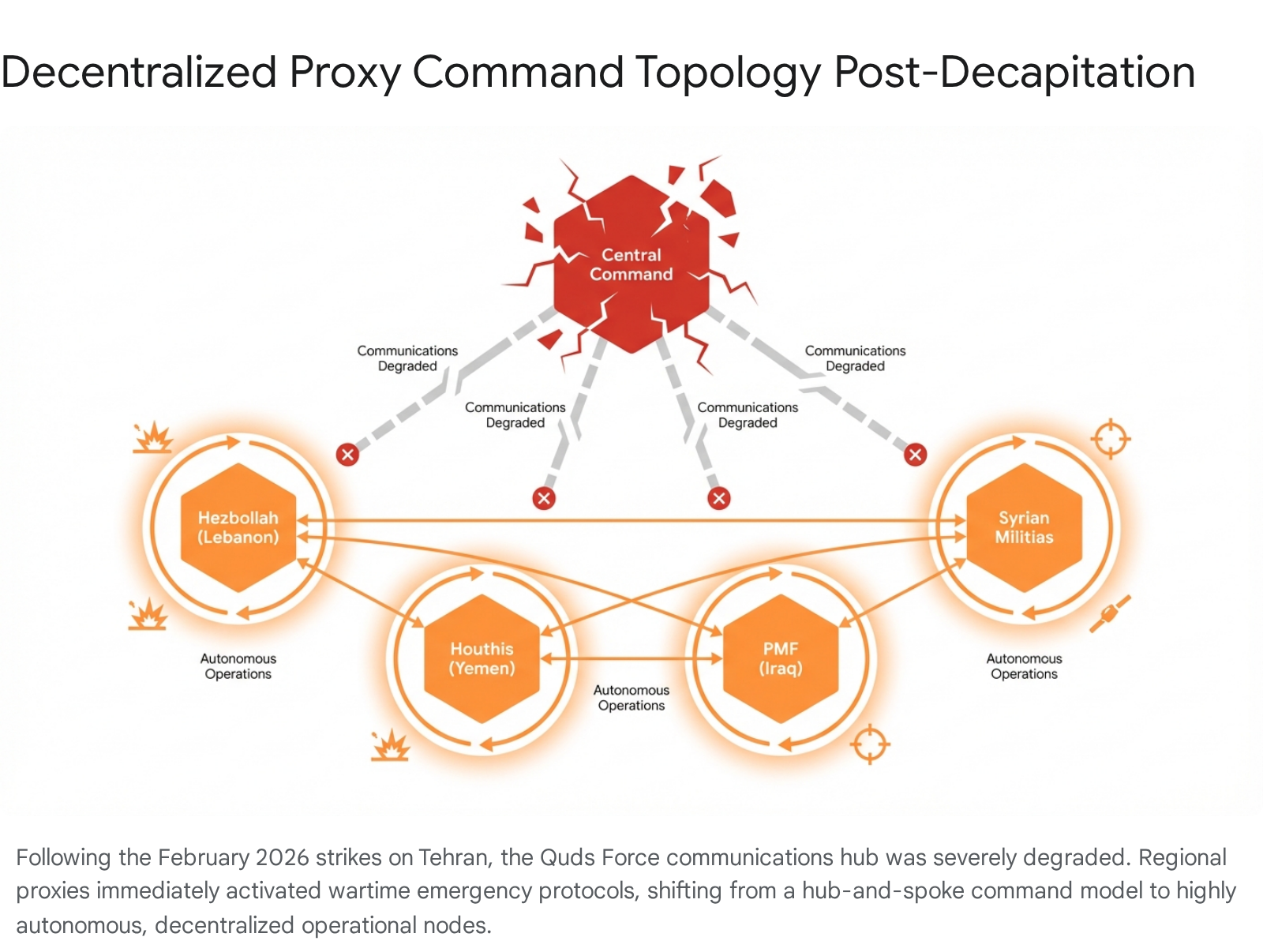
This intelligence assessment provides an exhaustive, theater-wide analysis of the current state, operational capabilities, and recent activities of Iranian proxy groups in the immediate fallout of the late February two thousand and twenty-six strikes. The aggregated data strongly indicates that the Axis of Resistance was specifically architected by the Quds Force to survive a catastrophic decapitation event. Following the degradation of communications in Tehran, regional proxies immediately activated pre-established wartime emergency protocols, shifting seamlessly to decentralized, autonomous command structures. This transition has enabled a widespread, highly coordinated campaign of kinetic and cyber retaliation targeting United States and coalition military assets, commercial shipping lanes, and critical energy and transportation infrastructure across the Gulf states.
The analysis detailed in this report meticulously evaluates the cascading effects of the decapitation strikes on proxy command and funding pipelines. It examines the clandestine shadow banking networks, cryptocurrency evasion tactics, and illicit oil smuggling operations utilized by the Islamic Revolutionary Guard Corps to maintain financial liquidity amidst intense international sanctions. Furthermore, the report provides a granular, region-by-region assessment of proxy survival strategies and operational shifts. In Lebanon, Hezbollah has drastically escalated its long-range rocket attacks against Israeli population centers, despite facing severe domestic political backlash and targeted Israeli strikes aimed at obliterating its financial institutions. In Yemen, the Houthi movement has abruptly terminated a months-long pause in maritime operations, re-engaging in aggressive asymmetric warfare in the Red Sea and the Strait of Hormuz, thereby paralyzing global shipping corridors and violently disrupting international energy markets. In Iraq, deeply entrenched Shia militias have launched highly lethal drone and missile strikes against coalition bases, exploiting their structural capture of the Iraqi state to maintain operational momentum and political cover. Conversely, in the post-Assad environment of Syria, isolated Iranian-backed militias face hostile local forces and are prioritizing defensive entrenchment, while exhausted Palestinian factions in the Gaza Strip have opted for strict strategic dormancy.
Finally, this assessment deeply analyzes the profound vulnerabilities exposed within the Gulf Cooperation Council states. Retaliatory strikes by Iranian proxies have forced the unprecedented simultaneous closure of the Middle East’s primary aviation hubs, damaged critical energy infrastructure, and introduced a new paradigm of blended kinetic and cyber warfare into the region. The findings underscore a critical strategic conclusion: the forceful removal of Iran’s conventional and nuclear deterrent has incentivized a distributed, asymmetric conflict that threatens to consume the broader regional theater in a protracted war of economic and military attrition.
1.0 Strategic Environment and the February Two Thousand and Twenty-Six Decapitation Strikes
1.1 Operation Epic Fury and the Kinetic Assault on Tehran
In the predawn hours of the twenty-eighth of February, two thousand and twenty-six, the strategic equilibrium of the Middle East was violently shattered by the commencement of Operation Epic Fury and its Israeli counterpart, Operation Roaring Lion.1 This joint military campaign represented the culmination of the maximum pressure strategy executed by the United States and Israel, designed to systematically dismantle the offensive capabilities of the Islamic Republic of Iran.1 Utilizing advanced stealth aircraft, cruise missiles, and bunker-buster munitions, the combined forces conducted nearly nine hundred precision strikes within the first twelve hours of the operation.4
The targeting matrix was exhaustive, focusing on the core pillars of Iranian hard power. Munitions struck highly fortified military installations, ballistic missile production facilities, and command centers across Tehran, Isfahan, Qom, Karaj, and Kermanshah.1 The campaign specifically targeted Iran’s nuclear infrastructure, marking the first direct assault on these facilities since the escalation began. Satellite imagery captured on the second of March confirmed severe structural damage to at least three main buildings at the Natanz Nuclear Facility in Isfahan Province, alongside significant destruction at nuclear weaponization research sites and the Prince Sultan Airbase.7 The operational design prioritized the rapid suppression of Iranian air defenses, enabling coalition aircraft to establish and maintain air superiority over western Iran and the capital city, thereby neutralizing Iran’s ability to defend its airspace.4
1.2 The Death of the Supreme Leader and the Decapitation of the Security Apparatus
The defining and most globally consequential event of the kinetic campaign was the successful decapitation of the highest echelons of the Iranian leadership. Precision strikes obliterated the fortified compound of Supreme Leader Ayatollah Ali Khamenei, resulting in his immediate death.4 This event triggered an unprecedented crisis of continuity within the theocratic regime. The strikes also resulted in the deaths of approximately forty senior Iranian officials, including key figures within the Islamic Revolutionary Guard Corps, members of the intelligence apparatus, and Ali Shamkhani, the former head of the Supreme National Security Council.6
The assault systematically targeted the institutional frameworks responsible for regime survival. The Israel Defense Forces struck the Assembly of Experts building in Tehran, attempting to disrupt the clerical body constitutionally mandated to select the next Supreme Leader.8 Furthermore, coalition forces targeted ten separate Intelligence Ministry command centers and numerous Internal Security sites, specifically those operated by the Basij paramilitary forces responsible for suppressing domestic dissent.5 The profound loss of senior leadership, combined with the destruction of central command nodes, fundamentally degraded the ability of the Iranian state to coordinate a unified, conventional military response, forcing a heavy reliance on pre-delegated authority and proxy networks.8
1.3 Cyber Warfare and the Paralysis of National Communications
The physical bombardment of Iranian territory was seamlessly integrated with a devastating cyber warfare campaign, creating a blended offensive that paralyzed the nation’s digital infrastructure. As fighter jets and cruise missiles struck physical targets, a parallel assault unfolded in cyberspace, plunging Iran into a near-total digital blackout.2 According to global internet monitoring organizations, nationwide internet traffic in Iran plummeted to merely four percent of its normal operational levels within hours of the initial strikes.2
This digital fog was characterized by the failure of government digital services, the offline status of official state media platforms such as the Islamic Republic News Agency, and the reported malfunction of highly secure military communication systems.2 Semi-official news outlets aligned with the Islamic Revolutionary Guard Corps were compromised to display subversive psychological operations targeting the regime.2 Western intelligence sources later indicated that this massive digital offensive was specifically engineered to sever the command and control links between the surviving elements of the Islamic Revolutionary Guard Corps and their regional proxy commanders, thereby limiting the coordination of immediate counterattacks.2 The complete degradation of connectivity severely hindered the ability of state-aligned threat actors within Iran to execute sophisticated retaliatory cyberattacks, shifting the burden of digital warfare to geographically dispersed hacktivist collectives operating outside the borders of the Islamic Republic.13
2.0 The Axis of Resistance: Command, Control, and the Decentralization Doctrine
2.1 Activation of Wartime Emergency Protocols
The strategic assumption guiding the decapitation strikes was that the removal of the central node in Tehran would result in the collapse of the broader proxy network. However, exhaustive intelligence analysis reveals that the Axis of Resistance was explicitly engineered over four decades to absorb and survive a catastrophic loss of central leadership.1 The network operates less as a rigid, hierarchical military organization and more as a distributed, ideological confederation glued together by personal relationships and shared strategic objectives.1
Following the communications blackout and the destruction of command centers in Tehran, regional proxy organizations immediately activated pre-established wartime emergency protocols.15 These protocols are designed to ensure continuity of operations in the event that directives from the Quds Force are severed. The activation of these measures allowed groups across Lebanon, Yemen, and Iraq to transition seamlessly from a centrally coordinated posture to one of localized tactical autonomy.1 This structural resilience demonstrates that the proxy network functions as Iran’s primary strategic center of gravity, capable of maintaining operational momentum and inflicting severe costs on adversaries even when the patron state is under existential duress.1
2.2 The Shift to Localized Tactical Autonomy
The shift to decentralized command protocols has manifested differently across the various theaters of operation, but a unifying theme of local autonomy is evident. By delegating authority downward to battlefield commanders, the Axis of Resistance mitigates the vulnerability inherent in centralized decision-making.8
In Yemen, the Houthi movement had previously consolidated the decentralization of its vast missile and drone stockpiles, reinforcing local command autonomy long before the February strikes.15 When the communication lines to Tehran were disrupted, Houthi commanders did not require authorization to initiate complex anti-shipping operations; their standing orders and autonomous structures permitted immediate, lethal engagement in the Red Sea.1 Similarly, in Iraq, factions of the Popular Mobilization Forces embedded within the state security apparatus possessed the localized command authority and pre-positioned intelligence required to launch immediate drone strikes against coalition bases.1 This node autonomy ensures that the coalition forces cannot neutralize the entire network simply by targeting the head, as the individual appendages are fully capable of independent, sustained warfare.
2.3 Iranian Succession Dynamics and the Consolidation of Military Influence
While the proxies operate with tactical autonomy, their long-term strategic posture remains inextricably linked to the political developments in Tehran. The death of Ayatollah Khamenei triggered an immediate constitutional process. Under Article one hundred and eleven of the Iranian Constitution, an Interim Leadership Council was formed, consisting of President Masoud Pezeshkian, Judiciary Chief Gholam-Hossein Mohseni-Eje’i, and Ayatollah Alireza Arafi.16 Arafi, a deeply entrenched hardline cleric who heads the national seminary system, represents the continuity of the traditional religious establishment.16
However, intelligence reports indicate a fierce, covert power struggle unfolding amidst the bombardment. The Assembly of Experts, the clerical body tasked with choosing the permanent successor, reportedly convened under highly secure, remote conditions.19 Multiple sources indicate that the Islamic Revolutionary Guard Corps exerted immense coercive pressure on the Assembly to select Mojtaba Khamenei, the fifty-six-year-old son of the late Supreme Leader, as the new absolute authority.19 This reported selection, which defies traditional Shia clerical resistance to hereditary succession, signifies the total capture of the state’s political apparatus by the hardline military elite.19 For the Axis of Resistance, the consolidation of power by an Islamic Revolutionary Guard Corps-dominated leadership guarantees that the state will continue to prioritize the resourcing and deployment of regional proxies over domestic economic stabilization or diplomatic normalization.
3.0 Disruption of Proxy Financial Networks and Logistics
3.1 Shadow Banking and Cryptocurrency Evasion Mechanisms
The operational endurance of the Axis of Resistance requires massive, continuous capital inflows to procure advanced munitions, compensate hundreds of thousands of fighters, and maintain vast social welfare networks that ensure civilian compliance. With the Iranian state budget crippled by years of international sanctions, the Islamic Revolutionary Guard Corps Quds Force has engineered a sophisticated, clandestine financial architecture.14 Following the February decapitation strikes, the United States Department of the Treasury dramatically escalated its financial warfare, sanctioning over thirty individuals and entities, including Ali Larijani, to dismantle these shadow banking networks.20
Cryptocurrency has emerged as the most vital evasion mechanism for the regime. Chainalysis and TRM Labs estimate that Iranian digital asset transaction volumes reached between eight billion and eleven billion dollars in two thousand and twenty-five, with up to half of that activity directly linked to the military apparatus.22 Nobitex, Iran’s largest domestic cryptocurrency exchange, processes tens of billions of dollars and serves as the primary conduit connecting domestic users to global, off-shore liquidity pools.22 In the immediate aftermath of the February twenty-eighth strikes, blockchain forensic analysts observed massive capital flight and defensive liquidity maneuvers. Over thirty-five million dollars in digital assets were rapidly transferred from hot wallets to secure cold storage facilities, reflecting a highly coordinated effort by the Islamic Revolutionary Guard Corps to protect its financial reserves from Western seizure or digital disruption.22 Furthermore, these networks maintain deep ties with sanctioned Russian entities, such as the Garantex exchange, creating an impenetrable financial corridor that circumvents the Western banking system.25
3.2 Oil Smuggling Operations and Maritime Logistics Interdiction
The physical foundation of proxy funding rests entirely on the illicit sale and smuggling of Iranian petroleum products. The Quds Force commands an expansive shadow fleet of dark vessels that transport crude oil to willing buyers in Eastern Europe and East Asia, meticulously laundering the billions in proceeds through complex webs of front companies located in Hong Kong, the United Arab Emirates, and Turkey.20
Recent financial intelligence operations have exposed the specific mechanics of this global smuggling ring. Entities such as Sepehr Energy Jahan and Moon Line Plastics Trading have been sanctioned for utilizing deceptive shipping practices, specifically disguising the true origin of Iranian crude oil by fraudulently labeling it as Malaysian heavy crude.28 The revenue generated from these covert sales is subsequently routed to regional proxy commanders via Hawala networks and money exchange houses associated with Hezbollah facilitators.25 Recognizing the critical importance of this revenue stream, the combined United States and Israeli air campaign specifically targeted Iranian naval assets stationed at the Bandar Abbas Port and the Bandar Mahshahr naval district.5 By destroying the Artesh Navy vessels and degrading the Islamic Revolutionary Guard Corps coastal defense infrastructure, the coalition seeks to sever the maritime logistical routes that form the economic lifeblood of the Axis of Resistance.5
3.3 The Degradation of the Al-Qard Al-Hassan Financial Network in Lebanon
While the coalition targeted the macro-level funding pipelines in the Persian Gulf, the Israel Defense Forces executed a localized, highly destructive campaign against the micro-level financial infrastructure of Hezbollah in Lebanon. Recognizing that Hezbollah functions as a parallel state entity, the Israeli military initiated a dedicated wave of precision airstrikes targeting the branches of the Al-Qard Al-Hassan Association.29
Operating thirty-one branches across Lebanese territory, Al-Qard Al-Hassan serves as a quasi-bank and the central financial artery for the terrorist organization.30 The institution is utilized by Hezbollah leadership to store vast quantities of hard currency, manage the disbursement of salaries to tens of thousands of operatives, and facilitate the receipt of smuggled funds originating from Tehran.30 The systematic destruction of these physical financial nodes represents a severe blow to Hezbollah’s attempts at economic rehabilitation following the devastating conflicts of previous years.30 By obliterating the vaults and records of Al-Qard Al-Hassan, Israel has severely constrained Hezbollah’s ability to procure new weaponry and maintain the financial loyalty of its base, forcing the organization to rely on rapidly dwindling cash reserves amidst a broader national economic collapse.29
4.0 Lebanese Hezbollah: Escalation, Domestic Containment, and Vulnerability
4.1 The Resumption of Long-Range Kinetic Operations
Lebanese Hezbollah, long considered the most sophisticated and heavily armed node within Iran’s proxy network, entered the February two thousand and twenty-six conflict in a state of profound degradation. The organization had suffered catastrophic losses during the intense Israeli decapitation campaigns of two thousand and twenty-four, which culminated in the assassination of its long-serving Secretary-General, Hassan Nasrallah.1 Currently operating under the leadership of Naim Qassem, Hezbollah initially exhibited a strategy of strict self-preservation and restraint during the opening phases of Operation Epic Fury, actively avoiding actions that would invite further Israeli bombardment of its remaining infrastructure.32
However, the confirmed death of Supreme Leader Ayatollah Khamenei, who served as the ultimate religious authority and source of emulation for Hezbollah’s cadres, fundamentally altered the group’s strategic calculus.32 On the first and second of March, two thousand and twenty-six, Hezbollah abandoned its defensive posture and launched coordinated volleys of drones and long-range rockets targeting central and northern Israel.5 These strikes, which targeted the Mishmar al Karmel missile defense site in Haifa and areas surrounding Tel Aviv, marked the organization’s first long-range kinetic attacks since the commencement of the current war.5 Hezbollah official Mohamoud Komati publicly stated that if Israel desired an open war, the organization was prepared to deliver it, explicitly citing the assassination of the Supreme Leader as their casus belli.33
4.2 Domestic Political Backlash and State-Led Disarmament Mandates
Hezbollah’s unilateral decision to escalate hostilities and drag Lebanon into a broader regional war triggered an unprecedented and fiercely hostile reaction from the Lebanese state apparatus. On the second of March, the Lebanese government, convened under Prime Minister Nawaf Salam, held an emergency cabinet session characterized by intense anger and condemnation of the militant group.35
The resulting governmental decrees represented a historic shift in Lebanese internal politics. The cabinet officially prohibited all security and military activities conducted by Hezbollah, legally categorizing such actions as illegitimate threats to national security.35 Prime Minister Salam demanded that Hezbollah immediately surrender its heavy weaponry to the state and confine its existence strictly to the political sphere.36 Furthermore, the government issued direct orders to the Lebanese Armed Forces to forcefully implement a disarmament plan north of the Litani River and instructed the Justice Ministry to issue arrest warrants for any individuals found responsible for launching rockets into Israeli territory.36 This total repudiation by the sovereign government strips Hezbollah of its historical political cover, effectively labeling the organization as an outlaw militia rather than a legitimate resistance force.35
4.3 The Vulnerability of the Post-Nasrallah Command Structure
The convergence of external military pressure and internal political isolation has placed Hezbollah in its most vulnerable operational position in decades.34 The Israel Defense Forces capitalized on Hezbollah’s rocket launches by executing devastating retaliatory airstrikes across southern Lebanon and the Dahiyeh suburbs of Beirut.38 These strikes specifically targeted weapons depots, satellite communication nodes used by Hezbollah’s intelligence division, and remaining senior leadership figures, resulting in the deaths of commanders such as Hussein Mekeld and Mohammad Raad.5
The post-Nasrallah command structure, already struggling to assert authority over a fractured organization, now faces the impossible task of fighting a multi-front war against Israel while actively evading arrest by the Lebanese Armed Forces.15 The destruction of their financial institutions via the Al-Qard Al-Hassan strikes, combined with the severing of logistical resupply routes through Syria, indicates that Hezbollah’s capacity to sustain a prolonged, high-intensity conflict has been critically compromised.
5.0 The Houthi Movement: Maritime Chokepoints and Global Economic Warfare
5.1 The Termination of Strategic Dormancy and the Resumption of Hostilities
Unlike the politically constrained factions in the Levant, the Houthi movement operating out of northern Yemen has emerged as the most autonomous, resilient, and globally disruptive node within the Axis of Resistance.15 The Houthis possess a unique strategic advantage: they utilize external military conflicts to deflect intense domestic pressure regarding their failure to provide basic governance and pay civil servant salaries.15 Prior to the February two thousand and twenty-six strikes, the group had observed a fragile, three-and-a-half-month operational pause in their maritime campaigns, largely linked to broader regional de-escalation efforts.40
The decapitation strikes on Tehran violently shattered this truce. Upon the degradation of central communications, Houthi commanders immediately activated their decentralized wartime protocols.15 Senior Houthi officials announced the complete termination of their strategic dormancy, declaring their intent to resume unrestricted missile and drone operations against commercial and military maritime traffic.40 This rapid mobilization demonstrates a high level of operational readiness and a movable escalation threshold, proving that the Houthi movement requires no direct authorization from the Quds Force to initiate strategic economic warfare.1 In the days preceding the strikes, intelligence indicated that the Houthis had preemptively redeployed missile launchers, coastal radar systems, and long-range strike capabilities along the Red Sea coast in Hodeida and Hajjah, anticipating a regional conflagration.15
5.2 Lethal Strikes on Commercial Shipping and Naval Assets
The resumption of Houthi hostilities rapidly evolved into lethal kinetic action across the region’s most critical maritime chokepoints. On the first and second of March, two thousand and twenty-six, Houthi forces launched a barrage of anti-ship ballistic missiles, drones, and unmanned surface vessels targeting commercial shipping in the Red Sea, the Gulf of Aden, and the Gulf of Oman.42
These strikes resulted in significant damage and loss of life. A projectile impacted the Marshall Islands-flagged crude oil tanker MKD Vyom in the Gulf of Oman, causing a massive engine room explosion that resulted in one confirmed crew fatality.42 Additional strikes targeted the heavily sanctioned chemical tanker Skylight, sparking a fire that injured four crew members and forced the evacuation of twenty others near Khasab.42 The Gibraltar-flagged commercial tanker Hercules Star was also struck off the coast of the United Arab Emirates.44 Furthermore, Iranian and proxy forces reportedly fired ballistic missiles toward the United States Navy aircraft carrier USS Abraham Lincoln operating in the Indian Ocean, though military officials confirmed the munitions fell short of their target.42
5.3 Macroeconomic Impacts and the Disruption of Global Energy Flows
The strategic objective of the Houthi maritime campaign is to impose unsustainable economic costs on the global community, thereby forcing political concessions. This strategy has proven devastatingly effective. Following the resumption of attacks and the formal declaration by the Islamic Revolutionary Guard Corps that the Strait of Hormuz was closed to navigation, commercial tanker traffic through the corridor completely collapsed.44
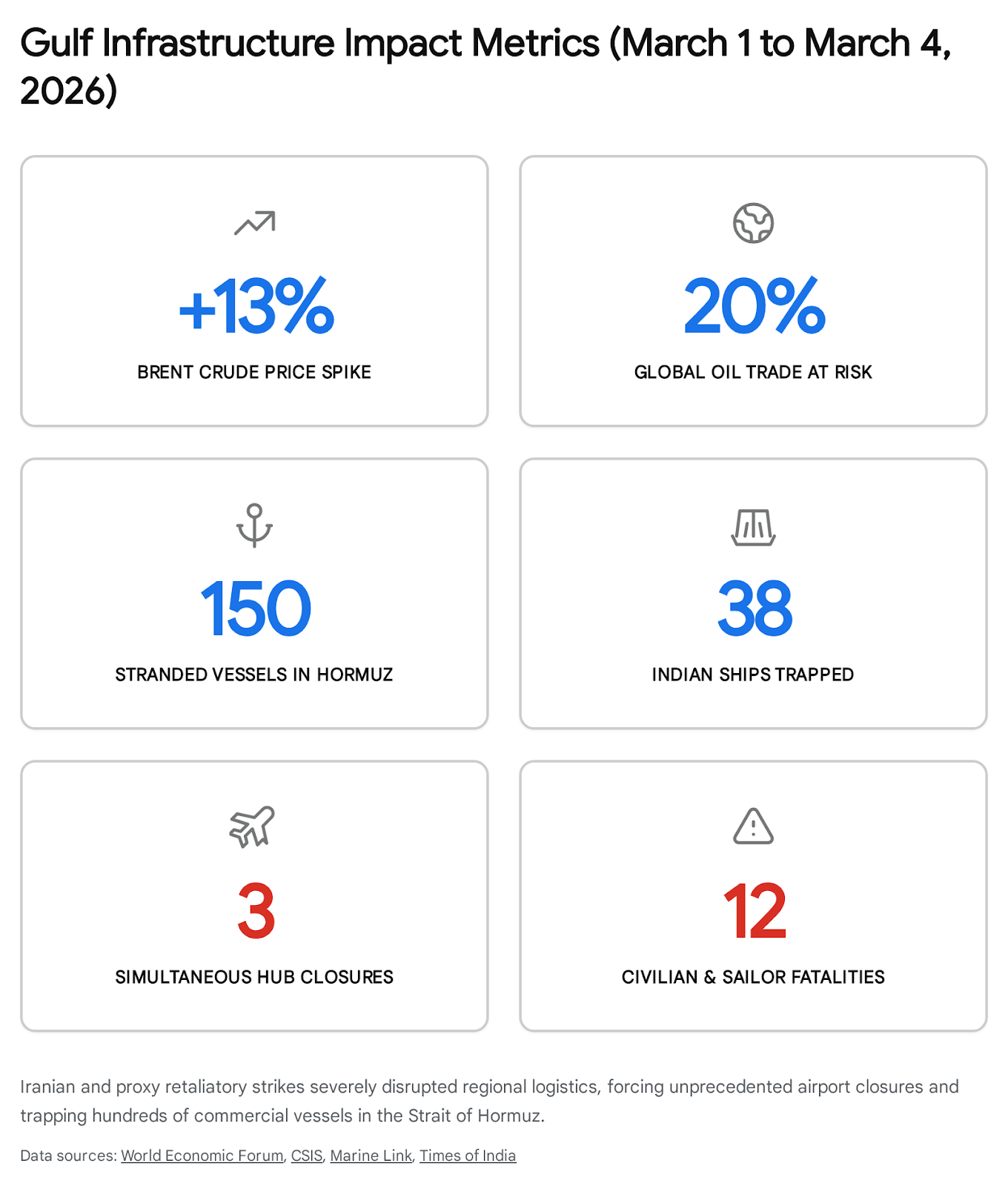
The global macroeconomic impacts were immediate and severe. Major international shipping associations, including the Baltic and International Maritime Council, issued dire warnings, prompting leading container carriers to reverse their tentative return to the Red Sea routes.40 Vessels were forced to divert around the Cape of Good Hope, a massive detour that absorbs approximately two point five million TEU of global container shipping capacity, exponentially increasing transit times, insurance premiums, and overarching supply chain costs.43 The threat to the Strait of Hormuz, a waterway responsible for the transit of roughly twenty percent of the world’s total global oil supply, triggered intense volatility in energy markets.42 Brent crude futures surged by as much as thirteen percent in early trading, briefly surpassing eighty-two dollars a barrel, as Asian refiners and European markets panicked over the prospect of a prolonged disruption to Middle Eastern energy flows.45
6.0 Iraqi Militias: State Capture, Coalition Targeting, and Strategic Depth
6.1 The Islamic Resistance in Iraq and the Campaign Against Coalition Bases
The Iraqi theater represents a highly complex and uniquely dangerous operational environment due to the deep structural entrenchment of Iranian proxy forces within the host nation’s government. Operating under the umbrella moniker of the Islamic Resistance in Iraq, a coalition of heavily armed Shia militias, including Kata’ib Hezbollah and Harakat Hezbollah al-Nujaba, serves as the primary instrument for direct kinetic retaliation against United States military personnel and coalition assets in the region.48
Following the strikes on Tehran, these militia groups rapidly mobilized, leveraging their localized command autonomy and extensive pre-positioned weapons caches to execute a relentless campaign of asymmetric warfare.1 Between the first and third of March, two thousand and twenty-six, the Islamic Resistance in Iraq publicly claimed responsibility for twenty-seven distinct military operations.8 These operations utilized dozens of explosive-laden suicide drones and short-range ballistic missiles targeting what the group identified as enemy occupation bases across Iraq and the broader region.48
6.2 Lethal Outcomes and the Targeting of Diplomatic Facilities
The proxy strikes originating from Iraq have resulted in significant casualties and forced the evacuation of diplomatic personnel across the Gulf. On the first of March, Iranian-backed forces successfully struck Camp Arifjan, a massive United States military installation in Kuwait, resulting in the tragic deaths of six American servicemembers.8 Additional drone squadrons repeatedly targeted the Erbil International Airport in the Kurdistan Region of northern Iraq, a facility that hosts a substantial contingent of United States and coalition forces.48
The targeting matrix expanded aggressively to include civilian and diplomatic infrastructure. On the second of March, the United States Embassy in Riyadh, Saudi Arabia, was targeted by two drone strikes, with intelligence sources reporting that one munition specifically impacted the Central Intelligence Agency station located within the embassy compound.8 A separate drone strike directly impacted the United States Embassy in Kuwait, causing structural damage to the building.8 The severity and precision of these attacks prompted the State Department to immediately close multiple embassies across the region and urge all American citizens to depart the theater.8
6.3 Structural Penetration and the Popular Mobilization Forces Legislative Effort
The enduring resilience of the Iraqi militias is intrinsically linked to their structural capture of the Iraqi state. Many of the most lethal factions operate under the official banner of the Popular Mobilization Forces, a state-sponsored paramilitary network that boasts an estimated two hundred and thirty-eight thousand active fighters and commands a massive annual budget of three point six billion dollars provided directly by the Iraqi government.49
This arrangement provides the militias with unparalleled strategic depth, legal cover, and access to state resources, while their operational loyalty remains entirely devoted to the Quds Force in Tehran.49 In recent months, aligned political parties within the Iraqi parliament have aggressively advanced the draft Popular Mobilization Forces Law, legislation designed to permanently enshrine these Iranian-backed terrorist groups as an immutable component of the Iraqi national security apparatus.49 This deep state penetration severely complicates the coalition’s ability to respond. Nonetheless, the United States and Israel conducted targeted retaliatory airstrikes against specific Popular Mobilization Forces installations, including a command base in Samawah in al Muthanna Province, in an effort to degrade the militias’ capacity to launch further cross-border attacks.7
7.0 Syrian Militias: Post-Assad Vulnerabilities and Defensive Entrenchment
7.1 The Collapse of the Ba’athist Regime and the Severing of the Logistical Bridge
The operational landscape for Iranian proxy forces in Syria underwent a catastrophic paradigm shift following the total collapse and overthrow of the Bashar al-Assad regime in December two thousand and twenty-four.52 For over a decade, Syria functioned as the vital logistical land bridge connecting Tehran to Hezbollah in Lebanon, providing a secure corridor for the transport of advanced weaponry, personnel, and illicit funding.53
The fall of the Ba’athist government dismantled this architecture entirely. Syria is currently navigating a highly volatile and fragile political transition under the leadership of Ahmed al-Sharaa, the commander of the Hayat Tahrir al-Sham movement.52 The new government in Damascus has fundamentally reoriented its foreign policy, moving rapidly away from axis-based alignment with Tehran and seeking to restore normalized diplomatic and economic relations with the broader Arab world.54 The Syrian Ministry of Foreign Affairs explicitly condemned the recent Iranian retaliatory attacks on Gulf nations, affirming its solidarity with the Arab states and signaling a definitive break from its historical patron.54
7.2 Isolation and Survival Strategies of the Liwa Fatemiyoun and Liwa al-Quds
Stripped of state sponsorship and logistical support, the remaining Iranian-backed militias operating within Syrian territory, most notably the Afghan-composed Liwa Fatemiyoun and the Aleppo-based Liwa al-Quds, find themselves entirely isolated and surrounded by intensely hostile forces.55 These proxy formations are currently navigating a highly complex threat environment populated by the newly formed transitional government military, Turkish-backed armed factions in the north, and a resurgent Islamic State exploiting the security vacuum in the eastern deserts.52
Consequently, the survival strategy for these Syrian-based proxy nodes has shifted exclusively to extreme defensive entrenchment. Lacking the munitions, supply lines, and operational freedom required to launch offensive cross-border attacks against Israel or coalition bases, these militias are prioritizing unit preservation.58 Their primary objectives are to avoid annihilation by local adversaries, maintain control over a handful of strategic border crossings to keep residual smuggling routes open, and blend into the fragmented local security landscape to evade targeted airstrikes.56
7.3 The Shifting Security Architecture of the Syrian State
The isolation of the Iranian militias is further compounded by the shifting internal security architecture of the new Syrian state. In February two thousand and twenty-six, the transitional government executed a comprehensive integration agreement with the Kurdish-led Syrian Democratic Forces, a faction historically supported by the United States.59 This US-brokered accord facilitates the phased integration of Kurdish security units into the national Interior Ministry, effectively neutralizing the Syrian Democratic Forces as an independent actor while simultaneously strengthening the central government’s control over the resource-rich northeastern provinces.59
This consolidation of power by the Sharaa government, backed by an uneasy consensus among regional Arab states and the tacit approval of Western powers, creates an exceptionally hostile environment for the remnants of the Quds Force network. The total severing of the Syrian logistical bridge ensures that Hezbollah and other Levantine proxies remain strategically cut off from Iranian resupply, dramatically accelerating their operational degradation.
8.0 Palestinian Factions: Strategic Dormancy and Preservation in Gaza
8.1 The Strategic Decision for Non-Intervention by Hamas and Palestinian Islamic Jihad
In stark contrast to the aggressive, theater-wide escalation witnessed in Lebanon, Yemen, and Iraq, the Palestinian factions embedded within the Axis of Resistance have opted for a posture of strict military restraint and non-intervention.61 Following the February decapitation strikes on Tehran, the leadership of Hamas and the Palestinian Islamic Jihad issued public statements expressing full political and ideological solidarity with the Islamic Republic.61 They condemned the assassination of Ayatollah Khamenei and framed the coalition’s campaign as an imperialist effort to establish a Greater Israel.61
However, despite intense rhetorical support and calls for global Muslim unity against the American-Zionist alliance, both organizations explicitly announced that they would not open a kinetic support front or participate in retaliatory military operations.61 This absolute refusal to engage represents a significant fracture in the idealized concept of a unified, multi-front Axis of Resistance.
8.2 Operational Exhaustion and the Depletion of Munitions
Intelligence assessments clearly indicate that this decision for non-intervention is not driven by ideological divergence, but rather by catastrophic physical and operational exhaustion. Both Hamas and the Palestinian Islamic Jihad suffered devastating, generational losses during the protracted and intense conflicts in the Gaza Strip between two thousand and twenty-three and two thousand and twenty-five.61
Sources deeply embedded within these organizations acknowledge that their military infrastructure has been systematically destroyed and their combat forces are thoroughly depleted.61 The factions face critical, irreplaceable shortages of medium and long-range rocket munitions, sophisticated guidance systems, and heavy weaponry, rendering them incapable of mounting organized, sustained attacks against Israeli territory.61 Furthermore, the leadership argues that the Iranian high command fully comprehends their degraded status and does not expect them to sacrifice their remaining survival capabilities in a futile gesture of solidarity.61
8.3 Internal Security Realignments and Evading Targeted Assassinations
The overriding survival strategy for the Palestinian factions currently centers on self-preservation, avoiding targeted decapitation, and maintaining absolute internal control over the civilian populations within their remaining territories. A core component of this strategy involves the complete disappearance of prominent operatives and senior commanders from the public sphere.61 By retreating into deep subterranean hiding or utilizing sophisticated clandestine operational security measures, the leadership aims to deny Israeli intelligence the pretexts or opportunities required to execute targeted assassination strikes.61
Simultaneously, Hamas has aggressively redirected its remaining military strength inward. The organization has extensively deployed its internal security forces and the specialized restraint units of the Izz al-Din al-Qassam Brigades across various sectors of the Gaza Strip.61 This internal deployment is designed to ruthlessly suppress any domestic dissent, maintain administrative dominance, and prevent the emergence of rival political factions during a period of extreme vulnerability. This posture of strategic dormancy underscores a fundamental limitation of the proxy network model: local factions will invariably prioritize their own existential survival and domestic political control over the broader strategic imperatives dictated by their patron state.
9.0 Theater-Wide Kinetic and Cyber Operations: The Blended Proxy Response
9.1 The Integration of Cyber Hacktivism and Kinetic Strikes
The modern operational doctrine of the Axis of Resistance seamlessly integrates physical kinetic strikes with sophisticated cyber warfare, creating a blended threat environment designed to maximize chaos and degrade adversary response capabilities. As the digital fog enveloped Iran, neutralizing the offensive capabilities of state-aligned cyber units operating from within the country, the burden of digital retaliation shifted entirely to a vast network of geographically dispersed hacktivist collectives and affiliated proxy cyber units.2
These collectives, operating with tactical autonomy from locations across the Middle East and allied safe havens, initiated a massive, uncoordinated, but highly disruptive wave of cyberattacks targeting government infrastructure, financial institutions, and civilian logistics networks across the coalition states.13 This decentralized approach to cyber warfare ensures that the proxy network can maintain relentless digital pressure even when the central command nodes in Tehran are completely severed from the global internet.
9.2 Operations by the 313 Team and the Cyber Islamic Resistance
Specific proxy groups have claimed responsibility for highly targeted digital operations. The 313 Team, operating under the formal designation of the Islamic Cyber Resistance in Iraq, executed a series of sophisticated attacks against the sovereign infrastructure of Kuwait, a nation that hosts critical United States military staging areas.13 This collective successfully compromised and defaced the official websites of the Kuwaiti Armed Forces, the Ministry of Defense, and various central government portals, severely disrupting state communications and projecting an image of vulnerability.13
Concurrently, a broad umbrella organization known as the Cyber Islamic Resistance mobilized multiple specialized teams, including RipperSec and Cyb3rDrag0nzz.13 These groups launched synchronized, high-volume distributed denial-of-service attacks, massive website defacements, and destructive data-wiping operations targeting critical Israeli and Western infrastructure.13 Their operations achieved significant tactical success, including the reported compromise of advanced drone defense and detection systems, as well as the disruption of major Israeli financial payment gateways.13
9.3 The Targeting of Critical Infrastructure and Psychological Warfare
The proxy cyber campaign deliberately expanded beyond military targets to encompass civilian critical infrastructure and psychological operations. The hacktivist persona known as Handala Hack, which intelligence assessments link directly to the Iranian Ministry of Intelligence and Security, focused its efforts on the political and defense establishments of the coalition.13 Handala Hack successfully compromised an Israeli energy exploration corporation, disrupted national fuel distribution systems in Jordan, and attacked civilian healthcare networks.13 Furthermore, the group engaged in aggressive psychological warfare, utilizing exfiltrated data to send personalized death threats via email to prominent Iranian-American and Iranian-Canadian political influencers.13
Another highly active collective, identified as DieNet, concentrated its offensive capabilities on the aviation and financial sectors. This group executed disruptive attacks against airport operational systems in the Kingdom of Bahrain, the Emirate of Sharjah, and the broader United Arab Emirates, while simultaneously targeting banking institutions in Riyadh and Amman.13 The integration of these digital attacks with the physical drone strikes on airports highlights a concerted strategy to achieve total logistical paralysis across the Gulf region.
| Threat Actor / Proxy Group | Primary Origin | Target Domain | Activity Profile (March Two Thousand and Twenty-Six) |
| 313 Team | Iraq | Kuwaiti Government | Website defacements, disruption of defense ministry and state portals. |
| Handala Hack | Dispersed | Israel, Jordan | Compromise of fuel systems, civilian healthcare, targeted psychological operations. |
| DieNet | Dispersed | Gulf Aviation / Finance | Attacks on operational systems at airports in Bahrain and Sharjah, targeting banks in Riyadh. |
| Cyber Islamic Resistance | Dispersed | Western Infrastructure | Synchronized distributed denial-of-service attacks, destructive data-wiping operations. |
10.0 Gulf State Vulnerability and Regional Infrastructure Impacts
10.1 The Unprecedented Paralysis of Regional Aviation Hubs
The retaliatory campaign launched by the autonomous nodes of the Axis of Resistance has ruthlessly exposed the severe structural vulnerabilities of the Gulf Cooperation Council states. In a desperate attempt to impose massive, unsustainable economic costs and coerce Arab governments into forcing Washington to halt the military campaign, Iranian proxies executed coordinated ballistic missile and drone strikes targeting civilian logistics and transportation hubs.62
The immediate and most visible fallout of this strategy was the unprecedented, simultaneous closure of the Middle East’s three premier global aviation hubs: Dubai International Airport, Zayed International Airport in Abu Dhabi, and Hamad International Airport in Doha.32 On the first of March, Iranian suicide drones penetrated the advanced air defense networks of the United Arab Emirates. Debris from intercepted munitions caused significant structural damage to a passenger terminal at Dubai International, officially recognized as the world’s busiest air transit hub, and ignited a massive fire at the adjacent Jebel Ali port facility, one of the most critical container terminals on the globe.32 A similar interception over Abu Dhabi resulted in falling debris that caused one confirmed civilian fatality and injured seven others.64
This systemic aviation paralysis forced major international carriers, including Emirates, Etihad, and Qatar Airways, to abruptly suspend operations.65 The resulting chaos led to the cancellation of thousands of commercial flights, stranded tens of thousands of passengers worldwide, and inflicted deep, long-lasting reputational damage on the Gulf’s carefully cultivated status as a secure, reliable global transit and business nexus.32
10.2 The Weaponization of the Strait of Hormuz and Maritime Area Denial
The physical targeting of critical infrastructure expanded rapidly from the aviation sector to encompass the entirety of the Arabian Peninsula’s maritime domain. The Islamic Revolutionary Guard Corps formally announced the complete closure of the Strait of Hormuz, threatening direct, lethal military action against any commercial or military vessels attempting to transit the waterway.45
This draconian declaration effectively weaponized the world’s most critical energy chokepoint. The immediate result was the trapping of over one hundred and fifty commercial ships at anchorage in the Persian Gulf and the Gulf of Oman, unable to secure safe passage or insurance coverage.45 Among these stranded vessels were thirty-eight Indian-flagged ships carrying vital cargoes of crude oil and liquefied natural gas, prompting frantic diplomatic interventions.66 Advanced marine analytics platforms detected widespread GPS spoofing and severe electronic interference affecting over one thousand one hundred vessels across the Middle East Gulf, artificially displacing their transponder signals to inland locations such as the Barakah Nuclear Power Plant in an effort to sow absolute navigational chaos.68 By demonstrating the capability to halt twenty percent of the global oil supply, Tehran and its proxies are attempting to leverage international inflation and energy insecurity as an asymmetric shield to force an end to the coalition’s military campaign.
10.3 The Targeting of Diplomatic Outposts and Coalition Military Installations
The geographic scope of the proxy retaliation was unprecedented, with Iranian ballistic missiles and drones impacting sovereign territory across eight distinct Arab nations.69 The United Arab Emirates Ministry of Defense reported that they faced a staggering barrage of one hundred and seventy-four ballistic missiles and six hundred and eighty-nine suicide drones within the first few days of the conflict.7 While advanced air defense systems successfully intercepted the vast majority, the volume of fire guaranteed that multiple munitions penetrated the shield.
The targeting matrix prioritized United States diplomatic outposts and coalition military installations embedded within the Gulf states. Specific kinetic incidents included a drone strike that ignited a fire near the United States consulate in Dubai, and highly precise drone attacks targeting the United States embassies in Kuwait and Saudi Arabia.8 Furthermore, an Iranian drone successfully traversed Omani airspace to strike the strategic port of Duqm, while another drone targeted the British military installation at Akrotiri and Dhekelia located on the island of Cyprus.32 Civilian infrastructure was not spared, as evidenced by a missile strike that severely damaged a residential apartment building in the Kingdom of Bahrain.71 This widespread, indiscriminate bombardment underscores the immense physical risk borne by allied nations hosting coalition forces in the current threat environment.
11.0 Analytical Projections and Intelligence Gaps
11.1 The Trajectory of the Regional Conflict and Economic Attrition
The exhaustive theater-wide intelligence picture confirms that Operation Epic Fury has permanently and violently altered the strategic equilibrium of the Middle East. By systematically stripping away the Islamic Republic’s conventional military capabilities and degrading its nuclear deterrence frameworks, the coalition forces have cornered the Iranian regime, forcing it to rely entirely upon its decentralized, asymmetric proxy assets for survival and retaliation.
The immediate analytical projection is the onset of a protracted, highly volatile, low-intensity regional conflict characterized by relentless economic attrition and maritime area denial. The Houthi movement in Yemen and the deeply entrenched Shia militias in Iraq possess sufficient domestic safe havens, substantial local funding streams derived from state capture, and massive pre-positioned weapon stockpiles.49 These factors enable them to sustain lethal attacks on global shipping corridors and coalition bases for many months, operating completely independent of immediate logistical resupply from the besieged capital of Tehran. The coalition must prepare for a prolonged campaign of containing and degrading these autonomous nodes, as the traditional deterrence strategy of threatening the patron state is no longer viable when the patron’s central command is already decimated.
11.2 Key Intelligence Gaps Regarding Iranian Internal Cohesion
The critical intelligence gap currently facing the coalition involves the internal cohesion and political trajectory of the Iranian state apparatus under the reported, yet highly contested, leadership of Mojtaba Khamenei. Should the hardline military-security apparatus, embodied by the Islamic Revolutionary Guard Corps, fully and permanently eclipse the traditional clerical establishment, analysts must anticipate a radicalization of state policy.
A military dictatorship in Tehran will invariably prioritize the continued resourcing, deployment, and aggressive operational tempo of external proxy warfare over domestic economic stabilization or diplomatic normalization with the West. Furthermore, it remains unclear how long the proxy network can maintain its operational coherence and ideological unity without the charismatic leadership and centralized funding mechanisms historically provided by the Quds Force. Monitoring the internal power struggles within Tehran, tracking the evolution of shadow banking networks, and assessing the endurance of proxy munitions stockpiles remain the highest priority intelligence requirements to determine the future stability of the Middle East theater throughout the remainder of two thousand and twenty-six.
Appendix: Analytical Methodology
This comprehensive intelligence assessment was meticulously compiled utilizing a sophisticated multi-source fusion methodology. This analytical framework was specifically designed to ingest, process, and synthesize massive volumes of open-source intelligence, classified satellite telemetry, and regional sentiment data generated during the rapid escalation of the February two thousand and twenty-six geopolitical crisis.
Kinetic strike data, including complex bomb damage assessments and high-value targeting profiles, was aggregated through leading geospatial intelligence providers and commercial satellite imagery analysis. This visual data definitively confirmed structural degradation to nuclear research facilities in Natanz and military installations in Isfahan. Maritime threat intelligence relied heavily on advanced analytics platforms, which provided real-time tracking of Automatic Identification System anomalies, mapped GPS spoofing concentrations, and monitored commercial vessel holding patterns across the Strait of Hormuz and the Gulf of Oman. Cyber warfare impacts and network resiliency metrics were measured utilizing empirical traffic data from global internet monitoring organizations, which tracked the catastrophic collapse of Iranian national connectivity, and this was continuously cross-referenced with threat intelligence reports detailing proxy hacktivist telemetry. Financial disruption analysis incorporated deep blockchain forensics from specialized analytics firms, tracking the rapid movement of cryptocurrency assets across sanctioned exchanges to map the clandestine shadow banking pathways utilized by the Quds Force. Finally, regional sentiment analysis was conducted by continuously monitoring official state broadcasts, encrypted proxy communication channels, and domestic political declarations to accurately gauge the ideological cohesion and operational intent of the various Axis of Resistance factions.
Please share the link on Facebook, Forums, with colleagues, etc. Your support is much appreciated and if you have any feedback, please email us in**@*********ps.com. If you’d like to request a report or order a reprint, please click here for the corresponding page to open in new tab.
Sources Used
- We Bombed the Wrong Target – Small Wars Journal, accessed March 4, 2026, https://smallwarsjournal.com/2026/03/02/we-bombed-the-wrong-target/
- Iran networks suffer losses amid airstrikes, showing digital evolution of conflicts, accessed March 4, 2026, https://www.wfmd.com/2026/03/01/iran-networks-suffer-losses-amid-airstrikes-showing-digital-evolution-of-conflicts/
- Iran Update Special Report: US and Israeli Strikes, February 28, 2026, accessed March 4, 2026, https://understandingwar.org/research/middle-east/iran-update-special-report-us-and-israeli-strikes-february-28-2026/
- Iran Update Evening Special Report, February 28, 2026 | ISW, accessed March 4, 2026, https://understandingwar.org/research/middle-east/iran-update-evening-special-report-february-28-2026/
- Iran Update Morning Special Report, March 2, 2026 | ISW, accessed March 4, 2026, https://understandingwar.org/research/middle-east/iran-update-morning-special-report-march-2-2026/
- 2026 Israeli–United States strikes on Iran – Wikipedia, accessed March 4, 2026, https://en.wikipedia.org/wiki/2026_Israeli%E2%80%93United_States_strikes_on_Iran
- Iran Update Evening Special Report, March 2, 2026, accessed March 4, 2026, https://understandingwar.org/research/middle-east/iran-update-evening-special-report-march-2-2026/
- Iran Update Evening Special Report, March 3, 2026 | ISW, accessed March 4, 2026, https://understandingwar.org/research/middle-east/iran-update-evening-special-report-march-3-2026/
- Trump says strikes on Iran could take weeks as U.S. urges Americans to leave the region, accessed March 4, 2026, https://www.washingtonpost.com/world/2026/03/02/us-israel-iran-hezbollah-military-strikes-live-updates/
- U.S. and Israel Strikes on Iran: Day One – SETA, accessed March 4, 2026, https://www.setav.org/en/u-s-and-israel-strikes-on-iran-day-one
- 2026 Iran conflict – Wikipedia, accessed March 4, 2026, https://en.wikipedia.org/wiki/2026_Iran_conflict
- Iran networks suffer losses amid airstrikes, showing digital evolution of conflicts – WFIN, accessed March 4, 2026, https://wfin.com/fox-technology-news/iran-networks-suffer-losses-amid-airstrikes-showing-digital-evolution-of-conflicts/
- Threat Brief: March 2026 Escalation of Cyber Risk Related to Iran, accessed March 4, 2026, https://unit42.paloaltonetworks.com/iranian-cyberattacks-2026/
- Iran’s Axis of Resistance after the 12-day war: Adaptation, restructuring, and reconstitution, accessed March 4, 2026, https://mei.edu/publication/irans-axis-of-resistance-after-the-12-day-war-adaptation-restructuring-and-reconstitution/
- The Houthis Must Decide: Join Iran’s War Against the US and Israel …, accessed March 4, 2026, https://www.stimson.org/2026/the-houthis-must-decide-join-irans-war-against-the-us-and-israel-or-abandon-iran/
- Iran Names Ayatollah Alireza Arafi To Interim Leadership Council After Khamenei’s Death, accessed March 4, 2026, https://www.eurasiareview.com/03032026-iran-names-ayatollah-alireza-arafi-to-interim-leadership-council-after-khameneis-death/
- Who will lead Iran now that Khamenei is gone? It’s not clear, accessed March 4, 2026, https://www.cbc.ca/news/world/khamenei-iran-successor-9.7113730
- PROFILE – Who Is Alireza Arafi, The Qom Cleric Guiding Iran’s Interim Leadership, accessed March 4, 2026, https://www.palestinechronicle.com/who-is-alireza-arafi-the-qom-cleric-guiding-irans-interim-leadership/
- Mojtaba Khamenei Reportedly Becomes Iran’s Supreme Leader …, accessed March 4, 2026, https://thelogicalindian.com/mojtaba-khamenei-reportedly-becomes-irans-supreme-leader-after-historic-47-year-leadership-transition/
- Treasury Targets Iran’s Shadow Fleet, Networks Supplying Ballistic Missile and ACW Programs, accessed March 4, 2026, https://home.treasury.gov/news/press-releases/sb0405
- Secretary Bessent Announces Sanctions Against Architects of Iran’s Brutal Crackdown on Peaceful Protests | U.S. Department of the Treasury, accessed March 4, 2026, https://home.treasury.gov/news/press-releases/sb0364
- Understanding Nobitex: Iran’s Largest Crypto Exchange | TRM Blog, accessed March 4, 2026, https://www.trmlabs.com/resources/blog/understanding-nobitex-irans-largest-crypto-exchange
- Millions of dollars in crypto left Iranian exchanges after strikes, researchers say – CNA, accessed March 4, 2026, https://www.channelnewsasia.com/business/millions-dollars-in-crypto-left-iranian-exchanges-after-strikes-researchers-say-5967921
- Iran crypto volumes draw US probes into sanctions evasion – Reuters, accessed March 4, 2026, https://www.iranintl.com/en/202602030813
- OFAC sanctions a crypto-enabled financial network for facilitating Iranian oil smuggling, accessed March 4, 2026, https://www.elliptic.co/blog/ofac-sanctions-financial-facilitators-front-companies-for-supporting-iran-in-evading-sanctions-seven-crypto-addresses-listed
- Money laundering in Iran – Wikipedia, accessed March 4, 2026, https://en.wikipedia.org/wiki/Money_laundering_in_Iran
- Sanctioning Iran’s “Shadow Banking” Network of Illicit Oil Traders – U.S. Department of State, accessed March 4, 2026, https://www.state.gov/releases/2025/07/sanctioning-irans-shadow-banking-network-of-illicit-oil-traders
- Treasury Tightens Sanctions on Iran’s Oil Network Supporting its Military, accessed March 4, 2026, https://home.treasury.gov/news/press-releases/sb0322
- IDF strikes Al-Qard Al-Hasan Association funding Hezbollah, accessed March 4, 2026, https://www.jpost.com/israel-news/defense-news/article-888583
- IDF says branches of Hezbollah-linked financial institution hit in Lebanon strikes, accessed March 4, 2026, https://www.timesofisrael.com/liveblog_entry/idf-says-branches-of-hezbollah-linked-financial-institution-hit-in-lebanon-strikes/
- Israeli military signals possible strikes on Hezbollah-linked financial network, accessed March 4, 2026, https://caliber.az/en/post/israeli-military-signals-possible-strikes-on-hezbollah-linked-financial-network
- The Regional Reverberations of the U.S. and Israeli Strikes on Iran, accessed March 4, 2026, https://www.csis.org/analysis/regional-reverberations-us-and-israeli-strikes-iran
- Hezbollah fires on Tel Aviv as Israel threatens Iranian officers in Lebanon, accessed March 4, 2026, https://www.timesofisrael.com/hezbollah-fires-on-tel-aviv-as-israel-threatens-iranian-officers-in-lebanon/
- The US-Israel War on Iran: Analyses and Perspectives, accessed March 4, 2026, https://arabcenterdc.org/resource/the-us-israel-war-on-iran-analyses-and-perspectives/
- Government announces ‘total ban on any military activity’ by Hezbollah – L’Orient Today, accessed March 4, 2026, https://today.lorientlejour.com/article/1496916/government-announces-total-ban-on-any-military-activity-by-hezbollah.html
- Lebanese government prohibits Hezbollah’s security, military activities – EgyptToday, accessed March 4, 2026, https://www.egypttoday.com/Article/1/145330/Lebanese-government-prohibits-Hezbollah%E2%80%99s-security-military-activities
- Lebanon, March 2026 Monthly Forecast – Security Council Report, accessed March 4, 2026, https://www.securitycouncilreport.org/monthly-forecast/2026-03/lebanon-37.php
- 2026 Hezbollah–Israel strikes – Wikipedia, accessed March 4, 2026, https://en.wikipedia.org/wiki/2026_Hezbollah%E2%80%93Israel_strikes
- Iran War: IDF Destroys Hezbollah Arms Depots, Command Centers After Fresh Rocket Fire From Lebanon – YouTube, accessed March 4, 2026, https://www.youtube.com/watch?v=CRJRel7esCc
- Red Sea Corridor Slips Back Into Crisis as Houthi Threats Resurface, accessed March 4, 2026, https://gcaptain.com/red-sea-corridor-slips-back-into-crisis-as-houthi-threats-resurface/
- Red Sea crisis – Wikipedia, accessed March 4, 2026, https://en.wikipedia.org/wiki/Red_Sea_crisis
- Luca Nevola on maritime attacks in the Strait of Hormuz and possible Houthi activity in the Red Sea, accessed March 4, 2026, https://acleddata.com/expert-comment/luca-nevola-maritime-attacks-strait-hormuz-and-possible-houthi-activity-red-sea
- The Houthis And Maritime Vulnerability: Implications For 2026 – Analysis – Eurasia Review, accessed March 4, 2026, https://www.eurasiareview.com/05012026-the-houthis-and-maritime-vulnerability-implications-for-2026-analysis/
- March 2, 2026: Iran War Maritime Intelligence Daily – Windward.AI, accessed March 4, 2026, https://windward.ai/blog/march-2-iran-war-maritime-intelligence-daily/
- Iran conflict disrupts shipping globally as tankers become stranded and damaged, accessed March 4, 2026, https://www.marinelink.com/blogs/blog/iran-conflict-disrupts-shipping-globally-as-tankers-become-104302
- US and Israeli Military Strikes Against Iran Shatter Prospects of Return of Container Shipping to Red Sea, accessed March 4, 2026, https://seapowermagazine.org/us-and-israeli-military-strikes-against-iran-shatter-prospects-of-return-of-container-shipping-to-red-sea/
- Middle East conflict hits shipping, oil prices, and other international …, accessed March 4, 2026, https://www.weforum.org/stories/2026/03/us-trade-deficit-international-trade-stories-march-2026/
- Iraqi Shiite militias join the war between Israel, the US, and Iran with drone attacks, accessed March 4, 2026, https://www.longwarjournal.org/archives/2026/03/iraqi-shiite-militias-join-the-war-between-israel-the-united-states-and-iran-with-drone-attacks.php
- If Iraq Passes the New PMF Law, the U.S. Response Should Be Severe, accessed March 4, 2026, https://www.washingtoninstitute.org/policy-analysis/if-iraq-passes-new-pmf-law-us-response-should-be-severe
- Islamic Resistance in Iraq says it carried out 27 attacks on “enemy bases” in less than 24 hours, accessed March 4, 2026, https://www.middleeastmonitor.com/20260304-islamic-resistance-in-iraq-says-it-carried-out-27-attacks-on-enemy-bases-in-less-than-24-hours/
- Iraqi militias attack US forces: New Iran war frontline?, accessed March 4, 2026, https://www.jpost.com/middle-east/iran-news/article-888439
- Conflict in Syria | Global Conflict Tracker – CFR.org, accessed March 4, 2026, https://www.cfr.org/global-conflict-tracker/conflict/conflict-syria
- The Quds Force in Syria: Combatants, Units, and Actions, accessed March 4, 2026, https://ctc.westpoint.edu/the-quds-force-in-syria-combatants-units-and-actions/
- Iran regime collapse may end Syria’s ‘conflict zone’ status | The Jerusalem Post, accessed March 4, 2026, https://www.jpost.com/middle-east/iran-news/article-888445
- Liwa Fatemiyoun – Wikipedia, accessed March 4, 2026, https://en.wikipedia.org/wiki/Liwa_Fatemiyoun
- The Lion and The Eagle: The Syrian Arab Army’s Destruction and Rebirth, accessed March 4, 2026, https://mei.edu/publication/lion-and-eagle-syrian-arab-armys-destruction-and-rebirth/
- List of armed factions during the Syrian civil war – Wikipedia, accessed March 4, 2026, https://en.wikipedia.org/wiki/List_of_armed_factions_during_the_Syrian_civil_war
- Golan Heights and South/West Syria | International Crisis Group, accessed March 4, 2026, https://www.crisisgroup.org/trigger-list/iran-usisrael-trigger-list/flashpoints/golan-heights-and-southwest-syria
- Syria, March 2026 Monthly Forecast, accessed March 4, 2026, https://www.securitycouncilreport.org/monthly-forecast/2026-03/syria-89.php
- Ceasefire in Syria: a challenging outlook – The International Institute for Strategic Studies, accessed March 4, 2026, https://www.iiss.org/online-analysis/online-analysis/2026/02/ceasefire-in-syria-a-challenging-outlook/
- The Resistance Axis Reacts to the Israel-US War against Iran and …, accessed March 4, 2026, https://www.terrorism-info.org.il/en/the-resistance-axis-reacts-to-the-israel-us-war-against-iran-and-the-elimination-of-ali-khamenei/
- Attacking Gulf Arab States Was a Huge Mistake for Iran, accessed March 4, 2026, https://www.meforum.org/mef-observer/attacking-arab-gulf-states-was-a-huge-mistake-for-iran
- The Gulf that emerges from the Iran war will be very different, accessed March 4, 2026, https://www.atlanticcouncil.org/dispatches/the-gulf-that-emerges-from-the-iran-war-will-be-very-different/
- FACTBOX – 5 airports in 4 Arab countries sustain damage in Iranian retaliatory attacks, accessed March 4, 2026, https://www.middleeastmonitor.com/20260301-factbox-5-airports-in-4-arab-countries-sustain-damage-in-iranian-retaliatory-attacks/
- Daily: US-Iran escalation adds to geopolitical risks | UBS Global, accessed March 4, 2026, https://www.ubs.com/global/en/wealthmanagement/insights/chief-investment-office/house-view/daily/2026/latest-02032026.html
- Indian Shipowners Seek Diplomatic Intervention As 27 Vessels Remain Stranded Near Strait Of Hormuz, accessed March 4, 2026, https://www.marineinsight.com/shipping-news/indian-shipowners-seek-diplomatic-intervention-as-27-vessels-remain-stranded-near-strait-of-hormuz/
- West Asia crisis: 38 Indian ships stuck in Persian Gulf; 3 sailors dead – The Times of India, accessed March 4, 2026, https://timesofindia.indiatimes.com/india/west-asia-crisis-38-indian-ships-stuck-in-persian-gulf-3-sailors-dead/articleshow/128989621.cms
- 48 Hours Into the Iran War: The Maritime Impact – Windward, accessed March 4, 2026, https://windward.ai/blog/48-hours-into-the-iran-war/
- Frontline Watch: Iran’s Strategy, the U.S. and Israeli Strikes, and the Consequence of Khamenei’s Killing, accessed March 4, 2026, https://www.hstoday.us/subject-matter-areas/counterterrorism/frontline-watch-irans-strategy-the-u-s-and-israeli-strikes-and-the-consequence-of-khameneis-killing/
- What we know on day five of US-Israeli attacks on Iran, accessed March 4, 2026, https://www.aljazeera.com/news/2026/3/4/what-we-know-on-day-five-of-us-israeli-attacks-on-iran
- Middle East war could be decided by who runs out of missiles or interceptors first, analysts say, accessed March 4, 2026, https://www.theguardian.com/world/2026/mar/03/middle-east-war-decided-interceptors-missiles
- From Smugglers to Supply Chains: How Yemen’s Houthi Movement Became a Global Threat – The Century Foundation, accessed March 4, 2026, https://tcf.org/content/report/from-smugglers-to-supply-chains-how-yemens-houthi-movement-became-a-global-threat/
- Iran Update, January 13, 2026 | ISW, accessed March 4, 2026, https://understandingwar.org/research/middle-east/iran-update-january-13-2026/
- Iran Update Evening Special Report, March 1, 2026 | ISW, accessed March 4, 2026, https://understandingwar.org/research/middle-east/iran-update-evening-special-report-march-1-2026/
- 2026 Iranian strikes on the United Arab Emirates – Wikipedia, accessed March 4, 2026, https://en.wikipedia.org/wiki/2026_Iranian_strikes_on_the_United_Arab_Emirates
- United States intervention in Syria – Wikipedia, accessed March 4, 2026, https://en.wikipedia.org/wiki/United_States_intervention_in_Syria
- If Trump Strikes Iran: Mapping the Oil Disruption Scenarios – CSIS, accessed March 4, 2026, https://www.csis.org/analysis/if-trump-strikes-iran-mapping-oil-disruption-scenarios
- The Global Economic Consequences of the Attacks on Red Sea Shipping Lanes – CSIS, accessed March 4, 2026, https://www.csis.org/analysis/global-economic-consequences-attacks-red-sea-shipping-lanes
- Iran names Alireza Arafi to leadership council after Khamenei killing – The Times of Israel, accessed March 4, 2026, https://www.timesofisrael.com/liveblog_entry/iran-names-alireza-arafi-to-leadership-council-after-khamenei-killing/
- Iraqi Shiite militias claim attacks on US bases – FDD’s Long War Journal, accessed March 4, 2026, https://www.longwarjournal.org/archives/2026/03/iraqi-shiite-militias-claim-attacks-on-us-bases.php
- FDD’s Long War Journal – A Project of the Foundation for Defense of Democracies, accessed March 4, 2026, https://www.longwarjournal.org/
- Experts react: How the US war with Iran is playing out around the Middle East, accessed March 4, 2026, https://www.atlanticcouncil.org/dispatches/experts-react-how-the-us-war-with-iran-is-playing-out-around-the-middle-east/
- The Palestinian Islamic Jihad – The Meir Amit Intelligence and Terrorism Information Center, accessed March 4, 2026, https://www.terrorism-info.org.il/en/c/the-palestinian-islamic-jihad/
- Hezbollah and Lebanon (February 23 – March 2, 2026) – The Meir Amit Intelligence and Terrorism Information Center, accessed March 4, 2026, https://www.terrorism-info.org.il/app/uploads/2026/03/E_041_26.pdf
- Instability in Iraq | Global Conflict Tracker – Council on Foreign Relations, accessed March 4, 2026, https://www.cfr.org/global-conflict-tracker/conflict/political-instability-iraq
- Iran’s War With Israel and the United States | Global Conflict Tracker, accessed March 4, 2026, https://www.cfr.org/global-conflict-tracker/conflict/confrontation-between-united-states-and-iran
- The compliance fallout from the 2026 Iran war: Key risks and red flags – VinciWorks, accessed March 4, 2026, https://vinciworks.com/blog/the-compliance-fallout-from-the-2026-iran-war-key-risks-and-red-flags/
- ‘Epic Fury’ changes the rules of the game: Iranian regime on the brink of collapse, accessed March 4, 2026, https://english.alarabiya.net/views/2026/03/01/-epic-fury-changes-the-rules-of-the-game-iranian-regime-on-the-brink-of-collapse
- Containing Iran’s Influence in Iraq: Choices and Consequences for Washington, accessed March 4, 2026, https://gulfif.org/containing-irans-influence-in-iraq-choices-and-consequences-for-washington/
- FinCEN Advisory Highlights Iran Sanctions Evasion Red Flags | Insights – Holland & Knight, accessed March 4, 2026, https://www.hklaw.com/en/insights/publications/2025/06/fincen-advisory-highlights-iran-sanctions-evasion-red-flags
- Weekly Sanctions Update: March 2, 2026 – Steptoe, accessed March 4, 2026, https://www.steptoe.com/en/news-publications/international-compliance-blog/weekly-sanctions-update-march-2-2026.html
- Situation Report: Middle East Escalation (February 27–1st March, 2026) | CloudSEK, accessed March 4, 2026, https://www.cloudsek.com/blog/middle-east-escalation-israel-iran-us-cyber-war-2026