Tag Archives: Iran

Operation Epic Fury SITREP – March 4, 2026

1.0 Executive Summary

Over the preceding 36 hours, the military confrontation involving the Islamic Republic of Iran, the State of Israel, and the United States has violently escalated into a fully regionalized conflict, fundamentally destabilizing the Middle Eastern security architecture and severely disrupting the global economic paradigm. Under the operational frameworks of Operation Epic Fury (United States) and concurrent, highly intensive Israeli military campaigns, the allied offensive has decisively transitioned from targeted counter-proliferation strikes to a systemic, regime-decapitation strategy. This strategy is actively dismantling Iran’s central command-and-control apparatus, naval fleet, and aerospace infrastructure, aiming to eliminate the state’s capacity to project power across the region.1

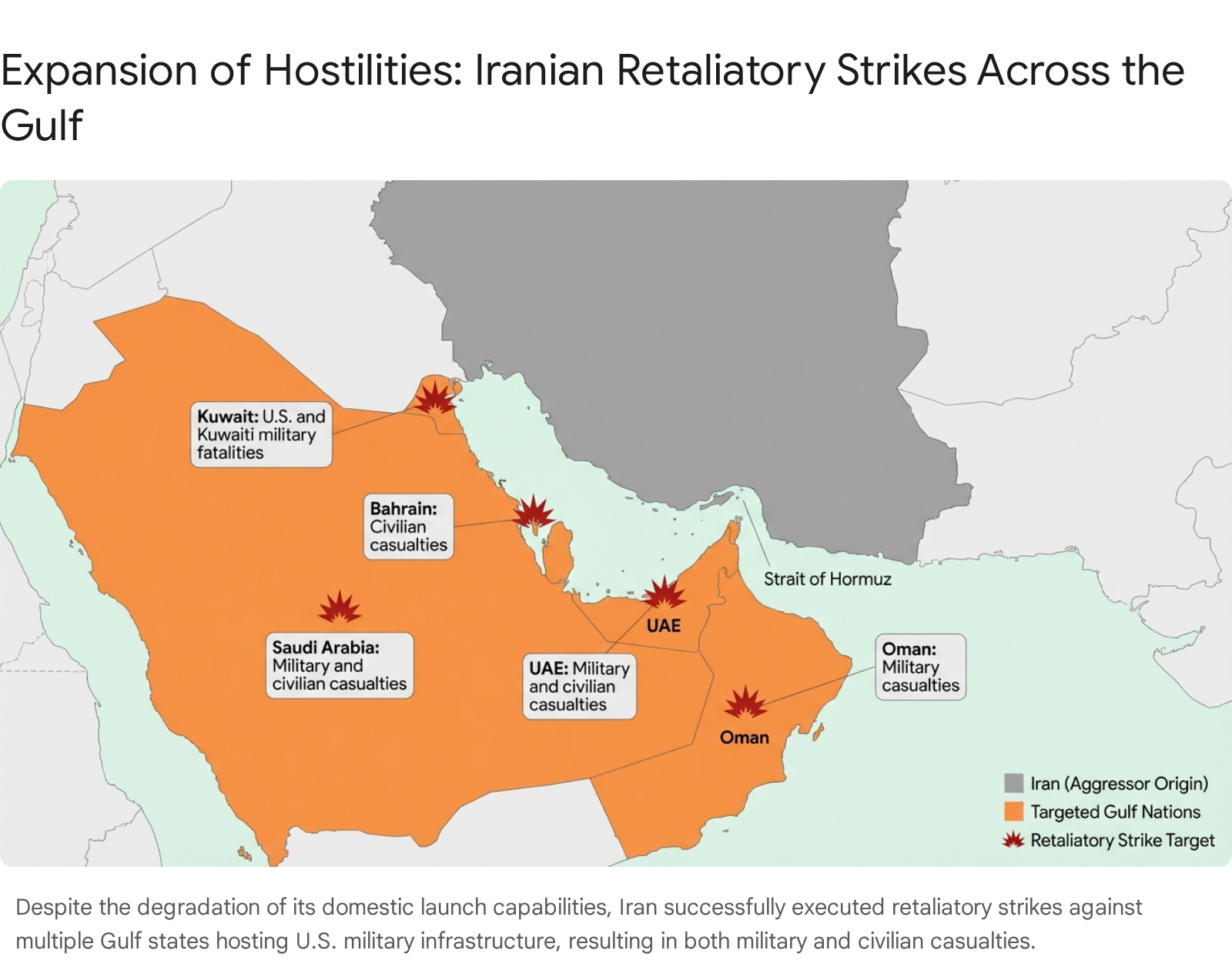
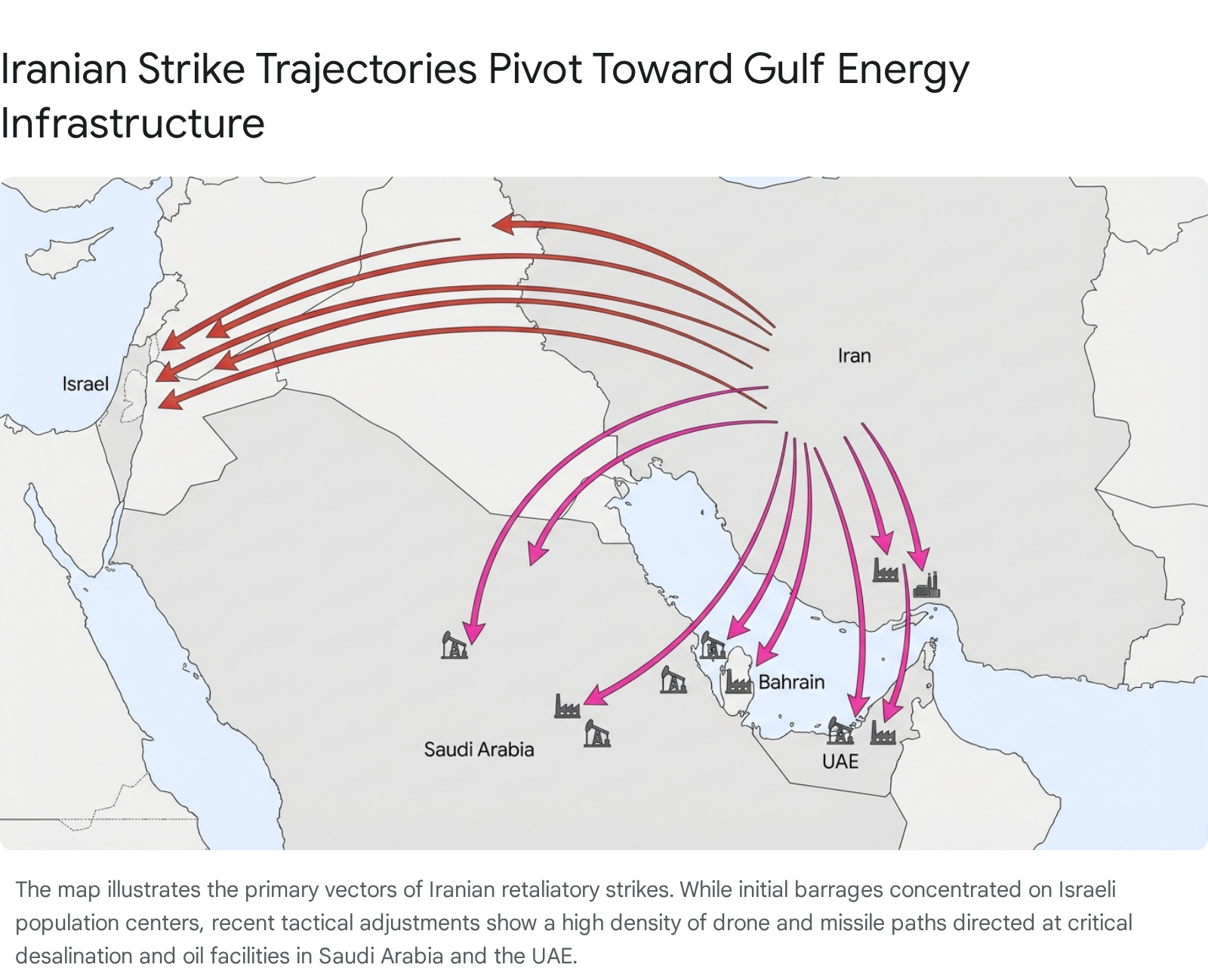
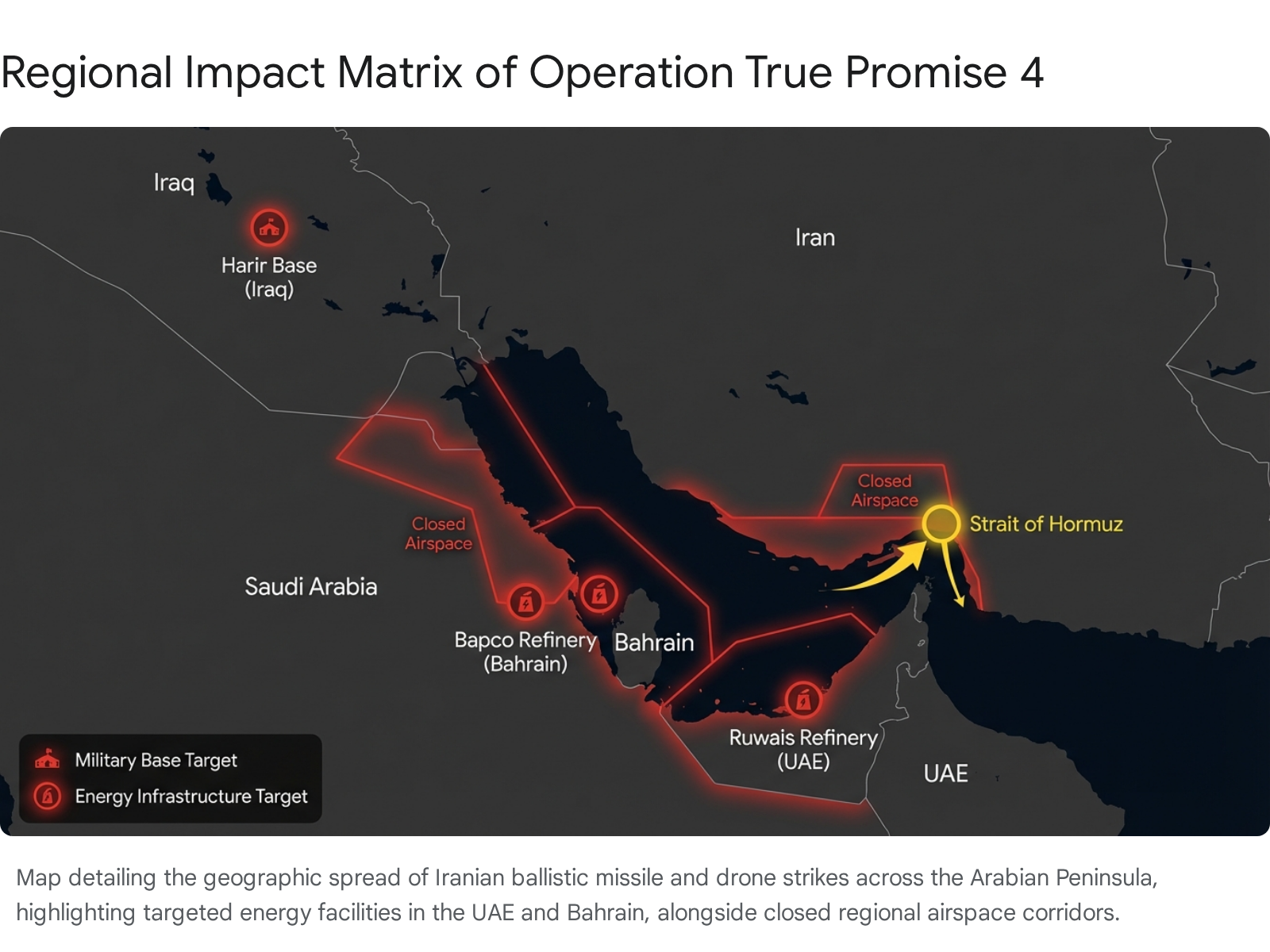
In immediate retaliation, Iran’s Islamic Revolutionary Guard Corps (IRGC) has executed a maximum-pressure asymmetric response doctrine, formalized under “Operation True Promise 4.” This response has utilized hundreds of ballistic missiles and suicide drones, shifting the target matrix away from exclusively Israeli or US military assets to include critical logistical nodes and civilian infrastructure across the Gulf Cooperation Council (GCC) states.3 The defining geopolitical shift of this reporting window is the involuntary dissolution of Gulf neutrality. Iranian strikes have caused documented civilian casualties, structural fires, and infrastructure damage in the United Arab Emirates (UAE), Bahrain, Saudi Arabia, Qatar, and Kuwait. By directly targeting regional energy hubs, diplomatic compounds, and civilian transit infrastructure in host nations, Iran has forced US-aligned Arab states into an active defensive posture, thereby internationalizing the immediate conflict zone and fracturing previous diplomatic outreach efforts.6

Simultaneously, the Iranian state is navigating a historic, wartime constitutional crisis. Following the assassination of Supreme Leader Ayatollah Ali Khamenei in a joint US-Israeli operation on February 28, 2026, the Assembly of Experts,under intense operational and physical pressure from the IRGC,reportedly expedited the irregular succession of his son, Mojtaba Khamenei, as the new Supreme Leader.1 This succession occurred alongside targeted, heavy Israeli airstrikes on the Assembly of Experts’ convening facilities in Qom and the Supreme National Security Council (SNSC) in Tehran, representing an unprecedented effort by the US-Israeli coalition to violently disrupt the systemic continuity of the Iranian theocracy and its constitutional transition of power.2

Economically, the conflict has generated systemic shocks. The de facto closure of the Strait of Hormuz,through which 20 percent of the world’s oil trade flows,has sent global markets into a steep decline and caused crude oil prices to surge by over 15 percent.6 In response to this energy crisis, United States President Donald Trump activated the US International Development Finance Corporation (DFC) to provide emergency political risk insurance for maritime shipping, backed by the promise of US Navy armed escorts for commercial vessels navigating the Gulf.14

As the conflict enters its fifth day, the battlespace has expanded horizontally to include Lebanese, Iraqi, and extended maritime theaters. The downing of an Iranian manned fighter jet over Tehran by an Israeli F-35, the sinking of an Iranian frigate near Sri Lanka, and the deployment of Ukrainian drone-interception strategies to the Gulf underscore a protracted, multi-domain confrontation with severe, long-term systemic risks to global energy security, international commercial shipping, and regional sovereignty.1

2.0 Chronological Timeline of Key Events (Last 36 Hours)

Note: All chronological data is rendered in Coordinated Universal Time (UTC) to ensure synchronized operational tracking across multiple theater domains.

  • March 2, 2026 | 15:00 UTC: The Hashemite Kingdom of Jordan officially closes its airspace to civilian and commercial traffic, issuing a daily Notice to Air Missions (NOTAM) effective from 15:00 to 06:00 UTC due to the high volume of missile incursions and allied interception operations occurring within Jordanian sovereign airspace.18
  • March 2, 2026 | 21:00 UTC: Iranian unmanned aerial vehicles (UAVs) strike the perimeter of the United States Embassy in Riyadh, Saudi Arabia. The strike causes a limited structural fire and minor localized damage, though no American diplomatic casualties are reported.5
  • March 3, 2026 | 02:00 UTC: The Israel Defense Forces (IDF) deploy a squadron of over 100 fighter jets, delivering a payload of more than 250 precision-guided munitions against the Iranian “leadership complex” in Tehran. The strikes successfully target and heavily damage the Supreme National Security Council (SNSC) headquarters and the Presidential Office.1
  • March 3, 2026 | 04:30 UTC: The IDF conducts a targeted, intelligence-driven airstrike on the Assembly of Experts building in Qom. This strike is explicitly designed to disrupt the expedited succession process of the Iranian Supreme Leadership.10
  • March 3, 2026 | 06:15 UTC: A retaliatory Iranian drone strike targets the immediate vicinity of the US Consulate in Dubai, UAE. The resulting fire in the consulate’s parking infrastructure is rapidly contained. All consular personnel are subsequently accounted for by US Secretary of State Marco Rubio.16
  • March 3, 2026 | 08:00 UTC: The Kuwaiti Defense Ministry reports the interception of a massive barrage of Iranian projectiles. A sophisticated drone strike bypasses Kuwaiti and US air defenses at a military facility in Port Shuaiba, resulting in the deaths of four identified US Army Reserve personnel and two additional unreleased casualties.21
  • March 3, 2026 | 11:00 UTC: US President Donald Trump issues an executive directive ordering the Development Finance Corporation (DFC) to provide emergency political risk insurance for energy shipments transiting the Strait of Hormuz, aiming to stabilize surging global crude oil prices.13
  • March 3, 2026 | 14:00 UTC: Qatar Airways announces an indefinite suspension of all scheduled flight operations due to the complete closure of Qatari airspace amidst heavy regional air defense activations.24
  • March 3, 2026 | 18:30 UTC: The IRGC officially launches the 17th wave of its regional offensive, designated “Operation True Promise 4,” firing an estimated 40 advanced ballistic missiles at distributed US and Israeli targets across the Middle East.1
  • March 4, 2026 | 01:00 UTC: The Sri Lankan military responds to a critical distress call from the rapidly sinking Iranian Moudge-class frigate Iris Dena near Galle. Thirty sailors are rescued, while over 101 personnel remain missing following an unconfirmed submarine attack.1
  • March 4, 2026 | 02:30 UTC: Israeli Defense Minister Israel Katz issues a definitive public declaration that any successor appointed to the Iranian Supreme Leadership will be automatically classified as an “unequivocal target for elimination”.1
  • March 4, 2026 | 03:59 UTC: The IDF announces an unprecedented aerial engagement: an Israeli F-35I “Adir” fighter jet successfully intercepts and shoots down a manned Iranian Air Force YAK-130 jet in the contested airspace over Tehran.1
  • March 4, 2026 | 05:00 UTC: Lebanese Hezbollah claims operational responsibility for launching a complex “swarm” of suicide drones at the headquarters of Israel Aerospace Industries (IAI) in central Israel, marking a horizontal escalation in the northern theater.1

3.0 Situation by Primary Country

3.1 Iran

3.1.1 Military Actions & Posture

The Islamic Republic of Iran has fundamentally shifted its military posture from regional deterrence to an unrestricted, asymmetric total warfare doctrine. Having suffered catastrophic losses to its conventional command structures, the IRGC Aerospace Force has prioritized raw volume over precision targeting, launching in excess of 500 ballistic missiles and 2,000 suicide drones at regional targets over the course of the conflict.5 This strategy, executed in overlapping waves such as the recently announced “Operation True Promise 4,” is explicitly designed to overwhelm the integrated air defense systems (IADS) of the United States and its GCC host nations, imposing an unbearable economic and political cost on the region.3

The conventional Iranian armed forces (Artesh) have sustained critical infrastructural damage that significantly degrades their operational viability. Coalition airstrikes have systematically disabled primary tactical airbases, including the 2nd Artesh Air Force Tactical Airbase in Tabriz,where multiple F-4 and F-5 fighter jets were destroyed on the tarmac,and the 7th Tactical Airbase in Shiraz, which hosts Iran’s Sukhoi SU-22 squadrons.2 Furthermore, the IDF claims to have achieved total air dominance, punctuated by the historic air-to-air shootdown of an Iranian YAK-130 fighter jet by an Israeli F-35I over the capital city of Tehran.1

In the maritime domain, the Iranian Navy has been effectively neutralized as a blue-water force. US Central Command (CENTCOM) reports the verified destruction of 17 Iranian naval vessels, including subsurface assets.1 This naval attrition was highlighted by the sinking of the Moudge-class frigate Iris Dena off the coast of Sri Lanka, resulting in over 100 missing sailors following a suspected allied submarine engagement.1 Despite the loss of conventional naval assets, the IRGC claims to maintain “complete control” over the Strait of Hormuz, relying on a distributed network of coastal anti-ship missile batteries, fast-attack craft, and mine-laying capabilities to enforce a de facto blockade on international shipping.1

3.1.2 Policy & Diplomacy

The Iranian state apparatus is navigating an unprecedented command-and-control crisis following the targeted assassination of Supreme Leader Ayatollah Ali Khamenei. Intelligence reporting indicates a severe disruption within the constitutional succession mechanisms. The Assembly of Experts, the 88-member clerical body mandated with selecting the Supreme Leader, was physically targeted by Israeli airstrikes during a convening session in Qom.10 Under extreme pressure from the IRGC to prevent a leadership vacuum, the remaining members reportedly bypassed traditional theological debate and expedited the succession of Mojtaba Khamenei, the late Supreme Leader’s 56-year-old son.1 This wartime succession fundamentally alters the power dynamics in Tehran, signaling a definitive transition from a purely clerical theocracy to a praetorian state dominated by the military-security apparatus of the IRGC.8

Diplomatically, Tehran has adopted a posture of absolute intransigence, severing all potential diplomatic off-ramps. Iranian Foreign Minister Abbas Araghchi and senior advisor Mohammad Mokhbar publicly stated that Iran has “no intention” of holding any negotiations with the United States.1 Iranian diplomats accused the Trump administration of betraying the diplomatic process, noting that preceding talks brokered by Oman in Geneva were utilized as a deceptive stalling tactic while the US-Israeli military offensive was finalized.1 Consequently, Iran has issued blanket threats to target “all economic centers in the region” if GCC states continue to permit the use of their airspace and bases by US forces.5

3.1.3 Civilian Impact

The civilian toll within the borders of Iran is escalating at an alarming trajectory. The Iranian Red Crescent Society has confirmed a minimum baseline of 787 fatalities, though internal communications and regional human rights monitors suggest the actual death toll is well into the thousands.21 A deeply contentious and mass-casualty incident occurred in the southern city of Minab, Hormozgan province, where an airstrike reportedly struck an elementary school, resulting in the deaths of approximately 150 children and civilians.31 The United Nations has described this as a grave violation of humanitarian law and urged an independent probe; US Secretary of State Marco Rubio indicated the US does not deliberately target educational infrastructure, while Israel denied direct involvement in that specific strike.16

General civilian infrastructure has sustained heavy collateral damage due to the proximity of military installations to metropolitan centers. Areas surrounding the Parchin Military Complex and the Natanz nuclear facility, as well as the Mehrabad Airport in Tehran, have been significantly degraded.2 Compounding the external military threat, the domestic civilian population is facing severe internal suppression. Iran’s judiciary chief, Gholam Hossein Mohseni Ejehi, issued public broadcasts threatening capital punishment for any Iranian citizen expressing support for the US-Israeli campaign or dissenting against the war effort, citing wartime treason laws.34

3.2 Israel

3.2.1 Military Actions & Posture

The Israeli Air Force (IAF) is executing a relentless, high-intensity aerial campaign that ranks among the most expansive in its operational history. Since the commencement of hostilities on February 28, the IAF has conducted over 1,600 sorties penetrating deeply into Iranian sovereign territory, deploying in excess of 4,000 precision-guided munitions.2 The tactical focus of the Israeli military has evolved from the initial suppression of enemy air defenses (SEAD) and counter-proliferation strikes,such as those targeting the Natanz facility,to a systematic decapitation of the Iranian regime’s leadership infrastructure.5 On March 3, a heavily concentrated wave of Israeli strikes obliterated the Supreme National Security Council (SNSC), the Presidential Office, and explicitly targeted the Assembly of Experts in Qom to disrupt the systemic continuity of the Iranian government.2

Israel’s military posture is characterized by total air superiority, evidenced not only by deep-penetration bombing runs but also by the successful air-to-air engagement of Iranian manned aircraft.1 Unverified regional reporting from Saudi-based Al Arabiya also suggests that Israeli special operations forces, including Mossad operatives, have conducted limited ground incursions inside Iran to facilitate intelligence gathering and target designation.10

Simultaneously, the IDF is managing a high-intensity, multi-front war. On the northern front, the IDF struck over 250 Hezbollah targets in Lebanon over the last 36 hours, heavily bombarding the Dahiyeh suburb of Beirut and eliminating vital communication infrastructure, including the Hezbollah-owned al-Manar television station.10 In anticipation of a widened ground conflict or major cross-border infiltrations, the IDF has redeployed the 146th Reserve Division to the western portion of the Lebanese border, signaling preparations for sustained defensive or offensive ground operations in the northern Galilee region.36

3.2.2 Policy & Diplomacy

Israeli political leadership is projecting a maximalist, uncompromising war aim: the complete and irreversible dismantling of the current Iranian regime. This policy was explicitly codified by Israeli Defense Minister Israel Katz, who issued a public declaration stating that any leader appointed by the Iranian regime to replace Ayatollah Khamenei is automatically designated as an “unequivocal target for elimination”.1 Prime Minister Benjamin Netanyahu has actively rejected diplomatic criticism and the premise that the conflict will devolve into an endless war, characterizing the current Iranian regime as being at its “weakest point” and asserting that the military action will be “quick and decisive” in its ultimate strategic outcome.33

3.2.3 Civilian Impact

The Israeli home front remains heavily fortified but is actively and repeatedly targeted by multi-axis threats. While the multi-tiered Israeli air defense network (comprising Iron Dome, David’s Sling, and Arrow systems) has intercepted the vast majority of incoming Iranian ballistic missiles and Hezbollah projectiles, the sheer volume of saturation attacks has caused casualties. Historical data from the broader campaign indicates 28 civilian fatalities and over 3,238 hospitalizations, with current hospitalization metrics showing dozens still receiving acute care.36

The introduction of “swarm” drone tactics by Hezbollah, which successfully targeted the Israel Aerospace Industries (IAI) headquarters in central Israel, represents a dangerous evolution in the threat vector to Israeli civilian and industrial centers.1 Domestic aviation has been severely curtailed; however, the Ministry of Transport is attempting to establish limited, secure flight corridors to gradually reopen Ben Gurion Airport at night to facilitate the emergency evacuation of Israeli citizens stranded in hostile or unstable regions abroad.38

3.3 United States

3.3.1 Military Actions & Posture

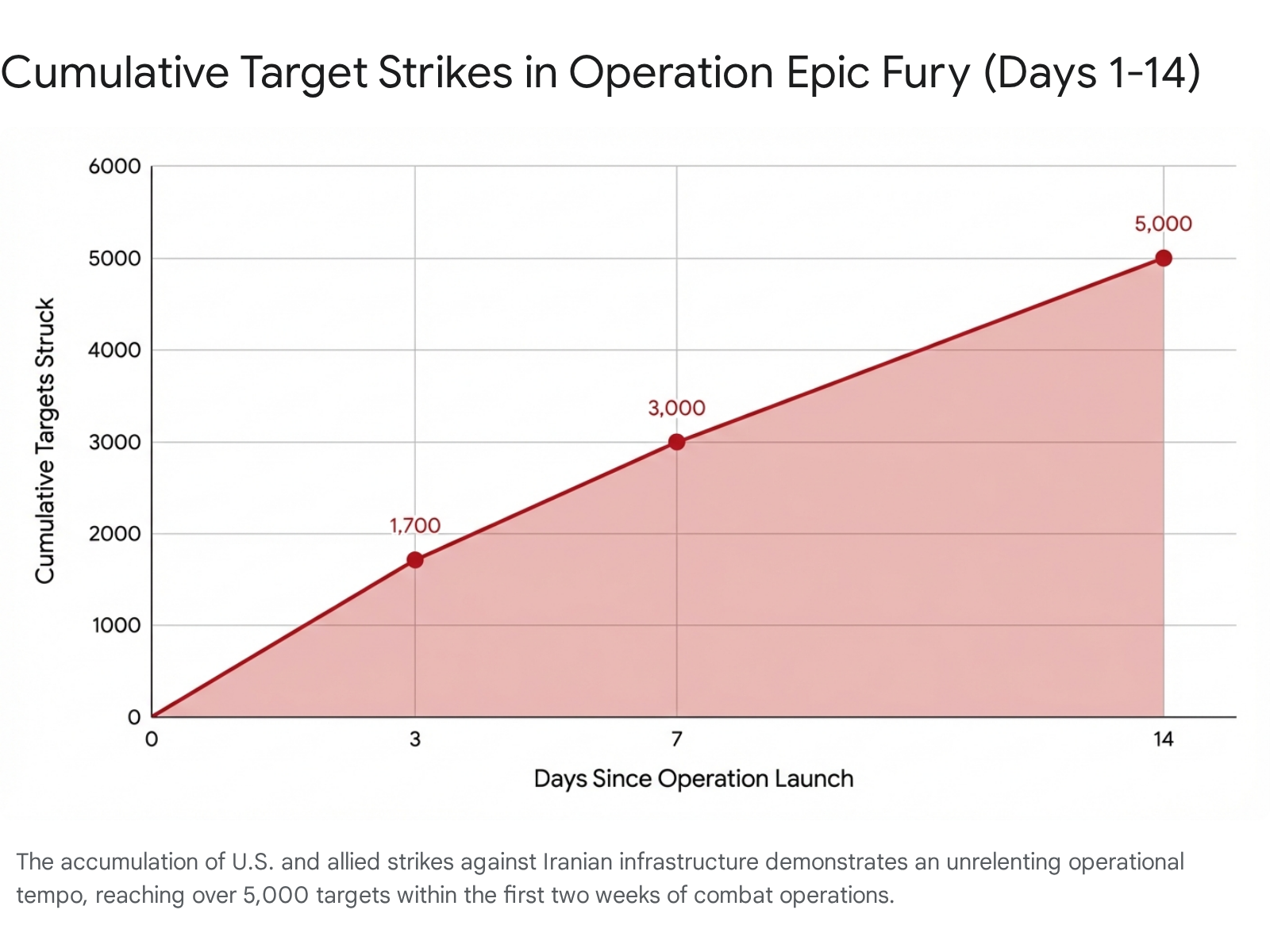
United States Central Command (CENTCOM) is executing a massive, highly coordinated strike campaign designated Operation Epic Fury. Utilizing carrier air wings from the USS Abraham Lincoln and USS Gerald R. Ford, alongside heavy B-1 and B-52 strategic bombers operating directly within Iranian airspace, the US military has struck nearly 2,000 distinct targets since the onset of the conflict.1 US military officials have publicly noted that the operational scale and payload delivery of the first 72 hours of this conflict surpassed the initial “shock and awe” phase of the 2003 invasion of Iraq.1 The primary US strategic objective has been the systematic eradication of Iran’s integrated air defense systems (IADS), ballistic missile launch sites, and naval capabilities to ensure freedom of navigation and secure allied airspace.1

Despite achieving overwhelming kinetic success against Iranian infrastructure, US forces deployed in a logistical and advisory capacity across the region remain highly vulnerable to asymmetrical drone strikes. This vulnerability was tragically realized on March 1 (formally announced March 3), when an Iranian suicide drone successfully penetrated layered air defenses at a military facility in Port Shuaiba, Kuwait. The strike hit a command center, resulting in the deaths of four identified US Army Reserve soldiers attached to the 103rd Sustainment Command: Capt. Cody Khork, Sgt. 1st Class Noah Tietjens, Sgt. 1st Class Nicole Amor, and Sgt. Declan Coady.16 Two additional, unidentified service members were also killed in the attack, bringing the confirmed US military death toll to six, with at least 10 personnel currently in serious medical condition undergoing advanced triage.21

3.3.2 Policy & Diplomacy

The United States has rapidly shifted its macroeconomic and diplomatic posture to triage the severe global economic fallout generated by the war. To counteract the de facto closure of the Strait of Hormuz,which halted navigation and caused global benchmark crude oil prices to surge by nearly 15 percent,President Donald Trump invoked emergency economic measures.12 He directed the US International Development Finance Corporation (DFC) to provide “political risk insurance and guarantees” for all maritime commercial trade, specifically energy shipments, transiting the Gulf.12 This unprecedented mobilization of a federal development bank is to be physically enforced by the US Navy, which has been ordered to initiate armed escorts for commercial tankers to artificially force the reopening of the global energy chokepoint.15

Diplomatically, the US State Department has effectively collapsed its footprint in immediate threat zones, indefinitely closing embassies in Beirut (Lebanon), Kuwait, and Riyadh (Saudi Arabia).21 The department has elevated travel advisories to Level 4 (Do Not Travel) for vast swaths of the Middle East, urging American citizens to evacuate 14 nations immediately. The US government is actively utilizing military transport and charter flights to conduct a mass extraction, having successfully evacuated over 9,000 citizens to date.41

3.3.3 Civilian Impact

The domestic US civilian impact is currently confined to the families of the fallen service members and the broad macroeconomic consequences of energy market volatility, which threatens to significantly raise domestic fuel costs and general inflation. However, the international impact on US citizens is profound; tens of thousands of American citizens, expatriates, and corporate personnel remain stranded in the Gulf region due to the comprehensive shutdown of commercial airspace.41 The US State Department is actively coordinating complex logistics for charter flights out of Jordan, Oman, and the UAE to extract non-essential personnel and vulnerable civilians as commercial airline options evaporate.21

4.0 Regional and Gulf State Impacts

The geopolitical landscape of the Gulf Cooperation Council (GCC) has fundamentally fractured over the last 36 hours. The previous era of diplomatic détente and economic integration between the Arab Gulf states and Iran has violently collapsed. Tehran has expanded its target matrix to include the sovereign territory, civilian infrastructure, and economic engines of nations hosting US military assets, forcing these states out of a neutral diplomatic posture and into an active defensive alignment with the US-Israeli coalition.6

In a highly significant geopolitical development highlighting the interconnected nature of modern asymmetric warfare, Ukrainian President Volodymyr Zelenskyy proposed a direct military hardware swap to the UAE and other Gulf States. Recognizing the GCC’s rapid depletion of expensive PAC-3 interceptor missiles used to combat Iranian Shahed-variant drones, Zelenskyy offered to export Ukraine’s domestically produced, combat-tested drone interceptors in exchange for the Gulf’s remaining PAC-3 stockpiles.16 This proposition underscores the severe strain Iranian drone swarms are placing on the conventional air defense logistics of the Gulf states.6

Table 1: Sovereign Impact and Defensive Posture of Regional States

NationMilitary Posture & Direct ImpactsAirspace, Civilian Security & Diplomatic Status
United Arab Emirates (UAE)Heavily targeted. Intercepted multiple drones and missiles with assistance from French Rafale jets based at Al Dhafra. Debris struck the Fujairah oil facility causing a massive fire. A drone successfully struck the perimeter of the US Consulate in Dubai.5Airspace is technically open but commercial flights are functionally suspended; Air Arabia, Emirates, and Etihad halted operations. Civilian casualties include 3 dead (foreign nationals) and 58 injured from shrapnel. UAE stock markets plunged nearly 4.6%.16
Saudi ArabiaIntercepted a barrage of nine drones over its eastern province. Two Iranian drones penetrated defenses in Riyadh, striking the US Embassy compound and causing localized fires.5Signed a joint GCC-US statement vehemently condemning Iran’s “reckless” behavior. US State Department authorized the immediate evacuation of non-emergency personnel from the Kingdom.44
QatarAir defenses highly active over Doha; intercepted an Iranian ballistic missile targeting the massive Al Udeid Air Base. Internal security forces dismantled an IRGC espionage cell comprising 10 individuals.5Qatar Airways operations are fully suspended indefinitely. State-owned QatarEnergy was forced to halt vital liquid natural gas (LNG) export operations due to extreme maritime threats in the Gulf.24
BahrainBallistic missiles directly targeted the US Navy’s Naval Support Activity (NSA) base in Manama, the headquarters of the 5th Fleet. Air defense sirens activated country-wide.45The government issued strong diplomatic condemnations regarding Iran’s violation of territorial sovereignty. The US Embassy ordered personnel to avoid the Hamala area out of an abundance of caution.49
KuwaitExperienced the heaviest kinetic impacts among GCC nations. Intercepted 178 ballistic missiles and 384 drones. A major breach at Port Shuaiba resulted in the deaths of 4 identified US soldiers.2The US Embassy is closed indefinitely. Civilian airport operations are highly restricted, characterized by panic, and prioritized entirely for military and emergency evacuation logistics.21
OmanRetained the most neutral posture, acting as the primary mediator prior to the outbreak of war. Explicitly condemned the US-Israeli strikes as a violation of international law and the UN Charter.51Despite neutrality, the US Embassy in Muscat issued a strict “shelter in place” order for all citizens due to regional volatility. Oman continues to attempt to keep diplomatic channels open to Tehran.5
JordanAirspace is actively utilized as a combat corridor. US and UK fighter jets utilized Jordanian airspace to intercept Iranian projectiles en route to Israel.16Airspace is officially closed daily via NOTAM from 15:00 to 06:00 UTC. Amman is currently serving as a primary ground extraction and airlift hub for European and US civilians fleeing the Levant.18

5.0 Appendices

Appendix A: Methodology

This Situation Report (SITREP) was generated utilizing a comprehensive, real-time aggregation of open-source intelligence (OSINT), official military command updates, and state-sponsored broadcast networks. The analytical window was strictly confined to the 36-hour period culminating at the time of drafting, with intentional chronological overlaps cross-referenced against preceding intelligence cycles to ensure absolute continuity of the event chain.

  • Primary Source Prioritization: Top-tier evidentiary weight was assigned to official releases from United States Central Command (CENTCOM), the Israel Defense Forces (IDF), the UAE Ministry of Foreign Affairs, and the Kuwaiti Defense Ministry.
  • Secondary OSINT Validation: Real-time airspace constraints were mapped using Flightradar24 data and international NOTAM issuances. Maritime distress signals and shipping disruptions were verified against reports from the United Kingdom Maritime Trade Operations (UKMTO) and global commodity market indices (e.g., Brent crude tracking).
  • Conflict Resolution: In instances of conflicting data,particularly regarding casualty metrics where Iranian state media figures diverge from independent assessments,this report prioritized verified figures released by international humanitarian organizations, such as the Red Crescent Society, while maintaining objective reporting of unverified state claims with appropriate caveats.

Appendix B: Glossary of Acronyms

  • CENTCOM: United States Central Command (the unified combatant command responsible for US military operations in the Middle East).
  • DFC: United States International Development Finance Corporation (a federal agency mobilized to provide emergency political risk insurance to maritime shipping).
  • GCC: Gulf Cooperation Council (a regional political and economic union comprising Bahrain, Kuwait, Oman, Qatar, Saudi Arabia, and the UAE).
  • IADS: Integrated Air Defense System (a comprehensive network of radars, command centers, and interceptor missiles used to protect airspace).
  • IAF: Israeli Air Force.
  • IAI: Israel Aerospace Industries (a major Israeli aerospace and aviation manufacturer targeted by Hezbollah drone swarms).
  • IDF: Israel Defense Forces.
  • IRGC: Islamic Revolutionary Guard Corps (Iran’s premier military and internal security force, distinct from the conventional military).
  • NOTAM: Notice to Air Missions (an official alert to aircraft pilots concerning potential hazards along a flight route or in a specific location).
  • PAC-3: Patriot Advanced Capability-3 (A US-manufactured surface-to-air missile defense system utilized heavily by Gulf states).
  • SNSC: Supreme National Security Council (Iran’s highest national security decision-making body, heavily damaged in Israeli airstrikes).

Appendix C: Glossary of Foreign Words

  • Artesh: The conventional military forces of the Islamic Republic of Iran, operating distinctly from the IRGC and primarily tasked with territorial defense.
  • Basij: A paramilitary volunteer militia established in Iran following the Islamic Revolution, operating under the direct command of the IRGC and often utilized for internal security and suppression.
  • Dahiyeh: A predominantly Shia southern suburb of Beirut, Lebanon, known as a primary stronghold, administrative center, and military node for Hezbollah.
  • Knesset: The unicameral national legislature of the State of Israel.
  • Majlis: The Islamic Consultative Assembly, which serves as the national legislative body of Iran.
  • Mosalla: A large open space or building utilized for public Islamic prayer; specifically referenced in this report as the Grand Mosalla of Tehran, the site designated for state funerals.
  • Velayat-e Faqih: The “Guardianship of the Islamic Jurist,” the foundational political and religious doctrine of the Iranian state, which grants absolute theological and political authority to the Supreme Leader.

Please share the link on Facebook, Forums, with colleagues, etc. Your support is much appreciated and if you have any feedback, please email us in**@*********ps.com. If you’d like to request a report or order a reprint, please click here for the corresponding page to open in new tab.


Sources Used

  1. Middle East crisis live: Israel launches ‘wave of strikes’ on Tehran as …, accessed March 4, 2026, https://www.theguardian.com/world/live/2026/mar/04/iran-war-live-updates-us-israel-latest-news-strait-of-hormuz-middle-east-crisis
  2. Iran Update Evening Special Report, March 3, 2026 | ISW, accessed March 4, 2026, https://understandingwar.org/research/middle-east/iran-update-evening-special-report-march-3-2026/
  3. Tehran, March 4, 2026 (AFP) – Iran Guards say launched more than 40 missiles at US, Israeli targets | NAMPA, accessed March 4, 2026, https://www.nampa.org/text/22876739
  4. ‘Nightmare scenario’ for GCC countries, region as Iran unloads drones and missiles, accessed March 4, 2026, https://breakingdefense.com/2026/03/iran-attacks-uae-saudi-missiles-drones-gcc-air-defense/
  5. What we know on day five of US-Israeli attacks on Iran | Israel-Iran conflict News | Al Jazeera, accessed March 4, 2026, https://www.aljazeera.com/news/2026/3/4/what-we-know-on-day-five-of-us-israeli-attacks-on-iran
  6. War Comes to the Gulf | The Washington Institute, accessed March 4, 2026, https://www.washingtoninstitute.org/policy-analysis/war-comes-gulf
  7. Gulf states on verge of acting against Iran over ‘reckless’ strikes across region, accessed March 4, 2026, https://www.theguardian.com/world/2026/mar/02/gulf-states-iran-strikes-response
  8. A wartime succession in Iran: why the IRGC backed Mojtaba Khamenei, accessed March 4, 2026, https://www.iranintl.com/en/202603048311
  9. Mojtaba Khamenei to be Iran’s new Supreme Leader: All about his net worth, family, wife Zahra Haddad Adel and kids, accessed March 4, 2026, https://www.livemint.com/news/world/mojtaba-khamenei-to-be-irans-new-supreme-leader-all-about-his-net-worth-family-wife-zahra-haddad-adel-and-kids-11772585782116.html
  10. Iran Update Morning Special Report, March 3, 2026 | ISW, accessed March 4, 2026, https://understandingwar.org/research/middle-east/iran-update-morning-special-report-march-3-2026/
  11. Israel strikes building where Iranian clerics were choosing Khamenei’s successor, accessed March 4, 2026, https://timesofindia.indiatimes.com/world/middle-east/israel-strikes-building-where-iranian-clerics-were-choosing-khameneis-successor/articleshow/129004381.cms
  12. Iran War: US will provide insurance, escort ships out of Strait of Hormuz, says Donald Trump, accessed March 4, 2026, https://www.businesstoday.in/world/story/iran-war-us-will-provide-insurance-escort-ships-out-of-strait-of-hormuz-says-donald-trump-519071-2026-03-04
  13. Trump offers assistance to oil shippers to halt price spike from Iranian threat, accessed March 4, 2026, https://www.washingtonexaminer.com/policy/energy-and-environment/4478919/trump-offers-assistance-oil-shippers-price-spike-iranian-threat/
  14. Trump orders bank to provide ‘political risk insurance and guarantees’ for maritime trade amid Iran war, accessed March 4, 2026, https://www.aa.com.tr/en/americas/trump-orders-bank-to-provide-political-risk-insurance-and-guarantees-for-maritime-trade-amid-iran-war/3848895
  15. Trump Says US Will Escort, Insure Oil Tankers Amid the Iran War – Claims Journal, accessed March 4, 2026, https://www.claimsjournal.com/news/national/2026/03/04/336054.htm
  16. UAE news LIVE updates: US Embassy in Abu Dhabi, Dubai …, accessed March 4, 2026, https://www.hindustantimes.com/world-news/dubai-news-live-updates-abu-dhabi-uae-us-embassy-attack-flight-status-today-airport-emirates-iran-march-4-latest-news-101772588297109.html
  17. Ukraine offers Gulf states air defence swap, accessed March 4, 2026, https://www.brecorder.com/news/40409912
  18. Airspace closures following Israeli and US strikes on Iran, accessed March 4, 2026, https://www.flightradar24.com/blog/live/israel-launches-pre-emptive-strikes-on-iran-airspace-closures-going-into-place/
  19. US and Israel launch new wave of attacks on Iran amid threat of escalation, accessed March 4, 2026, https://www.theguardian.com/world/2026/mar/01/iran-us-israel-new-attacks-escalation-threat-middle-east
  20. The name of Iran’s next leader will be announced ‘soon,’ according to Iran’s Assembly of Experts, accessed March 4, 2026, https://www.jpost.com/middle-east/iran-news/article-888736
  21. Live Updates: Trump defends war with Iran as conflict widens …, accessed March 4, 2026, https://www.cbsnews.com/live-updates/iran-war-us-israel-day-4-trump-gives-no-timeline-as-gulf-states-attacked/
  22. Pentagon identifies 4 soldiers killed by Iranian attack, accessed March 4, 2026, https://taskandpurpose.com/news/military-troops-identified-iran/
  23. Pentagon identifies 4 of 6 U.S. soldiers killed in Iran war by drone strike in Kuwait – PBS, accessed March 4, 2026, https://www.pbs.org/newshour/nation/pentagon-identifies-4-of-6-u-s-soldiers-killed-in-iran-war-by-drone-strike-in-kuwait
  24. Latest news – Qatar Airways Newsroom, accessed March 4, 2026, https://www.qatarairways.com/press-releases/en-WW/
  25. Qatar Airways flight operations remain suspended as of 4 March 2026, updates expected on 5 March, accessed March 4, 2026, https://www.iloveqatar.net/news/travel/qatar-airways-flight-operations-remain-suspended-4-march-2026-updates-expected-5-march
  26. Israel Air Force says ‘extensive’ wave of strikes against Iran regime targets on – The Tribune, accessed March 4, 2026, https://www.tribuneindia.com/news/air-force/israel-air-force-says-extensive-wave-of-strikes-against-iran-regime-targets-on
  27. US-Israel vs Iran war: US destroys 17 Iranian vessels as Saudi, UAE intercept drones; Middle East tensions soar, accessed March 4, 2026, https://indianexpress.com/article/world/us-israel-vs-iran-conflict-whatshappening-in-the-middle-east-10564235/
  28. Mojtaba Khamenei Reportedly Becomes Iran’s Supreme Leader After Historic 47-Year Leadership Transition – The Logical Indian, accessed March 4, 2026, https://thelogicalindian.com/mojtaba-khamenei-reportedly-becomes-irans-supreme-leader-after-historic-47-year-leadership-transition/
  29. US ‘totally stupid’ to attack Iran during talks: UN ambassador – The Economic Times, accessed March 4, 2026, https://m.economictimes.com/news/international/world-news/us-totally-stupid-to-attack-iran-during-talks-un-ambassador/articleshow/128986643.cms
  30. U.S., Iran complete round of talks as Trump weighs diplomacy against strikes, accessed March 4, 2026, https://www.washingtonpost.com/world/2026/02/26/iran-nuclear-talks-trump-strikes-geneva-oman/
  31. Urgent call to protect civilians and respect international law amid escalating regional conflict following US and Israeli attacks on Iran, accessed March 4, 2026, https://www.amnesty.org/en/latest/news/2026/03/urgent-call-to-protect-civilians-and-respect-international-law-amid-escalating-regional-conflict-following-us-and-israeli-attacks-on-iran/
  32. From UAE to Saudi Arabia, how US-Iran war is affecting the Middle East, accessed March 4, 2026, https://www.hindustantimes.com/world-news/from-dubai-abu-dhabi-riyadh-uae-to-saudi-arabia-kuwait-how-us-israel-iran-war-is-affecting-the-middle-east-101772567178928.html
  33. Operations Epic Fury and Roaring Lion: 3/3/26 Update – JINSA, accessed March 4, 2026, https://jinsa.org/wp-content/uploads/2026/03/Operations-Epic-Fury-and-Roaring-Lion-03-03.pdf
  34. The Latest: Explosions heard in Tehran and Jerusalem on fifth day of war, accessed March 4, 2026, https://www.seattlepi.com/news/the-latest-explosions-heard-in-tehran-and-a21954268
  35. Report: Israel carried out ground operation in Iran, accessed March 4, 2026, https://www.israelnationalnews.com/news/423290
  36. IDF carries out ‘broad wave of attacks’ across Iran overnight; Iranian missiles lobbed at Israel, accessed March 4, 2026, https://www.timesofisrael.com/liveblog-march-04-2026/
  37. Casualties of the Twelve-Day War – Wikipedia, accessed March 4, 2026, https://en.wikipedia.org/wiki/Casualties_of_the_Twelve-Day_War
  38. Qatar Airways flight operations remain temporarily suspended amid escalating West Asia conflict, accessed March 4, 2026, https://www.tribuneindia.com/news/airspace-closure/qatar-airways-flight-operations-remain-temporarily-suspended-amid-escalating-west-asia-conflict
  39. U.S. Central Command (CENTCOM) Official Website Homepage, accessed March 4, 2026, https://www.centcom.mil/
  40. Trump offers assistance to oil shippers to halt price spike from Iranian threat, accessed March 4, 2026, https://www.washingtonexaminer.com/policy/4478919/trump-offers-assistance-oil-shippers-price-spike-iranian-threat/
  41. Anxious travelers scramble as Iran war strands hundreds of thousands across the Middle East, accessed March 4, 2026, https://www.opb.org/article/2026/03/03/anxious-travelers-scramble-as-iran-war-strands-hundreds-of-thousands-across-the-middle-east/
  42. Pentagon names four of six US soldiers killed in Iranian strike on Kuwait base, accessed March 4, 2026, https://www.theguardian.com/us-news/2026/mar/03/pentagon-us-soldiers-kuwait-strike
  43. 2026 Iranian strikes on the United Arab Emirates – Wikipedia, accessed March 4, 2026, https://en.wikipedia.org/wiki/2026_Iranian_strikes_on_the_United_Arab_Emirates
  44. Joint Statement Condemning Iran’s Missile and Drone Attacks in the Region, accessed March 4, 2026, https://www.mofa.gov.ae/en/MediaHub/News/2026/3/2/UAE-Iran-Attacks
  45. Explosions sound in the Iranian capital and Jerusalem as war with US and Israel enters a fifth day, accessed March 4, 2026, https://halifax.citynews.ca/2026/03/04/explosions-sound-in-the-iranian-capital-and-jerusalem-as-war-with-us-and-israel-enters-a-fifth-day/
  46. Iran targets U.S. bases in Bahrain and Qatar – Defence Blog, accessed March 4, 2026, https://defence-blog.com/iran-targets-u-s-bases-in-bahrain-and-qatar/
  47. Israel, US launch attacks against Iran | The Express Tribune, accessed March 4, 2026, https://tribune.com.pk/story/2595024/israel-launches-preventative-attack-against-iran-defence-minister-says
  48. The Gulf Monarchies Are Caught Between Iran’s Desperation and the U.S.’s Recklessness, accessed March 4, 2026, https://carnegieendowment.org/emissary/2026/03/gulf-states-iran-war-security
  49. Security Alert: Update 9 – U.S. Embassy Manama, Bahrain – (March 2, 2026), accessed March 4, 2026, https://bh.usembassy.gov/security-alert-security-alert-update-9-u-s-embassy-manama-bahrain-march-2-2026/
  50. Kingdom of Bahrain strongly condemns and denounces Iranian missile attacks targeting Kingdom of Bahrain, Kingdom of Saudi Arabia, United Arab Emirates, State of Qatar, State of Kuwait and Hashemite Kingdom of Jordan – Ministry of Foreign Affairs, accessed March 4, 2026, https://www.mofa.gov.bh/en/kingdom-of-bahrain-strongly-condemns-and-denounces-iranian-missile-attacks-targeting-kingdom-of-bahrain-kingdom-of-saudi-arabia-united-arab-emirates-state-of-qatar-state-of-kuwait-and-hashemite-kingdom-of-jordan
  51. World leaders react cautiously to U.S. and Israeli strikes on Iran | PBS News, accessed March 4, 2026, https://www.pbs.org/newshour/world/world-leaders-react-cautiously-to-u-s-and-israeli-strikes-on-iran
  52. Oman expresses regret over Israeli and US military operations against Iran | fm.gov.om, accessed March 4, 2026, https://www.fm.gov.om/en/38110/
  53. Hungary Launches Flight to Jordan to Bring Home Citizens Stranded in Middle East, accessed March 4, 2026, https://www.hungarianconservative.com/articles/current/hungary-evacuation-flight-jordan-stranded-citizens-middle-east/

Operation Epic Fury: The Strait of Hormuz Crisis Explained

1. Executive Summary

The geopolitical and maritime security architecture of the Middle East underwent a fundamental, irreversible paradigm shift on February 28, 2026. The initiation of Operation Epic Fury,a massive, coordinated, and preemptive strike campaign executed by the United States and Israel,resulted in the deliberate decapitation of the Iranian political and military leadership, including the verified death of Supreme Leader Ayatollah Ali Khamenei and the upper echelon of the Islamic Revolutionary Guard Corps (IRGC).1 In immediate retaliation, the remnants of the Iranian state and its newly decentralized military apparatus activated a comprehensive sea-denial strategy, effectively closing the Strait of Hormuz to all global commercial shipping.4

As of early March 2026, the Strait of Hormuz,a highly constrained, 33-kilometer-wide geographic chokepoint that normally processes approximately 20 to 21 million barrels of crude oil per day and one-fifth of global liquefied natural gas (LNG) trade,has collapsed into an active kinetic interdiction environment.7 Commercial tanker transits have plummeted from a stabilized baseline of 21 passages per day to virtually zero.8 Operating under fragmented command and control structures due to the elimination of their strategic oversight, local IRGC Navy (IRGCN) commanders have launched direct kinetic attacks on neutral commercial vessels using a combination of explosive unmanned surface vessels (USVs), one-way attack drones, and coastal defense systems.10

The second-order geoeconomic effects of this maritime blockade have triggered an unprecedented global supply chain shock. War risk insurance premiums have spiked by over 300%, and major Protection and Indemnity (P&I) clubs have issued notices of cancellation for the entire Persian Gulf, legally and financially paralyzing the international merchant fleet.8 Furthermore, an indiscriminate Iranian strike on QatarEnergy’s Ras Laffan facility has forced a total halt in Qatari LNG production, severing a critical energy artery to Asian and European markets and exacerbating the crisis.14

This intelligence report provides an exhaustive, multi-domain assessment of the current security environment in the Strait of Hormuz. It analyzes the immediate threat vectors posed by decentralized Iranian forces and their regional proxies, details the aggressive operational posture of U.S. and allied naval task forces, examines the systemic collapse of regional marine traffic, and delivers a strategic forecast for the short and medium term.

2. Strategic Context: The Catalyst of Operation Epic Fury

To accurately assess the current maritime security environment, one must understand the preceding strategic deterioration that culminated in the events of February 28, 2026. The crisis did not emerge in a vacuum; it was the inevitable climax of a months-long escalation spiral involving domestic Iranian instability, failed diplomacy, and massive international military mobilization.

2.1 The Prelude to Conflict

Tensions between the Islamic Republic of Iran and the United States began to intensify exponentially in late 2025. Following massive, nationwide anti-regime protests driven by the collapse of the Iranian rial and severe economic stagnation, the Iranian government engaged in harsh domestic crackdowns.3 Simultaneously, negotiations regarding the Iranian nuclear program, mediated by Omani Foreign Minister Sayyid Badr Albusaidi in Geneva, reached a critical deadlock.17 During the second round of these talks in mid-February, Supreme Leader Ali Khamenei issued direct threats against the United States Navy, explicitly stating that Iran was “capable of sinking them”.3

In response to these threats and the lack of diplomatic progress, the United States executed one of the most significant force posture realignments in the Middle East since the 2003 invasion of Iraq.20 Throughout February 2026, the Pentagon massed unprecedented naval and air assets in the theater. This included the deployment of two Carrier Strike Groups,CSG 3 (led by the USS Abraham Lincoln) and CSG 12 (led by the USS Gerald R. Ford),creating a rare dual-carrier presence designed for sustained, high-intensity combat operations.20 Air components were heavily reinforced, with F-22 Raptors deploying to the hardened shelters at Ovda Airbase in southern Israel (marking the first U.S. deployment of offensive weaponry in Israel), F-15E Strike Eagles relocating to Muwaffaq Salti Air Base in Jordan, and Royal Air Force Eurofighter Typhoons staging at Al-Udeid Air Base in Qatar.20

Strategic Prelude TimelineKey Geopolitical and Military Developments
Late Dec 2025 – Jan 2026Massive nationwide anti-regime protests erupt in Iran due to the collapse of the rial; regime initiates severe crackdowns.3
Mid-February 2026Nuclear negotiations stall in Geneva. Khamenei issues threats to sink U.S. warships in the region.3
Feb 13 – 24, 2026U.S. deploys CSG 12 (USS Gerald R. Ford) to join CSG 3. F-22 Raptors deploy to Israel, F-15Es to Jordan.20
Feb 28, 2026 (1:15 AM ET)U.S. Central Command initiates Operation Epic Fury. Joint strikes with Israel commence across Iranian territory.3
Feb 28 – Mar 1, 2026Iranian leadership decapitated (Khamenei, Pakpour killed). IRGC initiates retaliatory blockade of Hormuz.2

Table 1: Chronological sequence of escalating events leading to the kinetic closure of the Strait of Hormuz in March 2026.3

2.2 Operation Epic Fury and Leadership Decapitation

At 1:15 AM ET on February 28, 2026, directed by the President of the United States, U.S. Central Command (CENTCOM) and the Israel Defense Forces (IDF) launched Operation Epic Fury.21 Utilizing long-range munitions, stealth aircraft, and sea-launched Tomahawk cruise missiles, the coalition achieved immediate air superiority and executed a highly coordinated decapitation strike against the Iranian command structure.22

The strikes targeted Tehran’s political and security nerve center, reducing the office compound of Supreme Leader Khamenei to rubble and killing him.3 The IDF confirmed the deaths of virtually the entire Iranian strategic leadership apparatus, including Ali Shamkhani (Secretary of the Defense Council), Major General Mohammad Pakpour (IRGC Commander-in-Chief), Brigadier General Aziz Nasir Zadeh (Defense Minister), and Saleh Asadi (head of the Intelligence Directorate).2

The military objectives of Operation Epic Fury went far beyond leadership targeting. The operational doctrine, internally referred to as the “Archer” strategy, shifted the U.S. from a defensive posture of intercepting incoming missiles to an offensive posture aimed at destroying the origin points.25 The coalition struck over 2,000 targets within the first 48 hours, prioritizing IRGC command and control facilities, air defense networks, ballistic missile production chains, and the strategic naval infrastructure required to threaten the Strait of Hormuz.21

3. The Maritime Security Environment: Status of the Strait of Hormuz

The immediate consequence of the decapitation strikes was the activation of Iran’s long-standing contingency plan: the closure of the Strait of Hormuz. Deprived of their central command, the surviving elements of the IRGC and the Artesh Navy resorted to asymmetric sea-denial tactics, transforming one of the world’s most critical economic arteries into an active war zone.

3.1 The Anatomy of the Blockade and Legal Ambiguity

The closure of the Strait of Hormuz is functionally absolute, despite the lack of formal international legal frameworks validating it. On Saturday, February 28, vessels operating in the region received VHF radio broadcasts from the IRGC declaring that the Strait was “basically closed” and that navigation was forbidden “till further notice”.4 Iranian media amplified these warnings, with Ebrahim Jabari, a senior adviser to the IRGC, explicitly stating that any ships attempting to pass would be “set ablaze”.5

From a strict perspective of international maritime law, these declarations hold no weight. Under the United Nations Convention on the Law of the Sea (UNCLOS), Iran cannot legally hamper transit passage through an international strait, and VHF broadcasts do not constitute a lawful restriction on navigation.4 The UK Maritime Trade Operations (UKMTO) center in Dubai repeatedly advised mariners that the broadcasts were not legally binding and that vessels remained free to navigate international waters.4

However, the legal debate was immediately rendered moot by physical reality. The execution of kinetic strikes against commercial shipping by Iranian drone boats and coastal batteries demonstrated that the IRGC possessed both the capability and the intent to enforce their illegal blockade through deadly force.11 Consequently, the maritime corridor, while technically open under international law, has functionally and operationally ceased to exist as a viable transit route.10

3.2 Open Source Intelligence (OSINT) Analysis of Traffic Collapse

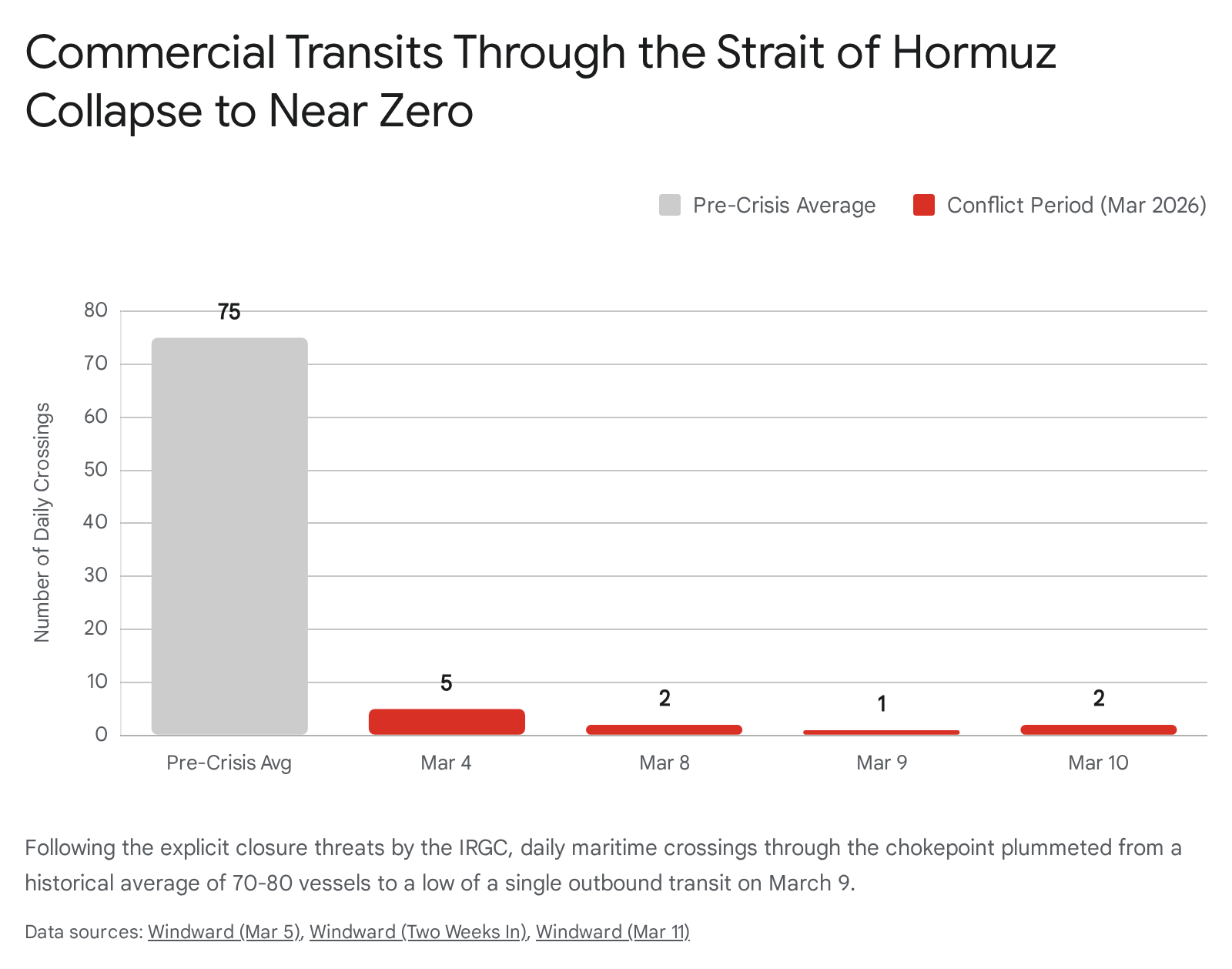
The cessation of marine traffic was immediate, severe, and measurable. Prior to the initiation of Operation Epic Fury, the Strait of Hormuz facilitated the transit of approximately 18 to 21 major commercial tankers per day, representing roughly 30% of global seaborne oil flows and carrying over 20 million barrels of crude, condensate, and fuels.5

Independent open-source intelligence (OSINT) and maritime tracking data from Windward, Kpler, and Clarksons confirm a catastrophic drop in transit volumes. Within 24 hours of the strikes, traffic had dropped by 70%, and by March 1, the primary shipping lanes saw a 40-50% reduction in activity.6 By March 2, Windward analysis indicated that zero active tanker transits were occurring in the primary Hormuz shipping lanes.10 Only a single, small 12,000 DWT tanker and one minor cargo vessel were observed attempting the transit.10 No U.S., UK, or EU-flagged vessels have been observed transiting since the conflict began.10

Graph showing commercial tanker transits through the Strait of Hormuz halted due to Operation Epic Fury.

3.3 Vessel Entrapment and the Accumulation of Stranded Assets

The suddenness of the blockade has resulted in a massive logistical bottleneck, trapping an unprecedented volume of global shipping capacity either inside the Persian Gulf or at anchorages just outside the Strait. The merchant fleet has adopted a posture of “self-exclusion,” refusing to enter the Red Zone.8

Inside the Persian Gulf, Clarksons estimates that approximately 3,200 vessels,representing a staggering 4% of global maritime tonnage,are currently trapped, unable to safely exit.31 This trapped fleet includes 112 crude tankers, of which more than 70 are Very Large Crude Carriers (VLCCs), accounting for 8% of the global VLCC fleet.31 Additionally, 195 product tankers and 21 Very Large Gas Carriers (VLGCs) are ensnared in the conflict zone.31 The container shipping industry is similarly impacted, with approximately 170 containerships, totaling roughly 450,000 TEU of capacity, locked inside the Gulf.4

Outside the Strait, the situation is characterized by massive, expanding anchorages of stranded assets. Maritime tracking reveals that over 150 crude and LNG tankers have dropped anchor in the open waters of the Gulf of Oman, clustering off the coasts of Fujairah in the UAE, Saudi Arabia, and Oman.12 Windward analysis notes an additional 700+ vessels of various classes drifting or holding position in the approaches, awaiting diplomatic resolution or military escort.8 This intense accumulation of vessels at anchorage introduces secondary maritime risks, including a heightened probability of collisions, dragging anchors, and constrained maneuvering space in the event of an incoming missile threat.33

Operational MetricPre-Strike Baseline (Feb 21-27)Active Conflict (March 1-3)Strategic Implication
Daily Tanker Transits (Hormuz)18 – 21 vessels0 – 1 vesselsComplete cessation of 20% of global oil flows.5
Vessels Trapped Inside GulfFluid / Rotational~3,200 vessels4% of global maritime tonnage immobilized.31
VLCCs Trapped Inside GulfFluid / Rotational70+ vessels8% of the global VLCC fleet removed from the market.31
Vessels Anchored Outside Strait< 15 drifting706+ drifting/anchoredMassive logistical bottleneck; extreme supply chain disruption.8
War Risk Insurance Premium~0.25% of hull value1.00% – 1.50%+Financial paralysis of the commercial merchant fleet.8

Table 2: Synthesis of critical marine traffic metrics demonstrating the collapse of transit operations and the accumulation of stranded assets in the Gulf region.5

3.4 The Insurance Cascade: Financial and Legal Paralysis

The physical reality of the kinetic environment has been reinforced by an insurmountable financial barrier: the total collapse of the maritime insurance market for the Persian Gulf. Commercial shipping cannot operate without comprehensive insurance, specifically war risk cover, which protects shipowners against liabilities and damages resulting from state-level warfare, terrorism, and piracy.13

Immediately following the strikes on February 28, leading mutual marine insurers and Protection and Indemnity (P&I) clubs,including Norway’s Gard and Skuld, the UK’s NorthStandard, the London P&I Club, and the New York-based American Club,issued formal Notices of Cancellation for war risk cover for vessels operating in the Gulf, effective March 5.13 The Lloyd’s of London market followed suit, issuing cancellations to allow underwriters time to reassess the fundamentally altered risk landscape.13

While insurers generally offer the option to reinstate coverage on a case-by-case basis (“terms to be agreed”), the newly calculated premiums are economically devastating. War risk premiums, which sat at approximately 0.25% of a vessel’s hull value prior to the conflict, have surged by over 300%, now demanding 1.00% or more per transit.8 For a modern VLCC carrying upwards of $130 million worth of crude oil, this translates to a minimum of $1.3 million in pure insurance premiums for a single passage, rendering the voyage commercially unviable for most operators.

This financial reality intersects with complex maritime legal doctrines. Carriers are increasingly invoking liberty clauses within their charterparties regarding war and safety risks.4 Even without express clauses, ship masters possess an implied right and obligation to deviate from contractual routes to ensure the safety of the vessel, crew, and cargo.4 Under the Hague/Hague-Visby Rules, the current threat environment renders any deviation away from the Strait “reasonable”.4 Furthermore, if BIMCO War Risk Clauses (CONWARTIME and VOYWAR 2025) are incorporated into contracts, owners have the explicit right to refuse orders that would require their vessels to proceed into the exposed areas of the Gulf.4

Consequently, the world’s largest container and tanker operators,including Maersk, MSC, Hapag-Lloyd, and CMA CGM,have officially suspended all transits indefinitely, instructing their fleets to seek designated safe shelter areas or to begin the arduous, costly rerouting process around the Cape of Good Hope.27

4. Kinetic Interdictions: OSINT Analysis of Marine Casualties

The mass withdrawal of insurance and the suspension of corporate shipping operations are fully justified by the tactical reality on the water. Between February 28 and March 3, 2026, Iranian forces executed a series of targeted kinetic strikes against commercial shipping, proving that their VHF warnings were backed by lethal intent.

Analysis of the targeting matrix reveals a critical intelligence insight: the strikes are consistent with an indiscriminate area-denial strategy rather than precision affiliation targeting.10 In previous years, Iran primarily targeted vessels with direct links to the United States or Israel. However, the current campaign is striking neutral, non-aligned shipping, indicating a blanket approach to enforcing the blockade.

Confirmed maritime security incidents include:

  • MT MKD Vyom (IMO 9284386): In the early hours of March 1, 2026 (with AIS data showing a drastic speed reduction around this time), a Marshall Islands-flagged oil tanker was struck by an Iranian drone boat approximately 52 nautical miles off the coast of Muscat, Oman. The explosive payload detonated above the waterline, triggering a massive fire in the main engine room.12 Tragically, the attack resulted in the death of one Indian seafarer.11 The vessel was carrying approximately 59,463 metric tonnes of cargo, and the crew of 21 (comprising Indian, Bangladeshi, and Ukrainian nationals) was subjected to an intense emergency response before the fire was brought under control.12
  • MT Skylight (IMO 9330020): On March 1, 2026 (shortly after its position was confirmed at 02:05 UTC), a Palau-flagged tanker was targeted approximately 5 nautical miles north of Khasab Port in Oman’s Musandam Governorate. The vessel suffered a direct projectile strike that resulted in injuries to four crew members.29 The severity of the damage necessitated a full evacuation of the 20-person crew, which consisted of 15 Indian nationals and 5 Iranian nationals.29
  • Hercules Star (IMO 9295531): On March 1, 2026, this Gibraltar-flagged oil tanker was targeted and struck by a projectile while transiting approximately 17 nautical miles northwest of Mina Saqr, UAE, causing a fire onboard which was subsequently extinguished.
  • MT Sea La Donna (IMO 9380532): On March 2, 2026, this vessel reported a kinetic attack that is currently undergoing detailed investigation by the Joint Maritime Information Center (JMIC) to determine the exact nature of the ordnance used and the extent of the damage.

These strikes occurred despite earlier, less lethal harassment attempts by the IRGC in the weeks prior to the war, such as the February 3, 2026 (09:00 UTC) attempt to hail and stop the U.S.-flagged Stena Imperative,a vessel operating under the Department of Defense Tanker Security Program, which was successfully defended by the USS McFaul. The transition from VHF harassment to lethal drone boat strikes underscores the extreme escalation in Iranian rules of engagement.

In response to these casualties, the Indian government,whose nationals comprise a significant portion of the global seafaring workforce and were directly impacted by the MKD Vyom and Skylight attacks,has issued severe shipping advisories.36 Concurrently, the Nautilus International maritime union successfully lobbied for the designation of the Strait of Hormuz as a “High-Risk Area” under the Warlike Operations Area Committee, activating enhanced protections for seafarers and granting them the explicit contractual right to refuse deployment into the Gulf without fear of penalty or termination.37

Targeted VesselIMO NumberFlag StateDate & TimeIncident LocationWeapon EmployedCasualties / Status
MT MKD Vyom9284386Marshall IslandsMarch 1, 2026 (Early hours)52 nm off Muscat, OmanExplosive Drone Boat (USV)1 killed (Indian national); Engine room fire.
MT Skylight9330020PalauMarch 1, 2026 (Post-02:05 UTC)5 nm north of Khasab, OmanUnspecified Projectile4 injured; Full crew evacuated.
Hercules Star9295531GibraltarMarch 1, 202617 nm NW of Mina Saqr, UAEUnspecified ProjectileFire extinguished; continued voyage.40
MT Sea La Donna9380532UnspecifiedMarch 2, 2026Approaches to HormuzUnder InvestigationAttack confirmed; details pending JMIC review.

Table 3: Confirmed kinetic interdictions of commercial shipping by Iranian forces in the Strait of Hormuz and Gulf of Oman (March 1 – 2, 2026).

5. Threat Assessment: Iranian Naval Doctrine and Proxy Activation

The maritime threat environment is currently defined by a dangerous paradox: the operational success of the U.S. decapitation strikes has inadvertently created a more volatile and unpredictable tactical situation on the water.

5.1 The Paradox of Decapitation: Decentralized IRGC Command

Operation Epic Fury successfully eliminated the strategic apex of the Iranian military, including Supreme Leader Khamenei and IRGC Commander-in-Chief Pakpour.2 While this dismantled the regime’s ability to coordinate a unified, national-level conventional response, it severely compromised the command-and-control (C2) architecture governing the IRGC Navy.

The IRGCN has historically operated under a “mosaic defense” doctrine, which relies on thousands of decentralized, highly mobile fast attack craft (FAC), coastal missile batteries, and asymmetric platforms spread across the coastline.8 With the central command structure annihilated, local IRGCN commanders have seemingly been granted,or have autonomously assumed,total operational freedom.38 This power vacuum renders the maritime domain deeply unpredictable; traditional deterrence models are ineffective against disjointed, hyper-local units operating without strategic oversight, diplomatic restraints, or sophisticated target identification capabilities.8 The indiscriminate strikes on the MKD Vyom and Skylight,vessels with no U.S. or Israeli affiliation,are direct manifestations of this uncoordinated, localized execution of the area-denial mandate.

5.2 Asymmetric Capabilities: Stealth Undersea Killers and Drone Swarms

Iran’s surviving naval capabilities remain uniquely tailored for the highly constrained bathymetry of the Strait of Hormuz. The geography of the waterway,which compresses massive shipping lanes into a navigable 2-mile corridor within a 33-kilometer-wide strait,allows even rudimentary, low-signature systems to achieve disproportionate strategic effects.5

Intelligence assessments highlight the deployment of advanced unmanned underwater vehicles (UUVs), specifically the domestically produced Nazir-series. Described in defense analyses as “stealth undersea killers,” these platforms represent a significant evolution in Iranian asymmetric warfare.39 The UUVs reportedly possess a 24-hour endurance capability and can dive to depths of 200 meters.39 In the shallow, acoustically complex littoral environment of the Persian Gulf, these UUVs can lurk well below typical sonar and patrol thresholds.39 They operate as hybrid threat nodes, capable of reconnaissance, acting as smart loitering mines, or functioning as direct-strike torpedo delivery systems.39 This capability introduces a submerged dimension to the conflict that fundamentally complicates U.S. anti-submarine warfare (ASW) efforts, which are traditionally optimized for deep-water engagements.

Above the surface, the IRGCN continues to deploy explosive one-way unmanned surface vessels (USVs), commonly referred to as “drone boats,” which have proven highly lethal, as evidenced by the fatal strike on the MKD Vyom.11 Furthermore, U.S. intelligence notes the presence of surviving stockpiles of Shahed-136 and Shahed-129 one-way attack drones.26 Compounding these physical threats is an aggressive electronic warfare campaign; marine authorities have reported severe, widespread GNSS/GPS spoofing, AIS disruptions, and VHF communications interference across the Gulf.8 This electronic fog of war drastically increases the risk of misidentification, friendly fire incidents, and navigational disasters in the congested anchorages.

Strait of Hormuz map showing Iranian asymmetric threats, including UUVs and surface vessels in the transit lane.

5.3 The Activation of the Axis of Resistance

The death of the Iranian Supreme Leader has triggered the full, uncoordinated mobilization of Iran’s regional proxy network,the Axis of Resistance,compounding the threat to the maritime environment and surrounding logistics nodes across multiple theaters.

In Iraq, powerful Iranian-aligned Shiite militias, notably Kataib Hezbollah and Saraya Awliya al-Dam, have launched a barrage of drone and rocket attacks targeting U.S. outposts and critical infrastructure.1 These strikes have hit the Baghdad airport, a U.S. air base in northern Iraq, the U.S. embassy compound in Kuwait, and facilities in Jordan, prompting the State Department to urge the departure of diplomatic staff from Amman.41 This northern proxy activation threatens the broader Gulf logistics corridors and forces the U.S. to disperse its defensive assets.

In the Levant, Lebanese Hezbollah has engaged in intense missile exchanges with Israel, prompting Israeli retaliatory strikes in Beirut that killed a senior Hezbollah official and resulted in mass casualties.42 The IDF has explicitly stated its intent to eliminate the threat from Lebanon, vowing to target Hezbollah chief Naim Kassem.42

Crucially for maritime security, European intelligence agencies and maritime security firms warn of a highly credible risk of a “dual-theatre disruption.” It is assessed as highly likely that Houthi forces in Yemen will capitalize on the regional chaos to resume full-scale kinetic operations in the Red Sea and the Bab el-Mandeb Strait.33 A synchronized, dual-chokepoint blockade would be devastating, neutralizing both the Suez Canal route and the Strait of Hormuz simultaneously.

6. Coalition Force Posture and Maritime Protection Initiatives

In response to the multi-axis threat environment, the United States and its regional allies have adopted an aggressive, preemptive military posture designed to annihilate Iran’s capacity to sustain the blockade, while simultaneously issuing strict navigational directives to protect the merchant fleet from the ensuing crossfire.

6.1 Defensive Posture: MARAD Directives and the 30-Nautical-Mile Buffer

To manage the chaotic maritime environment and prevent miscalculation or collateral damage, the U.S. Maritime Administration (MARAD) issued a critical emergency directive: Maritime Alert 2026-001A.45 This alert explicitly mandates that any commercial vessels that are U.S.-flagged, owned, or crewed operating within the Strait of Hormuz, Persian Gulf, Gulf of Oman, or Arabian Sea must maintain a strict, minimum standoff distance of 30 nautical miles from any U.S. military vessel.33

This massive buffer zone is a direct reflection of the extreme “Red Zone” kinetic environment. U.S. warships,including the Arleigh Burke-class destroyers attached to the Carrier Strike Groups,are actively engaged in continuous ballistic missile defense (BMD) and offensive strike operations.48 In an environment plagued by GPS spoofing and explosive drone boats, any unidentified radar track that breaches this 30nm perimeter risks being classified as an asymmetric threat and engaged with lethal force.4 Commercial vessels are instructed to maintain constant contact with the Naval Cooperation and Guidance for Shipping (NCAGS) under Naval Forces Central Command (NAVCENT) to verify their identity and intentions.4

6.2 The “Archer” Strategy: Systemic Degradation of Iranian Naval Assets

While defensive measures protect the fleet, CENTCOM’s offensive operations are focused on permanently breaking the blockade. Under Operation Epic Fury, U.S. forces have shifted their strategic logic from a defensive, reactive posture to an offensive doctrine internally described as the “Archer” strategy.25 Rather than expending multi-million-dollar Patriot and THAAD interceptors to shoot down incoming Iranian drones and missiles (the “arrows”), U.S. and Israeli forces are systematically annihilating the production facilities, storage depots, and launch platforms (the “archers”).25

In the maritime domain, this strategy has been ruthlessly executed against both the regular Iranian Navy (Artesh) and the IRGCN to degrade their capacity to coordinate and sustain the Hormuz closure.22 Early battle damage assessments (BDA) indicate that U.S. naval and air forces have sunk at least 11 major Iranian naval vessels since the commencement of hostilities.1

Confirmed high-value targets neutralized by coalition strikes include:

  • The IRIS Jamaran: A formidable Moudge-class frigate belonging to the IRGCN, sunk near the Imam Ali Base in Chabahar.26 The Jamaran was a seasoned asset, having previously operated in the Red Sea and famously seized two U.S. unmanned surface vessels in 2022.26
  • The Shahid Bagheri: The IRGCN’s dedicated drone carrier, a highly strategic asset capable of launching swarms of UAVs while underway at sea, was located and sunk in the Gulf of Oman, neutralizing a massive mobile threat projection node.49
  • IRIS Bayandor and IRIS Naghdi: Iran’s two remaining Bayandor-class patrol corvettes, equipped with modern radar, 76mm guns, and anti-ship missiles, were destroyed at the Artesh Navy 3rd Naval District base in Konarak.26 Satellite imagery suggests the coalition utilized heavy bunker-buster munitions to penetrate the fortified concrete hangars at the facility.26
  • IRIS Kurdistan: A Makran-class forward base ship utilized by the Artesh Navy, its destruction significantly degrades Iran’s ability to project sustained logistical support to its smaller, decentralized patrol craft.49

By systematically targeting these capital ships, floating forward operating bases, and coastal radar installations (such as the radar struck on Kish Island), the U.S. coalition aims to blind the IRGC and deny them the infrastructure necessary to coordinate their swarms of fast attack craft.50 Furthermore, CENTCOM’s Task Force Scorpion Strike has innovated tactically by employing low-cost, one-way attack drones in combat for the first time, effectively turning Iran’s preferred asymmetric tactic against its own coastal defense infrastructure.21

Iranian Naval Asset DestroyedClass / TypeStrategic FunctionLocation of Destruction
Shahid BagheriDrone Carrier (IRGCN)Mobile UAV swarm launch platformGulf of Oman.49
IRIS JamaranMoudge-class FrigateRegional force projection; anti-surface warfareChabahar (Imam Ali Base).26
IRIS BayandorBayandor-class CorvetteCoastal patrol; anti-ship missile platformKonarak (3rd Naval District).26
IRIS NaghdiBayandor-class CorvetteCoastal patrol; anti-ship missile platformKonarak (3rd Naval District).26
IRIS KurdistanMakran-class Base ShipForward logistical support nodeSouthern Fleet operating area.49

Table 4: Confirmed battle damage assessment (BDA) detailing the destruction of high-value Iranian naval assets by U.S. and allied forces during Operation Epic Fury.26

7. Geoeconomic Shock: Energy Markets and Global Supply Chains

The strategic importance of the Strait of Hormuz extends far beyond regional geopolitics; it is the central cardiovascular system of the global carbon economy. The operational closure of the waterway, combined with targeted strikes on energy infrastructure, has induced an immediate, violent repricing across global energy markets, driven by inelastic demand and the sudden, catastrophic removal of immense supply volumes.

7.1 The Crude Oil Shock and Infrastructure Vulnerability

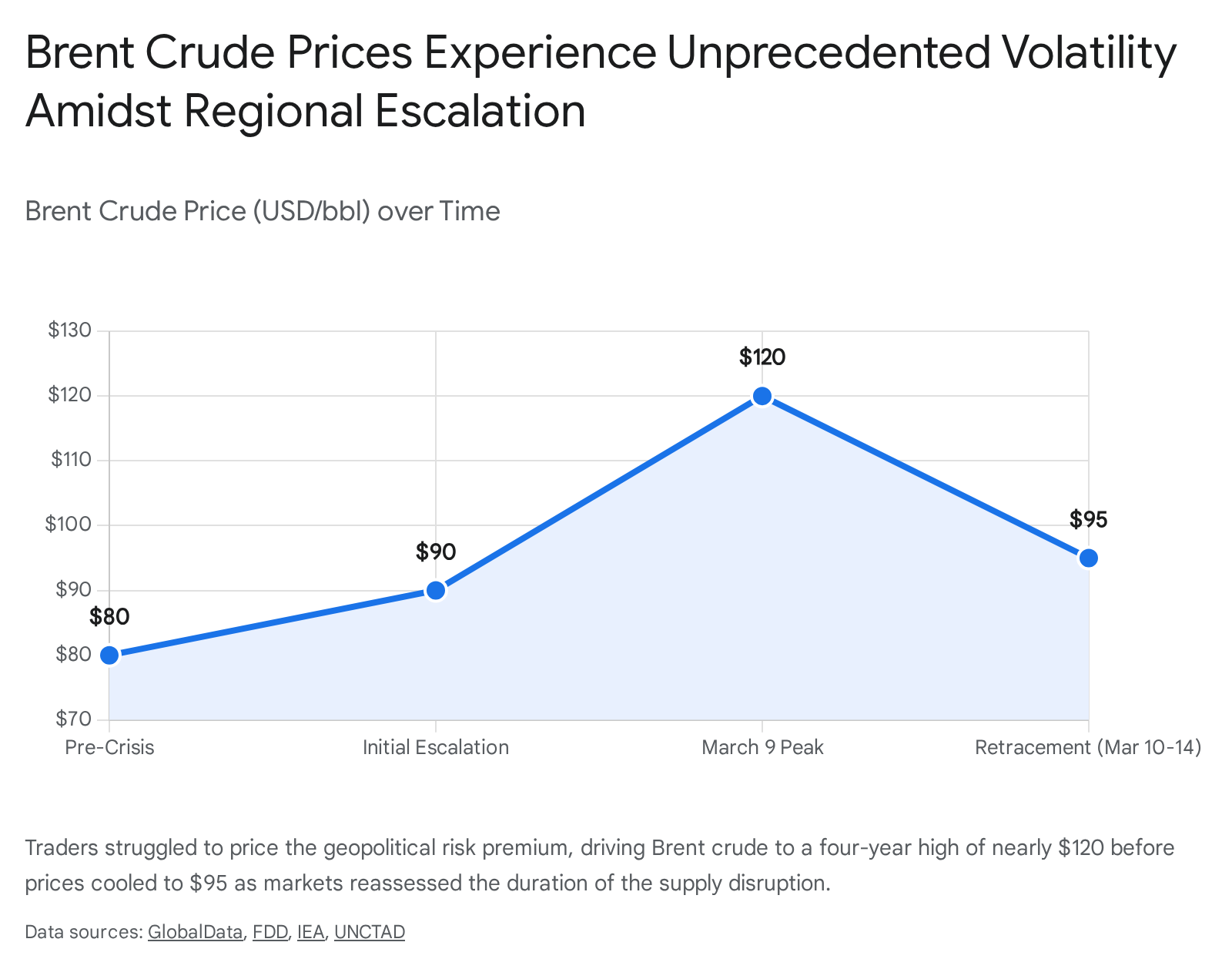
Within hours of the blockade’s enforcement and the subsequent kinetic strikes, global oil markets reacted with intense volatility. Brent crude oil futures spiked by 13% during intraday trading, testing the $100-per-barrel threshold and reaching baseline levels of over $82 per barrel,the highest recorded since early 2025.6

The math of the disruption is unforgiving. The Strait of Hormuz facilitates the transit of over 20 million barrels of crude, condensate, and fuels daily, representing 30% of global seaborne oil flows.5 While alternative pipeline routes exist, they are entirely insufficient to cover the deficit. Saudi Arabia can theoretically divert up to 5 million barrels per day via its East-West Pipeline to the Red Sea, and the UAE can route 1.5 million barrels per day through the Habshan-Fujairah line.53 However, these pipelines are already operating near capacity, and they offer zero relief for the massive export volumes generated by Iraq, Kuwait, Qatar, and Bahrain.54 Consequently, millions of barrels of crude are trapped in the Gulf, forcing immediate, severe drawdowns of strategic petroleum reserves globally.

Furthermore, the physical infrastructure of the Gulf energy sector is under direct attack. Reports indicate that Iranian forces targeted the Ras Tanura refinery in Saudi Arabia, one of the region’s most critical crude export hubs.10 This strike elevates the risk profile for Saudi export infrastructure, forcing tankers to abandon loading operations and flee the immediate vicinity.10

7.2 The Qatari LNG Crisis and the Gas Market Explosion

While the oil shock was anticipated, the most profound and immediate macroeconomic damage occurred in the natural gas sector. The Iranian strike campaign intentionally targeted critical, non-combatant Gulf infrastructure, including a verified drone strike on QatarEnergy’s facilities at Ras Laffan Industrial City and a water tank at a power plant in Mesaieed Industrial City.14

Ras Laffan is the largest single liquefied natural gas (LNG) facility on the planet, responsible for the vast majority of Qatar’s exports, which constitute roughly 20% of the entire global LNG supply.14 Citing the military strikes and invoking force majeure clauses, QatarEnergy completely ceased the production of all LNG and associated products on March 2.14

The combination of the Ras Laffan shutdown and the inability of existing LNG carriers to transit the Strait of Hormuz triggered a cataclysmic reaction in global gas pricing. The Dutch TTF natural gas contract,the European benchmark,surged by an astonishing 46% to 54% in a single day, reaching €130/MWh.8 Asian LNG spot prices followed suit, spiking by 39%.14

The ripple effects of this supply chain collapse are ravaging Asian economies. India, which relies heavily on the Middle East and receives 42% of its LNG requirements from Qatar, has been forced into immediate gas rationing.14 Downstream state distributors like Gail and Petronet have informed customers of immediate supply curtailments, as their chartered LNG carriers remain trapped at anchorage outside Ras Laffan, unable to load or depart.15 If QatarEnergy remains offline for merely a week, it will result in a global shortage of at least 21 massive LNG cargoes, fundamentally destabilizing the energy security of Japan, Taiwan, South Korea, and India.15

Additionally, the blockade has quietly triggered a crisis in the global agricultural sector. Roughly one-third of the world’s urea fertilizer trade, including sulfur and ammonia, transits the Strait from producers in Qatar, Saudi Arabia, and the UAE.32 A prolonged blockage risks severely tightening the supply of agricultural inputs, guaranteeing a secondary wave of inflation in global food prices.32

8. The Trilateral Paradox: China, Russia, and Diplomatic Fractures

The crisis in the Strait of Hormuz has brutally exposed the deep, underlying strategic contradictions in the emerging Eurasian geopolitical alignment between Russia, China, and Iran.

In mid-February 2026, mere weeks before the outbreak of hostilities, the three nations proudly announced the execution of the “Maritime Security Belt 2026” joint naval exercises directly in the Strait of Hormuz.18 This trilateral drill, involving Russian warships, Chinese destroyers, and IRGCN vessels, was intended to project a unified, anti-Western front, challenge U.S. naval hegemony, and demonstrate cooperation in securing international shipping lanes.57

However, the reality of the Iranian blockade has shattered this diplomatic narrative, revealing a severe misalignment of vital interests. China is dangerously exposed to the Hormuz closure; it purchases over 90% of Iran’s oil (serving as Tehran’s primary economic lifeline) and relies on Qatar for 30% of its critical LNG imports.55 The Iranian drone strikes on Qatar’s Ras Laffan facility were, in effect, a direct kinetic attack on Beijing’s core energy security architecture.55

Consequently, Beijing has abandoned the rhetoric of the Maritime Security Belt and engaged in urgent, high-level diplomatic backchanneling.55 Senior executives at Chinese state-owned gas firms, backed by government officials, are forcefully pressing their Iranian counterparts to immediately halt attacks on Qatari export hubs and to guarantee safe passage for Chinese-destined tankers traversing the Strait.55

This dynamic reveals a critical strategic vulnerability for Iran: its most vital economic and political patron is fundamentally opposed to its primary military tactic. While Russian analysts and state media attempt to frame the crisis as an opportunity for China and Russia to broker a trilateral “safety corridor” exclusively for non-Western tonnage, the reality of the maritime domain makes this impossible.8 The global war risk insurance market does not differentiate based on a vessel’s flag of convenience; it evaluates the geographic risk of the entire zone.8 Furthermore, the decentralized, autonomous IRGC drone boats executing the attacks do not possess the sophisticated Identify Friend or Foe (IFF) systems required to distinguish a Chinese-owned tanker from a Western-aligned vessel in the fog of war. Beijing is learning in real-time that its strategic partnership with a revolutionary, decentralized state actor carries severe, uncontrollable risks to its own supply chains.

9. Strategic Forecast: Short and Medium-Term Horizons

The trajectory of the conflict indicates a prolonged period of severe maritime disruption, transitioning from acute shock to a grinding war of attrition across multiple domains.

9.1 Short-Term Forecast (0 – 30 Days): Sustained Kinetic Interdiction

In the immediate 30-day horizon, the Strait of Hormuz will remain a highly restrictive, legally perilous “Red Zone” combat environment.38 U.S. President Donald Trump and senior military leadership have explicitly stated that the military campaign is designed to last “several weeks,” indicating no immediate intent to de-escalate.42

The U.S. and Israeli strike matrix will likely transition from capital-centric shock effects (leadership decapitation) toward system-wide disruption, moving progressively eastward into Iran to destroy inland missile production facilities and inland IRGC bases.64 As long as the coalition continues to dismantle Iranian infrastructure, the decentralized remnants of the IRGCN will maintain their asymmetric area-denial operations in the Gulf as their sole mechanism for imposing costs on the international community.

Consequently, the commercial maritime blockade will persist. Shipping companies will not risk $130+ million assets without comprehensive war risk insurance, and P&I clubs will not reinstate coverage at commercially viable rates until there is a verified, sustained cessation of kinetic activity.8

Key Intelligence Indicators for the Resumption of Traffic:

  1. Insurance Premium Contraction: A verifiable reduction in war risk premiums back below the 0.5% threshold, signaling that maritime actuaries assess the immediate threat of arbitrary strikes has passed.65
  2. Implementation of Sovereign Convoys: The establishment of a formalized, multi-national naval escort system (similar to the Operation Earnest Will convoys of the 1980s) specifically tasked with shielding flagged commercial vessels through the chokepoint.
  3. Vessel Tracking Data Reversal: A sustained 48-to-72-hour period where the 150+ vessels anchored in the Gulf of Oman begin crossing the threshold into the Strait without incident.65

9.2 Medium-Term Forecast (1 – 6 Months): Dual-Theatre Disruption and Systemic Fatigue

Looking toward the medium term, the primary strategic risk is the normalization of a “dual-theatre” maritime crisis. If the conflict in Lebanon continues to escalate, and if Houthi forces in Yemen capitalize on the regional chaos to resume full-scale interdiction operations in the Bab el-Mandeb Strait, the global shipping industry will face an unprecedented bifurcated crisis.33

Rerouting vessels around the Cape of Good Hope,currently the default mitigation strategy,adds immense fuel costs, extends transit times from Asia to Europe by up to two weeks, and severely limits global tonnage availability.4 A prolonged diversion of this magnitude will inevitably lead to severe berth congestion at key load and discharge ports, massive delays in port clearance, and intense short-term volatility in freight rates as global tonnage availability tightens.66

Furthermore, prolonged U.S. military operations face significant logistical and diplomatic headwinds. While the U.S. currently enjoys absolute air superiority, sustained dual-carrier operations require massive logistical tails. The political friction generated by the U.S. utilizing airspace and bases in Gulf nations (such as the UAE and Qatar) to strike Iran may lead to severe host-nation fatigue, particularly as these nations suffer retaliatory strikes on their own civilian and economic infrastructure, including luxury hotels in Dubai and energy terminals in Doha.1

Finally, the regime transition in Iran remains the ultimate geopolitical wildcard. With Khamenei, Pakpour, and the top IRGC brass dead, a brutal internal power struggle for control of the Iranian state is inevitable.2 If a hardline, apocalyptic faction successfully consolidates control over the fractured military apparatus, the Hormuz blockade will be maintained indefinitely as a point of leverage, dragging the global economy into a protracted recession. Conversely, if the internal chaos leads to state collapse, or if a pragmatic interim leadership emerges that prioritizes economic survival over ideological resistance, a swift de-escalation heavily mediated by China is a plausible off-ramp.55

10. Strategic Conclusions

The March 2026 crisis in the Strait of Hormuz represents a systemic fracture in the global maritime security architecture. The U.S.-Israeli Operation Epic Fury achieved its primary kinetic objectives with devastating efficiency, successfully decapitating the Iranian leadership and neutralizing massive swaths of the Iranian regular navy and strategic air defense network.2 However, this overwhelming conventional military victory has catalyzed an asymmetric maritime nightmare.

The destruction of Iran’s centralized command apparatus has empowered autonomous, localized IRGC units equipped with sophisticated, low-cost asymmetric weaponry,including deep-diving UUVs and explosive drone boats.12 This localized, fragmented command structure cannot be easily deterred through traditional state-on-state diplomacy or threats of massive retaliation, as the tactical operators on the water lack strategic oversight. Consequently, the Strait of Hormuz has devolved from a peaceful international shipping lane into a deadly, unpredictable littoral combat zone.

The subsequent withdrawal of the global maritime insurance market has formalized the blockade, proving definitively that kinetic threats do not need to physically sink every ship to close a waterway; they merely need to raise the financial risk beyond the threshold of commercial viability.8 As a result, 20% of the world’s oil supply and 20% of the world’s LNG supply are entirely severed from the global market, triggering energy price spikes that threaten to deeply destabilize the global macroeconomic environment.14

Moving forward, the restoration of freedom of navigation in the Strait of Hormuz cannot be achieved solely through the application of U.S. air and naval firepower. It will require the total exhaustion of Iran’s localized asymmetric arsenals, the reconstitution of a responsible governing authority in Tehran capable of reigning in rogue IRGC units, and immense, sustained diplomatic pressure from Beijing, which finds its own economic survival directly threatened by the actions of its nominal ally. Until these conditions are met, the Strait of Hormuz will remain closed, and the global economy will bear the escalating cost of the blockade.


Please share the link on Facebook, Forums, with colleagues, etc. Your support is much appreciated and if you have any feedback, please email us in**@*********ps.com. If you’d like to request a report or order a reprint, please click here for the corresponding page to open in new tab.


Sources Used:

  1. Maritime Traffic Choked By Middle East War – Bangladesh Defence Journal, accessed March 3, 2026, https://defencejournalbd.com/geopolitics-security/short-news/maritime-traffic-choked-by-middle-east-war/
  2. Iran Update Special Report: US and Israeli Strikes, February 28, 2026, accessed March 3, 2026, https://understandingwar.org/research/middle-east/iran-update-special-report-us-and-israeli-strikes-february-28-2026/
  3. IRAN IN TRANSITION: STRATEGIC INTELLIGENCE ASSESSMENT …, accessed March 3, 2026, https://debuglies.com/2026/03/01/iran-in-transition-strategic-intelligence-assessment-post-khamenei-succession-crisis-retaliatory-doctrine-regional-escalation-calculus/
  4. Strait of Hormuz closure | Hill Dickinson, accessed March 3, 2026, https://www.hilldickinson.com/our-view/articles/strait-of-hormuz-closure/
  5. ‘Will set on fire any ship that passes through’: Iran shuts down Strait of Hormuz – Why it matters, accessed March 3, 2026, https://timesofindia.indiatimes.com/business/international-business/middle-east-crisis-global-oil-markets-on-edge-as-iran-closes-strait-of-hormuz-why-it-matters/articleshow/128954824.cms
  6. 2026 Strait of Hormuz crisis – Wikipedia, accessed March 3, 2026, https://en.wikipedia.org/wiki/2026_Strait_of_Hormuz_crisis
  7. Strait of Hormuz Disruption: Global Energy Risk Guide – Discovery Alert, accessed March 3, 2026, https://discoveryalert.com.au/global-energy-vulnerability-maritime-chokepoints-2026/
  8. THE HORMUZ CODEX: KINETIC ESCALATION, LEADERSHIP DECAPITATION AND MARITIME SYSTEMIC COLLAPSE – https://debuglies.com, accessed March 3, 2026, https://debuglies.com/2026/03/02/the-hormuz-codex-kinetic-escalation-leadership-decapitation-and-maritime-systemic-collapse/
  9. Strait of Hormuz Energy Risk: Global Supply Threats, accessed March 3, 2026, https://discoveryalert.com.au/geographic-bottleneck-analysis-2026-risk-constraints/
  10. March 2, 2026: Iran War Maritime Intelligence Daily – Windward, accessed March 3, 2026, https://windward.ai/blog/march-2-iran-war-maritime-intelligence-daily/
  11. Gulf of Oman update: US declassifies video of bombing of Iranian vessels; ‘they have zero…’, accessed March 3, 2026, https://www.hindustantimes.com/world-news/gulf-of-oman-update-us-declassifies-video-of-bombing-of-iranian-vessels-they-have-zero-101772484329168.html
  12. Another oil tanker hit by drone boat as Strait of Hormuz tensions rise, accessed March 3, 2026, https://www.hellenicshippingnews.com/another-oil-tanker-hit-by-drone-boat-as-strait-of-hormuz-tensions-rise/
  13. Maritime insurers cancel war risk cover in Gulf as Iran conflict disrupts shipping, accessed March 3, 2026, https://www.theguardian.com/business/2026/mar/02/maritime-insurers-war-risk-cover-gulf-iran-shipping-strait-of-hormuz
  14. Explained: How Iran’s Strait of Hormuz blockade and Qatar’s LNG halt could trigger an unprecedented global energy shock, accessed March 3, 2026, https://www.opindia.com/2026/03/explained-how-irans-strait-of-hormuz-blockade-and-qatars-lng-halt-could-trigger-an-unprecedented-global-energy-shock/
  15. Asia to face tighter LNG supply on Qatar output halt | Latest Market News – Argus Media, accessed March 3, 2026, https://www.argusmedia.com/en/news-and-insights/latest-market-news/2795408-asia-to-face-tighter-lng-supply-on-qatar-output-halt
  16. After hit, Qatar shuts world’s largest gas unit, accessed March 3, 2026, https://timesofindia.indiatimes.com/business/international-business/after-hit-qatar-shuts-worlds-largest-gas-unit/articleshow/128967416.cms
  17. Prelude to the 2026 Iran conflict – Wikipedia, accessed March 3, 2026, https://en.wikipedia.org/wiki/Prelude_to_the_2026_Iran_conflict
  18. Russia, Iran and China send ships for joint drills in Strait of Hormuz, accessed March 3, 2026, https://www.iranintl.com/en/202602170033
  19. Russia, China, Iran deploy ships for joint exercises in Strait of Hormuz – Middle East Monitor, accessed March 3, 2026, https://www.middleeastmonitor.com/20260217-russia-china-iran-deploy-ships-for-joint-exercises-in-strait-of-hormuz/
  20. 2026 United States military buildup in the Middle East – Wikipedia, accessed March 3, 2026, https://en.wikipedia.org/wiki/2026_United_States_military_buildup_in_the_Middle_East
  21. U.S. Forces Launch Operation Epic Fury – centcom, accessed March 3, 2026, https://www.centcom.mil/MEDIA/PRESS-RELEASES/Press-Release-View/Article/4418396/us-forces-launch-operation-epic-fury/
  22. The US-Israel campaign in Iran, accessed March 3, 2026, https://www.iiss.org/online-analysis/online-analysis/2026/02/the-us-israel-campaign-in-iran/
  23. Iran Strike Scenarios: Retaliation, Transition, and the Path Forward, accessed March 3, 2026, https://www.meforum.org/mef-reports/iran-strike-scenarios-retaliation-transition-and-the-path-forward
  24. Iran’s supreme leader killed in U.S.-Israeli attack; Tehran strikes Israel, Arab states, accessed March 3, 2026, https://www.washingtonpost.com/world/2026/02/28/israel-strikes-iran-live-updates/
  25. FDD Action, accessed March 3, 2026, https://www.fddaction.org/secure-line-readout/2026/03/02/operation-epic-fury-battle-damage-assessment-and-strategic-outlook/
  26. Iran Update Evening Special Report, March 1, 2026 | ISW, accessed March 3, 2026, https://understandingwar.org/research/middle-east/iran-update-evening-special-report-march-1-2026/
  27. Shipping companies tell vessels to steer clear of Gulf, accessed March 3, 2026, https://www.newsofbahrain.com/business/127688.html
  28. Conflict Widens To Lebanon, Iran Threatens Ships, accessed March 3, 2026, https://www.marinelink.com/news/conflict-widens-lebanon-iran-threatens-536384
  29. Middle East crisis: Oil tanker hit near Oman in Strait of Hormuz amid Iranian retaliation; 15 Indian nationals evacuated, accessed March 3, 2026, https://timesofindia.indiatimes.com/world/middle-east/middle-east-crisis-oil-tanker-hit-near-oman-in-strait-of-hormuz-amid-iranian-retaliation-15-indian-nationals-evacuated/articleshow/128913500.cms
  30. How US-Israel attacks on Iran threaten the Strait of Hormuz, oil markets – Al Jazeera, accessed March 3, 2026, https://www.aljazeera.com/amp/news/2026/3/1/how-us-israel-attacks-on-iran-threaten-the-strait-of-hormuz-oil-markets
  31. News Content Hub – 112 crude tankers trapped in Persian Gulf as Iran claims Straits of Hormuz closure, accessed March 3, 2026, https://www.rivieramm.com/news-content-hub/what-we-know-about-the-straits-of-hormuz-and-tanker-shipping-87986
  32. Strait of Hormuz crisis disrupts energy, shipping and food markets, accessed March 3, 2026, https://sana.sy/en/international/2300104/
  33. Maritime security update: Gulf Region / Strait of Hormuz and Red Sea – Skuld, accessed March 3, 2026, https://www.skuld.com/topics/port/port-news/asia/maritime-security-update-gulf-region–strait-of-hormuz-and-red-sea/
  34. Suspension of Strait of Hormuz Transits Due to Security Closure – Hapag-Lloyd, accessed March 3, 2026, https://www.hapag-lloyd.com/en/services-information/news/2026/02/suspension-of-strait-of-hormuz-transits-due-to-security-closure.html
  35. Container Lines Adjust to New Risks in Strait of Hormuz and Red Sea, accessed March 3, 2026, https://maritime-executive.com/article/container-lines-adjust-to-new-risks-in-strait-of-hormuz-and-red-sea
  36. Iran-Israel War: India issues shipping advisory as security risks rise in Persian Gulf, Strait of Hormuz, accessed March 3, 2026, https://m.economictimes.com/industry/transportation/shipping-/-transport/iran-israel-war-india-issues-shipping-advisory-as-security-risks-rise-in-persian-gulf-strait-of-hormuz/articleshow/128960691.cms
  37. High Risk Area designation for Strait of Hormuz, accessed March 3, 2026, https://www.nautilusint.org/en/news-insight/news/high-risk-area-designation-for-strait-of-hormuz/
  38. 2026 Strategic Regional Security Assessment for Expatriates, HR Managers and Travellers: Middle East Combat Environment – iPMI Global, accessed March 3, 2026, https://ipmiglobal.com/in-focus/country-guides/2026-strategic-regional-security-assessment-for-expatriates-hr-managers-and-travellers-middle-east-combat-environment
  39. US DRONE HORROR: Iran’s Stealth Undersea Killers Threaten US Carrier Strike Groups in the Persian Gulf Power Shift – Defence Security Asia, accessed March 3, 2026, https://defencesecurityasia.com/en/us-drone-horror-iran-stealth-undersea-killers-threaten-us-carrier-strike-groups-persian-gulf/
  40. Joint Maritime Information Center Update 002 – JMIC Advisory Note: 01 March 2026 – UKMTO, accessed March 3, 2026, https://www.ukmto.org/-/media/ukmto/products/update-002—001—jmic-advisory-note-28_feb_2026_final.pdf
  41. The Latest: Iranian-backed militias join fight as war on Iran widens, accessed March 3, 2026, https://www.wwltv.com/article/syndication/associatedpress/the-latest-iranian-backed-militias-join-fight-as-war-on-iran-widens/616-d9f86f5e-e7d6-4519-b4eb-05a9c722eea4
  42. War in the Mideast Widens as Trump Says Strikes on Iran Could Last Several Weeks, accessed March 3, 2026, https://www.military.com/daily-news/2026/03/02/war-mideast-widens-trump-says-strikes-iran-could-last-several-weeks.html
  43. War in the Middle East: What implications for the EU and the world?, accessed March 3, 2026, https://www.iss.europa.eu/publications/commentary/war-middle-east-what-implications-eu-and-world
  44. Shipping lines reroute from Red Sea avoiding Houthi threat – Seatrade Maritime News, accessed March 3, 2026, https://www.seatrade-maritime.com/containers/shipping-lines-reroute-from-red-sea-avoiding-houthi-threat
  45. 2026-001A-Strait of Hormuz, Persian Gulf, Gulf of Oman, and Arabian Sea-Military Operations and Potential Retaliatory Strikes by Iranian Forces | MARAD – Department of Transportation, accessed March 3, 2026, https://www.maritime.dot.gov/msci/2026-001a-strait-hormuz-persian-gulf-gulf-oman-and-arabian-sea-military-operations-and
  46. Persian Gulf Maritime Activity: February 28, 2026 Intelligence Brief – Pole Star Global, accessed March 3, 2026, https://www.polestarglobal.com/resources/persian-gulf-maritime-activity-february-28-2026-intelligence-brief/
  47. US calls on vessels to keep clear of Strait of Hormuz, surrounding waters amid military escalation | Hellenic Shipping News Worldwide, accessed March 3, 2026, https://www.hellenicshippingnews.com/us-calls-on-vessels-to-keep-clear-of-strait-of-hormuz-surrounding-waters-amid-military-escalation/
  48. Good Offense Leads to Effective Defense During Operation Epic Fury | AFCEA International, accessed March 3, 2026, https://www.afcea.org/signal-media/defense-operations/good-offense-leads-effective-defense-during-operation-epic-fury
  49. Iran Update Evening Special Report, March 2, 2026 | ISW, accessed March 3, 2026, https://understandingwar.org/research/middle-east/iran-update-evening-special-report-march-2-2026/
  50. Iran Update Evening Special Report, February 28, 2026, accessed March 3, 2026, https://understandingwar.org/research/middle-east/iran-update-evening-special-report-february-28-2026/
  51. Iran conflict disrupts global shipping as tankers are stranded, damaged, accessed March 3, 2026, https://www.tbsnews.net/worldbiz/middle-east/iran-conflict-disrupts-global-shipping-tankers-are-stranded-damaged-1375891
  52. IRGC Blocks Strait of Hormuz Following US-Israel Strikes; Brent Crude Tests $100, accessed March 3, 2026, http://markets.chroniclejournal.com/chroniclejournal/article/marketminute-2026-3-2-irgc-blocks-strait-of-hormuz-following-us-israel-strikes-brent-crude-tests-100
  53. U.S. and Israel strike Iran | DWS, accessed March 3, 2026, https://www.dws.com/en-us/insights/cio-view/cio-flash/2026/us-and-israel-strike-iran/
  54. Strait of Hormuz on the Brink: De Facto Closure Drives Oil Surge and Global Energy Crisis Fears, accessed March 3, 2026, https://www.indrastra.com/2026/03/strait-of-hormuz-on-brink-de-facto.html
  55. China presses Iran to keep Hormuz open as Asian buyers brace for LNG shortfalls, accessed March 3, 2026, https://www.iranintl.com/en/202603036746
  56. US-Iran war rattles LNG market; Qatar and UAE supply at risk, accessed March 3, 2026, https://www.vortexa.com/insights/us-iran-lng-update
  57. Russia, China, Iran Launch “Maritime Security Belt 2026” Naval Drills in Strait of Hormuz as US Deploys Dual Carrier Strike Groups, accessed March 3, 2026, https://defencesecurityasia.com/en/russia-china-iran-maritime-security-belt-2026-strait-of-hormuz-us-carrier-strike-group/
  58. Iran, Russia, China to hold naval drill in Strait of Hormuz – Mehr News Agency, accessed March 3, 2026, https://en.mehrnews.com/news/241865/Iran-Russia-China-to-hold-drill-in-Strait-of-Hormuz
  59. Strait of Hormuz: Key oil route in middle of Iran crisis, accessed March 3, 2026, https://www.timesofisrael.com/strait-of-hormuz-key-oil-route-in-middle-of-iran-crisis/
  60. China calls on all sides to safeguard ships in Strait of Hormuz, accessed March 3, 2026, https://www.straitstimes.com/world/middle-east/china-calls-on-all-sides-to-safeguard-ships-in-strait-of-hormuz
  61. Strait of Hormuz LNG Disruption: Global Price Cascade, China’s Energy Chokepoint Exposure and the Northern Corridor Imperative, accessed March 3, 2026, https://debuglies.com/2026/03/01/strait-of-hormuz-lng-disruption-global-price-cascade-chinas-energy-chokepoint-exposure-and-the-northern-corridor-imperative/
  62. EU guidelines on trials of Marine Autonomous Surface Ships – ESC, accessed March 3, 2026, https://europeanshippers.eu/eu-guidelines-on-trials-of-marine-autonomous-surface-ships/
  63. As conflict widens, US says attacks on Iran will last weeks, accessed March 3, 2026, https://www.ironmountaindailynews.com/news/local-news/2026/03/as-conflict-widens-us-says-attacks-on-iran-will-last-weeks/
  64. The US and Israel Strike on Iran: Day 2 – Leadership Vacuum and the Regionalization of Conflict – SETA, accessed March 3, 2026, https://www.setav.org/en/the-us-and-israel-strike-on-iran-day-2
  65. Tanker Traffic Disruption Strait of Hormuz Energy Impact, accessed March 3, 2026, https://discoveryalert.com.au/tanker-traffic-disruption-hormuz-energy-2026/
  66. Strait of Hormuz escalation rattles global shipping with war levies and insurance cover cuts, accessed March 3, 2026, https://www.thenationalnews.com/business/economy/2026/03/02/hormuz-iran-us-shipping-war/
  67. Ex-CIA director says Iran erred by expanding attacks to Persian Gulf states, accessed March 3, 2026, https://www.iranintl.com/en/202603038843

United States Military Order of Battle (ORBAT) and Force Posture in the CENTCOM AOR – March 3, 2026

Executive Summary

The strategic environment within the United States Central Command (CENTCOM) Area of Responsibility (AOR) has undergone a fundamental and violent transformation following the initiation of Operation Epic Fury on February 28, 2026. Executed in tight operational synchronization with Israeli forces operating under the parallel designation of Operation Roaring Lion, this campaign represents the largest and most dense concentration of American military firepower assembled in the Middle East since the 2003 invasion of Iraq.1 The rapid transition from a posture of coercive diplomacy and deterrence to one of active, high-intensity major combat operations has mobilized a vast, multi-domain array of naval, aerospace, and cyber assets. The primary strategic objective is the systematic dismantling of the Iranian regime’s security apparatus, prioritizing the neutralization of the Islamic Revolutionary Guard Corps (IRGC) command structures, integrated air defense systems, and ballistic missile production facilities, culminating in unprecedented leadership decapitation strikes.4

The current United States Order of Battle (ORBAT) is anchored by a formidable dual-carrier maritime presence. This naval architecture spans the Arabian Sea and the Eastern Mediterranean, establishing overlapping, multi-axis zones of air superiority and long-range conventional strike capability.7 This maritime power projection is augmented by an unprecedented “aerial tsunami” of forward-deployed land-based aviation.8 Fifth-generation stealth fighters, heavy strategic bombers, and specialized electronic warfare platforms have surged into partner nations, notably Israel and Jordan, overcoming significant diplomatic friction and airspace access denials from several Gulf Cooperation Council (GCC) states fearful of Iranian reprisal.1

Furthermore, the operational integration of artificial intelligence into the targeting kill chain marks a watershed moment in automated, algorithmic warfare. Utilizing advanced ontological models to synthesize vast intelligence data streams, the coalition has directed low-cost uncrewed combat attack systems (LUCAS) alongside traditional precision-guided munitions, radically compressing the sensor-to-shooter timeline.10

However, this rapid kinetic escalation has triggered a severe attritional crisis within the coalition’s Air and Missile Defense (AMD) architecture. Iranian retaliatory barrages,employing a “Mosaic Defense” doctrine consisting of synchronized ballistic missiles, cruise missiles, and one-way attack drones,have stressed regional defense magazines to critical breaking points.13 This has exposed acute vulnerabilities in interceptor replenishment cycles, forcing strategic rationing of defensive fires across the theater.14 Concurrently, the kinetic expansion into maritime chokepoints has effectively closed the Strait of Hormuz to commercial transit, generating cascading disruptions across global energy markets and logistics supply chains.15 This intelligence estimate provides an exhaustive, granular mapping of the verified United States force posture, asset locations, logistical vulnerabilities, and operational integration as of early March 2026.

1.0 Strategic Context and the Operational Environment

The operational environment is currently defined by continuous, high-intensity, multi-domain combat operations encompassing the Persian Gulf, the Gulf of Oman, the Levant, and the Eastern Mediterranean. Following the collapse of nuclear negotiations in Geneva in mid-February 2026, the United States executed a rapid, massive surge of military assets to the region, culminating in the launch of Operation Epic Fury.1 The stated objective of this campaign extends far beyond punitive counter-proliferation strikes,such as those witnessed during the June 2025 Operation Midnight Hammer,aiming instead for the systemic degradation of the Iranian state’s ability to project power and maintain internal security.18

The opening salvos of the campaign were characterized by deep-penetrating strikes against hardened facilities and complex leadership decapitation operations. These strikes successfully targeted supreme leadership, including Ayatollah Ali Khamenei, alongside senior IRGC commanders such as Major General Mohammad Pakpour and Defense Minister Brigadier General Aziz Nasir Zadeh.5 The geographical disposition of United States naval and air assets establishes overlapping zones of strike capability. By positioning forces in the Eastern Mediterranean, the Arabian Sea, and allied airbases in the Levant, coalition planners have created a multi-directional strike geometry that effectively stretches Iranian early warning and air defense networks across multiple axes of advance.

1.1 The Weaponization of the Maritime Domain and the Hormuz Blockade

The immediate and most globally destabilizing consequence of this kinetic escalation has been the weaponization of the maritime domain. In response to the decapitation strikes, Iranian forces and their regional proxies have initiated a strict area-denial strategy in the Strait of Hormuz and the Gulf of Oman. This chokepoint is historically responsible for the daily transit of approximately twenty percent of the world’s petroleum liquids and a significant portion of global liquefied natural gas (LNG).15

The operationalization of this blockade was violently demonstrated by the kinetic strike against the Palau-flagged commercial tanker Skylight.17 Occurring approximately five nautical miles north of the Khasab Port off Oman’s Musandam peninsula, the strike caused a significant fire, injured four mariners, and necessitated an evacuation by Omani naval forces.17 Forensic analysis reveals a complex layer of “Shadow Fleet” operations; the Skylight had been designated by the U.S. Department of the Treasury’s Office of Foreign Assets Control (OFAC) just days prior, on February 25, 2026, for facilitating illicit Iranian petroleum sales.17 Iran’s decision to target its own logistical asset,justified by Tehran as a penalty for the vessel defying orders to halt transit,demonstrates a strategic willingness to transcend immediate economic logic in favor of enforcing a total, indiscriminate interdiction zone.17

Simultaneously, the Sultanate of Oman,traditionally the primary diplomatic mediator between Washington and Tehran,found its own infrastructure targeted. Duqm Port suffered drone strikes, marking the first kinetic involvement of Omani territory in the conflict.17 In response to this indiscriminate targeting, the commercial maritime system has effectively collapsed in the region. Major maritime logistics providers, including Maersk, MSC, Hapag-Lloyd, and CMA CGM, have halted all Gulf transits and suspended routing through the Suez Canal.24 Vessels currently operating in the Gulf have been instructed to seek designated safe shelter areas, resulting in hundreds of ships drifting or holding position in the Gulf of Oman, while war-risk maritime insurance premiums have spiked by fifty percent, with many providers issuing cancellation notices.15 This environment necessitates a robust, continuously operating U.S. naval and air umbrella to maintain localized sea control, defend expeditionary staging bases, and attempt to re-establish secure sea lines of communication (SLOCs).

2.0 Current Naval Order of Battle (ORBAT)

The foundation of the United States power projection in the CENTCOM theater relies on an immense concentration of naval surface and subsurface combatants. Operating under a refined doctrine of distributed lethality, the Navy has amassed roughly forty-one percent of its global ready-for-operations fleet in the Middle East and Eastern Mediterranean, comprising at least sixteen major surface warships alongside critical support vessels.21 This armada is engineered to deliver sustained, high-volume standoff precision fires while simultaneously providing an integrated air and missile defense umbrella over localized maritime transit routes and expeditionary forces.

2.1 Dual-Carrier Strike Group Operations

The centerpiece of the naval ORBAT is the rare and highly complex deployment of two supercarriers within striking distance of the Iranian landmass. This dual-carrier geometry allows for continuous, twenty-four-hour cyclic flight operations, mitigating the traditional limitations of carrier deck resetting, maintenance cycles, and pilot fatigue, thereby applying relentless, uninterrupted pressure on hostile air defenses.7

The USS Abraham Lincoln (CVN-72) Carrier Strike Group, designated CSG 3, is currently operating in the Arabian Sea.7 Having redeployed from the Indo-Pacific theater under expedited orders in late January 2026 to counter rising tensions, the Lincoln hosts Carrier Air Wing 9.1 This air wing provides a highly versatile, integrated mix of strike and electronic warfare capabilities, notably featuring squadrons of F-35C Lightning II stealth fighters, F/A-18E/F Super Hornets, EA-18G Growler electronic attack aircraft, and E-2D Hawkeye airborne early warning and control (AEW&C) platforms.1 The presence of the F-35C is a critical enabler for penetrating contested airspace, utilizing its low-observable characteristics and advanced sensor fusion to locate targets for follow-on strikes. Crucially, the EA-18Gs fulfill the essential suppression of enemy air defenses (SEAD) mission, utilizing their jamming pods to blind Iranian early warning radars and disrupt surface-to-air missile (SAM) targeting capabilities, paving the way for the Super Hornets to deliver their payloads. The strike group is heavily escorted by Arleigh Burke-class destroyers and Ticonderoga-class cruisers, providing a dense Aegis Combat System shield against inbound anti-ship cruise missiles (ASCMs) and unmanned aerial vehicles.1

Operating on the western axis is the USS Gerald R. Ford (CVN-78) Carrier Strike Group, designated CSG 12. Having been redirected from operations in the Caribbean and transiting the Strait of Gibraltar in late February, the Ford is currently moored near Souda Bay, Greece, in the Eastern Mediterranean.7 As the lead ship of her class, the Ford represents a generational leap in naval aviation capabilities. It utilizes Electromagnetic Aircraft Launch Systems (EMALS) and Advanced Arresting Gear (AAG) to achieve sortie generation rates significantly higher than legacy Nimitz-class vessels.28 The Ford brings an additional seventy-five plus tactical aircraft to the operational envelope.7 Its strategic position in the Mediterranean creates a highly complex targeting dilemma for Iranian defense planners. Strike packages originating from the Mediterranean force Iranian early warning networks to scan multiple, disparate vectors simultaneously, stretching their defensive resources thin and complicating their interception calculus.

2.2 Surface Combatants and Independent Deployers

The carrier strike groups are augmented by a flotilla of independent deployers heavily engaged in both offensive land-attack operations and defensive interception missions. The U.S. Navy has positioned a ring of guided-missile destroyers (DDGs) capable of launching massive salvos of Tomahawk Land Attack Missiles (TLAMs). Analysis indicates that if all thirteen destroyers currently in the theater move into optimal firing positions, they possess the combined vertical launch system (VLS) capacity to deliver between 150 and 250 Tomahawk missiles, forming the critical backbone of the initial decapitation and infrastructure strikes.21

Specific vessels actively participating in Operation Epic Fury have been identified through official disclosures and visual evidence. The USS Spruance (DDG-111) and the USS Thomas Hudner (DDG-116) have been confirmed launching TLAMs from undisclosed locations within the CENTCOM AOR during the opening hours of the campaign.3 Furthermore, the USS Delbert D. Black (DDG-119) has actively engaged in strike operations following its recent departure from a port visit in Israel.32 The USS John Finn (DDG-113) was previously reported gathering near the Iranian coast just prior to the commencement of hostilities, likely acting as a forward picket and strike node.1 Additionally, the USS Mahan (DDG-72) is currently operating as a primary escort for the Ford in the Mediterranean.7

These surface combatants are operating under extreme threat conditions. Iran has demonstrated its reach and intent by deploying anti-ship ballistic missiles and drone swarms targeting naval assets across the Gulf of Oman, the Persian Gulf, and the Red Sea.4 The Aegis-equipped destroyers are required to operate in a dual-mission profile: executing offensive TLAM strikes while simultaneously tracking and intercepting inbound asymmetric threats to protect themselves, the carriers, and the remaining commercial shipping in the area. The successful sinking of multiple Iranian naval vessels, including the confirmed destruction of an Iranian Jamaran-class corvette at a pier in Chah Bahar by U.S. forces, highlights the intensity of the maritime engagements.23

2.3 Subsurface Posture and Covert Strike Capacity

The subsurface ORBAT remains largely classified under strict Operational Security (OPSEC) protocols; however, the Pentagon has utilized strategic declassification of specific submarine movements to signal deterrence and bolster its visible strike capacity. An Ohio-class guided-missile submarine (SSGN), confirmed to be the USS Georgia (SSGN-729), was ordered by Secretary of Defense Lloyd Austin to accelerate its deployment to the region.37

These converted SSGNs represent the absolute apex of covert conventional strike capability. Originally designed to carry nuclear ballistic missiles, four Ohio-class boats were converted to carry up to 154 Tomahawk cruise missiles each, distributed across twenty-two multiple-all-up-round canisters.39 The deployment of an SSGN provides theater commanders with a massive, survivable magazine that can initiate high-volume precision strikes without revealing its launch vector or presence until the moment the missiles break the surface. This presents a severe, virtually undetectable threat to Iranian coastal and inland targets. The USS Georgia was recently observed transiting the Suez Canal, placing it within optimal, highly secure strike range in the Red Sea or the Arabian Sea.40

Naval Domain AssetPlatform Class / Air WingVerified Location / Operating AreaPrimary Operational Role
USS Abraham Lincoln (CVN-72)Nimitz-Class SupercarrierArabian SeaForce projection, carrier aviation strike (Carrier Air Wing 9); SEAD operations
USS Gerald R. Ford (CVN-78)Ford-Class SupercarrierEastern Mediterranean (Souda Bay, Greece)Force projection, rapid sortie generation via EMALS
USS Georgia (SSGN-729)Ohio-Class SSGNLocation undisclosed but operating in the AOR (Recent Suez Transit)Covert, high-volume Tomahawk strike delivery
USS Spruance (DDG-111)Arleigh Burke-Class DestroyerLocation undisclosed but operating in the AORTLAM delivery, Aegis fleet defense
USS Thomas Hudner (DDG-116)Arleigh Burke-Class DestroyerLocation undisclosed but operating in the AORTLAM delivery, Aegis fleet defense
USS Delbert D. Black (DDG-119)Arleigh Burke-Class DestroyerLocation undisclosed but operating in the AORTLAM delivery, Aegis fleet defense
USS Mahan (DDG-72)Arleigh Burke-Class DestroyerEastern MediterraneanEscort operations and defense for CSG 12
USS John Finn (DDG-113)Arleigh Burke-Class DestroyerLocation undisclosed but operating in the AORForward picket, strike capability

3.0 Current Air Order of Battle (ORBAT)

The mobilization and forward deployment of land-based air power for Operation Epic Fury has been accurately described by defense analysts as an “aerial tsunami”.8 Over 330 United States military aircraft are currently positioned across the Middle East, representing a highly complex, diverse ecosystem of fifth-generation air dominance fighters, heavy strategic bombers, close air support platforms, and critical logistical and intelligence enablers.41

The strategic placement of these assets reflects a delicate and complex diplomatic negotiation. Several Gulf Cooperation Council (GCC) states, fearing immediate and devastating Iranian retaliation against their vulnerable energy infrastructure, have restricted U.S. access to their airspace and airbases for offensive strike missions.1 Consequently, the United States has been forced to heavily utilize, and rapidly expand, bases in the Levant,specifically in Israel and Jordan,to launch and sustain operations.1

3.1 Fifth-Generation Fighters and Multi-Role Strike Aircraft

The vanguard of the air campaign, responsible for dismantling the adversary’s anti-access/area denial (A2/AD) capabilities, relies on low-observable, fifth-generation platforms capable of surviving deep inside the engagement envelopes of advanced integrated air defense systems. A squadron of at least eleven F-22 Raptors has deployed to Ovda Air Base in the southern Negev Desert of Israel.1

The F-22s, redeployed from RAF Lakenheath in the United Kingdom, provide unparalleled air superiority.43 They are tasked with the critical offensive counter-air mission: clearing the skies of hostile aircraft and neutralizing early warning radars to open secure corridors for follow-on, non-stealthy strike packages. The choice of Ovda Air Base is highly strategic; located far from civilian population centers in the south, it has a history of hosting aggressor squadrons and is heavily defended by Israel’s Arrow anti-ballistic missile systems, providing a secure sanctuary for these high-value assets.43 The unprecedented basing of America’s premier air-dominance fighter directly in Israel underscores the depth of the joint operation and circumvents the severe basing restrictions encountered elsewhere in the region.9 (It is noted that twelve F-22s initially departed the UK, but one airframe returned due to a technical anomaly, leaving eleven on station).42

Complementing the stealth fighter force is a massive deployment of F-15E Strike Eagles, universally recognized as the U.S. Air Force’s premier deep-interdiction and all-weather strike platform. Upward of twenty-four to thirty-six F-15Es, drawing from units including the 494th Expeditionary Fighter Squadron, the 391st Fighter Squadron, and a squadron from Seymour Johnson AFB, are heavily concentrated at Muwaffaq Salti Air Base in Jordan.7 These dual-role fighters possess the exceptional range and heavy payload capacity necessary to deliver precision bunker-busting munitions deep into Iranian territory.

Jordan’s Muwaffaq Salti Air Base has rapidly evolved into the Pentagon’s most critical deployment hub for this conflict. Recent satellite imagery confirms it is hosting not only the F-15Es but also A-10C Thunderbolt II attack aircraft,utilized for close air support, forward air control, and potentially maritime interdiction against Iranian fast attack craft swarms,alongside multi-role F-16C/CM/CJ Fighting Falcons.8 An element of F-35A Lightning II aircraft is also confirmed to be operating from Muwaffaq Salti, bringing the total fifth-generation presence in Jordan to an estimated thirty airframes.48 To secure strategic logistical nodes located outside the immediate high-threat zone, additional F-16s have been forward-deployed to the remote Indian Ocean outpost of Diego Garcia, defending the facility against potential long-range Iranian drone or cruise missile attacks.49

3.2 Strategic Bomber Task Forces

To engage deeply buried, heavily fortified, or geographically dispersed targets,specifically Iran’s ballistic missile production infrastructure, hardened command bunkers, and nuclear program remnants,the United States has activated its strategic bomber fleet. B-2 Spirit stealth bombers, operating directly from bases in the continental United States (CONUS), have conducted ultra-long-range, unacknowledged penetrations into highly contested Iranian airspace. Official releases from CENTCOM confirm the B-2s were utilized to strike hardened ballistic missile facilities overnight during the opening phases of the campaign. The strikes employed 2,000-pound precision-guided munitions, highly likely to be the GBU-31(V)3 Joint Direct Attack Munitions (JDAM) equipped with BLU-109 penetrator warheads, designed specifically to destroy subterranean infrastructure.4

Operating in tandem with the stealth fleet, B-1B Lancer supersonic heavy bombers have also been actively employed in the theater. Launching from Ellsworth Air Force Base in South Dakota, the B-1Bs executed nighttime, low-altitude penetration missions, dropping massive conventional payloads on ground-based ballistic missile bases and command and control facilities.51 The operational use of the non-stealthy B-1B,which relies on speed, low-altitude terrain masking, and electronic countermeasures rather than radar cross-section reduction,strongly indicates that initial SEAD operations by EA-18Gs and cyber units successfully degraded the Iranian radar network. This suppression created permissive environments, allowing conventional heavy bombers to operate with relative impunity and deliver massive volumes of ordnance.51

3.3 Tactical Unmanned Systems: Task Force Scorpion Strike

A significant and highly innovative evolution in United States tactical doctrine observed during Operation Epic Fury is the operational debut of Task Force Scorpion Strike (TFSS). Established in December 2025 and operating from an undisclosed location within the CENTCOM AOR, TFSS is the military’s first operational squadron dedicated exclusively to the deployment of one-way attack drones (loitering munitions).52 The unit operates the Low-cost Uncrewed Combat Attack System (LUCAS), designed and manufactured by Spektreworks, based in Phoenix, Arizona.52

The LUCAS platform represents a calculated strategic asymmetry and a direct adaptation of adversary tactics. The drones are effectively reverse-engineered, American-manufactured variants of Iran’s own highly successful Shahed-136 loitering munitions, which have seen extensive use by Russia in the Ukrainian theater.3 Costing approximately thirty-five thousand dollars per unit, the LUCAS drones are dramatically cheaper than traditional standoff weapons like the 1.3 million dollar Tomahawk cruise missile. This low cost point enables high-volume swarm attacks.12

Deployed for the first time in combat during the opening hours of Operation Epic Fury, the LUCAS drones are utilized to overwhelm Iranian point defenses, strike soft targets such as radar arrays and exposed missile erector launchers, and critically exhaust enemy interceptor inventories. By employing a weapon system modeled on the adversary’s primary asymmetric tool, the U.S. military is effectively turning Iran’s own attritional doctrine against it, forcing Tehran to expend expensive surface-to-air missiles on expendable drones.20

3.4 Intelligence, Surveillance, Reconnaissance (ISR) and Critical Enablers

The entire kinetic architecture of Operation Epic Fury is entirely dependent on a vast, continuous constellation of support aircraft. The sheer scale and geographic breadth of the strike operations require massive aerial refueling capabilities to sustain the tempo. An estimated eighty-six KC-46 Pegasus and KC-135 Stratotanker aircraft are currently deployed to the theater. These vital assets are heavily concentrated at Prince Sultan Air Base in Saudi Arabia, which serves as a primary logistical hub, with additional tankers staging out of Ben Gurion Airport in Israel to support the Levant-based fighter wings.1 These tankers bridge the vast distances required for deep strikes, enabling the F-15Es and F-22s to loiter over target areas, and providing the critical gas required for the CONUS-based bombers to complete their global sorties.

High-altitude Intelligence, Surveillance, and Reconnaissance (ISR) is provided by MQ-9 Reaper drones operating primarily from Al Dhafra Air Base in the United Arab Emirates. These platforms have been visually confirmed circling over major Iranian cities, including Tehran and Shiraz, to provide real-time battle damage assessment, track mobile missile launchers, and provide laser designation for time-sensitive, high-value targets.3

Electronic intelligence, signals interception, and maritime patrol are conducted by specialized RC-135V Rivet Joint and P-8A Poseidon aircraft. Notably, to ensure platform survivability amid the threat of Iranian ballistic missile counter-strikes against regional bases, RC-135 operations have been relocated from the highly vulnerable Al Udeid Air Base in Qatar to the Greek island of Crete in the Mediterranean.56 Similarly, E-3 Sentry Airborne Warning and Control System (AWACS) aircraft and E-11A Battlefield Airborne Communications Node (BACN) platforms are deployed to provide the overarching command, control, and communications relay network required to synchronize the massive air armada.8

Air Domain AssetUnit / SquadronVerified Location / Staging BasePrimary Operational Role
F-22 RaptorUnspecified SquadronOvda Air Base, IsraelStealth air superiority, offensive counter-air, radar neutralization
F-15E Strike Eagle494th EFS, 391st FS, Seymour Johnson unitMuwaffaq Salti Air Base, JordanDeep strike, heavy precision interdiction, defensive counter-air
F-35A/C Lightning IIUnspecifiedMuwaffaq Salti (A); CVN-72 (C)Stealth multi-role strike, advanced sensor fusion
A-10C Thunderbolt IIMoody AFB unitMuwaffaq Salti Air Base, JordanClose air support, forward air control, maritime interdiction
F-16C/CM/CJAviano AB unitMuwaffaq Salti, Jordan; Diego GarciaMulti-role strike, base defense (Diego Garcia)
B-2 SpiritBomber Task ForceCONUS OriginStealth strategic bombardment, bunker-busting hardened targets
B-1B LancerBomber Task Force (Ellsworth AFB)CONUS OriginHigh-payload conventional strategic strike, low-altitude penetration
LUCAS DronesTask Force Scorpion StrikeLocation undisclosed but operating in the AORLow-cost, high-volume one-way attack, air defense saturation
MQ-9 Reaper380th AEWAl Dhafra Air Base, UAEPersistent ISR, time-sensitive targeting, battle damage assessment
RC-135V Rivet JointUnspecifiedCrete, Greece (Relocated from Qatar)Signals intelligence, electronic reconnaissance
KC-135 / KC-46MultiplePrince Sultan AB, Saudi Arabia; Ben Gurion, IsraelAerial refueling, range extension for fighters and bombers
E-3 Sentry AWACSUnspecifiedPrince Sultan AB, Saudi ArabiaAirborne early warning, battle management, command and control

4.0 Air and Missile Defense (AMD) Posture and the Interceptor Crisis

The rapid escalation of hostilities has subjected the coalition’s integrated air and missile defense networks to unprecedented and unsustainable levels of stress. Iranian military doctrine eschews traditional air-to-air combat in favor of a “Mosaic Defense” and attritional warfare. This strategy relies heavily on launching massive, coordinated swarms of ballistic missiles, land-attack cruise missiles, and Shahed-series unmanned aerial vehicles to oversaturate defending systems and overwhelm radar tracking capacities.13 In response, the United States has deployed a highly sophisticated, layered defensive architecture across its Gulf State partners, but this shield is currently facing a critical logistical breaking point.

4.1 Theater Defense Architecture

The terminal defense layer is anchored by Patriot Advanced Capability-3 (PAC-3) batteries, which are deployed extensively across Qatar, the United Arab Emirates, Kuwait, Jordan, and Saudi Arabia.59 These systems provide point defense, designed to intercept short and medium-range ballistic missiles and cruise missiles in their final phase of flight, protecting vital military installations and critical energy infrastructure. Upper-tier, wide-area defense is provided by Terminal High Altitude Area Defense (THAAD) batteries, which engage incoming threats at much higher altitudes and longer ranges, providing a first line of defense against intermediate-range ballistic missiles.59

Furthermore, the theater defense architecture is heavily integrated with the Aegis Ashore system situated in Eastern Europe. Originally conceptualized under the European Phased Adaptive Approach (EPAA) to protect NATO allies from Iranian missile proliferation, the Aegis Ashore site in Deveselu, Romania, and the recently completed and operationalized site in Redzikowo, Poland, are actively monitoring the exoatmospheric threat environment.61 Operating under NATO command at Ramstein Air Base, these installations utilize the AN/SPY-1 radar and SM-3 interceptors to provide critical early warning tracking data and engagement capability for intermediate-range ballistic missiles that might be launched toward European or Levantine targets.61

4.2 The Interceptor Depletion Crisis

Despite the immense technological sophistication of these systems, the mathematical reality of modern interceptor warfare strongly favors the attacker. Current U.S. military doctrine dictates the expenditure of two to three interceptors per inbound threat to ensure a high probability of kill and minimize the risk of “leakers” impacting critical infrastructure.14

Chart: Projected Patriot interceptor depletion in UAE (7 days) and Qatar (4 days). Defence Security Asia data.

When Iran launches high-volume, coordinated barrages of relatively inexpensive munitions, coalition defensive inventories are drained at a massive multiplier effect. Analysts warn that interceptor stocks across the region are now “dangerously low,” representing a severe structural mismatch between the rate of consumption in active, daily combat and the peacetime capacity of the defense industrial base to replenish them.14 By early March 2026, intelligence assessments project a dire logistical reality: Qatar’s Patriot missile stocks will be entirely exhausted within four days of sustained operations, while the United Arab Emirates possesses only an estimated seven-day supply.14 The U.S. has reportedly admitted that “years of production” of these highly complex missiles have already been exhausted during the conflict.14

The financial asymmetry exacerbating this crisis is severe. A single THAAD interceptor costs approximately fifteen million dollars, and these multi-million dollar assets are frequently utilized to defeat Iranian drones or older ballistic missiles that cost a fraction of that amount.14 This magazine exhaustion crisis is fundamentally altering tactical decision-making; CENTCOM commanders are being forced to ration defensive engagements. They must prioritize the protection of strategic oil infrastructure and major expeditionary airbases, while leaving secondary civilian or military targets exposed, creating visible gaps in the regional defense umbrella that Iranian forces are actively trained to exploit.14

The strategic implications of this shortage are profound. The crisis is prompting Pentagon planners to consider the unprecedented and highly risky step of redeploying Patriot and THAAD batteries,as well as MQ-9 Reaper drones,from permanent bases in South Korea to the Middle East.64 Such a move, while necessary to sustain the defense of Gulf allies, would dangerously expose the Korean Peninsula and U.S. Forces Korea (USFK) to North Korean ballistic missile threats, demonstrating the global ripple effects of a sustained Middle Eastern conflict.64

Air & Missile Defense AssetVerified LocationPrimary Operational RoleSystem Status / Notes
Patriot PAC-3 BatteriesQatar, UAE, Kuwait, Jordan, Saudi ArabiaTerminal point defense (Short/Medium Range)Critical depletion; rationing of engagements required
THAAD BatteriesQatar, UAE, Kuwait, Jordan, Saudi ArabiaUpper-tier wide-area defenseSevere interceptor shortage; unsustainable cost-exchange ratio
Aegis AshoreDeveselu, Romania; Redzikowo, PolandExoatmospheric tracking and interceptionFully operational; providing vital theater-level early warning

5.0 Assets in Transit and Reinforcements

Recognizing the potential for a protracted conflict characterized by high attrition rates, and the absolute necessity of sustaining cyclic carrier operations and ground security, the Department of Defense has initiated a surge of reinforcements toward the CENTCOM theater. The sheer volume of munitions expended requires constant logistical resupply, and the potential for asset degradation demands rotational replacements.

In the naval domain, the USS George H.W. Bush (CVN-77) Carrier Strike Group is actively spinning up for emergency deployment. Currently completing expedited Composite Training Unit Exercises (COMPTUEX) off the coast of Virginia in the Atlantic Ocean, the Bush could receive orders to deploy immediately.1 However, even with an expedited departure, transit across the Atlantic Ocean and through the Mediterranean Sea (or around the Cape of Good Hope if Suez transit is deemed too high-risk) would require several weeks before the carrier could arrive on station.67 The arrival of a third supercarrier would provide the necessary tactical airpower to sustain offensive operations if the conflict protracts, or allow for the safe rotation of the USS Abraham Lincoln out of the high-threat environment.

Ground force reinforcements are also mobilizing to secure staging areas and logistical hubs. While the administration maintains there are no American conventional combat troops operating on the ground inside Iranian territory 60, force protection and base security requirements in allied nations have necessitated fresh troop deployments. The Department of the Army has announced the deployment of the 2nd Mobile Brigade Combat Team, 10th Mountain Division, to the CENTCOM AOR.68 This newly reorganized unit, a product of the Army’s “Transform in Contact” initiative, is specifically designed for rapid mobility and reduced electromagnetic signature, making it highly survivable in environments saturated by enemy drone surveillance and indirect fire.70 They will replace elements of the National Guard (specifically the 34th Infantry Division), joining other rotational units such as the 101st Airborne Division, which is currently managing the return of its Combat Aviation Brigade after a lengthy deployment supporting Operation Inherent Resolve.69

6.0 Operational Capabilities & Integration: The AI-Driven Kill Chain

Operation Epic Fury is not merely a display of overwhelming kinetic force; it represents a fundamental paradigm shift in the application of artificial intelligence and algorithmic decision-making in modern warfare. The operational capability of the United States forces relies on a highly integrated, multi-domain kill chain that has drastically compressed the time between target acquisition and payload delivery. For the first time in human history, an artificial intelligence network fully dominated the upper echelons of the kill chain in a high-level decapitation strike.10

6.1 Suppression of Enemy Air Defenses (SEAD) and Cyber Operations

The initial phase of the operation focused on the total suppression of Iranian integrated air defense systems, specifically targeting the advanced, Russian-supplied S-300 and S-400 surface-to-air missile networks. Before physical munitions were dropped, United States Cyber Command (CYBERCOM) executed highly sophisticated digital disruptions against the Iranian air defense grid. These cyber strikes were designed to blind early warning radars, sever command-and-control datalinks, and inject false telemetry into the Iranian system.73

This invisible cyber offensive was instantly followed by aggressive electronic attack aircraft operations. EA-18G Growlers launched from the USS Abraham Lincoln flooded the remaining electromagnetic spectrum with jamming signals, effectively neutralizing any radars that survived the cyber-attack.2 This synchronized cyber-electronic warfare effort created a temporary permissive environment, allowing the physical strike packages to cross into Iranian airspace undetected.

6.2 The Algorithmic Targeting Network

Once the air defense network was degraded, the target acquisition phase was managed by an unprecedented global surveillance and strike network. Intelligence gathering transitioned from manual human analysis,which is often too slow to prosecute mobile targets,to an AI-driven “battlefield brain.” Systems provided by defense technology firms Palantir and Anduril, integrated with advanced large language models like Claude, analyzed vast quantities of remote sensing data, satellite imagery, and intercepted communications in real-time.10

Palantir’s flagship product, Gotham 5, utilized its “ontology” mapping to break down historical data silos between various intelligence agencies. This system rapidly synthesized disparate data points to identify the precise, fleeting locations of high-value targets, including the subterranean command centers utilized by the IRGC and the Supreme Leader.11 The AI system did not merely display data; it actively generated targeting solutions based on probabilities of location and asset availability.

Algorithmic warfare kill chain: data collection (satellite, RC-135, MQ-9 Reaper) to kinetic execution (F-35, B-2, LUCAS).

6.3 Kinetic Execution and Payload Delivery

This AI network effectively automated the upper echelons of the kill chain, distributing firing solutions to the most optimal, available platforms in the theater. For deep, hardened targets identified by the AI, the system directed B-2 stealth bombers to deliver heavy penetrator munitions (GBU-31(V)3).2 For time-sensitive, dynamic targets,such as mobile ballistic missile erector-launchers moving into firing positions,targeting data was instantly relayed via datalink to forward-deployed F-15E Strike Eagles and F-35s loitering in the theater, kept aloft by the massive organic tanking operations.4

Simultaneously, the network directed the LUCAS drone swarms of Task Force Scorpion Strike to prosecute soft targets and overwhelm any remaining point defenses. By integrating Tomahawk strikes from the sea, B-2 bombers from the air, and drone swarms directed by AI, the coalition created a chaotic, multi-vector, simultaneous assault that completely collapsed the Iranian defensive doctrine from within.10 This synthesis of cyber disruption, algorithmic targeting, and precision kinetic delivery represents the core operational capability enabling the rapid degradation of the Iranian state security apparatus.

7.0 Information Gaps and OPSEC Limitations

While open-source intelligence and official disclosures provide a comprehensive overview of the theater posture, several critical intelligence gaps remain due to strict Operational Security (OPSEC) measures enforced by the Department of Defense. The precise operating areas of independent naval deployers, specifically the Arleigh Burke-class destroyers and the Ohio-class SSGN, remain undisclosed to preserve their survivability against long-range anti-ship ballistic missiles. Furthermore, the specific munitions loadouts of the forward-deployed fighter squadrons, the exact number of fifth-generation fighters currently operational (accounting for routine maintenance and potential battle damage), and the true extent of the subterranean damage to Iranian nuclear facilities cannot be definitively verified via recent unclassified channels. Any subsequent strategic analysis must account for these deliberate ambiguities in the public record.


Please share the link on Facebook, Forums, with colleagues, etc. Your support is much appreciated and if you have any feedback, please email us in**@*********ps.com. If you’d like to request a report or order a reprint, please click here for the corresponding page to open in new tab.


Sources Used

  1. 2026 United States military buildup in the Middle East – Wikipedia, accessed March 3, 2026, https://en.wikipedia.org/wiki/2026_United_States_military_buildup_in_the_Middle_East
  2. Weapons of ‘Epic Fury’: Fighters, Missiles, and ‘Special Capabilities’, accessed March 3, 2026, https://www.airandspaceforces.com/weapons-of-epic-fury-fighters-missiles-and-special-capabilities/
  3. Operation Epic Fury: From B-2s to HIMARS, here’s how US is unleashing full war arsenal on Iran, accessed March 3, 2026, https://gulfnews.com/world/mena/operation-epic-fury-from-b-2s-to-himars-here-s-how-us-is-unleashing-full-war-arsenal-on-iran-1.500460573
  4. US targets Iran’s military command, missile sites, naval assets in first 48 hours of ‘Operation Epic Fury’: CENTCOM, accessed March 3, 2026, https://www.aa.com.tr/en/middle-east/us-targets-irans-military-command-missile-sites-naval-assets-in-first-48-hours-of-operation-epic-fury-centcom/3847478
  5. Iran Update Special Report: US and Israeli Strikes, February 28, 2026, accessed March 3, 2026, https://understandingwar.org/research/middle-east/iran-update-special-report-us-and-israeli-strikes-february-28-2026/
  6. 2026 Israeli–United States strikes on Iran – Wikipedia, accessed March 3, 2026, https://en.wikipedia.org/wiki/2026_Israeli%E2%80%93United_States_strikes_on_Iran
  7. Iran-US-Israel Escalation Dynamics – Nuclear Leverage, Military Buildup and Retaliatory Postures February 2026 – https://debuglies.com, accessed March 3, 2026, https://debuglies.com/2026/02/24/iran-us-israel-escalation-dynamics-nuclear-leverage-military-buildup-and-retaliatory-postures-february-2026/
  8. The military buildup map behind Trump’s Iran decision – Israel Hayom, accessed March 3, 2026, https://www.israelhayom.com/2026/02/27/the-military-buildup-map-behind-trumps-iran-decision/
  9. Chinese firm publishes photos of US F-22s at Israeli base | The Jerusalem Post, accessed March 3, 2026, https://www.jpost.com/israel-news/article-888153
  10. AI-Driven Operation Targets Iranian Leader, Sparks Ethical Debate, accessed March 3, 2026, https://www.kucoin.com/news/flash/ai-driven-operation-targets-iranian-leader-sparks-ethical-debate
  11. Unveiling the First AI-Led Decapitation Strike: How Did Claude and …, accessed March 3, 2026, https://news.futunn.com/en/post/69412646/unveiling-the-first-ai-led-decapitation-strike-how-did-claude
  12. US struck Iran with copies of its own drones, accessed March 3, 2026, https://www.theregister.com/2026/03/02/us_iran_clone_drones/
  13. US-Israeli campaign triggers Iranian counteroffensive targeting Gulf energy, critical infrastructure, accessed March 3, 2026, https://industrialcyber.co/industrial-cyber-attacks/us-israeli-campaign-triggers-iranian-counteroffensive-targeting-gulf-energy-critical-infrastructure/
  14. Interceptor Stocks ‘Dangerously Low’: US, Israel and Gulf States …, accessed March 3, 2026, https://defencesecurityasia.com/en/interceptor-stocks-dangerously-low-us-israel-gulf-iran-missile-barrage-2025/
  15. Strait of Hormuz Maritime Blockade and Its Economic Impact – SpecialEurasia, accessed March 3, 2026, https://www.specialeurasia.com/2026/03/02/blockade-hormuz-maritime-economy/
  16. March 2, 2026: Iran War Maritime Intelligence Daily – Windward, accessed March 3, 2026, https://windward.ai/blog/march-2-iran-war-maritime-intelligence-daily/
  17. THE HORMUZ CODEX: KINETIC ESCALATION, LEADERSHIP DECAPITATION AND MARITIME SYSTEMIC COLLAPSE, accessed March 3, 2026, https://debuglies.com/2026/03/02/the-hormuz-codex-kinetic-escalation-leadership-decapitation-and-maritime-systemic-collapse/
  18. Hegseth Says ‘Epic Fury’ Goals in Iran Are ‘Laser-Focused’, accessed March 3, 2026, https://www.war.gov/News/News-Stories/Article/Article/4418826/hegseth-says-epic-fury-goals-in-iran-are-laser-focused/
  19. Operation Epic Fury Takes Flight: Inside the Strike Strategy and What Comes Next, accessed March 3, 2026, https://sofrep.com/news/operation-epic-fury-begins-inside-the-strike-strategy-and-what-comes-next/
  20. U.S. Forces Launch Operation Epic Fury – DVIDS, accessed March 3, 2026, https://www.dvidshub.net/news/559169/us-forces-launch-operation-epic-fury
  21. U.S. Military in the Middle East: Numbers Behind Trump’s Threats …, accessed March 3, 2026, https://www.csis.org/analysis/us-military-middle-east-numbers-behind-trumps-threats-against-iran
  22. The US-Israel campaign in Iran – The International Institute for Strategic Studies, accessed March 3, 2026, https://www.iiss.org/online-analysis/online-analysis/2026/02/the-us-israel-campaign-in-iran/
  23. The First 36 Hours: Strait of Hormuz Becomes a War Zone, Tankers Hit, Shipping Giants Halt Gulf Transits, accessed March 3, 2026, https://gcaptain.com/the-first-36-hours-strait-of-hormuz-becomes-a-war-zone-tankers-hit-shipping-giants-halt-gulf-transits/
  24. Carriers divert ships after US and Israeli strikes on Iran, dashing Red Sea return hopes, accessed March 3, 2026, https://www.worldcargonews.com/news/2026/03/carriers-divert-ships-after-us-and-israeli-strikes-on-iran-dashing-red-sea-return-hopes/
  25. Shipping companies tell vessels to steer clear of Gulf | THE DAILY TRIBUNE | KINGDOM OF BAHRAIN – Newsofbahrain, accessed March 3, 2026, https://www.newsofbahrain.com/business/127688.html
  26. The Strait of Hormuz Crisis: Iran Conflict Impact on Oil and Markets, accessed March 3, 2026, https://www.middleeastbriefing.com/news/strait-of-hormuz-crisis-iran-conflic-energy-business/
  27. US military assembles largest force of warships, aircraft in Middle East in decades, accessed March 3, 2026, https://www.militarytimes.com/news/your-military/2026/02/26/us-military-assembles-largest-force-of-warships-aircraft-in-middle-east-in-decades/
  28. The U.S. Navy Just Deployed 3 Supercarriers in ‘Coordinated Strategy’ – 19FortyFive, accessed March 3, 2026, https://www.19fortyfive.com/2026/01/the-u-s-navy-just-deployed-3-supercarriers-in-coordinated-strategy/
  29. 2026 Iran conflict order of battle – Wikipedia, accessed March 3, 2026, https://en.wikipedia.org/wiki/2026_Iran_conflict_order_of_battle
  30. U.S. Naval Update Map: Feb. 26, 2026, accessed March 3, 2026, https://worldview.stratfor.com/article/us-naval-update-map-feb-26-2026
  31. USS Thomas Hudner supports Operation Epic Fury [Image 5 of 12], accessed March 3, 2026, https://www.dvidshub.net/image/9542637/uss-thomas-hudner-supports-operation-epic-fury
  32. U.S. Central Command (CENTCOM) Official Press Releases, accessed March 3, 2026, https://www.centcom.mil/MEDIA/PRESS-RELEASES/
  33. U.S. Forces Launch Operation Epic Fury, accessed March 3, 2026, https://www.centcom.mil/MEDIA/IMAGERY/igphoto/2003882156/
  34. USS Delbert D. Black (DDG 119) Fires a Tomahawk Land Attack Missile [Image 1 of 5] – DVIDS, accessed March 3, 2026, https://www.dvidshub.net/image/9543682/uss-delbert-d-black-ddg-119-fires-tomahawk-land-attack-missile
  35. Five Things to Know, March 2, 2026 | The American Legion, accessed March 3, 2026, https://www.legion.org/information-center/news/security/2026/march/five-things-to-know-march-2-2026
  36. USA/Israel-Iran clashes February/March 2026 : r/FighterJets – Reddit, accessed March 3, 2026, https://www.reddit.com/r/FighterJets/comments/1rh19vr/usaisraeliran_clashes_februarymarch_2026/
  37. US orders nuclear-powered submarine deployment to Middle East – MEO, accessed March 3, 2026, https://middle-east-online.com/node/786496
  38. US orders submarine to Middle East, carrier strike group to sail faster – Al Jazeera, accessed March 3, 2026, https://www.aljazeera.com/news/2024/8/12/us-orders-submarine-to-middle-east-carrier-strike-group-to-sail-faster
  39. Hamas Freaked: U.S. Navy ‘Unstealthed’ Ohio-Class ‘Missile Sub’ as a Dire Warning, accessed March 3, 2026, https://nationalinterest.org/blog/buzz/hamas-freaked-us-navy-unstealthed-ohio-class-missile-sub-dire-warning-207240
  40. US guided missile sub shows up in Suez Canal – Responsible Statecraft, accessed March 3, 2026, https://responsiblestatecraft.org/us-guided-missile-sub-shows-up-in-suez-canal/
  41. US ramps up deployments to CENTCOM despite ongoing talks with Iran – Anadolu Ajansı, accessed March 3, 2026, https://www.aa.com.tr/en/americas/us-ramps-up-deployments-to-centcom-despite-ongoing-talks-with-iran/3842362
  42. US build-up in Middle East grows as F-22s reach Israel and USS Ford deploys, accessed March 3, 2026, https://aerospaceglobalnews.com/news/us-f22-raptors-israel-ford-middle-east/
  43. First Ever U.S. F-22 Raptor Stealth Fighter Deployment in Israel Exposed in New Chinese Satellite Footage – Military Watch Magazine, accessed March 3, 2026, https://militarywatchmagazine.com/article/first-ever-us-f22-israel-exposed
  44. 11 U.S. Air Force F-22 Raptor Stealth Fighters Are Now Based in Iran’s Backyard, accessed March 3, 2026, https://www.19fortyfive.com/2026/02/11-u-s-air-force-f-22-raptor-stealth-fighters-are-now-based-in-irans-backyard/
  45. US Deploys F-22 Stealth Fighters To Israel – Grand Pinnacle Tribune, accessed March 3, 2026, https://evrimagaci.org/gpt/us-deploys-f22-stealth-fighters-to-israel-531716
  46. Why In The World Did The US Air Force Fly Some F-15s To The Middle East?, accessed March 3, 2026, https://simpleflying.com/why-usaf-transport-fly-f-15s-middle-east/
  47. Lakenheath F-15E Strike Eagles Deploy to the Middle East – The Aviationist, accessed March 3, 2026, https://theaviationist.com/2026/01/21/strike-eagles-deploy-to-the-middle-east/
  48. U.S. Deploys 24 F-15E, 30 F-35A and A-10 Jets to Jordan: Massive Airpower Buildup Near Iran Signals Escalation in Middle East Tensions, accessed March 3, 2026, https://defencesecurityasia.com/en/us-f35-f15e-a10-deployment-jordan-muwaffaq-salti-air-base-iran-tensions-2026/
  49. F-16s Arrive To Protect Diego Garcia, F-22s Forward Deploy To Israel – The War Zone, accessed March 3, 2026, https://www.twz.com/news-features/f-16s-arrive-to-protect-diego-garcia-f-22s-forward-deploy-to-israel
  50. B-2 Spirit Stealth Bombers Take Part in Night Strikes on Iran, accessed March 3, 2026, https://theaviationist.com/2026/03/01/b-2-spirit-night-strikes-on-iran/
  51. B-1 Bombers Strike Iran’s Missile Bases, Signaling U.S. Air Superiority, accessed March 3, 2026, https://www.chosun.com/english/world-en/2026/03/03/ELPSALJCKFACFPDCJGSPVZXQBI/
  52. US CENTCOM confirms first combat use of LUCAS drones, accessed March 3, 2026, https://www.airforce-technology.com/news/us-centcom-lucas-drone-iran/
  53. Centcom Launches Attack Drone Task Force in Middle East – Department of War, accessed March 3, 2026, https://www.war.gov/News/News-Stories/Article/Article/4347258/centcom-launches-attack-drone-task-force-in-middle-east/
  54. New US attack drones make first operational appearance, accessed March 3, 2026, https://www.jpost.com/defense-and-tech/article-888313
  55. After first combat appearance, LUCAS drones ‘remain ready’ for future Epic Fury strikes against Iran, accessed March 3, 2026, https://defensescoop.com/2026/03/02/lucas-drones-operation-epic-fury-iran-strikes/
  56. US military build up in the Middle East: What aircraft and ships have arrived so far?, accessed March 3, 2026, https://aerospaceglobalnews.com/news/us-military-build-up-middle-east-aircraft-ships/
  57. World: Iran strikes countries hosting US forces in Middle Ea – New Vision, accessed March 3, 2026, https://www.newvision.co.ug/category/world/iran-strikes-countries-hosting-us-forces-in-m-NV_228945_032026
  58. US Amasses More Airpower in Middle East with Dozens of Fighters, accessed March 3, 2026, https://www.airandspaceforces.com/us-amasses-more-airpower-middle-east-iran/
  59. US strengthening air, missile defenses across Middle East as part of preparation before striking Iran: Reports, accessed March 3, 2026, https://www.aa.com.tr/en/americas/us-strengthening-air-missile-defenses-across-middle-east-as-part-of-preparation-before-striking-iran-reports/3817305
  60. ‘Just Beginning’: Pentagon Officials Provide Latest Update on Iran Mission | Military.com, accessed March 3, 2026, https://www.military.com/daily-news/headlines/2026/03/02/just-beginning-endless-war-hegseth-defends-expanding-iran-combat.html
  61. Aegis Ashore – Missile Defense Advocacy Alliance, accessed March 3, 2026, https://www.missiledefenseadvocacy.org/defense-systems/aegis-ashore/
  62. NATO Assumes Command of Aegis Ashore Site in Poland, accessed March 3, 2026, https://shape.nato.int/news-archive/2024/nato-assumes-command-of-aegis-ashore-site-in-poland
  63. Aegis Ashore Poland Completes First Maintenance Availability – NAVSEA – Navy.mil, accessed March 3, 2026, https://www.navsea.navy.mil/Media/News/Article/3799399/aegis-ashore-poland-completes-first-maintenance-availability/
  64. U.S. Considers Relocating THAAD, Patriots to Middle East, accessed March 3, 2026, https://www.chosun.com/english/national-en/2026/03/03/OTCQNNDNORCHHG6Q5RB6YZ4NLA/
  65. U.S. to Relocate Air Defense Systems from South Korea to the Middle East – Jordan News, accessed March 3, 2026, https://www.jordannews.jo/Section-111/All/U-S-to-Relocate-Air-Defense-Systems-from-South-Korea-to-the-Middle-East-49313
  66. US may redeploy South Korea-based air defense assets if Iran campaign drags on, accessed March 3, 2026, https://www.turkiyetoday.com/region/us-may-redeploy-south-korea-based-air-defense-assets-if-iran-campaign-drags-on-3215500
  67. Second Carrier Strike Group Ordered To Spin-Up For Deployment To Middle East: Report, accessed March 3, 2026, https://www.twz.com/news-features/second-carrier-strike-group-ordered-to-spin-up-for-deployment-to-middle-east-report
  68. Army to deploy 10th Mountain Division brigade to CENTCOM – Military Times, accessed March 3, 2026, https://www.militarytimes.com/news/your-military/2026/02/04/army-to-deploy-10th-mountain-division-brigade-to-centcom/
  69. Army announces upcoming unit deployments | Article | The United States Army, accessed March 3, 2026, https://www.army.mil/article/290289/army_announces_upcoming_unit_deployments
  70. Soldiers with the 10th Mountain Division are headed back to the Middle East, accessed March 3, 2026, https://taskandpurpose.com/news/10th-mountain-deployment-2026/
  71. 101st Combat Aviation Brigade coming home from deployment to Middle East – ClarksvilleNow.com, accessed March 3, 2026, https://clarksvillenow.com/local/101st-combat-aviation-brigade-coming-home-from-deployment-to-middle-east/
  72. 101st Airborne Division Soldiers to Deploy to Middle East – Clarksville Online, accessed March 3, 2026, https://www.clarksvilleonline.com/2024/09/14/101st-airborne-division-soldiers-to-deploy-to-middle-east/
  73. Here’s how cyber could have been used to target Iran in Operation Epic Fury, accessed March 3, 2026, https://breakingdefense.com/2026/03/heres-how-cyber-could-have-been-used-to-target-iran-in-operation-epic-fury/
  74. Exclusive: US used cyber weapons to disrupt Iranian air defenses during 2025 strikes, accessed March 3, 2026, https://therecord.media/iran-nuclear-cyber-strikes-us
  75. US targets numerous Iranian military assets in first 24 hours of ‘Operation Epic Fury’: CENTCOM, accessed March 3, 2026, https://www.aa.com.tr/en/americas/us-targets-numerous-iranian-military-assets-in-first-24-hours-of-operation-epic-fury-centcom/3845723

Operation Epic Fury SITREP – March 3, 2026

1.0 Executive Summary

Over the last 36 hours (spanning March 1 to March 3, 2026), the Middle Eastern security architecture has experienced a systemic and irreversible rupture, transitioning from a localized kinetic exchange into a multi-theater, multi-domain regional war. Triggered by the unprecedented February 28 joint decapitation strikes executed by the United States (Operation Epic Fury) and Israel (Operation Roaring Lion), the conflict has fundamentally altered the geopolitical equilibrium of the Persian Gulf.1 The primary catalyst for this escalatory spiral was the targeted assassination of Iranian Supreme Leader Ayatollah Ali Khamenei and a significant cadre of senior Islamic Revolutionary Guard Corps (IRGC) commanders, an event that instantly paralyzed Iran’s centralized command-and-control apparatus.4

In the ensuing 36-hour operational window, the conflict has calcified into a highly destructive war of attrition, characterized by overwhelming US-Israeli aerial supremacy and relentless, asymmetric Iranian retaliation. The combined US-Israeli force has prioritized the systematic dismantling of Iran’s Integrated Air Defense Systems (IADS), ballistic missile launch capabilities, and maritime power projection.7 Having achieved local air superiority over Tehran and western Iran, the Israel Defense Forces (IDF) and US Central Command (CENTCOM) have shifted their targeting matrices toward deeply embedded strategic, nuclear, and leadership infrastructure, including the Natanz Nuclear Facility and the Bid Ganeh ballistic missile site.7

Bereft of its supreme commander and stripped of traditional air defenses, the surviving Iranian political structure,now hastily managed by a three-member Interim Leadership Council,has authorized a widespread retaliatory campaign.8 Iran has leveraged its remaining ballistic missile and “Shahed” drone arsenals to launch saturation attacks against US military installations and allied civilian infrastructure across the Gulf Cooperation Council (GCC) states.3 This retaliation has inflicted significant physical and human costs, resulting in the deaths of six US service members at Camp Arifjan in Kuwait, alongside extensive structural damage to the economic centers of gravity in the United Arab Emirates (UAE), Saudi Arabia, and Qatar.10

The second- and third-order macroeconomic effects of these kinetic exchanges have precipitated an immediate global supply chain crisis. The IRGC Navy’s declaration that the Strait of Hormuz is closed,enforced by direct strikes on commercial vessels,has instantly frozen maritime traffic in a chokepoint responsible for a fifth of global oil flows.13 This maritime blockade, coupled with the precautionary shutdown of Qatar’s Ras Laffan liquefied natural gas (LNG) export facility, triggered a 45% spike in European natural gas prices and sent Brent crude surging to $78.40 per barrel.14 Simultaneously, the targeting of major Gulf airports has paralyzed global aviation, severing the primary transit hubs connecting Europe, Asia, and the Americas, and forcing the cancellation of tens of thousands of long-haul flights.18

Diplomatically, the paradigm of Gulf neutrality has collapsed. States such as Oman and the UAE, which previously relied on de-escalation agreements with Tehran, have found themselves directly targeted, forcing a strategic realignment and testing the efficacy of the US security umbrella.3 As of March 3, 2026, the conflict demonstrates zero indicators of de-escalation. US forces are preparing for extended operations while managing domestic War Powers Resolution debates, the IDF has launched preemptive ground incursions into southern Lebanon to neutralize Hezbollah, and the US State Department has ordered the emergency evacuation of non-essential personnel from multiple embassies across the Arab world.21

2.0 Chronological Timeline of Key Events (Last 36 Hours)

To ensure absolute analytical continuity, this timeline incorporates the foundational events from the initial strike window that directly precipitated the actions within the mandated 36-hour reporting period.

  • February 28, 06:15 UTC (01:15 ET): US CENTCOM and the IDF commence Operation Epic Fury and Operation Roaring Lion. Long-range precision munitions, including B-2 stealth bombers and Tomahawk cruise missiles, strike a leadership compound in Tehran, killing Supreme Leader Ali Khamenei, the Iranian defense minister, and the IRGC commander.1
  • March 1, 04:30 UTC: The IRGC issues a formal communique announcing the launch of “extensive missile and drone” retaliatory attacks targeting 27 US bases and Israeli facilities, specifically naming the Tel Nof Airbase and the HaKirya command headquarters in Tel Aviv.5
  • March 1, 14:30 UTC: US CENTCOM publicly confirms the first American casualties of the conflict. Initial reports indicate three US service members were killed and five seriously wounded following an Iranian drone and missile strike on the housing units and tactical operations center at Camp Arifjan in Kuwait.11
  • March 1, 18:00 UTC: Iranian state media formally confirms the establishment of the Interim Leadership Council to govern the state, comprised of President Masoud Pezeshkian, Judiciary Chief Gholam-Hossein Mohseni-Eje’i, and hardline cleric Alireza Arafi.8
  • March 2, 02:00 UTC: IRGC Brigadier General Ebrahim Jabbari declares the Strait of Hormuz closed, warning that the IRGC Navy and regular forces will “set ablaze” any commercial vessels attempting to transit the waterway.14 Commercial AIS (Automatic Identification System) tracking shows tanker traffic dropping to near zero.15
  • March 2, 06:30 UTC: The combined US-Israeli force strikes the Natanz Nuclear Facility in Esfahan Province and the Bid Ganeh ballistic missile facility in Tehran Province, marking a definitive shift toward degrading Iran’s strategic nuclear infrastructure and medium-range missile stockpiles.7
  • March 2, 10:00 UTC: Widespread airspace closures are enacted across the Middle East. Commercial flights are halted at major international transit hubs, including Dubai (DXB), Abu Dhabi (AUH), and Doha (DOH), causing a cascade of over 13,000 global flight cancellations.18
  • March 2, 14:15 UTC: US Joint Chiefs of Staff Chairman Gen. Dan Caine officially announces that the US and Israel have established “local air superiority” over Tehran and western Iran, having systematically destroyed over 200 Iranian air defense systems.7
  • March 2, 16:00 UTC: QatarEnergy officially halts all liquefied natural gas (LNG) production at the Ras Laffan complex,the world’s largest LNG export facility,following an Iranian drone strike on the nearby Mesaieed industrial zone.16
  • March 2, 21:00 UTC: US CENTCOM revises the American casualty count to six killed in action (KIA) and 18 seriously wounded after recovering the remains of two additional service members from the struck facility in Kuwait.12
  • March 3, 01:55 UTC: The US State Department issues mandatory departure orders for non-essential government personnel and their families from embassies in Jordan, Bahrain, Iraq, Qatar, and Kuwait, citing extreme and immediate security risks from Iranian munitions.21
  • March 3, 07:11 UTC: The IDF announces the expansion of Operation Roaring Lion to include ground troop operations in southern Lebanon, aimed at preemptively degrading Hezbollah’s retaliatory capabilities following a series of rocket and drone attacks across the Blue Line.24
  • March 3, 10:00 UTC: Iranian ballistic missiles bypass Israeli interceptors to strike the southern Israeli city of Be’er Sheva, injuring at least 15 civilians and demonstrating that despite heavy suppression, Iran retains residual medium-range strike capabilities.32

3.0 Situation by Primary Country

3.1 Iran

3.1.1 Military Actions & Posture

The Iranian military apparatus has been fundamentally disrupted by the decapitation of its centralized command structure. Stripped of its supreme commander and facing the rapid annihilation of its Integrated Air Defense Systems (IADS) by US and Israeli forces, the Iranian armed forces have transitioned into a highly decentralized, asymmetric warfare posture.4 The US-Israeli air campaign has destroyed an estimated 200 air defense systems and rendered the Iranian Air Force virtually combat-ineffective, granting the coalition local air superiority over Tehran and western Iran.4

Consequently, Iran’s offensive capability now relies entirely on stand-off munitions, specifically its vast stockpiles of ballistic missiles and “Shahed” series one-way attack unmanned aerial vehicles (UAVs).4 Military monitors report that the surviving command nodes of the IRGC Aerospace Force and the regular military (Artesh) are executing pre-approved retaliatory strike packages.4 The IDF assesses that while Iranian units initially struggled to coordinate large-scale barrages due to command-and-control disruptions, they have adapted by increasing the temporal intervals between attacks to amass larger swarms of 9 to 30 missiles per wave.31 These swarm tactics have successfully penetrated advanced regional air defenses, striking military and civilian infrastructure across Israel, the UAE, Qatar, Saudi Arabia, Kuwait, Bahrain, and Oman.3

A critical vector of Iran’s military strategy is the aggressive weaponization of maritime geography. Following the announcement by Brig. Gen. Ebrahim Jabbari that the Strait of Hormuz is closed, the IRGC Navy initiated a campaign of harassment and direct strikes against commercial shipping.13 The IRGC claims to have struck multiple vessels, including US- and UK-linked oil tankers and the US Maritime Security Program (MSP) vessel in Jebel Ali Port, UAE, utilizing Qadr-380 anti-ship cruise missiles and drones.37 The Joint Maritime Information Center (JMIC) confirmed strikes on the Skylight, the MKD Vyom, and the Sea La Donna near the approaches to the Strait.38 In response to this maritime threat, US forces launched a devastating counter-naval campaign; CENTCOM reports having sunk at least 11 Iranian naval vessels, including Kilo-class submarines, and has “largely destroyed” Iran’s naval headquarters.25 The IRGC has also claimed responsibility for launching 12 drones at Camp Arifjan in Kuwait, six drones and five ballistic missiles at Al Minhad Air Base in the UAE, and six drones targeting US naval facilities in Bahrain.10

3.1.2 Policy & Diplomacy

The political structure of the Islamic Republic is navigating an unprecedented existential crisis. To prevent institutional collapse following Khamenei’s assassination, the Expediency Discernment Council swiftly instituted a temporary Interim Leadership Council. This triumvirate consists of President Masoud Pezeshkian, Judiciary Chief Gholam-Hossein Mohseni-Eje’i, and Ayatollah Alireza Arafi.8 Arafi’s appointment is strategically highly significant; as a prominent hardline cleric, head of Iran’s seminaries, and a trusted member of Khamenei’s inner circle, his presence ensures that the core ideological continuity of the Velayat-e Faqih (Guardianship of the Islamic Jurist) is maintained during the interregnum.8

Simultaneously, the Iranian security leadership has undergone a rapid reshuffle. Veteran politician Ali Larijani has resumed his role as Secretary of the Supreme National Security Council (SNSC), quickly appointing a hardline deputy to enforce cross-factional harmony.40 Despite rumors of back-channel communications through Omani mediators,who publicly stated that the “door to diplomacy remains open”,Larijani has categorically rejected any negotiations with the United States under military pressure, indicating that the regime views capitulation as a terminal threat.31 President Pezeshkian has publicly framed the strikes as “a great crime” and vowed “successive, regrettable slaps” against the US and Israel in revenge.5 The power vacuum has also intensified debates within the Shia religious establishments in Qom, Najaf, and Karbala regarding the future institutional foundation of the post-revolutionary state.40

3.1.3 Civilian Impact

The civilian toll inside Iran has been catastrophic. The Iranian Red Crescent Society reports that at least 555 to 780 people have been killed across 131 targeted counties since the conflict began, prompting the mobilization of over 100,000 rescue workers.32 Independent human rights monitors, such as Hengaw, assess the death toll to be significantly higher, estimating at least 1,500 total fatalities, including 200 civilians and 1,300 military personnel.44 Urban centers heavily integrated with military infrastructure, such as Tehran, Isfahan, Shiraz, and Kermanshah, have sustained severe bombardment.45

The scale of collateral damage has been extensive. Strikes in Tehran resulted in the severe damage of the Gandhi Hospital and the deaths of 20 civilians in Niloofar Square.46 A highly controversial and tragic incident involves reports of a girls’ elementary school in Minab being struck, with Iranian state media and government sources claiming 148 student casualties, though independent verification remains impossible due to ongoing information blackouts.47 The home of former Iranian President Mahmoud Ahmadinejad was also destroyed in the strikes.48

The domestic psychological environment is deeply fractured, illustrating the regime’s weakened legitimacy. While state television broadcasted official mourning and declared a 40-day national mourning period, there were widespread reports of anti-regime citizens celebrating the decapitation strikes. Footage of citizens dancing in the streets, whistling, and honking horns surfaced from cities across the country, including Karaj, Qazvin, Shiraz, and Sanandaj.5 The regime has responded to this internal dissent by implementing severe internet disruptions, cutting off access to major cities for extended hours to suppress protest coordination and isolate the population from external information networks.5

3.2 Israel

3.2.1 Military Actions & Posture

The IDF’s strategic execution of Operation Roaring Lion represents the largest, most complex, and most consequential aerial campaign in Israeli military history. Utilizing approximately 200 warplanes, the Israeli Air Force (IAF) has dropped over 2,500 precision munitions, successfully degrading over 600 Iranian regime targets within the first 72 hours.2 The tactical priority has been the systematic dismantling of Iran’s anti-access/area denial (A2/AD) capabilities; the IDF reports the destruction of 200 air defense systems and 150 surface-to-surface ballistic missiles and launchers.29

A primary operational objective has been the “launcher hunt”,a real-time intelligence, surveillance, and reconnaissance (ISR) strike loop designed to locate and destroy mobile ballistic missile launchers before they can fire. According to IDF spokesperson Lt.-Col. Nadav Shoshani, Iran’s missile-to-launcher ratio was decreased by a factor of ten, significantly diminishing their rate of fire and their ability to overwhelm Israeli defenses.52 Having neutralized Iran’s primary air defense networks, Israeli aircraft are now operating with localized impunity, utilizing lower-generation aircraft and “stand-in” munitions to strike hardened nuclear and strategic sites.7 This includes precise strikes on the Natanz Fuel Enrichment Plant, which the IAEA confirmed sustained structural damage to its entrance buildings, and the Bid Ganeh ballistic missile facility in Tehran Province.7

Concurrently, the IDF has rapidly expanded its military posture to its northern front to prevent Lebanese Hezbollah from exploiting the regional chaos. In response to Hezbollah rocket and drone attacks on the Mishmar al Karmel missile defense site in Haifa, the IDF struck over 70 Hezbollah weapons depots and launch sites in southern Lebanon.7 These strikes included targeted assassinations in Beirut’s Dahiyeh suburb, killing Mohammad Raad, the head of Hezbollah’s parliamentary bloc, and Hezbollah’s intelligence chief.29 To preempt further escalation, the IDF announced the deployment of ground troops into southern Lebanon on March 3, shifting from aerial bombardment to active ground interdiction, supported by the mobilization of roughly 110,000 reservists.24

3.2.2 Policy & Diplomacy

The Israeli government remains remarkably united behind a maximalist geopolitical strategy aimed at forcing regime change in Tehran. Prime Minister Benjamin Netanyahu and Defense Minister Israel Katz have explicitly stated that the operation will continue “as long as necessary” to permanently dismantle Iran’s nuclear program and eliminate the military capabilities of the IRGC.30 The government views the current operational window as a historic opportunity to reshape the Middle East.

Domestically, the legislative branch has swiftly aligned with the executive’s war footing. The Knesset’s Foreign Affairs and Defense Committee, following classified intelligence briefings from the National Security Council and the IDF Operations Directorate, unanimously approved the government’s request to declare a “special situation on the home front” until March 12, 2026.54 This declaration grants the government broad emergency powers regarding civilian mobilization, infrastructure control, and public safety directives. The committee also expanded equipment registration orders, allowing the mass mobilization of civilian vehicles for IDF logistical support.54

3.2.3 Civilian Impact

The Israeli civilian population has absorbed multiple waves of retaliatory ballistic missile and drone attacks. While the multi-tiered Israeli air defense architecture (comprising Iron Dome, David’s Sling, and the Arrow systems) has intercepted the vast majority of incoming projectiles, residual impacts and falling shrapnel have caused casualties and infrastructure damage. As of March 3, official figures indicate 12 Israelis have been killed, 11 are missing, and 777 have been injured.55

Notable civilian impacts include a direct missile strike on a residential area in the southern city of Be’er Sheva, which injured 15 civilians, and scattered shrapnel hits across the greater Jerusalem area, including remnants landing in the Hinnom Valley.32 The civilian population is operating under strict Home Front Command directives, enduring frequent sheltering orders as sirens sound across central and southern Israel.32 The aviation sector has ground to a halt; Ben Gurion Airport (TLV) remains entirely closed to commercial and charter flights, forcing civilians attempting to evacuate to utilize land border crossings into Jordan (Allenby Bridge) and Egypt (Taba crossing), though these routes are subject to sudden closures based on security assessments.57

3.3 United States

3.3.1 Military Actions & Posture

Executing Operation Epic Fury, the US military has deployed an unprecedented concentration of regional firepower, acting as the primary kinetic instrument alongside Israel. The US campaign is designed as a decapitation and suppression effort, targeting Iranian command networks, nuclear infrastructure, and naval projection capabilities.58 The opening salvos included the combat debut of CENTCOM’s Task Force Scorpion Strike, which deployed low-cost one-way attack drones to overwhelm Iranian localized defenses.1

The US has actively utilized B-2 Spirit stealth bombers, flying directly from Whiteman Air Force Base in Missouri and armed with 2,000-lb munitions, to penetrate deeply buried Iranian ballistic missile storage facilities and command centers.25 To date, CENTCOM reports striking over 1,000 to 2,000 individual targets, effectively dismantling the IRGC Aerospace and Naval headquarters.37 US forces have also conducted preemptive airstrikes against Iranian-backed Iraqi militias (the Popular Mobilization Forces) in Diyala Province and Jurf al Sakhr, Iraq, to degrade their ability to launch attacks against US bases.7

However, the US has suffered significant casualties due to Iran’s asymmetric retaliation against regional bases. Six US service members have been killed in action, and 18 have been seriously wounded.11 The primary loss of life occurred at Camp Arifjan in Kuwait, where a swarm of 12 Iranian drones and ballistic missiles struck a tactical operations center and housing units managed by the US Army Sustainment Command.10 Two Department of Defense personnel were also injured in a retaliatory drone strike on a hotel housing military personnel in Bahrain.12

Furthermore, the fog of war and the extreme saturation of the airspace has resulted in catastrophic friendly-fire incidents. Open-source military monitors and official confirmations indicate that three US Air Force F-15E Strike Eagles were shot down over Kuwait, likely by allied air defense systems reacting blindly to the overwhelming influx of Iranian drone swarms.55 Joint Chiefs Chairman Gen. Dan Caine acknowledged the high probability of additional casualties and confirmed the deployment of additional tactical aviation and air defense assets into the theater to sustain prolonged operations.23

3.3.2 Policy & Diplomacy

The executive branch’s rapid and unilateral escalation has ignited a fierce constitutional and political battle within the United States. President Donald Trump has framed Operation Epic Fury as a necessary war of choice to eliminate the imminent nuclear threat posed by the Iranian regime, destroy its ballistic missile arsenal, and degrade its proxy terror networks.65 The President declared that the US is “way ahead of schedule” but possesses the capability to extend the war far beyond the initially projected four-to-five-week timeline.30 Secretary of Defense Pete Hegseth struck a combative tone, firmly rejecting comparisons to previous protracted Middle Eastern conflicts, stating, “This is not endless… destroy the missile threat, destroy the Navy, no nukes.” However, Hegseth explicitly refused to rule out the deployment of American ground troops to Iran if deemed necessary.23

The lack of a formal Congressional declaration of war has triggered a severe backlash under the 1973 War Powers Resolution. Lawmakers from both parties, led by the Massie-Khanna resolution, are attempting to force an immediate vote to block further unauthorized military action. Democratic Senators Chuck Schumer, Tim Kaine, and Chris Murphy have vehemently criticized the administration for initiating a major regional war without presenting intelligence regarding the “imminent” nature of the Iranian threat to Congress, calling the strikes a “colossal mistake”.22 Conversely, the administration has received staunch support from Republican figures like Representative Steve Scalise and Senators Tom Cotton and Lindsey Graham, who view the operation as a historic victory over state-sponsored terrorism.65

3.3.3 Civilian Impact

The immediate impact on US civilians revolves around the extreme danger to Americans currently located in the Middle East. The US State Department issued an unprecedented series of “DEPART NOW” advisories for citizens in 15 regional countries, including close allies like Israel, Saudi Arabia, the UAE, Egypt, and Qatar, urging them to leave via commercial means immediately due to serious safety risks.12

Compounding the diplomatic crisis, the State Department ordered the mandatory evacuation of all non-essential diplomatic personnel and their families from embassies in Jordan, Bahrain, Iraq, Qatar, and Kuwait. This drastic measure was necessitated by the direct targeting of these host nations by Iranian munitions and the threat of kidnappings by Iranian-backed militias.21 Domestically, the public reaction is sharply polarized; large Iranian-American populations in cities like Los Angeles (colloquially “Tehrangeles”) have held massive rallies celebrating the fall of the Khamenei regime, while broader anti-war protests and demonstrations against the unilateral use of military force have emerged in major cities nationwide.21


Table 1: Confirmed Military & Civilian Casualties (as of March 3, 2026, 11:00 UTC)

NationConfirmed KilledConfirmed WoundedPrimary Incident Locations & Notes
Iran555 – 1,500+1,000+Includes Supreme Leader Khamenei and an estimated 200+ civilians. Heavy kinetic strikes on Tehran, Isfahan, Shiraz, and Minab.32
Israel12777Includes 11 officially missing. Primary strikes absorbed in Be’er Sheva, Tel Aviv, and the greater Jerusalem area.24
United States618Casualties sustained primarily at Camp Arifjan (Kuwait) and a military-utilized hotel in Bahrain. Loss of 3 F-15E aircraft (friendly fire).11
Kuwait2302 naval personnel killed. 27 Kuwaiti army soldiers injured defending airspace against drone swarms.12

4.0 Regional and Gulf State Impacts

The Iran conflict has shattered the geopolitical and economic stability of the Gulf Cooperation Council (GCC) states. By executing retaliatory strikes against sovereign nations hosting US military assets, Iran has forcibly dragged these countries into active combat roles, collapsing the long-standing “gentlemen’s agreements” of neutrality and de-escalation that previously insulated the Gulf from direct conflict.3

United Arab Emirates (UAE): The UAE has borne the brunt of Iran’s regional retaliation, suffering an influx of hundreds of drones and ballistic missiles,a volume nearly matching the initial bombardment directed at Israel.3 Iranian munitions explicitly targeted the US command and control center at Al Minhad Air Base with a swarm of six drones and five ballistic missiles.10 However, the strikes have also caused severe collateral damage in civilian centers like Dubai and Sharjah, including shrapnel strikes on the Fairmont The Palm hotel and a fire in the Fujairah Oil Industry Zone.72 This assault has induced a structural crisis for the UAE’s economic model; with over three-quarters of its GDP derived from non-oil sectors, the nation relies heavily on its reputation as a safe, stable hub for international capital and tourism.3 The UAE has abandoned its 2019 de-escalation strategy, closing its embassy in Tehran, withdrawing its diplomatic mission, and summoning the Iranian ambassador to protest the “flagrant violation of national sovereignty”.74

Saudi Arabia: Iran’s initial strategic restraint toward Riyadh evaporated by March 2, when Iranian drones targeted critical Saudi energy infrastructure, including Aramco facilities in Ras Tanura.3 Furthermore, twin drone attacks targeted the diplomatic quarter in Riyadh, sparking a fire near the US Embassy compound.13 Despite the attacks, Saudi Crown Prince Mohammed bin Salman (MBS) appears to be analyzing the conflict strategically. Having privately lobbied the US for the strikes alongside Israel, MBS views the degradation of the IRGC as a historic opportunity to cement Saudi Arabia’s position as the undisputed dominant power in the Middle East, provided the US successfully neutralizes Iran’s proxy network without leaving a sustained, unstable power vacuum.3

Qatar: As the host to the largest US military installation in the region (Al Udeid Air Base), Qatar found itself under direct fire from Iranian ballistic missiles.34 The economic impact on Qatar has been profound and immediate; following an Iranian drone strike on the Mesaieed industrial zone, QatarEnergy preemptively halted all liquefied natural gas (LNG) production at the Ras Laffan complex,the world’s largest LNG export facility.16 This shutdown, coupled with the closure of the Strait of Hormuz, directly threatens global energy supplies and has drawn severe diplomatic concern from China, which relies heavily on Qatari gas for its industrial base.17

Kuwait and Bahrain: Kuwait has suffered the highest collateral military damage among the Gulf states. Camp Arifjan, a primary logistical hub for the US Army, was heavily bombarded by drone swarms, resulting in both US and Kuwaiti military casualties.10 The Kuwaiti airspace is entirely closed, and the government is actively engaging in air defense operations, resulting in injuries to 27 Kuwaiti soldiers.12 Similarly, Bahrain, which hosts the US Navy’s Fifth Fleet, has been targeted by Iranian drones, resulting in injuries to DoD personnel at a local hotel and prompting a furious diplomatic denunciation from Manama, asserting its right to self-defense.12

Oman and Jordan: Oman’s historical posture as a neutral regional mediator,often referred to as the “Switzerland of the Middle East”,failed to shield it from the conflict. Iranian strikes targeted vessels in Omani territorial waters near Khasab, and projectiles breached its airspace, forcing Muscat to strongly condemn Iran’s actions while desperately attempting to keep diplomatic channels open.3 Jordan has similarly been dragged into the fray, with its air defense systems forced to intercept Iranian projectiles bound for Israel. This has led to the nightly closure of its airspace, the threat of terrorist attacks, and the emergency evacuation of the US embassy in Amman.21

Aviation and Maritime Logistics Collapse: The combination of military operations, drone swarms, and airspace restrictions has severed global connectivity. The major Middle Eastern super-connector hubs,Dubai (DXB), Abu Dhabi (AUH), and Doha (DOH),are effectively offline, stranding hundreds of thousands of passengers. Over 13,000 flights have been canceled by global carriers, including Emirates, Qatar Airways, Turkish Airlines, and Virgin Atlantic.18 At sea, the IRGC’s threat to burn ships transiting the Strait of Hormuz has halted 20% of the world’s oil supply. The total absence of AIS signals in the strait, combined with the removal of war-risk protection and indemnity insurance for ship owners, indicates an unprecedented maritime freeze that is driving up global energy prices and forcing supply chain rerouting.14


Table 2: Regional Airspace and Aviation Status (as of March 3, 2026)

Sovereign State / FIRAirspace StatusMajor Hub & Carrier Impact
Iran (OIIX)Total ClosureTehran Imam Khomeini (IKA) offline. All foreign carriers suspended.78
Israel (LLLL)Total ClosureBen Gurion (TLV) closed; evacuation flights via land bridge to Egypt.57
UAE (OMAE)Partial/ESCAT ZoneDXB, AUH heavily restricted. Emirates/Etihad suspending majority of operations.78
Qatar (OTDF)Total ClosureDOH operations halted. Qatar Airways flights temporarily suspended.78
Kuwait (OKAC)Total ClosureKWI shut down to commercial traffic.78
Bahrain (OBBB)Total ClosureBAH shut down to commercial traffic.78
Jordan (OJAC)Nighttime ClosureAMM closed daily 1500 to 0600 UTC.78
Iraq (ORBB)Total ClosureBaghdad, Erbil airspace closed to commercial traffic.78

5.0 Appendices

Appendix A: OSINT and Data Aggregation Framework

This Situation Report (SITREP) is derived from a real-time sweep of open-source intelligence (OSINT), official military press releases, state-affiliated broadcast media, and commercial logistics monitors collected over the designated timeframe.

  • Data Aggregation: Primary military claims were cross-referenced between the US Department of Defense (CENTCOM statements), the Israel Defense Forces (IDF Spokesperson’s Unit), and the Islamic Revolutionary Guard Corps (statements distributed via state-aligned agencies).
  • Conflict Deconfliction: Where casualty figures or strike impacts diverge between state actors, both claims are presented neutrally. For instance, Iranian claims of extensive damage to US vessels are contrasted with CENTCOM’s statements of minimal installation damage but confirmed personnel losses. Independent monitors (e.g., Hengaw) were utilized to balance state-sanctioned casualty reports.
  • Time Window Overlap: The 36-hour operational window (spanning roughly March 1, 23:13 UTC to March 3, 11:13 UTC) inherently relies on the initiating events of February 28 (the decapitation strikes). Therefore, foundational events prior to March 1 were included strictly to establish the causal baseline for the retaliatory actions occurring within the 36-hour window, ensuring narrative continuity.

Appendix B: Glossary of Acronyms

  • A2/AD: Anti-Access/Area Denial.
  • AIS: Automatic Identification System (used for tracking maritime vessels).
  • CENTCOM: United States Central Command (the geographic combatant command responsible for the Middle East).
  • DoD: Department of Defense (United States).
  • ESCAT: Emergency Security Control of Air Traffic.
  • GCC: Gulf Cooperation Council (political and economic union of Arab states bordering the Gulf).
  • IAEA: International Atomic Energy Agency.
  • IADS: Integrated Air Defense System.
  • IAF: Israeli Air Force.
  • IDF: Israel Defense Forces.
  • IRGC: Islamic Revolutionary Guard Corps (Iran’s premier military and internal security apparatus).
  • KIA: Killed in Action.
  • LNG: Liquefied Natural Gas.
  • OSINT: Open-Source Intelligence.
  • SNSC: Supreme National Security Council (Iran).
  • UAV: Unmanned Aerial Vehicle (Drone).
  • UKMTO: United Kingdom Maritime Trade Operations (acts as the primary point of contact for merchant vessels involved in maritime incidents).

Appendix C: Glossary of Foreign Words

  • Artesh: The regular armed forces of the Islamic Republic of Iran, operating alongside the IRGC.
  • Dahiyeh: The predominantly Shia southern suburbs of Beirut, Lebanon; heavily populated and controlled by Hezbollah.
  • Khamenei: Referring to Ayatollah Ali Khamenei, the Supreme Leader of Iran from 1989 until his targeted assassination on February 28, 2026.
  • Knesset: The unicameral national legislature of Israel.
  • Majlis: The Islamic Consultative Assembly, or the national legislative body of Iran.
  • Shahed: A series of Iranian-manufactured loitering munitions (one-way attack drones), most notably the Shahed-136, used extensively in asymmetric swarm attacks against regional infrastructure.
  • Velayat-e Faqih: “Guardianship of the Islamic Jurist,” the foundational political and theological doctrine of the Islamic Republic of Iran, which vests ultimate authority in a highly qualified Islamic cleric (the Supreme Leader).

Please share the link on Facebook, Forums, with colleagues, etc. Your support is much appreciated and if you have any feedback, please email us in**@*********ps.com. If you’d like to request a report or order a reprint, please click here for the corresponding page to open in new tab.


Sources Used

  1. U.S. Forces Launch Operation Epic Fury – centcom, accessed March 3, 2026, https://www.centcom.mil/MEDIA/PRESS-RELEASES/Press-Release-View/Article/4418396/us-forces-launch-operation-epic-fury/
  2. Operation Epic Fury: How the US and Israel’s coordinated attack on Iran unfolded, accessed March 3, 2026, https://aerospaceglobalnews.com/news/operation-epic-fury-us-israel-air-campaign-iran/
  3. The Gulf that emerges from the Iran war will be very different …, accessed March 3, 2026, https://www.atlanticcouncil.org/dispatches/the-gulf-that-emerges-from-the-iran-war-will-be-very-different/
  4. The US-Israel campaign in Iran, accessed March 3, 2026, https://www.iiss.org/online-analysis/online-analysis/2026/02/the-us-israel-campaign-in-iran/
  5. IRGC says it targeted US bases and Tel Aviv sites, accessed March 3, 2026, https://www.iranintl.com/en/202603019439
  6. After the strike: The danger of war in Iran – Brookings Institution, accessed March 3, 2026, https://www.brookings.edu/articles/after-the-strike-the-danger-of-war-in-iran/
  7. Iran Update Evening Special Report, March 2, 2026 | ISW, accessed March 3, 2026, https://understandingwar.org/research/middle-east/iran-update-evening-special-report-march-2-2026/
  8. Alireza A’rafi Appointed to Temporary Leadership Council, accessed March 3, 2026, https://iranwire.com/en/news/149678-alireza-arafi-appointed-to-temporary-leadership-council/
  9. 2026 Iran’s Interim Leadership Council – Wikipedia, accessed March 3, 2026, https://en.wikipedia.org/wiki/2026_Iran%27s_Interim_Leadership_Council
  10. Iran says it fired 26 drones, five ballistic missiles at US targets in Gulf – China Daily, accessed March 3, 2026, https://www.chinadaily.com.cn/a/202603/03/WS69a5ea0aa310d6866eb3b285.html
  11. Four US service members killed in ‘Operation Epic Fury’: CENTCOM, accessed March 3, 2026, https://responsiblestatecraft.org/servicemebers-killed-operation-epic-fury/
  12. U.S. death toll in Iran war rises to 6 as Trump says campaign could last 5 weeks, accessed March 3, 2026, https://www.cbsnews.com/live-updates/iran-us-war-day-3-american-deaths-israel-gulf-allies-hit-missile-strikes/
  13. Israel-US war on Iran live: fire at US embassy in Riyadh after drone strike; state department urges all Americans to leave Middle East, accessed March 3, 2026, https://www.theguardian.com/world/live/2026/mar/02/us-israel-war-iran-live-updates-attacks-strikes-tehran-lebanon-beirut-hezbollah-dubai-latest-news?filterKeyEvents=false&page=with%3Ablock-69a628428f080cbafb2872a3
  14. Ships in Strait of Hormuz to be ‘set ablaze’, IRGC official says, as insurers cancel coverage, accessed March 3, 2026, https://www.middleeasteye.net/news/ships-crossing-strait-hormuz-will-be-set-ablaze-irgc-official-says-insurers-cancel-coverage
  15. 2026 Strait of Hormuz crisis – Wikipedia, accessed March 3, 2026, https://en.wikipedia.org/wiki/2026_Strait_of_Hormuz_crisis
  16. Iran: IRGC Official Claims Iran Will Set Fire to Any Vessel Transiting Strait of Hormuz, accessed March 3, 2026, https://worldview.stratfor.com/situation-report/iran-irgc-official-claims-iran-will-set-fire-any-vessel-transiting-strait-hormuz
  17. China calls on all sides to safeguard ships in Strait of Hormuz, accessed March 3, 2026, https://clubofmozambique.com/news/china-calls-on-all-sides-to-safeguard-ships-in-strait-of-hormuz/
  18. Israel-US attacks, Iran retaliation close Gulf airspace, disrupt global aviation, accessed March 3, 2026, https://www.aa.com.tr/en/middle-east/israel-us-attacks-iran-retaliation-close-gulf-airspace-disrupt-global-aviation/3847933
  19. Middle East flight cancellations: The latest updates, accessed March 3, 2026, https://aerospaceglobalnews.com/news/middle-east-flight-cancellations-latest-updates/
  20. Oman calls for immediate halt to attacks against sites in countries across the region, accessed March 3, 2026, https://www.fm.gov.om/en/38129/
  21. US orders nonessential embassy staff to leave Middle East amid Iran escalation, accessed March 3, 2026, https://english.nv.ua/nation/us-orders-embassy-staff-to-leave-middle-east-amid-iran-escalation-50588517.html
  22. Lawmakers stress new urgency around war powers votes after Iran strikes, accessed March 3, 2026, https://www.cbsnews.com/news/congress-war-powers-votes-iran-strikes/
  23. U.S. won’t rule out sending ground troops into Iran, accessed March 3, 2026, https://www.washingtonpost.com/national-security/2026/03/02/hegseth-iran-ground-troops/
  24. Live Updates: Israel, US pummel regime across Iran, accessed March 3, 2026, https://www.jpost.com/middle-east/iran-news/2026-03-03/live-updates-888599
  25. 3 American soldiers killed as U.S.-Israeli war against Iran continues into 2nd day – WEAA, accessed March 3, 2026, https://www.weaa.org/2026-03-01/3-american-soldiers-killed-as-u-s-israeli-war-against-iran-continues-into-2nd-day
  26. Operation Epic Fury Update – centcom, accessed March 3, 2026, https://www.centcom.mil/MEDIA/STATEMENTS/Statements-View/Article/4418506/operation-epic-fury-update/
  27. ‘US crossed dangerous red line’: Iran says has no option but to respond after Khamenei killing, accessed March 3, 2026, https://timesofindia.indiatimes.com/world/middle-east/us-crossed-dangerous-red-line-iran-says-has-no-option-but-to-respond-after-khamenei-killing/articleshow/128918509.cms
  28. Iran-Israel Conflict: Limited flights from UAE begin as governments seek to extract citizens from West Asia, accessed March 3, 2026, https://www.thehindu.com/news/international/limited-flights-from-uae-begin-as-governments-seek-to-extract-citizens-from-west-asia/article70697777.ece
  29. Operations Epic Fury and Roaring Lion: 3/2/26 Update – JINSA, accessed March 3, 2026, https://jinsa.org/wp-content/uploads/2026/03/Operations-Epic-Fury-and-Roaring-Lion-03-02-26-1.pdf
  30. Middle East crisis live: Israel launches new attacks on Tehran and Beirut as Iran closes critical Strait of Hormuz, accessed March 3, 2026, https://www.theguardian.com/world/live/2026/mar/02/us-israel-war-iran-live-updates-attacks-strikes-tehran-lebanon-beirut-hezbollah-dubai-latest-news?page=with%3Ablock-69a58c5c8f0863f6a3effbd9
  31. Iran Update Morning Special Report, March 2, 2026, accessed March 3, 2026, https://understandingwar.org/research/middle-east/iran-update-morning-special-report-march-2-2026/
  32. Daily World Briefing, March 3 – Xinhua, accessed March 3, 2026, https://english.news.cn/20260303/5d36f0a08e904c35b840cdf4c2c085f4/c.html
  33. US Shut Down Beirut, Kuwait & Bahrain Embassies; Orders Evacuation of Diplomats Across Middle East as Iran-Israel Conflict Escalates; Check Full List, accessed March 3, 2026, https://sundayguardianlive.com/world/us-shut-down-beirut-kuwait-bahrain-embassies-orders-evacuation-of-diplomats-across-middle-east-as-iran-israel-conflict-escalates-check-full-list-173754/
  34. Daily Report: The Second Iran War – March 2, 2026 (19:00), accessed March 3, 2026, https://israel-alma.org/daily-report-the-second-iran-war-march-2-2026-1900/
  35. Middle East – Hansard – UK Parliament, accessed March 3, 2026, https://hansard.parliament.uk/commons/2026-03-02/debates/C3BE6001-08B4-4DF8-8193-A4BFF0C57E9B/MiddleEast
  36. US, GCC states, Jordan condemn Iran’s reckless attacks on sovereign territories across region, accessed March 3, 2026, https://www.kuna.net.kw/ArticleDetails.aspx?id=3278518&language=en
  37. Iran Update Evening Special Report, March 1, 2026 | ISW, accessed March 3, 2026, https://understandingwar.org/research/middle-east/iran-update-evening-special-report-march-1-2026/
  38. Maritime security update: Gulf Region / Strait of Hormuz and Red Sea – Skuld, accessed March 3, 2026, https://www.skuld.com/topics/port/port-news/asia/maritime-security-update-gulf-region–strait-of-hormuz-and-red-sea/
  39. Iran Update Morning Special Report: March 1, 2026 | ISW, accessed March 3, 2026, https://understandingwar.org/research/middle-east/iran-update-morning-special-report-march-1-2026/
  40. After Khamenei: Planning for Iran’s Leadership Transition, accessed March 3, 2026, https://www.cfr.org/reports/leadership-transition-in-iran
  41. Mediator Oman says ‘door to diplomacy’ between US, Iran still open, calls for renewed talks, accessed March 3, 2026, https://www.malaymail.com/amp/news/world/2026/03/02/mediator-oman-says-door-to-diplomacy-between-us-iran-still-open-calls-for-renewed-talks/210958
  42. Iran News in Brief – March 2, 2026, accessed March 3, 2026, https://www.ncr-iran.org/en/news/iran-news-in-brief-news/iran-news-in-brief-march-2-2026/
  43. Iran-Israel war LIVE: Over 780 killed in Iran so far, Red Crescent says; IAEA confirms ‘recent damage’ to Natanz nuclear site – The Hindu, accessed March 3, 2026, https://www.thehindu.com/news/international/iran-israel-us-war-attacks-strikes-west-asia-live-updates-march-3-2026/article70697758.ece
  44. At least 1,500 killed on third day of war, including 200 civilians, accessed March 3, 2026, https://hengaw.net/en/reports-and-statistics-1/2026/03/article-2
  45. 2026 Israeli–United States strikes on Iran – Wikipedia, accessed March 3, 2026, https://en.wikipedia.org/wiki/2026_Israeli_attack_on_Iran
  46. Scant security briefings keeping Congress in dark, Norcross says, accessed March 3, 2026, https://www.njspotlightnews.org/2026/03/congress-sidelined-with-scarce-security-briefings-nj-congressman-says/
  47. 2026 Israeli–United States strikes on Iran – Wikipedia, accessed March 3, 2026, https://en.wikipedia.org/wiki/2026_Israeli%E2%80%93United_States_strikes_on_Iran
  48. US military says three of its service members killed in Iran operation, accessed March 3, 2026, https://www.theguardian.com/us-news/2026/mar/01/iran-attack-us-service-members-killed
  49. Iran updates: Trump justifies Iran attack as Democrats raise doubt – Los Angeles Times, accessed March 3, 2026, https://www.latimes.com/world-nation/live/u-s-and-israel-attack-iran-tehran-retaliates
  50. IRGC says ‘most devastating’ offensive imminent, accessed March 3, 2026, https://www.iranintl.com/en/202603011820
  51. Situation Report: Middle East Escalation (February 27–1st March, 2026) | CloudSEK, accessed March 3, 2026, https://www.cloudsek.com/ar/blog/middle-east-escalation-israel-iran-us-cyber-war-2026
  52. Day 4: Decrease in Iranian missile strikes on Israel result of targeting launchers, IDF says, accessed March 3, 2026, https://jewishinsider.com/2026/03/iranian-missile-strikes-israeli-launchers-idf-operation-lions-roar/
  53. US-Israel strikes on Iran: February/March 2026, accessed March 3, 2026, https://commonslibrary.parliament.uk/research-briefings/cbp-10521/
  54. Foreign Affairs and Defense Committee hears operational intelligence briefing on Operation Roaring Lion, approves declaration of special situation on the home front, accessed March 3, 2026, https://main.knesset.gov.il/EN/News/PressReleases/Pages/press2326q.aspx
  55. 2026 Iran conflict – Wikipedia, accessed March 3, 2026, https://en.wikipedia.org/wiki/2026_Iran_conflict
  56. Security Updates – | BYU Jerusalem Center for Near Eastern Studies, accessed March 3, 2026, https://jerusalemcenter.ce.byu.edu/security-updates
  57. Security Alert: U.S. Embassy Jerusalem (March 2, 2026, accessed March 3, 2026, https://il.usembassy.gov/security-alert-u-s-embassy-jerusalem-march-2-2026/
  58. Operation Epic Fury Update – March 1, 2026 – SOF News, accessed March 3, 2026, https://sof.news/middle-east/operation-epic-fury-update/
  59. Policy Alert: U.S. Launches Operation Epic Fury to Eliminate Iran’s Nuclear and Missile Threats – FDD Action, accessed March 3, 2026, https://www.fddaction.org/policy-alerts/2026/02/28/policy-alert-u-s-launches-operation-epic-fury-to-eliminate-irans-nuclear-and-missile-threats/
  60. Hegseth urges US troops to ‘stay focused’ as Operation Epic Fury devastates Iran, accessed March 3, 2026, https://www.foxnews.com/live-news/iran-war-trump-israel-khamenei-march-2
  61. US has no intention of easing strikes on Iran, official says, accessed March 3, 2026, https://english.alarabiya.net/News/middle-east/2026/03/02/us-has-no-intention-of-easing-strikes-on-iran-official-says
  62. Operation Epic Fury: Briefing by Department of War (02MAR26) – YouTube, accessed March 3, 2026, https://www.youtube.com/watch?v=b7BfOIhAboM
  63. Missile strikes, US jets downed, and flight disruptions: All that’s happening in Kuwait amid the Middle East crisis, accessed March 3, 2026, https://indianexpress.com/article/world/kuwait-conflict-update-missile-us-jets-flight-disruptions-10562573/
  64. Pete Hegseth discusses Operation Epic Fury, accessed March 3, 2026, https://www.youtube.com/watch?v=19-Kw9Q8fwE
  65. Peace Through Strength: President Trump Launches Operation Epic Fury to Crush Iranian Regime, End Nuclear Threat – The White House, accessed March 3, 2026, https://www.whitehouse.gov/articles/2026/03/peace-through-strength-president-trump-launches-operation-epic-fury-to-crush-iranian-regime-end-nuclear-threat/
  66. Why is the U.S. attacking Iran? Here’s what the Trump administration has said motivated the strikes – CBS News, accessed March 3, 2026, https://www.cbsnews.com/news/why-us-attack-iran-trump-administration/
  67. What They’re Saying About Operation Epic Fury,March 2, 2026, accessed March 3, 2026, https://www.unitedagainstnucleariran.com/press-releases/what-theyre-saying-about-operation-epic-fury-march-2-2026
  68. Congress debates an Iran conflict that is already underway, accessed March 3, 2026, https://www.wcnc.com/article/news/nation-world/congress-debate-iran-conflict-strikes-war-powers-resolution-house-senate/507-a6874cf1-e9cd-46cf-820b-5f609ec236b4
  69. Washington Policy Weekly: Trump Launches War on Iran Without Congressional Approval, accessed March 3, 2026, https://arabcenterdc.org/resource/washington-policy-weekly-trump-launches-war-on-iran-without-congressional-approval/
  70. March 2: Hezbollah claims attack on Israel was ‘defensive act’ after year of Israeli strikes, accessed March 3, 2026, https://www.timesofisrael.com/liveblog-march-02-2026/
  71. US urges citizens to immediately leave over a dozen Middle East countries, accessed March 3, 2026, https://www.aljazeera.com/news/2026/3/3/us-urges-citizens-to-immediately-leave-over-a-dozen-middle-east-countries
  72. US-Israel war on Iran Day 4: Trump issues fresh warning, UAE airlines partially resume, accessed March 3, 2026, https://gulfnews.com/world/mena/us-israel-war-on-iran-day-4-trump-issues-fresh-warning-uae-airlines-partially-resume-1.500461540
  73. Fallout from attack on Iran continues | ITIJ, accessed March 3, 2026, https://www.itij.com/latest/news/fallout-attack-iran-continues
  74. 2026 Iranian strikes on the United Arab Emirates – Wikipedia, accessed March 3, 2026, https://en.wikipedia.org/wiki/2026_Iranian_strikes_on_the_United_Arab_Emirates
  75. Statement by the UAE Ministry of Foreign Affairs in Response to Inaccurate Reporting by Bloomberg, accessed March 3, 2026, https://www.mofa.gov.ae/en/MediaHub/News/2026/3/3/uae-3-3-2026
  76. Push from Saudis, Israel helped move Trump to attack Iran, accessed March 3, 2026, https://www.washingtonpost.com/politics/2026/02/28/trump-iran-decision-saudi-arabia-israel/
  77. Gulf countries, Jordan condemn ‘Iranian’ attacks on regional countries – Anadolu, accessed March 3, 2026, https://www.aa.com.tr/en/middle-east/gulf-countries-jordan-condemn-iranian-attacks-on-regional-countries/3843729
  78. Airspace closures following Israeli and US strikes on Iran, accessed March 3, 2026, https://www.flightradar24.com/blog/live/israel-launches-pre-emptive-strikes-on-iran-airspace-closures-going-into-place/
  79. Oman Condemns and Denounces Iranian Attack on Gulf States and Jordan – Oman News Agency, accessed March 3, 2026, https://omannews.gov.om/topics/en/81/show/127245
  80. When will global airlines flights resume and Middle East airspace open? Global airlines flights cancellati, accessed March 3, 2026, https://m.economictimes.com/news/international/us/when-will-global-airlines-flights-resume-and-middle-east-airspace-open-global-airlines-flights-cancellation-explained-heres-complete-list/articleshow/128887096.cms
  81. Middle East Security Situation: Immediate impact on the global transportation and logistics industry, accessed March 3, 2026, https://www.scangl.com/news/important-notice-middle-east-security-situation-immediate-impact-on-the-global-transportation-and-logistics-industry/

Daily Situation Report: Iranian Conflict Escalation and Regional Spillover (March 1 – March 2, 2026)

1.0 Executive Summary

Over the past 36 hours, the geopolitical, military, and economic landscape of the Middle East has experienced a catastrophic rupture, transitioning rapidly from a shadow conflict into high-intensity, state-on-state warfare. The joint military campaign executed by the United States and Israel,designated “Operation Epic Fury” and “Operation Roaring Lion,” respectively,has achieved its initial tactical objectives of decapitating the upper echelon of the Iranian political and military establishment.1 Most notably, these coordinated strikes resulted in the death of Iran’s Supreme Leader, Ayatollah Ali Khamenei, effectively creating an unprecedented power vacuum within the Islamic Republic.3 The operations have severely degraded Iran’s integrated air defense systems (IADS), naval capabilities, and ballistic missile infrastructure across multiple provinces, altering the regional balance of power in a matter of hours.5

However, the second- and third-order effects of this decapitation campaign have triggered a massive and uncontrolled regional conflagration. In response to the US-Israeli strikes, Iran initiated a heavily layered, multi-vector retaliatory campaign termed “Operation True Promise 4”.6 This operation signals a fundamental shift in Iranian strategic doctrine. Abandoning previous norms that insulated neutral neighboring states, Tehran has explicitly targeted United States military logistics nodes and civilian infrastructure within the Gulf Cooperation Council (GCC) states.7 By launching ballistic missiles and loitering munitions at Saudi Arabia, the United Arab Emirates (UAE), Qatar, Bahrain, Kuwait, and previously neutral Oman, Iran has intentionally regionalized the conflict. The strategic calculus behind this escalation appears to be an attempt to force international pressure to halt the US-Israeli offensive by holding global energy markets, maritime shipping routes, and international aviation hubs hostage.9

The operational window of the last 36 hours has been characterized by three critical systemic shifts that will dictate the trajectory of the conflict in the coming weeks:

1. Direct US Casualties and Force Posture Attrition The conflict has crossed a fatal threshold for the United States, resulting in the first confirmed American military fatalities of the campaign. Three US servicemembers were killed and five seriously wounded in an Iranian drone and missile strike on logistics and housing facilities at Camp Arifjan in Kuwait.11 Concurrently, the United States suffered the loss of an Air Force F-15E Strike Eagle, which crashed in Kuwaiti airspace. While both the pilot and weapons systems officer (WSO) ejected safely and were recovered, initial military monitors and intelligence reports suggest the crash may have been a “friendly fire” incident involving a US Patriot surface-to-air missile battery, underscoring the chaotic and saturated nature of the Gulf’s contested airspace.13

2. Severe Global Economic Disruption and Maritime Blockade The economic reverberations of the conflict have been immediate and severe. On the morning of March 2, an Iranian drone evaded defenses to strike the Saudi Aramco Ras Tanura refinery in Saudi Arabia’s Eastern Province.15 The resulting fire forced the precautionary shutdown of the 550,000-barrel-per-day facility. This strike, combined with the Iranian Islamic Revolutionary Guard Corps (IRGC) Navy’s de facto blockade of the Strait of Hormuz,enforced via radio warnings and kinetic strikes on vessels such as the US-sanctioned, Palau-flagged oil tanker Skylight off the coast of Oman,has sent Brent crude prices surging by approximately 10%.17 The disruption threatens a sustained shock to global energy supply chains.

3. Horizontal Escalation and the Opening of the Northern Front The November 2024 ceasefire between Israel and Hezbollah has officially collapsed. In retaliation for the assassination of Khamenei, Hezbollah initiated direct drone and precision missile strikes against the Mishmar al-Karmel defense facility near Haifa.19 This triggered immediate, heavy Israeli retaliatory bombardments of Hezbollah strongholds in the Dahiyeh suburb of Beirut and across southern Lebanon, resulting in dozens of fatalities and mass civilian displacement.21 The Israel Defense Forces (IDF) have mobilized 100,000 reservists to the northern border, and while military leadership has downplayed an imminent ground invasion, they have explicitly stated that “all options are on the table,” indicating active preparations for cross-border maneuver warfare.22

The immediate outlook suggests a protracted war of attrition. While Iran’s central command-and-control has been deeply fractured by the decapitation strikes, its decentralized IRGC units, asymmetric naval assets, and regional proxies retain sufficient capabilities to sustain high-cost, asymmetric disruptions against US and allied interests across the Middle East.

2.0 Chronological Timeline of Key Events (Last 36 Hours)

Note: All times are rendered in Coordinated Universal Time (UTC) to ensure operational continuity across multiple theaters. The timeline covers the overlapping period from late February 28 to early March 2, 2026.

  • February 28, 2026 | 17:00 UTC: The Islamic Revolutionary Guard Corps (IRGC) initiates the early waves of “Operation True Promise 4.” Ballistic missiles and Shahed loitering munitions are launched from western and central Iran toward US military installations in the Persian Gulf and Israeli population centers.24
  • February 28, 2026 | 18:30 UTC: The Israel Defense Forces (IDF) officially declare the achievement of “air superiority” over the skies of Tehran. This follows the systematic suppression of Iranian air defense batteries (including S-300 and Bavar-373 systems) by a combined force of F-35I Adir and F-15 fighter aircraft.26
  • February 28, 2026 | 20:00 UTC: UAE and Qatari integrated air defense systems, operating in tandem with US Patriot batteries, engage incoming Iranian projectiles. Debris from successful interceptions causes structural damage at Dubai International Airport and Zayed International Airport in Abu Dhabi. One civilian fatality (a Pakistani national) is recorded in Abu Dhabi.28
  • February 28, 2026 | 23:30 UTC: Multiple news outlets confirm massive civilian aviation disruptions. Over 3,400 flights are canceled across the Middle East as the airspace over Iran, Iraq, Israel, Jordan, Kuwait, Bahrain, and Qatar is either completely closed or severely restricted via emergency NOTAMs.30
  • March 1, 2026 | 02:00 UTC: US Central Command (CENTCOM) deploys B-2 stealth bombers from outside the immediate theater. The bombers, armed with 2,000-lb bunker-buster munitions, strike hardened, subterranean ballistic missile facilities in Tabriz and Esfahan, causing structural collapses at key subterranean complexes.32
  • March 1, 2026 | 05:47 UTC: The Iranian Civil Aviation Organization issues an updated Notice to Airmen (NOTAM), officially extending the total closure of Iranian national airspace until at least 08:30 UTC on March 3, signaling expectations of prolonged aerial bombardment.30
  • March 1, 2026 | 08:00 UTC: Oman’s maritime security center reports a sudden escalation in its territory. An Iranian drone strikes the commercial port of Duqm, injuring one expatriate worker. Shortly thereafter, the Palau-flagged oil tanker Skylight is struck five nautical miles off the coast of Musandam, injuring four crew members and forcing an evacuation.34
  • March 1, 2026 | 09:30 UTC: The Pentagon officially confirms US casualties. Three US Army servicemembers belonging to a sustainment unit are killed, and five others are seriously wounded at Camp Arifjan in Kuwait. The casualties resulted from an Iranian strike that destroyed major portions of a housing and logistics unit.12
  • March 1, 2026 | 13:00 UTC: An Iranian ballistic missile evades Israel’s layered defense network (Arrow/David’s Sling) and strikes a residential neighborhood in the central Israeli city of Beit Shemesh. Nine civilians are killed, and 28 are injured. The impact destroys a local synagogue and severely damages a subterranean public bomb shelter.37
  • March 1, 2026 | 16:30 UTC: State media in Iran formally announces the formation of an Interim Leadership Council, activating Article 111 of the Iranian Constitution following the confirmed death of Ayatollah Ali Khamenei. The council consists of President Masoud Pezeshkian, Judiciary Chief Gholam-Hossein Mohseni Ejei, and hardline cleric Alireza Arafi.39
  • March 1, 2026 | 23:49 UTC: The Gulf Cooperation Council (GCC) Ministerial Council concludes its 50th extraordinary session. The bloc issues a unified statement condemning Iranian aggression, declaring GCC security “indivisible,” and affirming the right to collective self-defense under the UN Charter.41
  • March 2, 2026 | 01:10 UTC: Lebanese Hezbollah formally enters the kinetic conflict. The militant group fires a coordinated swarm of drones and precision missiles at the Mishmar al-Karmel missile defense facility near Haifa, explicitly stating the attack is retaliation for Khamenei’s assassination.19
  • March 2, 2026 | 03:00 UTC: The IDF responds to Hezbollah’s escalation by launching heavy retaliatory airstrikes against Hezbollah strongholds in the Dahiyeh suburb of Beirut, the Bekaa Valley, and southern Lebanon. The Lebanese health ministry reports at least 31 fatalities and 149 injuries in the initial bombardment.21
  • March 2, 2026 | 04:04 UTC (approx. 07:04 Local): An Iranian drone bypasses regional air defenses to strike the Saudi Aramco Ras Tanura refinery in Saudi Arabia’s Eastern Province. Interception debris causes a localized fire, forcing the precautionary operational shutdown of the massive 550,000 bpd energy facility.15
  • March 2, 2026 | 05:30 UTC: The Kuwaiti Ministry of Defense confirms the crash of a US Air Force F-15E Strike Eagle west of Al Jahra. Both the pilot and the WSO eject safely and are recovered by Kuwaiti authorities. Unverified operational reports and military monitors suggest the crash is being investigated as a potential “friendly fire” incident involving a Patriot missile battery.13

3.0 Situation by Primary Country

3.1 Iran

3.1.1 Military Actions & Posture

The Iranian military apparatus has sustained catastrophic, systemic damage to its conventional and strategic capabilities, yet it retains a highly lethal asymmetric and ballistic posture. The combined US-Israeli offensive, operating with near-total air impunity, has effectively eliminated the centralized command structures of both the IRGC and the regular Armed Forces (Artesh).

Key military infrastructure systematically dismantled over the last 36 hours includes the IRGC Ground Forces Sarallah Headquarters in Tehran, which historically managed capital security, and the Khatam al-Anbiya Central Headquarters. The naval domain saw severe degradation, with US strikes sinking the IRIS Bayandor and IRIS Naghdi patrol frigates at the Artesh Navy 3rd Naval District base in Konarak, as well as the Moudge-class frigate IRIS Jamaran at the IRGC Imam Ali Base in Chabahar.5

Despite experiencing these severe decapitation strikes, decentralized Iranian units successfully executed the multi-phased “Operation True Promise 4.” While the aggregate volume of missile launches decreased from February 28 to March 1,indicating successful US-Israeli degradation efforts,the geographic spread and audacity of the strikes expanded dramatically. Iran utilized Emad and Ghadr medium-range ballistic missiles alongside Shahed-136/238 loitering munitions.46

In a profound doctrinal shift, the IRGC explicitly targeted US logistics and command nodes located in neighboring, sovereign states. Strikes were directed at Al Udeid Air Base in Qatar, Ali Al Salem Air Base in Kuwait, Al Dhafra Air Base in the UAE, and the US 5th Fleet Headquarters in Bahrain.25 This demonstrates a calculated willingness to violate the territorial integrity of GCC nations to impose direct costs on American forward deployments, viewing any host nation as a legitimate target. Furthermore, the IRGC Navy has moved to establish a de facto blockade of the Strait of Hormuz, issuing VHF radio warnings declaring the waterway closed to international shipping and executing kinetic strikes on commercial vessels, such as the Palau-flagged Skylight.18

3.1.2 Policy & Diplomacy

Iran is currently navigating an unprecedented constitutional and succession crisis following the targeted assassination of Supreme Leader Ayatollah Ali Khamenei and dozens of senior officials, including Defense Minister Aziz Nasirzadeh and Armed Forces Chief of Staff Abdolrahim Mousavi.40

In accordance with Article 111 of the Iranian Constitution, an Interim Leadership Council has been formed to execute the duties of the Supreme Leader until the Assembly of Experts can convene to select a permanent successor. This triumvirate consists of President Masoud Pezeshkian, Judiciary Chief Gholam-Hossein Mohseni Ejei, and newly appointed hardline cleric Alireza Arafi.39 Arafi, a member of the Expediency Discernment Council, was a highly trusted confidant of Khamenei, and his inclusion guarantees ideological continuity and IRGC alignment within the interim government.26

Diplomatically, the Iranian state has adopted a posture of uncompromising defiance, rejecting any immediate off-ramps. Ali Larijani, Secretary of the Supreme National Security Council, who is reportedly steering day-to-day security affairs, explicitly rejected back-channel diplomatic overtures from the United States mediated through Oman. Larijani stated on social media that Iran “will not negotiate” under military duress and accused the US of plunging the region into chaos.49 Foreign Minister Abbas Araghchi formally communicated to the United Nations that Iran’s actions represent a legitimate exercise of self-defense under international law, warning that the US and Israel’s pursuit of regime change is an “impossible mission” due to the regime’s entrenched roots.37

3.1.3 Civilian Impact

The domestic environment within Iran is highly volatile, characterized by mass casualties, infrastructural paralysis, and acute state repression. The Iranian Red Crescent Society reported that the US-Israeli strikes have resulted in at least 555 fatalities and over 700 injuries across 131 cities.50 The strikes heavily impacted the civilian populace, with Iran’s Ministry of Education reporting the deaths of dozens of students following collateral damage to schools in areas like Minab.52

To preempt coordinated civilian uprisings and suppress the flow of information regarding military losses, the state security apparatus has imposed a draconian, near-total internet blackout. Cybersecurity monitors report that national connectivity has been throttled to approximately 1%.26 The Law Enforcement Command (LEC) and Basij paramilitary units have established pervasive security checkpoints across Tehran and other major urban centers to prevent public gatherings.26 Despite these extreme measures, OSINT reports and satellite communications indicate polarized civilian reactions; state-mandated 40-day mourning periods overlap with isolated incidents of anti-regime celebrations and protests, underscoring deep internal societal fractures.44

Conflict Impact Matrix: Iran, Israel, and the United States. Casualties reported for all three.

3.2 Israel

3.2.1 Military Actions & Posture

The IDF, acting in close coordination with US forces, has executed “Operation Roaring Lion,” an unprecedented aerial campaign characterized by over 700 combat sorties striking upward of 2,000 targets deep inside Iranian territory.26 The initial phases of the operation utilized F-35I Adir stealth fighters to blind Iranian early warning radars and neutralize surface-to-air missile batteries. This suppression of enemy air defenses (SEAD) allowed conventional F-15 and F-16 fighters to follow up with precision strikes against ballistic missile production lines, drone storage facilities, and IRGC internal security headquarters in Tehran, ultimately enabling the IDF to claim total air superiority.5

As of March 2, however, the IDF’s operational focus was forced to abruptly expand following the entry of Lebanese Hezbollah into the conflict. After Hezbollah fired a swarm of drones and precision missiles at the Mishmar al-Karmel defense facility near Haifa, the IDF Northern Command immediately initiated a massive “offensive campaign” into Lebanon.21 Israeli aircraft struck dozens of Hezbollah infrastructure targets in the Bekaa Valley and the Dahiyeh suburb of Beirut, claiming the elimination of several senior Hezbollah commanders. The IDF has mobilized 100,000 reservists to the northern border. While military spokespersons initially downplayed an imminent ground invasion, they subsequently clarified that “all options are on the table,” indicating that robust logistical and tactical preparations are underway for cross-border maneuver warfare if aerial attrition fails to pacify the northern frontier.22

3.2.2 Policy & Diplomacy

Israeli policy remains firmly anchored in the maximalist strategic objective of permanently neutralizing the Iranian nuclear program and dismantling its regional proxy network. Prime Minister Benjamin Netanyahu and Defense Minister Israel Katz have framed the assassination of Khamenei and the ensuing campaign as a necessary historical imperative to destroy the “axis of evil” and remove an existential threat to the State of Israel.55

Israeli Foreign Minister Gideon Sa’ar confirmed that the joint operation has “no fixed end date,” communicating a high tolerance for a prolonged campaign of attrition against Iranian assets.56 Furthermore, the strategic decapitation policy utilized in Tehran is actively being applied to regional proxies. Following the rocket barrages from Lebanon, Defense Minister Katz publicly declared Hezbollah’s Secretary-General Naim Qassem a “marked target for elimination,” signaling that Israel will ruthlessly pursue proxy leadership.57

3.2.3 Civilian Impact

The civilian impact within Israel has escalated significantly, challenging the efficacy of the nation’s vaunted missile defense architecture. While the Arrow, David’s Sling, and Iron Dome systems successfully intercepted the vast majority of Iranian projectiles, critical failures occurred during saturated barrages.

The most severe incident occurred on March 1, when an Iranian ballistic missile directly impacted a residential neighborhood in the central Israeli city of Beit Shemesh. The strike resulted in nine fatalities and 28 injuries, destroying a local synagogue and causing severe structural damage to a public bomb shelter.37 Civilian anxiety has been heightened by reports that early warning sirens failed to activate in Beit Shemesh prior to the impact. Across Tel Aviv, Jerusalem, and Haifa, millions of citizens remain confined to shelters. Additionally, the escalation in the north has triggered mandatory evacuation orders for dozens of Lebanese villages, while simultaneously exacerbating the internal displacement crisis for northern Israeli communities bordering Lebanon.21

3.3 United States

3.3.1 Military Actions & Posture

Operating under the banner of “Operation Epic Fury,” US Central Command (CENTCOM) has leveraged the largest concentration of American air and naval power in the Middle East since the 2003 invasion of Iraq.59 The US military struck over 1,000 individual targets in the opening 24 hours. A critical component of this campaign involved the deployment of B-2 Spirit stealth bombers, operating from bases outside the immediate theater, to deliver 2,000-lb bunker-buster munitions against heavily fortified, deep-buried Iranian ballistic missile complexes, such as the Tabriz North facility.32 In the maritime domain, US naval assets effectively neutralized the Iranian surface fleet, reportedly sinking up to nine warships, including the IRIS Jamaran corvette.33

However, the US military is concurrently managing acute force-protection crises as its regional bases come under sustained fire. On March 1, an Iranian drone and missile strike penetrated the defenses of Camp Arifjan in Kuwait, directly impacting a housing and logistics unit. This resulted in the deaths of three US Army servicemembers and serious injuries to five others, marking the first American combat fatalities of the campaign.11

Furthermore, on March 2, a US Air Force F-15E Strike Eagle crashed west of Al Jahra in Kuwait. While both the pilot and the weapons systems officer (WSO) ejected safely and were recovered in stable condition by Kuwaiti authorities, the incident highlights the extreme hazards of the operational environment. Preliminary intelligence and military monitors suggest the crash is being investigated as a potential “friendly fire” incident involving a misidentified engagement by a Patriot surface-to-air missile battery, illustrating the chaotic reality of a highly congested and contested Gulf airspace.13

Weapon SystemPlatform RoleOperational Deployment Notes
B-2 SpiritStealth Heavy BomberDeployed from outside theater; utilized 2,000-lb bunker busters on Tabriz North.
F-35I Adir (IDF)Stealth MultiroleSpearheaded SEAD (Suppression of Enemy Air Defenses) over Tehran.
F-15E Strike EagleMultirole StrikeConducted heavy ground attack; one unit lost over Kuwait (investigation pending).
Tomahawk (TLAM)Cruise MissileLaunched from US Navy destroyers/subs targeting IRGC command centers.
Shahed-136/238Loitering MunitionDeployed extensively by Iran against GCC infrastructure and US bases.
Patriot / THAADAir & Missile DefenseUS/GCC defense systems; heavily engaged in Kuwait, UAE, Qatar, and Bahrain.

3.3.2 Policy & Diplomacy

The current US administration’s policy reflects a stark and aggressive departure from previous diplomatic containment strategies. President Trump authorized the sweeping strikes without seeking formal congressional approval, leading to intense domestic political friction regarding war powers.62 This friction was exacerbated following closed-door Pentagon briefings to congressional staff on March 1. During these briefings, defense officials reportedly acknowledged that US intelligence had no specific indicators of an imminent Iranian preemptive attack, directly contradicting the White House’s initial public justification for launching the war.63

Despite the aggressive kinetic posture aimed at regime change, the US is engaging in complex diplomatic signaling. While President Trump publicly stated the campaign could last “four to five weeks,” he simultaneously indicated a willingness to engage in diplomatic talks with the newly formed Iranian Interim Leadership Council, suggesting a desire to leverage the military devastation to force capitulation.49 Concurrently, the US State Department has actively mobilized allied support, securing permission to utilize British military bases in Cyprus (RAF Akrotiri) and Diego Garcia for “defensive measures” to intercept Iranian projectiles traversing the region.66

3.3.3 Civilian Impact

Beyond the tragic military casualties, the primary civilian impact for the United States involves the sudden stranding of tens of thousands of American citizens, expatriates, and global travelers across the Middle East due to the abrupt closure of national airspaces and major transit hubs.31

US embassies across the GCC,specifically in Kuwait, Bahrain, and the UAE,have issued urgent shelter-in-place orders for all diplomatic personnel and American citizens. These alerts cite the severe risk of falling interception debris, as well as the danger of direct strikes on civilian infrastructure co-located near military installations.66 The US government has currently declined to join other nations in organizing mass civilian evacuations, advising citizens to remain in secure locations until the airspace restrictions are lifted.69

4.0 Regional and Gulf State Impacts

The most profound strategic development of the last 36 hours is Iran’s deliberate targeting of GCC states that host US forces. By executing “Operation True Promise 4” against its neighbors, Tehran has abandoned decades of unwritten rules of engagement that previously insulated these nations from direct kinetic attacks. In response, the GCC convened an extraordinary ministerial meeting on March 1. The resulting joint statement declared GCC security to be “indivisible,” condemned the Iranian strikes as flagrant violations of international law, and affirmed the bloc’s collective right to self-defense and retaliation.41

Map of Iran&#039;s Operation True Promise 4, showing targeted US and allied installations in the Middle East.

4.1 Kingdom of Saudi Arabia

The conflict has directly threatened global macroeconomic stability via Saudi Arabia’s critical energy infrastructure. On the morning of March 2, an Iranian drone struck the Saudi Aramco Ras Tanura refinery,one of the largest processing facilities in the world with a 550,000 barrel-per-day capacity. While Saudi air defenses intercepted the incoming drone, the falling flaming debris ignited a fire within the complex, forcing Aramco to shut down the facility as a precautionary measure.15 This attack on physical infrastructure, combined with the suspension of maritime traffic in the Strait of Hormuz, triggered a nearly 10% surge in Brent crude prices, pushing it toward $80 per barrel.17 In response, Saudi Arabia has placed its military on high alert, heavily fortifying its Eastern Province and the Prince Sultan Air Base against further incursions.

4.2 United Arab Emirates (UAE)

The UAE has experienced severe disruptions to its critical commercial and aviation infrastructure, shattering its carefully cultivated reputation as a safe haven. Iranian projectiles targeting the US-utilized Al Dhafra Air Base resulted in interception debris falling densely populated civilian areas. Tragically, one civilian was killed in Abu Dhabi, and four individuals were injured following an impact near a luxury hotel on the Palm Jumeirah in Dubai.28 Dubai International Airport (DXB) suffered minor structural damage and localized flooding from fire suppression systems, leading to the suspension of all Emirates and FlyDubai operations and stranding thousands of international travelers.29 The UAE government has formally closed its embassy in Tehran, recalled its ambassador, and shifted all national schools to distance learning.72

4.3 State of Qatar

Despite acting as the primary diplomatic mediator between the US and Iran prior to the outbreak of war, Qatar was not spared from Iranian retaliation. Iran launched a reported 65 ballistic missiles and 12 drones at Qatari territory, primarily targeting the massive US Central Command forward headquarters at Al Udeid Air Base.73 While Qatari and US Patriot batteries successfully intercepted 63 of the missiles, two projectiles struck within the perimeter of Al Udeid, and a drone significantly damaged a US early-warning radar dome. Sixteen Qatari citizens were injured by falling shrapnel.73 Consequently, Qatar Airways has suspended all operations out of Doha, effectively crippling one of the globe’s primary transit hubs.75

4.4 State of Kuwait

Kuwait has suffered both direct military casualties and severe civilian infrastructure disruptions. The Iranian drone strike on Camp Arifjan resulted in the deaths of three US soldiers, dragging Kuwait geographically into the center of the conflict.12 Furthermore, debris from the downed US F-15E Strike Eagle fell into the Mina Al Ahmadi refinery complex, injuring two Kuwaiti petroleum workers and prompting emergency shutdowns.76 Kuwait’s Ali Al Salem Air Base sustained damage to its runway from ballistic missile impacts, and the government has completely closed its national airspace to all commercial traffic.47 The US Embassy in Kuwait City has repeatedly ordered personnel to shelter in place amid the ongoing threat of bombardment.66

4.5 Kingdom of Bahrain

Bahrain, home to the strategic US Navy’s 5th Fleet, was targeted by a swarm of Shahed-136 drones and ballistic missiles. While the primary fleet vessels (including valuable carrier strike groups) had been evacuated to deep water prior to the attack, the Naval Support Activity (NSA) base in the Juffair district sustained damage to its service centers and radar domes.77 Collateral damage from the strikes hit residential high-rises and the Crowne Plaza hotel in the capital of Manama, prompting Bahraini authorities to suspend all flights at Bahrain International Airport.78

4.6 Sultanate of Oman

Oman’s historic role as a neutral sanctuary and diplomatic back-channel was shattered on March 1. Two Iranian drones struck the commercial port of Duqm, injuring an expatriate worker and damaging mobile housing units.34 Concurrently, the Palau-flagged, US-sanctioned oil tanker Skylight was hit by an Iranian projectile five nautical miles off the Omani coast near the Musandam peninsula; four crew members were injured, and the ship was evacuated.35 While Omani Foreign Minister Badr Albusaidi issued statements urging a return to diplomacy, the kinetic strikes clearly indicate that Tehran no longer views Muscat as an off-limits sanctuary.80

4.7 Hashemite Kingdom of Jordan

Jordanian air defenses were heavily activated to intercept Iranian missiles traversing its airspace toward Israel and to defend the Muwaffaq al-Salti Air Base, which houses a massive deployment of US F-35 and F-15 fighter jets.59 Interception debris fell in civilian areas, including the city of Irbid, causing property damage.81 Amman has vehemently reiterated that it will not allow its airspace to be used as a theater of war by any party, though its heavy reliance on US security guarantees and its geographic location place it in a highly precarious diplomatic and military position.82

Host NationPrimary TargetInfrastructure / Civilian Impact
Saudi ArabiaRas Tanura RefineryRefinery shut down due to drone debris fire; global oil prices surged 10%.
UAEAl Dhafra Air Base1 civilian killed in Abu Dhabi; DXB airport damaged; mass flight cancellations.
QatarAl Udeid Air BaseUS radar dome damaged; 16 civilians injured by shrapnel; airspace closed.
KuwaitCamp Arifjan / Ali Al Salem3 US troops KIA; F-15 crash debris injured 2 refinery workers; airspace closed.
BahrainNSA Bahrain (5th Fleet HQ)Juffair base service center damaged; residential buildings struck in Manama.
OmanDuqm Port / Strait of HormuzPort worker injured; oil tanker Skylight struck, 4 crew injured.
JordanMuwaffaq al-Salti Air BaseInterception debris fell in civilian areas (Irbid); airspace heavily contested.

5.0 Appendices

Appendix A: Methodology

This Situation Report (SITREP) was synthesized using a comprehensive, real-time sweep of open-source intelligence (OSINT), official military press releases (e.g., CENTCOM, IDF), state-run media broadcasts (e.g., IRNA, Saudi Press Agency), and global financial/aviation monitors (e.g., Flightradar24, Bloomberg). The 36-hour operational window was calculated backwards from March 2, 2026, 05:38 UTC, capturing the critical overlap of the initial preemptive strikes through the subsequent retaliatory waves.

Deconfliction and Sourcing: Where OSINT and official reports conflicted, this report prioritized official defense ministry confirmations while noting credible alternative hypotheses. For example, regarding the F-15 crash in Kuwait, the report relies on the Kuwaiti Ministry of Defense’s confirmation of the crash and crew survival, while acknowledging widespread OSINT tracking and military analysis suggesting a Patriot “friendly-fire” incident, rather than adopting unverified Iranian claims of a shoot-down. Casualty figures and interception rates were cross-referenced between CENTCOM, IDF statements, the Iranian Red Crescent, and GCC interior ministries to ensure a strictly objective and factual analytical tone.

Appendix B: Glossary of Acronyms

AcronymDefinitionContext
CENTCOMUnited States Central CommandThe geographic combatant command responsible for US military operations in the Middle East.
GCCGulf Cooperation CouncilA political and economic union of Arab states bordering the Persian Gulf (Bahrain, Kuwait, Oman, Qatar, Saudi Arabia, UAE).
IADSIntegrated Air Defense SystemThe networked radar, command, and missile systems used by a nation (e.g., Iran) to defend its airspace.
IAEAInternational Atomic Energy AgencyThe UN nuclear watchdog monitoring the safety of regional nuclear facilities amid the conflict.
IDFIsrael Defense ForcesThe national military of the State of Israel.
IRGCIslamic Revolutionary Guard CorpsIran’s premier paramilitary and security force, tasked with defending the Islamic Republic’s political system and operating its strategic missile forces.
LECLaw Enforcement CommandThe uniformed police force of Iran, heavily involved in internal security and protest suppression.
NOTAMNotice to AirmenAn alert issued by an aviation authority to inform pilots of potential hazards along a flight route (used to enact airspace closures).
SEADSuppression of Enemy Air DefensesMilitary operations aimed at neutralizing surface-to-air missile systems and early warning radars.
WSOWeapons Systems OfficerThe flight officer seated behind the pilot in dual-seat aircraft (like the F-15E) responsible for targeting and munitions.

Appendix C: Glossary of Foreign Words

TermOriginDefinition
AyatollahPersian/ArabicA high-ranking title given to major Shia clerics; literally “Sign of God.” Used in reference to Ali Khamenei.
DahiyehArabicA predominantly Shia suburb south of Beirut, Lebanon; serves as the primary stronghold and command headquarters for Hezbollah.
KhameneiPersianAli Khamenei, the second Supreme Leader of Iran, who held ultimate political, military, and religious authority until his assassination on Feb 28, 2026.
MajlisArabic/PersianThe Islamic Consultative Assembly; the national legislative body (parliament) of Iran.
ShahedPersianMeaning “Witness” or “Martyr.” The name of a family of Iranian loitering munitions (kamikaze drones, specifically the 136 and 238 variants) used extensively in the current strikes.
Velayat-e FaqihPersian/Arabic“Guardianship of the Islamic Jurist,” the foundational political and theological doctrine of the Iranian regime justifying the absolute rule of the Supreme Leader.

Please share the link on Facebook, Forums, with colleagues, etc. Your support is much appreciated and if you have any feedback, please email us in**@*********ps.com. If you’d like to request a report or order a reprint, please click here for the corresponding page to open in new tab.


Sources Used

  1. 2026 Israeli–United States strikes on Iran – Wikipedia, accessed March 2, 2026, https://en.wikipedia.org/wiki/2026_Israeli%E2%80%93United_States_strikes_on_Iran
  2. Weapons of ‘Epic Fury’: Fighters, Missiles, and ‘Special Capabilities’, accessed March 2, 2026, https://www.airandspaceforces.com/weapons-of-epic-fury-fighters-missiles-and-special-capabilities/
  3. 2026 Iran–United States crisis – Wikipedia, accessed March 2, 2026, https://en.wikipedia.org/wiki/2026_Iran%E2%80%93United_States_crisis
  4. U.S. and Israel launch another round of strikes on Iran following Khamenei’s killing, accessed March 2, 2026, https://www.cbsnews.com/live-updates/israel-us-attack-iran-trump-says-major-combat-operations/
  5. US-Israeli campaign hits Iranian regime’s military and repression …, accessed March 2, 2026, https://www.longwarjournal.org/archives/2026/03/us-israeli-campaign-hits-iranian-regimes-military-and-repression-apparatus-regime-forms-leadership-council-march-1-updates.php
  6. Iran Strike Scenarios: Retaliation, Transition, and the Path Forward – Middle East Forum, accessed March 2, 2026, https://www.meforum.org/mef-reports/iran-strike-scenarios-retaliation-transition-and-the-path-forward
  7. Experts react: How the US war with Iran is playing out around the Middle East, accessed March 2, 2026, https://www.atlanticcouncil.org/dispatches/experts-react-how-the-us-war-with-iran-is-playing-out-around-the-middle-east/
  8. Gulf states condemn ‘heinous’ Iran attacks and affirm legal right to respond, accessed March 2, 2026, https://www.thenationalnews.com/news/gulf/2026/03/02/gcc-countries-condemn-heinous-iran-attacks-and-affirm-right-to-respond/
  9. Killing of Ali Khamenei and Kinetic Escalation in the Persian Gulf – SpecialEurasia, accessed March 2, 2026, https://www.specialeurasia.com/2026/03/01/khamenei-killing-middle-east/
  10. Iran strikes Gulf states, even mediator Oman – why its strategy could backfire, accessed March 2, 2026, https://timesofindia.indiatimes.com/defence/international/iran-strikes-gulf-states-even-mediator-oman-why-its-strategy-could-backfire-us-israel-strike-iran/articleshow/128912009.cms
  11. U.S. troops killed amid Iranian counterattack, fueling air defense fears, accessed March 2, 2026, https://www.washingtonpost.com/national-security/2026/03/01/us-troops-killed-iran/
  12. 3 US troops killed and 5 are seriously wounded during Iran attacks, military says, accessed March 2, 2026, https://apnews.com/article/iran-trump-us-military-troops-casualties-793c3ea29a399c9a405e70b14c548595
  13. F-15 Seen Crashing in Flames in the Middle East, Crew Ejected, accessed March 2, 2026, https://theaviationist.com/2026/03/02/f-15-crashing-in-flames-middle-east/
  14. US F-15 Crash: Pilot & WSO Captured in Kuwait After F-15E Crash in Suspected Friendly Fire Incident (Photo Inside) – The Sunday Guardian, accessed March 2, 2026, https://sundayguardianlive.com/world/us-f-15-crash-pilot-wso-weapons-systems-officer-captured-in-kuwait-after-f-15e-crash-in-suspected-friendly-fire-incident-photo-inside-173450/
  15. Ras Tanura refinery shut after drone strike: Update | Latest Market News – Argus Media, accessed March 2, 2026, https://www.argusmedia.com/news-and-insights/latest-market-news/2794759-ras-tanura-refinery-shut-after-drone-strike-update
  16. Iran war: Saudi Aramco shuts down Ras Tanura refinery after drone strike, accessed March 2, 2026, https://www.hindustantimes.com/business/iran-war-saudi-aramcos-ras-tanura-refinery-shut-down-after-drone-strike-101772436285642.html
  17. Saudi Arabia’s Aramco Ras Tanura refinery hit by drone strike, shuts down; Brent Crude rises 9%, accessed March 2, 2026, https://www.livemint.com/industry/energy/saudi-arabias-aramco-ras-tanura-refinery-hit-by-drone-strike-shuts-down-brent-crude-rises-9-11772436188885.html
  18. First oil tanker attacked in the Strait of Hormuz according to Oman, accessed March 2, 2026, https://www.nationthailand.com/news/world/40063171
  19. Timeline: U.S.-Israel strike on Iran escalates into regional conflict, accessed March 2, 2026, https://news.cgtn.com/news/2026-03-02/Timeline-U-S-Israel-strike-on-Iran-escalates-into-regional-conflict-1LbiVLwZMQM/p.html
  20. Israel kills more than 30 people in Lebanon after Hezbollah enters the fray, accessed March 2, 2026, https://english.elpais.com/international/2026-03-02/israel-kills-more-than-30-people-in-lebanon-after-hezbollah-enters-the-fray.html
  21. Israel strikes Lebanon after Iran ally Hezbollah fires missiles over border, accessed March 2, 2026, https://www.theguardian.com/world/2026/mar/02/israel-idf-strikes-hezbollah-beirut-lebanon-iran-war
  22. US-Israel war on Iran live: conflict spreads to Lebanon and wider region, as Kuwait reports ‘several’ US warplanes crashing – The Guardian, accessed March 2, 2026, https://www.theguardian.com/world/live/2026/mar/02/us-israel-war-iran-live-updates-attacks-strikes-tehran-lebanon-beirut-hezbollah-dubai-latest-news?page=with:block-69a538a58f0863f6a3eff92e
  23. Israeli military boosts presence near Lebanon border, downplays imminent ground invasion, accessed March 2, 2026, https://m.economictimes.com/news/international/world-news/israeli-military-boosts-presence-near-lebanon-border-downplays-imminent-ground-invasion/articleshow/128942799.cms
  24. From the Gulf to Europe: Iran Broadens Retaliation Under “Truthful Promise 4”, accessed March 2, 2026, https://www.israeldefense.co.il/en/node/67952
  25. Iran attacks US military bases across Middle East in operation ‘Truthful Promise 4’, accessed March 2, 2026, https://timesofindia.indiatimes.com/defence/international/iran-attacks-us-military-bases-across-middle-east-in-operation-truthful-promise-4/articleshow/128882765.cms
  26. Iran Update Evening Special Report, March 1, 2026 | ISW, accessed March 2, 2026, https://understandingwar.org/research/middle-east/iran-update-evening-special-report-march-1-2026/
  27. Timeline: U.S.-Israel strikes on Iran trigger escalation, Khamenei killed – Guangming Online, accessed March 2, 2026, https://en.gmw.cn/2026-03/02/content_38622180.htm
  28. Two dead as Iran launches waves of strikes on wealthy Gulf | International, accessed March 2, 2026, https://www.bssnews.net/international/364807
  29. Iran strikes Gulf again: More explosions in Dubai, Doha and Manama; airports targeted?, accessed March 2, 2026, https://timesofindia.indiatimes.com/world/middle-east/iran-strikes-gulf-again-more-explosions-in-dubai-doha-and-manama-airports-targeted/articleshow/128908100.cms
  30. Airspace closures following Israeli and US strikes on Iran, accessed March 2, 2026, https://www.flightradar24.com/blog/live/israel-launches-pre-emptive-strikes-on-iran-airspace-closures-going-into-place/
  31. Hundreds of thousands of travellers stranded or diverted by airspace closures in Middle East, accessed March 2, 2026, https://www.theguardian.com/us-news/2026/mar/01/hundreds-of-thousands-of-travellers-stranded-or-diverted-amid-air-space-closures-in-middle-east
  32. B-2 Spirit Stealth Bombers Take Part in Night Strikes on Iran – The Aviationist, accessed March 2, 2026, https://theaviationist.com/2026/03/01/b-2-spirit-night-strikes-on-iran/
  33. First 24 hours of Trump’s war on Iran, by the numbers, accessed March 2, 2026, https://www.defenseone.com/threats/2026/03/first-24-hours-trumps-war-iran-numbers/411789/
  34. Duqm Commercial Port in Oman Targeted by Two Drones – Qatar news agency, accessed March 2, 2026, https://qna.org.qa/en/News-Area/News/2026-3/1/duqm-commercial-port-in-oman-targeted-by-two-drones
  35. Oil tanker hit off Oman coast after drones strike Duqm port, ETInfra, accessed March 2, 2026, https://infra.economictimes.indiatimes.com/news/ports-shipping/oil-tanker-hit-off-oman-coast-after-drones-strike-duqm-port/128934569
  36. 3 U.S. Service Members Killed in Action as Iranian Regime Expands Regional Assault, accessed March 2, 2026, https://www.fdd.org/analysis/2026/03/01/3-u-s-service-members-killed-in-action-as-iranian-regime-expands-regional-assault/
  37. At least nine killed after Iranian strike on Israel’s Beit Shemesh …, accessed March 2, 2026, https://www.aljazeera.com/news/2026/3/1/at-least-nine-killed-after-iranian-strike-on-israels-beit-shemesh
  38. Iran’s Retaliatory Strikes Challenge Image of Gulf Stability, accessed March 2, 2026, https://time.com/7381884/iran-missiles-dubai-palm-gulf/
  39. Iran’s Power Structure Shifts as Temporary Council Assumes Authority, accessed March 2, 2026, https://iranwire.com/en/news/149673-irans-power-structure-shifts-as-temporary-council-assumes-authority/
  40. 2026 Iranian leadership crisis – Wikipedia, accessed March 2, 2026, https://en.wikipedia.org/wiki/2026_Iranian_leadership_crisis
  41. GCC declares its security indivisible, reserves right to respond to Iranian attacks – Region – World, accessed March 2, 2026, https://english.ahram.org.eg/NewsContent/2/8/563231/World/Region/GCC-declares-its-security-indivisible,-reserves-ri.aspx
  42. GCC Foreign Ministers affirm the right of its states to respond to any aggression – Arab News, accessed March 2, 2026, https://www.arabnews.com/node/2634921/middle-east
  43. (VIDEO) Iran Claims Downing of US F-15 Fighter Jet Over Kuwait, Shares Video of Spiraling Crash, accessed March 2, 2026, https://www.ibtimes.com.au/video-iran-claims-downing-us-f-15-fighter-jet-over-kuwait-shares-video-spiraling-crash-1862418
  44. Daily Report: The Second Iran War – March 1, 2026 (19:00), accessed March 2, 2026, https://israel-alma.org/daily-report-the-second-iran-war-march-1-2026-1900/
  45. Iran Update Morning Special Report: March 1, 2026 | ISW, accessed March 2, 2026, https://understandingwar.org/research/middle-east/iran-update-morning-special-report-march-1-2026/
  46. The making and unmaking of the note – National Herald, accessed March 2, 2026, https://www.nationalheraldindia.com/national/the-making-and-unmaking-of-the-note
  47. Iran Update Evening Special Report, February 28, 2026, accessed March 2, 2026, https://understandingwar.org/research/middle-east/iran-update-evening-special-report-february-28-2026/
  48. Iran News in Brief – March 1, 2026 – NCRI, accessed March 2, 2026, https://www.ncr-iran.org/en/news/iran-news-in-brief-news/iran-news-in-brief-march-1-2026/
  49. Iran’s Larijani says will not negotiate with US, accessed March 2, 2026, https://thenewregion.com/posts/4726
  50. US-Israel war on Iran live: conflict spreads to Lebanon and wider …, accessed March 2, 2026, https://www.theguardian.com/world/live/2026/mar/02/us-israel-war-iran-live-updates-attacks-strikes-tehran-lebanon-beirut-hezbollah-dubai-latest-news?page=with:block-69a54b518f08e575db5be336
  51. US-Israel war on Iran live: conflict spreads to Lebanon and wider region, as Kuwait reports ‘several’ US warplanes crashing, accessed March 2, 2026, https://www.theguardian.com/world/live/2026/mar/02/us-israel-war-iran-live-updates-attacks-strikes-tehran-lebanon-beirut-hezbollah-dubai-latest-news?page=with:block-69a560b88f0863f6a3effa10
  52. 201 Killed in US–Israeli Assault as Iran Expands ‘True Promise 4’ with 220 Missiles, accessed March 2, 2026, https://www.palestinechronicle.com/201-killed-in-us-israeli-assault-as-iran-expands-true-promise-4-with-220-missiles/
  53. Iran announces three-member leadership council, accessed March 2, 2026, https://www.iranintl.com/en/202603016621
  54. IDF strikes in Beirut after Hezbollah enters fray, fires rockets, drones at north, accessed March 2, 2026, https://www.timesofisrael.com/idf-strikes-targets-in-beirut-after-hezbollah-enters-fray-fires-at-northern-israel/
  55. Supreme Leader of Iran Khamenei dead following Israel’s strike on Iran, accessed March 2, 2026, https://www.foxnews.com/live-news/israel-us-launch-attack-on-iran-amid-escalating-protests
  56. Israel has no fixed end date for Iran operation, FM says, accessed March 2, 2026, https://www.iranintl.com/en/202603025758
  57. US-Israel Attacks Iran Live: Jordan announces partial, temporary closure of its airspace, accessed March 2, 2026, https://www.indiatoday.in/world/story/us-israel-attacks-iran-live-updates-middle-east-war-dubai-pakistan-tehran-khamenei-trump-gulf-2876296-2026-03-02
  58. March 1: Hezbollah fires rockets at northern Israel, in first since Nov. 2024 ceasefire, accessed March 2, 2026, https://www.timesofisrael.com/liveblog-march-01-2026/
  59. Dozens of US fighter jets moved to Muwaffaq Salti air base | The Jerusalem Post, accessed March 2, 2026, https://www.jpost.com/middle-east/article-887388
  60. 2026 United States military buildup in the Middle East – Wikipedia, accessed March 2, 2026, https://en.wikipedia.org/wiki/2026_United_States_military_buildup_in_the_Middle_East
  61. US Military Strikes IRGC Headquarters, Trump Says 9 Iranian Naval Ships Destroyed, accessed March 2, 2026, https://www.newsonair.gov.in/us-president-donald-trump-claims-destruction-of-9-iranian-naval-ships/
  62. US Strike On Iran Ignites War Powers Fight in Congress, Protests | Military.com, accessed March 2, 2026, https://www.military.com/daily-news/headlines/2026/03/01/us-strike-iran-ignites-war-powers-fight-congress-protests.html
  63. Pentagon tells Congress no sign that Iran was going to attack U.S. first – The Japan Times, accessed March 2, 2026, https://www.japantimes.co.jp/news/2026/03/02/world/us-pentagon-iran-war/
  64. Pentagon tells Congress no sign that Iran was going to attack U.S. first, sources say, accessed March 2, 2026, https://www.thehindu.com/news/international/pentagon-tells-congress-no-sign-that-iran-was-going-to-attack-us-first-sources-say/article70693907.ece
  65. Trump open to talks with Iran as conflict deepens in Middle East, accessed March 2, 2026, https://www.theguardian.com/world/2026/mar/01/trump-open-to-talks-with-iran-as-conflict-deepens-in-middle-east
  66. Live updates: Trump says Iran operation could take “four weeks or less,” 3 U.S. troops killed, accessed March 2, 2026, https://www.cbsnews.com/live-updates/us-iran-war-israel-supreme-leader-khamenei-funeral-day-2/
  67. Hundreds of thousands of travelers stranded following U.S.-Israel attacks on Iran – PBS, accessed March 2, 2026, https://www.pbs.org/newshour/world/hundreds-of-thousands-of-travelers-stranded-following-u-s-israel-attacks-on-iran
  68. U.S. and Israel Strike Iran, Triggering Gulf-Wide Missile Retaliation From Tehran, accessed March 2, 2026, https://www.hstoday.us/featured/u-s-and-israel-strike-iran-triggering-gulf-wide-missile-retaliation-from-tehran/
  69. Live updates: Deaths mount in U.S.-Israeli war on Iran as Trump says strikes could take a month, accessed March 2, 2026, https://www.cbsnews.com/live-updates/iran-us-war-day-3-american-deaths-israel-gulf-allies-hit-missile-strikes/
  70. Dubai, Abu Dhabi, Bahrain, Kuwait: Gulf countries targeted by Iran after US-Israel strikes, accessed March 2, 2026, https://timesofindia.indiatimes.com/world/middle-east/dubai-abu-dhabi-bahrain-kuwait-gulf-countries-targeted-by-iran-after-us-israel-strikes/articleshow/128905800.cms
  71. Middle East airspace closures cause widespread flight cancellations, reroutes, and delays, accessed March 2, 2026, https://www.airhelp.co.uk/flight-disruptions/middle-east-airspace-closures-flight-cancellations-reroutes-02032026/
  72. US–Israel war on Iran day 2: Dos, don’ts, missile alerts, school closures, other critical updates for UAE residents as emirates on high alert, accessed March 2, 2026, https://timesofindia.indiatimes.com/world/middle-east/usisrael-war-on-iran-day-2-dos-donts-missile-alerts-school-closures-other-critical-updates-for-uae-residents-as-emirates-on-high-alert/articleshow/128928208.cms
  73. Iranian attacks wound 16 Qatari citizens: Interior Ministry, accessed March 2, 2026, https://www.arabnews.jp/en/middle-east/article_165038/
  74. Qatar intercepts 63 missiles and 11 drones in large-scale Iranian attack, reports eight injuries, accessed March 2, 2026, https://gulfnews.com/world/gulf/qatar/qatar-intercepts-63-missiles-and-11-drones-in-large-scale-iranian-attack-reports-eight-injuries-1.500459262
  75. Middle East airspace closures trigger widespread flight suspensions, accessed March 2, 2026, https://traveltomorrow.com/middle-east-airspace-closures-trigger-widespread-flight-suspensions/
  76. US F-15 fighter jet downed over Kuwait; viral video shows aircraft free falling from the sky engulfed in flames, accessed March 2, 2026, https://www.livemint.com/news/world/us-f-15-fighter-jet-downed-over-kuwait-viral-video-shows-aircraft-free-falling-from-the-sky-engulfed-in-flames-11772429094417.html
  77. Lessons Learned: How Iran was able to bruise the US Navy’s 5th Fleet, accessed March 2, 2026, https://www.wearethemighty.com/military-news/iran-retaliation-5th-fleet-bahrain/
  78. Is Bahrain International Airport Closed? Bahrain International Airport Shut Down Amid Iran Conflict, accessed March 2, 2026, https://www.ibtimes.com.au/bahrain-international-airport-closed-bahrain-international-airport-shut-down-amid-iran-conflict-1862458
  79. Iranian drones damage US Navy base in Bahrain; Americans evacuate, accessed March 2, 2026, https://www.defenseone.com/threats/2026/02/americans-evacuate-after-iranian-drones-damage-us-navy-base-bahrain/411786/
  80. Mediator Oman says ‘door to diplomacy’ between US, Iran still open – DAWN.COM, accessed March 2, 2026, https://www.dawn.com/news/1977202
  81. Iran’s Multi‑Front Missile and UAV Offensive Across the Middle East (Feb 28–Mar 1, 2026), accessed March 2, 2026, https://israel-alma.org/irans-multi-front-missile-and-uav-offensive-across-the-middle-east-feb-28-mar-1-2026/
  82. Around Iran: Operation Lion’s Roar through the eyes of key international players, accessed March 2, 2026, https://www.inss.org.il/social_media/around-iran-operation-lions-roar-through-the-eyes-of-key-international-players/

Operation Epic Fury: Decapitation Strike and Emerging Iranian Leadership Struggles

1. Executive Summary

On Saturday, February 28, 2026, the geopolitical architecture of the Middle East was fundamentally and irreversibly altered by a coordinated, unprecedented joint military campaign conducted by the United States and the State of Israel. Designated Operation Epic Fury by the United States and Operation Lion’s Roar by Israel, the preemptive, large-scale strike successfully targeted and eliminated the Supreme Leader of the Islamic Republic of Iran, Ayatollah Ali Khamenei, within his secure leadership compound in the heart of Tehran.1 The operation, which utilized highly sophisticated tracking and intelligence systems reportedly aided by the Central Intelligence Agency (CIA), achieved a near-total decapitation of the Iranian supreme military, intelligence, and political security apparatus in a matter of hours.2 Among the confirmed casualties are the Chief of Staff of the Armed Forces, the Minister of Defense, and the Commander-in-Chief of the Islamic Revolutionary Guard Corps (IRGC), effectively severing the operational chain of command connecting the supreme executive to the country’s conventional and asymmetric armed forces.6

The sudden removal of the Vali-e Faqih (Guardian of the Islamic Jurist) after thirty-seven years of absolute and heavily centralized rule has precipitated the most severe constitutional, military, and existential crisis in the history of the Islamic Republic.1 In strict accordance with Article 111 of the Iranian Constitution, an Interim Leadership Council comprising President Masoud Pezeshkian, Judiciary Chief Gholamhossein Mohseni Ejei, and Guardian Council Jurist Alireza Arafi has formally assumed the executive, administrative, and military duties of the Supreme Leader.9 However, constitutional protocols are rapidly colliding with volatile ground realities. Intelligence intercepts and regional reporting indicate that surviving elements of the IRGC command structure, now operating under newly appointed Temporary Commander-in-Chief Brigadier General Ahmad Vahidi, are aggressively maneuvering to bypass the deliberative processes of the Assembly of Experts.12 The IRGC seeks to install a pliable successor by fiat, anticipating that a prolonged constitutional transition will leave the state vulnerable to internal collapse and external exploitation.

In immediate kinetic retaliation, Tehran has initiated Operation True Promise 4.3 Shifting from a strategy of proportional response to a doctrine of “Total Deterrence,” the remnants of the IRGC Aerospace Force launched waves of medium and short-range ballistic missiles alongside Shahed loitering munitions.14 Crucially, these strikes were not limited to Israeli territory; they actively targeted U.S. military installations hosted by third-party Arab states across the Gulf Cooperation Council (GCC), including critical nodes in Qatar, Kuwait, Bahrain, and the United Arab Emirates.15 Despite this high-intensity direct response from Tehran, Iran’s regional proxy network,the Axis of Resistance,has exhibited profound operational paralysis. Groups such as Hezbollah in Lebanon and the Houthis in Yemen have issued fiery rhetorical threats but demonstrated a highly muted kinetic response, heavily suggesting a complete collapse in centralized command and control previously orchestrated by the Quds Force.17

The next 72 hours represent the most critical period in the modern history of the Iranian state. The regime currently faces an unmanageable trilemma: executing a high-intensity, multi-front regional war against technologically superior adversaries, managing a fraught and potentially violent internal succession struggle between the clerical establishment and the military junta, and suppressing anticipated mass civil uprisings triggered by the perceived fragility of the state.12 To prevent total state failure and domestic coordination, the regime has initiated extreme digital authoritarian measures, heavily throttling internet traffic and preparing for the deployment of martial law under the guise of a 40-day national mourning period.18 This comprehensive intelligence estimate provides an exhaustive analysis of the new political and military power structures, the operational status of the armed forces, and a granular 72-hour roadmap forecasting the regime’s tactical, strategic, and diplomatic maneuvers as it fights for its survival.

2. Strategic Context and the Decapitation of the Islamic Republic

The strategic environment leading into the unprecedented events of February 28, 2026, was characterized by steadily escalating hostilities and the total erosion of deterrence paradigms following the June 2025 Twelve-Day War between Israel and Iran. That previous conflict saw targeted but limited U.S. and Israeli strikes aimed primarily at degrading Iran’s nuclear enrichment capabilities and missile production facilities.11 However, as diplomatic negotiations stalled and Tehran accelerated its uranium enrichment activities while simultaneously escalating its crackdown on domestic protests, the United States and Israel concluded that a paradigm-shifting kinetic intervention was necessary.3 This realization ultimately culminated in the joint execution of Operation Epic Fury (U.S.) and Operation Lion’s Roar (Israel).3

2.1 Operational Parameters of the Joint Strike

The joint military campaign was meticulously designed with three primary, overlapping strategic objectives: the complete suppression of Iranian air defenses, the severe degradation of Iran’s retaliatory ballistic missile and unmanned aerial vehicle (UAV) capabilities, and the total disruption of Iranian military and political command-and-control networks.23 Israeli Defense Forces (IDF) spokespersons confirmed that the Israeli Air Force, operating with unprecedented freedom of navigation over Iranian airspace, struck roughly 500 distinct targets.23 Concurrently, U.S. military officials indicated that the combined forces engaged nearly 900 targets within the opening twelve-hour salvo of the campaign.23

The strikes penetrated deep into the heavily defended Iranian interior, striking fortified installations, missile silos, and research facilities in Tehran, Isfahan, Qom, Karaj, and Kermanshah.16 Crucially, the operation utilized highly sophisticated signals intelligence, satellite tracking, and human intelligence networks. Reports indicate that the Central Intelligence Agency (CIA) had been tracking Ayatollah Khamenei’s movements for months and successfully identified a rare gathering of Iran’s absolute top political and military echelon at a secure leadership compound in the heart of Tehran on Saturday morning.2 In a devastating targeted strike, over 30 “bunker-buster” munitions were reportedly deployed against Khamenei’s specific compound, ensuring the complete destruction of the subterranean facilities housing the Supreme Leader and his inner security circle.5 U.S. President Donald Trump publicly announced the success of the strikes shortly after, describing Khamenei’s death as the “single greatest chance for the Iranian people to take back their Country” and citing the inability of the Iranian leadership to evade highly sophisticated U.S. tracking systems.1

2.2 Annihilation of the Command Echelon and Institutional Memory

The most highly consequential outcome of Operation Epic Fury and Operation Lion’s Roar is the near-total decapitation of the Iranian command structure. The loss of Ayatollah Khamenei creates a vast vacuum of absolute, unchallengeable authority. However, the simultaneous deaths of the senior military technocrats who translate that religious and political authority into kinetic action fundamentally paralyze the state’s operational capacity.6 The IDF stated that the strikes effectively “decapitated” Iran’s security leadership, targeting individuals responsible for the proliferation of weapons of mass destruction, internal repression, and regional terrorism.4

The confirmed casualties represent a staggering, irreplaceable loss of institutional memory, strategic acumen, and the delicate factional balancing that has defined Iranian governance for decades. Table 1 details the strategic impact of these specific eliminations.

Eliminated OfficialPre-Strike PositionStrategic Impact of Elimination on the Iranian State
Ayatollah Ali KhameneiSupreme Leader (Vali-e Faqih)Held absolute ultimate authority over all state, religious, and military affairs since 1989. His death triggers complex constitutional succession protocols, fractures the loyalty networks he personally cultivated, and creates a massive power vacuum at the apex of the regime.1
Maj. Gen. Abdolrahim MousaviChief of Staff of the Armed ForcesThe highest-ranking military authority in the state, responsible for coordinating joint operations between the conventional army (Artesh) and the IRGC. His death disrupts joint operational fluidity and creates factional infighting for the top military post.6
Brig. Gen. Aziz NasirzadehMinister of DefenseThe central architect of Iran’s advanced drone and aviation programs. He crucially oversaw the SPND organization (Organization of Defensive Innovation and Research), responsible for nuclear, biological, and chemical weapons development. His loss severely degrades long-term procurement.6
Maj. Gen. Mohammad PakpourCommander-in-Chief, IRGCAppointed after the death of Hossein Salami in 2025. He was the chief architect of Iran’s internal security apparatus, regional strategic fire systems, and the violent suppression of domestic protests. His death leaves the IRGC functionally leaderless during a critical crisis.6
Admiral Ali ShamkhaniAdvisor to Supreme Leader / Defense Council Sec.A veteran pragmatist, former SNSC Secretary, and the key diplomatic interlocutor who negotiated the 2023 Beijing agreement with Saudi Arabia. His death removes a crucial moderating and diplomatic voice from the inner circle, leaving hardliners unchecked.6

In addition to these confirmed deaths, profound uncertainty surrounds other vital figures. Reports from Israeli state broadcasters indicate that Mojtaba Khamenei, the Supreme Leader’s highly influential son, may have also been killed in the strikes.5 Mojtaba was widely considered a shadow successor due to his vast control over the Supreme Leader’s financial empire and his deep ties to the IRGC intelligence apparatus and the Basij militia.5 The deaths of Khamenei’s daughter, son-in-law, and granddaughter have been confirmed by Iranian state media, further decimating the Khamenei household.1

Conversely, some officials targeted in the strikes have definitively survived. Ali Larijani, the Secretary of the Supreme National Security Council and a key pragmatist, was reportedly targeted but survived, quickly emerging as a highly visible crisis manager on state television, vowing to hit the United States with unprecedented force.2 Similarly, Mohammad Bagher Ghalibaf, the Speaker of the Parliament and a former IRGC commander, appeared on camera to declare that Iran is prepared for “all scenarios” and warned that the U.S. and Israel had crossed red lines.32 The survival of Larijani and Ghalibaf positions them as the senior surviving statesmen tasked with holding the fractured political apparatus together.

Iranian command structure decapitation: Khamenei, Mousavi, Nasirzadeh, Pakpour, Shamkhani marked out in red.

3. The Constitutional Crisis and the New Power Structure

The Islamic Republic of Iran was theoretically engineered with legal mechanisms to survive political assassination and the sudden loss of leadership.9 However, the clerical scholars who drafted the constitution in 1979 and revised it in 1989 did not meaningfully contemplate a scenario wherein the Supreme Leader might fall simultaneously alongside the very military and security officials designated to organize, secure, and enforce his replacement.9 Consequently, the current power structure in Tehran is violently bifurcated between the formal, constitutional mechanisms of succession and the informal, kinetic power grab currently being orchestrated by surviving elements of the praetorian security state.

3.1 Article 111 and the Interim Leadership Council

Article 111 of the Iranian Constitution was designed explicitly to prevent administrative paralysis in the event of the Supreme Leader’s death, resignation, or incapacitation.9 The provision mandates the immediate formation of a temporary leadership council that assumes all constitutional duties of the Leader. These duties include the absolute command of the armed forces, the direction of foreign policy, the power to declare war and peace, and the ability to dismiss the president.9

State media has confirmed the prompt activation of this mechanism on March 1, 2026. The Interim Leadership Council is currently composed of three distinct political archetypes:

  1. Masoud Pezeshkian (President of the Republic): A nominally reformist-leaning executive whose primary pre-crisis role was managing the domestic economy and civil administration. Following the strikes, Pezeshkian has adopted a highly militant posture, framing the assassination of Khamenei as an “open declaration of war against Muslims, and particularly against Shiites, everywhere in the world” in an attempt to rally pan-Islamic sentiment and domestic cohesion.2
  2. Gholamhossein Mohseni Ejei (Chief Justice): A hardline conservative cleric with a deep, extensive background in the intelligence services and the judiciary. His presence ensures the continuity of internal judicial repression and provides a mechanism to legally authorize the mass arrests of perceived dissidents during the transition period.10
  3. Ayatollah Alireza Arafi (Jurist from the Guardian Council): Appointed specifically on March 1, 2026, to fill the mandated clerical seat on the interim council.24 Arafi is a highly influential seminary administrator and is currently viewed as the absolute frontrunner for the permanent Supreme Leader position.37

Table 2 illustrates the distribution of institutional power during this interim phase.

Interim Council MemberConstitutional RoleInstitutional Base of PowerFactional Alignment
Masoud PezeshkianPresident of IranExecutive Branch, Civil Bureaucracy, Economic MinistriesPragmatist / Reformist-leaning
Gholamhossein Mohseni EjeiChief JusticeThe Judiciary, Intelligence Ministry (MOIS) tiesHardline Conservative
Ayatollah Alireza ArafiGuardian Council JuristQom Seminary System, Assembly of ExpertsTraditionalist / Establishment Clergy

While this Interim Leadership Council nominally holds absolute, undivided power, its actual, practical ability to command the armed forces,specifically the ideologically driven IRGC,during a live military crisis is highly suspect. None of the three council members possess the deeply entrenched, decades-long patronage networks within the military officer corps that Khamenei spent thirty-seven years carefully cultivating to ensure his own survival.9

3.2 The Assembly of Experts and the Opaque Succession Struggle

The Assembly of Experts (Majles-e Khabargan-e Rahbari), an 88-member deliberative body composed entirely of vetted, male Shia clerics elected to eight-year terms, holds the sole constitutional authority to elect the next Supreme Leader.10 Currently chaired by the nonagenarian Ayatollah Mohammad-Ali Movahedi Kermani, the Assembly is legally required to convene in absolute secrecy to choose a successor, examining candidates’ religious scholarship, political acumen, and administrative capabilities.30

Prior to his death, Khamenei had deliberately obfuscated the succession process. He had not publicly designated an heir, though he had reportedly initiated vetting procedures with the Assembly of Experts following the destabilizing 2025 June war, recognizing his own mortality.23 The assassination has thrown the succession timeline into chaos. The primary candidates currently dominating the intelligence discourse are:

  • Ayatollah Alireza Arafi (66): The undisputed frontrunner. Arafi embodies the intersection of religious authority and political influence. He currently manages Iran’s massive nationwide seminary system in Qom, holds a powerful seat on the Guardian Council, serves as the second deputy chairman of the Assembly of Experts, and now sits on the Interim Leadership Council.37 He represents reliable continuity for the traditional clerical establishment and is viewed as a safe, manageable figure by the security state, unlikely to challenge the military’s economic interests.37
  • Ayatollah Hashem Hosseini Bushehri: The first deputy chairman of the Assembly of Experts and the Friday prayer leader of Qom. A staunch traditionalist who shares Arafi’s institutional pedigree, serving as a viable alternative should Arafi face unexpected internal opposition.38
  • Mojtaba Khamenei: The late Supreme Leader’s second son. Long considered a formidable shadow successor due to his vast control over Khamenei’s financial empire (the Setad) and his deep, personal ties to the IRGC intelligence apparatus and the Basij paramilitary forces.30 However, persistent reports indicating his death in the February 28 strikes, combined with systemic, deep-seated clerical resistance to hereditary succession (which mirrors the monarchy overthrown in 1979), significantly diminish his viability even if he is proven to be alive.5

3.3 The Praetorian Guard: The IRGC’s Extralegal Bid for Hegemony

The most critical and dangerous dynamic currently unfolding in Tehran is the severe tension between the civilian/clerical constitutional process and the Islamic Revolutionary Guard Corps (Sepah). The IRGC has suffered a catastrophic loss of top-tier leadership, but its foundational institutional instinct is self-preservation, economic dominance, and political hegemony.39

High-level intelligence sources report that the surviving IRGC command structure is aggressively pushing to finalize the appointment of a new Supreme Leader immediately, actively lobbying to bypass the legally prescribed, slow deliberative procedures of the Assembly of Experts.12 The IRGC leadership publicly argues that attempting to physically convene the 88-member Assembly in Tehran during ongoing U.S. and Israeli airstrikes is a profound, unacceptable security risk.12 However, intelligence indicates their true motivation is the acute fear of mass domestic uprisings. By forcing the immediate elevation of a pliant cleric,most likely Alireza Arafi,the IRGC seeks to legitimize an outright military junta behind a thin, constitutionally acceptable clerical veneer before the population can mobilize.12

In the wake of Mohammad Pakpour’s assassination, Brigadier General Ahmad Vahidi has been swiftly appointed as the Temporary Commander-in-Chief of the IRGC by the Interim Council.13 Vahidi, a former Minister of Interior and a hardened veteran of the IRGC’s external operations, is a ruthless pragmatist.13 Under his emergency command, the IRGC is frantically attempting to re-establish fragmented chains of command. Reports indicate severe internal friction; parts of the chain of command have been entirely disrupted, and crucially, some lower-ranking military commanders and personnel have actively refrained from reporting to their bases out of terror over continued, highly precise U.S. and Israeli bunker-buster strikes.12 This insubordination severely complicates field decision-making and crisis management in the immediate term.

3.4 The Marginalized Conventional Army (Artesh)

The conventional military (Artesh), responsible for Iran’s territorial defense, has also been thrown into disarray by the death of the Chief of Staff, Maj. Gen. Abdolrahim Mousavi.26 The Artesh has historically been deliberately marginalized, underfunded, and viewed with suspicion by the clerical regime in favor of the ideologically pure IRGC.46

However, the massive, repeated failures of the IRGC’s air defense networks and strategic deterrent capabilities during the current conflict have profoundly humiliated the Guard in the eyes of the remaining political elite.46 This presents a unique factional opportunity. If the current Defense Minister, Mohammad Reza Ashtiani (himself a career Artesh officer), can maintain internal cohesion within the conventional army better than Vahidi can within the IRGC, the Artesh may successfully assert greater influence over the Supreme National Security Council, fundamentally altering the traditional balance of power in Tehran for the first time since the 1980–1988 Iran-Iraq War.46

4. Operational Assessment: The Armed Forces and Asymmetric Warfare

The Islamic Republic’s survival doctrine has relied for decades on two foundational pillars: “Forward Defense”,utilizing a vast network of regional proxy militias to fight adversaries far from Iran’s borders,and an extensive, domestically produced arsenal of ballistic missiles serving as a strategic deterrent.14 Both of these pillars are currently undergoing the most severe stress testing in their history.

4.1 Operation True Promise 4: The Shift to Total Deterrence

Following the confirmation of Ayatollah Khamenei’s death and the destruction of central command nodes, the remnants of the Armed Forces General Staff and the IRGC Aerospace Force initiated “Operation True Promise 4”.3 This operation consisted of launching hundreds of medium and short-range ballistic missiles, cruise missiles, and Shahed-series loitering munitions across the Middle East.15

Unlike previous escalations in 2024 and 2025 that focused almost exclusively on Israeli territory, True Promise 4 signifies a desperate, highly escalatory shift toward a “Total Deterrence” doctrine.14 Iran intentionally expanded its target matrix to include U.S. military installations and critical infrastructure hosted by third-party Arab states. Table 3 outlines the geographic scope of this retaliatory operation.

Targeted Nation / EntitySpecific Known Targets / Installations StruckStrategic Rationale for Targeting
IsraelNationwide targets (triggering over 500 siren alerts), resulting in at least 1 fatality and 121 injuries.24Direct retaliation against the primary belligerent; attempting to overwhelm the Arrow and David’s Sling defense systems.3
QatarAl Udeid Air Base (Forward headquarters of U.S. Central Command).15Targeting the logistical and command hub of U.S. air operations in the Middle East.15
KuwaitAli Al Salem Air Base.15Degrading U.S. airlift and tactical fighter projection capabilities in the upper Persian Gulf.15
BahrainU.S. Navy 5th Fleet Headquarters. A high-rise residential building was also struck by a Shahed drone, possibly due to GPS jamming.15Threatening the primary naval deterrent force securing the Strait of Hormuz.15
United Arab EmiratesPort of Jebel Ali (dark smoke plumes reported); Palm Hotel parking area in Dubai struck by a Shahed drone, causing injuries.15Economic terrorism; targeting global shipping hubs to induce panic in international markets and force the UAE to pressure Washington to halt strikes.14

This geographic expansion is a highly calculated gamble. By directly targeting the GCC states, Iran aims to drastically raise the geopolitical and economic cost of U.S. military actions. Tehran’s strategy is to force wealthy Arab states to pressure Washington into halting the Epic Fury campaign out of fear for their own critical infrastructure, aviation hubs, and the stability of the global energy market.14 The collateral damage in Dubai, the closure of regional airspace, and the rerouting of commercial shipping away from the Strait of Hormuz are specifically intended to trigger a global economic panic, leveraging international energy security as a weapon of state survival.14

Map of Operation True Promise 4, showing Iranian strikes targeting Israel, Kuwait, Bahrain, Qatar, and UAE.

4.2 Status of the Axis of Resistance: Operational Paralysis

Despite the fierce, apocalyptic rhetoric emanating from the Interim Council and parliamentarians in Tehran, the Iranian proxy network,the much-vaunted “Axis of Resistance”,has demonstrated a profound inability to project meaningful force in defense of its primary patron.17 Following the decapitation strikes, groups such as Hezbollah in Lebanon, Kataib Hezbollah in Iraq, and the Houthis in Yemen issued coordinated statements proclaiming their unwavering readiness to confront the U.S. and Israel, framing the assassination of Khamenei as an existential threat to the entire resistance front.17

However, actual kinetic output from these proxies has been remarkably muted, resulting in limited to no significant coordinated military action against Israeli or U.S. flanks.17 This paralysis is highly indicative of a massive, systemic failure in the IRGC Quds Force’s command-and-control network. The Quds Force relies heavily on tight interpersonal relationships, secure communications, and highly centralized directives from Tehran to coordinate complex multi-front operations.

With the IRGC leadership decapitated, secure communications infrastructure severed by U.S. cyber and kinetic strikes, and the operational status of Quds Force commander Brigadier General Esmail Qaani currently uncertain (with some Israeli reports indicating he was targeted alongside Mohammad Pakpour), the proxies have been left strategically blind and operationally isolated.50 Without clear, verifiable authorization, assurances of continued financial and logistical funding, or tactical coordination from Tehran, the constituent militias of the Axis are rationally choosing to prioritize local preservation and political survival in their respective host nations over a suicidal, uncoordinated regional defense of a crumbling Iranian regime.17

5. Internal Security, Digital Authoritarianism, and Regime Survival

The most acute, existential threat to the survival of the Islamic Republic following the death of Ayatollah Khamenei does not emanate from the airspace over Tel Aviv or the naval fleets in the Persian Gulf, but from the streets of Tehran, Isfahan, and Shiraz. The regime is profoundly aware that the spectacular decapitation of its leadership presents a once-in-a-generation opportunity for a mass civil uprising, an eventuality heavily encouraged by direct, public appeals from U.S. President Donald Trump for the Iranian people to “seize control of your destiny” and overthrow the theocracy.1

5.1 The Imposition of Digital Authoritarianism

To preempt physical coordination among dissidents, student groups, and ethnic minorities, the regime immediately executed its established, highly effective digital authoritarian playbook. Historical precedent dictates the regime’s response to an existential domestic crisis: during the fuel protests of November 2019, the Mahsa Amini protests of September 2022, and the severe economic riots of January 2026, the state successfully throttled internet access, plunging the country into a digital blackout to blind the population and obscure the actions of security forces.19

Network telemetry data confirms that the regime is utilizing sophisticated Border Gateway Protocol (BGP) route withdrawals to implement a near-total information blackout.19 In previous iterations of this tactic, such as the January 2026 shutdown, the amount of IPv6 address space announced by Iranian networks dropped by an astounding 98.5%, falling from over 48 million /48 blocks to just over 737,000 in a matter of hours.19 By physically isolating the heavily censored domestic intranet (the National Information Network) from the global internet, the Ministry of Intelligence (MOIS) and the IRGC Cyber Command seek to prevent the transmission of protest footage, the rapid organization of mass flash rallies, and the reception of external financial or moral support.19

5.2 Anticipated Civil Unrest and State Suppression Tactics

The IRGC command is deeply concerned that as daylight breaks and the reality of the strikes permeates the populace, citizens will pour into the streets, viewing the smoldering ruins of Khamenei’s compound and the confirmed deaths of feared IRGC leaders as definitive proof of the state’s sudden, terminal fragility.12 There are already corroborated reports of sporadic, high-risk public celebrations breaking out in various Iranian cities, mirroring the celebrations seen among the Iranian diaspora in Australia and Europe.14

In response, the regime will rely absolutely on the Basij volunteer paramilitary forces and the Law Enforcement Command (FARAJA) to enforce a brutal, undeclared state of martial law. The regime has a proven, documented willingness to utilize lethal force at a massive scale to ensure its survival; crackdowns during the recent unrest in late 2025 and early 2026 resulted in thousands of civilian casualties, with Amnesty International documenting the use of live ammunition, torture, and mass executions of dissidents orchestrated by hardline judges like Abolghassem Salavati.21

To provide a legal and religious pretext for locking down the country, the government has announced a mandatory 40-day national mourning period and a seven-day total shutdown of all public institutions, schools, and non-essential businesses.18 This edict serves a critical dual purpose: it mandates compulsory displays of public grief to project an illusion of popular support, while simultaneously providing security forces with the legal authority to clear the streets, close universities (traditional hotbeds of dissent), and aggressively disperse any unauthorized public gatherings under the guise of respecting the period of state mourning.18

6. The 72-Hour Operational Roadmap: Immediate Next Steps for the Regime

Based on current intelligence feeds, historical precedent regarding leadership transitions, and the highly rigid doctrinal behavior of the Islamic Republic’s military and political institutions, the following operational roadmap projects the regime’s desperate actions over the critical 72-hour window following the assassination.

6.1 Hours 0–24: Command Reconstitution and Domestic Containment

Military & Command Control Dynamics:

  • Establish Continuity of Government: The Interim Leadership Council (Pezeshkian, Ejei, Arafi) will convene continuously within a secure, deeply buried bunker, likely the national command center, heavily guarded by loyalist IRGC elements. Their primary goal is maintaining the optical continuity of the state and broadcasting their survival to prevent panic.9
  • Chain of Command Triage: Temporary IRGC Commander Ahmad Vahidi will attempt to re-establish secure communications with isolated provincial IRGC commanders to prevent mass unit desertion. He will likely utilize redundant, hardened military fiber-optic networks completely separate from the civilian grid, issuing threats of summary execution for insubordination.12
  • Sustained Missile Force Deployment: The IRGC Aerospace Force will attempt to sustain high-tempo, decentralized missile launches under Operation True Promise 4 to demonstrate vitality and deterrence. These launches will operate exclusively from deeply buried silo complexes to mitigate the severe impact of ongoing U.S. and Israeli air superiority.3

Internal Security Dynamics:

  • Total Information Blackout: Complete severing of international internet gateways and throttling of cellular data networks to prevent citizens from sharing news or organizing protests.19
  • Preemptive Arrest Sweeps: The Ministry of Intelligence (MOIS) and the IRGC Intelligence Organization will execute pre-planned, massive sweeps of known political dissidents, student leaders, journalists, and minority rights activists. The goal is to entirely decapitate potential uprising leadership before they can mobilize the public.54

6.2 Hours 24–48: Succession Maneuvering and Asymmetric Force Projection

Political Maneuvering:

  • The Assembly of Experts Crisis: Extreme, potentially violent pressure will be applied to the Assembly of Experts by the IRGC. Vahidi and the surviving security apparatus will demand the Assembly bypass standard theological vetting procedures and immediately confirm Ayatollah Alireza Arafi as the new Supreme Leader to close the dangerous constitutional vacuum.12
  • Purge of Internal Rivals: If pragmatist figures like Ali Larijani or reformist elements attempt to delay the succession to negotiate limits on IRGC power, they will be rapidly marginalized, placed under house arrest, or declared enemies of the state by military loyalists.31

Regional Operations:

  • Proxy Re-engagement: Surviving deputies within the Quds Force will deploy physical couriers across the borders to Beirut, Sanaa, and Baghdad to re-establish command links with Hezbollah, the Houthis, and the PMF. They will attempt to issue authorization codes for coordinated, asymmetric attacks against Israeli and U.S. soft targets, attempting to break the humiliating proxy paralysis.17
  • Maritime Harassment Escalation: The IRGC Navy will intensify asymmetrical harassment operations involving fast-attack craft and naval mines in the Strait of Hormuz and the Gulf of Oman, aiming to maximize panic in global oil markets and force international diplomatic intervention.14

6.3 Hours 48–72: Consolidation of the Interim State and Diplomatic Appeals

Optics and Domestic Legitimacy:

  • State Funerals as Power Projection: The regime will initiate highly choreographed, massive state funerals for Khamenei and the slain generals. Mirroring the funeral of President Ebrahim Raisi in 2024, these events will be staged primarily in Tehran and the holy city of Mashhad.59 The regime will coercively bus in state employees, Basij members, and military personnel to guarantee vast crowds, using the imagery to project an aura of national unity, mourning, and unyielding popular support to the international community.59
  • Announcement of Succession: To project ultimate stability and continuity, state media will likely announce the successful selection of the new Supreme Leader (highly likely to be Arafi), formally ending the precarious tenure of the Interim Council.37

Diplomatic Maneuvers:

  • Urgent Engagement with the Eurasian Axis: Foreign Minister Abbas Araghchi will intensely lobby counterparts in Moscow and Beijing. Iran will seek immediate diplomatic shielding at the UN Security Council (which has scheduled emergency meetings) and will desperately request expedited deliveries of advanced Russian air defense systems and Chinese satellite intelligence to counter the ongoing U.S. and Israeli air superiority over their territory.49
72-hour roadmap for regime survival: Political consolidation, military ops (&quot;True Promise 4&quot;), and internal security.

7. Geopolitical Ripple Effects and International Reactions

The assassination of Ayatollah Ali Khamenei has instantly polarized the international community, starkly highlighting the rigid, uncompromising geopolitical blocs defining the mid-2020s and forcing regional actors into highly uncomfortable diplomatic positions.

The United States and Israel view the operation as an unprecedented, historic strategic success. U.S. President Donald Trump, who authorized the CIA intelligence sharing and military coordination, stated explicitly that the objective of the operation was to destroy Iran’s nuclear and missile capabilities, and he actively called for regime change, framing it as the ultimate opportunity for the Iranian populace.1 Furthermore, Trump has threatened to hit Iran with a force “that has never been seen before” if Tehran continues to escalate its retaliatory strikes.63 Israel’s Defense Minister, Israel Katz, celebrated the strikes, declaring that “justice has been served” against the head of the “Iranian octopus”.2

Conversely, the Eurasian powers have vehemently condemned the strikes. Russia and China both issued swift, direct criticisms of the U.S.-Israeli action. The Russian Foreign Ministry formally labeled the strikes a “pre-planned and unprovoked act of armed aggression against a sovereign state,” while China emphasized the absolute need to respect Iran’s sovereignty, security, and territorial integrity.53 These condemnations are heavily rooted in realpolitik; the potential collapse of the Iranian regime represents a massive strategic loss for the Sino-Russian axis, depriving them of a key anti-Western ally, a major purchaser of military hardware, and a primary disruptor of U.S. hegemony in the Middle East.64

The most delicate, complex diplomatic balancing acts are occurring within the Middle East itself. The Gulf Cooperation Council states are caught squarely in the crossfire. Arab nations including Saudi Arabia, Qatar, the UAE, Kuwait, and Bahrain have uniformly condemned Iran’s retaliatory strikes,which crossed their sovereign airspace and struck military assets on their soil,as blatant violations of international law and “treacherous Iranian aggression”.53 However, these same nations are terrified of being dragged into a wider, devastating regional war. Consequently, they have carefully avoided publicly endorsing the initial U.S.-Israeli decapitation strikes, seeking to avoid being perceived by a desperate Tehran as complicit accomplices.62 Oman, a traditional mediator between the West and Iran, explicitly condemned the U.S. action as a violation of the rules of international law.53 Syria, long a staunch Iranian ally, issued a surprisingly singular condemnation of Iran, reflecting Damascus’s recent pragmatic pivot toward rebuilding ties with wealthy Arab neighbors and the West.53 Beyond the immediate region, Ukraine’s President Volodymyr Zelensky actively voiced support for the U.S.-led strikes, explicitly linking the action to Iran’s role as an “accomplice of Putin” due to Tehran’s ongoing supply of Shahed drones to Russia.61 Other Western-aligned nations, including Australia, Canada, and New Zealand, expressed open or tacit support for the degradation of the Iranian regime’s capabilities.53

8. Strategic Foresight and Conclusions

The Islamic Republic of Iran has entered the absolute most perilous phase of its forty-seven-year existence. The joint U.S.-Israeli military campaign has successfully eliminated the ideological, political, and military architects of the Iranian state in a single, devastating blow.5 The immediate consequence is a profound, debilitating power vacuum, temporarily filled by an Interim Leadership Council that lacks the deep-state patronage, military loyalty, and religious charisma required to exert absolute authority over a fractured nation.9

In the near term, the transition of power in Tehran will be dictated not by constitutional theology or the deliberations of clerics, but by the application of brute military force. The surviving elements of the Islamic Revolutionary Guard Corps are poised to effectively stage a silent, internal coup, leveraging the ongoing military crisis and the threat of civil war to bypass the Assembly of Experts.12 By forcing the installation of a figurehead Supreme Leader,such as Alireza Arafi,the IRGC assumes total de facto control of the state.37 Consequently, the complex clerical autocracy established by Ruhollah Khomeini in 1979 is rapidly metamorphosing into an unvarnished, highly aggressive military dictatorship.

While the Iranian regime undoubtedly retains the capacity to inflict severe economic damage globally through the disruption of energy transit in the Persian Gulf and decentralized ballistic missile strikes against its neighbors, its internal cohesion is fatally compromised.14 Without the unifying, singular authority of Ayatollah Ali Khamenei to arbitrate disputes, the latent factionalism between the IRGC, the traditional clergy, and the conventional Artesh will inevitably fracture the regime from within.9 When this profound internal rot is combined with the overwhelming pressure of Western military supremacy and a deeply resentful, mobilized domestic population, the ultimate survival of the Islamic Republic in its current iteration is highly improbable. The next 72 hours will determine whether the state collapses into civil war, transforms into a military junta, or fragments entirely.

Appendix A: Analytical Framework and Source Evaluation

This intelligence estimate was developed utilizing a comprehensive, multi-disciplinary fusion of open-source intelligence (OSINT), regional broadcast transcripts, verified network telemetry data, and strategic analysis from leading geopolitical think tanks. The analytical framework prioritized the cross-verification of casualty reports from adversarial sources (e.g., matching IDF strike claims against Iranian state media confirmations and funeral announcements). Factional analysis of the Iranian elite was derived from historical institutional behaviors, particularly examining the precedents set during the 1989 succession of Ruhollah Khomeini, as well as the tactical responses of the security state to the 2019, 2022, and 2026 domestic protest movements. Predictive modeling for the 72-hour operational roadmap is based on the rigid, doctrinally bound standard operating procedures of the Islamic Revolutionary Guard Corps, the constitutional mandates of the Islamic Republic, and real-time assessments of proxy militia activity across the Middle East.

Appendix B: Glossary of Acronyms

  • BGP: Border Gateway Protocol. A standardized exterior gateway protocol designed to exchange routing and reachability information among autonomous systems on the internet.
  • CIA: Central Intelligence Agency (United States).
  • FARAJA: Law Enforcement Command of the Islamic Republic of Iran. The uniformed police force in Iran, frequently utilized for riot control and internal suppression.
  • GCC: Gulf Cooperation Council. A regional intergovernmental political and economic union consisting of Bahrain, Kuwait, Oman, Qatar, Saudi Arabia, and the United Arab Emirates.
  • IDF: Israel Defense Forces.
  • IRGC: Islamic Revolutionary Guard Corps. A multi-service primary branch of the Iranian Armed Forces founded after the 1979 revolution, tasked with protecting the country’s Islamic republic political system.
  • MOIS: Ministry of Intelligence of the Islamic Republic of Iran. The primary intelligence agency of Iran, responsible for domestic security and counter-espionage.
  • PMF: Popular Mobilization Forces. An Iraqi state-sponsored umbrella organization composed of approximately 67 different armed factions, many of which are backed by Iran.
  • SNSC: Supreme National Security Council (Iran). The national security council of the Islamic Republic of Iran.
  • SPND: Organization of Defensive Innovation and Research. An Iranian defense research organization historically linked to nuclear, biological, and chemical weapons research.
  • UAV: Unmanned Aerial Vehicle.

Appendix C: Glossary of Foreign Terms

  • Artesh: The conventional military forces of Iran, distinct from the IRGC. Translates literally as “Army.” Responsible primarily for defending Iran’s territorial integrity.47
  • Basij: A paramilitary volunteer militia established in 1979, operating under the direct command of the IRGC. Utilized heavily for internal security, moral policing, and suppressing domestic dissent.45
  • Faqih: An Islamic jurist; an expert in Islamic law (fiqh).8
  • Hojjat-ol-Eslam: A mid-ranking title for Shia clerics, literally meaning “Authority on Islam.” It is a rank lower than Ayatollah.40
  • Majles-e Khabargan-e Rahbari: The Assembly of Experts of the Leadership. The 88-member deliberative body composed of Islamic jurists empowered to appoint and nominally supervise the Supreme Leader of Iran.34
  • Niroye Daryaee: Navy.66
  • Niroye Havaee: Air Force.66
  • Niroye Zamini: Ground Forces / Army.66
  • Pasdar: Guard. A term used to denote members of the Islamic Revolutionary Guard Corps.45
  • Quds Force: The elite unconventional warfare and military intelligence operations branch of the IRGC. Responsible for extraterritorial operations and managing the Axis of Resistance proxy militias.51
  • Rahbar: Leader; often used as shorthand for the Supreme Leader of the Islamic Republic.14
  • Sepah: Short for Sepah-e Pasdaran-e Enghelab-e Eslami, meaning the Islamic Revolutionary Guard Corps.44
  • Setad: The Execution of Imam Khomeini’s Order. A massive, state-sanctioned bonyad (charitable trust) under the direct control of the Supreme Leader, representing a significant portion of the Iranian economy.
  • Vali-e Faqih: The Guardian Islamic Jurist. The individual holding the office of the Supreme Leader of Iran.8
  • Vali-yye Amr-e Moslemin: Guardian of Muslims’ Affairs. A formal religious title applied to the Supreme Leader.8
  • Velayat-e Faqih: Guardianship of the Islamic Jurist. The foundational political and theological doctrine of the Islamic Republic of Iran, asserting that a qualified Islamic jurist should hold ultimate, absolute political authority.8

Works cited

  1. Iran state media confirms killing of Ayatollah Ali Khamenei after US-Israeli missile strikes, accessed March 1, 2026, https://www.theguardian.com/us-news/2026/feb/28/khamenei-likely-killed-us-israel-iran-strikes
  2. U.S., Israel attack Iran LIVE updates: Iran names Alireza Arafi to …, accessed March 1, 2026, https://www.thehindu.com/news/international/iran-us-tensions-iran-israel-war-nuclear-tensions-tehran-tel-aviv-march-1-live-updates/article70690476.ece
  3. Operation Lion’s Roar, Background, Impact, Key Details, accessed March 1, 2026, https://vajiramandravi.com/current-affairs/operation-lions-roar/
  4. Iran’s supreme leader Khamenei dead after U.S., Israel attacks, accessed March 1, 2026, https://english.kyodonews.net/articles/-/71373
  5. Initial Israeli strikes targeted some 30 key Iranian leaders; 30 bombs said dropped on Khamenei’s compound, accessed March 1, 2026, https://www.timesofisrael.com/liveblog_entry/initial-israeli-strikes-targeted-some-30-key-iranian-leaders-30-bombs-said-dropped-on-khameneis-compound/
  6. Iran Confirms Deaths of Top Military Leaders in U.S.-Israeli Strikes – IranWire, accessed March 1, 2026, https://iranwire.com/en/news/149675-iran-confirms-deaths-of-top-military-leaders-in-us-israeli-strikes/
  7. How succession works in Iran and who will be the country’s next supreme leader?, accessed March 1, 2026, https://www.arabnews.com/node/2634852/middle-east
  8. Glossary of Iranian Political Terms – دیپلماسی ایرانی, accessed March 1, 2026, http://www.irdiplomacy.ir/en/news/8727/glossary-of-iranian-political-terms
  9. What next for Iranian regime after the Supreme Leader’s death? | ITV News, accessed March 1, 2026, https://www.itv.com/news/2026-02-28/what-next-for-iranian-regime-if-its-supreme-leader-is-killed
  10. How succession works in Iran and who will be the country’s next supreme leader?, accessed March 1, 2026, https://www.thehindu.com/news/international/how-succession-works-in-iran-and-who-will-be-the-countrys-next-supreme-leader/article70690589.ece
  11. Explainer: What is succession process in Iran if Khamenei dies? – BBC Monitoring, accessed March 1, 2026, https://monitoring.bbc.co.uk/product/b00047rx
  12. Iran’s Guards push to name next leader outside legal procedures | Iran International, accessed March 1, 2026, https://www.iranintl.com/en/202602285944
  13. Ahmad Vahidi – Wikipedia, accessed March 1, 2026, https://en.wikipedia.org/wiki/Ahmad_Vahidi
  14. Khamenei’s Killin and Kinetic Escalation in the Persian Gulf – SpecialEurasia, accessed March 1, 2026, https://www.specialeurasia.com/2026/03/01/khamenei-killing-middle-east/
  15. Iran Retaliates Across Region amid Unclear Leadership Situation – Global Guardian, accessed March 1, 2026, https://www.globalguardian.com/newsroom/iran-retaliates-across-region-amid-unclear-leadership-situation?hsLang=en
  16. 2026 Israeli–United States strikes on Iran – Wikipedia, accessed March 1, 2026, https://en.wikipedia.org/wiki/2026_Israeli%E2%80%93United_States_strikes_on_Iran
  17. Iran’s proxies: bold threats, muted response in wake of US-Israeli strikes | Saad Guerraoui, accessed March 1, 2026, https://middle-east-online.com/en/irans-proxies-bold-threats-muted-response-wake-us-israeli-strikes
  18. GEOPOLITICS | Iran Declares National Mourning After Supreme Leader’s Death – Binance, accessed March 1, 2026, https://www.binance.com/en/square/post/296728901408993
  19. What we know about Iran’s Internet shutdown – The Cloudflare Blog, accessed March 1, 2026, https://blog.cloudflare.com/iran-protests-internet-shutdown/
  20. Ayatollah Ali Khamenei obituary, accessed March 1, 2026, https://www.theguardian.com/world/2026/mar/01/ayatollah-ali-khameini-obituary
  21. Ayatollah Ali Khamenei, Iran’s supreme leader, is dead at 86, accessed March 1, 2026, https://www.washingtonpost.com/obituaries/2026/02/28/ayatollah-khamenei-dead-iran/
  22. Iran’s regime is suffering from strategic vertigo. Its next misstep may be its last., accessed March 1, 2026, https://www.atlanticcouncil.org/blogs/menasource/irans-regime-is-suffering-from-strategic-vertigo-its-next-misstep-may-be-its-last/
  23. Iran Update Evening Special Report, February 28, 2026 | ISW, accessed March 1, 2026, https://understandingwar.org/research/middle-east/iran-update-evening-special-report-february-28-2026/
  24. LIVE BLOG: Iran Announces Martyrdom of Ayatollah Sayyid Ali Khamenei, Other Commanders – Day 2 – Palestine Chronicle, accessed March 1, 2026, https://www.palestinechronicle.com/live-blog-iran-announces-martyrdom-of-ayatollah-sayyid-ali-khamenei-other-commanders-day-2/
  25. Live – Trump says talks easier after Khamenei, Iran vows ‘devastating’ response, accessed March 1, 2026, https://www.iranintl.com/en/liveblog/202602288143
  26. Abdolrahim Mousavi – Wikipedia, accessed March 1, 2026, https://en.wikipedia.org/wiki/Abdolrahim_Mousavi
  27. Trump calls Khamenei’s death justice for Iranian people, accessed March 1, 2026, https://www.iranintl.com/en/202602286218
  28. Who Were the Iranian Officials Killed in US–Israeli Strikes? – Palestine Chronicle, accessed March 1, 2026, https://www.palestinechronicle.com/profiles-who-were-the-iranian-officials-killed-in-us-israeli-strikes/
  29. Fadavi, Ali – United Against Nuclear Iran | UANI, accessed March 1, 2026, https://www.unitedagainstnucleariran.com/sanctioned-person/fadavi-ali
  30. 2026 Iranian Supreme Leader election – Wikipedia, accessed March 1, 2026, https://en.wikipedia.org/wiki/2026_Iranian_Supreme_Leader_election
  31. Who is Ali Larijani? Khamenei’s trusted adviser and key figure in Iran’s leadership, accessed March 1, 2026, https://timesofindia.indiatimes.com/world/middle-east/who-is-ali-larijani-khameneis-trusted-adviser-and-key-figure-in-irans-leadership/articleshow/128908729.cms
  32. Iran’s parliament speaker calls US, Israeli leaders ‘filthy criminals’, accessed March 1, 2026, https://www.arabnews.com/node/2634857/amp
  33. Iran parliament speaker says ‘time for final revenge has come’ | Middle East Eye, accessed March 1, 2026, https://www.middleeasteye.net/live-blog/live-blog-update/iran-parliament-speaker-says-time-final-revenge-has-come
  34. Assembly of Experts – Wikipedia, accessed March 1, 2026, https://en.wikipedia.org/wiki/Assembly_of_Experts
  35. Mojtaba Khamenei, son of Ayatollah Ali Khamenei: Could he be Iran’s next supreme leader?, accessed March 1, 2026, https://m.economictimes.com/news/new-updates/mojtaba-khamenei-son-of-ayatollah-ali-khamenei-could-he-be-irans-next-supreme-leader/articleshow/128909519.cms
  36. US-Israel war on Iran live: Israel launches new wave of attacks ‘in …, accessed March 1, 2026, https://www.theguardian.com/us-news/live/2026/mar/01/us-israel-war-on-iran-ayatollah-ali-khamenei-i-dead-latest-reports
  37. Iran’s Next Supreme Leader: The Five Men Who Could Replace Khamenei – IranWire, accessed March 1, 2026, https://iranwire.com/en/politics/144803-irans-next-supreme-leader-the-five-men-who-could-replace-khamenei/
  38. Who are Khamenei’s likely successors? | Iran International, accessed March 1, 2026, https://www.iranintl.com/en/202411172359
  39. Iranian state media confirms Ayatollah Ali Khamenei’s death – JC Post, accessed March 1, 2026, https://jcpost.com/posts/4527cf33-a9ad-41c3-8ce4-ae9da53fbe97
  40. Assembly of Experts – United Against Nuclear Iran | UANI, accessed March 1, 2026, https://www.unitedagainstnucleariran.com/government-institution/assembly-of-experts
  41. After Khamenei: Planning for Iran’s Leadership Transition | Council on Foreign Relations, accessed March 1, 2026, https://www.cfr.org/reports/leadership-transition-in-iran
  42. The Iranian Succession Crisis – Sovereign Security & Financial Forensics 2026, accessed March 1, 2026, https://debuglies.com/2026/01/31/the-iranian-succession-crisis-sovereign-security-financial-forensics-2026/
  43. US-Iran update: What happens after Ali Khamenei’s death? Chaos, election and new Supreme Leader, accessed March 1, 2026, https://www.hindustantimes.com/world-news/us-news/usiran-update-what-happens-after-ali-khameneis-death-chaos-election-and-new-supreme-leader-101772310074947.html
  44. List of commanders of the Islamic Revolutionary Guard Corps – Wikipedia, accessed March 1, 2026, https://en.wikipedia.org/wiki/List_of_commanders_of_the_Islamic_Revolutionary_Guard_Corps
  45. Islamic Revolutionary Guard Corps – Wikipedia, accessed March 1, 2026, https://en.wikipedia.org/wiki/Islamic_Revolutionary_Guard_Corps
  46. Order of Battle of the Iranian Artesh Ground Forces | ISW, accessed March 1, 2026, https://understandingwar.org/research/middle-east/order-of-battle-of-the-iranian-artesh-ground-forces/
  47. Artesh – United Against Nuclear Iran | UANI, accessed March 1, 2026, https://www.unitedagainstnucleariran.com/government-institution/artesh
  48. Iran confirms Supreme Leader’s death, declares 40 days of mourning – Nation Thailand, accessed March 1, 2026, https://www.nationthailand.com/blogs/news/world/40063135
  49. Iranian Supreme Leader Ayatollah Ali Khamenei killed in strikes, accessed March 1, 2026, https://www.japantimes.co.jp/news/2026/03/01/world/iran-war-khameni-trump/
  50. Israel targets, may have killed dozens of Iranian leaders, accessed March 1, 2026, https://www.jpost.com/middle-east/iran-news/article-888302
  51. Esmail Qaani – Wikipedia, accessed March 1, 2026, https://en.wikipedia.org/wiki/Esmail_Qaani
  52. Iran’s Supreme Leader Ayatollah Ali Khamenei, who led the Islamic Republic since 1989, is dead at 86, accessed March 1, 2026, https://apnews.com/article/iran-supreme-leader-ayatollah-ali-khamenei-dead-5b13b69b708c4ed38e8f95f5fb41a597
  53. World leaders react cautiously to U.S. and Israeli strikes, death of Iran’s Ali Khamenei, accessed March 1, 2026, https://www.thehindu.com/news/international/world-leaders-react-cautiously-to-us-and-israeli-strikes-death-of-iran-ali-khamenei/article70690609.ece
  54. A web of impunity: The killings Iran’s internet shutdown hid , Amnesty International, accessed March 1, 2026, https://iran-shutdown.amnesty.org/
  55. 2026 Iran–United States crisis – Wikipedia, accessed March 1, 2026, https://en.wikipedia.org/wiki/2026_Iran%E2%80%93United_States_crisis
  56. Iran court issues death sentences to 14 protesters in online proceedings, accessed March 1, 2026, https://www.iranintl.com/en/202602162609
  57. Iranian Supreme Leader Khamenei says Trump responsible for killings, damages during Iran unrest – Anadolu Ajansı, accessed March 1, 2026, https://www.aa.com.tr/en/middle-east/iranian-supreme-leader-khamenei-says-trump-responsible-for-killings-damages-during-iran-unrest/3802433
  58. Disconnected and afraid: Iran’s internet blackouts leave lasting scars, accessed March 1, 2026, https://www.iranintl.com/en/202601273307
  59. As Mourning Ends in Iran, Politics Begins, accessed March 1, 2026, https://www.iranintl.com/en/202405235841
  60. Khamenei Prays Over Coffins At Funeral For Raisi, Others Killed In Helicopter Crash, accessed March 1, 2026, https://www.rferl.org/a/iran-tehran-raisi-khamenei-funeral/32958616.html
  61. Live Updates: U.S. and Israel attack Iran | PBS News, accessed March 1, 2026, https://www.pbs.org/newshour/world/live-updates-u-s-and-israel-attack-iran
  62. World leaders react cautiously to US and Israeli strikes, death of Iran’s Ali Khamenei, accessed March 1, 2026, https://www.arabnews.com/node/2634850/world
  63. Iran bombards Israel, Gulf, vowing unprecedented response to killing of Khamenei, accessed March 1, 2026, https://www.timesofisrael.com/liveblog-march-01-2026/
  64. Russia and China the ‘real losers’ following Iran’s Ayatollah Ali Khamenei’s death, accessed March 1, 2026, https://www.youtube.com/watch?v=F9Xdhd1pfwo
  65. Essential Persian Vocabulary About Armed Forces Day, accessed March 1, 2026, https://www.persianpod101.com/persian-vocabulary-lists/armed-forces-day-in-the-united-states/
  66. Iranian-persian Vocabulary – Military – Polyglot Club, accessed March 1, 2026, https://polyglotclub.com/wiki/index.php?title=Language/Iranian-persian/Vocabulary/Military&oldid=158703&mobileaction=toggle_view_mobile

SITREP: Regional Escalation and Operation Epic Fury / Roaring Lion (February 27 – March 1, 2026)

1.0 Executive Summary

Over the preceding 36 hours, the geopolitical and security architecture of the Middle East has undergone a systemic, volatile, and potentially irreversible transformation. Following weeks of diplomatic maneuvering and military buildup, the United States and Israel launched a massive, coordinated preemptive military campaign against the Islamic Republic of Iran. Designated as Operation Epic Fury by United States Central Command (CENTCOM) and Operation Roaring Lion by the Israel Defense Forces (IDF), this offensive marks the most significant conventional military engagement in the region since the 2003 invasion of Iraq.1

The defining strategic outcome of the initial phase of this campaign was a decapitation strike resulting in the death of Iranian Supreme Leader Ayatollah Ali Khamenei. Assessed intelligence indicates that approximately 40 senior Iranian officials, including Defense Minister General Aziz Nasirzadeh, Islamic Revolutionary Guard Corps (IRGC) Commander Major General Mohammad Pakpour, and Defense Council Secretary Admiral Ali Shamkhani, were also killed.4 The explicit objective of the US-Israeli coalition has shifted dramatically from the degradation of nuclear proliferation capabilities,the operational baseline during the June 2025 “12-Day War”,to comprehensive regime change and the systemic dismantling of Iran’s military and strategic infrastructure.3

In response to this existential threat, the Iranian state apparatus, despite sustaining severe degradation at the command-and-control (C2) level, initiated an immediate, multi-front retaliation. Moving beyond historical norms of proportionate response, the IRGC launched waves of ballistic missiles and one-way attack (OWA) drones. These munitions targeted not only Israeli urban centers but also at least 14 US military installations hosted by Gulf Cooperation Council (GCC) and regional partners, including Bahrain, Qatar, the United Arab Emirates (UAE), Kuwait, Saudi Arabia, and Jordan.5 This retaliation represents a profound rupture in regional security paradigms, as Iran intentionally targeted civilian infrastructure,including major international airports in Dubai and Abu Dhabi,and struck the Sultanate of Oman, effectively terminating Muscat’s long-standing diplomatic immunity as a regional mediator.11

Concurrently, the IRGC Navy officially announced the total closure of the Strait of Hormuz. This act of economic warfare traps roughly 20% of global seaborne crude oil and liquefied natural gas (LNG) supplies, prompting immediate global supply chain disruptions, the mass rerouting of major maritime logistics conglomerates, and severe oil price volatility, with market analysts projecting crude prices could spike well beyond $100 per barrel.14

The systemic shifts observed in the last 36 hours dictate a high probability of prolonged, high-intensity regional conflict. The introduction of novel asymmetric capabilities by US forces,specifically the deployment of the Low-cost Unmanned Combat Attack System (LUCAS) kamikaze drones,indicates a rapid shift in Western tactical doctrine toward scalable, autonomous swarm warfare.18 Concurrently, the Iranian succession crisis, the spillover of kinetic strikes into allied Gulf states, the paralysis of Middle Eastern airspace, and the breakdown of consensus at the United Nations Security Council (UNSC) guarantee that diplomatic de-escalation will face nearly insurmountable friction in the near term.20

2.0 Chronological Timeline of Key Events (Last 36 Hours)

Note: All timestamps are recorded in Coordinated Universal Time (UTC) to maintain a standardized chronological baseline, mapping the 36-hour operational window leading up to the time of this report on March 1, 2026. The timeline is intentionally overlapped with the immediate pre-strike period to establish the contextual breakdown of deterrence.

  • February 27, 2026 | 18:00 UTC: Oman’s foreign minister, Badr Albusaidi, publicly announces significant progress in indirect US-Iran nuclear negotiations in Muscat, suggesting an agreement for Iran to degrade its current stockpiles of nuclear material to unrefined levels is imminent.20
  • February 27, 2026 | 19:30 UTC: US President Donald Trump issues a statement noting that while diplomacy is preferred, Iran’s stalling tactics are unacceptable, and “all options” remain available.23
  • February 28, 2026 | 06:15 UTC (09:45 IRST): Operation Epic Fury / Roaring Lion Commences. US and Israeli forces launch a massive coordinated strike package utilizing air, land, and sea assets. Initial targets include Iranian C2 nodes, Integrated Air Defense Systems (IADS), missile launch sites, and senior leadership compounds.4
  • February 28, 2026 | 06:27 UTC: Iranian state media, including the Fars News Agency, reports a series of heavy explosions across the capital city of Tehran, as well as in Isfahan, Qom, Karaj, and Kermanshah. Widespread panic is reported as the strikes occur during daylight working hours.1
  • February 28, 2026 | 07:00 UTC: US CENTCOM’s newly formed Task Force Scorpion Strike executes the first combat deployment of the LUCAS one-way attack drone, neutralizing Iranian air defense and radar installations to open permissive air corridors for manned strike aircraft.18
  • February 28, 2026 | 13:00 UTC: The UAE General Civil Aviation Authority officially closes the nation’s entire airspace, effectively grounding operations at Dubai International (DXB) and Zayed International (AUH). Kuwait, Bahrain, Qatar, and Iraq swiftly follow suit, triggering the largest global aviation disruption since the COVID-19 pandemic.29
  • February 28, 2026 | 15:30 UTC: US President Donald Trump publicly confirms the death of Iranian Supreme Leader Ayatollah Ali Khamenei via a video statement broadcast on social media. Trump declares the objective of the military operation is to topple the “wicked, radical dictatorship” and urges the Iranian populace to rise up.4
  • February 28, 2026 | 16:00 UTC: The IRGC initiates retaliatory ballistic missile and drone barrages. Over 170 projectiles are launched in successive waves targeting Israeli territory and US bases across the Middle East. Initial barrages target Al Udeid Air Base in Qatar and Ali al-Salem Air Base in Kuwait.7
  • February 28, 2026 | 17:30 UTC: Missile impacts are confirmed near the US Navy’s 5th Fleet Headquarters (Naval Support Activity Bahrain) in Manama. Emergency response teams deploy as dense black smoke engulfs the facility perimeter.35
  • February 28, 2026 | 19:00 UTC: The IRGC officially declares the Strait of Hormuz closed to all maritime traffic. Iranian naval assets broadcast warnings on VHF Channel 16. Major shipping lines (Hapag-Lloyd, CMA CGM) immediately suspend transit, trapping hundreds of vessels in the Persian Gulf.16
  • February 28, 2026 | 21:00 UTC: An emergency session of the UN Security Council is convened in New York. UN Secretary-General António Guterres condemns both the US-Israeli preemptive strikes and the Iranian retaliation, declaring that a critical window for diplomacy has been “squandered”.20
  • March 1, 2026 | 01:09 UTC: Iranian state media formally acknowledges Khamenei’s death and announces the formation of an interim Leadership Council comprising President Masoud Pezeshkian, Judiciary Chief Gholamhossein Mohseni Ejei, and Guardian Council member Alireza Arafi.4
  • March 1, 2026 | 02:55 UTC: Regional spillover violence erupts in Pakistan. Nine individuals are killed by security forces as hundreds of protesters attempt to storm the US Consulate in Karachi in response to Khamenei’s assassination.4
  • March 1, 2026 | 03:36 UTC: The IDF announces a second major wave of airstrikes, pushing deep into the “heart of Tehran” after establishing total air superiority over Iranian airspace. The strikes target ballistic missile launchers and remaining air defense networks.4
  • March 1, 2026 | 05:00 UTC: Oman reports that two OWA drones struck infrastructure at the Duqm commercial port, marking the first kinetic strike on Omani soil and injuring one civilian worker. This signals a breakdown in Oman’s historical status as an immune diplomatic mediator.12

3.0 Situation by Primary Country

3.1 Iran

3.1.1 Military Actions & Posture

The Iranian military apparatus, spearheaded by the IRGC, has sustained catastrophic, systemic damage to its upper command echelons and strategic infrastructure, yet it retains significant asymmetric and ballistic retaliatory capacity. The initial US and Israeli strikes effectively blinded key segments of Iran’s Integrated Air Defense System (IADS) and destroyed prominent ballistic missile production and launch sites in western and central Iran.5 Israeli intelligence assesses that roughly 50% of Iran’s total strategic missile stockpile has been destroyed, preventing the launch of an estimated 1,500 munitions.4 Furthermore, unconfirmed but credible OSINT reports indicate severe strikes on Iranian naval assets, including the IRGC Navy frigate Jamaran and the Imam Ali Navy Base in Chabahar (Sistan and Balochistan Province), severely degrading Iran’s blue-water projection capabilities.5

Despite these profound C2 disruptions, the IRGC executed a rapid, indiscriminate retaliatory doctrine. Launching an estimated 170 ballistic missiles (including Emad, Ghadr, and potentially solid-fueled Fatah-1 variants) alongside swarms of OWA drones, Iran targeted Israeli territory and at least 14 US military installations across the GCC and Jordan.5 Analysis of the strike patterns reveals that rather than relying on massive, highly coordinated barrages,which were likely precluded by the degradation of their centralized C2 nodes and the loss of senior commanders,Iran has resorted to continuous, decentralized salvos of two to four missiles per barrage.5

In a profound escalation of regional economic warfare, the IRGC Navy officially announced the closure of the Strait of Hormuz. Iranian naval assets are actively broadcasting on VHF Channel 16 that no civilian or commercial vessels are permitted to transit the chokepoint, effectively blockading the Persian Gulf. By threatening asymmetrical attacks on commercial shipping, the IRGC has successfully prompted an immediate halt by major maritime logistics firms, weaponizing global energy supply chains as a deterrent against further US escalation.38

3.1.2 Policy & Diplomacy

The systemic shock of the decapitation strike has thrust the Islamic Republic into an unprecedented constitutional and succession crisis. The confirmed death of 86-year-old Supreme Leader Ayatollah Ali Khamenei,who held absolute authority over all state, military, and religious matters since 1989,has triggered Article 111 of the Iranian Constitution.4 An interim Leadership Council has been formed, composed of reformist President Masoud Pezeshkian, hardline Judiciary Chief Gholamhossein Mohseni Ejei, and Guardian Council member Alireza Arafi, to manage the state until the 88-member Assembly of Experts can elect a permanent successor.4

The simultaneous deaths of Defense Minister Gen. Aziz Nasirzadeh, IRGC Commander Maj. Gen. Mohammad Pakpour, Defense Council Secretary Admiral Ali Shamkhani, and Army Chief of Staff Gen. Abdol Rahim Mousavi represent a near-total vacuum in the nation’s strategic planning and defense apparatus.5 The succession process is heavily complicated by internal power struggles; while Mojtaba Khamenei, the late leader’s son, is viewed as a contender, a hereditary transfer of power risks alienating factions critical of dynastic rule and potentially inviting a soft military coup by surviving IRGC hardliners seeking to consolidate control.7

Diplomatically, the Iranian Foreign Ministry has adopted a posture of uncompromising victimhood and belligerence. Foreign Ministry spokesman Esmaeil Baghaei and President Pezeshkian have framed the US-Israeli strikes as an illegal breach of the UN Charter and a “declaration of war against Muslims,” particularly citing the fact that strikes occurred while nuclear negotiations were actively progressing in Geneva and Oman.4 Domestically, while isolated reports indicate that some opposition factions celebrated the regime’s decapitation, state media has continuously broadcast images of massive mourning crowds and protests vowing “blood and revenge”.4

3.1.3 Civilian Impact

The civilian toll within the Islamic Republic is substantial and continues to rise as rescue operations proceed. The Iranian Red Crescent Society reported at least 201 fatalities and 747 injuries across 24 of Iran’s 31 provinces within the first 24 hours of the conflict.8 A particularly severe mass-casualty event occurred in the southern town of Minab, where stray munitions or intercepted debris struck a girls’ primary school, resulting in an estimated 85 deaths, prompting international outrage.31 Human Rights Activists News Agency (HRANA) reported further civilian infrastructure damage in Tehran, including near the Hedayat boys’ high school.47

The psychological impact on the Iranian populace is acute. The daylight bombing of Tehran, including strikes near the presidential offices, state television headquarters, and police command centers, sent millions fleeing into underground shelters and subway stations.8 All domestic and international flights within Iranian airspace have been indefinitely suspended, and critical infrastructure networks, including telecommunications and municipal services, are reportedly operating under emergency continuity protocols.29

3.2 Israel

3.2.1 Military Actions & Posture

The IDF’s execution of Operation Roaring Lion represents the largest and most complex aerial mission in Israeli military history. Utilizing an estimated 200 fighter jets operating in deep, seamless coordination with US Central Command, Israeli forces penetrated deeply into Iranian airspace.31 The IDF successfully established air superiority over hostile territory by systematically dismantling dozens of Russian-supplied air defense systems and striking hundreds of military targets.6

Israel’s defensive posture, heavily reliant on its multi-layered anti-ballistic missile architecture, has been severely tested but remains robust. The Arrow 2/3 and David’s Sling systems successfully intercepted the vast majority of the incoming Iranian Emad and Ghadr medium-range ballistic missiles (MRBMs).49 The IDF assesses that its preemptive strikes significantly blunted Iran’s retaliatory capacity, destroying facilities responsible for the production of dozens of surface-to-surface missiles per month.4 Following the initial wave, Israel initiated a second wave of strikes explicitly targeting C2 nodes in the “heart of Tehran” to capitalize on the chaos within the IRGC and maintain operational momentum.4

3.2.2 Policy & Diplomacy

Prime Minister Benjamin Netanyahu has explicitly aligned Israel’s strategic objectives with those of the United States: the permanent removal of the “existential threat” posed by the Iranian regime and its nuclear ambitions. Netanyahu stated that the operation would continue “as long as necessary” to achieve true regional peace and to enable the Iranian people to throw off the “yoke of tyranny”.4

At the emergency UN Security Council session, Israeli Ambassador Danny Danon fiercely defended the preemptive nature of the strikes. He argued that the operations were a legitimate exercise of self-defense under international law, necessary to halt Iran’s accelerating nuclear program and to definitively dismantle the “head of the Iranian octopus” that has funded, armed, and directed proxy warfare via Hezbollah in Lebanon, Hamas in Gaza, and the Houthis in Yemen for decades.4

3.2.3 Civilian Impact

Despite the high interception rate of Israeli air defenses, Iranian munitions penetrated the protective umbrella in several instances, resulting in civilian casualties. A ballistic missile struck a densely populated residential block in Tel Aviv, destroying two apartment buildings and causing widespread fires. This strike resulted in one confirmed fatality (a woman in her 50s) and 27 injuries, including a two-month-old infant.4 In total, the Magen David Adom national rescue service reported 121 injuries nationwide resulting from missile impacts, shrapnel, and panic-induced accidents while rushing to shelters.4

The operational tempo has severely disrupted Israeli civilian life. Israeli airspace remains strictly closed to all civilian flights, stranding thousands of passengers.29 The IDF Home Front Command has mandated that millions of citizens remain in close proximity to bomb shelters, leading to empty streets, school closures, and a localized economic standstill as the nation braces for a protracted conflict.37

3.3 United States

3.3.1 Military Actions & Posture

The execution of Operation Epic Fury demonstrates a highly coordinated, multi-domain deployment of American military power, representing the largest regional concentration of US firepower in a generation.19 US strike packages were launched from land, air, and sea assets, heavily utilizing the USS Abraham Lincoln and USS Gerald R. Ford carrier strike groups positioned in the Arabian Sea and Eastern Mediterranean.18 US aircraft pre-positioned across allied GCC bases,including F-15E Strike Eagles, F-16 Fighting Falcons, A-10 Warthogs, and E/A-18G Growlers,provided vital electronic warfare support, airspace deconfliction, and kinetic strike capability.53

A critical tactical evolution in this conflict is the combat debut of CENTCOM’s Task Force Scorpion Strike, which utilized the Low-cost Unmanned Combat Attack System (LUCAS).18 Developed by the Arizona-based firm SpektreWorks and reverse-engineered from captured Iranian Shahed-136 drones, the LUCAS provides a 500-mile range and a 40-pound explosive payload for a minimal unit cost of approximately $35,000.54 This marks a systemic shift in US doctrine, actively adopting the adversary’s asymmetric swarm tactics to overwhelm Iranian air defenses and radar arrays at a fraction of the cost of traditional precision-guided munitions like the Tomahawk Land Attack Missile (TLAM).27

Defensively, US forces and regional Integrated Air and Missile Defense (IAMD) networks have successfully repelled hundreds of Iranian retaliatory drone and missile strikes directed at US installations across the Middle East. As of the current reporting window, the Pentagon asserts there have been no US military casualties or combat-related injuries, and only minimal, non-mission-critical damage to base infrastructure.19

3.3.2 Policy & Diplomacy

President Donald Trump has framed Operation Epic Fury in maximalist terms, openly declaring it a campaign for comprehensive regime change. In an unconventional break from standard executive communication, Trump announced the initiation of hostilities and the death of Khamenei via social media (Truth Social), actively calling on the Iranian populace to “take over your government” and asserting that this is the “single greatest chance” for Iranian freedom in generations.1

The decision to launch massive combat operations bypassed traditional congressional authorization protocols, drawing sharp criticism from Democratic lawmakers who warned of being dragged into an illegal, costly war without a defined strategic endgame.59 The administration countered that the strikes were a necessary, preemptive response to an “intolerable” risk posed by Iran’s nuclear stalling tactics and intelligence indicating imminent threats against US forces.4 At the UN Security Council, the US delegation has maintained a firm stance, likely preparing to veto any resolutions calling for an immediate ceasefire that would allow the Iranian regime to reconstitute its proxy networks and military infrastructure.20

3.3.3 Civilian Impact

The immediate impact on US civilians is primarily economic and logistical. Global energy markets are bracing for extreme volatility following the IRGC’s closure of the Strait of Hormuz. Analysts warn that if the blockade is sustained, crude oil prices could breach the $100–$150 per barrel threshold, fueling massive global inflationary pressures and increasing costs at the pump for American consumers.14

Additionally, the US State Department has issued emergency shelter-in-place orders for diplomatic personnel and American citizens stationed in the UAE, Qatar, Israel, Bahrain, and Oman due to the threat of incoming projectiles and falling interception debris.37 US citizens traveling or residing in the region are facing severe logistical nightmares due to the near-total shutdown of Middle Eastern commercial aviation, stranding thousands.63

4.0 Regional and Gulf State Impacts

The strategic fallout of the Iranian retaliation has violently pulled the Gulf states into the theater of conflict. Iran’s calculated decision to launch strikes against US installations hosted by its Arab neighbors,and the resulting damage to civilian infrastructure in those states,demonstrates a punitive deterrence strategy. Analysts assess that Iran aims to leverage the economic and physical vulnerabilities of the GCC to force these governments to pressure Washington into halting the offensive.13

This dynamic has resulted in severe airspace closures and economic disruption.

Table 4.1: Operational Status of Regional Airspace and Aviation Hubs

NationAirspace StatusMajor Hub ImpactsSource Identifier
UAEClosedDXB (Dubai) & AUH (Abu Dhabi) flights halted indefinitely. Stranded passengers; structural damage reported at DXB.29
QatarClosedDOH (Doha) operations suspended. Qatar Airways cancels 41% of total flights globally.29
BahrainClosedBAH (Bahrain Intl) operations halted. Temporary flight changes implemented by Civil Aviation Affairs.29
KuwaitClosedKWI (Kuwait Intl) Terminal 1 damaged by drone strike; operations halted.29
IranClosedAll civilian aviation grounded nationwide indefinitely.29
IsraelClosedTLV (Ben Gurion) closed to civilian traffic. Global carriers cancel routes.29
JordanOpen (Restricted)AMM (Amman) open but with severe limitations. Military sorties active in airspace.29

Country-by-Country Impact Assessment:

  • United Arab Emirates (UAE): The UAE has suffered the most severe civilian impact among the Gulf states. Iranian strikes targeting Al Dhafra Air Base and broader infrastructure resulted in the death of a Pakistani national and injuries to seven others at Zayed International Airport (AUH) in Abu Dhabi.7 In Dubai, falling interception debris caused minor structural damage and injured four staff members at Dubai International Airport (DXB), and sparked fires at the iconic Burj Al Arab hotel and the Palm Jumeirah luxury development.63 The UAE Ministry of Defense strongly condemned the “blatant attack” as a dangerous escalation and a violation of sovereignty, affirming its full right to respond.68
  • Qatar: Hosting the largest US military facility in the region, Al Udeid Air Base, Qatar was targeted by an estimated 65 missiles and 12 drones. While Qatari defense forces reported successfully intercepting all projectiles before they struck their targets, falling debris caused limited industrial fires in Doha and injured 16 civilians.7 Qatar has condemned the attacks while maintaining that its internal security situation remains stable.72
  • Bahrain: Iranian ballistic missiles targeted the Naval Support Activity (NSA) Bahrain in Manama, which serves as the headquarters for the US Navy’s 5th Fleet. Video evidence and ground reports confirmed thick black smoke rising from the base perimeter and damage to the service center.35 While no US casualties were reported, Bahrain’s government denounced the strike as a “flagrant violation of sovereignty” and activated nationwide emergency measures.37
  • Sultanate of Oman: In a profound paradigm shift, Oman,historically a strictly neutral state and the primary diplomatic mediator between Washington and Tehran,was drawn into the kinetic conflict. Two OWA drones struck infrastructure at the Duqm commercial port. One drone hit a worker housing unit, injuring an expatriate, while the second was neutralized near fuel storage tanks.12 By targeting Oman, the IRGC has explicitly signaled that no state hosting US or allied assets, regardless of its diplomatic posture, is immune from retaliation, effectively collapsing established regional rules of engagement.13 Oman issued a firm statement denouncing the aggression and calling for an immediate halt to all regional attacks.74
  • Kuwait: The Ali al-Salem Air Base and Camp Arifjan were targeted by multiple ballistic missiles, which were successfully intercepted by Kuwaiti air defenses.75 However, a drone strike hit Kuwait International Airport (Terminal 1), causing material damage and minor injuries to several employees.66 Kuwait affirmed its right to self-defense and temporarily suspended operations at the Shuaiba commercial port as a precaution.12
  • Saudi Arabia: Missiles targeted the capital city of Riyadh and military infrastructure in the Eastern Province, including the Prince Sultan Air Base. Saudi air defenses successfully repelled the attacks with minimal ground damage.7 The Saudi Ministry of Foreign Affairs expressed “strongest condemnation” of the “blatant and cowardly” Iranian aggression, warning that the Kingdom reserves the right to take all necessary measures to defend its territory.76
  • Jordan: The Royal Jordanian Air Force (RJAF) conducted active defensive sorties to protect its airspace, successfully intercepting two Iranian ballistic missiles over the capital, Amman. Falling debris caused damage to residential homes, though no casualties were reported.7 Jordan condemned the attacks and reaffirmed its solidarity with the targeted Gulf states.78

Table 4.2: Primary US Military Installations Targeted and Assessed Damage

Host NationInstallation TargetedStrategic FunctionAssessed Damage / ImpactSource Identifier
BahrainNSA Bahrain (Manama)US 5th Fleet HQ / NAVCENTModerate. Service center hit; structural fires reported. Zero US casualties.35
QatarAl Udeid Air BaseCENTCOM Forward HQLow. Missiles intercepted. Debris caused civilian injuries off-base.7
KuwaitAli al-Salem Air BaseLogistics / Tactical Airlift HubLow. Ballistic missiles intercepted by air defenses.75
UAEAl Dhafra Air BaseFighter / ISR HubLow (Base) / Severe (Civilian). Base defended, but civilian areas in Abu Dhabi hit by debris/drones.7
Saudi ArabiaPrince Sultan Air BaseFighter / Patriot Missile HubLow. Repelled by Saudi/US Integrated Air Defenses.7
JordanMuwaffaq Salti Air BaseFighter / Drone Operations HubLow. Missiles intercepted over Amman; RJAF active.10

5.0 Appendices

Appendix A: Methodology

This Situation Report (SITREP) was synthesized utilizing a comprehensive, real-time sweep of open-source intelligence (OSINT), military monitor broadcasts, and official state media publications spanning the exact 36-hour period from 18:00 UTC on February 27 to 06:00 UTC on March 1, 2026.

To ensure absolute continuity of events, the 36-hour operational window was intentionally overlapped with prior diplomatic baseline data,specifically the statements regarding nuclear negotiations in Oman issued hours before the kinetic strikes began. This establishes the causational link for the rapid breakdown of deterrence.

Conflicting OSINT reports and casualty figures were weighed utilizing a multi-source verification matrix. Claims originating from state belligerents (e.g., Iranian claims of targeting 14 bases versus US Pentagon denials of casualties) were contextualized as potential information warfare unless independently corroborated by neutral commercial data providers (e.g., Flightradar24 for airspace closures, Skytek for maritime tracking) or third-party emergency rescue services (e.g., Magen David Adom, Iranian Red Crescent Society).

Appendix B: Glossary of Acronyms

  • C2: Command and Control. The exercise of authority and direction by a properly designated commander over assigned and attached forces.
  • CENTCOM: United States Central Command. The unified combatant command responsible for US military operations in the Middle East, Central Asia, and parts of South Asia.
  • DXB: The International Air Transport Association (IATA) airport code for Dubai International Airport.
  • GCC: Gulf Cooperation Council. A regional intergovernmental political and economic union consisting of Bahrain, Kuwait, Oman, Qatar, Saudi Arabia, and the United Arab Emirates.
  • IADS: Integrated Air Defense System. A network of radars, surface-to-air missiles, and C2 nodes designed to protect airspace.
  • IDF: Israel Defense Forces. The national military of the State of Israel.
  • IRGC: Islamic Revolutionary Guard Corps. A multi-service primary branch of the Iranian Armed Forces responsible for internal security, asymmetric warfare, and the country’s ballistic missile programs.
  • LNG: Liquefied Natural Gas.
  • LUCAS: Low-cost Unmanned Combat Attack System. A newly deployed US one-way attack (kamikaze) drone based on reverse-engineered Iranian Shahed technology.
  • MRBM: Medium-Range Ballistic Missile.
  • NSA Bahrain: Naval Support Activity Bahrain. A US Navy base situated in the Kingdom of Bahrain, home to US Naval Forces Central Command (NAVCENT) and the US 5th Fleet.
  • OSINT: Open-Source Intelligence. Data collected from publicly available sources to be used in an intelligence context.
  • OWA: One-Way Attack. Commonly used to describe “kamikaze” or “suicide” drones that detonate upon impact.
  • TFSS: Task Force Scorpion Strike. A specialized CENTCOM unit tasked with deploying LUCAS drones in the Middle East.
  • UNSC: United Nations Security Council. The UN organ charged with ensuring international peace and security.

Appendix C: Glossary of Foreign Words

  • Ayatollah: A high-ranking title given to major Shia clerics in Iran; implies supreme religious, legal, and political authority.
  • Fatwa: A legal ruling or pronouncement on a point of Islamic law given by a recognized authority.
  • Khamenei (Ali): The Supreme Leader of Iran from 1989 until his death on February 28, 2026. As the ultimate political and religious authority, he commanded the armed forces and dictated foreign policy.
  • Knesset: The unicameral national legislature of Israel.
  • Majlis: The Islamic Consultative Assembly; the national legislative body of Iran.
  • Shahed: Translates to “Witness” in Persian/Arabic. In military contexts, it refers to a series of Iranian-designed unmanned aerial vehicles (UAVs), most notably the Shahed-136 loitering munition.

Please share the link on Facebook, Forums, with colleagues, etc. Your support is much appreciated and if you have any feedback, please email us in**@*********ps.com. If you’d like to request a report or order a reprint, please click here for the corresponding page to open in new tab.


Sources Used

  1. Why are the US and Israel attacking Iran? What we know so far, accessed March 1, 2026, https://www.aljazeera.com/news/2026/2/28/us-and-israel-attack-iran-what-we-know-so-far
  2. Inside Operation Epic Fury: Iran Supreme Leader Ayatollah Khamenei Killed, accessed March 1, 2026, https://anniedance.substack.com/p/inside-operation-epic-fury-iran-supreme-leader-killed
  3. Operation Epic Fury and the Remnants of Iran’s Nuclear Program – CSIS, accessed March 1, 2026, https://www.csis.org/analysis/operation-epic-fury-and-remnants-irans-nuclear-program
  4. Live Updates: U.S.-Israel launch another round of strikes on Iran …, accessed March 1, 2026, https://www.cbsnews.com/live-updates/israel-us-attack-iran-trump-says-major-combat-operations/
  5. Iran Update: US and Israeli Strikes, Feb. 28, 2026 | ISW, accessed March 1, 2026, https://understandingwar.org/research/middle-east/iran-update-special-report-us-and-israeli-strikes-february-28-2026/
  6. Israel says 7 senior Iranian military figures killed in precision strikes, accessed March 1, 2026, https://www.indiatoday.in/world/story/israel-strikes-iran-idf-says-7-senior-iranian-military-figures-killed-in-military-operation-2876061-2026-03-01
  7. Iran bombards Israel, Gulf, vowing unprecedented response to …, accessed March 1, 2026, https://www.timesofisrael.com/liveblog-march-01-2026/
  8. 2026 Israeli–United States strikes on Iran – Wikipedia, accessed March 1, 2026, https://en.wikipedia.org/wiki/2026_Israeli%E2%80%93United_States_strikes_on_Iran
  9. Experts react: The US and Israel just unleashed a major attack on Iran. What’s next?, accessed March 1, 2026, https://www.atlanticcouncil.org/dispatches/experts-react-the-us-and-israel-just-unleashed-a-major-attack-on-iran-whats-next/
  10. Iran targets 14 US bases, kills hundreds of troops, Washington denies claim, accessed March 1, 2026, https://www.indiatoday.in/world/story/14-us-bases-targeted-hundreds-of-american-troops-killed-says-irans-irgc-us-denies-claim-2876059-2026-03-01
  11. Iran Retaliates: Explosions Reported in Bahrain, Kuwait, Qatar and Dubai, accessed March 1, 2026, https://m.thewire.in/article/world/iran-retaliates-explosions-reported-in-bahrain-kuwait-qatar-and-dubai
  12. Oman reports first drone attack amid regional tensions, accessed March 1, 2026, https://www.argusmedia.com/en/news-and-insights/latest-market-news/2794546-oman-reports-first-drone-attack-amid-regional-tensions
  13. Iran strikes Gulf states, even mediator Oman – why its strategy could backfire, accessed March 1, 2026, https://timesofindia.indiatimes.com/defence/international/iran-strikes-gulf-states-even-mediator-oman-why-its-strategy-could-backfire-us-israel-strike-iran/articleshow/128912009.cms
  14. Strait of Hormuz Closure: Economic Impact Analysis, accessed March 1, 2026, https://discoveryalert.com.au/closure-strait-hormuz-2026-economic-warfare-impact/
  15. Iran blocks 3 Pakistani ships from entering Strait of Hormuz, accessed March 1, 2026, https://www.aninews.in/news/world/asia/iran-blocks-3-pakistani-ships-from-entering-strait-of-hormuz20260301150919/
  16. Iran closes Strait of Hormuz: Carriers abandon the region, accessed March 1, 2026, https://container-news.com/iran-closes-strait-of-hormuz-carriers-abandon-the-region/
  17. What the US–Israeli strikes on Iran mean for the price of oil, accessed March 1, 2026, https://www.theguardian.com/business/2026/mar/01/us-israel-strikes-iran-oil-price
  18. New US attack drones make first operational appearance, accessed March 1, 2026, https://www.jpost.com/defense-and-tech/article-888313
  19. US uses ‘low-cost one-way attack drones’ for first time in combat during Iran strikes, accessed March 1, 2026, https://www.washingtonexaminer.com/policy/defense/4475813/us-attack-drones-first-combat-iran-strikes/
  20. Emergency Meeting on the Military Escalation in the Middle East : What’s In Blue, accessed March 1, 2026, https://www.securitycouncilreport.org/whatsinblue/2026/02/emergency-meeting-on-the-military-escalation-in-the-middle-east.php
  21. ‘Diplomacy squandered’: UN chief slams strikes as US, Iran envoys clash at UNSC, accessed March 1, 2026, https://www.hindustantimes.com/world-news/diplomacy-squandered-un-chief-condemns-us-iran-israel-conflict-at-unsc-meeting-avoids-confirming-khamenei-death-101772324416853.html
  22. International Reactions to Military Strikes on Iran: A Tipping Point for the UN Charter?, accessed March 1, 2026, https://www.justsecurity.org/132773/us-iran-war-international-reactions/
  23. US, Israel bomb Iran: A timeline of talks and threats leading up to attacks, accessed March 1, 2026, https://www.aljazeera.com/news/2026/2/28/us-israel-bomb-iran-a-timeline-of-talks-and-threats-leading-up-to-attacks
  24. Live Updates: U.S. and Israel attack Iran | PBS News, accessed March 1, 2026, https://www.pbs.org/newshour/world/live-updates-u-s-and-israel-attack-iran
  25. WRAP: US-Israel attacks on Iran impacts Persian Gulf shipping, energy price forecasts | ICIS, accessed March 1, 2026, https://www.icis.com/explore/resources/news/2026/03/01/11184029/wrap-us-israel-attacks-on-iran-impacts-persian-gulf-shipping-energy-price-forecasts
  26. War on Iran: how the US-Israeli bid for regime change unfolded, accessed March 1, 2026, https://www.theguardian.com/us-news/2026/feb/28/war-on-iran-how-the-us-israeli-bid-for-regime-change-unfolded
  27. Iran strike marks first time US used new one-way attack drones in combat – Task & Purpose, accessed March 1, 2026, https://taskandpurpose.com/news/us-iran-lucas-one-way-drone/
  28. U.S. Launches One-Way-Attack Drone Force in the Middle East – Centcom, accessed March 1, 2026, https://www.centcom.mil/MEDIA/PRESS-RELEASES/Press-Release-View/Article/4347030/us-launches-one-way-attack-drone-force-in-the-middle-east/
  29. Airspace closures following Israeli and US strikes on Iran | Flightradar24 Blog, accessed March 1, 2026, https://www.flightradar24.com/blog/live/israel-launches-pre-emptive-strikes-on-iran-airspace-closures-going-into-place/
  30. UAE Civil Aviation Authority Closes National Airspace; Etihad, Emirates and Global Carriers Issue Sweeping Cancellations, accessed March 1, 2026, https://www.visahq.com/news/2026-02-28/ae/uae-civil-aviation-authority-closes-national-airspace-etihad-emirates-and-global-carriers-issue-sweeping-cancellations/
  31. US-Iran conflict sparks global flight disruptions | The Straits Times, accessed March 1, 2026, https://www.straitstimes.com/world/middle-east/us-iran-conflict-disrupts-thousands-of-flights-as-travel-chaos-deepens
  32. Gauging the Impact of Massive U.S.-Israeli Strikes on Iran, accessed March 1, 2026, https://www.cfr.org/articles/gauging-the-impact-of-massive-u-s-israeli-strikes-on-iran
  33. Operation Epic Fury Unleashed: The World Is Watching, accessed March 1, 2026, https://dallasexpress.com/national/operation-epic-fury-unleashed-the-world-is-watching/
  34. Iran Update Evening Special Report, February 28, 2026, accessed March 1, 2026, https://understandingwar.org/research/middle-east/iran-update-evening-special-report-february-28-2026/
  35. Attack On US Navy Fifth Fleet Headquarters In Bahrain, accessed March 1, 2026, https://www.military.com/feature/2026/02/28/attack-us-navy-fifth-fleet-headquarters-bahrain.html
  36. AI for investors, accessed March 1, 2026, https://mlq.ai/news/iran-targets-us-navy-headquarters-in-bahrain-with-missile-barrage-following-american-strikes/
  37. Missiles hit US navy facility in Bahrain as Iran-US-Israel conflict spills across region – video, accessed March 1, 2026, https://timesofindia.indiatimes.com/defence/international/missiles-hit-us-navy-facility-in-bahrain-as-iran-us-israel-conflict-spills-across-region-video/articleshow/128881102.cms
  38. Ships avoid the Strait of Hormuz, tanker hit off Oman, accessed March 1, 2026, https://www.seatrade-maritime.com/security/ships-avoid-the-strait-of-hormuz-tanker-hit-off-oman
  39. Iran closes Strait of Hormuz, halting all maritime traffic, accessed March 1, 2026, https://operativmm.az/en/post/iran-closes-strait-of-hormuz-halting-all-maritime-traffic/68074
  40. Two drones target Duqm Port infrastructure, accessed March 1, 2026, https://www.muscatdaily.com/2026/03/01/two-drones-target-duqm-port-infrastructure/
  41. Iran’s IRGC announces closure of Strait of Hormuz, accessed March 1, 2026, https://www.trend.az/iran/4159065.html
  42. Explosion rocks Iran’s capital as Israel says it is targeting the city | KPBS Public Media, accessed March 1, 2026, https://www.kpbs.org/news/international/2026/02/28/explosion-rocks-irans-capital-as-israel-says-it-is-targeting-the-city
  43. Iran may yet endure this war, but the Islamic Republic as we have known it cannot survive unchanged, accessed March 1, 2026, https://www.theguardian.com/commentisfree/2026/mar/01/iran-war-islamic-republic-donald-trump-regime
  44. Iran’s Foreign Ministry defends retaliatory strikes, slams US betrayal, accessed March 1, 2026, https://www.aljazeera.com/news/2026/2/28/irans-foreign-ministry-defends-retaliatory-strikes-slams-us-betrayal
  45. Iran vows ‘no leniency’ as it launches reprisal attacks on Israel and US air bases, accessed March 1, 2026, https://www.theguardian.com/world/2026/feb/28/iran-vows-no-leniency-reprisal-attacks-israel-us-air-bases
  46. Explainer: What to know about latest U.S.-Israeli strike on Iran?, accessed March 1, 2026, https://english.news.cn/20260301/5526be3e72f8457195f83b49048e5047/c.html
  47. See where U.S., Israeli strikes have hit Iran and where Iran has retaliated, accessed March 1, 2026, https://www.washingtonpost.com/investigations/2026/02/28/where-us-attack-iran-images-video/
  48. UAE intercepts several Iranian missiles, state news agency says | Iran International, accessed March 1, 2026, https://iranintl.com/en/202602283447
  49. Why Iran’s attack on Gulf states mimics Iraq’s assault on Saudi Arabia – analysis, accessed March 1, 2026, https://www.jpost.com/middle-east/iran-news/article-888353
  50. US-Israel Attacks Iran LIVE Updates: “Khamenei Killing Declaration Of War Against Muslims”: Iran President, accessed March 1, 2026, https://www.ndtv.com/world-news/iran-us-tensions-live-updates-explosion-rocks-iran-amid-heightened-nuclear-tensions-with-us-iran-israel-tensions-tehran-tel-aviv-tensions-11148388
  51. TIMELINE Missile Fire Follows Israeli Strikes on Iran; Over 100 Injured in Israel, accessed March 1, 2026, https://jewishjournal.com/israel/387316/timeline-missile-fire-follows-israeli-strikes-on-iran-over-100-injured-in-israel/
  52. Iran Update, February 3, 2026 | ISW, accessed March 1, 2026, https://understandingwar.org/research/middle-east/iran-update-february-3-2026/
  53. ‘Operation Epic Fury’: How US, Israel encircled Iran before joint strikes, accessed March 1, 2026, https://timesofindia.indiatimes.com/defence/international/operation-epic-fury-how-us-israel-encircled-iran-before-joint-strikes/articleshow/128881852.cms
  54. US confirms first combat use of LUCAS one-way attack drone in Iran strikes – Military Times, accessed March 1, 2026, https://www.militarytimes.com/news/your-military/2026/02/28/us-confirms-first-combat-use-of-lucas-one-way-attack-drone-in-iran-strikes/
  55. U.S. Confirms First Operational Use of LUCAS Loitering Munition in Iran Strikes, accessed March 1, 2026, https://www.israeldefense.co.il/en/node/67948
  56. From Kamikaze drones to Tomahawk missiles: What capabilities did US and Israel use in historic joint strikes on Iran?, accessed March 1, 2026, https://www.hindustantimes.com/world-news/us-news/from-kamikaze-drones-to-tomahawk-missiles-what-capabilities-did-us-and-israel-use-in-historic-joint-strikes-on-iran-101772343069529.html
  57. U.S. Military Has Used Long-Range Kamikaze Drones In Combat For The First Time, accessed March 1, 2026, https://www.twz.com/news-features/u-s-military-has-used-long-range-kamikaze-drones-in-combat-for-the-first-time
  58. No American Casualties, Minimal Damage To Facilities From Iranian Attacks, accessed March 1, 2026, https://kste.iheart.com/content/2026-02-28-no-american-casualties-minimal-damage-to-facilities-from-iranian-attacks/
  59. Iran fires missiles at Israel and Gulf states after U.S.-Israeli strike kills Khamenei, accessed March 1, 2026, https://www.gpb.org/news/2026/03/01/iran-fires-missiles-at-israel-and-gulf-states-after-us-israeli-strike-kills
  60. Lawmakers react to ‘Operation Epic Fury’ US – Israel military strikes across Iran | FOX 32 Chicago, accessed March 1, 2026, https://www.fox32chicago.com/news/lawmakers-react-operation-epic-fury-us-israel-military-strikes-across-iran
  61. Lawmakers react to ‘Operation Epic Fury’ US – Israel military strikes across Iran | FOX 5 Atlanta, accessed March 1, 2026, https://www.fox5atlanta.com/news/lawmakers-react-operation-epic-fury-us-israel-military-strikes-across-iran
  62. Oman port targeted by drones, one worker injured in first attack on the sultanate – Al Arabiya, accessed March 1, 2026, https://english.alarabiya.net/News/gulf/2026/03/01/oman-port-targeted-by-drones-one-worker-injured-state-news-agency
  63. Milan, London, Dubai Routes Cancelled as Middle East Conflict Intensifies, accessed March 1, 2026, https://openthemagazine.com/world/milan-london-dubai-routes-cancelled-as-middle-east-conflict-intensifies
  64. FYI: Middle East Unrest Travel Waiver (Expanded) // February 27, 2026 – March 5, 2026 : r/unitedairlines – Reddit, accessed March 1, 2026, https://www.reddit.com/r/unitedairlines/comments/1rgz5cg/fyi_middle_east_unrest_travel_waiver_expanded/
  65. Saudi Arabia strongly condemns Iranian attack on Bahrain, United Arab Emirates, Qatar, Kuwait and Jordan, accessed March 1, 2026, https://www.bna.bh/en/SaudiArabiastronglycondemnsIranianattackonBahrainUnitedArabEmiratesQatarKuwaitandJordan.aspx?cms=q8FmFJgiscL2fwIzON1%2BDheoPHRtXJqplMVXtv4dfdM%3D
  66. Iran strikes Gulf again: More explosions in Dubai, Doha and Manama; airports targeted?, accessed March 1, 2026, https://timesofindia.indiatimes.com/world/middle-east/iran-strikes-gulf-again-more-explosions-in-dubai-doha-and-manama-airports-targeted/articleshow/128908100.cms
  67. Jordan Announces Interception of Two Ballistic Missiles Over Its Territory, accessed March 1, 2026, https://qna.org.qa/en/News-Area/News/2026-2/28/jordan-announces-interception-of-two-ballistic-missiles-over-its-territory
  68. UAE announces successful interception of several Iranian missiles targeting country, accessed March 1, 2026, https://www.wam.ae/en/article/byyv9j5-uae-announces-successful-interception-several
  69. 1 killed in UAE as Iran targets 6 Arab countries with missiles; Riyadh slams ‘brutal Iranian aggression’ | The Times of Israel, accessed March 1, 2026, https://www.timesofisrael.com/1-killed-in-uae-as-iran-targets-5-arab-countries-with-missiles-riyadh-slams-brutal-iranian-aggression/
  70. Dubai airport shock: Iran attacks DXB? Emirates media confirms ‘minor damage’, 4 staff injured amid Iran vs US-Israel attacks, accessed March 1, 2026, https://timesofindia.indiatimes.com/world/middle-east/dubai-airport-shock-iran-attacks-dxb-emirates-media-confirms-minor-damage-4-staff-injured-amid-iran-vs-us-israel-attacks/articleshow/128902679.cms
  71. UAE Condemns in Strongest Terms Iran’s Blatant Missile Attacks Targeting the Country and Brotherly Nations, accessed March 1, 2026, https://www.mofa.gov.ae/en/mediahub/news/2026/2/28/uae-iran
  72. Iran targets Qatar: Falling missile debris creates panic in Doha – Watch, accessed March 1, 2026, https://timesofindia.indiatimes.com/world/middle-east/iran-targets-qatar-falling-missile-debris-creates-panic-in-doha-watch/articleshow/128888619.cms
  73. “Operation Epic Fury” Eclipses Diplomacy, accessed March 1, 2026, https://thesoufancenter.org/intelbrief-2026-february-28/
  74. Oman calls for immediate halt to attacks against sites in countries across the region, accessed March 1, 2026, https://www.fm.gov.om/en/38129/
  75. Dubai, Abu Dhabi, Bahrain, Kuwait: Gulf countries targeted by Iran after US-Israel strikes, accessed March 1, 2026, https://timesofindia.indiatimes.com/world/middle-east/dubai-abu-dhabi-bahrain-kuwait-gulf-countries-targeted-by-iran-after-us-israel-strikes/articleshow/128905800.cms
  76. Saudi Arabia says reserves right of response after Iran attacks Riyadh, east, accessed March 1, 2026, https://english.alarabiya.net/News/saudi-arabia/2026/02/28/saudi-arabia-says-reserves-right-of-response-after-iran-attacks-riyadh-east
  77. Regional Backlash? Saudi Arabia, UAE, OIC condemn Iran’s strikes on Muslim neighbours – ‘blatant act of aggression’, accessed March 1, 2026, https://www.livemint.com/news/world/regional-backlash-saudi-uae-oic-condemn-iran-s-missile-strikes-on-muslim-neighbours-blatant-act-of-aggression-dubai-11772301337400.html
  78. Jordan condemns Iranian missile attack, reaffirms solidarity with Gulf states, accessed March 1, 2026, https://jordantimes.com/news/local/jordan-air-force-conducts-sorties-to-protect-kingdoms-skies-military
  79. US military bases at risk: 6 Middle East countries targeted as Iran retaliates to Operation Epic Fury, accessed March 1, 2026, https://www.businesstoday.in/world/middle-east/story/us-military-bases-at-risk-iran-retaliation-operation-epic-fury-middle-east-israel-operation-lions-roar-518495-2026-02-28

Iran and US-Israel Military Escalation: Key Insights & Scenarios

1. Executive Summary

As of late February 2026, the strategic landscape in the Middle East has crossed a critical threshold, transitioning from high-intensity coercive diplomacy into direct, multi-front military confrontation. The launch of the joint United States–Israeli preemptive offensive,designated “Operation Epic Fury” by the US and “Operation Roaring Lion” by Israel,on February 28, 2026, has fundamentally altered the regional security architecture.1 This campaign, targeting Iranian nuclear infrastructure, ballistic missile production facilities, and senior leadership compounds in Tehran, Isfahan, and Qom, represents the most significant escalation since the June 2025 “12-Day War”.2 The Islamic Republic of Iran has immediately activated its regional retaliatory doctrine, initiating “Operation True Promise 4,” which has already struck US military assets, including the 5th Fleet headquarters in Bahrain and an FP-132 radar installation in Qatar, alongside widespread barrages against Israeli territory and Gulf Cooperation Council (GCC) airspace.1

The overall strategic balance is currently characterized by a profound and highly volatile asymmetry. The United States and Israel possess overwhelming conventional air superiority, precision-strike capabilities, and the most robust concentration of naval power seen in the region since the 2003 invasion of Iraq, anchored by the USS Abraham Lincoln and USS Gerald R. Ford Carrier Strike Groups.6 Conversely, Iran relies on escalation dominance through asymmetric means: a vast, reconstituted stockpile of solid-fuel medium-range ballistic missiles (MRBMs), swarming unmanned aerial vehicles (UAVs), and the capacity to disrupt global energy markets via the Strait of Hormuz.7

Iran’s capacity to sustain a prolonged war effort is severely constrained by advanced macroeconomic exhaustion. Crippling sanctions have reduced Iranian crude oil exports to below 1.39 million barrels per day (mb/d), while floating storage has swelled to over 170 million barrels, consuming approximately 20% of the nation’s oil revenue in logistical and evasion costs.10 Domestically, the regime is grappling with nationwide protests triggered by the total collapse of the rial (1.4 million per US dollar), though the Islamic Revolutionary Guard Corps (IRGC) maintains control through a highly sophisticated strategy of “containment governance”.11 Based on current consumption and attrition rates, Iran faces a critical depletion of pre-positioned solid-fuel MRBMs within 3 months, and a severe degradation of its broader military-industrial base within 6 to 12 months under sustained allied bombardment.8

The most likely trajectory is a period of Sustained Asymmetric Warfare, characterized by an extended war of attrition designed to exploit the mathematical and financial vulnerabilities of the US-Israeli air defense interceptor stockpiles.12 However, the conflict is currently plagued by severe leadership miscalculations on all sides. The United States leadership has overestimated the capacity of the Iranian public to execute regime change in a post-decapitation vacuum, dramatically underestimating the cohesive survival instincts of the 190,000-strong IRGC.14 Israeli leadership faces a mathematical impossibility regarding interceptor replacement rates relative to Iranian ballistic missile saturation tactics, creating a dangerous reliance on offensive preemption.12 Concurrently, Iranian leadership fatally underestimated the risk tolerance of Washington and Jerusalem, leading to the catastrophic failure of its deterrence doctrine and the onset of direct territorial war.7

2. Current Military Asset Comparison

The military confrontation involves fundamentally different force structures and operating philosophies. The US and Israel operate expeditionary, technologically superior, and capital-intensive militaries designed for rapid dominance and precision decapitation. Iran operates a defense-in-depth, asymmetric, and mathematically saturating force designed to offset its conventional inferiority by bankrupting the defensive capabilities of its adversaries.19

2.1 Macro-Level Force Posture and Personnel

The disparity in defense spending dictates the operational realities of the conflict. The United States operates with an annual defense budget approaching $895 billion, allowing for concurrent modernization, global basing, and the deep deployment of precision munitions across multiple theaters.21 Israel relies heavily on rapid mobilization, fielding a highly trained reserve force to augment its standing army.23 Iran, with a defense budget of approximately $15 billion, prioritizes low-cost, high-impact systems that bypass traditional conventional force-on-force engagements.21

MetricUnited StatesIsraelIran
Global Firepower Rank (2026)1st15th16th
Active Military Personnel~1,330,000~169,500~610,000 (inc. IRGC)
Reserve Personnel~799,500~465,000~350,000 (inc. Basij)
Estimated Defense Budget~$895 Billion~$24 Billion~$15 Billion
Strategic DoctrineExpeditionary / Conventional OvermatchPreemptive / Rapid Mobilization / Multi-layer DefenseAsymmetric / Attrition / Proxy Network
Manpower Pool (Population)335 Million9.4 Million88 Million

The Iranian Armed Forces operate a dual-military structure. The Artesh (regular forces) is responsible for traditional border defense, numbering approximately 350,000 ground personnel.24 However, the center of gravity for Iranian power projection is the Islamic Revolutionary Guard Corps (IRGC), which commands an independent ground force (150,000), a naval wing specialized in asymmetric swarm tactics (20,000), an aerospace force overseeing the ballistic missile program (15,000), and the Quds Force for extraterritorial operations.24 This bifurcated structure ensures regime survival while complicating targeting for allied forces.

2.2 Aerospace and Air Defense Capabilities

Iran’s conventional air force is entirely obsolete, relying on an aging fleet of Soviet-era MiG-29s, Su-24s, and reverse-engineered F-5 airframes (such as the domestic Kowsar and Saeqeh), totaling fewer than 250 to 550 combat-capable aircraft.20 Consequently, Iran’s aerospace doctrine is almost entirely reliant on ground-based air defenses (GBAD) and offensive missile forces to contest airspace.20 Israel and the United States command total air superiority, utilizing fifth-generation stealth platforms (F-35, F-22) and strategic bombers (B-2 Spirit) capable of penetrating deep into Iranian territory with massive ordnance penetrators.4

However, the critical vulnerability for the US and Israel lies in the depletion rates of their highly advanced air defense interceptors against Iranian saturation tactics.26

Asset CategoryUnited States (Deployed/Available)IsraelIran
Total Combat Aircraft>13,000 (Global)~600~250-550 (Mostly obsolete)
Fifth-Generation FightersF-35C, F-22 (12 Deployed to Israel)F-35I AdirNone
Long-Range BombersB-2 Spirit, B-52NoneNone
Primary Air Defense SystemsTHAAD, Patriot (MIM-104), Aegis (SM-3/SM-6)Arrow 2/3, David’s Sling, Iron Dome, Iron BeamBavar-373, S-300 (Degraded), Sayyad-3
Air Defense VulnerabilityTHAAD delivery gap (2023-2027); SM-3 depletionHigh cost per intercept; Arrow depletion (52% used in 2025)Heavy losses in 2024/2025; high reliance on MANPADS

The mathematics of interception heavily favors the aggressor in this theater. Israel’s multi-tiered defense system is technologically unparalleled but financially brittle. The Arrow-2 and Arrow-3 systems provide exo-atmospheric interception against long-range ballistic missiles, David’s Sling addresses medium-range threats (100-200 km), and the Iron Dome secures the short-range perimeter.28 The strategic crisis emerges from the cost ratio: a single Arrow interceptor costs upwards of $3 million, while the Iranian offensive munitions they target (such as the Shahed series loitering munitions or older liquid-fueled missiles) range from $20,000 to $300,000.26 During the 2025 conflict, Israel expended 52% of its Arrow interceptor stockpile, requiring rapid domestic production scale-ups and heavy reliance on the US defense industrial base.32 The US is facing parallel constraints, having burned through years of Terminal High Altitude Area Defense (THAAD) and Standard Missile-3 (SM-3) production in recent engagements, with new THAAD deliveries not scheduled until April 2027.13

2.3 Ballistic Missiles, Cruise Missiles, and UAVs

Iran’s deterrence rests on the Middle East’s largest and most diverse missile arsenal.20 Prior to the June 2025 “12-Day War,” Iran possessed over 3,000 ballistic missiles.34 Following significant losses (estimated at 40-60% of its MRBM stockpile destroyed by allied strikes), Iran engaged in a massive reconstitution effort prior to the February 2026 hostilities.7 Tehran prioritized the rapid production of solid-fueled MRBMs, such as the Kheibar (2,000 km range), Sejil (1,500-2,500 km range), and the Haj Qasem (1,400 km range).35 Solid-fueled systems require vastly less launch preparation time compared to older liquid-fueled models, significantly improving their survivability against preemptive allied strikes designed to hunt launchers.7

CapabilityIranIsraelUnited States
Current Usable MRBM Inventory~1,000–1,200 (Reconstituting at 12% MoM pre-Feb 28)Classified (Jericho series, ICBM capable)High (Minuteman III, Trident SLBMs)
Short-Range/Tactical MissilesThousands (Largely undamaged in 2025 conflicts)High (Rampage, LORA)High (HIMARS, ATACMS, PrSM)
Cruise MissilesHigh (Paveh, Hoveyzeh)High (Delilah, Popeye Turbo)High (Tomahawk, JASSM-ER)
UAV/Drone Swarm CapacityExtremely High (Shahed series, thousands active)High (Hermes, Heron – primarily ISR and precision strike)High (MQ-9 Reaper, RQ-170 – stealth ISR and strike)
Production ResilienceHigh reliance on underground “missile cities” and imported Chinese precursorsHighly developed domestic defense industrial base; integrated with USGlobal industrial base; currently straining on high-end interceptor production

In January 2026, the Iranian armed forces claimed to have added 1,000 new drones to their inventories, intended to replace the assets lost during the 2025 conflict.7 Iran maintains a vast network of at least 24 missile sites, including deep underground “missile cities,” hardened silos, and tunnel bunkers in western, central, and southern Iran to protect and disperse these assets from American bunker-buster munitions.7

2.4 Naval and Maritime Asymmetric Assets

The naval theater, particularly the Strait of Hormuz, Persian Gulf, and the Red Sea, presents a distinct asymmetric challenge. The US maintains absolute blue-water naval supremacy, but the IRGC Navy utilizes a doctrine of “Smart Control” and anti-access/area denial (A2/AD).21 This involves swarm tactics utilizing hundreds of fast attack craft (FAC), the deployment of naval mines, and shore-to-sea missile batteries designed to threaten narrow chokepoints and overwhelm the Aegis combat systems of larger US vessels.9

Naval Asset TypeUnited States (Deployed to CENTCOM/6th Fleet)Iran (IRIN & IRGC Navy)
Aircraft Carriers2 (USS Abraham Lincoln, USS Gerald R. Ford)0 (Operates “drone carriers” e.g., Shahid Bagheri)
SubmarinesGuided-missile submarines (SSGN), Attack subs (SSN)3 Kilo-class (aging), multiple domestic Fateh-class (semi-heavy/littoral)
Surface CombatantsArleigh Burke-class Destroyers, Cruisers, LCSLight Frigates, Corvettes, Fast Attack Craft (FAC) swarms
Maritime StrategyFreedom of Navigation, Sea Control, Carrier Strike ProjectionAnti-Access/Area Denial (A2/AD), Swarm Tactics, Mine Warfare, Coastal Defense

The IRGC Navy’s deployment of the “Shahid Bagheri” drone carrier near Bandar Abbas and the testing of the naval “Seyed-3” surface-to-air missile demonstrate a concerted effort to build a “regional air defense umbrella” over its most advanced vessels, challenging US freedom of maneuver within the immediate littoral zones.9

2.5 Deployed United States Regional Assets (February 2026)

In response to the failure of diplomatic negotiations in Geneva and the outbreak of protests in Iran, the US initiated the largest military buildup in the region since 2003, transitioning from a deterrent posture to an active combat posture.6

  • Carrier Strike Groups: Carrier Strike Group 3 (CSG-3), centered on the USS Abraham Lincoln (CVN-72) and Carrier Air Wing Nine, arrived in the Arabian Sea on January 26, 2026.6 The USS Gerald R. Ford (CVN-78), the largest warship ever constructed and utilizing the Electromagnetic Aircraft Launch System (EMALS), joined the theater in late February, creating a highly unusual and potent two-carrier deployment.6
  • Combat Aircraft: The naval deployment includes squadrons of F/A-18E Super Hornets, EA-18G Growlers for electronic warfare, and F-35C Lightning IIs.6 Crucially, 12 F-22 Raptor stealth fighters were deployed directly to Ovda Airbase in southern Israel on February 24, 2026, marking the first US deployment of offensive weaponry directly on Israeli soil.6 Furthermore, F-15E Strike Eagles were relocated from RAF Lakenheath to Muwaffaq Salti Air Base in Jordan, while nine US aerial refueling tankers arrived at Ben Gurion Airport to sustain long-range bombing sorties.6
  • Regional Bases and Vulnerabilities: US forces are staged across a vast network including Al Udeid Air Base (Qatar) and Ali Al Salem (Kuwait).6 However, recognizing the vulnerability of fixed infrastructure, the US Navy withdrew all vessels from its 5th Fleet base in Bahrain on February 26 to reduce vulnerability to preemptive Iranian strikes.6 This precaution proved prescient, as Iran successfully struck the 5th Fleet headquarters compound with ballistic missiles on February 28 during Operation True Promise 4.1

3. Iranian War Sustainability and Resource Depletion

Assessing Iran’s capacity to sustain a prolonged, multi-front conflict requires analyzing its macroeconomic health, the resilience of its logistical supply chains, and the attrition rates of its domestic military production against the backdrop of an intensely reinforced international sanctions regime.

3.1 Macroeconomic Exhaustion and Energy Export Collapse

Iran’s economy functions under a state of severe macroeconomic exhaustion, fundamentally sustained by a complex “shadow fleet” of oil exports designed to evade US sanctions. As of early 2026, the sustainability of this economic lifeline is failing rapidly. Crude oil loadings from Persian Gulf terminals collapsed to below 1.39 mb/d by January 2026,a stark 26% year-over-year drop.10 Deliveries to China, which traditionally purchases over 80% of Iran’s oil exports and acts as its primary geopolitical patron, fell to 1.13 mb/d.10

More critically, unsold Iranian crude stored on floating tankers has nearly tripled over the past year to more than 170 million barrels.10 The financial drain of maintaining this static fleet is catastrophic. Chartering Very Large Crude Carriers (VLCCs) under the extreme legal and insurance risks of sanctions costs upwards of $100,000 per day.10 Analysts estimate that a staggering 20% of Iran’s total oil revenue is currently consumed merely by transport, offshore storage, and evasion costs.10 Furthermore, to secure buyers, Iran is forced to sell its crude at steep discounts of $11 to $12 per barrel below standard benchmarks.10

This export collapse has precipitated massive capital flight. While the nominal value of Iran’s total exports yielded an $11 billion trade surplus in the first half of the 2025 fiscal year, nearly $15 billion in capital fled the country during the same period.38 The Central Bank of Iran holds approximately 320.7 tons of official gold reserves (ranking 20th–25th globally), but this serves only as a temporary buffer against the freefall of the national currency and cannot sustain a wartime economy indefinitely.39 The state is increasingly reliant on a $1.5 billion barter scheme, exchanging oil directly for basic goods, signaling a regression in basic macroeconomic functioning.10

3.2 Supply Chain Vulnerabilities and Munitions Depletion

Iran’s military-industrial base has proven resilient to limited strikes, utilizing deep subterranean “missile cities” to protect production lines from Israeli and US bunker-busting munitions (such as the 30,000-pound GBU-57 MOP used in the June 2025 Operation Midnight Hammer).4 Prior to the February 2026 strikes, Iran was reconstituting its ballistic missile arsenal at a rate of roughly 12% month-over-month (approximately 100 to 300 missiles per month depending on the class), aggressively leveraging domestic reverse-engineering and lighter composite materials.8

However, this production is heavily dependent on vulnerable external supply chains. The shift toward advanced solid-propellant missiles,which are vastly superior tactically because they do not require hours of fueling on vulnerable launch pads,requires the constant importation of Chinese precursors, specifically sodium perchlorate.7 Additionally, Iran has relied on Russian assistance to improve the terminal maneuverability of its reentry vehicles.7 Under a full-scale US naval blockade and secondary sanctions regime triggered by a wider war, the severance of these chemical and technological supply chains will halt advanced missile production.

3.3 Resource Depletion Timelines

Based on the intensity of the February 2026 strikes, observed operational tempo from the 2025 conflicts, and current inventories, the following depletion timelines are projected:

  • 3 Months (May 2026): Depletion of Pre-positioned Strategic Assets. Iran’s currently usable inventory of 1,000–1,200 MRBMs will be rapidly depleted due to a combination of US/Israeli preemptive destruction of launchers (Operation Epic Fury) and high-volume Iranian retaliatory salvos intended to overwhelm allied defenses (Operation True Promise 4).8 Within 90 days, Iran will be forced to transition from strategic deep-strike bombardment to tactical and asymmetric swarm attacks using shorter-range systems and mass-produced UAVs.
  • 6 Months (August 2026): Supply Chain Severance and Interceptor Crisis. US naval blockades and maximum-pressure secondary sanctions will begin severely restricting the influx of Chinese solid-fuel precursors, degrading Iran’s ability to manufacture new MRBMs.8 Concurrently, the US and Israel will face a critical crisis in air defense interceptors. The US is already experiencing a delivery gap for THAAD interceptors that will not be resolved until April 2027, and Israel burned through 52% of its Arrow stockpile in a mere 12 days during 2025.27 A grueling war of attrition will heavily favor Iran’s cheaper, lower-tech munitions at this juncture, forcing the US and Israel to accept higher casualty rates or transition to entirely offensive operations to eliminate launch sites.
  • 12 Months (February 2027): Total Macroeconomic Exhaustion.
    The physical strain on infrastructure, combined with the inability to export oil through a heavily contested Persian Gulf, will collapse the barter-based shadow economy. State revenues will plummet to near zero. The Iranian state will struggle to fund basic internal security operations, logistics for its proxy networks, and municipal services, leading to critical vulnerabilities in regime survival.

4. Domestic Stability and Regime Resilience

The US and Israeli strategy explicitly counts on the internal collapse of the Islamic Republic, with President Trump publicly urging the Iranian people to “take over” their government, framing the military strikes as their “only chance for generations”.16 However, assessing regime resilience requires distinguishing carefully between widespread public grievance and the state’s institutional capacity to violently suppress it.

4.1 Socio-Economic Triggers and Protest Dynamics

Iran entered 2026 facing the most extensive wave of popular protests since the Mahsa Amini “Woman, Life, Freedom” movement of 2022–2023, and the lethal fuel protests of November 2019.11 The primary catalyst for the late 2025/early 2026 unrest was acute economic deterioration, marked by a violent depreciation of the rial (falling from 1.07 million per USD in early November to 1.4 million by late December 2025) and accelerating, hyper-inflationary pressures.11 What began as socio-economic grievances among bazaar merchants, students, and wage earners rapidly morphed into systemic political defiance, with explicit chants targeting the Supreme Leader and questioning the fundamental legitimacy of the theocratic elite.11

Human rights monitors report significant casualties resulting from the state’s response, with thousands arrested and the use of lethal force escalating.44 The state’s governing capacity is deeply strained by macroeconomic exhaustion and “sanction fatigue,” creating a context where the leadership responds with violence because it lacks the financial resources to offer a reformist or economic horizon.11

4.2 The IRGC and “Containment Governance”

Despite the massive scale of the protests, the Iranian public currently lacks cohesive, unified leadership. Because demands from diverse groups,students, labor unions, and merchants,are not aggregated into a shared political platform, collective action remains episodic, transactional, and socially fragmented.11

The state’s internal security apparatus,anchored by the Ministry of Intelligence (MOIS), the 190,000-strong IRGC, and the Basij paramilitary forces,has evolved. Rather than oscillating between purely reformist concessions and total hardline violence, the regime has instituted a system of “containment governance”.11 Drawing lessons from the heavy-handed, internationally condemned disaster of 2019 and the prolonged normalization of defiance in 2022, the state now utilizes a highly calibrated toolkit.11 This involves selective coercion: targeted internet blackouts protecting vital state infrastructure (MOIS target decks), precision arrests, and severe death penalty threats from hardliners like Ali Khamenei, paired symmetrically with conciliatory rhetoric from figures like President Masoud Pezeshkian.11 The goal is to induce “temporal dispersion” and participant fatigue, keeping the protest intensity just below the critical threshold of a systemic rupture.11 Furthermore, the regime has shifted its rhetoric from labeling protesters as “rioters” to “terrorists,” laying the legal and psychological groundwork for unrestricted suppression.47

4.3 Regime Tolerance Under Direct War

Under the extreme physical stress of a direct territorial war (initiated February 28, 2026), public tolerance becomes highly volatile and unpredictable. Historically, external attacks can induce a “rally ’round the flag” effect, consolidating nationalist sentiment behind the government against a foreign aggressor. However, the explicit, precision targeting of leadership compounds, IRGC infrastructure, and government ministries by US and Israeli forces removes the regime’s long-cultivated aura of invincibility.1

If the state cannot provide basic services,water, electricity, fuel,due to systematic infrastructure destruction, the temporal dispersion of protests will end, replaced by desperate, existential, and violent unrest. Nevertheless, unless the allied strikes trigger sustained elite fragmentation or precipitate mass defections within the IRGC, the coercive apparatus remains highly lethal and institutionally intact.11 Supreme Leader Khamenei has prepared for decapitation scenarios, reportedly naming four potential successors for every critical military and government post, demonstrating an extreme level of paranoia and institutional hardening.49 The allied expectation that airstrikes alone will organically manifest a democratic transition represents a significant analytical leap that underestimates the entrenched survival mechanisms of the theocracy.14

5. Scenario Analysis

The outbreak of Operation Epic Fury and the retaliatory True Promise 4 necessitates the rigorous evaluation of ongoing conflict trajectories and their cascading global effects.

Scenario A: Sustained Asymmetric Warfare & Attrition (Current Trajectory)

  • Likelihood: High (80% probability).
  • Triggers: The US and Israel fail to completely decapitate Iranian command and control structures in the opening salvos; Iran recognizes it cannot win a conventional, symmetrical air war and shifts to its historical strength of attrition.
  • Impacts (Military): Iran initiates low-cost, high-volume swarms of Shahed drones and older liquid-fuel missiles. These are intended not necessarily to destroy hardened Israeli or US infrastructure, but to force the continuous launch of billion-dollar US and Israeli interceptor stockpiles (THAAD, Arrow, Patriot), creating a crisis of munition exhaustion.26
  • Impacts (Economic/Geopolitical): Iran activates the “Smart Control” doctrine in the Strait of Hormuz, using naval mines, fast attack craft, and electronic warfare to harass global shipping without fully closing the strait.21 This drives a persistent geopolitical risk premium, pushing Brent crude to $90–$120/bbl, disrupting global supply chains but deliberately stopping short of triggering a total US ground invasion.50 Argus Media reports indicate that Israel’s offshore Karish and Leviathan gas fields, along with the Haifa refinery, have already suspended operations due to the conflict, demonstrating the immediate regional energy vulnerability.52
  • Sustainability Constraint: This scenario favors Iran initially due to the sheer cost asymmetry of the munitions. However, by month 6, the degradation of Iran’s domestic manufacturing base and the total collapse of its oil revenues will severely curtail its ability to fund its proxy network (Hezbollah, Houthis, Iraqi militias), forcing a degradation in operational tempo.

Scenario B: Direct Regional War & Total Infrastructure Targeting

  • Likelihood: Medium (40% probability).
  • Triggers: A mass-casualty event occurs on a US base (e.g., the February 28 strike on the 5th Fleet in Bahrain results in significant American deaths), or an Iranian ballistic missile penetrates Israeli air defenses and hits a major civilian population center in Tel Aviv or Jerusalem.
  • Impacts (Military): The US abandons its doctrine of proportional response and engages in unrestricted targeting of Iran’s energy grid, port facilities, and remaining oil terminals. In response, Iran attempts to completely close the Strait of Hormuz and launches maximum-yield barrages at Saudi, Emirati, and Qatari energy infrastructure to internationalize the economic pain and punish US allies.52
  • Impacts (Economic/Geopolitical): The total closure of the Strait of Hormuz drops Middle East oil output by approximately 65%. Global oil prices spike dramatically (projected at $150–$200/bbl), causing a massive contraction in global GDP (up to 2.4%).50
  • Sustainability Constraint: Iran’s economy would instantly collapse into a localized barter system, accelerating domestic uprisings. The US military, while maintaining absolute air and naval dominance, lacks the logistical capability and domestic political mandate for a ground occupation, leading to a destroyed, deeply radicalized, and ungovernable Iranian landscape.

Scenario C: Limited Proxy Escalation & Strategic De-escalation

  • Likelihood: Low (10% probability, largely nullified by recent events).
  • Triggers: Mutual recognition of mutually assured economic and military exhaustion following the initial intense exchange of strikes on February 28. Oman or Qatar successfully brokers an immediate, face-saving ceasefire.
  • Impacts: A return to the pre-2026 status quo of shadow warfare and cyber sabotage. Iran leverages the pause to accelerate deep-underground nuclear enrichment as the ultimate deterrent against future strikes, convinced that its conventional ballistic missile deterrence failed.
  • Sustainability Constraint: Provides both sides the necessary strategic pause to replenish desperately low munition and interceptor stockpiles, delaying the conflict rather than resolving it.

6. Leadership Assessment: Overestimation and Underestimation

The rapid deterioration of the strategic landscape from intense diplomacy into direct, kinetic warfare across sovereign borders is the result of compounding miscalculations by the political and military leadership of the United States, Israel, and Iran. All three actors have demonstrated a dangerous disconnect between their public strategic doctrines and their actual demonstrated capabilities and constraints.

6.1 United States: The Illusion of Spontaneous Regime Change

President Donald Trump’s administration has explicitly stated that the ultimate objective of “Operation Epic Fury” is regime change, appealing directly to the Iranian people to overthrow their government and framing the strikes as an unprecedented opportunity.14 This reveals a critical overestimation of the Iranian opposition’s capacity and a profound underestimation of the IRGC’s institutional resilience.

Miscalculation: Washington is operating under the doctrinal fallacy that air superiority translates directly to desired domestic political outcomes. US leadership equates public grievance (evidenced by the rial collapse and recent protests) with cohesive, revolutionary capability.14 The Reality: The Iranian public lacks unified leadership, arms, and a cohesive platform. The state’s security apparatus is designed specifically to survive decapitation strikes and suppress internal dissent violently.14 By explicitly targeting the state without committing the necessary ground forces to secure a transition, the US risks destroying the country’s infrastructure while leaving the coercive machinery of the IRGC bloodied but intact. A paranoid, surviving IRGC will declare victory simply by existing, potentially closing the door on organic democratic reform.14 Furthermore, Washington underestimated Iran’s willingness to strike US bases directly, assuming the sheer mass of the US naval armada and the threat of catastrophic economic sanctions would paralyze Tehran’s decision-making.7 The belief that a “short, sharp” campaign could alter the regime without triggering a wider war reflects a failure to learn from the prolonged nature of previous Middle Eastern interventions.

6.2 Israel: The Interceptor Math and Capabilities Doctrine

Prime Minister Benjamin Netanyahu and the Israeli defense establishment operate under a trauma-informed “capabilities-based doctrine”.55 Since the strategic surprises of recent years, Israel assesses threats based not on declared intentions or diplomatic assurances, but strictly on Iran’s demonstrated capacity to produce and deploy ballistic missiles.

Miscalculation: Israel suffers from an over-reliance on technological overmatch while underestimating the raw mathematics of sustained attrition warfare. Israeli leadership believed it could manage the Iranian threat indefinitely through preemptive “mowing the grass” operations, covert sabotage, and an impenetrable, multi-layered defense shield.15 The Reality: The June 2025 war demonstrated unequivocally that Israel’s air defense architecture,while highly effective in short bursts,cannot guarantee absolute protection against sustained, massive saturation attacks.12 Israeli defense planners privately acknowledge that Iran’s rapidly expanding arsenal poses an existential threat precisely because it exhausts interceptor stockpiles.12 Firing a multi-million-dollar interceptor at a high volume of relatively cheap Iranian missiles represents an unsustainable economic and logistical curve.26 Israel overestimated its ability to replenish these interceptors quickly, heavily relying on a US defense industrial base that is currently experiencing severe delivery gaps and competing global priorities.27 This mathematical reality forced Israel’s hand into launching preemptive strikes, recognizing that a defensive posture alone would eventually fail.

6.3 Iran: Deterrence Failure and Misjudged Thresholds

Supreme Leader Ayatollah Ali Khamenei and the IRGC leadership relied on a strategy of “escalation dominance” via their Axis of Resistance proxies and the implicit threat of regional destabilization, particularly the disruption of the Strait of Hormuz and the specter of nuclear breakout.

Miscalculation: Iran systematically underestimated the risk tolerance of the current US and Israeli administrations. Tehran operated on the assumption that the threat of closing the Strait of Hormuz, unleashing Hezbollah, and inflicting US casualties would successfully deter a direct, sustained attack on sovereign Iranian territory. They believed Washington would restrain Israel to prevent a global oil shock that could derail the US domestic economy. The Reality: The February 28 strikes proved that the US and Israel were willing to cross the ultimate red line,direct, massive strikes on leadership compounds in Tehran and strategic nuclear facilities.1 Iran fatally misjudged the threshold for escalation; their continued enrichment activities, reconstitution of ballistic missile sites, and proxy harassment provided the exact justification Washington and Jerusalem needed to bypass containment and execute preventive strikes.18 Iran is now forced into a reactive posture, discovering that its deterrent umbrella was fundamentally hollow against an adversary willing to absorb significant economic and political disruptions to achieve strategic degradation. The regime must now navigate a direct war it sought to avoid, armed with an arsenal that is depleting faster than it can be replaced.

Appendix A: Methodology

This strategic assessment was synthesized using real-time open-source intelligence (OSINT), military procurement data, and geopolitical reporting current as of February 28, 2026.

  • Sustainability Estimation: Economic sustainability was modeled utilizing Kpler tanker-tracking data regarding Iranian crude oil export volumes and floating storage accumulation.10 Military depletion timelines were calculated by juxtaposing known Iranian solid-fuel MRBM reconstitution rates (+12% month-over-month) against publicly disclosed US/Israeli interceptor expenditure rates and procurement delivery gaps (e.g., the CSIS analysis of THAAD and SM-3 backlogs).8
  • Scenario Probability: Scenarios were weighted based on the Analysis of Competing Hypotheses (ACH) framework, factoring in the immediate real-time execution of Operations Epic Fury and True Promise 4, historical Iranian retaliatory patterns (from the 2025 conflict), and global energy market fragility indices (such as the 65% potential drop in Middle East output).8
  • Data Sourcing: Asset inventories were cross-referenced from the 2026 Global Firepower Index, US Defense Intelligence Agency (DIA) assessments, and the International Institute for Strategic Studies (IISS) Military Balance.23

Appendix B: Glossary of Acronyms

  • A2/AD: Anti-Access/Area Denial
  • CENTCOM: United States Central Command
  • CSG: Carrier Strike Group (US Navy)
  • EMALS: Electromagnetic Aircraft Launch System
  • FAC: Fast Attack Craft
  • GBAD: Ground-Based Air Defense
  • GCC: Gulf Cooperation Council
  • IAD: Integrated Air Defense
  • IRGC: Islamic Revolutionary Guard Corps (Sepah-e Pasdaran)
  • IRGC-AF: IRGC Aerospace Force
  • IRIN: Islamic Republic of Iran Navy (Regular Navy)
  • JCPOA: Joint Comprehensive Plan of Action
  • MOIS: Ministry of Intelligence of the Islamic Republic of Iran
  • MRBM: Medium-Range Ballistic Missile
  • OSINT: Open-Source Intelligence
  • THAAD: Terminal High Altitude Area Defense
  • UAV: Unmanned Aerial Vehicle
  • VLCC: Very Large Crude Carrier

Appendix C: Glossary of Foreign Terms

  • Artesh: The conventional military forces of the Islamic Republic of Iran, operating parallel to the IRGC and tasked primarily with defending Iran’s external borders.
  • Basij: A volunteer paramilitary militia established in 1979, operating under the command of the IRGC. Used extensively for internal security, moral policing, and violently suppressing domestic protests.
  • Axis of Resistance: An informal, Iran-led political and military coalition in the Middle East (including Hezbollah in Lebanon, the Houthis in Yemen, Hamas in Gaza, and various Iraqi militias) designed to project Iranian influence and oppose US and Israeli interests through decentralized proxy warfare.
  • Velayat-e Faqih: “Guardianship of the Islamic Jurist.” The foundational political and religious doctrine of the Islamic Republic, which grants absolute and infallible political authority to the Supreme Leader (currently Ayatollah Ali Khamenei).
  • Rial: The official currency of Iran, which has suffered catastrophic depreciation due to sanctions, capital flight, and economic mismanagement, driving widespread domestic unrest.
  • Shahed: “Witness” or “Martyr” in Persian. The designation for a prolific series of Iranian unmanned aerial vehicles, particularly loitering munitions (kamikaze drones) used extensively in asymmetric swarm attacks to exhaust enemy air defenses.
  • Khorramshahr / Kheibar / Haj Qasem: Designations for advanced, increasingly solid-fueled Iranian medium-range ballistic missiles, named after historical battles, locations, or revered military figures (e.g., Qasem Soleimani), representing the core of Iran’s strategic deterrent.

Please share the link on Facebook, Forums, with colleagues, etc. Your support is much appreciated and if you have any feedback, please email us in**@*********ps.com. If you’d like to request a report or order a reprint, please click here for the corresponding page to open in new tab.


Sources Used

  1. Joint US-Israel Military Offensive and Iran Retaliation – SpecialEurasia, accessed February 28, 2026, https://www.specialeurasia.com/2026/02/28/iran-israel-united-states-war/
  2. FACT SHEET: Everything You Need to Know About the US–Israeli …, accessed February 28, 2026, https://www.palestinechronicle.com/fact-sheet-everything-you-need-to-know-about-the-us-israeli-war-on-iran/
  3. № 4 (6), 2025. US Strikes on Iran: Timeline and OSINT Damage Assessment – PIR Center, accessed February 28, 2026, https://pircenter.org/en/editions/%E2%84%96-4-6-2025-us-strikes-on-iran-timeline-and-osint-damage-assessment/
  4. United States strikes on Iranian nuclear sites – Wikipedia, accessed February 28, 2026, https://en.wikipedia.org/wiki/United_States_strikes_on_Iranian_nuclear_sites
  5. Iran Attacks US Navy Base in Bahrain: Fifth Fleet Headquarters Targeted in ‘Operation Epic Fury’; Gulf Capitals on High Alert, accessed February 28, 2026, https://sundayguardianlive.com/world/iran-attacks-us-navy-base-in-bahrain-us-fifth-fleet-headquarters-targeted-in-operation-epic-fury-gulf-capitals-on-high-alert-172914/
  6. 2026 United States military buildup in the Middle East – Wikipedia, accessed February 28, 2026, https://en.wikipedia.org/wiki/2026_United_States_military_buildup_in_the_Middle_East
  7. Iran’s Evolving Missile and Drone Threat | JINSA, accessed February 28, 2026, https://jinsa.org/wp-content/uploads/2026/02/Irans-Evolving-Missile-and-Drone-Threat.pdf
  8. Iran-US-Israel Escalation Dynamics – Nuclear Leverage, Military …, accessed February 28, 2026, https://debuglies.com/2026/02/24/iran-us-israel-escalation-dynamics-nuclear-leverage-military-buildup-and-retaliatory-postures-february-2026/
  9. Iran Update, January 29, 2026, accessed February 28, 2026, https://understandingwar.org/research/middle-east/iran-update-january-29-2026/
  10. Tehran’s oil lifeline shows signs of strain under tightening sanctions …, accessed February 28, 2026, https://www.iranintl.com/en/202602133199
  11. Iran’s 2025-26 protests, resilience and political containment, accessed February 28, 2026, https://www.realinstitutoelcano.org/en/analyses/irans-2025-26-protests-resilience-and-political-containment/
  12. “Israel Admits Missile Shield Limits: Iran’s 5,000-Strong Ballistic Arsenal Could Overwhelm Iron Dome, Arrow and U.S. Gulf Bases”, accessed February 28, 2026, https://defencesecurityasia.com/en/israel-iran-ballistic-missile-threat-5000-missiles-iron-dome-arrow-gulf-bases-2027/
  13. Shallow Ramparts: Air and Missile Defenses in the June 2025 Israel-Iran War, accessed February 28, 2026, https://www.fpri.org/article/2025/10/shallow-ramparts-air-and-missile-defenses-in-the-june-2025-israel-iran-war/
  14. Experts react: The US and Israel just unleashed a major attack on Iran. What’s next?, accessed February 28, 2026, https://www.atlanticcouncil.org/dispatches/experts-react-the-us-and-israel-just-unleashed-a-major-attack-on-iran-whats-next/
  15. US superiority over Iran is obvious, the endgame is not, accessed February 28, 2026, https://www.iranintl.com/en/202602268309
  16. US-Israel strikes target Iranian regime | The Straits Times, accessed February 28, 2026, https://www.straitstimes.com/world/the-surprises-and-the-remaining-questions-looming-over-the-us-israeli-attack-on-iran
  17. How Would Iran Respond to a U.S. Attack? – CSIS, accessed February 28, 2026, https://www.csis.org/analysis/how-would-iran-respond-us-attack
  18. US, Israel bomb Iran: A timeline of talks and threats leading up to attacks, accessed February 28, 2026, https://www.aljazeera.com/news/2026/2/28/us-israel-bomb-iran-a-timeline-of-talks-and-threats-leading-up-to-attacks
  19. Iran vs Israel Military Strength Compared: Which Country is Stronger in Troops, Missiles, Tanks & Naval Power as War Escalates?, accessed February 28, 2026, https://sundayguardianlive.com/world/iran-vs-israel-war-military-strength-compared-which-country-is-stronger-in-troops-missiles-tanks-naval-power-as-war-escalates-172930/
  20. FACTBOX – Iran’s military power: Missiles, drones and deterrence, accessed February 28, 2026, https://www.aa.com.tr/en/middle-east/factbox-iran-s-military-power-missiles-drones-and-deterrence/3822798
  21. U.S. vs. Iran Military 2026 – Challenge Coin Nation, accessed February 28, 2026, https://challengecoinnation.com/blogs/news/u-s-vs-iran-military-2026
  22. US vs Iran: Here is a head-to-head comparison of the military assets of the two countries, accessed February 28, 2026, https://www.livemint.com/news/us-news/us-vs-iran-here-is-a-head-to-head-comparisons-of-the-military-assets-of-the-two-countries-11771570400706.html
  23. Israel–Iran military face-off: Who holds the edge in high-stakes showdown – numbers compared, accessed February 28, 2026, https://timesofindia.indiatimes.com/defence/international/israeliran-military-face-off-who-holds-the-edge-in-high-stakes-showdown-numbers-compared/articleshow/128882672.cms
  24. Iran Military Power – DIA, accessed February 28, 2026, https://www.dia.mil/portals/110/images/news/military_powers_publications/iran_military_power_lr.pdf
  25. Despite overwhelming US military might, Iran campaign would pose complex challenges, accessed February 28, 2026, https://www.timesofisrael.com/despite-overwhelming-military-might-us-faces-complex-challenges-in-iran-campaign/
  26. Israel Shores Up Air Defenses, Expected to Hit Iran Launchers Early …, accessed February 28, 2026, https://www.algemeiner.com/2026/02/27/israel-shores-up-air-defenses-expected-hit-iran-launchers-early-ease-stockpile-strain/
  27. No THAADs ’til 2027: Missile defense experts warn of interceptor ‘gap’, accessed February 28, 2026, https://breakingdefense.com/2025/12/no-thaads-til-2027-missile-defense-experts-warn-of-interceptor-gap/
  28. From Iron Dome to Iron Beam: Israel’s sky shields against Iranian missiles, accessed February 28, 2026, https://m.economictimes.com/news/defence/israels-iron-dome-to-iron-beam-inside-the-multi-layer-sky-shield-defending-against-iranian-missiles/articleshow/128844223.cms
  29. Israel Shores Up Air Defenses, Expected to Hit Iran Launchers Early to Ease Stockpile Strain, accessed February 28, 2026, https://jewishpostandnews.ca/uncategorized/israel-shores-up-air-defenses-expected-to-hit-iran-launchers-early-to-ease-stockpile-strain/
  30. Inside Israel’s Missile Shield: The Multi-Layered Defence Built to Counter Iran, accessed February 28, 2026, https://moderndiplomacy.eu/2026/02/27/inside-israels-missile-shield-the-multi-layered-defence-built-to-counter-iran/
  31. Eyeing future missile threats, Israel successfully completes ‘complex’ David’s Sling tests, accessed February 28, 2026, https://www.timesofisrael.com/eyeing-future-missile-threats-israel-successfully-completes-complex-davids-sling-tests/
  32. Iran Update, December 22, 2025 | ISW, accessed February 28, 2026, https://understandingwar.org/research/middle-east/iran-update-december-22-2025/
  33. The Depleting Missile Defense Interceptor Inventory – CSIS, accessed February 28, 2026, https://www.csis.org/analysis/depleting-missile-defense-interceptor-inventory
  34. Table of Iran’s Missile Arsenal | Iran Watch, accessed February 28, 2026, https://www.iranwatch.org/our-publications/weapon-program-background-report/table-irans-missile-arsenal
  35. Iran’s ballistic missile capabilities and range explained after US strike, accessed February 28, 2026, https://www.the-independent.com/news/world/middle-east/iran-attack-missiles-range-ballistic-b2929395.html
  36. Iran Update, February 24, 2026 | ISW, accessed February 28, 2026, https://understandingwar.org/research/middle-east/iran-update-february-24-2026/
  37. US Navy withdraws all vessels from Bahrain base amid rising tensions with Iran, accessed February 28, 2026, https://www.middleeastmonitor.com/20260226-us-navy-withdraws-all-vessels-from-bahrain-base-amid-rising-tensions-with-iran/
  38. Money is leaving Iran faster as oil income falls and uncertainty mounts, accessed February 28, 2026, https://www.iranintl.com/en/202602189530
  39. Is Iran’s Gold a Buffer Against the Storm? :: nournews, accessed February 28, 2026, https://nournews.ir/en/news/275385/Is-Iran%E2%80%99s-Gold-a-Buffer-Against-the-Storm
  40. Operation Midnight Hammer: How the US conducted surprise strikes on Iran, accessed February 28, 2026, https://breakingdefense.com/2025/06/operation-midnight-hammer-how-the-us-conducted-surprise-strikes-on-iran/
  41. What are Iran’s ballistic missile capabilities?, accessed February 28, 2026, https://www.straitstimes.com/world/middle-east/what-are-irans-ballistic-missile-capabilities?ref=latest
  42. Iran’s Conflict With Israel and the United States – Council on Foreign Relations, accessed February 28, 2026, https://www.cfr.org/global-conflict-tracker/conflict/confrontation-between-united-states-and-iran
  43. 2026 Iranian Protests | Cause, Events, Leaders, Crackdown, 12-Day War, Trump, Islamic Revolution, Reza Pahlavi, Shah, & Israel | Britannica, accessed February 28, 2026, https://www.britannica.com/event/2026-Iranian-Protests
  44. 2025–2026 Iranian protests – Wikipedia, accessed February 28, 2026, https://en.wikipedia.org/wiki/2025%E2%80%932026_Iranian_protests
  45. Iran: What challenges face the country in 2026? – House of Commons Library, accessed February 28, 2026, https://commonslibrary.parliament.uk/research-briefings/cbp-10456/
  46. The Signal in the Silence: Strategic Implications of Iran’s 2026 Internet Blackout for Cyber Threat Intelligence and Narrative Control – FalconFeeds.io, accessed February 28, 2026, https://falconfeeds.io/blogs/the-signal-in-the-silence-irans-2026-internet-blackout-cti-narrative-control
  47. Iran Update, January 10, 2026 | ISW, accessed February 28, 2026, https://understandingwar.org/research/middle-east/iran-update-january-10-2026/
  48. Scenarios for Iran’s Future and Implications for GCC Security – Stimson Center, accessed February 28, 2026, https://www.stimson.org/2026/scenarios-for-irans-future-and-implications-for-gcc-security/
  49. Iran Update, February 25, 2026 | ISW, accessed February 28, 2026, https://understandingwar.org/research/middle-east/iran-update-february-25-2026/
  50. Are the US and Iran on a collision course for war or a surprise deal? | Middle East Eye, accessed February 28, 2026, https://www.middleeasteye.net/opinion/us-iran-collision-course-war-surprise-deal
  51. Limited U.S. Strike on Iran: Energy Market Impact – Discovery Alert, accessed February 28, 2026, https://discoveryalert.com.au/us-strike-iran-2026-market-volatility-geopolitical-tensions/
  52. Israel gas fields, refinery shut after attack on Iran, accessed February 28, 2026, https://www.argusmedia.com/en/news-and-insights/latest-market-news/2794474-israel-gas-fields-refinery-shut-after-attack-on-iran
  53. If Trump Strikes Iran: Mapping the Oil Disruption Scenarios – CSIS, accessed February 28, 2026, https://www.csis.org/analysis/if-trump-strikes-iran-mapping-oil-disruption-scenarios
  54. Insights From Kroll Economics – How Geopolitical Shifts Could Reshape Global Markets, accessed February 28, 2026, https://www.kroll.com/en/publications/valuation/navigating-global-oil-market-2026-risk-scenarios
  55. Israel’s Strategic Consensus on Iran , and Its Risks – Stimson Center, accessed February 28, 2026, https://www.stimson.org/2026/israels-strategic-consensus-on-iran-and-its-risks/
  56. The Military Balance 2026 – The International Institute for Strategic Studies, accessed February 28, 2026, https://www.iiss.org/publications/the-military-balance/