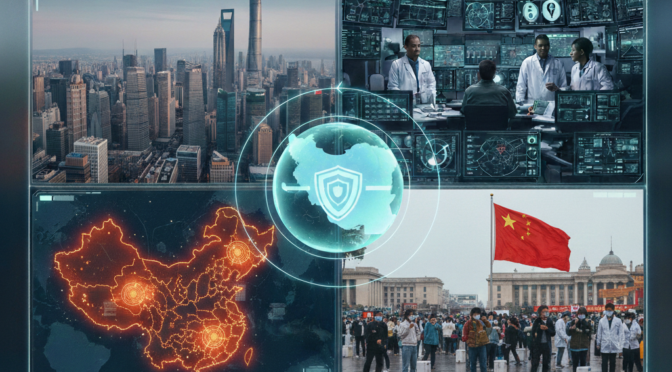
Tag Archives: China

Cognitive Warfare: The New Face of Disinformation – How Americans Are Being Polarized by Foreign Nations

The United States enters the mid-2020s facing an unprecedented challenge to its internal stability, characterized by the systematic exploitation of domestic political and social divisions by foreign state and non-state actors. This report, synthesized from the collective perspectives of national security, foreign affairs, and intelligence analysis, identifies a shift from traditional election interference toward a more pervasive doctrine of “cognitive warfare.” The primary objectives of these foreign adversaries—most notably the Russian Federation, the People’s Republic of China, Islamic Republic of Iran and North Korea—are to degrade the social fabric of American life, paralyze the federal government through internal discord, and undermine global confidence in the democratic model.1

The methodology of these actors involves the synchronization of deceptive narratives with significant geopolitical milestones and the weaponization of emerging technologies like generative artificial intelligence. By leveraging the “attention economy” of social media, which prioritizes engagement over accuracy, foreign entities have effectively “outsourced” the distribution of propaganda to unsuspecting American citizens and domestic influencers.4 The result is a fractured information ecosystem where “shared epistemic foundations”—the basic agreement on facts required for governance—are increasingly absent.7

The intent of this report is to provide an analysis of the threat landscape to facilitate civilian awareness. It details the specific actors involved, the psychological and technical tactics they employ, and the resulting impacts on public safety and institutional trust. Crucially, the analysis concludes that technical and governmental solutions alone are insufficient; the primary line of defense is an informed and analytically rigorous public. By adopting strategies such as lateral reading and psychological “pulse checks,” Americans can guard against deception and ensure that their democratic decisions are informed by reality rather than synthetic manipulation.9

The Strategic Environment: Polarization as a Weapon of War

The contemporary threat to the United States homeland is no longer confined to kinetic or traditional cyber-attacks. National security analysis indicates that polarization itself has been operationalized by foreign adversaries as a strategic weapon.7 The intelligence community defines this environment through the lens of Foreign Malign Influence (FMI), encompassing subversive, covert, or coercive activities conducted by foreign governments or their proxies.11 Unlike historical “active measures” that were often limited in scope and speed, modern FMI leverages digital connectivity to achieve global reach at minimal cost.12

The Philosophy of Cognitive Warfare

Foreign affairs analysis suggests that adversaries have shifted their focus to “cognitive warfare,” a doctrine that targets the human mind as the “final domain” of conflict. This approach operates in the psychological and informational spheres, exploiting human cognition to manipulate beliefs, emotions, and decision-making processes.13 The objective is not necessarily to convince the public of a specific lie, but rather to create a state of perpetual confusion and skepticism where “seeing is no longer believing”.5

Tactical ConceptIntelligence DefinitionStrategic Objective
Cognitive WarfareExploitation of human vulnerabilities to induce behavioral and perceptual shifts.Erosion of democratic norms and institutional trust.
Narrative SynchronizationAligning manipulative content with geopolitical events (e.g., NATO summits).Creating “information asymmetry” during high-stakes moments.
Algorithmic TargetingUsing social media data to deliver tailored content to specific demographics.Reinforcing “echo chambers” and accelerating “sorting” of the public.
Active MeasuresCovert operations to influence world events (mimicry, disinformation, agents of influence).Weakening U.S. global standing and internal cohesion.
Source: 13

The Crisis of Democratic Legitimacy

The integration of foreign disinformation into the domestic political discourse has resulted in what scholars term a “crisis of democratic legitimacy”.7 Intelligence assessments from 2024 and 2025 reveal that when citizens are repeatedly exposed to narratives questioning the integrity of electoral processes or the competence of mainstream institutions, they develop “affective polarization”—an intense, emotional hostility toward those with different political views.2 Foreign actors do not “create” these divisions; instead, they act as “force multipliers,” identifying existing societal “fault lines” and driving wedges into them to ensure they remain unbridgeable.2

Principal Actors: Motivations and Strategic Intent

A coordinated “Axis of Autocracy”—consisting of Russia, China, Iran, and North Korea—is increasingly working in concert to challenge the U.S.-led international order.3 While their specific methods vary, their shared goal is to create a more permissive environment for authoritarianism by distracting the United States with internal crises.1

The Russian Federation: The Architect of Disinformation

Russia remains the pre-eminent and most active foreign influence threat to the United States.2 Moscow’s overarching goal is to weaken the United States, undermine Washington’s support for Ukraine, and fracture Western alliances.2 Intelligence analysis shows that the Kremlin views election periods as moments of extreme vulnerability for democracy and seeks to amplify divisive rhetoric that makes the U.S. system look weak.2

The “Doppelgänger” campaign remains one of the most significant Russian operations identified in recent years. This campaign involves the creation of dozens of websites that mimic legitimate U.S. news organizations, such as The Washington Post and Fox News, to publish fabricated articles that align with Russian interests.4 Furthermore, Russia has adopted a “laundered” approach to influence, funneling millions of dollars to domestic companies to pay American influencers to spread Kremlin talking points under the guise of independent commentary.4

The People’s Republic of China: Comprehensive Economic and Cyber Pressure

The People’s Republic of China (PRC) represents the “most comprehensive and robust” strategic competitor to the United States.15 Beijing’s influence operations are often “whole-of-government” campaigns designed to fend off challenges to its legitimacy, gain an edge in economic and military power, and silence criticism from diaspora communities.1

While the PRC has historically been more cautious than Russia in its direct influence of U.S. domestic politics, recent reports indicate a shift toward more assertive tactics. During the 2024 election cycle, the PRC used bot accounts to post negative content about congressional candidates it deemed anti-China.4 Beyond information manipulation, the PRC’s strategy involves “weaponizing supply chain dependencies” and pre-positioning cyber actors on U.S. critical infrastructure to exert coercive pressure in the event of a conflict.15

The Islamic Republic of Iran: Escalation of Malign Activity

Iran has significantly increased its effort to influence the American public and political environment as of 2025.2 Tehran’s strategy is multi-pronged, seeking to stoke social discord, undermine confidence in the electoral process, and retaliate for U.S. and Israeli military actions in the Middle East.2 Iranian operations have evolved from simple social media propaganda to sophisticated cyber-espionage and direct physical threats.

In late 2024, the Department of Justice announced criminal charges against members of Iran’s Revolutionary Guard Corps for hacking into a presidential campaign and leaking stolen documents to the media.4 Perhaps most concerning to the intelligence community is Iran’s orchestration of “murder-for-hire” plots intended to assassinate high-profile U.S. officials, including Donald Trump, representing a dramatic escalation from digital influence to physical violence.4

State ActorPrimary MotivationCore Tactic in 2025Key Impact on US Public
RussiaHalting aid to Ukraine; fracturing NATO.Mimicking news outlets; paying domestic influencers.Deepened partisan hostility; distrust of mainstream news.
ChinaProtecting CCP legitimacy; economic dominance.Cyber pre-positioning; targeting anti-China candidates.Economic anxiety; concerns over infrastructure safety.
IranRetaliation for strikes; ending US presence in ME.Hacking and leaking campaign data; assassination plots.Political chaos; fear for the safety of public leaders.
North KoreaNormalizing nuclear status; financial theft.Cyber theft and money laundering via TCOs.Financial instability; critical infrastructure vulnerability.
Source: 1

Methodologies of Deception: Tactics and Technologies

Adversaries leverage a combination of psychological triggers and advanced technologies to bypass rational scrutiny and ensure their narratives gain traction within the American public.

The Rise of Generative Artificial Intelligence (AI)

The proliferation of generative AI has revolutionized the “manufacture of reality.” Tools that were once in the realm of experimental science are now routine parts of the disinformation toolkit.18

  1. Deepfake Audio and Video: AI can create near-photo-realistic visuals and clone voices with high precision. In 2025, bad actors used a voice clone of Secretary of State Marco Rubio to contact U.S. and foreign officials, attempting to gain access to sensitive accounts.18 Similarly, deepfake videos have been used to show political figures making statements they never said, such as JD Vance criticizing Elon Musk or Barack Obama expressing concerns about Donald Trump’s health.18
  2. Disaster Porn and Clickbait: AI tools like OpenAI’s Sora 2, released in late 2025, have been used to capitalize on natural disasters. During Hurricane Melissa, viral videos depicted sharks swimming in hotel pools and the destruction of Kingston Airport—events that never happened but were shared millions of times because of their sensational nature.6
  3. Chatbot Unreliability: AI chatbots, often viewed as neutral arbiters, frequently repeat information from low-quality social media posts. During a political rally in October 2025, chatbots amplified false claims that genuine news coverage was “old footage,” misleading the public about crowd size.18

Narrative Synchronization: Timing the Attack

Intelligence analysis reveals that adversaries do not release disinformation randomly. Instead, they use “narrative synchronization”—aligning their messaging with real-world geopolitical events to maximize psychological impact.13 For example, Russian narratives regarding nuclear threats or Western “provocations” are often synchronized with NATO summits or announcements of military aid to Ukraine.13 This temporal relevance increases the perceived credibility of the disinformation, as it appears linked to tangible, current events.13

The Psychology of Susceptibility: Targeting the Mind

Foreign influence operations are effective because they exploit fundamental “neutral and normal cognitive processes”.12 Adversaries systematically target specific psychological vulnerabilities:

  • Confirmation Bias and Motivated Reasoning: Individuals are more likely to believe and share information that aligns with their pre-existing beliefs, regardless of its accuracy.5
  • Affective Polarization: When people have strong negative feelings toward an opposing group, they are more susceptible to “politically aligned disinformation” that reinforces their hatred.7
  • The Power of Emotions: Content that triggers awe, amusement, or, most commonly, anger and anxiety is shared much more frequently than neutral, factual content.5
  • Fuzzy-Trace Theory: People often remember the “gist” (the general feeling) of a story rather than the “verbatim” details. Even if a story is later debunked, the negative “gist” remains in the individual’s memory.23

Case Study: Hurricane Melissa and the Chaos of 2025

The landfall of Hurricane Melissa in Jamaica in late October 2025 serves as a primary case study for how foreign-influenced narratives and AI-generated “synthetic slop” can paralyze domestic response systems.6

The Information Surge

Within thirty minutes of the hurricane’s landfall, AI-generated videos began trending on X, TikTok, and Instagram. These videos, often depicting spectacular but entirely fake destruction, racked up millions of views.6 National security analysts note that while many of these videos were created for financial gain (clickbait), they served the strategic interests of foreign actors by “clogging” official communication channels and drowning out safety information.6

Real-World Consequences

The disinformation surge had tangible safety costs:

  • Emergency Response Delays: False videos showing the destruction of Kingston Airport caused an unnecessary rush of citizens toward inland roads, creating traffic jams that delayed medical convoys by almost an hour.25
  • Resource Diversion: Emergency managers were forced to divert valuable time and personnel to debunking rumors—such as the “sharks in the pool” video—rather than tracking storm surge data and coordinating rescues.24
  • Erosion of Trust in Real Data: The prevalence of AI fakes led the public to question the validity of genuine videos, such as those from the U.S. Air Force “Hurricane Hunters”.26

This event highlights the “liar’s dividend”—a state where the presence of many fakes allows individuals to deny the authenticity of real evidence.25

The Shifting Institutional Landscape of Defense

The ability of the United States to defend against foreign malign influence has undergone significant changes in 2025, primarily due to shifts in executive policy and agency mandates.

The Dissolution of the Foreign Influence Task Force (FITF)

Historically, the FBI’s Foreign Influence Task Force (FITF) served as the primary bridge between the intelligence community and social media companies. Its role was to share actionable intelligence about specific foreign-backed accounts so that platforms could use their discretion to remove them.11 However, in February 2025, Attorney General Pam Bondi ordered the dissolution of the FITF, signaling a retreat from the government’s role in investigating foreign disinformation on social media.27

Gutting of Election Security and Global Engagement

Simultaneously, the Cybersecurity and Infrastructure Security Agency (CISA) saw its election security mission significantly curtailed. Operations focused on countering disinformation and protecting voting systems were “paused” for review in early 2025, and many expert staff members were placed on administrative leave.27 At the State Department, the Global Engagement Center (GEC), founded in 2016 to coordinate communications against Russian and Chinese influence, had its budget mandate expire and its activities reduced to a “zero-content-involvement” policy.27

AgencyFormer Role (Pre-2025)Current Status (2026)Operational Impact
FBI (FITF)Real-time identification of foreign accounts; SMC briefings.Dissolved February 2025.Loss of centralized intelligence sharing with tech companies.
DHS (CISA)Securing election infrastructure; debunking fakes.Election security activities “paused”; staff on leave.Vulnerability of local officials to cyber and influence threats.
State (GEC)Global counter-propaganda efforts.Funding expired; “zero-content” policy adopted.Reduced U.S. voice in countering autocratic narratives abroad.
FBI (Election Command Post)24/7 monitoring of threats during voting cycles.Operations limited to criminal acts only.Narrower window for identifying “perception hacking” campaigns.
Source: 4

National security analysts warn that these institutional rollbacks represent a “gift on a silver platter” to adversaries like Russia and China, who are now more active than ever in their interference efforts.28 In the absence of federal coordination, the responsibility for defense has shifted to fragmented civil society actors who lack the intelligence and resources of the federal government.27

Civilian Defense: Guarding Against Deception

In an environment of reduced institutional protection, the individual citizen must act as a primary node of defense. Foreign affairs and intelligence analysts recommend a series of practical, “cognitive-first” strategies to mitigate the impact of disinformation.

The Core Strategy: Lateral Reading

Research from the Stanford History Education Group (SHEG) demonstrates that “lateral reading” is the most effective way to determine the truthfulness of online information.9 Unlike “vertical reading”—scrolling down a single webpage and looking for professional-looking fonts or “About” pages—lateral reading involves leaving the source to see what other trusted sources say about it.9

  1. Open New Tabs: When you encounter a sensational claim, don’t read the article yet. Instead, open three or four new browser tabs.
  2. Search the Source: Search for the name of the organization or the author. Use Wikipedia or specialized news literacy sites to see if the source has a history of bias or spreading misinformation.9
  3. Cross-Reference the Facts: Check if major, reputable news outlets are reporting the same story. If a “massive scandal” or “disaster” is only being reported by one obscure website or social media account, it is likely false.32

Technical Checks for Deepfakes and AI Content

While AI tools are improving, there are still physical and geometric inconsistencies that can be identified with a “gut check” and careful observation.26

Verification AreaDeepfake Indicator (Red Flag)Authentic Indicator
Facial TextureOverly smooth “airbrushed” skin; pores missing; unnatural blinking.Natural asymmetries; visible pores; irregular blinking patterns.
Lighting/ShadowsShadows pointing toward the light source; flickering around the eyes.Consistent lighting based on identifiable light sources.
Geometric PhysicsBuildings with multiple “vanishing points”; garbled text on signs.Consistent architectural perspective; legible signage.
Audio PatternsLack of breathing; robotic inflection; mouth movements out of sync.Natural cadence; rhythmic breathing; synchronized lip movements.
Logic/ContextMagazine-quality beauty in a crisis zone; anachronistic vehicles.Visuals match the setting; historical/weather data matches the claim.
Source: 19

Psychological Resilience: The Emotional “Pulse Check”

Because disinformation is designed to bypass logic and trigger emotion, the most powerful defense is self-awareness.10 Before clicking “share” or forming a hardened opinion, citizens should ask themselves:

  1. Am I having a heightened emotional reaction? Disinformation is often “emotional and arousing,” designed to make the reader feel awe, amusement, anxiety, or anger.12
  2. Does this align too perfectly with my existing beliefs? If a story seems “too good to be true” because it makes your political rivals look bad, it is a prime candidate for disinformation targeting your confirmation bias.7
  3. Would I question this if it came from the “other side”? Applying a neutral standard to all information, regardless of the source, is the foundation of digital citizenship.10

Verification Tools for the Public

Several free tools are available to help civilians perform their own forensic analysis:

  • Reverse Image Search (Google/TinEye): Allows users to find the original source of an image and see if it was taken from a different context or an old event.10
  • TrueMedia.org: A free service that analyzes images, audio, and video for hidden mathematical signatures of AI generation.34
  • RumorGuard / Checkology: Platforms that provide real-world practice in spotting common tactics used to mislead and evaluate sources for credibility.33
  • Metadata Check: By right-clicking an image and selecting “Properties” (PC) or “Get Info” (Mac), users can sometimes see the original creation date and the software used, which may contradict the claimed story.34

Conclusion: Rebuilding the Shared Reality

The analysis conducted by this joint team of analysts indicates that the United States is currently the target of a sustained, multi-front campaign of cognitive warfare. Foreign adversaries—principally Russia, China, and Iran—have moved beyond the era of simple “fake news” into a period of sophisticated “synthetic reality” designed to exacerbate domestic polarization.2 By weaponizing the psychological mechanisms of confirmation bias and moral outrage, and amplifying them through generative AI, these actors have successfully turned the American information ecosystem against itself.7

The institutional shifts of 2025, which have reduced federal oversight of foreign influence operations, have effectively decentralized the defense of the homeland. The stability of the American democratic system now rests more than ever on the “epistemic resilience” of its citizens. The results of the 2025 Hurricane Melissa disinformation crisis serve as a stark warning: in a digital world, information failure leads directly to physical danger.24

For the average American, the path forward is not to stop consuming information, but to change how it is consumed. By prioritizing analytical scrutiny over emotional reaction and adopting the rigorous verification habits of professionals—such as lateral reading and technical cross-referencing—citizens can neutralize the “force multiplier” effect of foreign adversaries.9 The goal of foreign influence is to make the public believe that nothing is true and everything is possible. The civilian defense, therefore, is to insist on a shared reality based on evidence, skepticism of the sensational, and an unwavering commitment to the truth.


Please share the link on Facebook, Forums, with colleagues, etc. Your support is much appreciated and if you have any feedback, please email us in**@*********ps.com. If you’d like to request a report or order a reprint, please click here for the corresponding page to open in new tab.


Sources Used

  1. Annual Threat Assessment of the U.S. Intelligence … – DNI.gov, accessed January 31, 2026, https://www.dni.gov/files/ODNI/documents/assessments/ATA-2025-Unclassified-Report.pdf
  2. Election Security: U.S. Government’s Efforts to Protect the 2024 U.S. Election from Foreign Malign Influence – United States Department of State, accessed January 31, 2026, https://2021-2025.state.gov/briefings-foreign-press-centers/protecting-the-2024-election-from-foreign-malign-influence/
  3. CHAPTER 3: AXIS OF AUTOCRACY: CHINA’S REVISIONIST AMBITIONS WITH RUSSIA, IRAN, AND NORTH KOREA Executive Summary, accessed January 31, 2026, https://www.uscc.gov/sites/default/files/2025-11/Chapter_3–Axis_of_Autocracy.pdf
  4. Interference Interrupted: The US Government’s Strides In Defending …, accessed January 31, 2026, https://www.gmfus.org/news/interference-interrupted-us-governments-strides-defending-against-foreign-threats-2024
  5. How foreign actors are using media to influence opinion before Election Day – AJC.com, accessed January 31, 2026, https://www.ajc.com/news/business/how-foreign-actors-are-using-media-to-influence-opinion-before-the-election/52IZR4P7SFGYXKJIE2WZUC5URE/
  6. The Shark in the Pool: How AI Weaponized the Attention Economy – rbb Communications, accessed January 31, 2026, https://rbbcommunications.com/blog/how-ai-weaponized-the-attention-economy/
  7. Disinformation as a driver of political polarization: A strategic framework for rebuilding civic trust in the U.S, accessed January 31, 2026, https://journalwjarr.com/sites/default/files/fulltext_pdf/WJARR-2025-2564.pdf
  8. Disinformation as a driver of political polarization: A strategic framework for rebuilding civic trust in the U.S – ResearchGate, accessed January 31, 2026, https://www.researchgate.net/publication/393669858_Disinformation_as_a_driver_of_political_polarization_A_strategic_framework_for_rebuilding_civic_trust_in_the_US
  9. Teaching Lateral Reading | Civic Online Reasoning – Digital Inquiry Group, accessed January 31, 2026, https://cor.inquirygroup.org/curriculum/collections/teaching-lateral-reading/
  10. Spotting AI-Generated Disinformation and Deepfakes Online – Anomali, accessed January 31, 2026, https://www.anomali.com/blog/spotting-ai-generated-disinformation-and-deepfakes
  11. Voting | Foreign Malign Influence – Department of Justice, accessed January 31, 2026, https://www.justice.gov/archives/voting/foreign-malign-influence
  12. (U) The Psychology of (Dis)information: A Primer on Key …, accessed January 31, 2026, https://www.cna.org/reports/2021/10/The%20Psychology-of-(Dis)information-A-Primer-on-Key-Psychological-Mechanisms.pdf
  13. Decoding manipulative narratives in cognitive warfare: a case study …, accessed January 31, 2026, https://pmc.ncbi.nlm.nih.gov/articles/PMC12460417/
  14. FBI and CISA Issue Public Service Announcement Warning of …, accessed January 31, 2026, https://www.cisa.gov/news-events/news/fbi-and-cisa-issue-public-service-announcement-warning-tactics-foreign-threat-actors-are-using
  15. ODNI Releases 2025 Threat Assessment: What it Means for CFIUS Reviews – A Fresh Take, accessed January 31, 2026, https://blog.freshfields.us/post/102k8mb/odni-releases-2025-threat-assessment-what-it-means-for-cfius-reviews
  16. Homeland Threat Assessment 2025, accessed January 31, 2026, https://www.dhs.gov/sites/default/files/2024-10/24_0930_ia_24-320-ia-publication-2025-hta-final-30sep24-508.pdf
  17. About the unravelling of Iran’s social contract – Clingendael, accessed January 31, 2026, https://www.clingendael.org/publication/about-unravelling-irans-social-contract
  18. 2025 year in review: AI misinformation – The News Literacy Project, accessed January 31, 2026, https://newslit.org/news-and-research/2025-year-in-review-ai-misinformation/
  19. Don’t Get Fooled: Your Guide to Spotting Deepfakes, accessed January 31, 2026, https://it.ucsb.edu/news/dont-get-fooled-your-guide-spotting-deepfakes
  20. With New AI Resources Fake News Is Challenging Real Events – Like With Hurricane Melissa, accessed January 31, 2026, https://www.klove.com/faith/news/trending/with-new-ai-resources-fake-news-is-challenging-real-events-like-with-hurricane-melissa-56951
  21. Psychological factors contributing to the creation and dissemination of fake news among social media users: a systematic review – NIH, accessed January 31, 2026, https://pmc.ncbi.nlm.nih.gov/articles/PMC11575416/
  22. FAKE NEWS´ COGNITIVE EFFECTS IN COMPLEX DECISION-MAKING AND POLITICAL POLARIZATION – SciELO, accessed January 31, 2026, https://www.scielo.br/j/psoc/a/kpWpjbhsCvfszBp76TyFnDM/
  23. The Psychology of Misinformation Across the Lifespan – Annual Reviews, accessed January 31, 2026, https://www.annualreviews.org/content/journals/10.1146/annurev-devpsych-010923-093547?crawler=true&mimetype=application/pdf
  24. The Impact of AI-Generated Content on Natural Disaster Response: Hurricane Melissa, accessed January 31, 2026, https://catalystmcgill.com/the-impact-of-ai-generated-content-on-natural-disaster-response-hurricane-melissa/
  25. AI Crisis Detection Under Fire: Lessons From Hurricane Melissa – AI CERTs News, accessed January 31, 2026, https://www.aicerts.ai/news/ai-crisis-detection-under-fire-lessons-from-hurricane-melissa/
  26. AI-generated images of Hurricane Melissa bog down social media – The Weather Network, accessed January 31, 2026, https://www.theweathernetwork.com/en/news/weather/severe/melissa-ai-generated-images-of-hurricane-melissa-are-clogging-social-media
  27. The Trump Administration’s Withdrawal from the Fight Against Foreign Interference—Strategic Implications | INSS, accessed January 31, 2026, https://www.inss.org.il/publication/trump-influence/
  28. Issue One criticizes Trump administration’s rollback of safeguards against foreign influence operations, accessed January 31, 2026, https://issueone.org/press/issue-one-criticizes-trump-administrations-rollback-of-safeguards-against-foreign-influence-operations/
  29. Trump Is Gutting Efforts to Combat Foreign Election Interference – Mother Jones, accessed January 31, 2026, https://www.motherjones.com/politics/2025/02/trump-cisa-foreign-election-interference/
  30. Teaching Lateral Reading – No Shhing Here, accessed January 31, 2026, http://noshhinghere.blogspot.com/2022/01/teaching-lateral-reading.html
  31. Intro to Lateral Reading | Civic Online Reasoning, accessed January 31, 2026, https://cor.inquirygroup.org/curriculum/lessons/intro-to-lateral-reading/
  32. Lateral Reading Resources & Practice | Civic Online Reasoning, accessed January 31, 2026, https://cor.inquirygroup.org/curriculum/lessons/lateral-reading-resources-practice/?cuid=teaching-lateral-reading
  33. The Insider: November 2025 – The News Literacy Project, accessed January 31, 2026, https://newslit.org/news-and-research/the-insider-november-2025/
  34. Reporter’s Guide to Detecting AI-Generated Content – Global …, accessed January 31, 2026, https://gijn.org/resource/guide-detecting-ai-generated-content/
  35. Detect DeepFakes: How to counteract misinformation created by AI – MIT Media Lab, accessed January 31, 2026, https://www.media.mit.edu/projects/detect-fakes/overview/
  36. How to detect deepfakes: A practical guide to spotting AI-Generated misinformation – ESET, accessed January 31, 2026, https://www.eset.com/blog/en/home-topics/cybersecurity-protection/how-to-detect-deepfakes/
  37. Insights & Impact: Aug. 2025 – The News Literacy Project, accessed January 31, 2026, https://newslit.org/news-and-research/insights-impact-aug-2025/

SITREP China – Week Ending February 06, 2026

Executive Summary

The strategic landscape of the People’s Republic of China (PRC) during the reporting period ending February 06, 2026, is characterized by a high-stakes convergence of internal political consolidation and external strategic maneuvering. The primary development of the week is the comprehensive purge of the senior leadership within the People’s Liberation Army (PLA), specifically the formal investigation of Central Military Commission (CMC) Vice Chairman Zhang Youxia and Chief of the CMC Joint Staff Department Liu Zhenli.1 This action, framed as a “political rectification” to ensure the military’s readiness for the 2027 centenary modernization goals, suggests a profound crisis of confidence in the high command’s ability to execute a high-intensity Taiwan contingency.2 The removal of Zhang, a long-time confidant of President Xi Jinping, indicates that the “Chairman Responsibility System” is being enforced with unprecedented severity, prioritizing absolute political loyalty over operational experience as the risk of regional conflict increases.4

Diplomatically, Beijing has navigated a complex tri-polar interaction with Washington and Moscow. A wide-ranging phone call between President Xi and U.S. President Donald J. Trump on February 4 highlighted a transactional attempt to stabilize bilateral ties through energy and agricultural deals, even as the U.S. administration escalates its efforts to isolate Iran—a critical Chinese energy partner.7 Simultaneously, the expiration of the New Strategic Arms Reduction Treaty (New START) on February 5 has introduced a period of significant strategic uncertainty. While Beijing expresses regret over the treaty’s collapse, it continues to reject any trilateral arms control framework that would include its own rapidly expanding nuclear arsenal.9

In the maritime domain, the PRC has unveiled a sophisticated new “gray zone” tactic involving the mobilization of over 2,000 maritime militia vessels to create “floating walls” in the East China Sea.12 These maneuvers, alongside the “Justice Mission 2025” exercises and the first confirmed PLA drone violation of Taiwanese territorial airspace, signify a maturation of blockade tactics designed to isolate Taiwan while remaining below the threshold of conventional warfare.15 Economically, despite a record $1.2 trillion trade surplus, China faces an increasingly organized Western effort to decouple from its critical minerals supply chains, led by the newly established Forum on Resource Geostrategic Engagement (FORGE).19 The internal legislative environment is also tightening, with the 2026 Cybersecurity Law amendments granting the state sweeping extraterritorial powers to penalize foreign entities deemed to threaten national security.22

Internal Political Stability and Military Governance

The Purge of the Central Military Commission

The internal stability of the Chinese Communist Party’s (CCP) relationship with its military wing, the PLA, has entered a period of acute disruption. On January 25, 2026, the PRC announced formal investigations into General Zhang Youxia, the first-ranked Vice Chairman of the CMC, and General Liu Zhenli, the Chief of the Joint Staff Department.1 This development is significant not only because of the rank of the individuals involved but because of their historical proximity to General Secretary Xi Jinping. Zhang Youxia, in particular, was widely considered one of Xi’s most trusted military allies, with a shared family history rooted in Shaanxi province and a career that bridged the gap between the revolutionary generation and the modern technocratic military.6

The official justification for these investigations centers on “political threats” and the failure to foster an environment conducive to the achievement of the 2027 modernization milestones.1 Unlike previous waves of purges that targeted former CMC members such as He Weidong and Li Shangfu—who were explicitly accused of “job-related crimes” like bribery and the abuse of power—the charges against Zhang and Liu are notably abstract.1 They are accused of fostering the “conditions” for corruption and “severely trampling” the Chairman Responsibility System.3 This shift in rhetoric suggests that the current purge is less about financial malfeasance and more about a strategic disagreement or a perceived failure to implement Xi’s specific directives regarding the readiness for a Taiwan invasion.1

Key Leadership Purges and Structural Changes (2023-2026)
OfficialFormer PositionReported Status / Allegations
Zhang YouxiaCMC Vice Chairman (1st Rank)Under investigation for political threats to 2027 goals 1
Liu ZhenliChief of CMC Joint StaffUnder investigation for fostering conditions for corruption 1
He WeidongFormer CMC Vice ChairmanReported suicide in early 2026 following corruption probe 1
Li ShangfuFormer Defense MinisterRemoved for bribery and procurement scandals 1
Li YuchaoFormer Rocket Force CmdrRemoved during 2023-24 Rocket Force cleanup 2
Zhang ShengminCMC Discipline InspectionEmerging as the primary enforcer of military loyalty 3

The implications of these purges extend to the core of the PLA’s command-and-control capabilities. By removing Zhang Youxia, one of the few senior officers with actual combat experience (from the 1979 Sino-Vietnamese War), Xi Jinping has significantly hollowed out the professional “command” knowledge of the CMC.3 The commission is now increasingly dominated by political enforcers rather than operational strategists. Intelligence assessments indicate that this may lead to a “confidence crisis” within the PLA, where lower-level officers become reluctant to provide honest assessments of combat readiness for fear that any identified weakness will be interpreted as political disloyalty.3

The 2027 Centenary Goal and Combat Readiness

The driving force behind this internal upheaval is the looming 2027 deadline, by which time the PLA is expected to have achieved the capability to execute a successful invasion of Taiwan.1 The “Justice Mission 2025” exercises conducted in late December 2025 provided a window into the CCP’s dissatisfaction with the military’s progress.17 These exercises, while large in scale, revealed ongoing challenges in joint-theater operations and the integration of the various service branches under a single command structure.18

The purge of the high command is interpreted by some analysts as a “correction” designed to increase Xi’s control over the military ahead of this critical window.3 There are rumors that Xi became disillusioned with Zhang Youxia’s performance in rooting out deep-seated corruption in the equipment procurement chains, particularly after the Rocket Force scandals of 2023-2024 revealed that critical systems, including nuclear silos, were compromised by shoddy construction and embezzlement.2 By making an example of his closest military confidant, Xi is signaling to the entire PLA that performance and loyalty are inextricably linked to personal survival.3

However, the “rebirth through changing feathers” program—as described in PLA media—carries significant operational risks.26 The removal of senior generals creates a “churn” that disrupts the long-term planning required for a cross-strait campaign.3 Furthermore, it suggests that the PLA may currently be viewed as “unready” for major tasks, as the leadership transition period inevitably creates a period of tactical stasis.3

Diplomatic Strategy and External Relations

The Xi-Trump Virtual and Telephonic Engagement

On February 4, 2026, President Xi Jinping engaged in two critical diplomatic interactions: a virtual meeting with Russian President Vladimir Putin and a subsequent wide-ranging phone call with U.S. President Donald J. Trump.8 The call with Trump was described by the U.S. side as “excellent,” “long,” and “thorough,” focusing heavily on the transactional aspects of the relationship.8 Trump’s social media readouts emphasized agricultural and energy deals, specifically pointing to China’s interest in increasing imports of American soybeans, oil, and gas.8

Proposed China-U.S. Agricultural and Energy Targets (Feb 2026)
CommodityTarget / Discussion Point
SoybeansIncrease to 20M tonnes (current season); 25M tonnes (next season) 8
Crude Oil & LNGBeijing exploring significant purchase increases to offset trade imbalances 8
Aircraft EnginesDiscussions on maintaining deliveries amid technology restrictions 8
Iran Tariff PenaltyUS warning of 25% tariff on countries continuing trade with Tehran 7

Despite the seemingly positive tone regarding trade, the underlying geopolitical friction remains acute. President Trump used the call to pressure Beijing to isolate Iran, following the 12-day conflict in June 2025 and the subsequent U.S. bombing of Iranian nuclear sites.7 Trump reiterated his threat to impose a 25% tariff on all imports from countries that continue to do business with Iran.8 Given that China conducted approximately $32 billion in trade with Iran in 2024, this poses a direct threat to Chinese energy security and its strategic interests in the Middle East.7

Xi Jinping’s response to these pressures emphasized “stability” and “red lines”.8 According to the Chinese readout, Xi stressed that the Taiwan question remains the “most important” issue in the relationship and urged Washington to handle arms sales with “extreme caution”.8 The Chinese statement notably omitted any confirmation of Trump’s planned visit to Beijing in April, suggesting that Beijing is withholding this high-profile symbolic win until it receives concrete assurances on tariff reductions or the easing of technology export controls.7

The Russia-China Strategic Alignment

The virtual meeting between Xi and Putin, held just hours before the Trump call, served to underscore the “no-limits” partnership that continues to define the anti-Western axis.8 Foreign Minister Wang Yi’s earlier meeting with Russian Security Council Secretary Sergei Shoigu on February 1 further cemented this, with Wang stating that bilateral relations could “break new ground” in 2026.30 Russia has reaffirmed its “consistent and unwavering” support for China on the Taiwan issue, a critical diplomatic asset as Beijing faces increasing pressure from the G7.31

The strategic coordination between Beijing and Moscow is increasingly visible in their joint opposition to U.S.-led mineral and technology blocs. While the U.S. administration attempts to peel China away from its energy ties to Iran and Russia, Beijing is leveraging its economic “backfilling” of the Russian economy to ensure a stable supply of resources that are immune to Western sanctions.31 However, there are indications of mutual concern regarding the “unpredictability” of the second Trump administration, which has led both leaders to deepen their nuclear and high-technology coordination as a hedge against a potential breakdown in global strategic stability.6

The Expiration of New START and the Nuclear Order

February 5, 2026, marked the formal expiration of the New Strategic Arms Reduction Treaty (New START) between the United States and Russia.9 China’s Ministry of Foreign Affairs expressed “regret” over the treaty’s collapse, warning of negative repercussions for the international arms control regime.9 The expiration leaves the world’s two largest nuclear arsenals unconstrained for the first time in over fifty years.10

Beijing’s position on nuclear arms control remains a point of significant contention with Washington. The Trump administration has repeatedly insisted that any future nuclear framework must include China, citing the rapid expansion of the PLA’s nuclear forces, including the construction of hundreds of new ICBM silos.11 Beijing, however, maintains that its arsenal is at a “minimum level” required for national security and that it adheres to a “no first use” policy.10 The U.S. State Department’s statement to the Conference on Disarmament on February 5 explicitly rejected this claim, arguing that China is expanding its arsenal at a scale and pace not seen in over half a century and that a bilateral treaty with only Russia is “inappropriate” in 2026.11

Maritime Strategy and Cross-Strait Coercion

The “Floating Wall” of the Maritime Militia

One of the most striking developments of the reporting period is the deployment of a massive “floating wall” of fishing vessels in the East China Sea.12 Geospatial data analysis by firms like ingeniSPACE and Starboard Maritime Intelligence confirmed that approximately 2,000 Chinese fishing boats—acting as part of the People’s Armed Forces Maritime Militia (PAFMM)—formed parallel barriers stretching over 460 kilometers.12

Characteristics of Recent Maritime Militia Mobilizations
DateEstimated Vessel CountFormation & Location
Dec 25-27, 2025~2,000 vesselsInverted L-shape; 460km length; NE of Taiwan 12
Jan 9-12, 2026~1,400 vesselsRectangular strip; 320km length; East China Sea 13
Target / PurposePractice BlockadeSignal capability to impede maritime logistics routes 12

These formations were so dense that commercial cargo ships were forced to zigzag or divert entirely around the “maritime barrier”.12 Experts suggest that these maneuvers were exercises to test the mobilization and command of civilian vessels for use in a future blockade or “quarantine” of Taiwan.12 By using fishing vessels, which carry a civilian profile under international law, Beijing creates a “gray zone” that complicates the rules of engagement for the U.S. and Taiwanese navies.12 If these vessels are used to blockade Taiwan’s ports, any military action against them by Western forces could be framed by PRC propaganda as an attack on “peaceful fishers,” providing a pretext for further escalation.12

Justice Mission 2025 and Blockade Simulation

The “Justice Mission 2025” exercises (conducted in late December and early January) represent a maturation of the PLA’s blockade strategy.17 These drills, which involved the Army, Navy, Air Force, and Rocket Force, focused on:

  • Sea-Air Combat Readiness: Establishing regional air dominance and sea control in eight zones surrounding Taiwan.18
  • Interdiction of Energy Imports: Simulating a blockade of Taiwan’s major port cities (Kaohsiung and Keelung) to choke off LNG and oil imports.18
  • Decapitation Strikes: Practicing special operations raids to capture or eliminate Taiwan’s political leadership, integrated with lessons learned from recent global conflicts.16

A significant escalatory step occurred on January 17, when a PLA surveillance drone violated Taiwanese territorial airspace over Pratas (Dongsha) Island.15 This is believed to be the first such confirmed violation in decades and is seen as a “test” of Taiwan’s air defense response.16 By normalizing drone flights over outlying islands, the PLA is engaging in “lawfare,” attempting to erode Taiwan’s sovereignty through the creation of new de facto precedents.15

Political Subversion: The KMT Visit to Beijing

While the PLA exerts military pressure, the CCP is simultaneously intensifying its efforts to influence Taiwan’s internal politics. From February 2 to 4, 2026, a high-level delegation from the Kuomintang (KMT), led by Deputy Chairman Hsiao Hsu-tsen, visited Beijing.1 This was the first such exchange since 2016 and represents a major push by the CCP to co-opt the Taiwanese opposition.1

The delegation met with Wang Huning, the Chairman of the CPPCC and the CCP’s top official for Taiwan policy, and Song Tao, the TAO Director.1 The meetings focused on the “1992 Consensus” and the “common family of the Chinese nation”.1 The forum concluded with 15 recommendations for cross-strait cooperation in areas like tourism and industrial exchange.1

KMT-CCP Forum Recommendations (Feb 2026)
CategorySpecific Recommendation / Target
TourismResumption of large-scale mainland tour groups to Taiwan 1
IndustryJoint development of green energy and semiconductor supply chains 1
EnvironmentCoordinated disaster prevention and environmental monitoring 1
Defense PolicyPromotion of the 1992 Consensus as the basis for regional stability 1

The CCP’s strategy is to legitimize the KMT as the primary interlocutor for cross-strait peace, thereby bypassing and isolating the ruling DPP government.1 This political warfare is having tangible effects in Taipei, where the KMT and the Taiwan People’s Party (TPP) have jointly blocked President William Lai’s version of the defense budget ten times, favoring a version that significantly cuts funding for asymmetric warfare systems, including drones and missile defense.1

Economic Statecraft and the Resource War

China Shock 2.0 and the Trade Surplus

China’s economic strategy remains focused on export-led growth to offset a sluggish domestic economy. In 2025, the PRC recorded a trade surplus of $1.2 trillion, driven by a 5.5% increase in exports.19 While the U.S. administration’s tariffs have successfully reduced direct exports to the United States by 20%, Chinese manufacturers have effectively “pivoted” to other regions.19

Shift in China’s Export Destinations (2025-26)
RegionTrade Trend / Growth
Southeast Asia (ASEAN)+32.7% growth; $26.3B in low-value exports 19
European Union (EU)+41.8% growth; $26.9B (before de minimis removal) 19
United States-20.0% decline; $419.5B total 19
Global SurplusReached record $1.2 Trillion 19

The “China Shock 2.0” is causing significant friction with the EU, which is slated to eliminate its de minimis customs exemption in 2026 to curb the flood of low-cost Chinese goods.19 Beijing’s willingness to exploit the “America crisis”—the perception that the U.S. is withdrawing from global trade leadership—is tempered by the reality of its own demographic and debt woes.35 However, in the short term, Beijing is hitting back hard against individual trade war measures, having seen the U.S. retreat in certain sectors in late 2025.35

The Critical Minerals Conflict: FORGE vs. China Dominance

On February 4, 2026, the Trump administration launched a major counter-offensive against China’s dominance of the critical minerals market.20 During a ministerial meeting in Washington, Vice President JD Vance and Secretary of State Marco Rubio unveiled the Forum on Resource Geostrategic Engagement (FORGE), a successor to previous mineral security partnerships.20 The goal of FORGE is to create a preferential trade zone of allies that can guarantee supply chains immune to Chinese disruption.20

New U.S. Critical Minerals Frameworks / MOUs (Feb 4, 2026)
CountryType of AgreementKey Commodity Focus
United KingdomMOU / FrameworkProcessing and Mining 38
PhilippinesFrameworkNickel and Copper 20
ArgentinaFrameworkLithium 20
UAEMOU / FrameworkStrategic Investment 20
UzbekistanMOU / FrameworkRare Earths 38
GuineaMOU / FrameworkBauxite and Iron Ore 38

FORGE intends to implement “border-adjusted price floors” to protect Western mining projects from China’s tactic of “market flooding,” where Beijing drops prices to bankrupt competitors before ratcheting them up once a monopoly is secured.21 Simultaneously, the U.S. has launched “Project Vault,” a plan for a strategic rare earth stockpile funded with $10 billion.37 Beijing has responded by calling these moves the work of “small cliques” that undermine the international trade order.37 In a retaliatory move, China has tightened its own export controls on dual-use items to Japan, leading to a significant search by Tokyo for alternative rare earth sources.1

Regulatory Tightening: The 2026 Cybersecurity Law

The PRC’s internal legislative environment for foreign businesses has become increasingly hostile. On January 1, 2026, the first major overhaul of the Cybersecurity Law (CSL) since 2017 came into force.22 These amendments include:

  • Massive Financial Penalties: Fines for violations involving “very serious consequences”—such as large-scale data leaks or loss of critical infrastructure function—can now reach RMB 10 million ($1.41 million).22
  • Streamlined Enforcement: Authorities no longer need to issue a warning before imposing fines, allowing for immediate financial penalties for even minor breaches.22
  • Extraterritorial Reach: The law now explicitly targets “overseas actors” whose activities are deemed to endanger China’s cybersecurity, including the power to freeze assets and revoke business licenses.23
  • AI Ethics and Surveillance: A new mandate for the state to improve ethical norms for AI and strengthen security risk monitoring, providing a legal basis for the further regulation of foreign AI models.23

These changes reflect Beijing’s heightened focus on “data sovereignty” and its desire to control the digital landscape as part of its broader competition with the United States. Foreign firms, particularly in the biotechnology and high-tech sectors, face an increasingly complex compliance environment where “security” is defined broadly and enforced unilaterally.23

Regional Security and Defense Proliferation

Submarine Proliferation in the Indian Ocean

China is aggressively expanding its naval footprint in the Indian Ocean through high-end defense exports to key partners. The Pakistan Navy is set to receive its first Chinese-designed Hangor-class (Type 039A derivative) submarine in 2026.45 This $5 billion deal is the largest arms export agreement in Chinese history and includes the delivery of eight submarines by 2028.45

Hangor-Class (Type 039A) Submarine Deal Details
MetricSpecification / Detail
Total Contract Value~$5 Billion 45
Number of Vessels8 (4 built in China, 4 in Pakistan) 46
First Delivery2026 (Wuhan-built unit) 45
Primary ArmamentYJ-18 Anti-ship missiles; Torpedoes 45
PropulsionDiesel-electric with AIP (Air-Independent Propulsion) 48

This deal provides Beijing with a secondary foothold in the Indian Ocean, as the Hangor-class is significantly more sophisticated than the Russian Kilo-class submarines operated by India and Iran.45 Similarly, Egypt is in advanced negotiations for the acquisition of Type 039A/B submarines, part of a “comprehensive strategic partnership” that includes the transfer of drone technology (Wing Loong-1D) and local manufacturing hubs for advanced radar systems.50

Northeast Asian Friction and the Japan-Korea Pivot

The relationship with Japan has continued to deteriorate following remarks by Prime Minister Sanae Takaichi suggesting that a Chinese attack on Taiwan would be a “survival-threatening situation” for Japan.16 In response, China has utilized the maritime militia formations in the East China Sea as a show of force against Tokyo.16 South Korea and Japan, in a rare display of unity, have agreed to resume bilateral naval search-and-rescue exercises for the first time in nine years to counter the growing security threats from China and North Korea.51

Beijing’s use of trade as a weapon—specifically the suspension of dual-use goods to Japan—is part of a broader “coercive signaling” campaign.1 While China has approved some Japan-bound exports of rare earths under tightened controls in January, observers believe this is a tactical maneuver to avoid pushing Japan too far into the U.S. orbit ahead of the April summit.42

Intelligence Assessment and Strategic Outlook

Crisis of Command and the Risk of Miscalculation

The purge of the CMC senior leadership marks a critical inflection point for the PLA. The removal of professional commanders in favor of political loyalists suggests that Xi Jinping is more concerned with the internal stability of the military than its immediate operational efficiency.3 This “paranoia” at the top of the CCP structure could lead to a strategic shock, where decision-making becomes opaque and based on flawed or “filtered” reporting from a high command that is afraid to deliver bad news.3

In the short term, this instability likely decreases the probability of a deliberate, large-scale invasion of Taiwan, as the leadership churn degrades the complex planning required for such a campaign.3 However, it increases the risk of accidental escalation, as the lack of trusted intermediaries between the PLA and the political leadership means that a local incident (such as a drone violation or a maritime militia collision) could rapidly spiral into a conventional conflict.3

The Bifurcation of Global Supply Chains

The launch of FORGE and the expiration of New START signal the end of the post-Cold War era of global integration. China is successfully diversifying its export markets to ASEAN and the Global South, but it remains vulnerable to Western-led efforts to secure critical minerals and high-end technology.19 The next twelve to eighteen months will likely see a hardening of “bloc-based” economic policies, where China leverages its dominance in green technology (EVs, batteries) to create its own dependencies in Europe and Asia while the U.S. and its partners build a “fortress economy” for critical minerals.35

Outlook for the April 2026 Summit

The upcoming visit of President Trump to Beijing in April 2026 is the most significant variable in the immediate term. Beijing is expected to maintain a “subdued” military posture near Taiwan—avoiding massive, named exercises—to facilitate a successful “business trip” for Trump.24 However, the “floating wall” of the maritime militia demonstrates that China is not backing down; it is simply shifting its tactics to lower-profile “gray zone” operations that are harder for the U.S. administration to frame as a violation of the current truce.12 The ultimate success of the summit will depend on whether Trump’s transactionalism can find common ground with Xi’s non-negotiable red lines on Taiwan and data sovereignty.8

Conclusion

The situation report for the week ending February 6, 2026, portrays a China that is aggressively fortifying its internal and external positions. The purge of the CMC senior leadership is a definitive sign of Xi Jinping’s move toward absolute, personalized control of the military, even at the cost of operational readiness. Externally, China is deploying sophisticated new maritime militia tactics to refine its blockade capability while using its record trade surplus to fund a global defense and resource strategy that bypasses Western-led orders. As the world enters a period of unconstrained nuclear arsenals and mineral-based trade blocs, the PRC is positioning itself as the central pole of an alternative global system, betting that Western domestic instability will provide the necessary opening for its final resolution of the Taiwan question.


Please share the link on Facebook, Forums, with colleagues, etc. Your support is much appreciated and if you have any feedback, please email us in**@*********ps.com. If you’d like to request a report or order a reprint, please click here for the corresponding page to open in new tab.


Sources Used

  1. China & Taiwan Update, February 6, 2026 | ISW, accessed February 7, 2026, https://understandingwar.org/research/china-taiwan/china-taiwan-update-february-6-2026/
  2. Xi’s military purges will make him wary of invading Taiwan – Lowy Institute, accessed February 7, 2026, https://www.lowyinstitute.org/the-interpreter/xi-s-military-purges-will-make-him-wary-invading-taiwan
  3. PLA leadership crisis deepens- some “general takeaways”, accessed February 7, 2026, https://www.aninews.in/news/world/asia/pla-leadership-crisis-deepens-some-general-takeaways20260203082014
  4. Why Xi Jinping has been purging China’s military leadership, and what may come next, accessed February 7, 2026, https://breakingdefense.com/2026/02/china-military-purge-why-xi-jingping-zhang-pla/
  5. China’s Military Purge: Power, Paranoia and the Silence Before a Storm – Modern Diplomacy, accessed February 7, 2026, https://moderndiplomacy.eu/2026/02/06/chinas-military-purge-power-paranoia-and-the-silence-before-a-storm/
  6. Xi’s military purge is not really about corruption – Asia Times, accessed February 7, 2026, https://asiatimes.com/2026/02/xis-military-purge-is-not-really-about-corruption/
  7. Trump and Xi discuss Iran in wide-ranging call as U.S. presses nations to break from Tehran, accessed February 7, 2026, https://www.pbs.org/newshour/world/trump-and-xi-discuss-iran-in-wide-ranging-call-as-u-s-presses-nations-to-break-from-tehran
  8. ‘Excellent conversation’: Donald Trump, Xi Jinping discuss trade, Taiwan, Iran & Ukraine in ‘long and thorough’ phone call, accessed February 7, 2026, https://timesofindia.indiatimes.com/world/us/excellent-conversation-donald-trump-xi-jinping-discuss-trade-taiwan-iran-ukraine-in-long-and-thorough-phone-call/articleshow/127915118.cms
  9. China Expresses Regret over Expiration of US-Russia “New Start” Arms Treaty, accessed February 7, 2026, https://qna.org.qa/en/News-Area/News/2026-2/5/china-expresses-regret-over-expiration-of-us-russia-new-start-arms-treaty
  10. China expresses regret over expiration of New START Treaty between Russia and the US: FM spokesperson – Global Times, accessed February 7, 2026, https://www.globaltimes.cn/page/202602/1354866.shtml
  11. Statement to the Conference on Disarmament – United States Department of State, accessed February 7, 2026, https://www.state.gov/releases/2026/02/statement-to-the-conference-on-disarmament/
  12. 2000 Chinese fishing vessels in ‘blockade’ | The Australian Naval Institute, accessed February 7, 2026, https://navalinstitute.com.au/2000-chinese-fishing-vessels-in-blockade/
  13. Chinese Fishing Vessels Form 466-Km Maritime Barrier, accessed February 7, 2026, https://www.chosun.com/english/world-en/2026/01/19/MSNKKJV4BBA5DKQ3WCMATIYY7M/
  14. China appears set on militarizing another reef in the South China Sea – Defense News, accessed February 7, 2026, https://www.defensenews.com/global/asia-pacific/2026/01/27/china-appears-set-on-militarizing-another-reef-in-the-south-china-sea/
  15. Guermantes Lailari On Taiwan: Chinese Drone Overflies Taiwan’s Airspace: New Lawfare, accessed February 7, 2026, https://www.taipeitimes.com/News/editorials/archives/2026/02/02/2003851601
  16. China & Taiwan Update, January 23, 2026 | ISW, accessed February 7, 2026, https://understandingwar.org/research/china-taiwan/china-taiwan-update-january-23-2026/
  17. China & Taiwan Update, January 2, 2026 | ISW, accessed February 7, 2026, https://understandingwar.org/research/china-taiwan/china-taiwan-update-january-2-2026/
  18. Special Report: Surprise PRC Military Exercise Around Taiwan | ISW, accessed February 7, 2026, https://understandingwar.org/research/china-taiwan/china-taiwan-special-report-december-31-2025/
  19. China Bulletin: February 4, 2026 – U.S.-China Economic and Security Review Commission, accessed February 7, 2026, https://www.uscc.gov/trade-bulletins/china-bulletin-february-4-2026
  20. Project Vault and FORGE Signal Next Phase of U.S. Critical Minerals Policy | Brownstein, accessed February 7, 2026, https://www.bhfs.com/insight/project-vault-and-forge-signal-next-phase-of-u-s-critical-minerals-policy/
  21. US marshals EU, Japan and Mexico in critical minerals push, accessed February 7, 2026, https://www.mining.com/us-marshals-eu-japan-and-mexico-in-critical-minerals-push/
  22. China Finalises Amendments to the Cybersecurity Law What Businesses Need to Know Before 1 January 2026 – Mayer Brown, accessed February 7, 2026, https://www.mayerbrown.com/en/insights/publications/2025/12/china-finalises-amendments-to-the-cybersecurity-law-what-businesses-need-to-know-before-1-january-2026
  23. CHINA: Amendments to Cybersecurity Law Effective 1 January 2026 | Privacy Matters, accessed February 7, 2026, https://privacymatters.dlapiper.com/2025/11/china-amendments-to-cybersecurity-law-effective-1-january-2026/
  24. What to Expect in PLA Activities Near Taiwan Leading up to Trump and Xi Summit, accessed February 7, 2026, https://www.dailysignal.com/2026/02/06/what-to-expect-in-pla-activities-near-taiwan-leading-up-to-trump-and-xi-summit/
  25. Beijing’s Coercive Signalling: ‘Justice Mission 2025’ and Cross-Strait Tensions, accessed February 7, 2026, https://www.sanskritiias.com/current-affairs/beijings-coercive-signalling-justice-mission-2025-and-cross-strait-tensions
  26. Beijing Scrambles to ‘Retroactively Legalize’ Arrests of Zhang Youxia and Liu Zhenli, accessed February 7, 2026, https://www.visiontimes.com/2026/02/03/beijing-scrambles-to-retroactively-legalize-arrests-of-zhang-youxia-and-liu-zhenli.html
  27. Ministry of Foreign Affairs of the People’s Republic of China, accessed February 7, 2026, https://www.fmprc.gov.cn/mfa_eng/
  28. Trump And Xi Hold High Stakes Call On Trade And Taiwan, accessed February 7, 2026, https://evrimagaci.org/gpt/trump-and-xi-hold-high-stakes-call-on-trade-and-taiwan-526923
  29. Trump and Xi discuss Iran in wide-ranging call as US presses China and others to break from Tehran, accessed February 7, 2026, https://apnews.com/article/us-china-trump-xi-iran-call-441425004d3d695df87f3f7c0b62492e
  30. Foreign Ministry Spokesperson Lin Jian’s Regular Press Conference on February 2, 2026, accessed February 7, 2026, https://www.fmprc.gov.cn/eng/xw/fyrbt/202602/t20260202_11849336.html
  31. China tells Russia’s security chief bilateral relations could ‘break new ground’ in 2026, accessed February 7, 2026, https://www.straitstimes.com/asia/east-asia/shoigu-says-russia-supports-chinas-position-on-taiwan
  32. Sanctions having ‘significant impact’ on Russian economy, says EU special envoy, accessed February 7, 2026, https://www.theguardian.com/world/2026/feb/05/sanctions-significant-impact-russian-economy-interview-eu-special-envoy-david-osullivan
  33. Foreign Ministry Spokesperson Lin Jian’s Regular Press Conference on February 5, 2026, accessed February 7, 2026, https://www.fmprc.gov.cn/eng/xw/fyrbt/202602/t20260205_11851974.html
  34. Chinese Fishing Boats Have Been Making Some Unusual Moves Lately in the East China Sea, Satellite Images and Shipping Data Show – Andrew Erickson, accessed February 7, 2026, https://www.andrewerickson.com/2026/02/chinese-fishing-boats-have-been-making-some-unusual-moves-lately-in-the-east-china-sea-satellite-images-and-shipping-data-show/
  35. Chinese Foreign Policy in 2026: Exploiting the ‘America crisis’ • Publications – oiip, accessed February 7, 2026, https://www.oiip.ac.at/en/publications/chinese-foreign-policy-in-2026-exploiting-the-america-crisis/
  36. WATCH: Vance says U.S. wants to create critical minerals trading bloc to counter China, accessed February 7, 2026, https://www.pbs.org/newshour/world/watch-live-vance-delivers-address-at-state-department-summit-on-critical-mineral-supply
  37. US wants to create a critical minerals trading bloc with its allies to counter China, accessed February 7, 2026, https://apnews.com/article/trump-china-rare-earths-critical-minerals-tariffs-aa82fd4c065c9b62300ff7834b660cfb
  38. 2026 Critical Minerals Ministerial – United States Department of State, accessed February 7, 2026, https://www.state.gov/releases/office-of-the-spokesperson/2026/02/2026-critical-minerals-ministerial
  39. US hosts Critical Minerals Ministerial; Vance proposes trade bloc – Automotive Logistics, accessed February 7, 2026, https://www.automotivelogistics.media/supply-chain/us-government-proposes-international-trade-bloc-for-critical-minerals-signs-11-mous-including-with-the-uk-and-the-uae/2603068
  40. China criticises US plan for critical minerals trade bloc | 1330 & 101.5 WHBL, accessed February 7, 2026, https://whbl.com/2026/02/05/china-criticises-us-plan-for-critical-minerals-trade-bloc/
  41. ‘Don’t undermine global trade order’: China erupts over US push for critical minerals bloc – The Economic Times Video | ET Now, accessed February 7, 2026, https://m.economictimes.com/news/international/world-news/dont-undermine-global-trade-order-china-erupts-over-us-push-for-critical-minerals-bloc/videoshow/127929710.cms
  42. Kyodo News Digest: Feb. 7, 2026, accessed February 7, 2026, https://english.kyodonews.net/articles/-/70056
  43. China’s Cybersecurity Law Amendments Increase Penalties, Broaden Extraterritorial Enforcement – Latham & Watkins LLP, accessed February 7, 2026, https://www.lw.com/en/insights/chinas-cybersecurity-law-amendments-increase-penalties-broaden-extraterritorial-enforcement
  44. China Cybersecurity Law Amendment in Effect January 1, 2026 – China Briefing, accessed February 7, 2026, https://www.china-briefing.com/news/china-cybersecurity-law-amendment/
  45. Pakistan Eyes 2026 Chinese Submarine in $5 Billion Deal – Politics Today, accessed February 7, 2026, https://politicstoday.org/pakistan-eyes-2026-chinese-submarine-in-5-billion-deal/
  46. Pakistan eyes 2026 launch for first Chinese submarine in $6.5 billion arms deal, accessed February 7, 2026, https://www.straitstimes.com/asia/east-asia/pakistan-eyes-2026-launch-for-first-chinese-submarine-in-6-5-billion-arms-deal
  47. Pakistan eyes 2026 launch for first Chinese submarine in $5 billion arms deal, accessed February 7, 2026, https://www.tbsnews.net/world/south-asia/pakistan-eyes-2026-launch-first-chinese-submarine-5-billion-arms-deal-1275826
  48. China Completes Production of Four Attack Submarines Expected to Carry Pakistan’s Maritime Nuclear Deterrent – Military Watch Magazine, accessed February 7, 2026, https://militarywatchmagazine.com/article/china-completes-four-attack-submarines-pakistan
  49. Type 039A submarine – Wikipedia, accessed February 7, 2026, https://en.wikipedia.org/wiki/Type_039A_submarine
  50. Egypt Seeks Chinese Defense Tech, Manufacturing Base in Cairo …, accessed February 7, 2026, https://moderndiplomacy.eu/2026/02/07/egypt-seeks-chinese-defense-tech-manufacturing-base-in-cairo/
  51. Taiwan detects one sortie of Chinese PLA aircraft, six PLAN vessels around its territory, accessed February 7, 2026, https://www.tribuneindia.com/news/world/taiwan-detects-one-sortie-of-chinese-pla-aircraft-six-plan-vessels-around-its-territory/

China’s PLA Modernizes: The Shift to Type 20 Small Arms

The People’s Liberation Army (PLA) of the People’s Republic of China is currently finalizing one of the most significant overhauls of its small arms architecture in the history of modern warfare. This transition, moving from the idiosyncratic bullpup designs of the 1990s to the modular, conventional-layout “Type 20” weapon family, represents a fundamental shift in Beijing’s military doctrine from a focus on regional “local wars” to a requirement for “world-class” status and global “intelligentized” joint operations.1 As of 2025, the proliferation of the QBZ-191 series across the PLA Army (PLAA), Navy (PLAN), Air Force (PLAAF), and Rocket Force (PLARF) signals the realization of a decade-long modernization program aimed at 2027 and 2035 operational benchmarks.3

The core of this transformation is the “Integrated Soldier Combat System,” developed by the Norinco 208 Research Institute, which integrates individual small arms into a broader network of sensors, command-and-control interfaces, and precision-strike assets.5 The technical centerpiece is the 5.8×42mm DBP-191 universal cartridge, designed to resolve long-standing terminal ballistic and logistical inconsistencies within the Chinese inventory.6 From the high-altitude plateaus of the Western Theater Command to the littoral environments of the South China Sea, the PLA’s branch-specific inventories have been tailored to meet unique environmental and operational demands. The Navy has prioritized compact carbines like the QBZ-192 for confined shipboard environments, while the Marine Corps (PLANMC) and Special Operations Forces (SOF) have adopted high-precision sniper systems such as the QBU-202 and QBU-203 to facilitate long-range interdiction in contested island-chain scenarios.7

This report details the technical specifications, organizational deployment, and strategic implications of China’s contemporary small arms inventory. It assesses the role of the Norinco industrial base in enabling this rapid modernization through “smart factory” production and examines how these developments posture the PLA against peer competitors, particularly in the context of emerging joint-force operating concepts in the Indo-Pacific region.

Historical Evolution and the Doctrinal Shift Toward Intelligentization

The trajectory of Chinese small arms development began a radical transformation in the 1980s under the leadership of Deng Xiaoping, who prioritized military professionalization and the reduction of the PLA’s non-military domestic roles.1 This era saw the introduction of the Type 81 assault rifle, a design that merged elements of the SKS and AK-47 but utilized a more accurate short-stroke gas piston system.10 However, the defining moment for modern Chinese small arms was the “744 Conference,” where officials narrowed the future service caliber to 5.8mm, rejecting the Soviet 7.62mm and the Western 5.56mm in favor of a proprietary solution that promised superior armor penetration and a flatter trajectory.6

By the late 1990s, the PLA adopted the bullpup QBZ-95 to project a “modern and unique” image as it resumed control of Hong Kong.10 Despite its iconic status, the QBZ-95 family suffered from inherent bullpup limitations, including poor ergonomics, high sight-over-bore measurements, and a lack of modularity that hindered the attachment of modern optics and accessories.5 The current “Type 20” family—comprised of the QBZ-191 (Standard Rifle), QBZ-192 (Carbine), QBU-191 (DMR), and several machine gun variants—represents a return to conventional layouts that prioritize human-machine interaction and modularity.5 This shift is essential for “intelligentization,” a doctrinal goal where individual weapons serve as data nodes in a networked battlefield, linking the individual soldier to “algorithmic warfare” capabilities.1

EraKey SystemDesign PhilosophyCaliberDoctrinal Role
1960s-70sType 56 (AK clone)People’s War / Attrition7.62×39mmMassive infantry fire-volume 13
1980s-90sType 81 / Type 87Transitional Accuracy7.62mm / 5.8mmProfessionalization of infantry 10
2000s-10sQBZ-95 / 95-1Bullpup / Modernization5.8×42mmUrban/mechanized versatility 10
2020s-PresType 20 FamilyModular / Intelligentized5.8×42mm (DBP-191)Networked joint operations 2

The Industrial Base: Norinco and the 208 Research Institute

The modernization of China’s small arms is driven by a massive, state-directed industrial complex led by the China North Industries Group (Norinco) and the China Ordnance and Equipment Group.14 The Norinco 208 Research Institute serves as the primary architect of the PLA’s small arms, conducting the fundamental R&D for the 191 series and its precursors.5 This industrial base has increasingly embraced “Military-Civil Fusion” (MCF), integrating civilian advancements in metallurgy and smart manufacturing to improve the durability and precision of infantry weapons.15

Field reports from “smart factory” facilities indicate the widespread adoption of automated production lines, robotic arms, and intelligent inventory systems designed to maintain surge capacity during national mobilization.16 These factories utilize advanced aluminum casting and molding techniques to produce receiver components that were previously manufactured through more labor-intensive processes.15 This allows Norinco to maintain a peacetime production level sufficient for stockpile replenishment while possessing the capacity to surge production by 150 to 250 percent for key munition types during high-intensity campaigns, such as a potential Taiwan contingency.16

The revenue generated by Norinco—reported at RMB 219 billion in 2024—funds the continuous development of “new concept” weapons, including directed-energy systems and integrated electronic-optical sights.14 This economic strength ensures that the PLA is not only self-sufficient in its small arms production but is also a dominant player in the international arms market, exporting variants of its service rifles in 5.56mm and 7.62mm calibers to various global partners.14

Technical Deep-Dive: The 5.8×42mm DBP-191 Ammunition

The efficacy of the PLA’s new small arms inventory is intrinsically tied to the evolution of its proprietary 5.8×42mm ammunition. Historically, the PLA utilized a fragmented system of “light” rounds (DBP-87/95) for assault rifles and “heavy” rounds (DBP-88) for machine guns and designated marksman rifles.6 Firing heavy rounds in standard rifles accelerated barrel wear, while using light rounds in support weapons compromised effective range and accuracy.19

The introduction of the DBP-191 universal round addresses these systemic failures.6 The DBP-191 optimizes the projectile structure and propellant ratio to achieve a high muzzle velocity of approximately 900-915 m/s while strictly controlling chamber pressure fluctuations within a ±2.5% range.6 Unlike previous generations that relied heavily on lacquered steel cases to reduce cost, the DBP-191 appears to utilize brass or high-quality copper-washed steel, improving extraction reliability and barrel longevity.18

Cartridge VariantProjectile WeightMuzzle VelocityPrimary ApplicationKey Improvement
DBP-874.15g (64 gr)930 m/sQBZ-95First generation 5.8mm 6
DBP-88 (Heavy)5.0g (77 gr)870 m/sQJY-88 / QBU-88Long-range penetration 6
DBP-104.6g (71 gr)915 m/sUniversal (95-1)Unified rifle/MG round 6
DBP-191Redesigned~900 m/sType 20 FamilyMedium-to-long range ballistics 6
DBS-06 (Underwater)Needle-like Dart~150 m/sQBS-06Hydrodynamic stability 22

The terminal performance of the DBP-191 is specifically tailored to counter modern body armor. The PLA claims the 5.8mm round provides superior armor penetration compared to the 5.56×45mm NATO SS109, stating it can penetrate 10mm of steel plate at 300 meters.6 This capability is critical in a theater like the Indo-Pacific, where any potential peer conflict would involve highly equipped adversarial infantry forces.24

Service Branch Inventory: PLA Army (PLAA)

The PLAA is the primary beneficiary of the transition to the Type 20 family. The organizational shift toward Combined Arms Brigades (CABs) has redefined the infantry squad as a high-firepower, semi-autonomous unit.1 The standard PLAA infantry squad is now equipped with a suite of weapons designed for multi-theater versatility, from the humid southern jungles to the arid high-altitude borders.1

Individual and Squad-Level Weaponry

The QBZ-191 assault rifle is now the ubiquitous service weapon for PLAA frontline units.5 Featuring a 14.5-inch barrel and a 4-position telescoping stock, the rifle provides improved ergonomics for soldiers wearing tactical vests and cold-weather gear.5 The integration of the QMK-152 3x prismatic optic as standard issue significantly increases the lethality of the average rifleman at ranges out to 400 meters.18

For squad-level suppression, the PLAA is fielding the QJB-201 5.8mm squad automatic weapon. This belt-fed, lightweight machine gun provides a sustained volume of fire that the previous drum-fed QJB-95 could not match, while maintaining commonality with the 191 series’ ergonomics.26 At the platoon level, the QJY-201 general-purpose machine gun (7.62×51mm) provides the necessary range and barrier penetration to engage targets at 800-1,000 meters.26

Heavy Infantry and Anti-Armor Systems

The PLAA infantry squad is often supported by heavy-duty shoulder-launched systems to address fortified positions and armored threats. The PF-98 120mm reusable recoilless gun remains the cornerstone of company-level anti-tank support, firing HEAT and multipurpose rounds with an effective range of 800 meters.13 For more mobile operations, the HJ-12 (Red Arrow 12) man-portable anti-tank missile provides a fire-and-forget, top-attack capability similar to the US Javelin, enabling infantry to neutralize modern main battle tanks at ranges up to 4,000 meters.13

RoleWeapon SystemCaliberCapacity/FeedKey Note
Standard IssueQBZ-1915.8×42mm30-rd BoxStandard 3x optic 21
Squad SupportQJB-2015.8×42mmBelt / DrumLightweight 5.8mm MG 26
MarksmanQBU-1915.8×42mm30-rd BoxSelect-fire DMR 5
Anti-ArmorHJ-12MissileSingle shotFire-and-forget 13
SidearmQSZ-92A/B9×19mm15-rd BoxStandard for officers/SOF 28

Service Branch Inventory: PLA Navy (PLAN) and Marine Corps

The PLA Navy’s small arms inventory is split between the shipboard security detachments and the elite PLA Marine Corps (PLANMC). Both have specialized requirements driven by the “Force Design” shift toward island-seizure and littoral combat.24

Shipboard Security and Close-Quarters Combat

Naval vessels present a unique challenge for small arms: confined corridors, ladder-wells, and machinery-dense spaces. To address this, the PLAN has adopted the QBZ-192 carbine as its primary service weapon for sailors and security teams.5 With a 10.5-inch barrel, the QBZ-192 is significantly more maneuverable than the standard 191, yet it retains full parts commonality and ballistic capability for engagement on deck or during VBSS (Visit, Board, Search, and Seizure) operations.7

For high-security roles on larger vessels and at naval bases, the PLAN utilizes the QCW-05 suppressed submachine gun.28 Chambered in 5.8×21mm subsonic ammunition, the QCW-05 provides a high-capacity (50-round) option for security personnel who must operate in areas where muzzle flash and noise could disrupt sensitive equipment or compromise stealth during anti-piracy operations.32

Marine Corps and Frogman Equipment

The PLANMC (Marine Corps) is increasingly functioning as a “stand-in force” optimized for the First Island Chain.24 Marines are equipped with the QBU-10 12.7mm anti-materiel rifle, which features an integrated laser rangefinder and ballistic computer, allowing them to engage light vessels and coastal sensors at long range.33

For underwater operations, the Jiaolong Commandos utilize the QBS-06 underwater assault rifle.22 This weapon is designed to fire fin-stabilized 5.8mm darts that can maintain a lethal trajectory underwater for roughly 30 meters, a critical capability for neutralizing enemy divers or guarding sensitive harbor infrastructure.22 The QSS-05 underwater pistol complements this for sidearm-level concealment.23

EnvironmentPrimary WeaponCaliberFeaturesTactical Role
ShipboardQBZ-192 Carbine5.8×42mm10.5″ BarrelVBSS and security 7
AmphibiousQBU-1915.8×42mm800m rangeCoastal overwatch 21
UnderwaterQBS-065.8mm Dart25-rd MagFrogman assault 22
Special OpsQSW-06 Pistol5.8×21mmSuppressedStealth elimination 13
Heavy SupportQJZ-89 HMG12.7×108mmTripod/VehicleAnti-air/Anti-materiel 28

Service Branch Inventory: PLA Air Force (PLAAF) and Airborne Corps

The PLAAF’s small arms presence is most notable in its Airborne Corps, which acts as a strategic rapid-response force. Weight reduction and firepower density are the primary drivers for airborne weaponry.37

Airborne Infantry Armament

Paratroopers are transitioning to the Type 20 family, with a preference for the QBZ-192 carbine during the initial drop phase due to its compact size.5 However, once on the ground, the QBU-191 selective-fire marksman rifle is leveraged to provide long-range precision and suppressive fire, acting as a force multiplier for light infantry units operating without heavy armored support.5

The Airborne Corps also utilizes the QCQ-171 9mm submachine gun, which has been seen in increasing numbers with paratroopers and vehicle crews.13 The QCQ-171 is a conventional-layout 9mm SMG that uses 50-round magazines, providing a more ergonomic alternative to the bullpup QCW-05 for troops who prefer a traditional manual of arms.11

Lightweight Support and Firepower

To compensate for the lack of traditional artillery during the early stages of an airborne operation, the PLAAF utilizes the QLU-11 35mm “sniper” grenade launcher.13 This weapon allows airborne troops to engage point targets with high-explosive grenades at ranges up to 1,000 meters, effectively serving as a man-portable artillery piece.13

Service Branch Inventory: PLA Rocket Force (PLARF)

The PLARF maintains a highly specialized small arms inventory focused on the security of its strategic land-based nuclear and conventional missile forces.38 Security regiments are tasked with protecting missile silos, road-mobile TELs (Transporter-Erector-Launchers), and underground storage facilities.39

Security and Silo Defense

Personnel guarding PLARF Bases (such as Base 61 in Anhui or Base 64 in the northwest) are equipped with standard QBZ-191 rifles for perimeter defense.5 However, the PLARF has a higher-than-average allocation of suppressed weaponry. The QCW-05 suppressed submachine gun is a staple for personnel operating within the “Deep Underground Great Wall”—a massive network of tunnels used to hide and protect China’s ICBMs.32 The compact bullpup design of the QCW-05 is ideal for the tight confines of underground command centers and missile galleries.32

Service BranchPrimary Service RifleSpecialized WeaponryMission Profile
PLAAQBZ-191 (Standard)PF-98, HJ-12Combined Arms / Land War 1
PLANQBZ-192 (Carbine)QBS-06, QCW-05Shipboard / Littoral 7
PLAAFQBZ-192 / 191QLU-11, QCQ-171Rapid Response / Airborne 37
PLARFQBZ-191 / 95-1QCW-05 SuppressedStrategic Base Security 32
ISF / ASFQBZ-95-1 / 191QSZ-193 CompactCyber/Space Base Security 1

Special Operations Forces and the Integrated Soldier Combat System

The most advanced small arms are concentrated in the PLA’s Special Operations Forces (SOF) units, such as the Sky Wolf Commandos.34 These units have served as the vanguard for the “Integrated Soldier Combat System,” which incorporates advanced electronics into the individual weapon platform.5

The QTS-11 “OICW” System

The QTS-11 is a dual-caliber weapon system that integrates a 5.8mm assault rifle with a 20mm airburst grenade launcher.34 Although only produced in limited numbers (at least 50,000 as of 2018), it provides SOF units with a revolutionary capability: the ability to engage enemies behind cover using grenades that are pre-programmed via an electronic sight and laser rangefinder.34 The 20mm grenade has a damage radius of approximately 7.7 meters, making it highly effective in urban or trench warfare where direct-fire weapons are less viable.34

Compact Precision: The QSZ-193 and QSW-06

For SOF personnel and officers, the PLA has introduced the QSZ-193, a subcompact 9mm pistol designed for concealed carry and specialized operations.11 This is often paired with the QSW-06 silenced pistol, which uses specialized 5.8×21mm subsonic ammunition to ensure absolute noise and flash suppression during sentry neutralization or covert entries.13

Precision Interdiction: The 20-Series Sniper Inventory

Perhaps the most dramatic shift in the PLA’s small arms capability is the recent introduction of the “20-series” bolt-action sniper rifles. This marks the move from the Soviet-inspired “Designated Marksman” concept toward a true high-precision sniper capability.9

QBU-203 (7.62×51mm)

The QBU-203 is the PLA’s new standard-issue high-precision sniper rifle, chambered in the international 7.62×51mm caliber.9 Developed from the CS/LR4, the QBU-203 features a free-floating barrel, a fully adjustable folding stock, and a customized trigger pull weight.8 The rifle is reported to achieve sub-MOA (Minute of Angle) accuracy at ranges up to 1,000 meters, providing a level of precision that the semi-automatic QBU-88 could never attain.9

QBU-202 (8.6×70mm)

Recognizing the need for a “bridge” between standard 7.62mm rifles and heavy 12.7mm anti-materiel systems, the PLA adopted the QBU-202 chambered in 8.6×70mm (.338 Lapua Magnum equivalent).8 This caliber provides sufficient energy to penetrate standard body armor at distances of 1,200 to 1,500 meters, making it the ideal tool for neutralizing high-value personnel or optics in contested island-chain environments.8

QBU-201 (12.7×108mm) Anti-Materiel Rifle

For the neutralization of technical targets—such as satellite dishes, radar arrays, and light vehicle engines—the PLAA and PLANMC utilize the QBU-201.13 This bolt-action anti-materiel rifle uses a 5-round box magazine and high-precision 12.7mm ammunition. Unlike the older QBU-10, which prioritized rapid semi-automatic fire, the QBU-201 is designed for extreme accuracy at ranges exceeding 1,500 meters, utilizing a dual-chamber compensator and retractable recoil reducer to maintain shooter stability.13

Sniper SystemCaliberFeed SystemEffective RangeSights/Optics
QBU-2037.62×51mm5-rd Box1,000mQMK-201A 8
QBU-2028.6×70mm5-rd Box1,200m+QMK-201 8
QBU-20112.7×108mm5-rd Box1,500m+Variable Telescopic 42
QBU-1915.8×42mm30-rd Box800m3x-8.6x Variable 5
QBU-1012.7×108mm5-rd Box1,000m+IR/Ballistic PC 33

Logistic Integration and the Role of the JLSF

The transition to a more diverse and modular small arms inventory has necessitated a fundamental reorganization of PLA logistics. The creation of the Joint Logistics Support Force (JLSF) and the Information Support Force (ISF) has streamlined the procurement and distribution of “intelligentized” weaponry.1

The JLSF and Additive Manufacturing

The JLSF manages centrally managed reserves and pre-positioned units designed to support rapid mobilization.16 A key innovation in this domain is the deployment of mobile “Expeditionary Fabrication Labs”.24 These labs utilize high-resolution 3D printing and advanced milling to manufacture small arms parts and specialized accessories directly in the field. This capability reduces the reliance on vulnerable trans-oceanic or trans-continental supply lines and ensures that units in the First Island Chain can maintain their equipment during contested logistics conditions.24

Information Dominance and Integrated Sights

The ISF plays a critical role in ensuring the digital interoperability of small arms.45 Modern PLA sights, such as the IR5118 thermal scope and the QMK-series prismatic sights, are increasingly capable of streaming video data to helmet-mounted eyepieces or to higher-level command nodes.5 This allows squad leaders to “see around corners” and coordinate precision fires with real-time intelligence, fulfilling the PLA’s requirement for “system destruction warfare” where the side with superior information dominance prevails.34

Comparative Strategic Analysis: PLA vs. Peer Competitors

The small arms modernization of the PLA occurs in direct response to Western developments, specifically the US Marine Corps “Force Design 2030”.30 The USMC’s shift toward dispersed, lethal units in the Pacific mirrors the PLA’s reorganization of its Combined Arms Brigades and Marine Corps.1

Modularity and Caliber Standardization

Both the PLA and the US military have prioritized the transition to “universal” cartridges—the DBP-191 for the PLA and the.277 Fury (6.8mm) for the US Army’s Next Generation Squad Weapon (NGSW) program.6 While the US has chosen a larger caliber to maximize energy at long range, the PLA has stuck with the 5.8mm caliber, betting on superior armor-piercing metallurgy and the lower recoil of the intermediate round to maintain high hit probability across its massive conscript-based force.6

The End of the Bullpup Era

The PLA’s abandonment of the bullpup QBZ-95 in favor of the conventional QBZ-191 aligns with a global trend.5 Peer competitors like the French and British navies have also moved away from bullpups in recent years, citing the same ergonomic and modularity constraints that the PLA encountered.5 The conventional layout of the 191 series makes the PLA’s inventory more comparable to the HK416 or AR-platform rifles used by Western SOF, potentially narrowing the tactical proficiency gap between Chinese and Western infantry forces.18

Conclusion: Strategic Outlook and Force Readiness

The People’s Liberation Army has successfully navigated the transition from a legacy force to a modern, technologically integrated infantry powerhouse. The “Type 20” family of small arms, supported by a robust and automated industrial base, provides each military branch with the specific tools required for China’s multi-domain security objectives.1

By 2027, it is likely that the QBZ-95 family will be entirely relegated to reserve and militia units, with the 191 series serving as the primary face of the “world-class” PLA.5 The integration of “intelligentized” features—such as airburst grenades, thermal networking, and long-range bolt-action precision—ensures that the PLA can contest any environment, from the high-altitude borders of the Himalayas to the contested littorals of the Pacific.8 For the foreign intelligence analyst, the proliferation of these weapons is the clearest indicator yet of China’s intent to build a military capable of not only defending its sovereignty but also projecting decisive lethal force on the global stage.

Works cited

  1. Mapping the Recent Trends in China’s Military Modernisation – 2025, accessed January 31, 2026, https://www.orfonline.org/research/mapping-the-recent-trends-in-china-s-military-modernisation-2025
  2. China’s Military Modernisation | IISS Strategic Survey 2022, accessed January 31, 2026, https://www.iiss.org/online-analysis/online-analysis/2022/12/strategic-survey-2022-chinas-military-modernisation/
  3. Modernization of the People’s Liberation Army – Wikipedia, accessed January 31, 2026, https://en.wikipedia.org/wiki/Modernization_of_the_People%27s_Liberation_Army
  4. PLA in Transition: U.S. Reports on China’s Military (2020–2025), accessed January 31, 2026, https://behorizon.org/pla-in-transition-u-s-reports-on-chinas-military-2020-2025/
  5. QBZ-191 – Wikipedia, accessed January 31, 2026, https://en.wikipedia.org/wiki/QBZ-191
  6. 5.8×42mm – Wikipedia, accessed January 31, 2026, https://en.wikipedia.org/wiki/5.8%C3%9742mm
  7. Big PLA Naval News Of The Day: QBZ-192 … – China Defense Blog, accessed January 31, 2026, http://china-defense.blogspot.com/2025/11/big-pla-naval-news-of-day-qbz-192.html
  8. CS/LR35 – Wikipedia, accessed January 31, 2026, https://en.wikipedia.org/wiki/CS/LR35
  9. CS/LR4 | Military Wiki – Fandom, accessed January 31, 2026, https://military-history.fandom.com/wiki/CS/LR4
  10. Why did the PLA abandon the AK series rifle and use a bad gun like QBZ? – Quora, accessed January 31, 2026, https://www.quora.com/Why-did-the-PLA-abandon-the-AK-series-rifle-and-use-a-bad-gun-like-QBZ
  11. List of equipment of the People’s Liberation Army Ground Force | Military Wiki | Fandom, accessed January 31, 2026, https://military-history.fandom.com/wiki/List_of_equipment_of_the_People%27s_Liberation_Army_Ground_Force
  12. Which Assault Rifle do you think is better QBZ-95 or QBZ-191 : r/AskChina – Reddit, accessed January 31, 2026, https://www.reddit.com/r/AskChina/comments/1p9xf9s/which_assault_rifle_do_you_think_is_better_qbz95/
  13. List of infantry equipment of the People’s Liberation Army of China – Wikipedia, accessed January 31, 2026, https://en.wikipedia.org/wiki/List_of_infantry_equipment_of_the_People%27s_Liberation_Army_of_China
  14. About NORINCO, accessed January 31, 2026, http://en.norinco.cn/col/col6486/index.html
  15. Chinese Weapons Industry Booming as Overall Economy in Decline – Vision Times, accessed January 31, 2026, https://www.visiontimes.com/2024/02/28/chinese-weapons-industry-booming-as-overall-economy-in-decline.html
  16. Chapter 4: Assessing the PRC Military Munitions System – The Heritage Foundation, accessed January 31, 2026, https://www.heritage.org/tidalwave/chapters/chapter-4-assessing-the-prc-military-munitions-system
  17. China’s Strategic Modernization: Implications for the United States, – DTIC, accessed January 31, 2026, https://apps.dtic.mil/sti/tr/pdf/ADA372021.pdf
  18. China’s New Assault Rifle – The QBZ-191 | thefirearmblog.com, accessed January 31, 2026, https://www.thefirearmblog.com/blog/chinas-new-assault-rifle-the-qbz-191-44817586
  19. China’s 5.8x42mm Rifle Cartridge – How Good Is It? – Firearms News, accessed January 31, 2026, https://www.firearmsnews.com/editorial/china-58x42mm-cartridge/384452
  20. Exploring the QBZ-191 Assault Rifle: Technological Breakthroughs and Strategic Value of a New Era in Military Strength – Oreate AI Blog, accessed January 31, 2026, http://oreateai.com/blog/exploring-the-qbz191-assault-rifle-technological-breakthroughs-and-strategic-value-of-a-new-era-in-military-strength/3376da7380d0761be976a00034e2a9a2
  21. QBZ-191 | Military Wiki – Fandom, accessed January 31, 2026, https://military-history.fandom.com/wiki/QBZ-191
  22. QBS-06 – Wikipedia, accessed January 31, 2026, https://en.wikipedia.org/wiki/QBS-06
  23. Watch Chinese Frogmen Fire Their Special Underwater Guns – The War Zone, accessed January 31, 2026, https://www.twz.com/35578/watch-chinese-naval-commandos-fire-their-special-underwater-guns
  24. Marine Corps’ latest plan for war in the Pacific emphasizes logistics, firepower, accessed January 31, 2026, https://taskandpurpose.com/news/marine-corps-force-design-update/
  25. U.S. Marine Corps Force Design Update – USNI News, accessed January 31, 2026, https://news.usni.org/2025/10/23/u-s-marine-corps-force-design-update
  26. QBU-203 sniper rifle and QJY-201 machine gun leaked – China-Arms, accessed January 31, 2026, https://www.china-arms.com/2021/06/qbu203-qjy201-leaked/
  27. Overview of the new generation of PLA standard-issue small arms [2000 x 1414] – Reddit, accessed January 31, 2026, https://www.reddit.com/r/MilitaryPorn/comments/15dkqus/overview_of_the_new_generation_of_pla/
  28. PLA Infantry Weapons: Small Arms of the World’s Largest Army …, accessed January 31, 2026, https://sadefensejournal.com/pla-infantry-weapons-small-arms-of-the-worlds-largest-army/
  29. List of equipment of the People’s Liberation Army Ground Force – Wikipedia, accessed January 31, 2026, https://en.wikipedia.org/wiki/List_of_equipment_of_the_People%27s_Liberation_Army_Ground_Force
  30. 2025 Force Design Update – Marines.mil, accessed January 31, 2026, https://www.marines.mil/Portals/1/Docs/Force_Design_Update-October_2025.pdf
  31. Marine Corps Force Design Update: What Every Marine Needs to Know – Military.com, accessed January 31, 2026, https://www.military.com/feature/2025/10/26/marine-corps-force-design-update-what-every-marine-needs-know.html
  32. QCW-05 – Wikipedia, accessed January 31, 2026, https://en.wikipedia.org/wiki/QCW-05
  33. Seeing Red: A Photographic Exploration of Recent Infantry Weapons Of China’s PLA, accessed January 31, 2026, https://sadefensejournal.com/seeing-red-a-photographic-exploration-of-recent-infantry-weapons-of-chinas-pla/
  34. QTS-11 – Wikipedia, accessed January 31, 2026, https://en.wikipedia.org/wiki/QTS-11
  35. The Dragon’s Fishing Spear: QBS-06 Frogman Rifle | thefirearmblog.com, accessed January 31, 2026, https://www.thefirearmblog.com/blog/2015/04/20/the-dragons-fishing-spear-qbs-06-frogman-rifle/
  36. DAMTOYS Dam PLA Marine Corps Combat Frogman Action Soldier 1/6 Model Toys | eBay, accessed January 31, 2026, https://www.ebay.com/itm/364815393451
  37. China’s September 2025 Military Parade: How PLA Ground Forces Are Adapting to Future Wars, accessed January 31, 2026, https://ssi.armywarcollege.edu/SSI-Media/Recent-Publications/Article/4294886/chinas-september-2025-military-parade-how-pla-ground-forces-are-adapting-to-fut/
  38. Understanding the People’s Liberation Army Rocket Force, accessed January 31, 2026, https://www.armyupress.army.mil/Portals/7/military-review/Archives/English/SE-S21/SES21-Mihal-PLA-Rocket-Force.pdf
  39. People’s Liberation Army Rocket Force – Wikipedia, accessed January 31, 2026, https://en.wikipedia.org/wiki/People%27s_Liberation_Army_Rocket_Force
  40. PLA Rocket Force Vital To China’s Way Of War – T2COM G2, accessed January 31, 2026, https://oe.t2com.army.mil/product/pla-rocket-force-vital-to-chinas-way-of-war/
  41. PLA ROCKET FORCE ORGANIZATION – Air University, accessed January 31, 2026, https://www.airuniversity.af.edu/Portals/10/CASI/documents/Research/PLARF/2022-01-05%20PLARF%20Organization%20ExecSum.pdf
  42. QBU-201 – Wikipedia, accessed January 31, 2026, https://en.wikipedia.org/wiki/QBU-201
  43. CS/LR4 – Wikipedia, accessed January 31, 2026, https://en.wikipedia.org/wiki/CS/LR4
  44. Sniper Rifles of Reputation: From America’s M107 to China’s QBU-202 – 24/7 Wall St., accessed January 31, 2026, https://247wallst.com/military/2025/10/08/sniper-rifles-of-reputation-from-americas-m107-to-chinas-qbu-202/
  45. A New Step in China’s Military Reform – NDU Press, accessed January 31, 2026, https://ndupress.ndu.edu/Media/News/News-Article-View/Article/4157257/a-new-step-in-chinas-military-reform/
  46. QBZ-191 with different aftermarket parts used by Chinese Soldiers, the parts are mostly a longer handguard and sometimes see-through magazines : r/ForgottenWeapons – Reddit, accessed January 31, 2026, https://www.reddit.com/r/ForgottenWeapons/comments/1peyz0e/qbz191_with_different_aftermarket_parts_used_by/

Understanding the Xi-Putin Alliance Dynamics

Executive Summary

The geopolitical convergence of the Russian Federation and the People’s Republic of China (PRC) represents the single most significant restructuring of the international order since the collapse of the Soviet Union. This report, synthesized by a fusion of national security, intelligence, and foreign affairs analysis, provides an exhaustive and nuanced examination of the relationship between Vladimir Putin and Xi Jinping. It is designed to serve as a foundational document for understanding the structural mechanics, psychological underpinnings, and strategic vulnerabilities of this authoritarian partnership.

Our assessment moves beyond the superficial “no limits” rhetoric to expose a relationship defined by a complex interplay of mutual necessity and deepening asymmetry. While the alliance is currently resilient—cemented by a shared existential threat perception of the United States—it is fundamentally unbalanced. Russia is rapidly devolving into a junior partner, economically and technologically tethered to Beijing. However, this dependency is managed through a highly personalized dynamic between two leaders whose pathways to power and psychological profiles are both complementary and contradictory.

This report details the historical trajectories of both leaders, dissects their mutual intelligence and military cooperation, analyzes friction points in Central Asia and the Arctic, and forecasts the durability of their axis through the next decade.

Section I: Pathways to Power and Comparative Biographies

To understand the trajectory of the Sino-Russian relationship, one must first dissect the architects behind it. Vladimir Putin and Xi Jinping are often grouped as parallel authoritarians, yet their origins, rise to power, and cognitive operational codes differ significantly. These differences shape not only their domestic rule but also the manner in which they negotiate with one another.

1.1 Vladimir Putin: The Reactive Chekist

Vladimir Putin’s worldview is defined by trauma, loss, and the sudden collapse of state power. His leadership style is not that of a strategic architect building a new system from the ground up, but of a tactical disruptor and restorer, shaped fundamentally by his service in the KGB (Committee for State Security) and the chaos of the 1990s.

1.1.1 Origins: The Shadow of Leningrad

Born in Leningrad in 1952, Putin grew up in the post-war ruins of a city that had been besieged and starved. This environment instilled a street-fighter mentality where the first strike is crucial for survival. His entry into the KGB was driven by a desire to belong to the “vanguard” of the Soviet state, the only institution he viewed as competent and pure. His posting to Dresden, East Germany, was pivotal. There, he did not witness the Soviet collapse from the center in Moscow, but from the periphery, watching as the Berlin Wall fell and crowds stormed the Stasi headquarters. His calls to Moscow for instructions went unanswered—a silence he would later describe as the state “paralysis” he vowed never to repeat.

1.1.2 The Rise: From Grey Cardinal to Sovereign Restorer

Putin did not ascend through a rigid party hierarchy in the traditional sense. His rise was catalyzed by the disintegration of the very system he served. Following his return to Russia, he reinvented himself as a bureaucrat in St. Petersburg under Anatoly Sobchak, learning the mechanics of capitalism and municipal governance while maintaining his security connections. His transfer to Moscow and rapid promotion to head the FSB (Federal Security Service) and then Prime Minister in 1999 was less a product of public popularity than elite maneuvering by the “Family” surrounding Boris Yeltsin, who sought a loyal protector.

However, Putin quickly shed the role of a puppet. His rise to the presidency was cemented by crisis—specifically the 1999 apartment bombings and the Second Chechen War. He positioned himself not as a politician, but as a “sovereign restorer,” the guarantor of order against the chaos and humiliation of the Yeltsin years. He leveraged his security credentials to consolidate authority, rapidly curtailing the influence of the oligarchs who had thrived in the vacuum of the 1990s.1

1.1.3 Psychological Profile: The Risk-Acceptant Tactician

Intelligence assessments classify Putin as a “reactive” and “risk-acceptant” leader. His operational code is characterized by a high need for power and a belief that the political universe is inherently hostile. Unlike leaders who seek to reshape the world through ideology, Putin seeks to control it through the manipulation of instability.

  • Crisis Exploitation: Putin thrives on instability. His decision-making often involves creating a crisis (e.g., Georgia 2008, Crimea 2014, Ukraine 2022) to force adversaries to the negotiating table on his terms. This reflects a “reactive” leadership style where he assesses the possibilities within a situation and acts to maximize immediate leverage.2
  • Accommodative vs. Combative: While he can be accommodative in face-to-face negotiations to build consensus—a trait observed in his interactions with non-Western leaders—his underlying mistrust of others’ motives drives him toward unilateral action. He views compromise as a temporary tactical pause rather than a strategic end state.2
  • Historical Grievance: His narrative is retrospective, focused on correcting historical wrongs and restoring Soviet-era prestige. This makes his foreign policy revanchist and often emotional, driven by a desire to reverse the “greatest geopolitical catastrophe of the 20th century.”

1.2 Xi Jinping: The Disciplined Ideologue

In stark contrast, Xi Jinping is a “princeling,” the son of revolutionary veteran Xi Zhongxun. His rise was not an accident of chaos but a calculated, decades-long ascent through the intricate bureaucracy of the Chinese Communist Party (CCP). If Putin is the survivor of a collapsed empire, Xi is the heir determined to prevent his own empire’s collapse.

1.2.1 Origins: The Crucible of the Yellow Earth

Born on June 15, 1953, Xi’s formative experience was not the halls of power, but the chaos of the Cultural Revolution.3 Unlike Putin, who was part of the security apparatus, Xi was a victim of the state’s ideological purity spirals. His father was purged, and Xi was sent to the countryside in Shaanxi province to live in a cave and perform manual labor for seven years. Rather than rejecting the Party that persecuted his family, Xi doubled down, determining that the only way to be safe was to become the Party itself.1 This experience instilled a deep resilience and a conviction that chaos (luan) is the ultimate enemy of the state.

1.2.2 The Ascent: A Calculated Climb

Xi’s career advanced through provincial governance (Fujian, Zhejiang, Shanghai), where he cultivated a reputation for pragmatism, economic management, and a low profile that threatened no one. This allowed him to emerge as the consensus candidate in 2012. However, upon ascending to the role of General Secretary, he revealed his true ambition. Inheriting a system designed by Deng Xiaoping to prevent personalistic rule, Xi systematically dismantled collective leadership norms. He launched a sweeping anti-corruption campaign that doubled as a political purge, eliminating rivals like Bo Xilai and Zhou Yongkang, and centralized authority under his status as the “core leader”.1

1.2.3 Psychological Profile: The Strategic Controller

Xi exhibits a “dominant-conscientious” personality composite. Unlike Putin’s reactive tactical maneuvering, Xi is a strategic planner obsessed with control, ideology, and legacy.

  • Systemic Control: Xi believes in the absolute centrality of the Party. His “deliberative style” is evident in his long-term projects like the Belt and Road Initiative (BRI) and his ruthless, methodical restructuring of the PLA. He prioritizes ideological conformity and party discipline over individual freedoms or short-term economic gains.1
  • Ideological Rejuvenation: Xi’s mandate is framed around the “Great Rejuvenation of the Chinese Nation.” He is future-oriented, focused on displacing the U.S. order not through chaos, but through the sheer gravity of China’s comprehensive national power. His rhetoric emphasizes global cooperation and a “community of common destiny,” masking a Sino-centric worldview.4
  • Confidence: Xi displays high self-confidence and a belief in the historical inevitability of China’s rise, viewing the West as being in terminal decline. This confidence contrasts with Putin’s insecurity; Xi operates from a position of rising strength, while Putin operates from a position of managed decline.4

1.3 Convergence of Divergent Paths

Despite their different origins—one a KGB case officer, the other a Party aristocrat—their paths have converged on a shared method of governance: the exploitation of institutional weakness to restore national dignity. Both tapped into public disillusionment: Putin with the chaos of the 1990s, and Xi with the corruption and ideological drift of the Hu Jintao era. They both frame themselves as indispensable saviors of their respective nations.1

However, the nature of their authority differs fundamentally. Putin’s power is personalistic, fragile, and tied to his physical survival. Xi’s power is systemic, embedded in the revitalized machinery of the CCP. This distinction is critical for forecasting the durability of their respective regimes and the alliance itself.

Operational code analysis comparing Putin's disruptor style to Xi's architect approach. High risk tolerance vs strategic focus.

Section II: The “No Limits” Dynamic: Mutual Perceptions and Personal Chemistry

The relationship between Moscow and Beijing has evolved from the ideological hostility of the Sino-Soviet split to a “comprehensive strategic partnership.” This transformation is not merely geopolitical but deeply personal, anchored in the rapport between Xi and Putin. Understanding how they view each other requires peeling back the layers of diplomatic niceties to reveal the calculations of power.

2.1 The “Best Friend” Narrative

Since Xi’s ascension in 2012, the two leaders have met more than 40 times—a frequency unmatched by their interactions with any other world leader.6 Their public displays of affection are well-documented and choreographed to signal unity to the West. This personal diplomacy serves as the ballast for the broader state-to-state relationship.

  • Birthday Diplomacy: In 2019, Putin presented Xi with a box of Russian ice cream for his 66th birthday, and they toasted with champagne. Xi has publicly called Putin his “best friend and colleague,” a designation he has not bestowed upon any other leader. Putin reciprocates with similar language, often emphasizing their shared values.7
  • Shared Grievances: Their bond is cemented by a shared “P-1 Belief” (beliefs about the political universe): the view that the U.S. hegemony is a threat to their regime survival and that the global order must be multipolar. Research utilizing operational code analysis indicates that while their strategies differ, their fundamental diagnosis of the world’s problems is identical: American containment.9

2.2 Private Mistrust and the “Junior Partner” Anxiety

Beneath the toasts and ice cream lies a bedrock of historical suspicion and widening asymmetry. The “No Limits” partnership is, in reality, a partnership with carefully managed boundaries.

2.2.1 The Russian View: Fear of Vassalization

Putin is acutely aware of the shifting power balance. Russia’s economy is a fraction of China’s, and its reliance on Beijing for trade and technology is deepening. This creates a palpable anxiety within the Kremlin about becoming a resource appendage to the PRC.

  • Sovereignty Concerns: Putin’s assertion that “there is no leader or follower” in the relationship is analyzed by intelligence agencies not as a statement of fact, but as an indirect rebuke to the growing perception that Russia has become China’s “little brother.” Prominent commentators like Deng Yuwen have noted that Putin acts to remind China that it cannot manipulate Russia at will.10
  • Managing the Optic: The Kremlin carefully manages domestic propaganda to portray the relationship as a partnership of equals, suppressing narratives that highlight Russia’s economic subservience. However, elite surveys and leaked reports suggest a lingering racial and civilisational mistrust of China among the Russian security establishment, rooted in fears of demographic encroachment in the Far East.11

2.2.2 The Chinese View: Strategic Utility vs. Liability

For Xi, Putin is a useful but volatile asset. Russia serves as a “battering ram” against the Western security order, drawing U.S. resources to Europe and away from the Indo-Pacific. However, Beijing views Moscow’s decision-making as erratic and occasionally dangerous to Chinese interests.

  • The Ukraine Shock: Intelligence indicates that Putin likely misled Xi regarding the scale and duration of the Ukraine invasion during their meeting at the 2022 Winter Olympics. The subsequent failure of the Russian military to secure a quick victory was viewed in Beijing as a miscalculation that exposed China to secondary sanctions risks and unified the West—an outcome Xi sought to avoid.13
  • Arrogance and Decline: Chinese elites and the public have historically viewed Russia with a mix of admiration for its defiance and disdain for its economic decline. Recent sentiments suggest a shift where Chinese nationalists view the U.S. and West as arrogant, leading to sympathy for Russia. However, elite discourse increasingly regards Russia’s actions as reckless and sees the country’s long-term trajectory as one of inevitable decline, fueling a sense of Chinese superiority.5

2.3 The Qin Gang Incident: A Case Study in Transactional Trust

A defining moment in the personal trust dynamic occurred in 2023, highlighting the shadowy intelligence-sharing aspect of their bond. This incident underscores that their “friendship” is maintained through high-stakes exchanges of regime-security information.

  • The Leak: According to intelligence reports, Putin personally tipped off Xi Jinping that Xi’s protégé and Foreign Minister, Qin Gang, had allegedly leaked secrets to the United States. This intelligence likely came from Russian penetration of Western communication networks or human sources.13
  • The Purge: Following this tip-off, Qin Gang was swiftly removed and vanished from public view. This incident demonstrates that Putin possesses deep intelligence assets capable of monitoring the periphery of the CCP’s inner circle and is willing to share this “kompromat” to buy Xi’s trust. It was a strategic move to eliminate pro-Western factions within the Chinese Foreign Ministry that were advocating for a more neutral stance on Ukraine.13
  • Strategic Impact: This move likely saved the “no limits” partnership at a fragile moment when Beijing was flirting with genuine neutrality in the Ukraine war. By exposing a “traitor,” Putin solidified the position of the pro-Russian faction in Beijing, led by figures who view the U.S. as the primary antagonist.
Anatomy of the Qin Gang Purge (2023) showing China's shift towards Russia after Putin's alarm, impacting the Xi-Putin alliance.

Section III: The Mechanics of the Axis: Military and Intelligence Integration

While the West often fears a unified Sino-Russian military bloc, analysis reveals a relationship that is broad but shallow. It is characterized by high-level political signaling and technical interdependence but lacks the command-and-control interoperability of an alliance like NATO. The two militaries are not training to fight together so much as they are training to fight alongside each other against a common foe.

3.1 Military Cooperation: Drills without Integration

China and Russia have significantly increased the frequency and complexity of their joint military exercises, conducting naval drills in the Pacific and joint bomber patrols over the Sea of Japan and the East China Sea.16

  • Political Signaling: The primary function of these exercises is diplomatic—signaling to the U.S. and its allies (Japan, South Korea) that the two powers can project force jointly. They serve as a deterrent, demonstrating that a war with one could potentially draw in the other.18
  • Interoperability Limits: Despite years of joint drills, true interoperability remains elusive.
  • Language Barriers: Tactical communication is hampered by significant language differences. Unlike NATO’s standardized English, Russian and Chinese troops struggle to communicate effectively in real-time combat scenarios. Joint commands often rely on translators, introducing latency that would be fatal in modern kinetic warfare.19
  • Command Structures: There is no integrated command structure. Exercises are often scripted events rather than dynamic war-games that test joint responses to unplanned contingencies. The two militaries maintain distinct operational cultures and planning processes.19
  • Trust Deficit: Both militaries are secretive. Russia has historically been wary of sharing its most sensitive electronic warfare and submarine protocols, fearing Chinese reverse-engineering. This limits the depth of their integration to “de-confliction” and basic coordination rather than full fusion.18

3.2 The Defense-Industrial Symbiosis

The most substantive aspect of their military relationship is industrial. The flow of technology has reversed: historically, Russia supplied China with finished weapon systems (Su-27s, S-300s). Now, China supplies Russia with the components necessary to sustain its war machine, creating a dependency that fundamentally alters the strategic balance.

  • The Drone Nexus: Chinese entities are deeply embedded in Russia’s drone warfare capabilities. Russian drone manufacturers like Rustakt have received direct investment from Chinese business magnates such as Wang Dinghua. Leaked data indicates that up to 80% of foreign components in Russian military technology are now of Chinese origin.21
  • Dual-Use Goods: China supplies Russia with machine tools, turbojet engines (e.g., for the Geran-3), and optics. This support is crucial for Russia to bypass Western sanctions and maintain high-intensity operations in Ukraine. Without this “non-lethal” aid, Russia’s military-industrial complex would likely face severe bottlenecks.21
  • Space and Intelligence: Cooperation has extended to the space domain, a sensitive area previously guarded by Moscow. Reports indicate China provides Russia with satellite imagery (via the Yaogan constellation) to aid in targeting for missile strikes in Ukraine.21 This “intelligence-as-a-service” model allows China to support Russia’s war effort without crossing the red line of providing lethal aid directly from state stocks, maintaining a veil of plausible deniability.
Flow chart: Chinese support to Russia (2024-2025) via dual-use components, machine tools, capital, and satellite data.

Section IV: Economic and Technological Asymmetry

The economic dimension of the relationship is characterized by the rapid “Yuanization” of the Russian economy and the encroachment of Chinese digital infrastructure. This is not a merger of equals; it is the absorption of a resource colony by an industrial superpower. The data presents a picture of Russia moving from a diversified trading partner of Europe to a captive market for China.

4.1 Trade and Energy: The Buyer’s Market

Since the invasion of Ukraine and the subsequent Western sanctions, Russia’s trade has pivoted violently toward China.

  • Trade Volume: Bilateral trade reached $240 billion in 2023, with China replacing the EU as Russia’s primary partner. China now accounts for roughly 30-38% of Russia’s exports and 35-40% of its imports. This is a staggering shift from the pre-war era, where the EU accounted for nearly half of Russia’s exports.23
  • The Power of Siberia 2 Standoff: The negotiations over the Power of Siberia 2 gas pipeline exemplify the power imbalance. Despite Russia’s desperation to replace the lost European market, Beijing has stalled the deal.
  • Price Dispute: China is demanding domestic Russian gas prices, effectively seeking subsidized energy. Beijing knows Russia has few other options and is leveraging this monopsony power.
  • Strategic Hesitation: Beijing is wary of over-dependence on a single supplier. The pipeline delay is a calculated message: Russia needs China more than China needs Russia. Negotiations are bogged down in discussions over price and flexibility, with Beijing showing no urgency to conclude the deal.25

4.2 Yuanization of the Russian Financial System

The sanctions on Russia’s central bank and exclusion from SWIFT have forced the Kremlin to adopt the Chinese Yuan (RMB) as its primary reserve and settlement currency. This phenomenon, termed “Yuanization,” represents a significant loss of monetary sovereignty for Moscow.

Table 1: The Yuanization of Russian Trade Settlements

MetricPre-War (Jan 2022)Mid-War (2024-2025)Implication
Export Settlement Share (CNY)0.4%>34%High dependency on Beijing’s monetary policy.
MOEX Trading Volume (RUB/CNY)~1%~50% (Peak)The Yuan replaced the Dollar as the benchmark.
“Unfriendly” Currency Share>85%<20%Successful decoupling from the West, but at the cost of diversification.
Financial LiquidityHigh (Global Access)Constrained (Yuan Shortages)Periodic liquidity crunches when Chinese banks restrict flow.

Data synthesized from Central Bank of Russia and USCC reports.28

  • Currency Composition: As shown in Table 1, the share of export settlements in Yuan exploded from virtually zero to over a third of all trade. Trading of the Ruble-Yuan pair on the Moscow Exchange (MOEX) dominated the market before sanctions forced trading over-the-counter.28
  • Risks: This “Yuanization” subordinates Russia’s monetary policy to Beijing. During liquidity stress events, the cost of borrowing Yuan in Russia spikes, and the Russian Central Bank cannot print Yuan to alleviate the crunch. Russia has effectively outsourced its financial stability to the People’s Bank of China.28

4.3 The Digital Panopticon: Tech Stack Integration

A less visible but highly strategic trend is the integration of Russian and Chinese surveillance states. This “technological authoritarianism” creates a shared digital ecosystem that is difficult to disentangle.

  • SORM vs. Digital Silk Road: Russia’s SORM (System for Operative Investigative Activities) relies on deep packet inspection (DPI) hardware to monitor communications. Historically, this was supported by domestic or Western tech. Now, Chinese firms like Huawei are building the data centers and cloud infrastructure in Russia and its sphere of influence (Central Asia).
  • Surveillance Exports: In Central Asia, a hybrid model is emerging where Russian legal frameworks (SORM requirements) are implemented using Chinese hardware (Safe City cameras, facial recognition). This creates a “tech stack” that binds the region to both Moscow and Beijing, though the hardware dependence favors China in the long run. The integration of Chinese “Golden Shield” style censorship tools with Russian SORM protocols creates a robust authoritarian control grid.29
  • Tech Transfer: China is Russia’s only source for high-tech semiconductors and 5G equipment, giving Beijing a potential “kill switch” over Russia’s future modernization. Russia is struggling to produce its own microchips and is increasingly reliant on smuggled or gray-market Chinese imports.23

Section V: Geopolitical Friction: Central Asia and the Arctic

While the leaders project unity, their geopolitical interests collide in the “seams” of their empires. Central Asia and the Arctic are the primary theaters where the “No Limits” partnership meets the hard reality of competing national interests.

5.1 Central Asia: The Silent Struggle

Central Asia is the traditional sphere of Russian influence, often referred to as Russia’s “soft underbelly.” However, China is rapidly usurping this role through economic gravity, challenging the tacit agreement where Russia provided security and China provided economic investment.

  • Infrastructure Bypass: China is pushing the China-Kyrgyzstan-Uzbekistan (CKU) railway, a project that bypasses Russian territory entirely. This undermines Russia’s control over transit routes between Asia and Europe and reduces the leverage Moscow holds over the Central Asian republics.30
  • Security Encroachment: Historically, the division of labor was “Russian guns, Chinese money.” This is eroding. China is increasing its security footprint through the sale of surveillance tech and bilateral military drills with Central Asian states, subtly challenging Russia’s role as the region’s sole security guarantor.30
  • Diplomatic Erosion: Russia’s inability to project soft power—due to its war and diminished resources—has forced Central Asian leaders to pursue “multi-vector” foreign policies. They are increasingly looking to Beijing, and even the West, to balance against a revanchist Moscow. The EU’s Global Gateway program is also finding receptive partners in the region, further diluting Russia’s monopoly.30

5.2 The Arctic: A Wary Welcome

Russia has historically been protective of the Arctic, viewing the Northern Sea Route (NSR) as an internal waterway and a strategic bastion for its nuclear deterrent. However, isolation and financial necessity have forced a pragmatic, albeit reluctant, opening to China.

  • The Polar Silk Road: China views itself as a “near-Arctic state” and seeks access to the NSR for shipping to reduce travel time to Europe. Russia, starved of capital for icebreakers and port infrastructure, has reluctantly accepted Chinese investment. This acceptance is driven by necessity, not strategic alignment.32
  • Sovereignty Friction: Tensions remain palpable. Russia has previously blocked Chinese research vessels and remains suspicious of China’s long-term intentions in the region. Cooperation is transactional: Russia allows access because it has no choice, but it continues to view China’s presence as a potential encroachment on its sovereignty. The Kremlin is careful to maintain legal control over the route, even as it invites Chinese capital.33
Map of Central Asia showing competing infrastructure: Russia&#039;s bases, &quot;Power of Siberia&quot; pipeline, and proposed CKU Railway (China)

Section VI: Durability Assessment and Future Scenarios

Will the alliance last? The consensus among intelligence and foreign affairs analysts is that the partnership is durable in the medium term (5-10 years) but structurally unsound in the long term. It is an axis of convenience that will likely persist as long as the current leaderships remain in place and the external threat environment remains constant.

6.1 The Glue: Shared Adversaries

The single strongest bonding agent is the United States. As long as both regimes view Washington as an existential threat actively seeking their overthrow (via “color revolutions” or “peaceful evolution”), they will suppress their bilateral frictions.

  • Mutual Buffer: China needs a friendly Russia to secure its northern border and energy supply in the event of a naval blockade in the Taiwan Strait. Russia needs China as an economic lifeline and diplomatic shield against Western isolation. This mutual vulnerability creates a powerful incentive to maintain the partnership despite internal disagreements.35
  • Triangle Diplomacy: Chinese strategic thought still relies on the “strategic triangle” concept (US-China-Russia). Beijing believes that maintaining good relations with Moscow is essential to prevent the US from focusing all its resources on containment of China. As long as the US is seen as the primary antagonist, the Sino-Russian bond will hold.37

6.2 The Fracture Points

However, several stressors could fracture the axis over the longer term:

  1. Post-Putin Succession: The alliance is heavily personalized around the Putin-Xi connection. If Putin were to die or be incapacitated, the succession crisis could lead to instability. A nationalist successor might resent Chinese dominance, or a pragmatist might seek rapprochement with the West to rebuild the economy. China fears a chaotic Russia or a pro-Western Russia more than anything, and may intervene in a succession crisis to ensure a favorable outcome.38
  2. Economic Cannibalization: As Chinese companies aggressively capture Russian market share (autos, electronics), Russian domestic industry may eventually push back against “colonization.” The resentment of the Russian elite, who are watching their country’s sovereignty erode, could eventually boil over into political opposition to the China tilt.12
  3. Military Escalation: If China were to invade Taiwan, it would expect Russian support. Russia’s ability or willingness to open a second front or provide material aid while bogged down in Ukraine is questionable. Conversely, if Russia uses a tactical nuclear weapon in Ukraine, China would likely distance itself immediately to preserve its global standing and avoid total economic warfare with the West. China has consistently signaled its opposition to nuclear escalation.40

6.3 Endgame Scenarios (2025-2030)

ScenarioProbabilityDescriptionImplications for the West
The Vasal StateHighThe status quo continues. Russia becomes an economic resource appendage of China. Putin accepts junior status in exchange for regime survival and protection from Western pressure.Russia remains a rogue actor fueled by Chinese money. The West faces a two-front challenge where Moscow acts as a spoiler for Beijing.
The Silent DivorceMediumChina pivots to repair relations with the EU/US to salvage its own slowing economy. Support for Russia becomes purely symbolic. Friction in Central Asia intensifies.Russia is isolated and may become more desperate/volatile. Opportunities for the West to peel Beijing away from Moscow through diplomatic incentives.
The Military PactLowFormal mutual defense treaty signed. Full integration of command structures. Likely only triggered by a direct US war with one party.Global bifurcation into two rigid blocs. High risk of World War III. This is unlikely due to China’s desire to avoid “entangling alliances.”

Conclusion

The Putin-Xi relationship is not a marriage of love, nor merely one of convenience—it is a “marriage of necessity.” They are two authoritarian survivors huddled back-to-back against a perceived Western siege.

Vladimir Putin, the reactive tactician, has mortgaged Russia’s future to Beijing to secure his present survival. He has traded strategic autonomy for tactical endurance. Xi Jinping, the strategic planner, has accepted the burden of a declining, volatile Russia because it serves as a necessary geopolitical distraction for his primary rival, the United States. He views Russia as a flawed but essential instrument in his grand strategy of national rejuvenation.

While they view each other with a mix of camaraderie and deep, historical suspicion, their fates are now inextricably linked. The alliance will likely endure as long as Putin remains in power and the United States remains the hegemon. However, the seeds of its dissolution—arrogance, asymmetry, and historical grievance—are already sown in the soil of their cooperation. For Western policymakers, the strategy should not be to wait for a breakup, but to exploit the friction points in Central Asia and the Arctic, and to prepare for the inevitable instability that will arise when the junior partner in this axis eventually chafes against its chains.


Please share the link on Facebook, Forums, with colleagues, etc. Your support is much appreciated and if you have any feedback, please email us in**@*********ps.com. If you’d like to request a report or order a reprint, please click here for the corresponding page to open in new tab.


Sources Used

  1. Comparative Analysis of Vladimir Putin and Xi Jinping: Pathways to …, accessed January 30, 2026, https://www.faf.ae/home/2025/3/1/comparative-analysis-of-vladimir-putin-and-xi-jinping-pathways-to-power-and-leadership-dynamics
  2. Vladimir Putin’s Leadership Trait Analysis in Russia’s Responses towards China’s One Belt One Road (OBOR) Initiative – SciTePress, accessed January 30, 2026, https://www.scitepress.org/Papers/2018/102744/102744.pdf
  3. Putin presents China’s Xi with giant box of birthday ice creams – The Times of Israel, accessed January 30, 2026, https://www.timesofisrael.com/putin-presents-chinas-xi-with-giant-box-of-birthday-ice-creams/
  4. (PDF) STRATEGIC DISCOURSES: A CONTENT ANALYSIS OF XI JINPING’S AND VLADIMIR PUTIN’S SPEECHES ON CENTRAL ASIA – ResearchGate, accessed January 30, 2026, https://www.researchgate.net/publication/393428908_STRATEGIC_DISCOURSES_A_CONTENT_ANALYSIS_OF_XI_JINPING’S_AND_VLADIMIR_PUTIN’S_SPEECHES_ON_CENTRAL_ASIA
  5. Why do Chinese people sympathise with Russia? – ThinkChina.sg, accessed January 30, 2026, https://www.thinkchina.sg/politics/why-do-chinese-people-sympathise-russia
  6. China and Russia: Exploring Ties Between Two Authoritarian Powers | Council on Foreign Relations, accessed January 30, 2026, https://www.cfr.org/backgrounders/china-russia-relationship-xi-putin-taiwan-ukraine
  7. Putin and Xi: Ice Cream Buddies and Tandem Strongmen – PONARS Eurasia, accessed January 30, 2026, https://www.ponarseurasia.org/putin-and-xi-ice-cream-buddies-and-tandem-strongmen/
  8. Vladimir Putin wished Xi Jinping a happy birthday – President of Russia, accessed January 30, 2026, http://en.kremlin.ru/events/president/news/60757
  9. The Xi-Putin dynamic: Belief differences and the future of Sino …, accessed January 30, 2026, https://blogs.griffith.edu.au/asiainsights/the-xi-putin-dynamic-belief-differences-and-the-future-of-sino-russian-relations/
  10. Explainer: Where Moscow and Beijing do not see eye-to-eye – BBC Monitoring, accessed January 30, 2026, https://monitoring.bbc.co.uk/product/c204o35y
  11. Anti-Chinese sentiment – Wikipedia, accessed January 30, 2026, https://en.wikipedia.org/wiki/Anti-Chinese_sentiment
  12. Racism Against Chinese in Russia | PDF | Xenophobia … – Scribd, accessed January 30, 2026, https://www.scribd.com/document/875574004/Racism-Against-Chinese-in-Russia
  13. China-Russia alignment and military cooperation is bad news, accessed January 30, 2026, https://www.gisreportsonline.com/r/china-russia-alignment-cooperation-ukraine-war-military-supplies-putin-xi-jinpin/
  14. Turning point? Putin, Xi, and the Russian invasion of Ukraine – Lowy Institute, accessed January 30, 2026, https://www.lowyinstitute.org/publications/turning-point-putin-xi-russian-invasion-ukraine
  15. Putin’s arrogance hurting Russia’s interests, growing China ties a strategic risk: Polish Deputy PM at JLF – The Hans India, accessed January 30, 2026, https://www.thehansindia.com/news/international/putins-arrogance-hurting-russias-interests-growing-china-ties-a-strategic-risk-polish-deputy-pm-at-jlf-1040263
  16. Annual Report to Congress: Military and Security Developments Involving the People’s Republic of China 2025 – DoD, accessed January 30, 2026, https://media.defense.gov/2025/Dec/23/2003849070/-1/-1/1/ANNUAL-REPORT-TO-CONGRESS-MILITARY-AND-SECURITY-DEVELOPMENTS-INVOLVING-THE-PEOPLES-REPUBLIC-OF-CHINA-2025.PDF
  17. China and Russia challenge the Arctic order | DIIS, accessed January 30, 2026, https://www.diis.dk/en/research/china-and-russia-challenge-the-arctic-order
  18. China-Russia Military-to-Military Relations: Moving Toward a Higher Level of Cooperation – U.S.-China Economic and Security Review Commission, accessed January 30, 2026, https://www.uscc.gov/sites/default/files/Research/China-Russia%20Mil-Mil%20Relations%20Moving%20Toward%20Higher%20Level%20of%20Cooperation.pdf
  19. An Emerging Strategic Partnership: Trends in Russia-China Military Cooperation, accessed January 30, 2026, https://www.marshallcenter.org/en/publications/security-insights/emerging-strategic-partnership-trends-russia-china-military-cooperation-0
  20. Russia and China Military Cooperation: Just Short of an Alliance …, accessed January 30, 2026, https://cepa.org/comprehensive-reports/partnership-short-of-alliance-military-cooperation-between-russia-and-china/
  21. The US Must Beware the Deepening China-Russia Axis – CEPA, accessed January 30, 2026, https://cepa.org/article/the-us-must-beware-the-deepening-china-russia-axis/
  22. The Limits of the China–Russia Strategic Partnership in Military Space Cooperation, accessed January 30, 2026, https://smallwarsjournal.com/2026/01/30/the-limits-of-space-cooperation/
  23. Russia is shifting its foreign trade massively towards China (news article), accessed January 30, 2026, https://wiiw.ac.at/russia-is-shifting-its-foreign-trade-massively-towards-china-n-695.html
  24. China-Russia Dashboard: Facts and figures on a special relationship | Merics, accessed January 30, 2026, https://merics.org/en/china-russia-dashboard-facts-and-figures-special-relationship
  25. Why Can’t Russia and China Agree on the Power of Siberia 2 Gas Pipeline?, accessed January 30, 2026, https://carnegieendowment.org/russia-eurasia/politika/2025/09/russia-china-gas-deals
  26. Russia, China Slow to Progress Power of Siberia 2 Natural Gas Negotiations, accessed January 30, 2026, https://naturalgasintel.com/news/russia-china-slow-to-progress-power-of-siberia-2-natural-gas-negotiations/
  27. Why China and Russia are unlikely to move the Power of Siberia-2 pipeline forward, accessed January 30, 2026, https://www.atlanticcouncil.org/blogs/new-atlanticist/why-china-and-russia-are-unlikely-to-move-the-power-of-siberia-2-pipeline-forward/
  28. Elina Ribakova | US-China Economic and Security Review Commission | February 20, 2025 Export Controls and Technology Transfer: Lessons from Russia, accessed January 30, 2026, https://www.uscc.gov/sites/default/files/2025-02/Elina_Ribakova_Testimony.pdf
  29. Russia and China in Central Asia’s Technology Stack – German …, accessed January 30, 2026, https://www.gmfus.org/sites/default/files/2025-06/Russia%20and%20China%20in%20Central%20Asia%E2%80%99s%20Technology%20Stack.pdf
  30. Russia, China, and the Race to Rebuild the Silk Road, accessed January 30, 2026, https://www.youngausint.org.au/post/russia-china-and-the-race-to-rebuild-the-silk-road
  31. Sino-Russian Relations in Central Asia – CEPA, accessed January 30, 2026, https://cepa.org/commentary/sino-russian-relations-in-central-asia/
  32. A Pragmatic Approach to Conceptual Divergences in Russia-China Relations: the Case of the Northern Sea Route | The Arctic Institute – Center for Circumpolar Security Studies, accessed January 30, 2026, https://www.thearcticinstitute.org/pragmatic-approach-conceptual-divergences-russia-china-relations-case-northern-sea-route/
  33. Friction Points in the Sino-Russian Arctic Partnership – NDU Press, accessed January 30, 2026, https://ndupress.ndu.edu/Joint-Force-Quarterly/Joint-Force-Quarterly-111/Article/Article/3571034/friction-points-in-the-sino-russian-arctic-partnership/
  34. Sino-Russian Cooperation in the Arctic – CEPA, accessed January 30, 2026, https://cepa.org/comprehensive-reports/sino-russian-cooperation-in-the-arctic/
  35. The limits of authoritarian compatibility: Xi’s China and Putin’s Russia – Brookings Institution, accessed January 30, 2026, https://www.brookings.edu/wp-content/uploads/2020/06/FP_20200615_the_limits_of_authoritarian_compatibility_xis_china_and_putins_russia.pdf
  36. Three years of war in Ukraine: the Chinese-Russian alliance passes the test – OSW, accessed January 30, 2026, https://www.osw.waw.pl/en/publikacje/osw-commentary/2025-01-20/three-years-war-ukraine-chinese-russian-alliance-passes-test
  37. Country Report: China (June 2025) – The Asan Forum, accessed January 30, 2026, https://theasanforum.org/country-report-china-june-2025/
  38. Future Scenarios of Russia-China Relations: Not Great, Not Terrible? – SCEEUS, accessed January 30, 2026, https://sceeus.se/en/publications/future-scenarios-of-russia-china-relations-not-great-not-terrible/
  39. Scenarios | After Putin, the deluge? – Clingendael, accessed January 30, 2026, https://www.clingendael.org/pub/2023/after-putin-the-deluge/scenarios/
  40. China-Russia alignment: a threat to Europe’s security | Merics, accessed January 30, 2026, https://merics.org/en/report/china-russia-alignment-threat-europes-security

Xi Jinping: The Rise of a Centralized Power in China

Executive Summary

As of early 2026, the political landscape of the People’s Republic of China (PRC) has undergone a definitive transition from collective leadership to a highly centralized, personalistic model centered on General Secretary Xi Jinping. This joint assessment, synthesized from the perspectives of national security, foreign affairs, and intelligence analysis, concludes that Xi’s authority is characterized by a “Chairman-of-Everything” paradigm, where institutional control and ideological purity are paramount.1 His formative years—marked by the “sent-down youth” experience in Liangjiahe and the trauma of his father’s purge during the Cultural Revolution—instilled in him a core worldview defined by toughness, pragmatism, and a profound suspicion of decentralized power.3

International relations under Xi have pivoted toward a “proactive” foreign policy, discarding the former strategy of “keeping a low profile” in favor of the “China Dream” of national rejuvenation.2 His diplomatic affinities are notably stratified: he maintains deep respect for “strong-man” strategists like the late Lee Kuan Yew of Singapore, whom he views as a civilizational peer, and maintains a “no-limits” strategic partnership with Vladimir Putin.5 Conversely, his interactions with democratic leaders, including Joe Biden and Donald Trump, are framed within a context of “strategic competition” and an adversarial struggle for the future of the international order.5

Domestically, Xi’s position, while superficially unassailable, is currently navigating a period of unprecedented internal stress. The January 2026 investigation of his longest-serving military ally, General Zhang Youxia, signals a seismic shift in the regime’s stability, indicating that even the deepest personal and revolutionary ties no longer provide immunity from the “Chairman Responsibility System”.9 This report analyzes the biographical underpinnings of his rule, the security of his current position, and the fraught landscape of potential succession leading toward the 21st Party Congress in 2027.

Part I: The Biographical Crucible—From Princeling to Peasant

The psychological and political profile of Xi Jinping cannot be understood without dissecting the extreme oscillations of his youth. Born on June 15, 1953, in Beijing, Xi was a “princeling” by birth, the son of revolutionary veteran Xi Zhongxun.10 His father’s standing as a Vice Premier meant that Xi’s early childhood was spent in the elite enclave of Zhongnanhai, attending prestigious schools like Beijing No. 25 and the Bayi School, known for its “macho” culture among the offspring of the revolutionary elite.3

The Paternal Influence and the Fall from Grace

Xi Zhongxun’s influence was double-edged. He was a strictly disciplinarian father whose commitment to revolutionary austerity was so severe that it “bordered on the inhuman”.3 Xi Jinping later recalled a childhood where luxury was nonexistent; he and his brother wore hand-me-down shoes from their sisters, dyed black with ink to avoid schoolyard teasing.12 This environment instilled a lifelong habit of “industry and thrift” that Xi continues to project as a component of his public image.12

The trajectory of the Xi family changed abruptly in 1962, when Xi Jinping was only nine. His father was purged from the central leadership, accused of supporting a subversive biography of a fellow revolutionary.3 Overnight, Xi went from being the son of a top leader to a “bastard” and “reactionary student”.3 The onset of the Cultural Revolution in 1966 exacerbated this trauma. Xi’s family home was ransacked by Red Guards, his father was paraded before hostile crowds and beaten, and his sister, Xi Heping, committed suicide under the immense pressure of political persecution.10 These events created a “combative street survivor” who viewed the chaos of “big democracy” as an existential threat to China’s stability.3

The Shaanxi Exile: 1969–1975

At the age of 15, Xi was “sent down” to Liangjiahe Village in Shaanxi Province as part of Mao Zedong’s “Down to the Countryside Movement”.10 For seven years, he lived in a yaodong (cave dwelling), battling infestations of fleas and the physical exhaustion of manual labor alongside peasants.3 This period is central to his political hagiography and his personal worldview.

Trait Forged in ShaanxiAnalytical Implication for Governance
Self-ConfidenceA belief that having survived the worst of the Cultural Revolution, no future challenge is insurmountable.3
PragmatismA focus on local-level results (e.g., building methane tanks) over abstract ideological fervor.3
Anti-MaterialismA genuine disdain for the corruption and materialism that plagued the party in the 1990s and 2000s.3
Secrecy and CautionA learned ability to hide his true intentions and navigate treacherous political waters.3

Xi’s persistence is evidenced by his application to the CCP; he was rejected nine times before finally being admitted in 1974.11 By the time he left Liangjiahe to study chemical engineering at Tsinghua University in 1975, he had successfully reinvented himself from a fallen princeling into a grassroots party secretary with a “powerful sense of mission”.3

Part II: The Provincial Ascent and the Building of the Factional Web

Xi’s rise through the Chinese bureaucracy was methodical, focusing on gaining experience in various sectors—military, rural, and coastal-economic—that would later allow him to claim a mandate for total leadership.

Early Career and the Military Foundation

After graduating from Tsinghua in 1979, Xi’s first professional assignment was as an assistant to Geng Biao, who served as Vice Premier and Minister of National Defense.15 This role was critical; it provided Xi with an early, deep-seated connection to the Central Military Commission (CMC) and the top brass of the People’s Liberation Army (PLA).11 Intelligence analysts note that this early military exposure is what distinguishes Xi from his predecessors, Jiang Zemin and Hu Jintao, who lacked significant uniformed “bona fides”.16

The Coastal Laboratory: Fujian and Zhejiang

From 1985 to 2007, Xi served in Fujian and Zhejiang, the economic engines of China. These years were spent building the “Fujian Clique” and the “New Zhijiang Army,” the personal networks that now dominate the Politburo.17

ProvinceTenureKey Focus and Outcomes
Hebei1982–1985Deputy and Party Chief of Zhengding; focused on rural development and tourism.12
Fujian1985–2002Governor and Party Secretary; focused on Taiwan relations, environmental protection, and foreign investment.15
Zhejiang2002–2007Party Secretary; promoted the “Green Development” model and private sector integration under CCP oversight.15
Shanghai2007Brief tenure as Party Secretary to restore order after the Chen Liangyu corruption scandal.1

In Zhejiang, Xi authored a column under the pen name “Zhe Xin,” which was later compiled into the book Zhijiang Xinyu.17 This work laid the philosophical groundwork for his “Socialism with Chinese Characteristics for a New Era,” emphasizing the Party’s role as the moral and practical center of Chinese life.11 His reputation as a “prudent” and “clean” leader who followed the party line made him the ideal “compromise candidate” for the council of elders in 2007, leading to his elevation to the Politburo Standing Committee as Hu Jintao’s heir apparent.1

Part III: Foreign Affairs Assessment—Affinities and Strategic Respect

Xi Jinping’s foreign policy is a departure from the “hide and bide” strategy of Deng Xiaoping, favoring a “proactive” approach that seeks to reshape the global order to favor authoritarian stability.2 His interactions with world leaders reveal a clear hierarchy of respect based on “civilizational” weight and executive strength.

The Mentor and Peer: Lee Kuan Yew

Xi holds a unique and profound respect for the late Lee Kuan Yew of Singapore, whom he termed an “old friend of the Chinese people”.6 Foreign affairs analysts suggest that Xi views Singapore’s “managed democracy” as a successful model for China’s own development—achieving First World status while maintaining absolute social control and resisting Western liberal values.7 Xi respected Lee as a “strategist and statesman” who possessed a deep understanding of China’s historical need for a “strong center” to avoid “confusion and chaos”.7

The Strategic Ally: Vladimir Putin

The relationship with Vladimir Putin is perhaps the most critical personal bond in Xi’s diplomatic portfolio. Since 2012, the two have met dozens of times, cultivating a “no-limits” partnership aimed at countering what they perceive as American hegemony.5 Intelligence suggests that Xi sees in Putin a fellow defender of “regime security” and a shared enemy of “color revolutions”.5 Their 2022 summit prior to the Ukraine invasion showcased a unified front against the expansion of Western military alliances.5

The Competitors: Biden and Trump

Xi’s view of American leaders is increasingly transactional and adversarial. He has explicitly rejected the “strategic competition” narrative of the Biden administration, viewing it as a thinly veiled containment strategy.5 With Donald Trump, Xi engaged in a “high-stakes game” of trade negotiations, characterized by a mix of “short-term gain and long-term pain”.8 While he respected Trump’s “America First” withdrawal from global institutions—which created a vacuum for Chinese influence—he viewed the resulting instability as a challenge to the “predictability” his governance model craves.8

Leader / NationPerception CategoryStrategic Posture
Lee Kuan Yew (Singapore)Civilizational PeerRespects as the architect of “Asian values” and authoritarian efficiency.7
Vladimir Putin (Russia)Strategic Partner“No-limits” alliance to dismantle the liberal international order.5
Olaf Scholz (Germany)Pragmatic PartnerViews as an “economic bridge” to Europe to counter “decoupling”.19
Joe Biden (USA)Strategic RivalRejects “competition” framework; views as a threat to China’s rise.5
Narendra Modi (India)Regional CompetitorBalancing tactical cooperation with deep-seated territorial rivalry.20

Part IV: Domestic Dynamics—Friends, Family, and the Private Sphere

Intelligence analysis indicates that Xi’s personal life is carefully curated to project the image of a “filial son” and a “frugal leader,” contrasting with the perceived decadence of the officials he has purged.

The Inner Circle: Factionalism and Personal Trust

Xi’s “friends” in China are predominantly political allies from his time in Fujian, Zhejiang, and Shaanxi. For Xi, loyalty is the primary currency. His inner circle consists of officials like Li Qiang (Premier), Cai Qi (ideology chief), and Wang Xiaohong (security chief).17 These men were “parachuted” into the highest levels of power because of their shared history and demonstrated fealty to Xi’s personal vision.16

A notable figure in his personal life was Liu He, a childhood friend from Beijing who became a vice-premier and a top economic advisor.10 Another critical ally was Wang Qishan, the “anti-corruption czar” who helped Xi dismantle rival power bases between 2012 and 2017.22 However, the 2026 purge of General Zhang Youxia—a man Xi considered a “long-time ally” and fellow princeling—indicates that personal friendship is now subordinate to the “Chairman Responsibility System”.9

The Role of Peng Liyuan and Xi Mingze

Xi’s family life serves as a pillar of his domestic propaganda. His wife, Peng Liyuan, a renowned folk singer and PLA major general, is a far more visible “First Lady” than her predecessors.16 She is used as a tool of “soft power,” accompanying Xi on international visits to project a “humanized” and “contemporary” image of the Chinese leadership.26

Their daughter, Xi Mingze (born 1992), remains an enigma. Educated at Harvard under a pseudonym, she returned to China in 2014 and reportedly keeps a low profile.25 Intelligence suggests her role is primarily symbolic, representing the “pure and honest” next generation that Xi’s “common prosperity” policies aim to cultivate.11

Family MemberRelationshipPolitical/Social Function
Xi ZhongxunFatherDeceased; provides the “Red Gene” revolutionary legitimacy.3
Qi XinMotherThe “moral matriarch” who warned her children against business interference.12
Peng LiyuanWifeCultural diplomat; “humanizes” the General Secretary on the global stage.20
Xi MingzeDaughter“Pure” successor generation; represents the future of the “China Dream”.20

Part V: National Security Assessment—The Security of Xi’s Position

As of 2026, Xi Jinping has achieved a level of power consolidation that is historically unprecedented since the era of Mao Zedong. He has successfully abolished presidential term limits, enshrined “Xi Jinping Thought” in the constitution, and transitioned the PLA from a “state-controlled” to a “party-and-person-controlled” military.1

The “Chairman Responsibility System” and the 2026 Military Purge

In January 2026, the investigation into General Zhang Youxia (CMC Vice-Chairman) and General Liu Zhenli (Chief of Joint Staff) sent “shockwaves” through the Beijing elite.9 This move represents the culmination of Xi’s decade-long effort to “eviscerate the PLA top brass” and ensure absolute loyalty.9

Analysts identify several strategic reasons for this purge:

  1. Dismantling Patronage: Zhang Youxia had become too powerful, potentially forming an independent “sub-bloc” within the military.24
  2. Chairman Responsibility System: The generals were accused of “trampling” on the system that vests “supreme military decision-making” in Xi alone.9
  3. Preparation for Conflict: By removing “corrupt” or “unreliable” leaders, Xi is vetting a new cadre of younger, more professional officers who will be “more controllable” during a potential conflict over Taiwan.9

Security Risks and the “Climate of Fear”

While Xi’s position is technically “unassailable,” intelligence reports suggest a growing “climate of fear” within the bureaucracy.29 The continual purges have fractured the traditional “exchange of interests” that held the party together, replacing it with “universal anxiety”.29 This has led to a “policy paralysis” where officials are more concerned with appearing loyal than with effective governance, which may eventually undermine the “authoritarian resilience” the CCP has cultivated.18

Part VI: Succession Dynamics—The Heir and the Dilemma

The most critical long-term risk to the Xi administration is the lack of a designated successor. By abolishing the “orderly transition” norms established under Deng Xiaoping, Xi has created a “Dictator’s Dilemma”.1

Potential Candidates and the “Professional Cul-de-sac”

As of the 20th Party Congress, no civilian leader born in the 1960s (the “Sixth Generation”) has been elevated to a position that traditionally identifies an heir-apparent, such as the Vice-Presidency or a top seat on the CMC.31 Instead, potential candidates have been placed in “professional cul-de-sacs” where their power remains limited by their proximity to Xi.31

Potential Successor GroupKey CandidatesCurrent Trajectory
Top Loyalists (6th Gen)Li Qiang, Ding Xuexiang, Cai QiCurrently serve as “executors” of Xi’s will; lack independent power bases.16
Rising Stars (6th/7th Gen)Chen Min’er, Ma Xingrui, Zhang GuoqingProvincial chiefs with “military-industrial” backgrounds; wait in the wings for 2027.4
Dark Horse ReformersWang Yang (retired), Li ShuleiSeen as “liberal” or “capable” alternatives, but marginalized in the current hardline environment.2

Intelligence analysts conclude that Xi is likely to seek a fourth term at the 21st Party Congress in 2027.30 His refusal to identify an heir is a strategic move to prevent the emergence of a “lame duck” period and to ensure that his “Great Rejuvenation” project remains under his personal control until at least 2032 or 2035.14

Conclusion: The Finality of Personal Rule

The biographical and political trajectory of Xi Jinping has culminated in a regime where the leader and the state are synonymous. From the cave houses of Liangjiahe to the halls of the Great Hall of the People, Xi has navigated a path defined by the pursuit of institutional “purity” and the elimination of all competing sources of authority. His position today is more secure—yet more isolated—than at any point since he took office in 2012.1

For national security and foreign affairs professionals, the “Xi Jinping Era” must be viewed as a period of heightened geopolitical risk. His “Chairman-of-Everything” model ensures that China’s domestic and foreign policies will remain consistently aggressive and ideologically driven, yet the systemic “paralysis” caused by perpetual purges remains a latent threat to the CCP’s long-term stability.1 As China approaches its next leadership reshuffle in 2027, the world faces a superpower guided not by a collective vision, but by the personal history, triumphs, and traumas of a single sovereign.2


Please share the link on Facebook, Forums, with colleagues, etc. Your support is much appreciated and if you have any feedback, please email us in**@*********ps.com. If you’d like to request a report or order a reprint, please click here for the corresponding page to open in new tab.


Sources Used

  1. Inside the leadership of President Xi Jinping – Lowy Institute, accessed January 31, 2026, https://www.lowyinstitute.org/publications/inside-leadership-president-xi-jinping
  2. Leadership, Thought, and Succession in the CCP – Australian Institute of International Affairs, accessed January 31, 2026, https://www.internationalaffairs.org.au/australianoutlook/leadership-thought-and-succession-in-the-ccp/
  3. Historical Legacies and Leaders’ Worldviews: Communist Party …, accessed January 31, 2026, https://journals.openedition.org/chinaperspectives/7548
  4. Candidates for China’s 20th Politburo Standing Committee and Politburo | Brookings, accessed January 31, 2026, https://www.brookings.edu/articles/candidates-for-chinas-20th-politburo-standing-committee-and-politburo/
  5. Introduction, accessed January 31, 2026, https://www.nids.mod.go.jp/english/publication/perspectives/pdf/eIntroduction.pdf
  6. China’s President Xi Jinping praises Mr Lee Kuan Yew’s ‘outstanding contributions’ to Asia, accessed January 31, 2026, https://www.straitstimes.com/singapore/chinas-president-xi-jinping-praises-mr-lee-kuan-yews-outstanding-contributions-to-asia
  7. Lee Kuan Yew on China: “It will do it its way.”_Ministry of Foreign Affairs of the People’s Republic of China, accessed January 31, 2026, https://www.mfa.gov.cn/eng/zy/jj/zggcddwjw100ggs/jszgddzg/202406/t20240606_11377964.html
  8. Xi Jinping | Council on Foreign Relations, accessed January 31, 2026, https://www.cfr.org/xi-jinping?page=4
  9. Xi Jinping expands anti-corruption purge to military’s inner circle …, accessed January 31, 2026, https://www.thevibes.com/articles/world/118703/xi-jinping-expands-anti-corruption-purge-to-militarys-inner-circle
  10. XI Jinping Biography – Early Life, Family and Political Life – Vedantu, accessed January 31, 2026, https://www.vedantu.com/biography/xi-jinping
  11. Xi Jinping – Wikipedia, accessed January 31, 2026, https://en.wikipedia.org/wiki/Xi_Jinping
  12. Xi’s Stories: Virtues, traditions of Xi family – People’s Daily Online, accessed January 31, 2026, https://en.people.cn/n3/2021/1025/c90000-9910968.html
  13. Cultural Revolution Shaped Xi Jinping, From Schoolboy to Survivor – History News Network, accessed January 31, 2026, https://www.historynewsnetwork.org/article/cultural-revolution-shaped-xi-jinping-from-schoolb
  14. Discipline or Dominance? Reading Xi’s Military Moves – Modern Diplomacy, accessed January 31, 2026, https://moderndiplomacy.eu/2026/01/28/discipline-or-dominance-reading-xis-military-moves/
  15. Xi Jinping | Biography, Education, Age, Wife, Peng Liyuan, & Facts | Britannica, accessed January 31, 2026, https://www.britannica.com/biography/Xi-Jinping
  16. A Look At The 7 Men Slated To Lead China’s Communist Party – VOA, accessed January 31, 2026, https://www.voanews.com/a/a-look-at-the-7-men-slated-to-lead-china-s-communist-party-/6801616.html
  17. Xi Jinping faction – Wikipedia, accessed January 31, 2026, https://en.wikipedia.org/wiki/Xi_Jinping_faction
  18. Xi Jinping, factionalism, merit, and dealing with China’s political leadership, accessed January 31, 2026, https://eastasiaforum.org/2010/06/20/xi-jinping-factionalism-merit-and-dealing-with-chinas-political-leadership/
  19. German Chancellor Olaf Scholz’s Visit to China, accessed January 31, 2026, https://globalpolitics.in/pakistan/pakistan-weekly.php?url=The%20World%20This%20Week&recordNo=1350
  20. The love story of Xi Jinping and Peng Liyuan, accessed January 31, 2026, https://www.chinastory.cn/PCywdbk/english/v1/detail/20190707/1012700000042741561363830190464559_1.html
  21. Who Are China’s New Leaders? 7 Men Who’ll Lead in Xi’s Third Term – YouTube, accessed January 31, 2026, https://www.youtube.com/watch?v=wi5oakmswQA
  22. Xi Jinping’s Inner Circle (Part 2: Friends from Xi’s Formative Years) – Hoover Institution, accessed January 31, 2026, https://www.hoover.org/sites/default/files/research/docs/clm44cl.pdf
  23. China Selects Its 7 New Leaders – Center for American Progress, accessed January 31, 2026, https://www.americanprogress.org/article/china-selects-its-7-new-leaders/
  24. Xi tightens his grip on China’s military, accessed January 31, 2026, https://tacticsinstitute.com/analysis/xis-military-dominance-and-next-phase-of-power-consolidation/
  25. Xi family – Wikipedia, accessed January 31, 2026, https://en.wikipedia.org/wiki/Xi_family
  26. The Life of Xi Jinping’s Daughter: A Glimpse Into the Personal – Oreate AI Blog, accessed January 31, 2026, https://www.oreateai.com/blog/the-life-of-xi-jinpings-daughter-a-glimpse-into-the-personal/faa7e98ffb7883b8a9a226dccc9c9d96
  27. Peng Liyuan attends Bond with Kuliang: 2025 China-U.S. youth …, accessed January 31, 2026, https://english.www.gov.cn/news/202507/18/content_WS687980fac6d0868f4e8f43ec.html
  28. Xi’s purge reaches China’s military inner circle, reshaping power and strategy, accessed January 31, 2026, https://www.onedecision.com/article/xis-purge-reaches-chinas-military-inner-circle-reshaping-power-and-strategy-ceNJxpFLbW
  29. As Generals Fall, Xi Jinping’s Anti-Corruption Campaign Is Eating Itself – Revista de Prensa, accessed January 31, 2026, https://www.almendron.com/tribuna/as-generals-fall-xi-jinpings-anti-corruption-campaign-is-eating-itself/
  30. The Dictator’s Dilemma toward the 21st Party Congress: Elite Reshuffling and Power Restructuring | China Leadership Monitor, accessed January 31, 2026, https://www.prcleader.org/post/the-dictator-s-dilemma-toward-the-21st-party-congress-elite-reshuffling-and-power-restructuring
  31. Plotting the Course to Xi’s Fourth Term: Preparations, Predictions …, accessed January 31, 2026, https://www.prcleader.org/post/plotting-the-course-to-xi-s-fourth-term-preparations-predictions-and-possibilities
  32. The coming-of-age of China’s sixth generation: A new majority in the party leadership, accessed January 31, 2026, https://www.brookings.edu/articles/the-coming-of-age-of-chinas-sixth-generation-a-new-majority-in-the-party-leadership/

Why China Hesitates to Invade Taiwan: Historical and Strategic Insights

The persistent autonomy of Taiwan remains the most significant unresolved legacy of the Chinese Civil War and a central tension in the contemporary international order. For over seven decades, the People’s Republic of China (PRC) has maintained that the “reunification” of the island is an inevitable historical necessity, yet it has never attempted a full-scale military invasion. This strategic holding back is not the result of a single deterrent but emerges from a complex, evolving matrix of military limitations, geographic barriers, economic interdependencies, and shifting geopolitical alignments. From the perspective of national security, foreign affairs, and intelligence analysts, the absence of a cross-Strait conflict is a testament to an elaborate architecture of deterrence that has successfully balanced China’s ideological ambitions against the catastrophic risks of failure. Understanding why China has never acted—and why it continues to exercise restraint despite rising tensions—requires a granular examination of historical impediments, current operational challenges, and the internal political calculus of the Chinese Communist Party (CCP).

The Historical Anomaly: Foundations of Failure and Early Constraints

The question of why China has “never” taken Taiwan back begins with the immediate aftermath of the CCP’s victory on the mainland in 1949. At the conclusion of the Chinese Civil War, the People’s Liberation Army (PLA) was a formidable land force but lacked the rudimentary naval and aerial assets required to project power across the 100-mile-wide Taiwan Strait.1 While the Nationalist Government under Chiang Kai-shek had fled to the island in a state of disarray, the PRC was similarly exhausted and possessed no specialized amphibious landing craft or long-range transport vessels.

The initial failure was largely a matter of timing and global geopolitical shifts. In early 1950, the Truman administration in the United States had signaled a posture of non-intervention, famously excluding Taiwan from the U.S. “defense perimeter” in the Western Pacific.1 However, the outbreak of the Korean War in June 1950 fundamentally altered the strategic landscape. Fearful that the conflict would expand and threaten the security of the Pacific, the United States deployed its Seventh Fleet to the Taiwan Strait to “neutralize” the waterway.1 This intervention effectively froze the conflict, forcing Mao Zedong to divert the massive invasion force gathered in Fujian province to the Korean front, where they would eventually engage U.S. forces in a bloody stalemate.2

The Era of Cold War Stalemate

Throughout the 1950s and 1960s, China’s ability to “take back” Taiwan was constrained by a formal U.S. security umbrella. The 1954 Sino-American Mutual Defense Treaty and the subsequent 1955 Formosa Resolution granted the U.S. President broad authority to use military force to defend the Republic of China (ROC).2 These documents were not mere rhetorical gestures; they were backed by the deployment of nuclear-capable assets and a permanent naval presence that the fledgling PLA Navy could not hope to challenge.1

Historical PeriodPrimary Strategic ConstraintPLA Capability LevelU.S. Policy Posture
1949–1950Lack of naval transport/air coverPrimitive amphibious capacityInitial non-intervention/disengagement 2
1950–1954Korean War/Seventh Fleet deploymentDiverted to land-based theaterStrategic containment 1
1954–1979U.S. Mutual Defense TreatyCoastal artillery/limited patrolFormal alliance with ROC 4
1979–1995Normalization and Economic ReformFocus on internal developmentStrategic Ambiguity (TRA) 6
1995–1996Third Strait Crisis/U.S. Carrier presenceEarly modernization/Missile testsActive deterrence/Carrier deployment 7

The two major crises of this era—the First (1954–1955) and Second (1958) Taiwan Strait Crises—demonstrated the PRC’s limited options. In both instances, the PLA resorted to heavy artillery bombardment of offshore islands like Jinmen (Quemoy) and Mazu but stopped short of an assault on Taiwan itself.2 These operations were intended as political signals and tests of U.S. resolve rather than serious attempts at territorial conquest. The CCP leadership understood that any attempt to cross the Strait would likely result in the total destruction of their nascent navy and possibly a nuclear exchange with the United States.2

The Diplomatic Architecture of Constraint: 1979 to the Present

The nature of the restraint shifted fundamentally in 1979 when the United States normalized relations with the PRC and terminated its formal defense treaty with Taiwan. To maintain regional stability, the U.S. Congress passed the Taiwan Relations Act (TRA), which replaced the formal alliance with a policy of “Strategic Ambiguity”.4 This framework was designed to deter Beijing from using force while simultaneously discouraging Taipei from declaring formal independence.5

The TRA established several critical barriers to invasion that persist to this day. It mandated that the United States provide Taiwan with “arms of a defensive character” and declared that any effort to determine Taiwan’s future by other than peaceful means would be a threat to the peace and security of the Western Pacific and of “grave concern” to the U.S..4 This created a “Goldilocks zone” of stability: China knew that an invasion would likely trigger a U.S. response, but it also knew that as long as Taiwan did not declare independence, it could focus on internal economic development without facing a permanent loss of the island.5

The 1996 Watershed and Modernization

The Third Taiwan Strait Crisis (1995–1996) served as a modern catalyst for China’s ongoing military modernization. Triggered by a visit of Taiwanese President Lee Teng-hui to the United States, the PRC conducted large-scale missile tests in the waters surrounding Taiwan to intimidate the electorate.3 The U.S. response—the deployment of two aircraft carrier strike groups, the USS Nimitz and the USS Independence—was a humiliating reminder of China’s military inferiority.1

Intelligence analysts suggest that this crisis convinced the CCP that it could never truly “resolve” the Taiwan issue until it possessed the capability to deny the U.S. Navy access to the Western Pacific.12 Since then, China has embarked on a decades-long modernization program focused on Anti-Access/Area Denial (A2/AD) systems, including quiet submarines, long-range anti-ship missiles, and advanced cyberwarfare capabilities.8 Yet, despite this massive buildup, the PLA continues to hold back, as the risks of failure remain prohibitively high.

Geographic Determinism: Why Terrain Favors the Defender

One of the most underappreciated reasons why China has never invaded is the sheer physical difficulty of the task. An invasion of Taiwan would likely be the largest and most complex military operation in human history, exceeding the difficulty of the 1944 D-Day landings.9 The geography of the Taiwan Strait and the island itself serves as a natural fortress.

The Taiwan Strait is a perilous environment for amphibious operations. It is roughly 70 to 110 nautical miles wide and subject to extreme weather, including typhoons and high seas, which limit the viable windows for an invasion to just two small periods each year (roughly April and October).1 Crossing this “moat” requires thousands of vessels that would be highly visible to modern satellite and aerial reconnaissance weeks before an attack began, eliminating the possibility of tactical surprise.9

The Barrier of the “Red Beaches” and the Rice Paddy Problem

Taiwan’s 770-mile-long coastline is remarkably unsuited for amphibious landings. Only a small number of “red beaches” are capable of supporting the heavy armor and high volumes of troops required for an invasion.9 These few viable landing sites are heavily fortified and backed by challenging terrain.

The western coast, where the most suitable beaches are located, is dominated by dense urban centers or vast, marshy rice paddies.9 Modern military vehicles, essential for a rapid breakout from a beachhead, cannot operate effectively in these flooded fields; they become mired in the mud (“tanks don’t go where the cattails grow”).9 This forces invading armor onto elevated highways and narrow surface roads, where they become easy targets for roadblocks, ambushes, and precision-guided munitions.9 Furthermore, if the lead vehicle in a column is destroyed, the rest of the unit is effectively trapped with no room to maneuver or bypass the wreckage.9

Terrain FeatureTactical Challenge for PLADefensive Advantage for Taiwan
Taiwan Strait (70–110nm)Perilous weather/High visibilityEarly warning/Missile interdiction 13
770-mile CoastlineLimited “Red Beaches”Concentrated coastal fortifications 9
Western Rice PaddiesMud/Inability to maneuver armorChanneling attackers onto highways 9
Central Mountain RangeHigh-altitude, rugged terrainNatural cover for guerrilla/protracted war 9
Dense Urban AreasHigh-casualty street fighting“Costly endeavor” for occupiers 9

The Amphibious Deficit: Sealift Capacity and Civilian Integration

Intelligence assessments consistently highlight a critical gap in the PLA’s ability to take Taiwan: a massive shortfall in organic sealift capacity. While the PLA Navy (PLAN) has expanded rapidly, its dedicated amphibious fleet is currently estimated to have the capacity to move only about 20,000 to 60,000 troops simultaneously. A successful invasion of a defended island of 23 million people would likely require between 300,000 and over one million troops in multiple waves of landings.

To bridge this “gap,” the PLA has increasingly experimented with the use of civilian vessels. In 2025, exercises featured civilian roll-on/roll-off (RORO) ferries and deck cargo ships unloading military vehicles directly onto beaches using specialized temporary pier systems and extendable bridge barges.16 However, national security analysts point out that these civilian platforms are highly vulnerable “soft targets.” They lack the structural hardening, damage control, and defensive systems of naval vessels, making them easy prey for Taiwan’s increasingly sophisticated arsenal of asymmetric weapons, such as swarming drones and mobile anti-ship missiles.16

The PLA’s reliance on civilian ships also introduces significant organizational friction. Coordinating a joint operation involving thousands of merchant sailors and diverse vessel types under combat conditions is a massive logistical challenge that has never been tested in a real-world conflict. If the initial wave of high-end naval assets were destroyed, the follow-on civilian waves would likely face unsustainable losses before even reaching the shore.16

Economic Interdependence and the “Silicon Shield”

For much of the 1980s through the 2010s, China was restrained by powerful economic incentives. This dynamic is often summarized by the “Silicon Shield”—the idea that Taiwan’s dominant role in the global semiconductor supply chain makes the costs of war prohibitively high for everyone, including Beijing.

Taiwan produces over 60 percent of the world’s semiconductors and over 90 percent of its most advanced logic chips. These components are the “brains” of the modern world, essential for everything from smartphones and automobiles to the most sophisticated artificial intelligence systems and military hardware.20 The Taiwan Semiconductor Manufacturing Company (TSMC) is not just a company; it is a strategic asset of global importance.

The Logic of Mutually Assured Economic Destruction (MAED)

The “Silicon Shield” acts as a deterrent because the facilities (fabs) required to produce these chips are incredibly fragile and integrated into a global supply chain that China cannot replicate or seize. In the event of a conflict, these fabs would likely be destroyed or rendered inoperable, either through physical combat, sabotage, or the evacuation of essential personnel to the United States or Europe.

The resulting disruption would trigger a global economic depression. Because China is more integrated into the global economy than any other major power—and is the world’s largest consumer of semiconductors—the impact on its own economy would be catastrophic. An invasion would not just mean a war with Taiwan and the United States; it would mean the total disruption of the global trade system that has fueled China’s “national rejuvenation” for four decades.

Chip Type/MarketTaiwan Market ShareGlobal SignificanceDeterrent Effect
All Semiconductors>60%Foundational to global GDPHigh; economic suicide to destroy 22
Advanced (<10nm)>90%Essential for AI/Defense/CloudAbsolute; no current alternatives 22
China’s Import Dependence~$400B/yearFuel for tech/manufacturing sectorRestrains aggressive decoupling 22

However, analysts warn that this shield is being eroded. As the United States pushes for “chip nationalism” and the onshoring of manufacturing (such as TSMC’s Arizona fabs), and as China pursues its “Digital China” strategy for self-sufficiency, the belief that “everyone loses” may slowly give way to a calculus where China believes it can weather the storm.

Xi Jinping’s Strategic Calculus: Why Hold Back Now?

If the historical and structural reasons for restraint are clear, the question of why China is holding back “now” is more complex. Under President Xi Jinping, China has become significantly more powerful and assertive. Xi has framed unification as a “core interest” that cannot be passed down from generation to generation and has reportedly instructed the PLA to be ready for a successful invasion by 2027.9

Despite this rhetoric, several immediate factors currently restrain Beijing as of January 2026:

1. The Risk of Military Failure and Regime Survival

The most potent restraint is the fear of failure. A failed invasion would be a humiliating and possibly career-ending experience for Xi Jinping and a potential existential threat to the CCP’s grip on power.8 For an army that has not fought a major war since 1979, an operation of this magnitude is a colossal gamble.8 The PLA’s military leadership and readiness have been called into question by a series of high-level purges continuing into late 2025 and January 2026, which saw the removal of senior generals within the Rocket Force and the Central Military Commission.26 These purges signal to the top leadership that internal reporting may be unreliable and that critical systems may be compromised by corruption.28

2. Economic Headwinds and Social Stability

China enters 2026 facing its own internal economic challenges, including a fragile property sector, high youth unemployment, and a declining population. The CCP’s legitimacy rests on its ability to deliver economic growth. A war over Taiwan would almost certainly trigger massive international sanctions, disrupt energy imports, and lead to domestic unrest. In the current environment, the leadership prioritizes regime stability over risky military adventurism.

3. The Failure of the “Hong Kong Model”

For years, Beijing hoped to “lure” Taiwan into unification using the “One Country, Two Systems” model.8 The 2020 clampdown in Hong Kong effectively killed this notion in Taiwan, uniting the Taiwanese public against any form of association with the mainland.8 With peaceful options failing, Beijing is forced to rely on coercion, yet it remains hesitant to pull the trigger because forced unification offers no clear path to a stable post-war Taiwan.26

Lessons from Modern Conflicts: Ukraine and the “Maduro” Factor

The PLA is a “learning military” that closely monitors global conflicts to refine its own doctrine. The ongoing war in Ukraine and the recent U.S. operations in Venezuela have provided critical “lessons learned” influencing China’s 2026 strategy.

The war in Ukraine has underscored the difficulty of a quick victory against a motivated defender supported by Western intelligence. Key takeaways for the PLA include:

  • The Drone Revolution: The effectiveness of cheap drones has led the PLA to accelerate its own drone carrier development, such as the Jiutian, which debuted in late 2025.19
  • Resilient Logistics: The failure of Russian logistics has prompted the PLA to invest in “intelligent” rail systems to protect sustainment lines.
  • C2 and Starlink: The role of Starlink has forced China to prioritize its own low-Earth orbit satellite constellations to prevent communication blackouts.

The Venezuela Lesson: Decapitation Operations

National security analysts have observed that China is taking operational lessons from the January 3, 2026 U.S. capture of former Venezuelan President Nicolas Maduro in Operation Absolute Resolve. The PRC has simulated “decapitation” strikes against Taiwan’s political leadership, believing that neutralizing key figures could lead to a collapse of resistance.32 However, the success of the U.S. surgical strike—which involved 150 aircraft and resulted in no U.S. deaths—highlights a technological gap between U.S. and Chinese precision capabilities, particularly against Taiwan’s U.S.-supplied air defenses.

Why They Don’t Give Up: The Ideology of National Rejuvenation

If the costs are so high and the risks so great, why does China not simply give up?

  1. Core National Interest: Taiwan is central to the CCP’s narrative of overturning the “Century of Humiliation”.5
  2. Geopolitical Imperative: Control of Taiwan would allow China to break the “First Island Chain,” giving the PLAN unrestricted access to the deep Pacific.15
  3. Ideological Threat: A successful, democratic Chinese society on Taiwan is a permanent challenge to the CCP’s authoritarian model.14

The Shift to Gray-Zone Coercion: Winning Without Fighting

Because the thresholds for an invasion are currently too high, China has pivoted to a strategy of “Gray-Zone” coercion designed to gradually erode Taiwan’s sovereignty.18

  • ADIZ and Median Line Violations: Frequent military sorties across the Taiwan Strait median line reached a peak during the “Justice Mission 2025” drills (late December 2025), where 130 PLA aircraft were detected in a single 24-hour period, with 90 crossing the median line.
  • Cognitive Warfare: China uses disinformation to polarize Taiwanese politics, exploiting recent constitutional crises and legislative gridlock.32
  • Undersea Cable Sabotage: Taiwan faced repeated incidents where cables were cut by Chinese-linked vessels, a test of the island’s communication redundancy.16
  • Salami-Slicing Sovereignty: The PLA flew a WZ-7 “Soaring Dragon” surveillance drone over Pratas (Dongsha) Island on January 17, 2026, the first such violation of territorial airspace in decades, designed to test Taiwan’s response limits.33
Gray-Zone TacticStrategic GoalImpact on Taiwan (2025–2026)
ADIZ/Median IncursionsForce fatigue/Erase buffers130 aircraft/90 crossings in 24 hrs
Cable CuttingCommunication vulnerabilityPeriodic internet/comms blackouts 16
Decapitation DrillsPsychological intimidation“Justice Mission 2025” exercises 32
Drone OverflightsNormalization of airspace violationWZ-7 flights over Pratas (Jan 2026) 33

Conclusion and Strategic Takeaways

The strategic stalemate in the Taiwan Strait is a result of a robust framework of deterrence. China has not invaded because the costs remain catastrophic. The “operational nightmare” of an amphibious assault, the “Silicon Shield,” and the certainty of international sanctions create a powerful incentive for patience.

Lessons for the Future

The lessons for 2026 are clear:

  1. Deterrence is Dynamic: Capability does not equal confidence. Internal purges in late 2025 highlight unresolved doubts about PLA readiness.28
  2. Geography is an Enduring Asset: Technology has not neutralized the defensive advantages of Taiwan’s terrain.9
  3. The “2027 Milestone” is a Capability Target: READY does not mean GO; the decision remains driven by Xi Jinping’s personal assessment of risk.13
  4. Gray-Zone Tactics are the Real Danger: The most probable scenario is a gradual collapse of political will through sustained gray-zone pressure rather than a “bolt from the blue” invasion.26

Please share the link on Facebook, Forums, with colleagues, etc. Your support is much appreciated and if you have any feedback, please email us in**@*********ps.com. If you’d like to request a report or order a reprint, please click here for the corresponding page to open in new tab.


Sources Used

  1. Crisis in the Taiwan Strait | Naval History – December 2024, Volume 38, Number 6, accessed January 31, 2026, https://www.usni.org/magazines/naval-history/2024/december/crisis-taiwan-strait
  2. The Taiwan Straits Crises: 1954–55 and 1958 – Office of the Historian, accessed January 31, 2026, https://history.state.gov/milestones/1953-1960/taiwan-strait-crises
  3. Taiwan Strait in the Shifting Geopolitical Landscape: Reviewing the Past, Paving the Path to Determine Better Future, accessed January 31, 2026, https://pacis.unpar.ac.id/can-money-buy-peoples-hearts-and-minds-review-of-cross-strait-economic-and-security-issues/
  4. Taiwan–United States relations – Wikipedia, accessed January 31, 2026, https://en.wikipedia.org/wiki/Taiwan%E2%80%93United_States_relations
  5. The Taiwan Strait Conflict – Origins osu.edu, accessed January 31, 2026, https://origins.osu.edu/read/taiwan-strait-conflict
  6. Taiwan: Relations with the United States – UK Parliament, accessed January 31, 2026, https://researchbriefings.files.parliament.uk/documents/CBP-9265/CBP-9265.pdf
  7. China’s Use of Force, 1950-96, and Taiwan – ResearchGate, accessed January 31, 2026, https://www.researchgate.net/publication/265897108_China’s_Use_of_Force_1950-96_and_Taiwan
  8. The Question Why Would China Not Invade Taiwan Now?, accessed January 31, 2026, https://www.armyupress.army.mil/Journals/Military-Review/English-Edition-Archives/September-October-2020/Wilsey-The-Question/
  9. Rethinking the Threat: Why China is Unlikely to Invade Taiwan …, accessed January 31, 2026, https://www.stimson.org/2025/rethinking-the-threat-why-china-is-unlikely-to-invade-taiwan/
  10. Taiwan Relations Act in a New Era of Security Cooperation, accessed January 31, 2026, https://www.fpri.org/article/2025/08/taiwan-relations-act-in-a-new-era-of-security-cooperation/
  11. Taiwan: Political and Security Issues – Congress.gov, accessed January 31, 2026, https://www.congress.gov/crs_external_products/IF/PDF/IF10275/IF10275.62.pdf
  12. TARGET TAIWAN: CHALLENGES FOR A US INTERVENTION | Defense Priorities, accessed January 31, 2026, https://www.defensepriorities.org/wp-content/uploads/2025/10/DEFP_Target_Taiwan_Challenges_for_a_US_intervention.pdf
  13. Report to Congress on Taiwan Defense, Military Issues – USNI News, accessed January 31, 2026, https://news.usni.org/2025/07/29/report-to-congress-on-taiwan-defense-military-issues-2
  14. Rethinking the Threat: Why China is Unlikely to Invade Taiwan | Stimson Center, accessed January 31, 2026, https://www.stimson.org/wp-content/uploads/2025/09/Taiwan-Invasion-Realities_PDF.pdf
  15. The Art of Protracted War: A Taiwanese Insurgency the Maoist Way and the US Department of Defense’s Role – Air University, accessed January 31, 2026, https://www.airuniversity.af.edu/JIPA/Display/Article/4169901/the-art-of-protracted-war-a-taiwanese-insurgency-the-maoist-way-and-the-us-depa/
  16. China & Taiwan Update, November 25, 2025 | ISW, accessed January 31, 2026, https://understandingwar.org/research/china-taiwan/china-taiwan-update-november-25-2025/
  17. China in the Taiwan Strait: January 2025 | Council on Foreign …, accessed January 31, 2026, https://www.cfr.org/articles/china-taiwan-strait-january-2025
  18. Xi’s Taiwan scorecard: why 2026 is not the year | The Strategist, accessed January 31, 2026, https://www.aspistrategist.org.au/xis-taiwan-scorecard-why-2026-is-not-the-year/
  19. China & Taiwan Update, December 19, 2025 | ISW, accessed January 31, 2026, https://understandingwar.org/research/china-taiwan/china-taiwan-update-december-19-2025/
  20. The geopolitics of AI: After Venezuela, if the US attacks Iran, China can politically justify taking Taiwan, and thereby decide who gets TSMC’s chips. : r/agi – Reddit, accessed January 31, 2026, https://www.reddit.com/r/agi/comments/1qlo9ws/the_geopolitics_of_ai_after_venezuela_if_the_us/
  21. Vol. 04 No. 01. July-September 2025 Advance Social Science Archive Journal ADVANCE SOCIAL SCIENCE ARCHIVE JOURNAL Available Onli, accessed January 31, 2026, https://www.assajournal.com/index.php/36/article/download/847/1254
  22. Will Taiwan’s Silicon Shield protect it from China? – GIS Reports, accessed January 31, 2026, https://www.gisreportsonline.com/r/china-taiwan-silicon-shield/
  23. The Dragon and the Clock—2027 as the Turning Point Year Between China and Taiwan, accessed January 31, 2026, https://www.inss.org.il/publication/china-taiwan-2027/
  24. China Accelerates Modernization by Applying Lessons From Russia-Ukraine War, accessed January 31, 2026, https://g2webcontent.z2.web.core.usgovcloudapi.net/OEE/TIP/TiP_China_Accelerates_Modernization_16SEP25_anonymous.pdf
  25. Effective Counters for a Manageable Chinese Threat to U.S. National Security, accessed January 31, 2026, https://www.independent.org/article/2026/01/29/chinese-threat-national-security/
  26. Cross-Strait Tensions in 2025: Why Escalation Remains Unlikely …, accessed January 31, 2026, https://www.egmontinstitute.be/cross-strait-tensions-in-2025-why-escalation-remains-unlikely/
  27. Xi’s Taiwan Scorecard: Why 2026 Is Not the Year | RealClearDefense, accessed January 31, 2026, https://www.realcleardefense.com/articles/2026/01/15/xis_taiwan_scorecard_why_2026_is_not_the_year_1158860.html
  28. Xi’s military purge probably cuts imminent Taiwan war risk. Probably …, accessed January 31, 2026, https://www.aspistrategist.org.au/xis-military-purge-probably-cuts-imminent-taiwan-war-risk-probably/
  29. Preventing War in the Taiwan Strait | International Crisis Group, accessed January 31, 2026, https://www.crisisgroup.org/rpt/asia/north-east-asia/taiwan-strait-china/333-preventing-war-taiwan-strait
  30. What constrains and restrains China on Taiwan? | Lowy Institute, accessed January 31, 2026, https://www.lowyinstitute.org/the-interpreter/what-constrains-restrains-china-taiwan
  31. Full article: Peaceful Reunification or Else: Untangling the China-Taiwan Gordian Knot, accessed January 31, 2026, https://www.tandfonline.com/doi/full/10.1080/10670564.2025.2564435
  32. China & Taiwan Update, January 9, 2026 | ISW, accessed January 31, 2026, https://understandingwar.org/research/china-taiwan/china-taiwan-update-january-9-2025/
  33. China & Taiwan Update, January 23, 2026 | ISW, accessed January 31, 2026, https://understandingwar.org/research/china-taiwan/china-taiwan-update-january-23-2026/
  34. The United States, China and Taiwan and the Role of Deterrence in Scenarios Short of War, accessed January 31, 2026, https://usa.embassy.gov.au/APCSS24

Taiwan’s Defense Strategies Against China’s Decapitation Threat – A Simulation

DATE: January 31, 2026

SUBJECT: Analysis of PLA “Zhan Shou” (Decapitation) Doctrine, Application of the Venezuela/Maduro Model, and Generation of the “Cognitive-Kinetic” Conflict Strategy.

SIMULATION:  This simulation is based on a proprietary conflict model created by Ronin’s Grips Analytics (RGA).  It is not a government report and is based on open source intelligence (OSINT). It uses three computerized personas representing a national security analyst, intelligence analyst and a warfare strategist that form what is referenced as the “Joint Security Council” (JSC) in the report. 

Begin Simulation

1. EXECUTIVE STRATEGIC PREAMBLE

The Joint Strategic Council (JSC) has convened to address a critical evolution in the threat landscape facing the Republic of China (Taiwan). For decades, defense planning has primarily focused on a full-scale amphibious invasion—a “D-Day” style event requiring the mass movement of the People’s Liberation Army (PLA) across the Taiwan Strait. However, recent intelligence, reinforced by the analysis of PLA “Joint Sword” exercises and doctrinal shifts following the US operations in Venezuela, indicates a dangerous pivot toward a “Decapitation” (Zhan Shou) strategy. This approach seeks to bypass the “hard shell” of Taiwan’s coastal defenses by striking directly at the “soft brain” of its political leadership, aiming to induce a collapse of command and control (C2) and political will before a general war can fully mobilize.

This report applies the Cognitive-Kinetic Continuum (CKC) methodology to this threat. The CKC posits that modern regime-change operations are not purely military (kinetic) nor purely psychological (cognitive), but a fused continuum where information warfare creates the permissiveness for special operations, and kinetic strikes reinforce psychological paralysis. The PLA’s adaptation of the “Maduro Model”—the attempt to surgically remove a hostile leader while limiting broader conflict—represents the operationalization of this continuum.

The following analysis is exhaustive, drawing upon signal intelligence, doctrinal publications, and observed exercises to construct a high-fidelity scenario of a PLA decapitation strike. It culminates in a 7-Phase Execution Matrix designed not merely to defend, but to checkmate the adversary through asymmetric escalation.

2. THE THREAT PARADIGM: THE “MADURO MODEL” AND PLA ADAPTATION

2.1 The Operational Case Study: From Caracas to Taipei

The PLA’s strategic community has engaged in a rigorous, almost obsessive, study of the United States’ efforts to dislodge Venezuelan President Nicolás Maduro, specifically analyzing the failures of “Operation Gideon” in 2020 and the broader pressure campaigns employed by Washington.1 While Western analysts often dismiss Operation Gideon as a farcical failure executed by mercenaries, PLA planners view it as a proof-of-concept for a “surgical” leadership removal that failed only due to a lack of state-level resources and synchronization.3

The Council’s INTEL Directorate assesses that Beijing views the “Maduro Model” through the lens of “Non-War Military Operations” (NWMO). The objective is to reframe an act of conquest as an act of law enforcement. Just as the US Department of Justice indicted Maduro on narcoterrorism charges to delegitimize his sovereignty 5, Beijing is constructing a legal framework to label Taiwanese leadership not as heads of state, but as “secessionist criminals” violating the Anti-Secession Law.7 This legal warfare, or “lawfare,” is critical to the Cognitive-Kinetic Continuum. By categorizing the decapitation strike as a domestic police action against a “criminal clique,” China aims to hesitate the international community, specifically exploiting the “gray zone” ambiguities in the US-Japan security guidelines.8

However, the PLA recognizes that a “Gideon-style” light footprint is insufficient for Taiwan’s hardened defenses. Consequently, the “Zhan Shou” doctrine effectively militarizes the Maduro model. It replaces mercenaries with the PLA’s elite Air Assault Brigades, fishing boats with Z-20 helicopters, and indictments with precision guided munitions.10 The goal remains the same: the rapid neutralization of the head of state to paralyze the body politic, rendering the massive conventional forces of the enemy irrelevant.

2.2 The “Zhan Shou” (Decapitation) Doctrine

The “Zhan Shou” doctrine is not merely a tactical raid; it is a strategic concept designed to achieve “assassin’s mace” effects—victory through a sudden, overwhelming blow that precludes effective resistance.

The Kinetic Component: Precision and Penetration The WAR Directorate identifies the primary assets assigned to this mission as the PLA’s expanding special operations and rocket forces. The PLA Rocket Force (PLARF) has specifically developed munitions to target Taiwan’s deep-buried command centers. The DF-15C and DF-11AZT variants are equipped with earth-penetrating warheads (“bunker busters”) designed to crack the hardened shell of facilities like the Hengshan Military Command Center.12 These kinetic assets are tasked with “blinding” the defense by destroying radar and communications nodes, while simultaneously burying the continuity-of-government (COG) leadership in their bunkers.

Parallel to the missile strikes, the PLA has invested heavily in air assault capabilities. The “Joint Sword-2024A” and “Justice Mission 2025” exercises demonstrated a new level of integration between the PLA Air Force (PLAAF) and SOF units.14 The utilization of the J-16 fighter for precision strikes, capable of carrying electronic warfare pods to suppress air defenses, mirrors the US usage of EA-18G Growlers, providing a corridor for helicopter-borne assault teams.11

The Cognitive Component: The Information Support Force The dissolution of the Strategic Support Force (SSF) and the creation of the Information Support Force (ISF) and Cyberspace Force (CSF) in 2024 signals a centralization of cognitive warfare capabilities.16 The NSA Directorate emphasizes that these new units are tasked with “information dominance”—ensuring that the narrative of the war is controlled by Beijing from the first second. This involves not only cyberattacks on Taiwan’s infrastructure but the deployment of “deepfake” technology to simulate the surrender or capture of Taiwanese leadership, thereby breaking the “will to fight” of the defending populace and military units.18

3. STRATEGIC ASSESSMENT: THE KINETIC VULNERABILITY VECTORS

3.1 The Tamsui River: The “Throat” of Taipei

The geography of Northern Taiwan presents a critical vulnerability that the PLA has focused on intensely: the Tamsui River. This waterway flows from the Taiwan Strait directly into the heart of the Taipei Basin, passing under the Guandu Bridge and terminating mere kilometers from the Presidential Office and other key government buildings.20

The WAR Directorate assesses that the Tamsui River serves as the optimal vector for a low-altitude heliborne assault. By flying Nap-of-the-Earth (NOE) above the water, Z-10 attack helicopters and Z-20 utility helicopters (loaded with SOF teams) can mask their approach from many land-based radars using the terrain and urban clutter.21 PLA drills at the Zhurihe Training Base in Inner Mongolia have replicated the Presidential Office and the surrounding road networks to practice this exact insertion profile.10

Schematic of China&#039;s theoretical &#039;Zhan Shou&#039; decapitation strike on Taiwan, targeting key locations.

Defense planners in Taipei are acutely aware of this “Trojan Horse” route. The 6th Army Corps, responsible for the defense of northern Taiwan, has integrated the 202 Military Police Command into a layered defense around the river mouth and the capital.11 Defensive measures include the deployment of the M3 Amphibious Rig—normally used for bridging—to act as a floating blockade, deploying chains of explosive oil drums across the river to deny passage to hovercraft and assault boats. Additionally, the proliferation of Stinger MANPADS (Man-Portable Air-Defense Systems) among MP battalions creates a “kill box” for any aircraft attempting to navigate the narrow river channel.11

3.2 The Drone Swarm Saturation Strategy

A key evolution in PLA tactics, observed in the “Joint Sword” series, is the integration of drone swarms to conduct Suppression of Enemy Air Defenses (SEAD).10 Taiwan relies on a dense network of high-end air defense systems, primarily the US-made Patriot PAC-3 and the indigenous Tien Kung III (Sky Bow).25 While these systems are formidable against traditional aircraft and ballistic missiles, they are economically and logistically ill-suited to counter massed swarms of cheap, expendable drones.

The PLA’s strategy is one of cost-imposition and magazine depletion. By launching hundreds of converted civilian drones or loitering munitions, the PLA aims to force Taiwan’s defenders to expend their limited stock of multi-million dollar interceptors on targets worth a few thousand dollars.24 Once the batteries are depleted or reloading, the “kill window” opens for the higher-value assets—the Z-10 helicopters and J-16 fighters—to strike the unprotected C2 nodes. The “Zhan Shou” doctrine relies on this saturation to ensure the survival of the decapitation force during its transit across the Strait and into the Taipei Basin.

3.3 The Hardened Target: Hengshan and C2 Resilience

The ultimate target of a kinetic decapitation strike is the command and control infrastructure that allows the Taiwanese government to coordinate a defense. The Hengshan Military Command Center, buried deep beneath a mountain in the Dazhi district of Taipei, serves as the nerve center for the President and the General Staff.27 This facility is hardened against conventional strikes, nuclear blasts, and High-Altitude Electromagnetic Pulse (HEMP) attacks, featuring six-sided double-layer zinc-plated steel shielding.27

However, the effectiveness of Hengshan relies on the leadership reaching it. The PLA’s “Zhan Shou” doctrine focuses on the “transit vulnerability”—striking the leadership at their residences, in transit, or at less hardened interim facilities before they can secure themselves in the complex. Furthermore, the PLA’s development of the aforementioned DF-15C earth-penetrating missiles poses a theoretical threat even to hardened facilities, necessitating a shift in Taiwan’s doctrine from “static defense” to “mobile continuity,” utilizing distributed command nodes rather than relying on a single, stationary bunker.1

4. STRATEGIC ASSESSMENT: THE COGNITIVE & CYBER DOMAINS

4.1 The “Red” Mind War: ISF and Deepfakes

The NSA Directorate identifies the cognitive domain as the battlespace where the PLA intends to win the war before the first boot hits the ground. The newly formed Information Support Force (ISF) has operationalized the concept of “Cognitive Warfare” (CW) to a degree not seen in previous conflicts.17 The objective is to hack the OODA loop (Observe-Orient-Decide-Act) of the Taiwanese leadership and public.

The most potent weapon in this arsenal is the weaponization of Deepfake technology. Intelligence indicates that the PLA has likely prepared high-fidelity, AI-generated video and audio content depicting President Lai Ching-te and other key leaders surrendering, fleeing, or issuing orders to stand down.18 In a “Zhan Shou” scenario, these deepfakes would be broadcast simultaneously with a kinetic attack on Taiwan’s legitimate media infrastructure. If the PLA can hijack the emergency broadcast system or flood social media with these fabrications while severing Taiwan’s connection to the outside world, they can create a “reality gap” where the defenders believe the war is lost while it is still winnable.18

4.2 Cyber-Siege: Undersea Cables and the “Digital Blockade”

To ensure the effectiveness of the cognitive campaign, the PLA must isolate Taiwan from the global internet. Taiwan’s digital connectivity relies heavily on a network of roughly 14 undersea cables.31 The NSA Directorate highlights the vulnerability of these cables to sabotage by the PLA’s “Maritime Militia”—fishing fleets equipped with cable-cutting gear—or specialized deep-sea sabotage vessels like those developed by the China Ship Scientific Research Centre.32

Recent incidents, such as the severing of cables to the Matsu Islands in 2023 by Chinese vessels, serve as a rehearsal for a total “Digital Blockade”.31 In a full-scale decapitation scenario, the PLA would likely cut the majority of international fiber-optic links while simultaneously employing heavy electronic jamming against satellite uplinks (including Starlink) to create an information vacuum.34 This isolation prevents the Taiwanese government from communicating its “Proof of Life” to the populace and from coordinating with allies like the US and Japan.

4.3 Lawfare: The “Police Action” Narrative

The INTEL Directorate emphasizes the critical role of “Lawfare” in the PLA’s strategy. By framing the conflict as a “Non-War Military Operation” (NWMO), Beijing aims to bypass the legal triggers for foreign intervention.8 The PLA will likely cite the “Anti-Secession Law” to label the operation as a domestic law enforcement action against “separatist criminals,” mimicking the language used by the US in its indictment of Maduro.5

This narrative is specifically designed to exploit the ambiguity in the US-Japan Security Treaty. If the conflict is framed as a “police action” rather than an “armed attack” or invasion, it complicates the political decision-making in Tokyo regarding whether the situation constitutes a “survival-threatening situation” that permits the mobilization of the Japan Self-Defense Forces (JSDF).35 This legal hesitation is a weapon; every hour of delay in allied decision-making is an hour the PLA gains to complete the decapitation.

5. WAR ROOM DEBATE TRANSCRIPT: JOINT STRATEGIC COUNCIL

LOG ID: JSC-EMERGENCY-013126

ATTENDEES:

  • NSA: Director of Cyber Command & Signals Intelligence
  • INTEL: Director of Strategic Intelligence & Analysis
  • WAR: Commander of Joint Operations & Kinetic Defense

SUBJECT: Assessment of Imminent PLA ‘Zhan Shou’ Indicators and Counter-Strategy Formulation.

NSA: “Gentlemen, we need to strip away the assumptions of the last decade. The reorganization of the SSF into the Information Support Force wasn’t administrative shuffling. It was a declaration of intent. They are preparing to blind us. My teams are seeing Starlink jamming simulations running 24/7 in their wargames. They aren’t just planning to cut the cables; they’re planning to put a digital dome over the island. If we can’t authenticate the President’s voice within five minutes of the first blackout, the war is lost in the cognitive domain before WAR even loads a magazine.”

WAR: “Respectfully, NSA, your algorithms won’t stop a Z-10 attack helicopter. The 202 Military Police Battalion is digging in at the Tamsui River, but let’s be realistic—they are light infantry. If the PLA commits to a saturation attack with drone swarms to drain our Patriot batteries, followed by a heavy heliborne lift, we have a simple physics problem: we run out of interceptors before they run out of drones. We need to talk about decentralization. We need ‘shoot and scoot’ authority for platoon-level commanders now, not when the comms go dead. The chain of command is too rigid. If the head is cut off, the body must know how to fight independently.”

INTEL: “You’re both focusing on the how, but missing the why and the when. The PLA doesn’t want a Stalingrad in Taipei. They want a Crimea. They want a quick fait accompli. My concern is the ‘Maduro’ narrative. They are building a legal case, not just a military one. Look at the ‘Joint Sword’ exercises. They practiced the blockade, yes, but they also practiced the police action—Coast Guard vessels operating alongside Navy ships. They are normalizing the idea that this is a law enforcement operation. If they launch a decapitation strike, they will frame it as an arrest warrant execution. Will Japan intervene for an ‘arrest’? Will the US? That hesitation is their weapon.”

NSA: “That’s exactly why the counter-strategy must be cognitive first. We need to ‘pre-bunk’ the deepfakes. We need a cryptographic ‘Proof of Life’ system for the leadership that doesn’t rely on the public internet. And we need to make sure the Japanese know that a ‘police action’ that involves ballistic missiles is an Article 5 trigger, regardless of what Beijing calls it.”

WAR: “Agreed on the Japanese coordination. But ‘pre-bunking’ doesn’t stop a bunker buster. I need the 6th Army Corps to move its command nodes now. The Hengshan Center is hardened, sure, but it’s a known coordinate. We need mobile command posts. We need to turn Taipei into a porcupine that swallows the snake. If they enter the Tamsui, they shouldn’t find a clear river; they should find a river of fire. We need to mine the estuary.”

INTEL: “There’s an internal dimension too. Xi has purged the PLA Rocket Force leadership. There is deep distrust within their ranks. If we can sow doubt in the loyalty of the invasion force commanders—make them fear a trap, or fear being purged if they fail—we can induce hesitation. The ‘Empty Fort’ strategy. We make them think we want them to come into Taipei because it’s a trap. We play on their paranoia.”

JSC CONSENSUS: The threat is imminent and multi-dimensional. The response must be an integrated Cognitive-Kinetic counter-offensive. We cannot just defend; we must make the attempt politically fatal for the CCP.

6. SCENARIO SIMULATION: “OPERATION RED ECLIPSE”

TIMELINE: SUMMER 2026

This scenario is constructed based on the convergence of PLA doctrine, recent exercises, and the assessed capabilities of both forces.

PHASE 1: THE BLINDFOLD (T-Minus 4 Hours)

  • Cyber & Space: The PLA Information Support Force (ISF) initiates a massive DDoS and malware attack targeting Taiwan’s power grid (Taipower) and telecommunications infrastructure.
  • Physical Sabotage: “Fishing vessels” (Maritime Militia) operating near Matsu and the Taiwan Strait “accidentally” sever the TPE and TPKM-3 undersea cables using deep-sea cutters.
  • Effect: Taiwan experiences a partial communications blackout. Confusion reigns as internet connectivity drops to near zero.

PHASE 2: THE COGNITIVE SHOCK (T-Minus 1 Hour)

  • Deepfake Injection: PLA cyber units hijack emergency broadcast frequencies. A realistic AI-generated video of President Lai Ching-te airs, stating that he is “negotiating a peace transfer” to avoid bloodshed and ordering the armed forces to stand down.
  • Lawfare Declaration: Beijing announces a “Special Law Enforcement Operation” to detain “secessionist criminals,” warning foreign powers that interference constitutes an act of war against Chinese sovereignty.

PHASE 3: THE KINETIC BREACH (H-Hour)

  • The Drone Wave: Thousands of converted civilian drones launch from the mainland and ships in the Strait. Their target is saturation—forcing Taiwan’s Patriot and Tien Kung radars to light up and expend missiles.
  • The Missile Strike: Once air defense batteries are overwhelmed, PLARF launches DF-16 and DF-15C precision missiles. Targets are specific C2 nodes: Hengshan Command Center inputs, radar stations, and air base runways.

PHASE 4: THE DECAPITATION (H+1 to H+4 Hours)

  • The Tamsui Vector: Under the cover of the missile barrage, low-flying Z-10 and Z-20 helicopter squadrons enter the Tamsui River estuary. They fly below radar, navigating the river valley toward the Presidential Office.
  • SOF Insertion: PLA Special Operations Forces fast-rope onto government buildings. Their mission is to locate, capture, or kill the leadership core before they can reach the hardened bunkers.
  • Fifth Column: Sleeper agents and compromised local actors attempt to sabotage logistical routes and create chaos in Taipei streets to impede 202 MP reinforcement.

PHASE 5: THE CHECKMATE OR THE QUAGMIRE (H+12 Hours)

  • Success Scenario (PLA View): Leadership is captured. The “Surrender” is ratified. The world is presented with a fait accompli.
  • Failure Scenario (JSC View): The President is evacuated to a mobile command post. The 202 MP Battalion detonates the Tamsui bridges and mines the river. The “Deepfake” is exposed via secure channels. The war becomes a grinding urban conflict.

7. THE 7-PHASE EXECUTION MATRIX (COUNTER-STRATEGY)

To counter “Operation Red Eclipse,” the Joint Strategic Council authorizes the following 7-Phase Asymmetric Defense Strategy. This matrix integrates the Cognitive and Kinetic domains to ensure regime survival.

Taiwan&#039;s 7-phase counter-decapitation strategy execution matrix, showing cognitive and kinetic responses over time.

Table 7.1: Detailed Phase Breakdown

PhaseOperational CodeDomain FocusStrategic ObjectiveKey Actions (Cognitive & Kinetic)
0PRE-EMPTIONCognitive / IntelVaccinate & ExposeCog: “Pre-bunking” campaign releasing verified “Proof of Life” protocols. Public education on deepfakes.
Kin: Deployment of acoustic sensors and sea mines in Tamsui estuary. Pre-deployment of MANPADS to 202 MP.
1DETECTIONCyber / SpacePierce the FogCog: Activate redundant LEO satellite links (Starlink/OneWeb) to bypass cable cuts.37
Kin: Real-time satellite tracking of PLA “Training” fleets turning into assault formations.
2ABSORPTIONDefensiveSurvive the VolleyCog: Maintain radio silence on key nodes to deny SIGINT.
Kin: “Turtle Strategy” for air defense—hold fire on cheap drones, engage only high-value aircraft. Disperse leadership to mobile, nondescript command vehicles.
3DENIALA2/ADClose the GatesKin: Detonate Tamsui river blocks (explosive barges). Activate “Volcano” mine systems on beaches. Launch “Hsiung Feng” anti-ship missiles at amphibious transport ships.
4RESILIENCEInfrastructureKeep the Lights OnKin: Ration LNG immediately to military-only grids. Activate emergency coal reserves.38 Repair teams prioritize military fiber optics.
5COUNTER-PUNCHAsymmetricStrike the ArchersKin: Use mass-produced suicide drones (Taiwan’s “Altius” equivalent) to strike PLA staging ports across the strait. Target the launchers, not the missiles.
6SIGNALINGGeopoliticalTrigger the AllianceCog: Broadcast evidence of missile strikes to Tokyo to trigger the “Survival-Threatening Situation” clause.35 Formally declare the event an “Armed Attack.”
7STABILIZATIONContinuityThe Long WarCog: President addresses the nation from a secure, verifiable location. Mobilize reserves.
Kin: Transition from anti-decapitation to anti-invasion urban guerrilla warfare.

8. DEEP DIVE: CRITICAL INFRASTRUCTURE AND RESILIENCE

8.1 The Energy Cliff: LNG Vulnerability

The Council identifies energy security as the single greatest non-kinetic threat to Taiwan’s defense sustainability. Taiwan imports approximately 97% of its energy needs.38 The most critical bottleneck is Liquefied Natural Gas (LNG). Unlike coal or oil, which can be stockpiled for months, LNG requires constant resupply and specialized cryogenic storage, which Taiwan lacks in sufficient volume.

Current estimates place Taiwan’s LNG reserves at approximately 11 days of supply.39 In a blockade scenario, even without direct kinetic strikes on the receiving terminals at Yung-An and Taichung, the power grid would face collapse within two weeks. This “Energy Cliff” creates a hard time limit on Taiwan’s ability to resist before societal collapse begins.

While coal reserves are more robust (approx. 40 days) and oil reserves are mandated at 90 days, the reliance on gas for peak load generation means that the loss of LNG would force immediate, draconian rationing.40 The Council recommends the immediate preparation of a “War Economy Grid” plan, which would cut civilian consumption by up to 70% to preserve power for military radars, hospitals, and command centers.

8.2 The Silicon Shield: Deterrent or Magnet?

The strategic debate regarding Taiwan Semiconductor Manufacturing Company (TSMC)—the producer of over 90% of the world’s advanced chips—is central to the conflict calculus. The “Silicon Shield” theory suggests that the global economic indispensability of TSMC protects Taiwan. However, the Council assesses that in a “Decapitation” scenario, this shield may degrade into a “Silicon Magnet” or a “Scorched Earth” liability.

Some strategic analysis suggests that if China believes it cannot capture TSMC intact, or if the US believes China is about to capture it, the facilities might be targeted for destruction to prevent the transfer of capabilities.41 The destruction of these fabs would trigger a global economic depression estimated at $10 trillion, far exceeding the impact of the 2008 financial crisis or the COVID-19 pandemic.42 This “Mutually Assured Economic Destruction” is the true deterrent, but it relies on rational actors. In an ideological conflict driven by nationalism, rationality is not guaranteed.

9. SUN TZU CHECKMATE: ASYMMETRIC RESPONSES

Strategic Insight: Turning Strength into Weakness

Sun Tzu teaches: “Appear weak when you are strong, and strong when you are weak.” The PLA’s strength is its overwhelming mass and firepower. Its weakness is its political fragility and the absolute necessity of a quick, clean victory to maintain CCP legitimacy.

The Strategy: “The Poisoned Chalice”

The Council proposes a strategy that makes the successful capture of Taiwan more dangerous to the CCP than failure.

  1. The Silicon Kill Switch: Taiwan must credibly signal that it has the capability and will to remotely disable or destroy the critical EUV (Extreme Ultraviolet Lithography) machinery at TSMC fabs in the event of an invasion. This removes the economic prize of the conquest and ensures that China inherits a “silicon graveyard” rather than a technological crown jewel.41
  2. The “Empty Fort” Urban Trap: Instead of a static defense at the coastline, which can be overwhelmed, Taiwan should transform the “Bo’ai Special Zone” (Presidential district) into a pre-surveyed artillery kill zone. If SOF units land, they should not be met with static guards who can be eliminated, but with pre-sighted artillery and drone strikes from the surrounding mountains. We invite the “decapitation” force in, only to trap it in a lethal urban quagmire.
  3. The “Deep Truth” Counter-Offensive: If the PLA attempts a deepfake surrender, Taiwan must counter with a “Deep Truth” campaign—flooding the Chinese mainland intranet (breaching the Great Firewall) with high-definition footage of PLA casualties and destroyed equipment. The goal is to pierce the domestic information bubble in China, turning nationalist fervor into fear of a “Vietnam-style” quagmire, thereby destabilizing the CCP regime from within.

10. CONCLUSION

The “Venezuela Model,” while failed in its original context, has been successfully weaponized and industrialized by the People’s Liberation Army. The threat of a decapitation strike against Taiwan is not a theoretical exercise but a present operational capability, rehearsed in “Joint Sword” exercises and enabled by the new Information Support Force.

The survival of the Republic of China depends on shedding the illusion of safety provided by the Taiwan Strait. The defense must be Cognitively Hardened to resist the fake surrender, Kinetically Distributed to fight without a centralized head, and Strategically Asymmetric to convince Beijing that the cost of pulling the trigger is the regime’s own survival.

End of Simulation


Please share the link on Facebook, Forums, with colleagues, etc. Your support is much appreciated and if you have any feedback, please email us in**@*********ps.com. If you’d like to request a report or order a reprint, please click here for the corresponding page to open in new tab.


Sources Used

  1. Are U.S. Operations in Venezuela a Blueprint for China for Taiwan? – CSIS, accessed January 31, 2026, https://www.csis.org/analysis/are-us-operations-venezuela-blueprint-china-taiwan
  2. Operation Gideon (2020) – Wikipedia, accessed January 31, 2026, https://en.wikipedia.org/wiki/Operation_Gideon_(2020)
  3. Untangling Operation Gideon – Venezuelanalysis, accessed January 31, 2026, https://venezuelanalysis.com/analysis/14888/
  4. ‘His head wasn’t in the world of reality’: how the plot to invade Venezuela fell apart, accessed January 31, 2026, https://www.theguardian.com/world/2020/may/08/his-head-wasnt-in-the-world-of-reality-how-the-plot-to-invade-venezuela-fell-apart
  5. All Elements in Place for a US Strike on Venezuela – Venezuelanalysis, accessed January 31, 2026, https://venezuelanalysis.com/opinion/all-elements-in-place-for-a-us-decapitation-strike-on-venezuela/
  6. Democracy, drugs or oil? Why Trump is gunning for Venezuela’s Maduro – explained, accessed January 31, 2026, https://timesofindia.indiatimes.com/world/us/democracy-drugs-or-oil-why-trump-is-gunning-for-venezuelas-maduro-explained/articleshow/125722026.cms
  7. The Official Position of the Republic of China (Taiwan) on the People’s Republic of China’s Anti-Secession (Anti-Separation) Law, accessed January 31, 2026, https://www.mac.gov.tw/en/News_Content.aspx?n=8A319E37A32E01EA&sms=2413CFE1BCE87E0E&s=D1B0D66D5788F2DE
  8. China’s Taiwan-related legal initiatives: actors and strategic implications, accessed January 31, 2026, https://www.iiss.org/online-analysis/charting-china/2025/01/chinas-taiwan-related-legal-initiatives-actors-and-strategic-implications/
  9. Military Operations Other Than War in China’s Foreign Policy – Stimson Center, accessed January 31, 2026, https://www.stimson.org/2022/military-operations-other-than-war-and-chinas-foreign-policy/
  10. PLA Special Operations Threat to Taiwan, accessed January 31, 2026, https://globaltaiwan.org/2017/11/pla-special-operations-threat-to-taiwan/
  11. China & Taiwan Update, January 23, 2026 | ISW, accessed January 31, 2026, https://understandingwar.org/research/china-taiwan/china-taiwan-update-january-23-2026/
  12. Understanding the People’s Liberation Army Rocket Force, accessed January 31, 2026, https://www.armyupress.army.mil/Portals/7/military-review/Archives/English/JA-21/Mihal-PLA-Rocket-Force-v1.pdf
  13. Cratering Effects: Chinese Missile Threats to US Air Bases in the Indo-Pacific, accessed January 31, 2026, https://www.stimson.org/2024/cratering-effects-chinese-missile-threats-to-us-air-bases-in-the-indo-pacific/
  14. Annual Report to Congress: Military and Security Developments Involving the People’s Republic of China 2025 – DoD, accessed January 31, 2026, https://media.defense.gov/2025/Dec/23/2003849070/-1/-1/1/ANNUAL-REPORT-TO-CONGRESS-MILITARY-AND-SECURITY-DEVELOPMENTS-INVOLVING-THE-PEOPLES-REPUBLIC-OF-CHINA-2025.PDF
  15. Special Report: Surprise PRC Military Exercise Around Taiwan | ISW, accessed January 31, 2026, https://understandingwar.org/research/china-taiwan/china-taiwan-special-report-december-31-2025/
  16. People’s Liberation Army Strategic Support Force – Wikipedia, accessed January 31, 2026, https://en.wikipedia.org/wiki/People%27s_Liberation_Army_Strategic_Support_Force
  17. A New Step in China’s Military Reform – NDU Press, accessed January 31, 2026, https://ndupress.ndu.edu/Media/News/News-Article-View/Article/4157257/a-new-step-in-chinas-military-reform/
  18. China Seeks to Shape the Cross-Strait Battlefield Through Cognitive Warfare, accessed January 31, 2026, https://dominotheory.com/china-seeks-to-shape-the-cross-strait-battlefield-through-cognitive-warfare/
  19. The Malicious Exploitation of Deepfake Technology: Political Manipulation, Disinformation, and Privacy Violations in Taiwan, accessed January 31, 2026, https://globaltaiwan.org/2025/05/the-malicious-exploitation-of-deepfake-technology/
  20. Military conducts defense drills in New Taipei amid Chinese exercises – Focus Taiwan, accessed January 31, 2026, https://focustaiwan.tw/politics/202512300020
  21. China Maritime Report No. 19: The PLA Airborne Corps in a Joint Island Landing Campaign, accessed January 31, 2026, https://digital-commons.usnwc.edu/cgi/viewcontent.cgi?article=1018&context=cmsi-maritime-reports
  22. Report outlines possible PLA attacks – Taipei Times, accessed January 31, 2026, https://www.taipeitimes.com/News/front/archives/2015/09/01/2003626656
  23. China Rehearsing Possible Taiwan Decapitation Operation – T2COM G2, accessed January 31, 2026, https://oe.t2com.army.mil/product/china-rehearsing-possible-taiwan-decapitation-operation/
  24. Military eyeing defense against ‘drone swarm’ – Taipei Times, accessed January 31, 2026, https://www.taipeitimes.com/News/taiwan/archives/2020/07/27/2003740631
  25. An Assessment of Relative Costs and Operational BAir Defense Options for Taiwan – RAND, accessed January 31, 2026, https://www.rand.org/content/dam/rand/pubs/research_reports/RR1000/RR1051/RAND_RR1051.pdf
  26. Missile tests demonstrate fresh capabilities: expert – Taipei Times, accessed January 31, 2026, https://www.taipeitimes.com/News/front/archives/2025/11/23/2003847672
  27. Defense ministry confirms New Taipei Naval base hardened against nuclear electromagnetic pulse attack | Taiwan News | Oct. 30, 2023 18:26, accessed January 31, 2026, https://taiwannews.com.tw/news/5030076
  28. This Is How Taiwan’s Military Would Go To War With China – The War Zone, accessed January 31, 2026, https://www.twz.com/this-is-how-taiwans-military-would-go-to-war-with-china
  29. The Challenges Taiwan Faces in Cognitive Warfare and Its Impact on US–Taiwan Relations, accessed January 31, 2026, https://www.airuniversity.af.edu/JIPA/Display/Article/4171199/the-challenges-taiwan-faces-in-cognitive-warfare-and-its-impact-on-ustaiwan-rel/
  30. The Challenges Taiwan Faces in Cognitive Warfare and Its Impact on US–Taiwan Relations, accessed January 31, 2026, https://media.defense.gov/2025/May/01/2003702343/-1/-1/1/VIEW%20-%20CHEN%20DISCLAIMER.PDF
  31. China’s Undersea Cable Sabotage and Taiwan’s Digital Vulnerabilities, accessed January 31, 2026, https://globaltaiwan.org/2025/06/taiwans-digital-vulnerabilities/
  32. China Unveils Deep-Sea Cable Cutter, Sparking Global Security Fears – YouTube, accessed January 31, 2026, https://www.youtube.com/watch?v=EU2Dzx0U68E
  33. China’s New Deep-Sea Cable Cutter and its Security Implications, accessed January 31, 2026, https://bisi.org.uk/reports/chinas-new-deep-sea-cable-cutter-and-its-security-implications
  34. China Simulates Starlink Jamming over Taiwan with Balloons and UAVs – Militarnyi, accessed January 31, 2026, https://militarnyi.com/en/news/china-simulates-starlink-jamming-over-taiwan-with-balloons-and-uavs/
  35. Japan’s Dangerous Statements Pose Regional Security Risks, accessed January 31, 2026, http://its.taiwan.cssn.cn/cgzs/zyhd_148669/202512/t20251212_5955512.shtml
  36. Enhancing U.S.-Japan Coordination for a Taiwan Conflict – Council on Foreign Relations, accessed January 31, 2026, https://cdn.cfr.org/sites/default/files/report_pdf/Enhancing%20U.S.-Japan%20Coordination%20for%20a%20Taiwan%20Conflict_DP_1.pdf
  37. Building Resilience in Taiwan’s Internet Infrastructure from Geopolitical Threats, accessed January 31, 2026, https://jsis.washington.edu/news/building-resilience-in-taiwans-internet-infrastructure-from-geopolitical-threats/
  38. Losing the Buffer: What a Less Diverse Energy Mix Means for Taiwan’s Security, accessed January 31, 2026, https://globaltaiwan.org/2025/11/less-diverse-energy-mix-taiwans-security/
  39. Renewable Energy Strategy – TCAN 台灣氣候行動網絡, accessed January 31, 2026, https://tcan2050.org.tw/en/project/renewable-energy-strategy-en/
  40. How Long Taiwan Can Keep Its Lights On – Chung-Hua Institution for Economic Research, accessed January 31, 2026, https://www.cier.edu.tw/en/institution-en/29418/
  41. TSMC Risk – Stratechery by Ben Thompson, accessed January 31, 2026, https://stratechery.com/2026/tsmc-risk/
  42. The World’s Growing Reliance on Taiwan’s Semiconductor Industry – Vision of Humanity, accessed January 31, 2026, https://www.visionofhumanity.org/the-worlds-dependency-on-taiwans-semiconductor-industry-is-increasing/
  43. Losing Taiwan’s Semiconductors Would Devastate the US Economy | Hudson Institute, accessed January 31, 2026, https://www.hudson.org/technology/losing-taiwan-semiconductor-would-devastate-us-economy-riley-walters

China’s Military Expansion: Key Indicators for 2027

Executive Summary

The People’s Republic of China (PRC) is currently executing the most rapid and comprehensive peacetime military expansion in modern history, a trajectory that fundamentally alters the strategic balance of the Indo-Pacific and challenges the established global security architecture. This report, synthesized by a multidisciplinary team comprising national security analysts, intelligence specialists, warfare strategists, and regional experts, provides an exhaustive assessment of Beijing’s progress toward its “Centennial Military Building Goal” of 2027. The convergence of intelligence data, economic indicators, and military exercises suggests that the Chinese Communist Party (CCP) is moving beyond a posture of mere deterrence toward establishing the capability to wage and win a high-intensity conflict against a peer adversary, specifically the United States.1

While Beijing steadfastly maintains a diplomatic narrative of “peaceful development” and characterizes its military modernization as defensive in nature, the empirical evidence—ranging from high-resolution satellite imagery of expanding ICBM silo fields to the systematic mobilization of the civilian economy for wartime logistics—contradicts this rhetoric.3 The People’s Liberation Army (PLA) is actively transitioning from a continental defense force into a globally capable power projection military, driven by a “whole-of-society” approach that fuses military requirements with civilian infrastructure. This transformation is anchored in three synchronized strategic efforts: a nuclear breakout designed to neutralize U.S. coercion and ensure second-strike viability; a conventional naval and missile buildup aimed at dominating the “Near Seas” (Yellow, East, and South China Seas) and contesting the “Second Island Chain”; and a comprehensive economic mobilization program intended to “sanction-proof” the Chinese economy against potential Western blockades or financial interdiction.5

However, this trajectory is not linear nor devoid of friction. Recent high-profile purges within the PLA Rocket Force (PLARF) and the defense industrial base have exposed systemic corruption—manifesting in critical reliability failures such as water-filled missile fuel tanks and malfunctioning silo lids—that may degrade the operational readiness of key strategic assets in the near term.8 Nevertheless, assessments from the U.S. Department of Defense (DoD) and independent strategic analysis indicate that these setbacks, while significant, have not arrested the broader momentum of modernization or the political will of General Secretary Xi Jinping to achieve readiness for a Taiwan contingency by 2027.2

The following matrix synthesizes the top 20 critical indicators of China’s preparation for conflict, distinguishing between confirmed operational capabilities and areas where aspirational rhetoric outpaces current reality.

Summary of Top 20 War Preparation Indicators (2024–2025)

Data from Strategic Warning Indicators Matrix

RankDomainIndicatorCritical ObservationStatusTrend
1NuclearWarhead StockpileSurpassed 600 operational warheads; on track for >1,000 by 2030.OperationalAccelerating
2NuclearSilo Expansion300+ solid-fuel ICBM silos in Western China; “Early Warning Counterstrike” posture.OperationalAccelerating
3NuclearFissile ProductionCFR-600 breeder reactors at Xiapu likely producing weapons-grade plutonium.OperationalStable
4NavalFleet SizeWorld’s largest navy (370+ ships); target 435 by 2030.OperationalIncreasing
5NavalCarrier OperationsType 003 Fujian (Catapult) sea trials; Type 004 construction underway.In-ProgressAccelerating
6NavalAmphibious LiftDual-use Ro-Ro ferries integrated into assault exercises; floating causeways.OperationalIncreasing
7MissileHypersonicsDF-27 (5-8k km) fielded; DF-17 widespread deployment.OperationalStable
8MissilePrecision StrikeMassive expansion of DF-26 “Guam Killer” inventory; dual-capable.OperationalIncreasing
9EconomicOil StockpilingStrategic/Commercial reserves exceed 1.5B barrels; hidden capacity.OperationalAccelerating
10EconomicGold Reserves14+ consecutive months of PBOC purchases; sanctions-proofing assets.OperationalAccelerating
11EconomicFinancial PlumbingCIPS transaction volume surged 42.6% in 2024; bypassing SWIFT.In-ProgressIncreasing
12MobilizationCivil DefensePeople’s Armed Forces Depts established in private firms (SOEs/POEs).DevelopingAccelerating
13MobilizationLegal FrameworkNational Defense Mobilization Law amendments for wartime requisition.OperationalStable
14Grey ZoneCoast Guard LawCCG authorized to detain foreigners; aggressive “law enforcement” patrols.OperationalEscalating
15Grey ZoneTaiwan CoercionNormalization of median line crossings; “Joint Sword” blockade rehearsals.OperationalEscalating
16CognitiveInfo OpsAI-enabled disinformation campaigns targeting US-Taiwan resolve.OperationalIncreasing
17Legal WarfareResolution 2758Distortion of UN resolution to claim Taiwan as internal matter.OperationalEscalating
18IndustryShipbuildingCapacity exceeds US by >200x; mass production of Type 055/052D.OperationalIncreasing
19ReadinessAnti-CorruptionPLARF purges (water in missiles) suggest reliability issues.MixedUncertain
20SpaceCounter-SpaceDual-use satellites (Shijian) and direct-ascent ASAT capabilities.OperationalIncreasing

1. Strategic Net Assessment: The 2027 Consensus and Beyond

The year 2027 has emerged as the primary temporal anchor for U.S. and allied defense planning regarding the Indo-Pacific. While frequently reduced in public discourse to a deterministic “date of invasion” for Taiwan, intelligence analysis suggests it represents a milestone for capability rather than a fixed decision for action. The “Centennial Military Building Goal” mandates that the PLA achieve the mechanized, informatized, and intelligentized capabilities necessary to fight and win a local war against a “strong enemy”—a doctrinal euphemism for the United States.2

1.1 The Pentagon’s Assessment vs. Beijing’s Narrative

The Pentagon’s View: A Shift to Multi-Domain Precision Warfare The Department of Defense’s (DoD) China Military Power Report (CMPR) for 2024 and 2025 consistently highlights a fundamental shift in Chinese strategy. The PLA is moving away from its historical doctrine of “active defense”—which focused largely on territorial defense and attrition—toward a more aggressive concept of “multi-domain precision warfare” (MDPW).2 This new operational concept envisions the integration of big data and artificial intelligence to rapidly identify key vulnerabilities in the U.S. operational system and strike them with precision across air, land, sea, cyber, and space domains.

The DoD assessment emphasizes that Beijing is no longer satisfied with regional denial (Anti-Access/Area Denial, or A2/AD) but is actively seeking global power projection capabilities. The intelligence community assesses that Xi Jinping has explicitly instructed the PLA to be ready by 2027 to provide the Party leadership with a full suite of military options regarding Taiwan. These options are not binary (peace or war) but spectral, ranging from a comprehensive “joint blockade campaign” designed to strangle the island’s economy to a full-scale amphibious invasion aimed at decapitating the leadership in Taipei.9 The 2025 CMPR specifically notes that the PLA is “optimizing operational concepts” to deepen jointness, a critical deficiency in previous decades.2

Beijing’s Claim: “Peaceful Development” and Sovereignty Officially, the PRC maintains that its military modernization is strictly defensive in nature, aimed solely at protecting national sovereignty, territorial integrity, and development interests. Spokespersons for the Ministry of National Defense (MND) frequently characterize U.S. reports as products of a “Cold War mentality” and “zero-sum” thinking, arguing that China’s nuclear expansion is merely “appropriate” for its evolving national security needs.13

However, internal PLA documents, doctrinal writings, and academic discourse reveal a different reality: a fixation on “preempting the enemy” and “striking first” in the information and cyber domains to paralyze an adversary’s command and control structures. The discrepancy between Beijing’s external messaging (peace) and its internal directives (preparation for high-end combat) creates a “say-do” gap that is central to understanding the current security dilemma. For instance, while claiming to seek peaceful reunification with Taiwan, the PLA has normalized military incursions across the Taiwan Strait median line—a boundary Beijing formerly respected—effectively erasing the status quo.15

Factual Analysis: Rhetoric vs. Reality

TopicPentagon/Intel ReportingChina’s Official ClaimFactual Assessment (Propaganda vs. Reality)
Nuclear StrategyShift to “Launch on Warning” & massive expansion (>1,000 warheads).“Minimum deterrence”; no first use; purely defensive.Reality: China is building a First Strike/Counter-Force capability. The “Minimum Deterrence” claim is propaganda contradicted by the construction of 300+ silos.
TaiwanPreparing for blockade/invasion by 2027; coercive legal warfare.Seeking “peaceful reunification”; Taiwan is an internal affair.Reality: “Peaceful” increasingly means coercion without kinetic strikes. Military preparations are clearly for forceful annexation if coercion fails.
Military QualityRapid modernization but plagued by corruption (water in missiles).“World Class Military”; disciplined and loyal to the Party.Reality: Hardware is world-class; “Software” (personnel, integrity) is deeply flawed. Corruption is a genuine operational drag, though not a fatal one.
Economic Intent“Sanction-proofing” via gold/oil stockpiles & CIPS.Promoting global trade and economic openness; opposing decoupling.Reality: China is actively decoupling strategically while demanding open markets for its exports. Stockpiling is a classic pre-war signal.
Global AmbitionSeeking global power projection & bases (Djibouti, Ream, Atlantic).No desire for hegemony; focuses on development assistance.Reality: Base expansion (Cambodia, UAE, Africa) serves military projection, supporting a global naval footprint.

1.2 The “Three Warfares” Doctrine

China’s preparation for war extends far beyond kinetic capabilities. The “Three Warfares” doctrine—Public Opinion Warfare, Psychological Warfare, and Legal Warfare—is actively reshaping the battlefield before a single shot is fired.17 This cognitive domain is viewed by PLA strategists as decisive, capable of winning wars by breaking the enemy’s will to fight.

  • Legal Warfare: China is aggressively promoting a reinterpretation of UN Resolution 2758. While the resolution originally addressed the representation of China in the UN, Beijing has distorted its meaning to claim that the UN has already recognized Taiwan as a province of the PRC.19 This legal maneuver is designed to frame any future foreign intervention in a Taiwan conflict as a violation of China’s sovereignty rather than a defense of a democracy, thereby complicating the legal basis for U.S. or allied involvement.
  • Psychological Warfare: The “Joint Sword-2024B” exercises were explicitly designed as psychological operations. By surrounding the island and simulating strikes on key leadership nodes, the PLA aimed to create a sense of inevitability regarding unification and to break the psychological will of the Taiwanese population.15
  • Public Opinion Warfare: The deployment of AI-enabled disinformation campaigns, such as the network of bots impersonating Taiwanese citizens discovered in 2024, demonstrates a sophisticated attempt to sow internal division and erode trust in democratic institutions.11

2. The Nuclear Breakout: From “Minimum Deterrence” to “Early Warning Counterstrike”

The most significant strategic shift in the 2020s is China’s departure from its historic “minimum deterrence” posture. For decades, Beijing maintained a small, survivable nuclear force designed solely to retaliate against a nuclear attack. Today, the expansion of the nuclear arsenal is not merely quantitative but qualitative, introducing new doctrines of launch-on-warning and rapid reaction that mirror the postures of the United States and Russia.

2.1 The Warhead Breakout and Trajectory

The DoD estimates that China’s operational nuclear warhead stockpile surpassed 500 in 2023 and currently sits in the “low 600s” as of 2024/2025. Current projections indicate a stockpile of over 1,000 warheads by 2030, and potentially 1,500 by 2035.1 This growth trajectory represents a strategic breakout, with the rate of expansion exceeding previous U.S. intelligence estimates.

Table 2.1: Projected Growth of PRC Nuclear Warhead Stockpile

YearOperational Warheads (Est.)Milestone / ContextSource
2020~200Historical “Minimum Deterrence” BaselineDoD CMPR 2020
2022~400Discovery of Solid-Fuel Silo FieldsDoD CMPR 2022
2024>600Operational status of DF-31/DF-41 BrigadesDoD CMPR 2024 1
2027~800Centennial Goal; “Early Warning Counterstrike” MatureDoD Projection 1
2030>1,000Parity with deployed US strategic arsenal (New START limits)DoD Projection 5
2035~1,500Full modernization completeDoD Projection 5

This rapid accumulation of warheads suggests a shift toward a posture of “assured retaliation” or possibly even “coercive leverage,” where a robust nuclear umbrella provides cover for conventional aggression.

2.2 The Infrastructure of Assured Retaliation: Silos and Reactors

The physical manifestation of this buildup is the construction of three massive silo fields in western China (Yumen, Hami, Ordos), containing over 300 silos for solid-fuel ICBMs, likely the DF-31 and DF-41 variants.1 Unlike liquid-fueled missiles (like the older DF-5) that require hours to fuel and are vulnerable to pre-emption, solid-fuel missiles in silos allow for a “Launch on Warning” (LOW) posture. The 2025 DoD report confirms that the PLA has conducted exercises rehearsing a “90-second detection to 4-minute launch” cycle, indicating a high level of readiness designed to ensure survivability against a U.S. first strike.1

Furthermore, the expansion is fueled by the CFR-600 sodium-cooled fast breeder reactors at Xiapu. While ostensibly for civilian power generation, these reactors are capable of producing weapons-grade plutonium. Reports indicate that Russia has supplied highly enriched uranium fuel for these reactors, deepening Sino-Russian strategic nuclear cooperation.8 Analysis suggests that the two CFR-600 units could generate enough plutonium for hundreds of new warheads annually, removing the fissile material bottleneck that previously constrained China’s arsenal.25

2.3 Qualitative Advances: The H-6N and Low-Yield Weapons

Beyond raw numbers, the PLA is diversifying its delivery systems. The PLARF has fielded the DF-27, a long-range ballistic missile (5,000-8,000 km) capable of striking targets as far as Hawaii or Diego Garcia. Crucially, the DF-27 is assessed as a “fielded conventionally armed” system, but like many Chinese missiles, it likely possesses dual-capability.1

The air leg of the triad has also been strengthened with the H-6N bomber. For the first time, H-6Ns participated in joint Sino-Russian strategic patrols in 2024, signaling their operational integration. The DoD asserts that the H-6N’s air-launched ballistic missile (ALBM) and the DF-26 IRBM are “well suited for delivering a low-yield nuclear weapon,” suggesting Beijing is pursuing tactical nuclear options to counter U.S. regional advantages.1 This development raises the specter of limited nuclear use in a regional conflict, challenging the assumption that Beijing would only use nuclear weapons in a massive retaliation scenario.

2.4 Corruption: The Achilles Heel?

Despite these formidable advances, U.S. intelligence has uncovered significant corruption within the PLARF and the broader defense industrial base. Reports from late 2023 and 2024 revealed startling instances of corruption, including missiles filled with water instead of fuel and silo lids that were functionally inoperable due to manufacturing defects.8 These revelations led to a sweeping purge of the Rocket Force leadership, including the removal of its commander and political commissar, as well as dozens of senior officials in the equipment development departments.

While these issues raise serious questions about the immediate reliability of the force, analysts caution against assuming the threat has dissipated. The sheer scale of production and the ruthlessness of Xi Jinping’s rectification campaigns suggest these are teething issues of rapid expansion rather than fatal flaws. As noted by U.S. officials, while the corruption may make Xi “less likely to contemplate major military action” in the very short term, the fundamental trajectory of modernization remains unchanged.9

3. Domain Supremacy: Naval Expansion and the “Near Seas”

The PLA Navy (PLAN) has transformed from a coastal defense force into the largest navy in the world by hull count, possessing a battle force of approximately 370 ships compared to the U.S. Navy’s 296.28 This numerical advantage is projected to widen, with the PLAN expected to reach 435 ships by 2030.

3.1 The “Blue Water” Carrier Program

The commissioning of the Fujian (Type 003) aircraft carrier marks a technological leap for the PLAN. Unlike its predecessors (Liaoning and Shandong), which use ski-jumps that limit aircraft takeoff weight and range, the Fujian employs an Electromagnetic Aircraft Launch System (EMALS).30 This technology allows for the launch of heavier, fully loaded fighter jets and, crucially, fixed-wing airborne early warning (AEW) aircraft like the KJ-600. This capability is essential for operating carrier strike groups beyond the range of land-based air cover, signaling an intent to contest the “Second Island Chain” (Guam/Papua New Guinea).

Construction of a fourth carrier (Type 004), widely rumored to be nuclear-powered, is reportedly underway.31 This would provide the PLAN with true global endurance, mirroring U.S. carrier strike group capabilities and enabling sustained operations in the Indian Ocean or beyond.

Table 3.1: PLAN vs. USN Fleet Comparison (2025 Data)

CategoryPLA Navy (PLAN)US Navy (USN)Strategic Implications
Total Battle Force Ships~370 – 395~294 – 296China prioritizes quantity and regional presence; US forces are globally dispersed.
Aircraft Carriers3 (Fujian in trials)11 (nuclear)US advantage in supercarriers remains significant, but PLAN is closing the tech gap.
Cruisers/Destroyers~50 (Modern)~90PLAN Type 055 offers superior VLS count to US Arleigh Burke Flight IIA.
Submarines~60~66US maintains significant qualitative acoustic advantage; PLAN expanding SSBNs.
Amphibious Ships~55~31PLAN focused on massive littoral lift for Taiwan scenario.
Total Tonnage (Est.)~3.2M Tons~4.5M TonsUS ships are generally larger, with greater endurance and magazine depth.

Sources: DoD CMPR 2025 28, CRS Reports 28, Global Firepower.32

3.2 Surface Combatants: The Type 055 “Dreadnought”

The Type 055 Renhai-class cruiser represents the pinnacle of Chinese surface combatant design. With 112 Vertical Launch System (VLS) cells, it outguns most U.S. destroyers and carries advanced weaponry such as the YJ-21 hypersonic anti-ship ballistic missile.33 The rapid production rate of Type 055s and Type 052D destroyers demonstrates China’s massive shipbuilding capacity. In a single shipyard at Dalian, five Type 052D destroyers were observed under construction simultaneously—a feat of industrial scale that U.S. shipyards currently cannot match.34 This capacity advantage allows the PLAN to repair battle damage and replace losses far more quickly than the U.S. Navy in a protracted conflict.

3.3 Civil-Military Fusion at Sea: The Ro-Ro Factor

A critical and often overlooked aspect of China’s naval power is the integration of the civilian merchant fleet. The PLA has mandated that all new civilian Roll-on/Roll-off (Ro-Ro) ferries be built to military specifications, including reinforced decks and strengthened ramps to accommodate heavy armor.35

Exercises in 2024 and 2025 have explicitly demonstrated the use of these ferries to transport main battle tanks and amphibious assault vehicles across the Taiwan Strait.28 To overcome the challenge of unloading these ships without a captured port, the PLA has developed and exercised “floating causeway” systems (Improved Navy Lighterage System equivalents) that allow Ro-Ro ships to discharge cargo directly onto beaches or into smaller landing craft offshore.37 This “over-the-shore” logistics capability complicates U.S. defense planning, as it provides the PLA with a redundant, high-volume lift capacity that utilizes thousands of civilian vessels, making interdiction politically and operationally difficult.

4. The Rocket Force (PLARF): Precision Strike and the “Guam Killer”

The PLA Rocket Force (PLARF) remains the cornerstone of China’s anti-access/area-denial (A2/AD) strategy. Its inventory of land-based missiles is the largest and most diverse in the world, designed to hold U.S. and allied bases, ships, and logistics nodes at risk throughout the Indo-Pacific.

4.1 The DF-26 and Strategic Reach

The DF-26 intermediate-range ballistic missile (IRBM), often dubbed the “Guam Killer,” is central to the PLA’s ability to strike the Second Island Chain. Capable of carrying both nuclear and conventional warheads, the DF-26 can target U.S. facilities on Guam and moving aircraft carriers at sea with high precision. The DoD reports a massive expansion in the DF-26 inventory, with brigades now fully operational and capable of “hot swapping” warheads to complicate adversary targeting and decision-making.1

4.2 Hypersonic Capabilities

China continues to lead in the deployment of hypersonic weapons. The DF-17, a medium-range ballistic missile equipped with a hypersonic glide vehicle (HGV), is now widely deployed. Its distinct maneuvering flight path makes it extremely difficult for existing U.S. missile defense systems (like THAAD or Patriot) to intercept.39 Additionally, the new DF-27, with a range of 5,000-8,000 km, extends this hypersonic threat envelope significantly, potentially putting Hawaii or key bases in Australia within reach of a conventional strike.1

4.3 Drone Swarms and New Platforms

Beyond traditional missiles, the PLA is investing heavily in unmanned systems. The unveiling of the “Jiutian” massive mothership drone, capable of deploying swarms of smaller UAVs, represents a new tactical threat.40 In a Taiwan scenario, such platforms could flood the airspace with hundreds of loitering munitions, overwhelming Taiwan’s air defense radars and depleting its interceptor magazines. “Joint Sword-2024B” exercises featured the heavy use of UAVs for reconnaissance and simulated strikes, confirming their central role in the PLA’s blockade and invasion operational concepts.41

5. Gray Zone & Political Warfare: Winning Without Fighting

China’s strategy adheres to the Sun Tzu principle of winning without fighting. “Gray Zone” tactics—coercive actions that remain below the threshold of kinetic war—are employed to alter the status quo incrementally, making it difficult for the U.S. or its allies to justify a forceful military response.

5.1 The Coast Guard as a “Second Navy”

The China Coast Guard (CCG) is the world’s largest maritime law enforcement agency, equipped with vessels larger than many U.S. Navy destroyers (e.g., the 12,000-ton Zhaotou-class cutters). The 2021 Coast Guard Law and subsequent 2024 regulations explicitly empower the CCG to use lethal force and detain foreigners in “jurisdictional waters”—a term Beijing defines to include the vast majority of the South China Sea.42

In 2024 and 2025, CCG vessels engaged in aggressive maneuvers against Philippine resupply missions to the Second Thomas Shoal, utilizing water cannons, military-grade lasers, and dangerous blocking tactics.2 These actions are designed to exhaust the opponent physically and politically, enforcing sovereignty through sheer presence and “law enforcement” policing rather than naval combat. This effectively dares the U.S. to escalate a “police action” into a war, a step Washington has historically been reluctant to take.

  • Cognitive Warfare: The PLA has reorganized its Strategic Support Force into specialized Information Warfare units that employ AI to conduct large-scale influence operations. In 2024, sophisticated bot networks were detected impersonating Taiwanese citizens to spread disinformation about U.S. unreliability and the “inevitability” of unification.11 These campaigns aim to demoralize the Taiwanese populace and sow political chaos.
  • Legal Warfare: Beijing is systematically advancing a legal argument that the Taiwan Strait is “internal waters” rather than an international waterway. By conflating its “One China Principle” with UN Resolution 2758, China seeks to strip Taiwan of any international legal status.19 If successful, this would legally frame a blockade of Taiwan as a domestic sovereign enforcement action (similar to a counter-narcotics quarantine) rather than an act of international war, thereby raising the legal and diplomatic threshold for foreign intervention.

6. Economic & Societal Mobilization: Building the Fortress

Perhaps the most telling indicator of China’s preparation for major conflict is its effort to “sanction-proof” its economy. Recognizing the devastating impact of Western financial sanctions on Russia following the 2022 invasion of Ukraine, Beijing has accelerated efforts to decouple its critical supply chains and financial systems from the U.S. dollar and Western interdiction.

6.1 Strategic Stockpiling: Oil, Food, and Gold

China is hoarding commodities at a scale that exceeds normal commercial demand, indicating a preparation for supply chain disruption:

  • Oil: Estimates suggest China has filled its Strategic Petroleum Reserve (SPR) and commercial storage to near capacity. By late 2024/early 2025, total crude storage exceeded 1.5 billion barrels.45 The construction of 11 new storage sites in 2025 further underscores this drive.47
  • Gold: The People’s Bank of China (PBOC) has purchased gold for over 18 consecutive months (through 2024 and into 2025), significantly increasing its official holdings to over 2,300 tonnes.6 This accumulation serves to diversify foreign exchange reserves away from U.S. Treasury bonds, reducing Beijing’s vulnerability to dollar-based financial sanctions.

Table 6.1: Economic Fortress Indicators (2020-2025)

YearGold Reserves (Tonnes)CIPS Volume (Trillion RMB)ContextSource
2020~1,948~45Pre-Ukraine War Baseline49
2022~2,010~96Acceleration post-Russia Sanctions50
2024~2,264~175CIPS volume surges 42% YoY51
2025~2,306>200 (Est.)High-velocity decoupling48

6.2 Financial Decoupling: CIPS

The Cross-Border Interbank Payment System (CIPS) is being aggressively promoted as a dedicated alternative to the SWIFT messaging system. Transaction volumes surged by over 42% in 2024, driven by trade with Russia, the Middle East, and Southeast Asia.51 While the RMB still lags far behind the U.S. Dollar in global trade settlement, the CIPS infrastructure is being laid to sustain critical trade flows (particularly energy and food imports) in the event of a Western financial embargo.

6.3 Societal Mobilization: The Return of the PAFD

In a move reminiscent of the Maoist era, China has revitalized “People’s Armed Forces Departments” (PAFDs) within state-owned enterprises (SOEs) and major private technology firms.52 These units are responsible for civil defense, recruitment, and the mobilization of civilian resources for military use. By embedding military mobilization structures directly into the corporate sector, the CCP is ensuring that civilian assets—data centers, logistics fleets, drone manufacturers—can be instantly requisitioned for the war effort. This signals a return to a “People’s War” footing, where the distinction between civilian economy and military logistics is effectively erased.

7. Taiwan Scenarios: Blockade vs. Invasion

The PLA is preparing for multiple contingencies regarding Taiwan, but recent exercises and capabilities suggest a growing preference for a strangulation strategy (blockade) over a direct amphibious assault, at least as an initial phase.

7.1 The “Joint Sword” Model: Anatomy of a Blockade

The “Joint Sword-2024A” and “Joint Sword-2024B” exercises provided a clear template for a blockade strategy. Key features observed during these drills included:

  • Encirclement: PLA naval vessels and Coast Guard cutters operated to the east of Taiwan, a critical zone for denying access to U.S. forces approaching from Guam or Japan.15
  • Isolation: The exercises simulated strikes on key infrastructure such as ports and LNG terminals to paralyze the island’s energy-dependent economy.
  • Quarantine Enforcement: The aggressive use of the Coast Guard to “patrol” waters around Taiwan suggests a strategy where the CCG inspects and intercepts commercial shipping. This creates a legal and operational gray zone, challenging the U.S. to fire on “law enforcement” vessels to break the quarantine.54

7.2 The Invasion Option: Capabilities and Constraints

While a blockade is lower risk, the PLA retains and refines the invasion option. The integration of Ro-Ro ferries provides the theoretical lift capacity to transport heavy mechanized divisions that dedicated amphibious ships (LPDs/LHDs) alone cannot carry.36 However, analysts assess that the PLA still faces significant challenges in “Over-the-Shore Logistics” (LOTS). Sustaining a high-intensity amphibious campaign against a defended shore requires moving thousands of tons of fuel, ammunition, and supplies daily without a functional port. While the PLA has exercised with floating causeways, the complexity of this operation under fire remains a formidable hurdle.

Furthermore, the “corruption tax” revealed in the Rocket Force purges introduces a variable of uncertainty. If missile reliability is compromised, the precision strikes required to blind Taiwan’s defenses prior to an invasion may not be as effective as models predict, raising the cost of a landing to potentially prohibitive levels.9

Conclusion

The convergence of military, economic, and political indicators paints an unambiguous picture: China is systematically preparing its state apparatus for a high-intensity conflict. The timeline of 2027 is a serious milestone for capability, driven by the personal political mandate of Xi Jinping.

  • Nuclear: A strategic breakout is securing China against U.S. nuclear coercion, enabling a more aggressive conventional posture.
  • Conventional: A massive naval and missile buildup is creating a “kill zone” within the First Island Chain and extending reach to the Second.
  • Economic: A fortress economy is being constructed to survive the inevitable economic warfare that would accompany kinetic conflict.

While significant frictions exist—corruption, lack of recent combat experience, and complex logistics—the trajectory is clear. The Pentagon’s reporting is largely factual and supported by verifiable open-source evidence, whereas China’s claims of “purely defensive” intent are contradicted by the offensive nature of its new capabilities. The risk of conflict, whether through calculated aggression or accidental escalation in the gray zone, is at its highest point in decades.

Appendix: Methodology

This report was compiled using a multi-source intelligence fusion methodology, adhering to the standards of professional open-source intelligence (OSINT) analysis.

  1. Source Collection: Data was aggregated from primary government documents (US DoD Reports to Congress 2020-2025, PRC Ministry of National Defense statements), reputable think tank analysis (CSIS, IISS, RAND, Baker Institute), commercial satellite imagery analysis, and global economic trade data (EIA, World Gold Council).
  2. Verification: Claims were cross-referenced to ensure accuracy. For example, DoD statements on nuclear expansion were correlated with independent academic analysis of satellite imagery showing silo construction. Economic claims regarding gold and oil were verified against customs data and central bank reports.
  3. Persona Simulation: The analysis was synthesized through the lens of four distinct experts:
  • National Security Analyst: Focused on broad strategic intent, US-China relations, and geopolitical implications.
  • Intelligence Analyst: Focused on hard data (missile counts, tonnage, warhead estimates) and verification of technical capabilities.
  • Warfare Strategist: Focused on doctrine (Three Warfares, Joint Sword exercises), operational concepts, and wargaming scenarios.
  • Chinese Warfare Specialist: Focused on interpreting internal PLA terminology, political dynamics, and the “say-do” gap in PRC messaging.
  1. Bias Check: Great care was taken to distinguish between “confirmed capability” (e.g., a ship in the water) and “projected intent” (e.g., a plan to invade). Propaganda narratives were identified by contrasting official statements with observed physical actions and internal doctrinal writings.

Please share the link on Facebook, Forums, with colleagues, etc. Your support is much appreciated and if you have any feedback, please email us in**@*********ps.com. If you’d like to request a report or order a reprint, please click here for the corresponding page to open in new tab.


Sources Used

  1. U.S. Department of Defense/War Annual Reports to Congress on China’s Military Power—2000 to 2025—Download Complete Set + Read Highlights Here – Andrew Erickson, accessed January 26, 2026, https://www.andrewerickson.com/2025/12/u-s-department-of-defense-war-annual-reports-to-congress-on-chinas-military-power-2000-to-2025-download-complete-set-read-highlights-here/
  2. Annual Report to Congress: Military and Security Developments Involving the People’s Republic of China 2025 – DoD, accessed January 26, 2026, https://media.defense.gov/2025/Dec/23/2003849070/-1/-1/1/ANNUAL-REPORT-TO-CONGRESS-MILITARY-AND-SECURITY-DEVELOPMENTS-INVOLVING-THE-PEOPLES-REPUBLIC-OF-CHINA-2025.PDF
  3. China’s Military in 10 Charts – CSIS, accessed January 26, 2026, https://www.csis.org/analysis/chinas-military-10-charts
  4. China’s Military on Parade – CSIS, accessed January 26, 2026, https://www.csis.org/analysis/chinas-military-parade
  5. Military and Security Developments Involving the People’s Republic of China 2024 – DoD, accessed January 26, 2026, https://media.defense.gov/2024/Dec/18/2003615520/-1/-1/0/MILITARY-AND-SECURITY-DEVELOPMENTS-INVOLVING-THE-PEOPLES-REPUBLIC-OF-CHINA-2024.PDF
  6. China’s gold market update: Central bank purchases continue in January | Post by Ray Jia, accessed January 26, 2026, https://www.gold.org/goldhub/gold-focus/2025/02/chinas-gold-market-update-central-bank-purchases-continue-january
  7. China Oil Reserves Threaten Global Energy Markets – Domestic Drilling and Operating, accessed January 26, 2026, https://www.domesticoperating.com/blog/2025/11/10/china-oil-reserves-threaten-global-energy-markets-u-s-energy-information-administration-reports/
  8. The Pentagon’s (Slimmed Down) 2025 China Military Power Report, accessed January 26, 2026, https://fas.org/publication/the-pentagons-slimmed-down-2025-china-military-power-report/
  9. Corruption in China’s military is no excuse for American complacency – Defense News, accessed January 26, 2026, https://www.defensenews.com/opinion/2024/01/22/corruption-in-chinas-military-is-no-excuse-for-american-complacency/
  10. Chinese Military Purge Said to Show Corruption, Weakness – Arms Control Association, accessed January 26, 2026, https://www.armscontrol.org/act/2024-03/news/chinese-military-purge-said-show-corruption-weakness
  11. New Pentagon report on China’s military notes Beijing’s progress on LLMs | DefenseScoop, accessed January 26, 2026, https://defensescoop.com/2025/12/26/dod-report-china-military-and-security-developments-prc-ai-llm/
  12. Study No. 8, Chinese Amphibious Warfare: Prospects for a Cross- Strait Invasion | Andrew S. Erickson, accessed January 26, 2026, https://www.andrewerickson.com/wp-content/uploads/2024/11/Chinese-Amphibious-Warfare_Prospects-for-a-Cross-Strait-Invasion.pdf
  13. China Reacts to US’s Military Power Report – Newsweek, accessed January 26, 2026, https://www.newsweek.com/china-reacts-us-military-power-report-2003349
  14. China’s defense ministry slams Pentagon report on China’s military development as deceptive, hypocritical – Global Times, accessed January 26, 2026, https://www.globaltimes.cn/page/202412/1325516.shtml
  15. China’s Joint-Sword B exercise: a calculated follow-on, accessed January 26, 2026, https://www.iiss.org/online-analysis/online-analysis/2024/10/chinas-joint-sword-b-exercise-a-calculated-follow-on/
  16. Less Politics, More Military: The Outlook for China’s 2025 Military Incursions into Taiwan’s Airspace and Waters – Air University, accessed January 26, 2026, https://www.airuniversity.af.edu/JIPA/Display/Article/4176900/less-politics-more-military-the-outlook-for-chinas-2025-military-incursions-int/
  17. Political Warfare against Intervention Forces – Air University, accessed January 26, 2026, https://www.airuniversity.af.edu/JIPA/Display/Article/4167178/political-warfare-against-intervention-forces/
  18. Assessing China’s Cognitive Warfare against Taiwan on TikTok | SPF China Observer, accessed January 26, 2026, https://www.spf.org/spf-china-observer/en/document-detail064.html
  19. China’s Taiwan-related legal initiatives: actors and strategic implications, accessed January 26, 2026, https://www.iiss.org/online-analysis/charting-china/2025/01/chinas-taiwan-related-legal-initiatives-actors-and-strategic-implications/
  20. Fundamental Elements of the Chinese Communist Party’s Political Warfare Directed Against Taiwan – Chris Smith, accessed January 26, 2026, https://chrissmith.house.gov/uploadedfiles/2025-07-23_john_dotson_testimony.pdf
  21. The PLA’s Joint Sword 2024B Exercise: Continuing Political Warfare and Creeping Territorial Encroachment | Global Taiwan Institute, accessed January 26, 2026, https://globaltaiwan.org/2024/10/the-joint-sword-2024b-exercise/
  22. Analysis of China’s Cognitive Warfare Tactics Against Taiwan in 2025, accessed January 26, 2026, https://www.nsb.gov.tw/en/assets/documents/%E6%96%B0%E8%81%9E%E7%A8%BF/3510977a-3c93-4b15-b1f8-246653335a0d.pdf
  23. China’s Fast Breeder Reactor Operating? Possibility of Accelerating Nuclear Arms Race | Satellite Image Analysis Project | THE SASAKAWA PEACE FOUNDATION, accessed January 26, 2026, https://www.spf.org/spf-china-observer/en/eisei/eisei-detail006.html
  24. Full article: Chinese nuclear weapons, 2025 – Taylor & Francis, accessed January 26, 2026, https://www.tandfonline.com/doi/full/10.1080/00963402.2025.2467011
  25. China’s Plutonium Production for Nuclear Weapons | ISIS Reports | Institute For Science And International Security, accessed January 26, 2026, https://isis-online.org/isis-reports/chinas-plutonium-production-for-nuclear-weapons
  26. Russia delivers fuel for China’s CFR-600 reactor – IPFM Blog, accessed January 26, 2026, https://fissilematerials.org/blog/2022/12/russia_delivers_fuel_for_.html
  27. China’s Waterlogged Missiles Don’t Matter – Nuclear Network – CSIS, accessed January 26, 2026, https://nuclearnetwork.csis.org/chinas-waterlogged-missiles-dont-matter/
  28. China Naval Modernization: Implications for U.S. Navy Capabilities—Background and Issues for Congress, accessed January 26, 2026, https://www.congress.gov/crs-product/RL33153
  29. Report to Congress on Chinese Naval Modernization – USNI News, accessed January 26, 2026, https://news.usni.org/2025/05/01/report-to-congress-on-chinese-naval-modernization-21
  30. Military Archives | ChinaPower Project, accessed January 26, 2026, https://chinapower.csis.org/category/military/
  31. Reviewing The Chinese Navy In 2025 – Part I: The Surface Fleet – Naval News, accessed January 26, 2026, https://www.navalnews.com/naval-news/2026/01/reviewing-the-chinese-navy-in-2025-part-i-the-surface-fleet/
  32. Navy Fleet by Tonnage by Country (2026) – Global Firepower, accessed January 26, 2026, https://www.globalfirepower.com/navy-force-by-tonnage.php
  33. PLA Navy shipbuilding summary of 2025 : r/LessCredibleDefence – Reddit, accessed January 26, 2026, https://www.reddit.com/r/LessCredibleDefence/comments/1q023ur/pla_navy_shipbuilding_summary_of_2025/
  34. Accelerated Type 055 Destroyer Production: China’s Military Fully Aware – China-Arms, accessed January 26, 2026, https://www.china-arms.com/2024/06/accelerated-type-055-destroyer-production/
  35. China Accelerates Construction of ‘Ro-Ro’ Vessels, with Potential Military Implications, accessed January 26, 2026, https://chinapower.csis.org/analysis/china-construct-ro-ro-vessels-military-implications/
  36. The Chinese amphibious lift capacity – The Dupuy Institute, accessed January 26, 2026, https://dupuyinstitute.org/2024/12/02/the-chinese-amphibious-lift-capacity/
  37. Chinese RoRo ferries and Amphibious Vehicles – The Dupuy Institute, accessed January 26, 2026, https://dupuyinstitute.org/2024/12/19/chinese-roro-ferries-and-amphibious-vehicles/
  38. CMSI Note 14: Bridges Over Troubled Waters: Shuiqiao-Class Landing Barges in PLA Navy Amphibious Operations – U.S. Naval War College Digital Commons, accessed January 26, 2026, https://digital-commons.usnwc.edu/context/cmsi-notes/article/1013/viewcontent/CMSI_NOTE_14___Bridges_Over_Troubled_Waters.pdf
  39. Commander’s Toolkit: PLARF – Air University, accessed January 26, 2026, https://www.airuniversity.af.edu/Portals/10/CASI/documents/Toolkit%20presentations/3%20CASI%20Commanders%20Toolkit-%20PLARF.pdf
  40. China & Taiwan Update, December 19, 2025 – Institute for the Study of War, accessed January 26, 2026, https://understandingwar.org/research/china-taiwan/china-taiwan-update-december-19-2025/
  41. The PLA’s “Justice Mission-2025” Exercise Around Taiwan, accessed January 26, 2026, https://globaltaiwan.org/2026/01/pla-justice-mission-2025/
  42. SETTING THE ‘DRAGON’ AMONGST THE PIGEONS: CHINA COAST GUARD REGULATION-3 TAKES EFFECT – National Maritime Foundation, accessed January 26, 2026, https://maritimeindia.org/setting-the-dragon-amongst-the-pigeons-china-coast-guard-regulation-3-takes-effect/
  43. How to Respond to China’s Tactics in the South China Sea | RAND, accessed January 26, 2026, https://www.rand.org/pubs/commentary/2024/06/how-to-respond-to-chinas-tactics-in-the-south-china.html
  44. MOFA solemnly reiterates that the Taiwan Strait constitutes international waters, refuting false claims made by Chinese officials during recent meetings with the US, accessed January 26, 2026, https://en.mofa.gov.tw/News_Content.aspx?n=1328&s=98011
  45. China’s Strategic Oil Stockpiling Reaches 1.5 Billion Barrels – Discovery Alert, accessed January 26, 2026, https://discoveryalert.com.au/china-oil-stockpiling-strategic-reserve-framework-2025/
  46. Energy Stockpiling as a China Strategic Warning Indicator – Baker Institute, accessed January 26, 2026, https://www.bakerinstitute.org/sites/default/files/2024-06/Tes-Collins-Energy-Stockpiling-062024_0.pdf
  47. China accelerates expansion of its strategic oil reserves – Enerdata, accessed January 26, 2026, https://www.enerdata.net/publications/daily-energy-news/china-accelerates-expansion-its-strategic-oil-reserves.html
  48. China gold market update: December demand rebounds | Post by Ray Jia, accessed January 26, 2026, https://www.gold.org/goldhub/gold-focus/2026/01/china-gold-market-update-december-demand-rebounds
  49. China Courts Foreign Gold Reserves to Reshape Global Finance – Discovery Alert, accessed January 26, 2026, https://discoveryalert.com.au/chinas-gold-strategy-foreign-reserves-2025/
  50. Cross-Border Interbank Payment System – Wikipedia, accessed January 26, 2026, https://en.wikipedia.org/wiki/Cross-Border_Interbank_Payment_System
  51. RMB Clearing Demand on the Rise — Singapore’s Three Major Banks Join the Cross-Border Interbank Payment System_Belt & Road, accessed January 26, 2026, https://wb.beijing.gov.cn/en/policy_release/belt_road/202601/t20260105_4400157.html
  52. Inside China’s National Defense Mobilization Reform: Capacity Surveys, Mobilization Resources, and “New-Type” Militias – Recorded Future, accessed January 26, 2026, https://www.recordedfuture.com/research/inside-chinas-national-defense-mobilization-reform
  53. People’s Armed Forces Departments Expanding Within Chinese State Owned Enterprises, accessed January 26, 2026, https://chinascope.org/archives/34504
  54. How China Could Quarantine Taiwan: Mapping Out Two Possible Scenarios – CSIS, accessed January 26, 2026, https://www.csis.org/analysis/how-china-could-quarantine-taiwan-mapping-out-two-possible-scenarios