Tag Archives: China

China SITREP – Week Ending January 31, 2026

Executive Summary

The final week of January 2026 marks a strategic pivot point for the People’s Republic of China (PRC), characterized by the most aggressive consolidation of military authority under President Xi Jinping since the 20th Party Congress. The dominant development of the reporting period is the systemic purge of the Central Military Commission (CMC), notably the investigation of Vice Chairman Zhang Youxia and General Liu Zhenli, which has effectively hollowed out the professional leadership of the People’s Liberation Army (PLA).1 This internal restructuring occurs against a backdrop of heightened regional tension, underscored by a historic drone incursion over Taiwanese-administered Pratas Island and the deployment of massive maritime militia “floating barriers” in the East China Sea.3

On the diplomatic front, Beijing has executed a sophisticated “thaw” in its relations with Western Europe, utilizing the official visit of UK Prime Minister Keir Starmer to secure a range of economic and security agreements. These outcomes, including visa-free travel for UK nationals and a reduction in whisky tariffs, reflect a tactical effort to decouple European economic interests from the more confrontational posture of the United States.5 Concurrently, China has reached a milestone of 35% self-sufficiency in semiconductor manufacturing equipment, bolstered by domestic breakthroughs in high-energy ion implantation and the scaling of 28nm lithography to 7nm yields.8

Internal stability remains a primary concern for the Chinese Communist Party (CCP). Economic grievances—driven by unpaid wages, real estate defaults, and rising underemployment—fueled over 5,000 recorded protests in the preceding year.10 The state has responded with the implementation of a rigorous new cybersecurity regime and the deployment of quantum-enabled intelligence tools designed to monitor and neutralize dissent before it reaches a point of geographic contagion.12 As China enters the first year of the 15th Five-Year Plan (2026-2030), the interplay between radical internal purges, technological indigenization, and grey-zone military escalation defines the current strategic landscape.

1. Leadership and Party Governance: The Final Consolidation

The reporting week has witnessed a fundamental transformation of the PRC’s high command. On January 24, 2026, the Ministry of National Defense confirmed that General Zhang Youxia, Vice Chairman of the CMC, and General Liu Zhenli, Chief of the CMC Joint Staff Department, are under “open investigation” for serious violations of discipline and law.1 This development is not merely an extension of the ongoing anti-corruption campaign but represents a decisive move to eliminate the last vestiges of independent professional military leadership within the CCP.16

1.1. The Purge of the Central Military Commission

The removal of Zhang Youxia is particularly significant due to his long-standing personal ties to Xi Jinping. Both men are “princelings” whose fathers served together during the Chinese Civil War.17 Zhang was seen as Xi’s primary enforcer within the military and one of the few remaining leaders with actual combat experience from the Sino-Vietnamese conflicts of the 1980s.2 The official indictment, circulated through the Liberation Army Daily, accuses the generals of “seriously trampling upon the CMC Chairman Responsibility System,” a clear signal that they were perceived as obstructing Xi’s absolute control or building independent factional networks.1

CMC MemberStatus (as of Jan 31, 2026)Significance of Removal
Xi JinpingChairman (Active)Absolute centralized command 2
Zhang YouxiaVice Chairman (Purged)Highest-ranking professional soldier; combat veteran 1
He WeidongVice Chairman (Purged Oct 2025)Former enforcer; replaced by discipline official 16
Liu ZhenliCMC Member (Purged)Operational lead for Joint Staff; liaison to Western militaries 1
Zhang ShengminCMC Member (Active)Top discipline and anti-corruption official 15

The purge has reduced the CMC from its traditional seven-member structure to just two active members: Xi Jinping and the discipline chief Zhang Shengmin.2 Intelligence analysts suggest that this “clearing of the slate” is an anticipatory move ahead of the 21st National Congress in 2027. By removing senior generals who could serve as alternative power centers or question succession plans, Xi has ensured that the military will not emerge as an independent political actor during a potentially tense transition period.1 However, this hollowing out of the command structure introduces extreme operational risk. The loss of Zhang Youxia, who was a key figure in military-to-military dialogues with the United States, significantly undermines the prospects for strategic stability and increases the likelihood of miscalculation during regional crises.2

1.2. Law-Based Governance and 2026 Economic Directives

Parallel to the military reshuffle, the Political Bureau of the CPC Central Committee held a critical meeting on January 26 to finalize economic work for 2026 and review new regulations on “law-based governance”.19 The meeting emphasized that 2026 is a year of “significance in the process of advancing Chinese modernization,” marking the launch of the 15th Five-Year Plan.19 The leadership has committed to a “more proactive fiscal policy” alongside a “moderately loose monetary policy,” signaling a shift toward aggressive stimulus to counter persistent deflationary pressures and a fragile property sector.19

The new regulations on law-based governance are intended to institutionalize the Party’s leadership over the legal system at a “higher stage”.19 This involves integrating Party directives directly into judicial and administrative processes, further eroding the distinction between the CCP and the state. The meeting also underscored the necessity of “bottom-line thinking” to defuse risks in key areas, a reference to the escalating debt problems of local governments and the systemic vulnerabilities of the banking sector.19

1.3. The 2026 Anti-Corruption Framework

On January 25, the Political Bureau met to plan the Party’s efforts to “improve conduct and build integrity” for the coming year.21 Xi Jinping presided over the session, which characterized the 2025 anti-corruption drive as a success but warned that “full and rigorous Party self-governance” must advance with higher standards in 2026.21 This directive serves as a mandate for continued purges within the civil service and the military, particularly targeting officials involved in the procurement of high-tech equipment and those overseeing the 15th Five-Year Plan’s capital-intensive projects.20 The emphasis on “self-revolution” suggests that the CCP leadership views perpetual internal cleansing as the only mechanism to prevent the “Evergrande-style” contagion from affecting the Party’s governing efficiency.20

2. Foreign Affairs and Diplomatic Re-engagement

During the reporting week, Beijing has prioritized “shuttle diplomacy” and high-level bilateral engagements to counter what it perceives as a Western attempt to form a unified containment bloc. The centerpiece of this effort was the official visit of UK Prime Minister Keir Starmer, which signals a tactical shift in China’s European policy.5

2.1. The China-UK “Strategic Thaw”

Prime Minister Starmer’s visit from January 28 to 31 is the first by a UK head of government in eight years.5 The visit was framed by the PRC Ministry of Foreign Affairs as an opportunity to “open a new chapter” in a relationship that had been characterized by “ice ages” in recent years.6 President Xi Jinping and Premier Li Qiang engaged in intensive negotiations that resulted in 12 intergovernmental cooperation documents and a commitment to a “long-term and consistent comprehensive strategic partnership”.5

Agreement AreaSpecific OutcomeStrategic Implication
Visa Policy30-day visa-free travel for UK nationalsEncourages direct business and cultural engagement; aligns UK with EU partners like France/Germany 6
TradeWhisky tariffs reduced from 10% to 5%Direct concession to a key UK export sector; signals openness to further trade liberalization 5
SecurityResumption of high-level security dialogueRe-establishes communication on counter-terrorism and regional stability 5
IntelligenceJoint efforts against organized crime and small boat migrationPragmatic cooperation on UK domestic priorities (e.g., stopping small boat engines manufactured in China) 6
FinanceEstablishment of China-UK Financial Working GroupDeepens integration of London as an offshore RMB clearing hub 5
ClimateHigh-level China-UK climate and nature partnershipFocuses on shared global challenges as a “soft” area for continued engagement 5

These agreements demonstrate a calibrated PRC strategy to use economic “carrots” to influence the UK’s geopolitical positioning. By offering 30-day visa-free travel, Beijing aims to bring the UK into its “visa-free circle,” which now includes over 50 countries.6 Furthermore, the reduction in whisky tariffs and the agreement to conduct a feasibility study for a services trade agreement are designed to appeal to the UK’s core economic strengths.6 For Beijing, the primary goal is to prevent the UK from fully aligning with the United States on technology restrictions and security guarantees for Taiwan.6

2.2. Northeast Asia: The China-Japan-South Korea Triangle

In Northeast Asia, the diplomatic landscape remains fraught with tension, primarily centered on the “existential” crisis in the Taiwan Strait. South Korean President Lee Jae-myung conducted a series of state visits to Beijing (January 4-6) and Nara, Japan (January 13-14), attempting to act as a regional mediator.27 While Beijing provided Lee with the “highest level of protocol,” Xi Jinping utilized the summit to urge South Korea to “stand on the right side of history” and “defend the fruits of victory in World War II,” a clear reference to historical grievances against Japan.28

The relationship between China and Japan has deteriorated into a state of active crisis. Prime Minister Sanae Takaichi’s remarks that a Chinese attack on Taiwan would constitute an “existential crisis for Japan” have prompted a multi-front retaliation from Beijing.29

  1. Export Controls: On January 6, China announced a ban on the export of over 800 “dual-use” goods to Japan, including critical rare earth materials and minerals essential for high-tech manufacturing.29
  2. Diplomatic Protests: China summoned the Japanese ambassador to protest Takaichi’s remarks, while the Chinese consul general in Osaka made threatening comments on social media.30
  3. Economic Coercion: Beijing has reimposed bans on Japanese seafood and implemented unofficial restrictions on Japanese entertainment products.29

South Korea finds itself “sandwiched” between these two powers. While President Lee has sought to restore “balance” to Korean foreign policy, his government remains cautious, reaffirming its commitment to the One China policy in Beijing while simultaneously deepening security ties with Japan in Nara.27 The “shuttle diplomacy” initiated by Lee has achieved limited success in de-escalating the China-Japan rift, as Beijing continues to use its relationship with Seoul as a wedge to isolate Tokyo.28

2.3. Outreach to Global Partners

Beyond the major powers, China has hosted a series of visits from leaders of smaller nations, reflecting its broader strategy to solidify support among the Global South and “middle powers.”

  • Azerbaijan: Foreign Minister Jeyhun Bayramov visited Beijing on January 28-29, focusing on connectivity projects under the Belt and Road Initiative (BRI).22
  • Uruguay: President Yamandú Orsi visited on January 26 to discuss agricultural trade and a potential free trade agreement.33
  • Finland: Prime Minister Petteri Orpo concluded a visit in late January, with discussions centered on “friendly ties” and “mutual respect,” despite EU-wide tensions regarding China’s role in the Ukraine crisis.33
  • APEC 2026: China has announced it will host the first APEC senior officials’ meeting in Guangzhou from February 1 to 10, themed “Building an Asia-Pacific Community to Prosper Together”.35 This serves as an early platform for China to set the regional economic agenda for its host year.

3. Military Strategy and Tactical Readiness

The PLA’s operational activities in the final week of January 2026 indicate a shift from large-scale exercises to targeted provocations and the testing of new asymmetric capabilities. This follows the massive “Justice Mission 2025” blockade exercise conducted in late December.36

3.1. Airspace Violations and Pratas Island

On January 17, 2026, the PLA flew a surveillance drone through Taiwanese territorial airspace over Pratas (Dongsha) Island.3 Intelligence analysts believe this is the first confirmed violation of Taiwan’s 12-nautical-mile territorial airspace by a PLA aircraft in decades.3

  • Tactical Intent: The incursion appears designed to test Taiwan’s response to an unambiguous violation of its sovereignty without triggering a full-scale military escalation. Pratas is a remote outpost with no civilian population, making it a “soft” target for testing thresholds.3
  • Erosion of Awareness: By normalizing such incursions, the PLA aims to degrade the Taiwanese military’s threat awareness, complicating its ability to identify the transition from “routine” grey-zone activity to an actual assault.3
  • Legal Signaling: The flight serves to assert PRC sovereignty over the entire South China Sea and the Taiwan Strait, challenging the legitimacy of the median line and Taiwan’s Air Defense Identification Zone (ADIZ).3

3.2. Integration of the “Maduro Model” for Decapitation Strikes

An emerging theme in PLA training is the adaptation of tactical lessons from recent U.S. special operations. The PLA has reportedly integrated lessons from the U.S. operation to capture Venezuelan President Nicolas Maduro on January 3 into its planning for Taiwan.3

Recent exercises have simulated “decapitation strikes” against political leadership, focusing on:

  • Special Operations Forces (SOF): Practicing the clearance of target buildings and the elimination of “terrorists” (a standard euphemism in PLA drills for opposing political figures).3
  • Electronic Warfare (EW): Utilizing the J-16’s EW pods to suppress enemy air defense radars, a capability directly compared to the EA-18 Growler used in the Venezuela raid.3
  • Rapid Insertion: Rehearsing helicopter-borne raids and the use of “surprise weapons” like uncrewed helicopters and swarm drones to paralyze Taipei’s decision-making apparatus.38

While analysts at the Institute for the Study of War (ISW) note that a decapitation strike is unlikely to succeed without the support of a large-scale invasion, the PLA’s focus on these capabilities suggests a desire to achieve a “quick win” that could force a Taiwanese capitulation before international intervention can materialize.3

3.3. Maritime Militia and “Floating Barriers”

The role of the People’s Armed Forces Maritime Militia (PAFMM) has been significantly elevated in recent months. Between January 9 and 12, approximately 1,400 Chinese fishing vessels mobilized into a 200-mile-long “barrier” in the East China Sea for over 30 hours.4

DateLocationScaleFormation
Dec 25-27, 2025NE of Taiwan2,000 vesselsReverse L-shape; 290 miles 3
Jan 9-12, 2026East China Sea1,400 vessels200-mile barrier 3

These “floating walls” demonstrate a high level of coordination and serve multiple military functions:

  • Navigation Blockade: Physically obstructing shipping lanes and naval access to key ports.4
  • Reconnaissance: Providing a dense network of sensors to monitor adversary naval movements.4
  • Saturation: Overwhelming enemy sensors and creating “too many targets” for defensive systems to track effectively during a conflict.4
  • Political Signaling: Demonstrating the PLA’s ability to mobilize civilian resources for military ends, particularly as a show of force against Japan following Prime Minister Takaichi’s comments.3

3.4. New Technology Unveilings

The January military parade in Beijing provided the first public viewing of several next-generation systems intended to project power and deter U.S. intervention.39

  • Hypersonic Anti-Ship Missiles: The YJ-15, YJ-17, YJ-19, and YJ-20 were showcased, all capable of hypersonic speeds, making them extremely difficult for carrier-based Aegis systems to intercept.39
  • Strategic Nuclear Forces: The DF-61, a new intercontinental ballistic missile (ICBM) launched from mobile platforms, and the DF-5C, a silo-based ICBM with an estimated range of 20,000 kilometers, were debuted.39
  • Uncrewed Systems: The AJX002 submarine drone was unveiled, described as a “cutting-edge surprise weapon” for covert blockade and swarm-networked attacks.39
  • Stealth Fighters: The carrier-based version of the J-35 stealth multirole fighter was presented, signaling the maturing of China’s naval aviation capability.39

4. The Economic Battleground: Semiconductor Sovereignty

A historic milestone was reached in January 2026 as China officially attained 35% self-sufficiency in semiconductor manufacturing equipment.8 This surge—up from 25% two years ago—represents a decisive shift in the technological landscape and suggests that Beijing’s strategy of “indigenization” is beginning to overcome Western export controls.8

4.1. Technical Breakthroughs in “Chokepoint” Technologies

The reporting period featured several key announcements from state institutions and private-sector champions regarding the localization of core chipmaking tools.

  1. High-Energy Ion Implantation: The China National Nuclear Corporation (CNNC) and the China Institute of Atomic Energy validated the Power-750H, China’s first domestically produced tandem-type high-energy hydrogen ion implanter.8 This tool is essential for “doping” silicon wafers to produce power semiconductors like Insulated-Gate Bipolar Transistors (IGBTs), which are the “heart” of electric vehicles (EVs) and renewable energy systems.8 This breakthrough effectively ends China’s total reliance on Western firms like Applied Materials for this critical stage of production.8
  2. DUV Lithography Scaling: Shanghai Micro Electronics Equipment (SMEE) has scaled its SSA800 series, 28nm Deep Ultraviolet (DUV) machines, which are now in full-scale production.8 Major foundries like SMIC are reportedly using multi-patterning techniques with these domestic tools to achieve 7nm and even 5nm yields, providing the necessary processing power for AI accelerators and high-end consumer electronics.8
  3. EUV Prototype: Huawei and a consortium in Shenzhen have validated a functional Extreme Ultraviolet (EUV) lithography prototype using Laser-Induced Discharge Plasma (LDP) technology.8 While commercial-grade tools are not expected until 2028, this development represents a radical departure from Western optical designs and could allow China to bypass existing patent barriers.8

4.2. Market Dynamics and Corporate Maneuvers

The push for self-sufficiency has triggered a wave of initial public offerings (IPOs) and structural reorganizations among Chinese chipmakers.

  • Moore Threads: The AI chipmaker, which aims to rival Nvidia, reportedly tripled its revenue in 2025.41
  • Alibaba and Baidu: Both tech giants have announced plans to spin off their semiconductor units as independent listings to capitalize on the “enthusiasm for locally made processors”.41
  • Strategic Investment: Amazon is reportedly considering a $50 billion investment in OpenAI, which has driven massive interest in the AI inference market.42 China is responding by accelerating its own inference-focused chips, such as the upcoming products from Moore Threads, to capture this burgeoning sector.41

4.3. Response to External Pressures

Despite the flexible licensing policy for Nvidia H200 chips announced by the Trump administration on January 15, the Chinese government has reportedly instructed domestic firms to stop using cybersecurity software from U.S. and Israeli companies like CrowdStrike and Palo Alto Networks.43 This “software ban” is a direct response to U.S. restrictions on Chinese-made software and hardware and reflects a broader effort to purge foreign technology from sensitive networks.44

U.S. Action (Jan 2026)Chinese ResponseStrategic Result
BIS Rule formalizing license for H200 chips 43Instruction to stop using US/Israeli security software 44Symmetrical “decoupling” in high-trust sectors
25% Tariff on advanced chip imports 43Accelerated funding for “Power-750H” and SMEE SSA800 8Incentivizing local tool adoption via cost-matching
Annual approval for US tools in foreign-owned fabs 46Expansion of 28nm-to-7nm multi-patterning yields 8Utilizing “mature” nodes for “advanced” outcomes

5. Cyber, Intelligence, and Internal Security

The domestic security landscape in January 2026 is defined by a rigorous new legal framework and the deployment of advanced surveillance technologies aimed at maintaining “regime security” above all else.11

5.1. The Amended Cybersecurity Law (CSL)

The amended CSL, which took effect on January 1, 2026, marks the most significant tightening of China’s cyber regime in a decade.12

Key Reporting and Enforcement Mechanisms:

  • Compressed Timelines: Critical Information Infrastructure Operators (CIIOs) must report “relatively major” incidents within one hour.14
  • Increased Penalties: Fines for CIIOs have been raised to a maximum of RMB 10 million (approx. $1.4 million) for violations that result in “especially grave” consequences.12
  • Extraterritorial Scope: The law now applies to any activity overseas that endangers PRC cybersecurity. This provides a legal basis for the Ministry of Public Security to freeze the assets of foreign organizations or individuals deemed to have “smeared” China or engaged in digital sabotage.12
  • AI Governance: Article 20 of the amended law formally embeds AI governance into national security legislation, mandating that the state support the development of “secure and controllable” AI while strengthening ethical norms.47

5.2. Quantum Warfare and Intelligence Gathering

The PLA confirmed in mid-January that it is testing over 10 experimental quantum cyber warfare tools in front-line missions.13 These tools, developed by the National University of Defense Technology, are designed to:

  • Process Battlefield Data: Analyzing massive volumes of intelligence in seconds to enhance decision-making.13
  • Intelligence Extraction: Gathering high-value data from public cyberspace that conventional computing methods cannot process efficiently.13
  • Counter-Stealth: Utilizing quantum sensing to detect aircraft and vessels that utilize traditional stealth technologies.13

This development aligns with China’s broader “Quantum Technology Strategy,” which has seen over $15 billion in public funding since 2018.13 While the U.S. maintains a lead in certain areas of quantum computing, China has established clear dominance in quantum-secure communications and scientific research volume.52

5.3. Cyberattacks on Taiwan’s Critical Infrastructure

Taiwan’s National Security Bureau (NSB) released a report on January 4 documenting an “unprecedented” scale of Chinese cyber operations in 2025.53

  • Volume: An average of 2.63 million intrusion attempts per day, a 6% increase from the previous year.53
  • Coordination: 23 of the 40 major PLA military maneuvers in 2025 were closely synchronized with cyber escalations.53
  • Targeting: A 1,000% spike in attacks targeting the energy sector, indicating a shift from passive intelligence gathering to “active operational preparation of the environment”.53
  • Techniques: The persistent use of “living off the land” (LOTL) tactics by groups such as Flax Typhoon, which leverage built-in system tools to perform malicious actions without installing external malware, making detection extremely difficult.53

6. Social Stability and Internal Grievances

Despite the extensive security apparatus, economic strain has led to a surge in public dissent. The China Dissent Monitor recorded over 5,000 incidents in 2025, with economic grievances motivating 85% of these protests.10

6.1. The Geography and Drivers of Unrest

Protests have been observed in both bustling urban centers like Shenzhen and smaller provincial cities like Jiangyou.10 The primary drivers include:

  • Wage Theft: Unpaid wages accounted for a plurality of labor disputes.10
  • Property Defaults: Homeowners protesting undelivered apartments from collapsed real estate developers.10
  • Land Seizures: Forced seizures of rural land for infrastructure projects.10
  • Underemployment: The rise of “flexible employment” and the threat of wage delays even for civil servants.20

The CCP has responded with a dual strategy of “relational repression” and digital erasure.11 Authorities use neighbors and family members to pressure protesters while an “army of censors” scrubs any evidence of dissent from social media to prevent “geographic contagion”.10 The closure of many NGOs and advocacy groups has left individuals with fewer avenues for redress, paradoxically driving more people toward spontaneous street action.10

6.2. Religious and Ethnic Control

The reporting period also notes a massive crackdown against religious communities, described as the largest since 2018.

  • Protestantism: Authorities surrounded a church in Wenzhou with special forces and bulldozers for demolition.54 The Beijing Zion Church has also faced a nationwide crackdown.54
  • Tibet and Xinjiang: The state has intensified “preventive immunization” measures, including mandatory boarding schools and the marginalization of local language instruction, to neutralize ideas considered “politically threatening”.11

7. Maritime Incidents and Sovereignty Assertion

The South China Sea remains a primary theater for the assertion of PRC sovereignty through both military and administrative means.

7.1. Scarborough Shoal and the “Devon Bay” Incident

On January 23, 2026, a Singapore-flagged cargo vessel, the Devon Bay, carrying 21 Filipino sailors, capsized approximately 100 kilometers northwest of Scarborough Shoal.55 The Chinese Coast Guard (CCG) and Southern Theater Command quickly moved to lead the rescue operations, pulling 17 sailors from the water.55

While the operation was presented as a humanitarian effort, analysts note its significance in the sovereignty dispute:

  • Administrative Presence: By acting as the primary search-and-rescue (SAR) authority in the disputed area, China is demonstrating its “effective control”.55
  • Increased Patrols: AMTI reports that CCG presence at Scarborough Shoal was “unprecedented” in 2025, with patrols observed on 352 days of the year.57 The total number of CCG ship days more than doubled from 516 in 2024 to 1,099 in 2025.57
  • Clashes: The incident follows a summoning of the Philippine ambassador by Beijing over “inflammatory” social media posts by Philippine Coast Guard officials, highlighting the tinderbox nature of the relationship.56

7.2. Humanitarian Cooperation and Diplomatic Leverage

The rescue of Filipino sailors by the CCG provides Beijing with a potent narrative tool. Foreign Ministry spokesperson Guo Jiakun utilized the incident to highlight China’s role as a “responsible maritime power” while simultaneously criticizing the Philippines for “co-opting countries outside the region” (referring to the U.S. and Japan) to disrupt peace.56 This serves to portray China as the natural arbiter of South China Sea affairs, regardless of the 2016 Permanent Court of Arbitration ruling.

8. Conclusion and Future Outlook

The week ending January 31, 2026, reveals a China that is aggressively fortifying its internal and external foundations. The radical purge of the CMC suggests that President Xi Jinping has entered a new phase of “political purification” to ensure the military is a reliable tool for national rejuvenation, even at the cost of immediate operational cohesion.1 This internal consolidation is mirrored by the 35% semiconductor self-sufficiency milestone, which indicates that China is making tangible progress in its quest for technological autarky.8

Strategically, the use of “shuttle diplomacy” and targeted economic concessions toward the UK and South Korea suggests that Beijing is successfully complicating the U.S. effort to isolate it diplomatically.5 However, the escalating crisis with Japan and the normalizing of airspace violations over Pratas Island point toward a high-risk environment where miscalculation is increasingly likely.3

As the 15th Five-Year Plan commences, the key risks to watch include:

  1. CMC Succession: Who fills the hollowed-out command structure will determine the PLA’s tactical aggression in the Taiwan Strait for the next three years.
  2. Technological Acceleration: Any breakthrough in commercial-grade LDP-EUV tools would effectively neutralize the primary lever of Western technological containment.8
  3. Domestic Grievance Thresholds: Should economic grievances move from “unpaid wages” to broader calls for political reform, as seen in localized incidents this week, the CCP’s commitment to “regime security” will likely trigger an even more repressive digital and physical response.10

The current SITREP suggests that while China faces severe demographic and economic headwinds, its leadership has successfully centralized power to a degree that allows for rapid, if high-risk, strategic maneuvers across the political, economic, and military domains.


Please share the link on Facebook, Forums, with colleagues, etc. Your support is much appreciated and if you have any feedback, please email us in**@*********ps.com. If you’d like to request a report or order a reprint, please click here for the corresponding page to open in new tab.


Sources Used

  1. IP26018 | What Zhang Youxia’s Purge Could Mean for China’s 21st Party Congress, accessed January 31, 2026, https://rsis.edu.sg/rsis-publication/idss/ip26018-what-zhang-youxias-purge-could-mean-for-chinas-21st-party-congress/
  2. What Xi’s Purge Of A Top General Means For China And Its Neighbors – Radio Free Europe, accessed January 31, 2026, https://www.rferl.org/a/china-general-zhang-youxia-military-russia-central-asia-taiwan/33660395.html
  3. China & Taiwan Update, January 23, 2026 | ISW, accessed January 31, 2026, https://understandingwar.org/research/china-taiwan/china-taiwan-update-january-23-2026/
  4. China appears set on militarizing another reef in the South China Sea – Defense News, accessed January 31, 2026, https://www.defensenews.com/global/asia-pacific/2026/01/27/china-appears-set-on-militarizing-another-reef-in-the-south-china-sea/
  5. Foreign Ministry Spokesperson Guo Jiakun’s Regular Press Conference on January 30, 2026, accessed January 31, 2026, https://willemstad.china-consulate.gov.cn/eng/fyrth_5/202601/t20260130_11848328.htm
  6. What agreements have been made during Starmer’s trip to China …, accessed January 31, 2026, https://www.theguardian.com/politics/2026/jan/29/what-agreements-starmer-trip-china
  7. Starmer’s China visit yields long list of positive outcomes – Chinadaily.com.cn, accessed January 31, 2026, https://global.chinadaily.com.cn/a/202601/30/WS697c6546a310d6866eb36a2e.html
  8. China Reaches 35% Semiconductor Equipment Self-Sufficiency Amid Advanced Lithography Breakthroughs – Markets – The Daily Press, accessed January 31, 2026, https://business.smdailypress.com/smdailypress/article/tokenring-2026-1-21-china-reaches-35-semiconductor-equipment-self-sufficiency-amid-advanced-lithography-breakthroughs
  9. Nation clears key hurdle in its chip manufacturing push, accessed January 31, 2026, https://mobile.chinadaily.com.cn/html5/2026-01/21/content_014_696fd7a3ed50ccabe1520bb4.htm
  10. Protests Surge Across China Amid Economic Strain – Grand Pinnacle Tribune, accessed January 31, 2026, https://evrimagaci.org/gpt/protests-surge-across-china-amid-economic-strain-523641
  11. After a Wave of Protests, China’s Silent Crackdown | Journal of Democracy, accessed January 31, 2026, https://www.journalofdemocracy.org/after-a-wave-of-protests-chinas-silent-crackdown/
  12. China’s Cybersecurity Law Amendments Increase Penalties, Broaden Extraterritorial Enforcement – Latham & Watkins LLP, accessed January 31, 2026, https://www.lw.com/en/insights/chinas-cybersecurity-law-amendments-increase-penalties-broaden-extraterritorial-enforcement
  13. China Accelerates Military Modernisation With Quantum Computing, AI And Advanced Cyber Warfare Systems – Swarajya, accessed January 31, 2026, https://swarajyamag.com/infrastructure/china-accelerates-military-modernisation-with-quantum-computing-ai-and-advanced-cyber-warfare-systems
  14. China’s Cybersecurity Incident Reporting Measures Come into Effect – Mayer Brown, accessed January 31, 2026, https://www.mayerbrown.com/en/insights/publications/2025/12/chinas-cybersecurity-incident-reporting-measures-come-into-effect
  15. The 2026 National Defence Strategy: US-China Dialogue For …, accessed January 31, 2026, https://icds.ee/en/the-2026-national-defence-strategy-us-china-dialogue-for-strategic-stability-in-a-shaky-environment/
  16. The Purge of Zhang Youxia: Reading China’s Army-Party Relations Through Tea Leaves, accessed January 31, 2026, https://www.institutmontaigne.org/en/expressions/purge-zhang-youxia-reading-chinas-army-party-relations-through-tea-leaves
  17. Top Chinese general purged from military on accusations of betraying Xi Jinping, accessed January 31, 2026, https://www.washingtonexaminer.com/news/world/4433339/top-chinese-general-purged-military-accusations-betraying-xi-jinping/
  18. China’s top general under investigation for alleged violations amid corruption crackdown, accessed January 31, 2026, https://www.theguardian.com/world/2026/jan/26/china-top-ranking-general-zhang-youxia-investigation
  19. CPC leadership holds meeting on 2026 economic work, regulations on law-based governance, accessed January 31, 2026, http://en.moj.gov.cn/2025-12/09/c_1146594.htm
  20. China Outlook 2026: Xi to Focus on Domestic Stability Amid External Volatility – SinoInsider, accessed January 31, 2026, https://sinoinsider.com/2025/12/china-outlook-2026-xi-focus-domestic-stability-external-volatility/
  21. Xi chairs CPC leadership meeting on Party conduct, anti-corruption work, accessed January 31, 2026, https://english.www.gov.cn/news/202512/25/content_WS694cb9bcc6d00ca5f9a08459.html
  22. Foreign Ministry Spokesperson Guo Jiakun’s Regular Press Conference on January 27, 2026_Ministry of Foreign Affairs of the People’s Republic of China, accessed January 31, 2026, https://www.fmprc.gov.cn/eng/xw/fyrbt/202601/t20260127_11846105.html
  23. What China, the UK achieved during Starmer’s visit – CGTN, accessed January 31, 2026, https://news.cgtn.com/news/2026-01-30/Whisky-visas-and-more-What-China-UK-achieved-during-Starmer-s-visit-1KlFF4j5RFS/p.html
  24. China grants 30-day visa-free travel to UK nationals as 2 sides move to combat illegal immigration, accessed January 31, 2026, https://www.aa.com.tr/en/asia-pacific/china-grants-30-day-visa-free-travel-to-uk-nationals-as-2-sides-move-to-combat-illegal-immigration/3814188
  25. China Weighs Visa-Free Travel for U.K. Citizens, Cuts Whiskey Tariffs, accessed January 31, 2026, https://www.caixinglobal.com/2026-01-30/china-weighs-visa-free-travel-for-uk-citizens-cuts-whiskey-tariffs-102409486.html
  26. China, UK sign 4 economic, trade outcome documents, with efforts in goods trade, services trade, building of economic and trade mechanism: MOFCOM spokesperson – Global Times, accessed January 31, 2026, https://www.globaltimes.cn/page/202601/1354524.shtml
  27. BetOlimp Highlights Key Developments in Japan-South Korea Ties and Regional Security – 2026 Update, accessed January 31, 2026, https://www.weareiowa.com/article/news/local/plea-agreement-reached-in-des-moines-murder-trial/524-3069d9d4-6f9b-4039-b884-1d2146bd744f?y-news-27175579-2026-01-13-betolimp-highlights-key-developments-in-japan-south-korea-ties-2026-update
  28. Korea Pursues Strategic Reset With China While Deepening Cooperation With Japan in State Visits – BowerGroupAsia, accessed January 31, 2026, https://bowergroupasia.com/korea-pursues-strategic-reset-with-china-while-deepening-cooperation-with-japan-in-state-visits/
  29. Amid China-Japan Spat, Both Countries Court South Korea – Time Magazine, accessed January 31, 2026, https://time.com/7345772/china-japan-south-korea-relations-export-controls-taiwan/
  30. 2025–2026 China–Japan diplomatic crisis – Wikipedia, accessed January 31, 2026, https://en.wikipedia.org/wiki/2025%E2%80%932026_China%E2%80%93Japan_diplomatic_crisis
  31. China and Japan, uneasy neighbors in East Asia, are at odds again – The Durango Herald, accessed January 31, 2026, https://www.durangoherald.com/articles/a-familiar-refrain-as-china-and-japan-uneasy-neighbors-in-east-asia-begin-2026-at-odds-again/
  32. Japan, South Korea vow stronger ties amid China challenge – Global News, accessed January 31, 2026, https://globalnation.inquirer.net/305618/japan-south-korea-vow-stronger-ties-amid-china-challenge
  33. Diplomatic Schedule_Ministry of Foreign Affairs of the People’s Republic of China, accessed January 31, 2026, https://www.fmprc.gov.cn/eng/xw/wsrc/
  34. Foreign Ministry Spokesperson Guo Jiakun’s Regular Press …, accessed January 31, 2026, https://un.china-mission.gov.cn/eng/fyrth/202601/t20260129_11847373.htm
  35. Foreign Ministry Spokesperson Guo Jiakun’s Regular Press Conference on January 28, 2026, accessed January 31, 2026, https://losangeles.china-consulate.gov.cn/eng/confenrence/202601/t20260128_11846545.htm
  36. Chinese drill near Taiwan seen as test run for blockade, message to US – Defense News, accessed January 31, 2026, https://www.defensenews.com/global/asia-pacific/2026/01/08/chinese-drill-near-taiwan-seen-as-test-run-for-blockade-message-to-us/
  37. Taiwan Spotlights Invasion Defense Lines During Chinese Drills – Naval News, accessed January 31, 2026, https://www.navalnews.com/naval-news/2026/01/taiwan-spotlights-invasion-defense-lines-during-chinese-drills/
  38. China & Taiwan Update, January 9, 2026 | ISW, accessed January 31, 2026, https://understandingwar.org/research/china-taiwan/china-taiwan-update-january-9-2025/
  39. China’s military parade reveals new hypersonic missiles, drone submarines and ICBMs – Sentinel Colorado, accessed January 31, 2026, https://sentinelcolorado.com/uncategorized/chinas-military-parade-reveals-new-hypersonic-missiles-drone-submarines-and-icbms/
  40. China marks a key breakthrough in semiconductor self-reliance – Chinadaily.com.cn, accessed January 31, 2026, https://www.chinadaily.com.cn/a/202601/18/WS696c938ea310d6866eb34588.html
  41. Chinese chipmakers go public as self-sufficiency push expands – Semafor, accessed January 31, 2026, https://www.semafor.com/article/01/22/2026/chinese-chipmakers-go-public-as-self-sufficiency-push-expands
  42. AI Trends and Prospects for Application in the Manufacturing Industry in the Last Week of January 2026 | Amiko Consulting, accessed January 31, 2026, https://amiko.consulting/en/ai-trends-and-prospects-for-application-in-the-manufacturing-industry-in-the-last-week-of-january-2026/
  43. Administration Policies on Advanced AI Chips Codified, with Reverberations Across AI Ecosystem | Insights | Mayer Brown, accessed January 31, 2026, https://www.mayerbrown.com/en/insights/publications/2026/01/administration-policies-on-advanced-ai-chips-codified
  44. Cybersecurity Firms React to China’s Reported Software Ban – SecurityWeek, accessed January 31, 2026, https://www.securityweek.com/cybersecurity-firms-react-to-chinas-reported-software-ban/
  45. Trump Admin Targets Advanced AI Semiconductors, Defers Broader Tariffs, accessed January 31, 2026, https://www.pillsburylaw.com/en/news-and-insights/trump-advanced-ai-semiconductors-actions.html
  46. US Chipmaking Tool Exports to China Get Annual Approval … – eeNews Europe, accessed January 31, 2026, https://www.eenewseurope.com/en/china/
  47. China: Amended Cybersecurity Law Takes Effect – The Library of Congress, accessed January 31, 2026, https://www.loc.gov/item/global-legal-monitor/2026-01-08/china-amended-cybersecurity-law-takes-effect/
  48. CHINA: Amendments to Cybersecurity Law Effective 1 January 2026 | Privacy Matters, accessed January 31, 2026, https://privacymatters.dlapiper.com/2025/11/china-amendments-to-cybersecurity-law-effective-1-january-2026/
  49. China Amends Cybersecurity Law and Incident Reporting Regime to Address AI and Infrastructure Risks | Global Policy Watch, accessed January 31, 2026, https://www.globalpolicywatch.com/2025/10/china-amends-cybersecurity-law-and-incident-reporting-regime-to-address-ai-and-infrastructure-risks/
  50. China Approves Major Amendments to Cybersecurity Law, Effective 1 January 2026, accessed January 31, 2026, https://www.reedsmith.com/articles/china-approves-major-amendments-to-cybersecurity-law/
  51. China says it is testing quantum cyber weapons in military missions – Perplexity, accessed January 31, 2026, https://www.perplexity.ai/page/china-develops-quantum-warfare-83YRwoeoTg.2qDZSEFUU4Q
  52. The 2026 Global Critical Tech Race: Analyzing China’s Lead in 66 of 74 Technologies (Complete List) – Intelligent Living, accessed January 31, 2026, https://www.intelligentliving.co/critical-tech-race-chinas-lead-66-of-74/
  53. 2026-0112: China’s Digital Coercion Against Taiwan’s Lawmaker; Escalated Cyberattacks on Taiwan’s Critical Infrastructure – Formosan Association for Public Affairs, accessed January 31, 2026, https://fapa.org/2026-0112-chinas-digital-coercion-against-taiwans-lawmaker-escalated-cyberattacks-on-taiwans-critical-infrastructure/
  54. Human Rights & China: January 13, 2026 – Domino Theory, accessed January 31, 2026, https://dominotheory.com/human-rights-china-january-13-2026/
  55. At least 2 sailors dead after cargo ship sinks in disputed South China Sea – Al Jazeera, accessed January 31, 2026, https://www.aljazeera.com/news/2026/1/23/cargo-ship-capsizes-in-disputed-area-of-south-china-sea
  56. At least two dead after cargo ship capsizes near disputed islands in South China Sea – Yahoo News Singapore, accessed January 31, 2026, https://sg.news.yahoo.com/least-two-dead-cargo-ship-061505111.html
  57. China’s presence at Scarborough Shoal in South China Sea ‘unprecedented’ in 2025: report, accessed January 31, 2026, https://amp.scmp.com/news/china/diplomacy/article/3341822/chinas-presence-scarborough-shoal-south-china-sea-unprecedented-2025-report
  58. Philippine, US hold joint military drill at disputed South China Sea shoal – WIMZ, accessed January 31, 2026, https://wimz.com/2026/01/26/philippines-u-s-hold-joint-sail-in-disputed-south-china-sea-shoal/
  59. Chinese military slams Philippines for disrupting peace, stability in South China Sea, accessed January 31, 2026, http://en.people.cn/n3/2026/0127/c90000-20419381.html

China SITREP – Week Ending January 24, 2026

PERIOD: JANUARY 17 – JANUARY 24, 2026

1. EXECUTIVE SUMMARY: THE STRATEGIC BIFURCATION

The assessment period ending January 24, 2026, reveals a People’s Republic of China (PRC) operating under a strategy of extreme bifurcation. The leadership in Beijing is attempting to manage two contradictory trajectories simultaneously: a diplomatic “charm offensive” aimed at fracturing the cohesion of the US-led alliance system, and a ruthless internal consolidation of the security apparatus that betrays deep systemic anxieties. This week marked a potential inflection point in the Xi Jinping era, characterized by the simultaneous purge of the military’s highest-ranking uniformed officer and the achievement of a major diplomatic breakthrough with a G7 nation.

At the core of this volatility is the confirmed investigation into General Zhang Youxia, Vice Chairman of the Central Military Commission (CMC), and General Liu Zhenli, Chief of the Joint Staff Department. The removal of Zhang, a “princeling” with hereditary ties to the Xi family and the architect of the People’s Liberation Army’s (PLA) modernization, signals a fracture within the regime’s “iron triangle” of Party, Army, and Leader. This purge, occurring amidst the backdrop of “Justice Mission 2025” fallout, suggests that the political leadership has lost confidence in the military’s combat readiness or its loyalty, necessitating a destabilizing decapitation of the command structure just one year before the 2027 centennial benchmark.1

Externally, Beijing exploited the geopolitical vacuum created by American political transitions and tariff threats. Vice Premier He Lifeng’s address at the World Economic Forum (WEF) in Davos positioned China as the “anchor” of global stability, a narrative that facilitated immediate tactical victories. The most significant of these was the rapprochement with Canada under Prime Minister Mark Carney. By securing a rollback of electric vehicle (EV) tariffs and signing a new energy framework, Beijing successfully drove a wedge between Ottawa and Washington, demonstrating the efficacy of its economic statecraft when applied to allies fearful of “America First” protectionism.4 Simultaneously, the UK’s approval of a controversial Chinese embassy in London indicates a pragmatic, if reluctant, prioritization of trade over security concerns by the Labour government.7

Domestically, the regime is executing a forced march toward “hard tech” sovereignty. The State Grid Corporation’s announcement of a RMB 4 trillion investment plan is a direct response to the energy intensity of artificial intelligence (AI) development. This “AI Power” doctrine acknowledges that while China may face headwinds in acquiring advanced lithography, it intends to out-scale the West in the energy infrastructure required to train large models, effectively subsidizing the computational cost of AI through state-directed utility capital.4 This pivot is occurring against a backdrop of rising social fragility, evidenced by a spike in pre-Lunar New Year labor strikes and a violent altercation between regulators and PDD Holdings staff, symbolizing the chaotic friction between market discipline and state control.11

The following table summarizes the stark contrast between Beijing’s external diplomatic posture and its internal security reality during this reporting period, illustrating the “Bifurcation” strategy in action.

Table 1.1: Operational Dichotomy: Diplomatic Engagement vs. Security Assertiveness (Jan 17-24, 2026)

DomainAction / EventStrategic Intent / ImplicationSource
Diplomatic (Openness)Davos Address (He Lifeng)Projected China as the defender of “true multilateralism” and globalization to contrast with US protectionism.13
Diplomatic (Openness)Canada RapprochementSecured EV tariff reduction and energy pacts; exploited US-Canada trade tensions.5
Diplomatic (Openness)UK Embassy ApprovalOvercame security objections to secure a new diplomatic fortress in London; signaled thaw with UK.7
Security (Coercion)PLA Decapitation PurgeInvestigation of Gen. Zhang Youxia/Liu Zhenli; asserted absolute Party control over the “gun” despite readiness risks.1
Security (Coercion)Taiwan Airspace BreachFirst confirmed WZ-7 drone flight into Pratas territorial airspace; escalated from ADIZ harassment to sovereignty violation.17
Security (Coercion)SCS CollisionPLA Navy/CCG “blue-on-white” collision while harassing Philippine vessels; signaled aggressive saturation tactics.18

2. STRATEGIC SECURITY & MILITARY DYNAMICS

The security landscape for the week was defined by an unprecedented decapitation of the PLA’s top leadership structure, simultaneous with high-tempo operations in the Taiwan Strait and South China Sea. These events suggest a military apparatus that is aggressively projecting power externally while undergoing a traumatic internal restructuring.

2.1 The PLA Purge: Fracturing the “Iron Triangle”

The confirmation that General Zhang Youxia and General Liu Zhenli are under investigation for “serious violations of discipline and law” represents the most significant personnel upheaval in the PLA since the arrest of Guo Boxiong and Xu Caihou over a decade ago. This is not a routine anti-corruption sweep; it is a surgical strike against the apex of the military command.

Target Profile and Strategic Significance: General Zhang Youxia, 75, held a unique position within the Chinese political-military hierarchy. As the ranking Vice Chairman of the CMC, he was the senior-most uniformed officer in China. More importantly, he was a “princeling” with deep, multi-generational ties to Xi Jinping. Their fathers, Xi Zhongxun and Zhang Zongxun, served together in the First Field Army during the Civil War. Zhang was widely considered untouchable, retained on the Politburo past the customary retirement age specifically to ensure the PLA’s absolute loyalty and combat readiness during Xi’s third term. His removal shatters the assumption that personal history or factional proximity to the core leader offers immunity.1

General Liu Zhenli, 61, served as the Chief of the Joint Staff Department, a critical operational role responsible for war planning, command and control, and joint force integration. His implication alongside Zhang suggests the investigation targets the operational brain of the PLA, not just its political commissars or logistics officers.3

Intelligence Analysis of Causality:

The timing and scale of this purge support several concurrent hypotheses regarding the internal state of the PLA:

  1. Operational Failures in “Justice Mission 2025”: The large-scale blockade rehearsals conducted in late 2025 likely exposed critical deficiencies in joint command capabilities, logistics, or missile reliability. Xi Jinping’s intolerance for “peace disease” and performative incompetence may have triggered a purge of the leadership responsible for these shortcomings as the 2027 modernization goal looms.2
  2. Metastasis of the Rocket Force Corruption: The 2023-2024 purge of the PLA Rocket Force (PLARF) and the Equipment Development Department (EDD)—which Zhang previously headed—revealed widespread graft in procurement. It is highly probable that the investigation trail inevitably led upward to Zhang, the patron of the procurement network. The implication is that the corruption was not limited to a single branch but was systemic within the equipment acquisition process Zhang oversaw for years.2
  3. Preemptive Coup-proofing: The removal of a figure as powerful as Zhang may also reflect Xi’s paranoia regarding alternative power centers. By eliminating the one military figure with enough prestige and patronage to potentially challenge his authority, Xi is engaging in classic “coup-proofing,” prioritizing political safety over military continuity.

Impact on Readiness:

The immediate effect of this decapitation will be a paralysis of decision-making within the CMC and the Joint Staff Department. The officer corps, witnessing the fall of the PLA’s “godfather,” will likely retreat into risk-averse behavior, prioritizing political signaling over realistic training. However, the long-term intent is clear: Xi is attempting to forge a military that is not only loyal but arguably terrified into competence, removing any obstacle to his war-making authority.

2.2 Taiwan Strait Operations: Crossing the Sovereignty Threshold

Despite the internal turmoil, the PLA maintained a high-tempo pressure campaign against Taiwan, crossing a significant operational threshold with the first confirmed military drone incursion into territorial airspace. This activity is part of a broader strategy to normalize presence within the “contiguous zone” and erode Taiwan’s definitions of sovereign space.

The Pratas (Dongsha) Incursion: On January 17, a PLA WZ-7 “Soaring Dragon” surveillance drone violated the airspace of Pratas Island (Dongsha). Unlike the frequent gray-zone harassment in the Air Defense Identification Zone (ADIZ), which is international airspace, this was a direct violation of Taiwan’s territorial airspace. The WZ-7 is a high-altitude, long-endurance intelligence, surveillance, and reconnaissance (ISR) platform, often referred to as China’s answer to the Global Hawk. Its deployment in this manner suggests the PLA is building a comprehensive targeting picture of Taiwan’s outlying garrisons and, crucially, testing the specific Rules of Engagement (ROE) of the Taiwanese defenders. The Taiwanese Ministry of National Defense (MND) raised alert levels but refrained from kinetic engagement, likely to avoid providing Beijing with a pretext for escalation—a restraint that Beijing exploits to normalize such incursions.17

Sortie Analysis and Blockade Rehearsals: Data collected from the Taiwan MND indicates a sustained operational tempo throughout the week. The PLA shifted from simple encirclement to complex blockade rehearsals. Notably, large formations of PRC fishing vessels, acting as the maritime militia, were observed mobilizing in the East China Sea between January 9 and 12. This “civil-military” fusion allows the PLA to practice the logistical and spatial requirements of a blockade without fully committing naval combatants, complicating the targeting picture for adversary forces.17

Table 2.1: PLA Operational Tempo: Taiwan Strait Activity & Key Incursions (Jan 17-24, 2026)

DateAircraft Sorties (Total)Median Line CrossingsNaval VesselsKey Events / ObservationsSource
Jan 1726186WZ-7 Drone violates Pratas airspace; high operational tempo.17
Jan 181195Continued ADIZ incursions in North/Southwest sectors.17
Jan 1919115Incursion into Southwest ADIZ; 3 official ships detected.22
Jan 2027279Surge in activity; 100% of sorties crossed median line.24
Jan 21648Reduced air tempo; sustained naval presence.25
Jan 222055 PRC balloons detected; atmospheric surveillance.21
Jan 231195Resumption of median line crossings.21

Decapitation Threat and Countermeasures: Intelligence reports indicate that the PLA has been practicing “decapitation strikes” aimed at Taiwan’s political leadership. In response, Taiwan’s 202nd Military Police Command, responsible for protecting the Presidential Office, established a new battalion specialized in air defense missions on January 18. This unit is tasked with countering PLA helicopter-borne special operations forces. Additionally, the MND is procuring 21 Stinger MANPADS specifically for this unit and equipping forces with the domestically produced T112 rifle to enhance close-quarters firepower. These specific defensive adjustments confirm that Taipei views the threat to leadership survival not as a theoretical risk, but as an imminent operational contingency.17

2.3 South China Sea: The “Blue-on-White” Collision and Humanitarian Warfare

A significant maritime incident occurred near Scarborough Shoal (Bajo de Masinloc), highlighting the operational risks inherent in China’s aggressive saturation tactics. The incident also provided a case study in Beijing’s use of “humanitarian warfare” to complicate the diplomatic narrative.

The “Blue-on-White” Incident:

During a harassment operation against the Philippine Coast Guard vessel BRP Suluan, a People’s Liberation Army Navy (PLAN) warship collided with a China Coast Guard (CCG) cutter (Hull 3104). The collision occurred when the CCG vessel executed a high-speed blocking maneuver across the bow of the Philippine ship, failing to account for the proximity of its own naval support vessel. This “friendly fire” incident resulted in significant structural damage to the CCG vessel’s forecastle.

  • Operational Failure: This incident validates longstanding intelligence assessments that the rapid expansion of the CCG fleet has outpaced its seamanship training and coordination protocols with the PLAN. The inability to safely coordinate complex blocking maneuvers suggests vulnerabilities in the “joint” command structure at the tactical level.18
  • Strategic Reaction: Despite the embarrassment, Beijing refused to de-escalate. The Chinese Foreign Ministry blamed the Philippines for “intruding” and maintained a heavy blockade presence around the shoal. The presence of the 12,000-ton CCG cutter “5901” (the “Monster Ship”) continues to serve as a floating forward operating base, anchoring the blockade.29

Humanitarian Narrative Warfare: In a separate but temporally adjacent event, the CCG reported rescuing 17 Filipino crew members from the capsized MV Devon Bay in the waters northwest of Scarborough Shoal. Beijing aggressively publicized this rescue to project an image of “benevolent sovereignty,” contrasting its life-saving role with its enforcement role. This narrative is designed to undermine Philippine claims of Chinese aggression and portray the CCG as a legitimate provider of public goods in the disputed waters. However, the death of two rescued crew members complicates this narrative.30

2.4 China-Russia-BRICS: “Will for Peace 2026”

China continued to deepen its security integration with Russia and the broader BRICS bloc through the “Will for Peace 2026” joint maritime exercises held off the coast of South Africa (January 9-16).

  • Exercise Composition: The drills featured the Chinese guided-missile destroyer Tangshan, the Russian corvette Stoikiy, and assets from South Africa and Iran. While ostensibly focused on “shipping lane safety,” the inclusion of live-fire maritime strike operations signals a shift toward combat interoperability.
  • Strategic Messaging: These exercises, conducted in the Atlantic-Indian Ocean gateway, serve as a potent signal to the West. By leading a coalition that includes Russia and Iran, Beijing is demonstrating its ability to project power far beyond the First Island Chain and to assemble a “coalition of the willing” that challenges Western maritime dominance. The timing, coinciding with high tensions in the Red Sea and Taiwan Strait, underscores the global nature of China’s security ambitions.32

3. FOREIGN POLICY & GEOSTRATEGIC DIPLOMACY

Beijing’s diplomatic apparatus executed a sophisticated “wedge strategy” this week, targeting US allies with economic inducements while attempting to neutralize the Trump administration’s unilateral initiatives.

3.1 The “Davos Pivot” and the Board of Peace

Vice Premier He Lifeng’s appearance at the World Economic Forum in Davos was the centerpiece of a strategic messaging campaign designed to isolate the United States as the source of global instability.

He Lifeng’s Message: He Lifeng’s speech was a careful reiteration of President Xi’s 2017 defense of globalization. By invoking the “giant ship” metaphor—that all nations share a common destiny and cannot navigate “190 small boats” alone—He Lifeng sought to contrast China’s “predictability” with the erratic protectionism of the “America First” agenda. He explicitly called for “firm support for free trade” and warned that “confrontation and antagonism will only lead to damage,” a thinly veiled critique of US tariff policies. This rhetoric was tailored to appeal to European and Global South leaders anxious about the economic fallout of US-China decoupling.13

Reaction to the “Board of Peace”:

Beijing’s response to President Trump’s “Board of Peace” initiative—a proposed body to oversee the Gaza ceasefire and potentially supersede the UN Security Council—was a masterclass in diplomatic ambiguity.

  • The Invitation: The Trump administration invited China to join the Board, alongside nations like Russia, Egypt, and Turkey. The Board requires a $1 billion membership fee and implies a circumvention of the UN system.36
  • The Response: China acknowledged the invitation but publicly deferred to the “UN-centered international system.” Foreign Ministry spokesman Guo Jiakun stated that “China firmly upholds the UN-centered international system… no matter how the international situation changes.” This allows Beijing to appear cooperative while refusing to legitimize a US-led body that would dilute its veto power at the UNSC. By framing the UN as the only legitimate forum, Beijing successfully positioned itself as the defender of international law against US revisionism, rallying support from the Global South.36

3.2 The Canada “Turnaround”

The visit by Canadian Prime Minister Mark Carney to Beijing represents the most significant breach in the US-led alliance structure regarding China policy in years.

The Deal:

  • Tariff Rollback: In a major reversal, Canada agreed to ease its 100% tariff on Chinese electric vehicles, replacing it with a quota system that allows the entry of 49,000 units annually at a reduced 6.1% duty. This effectively re-opens the North American market back door to Chinese automakers like BYD, undermining the unified North American tariff wall the US has attempted to construct.
  • Agriculture and Energy: In exchange, China removed punitive anti-dumping measures on Canadian canola (a $4 billion market), peas, and pork. Furthermore, both nations signed a new energy framework covering uranium, oil, and gas development.
  • Strategic Driver: Carney’s pivot is likely driven by the need to hedge against President Trump’s aggressive tariff threats against Canada (his “eat them up” comments). Beijing exploited this rift flawlessly, offering economic relief to Ottawa in exchange for a crack in the US containment strategy. This is a textbook application of “using barbarians to control barbarians,” leveraging US belligerence to court alienated allies.4

3.3 European Engagement: UK & Finland

  • UK Embassy Approval: The British government’s approval of the new Chinese embassy at the Royal Mint Court in Tower Hamlets—Europe’s largest proposed diplomatic mission—removes a major irritant ahead of Prime Minister Keir Starmer’s planned visit. The approval came despite severe security concerns regarding the site’s proximity to strategic data cables and the Tower of London. This decision suggests that London, facing economic stagnation, is prioritizing trade stabilization over the objections of its security establishment.7
  • Finland’s Visit: Finnish Prime Minister Petteri Orpo’s upcoming visit (Jan 25-28) continues the trend of European leaders seeking direct channels to Beijing. While Finland is a new NATO member with a security-focused stance on Russia, its economic reliance on China for green tech transitions necessitates engagement. Beijing views this as another opportunity to weaken the EU’s “de-risking” consensus by offering bilateral incentives.42

3.4 Reaction to Venezuela Operation

The PRC responded cautiously to the US military operation in Venezuela that resulted in the capture of Nicolas Maduro. While condemning the action as a violation of sovereignty and international norms, Beijing’s response was notably restrained.

  • Rhetoric vs. Action: Foreign Ministry statements emphasized “peace” and “dialogue” but avoided threatening concrete retaliation. This aligns with Beijing’s pattern of prioritizing its economic interests (oil repayment) over ideological solidarity with failing regimes. Beijing likely assesses that Maduro’s fall was inevitable and is now positioning itself to protect its creditor status with any successor government, rather than expending capital to save a lost cause.45

4. ECONOMIC INTELLIGENCE: THE INFRASTRUCTURE WAR

While the diplomatic track focused on trade, the domestic economic engine was re-tasked to support a “war footing” in technology, specifically regarding AI and power generation.

4.1 The 4 Trillion Yuan Power Play: The “AI Power” Doctrine

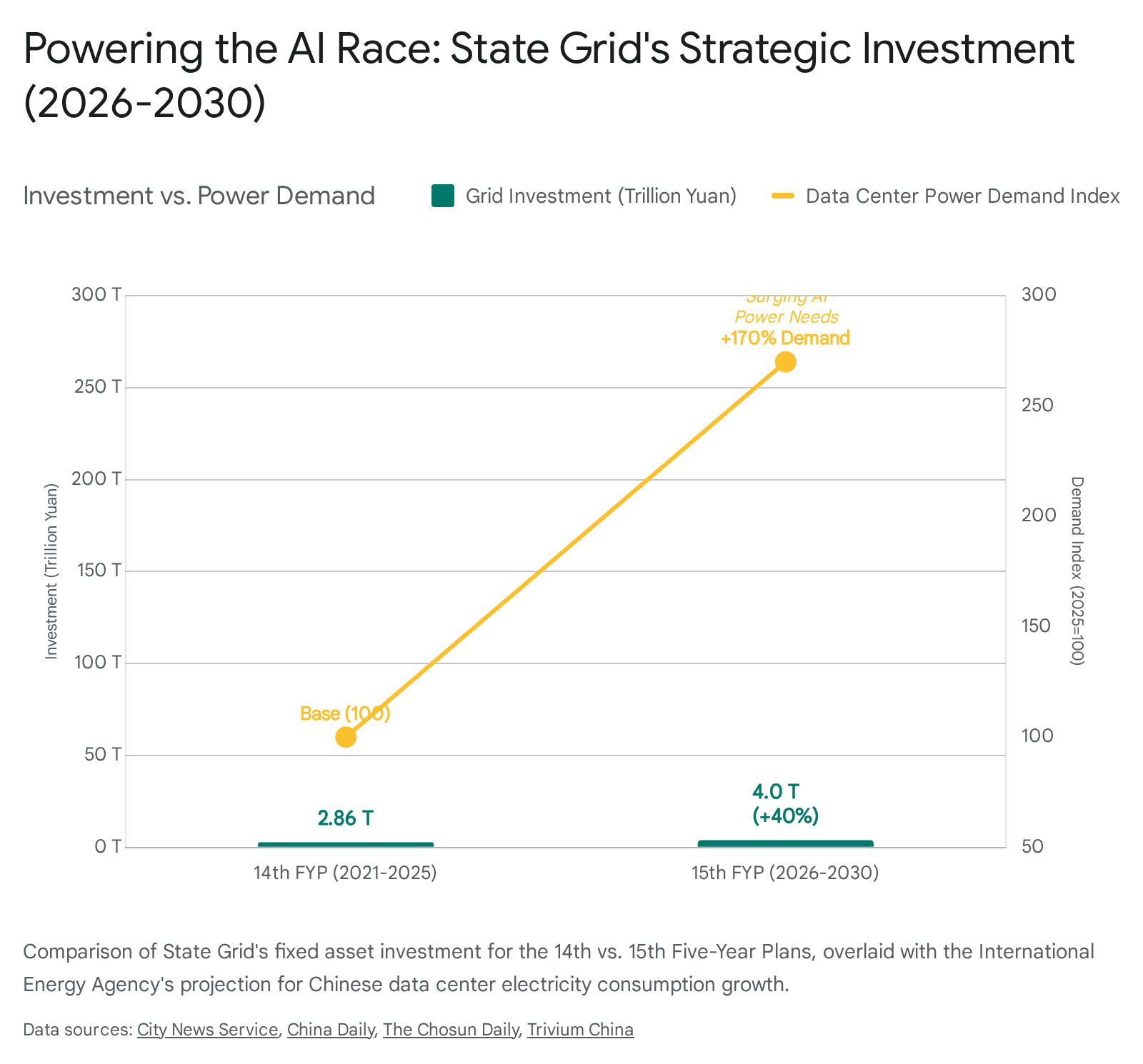
The State Grid Corporation of China (SGCC) unveiled a massive RMB 4 trillion (US$574 billion) investment plan for the 2026-2030 period. This capital injection is not merely a utility upgrade; it is a strategic counter-measure to US technology controls, designed to weaponize energy infrastructure in the global AI race.

Strategic Rationale:

The primary driver cited for this investment is the surging demand from AI data centers. The International Energy Agency estimates that China’s data center power consumption will increase by 170% over the next five years.

  • The “Energy Sovereignty” Thesis: Beijing recognizes that while it currently lags the US in advanced semiconductor lithography (due to export controls), it possesses a distinct advantage in infrastructure mobilization. The US and Europe face severe grid bottlenecks, permitting delays, and capacity shortages that threaten to stall AI deployment. By centrally directing massive capital into the grid (a 40% increase over the previous 5-year plan), Beijing aims to offer cheap, abundant, and green power as a comparative advantage for AI companies.
  • Execution: The plan targets adding 200GW of new renewable capacity annually and significantly expanding Ultra-High-Voltage (UHV) transmission lines to move power from the resource-rich west to the data-hungry east. This creates an environment where AI companies can operate less efficient chips (like Huawei’s Ascend series) at a lower total cost of ownership due to subsidized energy.4
China's State Grid investment vs. data center power demand, 2026-2030. Surging AI power needs, +170% demand.

4.2 The “Gate Two” Chip Control Mechanism

New intelligence on US-China technology flows reveals a sophisticated Chinese counter-move to US export controls, described by analysts as the “Gate Two” strategy.

  • US Action (“Gate One”): On January 15, the US Bureau of Industry and Security (BIS) released rules easing some controls on Nvidia H200 chips but imposing a 25% tariff and a rigorous “checking” requirement to prevent military diversion.
  • China’s Counter (“Gate Two”): Instead of rushing to acquire these chips, Beijing initiated “window guidance” on January 7, instructing tech firms to pause orders. On January 14, Chinese customs authorities began blocking H200 shipments at the border.
  • The Bundling Mandate: Reports indicate an emerging domestic policy requiring Chinese tech firms to bundle every purchase of Nvidia hardware with a corresponding purchase of 30-50% Huawei Ascend chips.
  • Assessment: This is a coerced import substitution strategy. By controlling the entry of US chips, Beijing forces domestic tech giants (Alibaba, Tencent, ByteDance) to subsidize the development of the domestic Huawei ecosystem. It transforms a US denial strategy into a Chinese “controlled decoupling” strategy, ensuring that US companies cannot dominate the market even if they are legally allowed to sell.47

4.3 Market Volatility & Regulatory Violence

  • National Team Outflows: The “National Team” (state-backed funds) triggered record outflows from ETFs, totaling approximately RMB 101 billion. This appears to be a calculated move to cool down a speculative rally and lock in profits to fund other state priorities (likely the grid investment or deficit plugs). It demonstrates that the stock market remains a policy tool for the state, not a market mechanism for price discovery.49
  • PDD “Fistfight”: The physical altercation between PDD Holdings (parent company of Temu) staff and State Administration for Market Regulation (SAMR) officials in Shanghai is highly symbolic of the current business climate. The clash occurred during a fraud investigation, resulting in the detention of executives. This event reflects the extreme pressure on private tech firms, which are being squeezed between aggressive growth targets (to survive deflation) and an increasingly predatory regulatory state looking for fines and compliance. The subsequent firing of PDD staff and the stock drop highlights the fragility of investor confidence in the face of arbitrary state power.11

5. DOMESTIC STABILITY: THE PRE-HOLIDAY PRESSURE COOKER

As the Lunar New Year (Year of the Snake) approaches, the traditional period of “social harmony” is being fractured by economic distress. The “social contract”—economic prosperity in exchange for political acquiescence—remains under severe strain as the slowdown bites into the working class.

5.1 Labor Unrest Surge

Intelligence tracking indicates a sharp rise in collective action incidents, particularly in the manufacturing and construction sectors. This wave of unrest is driven by the “sudden collapse” of factories due to weak demand and the looming threat of US tariffs.

Key Incidents:

  • Crocs and New Balance Strike: A massive strike involving over 6,000 workers occurred at a contract manufacturing facility supplying Crocs and New Balance. The workers were protesting drastically reduced wages and the cancellation of bonuses. The scale of the strike required the deployment of significant security forces to disperse the crowds, indicating the state’s fear of contagion.12
  • Construction Wage Arrears: Multiple protests have broken out at construction sites, including at the Jinjiang Alumina project in Indonesia (a Belt and Road Initiative project) and various domestic locations. Workers are demanding unpaid wages before the holiday migration. The export of labor unrest to BRI projects is a new vector of reputational risk for Beijing.54

State Response:

The response has been characterized by repression rather than mediation. Security forces were deployed to break the Crocs strike, and digital censorship has been ramped up to prevent videos of the protests from spreading on Douyin and Weibo. This indicates a “zero tolerance” approach to unrest ahead of the holidays, prioritizing order over grievance resolution.

5.2 Rural & Property Protests

  • Property Crisis: Despite the 5% GDP growth figure officially reported, the property sector remains a significant drag on stability. Homeowner protests continue over unfinished projects, with many citizens having lost their life savings in pre-sold apartments that will never be built.
  • Rural Dissent: Data from Freedom House indicates a 70% increase in rural protests. This suggests that the economic slowdown is now biting deep into the countryside, where the social safety net is weakest. The “return of the migrants” (millions heading home for LNY, potentially without full pay) risks exporting urban discontent back to rural areas, creating a volatile mix of unemployed youth and aggrieved farmers.56

5.3 Lunar New Year Migration

The Ministry of Transport expects record travel numbers for the upcoming Lunar New Year, with 9 billion interprovincial trips projected. However, this migration is occurring under a cloud of economic gloom. Many factories have closed early, forcing workers to return home weeks ahead of schedule, often without their full year-end pay. This “forced holiday” masks the true extent of unemployment and underemployment in the manufacturing sector.58

6. OUTLOOK & FORECAST (NEXT 7 DAYS)

Immediate Watchlist:

  1. The Purge Fallout: Monitor the PLA Daily and official channels for the formal announcement regarding General Zhang Youxia. A swift, publicly detailed announcement suggests Xi feels secure in his authority; a prolonged silence or vague statement suggests ongoing factional bargaining and instability within the CMC. Watch for further detentions in the Equipment Development Department (EDD) to see how deep the rot goes.
  2. Finland Visit (Jan 25-28): Assess if PM Orpo signs any substantial agreements or if the visit is purely ceremonial. Any deviation from the “de-risking” EU line would be a win for Beijing and a further blow to transatlantic unity.
  3. SCS Reprisals: Expect the CCG to maintain a blockade stance at Scarborough Shoal to “punish” the Philippines for the collision narrative. A second incident is highly probable given the density of vessels and the aggressive ROE currently in place.
  4. Taiwan Airspace: Will the PLA repeat the Pratas drone incursion? If they do so over Kinmen or Matsu, or even closer to the main island, it would signal a calculated escalation ladder designed to test the “First Strike” definition of the Lai administration.

Strategic Horizon:

The dichotomy between Beijing’s external “peace” narrative and internal “war preparation” (purges, grid investment, blockade drills) is unsustainable in the long term. The leadership is racing to harden the country’s infrastructure—energy, chips, and military discipline—before the full weight of the Trump 2.0 administration’s economic containment hits. The “Canada Deal” buys them time and a loophole, but the fundamental trajectory remains one of deepening confrontation. The purge of General Zhang Youxia is the clearest signal yet that Xi Jinping is willing to break the system to fix it, prioritizing absolute control and war readiness above all else.

END OF REPORT

JISAT // JAN 2026

Works cited

  1. China’s top general under investigation in latest military purge, accessed January 24, 2026, https://www.ksat.com/news/world/2026/01/24/chinas-top-general-under-investigation-in-latest-military-purge/
  2. ‘Unprecedented purge’: China’s No. 1 general under investigation – why it matters, accessed January 24, 2026, https://timesofindia.indiatimes.com/world/china/unprecedented-purge-chinas-no-1-general-under-investigation-xi-jinping-zhang-youxia-why-it-matters/articleshow/127381318.cms
  3. China’s top general under investigation in latest military purge – ClickOnDetroit, accessed January 24, 2026, https://www.clickondetroit.com/news/world/2026/01/24/chinas-top-general-under-investigation-in-latest-military-purge/
  4. Weekend Buzz: 17-18 January 2026, accessed January 24, 2026, https://www.citynewsservice.cn/articles/china-biz-buzz/daily-buzz/weekend-buzz-17-18-january-2026-rkl58r7n
  5. Prime Minister Carney forges new strategic partnership with the People’s Republic of China focused on energy, agri-food, and trade, accessed January 24, 2026, https://www.pm.gc.ca/en/news/news-releases/2026/01/16/prime-minister-carney-forges-new-strategic-partnership-peoples
  6. A new era in Canada-China trade: Key tariff changes and industry impacts, accessed January 24, 2026, https://www.mltaikins.com/insights/a-new-era-in-canada-china-trade-key-tariff-changes-and-industry-impacts/
  7. Britain approves plans for China’s new London embassy – Xinhua, accessed January 24, 2026, https://english.news.cn/20260120/554da0fc15c54179899a15e3221da002/c.html
  8. News | Government backs China’s huge London Embassy, accessed January 24, 2026, https://www.costar.com/article/1991464038/government-backs-chinas-huge-london-embassy
  9. State Grid plans massive investments for 15th Five-Year Plan, accessed January 24, 2026, https://www.chinadaily.com.cn/a/202601/16/WS6969b2aea310d6866eb34243.html
  10. State Grid targets whopping RMB 4 trillion in infrastructure investment over next five years, accessed January 24, 2026, https://triviumchina.com/2026/01/16/state-grid-targets-whopping-rmb-4-trillion-in-infrastructure-investment-over-next-five-years/
  11. Fistfights erupt between China officials, PDD staff during audit – Jing Daily, accessed January 24, 2026, https://jingdaily.com/posts/fistfights-erupt-between-china-officials-pdd-staff-during-audit
  12. 6000 Chinese workers strike over drastically reduced wages at a Crocs and New Balance factory – China Labor Watch, accessed January 24, 2026, https://chinalaborwatch.org/6000-chinese-workers-strike-over-drastically-reduced-wages-at-a-crocs-and-new-balance-factory/
  13. Foreign Ministry Spokesperson Guo Jiakun’s Regular Press Conference on January 23, 2026, accessed January 24, 2026, https://bb.china-embassy.gov.cn/eng/fyrth/202601/t20260123_11844474.htm
  14. Davos 2026: Special Address by He Lifeng, Vice-Premier of the People’s Republic of China, accessed January 24, 2026, https://www.weforum.org/stories/2026/01/davos-2026-special-address-he-lifeng/
  15. Why cheap Chinese EVs may cost Canada more in the long run, accessed January 24, 2026, https://policyoptions.irpp.org/2026/01/carney-china-evs/
  16. UK approves China’s mega-embassy in London despite spying fears, accessed January 24, 2026, https://www.courthousenews.com/uk-approves-chinas-mega-embassy-in-london-despite-spying-fears/
  17. China & Taiwan Update, January 23, 2026 | ISW, accessed January 24, 2026, https://understandingwar.org/research/china-taiwan/china-taiwan-update-january-23-2026/
  18. Chinese Coast Guard Sustained Devastating DAMAGED | Blamed Philippines for Collision, accessed January 24, 2026, https://www.youtube.com/watch?v=3ja2nYHFIFc
  19. 2025 China Coast Guard and People’s Liberation Army Navy ship collision incident, accessed January 24, 2026, https://en.wikipedia.org/wiki/2025_China_Coast_Guard_and_People%27s_Liberation_Army_Navy_ship_collision_incident
  20. Taiwan records 26 PLA aircraft sorties, 6 PLAN vessels around its territory – Mid-day, accessed January 24, 2026, https://www.mid-day.com/news/world-news/article/taiwan-records-26-pla-aircraft-sorties-6-plan-vessels-around-its-territory-23613471
  21. Taiwan detects 11 PLA aircraft sorties, 5 PLAN vessels around its territory, accessed January 24, 2026, https://www.tribuneindia.com/news/world/taiwan-detects-11-pla-aircraft-sorties-5-plan-vessels-around-its-territory/
  22. Taiwan reports Chinese military activity near its territory – The Economic Times, accessed January 24, 2026, https://m.economictimes.com/news/defence/taiwan-reports-chinese-military-activity-near-its-territory/articleshow/118696496.cms
  23. China & Taiwan Update, January 2, 2026, accessed January 24, 2026, https://understandingwar.org/research/china-taiwan/china-taiwan-update-january-2-2026/
  24. Taiwan detects 20 sorties of Chinese aircraft in its territory – The Economic Times, accessed January 24, 2026, https://m.economictimes.com/news/defence/taiwan-detects-20-sorties-of-chinese-aircraft-in-its-territory/articleshow/120750267.cms
  25. Taiwan reports Chinese military activity with 8 PLAN vessels, 6 PLA aircraft sorties near its territory – The Economic Times, accessed January 24, 2026, https://m.economictimes.com/news/defence/taiwan-reports-chinese-military-activity-with-8-plan-vessels-6-pla-aircraft-sorties-near-its-territory/articleshow/125027927.cms
  26. Taiwan tracks 5 Chinese naval ships, 2 military aircraft | Taiwan News | Jan. 22, 2026 13:31, accessed January 24, 2026, https://www.taiwannews.com.tw/en/news/6287585
  27. Philippines claims Chinese Coast Guard injured fishers, damaged vessels with high-pressure hoses | SeafoodSource, accessed January 24, 2026, https://www.seafoodsource.com/news/supply-trade/philippines-claims-chinese-coast-guard-injured-fishers-damaged-vessels-with-high-pressure-hoses
  28. PH Maritime Council expects China to twist facts on latest collision in West PH Sea | ANC, accessed January 24, 2026, https://www.youtube.com/watch?v=FV51uZo3FVg
  29. Philippines Challenge ‘Monster’ China Coast Guard Cutter, U.S. Carrier Vinson Drills with Philippine Forces in South China Sea – USNI News – U.S. Naval Institute, accessed January 24, 2026, https://news.usni.org/2025/01/20/philippines-challenges-monster-china-coast-guard-cutter-u-s-carrier-vinson-drills-with-philippine-forces-in-south-china-sea
  30. HEADLINES: Philippines-China sea row heats up | Jan. 24, 2026 …, accessed January 24, 2026, https://www.manilatimes.net/2026/01/24/podcasts/headlines-philippines-china-sea-row-heats-up-jan-24-2026/2264447
  31. China, Philippines escalate rhetoric in South China Sea collision row – Al Jazeera, accessed January 24, 2026, https://www.aljazeera.com/news/2023/10/23/china-philippines-escalate-rhetoric-in-south-china-sea-collision-row
  32. BRICS joint maritime exercise codenamed “Will for Peace 2026”, accessed January 24, 2026, https://www.myanmaritv.com/news/brics-joint-maritime-exercise-codenamed-%E2%80%9Cwill-peace-2026%E2%80%9D
  33. BRICS wargames: Why they matter, why India opted out | Explainer News | Al Jazeera, accessed January 24, 2026, https://www.aljazeera.com/news/2026/1/11/brics-wargames-why-they-matter-why-india-opted-out
  34. The navies of China, Russia, and Iran concluded the Multinational Exercise Will for Peace 2026 in South Africa – Zona Militar, accessed January 24, 2026, https://www.zona-militar.com/en/2026/01/20/the-navies-of-china-russia-and-iran-concluded-the-multinational-exercise-will-for-peace-2026-in-south-africa/
  35. China firmly supports multilateralism, free trade: vice premier, accessed January 24, 2026, https://english.www.gov.cn/news/202601/21/content_WS69701dabc6d00ca5f9a08b11.html
  36. China extends support to UN-centered system over Trump’s ‘board of peace’, accessed January 24, 2026, https://www.aa.com.tr/en/americas/china-extends-support-to-un-centered-system-over-trump-s-board-of-peace-/3806340
  37. What to know about Trump’s “Board of Peace” as world leaders sign founding charter in Davos – CBS News, accessed January 24, 2026, https://www.cbsnews.com/news/trump-board-of-peace-what-to-know/
  38. Here are the countries joining Trump’s ‘Board of Peace’ so far, accessed January 24, 2026, https://www.cbc.ca/news/world/board-of-peace-gaza-trump-list-of-countries-9.7055866
  39. China pushes back on idea that Trump’s ‘board of peace’ might replace the UN – TRT World, accessed January 24, 2026, https://www.trtworld.com/article/2448791860cb
  40. China firmly upholds UN-centered intl system, says Chinese FM in response to Trump’s claim that ‘Board of Peace’ may replace UN – Global Times, accessed January 24, 2026, https://www.globaltimes.cn/page/202601/1353811.shtml
  41. ‘China will eat them up’: Trump slams Canada over pushback on ‘Golden Dome’ plan in Greenland, accessed January 24, 2026, https://timesofindia.indiatimes.com/world/us/china-will-eat-them-up-trump-takes-aim-at-canada-over-golden-dome-plan-in-greenland/articleshow/127352558.cms
  42. Prime Minister Orpo to meet with Chinese leadership in Beijing, accessed January 24, 2026, https://valtioneuvosto.fi/en/-/prime-minister-orpo-to-meet-with-chinese-leadership-in-beijing
  43. Foreign Ministry Spokesperson Guo Jiakun’s Regular Press Conference on January 22, 2026, accessed January 24, 2026, https://www.fmprc.gov.cn/eng/xw/fyrbt/202601/t20260122_11843590.html
  44. Finland’s leader set for 4-day China visit as Europe seeks to counter Trump pressure, accessed January 24, 2026, https://www.scmp.com/news/china/diplomacy/article/3341111/finlands-leader-set-4-day-china-visit-europe-seeks-counter-trump-pressure
  45. China & Taiwan Update, January 9, 2026 | ISW, accessed January 24, 2026, https://understandingwar.org/research/china-taiwan/china-taiwan-update-january-9-2025/
  46. Focus This Week: Sovereignty at Stake – January 9, 2026, accessed January 24, 2026, https://www.chinausfocus.com/s/focus-this-week/2026-01-09.html
  47. The Two-Gate Trap: $4.5 Trillion Positioned for a Market That No Longer Exists, accessed January 24, 2026, https://shanakaanslemperera.substack.com/p/the-two-gate-trap-45-trillion-positioned
  48. A Mixed Bag of Chips: Significant New Import and Export Changes for Advanced Semiconductors | Wilson Sonsini, accessed January 24, 2026, https://www.wsgr.com/en/insights/a-mixed-bag-of-chips-significant-new-import-and-export-changes-for-advanced-semiconductors.html
  49. CN ‘National Team’ ETF Outflows Set All-time High, accessed January 24, 2026, https://www.aastocks.com/en/stocks/news/aafn-news/NOW.1497017/2
  50. Global equity funds see record outflows as U.S., China withdrawals surge, TD Securities says By Reuters, accessed January 24, 2026, https://www.investing.com/news/stock-market-news/global-equity-funds-see-record-outflows-as-us-china-withdrawals-surge-td-securities-says-4462366
  51. Now is not the time to own bonds, says Bank of America. These are safer bets., accessed January 24, 2026, https://www.morningstar.com/news/marketwatch/20260123179/now-is-not-the-time-to-own-bonds-says-bank-of-america-these-are-safer-bets
  52. PDD Reportedly Facing Broader Probe in CN Following Physical Confrontation with Investigators Last Mth AASTOCKS Financial News, accessed January 24, 2026, https://www.aastocks.com/en/stocks/news/aafn-con/NOW.1497283/popular-news/AAFN
  53. Temu owner PDD fires dozens of workers after fistfight with China officials, accessed January 24, 2026, https://www.straitstimes.com/business/companies-markets/temu-owner-pdd-fires-dozens-of-workers-after-fistfight-with-china-officials
  54. Indonesia: ‘Hundreds’ of Chinese workers protest due to alleged wage theft at Jinjiang Alumina Integrated Industrial Park; incl. cos. non-responses – Business and Human Rights Centre, accessed January 24, 2026, https://www.business-humanrights.org/en/latest-news/indonesia-hundreds-of-chinese-workers-protest-due-to-alleged-wage-theft-at-jinjiang-alumina-integrated-industrial-park-incl-cos-non-responses/
  55. Chinese Construction Workers Strike Over Unpaid Wages at Nickel Smelting Project in Indonesia – China Labor Watch, accessed January 24, 2026, https://chinalaborwatch.org/chinese-construction-workers-strike-over-unpaid-wages-at-nickel-smelting-project-in-indonesia/
  56. Far more protests taking place in China than reported, trying to cover them invites frightening ordeal – Tibetan Review, accessed January 24, 2026, https://www.tibetanreview.net/far-more-protests-taking-place-in-china-than-reported-trying-to-cover-them-invites-frightening-ordeal/
  57. Dashed dreams and land grabs: The rise of rural protests in China – The Guardian, accessed January 24, 2026, https://www.theguardian.com/world/2025/dec/19/workers-rural-protests-china-land-grabs
  58. Millions in China head home for Lunar New Year in ‘record high’ migration – Al Jazeera, accessed January 24, 2026, https://www.aljazeera.com/gallery/2025/1/27/millions-in-china-head-home-for-lunar-new-year-in-record-high-migration
  59. China: Sudden layoffs & closures ahead of Lunar New Year leads to protests & migrant workers returning home early – Business and Human Rights Centre, accessed January 24, 2026, https://www.business-humanrights.org/en/latest-news/china-sudden-layoffs-closures-ahead-of-lunar-new-year-force-leads-to-protests-migrant-workers-returning-home-early-incl-cos-responses-non-responses/

Threat Assessment and Counter-Strategies for an Air-Sea Confrontation in the Western Pacific

A potential high-intensity conflict in the Western Pacific would represent the most significant military challenge for the United States in generations. It would not be a simple contest of platforms—ship versus ship or aircraft versus aircraft—but a fundamental confrontation between two opposing military philosophies, doctrines, and operational systems. The People’s Liberation Army (PLA) has spent three decades developing a comprehensive warfighting approach designed specifically to counter U.S. power projection. This approach is rooted in the concept of “Systems Confrontation” , a doctrine aimed at paralyzing an adversary’s entire operational architecture rather than attriting its forces piece by piece. This doctrine is operationalized through a formidable Anti-Access/Area Denial (A2/AD) fortress, a multi-layered network of sensors and long-range precision weapons intended to make the seas and skies within the First and Second Island Chains prohibitively dangerous for U.S. forces.

The U.S. response to this challenge is not to match the PLA system for system, but to counter with a doctrine based on resilience, agility, and networked lethality. The core tenets of this counter-strategy are Distributed Maritime Operations (DMO) and Joint All-Domain Command and Control (JADC2). DMO seeks to enhance survivability and combat power by dispersing naval forces over wide areas while concentrating their effects through networking. JADC2 is the technological and doctrinal framework intended to create a resilient, self-healing, “any sensor, any shooter” network that connects the entire joint force across all domains—sea, air, land, space, and cyberspace.

From a commander’s perspective, the central problem is how to maintain combat effectiveness and project power when faced with a PLA strategy explicitly designed to sever command and control (C2) linkages, hold high-value assets like aircraft carriers at extreme risk, and overwhelm conventional defenses with massed fires. In this environment, victory will not be determined by material superiority alone. It will be decided by which side can achieve and maintain “decision advantage”—the ability to sense, make sense, decide, and act faster and more effectively than the adversary across the entire battlespace. This assessment identifies the five most probable and impactful strategies a PLA commander will employ and outlines the corresponding U.S. operational responses required to seize the initiative and prevail.

Warfighting FunctionU.S. Doctrine/ConceptPLA Doctrine/Concept
Command & ControlJoint All-Domain Command & Control (JADC2)Systems Destruction Warfare / Informatized Warfare
Force EmploymentDistributed Maritime Operations (DMO)Anti-Access/Area Denial (A2/AD)
Strategic GoalEscalation Dominance / DeterrenceDissipative Warfare / Winning Without Fighting
Technological EdgeHuman-Machine Teaming / AI AugmentationIntelligentized Warfare / AI-Driven C2
Operational MethodIntegrated, All-Domain ManeuverConcentrated Kinetic Pulse / Annihilation by Mass

I. PLA Strategy 1: The System-Centric Opening Salvo – Paralyze Before You Annihilate

The Chinese Commander’s Approach: Systems Destruction Warfare in Practice

The PLA’s “basic operational method” for modern warfare is “Systems Confrontation,” a concept that views military forces not as collections of individual units but as integrated “systems of systems”. The PLA’s theory of victory, therefore, is “Systems Destruction Warfare,” which prioritizes fragmenting the adversary’s operational system into isolated, ineffective components, thereby achieving a state where the whole is less than the sum of its parts—making “1+1<2”. This doctrine, developed from meticulous observation of U.S. network-centric military victories in the 1990s, is designed to turn a core American strength—our reliance on information networks—into a critical vulnerability. The objective of the opening salvo is not annihilation but paralysis: to degrade the U.S. OODA (Observe, Orient, Decide, Act) loop, sow confusion, and achieve decision paralysis before the main kinetic battle is joined.

This initial assault will be a simultaneous, multi-domain attack targeting the central nervous system of U.S. forces in the theater. The PLA’s organizational reforms, particularly the 2015 creation of the Strategic Support Force (SSF) to unify space, cyber, and electronic warfare capabilities, provide concrete evidence that this is not an abstract theory but a core, operationalized warfighting concept. The attack vectors will include:

  • Cyber Domain: In line with its doctrine of “informatized warfare,” the PLA will execute a sophisticated campaign of offensive cyber operations. The primary targets will be the command and control networks that enable joint operations, as well as logistics databases and information systems architectures. The goal is to corrupt data, disrupt communications, and inject malware that degrades the reliability of the information upon which commanders depend, creating widespread confusion and mistrust in our own systems.
  • Space Domain: The PLA recognizes U.S. dependency on space-based assets for C4ISR, precision navigation, and timing. The opening moves of a conflict will almost certainly include attacks on this architecture. These attacks will be both kinetic, using anti-satellite (ASAT) missiles to physically destroy key nodes, and non-kinetic, employing jamming and cyberattacks to temporarily disable or deceive our satellites. The objective is to blind our long-range sensors and sever the satellite communication (SATCOM) links that are the backbone of our networked force, effectively isolating combatant formations from each other and from strategic command.
  • Electromagnetic Spectrum: A pervasive electronic warfare (EW) campaign will seek to establish dominance in the electromagnetic spectrum. Specialized aircraft, such as the J-16D, will be deployed to jam U.S. radars, datalinks like Link-16, and GPS signals. This creates a “complex electromagnetic environment” designed to degrade situational awareness, disrupt weapon guidance systems, and sever the tactical data links between platforms, preventing them from operating as a cohesive force.
  • Targeting Key Physical Nodes: This non-kinetic assault will be complemented by precision strikes against the physical infrastructure of our command and control system. Using their arsenal of conventional ballistic and cruise missiles, the PLA will target fixed, high-value C2 nodes such as regional Air Operations Centers, major headquarters, and critical communications hubs located on U.S. and allied bases throughout the theater.

U.S. Commander’s Response: JADC2 and Doctrinal Resilience

The U.S. counter to a system-centric attack is not to build an impenetrable shield, but to field a system that is inherently resilient, adaptable, and capable of operating effectively even when degraded. This is the core purpose of the Joint All-Domain Command and Control (JADC2) concept. JADC2 is not a single piece of hardware but an overarching approach to creating a secure, cloud-like environment for the joint force, enabling any sensor to connect to any shooter. The immediate operational priority is to fight through the initial salvo by assuming that some networks will fail and that communications will be contested.

  • Activating the Resilient Network: The JADC2 framework must be designed for failure. It cannot be a brittle, centralized system. It must incorporate redundant communication pathways, including line-of-sight datalinks, laser communications, and dispersed satellite constellations, to ensure that multiple routes exist for critical data. The principle is to create a “self-healing” network that can automatically re-route traffic around damaged or jammed nodes.
  • Decentralization and Edge Processing: A key enabler of resilience is the principle of decentralization, a core tenet of Distributed Maritime Operations. Commanders at the tactical edge must be trained and equipped to operate with mission-type orders, empowered to make decisions based on the commander’s intent even when cut off from higher headquarters. This requires “edge computing” capabilities, where data is processed and analyzed locally on ships and aircraft, allowing them to generate targeting solutions and continue the fight without constant connectivity to a central command node.
  • Leveraging Survivable Nodes: Stealth platforms are critical to this resilient architecture. An F-35, for example, is far more than a strike fighter; it is a flying sensor-fusion engine and a survivable, forward-deployed node in the JADC2 network. Operating within contested airspace, F-35s can use their passive sensors to collect vast amounts of intelligence on enemy dispositions, process that data onboard, and securely share it with other assets—both airborne and surface—to create a localized, ad-hoc battle network that can bypass jammed satellite links or compromised command centers.
  • Proactive Defense (“Defend Forward”): U.S. cyber forces will not be in a passive, defensive posture. In accordance with the “defend forward” doctrine, U.S. Cyber Command will be continuously engaged within adversary networks, seeking to understand their intentions, disrupt their C2 processes, and counter their offensive operations at or before the point of origin. This is a critical element of imposing friction and cost on the PLA’s system as they attempt to do the same to ours, turning the initial phase of the conflict into a contested cyber and electronic battle for information dominance.

II. PLA Strategy 2: The A2/AD Fortress – Forcing a Standoff

The Chinese Commander’s Approach: Operationalizing the “Keep-Out Zone”

The operational centerpiece of the PLA’s strategy is its Anti-Access/Area Denial (A2/AD) system. This is not a simple wall of defenses but a sophisticated, layered defense-in-depth designed to make military operations within the First and Second Island Chains prohibitively costly, thereby deterring U.S. intervention or defeating it if it occurs. The effectiveness of the A2/AD bubble does not rely on any single weapon but on the integrated “system of systems” that connects long-range sensors to long-range shooters. The entire kill chain—from detection and tracking to targeting and engagement—is the true center of gravity of this strategy. The PLA’s militarization of artificial islands in the South China Sea serves as a crucial geographic enabler, creating unsinkable forward bases that extend the reach of their sensor networks and missile coverage, creating overlapping fields of fire that are difficult to circumvent.

The A2/AD fortress is composed of distinct but overlapping layers of kinetic threats:

  • Long-Range Fires (Anti-Access): The outer layer is designed to prevent U.S. forces, particularly Carrier Strike Groups and air assets, from entering the theater of operations. This mission is primarily assigned to the PLA Rocket Force (PLARF). Its key systems include the DF-21D anti-ship ballistic missile (ASBM), with a range of approximately 1,500 km, and the DF-26 intermediate-range ballistic missile, dubbed the “Guam Killer,” with a range of at least 3,000 km. These weapons are designed to strike large, moving targets like aircraft carriers. This layer is increasingly augmented by hypersonic weapons, such as the DF-17, which carries a hypersonic glide vehicle (HGV). The extreme speed (Mach 5-10) and unpredictable, maneuvering trajectory of the HGV are designed to defeat existing U.S. missile defense systems like Aegis and THAAD.
  • Theater-Range Fires (Area Denial): The inner layers of the A2/AD bubble are designed to limit the freedom of action of any U.S. forces that manage to penetrate the outer screen. This involves a dense and redundant network of advanced anti-ship cruise missiles (ASCMs), such as the supersonic YJ-12 and the subsonic, sea-skimming YJ-18. These missiles can be launched from a wide variety of platforms, creating a multi-axis threat: from mobile land-based launchers, from H-6K bombers, from surface combatants like the Type 055 destroyer, and from submarines, including the Type 093 nuclear attack submarine.
  • The Protective IADS Umbrella: The PLA’s offensive missile forces are protected by one of the world’s most robust and modern Integrated Air Defense Systems (IADS). This system combines advanced Russian-made S-400 and S-300 long-range surface-to-air missile (SAM) systems with domestically produced systems like the HQ-9, HQ-22, and the newer, exo-atmospheric HQ-29 interceptor. This network of SAMs is linked by an extensive array of ground-based radars and airborne early warning and control (AEW&C) aircraft, such as the KJ-500A and KJ-600, giving it the capability to detect, track, and engage a wide spectrum of aerial threats, from cruise missiles to 5th-generation stealth aircraft.
System DesignationTypeEstimated Range (km)Launch PlatformsPrimary Role/Target
DF-26Intermediate-Range Ballistic Missile (IRBM)3,000+Transporter Erector Launcher (TEL)U.S. Carrier Strike Groups, U.S. Bases (Guam)
DF-21DAnti-Ship Ballistic Missile (ASBM)1,500-1,700TELU.S. Carrier Strike Groups
DF-17Medium-Range Ballistic Missile w/ HGV1,800-2,500TELHigh-Value U.S. Assets (Carriers, Bases, C2 Nodes)
YJ-18Anti-Ship Cruise Missile (ASCM)~540Type 055/052D Destroyers, SubmarinesU.S. Surface Combatants
YJ-12Supersonic ASCM~400H-6K Bombers, J-16 Fighters, DestroyersU.S. Surface Combatants
S-400 TriumfLong-Range Surface-to-Air Missile (SAM)40-400 (missile dependent)TELU.S. 4th/5th Gen Aircraft, Bombers, Support Aircraft
HQ-9CLong-Range SAM300+TELU.S. 4th/5th Gen Aircraft, Cruise Missiles

U.S. Commander’s Response: Multi-Domain Disintegration of the A2/AD Network

A direct, frontal assault on a mature A2/AD system would be prohibitively costly. The U.S. response must therefore be an indirect, multi-domain campaign designed to systematically dis-integrate the A2/AD network by attacking its critical nodes and severing the links of its kill chain. The goal is not to destroy the entire system at once, but to create temporary and localized corridors of air and sea control, allowing our forces to project power for specific objectives. This campaign will unfold in phases.

  • Phase 1: Blinding the Enemy. The initial focus will be on dismantling the A2/AD C3ISR architecture, rendering the PLA’s long-range shooters ineffective.
  • Subsurface Operations: Our nuclear-powered attack and guided missile submarines (SSNs and SSGNs) are our most survivable and potent assets for this phase. Operating undetected deep inside the A2/AD bubble, they will conduct covert intelligence, surveillance, and reconnaissance (ISR) to map the enemy’s network. They will then use their significant payload of Tomahawk Land Attack Missiles to execute precision strikes against critical C3ISR nodes, such as coastal over-the-horizon radar sites, satellite ground stations, and hardened command bunkers.
  • Penetrating Air Operations: Stealth aircraft are essential for creating the initial breaches in the formidable IADS. Long-range B-2 and B-21 bombers, escorted by F-22 Raptors providing air superiority, will prosecute the most heavily defended, high-value targets, such as S-400 batteries and key command centers. F-35s will leverage their advanced sensor suites to passively locate and map enemy air defense emitters, feeding this real-time data back into the JADC2 network to enable dynamic re-tasking and follow-on strikes by other assets.
  • Phase 2: Rolling Back the Threat. Once the IADS umbrella has been degraded in specific corridors, we can begin to attrit the PLA’s offensive missile launchers with a lower degree of risk.
  • Standoff Strikes: Carrier Strike Groups and land-based bombers, operating from safer standoff distances outside the densest threat rings, will launch large volleys of long-range, stealthy weapons like the Long Range Anti-Ship Missile (LRASM) and the Joint Air-to-Surface Standoff Missile (JASSM). These weapons will be used to destroy the now-exposed and less-defended mobile launchers for the DF-21D, DF-26, and ASCMs.
  • Non-Kinetic Suppression: Throughout these operations, EA-18G Growler electronic attack aircraft will provide crucial support. They will jam enemy early warning and fire control radars, disrupt communications between command posts and launch units, and protect our strike packages from residual air defense threats, further contributing to the dis-integration of the A2/AD network.

By executing this phased campaign, we can systematically dismantle the A2/AD fortress, creating breaches that allow for the projection of decisive combat power.

III. PLA Strategy 3: The Overwhelming Kinetic Pulse – Annihilation by Mass

The Chinese Commander’s Approach: The Decisive Attack

While the PLA has embraced sophisticated, system-centric warfare, this has not replaced its foundational belief in the importance of mass and annihilation. A core PLA tactical principle, influenced by both Soviet and historical Chinese military thought, is to concentrate overwhelming power at a decisive point and time to annihilate the enemy force—to “use ten against one”. The “Systems Destruction” opening is the shaping operation designed to isolate and weaken a U.S. force element, such as a Carrier Strike Group. The overwhelming kinetic pulse is the decisive operation intended to destroy that isolated element. By degrading the CSG’s long-range sensors and disrupting its datalinks, the PLA hopes to force it into a reactive, close-in fight where numerical superiority can be brought to bear with devastating effect.

A PLA commander will leverage the sheer size of the PLA Navy—the world’s largest by number of ships—and the PLA Air Force to execute a massive, coordinated, multi-axis saturation attack designed to overwhelm the defensive capacity of a CSG. This attack will be characterized by:

  • Massed Missile Strikes: The assault will involve synchronized volleys of missiles from every domain to complicate our defensive problem. This will include waves of H-6K bombers launching long-range ASCMs from the air ; Surface Action Groups led by Type 055 and Type 052D destroyers firing their own large complements of YJ-18 ASCMs ; and covert strikes from submarines, such as the Type 093 SSN, firing submerged-launched cruise missiles.
  • Contesting Air Superiority: The PLA’s J-20 stealth fighters will be tasked with a critical enabling mission: hunting and destroying U.S. high-value air assets. Their primary targets will not be our fighters, but our force multipliers: the E-2D Hawkeye AEW&C aircraft that act as the eyes and ears of the fleet, and the KC-135/KC-46 tankers that are the lifeline for our combat aircraft in the vast Pacific theater. The J-20, with its combination of stealth, speed, and long-range air-to-air missiles, is purpose-built for this “airborne sniper” role. In a less-contested environment, where stealth is not the primary concern, J-20s may be flown in “beast mode,” carrying additional missiles on external pylons to function as highly capable missile trucks.
  • Leveraging a Robust Industrial Base: The PLA commander will operate with the knowledge that China’s defense industrial base has a significantly greater capacity to replace losses in ships, aircraft, and munitions than the United States. This allows the PLA to plan for and accept a higher rate of attrition, potentially trading less-advanced platforms to exhaust our limited stocks of high-end defensive munitions.

U.S. Commander’s Response: The Integrated Defense of the Distributed Fleet

The U.S. counter to a strategy of annihilation by mass cannot be to simply absorb the blow. It must be to deny the PLA the opportunity to concentrate its forces against a single, high-value target. This is the central defensive logic of Distributed Maritime Operations.

  • DMO as a Counter to Saturation: By dispersing the fleet’s combat power across numerous manned and unmanned platforms over a wide geographic area, we fundamentally alter the PLA’s targeting problem. Instead of one lucrative target—the aircraft carrier—they are faced with dozens of smaller, more mobile, and harder-to-find targets. This forces them to divide their reconnaissance and strike assets, diluting the mass of their attack and preventing them from achieving overwhelming local superiority.
  • Layered, Coordinated Defense: The Carrier Strike Group, while operating as part of a distributed fleet, will still execute its well-honed “defense-in-depth” doctrine to defeat any incoming threats that leak through. This is a multi-layered, integrated system:
  • Outer Layer: The E-2D Hawkeye will detect incoming threats at long range and vector F/A-18 and F-35 combat air patrols to engage enemy bombers and fighters before they can launch their weapons.
  • Middle Layer: The Aegis Combat System on the CSG’s cruiser and destroyer escorts will track and engage incoming cruise missiles with long-range Standard Missiles (SM-6 and SM-2).
  • Inner Layer: For any missiles that penetrate the outer layers, terminal defense is provided by shorter-range missiles like the Evolved Sea Sparrow Missile (ESSM) and the Phalanx Close-In Weapon System (CIWS).
  • Concentrating Fires from Dispersed Platforms: DMO is not merely about scattering for survival; it is about networking these dispersed assets to concentrate lethal effects. Under the JADC2 framework, an Aegis destroyer operating 100 nautical miles from the carrier can receive targeting data from the carrier’s E-2D and launch its own SM-6 missiles to defend the carrier. Unmanned Surface Vessels (LUSVs), acting as remote, floating missile magazines, can be positioned to contribute to the defensive screen, increasing the fleet’s overall defensive capacity without putting more sailors at risk. This allows the fleet to absorb a larger attack by distributing the defensive burden across a wider array of platforms.
  • Protecting the Enablers: Recognizing the PLA’s strategy of targeting our high-value air assets, a dedicated contingent of our premier air superiority fighters, the F-22 Raptors, must be assigned to the counter-air mission of protecting our tankers and AEW&C aircraft. Their combination of stealth, supercruise, and advanced sensors makes them the ideal platform to establish a protective screen, actively hunting the PLA’s J-20s and other interceptors that threaten our operational backbone.

IV. PLA Strategy 4: The Dissipative Campaign – Attacking Will and Sustainment

The Chinese Commander’s Approach: Winning Without a Decisive Battle

Should a rapid, decisive victory prove elusive, the PLA is prepared to engage in a protracted conflict designed to erode U.S. operational endurance and political will. This approach is conceptualized in emerging PLA writings as “Dissipative Warfare”. Designed for the “AI era” and conducted under the shadow of nuclear deterrence, this strategy shifts the focus from physical attrition to systemic disruption. The goal is to continuously increase the “entropy,” or disorder, of the adversary’s entire warfighting system—military, political, economic, and social—while maintaining order and cohesion within one’s own. This form of warfare reduces the level of overt bloodshed but intensifies political isolation, economic blockades, and diplomatic strangulation. It is a strategy of patience and asymmetry, leveraging China’s centralized, authoritarian system against our decentralized, democratic one. The PLA is betting that it can win a war of endurance by making the cost of conflict politically unacceptable for the United States long before a decisive military outcome is reached.

The primary tools for this dissipative campaign are the PLA’s long-standing “Three Warfares” doctrine, which will be integrated with persistent, lower-intensity military operations :

  • Public Opinion Warfare: This involves a global information campaign to shape the narrative of the conflict. The PLA will seek to portray U.S. actions as aggressive, imperialistic, and illegitimate, while casting China as the defender of its sovereignty. The goal is to erode support for the war among the American public, create rifts between the U.S. and its allies, and garner sympathy from neutral nations.
  • Psychological Warfare: This campaign will directly target the morale and will to fight of U.S. forces, political leaders, and the public. It will employ sophisticated disinformation, amplify messages of defeatism and war-weariness, issue threats of devastating economic or military consequences, and use advanced technologies to manipulate perceptions and decision-making.
  • Legal Warfare (“Lawfare”): The PLA will use international and domestic legal systems to constrain U.S. military options and legitimize its own actions. This can include challenging the legality of U.S. operations in international forums, promoting interpretations of maritime law that favor China’s claims, and encouraging legal challenges within the U.S. system to slow or halt military deployments.
  • “Social A2/AD”: This broader concept describes how China’s non-military actions—such as creating economic dependencies, fostering political divisions, and conducting massive cyber espionage—are designed to fracture American society and compromise our national resolve. In a conflict, these pre-existing vulnerabilities would be exploited to degrade our capacity to mobilize and respond effectively, creating a form of A2/AD that targets our political will rather than our military platforms.

U.S. Commander’s Response: Contested Logistics and Counter-Coercion

To defeat a strategy of exhaustion, the United States must demonstrate the capacity and the will to endure. This requires a two-pronged response: first, ensuring the sustainment of our own distributed forces in a contested environment, and second, turning the dissipative strategy back against the PLA by targeting its own critical systemic vulnerabilities.

  • Sustaining the Distributed Force: A distributed fleet can only be effective if it can be sustained. A protracted conflict will place immense strain on our logistics train. We must therefore prioritize the development of a robust and resilient logistics network capable of rearming, refueling, and repairing a widely dispersed fleet under constant threat. This involves not only protecting our large, vulnerable supply ships but also fielding new, more survivable logistics platforms, such as the Medium Landing Ship (LSM) and smaller, more numerous oilers (TAOLs), which can service a distributed force without creating large, concentrated targets. Forward-basing of munitions and supplies at secure, dispersed allied locations will also be critical.
  • Turning the Tables: Exploiting China’s SLOC Vulnerability: The most effective way to counter a dissipative strategy is to impose unbearable costs and create systemic disorder within the adversary’s own system. China’s greatest strategic vulnerability is its profound dependence on maritime Sea Lines of Communication (SLOCs) for the importation of energy (oil and natural gas), raw materials, and food, as well as for its export-driven economy. Unlike the United States, which is largely self-sufficient, China’s economy and social stability are critically dependent on the free flow of maritime commerce. Furthermore, China’s economic centers of gravity are heavily concentrated along its vulnerable coastline.
  • A Campaign of Interdiction: The primary instrument for this counter-dissipative campaign will be the U.S. submarine force. Operating covertly and with near-impunity on the high seas, far from the PLA’s A2/AD bubble, our SSNs will conduct a sustained campaign of commerce raiding against Chinese-flagged merchant shipping. This campaign would not need to sink every ship; the mere presence of a credible threat would drive insurance rates to prohibitive levels, forcing ships to remain in port and effectively implementing a distant blockade. This would impose direct, crippling economic costs on the Chinese state, creating internal pressure, disrupting industrial production, and generating the very systemic entropy that their dissipative strategy seeks to inflict upon us.
  • Information Dominance: Concurrently, we must wage our own information campaign. This involves aggressively countering the “Three Warfares” by systematically exposing PLA disinformation, clearly articulating the legal basis for our actions under international law, and maintaining a strong, consistent narrative of defending a free and open international order. This is essential for solidifying allied cohesion and maintaining the domestic political will necessary to see the conflict through to a successful conclusion.

V. PLA Strategy 5: The Intelligentized Gambit – Seizing the Initiative Through Asymmetry

The Chinese Commander’s Approach: Seeking a Paradigm Shift

The PLA is not content to simply master the current paradigm of “informatized” warfare; its leadership is aggressively pursuing what they see as the next military revolution: “intelligentized warfare”. This concept is centered on the integration of artificial intelligence (AI), big data, and autonomous systems into every aspect of military operations. The ultimate goal is to achieve a decisive advantage in the speed and quality of decision-making, creating an AI-driven command and control system that can operate inside an adversary’s human-centric OODA loop, rendering their command structures obsolete. A PLA commander, confident in these emerging capabilities, might employ them to create an asymmetric shock, seeking to achieve a rapid victory or create unforeseen tactical dilemmas that shatter our operational plans.

While many of these capabilities are still developmental, a PLA commander could employ several “intelligentized” gambits:

  • Autonomous Swarms: The deployment of large, coordinated swarms of low-cost, attritable unmanned air and sea vehicles. Directed by a central AI, these swarms could be used to saturate the defenses of a high-value asset like a destroyer, conduct complex, distributed ISR missions, or act as decoys to draw out our limited defensive munitions.
  • AI-Driven Command and Control: The PLA is working towards an AI-powered battle management system that can fuse data from thousands of sensors in real-time, identify and prioritize targets, and automatically recommend the optimal engagement solution to commanders. A mature version of this system could shrink the PLA’s decision cycle from minutes to seconds, allowing them to execute complex, multi-domain attacks at a speed that human staffs cannot possibly match.
  • “Battleverse” and Synthetic Warfare: The PLA is exploring the concept of a “military metaverse” or “battleverse”. This virtual environment would be used to train AI algorithms on millions of simulated combat scenarios, allowing them to learn, adapt, and develop novel tactics that are non-intuitive and unpredictable to human opponents. This could lead to the employment of battlefield strategies that we have never seen or prepared for.
  • Advanced Human-Machine Teaming: PLA research includes concepts like “simulacrums”—humanoid or bionic robots controlled in real-time by human operators using brain-computer interfaces or other advanced controls. These could be used for dangerous tasks like special operations, damage control on stricken ships, or operating in chemically or radiologically contaminated environments, creating a new type of combat unit with unique capabilities and risk profiles.

The greatest danger posed by “intelligentized warfare” is not any single piece of hardware, but the potential for an AI-driven C2 system to achieve a speed of decision and action that makes our own command processes a critical liability. The conflict could transform into a battle of algorithms, where the side with the faster, more adaptive AI gains an insurmountable advantage. However, this also introduces the risk of “brittle” AI. A system trained on simulated data may perform brilliantly within its parameters but could fail catastrophically or act in bizarre, unpredictable ways when faced with the chaos and friction of real combat. A PLA commander, overly confident in their AI, might initiate an action based on a flawed algorithmic calculation that leads to rapid, unintended escalation that neither side can easily control.

U.S. Commander’s Response: Adaptive Force Employment and Escalation Dominance

The U.S. response to the “intelligentized” threat must be to embrace our own technological advantages while mitigating the unique risks posed by AI-driven warfare. It requires a combination of technological counter-measures, doctrinal flexibility, and a firm grasp of escalation management.

  • Human-Machine Teaming: The U.S. approach to AI in warfare must be to augment, not replace, the human commander. We will employ AI and machine learning as powerful tools to filter the massive volumes of data on the modern battlefield, identify patterns and threats, and present prioritized options to human decision-makers. This will accelerate our own OODA loop, allowing us to keep pace with an AI-driven adversary without sacrificing the crucial elements of human judgment, intuition, and ethical oversight.
  • Counter-AI Operations: We must develop and field capabilities designed specifically to defeat intelligentized systems. This includes advanced EW capabilities to jam the datalinks that coordinate drone swarms, rendering them ineffective. It also requires sophisticated cyber operations designed to attack the AI systems themselves—either by corrupting the training data they rely on (“poisoning the well”) or by exploiting algorithmic biases to manipulate their decision-making in our favor.
  • Empowering Subordinate Initiative (Mission Command): A rigid, centralized command structure is a death sentence in a high-speed, AI-driven battle. The U.S. must fully embrace the doctrine of mission command, empowering junior officers at the tactical edge to exercise disciplined initiative. Commanders must be trained to understand the overall intent of the operation and be given the freedom to adapt their actions to rapidly changing, unforeseen circumstances created by enemy AI, without waiting for permission from a higher headquarters. This doctrinal flexibility is a key asymmetric advantage against a more rigid, top-down command culture.
  • Maintaining Escalation Dominance: The ultimate backstop against a destabilizing, asymmetric “intelligentized” gambit is our ability to control the ladder of escalation. We must maintain and clearly signal a credible capability to respond to any level of attack with a response that imposes unacceptable costs on the PLA and the Chinese state. This ensures that the PLA commander always understands that the risks of deploying their most novel, unpredictable, and potentially destabilizing weapons far outweigh any potential tactical or operational reward, thereby deterring their use in the first place.

Conclusion: The Commander’s Synthesis – Achieving Decision Advantage

The strategic challenge posed by the PLA in the Western Pacific is formidable, built on a foundation of doctrinally coherent, technologically advanced, and multi-layered warfighting concepts. The PLA’s strategies—from the opening system-centric salvo to the potential for an “intelligentized” gambit—are designed to counter traditional U.S. military strengths and exploit perceived vulnerabilities in our networked way of war.

However, these strategies are not insurmountable. Victory in this modern, high-intensity conflict will not be achieved by winning a simple war of attrition or a platform-for-platform exchange. It will be achieved by winning the information and decision contest. The full and integrated implementation of Distributed Maritime Operations and Joint All-Domain Command and Control is the key to building a joint force that is more resilient, agile, lethal, and adaptable than the adversary. By achieving and maintaining “decision advantage,” the U.S. can seize the initiative, dictate the tempo of operations, and ultimately prevail.

For the U.S. commander tasked with this mission, five imperatives are paramount:

  1. Assume Day One is Degraded: We must train, equip, and plan for a conflict in which our space and cyber assets are under immediate and sustained attack. Our ability to fight effectively in a degraded C2 environment is a prerequisite for survival and success.
  2. Dismantle, Don’t Destroy: The focus of our initial campaign must be on the dis-integration of the enemy’s A2/AD system by targeting its C3ISR kill chain, rather than attempting to attrite every missile and launcher.
  3. Deny the Decisive Battle: We must use the principles of distribution and dispersal inherent in DMO to deny the PLA the force concentration it requires to execute its preferred strategy of a decisive battle of annihilation.
  4. Wage a Counter-Campaign: In a protracted conflict, we must actively target the adversary’s own systemic vulnerabilities. A sustained campaign to interdict China’s critical maritime SLOCs is our most potent tool for imposing unacceptable costs and winning a war of endurance.
  5. Out-Adapt, Don’t Just Out-Fight: We must embrace our own AI-enabled capabilities within a framework of human-machine teaming and foster a culture of mission command that empowers our forces to adapt faster than an adversary who may become overly reliant on rigid, AI-driven systems. By doing so, we can counter their gambits and maintain the initiative.

Please share the link on Facebook, Forums, with colleagues, etc. Your support is much appreciated and if you have any feedback, please email us in**@*********ps.com. If you’d like to request a report or order a reprint, please click here for the corresponding page to open in new tab.


Sources Used

  1. Systems Confrontation and System Destruction Warfare: How the Chinese People’s Liberation Army Seeks to Wage Modern Warfare | RAND, accessed October 3, 2025, https://www.rand.org/pubs/research_reports/RR1708.html
  2. PLA Reform and Systems Attack – Capstone, accessed October 3, 2025, https://capstone.ndu.edu/Portals/83/Wed%20-%20PLA%20Systems%20Attack%20-%20Saunders.pdf
  3. Systems Confrontation and System Destruction Warfare – RAND, accessed October 3, 2025, https://www.rand.org/content/dam/rand/pubs/research_reports/RR1700/RR1708/RAND_RR1708.pdf
  4. Anti-access/area denial – Wikipedia, accessed October 3, 2025, https://en.wikipedia.org/wiki/Anti-access/area_denial
  5. China’s A2/AD strategy – Fly a jet fighter, accessed October 3, 2025, https://www.flyajetfighter.com/chinas-a2-ad-strategy/
  6. Defense Primer: Navy Distributed Maritime Operations (DMO …, accessed October 3, 2025, https://www.congress.gov/crs-product/IF12599
  7. Defense Primer: Navy Distributed Maritime Operations (DMO) Concept – Congress.gov, accessed October 3, 2025, https://www.congress.gov/crs_external_products/IF/PDF/IF12599/IF12599.2.pdf
  8. Joint All-Domain Command and Control (JADC2) – Congress.gov, accessed October 3, 2025, https://www.congress.gov/crs_external_products/IF/PDF/IF11493/IF11493.10.pdf
  9. Summary of the Joint All-Domain Command and Control … – DoD, accessed October 3, 2025, https://media.defense.gov/2022/Mar/17/2002958406/-1/-1/1/SUMMARY-OF-THE-JOINT-ALL-DOMAIN-COMMAND-AND-CONTROL-STRATEGY.pdf
  10. SPECIAL REPORT: Joint All-Domain Command, Control A Journey, Not a Destination, accessed October 3, 2025, https://www.nationaldefensemagazine.org/articles/2023/7/10/joint-all-domain-command-control-a-journey-not-a-destination
  11. What You Should Know About China’s “Destruction Warfare” Doctrine – OODAloop, accessed October 3, 2025, https://oodaloop.com/analysis/ooda-original/what-you-should-know-about-chinas-destruction-warfare-doctrine/
  12. Political Warfare against Intervention Forces – Air University, accessed October 3, 2025, https://www.airuniversity.af.edu/JIPA/Display/Article/4167178/political-warfare-against-intervention-forces/
  13. Rightsizing the PLA Air Force: Revisiting an Analytic Framework – NDU Press, accessed October 3, 2025, https://ndupress.ndu.edu/Media/News/News-Article-View/Article/4244397/rightsizing-the-pla-air-force-revisiting-an-analytic-framework/
  14. Chinese information operations and information warfare – Wikipedia, accessed October 3, 2025, https://en.wikipedia.org/wiki/Chinese_information_operations_and_information_warfare
  15. Finding the Right Model: The Joint Force, the People’s Liberation Army, and Information Warfare – Air University, accessed October 3, 2025, https://www.airuniversity.af.edu/JIPA/Display/Article/3371164/finding-the-right-model-the-joint-force-the-peoples-liberation-army-and-informa/
  16. China’s Anti-Access/Area-Denial Strategy – TDHJ.org, accessed October 3, 2025, https://tdhj.org/blog/post/china-a2ad-strategy/
  17. People’s Liberation Army Air Force – Wikipedia, accessed October 3, 2025, https://en.wikipedia.org/wiki/People%27s_Liberation_Army_Air_Force
  18. Commander’s Toolkit: PLAAF – Air University, accessed October 3, 2025, https://www.airuniversity.af.edu/Portals/10/CASI/documents/Toolkit%20presentations/1%20CASI%20Commanders%20Toolkit-%20PLAAF.pdf
  19. Are there flaws in the US Navy’s distributed maritime operations? – Defense News, accessed October 3, 2025, https://www.defensenews.com/opinion/commentary/2023/01/23/are-there-flaws-in-the-us-navys-distributed-maritime-operations/
  20. Elevating Non-Kinetic Effects to Kinetic Reliability – Fed Gov Today, accessed October 3, 2025, https://fedgovtoday.com/innovation-in-govt/elevating-non-kinetic-effects-to-kinetic-reliability
  21. F-35 Lightning II | Lockheed Martin, accessed October 3, 2025, https://www.lockheedmartin.com/en-us/products/f-35.html
  22. F-35A Lightning II > Air Force > Fact Sheet Display – AF.mil, accessed October 3, 2025, https://www.af.mil/About-Us/Fact-Sheets/Display/Article/478441/f-35a-lightning-ii/
  23. Lockheed Martin F-35 Lightning II – Wikipedia, accessed October 3, 2025, https://en.wikipedia.org/wiki/Lockheed_Martin_F-35_Lightning_II
  24. Cyberwarfare and the United States – Wikipedia, accessed October 3, 2025, https://en.wikipedia.org/wiki/Cyberwarfare_and_the_United_States
  25. Command History – U.S. Cyber Command, accessed October 3, 2025, https://www.cybercom.mil/About/History/
  26. China’s Carrier Killer: Threat and Theatrics – Air & Space Forces Magazine, accessed October 3, 2025, https://www.airandspaceforces.com/PDF/MagazineArchive/Documents/2013/December%202013/1213china.pdf
  27. DF-21 – Wikipedia, accessed October 3, 2025, https://en.wikipedia.org/wiki/DF-21
  28. DF-21 (CSS-5) – Missile Threat – CSIS, accessed October 3, 2025, https://missilethreat.csis.org/missile/df-21/
  29. China’s DF-17 Hypersonic Weapon is the Ultimate Checkmate for …, accessed October 3, 2025, https://nationalinterest.org/blog/buzz/chinas-df-17-hypersonic-weapon-ultimate-checkmate-us-military-power-bw-092925
  30. China’s Hypersonic Weapons | GJIA – Georgetown University, accessed October 3, 2025, https://gjia.georgetown.edu/2021/01/27/chinas-hypersonic-weapons/
  31. China Latest Air Defence System: A Deep Dive into Advancement, accessed October 3, 2025, https://www.pw.live/defence/exams/china-latest-air-defence-system
  32. HQ-22 – Wikipedia, accessed October 3, 2025, https://en.wikipedia.org/wiki/HQ-22
  33. Nuclear submarine – Wikipedia, accessed October 3, 2025, https://en.wikipedia.org/wiki/Nuclear_submarine
  34. Diving Deep: 70-Plus Years of Nuclear-Powered Subs – War.gov, accessed October 3, 2025, https://www.war.gov/News/Feature-Stories/Story/Article/1736610/diving-deep-70-plus-years-of-nuclear-powered-subs/
  35. Submarine Facts, accessed October 3, 2025, https://www.sublant.usff.navy.mil/About-Us/Submarine-Facts/
  36. F-22 Raptor > Air Force > Fact Sheet Display – AF.mil, accessed October 3, 2025, https://www.af.mil/About-Us/Fact-Sheets/Display/Article/104506/f-22-raptor/
  37. Stealth aircraft – Wikipedia, accessed October 3, 2025, https://en.wikipedia.org/wiki/Stealth_aircraft
  38. Carrier strike group – Wikipedia, accessed October 3, 2025, https://en.wikipedia.org/wiki/Carrier_strike_group
  39. carrier strike groups: – the formation of seapower, accessed October 3, 2025, https://www.acibc.org/wp-content/uploads/2019/09/Strike-Group-Infographic.pdf
  40. What do we know about Chinese military culture and doctrine? The PLA is large and well equipped and used mainly for internal security. The last near peer war was fought against Vietnam in 1979 : r/WarCollege – Reddit, accessed October 3, 2025, https://www.reddit.com/r/WarCollege/comments/vf9sbz/what_do_we_know_about_chinese_military_culture/
  41. China’s J-20 Flying in ‘Beast Mode’ Again with Eight Air-to-Air Missiles – The Aviationist, accessed October 3, 2025, https://theaviationist.com/2025/09/29/china-j-20-beast-mode-again/
  42. J-20 Mighty Dragon vs. the World: 5 Strengths That Make China’s …, accessed October 3, 2025, https://nationalsecurityjournal.org/j-20-mighty-dragon-vs-the-world-5-strengths-that-make-chinas-stealth-jet-a-problem/
  43. Sustaining the Fight: Challenges of Distributed Maritime Operations, accessed October 3, 2025, https://centerformaritimestrategy.org/publications/sustaining-the-fight-challenges-of-distributed-maritime-operations/
  44. Dissipative Warfare: The PLA’s Potential New Strategy in the AI Era – Jamestown, accessed October 3, 2025, https://jamestown.org/program/dissipative-warfare-the-plas-potential-new-strategy-in-the-ai-era/
  45. Dissipative Warfare: The PLA’s Potential New Strategy in the AI Era – Indian Strategic Studies, accessed October 3, 2025, https://www.strategicstudyindia.com/2025/09/dissipative-warfare-plas-potential-new.html
  46. To Win without Fighting – Marine Corps University, accessed October 3, 2025, https://www.usmcu.edu/Outreach/Marine-Corps-University-Press/Expeditions-with-MCUP-digital-journal/To-Win-without-Fighting/
  47. Winning Without Fighting: The Chinese Psychological Warfare Challenge | The Heritage Foundation, accessed October 3, 2025, https://www.heritage.org/global-politics/report/winning-without-fighting-the-chinese-psychological-warfare-challenge
  48. Chinese Next-Generation Psychological Warfare – RAND, accessed October 3, 2025, https://www.rand.org/pubs/research_reports/RRA853-1.html
  49. Social Antiaccess/Area-Denial (Social A2/AD) – Marine Corps University, accessed October 3, 2025, https://www.usmcu.edu/Outreach/Marine-Corps-University-Press/MCU-Journal/JAMS-vol-12-no-1/Social-Antiaccess-Area-Denial-Social-A2-AD/
  50. Exploiting China’s Maritime Vulnerability | Proceedings – U.S. Naval Institute, accessed October 3, 2025, https://www.usni.org/magazines/proceedings/2023/april/exploiting-chinas-maritime-vulnerability
  51. The U.S. Needs an Integrated Approach to Counter China’s Anti-Access/Area Denial Strategy | The Heritage Foundation, accessed October 3, 2025, https://www.heritage.org/defense/report/the-us-needs-integrated-approach-counter-chinas-anti-accessarea-denial-strategy
  52. The Path to China’s Intelligentized Warfare: Converging on the …, accessed October 3, 2025, https://cyberdefensereview.army.mil/Portals/6/Documents/2024-Fall/Baughman_CDRV9N3-Fall-2024.pdf
  53. PLA’s Perception about the Impact of AI on Military Affairs*, accessed October 3, 2025, https://www.nids.mod.go.jp/english/publication/security/pdf/2022/01/04.pdf
  54. China Military Studies Review – Marine Corps University, accessed October 3, 2025, https://www.usmcu.edu/Outreach/Marine-Corps-University-Press/China-Military-Studies-Review/CMSR-2025-Understanding-Weishe/

Introduction: The Differences and Risks in U.S.-China Military Crisis Management and Response – National Bureau of Asian Research, accessed October 3, 2025, https://www.nbr.org/publication/introduction-the-differences-and-risks-in-u-s-china-military-crisis-management-and-response/

The Cognitive Contest: Deconstructing China’s ‘Military Brain’ and Forging America’s Path to AI Supremacy

The strategic competition between the United States and the People’s Republic of China (PRC) is increasingly defined by the race for artificial intelligence (AI) supremacy. This contest extends far beyond technological one-upmanship, representing a fundamental clash of military doctrines, organizational structures, and philosophical visions for the future of warfare. This report provides a comparative analysis of China’s multi-faceted military AI initiatives—collectively termed the “Military Brain”—and the United States’ efforts to secure a decisive technological edge. While the U.S. currently maintains a foundational lead in key technologies such as advanced semiconductors and aggregate computing power, China possesses a more cohesive, expansive, and arguably more revolutionary strategic vision. Beijing’s approach is not merely to field new weapons but to fundamentally alter the character of conflict, shifting the central arena from the physical battlefield to the cognitive domain. This presents a unique and asymmetric challenge that U.S. strategy, currently focused on achieving “decision advantage” within existing warfighting paradigms, is not yet fully configured to meet. Overcoming this requires the United States to not only accelerate its own technological integration but also to broaden its strategic vision to compete and win in the cognitive contest that has already begun.


I. Deconstructing the ‘China Military Brain’: From Cognitive Warfare to Intelligentization

The concept of a “China Military Brain” is not a single, monolithic program but rather a strategic constellation of advanced doctrine, ambitious technology projects, and novel operational concepts. It represents a “whole-of-society” endeavor aimed at achieving a revolutionary leap in military affairs, moving beyond the physical and informational to target the cognitive faculties of an adversary. This holistic vision is underpinned by a new warfighting paradigm, specific technological pursuits in brain-machine science, a focus on cognitive dominance, and a state-directed system for harnessing national innovation.

The Doctrine of Intelligentized Warfare (智能化战争): Charting the PLA’s New Paradigm

The People’s Liberation Army (PLA) is formally charting a new military paradigm centered on AI, viewing it as a historical shift on par with mechanization and informatization.1 PLA theorists conceptualize this evolution as a progression of military enhancement: mechanization extended the military’s “limbs,” informatization sharpened its “senses” (eyes and ears), and intelligentization will now augment its “brain”.4 This is not seen as a mere technological upgrade but as a fundamental change in the character of war.

Core to this doctrine is the concept of “intelligentized warfare” (智能化战争), which PRC writers describe as a new stage of conflict based on the extensive use of AI and autonomy, creating a hybrid of human and machine intelligence.1 This paradigm is built on three pillars: data, which is considered the “new oil”; algorithms, which will turn warfare into a contest between competing code; and massive computing power.5 In this vision, intelligent systems are expected to augment and, in some cases, partially replace human command functions to achieve unprecedented speed and efficiency.6

This doctrine extends into highly advanced theoretical constructs. One such concept, articulated by China’s Ministry of Defense, is “Dissipative Warfare” (耗散战). This framework views future conflict as a comprehensive, integrated confrontation across the physical, information, and cognitive domains.7 It explicitly merges military offense and defense with political maneuvering, economic competition, and cultural conflict, shifting the strategic center of gravity from an adversary’s military forces to its entire social system.7 This reveals a holistic approach to national power where victory is achieved by inducing systemic collapse in an opponent.

The ultimate culmination of this thinking is what PLA theorists call “Meta-War” (元战争). This concept links the physical battlefield with a parallel virtual battlefield and, most critically, the “brain battlefield” (头脑战场) of human perception and cognition.2 In this framework, human soldiers and their weapons function as “dual entities,” existing simultaneously in the physical world and as digital twins in a virtual space, able to switch between these realities to simulate, predict, and engage in combat.2

The China Brain Project (中国脑计划): The Technological Pillars

The technological heart of this strategic vision is the “China Brain Project” (中国脑计划), a 15-year national initiative approved in 2016.9 Its structure is deliberately dual-use, described as “one body, two wings.” The “body” is the core scientific goal of understanding the fundamental principles of the human brain. The “two wings” represent the project’s co-equal applications: treating brain disorders and developing brain-machine intelligence technologies.10 This structure provides a benign, publicly acceptable facade for research that directly feeds advanced military capabilities. By framing half of the initiative around medical benefits, Beijing gains access to international scientific collaboration and talent that a purely military program could not, while its Military-Civil Fusion strategy ensures all breakthroughs are immediately evaluated for defense applications. This represents a strategically shrewd approach to pursuing paradigm-shifting asymmetric capabilities.

The project is focused on three key research areas:

  1. Brain-Inspired Artificial Intelligence (BI-AI, 类脑智能): This research seeks to move beyond current machine learning by emulating the actual neuronal functioning and architecture of the biological brain, not just mimicking its behavioral outputs. The goal is to create AI that is far more efficient and capable of the high-order tasks that humans perform effortlessly.9
  2. Connectomics (“Brain Mapping,” 人脑连接组): This involves the empirical and computational effort to map and replicate the brain’s complex structure and functioning. AI is used both to test the resulting simulations and to interpret the vast amounts of data generated from imaging brain sections.9
  3. Brain-Computer Interfaces (BCI, 脑机接口): This is the most direct military application, aiming to create high-bandwidth pathways between the human brain and external machines.9 PLA-affiliated writings describe using BCIs to allow soldiers to control drones and other robotic systems with their thoughts, to have their sensory perception augmented with digital sensor data (achieving “千里眼,” or thousand-mile eyes), and even to enable a form of battlefield “telepathy” for silent, covert communication in high-risk environments.2

Cognitive Domain Operations: The War for the Mind

Perhaps the most ambitious and potentially disruptive element of China’s strategy is its explicit focus on the cognitive domain. The ultimate goal is to achieve “mind dominance” 12 by “controlling the brain” of an adversary to subdue their will to fight, thereby realizing Sun Tzu’s ancient ideal of winning without a single battle (“不战而屈人之兵”).8

This effort is a supercharged extension of the PLA’s long-standing “Three Warfares” doctrine, which targets public opinion, psychological states, and legal frameworks.8 AI and big data are seen as the catalysts that can elevate these concepts to a new level of precision and scale. By harvesting and analyzing massive datasets on populations, the PLA aims to conduct cognitive warfare at a granular level, crafting influence operations at machine speed that are tailored to specific demographics, groups, or even key individuals to shape perceptions, sow discord, and disrupt societal cohesion.8

This ambition extends to the development of what U.S. intelligence and PLA writings refer to as “neuro-strike” or “brain-control weaponry” (脑控武器).13 While the technological maturity of such concepts is uncertain, the clear intent is to research capabilities that can directly interfere with human cognitive functions, disrupt leadership decision-making, and demoralize entire populations. This represents a profound asymmetric threat that seeks to bypass conventional military strength entirely.

Military-Civil Fusion (MCF): The Engine of Advancement

The engine driving this entire enterprise is China’s national strategy of Military-Civil Fusion (MCF, 军民融合). Personally overseen by Xi Jinping, MCF is a state-directed, whole-of-society effort to eliminate all barriers between China’s civilian research institutions, its commercial technology sector, and its military-defense industrial base.16 The explicit goal is to ensure that any and all national innovation, particularly in dual-use fields like AI, directly serves the PLA’s modernization.19

Under MCF, the PLA is able to leverage China’s unique advantages, including its vast, state-accessible data resources for training AI models 21, and to tap into the dynamism of its private technology companies.19 The strategy also facilitates the acquisition of foreign technology and expertise through a variety of means, both licit and illicit, including talent recruitment programs, academic collaboration, and outright theft.16 While MCF faces its own internal bureaucratic and cultural hurdles 23, its top-down, state-directed nature provides a powerful mechanism for mobilizing national resources toward a singular strategic goal, creating a stark contrast with the U.S. innovation model.


II. The American Pursuit of Decision Advantage

The United States’ approach to military AI is philosophically and structurally distinct from China’s. It is rooted in a more pragmatic, capability-focused vision aimed at empowering the human warfighter rather than fundamentally redefining the nature of war. This vision is being pursued through a massive networking initiative, foundational research programs focused on trustworthiness, and a unique public-private innovation ecosystem that is both a source of immense strength and significant friction.

The JADC2 Imperative: A Networked Vision of Warfare

The central organizing concept for the U.S. military’s AI-enabled future is the pursuit of “Decision Advantage”.25 The core premise is that in a future conflict against a peer adversary, victory will belong to the side that can most rapidly and effectively execute the decision cycle: sensing the battlefield, making sense of the information, and acting upon it.27

The primary vehicle for achieving this is Joint All-Domain Command and Control (JADC2). JADC2 is not a single weapon system but a broad, conceptual approach to connect sensors, platforms, and personnel from all branches of the military—Army, Navy, Air Force, Marines, and Space Force—into a single, unified, AI-powered network.29 The goal is to break down traditional service stovepipes and deliver the right information to the right decision-maker at the “speed of relevance,” enabling commanders to act inside an adversary’s decision cycle.27 This effort is being built upon service-specific contributions, including the Army’s Project Convergence, the Navy’s Project Overmatch, and the Air Force’s Advanced Battle Management System (ABMS).29 Recognizing the importance of coalition warfare, the concept is evolving into

Combined JADC2 (CJADC2), which aims to integrate the command and control systems of key allies and partners into this network architecture.31

The U.S. approach is thus focused on perfecting its existing doctrine of joint, all-domain operations by developing a new set of technological capabilities. Where China’s doctrine speaks of a new conceptual state of being (“intelligentized warfare”), the U.S. focuses on a measurable, operational outcome (“decision advantage”). This makes the U.S. vision more pragmatic and quantifiable, but also potentially less strategically ambitious than China’s revolutionary aims.

Foundational Programs: From Maven to DARPA’s Moonshots

The technological underpinnings of JADC2 are driven by several key initiatives. Project Maven, officially the Algorithmic Warfare Cross-Functional Team, has served as a critical pathfinder for operationalizing AI.33 Its initial focus was on applying machine learning and computer vision to autonomously detect and classify objects of interest from the massive volume of full-motion video and imagery collected by ISR platforms.34 Project Maven has demonstrated real-world utility, having been used to support the 2021 Kabul airlift and to provide intelligence to Ukrainian forces, proving its value in turning data into actionable intelligence.33

While Maven operationalizes existing AI, the Defense Advanced Research Projects Agency (DARPA) pushes the technological frontier. DARPA’s multi-billion-dollar “AI Next” campaign was designed to move the field beyond the limitations of current (second-wave) machine learning toward a third wave of AI capable of “contextual reasoning,” with the goal of transforming AI from a mere tool into a true partner for human operators.36 Building on this, the subsequent

“AI Forward” initiative has pivoted to address what the Department of Defense (DoD) sees as the most critical barrier to widespread adoption: the need for trustworthy AI.38 This effort focuses on developing AI that is explainable, robust, and reliable, with an emphasis on foundational theory, rigorous AI engineering, and effective human-AI teaming.38 This deep institutional focus on trust and explainability represents a core philosophical divergence from China’s approach, which prioritizes performance and political control.

The Public-Private Ecosystem: Harnessing Commercial Innovation

The U.S. military AI strategy relies heavily on leveraging the nation’s world-leading commercial technology sector, a stark contrast to China’s state-centric MCF model.21 Programs like Project Maven have been built through partnerships with private industry leaders such as Palantir, Microsoft, and Amazon Web Services.33 This model provides the DoD with access to cutting-edge innovation, a dynamic and competitive ecosystem, and a massive advantage in private R&D investment, which dwarfed China’s by nearly a factor of ten in 2023 ($67.2 billion vs. $7.8 billion).21

However, this reliance on the private sector also introduces unique challenges. The cultural and ethical divides between Silicon Valley and the Pentagon can create friction, as exemplified by the employee protests that led Google to withdraw from Project Maven.33 It necessitates new and flexible partnership models, such as the General Services Administration’s landmark agreement to provide OpenAI’s enterprise tools across the federal government, to bridge these gaps.42

Implementation Realities: The Hurdles to a Unified Network

Despite its technological strengths, the full realization of the JADC2 vision is hindered by significant, primarily non-technological, barriers. The central U.S. challenge is not a lack of innovation but a persistent difficulty with integration. The DoD’s vast, federated structure has proven resistant to the kind of top-down, unified approach that JADC2 requires.

Key implementation hurdles include:

  • Inter-service Stovepipes: Deep-seated cultural and budgetary divisions between the military services have led to each developing its own interpretation of JADC2, resulting in a lack of alignment, common standards, and true interoperability.43
  • Data Governance and Sharing: A pervasive culture of “data ownership” within individual services and agencies prevents the free flow of information that is the lifeblood of JADC2. Shifting to an enterprise-wide “data stewardship” model has proven to be a major cultural and policy challenge.43
  • Bureaucratic and Acquisition Inertia: The DoD’s traditional, slow-moving acquisition system is ill-suited for the rapid, iterative development cycles of software and AI. Overcoming this inertia and moving away from legacy systems is a persistent struggle.45
  • Over-classification: The tendency to over-classify information creates unnecessary barriers to sharing data both within the joint force and with crucial international partners, directly undermining the goals of CJADC2.44

Reports from the Government Accountability Office confirm that the DoD remains in the early stages of defining the detailed scope, cost, and schedule for JADC2, underscoring the immense difficulty of implementing such a sweeping vision across a complex and often fragmented organization.46 This reveals the core asymmetry of the competition: the United States excels at creating superior individual components but struggles to integrate them into a coherent whole, whereas China’s state-directed model is designed for integration but faces challenges in innovating those foundational components.


III. Comparative Assessment: A Tale of Two Visions

A direct comparison of U.S. and Chinese military AI efforts reveals a complex landscape of asymmetric advantages. The question of “who is more advanced” cannot be answered with a single verdict; rather, it requires a multi-layered assessment of technology, data, integration, and strategic vision. The two nations are not simply running the same race at different speeds; they are pursuing fundamentally different goals, driven by divergent philosophies of warfare and national power.

Who is More Advanced? A Multi-Layered Analysis

The leadership in military AI is contested and varies significantly depending on the metric of evaluation:

  • Foundational Technology (Advantage: USA): The United States maintains a decisive lead in the most critical enabling technologies. This includes a multi-generational advantage in high-end semiconductor design and fabrication, a critical bottleneck for China.48 Furthermore, the U.S. possesses a substantial lead in aggregate compute capacity, which is essential not only for training advanced AI models but also for deploying and integrating them at scale across the military enterprise.49 While Chinese models are rapidly closing the gap on performance benchmarks, America’s underlying hardware and systems integration capacity provide a more durable and comprehensive advantage.49
  • Data Resources (Advantage: China): China possesses a significant advantage in the sheer volume of data available for training AI models. Its large population, centralized data collection systems, and lax privacy regulations create a vast reservoir of information, particularly for developing surveillance and recognition algorithms that have direct military applications in intelligence, surveillance, and reconnaissance (ISR) and automated targeting.21
  • Operational Integration and Procurement (Advantage: Contested/Leaning China): Analysis from the Center for Security and Emerging Technology (CSET) suggests the PLA has made “extraordinary progress” in procuring AI systems for combat and support functions, with annual spending estimated to be on par with that of the U.S. military.51 China’s state-directed MCF model may enable faster and more focused adoption of specific capabilities, such as drone swarms and autonomous undersea vehicles, compared to the bureaucratically encumbered U.S. JADC2 effort.50 However, some Chinese defense experts express their own concerns that the PLA remains behind the U.S. in fielding and effectively using AI-enabled systems, indicating this is a highly contested area.53
  • Doctrinal Absorption (Advantage: China): The PLA appears to be more deeply and holistically integrating AI-centric concepts into its highest levels of military doctrine and strategic thought.1 Concepts like “intelligentized warfare” are central to the PLA’s vision of the future. In contrast, the U.S. is still largely focused on fitting new AI capabilities into its existing doctrinal frameworks, wrestling with the organizational changes required for true transformation.46

Breadth and Logic of Vision: Holistic Transformation vs. Decisive Advantage

The most significant divergence lies in the scope and ambition of each nation’s strategic vision.

  • China’s Vision (Broader): China’s vision is a “whole-of-society” endeavor that is demonstrably broader and more holistic.20 It fuses military objectives with economic, political, and cognitive strategies, aiming not just for battlefield victory but for “mind dominance” and the systemic paralysis of an adversary.7 The logic is totalistic: to leverage every instrument of national power, amplified by AI, to achieve strategic goals and reshape the international order.15 Its primary strength is this top-down strategic alignment; its potential weakness is the rigidity and fragility inherent in a system dependent on a single point of political control.
  • U.S. Vision (More Focused): The U.S. vision is more focused, pragmatic, and centered on a military-operational problem: achieving “decision advantage” to win on the future battlefield.26 The logic is to use superior technology to sense, process, and act on information faster than an adversary, empowering human commanders to make better, quicker decisions.27 Its strength lies in its alignment with democratic values, its emphasis on human agency, and its ability to harness a dynamic commercial innovation base. Its primary weakness is its potential narrowness, which risks underestimating and failing to prepare for the broader cognitive and political dimensions of the competition that China is actively prioritizing.

The Ethical Divide: Political Control vs. Principled Responsibility

The ethical frameworks governing military AI in each country represent a fundamental and strategic point of contrast.

  • China’s Approach: The PLA’s primary ethical consideration is internal and political: how to reconcile the operational necessity of AI autonomy with the Chinese Communist Party’s (CCP) non-negotiable demand for absolute political control over all military assets.55 The PLA’s approach is highly pragmatic and opaque; “ethical” behavior is ultimately defined as that which aligns with Party guidance and maintains Party control.55 While China engages in international discussions on AI ethics, its core driver remains political reliability, not abstract principle.57
  • U.S. Approach: The DoD has publicly adopted a formal, principles-based framework for Responsible AI (RAI).59 This framework is explicitly grounded in pre-existing legal commitments, including the Law of War, and established ethical norms.60 It emphasizes concepts such as meaningful human control over lethal force, transparency, traceability, and accountability. The United States is actively promoting this framework on the world stage, seeking to establish it as a global standard for responsible military innovation.62

The question of which nation has the “best” or most logical vision is therefore contingent on one’s theory of future great power conflict. If that conflict remains primarily a contest of military force where the speed and precision of effects are decisive, the U.S. vision is well-calibrated. However, if future conflict is primarily a cognitive and political struggle where societal cohesion and the will to fight are the main targets, China’s doctrine is more explicitly designed for this reality. A truly resilient and logical strategy must be able to compete and win in both arenas. Currently, China’s vision is more comprehensive in its definition of the problem, creating a strategic imperative for the United States to broaden its own.

Table 1: Comparative Framework of U.S. and Chinese Military AI Strategies

AttributePeople’s Republic of ChinaUnited States
Overarching DoctrineIntelligentized Warfare / Meta-WarDecision Advantage / JADC2
Core VisionHolistic transformation of warfare; achieving “mind dominance”Empowering human decision-makers; achieving speed and precision
Key National ProgramChina Brain Project (BI-AI, BCI)DARPA AI Next / AI Forward (Trustworthy AI)
Organizational ModelMilitary-Civil Fusion (State-Directed)Public-Private Partnership (Commercially-Led)
Primary FocusCognitive domain, BCI, swarm autonomy, systems destructionNetworked C2, data fusion, human-machine teaming, ISR
Ethical FrameworkPragmatic; driven by the need for CCP political controlFormalized Responsible AI (RAI); driven by legal/ethical principles
Key StrengthsTop-down strategic alignment; rapid resource mobilization; vast data accessFoundational tech leadership (chips); superior compute; dynamic innovation ecosystem
Key WeaknessesTechnological chokepoints (chips); potential for systemic rigidity; the paradox of controlBureaucratic hurdles to adoption; inter-service stovepipes; integration challenges

IV. The Path Forward: A Five-Year Strategy for the United States

To counter China’s comprehensive strategy and secure a durable advantage in the AI era, the United States must pursue a multi-pronged strategy over the next five years. This strategy must address its primary internal weaknesses in integration while simultaneously expanding its asymmetric strengths and broadening its strategic vision to meet the full scope of the cognitive challenge.

Recommendation 1: Solidify the Foundations – Win the JADC2 Battle at Home

The most significant impediment to U.S. military AI dominance is the failure to effectively integrate its superior technological components. This internal challenge must be the first priority.

Actions:

  • Empower a JADC2 Authority: Establish a JADC2 “czar” or a fully empowered joint program office with genuine budgetary and requirements authority over the services’ JADC2-related programs. This body must be empowered to enforce common standards, break down stovepipes, and ensure true interoperability.43
  • Mandate Enterprise-Wide Data Sharing: The Secretary of Defense should issue a directive mandating a shift from a culture of “data ownership” to one of “data stewardship.” This must be enforced by a central DoD data governance body with the authority to compel services to make data assets visible, accessible, and intelligible across the joint force.43
  • Reform AI Acquisition: Aggressively expand the use of agile acquisition pathways, such as Other Transaction Authority (OTA), for all AI and software-intensive programs. This will create streamlined mechanisms to rapidly transition cutting-edge commercial innovation from the private sector to the warfighter, bypassing legacy bureaucratic hurdles.45

Recommendation 2: Expand the Asymmetric Advantage – Compute, Talent, and Alliances

The U.S. must widen its lead in the foundational elements of AI power where China remains most vulnerable and where the U.S. holds a distinct advantage.

Actions:

  • Dominate the Semiconductor Race: Double down on policies like the CHIPS and Science Act and coordinate with allies to not only onshore manufacturing but to accelerate R&D into next-generation semiconductor design and advanced packaging. The goal should be to maintain a multi-generational technological lead in the hardware that powers AI.21
  • Launch a National Defense AI Talent Initiative: Create a concerted national effort to attract and retain the world’s best AI talent. This should include streamlining security clearance processes for AI experts, establishing new talent exchange programs between the DoD and private industry, and reforming immigration policies to create a fast track for top-tier global AI researchers.16
  • Operationalize CJADC2 as a Diplomatic Priority: Elevate the “Combined” aspect of CJADC2 from a technical goal to a core diplomatic effort. This involves deepening collaborative AI R&D, establishing common data and ethical frameworks, and conducting regular, large-scale joint exercises with key allies (e.g., the Five Eyes, Japan, South Korea, and key NATO partners) to build a deeply integrated, networked coalition that China cannot replicate.31

Recommendation 3: Counter the Cognitive Threat

The U.S. must develop a comprehensive national strategy to defend against and deter China’s cognitive warfare operations, an area where current defenses are dangerously inadequate.

Actions:

  • Establish a National Cognitive Security Center: Create a new, inter-agency center co-led by the DoD, the Intelligence Community, and the Department of Homeland Security. Its mission would be to coordinate the detection, analysis, and countering of foreign, AI-driven disinformation and influence operations targeting the U.S. military and public.8
  • Spur Counter-Influence Technology: Launch a DARPA-led grand challenge to develop advanced, real-time technologies for detecting and attributing AI-generated deepfakes, synthetic media, and coordinated inauthentic behavior online.
  • Build Societal Resilience: Invest in public education and media literacy programs to inoculate the American populace against the divisive narratives that are the primary weapons of cognitive warfare, thereby strengthening the nation’s cognitive defenses from the ground up.

Recommendation 4: Beyond Decision Advantage – Crafting a Broader American Vision

To effectively compete with China’s holistic strategy, the U.S. must evolve its own military doctrine to formally recognize and address the broader dimensions of modern conflict.

Actions:

  • Develop a Doctrine for Integrated Cognitive-Domain Operations: The Joint Staff, in coordination with the National Security Council, should initiate a formal process to develop a U.S. doctrine for operations in the cognitive domain. This would recognize the human mind as a contested battlefield and articulate how the instruments of national power—diplomatic, informational, military, and economic (DIME)—can be integrated to defend against and conduct cognitive operations in a manner consistent with democratic principles.
  • This new doctrine must explicitly address the role of AI in both defending against and, where necessary and lawful, conducting influence and psychological operations to deter aggression and shape the strategic environment.

Recommendation 5: Weaponize Responsibility – Leveraging the Ethical High Ground

The U.S. commitment to Responsible AI should be transformed from a perceived constraint into a potent strategic advantage that distinguishes the U.S. and its allies from their authoritarian rivals.

Actions:

  • Lead on International Norms: Launch a major diplomatic initiative to build upon the U.S. Political Declaration on Responsible Military Use of AI, with the goal of making its principles the foundation for a binding international treaty or a widely adopted set of norms among the world’s democracies.62
  • Condition AI Sales and Transfers: In all foreign military sales and technology-sharing agreements involving AI-enabled systems, require partner nations to adopt and adhere to RAI principles as a condition of the transfer. This will help build a global military AI ecosystem based on U.S. standards of safety, ethics, and reliability.
  • Highlight the Authoritarian Contradiction: Use public diplomacy and strategic communications to consistently expose the fundamental weakness in China’s approach: the impossibility of guaranteeing safe, reliable, or ethical AI when a system’s ultimate arbiter is not objective law or principle, but the shifting political imperatives of the CCP.55

V. Conclusion

The contest for military AI supremacy between the United States and China is a competition between two profoundly different systems. The United States currently holds a critical advantage in foundational technology, talent, and innovation, but this lead is fragile. China’s broader, more cohesive, and more revolutionary strategic vision—which integrates technological development with a “whole-of-society” mobilization and a doctrine aimed at cognitive dominance—poses a long-term threat that cannot be countered by superior microchips alone.

China is preparing for a future war fought not just on land, at sea, and in the air, but in the virtual space of networks and the cognitive space of the human mind. The U.S., while building a formidable technological arsenal, is still primarily focused on winning a faster and more efficient version of the last war. The nation with the best vision for the future will not be the one with the single best algorithm, but the one that can most successfully integrate its technological prowess, its organizational structure, and its guiding principles into a coherent and resilient whole. The five-year strategy outlined in this report is designed to ensure that nation is the United States, by first fixing its critical internal integration challenges while simultaneously broadening its strategic vision to compete and win in every domain—physical, virtual, and, most decisively, cognitive.


Please share the link on Facebook, Forums, with colleagues, etc. Your support is much appreciated and if you have any feedback, please email us in**@*********ps.com. If you’d like to request a report or order a reprint, please click here for the corresponding page to open in new tab.


Sources Used

  1. PLA’s Perception about the Impact of AI on Military Affairs*, accessed October 4, 2025, https://www.nids.mod.go.jp/english/publication/security/pdf/2022/01/04.pdf
  2. The Path to China’s Intelligentized Warfare: Converging on the Metaverse Battlefield – The Cyber Defense Review, accessed October 4, 2025, https://cyberdefensereview.army.mil/Portals/6/Documents/2024-Fall/Baughman_CDRV9N3-Fall-2024.pdf
  3. 463. Intelligentization and the PLA’s Strategic Support Force – Mad Scientist Laboratory, accessed October 4, 2025, https://madsciblog.tradoc.army.mil/463-intelligentization-and-the-plas-strategic-support-force/
  4. 从多维视角看智能化战争- 解放军报 – 中国军网, accessed October 4, 2025, http://www.81.cn/jfjbmap/content/2022-07/07/content_319277.htm
  5. The PLA and Intelligent Warfare: A Preliminary Analysis | CNA, accessed October 4, 2025, https://www.cna.org/analyses/2021/10/the-pla-and-intelligent-warfare-preliminary-analysis
  6. 智能化战争并不遥远 – 求是, accessed October 4, 2025, https://www.qstheory.cn/llwx/2019-08/08/c_1124851802.htm
  7. 耗散战:智能化战争典型方式- 中华人民共和国国防部, accessed October 4, 2025, http://www.mod.gov.cn/gfbw/jmsd/16222934.html
  8. 547. Challenging Reality: Chinese Cognitive Warfare and the Fight to Hack Your Brain, accessed October 4, 2025, https://madsciblog.tradoc.army.mil/547-challenging-reality-chinese-cognitive-warfare-and-the-fight-to-hack-your-brain/
  9. China’s “New Generation” AI-Brain Project > National Defense …, accessed October 4, 2025, https://ndupress.ndu.edu/Media/News/News-Article-View/Article/2846343/chinas-new-generation-ai-brain-project/
  10. Neurotechnology for National Defense: the U.S. and China – The …, accessed October 4, 2025, https://www.thecipherbrief.com/column_article/neurotechnology-for-national-defense-the-u-s-and-china
  11. 脑机接口的军事前景-瞭望周刊社, accessed October 4, 2025, https://lw.xinhuanet.com/20241021/8a1493f85c7249819ea1299c747f7bd2/c.html
  12. China’s mysterious Brain Project aims to turn science fiction into a reality – YouTube, accessed October 4, 2025, https://www.youtube.com/watch?v=L6ch9zs-ic0
  13. 脑控武器:亦真亦幻有点“玄” – 解放军报- 中国军网, accessed October 4, 2025, http://www.81.cn/jfjbmap/content/2018-06/01/content_207604.htm
  14. 攻击中国研发“脑控武器” 美制裁12家中国科研机构 – 新浪军事, accessed October 4, 2025, https://mil.sina.cn/zgjq/2021-12-17/detail-ikyamrmy9526429.d.html
  15. 报告:中国军方在脑部”神经打击”武器领域领先全球 – Radio Free Asia, accessed October 4, 2025, https://www.rfa.org/mandarin/Xinwen/8-07072023153947.html
  16. Military-Civil Fusion – State Department, accessed October 4, 2025, https://www.state.gov/wp-content/uploads/2020/05/What-is-MCF-One-Pager.pdf
  17. The Chinese Communist Party’s Military-Civil Fusion Policy – state.gov, accessed October 4, 2025, https://2017-2021.state.gov/military-civil-fusion/
  18. China’s Evolving Conception of Civil-Military Collaboration | Trustee China Hand – CSIS, accessed October 4, 2025, https://www.csis.org/blogs/trustee-china-hand/chinas-evolving-conception-civil-military-collaboration
  19. China Is Using the Private Sector to Advance Military AI | Center for Security and Emerging Technology, accessed October 4, 2025, https://cset.georgetown.edu/article/china-is-using-the-private-sector-to-advance-military-ai/
  20. SECTION 2: EMERGING TECHNOLOGIES AND MILITARY-CIVIL FUSION: ARTIFICIAL INTELLI- GENCE, NEW MATERIALS, AND NEW ENERGY, accessed October 4, 2025, https://www.uscc.gov/sites/default/files/2019-11/Chapter%203%20Section%202%20-%20Emerging%20Technologies%20and%20Military-Civil%20Fusion%20-%20Artificial%20Intelligence%2C%20New%20Materials%2C%20and%20New%20Energy.pdf
  21. The Artificial Intelligence Race: A US and China Comparison – Furt’Her, accessed October 4, 2025, https://www.furt-her.com/the-artificial-intelligence-race-a-us-and-china-comparison/
  22. Full article: Modernizing a giant: assessing the impact of military-civil fusion on innovation in China’s defence-technological industry – Taylor & Francis Online, accessed October 4, 2025, https://www.tandfonline.com/doi/full/10.1080/10242694.2025.2460458
  23. China’s Shift from Civil-Military Integration to Military-Civil Fusion – S. Rajaratnam School of International Studies, accessed October 4, 2025, https://www.rsis.edu.sg/wp-content/uploads/2022/05/Asia-Policy-16.1-Jan-2021-Richard-Bitzinger.pdf
  24. China’s Military-Civil Fusion Strategy: Development, Procurement, and Secrecy – National Bureau of Asian Research, accessed October 4, 2025, https://www.nbr.org/wp-content/uploads/pdfs/publications/ap16-1_china_mcf_rt_jan2021.pdf
  25. Modernizing Military Decision-Making: Integrating AI into, accessed October 4, 2025, https://www.armyupress.army.mil/Journals/Military-Review/Online-Exclusive/2025-OLE/Modernizing-Military-Decision-Making/
  26. DOD Releases AI Adoption Strategy – War.gov, accessed October 4, 2025, https://www.war.gov/News/News-Stories/Article/Article/3578219/dod-releases-ai-adoption-strategy/
  27. Summary of the Joint All-Domain Command and Control Strategy – DoD, accessed October 4, 2025, https://media.defense.gov/2022/Mar/17/2002958406/-1/-1/1/SUMMARY-OF-THE-JOINT-ALL-DOMAIN-COMMAND-AND-CONTROL-STRATEGY.pdf
  28. JADC2 Explained: Transforming Joint All-Domain Operations for Modern Warfare – Parraid, accessed October 4, 2025, https://www.parraid.com/jadc2-explained/
  29. Joint All-Domain Command and Control – Wikipedia, accessed October 4, 2025, https://en.wikipedia.org/wiki/Joint_All-Domain_Command_and_Control
  30. Joint All-Domain Command and Control (JADC2) – Congress.gov, accessed October 4, 2025, https://www.congress.gov/crs_external_products/IF/PDF/IF11493/IF11493.11.pdf
  31. Chief Digital and Artificial Intelligence Office > Initiatives > CJADC2, accessed October 4, 2025, https://www.ai.mil/Initiatives/CJADC2/
  32. Joint All-Domain Command and Control – JADC2 – SAIC, accessed October 4, 2025, https://www.saic.com/what-we-do/mission-it/jadc2
  33. Project Maven – Wikipedia, accessed October 4, 2025, https://en.wikipedia.org/wiki/Project_Maven
  34. Project Maven to Deploy Computer Algorithms to War Zone by Year’s End, accessed October 4, 2025, https://www.war.gov/News/News-Stories/Article/Article/1254719/project-maven-to-deploy-computer-algorithms-to-war-zone-by-years-end/
  35. Targeting the future of the DoD’s controversial Project Maven initiative – C4ISRNet, accessed October 4, 2025, https://www.c4isrnet.com/it-networks/2018/07/27/targeting-the-future-of-the-dods-controversial-project-maven-initiative/
  36. AI Next – DARPA, accessed October 4, 2025, https://www.darpa.mil/research/programs/ai-next
  37. DARPA’s Impact on Artificial Intelligence – AAAI Publications, accessed October 4, 2025, https://ojs.aaai.org/aimagazine/index.php/aimagazine/article/view/5294/7228
  38. AI Forward | DARPA, accessed October 4, 2025, https://www.darpa.mil/research/programs/ai-forward
  39. Summary of the 2018 Department of Defense Artificial Intelligence Strategy – DoD, accessed October 4, 2025, https://media.defense.gov/2019/feb/12/2002088963/-1/-1/1/summary-of-dod-ai-strategy.pdf
  40. AIQ: Artificial Intelligence Quantified – DARPA, accessed October 4, 2025, https://www.darpa.mil/research/programs/aiq-artificial-intelligence-quantified
  41. The Coming Military AI Revolution – Army University Press, accessed October 4, 2025, https://www.armyupress.army.mil/Journals/Military-Review/English-Edition-Archives/May-June-2024/MJ-24-Glonek/
  42. GSA Announces New Partnership with OpenAI, Delivering Deep Discount to ChatGPT Gov-Wide Through MAS, accessed October 4, 2025, https://www.gsa.gov/about-us/newsroom/news-releases/gsa-announces-new-partnership-with-openai-delivering-deep-discount-to-chatgpt-08062025
  43. Solving the Hidden Challenges of JADC2 – Booz Allen, accessed October 4, 2025, https://www.boozallen.com/insights/jadc2/solving-the-hidden-challenges-of-jadc2.html
  44. Integration Challenges Hinder JADC2 Implementation, Air Force Leaders Say, accessed October 4, 2025, https://govciomedia.com/integration-challenges-hinder-jadc2-implementation-air-force-leaders-say/
  45. Pathways to Implementing Comprehensive and Collaborative JADC2, accessed October 4, 2025, https://www.csis.org/analysis/pathways-implementing-comprehensive-and-collaborative-jadc2
  46. SPECIAL REPORT: Joint All-Domain Command, Control A Journey, Not a Destination, accessed October 4, 2025, https://www.nationaldefensemagazine.org/articles/2023/7/10/joint-all-domain-command-control-a-journey-not-a-destination
  47. Battle Management: DOD and Air Force Continue to Define Joint Command and Control Efforts | U.S. GAO – Government Accountability Office, accessed October 4, 2025, https://www.gao.gov/products/gao-23-105495
  48. US Chips Are Paving China’s Path to AI Superiority and There’s No Easy Fix – Defense One, accessed October 4, 2025, https://www.defenseone.com/technology/2022/07/us-chips-are-paving-chinas-path-ai-superiority-and-theres-no-easy-fix/368906/
  49. China’s AI Models Are Closing the Gap—but America’s Real Advantage Lies Elsewhere, accessed October 4, 2025, https://www.rand.org/pubs/commentary/2025/05/chinas-ai-models-are-closing-the-gap-but-americas-real.html
  50. China’s Pursuit of Defense Technologies: Implications for U.S. and Multilateral Export Control and Investment Screening Regimes – CSIS, accessed October 4, 2025, https://www.csis.org/analysis/chinas-pursuit-defense-technologies-implications-us-and-multilateral-export-control-and
  51. Report: China’s PLA has made ‘extraordinary progress’ in procuring …, accessed October 4, 2025, https://therecord.media/report-chinas-pla-has-made-extraordinary-progress-in-procuring-ai-for-combat
  52. U.S. and Chinese Military AI Purchases | Center for Security and …, accessed October 4, 2025, https://cset.georgetown.edu/publication/u-s-and-chinese-military-ai-purchases/
  53. China’s Military AI Roadblocks | Center for Security and Emerging Technology – CSET, accessed October 4, 2025, https://cset.georgetown.edu/publication/chinas-military-ai-roadblocks/
  54. PLA’s Intelligentized Warfare: The Politics on China’s Military Strategy*, accessed October 4, 2025, https://www.nids.mod.go.jp/english/publication/security/pdf/2022/01/05.pdf
  55. The PRC considers military AI ethics: Can autonomy be trusted …, accessed October 4, 2025, https://pmc.ncbi.nlm.nih.gov/articles/PMC9640938/
  56. The PRC considers military AI ethics: Can autonomy be trusted? – PubMed, accessed October 4, 2025, https://pubmed.ncbi.nlm.nih.gov/36387011/
  57. Position Paper of the People’s Republic of China on Strengthening Ethical Governance of Artificial Intelligence (AI), accessed October 4, 2025, https://www.mfa.gov.cn/mfa_eng/zy/wjzc/202405/t20240531_11367525.html
  58. Position Paper of the People’s Republic of China on Regulating Military Applications of Artificial Intelligence (AI), accessed October 4, 2025, https://docs-library.unoda.org/Convention_on_Certain_Conventional_Weapons_-SixthReview_Conference_(2021)/CCW-CONF.VI-WP.2.pdf
  59. Responsible Artificial Intelligence Strategy and … – DoD, accessed October 4, 2025, https://media.defense.gov/2024/Oct/26/2003571790/-1/-1/0/2024-06-RAI-STRATEGY-IMPLEMENTATION-PATHWAY.PDF
  60. Ethics and regulation of AI in defence technology: navigating the legal and moral landscape, accessed October 4, 2025, https://www.taylorwessing.com/en/interface/2025/defence-tech/ethics-and-regulation-of-ai-in-defence-technology
  61. Responsible AI Symposium – Translating AI Ethical Principles into Practice: The U.S. DoD Approach to Responsible AI – Lieber Institute, accessed October 4, 2025, https://lieber.westpoint.edu/translating-ai-ethical-principles-into-practice-us-dod-approach/
  62. Political Declaration on Responsible Military Use of Artificial Intelligence and Autonomy, accessed October 4, 2025, https://www.state.gov/political-declaration-on-responsible-military-use-of-artificial-intelligence-and-autonomy-2
  63. Battlefield Singularity | CNAS, accessed October 4, 2025, https://www.cnas.org/publications/reports/battlefield-singularity-artificial-intelligence-military-revolution-and-chinas-future-military-power

Enter the Battleverse: China’s Pursuit of Intelligentized Warfare in the Metaverse

This report provides a comprehensive intelligence assessment of the People’s Republic of China’s (PRC) strategic endeavor to develop a military-specific metaverse, termed the “battleverse” (战场元宇宙). Analysis of authoritative Chinese military-technical literature and procurement data indicates that this initiative is not a speculative or isolated technological pursuit, but a core component of the People’s Liberation Army’s (PLA) future warfighting doctrine and a key project within the PRC’s national “Digital China” (数字中国) grand strategy. The battleverse is the logical and necessary culmination of the PLA’s concept of “Intelligentized Warfare” (智能化战争), the designated successor to modern “informatized” conflict.

The PLA envisions the battleverse as a persistent, high-fidelity, virtual-real fused environment that will fundamentally revolutionize military operations across all domains. Its primary purpose is to enable the PLA to achieve “cognitive dominance” over an adversary by seamlessly integrating the physical, virtual, and cognitive (“brain battlefield”) dimensions of conflict. While the comprehensive battleverse remains a future objective, its foundational technologies—particularly Artificial Intelligence (AI) and Digital Twins—are being actively researched, developed, and procured. The most mature applications are currently in advanced training and simulation, where VR/AR systems and AI-driven “Blue Army” adversaries are enhancing training realism and accelerating tactical development.

Concurrently, the PLA is aggressively exploring advanced conceptual frameworks for “Meta-War,” a new form of conflict waged within and through the battleverse. These concepts include combat conducted by virtual avatars, by remotely operated robotic “simulacrums,” and by human soldiers who exist as “dual entities” in both the physical and virtual worlds. This theoretical work, combined with tangible technological progress, presents a significant long-term challenge to the military-technological superiority of the United States and its allies. The PLA’s approach is distinguished by its top-down, doctrine-driven integration and its exploration of higher levels of AI-driven autonomy, creating a potential divergence in the character of future warfare.

This report assesses the strategic drivers behind the battleverse, deconstructs its conceptual architecture, details its current and future applications, provides a comparative analysis with U.S. efforts, and evaluates the associated challenges and strategic implications. The PLA’s pursuit of the battleverse signals a determined effort to master a new form of warfare, one that could provide significant asymmetric advantages in a future conflict, particularly in a scenario involving Taiwan.

I. The Strategic Imperative: From Informatization to Intelligentization

The PLA’s ambition to construct a battleverse is not an ad-hoc reaction to a technological trend. It is the product of a deliberate, decades-long strategic modernization effort, guided by a clear doctrinal vision for the future of warfare and supported by a whole-of-nation grand strategy. Understanding this context is critical to appreciating the depth and seriousness of the battleverse initiative.

The PLA’s Three-Step Modernization Framework

The PLA’s contemporary modernization is structured around a three-phase strategic framework articulated by senior leadership, including PRC President Xi Jinping.1 These overlapping phases are mechanization, informatization, and intelligentization.1

  • Mechanization (机械化), the process of incorporating advanced machinery, vehicles, and conventional platforms, was the primary focus through the early 21st century and was intended to be largely completed by 2020.1
  • Informatization (信息化), the current phase, involves the introduction of networks, information systems, and data into all facets of military operations, from command and control (C2) and intelligence, surveillance, and reconnaissance (ISR) to cyber operations.1
  • Intelligentization (智能化), first formally mentioned in 2019, is the PLA’s vision for the future. While still pursuing the goals of informatization, the PLA is doctrinally and technologically pivoting toward this next phase, which it sees as a new Revolution in Military Affairs.1 Intelligentization is defined by the transformative impact of emerging technologies—specifically Artificial Intelligence (AI), big data, quantum computing, virtual and augmented reality (VR/AR), autonomous systems, and the Internet of Things (IoT)—on 21st-century warfare.1

Recent PLA writings explicitly describe the culmination of this intelligentization phase as leading to “Metaverse War” or “Meta-War,” making the battleverse a defining feature of this future conflict paradigm.1

Defining “Intelligentized Warfare” (智能化战争)

Intelligentized warfare is the PLA’s core warfighting theory for the 21st century. It represents a fundamental shift in the character of conflict, driven primarily by the maturation of AI.3 PLA theorists draw a clear distinction between this new stage and its predecessors based on the human functions they augment. Whereas mechanized warfare enhanced the physical capabilities of the soldier—their “hands and feet”—and informatized warfare enhanced their sensory capabilities—their “ears and eyes”—intelligentized warfare is conceived as enhancing the cognitive function of the commander and the force itself—the “brain”.6 This enhancement is to be achieved through advanced brain-computer interaction and AI-human teaming.6

The central tenets of this doctrine reveal why a battleverse is not merely useful, but essential:

  • Shift to Cognitive Dominance: The primary objective in intelligentized warfare shifts from achieving information superiority to seizing “cognitive dominance” (制智权).6 This is a more profound concept, focused on fundamentally disrupting, degrading, and manipulating the adversary’s decision-making processes. The goal is to render the opponent cognitively paralyzed, effectively turning them into an “idiot” in the battlespace, unable to process information or make sound judgments.6
  • Expansion of the Battlefield: The domains of conflict expand beyond the traditional physical realms of land, sea, air, and space. Intelligentized warfare explicitly incorporates the virtual space and, most critically, the “cognitive domain” or “brain battlefield” (头脑战场) of commanders, soldiers, and even national leaders as primary arenas for confrontation.1 Victory in the virtual and cognitive spaces is seen as a prerequisite for victory in the physical world.6

This doctrinal framework, with its focus on cognitive paralysis and the fusion of physical and non-physical domains, creates a clear and compelling military requirement for a persistent, integrated, virtual-real environment. The PLA is not simply adopting metaverse technology because it is available; it is pursuing the technology because its pre-existing theory of victory demands it. This doctrinal pull, rather than a simple technological push, indicates a far more deliberate and strategically integrated approach, suggesting that the battleverse concept is deeply embedded in the PLA’s long-term institutional planning.

Linkage to the “Digital China” Grand Strategy

The PLA’s military ambitions are inextricably linked to and enabled by a broader national strategy. The battleverse initiative is explicitly framed within PLA literature as a central component of the PRC’s societal transformation under the “Digital China” (数字中国) grand strategy.1 Described as the world’s first “digital grand strategy,” this whole-of-nation effort is personally championed by Xi Jinping and aims to “win the future” by achieving comprehensive digital supremacy.1

The “Digital China” strategy, which has roots in regional initiatives like “Digital Fujian” and “Digital Zhejiang” that Xi oversaw as a local leader, aims for the complete digital transformation of the PRC’s economy, governance, and society.8 In this context, the metaverse is seen as the next evolutionary stage of the internet and a critical new frontier for national power.9 By leading in its development, Beijing seeks to achieve several national objectives:

  • Technological Self-Reliance: Reduce dependency on foreign technology and establish “first-mover advantages” in a critical future industry.9
  • Economic Growth: Dominate what is expected to be a multi-trillion-dollar global market, further fueling China’s digital economy.9
  • Norm Shaping: Position the PRC to guide the development of international norms, standards, and governance structures for the metaverse.9
  • Sovereignty and Control: Extend state sovereignty into the virtual domain, ensuring the digital “spiritual home” of its citizens operates according to the Chinese Communist Party’s (CCP) principles.9

This national-level strategic alignment creates a powerful symbiotic relationship, a prime example of the PRC’s Military-Civil Fusion (军民融合) strategy. The PLA’s demanding requirements for a high-fidelity, secure, AI-driven battleverse provide a clear strategic direction and a lucrative market for China’s civilian tech sector, driving national innovation in critical areas like AI, 5G, VR hardware, and advanced computing.11 In turn, the rapid growth of the civilian tech sector, such as China’s massive domestic VR market (estimated at 44% of the global market by late 2020), provides the PLA with a broad, resilient, and innovative industrial and R&D base from which to draw technology and talent.11 This whole-of-nation symbiosis provides a formidable strategic tailwind for the battleverse project, granting it a level of national priority and resource allocation that a purely military-siloed program could not achieve.

II. Deconstructing the Battleverse: Concept, Architecture, and Key Technologies

The PLA’s concept of the battleverse has evolved rapidly from a nascent idea into a sophisticated theoretical construct for future warfare. It is envisioned not as a single piece of software, but as a comprehensive military ecosystem with a specific architecture and a foundation built on the convergence of several key emerging technologies.

Defining the “Battleverse” (战场元宇宙)

The term “battleverse” (战场元宇宙) first entered the PLA’s public discourse in a November 2021 article in the official PLA Daily.1 Initially, the concept was framed in a defensive, soft-power context. The article proposed using the metaverse to create immersive reconstructions of historical battles to vividly depict the horrors of war, thereby deterring conflict and stimulating a desire for peace among the civilian population.1

This narrative, however, pivoted with remarkable speed. Within a matter of months, by early 2022, the discussion in official military media had shifted decisively toward building a separate, secure, and highly militarized metaverse designed explicitly to win future intelligentized wars.1 This rapid evolution from a public-facing deterrence tool to a core warfighting concept is significant. Such a fundamental shift in the official military newspaper is unlikely to be accidental; it strongly suggests that an internal consensus was reached at a high level to prioritize and accelerate the development of the metaverse as a primary warfighting domain. The initial “deterrence” framing may have served as strategic misdirection for external audiences, or it may reflect a genuine but quickly superseded initial thought.

In its current conception, the military metaverse is defined as a new and comprehensive military ecosystem that integrates the virtual and real worlds.17 It is distinguished from its civilian counterparts by a set of unique military requirements, including:

  • High Security: The system must handle highly classified information, requiring robust security protocols far beyond those of commercial platforms.17
  • High Credibility: Simulations and models must be of extremely high fidelity, based on real-world physics and validated data, to be useful for training and operational planning.17
  • Identity Determinacy: Users have pre-determined and authenticated military identities (e.g., commander, pilot, logistics officer) with clear roles and permissions.17

The Concept of “Meta-War”

Flowing from the battleverse concept is the PLA’s theory of “Meta-War.” This is defined as a new type of military activity that leverages the battleverse’s technological capabilities to achieve the strategic objective of conquering an opponent’s will.1 The architecture of Meta-War is designed to link three distinct but interconnected battlefields 1:

  1. The Physical Battlefield: The traditional domain of land, sea, air, and space where kinetic actions occur.
  2. The Virtual Battlefield: The digital space within the battleverse where simulations, cyber operations, and virtual combat take place.
  3. The “Brain Battlefield” (头脑战场): The cognitive space representing the conscious perceptions, situational awareness, and decision-making processes of soldiers and commanders.

The core function of the battleverse in Meta-War is to fuse these three domains, allowing personnel to seamlessly switch between the real-world battlefield and a virtual parallel battlefield as needed. This enables them to engage in live combat, run complex simulations of future actions, and predict outcomes in a fully immersive environment, all in real-time.1

Core Enabling Technologies

The PLA’s vision for the battleverse is predicated on the successful convergence and integration of a suite of advanced technologies.

  • Digital Twins: This technology is the architectural linchpin of the entire battleverse concept. A digital twin is a high-fidelity, virtual replica of a physical asset, process, or even an entire environment that is continuously updated with real-time data from its real-world counterpart.17 The PLA defines it as a mapping in virtual space that reflects the full life cycle of a piece of physical equipment.18 It is the digital twin that bridges the virtual and the real. Without accurate, persistent, real-time digital twins of weapon platforms, sensors, infrastructure, and geographical terrain, the battleverse would be merely a sophisticated but disconnected simulation. The digital twin provides the essential data-driven foundation that allows for realistic training, predictive maintenance, logistics optimization, and credible mission rehearsal.18 The PLA’s progress in creating a functional battleverse can, therefore, be most accurately measured by its progress in developing and integrating digital twin technology across its forces.
  • Artificial Intelligence (AI): If the digital twin is the skeleton of the battleverse, AI is its brain. AI is envisioned to perform a multitude of functions: generating rich and dynamic virtual scenes, providing real-time battlefield object recognition, powering intelligent “Blue Army” adversaries, and offering intelligent-assisted decision-making support to commanders.3 Crucially, AI systems themselves are expected to be trained within the battleverse through processes of “self-play and confrontational evolution,” allowing them to become “strategists” for conquering the virtual cognitive space without human intervention.6
  • Extended Reality (XR): XR technologies—including Virtual Reality (VR), Augmented Reality (AR), and Mixed Reality (MR)—serve as the primary human-machine interface for the battleverse.1 VR headsets, AR glasses, and haptic feedback suits are the tools that will provide the immersive, “on-site feeling” for soldiers in training, commanders directing battles, or maintainers repairing equipment.17
  • Supporting Infrastructure: A robust technological foundation is required to support these core components. This includes high-bandwidth, low-latency networking (such as 5G and beyond) to transmit vast amounts of data between the physical and virtual worlds; advanced computing (cloud for data storage and processing, and potentially quantum for complex calculations) to run the simulations; and a ubiquitous Internet of Things (IoT) to provide the constant stream of sensor data needed to keep the digital twins synchronized with reality.1 PLA theorists also explicitly mention brain-computer interfaces (BCIs) as a potential future interface for controlling systems directly.1

III. Applications and Concepts of Operation: Waging “Meta-War”

The PLA’s development of the battleverse is not purely theoretical. It is pursuing a dual-track approach: actively implementing mature, battleverse-related technologies for near-term gains while simultaneously developing radical new concepts of operation for future, fully-realized “Meta-War.”

A. Current and Near-Term Applications (The “Practice”)

The most tangible progress in implementing battleverse technologies is evident in areas that offer immediate improvements to readiness, efficiency, and force development.

  • Training and Education: This is the most mature and widely documented application area. The PLA is leveraging immersive technologies to create training environments that are more realistic, repeatable, cost-effective, and safer than traditional methods.9
  • Skill-Based VR Training: The PLA has fielded VR systems for specific tasks, such as parachute training. These systems use virtual simulation and spatial positioning to expose new paratroopers to a range of aerial emergencies and unfamiliar environments in a risk-free setting, improving their real-world performance and adaptability.9 Similar systems are used for training operators of man-portable air-defense systems (MANPADS), allowing them to practice engaging diverse aerial targets like helicopters, cruise missiles, and fighter jets in a virtual environment.23
  • Tactical VR Training: More advanced systems are emerging for collective training. The “Wisdom Commando VR Training System,” developed by the state-owned China Electronics Technology Group Corporation (CETC), is a prime example. It uses VR helmets, haptic feedback suits, and simulated weapons to immerse a squad of soldiers in a virtual battlefield where they can train alongside both their real teammates and AI-powered virtual teammates. The system leverages key technologies like large-space positioning to allow free movement and machine learning algorithms to evaluate performance.20
  • Psychological Conditioning: The PLA is also exploring the use of VR to conduct wartime psychological training. The goal is to create hyper-realistic, high-stress virtual combat environments to better prepare soldiers for the psychological shock of real battle.24
  • Wargaming and Simulation (The “Blue Army”): The PLA has long used simulations for wargaming, but is now investing heavily in creating a next-generation, AI-driven “Blue Army”—the PLA’s term for a simulated adversary force, akin to a U.S. “Red Team”.25 The objective is to move beyond scripted, service-level simulations to a dynamic, all-element joint combat simulation platform. The AI-powered Blue Army is intended to perfectly mimic the command decision-making behavior and tactics of a potential adversary, allowing the PLA to rigorously test its own operational concepts, identify weaknesses, and discover “possible blind spots” at a pace and scale impossible in live exercises.25 This effort is augmented by research at institutions like Xi’an Technological University, where AI models like DeepSeek are being used to autonomously generate tens of thousands of potential battlefield scenarios in seconds, transforming simulation from a static, pre-programmed system into an “autonomously evolving intelligent agent”.26
  • Equipment R&D, Maintenance, and Logistics: Digital twin technology is the centerpiece of efforts to modernize the entire lifecycle of military equipment.
  • Research & Development: The PLA envisions using digital twins to dramatically shorten the R&D cycle for complex platforms like warships and aircraft.17 By creating and testing virtual prototypes in a realistic, simulated combat environment, engineers can validate designs, assess combat effectiveness, and identify flaws before any physical manufacturing begins, saving immense time and resources.17
  • Maintenance and Logistics: In the sustainment phase, a digital twin of a platform, continuously fed with real-world performance data, can enable predictive maintenance, anticipating part failures before they occur.18 In logistics, digital twins of supply chains and transportation networks can create a system of “intelligent war logistics,” allowing for a more flexible, on-demand, and resilient supply chain that can adapt to the dynamic needs of the battlefield.18
  • Procurement and Development Ecosystem: The PLA’s commitment is reflected in its procurement activities and the emergence of a specialized development ecosystem. Analysis of PLA procurement records reveals a clear focus on acquiring “smart” and “intelligent” systems, including augmented reality sandboxes for training and intelligent interactive control systems.28 A 2020 analysis showed significant purchasing in intelligent and autonomous vehicles and AI-enabled ISR, sourced from a diverse ecosystem of both traditional state-owned defense enterprises and smaller, non-traditional vendors.15 Specialized entities are also emerging, such as the “Digital Twin Battlefield Laboratory,” which offers bespoke R&D services, consulting, and the construction of digital twin test ranges, indicating a professionalization of the field.30

B. Future Combat Concepts (The “Theory of Meta-War”)

Beyond near-term applications, PLA strategists are developing highly advanced, and in some cases radical, theories for how a fully realized battleverse will change the nature of combat itself. These concepts are detailed in an article titled “Meta-War: An Alternative Vision of Intelligentized Warfare” and represent the PLA’s theoretical end-state for metaverse-enabled conflict.1

  • The Three Methods of “Meta-War”:
  1. “(Virtual) Clone/Avatar [分身] Combat in the Virtual World”: This form of combat takes place entirely within the digital realm of the battleverse. It encompasses activities like cyber warfare, psychological operations, and the manipulation of public opinion, conducted from behind the scenes to shape the battlespace before and during a conflict.1 On the virtual “front lines,” combatants would use avatars to conduct highly realistic pre-battle training, mission rehearsals, and simulated combat exercises.1
  2. “Simulacrum/Imitation [仿身] Combat in the Real World”: This concept describes real-world combat where human soldiers are replaced on the front lines by weaponized “simulacrums.” These are not fully autonomous robots but rather platforms—such as humanoid robots, bionic machines, or mechs—that are controlled in real-time by human operators from a safe distance.1 These simulacrums would carry the human operator’s perception and intent onto the battlefield, allowing them to perform dangerous and complex tasks. The control interfaces could include remote controls, tactile devices, or even direct brain-computer interfaces.1 This concept represents a pragmatic approach to the challenges of fully autonomous AI. Instead of waiting for a breakthrough in artificial general intelligence that can handle the complexities and ethical dilemmas of combat, this model uses the human brain as the advanced processor, effectively “teleporting” a soldier’s cognitive abilities into an expendable, physically superior machine. It leverages the unique strengths of both humans (adaptability, creativity, ethical judgment) and machines (speed, endurance, resilience) to field a highly capable semi-autonomous force in the near-to-mid term.
  3. “Incarnation/Embodiment [化身] Combat in Parallel Worlds”: This is the ultimate synthesis of the first two concepts, representing the full fusion of the real and virtual. In this mode of combat, human soldiers, their virtual avatars, and their controlled simulacrums would operate in unison across parallel realities.1 A human soldier and their weapon system would function as a “dual entity,” existing simultaneously in the physical world and as a digital twin in the virtual world. They would be capable of switching between and interacting across these realities. In this paradigm, victory might not be determined solely by physical destruction but by which side first achieves a critical objective in the virtual world, such as discovering a hidden key or disabling a virtual command node, which then translates to a decisive advantage in the real world.1
  • The Centrality of the “Brain Battlefield” (头脑战场): Underlying all three methods of Meta-War is the focus on the “brain battlefield”—the cognitive state of the adversary.1 The ultimate purpose of fusing the virtual and real is to create an environment where the PLA can manipulate the enemy’s perception of reality. By using highly deceptive information, injecting false virtual targets into an enemy’s augmented reality display, or creating confusing scenarios, the PLA aims to directly attack the enemy’s cognitive processes, interfering with their judgment, slowing their decision-making, and inducing fatal errors.10 This represents a profound doctrinal shift away from a primary focus on physical attrition. The goal of Meta-War is not just to destroy the enemy’s forces, but to achieve a state of cognitive paralysis, shattering their will and ability to fight by making them incapable of trusting their own senses and systems. A successful campaign might result in an enemy force that is physically intact but rendered completely combat-ineffective, achieving victory with potentially less kinetic violence.

IV. The Geopolitical Battlefield: U.S.-China Competition in the Military Metaverse

The PLA’s pursuit of a battleverse is not occurring in a vacuum. It is a central element of its broader strategic competition with the United States, which is pursuing its own, parallel efforts to develop next-generation synthetic training and operational environments. While there are technological similarities, a comparative analysis reveals significant divergences in strategic vision, doctrinal approach, and organizational structure.

China’s Approach: Top-Down, Doctrine-Driven, and Integrated

As previously established, the PLA’s battleverse initiative is a key component of a unified, top-down national and military strategy.1 This provides a coherent vision that integrates technological development with a pre-defined warfighting doctrine—”Intelligentized Warfare.” The explicit goal is to leverage these technologies to generate “asymmetric advantages” against the United States, which the PLA regards as a “strong enemy” and its primary strategic competitor.29 A defining feature of this approach is the PLA’s doctrinal willingness to explore higher levels of AI autonomy. PLA writings suggest a desire to remove the human soldier from certain decision-making loops where possible, believing that machine-driven speed can provide a decisive edge in achieving “decision dominance”.31

The U.S. Approach: Bottom-Up, Technologically Focused, and Federated

The United States does not use the term “battleverse,” but its armed services and research agencies are developing a suite of highly advanced capabilities that aim to achieve similar outcomes in training and operations.33 The U.S. effort, however, is more federated and appears to be driven more by technological opportunity than by a single, overarching new doctrine.

  • U.S. Army Synthetic Training Environment (STE): This is one of the Army’s top modernization priorities, designed to revolutionize training by converging live, virtual, constructive, and gaming environments into a single, interoperable platform.11 The STE is software-focused, leverages cloud computing, and is designed to be accessible to soldiers at their “point of need,” from home station to deployed locations.34 Its goal is to allow soldiers to conduct dozens of “bloodless battles” in a realistic virtual world before ever seeing combat.34
  • U.S. Air Force Digital Twin Programs: The U.S. Air Force is a global leader in the practical application of digital twin technology. Notable projects include the creation of a complete, engineering-grade digital twin of the F-16 Fighting Falcon to streamline sustainment, modernization, and repairs 38, and the development of a massive, installation-scale digital twin of Tyndall Air Force Base in Florida. This virtual replica of the base is used to manage its multi-billion-dollar reconstruction after a hurricane, optimize planning, and run realistic security simulations, such as active shooter drills.39 These programs demonstrate a high level of maturity in deploying the foundational technology of any military metaverse.
  • DARPA Research: The Defense Advanced Research Projects Agency (DARPA) is pushing the technological frontier. Its programs are not only developing the building blocks of future synthetic environments but are also proactively researching defenses against the threats they might pose. Programs like Perceptually-enabled Task Guidance (PTG) are developing AI assistants that can guide personnel through complex physical tasks using augmented reality.41 More critically, there is a striking parallel between the PLA’s offensive cognitive warfare concepts and DARPA’s defensive research. The PLA is actively theorizing about using the metaverse to conduct cognitive attacks to “confuse the opponent’s cognition” and “mislead their decision-making”.10 In response, DARPA’s Intrinsic Cognitive Security (ICS) program is explicitly designed to build tactical mixed reality systems that can protect warfighters from precisely these kinds of “cognitive attacks,” such as “information flooding,” “injecting virtual data to distract personnel,” and “sowing confusion”.42 This indicates that U.S. defense planners are taking this threat vector seriously, and the competition is already well underway at the conceptual and R&D level. DARPA is, in effect, attempting to build the shield for a sword the PLA is still designing.

Comparative Analysis: Key Divergences

The competition between the U.S. and China in this domain is not a simple technology race but a clash of strategic philosophies. The U.S. appears to possess more advanced individual components and a more vibrant R&D ecosystem, but China’s top-down, integrated approach may allow for faster and more cohesive implementation of a unified vision. The strategic contest may hinge on which model proves more effective: the U.S. model of federated innovation and gradual integration into existing structures like Joint All-Domain Command and Control (JADC2), or China’s model of unified, doctrine-driven development.

The most critical point of divergence is the doctrinal approach to autonomy. U.S. military doctrine, policy, and ethics heavily prioritize a “human-in-the-loop” or human-machine teaming paradigm, where AI serves as an assistive tool to enhance, not replace, human decision-making.31 In contrast, PLA writings are more ambitious, exploring concepts of greater AI autonomy and explicitly discussing the potential advantages of removing the human from the decision-making process to achieve superior speed and “decision dominance”.31 This fundamental difference in philosophy could lead to two very different types of “intelligentized” forces in the future.

Table 1: Comparative Analysis of U.S. and PRC Military Metaverse Initiatives

FeatureU.S. Synthetic Training Environment (STE) & Related ProgramsPRC “Battleverse” (战场元宇宙)
Primary DoctrineJoint All-Domain Command and Control (JADC2); Human-Machine TeamingIntelligentized Warfare (智能化战争); Cognitive Dominance
Key ProgramsArmy STE, USAF Digital Twin (F-16, Tyndall AFB), DARPA research (ICS, PTG)CETC VR Systems, Digital Twin Battlefield Lab, AI-driven “Blue Army” Simulations
Technological FocusInteroperability, COTS integration, augmented reality (IVAS), cloud computingAI-driven autonomy, digital twins, VR immersion, brain-computer interfaces
Development StatusMultiple programs in advanced development and initial fielding (demonstrating high component maturity)Extensive conceptual work; foundational technologies in active development and procurement (demonstrating high strategic integration)
Approach to Autonomy“Human-in-the-loop” prioritized; AI as an assistive tool for human decision-makersExploration of higher degrees of AI autonomy; potential for machine-driven decision-making to gain speed

V. Assessment of Challenges, Vulnerabilities, and Strategic Implications

Despite the PLA’s ambitious vision and strategic commitment, the path to a fully functional battleverse is fraught with significant internal challenges and creates new strategic vulnerabilities. Realizing this complex ecosystem is a monumental undertaking, and its successful implementation has profound implications for regional security, particularly concerning a potential conflict over Taiwan.

Internal PLA Challenges

Chinese military experts and technical analysts are themselves candid about the significant barriers the PLA faces.

  • Technological and Integration Hurdles: The technical challenges are immense. In a comprehensive review of Chinese-language defense journals, PLA officers and defense industry researchers identified several key concerns. These include the ability to guarantee network and cyber security for such a complex system, the difficulty of maintaining robust communications in a high-intensity conflict, and the need to develop the high-end sensors required to feed the digital twins with accurate data.45 Integrating dozens of disparate, specialized AI systems from various vendors into a coherent, multi-domain “system of systems” is an enormous software and systems engineering challenge that no military has yet solved.46
  • Data and AI Trustworthiness: The entire concept of intelligentized warfare hinges on the reliability of data and the trustworthiness of AI. However, AI systems are notoriously vulnerable to flawed, biased, or maliciously manipulated input data, which can lead to catastrophic errors in judgment.46 Many Chinese experts express deep misgivings about deploying insufficiently trustworthy AI systems in lethal contexts, citing the risks of unintended escalation, civilian casualties, and friendly fire incidents.45 The inherent “black box” nature of some advanced AI models makes it difficult for human commanders to understand, verify, and ultimately trust their recommendations, a critical barrier to effective human-machine teaming.46
  • Systemic Vulnerability to Attack: The battleverse’s greatest strength—its hyper-connectivity and total integration—is also its greatest weakness. This creates a strategic paradox: while it promises unprecedented operational coherence, it also presents a systemic, single-point-of-failure vulnerability. PLA thinkers acknowledge that the algorithms and networks at the core of the battleverse are prime targets. A successful cyber or electronic attack that compromises the integrity of the battleverse’s data or manipulates its core algorithms could lead to a total loss of combat capability for the entire force.47 This suggests that a U.S. strategy should not necessarily be to build a mirror-image battleverse, but to develop the asymmetric capabilities required to disrupt, deceive, and disable the PLA’s version.
  • Ethical and Legal Dilemmas: The prospect of intelligentized warfare raises profound ethical and legal questions that Chinese strategists are beginning to grapple with. These include the morality of delegating life-and-death decisions to machines and the intractable problem of assigning legal accountability for war crimes committed by an autonomous system.48

Strategic Implications for the United States and Allies

The PLA’s development of a battleverse, even if only partially successful, will have significant strategic implications.

  • The Taiwan Scenario: The battleverse is a powerful tool for a potential Taiwan contingency. The PLA could leverage a high-fidelity digital twin of Taiwan and its surrounding environment to wargame an invasion scenario thousands of times, allowing them to meticulously test operational plans, identify weaknesses in Taiwan’s defenses, and perfect their joint force coordination at minimal cost and risk.18 This would enable the PLA to enter a conflict with a level of rehearsal and optimization previously unimaginable. Furthermore, the initial phase of an invasion could be non-kinetic, launched from within the battleverse. It could consist of massive, coordinated cyber, electronic, and cognitive attacks designed to paralyze Taiwan’s command and control, sow chaos and confusion, and degrade its will to fight before a single ship or plane crosses the strait.10 The battleverse also provides a new and potent platform for “gray zone” activities. In the years leading up to a potential conflict, the PLA could use the virtual space to conduct persistent, low-threshold operations against a digital twin of Taiwan—testing cyber defenses, mapping critical infrastructure, and running subtle cognitive influence campaigns, all below the threshold of armed conflict but effectively shaping the future battlefield.
  • Accelerated PLA Modernization: A functional battleverse would act as a powerful force multiplier for PLA modernization. It would create a virtual feedback loop, allowing the PLA to develop, test, and refine new technologies, tactics, and doctrine at a speed that cannot be matched by traditional, resource-intensive live exercises. This could dramatically shorten the timeline for the PLA to achieve its goal of becoming a “world-class” military capable of fighting and winning wars against a strong adversary.
  • Risk of Rapid Escalation: A key objective of intelligentized warfare is to accelerate the decision-making cycle (the OODA loop) to a speed that overwhelms an opponent. However, this reliance on AI-driven speed could have a destabilizing effect in a crisis. It could drastically shorten the time available for human deliberation and diplomacy, potentially leading to a rapid and unintended escalation from a regional crisis to a major conflict.46

Conclusion and Recommendations

The People’s Liberation Army’s pursuit of a military metaverse, or “battleverse,” is a serious, coherent, and long-term strategic endeavor that is deeply integrated with its national and military modernization goals. It is the designated operational environment for the PLA’s future warfighting doctrine of “Intelligentized Warfare.” While the vision of a fully fused virtual-real battlefield remains aspirational, and significant technical and systemic challenges persist, the conceptual groundwork is well-established, and foundational investments in enabling technologies like AI, digital twins, and VR are well underway. The most critical divergence from Western military development lies in the PLA’s doctrinal embrace of AI-driven autonomy and its explicit focus on achieving victory through cognitive dominance.

Over the next five years, the PLA will likely field advanced, networked VR/AR training and large-scale simulation systems across all services, significantly improving training realism, joint operational proficiency, and tactical development speed. Within a decade, it is plausible that the PLA will be experimenting with integrated “Meta-War” concepts in major exercises, fusing digital twin environments with live forces and testing rudimentary “simulacrum” platforms under direct human control. This trajectory presents a formidable challenge that requires a proactive and multi-faceted response from the United States and its allies.

Based on this assessment, the following recommendations are offered for the U.S. intelligence community, the Department of Defense, and associated policymakers:

  1. Prioritize Intelligence Collection on PLA Digital Twin Development: Intelligence collection and analysis should shift from a primary focus on individual hardware procurement to tracking the PLA’s progress in developing and integrating high-fidelity digital twins. Monitoring the creation of virtual replicas of key platforms (e.g., aircraft carriers, advanced destroyers, 5th-generation aircraft) and strategic locations (e.g., Taiwan, Guam, key U.S. bases in the Indo-Pacific) will serve as the most accurate barometer of the PLA’s true battleverse capability and its operational readiness for specific contingencies.
  2. Invest in “Red Team” Cognitive and Algorithmic Warfare Capabilities: The Department of Defense should fund and prioritize the development of offensive capabilities designed specifically to target the inherent vulnerabilities of a centralized, hyper-networked battleverse architecture. This includes advanced research in data poisoning, algorithm manipulation, network deception, and cognitive attacks designed to sow mistrust between PLA operators and their AI systems. The goal should be to develop the means to turn the battleverse’s greatest strength—its integration—into a critical vulnerability.
  3. Accelerate and Integrate U.S. Synthetic Environment Efforts: While maintaining a firm doctrinal commitment to human-centric command and control, the Department of Defense should accelerate the integration of its disparate synthetic environment programs (e.g., Army STE, Air Force digital twins, Navy trainers) into a coherent, JADC2-enabled operational environment. The strategic objective should be to outpace the PLA’s integration efforts by leveraging the U.S. technological advantage in areas like cloud computing, COTS software, and advanced AI to create a more flexible, resilient, and effective human-machine teaming ecosystem.
  4. Establish Ethical and Policy Guardrails for AI in Warfare: The United States should lead a robust and sustained dialogue with key allies to establish clear norms, ethical red lines, and policies for the use of AI and autonomous systems in combat. Codifying a commitment to meaningful human control will create a clear strategic and moral distinction from the PLA’s more ambiguous doctrinal path, strengthen allied cohesion on this critical issue, and provide a framework for future arms control discussions.

Please share the link on Facebook, Forums, with colleagues, etc. Your support is much appreciated and if you have any feedback, please email us in**@*********ps.com. If you’d like to request a report or order a reprint, please click here for the corresponding page to open in new tab.


Sources Used:

  1. The Path to China’s Intelligentized Warfare: Converging on the Metaverse Battlefield – The Cyber Defense Review, accessed October 5, 2025, https://cyberdefensereview.army.mil/Portals/6/Documents/2024-Fall/Baughman_CDRV9N3-Fall-2024.pdf
  2. The Path to China’s Intelligentized Warfare: Converging on the Metaverse Battlefield – The Cyber Defense Review, accessed October 5, 2025, https://cyberdefensereview.army.mil/CDR-Content/Articles/Article-View/Article/4012231/the-path-to-chinas-intelligentized-warfare-converging-on-the-metaverse-battlefi/
  3. PLA’s Perception about the Impact of AI on Military Affairs* – IIDA Masafumi, accessed October 5, 2025, https://www.nids.mod.go.jp/english/publication/security/pdf/2022/01/04.pdf
  4. China’s Military Employment of Artificial Intelligence and Its Security Implications, accessed October 5, 2025, https://www.iar-gwu.org/print-archive/blog-post-title-four-xgtap
  5. 智能化战争,你准备好了吗? – 求是, accessed October 5, 2025, https://www.qstheory.cn/defense/2019-06/12/c_1124611640.htm
  6. 从多维视角看智能化战争- 解放军报- 中国军网, accessed October 5, 2025, http://www.81.cn/jfjbmap/content/2022-07/07/content_319277.htm
  7. 智能化战争作战体系前瞻 – 安全内参, accessed October 5, 2025, https://www.secrss.com/articles/71292
  8. Enhancing the Battleverse: The PLA’s Digital Twin Strategy – Digital China Wins the Future, accessed October 5, 2025, https://digitalchinawinsthefuture.com/2023/05/18/military-cyber-affairs-the-plas-digital-twin-strategy/
  9. Enter the Battleverse: China’s Metaverse War – Air University, accessed October 5, 2025, https://www.airuniversity.af.edu/Portals/10/CASI/documents/Research/Cyber/2022-05-02%20Enter%20the%20Battleverse.pdf
  10. 中国要将元宇宙军事化?解放军报“从和平到战争”构想见端倪 – 美国之音, accessed October 5, 2025, https://www.voachinese.com/a/china-metaverse-security-20220510/6565529.html
  11. Analysis of Military Metaverses: the Case of the USA, India and China – Journals, accessed October 5, 2025, https://en.nbpublish.com/library_read_article.php?id=40042
  12. Chinese Metaverse-enabled Military Training On the Rise | Red Dragon 1949 / 紅龍1949, accessed October 5, 2025, https://reddragon1949.com/chinese-military-cognitive-domain-operations/chinese-metaverse-enabled-military-training-on-the-rise/
  13. 觀察中國「元宇宙」之未來發展概況 – 國防安全研究院-國防安全雙週報, accessed October 5, 2025, https://indsr.org.tw/respublicationcon?uid=12&resid=1875&pid=1603
  14. China’s growing civilian-defence AI ties will challenge US, report says | Center for Security and Emerging Technology, accessed October 5, 2025, https://cset.georgetown.edu/article/chinas-growing-civilian-defence-ai-ties-will-challenge-us-report-says/
  15. U.S. and Chinese Military AI Purchases | Center for Security and Emerging Technology, accessed October 5, 2025, https://cset.georgetown.edu/publication/u-s-and-chinese-military-ai-purchases/
  16. CSET – U.S. and Chinese Military AI Purchases – Center for Security and Emerging Technology, accessed October 5, 2025, https://cset.georgetown.edu/wp-content/uploads/CSET-U.S.-and-Chinese-Military-AI-Purchases-1.pdf
  17. Study on military metaverse and applications, accessed October 5, 2025, https://www.worldscientific.com/doi/pdf/10.1142/s1793962323500538
  18. Enhancing the Battleverse: The People’s Liberation Army’s Digital …, accessed October 5, 2025, https://digitalcommons.usf.edu/cgi/viewcontent.cgi?article=1091&context=mca
  19. 虚拟现实技术在军队任职教育院校实践教学中的应用构想, accessed October 5, 2025, http://library.ttcdw.com/uploadfiles/zk/1533890185.pdf
  20. 中国电科发布未来战场环境虚拟现实训练系统 – 国家国防科技工业局, accessed October 5, 2025, https://www.sastind.gov.cn/n10086200/n10086344/c10177264/content.html
  21. 虚拟现实技术使武器装备超前“参战” – 新华网, accessed October 5, 2025, http://news.xinhuanet.com/mil/2016-06/30/c_129104033.htm
  22. 元宇宙概念及其军事运用 – 系统仿真学报, accessed October 5, 2025, https://www.china-simulation.com/EN/article/downloadArticleFile.do?attachType=PDF&id=3174
  23. 解放军装备新型模拟训练系统用VR技术打飞机(图) – 新浪军事, accessed October 5, 2025, https://mil.sina.cn/sd/2017-12-22/detail-ifypvuqf1492623.d.html
  24. 虚拟现实技术在战时心理训练系统的应用研究 – 兵器装备工程学报, accessed October 5, 2025, https://bzxb.cqut.edu.cn/download.aspx?type=paper&id=7066
  25. MCPA – Baughman – China Blue Army Metaverse – Military Cyber Professionals Association, accessed October 5, 2025, https://public.milcyber.org/activities/magazine/articles/2022/baughman-china-blue-army-metaverse
  26. Chinese Researchers Deploy DeepSeek AI to Simulate Military Scenarios – Defense Mirror, accessed October 5, 2025, https://www.defensemirror.com/news/39508/Chinese_Researchers_Deploy_DeepSeek_AI_to_Simulate_Military_Scenarios
  27. 数字孪生技术在智能化战争中的应用 – 安全内参, accessed October 5, 2025, https://www.secrss.com/articles/46111
  28. Artificial Intelligence and the People’s Liberation Army | Datenna, accessed October 5, 2025, https://www.datenna.com/wp-content/uploads/2024/11/Report-Datenna-Artificial-Intelligence-and-the-Peoples-Liberation-Army-.pdf
  29. Report: China’s PLA has made ‘extraordinary progress’ in procuring AI for combat, accessed October 5, 2025, https://therecord.media/report-chinas-pla-has-made-extraordinary-progress-in-procuring-ai-for-combat
  30. 数字孪生战场实验室简要介绍(2025年更新) – 工业4.0研究院, accessed October 5, 2025, http://www.innobase.cn/?p=3312
  31. Army Cites China’s AI-Based “Intelligentized Warfare” As Growing Threat – Warrior Maven, accessed October 5, 2025, https://warriormaven.com/news/land/army-cites-chinas-ai-based-intelligentized-warfare-as-growing-threat
  32. The Impact Of The Latest Military Technologies On Soldiers In A Potential US-China Confrontation – Hoover Institution, accessed October 5, 2025, https://www.hoover.org/research/impact-latest-military-technologies-soldiers-potential-us-china-confrontation
  33. Enter the Battleverse: China’s Metaverse War – Digital Commons @ USF – University of South Florida, accessed October 5, 2025, https://digitalcommons.usf.edu/cgi/viewcontent.cgi?article=1083&context=mca
  34. The Synthetic Training Environment – AUSA, accessed October 5, 2025, https://www.ausa.org/sites/default/files/publications/SL-20-6-The-Synthetic-Training-Environment.pdf
  35. The Synthetic Training Environment | AUSA, accessed October 5, 2025, https://www.ausa.org/publications/synthetic-training-environment
  36. Revolutionizing Military Training: The US Army’s Synthetic Training Environment (STE), accessed October 5, 2025, https://idstch.com/military/army/revolutionizing-military-training-the-us-armys-synthetic-training-environment-ste/
  37. Synthetic Training Environment (STE) | USC ICT, accessed October 5, 2025, https://ict.usc.edu/wp-content/uploads/2021/09/STE_Overview.pdf
  38. Air Force to develop F-16 ‘digital twin’ – AFLCMC, accessed October 5, 2025, https://www.aflcmc.af.mil/news/article-display/article/2677215/air-force-to-develop-f-16-digital-twin/
  39. Building DOD’s Largest-Ever Digital Twin of Its Kind – Booz Allen, accessed October 5, 2025, https://www.boozallen.com/insights/digital-twin/building-dods-largest-ever-digital-twin-of-its-kind.html
  40. ERDC uses digital twin technology to recreate damaged Air Force base, accessed October 5, 2025, https://www.erdc.usace.army.mil/Media/News-Stories/Article/3188133/erdc-uses-digital-twin-technology-to-recreate-damaged-air-force-base/
  41. Developing Virtual Partners to Assist Military Personnel – DARPA, accessed October 5, 2025, https://www.darpa.mil/news/2021/virtual-partners-military-personnel
  42. DARPA Taps LSU to Solve Cybersecurity Challenges in Virtual and Augmented Reality, accessed October 5, 2025, https://www.lsu.edu/mediacenter/news/2023/06/20-cyber-darpa.php
  43. DARPA Preps Program to Protect Mixed Reality Users from Cognitive Attacks – The Sociable, accessed October 5, 2025, https://sociable.co/military-technology/darpa-protect-mixed-reality-users-cognitive-attacks/
  44. DARPA Seeks to Protect Virtual Reality Against “Cognitive Attacks” – Futurism, accessed October 5, 2025, https://futurism.com/the-byte/darpa-vr-cognitive-attacks
  45. China’s Military AI Roadblocks | Center for Security and Emerging Technology – CSET, accessed October 5, 2025, https://cset.georgetown.edu/publication/chinas-military-ai-roadblocks/
  46. 人工智能对战场的影响- 安全内参| 决策者的网络安全知识库, accessed October 5, 2025, https://www.secrss.com/articles/13747
  47. 认清智能化战争的制胜要素 – 求是, accessed October 5, 2025, https://www.qstheory.cn/llwx/2020-06/18/c_1126130211.htm
  48. 关于智能化战争的基本认知_学术前沿_人民论坛网, accessed October 5, 2025, https://www.rmlt.com.cn/2021/0811/621409.shtml
  49. The Autonomous Arsenal in Defense of Taiwan: Technology, Law, and Policy of the Replicator Initiative | The Belfer Center for Science and International Affairs, accessed October 5, 2025, https://www.belfercenter.org/replicator-autonomous-weapons-taiwan

The Gray Dragon and the Archipelago: Five Scenarios for an Unconventional Conflict in the South China Sea

The strategic competition between the United States and the People’s Republic of China (PRC) is increasingly centered on the South China Sea, with the U.S.-Philippines alliance emerging as a critical focal point. While the prospect of conventional, high-intensity warfare often dominates strategic planning, the most probable form of conflict will be unconventional, waged across a spectrum of non-military domains. This report posits that an unconventional war between the U.S.-Philippines alliance and China will not be a singular, decisive event but a protracted, integrated campaign of coercion designed to test the alliance’s resilience, political will, and legal foundations. China’s strategy is calibrated to achieve strategic objectives below the threshold of what would traditionally constitute an “armed attack,” thereby complicating the invocation of the 1951 Mutual Defense Treaty (MDT) and placing the onus of escalation on Washington and Manila.

This analysis presents five plausible scenarios for such a conflict, each rooted in a different primary domain: maritime lawfare, cyber warfare, economic coercion, information warfare, and proxy conflict. These scenarios are not mutually exclusive; rather, they represent distinct but interconnected fronts in a single, cohesive strategy of integrated coercion. From a legally ambiguous “quarantine” of a Philippine outpost to a crippling cyberattack on critical infrastructure and an AI-driven disinformation blitz aimed at fracturing the alliance from within, these scenarios illustrate the multifaceted nature of the threat.

Key findings indicate a fundamental asymmetry in strategic philosophy. China pursues a patient, indirect strategy of accumulating advantages over time, akin to the game of Go, aimed at creating a new status quo. The U.S.-Philippines alliance, conversely, is postured to respond to discrete, escalatory events, a more reactive model. China deliberately exploits this doctrinal gap, employing gray-zone tactics to create strategic dilemmas that force the alliance into a perpetual state of reactive uncertainty, caught between the risks of overreaction and the erosion of credibility.

The report concludes with strategic recommendations for the alliance. These include bolstering integrated deterrence through multi-domain exercises, enhancing Philippine national resilience with a focus on cyber defense and societal immunity to disinformation, and, most critically, clarifying alliance commitments to address severe non-kinetic attacks. To prevail in this unconventional arena, the alliance must shift from a posture of event-based response to one of proactive, persistent, and integrated resistance across all domains of national power.

I. The Arena: Doctrines and Capabilities in the South China Sea

Understanding the nature of a potential unconventional conflict requires a foundational assessment of the competing doctrines, capabilities, and strategic philosophies of the primary actors. The South China Sea is not merely a geographic theater; it is an arena where fundamentally different approaches to statecraft and coercion collide. China’s actions are guided by a holistic doctrine of integrated coercion, while the U.S.-Philippines alliance is adapting a more traditional defense posture to confront these 21st-century challenges.

A. China’s Doctrine of Integrated Coercion

Beijing’s strategy is not predicated on winning a conventional military battle but on achieving its objectives—namely, the assertion of sovereignty over the South China Sea and the displacement of U.S. influence—without firing a shot. This is accomplished through a sophisticated, multi-layered approach that blurs the lines between war and peace.

The Gray Zone as the Primary Battlefield

The central feature of China’s strategy is its mastery of the “gray zone,” an operational space where actions are coercive and aggressive but deliberately calibrated to remain below the threshold of conventional armed conflict. This approach is designed to paralyze an adversary’s decision-making cycle. By using paramilitary and civilian assets, such as the China Coast Guard (CCG) and its vast maritime militia, Beijing creates a deliberate ambiguity that complicates a response under international law and the terms of existing defense treaties. Actions like ramming, the use of water cannons, and deploying military-grade lasers against Philippine vessels are designed to intimidate and assert control without constituting a clear “armed attack” that would automatically trigger a U.S. military response under the MDT. This strategy of “salami-slicing” allows China to gradually erode the sovereignty of other claimants and establish a new status quo, one incident at a time.

The “Three Warfares” in Practice

Underpinning China’s gray-zone operations is the People’s Liberation Army (PLA) doctrine of the “Three Warfares”: Public Opinion (Media) Warfare, Psychological Warfare, and Legal Warfare (“Lawfare”). This doctrine provides the intellectual framework for integrating non-kinetic efforts into a cohesive campaign.

  • Legal Warfare (Lawfare) involves using and manipulating domestic and international law to assert the legitimacy of China’s actions. Declaring vast swathes of the South China Sea as subject to Chinese domestic law and then using CCG vessels to “enforce” those laws against foreign vessels is a textbook example. This tactic seeks to reframe acts of coercion as legitimate law enforcement, putting the burden of challenge on other nations.
  • Public Opinion Warfare aims to shape domestic and international narratives to support China’s objectives. This involves a constant stream of state-sponsored media content that portrays China as a peaceful and constructive regional actor, while casting the United States as an external provocateur and the Philippines as an illegitimate claimant.
  • Psychological Warfare seeks to erode an adversary’s will to resist. This is achieved through demonstrations of overwhelming force, such as swarming disputed features with hundreds of militia vessels, or conducting provocative military exercises intended to signal inevitability and intimidate regional states into accommodation.

Key Actors and Their Tools

China employs a diverse set of state and parastatal actors to execute this strategy:

  • China Coast Guard (CCG) & Maritime Militia: These are the frontline forces in the gray zone. The CCG, now under the command of the Central Military Commission, is the world’s largest coast guard and acts as the primary enforcer of China’s maritime claims. It is supported by a state-subsidized maritime militia, comprised of fishing vessels trained and equipped by the military, which provides a deniable force for swarming, blockading, and harassing foreign ships. These forces operate from a well-established playbook of 18 core tactics, including bow-crossing, blocking, ramming, and using sonic and optical weapons.
  • PLA Strategic Support Force (SSF): Established in 2015, the SSF is the nerve center of China’s information-centric warfare. It integrates the PLA’s space, cyber, electronic, and psychological warfare capabilities into a single, unified command. The SSF is responsible for conducting sophisticated cyber operations against foreign military and civilian targets, as well as executing the disinformation campaigns that form the backbone of China’s Public Opinion Warfare.

Asymmetric Philosophy: “Warfare of Non-Matching Facets”

The Chinese approach is deeply rooted in an ancient strategic tradition that emphasizes asymmetry. Often translated as “warfare of non-matching facets,” this philosophy seeks to leverage a weaker party’s strengths against a stronger adversary’s vulnerabilities. Rather than attempting to match the U.S. military ship-for-ship or plane-for-plane, Chinese doctrine, influenced by strategists from Sun Tzu to Mao Zedong, focuses on “overcoming the superior with the inferior”. This explains the heavy investment in asymmetric capabilities like anti-ship ballistic missiles, cyber warfare, and gray-zone tactics. These tools are designed to counter America’s comprehensive power by targeting specific “pockets of excellence” and vulnerabilities, such as its reliance on digital networks and its legalistic, alliance-based approach to conflict.

B. The Alliance’s Evolving Defense Posture

In response to China’s integrated coercion, the U.S.-Philippines alliance is undergoing a significant modernization and recalibration, shifting its focus from decades of internal security operations to the pressing challenge of external territorial defense.

The MDT as Bedrock and Ambiguity

The 1951 Mutual Defense Treaty remains the “ironclad” foundation of the bilateral relationship, obligating both nations to defend each other against an external armed attack. For decades, the precise conditions for the treaty’s invocation remained ambiguous. However, facing escalating Chinese gray-zone aggression, both sides have worked to add clarity. The May 2023 Bilateral Defense Guidelines explicitly state that an armed attack in the Pacific, “including anywhere in the South China Sea,” on either nation’s armed forces, public vessels, or aircraft—including those of their Coast Guards—would invoke mutual defense commitments. This clarification was a crucial act of strategic signaling, intended to deter China from escalating its harassment of Philippine Coast Guard vessels, which are often on the front lines of encounters with the CCG.

Operationalizing the Alliance: EDCA and Joint Exercises

The alliance is being operationalized through tangible agreements and activities. The 2014 Enhanced Defense Cooperation Agreement (EDCA) grants U.S. forces rotational access to nine strategic locations within the Philippines. These sites are critical for prepositioning equipment for humanitarian assistance and disaster relief, and they also serve as vital forward staging points for U.S. forces, enhancing joint operational readiness and responsiveness in a crisis. This presence is complemented by increasingly complex and large-scale joint military exercises. Annual drills like Balikatan and KAMANDAG now involve thousands of U.S. and Philippine personnel, often joined by partners like Japan and Australia, training in amphibious operations, maritime security, and counterterrorism. These exercises are not merely for training; they are a powerful form of strategic messaging, demonstrating the alliance’s growing interoperability and collective resolve.

The AFP’s Strategic Pivot: From Internal to External Defense

For the Armed Forces of the Philippines (AFP), the current era represents the most significant strategic shift in its modern history. After decades of being primarily focused on internal counter-insurgency campaigns, the AFP is now reorienting toward external and territorial defense. This pivot is backed by the ambitious “Re-Horizon 3” modernization program, a decade-long, $35 billion initiative to acquire a credible deterrent capability. Key acquisitions include multi-role fighter jets like the FA-50, modern missile-capable frigates, offshore patrol vessels, and land-based anti-ship missile systems like the BrahMos. This effort aims to remedy decades of neglect and build a force capable of defending Philippine sovereignty in the maritime and air domains, moving beyond a reliance on decommissioned U.S. vessels for patrols.

U.S. Unconventional Warfare (UW) Doctrine

The U.S. military’s role in an unconventional conflict would be guided by its doctrine of Unconventional Warfare (UW). This doctrine is not about direct U.S. combat but focuses on enabling a partner force to “coerce, disrupt or overthrow an occupying power or government”. In the context of a conflict with China, U.S. Special Operations Forces (SOF) would apply this doctrine by advising, assisting, training, and equipping their AFP counterparts to counter Chinese gray-zone tactics, resist cyber intrusions, and combat disinformation. The U.S. role would be that of a force multiplier, supplementing and substituting for conventional forces in politically sensitive or denied areas, and working “through, with, and by” the AFP to build its capacity to resist Chinese coercion independently.

This doctrinal landscape reveals a fundamental mismatch. China’s strategy is holistic, patient, and indirect, seeking to win by accumulating small, non-military advantages over time to change the strategic environment—a philosophy comparable to the board game Go. The alliance, with its focus on the MDT, EDCA sites, and conventional modernization, is structured to deter and respond to discrete, escalatory events—a more direct, force-on-force approach reminiscent of Chess. China’s entire gray-zone playbook is designed to operate within this doctrinal gap, to probe and coerce in ways that fall just short of the “armed attack” that would trigger the alliance’s primary response mechanism. This creates a dangerous “MDT Trap”: if the U.S. responds to a non-military provocation (like a CCG water cannon) with a military asset (a U.S. Navy destroyer), it risks falling into China’s narrative of U.S. militarization and escalating the conflict on Beijing’s terms. If it fails to respond, it risks undermining the credibility of its “ironclad” security guarantee. The central challenge for the alliance is to adapt its event-response model to counter China’s process-oriented strategy of coercion.

II. Five Scenarios of Unconventional War

The following scenarios illustrate how an unconventional conflict between the U.S.-Philippines alliance and China could unfold. These narratives are designed to be plausible, grounded in current doctrines and capabilities, and representative of the multi-domain nature of modern coercion. They explore how conflict could be initiated and contested across the maritime, cyber, economic, information, and proxy domains.

Table 1: Scenario Summary Matrix

Scenario TitlePrimary Domain of ConflictTrigger EventKey Chinese ActorsKey Alliance RespondersPrimary Escalation Risk
1. The Quarantine of Second Thomas ShoalMaritime / LegalAFP completes major reinforcement of the BRP Sierra Madre, signaling permanence.China Coast Guard (CCG), Maritime Militia, Ministry of Foreign AffairsPhilippine Coast Guard (PCG), AFP, U.S. INDOPACOM, Dept. of State, Allied Navies (Japan, Australia)Miscalculation during enforcement leads to a kinetic clash between coast guard vessels.
2. The Cyber Pearl HarborCyberHeightened regional tension (e.g., major U.S. arms sale to Taiwan, start of Balikatan exercises).PLA Strategic Support Force (SSF), Ministry of State Security (MSS), APT groups (e.g., Volt Typhoon)DICT/CICC, AFP Cyber Group, U.S. Cyber Command, CISA, NSACascading failure of critical infrastructure leading to civil unrest; debate over MDT invocation.
3. The Economic Strangulation GambitEconomicPhilippines wins a new international tribunal ruling against China (e.g., on fishing rights).Ministry of Commerce, General Administration of Customs, CCG, Maritime MilitiaDept. of Trade and Industry, Dept. of Agriculture, Dept. of Foreign Affairs, U.S. Trade Representative, USAIDSevere economic pain creates domestic political instability in the Philippines, pressuring a policy change.
4. The Disinformation BlitzInformation / CognitiveLead-up to a Philippine national election with a pro-alliance candidate favored to win.PLA SSF, MSS, United Front Work Dept., State-controlled media, “Spamouflage” networksDICT/CICC, Presidential Comms Office, U.S. State Dept. (GEC), U.S. Intelligence CommunityErosion of public trust in democratic institutions and the U.S. alliance, regardless of the election outcome.
5. The Proxy IgnitionAsymmetric / ProxyA new EDCA site in a strategic northern province becomes fully operational.Ministry of State Security (MSS), PLA intelligence assetsArmed Forces of the Philippines (AFP), Philippine National Police (PNP), U.S. Special Operations ForcesAFP resources are diverted from external to internal defense, achieving a key Chinese objective without direct confrontation.

Scenario 1: The Quarantine of Second Thomas Shoal

Trigger: After months of escalating harassment during resupply missions, the Philippines, with covert U.S. Navy Seabee technical assistance and materials delivered in small, successive batches, successfully completes a major reinforcement of the BRP Sierra Madre. The operation reinforces the ship’s hull and living quarters, signaling to Beijing that Manila intends to maintain a permanent physical outpost on the shoal indefinitely.

China’s Move (Lawfare & Maritime Coercion): In response to what it calls an “illegal and provocative” alteration of the status quo, Beijing initiates a novel coercive measure. It avoids a military blockade, which is an unambiguous act of war under international law. Instead, it announces the establishment of a “temporary maritime traffic control and customs supervision zone” around Second Thomas Shoal, citing its domestic laws on maritime safety and customs enforcement. This is a carefully constructed “quarantine,” a law enforcement-led operation designed to control traffic rather than seal off the area completely, thereby creating legal and operational ambiguity.

Within hours, a flotilla of over a dozen CCG cutters and three dozen maritime militia vessels establish a persistent presence, forming a tight cordon around the shoal. They do not fire upon approaching vessels. Instead, they use their physical mass to block access, hailing all ships—including Philippine Coast Guard (PCG) patrols—on marine radio channels, informing them they have entered a “Chinese law enforcement zone” and must submit to “on-site safety and customs inspections” before proceeding. Any Philippine vessel that refuses to comply is subjected to escalating non-lethal harassment: aggressive bow-crossing, shadowing, and sustained high-pressure water cannon attacks.

Alliance Counter-Move (Diplomacy & Assertive Presence): The alliance, anticipating this move, refrains from sending a U.S. Navy warship to directly breach the quarantine line, thereby avoiding the “MDT Trap” of a military-on-civilian confrontation. Instead, the response is multi-layered and multilateral. The Philippines immediately launches a campaign of “assertive transparency,” embedding journalists from international news agencies onto its PCG vessels and live-streaming the CCG’s coercive actions to a global audience.

Diplomatically, the U.S. and the Philippines convene an emergency session of the UN Security Council and issue a joint statement with G7 partners condemning China’s actions as a violation of UNCLOS and a threat to freedom of navigation. Operationally, the U.S. organizes a multinational “maritime security patrol” consisting of a Philippine Coast Guard cutter, an Australian frigate, and a Japanese destroyer. The U.S. contribution is a Coast Guard cutter, emphasizing the law enforcement nature of the mission, while a U.S. Navy Arleigh Burke-class destroyer provides over-the-horizon intelligence, surveillance, and reconnaissance (ISR) support but remains outside the immediate area. This multinational flotilla escorts a Philippine supply ship toward the shoal, publicly declaring its mission is to ensure the “safe passage of humanitarian supplies consistent with international law.”

Strategic Implications: This scenario transforms the standoff from a simple maritime dispute into a high-stakes test of political will and legal narratives. China’s objective is to demonstrate it can control access to disputed features at will, using civilian means that make a military response from the U.S. appear disproportionate and aggressive. The alliance’s counter-move aims to internationalize the crisis, framing it as a defense of the global maritime order rather than a bilateral U.S.-China confrontation. The outcome hinges on the critical moment when the multinational escort flotilla approaches the Chinese quarantine line. If the CCG backs down, its lawfare gambit fails. If it uses force against the ships of multiple nations, it risks a significant diplomatic and potentially military escalation that it may not be prepared for.

Scenario 2: The Cyber Pearl Harbor

Trigger: Tensions in the region are at a peak following the announcement of a landmark U.S. arms sale to Taiwan. In the South China Sea, the annual U.S.-Philippines Balikatan exercises are underway, featuring live-fire drills and simulated retaking of islands, which Beijing publicly denounces as a “provocation.”

China’s Move (Cyber Warfare): The PLA’s Strategic Support Force, operating through a known advanced persistent threat (APT) group like Volt Typhoon, activates malware that has been covertly pre-positioned for months, or even years, within Philippine critical infrastructure networks. The attack is not a single event but a coordinated, cascading series of disruptions designed to induce panic and paralyze the country’s ability to respond to an external crisis.

The multi-vectored assault unfolds over 48 hours:

  • Maritime Logistics: The terminal operating systems at the Port of Manila and the strategic port of Subic Bay are targeted. Malware disrupts the software that manages container movements, causing cranes to freeze and creating massive backlogs that halt both commercial shipping and the logistical support for the ongoing Balikatan exercises.
  • Financial System: Several of the Philippines’ largest banks are hit with what appears to be a massive ransomware attack. Online banking portals go down, and ATMs cease to function. The attackers, using criminal fronts to maintain deniability, demand exorbitant ransoms, but their true goal is to shatter public confidence in the financial system and create widespread economic anxiety.
  • Military Command and Control (C2): Simultaneously, a massive distributed denial-of-service (DDoS) attack is launched against the AFP’s primary command-and-control networks and the Department of National Defense. Communications between military headquarters in Manila and naval and air units participating in the exercises become severely degraded, hampering operational coordination. The attack exploits known vulnerabilities in the Philippines’ underdeveloped and fragmented cybersecurity infrastructure.

Alliance Counter-Move (Cyber Defense & Attribution): The Philippine government activates its National Cybersecurity Plan 2023-2028 and its National Computer Emergency Response Team (NCERT). However, the scale and sophistication of the coordinated attack quickly overwhelm the nascent capabilities of these institutions.

Manila formally requests emergency cybersecurity assistance from the United States under the 2023 Bilateral Defense Guidelines, which specifically mandate cooperation to “secure critical infrastructure and build protection against attacks emanating from state and non-state actors”. In response, U.S. Cyber Command, in coordination with the Cybersecurity and Infrastructure Security Agency (CISA), deploys “hunt forward” teams. These elite cyber defense experts work alongside their Philippine counterparts inside compromised networks to identify the malware, eject the intruders, and restore services.

Crucially, the U.S. intelligence community rapidly analyzes the malware’s code, tactics, and infrastructure, attributing the attack with high confidence to the Chinese state. The White House, in a coordinated action with the Philippines and other “Five Eyes” partners, publicly exposes China’s role, releasing detailed technical indicators of compromise and imposing a new round of economic and diplomatic sanctions against entities linked to the PLA’s SSF.

Strategic Implications: The “Cyber Pearl Harbor” exposes the extreme vulnerability of a key U.S. ally to modern, multi-domain warfare. It demonstrates that an adversary can inflict strategic-level damage and chaos comparable to a military strike without firing a single missile. The attack forces a critical and difficult debate within the alliance: does a state-sponsored cyberattack that cripples a nation’s economy and critical infrastructure constitute an “armed attack” under the MDT? The U.S. response—providing defensive assistance and leading a campaign of public attribution and sanctions—tests whether non-military countermeasures can effectively deter future cyber aggression.

Scenario 3: The Economic Strangulation Gambit

Trigger: The Philippines, building on its 2016 legal victory, wins another significant ruling at the Permanent Court of Arbitration. The new ruling holds China financially liable for causing massive environmental damage through its island-building activities and for systematically violating the traditional fishing rights of Filipinos around Scarborough Shoal. Manila announces its intention to enforce the ruling through all available diplomatic and legal channels.

China’s Move (Economic & Gray-Zone Coercion): Beijing, which rejects the tribunal’s authority, retaliates with a campaign of calibrated economic coercion designed to inflict maximum pain on key sectors of the Philippine economy and foment domestic opposition to the government’s foreign policy. The Ministry of Commerce announces an immediate and indefinite ban on all imports of Philippine bananas, mangoes, and other agricultural products, citing fabricated “phytosanitary concerns” and a sudden outbreak of “pests”. This move targets a politically sensitive industry and a major source of export revenue.

Simultaneously, the CCG and maritime militia escalate their gray-zone operations across the South China Sea. They shift from harassment to interdiction, systematically detaining Filipino fishing vessels in disputed waters. Boats are impounded, catches are confiscated, and crews are held for weeks at Chinese-controlled outposts in the Spratly Islands before being released. This campaign effectively paralyzes the Philippine fishing industry in the region, threatening the livelihoods of tens of thousands.

This economic pressure is amplified by a coordinated information campaign. Chinese state-controlled media and affiliated social media accounts run stories highlighting the plight of struggling Filipino farmers and fishermen, blaming their suffering directly on the Marcos administration’s “provocative” and “pro-American” policies. The narrative suggests that prosperity can only return if Manila abandons its legal challenges and adopts a more “cooperative” stance with Beijing.

Alliance Counter-Move (Economic Resilience & Diplomatic Pressure): The Philippine government immediately seeks emergency economic support. The Department of Trade and Industry works with diplomats from the U.S., Japan, South Korea, and the European Union to secure temporary alternative markets for its agricultural exports. The government also rolls out a program of direct subsidies to the thousands of farmers and fishermen affected by the Chinese actions, using emergency funds supported by U.S. development aid.

The United States leads a diplomatic counter-offensive. The U.S. Trade Representative, in concert with the G7, formally condemns China’s actions at the World Trade Organization as a blatant act of economic coercion and a violation of international trade norms. Washington provides the Philippines with a substantial economic support package, including grants and loan guarantees, explicitly designed to bolster its economic resilience against foreign pressure. To counter the maritime pressure, the U.S. Navy and Coast Guard significantly increase ISR patrols throughout the South China Sea. They use drones and patrol aircraft to meticulously document every instance of a Filipino fishing vessel being illegally detained, sharing the imagery and tracking data with international media to expose and publicize China’s actions, providing a steady stream of evidence for future legal challenges.

Strategic Implications: This scenario shifts the primary battlefield from the sea to the economy, testing the domestic political resilience of the Philippines. China’s objective is to create a pincer movement of economic pain and information pressure to generate a powerful domestic lobby within the Philippines that advocates for accommodation with Beijing. The goal is to demonstrate to the Philippines—and all other regional states—that closer alignment with the United States comes at an unacceptably high economic price. The success of the alliance’s response depends entirely on its speed and effectiveness in mitigating the economic damage and sustaining Manila’s political will to resist the coercion.

Scenario 4: The Disinformation Blitz and Leadership Crisis

Trigger: The Philippines is in the final, heated weeks of a presidential election campaign. The leading candidate is a staunch advocate for the U.S. alliance and has pledged to accelerate the AFP’s modernization and expand U.S. access to EDCA sites. Polling indicates a likely victory, which would solidify the pro-U.S. strategic alignment for another six years.

China’s Move (Information Warfare & Cognitive Manipulation): Beijing launches its most sophisticated and daring information operation to date, aiming to directly interfere in the democratic process and fracture the alliance from within. The operation is a multi-pronged “disinformation blitz” that leverages cutting-edge technology and a deep understanding of Philippine societal fissures.

The centerpiece is a series of hyper-realistic deepfake audio and video clips, generated using advanced AI. The first is an audio clip, “leaked” online, that appears to be a wiretapped phone call in which the pro-alliance candidate is heard promising a lucrative construction contract for a new EDCA facility to a family member. A week later, a deepfake video is released showing a high-ranking U.S. military official meeting with the candidate’s brother at a hotel bar, seemingly exchanging documents. The content is meticulously crafted to exploit long-standing Filipino sensitivities regarding corruption and national sovereignty vis-à-vis the U.S. military presence.

These deepfakes are not simply posted online; they are strategically disseminated. The initial release is on obscure forums to avoid immediate detection, then laundered through a vast network of thousands of automated and human-managed fake social media accounts—part of the “Spamouflage” network—that have been dormant for months. These accounts amplify the content, which is then picked up and promoted by pro-Beijing political influencers and alternative news websites in the Philippines. The narrative quickly spreads: the leading candidate is corrupt, selling out Philippine sovereignty to the Americans for personal gain.

Alliance Counter-Move (Rapid Debunking & Pre-bunking): The alliance, having war-gamed this exact scenario, executes a pre-planned counter-disinformation strategy. The Philippine Department of Information and Communications Technology (DICT) and its Cybercrime Investigation and Coordinating Center (CICC) immediately activate their rapid-response channel with Google, Meta, and X (formerly Twitter), flagging the deepfake content for immediate takedown based on violations of platform policies against manipulated media.

Simultaneously, the U.S. government provides critical support. The National Security Agency and FBI’s forensic analysis units work around the clock to analyze the digital artifacts of the video and audio files, producing a technical report within 24 hours that proves they are AI-generated fakes. This unclassified report is shared with the Philippine government and released to major international news organizations.

Both governments launch a joint public information campaign. The Philippine government holds a high-profile press conference, with the U.S. ambassador present, to present the forensic evidence and denounce the operation as foreign election interference. This is supported by a “pre-bunking” campaign, using social media and public service announcements to educate the public on how to spot deepfakes and reminding them of China’s documented history of using such tactics against Taiwan and other democracies.

Strategic Implications: This scenario represents a direct assault on the cognitive domain and the integrity of a democratic process. It is a test of a society’s resilience to sophisticated information manipulation. The primary challenge is the “liar’s dividend”—even after the content is definitively debunked, a significant portion of the population may continue to believe the fake narrative or become so cynical that they distrust all information. China’s goal is not necessarily to swing the election, but to sow chaos, erode public trust in democratic institutions, and poison the perception of the U.S. alliance for years to come, regardless of who wins. The success of the counter-operation is measured not just in how quickly the fakes are removed, but in how effectively the public can be inoculated against the lingering effects of the disinformation.

Scenario 5: The Proxy Ignition

Trigger: A new EDCA site in Cagayan, a province in the northern Philippines, becomes fully operational. Its strategic location, just 400 kilometers from Taiwan, allows the U.S. to position long-range precision missile batteries and an advanced air and missile defense radar system, giving the alliance a commanding view of the critical Bashi Channel, the waterway between the Philippines and Taiwan. Beijing views this as a direct threat and a key node in a U.S. strategy to intervene in a future Taiwan contingency.

China’s Move (Covert & Asymmetric Warfare): Recognizing that its past support for communist insurgencies in the Philippines is a defunct and counterproductive strategy from a bygone era , China adopts a modern, deniable proxy approach. Agents from the Ministry of State Security (MSS) make covert contact not with ideological rebels, but with a local, non-ideological grievance group—a radical environmental movement protesting the destruction of ancestral lands for the base construction, combined with a local political clan that lost influence due to the base’s establishment.

The support provided is carefully non-attributable. The MSS does not provide weapons or direct training. Instead, it supplies the group with advanced encrypted communication devices, funding laundered through a series of offshore shell corporations and charitable foundations, and critical intelligence, such as AFP patrol schedules and schematics of the local power grid, obtained via cyber espionage.

Empowered by this support, the proxy group launches an escalating campaign of sabotage and disruption. It begins with large-scale protests that block access roads to the EDCA site. This escalates to the sabotage of key infrastructure—blowing up a crucial bridge, toppling power transmission towers that supply the base, and contaminating a local water source used by AFP personnel. The campaign is designed to create a severe and persistent internal security crisis, making the EDCA site a logistical and political nightmare for both Manila and Washington.

Alliance Counter-Move (Partner-led Counter-Insurgency): The alliance response is deliberately calibrated to avoid validating the proxy group’s anti-American narrative. The AFP, leveraging its decades of hard-won counter-insurgency experience, takes the public lead in all security operations. The focus is on classic counter-insurgency tactics: winning the support of the local population to isolate the radical elements, conducting patient intelligence-gathering to uncover the network of external support, and using police action rather than overt military force where possible.

The U.S. role is strictly in the background, guided by its UW doctrine of enabling a partner force. Small, specialized U.S. Special Operations Forces teams are co-located with their AFP counterparts far from the crisis zone. They provide crucial, non-combat support: advanced training in intelligence analysis, signals intelligence (SIGINT) capabilities to help trace the encrypted communications back to their source, and ISR support from unmanned aerial vehicles to monitor the remote, mountainous terrain used by the saboteurs. No U.S. soldier engages in direct action.

Strategic Implications: This scenario achieves a key Chinese strategic objective without a single PLA soldier crossing a border. It forces the AFP to divert significant resources, attention, and political capital away from its primary mission of external territorial defense and back toward internal security, effectively bogging down a key U.S. ally. It creates a major political headache for the Marcos administration and tests the maturity of the alliance, requiring the United States to demonstrate strategic patience, trust its partner to lead the direct fight, and resist the temptation to intervene overtly. The ultimate goal for China is to make the strategic cost of hosting U.S. forces so high that future Philippine governments will reconsider the value of the alliance.

III. Cross-Domain Escalation and Alliance Red Lines

The five scenarios demonstrate that an unconventional conflict will not be confined to a single domain. China’s doctrine of integrated coercion ensures that actions in one sphere are designed to create effects in others. A successful cyberattack (Scenario 2) could degrade the AFP’s command and control, emboldening the CCG to be more aggressive at sea (Scenario 1). A U.S. diplomatic response to economic coercion (Scenario 3) could be met with a targeted disinformation campaign (Scenario 4) to undermine the U.S. position. This interconnectedness creates complex escalation pathways and forces the alliance to confront the fundamental, and dangerously ambiguous, question of what constitutes an “armed attack” in the 21st century.

A. The Escalation Ladder: From Gray Zone to Open Conflict

The primary risk in this environment is unintended escalation born from miscalculation. Each move and counter-move carries the potential to climb the escalation ladder. A confrontation between a PCG cutter and a CCG vessel over a “quarantine” could result in a collision and loss of life, pushing both sides toward a kinetic response. A RAND Corporation analysis on the nature of a potential U.S.-China conflict highlights that such wars could become protracted, with the opening unconventional phase setting the conditions for a much longer and more costly struggle than traditional force planning envisions.

The normalization of high-intensity military signaling, such as large-scale exercises and freedom of navigation operations, also contributes to escalation risk. While intended to deter, these actions can inflate both sides’ tolerance for risk over time, requiring ever-stronger signals to achieve the same effect and narrowing the space for de-escalation once a crisis begins. China’s strategy is to control this ladder, using non-military actions to force a military response from the alliance, thereby framing the U.S. as the escalator.

B. Defining an “Armed Attack” in the 21st Century

The central challenge for the U.S.-Philippines alliance is that the MDT was written for a different era of warfare. China’s unconventional tactics are deliberately designed to exploit the treaty’s 20th-century definition of an “armed attack.” The scenarios presented raise critical questions that the alliance must answer to maintain credible deterrence:

  • Maritime Coercion: Does a CCG-enforced “quarantine” that denies the Philippines access to its own territory and causes severe economic harm, but results in no casualties, meet the threshold for an armed attack? The 2023 Bilateral Defense Guidelines’ inclusion of the Coast Guard was a significant step, but the line between harassment and an “armed attack” remains dangerously blurry.
  • Cyber Warfare: Can a massive, state-sponsored cyber operation that cripples a nation’s financial system, disrupts its power grid, and paralyzes its transportation networks be considered an armed attack? Such an event could cause more damage, death, and chaos than a limited kinetic strike. The alliance guidelines call for cooperation on cyber defense, but do not specify where the red line for a collective defense response lies.
  • Information Warfare: At what point does a foreign-directed disinformation campaign that incites widespread civil unrest, paralyzes government function, and fundamentally subverts a democratic election constitute an attack on the sovereignty and political independence of the state?

Without clear, privately agreed-upon, and publicly signaled red lines for these non-kinetic actions, the deterrent power of the MDT is weakened. China is incentivized to continue pushing the boundaries, confident that its actions will not trigger a decisive response.

C. The Role of Third Parties and Off-Ramps

De-escalation in any of these scenarios will depend heavily on the actions of third parties. China’s diplomatic strategy consistently seeks to frame disputes as bilateral issues to be resolved between it and the other claimant, resisting external “interference”. This approach allows Beijing to leverage its immense comprehensive power against a smaller neighbor.

Conversely, the U.S. and Philippine strategy is to multilateralize the conflict, framing China’s actions as a threat to the entire rules-based international order. The active participation of allies like Japan, Australia, and partners in the EU and ASEAN is critical. By forming multinational maritime patrols, issuing joint diplomatic condemnations, and providing coordinated economic support, the alliance can amplify the costs of Chinese aggression and build a broader coalition to defend international law. The success of any de-escalation effort will hinge on which side more effectively shapes the international environment and isolates its adversary diplomatically.

IV. Strategic Recommendations for a Resilient Alliance

The challenges posed by China’s unconventional warfare strategy require the U.S.-Philippines alliance to move beyond traditional defense planning. Deterrence and defense in the 21st century demand a resilient, integrated, and proactive posture that spans all domains of statecraft. The following recommendations are designed to address the specific vulnerabilities identified in the preceding scenarios.

A. Bolstering Integrated Deterrence

The alliance’s current approach, while strengthening, often addresses threats in domain-specific silos. To counter a strategy of integrated coercion, the alliance must adopt a posture of integrated deterrence.

  • Recommendation 1: Conduct Integrated Alliance Exercises. The alliance should move beyond conventional, domain-specific exercises. It must design and regularly conduct complex, integrated exercises that simulate a multi-domain crisis. A future Balikatan or KAMANDAG should feature a scenario that combines a maritime standoff (Scenario 1) with a simultaneous cyberattack on critical infrastructure (Scenario 2) and a coordinated disinformation campaign (Scenario 4). This would force a whole-of-government response, training personnel from the AFP, PCG, DICT, Department of Foreign Affairs, and their U.S. counterparts to work together under pressure.
  • Recommendation 2: Establish a Joint Alliance Fusion Center. To break down intelligence and operational stovepipes, the U.S. and the Philippines should establish a joint “Alliance Fusion Center for Gray-Zone Threats.” This center would co-locate personnel from the AFP, PCG, DICT, U.S. INDOPACOM, NSA, and CISA to share and analyze real-time intelligence on maritime movements, cyber intrusions, and information operations. This would enable a common operating picture and facilitate a rapid, coordinated response to ambiguous threats before they escalate into a full-blown crisis.

B. Enhancing Philippine National Resilience

The primary target of China’s unconventional strategy is often not the AFP, but the stability and resilience of the Philippine state itself. Therefore, strengthening Philippine national resilience is a core component of collective defense.

  • Recommendation 1: Prioritize Cyber and C4ISR Modernization. While conventional platforms like jets and frigates are important, the scenarios reveal that the Philippines’ most immediate vulnerabilities lie in the cyber and command, control, communications, computers, intelligence, surveillance, and reconnaissance (C4ISR) domains. The U.S. should prioritize Foreign Military Financing, Foreign Military Sales, and technical assistance toward hardening the Philippines’ critical infrastructure, securing military and government networks, and building a robust national cyber defense capability. This is the most likely “first front” in any future conflict.
  • Recommendation 2: Co-Invest in Societal Resilience to Disinformation. The alliance should jointly fund and support a nationwide media literacy and critical thinking program in the Philippines. Modeled on successful initiatives in states that have long faced information warfare, such as Taiwan and the Baltic nations, this program should be integrated into the national education curriculum and public information campaigns. Building societal “cognitive immunity” is the most effective long-term defense against information warfare and is essential for preserving democratic integrity and the political viability of the alliance itself.

C. Clarifying Alliance Commitments for the Gray Zone

Ambiguity is the currency of gray-zone warfare. To re-establish deterrence, the alliance must reduce the ambiguity surrounding its most solemn commitment.

  • Recommendation 1: Issue a Joint Supplementary Statement to the MDT. The 2023 Bilateral Defense Guidelines were a positive step, but further clarity is needed. The U.S. and the Philippines should negotiate and issue a formal joint supplementary statement to the Mutual Defense Treaty. This statement should not alter the treaty’s text but should explicitly clarify the alliance’s shared understanding that certain severe, non-kinetic actions could be considered tantamount to an armed attack. This could include, for example, a state-sponsored cyberattack that results in the sustained disruption of critical infrastructure leading to widespread societal harm. Such a declaration would reduce China’s perceived freedom of action in the gray zone and strengthen the deterrent power of the alliance for the unconventional challenges of the 21st century.

Please share the link on Facebook, Forums, with colleagues, etc. Your support is much appreciated and if you have any feedback, please email us in**@*********ps.com. If you’d like to request a report or order a reprint, please click here for the corresponding page to open in new tab.


Sources Used

  1. Military Confrontation in the South China Sea | Council on Foreign Relations, accessed October 3, 2025, https://www.cfr.org/report/military-confrontation-south-china-sea
  2. GREY ZONE WARFARE IN CHINA’S STALLED SOUTH CHINA SEA AMBITIONS, accessed October 3, 2025, https://www.cyfirma.com/research/grey-zone-warfare-in-chinas-stalled-south-china-sea-ambitions/
  3. Combating the Gray Zone: Examining Chinese Threats to the Maritime Domain, accessed October 3, 2025, https://carnegieendowment.org/posts/2024/06/combating-the-gray-zone-examining-chinese-threats-to-the-maritime-domain?lang=en
  4. China’s Evolving Risk Tolerance and Gray-Zone Operations: From the East China Sea to the South Pacific | The Heritage Foundation, accessed October 3, 2025, https://www.heritage.org/defense/report/chinas-evolving-risk-tolerance-and-gray-zone-operations-the-east-china-sea-the-south
  5. How to Respond to China’s Tactics in the South China Sea | RAND, accessed October 3, 2025, https://www.rand.org/pubs/commentary/2024/06/how-to-respond-to-chinas-tactics-in-the-south-china.html
  6. Expect More U.S. Military in South China Sea – Du Lan, accessed October 3, 2025, https://www.chinausfocus.com/foreign-policy/expect-more-us-military-in-south-china-sea
  7. China’s Gray War on America – The Cipher Brief, accessed October 3, 2025, https://www.thecipherbrief.com/china-gray-zone-war
  8. Decoding Beijing’s Gray Zone Tactics: China Coast Guard Activities and the Redefinition of Conflict in the Taiwan Strait, accessed October 3, 2025, https://globaltaiwan.org/2024/03/decoding-beijings-gray-zone-tactics-china-coast-guard-activities-and-the-redefinition-of-conflict-in-the-taiwan-strait/
  9. APRSA 2024 | Chapter 5: Driving Wedges: China’s Disinformation Campaigns in the Asia-Pacific – The International Institute for Strategic Studies, accessed October 3, 2025, https://www.iiss.org/publications/strategic-dossiers/asia-pacific-regional-security-assessment-2024/chapter-5/
  10. driving wedges: china’s disinformation campaigns in the asia-pacific – The International Institute for Strategic Studies, accessed October 3, 2025, https://www.iiss.org/globalassets/media-library—content–migration/files/publications—free-files/aprsa-2024/aprsa24-chapter-5.pdf
  11. Introducing China’s Maritime Gray Zone Tactics Playbook – SeaLight, accessed October 3, 2025, https://www.sealight.live/posts/introducing-china-s-maritime-gray-zone-tactics-playbook
  12. China’s Cyber Playbook for the Indo-Pacific – Foreign Policy Research Institute, accessed October 3, 2025, https://www.fpri.org/article/2025/08/chinas-cyber-playbook-for-the-indo-pacific/
  13. WINNING THE HUNDRED BATTLES: CHINA AND ASYMMETRIC WARFARE A thesis presented to the Faculty of the US Army Command and General S, accessed October 3, 2025, https://cgsc.contentdm.oclc.org/digital/api/collection/p4013coll2/id/104/download
  14. Asymmetric War? Implications for China’s Information Warfare Strategies – UR Scholarship Repository, accessed October 3, 2025, https://scholarship.richmond.edu/polisci-faculty-publications/55/
  15. China’s Development of Asymmetric Warfare and the Security of Taiwan, Republic of China – DTIC, accessed October 3, 2025, https://apps.dtic.mil/sti/tr/pdf/ADA429889.pdf
  16. Contrasting Chinese and American Approaches to Irregular Warfare …, accessed October 3, 2025, https://irregularwarfarecenter.org/publications/insights/contrasting-chinese-and-american-approaches-to-irregular-warfare/
  17. The Philippines | Congress.gov, accessed October 3, 2025, https://www.congress.gov/crs-product/IF10250
  18. U.S. Security Cooperation with the Philippines – United States Department of State, accessed October 3, 2025, https://www.state.gov/u-s-security-cooperation-with-the-philippines
  19. The United States and the Republic of the Philippines … – DoD, accessed October 3, 2025, https://media.defense.gov/2023/May/03/2003214357/-1/-1/0/THE-UNITED-STATES-AND-THE-REPUBLIC-OF-THE-PHILIPPINES-BILATERAL-DEFENSE-GUIDELINES.PDF
  20. The United States-Philippine Security Cooperation – CRDF Global, accessed October 3, 2025, https://www.crdfglobal.org/news/the-united-states-philippine-security-cooperation/
  21. Riding Unruly Waves: The Philippines’ Military Modernisation Effort, accessed October 3, 2025, https://www.crisisgroup.org/asia-pacific/south-east-asia/philippines-china-united-states/349-riding-unruly-waves-philippines-military-modernisation-effort
  22. AFP Modernization Act – Wikipedia, accessed October 3, 2025, https://en.wikipedia.org/wiki/AFP_Modernization_Act
  23. The Philippines’ Horizon 3 Military Modernisation Programme – MP-IDSA, accessed October 3, 2025, https://www.idsa.in/publisher/issuebrief/the-philippines-horizon-3-military-modernisation-programme
  24. Unconventional warfare (United States) – Wikipedia, accessed October 3, 2025, https://en.wikipedia.org/wiki/Unconventional_warfare_(United_States)
  25. Unconventional warfare – Wikipedia, accessed October 3, 2025, https://en.wikipedia.org/wiki/Unconventional_warfare
  26. Unconventional Warfare on the Conventional Battlefield – Army University Press, accessed October 3, 2025, https://www.armyupress.army.mil/Journals/Military-Review/English-Edition-Archives/Nov-Dec-2024/Unconventional-Warfare/
  27. South China Sea | International Crisis Group, accessed October 3, 2025, https://www.crisisgroup.org/asia-pacific/south-east-asia/south-china-sea
  28. BLOCKADE TO QUARANTINE IN INTERNATIONAL LAW – HeinOnline, accessed October 3, 2025, https://heinonline.org/hol-cgi-bin/get_pdf.cgi?handle=hein.journals/naval17§ion=32
  29. Blockade – Wikipedia, accessed October 3, 2025, https://en.wikipedia.org/wiki/Blockade
  30. How China Could Quarantine Taiwan – CSIS, accessed October 3, 2025, https://features.csis.org/chinapower/china-quarantine-taiwan/
  31. Imposing a Maritime Quarantine to Enforce the Houthi Arms Embargo – Lieber Institute, accessed October 3, 2025, https://lieber.westpoint.edu/imposing-maritime-quarantine-enforce-houthi-arms-embargo/
  32. Navigating the South China Sea: Key Developments in 2024 and What to Expect in 2025, accessed October 3, 2025, https://chinaus-icas.org/research/navigating-the-south-china-sea-key-developments-in-2024-and-what-to-expect-in-2025/
  33. Three ideas for countering China in the gray zone – Defense One, accessed October 3, 2025, https://www.defenseone.com/ideas/2024/03/how-can-deterrence-seize-initiative-three-approaches-countering-china-gray-zone/394748/
  34. U.S. Position on Maritime Claims in the South China Sea – state.gov, accessed October 3, 2025, https://2017-2021.state.gov/u-s-position-on-maritime-claims-in-the-south-china-sea/
  35. China-Linked Cyber Operations Targeting US Critical Infrastructure – NJCCIC – NJ.gov, accessed October 3, 2025, https://www.cyber.nj.gov/threat-landscape/nation-state-threat-analysis-reports/china-linked-cyber-operations-targeting-us-critical-infrastructure
  36. Chinese Government Poses ‘Broad and Unrelenting’ Threat to US Critical Infrastructure, FBI Director Says, accessed October 3, 2025, https://www.fbi.gov/news/stories/chinese-government-poses-broad-and-unrelenting-threat-to-u-s-critical-infrastructure-fbi-director-says
  37. PHILIPPINES THREAT OVERVIEW – CYFIRMA, accessed October 3, 2025, https://www.cyfirma.com/research/philippines-threat-overview/
  38. Cybersecurity in the Philippines: Global Context and Local Challenges – The Asia Foundation, accessed October 3, 2025, https://asiafoundation.org/wp-content/uploads/2022/03/Cybersecurity-in-the-Philippines-Global-Context-and-Local-Challenges-.pdf
  39. The Philippines’ National Cyber Security Plan 2023-2028: Roadmap to Cyberspace Resilience – Lumify Work, accessed October 3, 2025, https://www.lumifywork.com/en-ph/blog/the-philippines-national-cyber-security-plan-2023-2028-roadmap-to-cyberspace/
  40. Data Breaches Plague Philippines as Country Scrambles to Bolster Cyber Defences, accessed October 3, 2025, https://www.asiapacific.ca/publication/data-breaches-plague-philippines-country-scrambles-bolster
  41. Cyber Security in Philippine Organizations, accessed October 3, 2025, https://securityquotient.io/cyber-security-and-grc-use-cases/cyber-security-for-philippines
  42. Philippines’ National Cybersecurity Plan (NCSP) 2023-2028 | Digital Watch Observatory, accessed October 3, 2025, https://dig.watch/resource/philippines-national-cybersecurity-plan-ncsp-2023-2028
  43. National Cybersecurity Plan – Department of Information and Communications Technology, accessed October 3, 2025, https://dict.gov.ph/national-cyber-security-plan?utm
  44. NCSP 2023-2028 – FINAL-DICT, accessed October 3, 2025, https://cms-cdn.e.gov.ph/DICT/pdf/NCSP-2023-2028-FINAL-DICT.pdf
  45. Cybersecurity in the Philippines: Advancing a Cyber Defense Posture – FACTS Asia, accessed October 3, 2025, https://www.factsasia.org/blog/cybersecurity-in-the-philippines-advancing-a-cyber-defense-posture
  46. Cybersecurity features prominently in new US-Philippines bilateral defense guidelines, accessed October 3, 2025, https://defensescoop.com/2023/05/03/cybersecurity-features-prominently-in-new-us-philippines-bilateral-defense-guidelines/
  47. Shutdown guts U.S. cybersecurity agency at perilous time, accessed October 3, 2025, https://www.washingtonpost.com/technology/2025/10/02/cisa-shutdown-cybersecurity/
  48. People’s Republic of China Threat Overview and Advisories – CISA, accessed October 3, 2025, https://www.cisa.gov/topics/cyber-threats-and-advisories/nation-state-cyber-actors/china
  49. China and the South China Sea Territorial Disputes – Dr Jorge’s World, accessed October 3, 2025, https://drjorge.world/2025/04/10/china-and-the-south-china-sea-territorial-disputes/
  50. AI-Generated Deepfake News Anchors Used in Pro-China Disinformation Campaigns, accessed October 3, 2025, https://oecd.ai/en/incidents/2023-02-07-addb
  51. Making Deepfakes With Chinese AI – China Media Project, accessed October 3, 2025, https://chinamediaproject.org/2024/10/16/making-deepfakes-with-chinese-ai/
  52. The Red Wave: How China Weaponizes Disinformation | ASP American Security Project, accessed October 3, 2025, https://www.americansecurityproject.org/the-red-wave-how-china-weaponizes-disinformation/
  53. Democracy disconnected: Social media’s caustic influence on Southeast Asia’s fragile republics – Brookings Institution, accessed October 3, 2025, https://www.brookings.edu/articles/democracy-disconnected-social-medias-caustic-influence-on-southeast-asias-fragile-republics/
  54. China’s AI-Powered Disinformation Tactics: Threats and Implications, accessed October 3, 2025, https://nspcbatten.org/chinas-ai-powered-disinformation-tactics-threats-and-implications/
  55. DICT, Google Unite to Fight Fake News; Expand Digital Bayanihan Nationwide, accessed October 3, 2025, https://dict.gov.ph/news-and-updates/19733
  56. How campaigns can protect themselves from deepfakes, disinformation, and social media manipulation – Brookings Institution, accessed October 3, 2025, https://www.brookings.edu/articles/how-campaigns-can-protect-themselves-from-deepfakes-disinformation-and-social-media-manipulation/
  57. NSA, U.S. Federal Agencies Advise on Deepfake Threats, accessed October 3, 2025, https://www.nsa.gov/Press-Room/Press-Releases-Statements/Press-Release-View/Article/3523329/nsa-us-federal-agencies-advise-on-deepfake-threats/
  58. How to Protect Yourself Against Deepfakes – National Cybersecurity Alliance, accessed October 3, 2025, https://www.staysafeonline.org/articles/how-to-protect-yourself-against-deepfakes
  59. 4 ways to future-proof against deepfakes in 2024 and beyond | World Economic Forum, accessed October 3, 2025, https://www.weforum.org/stories/2024/02/4-ways-to-future-proof-against-deepfakes-in-2024-and-beyond/
  60. The Weaponization of Deepfakes: Digital Deception on the Far-Right, accessed October 3, 2025, https://icct.nl/publication/weaponization-deepfakes-digital-deception-far-right
  61. Chinese Support for Communist Insurgencies in Southeast Asia during the Cold War+ – Institute of China Studies, accessed October 3, 2025, https://ics.um.edu.my/img/files/stanislav(1).pdf
  62. Philippine Communist Rebels Grow New Aid Sources as China Steps Away – VOA, accessed October 3, 2025, https://www.voanews.com/a/philippine-communists/4866210.html
  63. Don’t Bring a Knife to a Gunfight with China – The Strategy Bridge, accessed October 3, 2025, https://thestrategybridge.org/the-bridge/2020/6/2/dont-bring-a-knife-to-a-gunfight-with-china

Thinking Through Protracted War with China: Nine Scenarios – RAND, accessed October 3, 2025, https://www.rand.org/pubs/research_reports/RRA1475-1.html

The New Battlespace: Gray Zone Conflict in an Era of Great Power Competition

The primary arena for great power competition has shifted from conventional military confrontation to a persistent, multi-domain struggle in the “gray zone” between peace and war. This report provides a comprehensive analysis of the alternative forms of conflict employed by the United States, the Russian Federation, and the People’s Republic of China. It moves beyond theoretical frameworks to assess the practical application and effectiveness of economic warfare, cyber operations, information warfare, proxy conflicts, and legal warfare (“lawfare”). The analysis reveals distinct strategic approaches: the United States acts primarily as a defender of the existing international order, using its systemic advantages for targeted coercion; Russia operates as a strategic disrupter, employing asymmetric tools to generate chaos and undermine Western cohesion; and China functions as a systemic revisionist, patiently executing a long-term strategy to displace U.S. influence and reshape global norms in its favor.

The key finding of this report is that while these gray zone methods have proven effective at achieving discrete objectives and managing escalation, their long-term strategic success is mixed. Critically, they often produce significant unintended consequences that are actively reshaping the global security and economic order. The use of broad economic sanctions and tariffs, for example, has accelerated the formation of an alternative, non-Western economic bloc and spurred efforts to de-dollarize international trade. Similarly, persistent cyber and information attacks, while achieving tactical surprise and disruption, have hardened defenses and eroded the trust necessary for international cooperation. The gray zone is not a temporary state of affairs but the new, permanent battlespace where the future of the international order will be decided. Navigating this environment requires a fundamental shift in strategy from crisis response to one of perpetual, integrated competition across all instruments of national power.

Section I: The Strategic Environment: Redefining Conflict in the 21st Century

From Open War to Pervasive Competition

The 21st-century strategic landscape is defined by a distinct shift away from the paradigm of declared, conventional warfare between major powers. The overwhelming military and technological superiority of the United States and its alliance network has created a powerful disincentive for peer competitors to engage in direct armed conflict.1 Consequently, rivals such as Russia and China have adapted by developing and refining a sophisticated toolkit of alternative conflict methods. These strategies are designed to challenge the U.S.-led international order, erode its influence, and achieve significant strategic gains without crossing the unambiguous threshold of armed aggression that would trigger a conventional military response from the United States and its allies.1 This evolution does not signify an era of peace, but rather a transformation in the character of conflict to a state of persistent, pervasive competition waged across every domain of state power, from the economic and digital to the informational and legal.

Anatomy of the Gray Zone

This new era of competition is primarily conducted within a strategically ambiguous space known as the “gray zone.” The United States Special Operations Command defines this arena as “competitive interactions among and within state and non-state actors that fall between the traditional war and peace duality”.3 The central characteristic of gray zone operations is the deliberate calibration of actions to remain below the threshold of what could be legally and politically defined as a use of force warranting a conventional military response under international law (jus ad bellum).2

Ambiguity and plausible deniability are the currency of the gray zone. Actions are designed to be difficult to attribute and interpret, thereby creating confusion and sowing hesitation within an adversary’s decision-making cycle.4 This calculated ambiguity is particularly effective against democratic nations. The legal and bureaucratic structures of democracies are often optimized for a clear distinction between peace and war, making them slow to recognize and counter threats that defy this binary.3 This can lead to policy paralysis or responses that are either disproportionately escalatory or strategically insignificant, a vulnerability that actors like Russia and China consistently exploit.3 The toolkit for gray zone operations is extensive, including but not limited to information operations, political coercion, economic pressure, cyberattacks, support for proxies, and provocations by state-controlled forces.1 While many of these tactics are as old as statecraft itself, their integrated and synergistic application, amplified by modern information and communication technologies, represents a distinct evolution in the nature of conflict.1

The Hybrid Warfare Playbook

If the gray zone is the strategic arena, “hybrid warfare” is the tactical playbook used to compete within it. While not a formally defined term in international law, it is widely understood to describe the synchronized use of multiple instruments of power—military and non-military, conventional and unconventional, overt and covert—to destabilize an adversary and achieve strategic objectives.2 The objective is to create synergistic effects where the whole of the campaign is greater than the sum of its parts.2

The Russian strategic approach, often associated with Chief of the General Staff Valery Gerasimov, explicitly elevates the role of non-military means, viewing them as often more effective than armed force in achieving political and strategic goals.5 This doctrine was vividly demonstrated in the lead-up to the full-scale invasion of Ukraine, where Russia combined a massive military buildup with a sophisticated disinformation campaign, cyberattacks, economic pressure on European energy markets, and nuclear blackmail to shape the strategic environment.2

It is essential to distinguish between these two concepts: the gray zone describes the operational space where competition occurs, while hybrid warfare describes the methods employed within that space.2 Most hybrid tactics are deliberately applied in the gray zone precisely to exploit its ambiguity and avoid triggering a formal state of armed conflict as defined by international humanitarian law.3 This strategic choice is not an accident but a calculated effort to wage conflict in a manner that neutralizes the primary strengths of a conventionally superior adversary. The gray zone is, therefore, an asymmetric battlespace, deliberately crafted to turn the foundational pillars of the liberal international order—its commitment to the rule of law, open economies, and freedom of information—into exploitable vulnerabilities.

Section II: The Economic Arsenal: Geopolitics by Other Means

The US-China Tariff War: A Case Study in Economic Coercion

The economic competition between the United States and China escalated into open economic conflict in 2018, providing a clear case study in the use, effectiveness, and limitations of tariffs as a tool of modern statecraft.

Goals vs. Reality

The Trump administration initiated the trade war with a set of clearly articulated objectives: to force fundamental changes to what it termed China’s “longstanding unfair trade practices,” to halt the systemic theft of U.S. intellectual property, and to significantly reduce the large bilateral trade deficit.8 Beginning in January 2018 with tariffs on solar panels and washing machines, the conflict rapidly escalated. The U.S. imposed successive rounds of tariffs, eventually covering hundreds of billions of dollars of Chinese goods, citing Section 301 of the Trade Act of 1974 as its legal justification.8 China responded with immediate and symmetrical retaliation, targeting key U.S. exports with high political sensitivity, such as soybeans, pork, and automobiles, directly impacting the agricultural and manufacturing heartlands of the United States.8 This tit-for-tat escalation continued through 2019, culminating in a tense “Phase One” agreement in January 2020 that sought to de-escalate the conflict.8

Effectiveness Assessment: A Blunt Instrument

Despite the scale of the tariffs, the trade war largely failed to achieve its primary stated goals. The purchase commitments made by China in the Phase One deal were never fulfilled, with Beijing ultimately buying none of the additional $200 billion in U.S. exports it had pledged.8 Rigorous economic analysis has demonstrated that the economic burden of the tariffs was borne almost entirely by U.S. firms and consumers, not by Chinese exporters.11 This resulted in higher prices for a wide range of goods and was estimated to have reduced U.S. real income by $1.4 billion per month by the end of 2018.12

Furthermore, the pervasive policy uncertainty generated by the conflict had a chilling effect on global business investment and economic growth.13 Companies, unable to predict the future of the world’s most important trade relationship, delayed capital expenditures, disrupting global supply chains and slowing economic activity far beyond the borders of the two belligerents.13 The trade war thus serves as a powerful example of how broad-based tariffs function as a blunt and costly instrument, inflicting significant self-harm while yielding limited strategic gains.

Unintended Consequences

The most profound and lasting impacts of the trade war were not its intended effects but its unintended consequences. Rather than forcing a rebalancing of the U.S.-China economic relationship, the conflict accelerated a process of strategic decoupling. It compelled multinational corporations to begin the costly and complex process of diversifying their supply chains away from China, a trend that benefited manufacturing hubs in other parts of Asia, particularly Vietnam.15

Perhaps more significantly, the trade war reinforced Beijing’s conviction that it could not rely on an open, rules-based global economic system dominated by the United States. In response, China has intensified its national drive for technological self-sufficiency in critical sectors like semiconductors, a move that could, in the long term, diminish U.S. technological and economic leverage.16 By sidelining the World Trade Organization (WTO) in favor of unilateral action, the United States also weakened the very multilateral institutions it had built, encouraging a global shift toward protectionism and regional trade blocs.14

The Sanctions Regime Against Russia: Testing Economic Containment

The Western response to Russia’s 2022 full-scale invasion of Ukraine represents the most comprehensive and coordinated use of economic sanctions against a major power in modern history. This campaign serves as a critical test of the efficacy of economic containment in the 21st century.

Targeting the War Machine

The sanctions regime implemented by the United States and a broad coalition of allies was designed with a clear purpose: to cripple the Russian Federation’s ability to finance and technologically sustain its war of aggression.19 The measures were unprecedented in their scope and speed, targeting the core pillars of the Russian economy. Key actions included freezing hundreds of billions of dollars of the Russian Central Bank’s foreign reserves, disconnecting major Russian banks from the SWIFT financial messaging system, imposing a near-total ban on the export of high-technology goods like semiconductors, and implementing a novel price cap on Russian seaborne crude oil exports.21 This multi-pronged assault aimed to deny Moscow the revenue, financing, and technology essential for its military-industrial complex.20

The Limits of Efficacy and Russian Adaptation

While the sanctions have inflicted undeniable and significant damage on the Russian economy, they have failed to deliver a knockout blow or compel a change in Moscow’s strategic objectives. Estimates suggest that Russia’s GDP is now 10-12% smaller than it would have been without the invasion and subsequent sanctions.22 However, the Russian economy has proven far more resilient than initially expected.19

Moscow’s adaptation has been threefold. First, it transitioned its economy onto a full war footing, with massive increases in defense spending fueling industrial production and stimulating GDP growth, albeit in an unsustainable manner.19 Second, it proved adept at sanctions evasion. Russia successfully rerouted the majority of its energy exports from Europe to new markets in China and India, often selling at a discount but still generating substantial revenue.21 It also developed a “shadow fleet” of oil tankers operating outside of Western insurance and financial systems to circumvent the G7 price cap.22 Third, and most critically, it leveraged its partnership with China to procure essential dual-use technologies, such as microelectronics and machine tools, that were cut off by Western export controls.20

Strategic Realignment

The most significant long-term consequence of the sanctions regime has been a fundamental and likely irreversible strategic realignment of the Russian economy. Forced out of Western markets and financial systems, Moscow has dramatically deepened its economic, technological, and financial integration with China. Bilateral trade has surged to record levels, and the Chinese yuan has increasingly replaced the U.S. dollar in Russia’s trade and foreign reserves.17 This has accelerated the consolidation of a powerful Eurasian economic bloc positioned as a direct counterweight to the U.S.-led financial and trade system. The sanctions, intended to isolate Russia, have inadvertently catalyzed the creation of a more robust and resilient alternative economic architecture, thereby spurring global de-dollarization efforts and potentially weakening the long-term efficacy of U.S. financial power.19

This dynamic illustrates a central paradox of modern economic warfare: the aggressive use of systemic economic power, while effective at inflicting short-term pain, simultaneously provides a powerful incentive for adversaries to build parallel systems designed to be immune to that very power. Each application of sanctions against Russia or tariffs against China acts as a catalyst for the construction of an alternative global economic order, eroding the foundations of U.S. leverage over time.

China’s Belt and Road Initiative: Influence Through Investment

China’s Belt and Road Initiative (BRI) is a cornerstone of its foreign policy and a primary instrument of its economic statecraft. While often portrayed through a simplistic lens, its strategic function is nuanced and far-reaching.

Beyond the “Debt-Trap” Narrative

In Western strategic discourse, the BRI is frequently characterized as a form of “debt-trap diplomacy”.27 This narrative posits that China intentionally extends unsustainable loans to developing nations for large-scale infrastructure projects. When these nations inevitably default, Beijing allegedly seizes control of the strategic assets—such as ports or railways—thereby expanding its geopolitical and military footprint.27 The case of Sri Lanka’s Hambantota Port is consistently cited as the primary evidence for this strategy.27

A Nuanced Reality

A detailed examination of the Hambantota Port case, however, reveals a more complex reality that undermines the simplistic debt-trap thesis. The proposal for the port originated with the Sri Lankan government, not with Beijing, as part of a long-standing domestic development agenda.27 Furthermore, Sri Lanka’s severe debt crisis in the mid-2010s was not primarily caused by Chinese lending, but by excessive borrowing from Western-dominated international capital markets and unsustainable domestic fiscal policies.27 Chinese loans constituted a relatively small portion of Sri Lanka’s overall foreign debt.27

Crucially, the port was not seized in a debt-for-equity swap. Instead, facing a balance of payments crisis, the Sri Lankan government chose to lease a majority stake in the port’s operations to a Chinese state-owned enterprise for 99 years in exchange for $1.1 billion in hard currency.27 These funds were then used to shore up Sri Lanka’s foreign reserves and service its more pressing debts to Western creditors.27

While the debt-trap narrative is an oversimplification, it does not mean the BRI is benign. It is a powerful instrument of geoeconomic influence. By becoming the primary financier and builder of critical infrastructure across the developing world, China creates long-term economic dependencies, secures access to resources, opens new markets for its companies, and builds political goodwill that can be translated into diplomatic support on the international stage.30 The BRI allows China to systematically expand its global footprint and embed its economic and, increasingly, technological standards across Asia, Africa, and Latin America, thereby challenging the post-Cold War economic order.

Section III: The Digital Frontlines: Cyber and Electronic Warfare

The cyber domain has emerged as a central theater for great power competition, offering a low-cost, high-impact, and plausibly deniable means of projecting power and undermining adversaries. Russia and China have both developed sophisticated cyber capabilities, but they employ them in pursuit of distinct strategic objectives, reflecting their different geopolitical positions and long-term goals.

Russia’s Doctrine of Disruption

Russia’s approach to cyber warfare is fundamentally asymmetric and disruptive, designed to compensate for its relative weakness in the conventional military and economic domains. Its cyber operations prioritize psychological impact and the creation of societal chaos over permanent destruction.

This doctrine has been demonstrated through a series of high-profile operations against the United States. The cyberattacks on the Democratic National Committee (DNC) in 2015-2016 were not merely an act of espionage but an influence operation designed to disrupt the U.S. presidential election and erode public trust in the democratic process.32 The 2020 SolarWinds supply chain attack represented a new level of sophistication, compromising the networks of numerous U.S. government agencies and thousands of private sector companies by inserting malicious code into a trusted software update.34 This operation provided Russia with widespread, persistent access for espionage and potential future disruption. Similarly, the 2021 ransomware attack on Colonial Pipeline, while attributed to a criminal group, highlighted the profound vulnerability of U.S. critical infrastructure to disruptive cyberattacks, causing widespread fuel shortages along the East Coast.34

The strategic objective underpinning these actions is the generation of uncertainty and the degradation of an adversary’s will to act.37 By demonstrating the vulnerability of critical infrastructure and democratic institutions, Russia aims to create a psychological effect that far exceeds the direct technical damage, sowing division and decision-making paralysis within the target nation.37 Joint advisories from the Cybersecurity and Infrastructure Security Agency (CISA), the National Security Agency (NSA), and the Federal Bureau of Investigation (FBI) repeatedly confirm that Russian state-sponsored actors are persistently targeting U.S. critical infrastructure sectors, including energy, finance, and defense, for both espionage and disruptive purposes.38

China’s Strategy of Espionage and Exploitation

In contrast to Russia’s disruptive tactics, China’s cyber strategy is characterized by its industrial scale, persistence, and systematic focus on long-term intelligence gathering and intellectual property (IP) theft. It is not primarily a tool of chaos but a core component of China’s comprehensive national strategy to supplant the United States as the world’s leading economic and military power.

The People’s Liberation Army (PLA) maintains dedicated units, such as the infamous Unit 61398 (also known as APT1), tasked with conducting large-scale cyber espionage campaigns against foreign targets.42 These operations have successfully exfiltrated vast quantities of sensitive data from the United States. Notable examples include the systematic theft of design data for numerous advanced U.S. weapons systems, including the F-35 Joint Strike Fighter, the F-22 Raptor, and the Patriot missile system.34 This stolen IP directly fuels China’s own military modernization, allowing it to reverse-engineer and replicate advanced technologies, thereby leapfrogging decades of costly research and development and rapidly eroding America’s qualitative military edge.34

Beyond military secrets, China’s cyber espionage targets a wide array of sectors to advance its economic goals. This includes the theft of trade secrets from leading U.S. companies in industries ranging from energy to pharmaceuticals.34 The massive 2015 breach of the U.S. Office of Personnel Management (OPM), which compromised the sensitive personal data of over 21 million current and former federal employees, provided Beijing with an invaluable database for identifying, targeting, and recruiting intelligence assets for decades to come.34 Recent intelligence reports indicate a dramatic surge in Chinese cyber espionage operations, with a 150% increase in 2024 alone, highlighting the unabated intensity of this campaign.44

Effectiveness and Asymmetry

Both Russia and China have successfully weaponized the cyber domain as a highly effective asymmetric tool. It allows them to contest U.S. power and impose significant costs while operating below the threshold of armed conflict and maintaining a degree of plausible deniability.45 The difficulty of definitive, public attribution for cyberattacks creates a permissive environment for aggression, allowing state sponsors to operate with relative impunity.45

This reality reveals a critical divergence in strategic timelines. Russia’s cyber doctrine is optimized for the short term, employing disruptive attacks to achieve immediate political and psychological effects that can shape a specific crisis or event. China, in contrast, is waging a long-term, strategic campaign of attrition. Its patient, industrial-scale espionage is designed to fundamentally alter the global balance of technological, economic, and military power over the course of decades. The United States, therefore, faces a dual cyber threat: Russia’s acute, shock-and-awe style disruptions and China’s chronic, corrosive campaign of exploitation. Effectively countering these divergent threats requires distinct strategies, mindsets, and capabilities.

Section IV: The War for Minds: Information and Influence Operations

In the gray zone, the cognitive domain is a primary battlefield. The strategic manipulation of information to shape perceptions, control narratives, and undermine societal cohesion has become a central pillar of modern conflict. Russia and China, while often collaborating in this space, pursue fundamentally different long-term objectives with their information and influence operations.

Russia’s “Active Measures 2.0”

Russia’s contemporary information warfare is a direct evolution of the Soviet Union’s “active measures,” updated for the digital age.37 The core strategy is not to persuade foreign audiences of the superiority of the Russian model, but to degrade and disrupt the political systems of its adversaries from within.37

The 2016 U.S. presidential election serves as the canonical example of this doctrine in practice. The operation, directed by President Vladimir Putin, was multifaceted, combining the cyber theft of sensitive information with a sophisticated social media campaign.33 The GRU, Russia’s military intelligence agency, hacked the computer networks of the DNC and Clinton campaign officials, subsequently leaking the stolen emails through fronts like Guccifer 2.0 and platforms like WikiLeaks to generate damaging news cycles.33

Simultaneously, the St. Petersburg-based Internet Research Agency (IRA), a state-sponsored “troll farm,” created thousands of fake social media accounts to impersonate American citizens and political groups.33 The IRA’s primary tactic was not to spread pro-Russian propaganda, but to identify and inflame existing societal fault lines in the United States, particularly those related to race, gun control, immigration, and religion.50 By creating and amplifying hyper-partisan content on both the far-left (e.g., supporting Black Lives Matter) and the far-right (e.g., supporting secessionist movements), the IRA’s goal was to deepen polarization, foster distrust in institutions, suppress voter turnout among targeted demographics, and ultimately undermine faith in the American democratic process itself.50 This approach is highly effective because it acts as a social parasite, feeding on and magnifying organic divisions within an open society, making it difficult for citizens and policymakers to distinguish foreign manipulation from authentic domestic discourse.37

China’s Quest for “Discourse Power”

China’s information strategy is more systematic, ambitious, and long-term than Russia’s. It is explicitly guided by the doctrine of the “Three Warfares”: public opinion warfare (shaping public perception), psychological warfare (influencing the cognition and decision-making of adversaries), and legal warfare (using law to seize the “legal high ground”).54 The ultimate goal of this integrated strategy is to achieve what the Chinese Communist Party (CCP) calls “discourse power” (话语权).56

Discourse power is the ability to shape global norms, values, and narratives to create consensus around a new, China-led international order.56 This involves a multi-pronged effort to legitimize China’s authoritarian governance model and present it as a superior alternative to what it portrays as the chaotic and declining system of Western liberal democracy.56 The CCP pursues this goal through several mechanisms:

  • Massive Investment in State Media: Beijing has poured billions of dollars into expanding the global reach of its state-controlled media outlets, such as CGTN and Xinhua, to broadcast the CCP’s narratives directly to international audiences.54
  • United Front Work: The CCP’s United Front Work Department orchestrates a vast, global effort to co-opt and influence foreign elites, including politicians, academics, business leaders, and media figures, to advocate for China’s interests and silence criticism.54
  • Digital Dominance: China seeks to shape the global digital ecosystem by exporting its model of “cyber sovereignty,” which prioritizes state control over the free flow of information, and by promoting its own technical standards for next-generation technologies like 5G and AI.56

While Russia’s information operations are often opportunistic and focused on tactical disruption, China’s are patient, strategic, and aimed at a fundamental, long-term revision of the global information order.58 Russia seeks to burn down the existing house; China seeks to build a new one in its place, with itself as the architect.

The U.S. Response: Public Diplomacy

The primary instrument for the United States in the information domain is public diplomacy, executed largely through the U.S. Agency for Global Media (USAGM). The USAGM oversees a network of broadcasters, including Voice of America (VOA), Radio Free Europe/Radio Liberty (RFE/RL), and Radio Free Asia (RFA).60 The stated mission of these entities is to provide accurate, objective, and comprehensive news and information to audiences in countries where a free press is restricted, thereby serving as a counterweight to state propaganda and supporting the principles of freedom and democracy.60 However, the USAGM has historically faced challenges, including internal political disputes and questions regarding its strategic effectiveness in a modern, saturated, and highly fragmented digital media landscape.61

This reveals a fundamental divergence in strategic approaches. Russian information warfare is a strategy of cognitive disruption, designed to confuse, divide, and ultimately paralyze an opponent by turning its own open information environment against it. Chinese information warfare is a strategy of cognitive displacement, a long-term project aimed at methodically replacing the norms, values, and narratives of the liberal international order with its own. Countering the former requires tactical resilience and societal inoculation against division, while countering the latter requires a sustained, global competition of ideas and a compelling reaffirmation of the value of the democratic model.

Section V: Conflict by Other Means: Proxies and Lawfare

Beyond the economic and digital realms, great powers continue to engage in conflict through indirect means, leveraging third-party actors and legal frameworks to advance their interests while avoiding direct confrontation. Proxy warfare and lawfare are two prominent tools in the gray zone playbook, used to alter the strategic landscape and impose costs on adversaries without resorting to open hostilities.

The Modern Proxy War

Proxy warfare, a hallmark of the Cold War, has been adapted to the contemporary environment. States support and direct non-state or third-party state actors to wage conflict, allowing the sponsoring power to achieve strategic objectives with limited direct risk and cost.

Syria as a Microcosm

The Syrian Civil War serves as a stark example of modern, multi-layered proxy conflict. The Russian Federation intervened militarily in 2015 with the explicit goal of preserving the regime of its client, Bashar al-Assad, which was on the verge of collapse.63 This intervention was a direct pushback against U.S. and Western influence, as it placed Russian forces and their proxies, including the Wagner Group, in direct opposition to various Syrian opposition groups that were receiving support from the United States and its regional partners.63 This created a complex and dangerous battlespace where the proxies of two nuclear powers were engaged in active combat. Throughout this period, the People’s Republic of China played a crucial supporting role for Russia, using its position on the UN Security Council to provide diplomatic cover. Beijing repeatedly joined Moscow in vetoing resolutions that would have condemned or sanctioned the Assad regime, demonstrating a coordinated Sino-Russian effort to thwart Western policy objectives in the Middle East.65

Ukraine and the “Proxy Supporter” Model

The war in Ukraine represents a different but equally significant model of proxy conflict. The United States and its NATO allies are engaged in a classic proxy war, providing massive military, financial, and intelligence support to Ukraine to enable its defense against direct Russian aggression.25 A critical evolution in this conflict is the role played by China as a “proxy supporter” for Russia. While Beijing has refrained from providing large quantities of direct lethal aid, its comprehensive economic and technological support has been indispensable to sustaining Russia’s war effort.25 China has become the primary destination for sanctioned Russian energy, the main supplier of critical dual-use components like microelectronics for Russia’s military-industrial complex, and a key diplomatic partner in shielding Moscow from international condemnation.17 This support, while falling short of a formal military alliance, effectively makes China a co-belligerent in a gray-zone context. The dynamic is further complicated by North Korea’s role as a direct arms supplier to Russia, providing vast quantities of artillery shells and even troops, illustrating a multi-layered proxy network designed to sustain Russia’s war and bleed Western resources.25

China’s Lawfare in the South China Sea

“Lawfare” is the strategic use of legal processes and instruments to achieve operational or geopolitical objectives.69 China has masterfully employed lawfare in the South China Sea as a primary tool to assert its expansive territorial claims and challenge the existing international maritime order.

Challenging the International Order

China’s strategy is centered on enforcing its “nine-dash line” claim, which encompasses nearly the entire South China Sea. This claim was authoritatively invalidated in 2016 by an arbitral tribunal under the United Nations Convention on the Law of the Sea (UNCLOS), a ruling that Beijing has rejected and ignored.69 China’s lawfare is a systematic effort to create a new legal reality that conforms to its territorial ambitions.

Tactics of Creeping Jurisdiction

Beijing’s lawfare tactics are methodical and multi-faceted, designed to create a state of perpetual contestation and gradually normalize its control:

  1. Domestic Legislation as International Law: China passes domestic laws that treat the international waters of the South China Sea as its own sovereign territory. For example, its 2021 Coast Guard Law authorizes its forces to use “all necessary means,” including lethal force, against foreign vessels in waters it claims, in direct contravention of UNCLOS.70
  2. Creating “Facts on the Water”: China has engaged in a massive campaign of land reclamation, building and militarizing artificial islands on submerged reefs and shoals. These outposts serve as forward operating bases for its military, coast guard, and maritime militia, allowing it to project power and physically enforce its claims.69
  3. Reinterpreting Legal Norms: China actively seeks to redefine long-standing principles of international law. It argues that the right to “freedom of navigation” applies only to commercial vessels and does not permit foreign military activities within its claimed Exclusive Economic Zone (EEZ), a position contrary to the consensus interpretation of UNCLOS.70

This strategy of lawfare is not merely a legal or diplomatic maneuver; it is a foundational element of China’s gray zone strategy. By passing domestic laws that criminalize the lawful activities of other nations in international waters, China is attempting to create the legal and political pretext for future military action. This approach aims to reframe a potential act of aggression—such as firing on a Philippine or Vietnamese vessel—not as a violation of international law, but as a legitimate domestic law enforcement action within what it defines as its own jurisdiction. This calculated ambiguity is designed to paralyze the decision-making of adversaries and their allies, most notably the United States, thereby achieving a key objective of gray zone conflict.

Section VI: Strategic Assessment and Outlook

The preceding analysis demonstrates that the contemporary security environment is characterized by persistent, multi-domain competition in the gray zone. The United States, Russia, and China have each developed distinct doctrines and toolkits to navigate this new battlespace, with varying degrees of success and significant long-term consequences for the international order.

Comparative Analysis of National Strategies

The strategic approaches of the three major powers can be synthesized into a comparative framework that highlights their overarching goals and preferred methods across the key domains of conflict. The United States generally acts to preserve the existing international system from which it derives significant benefit, using its power for targeted enforcement and coercion. Russia, as a declining power with significant conventional limitations, acts as a disrupter, seeking to create chaos and exploit divisions to weaken its adversaries. China, as a rising and patient power, acts as a systemic revisionist, seeking to methodically build an alternative order and displace U.S. leadership over the long term.

Conflict DomainUnited States ApproachRussian ApproachChinese Approach
EconomicSystemic dominance (dollar, SWIFT), targeted sanctions, alliance-based trade pressure.Asymmetric coercion (energy), sanctions evasion, strategic pivot to China, weaponization of food/commodities.Systemic competition (BRI), supply chain dominance, technological self-sufficiency, targeted economic coercion.
CyberIntelligence gathering, offensive/defensive operations, alliance-based threat sharing.Disruption of critical infrastructure, sowing chaos, psychological impact, election interference.Industrial-scale espionage for economic/military gain, IP theft, strategic pre-positioning in critical networks (Volt Typhoon).
InformationPublic diplomacy (USAGM), countering disinformation, promoting democratic values.“Active Measures 2.0”: Exploiting and amplifying existing societal divisions, tactical disinformation.“Discourse Power”: Long-term narrative shaping, censorship, promoting authoritarian model, co-opting elites.
ProxySupport for state/non-state partners (e.g., Ukraine, Syrian opposition) to uphold international order.Direct intervention with proxies (Wagner) and state forces to prop up clients and challenge U.S. influence.Economic/military support to partners (e.g., Russia), avoiding direct military entanglement, using proxies for resource access.
LegalUpholding international law (e.g., FONOPs), use of legal frameworks for sanctions.Manipulation of legal norms, undermining international bodies, using legal pretexts for aggression.“Lawfare”: Using domestic law to rewrite international law, creating new “facts on the ground” to legitimize claims.

What Works, What Doesn’t, and Why

A critical assessment of these strategies reveals clear patterns of effectiveness and failure.

What Works:

  • Asymmetric and Low-Cost Tools: For Russia and China, gray zone tools like cyber operations, information warfare, and the use of proxies have proven highly effective. They impose significant strategic, economic, and political costs on the United States and its allies at a relatively low cost and risk to the aggressor.73 These methods are particularly potent because they are designed to exploit the inherent openness and legal constraints of democratic societies.
  • Incrementalism and Patience: China’s strategy of “creeping” aggression, particularly its lawfare and island-building campaign in the South China Sea, has been effective at changing the physical and strategic reality on the ground. By avoiding any single, dramatic action that would demand a forceful response, Beijing has incrementally advanced its position over years, achieving a significant strategic gain through a thousand small cuts.74
  • Targeted, Multilateral Coercion: For the United States, economic and diplomatic actions are most effective when they are targeted, multilateral, and leverage the collective weight of its alliance network. The initial shock of the coordinated financial sanctions against Russia demonstrated the immense power of this collective approach, even if its long-term coercive power has been blunted by Russian adaptation.19

What Doesn’t Work:

  • Broad, Unilateral Economic Pressure: The U.S.-China trade war demonstrated that broad, unilateral tariffs are a blunt instrument that often inflicts more economic pain on the imposing country than on the target, while failing to achieve its core strategic objectives and producing negative unintended consequences for the global trading system.12
  • A Purely Defensive Posture: A reactive and defensive strategy is insufficient to deter persistent gray zone aggression. Russia’s continued campaign of sabotage and subversion in Europe, despite heightened defensive measures, indicates that without the credible threat of proactive and costly consequences, adversaries will continue to operate in the gray zone with relative impunity.47
  • Building Compelling Alternative Narratives: While Russia is effective at disruptive information warfare and China is effective at censorship and control, both have largely failed to build a compelling, positive narrative that resonates with audiences in democratic nations. Their influence operations are most successful when they are parasitic on existing grievances rather than when they attempt to promote their own models.59

Recommendations for the United States

To compete more effectively in this new battlespace, the United States must adapt its strategic posture. The following recommendations are derived from the analysis in this report:

  1. Embrace Pervasive Competition: The U.S. national security apparatus must shift from a traditional crisis-response model to a posture of continuous, proactive competition across all domains. This requires institutional and cultural changes that recognize the gray zone as the primary arena of conflict.
  2. Strengthen Societal Resilience: The most effective defense against information warfare and foreign influence is a resilient society. This requires a national effort to enhance media literacy, secure critical election infrastructure, and address the deep-seated domestic social and political divisions that adversaries so effectively exploit.
  3. Integrate All Instruments of National Power: Gray zone threats are inherently multi-domain; the response must be as well. The U.S. must break down bureaucratic silos and develop a national strategy that seamlessly integrates economic, financial, intelligence, diplomatic, legal, and military tools to impose coordinated costs on adversaries.
  4. Leverage Alliances Asymmetrically: The U.S. alliance network remains its greatest asymmetric advantage. This network must be leveraged not just for conventional military deterrence, but for gray zone competition. This includes building coalitions for coordinated cyber defense, developing joint strategies for economic security and supply chain resilience, and crafting unified diplomatic and informational campaigns to counter authoritarian narratives.

Future Trajectory of Conflict

The trends identified in this report are likely to accelerate and intensify. The proliferation of advanced technologies, particularly artificial intelligence, will supercharge gray zone conflict. AI will enable the creation of hyper-personalized disinformation campaigns, deepfakes, and autonomous cyber weapons at a scale and speed that will overwhelm current defenses.58 The ongoing fragmentation of the global economic and technological landscape will create more clearly defined blocs, turning the economic domain into an even more central and contentious battlefield. The gray zone is not a passing phase of international relations. It is the new, enduring reality of great power competition, a permanent battlespace where ambiguity is the weapon, attribution is the prize, and the contest for influence is constant.


Please share the link on Facebook, Forums, with colleagues, etc. Your support is much appreciated and if you have any feedback, please email us in**@*********ps.com. If you’d like to request a report or order a reprint, please click here for the corresponding page to open in new tab.


Works cited

  1. Gray Zone Project | CSIS, accessed August 22, 2025, https://www.csis.org/programs/gray-zone-project
  2. Metaphors, Rules and War: Making Sense of Hybrid Threats and Grey Zone Conflict, accessed August 22, 2025, https://www.ejiltalk.org/metaphors-rules-and-war-making-sense-of-hybrid-threats-and-grey-zone-conflict/
  3. Grey-zone (international relations) – Wikipedia, accessed August 22, 2025, https://en.wikipedia.org/wiki/Grey-zone_(international_relations)
  4. ‘Hybrid threats’, ‘grey zones’, ‘competition’, and ‘proxies’: When is it …, accessed August 22, 2025, https://blogs.icrc.org/law-and-policy/2025/01/16/hybrid-threats-grey-zones-competition-and-proxies-when-is-it-actually-war/
  5. Hybrid Warfare: Aggression and Coercion in the Gray Zone | ASIL, accessed August 22, 2025, https://www.asil.org/insights/volume/21/issue/14/hybrid-warfare-aggression-and-coercion-gray-zone
  6. “Hybrid Warfare: How to Escape the Conceptual Gray-Zone” by …, accessed August 22, 2025, https://digitalcommons.usf.edu/jss/vol17/iss1/1/
  7. Russia’s hybrid war against the West – NATO Review, accessed August 22, 2025, https://www.nato.int/docu/review/articles/2024/04/26/russias-hybrid-war-against-the-west/index.html
  8. China–United States trade war – Wikipedia, accessed August 22, 2025, https://en.wikipedia.org/wiki/China%E2%80%93United_States_trade_war
  9. A Timeline of the U.S.-China Trade War During Trump’s Second Term – Time Magazine, accessed August 22, 2025, https://time.com/7292207/us-china-trade-war-trump-tariffs-timeline/
  10. US-China Trade War | PIIE, accessed August 22, 2025, https://www.piie.com/research/trade-investment/us-china-trade-war
  11. Trade Wars: History, Pros & Cons, and U.S.-China Example – Investopedia, accessed August 22, 2025, https://www.investopedia.com/terms/t/trade-war.asp
  12. The Impact of the 2018 Trade War on U.S. Prices and Welfare – National Bureau of Economic Research, accessed August 22, 2025, https://www.nber.org/system/files/working_papers/w25672/w25672.pdf
  13. Five Economists Explain: Impacts of the U.S.-China Trade War – NCUSCR, accessed August 22, 2025, https://www.ncuscr.org/podcast/economists-explain-trade-war/
  14. The global costs of the US-China tariff war are mounting. And the worst may be yet to come – Down To Earth, accessed August 22, 2025, https://www.downtoearth.org.in/economy/the-global-costs-of-the-us-china-tariff-war-are-mounting-and-the-worst-may-be-yet-to-come
  15. Four years into the trade war, are the US and China decoupling? | PIIE, accessed August 22, 2025, https://www.piie.com/blogs/realtime-economics/2022/four-years-trade-war-are-us-and-china-decoupling
  16. The New U.S.-China Trade War: Strategic Motives, Domestic Consequences, and Global Ramifications | Beyond the Horizon ISSG, accessed August 22, 2025, https://behorizon.org/the-new-u-s-china-trade-war-strategic-motives-domestic-consequences-and-global-ramifications/
  17. A Protracted U.S.-China Trade War Would Be a Gift to Moscow, accessed August 22, 2025, https://carnegieendowment.org/russia-eurasia/politika/2025/05/russia-china-trade-wars-opportunities?lang=en
  18. Trade War – CEPR, accessed August 22, 2025, https://cepr.org/system/files/publication-files/60137-trade_war_the_clash_of_economic_systems_threatening_global_prosperity.pdf
  19. The Economic Impact of Russia Sanctions – Congress.gov, accessed August 22, 2025, https://www.congress.gov/crs-product/IF12092
  20. How Sanctions Have Reshaped Russia’s Future – CSIS, accessed August 22, 2025, https://www.csis.org/analysis/how-sanctions-have-reshaped-russias-future
  21. Three Years of War in Ukraine: Are Sanctions Against Russia Making a Difference?, accessed August 22, 2025, https://www.cfr.org/in-brief/three-years-war-ukraine-are-sanctions-against-russia-making-difference
  22. Sanctions effectiveness: what lessons three years into the war on Ukraine?, accessed August 22, 2025, https://www.economicsobservatory.com/sanctions-effectiveness-what-lessons-three-years-into-the-war-on-ukraine
  23. US sanctions against Russia – Brookings Institution, accessed August 22, 2025, https://www.brookings.edu/collection/us-sanctions-against-russia/
  24. Sanctions and Russia’s War: Limiting Putin’s Capabilities | U.S. Department of the Treasury, accessed August 22, 2025, https://home.treasury.gov/news/featured-stories/sanctions-and-russias-war-limiting-putins-capabilities
  25. Ukraine Is Now a Proxy War for Asian Powers – RAND, accessed August 22, 2025, https://www.rand.org/pubs/commentary/2024/11/ukraine-is-now-a-proxy-war-for-asian-powers.html
  26. How the Latest Sanctions Will Impact Russia—and the World …, accessed August 22, 2025, https://carnegieendowment.org/russia-eurasia/politika/2024/06/finance-sanctions-russia-currency?lang=en
  27. Debunking the Myth of ‘Debt-trap Diplomacy’ | 4. Sri Lanka and the BRI, accessed August 22, 2025, https://www.chathamhouse.org/2020/08/debunking-myth-debt-trap-diplomacy/4-sri-lanka-and-bri
  28. China’s Debt-Trap Diplomacy in Central Asia – CACI Analyst, accessed August 22, 2025, https://www.cacianalyst.org/publications/analytical-articles/item/13823-chinas-debt-trap-diplomacy-in-central-asia.html
  29. Full article: Chinese debt trap diplomacy: reality or myth? – Taylor & Francis Online, accessed August 22, 2025, https://www.tandfonline.com/doi/full/10.1080/19480881.2023.2195280
  30. Debt Distress on the Road to “Belt and Road” – Wilson Center, accessed August 22, 2025, https://www.wilsoncenter.org/blog-post/debt-distress-road-belt-and-road
  31. Belt and Road Initiative – Wikipedia, accessed August 22, 2025, https://en.wikipedia.org/wiki/Belt_and_Road_Initiative
  32. Democratic National Committee cyber attacks – Wikipedia, accessed August 22, 2025, https://en.wikipedia.org/wiki/Democratic_National_Committee_cyber_attacks
  33. Russian interference in the 2016 United States elections – Wikipedia, accessed August 22, 2025, https://en.wikipedia.org/wiki/Russian_interference_in_the_2016_United_States_elections
  34. Cyber Clash with China (NSC) | CFR Education – Council on Foreign Relations, accessed August 22, 2025, https://education.cfr.org/learn/simulation/cyber-clash-china-nsc/background
  35. CrowdStrike Chaos Highlights Key Cyber Vulnerabilities with Software Updates | U.S. GAO, accessed August 22, 2025, https://www.gao.gov/blog/crowdstrike-chaos-highlights-key-cyber-vulnerabilities-software-updates
  36. Russian Cyber Threats to U.S. Critical Infrastructure – SecuLore, accessed August 22, 2025, https://seculore.com/resources/russian-cyber-threats-to-u-s-critical-infrastructure/
  37. Russian Cyber Information Warfare – Marine Corps University, accessed August 22, 2025, https://www.usmcu.edu/Outreach/Marine-Corps-University-Press/MCU-Journal/JAMS-vol-12-no-1/Russian-Cyber-Information-Warfare/
  38. Russia Threat Overview and Advisories | CISA, accessed August 22, 2025, https://www.cisa.gov/topics/cyber-threats-and-advisories/advanced-persistent-threats/russia
  39. Russia State-Sponsored Cyber Threat: Advisories – CISA, accessed August 22, 2025, https://www.cisa.gov/topics/cyber-threats-and-advisories/nation-state-cyber-actors/russia/publications
  40. Russian Military Cyber Actors Target US and Global Critical Infrastructure – CISA, accessed August 22, 2025, https://www.cisa.gov/news-events/cybersecurity-advisories/aa24-249a
  41. Russian Military Cyber Actors Target U.S. and Global Critical Infrastructure – Department of Defense, accessed August 22, 2025, https://media.defense.gov/2024/Sep/05/2003537870/-1/-1/0/CSA-Russian-Military-Cyber-Target-US-Global-CI.PDF
  42. Cyberwarfare and China – Wikipedia, accessed August 22, 2025, https://en.wikipedia.org/wiki/Cyberwarfare_and_China
  43. A Discussion on the Defense Department’s 2024 China Military Power Report – CSIS, accessed August 22, 2025, https://www.csis.org/analysis/discussion-defense-departments-2024-china-military-power-report
  44. Significant Cyber Incidents | Strategic Technologies Program | CSIS, accessed August 22, 2025, https://www.csis.org/programs/strategic-technologies-program/significant-cyber-incidents
  45. Cyberwarfare and the United States – Wikipedia, accessed August 22, 2025, https://en.wikipedia.org/wiki/Cyberwarfare_and_the_United_States
  46. CYBER THREATS FROM CHINA, RUSSIA, AND IRAN: PROTECTING AMERICAN CRITICAL INFRASTRUCTURE | Congress.gov, accessed August 22, 2025, https://www.congress.gov/event/113th-congress/house-event/LC801/text
  47. Russia’s Shadow War Against the West – CSIS, accessed August 22, 2025, https://www.csis.org/analysis/russias-shadow-war-against-west
  48. Background to “Assessing Russian Activities and Intentions in Recent US Elections”: The Analytic Process and Cyber Incident – DNI.gov, accessed August 22, 2025, https://www.dni.gov/files/documents/ICA_2017_01.pdf
  49. Report on the Investigation into Russian Interference in the 2016 Presidential Election – Department of Justice, accessed August 22, 2025, https://www.justice.gov/archives/sco/file/1373816/dl?inline=
  50. Fact Sheet: What We Know about Russia’s Interference Operations – German Marshall Fund, accessed August 22, 2025, https://www.gmfus.org/news/fact-sheet-what-we-know-about-russias-interference-operations
  51. The IRA and Political Polarization in the United States – DemTech, accessed August 22, 2025, https://demtech.oii.ox.ac.uk/research/posts/the-ira-and-political-polarization-in-the-united-states/
  52. New Evidence Shows How Russia’s Election Interference Has Gotten More Brazen, accessed August 22, 2025, https://www.brennancenter.org/our-work/analysis-opinion/new-evidence-shows-how-russias-election-interference-has-gotten-more
  53. What’s Old Is New Again: Cold War Lessons for Countering Disinformation, accessed August 22, 2025, https://tnsr.org/2022/09/whats-old-is-new-again-cold-war-lessons-for-countering-disinformation/
  54. To Win without Fighting – Marine Corps University, accessed August 22, 2025, https://www.usmcu.edu/Outreach/Marine-Corps-University-Press/Expeditions-with-MCUP-digital-journal/To-Win-without-Fighting/
  55. Political Warfare against Intervention Forces – Air University, accessed August 22, 2025, https://www.airuniversity.af.edu/JIPA/Display/Article/4167178/political-warfare-against-intervention-forces/
  56. CHINESE DISCOURSE POWER: AMBITIONS AND REALITY IN THE DIGITAL DOMAIN – Atlantic Council, accessed August 22, 2025, https://www.atlanticcouncil.org/wp-content/uploads/2022/11/Chinese-Discourse-Power-Ambitions-and-Reality-in-the-Digital-Domain.pdf
  57. Asked and Answered: China’s Strategy of Political Warfare – CSIS, accessed August 22, 2025, https://www.csis.org/analysis/asked-and-answered-chinas-strategy-political-warfare
  58. Chinese information operations and information warfare – Wikipedia, accessed August 22, 2025, https://en.wikipedia.org/wiki/Chinese_information_operations_and_information_warfare
  59. Sino-Russian Convergence in Foreign Information Manipulation and Interference: A Global Threat to the US and Its Allies – CEPA, accessed August 22, 2025, https://cepa.org/comprehensive-reports/sino-russian-convergence-in-foreign-information-manipulation-and-interference/
  60. United States Agency for Global Media – U.S. Government Manual, accessed August 22, 2025, https://www.usgovernmentmanual.gov/Agency?EntityId=oPpn5fYQYfM=&ParentEId=+klubNxgV0o=&EType=jY3M4CTKVHY=
  61. United States Agency for Global Media – Wikipedia, accessed August 22, 2025, https://en.wikipedia.org/wiki/United_States_Agency_for_Global_Media
  62. U.S. Agency for Global Media: Background, Governance, and Issues for Congress, accessed August 22, 2025, https://www.congress.gov/crs-product/R46968
  63. Russian intervention in the Syrian civil war – Wikipedia, accessed August 22, 2025, https://en.wikipedia.org/wiki/Russian_intervention_in_the_Syrian_civil_war
  64. Russia’s Strategic Success in Syria and the Future of Moscow’s Middle East Policy, accessed August 22, 2025, https://www.washingtoninstitute.org/policy-analysis/russias-strategic-success-syria-and-future-moscows-middle-east-policy
  65. China’s Role in the Middle East, accessed August 22, 2025, https://www.mei.edu/events/chinas-role-middle-east
  66. China’s Evolving Stance on Syria – Middle East Institute, accessed August 22, 2025, https://www.mei.edu/publications/chinas-evolving-stance-syria
  67. The potential and limitations of Russia-China cooperation in the Middle East, accessed August 22, 2025, https://www.mei.edu/publications/potential-and-limitations-russia-china-cooperation-middle-east
  68. US ambassador: China believes it is waging a proxy war through Russia – Atlantic Council, accessed August 22, 2025, https://www.atlanticcouncil.org/blogs/ukrainealert/us-ambassador-china-believes-it-is-waging-a-proxy-war-through-russia/
  69. What Has China’s Lawfare Achieved in the South China Sea? – ISEAS-Yusof Ishak Institute, accessed August 22, 2025, https://www.iseas.edu.sg/wp-content/uploads/2023/06/ISEAS_Perspective_2023_51.pdf
  70. Lawfare: China’s new gambit for global power – Universidad de Navarra, accessed August 22, 2025, https://www.unav.edu/web/global-affairs/lawfare-china-s-new-gambit-for-global-power
  71. 2023/51 “What Has China’s Lawfare Achieved in the South China Sea?” by Christian Schultheiss – ISEAS-Yusof Ishak Institute, accessed August 22, 2025, https://www.iseas.edu.sg/articles-commentaries/iseas-perspective/2023-51-what-has-chinas-lawfare-achieved-in-the-south-china-sea-by-christian-schultheiss/
  72. Chinese Lawfare in the South China Sea | Journal of Political Risk, accessed August 22, 2025, https://www.jpolrisk.com/chinese-lawfare-in-the-south-china-sea-a-threat-to-global-interdependence-and-regional-stability/
  73. Hybrid warfare – Wikipedia, accessed August 22, 2025, https://en.wikipedia.org/wiki/Hybrid_warfare
  74. The Changing Face of Conflict: What is Hybrid Warfare? – Global Security Review, accessed August 22, 2025, https://globalsecurityreview.com/hybrid-and-non-linear-warfare-systematically-erases-the-divide-between-war-peace/
  75. Russia is Winning the Global Information War | Royal United Services Institute – RUSI, accessed August 22, 2025, https://www.rusi.org/explore-our-research/publications/commentary/russia-winning-global-information-war
  76. how the US, China, and Russia are using artificial intelligence in their information warfare and influence operations – ResearchGate, accessed August 22, 2025, https://www.researchgate.net/publication/378764079_Artificial_intelligence_and_information_warfare_in_major_power_states_how_the_US_China_and_Russia_are_using_artificial_intelligence_in_their_information_warfare_and_influence_operations

An Analysis of the Evolution of Chinese Special Operations Forces

The modern Special Operations Forces (SOF) of the People’s Liberation Army (PLA) are not a recent invention but the culmination of a long and evolutionary process rooted in the PLA’s foundational identity. The force’s origins as a guerrilla army instilled a deep-seated appreciation for the principles of infiltration, small-unit autonomy, and asymmetric tactics, which serve as the conceptual bedrock for contemporary special operations.1 However, the formal establishment of dedicated SOF was not a product of proactive innovation. Instead, it was a reactive development, forged in the crucible of battlefield setbacks and catalyzed by the observation of foreign military revolutions. The journey from elite infantry scouts to specialized operators was driven by the PLA’s gradual and often painful recognition of the changing character of warfare.

The Role of Elite Reconnaissance Units (Zhenchabing) in Early PLA Doctrine

The direct lineage of PLA SOF can be traced to its elite reconnaissance units, known as zhenchabing (侦察兵).3 From the PLA’s inception through its major conflicts—the Chinese Civil War, the Korean War, and border clashes—these units were composed of the most capable soldiers in the conventional force. They were selected for their superior physical fitness, mental resilience, and tactical acumen, and were tasked with the most hazardous missions.5

Doctrinally, the primary function of the zhenchabing was to serve as the “eyes and ears” of their parent formation’s commander.6 Their core tasks involved penetrating enemy lines to gather intelligence on troop dispositions, unit identification, logistical nodes, and defensive fortifications. This intelligence was critical for commanders to formulate operational plans. However, their role frequently extended beyond passive surveillance. These units were often tasked with direct action missions, including raids on enemy command posts, sabotage of key infrastructure, and the capture of high-value personnel.4 This dual-mission profile of reconnaissance and direct action led to them being widely regarded within the PLA as “the special forces of conventional units”.6

The operational methodology of the zhenchabing—deep penetration, long-duration missions with minimal support, and a reliance on individual fieldcraft and small-unit cohesion—established a cultural and practical foundation that would later be inherited by the first generation of formal SOF. The ethos of the reconnaissance soldier, emphasizing toughness, self-reliance, and the ability to operate in ambiguous and hostile environments, became the defining characteristic of the PLA’s nascent special operations capability.

Lessons from Conflict: The Sino-Vietnamese War as a Catalyst for Change

The 1979 Sino-Vietnamese War served as a profound strategic shock for the PLA and a critical catalyst for military modernization.8 The PLA, still largely configured for the “People’s War” doctrine of massed infantry assaults, suffered significant casualties against the battle-hardened and tactically adept People’s Army of Vietnam (PAVN).10 The conflict starkly revealed the deficiencies in the PLA’s command and control, logistics, combined arms coordination, and individual soldier equipment.

During this conflict, PLA reconnaissance units were deployed extensively, conducting deep-penetration missions behind Vietnamese lines to disrupt supply lines and gather intelligence.12 These operations highlighted the value of such specialized troops but also exposed the inadequacy of their equipment. In response to operational needs, reconnaissance units were among the first to receive specialized gear, including rudimentary camouflage uniforms. Ironically, due to China’s prior military aid to Vietnam, these uniforms were sometimes produced from the same fabric as those worn by PAVN reconnaissance troops, leading to dangerous instances of battlefield confusion.13

The war also served as a harsh testing ground for PLA small arms. The standard-issue Type 63 assault rifle, an ambitious but flawed attempt to combine the features of the SKS carbine and the AK-47, proved to be a failure in the field. Issues with quality control during mass production led to poor accuracy and reliability, forcing the PLA to withdraw it from service.14 This necessitated the rapid development of a “stopgap” weapon, the Type 81 assault rifle. The Type 81, a more robust and refined design, saw its first combat use in the latter stages of the border conflicts and proved to be a far more effective weapon.17 Specialized units also employed the Type 79 submachine gun for its compact size, though it too suffered from reliability issues in the harsh jungle environment.12

The cumulative lessons from Vietnam were clear: the PLA’s reliance on mass was no longer a substitute for quality, training, and technology. The conflict underscored the urgent need for smaller, more professional, and better-equipped units capable of executing complex missions with precision. This experience directly informed the PLA’s growing interest in Western special operations concepts throughout the 1980s and laid the groundwork for the formal establishment of its own SOF.4

The Doctrinal Shift: From “People’s War” to “Local Wars”

The operational lessons of the 1970s and 1980s, combined with a changing geopolitical landscape, prompted a fundamental re-evaluation of the PLA’s grand strategy. Under the leadership of Deng Xiaoping, the Central Military Commission (CMC) officially shifted the PLA’s guiding military doctrine in the mid-1980s. The focus moved away from preparing for an all-out, attritional “People’s War” against a potential Soviet invasion and toward the concept of fighting and winning “limited, local wars under modern conditions” (在高技术条件下打一场局部战争).19

This new doctrine acknowledged that future conflicts were unlikely to be total wars fought for national survival on Chinese soil. Instead, they were envisioned as short, intense, high-technology conflicts fought on China’s periphery to secure national interests.19 PLA planners recognized that the large, infantry-heavy formations of the past were ill-suited for this new paradigm, which demanded speed, precision, and rapid reaction capabilities.19 This doctrinal transformation was the single most important prerequisite for the birth of modern PLA SOF, as it created the strategic requirement and institutional justification for a new type of force—one that could provide the rapid, precise, and asymmetric capabilities needed to prevail in future “local wars.”

II. The Birth of Modern SOF: Establishment and Expansion (1988-2015)

The doctrinal shift of the mid-1980s created the strategic imperative for special operations forces, but the actual formation of these units was a deliberate, and later accelerated, process. It began with a single experimental unit, which served as a laboratory for developing tactics and training. The process was dramatically expedited by the 1991 Gulf War, which provided a shocking demonstration of the effectiveness of modern, high-technology warfare and the pivotal role of SOF within it. This period saw the rapid expansion of SOF from a niche army concept to a multi-service capability, with distinct units being established within the Navy, Air Force, and the paramilitary People’s Armed Police to address both external and internal security threats.

The First Unit: Guangzhou Military Region’s “South China Sword” (1988)

In 1988, the PLA took the first concrete step in creating a modern special operations capability by establishing its first official “special-mission rapid reaction unit” within the Guangzhou Military Region.21 This unit, which became known as the “South China Sword” (华南之剑) or “Sharp Sword of Southern China” (南国利剑), was the direct descendant of the elite reconnaissance groups that had proven their value in the preceding decades.22

The choice of the Guangzhou Military Region was significant. As one of China’s most economically developed regions and a key area for Deng Xiaoping’s “Reform and Opening Up” policy, the command had access to a higher quality pool of recruits and better technological resources than the more isolated inland regions.22 This allowed the “South China Sword” to serve as a testbed for the entire PLA. It became the incubator for developing the core doctrine, training methodologies, and operational concepts that would be disseminated throughout the force as other SOF units were established. Its initial missions were an evolution of the traditional reconnaissance role, focusing on special reconnaissance, direct action, and rapid response to regional contingencies.21

The Gulf War Shock: Accelerating the Creation of a Modern SOF Capability (1991-2000s)

If the Sino-Vietnamese War was a wake-up call, the 1991 Persian Gulf War was a seismic shock to the PLA’s strategic leadership. PLA observers watched in awe as a U.S.-led coalition dismantled the world’s fourth-largest army in a matter of weeks through the integrated use of precision-guided munitions, information dominance, and highly effective special operations forces.11 The performance of Coalition SOF, conducting deep reconnaissance, laser-designating targets for airstrikes, and hunting for Scud missile launchers far behind Iraqi lines, provided a powerful and undeniable demonstration of their role as a force multiplier in modern warfare.

This event was the primary catalyst that accelerated the PLA’s modernization and solidified the importance of SOF within its new strategic framework. The doctrinal concept of fighting “local wars under modern conditions” was rapidly updated to fighting “local wars under high-technology conditions” (and later, “informatized conditions”).20 In the wake of the Gulf War, the PLA embarked on a concerted, force-wide effort to establish SOF units. What had begun with a single experimental unit in 1988 became a military-wide priority. By the late 1990s, this expansion had progressed to the point where each of the PLA’s seven Military Regions commanded its own Army SOF or special reconnaissance group (dadui), each with a strength of approximately 1,000 personnel.24

Expansion Across the Services

The recognition of SOF’s importance was not confined to the ground forces. Throughout the late 1990s and 2000s, each of the PLA’s service branches, as well as the People’s Armed Police, established their own distinct special operations capabilities tailored to their specific domains and mission sets. This development followed a bifurcated path, with PLA units focusing on external military threats and PAP units focusing on internal security.

  • PLA Navy Marine Corps (PLANMC): The PLANMC’s premier SOF unit, the “Jiaolong Commandos” (蛟龙突击队, or “Sea Dragons”), was formally established in 2002, originating as the PLAN Special Operations Battalion.29 Tasked with maritime special operations including amphibious reconnaissance, direct action, combat diving, and Visit, Board, Search, and Seizure (VBSS), the Jiaolong Commandos gained international prominence with their first major public deployment in December 2008 as part of China’s inaugural anti-piracy task force in the Gulf of Aden.27
  • PLA Air Force Airborne Corps (PLAAFAC): The PLA’s airborne forces, organized under the 15th Airborne Corps, have long been considered a rapid reaction force, a designation made official in 1992.30 However, its dedicated SOF component, a unit known as the “Thunder Gods” (雷神), was not formally established until September 30, 2011.31 This unit specializes in airborne insertion, deep reconnaissance, and direct action missions in support of airborne campaigns.
  • PLA Rocket Force (PLARF): The branch responsible for China’s conventional and nuclear missile arsenal, the PLARF (formerly the Second Artillery Force), also created its own special forces. This regiment-sized unit, known as “Sharp Blade” (利刃), is primarily tasked with missions critical to the PLARF’s strategic role, including reconnaissance of potential launch sites, security for high-value missile assets, and terminal guidance for precision strikes.19
  • People’s Armed Police (PAP): Operating parallel to the PLA, the PAP is responsible for internal security, law enforcement, and counter-terrorism. It established its elite units well before the PLA’s main SOF expansion. The “Falcon Commando” (猎鹰突击队) was founded in 1982 as a specialized anti-hijacking unit, making it the PRC’s first modern special police force.32 Following the rise of global terrorism concerns after 9/11, the PAP established a second national-level counter-terrorism force, the “Snow Leopard Commando” (雪豹突击队), in December 2002.32 These units are explicitly focused on domestic hostage rescue, counter-terrorism, and other high-risk law enforcement missions.

This period of expansion solidified the role of special operations within China’s armed forces. The PLA’s approach was to develop SOF as a critical “force multiplier,” a high-precision tool designed not for independent strategic campaigns of unconventional warfare, but to be integrated into larger conventional operations to create decisive advantages on the battlefield.21

III. The Modern Force: Structure and Capabilities in the Theater Command Era (2015-Present)

The most transformative event in the modern history of the People’s Liberation Army began in late 2015 with the announcement of a sweeping series of military reforms under Chairman Xi Jinping. This reorganization was the most significant since the founding of the PRC, aimed at breaking down entrenched ground-force dominance, eliminating inter-service rivalries, and forging a military truly capable of conducting integrated joint operations in a high-tech, “informatized” environment.34 For the PLA’s Special Operations Forces, these reforms fundamentally altered their command structure, organizational size, and role within the broader warfighting system, elevating them from service-specific assets to key components of the PLA’s joint operational architecture.

Impact of the 2015 Military Reforms

The centerpiece of the 2015 reforms was the dissolution of the seven geographically-based, army-dominated Military Regions. In their place, the PLA established five joint Theater Commands (战区): the Eastern, Southern, Western, Northern, and Central Theater Commands.35 This restructuring was guided by a new central principle of command: “the CMC manages, the theater commands focus on warfighting, and the services focus on building [the forces]” (军委管总、战区主战、军种主建).35

This new philosophy fundamentally rewired the PLA’s command and control pathways. Previously, SOF units were largely under the administrative and operational control of their parent service and Military Region. Under the new system, the service headquarters (Army, Navy, Air Force, etc.) are primarily responsible for manning, training, and equipping their forces. However, operational command of these forces in a conflict is now vested in the joint Theater Commander.35 This means that SOF brigades are now assets to be employed by the Theater Commander as part of a unified, multi-service campaign plan, rather than as stovepiped service-specific units. The goal was to enable true integrated joint operations, where a PLAGF SOF team could, for example, be inserted by a PLAAF helicopter to designate a target for a PLAN vessel or a PLARF missile strike, all under the unified command of a single theater headquarters.26

In parallel with this command structure overhaul, the reforms also drove a significant organizational expansion. Most of the existing army SOF groups (dadui) and regiments were upgraded and expanded into full special operations brigades, typically comprising 2,000 to 3,000 personnel.24 This “brigadization” was part of a PLA-wide shift away from large, unwieldy divisions toward smaller, more agile, and modular combined-arms brigades (CA-BDEs).34 This indicates that SOF are now viewed not just as an elite niche capability, but as a core component of the PLA’s primary warfighting formations, with each of the PLA’s 13 Group Armies now having its own organic SOF brigade.19 While this structure is modeled on Western joint command systems, the PLA’s underlying command philosophy remains highly centralized, delegating less authority to junior leaders than is common in Western SOF and keeping these potent forces under the tight control of the theater commander.19

Current Order of Battle

The post-2015 reforms have resulted in a formidable and standardized SOF structure across the PLA and PAP. The brigade has become the standard unit of organization, providing a significant and scalable capability to each Theater Command and service branch.

Service BranchTheater Command / Command ElementParent FormationUnit DesignationUnit Nickname (Cognomen)Primary Mission Profile
PLAGFEastern Theater Command71st Group ArmySpecial Operations Brigade 71“Sharks” (海鲨)Ground DA/SR, Amphibious Operations
Eastern Theater Command72nd Group ArmySpecial Operations Brigade 72“Thunderbolts” (霹雳)Ground DA/SR, Urban Operations
Eastern Theater Command73rd Group ArmySpecial Operations Brigade 73“Flying Dragons of the East Sea” (东海飞龙)Ground DA/SR, Amphibious/Island Assault
Southern Theater Command74th Group ArmySpecial Operations Brigade 74“Southern Sharp Swords” (南国利剑)Ground DA/SR, Maritime/Jungle Operations
Southern Theater Command75th Group ArmySpecial Operations Brigade 75“Jungle Tigers” (丛林猛虎)Ground DA/SR, Jungle/Mountain Warfare
Western Theater Command76th Group ArmySpecial Operations Brigade 76“Snowy Maples” (雪枫) / “Sky Wolf Commandos” (天狼突击队)Ground DA/SR, Desert/High-Altitude Warfare
Western Theater Command77th Group ArmySpecial Operations Brigade 77“Southwest Cheetahs” (西南猎豹)Ground DA/SR, Mountain/High-Altitude Warfare
Northern Theater Command78th Group ArmySpecial Operations Brigade 78“Blood Wolves” (血狼)Ground DA/SR, Cold Weather/Forest Warfare
Northern Theater Command79th Group ArmySpecial Operations Brigade 79“Amur Tigers” (雄狮/东北虎)Ground DA/SR, Cold Weather/Forest Warfare
Northern Theater Command80th Group ArmySpecial Operations Brigade 80“Eagles” (雄鹰)Ground DA/SR, Amphibious Operations
Central Theater Command81st Group ArmySpecial Operations Brigade 81“Cheetahs” (猎豹)Ground DA/SR, Strategic Reserve
Central Theater Command82nd Group ArmySpecial Operations Brigade 82“Arrow” (响箭)Ground DA/SR, Strategic Reserve, Capital Defense
Central Theater Command83rd Group ArmySpecial Operations Brigade 83“Central Plains Tigers” (中原猛虎)Ground DA/SR, Strategic Reserve
Western Theater CommandXinjiang Military DistrictSpecial Operations Brigade 84“Kunlun Blade” (昆仑利刃)Counter-Terrorism, High-Altitude/Desert Warfare
Western Theater CommandTibet Military DistrictSpecial Operations Brigade 85“Highland Snow Leopards” (高原雪豹)High-Altitude Mountain Warfare
PLANMCSouthern Theater CommandPLA Navy7th Marine Brigade“Jiaolong Commandos” (蛟龙突击队)Maritime Interdiction, Amphibious Recon, VBSS
PLAAFAC(Strategic Reserve)PLA Air ForceSpecial Operations Brigade“Thunder Gods” (雷神)Airborne Insertion, Strategic Raids, Airfield Seizure
PLARF(Strategic Reserve)PLA Rocket ForceSpecial Operations Regiment“Sharp Blade” (利刃)Strategic Asset Security, Target Reconnaissance
PAP(Internal Security)1st Mobile CorpsSpecial Operations Detachment 1“Falcon Commando” (猎鹰突击队)National-Level CT, Anti-Hijacking, Hostage Rescue
(Internal Security)2nd Mobile CorpsSpecial Operations Detachment 1“Snow Leopard Commando” (雪豹突击队)National-Level CT, Urban Operations, Hostage Rescue
(Internal Security)Xinjiang PAP CorpsMountain Counter-Terrorism Detachment“Mountain Eagle Commando” (山鹰突击队)National-Level CT, Mountain/High-Altitude CT

Note: DA/SR refers to Direct Action/Special Reconnaissance. Unit nicknames and specific mission profiles are based on open-source reporting and official media portrayals.19

IV. Doctrinal and Tactical Evolution: From Guerrilla Roots to System-of-Systems Warfare

The evolution of PLA SOF doctrine and tactics mirrors the force’s broader technological and organizational transformation. Initial concepts were a direct extension of the traditional zhenchabing role, emphasizing infiltration and direct action with limited technological support. Over the past two decades, this has evolved into a sophisticated doctrine that positions SOF as a critical node within a complex, networked “system of systems.” This evolution is reflected in their expanding mission set, the increasing complexity of their training, and their formal integration into the PLA’s joint operations framework.

Mission Set Progression

The tasks assigned to PLA SOF have expanded significantly since their inception. In the 1990s, their missions were primarily an enhancement of the classic reconnaissance role: deep penetration for special reconnaissance, raids on high-value targets, sabotage of enemy infrastructure, and harassment of rear-echelon forces to disrupt enemy operations.24

By the 2000s and into the present day, this mission set has broadened to align with the PLA’s growing capabilities and strategic concerns. It now explicitly includes hostage rescue, counter-terrorism, and “decapitation” strikes against enemy political and military leadership.21 Perhaps the most significant evolution has been their integration into the PLA’s long-range precision strike complex. A primary role for SOF in a modern conflict is to act as forward sensors for the PLA Rocket Force and Air Force. Small, clandestine teams are tasked with infiltrating enemy territory to locate, identify, and provide terminal guidance for conventional ballistic and cruise missile strikes against critical targets.45 Furthermore, their role has expanded into the non-kinetic realm of information warfare. PLA texts describe SOF being tasked with seizing or destroying enemy media outlets and using captured facilities or prepositioned transmitters to broadcast propaganda, aiming to “disintegrate enemy resolve” and support broader psychological warfare campaigns.11

Training and Selection

To create operators capable of executing these demanding missions, the PLA has developed an exceptionally rigorous selection and training pipeline. The selection process has a high attrition rate, with some reports suggesting that 50% to 90% of volunteers fail to complete the initial training program.47

The training regimen is notoriously arduous, designed to push soldiers to their absolute physical and psychological limits. It incorporates elements common to Western SOF training, such as “Hell Week” style endurance tests where trainees must survive for days in the field on minimal sleep and rations while completing grueling physical tasks.48 Training also includes resistance to interrogation, preparing soldiers to withstand capture and exploitation.27 The curriculum is comprehensive, covering advanced individual combat skills, small-unit tactics, and proficiency with a wide array of both domestic and foreign weapon systems.44 A core competency for all PLA SOF is “triphibious” insertion—the ability to deploy by land, sea (including subsurface), and air—which is practiced extensively.24

Benchmarking through International Competitions

In the absence of modern combat experience since the Sino-Vietnamese border conflicts, the PLA has systematically used international military competitions as a substitute for battlefield validation and as a tool for military diplomacy. Since the early 2000s, teams from PLA and PAP special forces have become dominant fixtures at these events.27

They have consistently achieved top rankings at the Annual Warrior Competition in Jordan, an event considered the “Olympics” of special forces.19 They have also excelled at more specialized events, such as sniper competitions in Slovakia and Hungary and reconnaissance contests in Kazakhstan.19 While success in these competitions is a significant source of national and unit pride, heavily promoted by state media, their primary value is strategic. These events allow the PLA to benchmark its soldiers’ skills, tactics, and equipment against international peers, identify deficiencies, and absorb best practices in a highly competitive, if non-lethal, environment. This systematic approach represents a deliberate strategy to build proficiency and project an image of elite capability, mitigating a critical experience gap with Western counterparts.

Integration into Joint Operations

The ultimate goal of the PLA’s modernization is to achieve victory in “informatized” and, in the future, “intelligentized” warfare. Doctrinally, this is to be accomplished through “Integrated Joint Operations” (IJO), where effects from all services and domains are seamlessly combined to overwhelm an adversary.26 Within this framework, special operations are not seen as an independent activity but as a vital link in a “system of systems,” integrated with information warfare, firepower assault, maneuver, and psychological warfare.21

This doctrinal integration is put into practice through a series of large-scale joint training exercises. Exercises codenamed “Sharp Sword” (利刃) and “Cooperation” (合作) are specifically designed to test the joint command structures of the Theater Commands and practice the integration of SOF with conventional land, sea, and air forces.55 In these scenarios, SOF units are frequently tasked with missions that directly enable the main force, such as conducting reconnaissance for an amphibious landing, providing terminal guidance for artillery barrages, or seizing a critical bridge or airfield immediately prior to the arrival of conventional troops.44 This doctrinal emphasis on a supporting role, combined with their large brigade-level organization, indicates that the PLA’s primary conception of its SOF is as elite shock troops—akin to the U.S. Army Rangers—rather than as a force for clandestine, strategic-level unconventional warfare. They are the sharpest tip of the conventional spear, not a separate strategic instrument.

V. Armament and Technology: An Engineering Analysis of SOF Weaponry and Equipment

The evolution of small arms and individual equipment within the PLA’s special operations community provides a clear technical narrative of the force’s broader modernization. This progression can be analyzed in three distinct eras, moving from reliable but technologically simple Soviet-inspired systems to a proprietary small-caliber family of weapons, and culminating in the current generation of modular, networked systems designed for the “informatized” battlefield. This technological trajectory reflects a deliberate shift in design philosophy, increasingly prioritizing operator ergonomics, modularity, and systems integration in a manner that mirrors global SOF trends.

Era 1 (1970s-1980s): The Reconnaissance Soldier’s Kit

The equipment of the PLA’s elite zhenchabing during and after the Sino-Vietnamese War was pragmatic and robust, reflecting a design philosophy that prioritized reliability in harsh conditions over advanced features.

  • Primary Rifle: The Type 81 assault rifle, chambered in 7.62x39mm, was the workhorse of this era. Its key technical departure from the AK-47 platform was the use of a short-stroke gas piston system, in contrast to the AK’s long-stroke piston. This design change resulted in a smoother recoil impulse and reduced bolt carrier mass, contributing to significantly better practical accuracy than the Type 56 (AK-47 clone) it supplemented.17 The Type 81-1 variant, featuring a side-folding stock, was developed for paratroopers and other specialized units requiring a more compact weapon.18
  • Specialized Weapons: For close-quarters combat and infiltration, reconnaissance troops were issued the Type 79 submachine gun. A lightweight, stamped-steel weapon chambered in the high-velocity 7.62x25mm Tokarev cartridge, it was one of the first indigenous Chinese SMG designs. It utilized a gas-operated, rotating closed-bolt action, a complex mechanism for a submachine gun, intended to improve accuracy. However, it suffered from an excessively high rate of fire (around 1000 rpm) and reliability problems, particularly in jungle environments, and was eventually phased out of frontline military service.12 For clandestine operations requiring maximum sound suppression, units used the
    Type 67 integrally suppressed pistol. This weapon fired a proprietary 7.62x17mm subsonic cartridge and featured a slide-lock mechanism that allowed the operator to manually cycle the action for single shots, preventing any noise from the reciprocating slide and achieving maximum quietness.61

Era 2 (1990s-2010s): The 5.8mm Revolution

The 1990s marked a pivotal moment in Chinese small arms development with the introduction of an entirely new, indigenous cartridge and a family of weapons designed around it. This was a clear statement of China’s intent to break from Soviet-caliber dependency and develop a system tailored to its own doctrinal requirements.

  • The New Caliber: The PLA introduced the 5.8x42mm DBP87 cartridge, a small-caliber, high-velocity round intended to replace both the 7.62x39mm intermediate and 7.62x54mmR full-power cartridges in infantry use. Chinese sources claim the 5.8mm round possesses a flatter trajectory and superior penetration against body armor compared to both the NATO 5.56x45mm and the Russian 5.45x39mm rounds.65
  • Primary Rifle: The QBZ-95 (Type 95) assault rifle became the iconic weapon of this new generation. Its bullpup configuration, placing the action and magazine behind the trigger group, allowed for a full-length barrel in a compact overall package, a feature deemed advantageous for mechanized infantry, paratroopers, and special forces. First seen in public with the PLA Hong Kong Garrison in 1997, it was widely issued to SOF units.65 The later
    QBZ-95-1 variant addressed some of the original’s ergonomic shortcomings and added a small optics rail on the carrying handle. Customized versions with aftermarket rails and accessories were often seen in the hands of SOF operators, foreshadowing a demand for greater modularity.65
  • Designated Marksman Rifle (DMR): To provide precision fire at the squad level, the PLA adopted the QBU-88 (Type 88), the first dedicated DMR in its history. Also a bullpup chambered in 5.8x42mm, it was designed to fire a heavier, more accurate loading of the cartridge and was typically issued with a 3-9x magnified optic. Adopted in 1997, it gave SOF squads an organic capability to engage point targets beyond the effective range of their standard assault rifles.69
  • Sidearm: The standard sidearm became the QSZ-92 (Type 92) semi-automatic pistol. Uniquely, it was developed in two calibers for different roles. The military version, QSZ-92-5.8, is chambered in 5.8x21mm, a high-velocity, bottlenecked cartridge designed for armor penetration, and features a 20-round double-stack magazine. The police version, QSZ-92-9, is chambered in the ubiquitous 9x19mm Parabellum with a 15-round magazine.72

Era 3 (Present): The Modular and Integrated Generation

The current generation of PLA SOF equipment reflects a profound philosophical shift. Learning from two decades of experience with the QBZ-95 and observing global trends in small arms design, the PLA has moved away from a closed, proprietary system toward one that emphasizes modularity, ergonomics, and seamless integration with digital systems.

  • Primary Rifle: The QBZ-191 assault rifle represents a decisive return to a conventional rifle layout. This change addresses the inherent ergonomic limitations of the QBZ-95 bullpup, such as the awkward safety selector and difficulty for left-handed shooters. The QBZ-191 features a full-length Picatinny rail along the top of the receiver, an adjustable telescoping stock, and ambidextrous controls, allowing for a high degree of customization with various optics, lights, and lasers—a critical requirement for modern SOF.80 The weapon is being fielded as a complete family, including a standard 14.5-inch barrel rifle, a shorter carbine variant (
    QBZ-192), and a DMR variant (QBU-191), allowing units to tailor the weapon to the mission. True to form, SOF and other elite units are the first to receive the new rifle system.80
  • Precision Sniper Systems: The PLA has now fully embraced Western-style precision sniper systems. SOF snipers are no longer limited to semi-automatic DMRs. They are now equipped with high-precision, bolt-action rifles like the CS/LR4 (chambered in 7.62x51mm NATO) and its more advanced successors, which offer sub-MOA accuracy.85 For anti-materiel and extreme long-range engagements, units employ heavy semi-automatic rifles like the
    QBU-10, chambered in the powerful 12.7x108mm cartridge.49
Era / TimeframeWeapon TypeDesignationCartridgeAction TypeYear IntroducedKey Engineering/Tactical Characteristics
Era 1 (1970s-1980s)Assault RifleType 81-17.62×39mmShort-stroke gas piston, rotating bolt1981Improved accuracy and reduced recoil over AK platform; folding stock for compactness. 17
Submachine GunType 797.62×25mm TokarevGas-operated, rotating bolt1979Lightweight and compact for CQC; high rate of fire but suffered reliability issues. 12
Suppressed WeaponType 67 Pistol7.62×17mm Type 64Blowback, semi-auto w/ slide lock1967Integrally suppressed with manual slide-lock for maximum quietness. 61
Era 2 (1990s-2010s)Assault RifleQBZ-955.8×42mm DBP87Short-stroke gas piston, rotating bolt1995Compact bullpup design; proprietary small-caliber, high-velocity ammunition. 65
DMRQBU-885.8×42mm DBP87Short-stroke gas piston, rotating bolt1997Bullpup DMR for squad-level precision fire; fires heavier 5.8mm loading. 69
SidearmQSZ-92-5.85.8×21mm DAP92Short recoil, rotating barrel lock1998High-capacity (20 rds) military version with armor-piercing ammunition. 74
Era 3 (Present)Assault RifleQBZ-1915.8×42mm DBP191Short-stroke gas piston, rotating bolt2019Conventional layout with full-length Picatinny rail, adjustable stock, improved ergonomics. 80
Sniper RifleCS/LR47.62×51mm NATOBolt-action~2012High-precision bolt-action system for dedicated sniper role; sub-MOA accuracy. 85
Anti-Materiel RifleQBU-1012.7×108mmGas-operated, semi-auto~2010Semi-automatic rifle for engaging light vehicles, sensors, and other hard targets. 86

The Integrated Soldier Combat System

The culmination of this technological evolution is the PLA’s new Integrated Soldier Combat System (单兵综合作战系统), which is being fielded concurrently with the QBZ-191 rifle family. This system is designed to transform the individual soldier from a simple rifleman into a networked sensor and shooter, fully integrated into the PLA’s “informatized” command and control architecture.91

  • Helmet: The QGF-11 combat helmet is a modern, high-cut design made from advanced composite materials. It features an advanced “OPS-Core” style suspension system with a dial for precise fitting, ensuring stability when mounting accessories. The helmet is equipped with side rails and a front shroud for the seamless integration of night vision goggles, communication headsets, tactical lights, and video cameras that can transmit a soldier’s point-of-view back to command centers.75
  • Body Armor: The Type 19 Individual Carrying System is a modular plate carrier that replaces older, less adaptable vests. It features Kevlar lining and pockets for hard armor plates, providing protection against rifle threats. The system is covered in the new “Xingkong” (星空, or “Starry Sky”) family of digital camouflage patterns and includes a full suite of modular pouches for ammunition and equipment.75 A 2020 PLA procurement order for nearly 1.4 million sets of body armor plates signaled a commitment to making effective personal protection a standard-issue item for the entire ground force, not just elite units.96
  • Communications and C2: The system’s core is its digital component. Each operator is equipped with an individual soldier radio for voice and data transmission within the squad. This is linked to a chest- or wrist-mounted terminal, a ruggedized tablet-like device that displays a digital map with real-time position data for the operator and their teammates, fed by the Beidou satellite navigation system. This terminal can receive and display orders, intelligence updates, and imagery from command, giving the individual soldier unprecedented situational awareness. Conversely, it allows commanders to track the precise location and status of every soldier on the battlefield in real-time, enabling a highly centralized form of command and control.75 This heavy reliance on networked technology, however, also introduces a potential vulnerability to sophisticated electronic warfare or cyber-attack.

VI. Future Trajectory: The Intelligentized Operator in Multi-Domain Conflict

The future development of the People’s Liberation Army’s Special Operations Forces is inextricably linked to the PLA’s overarching strategic goal of becoming a “world-class” military capable of fighting and winning “intelligentized wars” (智能化战争) by mid-century.99 For PLA SOF, this means evolving beyond their current role as elite “informatized” units and becoming the vanguard of a new form of warfare characterized by the seamless fusion of human operators, artificial intelligence, and autonomous systems across multiple domains. Their future trajectory will be defined by their integration with unmanned platforms, their symbiotic relationship with the PLA’s new information-centric military branches, and their expanding role in protecting China’s global interests.

The Human-Machine Interface: Integration with Unmanned Systems

PLA doctrine explicitly anticipates that future conflicts will be increasingly “unmanned, intangible, and silent”.101 SOF, with their emphasis on small, technologically adept teams, are the natural pioneers for integrating unmanned systems at the tactical edge.

  • Unmanned Aerial Vehicles (UAVs): PLA SOF have already integrated small, tactical UAVs for reconnaissance and target acquisition missions.24 The future evolution of this capability will involve SOF operators not just receiving data from drones, but actively controlling them. This includes directing larger, armed UAVs for close air support, acting as forward controllers for “loyal wingman” type unmanned combat aerial vehicles (UCAVs) operating in conjunction with manned aircraft, and potentially deploying and directing autonomous drone swarms for reconnaissance or saturation attacks.102
  • Unmanned Ground Vehicles (UGVs): The PLA is actively developing a range of UGVs for logistics, reconnaissance, and direct-fire support roles. The indigenously developed “Lynx” (山猫) family of all-terrain vehicles, widely used by SOF, includes variants that can be remotely operated.104 This provides SOF teams with the ability to conduct “unmanned reconnaissance-in-force,” sending an armed robotic platform to probe enemy defenses, breach obstacles, or provide covering fire, all while the human operators remain in a secure position.105

The Information Domain: The Symbiotic Relationship with the Information Support Force

Perhaps the most significant development shaping the future of PLA SOF was the April 2024 reorganization of the Strategic Support Force (SSF). The SSF, created in 2015, centralized the PLA’s space, cyber, electronic warfare, and psychological warfare capabilities.106 Its dissolution and replacement by three new, more specialized arms—the Aerospace Force, the Cyberspace Force, and the Information Support Force (ISF)—represents a refinement of the PLA’s approach to multi-domain warfare.108

The ISF is now the PLA’s core strategic branch responsible for building, maintaining, and operating the network information systems that underpin all joint operations.110 This creates a direct, symbiotic relationship with SOF. In future conflicts, SOF will act as the premier forward sensors and kinetic effectors for the ISF. A SOF team, having infiltrated enemy territory, can provide the precise, on-the-ground intelligence needed for the ISF to execute a targeted cyber-attack against an enemy command node. Conversely, the ISF can provide direct support to a SOF mission by jamming enemy communications, disabling sensor grids, or conducting psychological operations through social media and broadcast networks to create confusion and deception that facilitates the SOF team’s success.107 This formalizes the integration of kinetic and non-kinetic effects, making SOF a key enabler for victory in the information domain.

From Regional Contingency to Global Projection

While the PLA’s primary modernization drivers remain regional contingencies, particularly a potential conflict over Taiwan or in the South China Sea, China’s expanding global economic and political interests are creating new requirements for military power projection.114 PLA SOF, particularly the PLANMC’s Jiaolong Commandos, are at the forefront of this shift.

The PLANMC is being explicitly designed and trained as an expeditionary force capable of operating far from mainland China to protect the country’s “overseas interests”.115 Their operational experience in anti-piracy missions in the Gulf of Aden and non-combatant evacuation operations in Yemen and Sudan demonstrates a growing capability for global deployment.29 As China’s global footprint continues to expand, potentially including more overseas military bases, PLA SOF will increasingly be called upon to conduct a wider range of missions abroad. These could include counter-terrorism operations to protect Chinese nationals, security for Belt and Road Initiative projects, and “gray zone” activities that fall below the threshold of conventional warfare.116

Concluding Assessment: Strengths, Challenges, and Implications

The evolution of the PLA’s special operations forces from humble reconnaissance scouts to technologically advanced, joint-capable brigades has been remarkable in its speed and scope. They represent the cutting edge of the PLA’s broader military modernization and provide the Chinese Communist Party with a potent and flexible tool of national power.

  • Strengths: PLA SOF are composed of highly disciplined, physically elite, and politically reliable soldiers. They are prioritized for the PLA’s most advanced individual weaponry and equipment, including the new Integrated Soldier Combat System. As a “new type” of combat force, they receive significant funding and political support from the highest levels of the CMC. The 2015 reforms have organizationally integrated them into a joint warfighting structure, theoretically enabling them to draw upon the full might of the PLA’s theater-level assets.
  • Challenges: The most significant weakness of PLA SOF is their profound lack of modern combat experience. Unlike their Western counterparts, who have been engaged in continuous combat operations for over two decades, the PLA’s last major conflict ended in the 1980s.27 Their rigid, top-down command culture may also stifle the initiative and adaptability at the small-unit level that is the hallmark of effective special operations.27 Finally, while their individual equipment is becoming world-class, they still lack the dedicated strategic airlift, specialized aviation support (like the U.S. 160th SOAR), and robust global logistics infrastructure that enable true long-range, long-duration special operations.21 Their increasing reliance on complex information networks also presents a critical vulnerability that a peer adversary with advanced EW and cyber capabilities could exploit.
  • Strategic Implications: The continued growth, professionalization, and technological advancement of Chinese SOF present a formidable capability for both regional conflict and global power projection. In a regional scenario, they are trained to be a decisive factor in the opening hours of a conflict, tasked with paralyzing an adversary’s command and control, disabling air defenses, and paving the way for a main assault. Globally, they provide Beijing with a scalable and deniable option for protecting its interests abroad. The evolution of these forces is a clear indicator of the PLA’s strategic ambitions, and their future development will serve as a key barometer of China’s progress toward its goal of becoming a world-class military power.


Please share the link on Facebook, Forums, with colleagues, etc. Your support is much appreciated and if you have any feedback, please email us in**@*********ps.com. If you’d like to request a report or order a reprint, please click here for the corresponding page to open in new tab.


Works cited

  1. People’s Liberation Army | Chinese Military, Armed Forces, PLA – Britannica, accessed August 21, 2025, https://www.britannica.com/topic/Peoples-Liberation-Army-Chinese-army
  2. A brief noncredible overview of Chinese military history and doctrine for the last 75 years : r/NonCredibleDefense – Reddit, accessed August 21, 2025, https://www.reddit.com/r/NonCredibleDefense/comments/1htrzwo/a_brief_noncredible_overview_of_chinese_military/
  3. China’s Special Operations Forces: The cutting edge of the PLA – YouTube, accessed August 21, 2025, https://www.youtube.com/watch?v=ebVfd6s2o_8
  4. 敢入刀山火海的陆军特种部队 – 科普中国军事科技前沿, accessed August 21, 2025, https://junshi.gmw.cn/2022-07/29/content_35919348.htm
  5. 组图:解放军两栖侦察兵生存训练中生吃蛇胆 – 新华网, accessed August 21, 2025, http://www.xinhuanet.com/mil/2015-04/27/c_127736955.htm
  6. 侦察兵:常规部队里的“特种兵” (组图) – 新华网, accessed August 21, 2025, http://www.xinhuanet.com/mil/2015-11/25/c_128465882.htm
  7. 解放军报记者走进训练场体验侦察尖兵的“艰难一日” – 中国军网, accessed August 21, 2025, http://www.81.cn/2022zt/2022-03/28/content_10143952.htm
  8. Sino-Vietnamese War – Wikipedia, accessed August 21, 2025, https://en.wikipedia.org/wiki/Sino-Vietnamese_War
  9. Sino-Vietnamese War 1979 – Để gió cuốn đi, accessed August 21, 2025, https://tamdiepblog.wordpress.com/2019/02/17/sino-vietnamese-war-1979/
  10. THE CHINESE PEOPLE’S LIBERATION ARMY: “SHORT ARMS AND SLOW LEGS” Russell D. Howard – Nuke, accessed August 21, 2025, https://nuke.fas.org/guide/china/doctrine/ocp28.htm
  11. Chinese Special Forces: Dragons of the East – Grey Dynamics, accessed August 21, 2025, https://greydynamics.com/chinese-special-forces-dragons-of-the-east/
  12. Type 79 submachine gun – Wikipedia, accessed August 21, 2025, https://en.wikipedia.org/wiki/Type_79_submachine_gun
  13. PLA 1979 (Sino-Vietnamese War) : r/Impression_Kits – Reddit, accessed August 21, 2025, https://www.reddit.com/r/Impression_Kits/comments/1iajsmo/pla_1979_sinovietnamese_war/
  14. en.wikipedia.org, accessed August 21, 2025, https://en.wikipedia.org/wiki/Type_63_assault_rifle
  15. When an SKS and an AK have a baby… ( Type 63 assault rifle ) – Reddit, accessed August 21, 2025, https://www.reddit.com/r/ForgottenWeapons/comments/1bma74b/when_an_sks_and_an_ak_have_a_baby_type_63_assault/
  16. Type 63: China Makes an AK/SKS Hybrid – YouTube, accessed August 21, 2025, https://www.youtube.com/watch?v=ba7mDVZYpSM
  17. The Type 81 Rifle Tested China’s Arms Prowess—Did It Impress? – The National Interest, accessed August 21, 2025, https://nationalinterest.org/blog/reboot/type-81-rifle-tested-chinas-arms-prowess-did-it-impress-181199/
  18. Type 81 assault rifle – Wikipedia, accessed August 21, 2025, https://en.wikipedia.org/wiki/Type_81_assault_rifle
  19. 中国人民解放军特种部队 – 维基百科, accessed August 21, 2025, https://zh.wikipedia.org/zh-cn/%E4%B8%AD%E5%9C%8B%E4%BA%BA%E6%B0%91%E8%A7%A3%E6%94%BE%E8%BB%8D%E7%89%B9%E7%A8%AE%E9%83%A8%E9%9A%8A
  20. The Evolution of China’s Military Strategy – MIT, accessed August 21, 2025, http://web.mit.edu/fravel/www/fravel.2005.evolution.china.military.strategy.pdf
  21. How special are PLA special forces? – ANI News, accessed August 21, 2025, https://www.aninews.in/news/world/asia/how-special-are-pla-special-forces20200130120235/
  22. photo.81.cn, accessed August 21, 2025, http://photo.81.cn/jrfc/2014-12/16/content_6270918_5.htm#:~:text=%E5%B9%BF%E5%B7%9E%E5%86%9B%E5%8C%BA%E7%89%B9%E7%A7%8D%E9%83%A8%E9%98%9F%EF%BC%8C%E5%8F%88,%E9%83%BD%E6%AF%94%E5%85%B6%E4%BB%96%E5%86%9B%E5%8C%BA%E9%AB%98%E3%80%82
  23. 解放军特种部队的帅气别名 – 中国军网, accessed August 21, 2025, http://photo.81.cn/jrfc/2014-12/16/content_6270918_5.htm
  24. PLA Special Operations Forces: Organizations, Missions and …, accessed August 21, 2025, https://jamestown.org/program/pla-special-operations-forces-organizations-missions-and-training/
  25. Modernising China’s Military, 1997-2012 – OpenEdition Journals, accessed August 21, 2025, https://journals.openedition.org/chinaperspectives/5701
  26. The PLA’s Pursuit of Enhanced Joint Operations Capabilities, accessed August 21, 2025, https://www.nids.mod.go.jp/publication/chinareport/pdf/china_report_EN_web_2022_A02.pdf
  27. People’s Liberation Army Special Operations Forces – Wikipedia, accessed August 21, 2025, https://en.wikipedia.org/wiki/People%27s_Liberation_Army_Special_Operations_Forces
  28. en.wikipedia.org, accessed August 21, 2025, https://en.wikipedia.org/wiki/People%27s_Liberation_Army_Special_Operations_Forces#:~:text=8.2%20Sources-,History,Somalia%20on%2026%20December%202008.
  29. Special Operations Brigade (PLA Navy Marine Corps) – Wikipedia, accessed August 21, 2025, https://en.wikipedia.org/wiki/Special_Operations_Brigade_(PLA_Navy_Marine_Corps)
  30. China Maritime Report No. 19: The PLA Airborne Corps in a Joint Island Landing Campaign, accessed August 21, 2025, https://digital-commons.usnwc.edu/cgi/viewcontent.cgi?article=1018&context=cmsi-maritime-reports
  31. People’s Liberation Army Air Force Airborne Corps – Wikipedia, accessed August 21, 2025, https://en.wikipedia.org/wiki/People%27s_Liberation_Army_Air_Force_Airborne_Corps
  32. 中国人民武装警察部队猎鹰突击队- 维基百科,自由的百科全书, accessed August 21, 2025, https://zh.wikipedia.org/zh-cn/%E4%B8%AD%E5%9B%BD%E4%BA%BA%E6%B0%91%E6%AD%A6%E8%A3%85%E8%AD%A6%E5%AF%9F%E9%83%A8%E9%98%9F%E7%8C%8E%E9%B9%B0%E7%AA%81%E5%87%BB%E9%98%9F
  33. 中國的21支特戰部隊 – 國防安全研究院, accessed August 21, 2025, https://indsr.org.tw/respublicationcon?uid=12&resid=727&pid=2799
  34. An Analysis of Chinese Military Reform – Towards the US Model? – RSIS, accessed August 21, 2025, https://rsis.edu.sg/rsis-publication/rsis/an-analysis-of-chinese-military-reform-towards-the-us-model/
  35. People’s Liberation Army Reforms and Their Ramifications | RAND, accessed August 21, 2025, https://www.rand.org/pubs/commentary/2016/09/pla-reforms-and-their-ramifications.html
  36. PLA Reforms and China’s Nuclear Forces – National Defense University Press, accessed August 21, 2025, https://ndupress.ndu.edu/Media/News/Article/969665/pla-reforms-and-chinas-nuclear-forces/
  37. Theater command – Wikipedia, accessed August 21, 2025, https://en.wikipedia.org/wiki/Theater_command
  38. Theater Commands – China Military – China’s Ministry of National Defense, accessed August 21, 2025, http://eng.mod.gov.cn/xb/TheaterCommands/index.html
  39. THEATER COMMANDS OF CHINA – ORCA | Organisation for Research on China and Asia, accessed August 21, 2025, https://orcasia.org/theater-commands-of-china
  40. 深化国防和军队改革 – 维基百科, accessed August 21, 2025, https://zh.wikipedia.org/zh-cn/%E6%B7%B1%E5%8C%96%E5%9B%BD%E9%98%B2%E5%92%8C%E5%86%9B%E9%98%9F%E6%94%B9%E9%9D%A9
  41. (U) The PLA’s New Joint Doctrine: The Capstone of the New Era Operations Regulations System – CNA.org., accessed August 21, 2025, https://www.cna.org/archive/CNA_Files/pdf/the-plas-new-joint-doctrine.pdf
  42. An Introduction to China’s High-Mobility Combined Arms Battalion Concept, accessed August 21, 2025, https://www.benning.army.mil/infantry/magazine/issues/2020/Fall/pdf/5_Arostegui-HIMOB.pdf
  43. 中华人民共和国特种部队 – 维基百科, accessed August 21, 2025, https://zh.wikipedia.org/zh-cn/%E4%B8%AD%E8%8F%AF%E4%BA%BA%E6%B0%91%E5%85%B1%E5%92%8C%E5%9C%8B%E7%89%B9%E7%A8%AE%E9%83%A8%E9%9A%8A
  44. PLA Special Operations: Forces, Command, Training and Future …, accessed August 21, 2025, https://jamestown.org/program/pla-special-operations-forces-command-training-and-future-direction/
  45. (U) CHINA: PLAA COMBINED-ARMS BRIGADE’S RECONNAISSANCE OPERATIONS, accessed August 21, 2025, https://g2webcontent.z2.web.core.usgovcloudapi.net/OEE/China%20Landing%20Zone/PLAA-Combined-Arms-Brigade-Reconnaissance-Operations.pdf
  46. China Maritime Report No. 18: Chinese Special Operations in a Large-Scale Island Landing, accessed August 21, 2025, https://digital-commons.usnwc.edu/cgi/viewcontent.cgi?article=1017&context=cmsi-maritime-reports
  47. PLA Army Special Operations Forces – Boot Camp & Military Fitness Institute, accessed August 21, 2025, https://bootcampmilitaryfitnessinstitute.com/elite-special-forces/chinese-elite-special-forces/pla-army-special-operations-forces/
  48. 【中国军队】空中鹰陆地虎水中龙——中国陆军特种部队纪实 – 央视新闻, accessed August 21, 2025, http://m.news.cctv.com/2017/07/20/ARTIVjf3tMJgZcWmKwFziGhO170720.shtml
  49. 【庆祝中国人民解放军建军90周年】中国军队:国之利刃中国陆军特种部队 – 央视网, accessed August 21, 2025, http://military.cctv.com/2017/07/20/ARTIXrjq1OiuX4OdDPzOpPy7170720.shtml
  50. 第十届“勇士竞赛”国际特种兵比武落幕 – 国防部, accessed August 21, 2025, http://www.mod.gov.cn/gfbw/zt/gfbwzt/2018_213791/lbbzdzjbjl/scdb/wj/4821156.html
  51. 巅峰对决丨雪豹突击队勇士载誉归来 – 国防部, accessed August 21, 2025, http://www.mod.gov.cn/gfbw/gfjy_index/xjdx/4818316.html
  52. 第七届“勇士竞赛”国际特种兵比武落幕 – 时政- 人民网, accessed August 21, 2025, http://politics.people.com.cn/n/2015/0426/c70731-26905057.html
  53. Real-life CS: Experience elite snipers’ POV at ‘Sharp Blade-2025’ – YouTube, accessed August 21, 2025, https://m.youtube.com/watch?v=uU5q43lqJlg&pp=0gcJCcwJAYcqIYzv
  54. The PLA’s New Joint Doctrine – CNA.org., accessed August 21, 2025, https://www.cna.org/analyses/2021/09/the-plas-new-joint-doctrine
  55. PLA Joint Training and Implications for Future Expeditionary Capabilities – RAND, accessed August 21, 2025, https://www.rand.org/content/dam/rand/pubs/testimonies/CT400/CT451/RAND_CT451.pdf
  56. 白皮书:中外联演联训十年超60次海陆空均获进展(图) – 时政- 人民网, accessed August 21, 2025, http://politics.people.com.cn/n/2013/0416/c362226-21154423.html
  57. 利刃演习特种部队不再“比武”全程嵌入体系作战-观察者网 – guancha.cn, accessed August 21, 2025, https://www.guancha.cn/military-affairs/2016_10_25_378267.shtml
  58. “利刃-2016·确山A”演习陆军特种部队全程嵌入体系作战 – 新华网, accessed August 21, 2025, http://news.xinhuanet.com/mil/2016-10/25/c_129336222.htm
  59. Type 79 submachine gun – Simple English Wikipedia, the free encyclopedia, accessed August 21, 2025, https://simple.wikipedia.org/wiki/Type_79_submachine_gun
  60. Type 79 SMG: China’s MP7 At Home – Forgotten Weapons, accessed August 21, 2025, https://www.forgottenweapons.com/type-79-smg-chinas-mp7-at-home/
  61. Type 67 (silenced pistol) – Wikipedia, accessed August 21, 2025, https://en.wikipedia.org/wiki/Type_67_(silenced_pistol)
  62. Chinese Type 67 Integrally Suppressed Pistol : r/ForgottenWeapons – Reddit, accessed August 21, 2025, https://www.reddit.com/r/ForgottenWeapons/comments/d0lrtd/chinese_type_67_integrally_suppressed_pistol/
  63. Type-67 – Wikipedia, accessed August 21, 2025, https://en.wikipedia.org/wiki/Type-67
  64. Steam Workshop::Type 64 and Type 67 Silenced Pistols(CWP) – Steam Community, accessed August 21, 2025, https://steamcommunity.com/sharedfiles/filedetails/?id=2180853978
  65. QBZ-95 – Wikipedia, accessed August 21, 2025, https://en.wikipedia.org/wiki/QBZ-95
  66. QBZ-95 Chinese 5.8mm Assault Rifle – ODIN – OE Data Integration Network, accessed August 21, 2025, https://odin.tradoc.army.mil/WEG/Asset/QBZ-95_Chinese_5.8mm_Bullpup-Style_Assault_Rifle
  67. 95式自动步枪 – 维基百科, accessed August 21, 2025, https://zh.wikipedia.org/zh-cn/95%E5%BC%8F%E8%87%AA%E5%8B%95%E6%AD%A5%E6%A7%8D
  68. 95步枪改进后令人眼睛一亮解放军特种兵用后都说好 – 新浪军事, accessed August 21, 2025, https://mil.sina.cn/sd/2017-12-13/detail-ifypnyqi4449881.d.html
  69. QBU-88 – Wikipedia, accessed August 21, 2025, https://en.wikipedia.org/wiki/QBU-88
  70. QBU-88 Chinese 5.8mm Sniper Rifle – OE Data Integration Network, accessed August 21, 2025, https://odin.tradoc.army.mil/WEG/Asset/QBU-88_Chinese_5.8mm_Sniper_Rifle
  71. 88式狙击步枪 – 维基百科, accessed August 21, 2025, https://zh.wikipedia.org/zh-cn/88%E5%BC%8F%E7%8B%99%E6%93%8A%E6%AD%A5%E6%A7%8D
  72. List of infantry equipment of the People’s Liberation Army of China – Wikipedia, accessed August 21, 2025, https://en.wikipedia.org/wiki/List_of_infantry_equipment_of_the_People%27s_Liberation_Army_of_China
  73. PLA Infantry Weapons: Small Arms of the World’s Largest Army, accessed August 21, 2025, https://sadefensejournal.com/pla-infantry-weapons-small-arms-of-the-worlds-largest-army/
  74. QSZ-92 – Wikipedia, accessed August 21, 2025, https://en.wikipedia.org/wiki/QSZ-92
  75. List of equipment of the People’s Liberation Army Ground Force – Wikipedia, accessed August 21, 2025, https://en.wikipedia.org/wiki/List_of_equipment_of_the_People%27s_Liberation_Army_Ground_Force
  76. QSZ-92 (Type 92) Chinese 9mm/5.8mm Semi-Automatic Pistol – OE Data Integration Network, accessed August 21, 2025, https://odin.tradoc.army.mil/WEG/Asset/QSZ-92_(Type_92)_Chinese_9mm_Semi-Automatic_Pistol
  77. 92式手枪- 维基百科,自由的百科全书, accessed August 21, 2025, https://zh.wikipedia.org/zh-cn/92%E5%BC%8F%E6%89%8B%E6%A7%8D
  78. 92式手槍- 維基百科,自由的百科全書, accessed August 21, 2025, https://zh.wikipedia.org/zh-tw/92%E5%BC%8F%E6%89%8B%E6%A7%8D
  79. 详解中国92系列手枪外贸型畅销国际市场(组图) – 新浪军事, accessed August 21, 2025, http://mil.news.sina.com.cn/p/2007-02-02/0732429717.html?from=wap
  80. QBZ-191 – Wikipedia, accessed August 21, 2025, https://en.wikipedia.org/wiki/QBZ-191
  81. QBZ-191自动步枪 – 维基百科, accessed August 21, 2025, https://zh.wikipedia.org/zh-cn/QBZ-191%E8%87%AA%E5%8A%A8%E6%AD%A5%E6%9E%AA
  82. QBZ-191自動步槍- 維基百科, accessed August 21, 2025, https://zh.wikipedia.org/zh-tw/QBZ-191%E8%87%AA%E5%8A%A8%E6%AD%A5%E6%9E%AA
  83. Standard-issue version of China’s QBZ-191 assault rifle revealed, accessed August 21, 2025, https://www.china-arms.com/2020/04/standard-qbz-191-rifle-revealed/
  84. 20式枪族各显神威狙击快狠准 – 大公网, accessed August 21, 2025, https://www.takungpao.com/news/232108/2023/0213/817884.html
  85. CS/LR4 – Wikipedia, accessed August 21, 2025, https://en.wikipedia.org/wiki/CS/LR4
  86. 零距离揭秘中国高精度狙击步枪:狙击手训练细节曝光 – 央视网, accessed August 21, 2025, http://news.cctv.com/2019/05/18/ARTIxVO4wyC4cKJh80OcfGLT190518.shtml
  87. 中国特警装备新型高精度狙击步枪单价高达26万(图) – 新浪军事, accessed August 21, 2025, https://mil.sina.cn/sd/2019-08-13/detail-ihytcern0438416.d.html
  88. 央媒独家揭秘国产CS/LR4型高精度狙击步枪 – 新浪军事, accessed August 21, 2025, https://mil.sina.cn/zgjq/2021-09-16/detail-iktzqtyt6404492.d.html
  89. 独家揭秘国产CS/LR4型高精度狙击步枪 – 央视频- 央视网, accessed August 21, 2025, https://v.cctv.com/2021/09/16/VIDEcf56POcAkQNs4tq1WdvW210916.shtml
  90. QBU-10 – Wikipedia, accessed August 21, 2025, https://en.wikipedia.org/wiki/QBU-10
  91. 聚焦单兵作战系统④未来战场的信息化与智能化 – 科普中国军事科技前沿, accessed August 21, 2025, https://junshi.gmw.cn/2020-06/24/content_33928532.htm
  92. 一线部队单兵作战装备曝光细节设计更趋人性化 – 央视网, accessed August 21, 2025, http://military.cctv.com/2019/10/05/ARTImmFWY3o5U3ioveFs3Y3F191005.shtml
  93. Chinese Army in Tibet Equips Individual Soldiers with Tactical Information Kits, accessed August 21, 2025, https://www.defensemirror.com/news/28643/Chinese_Army_in_Tibet_Equips_Individual_Soldiers_with_Tactical_Information_Kits
  94. QGF-03 – Wikipedia, accessed August 21, 2025, https://en.wikipedia.org/wiki/QGF-03
  95. 我军换装新式头盔:曾做未来士兵标配可加挂各种设备 – 新浪军事, accessed August 21, 2025, https://mil.sina.cn/sd/2018-06-13/detail-ihcwpcmp9662572.d.html
  96. 解放军大规模采购防弹插板单兵防护达世界领先水平 – 新浪军事, accessed August 21, 2025, https://mil.sina.cn/sd/2020-02-24/detail-iimxxstf3973244.d.html
  97. 西藏解放军最新装备: 军官可远程启动士兵自毁? – Radio Free Asia, accessed August 21, 2025, https://www.rfa.org/mandarin/yataibaodao/junshiwaijiao/gf1-01042021054458.html
  98. 单兵作战装备、通信指挥系统- CN1715823A – Google Patents, accessed August 21, 2025, https://patents.google.com/patent/CN1715823A/zh
  99. Testing the Waters: Modernization of People’s Liberation Army | Small Wars Journal by Arizona State University, accessed August 21, 2025, https://smallwarsjournal.com/2025/08/04/testing-the-waters-modernization-of-peoples-liberation-army/
  100. China’s Future Military Capabilities – Strategic Studies Institute – Army War College, accessed August 21, 2025, https://ssi.armywarcollege.edu/SSI-Media/Recent-Publications/Article/3944838/chinas-future-military-capabilities/
  101. The PLA’s Unmanned Aerial Systems – Air University, accessed August 21, 2025, https://www.airuniversity.af.edu/Portals/10/CASI/documents/Research/PLAAF/2018-08-29%20PLAs_Unmanned_Aerial_Systems.pdf
  102. 装备:特种部队必备配件 – MSS Defence, accessed August 21, 2025, https://mssdefence.com/zh/%E5%8D%9A%E5%AE%A2/%E7%89%B9%E7%A7%8D%E9%83%A8%E9%98%9F%E5%BF%85%E5%A4%87%E8%A3%85%E5%A4%87/
  103. 从“特殊兵种”加速走向“独立成军”——全球无人机作战力量建设呈现新趋势 – 新华网, accessed August 21, 2025, http://www.news.cn/milpro/20250109/1b247485db93487cb6b138a51ef0095b/c.html
  104. 山猫系列全地形车 – 维基百科, accessed August 21, 2025, https://zh.wikipedia.org/zh-cn/%E5%B1%B1%E7%8C%AB%E7%B3%BB%E5%88%97%E5%85%A8%E5%9C%B0%E5%BD%A2%E8%BD%A6
  105. 无人系统将刷新未来战场补给方式- 解放军报 – 中国军网, accessed August 21, 2025, http://www.81.cn/jfjbmap/content/2019-10/15/content_245287.htm
  106. People’s Liberation Army Strategic Support Force – Wikipedia, accessed August 21, 2025, https://en.wikipedia.org/wiki/People%27s_Liberation_Army_Strategic_Support_Force
  107. China’s Strategic Support Force: A Force for a New Era – Digital Commons @ NDU, accessed August 21, 2025, https://digitalcommons.ndu.edu/china-strategic-perspectives/6/
  108. Farewell to China’s Strategic Support Force. Let’s meet its replacements – Defense One, accessed August 21, 2025, https://www.defenseone.com/ideas/2024/04/farewell-chinas-strategic-support-force-lets-meet-its-replacement/396143/
  109. 专栏| 军事无禁区: 信息支援部队成立-解放军联合作战的开始 – Radio Free Asia, accessed August 21, 2025, https://www.rfa.org/mandarin/zhuanlan/junshiwujinqu/mil-04252024151006.html
  110. China Introduces People’s Liberation Army-Information Support Force | TRADOC G2 Operational Environment Enterprise, accessed August 21, 2025, https://oe.tradoc.army.mil/product/china-introduces-peoples-liberation-army-information-support-force/
  111. 中国人民解放军信息支援部队、军事航天部队和网络空间部队, accessed August 21, 2025, https://sgzz.lzre.edu.cn/info/1122/1429.htm
  112. Chinese information operations and information warfare – Wikipedia, accessed August 21, 2025, https://en.wikipedia.org/wiki/Chinese_information_operations_and_information_warfare
  113. 透析信息化特种作战发展趋势 – 国防部, accessed August 21, 2025, http://www.mod.gov.cn/gfbw/jmsd/4822682.html
  114. Glimpses Of China’s New Air Combat Drones Emerge Ahead Of Massive Military Parade, accessed August 21, 2025, https://www.twz.com/air/glimpses-of-chinas-new-air-combat-drones-emerge-ahead-of-massive-military-parade
  115. The PLA Marine Corps (PLANMC) by Lt Gen P R Shankar (R) – Gunners Shot, accessed August 21, 2025, https://gunnersshot.com/2024/01/18/the-pla-marine-corps-planmc-by-lt-gen-p-r-shankar-r/
  116. Is it true the Chinese SOFs act more like “shock troops” compared to other SOFs who conduct unconventional warfare? And why is that? : r/WarCollege – Reddit, accessed August 21, 2025, https://www.reddit.com/r/WarCollege/comments/s8w4hk/is_it_true_the_chinese_sofs_act_more_like_shock/
  117. 未来特种作战发展趋势前瞻 – 中国社会科学网, accessed August 21, 2025, https://www.cssn.cn/jsx/jsx_xwzx/202401/t20240112_5727928.shtml