Tag Archives: AI

The End of Exquisite Systems and the Rise of the Drones

1. Executive Summary

The fundamental character of modern warfare is undergoing a structural and irreversible transformation, driven by the rapid maturation of artificial intelligence, autonomous systems, and the unprecedented proliferation of low-cost, precision-guided unmanned platforms. For several decades, the defense industrial base of the United States and its global allies has been optimized for the design, production, and deployment of “exquisite” weapons systems. These platforms—characterized by immense capital investment, multi-decade development and procurement timelines, highly complex engineering tolerances, and irreplaceable human crews—were purposefully designed to achieve absolute qualitative overmatch against peer adversaries in tightly controlled operational environments. However, empirical data emerging from recent combat operations in Eastern Europe, the Red Sea, and the Middle East indicates that the underlying economics of attrition have shifted decisively against these multi-billion-dollar assets.

This report provides an objective, data-driven analysis of the defense systems across all major combat domains that are becoming increasingly unsustainable to invest in and field. By rigorously examining the intersections of unit procurement cost, industrial production timelines, platform magazine depth, and physical vulnerability to asymmetric drone swarms, the analysis identifies the top 10 exquisite systems facing imminent tactical or economic obsolescence. The operational data reveals a broken cost-exchange ratio wherein high-end missile interceptors, advanced rotary-wing aircraft, and capital surface ships are routinely expended against or threatened by offensive systems that cost a fraction of a percent of the defensive munition. Furthermore, the ubiquity of open-source intelligence (OSINT) and commercially available satellite networks has stripped away the operational surprise and geographic concealment that previously protected large, slow-moving maritime and land-based assets.

The findings presented herein suggest that future force design must pivot away from architectures that concentrate high value into single, vulnerable manned platforms. Instead, military planners and engineers must transition toward distributed, attritable, and scalable unmanned networks. The military advantages of the mid-21st century will not belong to the state entity possessing the most sophisticated, exquisite single platforms, but rather to the force that can sustainably regenerate mass, deploy precision at an industrial scale, and endure prolonged economic attrition.

2. The Macro-Economic Shift in Combat Attrition

The foundational premise of exquisite systems rests on the historical assumption that superior technology guarantees survivability and tactical dominance. However, the advent of cheap commercial drones has sharply tilted the cost asymmetry toward the offense.1 This shift is defined and quantified by two primary operational metrics: the financial cost-exchange ratio and the production-exchange ratio.

The financial cost-exchange ratio calculates the monetary cost of deploying a defensive measure against the direct financial cost of the incoming offensive threat. In recent naval and air defense engagements, forces operating hundred-billion-dollar carrier strike groups or complex regional air defense networks have relied heavily on interceptor missiles costing upwards of $4 million each to defeat one-way attack drones costing tens of thousands of dollars.2 While this expenditure is often justified in the short term to protect irreplaceable capital assets and human lives, it is mathematically ruinous in the context of a protracted, high-intensity conflict.2

Equally critical is the production-exchange ratio, which measures the industrial capacity of a nation’s defense sector to replace expended munitions and destroyed platforms. Advanced surface-to-air missiles, main battle tanks, and naval vessels require specialized metallurgy, complex multi-national supply chains, and system integration cycles measured in years.4 Conversely, the production of loitering munitions and first-person view (FPV) drones heavily utilizes commercial off-the-shelf (COTS) components. This allows state and non-state adversaries alike to scale production rapidly, reaching hundreds of thousands of units annually.4 This distinct asymmetry enables an intentional “empty the bins” strategy, wherein adversaries utilize swarms of cheap drones to systematically exhaust a high-end force’s limited magazines, leaving multi-billion-dollar platforms defenseless against subsequent, highly sophisticated strikes.2

Furthermore, this economic non-viability extends beyond hardware to human personnel. As detailed in the 2026 analysis The End of the Exposed Warfighter, the arithmetic of attrition is decisive: a modern force can manufacture and deploy 100,000 FPV drones for the same financial cost required to train, equip, and field 1,000 infantry soldiers.4 The modern battlefield heavily penalizes physical exposure, rendering human warfighters at the point of contact economically and operationally unsustainable against automated mass.4

Simultaneously, the global proliferation of advanced sensors has permanently eliminated the fog of war that previously concealed exquisite systems from targeting. Blue OSINT—the synthesis of commercially available satellite imagery, algorithmic maritime tracking, and social media geolocation—ensures that the movements of virtually every vessel, from nimble littoral craft to colossal aircraft carriers, are meticulously tracked and publicly broadcasted.6 With every ripple on the ocean’s surface under constant scrutiny, large physical platforms can no longer rely on stealth or vast geographic distances for protection, rendering strategic naval surprise effectively a relic of the past.6

3. Evaluation Criteria and Methodology Overview

To accurately determine which major defense programs represent the highest risk of strategic and economic obsolescence, this analysis applies a multi-variable framework assessing the viability of systems across the air, land, sea, and space domains. The ranking of the top 10 systems is based on the synthesis of the following primary criteria:

  • Level of Capital Investment: This metric evaluates the total program cost, including initial research and development (R&D) outlays, individual unit procurement costs, and long-term lifecycle sustainment expenses. Systems that demand disproportionate shares of national defense budgets at the direct expense of acquiring necessary operational volume are heavily flagged.
  • Time to Build and Deploy: This variable assesses the chronological lead time required to manufacture, test, and field the system. Platforms that require specialized shipyards, nuclear-certified facilities, or highly constrained defense-industrial base pipelines cannot be rapidly regenerated during the attrition phases of a high-intensity conflict.
  • Associated Risks vs. Unmanned Systems: This criterion measures the physical and electronic vulnerability of the platform to saturation attacks, loitering munitions, and ubiquitous open-source sensor networks. This includes a rigorous assessment of the system’s organic magazine depth and its reliance on external, vulnerable logistical nodes for survival.

Because institutional defense vendors and legacy analysts often exhibit deep financial and reputational biases toward maintaining massive, highly profitable procurement programs, this report actively integrates OSINT observations, commercial tracking data, and social media battlefield analytics to bypass institutional reluctance and provide an objective assessment of system viability.

4. Top 10 “Exquisite” Weapons Systems Facing Obsolescence

4.1. High-End Surface-to-Air Missile Interceptors

High-end surface-to-air missile (SAM) architectures currently represent the most acute and visible example of a broken cost-exchange ratio in modern warfare. Systems such as the Patriot Advanced Capability-3 (PAC-3) Missile Segment Enhancement, the Terminal High Altitude Area Defense (THAAD), and naval Standard Missiles (SM-2 and SM-6) are undeniable marvels of modern aerospace engineering. They were designed over decades to intercept highly sophisticated, fast-moving ballistic and cruise missiles. However, the operational reality of recent conflicts has forced these exquisite systems to engage low, slow, and mass-produced loitering munitions, fundamentally subverting their strategic utility and draining operational stockpiles.7

The financial burden of these interceptors is staggering and highly disproportionate to the current threat landscape. As data indicates, a single SM-6 Block IA missile costs approximately $4 million.2 Similarly, a PAC-3 MSE interceptor requires roughly $4.2 million per unit, scaling up to $7 million when factoring in logistical support canisters and warranties. The highly advanced THAAD interceptor commands an even steeper price tag, ranging between $12.6 million and $15.5 million per launch. When arrayed against the operational costs of adversarial drones, the asymmetry is stark. For example, the Iranian-designed Shahed-136 drone, constructed largely from readily available foam, plywood, and commercial piston engines, costs between $20,000 and $50,000 to manufacture.8 Even more extreme, tactical FPV quadcopters are fielded for less than $500.9

Beyond the raw unit cost, the defense-industrial base is severely constrained in its physical ability to produce these complex interceptors at the scale required for attrition warfare. The annual manufacturing production rate for PAC-3 missiles hovers around 600 units, while the specialized production line for THAAD interceptors is exceptionally narrow, yielding just 96 missiles annually.7

System / Threat ProfileClassificationEstimated Unit Cost (USD)Annual Production Capacity
THAAD InterceptorDefensive Exquisite$12,600,000 – $15,500,000~96 units
SM-6 Block IADefensive Exquisite$4,000,000Limited by DoD procurement
Patriot PAC-3 MSEDefensive Exquisite$4,200,000 – $7,000,000~600 units
Shahed-136Offensive Asymmetric$20,000 – $50,000Tens of thousands
FPV QuadcopterOffensive Asymmetric<$500Hundreds of thousands

The vulnerability of these SAM systems lies not in their targeting accuracy or kinematic performance, but strictly in their magazine capacity when facing orchestrated saturation attacks. Adversaries have recognized a fundamental truth of modern combat: it takes as many drones as it does missiles to overwhelm sophisticated air defenses, but drones are significantly easier and cheaper to mass-produce.10 When deployed in synchronized swarms, these drones force defenders into a mathematical trap that cannot be won through traditional procurement.

In the opening phases of the 2026 Iran conflict context, OSINT and defense analysts noted that coalition air defenses fired thoughtlessly at incoming threats, consuming over 1,000 Patriot interceptors in just ten days. This operational tempo wiped out a massive, irreplaceable portion of the entire regional stockpile.7 Firing a $15.5 million THAAD missile at a target manufactured for a fraction of a percent of that cost constitutes strategic and economic exhaustion. Furthermore, OSINT researchers have noted that air defense systems engineered primarily for high-altitude ballistic trajectories struggle against terrain-masking, maneuvering swarms, meaning defenders must frequently fire multiple interceptors per target, further accelerating the depletion cycle.10

4.2. Next-Generation Air Dominance (NGAD) Manned Fighter

The Next-Generation Air Dominance (NGAD) program was initially conceived as the undisputed centerpiece of the U.S. Air Force’s future air superiority strategy, intended to eventually replace the F-22 Raptor. Designed to operate deep within highly contested, anti-access/area denial (A2/AD) environments, the manned element of the system represents the absolute apex of aerospace engineering and stealth technology. However, the program is currently undergoing a radical, fundamental reevaluation due to spiraling acquisition costs, severe budgetary constraints, and the rapid, disruptive maturation of autonomous wingmen.11

The unit cost of the manned fighter remains highly classified, but industry experts and defense analysts estimate the price to approach an astonishing $300 million per single copy.11 This astronomical price tag directly conflicts with the strategic necessity for mass on the modern battlefield. As Air Force Secretary Frank Kendall and other service leaders have explicitly noted, excessively high unit costs inevitably lead to procuring small numbers of aircraft.11 In a high-intensity peer conflict spanning the vast geography of the Indo-Pacific, numbers matter immensely. The loss of even a few $300 million airframes would constitute a strategic disaster.

Compounding the unit cost issue are severe, unyielding financial constraints across the broader defense budget. The Air Force is currently attempting to manage multiple incredibly expensive modernization programs simultaneously. These include the procurement of the B-21 Raider stealth bomber, the fielding of the T-7 trainer, and managing an estimated $40 billion in compounding cost overruns for the Sentinel intercontinental ballistic missile (ICBM) system.11 Within this constrained fiscal environment, finding the capital to fund a $300 million bespoke fighter aircraft is mathematically challenging, if not impossible.

NGAD Program ConstraintsImpact Assessment
Estimated Unit Cost~$300 Million per airframe, limiting total fleet size and operational flexibility.
Budgetary PressuresCompetition with $40B Sentinel overruns, B-21 bomber, and capped defense spending.
Target Cost GoalAir Force seeking an “upper bounds” cost closer to the F-35 (~$80M+).
Design AgeOriginal program requirements are several years old, predating CCA maturation.

The fundamental design concepts and rigid requirements for NGAD were drafted several years ago, originating well before the full realization of what advanced, uncrewed Collaborative Combat Aircraft (CCAs) could achieve.11 The integration of AI-driven, highly autonomous drones allows military planners to offload critical, weight-intensive functions—such as high-power radar sensing, heavy weapons carriage, and complex electronic warfare packages—from the expensive manned fighter directly onto cheaper, attritable unmanned systems.11

The strict necessity of keeping a human pilot alive drives up the size, complexity, systems integration, and overall cost of an airframe exponentially. Life support systems, ejection seats, and reinforced cockpits add weight that requires larger engines and more fuel, initiating a vicious cycle of design bloat. As CCAs consistently demonstrate the ability to swarm, sense, and strike autonomously without risking human life, investing $300 million into a single manned node is an increasingly difficult proposition to defend. In a highly telling admission, Secretary Kendall has explicitly cracked the door open to an entirely unmanned option, stating that the service must revisit even the most basic requirements of the program to ensure long-term viability against evolving threats.13

4.3. Large “Exquisite” Aircraft Carriers (Gerald R. Ford-Class)

The nuclear-powered supercarrier has served as the ultimate, undeniable symbol of global power projection and maritime dominance since the conclusion of the Second World War. The Gerald R. Ford-class represents the modern pinnacle of this storied lineage, featuring revolutionary electromagnetic aircraft launch systems (EMALS) and advanced arresting gear (AAG) specifically designed to generate unprecedented sortie rates of up to 160 per day.14 Yet, despite these engineering triumphs, the survivability and economic rationale of deploying these floating cities in an era defined by pervasive open-source sensors and autonomous, long-range strike swarms are highly questionable.

The financial commitment required to design, build, and maintain a single Ford-class carrier is unparalleled in the history of naval warfare. The unit procurement cost of the lead ship, USS Gerald R. Ford (CVN-78), is approximately $13.3 billion.14 When factoring in the total program research, development, test, and evaluation (RDT&E) costs, the entire project reaches an estimated $37 billion.16 These vessels are intended to operate for a 50-year service life, but they take nearly a decade to build from keel-laying to commissioning. This requires a massive, highly specialized, and deeply constrained industrial base that absolutely cannot rapidly replace a lost hull in the event of a catastrophic conflict.

Carrier Class ComparisonNimitz-Class (CVN-68)Ford-Class (CVN-78)
Total Crew Complement~5,680~4,539
Projected Sortie Rate~120/day (surge)~160/day (surge)
Lead Ship Unit Cost~$4.5 billion (adjusted)~$13.3 billion
Launch TechnologySteam CatapultsEMALS

The complex threat matrix facing large aircraft carriers has evolved drastically from localized submarine ambushes and manned aircraft attacks to ubiquitous, continuous tracking and multi-axis saturation strikes. Blue OSINT capabilities—leveraging vast networks of commercial satellite imagery, synthetic aperture radar (SAR), and AI-driven maritime tracking algorithms—mean that large naval vessels can no longer rely on the vastness of the ocean for stealth. Their specific locations are actively tracked, analyzed, and broadcasted by independent analysts on platforms like Reddit and Twitter, utilizing tools that were once the exclusive, classified domain of nation-state intelligence agencies.6

Once located by these persistent sensor networks, carriers face the existential threat of saturation. While a carrier strike group boasts a formidable, multi-layered defensive umbrella, the aforementioned “empty the bins” strategy poses a critical vulnerability. An adversary capable of manufacturing and launching thousands of low-cost drones or anti-ship cruise missiles can force the carrier’s escorts to expend their multi-million dollar interceptors long before the primary attack arrives.2 A U.S. Navy destroyer has a finite number of vertical launch system (VLS) cells. If those cells are depleted engaging cheap, attritable drones, the $13 billion carrier is left totally exposed to high-performance, hypersonic anti-ship missiles. The risk profile is visibly shifting from the carrier being an unstoppable force projector to an overly expensive, highly visible liability that requires an unsustainable escort umbrella simply to survive in contested waters.

4.4. Manned Attack and Reconnaissance Helicopters

Traditional Cold War-era helicopter doctrine relied heavily on the ability of attack and reconnaissance rotary-wing aircraft to use terrain masking to pop up from behind tree lines, launch precision anti-armor munitions, and evade immediate retaliation. However, the dense, sensor-saturated, and drone-heavy operational environments observed in contemporary conflicts have rendered this operational concept highly lethal to human operators. The U.S. Army’s abrupt and unexpected cancellation of the Future Attack Reconnaissance Aircraft (FARA) program serves as a definitive acknowledgment of this tactical paradigm shift.19

The capital investment associated with developing bespoke, high-speed manned helicopters is immense. The Army spent in excess of $2 billion on the FARA program, conducting extensive fly-off competitions between the Bell 360 Invictus and the Sikorsky Raider X, before abruptly canceling the entire effort in early 2024.19 Similarly, procuring modern legacy attack helicopters like the AH-64 Apache carries a high unit cost, and maintaining these highly complex machines requires long procurement lead times, specialized pilot training pipelines, and vast, vulnerable sustainment and depot networks. Furthermore, the historical lethality of the Apache heavily relied on teaming with forward scout helicopters (such as the retired OH-58 Kiowa) to identify targets and mask approaches. As the Army struggled for decades to successfully integrate manned-unmanned teaming with platforms like the RQ-7 Shadow, the manned attack helicopter was left increasingly exposed on the modern battlefield.21

The operational lessons learned from the battlefields of Ukraine demonstrate definitively that aerial reconnaissance has fundamentally and irreversibly changed.19 Manned helicopters are inherently slow, acoustically loud, and highly vulnerable to static air defense systems, man-portable air-defense systems (MANPADS), and, most notably, cheap FPV kamikaze drones.21 Independent OSINT reports and battlefield footage meticulously detail numerous instances of advanced, heavily armored attack helicopters being easily neutralized by loitering munitions or low-cost commercial drones while attempting to operate at low altitudes.

As Army Chief of Staff Gen. Randy George accurately noted, sensors and precision weapons mounted on a wide variety of unmanned systems are now more ubiquitous, possess further operational reach, and are significantly more inexpensive than any comparable manned platform.19 Consequently, the Army is aggressively pivoting its aviation investment portfolio toward “Launched Effects”—small, highly capable commercial unmanned aircraft systems that can effectively perform the armed scout and deep reconnaissance roles without placing human pilots in the most dangerous, contested airspace.19 While the venerable Apache may retain utility in low-density threat zones, maritime interdiction, or for providing rapid massed firepower against unprotected insurgents, its tenure as the primary vanguard hunter of armored columns in near-peer conflicts is rapidly concluding.22

4.5. Main Battle Tanks (MBTs)

The Main Battle Tank (MBT) has functioned as the absolute anchor of land warfare maneuverability, survivability, and shock action for nearly a century. Highly armored and heavily armed, modern iterations of the MBT, such as the American M1A2 Abrams SEPv3, incorporate advanced composite armors, complex active protection systems (APS), and highly sophisticated networked fire control systems. However, the mass proliferation of simple FPV racing quadcopters modified with legacy anti-armor warheads has exposed glaring, seemingly unsolvable vulnerabilities in the top-attack profile of all modern MBTs.23

Modern MBTs demand incredibly complex industrial inputs, including specialized metallurgy, massive turbine or diesel engine manufacturing capabilities, and highly trained human crews.4 The replacement cost for a fully modernized main battle tank frequently exceeds $2 million.9 Furthermore, even under the most accelerated wartime production conditions, the replacement timelines for these heavy armored vehicles are strictly measured in 18 to 36 months.4 Additionally, the continuous, reactive addition of bolt-on armor and active protection systems has severely increased the overall weight of these vehicles. This weight bloat heavily complicates battlefield recovery, requiring multiple specialized recovery vehicles just to retrieve a single disabled tank, while also straining global logistical transport networks.24

Armored Warfare EconomicsMain Battle Tank (M1A2 Class)FPV Attack Drone
Estimated Unit Cost>$2,000,000<$500
Replacement Timeline18 to 36 MonthsDays / Weeks
Cost-Exchange RatioN/A4,000:1 Advantage
Production ScalingExtremely Limited4 Million+ Annually

The economics of asymmetric attrition observed in modern combat are devastating to traditional tank formations. In the Ukrainian theater, independent analysts and research institutions have thoroughly documented FPV drones—costing less than $500—consistently destroying or disabling $2 million MBTs.9 This achieves an absurd cost-exchange ratio on the order of 4,000:1 in favor of the drone operator.9 These drones utilize remarkably simple shaped charges, such as widely available 2 kg RPG-7 warheads, which easily penetrate the much thinner, highly vulnerable top armor of the tank.23

The aggregate economic advantage is overwhelmingly and decisively favorable to the drone operator. Even when accounting for a high percentage of missed strikes, operator errors, and the localized presence of electronic warfare (EW) jamming systems, the sheer ability to launch tens of thousands of FPV attacks monthly cumulatively imposes enormous, unrecoverable equipment losses on armored formations.9 Once a tank is temporarily immobilized by a cheap drone hit to its exposed engine deck or delicate running gear, it immediately becomes a stationary, high-value target for massed precision artillery strikes.23 Because heavy tank fleets simply cannot be regenerated at the rapid speed they are attrited by ubiquitous loitering munitions, heavily investing in massive, exquisite armored fleets represents a force design strategy highly vulnerable to rapid economic exhaustion.4

4.6. Geostationary (GEO) Missile Warning Satellites

Space operates as the ultimate, uncontested high ground for strategic intelligence, continuous surveillance, and critical early warning. Historically, the United States military relied heavily on a very small number of exquisite, multi-billion-dollar satellites placed in Geostationary Earth Orbit (GEO)—approximately 35,000 kilometers above the Earth—for its primary missile warning and tracking architecture. However, recognizing severe vulnerabilities, the Pentagon is now actively and aggressively phasing out these massive legacy systems in favor of highly proliferated architectures stationed in much lower orbits.25

GEO satellites represent the textbook definition of an exquisite system. They cost billions of dollars to design, rigorously test, and launch atop heavy rockets. Because they are deployed to an orbit where servicing is impossible, they are built to last over 15 years, meaning the core technology and sensors they carry are often locked in years before the launch date.25 This exceptionally slow acquisition cycle and massive sunk cost make them rigid, “too big to fail” assets that cannot adapt to rapidly changing terrestrial threats. Because missile warning remains a “no-fail mission,” legacy GEO systems will be maintained during a transition period through the 2040s, but the primary architecture and future investments are definitively shifting to lower orbits.25

The fundamental vulnerabilities of GEO satellites are twofold: physical survivability and sensor physics limitations. First, a small constellation consisting of only a handful of highly expensive satellites presents a fragile, highly visible single point of failure against modern adversary anti-satellite (ASAT) weapons, co-orbital jammers, or sophisticated cyber-attacks. If a peer adversary successfully disables even one GEO satellite, a massive, critical hole in global early warning coverage instantly opens.25

Second, the fundamental physics of tracking modern, highly maneuverable threats from 35,000 kilometers away is becoming technically unviable. Adversaries are rapidly fielding hypersonic glide vehicles and advanced cruise missiles that do not follow predictable, high-altitude ballistic trajectories. These weapons remain deep within the atmosphere and are significantly “dimmer” in the infrared spectrum during their maneuvering phases than a standard, bright rocket booster launch.25

To counter this evolving threat matrix, the Space Development Agency (SDA) is decisively transitioning the defense architecture to a Proliferated Warfighter Space Architecture (PWSA) operating in Low Earth Orbit (LEO). This includes deploying an initial 154 operational satellites for Tranche 1 and expanding with 270 satellites for Tranche 2. By placing hundreds of smaller, vastly cheaper satellites much closer to the Earth’s surface, the system’s sensor sensitivity is exponentially increased, allowing for the reliable detection and tracking of dim, maneuvering hypersonic targets.25 Furthermore, a proliferated mesh network is inherently resilient by design; an adversary would have to physically shoot down hundreds of individual orbital nodes to blind the network, severely complicating their targeting calculus and making a decapitation strike economically unfeasible.

Diagram illustrating the transition to resilient space architectures

4.7. Arleigh Burke-Class Destroyers (Flight III)

The Arleigh Burke-class guided-missile destroyer has served as the undisputed workhorse of the U.S. Navy’s surface combatant fleet for decades. Heavily armed with vertical launch system (VLS) cells, anti-submarine torpedoes, and naval deck guns, these formidable ships are designed to project localized power and defend high-value carrier strike groups. However, the newest Flight III variants are experiencing severe, compounding cost bloat, and their recent tactical deployment in the Red Sea has starkly exposed the strategic limitations of relying on limited magazine depth against asymmetric, persistent drone warfare.2

The procurement cost for the newest Flight III destroyers has ballooned at an alarming rate. According to a comprehensive Congressional Budget Office (CBO) report analyzing the 2025 shipbuilding plan, the current cost per hull is approximately $2.5 billion, with projections indicating an average cost of $2.7 billion over the 30-year shipbuilding span.26 This severe cost inflation is exacerbated by systemic American shipbuilding industry shortfalls, material inflation, and steadily declining shipyard performance, all of which have resulted in substantial, multi-year construction delays.26 Building these incredibly complex ships requires massive, specialized dry docks and a highly skilled technical workforce that takes many years to train and expand.

Destroyer EconomicsArleigh Burke Flight III Constraints
Average Unit Cost$2.5 Billion – $2.7 Billion
Magazine Capacity~96 VLS Cells
At-Sea ReloadingNot currently feasible for VLS
Primary ThreatHigh-volume, low-cost drone swarms draining VLS inventory

The fundamental, unavoidable vulnerability of a multi-billion-dollar surface combatant is its finite physical magazine. A Flight III destroyer possesses roughly 96 VLS cells. In high-tempo operations in the Red Sea, these ships have successfully intercepted hundreds of incoming Houthi drones and anti-ship missiles, but they have accomplished this by firing highly advanced SM-2 and SM-6 missiles.2 As analyzed previously, firing an interceptor that costs millions of dollars to destroy a kamikaze drone that costs thousands is an economically disastrous proposition.2 For context regarding the scale of this economic drain, independent analyses estimate that a single U.S. carrier strike group expended over half a billion dollars in defensive munitions over a nine-month period simply to counter low-end asymmetric threats in the Red Sea.3

More critically from a tactical perspective, VLS cells cannot be easily or safely reloaded at sea under combat conditions. Once a forward-deployed destroyer empties its magazines defending a convoy against a relentless barrage of cheap, mass-produced drones, it must physically withdraw from the combat zone and return to a secure, friendly port to rearm.2 This creates a massive temporal window of vulnerability. Peer adversaries utilizing vast, distributed industrial capacities can swarm Western naval forces with low-end systems, drain their costly magazines, and effectively price the U.S. Navy out of the fight before the capital ships ever have the opportunity to engage in high-end anti-ship warfare.2 Consequently, spending nearly $3 billion on a single hull that can be sidelined and forced to retreat by a swarm of plywood drones suggests an urgent need to pivot toward smaller, more numerous autonomous surface vessels equipped with directed energy weapons or significantly cheaper, high-volume interceptors.

4.8. Extended Range Cannon Artillery (XM1299 ERCA)

Traditional tube field artillery has undergone a surprising renaissance in recent conflicts, proving absolutely critical in static, high-intensity attrition warfare. To maintain qualitative and range overmatch against peer adversaries, the U.S. Army initiated the highly ambitious Extended Range Cannon Artillery (ERCA) program, formally designated as the XM1299. The engineering goal was to place a massive, custom-designed 58-caliber, 30-foot gun tube on a heavily modified Paladin M109A7 chassis to achieve precision fires at unprecedented ranges of up to 70 kilometers. However, the hard limits of physical metallurgy and the simultaneous rise of highly capable loitering munitions resulted in the program’s outright cancellation in early 2024.24

The Army invested heavily in the R&D for the ERCA system, focusing primarily on developing completely new supercharged propellants, specialized rocket-assisted projectiles, and the uniquely elongated Benét Laboratories barrel necessary to achieve the desired velocity.24 The program progressed through multiple prototype and live-fire phases before being completely scrapped due to severe, insurmountable technical challenges discovered during operational evaluations.28

The cancellation of the ERCA program highlights a much broader, deeply significant trend in modern defense procurement: the rapidly diminishing returns of investing in highly complex, exceedingly heavy, and exquisite kinetic platforms when autonomous systems offer more reliable alternatives. The extreme physics required to fire a heavy artillery projectile out of a 30-foot barrel with enough explosive force to travel 70 kilometers causes immense, rapid wear and tear on the gun tube.24 The technical stumbles involved excessive barrel degradation in the 58-caliber, 30-foot gun tube that simply could not be mitigated using current materials science on a timeline suitable for fielding.24

Concurrently, OSINT observations and tactical data from Ukraine demonstrate clearly that extended strike ranges and high precision can be achieved much more efficiently and cheaply using FPV drones and advanced loitering munitions. Rather than relying on a massive, highly visible, and exceedingly difficult-to-maintain self-propelled howitzer, ground forces are successfully utilizing smart, attritable munitions to strike high-value targets far behind the forward line of own troops. The Army’s subsequent pivot to request $55 million in its FY25 budget to explore alternative extended-range capabilities acknowledges that stretching traditional artillery physics to the breaking point is no longer the most viable, cost-effective path to deep strike capability.27

4.9. Large Manned Airborne ISR Aircraft (E-8C JSTARS)

Airborne intelligence, surveillance, and reconnaissance (ISR), alongside battle management command and control (BMC2), have historically been conducted by heavily modified, large commercial airliners packed with immense radar arrays and dozens of human analysts. The E-8C Joint Surveillance Target Attack Radar System (JSTARS) was long considered the premier platform for ground moving target indication (GMTI), capable of tracking vehicle movements across massive swathes of the battlefield. However, recognizing the shifting threat landscape, the Air Force successfully retired the entire E-8C fleet by late 2023 without fielding a direct, manned aircraft replacement.29

The E-8C JSTARS, based on the aging Boeing 707 commercial airframe, was incredibly expensive to operate, maintain, and sustain. Over its impressive 32 years of service, the highly utilized fleet flew over 141,000 hours across 14,000 operational combat sorties.29 In 2018, the Air Force initially ran a competition to replace the aging JSTARS with a more modern business jet airframe. However, military leadership ultimately cancelled the effort, recognizing the stark reality that a large, slow-moving, manned aircraft emitting massive radar signals would be entirely unsurvivable in modern contested airspace.29

Large ISR aircraft emit massive, continuous electromagnetic signatures, making them easily identifiable beacons to enemy passive sensors. In a potential conflict against a peer adversary equipped with advanced, long-range surface-to-air missiles, a manned JSTARS loitering near the battlespace would be a primary, highly vulnerable target.

To mitigate this unacceptable risk to human crews and vital intelligence flows, the Air Force and Space Force are shifting the entire GMTI mission to a highly distributed, resilient network known as the Advanced Battle Management System (ABMS) and space-based radar.31 By utilizing a classified program of radar satellites in orbit, operated by the Space Force’s Delta 7 intelligence unit with dedicated GMTI launches planned for 2028, the military can continuously track moving ground targets globally without ever putting human crews at risk.33 This definitive transition mirrors the broader, critical shift from relying on single, exquisite manned platforms to embracing resilient, unmanned, and space-based sensor networks that provide superior, uninterrupted coverage with near-zero physical risk to operators.33

4.10. High-Cost Nuclear Attack Submarines in Littoral Roles (Virginia-Class)

The U.S. Navy’s nuclear submarine force is widely and correctly considered its most significant, lethal asymmetric advantage over peer adversaries. The Virginia-class nuclear-powered fast attack submarine (SSN) is a marvel of acoustic engineering, capable of highly classified intelligence collection, deep strike warfare via cruise missiles, and premier anti-submarine warfare. However, utilizing these incredibly scarce, $3.5 billion strategic assets for dull, dirty, or highly dangerous missions in shallow, congested littoral waters is rapidly becoming an unjustifiable operational risk.34

The domestic submarine industrial base is currently severely strained and struggling to meet demand. Virginia-class submarines cost roughly $3.5 billion each to procure and, due to the complexities of nuclear propulsion, can only be constructed at two highly specialized shipyards in the United States.34 These unique yards are already heavily burdened and facing manpower shortages due to the concurrent, mandatory production of the Columbia-class ballistic missile submarines, which form the sea-based leg of the nuclear triad. Consequently, the U.S. Navy is currently averaging an output of barely 1.3 nuclear-powered boats annually.34 In stark contrast, extensive OSINT analysis and satellite shipyard monitoring indicate that China’s People’s Liberation Army Navy (PLAN) is commissioning approximately nine submarines (a mix of conventional and nuclear) per year.34 This alarming production disparity is an entrenched industrial reality that cannot be reversed quickly through funding alone.

Submarine Production DisparityU.S. Navy (Nuclear Only)PLAN (Mixed Fleet)
Estimated Annual Production~1.3 Boats~9 Boats
Production Facilities2 Specialized YardsMultiple dispersed yards
Unit Cost Constraint~$3.5 BillionHighly variable/Lower
Alternative CapabilityXLUUV Integration requiredHigh volume conventional

Operating a manned, nuclear-powered submarine in highly contested, shallow littoral environments (such as the Taiwan Strait, the Baltic Sea, or the South China Sea) exposes a $3.5 billion asset and a highly trained crew to dense, overlapping networks of shallow-water acoustic sensors, smart sea mines, and abundant enemy anti-submarine warfare assets. The physics of shallow water acoustics also heavily negate the stealth advantages of large nuclear boats.

The rapidly emerging, viable alternative to risking these capital ships is the Extra-Large Unmanned Undersea Vehicle (XLUUV), such as Boeing’s Orca or Anduril’s Dive-XL.34 For the exact cost of a single Virginia-class submarine, the Navy can procure and field dozens of highly capable XLUUVs.34 Crucially, these unmanned platforms feature conventional or advanced air-independent propulsion systems, meaning they can be mass-manufactured in smaller, traditional commercial shipyards, completely bypassing the massive nuclear-certified industrial bottleneck.34 XLUUVs offer scalable, highly attrition-tolerant capabilities. They can clandestinely lay smart mines, conduct persistent acoustic surveillance in shallow straits, and act as active hunter-killer decoys without ever risking human life.34 While the Virginia-class remains absolutely essential for deep-water, blue-ocean acoustic superiority and global strike, relying on it for high-attrition, dangerous littoral missions is an inefficient and risky allocation of a scarce, exquisite resource.

5. Cross-Domain Implications for Future Force Design

The extensive data compiled and analyzed across the air, land, sea, and space domains reveals a consistent, structural vulnerability inherent to almost all exquisite systems: they entirely lack the mass and the rapid regeneration capacity required to survive in modern attrition warfare. The overarching trends dictating necessary future procurement strategies and force design are explicitly clear:

  1. The Absolute Supremacy of Magazine Depth: The primary limiting factor in modern defense operations is no longer the maximum radar detection range or the kinematic speed of the interceptor, but the raw, physical capacity of the magazine. Warships, armored columns, and regional air defense batteries are consistently “emptying their bins” against swarms of cheap, autonomous effectors. Future platform design must violently pivot to prioritize carrying massive quantities of low-cost effectors (such as integrated directed energy weapons, high-power microwaves, or miniature hard-kill interceptors) rather than relying exclusively on a small number of perfect, high-cost missiles that can be easily exhausted by a $500 drone.
  2. Industrial Base Scalability as a Primary Weapon: The true, operational unit of capability is the production rate behind a weapon. A highly advanced platform that takes a decade to painstakingly develop and three years to replace is functionally a single-use asset in an extended, high-intensity conflict. The global defense-industrial base must pivot toward designing systems that heavily utilize commercial off-the-shelf components. This strategic shift allows for rapid, elastic scaling in civilian manufacturing facilities during wartime, as successfully demonstrated by the explosive production rates of FPV drones and the rapid prototyping of commercial XLUUVs.
  3. Distributed Networks vs. Concentrated Architectures: Placing critical, must-have capabilities in massive, highly centralized platforms (e.g., GEO early warning satellites, JSTARS aircraft, supercarriers) creates glaring single points of failure. The rapid proliferation of Blue OSINT means these massive assets simply cannot hide in the modern electromagnetic or visual spectrum. Survivability now strictly requires distributing sensors and kinetic effectors across a vast, redundant mesh network of attritable nodes, such as pLEO satellite constellations and Collaborative Combat Aircraft. If one node is lost, the network seamlessly routes around the damage, preserving overall combat capability.

6. Conclusion

The historical era of relying solely on a small, meticulously maintained arsenal of exquisite, multi-billion-dollar weapons systems is rapidly drawing to a close. The highly lethal operational environments currently observed in Eastern Europe, the Middle East, and the Red Sea have functioned as a brutal, unforgiving proving ground. These conflicts have demonstrated unequivocally that low-cost, mass-produced drones, AI-enabled swarms, and loitering munitions can systematically overwhelm and defeat the most sophisticated, expensive defense architectures ever engineered.

To maintain credible strategic deterrence and genuine operational effectiveness in the coming decades, Western defense procurement must undergo an immediate paradigm shift. Continued, uncritical investment in legacy systems—such as highly vulnerable manned reconnaissance helicopters, massive artillery platforms bounded by strict physical engineering limits, and surface combatants armed exclusively with multi-million dollar interceptors—represents a critical, potentially fatal misallocation of finite national resources. By embracing the harsh economics of asymmetric attrition and aggressively investing in attritable, highly autonomous, and vastly distributed architectures, military forces can successfully generate the precise mass necessary to survive, fight, and dominate the battlefields of the future.

Appendix A: Analytical Approach and Data Aggregation

The analytical framework employed for this report deliberately departs from solely relying on official defense prime contractor literature, leveraging instead a rigorous synthesis of traditional defense procurement data and rapidly emerging open-source intelligence (OSINT) methodologies. Because institutional vendors and legacy defense analysts may exhibit deep financial bias toward maintaining massive, highly profitable procurement programs—often downplaying the systemic vulnerabilities of their platforms—alternative data streams were prioritized to provide a highly objective assessment of true system viability.

Cost-exchange ratio calculations and unit cost baselines for exquisite platforms (e.g., NGAD, THAAD, Virginia-class) and asymmetric threats (e.g., Shahed-136, FPV drones) were securely aggregated from official 2026 defense budget requests, Congressional Budget Office (CBO) reports, and publicly documented procurement contracts. Production-exchange metrics and manufacturing timelines were evaluated using public testimonies from acquisition officials, defense-industrial base capacity studies, and global supply chain analyses.

Crucially, vulnerability assessments incorporated non-traditional intelligence gathering and recent analyses of human attrition scaling resulting from the 2026 ongoing conflicts in the Middle East and Eastern Europe. This included leveraging commercial satellite imagery tracking (such as Sentinel-2 observations of maritime assets), maritime startup vessel-tracking algorithmic data, and tactical combat footage actively disseminated via social media platforms (including Reddit, Twitter, and Telegram). This modern data ecosystem provided real-time, empirical evidence of platform vulnerability, the efficacy of saturation tactics, and the undeniable effectiveness of low-cost loitering munitions against heavily armored and defended targets, revealing systemic failures long before official channels fully acknowledged them.

Appendix B: Acronym Glossary

AcronymDefinition
A2/ADAnti-Access/Area Denial
AAGAdvanced Arresting Gear
ABMSAdvanced Battle Management System
APSActive Protection System
ASATAnti-Satellite (Weapon)
BMC2Battle Management Command and Control
CBOCongressional Budget Office
CCACollaborative Combat Aircraft
COTSCommercial Off-The-Shelf
EMALSElectromagnetic Aircraft Launch System
ERCAExtended Range Cannon Artillery
EWElectronic Warfare
FARAFuture Attack Reconnaissance Aircraft
FPVFirst-Person View (Drone)
GEOGeostationary Earth Orbit
GMTIGround Moving Target Indication
ICBMIntercontinental Ballistic Missile
ISRIntelligence, Surveillance, and Reconnaissance
JSTARSJoint Surveillance Target Attack Radar System
LEOLow Earth Orbit
MANPADSMan-Portable Air-Defense System
MBTMain Battle Tank
NGADNext-Generation Air Dominance
OSINTOpen-Source Intelligence
PAC-3 MSEPatriot Advanced Capability-3 Missile Segment Enhancement
PLANPeople’s Liberation Army Navy
pLEOProliferated Low Earth Orbit
PWSAProliferated Warfighter Space Architecture
R&DResearch and Development
RDT&EResearch, Development, Test, and Evaluation
SAMSurface-to-Air Missile
SARSynthetic Aperture Radar
SDASpace Development Agency
SM-2 / SM-6Standard Missile-2 / Standard Missile-6
SSNSubmarine, Nuclear-Powered (Fast Attack)
THAADTerminal High Altitude Area Defense
UUVUnmanned Undersea Vehicle
VLSVertical Launch System
XLUUVExtra-Large Unmanned Undersea Vehicle

Please share the link on Facebook, Forums, with colleagues, etc. Your support is much appreciated and if you have any feedback, please email us in**@*********ps.com. If you’d like to request a report or order a reprint, please click here for the corresponding page to open in new tab.


Sources Used

  1. David vs. Goliath: Cost Asymmetry in Warfare – RAND, accessed June 20, 2026, https://www.rand.org/pubs/commentary/2025/03/david-vs-goliath-cost-asymmetry-in-warfare.html
  2. Navies can’t afford expensive solutions to cheap problems | The …, accessed June 20, 2026, https://www.aspistrategist.org.au/navies-cant-afford-expensive-solutions-to-cheap-problems/
  3. Calculating The True Value of Air Defence – Joint Air Power Competence Centre, accessed June 20, 2026, https://www.japcc.org/online-feature/calculating-the-true-value-of-air-defence/
  4. The End of the Exposed Warfighter—Cost Asymmetry and Attrition …, accessed June 20, 2026, https://www.preprints.org/manuscript/202601.0190
  5. Analysis Of Shahed Drones From Ukraine To The Middle East – The …, accessed June 20, 2026, https://tdhj.org/blog/post/shahed-drones-ukraine-middle-east/
  6. Sailing through the spyglass: The strategic advantages of blue OSINT, ubiquitous sensor networks, and deception – Atlantic Council, accessed June 20, 2026, https://www.atlanticcouncil.org/in-depth-research-reports/issue-brief/sailing-through-the-spyglass-the-strategic-advantages-of-blue-osint-ubiquitous-sensor-networks-and-deception/
  7. Fences Not F-35s: Drone Attacks and the Illogic of Gulf Procurement, accessed June 20, 2026, https://warontherocks.com/fences-not-f-35s-drone-attacks-and-the-illogic-of-gulf-procurement/
  8. First Ukraine, Now Iran: A New Era of Drone Warfare Takes Hold, accessed June 20, 2026, https://www.cfr.org/articles/the-new-era-of-drone-warfare-takes-root-in-iran
  9. (PDF) THE ECONOMICS OF ASYMMETRIC ATTRITION: A QUANTITATIVE ANALYSIS OF LOW-COST DRONE WARFARE IN THE UKRAINE AND IRANIAN SHAHED PROGRAMS (2022-2026) – ResearchGate, accessed June 20, 2026, https://www.researchgate.net/publication/401694264_THE_ECONOMICS_OF_ASYMMETRIC_ATTRITION_A_QUANTITATIVE_ANALYSIS_OF_LOW-COST_DRONE_WARFARE_IN_THE_UKRAINE_AND_IRANIAN_SHAHED_PROGRAMS_2022-2026
  10. Videos and satellite images show Iran’s drone army puncturing U.S. and allied defenses : r/neoliberal – Reddit, accessed June 20, 2026, https://www.reddit.com/r/neoliberal/comments/1rtyriw/videos_and_satellite_images_show_irans_drone_army/
  11. Why the Air Force Paused NGAD—And What’s Next | Air & Space …, accessed June 20, 2026, https://www.airandspaceforces.com/article/why-the-air-force-paused-ngad-and-whats-next/
  12. Air Force likely weighing several factors as it contemplates future of NGAD – DefenseScoop, accessed June 20, 2026, https://defensescoop.com/2024/06/21/air-force-ngad-delay-cancellation-analysis/
  13. NGAD EXCLUSIVE: Air Force secretary cracks door for unmanned next-gen fighter, accessed June 20, 2026, https://breakingdefense.com/2024/07/ngad-redesign-air-force-secretary-cracks-door-for-unmanned-option-exclusive/
  14. USS Gerald R. Ford: Inside the Most Advanced Aircraft Carrier Ever Built | Military Machine, accessed June 20, 2026, https://militarymachine.com/uss-gerald-ford-aircraft-carrier
  15. The USS Gerald R. Ford aircraft carrier: everything you need to know – The Jerusalem Post, accessed June 20, 2026, https://www.jpost.com/defense-and-tech/article-888242
  16. Gerald R. Ford-class aircraft carrier – Wikipedia, accessed June 20, 2026, https://en.wikipedia.org/wiki/Gerald_R._Ford-class_aircraft_carrier
  17. AI Agents Expose US Military Secrets | Mercury Insights, accessed June 20, 2026, https://www.mtsoln.com/insight/end-of-secrets-ai-startup-tracks-us-military/
  18. Covert Shores | Independent Defence Analysis Unconventional Naval Warfare Open-source Intelligence (OSINT) Submarines Naval Special Forces Original Artwork, accessed June 20, 2026, https://www.hisutton.com/
  19. U.S. Army Cancels Future Armed Reconnaissance Aircraft Program – The Aviationist, accessed June 20, 2026, https://theaviationist.com/2024/02/09/u-s-army-cancels-fara-program/
  20. Lawmakers press Army aviation leadership on FARA cancelation – Breaking Defense, accessed June 20, 2026, https://breakingdefense.com/2024/03/lawmakers-press-army-aviation-leadership-on-fara-cancelation/
  21. Attack Helicopters obsolete – Reddit, accessed June 20, 2026, https://www.reddit.com/r/Helicopters/comments/1gm56ca/attack_helicopters_obsolete/
  22. Are Attack Helicopters Still Relevant in 2025? – YouTube, accessed June 20, 2026, https://www.youtube.com/watch?v=Zo_MTvGMnsU&vl=en-US
  23. Mass Precision Strike: Designing UAV Complexes for Land Forces – RUSI, accessed June 20, 2026, https://static.rusi.org/mass-precision-strike-final.pdf
  24. US Army Ground Combat Systems Update – European Security & Defence, accessed June 20, 2026, https://euro-sd.com/2023/10/articles/34757/us-army-ground-combat-systems-update/
  25. Pentagon to phase out use of geostationary satellites for missile …, accessed June 20, 2026, https://defensescoop.com/2022/09/21/pentagon-to-phase-out-use-of-geostationary-satellites-for-missile-warning-missile-tracking/
  26. Cost Of Navy’s Newest Arleigh Burke Destroyers Is Ballooning – The War Zone, accessed June 20, 2026, https://www.twz.com/news-features/cost-of-navys-newest-flight-iii-arleigh-burke-destroyers-is-ballooning
  27. U.S. Scraps Long-Range Cannon Project After Prototype Stumbles, accessed June 20, 2026, https://dsm.forecastinternational.com/2024/03/12/u-s-scraps-long-range-cannon-project-after-prototype-stumbles/
  28. Army Not Giving Up on Extended Range Cannon Goal, accessed June 20, 2026, https://www.nationaldefensemagazine.org/articles/2024/9/9/army-not-giving-up-on-extended-range-cannon-goal
  29. Northrop Grumman E-8 Joint STARS – Wikipedia, accessed June 20, 2026, https://en.wikipedia.org/wiki/Northrop_Grumman_E-8_Joint_STARS
  30. JSTARS Archives – Air & Space Forces Magazine, accessed June 20, 2026, https://www.airandspaceforces.com/tag/jstars/
  31. The Air Force is ready to retire four E-8C Joint STARS jets in 2022, accessed June 20, 2026, https://www.airforcetimes.com/news/your-air-force/2021/12/23/the-air-force-is-ready-to-retire-four-e-8c-joint-stars-jets-in-2022/
  32. Raymond Unveils Classified Target Tracking Space Radar Effort – Breaking Defense, accessed June 20, 2026, https://breakingdefense.com/2021/05/raymond-unveils-classified-target-tracking-space-radar-effort/
  33. Space Force to launch ground target-tracking satellites in 2028 – Defense One, accessed June 20, 2026, https://www.defenseone.com/defense-systems/2025/08/space-force-launch-ground-target-tracking-satellites-next-year/407208/
  34. Seeker XLUUV: Can Unmanned Submarines Fill the U.S. Navy’s …, accessed June 20, 2026, https://frontlinepublishinginc.com/seeker-xluuv-can-unmanned-submarines-fill-the-u-s-navys-growing-undersea-gap/
  35. Army Aviation’s Wasted Decade: Lessons for the Next Generation of Drone Integration, accessed June 20, 2026, https://warontherocks.com/army-aviations-wasted-decade-lessons-for-the-next-generation-of-drone-integration/
  36. Four issues the armoured vehicle industry needs to tackle – Sourcehere, accessed June 20, 2026, https://sourcehere.com/resource/29663

The Tactical Edge of Agentic Autonomy: Strategic Shifts in US Defense and Small Arms Integration for 2026

1. Executive Summary

The year 2026 marks a structural inflection point within the United States defense sector, characterized by a decisive transition from generative artificial intelligence to agentic artificial intelligence. This shift represents a move from passive analytical tools to autonomous, goal-oriented software agents capable of executing complex workflows, streamlining supply chains, and integrating directly into tactical infantry systems. The fiscal year 2026 defense budget underscores this transition by allocating a dedicated USD 13.4 billion specifically to autonomy and artificial intelligence within an overall budget that has crossed the trillion-dollar threshold.1 This unprecedented financial commitment, which exceeds the entire annual budget of the National Aeronautics and Space Administration, signifies that artificial intelligence is no longer viewed merely as an experimental supportive force multiplier. Instead, the technology has evolved into a primary intelligence layer designed to compress decision cycles from hours to seconds across multiple operational domains.1

A pivotal element of this modernization effort is the Department of War’s focus on deploying these autonomous capabilities directly to the tactical edge. Initiatives such as the January 2026 implementation of the “AI-first” agenda and the launch of the Agent Network project demonstrate a top-down mandate to integrate agentic systems into battle management and squad-level operations.2 Concurrently, the private defense industrial base is answering this demand with specialized, domain-specific platforms. The deployment of WarClaw, a military-specific autonomous software agent developed by the veteran-founded startup Edgerunner AI, exemplifies a broader industry trend of moving away from massive, generalized frontier models toward secure, on-device systems optimized for Denied, Disconnected, Intermittent, and Low-bandwidth environments.3 These localized models offer unprecedented operational security and speed for frontline units operating in contested spaces.

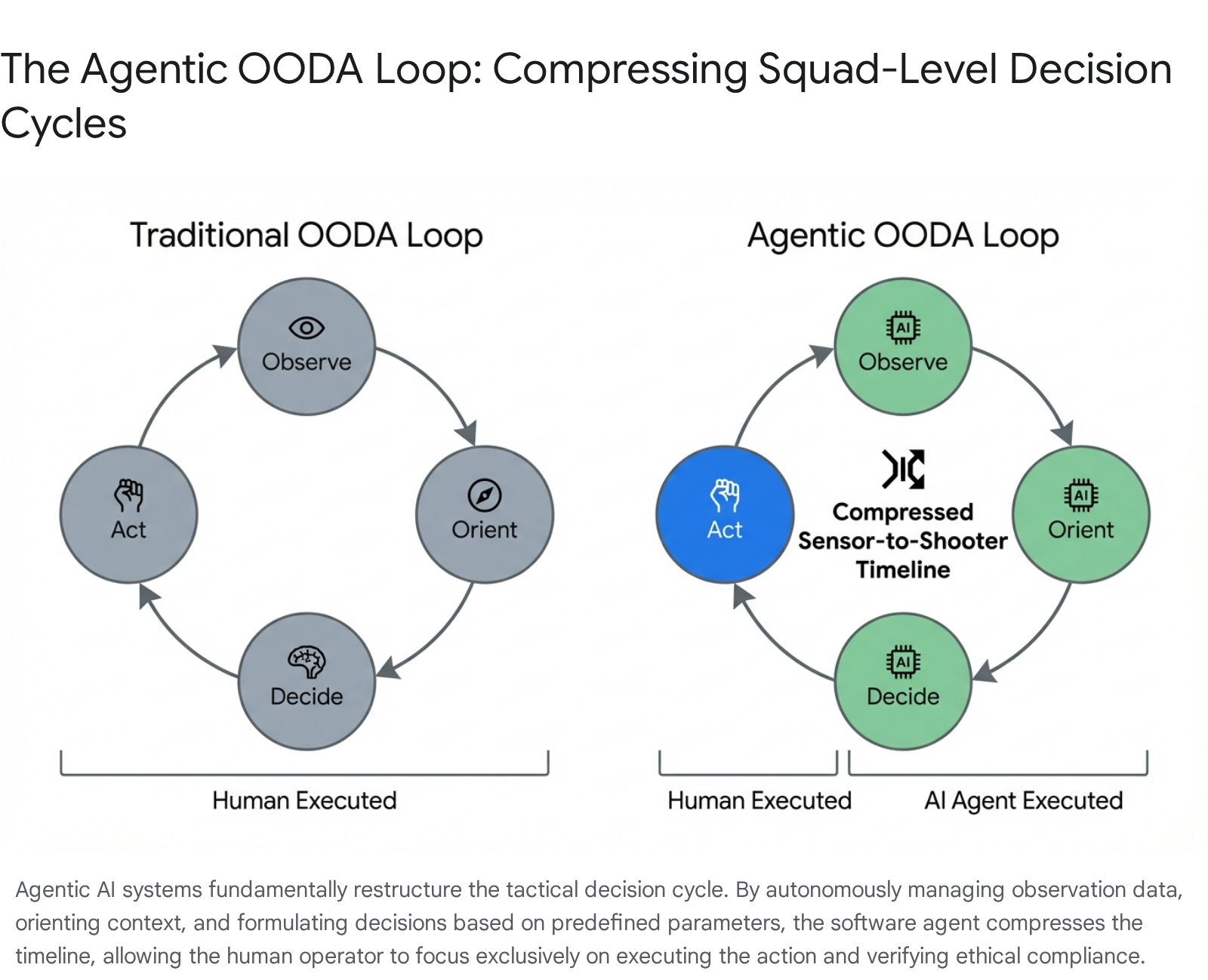
For the small arms industry and associated infantry modernization programs, this software integration is manifesting rapidly in hardware procurement programs like the Next Generation Squad Weapon and advanced fire control optics such as the XM157.4 Agentic systems are currently being evaluated to automate the early phases of the tactical operational loop, allowing warfighters to focus exclusively on action, lethality, and ethical compliance rather than data processing.7 However, the delegation of decision-making authority to autonomous software agents introduces profound ethical and strategic complexities. The defense industry is currently engaged in intense discourse regarding the boundaries of machine autonomy, the strict definition of human accountability, and the operational risks of deploying fully integrated, artificial intelligence-native systems in highly volatile environments.8 This comprehensive research report provides an exhaustive analysis of these technological transitions, procurement strategies, and doctrinal shifts defining the agentic warfare landscape in 2026.

2. The Strategic Pivot to Agentic Warfare

For the better part of the last decade, the integration of artificial intelligence into defense applications has been dominated by generative models. These systems, while highly capable of synthesizing vast amounts of data, drafting intelligence reports, and generating complex code structures, operate primarily as reactive tools that require constant human prompting and oversight. In 2026, the sentiment among government technology leaders, procurement officers, and defense contractors has firmly shifted from exploring what is theoretically possible with generative systems to effectively operationalizing agentic artificial intelligence.1

Agentic artificial intelligence systems are fundamentally different from their generative predecessors. They are designed not merely to process or analyze information passively but to pursue distinct objectives and take action autonomously within digital and physical environments.11 When given a high-level intent by a human operator, an agentic system can independently break that broad intent down into actionable tasks, coordinate with other specialized digital tools, evaluate varying potential outcomes, and execute a comprehensive plan with minimal to no human intervention during the intermediate steps.7 This transition from data generation to workflow execution is redefining how the United States military approaches everything from deep-tier supply chain logistics to frontline infantry squad engagements.

The operational reality of modern conflict necessitates this shift. Warfighters and intelligence analysts are currently subjected to immense cognitive overload, constantly bombarded by data streams from overhead drones, ground sensors, biometric wearables, and digital communication networks. Generative systems attempted to alleviate this by summarizing the data, but summarizing data still requires the human to formulate a decision and manually execute the subsequent steps across multiple disparate software platforms. Agentic systems, functioning as autonomous digital workers, bridge this gap by taking the summarized data and independently initiating the required software protocols to address the situation, presenting the human operator with a nearly finalized action plan ready for execution authorization.7 This capability is rapidly transforming from a theoretical concept discussed in academic white papers into a deployable asset utilized by the Department of Defense.

Public and institutional interest in agentic capabilities has surged dramatically. Industry reports indicate that interest in agentic artificial intelligence rose by 6,100 percent between October 2024 and October 2025, driven by the realization that autonomous execution holds vastly more commercial and military value than simple text generation.13 Furthermore, demand for software that can autonomously achieve complex tasks by designing and implementing processes, and then fine-tuning the results without continuous human prompting, is forecast to rise from USD 4 billion in the previous year to more than USD 100 billion by the end of the decade.13 The Department of Defense, recognizing the strategic imperative of mastering this technology before peer adversaries, has moved to capitalize on this trend early, restructuring its entire approach to software acquisition and battlefield deployment.

3. The Fiscal Year 2026 Defense Budget Breakdown and Implications

The strategic pivot toward agentic execution is heavily supported by unprecedented financial allocations, moving artificial intelligence out of the realm of experimental research and development and into the core procurement budget. The fiscal year 2026 defense budget represents a historical milestone for the military-industrial complex, as the Department of Defense has carved out a dedicated budget line for autonomy and artificial intelligence for the first time.1According to analysis published by(RNG Strategy Consulting), the allocation of USD 13.4 billion specifically to these technologies is a definitive signal to the defense industrial base regarding future procurement priorities.1

This dedicated funding is distributed across a clear doctrinal hierarchy, focusing heavily on unmanned platforms and the complex software integration required to make them operate autonomously in contested environments. A detailed breakdown of this investment reveals strategic priorities aimed at dominating the unmanned battlespace across multiple physical domains. The data indicates that the Department of Defense is not merely investing in abstract software algorithms but is heavily focused on the physical materialization of agentic artificial intelligence within specific vehicle and weapon platforms.

Capability DomainFY 2026 Budget Allocation (Billions USD)Strategic Focus Area
Unmanned Aerial Vehicles9.400Autonomous flight, drone swarm coordination, counter-UAS systems.
Maritime Autonomous Systems1.700Surface vessel navigation, autonomous fleet integration, port security.
Cross-Domain Software Integration1.200Interoperability layers, Joint All-Domain Command and Control (JADC2).
Underwater Capabilities0.734Submersible command interfaces, anti-submarine autonomous tracking.
Exclusive AI Technology0.200Foundational agentic research, algorithmic efficiency, neuromorphic computing.

The budget distribution reveals a strong preference for aerial autonomy integration, which receives more than triple the funding of all other physical domains combined.1 The allocation of USD 9.4 billion to unmanned and remotely operated aerial vehicles underscores the military’s reliance on drones for both intelligence gathering and kinetic strikes.1 However, the USD 1.2 billion dedicated to cross-domain software integration is arguably the most critical component for the small arms industry.1 This funding is intended to build the digital infrastructure that allows disparate systems, such as an autonomous aerial drone and a squad leader’s rifle optic, to communicate and share targeting data seamlessly without human routing.

The sheer magnitude of this funding has a direct cascading effect on the tactical equipment sectors. As major platforms like aircraft and maritime vessels become highly autonomous, the infantry units operating alongside them require equivalent technological upgrades to interface with these systems. A soldier utilizing conventional optical sights and analog radios cannot effectively coordinate with an agentic drone swarm moving at machine speed. Therefore, the budget necessitates a corresponding revolution in soldier-borne electronics, pushing the industry to develop smart fire control systems, localized communication nodes, and on-device processing capabilities that can integrate the individual rifleman into the broader autonomous network.

Furthermore, the scale of global defense spending adds durability to this modernization cycle. Global defense spending surged to USD 2.7 trillion in 2025 and is projected to surpass USD 3.6 trillion by 2030, driven by structural geopolitical priorities and the need for technological sovereignty.14 Within this expanding market, the center of gravity is decisively shifting from heavy hardware to advanced software. AI-enabled systems, unmanned platforms, and digital command networks are moving from pilot programs into widespread deployment, reshaping the economic fundamentals of defense contractors and demanding a rapid evolution from companies traditionally focused solely on metallurgy and ballistics.15

4. The Department of War AI-First Agenda

To effectively operationalize the massive capital influx provided by the 2026 budget, the United States Department of War initiated a comprehensive restructuring of its technology acquisition, data management, and deployment frameworks early in the year. On January 9, 2026, the Department issued three highly coordinated memoranda, which were followed shortly by a policy address from Secretary Pete Hegseth on January 12.2 Together, these actions established a unified, top-down “AI-first” agenda intended to move the military bureaucracy at wartime speed.2

This agenda represents far more than a standard set of procurement guidelines. It is a fundamental reorganization of how the military accesses data, how it recruits technical talent, and how it deploys complex software architectures across the joint force. According to legal and policy analysis provided by Holland & Knight, the central thesis of the new strategy is to aggressively leverage asymmetric American advantages in advanced computing power, deep capital markets, and decades of diverse operational experience to drive rapid experimentation with leading artificial intelligence models.2 This approach actively embraces a Silicon Valley-inspired “test, fail, adjust” culture, aiming to field iterative improvements rapidly rather than waiting for perfect, decades-long development cycles.16

The three memoranda target specific systemic bottlenecks that have historically hindered software adoption within the military. The first document, the “Artificial Intelligence Strategy for the Department of War” memorandum, directs the entire department to accelerate America’s military dominance in this sector by centering efforts on aggressive data-access mandates, expanded computing infrastructure, and accelerated hiring practices for specialized talent.2 The third document, the “Transforming the Defense Innovation Ecosystem to Accelerate Warfighting Advantage” memorandum, streamlines the bureaucratic hierarchy. It designates the Under Secretary of War for Research and Engineering as the single Chief Technology Officer, creates a dedicated action group, and elevates organizations like the Defense Innovation Unit as core components within a unified ecosystem.2

However, the second memorandum is perhaps the most consequential for the deployment of agentic systems. Titled “Transforming Advana to Accelerate Artificial Intelligence and Enhance Auditability,” this directive mandates the comprehensive restructuring of the existing Advana data system into a new entity known as the War Data Platform.2 Agentic artificial intelligence cannot function reliably without structured, accessible, and highly accurate data. The War Data Platform is tasked with expanding the core data integration layer to provide secure, standardized data access across the entire department, specifically tailored to support agentic applications.2

This restructuring ensures that when an autonomous agent is deployed at the tactical edge, whether on a drone or integrated into a rifle’s fire control system, it pulls targeting parameters, threat profiles, and environmental data from a unified, verified stream rather than fragmented, siloed databases maintained by different service branches.2 The Chief Digital and AI Office has been explicitly directed to ensure that these foundational enablers are available across the department in real time, creating a robust digital nervous system necessary for autonomous operations.2

5. The Seven Pace-Setting Projects

The operational core of the AI Strategy Memo is the immediate implementation of seven “Pace-Setting Projects,” which are designed to force rapid technological integration across warfighting, intelligence, and enterprise missions.2 Each of these projects operates under strict parameters, guided by a single accountable leader, aggressive development timelines, and a requirement for detailed monthly progress reporting directly to the Deputy Secretary of War and the Chief Technology Officer.2 These projects serve as the primary mechanisms through which the Department of War translates its strategic vision into tangible capabilities on the battlefield.

The seven projects are divided into three distinct strategic categories, reflecting the comprehensive nature of the modernization effort.

Mission CategoryProject NameStrategic Objective and Operational Scope
WarfightingSwarm ForgeA competitive mechanism pairing elite warfighting units with technology innovators for iterative discovery, testing, and scaling of new combat tactics using AI capabilities.
WarfightingAgent NetworkDedicated development of AI agents for battle management and decision support, covering the entire operational cycle from campaign planning through kill chain execution.
WarfightingEnder’s FoundryAcceleration of AI-enabled simulation capabilities and tighter feedback loops to outpace adversaries in tactical planning and wargaming scenarios.
IntelligenceOpen ArsenalCompression of the technical intelligence-to-capability development pipeline, aiming to turn raw intelligence into deployable weapon algorithms in hours rather than years.
IntelligenceProject GrantUtilization of AI to transform static deterrence postures into dynamic, interpretable pressure models informed by real-time strategic analysis.
EnterpriseGenAI.milDepartmentwide deployment of frontier generative models, providing millions of civilian and military personnel access to advanced capabilities at multiple classification levels.
EnterpriseEnterprise AgentsDevelopment of a comprehensive playbook for the rapid and secure design and deployment of AI agents intended to transform administrative and logistical workflows.

For the small arms industry and infantry tacticians, the Swarm Forge and Agent Network projects hold the most immediate relevance. Swarm Forge represents a paradigm shift in doctrinal development. By pairing elite warfighting units directly with technology developers, the military is bypassing traditional, slow-moving testing centers.2 Infantry units are actively discovering new ways to utilize advanced small arms, smart optics, and localized drone assets in simulated combat, providing immediate feedback to software engineers who can update the algorithms in real time. This rapid iteration ensures that the tactical software deployed on the battlefield accurately reflects the chaotic realities of close-quarters combat.

The Agent Network project is the most direct implementation of agentic warfare theory. It is specifically defined as a warfighting mission dedicated to the development and experimentation with artificial intelligence agents for battle management.2 The scope of this project is vast, encompassing everything from high-level campaign planning down to the tactical execution of the kill chain.2 The digital enablers developed through this project, including the models and the underlying data infrastructure, are designed to be integrated seamlessly with the hardware systems currently being procured for infantry squads, creating a highly networked and autonomous battlefield environment.2

To support the enterprise and administrative side of these operations, the Pentagon has also aggressively expanded its GenAI.mil platform. This initiative involves integrating advanced commercial generative capabilities, including agentic workflows and cloud-based infrastructure, into the daily operations of military personnel.17 Recent agreements have brought frontier models from major commercial entities, such as xAI’s Grok models and specialized government platforms from OpenAI, into the defense ecosystem.17 These integrations provide users with access to real-time global insights, facilitating faster intelligence gathering and administrative processing, which ultimately supports the logistical demands of the frontline warfighter.17

6. Operationalizing at the Tactical Edge: Edgerunner AI and WarClaw

While the Department of War focuses on building the macro-level data architecture through the War Data Platform and establishing strategic frameworks through the Agent Network, private industry is rapidly developing the specific, tactical software agents that will execute these tasks on the battlefield. A detailed analysis of the defense software market in 2026 reveals a distinct and vital pivot. Military organizations are increasingly moving away from massive, generalized frontier models created by commercial technology giants, recognizing that these large models often exhibit unpredictable behaviors, require massive cloud computing resources, and lack the specialized nuance required for lethal operations.13 Instead, the trend strongly favors smaller, highly customized models tailored for specific military domains that offer absolute user control.13

A prominent and highly successful example of this trend is Edgerunner AI, a veteran-founded startup based in Bellevue, Washington. Edgerunner AI recently emerged from stealth mode following a highly publicized USD 5.5 million seed funding round aimed at building generative artificial intelligence specifically for the edge.19According to statements from the company’s leadership reported by BusinessWire, the primary challenge with modern artificial intelligence lies in its broad applicability without addressing specific, high-stakes operational needs.19To solve this, Edgerunner focused exclusively on military applications.

In April 2026, Edgerunner AI officially launched “WarClaw,” an advanced agentic artificial intelligence tool built specifically for military deployment.3 WarClaw represents a critical departure from general-purpose corporate assistants. It functions as a hardened agentic orchestration layer based on the popular open-source OpenClaw framework.3 Unlike consumer models trained on the open internet, WarClaw was meticulously trained by former military operators and subject matter experts, utilizing data derived from actual military tasks and validated in realistic combat simulations.13 This focused training ensures that the agent understands tactical terminology, standard operating procedures, and the strict rules of engagement governing military operations.

The core capability of WarClaw is its ability to provide what the company terms “agentic decision dominance” directly at the front lines.3 By functioning as an autonomous orchestration layer, WarClaw effectively manages multiple smaller sub-agents to achieve complex goals. The system is designed to seamlessly search and analyze vast intelligence databases, interpret complex reconnaissance reports, extract relevant tactical information, and autonomously draft operational briefings and mission documents.13 Furthermore, to ensure broad utility for command staff, the software integrates directly with standard productivity tools ubiquitous in military command centers, including Microsoft Word, Excel, PowerPoint, Teams, and Outlook.13

The efficacy of Edgerunner’s highly specialized approach has garnered rapid institutional validation within the defense apparatus. Edgerunner AI recently secured a firm-fixed price contract with the United States Space Force Space Systems Command, facilitated via the Chief Digital and Artificial Intelligence Office’s Tradewinds Solutions Marketplace.3 This contract aims to deploy the Edgerunner platform into the Space Force’s highly secure environment to modernize and accelerate the acquisitions process.3 This successful deployment demonstrates that the underlying agentic orchestration technology is highly robust and capable of handling complex, high-stakes aerospace procurement and integration tasks, validating its potential for widespread integration into other critical military domains, including ground combat and small arms coordination.

7. Hardware Constraints and DDIL Environments

The most significant operational advantage of WarClaw, and the primary reason it holds such potential for infantry integration, is its foundational architecture designed to run completely on-device.3 Modern warfighters operate in environments where persistent cloud connectivity is not just unreliable; it is an active liability. Continuous connections to external servers can be jammed by electronic warfare units, intercepted by adversarial signals intelligence, or geolocated to target command posts with artillery fire. Therefore, tactical software must function independently of the broader network.

WarClaw is engineered specifically to excel in Denied, Disconnected, Intermittent, and Low-bandwidth environments.3 By processing all data locally on the user’s hardware, the platform ensures absolute data privacy and operational security.21 It transforms workflows without broadcasting electronic signatures that could compromise a unit’s position.21 The technology specifically addresses the challenge of cognitive overload by moving beyond simple chat functions into autonomous execution, allowing the software to operate on laptops, workstations, and ruggedized servers directly at the forward edge of the battle area.21

To achieve this high level of localized capability, Edgerunner utilizes state-of-the-art Small Language Models rather than massive neural networks.22 These models are optimized to work together collaboratively, creating a localized swarm intelligence that tackles distinct tasks efficiently.19 This localized, multi-agent approach significantly reduces near-zero latency, as data does not need to travel to a remote server and back.19 Crucially, it also dramatically reduces power consumption, which is a paramount concern when designing electronic systems intended to be carried by dismounted infantry where battery weight is strictly limited.19

However, deploying agentic artificial intelligence locally still requires robust tactical hardware, highlighting a current constraint in the technology’s evolution. The initial public beta for military users specified minimum hardware requirements that underscore the intense computational demands of modern agentic software, even when optimized.23

Hardware PlatformMinimum Processor RequirementMinimum Memory RequirementMinimum Graphics Requirement
Windows DevicesAMD Ryzen AI Max32GB Total System RAMNVIDIA or AMD discrete GPU with 16GB VRAM
Apple DevicesApple M-series Processors32GB Total System RAMIntegrated unified memory architecture

These requirements indicate that while the models are considered “small” compared to global frontier models, they still necessitate high-end components with substantial Video Random Access Memory to process the agentic workflows smoothly.23 Current iterations require significant local compute power, presenting thermal management and form-factor challenges for hardware engineers designing ruggedized infantry gear. Nevertheless, the technological trajectory points firmly toward highly optimized models functioning on increasingly smaller, lower-power devices. Edgerunner has explicitly stated that future versions of their platform will function on significantly smaller devices with much less required memory, paving the way for eventual integration directly into individual soldier systems, helmet-mounted displays, and advanced optical sights.23

8. Infantry Lethality and Small Arms Integration

The convergence of sophisticated agentic artificial intelligence software and increasingly capable tactical hardware fundamentally alters the operational reality of the infantry squad. For the small arms industry, 2026 represents the year where software integration and digital networking became as critical to weapon design as metallurgical engineering and internal ballistics. The traditional view of a rifle as a purely mechanical tool, operating independently of the broader battlefield network, has been permanently superseded; the modern small arm is now viewed as an active data node within a comprehensive digital ecosystem.

The physical foundation for this tactical artificial intelligence integration is heavily reliant on the United States Army’s deployment of the Next Generation Squad Weapon program.6 This program, designed to replace the legacy M4 carbine and M249 squad automatic weapon, centers on two primary platforms: the XM7 rifle and the XM250 automatic rifle.6 These weapons utilize a novel 6.8mm projectile designed to defeat modern body armor at extended ranges. However, while the ballistic improvements are significant, the true technological leap of the Next Generation Squad Weapon program lies not in the chamber, but in the advanced electronics mounted above it.

The weapons serve as the physical chassis for highly sophisticated optical systems that bridge the gap between the individual rifleman and the broader digital network. As agentic software like WarClaw becomes capable of running on smaller hardware, the integration of these agents directly into the weapon’s electronic suite becomes the obvious next step in infantry modernization. This integration allows the weapon itself to participate actively in threat assessment, target prioritization, and communication, transforming the dismounted soldier from an isolated combatant into a fully integrated node within the artificial intelligence-driven battlespace.

9. The XM157 Fire Control System and Smart Optics

The critical component enabling the digital transformation of small arms is the advanced fire control mechanism. The Department of Defense has invested heavily in this area, recognizing that superior ballistics are useless without superior targeting capabilities. A cornerstone of this effort is the contract awarded to Vortex Optics, a landmark 10-year, firm-fixed-price agreement with a maximum ceiling value of USD 2.7 billion.4 Under this contract, Vortex Optics is tasked with providing up to 250,000 XM157 Next Generation Squad Weapons Fire Control systems to the United States Army.4

The XM157 is not merely a telescopic sight; it is a comprehensive, integrated ballistic computer. The system features variable magnification optics, an integrated precision laser rangefinder, a suite of atmospheric sensors to measure temperature and pressure, a digital compass, and a digital display overlay that projects critical information directly into the shooter’s field of view.6 When a soldier utilizes the XM157, the system instantly calculates the exact ballistic trajectory for the specific 6.8mm round, accounting for distance, wind, and environmental factors, and displays an adjusted aiming point.24

When combined with agentic artificial intelligence orchestration layers, such as those being developed through the Agent Network or localized on-device agents like WarClaw, systems like the XM157 undergo a profound transformation. They transition from being passive calculating tools into active threat assessment nodes.6 Market intelligence and industry data highlight that smart fire control technology is currently being utilized to upgrade conventional weapons into sophisticated anti-drone defense systems.25

By employing artificial intelligence-enabled optics and integrating acoustic echolocation neural networks—technology originally developed for autonomous small drone navigation in low-visibility environments—infantry units can gain unprecedented situational awareness.25 An agentic system integrated with the XM157 could autonomously scan the environment, track the erratic flight paths of attritable multirotor strike drones, prioritize targets based on their immediate threat level to the squad, and provide real-time firing solutions to the operator before the human eye could even register the threat.25 This level of integration represents the ultimate goal of the Department of War’s modernization efforts at the tactical edge.

10. Automating the Tactical OODA Loop

The primary strategic objective of integrating agentic artificial intelligence directly at the squad level, and the underlying rationale for the billions invested in systems like the XM157, is the aggressive compression of the tactical decision-making cycle. In military doctrine, this cycle is widely known as the OODA Loop, an acronym representing the sequential phases of Observe, Orient, Decide, and Act.7 In highly contested combat environments, the combatant who can cycle through this loop faster than their adversary generally achieves victory.

M92 PAP muzzle cap and detent pin assembly
John Boyd’s OODA Loop Concept

According to analyses discussing the impact of artificial intelligence on infantry units, traditional intelligence, surveillance, and reconnaissance systems serve primarily to augment the “Observe” phase.7 They feed vast amounts of raw data, imagery, and sensor readings to the warfighter. The introduction of generative artificial intelligence assisted the “Orient” phase by rapidly summarizing that raw data into a cohesive, understandable picture of the battlefield. However, agentic artificial intelligence is fundamentally designed to advance further and assume significant control over the “Decide” phase.7

By functioning as autonomous digital workers, agentic systems can continuously analyze the incoming sensor feed from smart optics and overhead drones. They map this data against the squad leader’s predefined strategic intent, evaluate the environmental variables, generate highly optimized targeting options, and present a nearly finalized decision to the human operator.7 This paradigm, increasingly referred to within the industry as the Agentic OODA Loop, radically compresses the timeline from the moment a sensor detects a threat to the moment a shooter executes a response.7

M92 PAP muzzle cap removal: close-up of a hand unscrewing the cap

In modern combat scenarios, where engagements with autonomous enemy drone swarms or rapid-maneuver mechanized infantry are measured in fractions of a second, the ability to offload the heavy cognitive processing of observation and orientation to localized agents like WarClaw provides a decisive, life-saving advantage. The human operator is freed from the burden of calculation and analysis, allowing them to focus entirely on the physical execution of the action and the critical assessment of ethical compliance.

Furthermore, the integration of agentic artificial intelligence into small arms facilitates seamless, machine-speed communication across the broader battle management network. For example, if an individual rifleman’s optic identifies a specific, high-value thermal signature, the localized artificial intelligence agent can autonomously log the exact geographic coordinates, cross-reference the signature with known enemy vehicle profiles via a secure connection to the War Data Platform, and instantaneously disseminate precise targeting data to heavy anti-armor assets positioned elsewhere in the sector. This entire process can be completed autonomously before the rifleman even pulls the trigger, ensuring a highly coordinated, overwhelming response to emerging threats.

11. Logistics, Procurement, and Ammunition Supply Chains

The operational efficacy of front-line agentic weapon systems and advanced small arms is entirely dependent on the resilience and efficiency of the complex supply chains that sustain them. A smart rifle without ammunition is simply an expensive club. In 2026, as peer competitors actively map and target global logistics nodes, maintaining continuous operational support requires highly advanced supply chain risk management capabilities.28 Consequently, the defense sector is increasingly relying on agentic artificial intelligence not just for augmenting fire control systems, but for managing the massive procurement networks required for ammunition and replacement parts.

The manufacturing and global distribution of small arms ammunition is a remarkably complex process susceptible to numerous bottlenecks. To support the widespread deployment of the Next Generation Squad Weapon program, the United States Army’s Joint Program Executive Office for Armaments and Ammunition officially broke ground on a massive new 6.8mm ammunition production facility at the Lake City Army Ammunition Plant in Missouri.29 Managing the vast, continuous quantities of raw materials, chemical propellants, specialized brass, and specialized tooling required to maintain output at such facilities is a prime, high-value use case for autonomous software agents.

Agentic artificial intelligence has emerged as a transformative force in the broader electronics and defense sector procurement landscape. A significant development in 2026 has been the rise of autonomous agents designed specifically for logistics.30 These agents function far beyond the capabilities of passive analytical dashboards. They actively and continuously monitor supplier risk profiles, review complex legal contracts, and issue Requests for Proposal without requiring human initiation.30 When a logistics-focused agentic system detects a potential disruption in the supply of critical materials necessary for 6.8mm production, it can autonomously evaluate secondary international suppliers, trigger the necessary bureaucratic onboarding processes, and secure alternative delivery contracts with minimal human intervention.30

This automation is critical for mitigating component obsolescence, which industry analysts frequently cite as a silent profit killer and a major threat to military readiness. A sudden shortage of a specific microchip required for the XM157 optic can halt the entire weapon system’s deployment. Agentic systems actively monitor the global electronics market, predicting shortages and autonomously securing stockpiles of critical components before they become obsolete or unavailable.30 By automating these complex administrative tasks, human procurement teams are freed from tedious bureaucratic churn, allowing them to focus entirely on strategic relationship management and high-level negotiation.

12. The European Manufacturing Transition

The intricacies of defense supply chains extend far beyond domestic manufacturing plants in the United States. The shifting geopolitical environment, heavily influenced by prolonged conflicts in Eastern Europe, has forced a massive restructuring of global small arms production and transit networks. Following the full-scale invasion of Ukraine, Central European nations, specifically the Republic of Poland, the Czech Republic, and the Slovak Republic, experienced a fundamental systemic transformation.31

These nations effectively transitioned from acting as passive regulatory buffer zones into highly active, high-velocity military-industrial hubs.31 By early 2026, industry reports analyzing the Central European arms synthesis noted that the small arms and light weapons landscape across this region achieved a state characterized as a “Hyper-Regulated Equilibrium”.31 While traditional, domestic gun violence metrics in these nations remain at historic lows, their strategic role as massive logistical and manufacturing source-transit hubs has matured significantly.31 The volume of weapons, ammunition, and tactical components flowing through these specific corridors is immense.

Managing this level of industrial integration and high-velocity transit requires tracking capabilities that exceed human capacity. Agentic artificial intelligence systems deployed by allied defense logistics agencies are essential for integrating with local European digital networks to monitor the movement of small arms and munitions continuously.11 These autonomous agents ensure strict compliance with international export controls, monitor shipping manifests against global intelligence databases, and identify potential illicit diversion pathways in real-time.11 The ability to autonomously track millions of serialized parts, electronic optical components, and bulk ammunition shipments across international borders represents a critical application of enterprise-level agentic capabilities in maintaining allied military readiness and preventing arms proliferation.

13. Ethical Implications and the Taxonomy of Autonomy

As agentic artificial intelligence systems proliferate rapidly from deep-tier supply chain management to squad-level fire control, the ethical implications of autonomous warfare have rightfully come to dominate industry, academic, and geopolitical discourse. The integration of these technologies forces a confrontation with profound moral questions. When machine intelligence begins making, or significantly accelerating, critical decisions regarding lethal force, the stakes transition immediately from matters of operational efficiency to matters of existential risk and human rights.32

A primary and persistent concern within the defense policy community is the dangerous ambiguity surrounding the terminology itself. Currently, the term “agentic AI” functions as a broad, loosely defined umbrella encompassing everything from helpful administrative chatbots managing schedules to fully combat-ready, autonomous drone swarms.8 Analysts warn that this lack of precise definition risks severely undermining United States governance frameworks.8 If policymakers and procurement officers apply the exact same terminology to a benign logistics tool and a lethal targeting system, military organizations risk deploying software with the authority to initiate combat operations before the system truly comprehends the contextual risks involved.8

The core danger explicitly identified by policy experts at institutions like the CSIS is not that these artificial intelligence systems lack raw intelligence, but rather that they completely lack human judgment.8A tactical agent operating a smart fire control system on a next-generation rifle might possess the computational intelligence to execute a complex targeting solution flawlessly. However, that same system may fail entirely to recognize that a sudden, nuanced shift in the local civilian situation, a subtle change in the behavior of bystanders, makes executing that perfectly calculated engagement a catastrophic strategic error.8

To mitigate these risks, experts are calling urgently for the establishment of a rigorous, relational, capability-based taxonomy.8 This taxonomy would move beyond technical specifications and specify exactly where an artificial intelligence agent sits within a specific operational workflow, what exact authorities it exercises, and most importantly, how human accountability is distributed when system failures occur.8

The rapid pace of technological development fundamentally disrupts traditional military understandings of command and control. Current United States policy, explicitly outlined in Department of War Directive 3000.09, mandates strictly that all autonomous weapon systems must operate under clear human authority and within defined legal and ethical bounds.9 The current ethical discourse focuses heavily on categorizing the spectrum of human involvement. This involves defining whether a human operator is positionally “in the loop”, requiring explicit authorization for every action, “on the loop”, where the agent executes autonomously while the human merely monitors and can intervene, or completely “out of the loop”.9

The transition toward a “human on the loop” model creates significant friction regarding ultimate legal accountability.33 If a squad leader utilizes a system like WarClaw to designate general target areas, and the system autonomously coordinates a localized strike without explicit, final human authorization for that specific target, defining the accountable leader becomes legally ambiguous. Generally, accountable parties are increasingly identified as those senior commanders who sign off on the initial use of the agentic artificial intelligence and its overarching automated governance protocols, shifting the burden of responsibility from the tactical shooter to the strategic planner.33 Furthermore, the increasing automation of battlefield decisions raises profound fears of algorithmic warfare evolving into fully automated agentic warfare, where lethal decision loops run entirely without human intervention, leading to unpredictable escalations.32

14. Cyber Vulnerabilities and System Hardening

Beyond the kinetic implications of autonomous lethality, the integration of agentic artificial intelligence introduces severe, novel vulnerabilities within the cyber domain. The fundamental characteristic that makes agentic systems so powerful, their ability to carry out complex tasks with minimal oversight, is also heavily utilized by sophisticated adversaries to automate massive cyber attacks and rapidly learn from failed network intrusions.34 Artificial intelligence is functioning as a powerful force multiplier for the modern adversary.34

The aggressive integration of agentic capabilities into defense contractor workflows, often driven by the pursuit of wartime speed and efficiency, is occurring at a pace that frequently outstrips the organization’s ability to fully understand the intricate components or the downstream systemic risks.34 This is a recognized and critical vulnerability. Without robust, multi-layered governance protocols and strict encryption standards for the Application Programming Interfaces utilized by these autonomous agents, the automation that is supposed to assist the military can easily be co-opted.33

The Pentagon faces a difficult balancing act. Officials must continuously balance the strong strategic desire for rapid innovation with the absolute necessity of maintaining strict control over how automated software interacts with sensitive tactical networks and physical hardware.34 If an adversary successfully breaches the communication network utilized by a localized agent like WarClaw, they could potentially manipulate the data feeding into the XM157 fire control system, feeding false targeting coordinates to frontline infantry. Therefore, ensuring the absolute cybersecurity of these digital workers is as critical to mission success as the physical armor worn by the soldiers.

15. Strategic Outlook and Recommendations

Looking ahead from the vantage point of 2026, the defense industrial base and the small arms sector must prepare for a fundamentally altered procurement and operational landscape. The debate within military circles is no longer centered on whether artificial intelligence will be integrated into the force structure, but rather how deeply and securely it will be embedded into the foundational architecture of all defense platforms.

At major international gatherings, such as the 2026 World Defense Show, military officials and defense contractors highlighted an impending strategic choice facing all global armed forces. Organizations must decide whether to procure “AI-enhanced” systems or commit to developing “AI-native” systems.10 Artificial intelligence-enhanced systems involve integrating modern software into existing, legacy platforms in a relatively limited capacity. This approach is akin to bolting a sophisticated smart optic onto a conventional, mechanically operated rifle.10 It provides a capability boost but is limited by the underlying analog architecture.

Conversely, artificial intelligence-native platforms are built entirely from the ground up with artificial intelligence baked into the entire value chain.10 This involves designing custom silicon chips, specific data architectures, and agentic behavioral models before the physical hardware is even prototyped.10 While AI-native systems require massive initial capital investments and necessitate significant organizational readiness, defense experts widely view them as the ultimate force multiplier.10 The small arms industry must anticipate this definitive shift, moving aggressively toward clean-sheet weapon designs where electronic integration, continuous power delivery, and advanced thermal management for on-board compute modules are prioritized alongside traditional metrics of ballistic performance and mechanical reliability.

To navigate this complex transition successfully, several strategic recommendations emerge for defense contractors, software developers, and military procurement agencies:

First, the industry must prioritize Size, Weight, and Power optimization for all processing hardware intended for the tactical edge. Infantry units, already burdened by heavy protective gear and ammunition, cannot bear the physical weight of power-hungry servers. Engineering solutions must focus relentlessly on developing hyper-efficient Small Language Models and specialized neuromorphic hardware capable of running sophisticated agents locally on minimal battery power.19

Second, the defense sector must rigorously and transparently address issues of trust and system verification. As noted by leading industry researchers, human trust in an artificial intelligence system is the paramount factor determining its operational success. The system must function strictly as a trusted component of the decision-making process, allowing the human operator to make faster decisions at machine speed while retaining human accuracy and judgment.10 Organizations must implement comprehensive context charts and clear workflow definitions, ensuring that commanders and frontline soldiers understand exactly which tasks an agentic system is authorized to handle autonomously and which require manual override.8

Finally, cybersecurity protocols must be addressed at the foundational, architectural level of agentic development, not applied as an afterthought. Companies developing autonomous agents for military deployment must guarantee that the communication pathways utilized by these agents are heavily encrypted and that the core systems are hardened against adversarial spoofing and data poisoning.33 Only by unequivocally securing the integrity of these digital workers can the military confidently deploy them into contested environments. The era of agentic defense has firmly arrived, and the organizations that successfully build secure data infrastructure and seamless, trustworthy human-machine teaming capabilities will secure the decisive competitive advantage in the conflicts of the coming decades.

16. Appendix: Methodology

The exhaustive analysis presented in this research report relies on a rigorous synthesis of diverse defense sector data points, policy memoranda, and industry announcements generated throughout the first quarter of 2026. The methodological approach centered on extracting, categorizing, and correlating qualitative policy directives, quantitative budget allocations, and highly specific technical product specifications related to agentic artificial intelligence and its integration into small arms and tactical networks.

Financial assessments were derived by carefully isolating the fiscal year 2026 Department of Defense budget figures, specifically analyzing the designated USD 13.4 billion dedicated to autonomy and artificial intelligence. This capital was mapped across various operational domains to accurately determine the military’s strategic funding priorities. Comprehensive policy analysis was conducted by reviewing the specific directives outlined in the Department of War’s January 2026 memoranda. This involved tracking the bureaucratic restructuring of internal data systems, such as the evolution of Advana into the War Data Platform, and evaluating the strategic objectives of the seven designated Pace-Setting Projects.

The technical capabilities of private sector software, notably Edgerunner AI’s WarClaw platform, were evaluated based on their stated operational environment constraints. This specifically involved analyzing the engineering requirements for functioning in Denied, Disconnected, Intermittent, and Low-bandwidth settings, and assessing the minimum hardware specifications required for on-device processing. This software assessment was then systematically cross-referenced with ongoing physical hardware procurement programs, such as the Next Generation Squad Weapon program and the specific capabilities of the XM157 Fire Control system, to determine the physical pathways for artificial intelligence integration directly at the squad level. Finally, the broader industry discourse regarding ethical and strategic implications was synthesized by analyzing policy essays, defense industry white papers, and recorded statements from international defense conferences regarding the operational and legal limits of autonomous lethality.


Please share the link on Facebook, Forums, with colleagues, etc. Your support is much appreciated and if you have any feedback, please email us in**@*********ps.com. If you’d like to request a report or order a reprint, please click here for the corresponding page to open in new tab.


Sources Used

  1. Agentic Systems and AI in Defense Modernization 2026, accessed April 10, 2026, https://rngstrategyconsulting.com/insights/industry/aerospace-defense/ai-in-defense-modernization/
  2. Department of War’s Artificial Intelligence-First Agenda: A New Era …, accessed April 10, 2026, https://www.hklaw.com/en/insights/publications/2026/02/department-of-wars-ai-first-agenda-a-new-era-for-defense-contractors
  3. News – EdgeRunner AI, accessed April 10, 2026, https://www.edgerunnerai.com/news
  4. Fire-control system from Vortex Optics wins 10-year contract with U.S. Army, accessed April 10, 2026, https://militaryembedded.com/radar-ew/sensors/fire-control-system-from-vortex-optics-wins-10-year-contract-with-us-army
  5. Vortex Optics – Military Embedded Systems, accessed April 10, 2026, https://militaryembedded.com/company/vortex-optics
  6. 2026 DoW Directory Update 2.docx – REXOTA Solutions, accessed April 10, 2026, https://rexota.com/wp-content/uploads/2026-DoW-Directory-Rev-2.pdf
  7. Full Archive Search – ISK Online, accessed April 10, 2026, https://indianstrategicknowledgeonline.com/archive.php
  8. Lost in Definition: How Confusion over Agentic AI Risks Undermining U.S. Governance Frameworks – CSIS, accessed April 10, 2026, https://www.csis.org/analysis/lost-definition-how-confusion-over-agentic-ai-risks-governance
  9. Controlling Command: Is AI Capturing the Ethics of War?, accessed April 10, 2026, https://inss.ndu.edu/Media/News/Article/4454555/controlling-command-is-ai-capturing-the-ethics-of-war/
  10. Future of military AI in Saudi Arabia: AI-enhanced, or AI-native? – Breaking Defense, accessed April 10, 2026, https://breakingdefense.com/2026/02/future-of-military-ai-in-saudi-arabia-ai-enhanced-or-ai-native/
  11. From intelligence to agency: AI’s new frontier in international security → UNIDIR, accessed April 10, 2026, https://unidir.org/event/from-intelligence-to-agency-ais-new-frontier-in-international-security/
  12. Defense Tech Trends for 2026: Innovation in Action – NSTXL, accessed April 10, 2026, https://nstxl.org/defense-tech-trends/
  13. Startup debuts agentic AI assistant for war – Defense One, accessed April 10, 2026, https://www.defenseone.com/technology/2026/04/startup-takes-different-approach-ai-assistants/412545/
  14. Rising Defense Spending: Fueling A Deep Tech Boom In 2026 – Forbes, accessed April 10, 2026, https://www.forbes.com/councils/forbesfinancecouncil/2026/03/03/rising-defense-spending-fueling-a-deep-tech-boom-in-2026/
  15. Defense Tech Enters 2026 with Strengthening Fundamentals – Global X ETFs, accessed April 10, 2026, https://www.globalxetfs.com/articles/defense-tech-enters-2026-with-strengthening-fundamentals
  16. Pentagon Releases Artificial Intelligence Strategy | Inside Government Contracts, accessed April 10, 2026, https://www.insidegovernmentcontracts.com/2026/02/pentagon-releases-artificial-intelligence-strategy/
  17. Department Of War Integrates OpenAI ChatGPT Into GenAI.mil Platform For 3 Million Personnel – The Defense Watch, accessed April 10, 2026, https://thedefensewatch.com/cyber-space-defense/pentagon-genai-mil-adds-chatgpt/
  18. Startup debuts agentic AI assistant for war – OODAloop, accessed April 10, 2026, https://oodaloop.com/briefs/technology/startup-debuts-agentic-ai-assistant-for-war/
  19. EdgeRunner AI Emerges from Stealth with $5.5M Seed Funding to Build Generative AI for the Edge – Business Wire, accessed April 10, 2026, https://www.businesswire.com/news/home/20240718441467/en/EdgeRunner-AI-Emerges-from-Stealth-with-%245.5M-Seed-Funding-to-Build-Generative-AI-for-the-Edge
  20. EdgeRunner Releases “WarClaw” for Agentic Decision Dominance at the Tactical Edge, accessed April 10, 2026, https://www.businesswire.com/news/home/20260331235388/en/EdgeRunner-Releases-WarClaw-for-Agentic-Decision-Dominance-at-the-Tactical-Edge
  21. EdgeRunner Launches WarClaw Agentic AI & Decision Support – Defense Advancement, accessed April 10, 2026, https://www.defenseadvancement.com/news/edgerunner-launches-warclaw-agentic-ai-decision-support/
  22. EdgeRunner Achieves GPT-5 Level Performance For Key Military Tasks While Running Locally On-Device – Business Wire, accessed April 10, 2026, https://www.businesswire.com/news/home/20251112202469/en/EdgeRunner-Achieves-GPT-5-Level-Performance-For-Key-Military-Tasks-While-Running-Locally-On-Device
  23. EdgeRunner Announces Public Beta for Military Users – Business Wire, accessed April 10, 2026, https://www.businesswire.com/news/home/20250708291724/en/EdgeRunner-Announces-Public-Beta-for-Military-Users
  24. Soldier Systems Daily Soldier Systems Daily, accessed April 10, 2026, https://soldiersystems.net/page/16/
  25. Counter-UAS Market: Business Models – Full List (Agentic AI Market, accessed April 10, 2026, https://newmarketpitch.com/blogs/news/counter-uas-business-model
  26. Resources — o16g – Outcome Engineering, accessed April 10, 2026, https://o16g.com/resources/
  27. GPMG – 7.62mm General Purpose Machine Gun – Defense Advancement, accessed April 10, 2026, https://www.defenseadvancement.com/projects/gpmg-7-62mm-general-purpose-machine-gun/
  28. What Are the Top Defense Technology Priorities for 2026? A Quick Guide – IDGA, accessed April 10, 2026, https://www.idga.org/command-and-control/articles/the-top-defense-technology-priorities-2026-a-quick-guide
  29. Weapons Systems | Technical Briefs, Aerospace & Defense Engineering News, accessed April 10, 2026, https://www.mobilityengineeringtech.com/met/topic/aerospace/weapons-systems
  30. The 2026 Supply Chain: New Rules for Electronics OEMs – DigiKey, accessed April 10, 2026, https://www.digikey.com/en/blog/the-2026-supply-chain-new-rules-for-electronics-oems
  31. The 2026 Central European Arms Synthesis: Phantom Networks, Export Fracture Points and the Post-Conflict Proliferation Horizon – https://debuglies.com, accessed April 10, 2026, https://debuglies.com/2026/03/26/the-2026-central-european-arms-synthesis-phantom-networks-export-fracture-points-and-the-post-conflict-proliferation-horizon/
  32. In the Age of AI, the Fog of War Thickens – Centre for International Governance Innovation, accessed April 10, 2026, https://www.cigionline.org/articles/in-the-age-of-ai-the-fog-of-war-thickens/
  33. The evolving ethics and governance landscape of agentic AI – IBM, accessed April 10, 2026, https://www.ibm.com/think/insights/ethics-governance-agentic-ai
  34. JUST IN: AI Enabling New Cyber Risks, Report Says – National Defense Magazine, accessed April 10, 2026, https://www.nationaldefensemagazine.org/articles/2026/3/11/just-in-ai-enabling-new-cyber-risks-report-says
  35. MIL-DTL Guide to Rugged Interconnects – Defense Advancement, accessed April 10, 2026, https://www.defenseadvancement.com/resources/mil-dtl-rugged-connectors/

The Cognitive Contest: Deconstructing China’s ‘Military Brain’ and Forging America’s Path to AI Supremacy

The strategic competition between the United States and the People’s Republic of China (PRC) is increasingly defined by the race for artificial intelligence (AI) supremacy. This contest extends far beyond technological one-upmanship, representing a fundamental clash of military doctrines, organizational structures, and philosophical visions for the future of warfare. This report provides a comparative analysis of China’s multi-faceted military AI initiatives—collectively termed the “Military Brain”—and the United States’ efforts to secure a decisive technological edge. While the U.S. currently maintains a foundational lead in key technologies such as advanced semiconductors and aggregate computing power, China possesses a more cohesive, expansive, and arguably more revolutionary strategic vision. Beijing’s approach is not merely to field new weapons but to fundamentally alter the character of conflict, shifting the central arena from the physical battlefield to the cognitive domain. This presents a unique and asymmetric challenge that U.S. strategy, currently focused on achieving “decision advantage” within existing warfighting paradigms, is not yet fully configured to meet. Overcoming this requires the United States to not only accelerate its own technological integration but also to broaden its strategic vision to compete and win in the cognitive contest that has already begun.


I. Deconstructing the ‘China Military Brain’: From Cognitive Warfare to Intelligentization

The concept of a “China Military Brain” is not a single, monolithic program but rather a strategic constellation of advanced doctrine, ambitious technology projects, and novel operational concepts. It represents a “whole-of-society” endeavor aimed at achieving a revolutionary leap in military affairs, moving beyond the physical and informational to target the cognitive faculties of an adversary. This holistic vision is underpinned by a new warfighting paradigm, specific technological pursuits in brain-machine science, a focus on cognitive dominance, and a state-directed system for harnessing national innovation.

The Doctrine of Intelligentized Warfare (智能化战争): Charting the PLA’s New Paradigm

The People’s Liberation Army (PLA) is formally charting a new military paradigm centered on AI, viewing it as a historical shift on par with mechanization and informatization.1 PLA theorists conceptualize this evolution as a progression of military enhancement: mechanization extended the military’s “limbs,” informatization sharpened its “senses” (eyes and ears), and intelligentization will now augment its “brain”.4 This is not seen as a mere technological upgrade but as a fundamental change in the character of war.

Core to this doctrine is the concept of “intelligentized warfare” (智能化战争), which PRC writers describe as a new stage of conflict based on the extensive use of AI and autonomy, creating a hybrid of human and machine intelligence.1 This paradigm is built on three pillars: data, which is considered the “new oil”; algorithms, which will turn warfare into a contest between competing code; and massive computing power.5 In this vision, intelligent systems are expected to augment and, in some cases, partially replace human command functions to achieve unprecedented speed and efficiency.6

This doctrine extends into highly advanced theoretical constructs. One such concept, articulated by China’s Ministry of Defense, is “Dissipative Warfare” (耗散战). This framework views future conflict as a comprehensive, integrated confrontation across the physical, information, and cognitive domains.7 It explicitly merges military offense and defense with political maneuvering, economic competition, and cultural conflict, shifting the strategic center of gravity from an adversary’s military forces to its entire social system.7 This reveals a holistic approach to national power where victory is achieved by inducing systemic collapse in an opponent.

The ultimate culmination of this thinking is what PLA theorists call “Meta-War” (元战争). This concept links the physical battlefield with a parallel virtual battlefield and, most critically, the “brain battlefield” (头脑战场) of human perception and cognition.2 In this framework, human soldiers and their weapons function as “dual entities,” existing simultaneously in the physical world and as digital twins in a virtual space, able to switch between these realities to simulate, predict, and engage in combat.2

The China Brain Project (中国脑计划): The Technological Pillars

The technological heart of this strategic vision is the “China Brain Project” (中国脑计划), a 15-year national initiative approved in 2016.9 Its structure is deliberately dual-use, described as “one body, two wings.” The “body” is the core scientific goal of understanding the fundamental principles of the human brain. The “two wings” represent the project’s co-equal applications: treating brain disorders and developing brain-machine intelligence technologies.10 This structure provides a benign, publicly acceptable facade for research that directly feeds advanced military capabilities. By framing half of the initiative around medical benefits, Beijing gains access to international scientific collaboration and talent that a purely military program could not, while its Military-Civil Fusion strategy ensures all breakthroughs are immediately evaluated for defense applications. This represents a strategically shrewd approach to pursuing paradigm-shifting asymmetric capabilities.

The project is focused on three key research areas:

  1. Brain-Inspired Artificial Intelligence (BI-AI, 类脑智能): This research seeks to move beyond current machine learning by emulating the actual neuronal functioning and architecture of the biological brain, not just mimicking its behavioral outputs. The goal is to create AI that is far more efficient and capable of the high-order tasks that humans perform effortlessly.9
  2. Connectomics (“Brain Mapping,” 人脑连接组): This involves the empirical and computational effort to map and replicate the brain’s complex structure and functioning. AI is used both to test the resulting simulations and to interpret the vast amounts of data generated from imaging brain sections.9
  3. Brain-Computer Interfaces (BCI, 脑机接口): This is the most direct military application, aiming to create high-bandwidth pathways between the human brain and external machines.9 PLA-affiliated writings describe using BCIs to allow soldiers to control drones and other robotic systems with their thoughts, to have their sensory perception augmented with digital sensor data (achieving “千里眼,” or thousand-mile eyes), and even to enable a form of battlefield “telepathy” for silent, covert communication in high-risk environments.2

Cognitive Domain Operations: The War for the Mind

Perhaps the most ambitious and potentially disruptive element of China’s strategy is its explicit focus on the cognitive domain. The ultimate goal is to achieve “mind dominance” 12 by “controlling the brain” of an adversary to subdue their will to fight, thereby realizing Sun Tzu’s ancient ideal of winning without a single battle (“不战而屈人之兵”).8

This effort is a supercharged extension of the PLA’s long-standing “Three Warfares” doctrine, which targets public opinion, psychological states, and legal frameworks.8 AI and big data are seen as the catalysts that can elevate these concepts to a new level of precision and scale. By harvesting and analyzing massive datasets on populations, the PLA aims to conduct cognitive warfare at a granular level, crafting influence operations at machine speed that are tailored to specific demographics, groups, or even key individuals to shape perceptions, sow discord, and disrupt societal cohesion.8

This ambition extends to the development of what U.S. intelligence and PLA writings refer to as “neuro-strike” or “brain-control weaponry” (脑控武器).13 While the technological maturity of such concepts is uncertain, the clear intent is to research capabilities that can directly interfere with human cognitive functions, disrupt leadership decision-making, and demoralize entire populations. This represents a profound asymmetric threat that seeks to bypass conventional military strength entirely.

Military-Civil Fusion (MCF): The Engine of Advancement

The engine driving this entire enterprise is China’s national strategy of Military-Civil Fusion (MCF, 军民融合). Personally overseen by Xi Jinping, MCF is a state-directed, whole-of-society effort to eliminate all barriers between China’s civilian research institutions, its commercial technology sector, and its military-defense industrial base.16 The explicit goal is to ensure that any and all national innovation, particularly in dual-use fields like AI, directly serves the PLA’s modernization.19

Under MCF, the PLA is able to leverage China’s unique advantages, including its vast, state-accessible data resources for training AI models 21, and to tap into the dynamism of its private technology companies.19 The strategy also facilitates the acquisition of foreign technology and expertise through a variety of means, both licit and illicit, including talent recruitment programs, academic collaboration, and outright theft.16 While MCF faces its own internal bureaucratic and cultural hurdles 23, its top-down, state-directed nature provides a powerful mechanism for mobilizing national resources toward a singular strategic goal, creating a stark contrast with the U.S. innovation model.


II. The American Pursuit of Decision Advantage

The United States’ approach to military AI is philosophically and structurally distinct from China’s. It is rooted in a more pragmatic, capability-focused vision aimed at empowering the human warfighter rather than fundamentally redefining the nature of war. This vision is being pursued through a massive networking initiative, foundational research programs focused on trustworthiness, and a unique public-private innovation ecosystem that is both a source of immense strength and significant friction.

The JADC2 Imperative: A Networked Vision of Warfare

The central organizing concept for the U.S. military’s AI-enabled future is the pursuit of “Decision Advantage”.25 The core premise is that in a future conflict against a peer adversary, victory will belong to the side that can most rapidly and effectively execute the decision cycle: sensing the battlefield, making sense of the information, and acting upon it.27

The primary vehicle for achieving this is Joint All-Domain Command and Control (JADC2). JADC2 is not a single weapon system but a broad, conceptual approach to connect sensors, platforms, and personnel from all branches of the military—Army, Navy, Air Force, Marines, and Space Force—into a single, unified, AI-powered network.29 The goal is to break down traditional service stovepipes and deliver the right information to the right decision-maker at the “speed of relevance,” enabling commanders to act inside an adversary’s decision cycle.27 This effort is being built upon service-specific contributions, including the Army’s Project Convergence, the Navy’s Project Overmatch, and the Air Force’s Advanced Battle Management System (ABMS).29 Recognizing the importance of coalition warfare, the concept is evolving into

Combined JADC2 (CJADC2), which aims to integrate the command and control systems of key allies and partners into this network architecture.31

The U.S. approach is thus focused on perfecting its existing doctrine of joint, all-domain operations by developing a new set of technological capabilities. Where China’s doctrine speaks of a new conceptual state of being (“intelligentized warfare”), the U.S. focuses on a measurable, operational outcome (“decision advantage”). This makes the U.S. vision more pragmatic and quantifiable, but also potentially less strategically ambitious than China’s revolutionary aims.

Foundational Programs: From Maven to DARPA’s Moonshots

The technological underpinnings of JADC2 are driven by several key initiatives. Project Maven, officially the Algorithmic Warfare Cross-Functional Team, has served as a critical pathfinder for operationalizing AI.33 Its initial focus was on applying machine learning and computer vision to autonomously detect and classify objects of interest from the massive volume of full-motion video and imagery collected by ISR platforms.34 Project Maven has demonstrated real-world utility, having been used to support the 2021 Kabul airlift and to provide intelligence to Ukrainian forces, proving its value in turning data into actionable intelligence.33

While Maven operationalizes existing AI, the Defense Advanced Research Projects Agency (DARPA) pushes the technological frontier. DARPA’s multi-billion-dollar “AI Next” campaign was designed to move the field beyond the limitations of current (second-wave) machine learning toward a third wave of AI capable of “contextual reasoning,” with the goal of transforming AI from a mere tool into a true partner for human operators.36 Building on this, the subsequent

“AI Forward” initiative has pivoted to address what the Department of Defense (DoD) sees as the most critical barrier to widespread adoption: the need for trustworthy AI.38 This effort focuses on developing AI that is explainable, robust, and reliable, with an emphasis on foundational theory, rigorous AI engineering, and effective human-AI teaming.38 This deep institutional focus on trust and explainability represents a core philosophical divergence from China’s approach, which prioritizes performance and political control.

The Public-Private Ecosystem: Harnessing Commercial Innovation

The U.S. military AI strategy relies heavily on leveraging the nation’s world-leading commercial technology sector, a stark contrast to China’s state-centric MCF model.21 Programs like Project Maven have been built through partnerships with private industry leaders such as Palantir, Microsoft, and Amazon Web Services.33 This model provides the DoD with access to cutting-edge innovation, a dynamic and competitive ecosystem, and a massive advantage in private R&D investment, which dwarfed China’s by nearly a factor of ten in 2023 ($67.2 billion vs. $7.8 billion).21

However, this reliance on the private sector also introduces unique challenges. The cultural and ethical divides between Silicon Valley and the Pentagon can create friction, as exemplified by the employee protests that led Google to withdraw from Project Maven.33 It necessitates new and flexible partnership models, such as the General Services Administration’s landmark agreement to provide OpenAI’s enterprise tools across the federal government, to bridge these gaps.42

Implementation Realities: The Hurdles to a Unified Network

Despite its technological strengths, the full realization of the JADC2 vision is hindered by significant, primarily non-technological, barriers. The central U.S. challenge is not a lack of innovation but a persistent difficulty with integration. The DoD’s vast, federated structure has proven resistant to the kind of top-down, unified approach that JADC2 requires.

Key implementation hurdles include:

  • Inter-service Stovepipes: Deep-seated cultural and budgetary divisions between the military services have led to each developing its own interpretation of JADC2, resulting in a lack of alignment, common standards, and true interoperability.43
  • Data Governance and Sharing: A pervasive culture of “data ownership” within individual services and agencies prevents the free flow of information that is the lifeblood of JADC2. Shifting to an enterprise-wide “data stewardship” model has proven to be a major cultural and policy challenge.43
  • Bureaucratic and Acquisition Inertia: The DoD’s traditional, slow-moving acquisition system is ill-suited for the rapid, iterative development cycles of software and AI. Overcoming this inertia and moving away from legacy systems is a persistent struggle.45
  • Over-classification: The tendency to over-classify information creates unnecessary barriers to sharing data both within the joint force and with crucial international partners, directly undermining the goals of CJADC2.44

Reports from the Government Accountability Office confirm that the DoD remains in the early stages of defining the detailed scope, cost, and schedule for JADC2, underscoring the immense difficulty of implementing such a sweeping vision across a complex and often fragmented organization.46 This reveals the core asymmetry of the competition: the United States excels at creating superior individual components but struggles to integrate them into a coherent whole, whereas China’s state-directed model is designed for integration but faces challenges in innovating those foundational components.


III. Comparative Assessment: A Tale of Two Visions

A direct comparison of U.S. and Chinese military AI efforts reveals a complex landscape of asymmetric advantages. The question of “who is more advanced” cannot be answered with a single verdict; rather, it requires a multi-layered assessment of technology, data, integration, and strategic vision. The two nations are not simply running the same race at different speeds; they are pursuing fundamentally different goals, driven by divergent philosophies of warfare and national power.

Who is More Advanced? A Multi-Layered Analysis

The leadership in military AI is contested and varies significantly depending on the metric of evaluation:

  • Foundational Technology (Advantage: USA): The United States maintains a decisive lead in the most critical enabling technologies. This includes a multi-generational advantage in high-end semiconductor design and fabrication, a critical bottleneck for China.48 Furthermore, the U.S. possesses a substantial lead in aggregate compute capacity, which is essential not only for training advanced AI models but also for deploying and integrating them at scale across the military enterprise.49 While Chinese models are rapidly closing the gap on performance benchmarks, America’s underlying hardware and systems integration capacity provide a more durable and comprehensive advantage.49
  • Data Resources (Advantage: China): China possesses a significant advantage in the sheer volume of data available for training AI models. Its large population, centralized data collection systems, and lax privacy regulations create a vast reservoir of information, particularly for developing surveillance and recognition algorithms that have direct military applications in intelligence, surveillance, and reconnaissance (ISR) and automated targeting.21
  • Operational Integration and Procurement (Advantage: Contested/Leaning China): Analysis from the Center for Security and Emerging Technology (CSET) suggests the PLA has made “extraordinary progress” in procuring AI systems for combat and support functions, with annual spending estimated to be on par with that of the U.S. military.51 China’s state-directed MCF model may enable faster and more focused adoption of specific capabilities, such as drone swarms and autonomous undersea vehicles, compared to the bureaucratically encumbered U.S. JADC2 effort.50 However, some Chinese defense experts express their own concerns that the PLA remains behind the U.S. in fielding and effectively using AI-enabled systems, indicating this is a highly contested area.53
  • Doctrinal Absorption (Advantage: China): The PLA appears to be more deeply and holistically integrating AI-centric concepts into its highest levels of military doctrine and strategic thought.1 Concepts like “intelligentized warfare” are central to the PLA’s vision of the future. In contrast, the U.S. is still largely focused on fitting new AI capabilities into its existing doctrinal frameworks, wrestling with the organizational changes required for true transformation.46

Breadth and Logic of Vision: Holistic Transformation vs. Decisive Advantage

The most significant divergence lies in the scope and ambition of each nation’s strategic vision.

  • China’s Vision (Broader): China’s vision is a “whole-of-society” endeavor that is demonstrably broader and more holistic.20 It fuses military objectives with economic, political, and cognitive strategies, aiming not just for battlefield victory but for “mind dominance” and the systemic paralysis of an adversary.7 The logic is totalistic: to leverage every instrument of national power, amplified by AI, to achieve strategic goals and reshape the international order.15 Its primary strength is this top-down strategic alignment; its potential weakness is the rigidity and fragility inherent in a system dependent on a single point of political control.
  • U.S. Vision (More Focused): The U.S. vision is more focused, pragmatic, and centered on a military-operational problem: achieving “decision advantage” to win on the future battlefield.26 The logic is to use superior technology to sense, process, and act on information faster than an adversary, empowering human commanders to make better, quicker decisions.27 Its strength lies in its alignment with democratic values, its emphasis on human agency, and its ability to harness a dynamic commercial innovation base. Its primary weakness is its potential narrowness, which risks underestimating and failing to prepare for the broader cognitive and political dimensions of the competition that China is actively prioritizing.

The Ethical Divide: Political Control vs. Principled Responsibility

The ethical frameworks governing military AI in each country represent a fundamental and strategic point of contrast.

  • China’s Approach: The PLA’s primary ethical consideration is internal and political: how to reconcile the operational necessity of AI autonomy with the Chinese Communist Party’s (CCP) non-negotiable demand for absolute political control over all military assets.55 The PLA’s approach is highly pragmatic and opaque; “ethical” behavior is ultimately defined as that which aligns with Party guidance and maintains Party control.55 While China engages in international discussions on AI ethics, its core driver remains political reliability, not abstract principle.57
  • U.S. Approach: The DoD has publicly adopted a formal, principles-based framework for Responsible AI (RAI).59 This framework is explicitly grounded in pre-existing legal commitments, including the Law of War, and established ethical norms.60 It emphasizes concepts such as meaningful human control over lethal force, transparency, traceability, and accountability. The United States is actively promoting this framework on the world stage, seeking to establish it as a global standard for responsible military innovation.62

The question of which nation has the “best” or most logical vision is therefore contingent on one’s theory of future great power conflict. If that conflict remains primarily a contest of military force where the speed and precision of effects are decisive, the U.S. vision is well-calibrated. However, if future conflict is primarily a cognitive and political struggle where societal cohesion and the will to fight are the main targets, China’s doctrine is more explicitly designed for this reality. A truly resilient and logical strategy must be able to compete and win in both arenas. Currently, China’s vision is more comprehensive in its definition of the problem, creating a strategic imperative for the United States to broaden its own.

Table 1: Comparative Framework of U.S. and Chinese Military AI Strategies

AttributePeople’s Republic of ChinaUnited States
Overarching DoctrineIntelligentized Warfare / Meta-WarDecision Advantage / JADC2
Core VisionHolistic transformation of warfare; achieving “mind dominance”Empowering human decision-makers; achieving speed and precision
Key National ProgramChina Brain Project (BI-AI, BCI)DARPA AI Next / AI Forward (Trustworthy AI)
Organizational ModelMilitary-Civil Fusion (State-Directed)Public-Private Partnership (Commercially-Led)
Primary FocusCognitive domain, BCI, swarm autonomy, systems destructionNetworked C2, data fusion, human-machine teaming, ISR
Ethical FrameworkPragmatic; driven by the need for CCP political controlFormalized Responsible AI (RAI); driven by legal/ethical principles
Key StrengthsTop-down strategic alignment; rapid resource mobilization; vast data accessFoundational tech leadership (chips); superior compute; dynamic innovation ecosystem
Key WeaknessesTechnological chokepoints (chips); potential for systemic rigidity; the paradox of controlBureaucratic hurdles to adoption; inter-service stovepipes; integration challenges

IV. The Path Forward: A Five-Year Strategy for the United States

To counter China’s comprehensive strategy and secure a durable advantage in the AI era, the United States must pursue a multi-pronged strategy over the next five years. This strategy must address its primary internal weaknesses in integration while simultaneously expanding its asymmetric strengths and broadening its strategic vision to meet the full scope of the cognitive challenge.

Recommendation 1: Solidify the Foundations – Win the JADC2 Battle at Home

The most significant impediment to U.S. military AI dominance is the failure to effectively integrate its superior technological components. This internal challenge must be the first priority.

Actions:

  • Empower a JADC2 Authority: Establish a JADC2 “czar” or a fully empowered joint program office with genuine budgetary and requirements authority over the services’ JADC2-related programs. This body must be empowered to enforce common standards, break down stovepipes, and ensure true interoperability.43
  • Mandate Enterprise-Wide Data Sharing: The Secretary of Defense should issue a directive mandating a shift from a culture of “data ownership” to one of “data stewardship.” This must be enforced by a central DoD data governance body with the authority to compel services to make data assets visible, accessible, and intelligible across the joint force.43
  • Reform AI Acquisition: Aggressively expand the use of agile acquisition pathways, such as Other Transaction Authority (OTA), for all AI and software-intensive programs. This will create streamlined mechanisms to rapidly transition cutting-edge commercial innovation from the private sector to the warfighter, bypassing legacy bureaucratic hurdles.45

Recommendation 2: Expand the Asymmetric Advantage – Compute, Talent, and Alliances

The U.S. must widen its lead in the foundational elements of AI power where China remains most vulnerable and where the U.S. holds a distinct advantage.

Actions:

  • Dominate the Semiconductor Race: Double down on policies like the CHIPS and Science Act and coordinate with allies to not only onshore manufacturing but to accelerate R&D into next-generation semiconductor design and advanced packaging. The goal should be to maintain a multi-generational technological lead in the hardware that powers AI.21
  • Launch a National Defense AI Talent Initiative: Create a concerted national effort to attract and retain the world’s best AI talent. This should include streamlining security clearance processes for AI experts, establishing new talent exchange programs between the DoD and private industry, and reforming immigration policies to create a fast track for top-tier global AI researchers.16
  • Operationalize CJADC2 as a Diplomatic Priority: Elevate the “Combined” aspect of CJADC2 from a technical goal to a core diplomatic effort. This involves deepening collaborative AI R&D, establishing common data and ethical frameworks, and conducting regular, large-scale joint exercises with key allies (e.g., the Five Eyes, Japan, South Korea, and key NATO partners) to build a deeply integrated, networked coalition that China cannot replicate.31

Recommendation 3: Counter the Cognitive Threat

The U.S. must develop a comprehensive national strategy to defend against and deter China’s cognitive warfare operations, an area where current defenses are dangerously inadequate.

Actions:

  • Establish a National Cognitive Security Center: Create a new, inter-agency center co-led by the DoD, the Intelligence Community, and the Department of Homeland Security. Its mission would be to coordinate the detection, analysis, and countering of foreign, AI-driven disinformation and influence operations targeting the U.S. military and public.8
  • Spur Counter-Influence Technology: Launch a DARPA-led grand challenge to develop advanced, real-time technologies for detecting and attributing AI-generated deepfakes, synthetic media, and coordinated inauthentic behavior online.
  • Build Societal Resilience: Invest in public education and media literacy programs to inoculate the American populace against the divisive narratives that are the primary weapons of cognitive warfare, thereby strengthening the nation’s cognitive defenses from the ground up.

Recommendation 4: Beyond Decision Advantage – Crafting a Broader American Vision

To effectively compete with China’s holistic strategy, the U.S. must evolve its own military doctrine to formally recognize and address the broader dimensions of modern conflict.

Actions:

  • Develop a Doctrine for Integrated Cognitive-Domain Operations: The Joint Staff, in coordination with the National Security Council, should initiate a formal process to develop a U.S. doctrine for operations in the cognitive domain. This would recognize the human mind as a contested battlefield and articulate how the instruments of national power—diplomatic, informational, military, and economic (DIME)—can be integrated to defend against and conduct cognitive operations in a manner consistent with democratic principles.
  • This new doctrine must explicitly address the role of AI in both defending against and, where necessary and lawful, conducting influence and psychological operations to deter aggression and shape the strategic environment.

Recommendation 5: Weaponize Responsibility – Leveraging the Ethical High Ground

The U.S. commitment to Responsible AI should be transformed from a perceived constraint into a potent strategic advantage that distinguishes the U.S. and its allies from their authoritarian rivals.

Actions:

  • Lead on International Norms: Launch a major diplomatic initiative to build upon the U.S. Political Declaration on Responsible Military Use of AI, with the goal of making its principles the foundation for a binding international treaty or a widely adopted set of norms among the world’s democracies.62
  • Condition AI Sales and Transfers: In all foreign military sales and technology-sharing agreements involving AI-enabled systems, require partner nations to adopt and adhere to RAI principles as a condition of the transfer. This will help build a global military AI ecosystem based on U.S. standards of safety, ethics, and reliability.
  • Highlight the Authoritarian Contradiction: Use public diplomacy and strategic communications to consistently expose the fundamental weakness in China’s approach: the impossibility of guaranteeing safe, reliable, or ethical AI when a system’s ultimate arbiter is not objective law or principle, but the shifting political imperatives of the CCP.55

V. Conclusion

The contest for military AI supremacy between the United States and China is a competition between two profoundly different systems. The United States currently holds a critical advantage in foundational technology, talent, and innovation, but this lead is fragile. China’s broader, more cohesive, and more revolutionary strategic vision—which integrates technological development with a “whole-of-society” mobilization and a doctrine aimed at cognitive dominance—poses a long-term threat that cannot be countered by superior microchips alone.

China is preparing for a future war fought not just on land, at sea, and in the air, but in the virtual space of networks and the cognitive space of the human mind. The U.S., while building a formidable technological arsenal, is still primarily focused on winning a faster and more efficient version of the last war. The nation with the best vision for the future will not be the one with the single best algorithm, but the one that can most successfully integrate its technological prowess, its organizational structure, and its guiding principles into a coherent and resilient whole. The five-year strategy outlined in this report is designed to ensure that nation is the United States, by first fixing its critical internal integration challenges while simultaneously broadening its strategic vision to compete and win in every domain—physical, virtual, and, most decisively, cognitive.


Please share the link on Facebook, Forums, with colleagues, etc. Your support is much appreciated and if you have any feedback, please email us in**@*********ps.com. If you’d like to request a report or order a reprint, please click here for the corresponding page to open in new tab.


Sources Used

  1. PLA’s Perception about the Impact of AI on Military Affairs*, accessed October 4, 2025, https://www.nids.mod.go.jp/english/publication/security/pdf/2022/01/04.pdf
  2. The Path to China’s Intelligentized Warfare: Converging on the Metaverse Battlefield – The Cyber Defense Review, accessed October 4, 2025, https://cyberdefensereview.army.mil/Portals/6/Documents/2024-Fall/Baughman_CDRV9N3-Fall-2024.pdf
  3. 463. Intelligentization and the PLA’s Strategic Support Force – Mad Scientist Laboratory, accessed October 4, 2025, https://madsciblog.tradoc.army.mil/463-intelligentization-and-the-plas-strategic-support-force/
  4. 从多维视角看智能化战争- 解放军报 – 中国军网, accessed October 4, 2025, http://www.81.cn/jfjbmap/content/2022-07/07/content_319277.htm
  5. The PLA and Intelligent Warfare: A Preliminary Analysis | CNA, accessed October 4, 2025, https://www.cna.org/analyses/2021/10/the-pla-and-intelligent-warfare-preliminary-analysis
  6. 智能化战争并不遥远 – 求是, accessed October 4, 2025, https://www.qstheory.cn/llwx/2019-08/08/c_1124851802.htm
  7. 耗散战:智能化战争典型方式- 中华人民共和国国防部, accessed October 4, 2025, http://www.mod.gov.cn/gfbw/jmsd/16222934.html
  8. 547. Challenging Reality: Chinese Cognitive Warfare and the Fight to Hack Your Brain, accessed October 4, 2025, https://madsciblog.tradoc.army.mil/547-challenging-reality-chinese-cognitive-warfare-and-the-fight-to-hack-your-brain/
  9. China’s “New Generation” AI-Brain Project > National Defense …, accessed October 4, 2025, https://ndupress.ndu.edu/Media/News/News-Article-View/Article/2846343/chinas-new-generation-ai-brain-project/
  10. Neurotechnology for National Defense: the U.S. and China – The …, accessed October 4, 2025, https://www.thecipherbrief.com/column_article/neurotechnology-for-national-defense-the-u-s-and-china
  11. 脑机接口的军事前景-瞭望周刊社, accessed October 4, 2025, https://lw.xinhuanet.com/20241021/8a1493f85c7249819ea1299c747f7bd2/c.html
  12. China’s mysterious Brain Project aims to turn science fiction into a reality – YouTube, accessed October 4, 2025, https://www.youtube.com/watch?v=L6ch9zs-ic0
  13. 脑控武器:亦真亦幻有点“玄” – 解放军报- 中国军网, accessed October 4, 2025, http://www.81.cn/jfjbmap/content/2018-06/01/content_207604.htm
  14. 攻击中国研发“脑控武器” 美制裁12家中国科研机构 – 新浪军事, accessed October 4, 2025, https://mil.sina.cn/zgjq/2021-12-17/detail-ikyamrmy9526429.d.html
  15. 报告:中国军方在脑部”神经打击”武器领域领先全球 – Radio Free Asia, accessed October 4, 2025, https://www.rfa.org/mandarin/Xinwen/8-07072023153947.html
  16. Military-Civil Fusion – State Department, accessed October 4, 2025, https://www.state.gov/wp-content/uploads/2020/05/What-is-MCF-One-Pager.pdf
  17. The Chinese Communist Party’s Military-Civil Fusion Policy – state.gov, accessed October 4, 2025, https://2017-2021.state.gov/military-civil-fusion/
  18. China’s Evolving Conception of Civil-Military Collaboration | Trustee China Hand – CSIS, accessed October 4, 2025, https://www.csis.org/blogs/trustee-china-hand/chinas-evolving-conception-civil-military-collaboration
  19. China Is Using the Private Sector to Advance Military AI | Center for Security and Emerging Technology, accessed October 4, 2025, https://cset.georgetown.edu/article/china-is-using-the-private-sector-to-advance-military-ai/
  20. SECTION 2: EMERGING TECHNOLOGIES AND MILITARY-CIVIL FUSION: ARTIFICIAL INTELLI- GENCE, NEW MATERIALS, AND NEW ENERGY, accessed October 4, 2025, https://www.uscc.gov/sites/default/files/2019-11/Chapter%203%20Section%202%20-%20Emerging%20Technologies%20and%20Military-Civil%20Fusion%20-%20Artificial%20Intelligence%2C%20New%20Materials%2C%20and%20New%20Energy.pdf
  21. The Artificial Intelligence Race: A US and China Comparison – Furt’Her, accessed October 4, 2025, https://www.furt-her.com/the-artificial-intelligence-race-a-us-and-china-comparison/
  22. Full article: Modernizing a giant: assessing the impact of military-civil fusion on innovation in China’s defence-technological industry – Taylor & Francis Online, accessed October 4, 2025, https://www.tandfonline.com/doi/full/10.1080/10242694.2025.2460458
  23. China’s Shift from Civil-Military Integration to Military-Civil Fusion – S. Rajaratnam School of International Studies, accessed October 4, 2025, https://www.rsis.edu.sg/wp-content/uploads/2022/05/Asia-Policy-16.1-Jan-2021-Richard-Bitzinger.pdf
  24. China’s Military-Civil Fusion Strategy: Development, Procurement, and Secrecy – National Bureau of Asian Research, accessed October 4, 2025, https://www.nbr.org/wp-content/uploads/pdfs/publications/ap16-1_china_mcf_rt_jan2021.pdf
  25. Modernizing Military Decision-Making: Integrating AI into, accessed October 4, 2025, https://www.armyupress.army.mil/Journals/Military-Review/Online-Exclusive/2025-OLE/Modernizing-Military-Decision-Making/
  26. DOD Releases AI Adoption Strategy – War.gov, accessed October 4, 2025, https://www.war.gov/News/News-Stories/Article/Article/3578219/dod-releases-ai-adoption-strategy/
  27. Summary of the Joint All-Domain Command and Control Strategy – DoD, accessed October 4, 2025, https://media.defense.gov/2022/Mar/17/2002958406/-1/-1/1/SUMMARY-OF-THE-JOINT-ALL-DOMAIN-COMMAND-AND-CONTROL-STRATEGY.pdf
  28. JADC2 Explained: Transforming Joint All-Domain Operations for Modern Warfare – Parraid, accessed October 4, 2025, https://www.parraid.com/jadc2-explained/
  29. Joint All-Domain Command and Control – Wikipedia, accessed October 4, 2025, https://en.wikipedia.org/wiki/Joint_All-Domain_Command_and_Control
  30. Joint All-Domain Command and Control (JADC2) – Congress.gov, accessed October 4, 2025, https://www.congress.gov/crs_external_products/IF/PDF/IF11493/IF11493.11.pdf
  31. Chief Digital and Artificial Intelligence Office > Initiatives > CJADC2, accessed October 4, 2025, https://www.ai.mil/Initiatives/CJADC2/
  32. Joint All-Domain Command and Control – JADC2 – SAIC, accessed October 4, 2025, https://www.saic.com/what-we-do/mission-it/jadc2
  33. Project Maven – Wikipedia, accessed October 4, 2025, https://en.wikipedia.org/wiki/Project_Maven
  34. Project Maven to Deploy Computer Algorithms to War Zone by Year’s End, accessed October 4, 2025, https://www.war.gov/News/News-Stories/Article/Article/1254719/project-maven-to-deploy-computer-algorithms-to-war-zone-by-years-end/
  35. Targeting the future of the DoD’s controversial Project Maven initiative – C4ISRNet, accessed October 4, 2025, https://www.c4isrnet.com/it-networks/2018/07/27/targeting-the-future-of-the-dods-controversial-project-maven-initiative/
  36. AI Next – DARPA, accessed October 4, 2025, https://www.darpa.mil/research/programs/ai-next
  37. DARPA’s Impact on Artificial Intelligence – AAAI Publications, accessed October 4, 2025, https://ojs.aaai.org/aimagazine/index.php/aimagazine/article/view/5294/7228
  38. AI Forward | DARPA, accessed October 4, 2025, https://www.darpa.mil/research/programs/ai-forward
  39. Summary of the 2018 Department of Defense Artificial Intelligence Strategy – DoD, accessed October 4, 2025, https://media.defense.gov/2019/feb/12/2002088963/-1/-1/1/summary-of-dod-ai-strategy.pdf
  40. AIQ: Artificial Intelligence Quantified – DARPA, accessed October 4, 2025, https://www.darpa.mil/research/programs/aiq-artificial-intelligence-quantified
  41. The Coming Military AI Revolution – Army University Press, accessed October 4, 2025, https://www.armyupress.army.mil/Journals/Military-Review/English-Edition-Archives/May-June-2024/MJ-24-Glonek/
  42. GSA Announces New Partnership with OpenAI, Delivering Deep Discount to ChatGPT Gov-Wide Through MAS, accessed October 4, 2025, https://www.gsa.gov/about-us/newsroom/news-releases/gsa-announces-new-partnership-with-openai-delivering-deep-discount-to-chatgpt-08062025
  43. Solving the Hidden Challenges of JADC2 – Booz Allen, accessed October 4, 2025, https://www.boozallen.com/insights/jadc2/solving-the-hidden-challenges-of-jadc2.html
  44. Integration Challenges Hinder JADC2 Implementation, Air Force Leaders Say, accessed October 4, 2025, https://govciomedia.com/integration-challenges-hinder-jadc2-implementation-air-force-leaders-say/
  45. Pathways to Implementing Comprehensive and Collaborative JADC2, accessed October 4, 2025, https://www.csis.org/analysis/pathways-implementing-comprehensive-and-collaborative-jadc2
  46. SPECIAL REPORT: Joint All-Domain Command, Control A Journey, Not a Destination, accessed October 4, 2025, https://www.nationaldefensemagazine.org/articles/2023/7/10/joint-all-domain-command-control-a-journey-not-a-destination
  47. Battle Management: DOD and Air Force Continue to Define Joint Command and Control Efforts | U.S. GAO – Government Accountability Office, accessed October 4, 2025, https://www.gao.gov/products/gao-23-105495
  48. US Chips Are Paving China’s Path to AI Superiority and There’s No Easy Fix – Defense One, accessed October 4, 2025, https://www.defenseone.com/technology/2022/07/us-chips-are-paving-chinas-path-ai-superiority-and-theres-no-easy-fix/368906/
  49. China’s AI Models Are Closing the Gap—but America’s Real Advantage Lies Elsewhere, accessed October 4, 2025, https://www.rand.org/pubs/commentary/2025/05/chinas-ai-models-are-closing-the-gap-but-americas-real.html
  50. China’s Pursuit of Defense Technologies: Implications for U.S. and Multilateral Export Control and Investment Screening Regimes – CSIS, accessed October 4, 2025, https://www.csis.org/analysis/chinas-pursuit-defense-technologies-implications-us-and-multilateral-export-control-and
  51. Report: China’s PLA has made ‘extraordinary progress’ in procuring …, accessed October 4, 2025, https://therecord.media/report-chinas-pla-has-made-extraordinary-progress-in-procuring-ai-for-combat
  52. U.S. and Chinese Military AI Purchases | Center for Security and …, accessed October 4, 2025, https://cset.georgetown.edu/publication/u-s-and-chinese-military-ai-purchases/
  53. China’s Military AI Roadblocks | Center for Security and Emerging Technology – CSET, accessed October 4, 2025, https://cset.georgetown.edu/publication/chinas-military-ai-roadblocks/
  54. PLA’s Intelligentized Warfare: The Politics on China’s Military Strategy*, accessed October 4, 2025, https://www.nids.mod.go.jp/english/publication/security/pdf/2022/01/05.pdf
  55. The PRC considers military AI ethics: Can autonomy be trusted …, accessed October 4, 2025, https://pmc.ncbi.nlm.nih.gov/articles/PMC9640938/
  56. The PRC considers military AI ethics: Can autonomy be trusted? – PubMed, accessed October 4, 2025, https://pubmed.ncbi.nlm.nih.gov/36387011/
  57. Position Paper of the People’s Republic of China on Strengthening Ethical Governance of Artificial Intelligence (AI), accessed October 4, 2025, https://www.mfa.gov.cn/mfa_eng/zy/wjzc/202405/t20240531_11367525.html
  58. Position Paper of the People’s Republic of China on Regulating Military Applications of Artificial Intelligence (AI), accessed October 4, 2025, https://docs-library.unoda.org/Convention_on_Certain_Conventional_Weapons_-SixthReview_Conference_(2021)/CCW-CONF.VI-WP.2.pdf
  59. Responsible Artificial Intelligence Strategy and … – DoD, accessed October 4, 2025, https://media.defense.gov/2024/Oct/26/2003571790/-1/-1/0/2024-06-RAI-STRATEGY-IMPLEMENTATION-PATHWAY.PDF
  60. Ethics and regulation of AI in defence technology: navigating the legal and moral landscape, accessed October 4, 2025, https://www.taylorwessing.com/en/interface/2025/defence-tech/ethics-and-regulation-of-ai-in-defence-technology
  61. Responsible AI Symposium – Translating AI Ethical Principles into Practice: The U.S. DoD Approach to Responsible AI – Lieber Institute, accessed October 4, 2025, https://lieber.westpoint.edu/translating-ai-ethical-principles-into-practice-us-dod-approach/
  62. Political Declaration on Responsible Military Use of Artificial Intelligence and Autonomy, accessed October 4, 2025, https://www.state.gov/political-declaration-on-responsible-military-use-of-artificial-intelligence-and-autonomy-2
  63. Battlefield Singularity | CNAS, accessed October 4, 2025, https://www.cnas.org/publications/reports/battlefield-singularity-artificial-intelligence-military-revolution-and-chinas-future-military-power

Enter the Battleverse: China’s Pursuit of Intelligentized Warfare in the Metaverse

This report provides a comprehensive intelligence assessment of the People’s Republic of China’s (PRC) strategic endeavor to develop a military-specific metaverse, termed the “battleverse” (战场元宇宙). Analysis of authoritative Chinese military-technical literature and procurement data indicates that this initiative is not a speculative or isolated technological pursuit, but a core component of the People’s Liberation Army’s (PLA) future warfighting doctrine and a key project within the PRC’s national “Digital China” (数字中国) grand strategy. The battleverse is the logical and necessary culmination of the PLA’s concept of “Intelligentized Warfare” (智能化战争), the designated successor to modern “informatized” conflict.

The PLA envisions the battleverse as a persistent, high-fidelity, virtual-real fused environment that will fundamentally revolutionize military operations across all domains. Its primary purpose is to enable the PLA to achieve “cognitive dominance” over an adversary by seamlessly integrating the physical, virtual, and cognitive (“brain battlefield”) dimensions of conflict. While the comprehensive battleverse remains a future objective, its foundational technologies—particularly Artificial Intelligence (AI) and Digital Twins—are being actively researched, developed, and procured. The most mature applications are currently in advanced training and simulation, where VR/AR systems and AI-driven “Blue Army” adversaries are enhancing training realism and accelerating tactical development.

Concurrently, the PLA is aggressively exploring advanced conceptual frameworks for “Meta-War,” a new form of conflict waged within and through the battleverse. These concepts include combat conducted by virtual avatars, by remotely operated robotic “simulacrums,” and by human soldiers who exist as “dual entities” in both the physical and virtual worlds. This theoretical work, combined with tangible technological progress, presents a significant long-term challenge to the military-technological superiority of the United States and its allies. The PLA’s approach is distinguished by its top-down, doctrine-driven integration and its exploration of higher levels of AI-driven autonomy, creating a potential divergence in the character of future warfare.

This report assesses the strategic drivers behind the battleverse, deconstructs its conceptual architecture, details its current and future applications, provides a comparative analysis with U.S. efforts, and evaluates the associated challenges and strategic implications. The PLA’s pursuit of the battleverse signals a determined effort to master a new form of warfare, one that could provide significant asymmetric advantages in a future conflict, particularly in a scenario involving Taiwan.

I. The Strategic Imperative: From Informatization to Intelligentization

The PLA’s ambition to construct a battleverse is not an ad-hoc reaction to a technological trend. It is the product of a deliberate, decades-long strategic modernization effort, guided by a clear doctrinal vision for the future of warfare and supported by a whole-of-nation grand strategy. Understanding this context is critical to appreciating the depth and seriousness of the battleverse initiative.

The PLA’s Three-Step Modernization Framework

The PLA’s contemporary modernization is structured around a three-phase strategic framework articulated by senior leadership, including PRC President Xi Jinping.1 These overlapping phases are mechanization, informatization, and intelligentization.1

  • Mechanization (机械化), the process of incorporating advanced machinery, vehicles, and conventional platforms, was the primary focus through the early 21st century and was intended to be largely completed by 2020.1
  • Informatization (信息化), the current phase, involves the introduction of networks, information systems, and data into all facets of military operations, from command and control (C2) and intelligence, surveillance, and reconnaissance (ISR) to cyber operations.1
  • Intelligentization (智能化), first formally mentioned in 2019, is the PLA’s vision for the future. While still pursuing the goals of informatization, the PLA is doctrinally and technologically pivoting toward this next phase, which it sees as a new Revolution in Military Affairs.1 Intelligentization is defined by the transformative impact of emerging technologies—specifically Artificial Intelligence (AI), big data, quantum computing, virtual and augmented reality (VR/AR), autonomous systems, and the Internet of Things (IoT)—on 21st-century warfare.1

Recent PLA writings explicitly describe the culmination of this intelligentization phase as leading to “Metaverse War” or “Meta-War,” making the battleverse a defining feature of this future conflict paradigm.1

Defining “Intelligentized Warfare” (智能化战争)

Intelligentized warfare is the PLA’s core warfighting theory for the 21st century. It represents a fundamental shift in the character of conflict, driven primarily by the maturation of AI.3 PLA theorists draw a clear distinction between this new stage and its predecessors based on the human functions they augment. Whereas mechanized warfare enhanced the physical capabilities of the soldier—their “hands and feet”—and informatized warfare enhanced their sensory capabilities—their “ears and eyes”—intelligentized warfare is conceived as enhancing the cognitive function of the commander and the force itself—the “brain”.6 This enhancement is to be achieved through advanced brain-computer interaction and AI-human teaming.6

The central tenets of this doctrine reveal why a battleverse is not merely useful, but essential:

  • Shift to Cognitive Dominance: The primary objective in intelligentized warfare shifts from achieving information superiority to seizing “cognitive dominance” (制智权).6 This is a more profound concept, focused on fundamentally disrupting, degrading, and manipulating the adversary’s decision-making processes. The goal is to render the opponent cognitively paralyzed, effectively turning them into an “idiot” in the battlespace, unable to process information or make sound judgments.6
  • Expansion of the Battlefield: The domains of conflict expand beyond the traditional physical realms of land, sea, air, and space. Intelligentized warfare explicitly incorporates the virtual space and, most critically, the “cognitive domain” or “brain battlefield” (头脑战场) of commanders, soldiers, and even national leaders as primary arenas for confrontation.1 Victory in the virtual and cognitive spaces is seen as a prerequisite for victory in the physical world.6

This doctrinal framework, with its focus on cognitive paralysis and the fusion of physical and non-physical domains, creates a clear and compelling military requirement for a persistent, integrated, virtual-real environment. The PLA is not simply adopting metaverse technology because it is available; it is pursuing the technology because its pre-existing theory of victory demands it. This doctrinal pull, rather than a simple technological push, indicates a far more deliberate and strategically integrated approach, suggesting that the battleverse concept is deeply embedded in the PLA’s long-term institutional planning.

Linkage to the “Digital China” Grand Strategy

The PLA’s military ambitions are inextricably linked to and enabled by a broader national strategy. The battleverse initiative is explicitly framed within PLA literature as a central component of the PRC’s societal transformation under the “Digital China” (数字中国) grand strategy.1 Described as the world’s first “digital grand strategy,” this whole-of-nation effort is personally championed by Xi Jinping and aims to “win the future” by achieving comprehensive digital supremacy.1

The “Digital China” strategy, which has roots in regional initiatives like “Digital Fujian” and “Digital Zhejiang” that Xi oversaw as a local leader, aims for the complete digital transformation of the PRC’s economy, governance, and society.8 In this context, the metaverse is seen as the next evolutionary stage of the internet and a critical new frontier for national power.9 By leading in its development, Beijing seeks to achieve several national objectives:

  • Technological Self-Reliance: Reduce dependency on foreign technology and establish “first-mover advantages” in a critical future industry.9
  • Economic Growth: Dominate what is expected to be a multi-trillion-dollar global market, further fueling China’s digital economy.9
  • Norm Shaping: Position the PRC to guide the development of international norms, standards, and governance structures for the metaverse.9
  • Sovereignty and Control: Extend state sovereignty into the virtual domain, ensuring the digital “spiritual home” of its citizens operates according to the Chinese Communist Party’s (CCP) principles.9

This national-level strategic alignment creates a powerful symbiotic relationship, a prime example of the PRC’s Military-Civil Fusion (军民融合) strategy. The PLA’s demanding requirements for a high-fidelity, secure, AI-driven battleverse provide a clear strategic direction and a lucrative market for China’s civilian tech sector, driving national innovation in critical areas like AI, 5G, VR hardware, and advanced computing.11 In turn, the rapid growth of the civilian tech sector, such as China’s massive domestic VR market (estimated at 44% of the global market by late 2020), provides the PLA with a broad, resilient, and innovative industrial and R&D base from which to draw technology and talent.11 This whole-of-nation symbiosis provides a formidable strategic tailwind for the battleverse project, granting it a level of national priority and resource allocation that a purely military-siloed program could not achieve.

II. Deconstructing the Battleverse: Concept, Architecture, and Key Technologies

The PLA’s concept of the battleverse has evolved rapidly from a nascent idea into a sophisticated theoretical construct for future warfare. It is envisioned not as a single piece of software, but as a comprehensive military ecosystem with a specific architecture and a foundation built on the convergence of several key emerging technologies.

Defining the “Battleverse” (战场元宇宙)

The term “battleverse” (战场元宇宙) first entered the PLA’s public discourse in a November 2021 article in the official PLA Daily.1 Initially, the concept was framed in a defensive, soft-power context. The article proposed using the metaverse to create immersive reconstructions of historical battles to vividly depict the horrors of war, thereby deterring conflict and stimulating a desire for peace among the civilian population.1

This narrative, however, pivoted with remarkable speed. Within a matter of months, by early 2022, the discussion in official military media had shifted decisively toward building a separate, secure, and highly militarized metaverse designed explicitly to win future intelligentized wars.1 This rapid evolution from a public-facing deterrence tool to a core warfighting concept is significant. Such a fundamental shift in the official military newspaper is unlikely to be accidental; it strongly suggests that an internal consensus was reached at a high level to prioritize and accelerate the development of the metaverse as a primary warfighting domain. The initial “deterrence” framing may have served as strategic misdirection for external audiences, or it may reflect a genuine but quickly superseded initial thought.

In its current conception, the military metaverse is defined as a new and comprehensive military ecosystem that integrates the virtual and real worlds.17 It is distinguished from its civilian counterparts by a set of unique military requirements, including:

  • High Security: The system must handle highly classified information, requiring robust security protocols far beyond those of commercial platforms.17
  • High Credibility: Simulations and models must be of extremely high fidelity, based on real-world physics and validated data, to be useful for training and operational planning.17
  • Identity Determinacy: Users have pre-determined and authenticated military identities (e.g., commander, pilot, logistics officer) with clear roles and permissions.17

The Concept of “Meta-War”

Flowing from the battleverse concept is the PLA’s theory of “Meta-War.” This is defined as a new type of military activity that leverages the battleverse’s technological capabilities to achieve the strategic objective of conquering an opponent’s will.1 The architecture of Meta-War is designed to link three distinct but interconnected battlefields 1:

  1. The Physical Battlefield: The traditional domain of land, sea, air, and space where kinetic actions occur.
  2. The Virtual Battlefield: The digital space within the battleverse where simulations, cyber operations, and virtual combat take place.
  3. The “Brain Battlefield” (头脑战场): The cognitive space representing the conscious perceptions, situational awareness, and decision-making processes of soldiers and commanders.

The core function of the battleverse in Meta-War is to fuse these three domains, allowing personnel to seamlessly switch between the real-world battlefield and a virtual parallel battlefield as needed. This enables them to engage in live combat, run complex simulations of future actions, and predict outcomes in a fully immersive environment, all in real-time.1

Core Enabling Technologies

The PLA’s vision for the battleverse is predicated on the successful convergence and integration of a suite of advanced technologies.

  • Digital Twins: This technology is the architectural linchpin of the entire battleverse concept. A digital twin is a high-fidelity, virtual replica of a physical asset, process, or even an entire environment that is continuously updated with real-time data from its real-world counterpart.17 The PLA defines it as a mapping in virtual space that reflects the full life cycle of a piece of physical equipment.18 It is the digital twin that bridges the virtual and the real. Without accurate, persistent, real-time digital twins of weapon platforms, sensors, infrastructure, and geographical terrain, the battleverse would be merely a sophisticated but disconnected simulation. The digital twin provides the essential data-driven foundation that allows for realistic training, predictive maintenance, logistics optimization, and credible mission rehearsal.18 The PLA’s progress in creating a functional battleverse can, therefore, be most accurately measured by its progress in developing and integrating digital twin technology across its forces.
  • Artificial Intelligence (AI): If the digital twin is the skeleton of the battleverse, AI is its brain. AI is envisioned to perform a multitude of functions: generating rich and dynamic virtual scenes, providing real-time battlefield object recognition, powering intelligent “Blue Army” adversaries, and offering intelligent-assisted decision-making support to commanders.3 Crucially, AI systems themselves are expected to be trained within the battleverse through processes of “self-play and confrontational evolution,” allowing them to become “strategists” for conquering the virtual cognitive space without human intervention.6
  • Extended Reality (XR): XR technologies—including Virtual Reality (VR), Augmented Reality (AR), and Mixed Reality (MR)—serve as the primary human-machine interface for the battleverse.1 VR headsets, AR glasses, and haptic feedback suits are the tools that will provide the immersive, “on-site feeling” for soldiers in training, commanders directing battles, or maintainers repairing equipment.17
  • Supporting Infrastructure: A robust technological foundation is required to support these core components. This includes high-bandwidth, low-latency networking (such as 5G and beyond) to transmit vast amounts of data between the physical and virtual worlds; advanced computing (cloud for data storage and processing, and potentially quantum for complex calculations) to run the simulations; and a ubiquitous Internet of Things (IoT) to provide the constant stream of sensor data needed to keep the digital twins synchronized with reality.1 PLA theorists also explicitly mention brain-computer interfaces (BCIs) as a potential future interface for controlling systems directly.1

III. Applications and Concepts of Operation: Waging “Meta-War”

The PLA’s development of the battleverse is not purely theoretical. It is pursuing a dual-track approach: actively implementing mature, battleverse-related technologies for near-term gains while simultaneously developing radical new concepts of operation for future, fully-realized “Meta-War.”

A. Current and Near-Term Applications (The “Practice”)

The most tangible progress in implementing battleverse technologies is evident in areas that offer immediate improvements to readiness, efficiency, and force development.

  • Training and Education: This is the most mature and widely documented application area. The PLA is leveraging immersive technologies to create training environments that are more realistic, repeatable, cost-effective, and safer than traditional methods.9
  • Skill-Based VR Training: The PLA has fielded VR systems for specific tasks, such as parachute training. These systems use virtual simulation and spatial positioning to expose new paratroopers to a range of aerial emergencies and unfamiliar environments in a risk-free setting, improving their real-world performance and adaptability.9 Similar systems are used for training operators of man-portable air-defense systems (MANPADS), allowing them to practice engaging diverse aerial targets like helicopters, cruise missiles, and fighter jets in a virtual environment.23
  • Tactical VR Training: More advanced systems are emerging for collective training. The “Wisdom Commando VR Training System,” developed by the state-owned China Electronics Technology Group Corporation (CETC), is a prime example. It uses VR helmets, haptic feedback suits, and simulated weapons to immerse a squad of soldiers in a virtual battlefield where they can train alongside both their real teammates and AI-powered virtual teammates. The system leverages key technologies like large-space positioning to allow free movement and machine learning algorithms to evaluate performance.20
  • Psychological Conditioning: The PLA is also exploring the use of VR to conduct wartime psychological training. The goal is to create hyper-realistic, high-stress virtual combat environments to better prepare soldiers for the psychological shock of real battle.24
  • Wargaming and Simulation (The “Blue Army”): The PLA has long used simulations for wargaming, but is now investing heavily in creating a next-generation, AI-driven “Blue Army”—the PLA’s term for a simulated adversary force, akin to a U.S. “Red Team”.25 The objective is to move beyond scripted, service-level simulations to a dynamic, all-element joint combat simulation platform. The AI-powered Blue Army is intended to perfectly mimic the command decision-making behavior and tactics of a potential adversary, allowing the PLA to rigorously test its own operational concepts, identify weaknesses, and discover “possible blind spots” at a pace and scale impossible in live exercises.25 This effort is augmented by research at institutions like Xi’an Technological University, where AI models like DeepSeek are being used to autonomously generate tens of thousands of potential battlefield scenarios in seconds, transforming simulation from a static, pre-programmed system into an “autonomously evolving intelligent agent”.26
  • Equipment R&D, Maintenance, and Logistics: Digital twin technology is the centerpiece of efforts to modernize the entire lifecycle of military equipment.
  • Research & Development: The PLA envisions using digital twins to dramatically shorten the R&D cycle for complex platforms like warships and aircraft.17 By creating and testing virtual prototypes in a realistic, simulated combat environment, engineers can validate designs, assess combat effectiveness, and identify flaws before any physical manufacturing begins, saving immense time and resources.17
  • Maintenance and Logistics: In the sustainment phase, a digital twin of a platform, continuously fed with real-world performance data, can enable predictive maintenance, anticipating part failures before they occur.18 In logistics, digital twins of supply chains and transportation networks can create a system of “intelligent war logistics,” allowing for a more flexible, on-demand, and resilient supply chain that can adapt to the dynamic needs of the battlefield.18
  • Procurement and Development Ecosystem: The PLA’s commitment is reflected in its procurement activities and the emergence of a specialized development ecosystem. Analysis of PLA procurement records reveals a clear focus on acquiring “smart” and “intelligent” systems, including augmented reality sandboxes for training and intelligent interactive control systems.28 A 2020 analysis showed significant purchasing in intelligent and autonomous vehicles and AI-enabled ISR, sourced from a diverse ecosystem of both traditional state-owned defense enterprises and smaller, non-traditional vendors.15 Specialized entities are also emerging, such as the “Digital Twin Battlefield Laboratory,” which offers bespoke R&D services, consulting, and the construction of digital twin test ranges, indicating a professionalization of the field.30

B. Future Combat Concepts (The “Theory of Meta-War”)

Beyond near-term applications, PLA strategists are developing highly advanced, and in some cases radical, theories for how a fully realized battleverse will change the nature of combat itself. These concepts are detailed in an article titled “Meta-War: An Alternative Vision of Intelligentized Warfare” and represent the PLA’s theoretical end-state for metaverse-enabled conflict.1

  • The Three Methods of “Meta-War”:
  1. “(Virtual) Clone/Avatar [分身] Combat in the Virtual World”: This form of combat takes place entirely within the digital realm of the battleverse. It encompasses activities like cyber warfare, psychological operations, and the manipulation of public opinion, conducted from behind the scenes to shape the battlespace before and during a conflict.1 On the virtual “front lines,” combatants would use avatars to conduct highly realistic pre-battle training, mission rehearsals, and simulated combat exercises.1
  2. “Simulacrum/Imitation [仿身] Combat in the Real World”: This concept describes real-world combat where human soldiers are replaced on the front lines by weaponized “simulacrums.” These are not fully autonomous robots but rather platforms—such as humanoid robots, bionic machines, or mechs—that are controlled in real-time by human operators from a safe distance.1 These simulacrums would carry the human operator’s perception and intent onto the battlefield, allowing them to perform dangerous and complex tasks. The control interfaces could include remote controls, tactile devices, or even direct brain-computer interfaces.1 This concept represents a pragmatic approach to the challenges of fully autonomous AI. Instead of waiting for a breakthrough in artificial general intelligence that can handle the complexities and ethical dilemmas of combat, this model uses the human brain as the advanced processor, effectively “teleporting” a soldier’s cognitive abilities into an expendable, physically superior machine. It leverages the unique strengths of both humans (adaptability, creativity, ethical judgment) and machines (speed, endurance, resilience) to field a highly capable semi-autonomous force in the near-to-mid term.
  3. “Incarnation/Embodiment [化身] Combat in Parallel Worlds”: This is the ultimate synthesis of the first two concepts, representing the full fusion of the real and virtual. In this mode of combat, human soldiers, their virtual avatars, and their controlled simulacrums would operate in unison across parallel realities.1 A human soldier and their weapon system would function as a “dual entity,” existing simultaneously in the physical world and as a digital twin in the virtual world. They would be capable of switching between and interacting across these realities. In this paradigm, victory might not be determined solely by physical destruction but by which side first achieves a critical objective in the virtual world, such as discovering a hidden key or disabling a virtual command node, which then translates to a decisive advantage in the real world.1
  • The Centrality of the “Brain Battlefield” (头脑战场): Underlying all three methods of Meta-War is the focus on the “brain battlefield”—the cognitive state of the adversary.1 The ultimate purpose of fusing the virtual and real is to create an environment where the PLA can manipulate the enemy’s perception of reality. By using highly deceptive information, injecting false virtual targets into an enemy’s augmented reality display, or creating confusing scenarios, the PLA aims to directly attack the enemy’s cognitive processes, interfering with their judgment, slowing their decision-making, and inducing fatal errors.10 This represents a profound doctrinal shift away from a primary focus on physical attrition. The goal of Meta-War is not just to destroy the enemy’s forces, but to achieve a state of cognitive paralysis, shattering their will and ability to fight by making them incapable of trusting their own senses and systems. A successful campaign might result in an enemy force that is physically intact but rendered completely combat-ineffective, achieving victory with potentially less kinetic violence.

IV. The Geopolitical Battlefield: U.S.-China Competition in the Military Metaverse

The PLA’s pursuit of a battleverse is not occurring in a vacuum. It is a central element of its broader strategic competition with the United States, which is pursuing its own, parallel efforts to develop next-generation synthetic training and operational environments. While there are technological similarities, a comparative analysis reveals significant divergences in strategic vision, doctrinal approach, and organizational structure.

China’s Approach: Top-Down, Doctrine-Driven, and Integrated

As previously established, the PLA’s battleverse initiative is a key component of a unified, top-down national and military strategy.1 This provides a coherent vision that integrates technological development with a pre-defined warfighting doctrine—”Intelligentized Warfare.” The explicit goal is to leverage these technologies to generate “asymmetric advantages” against the United States, which the PLA regards as a “strong enemy” and its primary strategic competitor.29 A defining feature of this approach is the PLA’s doctrinal willingness to explore higher levels of AI autonomy. PLA writings suggest a desire to remove the human soldier from certain decision-making loops where possible, believing that machine-driven speed can provide a decisive edge in achieving “decision dominance”.31

The U.S. Approach: Bottom-Up, Technologically Focused, and Federated

The United States does not use the term “battleverse,” but its armed services and research agencies are developing a suite of highly advanced capabilities that aim to achieve similar outcomes in training and operations.33 The U.S. effort, however, is more federated and appears to be driven more by technological opportunity than by a single, overarching new doctrine.

  • U.S. Army Synthetic Training Environment (STE): This is one of the Army’s top modernization priorities, designed to revolutionize training by converging live, virtual, constructive, and gaming environments into a single, interoperable platform.11 The STE is software-focused, leverages cloud computing, and is designed to be accessible to soldiers at their “point of need,” from home station to deployed locations.34 Its goal is to allow soldiers to conduct dozens of “bloodless battles” in a realistic virtual world before ever seeing combat.34
  • U.S. Air Force Digital Twin Programs: The U.S. Air Force is a global leader in the practical application of digital twin technology. Notable projects include the creation of a complete, engineering-grade digital twin of the F-16 Fighting Falcon to streamline sustainment, modernization, and repairs 38, and the development of a massive, installation-scale digital twin of Tyndall Air Force Base in Florida. This virtual replica of the base is used to manage its multi-billion-dollar reconstruction after a hurricane, optimize planning, and run realistic security simulations, such as active shooter drills.39 These programs demonstrate a high level of maturity in deploying the foundational technology of any military metaverse.
  • DARPA Research: The Defense Advanced Research Projects Agency (DARPA) is pushing the technological frontier. Its programs are not only developing the building blocks of future synthetic environments but are also proactively researching defenses against the threats they might pose. Programs like Perceptually-enabled Task Guidance (PTG) are developing AI assistants that can guide personnel through complex physical tasks using augmented reality.41 More critically, there is a striking parallel between the PLA’s offensive cognitive warfare concepts and DARPA’s defensive research. The PLA is actively theorizing about using the metaverse to conduct cognitive attacks to “confuse the opponent’s cognition” and “mislead their decision-making”.10 In response, DARPA’s Intrinsic Cognitive Security (ICS) program is explicitly designed to build tactical mixed reality systems that can protect warfighters from precisely these kinds of “cognitive attacks,” such as “information flooding,” “injecting virtual data to distract personnel,” and “sowing confusion”.42 This indicates that U.S. defense planners are taking this threat vector seriously, and the competition is already well underway at the conceptual and R&D level. DARPA is, in effect, attempting to build the shield for a sword the PLA is still designing.

Comparative Analysis: Key Divergences

The competition between the U.S. and China in this domain is not a simple technology race but a clash of strategic philosophies. The U.S. appears to possess more advanced individual components and a more vibrant R&D ecosystem, but China’s top-down, integrated approach may allow for faster and more cohesive implementation of a unified vision. The strategic contest may hinge on which model proves more effective: the U.S. model of federated innovation and gradual integration into existing structures like Joint All-Domain Command and Control (JADC2), or China’s model of unified, doctrine-driven development.

The most critical point of divergence is the doctrinal approach to autonomy. U.S. military doctrine, policy, and ethics heavily prioritize a “human-in-the-loop” or human-machine teaming paradigm, where AI serves as an assistive tool to enhance, not replace, human decision-making.31 In contrast, PLA writings are more ambitious, exploring concepts of greater AI autonomy and explicitly discussing the potential advantages of removing the human from the decision-making process to achieve superior speed and “decision dominance”.31 This fundamental difference in philosophy could lead to two very different types of “intelligentized” forces in the future.

Table 1: Comparative Analysis of U.S. and PRC Military Metaverse Initiatives

FeatureU.S. Synthetic Training Environment (STE) & Related ProgramsPRC “Battleverse” (战场元宇宙)
Primary DoctrineJoint All-Domain Command and Control (JADC2); Human-Machine TeamingIntelligentized Warfare (智能化战争); Cognitive Dominance
Key ProgramsArmy STE, USAF Digital Twin (F-16, Tyndall AFB), DARPA research (ICS, PTG)CETC VR Systems, Digital Twin Battlefield Lab, AI-driven “Blue Army” Simulations
Technological FocusInteroperability, COTS integration, augmented reality (IVAS), cloud computingAI-driven autonomy, digital twins, VR immersion, brain-computer interfaces
Development StatusMultiple programs in advanced development and initial fielding (demonstrating high component maturity)Extensive conceptual work; foundational technologies in active development and procurement (demonstrating high strategic integration)
Approach to Autonomy“Human-in-the-loop” prioritized; AI as an assistive tool for human decision-makersExploration of higher degrees of AI autonomy; potential for machine-driven decision-making to gain speed

V. Assessment of Challenges, Vulnerabilities, and Strategic Implications

Despite the PLA’s ambitious vision and strategic commitment, the path to a fully functional battleverse is fraught with significant internal challenges and creates new strategic vulnerabilities. Realizing this complex ecosystem is a monumental undertaking, and its successful implementation has profound implications for regional security, particularly concerning a potential conflict over Taiwan.

Internal PLA Challenges

Chinese military experts and technical analysts are themselves candid about the significant barriers the PLA faces.

  • Technological and Integration Hurdles: The technical challenges are immense. In a comprehensive review of Chinese-language defense journals, PLA officers and defense industry researchers identified several key concerns. These include the ability to guarantee network and cyber security for such a complex system, the difficulty of maintaining robust communications in a high-intensity conflict, and the need to develop the high-end sensors required to feed the digital twins with accurate data.45 Integrating dozens of disparate, specialized AI systems from various vendors into a coherent, multi-domain “system of systems” is an enormous software and systems engineering challenge that no military has yet solved.46
  • Data and AI Trustworthiness: The entire concept of intelligentized warfare hinges on the reliability of data and the trustworthiness of AI. However, AI systems are notoriously vulnerable to flawed, biased, or maliciously manipulated input data, which can lead to catastrophic errors in judgment.46 Many Chinese experts express deep misgivings about deploying insufficiently trustworthy AI systems in lethal contexts, citing the risks of unintended escalation, civilian casualties, and friendly fire incidents.45 The inherent “black box” nature of some advanced AI models makes it difficult for human commanders to understand, verify, and ultimately trust their recommendations, a critical barrier to effective human-machine teaming.46
  • Systemic Vulnerability to Attack: The battleverse’s greatest strength—its hyper-connectivity and total integration—is also its greatest weakness. This creates a strategic paradox: while it promises unprecedented operational coherence, it also presents a systemic, single-point-of-failure vulnerability. PLA thinkers acknowledge that the algorithms and networks at the core of the battleverse are prime targets. A successful cyber or electronic attack that compromises the integrity of the battleverse’s data or manipulates its core algorithms could lead to a total loss of combat capability for the entire force.47 This suggests that a U.S. strategy should not necessarily be to build a mirror-image battleverse, but to develop the asymmetric capabilities required to disrupt, deceive, and disable the PLA’s version.
  • Ethical and Legal Dilemmas: The prospect of intelligentized warfare raises profound ethical and legal questions that Chinese strategists are beginning to grapple with. These include the morality of delegating life-and-death decisions to machines and the intractable problem of assigning legal accountability for war crimes committed by an autonomous system.48

Strategic Implications for the United States and Allies

The PLA’s development of a battleverse, even if only partially successful, will have significant strategic implications.

  • The Taiwan Scenario: The battleverse is a powerful tool for a potential Taiwan contingency. The PLA could leverage a high-fidelity digital twin of Taiwan and its surrounding environment to wargame an invasion scenario thousands of times, allowing them to meticulously test operational plans, identify weaknesses in Taiwan’s defenses, and perfect their joint force coordination at minimal cost and risk.18 This would enable the PLA to enter a conflict with a level of rehearsal and optimization previously unimaginable. Furthermore, the initial phase of an invasion could be non-kinetic, launched from within the battleverse. It could consist of massive, coordinated cyber, electronic, and cognitive attacks designed to paralyze Taiwan’s command and control, sow chaos and confusion, and degrade its will to fight before a single ship or plane crosses the strait.10 The battleverse also provides a new and potent platform for “gray zone” activities. In the years leading up to a potential conflict, the PLA could use the virtual space to conduct persistent, low-threshold operations against a digital twin of Taiwan—testing cyber defenses, mapping critical infrastructure, and running subtle cognitive influence campaigns, all below the threshold of armed conflict but effectively shaping the future battlefield.
  • Accelerated PLA Modernization: A functional battleverse would act as a powerful force multiplier for PLA modernization. It would create a virtual feedback loop, allowing the PLA to develop, test, and refine new technologies, tactics, and doctrine at a speed that cannot be matched by traditional, resource-intensive live exercises. This could dramatically shorten the timeline for the PLA to achieve its goal of becoming a “world-class” military capable of fighting and winning wars against a strong adversary.
  • Risk of Rapid Escalation: A key objective of intelligentized warfare is to accelerate the decision-making cycle (the OODA loop) to a speed that overwhelms an opponent. However, this reliance on AI-driven speed could have a destabilizing effect in a crisis. It could drastically shorten the time available for human deliberation and diplomacy, potentially leading to a rapid and unintended escalation from a regional crisis to a major conflict.46

Conclusion and Recommendations

The People’s Liberation Army’s pursuit of a military metaverse, or “battleverse,” is a serious, coherent, and long-term strategic endeavor that is deeply integrated with its national and military modernization goals. It is the designated operational environment for the PLA’s future warfighting doctrine of “Intelligentized Warfare.” While the vision of a fully fused virtual-real battlefield remains aspirational, and significant technical and systemic challenges persist, the conceptual groundwork is well-established, and foundational investments in enabling technologies like AI, digital twins, and VR are well underway. The most critical divergence from Western military development lies in the PLA’s doctrinal embrace of AI-driven autonomy and its explicit focus on achieving victory through cognitive dominance.

Over the next five years, the PLA will likely field advanced, networked VR/AR training and large-scale simulation systems across all services, significantly improving training realism, joint operational proficiency, and tactical development speed. Within a decade, it is plausible that the PLA will be experimenting with integrated “Meta-War” concepts in major exercises, fusing digital twin environments with live forces and testing rudimentary “simulacrum” platforms under direct human control. This trajectory presents a formidable challenge that requires a proactive and multi-faceted response from the United States and its allies.

Based on this assessment, the following recommendations are offered for the U.S. intelligence community, the Department of Defense, and associated policymakers:

  1. Prioritize Intelligence Collection on PLA Digital Twin Development: Intelligence collection and analysis should shift from a primary focus on individual hardware procurement to tracking the PLA’s progress in developing and integrating high-fidelity digital twins. Monitoring the creation of virtual replicas of key platforms (e.g., aircraft carriers, advanced destroyers, 5th-generation aircraft) and strategic locations (e.g., Taiwan, Guam, key U.S. bases in the Indo-Pacific) will serve as the most accurate barometer of the PLA’s true battleverse capability and its operational readiness for specific contingencies.
  2. Invest in “Red Team” Cognitive and Algorithmic Warfare Capabilities: The Department of Defense should fund and prioritize the development of offensive capabilities designed specifically to target the inherent vulnerabilities of a centralized, hyper-networked battleverse architecture. This includes advanced research in data poisoning, algorithm manipulation, network deception, and cognitive attacks designed to sow mistrust between PLA operators and their AI systems. The goal should be to develop the means to turn the battleverse’s greatest strength—its integration—into a critical vulnerability.
  3. Accelerate and Integrate U.S. Synthetic Environment Efforts: While maintaining a firm doctrinal commitment to human-centric command and control, the Department of Defense should accelerate the integration of its disparate synthetic environment programs (e.g., Army STE, Air Force digital twins, Navy trainers) into a coherent, JADC2-enabled operational environment. The strategic objective should be to outpace the PLA’s integration efforts by leveraging the U.S. technological advantage in areas like cloud computing, COTS software, and advanced AI to create a more flexible, resilient, and effective human-machine teaming ecosystem.
  4. Establish Ethical and Policy Guardrails for AI in Warfare: The United States should lead a robust and sustained dialogue with key allies to establish clear norms, ethical red lines, and policies for the use of AI and autonomous systems in combat. Codifying a commitment to meaningful human control will create a clear strategic and moral distinction from the PLA’s more ambiguous doctrinal path, strengthen allied cohesion on this critical issue, and provide a framework for future arms control discussions.

Please share the link on Facebook, Forums, with colleagues, etc. Your support is much appreciated and if you have any feedback, please email us in**@*********ps.com. If you’d like to request a report or order a reprint, please click here for the corresponding page to open in new tab.


Sources Used:

  1. The Path to China’s Intelligentized Warfare: Converging on the Metaverse Battlefield – The Cyber Defense Review, accessed October 5, 2025, https://cyberdefensereview.army.mil/Portals/6/Documents/2024-Fall/Baughman_CDRV9N3-Fall-2024.pdf
  2. The Path to China’s Intelligentized Warfare: Converging on the Metaverse Battlefield – The Cyber Defense Review, accessed October 5, 2025, https://cyberdefensereview.army.mil/CDR-Content/Articles/Article-View/Article/4012231/the-path-to-chinas-intelligentized-warfare-converging-on-the-metaverse-battlefi/
  3. PLA’s Perception about the Impact of AI on Military Affairs* – IIDA Masafumi, accessed October 5, 2025, https://www.nids.mod.go.jp/english/publication/security/pdf/2022/01/04.pdf
  4. China’s Military Employment of Artificial Intelligence and Its Security Implications, accessed October 5, 2025, https://www.iar-gwu.org/print-archive/blog-post-title-four-xgtap
  5. 智能化战争,你准备好了吗? – 求是, accessed October 5, 2025, https://www.qstheory.cn/defense/2019-06/12/c_1124611640.htm
  6. 从多维视角看智能化战争- 解放军报- 中国军网, accessed October 5, 2025, http://www.81.cn/jfjbmap/content/2022-07/07/content_319277.htm
  7. 智能化战争作战体系前瞻 – 安全内参, accessed October 5, 2025, https://www.secrss.com/articles/71292
  8. Enhancing the Battleverse: The PLA’s Digital Twin Strategy – Digital China Wins the Future, accessed October 5, 2025, https://digitalchinawinsthefuture.com/2023/05/18/military-cyber-affairs-the-plas-digital-twin-strategy/
  9. Enter the Battleverse: China’s Metaverse War – Air University, accessed October 5, 2025, https://www.airuniversity.af.edu/Portals/10/CASI/documents/Research/Cyber/2022-05-02%20Enter%20the%20Battleverse.pdf
  10. 中国要将元宇宙军事化?解放军报“从和平到战争”构想见端倪 – 美国之音, accessed October 5, 2025, https://www.voachinese.com/a/china-metaverse-security-20220510/6565529.html
  11. Analysis of Military Metaverses: the Case of the USA, India and China – Journals, accessed October 5, 2025, https://en.nbpublish.com/library_read_article.php?id=40042
  12. Chinese Metaverse-enabled Military Training On the Rise | Red Dragon 1949 / 紅龍1949, accessed October 5, 2025, https://reddragon1949.com/chinese-military-cognitive-domain-operations/chinese-metaverse-enabled-military-training-on-the-rise/
  13. 觀察中國「元宇宙」之未來發展概況 – 國防安全研究院-國防安全雙週報, accessed October 5, 2025, https://indsr.org.tw/respublicationcon?uid=12&resid=1875&pid=1603
  14. China’s growing civilian-defence AI ties will challenge US, report says | Center for Security and Emerging Technology, accessed October 5, 2025, https://cset.georgetown.edu/article/chinas-growing-civilian-defence-ai-ties-will-challenge-us-report-says/
  15. U.S. and Chinese Military AI Purchases | Center for Security and Emerging Technology, accessed October 5, 2025, https://cset.georgetown.edu/publication/u-s-and-chinese-military-ai-purchases/
  16. CSET – U.S. and Chinese Military AI Purchases – Center for Security and Emerging Technology, accessed October 5, 2025, https://cset.georgetown.edu/wp-content/uploads/CSET-U.S.-and-Chinese-Military-AI-Purchases-1.pdf
  17. Study on military metaverse and applications, accessed October 5, 2025, https://www.worldscientific.com/doi/pdf/10.1142/s1793962323500538
  18. Enhancing the Battleverse: The People’s Liberation Army’s Digital …, accessed October 5, 2025, https://digitalcommons.usf.edu/cgi/viewcontent.cgi?article=1091&context=mca
  19. 虚拟现实技术在军队任职教育院校实践教学中的应用构想, accessed October 5, 2025, http://library.ttcdw.com/uploadfiles/zk/1533890185.pdf
  20. 中国电科发布未来战场环境虚拟现实训练系统 – 国家国防科技工业局, accessed October 5, 2025, https://www.sastind.gov.cn/n10086200/n10086344/c10177264/content.html
  21. 虚拟现实技术使武器装备超前“参战” – 新华网, accessed October 5, 2025, http://news.xinhuanet.com/mil/2016-06/30/c_129104033.htm
  22. 元宇宙概念及其军事运用 – 系统仿真学报, accessed October 5, 2025, https://www.china-simulation.com/EN/article/downloadArticleFile.do?attachType=PDF&id=3174
  23. 解放军装备新型模拟训练系统用VR技术打飞机(图) – 新浪军事, accessed October 5, 2025, https://mil.sina.cn/sd/2017-12-22/detail-ifypvuqf1492623.d.html
  24. 虚拟现实技术在战时心理训练系统的应用研究 – 兵器装备工程学报, accessed October 5, 2025, https://bzxb.cqut.edu.cn/download.aspx?type=paper&id=7066
  25. MCPA – Baughman – China Blue Army Metaverse – Military Cyber Professionals Association, accessed October 5, 2025, https://public.milcyber.org/activities/magazine/articles/2022/baughman-china-blue-army-metaverse
  26. Chinese Researchers Deploy DeepSeek AI to Simulate Military Scenarios – Defense Mirror, accessed October 5, 2025, https://www.defensemirror.com/news/39508/Chinese_Researchers_Deploy_DeepSeek_AI_to_Simulate_Military_Scenarios
  27. 数字孪生技术在智能化战争中的应用 – 安全内参, accessed October 5, 2025, https://www.secrss.com/articles/46111
  28. Artificial Intelligence and the People’s Liberation Army | Datenna, accessed October 5, 2025, https://www.datenna.com/wp-content/uploads/2024/11/Report-Datenna-Artificial-Intelligence-and-the-Peoples-Liberation-Army-.pdf
  29. Report: China’s PLA has made ‘extraordinary progress’ in procuring AI for combat, accessed October 5, 2025, https://therecord.media/report-chinas-pla-has-made-extraordinary-progress-in-procuring-ai-for-combat
  30. 数字孪生战场实验室简要介绍(2025年更新) – 工业4.0研究院, accessed October 5, 2025, http://www.innobase.cn/?p=3312
  31. Army Cites China’s AI-Based “Intelligentized Warfare” As Growing Threat – Warrior Maven, accessed October 5, 2025, https://warriormaven.com/news/land/army-cites-chinas-ai-based-intelligentized-warfare-as-growing-threat
  32. The Impact Of The Latest Military Technologies On Soldiers In A Potential US-China Confrontation – Hoover Institution, accessed October 5, 2025, https://www.hoover.org/research/impact-latest-military-technologies-soldiers-potential-us-china-confrontation
  33. Enter the Battleverse: China’s Metaverse War – Digital Commons @ USF – University of South Florida, accessed October 5, 2025, https://digitalcommons.usf.edu/cgi/viewcontent.cgi?article=1083&context=mca
  34. The Synthetic Training Environment – AUSA, accessed October 5, 2025, https://www.ausa.org/sites/default/files/publications/SL-20-6-The-Synthetic-Training-Environment.pdf
  35. The Synthetic Training Environment | AUSA, accessed October 5, 2025, https://www.ausa.org/publications/synthetic-training-environment
  36. Revolutionizing Military Training: The US Army’s Synthetic Training Environment (STE), accessed October 5, 2025, https://idstch.com/military/army/revolutionizing-military-training-the-us-armys-synthetic-training-environment-ste/
  37. Synthetic Training Environment (STE) | USC ICT, accessed October 5, 2025, https://ict.usc.edu/wp-content/uploads/2021/09/STE_Overview.pdf
  38. Air Force to develop F-16 ‘digital twin’ – AFLCMC, accessed October 5, 2025, https://www.aflcmc.af.mil/news/article-display/article/2677215/air-force-to-develop-f-16-digital-twin/
  39. Building DOD’s Largest-Ever Digital Twin of Its Kind – Booz Allen, accessed October 5, 2025, https://www.boozallen.com/insights/digital-twin/building-dods-largest-ever-digital-twin-of-its-kind.html
  40. ERDC uses digital twin technology to recreate damaged Air Force base, accessed October 5, 2025, https://www.erdc.usace.army.mil/Media/News-Stories/Article/3188133/erdc-uses-digital-twin-technology-to-recreate-damaged-air-force-base/
  41. Developing Virtual Partners to Assist Military Personnel – DARPA, accessed October 5, 2025, https://www.darpa.mil/news/2021/virtual-partners-military-personnel
  42. DARPA Taps LSU to Solve Cybersecurity Challenges in Virtual and Augmented Reality, accessed October 5, 2025, https://www.lsu.edu/mediacenter/news/2023/06/20-cyber-darpa.php
  43. DARPA Preps Program to Protect Mixed Reality Users from Cognitive Attacks – The Sociable, accessed October 5, 2025, https://sociable.co/military-technology/darpa-protect-mixed-reality-users-cognitive-attacks/
  44. DARPA Seeks to Protect Virtual Reality Against “Cognitive Attacks” – Futurism, accessed October 5, 2025, https://futurism.com/the-byte/darpa-vr-cognitive-attacks
  45. China’s Military AI Roadblocks | Center for Security and Emerging Technology – CSET, accessed October 5, 2025, https://cset.georgetown.edu/publication/chinas-military-ai-roadblocks/
  46. 人工智能对战场的影响- 安全内参| 决策者的网络安全知识库, accessed October 5, 2025, https://www.secrss.com/articles/13747
  47. 认清智能化战争的制胜要素 – 求是, accessed October 5, 2025, https://www.qstheory.cn/llwx/2020-06/18/c_1126130211.htm
  48. 关于智能化战争的基本认知_学术前沿_人民论坛网, accessed October 5, 2025, https://www.rmlt.com.cn/2021/0811/621409.shtml
  49. The Autonomous Arsenal in Defense of Taiwan: Technology, Law, and Policy of the Replicator Initiative | The Belfer Center for Science and International Affairs, accessed October 5, 2025, https://www.belfercenter.org/replicator-autonomous-weapons-taiwan