
Executive Summary & Asymmetry Thesis
Integrating artificial intelligence (AI) and autonomous weapon systems (AWS) into modern military structures marks the most significant change in warfare since precision-guided munitions first appeared. As the United States and the People’s Republic of China (PRC) compete to deploy these technologies, a deep asymmetry in doctrine, ethics, and operations has surfaced. This strategic assessment examines the systemic friction between the U.S. defense model, defined by deliberate, ethically grounded governance, and the Chinese People’s Liberation Army’s (PLA) structural push toward lethal, algorithm-driven combat.
The core of this assessment is that the U.S. operates under strict ethical guidelines and “human-in-the-loop” requirements, primarily codified in DoD Directive 3000.09, which emphasize human judgment and clear accountability1. In contrast, the PLA’s political and organizational landscape, combined with its focus on “Intelligentized Warfare” (智能化战争, Zhìnénghuà Zhànzhēng), creates strong incentives to hand off lethal decisions to algorithms4. For the Chinese Communist Party (CCP), which maintains that “the Party commands the gun” (党指挥枪, Dǎng zhǐhuī qiāng), autonomous systems solve a difficult political problem: they allow for lightning-fast tactical strikes without needing to delegate political authority to human junior officers6. This dynamic makes the adoption of fully autonomous lethality much more likely.
This gap creates serious operational and geopolitical risks. In contested environments, PLA autonomous swarms operating at “command velocity” (指挥速度, Zhǐhuī Sùdù) could outpace U.S. decision cycles, governed by humans. Furthermore, the interaction of competing autonomous systems at machine speeds brings a high risk of “flash escalation,” accidental conflict, and a lack of accountability7. To meet this challenge, the U.S. must quickly advance a strategic plan that includes technical countermeasures, new doctrines, and active diplomacy to build international norms, while also deploying its own resilient autonomous forces through the Replicator initiative and updated 2026 defense strategies10.
Comparative Framework: U.S. Governance vs. PLA Doctrinal Calculus
The fundamental difference between the U.S. and the PRC is not just technology, but the rules and policies governing its use. The U.S. framework requires rigorous testing and senior-level approval for lethal autonomous systems to ensure human judgment remains central. This makes for a cautious, safety-first deployment cycle. Conversely, the PLA emphasizes “Civil-Military Fusion” (军民融合, Jūn-Mín Rónghé) and the rapid use of algorithms to gain an advantage on the battlefield, largely avoiding the bureaucratic delays that are typical in the U.S. system.
U.S. Normative & Policy Architecture
The U.S. has built one of the world’s most thorough governance structures for military autonomy. The heart of this is DoD Directive 3000.09 (“Autonomy in Weapon Systems”), first issued in 2012 and updated in January 20233. This policy ensures that commanders and operators maintain “appropriate levels of human judgment” over the use of force. It specifically focuses on “armed platforms,” though it excludes autonomous cyber capabilities and unguided munitions from these specific rules1.
Directive 3000.09 requires extensive testing and validation to minimize the risk of technical failures leading to unintended strikes1. A key part of the directive is the Senior Review Group. Any autonomous weapon intended to select targets without human input must be approved before development and again before being sent to the field1. High-level officials, including the Under Secretary of Defense for Policy and the Vice Chairman of the Joint Chiefs of Staff, must sign off on these systems3. The 2023 update also established a dedicated working group to standardize this oversight3.
This policy works alongside the 2022 Responsible AI (RAI) Strategy, which centers on five tenets: AI must be Responsible, Equitable, Traceable, Reliable, and Governable18, 19. To put these into practice, the Pentagon released an RAI Toolkit in 2023 to ensure that ethical standards and human fail-safes are built into the procurement process22. Ultimately, the U.S. approach aims to ensure that moral and legal responsibility for life-and-death decisions is never fully left to a machine.
Chinese Strategic Calculus: Diplomatic Ambiguity vs. Domestic Doctrine
The PRC’s approach is defined by a calculated duality: it promotes narrow definitions of autonomous weapons in international forums while aggressively pursuing “algorithmic dominance” (算法优势, Suànfǎ Yōushì) at home.
In UN forums, the PRC has used diplomacy to try to limit its rivals. It was notably the only Permanent Five member to call for a ban on the use (though not the development) of fully autonomous lethal weapons25. However, China’s specific definition of these banned weapons includes five criteria that make a ban almost impossible to enforce: the system must be lethal, impossible to intervene with, impossible to terminate, produce indiscriminate effects, and evolve uncontrollably27.
This definition is a form of “Legal Warfare” (法律战, Fǎlǜzhàn). By setting the bar for a “ban” so high, the PRC ensures that virtually all real-world military systems will remain prohibited27. As long as a weapon has an “off switch” or human-set targets, the PRC can claim it has “appropriate human involvement,” allowing Beijing to look responsible on the world stage while building advanced autonomous weapons without limits at home26, 27.
Within China, the PLA is pivoting toward “Intelligentized Warfare” (智能化战争, Zhìnénghuà Zhànzhēng), a shift linked to their military space and orbital AI strategies29. PLA publications argue that whoever can process data and strike faster than human thought allows will win future wars. Their goal is “decision superiority” (制脑权, Zhìnǎo Quán), where AI drives the action. While some Chinese scholars have warned about the dangers of losing human control, the prevailing view in the PLA is that military advantage is more important than abstract ethics30.
Organizational & Political Drivers
The asymmetry is rooted in the CCP’s political structure. The foundational rule of the Chinese military is that “the Party commands the gun”6. Under Xi Jinping, the PLA has reorganized itself to centralize power and ensure absolute loyalty, as underscored by recent purges of top officers7.
However, this extreme centralization can cause delays in high-speed combat. If communications are disrupted, junior officers used to taking orders may hesitate to act independently for fear of making “political errors”7. The PLA knows this “command paralysis” is a major weakness; a military that must wait for central approval cannot survive a modern battle7.
Autonomous weapons provide a solution tout of this dilemma. By pre-programming target recognition and strategy into AI swarms, the CCP can achieve fast, decentralized tactical strikes without actually giving up control to human subordinates7. In this model, the algorithm serves as the ultimate loyal soldier.
Furthermore, “Civil-Military Fusion” ensures that commercial AI advances flow directly into the military. Despite U.S. export controls on hardware, Chinese firms like Huawei and SMIC are building a domestic AI infrastructure34. For instance, the PLA uses custom chips for “edge inference,” allowing autonomous platforms to make targeting decisions locally even without a cloud connection34, 37.
Operationalizing the Asymmetry: Advanced Platforms & Strategic Mass
The doctrinal gap is already visible in the field. The PLA is actively testing and deploying systems that expand the scope of lethal autonomy in geopolitical hotspots.
Satellite intelligence from 2025 has confirmed that the GJ-11 “Sharp Sword” (攻击-11 利剑, Gōngjī-11 Lì Jiàn) stealth drone is deployed near the contested Indian border39. Designed for long-range strikes and teaming with stealth fighters, the GJ-11 is capable of autonomous takeoff and targeting40, 41. Deploying it in the extreme high-altitude conditions of Tibet signals that China has mastered AI-driven flight controls under intense stress, significantly shortening the time between detecting a target and striking it40.
Other platforms, like the FH-97A “loyal wingman” and the Blowfish A2 autonomous helicopter, also show the rise of machine-driven targeting43. The Blowfish A2, which can identify and engage targets independently, is already being exported, and is bringing advanced autonomous lethality to regions like the Middle East46.
Recognizing this build-up, the U.S. has launched a counter-strategy led by the Replicator initiative and efforts to centralize autonomous integration48. Replicator aims to match the PRC’s “mass” by deploying thousands of low-cost, autonomous systems across multiple domains10. As Replicator enters its next phases, the U.S. is integrating these drones to overwhelm adversary networks13. Initiatives like the Navy’s Task Force 59 have already proven that autonomous vessels can operate effectively in complex environments, leading to the broader institutionalization of unmanned task forces across the military52, 53. Crucially, these U.S. deployments remain bound by the ethical guardrails of Directive 3000.0911.
Strategic, Operational, & Escalatory Problems Generated
When a human-governed U.S. force meets a machine-governed PLA force, several critical risks emerge. The mismatch in decision-making creates a volatile friction point that could destabilize both individual battles and broader deterrence.
1. OODA-Loop and Speed Mismatch
The most immediate risk is that U.S. decisions will simply be too slow. In a high-intensity conflict, PLA autonomous swarms will be pre-authorized to strike U.S. assets as soon as they are identified, operating at computer speeds on a highly transparent battlefield14. If U.S. forces must wait for a human commander to review every authorization, they will face a fatal time gap7. The PLA’s “command velocity” threatens to outrun the cognitive limits of human-led governance.
2. Flash Escalation & Inadvertent War
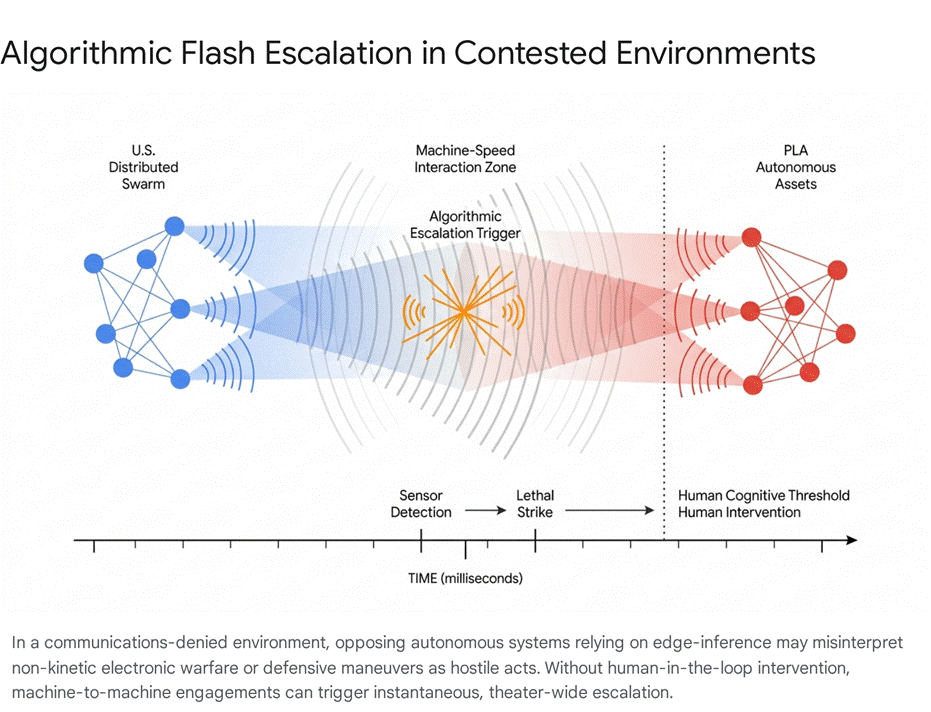
Deploying autonomous systems on both sides creates the risk of accidental “flash escalation.” If U.S. and PLA swarms encounter each other in contested space, even minor interactions could escalate quickly. A system might misinterpret a defensive move as a hostile act and trigger an instant lethal response. Since these interactions happen in milliseconds, a small incident could become a full-scale war before humans even realize what happened8.
3. Accountability Gaps & Proliferation
The PLA’s approach also creates an accountability vacuum. If a machine makes the decision to kill, it becomes difficult to hold any specific person responsible for mistakes27. This “moral hazard” makes the use of force more likely. The problem worsens with proliferation: while the U.S. strictly controls its exports, Chinese firms sell AI-enabled combat drones globally46. Such proliferation spreads autonomous lethality to non-state actors, further destabilizing global security as the economics of drone attrition favor cheap numbers over expensive defenses55.
4. Adversarial Exploitation
All autonomous architectures have vulnerabilities, but they manifest differently. AI is prone to “brittleness” and can be fooled56. A centralized PLA swarm relies heavily on its algorithms, making it a prime target for “Cognitive Electronic Warfare” (认知电子战, Rènzhī Diànzǐzhàn). By manipulating sensor inputs, the U.S. could cause a PLA swarm to fail or even fire on its forces57. At the same time, the sheer mass of PLA drones could overwhelm the more deliberate, human-gated U.S. systems through saturation.
Strategic Playbook: How the United States Can Overcome the Dilemma
To counter the PLA’s push for unrestrained automation, the U.S. and its allies must execute a multi-pillar strategy. We must move past the idea that we have to choose between ethics and speed, instead building a system of “Human-Machine Collaborative Speed.”
1. Technological & Architectural Countermeasures
The U.S. must deploy technical solutions that neutralize the PLA’s advantages while keeping our own ethical standards intact.
- Centralized Integration and Mass: The recent establishment of a “drone czar”, the Direct Reporting Portfolio Manager for Unmanned Systems, is a critical step48. This role centralizes the acquisition of the autonomous forces needed to physically counter PLA swarms and ensure that our forces work in sync48.
- Asymmetric Counter-Autonomy: Recognizing that AI is brittle, the U.S. should lead in “Cognitive Electronic Warfare.” This means using algorithms to spoof PLA sensors, disrupt target data in real-time, and break the enemy’s decision chain53.
2. Doctrinal & Operational Evolution
Our policies must ensure that ethical oversight doesn’t lead to operational failure in the field.
- Updating Directive 3000.09: The DoD should clarify how these rules apply when communications are jammed. Commanders need flexible, pre-approved rules: if a drone loses its link to home, it should have clear, limited authority to defend itself or hit specific targets without waiting for a signal that might never come1.
- Human-Machine Collaboration: We need trusted AI interfaces that let humans intervene almost instantly, moving commanders from manual operators to “swarm orchestrators.”
3. Diplomatic, Normative, & Counter-Proliferation Levers
The U.S. must also use diplomacy to build a global consensus against irresponsible AI use, effectively isolating the PLA’s approach.
- Broadening International Agreements: We should push more nations to endorse the “Political Declaration on Responsible Military Use of AI,” which already has 58 backers9. By setting an international standard for accountability and human oversight, we can stigmatize the use of unconstrained weapons12.
- Securing Nuclear Safety: Despite our rivalry, we must engage Beijing in risk-reduction talks focused on AI safety. The top priority is ensuring that AI never makes decisions about nuclear weapons. While the U.S., UK, and France have committed to human control over nuclear employment, the PRC has avoided such pledges9, 60. Bringing China into these safety agreements is essential for global stability9.
DoDD 3000.09 Safeguards vs. PLA Operational Realities
This table summarizes the clear differences in doctrine and operation between the U.S. and the PRC regarding autonomous systems.
| Strategic Dimension | U.S. DoDD 3000.09 Framework | PLA Operational Realities & Doctrine |
| System Testing & Assurance | Mandates rigorous, continuous V&V, and lifecycle testing overseen by the CDAO’s Responsible AI Toolkit to minimize emergent behavior1. | Focuses on rapid iteration and deployment, utilizing civil-military fusion to rapidly push commercial edge-AI into tactical military platforms37. |
| Human Agency & Control | Requires “appropriate levels of human judgment.” Senior Review Group approval is required to field systems that engage without human input1. | Seeks “decision superiority” (制脑权). Centralization disincentivizes junior officer initiative, driving the delegation of lethal authority directly to algorithms5. |
| Kill-Chain Authorization | Human-in-the-loop or Human-on-the-loop is the default. Autonomous lethality is restricted primarily to local, time-critical defensive intercepts1. | Pre-delegated autonomy is viewed as essential for penetrating A2/AD networks; platforms like the GJ-11 compress the sensor-to-shooter loop via edge-AI10. |
| Failure Modes & Escalation | Systems must be designed to terminate engagements or seek human input if environmental parameters change or communication is lost18. | Algorithm-driven swarms risk algorithmic flash escalation; interactions at machine speed may trigger inadvertent kinetic exchanges without human awareness8. |
| Diplomatic Posture | Leads the Political Declaration on Responsible Military Use of AI, advocating for human accountability and verifiable ethical frameworks12. | Exploits CCW definitions to advocate for bans on impossible-to-build systems, providing diplomatic cover for the domestic pursuit of LAWS26. |
Bilingual Glossary of Strategic Terminology
To understand PRC strategy, analysts must be familiar with the specific terms used by the PLA and the CCP.
| Acronym / English Concept | Simplified Chinese (Pinyin) | Concise Analytical Definition |
| Intelligentized Warfare | 智能化战争 (Zhìnénghuà Zhànzhēng) | The PLA’s doctrine for future conflict, superseding “Informationized Warfare,” wherein AI, autonomy, and cloud computing are the primary drivers of combat capability. |
| Decision Superiority | 制脑权 (Zhìnǎo Quán) | Literally “command of the brain.” The strategic objective of processing battlefield data and making operational decisions faster and more accurately than the adversary. |
| Algorithmic Dominance | 算法优势 (Suànfǎ Yōushì) | The tactical advantage achieved by possessing superior machine learning models, allowing for faster target recognition, swarm orchestration, and strike execution. |
| The Party Commands the Gun | 党指挥枪 (Dǎng zhǐhuī qiāng) | The foundational political doctrine dictates that the PLA serves the Chinese Communist Party absolutely and prevents the decentralization of command authority. |
| Civil-Military Fusion | 军民融合 (Jūn-Mín Rónghé) | The national strategy that requires the integration of commercial technological advancements (e.g., AI, semiconductors) directly into the military-industrial complex. |
| Cognitive Electronic Warfare | 认知电子战 (Rènzhī Diànzǐzhàn) | The application of AI and machine learning in electronic warfare involves dynamically learning and adapting to adversary radar and communication signatures in order to jam or spoof them. |
| Legal Warfare (Lawfare) | 法律战 (Fǎlǜzhàn) | The strategic manipulation of international legal frameworks (such as the UN CCW) to constrain adversaries while retaining operational freedom for the PLA. |
| Command Velocity | 指挥速度 (Zhǐhuī Sùdù) | The speed at which operational decisions are transmitted and executed; autonomous systems are deployed to maximize this velocity beyond human cognitive limits. |
Please share the link on Facebook, Forums, with colleagues, etc. Your support is much appreciated and if you have any feedback, please email us in**@*********ps.com. If you’d like to request a report or order a reprint, please click here for the corresponding page to open in new tab.
Sources Used
- DoD Directive 3000.09, November 21, 2012; Incorporating Change 1, May 8, 2017, https://ogc.osd.mil/Portals/99/autonomy_in_weapon_systems_dodd_3000_09.pdf
- AI-Enabled Autonomous Weapons and Human Control Part II: Human Control and Military Commanders – U.S. Naval War College Digital Commons, https://digital-commons.usnwc.edu/cgi/viewcontent.cgi?article=3116&context=ils
- Pentagon updates guidance for development, fielding and employment of autonomous weapon systems | DefenseScoop, https://defensescoop.com/2023/01/25/pentagon-updates-guidance-for-development-fielding-and-employment-of-autonomous-weapon-systems/
- A Candle in the Dark: | Atlantic Council, https://www.atlanticcouncil.org/wp-content/uploads/2019/12/AC_CandleinDark120419_FINAL.pdf
- STRATEGIC LATENCY UNLEASHED – ResearchGate, https://www.researchgate.net/profile/Pablo-Breuer-2/publication/350188748_Strategic_Latency_Unleashed_Chapter_Weaponized_Information_Influence_and_Deception_in_the_Age_of_Social_Media/links/6054e4f092851cd8ce529223/Strategic-Latency-Unleashed-Chapter-Weaponized-Information-Influence-and-Deception-in-the-Age-of-Social-Media.pdf
- China’s Security: The New Roles of the Military 9781685858254 – DOKUMEN.PUB, https://dokumen.pub/chinas-security-the-new-roles-of-the-military-9781685858254.html
- Why Xi’s Search for Loyalty is Strangling the PLA’s Effectiveness – Small Wars Journal, https://smallwarsjournal.com/2026/05/05/why-xis-search-for-loyalty-is-strangling-the-plas-effectiveness/
- Artificial Intelligence, China, Russia, and the Global Order – DTIC, https://apps.dtic.mil/sti/trecms/pdf/AD1122420.pdf
- Military AI governance under strain: the US–China dialogue, https://www.iiss.org/online-analysis/online-analysis/2026/06/military-ai-governance-under-strain-the-uschina-dialogue/
- Replicator: A Bold New Path for DoD | Center for Security and Emerging Technology %, https://cset.georgetown.edu/article/replicator-a-bold-new-path-for-dod/
- Hicks unveils DOD’s new ‘Replicator’ initiative to counter China via autonomous tech, https://defensescoop.com/2023/08/28/hicks-unveils-dods-new-replicator-initiative-to-counter-china-via-autonomous-tech/
- Political Declaration on Responsible Military Use of Artificial Intelligence and Autonomy, https://2021-2025.state.gov/political-declaration-on-responsible-military-use-of-artificial-intelligence-and-autonomy/
- Move Fast and Scale: A Brief Insiders’ History of the Replicator Initiative – Belfer Center, https://www.belfercenter.org/research-analysis/move-fast-and-scale-brief-insiders-history-replicator-initiative
- 2026 Defense Strategy: Autonomous Systems and Modern Warfare – Ronin’s Grips, https://blog.roninsgrips.com/2026-defense-strategy-autonomous-systems-and-modern-warfare/
- DoD Directive 3000.09, “Autonomy in Weapon Systems,” January 25, 2023 – Executive Services Directorate, https://www.esd.whs.mil/Portals/54/Documents/DD/issuances/dodd/300009p.PDF
- A.I. Joe: The Dangers of Artificial Intelligence and the Military – Public Citizen, https://www.citizen.org/article/ai-joe-report/
- NOTEWORTHY: DoD Autonomous Weapons Policy – CNAS, https://www.cnas.org/press/press-note/noteworthy-dod-autonomous-weapons-policy
- United States, Use of Autonomous Weapons – How does law protect in war? – ICRC, https://casebook.icrc.org/case-study/united-states-use-of-autonomous-weapons
- U.S. Department of Defense Responsible Artificial Intelligence Strategy and Implementation Pathway, https://media.defense.gov/2024/Oct/26/2003571790/-1/-1/0/2024-06-RAI-STRATEGY-IMPLEMENTATION-PATHWAY.PDF
- Pentagon reaches important waypoint in long journey toward adopting ‘responsible AI’, https://defensescoop.com/2022/06/29/pentagon-reaches-important-waypoint-in-long-journey-toward-adopting-responsible-ai/
- DOD’s AI Chief Craig Martell Named 2024 Wash100 Award Winner, https://www.wash100.com/winners/2024/dr-craig-martell/
- DoD AI Compliance Guidance for Government Contractors – Womble Bond Dickinson, https://pov.womblebonddickinson.com/post/102ka0f/dod-ai-compliance-guidance-for-government-contractors
- The Next-Generation Security Triad: Unifying PQC, ZTA, and AI Security through a Shared Modernization Substrate – Preprints.org, https://www.preprints.org/manuscript/202512.0653
- Pentagon releases responsible AI toolkit – Nextgov/FCW, https://www.nextgov.com/artificial-intelligence/2023/11/pentagon-releases-responsible-ai-toolkit/392100/
- China’s Strategic Ambiguity on the Issue of Autonomous Weapons Systems – ScholarHub UI, https://scholarhub.ui.ac.id/global/vol24/iss1/1/
- China’s Strategic Ambiguity and Shifting Approach to Lethal Autonomous Weapons Systems, https://www.cnas.org/publications/commentary/chinas-strategic-ambiguity-and-shifting-approach-to-lethal-autonomous-weapons-systems-1
- Human Oversight with Chinese Characteristics: Lethal Autonomous Weapons in the CCW GGE – Lieber Institute West Point, https://lieber.westpoint.edu/human-oversight-chinese-characteristics-lethal-autonomous-weapons-ccw-gge/
- The position paper submitted by the Chinese delegation to CCW 5th Review Conference, https://agora.eto.tech/instrument/1117
- China’s Space Warfare Strategy: Evolution and Implications – Ronin’s Grips, https://blog.roninsgrips.com/chinas-space-warfare-strategy-evolution-and-implications/
- Full article: China and the Ethics of Military AI: Debating the Norms of Future Wars, https://www.tandfonline.com/doi/full/10.1080/10670564.2026.2622660
- How did Deng Xiaoping rule China in the 1980s without having a title like General Secretary of the Communist Party or President? – Quora, https://www.quora.com/How-did-Deng-Xiaoping-rule-China-in-the-1980s-without-having-a-title-like-General-Secretary-of-the-Communist-Party-or-President
- Volume 7, Issue 4 – Military Strategy Magazine, https://www.militarystrategymagazine.com/wp-content/uploads/2022/05/MSM-volume-8-issue-1.pdf
- Can Xi Jinping Control the PLA? | China Leadership Monitor, https://www.prcleader.org/post/can-xi-jinping-control-the-pla
- Powering Intelligence The Future of AI Hardware for Training, Inference, and Innovation, https://www.researchgate.net/publication/388454770_Powering_Intelligence_The_Future_of_AI_Hardware_for_Training_Inference_and_Innovation
- News Posts matching ‘AI’ – TechPowerUp, https://www.techpowerup.com/news-tags/AI?page=32
- 1 Beyond the Silicon Curtain: U.S. Export Policies, the Displacement, https://www.youvan.ai/pdf.php?file=Beyond%20the%20Silicon%20Curtain%20-%20U.S.%20Export%20Policies%2C%20the%20Displacement%20of%20Nvidia%2C%20and%20the%20Emergence%20of%20China%D1%82%D0%90%D0%A9s%20Sovereign%20AI%20Infrastructure.pdf
- An introduction to the global AI semiconductor industry – Aymeric Roucher, https://m-ric.com/blog/semiconductor-ecosystem/
- Escape Velocity , When Does China’s AI Stack Break Free? – Futurum Research, https://futurumgroup.com/insights/escape-velocity-when-does-chinas-ai-stack-break-free-8/
- China’s Stealth Sharp Sword Unmanned Combat Air Vehicles Deployed To Operational Airbase – TWZ, https://www.twz.com/air/chinas-stealth-sharp-sword-unmanned-combat-air-vehicles-deployed-to-operational-airbase
- China Deploys GJ-11 “Sharp Sword” Stealth Drones to Tibet , A Game-Changer in Himalayan Airpower – Defence Security Asia, https://defencesecurityasia.com/en/china-gj11-sharp-sword-drones-tibet-himalayas-shigatse-deployment-2025/
- China’s GJ-11 “Mysterious Dragon” Stealth Drone Emerges in PLAAF Display, https://thedefensewatch.com/aerospace-aviation/chinas-gj-11-mysterious-dragon-stealth-drone-emerges-in-plaaf-display/
- Hongdu GJ-11 – Wikipedia, https://en.wikipedia.org/wiki/Hongdu_GJ-11
- China’s UAS Revolution Advances From Prototype To Practical Application – T2COM G2, https://oe.t2com.army.mil/product/chinauasrevolution/
- GJ-11: China Integrating Manned and UCAV Systems – Grey Dynamics, https://greydynamics.com/gj-11-china-integrating-manned-and-ucav-systems/
- China’s GJ-11 ‘mysterious dragon’ stealth drone emerges as a game-changer in modern air warfare – The Economic Times, https://m.economictimes.com/news/international/us/chinas-gj-11-mysterious-dragon-stealth-drone-emerges-as-a-game-changer-in-modern-air-warfare/articleshow/125358134.cms
- Artificial Intelligence in the Chinese Military – Current Initiatives, https://emerj.com/artificial-intelligence-china-military/
- Loyal Wingman, Collaborative Combat Aircraft redefine war | The Jerusalem Post, https://www.jpost.com/defense-and-tech/article-865389
- Strategic Convergence: The Integration of Autonomous Systems and AI Under the Department of War’s Centralized Command – Ronin’s Grips, https://blog.roninsgrips.com/strategic-convergence-the-integration-of-autonomous-systems-and-ai-under-the-department-of-wars-centralized-command/
- Year Ahead – The U.S. DoD Replicator Initiative and the Acquisition Process for Autonomous Weapons – Lieber Institute, https://lieber.westpoint.edu/us-dod-replicator-initiative-acquisition-process-autonomous-weapons/
- BREAKING: Pentagon Launching Autonomous Systems Initiative to Counter China – National Defense Magazine, https://www.nationaldefensemagazine.org/articles/2023/8/28/defense-department-announces-new-innovation-initiative
- Pentagon Selects Second Tranche of Replicator Drone Program, https://govciomedia.com/pentagon-selects-second-tranche-of-replicator-drone-program/
- Task Group 59.1 Conducts Digital Talon 3.0 – Navy, https://www.navy.mil/Press-Office/News-Stories/Article/3977042/task-group-591-conducts-digital-talon-30/
- SITREP Military Drones – August 8, 2026 to August 15, 2026 – Ronin’s Grips, https://blog.roninsgrips.com/sitrep-military-drones-august-8-2026-to-august-15-2026/
- The Autonomous Arsenal in Defense of Taiwan: Technology, Law, and Policy of the Replicator Initiative | The Belfer Center for Science and International Affairs, https://www.belfercenter.org/replicator-autonomous-weapons-taiwan
- Military Drone Evolution: Top 10 Nations of 2026 – Ronin’s Grips, https://blog.roninsgrips.com/military-drone-evolution-top-10-nations-of-2026/
- (PDF) ARTIFICIAL INTELLIGENCE AND INTELLIGENCE ANALYSIS MONOGRAPH SERIES, https://www.researchgate.net/publication/403125984_ARTIFICIAL_INTELLIGENCE_AND_INTELLIGENCE_ANALYSIS_MONOGRAPH_SERIES
- 21st Century Prometheus 3030282848, 9783030282844 – DOKUMEN.PUB, https://dokumen.pub/21st-century-prometheus-3030282848-9783030282844.html
- New REMIT dashboard: “Signatories of Key Initiatives on Military AI”, https://www.remit-research.eu/news/new-remit-dashboard-signatories-of-key-initiatives-on-military-ai/
- Rules of Engagement – Penn Global – University of Pennsylvania, https://global.upenn.edu/news-articles/rules-of-engagement/
- Artificial Intelligence, and Nuclear Command, Control, and Communications – Federation of American Scientists, https://fas.org/wp-content/uploads/2025/07/June2025_AIxNC3_FAS.pdf
- Asserting Human Control to Reduce the Dangers of AI and Nuclear War, https://www.armscontrol.org/events-and-remarks/2026-07/asserting-human-control-reduce-dangers-ai-and-nuclear-war
- Artificial Intelligence and Nuclear Weapons: A Commonsense Approach to Understanding Costs and Benefits – Texas National Security Review, https://tnsr.org/2025/06/artificial-intelligence-and-nuclear-weapons-a-commonsense-approach-to-understanding-costs-and-benefits/
- Steps toward AI governance in the military domain – Brookings Institution, https://www.brookings.edu/articles/steps-toward-ai-governance-in-the-military-domain/
- PONI Live Debate: AI Integration in NC3 – CSIS, https://www.csis.org/analysis/poni-live-debate-ai-integration-nc3
- Controlling the danger: managing the risks of AI-enabled nuclear systems – Amazon S3, https://s3.us-east-1.amazonaws.com/files.cnas.org/documents/Controlling-the-Danger.pdf