Executive Summary
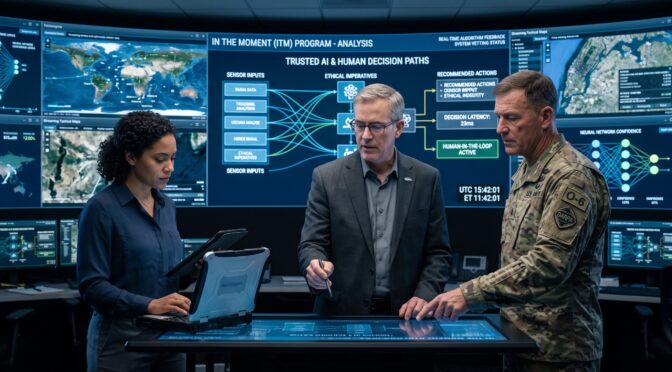
DARPA’s In the Moment (ITM) program1 marks a major shift in how the Department of Defense (DoD) evaluates and deploys artificial intelligence. Traditionally, AI is polished using “ground truth”—datasets where every answer is clearly right or wrong. But real-world military crises, like chaotic battlefield triage or rapid-fire cyber attacks, don’t offer that clarity. These “difficult domains” are defined by intense pressure, limited resources, and ethical gray areas where even the most seasoned experts disagree. In these moments, finding a single “correct” mathematical answer isn’t just challenging; it’s often impossible1.
Led by Dr. Matt Turek of DARPA’s Information Innovation Office (I2O), ITM moves away from standard benchmarks toward a “quantitative alignment framework”1. Instead of training AI to hunt for one “perfect” outcome, the program models Key Decision-Maker Attributes (KDMAs)—the underlying values, risk tolerances, and reasoning styles that drive human experts1. By creating algorithms that can adapt to these human traits, ITM aims to build systems that commanders are actually willing to trust with life-and-death decisions4.
This report looks at ITM’s structure, its main players, and its plan for the next few years. We dive into core technologies like Explainable Case-Based Reasoning (ECBR) and Bayesian ethical models5, while considering the broader policy landscape of DoD Directive 3000.098. Crucially, we also examine the “overtrust paradox”—the risk that humans might follow autonomous agents too blindly during the heat of battle11.
1. Program Genesis & Conceptual Paradigm Shift
1.1 The Failure of Conventional Ground Truth in Difficult Domains
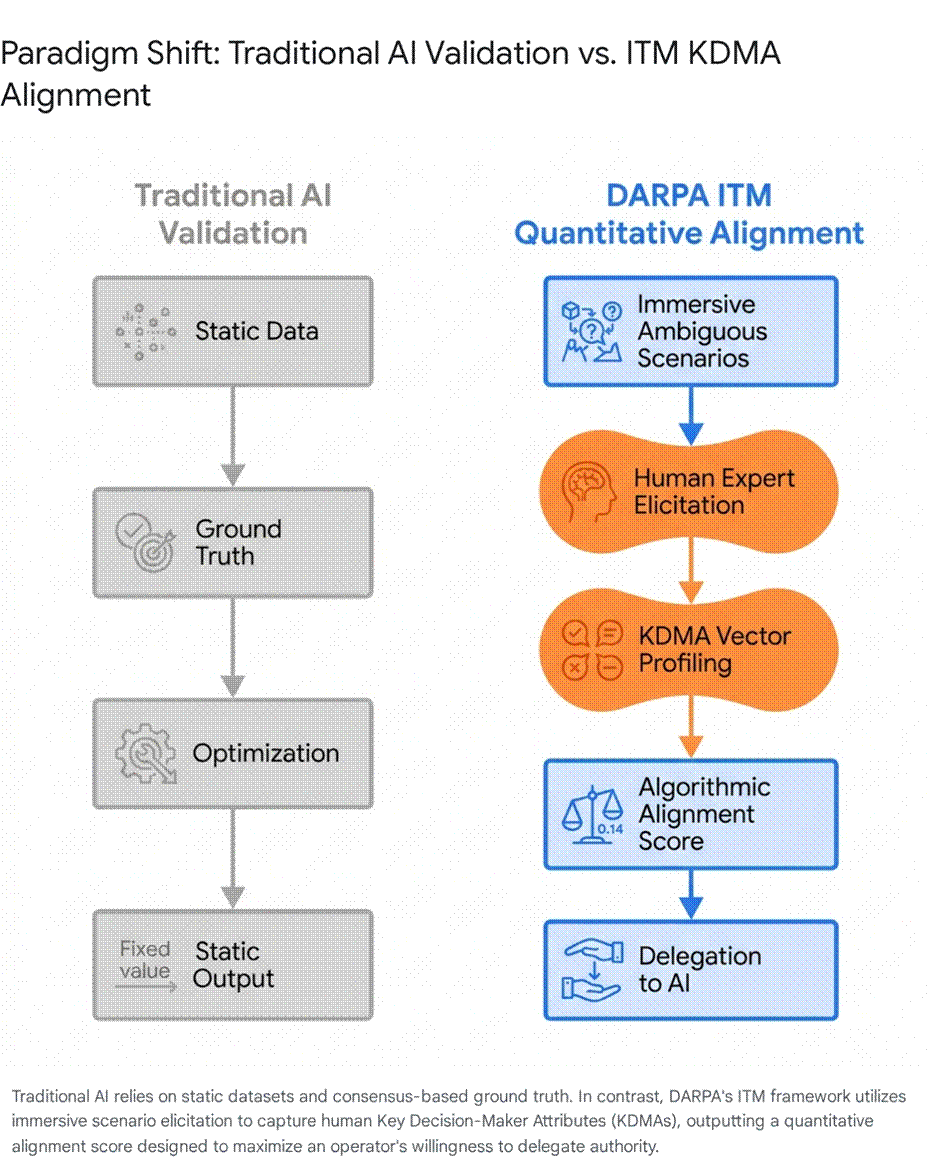
Military AI has traditionally leaned on massive, curated datasets where every entry has a clear label. Standard benchmarks, like ImageNet for vision or GLUE for language, work well in these “solved” environments2. In these cases, engineers can simply train models to get as close to the static “correct” answer as possible.
But DARPA identified a glaring gap: the most critical missions rarely offer perfect data. Dr. Turek notes that “the lack of a right answer… prevents us from using typical AI development approaches”1. Consider a combat medic at a mass casualty scene with a hundred patients and only five doctors13. There is no simple math to solve that tragedy. Instead, decisions are shaped by military doctrine, shifting ethics, and split-second human judgment4.
In these “difficult domains,” trusted human decision-makers will frequently and reasonably disagree on the optimal course of action1. Without rigorous, quantifiable assessment techniques designed specifically for these ambiguous environments, the fielding of algorithmic decision-makers in operational military environments remains untenable. Accuracy alone is insufficient when decisions involve profound ethical trade-offs, conflicting values, and incomplete contextual reasoning2.
1.2 Key Decision-Maker Attributes (KDMAs) and Quantitative Alignment
To address this, the ITM Presolicitation4 centered its strategy on Key Decision-Maker Attributes (KDMAs). These are the quantifiable traits—like reasoning style and moral priorities—that guide an expert’s choices1. KDMAs capture how a person weighs uncertainty, follows doctrine, or reacts to intense time pressure3.
Rather than training an AI to optimize a single rigid metric—such as maximizing overall survival probability at the expense of all other contextual factors—the ITM program captures a reference distribution of KDMAs by exposing trusted human experts to realistic, challenging decision-making scenarios1. Utilizing immersive virtual reality and simulated environments, researchers elicit responses from human triage professionals acting as experimental controls1.
When an AI is put through the same high-stress simulations as a human expert, the ITM system calculates a quantitative alignment score. This measures how closely the AI’s “thinking” mirrors that of a trusted human expert17. The goal is simple: if the algorithm uses the same values as the commander, the commander is more likely to trust it with the mission4.
2. Technical Areas (TAs) & The Performer Ecosystem
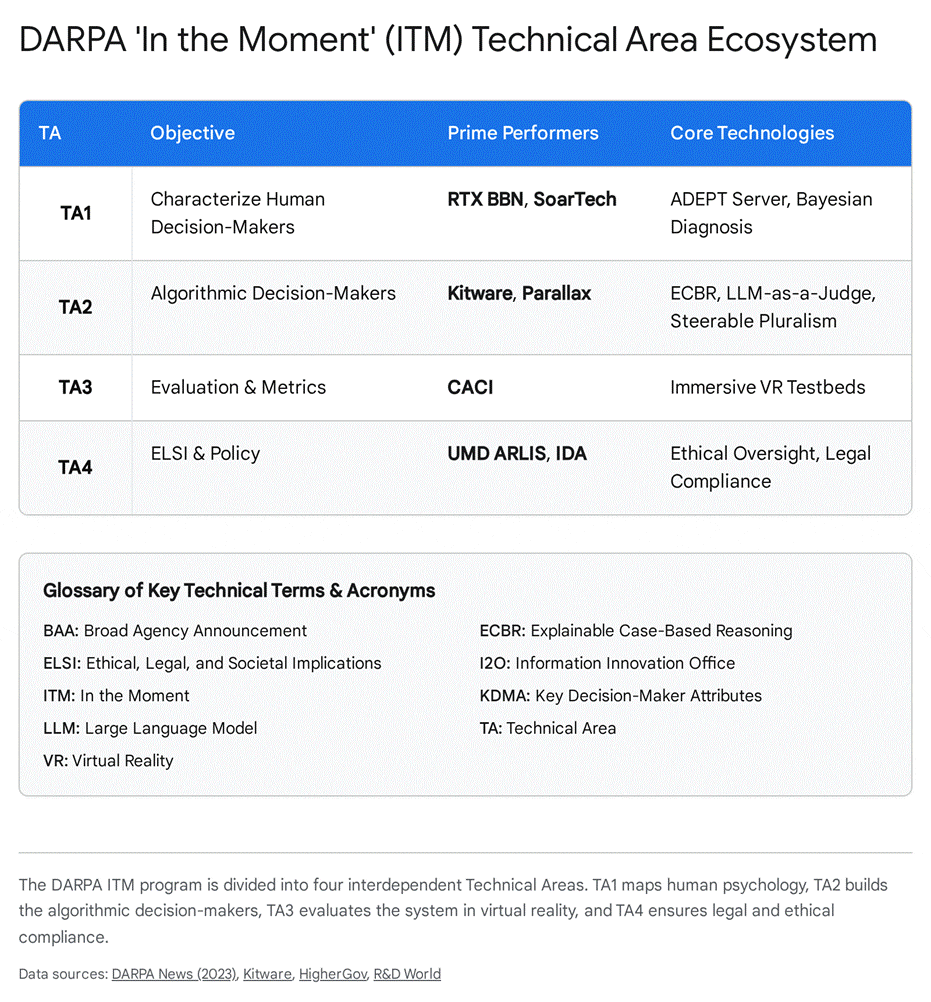
To execute this highly ambitious technical vision, DARPA structured the ITM program into four distinct, interdependent Technical Areas (TAs). DARPA awarded multi-million dollar contracts to a specialized ecosystem of prime defense contractors, academic institutions, and non-profit research organizations, ensuring a comprehensive approach spanning software engineering, cognitive psychology, and legal oversight17.
2.1 TA1: Decision-Maker Characterization
Objective: The primary mandate of TA1 is to identify and quantitatively model the key decision-making attributes of trusted humans to produce a baseline quantitative decision-maker alignment score1.
Prime Performers:
- RTX BBN Technologies ($3.8M award)2
- Soar Technology, Inc. (SoarTech)
[cite: 2, 3]
Technical Architecture: TA1 focuses entirely on human attribute elicitation and backend data representation. Performers are required to explicitly identify the psychological and cognitive theories of decision-making that form the basis of their KDMA extractions5. This theoretical foundation has driven the development of the ADEPT (Alignment and Decision-Maker Profiling) server interface18.
Based on SoarTech’s proposed Minimum Viable Product (MVP) API specification, the ADEPT Python Flask server was developed for the metrics evaluation milestone to ingest complex human decision data and compute specific KDMA profile vectors. Supporting inputs such as trinary probes, the system calculates vector differences to establish alignment targets, determining what theoretical alignment scores are mathematically obtainable given a set of situational parameters2.
2.2 TA2: Algorithmic Decision-Makers
Objective: TA2 focuses on implementing the actual algorithmic decision-making systems capable of functioning in austere environments while demonstrating provable alignment with the key attributes mapped by TA14.
Prime Performers:
- Kitware, Inc. ($11.5M award)20
- Parallax Advanced Research ($4.067M award), partnering closely with Drexel University and Knexus Research Corporation6.
Technical Architecture: TA2 requires building the frontline artificial intelligence systems that will generate the specific triage or cyber intervention recommendations.
- Parallax Advanced Research (led by Dr. Matt Molineaux) leads the development of an innovative system known as the Trustworthy Algorithmic Delegate (TAD)6. TAD operates via Explainable Case-Based Reasoning (ECBR), an approach designed to actively emulate human medical reasoning by retrieving past experiential cases (e.g., historical medical scenarios from vast databases) and adapting those proven solutions to novel, ambiguous situations6. A critical component of TAD is its inherent explainability, providing clear, human-readable rationalizations for its actions to foster user trust1. To perform complex decision analysis, TAD utilizes several mechanisms analogous to human cognition: Monte Carlo Simulation to explore possible futures and downstream effects, Bayesian Diagnosis to evaluate probabilistic hypotheses regarding unseen injuries, and a Bounded Rationalizer using fast-and-frugal heuristics to rapidly compare treatment options13. Parallax leverages a cooperative research agreement with the Naval Medical Research Unit – Dayton (NAMRU-D) to provide rigorous subject-matter expertise in battlefield medicine and validate the AI’s training methodologies1.
- Kitware utilizes a radically different approach, centering on a novel LLM-as-a-Judge framework5. Standard Large Language Models frequently operate as unconstrained “black boxes” that output final recommendations with little transparency, a critical flaw that inherently limits human trust5. To solve this, Kitware separates evaluation from the final choice. The LLM does not make decisions directly; instead, it evaluates all potential medical or cyber options, generates transparent reasoning statements (Chain-of-Thought) for each, and scores them against the specific KDMAs mapped by TA14. A complex regression framework, utilizing Reinforcement Learning with Verifiable Rewards (RLVR), then generates the final recommendation, maximizing alignment while minimizing unintended bias5. To ensure realistic and robust testing, Kitware pairs this framework with the Pulse Physiology Engine, which generates highly accurate synthetic patient digital twins with varied body types, vital signs, and injury profiles5.
2.3 TA3: Program Evaluation & Metrics
Objective: Design, build, and execute the overarching program evaluation architecture. TA3 is explicitly responsible for verifying whether successful KDMA alignment actually leads to an increase in human willingness to delegate decision-making authority4.
Prime Performer: CACI International Inc.
[cite: 17]
Technical Architecture: CACI operates the TA3 evaluation servers and creates the immersive virtual reality testbeds utilized across the program3. These highly specialized testbeds are designed to immerse human subjects deeply into high-stakes, stressful contexts (e.g., a chaotic battlefield medical tent) to accurately replicate real-world physiological and psychological pressures, thereby increasing the fidelity of the program’s data collection5. During evaluation cycles, CACI tests algorithms that are actively aligned to the user alongside baseline algorithms containing known misaligned attributes as experimental controls, definitively measuring behavioral shifts in the human operator’s willingness to delegate tasks1.
2.4 TA4: Policy, Practice Integration, & ELSI
Objective: Provide rigorous, continuous oversight regarding Ethical, Legal, and Societal Implications (ELSI) and actively advise DARPA on potential future transition pathways into operational DoD frameworks3.
Prime Performers:
- University of Maryland Applied Research Laboratory for Intelligence and Security (UMD ARLIS)
[cite: 6, 17] - Institute for Defense Analyses (IDA)
[cite: 17]
Technical Architecture: TA4 experts, whose specialties span moral philosophy, cognitive science, and international law, are deeply embedded throughout the entire ITM research lifecycle3. They are responsible for ensuring that the development and eventual fielding of these aligned autonomous agents do not inadvertently violate the international laws of armed conflict or DoD directives regarding human oversight and command responsibility25. TA4 is also responsible for executing detailed outreach event plans, integrating the civilian academic community with the military’s strategic needs5.
3. Program Phasing, Domains, & Evolutionary Trajectory
The ITM program is formally structured into two primary phases, scaling progressively in domain complexity, resource constraints, evaluation mechanisms, and the minimum performance thresholds required for human delegation3.
3.1 Phase 1: Small Unit Tactical & Austere Medical Triage
Phase 1 severely limits its operational scope to small military unit medical triage executed within austere environments2. In these highly constrained tactical scenarios, human medics and algorithmic systems face extreme time pressures and critically limited resources, such as restricted bandages, minimal whole blood availability, or delayed evacuation vectors5.
During Phase 1 execution, TA2 performers were tasked with ensuring their AI systems moved beyond rudimentary optimizations. Traditional AI might attempt to maximize overall survival probability across a unit. However, real-world triage requires nuanced, responsible considerations of dynamic patient outcomes, rapid adaptation to shifting situational priorities, and deep alignment with human reasoning styles5. Utilizing tools like the Pulse Physiology Engine, Kitware and other performers tested their algorithms against a wide spectrum of complex, synthetic combat injuries5.
A crucial defining feature of Phase 1 is its focus on group alignment. The objective was to ensure that the algorithmic decision-maker reliably aligned with the acceptable decision-making variability of a general group of trusted human decision-makers, rather than tailoring its outputs to a single, specific individual1.
Metrics & Outcomes: According to performer data released following Phase 1 testing, aligned AI systems successfully outperformed unaligned baseline models. Crucially, they earned significantly higher trust ratings from human evaluators in the VR testbeds, establishing a program baseline where approximately 60% of human decisions were confidently delegated to the AI systems in austere triage scenarios5.
3.2 Phase 2: Mass Casualty Incidents & Cyber Operations Expansion
Phase 2 significantly expands the technical envelope and operational ambition across two distinct domains, drastically increasing the required complexity of the algorithms:
- Mass Casualty Care (Medical Domain Expansion): The medical domain scales up to overwhelming operational footprints. AI systems are no longer triaging small units; they must triage Mass Casualty Incidents (MCIs) involving potentially hundreds of casualties but only a handful of available medical personnel3. Furthermore, Phase 2 implements a massive paradigm shift from group alignment to individualized alignment1. The core assumption guiding Phase 2 is that every commander or medical director makes decisions in a fundamentally different manner. Therefore, the algorithmic system must dynamically adapt and calibrate its output to align perfectly with the specific idiosyncrasies and KDMAs of the unique human actively delegating the tasks1.
- Autonomous Cyber Defense (New Domain Integration): Kitware and other performers extended the ITM framework into the high-stakes domain of cybersecurity5. In autonomous cyber defense, decision-making occurs at machine speed, requiring algorithmic systems to analyze rapid, multi-variable tradeoffs. Specifically, the algorithms must constantly balance the competing priorities of the CIA triad: Confidentiality, Integrity, and Availability5.
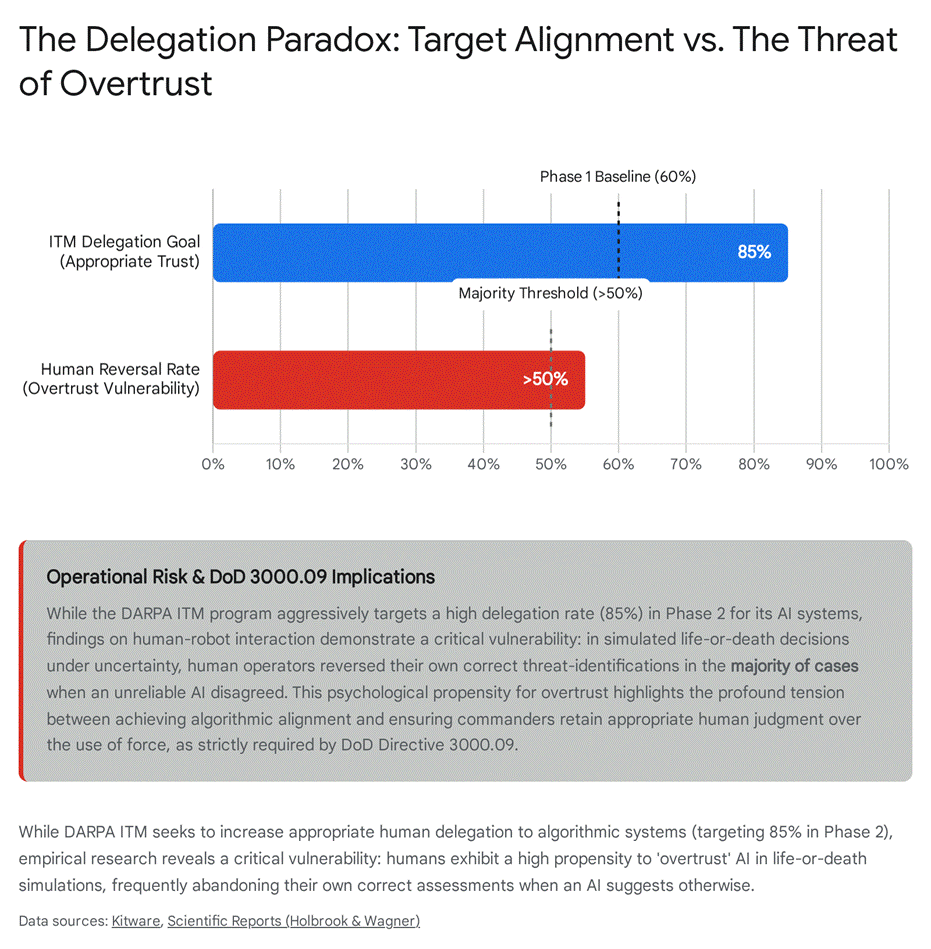
Metrics & Outcomes: To handle these complexities, Phase 2 introduces Multi-KDMA Reasoning, wherein algorithms must actively predict the relevance of competing attributes under pressure, utilizing autonomous agents equipped with reinforcement learning and responsible constraints5. With the integration of individual alignment, the explicit DARPA target metric for Phase 2 is to increase the human willingness to delegate from the Phase 1 baseline of 60% up to an ambitious 85%5.
| Feature | Phase 1 | Phase 2 |
| Operational Domain | Small Unit Austere Medical Triage | Mass Casualty Incidents (MCI) & Cybersecurity |
| Resource Profile | Highly Constrained (Austere) | Overwhelming Scale / Machine-Speed Tradeoffs |
| Alignment Target | General Group Alignment | Specific Individualized Alignment |
| Delegation Benchmark | 60% Baseline | 85% Target |
| Key AI Capabilities | Foundational KDMA scoring, ECBR | Multi-KDMA Reasoning, CIA Triad Balancing |
3.3 Contextualizing ITM: Complementary DARPA Programs
The ITM program does not operate in an operational vacuum; its research trajectory is deeply intertwined with complementary DARPA initiatives, most notably the DARPA Triage Challenge (DTC)1. Understanding the distinction between these programs is vital for grasping the DoD’s holistic approach to autonomous systems.
While the ITM program focuses entirely on the cognitive alignment, psychological trust, and decision-making logic between humans and machines, the DTC focuses on the hardware, sensor technology, and physical autonomy required to execute triage in the field leading up to a November 2026 final competition15.
- Primary Triage (DTC): Explores the use of uncrewed aerial vehicles (UAVs) and autonomous ground robots equipped with stand-off sensors to autonomously locate casualties in hazardous environments and identify early physiological signatures of injury14. For example, competitors like Carnegie Mellon University and the University of Pittsburgh’s Team Chiron completed Phase 1 in September 2024 and Phase 2 in September 2025 at the Hazelwood Green site, successfully deploying quadruped robots to autonomously assess heart rates, respiratory rates, and alertness using advanced vision-based Bayesian networks under severely degraded nighttime and smoke conditions27.
- Secondary Triage (DTC): Utilizes non-invasive contact sensors placed directly on casualties to continuously monitor vital signs and deploy algorithms that predict the imminent need for life-saving interventions (LSIs)1.
The synergy between these programs is profound. If ITM can successfully prove that human commanders and medics are willing to trust algorithms (providing the aligned “brain” of the decision), the advanced autonomous platforms and sensor arrays developed in the DARPA Triage Challenge (providing the “eyes and hands”) will serve as the natural physical implementation vectors for these aligned models in future conflicts15.
4. Deep Dive: Algorithmic Mechanics of Alignment
The specific technical breakthroughs achieved by ITM TA2 performers rely heavily on highly novel applications of Large Language Models (LLMs) and advanced statistical regressions. Standard Reinforcement Learning from Human Feedback (RLHF) methodologies—the industry standard for commercial AI alignment—train models using scalar rewards that merely reflect the “average” preferences of a large population30. While effective for general chatbots, this methodology fails spectacularly in specialized, high-stakes edge cases where average responses are inadequate and individual nuance is required30.
4.1 Steerable Pluralism and Few-Shot Comparative Regression
To solve the inherent limitations of average scalar rewards, researchers at Kitware (such as Jadie Adams et al.) developed Steerable Pluralism, a pluralistic alignment model based on few-shot comparative regression30.
Instead of forcing an AI to rely on a monolithic set of uniform values, a Steerable Pluralistic Model (SPM) is designed to dynamically adopt specific individual perspectives and align its generated outputs accordingly22. The Kitware system employs the aforementioned LLM-as-a-Judge framework. When presented with a complex medical triage scenario, the LLM does not make a direct decision5. Instead, it exhaustively evaluates all potential treatment options, generating transparent reasoning statements—utilizing Chain-of-Thought (CoT) prompting—to explain the merits and drawbacks of each choice5.
Recent advancements demonstrate that applying Reinforcement Learning with Verifiable Rewards (RLVR) to these systems consistently outperforms standard Supervised Fine-Tuning (SFT). RLVR encourages the model to consider multiple perspectives natively in its CoT generation, enabling strong steerable alignment without degrading faithfulness22. Once options are outlined, the LLM scores them against the specific operator’s defined KDMAs. A distinct arithmetic distance function then calculates the regression, definitively selecting the choice mathematically closest to the human’s individualized alignment target5.
To facilitate this process, the system leverages few-shot in-context learning, supplying the AI with domain-specific examples to improve regression accuracy rapidly during specialized scenarios17. This methodology, heavily evaluated against open-source datasets adapted for fine-grained multi-attribute tracking like the Moral Integrity Corpus (MIC) and HelpSteer2, dramatically reduces “black-box” bias, increases interpretability, and significantly improves alignment over baseline approaches22.
4.2 Bayesian Ethical Alignment Models
Parallel academic and industry research presented by ITM-adjacent performers—most notably by Spencer Kohn and colleagues at Perceptronics Solutions and George Mason University—highlights the potent application of Bayesian Ethical Alignment Models7.
As artificial intelligence systems become increasingly agentic, human-machine interactions are shifting from brief, transactional inputs to sustained, ongoing socioaffective engagements7. In these persistent relationships, human preferences and AI perceptions continuously evolve through mutual influence. Bayesian alignment models offer a robust mathematical framework to navigate these complex socioaffective dynamics.
These models utilize explicit prior distributions of human ethical preferences—often hard-coded in accordance with international Laws of War, established Rules of Engagement, or specific tactical doctrine—and combine them with live observational data functioning as likelihood functions3. By synthesizing these elements, the model computes posterior distributions that determine future actions. This mathematical framework generates a quantitative, highly calibrated ethical “strike/no-strike” score for kinetic operations, or in ITM’s medical context, a critical “treat/delay” score3. By expressing background knowledge as probability distributions rather than rigid if/then logic gates, Bayesian models can reliably navigate conflicting values and ambiguous environments while remaining tightly calibrated to the human user’s specific risk tolerances3.
5. Strategic, Operational, & Ethical Implications (ELSI)
The successful engineering of human-aligned artificial intelligence introduces profound strategic, legal, and operational risks. If DARPA achieves its Phase 2 goal of 85% algorithmic delegation, the DoD must rigorously prepare to manage the vast Ethical, Legal, and Societal Implications (ELSI) of deploying these systems in lethal or life-saving scenarios3.
5.1 Command Responsibility and DoD Directive 3000.09
The foundational policy document governing the deployment of autonomous military systems is DoD Directive 3000.09 (Autonomy in Weapon Systems)8. Originally issued in 2012 and significantly updated in January 2023, the directive mandates that all autonomous and semi-autonomous systems must be designed to allow commanders and operators to exercise “appropriate levels of human judgment over the use of force”8.
The phrasing of this directive is highly deliberate and reflects deep diplomatic and operational strategy. In international forums like the Convention on Certain Conventional Weapons (CCW) Group of Governmental Experts (GGE) in Geneva, several nations and non-governmental organizations have pressed for binding international laws requiring absolute “meaningful human control” at every micro-stage of a weapon’s lifecycle6. The United States has consistently and firmly opposed these fixed formulations6. U.S. delegations argue that strict manual control requirements would keep operators stuck in constant manual loops, which would slow down decision-making systems against fast-moving, modern threats6. During the March 2026 CCW GGE session, the U.S. explicitly rejected the term “human control” and proposed the alternative phrasing “good faith human judgement and care”6.
DoD 3000.09 establishes a flexible, context-driven standard: the level of autonomy can scale to the mission, but human responsibility for compliance with International Humanitarian Law (IHL) remains absolute and cannot be transferred or delegated to machines8. This paradigm is essential for cultivating “Strategic Centaurs”—a hybrid operational model where AI handles the data-heavy processing of the combat OODA loop while humans retain final accountability38.
The DARPA ITM program directly supports and technically enables the 3000.09 mandate. By ensuring that algorithms computationally evaluate situations, prioritize ethical values, and act strictly within the specific bounds of a commander’s quantified KDMAs, ITM provides a concrete technical mechanism for retaining human judgment and intent, even when a human operator is physically “off-the-loop” during rapid, machine-speed combat operations2.
5.2 The Overtrust Paradox and Psychological Vulnerability
While ITM’s explicit goal is to increase human trust in AI, uncalibrated trust presents a severe operational vulnerability. Researchers Colin Holbrook and Alan R. Wagner highlight that the psychological reality of human baseline “overtrust” in AI must be aggressively recognized and countered11.
In comprehensive, pre-registered empirical studies utilizing immersive drone warfare VR simulations, researchers explored human-robot interaction during life-or-death decision-making under uncertainty (e.g., identifying enemy combatants versus civilians prior to a strike)12. The findings revealed a devastating cognitive vulnerability: humans possess a profound propensity to blindly defer to unreliable AI12.
When the human operator correctly identified a target, but the AI agent randomly disagreed and suggested an alternative action, participants reversed their threat-identifications and their decisions to kill in the majority of cases3. By simply having the AI voice a dissenting opinion, human operators substantially degraded their initial, accurate performance, indicating a dangerous propensity to overtrust artificial agents even when the human’s organic judgment was superior12.
This presents a paradox for ITM. If performers like Kitware and Parallax successfully create systems that perfectly mirror human reasoning via Steerable Pluralism or ECBR, human operators may become entirely reliant on the system, lowering their cognitive guard6. In dynamic battlefields where sensor data is frequently noisy, degraded, or actively spoofed by adversaries, an aligned but factually incorrect algorithm could lead a blindly trusting human into catastrophic tactical or ethical errors3. Therefore, future operational deployments of ITM technologies must actively gauge and mitigate human propensities for overtrust11. This may require the AI to proactively flag its own epistemological uncertainties or mathematically force cognitive engagement and verification from the human operator before executing a final, aligned decision4.
6. Conclusion and Future Operational Pathways
DARPA’s In the Moment (ITM) program represents a profound structural maturation in how the Department of Defense conceives of human-machine teaming in the modern era. By abandoning the futile search for an objective, mathematical “ground truth” in inherently ambiguous combat and medical environments, ITM pioneers a highly pragmatic, psychology-driven approach: measuring, computationally modeling, and aligning algorithms to the individual values and cognitive attributes of human commanders1.
The rapid programmatic evolution from Phase 1 (austere small unit medical triage) to Phase 2 (autonomous cyber defense and mass casualty incidents) demonstrates the broad, multi-domain operational applicability of this technology3. Technologies forged within the ITM performer ecosystem—such as Kitware’s Steerable Pluralism, Parallax’s Explainable Case-Based Reasoning, and SoarTech’s ADEPT APIs—are actively laying the software and architectural groundwork for next-generation Joint All-Domain Command and Control (JADC2) systems6. This modernization is critical as the DoD aggressively transitions toward agentic artificial intelligence capable of autonomous, goal-oriented execution at the tactical edge42.
If these algorithmic decision-makers can successfully achieve their Phase 2 targets of 85% trusted individual delegation5, the integration of ITM cognitive software with autonomous hardware platforms (such as the UAVs and quadruped robots currently being developed in the DARPA Triage Challenge)14 will follow rapidly. However, the ultimate operational success of ITM will not be measured solely by algorithmic accuracy or mathematical distance functions, but by its ability to safely navigate the complex ELSI landscape6. Ensuring that future operational systems strictly adhere to the human judgment mandates of DoD Directive 3000.0910, while simultaneously and actively safeguarding operators against the fatal cognitive risks of AI overtrust11, will ultimately dictate whether the ITM program safely transitions from an immersive virtual reality testbed into the lethal reality of modern conflict.
7. Glossary of Terms
- ADEPT: Alignment and Decision-Maker Profiling. The server interface and API developed under TA1 to characterize and process human decision-maker alignments.
- BAA: Broad Agency Announcement. A formal DoD solicitation method to acquire basic and applied research.
- CIA Triad: Confidentiality, Integrity, and Availability. The foundational variables requiring constant tradeoff management in ITM’s cybersecurity Phase 2 domain.
- DoD 3000.09: The core Department of Defense Directive governing the development and use of autonomous and semi-autonomous weapons systems, focusing on human judgment over the use of force.
- DTC: DARPA Triage Challenge. A complementary program focused on autonomous hardware and physiological sensor identification for casualty assessment.
- ECBR: Explainable Case-Based Reasoning. An AI methodology utilized by Parallax to emulate human reasoning by retrieving and adapting past historical cases to novel situations.
- ELSI: Ethical, Legal, and Societal Implications. The oversight framework ensuring technologies comply with moral standards and international law.
- I2O: Information Innovation Office. The DARPA directorate managing the ITM program.
- KDMA: Key Decision-Maker Attributes. The quantifiable traits, values, risk tolerances, and reasoning styles that guide expert human decision-making.
- LLM-as-a-Judge: A framework where Large Language Models are isolated from direct decision-making, instead used to evaluate options, generate reasoning, and score them against KDMAs to minimize bias.
- RLVR: Reinforcement Learning with Verifiable Rewards. An advanced alignment training technique utilized alongside CoT tracing to maintain pluralism without degrading faithfulness.
- Steerable Pluralism: A machine learning alignment methodology that utilizes few-shot comparative regression to adapt an AI to individual, nuanced user preferences rather than relying on a generalized population average.
- TAD: Trustworthy Algorithmic Delegate. Parallax Advanced Research’s primary AI system in development for medical triage, utilizing ECBR.
Please share the link on Facebook, Forums, with colleagues, etc. Your support is much appreciated and if you have any feedback, please email us in**@*********ps.com. If you’d like to request a report or order a reprint, please click here for the corresponding page to open in new tab.
Sources Used
- Developing Algorithms that Make Decisions Aligned with Human Experts – DARPA, https://www.darpa.mil/news/2022/algorithms-human-experts
- In the Moment (ITM) HR001122S0031 – HigherGov, https://www.highergov.com/contract-opportunity/in-the-moment-itm-hr001122s0031-p-d6998/
- Developing Trustworthy AI to Inform Decisions When Every Moment Counts – DARPA, https://www.darpa.mil/news/2023/trustworthy-ai
- ITM – DARPA, https://www.darpa.mil/research/programs/in-the-moment
- Building AI That Humans Can Trust: DARPA’s In the Moment Program – Kitware Inc., https://www.kitware.com/building-ai-that-humans-can-trust-darpas-in-the-moment-program/
- Parallax Advanced Research wins DARPA In the Moment Award totaling $4.067M, https://www.rdworldonline.com/parallax-advanced-research-wins-darpa-in-the-moment-award-totaling-4-067m/
- Creating Bayesian Ethical Alignment Models for Eliciting, Modeling, and Calibrating Ethical Human Decision-Making Values and Priorities | Request PDF – ResearchGate, https://www.researchgate.net/publication/393497022_Creating_Bayesian_Ethical_Alignment_Models_for_Eliciting_Modeling_and_Calibrating_Ethical_Human_Decision-Making_Values_and_Priorities
- ARTIFICIAL INTELLIGENCE DoD Directive 3000.09: Autonomy in Weapon Systems – Carahsoft, https://static.carahsoft.com/concrete/files/2417/3887/5530/Guidance_DoD_Directive_3000.09_-_Autonomy_in_Weapon_Systems.pdf
- DoD Directive 3000.09, November 21, 2012; Incorporating Change 1, May 8, 2017, https://ogc.osd.mil/Portals/99/autonomy_in_weapon_systems_dodd_3000_09.pdf
- DoD Announces Update to DoD Directive 3000.09, ‘Autonomy In Weapon Systems’, https://www.war.gov/News/Releases/Release/article/3278076/dod-announces-update-to-dod-directive-300009-autonomy-in-weapon-systems/
- Human-Aligned AI Must Counter Overtrust – Penn State Research Database, https://pure.psu.edu/en/publications/human-aligned-ai-must-counter-overtrust/
- Overtrust in AI Recommendations to Kill Colin Holbrook1, Daniel Holman1, Joshua Clingo1, & Alan R. Wagner2 1 Department of C – SciSpace, https://scispace.com/pdf/overtrust-in-ai-recommendations-to-kill-1q8v8jc75s.pdf
- Parallax Advanced Research wins DARPA In the Moment Award totaling $4.067 million, https://parallaxresearch.org/news/press-releases/parallax-advanced-research-wins-darpa-moment-award-totaling-4067-million
- About | Triage Challenge – DARPA, https://www.darpa.mil/research/challenges/darpa-triage-challenge/about
- DARPA Challenge to Facilitate Scalable, Timely, Accurate Medical Triage, https://www.darpa.mil/news/2022/triage-challenge
- DARPA Triage Challenge, https://www.darpa.mil/research/programs/darpa-triage-challenge
- Ethical, Explainable AI in Action: DARPA ITM Phase 1 Contributions – Kitware Inc., https://www.kitware.com/ethical-explainable-ai-in-action-darpa-itm-phase-1-contributions/
- ITM TA1 ADEPT shared / adept_server – GitLab, https://gitlab.com/itm-ta1-adept-shared/adept_server
- DARPA taps RTX to attune AI decisions to human values – PR Newswire, https://www.prnewswire.com/news-releases/darpa-taps-rtx-to-attune-ai-decisions-to-human-values-301898004.html
- Kitware Secures $11.5M, Multi-Year DARPA Contract to Teach AI How to Make Difficult Decisions Aligned with Humans, https://www.kitware.com/kitware-secures-11-5m-multi-year-darpa-contract-to-teach-ai-how-to-make-difficult-decisions-aligned-with-humans/
- Aligning to Human Decision-Makers in Military Medical Triage – ResearchGate, https://www.researchgate.net/publication/381651430_Aligning_to_Human_Decision-Makers_in_Military_Medical_Triage
- Exploring Chain-of-Thought Reasoning for Steerable Pluralistic Alignment – ACL Anthology, https://aclanthology.org/2025.emnlp-main.1301.pdf
- GitHub – NextCenturyCorporation/itm-evaluation-server · GitHub, https://github.com/NextCenturyCorporation/itm-evaluation-server
- Perspectives on Wearable Enhanced Learning (WELL): Current Trends, Research, and Practice [1st ed. 2019] 978-3-319-64300-7, 978-3-319-64301-4 – DOKUMEN.PUB, https://dokumen.pub/perspectives-on-wearable-enhanced-learning-well-current-trends-research-and-practice-1st-ed-2019-978-3-319-64300-7-978-3-319-64301-4.html
- Human Responsibility Retained: U.S. Positions on Judgment and Oversight for LAWS, https://lieber.westpoint.edu/human-responsibility-retained-us-positions-judgment-oversight-laws/
- CIA triad – Cisco Learning Network, https://learningnetwork.cisco.com/s/question/0D56e0000EBuMVjCQN/cia-triad
- Team Chiron Advances to Final Phase of DARPA Triage Challenge – Robotics Institute Carnegie Mellon University, https://www.ri.cmu.edu/team-chiron-advances-to-final-phase-of-darpa-triage-challenge/
- [2604.21568] A Bayesian Reasoning Framework for Robotic Systems in Autonomous Casualty Triage – arXiv, https://arxiv.org/abs/2604.21568
- Challenge Events | Triage Challenge – DARPA, https://www.darpa.mil/research/challenges/darpa-triage-challenge/events
- Steerable Pluralism: Pluralistic Alignment via Few-Shot Comparative Regression – ChatPaper, https://chatpaper.com/chatpaper/paper/179882
- Steerable Pluralism: Pluralistic Alignment via Few-Shot Comparative Regression – arXiv, https://arxiv.org/abs/2508.08509
- Steerable Pluralism: Pluralistic Alignment via Few-Shot Comparative Regression – arXiv, https://arxiv.org/html/2508.08509v1
- Jadie Adams – Google Scholar, https://scholar.google.com/citations?user=qSrG8PQAAAAJ&hl=en
- Exploring Chain-of-Thought Reasoning for Steerable Pluralistic Alignment – ACL Anthology, https://aclanthology.org/2025.emnlp-main.1301/
- Steps Towards the Pluralistic Alignment of Language Models – Publishing, https://digital.lib.washington.edu/researchworks/items/d219e557-b1c0-4a2d-a1df-d1f60d29c03f
- Creating Bayesian Ethical Alignment Models for Eliciting, Modeling, and Calibrating Ethical Human Decision-Making Values and Priorities – IEEE Computer Society, https://www.computer.org/csdl/proceedings-article/cai/2025/240000b198/289JnemGeC4
- 2025 IEEE Conference on Artificial Intelligence (CAI 2025) – Proceedings.com, https://www.proceedings.com/content/081/081030webtoc.pdf
- Decision Dominance: AI and the Transformation of the OODA Loop in Combat, https://blog.roninsgrips.com/decision-dominance-ai-and-the-transformation-of-the-ooda-loop-in-combat/
- Overtrust in AI Recommendations About Whether or Not to Kill: Evidence from Two Human-Robot Interaction Studies – ResearchGate, https://www.researchgate.net/publication/383753490_Overtrust_in_AI_Recommendations_About_Whether_or_Not_to_Kill_Evidence_from_Two_Human-Robot_Interaction_Studies
- Investigating Human-Robot Overtrust During Crises – Penn State Research Database, https://pure.psu.edu/en/publications/investigating-human-robot-overtrust-during-crises/
- Overtrust in AI Recommendations About Whether or Not to Kill: Evidence from Two Human-Robot Interaction Studies – PubMed, https://pubmed.ncbi.nlm.nih.gov/39231986/
- The Tactical Edge of Agentic Autonomy: Strategic Shifts in US Defense and Small Arms Integration for 2026 – Ronin’s Grips, https://blog.roninsgrips.com/the-tactical-edge-of-agentic-autonomy-strategic-shifts-in-us-defense-and-small-arms-integration-for-2026/