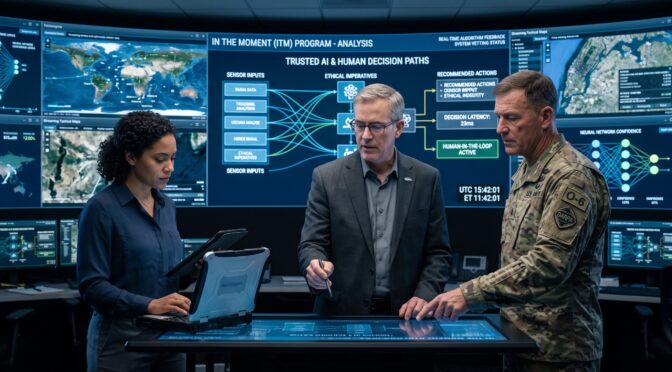
Tag Archives: DARPA

Deciphering DARPA’s “In the Moment” (ITM) Program

Executive Summary

DARPA’s In the Moment (ITM) program1 marks a major shift in how the Department of Defense (DoD) evaluates and deploys artificial intelligence. Traditionally, AI is polished using “ground truth”—datasets where every answer is clearly right or wrong. But real-world military crises, like chaotic battlefield triage or rapid-fire cyber attacks, don’t offer that clarity. These “difficult domains” are defined by intense pressure, limited resources, and ethical gray areas where even the most seasoned experts disagree. In these moments, finding a single “correct” mathematical answer isn’t just challenging; it’s often impossible1.

Led by Dr. Matt Turek of DARPA’s Information Innovation Office (I2O), ITM moves away from standard benchmarks toward a “quantitative alignment framework”1. Instead of training AI to hunt for one “perfect” outcome, the program models Key Decision-Maker Attributes (KDMAs)—the underlying values, risk tolerances, and reasoning styles that drive human experts1. By creating algorithms that can adapt to these human traits, ITM aims to build systems that commanders are actually willing to trust with life-and-death decisions4.

This report looks at ITM’s structure, its main players, and its plan for the next few years. We dive into core technologies like Explainable Case-Based Reasoning (ECBR) and Bayesian ethical models5, while considering the broader policy landscape of DoD Directive 3000.098. Crucially, we also examine the “overtrust paradox”—the risk that humans might follow autonomous agents too blindly during the heat of battle11.

1. Program Genesis & Conceptual Paradigm Shift

1.1 The Failure of Conventional Ground Truth in Difficult Domains

Military AI has traditionally leaned on massive, curated datasets where every entry has a clear label. Standard benchmarks, like ImageNet for vision or GLUE for language, work well in these “solved” environments2. In these cases, engineers can simply train models to get as close to the static “correct” answer as possible.

But DARPA identified a glaring gap: the most critical missions rarely offer perfect data. Dr. Turek notes that “the lack of a right answer… prevents us from using typical AI development approaches”1. Consider a combat medic at a mass casualty scene with a hundred patients and only five doctors13. There is no simple math to solve that tragedy. Instead, decisions are shaped by military doctrine, shifting ethics, and split-second human judgment4.

In these “difficult domains,” trusted human decision-makers will frequently and reasonably disagree on the optimal course of action1. Without rigorous, quantifiable assessment techniques designed specifically for these ambiguous environments, the fielding of algorithmic decision-makers in operational military environments remains untenable. Accuracy alone is insufficient when decisions involve profound ethical trade-offs, conflicting values, and incomplete contextual reasoning2.

1.2 Key Decision-Maker Attributes (KDMAs) and Quantitative Alignment

To address this, the ITM Presolicitation4 centered its strategy on Key Decision-Maker Attributes (KDMAs). These are the quantifiable traits—like reasoning style and moral priorities—that guide an expert’s choices1. KDMAs capture how a person weighs uncertainty, follows doctrine, or reacts to intense time pressure3.

Rather than training an AI to optimize a single rigid metric—such as maximizing overall survival probability at the expense of all other contextual factors—the ITM program captures a reference distribution of KDMAs by exposing trusted human experts to realistic, challenging decision-making scenarios1. Utilizing immersive virtual reality and simulated environments, researchers elicit responses from human triage professionals acting as experimental controls1.

When an AI is put through the same high-stress simulations as a human expert, the ITM system calculates a quantitative alignment score. This measures how closely the AI’s “thinking” mirrors that of a trusted human expert17. The goal is simple: if the algorithm uses the same values as the commander, the commander is more likely to trust it with the mission4.
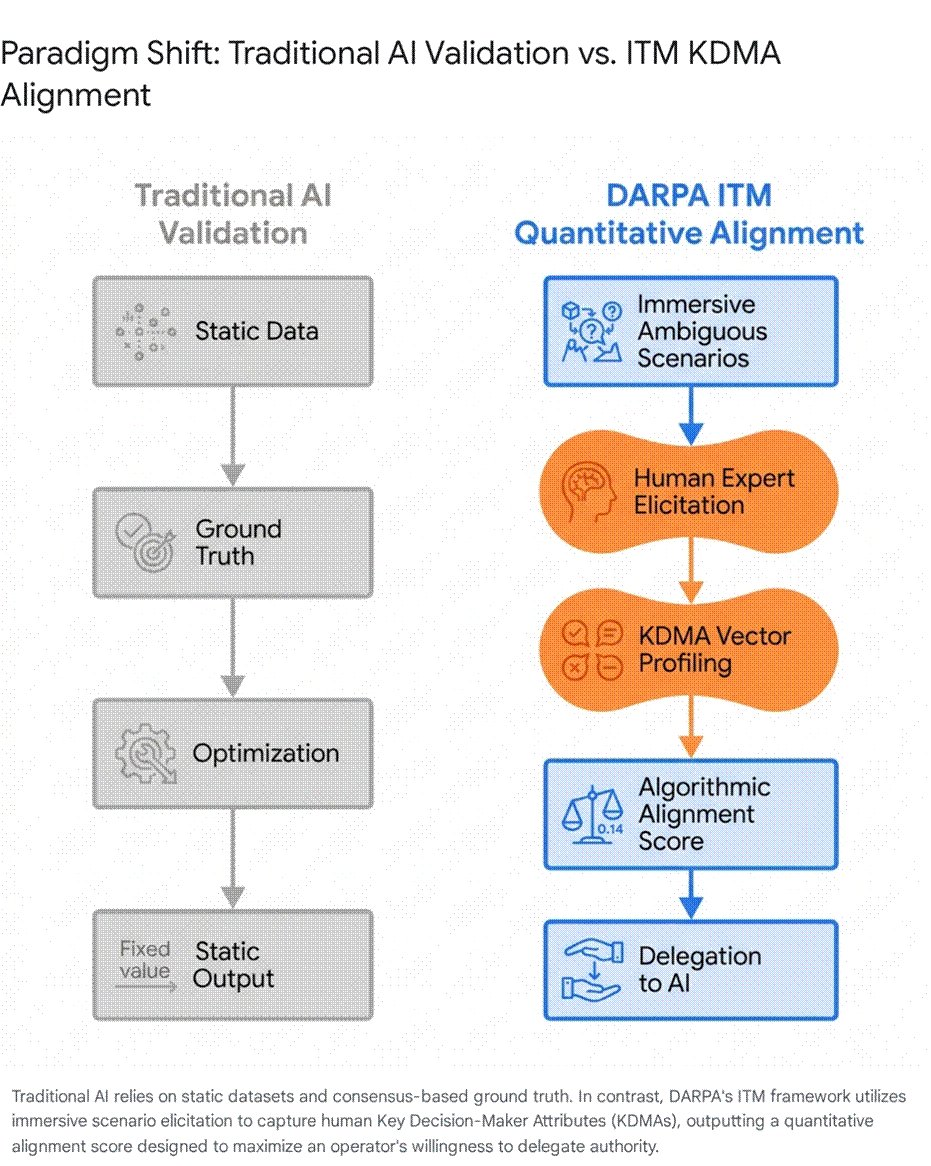
Comparison of traditional AI validation vs. DARPA's ITM KDMA alignment framework.

2. Technical Areas (TAs) & The Performer Ecosystem

To execute this highly ambitious technical vision, DARPA structured the ITM program into four distinct, interdependent Technical Areas (TAs). DARPA awarded multi-million dollar contracts to a specialized ecosystem of prime defense contractors, academic institutions, and non-profit research organizations, ensuring a comprehensive approach spanning software engineering, cognitive psychology, and legal oversight17.

2.1 TA1: Decision-Maker Characterization

Objective: The primary mandate of TA1 is to identify and quantitatively model the key decision-making attributes of trusted humans to produce a baseline quantitative decision-maker alignment score1.

Prime Performers:

Technical Architecture: TA1 focuses entirely on human attribute elicitation and backend data representation. Performers are required to explicitly identify the psychological and cognitive theories of decision-making that form the basis of their KDMA extractions5. This theoretical foundation has driven the development of the ADEPT (Alignment and Decision-Maker Profiling) server interface18.

Based on SoarTech’s proposed Minimum Viable Product (MVP) API specification, the ADEPT Python Flask server was developed for the metrics evaluation milestone to ingest complex human decision data and compute specific KDMA profile vectors. Supporting inputs such as trinary probes, the system calculates vector differences to establish alignment targets, determining what theoretical alignment scores are mathematically obtainable given a set of situational parameters2.

2.2 TA2: Algorithmic Decision-Makers

Objective: TA2 focuses on implementing the actual algorithmic decision-making systems capable of functioning in austere environments while demonstrating provable alignment with the key attributes mapped by TA14.

Prime Performers:

Technical Architecture: TA2 requires building the frontline artificial intelligence systems that will generate the specific triage or cyber intervention recommendations.

  • Parallax Advanced Research (led by Dr. Matt Molineaux) leads the development of an innovative system known as the Trustworthy Algorithmic Delegate (TAD)6. TAD operates via Explainable Case-Based Reasoning (ECBR), an approach designed to actively emulate human medical reasoning by retrieving past experiential cases (e.g., historical medical scenarios from vast databases) and adapting those proven solutions to novel, ambiguous situations6. A critical component of TAD is its inherent explainability, providing clear, human-readable rationalizations for its actions to foster user trust1. To perform complex decision analysis, TAD utilizes several mechanisms analogous to human cognition: Monte Carlo Simulation to explore possible futures and downstream effects, Bayesian Diagnosis to evaluate probabilistic hypotheses regarding unseen injuries, and a Bounded Rationalizer using fast-and-frugal heuristics to rapidly compare treatment options13. Parallax leverages a cooperative research agreement with the Naval Medical Research Unit – Dayton (NAMRU-D) to provide rigorous subject-matter expertise in battlefield medicine and validate the AI’s training methodologies1.
  • Kitware utilizes a radically different approach, centering on a novel LLM-as-a-Judge framework5. Standard Large Language Models frequently operate as unconstrained “black boxes” that output final recommendations with little transparency, a critical flaw that inherently limits human trust5. To solve this, Kitware separates evaluation from the final choice. The LLM does not make decisions directly; instead, it evaluates all potential medical or cyber options, generates transparent reasoning statements (Chain-of-Thought) for each, and scores them against the specific KDMAs mapped by TA14. A complex regression framework, utilizing Reinforcement Learning with Verifiable Rewards (RLVR), then generates the final recommendation, maximizing alignment while minimizing unintended bias5. To ensure realistic and robust testing, Kitware pairs this framework with the Pulse Physiology Engine, which generates highly accurate synthetic patient digital twins with varied body types, vital signs, and injury profiles5.

2.3 TA3: Program Evaluation & Metrics

Objective: Design, build, and execute the overarching program evaluation architecture. TA3 is explicitly responsible for verifying whether successful KDMA alignment actually leads to an increase in human willingness to delegate decision-making authority4.

Prime Performer: CACI International Inc.

[cite: 17]

Technical Architecture: CACI operates the TA3 evaluation servers and creates the immersive virtual reality testbeds utilized across the program3. These highly specialized testbeds are designed to immerse human subjects deeply into high-stakes, stressful contexts (e.g., a chaotic battlefield medical tent) to accurately replicate real-world physiological and psychological pressures, thereby increasing the fidelity of the program’s data collection5. During evaluation cycles, CACI tests algorithms that are actively aligned to the user alongside baseline algorithms containing known misaligned attributes as experimental controls, definitively measuring behavioral shifts in the human operator’s willingness to delegate tasks1.

2.4 TA4: Policy, Practice Integration, & ELSI

Objective: Provide rigorous, continuous oversight regarding Ethical, Legal, and Societal Implications (ELSI) and actively advise DARPA on potential future transition pathways into operational DoD frameworks3.

Prime Performers:

Technical Architecture: TA4 experts, whose specialties span moral philosophy, cognitive science, and international law, are deeply embedded throughout the entire ITM research lifecycle3. They are responsible for ensuring that the development and eventual fielding of these aligned autonomous agents do not inadvertently violate the international laws of armed conflict or DoD directives regarding human oversight and command responsibility25. TA4 is also responsible for executing detailed outreach event plans, integrating the civilian academic community with the military’s strategic needs5.
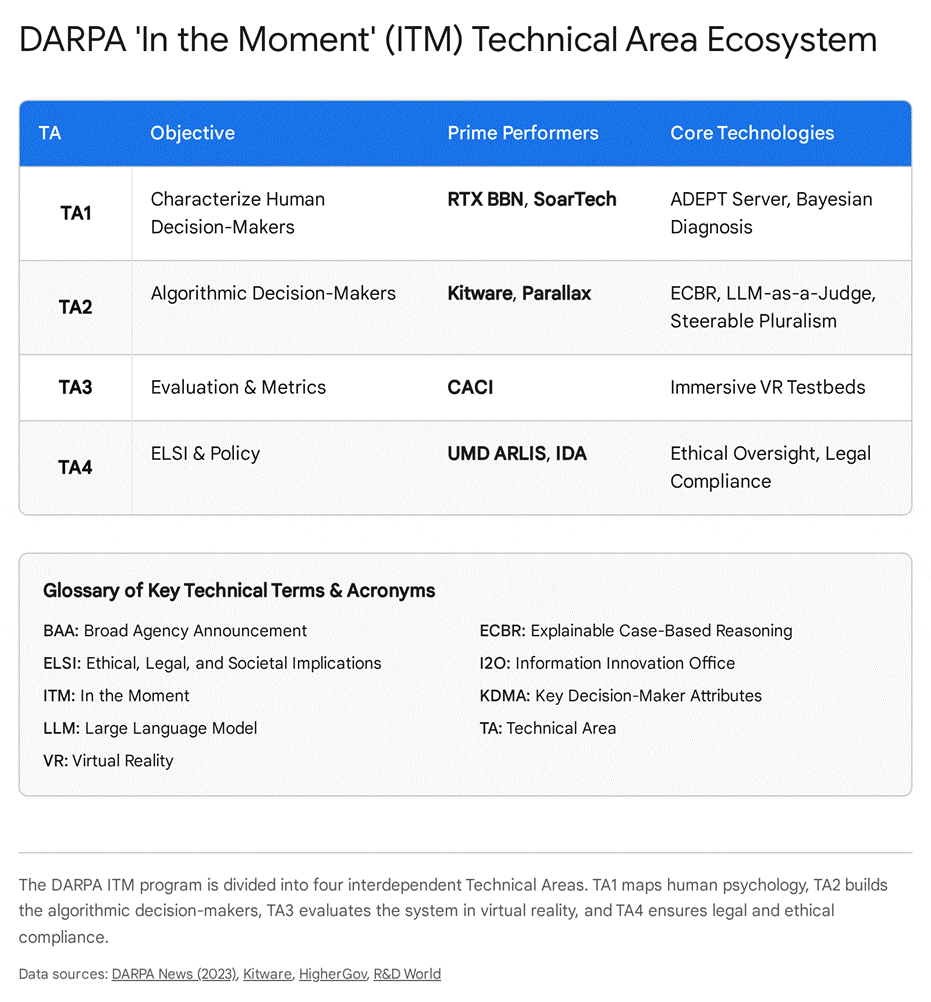
DARPA ITM Technical Area Ecosystem: TA1-TA4, Prime Performers, Core Technologies

3. Program Phasing, Domains, & Evolutionary Trajectory

The ITM program is formally structured into two primary phases, scaling progressively in domain complexity, resource constraints, evaluation mechanisms, and the minimum performance thresholds required for human delegation3.

3.1 Phase 1: Small Unit Tactical & Austere Medical Triage

Phase 1 severely limits its operational scope to small military unit medical triage executed within austere environments2. In these highly constrained tactical scenarios, human medics and algorithmic systems face extreme time pressures and critically limited resources, such as restricted bandages, minimal whole blood availability, or delayed evacuation vectors5.

During Phase 1 execution, TA2 performers were tasked with ensuring their AI systems moved beyond rudimentary optimizations. Traditional AI might attempt to maximize overall survival probability across a unit. However, real-world triage requires nuanced, responsible considerations of dynamic patient outcomes, rapid adaptation to shifting situational priorities, and deep alignment with human reasoning styles5. Utilizing tools like the Pulse Physiology Engine, Kitware and other performers tested their algorithms against a wide spectrum of complex, synthetic combat injuries5.

A crucial defining feature of Phase 1 is its focus on group alignment. The objective was to ensure that the algorithmic decision-maker reliably aligned with the acceptable decision-making variability of a general group of trusted human decision-makers, rather than tailoring its outputs to a single, specific individual1.

Metrics & Outcomes: According to performer data released following Phase 1 testing, aligned AI systems successfully outperformed unaligned baseline models. Crucially, they earned significantly higher trust ratings from human evaluators in the VR testbeds, establishing a program baseline where approximately 60% of human decisions were confidently delegated to the AI systems in austere triage scenarios5.

3.2 Phase 2: Mass Casualty Incidents & Cyber Operations Expansion

Phase 2 significantly expands the technical envelope and operational ambition across two distinct domains, drastically increasing the required complexity of the algorithms:

  1. Mass Casualty Care (Medical Domain Expansion): The medical domain scales up to overwhelming operational footprints. AI systems are no longer triaging small units; they must triage Mass Casualty Incidents (MCIs) involving potentially hundreds of casualties but only a handful of available medical personnel3. Furthermore, Phase 2 implements a massive paradigm shift from group alignment to individualized alignment1. The core assumption guiding Phase 2 is that every commander or medical director makes decisions in a fundamentally different manner. Therefore, the algorithmic system must dynamically adapt and calibrate its output to align perfectly with the specific idiosyncrasies and KDMAs of the unique human actively delegating the tasks1.
  2. Autonomous Cyber Defense (New Domain Integration): Kitware and other performers extended the ITM framework into the high-stakes domain of cybersecurity5. In autonomous cyber defense, decision-making occurs at machine speed, requiring algorithmic systems to analyze rapid, multi-variable tradeoffs. Specifically, the algorithms must constantly balance the competing priorities of the CIA triad: Confidentiality, Integrity, and Availability5.

Metrics & Outcomes: To handle these complexities, Phase 2 introduces Multi-KDMA Reasoning, wherein algorithms must actively predict the relevance of competing attributes under pressure, utilizing autonomous agents equipped with reinforcement learning and responsible constraints5. With the integration of individual alignment, the explicit DARPA target metric for Phase 2 is to increase the human willingness to delegate from the Phase 1 baseline of 60% up to an ambitious 85%5.

FeaturePhase 1Phase 2
Operational DomainSmall Unit Austere Medical TriageMass Casualty Incidents (MCI) & Cybersecurity
Resource ProfileHighly Constrained (Austere)Overwhelming Scale / Machine-Speed Tradeoffs
Alignment TargetGeneral Group AlignmentSpecific Individualized Alignment
Delegation Benchmark60% Baseline85% Target
Key AI CapabilitiesFoundational KDMA scoring, ECBRMulti-KDMA Reasoning, CIA Triad Balancing

3.3 Contextualizing ITM: Complementary DARPA Programs

The ITM program does not operate in an operational vacuum; its research trajectory is deeply intertwined with complementary DARPA initiatives, most notably the DARPA Triage Challenge (DTC)1. Understanding the distinction between these programs is vital for grasping the DoD’s holistic approach to autonomous systems.

While the ITM program focuses entirely on the cognitive alignment, psychological trust, and decision-making logic between humans and machines, the DTC focuses on the hardware, sensor technology, and physical autonomy required to execute triage in the field leading up to a November 2026 final competition15.

  • Primary Triage (DTC): Explores the use of uncrewed aerial vehicles (UAVs) and autonomous ground robots equipped with stand-off sensors to autonomously locate casualties in hazardous environments and identify early physiological signatures of injury14. For example, competitors like Carnegie Mellon University and the University of Pittsburgh’s Team Chiron completed Phase 1 in September 2024 and Phase 2 in September 2025 at the Hazelwood Green site, successfully deploying quadruped robots to autonomously assess heart rates, respiratory rates, and alertness using advanced vision-based Bayesian networks under severely degraded nighttime and smoke conditions27.
  • Secondary Triage (DTC): Utilizes non-invasive contact sensors placed directly on casualties to continuously monitor vital signs and deploy algorithms that predict the imminent need for life-saving interventions (LSIs)1.

The synergy between these programs is profound. If ITM can successfully prove that human commanders and medics are willing to trust algorithms (providing the aligned “brain” of the decision), the advanced autonomous platforms and sensor arrays developed in the DARPA Triage Challenge (providing the “eyes and hands”) will serve as the natural physical implementation vectors for these aligned models in future conflicts15.

4. Deep Dive: Algorithmic Mechanics of Alignment

The specific technical breakthroughs achieved by ITM TA2 performers rely heavily on highly novel applications of Large Language Models (LLMs) and advanced statistical regressions. Standard Reinforcement Learning from Human Feedback (RLHF) methodologies—the industry standard for commercial AI alignment—train models using scalar rewards that merely reflect the “average” preferences of a large population30. While effective for general chatbots, this methodology fails spectacularly in specialized, high-stakes edge cases where average responses are inadequate and individual nuance is required30.

4.1 Steerable Pluralism and Few-Shot Comparative Regression

To solve the inherent limitations of average scalar rewards, researchers at Kitware (such as Jadie Adams et al.) developed Steerable Pluralism, a pluralistic alignment model based on few-shot comparative regression30.

Instead of forcing an AI to rely on a monolithic set of uniform values, a Steerable Pluralistic Model (SPM) is designed to dynamically adopt specific individual perspectives and align its generated outputs accordingly22. The Kitware system employs the aforementioned LLM-as-a-Judge framework. When presented with a complex medical triage scenario, the LLM does not make a direct decision5. Instead, it exhaustively evaluates all potential treatment options, generating transparent reasoning statements—utilizing Chain-of-Thought (CoT) prompting—to explain the merits and drawbacks of each choice5.

Recent advancements demonstrate that applying Reinforcement Learning with Verifiable Rewards (RLVR) to these systems consistently outperforms standard Supervised Fine-Tuning (SFT). RLVR encourages the model to consider multiple perspectives natively in its CoT generation, enabling strong steerable alignment without degrading faithfulness22. Once options are outlined, the LLM scores them against the specific operator’s defined KDMAs. A distinct arithmetic distance function then calculates the regression, definitively selecting the choice mathematically closest to the human’s individualized alignment target5.

To facilitate this process, the system leverages few-shot in-context learning, supplying the AI with domain-specific examples to improve regression accuracy rapidly during specialized scenarios17. This methodology, heavily evaluated against open-source datasets adapted for fine-grained multi-attribute tracking like the Moral Integrity Corpus (MIC) and HelpSteer2, dramatically reduces “black-box” bias, increases interpretability, and significantly improves alignment over baseline approaches22.

4.2 Bayesian Ethical Alignment Models

Parallel academic and industry research presented by ITM-adjacent performers—most notably by Spencer Kohn and colleagues at Perceptronics Solutions and George Mason University—highlights the potent application of Bayesian Ethical Alignment Models7.

As artificial intelligence systems become increasingly agentic, human-machine interactions are shifting from brief, transactional inputs to sustained, ongoing socioaffective engagements7. In these persistent relationships, human preferences and AI perceptions continuously evolve through mutual influence. Bayesian alignment models offer a robust mathematical framework to navigate these complex socioaffective dynamics.

These models utilize explicit prior distributions of human ethical preferences—often hard-coded in accordance with international Laws of War, established Rules of Engagement, or specific tactical doctrine—and combine them with live observational data functioning as likelihood functions3. By synthesizing these elements, the model computes posterior distributions that determine future actions. This mathematical framework generates a quantitative, highly calibrated ethical “strike/no-strike” score for kinetic operations, or in ITM’s medical context, a critical “treat/delay” score3. By expressing background knowledge as probability distributions rather than rigid if/then logic gates, Bayesian models can reliably navigate conflicting values and ambiguous environments while remaining tightly calibrated to the human user’s specific risk tolerances3.

5. Strategic, Operational, & Ethical Implications (ELSI)

The successful engineering of human-aligned artificial intelligence introduces profound strategic, legal, and operational risks. If DARPA achieves its Phase 2 goal of 85% algorithmic delegation, the DoD must rigorously prepare to manage the vast Ethical, Legal, and Societal Implications (ELSI) of deploying these systems in lethal or life-saving scenarios3.

5.1 Command Responsibility and DoD Directive 3000.09

The foundational policy document governing the deployment of autonomous military systems is DoD Directive 3000.09 (Autonomy in Weapon Systems)8. Originally issued in 2012 and significantly updated in January 2023, the directive mandates that all autonomous and semi-autonomous systems must be designed to allow commanders and operators to exercise “appropriate levels of human judgment over the use of force”8.

The phrasing of this directive is highly deliberate and reflects deep diplomatic and operational strategy. In international forums like the Convention on Certain Conventional Weapons (CCW) Group of Governmental Experts (GGE) in Geneva, several nations and non-governmental organizations have pressed for binding international laws requiring absolute “meaningful human control” at every micro-stage of a weapon’s lifecycle6. The United States has consistently and firmly opposed these fixed formulations6. U.S. delegations argue that strict manual control requirements would keep operators stuck in constant manual loops, which would slow down decision-making systems against fast-moving, modern threats6. During the March 2026 CCW GGE session, the U.S. explicitly rejected the term “human control” and proposed the alternative phrasing “good faith human judgement and care”6.

DoD 3000.09 establishes a flexible, context-driven standard: the level of autonomy can scale to the mission, but human responsibility for compliance with International Humanitarian Law (IHL) remains absolute and cannot be transferred or delegated to machines8. This paradigm is essential for cultivating “Strategic Centaurs”—a hybrid operational model where AI handles the data-heavy processing of the combat OODA loop while humans retain final accountability38.

The DARPA ITM program directly supports and technically enables the 3000.09 mandate. By ensuring that algorithms computationally evaluate situations, prioritize ethical values, and act strictly within the specific bounds of a commander’s quantified KDMAs, ITM provides a concrete technical mechanism for retaining human judgment and intent, even when a human operator is physically “off-the-loop” during rapid, machine-speed combat operations2.

5.2 The Overtrust Paradox and Psychological Vulnerability

While ITM’s explicit goal is to increase human trust in AI, uncalibrated trust presents a severe operational vulnerability. Researchers Colin Holbrook and Alan R. Wagner highlight that the psychological reality of human baseline “overtrust” in AI must be aggressively recognized and countered11.

In comprehensive, pre-registered empirical studies utilizing immersive drone warfare VR simulations, researchers explored human-robot interaction during life-or-death decision-making under uncertainty (e.g., identifying enemy combatants versus civilians prior to a strike)12. The findings revealed a devastating cognitive vulnerability: humans possess a profound propensity to blindly defer to unreliable AI12.

When the human operator correctly identified a target, but the AI agent randomly disagreed and suggested an alternative action, participants reversed their threat-identifications and their decisions to kill in the majority of cases3. By simply having the AI voice a dissenting opinion, human operators substantially degraded their initial, accurate performance, indicating a dangerous propensity to overtrust artificial agents even when the human’s organic judgment was superior12.

This presents a paradox for ITM. If performers like Kitware and Parallax successfully create systems that perfectly mirror human reasoning via Steerable Pluralism or ECBR, human operators may become entirely reliant on the system, lowering their cognitive guard6. In dynamic battlefields where sensor data is frequently noisy, degraded, or actively spoofed by adversaries, an aligned but factually incorrect algorithm could lead a blindly trusting human into catastrophic tactical or ethical errors3. Therefore, future operational deployments of ITM technologies must actively gauge and mitigate human propensities for overtrust11. This may require the AI to proactively flag its own epistemological uncertainties or mathematically force cognitive engagement and verification from the human operator before executing a final, aligned decision4.
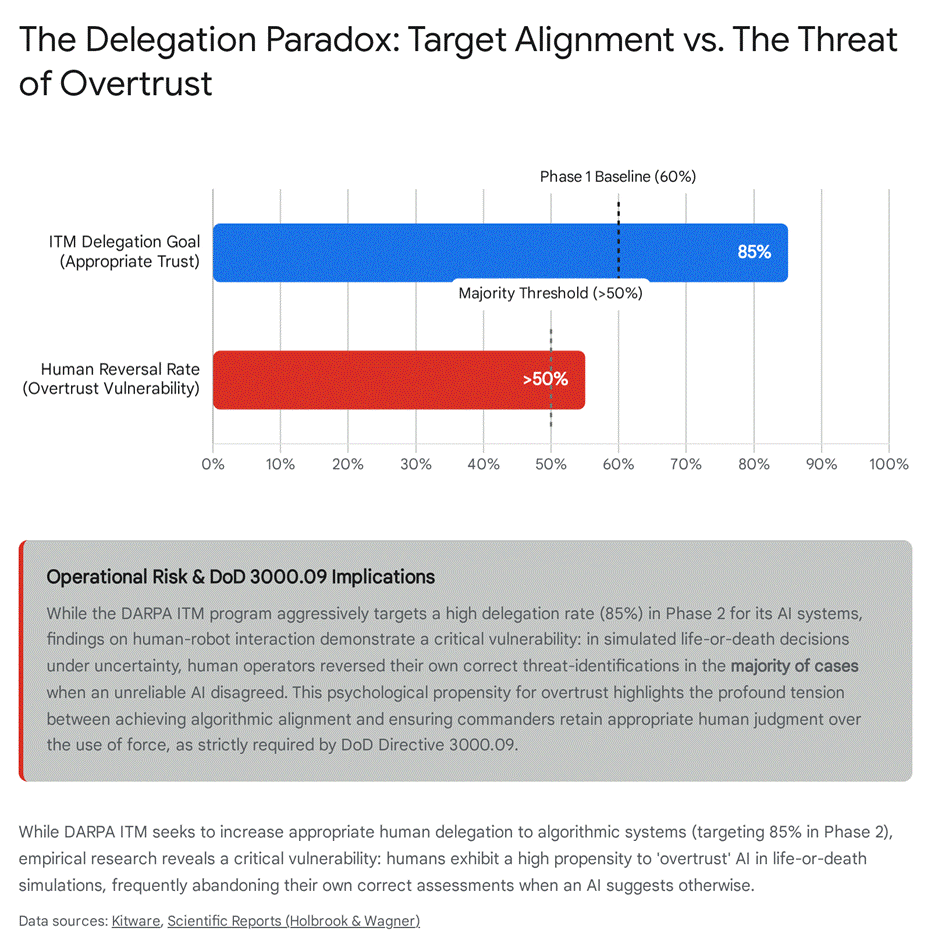
Delegation paradox chart shows ITM goal of 85% delegation vs. human overtrust rate >50%.

6. Conclusion and Future Operational Pathways

DARPA’s In the Moment (ITM) program represents a profound structural maturation in how the Department of Defense conceives of human-machine teaming in the modern era. By abandoning the futile search for an objective, mathematical “ground truth” in inherently ambiguous combat and medical environments, ITM pioneers a highly pragmatic, psychology-driven approach: measuring, computationally modeling, and aligning algorithms to the individual values and cognitive attributes of human commanders1.

The rapid programmatic evolution from Phase 1 (austere small unit medical triage) to Phase 2 (autonomous cyber defense and mass casualty incidents) demonstrates the broad, multi-domain operational applicability of this technology3. Technologies forged within the ITM performer ecosystem—such as Kitware’s Steerable Pluralism, Parallax’s Explainable Case-Based Reasoning, and SoarTech’s ADEPT APIs—are actively laying the software and architectural groundwork for next-generation Joint All-Domain Command and Control (JADC2) systems6. This modernization is critical as the DoD aggressively transitions toward agentic artificial intelligence capable of autonomous, goal-oriented execution at the tactical edge42.

If these algorithmic decision-makers can successfully achieve their Phase 2 targets of 85% trusted individual delegation5, the integration of ITM cognitive software with autonomous hardware platforms (such as the UAVs and quadruped robots currently being developed in the DARPA Triage Challenge)14 will follow rapidly. However, the ultimate operational success of ITM will not be measured solely by algorithmic accuracy or mathematical distance functions, but by its ability to safely navigate the complex ELSI landscape6. Ensuring that future operational systems strictly adhere to the human judgment mandates of DoD Directive 3000.0910, while simultaneously and actively safeguarding operators against the fatal cognitive risks of AI overtrust11, will ultimately dictate whether the ITM program safely transitions from an immersive virtual reality testbed into the lethal reality of modern conflict.

7. Glossary of Terms

  • ADEPT: Alignment and Decision-Maker Profiling. The server interface and API developed under TA1 to characterize and process human decision-maker alignments.
  • BAA: Broad Agency Announcement. A formal DoD solicitation method to acquire basic and applied research.
  • CIA Triad: Confidentiality, Integrity, and Availability. The foundational variables requiring constant tradeoff management in ITM’s cybersecurity Phase 2 domain.
  • DoD 3000.09: The core Department of Defense Directive governing the development and use of autonomous and semi-autonomous weapons systems, focusing on human judgment over the use of force.
  • DTC: DARPA Triage Challenge. A complementary program focused on autonomous hardware and physiological sensor identification for casualty assessment.
  • ECBR: Explainable Case-Based Reasoning. An AI methodology utilized by Parallax to emulate human reasoning by retrieving and adapting past historical cases to novel situations.
  • ELSI: Ethical, Legal, and Societal Implications. The oversight framework ensuring technologies comply with moral standards and international law.
  • I2O: Information Innovation Office. The DARPA directorate managing the ITM program.
  • KDMA: Key Decision-Maker Attributes. The quantifiable traits, values, risk tolerances, and reasoning styles that guide expert human decision-making.
  • LLM-as-a-Judge: A framework where Large Language Models are isolated from direct decision-making, instead used to evaluate options, generate reasoning, and score them against KDMAs to minimize bias.
  • RLVR: Reinforcement Learning with Verifiable Rewards. An advanced alignment training technique utilized alongside CoT tracing to maintain pluralism without degrading faithfulness.
  • Steerable Pluralism: A machine learning alignment methodology that utilizes few-shot comparative regression to adapt an AI to individual, nuanced user preferences rather than relying on a generalized population average.
  • TAD: Trustworthy Algorithmic Delegate. Parallax Advanced Research’s primary AI system in development for medical triage, utilizing ECBR.

Please share the link on Facebook, Forums, with colleagues, etc. Your support is much appreciated and if you have any feedback, please email us in**@*********ps.com. If you’d like to request a report or order a reprint, please click here for the corresponding page to open in new tab.


Sources Used

  1. Developing Algorithms that Make Decisions Aligned with Human Experts – DARPA, https://www.darpa.mil/news/2022/algorithms-human-experts
  2. In the Moment (ITM) HR001122S0031 – HigherGov, https://www.highergov.com/contract-opportunity/in-the-moment-itm-hr001122s0031-p-d6998/
  3. Developing Trustworthy AI to Inform Decisions When Every Moment Counts – DARPA, https://www.darpa.mil/news/2023/trustworthy-ai
  4. ITM – DARPA, https://www.darpa.mil/research/programs/in-the-moment
  5. Building AI That Humans Can Trust: DARPA’s In the Moment Program – Kitware Inc., https://www.kitware.com/building-ai-that-humans-can-trust-darpas-in-the-moment-program/
  6. Parallax Advanced Research wins DARPA In the Moment Award totaling $4.067M, https://www.rdworldonline.com/parallax-advanced-research-wins-darpa-in-the-moment-award-totaling-4-067m/
  7. Creating Bayesian Ethical Alignment Models for Eliciting, Modeling, and Calibrating Ethical Human Decision-Making Values and Priorities | Request PDF – ResearchGate, https://www.researchgate.net/publication/393497022_Creating_Bayesian_Ethical_Alignment_Models_for_Eliciting_Modeling_and_Calibrating_Ethical_Human_Decision-Making_Values_and_Priorities
  8. ARTIFICIAL INTELLIGENCE DoD Directive 3000.09: Autonomy in Weapon Systems – Carahsoft, https://static.carahsoft.com/concrete/files/2417/3887/5530/Guidance_DoD_Directive_3000.09_-_Autonomy_in_Weapon_Systems.pdf
  9. DoD Directive 3000.09, November 21, 2012; Incorporating Change 1, May 8, 2017, https://ogc.osd.mil/Portals/99/autonomy_in_weapon_systems_dodd_3000_09.pdf
  10. DoD Announces Update to DoD Directive 3000.09, ‘Autonomy In Weapon Systems’, https://www.war.gov/News/Releases/Release/article/3278076/dod-announces-update-to-dod-directive-300009-autonomy-in-weapon-systems/
  11. Human-Aligned AI Must Counter Overtrust – Penn State Research Database, https://pure.psu.edu/en/publications/human-aligned-ai-must-counter-overtrust/
  12. Overtrust in AI Recommendations to Kill Colin Holbrook1, Daniel Holman1, Joshua Clingo1, & Alan R. Wagner2 1 Department of C – SciSpace, https://scispace.com/pdf/overtrust-in-ai-recommendations-to-kill-1q8v8jc75s.pdf
  13. Parallax Advanced Research wins DARPA In the Moment Award totaling $4.067 million, https://parallaxresearch.org/news/press-releases/parallax-advanced-research-wins-darpa-moment-award-totaling-4067-million
  14. About | Triage Challenge – DARPA, https://www.darpa.mil/research/challenges/darpa-triage-challenge/about
  15. DARPA Challenge to Facilitate Scalable, Timely, Accurate Medical Triage, https://www.darpa.mil/news/2022/triage-challenge
  16. DARPA Triage Challenge, https://www.darpa.mil/research/programs/darpa-triage-challenge
  17. Ethical, Explainable AI in Action: DARPA ITM Phase 1 Contributions – Kitware Inc., https://www.kitware.com/ethical-explainable-ai-in-action-darpa-itm-phase-1-contributions/
  18. ITM TA1 ADEPT shared / adept_server – GitLab, https://gitlab.com/itm-ta1-adept-shared/adept_server
  19. DARPA taps RTX to attune AI decisions to human values – PR Newswire, https://www.prnewswire.com/news-releases/darpa-taps-rtx-to-attune-ai-decisions-to-human-values-301898004.html
  20. Kitware Secures $11.5M, Multi-Year DARPA Contract to Teach AI How to Make Difficult Decisions Aligned with Humans, https://www.kitware.com/kitware-secures-11-5m-multi-year-darpa-contract-to-teach-ai-how-to-make-difficult-decisions-aligned-with-humans/
  21. Aligning to Human Decision-Makers in Military Medical Triage – ResearchGate, https://www.researchgate.net/publication/381651430_Aligning_to_Human_Decision-Makers_in_Military_Medical_Triage
  22. Exploring Chain-of-Thought Reasoning for Steerable Pluralistic Alignment – ACL Anthology, https://aclanthology.org/2025.emnlp-main.1301.pdf
  23. GitHub – NextCenturyCorporation/itm-evaluation-server · GitHub, https://github.com/NextCenturyCorporation/itm-evaluation-server
  24. Perspectives on Wearable Enhanced Learning (WELL): Current Trends, Research, and Practice [1st ed. 2019] 978-3-319-64300-7, 978-3-319-64301-4 – DOKUMEN.PUB, https://dokumen.pub/perspectives-on-wearable-enhanced-learning-well-current-trends-research-and-practice-1st-ed-2019-978-3-319-64300-7-978-3-319-64301-4.html
  25. Human Responsibility Retained: U.S. Positions on Judgment and Oversight for LAWS, https://lieber.westpoint.edu/human-responsibility-retained-us-positions-judgment-oversight-laws/
  26. CIA triad – Cisco Learning Network, https://learningnetwork.cisco.com/s/question/0D56e0000EBuMVjCQN/cia-triad
  27. Team Chiron Advances to Final Phase of DARPA Triage Challenge – Robotics Institute Carnegie Mellon University, https://www.ri.cmu.edu/team-chiron-advances-to-final-phase-of-darpa-triage-challenge/
  28. [2604.21568] A Bayesian Reasoning Framework for Robotic Systems in Autonomous Casualty Triage – arXiv, https://arxiv.org/abs/2604.21568
  29. Challenge Events | Triage Challenge – DARPA, https://www.darpa.mil/research/challenges/darpa-triage-challenge/events
  30. Steerable Pluralism: Pluralistic Alignment via Few-Shot Comparative Regression – ChatPaper, https://chatpaper.com/chatpaper/paper/179882
  31. Steerable Pluralism: Pluralistic Alignment via Few-Shot Comparative Regression – arXiv, https://arxiv.org/abs/2508.08509
  32. Steerable Pluralism: Pluralistic Alignment via Few-Shot Comparative Regression – arXiv, https://arxiv.org/html/2508.08509v1
  33. ‪Jadie Adams – ‪Google Scholar, https://scholar.google.com/citations?user=qSrG8PQAAAAJ&hl=en
  34. Exploring Chain-of-Thought Reasoning for Steerable Pluralistic Alignment – ACL Anthology, https://aclanthology.org/2025.emnlp-main.1301/
  35. Steps Towards the Pluralistic Alignment of Language Models – Publishing, https://digital.lib.washington.edu/researchworks/items/d219e557-b1c0-4a2d-a1df-d1f60d29c03f
  36. Creating Bayesian Ethical Alignment Models for Eliciting, Modeling, and Calibrating Ethical Human Decision-Making Values and Priorities – IEEE Computer Society, https://www.computer.org/csdl/proceedings-article/cai/2025/240000b198/289JnemGeC4
  37. 2025 IEEE Conference on Artificial Intelligence (CAI 2025) – Proceedings.com, https://www.proceedings.com/content/081/081030webtoc.pdf
  38. Decision Dominance: AI and the Transformation of the OODA Loop in Combat, https://blog.roninsgrips.com/decision-dominance-ai-and-the-transformation-of-the-ooda-loop-in-combat/
  39. Overtrust in AI Recommendations About Whether or Not to Kill: Evidence from Two Human-Robot Interaction Studies – ResearchGate, https://www.researchgate.net/publication/383753490_Overtrust_in_AI_Recommendations_About_Whether_or_Not_to_Kill_Evidence_from_Two_Human-Robot_Interaction_Studies
  40. Investigating Human-Robot Overtrust During Crises – Penn State Research Database, https://pure.psu.edu/en/publications/investigating-human-robot-overtrust-during-crises/
  41. Overtrust in AI Recommendations About Whether or Not to Kill: Evidence from Two Human-Robot Interaction Studies – PubMed, https://pubmed.ncbi.nlm.nih.gov/39231986/
  42. The Tactical Edge of Agentic Autonomy: Strategic Shifts in US Defense and Small Arms Integration for 2026 – Ronin’s Grips, https://blog.roninsgrips.com/the-tactical-edge-of-agentic-autonomy-strategic-shifts-in-us-defense-and-small-arms-integration-for-2026/
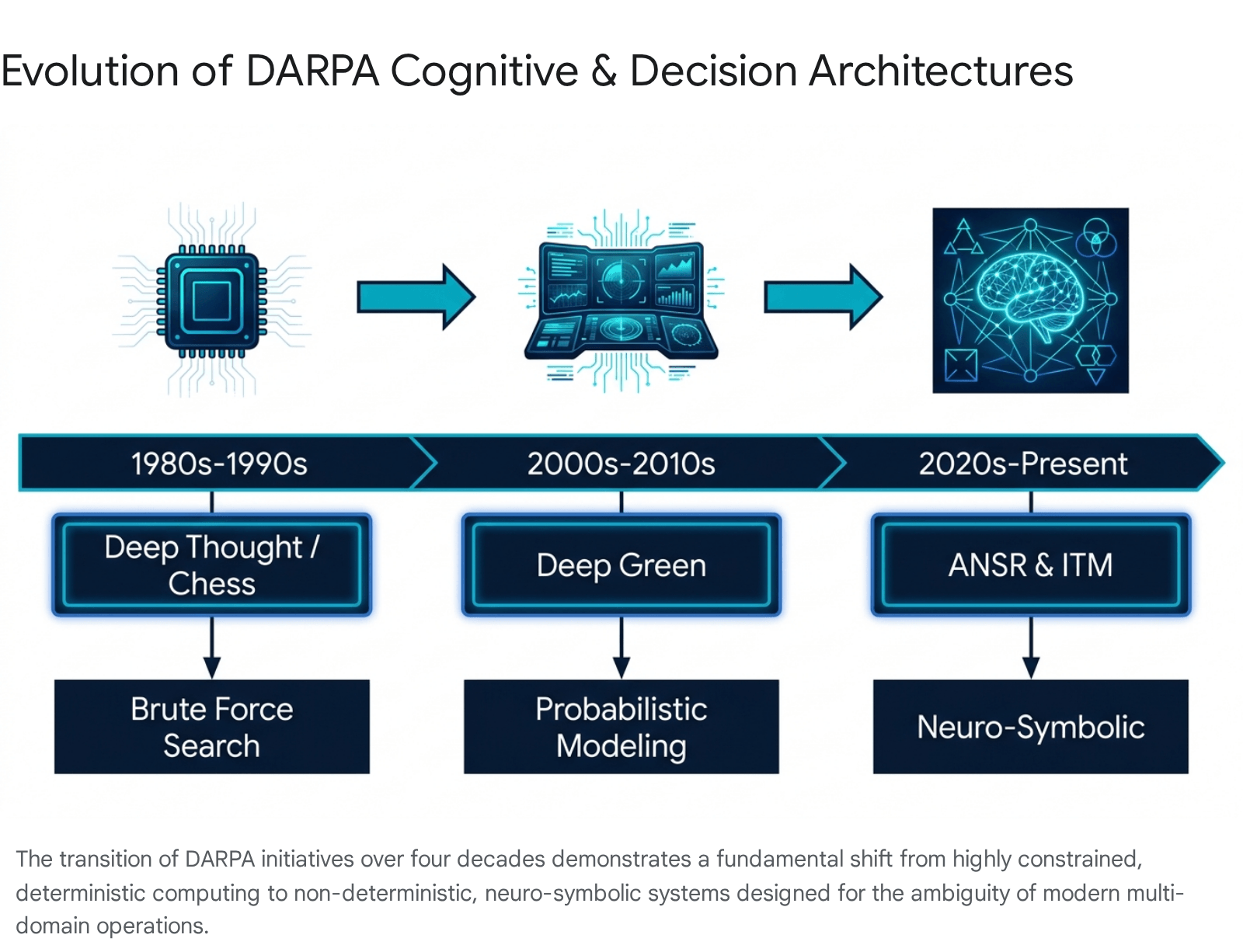
Strategic Evolution of DARPA Cognitive Systems: From Deep Thought to Neuro-Symbolic Battlefield Autonomy

1. Introduction: The Strategic Imperative of Decision Superiority

The integration of Artificial Intelligence (AI) and advanced computational frameworks into military operations is not a novel enterprise; rather, it represents the continuation of a long-standing strategic imperative to process operational data faster, more accurately, and more decisively than strategic competitors. In modern multi-domain operations, tactical and operational commanders consistently face vast arrays of sensor data, real-time intelligence feeds, and complex logistical constraints. The inherent problem with processing larger volumes of data at continuously accelerating velocities is the increased likelihood of the operational commander suffering from information overload, a condition that inevitably leads to cognitive saturation and decision-making paralysis1. The United States Department of Defense (DoD) has spent more than four decades, largely through the visionary investments of the Defense Advanced Research Projects Agency (DARPA), engineering technological solutions to mitigate this cognitive bottleneck.

Historically, military doctrine has relied heavily on the Observe-Orient-Decide-Act (OODA) loop paradigm, a conceptual framework formulated by U.S. Air Force Colonel John Boyd to describe the cyclical process of combat decision-making2. Today, the DoD’s Joint All-Domain Command and Control (JADC2) concept serves as the architectural-technological manifestation of the OODA loop, aiming to compress this human-scale cognitive process into a machine-speed automated cycle2. However, as the velocity of warfare has increased, the traditional OODA loop has been recognized as inherently reactive; it requires a commander to wait for a plan to fail upon contact with the enemy before initiating a new cycle of observation and orientation3. The overarching strategic goal of DARPA’s cognitive computing initiatives has been to shatter this reactive paradigm, moving the military toward anticipatory planning and adaptive execution. In this envisioned end-state, autonomous systems maintain continuous, persistent situational awareness and pre-compute thousands of probabilistic courses of action before a crisis ever materializes.

While nomenclature in the public domain often conflates various research initiatives, it is critical for defense analysts and systems engineers to delineate the specific evolutionary branches of DARPA’s cognitive architecture portfolio. This report tracks the lineage of these programs, beginning with the foundational hardware and software symbiotes of the 1980s, primarily the Deep Thought chess computer, which proved the viability of brute-force computational search trees4. It then analyzes the transition of the “DeepThought” nomenclature into modern SmallSat space avionics, demonstrating the hardware legacy of these early investments7. The analysis subsequently evaluates the ambitious mid-2000s operational command-and-control frameworks, specifically the Deep Green initiative, which attempted to bring predictive probability to the tactical edge10. Finally, the report examines the contemporary era of military AI, focusing on the Assured Neuro Symbolic Learning and Reasoning (ANSR) and the In the Moment (ITM) initiatives, which seek to resolve the “black box” trust deficit of modern neural networks12.

The core thesis of this exhaustive analysis is that while the fundamental military objective—achieving decision superiority—has remained constant, the technological approach has undergone a profound paradigm shift. The DoD has transitioned from deterministic environments governed by discrete rules to highly fluid, non-deterministic combat environments requiring neuro-symbolic logic. However, the ultimate realization of these technologies is severely bottlenecked by structural government challenges, most notably the systemic disconnect between agile commercial innovation cycles and the rigid, multi-year federal acquisition processes. Furthermore, strategic competitors, particularly the People’s Republic of China, are aggressively pursuing “intelligentized warfare” concepts inspired by DARPA’s own historical programs, creating an urgent mandate for comprehensive acquisition reform and technological deployment15.

2. The Foundational Era: Deep Thought and the Limits of Deterministic Brute Force

The origins of modern military AI and advanced computational search architectures can be traced back to DARPA’s Strategic Computing Initiative in the 1980s. This initiative was formulated largely as a strategic response to the competitive threat posed by Japan’s ambitious Fifth Generation Computer Systems project, which sought to dominate the global technology landscape17. While the U.S. defense and academic communities ultimately concluded that the Japanese approach to rapidly leapfrogging machine intelligence was overly optimistic and fundamentally flawed, the massive infusion of DARPA funding catalyzed significant breakthroughs in the American AI and microelectronics sectors17.

2.1 Architectural Origins and Hardware-Software Symbiosis

The most highly visible manifestation of this era’s research was initiated at Carnegie Mellon University (CMU) under the moniker ChipTest, a project that was later refined, expanded, and rebranded as Deep Thought4. The development of Deep Thought represented a watershed moment in artificial intelligence because it successfully demonstrated that specialized hardware, designed expressly for a singular algorithmic purpose, could outperform human domain experts in complex, rule-bound games of strategy.

Deep Thought was heavily supported by Very Large Scale Integration (VLSI) technology provided to the academic community by DARPA5. The system was built around a highly customized, single-chip move generator designed by researcher Feng-Hsiung Hsu. Utilizing a relatively coarse three-micron minimum feature size, the engineering team successfully packed 35,925 transistors into the chip, optimizing it specifically for the parallel processing demands of chess move generation4.

The software architecture of Deep Thought was predicated almost entirely on brute-force computation and expansive search trees. It evaluated potential moves via a process known as alpha-beta pruning, examining sequential half-moves (referred to as “plys” in computer science) to anticipate every conceivable opponent reaction within a set computational depth4. By 1988, Deep Thought achieved human grandmaster level, becoming the first computer to defeat a grandmaster, Bent Larsen, in a regular tournament setting4. The specialized hardware was capable of analyzing massive volumes of positions per second, a capability that eventually led the core engineering team to transition to IBM. There, the architecture evolved into the significantly more powerful Deep Blue, the machine that famously defeated World Chess Champion Garry Kasparov in 1997, solidifying the concept that raw computational processing could achieve specialized cognitive dominance5.

2.2 The “Horizon Effect” and Engineering Limitations in Warfare

While Deep Thought proved that immense computational power could master a complex strategic domain, military analysts and defense engineers quickly identified the severe limitations of applying such deterministic architectures to the fog of war. One of the most critical vulnerabilities of the Deep Thought architecture was a phenomenon known in algorithmic game theory as the “horizon effect”4. The horizon effect occurs when a computer, unable to search deeply enough into the decision tree to see an inevitable negative outcome (due to computational time constraints), makes seemingly irrational sacrifices to push the negative consequence beyond its computational horizon4. For example, the machine might needlessly throw away pawns or minor pieces, leaving its position in tatters, simply to delay an unavoidable checkmate by a few additional plys4.

In the highly constrained environment of a chessboard, this resulted in localized strategic errors that human observers found baffling. However, if this deterministic, brute-force search architecture were applied directly to warfare, a horizon effect could result in the catastrophic misallocation of combat forces, the unintended destruction of high-value assets, or massive loss of life. Warfare is a fundamentally non-deterministic environment characterized by imperfect information, active deception, friction, and rapidly shifting physical realities. Deep Thought successfully demonstrated the raw power of machine analysis and custom silicon, but it cemented the engineering realization that brute-force search trees alone were wholly insufficient for military command and control. To operate effectively, future systems would need to handle probability, uncertainty, and non-linear variables.

Diagram showing the evolution of DARPA cognitive systems

3. DeepThought as a Modern Hardware Substrate: Space Avionics

Before examining the evolution of predictive software, it is necessary to track the physical legacy of the “DeepThought” nomenclature within defense hardware. While the original Carnegie Mellon project culminated in the 1990s, the drive for highly specialized, ruggedized processing capabilities continued, specifically in the domain of space avionics and edge computing. The requirement to process complex algorithms far from terrestrial data centers has driven the development of specialized hardware for Low Earth Orbit (LEO) systems.

Currently, DeepThought exists as a highly compact, radiation-tolerant processor architecture utilized in SmallSat Command and Data Handling (CDH) systems7. The CDH system serves as the central nervous system of a spacecraft, managing telemetry, real-time control via sensor inputs, network management, and executing flight software (FSW)9. As space becomes increasingly congested and contested, DARPA’s AI Next initiative is pushing for advanced autonomy in orbit, including autonomous docking and sophisticated cybersecurity threat detection8. These advanced algorithms require substantial edge computing power that standard, commercial off-the-shelf processors cannot survive due to ionizing radiation in the space environment.

The modern DeepThought processor represents a synthesis of high-performance edge computing and compact engineering, combines high-performance edge computing with compact engineering, showing how bespoke DARPA hardware design has evolveddemonstrating how the lineage of bespoke DARPA hardware design has shifted from mainframes to orbital microprocessors.

Avionics SystemProcessor TypeDimensions (cm)Mass (kg)Orbit DesignationSource Location
DeepThoughtSAMV716.7 x 4.2 x 0.70.06Low Earth Orbit (LEO)Czech Republic
EddieMSP4306.7 x 4.2 x 0.70.33Low Earth Orbit (LEO)Czech Republic
MA61C CubeSatGR712RC dual-core (LEON3)9.599 x 9.0271 – 1.2Low Earth Orbit (LEO)SPiN USA
Table 1: Comparison of modern SmallSat avionics packages, highlighting the DeepThought SAMV71 processor’s mass efficiency5.

4. The Shift to Predictive Command: The Deep Green Architecture

Recognizing the limitations of brute-force logic and the necessity of managing uncertainty in ground combat, DARPA’s Information Processing Technology Office (IPTO) launched the Deep Green program. Initiated via Broad Agency Announcement (BAA) 08-09 in late 2007, Deep Green represented a monumental shift in how the military viewed automated cognition10. Managed initially by Dr. John R. “Buck” Surdu, Deep Green was explicitly designed to transcend the paradigm of IBM’s Deep Blue; the goal was not to build a machine that replaced the commander, but rather to create a commander-driven battle command technology that seamlessly integrated human intuition with vast computational forecasting11.

4.1 Breaking the OODA Loop: Anticipatory Planning and Adaptive Execution

The foundational philosophy of Deep Green was the radical disruption of the OODA loop. In high-intensity conflicts, the latency involved in waiting for a human staff to observe an operational failure, orient to the new battlefield reality, decide on a fresh course of action, and execute that action is often fatal. Deep Green proposed a doctrine of “anticipatory planning” and “adaptive execution”—a concept frequently referred to in computer science as “late binding”3.

Traditional military planning demands that a staff build a small number of tactical options very deeply, plotting movements days into the future. Inevitably, these deep plans are discarded the moment contact with the enemy breaks the underlying assumptions22. Deep Green traded depth for extreme breadth. The system was designed to continuously generate a massive state-space graph of possible futures in the background3. By maintaining a living map of probabilistic outcomes, the system ensured that when an unexpected event occurred, the commander was presented with pre-computed options immediately, rather than forcing the staff to start the military decision-making process from scratch4. This approach ultimately shifts the commander’s role from manual plan generation to exercising rapid judgment, acting as a “Strategic Centaur”—a hybrid intelligence partnership where the AI handles data processing and speed so the human can focus purely on command decisions2. Advanced successors to this concept, such as DARPA’s Strategic Chaos Engine for Planning, Tactics, Experimentation and Resiliency (SCEPTER) program, have further proven that AI-enabled systems can generate thousands of optimized courses of action in seconds, exponentially outpacing conventional staff analysis2.

4.2 Deep Green’s Core Architectural Components

Deep Green was conceptualized with a highly modular architecture, primarily broken down into three interdependent subsystems designed to bridge the gap between human intent and machine simulation:

4.2.1 Commander’s Associate

Acting as the primary human-machine interface, the Commander’s Associate utilized advanced multimodal inputs, combining speech recognition and digital sketching10. It featured two primary sub-tools:

  • Sketch-to-Plan: This module allowed the tactical commander to draw freehand operational graphics directly onto a digital map interface. The system was engineered to infer the commander’s intent by analyzing the strokes and the accompanying voice commands. It then automatically translated these rough sketches into formal, detailed, brigade-level Courses of Action (COAs) compliant with strict military symbology standards10.
  • Sketch-to-Decide: This component allowed the commander to visually navigate the expansive state-space graph of possible futures. It enabled the commander to conduct rapid “what-if” drills, visually exploring the probabilistic outcomes, risks, and resource requirements associated with specific decisions at critical branch points10.

4.2.2 Blitzkrieg

Blitzkrieg served as the hyper-fast simulation engine. Once the Commander’s Associate formalized a plan, Blitzkrieg took combinations of friendly maneuvers, expected enemy reactions, and neutral variables, and simulated them forward at extraordinary speeds3. Rather than relying strictly on standard Monte Carlo stochastic runs, Blitzkrieg utilized a hybrid of qualitative and quantitative/heuristic technologies. For instance, when forces collide, it predicts qualitative outcomes (e.g., defeat, withdrawal, ignoring each other, or attrition), and utilizes quantitative models like Lanchester equations, the Qualitative Judgment Model, or fuzzy rule bases to calculate the relative likelihood of outcomes. The objective was to generate a vast array of qualitatively different possible futures, mapping these diverging outcomes into the central state-space graph10.

4.2.3 Crystal Ball

Crystal Ball served as the vital execution monitoring and estimation component, anchoring the simulations to reality10. As the actual battle unfolded in real-time, Crystal Ball ingested live Intelligence, Surveillance, and Reconnaissance (ISR) data and compared the ground truth to the simulated state-space graph generated by Blitzkrieg. The graph itself was a sophisticated hybrid of Markov technologies (like Hidden Markov Models and Markov Chain Monte Carlo) and Bayesian technologies.

  • Dynamic Pruning: It actively pruned branches of the future graph that became statistically improbable based on current battlefield telemetry3.
  • Decision Alerting: It identified critical decision points where the commander needed to act immediately to prevent the operation from sliding into an unfavorable or high-risk future21.
  • Anticipating ISR Needs: By understanding which futures were trending as most likely, Crystal Ball could proactively task autonomous ISR assets to look for specific physical indicators, rather than passively waiting for human staff to generate Commander’s Critical Information Requirements (CCIRs).

4.3 The Fate of Deep Green and the Substrate Problem

Despite its visionary architecture and profound doctrinal implications, Deep Green encountered the harsh realities of late-2000s computational limits and network bandwidth constraints. The program gradually lost traction and funding around 2011 following senior leadership transitions at DARPA and shifts in counter-insurgency priorities24.

The fundamental failure was not conceptual, but rather a limitation of the available technological substrates. The underlying AI technologies of the era—predominantly relying on Bayesian networks, Hidden Markov Models, and rigid expert systems—were simply insufficient to handle the staggering complexity, extreme non-linearity, and vast unstructured data inherent in real-world multi-domain combat environments. The DoD recognized that the operational concept of Deep Green was highly desirable, but the underlying mechanisms of artificial intelligence required a quantum leap in capability before such a system could be trusted with the lives of warfighters.

5. The Modern Imperative: Trust, Assurance, and Neuro-Symbolic AI

In the decade following the sunset of the Deep Green initiative, the commercial technology sector experienced an AI renaissance. This explosion in capability was driven by the maturation of deep learning, advanced neural networks, and the advent of Large Language Models (LLMs) trained on massive datasets25. While these data-driven models demonstrated unprecedented and previously unimaginable capabilities in pattern recognition, computer vision, and natural language processing, military planners and defense engineers quickly realized their fatal flaws when attempting to port them into life-or-death operational environments.

5.1 The Inherent Brittleness of Pure Deep Learning

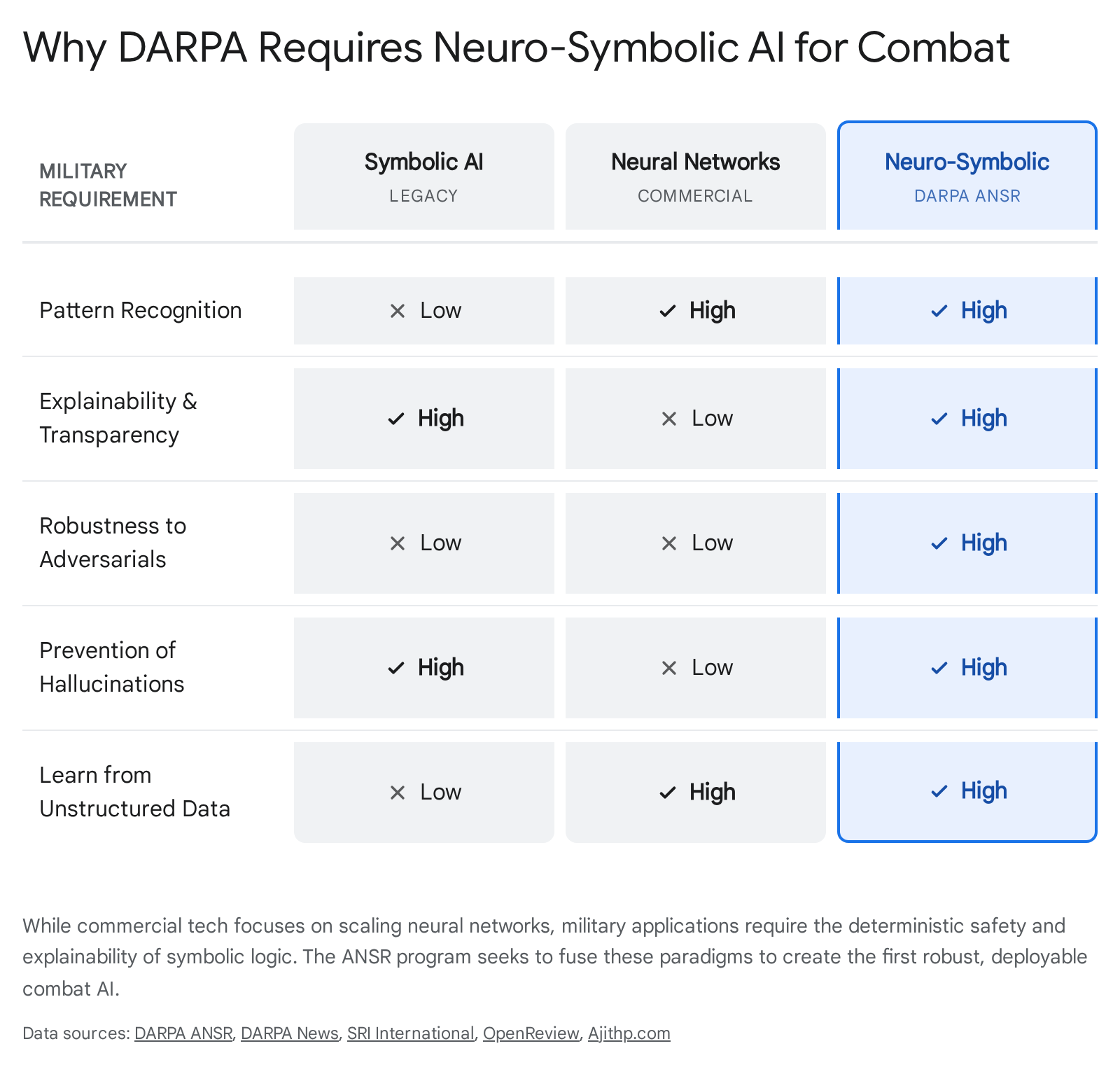
Current state-of-the-art neural networks, despite their fluency and apparent sophistication, act as non-deterministic “black boxes.” Their internal decision-making weights are practically opaque, leading to several critical vulnerabilities that disqualify them from solitary use in command and control:

  1. Hallucinations: LLMs and deep learning models frequently generate plausible, highly confident, but entirely false information26. In a commercial setting, a hallucination is an inconvenience; in a C2 system, a hallucinated enemy division or a hallucinated clear route would result in catastrophic kinetic action and mission failure.
  2. Adversarial Perturbations: Neural networks are structurally vulnerable to adversarial attacks. Microscopic, mathematically calculated changes to an input (such as a few altered pixels on a satellite image) can cause the AI to drastically misclassify a target12.
  3. Lack of Explainability: A fundamental tenet of military leadership is accountability. A commander cannot legally or ethically trust a system if the system cannot logically explain the chain of reasoning that led to its recommendation13.

5.2 Assured Neuro Symbolic Learning and Reasoning (ANSR)

To rectify these profound vulnerabilities and finally realize the vision of trusted autonomous command, DARPA’s Information Innovation Office (I2O) launched the Assured Neuro Symbolic Learning and Reasoning (ANSR) program in 2022 under BAA HR001122S003912.

ANSR represents what researchers are calling the “third wave” of AI, a term coined by DARPA to describe systems capable of contextual adaptation and reasoning34. The program is based on the core idea that operational trust can only be achieved by deeply combining the specific strengths of data-driven machine learning with the rigorous safety of symbolic reasoning12. Neural networks excel at perception—processing raw sensor data and finding hidden patterns in massive data lakes. Conversely, symbolic AI uses formal logic, discrete rules, and mathematical proofs to guarantee outcomes and adhere to known constraints.

In a hybrid neuro-symbolic system, the two paradigms act in concert. For example, an SRI-led collaborative (alongside universities like Carnegie Mellon and UC Berkeley) is developing “TrinityAI,” which successfully combines symbolic deductive reasoning and data-driven deep learning based on a “Predictive Processing” theory of mind13. If the neural network layer processes a degraded satellite image and hallucinates a physically impossible scenario, the symbolic layer instantly flags the anomaly against known physical laws or established rules of engagement and discards the hypothesis13.

Key ANSR Technical Objectives:

  • Robustness: Achieving functional immunity to domain-informed anomalies and targeted adversarial perturbations through symbolic verification12.
  • Assurance Frameworks: The ability to generate heterogeneous, auditable evidence supporting safety and methods for deriving and integrating evidence of correctness33.
  • Operational Capability: ANSR’s capstone demonstration goes far beyond laboratory testing; it aims to execute an unaided Intelligence, Surveillance, and Reconnaissance (ISR) mission to build a common operating picture of a highly dynamic, dense urban environment, completely without human intervention33.
Table comparing two types of neuro-symbol

5.3 In the Moment (ITM): Algorithmic Triage and Human Alignment

While the ANSR program focuses primarily on the underlying algorithms, architecture, and mathematical assurance, DARPA’s In the Moment (ITM) program addresses the psychological and practical realities of delegating decision-making in highly ambiguous environments. Initiated by the Defense Sciences Office (DSO), ITM acknowledges that in high-stress combat, there is often no absolute “ground truth” or universally correct answer; experts frequently disagree on the best course of action14.

Using combat medical triage as its primary analytical testbed, ITM explores how to train algorithms to align with the specific attributes of trusted human experts14. The program is structured in two primary phases: Phase 1 is a 24-month long effort focusing on small-unit triage in austere environments, and Phase 2 scales the complexity over 18 months to mass casualty events14. ITM takes inspiration from medical imaging analysis. To overcome the lack of an absolute ground truth, an algorithm’s decision is compared to a distribution of decisions made by human experts over many trials; if it falls within that distribution, the algorithm is deemed comparable to human performance40. The ultimate goal of ITM is to generate an algorithmic decision-maker that shares a commander’s attributes—such as how it relies on domain knowledge, responds to time pressures, and uses core values to prioritize care—bridging the psychological gap that currently prevents widespread adoption of autonomous systems14.

6. Structural Government Challenges: The “Valley of Death”

The technological innovations pioneered by DARPA, spanning from the predictive graphs of Deep Green to the robust neuro-symbolic logic of ANSR, frequently encounter severe structural, bureaucratic, and managerial impediments that prevent them from successfully transitioning to operational Programs of Record (PoR)41. Within the defense industrial base and policy circles, this transition gap is widely and infamously known as the “Valley of Death”43.

6.1 The Misalignment of Innovation and Acquisition Timelines

The most significant barrier to fielding advanced artificial intelligence is the profound temporal mismatch between the commercial technology sector’s innovation cycles and the DoD’s Planning, Programming, Budgeting, and Execution (PPBE) process. Startups and non-traditional defense contractors, who are currently responsible for much of the cutting-edge AI development, typically raise capital on venture timelines of 12 to 24 months46. Conversely, the DoD’s acquisition cycle often requires three to five years to thoroughly define requirements, secure congressional funding, and ultimately award a contract46. Small, highly innovative firms simply lack the capital reserves to survive the financial drought of the Valley of Death43.

6.2 The Rigidity of the Requirements Process

Traditional DoD acquisition frameworks were designed during the Cold War for massive, hardware-centric platforms43. Artificial intelligence and advanced software demand entirely different development methodologies. Software requires iterative, agile development where continuous testing and immediate user feedback shape the final product25. Imposing hardware-centric, sequential acquisition regulations on fluid, neuro-symbolic algorithms guarantees friction and slows deployment43.

6.3 Testing, Evaluation, Validation, and Verification (TEVV)

Deploying autonomous systems is governed by strict ethical and operational policies, most notably DoD Directive 3000.09, which requires autonomous weapons to allow commanders to exercise appropriate levels of human judgment over the use of force45. Despite the rapid compression of the modern kill chain by AI, strategic assessments conclude that integrating a “human-in-the-loop” remains a non-negotiable requirement for forward-deployed AI systems2. This acts as the ultimate safeguard to mitigate the risk of catastrophic tactical miscalculations caused by sensor spoofing or algorithmic hallucinations in kinetic environments49. Validating non-deterministic AI under traditional TEVV frameworks is immensely difficult, as traditional methods test hardware against a finite set of known inputs to ensure predictable outputs48. Without robust TEVV frameworks designed specifically for continuous learning algorithms, operational commanders will maintain significant hesitation to adopt these systems10.

To overcome these systemic challenges and rapidly field DARPA’s cognitive innovations into the operational force, the DoD must implement profound structural and management reforms. Incremental changes to the existing PPBE process are insufficient to keep pace with the evolution of AI.

7.1 Implement Software-Specific Acquisition Pathways

The DoD must fully embrace and aggressively expand specialized acquisition pathways, specifically decoupling software acquisition from legacy hardware procurement regulations25. This involves the regular, scaled utilization of Middle Tier Acquisition (MTA) authorities and Other Transaction Authorities (OTA)43. These mechanisms intentionally bypass traditional constraints, allowing the DoD to partner directly with startups and rapidly field functional prototypes5. Furthermore, expanding DARPA’s SBIR XL and Direct to Phase II initiatives can inject capital immediately into firms demonstrating technical feasibility51.

7.2 Establish the “Safety Sidecar” Architecture for TEVV

To resolve the TEVV bottleneck, defense engineering teams should mandate the adoption of a Modular Open Systems Approach (MOSA) featuring “Safety Sidecar” architectures50. In this framework, the complex AI algorithm logically and physically decouples itself from a deterministic, rule-based software module10. The safety sidecar persistently monitors the AI’s outputs; if the neural network generates an unsafe command, the sidecar physically prevents the system from executing any action that violates established safety parameters. This architectural approach mirrors the goals of ANSR and provides a clear pathway to certify systems for battlefield use45.

7.3 Empower the Defense Innovation Unit (DIU) as a Scaling “Sherpa”

To assist non-traditional vendors in surviving the Valley of Death, organizations like the Defense Innovation Unit (DIU) must be expanded to function as a cross-service “Sherpa”47. DIU must actively guide startups through the labyrinth of DoD procurement and be resourced with rapid funding mechanisms to take high-promise DARPA technologies and transition them directly into operational environments47. Establishing dedicated AI research and development consortia can further mitigate financial risks for these highly innovative startups52.

8. The Accelerating Threat: China’s “Intelligentized Warfare”

The urgency to overcome internal bureaucratic hurdles and deploy neuro-symbolic AI is severely underscored by rapid advances within strategic competitor nations. The People’s Liberation Army (PLA) of China has closely studied U.S. defense innovations for decades, paying particular attention to the mid-2000s DARPA Deep Green program, which they view as a blueprint for future command and control15.

While the U.S. military transitions from an “informatized” force to a highly networked Joint All-Domain Command and Control (JADC2) architecture, the PLA is attempting to leapfrog directly into what its strategists term “intelligentized warfare” (智能化)15. The PLA does not view AI merely as a sustaining enabler; rather, they view it as the core axis of a new revolution in military affairs16.

8.1 The Pursuit of Battlefield Singularity

Chinese military strategists anticipate that the introduction of artificial intelligence into command, control, and strike systems will accelerate the operational tempo of warfare so drastically that human cognition will be physically unable to keep pace15. They theorize the impending arrival of a “battlefield singularity”—a critical threshold where machine-speed decision-making dictates that humans must be systematically removed from the loop for a military to remain competitive15.

The PLA’s organizational and political tendencies may make it much more willing than the United States to embrace fully autonomous lethality, which is constrained by ethical mandates and the necessity of human-on-the-loop oversight governed by DoDD 3000.09. This disparity creates a deeply dangerous operational reality for U.S. forces. If the United States cannot traverse the Valley of Death to field assured, neuro-symbolic decision-support systems, it risks fielding a human-constrained force that could be functionally outmaneuvered by an adversary operating at machine speeds.

9. Conclusion

The evolution of DARPA’s AI initiatives reflects a continuous, decades-long refinement of how the United States military conceptualizes decision superiority and cognitive automation. The trajectory is clear: from the deterministic, brute-force calculations of the early Deep Thought hardware, to the visionary but computationally limited predictive graphs of Deep Green, and finally arriving at the robust, mathematical assurances demanded by the modern ANSR and ITM programs. The technology has matured to the point where algorithms can process unstructured, non-deterministic data, resist adversarial attacks through symbolic gating, and align with human expert attributes in the profound ambiguity of the fog of war.

However, the primary barrier to maintaining technological superiority is no longer purely scientific; it is structural and bureaucratic. The DoD’s chronic inability to bridge the Valley of Death threatens to leave transformative AI languishing in academic laboratories and startup incubators while adversaries, particularly China, aggressively integrate similar concepts into their combat forces to achieve battlefield singularity. To secure the future battlespace, the military establishment must not only master the complex engineering of neuro-symbolic systems but must also ruthlessly reform its acquisition and testing pathways. Only by matching the speed of modern software development with equally agile procurement and deployment strategies can the United States guarantee decision superiority in the intelligentized conflicts of the 21st century.


Please share the link on Facebook, Forums, with colleagues, etc. Your support is much appreciated and if you have any feedback, please email us in**@*********ps.com. If you’d like to request a report or order a reprint, please click here for the corresponding page to open in new tab.


Sources Used

  1. Information Overload and the Operational Commander – DTIC, https://apps.dtic.mil/sti/tr/pdf/ADA378709.pdf
  2. Decision Dominance: AI and the Transformation of the OODA Loop in Combat, https://blog.roninsgrips.com/decision-dominance-ai-and-the-transformation-of-the-ooda-loop-in-combat/
  3. Operational Concept for Deep Green | Download Scientific Diagram – ResearchGate, https://www.researchgate.net/figure/Operational-Concept-for-Deep-Green_fig1_220954349
  4. Science and Technology – CMU125 – Carnegie Mellon University, https://www.cmu.edu/125/cmu-history/science-technology.html
  5. A Grandmaster Chess Machine: 10/90 – UniGe, https://person.dibris.unige.it/delzanno-giorgio/AI2/hsu.html
  6. A Brief History of Artificial Intelligence – Valore Partners, https://www.valorepartners.com/insight/a-brief-history-of-artificial-intelligence/
  7. State-of-the-Art Small Spacecraft Technology – Vectronic Aerospace, https://www.vectronic-aerospace.com/wp-content/uploads/2026/05/soa-2026-1_260515_235945.pdf
  8. Smallsat Avionics – NASA, https://www.nasa.gov/wp-content/uploads/2026/05/8-smallsat-avionics-2026-final.pdf?emrc=6a0a41ccc767c
  9. 8.0 Small Spacecraft Avionics – NASA, https://www.nasa.gov/smallsat-institute/sst-soa/small-spacecraft-avionics/
  10. Deep Green – Wikipedia, https://en.wikipedia.org/wiki/Deep_Green
  11. Deep Green: Commander’s tool for COA’s Concept – JOHN R. “BUCK” SURDU, PH.D., https://www.bucksurdu.com/Professional/Documents/11260-CCCT-08-DeepGreen.pdf
  12. ANSR – DARPA, https://www.darpa.mil/research/programs/assured-neuro-symbolic-learning-and-reasoning
  13. SRI-led collaborative develops a system to increase confidence in AI-produced recommendations, https://www.sri.com/press/story/sri-led-collaborative-develops-a-system-to-increase-confidence-in-ai-produced-recommendations/
  14. Developing Trustworthy AI to Inform Decisions When Every Moment Counts – DARPA, https://www.darpa.mil/news/2023/trustworthy-ai
  15. 数字化 – 网络化 – 智能化: China’s Quest for an AI Revolution in Warfare, https://thestrategybridge.org/the-bridge/2017/6/8/-chinas-quest-for-an-ai-revolution-in-warfare
  16. The Elsa Kania Bookshelf: Sino-American Competition, Technological Futures & Approaching Battlefield Singularity | Andrew S. Erickson, https://www.andrewerickson.com/2021/06/the-elsa-kania-bookshelf-sino-american-competition-technological-futures-approaching-battlefield-singularity/
  17. Weaponized AI: My Experience in AI | The Substrate Wars, https://substratewars.com/2016/07/03/weaponized-ai-my-experience-in-ai/
  18. AI Adventures Worth Writing Home About Abstract and Introduction Half empty – IJCAI, https://www.ijcai.org/Proceedings/93-1/Papers/105.pdf
  19. AI & Robotics | Timeline of Computer History, https://www.computerhistory.org/timeline/ai-robotics/
  20. Chronicles – AIWS History of AI House, https://hai.aiws.city/cat5/page/5/
  21. Deep Green Helps Warriors Plan Ahead | AFCEA International, https://www.afcea.org/signal-media/technology/deep-green-helps-warriors-plan-ahead
  22. The Deep Green Concept – JOHN R. “BUCK” SURDU, PH.D., http://www.bucksurdu.com/Professional/Documents/TheDeepGreenConcept.pdf
  23. DARPA’s Commander’s Aid: From OODA to Deep Green – Defense Industry Daily, https://www.defenseindustrydaily.com/darpa-from-ooda-to-deep-green-03497/
  24. AIR FORCE INSTITUTE OF TECHNOLOGY – DTIC, https://apps.dtic.mil/sti/pdfs/AD1144554.pdf
  25. Moderator: Andrei Broder – SIGKDD, https://www.kdd.org/kdd2016/speakers/view/moderator-andrei-broder
  26. Model-Agnostic Policy Explanations with Large Language Models – OpenReview, https://openreview.net/pdf?id=VzXpFjKgJg
  27. Graph-Constrained Reasoning Framework | PDF | Cognitive Science | Learning – Scribd, https://www.scribd.com/document/881233803/Graph-constrained-Reasoning-Faithful-Reasoning-on-Knowledge-Graphs-With-Large-Language-Models
  28. Safe and Performant Deployment of Autonomous Systems via Model Predictive Control and Hamilton-Jacobi Reachability Analysis – arXiv, https://arxiv.org/pdf/2506.23346
  29. A Survey on Symbolic Knowledge Distillation of Large Language Models, https://www.computer.org/csdl/journal/ai/2024/12/10597596/1YBtvHkLRqU
  30. Information Innovation Office (I2O) Broad Agency Announcement (BAA) (AI, Cyber, Data), https://grantedai.com/grants/information-innovation-office-i2o-broad-agency-announcement-baa-ai-cyber-defense-advanced-research-projects-agenc-2e8bedc8
  31. Wanted: Artificial Intelligence (AI) and Machine Autonomy Algorithms for Military Command and Control – CSIAC – dtic.mil, https://csiac.dtic.mil/articles/wanted-artificial-intelligence-ai-and-machine-autonomy-algorithms-for-military-command-and-control/
  32. Assured Neuro Symbolic Learning and Reasoning (ANSR) – SAM.gov, https://sam.gov/opp/0c28fb55fcb446dc95ed3337b385b36c/view
  33. Wanted: artificial intelligence (AI) and machine autonomy algorithms for military command and control, https://www.militaryaerospace.com/computers/article/14277721/artificial-intelligence-ai-machine-autonomy-command-and-control
  34. Neuro-Symbolic AI for Multimodal Reasoning: Foundations, Advances, and Emerging Applications – Ajith Vallath Prabhakar, https://ajithp.com/2025/07/27/neuro-symbolic-ai-multimodal-reasoning/
  35. ANSRs to Hard AI Questions – DARPA, https://www.darpa.mil/news/2023/ansrs-ai-questions
  36. DARPA’s ANSR to Improving Trustworthy AI, https://www.darpa.mil/news/2022/ansr-trustworthy-ai
  37. In the Moment (ITM) HR001122S0031 – HigherGov, https://www.highergov.com/contract-opportunity/in-the-moment-itm-hr001122s0031-p-d6998/
  38. Military researchers to apply artificial intelligence (AI) and machine learning to combat medical triage, https://www.militaryaerospace.com/computers/article/14248148/artificial-intelligence-ai-machine-learning-combat-medical-triage
  39. HR0011SB20254-10 Predictive Architectures for Decision-Making (PPADM) Frequently Asked Questions – DARPA, https://www.darpa.mil/sites/default/files/attachment/2025-09/faq-hr0011sb20254-10-4.pdf
  40. Developing Algorithms that Make Decisions Aligned with Human Experts – DARPA, https://www.darpa.mil/news/2022/algorithms-human-experts
  41. Future of Defense Task Force – Chrissy Houlahan, https://houlahan.house.gov/uploadedfiles/future-of-defense-task-force-final-report-2020.pdf
  42. The Department of Defense’s Collaborative Combat Aircraft Program: Good News, Bad News, and Unanswered Questions – CSIS, https://www.csis.org/analysis/department-defenses-collaborative-combat-aircraft-program-good-news-bad-news-and
  43. Sharpening the U.S. Military’s Edge: Critical Steps for the Next Administration | CNAS, https://www.cnas.org/publications/commentary/sharpening-the-u-s-militarys-edge-critical-steps-for-the-next-administration
  44. Battlefield Uses of Artificial Intelligence – Army Science Board, https://asb.army.mil/Portals/105/Reports/2010s/2019%20A%20AI%20Report%20Compressed.pdf?ver=eY4XvuqjAi-g9RAPPaTDgQ%3D%3D
  45. Autonomy & Robotics at the Crossroads – Eisenhower School, https://es.ndu.edu/Portals/75/Documents/Industry%20Study%20Reports/reports/2025/AY25%20Robotics-Cleared.pdf?ver=mHhGmU3ZOI74Gloht2YGDg%3D%3D
  46. The Tech Revolution and Irregular Warfare: Leveraging Commercial Innovation for Great Power Competition – CSIS, https://www.csis.org/analysis/tech-revolution-and-irregular-warfare-leveraging-commercial-innovation-great-power
  47. Scaling Nontraditional Defense Innovation, https://stib.cto.mil/wp-content/uploads/2026/01/2025-2_DIB-ScalingNontraditionalDefenseInnovation_250113PUBLISHED_9ee4ae.pdf
  48. AI Governance for Defense & EU AI Act | Modulos, https://www.modulos.ai/industries/defense/
  49. RCA17: Advancements in Military Special Operations Technology – Ronin’s Grips, https://blog.roninsgrips.com/rca17-advancements-in-military-special-operations-technology/
  50. Architecting Trust: A Modular Framework for the Operational Deployment of Autonomous Systems – Harvard DASH, https://dash.harvard.edu/bitstreams/1510aa60-37df-4272-9a9c-28df6a25a9d7/download
  51. I2O Office Wide Proposers Day | DARPA, https://www.darpa.mil/sites/default/files/attachment/2024-12/i20-office-wide-proposers-day-presentation.pdf
  52. Accelerating R&D for Critical AI Assurance and Security Technologies, https://fas.org/publication/accelerating-rd-for-critical-ai/
  53. Artificial Intelligence, China, Russia, and the Global Order – DTIC, https://apps.dtic.mil/sti/trecms/pdf/AD1122420.pdf
  54. Beating the Americans at their Own Game – Amazon S3, https://s3.amazonaws.com/files.cnas.org/documents/CNAS-Report-Work-Offset-final-B.pdf
  55. Testimony before the US-China Economic and Security Review Commission: Chinese Advances in Unmanned Systems and the Military Applications of Artificial Intelligence, https://www.uscc.gov/sites/default/files/Kania_Testimony.pdf
  56. Working Paper Series – Centre for European Integration Research, https://eif.univie.ac.at/downloads/workingpapers/wp2020-03.pdf
  57. Chinese Perspectives on AI and Future Military Capabilities – CSET, https://cset.georgetown.edu/wp-content/uploads/CSET-Chinese-Perspectives.pdf