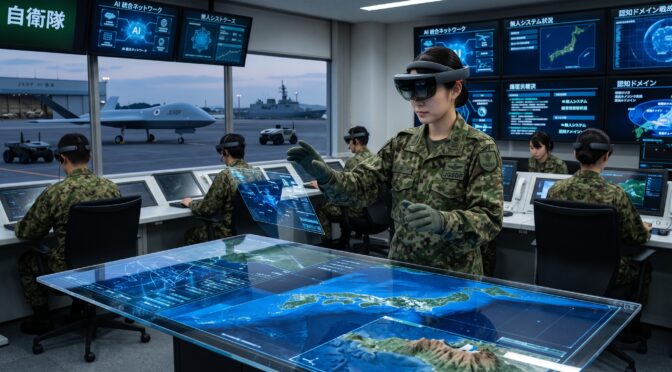
Executive Summary: Adopting “New Ways of Warfare”
Japan is currently undertaking its most significant military transformation since the end of World War II. As outlined in the Ministry of Defense’s (MOD) Defense of Japan 2026 White Paper, the nation has formally adopted a new doctrine known as “New Ways of Warfare” (Atarashii Tatakaikata). This shift is a response to increasing regional instability, including the strategic challenges posed by China, North Korea’s missile activities, and the growing military cooperation between Russia and North Korea. Consequently, the Japan Self-Defense Forces (JSDF) are moving away from traditional, platform-centric models in favor of a distributed, network-centric architecture built on Artificial Intelligence (AI), autonomous systems, and littoral defense.
This evolution draws heavily from lessons learned in recent conflicts in Ukraine and the Middle East, which have highlighted the vulnerability of high-cost conventional platforms to massed, low-cost precision strikes and persistent drone surveillance. The 2026 White Paper acknowledges that traditional hardware is increasingly insufficient for high-attrition conflicts in contested environments. To address this, the MOD’s Fiscal Year 2026 budget request has risen to 8.84 trillion JPY (approximately $60 billion)—a 4.4% increase—with a significant portion dedicated to developing and fielding scalable “Unmanned Defense Capabilities”.
This technological pivot is also a necessary response to Japan’s severe demographic constraints. A declining birthrate has created a recruitment crisis; in 2023, the JSDF met only 51% of its intake goals, with core enlisted ranks filled at just 68%. With the pool of eligible 18-year-olds expected to drop from 1.09 million today to 710,000 by 2043, the MOD views automation and AI as essential tools to address the shortfall in manpower while meeting expanding strategic commitments.
The 2026 White Paper, the first under Prime Minister Sanae Takaichi, integrates economic security and industrial capacity into the national defense framework. By relaxing defense export rules and establishing the Defense Innovation Science and Technology Institute (DISTI), Tokyo is removing the barriers between civilian innovation and military application. This report explores the various pillars of this modernization, from multi-domain unmanned systems to cognitive warfare.
Part I: Artificial Intelligence & Cognitive Decision Dominance
AI integration serves as the cognitive foundation of Japan’s defense strategy. The goal is to ensure “decision dominance”—the ability to process information and act faster than an adversary in complex electromagnetic and cyber environments.
1. AI for Target Recognition & Space Domain Awareness (SDA)
Japan’s geography as an archipelago requires extensive maritime and aerospace surveillance. The MOD is investing in satellite constellations and AI-driven analysis to automate the tracking of maritime incursions and missile threats. To reflect this priority, the Air Self-Defense Force will be reorganized into the Japan Aerospace Self-Defense Force by FY2027.
Tokyo is shifting from vulnerable, state-owned satellites to proliferated constellations in Low Earth Orbit (LEO) through public-private partnerships. Startups like Synspective are providing Synthetic Aperture Radar (SAR) data for all-weather monitoring, while Astroscale Japan is developing satellites to identify orbital threats. AI algorithms process this data at the edge, reducing the burden on human analysts and accelerating the “sensor-to-shooter” loop. The U.S.-Japan alliance also supports this effort, as exemplified by the recent launch of the QZS-7 satellite with a hosted U.S. payload.
2. AI-Enabled Battlefield Decision Support at JJOC
A key institutional change is the creation of the Japan Joint Operations Command (JJOC), which centralizes authority across all military branches and integrates with U.S. forces.
The JJOC uses AI-enabled systems to support rapid decision-making during high-speed threats, such as hypersonic missiles or massed drone strikes. These models evaluate various courses of action in real-time. Platforms like “MeshRunner” are being assessed to unify data from dispersed unmanned vehicles into a single Common Operational Picture, allowing commanders to coordinate assets across the First Island Chain effectively.
3. Cognitive Electronic Warfare (EW)
To counter sophisticated regional electronic warfare, Japan’s Acquisition, Technology & Logistics Agency (ATLA) is prioritizing Cognitive Electronic Warfare. While legacy systems rely on pre-set threat libraries, cognitive systems use machine learning to analyze the electromagnetic spectrum in real-time, identifying and jamming novel radar frequencies instantly. Additionally, research is underway for “stand-in jammers”—disposable drones that can penetrate air defenses to protect manned aircraft.
Cognitive EW uses machine learning algorithms to automatically analyze the electromagnetic spectrum in real-time, classify unknown radar waveforms, and instantly create optimized jamming profiles without prior human characterization20. Domestic defense primes, notably Mitsubishi Heavy Industries, are working to integrate these advanced algorithms into next-generation platforms, ensuring platform survivability in highly contested environments35. Furthermore, ATLA initiated research in 2024 (slated for completion by 2028) into “stand-in jammers.” These are low-cost, disposable UAVs equipped with powerful EW payloads designed to penetrate deep into enemy air defenses, disrupt communications, and protect high-value manned aircraft from surface-to-air missile locks, effectively creating electronic corridors for JSDF strike packages8.
Part II: Uncrewed Aerial Systems (UAS) & Collaborative Combat Aircraft (CCA)
Japan’s aerial drone architecture is rapidly maturing into a multi-tiered framework designed to maximize persistent surveillance, deliver low-cost kinetic strikes, and significantly extend the lethality and survivability of its shrinking manned fighter fleet.
1. Strategic & Maritime Surveillance UAS
The MOD is procuring high-altitude and medium-altitude drones (HALE/MALE) to maximize surveillance. The JMSDF is acquiring 23 MQ-9B SeaGuardian drones for $1.9 billion to replace aging manned patrol aircraft. These systems will monitor critical chokepoints along the Southwestern Islands, providing early warning without risking personnel or depleting the flight hours of expensive manned airframes.
2. Tactical Loitering Munitions & Attack Drones
Drawing from the conflict in Ukraine, the JGSDF is investing in loitering munitions and First-Person View (FPV) drones. The domestic market for these systems is expected to grow by 22.4% annually through 2030 as the military seeks organic precision-strike capabilities at the squad level.
These assets include anti-armor variants for coastal defense and agile quadcopters for anti-personnel use. Japan is also exploring “Radar Site Defence” drones—high-speed interceptors that ram incoming enemy loitering munitions to save expensive surface-to-air missiles for higher-tier threats.
3. Collaborative Combat Aircraft (CCA) & GCAP Integration
To counter numerical disadvantages, Japan is developing Manned-Unmanned Teaming (MUM-T). A central project is the sixth-generation Global Combat Air Programme (GCAP), developed with the UK and Italy. This aircraft will use autonomous wingmen (Collaborative Combat Aircraft or CCA) to scout, designate targets, and execute strikes while the pilot coordinates from a safe distance. ATLA and Subaru are currently testing these concepts using sub-scale jet drones controlled by tablet interfaces.
Unlike traditional remotely piloted vehicles, these Collaborative Combat Aircraft (CCA) will function as autonomous, semi-independent extensions of the manned fighter within a broader “combat cloud”43. They will be piloted by advanced AI algorithms, scouting ahead into highly contested airspace, designating targets, executing electronic attacks, and deploying kinetic weapons, while the manned GCAP fighter operates safely from a standoff distance, acting as an airborne quarterback43.
ATLA, in conjunction with domestic manufacturers like Subaru and Mitsubishi Heavy Industries, is currently conducting advanced, real-world flight tests to validate this concept. Recent footage released by ATLA highlighted Subaru-built sub-scale jet-powered drones operating in a five-aircraft formation, controlled directly from a tablet interface aboard a modified UH-1 (Subaru Bell 412EPX) helicopter44. These tests are critical for capturing data on autonomous flight path generation and assessing the cognitive workload on human pilots managing multiple unmanned assets simultaneously44.
Part III: Maritime & Undersea Unmanned Systems (USVs / UUVs) & Littoral Architecture
Japan is fundamentally restructuring its maritime defense to account for the geographic vulnerability of the Nansei Shoto chain, an archipelago stretching from Kyushu to Taiwan that forms the critical southern barrier of the First Island Chain. The core of this defensive effort is the SHIELD architecture, heavily augmented by advanced surface and subsurface autonomous systems.
1. SHIELD Littoral Defense Architecture
The SHIELD (Synchronized, Hybrid, Integrated and Enhanced Littoral Defense) network is the core of Japan’s coastal strategy. With a 100.1 billion JPY budget for FY2026, the MOD aims to integrate aerial, surface, and underwater drones into a lethal defensive web by 2027.
SHIELD aims to deny amphibious landings by using massed, inexpensive sensors and drones to target threats without risking human defenders. This network provides targeting data for heavy kinetic assets like the Type 25 Surface-to-Ship Missile. Deployed in 2026, the Type 25 features a 1,000km range, stealth capabilities, and the ability to update its flight path mid-course.
2. Unmanned Surface Vessels (USVs)
The MOD is expanding its Unmanned Surface Vessel (USV) programs from mine countermeasures to multi-purpose combat support, including acoustic monitoring and launching loitering munitions.
In January 2025, the JMSDF selected Shield AI’s MQ-35 V-BAT as its first shipborne autonomous drone. Its vertical take-off design allows it to operate from small decks without catapults. Capable of 13+ hours of endurance, the V-BAT uses “Hivemind” software to operate in GPS-denied environments, a capability already proven in Ukraine.
3. Uncrewed Underwater Vehicles (UUVs)
Monitoring deep-water chokepoints like the Miyako Strait is critical for tracking adversary submarines. The JMSDF already uses the OZZ-5 autonomous underwater vehicle for mine detection aboard Mogami-class frigates.
Future plans focus on long-endurance UUVs developed with Mitsubishi Heavy Industries. These 16-meter modular submersibles can patrol for over a week, using sonars to detect hostile vessels and transmit data to the SHIELD network without being detected.
Part IV: Defense Innovation Ecosystem & Dual-Use Tech Integration
Japan cannot achieve the rapid technological leaps mandated by the 2026 Defense White Paper through its traditional, insular procurement bureaucracy. To harness the blistering pace of commercial technology and software development, Tokyo is actively and aggressively restructuring its defense-industrial ecosystem.
1. The Role of DISTI
Established in 2024, the Defense Innovation Science and Technology Institute (DISTI) models itself after the U.S. DARPA. It aims to bridge the gap between commercial tech and military procurement by hiring private-sector managers and funding high-risk “breakthrough” projects.
2. Commercial Startups & Dual-Use Venture Pipelines
The “Fast Pass” procurement framework, launched in 2026, allows the MOD to bypass traditional bureaucracy and contract directly with non-traditional vendors for dual-use technology.
The MOD has also established a defense-focused SBIR program, allocating 7 billion JPY in FY2026 to fund startups. Early success stories include Infostellar for satellite communications and Synspective for radar constellations, showing the rapid “spin-on” of commercial tech into national security.
3. Defense Production Base & Export Reforms
To prevent further decline in the domestic defense industry, the government passed the Defense Production Base Strengthening Act in 2023. This law allows the MOD to subsidize firms to update equipment, harden supply chains, and implement cybersecurity standards to protect against espionage. In 2024, 23.4 billion JPY was deployed to stabilize suppliers.
Japan has also reformed its defense export rules. The 2026 update to the Three Principles allows the export of lethal weapons to 17 partner nations, including Australia and India. Additionally, the GCAP fighter can now be exported to third-party countries. These reforms aim to achieve economies of scale and use defense equipment as a tool for diplomacy.
Comparative Matrix & Structural Bottleneck Analysis
While the 2026 Defense White Paper outlines a formidable, highly logical technological roadmap, the execution of these initiatives faces profound structural vulnerabilities and societal friction points that threaten to degrade operational readiness and delay deployment timelines.
Social and Academic Resistance: Japan’s postwar pacifist ethos remains strong. Polls suggest 60% of the public opposes constitutional changes to Article 9. This skepticism extends to academia, where many universities forbid defense-funded research, limiting the flow of top-tier talent into the DISTI pipeline.
Cyber and Supply Chain Vulnerabilities: Integrating commercial tech into the SHIELD network creates cyber risks. Many small subcontractors lack the expertise to defend against state-sponsored attacks. Furthermore, Japan remains dependent on overseas supply chains for microchips and rare earth elements.
Software Acquisition Obstacles: The MOD’s culture still prioritizes hardware over software. Next-gen systems require continuous software iterations to stay effective against evolving threats, yet the JSDF historically struggles with the agile contracting needed for software-driven capabilities.
Japan’s Next-Gen Tech Pillars
| Pillar / Domain | Key Platforms / Systems | Strategic Operational Objective | Maturation Horizon |
| AI & Space Domain Awareness | Synspective SAR Constellations, Astroscale RPO Satellites | Real-time tracking of adversarial naval assets and killer satellites, with early warning capability. | Near-Term (FY2026-2027) |
| Cognitive Electronic Warfare | AI-driven adaptive jamming modules, Stand-in Jammers | Autonomous signal classification & disruption of adaptive adversary air-defense radars. | Long-Term (2028-2030s) |
| Manned-Unmanned Teaming (MUM-T) | Subaru demonstrator drones, GCAP Wingmen (CCA) | Force multiplication of manned fighters; autonomous forward scouting & kinetic targeting. | Long-Term (2030s) |
| Littoral Defense (SHIELD) | Small Attack UAVs (Type 1, 2, 3), FPVs, MeshRunner C2 | Asymmetric, low-cost denial of amphibious invasion forces across the Nansei Shoto. | Near-Term (FY2026-2028) |
| Maritime & Subsurface Autonomy | V-BAT VTOL (Shipborne ISR), Long-Endurance UUVs | Deep-water chokepoint ASW monitoring (Miyako Strait) and persistent surface ISR. | Mid-Term (2027-2030) |
| Standoff Strike | Type 25 Surface-to-Ship Missiles (1,000km+ range) | Long-range kinetic counterstrike guided by the SHIELD uncrewed targeting network. | Near-Term (FY2026-2028) |
Comprehensive Bilingual Glossary
| Acronym / Japanese Specialized Term | Full English Term | Succinct Operational Definition & Technical Role |
| 新しい戦い方 (Atarashii Tatakaikata) | New Ways of Warfare | The paradigm shift from exquisite, high-cost platforms to massed, AI-driven, and cost-effective uncrewed systems. |
| 無人アセット防衛能力 (Mujin Asetto Bōei Nōryoku) | Unmanned Defense Capabilities | The overarching strategy is to field scalable aerial, surface, and sub-surface drones to offset demographic recruitment shortfalls. |
| 防衛イノベーション科学技術研究所 (DISTI) (Bōei Inobēshon Kagaku Gijutsu Kenkyūjo) | Defense Innovation Science and Technology Institute | Japan’s DARPA/DIU counterpart, established in 2024 to rapidly adapt commercial/academic dual-use tech for defense. |
| 防衛装備庁 (ATLA) (Bōei Sōbichō) | Acquisition, Technology & Logistics Agency | The MOD agency is responsible for the research, development, and procurement of advanced defense platforms. |
| 統合作戦司令部 (JJOC) (Tōgō Sakusen Shireibu) | Japan Joint Operations Command | The centralized command authority integrating Ground, Maritime, and Air forces, heavily utilizing AI for multi-domain C2. |
| 多層的沿岸防衛体制 (SHIELD) (Tasōteki Engan Bōei Taisei) | Synchronized, Hybrid, Integrated and Enhanced Littoral Defense | A layered, multi-domain network of UAVs, USVs, and UUVs designed to asymmetrically counter amphibious invasions. |
| 次期戦闘機 (GCAP) (Jiki Sentōki) | Global Combat Air Programme | The 6th-generation fighter co-developed with the UK and Italy, serving as a node for autonomous drone wingmen. |
| 有人機と無人機の連携 (MUM-T) (Yūjinki to Mujinki no Renkei) | Manned-Unmanned Teaming | The doctrinal and technical architecture enabling human pilots to direct autonomous Collaborative Combat Aircraft (CCA). |
| コグニティブ電子戦 (Koguniteibu Denshisen) | Cognitive Electronic Warfare | AI-enabled electronic warfare systems that autonomously analyze unknown radar signals and adapt jamming profiles in real-time. |
| 長期運用型UUV (Chōki Un’yōgata UUV) | Long-Endurance UUV | Modular, large-displacement autonomous submersibles designed for extended anti-submarine warfare (ASW) patrols. |
| ファストパス調達 (Fasuto Pasu Chōtatsu) | Fast Pass Procurement | An agile contracting framework allowing the MOD to bypass traditional bureaucracy to procure tech directly from startups. |
| 防衛装備移転三原則 (Bōei Sōbi Iten San Gensoku) | Three Principles on Transfer of Defense Equipment and Technology | The export control framework was revised in 2026 to permit the overseas transfer of finished, lethal weapons to 17 partner nations. |
| 防衛生産基盤強化法 (Bōei Seisan Kiban Kyōkahō) | Defense Production Base Strengthening Act | Legislation empowering the MOD to subsidize private contractors for cyber-hardening, supply chain resilience, and capacity upgrades. |
| 25式地対艦誘導弾 (Nīgō-shiki Chitaikan Yūdōdan) | Type 25 Surface-to-Ship Missile | An upgraded, stealth-conscious standoff cruise missile with a 1,000km+ range, integrated with the SHIELD targeting network. |
Please share the link on Facebook, Forums, with colleagues, etc. Your support is much appreciated and if you have any feedback, please email us in**@*********ps.com. If you’d like to request a report or order a reprint, please click here for the corresponding page to open in new tab.
Sources Used
- Japan’s 2026 defense white paper – Taipei Times, https://www.taipeitimes.com/News/editorials/archives/2026/08/13/2003862395
- Japan’s 2026 Defence White Paper – Gateway House Indian Council on Global Relations, https://www.gatewayhouse.in/japans-2026-defence-white-paper/
- World Insight: Japan’s new defense white paper charts Takaichi’s military expansion agenda, https://english.news.cn/20260805/5d2208e9877c401f97c580c7b80c45aa/c.html
- Dissecting Japan’s Defence White Paper 2026 – Analysis – Eurasia Review, https://www.eurasiareview.com/08082026-dissecting-japans-defence-white-paper-2026-analysis/
- Japan’s 2026 defense white paper highlights ‘new era of crisis’ in Indo-Pacific, https://www.defensenews.com/global/asia-pacific/2026/08/10/japans-2026-defense-white-paper-highlights-new-era-of-crisis-in-indo-pacific/
- Japan’s Defense White Paper: China as Primary Challenge, Shift in Combat Strategy via Drones and AI | Hakky Handbook, https://book.st-hakky.com/en/news/japan-defense-drones-ai-china-threat
- Pamphlet, https://www.mod.go.jp/j/press/wp/wp2026/pdf/DOJ2026_Digest_EN.pdf
- Japan Seeks Drones for “SHIELD” Coastal Defense: Opportunities in Procurement and Domestic Production, https://nsbt-japan.com/news/aBmR6HFw9Gs7eYbMb14fa5c47d301a991852d09ebebd438e?c=aBmR6HFw9Gs7eYbM7a9a07c87c7b6202634ad10136446590en&l=en
- Japan looks to build drone ‘shield’ in record defense budget request – The Japan Times, https://www.japantimes.co.jp/news/2025/08/29/japan/japan-defense-budget-drones/
- 防衛白書に親しむ|全国防衛協会連合会(公式ホームページ), https://ajda.jp/smarts/index/130/
- 特集 令和8年度 防衛関係予算について – 財務省, https://www.mof.go.jp/public_relations/finance/202605/202605g.html
- 7年度つばさ会・JAAGA合同講演会:令和8年度航空自衛隊予算の概要及び航空防衛力整備に係る取組みの状況について | Tsubasakai, https://www.tsubasakai2.pgw.jp/?p=3491
- 自衛官応募1万人超減/23年度/ハラスメント・「戦争する国」が影響 – 日本共産党, https://www.jcp.or.jp/akahata/aik24/2024-07-17/2024071701_04_0.html
- 隊員募集強化でも「自衛隊24万人体制」はもう維持できない、隊員不足の真の原因は少子化、陸自は10万人削減すべき理由 – 東洋経済オンライン, https://toyokeizai.net/articles/-/945847?display=b
- Japan’s Strategic Shift: Evolving Roles in Indo-Pacific Security – Ronin’s Grips, https://blog.roninsgrips.com/japans-strategic-shift-evolving-roles-in-indo-pacific-security/
- 防衛白書(令和7年版)を読む:キーワード解説 ~統合作戦司令部、スタンド・オフ, https://www.dlri.co.jp/report/ld/499564.html
- 日本の防衛と自衛隊:人口減少とトランプ政権の衝撃 ~求められる自立、成長会計の視点から, https://www.dlri.co.jp/report/ld/431279.html
- Japan’s Defense Revolution: Takaichi’s Strategic Shift in 2026 – Ronin’s Grips, https://blog.roninsgrips.com/japans-defense-revolution-takaichis-strategic-shift-in-2026/
- 防衛と民生のデュアルユース – よろず知財戦略コンサルティング, https://yorozuipsc.com/uploads/1/3/2/5/132566344/546df008cd40f85a7f18.pdf
- 防衛・民生デュアルユース先端技術の総合分析 報告書 – よろず知財戦略コンサルティング, https://yorozuipsc.com/uploads/1/3/2/5/132566344/479e4c0093840d6fd413.pdf
- Japan officially eases arms export rules – CGTN, https://news.cgtn.com/news/2026-04-21/news-1Mw1A8LRiWA/p.html
- Outline of Space Domain Defense Guidelines, https://www.mod.go.jp/en/images/outline_space-domain-defense-guidelines_20250807.pdf
- Space Security in Japan’s New Strategy Documents – CSIS, https://www.csis.org/analysis/space-security-japans-new-strategy-documents
- Protecting Space Security: A New Mission for Japan’s Self-Defense Forces – JapanGov, https://www.japan.go.jp/kizuna/2024/08/protecting_space_security.html
- Redesigning Japan’s Space Security Ecosystem for a Stronger U.S.-Japan Alliance – CSIS, https://www.csis.org/analysis/redesigning-japans-space-security-ecosystem-stronger-us-japan-alliance
- Space and Strategy: Japan’s National Security in Space and Europe – CSDS, https://csds.vub.be/publication/space-and-strategy-japans-national-security-in-space-and-europe/
- Synspective Secures Japan’s Ministry of Defense Satellite Constellation Contract, https://www.accesshub.space/post/synspective-secures-japan-s-ministry-of-defense-satellite-constellation-contract
- Astroscale Japan Chosen To Advance Space Domain Awareness Capabilities, https://www.afcea.org/signal-media/astroscale-japan-chosen-advance-space-domain-awareness-capabilities
- U.S. Space Force and Japan successfully launch U.S. sovereign space domain awareness payload aboard QZS-7 satellite > Space Systems Command > Newsroom, https://www.ssc.spaceforce.mil/Newsroom/Article/4574476/us-space-force-and-japan-successfully-launch-us-sovereign-space-domain-awarenes
- 日米同盟と抑止力 | 日本が先送りせず解くべき課題, https://fladdict.github.io/japan-todo/issues/security/alliance-deterrence/
- 統合作戦司令部の出来事 | JJOC – 防衛省・自衛隊, https://www.mod.go.jp/jjoc/about/topics.html
- Japan Announces SHIELD Coastal Defence System with UxVs – TURDEF, https://turdef.com/article/japan-announces-shield-coastal-defence-system-with-uxvs
- 戦場の全てが“モニターで丸見え!?” 自衛隊の無人機防衛構想にピッタリな米大手企業の新システム「メッシュランナー」とは, https://trafficnews.jp/post/649417
- 戦場の全てが“モニターで丸見え!?” 自衛隊の無人機防衛構想にピッタリな米大手企業の新システム「メッシュランナー」とは – carview!, https://carview.yahoo.co.jp/news/detail/9fc448f5136ffe5a452f8b557df3b5a5a783c6f4/
- 日本の航空宇宙・防衛市場 – 規模、シェア、業界分析 – Mordor Intelligence, https://www.mordorintelligence.com/ja/industry-reports/japan-aerospace-and-defense-market
- インド太平洋における軍事能力配備の段階移行と非物理領域の戦略, https://nexa-platform.jp/posts/indo-pacific-military-shift-nonphysical-2022-2025
- 新装備開発 – 日本安全保障戦略研究所(SSRI), https://www.ssri-j.com/MediaReport/JPN/NE_201x.html
- Japan to Build $875M Multi-Domain Coastal Defense Drone Network, https://www.govconexec.com/2025/09/japan-coastal-defense-drone-budget/
- Japan’s ISR Drone Doctrine Evolves with Shield AI V-BAT – Inside Unmanned Systems, https://insideunmannedsystems.com/japans-drone-doctrine-evolves-with-shield-ai-v-bat/
- Japan’s Self-Defense Forces plan the development of drones for their synchronized, hybrid, integrated, and enhanced coastal defense – Zona Militar, https://www.zona-militar.com/en/2025/11/07/japans-self-defense-forces-plan-the-development-of-drones-for-their-synchronized-hybrid-integrated-and-enhanced-coastal-defense/
- Japan Loitering Munition Market (2025-2030) – MarketsandMarkets, https://www.marketsandmarkets.com/Market-Reports/geography/loitering-munition-market/japan
- Asian-Style Drone Wall: Japan Develops SHIELD Coastal Defense System, https://militarnyi.com/en/news/asian-style-drone-wall-japan-develops-shield-coastal-defense-system/
- Double Degree MSc in European Governance Master’s thesis BRIDGING THE DIVIDE Assessing Technical and Informational Interoperab – UU Student Theses Repository, https://studenttheses.uu.nl/bitstreams/afa1e057-45c1-4d24-9527-44e28b4dd0c2/download
- Japan tests mini Subaru jet-powered drones in push for loyal wingman capability – Aerospace Global News, https://aerospaceglobalnews.com/news/japan-atla-subaru-loyal-wingman-tests/
- Japan’s Shift to Drones: A New Era in Defense Strategy – Ronin’s Grips, https://blog.roninsgrips.com/japans-shift-to-drones-a-new-era-in-defense-strategy/
- Quantum Leap: India’s Strategic Path to Sixth-Generation Aerial Dominance, https://aeromorning.com/en/quantum-leap-indias-strategic-path-to-sixth-generation-aerial-dominance/
- Eyes on Asia: Stand-off missiles, drone defence system key highlights in Japan’s 2026 defence budget, https://www.australiandefence.com.au/news/news/eyes-on-asia-stand-off-missiles-drone-defence-system-key-highlights-in-japan-s-2026-defence-budget
- An Analysis of Japan’s SHIELD Architecture and Modern Air, https://blog.roninsgrips.com/the-strategic-posture-and-the-evolving-threat-environment-an-analysis-of-japans-shield-architecture-and-modern-air-defense-lessons/
- 防衛力抜本的強化の 進捗と予算, https://www.mod.go.jp/j/budget/yosan_gaiyo/fy2026/yosan_20260408.pdf
- Japan to Field Multiple Advanced Coastal Defense Missiles by 2032 – Naval News, https://www.navalnews.com/naval-news/2026/04/japan-to-field-multiple-advanced-coastal-defense-missiles-by-2032/
- 護衛艦「ちょうかい」射程1600kmの巡航ミサイル発射に成功! ただ本命は別にあり?「トマホーク追加購入なし」の真意 – carview!, https://carview.yahoo.co.jp/news/detail/55155da9fd61beed32dea387a02df541fca1d1c9/
- 「反撃能力」の柱と位置づける長射程のスタンド・オフ・ミサイル初配備…中国や北朝鮮への抑止力高める狙い – 読売新聞, https://www.yomiuri.co.jp/national/20260331-GYT1T00364/
- 陸上自衛隊に「射程5倍」の新型ミサイルついに配備! 今後もっとスゴい“本命”も!? 防衛装備庁に聞いた(1/2 ページ) | 乗りものニュース, https://trafficnews.jp/post/653792
- 25式地対艦誘導弾 – Wikipedia, https://ja.wikipedia.org/wiki/25%E5%BC%8F%E5%9C%B0%E5%AF%BE%E8%89%A6%E8%AA%98%E5%B0%8E%E5%BC%BE
- JMSDF selects Shield AI V-BAT as its first autonomous ISR platform, https://www.ex2.com.au/news/jmsdf-selects-shield-ai-v-bat-as-its-first-autonomous-isr-platform/
- Shield AI V-BAT selected as Japan Maritime Self-Defense Force’s first maritime ISR platform, https://shield.ai/shield-ai-v-bat-selected-as-japan-maritime-self-defense-forces-first-maritime-isr-platform/
- Japan picks Shield AI’s V-BAT as its first maritime ISR platform – Naval Today, https://www.navaltoday.com/2025/01/27/japan-picks-shield-ais-v-bat-as-its-first-maritime-isr-platform
- Shield AI MQ-35 V-BAT – Wikipedia, https://en.wikipedia.org/wiki/Shield_AI_MQ-35_V-BAT
- Shield AI V-BAT, X-BAT and Naval Autonomy with HII – YouTube, https://www.youtube.com/watch?v=4BgBadWi59g
- Contents, https://www.mod.go.jp/en/publ/w_paper/wp2024/DOJ2024_EN_Reference.pdf
- 460 Reference, https://www.mod.go.jp/en/publ/w_paper/wp2019/pdf/DOJ2019_reference02.pdf
- Lockheed Martin「Lamprey MMAUV」発表 艦艇に取り付き自律航行する次世代無人潜水機, https://innovatopia.jp/drones/drones-news/80245/
- 自律型無人潜水機 – Wikipedia, https://ja.wikipedia.org/wiki/%E8%87%AA%E5%BE%8B%E5%9E%8B%E7%84%A1%E4%BA%BA%E6%BD%9C%E6%B0%B4%E6%A9%9F
- 無人潜水艇UUVはゲームチェンジャーになる?将来の戦い方にも驚いた!Will UUVs be a game changer? Surprised by the future of the fight! – YouTube, https://www.youtube.com/watch?v=mPn_v2–yb4
- 世界初、艦上のレールガン実射に成功 – NSBT Japan, https://nsbt-japan.com/news/aBmR6HFw9Gs7eYbM5680ed93607b75233a0e391baed5553d?c=aBmR6HFw9Gs7eYbM7a9a07c87c7b6202634ad10136446590&l=ja
- 海の中で何を研究しているの? 艦艇装備研究所の技術研究【第2弾】|🏖️ – note, https://note.com/jazzy_llama5993/n/n60dd2d9c3972
- 防衛技術のブレイクスルーを目指す新組織「防衛イノベーション科学技術研究所」(DISTI)が発足, https://j-defense.ikaros.jp/docs/mod/001562.html
- 防衛白書の解説動画に国産AI「NoLang」|防衛省初のアバター – innovaTopia, https://innovatopia.jp/ai/ai-news/115509/
- 防衛イノベーション科学技術研究所 – Wikipedia, https://ja.wikipedia.org/wiki/%E9%98%B2%E8%A1%9B%E3%82%A4%E3%83%8E%E3%83%99%E3%83%BC%E3%82%B7%E3%83%A7%E3%83%B3%E7%A7%91%E5%AD%A6%E6%8A%80%E8%A1%93%E7%A0%94%E7%A9%B6%E6%89%80
- 防衛装備庁と日本政策金融公庫が語る、スタートアップ向け支援の全容と活用法 | GB Universe, https://universe.globalbrains.com/posts/startup-support-atla-jfc
- 小型無人航空機(防衛・デュアルユース)|政策実装・官民投資編, https://www.marketsupporter-ai.com/reports/uav-policy-investment.html
- 防衛省がスタートアップの技術を迅速に導入するための仕組みは何ですか? – PPPT, https://pppt.jp/councils/cas-startup-suishin/m/fast-pass-procurement
- 防衛は輸入だけでは築けない――1兆円の無人アセット投資が問う、日本のドローン産業の現在地, https://drone-journal.impress.co.jp/docs/special/1188632.html
- 防衛大臣記者会見|令和8年2月27日(金)08:41~08:49 – 防衛省・自衛隊, https://www.mod.go.jp/j/press/kisha/2026/0227a.html
- 【スクープ】防衛事業「撤退」ラッシュ!コマツ、住友重機、三井E&Sに続く“名門企業”の実名, https://diamond.jp/articles/-/307595
- スクープ!住友重機械が機関銃生産から撤退へ 日本の防衛産業から撤退が相次ぐ切実な事情, https://toyokeizai.net/articles/-/422914
- 防衛生産基盤強化法に関連した サイバーセキュリティ対策について – 両備システムズ, https://www.ryobi.co.jp/security/feature/20260130-1
- 防衛装備庁 : 防衛生産基盤強化法について, https://www.mod.go.jp/atla/hourei_dpb.html
- 防衛産業サイバーセキュリティ基準のポイント解説 | EY Japan, https://www.ey.com/ja_jp/insights/technology-risk/defense-industry-cybersecurity-standards
- 防衛生産基盤強化法について | Expertbusiness – エキスパートビジネス, https://expertbus.biz/?p=809
- 339【連載 町工場から、国を護る一員へ Vol.5】国が直接、費用を出す 防衛生産基盤強化法「装備品安定製造等確保計画」 – note, https://note.com/lucky_whale741/n/n0138150d4758
- Japan loosens the reins on defence exports – The International Institute for Strategic Studies, https://www.iiss.org/online-analysis/online-analysis/2026/04/japan-loosens-the-reins-on-defence-exports/
- Good news: Japan further loosens its military export rules – The Strategist, https://www.aspistrategist.org.au/good-news-japan-further-loosens-its-military-export-rules/
- Japan lifts restrictions on weapon and technology exports – JURIST – News, https://www.jurist.org/news/2026/04/japan-lowers-restrictions-on-weapon-and-technology-exports/
- What Are the Three Principles on Defense Equipment Transfer? How Repealing the Five Types Changes Arms Exports, the 2026 Amendment Explained Clearly | TIMEWELL, https://timewell.jp/en/columns/defense-equipment-transfer-three-principles
- Three Principles on Transfer of Defense Equipment and Technology – Ministry of Foreign Affairs of Japan, https://www.mofa.go.jp/fp/nsp/page1we_000083.html
- “Responsible State” Vision Drives Defense Export Policy -The Shared Future of Asia and Japan – MediaConnect, https://mediaconnect.com/japan-to-boost-security-ties-with-new-defense-export-policy-the-shared-future-of-asia-and-japan
- Japan’s new defense white paper only about ambition, lies – People’s Daily Online, https://en.people.cn/n3/2026/0814/c90000-20488569.html
- Japan’s new defense white paper only about ambition, lies – People’s Daily Online, http://english.peopledaily.com.cn/n3/2026/0814/c90000-20488569.html
- UAS Supply Chain Vulnerabilities: A Strategic Analysis – Ronin’s Grips, https://blog.roninsgrips.com/uas-supply-chain-vulnerabilities-a-strategic-analysis/