1. Executive Summary
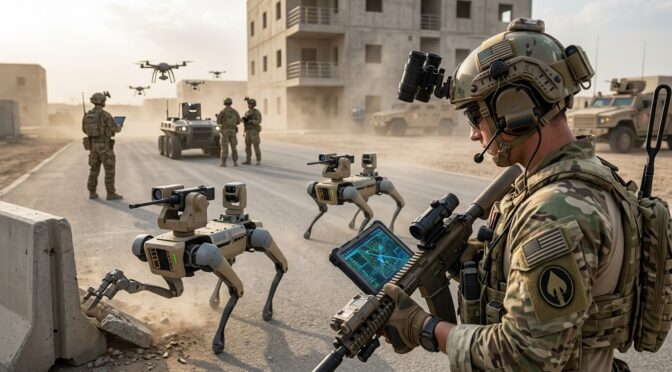
The year 2026 marks a structural inflection point within the United States defense sector, characterized by a decisive transition from generative artificial intelligence to agentic artificial intelligence. This shift represents a move from passive analytical tools to autonomous, goal-oriented software agents capable of executing complex workflows, streamlining supply chains, and integrating directly into tactical infantry systems. The fiscal year 2026 defense budget underscores this transition by allocating a dedicated USD 13.4 billion specifically to autonomy and artificial intelligence within an overall budget that has crossed the trillion-dollar threshold.1 This unprecedented financial commitment, which exceeds the entire annual budget of the National Aeronautics and Space Administration, signifies that artificial intelligence is no longer viewed merely as an experimental supportive force multiplier. Instead, the technology has evolved into a primary intelligence layer designed to compress decision cycles from hours to seconds across multiple operational domains.1
A pivotal element of this modernization effort is the Department of War’s focus on deploying these autonomous capabilities directly to the tactical edge. Initiatives such as the January 2026 implementation of the “AI-first” agenda and the launch of the Agent Network project demonstrate a top-down mandate to integrate agentic systems into battle management and squad-level operations.2 Concurrently, the private defense industrial base is answering this demand with specialized, domain-specific platforms. The deployment of WarClaw, a military-specific autonomous software agent developed by the veteran-founded startup Edgerunner AI, exemplifies a broader industry trend of moving away from massive, generalized frontier models toward secure, on-device systems optimized for Denied, Disconnected, Intermittent, and Low-bandwidth environments.3 These localized models offer unprecedented operational security and speed for frontline units operating in contested spaces.
For the small arms industry and associated infantry modernization programs, this software integration is manifesting rapidly in hardware procurement programs like the Next Generation Squad Weapon and advanced fire control optics such as the XM157.4 Agentic systems are currently being evaluated to automate the early phases of the tactical operational loop, allowing warfighters to focus exclusively on action, lethality, and ethical compliance rather than data processing.7 However, the delegation of decision-making authority to autonomous software agents introduces profound ethical and strategic complexities. The defense industry is currently engaged in intense discourse regarding the boundaries of machine autonomy, the strict definition of human accountability, and the operational risks of deploying fully integrated, artificial intelligence-native systems in highly volatile environments.8 This comprehensive research report provides an exhaustive analysis of these technological transitions, procurement strategies, and doctrinal shifts defining the agentic warfare landscape in 2026.
2. The Strategic Pivot to Agentic Warfare
For the better part of the last decade, the integration of artificial intelligence into defense applications has been dominated by generative models. These systems, while highly capable of synthesizing vast amounts of data, drafting intelligence reports, and generating complex code structures, operate primarily as reactive tools that require constant human prompting and oversight. In 2026, the sentiment among government technology leaders, procurement officers, and defense contractors has firmly shifted from exploring what is theoretically possible with generative systems to effectively operationalizing agentic artificial intelligence.1
Agentic artificial intelligence systems are fundamentally different from their generative predecessors. They are designed not merely to process or analyze information passively but to pursue distinct objectives and take action autonomously within digital and physical environments.11 When given a high-level intent by a human operator, an agentic system can independently break that broad intent down into actionable tasks, coordinate with other specialized digital tools, evaluate varying potential outcomes, and execute a comprehensive plan with minimal to no human intervention during the intermediate steps.7 This transition from data generation to workflow execution is redefining how the United States military approaches everything from deep-tier supply chain logistics to frontline infantry squad engagements.
The operational reality of modern conflict necessitates this shift. Warfighters and intelligence analysts are currently subjected to immense cognitive overload, constantly bombarded by data streams from overhead drones, ground sensors, biometric wearables, and digital communication networks. Generative systems attempted to alleviate this by summarizing the data, but summarizing data still requires the human to formulate a decision and manually execute the subsequent steps across multiple disparate software platforms. Agentic systems, functioning as autonomous digital workers, bridge this gap by taking the summarized data and independently initiating the required software protocols to address the situation, presenting the human operator with a nearly finalized action plan ready for execution authorization.7 This capability is rapidly transforming from a theoretical concept discussed in academic white papers into a deployable asset utilized by the Department of Defense.
Public and institutional interest in agentic capabilities has surged dramatically. Industry reports indicate that interest in agentic artificial intelligence rose by 6,100 percent between October 2024 and October 2025, driven by the realization that autonomous execution holds vastly more commercial and military value than simple text generation.13 Furthermore, demand for software that can autonomously achieve complex tasks by designing and implementing processes, and then fine-tuning the results without continuous human prompting, is forecast to rise from USD 4 billion in the previous year to more than USD 100 billion by the end of the decade.13 The Department of Defense, recognizing the strategic imperative of mastering this technology before peer adversaries, has moved to capitalize on this trend early, restructuring its entire approach to software acquisition and battlefield deployment.
3. The Fiscal Year 2026 Defense Budget Breakdown and Implications
The strategic pivot toward agentic execution is heavily supported by unprecedented financial allocations, moving artificial intelligence out of the realm of experimental research and development and into the core procurement budget. The fiscal year 2026 defense budget represents a historical milestone for the military-industrial complex, as the Department of Defense has carved out a dedicated budget line for autonomy and artificial intelligence for the first time.1According to analysis published by(RNG Strategy Consulting), the allocation of USD 13.4 billion specifically to these technologies is a definitive signal to the defense industrial base regarding future procurement priorities.1
This dedicated funding is distributed across a clear doctrinal hierarchy, focusing heavily on unmanned platforms and the complex software integration required to make them operate autonomously in contested environments. A detailed breakdown of this investment reveals strategic priorities aimed at dominating the unmanned battlespace across multiple physical domains. The data indicates that the Department of Defense is not merely investing in abstract software algorithms but is heavily focused on the physical materialization of agentic artificial intelligence within specific vehicle and weapon platforms.
| Capability Domain | FY 2026 Budget Allocation (Billions USD) | Strategic Focus Area |
| Unmanned Aerial Vehicles | 9.400 | Autonomous flight, drone swarm coordination, counter-UAS systems. |
| Maritime Autonomous Systems | 1.700 | Surface vessel navigation, autonomous fleet integration, port security. |
| Cross-Domain Software Integration | 1.200 | Interoperability layers, Joint All-Domain Command and Control (JADC2). |
| Underwater Capabilities | 0.734 | Submersible command interfaces, anti-submarine autonomous tracking. |
| Exclusive AI Technology | 0.200 | Foundational agentic research, algorithmic efficiency, neuromorphic computing. |
The budget distribution reveals a strong preference for aerial autonomy integration, which receives more than triple the funding of all other physical domains combined.1 The allocation of USD 9.4 billion to unmanned and remotely operated aerial vehicles underscores the military’s reliance on drones for both intelligence gathering and kinetic strikes.1 However, the USD 1.2 billion dedicated to cross-domain software integration is arguably the most critical component for the small arms industry.1 This funding is intended to build the digital infrastructure that allows disparate systems, such as an autonomous aerial drone and a squad leader’s rifle optic, to communicate and share targeting data seamlessly without human routing.
The sheer magnitude of this funding has a direct cascading effect on the tactical equipment sectors. As major platforms like aircraft and maritime vessels become highly autonomous, the infantry units operating alongside them require equivalent technological upgrades to interface with these systems. A soldier utilizing conventional optical sights and analog radios cannot effectively coordinate with an agentic drone swarm moving at machine speed. Therefore, the budget necessitates a corresponding revolution in soldier-borne electronics, pushing the industry to develop smart fire control systems, localized communication nodes, and on-device processing capabilities that can integrate the individual rifleman into the broader autonomous network.
Furthermore, the scale of global defense spending adds durability to this modernization cycle. Global defense spending surged to USD 2.7 trillion in 2025 and is projected to surpass USD 3.6 trillion by 2030, driven by structural geopolitical priorities and the need for technological sovereignty.14 Within this expanding market, the center of gravity is decisively shifting from heavy hardware to advanced software. AI-enabled systems, unmanned platforms, and digital command networks are moving from pilot programs into widespread deployment, reshaping the economic fundamentals of defense contractors and demanding a rapid evolution from companies traditionally focused solely on metallurgy and ballistics.15
4. The Department of War AI-First Agenda
To effectively operationalize the massive capital influx provided by the 2026 budget, the United States Department of War initiated a comprehensive restructuring of its technology acquisition, data management, and deployment frameworks early in the year. On January 9, 2026, the Department issued three highly coordinated memoranda, which were followed shortly by a policy address from Secretary Pete Hegseth on January 12.2 Together, these actions established a unified, top-down “AI-first” agenda intended to move the military bureaucracy at wartime speed.2
This agenda represents far more than a standard set of procurement guidelines. It is a fundamental reorganization of how the military accesses data, how it recruits technical talent, and how it deploys complex software architectures across the joint force. According to legal and policy analysis provided by Holland & Knight, the central thesis of the new strategy is to aggressively leverage asymmetric American advantages in advanced computing power, deep capital markets, and decades of diverse operational experience to drive rapid experimentation with leading artificial intelligence models.2 This approach actively embraces a Silicon Valley-inspired “test, fail, adjust” culture, aiming to field iterative improvements rapidly rather than waiting for perfect, decades-long development cycles.16
The three memoranda target specific systemic bottlenecks that have historically hindered software adoption within the military. The first document, the “Artificial Intelligence Strategy for the Department of War” memorandum, directs the entire department to accelerate America’s military dominance in this sector by centering efforts on aggressive data-access mandates, expanded computing infrastructure, and accelerated hiring practices for specialized talent.2 The third document, the “Transforming the Defense Innovation Ecosystem to Accelerate Warfighting Advantage” memorandum, streamlines the bureaucratic hierarchy. It designates the Under Secretary of War for Research and Engineering as the single Chief Technology Officer, creates a dedicated action group, and elevates organizations like the Defense Innovation Unit as core components within a unified ecosystem.2
However, the second memorandum is perhaps the most consequential for the deployment of agentic systems. Titled “Transforming Advana to Accelerate Artificial Intelligence and Enhance Auditability,” this directive mandates the comprehensive restructuring of the existing Advana data system into a new entity known as the War Data Platform.2 Agentic artificial intelligence cannot function reliably without structured, accessible, and highly accurate data. The War Data Platform is tasked with expanding the core data integration layer to provide secure, standardized data access across the entire department, specifically tailored to support agentic applications.2
This restructuring ensures that when an autonomous agent is deployed at the tactical edge, whether on a drone or integrated into a rifle’s fire control system, it pulls targeting parameters, threat profiles, and environmental data from a unified, verified stream rather than fragmented, siloed databases maintained by different service branches.2 The Chief Digital and AI Office has been explicitly directed to ensure that these foundational enablers are available across the department in real time, creating a robust digital nervous system necessary for autonomous operations.2
5. The Seven Pace-Setting Projects
The operational core of the AI Strategy Memo is the immediate implementation of seven “Pace-Setting Projects,” which are designed to force rapid technological integration across warfighting, intelligence, and enterprise missions.2 Each of these projects operates under strict parameters, guided by a single accountable leader, aggressive development timelines, and a requirement for detailed monthly progress reporting directly to the Deputy Secretary of War and the Chief Technology Officer.2 These projects serve as the primary mechanisms through which the Department of War translates its strategic vision into tangible capabilities on the battlefield.
The seven projects are divided into three distinct strategic categories, reflecting the comprehensive nature of the modernization effort.
| Mission Category | Project Name | Strategic Objective and Operational Scope |
| Warfighting | Swarm Forge | A competitive mechanism pairing elite warfighting units with technology innovators for iterative discovery, testing, and scaling of new combat tactics using AI capabilities. |
| Warfighting | Agent Network | Dedicated development of AI agents for battle management and decision support, covering the entire operational cycle from campaign planning through kill chain execution. |
| Warfighting | Ender’s Foundry | Acceleration of AI-enabled simulation capabilities and tighter feedback loops to outpace adversaries in tactical planning and wargaming scenarios. |
| Intelligence | Open Arsenal | Compression of the technical intelligence-to-capability development pipeline, aiming to turn raw intelligence into deployable weapon algorithms in hours rather than years. |
| Intelligence | Project Grant | Utilization of AI to transform static deterrence postures into dynamic, interpretable pressure models informed by real-time strategic analysis. |
| Enterprise | GenAI.mil | Departmentwide deployment of frontier generative models, providing millions of civilian and military personnel access to advanced capabilities at multiple classification levels. |
| Enterprise | Enterprise Agents | Development of a comprehensive playbook for the rapid and secure design and deployment of AI agents intended to transform administrative and logistical workflows. |
For the small arms industry and infantry tacticians, the Swarm Forge and Agent Network projects hold the most immediate relevance. Swarm Forge represents a paradigm shift in doctrinal development. By pairing elite warfighting units directly with technology developers, the military is bypassing traditional, slow-moving testing centers.2 Infantry units are actively discovering new ways to utilize advanced small arms, smart optics, and localized drone assets in simulated combat, providing immediate feedback to software engineers who can update the algorithms in real time. This rapid iteration ensures that the tactical software deployed on the battlefield accurately reflects the chaotic realities of close-quarters combat.
The Agent Network project is the most direct implementation of agentic warfare theory. It is specifically defined as a warfighting mission dedicated to the development and experimentation with artificial intelligence agents for battle management.2 The scope of this project is vast, encompassing everything from high-level campaign planning down to the tactical execution of the kill chain.2 The digital enablers developed through this project, including the models and the underlying data infrastructure, are designed to be integrated seamlessly with the hardware systems currently being procured for infantry squads, creating a highly networked and autonomous battlefield environment.2
To support the enterprise and administrative side of these operations, the Pentagon has also aggressively expanded its GenAI.mil platform. This initiative involves integrating advanced commercial generative capabilities, including agentic workflows and cloud-based infrastructure, into the daily operations of military personnel.17 Recent agreements have brought frontier models from major commercial entities, such as xAI’s Grok models and specialized government platforms from OpenAI, into the defense ecosystem.17 These integrations provide users with access to real-time global insights, facilitating faster intelligence gathering and administrative processing, which ultimately supports the logistical demands of the frontline warfighter.17
6. Operationalizing at the Tactical Edge: Edgerunner AI and WarClaw
While the Department of War focuses on building the macro-level data architecture through the War Data Platform and establishing strategic frameworks through the Agent Network, private industry is rapidly developing the specific, tactical software agents that will execute these tasks on the battlefield. A detailed analysis of the defense software market in 2026 reveals a distinct and vital pivot. Military organizations are increasingly moving away from massive, generalized frontier models created by commercial technology giants, recognizing that these large models often exhibit unpredictable behaviors, require massive cloud computing resources, and lack the specialized nuance required for lethal operations.13 Instead, the trend strongly favors smaller, highly customized models tailored for specific military domains that offer absolute user control.13
A prominent and highly successful example of this trend is Edgerunner AI, a veteran-founded startup based in Bellevue, Washington. Edgerunner AI recently emerged from stealth mode following a highly publicized USD 5.5 million seed funding round aimed at building generative artificial intelligence specifically for the edge.19According to statements from the company’s leadership reported by BusinessWire, the primary challenge with modern artificial intelligence lies in its broad applicability without addressing specific, high-stakes operational needs.19To solve this, Edgerunner focused exclusively on military applications.
In April 2026, Edgerunner AI officially launched “WarClaw,” an advanced agentic artificial intelligence tool built specifically for military deployment.3 WarClaw represents a critical departure from general-purpose corporate assistants. It functions as a hardened agentic orchestration layer based on the popular open-source OpenClaw framework.3 Unlike consumer models trained on the open internet, WarClaw was meticulously trained by former military operators and subject matter experts, utilizing data derived from actual military tasks and validated in realistic combat simulations.13 This focused training ensures that the agent understands tactical terminology, standard operating procedures, and the strict rules of engagement governing military operations.
The core capability of WarClaw is its ability to provide what the company terms “agentic decision dominance” directly at the front lines.3 By functioning as an autonomous orchestration layer, WarClaw effectively manages multiple smaller sub-agents to achieve complex goals. The system is designed to seamlessly search and analyze vast intelligence databases, interpret complex reconnaissance reports, extract relevant tactical information, and autonomously draft operational briefings and mission documents.13 Furthermore, to ensure broad utility for command staff, the software integrates directly with standard productivity tools ubiquitous in military command centers, including Microsoft Word, Excel, PowerPoint, Teams, and Outlook.13
The efficacy of Edgerunner’s highly specialized approach has garnered rapid institutional validation within the defense apparatus. Edgerunner AI recently secured a firm-fixed price contract with the United States Space Force Space Systems Command, facilitated via the Chief Digital and Artificial Intelligence Office’s Tradewinds Solutions Marketplace.3 This contract aims to deploy the Edgerunner platform into the Space Force’s highly secure environment to modernize and accelerate the acquisitions process.3 This successful deployment demonstrates that the underlying agentic orchestration technology is highly robust and capable of handling complex, high-stakes aerospace procurement and integration tasks, validating its potential for widespread integration into other critical military domains, including ground combat and small arms coordination.
7. Hardware Constraints and DDIL Environments
The most significant operational advantage of WarClaw, and the primary reason it holds such potential for infantry integration, is its foundational architecture designed to run completely on-device.3 Modern warfighters operate in environments where persistent cloud connectivity is not just unreliable; it is an active liability. Continuous connections to external servers can be jammed by electronic warfare units, intercepted by adversarial signals intelligence, or geolocated to target command posts with artillery fire. Therefore, tactical software must function independently of the broader network.
WarClaw is engineered specifically to excel in Denied, Disconnected, Intermittent, and Low-bandwidth environments.3 By processing all data locally on the user’s hardware, the platform ensures absolute data privacy and operational security.21 It transforms workflows without broadcasting electronic signatures that could compromise a unit’s position.21 The technology specifically addresses the challenge of cognitive overload by moving beyond simple chat functions into autonomous execution, allowing the software to operate on laptops, workstations, and ruggedized servers directly at the forward edge of the battle area.21
To achieve this high level of localized capability, Edgerunner utilizes state-of-the-art Small Language Models rather than massive neural networks.22 These models are optimized to work together collaboratively, creating a localized swarm intelligence that tackles distinct tasks efficiently.19 This localized, multi-agent approach significantly reduces near-zero latency, as data does not need to travel to a remote server and back.19 Crucially, it also dramatically reduces power consumption, which is a paramount concern when designing electronic systems intended to be carried by dismounted infantry where battery weight is strictly limited.19
However, deploying agentic artificial intelligence locally still requires robust tactical hardware, highlighting a current constraint in the technology’s evolution. The initial public beta for military users specified minimum hardware requirements that underscore the intense computational demands of modern agentic software, even when optimized.23
| Hardware Platform | Minimum Processor Requirement | Minimum Memory Requirement | Minimum Graphics Requirement |
| Windows Devices | AMD Ryzen AI Max | 32GB Total System RAM | NVIDIA or AMD discrete GPU with 16GB VRAM |
| Apple Devices | Apple M-series Processors | 32GB Total System RAM | Integrated unified memory architecture |
These requirements indicate that while the models are considered “small” compared to global frontier models, they still necessitate high-end components with substantial Video Random Access Memory to process the agentic workflows smoothly.23 Current iterations require significant local compute power, presenting thermal management and form-factor challenges for hardware engineers designing ruggedized infantry gear. Nevertheless, the technological trajectory points firmly toward highly optimized models functioning on increasingly smaller, lower-power devices. Edgerunner has explicitly stated that future versions of their platform will function on significantly smaller devices with much less required memory, paving the way for eventual integration directly into individual soldier systems, helmet-mounted displays, and advanced optical sights.23
8. Infantry Lethality and Small Arms Integration
The convergence of sophisticated agentic artificial intelligence software and increasingly capable tactical hardware fundamentally alters the operational reality of the infantry squad. For the small arms industry, 2026 represents the year where software integration and digital networking became as critical to weapon design as metallurgical engineering and internal ballistics. The traditional view of a rifle as a purely mechanical tool, operating independently of the broader battlefield network, has been permanently superseded; the modern small arm is now viewed as an active data node within a comprehensive digital ecosystem.
The physical foundation for this tactical artificial intelligence integration is heavily reliant on the United States Army’s deployment of the Next Generation Squad Weapon program.6 This program, designed to replace the legacy M4 carbine and M249 squad automatic weapon, centers on two primary platforms: the XM7 rifle and the XM250 automatic rifle.6 These weapons utilize a novel 6.8mm projectile designed to defeat modern body armor at extended ranges. However, while the ballistic improvements are significant, the true technological leap of the Next Generation Squad Weapon program lies not in the chamber, but in the advanced electronics mounted above it.
The weapons serve as the physical chassis for highly sophisticated optical systems that bridge the gap between the individual rifleman and the broader digital network. As agentic software like WarClaw becomes capable of running on smaller hardware, the integration of these agents directly into the weapon’s electronic suite becomes the obvious next step in infantry modernization. This integration allows the weapon itself to participate actively in threat assessment, target prioritization, and communication, transforming the dismounted soldier from an isolated combatant into a fully integrated node within the artificial intelligence-driven battlespace.
9. The XM157 Fire Control System and Smart Optics
The critical component enabling the digital transformation of small arms is the advanced fire control mechanism. The Department of Defense has invested heavily in this area, recognizing that superior ballistics are useless without superior targeting capabilities. A cornerstone of this effort is the contract awarded to Vortex Optics, a landmark 10-year, firm-fixed-price agreement with a maximum ceiling value of USD 2.7 billion.4 Under this contract, Vortex Optics is tasked with providing up to 250,000 XM157 Next Generation Squad Weapons Fire Control systems to the United States Army.4
The XM157 is not merely a telescopic sight; it is a comprehensive, integrated ballistic computer. The system features variable magnification optics, an integrated precision laser rangefinder, a suite of atmospheric sensors to measure temperature and pressure, a digital compass, and a digital display overlay that projects critical information directly into the shooter’s field of view.6 When a soldier utilizes the XM157, the system instantly calculates the exact ballistic trajectory for the specific 6.8mm round, accounting for distance, wind, and environmental factors, and displays an adjusted aiming point.24
When combined with agentic artificial intelligence orchestration layers, such as those being developed through the Agent Network or localized on-device agents like WarClaw, systems like the XM157 undergo a profound transformation. They transition from being passive calculating tools into active threat assessment nodes.6 Market intelligence and industry data highlight that smart fire control technology is currently being utilized to upgrade conventional weapons into sophisticated anti-drone defense systems.25
By employing artificial intelligence-enabled optics and integrating acoustic echolocation neural networks—technology originally developed for autonomous small drone navigation in low-visibility environments—infantry units can gain unprecedented situational awareness.25 An agentic system integrated with the XM157 could autonomously scan the environment, track the erratic flight paths of attritable multirotor strike drones, prioritize targets based on their immediate threat level to the squad, and provide real-time firing solutions to the operator before the human eye could even register the threat.25 This level of integration represents the ultimate goal of the Department of War’s modernization efforts at the tactical edge.
10. Automating the Tactical OODA Loop
The primary strategic objective of integrating agentic artificial intelligence directly at the squad level, and the underlying rationale for the billions invested in systems like the XM157, is the aggressive compression of the tactical decision-making cycle. In military doctrine, this cycle is widely known as the OODA Loop, an acronym representing the sequential phases of Observe, Orient, Decide, and Act.7 In highly contested combat environments, the combatant who can cycle through this loop faster than their adversary generally achieves victory.
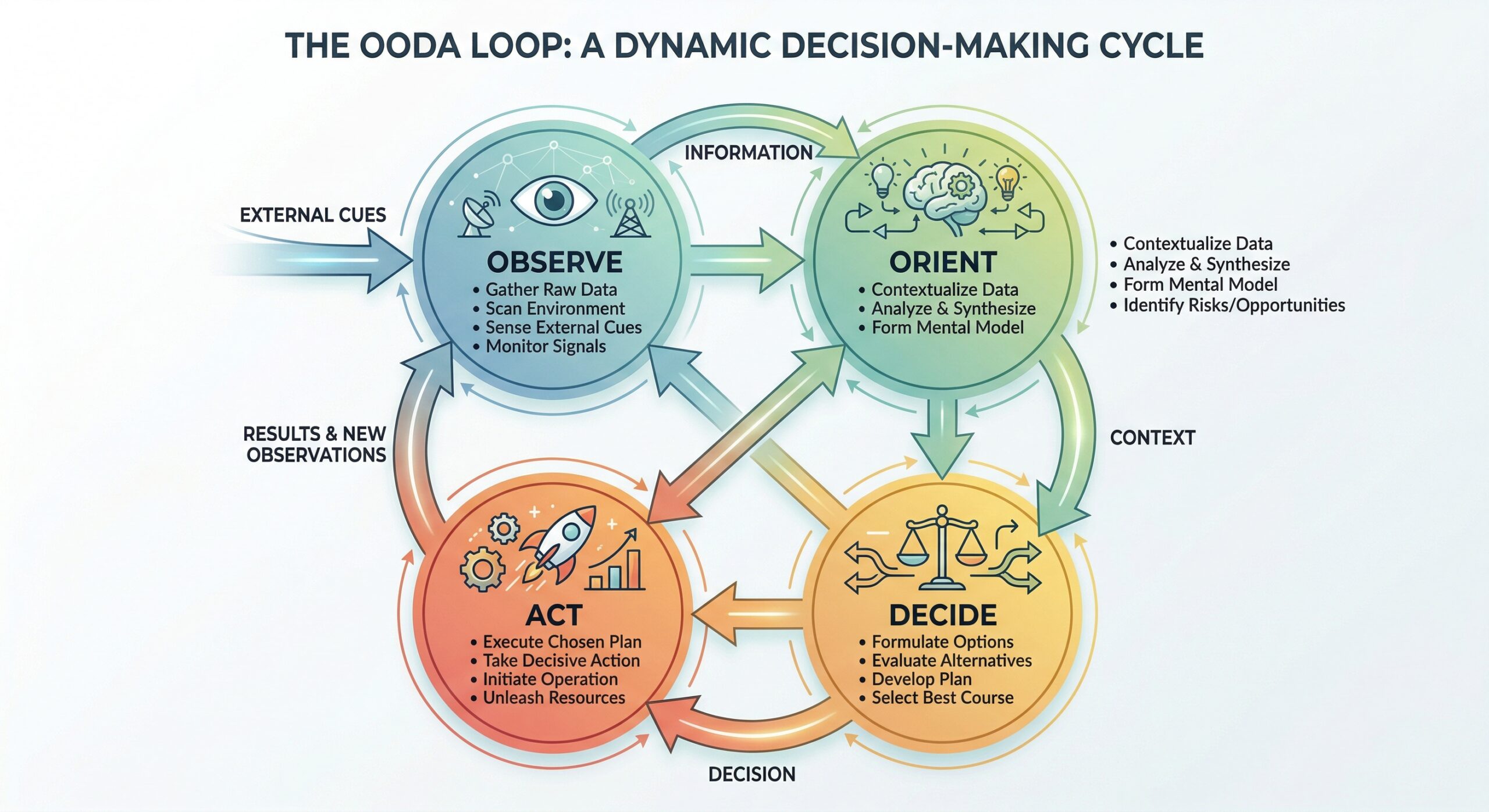
According to analyses discussing the impact of artificial intelligence on infantry units, traditional intelligence, surveillance, and reconnaissance systems serve primarily to augment the “Observe” phase.7 They feed vast amounts of raw data, imagery, and sensor readings to the warfighter. The introduction of generative artificial intelligence assisted the “Orient” phase by rapidly summarizing that raw data into a cohesive, understandable picture of the battlefield. However, agentic artificial intelligence is fundamentally designed to advance further and assume significant control over the “Decide” phase.7
By functioning as autonomous digital workers, agentic systems can continuously analyze the incoming sensor feed from smart optics and overhead drones. They map this data against the squad leader’s predefined strategic intent, evaluate the environmental variables, generate highly optimized targeting options, and present a nearly finalized decision to the human operator.7 This paradigm, increasingly referred to within the industry as the Agentic OODA Loop, radically compresses the timeline from the moment a sensor detects a threat to the moment a shooter executes a response.7
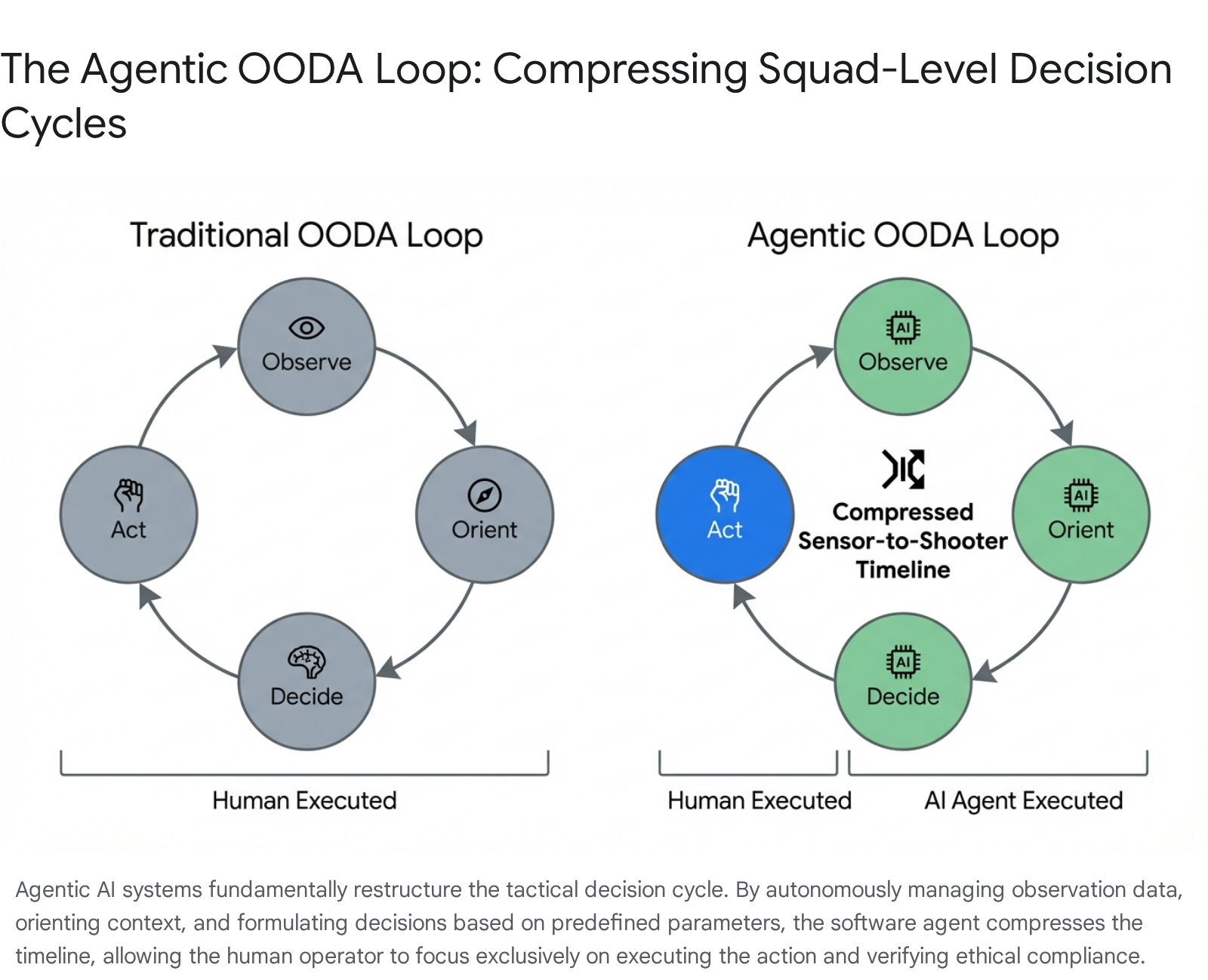
In modern combat scenarios, where engagements with autonomous enemy drone swarms or rapid-maneuver mechanized infantry are measured in fractions of a second, the ability to offload the heavy cognitive processing of observation and orientation to localized agents like WarClaw provides a decisive, life-saving advantage. The human operator is freed from the burden of calculation and analysis, allowing them to focus entirely on the physical execution of the action and the critical assessment of ethical compliance.
Furthermore, the integration of agentic artificial intelligence into small arms facilitates seamless, machine-speed communication across the broader battle management network. For example, if an individual rifleman’s optic identifies a specific, high-value thermal signature, the localized artificial intelligence agent can autonomously log the exact geographic coordinates, cross-reference the signature with known enemy vehicle profiles via a secure connection to the War Data Platform, and instantaneously disseminate precise targeting data to heavy anti-armor assets positioned elsewhere in the sector. This entire process can be completed autonomously before the rifleman even pulls the trigger, ensuring a highly coordinated, overwhelming response to emerging threats.
11. Logistics, Procurement, and Ammunition Supply Chains
The operational efficacy of front-line agentic weapon systems and advanced small arms is entirely dependent on the resilience and efficiency of the complex supply chains that sustain them. A smart rifle without ammunition is simply an expensive club. In 2026, as peer competitors actively map and target global logistics nodes, maintaining continuous operational support requires highly advanced supply chain risk management capabilities.28 Consequently, the defense sector is increasingly relying on agentic artificial intelligence not just for augmenting fire control systems, but for managing the massive procurement networks required for ammunition and replacement parts.
The manufacturing and global distribution of small arms ammunition is a remarkably complex process susceptible to numerous bottlenecks. To support the widespread deployment of the Next Generation Squad Weapon program, the United States Army’s Joint Program Executive Office for Armaments and Ammunition officially broke ground on a massive new 6.8mm ammunition production facility at the Lake City Army Ammunition Plant in Missouri.29 Managing the vast, continuous quantities of raw materials, chemical propellants, specialized brass, and specialized tooling required to maintain output at such facilities is a prime, high-value use case for autonomous software agents.
Agentic artificial intelligence has emerged as a transformative force in the broader electronics and defense sector procurement landscape. A significant development in 2026 has been the rise of autonomous agents designed specifically for logistics.30 These agents function far beyond the capabilities of passive analytical dashboards. They actively and continuously monitor supplier risk profiles, review complex legal contracts, and issue Requests for Proposal without requiring human initiation.30 When a logistics-focused agentic system detects a potential disruption in the supply of critical materials necessary for 6.8mm production, it can autonomously evaluate secondary international suppliers, trigger the necessary bureaucratic onboarding processes, and secure alternative delivery contracts with minimal human intervention.30
This automation is critical for mitigating component obsolescence, which industry analysts frequently cite as a silent profit killer and a major threat to military readiness. A sudden shortage of a specific microchip required for the XM157 optic can halt the entire weapon system’s deployment. Agentic systems actively monitor the global electronics market, predicting shortages and autonomously securing stockpiles of critical components before they become obsolete or unavailable.30 By automating these complex administrative tasks, human procurement teams are freed from tedious bureaucratic churn, allowing them to focus entirely on strategic relationship management and high-level negotiation.
12. The European Manufacturing Transition
The intricacies of defense supply chains extend far beyond domestic manufacturing plants in the United States. The shifting geopolitical environment, heavily influenced by prolonged conflicts in Eastern Europe, has forced a massive restructuring of global small arms production and transit networks. Following the full-scale invasion of Ukraine, Central European nations, specifically the Republic of Poland, the Czech Republic, and the Slovak Republic, experienced a fundamental systemic transformation.31
These nations effectively transitioned from acting as passive regulatory buffer zones into highly active, high-velocity military-industrial hubs.31 By early 2026, industry reports analyzing the Central European arms synthesis noted that the small arms and light weapons landscape across this region achieved a state characterized as a “Hyper-Regulated Equilibrium”.31 While traditional, domestic gun violence metrics in these nations remain at historic lows, their strategic role as massive logistical and manufacturing source-transit hubs has matured significantly.31 The volume of weapons, ammunition, and tactical components flowing through these specific corridors is immense.
Managing this level of industrial integration and high-velocity transit requires tracking capabilities that exceed human capacity. Agentic artificial intelligence systems deployed by allied defense logistics agencies are essential for integrating with local European digital networks to monitor the movement of small arms and munitions continuously.11 These autonomous agents ensure strict compliance with international export controls, monitor shipping manifests against global intelligence databases, and identify potential illicit diversion pathways in real-time.11 The ability to autonomously track millions of serialized parts, electronic optical components, and bulk ammunition shipments across international borders represents a critical application of enterprise-level agentic capabilities in maintaining allied military readiness and preventing arms proliferation.
13. Ethical Implications and the Taxonomy of Autonomy
As agentic artificial intelligence systems proliferate rapidly from deep-tier supply chain management to squad-level fire control, the ethical implications of autonomous warfare have rightfully come to dominate industry, academic, and geopolitical discourse. The integration of these technologies forces a confrontation with profound moral questions. When machine intelligence begins making, or significantly accelerating, critical decisions regarding lethal force, the stakes transition immediately from matters of operational efficiency to matters of existential risk and human rights.32
A primary and persistent concern within the defense policy community is the dangerous ambiguity surrounding the terminology itself. Currently, the term “agentic AI” functions as a broad, loosely defined umbrella encompassing everything from helpful administrative chatbots managing schedules to fully combat-ready, autonomous drone swarms.8 Analysts warn that this lack of precise definition risks severely undermining United States governance frameworks.8 If policymakers and procurement officers apply the exact same terminology to a benign logistics tool and a lethal targeting system, military organizations risk deploying software with the authority to initiate combat operations before the system truly comprehends the contextual risks involved.8
The core danger explicitly identified by policy experts at institutions like the CSIS is not that these artificial intelligence systems lack raw intelligence, but rather that they completely lack human judgment.8A tactical agent operating a smart fire control system on a next-generation rifle might possess the computational intelligence to execute a complex targeting solution flawlessly. However, that same system may fail entirely to recognize that a sudden, nuanced shift in the local civilian situation, a subtle change in the behavior of bystanders, makes executing that perfectly calculated engagement a catastrophic strategic error.8
To mitigate these risks, experts are calling urgently for the establishment of a rigorous, relational, capability-based taxonomy.8 This taxonomy would move beyond technical specifications and specify exactly where an artificial intelligence agent sits within a specific operational workflow, what exact authorities it exercises, and most importantly, how human accountability is distributed when system failures occur.8
The rapid pace of technological development fundamentally disrupts traditional military understandings of command and control. Current United States policy, explicitly outlined in Department of War Directive 3000.09, mandates strictly that all autonomous weapon systems must operate under clear human authority and within defined legal and ethical bounds.9 The current ethical discourse focuses heavily on categorizing the spectrum of human involvement. This involves defining whether a human operator is positionally “in the loop”, requiring explicit authorization for every action, “on the loop”, where the agent executes autonomously while the human merely monitors and can intervene, or completely “out of the loop”.9
The transition toward a “human on the loop” model creates significant friction regarding ultimate legal accountability.33 If a squad leader utilizes a system like WarClaw to designate general target areas, and the system autonomously coordinates a localized strike without explicit, final human authorization for that specific target, defining the accountable leader becomes legally ambiguous. Generally, accountable parties are increasingly identified as those senior commanders who sign off on the initial use of the agentic artificial intelligence and its overarching automated governance protocols, shifting the burden of responsibility from the tactical shooter to the strategic planner.33 Furthermore, the increasing automation of battlefield decisions raises profound fears of algorithmic warfare evolving into fully automated agentic warfare, where lethal decision loops run entirely without human intervention, leading to unpredictable escalations.32
14. Cyber Vulnerabilities and System Hardening
Beyond the kinetic implications of autonomous lethality, the integration of agentic artificial intelligence introduces severe, novel vulnerabilities within the cyber domain. The fundamental characteristic that makes agentic systems so powerful, their ability to carry out complex tasks with minimal oversight, is also heavily utilized by sophisticated adversaries to automate massive cyber attacks and rapidly learn from failed network intrusions.34 Artificial intelligence is functioning as a powerful force multiplier for the modern adversary.34
The aggressive integration of agentic capabilities into defense contractor workflows, often driven by the pursuit of wartime speed and efficiency, is occurring at a pace that frequently outstrips the organization’s ability to fully understand the intricate components or the downstream systemic risks.34 This is a recognized and critical vulnerability. Without robust, multi-layered governance protocols and strict encryption standards for the Application Programming Interfaces utilized by these autonomous agents, the automation that is supposed to assist the military can easily be co-opted.33
The Pentagon faces a difficult balancing act. Officials must continuously balance the strong strategic desire for rapid innovation with the absolute necessity of maintaining strict control over how automated software interacts with sensitive tactical networks and physical hardware.34 If an adversary successfully breaches the communication network utilized by a localized agent like WarClaw, they could potentially manipulate the data feeding into the XM157 fire control system, feeding false targeting coordinates to frontline infantry. Therefore, ensuring the absolute cybersecurity of these digital workers is as critical to mission success as the physical armor worn by the soldiers.
15. Strategic Outlook and Recommendations
Looking ahead from the vantage point of 2026, the defense industrial base and the small arms sector must prepare for a fundamentally altered procurement and operational landscape. The debate within military circles is no longer centered on whether artificial intelligence will be integrated into the force structure, but rather how deeply and securely it will be embedded into the foundational architecture of all defense platforms.
At major international gatherings, such as the 2026 World Defense Show, military officials and defense contractors highlighted an impending strategic choice facing all global armed forces. Organizations must decide whether to procure “AI-enhanced” systems or commit to developing “AI-native” systems.10 Artificial intelligence-enhanced systems involve integrating modern software into existing, legacy platforms in a relatively limited capacity. This approach is akin to bolting a sophisticated smart optic onto a conventional, mechanically operated rifle.10 It provides a capability boost but is limited by the underlying analog architecture.
Conversely, artificial intelligence-native platforms are built entirely from the ground up with artificial intelligence baked into the entire value chain.10 This involves designing custom silicon chips, specific data architectures, and agentic behavioral models before the physical hardware is even prototyped.10 While AI-native systems require massive initial capital investments and necessitate significant organizational readiness, defense experts widely view them as the ultimate force multiplier.10 The small arms industry must anticipate this definitive shift, moving aggressively toward clean-sheet weapon designs where electronic integration, continuous power delivery, and advanced thermal management for on-board compute modules are prioritized alongside traditional metrics of ballistic performance and mechanical reliability.
To navigate this complex transition successfully, several strategic recommendations emerge for defense contractors, software developers, and military procurement agencies:
First, the industry must prioritize Size, Weight, and Power optimization for all processing hardware intended for the tactical edge. Infantry units, already burdened by heavy protective gear and ammunition, cannot bear the physical weight of power-hungry servers. Engineering solutions must focus relentlessly on developing hyper-efficient Small Language Models and specialized neuromorphic hardware capable of running sophisticated agents locally on minimal battery power.19
Second, the defense sector must rigorously and transparently address issues of trust and system verification. As noted by leading industry researchers, human trust in an artificial intelligence system is the paramount factor determining its operational success. The system must function strictly as a trusted component of the decision-making process, allowing the human operator to make faster decisions at machine speed while retaining human accuracy and judgment.10 Organizations must implement comprehensive context charts and clear workflow definitions, ensuring that commanders and frontline soldiers understand exactly which tasks an agentic system is authorized to handle autonomously and which require manual override.8
Finally, cybersecurity protocols must be addressed at the foundational, architectural level of agentic development, not applied as an afterthought. Companies developing autonomous agents for military deployment must guarantee that the communication pathways utilized by these agents are heavily encrypted and that the core systems are hardened against adversarial spoofing and data poisoning.33 Only by unequivocally securing the integrity of these digital workers can the military confidently deploy them into contested environments. The era of agentic defense has firmly arrived, and the organizations that successfully build secure data infrastructure and seamless, trustworthy human-machine teaming capabilities will secure the decisive competitive advantage in the conflicts of the coming decades.
16. Appendix: Methodology
The exhaustive analysis presented in this research report relies on a rigorous synthesis of diverse defense sector data points, policy memoranda, and industry announcements generated throughout the first quarter of 2026. The methodological approach centered on extracting, categorizing, and correlating qualitative policy directives, quantitative budget allocations, and highly specific technical product specifications related to agentic artificial intelligence and its integration into small arms and tactical networks.
Financial assessments were derived by carefully isolating the fiscal year 2026 Department of Defense budget figures, specifically analyzing the designated USD 13.4 billion dedicated to autonomy and artificial intelligence. This capital was mapped across various operational domains to accurately determine the military’s strategic funding priorities. Comprehensive policy analysis was conducted by reviewing the specific directives outlined in the Department of War’s January 2026 memoranda. This involved tracking the bureaucratic restructuring of internal data systems, such as the evolution of Advana into the War Data Platform, and evaluating the strategic objectives of the seven designated Pace-Setting Projects.
The technical capabilities of private sector software, notably Edgerunner AI’s WarClaw platform, were evaluated based on their stated operational environment constraints. This specifically involved analyzing the engineering requirements for functioning in Denied, Disconnected, Intermittent, and Low-bandwidth settings, and assessing the minimum hardware specifications required for on-device processing. This software assessment was then systematically cross-referenced with ongoing physical hardware procurement programs, such as the Next Generation Squad Weapon program and the specific capabilities of the XM157 Fire Control system, to determine the physical pathways for artificial intelligence integration directly at the squad level. Finally, the broader industry discourse regarding ethical and strategic implications was synthesized by analyzing policy essays, defense industry white papers, and recorded statements from international defense conferences regarding the operational and legal limits of autonomous lethality.
Please share the link on Facebook, Forums, with colleagues, etc. Your support is much appreciated and if you have any feedback, please email us in**@*********ps.com. If you’d like to request a report or order a reprint, please click here for the corresponding page to open in new tab.
Sources Used
- Agentic Systems and AI in Defense Modernization 2026, accessed April 10, 2026, https://rngstrategyconsulting.com/insights/industry/aerospace-defense/ai-in-defense-modernization/
- Department of War’s Artificial Intelligence-First Agenda: A New Era …, accessed April 10, 2026, https://www.hklaw.com/en/insights/publications/2026/02/department-of-wars-ai-first-agenda-a-new-era-for-defense-contractors
- News – EdgeRunner AI, accessed April 10, 2026, https://www.edgerunnerai.com/news
- Fire-control system from Vortex Optics wins 10-year contract with U.S. Army, accessed April 10, 2026, https://militaryembedded.com/radar-ew/sensors/fire-control-system-from-vortex-optics-wins-10-year-contract-with-us-army
- Vortex Optics – Military Embedded Systems, accessed April 10, 2026, https://militaryembedded.com/company/vortex-optics
- 2026 DoW Directory Update 2.docx – REXOTA Solutions, accessed April 10, 2026, https://rexota.com/wp-content/uploads/2026-DoW-Directory-Rev-2.pdf
- Full Archive Search – ISK Online, accessed April 10, 2026, https://indianstrategicknowledgeonline.com/archive.php
- Lost in Definition: How Confusion over Agentic AI Risks Undermining U.S. Governance Frameworks – CSIS, accessed April 10, 2026, https://www.csis.org/analysis/lost-definition-how-confusion-over-agentic-ai-risks-governance
- Controlling Command: Is AI Capturing the Ethics of War?, accessed April 10, 2026, https://inss.ndu.edu/Media/News/Article/4454555/controlling-command-is-ai-capturing-the-ethics-of-war/
- Future of military AI in Saudi Arabia: AI-enhanced, or AI-native? – Breaking Defense, accessed April 10, 2026, https://breakingdefense.com/2026/02/future-of-military-ai-in-saudi-arabia-ai-enhanced-or-ai-native/
- From intelligence to agency: AI’s new frontier in international security → UNIDIR, accessed April 10, 2026, https://unidir.org/event/from-intelligence-to-agency-ais-new-frontier-in-international-security/
- Defense Tech Trends for 2026: Innovation in Action – NSTXL, accessed April 10, 2026, https://nstxl.org/defense-tech-trends/
- Startup debuts agentic AI assistant for war – Defense One, accessed April 10, 2026, https://www.defenseone.com/technology/2026/04/startup-takes-different-approach-ai-assistants/412545/
- Rising Defense Spending: Fueling A Deep Tech Boom In 2026 – Forbes, accessed April 10, 2026, https://www.forbes.com/councils/forbesfinancecouncil/2026/03/03/rising-defense-spending-fueling-a-deep-tech-boom-in-2026/
- Defense Tech Enters 2026 with Strengthening Fundamentals – Global X ETFs, accessed April 10, 2026, https://www.globalxetfs.com/articles/defense-tech-enters-2026-with-strengthening-fundamentals
- Pentagon Releases Artificial Intelligence Strategy | Inside Government Contracts, accessed April 10, 2026, https://www.insidegovernmentcontracts.com/2026/02/pentagon-releases-artificial-intelligence-strategy/
- Department Of War Integrates OpenAI ChatGPT Into GenAI.mil Platform For 3 Million Personnel – The Defense Watch, accessed April 10, 2026, https://thedefensewatch.com/cyber-space-defense/pentagon-genai-mil-adds-chatgpt/
- Startup debuts agentic AI assistant for war – OODAloop, accessed April 10, 2026, https://oodaloop.com/briefs/technology/startup-debuts-agentic-ai-assistant-for-war/
- EdgeRunner AI Emerges from Stealth with $5.5M Seed Funding to Build Generative AI for the Edge – Business Wire, accessed April 10, 2026, https://www.businesswire.com/news/home/20240718441467/en/EdgeRunner-AI-Emerges-from-Stealth-with-%245.5M-Seed-Funding-to-Build-Generative-AI-for-the-Edge
- EdgeRunner Releases “WarClaw” for Agentic Decision Dominance at the Tactical Edge, accessed April 10, 2026, https://www.businesswire.com/news/home/20260331235388/en/EdgeRunner-Releases-WarClaw-for-Agentic-Decision-Dominance-at-the-Tactical-Edge
- EdgeRunner Launches WarClaw Agentic AI & Decision Support – Defense Advancement, accessed April 10, 2026, https://www.defenseadvancement.com/news/edgerunner-launches-warclaw-agentic-ai-decision-support/
- EdgeRunner Achieves GPT-5 Level Performance For Key Military Tasks While Running Locally On-Device – Business Wire, accessed April 10, 2026, https://www.businesswire.com/news/home/20251112202469/en/EdgeRunner-Achieves-GPT-5-Level-Performance-For-Key-Military-Tasks-While-Running-Locally-On-Device
- EdgeRunner Announces Public Beta for Military Users – Business Wire, accessed April 10, 2026, https://www.businesswire.com/news/home/20250708291724/en/EdgeRunner-Announces-Public-Beta-for-Military-Users
- Soldier Systems Daily Soldier Systems Daily, accessed April 10, 2026, https://soldiersystems.net/page/16/
- Counter-UAS Market: Business Models – Full List (Agentic AI Market, accessed April 10, 2026, https://newmarketpitch.com/blogs/news/counter-uas-business-model
- Resources — o16g – Outcome Engineering, accessed April 10, 2026, https://o16g.com/resources/
- GPMG – 7.62mm General Purpose Machine Gun – Defense Advancement, accessed April 10, 2026, https://www.defenseadvancement.com/projects/gpmg-7-62mm-general-purpose-machine-gun/
- What Are the Top Defense Technology Priorities for 2026? A Quick Guide – IDGA, accessed April 10, 2026, https://www.idga.org/command-and-control/articles/the-top-defense-technology-priorities-2026-a-quick-guide
- Weapons Systems | Technical Briefs, Aerospace & Defense Engineering News, accessed April 10, 2026, https://www.mobilityengineeringtech.com/met/topic/aerospace/weapons-systems
- The 2026 Supply Chain: New Rules for Electronics OEMs – DigiKey, accessed April 10, 2026, https://www.digikey.com/en/blog/the-2026-supply-chain-new-rules-for-electronics-oems
- The 2026 Central European Arms Synthesis: Phantom Networks, Export Fracture Points and the Post-Conflict Proliferation Horizon – https://debuglies.com, accessed April 10, 2026, https://debuglies.com/2026/03/26/the-2026-central-european-arms-synthesis-phantom-networks-export-fracture-points-and-the-post-conflict-proliferation-horizon/
- In the Age of AI, the Fog of War Thickens – Centre for International Governance Innovation, accessed April 10, 2026, https://www.cigionline.org/articles/in-the-age-of-ai-the-fog-of-war-thickens/
- The evolving ethics and governance landscape of agentic AI – IBM, accessed April 10, 2026, https://www.ibm.com/think/insights/ethics-governance-agentic-ai
- JUST IN: AI Enabling New Cyber Risks, Report Says – National Defense Magazine, accessed April 10, 2026, https://www.nationaldefensemagazine.org/articles/2026/3/11/just-in-ai-enabling-new-cyber-risks-report-says
- MIL-DTL Guide to Rugged Interconnects – Defense Advancement, accessed April 10, 2026, https://www.defenseadvancement.com/resources/mil-dtl-rugged-connectors/