Category Archives: Country Analytics

The Current State of Iran – March 11, 2026

Executive Summary

Following thirty-eight days of high-intensity conflict under Operations Epic Fury and Roaring Lion, the United States and the Islamic Republic of Iran entered a fragile, two-week ceasefire on April 8, 2026. This comprehensive analytical research report provides an exhaustive, multi-dimensional assessment of the Iranian state as of April 10, 2026. The scope of this assessment covers the immediate aftermath of the military campaign, the radical shifts within the Iranian power structure, the degradation of the national defense industrial base, the severe socioeconomic trauma inflicted upon the populace, and the strategic diplomatic maneuvers currently unfolding in Islamabad.

The military campaign inflicted catastrophic damage on Iran’s conventional military infrastructure. Assessments indicate the destruction of over 190 ballistic missile launchers, the loss of 155 naval vessels, and the functional neutralization of approximately 80 percent of the national air defense network.1 Direct economic damages are currently estimated at over $145 billion, a figure that is expected to rise as secondary economic effects materialize.1 However, the assumption that kinetic dominance equates to immediate state collapse is premature. The Islamic Republic has demonstrated a high degree of institutional resilience. Following the targeted assassination of Supreme Leader Ali Khamenei, the state rapidly executed a succession plan to install his son, Mojtaba Khamenei, projecting continuity during a moment of existential peril.1 Concurrently, the Islamic Revolutionary Guard Corps has capitalized on the wartime emergency to marginalize the civilian government, effectively establishing a hardline military autocracy that completely overrides the administration of President Masoud Pezeshkian.5

Militarily, Tehran has pivoted entirely to an asymmetric doctrine. With its conventional navy decimated, the Iranian Navy and the Islamic Revolutionary Guard Corps Navy have established a highly lucrative and coercive transit system in the Strait of Hormuz, leveraging mine warfare and the threat of drone swarms to control global energy transit and exact transit fees.6 Despite massive casualties, regional proxy networks, notably Hezbollah in Lebanon, remain operational and continue to engage Israeli forces in a theater explicitly excluded from the ceasefire by Jerusalem.8

Domestically, the state faces unprecedented challenges that threaten internal stability. Over 3.2 million civilians are internally displaced.11 The systemic targeting of the industrial base has triggered runaway inflation, currency collapse, and widespread environmental degradation.5 The combination of severe economic hardship, profound public trauma, and the state’s diversion of limited resources toward military reconstitution has ignited fresh protests across all 31 provinces, significantly heightening the probability of severe, nationwide domestic unrest.13

Diplomatically, Iran is actively leveraging its strategic partnerships with the Russian Federation and the People’s Republic of China to offset its regional isolation.15 As delegations meet in Islamabad for critical ceasefire negotiations, Tehran is utilizing its stranglehold on the Strait of Hormuz and its intact nuclear enrichment capabilities as primary leverage points against the United States.7 The current state of the Islamic Republic is characterized by profound internal vulnerability masked by an aggressive, asymmetric external posture.

1. Government and Leadership Dynamics

The prosecution of Operation Epic Fury fundamentally altered the internal power dynamics of the Islamic Republic of Iran. The most consequential outcome of the initial kinetic phase was the assassination of Supreme Leader Ali Khamenei, an event that triggered a rapid and highly orchestrated succession process designed to ensure regime survival.1 The wartime environment catalyzed the total eclipse of the civilian government by the military and intelligence apparatus.

1.1 The Rapid Succession of Mojtaba Khamenei

For decades, the clerical establishment actively sought to minimize public discourse regarding succession. The traditional rationale was to shield presumptive candidates from internal vulnerability and preserve the incumbent Supreme Leader’s absolute authority.18 However, escalating geopolitical tensions over the past two years forced a shift in this protocol. Following the border skirmishes of June 2025, the Assembly of Experts confirmed it was actively vetting prospective successors to blunt opportunism at a precarious moment.4

The wartime crisis facilitated the immediate elevation of Mojtaba Khamenei, the 56-year-old second son of the late Supreme Leader. Previously operating as a shadowy, behind-the-scenes coordinator within the Beyt, the official office of the Supreme Leader, Mojtaba Khamenei spent over two decades managing strategic directives between the clerical establishment and the Islamic Revolutionary Guard Corps.19 His ascension represents a convergence of religious and military authority that was traditionally considered improbable within Iran’s seminary culture. The concept of hereditary, father-to-son succession was historically frowned upon following the 1979 revolution that toppled the Pahlavi monarchy.19 The optics of this succession strongly resemble a monarchical transition, a vulnerability that domestic opposition figures are currently highlighting.19

Furthermore, Mojtaba Khamenei’s relatively low clerical rank of Hojatoleslam remains a point of deep theological contention. A news agency affiliated with Iran’s seminaries began referring to him as an Ayatollah in 2022 to lay the groundwork for his elevation, but he lacks the scholarly pedigree of his predecessors.19 Nevertheless, the Assembly of Experts fast-tracked his confirmation.4 His power is derived not from theological supremacy, but from his deeply entrenched networks within the intelligence apparatus and the Islamic Revolutionary Guard Corps.4 His installation is the logical outcome of a system engineered over four decades to prioritize regime survival above ideological purity.5

1.2 Consolidation of Hardline Power by the Islamic Revolutionary Guard Corps

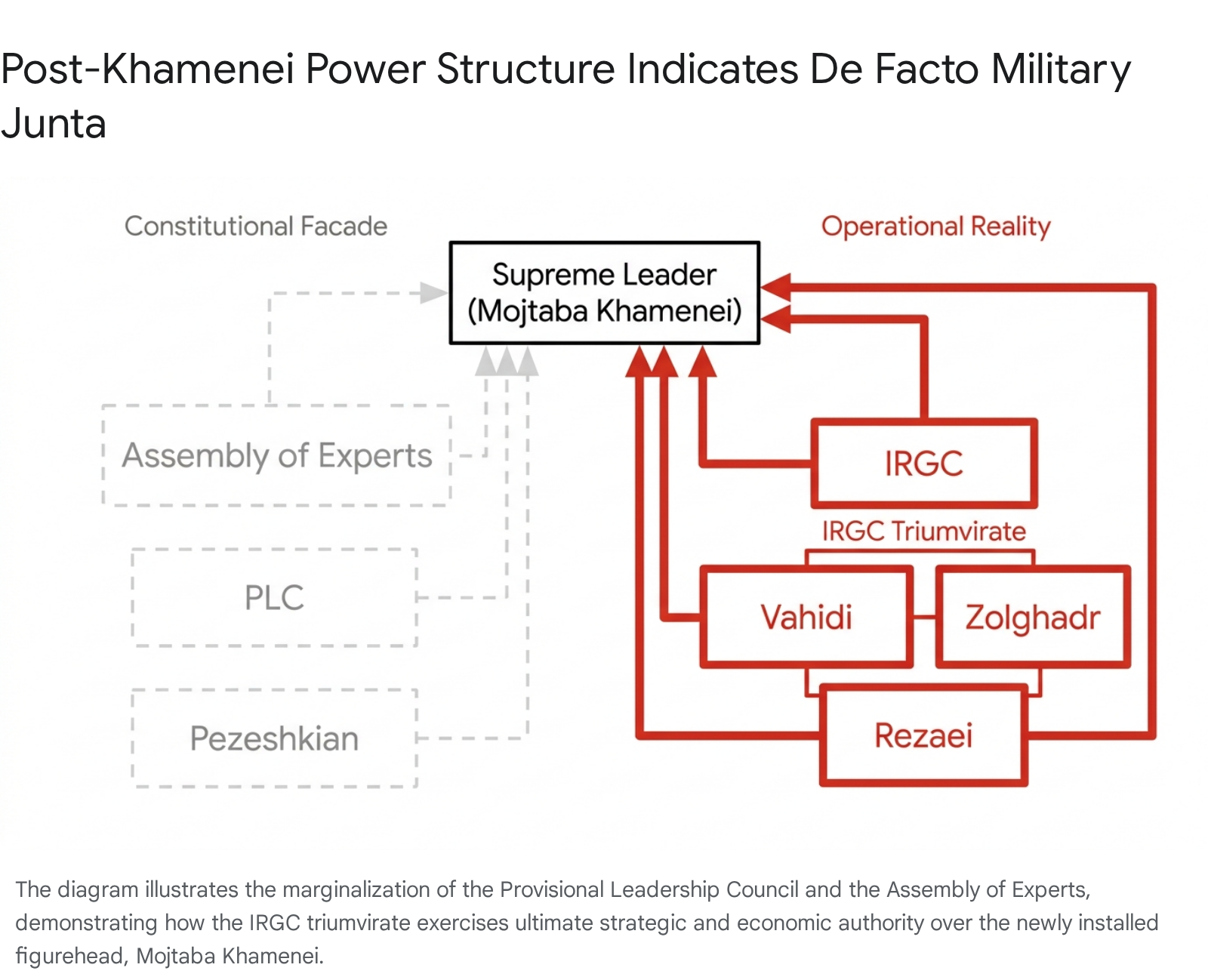
The wartime emergency facilitated a de facto soft coup by the Islamic Revolutionary Guard Corps, effectively neutralizing the civilian political establishment and assuming direct control over critical state functions.5 The marginalization of the civilian government is starkly evident in the current standing of President Masoud Pezeshkian. Elected in August 2024 on a reformist platform following the death of Ebrahim Raisi in a helicopter crash, Pezeshkian was initially expected to manage the domestic economy and seek diplomatic outreach to the West.21 As an ethnic Azerbaijani and a vocal critic of the government during the 2022 protests, he represented a glimmer of hope for civic reform.21

However, his presidency has been rendered entirely powerless. In early March 2026, Pezeshkian released a video message apologizing for the “fire at will” attacks by the armed forces, demanding a restoration of executive power and warning that the Iranian economy faced total collapse within weeks without a ceasefire.5 His demands were fiercely rejected by the military establishment. Islamic Revolutionary Guard Corps Chief-Commander Ahmad Vahidi publicly blamed the civilian government’s failure to implement structural economic reforms for the current crisis, entirely dismissing the President’s authority.5

The internal political deadlock culminated in Pezeshkian being forced, under direct pressure from Vahidi and other senior commanders, to appoint Mohammad Bagher Zolghadr as the secretary of Iran’s Supreme National Security Council.5 Zolghadr, a foundational figure and military insider, represents the acceleration of the hardline system and the complete subordination of civilian diplomacy to military imperatives.5 The hardline faction has also weaponized the wartime environment to target political rivals, labeling figures like former Foreign Minister Mohammad Javad Zarif as traitors for advocating diplomacy and urging the judiciary to arrest him.5

IRGC control diagram: Mojtaba Khamenei, Supreme Leader, over IRGC & President Masoud Pezeshkian.

2. Military and Asymmetric Posture

Operation Epic Fury achieved significant success in degrading the conventional force projection capabilities of the Iranian state. The United States and Israel executed a parallel warfare strategy, treating the Iranian military as a complex system of systems and deliberately targeting the critical requirements of their air defense and ballistic missile networks to paralyze the adversary.3 Consequently, Iran has shifted entirely toward asymmetric operations, leveraging guerrilla tactics at sea and relying heavily on its battered but functional regional proxy network.

2.1 The Degradation of Conventional Military Forces

The material losses suffered by the Iranian armed forces over the 38-day kinetic campaign are staggering and will require years to reconstitute. Current assessments indicate that over 6,000 Iranian military personnel were killed and approximately 15,000 were wounded.1 The coalition forces executed targeted strikes that destroyed more than 190 ballistic missile launchers, 155 naval vessels, and an estimated 80 percent of Iran’s air defense systems.1 The systematic destruction of critical radar components, particularly the TOMBSTONE radars supporting the S-300 air defense batteries, rendered entire defensive networks combat ineffective.3

Furthermore, the operational tempo of the Iranian ballistic missile forces was severely curtailed. By the time the ceasefire was enacted, Iranian medium-range ballistic missile fire targeting Israel had been reduced by roughly 90 percent, and drone attacks had declined by 95 percent.3 Strikes on deeply buried tunnel entrances and at least five underground missile facilities trapped remaining launchers, rendering them practically useless even if they escaped direct physical destruction.3

The psychological toll on the armed forces has been profound. Airstrikes have led to widespread desertions, severe shortages of key technical personnel, and mounting frustration among senior leaders.3 Reports indicate that numerous ballistic missile units have outright refused to deploy to designated launch sites due to the omnipresent fear of loitering munitions and targeted strikes, while reserve forces are increasingly failing to report to regional military centers.3 This internal fracturing of unit cohesion severely limits Iran’s ability to sustain conventional, symmetric military operations.

Military SectorEstimated Losses and Degradation StatusStrategic Implication
Personnel6,000 KIA, 15,000 WIA. Widespread desertions reported among reserve units.Severe reduction in combat readiness and operational continuity across all branches.
Ballistic Missile Force190+ launchers destroyed. 90% reduction in medium-range launch rates.Inability to project sustained strategic deterrence against Israel or regional adversaries.
Air Defense Network80% destroyed, including critical TOMBSTONE radar systems for S-300 batteries.Loss of airspace sovereignty, leaving critical infrastructure highly vulnerable to future strikes.
Naval Fleet155 vessels destroyed. Significant damage to over 20 production facilities.Functional elimination of conventional blue-water capabilities and shift to littoral asymmetric tactics.
Drone Capabilities95% reduction in launch rates, though 50% of the stockpile is estimated to remain intact.Reliance on remaining stockpiles for asymmetric harassment of Gulf infrastructure.

2.2 Asymmetric Maritime Strategy in the Strait of Hormuz

Recognizing the decimation of its conventional naval capabilities, Iran has fully operationalized its asymmetric naval warfare doctrine. The Iranian Navy and the Islamic Revolutionary Guard Corps Navy are no match for the United States Navy in symmetrical combat.26 The sinking of major surface combatants, such as the IRIS Dena south of Sri Lanka, and the internment of the IRIS Bushehr in Sri Lanka and the IRIS Lavan in India, demonstrated the futility of deploying conventional assets outside the Persian Gulf.27 Consequently, Tehran has retreated to its littoral zones, relying on smaller, nimble craft, drone swarms, and extensive naval mine deployment to exert disproportionate influence over the Strait of Hormuz.26

Tehran has effectively closed the primary international shipping lanes in the Strait, citing the potential presence of naval mines as a legal and military pretense for rerouting global traffic.6 The Islamic Revolutionary Guard Corps designated alternative maritime routes, forcing all inbound traffic to travel northward from the Gulf of Oman and pass closely by Larak Island, while outbound traffic must pass south of the island.6 This rerouting forces vessels deep into Iranian territorial waters, creating a severe strategic bottleneck that favors small-boat swarm tactics.

Within this controlled zone, Iran has established a highly lucrative and coercive transit system, colloquially referred to by analysts as a “Tehran toll booth”.7 Vessels deemed neutral by the regime are permitted to transit only upon the payment of exorbitant transit fees, frequently reaching into the low millions of dollars per vessel.7 To circumvent Western financial sanctions and bolster foreign currency reserves, these tolls are exclusively processed in Chinese yuan or various cryptocurrencies.7

This strategy leverages calibrated legal ambiguity regarding the United Nations Convention on the Law of the Sea. Since Iran is not a party to the convention, it claims full sovereignty over its territorial sea, allowing it to extract revenue while holding global energy markets hostage without officially declaring an unconditional blockade.28 To enforce this control, Iran utilizes a combination of anti-ship missiles, drones, and small boats, and has already fired upon at least 23 ships in or near the Strait.7 As of April 8, overall ship traffic through the Strait remained down by more than 90 percent, leaving over 2,000 vessels and 20,000 mariners stranded within the Persian Gulf.7

2.3 The Operational Capacity of Regional Proxy Networks

The operational capacity of Iran’s regional proxy network, known as the Axis of Resistance, has been severely constrained by the conflict but remains highly lethal and politically disruptive. Hezbollah, the crown jewel of Iran’s expeditionary strategy, has absorbed massive blows. Israeli ground and air operations in Lebanon have killed over 1,400 Hezbollah fighters and heavily damaged the group’s command and control infrastructure.1 Significant strikes targeting intelligence headquarters, central command centers, and assets belonging to the elite Radwan Force and Aerial Unit 127 have degraded the group’s ability to coordinate complex offensives.30

Despite these losses, the command structures of these non-state armed groups exhibit high resilience. The April 8 ceasefire announcement immediately exposed severe strategic fault lines regarding the status of these proxies. While Iran and Pakistani mediators insisted that the ceasefire applied to all fronts, including Lebanon, the Israeli government explicitly rejected this interpretation.10 Prime Minister Benjamin Netanyahu authorized the continuation of aggressive strikes against Hezbollah, including operations in densely populated areas of central Beirut, stating that Israel will utilize every operational opportunity to strike the group.9 In retaliation, Hezbollah has resumed firing rockets into northern Israel, condemning the strikes and reserving the right to retaliate.33

The lack of control Tehran exercises over the tactical decisions of its proxies remains a critical vulnerability. Historically, while Iran shapes strategic options through capacity building and ideological alignment, it allows groups like Hezbollah significant operational autonomy.36 This dynamic creates a severe principal-agent problem. The 2006 Lebanon war and the current conflict highlight the vulnerabilities of this strategy; even if Tehran wishes to strictly observe the ceasefire to relieve domestic pressure, rogue actions by heavily battered proxy forces in Lebanon, Iraq, or Yemen could inadvertently shatter the fragile truce and invite further retaliation upon the Iranian homeland.36

3. Economy and Infrastructure

The sustained aerial bombardment of Iran has accelerated an existing, chronic economic crisis into a systemic, national collapse. The strategic targeting of the national industrial base, combined with the strangulation of trade routes and sweeping sanctions, has left the state economically paralyzed and desperate for leverage.

3.1 Domestic Economic Crisis and Industrial Base Degradation

The United States and Israeli campaign deliberately targeted the foundational requirements of Iran’s military-industrial complex to prevent rapid reconstitution.3 Assessments indicate that nearly 70 percent of Iran’s defense industry was systematically dismantled during the 38-day operation.3 Precision strikes severely damaged critical production nodes, including the primary facilities at Khojir, Shahroud, Parchin, and Hakimiyeh.3 These strikes eliminated vital research centers, solid-fuel production plants, and component testing infrastructure required to maintain the ballistic missile program.3

Furthermore, the coalition targeted dual-use industrial capacity essential for both military and civilian rebuilding efforts. Up to 70 percent of Iran’s steel production capacity, heavily concentrated in Esfahan Province, was destroyed, severely bottlenecking the raw materials necessary for rebuilding missile casings and naval vessels.3 Approximately 80 percent of the nuclear industrial base was also hit, significantly degrading Iran’s attempts to attain a nuclear weapon, although analysts warn that deeply buried enrichment sites like Fordow likely remain operational, incentivizing a push toward full weaponization as a final deterrent.2

Bar graph: Estimated degradation of Iranian state capabilities, including drone and missile launch rates.

The physical destruction of the industrial base is compounded by successful efforts in the United Arab Emirates to dismantle Iranian sanctions-evasion networks. The arrest of Islamic Revolutionary Guard Corps-linked money changers in Dubai has dealt a serious blow to Tehran’s primary trade lifeline, restricting its ability to import essential goods.5 The economic damages sustained by Iran are estimated at over $145 billion, crippling domestic livelihoods and destroying small businesses.1 Official data reflects surging, hyper-inflationary trends, with consumer prices fundamentally detached from the national currency.5 The emergence of an informal economy reliant entirely on foreign currency, colloquially noted by the rise of “dollar-pegged pizza” in Tehran, highlights the profound loss of faith in the Iranian rial and the complete failure of state monetary policy.5

3.2 Strategic Weaponization of Global Energy Markets

In response to its domestic economic ruin, Tehran has weaponized its geographic position to exert maximum economic pain on the global market. Geopolitical theory, notably Halford Mackinder’s concept of the “world-island,” positions Iran at the center of the strategic landmass, granting it immense leverage over global transit nodes.37 The disruption of the Strait of Hormuz has triggered what the International Energy Agency labels the largest supply disruption in the history of the global oil market.38

The restriction of the waterway, which handles approximately one-quarter of the world’s oil, one-fifth of its natural gas, and one-third of its fertilizer and helium supplies, has driven Brent crude prices near the $100 per barrel mark, introducing severe inflationary pressure into Western economies.7 Supply chains across Southeast Asia are facing acute fuel shortages, while Europe is confronting soaring energy costs that threaten long-term industrial activity.40

By maintaining a chokehold on the Strait, Iran is deliberately exporting its domestic economic crisis to the international community. This is not merely a military tactic, but a macroeconomic strategy to force political concessions.41 Tehran understands that sustained high oil prices threaten the political stability of Western governments, utilizing this pressure as its primary negotiating card in Islamabad.42 The International Monetary Fund has already warned that the conflict will permanently scar the global economy, resulting in growth downgrades even if a durable peace deal is reached.39

3.3 Asymmetric Threats to Regional Water and Power Infrastructure

Iran has expanded its campaign of economic warfare by targeting the critical infrastructure of neighboring Gulf states. Lacking the long-range conventional platforms to strike the continental United States or Europe, Tehran utilizes unmanned aerial systems and short-range ballistic missiles to strike vulnerable civilian targets in the immediate region, seeking to hold allied nations hostage to the conflict.43

The Gulf Cooperation Council relies heavily on large, open-air desalination complexes for freshwater. These linear facilities are highly susceptible to disruption; damage to specific components like high-pressure pumps or reverse osmosis membrane buildings can disable production for weeks, creating immediate humanitarian and economic crises.44 Throughout the conflict, Iran launched coordinated drone strikes against these facilities. Reports indicate that Iranian munitions successfully damaged the Fujairah F1 power and water complex in the United Arab Emirates, the Doha West station in Kuwait, and a major desalination center in Bahrain.44

Furthermore, Iran struck a pumping station on Saudi Arabia’s east-west pipeline, demonstrating its capability to threaten alternative crude routing that bypasses the Strait of Hormuz.7 These strikes carry a calculated message of deterrence. In response to threats from the United States to strike Iranian power grids and its own desalination plants on Qeshm Island, Tehran is demonstrating that any attempt to permanently dismantle Iran’s energy grid will be met with symmetrical destruction of the Arabian Peninsula’s fragile power and water lifelines.44

4. The Populace and Humanitarian Climate

The Iranian civilian population is currently enduring a catastrophic convergence of military trauma, economic deprivation, and environmental collapse. The societal fabric, already deeply strained by years of authoritarian repression and economic mismanagement, is rapidly fracturing under the immense weight of the war.

4.1 Mass Displacement and Severe Humanitarian Crisis

The 38-day kinetic campaign generated massive, unprecedented internal displacement within the country. The United Nations High Commissioner for Refugees reported that up to 3.2 million people have been internally displaced within Iran, fleeing major urban centers, military installations, and industrial zones targeted by coalition airstrikes.11 The strikes on civilian-adjacent infrastructure, where military assets were frequently positioned by state forces, have resulted in significant collateral damage, with current assessments indicating over 2,000 civilian fatalities across 26 of Iran’s 31 provinces.16

The humanitarian crisis is severely exacerbated by the systemic collapse of public infrastructure. Millions of Iranians currently live without reliable access to clean water, sanitation services, or electricity.47 Furthermore, the destruction of massive petrochemical facilities, fuel depots, and military production sites has unleashed hazardous pollutants onto densely populated areas. This has resulted in the phenomenon of toxic “black rain” pouring over Tehran and other major cities, causing immediate respiratory distress and contaminating local water tables.12

This environmental devastation highlights a broader reality regarding the state’s priorities. The regime’s deliberate prioritization of military fortification, such as the construction of vast underground missile tunnels, over environmental sustainability has pushed the country’s fragile ecosystems to the edge of collapse.47 The resulting pollutants and destruction of agricultural infrastructure guarantee long-term public health disasters that will long outlast the immediate military hostilities, representing a period of extreme “development in reverse” for the nation.12

4.2 The Potential for Domestic Unrest

The social climate within Iran is highly volatile, characterized by a deep and widening chasm between the octogenarian, patriarchal elite and a young, modernized, and profoundly traumatized society.14 The economic devastation has alienated even the remaining moderate and reformist bases, leading to widespread anger directed squarely at the regime’s foreign adventurism.48

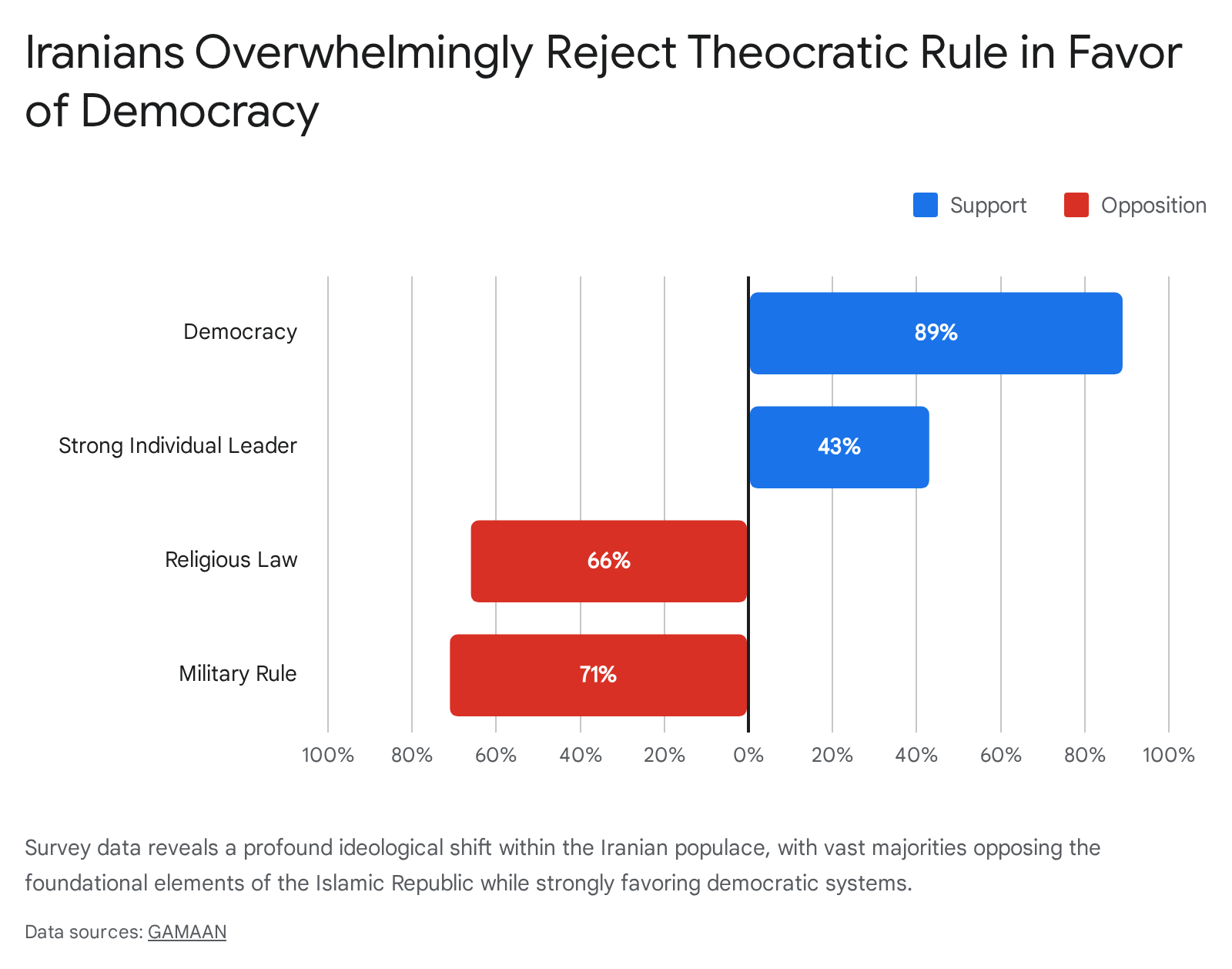
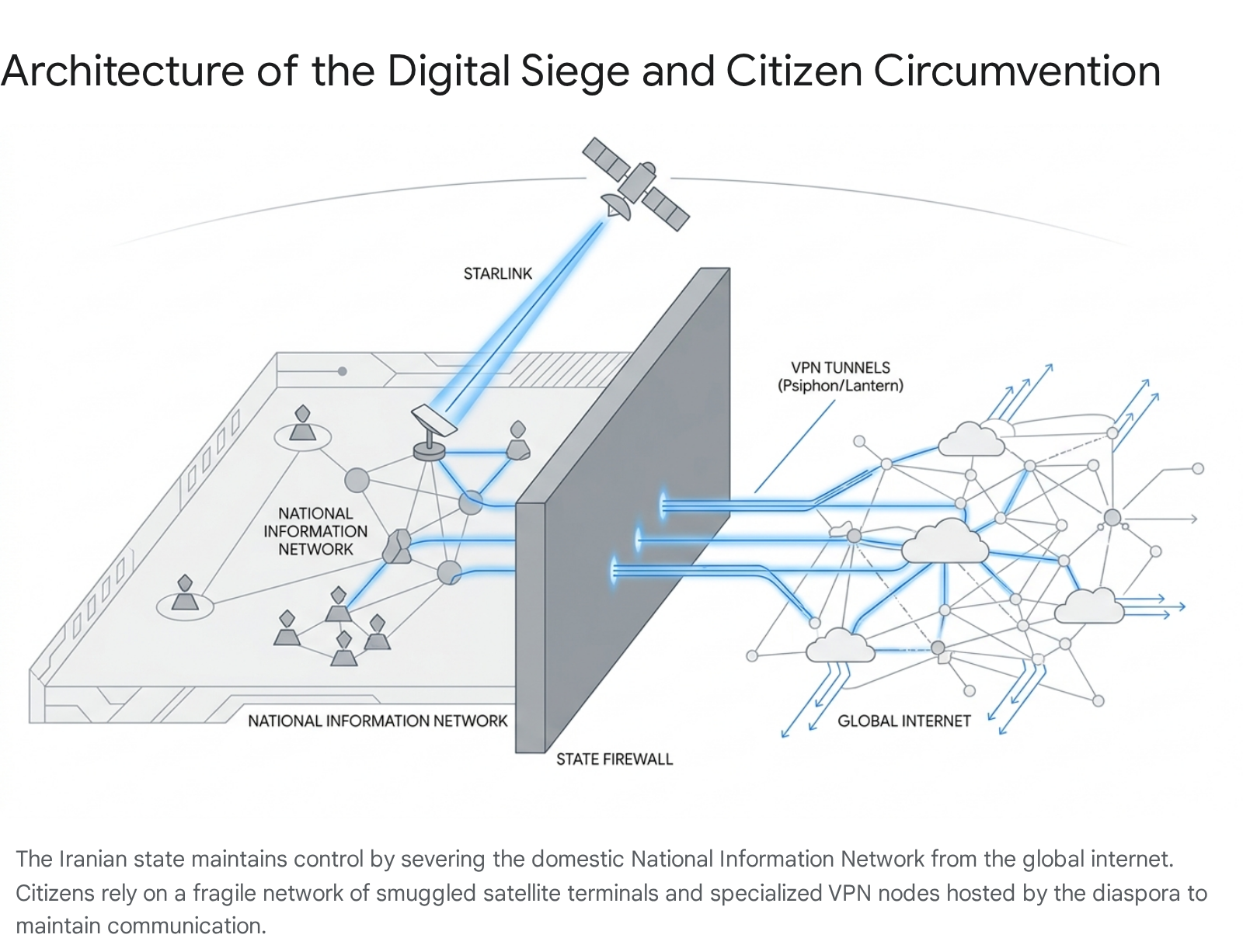
In the months preceding the war, specifically late December 2025 and early January 2026, severe protests erupted across all 31 provinces, spurred initially by rising inflation and the collapse of the rial.13 These demonstrations, evoking the leaderless, grievance-driven nature of the 2022 Women, Life, Freedom movement, quickly evolved into outright calls for the replacement of the regime, driven by the merchant class whose livelihoods were destroyed by currency fluctuations.48 The state’s response was predictably brutal. The Islamic Revolutionary Guard Corps and state security forces met the protests with extreme violence, deploying shoot-to-kill orders, utilizing systematic sexual violence as a tool of repression, and implementing nationwide internet blackouts.5 Human rights monitors reported that dozens were killed and thousands arrested in the weeks leading up to the foreign intervention.13

While the immediate shock of the foreign military intervention and the ensuing humanitarian catastrophe temporarily forced the population into survival mode, the announcement of the ceasefire has provided breathing room for political dissent to resurface. The regime’s abject inability to provide basic necessities, coupled with widespread public trauma and the visible fractures within the military apparatus, creates an environment ripe for mass, violent civil unrest in the near term.14 However, this domestic opposition operates in isolation. Regional autocracies, fearing the contagion of democratic uprisings, have largely maintained a moral asymmetry, condemning the foreign strikes while remaining conspicuously silent on Tehran’s internal repression.49 The Iranian populace remains trapped between an oppressive domestic military autocracy and the devastating effects of external bombardment.

5. Diplomatic Posture and Strategic Alignment

As the two-week ceasefire holds tenuously, the focus of the conflict has shifted from the battlefield to the diplomatic theater in Islamabad, Pakistan. The negotiations, which commenced on April 10, 2026, represent a critical geopolitical juncture, though expectations for a permanent resolution remain exceedingly low due to the maximalist demands of both parties.

5.1 The Islamabad Ceasefire Negotiations

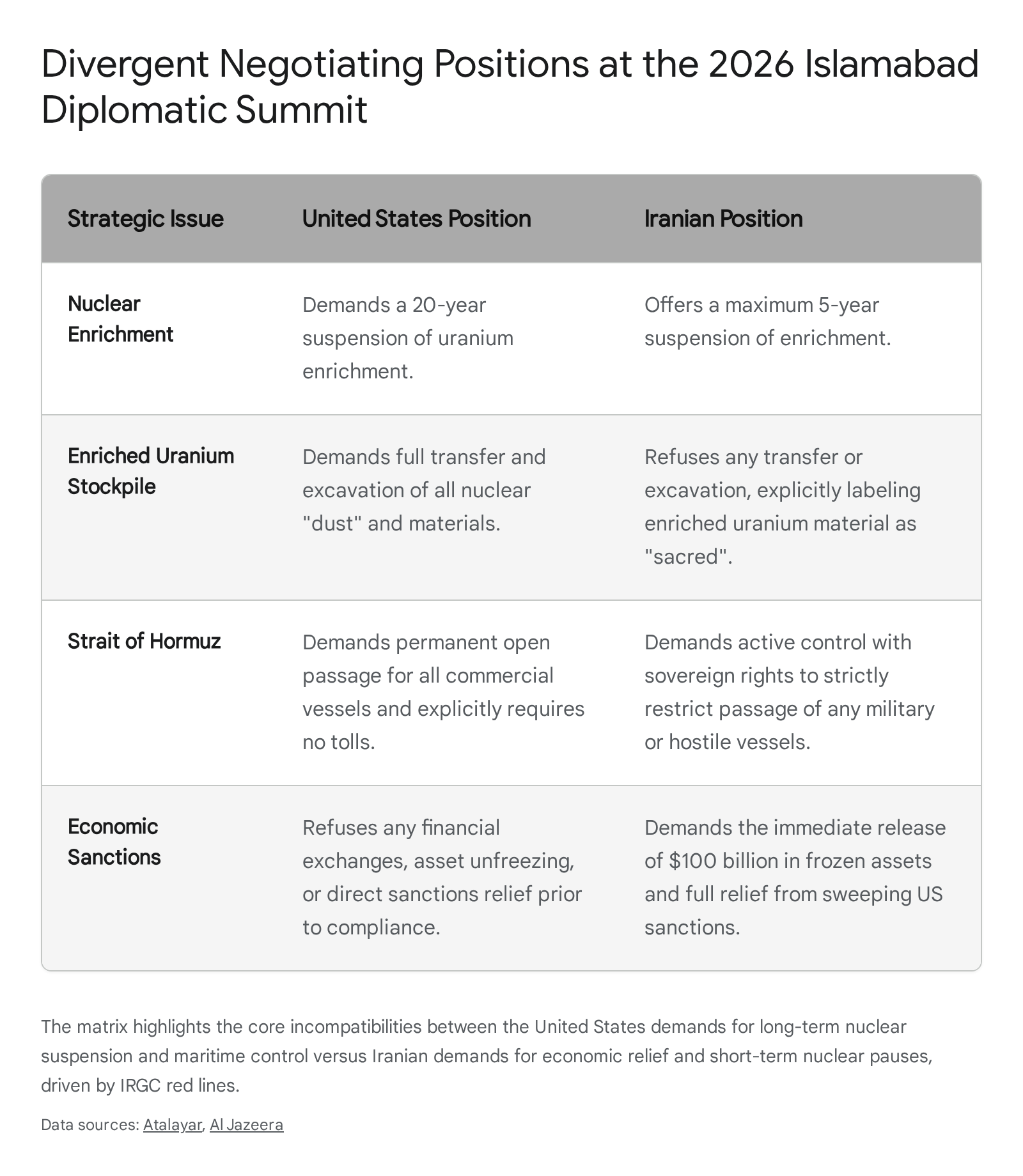
The peace talks in Islamabad feature delegations representing vastly divergent strategic imperatives, separated by deep mutual mistrust and competing regional visions. The United States delegation, led by Vice President JD Vance alongside special envoys Steve Witkoff and Jared Kushner, seeks to utilize the temporary pause to secure the immediate reopening of the Strait of Hormuz and force a comprehensive rollback of Iran’s nuclear and ballistic missile programs.33 The American position relies heavily on the threat of renewed military strikes, specifically targeting power plants and bridges, if negotiations fail.53

Conversely, the Iranian delegation, anticipated to be led by Foreign Minister Abbas Araghchi and Parliament Speaker Mohammad Bagher Ghalibaf, arrived with a maximalist 10-point proposal that contradicts the 15-point plan previously submitted by Washington.9 Iran’s non-negotiable demands include the lifting of all primary and secondary sanctions, international recognition of its right to enrich uranium to sovereign levels, the withdrawal of United States military forces from the region, and the establishment of a robust international fund to compensate for war damages.7 Crucially, Tehran demands the right to maintain control over maritime traffic in the Strait of Hormuz, effectively seeking international legitimization of its transit fee extortion model as a permanent fixture of Gulf security.9

A major point of contention threatening to collapse the talks entirely is the geographic scope of the ceasefire. Iran and Pakistani mediator Shehbaz Sharif maintain that the agreement strictly includes the cessation of hostilities in Lebanon, viewing the protection of Hezbollah as an essential condition for the truce.10 The United States and Israel vehemently deny this interpretation, viewing the operations against Hezbollah as a distinct conflict not covered by the bilateral US-Iran agreement.10 The failure to reconcile these competing frameworks, alongside continued Israeli strikes in Beirut, places the Islamabad talks on the precipice of failure.32 The realistic end state is likely an ambiguous accommodation, extending the temporary ceasefire without resolving the fundamental structural contradictions of the regime or the region.16

5.2 Strategic Intelligence Sharing and Alignment with Russia

Recognizing its diplomatic isolation within the immediate Middle East, Iran has aggressively deepened its strategic partnerships with great power competitors, specifically the Russian Federation, to offset the technological dominance of the United States.

The relationship with Moscow has evolved significantly from tactical cooperation in Syria into a formalized alliance structure. In October 2025, the Comprehensive Strategic Partnership Treaty between Iran and Russia entered into force.15 While this treaty explicitly lacks a mutual defense clause, ensuring Russia is not obligated to enter a direct kinetic war with the United States on Iran’s behalf, it mandates profound intelligence, security, and economic collaboration.15

Throughout Operation Epic Fury, Russia actively leveraged this partnership to assist Tehran. With Iran’s domestic sensor networks and radar installations largely destroyed, Moscow provided Iran with high-resolution satellite imagery detailing the locations, movements, and vulnerabilities of United States, Gulf, and Israeli military assets across the Middle East.61 This strategic intelligence sharing enabled Iran to accurately calibrate its asymmetric drone and missile strikes against regional infrastructure despite the loss of its own early warning and targeting systems.61 For Moscow, supporting Iran serves a clear geopolitical benefit: keeping the United States bogged down in a volatile Middle Eastern conflict serves as a strategic distraction from its own military operations in Eastern Europe and strains Western resources.2 Furthermore, Russia benefits economically from the high oil prices generated by the conflict.63

5.3 Diplomatic Isolation in the Middle East

While Iran enjoys support from Moscow and tacit economic alignment with Beijing, it remains deeply isolated within its own region. The weaponization of the Strait of Hormuz and the indiscriminate targeting of Gulf desalination and energy infrastructure have alienated neighboring Arab states. Gulf leaders have vilified Tehran for derailing years of patient diplomacy aimed at building regional stability, and the Arab League has issued strong condemnations regarding the conflict’s expansion.64

This isolation limits Iran’s diplomatic maneuvering space. While states like Qatar and Oman have historically served as backchannels, the sheer scale of the economic damage inflicted upon the region by Iran’s maritime blockade has hardened the determination of Gulf states to confront Tehran, with some reportedly considering recalibrating their security relations to ensure a permanent degradation of Iranian offensive capabilities.65 Iran’s current trajectory relies entirely on leveraging its great power alignments with Russia and China to survive the catastrophic damage inflicted by the coalition and secure a favorable outcome in Islamabad.

Appendix: Analytical Methodology

The findings in this report were synthesized using a robust, multi-disciplinary analytical framework designed to process fragmented data streams emerging from a heavily contested and information-denied conflict zone. The primary methodology relied on Open-Source Intelligence aggregation, utilizing commercial satellite imagery analysis, intercepted communications, state media broadcasts, and verified localized reporting to quantitatively assess the physical degradation of the Iranian defense industrial base and conventional military assets.

To evaluate the political shifts within the Iranian regime, the analysis employed elite network mapping, tracking the public statements, structural appointments, and movements of key figures within the Islamic Revolutionary Guard Corps, the Assembly of Experts, the Supreme National Security Council, and the civilian presidency. This approach allowed for the identification of the underlying power dynamics driving the rapid succession of Mojtaba Khamenei and the systematic marginalization of Masoud Pezeshkian.

Economic impact assessments were generated by cross-referencing global commodities pricing data, specifically Brent crude fluctuations, with maritime tracking data analyzing the volume, routing, and financial transactions of commercial vessels navigating the Strait of Hormuz. Humanitarian and domestic climate evaluations were derived from reports published by international monitoring agencies, regional non-governmental organizations, and anti-regime media outlets operating outside of Tehran’s domestic internet censorship apparatus. The synthesis of these qualitative and quantitative methodologies provides a high-confidence assessment of Iran’s internal vulnerabilities, its asymmetric operational capacity, and its diplomatic posture as of April 10, 2026.


Please share the link on Facebook, Forums, with colleagues, etc. Your support is much appreciated and if you have any feedback, please email us in**@*********ps.com. If you’d like to request a report or order a reprint, please click here for the corresponding page to open in new tab.


Sources Used

  1. 2026 Iran war – Wikipedia, accessed April 11, 2026, https://en.wikipedia.org/wiki/2026_Iran_war
  2. Fact-checking Trump and Hegseth’s claims of U.S. ‘victory’ in the Iran war, accessed April 11, 2026, https://www.pbs.org/newshour/politics/fact-checking-trump-and-hegseths-claims-of-u-s-victory-in-the-iran-war
  3. Iran Update, Special Report, April 3, 2026 | ISW, accessed April 11, 2026, https://understandingwar.org/research/middle-east/iran-update-special-report-april-3-2026/
  4. The Future of the Iranian Political System Following the Assassination of Khamenei, accessed April 11, 2026, https://rasanah-iiis.org/english/monitoring-and-translation/reports/the-future-of-the-iranian-political-system-following-the-assassination-of-khamenei/
  5. Rift deepens between Iran’s president and Guards chief over war …, accessed April 11, 2026, https://www.iranintl.com/en/202603288722
  6. Iran issues alternative transit routes in Strait of … – Anadolu Ajansı, accessed April 11, 2026, https://www.aa.com.tr/en/middle-east/iran-issues-alternative-transit-routes-in-strait-of-hormuz-amid-mine-fears/3899627
  7. With a Fragile Ceasefire under Threat, What Future for the Strait of Hormuz?, accessed April 11, 2026, https://www.crisisgroup.org/qna/global/iran-israelpalestine-united-states/fragile-ceasefire-under-threat-what-future-strait-hormuz
  8. Twenty questions (and expert answers) about the Iran war – Atlantic Council, accessed April 11, 2026, https://www.atlanticcouncil.org/dispatches/twenty-questions-and-expert-answers-about-the-iran-war/
  9. Iran Update Special Report, April 8, 2026, accessed April 11, 2026, https://understandingwar.org/research/middle-east/iran-update-special-report-april-8-2026/
  10. With all quiet, for now, on the Iran front, Israel turns its sights on Hezbollah, accessed April 11, 2026, https://www.timesofisrael.com/with-all-quiet-on-the-iran-front-israel-turns-its-sights-on-hezbollah/
  11. SITUATION UPDATE: IRAN APRIL 2026, accessed April 11, 2026, https://refugees.org/wp-content/uploads/2026/04/Iran-Situation-Update-April-7-2026.pdf
  12. The Human Dimension of the Iran War: The Intolerable Plight of Civilians, accessed April 11, 2026, https://thesoufancenter.org/intelbrief-2026-april-7/
  13. Iran: What challenges face the country in 2026? – The House of Commons Library, accessed April 11, 2026, https://commonslibrary.parliament.uk/research-briefings/cbp-10456/
  14. Iran Country Report 2026 – BTI Transformation Index, accessed April 11, 2026, https://bti-project.org/en/reports/country-report/IRN
  15. Comprehensive Strategic Partnership Treaty Between Iran Russia Enters into Force, accessed April 11, 2026, https://www.iranwatch.org/library/governments/iran/ministry-foreign-affairs/comprehensive-strategic-partnership-treaty-between-iran-russia-enters-force
  16. The Ceasefire Illusion – Middle East Forum, accessed April 11, 2026, https://www.meforum.org/mef-reports/the-ceasefire-illusion
  17. What to Know About Iran’s Ceasefire Proposal as Peace Talks Approach, accessed April 11, 2026, https://time.com/article/2026/04/08/iran-us-ceasefire-proposal-talks/
  18. After Khamenei: Planning for Iran’s Leadership Transition | Council on Foreign Relations, accessed April 11, 2026, https://www.cfr.org/reports/leadership-transition-in-iran
  19. Mojtaba Khamenei Follows In Father’s Footsteps As Iran’s New …, accessed April 11, 2026, https://www.rferl.org/a/iran-names-khamenei-supreme-leader-us-israel/33698945.html
  20. Who could succeed Ayatollah Ali Khamenei to lead Iran? | Explainer News | Al Jazeera, accessed April 11, 2026, https://www.aljazeera.com/news/2026/3/1/who-could-succeed-ayatollah-ali-khamenei-to-lead-iran
  21. The Islamic Revolutionary Guard Corps (IRGC) – Council on Foreign Relations, accessed April 11, 2026, https://www.cfr.org/backgrounders/irans-revolutionary-guards
  22. Iran’s 2024 presidential election | Masoud Pezeshkian, Candidates, Raisi Death, & Results, accessed April 11, 2026, https://www.britannica.com/event/Iranian-presidential-election-of-2024
  23. Iran: Freedom in the World 2025 Country Report, accessed April 11, 2026, https://freedomhouse.org/country/iran/freedom-world/2025
  24. IRGC pressured Pezeshkian to appoint Zolghadr as security chief | Iran International, accessed April 11, 2026, https://www.iranintl.com/en/202603250024
  25. Operations Epic Fury and Roaring Lion: 3/13/26 Update – JINSA, accessed April 11, 2026, https://jinsa.org/wp-content/uploads/2026/03/Operations-Epic-Fury-and-Roaring-Lion-03-13-26.pdf
  26. Strait of Hormuz | International Crisis Group, accessed April 11, 2026, https://www.crisisgroup.org/trigger-list/iran-usisrael-trigger-list/flashpoints/strait-hormuz
  27. Expert Q&A on Key Law of Naval Warfare Issues in the Conflict with Iran – Just Security, accessed April 11, 2026, https://www.justsecurity.org/133999/law-naval-warfare-iran-war/
  28. Iran’s Hormuz Gambit: The Strait as a Weapon of Jihadist Endurance, accessed April 11, 2026, https://jcfa.org/irans-hormuz-gambit-the-strait-as-a-weapon-of-jihadist-endurance/
  29. Strait of Hormuz not open, Abu Dhabi’s oil chief says as crude prices rise, accessed April 11, 2026, https://www.theguardian.com/business/2026/apr/09/oil-price-rises-as-markets-question-durability-of-middle-east-ceasefire-iran
  30. Daily Report: The Second Iran War – April 9, 2026 (18:00), accessed April 11, 2026, https://israel-alma.org/daily-report-the-second-iran-war-april-9-2026-1800/
  31. US Policy Toward Lebanon in a Time of War, accessed April 11, 2026, https://arabcenterdc.org/resource/us-policy-toward-lebanon-in-a-time-of-war/
  32. Ceasefire is threatened as Israel expands Lebanon strikes and Iran closes strait again – PBS, accessed April 11, 2026, https://www.pbs.org/newshour/amp/world/ceasefire-is-threatened-as-israel-expands-lebanon-strikes-and-iran-closes-strait-again
  33. Live Updates: U.S., Iran prepare for talks as shaky ceasefire holds, Strait of Hormuz traffic remains low, accessed April 11, 2026, https://www.cbsnews.com/live-updates/iran-war-trump-strait-of-hormuz-israel-ceasefire-talks/
  34. Iran Update Special Report, April 9, 2026 | ISW, accessed April 11, 2026, https://understandingwar.org/research/middle-east/iran-update-special-report-april-9-2026/
  35. The Latest: US, Israel and Iran agree to tentative ceasefire, even as the terms remain unclear – ClickOnDetroit, accessed April 11, 2026, https://www.clickondetroit.com/news/world/2026/04/08/the-latest-trump-pulls-back-on-threats-as-us-israel-and-iran-reach-a-2-week-ceasefire-deal/
  36. Iran’s proxy war paradox: strategic gains, control issues, and operational constraints, accessed April 11, 2026, https://www.tandfonline.com/doi/full/10.1080/09592318.2025.2512807
  37. These signals will make or break the Iran cease-fire – and oil prices | Morningstar, accessed April 11, 2026, https://www.morningstar.com/news/marketwatch/20260409164/these-signals-will-make-or-break-the-iran-cease-fire-and-oil-prices
  38. How the War in Iran is Impacting Global Energy Infrastructure | All About the Base – YouTube, accessed April 11, 2026, https://www.youtube.com/watch?v=ZGd7HnBANFk
  39. Oil rises and global stocks wobble amid worries over ‘fragile’ ceasefire deal in Middle East – as it happened | Business | The Guardian, accessed April 11, 2026, https://www.theguardian.com/business/live/2026/apr/09/oil-stocks-fall-fragile-ceasefire-middle-east-business-news
  40. How the Iran war could shift energy policies around the world, accessed April 11, 2026, https://www.atlanticcouncil.org/blogs/energysource/how-the-iran-war-could-shift-energy-policies-around-the-world/
  41. Base oil prices remain elevated since ceasefire | Latest Market News – Argus Media, accessed April 11, 2026, https://www.argusmedia.com/news-and-insights/latest-market-news/2812422-base-oil-prices-remain-elevated-since-ceasefire
  42. Trump pressures Iran as Islamabad talks aim to secure lasting Middle East truce, accessed April 11, 2026, https://www.marketpulse.com/markets/trump-pressures-iran-as-islamabad-talks-aim-to-secure-lasting-middle-east-truce/
  43. Iran Conflict Heightens Cyber Threats to U.S. Energy Infrastructure – CSIS, accessed April 11, 2026, https://www.csis.org/analysis/iran-conflict-heightens-cyber-threats-us-energy-infrastructure
  44. Could Iran Disrupt the Gulf Countries’ Desalinated Water Supplies? – CSIS, accessed April 11, 2026, https://www.csis.org/analysis/could-iran-disrupt-gulf-countries-desalinated-water-supplies
  45. Iran targets critical Gulf infrastructure after US strikes its water plant – YouTube, accessed April 11, 2026, https://www.youtube.com/watch?v=8PJo2ZDeRRo
  46. Attacking Iran’s energy and water infrastructure is not a winning strategy – Atlantic Council, accessed April 11, 2026, https://www.atlanticcouncil.org/dispatches/attacking-irans-energy-and-water-infrastructure-is-not-a-winning-strategy/
  47. Can Iran’s environment be saved?, accessed April 11, 2026, https://www.iranintl.com/en/202604071746
  48. Eruption of Iran Unrest Scrambles U.S. and Regional Calculations – The Soufan Center, accessed April 11, 2026, https://thesoufancenter.org/intelbrief-2026-january-7/
  49. Is Iran on the brink of change? – Brookings Institution, accessed April 11, 2026, https://www.brookings.edu/articles/is-iran-on-the-brink-of-change/
  50. 2025–2026 Iranian protests – Wikipedia, accessed April 11, 2026, https://en.wikipedia.org/wiki/2025%E2%80%932026_Iranian_protests
  51. Pakistan sets modest goal for US-Iran summit: A deal to keep talks going, accessed April 11, 2026, https://www.aljazeera.com/news/2026/4/10/pakistan-sets-modest-goal-for-us-iran-summit-a-deal-to-keep-talks-going
  52. Beyond the Ceasefire: Inside the Competing U.S. and Iranian Proposals, accessed April 11, 2026, https://www.egypttoday.com/Article/1/146255/Beyond-the-Ceasefire-Inside-the-Competing-U-S-and-Iranian
  53. U.S.-Iran Ceasefire: Assessment, Reactions, And Key Issues …, accessed April 11, 2026, https://www.eurasiareview.com/10042026-u-s-iran-ceasefire-assessment-reactions-and-key-issues-analysis/
  54. Talks to end Iran war appear to falter a day before Trump deadline, accessed April 11, 2026, https://www.theguardian.com/world/2026/apr/06/proposals-for-immediate-ceasefire-us-israel-iran-war
  55. Trump extends pause on striking Iranian energy plants; Witkoff floats 15-point peace proposal – CBS News, accessed April 11, 2026, https://www.cbsnews.com/live-updates/iran-war-trump-israel-tehran-denies-ceasefire-talks-strait-of-hormuz/
  56. What is in Iran’s 10-point ceasefire agreement plan?, accessed April 11, 2026, https://www.jpost.com/middle-east/iran-news/article-892384
  57. Temporary Ceasefire and Islamabad Negotiations During the Iran-US-Israel War (2026), accessed April 11, 2026, https://kureansiklopedi.com/en/detay/temporary-ceasefire-and-islamabad-negotiations-dur
  58. US military ‘loading up and resting,’ Trump says, as Iran tests ceasefire, accessed April 11, 2026, https://www.foxnews.com/live-news/trump-iran-ceasefire-israel-war-april-9
  59. Russia’s Stakes in the Iran War, With Thomas Graham | Council on Foreign Relations, accessed April 11, 2026, https://www.cfr.org/podcasts/presidents-inbox/russias-stakes-in-the-iran-war
  60. CSAG INFORMATION PAPER: “Vital, Sensitive & Strategic Cooperation Pact between Russia and Iran” – NESA-Center.org, accessed April 11, 2026, https://nesa-center.org/dev/wp-content/uploads/2025/03/2025-0221-Vital-Sensitive-Strategic-Cooperation-Pact-between-Russia-and-Iran.pdf
  61. Zelenskyy vents frustration over U.S. disinterest in evidence of Russia helping Iran, accessed April 11, 2026, https://www.ms.now/rachel-maddow-show/maddowblog/zelenskyy-vents-frustration-over-u-s-disinterest-in-evidence-of-russia-helping-iran
  62. Iran Update Special Report, April 7, 2026 | ISW, accessed April 11, 2026, https://understandingwar.org/research/middle-east/iran-update-special-report-april-7-2026/
  63. Market Outlook: U.S.-Iran ceasefire lowers oil prices as Hormuz reopens, accessed April 11, 2026, https://www.bnnbloomberg.ca/investing/market-outlook/2026/04/08/market-outlook-us-iran-ceasefire-lowers-oil-prices-as-hormuz-reopens/
  64. Ceasefire is threatened as Israel expands Lebanon strikes and Iran closes strait again – OPB, accessed April 11, 2026, https://www.opb.org/article/2026/04/08/ceasefire-is-threatened-as-israel-expands-lebanon-strikes-and-iran-closes-strait-again/
  65. Iran’s Missile and Drone Arsenal Remains Potent Despite Five Weeks of Intensive Strikes, accessed April 11, 2026, https://thesoufancenter.org/intelbrief-2026-april-6/

Navigating Transatlantic Tensions: Europe’s Defense Dilemma

Executive Summary

The Euro-Atlantic security architecture is undergoing its most profound structural transformation since the immediate aftermath of the Cold War. Following the catalytic shock of the 2022 Russian invasion of Ukraine, the prevailing consensus across the North Atlantic Treaty Organization (NATO) and the European Union (EU) has shifted from an era characterized by peace dividends, asymmetric counter-terrorism, and expeditionary crisis management to one defined by acute deterrence and large-scale conventional readiness. However, as of April 2026, a comprehensive intelligence assessment of this ongoing transformation reveals a deeply fragmented and highly volatile strategic landscape. While the initial “wake-up call” succeeded in permanently shattering the status quo of underinvestment, the subsequent institutional and industrial responses have exposed severe structural vulnerabilities within the transatlantic alliance.

The data indicates that European defense spending has reached unprecedented levels, culminating in the highly ambitious 2025 Hague Summit pledge of dedicating 5% of Gross Domestic Product (GDP) to defense and security by 2035. Yet, this fiscal mobilization masks severe underlying capability gaps. A critical “Procurement Paradox” has emerged wherein approximately 75% of new European defense spending is flowing to extra-European suppliers—primarily the United States—thereby reinforcing transatlantic dependencies rather than cultivating indigenous European defense-industrial capacity. This attrition of the European Defence Technological and Industrial Base (EDTIB) is compounded by a profound reliance on the People’s Republic of China for critical minerals, an economic chokepoint that Beijing has increasingly weaponized in the geopolitical tech war.

Simultaneously, the geopolitical posture of the United States under the current administration has fundamentally altered the foundational transatlantic bargain. A structural shift toward the Indo-Pacific, coupled with aggressive economic statecraft targeted directly at European allies—most notably exemplified by the January 2026 Greenland tariff crisis—has forced European capitals to rapidly accelerate their strategic hedging. This abrasive dynamic has catalyzed the rise of a new “European Quad” (comprising France, Germany, the United Kingdom, and Poland) and spurred a proliferation of robust bilateral defense treaties that increasingly bypass slower, consensus-driven multilateral institutions like the broader EU and NATO councils.

Furthermore, the expiration of the New Strategic Arms Reduction Treaty (New START) in February 2026 has introduced a highly dangerous arms control vacuum into the theater, forcing a rapid recalibration of European nuclear deterrence strategies. This is evidenced by the Franco-British Northwood Declaration and active Polish lobbying to integrate into the French strategic nuclear orbit. Finally, compounding these material, industrial, and strategic shifts is a severe and often overlooked demographic headwind. European militaries are facing an acute recruitment and retention crisis, raising the highly destabilizing prospect of generating “hollow forces” that possess next-generation hardware but lack the requisite personnel to sustain high-intensity conventional operations. The status quo has undeniably changed, but Europe finds itself in a perilous transitional phase, attempting to build a credible, autonomous defense pillar while navigating the unreliability of its primary security guarantor, domestic fiscal constraints, and the relentless pressure of a reconstituted Russian threat.

1. Introduction: The Strategic Reset and the Dispersal of Transatlantic Assumptions

For nearly three decades, the Euro-Atlantic security architecture rested upon a bedrock of unshakeable, foundational assumptions: the United States would serve as the ultimate and unwavering guarantor of European territorial integrity, NATO would remain the uncontested and preeminent vehicle for collective defense, and European nations could optimize their domestic economies by minimizing defense expenditures in favor of expansive social welfare states and civilian infrastructure. The events of the early 2020s, culminating in the protracted, high-intensity conflict in Ukraine, irreparably shattered these comfortable assumptions, proving that the prevailing status quo was entirely divorced from the realities of great power competition.1

The realization that the European security paradigm was fundamentally unsustainable did not arrive as a singular, sudden epiphany, but rather as a compounding series of strategic shocks that eroded the foundations of the post-Cold War order. The primary catalyst was the undeniable reality of Russian revanchism. The invasion demonstrated that Moscow possessed both the capability and the uncompromising intent to alter established European borders through the application of massive conventional military force.2 The second, equally destabilizing shock, originated from Washington. Driven by the overarching imperative to contain an ascendant China, a structural pivot toward the Indo-Pacific became the overriding U.S. strategic priority, fundamentally relegating Europe to a secondary theater of concern.1

In this unforgiving environment, the perspectives and strategic cultures of European nations have undergone a forced, rapid evolution. The internal diplomatic debate is no longer centered on whether Europe must assume a significantly greater share of responsibility for its own territorial defense, but rather how it will execute this mandate, and under what institutional framework.5 This urgency has reignited and sharpened the ideological friction between proponents of “European Strategic Autonomy,” a concept championed heavily by France, and advocates for a “European Pillar of NATO,” an approach heavily favored by Germany and the Eastern European frontline states.5 While the former seeks an eventual substitute for an increasingly unpredictable American security umbrella, the latter attempts to reformulate the transatlantic burden-sharing dynamic to keep the United States institutionally engaged while acknowledging its shifting global priorities.5

What many strategic observers and civilian policymakers overlook is that the transition from a highly U.S.-dependent security architecture to an autonomous, European-led capability is not merely a matter of summoning political will or reallocating financial resources. It is an immensely complex, multi-decade industrial, demographic, and bureaucratic undertaking.6 The persistent failure to anticipate the friction inherent in this transition has led to a highly uneven and vulnerable capability landscape across the continent.

2. The End of the Peace Dividend: Fiscal Mobilization and the 5% Paradigm

The most visible, easily quantifiable metric of Europe’s strategic reset has been the dramatic escalation in sovereign defense expenditure. For over a decade following the 2014 Russian annexation of Crimea, a significant portion of NATO allies consistently struggled to meet the baseline commitment of dedicating 2% of their national GDP to defense.8 By early 2026, the fiscal landscape has been entirely rewritten. Driven by the acute proximity of the threat environment and intense, sustained political pressure from the United States, European budgets have expanded at a rate not seen since the height of the Cold War.9

2.1 Trajectories in Continental Defense Expenditure

The historical data demonstrates a consistent upward trend that aggressively steepened following the outbreak of major hostilities in Eastern Europe. According to comprehensive data compiled by the Stockholm International Peace Research Institute (SIPRI), global military expenditure reached a historic, unprecedented high of $2,718 billion in 2024, marking the tenth consecutive year of global increases.11 Within this broader global surge, the European continent demonstrated the most aggressive relative growth. Total military spending in Europe rose by 17% in 2024 alone to reach $693 billion.11 Aggregate European defense spending demonstrates an exponential curve following the 2022 strategic shock, far outpacing the gradual, incremental increases seen between 2014 and 2021, with 2024 and 2025 exhibiting distinct, massive spikes in capitalization.9

The momentum established in the immediate aftermath of the invasion continued unabated into 2025, with European defense spending reaching nearly $563 billion in constant 2015 terms.9 This reflects a 12.6% real-term year-on-year increase, matching the record-setting uplifts seen in the preceding year.9 The distribution of this spending, however, highlights the shifting centers of strategic gravity within the alliance.

Nation Defense Spending Context (2024-2025) Strategic Significance
Germany Accounted for 25% of all European defense-spending growth over 2024-2025. Surpassed the 2% NATO target in 2024. Traditionally a laggard, Germany’s Zeitenwende has positioned it as the primary financial engine of European rearmament, spending over €95 billion in 2025.9
Poland Defense expenditure rose by 46.6% year-on-year in 2023, reaching top spender status in NATO as a percentage of GDP. Represents the radical mobilization of the Eastern flank, prioritizing massive land army expansion and rapid procurement of heavy armor.13
Ukraine Spent $64.8 billion in 2023, representing 34% of its GDP. Demonstrates the absolute fiscal limit of a state in existential total war, heavily reliant on external macroeconomic support.11
United States Approached $1 trillion ($997 billion) in 2024. Remains the dominant global spender, though 2025 saw subdued relative growth due to domestic budgetary battles and strategic reprioritization.9

2.2 The 2025 Hague Summit and the Escalation of Burden Sharing

The culmination of this unprecedented fiscal momentum occurred at the NATO Summit in The Hague in the summer of 2025. Acknowledging that the legacy 2% metric was entirely insufficient for the scale of industrial and conventional rearmament required to deter a mobilized Russian Federation, allied leaders committed to a revolutionary new target: investing 5% of GDP annually by 2035.8

This 5% pledge was structurally bifurcated to address the complexities of modern hybrid warfare and strategic competition. Under the agreement, 3.5% of GDP is strictly allocated to resourcing core defense requirements, capability targets, and traditional military formations.8 The additional 1.5% is uniquely mandated for whole-of-society security requirements: protecting civilian critical infrastructure against cyber and physical sabotage, defending telecommunications networks, ensuring civil preparedness, securing supply chains, and strengthening the defense industrial base.8

This new, expanded target represents a fundamental paradigm shift in how national security is conceptualized within the alliance, integrating societal resilience and industrial capacity directly into NATO’s formal burden-sharing metrics.15 It also serves as a highly potent political signal. Strategic analysts note that this unprecedented target—which was initially floated and aggressively demanded by the U.S. administration—was largely adopted by European states as a necessary diplomatic mechanism to mollify Washington.15 It acts as a grand gesture of burden-sharing designed to keep the United States anchored to the alliance amidst persistent threats of executive withdrawal or the imposition of punitive trade measures.15

2.3 Macroeconomic Constraints and Sociopolitical Blowback

However, the political ambition of the 5% target collides violently with European macroeconomic realities. Transitioning to a defense budget of this magnitude requires a permanent, structural expansion of state expenditure of a magnitude rarely observed outside of a total wartime economy.16 For many European states currently grappling with high post-pandemic debt-to-GDP ratios, sluggish economic growth, and aging populations, the fiscal sustainability of this target is highly questionable.15

Macroeconomic modeling utilizing the European Commission’s QUEST model indicates the severe tradeoffs required. The model estimates that a linear increase in defense spending by up to 1.5% of GDP could raise the EU government debt-to-GDP ratio by a full 2 percentage points by 2028, while providing only a marginal 0.5% boost to real GDP.17 Furthermore, the economic multiplier effect of defense spending in Europe has historically faded rapidly over the medium term. This is primarily due to historically low shares of domestic investment in Research and Development (R&D), which fell from 3.5% in 2001 to a mere 1.8% in 2023.18 Without a massive injection of R&D funding, defense spending acts as a fiscal drain rather than an engine for technological innovation and economic growth.18

Politically, this massive reallocation of capital represents a systemic risk to domestic stability. The inevitable fiscal trade-offs dictate that defense spending will progressively cut into deeply entrenched social welfare programs, healthcare, and civil infrastructure projects.19 By late 2025, over half the countries in the EU—including Germany, Poland, Finland, and Greece—had planned to trigger emergency clauses to allow defense spending to breach standard EU deficit limits.19

Intelligence assessments warn that this dynamic is fertile ground for civil unrest and severe political backlash. Euroskeptic and right-wing populist factions across the continent are already actively capitalizing on the economic anxiety generated by these fiscal shifts, arguing that domestic prosperity is being sacrificed to fuel an unwinnable arms race dictated by foreign powers.19 If the 5% defense target fractures domestic political cohesion and alienates the electorate, the resulting political instability may ultimately undermine the very societal deterrence the spending was intended to achieve.

3. Industrial Attrition and the Procurement Paradox

While European defense budgets are larger than at any point since the collapse of the Warsaw Pact, the specific allocation of these funds has revealed a critical strategic vulnerability. Europe is currently trapped in a deeply counterproductive “Procurement Paradox”: record-high military spending is actively failing to reinforce domestic industrial capacity, and is instead deepening the continent’s strategic dependence on external actors.7

3.1 The Extraterritorial Leakage of European Capital

In the immediate aftermath of the 2022 Russian invasion, European militaries faced severe, acute capability gaps across all domains. Driven by the overriding urgency to rearm quickly and supply the Ukrainian front, member states systematically prioritized the speed of delivery over the long-term cultivation of domestic industrial policy.7 Because the European Defence Technological and Industrial Base (EDTIB) was highly fragmented along national lines and lacked active, warm production lines capable of absorbing surge capacity, governments turned overwhelmingly to off-the-shelf foreign acquisitions.7

The resulting capital flight has been staggering. Data indicates that approximately 75% of recent defense procurement spending by EU nations has flowed directly to non-EU suppliers.7 The overwhelming majority of this capital—representing 63% of total acquisitions between 2022 and mid-2023—was directed into the United States defense-industrial complex.7 Urgent European capability gaps were filled by American systems such as F-35 fifth-generation fighter aircraft, Patriot integrated air and missile defense systems, HIMARS long-range artillery, and 155mm munitions.7

While these rapid acquisitions delivered immediate, tangible operational gains to NATO’s forward deployed forces, they carry profound, long-term strategic costs. First, they represent a massive hemorrhaging of capital, starving European defense firms of the predictable, multi-year, high-volume contracts required to capitalize the expansion of their own production lines.7 Without consolidated demand and guaranteed procurement volumes, European firms are trapped in a cycle of low-rate initial production.7 Collaborative European mechanisms, such as the Permanent Structured Cooperation (PESCO), have consequently faltered. Of the 83 PESCO projects launched since 2017, the vast majority remain stranded in the “design” or “execution” phases, unable to cross the “valley of death” into viable serial production.7

Second, this procurement dynamic ties European military readiness inextricably to American supply chains, proprietary sustainment networks, and the highly restrictive International Traffic in Arms Regulations (ITAR) framework, thereby severely curtailing any practical realization of European strategic autonomy.7

3.2 Strategic Vulnerabilities: Supply Chains and the Tech War 2.0

The industrial attrition is not merely a matter of final platform assembly; it extends deep into the foundational, multi-tier supply chains. Europe’s aerospace and defense market is experiencing unprecedented strain as the sudden surge in government demand vastly outpaces the manufacturing capacity of Tier 2 and Tier 3 suppliers, who are struggling to acquire necessary certifications and raw materials.21

More alarmingly, the European defense industrial base remains critically dependent on geopolitical adversaries for foundational material inputs. Europe relies heavily on the People’s Republic of China for critical minerals and rare-earth elements, which are physically indispensable for the manufacture of advanced electronics, sensor arrays, radar systems, and precision-guided munitions.22 By 2025, Beijing recognized this vulnerability and actively shifted the paradigm of its technological competition with the West. Moving away from a pure high-tech race—where the U.S. and Europe hold the advantage in semiconductor design—Beijing initiated “Tech War 2.0.” This strategy involves weaponizing its near-monopoly over low-value but vital components, instituting stringent, extraterritorial export controls on rare earths, germanium, gallium, and other critical materials.22

This strategic chokepoint has exposed European defense manufacturing to extreme, unmitigated risk. Intelligence assessments conclude that meaningful reductions in Europe’s dependence on Chinese critical minerals—whether through new extraction sites, synthetic substitution, or advanced recycling—will not materialize before the 2030s.22 Until that capacity is built, an emboldened China possesses the asymmetric capability to severely disrupt European defense production at will.24 This vulnerability deeply complicates Europe’s geopolitical hedging, forcing Brussels to balance its support for U.S. posture regarding Taiwan against the reality that Beijing can halt the production of European missile systems with a single export directive.22

3.3 The EDIP and Readiness 2030: Policy Ambition vs. Capital Reality

Recognizing these compounding, systemic failures, the European Commission introduced the comprehensive Readiness 2030 package and the European Defence Industry Programme (EDIP) in 2025.25 The EDIP aims to aggressively reduce industrial fragmentation by mandating that 50% of EU countries’ defense procurement comes directly from the EDTIB by 2030, and that at least 40% of all military equipment is procured collaboratively.27

To operationalize this ambition, the Readiness 2030 roadmap outlines four massive, continent-spanning “Flagship Projects” designed to unify fragmented national efforts into cohesive, interoperable systems:

Flagship Project Capability Focus Target Timeline
Eastern Flank Watch Comprehensive surveillance system to protect the EU’s eastern border, heavily integrating drone components and multi-domain sensors. Operational by the end of 2028.27
European Drone Wall An EU-wide, interconnected drone network optimized for persistent border monitoring and early threat detection. Fully operational by the end of 2027.27
European Air Shield An integrated, fully NATO-compatible European air and missile defense system to counter ballistic and cruise missile threats. Accelerated build-up starting 2026.27
European Defence Space Shield A protection program aimed at securing European satellite constellations and critical space-based communication infrastructures. Gradual implementation starting 2026.27

However, the financial backing provided to construct these ambitious policy architectures is grossly inadequate. The EDIP was allocated a mere €1.5 billion in direct grant funding for the 2026-2027 period.25 While the European Commission has proposed utilizing €150 billion in SAFE defense loans to promote investment, total capability requirements for the continent are reliably estimated at a staggering €400–€500 billion.7 Consequently, defense analysts view EDIP as a structuring framework rather than a financial panacea; it establishes the necessary regulatory architecture for future joint procurement but lacks the immediate, liquid capital required to reverse the ongoing industrial attrition before the end of the decade.29

4. The Transatlantic Schism: Coercive Statecraft, Posture, and Hedging

The evolution of Europe’s internal defense architecture cannot be accurately analyzed in isolation; it is deeply inextricably linked to the profound shifts occurring across the Atlantic. The United States in 2026 is projecting a fundamentally different global posture than it did a decade prior, decisively transitioning from the unquestioned, benevolent underwriter of global security to a highly pragmatic actor leveraging its alliances for transactional, overtly nationalistic aims.31

4.1 The Recalibration of American Forward Presence

Following the initial 2022 invasion of Ukraine, the United States surged approximately 20,000 additional personnel into the European theater, establishing heavy rotational Armored Brigade Combat Teams (ABCTs) along the eastern flank to assure allies and deter immediate escalation.33 However, the strategic utility, high financial cost, and long-term sustainability of these heavy rotational deployments are increasingly questioned within Washington defense circles.34

The 2026 U.S. National Defense Strategy explicitly ranks homeland defense and the conventional deterrence of the People’s Republic of China well above the defense of Europe in its hierarchy of vital interests.4 Consequently, senior U.S. policymakers are actively demanding that Europe assume the primary physical and financial burden for its own conventional territorial defense.35 In alignment with this shift, the U.S. European Command (EUCOM) posture is gradually transitioning away from frontline, heavy combat deployments. Future U.S. presence will increasingly favor logistical support, intelligence, surveillance, and reconnaissance (ISR) assets, and specialized sustainment forces designed to act as a secure defensive perimeter and enable U.S. power projection into the Middle East or Africa, rather than serving as the primary maneuver force against Russia.33

The notable, highly strategic exception to this drawdown is Poland. In early 2026, the U.S. and Poland convened the Enhanced Defense Cooperation Agreement (EDCA) Joint Commission to deepen their permanent defense partnership.36 Washington approved plans to invest over $500 million to expand and modernize four massive military bases in Poland—Drawsko Pomorskie, Powidz, Łask, and Wrocław.37 Furthermore, the operationalization of the Labor Implementing Arrangement (Labor IA) cemented the integration of the local Polish workforce into U.S. sustainment operations.36 This targeted investment indicates a clear U.S. preference for anchoring its residual, highly lethal European footprint in deeply aligned, high-spending nations on the immediate frontier, bypassing traditional hubs in Western Europe.37

4.2 Economic Coercion and Security Linkages: The 2026 Greenland Crisis

The most alarming development for Euro-Atlantic cohesion, however, has been the overt, unprecedented weaponization of U.S. economic policy against its closest security allies. The transatlantic relationship suffered a severe, near-fatal shock in January 2026 when the U.S. administration, seeking to leverage territorial and resource claims over Greenland, threatened devastating tariffs against multiple European states.39

President Trump threatened to impose a 10% tariff—escalating to 25% by June—on Denmark, Norway, Sweden, France, Germany, the United Kingdom, the Netherlands, and Finland unless they supported the U.S. acquisition of Greenland.39 Economic models predicted that a 25% tariff would cause a catastrophic 24% drop in imports from European partners, representing a major shock to the deeply integrated transatlantic economy.42 While a temporary framework deal brokered at the World Economic Forum in Davos managed to avert the immediate imposition of the tariffs—granting the U.S. rights over Greenland’s minerals and involvement in missile defense—the strategic damage to the alliance was profound and irreversible.41

The incident graphically demonstrated that Washington is entirely willing to link its sacred collective security guarantees and defense partnerships to coercive economic statecraft and raw resource acquisition.4 For European leaders, the “Greenland Crisis” was the definitive proof that the transatlantic bargain had shifted from a values-based alliance of democracies to a purely transactional arrangement where European economies could be held hostage.4 This incident drastically accelerated the political momentum behind European Strategic Autonomy, convincing even staunch Atlanticists that Europe must build robust resilience against economic and security coercion not only from Beijing and Moscow, but potentially from Washington as well.42

5. Institutional Architectures: The Pillar vs. Strategic Autonomy

As the industrial limitations and shifting U.S. geopolitical realities reshape the continent, the political and institutional architecture of European security is undergoing a parallel, highly contentious metamorphosis. The long-standing, theoretical debate over how Europe should organize its defense has polarized into two distinct camps, though the sheer weight of external threats is increasingly forcing pragmatic, hybrid compromises.

5.1 Ideological Divergence: Autonomization vs. Transatlantic Integration

The architectural debate is anchored by two differing, often competing concepts: “European Strategic Autonomy” (ESA) and the “European Pillar of NATO” (EPN).5

ESA, an official term heavily promoted by France and enshrined in EU documentation, envisions a Europe-centric defense apparatus that can, if necessary, operate completely independently of the United States. It relies heavily on the European Union’s institutional frameworks, such as the Common Security and Defence Policy (CSDP) and the EDIP, and views autonomy as a necessary substitute for an inevitably retreating or unpredictable American ally.5

Conversely, the EPN—an informally defined concept advocated by Germany, the UK, and Eastern European states—focuses on enhancing European military coordination strictly within the established NATO framework.5 This approach aims to strengthen the transatlantic link by proving to Washington that Europe is a capable, highly lethal partner, rather than a free-rider. The return of an aggressive “America First” posture in Washington in the mid-2020s has paradoxically accelerated both concepts simultaneously. While it deeply validates French warnings regarding U.S. unreliability, it also terrifies frontline states into desperately clinging to NATO command structures, fearing that any rapid decoupling to an untested EU command would leave them fatally vulnerable to Russian armored thrusts.5

5.2 Germany’s Zeitenwende and the ESSI Controversy

Germany’s Zeitenwende (strategic turning point) serves as the primary, highly visible test case for this architectural tension. Following the 2022 invasion, Berlin established a €100 billion special fund to radically modernize the depleted Bundeswehr, successfully meeting the 2% NATO spending target by 2024 and heavily anchoring its policy in the EPN philosophy.12

However, the specific implementation of the Zeitenwende has exacerbated inter-European friction. Driven by the urgent need to field credible capabilities immediately, the German Ministry of Defense allocated the bulk of its special fund to off-the-shelf procurements from the U.S. and Israel, severely undermining existing, long-term Franco-German joint defense programs like the Future Combat Air System (FCAS).20

This dynamic culminated in the German-led European Sky Shield Initiative (ESSI), a multi-layered air and missile defense project designed to rapidly close Europe’s vulnerability to Russian aerospace assets.35 By opting to procure American Patriot systems for the medium-range tier and Israeli Arrow-3 systems for the upper-tier exoatmospheric intercept role, Berlin prioritized immediate capability and interoperability within NATO’s Integrated Air and Missile Defence (IAMD) network over the cultivation of European industrial autonomy.35 This decision deeply alienated Paris, which argued that ESSI should have prioritized the European-built SAMP/T system. The ESSI saga perfectly encapsulates the persistent disconnect between the grand strategic ambition of European autonomy and the pragmatic industrial realities of rapid rearmament.43

5.3 Bridging the Gap: The EPG and ECOG Proposals

Recognizing that the 32-member North Atlantic Council is too unwieldy to manage the specific transition of European forces, and that EU mechanisms are too divorced from NATO’s military command, strategic planners have proposed new connective tissue.

One prominent proposal is the creation of a European Planning Group (EPG) embedded within NATO, explicitly modeled on NATO’s highly successful Nuclear Planning Group (NPG).4 The EPG would serve as a structured, non-binding consultative forum where European allies can systematically align their strategic priorities, reconcile industrial differences, and present a coherent, unified position to the United States regarding force generation and deployment.4

Similarly, to counter the relentless barrage of Russian hybrid warfare and disinformation campaigns, planners are advancing the concept of a European Cyber Operations Group (ECOG).49 Operating as a “coalition of the willing” under frameworks like the European Intervention Initiative, the ECOG aims to establish a posture of independent cyber compellence, recognizing that relying solely on the U.S. cyber umbrella is insufficient to deter gray-zone aggression targeted specifically at European civil cohesion.49

6. The Bilateral Phalanx and the Emergence of the European Quad

Frustrated by the agonizingly slow pace of EU consensus-building and the bureaucratic inertia inherent in a 32-member NATO, the most capable European military powers have increasingly turned to robust bilateral treaties to accelerate capability development.50 This trend marks a definitive shift away from a unified, pan-European multilateral architecture toward a highly lethal, interoperable “phalanx” of overlapping, ad hoc defense pacts.52

6.1 The Anchor Treaties: Lancaster House 2.0 and Kensington

This bilateralization is anchored by two landmark treaties signed in the summer of 2025, which functionally reorganize the center of gravity of European defense around the United Kingdom, France, and Germany.

Feature Lancaster House 2.0 (UK & France) Kensington / Trinity House Treaty (UK & Germany)
Date Signed July 10, 2025 53 July 17, 2025 54
Core Military Focus Transformation of the Combined Joint Expeditionary Force (CJEF) into a Combined Joint Force (CJF) capable of commanding a full corps; advanced cyber and space integration.53 Land systems interoperability (BOXER, RCH 155), undersea warfare (Sting Ray torpedoes, P-8A integration), and UAS coordination.54
Industrial / Tech Focus Entente Industrielle: Resumption of Storm Shadow/SCALP production, joint development of Future Cruise/Anti-Ship Weapons (FC/ASW), and AI-enabled precision strikes.56 Deep Precision Strike capability within the European Long Range Strike Approach (ELSA); joint quantum and semiconductor R&D.54
Strategic Significance Binds Europe’s only two nuclear-armed, expeditionary powers into deep operational alignment.56 Formalizes a deep defense partnership between Europe’s premier military power (UK) and its industrial/economic heavyweight (Germany) post-Brexit.59

These agreements clearly indicate that the United Kingdom, successfully navigating its post-Brexit posture, is aggressively anchoring itself as the indispensable mediator and technological engine of European defense.59 By firmly linking the continent’s preeminent expeditionary power (France) with its primary economic and logistical hub (Germany), London is functionally building the operational core of the European Pillar of NATO entirely outside of formal EU structures.61

6.2 The Formalization of the European Quad

The synthesis of these bilateral networks has led to the de facto emergence of a highly potent “European Quad” leadership group consisting of France, Germany, the United Kingdom, and Poland.61

This grouping effectively bridges the historical E3 format (UK, France, Germany) with the Weimar Triangle (France, Germany, Poland).63 Poland’s inclusion is a critical testament to its radical, unprecedented defense mobilization and its unassailable status as the strategic center of gravity on NATO’s eastern flank.38 With the strongest conventional land army in Europe and unparalleled credibility regarding the Russian threat, Warsaw ensures that the Quad’s strategic calculus remains sharply focused on territorial defense rather than distant expeditionary missions.64

The relevance of this Quad was starkly demonstrated in early 2026. Following highly disruptive comments regarding U.S. commitments from American officials at the Munich Security Conference, French President Macron immediately convened an extraordinary summit in Paris specifically drawing upon this core group to draw up a joint European strategy for Ukraine and continental defense.65 Furthermore, deep cross-party Polish parliamentary delegations to Paris have underscored Warsaw’s commitment to bypassing slow EU mechanisms in favor of direct, high-level alignment with French military planners.66 Intelligence assessments indicate that this European Quad, rather than the European Commission or the broader North Atlantic Council, is increasingly the primary, most effective forum for rapid crisis response, capability alignment, and high-level strategic planning regarding the containment of Russia.64

7. The Strategic Vacuum: Nuclear Deterrence Post-New START

Compounding the conventional, industrial, and economic uncertainties is a historic, potentially catastrophic deterioration of the global nuclear architecture. On February 5, 2026, the New Strategic Arms Reduction Treaty (New START)—the last remaining pillar of bilateral nuclear arms control between Washington and Moscow—expired without a replacement.68 This collapse removes vital transparency, verification, and predictability mechanisms, plunging the globe into a prolonged suspension of arms control and directly undermining the foundational tenets of strategic stability.68

Faced with a rapidly expanding, modernized Russian nuclear arsenal, highly explicit and frequent nuclear threats emanating from Moscow, and growing, profound doubts regarding the credibility and willingness of the United States to risk its homeland to extend its nuclear deterrent over Europe, the continent is confronting unprecedented strategic vulnerability.69

7.1 The Northwood Declaration and European Nuclear Coordination

This acute nuclear crisis is the primary driver behind the highly sensitive nuclear dimension of the Lancaster House 2.0 agreements, codified in the Northwood Declaration.56 By establishing a formal Nuclear Steering Group jointly led by the French Presidency and the UK Prime Minister’s Office, Paris and London have initiated an unprecedented level of coordination regarding their previously fiercely independent nuclear arsenals.56

While both nations emphatically stress that this coordination complements rather than replaces the U.S. extended deterrent, the Northwood Declaration functionally lays the initial operational groundwork for an independent European nuclear umbrella.72 It aligns policy, potential targeting capabilities, and deterrence operations, signaling to Moscow that European nuclear forces are acting in concert.56

7.2 Proliferation Anxiety and Poland’s Nuclear Ambitions

This development has triggered intense, highly sensitive debate across the continent regarding the viability of a purely European deterrent.69 Most notably, Poland has actively and publicly sought participation in an “advanced nuclear deterrence system”.74 In early 2026, Polish Prime Minister Donald Tusk confirmed that Warsaw was in active, advanced consultations with France to integrate into the French strategic nuclear orbit.74

This proposed integration could involve hosting French strategic aviation assets on Polish territory, participating in joint nuclear readiness exercises, and staging demonstrations of nuclear capability on the eastern flank.74 Warsaw’s aggressive push for nuclear sharing—born out of the stark conviction that frontline states cannot survive a potential U.S. withdrawal without a highly credible, localized deterrent—highlights the desperation and radical shifts occurring in European strategic doctrine. It also raises profound proliferation anxieties; if these European sharing mechanisms fail to materialize, nations like Poland may feel compelled to pursue independent nuclear capabilities to ensure their sovereign survival.68

8. The Overlooked Vulnerability: Demographic Headwinds and Military Mass

While geopolitical attention, media focus, and parliamentary debates are heavily fixated on hardware procurement, 5% budgetary targets, and high-level nuclear doctrine, arguably the most severe and immediate threat to European security is consistently overlooked: the collapse of human military mass. Europe is currently experiencing a severe, continent-wide recruitment and retention crisis that threatens to render its massive financial investments functionally moot.75

Despite highly ambitious force growth plans mandated by defense ministries, the vast majority of European militaries operating under voluntary recruitment models are consistently and severely failing to meet their intake targets.76 Furthermore, the attrition rates within active-duty, highly trained units are accelerating, as armed forces lose experienced non-commissioned officers and technical specialists to the private sector faster than they can replace them.77 This dynamic is generating the highly dangerous phenomenon of “hollow forces”—militaries that possess next-generation technological systems, advanced airframes, and high capital expenditure, but utterly lack the requisite personnel to deploy, operate, and sustain them in a high-intensity, protracted conventional conflict.76

The root causes of this personnel crisis are deeply structural and highly resistant to quick policy fixes. Demographic headwinds, characterized by rapidly aging populations and significantly shrinking cohorts of military-age youth across Europe, physically limit the available recruiting pool.76 Furthermore, decades of post-Cold War societal attitudes, shifting generational values regarding national service, and highly competitive, lucrative civilian labor markets make military service an increasingly difficult proposition in prosperous, democratic European societies.76

The stark inability to generate sufficient combat mass has prompted a radical, highly controversial reassessment of conscription models across the continent. Observing the brutal, personnel-heavy attrition rates in the Ukraine conflict and Israel’s reliance on vast, rapidly mobilizable reserves, European defense planners increasingly recognize that small, professional, standing voluntary armies are vastly insufficient for modern conventional war.78

Consequently, the Nordic and Baltic states have aggressively expanded their compulsory service models to generate required mass. Sweden successfully reintroduced conscription in 2018, selecting highly motivated recruits; Latvia and Lithuania have reintroduced conscription models specifically to expand their reserve pools; and in 2025, Denmark took the landmark step of extending its lottery-based conscription model to include women, recognizing that the male cohort alone was insufficient to meet personnel requirements.78 Even Germany, recognizing the hard limits of its heavily funded Zeitenwende without the personnel to man its new equipment, is deeply engaged in highly polarized domestic debates regarding the reintroduction of a national service model.78 Until Europe decisively resolves this fundamental human capital deficit, its 5% GDP defense targets and next-generation weapons programs will project a dangerous illusion of strength that masks profound operational fragility.

9. Expert Risk Convergence: The 2026 Threat Assessment

To contextualize these material and architectural shifts, it is vital to assess how the intelligence and policy communities perceive the imminent threat environment. In late 2025, the European Union Institute for Security Studies (EUISS) and the European University Institute (EUI) conducted a comprehensive survey of 501 leading European strategic experts to identify the most critical risks for 2026.75

The consensus paints a bleak, highly volatile picture. The top risks identified, in order of likelihood and impact, were:

  1. Disruptive attacks on EU critical infrastructure (reflecting the success of Russian gray-zone hybrid warfare).
  2. Russia’s continued, unabated aggression in Europe.
  3. The withdrawal of U.S. security guarantees to European allies.
  4. A military conflict between China and Taiwan.75

Notably, the assessment of a China-Taiwan conflict moved from a “Medium” to a “High Risk” event compared to the previous year, highlighting the deep anxiety in Europe regarding a Pacific contingency that would immediately draw U.S. assets away from the Atlantic.75

When comparing this European assessment with parallel surveys of U.S. experts (such as the Council on Foreign Relations survey), a distinct divergence in transatlantic focus emerges. While both sides agree on the gravity of the Russian threat and the Taiwan contingency, U.S. experts are becoming increasingly inward-looking and Middle East-focused.75 American analysts elevate U.S. domestic political violence and instability to a top-tier risk, alongside a regional war in the Middle East.75 This divergence underscores the European fear: the United States is increasingly distracted by its own severe domestic political turbulence and crises in the Levant, further diminishing its bandwidth and political will to manage European security, precisely at the moment Europe requires the most stability to manage its own complex transition.75

10. Executive Conclusions and Strategic Outlook

The intelligence, economic data, and strategic shifts reviewed in this report point to a singular, undeniable conclusion: the Euro-Atlantic security environment is not merely adapting; it has permanently fractured its previous equilibrium. The “wake-up call” initiated by the 2022 invasion of Ukraine was absolutely necessary, as it exposed an architecture entirely unsuited for peer-level conflict. However, that wake-up call has evolved into a grueling, systemic transition burdened by immense friction, exposing a reality that is far more complex and perilous than the initial rhetorical commitments suggested.

Based on the exhaustive synthesis of fiscal, industrial, and geopolitical indicators, several core insights define the outlook for Euro-Atlantic security in the latter half of the 2020s:

  1. The Fracture of the Multilateral Consensus: The traditional, post-war reliance on large, consensus-driven organizations is proving fatally slow for the current threat environment. Consequently, European security is increasingly being guaranteed by ad hoc, multi-speed bilateral architectures and the ascendance of the “European Quad” (UK, France, Germany, Poland). These smaller, highly capable, and heavily armed groupings will dictate the pace, direction, and operational reality of European defense strategy, functionally marginalizing the broader institutional bodies.
  2. The Inescapability of the Procurement Paradox: The intense political demand to field conventional military capabilities rapidly will continue to vastly outstrip the manufacturing capacity of the European defense industrial base. The resulting reliance on U.S. hardware and Chinese critical minerals means that “European Strategic Autonomy” will remain a largely rhetorical ambition over the next decade. True industrial resilience requires a massive consolidation of demand and an infusion of capital via mechanisms like the EDIP that currently lack sufficient political and financial backing.
  3. The Transactionalization of the Transatlantic Link: The U.S. approach to Europe has irrevocably shifted from unconditional deterrence and values-based partnership to highly transactional burden-sharing. Incidents like the Greenland tariff crisis demonstrate unequivocally that economic coercion will be utilized by Washington to enforce strategic alignment. European capitals must therefore calculate their defense postures under the hardened assumption that U.S. support is highly contingent, shifting the burden of conventional territorial defense almost entirely onto European shoulders.
  4. The Return of Nuclear Proliferation Anxiety: The collapse of New START, combined with perceived U.S. unreliability, introduces extreme volatility into the European theater. The Franco-British nuclear coordination represents the beginning of a localized European deterrent, but the aggressive desire of non-nuclear frontline states like Poland to enter nuclear-sharing arrangements will drastically escalate tensions with the Russian Federation and severely complicate regional stability.
  5. The Sovereign Debt and Social Cohesion Constraint: The NATO 5% GDP target represents a profound macroeconomic shock. The mathematical reality is that funding this level of defense requires drastic, highly unpopular cuts to social programs or massive, inflationary deficit spending. The primary threat to European rearmament may not ultimately be Russian physical disruption, but domestic political backlash as European citizens reject the severe socioeconomic costs of maintaining a war economy in peacetime.

In summary, Europe has awoken to the unavoidable necessity of hard power, but it is currently caught in the highly perilous, exposed gap between the realization of its vulnerability and the actual attainment of credible, autonomous capability. Bridging this dangerous gap requires navigating extreme industrial constraints, demographic shortages, and the unpredictable volatility of its closest ally, all while staring down a mobilized adversary on its eastern flank.


Please share the link on Facebook, Forums, with colleagues, etc. Your support is much appreciated and if you have any feedback, please email us in**@*********ps.com. If you’d like to request a report or order a reprint, please click here for the corresponding page to open in new tab.


Sources Used

  1. A New Transatlantic Bargain: The Case for Building a Strong …, accessed April 9, 2026, https://www.belfercenter.org/transatlantic-bargain
  2. Deterring Russia: U.S. Military Posture in Europe – CSIS, accessed April 9, 2026, https://www.csis.org/analysis/deterring-russia-us-military-posture-europe
  3. INTELLIGENCE OUTLOOK 2025, accessed April 9, 2026, https://www.fe-ddis.dk/globalassets/fe/dokumenter/2025/-fe-intelligenceoutlook-25-.pdf
  4. Laying the cornerstone of NATO’s European pillar, accessed April 9, 2026, https://www.epc.eu/publication/laying-the-cornerstone-of-natos-european-pillar/
  5. The European pillar of NATO – Institut Jacques Delors, accessed April 9, 2026, https://institutdelors.eu/content/uploads/2025/06/Note_de_consultance_Pilier_europeen_OTAN_Tardy_EN_2.pdf
  6. Progress and Shortfalls in Europe’s Defence – The International …, accessed April 9, 2026, https://www.iiss.org/globalassets/media-library—content–migration/files/publications—free-files/strategic-dossier/pds-2025/complete-file/iiss_strategic-dossier_progress-and-shortfalls-in-europes-defence-an-assessment_092025.pdf
  7. Industrial Attrition: Europe’s Defence Procurement Paradox | Atlas …, accessed April 9, 2026, https://atlasinstitute.org/industrial-attrition-europes-defence-procurement-paradox/
  8. Defence expenditures and NATO’s 5% commitment, accessed April 9, 2026, https://www.nato.int/en/what-we-do/introduction-to-nato/defence-expenditures-and-natos-5-commitment
  9. Global defence spending continues to grow amid geopolitical uncertainty, accessed April 9, 2026, https://www.iiss.org/online-analysis/military-balance/2026/02/global-defence-spending-continues-to-grow-amid-geopolitical-uncertainty/
  10. Defense Budgets in an Uncertain Security Environment – CSIS, accessed April 9, 2026, https://www.csis.org/analysis/chapter-13-defense-budgets-uncertain-security-environment
  11. Trends in World Military Expenditure, 2024 – SIPRI, accessed April 9, 2026, https://www.sipri.org/sites/default/files/2025-04/2504_fs_milex_2024.pdf
  12. Assessing the Zeitenwende: Implications for Germany, the United States, and Transatlantic Security – American-German Institute, accessed April 9, 2026, https://americangerman.institute/wp-content/uploads/2025/03/20250311_Deni-Rathke_Zeitenwende_Final.pdf
  13. Finance and economics annual statistical bulletin: international defence 2024 – GOV.UK, accessed April 9, 2026, https://www.gov.uk/government/publications/international-defence-expenditure-2024/finance-and-economics-annual-statistical-bulletin-international-defence-2024
  14. PRESS RELEASE | The Elements of an Alliance? NATO’s critical minerals imperative – EIES and SAFE host discussion on the sidelines of the Munich Security Conference, accessed April 9, 2026, https://secureenergy.org/pressrelease-elementsofanalliance-natoscriticalmineralsimperative/
  15. NATO’s new spending target: challenges and risks associated with a political signal | SIPRI, accessed April 9, 2026, https://www.sipri.org/commentary/essay/2025/natos-new-spending-target-challenges-and-risks-associated-political-signal
  16. Can Europe Deliver NATO’s Five Percent? – Intereconomics, accessed April 9, 2026, https://www.intereconomics.eu/contents/year/2026/number/2/article/can-europe-deliver-nato-s-five-percent.html
  17. The economic impact of higher defence spending – Economy and Finance – European Union, accessed April 9, 2026, https://economy-finance.ec.europa.eu/economic-forecast-and-surveys/economic-forecasts/spring-2025-economic-forecast-moderate-growth-amid-global-economic-uncertainty/economic-impact-higher-defence-spending_en
  18. Europe | An overview of the EU defense sector – BBVA Research, accessed April 9, 2026, https://www.bbvaresearch.com/en/publicaciones/europe-an-overview-of-the-eu-defense-sector/
  19. Europe Seeks to Rapidly Increase Defense Investment Amidst Strategic Realignment, accessed April 9, 2026, https://thesoufancenter.org/intelbrief-2025-may-2/
  20. Opportunities through consolidation in the European defense industry – McKinsey, accessed April 9, 2026, https://www.mckinsey.com/industries/aerospace-and-defense/our-insights/opportunities-through-consolidation-in-the-european-defense-industry
  21. Inside Europe’s Defense Boom: 5 Ways To Secure Supply Chains – Oliver Wyman, accessed April 9, 2026, https://www.oliverwyman.com/our-expertise/insights/2025/jun/5-strategies-avoid-european-aerospace-defense-supply-chain-strain.html
  22. The EU’s dependency on critical minerals from China, accessed April 9, 2026, https://www.iiss.org/publications/strategic-comments/2025/12/the-eus-dependency-on-critical-minerals-from-china/
  23. Leapfrogging China’s Critical Minerals Dominance – Council on Foreign Relations, accessed April 9, 2026, https://www.cfr.org/reports/leapfrogging-chinas-critical-minerals-dominance
  24. TECH WAR 2.0 – European Union Institute for Security Studies |, accessed April 9, 2026, https://www.iss.europa.eu/sites/default/files/2025-12/Brief_2025-30_Tech%20War%202.0.pdf
  25. EDIP Forging European Defence, accessed April 9, 2026, https://defence-industry-space.ec.europa.eu/eu-defence-industry/edip-forging-europes-defence_en
  26. EDIP: Commission adopts €1.5 billion work programme to boost European and Ukrainian defence industry, accessed April 9, 2026, https://defence-industry-space.ec.europa.eu/edip-commission-adopts-eu15-billion-work-programme-boost-european-and-ukrainian-defence-industry-2026-03-30_en
  27. EU Commission – Roadmap for European Defence Readiness – BDLI, accessed April 9, 2026, https://www.bdli.de/sites/default/files/2025-10/Defence%20Readiness-BDLI_EN.pdf
  28. The European defence industrial strategy: important, but raising many questions – Bruegel, accessed April 9, 2026, https://www.bruegel.org/analysis/european-defence-industrial-strategy-important-raising-many-questions
  29. The EU’s Defence Readiness 2030 Roadmap: Ambition and constraints, accessed April 9, 2026, https://www.cer.eu/insights/eu-defence-readiness-2030-roadmap-ambition-and-constraints
  30. The European Defence Industry Programme: The Last Piece of the EU Defence Puzzle? – IAI, accessed April 9, 2026, https://www.iai.it/en/publications/c41/european-defence-industry-programme-last-piece-eu-defence-puzzle
  31. To Ensure Its Security, Europe Needs a Stronger Hand in NATO | DGAP, accessed April 9, 2026, https://dgap.org/en/research/publications/ensure-its-security-europe-needs-stronger-hand-nato
  32. The Near-term Future of the Transatlantic Relationship – European Parliament, accessed April 9, 2026, https://www.europarl.europa.eu/RegData/etudes/STUD/2026/782657/EPRS_STU(2026)782657_EN.pdf
  33. Aligning global military posture with U.S. interests – Defense Priorities, accessed April 9, 2026, https://www.defensepriorities.org/explainers/aligning-global-military-posture-with-us-interests/
  34. Forward Presence at What Cost? Rethinking U.S. Armored Brigade Rotations in Europe, accessed April 9, 2026, https://www.armyupress.army.mil/Journals/Military-Review/English-Edition-Archives/March-April-2026/Forward-Presence/
  35. Europe Needs an ASAP Program for Air Defense – CSIS, accessed April 9, 2026, https://www.csis.org/analysis/europe-needs-asap-program-air-defense
  36. U.S., Poland Strengthen Defense Ties at EDCA Joint Commission – European Command, accessed April 9, 2026, https://www.eucom.mil/pressrelease/44269/us-poland-strengthen-defense-ties-at-edca-joint-commission
  37. US approves $500 mln expansion of military bases in Poland, funded by Warsaw, accessed April 9, 2026, https://tvpworld.com/90909003/us-approves-500-million-upgrade-of-four-polish-military-bases
  38. Next Steps in U.S.–Polish Strategic Cooperation | The Heritage Foundation, accessed April 9, 2026, https://www.heritage.org/global-politics/report/next-steps-us-polish-strategic-cooperation
  39. US Threat of Greenland Tariffs Raises European Geopolitical Risks – Fitch Ratings, accessed April 9, 2026, https://www.fitchratings.com/research/sovereigns/us-threat-of-greenland-tariffs-raises-european-geopolitical-risks-19-01-2026
  40. Greenland crisis – Wikipedia, accessed April 9, 2026, https://en.wikipedia.org/wiki/Greenland_crisis
  41. The future of Greenland and NATO after Trump’s Davos deal – Atlantic Council, accessed April 9, 2026, https://www.atlanticcouncil.org/content-series/fastthinking/the-future-of-greenland-and-nato-after-trumps-davos-deal/
  42. Why Economic Coercion Over Greenland Would Backfire – CSIS, accessed April 9, 2026, https://www.csis.org/analysis/why-economic-coercion-over-greenland-would-backfire
  43. The implementation and progress of Germany’s Zeitenwende (A French perspective) – IRIS, accessed April 9, 2026, https://www.iris-france.org/en/184041-the-implementation-and-progress-of-germanys-zeitenwende-a-french-perspective/
  44. Germany’s Zeitenwende and the consequences for German-Dutch defence cooperation – Clingendael, accessed April 9, 2026, https://docs.clingendael.org/sites/docs/files/2024-04/Zeitenwende%20%281%29.pdf
  45. ‘European Sky Shield Initiative | Capacities, Criticisms, and Türkiye’s Contribution’ – SETA, accessed April 9, 2026, https://media.setav.org/en/file/2025/02/european-sky-shield-initiative-capacities-criticisms-and-turkiyes-contribution.pdf
  46. UK defence in 2025: Integrated air and missile defence – The House of Commons Library, accessed April 9, 2026, https://commonslibrary.parliament.uk/research-briefings/cbp-10249/
  47. View of An Analysis of The European Sky Shield Initiative (ESSI) and Türkiye’s Role in Integrated Air and Missile Defence, accessed April 9, 2026, https://jdsi.org/defence-security-ind/article/view/22/11
  48. A Sky Shield for Europe – European Policy Centre (EPC), accessed April 9, 2026, https://www.epc.eu/publication/a-sky-shield-for-europe/
  49. Enter Europe’s Cyber Deterrence – CSIS, accessed April 9, 2026, https://www.csis.org/analysis/enter-europes-cyber-deterrence
  50. How Europe can strengthen its own defenses and rebalance transatlantic relations, accessed April 9, 2026, https://www.atlanticcouncil.org/dispatches/how-europe-can-strengthen-its-own-defenses-and-rebalance-transatlantic-relations/
  51. Role of Bilateral Defense Agreements in Maintaining the European Security Equilibrium, The – Scholarship@Cornell Law, accessed April 9, 2026, https://scholarship.law.cornell.edu/cgi/viewcontent.cgi?article=1269&context=cilj
  52. Böll EU Brief 05/2025 | Phalanx of defence pacts? | Heinrich Böll Stiftung | Brussels office, accessed April 9, 2026, https://eu.boell.org/en/defence-partnerships-europe
  53. Lancaster House Treaties – Wikipedia, accessed April 9, 2026, https://en.wikipedia.org/wiki/Lancaster_House_Treaties
  54. Friendship and Bilateral Cooperation Treaty: The 17 Projects the UK …, accessed April 9, 2026, https://www.gov.uk/government/news/friendship-and-bilateral-cooperation-treaty-the-17-projects-the-uk-and-germany-will-deliver-together
  55. Lancaster House 2.0: Declaration on Modernising UK-French …, accessed April 9, 2026, https://www.gov.uk/government/news/lancaster-house-20-declaration-on-modernising-uk-french-defence-and-security-cooperation
  56. France and the United Kingdom: the beginning of bilateral coordination of nuclear deterrence | OSW Centre for Eastern Studies, accessed April 9, 2026, https://www.osw.waw.pl/en/publikacje/analyses/2025-07-11/france-and-united-kingdom-beginning-bilateral-coordination-nuclear
  57. House of Lords – UK-Germany Treaty on Friendship and Bilateral Cooperation – International Agreements Committee – Parliament UK, accessed April 9, 2026, https://publications.parliament.uk/pa/ld5901/ldselect/ldintagr/264/26404.htm
  58. UK–France defence: a statement of entente for wider European security?, accessed April 9, 2026, https://www.iiss.org/online-analysis/military-balance/2025/07/ukfrance-defence-a-statement-of-entente-for-wider-european-security/
  59. The State Visit shaping a new Anglo-German bilateral era – Edelman Global Advisory, accessed April 9, 2026, https://www.edelmanglobaladvisory.com/insights/state-visit-shaping-new-anglo-german-bilateral-era
  60. Treaty between the United Kingdom of Great Britain and Northern Ireland and the Federal Republic of Germany on friendship and bilateral cooperation – GOV.UK, accessed April 9, 2026, https://www.gov.uk/government/news/treaty-between-the-united-kingdom-of-great-britain-and-northern-ireland-and-the-federal-republic-of-germany-on-friendship-and-bilateral-cooperation
  61. Making the U.S.-UK Special Relationship Fit for Purpose – CSIS, accessed April 9, 2026, https://www.csis.org/analysis/making-us-uk-special-relationship-fit-purpose
  62. The European archipelago: Building bridges in a post-Western Europe, accessed April 9, 2026, https://ecfr.eu/publication/the-european-archipelago-building-bridges-in-a-post-western-europe/
  63. The Future of the Euro-Atlantic Security Architecture | Royal United Services Institute – RUSI, accessed April 9, 2026, https://my.rusi.org/resource/the-future-of-the-euro-atlantic-security-architecture.html
  64. Taking the Pulse: Is the European Quad Obsolete? | Carnegie Endowment for International Peace, accessed April 9, 2026, https://carnegieendowment.org/europe/strategic-europe/2024/10/taking-the-pulse-is-the-european-quad-obsolete
  65. Big Opportunity and Big Responsibility: The Polish Presidency of the Council of the EU, accessed April 9, 2026, https://www.fpri.org/article/2025/03/big-opportunity-and-big-responsibility-the-polish-presidency-of-the-council-of-the-eu/
  66. Polish Cross-Party Delegation Deepens Relations with France – Warsaw Security Forum, accessed April 9, 2026, https://warsawsecurityforum.org/news/polish-cross-party-delegation-deepens-relations-with-france/
  67. France and Germany Are Staring Into the Abyss | Carnegie Endowment for International Peace, accessed April 9, 2026, https://carnegieendowment.org/europe/strategic-europe/2025/04/france-and-germany-are-staring-into-the-abyss
  68. After New START expires, Europe needs to step up on arms control | SIPRI, accessed April 9, 2026, https://www.sipri.org/commentary/essay/2026/after-new-start-expires-europe-needs-step-arms-control
  69. Europe Faces Uncertainty as New START Ends – Council on Foreign Relations, accessed April 9, 2026, https://www.cfr.org/articles/europe-faces-uncertainty-as-new-start-ends
  70. Russian Threats to NATO’s Eastern Flank: Scenarios, Strategy, and Policy for European Security | The Belfer Center for Science and International Affairs, accessed April 9, 2026, https://www.belfercenter.org/research-analysis/russia-nato-baltics-scenarios-europe-security
  71. The New START Treaty is expiring. Where does that leave Europe’s nuclear arsenal?, accessed April 9, 2026, https://armscontrolcenter.org/the-new-start-treaty-is-expiring-where-does-that-leave-europes-nuclear-arsenal/
  72. Northwood Declaration: The Future of European Deterrence? – CSIS, accessed April 9, 2026, https://www.csis.org/analysis/northwood-declaration-future-european-deterrence
  73. 2026 CSIS European Trilateral Track 2 Nuclear Dialogues, accessed April 9, 2026, https://nuclearnetwork.csis.org/csis-european-trilateral-track-2-nuclear-dialogues-4/
  74. Eight European nations invited into France’s nuclear orbit — Warsaw says it wants more than observer status – Euromaidan Press, accessed April 9, 2026, https://euromaidanpress.com/2026/03/04/eight-european-nations-invited-into-frances-nuclear-orbit-warsaw-says-it-wants-more-than-observer-status/
  75. Global Risks to the EU in 2026: What are the main conflict threats for Europe?, accessed April 9, 2026, https://www.iss.europa.eu/publications/commentary/global-risks-eu-2026-what-are-main-conflict-threats-europe
  76. Military Recruitment in Europe: A Continent Under Strain – Defence Matters, accessed April 9, 2026, https://defencematters.eu/military-recruitment-in-europe/
  77. Military retention crisis undermines Europe’s defence surge – European Policy Centre (EPC), accessed April 9, 2026, https://www.epc.eu/publication/military-retention-crisis-undermines-europes-defence-surge/
  78. Capability Vignette: Improving Recruitment, Retention and Mass – The International Institute for Strategic Studies, accessed April 9, 2026, https://www.iiss.org/publications/strategic-dossiers/progress-and-shortfalls-in-europes-defence-an-assessment/capability-vignette-improving-recruitment-retention-and-mass/

US-Iran Ceasefire: Fragile Peace in the Persian Gulf

Executive Summary

Following approximately forty days of intense, multi-domain conflict between the United States, Israel, and the Islamic Republic of Iran, a highly fragile and heavily conditioned two-week ceasefire went into effect on the evening of April 7, 2026.1 Brokered primarily by the government of Pakistan, the pause in hostilities narrowly averted a threatened United States escalation aimed at the systematic destruction of Iranian civilian and energy infrastructure.3 This operational pause, however, rests upon a foundation of profound strategic disorientation and fundamentally incompatible postwar visions.5 The United States seeks the total dismantlement of Iran’s nuclear enrichment capabilities and the complete severing of its regional proxy networks through a comprehensive 15-point proposal.6 Conversely, Tehran—operating under its own 10-point counter-proposal—demands the formal international recognition of its enrichment rights, sweeping sanctions relief, and the institutionalization of its military control over the Strait of Hormuz.8

The ceasefire is currently characterized by immediate, critical friction that threatens its short-term viability. Most notably, the Israeli government explicitly excluded operations against Hezbollah in Lebanon from the parameters of the truce.10 Within hours of the ceasefire taking effect, Israel launched devastating strikes in Beirut that killed over 180 people, an action the United States implicitly endorsed by asserting that the truce applied only to Iran and US Gulf allies.11 In direct retaliation, Iran has re-restricted maritime traffic through the Strait of Hormuz, violating the core condition upon which the United States predicated the operational pause.11

The forthcoming diplomatic summit in Islamabad, Pakistan, scheduled for April 10, 2026, faces a remarkably low probability of securing a durable, comprehensive settlement.14 The current strategic posture indicates that both Washington and Tehran are utilizing the diplomatic window as a tactical reconstitution phase rather than a genuine off-ramp to sustainable peace.16 Meanwhile, the global economy continues to absorb severe, compounding shocks in the energy and maritime shipping sectors, as the weaponization of maritime chokepoints establishes a dangerous new geopolitical paradigm.16

1. Introduction and The Strategic Context of the Conflict

1.1 The Catalyst: Operation Epic Fury and Decapitation Strikes

The current conflict, now entering its sixth week, was initiated on February 28, 2026, through a coordinated US-Israeli military campaign designated “Operation Epic Fury”.19 Exploiting a time-sensitive operational window during a high-level defense council meeting in Tehran, the coalition launched nearly 900 strikes within the first twelve hours of the conflict.5 The operation successfully penetrated the compound containing the Office of the Supreme Leader, resulting in the death of Ayatollah Ali Khamenei alongside approximately forty other senior commanders and state officials.5 The explicitly stated objectives of this opening campaign were the suppression of Iranian air defenses, the degradation of its retaliatory strike capabilities, and the complete disruption of strategic command-and-control architectures.21

1.2 The Iranian Retaliation: Operation True Promise 4

Contrary to optimal decapitation models utilized in conventional military doctrine, the elimination of the Supreme Leader did not precipitate a systemic collapse of the Islamic Republic’s command structure.23 Demonstrating unexpected resilience, Iran swiftly launched “Operation True Promise 4,” a massive retaliatory wave consisting of hundreds of ballistic missiles, hypersonic weapons, and unmanned aerial vehicles.19 These strikes targeted Israeli positions and, critically, United States military installations situated within the borders of regional allies, including the United Arab Emirates, Bahrain, Qatar, and Saudi Arabia.19 By executing strikes against Gulf Cooperation Council (GCC) infrastructure—including major aluminum plants and critical energy facilities—Tehran demonstrated a willingness to regionalize the conflict and inflict collateral economic damage to deter further US escalation.12

1.3 The Strategic Stalemate and the Architecture of Repression

The subsequent forty days devolved into a war of attrition characterized by what analysts term “escalation without exit”.5 The United States’ original maximalist objectives—implied regime change and the enforced handover of enriched uranium to the International Atomic Energy Agency (IAEA)—proved unachievable through aerial bombardment alone.17 While Iran’s military and economic infrastructure sustained catastrophic damage, its hardline security apparatus, spearheaded by the Islamic Revolutionary Guard Corps (IRGC), remained fundamentally cohesive.17

Intelligence assessments indicate that the US-Israeli campaign expanded to target the “architecture of domestic repression,” including intelligence compounds, police stations, and Basij bases.26 In response, Iranian military and security forces relocated personnel, weapons, and equipment into at least 70 civilian sites, establishing a nationwide pattern of utilizing public infrastructure to shield military assets.26 This resilient, albeit desperate, posture set the stage for a negotiated pause, driven not by the capitulation of either party, but by the mutual necessity to avoid an unmanageable regional conflagration.

2. Origins and Mechanisms: The Forging of the Ceasefire

2.1 The Failure of the “Islamabad Accord”

The path to the current two-week ceasefire was preceded by the collapse of a more ambitious diplomatic framework. On April 5, 2026, Pakistani, Egyptian, and Turkish mediators introduced a draft proposal dubbed the “Islamabad Accord”.27 This framework called for a 45-day, two-phased ceasefire involving an immediate halt to hostilities, the unconditional reopening of the Strait of Hormuz, and a 15-to-20-day period of negotiations aimed at a broader regional settlement.27 Iran swiftly rejected this proposal, conveying through Pakistani intermediaries that it would not surrender its leverage over the Strait of Hormuz for a mere “temporary ceasefire” that allowed adversarial forces to reconstitute.28 Tehran insisted on a permanent end to the war and guarantees against future attacks as prerequisites for unblocking the waterway.28

2.2 Brinkmanship and the April 7 Ultimatum

Following the rejection of the Islamabad Accord, the diplomatic environment deteriorated rapidly. The immediate catalyst for the successful April 7 ceasefire was an acute escalation in brinkmanship by US President Donald Trump.29 As the conflict threatened to paralyze global energy markets, the United States administration issued a final ultimatum demanding the “complete, immediate, and safe opening” of the Strait of Hormuz by 8:00 PM Eastern Time on Tuesday, April 7, 2026.31 The administration coupled this deadline with severe rhetoric, threatening the systematic obliteration of Iranian power plants, bridges, and civilian infrastructure, warning that “a whole civilization will die tonight” if compliance was not achieved.3

2.3 The Central Role of Pakistan

While regional actors such as Oman and Qatar have historically served as the primary conduits for US-Iran backchannel diplomacy, the government of Pakistan emerged as the indispensable architect of the current truce.4 Facing the imminent deadline, Pakistani Prime Minister Shehbaz Sharif and Chief of Army Staff General Asim Munir engaged in continuous, overnight negotiations.28 The Pakistani military and diplomatic apparatus acted as a discrete, deniable facilitator, relaying messages between US Vice President JD Vance, US Special Envoy Steve Witkoff, and Iranian Foreign Minister Abbas Araghchi.4

Pakistan’s unique strategic positioning enabled this breakthrough. By maintaining a robust defense and economic relationship with the United States while sharing a heavily securitized, volatile border with Iran, Islamabad possessed the requisite trust from both capitals.4 Furthermore, intelligence analysis indicates that Pakistan’s efforts were quietly but firmly supported by the People’s Republic of China, which utilized its considerable economic leverage over Tehran to enforce compliance and protect its own energy supply lines traversing the Persian Gulf.4

3. Anatomy of the Agreement: What the Ceasefire Involves

The agreement reached approximately ninety minutes before the US deadline is not a comprehensive peace treaty, but a highly conditional, double-sided cessation of kinetic operations.2 The ceasefire involves several interconnected military and diplomatic components.

3.1 The Operational Parameters

The core of the agreement is a mandated two-week suspension of offensive military operations by the United States, Israel, and Iran.1 In exchange for the suspension of US aerial bombardment against Iranian civilian and energy infrastructure, Iran agreed to the temporary reopening of the Strait of Hormuz to commercial maritime traffic.9 However, Iran’s compliance was heavily conditioned; the Iranian Supreme National Security Council stipulated that safe passage would only be permitted under the direct military management of the Iranian Armed Forces and subject to undefined “technical limitations”.2

The United States military has halted all offensive operations but maintains a defensive posture, prepared to resume strikes immediately if Iran fails to comply with the maritime conditions.3 Iran has adopted a mirroring posture, stating that the ceasefire does not signify the termination of the war and warning that its armed forces’ “hands remain upon the trigger”.3

3.2 The Islamabad Summit

To transition the temporary pause into a durable framework, the ceasefire mandates direct or proximity negotiations. Both nations have agreed to send high-level delegations to Islamabad, Pakistan, for talks beginning on Friday, April 10, 2026.14 The United States delegation will be led by Vice President JD Vance, accompanied by Special Envoy Steve Witkoff and senior advisor Jared Kushner.10 The Iranian delegation will be led by Parliament Speaker Mohammad Bagher Ghalibaf—a hardline veteran of the IRGC—alongside Foreign Minister Abbas Araghchi.10 The explicit goal of the summit is to address the underlying strategic disputes, though the foundational documents guiding these talks remain fiercely contested.14

4. Strategic Objectives and Gains: What the United States Gets

For the United States, the ceasefire provides a critical tactical pause to stabilize domestic markets, manage fraying international alliances, and attempt to secure the geopolitical capitulation of the Iranian nuclear apparatus.

4.1 The US 15-Point Proposal

The United States has anchored its negotiating position to a comprehensive 15-point proposal, initially transmitted via Pakistan in late March.6 This plan represents a maximalist approach aimed at permanently dismantling Iran’s asymmetric and nuclear capabilities.7 While Iran previously rejected the plan as “illogical” and “excessive,” US officials assert it remains the baseline for the Islamabad talks.30

DomainUS 15-Point Plan Objectives and Demands
Nuclear InfrastructureComplete dismantlement of existing nuclear capabilities, including the Natanz, Isfahan, and Fordow facilities.7
Uranium StockpilesMandatory handover of approximately 450 kilograms of uranium enriched to 60% to the International Atomic Energy Agency (IAEA).7
Enrichment RightsAn absolute end to all domestic uranium enrichment on Iranian territory, restricting the program strictly to civilian purposes under full IAEA oversight.7
Ballistic MissilesSevere, verifiable limits on the research, development, and deployment of Iran’s ballistic and hypersonic missile programs.6
Regional ProxiesThe total abandonment of Iran’s “forward defense” paradigm, mandating an end to the funding, direction, and arming of regional proxies (Hezbollah, Houthis, Iraqi militias).7
Maritime NavigationUnconditional guarantees that the Strait of Hormuz remains open to international commercial and military navigation without Iranian interference.40

4.2 Tactical and Domestic Gains

Beyond the structural demands of the 15-point plan, the ceasefire delivers immediate tactical benefits to the United States. Vice President JD Vance has asserted that the forty-day conflict “effectively destroyed” the conventional Iranian military, drastically reducing Iran’s naval capabilities and diminishing its capacity to launch complex, multi-domain attacks.44 This degradation, Washington calculates, provides the US with a superior negotiating position and expanded operational options should talks fail.44

Domestically, the ceasefire announcement provided immediate relief to volatile financial markets. The prospect of an open Strait of Hormuz caused Brent crude oil futures to plummet by 13% to 16%, dropping below $100 a barrel after nearing $120.31 This stabilization is critical for the US administration, as prolonged energy inflation threatened broader economic disruption. Furthermore, intelligence reports indicate that Wall Street investors and predictive markets (such as Polymarket, where 50 wallets placed $950 million in bets anticipating a truce) heavily favored the de-escalation, reflecting intense domestic pressure to avoid a protracted Middle Eastern quagmire.13

4.3 Alliance Management

The pause also affords Washington an opportunity to repair strained international alliances. During the conflict, President Trump engaged in acute friction with NATO partners, expressing anger over their reluctance to participate in military operations to forcibly reopen the Strait of Hormuz.46 Trump went as far as threatening to pull the United States out of the military alliance during meetings with NATO Secretary-General Mark Rutte.46 The ceasefire temporarily defuses this transatlantic crisis while reassuring Gulf allies (Saudi Arabia, UAE) who suffered collateral damage from Iranian retaliatory strikes and feared a wider regional war.17

5. Strategic Objectives and Gains: What Iran Gets

While the United States views the ceasefire as a mechanism to enforce constraint, the Islamic Republic of Iran views it as a strategic vindication. Despite sustaining catastrophic infrastructural damage, Tehran believes it has successfully leveraged its capacity to disrupt global energy markets to force international acquiescence to its core security architecture.16

5.1 The Iranian 10-Point Proposal

Iran has predicated its compliance on a 10-point counter-proposal. President Trump publicly acknowledged this proposal as a “workable basis” for negotiations, granting it unprecedented diplomatic legitimacy.9 The Iranian demands indicate a strategy of leverage capitalization, seeking to normalize its sovereignty over contested programs and waterways.8

DomainIranian 10-Point Plan Objectives and Demands
Nuclear EnrichmentExplicit international acceptance and recognition of Iran’s sovereign right to domestic uranium enrichment, rejecting the US demand for dismantlement.8
Maritime SovereigntyThe formalization of Iranian military control and management over the Strait of Hormuz, institutionalizing its right to regulate international traffic.8
Sanctions ReliefThe immediate and unconditional lifting of all primary and secondary economic sanctions imposed by the United States and its allies.8
International LawThe termination of all existing UN Security Council resolutions and IAEA Board of Governors resolutions directed against the Islamic Republic.8
Military PostureThe complete withdrawal of United States combat forces from the region, and guarantees against future acts of aggression.8
Regional CeasefireA permanent end to the war on all fronts, explicitly demanding a cessation of hostilities against the “heroic Islamic Resistance of Lebanon” (Hezbollah).8
ReparationsPayment of financial compensation to Iran for war damages, potentially funded through maritime transit fees or unfrozen assets.8

5.2 Internal Power Consolidation and Regime Survival

Crucially, the ceasefire provides the Iranian regime with the necessary bandwidth to manage a volatile internal transition. The death of Supreme Leader Ali Khamenei on the first day of the war triggered a rapid succession process.49 The Assembly of Experts—despite being targeted by Israeli strikes in Qom—elevated Mojtaba Khamenei, the 56-year-old second son of the late Ayatollah, to the position of Supreme Leader.20 This transition, bearing the hallmarks of dynastic succession, drew domestic criticism but consolidated hardline control over the state apparatus.22

The pause in fighting allows the Islamic Revolutionary Guard Corps (IRGC) to entrench its hegemony over the civilian government.26 President Masoud Pezeshkian is facing fierce backlash from these hardline elements after signaling a conditional willingness to end the conflict, pushing his administration into a state of political deadlock.26 The IRGC is driving the strategic narrative, viewing the survival of its leadership and the maintenance of its proxy network as a victory that outweighs the physical degradation of its infrastructure.17

6. The Maritime Domain: The Status of Shipping in the Strait of Hormuz

The most significant strategic leverage point in the current conflict—and the primary catalyst for the ceasefire—is the status of the Strait of Hormuz. Through this 21-nautical-mile-wide chokepoint passes approximately 20% of the world’s daily oil supply and significant volumes of liquefied natural gas (LNG).50

6.1 Current Maritime Traffic Status and the Logjam

Despite the formal announcement of the ceasefire and the theoretical reopening of the waterway, shipping traffic through the Strait has not normalized. Intelligence indicates that the waterway is experiencing a massive, protracted logistical bottleneck.18

Maritime MetricCurrent Status Estimate (April 8-9, 2026)
Vessels Transiting (24h)2 to 3 ships (Approx. 2.2% of the normal 60/day average).18
Stranded/Waiting VesselsOver 1,000 ocean-going vessels trapped in the Persian Gulf.18
Tanker Backlog187 tankers carrying approx. 172 million barrels of crude and refined products.18
Daily Throughput620,000 DWT (Approx. 6% of the 10.3M normal average).53
War Risk Insurance PremiumEXTREME: 1% of hull value (A 6.67x increase from the normal 0.15% rate).53

While maritime tracking data showed a minor uptick immediately following the ceasefire announcement, volumes remain fundamentally depressed.53 Major blue-chip shipping companies, including the Danish giant Maersk, continue to hold vessels outside the operational zone.18 Industry analysts calculate that the 14-day ceasefire window is entirely insufficient to clear the existing backlog, let alone restore the confidence required to unwind the extreme “uncertainty premium” currently governing marine insurance markets.18 Consequently, shipments of critical commodities, including diesel, fertilizer, aluminum, and helium, remain severely delayed, with Pakistan-bound LNG carriers reportedly turning back rather than risking transit.56

6.2 Institutionalizing Control: The “Tehran Toll Booth”

Iran has utilized the conflict to establish an illegal, de facto transit regime, widely referred to by maritime analysts as the “Tehran Toll Booth”.56 Rather than completely closing the Strait—which would invite overwhelming international military retaliation—the IRGC Navy has rerouted commercial shipping away from standard Traffic Separation Scheme (TSS) lanes and into an Iranian-controlled northern corridor near Larak Island.55

Through this mechanism, Iran has enacted several profound disruptions:

  1. Monetization of Passage: Iran is charging exorbitant transit fees, reported to be as high as $2 million USD per vessel.56 Economic intelligence estimates suggest that this tolling system, if maintained, could generate upwards of $600 million monthly, or an estimated $70 billion to $80 billion annually.59 This provides Tehran with a massive revenue stream that effectively neutralizes the impact of Western economic sanctions.60
  2. Selective Access: Iran has weaponized the waterway by selectively granting passage only to “non-hostile” vessels. The Iranian Foreign Ministry announced that ships from China, Russia, India, Iraq, and Pakistan are permitted to transit freely, while blocking any traffic linked to the United States or Israel.18 This favoritism was recently reflected when Russia and China vetoed a UN Security Council Resolution aimed at compelling Iran to open the Strait.56
  3. Legal Subversion: By demanding that vessels coordinate directly with the IRGC Navy and adhere to undefined “technical limitations,” Iranian lawmakers are moving to formally codify national sovereignty over the international Strait.56

This posture represents a direct violation of international law. The Strait of Hormuz is recognized as a strait used for international navigation. Under Article 37 of the United Nations Convention on the Law of the Sea (UNCLOS)—which is widely accepted as customary international law—the right of “transit passage” shall not be impeded, nor suspended by armed conflict.56 Furthermore, UNCLOS Article 26 explicitly prohibits the levying of charges upon foreign ships solely for passage, rendering the $2 million toll entirely illegal.56

7. Secondary Geopolitical and Operational Developments

The forty-day conflict and subsequent ceasefire have generated secondary operational developments that continue to shape the strategic landscape.

7.1 Proxy Leverage and Hostage Diplomacy

In a development demonstrating the continued operational capacity of Iran’s proxy network despite US strikes, the Iran-backed Iraqi militia Kataib Hezbollah released American freelance journalist Shelly Kittleson on April 7, 2026.61 Kittleson, abducted in Baghdad on March 31, was freed in a prisoner swap coordinated with Iraqi authorities.61 The militia released a purported confession video prior to her release, demanding she leave Iraq immediately.63 While the militia cited “appreciation of the national positions” of outgoing Iraqi Prime Minister Mohammed Shia al-Sudani, the release—occurring precisely as the US-Iran ceasefire was finalized—serves as a clear signal of Tehran’s enduring influence over the Iraqi security apparatus and its willingness to utilize hostage diplomacy as a tactical lever during geopolitical negotiations.61

7.2 United States Military Losses and Operations

The kinetic phase of the war exacted a toll on US military assets. Intelligence confirms that between April 3 and 4, 2026, Iranian forces successfully shot down two US military aircraft: an F-15E Strike Eagle belonging to the 48th Fighter Wing and an A-10 Warthog.64 One of the downed pilots, a colonel, evaded capture in the Iranian mountains while US MQ-9 Reaper drones provided close air support, preventing advancing Iranian forces from capturing the officer before a successful extraction.64 These shootdowns underscore the persistent lethality of Iranian air defense systems, contradicting assertions that the conventional Iranian military was entirely neutralized in the opening salvos of Operation Epic Fury.44 Overall, the conflict has resulted in the deaths of 13 US military personnel.44

7.3 Economic Strain and Monetary Confidence

Within Iran, the conflict has severely damaged public confidence in the domestic economy. The Pezeshkian administration has clashed with military leadership over the war’s damaging impact on civilian livelihoods.26 The Iranian economy is exhibiting structural symptoms of a nation losing faith in its own currency, evidenced by hyperinflation and the emergence of “dollar-pegged” consumer goods in Tehran.26 This domestic economic fragility explains the IRGC’s aggressive push to monetize the Strait of Hormuz, viewing the $2 million transit tolls as a critical lifeline to sustain state operations and fund the military-industrial complex amidst widespread infrastructural ruin.26

8. Prognosis: What Are the Odds That the Ceasefire Will Last?

The durability of the ceasefire rests on highly unstable ground. The fundamental weakness of the agreement was exposed less than twenty-four hours after its implementation, driven by a profound strategic divergence over the scope of the truce regarding regional proxy forces.

8.1 The Lebanese Flashpoint and Immediate Violations

While Pakistani mediators and Iranian officials explicitly stated that the ceasefire applied “everywhere, including Lebanon,” the Israeli government and the United States administration vehemently disagreed.6 Israeli Prime Minister Benjamin Netanyahu announced that the deal did not cover operations against Hezbollah, treating the Lebanese theater as a distinct and separate operational environment.10 Consequently, Israel intensified its air campaign, striking dense commercial and residential sectors in Beirut without warning. This resulted in the deaths of at least 182 people and wounded hundreds more, marking the deadliest single day in the latest iteration of the Israel-Hezbollah conflict.10

US Vice President JD Vance publicly confirmed the American stance, attributing the discrepancy to a “legitimate misunderstanding” by Iranian negotiators, and explicitly stating that the United States did not agree to extend the ceasefire’s protections to Lebanon.12

8.2 Iranian Retaliation and the Collapse of the Core Condition

From Tehran’s strategic perspective, the “Axis of Resistance” is an integrated defense architecture. An attack on Hezbollah is viewed as a direct violation of the ceasefire conditions.11 Iranian Parliament Speaker Mohammad Bagher Ghalibaf immediately accused the United States and Israel of violating three core clauses of the 10-point framework: the continuation of strikes in Lebanon, an unauthorized drone incursion into Iranian airspace following the truce declaration, and public statements from Washington refusing to accept Iranian uranium enrichment.10

In direct retaliation for the strikes on Beirut, Iranian state media and the Ports and Maritime Organization announced that Iran had rescinded its compliance with the maritime truce, effectively re-closing the Strait of Hormuz to general traffic.10 Iranian authorities ordered all vessels to coordinate exclusively with the IRGC Navy, citing the “war situation” and the deployment of potential anti-ship mines in the main traffic zones to justify the blockade.13

8.3 Strategic Assessment of Viability

Given these immediate, systemic violations, the odds that the ceasefire will evolve into a permanent settlement are exceedingly low.15 The situation currently hangs by a thread, with the White House demanding the immediate reopening of the channel while scrambling to preserve the broader diplomatic framework ahead of the Islamabad summit.11

The structural disconnect is unbridgeable under current parameters. The United States and Israel sought to isolate Iran from its regional proxies, attempting to pause the state-to-state war while systematically degrading Hezbollah.11 Iran, recognizing this fragmentation strategy, utilized its ultimate leverage—the Strait of Hormuz—to enforce a holistic interpretation of the truce.16 Because neither side has achieved a decisive military victory that forces capitulation, the current posture indicates that both Washington and Tehran are utilizing the diplomatic window merely to restock arsenals, consolidate internal politics, and prepare for the next phase of escalation.16

9. Conclusion

The April 2026 ceasefire between the United States, Israel, and the Islamic Republic of Iran represents a tactical, temporary pause engineered through extreme economic brinkmanship and international mediation, rather than a genuine stabilization of the Middle East.15 The foundational causes of the conflict—Iran’s nuclear threshold status, the survival of its regional proxy network, and the United States’ maximalist deterrence posture—remain entirely unresolved.15

Furthermore, the forty-day conflict has fundamentally altered the strategic paradigm of the Persian Gulf. By operationalizing the “Tehran Toll Booth” and demonstrating a willingness to absorb massive kinetic punishment to maintain control over the Strait of Hormuz, Iran has transformed a vital international maritime chokepoint into an institutionalized economic and geopolitical weapon.26 The immediate breakdown of the ceasefire’s scope regarding Lebanon and the subsequent re-closure of the Strait highlight the inherent fragility of the current arrangement.11

As delegations prepare to convene in Islamabad, the probability of securing a lasting peace is highly remote. The international community, maritime shipping conglomerates, and energy markets must prepare for a protracted period of high-intensity diplomatic friction, punctuated by episodic military violence and sustained disruption to global supply chains. The war did not achieve the total capitulation of the Iranian state, nor did it result in an unequivocal Iranian victory; instead, it entrenched a dangerous new status quo characterized by institutionalized economic extortion, fragmented alliance structures, and a continuously shifting threshold for regional escalation.15


Please share the link on Facebook, Forums, with colleagues, etc. Your support is much appreciated and if you have any feedback, please email us in**@*********ps.com. If you’d like to request a report or order a reprint, please click here for the corresponding page to open in new tab.


Sources Used

  1. The Fragile U.S.-Iran Ceasefire: Issues to Watch, accessed April 9, 2026, https://www.csis.org/analysis/fragile-us-iran-ceasefire-issues-watch
  2. Iran war ceasefire announcement – what we know so far, accessed April 9, 2026, https://www.theguardian.com/world/2026/apr/08/trump-iran-war-ceasefire-deadline-what-we-know-so-far
  3. Iran’s Supreme National Security Council says it has accepted two-week ceasefire in the war, accessed April 9, 2026, https://www.pbs.org/newshour/world/irans-supreme-national-security-council-says-it-has-accepted-two-week-ceasefire-in-the-war
  4. How Pakistan Became the Broker of the US-Iran Ceasefire, accessed April 9, 2026, https://themedialine.org/top-stories/how-pakistan-became-the-broker-of-the-us-iran-ceasefire/
  5. Escalation Without Exit: Strategic Disorientation and Potential Scenarios in the US–Israeli War on Iran | Al Jazeera Centre for Studies, accessed April 9, 2026, https://studies.aljazeera.net/en/analyses/escalation-without-exit-strategic-disorientation-and-potential-scenarios-us%E2%80%93israeli-war
  6. Explainer-US-Iran ceasefire: what we know – AL-MONITOR: The …, accessed April 9, 2026, https://www.al-monitor.com/originals/2026/04/explainer-us-iran-ceasefire-what-we-know
  7. What Are the US 15-Point Plan Conditions to End the Iran-US War? Full Breakdown of Trump’s Nuclear, Missile & Strait of Hormuz Demands – The Sunday Guardian, accessed April 9, 2026, https://sundayguardianlive.com/world/what-are-the-us-15-point-plan-conditions-to-end-the-iran-us-war-full-breakdown-of-trumps-nuclear-missile-strait-of-hormuz-demands-179057/
  8. What’s in Iran’s 10-point proposal in negotiations with US? – Global Times, accessed April 9, 2026, https://www.globaltimes.cn/page/202604/1358418.shtml
  9. Explainer: What is in Iran’s 10-point ceasefire plan and will the US agree to it?, accessed April 9, 2026, https://www.theguardian.com/world/2026/apr/08/iran-10-point-plan-ceasefire-donald-trump-us
  10. Live updates: Iran says US ceasefire and negotiations are …, accessed April 9, 2026, https://apnews.com/live/iran-war-israel-trump-04-08-2026
  11. Ceasefire is threatened as Israel expands Lebanon strikes and Iran closes strait again, accessed April 9, 2026, https://www.pbs.org/newshour/world/ceasefire-is-threatened-as-israel-expands-lebanon-strikes-and-iran-closes-strait-again
  12. US-Israel-Iran War Live: Vance says US did not agree that ceasefire would cover Lebanon, accessed April 9, 2026, https://www.indiatoday.in/world/story/us-israel-iran-war-live-updates-donald-trump-oil-hub-kharg-island-strait-of-hormuz-irgc-2892961-2026-04-08
  13. Middle East crisis live: Iran says ceasefire must include Lebanon amid strait of Hormuz impasse, accessed April 9, 2026, https://www.theguardian.com/world/live/2026/apr/08/iran-war-ceasefire-live-updates-trump-deadline-middle-east-crisis-latest-news
  14. What to Know About Iran’s Ceasefire Proposal as Peace Talks Approach – TIME, accessed April 9, 2026, https://time.com/article/2026/04/08/iran-us-ceasefire-proposal-talks/
  15. As a Strait of Hormuz Standoff Grows, Will Trump’s Fragile Iran Ceasefire Hold?, accessed April 9, 2026, https://www.cfr.org/articles/as-a-strait-of-hormuz-standoff-grows-will-trumps-fragile-iran-ceasefire-hold
  16. What Trump’s 39‑day war achieved: A Hormuz trophy for Iran, accessed April 9, 2026, https://m.economictimes.com/news/international/world-news/us-iran-ceasefire-2026-donald-trump-strait-of-hormuz-trophy-for-tehran-10-point-plan-oil-supply-middle-east-west-asia-shipping-crisis/articleshow/130107960.cms
  17. The 40-day war that changed nothing: How Iran, the US and the Gulf all lost, accessed April 9, 2026, https://www.hindustantimes.com/world-news/the-40-day-war-that-changed-nothing-how-iran-the-us-and-the-gulf-all-lost-101775637690939.html
  18. No sign Iran ceding control of Strait of Hormuz in ceasefire, with …, accessed April 9, 2026, https://www.cbc.ca/news/world/war-ceasefire-strait-hormuz-outlook-9.7155950
  19. Operation Epic Fury and the Remnants of Iran’s Nuclear Program – CSIS, accessed April 9, 2026, https://www.csis.org/analysis/operation-epic-fury-and-remnants-irans-nuclear-program
  20. Mojtaba Khamenei unconscious in Qom, not actually running Iran – report, accessed April 9, 2026, https://www.jpost.com/middle-east/iran-news/article-892289
  21. Iran Update Evening Special Report, February 28, 2026 | ISW, accessed April 9, 2026, https://understandingwar.org/research/middle-east/iran-update-evening-special-report-february-28-2026/
  22. How Will Mojtaba Khamenei Rule Iran — and for How Long?, accessed April 9, 2026, https://www.stimson.org/2026/how-will-mojtaba-khamenei-rule-iran-and-for-how-long/
  23. Mojtaba Khamenei’s rumoured injury or death won’t change Iran’s trajectory, accessed April 9, 2026, https://www.aljazeera.com/opinions/2026/4/1/mojtaba-khameneis-rumoured-injury-or-death-wont-change-irans-trajectory
  24. IRGC pounded 25+ US-Israeli targets in 100th wave of Operation True Promise 4, accessed April 9, 2026, https://nournews.ir/en/news/308605/IRGC-pounded-25-US-Israeli-targets-in-100th-wave-of-Operation-True-Promise-4
  25. Pre‑Market Briefing – Cannon Trading, accessed April 9, 2026, https://www.cannontrading.com/tools/daily-updates/briefing-march30-readers
  26. A pause with opposing terms: What Washington wanted, what …, accessed April 9, 2026, https://www.iranintl.com/en/202604081853
  27. 2026 Iran war ceasefire – Wikipedia, accessed April 9, 2026, https://en.wikipedia.org/wiki/Islamabad_Accord_proposal_(2026)
  28. Iran says won’t open Hormuz for temporary truce after Pakistan proposes 45-day ceasefire, accessed April 9, 2026, https://www.timesofisrael.com/iran-says-wont-open-hormuz-for-temporary-truce-after-pakistan-proposes-45-day-ceasefire/
  29. Here’s what we know about the proposed US-Iran deal, accessed April 9, 2026, https://www.trtworld.com/article/cc9757268234
  30. Iran rejects ceasefire, demands ‘permanent end to war’ in counter-proposal to US, says IRNA, accessed April 9, 2026, https://m.economictimes.com/news/international/world-news/iran-rejects-ceasefire-demands-permanent-end-to-war-in-counter-proposal-to-us-says-irna/articleshow/130064591.cms
  31. U.S. and Iran reach 2-week ceasefire ahead of Trump’s deadline, accessed April 9, 2026, https://www.cbsnews.com/live-updates/iran-war-trump-deadline-power-plants-human-chains-israel-train-strikes/
  32. Iran says talks with US will begin in Pakistan’s Islamabad on Friday – Al Jazeera, accessed April 9, 2026, https://www.aljazeera.com/news/2026/4/8/iran-says-talks-with-us-will-begin-in-pakistans-islamabad-on-friday
  33. Oil Prices Plunge After Announcement of U.S.-Iran Ceasefire | Democracy Now!, accessed April 9, 2026, https://www.democracynow.org/2026/4/8/headlines/oil_prices_plunge_after_announcement_of_us_iran_ceasefire
  34. Iran war updates: Trump suspends US attacks, Tehran agrees to ceasefire, accessed April 9, 2026, https://www.aljazeera.com/news/liveblog/2026/4/7/iran-war-live-trump-warns-of-devastating-attacks-as-deal-deadline-nears
  35. How Pakistan managed to get the US and Iran to a ceasefire, accessed April 9, 2026, https://www.aljazeera.com/features/2026/4/8/how-pakistan-managed-to-get-the-us-and-iran-to-a-ceasefire
  36. Two-week ceasefire takes effect as US and Iran prepare for talks in Pakistan – MyJoyOnline, accessed April 9, 2026, https://www.myjoyonline.com/two-week-ceasefire-takes-effect-as-us-and-iran-prepare-for-talks-in-pakistan/
  37. U.S. and Iran agree to 2-week ceasefire | KGOU – Oklahoma’s NPR Source, accessed April 9, 2026, https://www.kgou.org/politics-and-government/2026-04-08/u-s-and-iran-agree-to-2-week-ceasefire
  38. JD Vance to lead US delegation to Islamabad for Iran talks on Saturday, accessed April 9, 2026, https://www.pakistantoday.com.pk/2026/04/08/vance-to-lead-us-delegation-to-islamabad-for-iran-talks-on-saturday
  39. Pakistan to Host US-Iran Ceasefire Talks in Islamabad – Pakistan …, accessed April 9, 2026, https://www.pakistantoday.com.pk/2026/04/09/hopes-fears-swirl-as-pakistan-set-to-host-us-iran-ceasefire-talks
  40. US 15-point plan reaches Tehran as Iran publicly scoffs at diplomacy, accessed April 9, 2026, https://www.iranintl.com/en/202603254350
  41. Sensex P/E valuations lowest since May ’20 amid FPI selloff – Chronicle Club, accessed April 9, 2026, https://chronicleclub.in/storage/uploads/1774846470-business-standard.pdf
  42. What is in Iran’s 10-point peace plan? – The National News, accessed April 9, 2026, https://www.thenationalnews.com/news/us/2026/04/08/what-is-in-irans-10-point-peace-plan/
  43. US and Iran head to Islamabad talks with rival plans and fragile ceasfire – TVP World, accessed April 9, 2026, https://tvpworld.com/92516914/iran-us-peace-talks-friday-whats-in-tehrans-10-point-plan-and-us-15-point-proposal
  44. Trump tells Iran to ‘get serious’ on negotiations after Tehran dismisses ceasefire proposal, accessed April 9, 2026, https://www.livenowfox.com/news/iran-war-latest-march-26-2026
  45. Oil prices plunge and stocks jump after Trump announces conditional ceasefire with Iran, accessed April 9, 2026, https://www.theguardian.com/world/2026/apr/08/oil-prices-stock-today-futures-crude-donald-trump-iran-ceasefire
  46. Iran-Israel war updates: Ceasefire threatened as Israel expands Lebanon strikes, Iran closes strait again, accessed April 9, 2026, https://www.thehindu.com/news/international/iran-israel-us-war-west-asia-conflict-live-updates-on-april-8-2026/article70836852.ece
  47. Trump again claims US is talking to Iran, this time with the country’s ‘New Regime President’, accessed April 9, 2026, https://www.thejournal.ie/donald-trump-address-us-iran-7000272-Apr2026/
  48. Both sides claim victory, as 39-day war takes a two-week pause to see if US and Iran can make peace, accessed April 9, 2026, https://www.washingtonexaminer.com/policy/defense/4520151/both-sides-claim-victory-as-39-day-war-takes-a-two-week-pause-to-see-if-us-and-iran-can-make-peace/
  49. Ali Khamenei’s son Mojtaba chosen as Iran’s new supreme leader – The Guardian, accessed April 9, 2026, https://www.theguardian.com/world/2026/mar/08/ali-khameneis-son-mojtaba-chosen-as-irans-new-supreme-leader
  50. Iran ceasefire raises hopes for reopening key Strait of Hormuz, accessed April 9, 2026, https://news.un.org/en/story/2026/04/1167270
  51. Iran rejects latest ceasefire proposal as Trump deadline approaches, accessed April 9, 2026, https://www.pbs.org/newshour/world/israel-hits-key-iranian-petrochemical-plant-in-massive-gas-field-as-mediators-float-ceasefire-proposal
  52. 2026 Strait of Hormuz crisis – Wikipedia, accessed April 9, 2026, https://en.wikipedia.org/wiki/2026_Strait_of_Hormuz_crisis
  53. Strait of Hormuz Live Tracker — Real-Time Shipping & Oil Crisis Monitor, accessed April 9, 2026, https://hormuzstraitmonitor.com/
  54. Facts about Strait of Hormuz since its negotiated reopening – Punch Newspapers, accessed April 9, 2026, https://punchng.com/facts-about-strait-of-hormuz-since-its-negotiated-reopening/
  55. Iran’s ‘Tehran toll booth’: Legally risky route for shippers through Strait of Hormuz, accessed April 9, 2026, https://www.straitstimes.com/world/middle-east/iran-hormuz-toll-booth-legally-risky-route-for-shippers
  56. Continuing Crisis in Strait of Hormuz: Why Iran’s Hold is Illegal and U.S. Military Force Alone Fails, accessed April 9, 2026, https://www.justsecurity.org/135899/strait-hormuz-tolls-crisis/
  57. April 7, 2026: Iran War Maritime Intelligence Daily – Windward, accessed April 9, 2026, https://windward.ai/blog/april-7-maritime-intelligence-daily/
  58. Facts about the Strait of Hormuz since its negotiated reopening, accessed April 9, 2026, https://www.thestar.com.my/aseanplus/aseanplus-news/2026/04/08/facts-about-the-strait-of-hormuz-since-its-negotiated-reopening?utm_medium=socmed&utm_campaign=tg
  59. Iran chamber official floats possible $70-$80 billion annual income from Hormuz, accessed April 9, 2026, https://www.iranintl.com/en/202604010078
  60. Iran turns Strait of Hormuz into high‑stakes toll road for global oil | Wealth Professional, accessed April 9, 2026, https://www.wealthprofessional.ca/news/industry-news/iran-turns-strait-of-hormuz-into-highstakes-toll-road-for-global-oil/391996
  61. American Freelance Journalist Shelly Kittleson Released by Iran-Backed Iraqi Militia, accessed April 9, 2026, https://www.democracynow.org/2026/4/8/headlines/american_freelance_journalist_shelly_kittleson_released_by_iran_backed_iraqi_militia
  62. American journalist Shelly Kittleson has been released week after kidnapping in Iraq, Rubio says, accessed April 9, 2026, https://www.ksat.com/news/2026/04/07/iran-backed-iraqi-militia-says-it-will-release-american-journalist-shelly-kittleson/
  63. Iraqi militants say kidnapped journalist Shelly Kittleson released, accessed April 9, 2026, https://www.thenationalnews.com/news/mena/2026/04/07/iraqi-militants-say-kidnapped-journalist-shelly-kittleson-will-be-freed/
  64. A timeline of the two US military jets shot down by Iran forces, accessed April 9, 2026, https://www.theguardian.com/world/2026/apr/05/timeline-us-military-jets-shot-down
  65. As Trump mulls more troops, Iran says hotels housing US soldiers in the region will be targeted, accessed April 9, 2026, https://www.thejournal.ie/iran-says-hotels-housing-us-soldiers-in-region-will-be-targeted-6996284-Mar2026/
  66. What is in Iran’s 10-point ceasefire agreement plan? – The Jerusalem Post, accessed April 9, 2026, https://www.jpost.com/middle-east/iran-news/article-892384
  67. Maritime Security, April 2026 Monthly Forecast, accessed April 9, 2026, https://www.securitycouncilreport.org/monthly-forecast/2026-04/maritime-security-4.php
  68. Ships stranded in Strait of Hormuz as Iran orders coordination with IRGC Navy: Reports, accessed April 9, 2026, https://www.aa.com.tr/en/middle-east/ships-stranded-in-strait-of-hormuz-as-iran-orders-coordination-with-irgc-navy-reports/3898843
  69. Inside Tehran’s toll booth – Atlantic Council, accessed April 9, 2026, https://www.atlanticcouncil.org/dispatches/inside-tehrans-toll-booth/

US-Iran Conflict: Top Five Mistakes

Executive Summary

The military confrontation between the United States and the Islamic Republic of Iran, which reached a state of open hostilities on February 28, 2026, represents the most significant shift in Middle Eastern security architecture since the 1979 revolution. This report, formulated from the perspective of national intelligence and military analysis, provides an exhaustive evaluation of the strategic errors committed by both Washington and Tehran during the initial five weeks of the conflict. The assessment identifies that while the United States and its primary regional ally, Israel, have achieved unprecedented tactical success through the decapitation of Iranian leadership and the degradation of conventional military infrastructure, they have simultaneously incurred significant strategic liabilities.

For the United States, the primary miscalculations involve a persistent ambiguity regarding political end-states, a failure to synchronize military actions with multilateral diplomatic frameworks, and a critical depletion of high-end precision munitions that may compromise global readiness.1 For Iran, the conflict has exposed the catastrophic failure of its “forward defense” doctrine, as its proxy network proved unable to deter direct strikes on Persian soil.4 Furthermore, Tehran’s decision to retaliate against neutral regional mediators has effectively dismantled its own diplomatic leverage, leading to a state of near-total international isolation.5

As of early April 2026, the conflict remains in a high-intensity hybrid phase, characterized by the effective closure of the Strait of Hormuz, unprecedented volatility in global energy markets, and a hardening of the Iranian regime’s internal structure under a more militant leadership council.7 This report ranks and analyzes the top five strategic mistakes of each actor, integrating operational data with second- and third-order geopolitical insights.

1. Historical and Theoretical Framework of the 2026 Conflict

The current hostilities are the culmination of a decade-long escalatory spiral, significantly accelerated by the “Twelve-Day War” of June 2025. This earlier conflict established the precedent for direct kinetic engagement between Israel, the United States, and Iran, moving beyond the traditional shadow war.10 During the 2025 engagement, U.S. and Israeli forces conducted high-precision strikes against Iranian nuclear facilities at Natanz, Fordow, and Isfahan using GBU-57 A/B “bunker buster” bombs, which were then believed to have set the program back by several years.11 However, the failure of subsequent diplomatic efforts in early 2026 revealed that kinetic degradation alone was insufficient to compel a fundamental change in Tehran’s strategic calculus.

The outbreak of war on February 28, 2026, occurred under the codename Operation Epic Fury, a joint U.S.-Israeli campaign that utilized fused intelligence—comprising HUMINT, technical surveillance, and AI-driven targeting—to achieve what was intended to be a paralyzing opening blow.12 Despite the tactical brilliance of the initial strikes, which eliminated Supreme Leader Ali Khamenei and dozens of senior IRGC officials, the conflict quickly devolved into a multidomain punishment campaign.12

1.1 The Failure of Deterrence and the Transition to Hybrid Warfare

The transition from the 2025 Twelve-Day War to the 2026 conflict illustrates a profound failure of classical deterrence. Iran’s military doctrine, historically predicated on asymmetry and proxy-led “forward defense,” was unable to prevent the breach of its own borders.4 Conversely, the U.S. assumption that decapitating strikes would lead to a rapid regime collapse or a “Venezuela-style” transition has thus far been proven incorrect.2 Instead, the region has entered a state of “hyperwar,” where kinetic strikes are inextricably linked with cyber operations targeting critical infrastructure across the Gulf.13

2. Analysis and Ranking of United States Strategic Miscalculations

The U.S. intervention, while militarily dominant, has been criticized by analysts for its lack of a cohesive strategic anchor. The following ranking evaluates the most significant errors in the U.S. approach.

2.1 Rank 1: Strategic Ambiguity and the Absence of a Defined Political End-State

The foremost error committed by the United States is the persistent failure to define a clear and achievable political objective for Operation Epic Fury. From the first hours of the conflict, the administration issued contradictory signals regarding its ultimate goals.12 President Trump initially urged the Iranian people to “take over your government,” suggesting a goal of total regime change, yet within 24 hours, he indicated to the New York Times that he was open to a settlement where the regime remained in place but cooperated with U.S. demands.12

This ambiguity has created a “strategic vacuum” that has been exploited by the harder elements of the Iranian regime. By failing to offer a clear “off-ramp” or a set of verifiable conditions for the cessation of hostilities, the U.S. has inadvertently forced the Iranian leadership into a corner where surrender is equated with annihilation.1 This has second-order effects on U.S. allies, particularly in Europe, who remain hesitant to commit naval assets to the Strait of Hormuz without knowing if they are supporting a limited counter-proliferation mission or a maximalist war of regime replacement.1

Strategic ObjectiveStated Administration PositionExpert Consensus on Outcome
Nuclear Disarmament“Annihilation” of the program 17Program delayed but hardline resolve for a bomb strengthened.18
Regime ChangeUrged internal uprising 12Resulted in hardline consolidation and militarized repression.12
Maritime SecurityReopening the Strait of Hormuz 17Effective closure driven by insurance withdrawal and risk perception.8
Regional DeterrenceEnding the “Axis of Resistance” 3Proxies degraded but remain independent, virulent threats.4

2.2 Rank 2: Failure of Multilateral Consultation and Diplomatic Synchronization

The decision to launch Operation Epic Fury without prior consultation with key European and regional allies represents a critical breakdown in coalition management.1 While the U.S. frequently relies on its “special relationship” with Israel for Middle Eastern operations, the failure to engage NATO partners and GCC states prior to the February 28 strikes created a “transatlantic rift” and fueled resentment among Gulf leadership.1

European allies, specifically France, Germany, and the United Kingdom, were taken by surprise, leading to a rebuff of Trump’s demands for warships in the Strait of Hormuz.22 In the Gulf, countries like Qatar and Oman—who had been serving as neutral mediators—found their sovereignty threatened by Iranian retaliation against U.S. bases on their soil.1 This unilateralism has shifted the diplomatic burden from Iran to the United States, as the international community focuses on the “illegality” of an unprovoked strike rather than Iran’s prior provocations.22

2.3 Rank 3: Strategic Munitions Depletion and Theater Overextension

Operation Epic Fury has consumed high-end munitions at a rate that is structurally unsustainable and poses a significant risk to U.S. readiness in other theaters, most notably the Western Pacific.3 In the first six days of the conflict, the U.S. fired 850 Tomahawk missiles, surpassing the total used in the 2003 invasion of Iraq.3

Table 2: U.S. Munitions Expenditure vs. Production Capabilities (Operation Epic Fury)

Munition TypeExpended in First 6 DaysEstimated Total InventoryFY 2026 Planned DeliveryInventory Risk Level
Tomahawk (TLAM)850 26Low 3,000s 3110-190 3High – Depleting ~27% of stock in a week.
Standard Missile (SM-3)Significant (Defensive)Limited / Classified76 3Critical – Replacement takes years.
SM-6Heavy Use (Anti-Drone)Limited / Classified125 3High – Diversion from Pacific theater.
ATACMS / PrSMSelective Use~1,000 (ATACMS)70 (PrSM) 3Moderate – Sensitive to ground escalation.

The mistake here is one of “munitions-to-target” mismatch. Analysts suggest that the U.S. relied too heavily on “exquisite” long-range munitions in the opening phase, rather than transitioning more quickly to lower-cost gravity bombs once Iranian air defenses were suppressed.3 This has left the U.S. Navy’s VLS (Vertical Launch System) cells in the region nearly empty, with ships forced to return to port for reloads that cannot be conducted at sea.26

2.4 Rank 4: Underestimation of Asymmetric Maritime and Economic Leverage

The U.S. military strategy assumed that the destruction of 90% of the Iranian Navy would ensure control over the Strait of Hormuz.2 However, this reflects a conventional bias that failed to account for Iran’s “multidomain punishment campaign”.14 Iran has successfully used shore-based anti-ship missiles, expendable drones, and sea mines to create an environment of “unacceptable risk” for commercial shipping.7

The result is an “effective closure” of the Strait that is psychological and financial rather than purely physical. On March 2, major marine insurers Gard and Skuld cancelled war-risk coverage for the region, a move that halted 20% of global oil flow more effectively than a naval blockade could have.8 The U.S. failure to pre-position escort assets or coordinate a global insurance guarantee prior to the strikes allowed Tehran to “weaponize” the global economy, leading to a 39% surge in Brent crude prices and a “grocery supply emergency” in the GCC.8

2.5 Rank 5: Incomplete Degradation of the Internal Security Apparatus

While the decapitation strikes eliminated top-tier leadership, the U.S. campaign has arguably focused too much on “strategic” targets (nuclear sites and missile silos) and not enough on the “tactical” control mechanisms of the IRGC Ground Forces and Basij.4 By leaving the regime’s internal repressive capacity largely intact, the U.S. has enabled the hardline transition to proceed with minimal internal disruption.4

If the U.S. agrees to a ceasefire now, the Iranian security apparatus remains capable of violently suppressing the very civilian protests that the Trump administration hoped would lead to regime change.1 This is a fundamental error in “Warden’s Five Ring” theory application: by striking the center (leadership) but failing to neutralize the fourth ring (the population’s control mechanisms), the U.S. has created chaos without facilitating a viable alternative governance structure.25

3. Analysis and Ranking of Iranian Strategic Miscalculations

Iran’s response to the 2026 conflict has been characterized by ideological rigidity and a catastrophic series of intelligence failures.

3.1 Rank 1: The Collapse of the “Forward Defense” Doctrine

The single greatest strategic failure for the Islamic Republic is the total collapse of its “forward defense” doctrine.4 For decades, Tehran invested billions of dollars into its “Axis of Resistance” proxies—Hezbollah, Hamas, and various Shia militias—under the assumption that these groups would serve as a buffer to absorb threats before they reached Iranian soil.4

The 2026 conflict proved this assumption to be fundamentally flawed. U.S. and Israeli forces bypassed the proxies and struck the “head of the snake” directly on February 28.4 Furthermore, the years of sustained Israeli pressure on Hezbollah (2023-2025) had already degraded the group to the point where its retaliatory rocket barrages were “tolerable” for Israel and failed to compel a halt to the strikes on Iran.2 Iran found itself in the worst possible position: its main deterrent had been proven ineffective, yet its own territory was now a primary theater of war.4

3.2 Rank 2: Alienation of Neutral Regional Mediators and Strategic Isolation

Iran’s decision to launch retaliatory strikes against the territories of its neighbors—specifically Oman, Qatar, Turkey, and the UAE—represents a “strategic blunder” that has accelerated a regional alignment against Tehran.5 Prior to 2026, many Gulf states had sought a policy of “balancing,” maintaining diplomatic channels with Tehran to avoid becoming targets.2

By striking these states’ energy infrastructure and airports, Iran “definitively broke trust” and eliminated the very mediation channels it now desperately needs to secure a ceasefire.5 The case of Oman is particularly emblematic: despite its role as the primary mediator for the 2026 nuclear talks, it was targeted, leading to a “shrinking of the space for mediation”.5 This has unified the Arab world to the point where even the Palestinian Authority issued a “strong condemnation” of Iran’s attacks on its Arab neighbors.6

Table 3: Impact of Iranian Retaliation on Regional Partners

Target CountryPre-Conflict StanceIranian ActionPost-Conflict Strategic Shift
OmanActive neutral mediator.5Perceived or actual strikes on territory.5Abandoned neutral posture; closer to West.5
UAESought de-escalation; Abraham Accords.5Strikes on industrial zones and AWS data centers.14Strengthened defense ties with US/Israel.5
QatarPragmatic intermediary; hosted Al Udeid.4Strikes on Ras Laffan LNG and Al Udeid radar.8Increased military cooperation with US.2
TurkeyBalancing actor; NATO member.4Missile interceptions over territory.4Heightened alertness; increased NATO integration.4

3.3 Rank 3: Intelligence Failure Regarding Leadership Survivability

The success of the U.S.-Israeli decapitation strikes on February 28 indicates a systemic failure of Iran’s internal security and counter-intelligence apparatus.12 The timing of the initial attack was specifically tied to the ability to target Supreme Leader Ali Khamenei before he could go into hiding, suggesting that the “shadow war” of previous years had allowed Israeli and U.S. intelligence to deeply penetrate the most sensitive levels of the Iranian regime.12

This intelligence failure had immediate strategic consequences:

  1. Command and Control Paralysis: The death of the Supreme Leader and senior IRGC commanders caused a 90% drop in Iranian missile coordination within the first week.2
  2. Succession Turmoil: The transition to Mojtaba Khamenei was conducted under the pressure of active bombardment, leading to a “disciplined but rapid” succession that may lack long-term legitimacy.9
  3. Vulnerability Exposure: It shattered the state-cultivated image of Khamenei as “infallible and invincible,” shaking the confidence of younger hardliners and loyalists.11

3.4 Rank 4: Miscalculation of Global Energy Resilience and Patrons’ Patience

Iran likely calculated that by closing the Strait of Hormuz and attacking energy facilities, it could force the international community—particularly China and the European Union—to pressure the United States for an immediate ceasefire.4 This miscalculation failed to account for the structural changes in the global energy market and the strategic patience of its own patrons.2

While oil prices have surged, the U.S. and its partners had spent years preparing for this exact contingency.4 The release of 400 million barrels from strategic reserves by the IEA, combined with increased U.S. domestic production, has buffered Western economies from the full force of the shock.8 More importantly, Iran’s disruption of oil and LNG primarily hurts its own customers: China, India, Japan, and South Korea account for 75% of Gulf oil exports.8 By strangling the energy supply of its only major trade partners, Iran has risked losing the “shadow support” of Beijing and Moscow at its moment of greatest need.2

3.5 Rank 5: Hardline Entrenchment and the Elimination of Negotiating “Off-Ramps”

The final strategic mistake is the Iranian regime’s decision to respond to the crisis by “digging in” with the most militant possible leadership.4 The appointment of Mojtaba Khamenei as Supreme Leader and Mohammad Bagher Zolghadr to oversee the wartime apparatus reflects the “paramountcy of the IRGC” over the political establishment.12

While this may ensure short-term regime survival through repression, it has effectively closed all diplomatic off-ramps.2 Figures like Ali Larijani, who were instrumental in previous negotiations and the JCPOA, have been killed or sidelined, leaving a leadership that views any talk of de-escalation as treason.12 This “primitive thinking” has locked Iran into a war of attrition that it cannot win conventionally and which ensures the continued systematic destruction of its defense assets.20

4. Kinetic Assessment and Tactical Realities

The military campaign, dubbed Operation Epic Fury by the United States and Operation Roaring Lion by Israel, has been defined by an extreme asymmetry in technological capability and precision.12

4.1 Comparison of Material and Personnel Losses

The data collected from OSINT and official military briefings reveals the stark contrast in the conflict’s toll on each side’s conventional capabilities.

Table 4: Reported Military Equipment and Personnel Losses (As of late March 2026)

CategoryUnited States / Israel Reported LossesIran Reported Losses
Personnel (KIA)~27 (US: 15, Israel: 12) 106,000+ (Military), ~3,500+ (Combined) 10
Personnel (Wounded)~832 (US: 520, Israel: 312) 1015,000+ (Military) 10
Naval VesselsMinimal / Not Confirmed 10150 (approx. 90% of Navy) 2
Ballistic Missile Launchers0190-330 (approx. 70% of arsenal) 10
High-Value Radar Systems2 (AN/FPS-132, AN/TPY-2) 34Unknown (Extensive degradation) 2
Fighter Jets / Aviation3-4 (F-15E, KC-135) 3Extensive (Dezful and Bandar Abbas bases) 39
Infrastructure Costs$800M (US bases) 10Tens of Billions (Nuclear, Oil, Government) 8

4.2 Analysis of Iranian Retaliatory Strikes

Despite the degradation of its central command, Iran has maintained a “multidomain punishment campaign” using Russian-produced and modified Shahed drones.14 These strikes have been tactically significant in their choice of high-value targets.

  1. Al Udeid Air Base (Qatar): A strike on March 1 destroyed the AN/FPS-132 early warning radar, a system valued at $1.1 billion.34
  2. Al-Ruwais Industrial City (UAE): An Iranian drone successfully targeted the AN/TPY-2 radar component of the THAAD system, valued at $500 million.34
  3. Fifth Fleet Headquarters (Bahrain): Missiles struck the Navy’s communication hub, destroying two AN/GSC-52B satellite terminals.34
  4. Cyberfront: Iran has launched over 150 recorded hacktivist incidents, focusing on AI-enabled attacks against UAE government systems and U.S. medical tech firms.14

These strikes demonstrate that while Iran cannot win a conventional engagement, it can impose “asymmetric costs” that challenge the U.S. Navy’s ability to maintain long-term presence and protection.14

5. Global Economic and Geopolitical Ripple Effects

The 2026 conflict has echoed the 1970s energy crisis, creating shocks that transcend the regional theater.

5.1 Energy Markets and Shipping Insurance

The “Hormuz Impasse” has transformed from a military standoff into a global financial crisis.21 Brent crude surged to over $110 per barrel by mid-March 2026, a 39% increase from pre-conflict levels.28 The primary driver is not the physical blockade but the “withdrawal of insurance coverage”.21

Table 5: Economic Indicators of the 2026 Conflict

IndicatorPre-Conflict (Feb 27)Peak Conflict (March/April)Percentage Change
Brent Crude Oil~$63.85 37~$110 – $120 8+39% to +88%
U.S. WTI Crude~$60.38 37~$76 – $80 21+26% to +32%
LNG Spot Price (Asia)Baseline+140% 8+140%
Global TIV (Auto Sales)Baseline-800,000 to -900,000 units 43Reduction in growth
Shipping InsuranceStandard War RiskCancelled / Prohibitive 21N/A (Market failure)

5.2 The “Grocery Supply Emergency” in the GCC

A largely overlooked but critical impact of the war is its effect on food security in the Gulf states. Countries like Saudi Arabia, the UAE, and Kuwait rely on the Strait of Hormuz for over 80% of their caloric intake.8 By mid-March, 70% of food imports were disrupted, forcing retailers like Lulu Retail to airlift staples, resulting in a 40–120% increase in food prices across the region.8 This has created significant internal political pressure on Gulf governments to seek an end to the war, even if it means pressuring the United States to make concessions.1

6. Intra-Regime Dynamics and the Succession of Power in Tehran

The assassination of Ali Khamenei on February 28 triggered the second leadership transition in the history of the Islamic Republic, occurring under the most catastrophic conditions imaginable.35

6.1 The Rise of Mojtaba Khamenei and the IRGC Junta

The selection of Mojtaba Khamenei as Supreme Leader on March 8 was a move intended to project stability, but it carries significant long-term risks.4 Mojtaba lacks the theological credentials of his father and is widely viewed as a figurehead for a “military junta” composed of senior IRGC commanders like Mohammad Bagher Zolghadr.12

  • Ideological Shift: The new leadership has rejected the “pragmatism” associated with figures like Ali Larijani, who was killed on March 17.12
  • Militarized Repression: Real power has shifted to the “triumvirate” of leaders and the Supreme National Security Council, which has prioritized “internal security” and the violent suppression of any nascent protests.25
  • Public Response: The move to a dynastic succession contradicts the founding principles of the 1979 revolution and is likely to be unpopular with the Iranian public, potentially fueling long-term internal instability once the immediate fog of war dissipates.4

6.2 The Sidelining of the Clerical Establishment

The 2026 war has effectively marginalized the traditional clerical establishment in Qom. The Assembly of Experts, which is constitutionally tasked with choosing the leader, was targeted by an Israeli strike on March 5 to prevent their meeting.12 While they eventually appointed Mojtaba, the process was clearly dictated by the security services.12 This shift from a theocracy to a “theocratic military dictatorship” significantly alters the nature of the Iranian state, making it more predictable in its aggression but harder to engage in traditional diplomacy.4

7. Synthesis of the Five Biggest U.S. Strategic Mistakes

The ranking of U.S. mistakes is based on their impact on long-term national interest and the stability of the global order.

  1. Absence of Political End-State: By failing to define what “victory” looks like, the U.S. has entered a “forever war” scenario in a theater it was attempting to de-prioritize.1
  2. Unilateralism and Ally Alienation: The “Epic Fury” approach has strained NATO and GCC relationships, making it harder to build a sustainable post-war regional security framework.1
  3. Munitions Inventory Depletion: The excessive use of TLAMs and SM-6s has created a “vulnerability window” in the Pacific that adversaries like China may exploit.3
  4. Economic Blindness (Maritime/Insurance): Underestimating the psychological impact of the war on global shipping has allowed Iran to hold the global economy hostage despite having no navy.8
  5. Focus on Decapitation Over Control: By striking the leadership but leaving the IRGC’s internal control mechanisms intact, the U.S. has ensured that any successor regime will be more hardline and repressive.4

8. Synthesis of the Five Biggest Iranian Strategic Mistakes

Iran’s mistakes have led to the systematic destruction of its conventional power and the decapitation of its leadership.

  1. Failure of “Forward Defense”: The assumption that proxies would protect the homeland proved fatal when the U.S. and Israel chose to strike the “head”.4
  2. Alienation of Neutral Mediators: Striking Oman and the UAE was a “strategic blunder” that turned potential de-escalation partners into hostile neighbors.5
  3. Intelligence Failure (Leadership Vulnerability): The inability to protect Ali Khamenei revealed a catastrophic compromise of Iran’s internal security apparatus.11
  4. Miscalculation of Global Energy Resilience: Assuming the world could not handle a Hormuz closure failed to account for modern strategic reserves and production buffers.4
  5. Hardline Entrenchment: Choosing a militant IRGC-backed junta as the successor leadership ensures a prolonged conflict and eliminates the possibility of a negotiated settlement.2

9. Strategic Outlook: The “Brittle Accommodation” Scenario

As the conflict enters its second month, the most likely outcome is a “brittle accommodation” rather than a total regime collapse or a clear U.S. victory.22 The U.S. lacks the political will for a ground invasion of a country with 93 million people, and Iran lacks the conventional means to push U.S. forces out of the region.22

The risk is a “grinding destabilization,” where energy volatility, cyber disruptions, and periodic kinetic exchanges become the new normal.22 To secure a strategic victory, the United States must transition from “pulse operations” to a sustained diplomatic outreach that shores up its regional alliances and provides a clear, verifiable pathway for the new Iranian leadership to end the conflict.14 Failure to do so will result in a “strategic overextension” that leaves the United States less safe and more isolated, despite its overwhelming military success.1


Please share the link on Facebook, Forums, with colleagues, etc. Your support is much appreciated and if you have any feedback, please email us in**@*********ps.com. If you’d like to request a report or order a reprint, please click here for the corresponding page to open in new tab.


Sources Used

  1. The Iran War Is Making America Less Safe | Carnegie Endowment …, accessed April 7, 2026, https://carnegieendowment.org/emissary/2026/03/iran-war-us-less-safe
  2. Who Is Winning the Iran War? – CSIS, accessed April 7, 2026, https://www.csis.org/analysis/who-winning-iran-war
  3. Iran War Cost Estimate Update: $11.3 Billion at Day 6, $16.5 Billion at Day 12 – CSIS, accessed April 7, 2026, https://www.csis.org/analysis/iran-war-cost-estimate-update-113-billion-day-6-165-billion-day-12
  4. War in Iran: Q&A with RAND Experts | RAND, accessed April 7, 2026, https://www.rand.org/pubs/commentary/2026/03/war-in-iran-qa-with-rand-experts.html
  5. Iran’s Strategic Miscalculation – eismena.com, accessed April 7, 2026, https://eismena.com/en/article/irans-strategic-miscalculation-2026-03-02
  6. Iran’s strategic blunder is reshaping the Middle East – JNS.org – Jewish News Syndicate, accessed April 7, 2026, https://www.jns.org/column/fiamma-nirenstein/irans-strategic-blunder-is-reshaping-the-middle-east
  7. Visualizing Iran’s Escalation Strategy – CSIS, accessed April 7, 2026, https://www.csis.org/analysis/visualizing-irans-escalation-strategy
  8. Economic impact of the 2026 Iran war – Wikipedia, accessed April 7, 2026, https://en.wikipedia.org/wiki/Economic_impact_of_the_2026_Iran_war
  9. The US-Iran War: How It Is Redefining the Global Order – Observer Research Foundation, accessed April 7, 2026, https://www.orfonline.org/research/the-us-iran-war-how-it-is-redefining-the-global-order
  10. 2026 Iran war – Wikipedia, accessed April 7, 2026, https://en.wikipedia.org/wiki/2026_Iran_war
  11. Humiliation and Transformation: The Islamic Republic After the 12-Day War, accessed April 7, 2026, https://www.fpri.org/article/2025/10/humiliation-and-transformation-the-islamic-republic-after-the-12-day-war/
  12. 2026 Iran war | Explained, United States, Israel, Strait of Hormuz, Map, & Conflict | Britannica, accessed April 7, 2026, https://www.britannica.com/event/2026-Iran-war
  13. Tracking the Intelligence Landscape in the 2026 Iran War – Observer Research Foundation, accessed April 7, 2026, https://www.orfonline.org/expert-speak/intelligence-for-hyperwar-tracking-the-intelligence-landscape-in-the-2026-iran-war
  14. Iran’s Next Move: How to Counter Tehran’s Multidomain Punishment Campaign – CSIS, accessed April 7, 2026, https://www.csis.org/analysis/irans-next-move-how-counter-tehrans-multidomain-punishment-campaign
  15. Q&A | Twelve days that shook the region: Inside the Iran-Israel war | ACLED, accessed April 7, 2026, https://acleddata.com/qa/qa-twelve-days-shook-region-inside-iran-israel-war
  16. Situation Report: Middle East Escalation (February 27–1st March, 2026) | CloudSEK, accessed April 7, 2026, https://www.cloudsek.com/blog/middle-east-escalation-israel-iran-us-cyber-war-2026
  17. US/Israel-Iran conflict 2026 – UK Parliament, accessed April 7, 2026, https://researchbriefings.files.parliament.uk/documents/CBP-10521/CBP-10521.pdf
  18. Trump And The Unplanned Trap Of War With Iran – Analysis – Eurasia Review, accessed April 7, 2026, https://www.eurasiareview.com/07042026-trump-and-the-unplanned-trap-of-war-with-iran-analysis/
  19. Rationale for Iran war questioned after Trump says ‘I don’t care’ about regime’s uranium stockpiles, accessed April 7, 2026, https://www.theguardian.com/world/2026/apr/02/trump-iran-war-rationale-uranium-stockpiles
  20. Three Calculations, One War: Inside the Minds of the United States, Israel, and Iran, accessed April 7, 2026, https://gulfif.org/three-calculations-one-war-inside-the-minds-of-the-united-states-israel-and-iran/
  21. The US-Iran War: The potential economic impact and how businesses can react, accessed April 7, 2026, https://www.thomsonreuters.com/en-us/posts/corporates/iran-war-economic-business-impact/
  22. Eight Experts on What You’re Not Being Told about the War in Iran | The Walrus, accessed April 7, 2026, https://thewalrus.ca/iran-foreign-policy-experts/
  23. Iran’s War With Israel and the United States | Global Conflict Tracker, accessed April 7, 2026, https://www.cfr.org/global-conflict-tracker/conflict/confrontation-between-united-states-and-iran
  24. US/Israel-Iran conflict 2026 – The House of Commons Library – UK Parliament, accessed April 7, 2026, https://commonslibrary.parliament.uk/research-briefings/cbp-10521/
  25. The war with Iran: Expert analysis | University of Cambridge, accessed April 7, 2026, https://www.cam.ac.uk/news/the-war-with-iran-expert-analysis
  26. The 850 Tomahawks Launched in Operation Epic Fury Is the Most Fired in a Single Campaign – CSIS, accessed April 7, 2026, https://www.csis.org/analysis/850-tomahawks-launched-operation-epic-fury-most-fired-single-campaign
  27. Latest Analysis: War with Iran | CSIS, accessed April 7, 2026, https://www.csis.org/programs/latest-analysis-war-iran
  28. The Middle East conflict begins to cast a shadow on the global economy – Deloitte, accessed April 7, 2026, https://www.deloitte.com/us/en/insights/topics/economy/iran-middle-east-conflict-impacts-global-economy.html
  29. The Iranian Regime in Wartime Transformation: Why Mojtaba Khamene’i is far from Supreme – The Jerusalem Strategic Tribune, accessed April 7, 2026, https://jstribune.com/the-iranian-regime-in-wartime-transformation-why-mojtaba-khamenei-is-far-from-supreme/
  30. On the Brink of War: US and Iranian Calculations in the New Negotiations, accessed April 7, 2026, https://studies.aljazeera.net/en/policy-briefs/brink-war-us-and-iranian-calculations-new-negotiations
  31. Trump’s Iran own goal, accessed April 7, 2026, https://www.washingtonpost.com/opinions/2026/04/03/iran-war-trump-hormuz-mistake/
  32. Analysis – The Iran War: Strategic Implications for Israel, the Gulf states and Beyond – ELNET, accessed April 7, 2026, https://elnetwork.eu/policypaper/analysis-iran-war-israel-gulf-states/
  33. Timeline of the 2026 U.S. and Israel–Iran conflict – Detective-store Blog, accessed April 7, 2026, https://www.detective-store.com/blog_en/timeline-of-the-2026-u-s-and-israel-iran-conflict/
  34. US Military Equipment Losses Near $2 Billion After Four Days of Iran Strikes – Aviation A2Z, accessed April 7, 2026, https://aviationa2z.com/index.php/2026/03/04/us-military-equipment-losses-near-2-billion-after-four-days-of-iran-strikes/
  35. Who—or What—Will Replace Iran’s Supreme Leader Ali Khamenei? – RAND, accessed April 7, 2026, https://www.rand.org/pubs/commentary/2026/03/who-or-what-will-replace-irans-supreme-leader-ali-khamenei.html
  36. Oil Prices Rise as US-Israeli War Disrupts Supply, accessed April 7, 2026, https://discoveryalert.com.au/oil-prices-rise-us-israeli-war-2026/
  37. Global Market | Oil Shockwave: Iran conflict triggers record surge in 2026 price forecasts, accessed April 7, 2026, https://m.economictimes.com/markets/us-stocks/news/global-market-oil-shockwave-iran-conflict-triggers-record-surge-in-2026-price-forecasts/articleshow/129940954.cms
  38. The Iran Strikes, Explained: How We Got Here and What It Means | AJC, accessed April 7, 2026, https://www.ajc.org/news/the-iran-strikes-explained-how-we-got-here-and-what-it-means
  39. Iran Update Special Report, March 23, 2026 – Institute for the Study of War, accessed April 7, 2026, https://understandingwar.org/research/middle-east/iran-update-special-report-march-23-2026/
  40. Iran Update Special Report, March 15, 2026 – Institute for the Study of War, accessed April 7, 2026, https://understandingwar.org/research/middle-east/iran-update-evening-special-report-march-15-2026/
  41. Report: Many Middle East US Bases “All But Uninhabitable” Due to Iran Strikes – Truthout, accessed April 7, 2026, https://truthout.org/articles/report-many-middle-east-us-bases-all-but-uninhabitable-due-to-iran-strikes/
  42. The War Against Iran and Global Risks: “Tell Me How This Ends”, accessed April 7, 2026, https://gjia.georgetown.edu/conflict-security/the-war-against-iran-and-global-risks-tell-me-how-this-ends/
  43. US–Iran war continues uncertainty for global auto industry, accessed April 7, 2026, https://www.spglobal.com/automotive-insights/en/rapid-impact-analysis/us-iran-war-global-auto-industry-impact
  44. After Khamenei: Planning for Iran’s Leadership Transition | Council on Foreign Relations, accessed April 7, 2026, https://www.cfr.org/reports/leadership-transition-in-iran
  45. Iran’s Leadership Transition in the Shadow of War with the U.S. and Israel, accessed April 7, 2026, https://thesoufancenter.org/intelbrief-2026-march-1b/
  46. Assessing U.S. Progress in the Iran War | The Washington Institute, accessed April 7, 2026, https://www.washingtoninstitute.org/policy-analysis/assessing-us-progress-iran-war

Analysis of U.S. Deterrence and Chinese Strategic Calculus Regarding Taiwan – As of April 5, 2026

1.0 Executive Summary

The strategic calculus governing the Taiwan Strait represents the most critical geopolitical flashpoint of the twenty-first century. As of April 2026, the global security architecture is undergoing an unprecedented stress test. The United States is actively engaged in large-scale military operations in the Middle East—designated Operation Epic Fury—targeting the Iranian regime following major escalations.1 This ongoing conflict has necessitated the diversion of critical U.S. naval, air, and logistical assets from the Indo-Pacific Command (INDOPACOM) to the Central Command (CENTCOM), prompting profound questions regarding the viability of U.S. deterrence in the Western Pacific.3 Specifically, the geopolitical landscape invites a critical inquiry: With the United States actively expending resources in the Middle East, why has the People’s Republic of China (PRC) not seized the opportunity to initiate a military acquisition of Taiwan?

This report provides an exhaustive analysis of the intersecting military, economic, and political factors that inform China’s current strategic hesitation. The analysis concludes that the U.S. military remains a highly credible deterrent, not merely through forward-deployed mass, but through its demonstrated lethality, advanced targeting capabilities, and coalition-building power as evidenced in real-time combat.5 However, the primary factors preventing an immediate Chinese invasion extend far beyond the U.S. military presence alone.

China’s hesitation is fundamentally rooted in severe, enduring internal and operational constraints within the People’s Liberation Army (PLA). An amphibious invasion of Taiwan presents extreme logistical complexities that the PLA currently lacks the lift capacity, joint operational experience, and command stability to execute reliably.7 Furthermore, Beijing views the Iran conflict as a highly effective “structural asset”—a proxy engagement that systematically degrades U.S. strategic bandwidth, industrial capacity, and munitions stockpiles without requiring direct Chinese kinetic intervention or assuming the associated risks.9 Simultaneously, China is prioritizing its internal economic resilience, aggressively pursuing energy autonomy, and executing a domestic modernization agenda under the sweeping mandates of the 15th Five-Year Plan (2026–2030).11

By synthesizing open-source intelligence, military expenditure data, legislative developments, and strategic doctrine, this report dissects the anatomy of U.S. deterrence, the realities of PLA logistical constraints, the lessons Beijing has extracted from global conflicts, and the internal defense dynamics of Taiwan. The findings reveal a highly nuanced strategic environment where China’s restraint is not a permanent abandonment of its unification goals, but a calculated, multifaceted delay designed to let the United States overextend itself while the PLA mitigates its own critical vulnerabilities.

2.0 The Architecture of U.S. Deterrence in the Indo-Pacific

The efficacy of U.S. deterrence regarding Taiwan is a subject of intense debate among defense strategists and policymakers. Deterrence is traditionally composed of two central pillars: the capability to inflict unacceptable costs on an aggressor, and the credibility of the threat to actually do so. In the context of the Taiwan Strait, the U.S. deterrence framework has evolved significantly, transitioning from a posture of diplomatic ambiguity to an increasingly robust, operationally focused military doctrine.

2.1 Evolution of Strategic Posture: From Ambiguity to Denial

Historically, U.S. policy toward Taiwan has relied heavily on “strategic ambiguity,” a carefully calibrated diplomatic posture designed to deter Beijing from invading while simultaneously deterring Taipei from declaring formal, de jure independence. However, the rapid, historic expansion of China’s military capabilities has prompted a fundamental shift in U.S. defense planning toward a “Strategy of Denial”.13

This doctrine, heavily emphasized in recent strategic guidance, prioritizes the forward deployment of U.S. forces to prevent China from rapidly seizing Taiwanese territory and presenting the international community with a fait accompli.13 The primary objective of a denial defense is to ensure that the U.S. and allied militaries can intercept, disrupt, and degrade a Chinese amphibious assault force before it can establish a secure, sustainable lodgment on the island.14

The deterrence value of this strategy lies in forcing Beijing to acknowledge that an invasion would not be a swift, localized operation, but a protracted, high-casualty war against a global superpower. U.S. policymakers have underscored this by explicitly characterizing the defense of Taiwan as a cardinal responsibility, ensuring that U.S. military assets are laser-focused on defeating any bid for regional hegemony.13 The 2026 National Defense Strategy (NDS) reinforces this posture, explicitly characterizing China as the “most powerful state relative to us since the 19th century” and emphasizing a doctrine of “peace through strength” over previous administrations’ framing of mere “strategic competition”.15

2.2 Force Structure, Geopolitical Constraints, and A2/AD Realities

The credibility of the U.S. deterrent is constantly challenged by China’s relentless development of advanced Anti-Access/Area-Denial (A2/AD) capabilities. Over the past two decades, the PLA has built a formidable umbrella of ballistic missiles, cruise missiles, and integrated air defense systems designed specifically to push U.S. aircraft carriers and forward-deployed surface forces out of the First Island Chain.16

This shift in the regional balance of power has led some defense analysts to argue that U.S. deterrence is steadily eroding. Critics of the current posture—often termed accommodationists—suggest that in the event of a conflict, the United States would face a stark dilemma: either abandon Taiwan and fatally weaken the entire U.S. alliance network in Asia, or initiate a war where U.S. forces would likely incur severe losses, potentially resulting in a bloody, unwinnable stalemate.16 The geographic reality severely disadvantages the United States, which must project power thousands of miles across the Pacific Ocean, whereas Taiwan sits a mere 100 miles from the Chinese mainland, well within range of the PLA’s rocket artillery, helicopters, and paratroopers.18

Furthermore, U.S. force posture faces structural limitations. The Fiscal Year 2025 National Defense Authorization Act (NDAA) caps the Marine Corps at 172,300 active-duty personnel, creating a scenario where combatant commanders consistently demand more amphibious presence than the force can generate.20 Meeting the stated requirement of a 3.0 Marine Expeditionary Unit (MEU) presence is increasingly difficult amid global commitments.20

Despite these severe A2/AD challenges and force structure constraints, the U.S. military maintains significant asymmetric advantages, particularly in undersea warfare and long-range precision strike capabilities. U.S. nuclear-powered attack submarines are far less vulnerable to China’s A2/AD network than surface vessels and would play a decisive, disproportionate role in systematically dismantling a Chinese invasion fleet in the shallow waters of the Strait.21 The U.S. military’s capacity to leverage these assets ensures that any cross-strait invasion would result in catastrophic naval losses for the PLA, serving as a highly effective, tangible deterrent.

2.3 The Economic Toolkit and Coalition Dynamics

Military force is only one component of the broader deterrence toolkit; the threat of sweeping, coordinated economic sanctions represents a critical secondary deterrent against Chinese aggression. Defense planners and policy institutes continuously run scenarios to evaluate the effectiveness of restrictive economic measures, exploring both preemptive and reactive sanctions regimes aimed at crippling China’s export-reliant economy.22

However, the efficacy of economic deterrence is highly dependent on coalition unity. While the United States possesses the unilateral economic power to severely damage the Chinese financial system, the participation of key regional and global allies—such as Japan, Australia, and the United Kingdom—is paramount to sealing economic loopholes. Analyses indicate that allies are generally hesitant to implement preemptive economic measures without an existential threat to their immediate security interests, requiring intense, sustained U.S. diplomatic pressure to forge a cohesive sanctions block.22 For instance, assessments suggest Australia would likely seek to exhaust all other levels of national power before embracing preemptive economic deterrence tools.22

Nevertheless, the regional alliance system, particularly mechanisms like the AUKUS agreement and formal expressions of diplomatic support, serves as a vital structural deterrent. Defense of Taiwan is fundamentally viewed as both a strategic necessity and a moral imperative. As noted by defense officials, defending a successful democracy living on an island reinforces the entire premise of the Western security architecture; failing to do so would fatally undermine the credibility of U.S. defense guarantees to nations like Australia and Japan.16

3.0 Operation Epic Fury: The Crucible of U.S. Strategic Bandwidth

To accurately understand China’s current strategic hesitation, it is imperative to deeply analyze the ongoing U.S. military engagement in the Middle East. Initiated on February 28, 2026, Operation Epic Fury involves a massive, sustained U.S. and Israeli air and missile campaign against the Iranian regime.1 While this operation has demonstrated unparalleled U.S. lethality, it has concurrently exposed critical, systemic vulnerabilities in American strategic bandwidth and industrial capacity—factors that Beijing is monitoring with intense, calculated scrutiny.6

3.1 The Middle East Diversion: INDOPACOM vs. CENTCOM Reallocation

U.S. defense strategy over multiple administrations has consistently sought to pivot away from the Middle East to concentrate resources, planning, and procurement on the pacing threat of China in the Western Pacific.23 Operation Epic Fury has forced a direct, violent reversal of this carefully planned posture.

The operation has necessitated the deployment of immense naval and air assets to the CENTCOM area of responsibility. As of April 2026, the U.S. Navy has deployed three Carrier Strike Groups (CSGs)—including the USS George H.W. Bush, the USS Gerald R. Ford, and the USS Abraham Lincoln—along with multiple Amphibious Ready Groups (ARGs), such as the Tripoli ARG and Boxer ARG, to the Middle East.24 The Gerald R. Ford’s deployment has stretched toward an exhausting 11 months.6 In addition to naval assets, the Pentagon has surged extra fighter squadrons, advanced electronic warfare aircraft (such as the EA-37B Compass Call), and critical layered air defense systems to the region.4

This massive concentration of force effectively hollows out the surge capacity that would otherwise be available to INDOPACOM. By drawing critical assets, logistical capacity, and the entirety of Washington’s political attention away from the Pacific theater, the Iran conflict has resulted in a tangible, immediate weakening of U.S. defensive capabilities in the Western Pacific.3 For Beijing, this diversion represents an ideal, low-cost geopolitical environment; the United States is voluntarily engaged in a highly resource-intensive conflict, stretching its military forces thin globally and creating a potential strategic opening for regional adversaries.3

3.2 “Command of the Reload”: Munitions Consumption and Industrial Attrition

The most profound strategic consequence of Operation Epic Fury is not the geographic repositioning of ships, but the staggering consumption rate of highly advanced, difficult-to-replace precision munitions. In modern, high-end conflict, the decisive factor is no longer merely the ability to project power—dubbed the “Command of the Commons”—but the industrial capacity to sustain those strikes over time, known as the “Command of the Reload”.10

In the opening 96 hours of the campaign alone, the U.S.-led coalition expended an estimated 5,197 munitions across 35 different types, carrying a munitions-only replacement bill of $10 billion to $16 billion.10 This intense operational tempo has rapidly depleted critical, long-lead-time stockpiles. Most alarmingly, the U.S. Navy fired over 850 Tomahawk land-attack cruise missiles in the first month of the war.25 Given that the U.S. defense industrial base only produces an estimated 300 to 400 Tomahawks annually, the global supply—estimated at between 3,000 and 4,500 units prior to the conflict—is shrinking at a rate that is mathematically unsustainable for concurrent global contingencies.25

The financial burden of this attrition is immense and rapidly compounding. According to the Penn Wharton Budget Model, the direct costs of Operation Epic Fury reached $27 to $28 billion in just the first 32 days.26

Operation PhaseDates (2026)Estimated Daily RatePrimary Cost Drivers
Phase 1Feb 28 – Mar 5 (Days 1-6)~$2.1 Billion / dayHeavy reliance on Tomahawks, SM-3, SM-6, and AGM-154 glide bombs.26
Phase 2Mar 6 – Mar 23 (Days 7-24)~$601 Million / dayTransition to sustained air campaigns; replenishment logistics.26
Phase 3Mar 24 – Mar 31 (Days 25-32)~$500 Million / dayContinued targeted strikes; integration of specialized munitions.26
Phase 4 (Proj.)Apr 1 – Apr 30 (Days 33-62)$350–650 Million / dayProjected burn rate assuming sustained conflict.26

The high burn rate reflects the exorbitant cost structure of the opening salvo. The use of highly advanced interceptors—such as SM-3 and SM-6 missiles, costing upwards of $4 to $5 million each—against cheaper asymmetric drone and missile threats highlights a severe economic asymmetry.26 Both the PRC and INDOPACOM are acutely aware that the munitions currently being expended in the skies over Tehran are munitions that will definitively not be available to defend Taipei in a simultaneous contingency.6 The target sets in a conflict with China would range into the tens of thousands, requiring standoff munitions on a scale never before seen in history.25

3.3 Technological Lethality, Force Protection, and Asymmetric Retaliation

While the drain on resources is undeniably a strategic vulnerability, Operation Epic Fury also functions as a terrifying, real-world demonstration of U.S. military proficiency and technological dominance. The integration of advanced artificial intelligence into the kinetic kill chain has proven highly effective. U.S. forces have utilized AI systems, reportedly including Palantir’s Maven Smart System and advanced large language models like Anthropic’s Claude, to drastically accelerate targeting processes.5 According to CENTCOM Commander Adm. Brad Cooper, these AI tools help operators sift through vast amounts of data, turning targeting cycles that previously took hours or days into a matter of seconds.5 This AI-enabled lethality has allowed the U.S. coalition to hit over 5,500 targets with devastating precision.5

Furthermore, the conflict has seen the first confirmed combat deployment of the Long-Range Precision Strike Missile (PrSM), providing the U.S. Army with an unrivaled deep-strike capability.28 The sheer scale and success of these strikes—systematically obliterating Iranian command centers, air defenses, and naval assets including a key submarine—serve as a stark warning regarding the survivability of any adversary facing the full weight of the U.S. military.1 Secretary of War Pete Hegseth noted that the mission is “laser-focused” on ensuring the permanent destruction of Iran’s offensive capabilities.30

However, this lethality has not come without costs or retaliatory consequences. As of March 31, at least 348 U.S. military personnel have been wounded, necessitating massive force protection efforts.31 Hegseth detailed that the defense of U.S. troops is “maxed,” requiring rapid disbursement, bunker fortification, and continuous layered air defense combat air patrols to mitigate incoming fire.31

Moreover, Iran’s retaliation strategy has highlighted the vulnerabilities of regional partners. Termed the “Triple Betrayal” by regional analysts, Iran systematically targeted the physical emblems of Gulf modernity rather than solely focusing on U.S. bases.32 Strikes on Dubai International Airport, Jebel Ali Port, and QatarEnergy facilities have deeply unsettled U.S. allies.32 This demonstrates to Beijing that even if U.S. forces are resilient, the civilian and economic infrastructure of U.S. regional partners remains highly vulnerable to asymmetric missile strikes, potentially fracturing coalition unity during a crisis.32

4.0 China’s Strategic Calculus and the “Structural Asset” Proxy

Given the undeniable strain on U.S. resources, the massive expenditure of precision munitions, and the shifting of naval assets away from the Pacific, a superficial analysis might conclude that April 2026 presents the optimal, fleeting window for a Chinese invasion of Taiwan. However, Beijing operates on a fundamentally different strategic timeline, viewing the geopolitical landscape through a lens of long-term structural advantage rather than immediate, opportunistic aggression.

4.1 Iran as a Strategic Depletant

From Beijing’s perspective, the U.S. war against Iran is not a mere distraction to be rapidly exploited through kinetic action in Taiwan, but rather a strategic mechanism to be prolonged and optimized. For years, China has systematically cultivated Iran as a vital “structural asset” in the Middle East.9 By purchasing 80 to 90 percent of Iran’s exported crude oil via a complex, sanctions-evading “ghost fleet,” China has effectively kept the Iranian regime financially solvent.3 The 2021 25-Year Comprehensive Strategic Partnership committed China to an estimated $400 billion investment across Iran’s energy and infrastructure sectors.9 Furthermore, Beijing has heavily integrated its technology into Iran’s infrastructure, supplying advanced AI-enabled facial-recognition cameras and telecommunications networks from firms like Huawei and ZTE, which bolster the regime’s internal control.9

This massive investment yields strategic dividends that far outweigh the financial costs. Iran and its extensive proxy networks act as a highly efficient mechanism for American strategic attrition.9 Every U.S. carrier strike group deployed to the Persian Gulf, and every multi-million-dollar SM-6 interceptor fired, represents a tangible degradation of the U.S. military apparatus that China does not have to pay for with a single drop of PLA blood. Analysts note that China will likely continue to indirectly support Iran’s war effort by supplying critical intelligence, economic aid, and dual-use components—such as rocket parts—to ensure the conflict drags on.3 This continued support aims to perpetually drain U.S. resources and exacerbate Washington’s strategic overextension.3 Launching a war in Taiwan now would instantly unify U.S. political focus and military prioritization; keeping the U.S. bogged down in a protracted Middle Eastern quagmire is the superior strategic play.

4.2 Observations on the “Command of the Reload”

China is not merely watching the U.S. expend munitions in Iran; it is meticulously analyzing how the U.S. fights and sustains that fight. The PLA is observing the integration of AI in closing kill chains, the performance of novel weapon systems like PrSM, and the limits of the U.S. ability to sustain a high-intensity air campaign logistically.5

The lesson Beijing extracts is dual-faceted. First, the U.S. industrial base is fundamentally flawed and unable to replenish precision munitions at the speed of modern combat.10 Second, despite this logistical fragility, the tip of the American spear remains devastatingly sharp. An amphibious assault is the most vulnerable, slow-moving military maneuver possible. Exposing hundreds of thousands of PLA troops in densely packed transport vessels to the U.S. AI-driven targeting apparatus demonstrated in Operation Epic Fury would invite catastrophic casualties.5 China’s hesitation is partially a pragmatic acknowledgment that it has not yet developed the electronic warfare or kinetic countermeasures necessary to reliably blind or defeat the networked strike capabilities the U.S. military is currently demonstrating.

5.0 Enduring Vulnerabilities within the People’s Liberation Army (PLA)

Beyond macroeconomic factors and geopolitical proxy wars, the most immediate, tangible deterrent to a Chinese invasion of Taiwan is the physical and organizational limitation of the People’s Liberation Army itself. A cross-strait invasion—officially termed a “Joint Island Landing Campaign” in PLA doctrine—is an undertaking of extreme, unprecedented complexity, and the PLA currently faces severe logistical, capability, and leadership deficits that prevent a successful execution.7

5.1 The Amphibious Lift Deficit and Geographic Tyranny

The fundamental mathematics of a cross-strait invasion do not currently favor Beijing. Establishing and sustaining a beachhead against a highly entrenched, modernized defender requires the rapid movement of an unprecedented volume of personnel, heavy armor, and supplies. Estimates suggest a full-scale invasion could require landing between 300,000 and 2 million troops, necessitating the continuous movement of up to 30 million tonnes of food, fuel, and ammunition.8

The PLA Navy (PLAN) currently suffers from a profound shortfall in traditional amphibious lift capacity. Defense intelligence reports indicate that China has not invested adequately in the specialized tank landing ships (LSTs) and medium landing ships (LSMs) required for a massive, contested direct beach assault.34 OSINT assessments of China’s current dedicated amphibious assault ships—such as their 4 landing ship docks, which carry 28 helicopters each—suggest a capacity to land only 20,000 to 25,000 soldiers in the critical first wave.36 This is entirely insufficient to overwhelm Taiwanese defenses before U.S. and allied intervention.

Furthermore, the geography of Taiwan presents a logistical nightmare for an attacking force. The Taiwan Strait, historically referred to as the “Black Ditch,” is notorious for extreme weather. Strong winds, heavy wave swells, dense fog, and an average of six typhoons annually restrict the viable invasion window to just two months of the year—typically April and October.8 Even if PLA forces successfully cross the strait, Taiwan offers only 14 beaches suitable for amphibious landings.8 Almost all of these landing zones are flanked by urban jungles, cliffs, and mountainous terrain that heavily favor the defending forces, turning the beaches into pre-sighted kill zones.8 Once ashore, the flat coastal plains are characterized by water-intensive agricultural land and flooded rice paddies. Mechanized infantry and armor would be forced to rely on elevated highways; if Taiwanese defenders simply destroy key bridges and overpasses, PLA forces would become instantly bogged down in the mud, highly vulnerable to long-range artillery and missile strikes.37

5.2 Unconventional Logistics: RO-ROs and Special Barges

Logistics in contested amphibious operations are uniquely vulnerable to “friction.” Recent U.S. experiences vividly underscore this difficulty. In 2024, the U.S. military attempted a Joint Logistics Over The Shore (JLOTS) operation using a floating “Trident Pier” in Gaza to deliver humanitarian aid. Despite facing no active military resistance and operating in the relatively calm waters of the Mediterranean, the $230 million pier required nearly a month to assemble, suffered repeated structural damage from moderate waves, and was operational for less than half the time it was deployed, handling a mere 9,000 tonnes of supplies.8

The PLA faces a logistical requirement exponentially larger than the Gaza operation, in infinitely worse maritime weather, while under constant, devastating fire from Taiwanese anti-ship missiles, artillery, and sea drones.8 To mitigate this severe weakness in dedicated military lift, China has adopted a highly unconventional, civil-military fusion approach. The PLA is aggressively integrating civilian roll-on/roll-off (RO-RO) ferries and vehicle carriers into its strategic support fleets.34 Driven by China’s booming electric vehicle export market, the construction of massive RO-RO vessels—some capable of carrying 9,000 car equivalent units—provides the PLA with a massive dual-use armada.38 Exercises observed in late 2025 near Jiesheng beach demonstrated the PLA practicing delivering vehicles using these shallow-draft cargo ships to overwhelm defenders.39

However, standard large-capacity RO-RO vessels require deep-water ports to unload effectively; they cannot simply drive heavy armor onto a contested, unimproved beach.34 In response, Chinese shipyards—specifically the Guangzhou Shipyard International on Longxue Island—have recently begun mass-producing specialized, custom-built barges.40 At least five of these unique barges have been observed.40 They feature massive road spans extending over 120 meters from their bows and hydraulic “jack-up” pillars, designed specifically to act as improvised, stable piers linking offshore civilian RO-RO ferries directly to Taiwanese coastal roads.40

While this represents an innovative workaround to their LST deficit, relying on civilian ships and improvised floating piers during a high-intensity, multi-domain missile and drone barrage remains an extraordinarily fragile logistical foundation.8

5.3 Purging the “Diseased Trees”: Leadership Instability in the PLA

Operational capability is inextricably linked to leadership competence and organizational stability. Under the absolute direction of President Xi Jinping, the PLA has undergone a massive, systemic anti-corruption and political loyalty purge that continues to disrupt command structures.7 A January 2026 editorial in the PLA Daily explicitly mandated the precise removal of “diseased trees” to purify the military’s political ecosystem, asserting that operational competence cannot be separated from absolute political reliability.7

This purge has swept up the highest echelons of the Chinese military and defense industrial establishment. Notably, in early 2026, General Zhang Youxia—formerly the absolute top military leader under Xi—and General Liu Zhenli, the Chief of the Joint Staff Department, were removed and placed under formal investigation for severe disciplinary violations.7 Furthermore, key figures in the defense industry, such as Gu Jun of the China National Nuclear Corporation, and numerous flag officers like Vice Admiral Wang Zhongcai, have been abruptly dismissed.7

While Xi operates under the theory that this cycle of “removing rot and regenerating flesh” will ultimately forge a younger, hungrier, and more ruthlessly compliant fighting force capable of achieving the 2027 Centennial Military Building Goal, the short-term impacts on combat readiness are undeniably severe.7 A Joint Island Landing Campaign requires flawless, real-time joint coordination across naval, air, rocket, and cyber domains—an area where the PLA already suffers enduring constraints.7 Executing the most complex military maneuver in modern history while the upper echelons of command are paralyzed by political fear and sudden leadership vacuums introduces an unacceptable level of operational risk that acts as a profound internal deterrent.

6.0 Internal Resilience: The 15th Five-Year Plan (2026-2030)

China’s strategic timeline for Taiwan is heavily dictated by its overarching national strategy, which is currently laser-focused on domestic resilience. The recently drafted 15th Five-Year Plan (2026–2030) underscores a profound commitment to internal consolidation, technological self-reliance, and economic modernization over risky external kinetic adventurism.11 Beijing’s leadership acutely recognizes that a premature war over Taiwan would invite crippling global sanctions, shatter critical global supply chains, and completely derail its economic transition into advanced manufacturing and digital technologies.11

6.1 Energy Autonomy and Blockade Insulation

A paramount vulnerability for China in any protracted conflict is energy security. An invasion of Taiwan would almost certainly prompt a U.S. distant blockade of strategic chokepoints like the Malacca Strait, severing China’s access to vital Middle Eastern oil imports.14 Recognizing this existential threat, Beijing is utilizing the 15th Five-Year Plan to achieve rapid energy autonomy.

To insulate itself from a potential blockade, China has engaged in massive, unprecedented stockpiling. Between January and August 2025 alone, China added approximately 900,000 barrels per day to its strategic petroleum reserves, effectively removing barrels from the global market to build a war chest of fuel.42

Furthermore, the 15th Five-Year Plan heavily promotes the development of clean energy to permanently decouple the Chinese economy from vulnerable fossil fuel imports.12 The plan sets massive capacity targets, including reaching 100GW of offshore wind power and 110GW of nuclear power by 2030.43 It also mandates the development of “green” fuels, such as green ammonia and methanol derived from green hydrogen, to power heavy industry and maritime transport.43 To manage industrial emissions and energy consumption, the plan advocates the creation of 100 green industrial parks.44

Crucially, analysts note that the 15th Five-Year Plan conspicuously lacks absolute emission reduction targets, indicating that Beijing is willing to prioritize raw energy expansion and industrial output over strict climate commitments to ensure economic security.12 Until this massive energy transition and strategic stockpiling reach a critical mass capable of sustaining the nation through a multi-year blockade, China remains highly susceptible to coercion.14 Therefore, the timeline for a Taiwan contingency is dictated far more by China’s internal timeline for energy autonomy than by the momentary positioning of U.S. aircraft carriers in the Persian Gulf.

7.0 Taiwan’s Defense Posture and Internal Political Friction

While the United States provides the overarching, macro-level umbrella of deterrence, the frontline defense rests upon Taiwan’s ability to construct a credible “porcupine defense.” This military posture is designed to make the island so highly indigestible through asymmetric capabilities that an invasion becomes strategically unviable for the PLA.6 Taiwan has commendably increased its defense spending, moving from 2% of GDP in 2019 to 3.3% in 2026, with ambitious stated plans to reach 5% by 2030.6 However, the realization of this strategy is currently severely threatened by domestic political gridlock.

7.1 The Legislative Yuan Asymmetric Budget Deadlock

The rapid acquisition of asymmetric warfare systems is currently stalled by profound partisan friction within Taipei. As of April 2026, Taiwan’s Legislative Yuan (LY) is completely deadlocked over the passage of a critical Special Budget for Asymmetric War.21

The ruling Democratic Progressive Party (DPP) supports a comprehensive $40 billion package.21 This budget is specifically tailored to integrate the lessons of modern conflicts, including funding for the domestic production and procurement of 200,000 unmanned systems, and the development of a highly integrated air and missile defense (IAMD) network, known as the T-dome concept.21

Conversely, opposition parties—primarily the Kuomintang (KMT) and the Taiwan People’s Party (TPP)—have proposed drastically reduced budgets totaling approximately $12 billion.21 These opposition budgets prioritize the procurement of traditional, conventional platforms and explicitly omit the large-scale funding required for drone procurement and the IAMD systems.21 While there are signs of potential compromise—such as KMT Taichung Mayor Lu Shiow-yen suggesting a middle-ground budget of $25 billion to $31 billion (800 billion to 1 trillion NTD) to demonstrate defense commitment—the current impasse is highly damaging.21

This legislative deadlock prevents Taiwan from integrating the crucial lessons of Ukraine and the Middle East regarding the absolute necessity of cheap, mass-produced drones for maintaining battlefield transparency and conducting asymmetric strikes. Furthermore, the failure to pass the budget has severely delayed the acquisition of critical conventional systems already approved by Washington, including High Mobility Artillery Rocket Systems (HIMARS), M109A7 self-propelled howitzers, and TOW and Javelin anti-tank guided missiles.21 Due to these financial delays, the U.S. government was forced to approve a request from Taiwan to defer payments for these vital systems until May 2026.21 This internal friction exacerbates a pre-existing $21 billion backlog of U.S. arms deliveries, slowing Taiwan’s fortification at a critical juncture.6

7.2 The Drone Imperative and Replicator Synergies

To truly deter a Chinese amphibious assault, both the United States and Taiwan must rapidly scale their uncrewed systems capabilities to offset the PLA’s advantage in sheer mass. The U.S. Department of Defense’s Replicator initiative, launched to field thousands of all-domain attritable autonomous systems, is explicitly designed to address this operational challenge.46

While fully autonomous weapon systems optimized to operate in denied electromagnetic environments for a Taiwan contingency remain at least five years away from full operational maturity, the immediate deployment of semi-autonomous systems under Replicator 1 is on track.46 The initiative has already evolved; following the deadly drone strike on U.S. forces at Tower 22 in Jordan, Replicator 2 has pivoted to heavily focus on countering the threat posed by small uncrewed aerial systems (C-UAS) to critical installations.47

Recognizing Taiwan’s legislative hurdles and the overarching strategic need to reduce reliance on Chinese-sourced drone components, the U.S. Congress introduced the bipartisan “Blue Skies for Taiwan Act of 2026”.48 Introduced by Senators Ted Cruz, John Curtis, Jeff Merkley, and Andy Kim, this legislation aims to formally establish a “Blue UAS Working Group”.48 This group is designed to assess Taiwan’s drone production capacity, remove regulatory barriers under U.S. export controls, and integrate Taiwanese drone manufacturers directly into the U.S. defense supply chain.48 By creating a fast-track certification process, the U.S. aims to foster a cooperative framework to mass-produce the asymmetric weapons required to close the kill chain rapidly against a Chinese invasion force, effectively bypassing Taipei’s internal political delays to fortify the island’s defenses.18

8.0 Conclusion: The Realities of Deterrence and Future Outlook

When analyzing the intersecting dynamics of Taiwan, China, and the United States, the fundamental question remains: Is the United States still a real deterrent against a Chinese invasion? The analytical consensus, drawn from OSINT, strategic doctrine, and current operational realities, is an unequivocal yes.

While Operation Epic Fury has undeniably strained U.S. munitions stockpiles, exposed defense industrial base limitations, and forced the redirection of vital naval assets to the Middle East, it has concurrently served as a potent demonstration of deterrence. The U.S. military has showcased a terrifying capability for networked, AI-driven precision lethality that the PLA, having not fought a major war since 1979, cannot currently match or reliably counter.

However, U.S. military prowess is only one half of the equation preventing a cross-strait war. China’s hesitation is fundamentally rooted in its own profound, enduring vulnerabilities. The PLA lacks the amphibious lift capacity, the joint operational experience, and the stable, politically secure leadership structure required to successfully execute the most complex military campaign in modern history across the brutal geography of the Taiwan Strait.

Furthermore, Beijing’s strategic patience is a product of deliberate, pragmatic calculation. By utilizing conflicts like the Iran war as structural assets to continuously bleed U.S. industrial and financial resources, and by rigorously prioritizing its own 15th Five-Year Plan to achieve long-term energy autonomy and economic resilience, China is attempting to secure a position of unassailable structural advantage before ever initiating kinetic action.

Ultimately, the window of deterrence in the Taiwan Strait is sustained not by a static balance of power, but by a continuous, high-stakes arms race across multiple domains. The United States must urgently solve its “Command of the Reload” crisis, drastically expanding industrial capacity to replenish its precision munitions while untangling its global operational commitments. Simultaneously, Taiwan must resolve its internal political gridlock to rapidly field the asymmetric drone fleets and integrated defenses necessary for its survival. China is not attacking Taiwan today because the PLA is not operationally ready, and because the current state of global instability optimally serves Beijing’s long-term strategic interests. The vital objective for the U.S. and its regional allies is to ensure that Beijing’s calculus of risk remains unacceptably high in perpetuity.


Please share the link on Facebook, Forums, with colleagues, etc. Your support is much appreciated and if you have any feedback, please email us in**@*********ps.com. If you’d like to request a report or order a reprint, please click here for the corresponding page to open in new tab.


Sources Used

  1. The War Against Iran and Global Risks: “Tell Me How This Ends”, accessed April 4, 2026, https://gjia.georgetown.edu/2026/03/26/the-war-against-iran-and-global-risks-tell-me-how-this-ends/
  2. Operation Epic Fury, Regime Change, and the Collapse of Legal Constraint – CIP, accessed April 4, 2026, https://internationalpolicy.org/publications/epic-fury-international-law/
  3. The War Against Iran and Global Risks: “Tell Me How This Ends …, accessed April 4, 2026, https://gjia.georgetown.edu/conflict-security/the-war-against-iran-and-global-risks-tell-me-how-this-ends/
  4. How to fix the U.S. global military posture – Defense Priorities, accessed April 4, 2026, https://www.defensepriorities.org/qa/how-to-fix-the-u-s-global-military-posture/
  5. Centcom commander touts use of AI in fight against Iran during Operation Epic Fury | DefenseScoop, accessed April 4, 2026, https://defensescoop.com/2026/03/11/us-military-using-ai-against-iran-operation-epic-fury-adm-cooper/
  6. A Blueprint for Deterring War Over Taiwan — Global Security Review, accessed April 4, 2026, https://globalsecurityreview.com/a-blueprint-for-deterring-war-over-taiwan/
  7. Targeting Taiwan Under Xi: China’s Military Forest Flourishing …, accessed April 4, 2026, https://fairbank.fas.harvard.edu/research/blog/targeting-taiwan-under-xi-chinas-military-forest-flourishing-despite-toppling-trees/
  8. Floating piers and sinking hopes: China’s logistics challenge in …, accessed April 4, 2026, https://www.aspistrategist.org.au/floating-piers-and-sinking-hopes-chinas-logistics-challenge-in-invading-taiwan/
  9. The Iran Strike Is All About China | Hudson Institute, accessed April 4, 2026, https://www.hudson.org/national-security-defense/iran-strike-all-about-china-zineb-riboua
  10. Over 5,000 Munitions Shot in the First 96 Hours of the Iran War – Foreign Policy Research Institute, accessed April 4, 2026, https://www.fpri.org/article/2026/03/over-5000-munitions-shot-in-the-first-96-hours-of-the-iran-war/
  11. China’s 15th Five-Year Plan Recommendations – Key Takeaways for Foreign Businesses, accessed April 4, 2026, https://www.china-briefing.com/news/chinas-15th-five-year-plan-recommendations-key-takeaways-for-foreign-businesses/
  12. China’s 15th Five-Year Plan — Implications for climate and energy transition, accessed April 4, 2026, https://energyandcleanair.org/chinas-15th-five-year-plan-implications-for-climate-and-energy-transition/
  13. The Risks of Rushing to Denial in the Taiwan Strait – CSIS, accessed April 4, 2026, https://www.csis.org/analysis/risks-rushing-denial-taiwan-strait
  14. Giving Our “Paper Tiger” Real Teeth: Fixing the U.S. Military’s Plans for Contested Logistics Against China – NDU Press, accessed April 4, 2026, https://ndupress.ndu.edu/Media/News/News-Article-View/Article/3942161/giving-our-paper-tiger-real-teeth-fixing-the-us-militarys-plans-for-contested-l/
  15. The 2026 National Defense Strategy by the Numbers: Radical Changes, Moderate Changes, and Some Continuities – CSIS, accessed April 4, 2026, https://www.csis.org/analysis/2026-national-defense-strategy-numbers-radical-changes-moderate-changes-and-some
  16. Economic Deterrence in a China Contingency – RAND, accessed April 4, 2026, https://www.rand.org/content/dam/rand/pubs/research_reports/RRA4000/RRA4022-1/RAND_RRA4022-1.pdf
  17. China & Taiwan Update, March 6, 2026 | ISW, accessed April 4, 2026, https://understandingwar.org/research/china-taiwan/china-taiwan-update-march-6-2026/
  18. Swarms over the Strait – CNAS, accessed April 4, 2026, https://www.cnas.org/publications/reports/swarms-over-the-strait
  19. Target Taiwan: Prospects for a Chinese invasion – Defense Priorities, accessed April 4, 2026, https://www.defensepriorities.org/explainers/target-taiwan-prospects-for-a-chinese-invasion/
  20. An Assessment of US Military Power – The Heritage Foundation, accessed April 4, 2026, https://www.heritage.org/sites/default/files/2026-03/2026_IndexOfUSMilitaryStrength_ASSESSMENT_POWER_ALL.pdf
  21. China & Taiwan Update, April 3, 2026 | ISW, accessed April 4, 2026, https://understandingwar.org/research/china-taiwan/china-taiwan-update-april-3-2026/
  22. Economic Deterrence in a China Contingency | RAND, accessed April 4, 2026, https://www.rand.org/pubs/research_reports/RRA4022-1.html
  23. Why deploying U.S. Army in the Middle East can strengthen deterrence in the Western Pacific, accessed April 4, 2026, https://instituteofgeoeconomics.org/en/research/2025040904/
  24. Carrier Tracker As Of April 3, 2026 – The War Zone, accessed April 4, 2026, https://www.twz.com/sea/carrier-tracker-as-of-april-3-2026
  25. U.S. Is Burning Through Tomahawk Cruise Missile Stockpile At An Alarming Rate: Report, accessed April 4, 2026, https://www.twz.com/news-features/u-s-is-burning-through-tomahawk-cruise-missile-stockpile-at-a-alarming-rate-report
  26. Blog – Penn Wharton Budget Model, accessed April 4, 2026, https://budgetmodel.wharton.upenn.edu/blog/BE2026-2/
  27. Combatant commands poised to scale targeting capabilities via Palantir’s Maven system, accessed April 4, 2026, https://defensescoop.com/2024/05/30/combatant-commands-palantir-maven-scale-targeting-capabilities/
  28. “Precision Strike Missiles” (PrSMs) in Iran War: The U.S. Obligation to Conduct a Legal Review of New Weapons – Just Security, accessed April 4, 2026, https://www.justsecurity.org/135490/precision-strike-missile-iran-war-sports-hall/
  29. America’s Unstoppable Momentum in Operation Epic Fury – The White House, accessed April 4, 2026, https://www.whitehouse.gov/releases/2026/03/americas-unstoppable-momentum-in-operation-epic-fury/
  30. Operation Epic Fury | U.S. Department of War, accessed April 4, 2026, https://www.war.gov/Spotlights/Operation-Epic-Fury/
  31. Pentagon eyes ‘more and more bunkers’ and other tech to shield troops in Operation Epic Fury | DefenseScoop, accessed April 4, 2026, https://defensescoop.com/2026/03/31/iran-war-casualties-force-protection-operation-epic-fury/
  32. The Triple Betrayal: Operation Epic Fury, The Gulf’s Public Discourse, and U.S. Stakes, accessed April 4, 2026, https://jinsa.org/jinsa_report/the-triple-betrayal/
  33. Great Power Spillover from the Iran War: Implications for China, Russia, Turkey, and Europe, accessed April 4, 2026, https://www.washingtoninstitute.org/policy-analysis/great-power-spillover-iran-war-implications-china-russia-turkey-and-europe
  34. CMSI Note 18: “Flooding the Zone: The Use of Civilian Landing Craft (LCTs) in PLA Amphibious Operations” | Andrew S. Erickson, accessed April 4, 2026, https://www.andrewerickson.com/2026/01/cmsi-note-18-flooding-the-zone-the-use-of-civilian-landing-craft-lcts-in-pla-amphibious-operations/
  35. Civilian transportation capacity is evolving the capability of the Chinese military forces to invade Taiwan: centered on the evaluation of the US Annual Report | Article | 日米台安全保障研究(英), accessed April 4, 2026, https://www.spf.org/japan-us-taiwan-research/en/article/takei_01.html
  36. The load on PLA Navy Amphibious Assault Ships – The Dupuy Institute, accessed April 4, 2026, https://dupuyinstitute.org/2024/12/03/the-load-on-pla-navy-amphibious-assault-ships/
  37. Rethinking the Threat: Why China is Unlikely to Invade Taiwan – Stimson Center, accessed April 4, 2026, https://www.stimson.org/2025/rethinking-the-threat-why-china-is-unlikely-to-invade-taiwan/
  38. China Accelerates Construction of ‘Ro-Ro’ Vessels, with Potential Military Implications, accessed April 4, 2026, https://chinapower.csis.org/analysis/china-construct-ro-ro-vessels-military-implications/
  39. FEATURE: China works to expand amphibious capability – Taipei Times, accessed April 4, 2026, https://www.taipeitimes.com/News/taiwan/archives/2025/11/22/2003847644
  40. China Suddenly Building Fleet Of Special Barges Suitable For Taiwan Landings – Naval News, accessed April 4, 2026, https://www.navalnews.com/naval-news/2025/01/china-suddenly-building-fleet-of-special-barges-suitable-for-taiwan-landings/
  41. China’s Fifteenth Five-Year Plan: Stability, Modernization, and the Strategic Logic Behind Its Domestic Priorities – ICAS, accessed April 4, 2026, https://chinaus-icas.org/research/chinas-fifteenth-five-year-plan-stability-modernization-and-the-strategic-logic-behind-its-domestic-priorities/
  42. Expanding strategic oil stocks in China support crude oil prices – U.S. Energy Information Administration (EIA), accessed April 4, 2026, https://www.eia.gov/todayinenergy/detail.php?id=66319
  43. Q&A: What does China’s 15th ‘five-year plan’ mean for climate change? – Carbon Brief, accessed April 4, 2026, https://www.carbonbrief.org/qa-what-does-chinas-15th-five-year-plan-mean-for-climate-change/
  44. China’s 15th five-year plan 2026-2030 – a comprehensive analysis for China’s green transition in climate emissions, energy, industry, metals, and finance, accessed April 4, 2026, https://greenfdc.org/chinas-15th-five-year-plan-2026-2030-a-comprehensive-analysis-for-chinas-green-transition-in-climate-emissions-energy-industry-metals-and-finance/
  45. bets on its energy reserves with an eye on Taiwan – Veritas News, accessed April 4, 2026, https://veritas.enc.edu/news/bets-on-its-energy-reserves-with-an-eye-on-taiwan/
  46. The Autonomous Arsenal in Defense of Taiwan: Technology, Law, and Policy of the Replicator Initiative | The Belfer Center for Science and International Affairs, accessed April 4, 2026, https://www.belfercenter.org/replicator-autonomous-weapons-taiwan
  47. Pentagon’s Replicator Initiative Sets Sights on Counter-UAS – National Defense Magazine, accessed April 4, 2026, https://www.nationaldefensemagazine.org/articles/2024/12/16/pentagons-replicator-initiative-sets-sights-on-counteruas
  48. US senators introduce bill to boost Taiwan drone cooperation …, accessed April 4, 2026, https://www.taipeitimes.com/News/taiwan/archives/2026/04/03/2003854975

The Calculus of Attrition: An Assessment of Russian Capital, Equipment, and Personnel Burn Rates in 2026

1.0 Executive Summary

As the Russo-Ukrainian War enters its fifth year in 2026, the conflict has crystallized into an industrialized war of attrition that is systematically eroding the foundational pillars of the Russian state. The Russian Federation continues to pursue its strategic objectives through a highly resource-intensive operational design, systematically exchanging vast quantities of human capital, legacy Soviet equipment, and macroeconomic stability for incremental territorial gains. This report provides an exhaustive, updated analysis of the Russian “burn rate”—the pace at which Moscow is consuming its military and economic reserves—and assesses the long-term sustainability of this posture through the 2026–2027 strategic horizon.

Current open-source intelligence and authoritative geopolitical and economic data indicate that the Russian defense apparatus and its broader economy are operating under severe, compounding structural strains. While the Russian Defense Industrial Base (DIB) has successfully surged the production of select munitions—most notably unguided artillery shells and tactical ballistic missiles—it is fundamentally failing to replace heavy armored vehicles and complex air defense systems at the rate they are being destroyed on the battlefield. Concurrently, human capital is being exhausted at an unprecedented rate, with first-quarter 2026 personnel losses vastly outpacing the state’s voluntary recruitment mechanisms, forcing regional governments into coercive mobilization practices.

Economically, the Russian state is navigating a precarious fiscal cliff. The National Wealth Fund (NWF) has been critically depleted, forcing the central bank and the Ministry of Finance into inflationary domestic borrowing schemes that mimic fiat currency emission. Although a recent surge in global oil prices—precipitated by regional conflict in the Middle East—has provided a temporary mathematical windfall for the federal budget, Ukraine’s targeted asymmetric strike campaign against Russian energy export infrastructure in the Baltic Sea has physically bottlenecked Moscow’s ability to capitalize on these elevated prices. Furthermore, the transition to extreme military Keynesianism has generated acute labor shortages, suffocated the civilian economy, and driven inflation to highly destabilizing levels.

Ultimately, current projections indicate that Russia’s capacity to sustain high-intensity, mechanized offensive operations will encounter a critical inflection point between late 2026 and mid-2027. At current attrition rates, the readily refurbishable stockpiles of Soviet-era armored vehicles will be functionally exhausted. As conventional capabilities rapidly erode, analysis suggests an inevitable strategic pivot toward asymmetric, hybrid escalation aimed at Western allies, designed to mask the decay of conventional power projection capabilities and force a political settlement before the physical collapse of the Russian military machine.

2.0 Macroeconomic Framework: The Erosion of Fiscal Stability

The foundation of Russia’s ability to sustain high-intensity combat operations in Ukraine is its macroeconomic resilience. However, the comprehensive transition to a wartime economy has introduced systemic distortions that severely threaten long-term state stability. The state is simultaneously battling severe revenue volatility, extreme demographic labor shortages, and runaway inflation, all while attempting to finance record-breaking military budgets that consume an increasingly disproportionate share of the national output.

2.1 Fiscal Exhaustion and the Draining of the National Wealth Fund

The Russian Federation has officially entered what economists classify as a full-blown budget crisis, marked by seven consecutive years of high federal budget deficits—a prolonged macroeconomic vulnerability unseen since the financial instability of 1999.1 For the 2026 fiscal year, the official projected budget deficit stands at 1.6% of Gross Domestic Product (GDP), up from a previously targeted austerity benchmark of 1%.1 For the 2027–2028 planning horizon, projections hover between 1.2% and 1.3%, acknowledging that elevated deficits are now a structural reality.1 The 2025 federal budget underwent drastic mid-year revisions, escalating the projected deficit from an initial, highly optimistic 0.5% to as high as 3.2% (approximately 6.9 trillion rubles, nearly double the previous year’s shortfall).1 In January 2026 alone, the federal budget recorded a deficit of 1.7 trillion rubles, the largest January shortfall on record, driven by plunging energy revenues.3

To finance the war effort, which accounts for an earmarked 12.9 trillion rubles ($157.4 billion) in 2026 (approximately 5.5% of GDP) following an expenditure of 13.5 trillion rubles in 2025, the state has relied heavily on the National Wealth Fund (NWF).1 Historically serving as the Kremlin’s sovereign wealth cushion built on years of hydrocarbon exports, the liquid assets of the NWF have been drawn down precipitously. By October 2025 and moving into early 2026, the liquidity portion of the NWF held a mere 4.2 trillion rubles (approximately $50 billion).1 This remaining liquidity is insufficient to cover even the conservative estimates of the 2025 budget deficit, let alone provide a stabilization buffer for 2026 and beyond.1

Since the pre-war peak of $113.5 billion in early 2022, the fund has shrunk by more than half in ruble terms and by two-thirds when measured in dollars.7 Economists from the Russian Presidential Academy of National Economy and Public Administration (RANEPA) and the Gaidar Institute have explicitly warned that the NWF could be entirely exhausted in 2026 if current public spending and bailouts persist.7 Recent massive withdrawals have included 35.9 billion rubles to cover the federal deficit, 300 billion rubles to state banks for a Moscow-St. Petersburg high-speed rail line, and an additional 50 billion rubles allocated to undisclosed, classified state projects.7

2.2 The Collapse of Conventional Borrowing and the “Repo to OFZ” Scheme

Cut off from Western international financial markets by severe, multi-tiered sanctions, and facing a Chinese government that has provided zero direct loans to the Russian budget while simultaneously blocking the issuance of yuan-denominated bonds, Moscow has been forced to rely exclusively on domestic borrowing to fund its structural deficits.1 By early 2026, total domestic debt had nearly doubled since the onset of the full-scale invasion, approaching a historic high of 30 trillion rubles.3

However, the conventional mechanism for domestic borrowing is collapsing under the weight of the central bank’s own monetary policy. To combat overheating demand and inflation, the Central Bank of Russia (CBR) maintained interest rates at a punishing 21% through the first half of 2025, only marginally stepping them down to 16.5% by the end of the year.5 Consequently, yields on 10-year state OFZ (federal loan) bonds currently exceed 15%.1 At these exorbitant rates, the cost of servicing the debt essentially negates the net capital raised. In a recent fiscal assessment, the net debt raised barely exceeded $4 billion (0.16% of GDP), rendering conventional domestic borrowing highly ineffective and mathematically perilous over the long term.1 While overall federal debt remains relatively low compared to Western peers, the servicing costs have ballooned from 0.9% of GDP in 2021 to critical levels today.1

To circumvent this borrowing paralysis, the Ministry of Finance and the CBR have engineered a thinly veiled money-printing mechanism known as the “repo to OFZ” scheme. Under this opaque arrangement, state-backed banks purchase variable-coupon OFZ bonds from the government and immediately use them as collateral to borrow an equivalent amount of liquid capital back from the Central Bank via weekly repurchase (repo) auctions.1 Outstanding volumes in these repo operations have consistently exceeded 5 trillion rubles.9 This de facto monetary emission operates similarly to the hyper-inflationary credit mechanisms seen in Russia in the 1990s.8 This policy has caused the M2 money supply to skyrocket, doubling from 62 trillion rubles in December 2021 to over 120 trillion rubles by late 2025, heavily skewing the national debt portfolio toward variable-rate securities held by domestic banks.1

2.3 Tax Hikes and the Stifling of the Civilian Economy

Recognizing the limits of both the NWF and the repo scheme, the Russian government is increasingly extracting capital directly from the civilian sector and local governments. Budgetary failures are cascading to the regional level; consolidated regional budgets collapsed at the end of 2025, recording a deficit of roughly 1.5 trillion rubles, accompanied by a sharp rise in regional debt to almost 3.5 trillion rubles.3 This indicates that the central government is pushing the financial burden of the war down to local authorities, starving regional development.3

Furthermore, the state has fundamentally shifted its revenue reliance. The Russian budget now depends much more on domestic tax revenue (over 75%) rather than traditional oil and gas exports (less than 25%).1 The preliminary budget framework for 2026–2028 implements a severe tightening of the fiscal stance.2 Following an increase in the corporate profit tax in 2025, regular citizens face a substantial hike in the value-added tax (VAT) effective at the start of 2026, alongside increased utility rates.2 Total federal non-oil tax revenue collection has already increased by 2.4% of GDP (from 10.3% in 2022 to 12.7% in 2024), reflecting outright tax hikes and aggressive “tax collection administration”.8 These extraction policies are actively depressing domestic economic activity, shrinking the future tax base, and leading to widespread economic stagnation.

3.0 Global Energy Dynamics and Asymmetric Infrastructure Warfare

A highly critical variable in assessing the Russian fiscal burn rate in 2026 is the volatile state of the global energy market, juxtaposed against Ukraine’s evolving strategy to physically deny Russia access to that market. The interplay between global geopolitics and localized asymmetric warfare is generating extreme cross-pressures on the Russian treasury.

3.1 The Middle East Oil Shock Windfall

In early 2026, the Russian budget was slated for austere measures, including a planned 10% cut to “non-sensitive” civil spending, driven by a 45% year-over-year drop in oil and gas revenues in the first quarter.4 These revenues had fallen to 1.44 trillion rubles due to deep discounts on Russian crude, weak export prices, and a strong ruble.10

However, the rapid escalation of the Middle Eastern conflict—specifically the war between Israel, the United States, and Iran—triggered a profound global oil shock. The near-closure of the Strait of Hormuz caused Urals crude, which had been trading near $40 per barrel under tighter US sanctions, to rebound sharply to averages of $75–$80 per barrel.4 Consequently, Russian oil export revenues surged by 120% from late February, hitting $2.48 billion in a single week in late March 2026—the highest level since April 2022.4

Macroeconomic analysts, including those at Freedom Finance Global, project that if these prices hold, Moscow could secure a windfall of 3 to 4 trillion rubles ($36.6–$48.8 billion).4 This unexpected injection of capital mathematically narrows the budget deficit to 1% of GDP, allowing the government to cancel planned austerity measures and channel the windfall directly into the 12.9 trillion ruble defense budget.4 Officials have consequently avoided downgrading the 2026 economic growth forecast, maintaining it at a sluggish 1.3% instead of lowering it to 0.7%.4

3.2 Physical Denial: Ukrainian Strikes on Baltic Infrastructure

Despite the mathematical windfall generated by global market panic, physical realities severely constrain Russia’s ability to monetize it. Recognizing the critical vulnerability of Russian energy exports, Ukraine executed a systematic, mid-range strike campaign against Russian Baltic Sea port and oil infrastructure throughout March 2026.12

This asymmetric campaign has targeted several major facilities, including the Kinef oil refinery in Kirishi, the Novatek Ust-Luga facility, the Transneft oil terminal at the port of Primorsk, and a Purga-class patrol icebreaker at the Vyborg Shipyard.12 On March 31, 2026, the Ust-Luga port sustained severe damage, with a 50,000-ton oil tank catching fire following coordinated drone strikes.12

These strikes created a massive physical bottleneck, neutralizing the high price of crude by preventing its delivery. In the final week of March 2026, the number of tankers loading crude oil at the Primorsk and Ust-Luga ports plummeted from 18 to just six.12 This reduction in volume equated to a staggering loss of 1.75 million barrels a day, costing the Russian state more than $1 billion in income in a single week.12 Insurers estimate that Ukrainian strikes have cumulatively cost the Russian oil sector over $13 billion over the past year.4 Consequently, the fiscal utility of high global oil prices is being directly and physically neutralized by the degradation of export infrastructure, ensuring that the Russian state cannot fully escape its fiscal tightening.

4.0 Industrial Policy and the Limits of Military Keynesianism

The interplay between extreme military spending and the broader economy has created a paradigm of “military Keynesianism.” While this has artificially inflated top-line GDP figures, generating a narrative of resilience, it is hollow growth. Total defense and security spending commands nearly 8% of GDP, effectively shifting massive amounts of capital into non-productive sectors—munitions and vehicles that are rapidly destroyed on the battlefield—while starving the civilian economy of investment.6

4.1 Demographic Drain and Acute Labor Shortages

The most critical bottleneck in the Russian wartime economy is not financial capital, but human capital. The military pulls hundreds of thousands of prime-age males from the workforce, both directly through recruitment and mobilization, and indirectly through catastrophic battlefield casualties. Simultaneously, the DIB is cannibalizing the remaining civilian labor pool through hyper-competitive, state-subsidized wages.13

Consequently, unemployment has fallen to a historic, unhealthy low of just 3%, with up to 60% of Russian companies reporting severe staff shortages.13 This stands in sharp contrast to functional wartime economies (such as the US in 1940, which entered a war footing with an unemployment rate of 14.6%, providing a massive reserve labor pool).13 The Russian labor market has zero remaining elasticity. Civilian enterprises cannot meet aggregate demand, and the economy’s underlying productive weakness—especially its severe import dependency in non-energy sectors—remains unresolved despite years of import-substitution mandates.14

4.2 Inflationary Spirals and the Social Elevator

The supply-demand mismatch created by the labor shortage, aggressively fueled by the central bank’s “repo to OFZ” money printing, has pushed inflation to highly destabilizing levels. Monthly inflation surged to 1.6% in January 2026—a rate more than three times the 2025 monthly average.3 The Central Bank’s 21% interest rate proved insufficient to cool the economy because state-subsidized military industries are immune to borrowing costs, leaving the civilian sector to bear the brunt of the contraction.5

Sociologically, military Keynesianism has acted as a distorted “social elevator” for peripheral Russia. It has partially rebalanced wide disparities in wealth by granting substantial financial and symbolic advantages to impoverished regions through military sign-on bonuses, high salaries, and death payouts.15 However, this wealth transfer comes at the cost of the absolute depletion of public resources, persistent inflation that eats away at real incomes, and the total neglect of civilian sectors.15 The IMF recently cut its growth forecast for Russia to just 0.6%, with confidential central bank reports warning of 1990s-style inflation.9 Overall, the Russian economy is showing clear signs of entering a period of stagflation—low growth coupled with high inflation—which severely constrains long-term stability.1

5.0 Human Capital and the Calculus of Personnel Attrition

The most visible and strategically devastating indicator of the Russian burn rate is the consumption of personnel. The conflict in Ukraine has devolved into a highly attritional, industrialized struggle where terrain is contested meters at a time. The Russian operational design relies fundamentally on mass—specifically, the continuous generation and deployment of infantry to overwhelm defensive positions and identify Ukrainian firing points.

5.1 Staggering Casualty Rates and Fatality Estimates

By early 2026, the human cost of the invasion reached staggering, historically unprecedented proportions. Assessing casualties is inherently imprecise, but consensus among highly informed Western intelligence agencies and authoritative defense think tanks, such as the Center for Strategic and International Studies (CSIS), places total Russian casualties (killed and wounded) between 1.0 million and 1.4 million personnel.20 Of these, an estimated 275,000 to 430,000 are fatalities.20

Independent demographic tracking by Mediazona and the BBC Russian Service successfully verified over 206,200 specific names of the dead by late March 2026.23 This verification process was significantly bolstered by a massive data dump from the Russian Civil Registry (ZAGS) obtained via an illicit background check service known as “Manticore,” which provided thousands of previously hidden death certificates.23 These figures indicate that Russia has suffered more battlefield casualties than any major power in any war since World War II.17

The daily burn rate of personnel has actively accelerated throughout 2026. During the initial phases of the Russian Spring-Summer 2026 offensive, which targeted Ukraine’s heavily fortified “Fortress Belt,” the Russian military command deployed tens of thousands of servicemembers in highly attritional, infantry-led assaults.25 Between March 17 and March 20, 2026, Russian forces suffered an average of 1,520 casualties per day, resulting in over 6,090 killed and wounded in a mere four-day span.25 By the final weeks of March, daily losses peaked as high as 1,710 personnel.26 Total losses for the first quarter of 2026 alone are estimated at 89,000 personnel.27

Casualty Estimation SourceDate of EstimateTotal Casualties (Killed + Wounded)Estimated Fatalities
CSIS / Futures LabJan-Dec 2025/2026~1,200,000275,000 – 325,000
Western Intelligence (Bloomberg)Feb 20261,200,000N/A
The EconomistFeb 20261,100,000 – 1,400,000230,000 – 430,000
Mediazona & BBC (Verified Names)March 2026N/A> 206,200
Estonian Foreign IntelligenceFeb 20261,000,000N/A

5.2 Tactical Doctrine: The Dismounted Infantry Strategy

These unsustainable losses are the direct result of deliberate tactical choices mandated by the realities of the modern battlefield. Due to severe shortages of adequately protected armored vehicles and the total saturation of the battlefield by Ukrainian first-person view (FPV) drones, vehicle movement within 15 kilometers of the front line has become nearly impossible and highly lethal.17

Ukrainian forces have imposed significant costs through a defense-in-depth strategy, utilizing trenches, dragon’s teeth anti-tank obstacles, extensive minefields, and relentless drone surveillance.17 Russian commanders have adapted by utilizing dismounted infantry—often organized into small, poorly trained squads—to conduct what is essentially “reconnaissance by drawing fire.” These infantry groups are ordered to advance toward Ukrainian lines to identify firing positions, which are subsequently mapped and targeted by Russian higher headquarters with artillery and glide bombs.17 While Ukrainian forces also employ small-unit tactics, they prioritize mobility and precision, whereas Russian forces deploy these groups in a fragmented, highly attritional manner that trades extreme personnel losses for marginal tactical advances averaging between 15 and 70 meters per day.17

5.3 Recruitment Deficits and Covert Mobilization Strategies

The central strategic problem for the Russian Ministry of Defense in 2026 is that the personnel attrition rate has decisively eclipsed the voluntary recruitment rate. To sustain its operational tempo, Moscow established a recruitment target of 409,000 troops for 2026 (approximately 34,000 per month).27 However, in the first quarter of 2026, Russian intelligence indicated that the state only managed to recruit approximately 80,000 personnel—achieving just 22% of the annual target and falling vastly short of the 89,000 casualties suffered in that same period.27 This marks the fourth consecutive month where the net manpower balance—the “arrivals-to-departures” ratio—has remained firmly negative.27

To compensate, the Russian government relies heavily on inflated financial incentives, setting records for loan deferrals to attract volunteers from economically depressed areas where military contracts are viewed as a vital financial lifeline.23 The military is also increasingly recruiting foreigners from beyond its borders, including citizens from Kazakhstan and proxy-controlled regions like Abkhazia and South Ossetia.23 Furthermore, there is a growing domestic resistance to service, evidenced by a 180% increase in young Russians applying for alternative civil service since the start of the full-scale invasion, reaching a 14-year high of 3,212 applicants by the end of 2025 despite systematic obstruction by military recruitment offices.30

When financial levers lose efficacy and voluntary recruitment fails, the state pivots to forced covert mobilization. Fearing the severe domestic political backlash of a general mobilization, the Kremlin has decentralized the political risk to regional authorities and private corporations. A prominent example of this strategy occurred on March 20, 2026, when Ryazan Oblast Governor Pavel Malkov signed a decree requiring medium and large businesses to fulfill specific recruitment quotas.12 Businesses employing between 150 and 500 people are legally obligated to select two to five employees to sign combat contracts with the Ministry of Defense.12 This strategy effectively drafts the workforce directly from the civilian economy, further exacerbating the macroeconomic labor shortage and highlighting the desperation of the Russian force generation apparatus.

5.4 Socio-Economic Impact of Asymmetric Regional Losses

The human toll of the war is not distributed evenly across the Russian Federation. The recruitment strategy heavily targets impoverished, peripheral republics, fundamentally altering their demographic profiles and generating severe long-term socio-economic consequences. Mediazona’s demographic mapping reveals that deaths have been recorded in at least 26,600 towns and villages across Russia (roughly 17% of all settlements).23 Crucially, two-thirds of all military fatalities stem from small towns, settlements, and rural villages, while massive metropolitan areas like Moscow and St. Petersburg remain largely insulated from the bloodshed.23

Impoverished republics exhibit staggering per capita death rates. For instance, the Republic of Tyva has suffered 476 deaths per 100,000 residents, Buryatia 400 deaths per 100,000, the Zabaikalsky Krai 362 deaths per 100,000, and the Altai Republic 316 deaths per 100,000.23 In micro-settlements, the impact is devastating; the village of Nerchinsky Zavod (Zabaikalsky Krai) has lost 31 men out of a total population of 2,300.23 The villages of Chikoy and Komsomolskoye (Buryatia) have both lost approximately 2% of their total populations.23 Casualties have reached the furthest extremities of the Federation, from Syndassko in the Arctic North to Kurush in Dagestan, and from Baltiysk in Kaliningrad to Uelen on the Bering Strait.23 This targeted demographic drain permanently removes prime working-age males from regional economies, ensuring that the socio-economic devastation in these republics will persist for generations.

6.0 Territorial Shifts and Tactical Realities

Despite the massive expenditure of blood and treasure, the translation of this attrition into strategic territorial gains remains minimal. As of March 31, 2026, Russian forces control approximately 45,796 square miles of Ukrainian territory, equating to roughly 20% of the country (an area roughly the size of the US state of Pennsylvania).20 This figure includes the Crimean Peninsula and parts of the Donbas seized prior to the full-scale invasion in 2022.20 Since February 24, 2022, Russia has gained 29,171 square miles (13% of Ukraine).20

However, the current pace of advance is glacially slow. From April 2025 to March 2026, Russia captured a total of just 1,927 square miles—averaging a mere 160 square miles per month, representing less than 0.8% of Ukraine’s total territory.20 In the highly contested month of March 2026, despite launching a major spring offensive, the territorial exchanges were negligible. During the week of March 24–31, 2026, Russian forces gained 17 square miles, advancing near 14 settlements and occupying Svyato-Pokrovske and Vasyukivka.20 Yet, for the broader four-week period of March 3–31, 2026, Russia actually saw a net loss of 12 square miles (an area equivalent to half of Manhattan Island) due to systematic Ukrainian counterattacks.20

On April 1, 2026, the Russian Defense Ministry declared that its forces had “completed the liberation” of the Luhansk oblast, seizing the final 0.2% previously held by Ukraine.20 Conversely, Ukrainian forces continue to hold approximately 19.5% of the Donetsk oblast and uniquely maintain a 4-square-mile foothold within the Russian regions of Kursk and Belgorod.20 The data conclusively demonstrates that Russian tactical operations simply do not lend themselves to achieving operationally significant breakthroughs, resulting in a creeping, deadlocked frontline.12

7.0 Heavy Armor and Mechanized Platform Depletion

While personnel can theoretically be sourced through coercive economics and covert mobilization, the replacement of heavy mechanized equipment represents a hard physical limit on Russia’s ability to wage conventional war. The Russian Defense Industrial Base (DIB) is severely constrained by specialized labor shortages, Western sanctions on precision machinery, and an over-reliance on finite legacy Soviet stockpiles.

7.1 The Exhaustion of Soviet-Era Armored Reserves

Russian military doctrine historically relied on overwhelming armored mass to achieve battlefield dominance. However, open-source intelligence and comprehensive satellite imagery analysis by independent researchers reveal a catastrophic depletion of Russia’s strategic reserves. As of early 2026, documented sources confirm that Russia has lost 24,383 units of equipment, including 13,978 tanks and armored fighting vehicles, 361 aircraft, and 29 naval vessels.20

To replace these profound losses, Russia has systematically cannibalized its deep storage bases. Analysis indicates that Russia has pulled 4,799 of its 7,342 pre-war stockpiled tanks from storage, leaving just 19% of its functional pre-war reserve.32 The remaining 19% largely consists of highly obsolete or severely degraded hulls that require total rebuilding rather than standard refurbishment.

The composition of the refurbished fleets underscores a rapid regression in technological capability. The bulk of the reactivated tanks are legacy models: 1,409 T-80B/BV variants, 1,251 T-72B models, and 1,048 highly obsolete T-62s.32 Furthermore, 582 early-model T-72 Ural/A variants and 176 archaic T-54/55 tanks have been returned to service.32 Conversely, the reserves of modern tanks are entirely exhausted. All 112 pre-war T-90s held in reserve have been deployed, and 111 of 193 T-80U/UDs have been utilized.32

A parallel crisis exists within the infantry fighting vehicle (IFV) and artillery fleets. Out of 7,121 pre-war BMP-1/2/3 vehicles in storage, 4,999 (70%) have been refurbished and sent to the front, leaving only 16% of viable stock remaining.32 Artillery depots have seen a 61% reduction in total inventory, with only 39% of the pre-war 23,602 units remaining.32 Furthermore, the DIB has been forced to cannibalize its remaining 611 T-64 tanks exclusively for spare parts, indicating a collapse in the supply chain for foundational mechanical components.33

Vehicle ClassificationPre-War Storage QuantityRemoved / RefurbishedRemaining Functional PercentagePrimary Models Deployed
Main Battle Tanks7,3424,799~19%T-80B/BV, T-72B, T-62
Infantry Fighting Vehicles7,1214,999~16%BMP-1, BMP-2
Towed & Self-Propelled Artillery23,60214,486~39%Various legacy Soviet models

7.2 Tank Production Bottlenecks and CNC Dependency

Recognizing the impending exhaustion of legacy reserves, the Russian defense industry, spearheaded by its primary tank manufacturer Uralvagonzavod (UVZ), has initiated long-term plans to scale up new production to recreate pre-war tank reserves. Leaked internal documents from UVZ outline aspirational targets to increase T-90 production by 80% by 2028 and launch a new variant, the T-90M2 (Project 188MS, also known as Ryvok-1).33 The manufacturer aims to modernize more than 2,000 T-90M, T-90M2, and T-72B3M tanks between 2026 and 2036.33

However, the gap between strategic intent and industrial reality is vast. In 2026, UVZ expects to produce a mere 10 units of the new T-90M2.33 Total production across the T-90M line is currently estimated at an average of 13 to 15 tanks per month, peaking under ideal conditions at 60 to 70 tanks per year.33 This output is grossly insufficient to offset a burn rate where hundreds of armored vehicles are lost in a single offensive operation.

The primary bottleneck constraining UVZ, Plant No. 9, and other manufacturers is a critical lack of high-precision Computer Numerical Control (CNC) machine tools.33 Russia lacks the domestic capability to produce modern CNC machinery, leaving it entirely reliant on imported technology. Currently, UVZ is producing tank engines utilizing European-manufactured CNC machines acquired through complex sanctions evasion schemes, while Plant No. 9 has expanded artillery barrel production using European and Taiwanese machinery.33 To meet 2028 goals, UVZ was forced to launch emergency training programs for CNC operators in March 2025 to mitigate severe specialized labor shortages.33

8.0 The Air Defense Attrition Crisis

The technological degradation of the Russian military extends far beyond heavy armor to its highly vaunted air defense network. Throughout early 2026, Ukrainian forces executed a systematic, targeted attrition campaign against Russian radar and surface-to-air missile (SAM) architecture, exploiting the gaps created to facilitate deeper precision strikes into occupied territories.

In a concentrated two-week period between March 1 and March 15, 2026, the Defence Forces of Ukraine, utilizing Unmanned Systems Forces and advanced strike capabilities, disabled or destroyed over 20 critical air defense assets, increasing to 26 by March 22.36 The attrition spanned the entire spectrum of Russian air defense tiers.

At the strategic and long-range level, Ukraine successfully struck an advanced S-400 Triumf SAM system launcher located in Dalne, Crimea.36 Crucially, Ukrainian forces prioritized the destruction of the engagement radars—such as the 55K6 command post and Triumph radars for the S-400, hit across Mangush, Sadove, Chervone, Novokrasnivka, Sevastopol, and Novorossiysk.36 Without these “eyes,” the highly advanced missile systems cannot detect or engage incoming targets. Earlier in the year, a 9S32 engagement radar—the fire-control backbone capable of directing 12 interceptor missiles simultaneously for the S-300V system—was destroyed by the 412th “Nemesis” Brigade near Novoyanysol, effectively blinding the battery and rendering the entire complex combat-ineffective.39

At the medium and short-range levels, Ukraine systematically degraded the systems designed to protect maneuvering ground forces and rear logistical hubs. Strikes eliminated Buk-M3 systems in Lymanchuk (Luhansk Oblast) and Baranycheve, Buk-M1 systems in Bahativka, and multiple Tor SAM variants in Volnovakha, Balashivka, and Korobkyne.36 Even specialized low-altitude systems like the Pantsir-S1 were destroyed in Yakymivka and Novoozerne.36

The burn rate of these systems creates a cascading, compounding strategic vulnerability. Unlike a T-62 tank, an S-400 battery or a Buk-M3 radar cannot be pulled from a Soviet-era scrapyard; they require modern microelectronics, extensive manufacturing lead times, and highly trained technical operators. As these systems are destroyed, the airspace over Russian rear echelons becomes increasingly porous, allowing Ukraine to conduct long-range strike campaigns with near impunity.

9.0 Precision Strike Capabilities and Munitions Throughput

While the production of complex platforms like tanks and air defense radars is failing to meet battlefield demand, the Russian DIB has demonstrated remarkable resilience and adaptability in the production of consumables—specifically unguided artillery shells and long-range precision missiles. The Russian operational strategy relies entirely on massing these fires to offset the qualitative and quantitative deficiencies of their infantry and armor.

9.1 Artillery Ammunition: Production Outpacing Consumption

The artillery domain represents the only operational sector where the Russian DIB is comfortably outpacing the battlefield burn rate. Driven by massive state capital investment and the reactivation of idle Soviet-era production lines, Russian factories produced a staggering 7 million artillery shells, mortar rounds, and rockets in 2025 (totaling €10.6 billion in value).40 This output marks a seventeenfold increase from the 400,000 rounds produced in 2021.41

The 2025 production breakdown included 3.4 million heavy howitzer rounds (122mm, 152mm, 203mm), 2.3 million mortar rounds (120mm, 240mm), and 0.8 million tank/IFV rounds.41 Concurrently, open-source intelligence estimates that the daily Russian expenditure rate on the front lines fluctuates between 10,000 and 15,000 rounds per day (translating to 3.65 million to 5.4 million rounds annually).42 Orders for 152mm shells alone totaled 1.717 million in 2025, a 10.2% year-over-year increase.35

This production throughput ensures that Russia’s “industrial window”—defined as the period when production plus imports outpaces daily consumption—remains firmly open regarding artillery.42 As long as annual production (7 million) combined with imports from North Korea exceeds annual consumption (~5 million), Russia can maintain intense suppressive fire, utilize artillery to pave the way for its dismounted infantry, and slowly replenish strategic stockpiles that were severely depleted in the initial phases of the war.41

9.2 Long-Range Precision Missiles and Chinese Support

Russia has also successfully shielded its strategic missile production from Western sanctions, scaling up manufacturing through extensive reliance on dual-use goods imported from the People’s Republic of China. Trade turnover between Russia and China reached $250 billion in 2024, with China’s share of Russia’s foreign trade rising to 33.8%.43 Crucially, China supplied 70% of Russia’s ammonium perchlorate—an essential component for ballistic missile fuel—as well as drone airframes, lithium batteries, fiber-optic cables, computer chips, and radar sensors.43

This robust supply chain has facilitated a threefold increase in the production of Iskander-M (9M723) tactical ballistic missiles. By early 2026, production rates reached approximately 50 missiles per month, allowing Moscow to maintain a rolling stockpile of roughly 200 units and execute devastating salvos of up to 30 ballistic missiles simultaneously.43 In January 2026 alone, Russian forces launched a record 91 ballistic missiles against Ukrainian targets.44

Procurement documents for the 2024–2027 planning horizon obtained by independent researchers detail the massive scale and economic prioritization of this missile program. The Ministry of Defense contracted 1,202 Iskander-M missiles for 2024–2025.45 The unit cost varies by warhead: the 1K5 cluster warhead and 1F1 high-explosive variants cost approximately 238 million rubles ($3 million) per unit, while the 1F2 variant is slightly cheaper at 192 million rubles ($2.4 million).45

Other long-range assets show similar prioritization. A large contract for 450 sea-launched 3M14 Kalibr missiles was signed for 2025-2026 at an estimated unit cost of 168 million rubles ($2 million).45 Furthermore, production of the pseudo-hypersonic Kinzhal (9-S-7760) missile has accelerated, with 144 units ordered for 2025 at 366 million rubles ($4.5 million) per unit—the higher cost reflecting its complex navigation systems and all-titanium penetrating warhead.45

Missile DesignationClassification2024-2025 Contracted VolumeEstimated Unit Cost (USD)Primary Function
9M723 (Iskander-M)Tactical Ballistic1,202 units~$2.4 – $3.0 MillionHigh-velocity strikes against hardened/time-sensitive targets
3M14 KalibrSea-Launched Cruise450 units~$2.0 MillionDeep rear infrastructure strikes
9M728 (Iskander-K)Ground-Launched Cruise303 units~$1.5 MillionDeep rear infrastructure strikes
9-S-7760 (Kinzhal)Air-Launched Ballistic188 units~$4.5 MillionPenetration of advanced air defense networks

The continued high-volume production of these highly lethal assets indicates that Russia possesses the capacity to sustain its long-range terror and infrastructure-degradation campaign against the Ukrainian deep rear indefinitely throughout 2026, regardless of battlefield conditions on the front line.

10.0 Strategic Projections 2026-2027: The Convergence of Vulnerabilities

The aggregate data regarding Russian burn rates paints a picture of a military and economic apparatus that is highly lethal, capable of inflicting immense damage, but structurally brittle. The current operational tempo is fundamentally unsustainable in perpetuity. The calculus of attrition dictates that the massive consumption of accumulated historical reserves must eventually collide with the physical limits of modern production and demography.

10.1 The 2027 Equipment Cliff and the “Shoigu Plan”

Projections based on the current burn rate of heavy equipment indicate that Russia will face a severe “equipment cliff” by late 2026 or early 2027.16 Once the final 19% of refurbishable Soviet-era armored hulls are consumed, the Russian military will be entirely dependent on new, off-the-line production.32 Because facilities like Uralvagonzavod can only produce a fraction of the necessary output, the Russian military will undergo a rapid, forced de-mechanization.33

Russian military leadership has attempted to counter this reality with the “Shoigu Plan,” an initiative aimed at pursuing quantitative increases and selective qualitative investments to rebuild the armed forces beyond their pre-February 2022 end strength, specifically to counter the evolution of the threat environment following Finland and Sweden’s admittance to NATO.46 The plan operates on the assumption that Russia’s early failures were due to poor leadership rather than structural flaws, and that the domestic defense base can overcome its limits through foreign partnerships.46 However, this plan remains highly aspirational. The impending lack of armor will force a continued reliance on dismounted infantry assaults, organically driving the daily casualty rate even higher. This creates a vicious cycle: equipment shortages cause higher casualties, which necessitates higher recruitment, which forces the state into broader, economically damaging covert mobilization, which exacerbates labor shortages and inflation, ultimately constraining the defense industrial base’s ability to build the needed equipment.

10.2 The Pivot to Hybrid Escalation

As the conventional military toolkit shrinks and the timeline for physical exhaustion approaches, Russian strategic doctrine dictates a shift toward asymmetric means to achieve strategic parity and dictate terms. Analysts assess that as conventional capacity wanes throughout 2026 and into 2027, hybrid escalation against NATO and European allies will become Moscow’s primary tool—and potentially its only affordable tool—to impose costs and break Western resolve.16

US intelligence reports assess that the continuing war perpetuates strategic risks of unintended escalation to large-scale war and heightened insecurity among NATO allies, particularly in Central, Eastern, and Northern Europe.47 This pivot includes selective security cooperation with adversarial states like China, Iran, and North Korea to bolster collective threats against the West, the employment of advanced cyber-attacks against critical European infrastructure, and heightened nuclear saber-rattling.47 A contingency in the Baltics, for instance, would serve as an immediate test of Western public resolve.48 The overarching objective of this hybrid escalation is to fracture the political unity of the transatlantic alliance, forcing a negotiated settlement that solidifies Russian territorial gains before the complete collapse of their conventional military stockpiles.

10.3 Synthesis and Final Assessment

The Russian Federation remains a highly dangerous and capable adversary in 2026, buoyed by the successful, industrialized generation of artillery munitions, the steady production of ballistic missiles, and temporary, geopolitically driven oil windfalls that momentarily ease fiscal panic. However, an exhaustive analysis of the capital, equipment, and personnel burn rate reveals a state that is actively cannibalizing its future to sustain present operations.

The dual crises of National Wealth Fund depletion and inflationary, repo-driven money printing demonstrate severe macroeconomic fragility. The catastrophic loss of over a million casualties, the socio-economic devastation of peripheral republics, and the functional exhaustion of legacy Soviet armored reserves within the next 12 to 18 months represent an inescapable physical reality. The overarching strategic conclusion is that Russia lacks the material and demographic capacity to sustain high-intensity, mechanized maneuver warfare indefinitely. The current phase of the conflict is a race against time, with Moscow attempting to exhaust Ukrainian defenses and Western political patience through raw attrition before its own structural, economic, and demographic foundations irrevocably fracture.


Please share the link on Facebook, Forums, with colleagues, etc. Your support is much appreciated and if you have any feedback, please email us in**@*********ps.com. If you’d like to request a report or order a reprint, please click here for the corresponding page to open in new tab.


Sources Used

  1. Russia’s Budget Crisis, Explained, accessed April 4, 2026, https://thinktank.4freerussia.org/economics/russias-budget-crisis-explained/
  2. Russian budget framework for 2026‒2028 foresees tax hikes and lots of red ink, accessed April 4, 2026, https://www.bofbulletin.fi/en/blogs/2025/russian-budget-framework-for-2026-2028-foresees-tax-hikes-and-lots-of-red-ink/
  3. WEAK REVENUES PUT SEVERE STRAIN ON THE BUDGET; ECONOMIC GROWTH STALLS AMID HIGHER INFLATION – KSE Sanctions, accessed April 4, 2026, https://sanctions.kse.ua/wp-content/uploads/2026/02/Chartbook_February2026-1.pdf
  4. Russia Drops Budget Cut Plans as Oil Price Surge Boosts Revenues – The Moscow Times, accessed April 4, 2026, https://www.themoscowtimes.com/2026/03/27/russia-drops-budget-cut-plans-as-oil-price-surge-boosts-revenues-bloomberg-a92361
  5. The Russian economy in 2025: Between stagnation and militarization – Atlantic Council, accessed April 4, 2026, https://www.atlanticcouncil.org/in-depth-research-reports/report/the-russian-economy-in-2025-between-stagnation-and-militarization/
  6. New Budget Confirms the Russian Public Is Paying for the War, accessed April 4, 2026, https://carnegieendowment.org/russia-eurasia/politika/2025/10/russian-economy-forecast
  7. Russia’s National Welfare Fund at Risk of Depletion By 2026, Economists Warn, accessed April 4, 2026, https://www.themoscowtimes.com/2025/06/09/russias-national-welfare-fund-at-risk-of-depletion-by-2026-economists-warn-a89395
  8. Record deficits, inflation, recession fears—a moment of reckoning?, accessed April 4, 2026, https://thinktank.4freerussia.org/economics/record-deficits-inflation-recession-fears-a-moment-of-reckoning/
  9. Russia Chartbook by KSE Institute — Spending Cuts Keep Budget on Target; Russian Oil Prices Continue to Plunge – Kyiv School of Economics, accessed April 4, 2026, https://kse.ua/about-the-school/news/russia-chartbook-by-kse-institute-spending-cuts-keep-budget-on-target-russian-oil-prices-continue-to-plunge/
  10. Russia’s oil and gas revenue down 43% y/y in March, finance ministry says, accessed April 4, 2026, https://m.economictimes.com/industry/energy/oil-gas/russias-oil-and-gas-revenue-down-43-y/y-in-march-finance-ministry-says/articleshow/129998258.cms
  11. Russia’s oil and gas revenues fall 43% in March despite rising prices, accessed April 4, 2026, https://english.nv.ua/business/russia-oil-and-gas-revenues-drop-43-in-march-despite-rising-prices-50597438.html
  12. Russian Offensive Campaign Assessment, March 31, 2026 | ISW, accessed April 4, 2026, https://understandingwar.org/research/russia-ukraine/russian-offensive-campaign-assessment-march-31-2026/
  13. Russian Military Keynesianism: Who Benefits from the War in Ukraine? – PONARS Eurasia, accessed April 4, 2026, https://www.ponarseurasia.org/russian-military-keynesianism-who-benefits-from-the-war-in-ukraine/
  14. Against the Clock? Why Russia’s War Economy is Running Out of Time | PeaceRep, accessed April 4, 2026, https://peacerep.org/wp-content/uploads/2025/11/Against-the-Clock-Why-Russias-War-Economy-is-Running-Out-of-Time-PREPRINT.pdf
  15. War as Social Elevator: The Socioeconomic Impact of Russian Military Keynesianism – Ifri, accessed April 4, 2026, https://www.ifri.org/en/papers/war-social-elevator-socioeconomic-impact-russian-military-keynesianism
  16. Russia is Losing – Time for Putin’s 2026 Hybrid Escalation | Royal United Services Institute, accessed April 4, 2026, https://www.rusi.org/explore-our-research/publications/commentary/russia-losing-time-putins-2026-hybrid-escalation
  17. Russia’s Grinding War in Ukraine – CSIS, accessed April 4, 2026, https://www.csis.org/analysis/russias-grinding-war-ukraine
  18. Russia’s 2026 budget: mounting financial challenges and economic stagnation – OSW, accessed April 4, 2026, https://www.osw.waw.pl/en/publikacje/osw-commentary/2025-12-09/russias-2026-budget-mounting-financial-challenges-and-economic
  19. The ‘Fortress Russia’ economy has adapted well to pressure. But stagflation presents an opportunity for the West | Chatham House, accessed April 4, 2026, https://www.chathamhouse.org/2025/09/fortress-russia-economy-has-adapted-well-pressure-stagflation-presents-opportunity-west
  20. The Russia-Ukraine War Report Card, April 1, 2026 | Russia Matters, accessed April 4, 2026, https://www.russiamatters.org/news/russia-ukraine-war-report-card/russia-ukraine-war-report-card-april-1-2026
  21. The Russia-Ukraine War Report Card, March 25, 2026, accessed April 4, 2026, https://www.russiamatters.org/news/russia-ukraine-war-report-card/russia-ukraine-war-report-card-march-25-2026
  22. Russia-Ukraine War in 10 Charts – CSIS, accessed April 4, 2026, https://www.csis.org/analysis/russia-ukraine-war-10-charts
  23. Four years of war. 200,000 confirmed dead and the geography of …, accessed April 4, 2026, https://en.zona.media/article/2026/02/24/mapofwar
  24. Russian losses in the war with Ukraine. Mediazona count, updated, accessed April 4, 2026, https://en.zona.media/article/2026/03/27/casualties_eng-trl
  25. Russian Offensive Campaign Assessment, March 23, 2026 | ISW, accessed April 4, 2026, https://understandingwar.org/research/russia-ukraine/russian-offensive-campaign-assessment-march-23-2026/
  26. Attrition vs. Precision Warfare: How Ukraine Is Disrupting Russia’s Spring Offensive, accessed April 4, 2026, https://www.ukrinform.net/rubric-ato/4106050-attrition-vs-precision-warfare-how-ukraine-is-disrupting-russias-spring-offensive.html
  27. Russia Losing Troops Faster Than It Recruits in 2026 – UNITED24 Media, accessed April 4, 2026, https://united24media.com/war-in-ukraine/ukraine-continues-to-eliminate-more-russian-troops-than-russia-can-recruit-89000-in-3-months-17479
  28. Russian Offensive Campaign Assessment, March 25, 2026 | ISW, accessed April 4, 2026, https://understandingwar.org/research/russia-ukraine/russian-offensive-campaign-assessment-march-25-2026/
  29. Russian war deaths are rising to unsustainable levels, says Ukraine – Al Jazeera, accessed April 4, 2026, https://www.aljazeera.com/news/2026/1/8/russian-war-fatalities-are-rising-to-unsustainable-levels-says-ukraine
  30. Record Number of Russians Opt for Alternative Civil Service – Vyorstka – The Moscow Times, accessed April 4, 2026, https://www.themoscowtimes.com/2026/03/09/recorecord-number-of-russians-opt-for-alternative-civil-service-vyorstkard-number-of-russians-opt-for-alternative-civil-service-vyorstka-a92167
  31. Russia’s fighting capacity will continue to degrade in 2026 — Michael Kofman – The New Voice of Ukraine, accessed April 4, 2026, https://english.nv.ua/russian-war/russia-unlikely-to-bounce-back-in-2026-50592991.html
  32. OSINT Study: Russia Has Exhausted Over Half of Its Stockpiles of Armored Vehicles and Artillery, accessed April 4, 2026, https://militarnyi.com/en/news/osint-study-russia-has-exhausted-over-half-of-its-stockpiles-of-armored-vehicles-and-artillery/
  33. Russia outlines plan to rebuild its armored forces in preparation for …, accessed April 4, 2026, https://www.milwaukeeindependent.com/explainers/russia-outlines-plan-rebuild-armored-forces-preparation-large-scale-war-nato/
  34. Russian Offensive Campaign Assessment, October 11, 2025 | ISW, accessed April 4, 2026, https://understandingwar.org/research/russia-ukraine/russian-offensive-campaign-assessment-october-11-2025/
  35. Russia upgrades artillery plant with European machinery – The Defence Blog, accessed April 4, 2026, https://defence-blog.com/russia-upgrades-artillery-plant-with-european-machinery/
  36. In just half a month, Ukraine’s Defence Forces struck over 20 targets …, accessed April 4, 2026, https://mod.gov.ua/en/news/in-just-half-a-month-ukraine-s-defence-forces-struck-over-20-targets-supporting-enemy-air-defense
  37. Ukrainian USF destroyed 26 Russian air defense units in three weeks of March – “Madyar”, accessed April 4, 2026, https://unn.ua/en/news/ukrainian-armed-forces-destroyed-26-russian-air-defense-units-in-three-weeks-of-march-madyar
  38. Three Russian Air-Defense Systems – Tor, Buk, and S-400 – Destroyed in Donbas, accessed April 4, 2026, https://militarnyi.com/en/news/three-russian-air-defense-systems-tor-buk-and-s-400-destroyed-in-donbas/
  39. January’s attrition of Russia’s Air Defense Hardware – Ukrinform, accessed April 4, 2026, https://www.ukrinform.net/rubric-ato/4092159-januarys-attrition-of-russias-air-defense-hardware.html
  40. In 2025, russia Broke Its Ammunition Output Record, Producing 7M Shells Worth €10.6B, accessed April 4, 2026, https://en.defence-ua.com/news/in_2025_russia_broke_its_ammunition_output_record_producing_7m_shells_worth_106b-17489.html
  41. Russian shell production reaches 7 million annually, 17 times pre-invasion levels – Estonian intelligence – Euromaidan Press, accessed April 4, 2026, https://euromaidanpress.com/2026/02/11/russian-shell-production-reaches-7-million-annually-17-times-pre-invasion-levels-estonian-intelligence/
  42. The Industrial Window of War: How to Measure Russia’s Munitions Throughput—and How to Disrupt It – Modern War Institute, accessed April 4, 2026, https://mwi.westpoint.edu/the-industrial-window-of-war-how-to-measure-russias-munitions-throughput-and-how-to-disrupt-it/
  43. Russia triples Iskander production, analysts say China helps | RBC …, accessed April 4, 2026, https://newsukraine.rbc.ua/news/russia-triples-iskander-missile-production-1769980128.html
  44. Russia can launch up to 30 ballistic missiles against Ukraine in single salvo. Here’s why that changes everything for 2026 – Euromaidan Press, accessed April 4, 2026, https://euromaidanpress.com/2026/02/10/russia-can-launch-up-to-30-ballistic-missiles-in-single-salvo-heres-why-that-changes-everything-for-ukraine-in-2026/
  45. From Kalibr to Kinzhal: How Much Do Russian Missiles Really Cost?, accessed April 4, 2026, https://militarnyi.com/en/articles/from-kalibr-to-kinzhal-how-much-do-russian-missiles-really-cost/
  46. Russia’s Military After Ukraine: Potential Pathways for the Postwar Reconstitution of the Russian Armed Forces – RAND, accessed April 4, 2026, https://www.rand.org/content/dam/rand/pubs/research_reports/RRA2700/RRA2713-1/RAND_RRA2713-1.pdf
  47. US Intel on Russia: Less Attention, But Greater Concern Over Escalation, accessed April 4, 2026, https://www.russiamatters.org/blog/us-intel-russia-less-attention-greater-concern-over-escalation
  48. Russian Threats to NATO’s Eastern Flank: Scenarios, Strategy, and Policy for European Security | The Belfer Center for Science and International Affairs, accessed April 4, 2026, https://www.belfercenter.org/research-analysis/russia-nato-baltics-scenarios-europe-security

The Rise of a Multipolar World: Implications for International Relations

1. Executive Summary

The global security and economic architecture is undergoing its most profound transformation since the end of the Cold War. The return of the “America First” doctrine under the Donald Trump administration (2025–2026) has systematically dismantled the foundational pillars of unipolarity, signaling an intentional United States withdrawal from its traditional role as the underwriter of the liberal international order.1 By treating alliances as transactional rather than structural, and by applying coercive economic statecraft equally against strategic adversaries and historic allies, the United States has catalyzed a rapid, albeit fragmented, global realignment.3

This report provides an exhaustive analysis of how United States posturing has affected European and global coalitions, evaluating the new structures being formed to fill the hegemonic vacuum. The analysis focuses on three primary theaters of coalition-building: European strategic and military autonomy, independent maritime security initiatives in the Middle East, and the consolidation of non-Western financial and technological blocs.

The findings indicate that while European and Global South coalitions are rapidly institutionalizing new frameworks—ranging from the European Defence Industrial Strategy (EDIS) to the BRICS+ mBridge payment systems—these independent formations face acute limitations without United States integration.5 In the maritime domain, European-led coalitions such as the European Maritime Awareness in the Strait of Hormuz (EMASOH) and Operation Aspides in the Red Sea have demonstrated high tactical efficacy in localized defensive escorts and diplomatic de-escalation.7 However, the unprecedented escalation of the 2026 Iran War and the subsequent closure of the Strait of Hormuz highlight a critical threshold: independent regional coalitions lack the mass, offensive strike capabilities, and “over-the-horizon” deterrence required to neutralize state-level asymmetric threats during a systemic regional conflict.9

Concurrently, the global financial system is experiencing a deliberate bifurcation. The expansion of the BRICS+ coalition has formalized a strategic endeavor to execute a “de-SWIFTing” of the international economy, leveraging Central Bank Digital Currencies (CBDCs) and blockchain infrastructure to create sanction-proof cross-border settlement mechanisms.6 While complete global de-dollarization is not imminent, these mechanisms provide a viable parallel architecture that degrades the efficacy of Western economic coercion.12 In the security realm, this fragmentation has facilitated the emergence of the CRINK axis (China, Russia, Iran, and North Korea), codified in the 2026 Trilateral Strategic Pact, which presents a unified challenge to the remaining vestiges of the rules-based order.14

Ultimately, the global system is transitioning from a United States-led unipolar order into a heavily militarized, multipolar environment characterized by competing “minilateral” frameworks. While Europe and the BRICS+ nations are successfully hedging against unpredictability by establishing sovereign financial, regulatory, and defensive infrastructures, their ability to project power and maintain global supply chain continuity independent of the United States remains structurally constrained for the medium term. The international community has entered a volatile period where stability relies not on overarching hegemonic guarantees, but on the delicate calibration of overlapping, regional ad-hoc coalitions.

2. The Post-American Security Environment and U.S. Strategic Reposturing

The strategic posture of the United States in the 2025–2026 period represents a decisive rupture from eight decades of American foreign policy. Rather than modifying the existing rules-based order from within, the current administration has actively engaged in order-transforming contestation, fundamentally altering the calculus of global alliances.1

2.1 The Weaponization of Interdependence and the End of Unipolarity

The defining characteristic of the current United States posture is the deliberate weaponization of economic and security interdependence. The administration has systematically reframed international trade as a tool of coercion, deploying indiscriminate tariffs as leverage to extract political compromises from allies.3 The global economic impact of this posture has been profound; initial mass tariff announcements destroyed an estimated $10 trillion in global stock values within weeks, equating to roughly half the gross domestic product (GDP) of the European Union.3 A primary example of this dynamic is the July 2025 Turnberry Agreement, wherein European leaders, operating under extreme duress, accepted an unbalanced, economically detrimental tariff arrangement to ensure the temporary continuation of a United States diplomatic and military presence in Ukraine.2

This transactional approach has fundamentally altered the psychological baseline of transatlantic and transpacific relations. The United States administration views multilateral institutions as constraints on national sovereignty, leading to its withdrawal from sixty-six international organizations and United Nations entities by early 2026.2 This institutional retreat includes drastic cuts to United Nations funding, severely curtailing global humanitarian and peacekeeping operations and removing vital communication channels required to mediate conflicts.17 The administration’s approach to traditional European allies has been characterized by deep ideological hostility, with senior United States officials, including Vice President JD Vance at the February 2025 Munich Security Conference, accusing European nations of abandoning fundamental democratic values, framing transatlantic differences as an ideological war.2

This rhetoric aligns with a broader strategy of “elimination, transformation, and subjugation,” whereby the administration seeks to replace traditional liberal democratic partnerships with bilateral agreements forged through leverage.3 Furthermore, the administration’s willingness to question established territorial boundaries—most notably through explicit threats to acquire Greenland from Denmark via coercive tariffs or military means—has shattered the assumption that the United States is a reliable guarantor of allied territorial integrity.2 To symbolize this shift toward unconstrained power politics, the United States Department of Defense was symbolically renamed the Department of War.2

Diagram showing US foreign policy catalyzing EU defense, BRICS+ decoupling, and a CRINK military axis. Multipolar world.

2.2 The 2025 National Security Strategy and the “Donroe Doctrine”

The release of the comprehensive 2025 National Security Strategy (NSS) codified this geopolitical shift, explicitly moving away from promoting democratic values in favor of a strictly realist, interest-driven contest over economics and security.19 The NSS formalizes a “Donroe Doctrine,” asserting unapologetic United States preeminence in the Western Hemisphere, viewing Latin America primarily as a domain of risks and an arena for resource extraction to secure critical supply chains.2

Crucially, the NSS downgrades the Middle East and Europe to secondary theaters, explicitly stating that the Indo-Pacific remains the essential non-hemispheric theater for geopolitical competition.20 Analysts observe that the document devotes more focus to Indo-Pacific security than to Europe, the Middle East, and Africa combined.20 The strategy treats sovereignty, industrial revival, tight border control, and burden-shifting to regional partners as the core tenets of national security, demanding that European and Gulf partners function as frontline security providers rather than consumers of United States deterrence.20 Consequently, the overarching effect of United States posturing has been to force allied nations to accelerate their pursuit of strategic autonomy, transforming them from compliant partners into independent actors operating outside the orbit of Washington’s preferences.22

3. The Acceleration of European Strategic Autonomy: Ambitions and Structural Constraints

The most immediate and consequential reaction to United States transactionalism has been the forced acceleration of European strategic autonomy. Historically, European reliance on the United States for conventional deterrence and high-end military enablers allowed for deeply integrated, yet subservient, defense postures.18 The realization that the United States security umbrella is no longer absolute—exacerbated by the high probability of a United States military pivot to the Indo-Pacific in the event of a contingency involving China during the 2026–2028 “maximum period of risk”—has necessitated a historic and complex shift in European defense planning.18

3.1 Navigating the Specialization Dilemma and Strategic Cacophony

The current European defense landscape is fundamentally hindered by what defense analysts term “strategic cacophony”.24 Europe fields roughly thirty individual national militaries equipped with 178 different types of weapon systems, compared to just 30 systems utilized by the United States.24 This profound fragmentation creates severe logistical vulnerabilities and battlefield asymmetries.25 The simultaneous operation of diverse armored vehicles and howitzers across French, German, British, Italian, and Swedish forces necessitates highly complex, incompatible supply chains.25 Because these national forces were historically designed to act as highly specialized appendages to a broader United States-led warfighting effort, they currently lack the intrinsic capability to function seamlessly as an independent, cohesive pan-European force.24

This creates a “specialization dilemma.” While economic theory dictates that nations should specialize in specific defense domains to enhance efficiency, the lack of absolute trust and the persistent fear of abandonment prevent European capitals from relinquishing national capabilities.24 The resulting duplication of facilities and multinational management structures adds significant friction and cost, preventing the realization of economies of scale.24

To address this systemic inefficiency, the European Commission introduced the first-ever European Defence Industrial Strategy (EDIS) and the €1.5 billion European Defence Industry Programme (EDIP) in March 2024.5 EDIS mandates structural changes to the European Defence Technological and Industrial Base (EDTIB), setting ambitious targets: by 2030, member states must devote 50% of their procurement budgets to European sources (scaling to 60% by 2035), and acquire at least 40% of their equipment collaboratively.28 While EDIS provides a necessary regulatory framework to mainstream a defense readiness culture, it is currently underfunded relative to the scale of the crisis, raising considerable doubts about its transformative potential without massive, sustained joint financing.5

3.2 The Capability Chasm: Operational Realities Without U.S. Enablers

Despite regulatory and industrial reforms, European militaries face a perilous “capability chasm.” Decades of reliance on the United States military have left critical operational gaps that cannot be closed quickly, even with unlimited funding.18 Independent assessments suggest it would cost European countries upward of $357 billion to build a force capable of addressing a serious Article 5 contingency without significant United States support.29

The most pressing vulnerability lies in the Suppression and Destruction of Enemy Air Defences (SEAD/DEAD).18 European air forces severely lack the specialized munitions and platforms required to dismantle advanced integrated air defense systems (IADS) and formidable Russian ground-based air defense (GBAD) networks.18 This mission relies almost exclusively on periodic detachments from United States Navy EA-18G Growler squadrons and high-end fifth-generation assets.18 Furthermore, Europe suffers from a profound deficit in airborne electromagnetic attack (EA) capabilities.18 While prototypes like the United Kingdom’s SPEAR EW exist, Europe lacks traditional air-launched stand-in decoys and jammers comparable to the United States ADM-160 MALD-J, as well as the intelligence collection architecture (ELINT) necessary for modern electronic warfare.18

3.3 The Dependency Vulnerability: The F-35 Paradigm

The pursuit of European strategic autonomy is severely complicated by “operational sovereignty” dependencies tied inextricably to imported United States hardware. The F-35 Lightning II is the lynchpin of NATO’s air combat strategy and nuclear sharing agreements, yet its operation remains completely reliant on United States-controlled infrastructure.18

European operators are bound to the cloud-based Autonomic Logistics Information System (ALIS) and the Operational Data Integrated Network (ODIN) for critical maintenance and mission planning.18 Crucially, the highly sensitive Mission Data Files (MDFs)—which fuse enemy threats, aircraft stealth profiles, and sensor data to project safe routing—cannot be programmed independently by European nations (with the sole exception of Israel).18 According to United States policy, partner nations must rely on the F-35 Partner Support Complex (PSC), a unit within the United States Air Force’s 350th Spectrum Warfare Group in Florida, for data programming.18 Consequently, the United States government retains the absolute ability to severely degrade or entirely disable European combat effectiveness simply by severing access to logistics networks, spare parts, and software updates.18 This dynamic highlights the absolute limits of European defense autonomy; long-term programs like the Anglo-Japanese-Italian Global Combat Aircraft Programme (GCAP) and the Franco-German-Spanish Future Combat Aircraft System (FCAS) are vital, but will not yield operational sovereignty until well into the 2030s.18

Critical Capability AreaEuropean Deficit / Vulnerability ProfileCurrent Reliance on United States FrameworksProjected Timeframe to Attain Autonomy
SEAD/DEAD MissionsLack of specialized munitions (e.g., AARGM-ER) and mass required to dismantle IADS.Dependent on United States EA-18G Growlers and mass fifth-generation fighter deployments.Long-term (Post-2030 via GCAP/FCAS integration)
Airborne Electronic Attack (EA)Absence of stand-in jammers (MALD-J analogues) and pooled multinational EA squadrons.Near-total reliance on United States electromagnetic warfare assets and threat libraries.Medium-term (Pending SPEAR EW procurement and AI adoption)
Operational SovereigntyF-35 fleets cannot be independently maintained, repaired, or programmed with threat data.Tied to United States ALIS/ODIN networks and Florida-based mission data programming.Unattainable without abandoning platform reliance
Logistics & ResupplyFragmented supply chains due to 178 non-interchangeable weapon systems; shallow munitions depth.Dependent on United States heavy airlift and strategic deep stockpiles for high-intensity operations.Medium-term (Pending aggressive EDIS implementation)
Command & Control (C2)Lack of redundant, pan-European command structures to manage large-scale warfighting.Deeply integrated into United States European Command (EUCOM) networks and ISTAR overwatch.Short-to-Medium term

4. Macroeconomic Realities of European Rearmament

The sheer scale of capital required to build an independent European defense architecture and bridge the capability chasm is staggering. The transition from peacetime complacency to a war-ready footing requires macroeconomic restructuring that tests the political and fiscal limits of the European Union.

4.1 The 5% NATO Pledge and Fiscal Rule Suspensions

At the historic June 2025 NATO Summit in The Hague, member states committed to a radical increase in defense spending, pledging an annual investment of 5% of their gross domestic product (GDP) by 2035.18 This pledge is bifurcated: at least 3.5% of GDP is strictly allocated to core military requirements, deterrence, and crisis management, while an additional 1.5% is directed toward protecting critical infrastructure, cyber defense, and civil resilience.18

However, achieving this 5% target presents severe macroeconomic challenges. Countries facing the largest required spending increases to meet this target—such as Italy, Spain, Belgium, and France—also exhibit some of the highest debt-to-GDP ratios in Europe.33 Historical data analyzed by the IMF indicates that while defense spending carries a positive short-term macroeconomic multiplier (raising government and private consumption by about 0.5% of GDP per 1% increase in defense outlays), relying solely on deficit financing is unsustainable for highly indebted nations.30 Without corresponding tax increases, historical military buildups in indebted nations inevitably led to substantial cuts in civilian spending.33 Furthermore, because the current European defense buildup is massive and synchronized across multiple nations, economic models suggest that multipliers might fall below historical estimates due to capacity pressures, particularly if the European Central Bank maintains a non-accommodative monetary policy.30

To prevent the total collapse of the European Union’s economic governance framework, the European Commission initiated a controversial ‘reform of the reform’ regarding the Stability and Growth Pact (SGP).35 The Commission permitted the activation of the ‘national escape clause,’ temporarily easing numerical fiscal rules to allow countries to incur extra defense-related deficit spending up to 1.5% of GDP for a maximum of four years.35 This flexibility, strictly tied to the Classification of the Functions of Government (COFOG) on defense, prevents excessive deficit procedures (EDP) from immediately punishing nations that are aggressively rearming.35 Yet, economists warn that activating escape clauses continuously erodes the credibility of the framework, raising long-term sovereign debt sustainability concerns.35

4.2 European Defense Bonds and the Pursuit of Financial Sovereignty

To circumvent restrictive national fiscal constraints and the limitations of the SGP, new pan-European macroeconomic instruments are being heavily theorized and developed. The Kiel Institute for the World Economy has proposed a transformative model centered on the issuance of joint European defense bonds.38

This proposal suggests issuing joint debt totaling approximately €2 trillion over a ten-year period, representing roughly 1% of the aggregate GDP of the participating states.38 Driven by a “coalition of willing EU member states” and backed by an intergovernmental treaty, these funds would bypass duplicate national structures, managed instead by independent steering committees.38 The investment would aggressively target next-generation military technologies where European cooperation yields the highest efficiency: artificial intelligence, cyber defense, and space-based satellite infrastructure.38

Crucially, this mechanism serves a dual strategic purpose. Beyond financing rapid rearmament, the issuance of €2 trillion in joint debt would create a massive, highly liquid, and secure European bond market.38 This fundamentally strengthens Europe’s role within the global financial system, establishing a secure bond market independent of the United States Treasury market, thereby advancing both military and financial sovereignty simultaneously.38 This aligns with broader European initiatives under the Critical Raw Materials Act to establish joint purchasing platforms to secure supply chains against adversarial disruption.40

5. Case Study: Efficacy of Independent European Maritime Coalitions

The withdrawal of reliable United States security guarantees has forced Europe to independently project power to protect its strategic interests and global supply chains, most notably in the critical maritime chokepoints of the Middle East. The operational effectiveness of these independent coalitions provides a vital, empirical case study in the viability of a post-American security architecture.

5.1 EMASOH and Operation Agenor: Diplomatic De-escalation

Recognizing the profound risks of being tethered to escalating United States-Iran tensions during the Trump administration, European nations sought an independent mechanism to secure the Strait of Hormuz. In early 2020, France led the establishment of the European Maritime Awareness in the Strait of Hormuz (EMASOH) and its military component, Operation Agenor.41 Headquartered at the French naval base in Abu Dhabi, the initiative drew support from Belgium, Denmark, Germany, Greece, Italy, the Netherlands, Norway, and Portugal.41

EMASOH operates on a strictly defensive and diplomatic mandate, intentionally distinct from the more aggressive posture of the United States-led International Maritime Security Construct (IMSC).42 Its primary objective is de-escalation and ensuring freedom of navigation. This is achieved by providing persistent maritime situational awareness, conducting reassurance calls, and accompanying merchant vessels through the narrow, congested waterway.8 Operationally, EMASOH has been highly successful in its narrow mandate of localized maritime policing and diplomatic reassurance.8 It proved that a unified European command structure could function effectively to protect regional shipping alongside, but entirely independent of, United States naval forces, securing praise from regional Arab partners reluctant to overtly align with Washington.8

5.2 EUNAVFOR Aspides vs. Operation Prosperity Guardian

The outbreak of the Red Sea crisis generated a second distinct European response through the launch of EUNAVFOR Aspides in February 2024, operating under the European Union’s Common Security and Defence Policy (CSDP).47 Designed to protect merchant shipping from Houthi missile and drone attacks, Greece provides the strategic headquarters in Larissa, while Italy commands the tactical force utilizing frigates from France, Germany, and Belgium.48

Aspides represents a significant evolution in European strategic cohesion, demonstrating a willingness to adopt a distinct, sovereign posture from the United States-led Operation Prosperity Guardian (OPG) and the parallel United States-United Kingdom offensive strike campaign, Operation Poseidon Archer.49 While OPG achieved formidable interception rates through a high-tempo air defense posture, it struggled to provide schedule certainty for the shipping industry because it failed to institutionalize predictable convoys.7

In contrast, Aspides implemented a strictly defensive mandate (expressly forbidding strikes on Yemeni soil) centered on predictable, bookable group transits and close-protection escorts.7 By mid-2025, European Union naval commanders had refined their operational intelligence, utilizing EU Satellite Centre imagery and commercial synthetic aperture radar to adjust convoy schedules based on intelligence assessments of probable Houthi launch windows.7 This resulted in a highly effective defensive shield that thwarted approximately 150 attacks and provided risk managers and underwriters with the stability required to route vessels safely, establishing Aspides as a premier example of European operational autonomy.7

5.3 The 2026 Iran War: The Threshold of Independent Defensive Capabilities

Despite these remarkable tactical successes in de-escalation and escort, the profound limitations of independent, strictly defensive European coalitions were brutally exposed by the eruption of the 2026 Iran War.

The conflict formally commenced on February 28, 2026, when the United States and Israel launched “Operation Epic Fury,” a massive, coordinated air campaign targeting Iranian nuclear facilities, military infrastructure, and senior leadership.9 The opening hours witnessed nearly 900 strikes, resulting in the death of Supreme Leader Ali Khamenei and decapitating the Iranian command structure.9 Over the following weeks, United States Central Command (CENTCOM) executed over 7,000 strikes, triggering asymmetric Iranian retaliatory ballistic missile attacks against 27 United States military bases across nine nations, including an attempted strike on the joint facility at Diego Garcia.9

The geopolitical fallout was immediate and catastrophic for global trade. On March 2, 2026, the Islamic Revolutionary Guard Corps (IRGC) enacted the de facto closure of the Strait of Hormuz, threatening to destroy any vessel attempting passage.9 Tanker traffic plummeted by 70%, stalling over 150 freight ships and triggering a massive global energy-economic shock.9 Concurrently, Houthi forces reactivated their anti-access/area-denial (A2/AD) campaign, resuming missile fires against Israel on March 28, 2026, and targeting shipping in the Red Sea.52

This forced EUNAVFOR Aspides to issue severe threat warnings to the shipping industry, assessing the threat level as “medium” for neutral vessels and “high” for any ships affiliated with Israeli or United States interests, noting that limited military resources would result in significantly longer waiting times for protective escorts.53

This catastrophic escalation demonstrates the fundamental flaw in the current model of European strategic autonomy. Coalitions like EMASOH and Aspides are highly effective at treating the symptoms of regional instability through localized escort and interception.55 However, they entirely lack the offensive strike mass, the intelligence infrastructure, and the escalatory dominance required to deter a determined state actor (Iran) from closing a strategic chokepoint.9 When the geopolitical environment shifts from low-intensity proxy harassment to high-intensity state-on-state warfare, independent European naval missions are statistically overwhelmed, lacking the capacity to restore schedule certainty.9 Consequently, while independent maritime formations can operate successfully without the United States in a gray-zone environment, they cannot independently secure the global commons against tier-one adversaries during a systemic conflict.

Divergent maritime postures in the Middle East: Operation Prosperity Guardian, EUNAVFOR Aspides, EMASOH.

6. The Consolidation of the Global South and the BRICS+ Financial Architecture

As European nations seek military autonomy, the Global South is actively constructing parallel economic infrastructures to insulate itself from United States financial hegemony. Driven by the weaponization of the United States dollar, the increasing use of secondary sanctions, and the protectionist trade policies emanating from Washington, the BRICS organization has rapidly evolved from an economic dialogue forum into a formidable geopolitical bloc capable of restructuring global finance.

6.1 Demographic and Economic Rebalancing

Between 2024 and 2025, BRICS underwent a historic expansion, integrating Egypt, Ethiopia, Iran, the United Arab Emirates (UAE), and Indonesia into its formal structure.12 This enlarged bloc, referred to as BRICS+, represents a paradigm shift in global economic gravity. As of 2024, the member nations account for approximately 45% of the global population and 40.2% of the world’s GDP based on purchasing power parity (PPP), decisively overtaking the G7’s 28.8% share.10 Furthermore, the inclusion of major oil-producing states grants BRICS+ significant control over global energy production, fundamentally shifting the balance of geoeconomic power and challenging Western-centric institutions such as the IMF and World Bank.10

The unifying motivation among BRICS+ members is not necessarily ideological alignment—member states like India maintain strong security ties with the West while engaging with BRICS—but rather a pragmatic requirement to mitigate the consequences of American dominance.59 Member states utilize the coalition as a safe harbor from United States diplomatic coercion, a mechanism to expand economic options without democratization pressures, and a platform for strategic hedging.59

6.2 De-SWIFTing, mBridge, and Alternative Settlement Frameworks

The most consequential initiative emerging from BRICS+ is the systematic effort to challenge the dominance of the United States dollar and the SWIFT international payments network. While true global de-dollarization remains a long-term prospect—the United States dollar’s deep liquidity and institutional roots are difficult to uproot abruptly—BRICS+ is successfully executing a strategy of “de-SWIFTing” to ensure trade continuity and resilience.6

The architecture of this financial independence relies on several sophisticated, intersecting technological initiatives. The bloc has heavily promoted intra-BRICS trade using local currencies, driven by initiatives like the BRICS Pay cross-border platform. By 2024, local currencies already accounted for 65% of trade between member states.58 BRICS Pay acts as a direct challenge to SWIFT, allowing nations to bypass Western correspondent banks, thereby significantly reducing exposure to asset freezes and secondary sanctions.12 This aligns with the New Development Bank’s strategic goal of increasing its loans in local currencies to 30% of its entire lending portfolio by 2026.62

A highly potent technological advancement supporting this shift is the integration of interoperable Central Bank Digital Currencies (CBDCs) via the blockchain-based mBridge ledger initiative.6 This architecture allows for payment-versus-payment (PvP) foreign exchange settlements directly between sovereign domestic ledgers, utilizing digital currencies such as the e-CNY.6 Crucially, this distributed ledger model eliminates settlement and Herstatt risk without requiring the creation of a supranational currency or a shared central bank, preserving the absolute monetary sovereignty of participating nations while ensuring rapid, low-cost execution.6

6.3 Commodity-Backed Instruments and Geoeconomic Pragmatism

To address the limited liquidity of certain national currencies (excluding the Chinese Yuan), the bloc is actively advancing proposals for digital currencies backed by tangible commodities, specifically gold or oil reserves.12 By tokenizing gold reserves using distributed ledger technology (DLT), where each digital unit is backed by physical assets stored in secure vaults, BRICS+ aims to create a universally accepted, highly stable unit of account.63 This mechanism drastically reduces exchange rate volatility and transaction costs for intra-bloc trade; estimates suggest that shifting even 50% of intra-BRICS trade to such a currency would yield cost savings of 1% to 2% per transaction, equating to billions of dollars.63

While these systems are currently utilized primarily for intra-bloc trade, their continued development provides a viable, sanction-proof parallel track for global commerce. The threat by the United States President to impose 100% tariffs on nations utilizing these alternative currencies demonstrates Washington’s acute recognition of this strategic threat, yet such coercive measures are highly likely to further accelerate the Global South’s commitment to financial decoupling and the pursuit of sovereignty.12

Alternative Financial InitiativeCore MechanismStrategic ObjectiveCurrent Efficacy / Status
BRICS PayCross-border payments platform bypassing Western correspondent banks.De-SWIFTing; reducing exposure to secondary sanctions.Operational; facilitating the 65% of intra-bloc trade currently utilizing local currencies.
mBridge LedgerBlockchain-based network for interoperable Central Bank Digital Currencies (CBDCs).Payment-versus-payment (PvP) settlement preserving sovereign ledgers.Advanced testing; poised to streamline trade via instruments like the e-CNY.
Commodity-Backed Digital CurrencyTokenization of physical gold/oil reserves via Distributed Ledger Technology.Establish a stable, universally accepted unit of account independent of fiat volatility.Conceptual/Developmental; faces fierce opposition via United States tariff threats.
New Development Bank (NDB) Local LendingInstitutional financing distributed in non-dollar denominations.Insulate infrastructure financing from dollar liquidity crunches.Active; targeting 30% of total lending portfolio in local currencies by 2026.

7. The Emergence of the CRINK Axis and Alternative Security Frameworks

The deterioration of United States unipolarity and the weaponization of the global financial system have facilitated the convergence of major United States adversaries into a formalized, highly capable strategic bloc. The alignment of China, Russia, Iran, and North Korea—frequently termed the CRINK axis—represents a severe complication to global security architectures, transforming isolated sanctioned states into a mutually reinforcing network.14

7.1 The 2026 Sino-Russian-Iranian Trilateral Strategic Pact

The culmination of this adversarial alignment occurred on January 29, 2026, when Iran, China, and Russia formally signed a historic Comprehensive Trilateral Strategic Pact.15 This agreement goes significantly beyond previous bilateral arrangements, such as the 2021 Iran-China 25-year cooperation agreement focused on infrastructure, and the 2025 Iran-Russia treaty designed to blunt Western sanctions.15 The 2026 pact explicitly combines the three powers into a coordinated framework, aligning their policies on nuclear sovereignty, economic integration, and, critically, operational military coordination.15

By cementing this pact, Beijing, Moscow, and Tehran have established a formalized cornerstone for a multipolar order, declaring a joint commitment to rejecting unilateral coercion and the Western-dominated rules-based international system.15 This creates a massive, contiguous Eurasian bloc capable of internalizing supply chains, sharing intelligence, and insulating its members from United States economic statecraft.

7.2 Operationalizing the Axis: Maritime Security Belts and Supply Chain Reversals

The diplomatic integration of the CRINK nations is underpinned by expanding, highly visible operational military cooperation. The “Maritime Security Belt” naval drills, conducted jointly by the naval forces of Iran, China, and Russia in the Gulf of Oman and the Indian Ocean, expanded significantly in scope and complexity throughout 2024 and 2025.65 These exercises involve live-fire drills and advanced assets, including the Chinese People’s Liberation Army (PLA) Navy guided-missile destroyer Urumqi and frigate Linyi, alongside the Russian Pacific fleet cruiser Varyag and anti-submarine ship Marshal Shaposhnikov, operating with Iranian frigates Alborz and Jamaran.65 These maneuvers are explicitly designed to challenge United States naval dominance near critical chokepoints like the Strait of Hormuz, increasing the risk of miscalculation with nearby United States carrier strike groups.65

Furthermore, the axis functions as a highly effective, sanction-evading military supply chain that has inverted traditional proliferation hierarchies. Russia, traditionally a massive arms exporter, now heavily relies on Iranian and North Korean defense industries to sustain its protracted military operations in Europe.14 The mass transfer of Iranian Shahed-131 and Shahed-136 loitering munitions, armed Mohajer-6 drones, and hundreds of Fateh-110 short-range ballistic missiles to Russia underscores a deep interoperability and shared industrial base among the adversary bloc.14

The eruption of the 2026 Iran War profoundly tested this axis. While direct military intervention by China or Russia to defend Iranian airspace remains ambiguous, the geopolitical fallout of the United States-led “Operation Epic Fury” provides Beijing and Moscow with a strategic opportunity. As the conflict fractures the United States-Gulf partnership—evidenced by the vulnerability of Gulf states hosting United States assets targeted by Iranian retaliation—Russia and China are exceptionally well-placed to exploit the dysfunction, expanding their diplomatic and economic ties to a destabilized but strategically vital region.9

8. Technological Sovereignty and the Fragmentation of Indo-Pacific Coalitions

The fracture of the global order extends deeply into the technological domain. Access to advanced computing, artificial intelligence (AI), and critical semiconductor supply chains is no longer viewed merely as an economic advantage, but as a requirement for national survival and security.

8.1 Pax Silica, the Quad, and Semiconductor Supply Chains

Recognizing that AI development is fundamentally reorganizing the global economy and military balance, the United States has launched “Pax Silica,” a strategic initiative aimed at securing the end-to-end silicon supply chain.71 By convening trusted partners—including Japan, South Korea, Singapore, the Netherlands, and the United Kingdom—Pax Silica seeks to protect foundational critical minerals, advanced manufacturing, and logic outputs from coercive dependencies.71

However, Deloitte projections indicate that by 2026, front-end chip manufacturing (such as gate-all-around transistors) and extreme ultraviolet (EUV) lithography equipment will become highly contested geoeconomic chokepoints.72 Escalating trade restrictions and tariffs targeting these components threaten to severely disrupt the $300 billion AI chip market, forcing nations to navigate deeply interdependent and fragile supply chains.72 In response to Chinese dominance in critical materials, minilateral initiatives like the Quad (United States, Japan, India, Australia) are actively working to build resilient, diversified supply chains for power equipment and emerging technologies, including Open RAN capabilities, to prevent adversarial embargoes from eroding competitive advantages.73

Concurrently, the potential withdrawal or reduction of United States diplomatic and financial support in the Indo-Pacific—such as diminished USAID funding—forces regional bodies like the Association of Southeast Asian Nations (ASEAN) to seek independent security and disaster management initiatives.74 While nations like Indonesia and Malaysia hedge their bets by joining BRICS to expand economic options, they continue to seek joint defense exercises (e.g., Balikatan, Cobra Gold) with the United States to maintain regional deterrence against Chinese expansionism, illustrating the complex, overlapping nature of modern Indo-Pacific security architectures.74

8.2 Europe’s Hybrid Technology Sovereignty

Europe’s response to the technological decoupling is the pursuit of “hybrid technology sovereignty”.77 Recognizing that total isolationism is counterproductive, the European Union seeks to avoid the extremes of protectionism while aggressively protecting its domestic interests from both United States corporate monopolization and Chinese state influence.77

The implementation of the sweeping AI Act, which becomes fully applicable in August 2026, positions the European Union as the undisputed global leader in rights-based AI governance.77 By regulating data processing, algorithmic models, and high-risk AI systems extraterritorially, Europe intends to dictate the normative standards of global technology.77 This strategy acknowledges that while Europe may lag behind the United States in domestic semiconductor manufacturing and hyper-scale cloud infrastructure, it can exert immense global control through robust legal frameworks and regulatory dominance.77 This hybrid approach demonstrates that modern global coalitions can project influence and safeguard sovereignty as effectively through digital policy and market regulation as through traditional hardware dominance.77

9. Conclusion: Assessing the Viability of Coalitions Without U.S. Integration

The posturing of the United States in the 2025–2026 period has irreversibly accelerated the transition from a unipolar hegemony to a highly fragmented, multipolar world. The explicit withdrawal from multilateralism, coupled with the aggressive weaponization of economic ties and tariffs, has forced historic allies and adversaries alike to forge independent, sovereign coalitions to ensure their survival.

The empirical evidence indicates that these new formations are highly effective, provided they operate within specific, localized parameters. The BRICS+ financial architecture—specifically the utilization of mBridge ledgers and BRICS Pay—is successfully insulating the Global South from SWIFT-based sanctions, facilitating a resilient, parallel global economy that bypasses the United States dollar. European military-industrial reforms, driven by EDIS and the potential issuance of €2 trillion in joint Defense Bonds, are laying the foundational groundwork for true strategic autonomy. Furthermore, European naval operations such as EUNAVFOR Aspides and EMASOH have proven that independent European military commands can successfully execute complex localized defense, commercial escort, and diplomatic de-escalation missions without reliance on United States task forces.

However, these independent coalitions possess hard structural limits and cannot seamlessly replace the systemic stability previously provided by the United States. As demonstrated by the catastrophic escalation of the 2026 Iran War and the subsequent closure of the Strait of Hormuz, regional defensive coalitions lack the sheer offensive mass and escalatory deterrence required to prevent tier-one actors from disrupting the global commons during a systemic conflict. Furthermore, Europe’s profound technological and operational dependencies on United States military enablers—ranging from SEAD capabilities to the software infrastructure of the F-35—dictate that absolute strategic autonomy remains unattainable until well into the next decade.

Ultimately, while the independent structures currently forming across Europe, the Global South, and the Indo-Pacific are robust enough to ensure the economic continuity and limited tactical autonomy of their respective blocs, they are insufficient to single-handedly manage global crises or deter major state-on-state warfare. The international system has entered a volatile period of fragmented minilateralism, where global security and economic stability will increasingly rely not on a single hegemon, but on the delicate, highly complex calibration of overlapping, and frequently contested, regional coalitions.


Please share the link on Facebook, Forums, with colleagues, etc. Your support is much appreciated and if you have any feedback, please email us in**@*********ps.com. If you’d like to request a report or order a reprint, please click here for the corresponding page to open in new tab.


Sources Used

  1. League of Nations Redux? Multilateralism in the Post-American World, accessed April 3, 2026, https://carnegieendowment.org/research/2025/09/multilateralism-post-american-world
  2. What Can the EU Do About Trump 2.0? | Carnegie Endowment for …, accessed April 3, 2026, https://carnegieendowment.org/research/2026/02/what-can-the-eu-do-about-trump-20
  3. MAGA goes global: Trump’s plan for Europe – European Council on …, accessed April 3, 2026, https://ecfr.eu/publication/maga-goes-global-trumps-plan-for-europe/
  4. Peril and possibility: Collapsing old order, emerging disorder, or new order? | Brookings, accessed April 3, 2026, https://www.brookings.edu/articles/peril-and-possibility-collapsing-old-order-emerging-disorder-or-new-order/
  5. The European Union Charts Its Own Path for European Rearmament – CSIS, accessed April 3, 2026, https://www.csis.org/analysis/european-union-charts-its-own-path-european-rearmament
  6. BRICS Payment Settlement: The Quest and Implications – Modern Diplomacy, accessed April 3, 2026, https://moderndiplomacy.eu/2026/01/29/brics-payment-settlement-the-quest-and-implications/
  7. Safeguarding Strategic Waterways: The EU’s Operation ASPIDES and the Evolving Maritime Threat in the Red Sea – TRENDS Research & Advisory, accessed April 3, 2026, https://trendsresearch.org/insight/safeguarding-strategic-waterways-the-eus-operation-aspides-and-the-evolving-maritime-threat-in-the-red-sea/
  8. Joining the pieces together: Toward a comprehensive EU maritime approach for the Northwestern Indian Ocean, Persian Gulf, and Red Sea – Middle East Institute, accessed April 3, 2026, https://mei.edu/publication/joining-pieces-together-toward-comprehensive-eu-maritime-approach-northwestern-indian/
  9. The Fault Lines Of A New Middle East: The 2025-2026 US-Israel …, accessed April 3, 2026, https://www.eurasiareview.com/23032026-the-fault-lines-of-a-new-middle-east-the-2025-2026-us-israel-iran-war-and-the-reordering-of-regional-geopolitics-analysis/
  10. BRICS and the Battle for a New Global Order: Geopolitical Shifts in 2025, accessed April 3, 2026, https://ingoldwetrust.report/nuggets/brics-and-the-battle-for-a-new-global-order-geopolitical-shifts-in-2025/
  11. Can BRICS challenge our dollar-centric global financial system? – Positive Money, accessed April 3, 2026, https://positivemoney.org/uk-global/update/can-brics-challenge-our-dollar-centric-global-financial-system/
  12. Brics 2025 Expansion and Its Impact on Global Trade and Technology – WUAB, accessed April 3, 2026, https://wuab.org/magazine-articles/brics-2025-expansion-and-its-impact-on-global-trade-and-technology/
  13. Can BRICS Pay Eventually Succeed in Challenging the West’s Global Financial Hegemony? – International Banker, accessed April 3, 2026, https://internationalbanker.com/finance/can-brics-pay-eventually-succeed-in-challenging-the-wests-global-financial-hegemony/
  14. CRINK Security Ties: Growing Cooperation, Anchored by China and Russia – CSIS, accessed April 3, 2026, https://www.csis.org/analysis/crink-security-ties-growing-cooperation-anchored-china-and-russia
  15. Iran, China and Russia sign trilateral strategic pact – Middle East Monitor, accessed April 3, 2026, https://www.middleeastmonitor.com/20260129-iran-china-and-russia-sign-trilateral-strategic-pact/
  16. Twofold Relevance of International Law in Transitional Orders – Oxford Academic, accessed April 3, 2026, https://academic.oup.com/isagsq/article/6/1/ksaf120/8468018
  17. Ten Challenges for the UN in 2025-2026 | International Crisis Group, accessed April 3, 2026, https://www.crisisgroup.org/sbr/global/sb13-ten-challenges-un-2025-2026
  18. US Weapons and European Capability Gaps | Royal United …, accessed April 3, 2026, https://www.rusi.org/explore-our-research/publications/commentary/us-weapons-and-european-capability-gaps
  19. Unpacking a Trump Twist of the National Security Strategy | Council on Foreign Relations, accessed April 3, 2026, https://www.cfr.org/articles/unpacking-trump-twist-national-security-strategy
  20. U.S. Indo-Pacific Strategy in the 2025 National Security Strategy – Beyond the Horizon ISSG, accessed April 3, 2026, https://behorizon.org/u-s-indo-pacific-strategy-in-the-2025-national-security-strategy/
  21. Trump’s National Security Strategy doesn’t downgrade the Middle East, it redefines it, accessed April 3, 2026, https://www.atlanticcouncil.org/blogs/menasource/trumps-national-security-strategy-doesnt-downgrade-the-middle-east-it-redefines-it/
  22. Full article: European strategic autonomy as a double-edged sword? US perspectives in an Era of Sino-American competition – Taylor & Francis, accessed April 3, 2026, https://www.tandfonline.com/doi/full/10.1080/07036337.2025.2537368
  23. Transatlantic Relations Under Trump: An Uneasy Peace – CSIS, accessed April 3, 2026, https://www.csis.org/analysis/transatlantic-relations-under-trump-uneasy-peace
  24. Solving Europe’s Defense Dilemma: Overcoming the Challenges to European Defense Cooperation – CSIS, accessed April 3, 2026, https://www.csis.org/analysis/solving-europes-defense-dilemma-overcoming-challenges-european-defense-cooperation
  25. How Europe Can Defend Itself with Less America – CSIS, accessed April 3, 2026, https://www.csis.org/analysis/how-europe-can-defend-itself-less-america
  26. EDIS | Our common defence industrial strategy, accessed April 3, 2026, https://defence-industry-space.ec.europa.eu/eu-defence-industry/edis-our-common-defence-industrial-strategy_en
  27. EDIP Forging European Defence, accessed April 3, 2026, https://defence-industry-space.ec.europa.eu/eu-defence-industry/edip-forging-europes-defence_en
  28. EU Defence Series: Strengthening the Industry, accessed April 3, 2026, https://icds.ee/en/eu-defence-series-strengthening-the-industry/
  29. Defending Europe with less America – European Council on Foreign Relations, accessed April 3, 2026, https://ecfr.eu/publication/defending-europe-with-less-america/
  30. Macroeconomic Impacts of EU Defense Spending in: IMF Working …, accessed April 3, 2026, https://www.elibrary.imf.org/view/journals/001/2026/053/article-A001-en.xml
  31. Global defence spending continues to grow amid geopolitical uncertainty, accessed April 3, 2026, https://www.iiss.org/online-analysis/military-balance/2026/02/global-defence-spending-continues-to-grow-amid-geopolitical-uncertainty/
  32. Fiscal aspects of European defence spending: implications for euro area macroeconomic projections and associated risks, accessed April 3, 2026, https://www.ecb.europa.eu/press/economic-bulletin/focus/2025/html/ecb.ebbox202505_07~d1ab88c6b1.en.html
  33. Can Europe Deliver NATO’s Five Percent? – Intereconomics, accessed April 3, 2026, https://www.intereconomics.eu/contents/year/2026/number/2/article/can-europe-deliver-nato-s-five-percent.html
  34. Higher defence spending may increase capacity pressures moderately – Danmarks Nationalbank, accessed April 3, 2026, https://www.nationalbanken.dk/media/xf5ppsvx/higher-defence-spending-may-increase-capacity-pressures-moderately.pdf
  35. European Union fiscal rules: it’s already time to reform the reform – Bruegel, accessed April 3, 2026, https://www.bruegel.org/analysis/european-union-fiscal-rules-its-already-time-reform-reform
  36. The reformed EU fiscal framework in action: – Institut Jacques Delors, accessed April 3, 2026, https://institutdelors.eu/content/uploads/2026/01/PP319_The_reformed_EU_fiscal_framework_in_action_Eisl_EN.pdf
  37. An Assessment of the Euro Area Fiscal Stance in 2025 and 2026, considering the flexibility for higher defence spending – Economy and Finance – European Union, accessed April 3, 2026, https://economy-finance.ec.europa.eu/document/download/a0a12bd1-2d85-43f2-a49f-03e8bf58f2b2_en?filename=eb085_en_0.pdf
  38. Joint defense bonds strengthen Europe’s security for tomorrow – Kiel …, accessed April 3, 2026, https://www.kielinstitut.de/publications/news/joint-defense-bonds-strengthen-europes-security-for-tomorrow/
  39. European Defense: Debt or Death – CEPA, accessed April 3, 2026, https://cepa.org/article/european-defense-debt-or-death/
  40. Progress and shortfalls in euroPe’s defence: an assessment – The International Institute for Strategic Studies, accessed April 3, 2026, https://www.iiss.org/globalassets/media-library—content–migration/files/publications—free-files/strategic-dossier/pds-2025/complete-file/iiss_strategic-dossier_progress-and-shortfalls-in-europes-defence-an-assessment_092025.pdf
  41. What the European maritime initiative in the Strait of Hormuz tells us about Brussel’s security ambitions, accessed April 3, 2026, https://europeanleadershipnetwork.org/commentary/what-the-european-maritime-initiative-in-the-strait-of-hormuz-tells-us-about-brussels-ambition-and-capacity-as-a-security-actor/
  42. Europe and Red Sea Security Recent steps could prove useful for wider EU-GCC collaboration – Gulf Research Center, accessed April 3, 2026, https://www.grc.net/single-commentary/144
  43. Europe’s role in Gulf maritime security – Middle East Institute, accessed April 3, 2026, https://mei.edu/publication/europes-role-gulf-maritime-security/
  44. European Maritime Awareness in The Strait of Hormuz (EMASOH) – Forsvarsministeriet, accessed April 3, 2026, https://www.fmn.dk/en/topics/operations/ongoing-operations/hormuz/
  45. Evaluatie EMASoH – HCSS – The Hague Centre for Strategic Studies, accessed April 3, 2026, https://hcss.nl/report/evaluatie-emasoh/
  46. The EU’s New Red Sea Naval Mission: Implications and Challenges, accessed April 3, 2026, https://www.washingtoninstitute.org/policy-analysis/eus-new-red-sea-naval-mission-implications-and-challenges
  47. EUNAVFOR Operation ASPIDES | EEAS – European Union, accessed April 3, 2026, https://www.eeas.europa.eu/eunavfor-aspides_en?s=410381
  48. A Preliminary Analysis of Naval Operations in the Red Sea: Aspides and Operation Prosperity Guardian – FOI, accessed April 3, 2026, https://www.foi.se/rest-api/report/FOI%20Memo%208486
  49. From Atalanta to Aspides: Old and New Challenges for EU Maritime …, accessed April 3, 2026, https://www.iai.it/en/publications/c05/atalanta-aspides-old-and-new-challenges-eu-maritime-operations
  50. Operation Poseidon Archer: Assessing one year of strikes on Houthi targets, accessed April 3, 2026, https://www.iiss.org/online-analysis/military-balance/2025/03/operation-poseidon-archer-assessing-one-year-of-strikes-on-houthi-targets/
  51. Update on Operation ASPIDES in the Red Sea area | IUMI, accessed April 3, 2026, https://iumi.com/newsletter-march-2025/update-on-operation-aspides-in-the-red-sea-area/
  52. Red Sea crisis – Wikipedia, accessed April 3, 2026, https://en.wikipedia.org/wiki/Red_Sea_crisis
  53. EUNAVFOR ASPIDES warns of rising Red Sea shipping threat – Container News, accessed April 3, 2026, https://container-news.com/eunavfor-aspides-warns-of-rising-red-sea-shipping-threat/
  54. EUNAVFOR ASPIDES Informational Message to the Shipping Industry – MSCIO, accessed April 3, 2026, https://mscio.eu/media/documents/20260328-EUNAVFOR_ASPIDES_Informational_Message_to_the_Shipping_Industry.pdf
  55. Operation Aspides, or the Peril of Low Expectations in Yemen, accessed April 3, 2026, https://carnegieendowment.org/research/2024/12/operation-aspides-or-the-peril-of-low-expectations-in-yemen
  56. Full article: The BRICS expanded: Shaped by – or shaping – the global order?, accessed April 3, 2026, https://www.tandfonline.com/doi/full/10.1080/10220461.2025.2525312
  57. Trade: BRICS expansion into payment systems poses threat to dominance of US dollar, accessed April 3, 2026, https://www.ibanet.org/BRICS
  58. Enhancing Cross-Border Settlement Mechanisms Among BRICS Member States, accessed April 3, 2026, https://bricscouncil.ru/en/analytics/sovershenstvovanie-mekhanizmov-transgranichnykh-raschetov-mezhdu-stranami-chlenami-briks
  59. BRICS Expansion and the Future of World Order: Perspectives from Member States, Partners, and Aspirants | Carnegie Endowment for International Peace, accessed April 3, 2026, https://carnegieendowment.org/research/2025/03/brics-expansion-and-the-future-of-world-order-perspectives-from-member-states-partners-and-aspirants
  60. Indo-Pacific Outlook 2026 | APF Canada, accessed April 3, 2026, https://www.asiapacific.ca/publication/indo-pacific-outlook-2026
  61. India to lead new BRICS payment system to rival SWIFT, US dollar | The World | ABC News, accessed April 3, 2026, https://www.youtube.com/watch?v=uCJ7EIL3gqo
  62. Reflections After the BRICS Summit: Membership, Payment Systems, and What Lies Ahead, accessed April 3, 2026, https://www.wilsoncenter.org/blog-post/reflections-after-brics-summit-membership-payment-systems-and-what-lies-ahead
  63. Gold-backed digital currency could be a game-changer for Brics – OMFIF, accessed April 3, 2026, https://www.omfif.org/2024/12/gold-backed-digital-currency-could-be-a-game-changer-for-brics/
  64. China, Iran and Russia Sign Historic Trilateral Strategic Pact – Window International Network (WIN), accessed April 3, 2026, https://www.win1040.org/china-iran-and-russia-sign-historic-trilateral-strategic-pact/
  65. Russia, China, and Iran deepen ties with naval drill – FDD, accessed April 3, 2026, https://www.fdd.org/analysis/op_eds/2024/03/14/russia-china-and-iran-deepen-ties-with-naval-drill/
  66. Iran to hold joint naval drills with China, Russia amid rising US tensions – TRT World, accessed April 3, 2026, https://www.trtworld.com/article/c9513f89f260
  67. Russia, China, Iran to hold joint naval drills in Strait of Hormuz: What to know – AL-Monitor, accessed April 3, 2026, https://www.al-monitor.com/originals/2026/02/russia-china-iran-hold-joint-naval-drills-strait-hormuz-what-know
  68. U.S vs Iran BREAKING: China, Russia and Iran LAUNCH Naval Drills Near Strait of Hormuz, Daring Trump – YouTube, accessed April 3, 2026, https://www.youtube.com/watch?v=p19j-BPVIzQ
  69. The Reckoning Coming for America’s Middle East Strategy – Small Wars Journal, accessed April 3, 2026, https://smallwarsjournal.com/2026/03/17/reckoning-americas-middle-east-strategy/
  70. Implications of the Iran War for U.S.-Saudi Relations – New Lines Institute, accessed April 3, 2026, https://newlinesinstitute.org/middle-east-center/implications-of-the-iran-war-for-u-s-saudi-relations/
  71. Pax Silica Summit – United States Department of State, accessed April 3, 2026, https://www.state.gov/releases/office-of-the-spokesperson/2025/12/pax-silica-initiative
  72. New technologies and familiar challenges could make semiconductor supply chains more fragile – Deloitte, accessed April 3, 2026, https://www.deloitte.com/us/en/insights/industry/technology/technology-media-and-telecom-predictions/2026/new-supply-chain-tech.html
  73. No AI Without Power: Why the Quad Must Secure Power Equipment Supply Chains – CSIS, accessed April 3, 2026, https://www.csis.org/analysis/no-ai-without-power-why-quad-must-secure-power-equipment-supply-chains
  74. Treaty Withdrawals and Security Realignments: Potential Impact of U.S. Disengagement in Asia – Perry World House, accessed April 3, 2026, https://perryworldhouse.upenn.edu/news-and-insight/treaty-withdrawals-and-security-realignments-potential-impact-of-u-s-disengagement-in-asia/
  75. The United States’ Enduring Commitment to the Indo-Pacific Region, accessed April 3, 2026, https://asean.usmission.gov/the-united-states-enduring-commitment-to-the-indo-pacific-region/
  76. Testimony: Economics is security: Building US strategy in Southeast Asia | Brookings, accessed April 3, 2026, https://www.brookings.edu/articles/economics-is-security-building-us-strategy-in-southeast-asia/
  77. How a hybrid approach to AI sovereignty is shaping EU digital policy – IAPP, accessed April 3, 2026, https://iapp.org/news/a/how-a-hybrid-approach-to-ai-sovereignty-is-shaping-eu-digital-policy
  78. AI Act | Shaping Europe’s digital future – European Union, accessed April 3, 2026, https://digital-strategy.ec.europa.eu/en/policies/regulatory-framework-ai
  79. A new era of self-reliance: Navigating technology sovereignty – Deloitte, accessed April 3, 2026, https://www.deloitte.com/us/en/insights/industry/technology/technology-media-and-telecom-predictions/2026/tech-sovereignty.html
  80. European Parliament resolution of 22 January 2026 on European technological sovereignty and digital infrastructure (2025/2007(INI)), accessed April 3, 2026, https://table.media/assets/europe/european-parliament-resolution-of-22-january-2026.pdf

Strategic Assessment of the Iranian Armed Forces Attrition & Sustainability – 2023–2026

1. Executive Summary

The initiation of Operation Epic Fury by the United States and Israel on February 28, 2026, has fundamentally altered the strategic equilibrium of the Middle East and triggered a profound restructuring of the Islamic Republic of Iran’s internal security and military apparatus.1 This comprehensive report provides an exhaustive comparative analysis of Iran’s dual military institutions—the Islamic Revolutionary Guard Corps (IRGC) and the regular armed forces (Artesh)—establishing a pre-conflict baseline (2023–2024) and rigorously evaluating their current operational status and shifting power dynamics as of April 2026.

The analysis yields the following primary strategic conclusions regarding the state of the Iranian armed forces and the sustainability of the ongoing conflict:

First, the conflict has precipitated an unprecedented inversion of the military power balance within Iran. Prior to the escalation cycle of 2024–2025, the IRGC exercised unchallenged dominance over Iran’s strategic posture, controlling the nation’s ballistic missile arsenal, advanced drone programs, and vast internal security apparatus, while the Artesh was relegated to conventional, frequently underfunded territorial defense operations.4 However, following systemic decapitation strikes and the severe degradation of the IRGC’s aerospace assets during the 12-day war in June 2025 and the massive 2026 air campaign, the Artesh has experienced a rapid ascendancy in strategic influence. This influence has been formally consolidated through the newly empowered National Defense Council.7

Second, the offensive capabilities of the IRGC have suffered severe, structural degradation. The U.S.-Israeli air campaign has rendered a majority of Iran’s medium-range ballistic missile (MRBM) stockpiles combat-ineffective.8 Approximately 50 percent of Iranian missile launchers are assessed as either destroyed or buried under rubble, and the launch rate directed against Israel has plummeted by roughly 90 percent since the onset of the war.8 Furthermore, the targeted assassination of Supreme Leader Ali Khamenei and the subsequent, highly controversial installation of his son, Mojtaba Khamenei, has exacerbated factional fissures within the IRGC, significantly diminishing its regime-preservation cohesion.3

Third, the conflict is increasingly defined by the economics of attrition and the concept of “Command of the Reload.” While Iran’s high-end, strategic conventional capabilities are deeply degraded, Tehran has successfully pivoted to a strategy of “precise mass”.11 By utilizing vast quantities of low-cost loitering munitions and decoy systems, the Iranian military has effectively forced the coalition into a coupling trap, exhausting highly expensive, slow-to-produce interceptor stockpiles.11 The U.S. and Israeli forces expended over 11,000 advanced munitions in the opening 16 days of the conflict alone, creating acute defense industrial base bottlenecks for critical systems such as the Terminal High Altitude Area Defense (THAAD), Patriot, and Arrow 3 interceptors.11

Fourth, to offset its conventional military defeats and subsidize its wartime operations, Iran has operationalized a highly structured, selective blockade of the Strait of Hormuz. By levying a transit toll on commercial shipping through IRGC-linked brokerages—strictly denominated in Chinese yuan or cryptocurrency—Tehran is executing a sophisticated geoeconomic strategy designed to fracture global energy markets, bypass Western financial sanctions infrastructure, and internationalize the costs of the conflict.12

Finally, regarding conflict sustainability, the assessment indicates a profound strategic asymmetry. The United States possesses overwhelming conventional and technological superiority but faces severe limitations regarding interceptor replenishment and the strategic “second-theatre tax” on its Indo-Pacific and European deterrence postures.11 Conversely, Iran lacks the capacity to achieve a conventional military victory but possesses the asymmetrical endurance and decentralized structure to sustain a protracted, low-intensity war of attrition. Ultimately, the paramount risk to the Iranian state is no longer external military invasion, but rather internal institutional collapse—specifically, the growing potential for the Artesh to intervene domestically, prioritizing the preservation of the Iranian nation-state over the survival of the clerical regime.7

2. Strategic Context and the Genesis of the Dual Military Structure

To comprehend the magnitude of the structural shifts occurring within the Iranian military apparatus in 2026, it is imperative to examine the historical and doctrinal origins of its unique “two-headed” security architecture.15 The national security framework of the Islamic Republic of Iran was not designed for optimal battlefield efficiency; rather, it was deliberately engineered to be complex, fragmented, and inherently competitive, prioritizing coup-proofing and regime survival above all other considerations.4

2.1. The Legacy of the 1979 Revolution

Emerging from the crucible of the 1979 Islamic Revolution, the state’s founder, Grand Ayatollah Ruhollah Khomeini, harbored profound and enduring suspicions toward the Imperial Iranian Army.5 The army was a conventionally trained, well-equipped force with deep historical ties to the deposed Shah, Mohammad Reza Pahlavi, and operated largely on Western military doctrines.5 Recognizing that the regular military possessed the organizational capacity to overthrow the nascent theocracy, the revolutionary leadership executed brutal purges of the officer corps in the immediate aftermath of the monarchy’s collapse.5

However, Khomeini recognized that dismantling the army entirely would leave the country defenseless—a fear validated by the subsequent Iraqi invasion in 1980.5 Consequently, Khomeini preserved the regular army, rebranding it as the Islamic Republic of Iran Army (Artesh), but simultaneously established the Islamic Revolutionary Guard Corps (IRGC), or Sepah-e Pasdaran-e Enqelab-e Eslami, as a parallel, ideologically pure praetorian guard.5

2.2. Doctrinal Bifurcation and Institutional Rivalry

For over four decades, this dual-military structure has defined Iranian security policy. The civilian leadership fostered a state of permanent, managed rivalry between the two forces, ensuring that neither could consolidate sufficient power to threaten the clerical establishment.5 This rivalry was structurally enforced through constitutional mandates, uneven resource allocation, and differing levels of subjective civilian control.5

The IRGC was granted vast economic empires, operating massive construction, engineering, and telecommunications conglomerates that accounted for a substantial portion of the Iranian Gross Domestic Product.5 This financial autonomy allowed the IRGC to bypass traditional state budgeting mechanisms, independently funding advanced weapons research, proxy support networks, and internal security operations. Conversely, the Artesh was frequently starved of funding and prestige, treated as a secondary priority by the Supreme Leader, and subjected to highly restrictive control mechanisms.5

3. Pre-Conflict Organizational Baseline (2023–2024)

Prior to the escalation cycle that began in 2024, the Iranian armed forces operated under a strict division of labor, dictated by their ideological imperatives and distinct threat perceptions.4 Estimates from the Global Firepower index and the International Institute for Strategic Studies (IISS) indicated that Iran maintained one of the largest standing armed forces in the Middle East, with over 600,000 active-duty personnel distributed across its various branches.19

3.1. The Artesh: Conventional Territorial Defense

The Artesh was the larger of the two forces in terms of raw manpower, boasting approximately 350,000 active-duty troops.19 However, this numerical superiority did not equate to strategic influence. The Artesh’s constitutional mandate was strictly limited to the defense of Iran’s borders, territorial integrity, and political independence against conventional foreign invasion.6

Doctrinally, the Artesh was organized for defense-in-depth, tasked with absorbing external shocks rather than projecting power abroad.15 Its force posture was heavily conventional. The Iranian Air Force (IRIAF), a branch of the Artesh, was widely considered the weakest link in Iran’s conventional military matrix.19 It operated roughly 250 combat-capable aircraft, the vast majority of which were pre-1979 U.S. airframes (such as F-14 Tomcats and F-4 Phantoms) or aging Soviet-era imports.19 The Artesh Navy maintained a traditional blue-water aspiration, operating primarily in the Gulf of Oman and the Caspian Sea, while the Artesh Ground Forces were deployed to secure the nation’s porous land borders.19

Culturally and ideologically, the Artesh maintained a more secular, professional, and nationalistic ethos compared to the IRGC.20 Its officer corps viewed their primary loyalty as directed toward the ancient nation-state of Iran, rather than the specific clerical architecture of the post-1979 Islamic Republic.7 Because of this inherent nationalism, the Supreme Leader deliberately marginalized the Artesh from domestic security operations, ensuring it possessed no formal role in suppressing internal dissent or maintaining public order.7

3.2. The IRGC: Asymmetric Dominance and Regime Preservation

The Islamic Revolutionary Guard Corps (comprising approximately 190,000 personnel) was the undisputed center of gravity for Iranian military power, deterrence, and regime survival.17 Unlike the Artesh, the IRGC’s mandate was expressly political and ideological: to defend the revolution, enforce clerical rule, and expand Iranian influence regionally.6

To execute this mandate, the IRGC monopolized Iran’s most critical, lethal, and technologically advanced capabilities:

  • Aerospace Force (IRGC-AF): This branch exercised total control over Iran’s massive, diverse arsenal of ballistic missiles, cruise missiles, and unmanned aerial vehicles (UAVs).4 Prior to the 2026 conflict, Iran possessed the largest missile inventory in the Middle East, estimated by Israeli and independent intelligence at 2,500 to 6,000 operational ballistic missiles.19 The IRGC-AF was the primary instrument of Iranian deterrence and forward strike capability, operating from deep, hardened underground complexes.15
  • Quds Force: Responsible for extraterritorial operations and unconventional warfare, the Quds Force managed the so-called “Axis of Resistance”—a vast network of proxy militias across Lebanon (Hezbollah), Yemen (Houthis), Iraq, Syria, and the Palestinian territories.3 This network provided Iran with strategic depth and plausible deniability.
  • Navy (IRGCN): Operating primarily in the confined, strategically vital waters of the Persian Gulf and the Strait of Hormuz, the IRGCN utilized asymmetric swarming tactics, fast attack craft, and extensive naval mine warfare, establishing a distinct operational paradigm from the Artesh Navy.17
  • Internal Coercion: The IRGC exercised total, uncontested control over domestic security. Through its Intelligence Organization and its command of the Basij paramilitary forces, the IRGC served as the ultimate guarantor of regime survival against recurring waves of domestic uprisings and civil unrest.6

The following table summarizes the comparative baseline of the Iranian Armed Forces prior to the onset of high-intensity conflict.

Capability / AttributeIslamic Republic of Iran Army (Artesh)Islamic Revolutionary Guard Corps (IRGC)
Primary Doctrinal MandateTerritorial defense; protection of political independence.Regime survival; ideological expansion; asymmetric deterrence.
Pre-War Personnel Strength~350,000 active-duty personnel.~190,000 personnel (plus vast Basij reserves).
Aerospace & Missile AssetsLegacy combat aircraft (F-14, F-4); limited tactical strikes.Control of all strategic ballistic and cruise missiles; advanced UAVs.
Naval OperationsBlue-water presence; Caspian Sea; Gulf of Oman.Asymmetric coastal defense; swarming tactics in Persian Gulf/Hormuz.
Internal Security RoleConstitutionally prohibited from domestic policing.Total control via Intelligence Organization and Basij militias.
Economic AutonomyHighly reliant on standard state budget allocations.Massive independent revenue via engineering/commercial conglomerates.

4. The Escalation Pathway and Operation Rising Lion (2024–2025)

The structural dominance of the IRGC began to erode significantly during a prolonged period of escalation with Israel and the United States, culminating in a critical, albeit contained, confrontation in mid-2025.3 Recognizing the growing threat posed by Iran’s advancing nuclear enrichment and its proliferation of advanced precision-guided munitions to regional proxies, Israeli strategy transitioned from containing Iranian proxies to executing direct strikes against Iranian sovereign territory and critical infrastructure.23

In June 2025, this strategy materialized in the 12-day war, subsequently referred to by regional analysts as Operation “Rising Lion” (June 13–24, 2025).23 During this conflict, Israeli and U.S. forces systematically degraded the IRGC’s forward-deployed assets. The campaign successfully neutralized Hezbollah’s highly touted second-strike capability in Lebanon and decimated integrated air defense systems in Syria.3 Crucially, the destruction of these regional air defense nodes opened a direct flight path for coalition aircraft, establishing an environment of absolute aerial freedom of operation in Iranian skies.23

The immediate aftermath of Operation Rising Lion exposed severe vulnerabilities in the IRGC’s defensive planning. The failure to protect its regional proxies or deter direct strikes on its nuclear and military infrastructure resulted in profound institutional fatigue, the loss of highly experienced senior commanders, and deepening factionalism within the Guard Corps.7 To address the strategic vacuum created by the IRGC’s perceived failures, the Iranian civilian leadership established the National Defense Council.7 This body deliberately elevated senior Artesh commanders into strategic decision-making roles, marking the first significant dilution of the IRGC’s monopoly on national security policy in decades.7

5. Operation Epic Fury: The 2026 U.S.-Israeli Air Campaign

The creeping degradation of 2025 set the stage for a catastrophic escalation in early 2026. Against a backdrop of severe domestic unrest in Iran, collapsing economic conditions, and stalled diplomatic negotiations in Muscat, Oman, the United States and Israel launched a massive, coordinated military offensive against the Islamic Republic.3

5.1. The Initial Assault and Leadership Decapitation

On the morning of February 28, 2026, the U.S. and Israel initiated Operation Epic Fury.1 The opening salvos were characterized by overwhelming speed and mass, comprising nearly 900 joint strikes within the first 12 hours of the campaign.2 The initial assault wave utilized Tomahawk land-attack cruise missiles launched from U.S. naval assets in the Mediterranean and the Red Sea, supported by advanced fifth-generation fighter aircraft.11

The targeting matrix for Operation Epic Fury signaled a decisive shift in coalition strategy. Rather than merely engaging deployed forces, the strikes focused on high-intensity decapitation and the systematic destruction of Iran’s defense industrial base.27 Key governance centers in Tehran were struck precisely at 09:40 Iran Standard Time—the start of the Iranian working week—maximizing the disruption of administrative and ministerial command structures.27

Most significantly, the initial wave of airstrikes successfully assassinated Supreme Leader Ali Khamenei, alongside several other senior military and political officials.1 Khamenei had ruled for 37 years, meticulously managing the complex rivalries within the security state.7 His abrupt removal stripped the regime of its central stabilizing node, plunging the political and military establishment into acute disarray.7

5.2. Degradation of IRGC Aerospace and Missile Infrastructure

The primary military objective of Operation Epic Fury was the eradication of the IRGC’s strategic strike capabilities.2 The coalition systematically targeted the IRGC Aerospace Force’s underground missile bases, reinforced silos, and extensive tunnel networks.8

By April 2026, the cumulative impact of these strikes had profoundly altered the regional threat landscape. U.S. intelligence assessments indicate that approximately 50 percent of Iran’s ballistic missile launchers have been destroyed, buried under collapsed tunnel entrances, or rendered combat-ineffective due to lack of access.8 The combined force targeted at least five major underground facilities; geospatial analysis of 107 known Iranian tunnel entrances revealed that 77 percent had sustained direct strikes by late March.8

The operational attrition of the IRGC-AF is most evident in its diminished capacity to project power against highly defended targets. The rate of medium-range ballistic missile (MRBM) fire directed at Israel has decreased by approximately 90 percent since the war’s initial days.8 Early salvos, which involved massive, coordinated barrages designed to overwhelm Israeli air defenses, have been reduced to sporadic single or double missile launches.8 Furthermore, due to the sustained destruction of launch sites in western Iran, the IRGC has been forced to relocate its surviving missile assets to the country’s central interior.30 This geographic retreat imposes severe tactical limitations, as many of Iran’s remaining missiles lack the necessary range to reach Israeli territory from central launch points.30

The following table outlines the assessed status of key Iranian military infrastructure as of April 2026, demonstrating the severe degradation of the IRGC’s primary assets.

Infrastructure CategoryAssessed Status (April 2026)Strategic Impact
Ballistic Missile Launchers~50% destroyed, buried, or rendered combat-ineffective.MRBM fire rate against Israel reduced by 90%; shift to single-missile salvos.
UAV/Drone Production~50% of overall capability retained; heavy damage to assembly sites.Shift toward lower-cost decoys; reliance on pre-war stockpiles.
Underground Facilities77% of known tunnel entrances struck; 5 major complexes neutralized.Forced relocation of assets to central Iran, reducing effective strike range.
Integrated Air DefenseForward radars destroyed; Syrian/Lebanese nodes neutralized.Absolute coalition aerial freedom of operation over Iranian sovereign airspace.
Defense Industrial BaseSevere damage to ISOICO steel facilities, MODAFL engine sites.Near-total inability to rapidly replenish expended solid-fuel rocket motors.

6. The Inversion of Power: Artesh Ascendancy and the Crisis of Regime Cohesion

The conspicuous and highly visible operational failures of the IRGC have precipitated a profound inversion of the Iranian security landscape.25 As the IRGC grapples with massive infrastructure losses, debilitating command friction, and reports of some ballistic missile units refusing deployment orders out of fear of immediate coalition counter-strikes, the Artesh has capitalized on the strategic vacuum.7

6.1. The Strategic Window for the Regular Armed Forces

The weakening of the IRGC has opened a historic strategic window for the Artesh.25 By virtue of its constitutional mandate to defend the nation’s territorial integrity against conventional threats, the Artesh is inherently better positioned to manage the state’s survival amidst a massive, conventional military onslaught than the ideologically focused IRGC.7

This shift is not merely theoretical; it is actively altering the command structure. The influence of the Artesh has expanded significantly within strategic deliberations, reinforced by its growing prominence on the Supreme National Security Council and its dominant role within the National Defense Council.7 The U.S. strategy of applying calibrated, targeted military pressure is explicitly designed to exploit these elite fissures.7 By directing the brunt of the kinetic strikes against the IRGC’s coercive apparatus, Washington hopes to empower more cooperative or nationally focused factions within the Artesh.7 President Trump has publicly issued ultimatums offering immunity to elements of the regular military that lay down their arms, attempting to catalyze mass defections.7

While Western media reports indicate no mass, organized defections have occurred yet, anti-regime outlets and internal intelligence sources point to acute supply shortages and deepening, bitter friction between the Artesh and the IRGC.18 As the IRGC’s resources are depleted fighting a multi-front external war, its control over internal security is degrading.7 Analysts assess a high probability that, should domestic unrest threaten to collapse the state entirely, the Artesh may be compelled to intervene. In such a scenario, the Artesh is highly likely to prioritize the preservation of the Iranian nation-state over loyalty to the clerical regime, heightening the risk of a violent intra-security force conflict that echoes the dynamics of the 1979 revolution.7

6.2. The Succession of Mojtaba Khamenei and Theological Rupture

The institutional crisis within the military is exponentially compounded by a severe crisis of political and theological legitimacy. Following the assassination of Ali Khamenei, the 88-member Assembly of Experts convened an emergency session on March 8, 2026.7 Driven by wartime expediency and a desperate need to prevent a paralyzing power vacuum, the Assembly bypassed constitutional protocols—which mandate a three-man interim leadership council comprising the president, chief justice, and a Guardian Council cleric—and hastily installed Khamenei’s 56-year-old son, Mojtaba Khamenei, as the third Supreme Leader.7

This succession represents a catastrophic ideological rupture for the Islamic Republic. The regime’s foundational legitimacy was predicated on the violent repudiation of monarchical, dynastic rule.7 In the Sufi and mystical traditions that shaped Iran’s political theology, legitimate authority must pass through a silsila—a chain of spiritual succession where authority is earned through merit, religious scholarship, and consensus, never through bloodline.10 By installing a son in his father’s seat, the regime broke this vital chain.10

Mojtaba Khamenei lacks formal religious credentials, possesses a weak stature as a politician, and inherits none of his father’s accumulated, carefully curated authority.7 Prior to his ascension, he operated largely in the shadows as his father’s trusted aide and gatekeeper.7 Since becoming Supreme Leader, he has remained entirely hidden from public view, communicating only through written statements read by proxies, fueling intense speculation regarding his health following the airstrikes.32 His authority relies entirely on fragile, wartime factional deals with surviving elements of the IRGC who view him as a necessary placeholder.7 Consequently, the regime is rapidly losing coherence, stripping the IRGC of the ideological zeal required to sustain high-casualty operations.

7. The Economics of Attrition: “Command of the Reload” and Interceptor Asymmetry

By April 2026, the nature of the conflict has evolved. It is no longer defined by the high-intensity decapitation strikes of the opening days, but rather by a grueling, asymmetric war of attrition.11 In this phase of the conflict, the decisive variable is not battlefield dominance, but “Command of the Reload”—the industrial capacity of either side to replenish critical munitions and sustain its defensive economy under severe stress.11

7.1. The Coupling Trap and Cost-Exchange Asymmetry

The United States and its regional allies possess absolute technological superiority, but they have been drawn into a highly unfavorable cost-exchange paradigm engineered by Iran. Acknowledging that its high-end ballistic missiles cannot reliably penetrate intact coalition air defenses, Tehran has pivoted to a strategy of “precise mass”.11 This strategy utilizes overwhelming volumes of low-cost, long-range drones—primarily the Shahed-136—and inexpensive decoys to saturate airspace, forcing the coalition to expend its most sophisticated and expensive interceptors.11

The financial and material burden of this interception strategy is staggering. In the first 16 days of Operation Epic Fury, coalition forces fired an unprecedented 11,294 munitions.11 Over 5,000 of these were expended in the first 96 hours alone, making it the most intensive opening air campaign in modern history, dwarfing operations like the 2011 intervention in Libya.11 The coalition has spent roughly $19 billion on advanced missile interceptors, compared to a mere $25 million for gun-based, close-in weapon systems (C-RAM).11

The asymmetry is mathematically unsustainable for the West. A single Iranian Shahed-136 drone costs approximately $20,000 to manufacture.11 To defeat these massed drone swarms, the U.S. and Israel are frequently forced to launch Patriot interceptors (costing approximately $4 million each), Terminal High Altitude Area Defense (THAAD) interceptors (costing $12 million to $15 million each), and Arrow 3 exo-atmospheric interceptors (costing roughly $640,000 each).11 By turning cheap offensive mass into a costly defensive burden, Iran executes a “cheap defeat” strategy that bleeds coalition resources at an alarming rate.11

7.2. Radar Attrition and Tactical Efficiency Degradation

Compounding the interceptor cost asymmetry, Iran has demonstrated a concerning proficiency in targeting the specific sensory nodes required to guide Western interceptors. Iranian strikes have successfully hit at least 12 U.S. and allied radar systems and satellite communication terminals across the region, resulting in over $3.1 billion in damages.11

Key losses include:

  • AN/TPY-2 Radars: Four of these highly advanced radars, which form the backbone of the THAAD missile defense system, were struck at locations including the UAE, Jordan, and Saudi Arabia.11 Valued at over $1 billion each, the destruction of these sensors creates a staggering 30,000-to-1 cost-exchange ratio when disabled by a $30,000 drone.11
  • AN/FPS-132 Early Warning Radar: A massive, $1.1 billion early warning installation at Al-Udeid Air Base in Qatar was heavily damaged, degrading long-range detection capabilities across the Gulf.11
  • Saab Giraffe 1X Systems: Essential for local, short-range defense (C-RAM), multiple units were destroyed, notably at the U.S. Embassy compound in Baghdad.11

The destruction of these radars severely degrades the efficiency of coalition defensive networks. With impaired early warning and diminished targeting resolution, the U.S. and Israel are occasionally forced to launch 10 or 11 interceptors to defeat a single incoming missile, rapidly accelerating the depletion of critical stockpiles.11

7.3. Munitions Depletion and Industrial Bottlenecks

The rate of expenditure has exposed severe, structural vulnerabilities within the Western defense industrial base. The U.S. is currently exhausting its supply of ground-attack missiles (ATACMS and PrSM) and THAAD interceptors at an alarming pace.11 In Israel, defense sources indicate that the stockpile of Arrow 3 interceptors—vital for exo-atmospheric defense against Iranian MRBMs—was projected to be completely expended by the end of March 2026.11

Replenishment is obstructed by profound industrial and supply chain bottlenecks.11 Replacing the munitions fired in just the first 96 hours of the war requires over 600 tons of Ammonium Perchlorate (representing 6.7 percent of the entire annual production capacity of the single domestic source in the United States).11 Furthermore, the production of offensive weapons, such as the Tomahawk land-attack cruise missile, is glacially slow. The U.S. Navy launched over 500 Tomahawks in the opening salvos; given the current minimum sustainment production rate of 90 missiles per year, and a 24-month build time per missile due to complex solid rocket motor sourcing, it will take up to five years simply to replace the inventory expended in the war’s first week.11

Despite this critical shortfall, political and bureaucratic inertia has delayed the necessary industrial mobilization. As of mid-March 2026, the sole American factory responsible for high explosives—the Holston Army Ammunition Plant in Tennessee—had not yet received formal orders from the Department of Defense to surge production.11

8. Geoeconomic Warfare: The Strait of Hormuz Blockade

Recognizing its conventional military inferiority and the degradation of its strategic missile forces, Iran has aggressively weaponized its geographic control over the Strait of Hormuz.12 By transforming this vital maritime chokepoint into an instrument of geoeconomic extortion, Tehran has succeeded in internationalizing the conflict, imposing massive costs on the global economy in an effort to force a diplomatic cessation of coalition airstrikes.3

8.1. The Institutionalization of the Toll System

The Strait of Hormuz is the world’s most critical energy jugular; prior to the conflict, approximately 20 million barrels of crude oil and one-fifth of the global liquefied natural gas (LNG) trade transited the narrow waterway daily.12 On March 2, 2026, the IRGC Navy formally declared the Strait closed to standard commercial traffic.36 Subsequently, on March 30, the Iranian parliament’s National Security Committee passed the “Strait of Hormuz Management Plan,” asserting sovereign control over the international waterway and implementing a formal, heavily regulated toll system.13

This toll system represents a highly sophisticated mechanism for sanctions evasion and wartime revenue generation. The architecture operates through the following sequence:

  1. Mandatory Data Submission: Ship operators seeking passage must contact specific brokerage firms linked directly to the IRGC.13 Operators must submit highly sensitive documentation, including the vessel’s complete ownership structure, cargo manifests, crew lists, destination ports, and live Automatic Identification System (AIS) data.13
  2. IRGC Security Screening: The submitted data is forwarded to the Hormozgan Province Command of the IRGC Navy.13 This military command center verifies that the vessel, its owners, and its cargo possess no connections to nations Iran considers hostile—primarily Israel and the United States.13
  3. Tiered Tariff Negotiation: Once security clearance is granted, fee negotiations commence based on a five-tier classification system.13 Iran categorizes flag states based on their political utility and alignment; vessels from “friendly” nations (such as China, Russia, India, and Pakistan) receive more favorable passage terms.13 The foundational toll rate is set at approximately $1 USD per barrel of cargo.13 For a standard Very Large Crude Carrier (VLCC) carrying 2 million barrels, the transit fee equates to a staggering $2 million per passage.13
  4. Non-Dollar Settlement: Crucially, the IRGC strictly prohibits payment in U.S. dollars. Transiting vessels must settle the toll utilizing Chinese yuan (RMB) or cryptocurrency stablecoins pegged to fiat assets.13 Upon confirmation of payment, the IRGC issues a permit code and provides an armed escort through an approved navigation corridor near Larak Island.13

8.2. Circumventing Global Financial Infrastructure

The enforcement of yuan and cryptocurrency payments represents a structural threat to Western financial hegemony. To facilitate these massive, continuous transactions without triggering U.S. sanctions, Iran relies on China’s Cross-Border Interbank Payment System (CIPS), a clearing network launched by the People’s Bank of China to process cross-border renminbi transactions outside the SWIFT messaging network.35

Financial analysis of CIPS data reveals the staggering scale of this shadow economy. Historically, monthly averages for daily CIPS transaction volumes hovered between $85 billion and $105 billion.35 However, following the onset of the war and the implementation of the Hormuz toll, daily observations surged dramatically. By April 1, 2026, CIPS reported that the daily average transaction volume in March reached $134 billion (920.45 billion yuan).35 While this spike includes broader global trade, it strongly correlates with the forced shift to non-dollar energy settlements necessitated by the Iranian blockade, underscoring Tehran’s ability to seamlessly integrate its illicit wartime financing into alternative global structures.35

8.3. Global Macroeconomic Ramifications

The Iranian blockade has triggered profound macroeconomic volatility, echoing the severe disruptions of the 1970s energy crises.40 Following the closure of the Strait, global oil prices surged past $120 per barrel, representing a severe structural shock delivered at a moment of preexisting geoeconomic fragility.12 The oil production of major Gulf states—including Kuwait, Iraq, Saudi Arabia, and the UAE—collectively plummeted by at least 10 million barrels per day by mid-March, as exports were left stranded.40

The crisis extends beyond crude oil. QatarEnergy was forced to declare force majeure on all LNG exports, and the war threatens to permanently delay Doha’s massive North Field East expansion project (designed to add 33 million tonnes per annum of capacity), fundamentally altering global energy supply projections through the end of the decade.40 The resulting “war premium” on shipping and insurance has severely impacted global supply chains, generating acute shortages of industrial inputs, such as fertilizers and helium, and forcing Western central banks to reconsider planned interest rate reductions amid renewed inflationary pressures.42

9. The “Axis of Evasion”: Russian and Chinese Strategic Anchoring

While U.S. airstrikes meticulously dismantle Iran’s domestic defense industrial base, Tehran’s ability to sustain operations relies heavily on an intricate “Axis of Evasion” engineered by China and Russia.45 Neither Beijing nor Moscow desires direct military confrontation with the United States in the Middle East; however, they recognize immense strategic value in utilizing Iran to drain American military resources, political capital, and munitions stockpiles.45 Consequently, they have transitioned from standard diplomatic partners to vital “technological anchors” for the Islamic Republic.46

9.1. Supply Chain Circumvention and Technology Transfers

China operates as the primary economic lifeline for the Iranian state. Prior to the war, China was importing approximately 1.4 million barrels of discounted Iranian crude per day, providing the regime with billions in untraceable revenue.39 During the conflict, Chinese entities continue to facilitate the transfer of sophisticated, dual-use technology essential for Iran to rebuild its shattered drone and missile arrays.45

Iran systematically bypasses Western export controls by utilizing complex networks of shell companies and high-diversion risk addresses based in Hong Kong, Turkey, and the United Arab Emirates.47 These networks procure vast quantities of specialized electronic components, guidance systems, and microchips required for UAV manufacturing.47 Furthermore, as coalition strikes destroy domestic chemical processing facilities, Iran has rapidly established new, covert supply chains originating in China to replenish critical stocks of solid rocket fuel, ensuring that surviving missile forces remain operational.23

9.2. Russian Intelligence and Asymmetric Support

Russia’s involvement centers on intelligence sharing and operational synergy. Having relied heavily on Iranian-supplied Shahed drones to prosecute its own war in Ukraine since 2022, Moscow is deeply integrated into Iran’s military-industrial complex.48

As the U.S. and Israel degrade Iran’s organic Intelligence, Surveillance, and Reconnaissance (ISR) capabilities, Russia has stepped in to provide critical targeting data. Western intelligence and Ukrainian sources confirm that Russia has provided Iran with high-resolution satellite imagery of vital U.S. and allied installations.38 This intelligence sharing included detailed imagery of the U.S.-UK base in Diego Garcia, the Incirlik Airbase in Turkey, Al-Udeid Airbase in Qatar, and the Shaybah oil field in Saudi Arabia.38 By supplying this targeting data, Russia directly enables the highly precise Iranian drone strikes that have successfully destroyed multi-billion-dollar coalition radar systems.11

10. Conflict Sustainability Forecast and Strategic Prognosis

As the conflict progresses through April 2026, the question of sustainability dominates strategic planning in Washington, Tel Aviv, and Tehran. Evaluating this sustainability requires abandoning the outdated assumption that overwhelming conventional battlefield dominance automatically equates to victory. Escalation, endurance, and ultimate resolution now hinge entirely on industrial capacity, institutional resilience, and geoeconomic leverage.27

10.1. Coalition Constraints and the “Second-Theatre Tax”

For the United States and Israel, prosecuting the conflict at its current intensity is mechanically and strategically unsustainable. The military-industrial reality is absolute: Washington cannot endlessly expend $15 million THAAD interceptors to defeat $20,000 Shahed drones without eventually exhausting its reserves and bankrupting its defense posture.11

The vulnerability of the U.S. defense industrial base is glaring. Severe supply chain bottlenecks for critical minerals (such as Gallium, Neodymium, and Tungsten—largely controlled by China) and highly specialized chemical propellants prevent any rapid surge in munitions production.11 Consequently, the Middle East conflict is imposing a devastating “second-theatre tax” on U.S. global hegemony.11 Every Tomahawk missile launched at an Iranian bunker, and every Patriot battery deployed to shield a Saudi refinery, is a critical asset physically removed from the Indo-Pacific (where it is required to deter Chinese aggression against Taiwan) or the European theater (where it is required to support Ukraine).11

The U.S. is rapidly approaching a strategic inflection point. In the near term, Washington will be forced to make a catastrophic choice: drastically scale back its air defense umbrella in the Middle East—leaving critical global energy infrastructure and regional partners highly exposed to Iranian strikes—or accept unacceptable gaps in its deterrence posture against peer adversaries in Asia and Europe.11

10.2. Iranian Endurance and the Breaking Point

Conversely, Iran possesses an exceptionally high threshold for material attrition and human suffering, a hallmark of its military doctrine forged during the grueling eight-year Iran-Iraq War.19 Despite the loss of its Supreme Leader, the destruction of half its ballistic missile force, and the degradation of the IRGC command structure, the Iranian military apparatus demonstrates a remarkable, decentralized ability to endure.6 By leveraging the Strait of Hormuz toll system, Tehran ensures a steady stream of non-dollar capital to fund proxy operations, maintain basic state functions, and procure black-market arms.36

However, Iran’s endurance faces a terminal, internal threat. The primary vulnerability of the Islamic Republic is not the exhaustion of its drone supply, but the exhaustion of its internal political coherence and its coercive security forces. Every historical instance of mass domestic unrest in Iran (2009, 2019, 2022) has required exponentially greater applications of state violence to suppress.10 The ongoing war exacerbates this pressure to an unprecedented degree. The regime is attempting to fight a sophisticated, high-intensity external adversary while simultaneously coercing an increasingly hostile, economically devastated domestic population.3

Furthermore, the installation of Mojtaba Khamenei has shattered the ideological consensus within the ruling elite, depriving the regime of its theological legitimacy.7 As the IRGC expends its resources and manpower fighting external threats, its iron grip over domestic security is inevitably weakening.7

10.3. Conclusion

The 2026 war will likely not end through a decisive, conventional military victory, nor will precision airstrikes alone engineer a clean regime change.7 The conflict has devolved into a brutal test of systemic endurance.

The United States is bound by the hard industrial limits of interceptor production and the overriding imperatives of global great-power competition.11 Iran is bound by the extreme fragility of its domestic political coherence and the unproven legitimacy of its new, dynastic Supreme Leader.10 Ultimately, the resolution of this conflict will be dictated by the internal dynamics of the Iranian armed forces. If the IRGC’s coercive apparatus falters under the dual strain of coalition airstrikes and mass civil uprisings, the Artesh will face a historic mandate. The regular army may become the final arbiter of Iran’s political future, executing a transition that ends the war, preserves the nation-state, and fundamentally permanently dismantles the revolutionary architecture of the Islamic Republic.7


Please share the link on Facebook, Forums, with colleagues, etc. Your support is much appreciated and if you have any feedback, please email us in**@*********ps.com. If you’d like to request a report or order a reprint, please click here for the corresponding page to open in new tab.


Sources Used

  1. 2026 Iran war – Wikipedia, accessed April 4, 2026, https://en.wikipedia.org/wiki/2026_Iran_war
  2. 2026 Iran war | Explained, United States, Israel, Strait of Hormuz, Map, & Conflict | Britannica, accessed April 4, 2026, https://www.britannica.com/event/2026-Iran-war
  3. US/Israel-Iran conflict 2026 – House of Commons Library, accessed April 4, 2026, https://commonslibrary.parliament.uk/research-briefings/cbp-10521/
  4. How Iran’s parallel armies and intelligence services protect the regime – YouTube, accessed April 4, 2026, https://www.youtube.com/watch?v=7lFjBEp4fpE
  5. Eternal Rivals? The Artesh and the IRGC – Middle East Institute, accessed April 4, 2026, https://mei.edu/publication/eternal-rivals-artesh-and-irgc/
  6. Explainer: the Iranian Armed Forces | ISW, accessed April 4, 2026, https://understandingwar.org/research/middle-east/explainer-the-iranian-armed-forces/
  7. Real-Time Analysis: Iran Regime Change Unlikely With Airstrikes …, accessed April 4, 2026, https://newlinesinstitute.org/middle-east-center/why-airstrikes-alone-are-unlikely-to-prompt-a-regime-change-in-iran/
  8. Iran Update, Special Report, April 3, 2026 | ISW, accessed April 4, 2026, https://understandingwar.org/research/middle-east/iran-update-special-report-april-3-2026/
  9. Iran said restoring bombed missile bunkers within hours after being struck, accessed April 4, 2026, https://www.timesofisrael.com/iran-said-restoring-bombed-missile-bunkers-within-hours-after-being-struck/
  10. How the War with Iran Ends – War on the Rocks, accessed April 4, 2026, https://warontherocks.com/2026/04/how-the-war-with-iran-ends/
  11. Over 11,000 munitions in 16 Days of the Iran War: ‘Command of the …, accessed April 4, 2026, https://my.rusi.org/resource/over-11000-munitions-in-16-days-of-the-iran-war-command-of-the-reload-governs-endurance.html
  12. The global price tag of war in the Middle East – The World Economic Forum, accessed April 4, 2026, https://www.weforum.org/stories/2026/03/the-global-price-tag-of-war-in-the-middle-east/
  13. Iran Charges $1 Per Barrel Toll via Yuan, Stablecoins, accessed April 4, 2026, https://www.chosun.com/english/world-en/2026/04/02/N6JNT5MPLRA7JEWLBH6NDVKCK4/
  14. Iran’s Revolutionary Guard imposes yuan-based tolls for Strait of Hormuz transit: Bloomberg, accessed April 4, 2026, https://www.dailynewsegypt.com/2026/04/04/irans-revolutionary-guard-imposes-yuan-based-tolls-for-strait-of-hormuz-transit-bloomberg/
  15. What to Know About the Artesh, Iran’s Conventional Military – Geopolitical Futures, accessed April 4, 2026, https://geopoliticalfutures.com/what-to-know-about-the-artesh-irans-conventional-military/
  16. Order of Battle of the Iranian Artesh Ground Forces | ISW, accessed April 4, 2026, https://understandingwar.org/research/middle-east/order-of-battle-of-the-iranian-artesh-ground-forces/
  17. A United States Marine’s View of the Artesh and IRGC – Middle East Institute, accessed April 4, 2026, https://mei.edu/publication/united-states-marines-view-artesh-and-irgc/
  18. Desertions, Supply Shortages, and Fractures Between the Army and …, accessed April 4, 2026, https://militarnyi.com/en/blogs/desertions-fractures-army-irgc-iran-war/
  19. FACTBOX – Iran’s military power: Missiles, drones and deterrence – Anadolu Ajansı, accessed April 4, 2026, https://www.aa.com.tr/en/middle-east/factbox-iran-s-military-power-missiles-drones-and-deterrence/3822798
  20. Can someone explain the differing roles and capabilities of the Artesh and the IRGC? : r/WarCollege – Reddit, accessed April 4, 2026, https://www.reddit.com/r/WarCollege/comments/1r3zyxk/can_someone_explain_the_differing_roles_and/
  21. List of equipment of the Iranian Army – Wikipedia, accessed April 4, 2026, https://en.wikipedia.org/wiki/List_of_equipment_of_the_Iranian_Army
  22. How well armed is Iran, and can it replenish missiles? | ABS-CBN News, accessed April 4, 2026, https://www.abs-cbn.com/news/world/2026/3/26/how-well-armed-is-iran-and-can-it-replenish-missiles-1236
  23. Iran – Situation Assessment (February 2026): The Race to Rebuild the Nuclear and Missile Array, Casual Terror and the CRINK, accessed April 4, 2026, https://israel-alma.org/iran-situation-assessment-february-2026-the-race-to-rebuild-the-nuclear-and-missile-array-casual-terror-and-the-crink/
  24. Iran Update Special Report, March 31, 2026 | ISW, accessed April 4, 2026, https://understandingwar.org/research/middle-east/iran-update-special-report-march-31-2026/
  25. Iran’s Future Hinges on IRGC-Artesh Power-Sharing – Geopolitical Futures, accessed April 4, 2026, https://geopoliticalfutures.com/irans-future-hinges-on-irgc-artesh-power-sharing/
  26. 2025–2026 Iran–United States negotiations – Wikipedia, accessed April 4, 2026, https://en.wikipedia.org/wiki/2025%E2%80%932026_Iran%E2%80%93United_States_negotiations
  27. Strategic Escalation and Conflict Sustainability in the US-Iran War, accessed April 4, 2026, https://studies.aljazeera.net/en/analyses/strategic-escalation-and-conflict-sustainability-us-iran-war
  28. The Arsenal as the Battlefield: The War on Iran and the Return of Counter-Industrial Targeting, accessed April 4, 2026, https://warontherocks.com/2026/04/the-arsenal-as-the-battlefield-the-war-on-iran-and-the-return-of-counter-industrial-targeting/
  29. US–Israel Military Operation Against Iran: Are Markets on Edge? – J.P. Morgan, accessed April 4, 2026, https://www.jpmorgan.com/insights/global-research/commodities/iran-us-tensions-market-effect
  30. Iran Update Special Report, April 2, 2026 – Institute for the Study of War, accessed April 4, 2026, https://understandingwar.org/research/middle-east/iran-update-special-report-april-2-2026/
  31. Iran Update Evening Special Report, March 12, 2026 – Institute for the Study of War, accessed April 4, 2026, https://understandingwar.org/research/middle-east/iran-update-evening-special-report-march-12-2026/
  32. Iran new Supreme Leader in good health, foreign ministry says, accessed April 4, 2026, https://www.iranintl.com/en/202604029496
  33. Mojtaba Khamenei lauds Iraq’s support in new message, remains out of public eye, accessed April 4, 2026, https://timesofindia.indiatimes.com/world/middle-east/mojtaba-khamenei-lauds-iraqs-support-in-new-message-remains-out-of-public-eye/articleshow/129887453.cms
  34. Rapid depletion of missile stockpiles in Iran raises concerns about US readiness, accessed April 4, 2026, https://smallwarsjournal.com/2026/03/27/magazine-depth-iran-missiles-stockpile-readiness/
  35. Inside Tehran’s toll booth – Atlantic Council, accessed April 4, 2026, https://www.atlanticcouncil.org/dispatches/inside-tehrans-toll-booth/
  36. Iran Hormuz Toll Law: What the Strait Fee Means for Gulf Oil – House of Saud, accessed April 4, 2026, https://houseofsaud.com/iran-hormuz-toll-law/
  37. Iran Hormuz Toll Shocker: $1/Barrel Fee Mandates Yuan or Crypto Payments, accessed April 4, 2026, https://cryptorank.io/news/feed/5e75b-iran-hormuz-toll-yuan-crypto
  38. Iran Update Special Report, March 29, 2026 | ISW, accessed April 4, 2026, https://understandingwar.org/research/middle-east/iran-update-special-report-march-29-2026/
  39. What the war in Iran means for China, accessed April 4, 2026, https://www.bruegel.org/analysis/what-war-iran-means-china
  40. Economic impact of the 2026 Iran war – Wikipedia, accessed April 4, 2026, https://en.wikipedia.org/wiki/Economic_impact_of_the_2026_Iran_war
  41. What Does the Iran War Mean for Global Energy Markets? – CSIS, accessed April 4, 2026, https://www.csis.org/analysis/what-does-iran-war-mean-global-energy-markets
  42. How will the Iran war affect the global economy? | Chatham House, accessed April 4, 2026, https://www.chathamhouse.org/2026/03/how-will-iran-war-affect-global-economy
  43. How could strait of Hormuz closure affect UK food and medicine supplies?, accessed April 4, 2026, https://www.theguardian.com/world/2026/apr/02/strait-of-hormuz-iran-closure-uk-food-medicine-supplies
  44. It’s not just oil — the Iran war is disrupting helium and aluminum supplies. Here’s the impact., accessed April 4, 2026, https://www.cbsnews.com/news/iran-war-helium-aluminum-shortage-impact/
  45. From drones to rocket fuel, China and Russia are helping Iran through supply chains, accessed April 4, 2026, https://www.atlanticcouncil.org/dispatches/from-drones-to-rocket-fuel-china-and-russia-are-helping-iran-through-supply-chains/
  46. How Russian and China Tech Underpins Iranian Strategic Depth – SpecialEurasia, accessed April 4, 2026, https://www.specialeurasia.com/2026/03/01/russia-china-iran-tech-military/
  47. Iran Watch Newsletter: February 2026, accessed April 4, 2026, https://www.iranwatch.org/our-publications/newsletters/iran-watch-newsletter-february-2026
  48. Iranian Officials’ Legal Liability in Russia’s Drone War on Ukraine, accessed April 4, 2026, https://www.justsecurity.org/134930/iran-legal-liability-russia-ukraine/