
1. Executive Summary
The Philippine pursuit of nuclear energy represents one of the most complex intersections of macroeconomic policy, infrastructural ambition, geohazard risk, and geopolitical maneuvering in the Indo-Pacific region. This comprehensive assessment evaluates the historical trajectory, technical specifications, and current viability of the Bataan Nuclear Power Plant (BNPP), while simultaneously analyzing the strategic pivot toward Small Modular Reactors (SMRs) and Micro-Modular Reactors (MMRs).
Initiated in the 1970s as a strategic response to the global oil crisis, the BNPP was envisioned as the cornerstone of Philippine energy sovereignty. However, the 621-megawatt (MW) Westinghouse pressurized water reactor (PWR), completed in 1984 at a staggering cost of over $2.3 billion, never generated a single kilowatt of commercial electricity.1 A confluence of systemic corruption, political upheaval, alarming geological vulnerabilities, and the chilling effect of the 1986 Chernobyl disaster forced the government to mothball the facility.1
Recent years have witnessed a renaissance in Philippine nuclear ambitions, driven by a rapidly expanding economy, the impending depletion of the Malampaya domestic natural gas field, and the highest electricity rates in the Association of Southeast Asian Nations (ASEAN) region.2 The Philippine government has formally adopted a nuclear energy posture, targeting 1,200 MW of nuclear capacity by 2032 and up to 4,800 MW by 2050.3 Consequently, the debate regarding the BNPP has been resurrected, accompanied by foreign-backed feasibility studies aimed at assessing the physical and economic viability of rehabilitating the four-decade-old megaproject.2
This report concludes that while the physical rehabilitation of the BNPP is theoretically possible from an extreme engineering standpoint, it is neither economically optimal nor strategically sound. The facility sits atop highly active geological fault lines and in the direct path of volcanic hazards from Mount Natib—threats for which no engineering mitigation currently exists.9 Furthermore, the estimated $1 billion to $2.3 billion required for rehabilitation 1 is economically uncompetitive when benchmarked against the plunging Levelized Cost of Electricity (LCOE) of solar-plus-storage solutions, which are projected to reach cost parity with thermal generation by 2025.10
Instead, the deployment of advanced SMRs and MMRs—such as the NuScale VOYGR system or the Ultra Safe Nuclear Corporation (USNC) high-temperature gas-cooled reactor—offers a superior strategic pathway.11 These modern systems resolve the overarching defects of the BNPP era by providing scalable capacity, enhanced passive safety mechanisms, and immense siting flexibility.14 Crucially, the integration of American SMR technology under the recently enacted US-Philippines 123 Agreement serves as a vital geopolitical counterweight to adversarial influence within the Philippine energy grid, fundamentally enhancing the nation’s energy security and sovereign resilience.15
2. Strategic Origins and Macroeconomic Drivers of the Philippine Nuclear Program
The genesis of the Philippine nuclear program predates the conception of the Bataan Nuclear Power Plant by several decades. The nation formally entered the atomic age in 1958 with the establishment of the Philippine Atomic Energy Commission (PAEC), an initiative heavily influenced by the United States’ “Atoms for Peace” program, which resulted in the acquisition of a small research fission reactor.1 For over a decade, the PAEC focused on academic research, isotope production, and establishing a baseline of domestic nuclear engineering expertise through the operation of the Philippine Research Reactor-1 (PRR-1).19
However, the impetus for transitioning from academic research to a full-scale commercial nuclear power plant was born out of profound macroeconomic vulnerability. In 1973, the geopolitical landscape was fractured by the Yom Kippur War, leading the Organization of Arab Petroleum Exporting Countries (OAPEC) to proclaim an oil embargo against nations perceived as supporting Israel.1 The resulting 1973 global oil crisis exposed the severe fragility of the Philippine economy, which was almost entirely reliant on imported fossil fuels for its baseload power generation and industrial operations.20 The sudden and exponential increase in global energy prices triggered severe balance-of-payments deficits, rampant inflation, and a stark realization among Philippine policymakers that energy dependence was tantamount to a profound national security threat.
In July 1973, operating under the extraordinary powers of martial law, the administration of President Ferdinand Marcos Sr. decisively pivoted toward commercial nuclear energy. The administration announced its intention to construct two 620-megawatt nuclear reactors.1 The strategic rationale was explicit: to insulate the national economy from the volatile pricing and geopolitical whims of Middle Eastern oil producers, thereby securing the long-term energy needs of the Luzon grid, the economic engine of the archipelago.1 A presidential committee was immediately established and tasked with securing the massive funding required and soliciting bids from international nuclear vendors to execute this unprecedented infrastructure project.
3. Procurement Anomalies and the Westinghouse Contract
The procurement process for the Bataan Nuclear Power Plant is widely documented by economists and historians as a textbook case of systemic megaproject mismanagement and grand corruption. The bidding phase primarily involved two American industrial titans: General Electric (GE) and Westinghouse Electric.1
General Electric submitted a comprehensive, highly detailed proposal containing explicit technical specifications for the nuclear plant, backed by a firm cost estimate of approximately $700 million.1 Westinghouse, conversely, submitted an initial cost estimate of $500 million. Crucially, intelligence and historical audits indicate that the Westinghouse proposal was virtually devoid of any detailed technical specifications or concrete engineering plans.1
The presidential committee tasked with evaluating the proposals, alongside technical experts from the National Power Corporation (Napocor)—the state-owned utility responsible for the nation’s electricity generation—heavily favored the General Electric proposal due to its technical rigor and transparent pricing.1 However, in a stark circumvention of standard procurement protocols, President Marcos unilaterally overruled both the committee and Napocor in June 1974.1 He signed a letter of intent awarding the sole contract to Westinghouse, despite the glaring absence of specifications in their proposal.1
Subsequent investigations and the recovery of financial documents following the 1986 People Power Revolution revealed the underlying mechanics of this decision. The contract award to Westinghouse was heavily influenced and brokered by Herminio Disini, a highly influential crony and golfing partner of President Marcos.5 Disini’s wife was the personal physician and first cousin of First Lady Imelda Marcos, providing him with unparalleled access to the executive branch.5 Evidence indicated that Disini received millions of dollars in illicit kickbacks from Westinghouse to secure the contract.5 While Westinghouse maintained that Disini was paid legitimate consulting fees, the sheer scale of the payments and the manner in which GE was sidelined cast a permanent shadow of illegitimacy over the project.5
The financial structuring of this project was heavily underwritten by the United States Export-Import Bank, which provided the necessary loan guarantees.5 However, as construction commenced in July 1976 at Napot Point in Morong, Bataan, the lack of initial specifications, combined with unchecked scope creep, inflation, and systemic graft, led to catastrophic cost overruns. Originally slated to cost $650 million for a single unit, the price tag ultimately ballooned to an estimated $1.9 billion to over $2.3 billion by the time the facility was completed in 1984.1 At the time, this debt represented an astronomical burden on the Philippine sovereign debt profile, fundamentally altering the nation’s economic trajectory for decades.
4. Technical Specifications and Structural Architecture
From a purely engineering standpoint, the BNPP was designed around a robust, second-generation nuclear architecture typical of the 1970s. The chosen site was a 3.57-square-kilometer government reservation at Napot Point in Barangay Nagbalayong, Morong, Bataan, situated on a peninsula roughly 100 kilometers west of Manila.1
The facility was built to accommodate a single Westinghouse Pressurized Water Reactor (PWR), a technology that utilizes ordinary light water as both a coolant and a neutron moderator, kept under immense pressure to prevent it from boiling within the reactor core.1
| Component / Specification | Detail |
| Reactor Type | Pressurized Water Reactor (PWR) 1 |
| Primary Supplier | Westinghouse Electric 1 |
| Nameplate Capacity | 621 to 623 Megawatts Electric (MWe) 1 |
| Location | Morong, Bataan (14°37′45″N 120°18′50″E) 1 |
| Containment Architecture | Meter-thick Class A concrete barrier designed to prevent radiological escape 21 |
| Seismic Isolation | 8-inch seismic gap between the reactor core and main building 21 |
| Safety Mechanisms | Passive safety systems for automatic shutdown during seismic events 21 |
| Final Construction Cost | >$2.3 Billion 1 |
The structural engineering of the plant included several features intended to mitigate environmental risks. The reactor containment building was constructed using a robust, meter-thick Class A concrete barrier designed to prevent the escape of radiation in the event of an internal breach.21 Furthermore, acknowledging the seismic activity native to the Philippine archipelago, the facility incorporated an 8-inch seismic gap separating the reactor core from the main building infrastructure. This gap was engineered to dampen seismic impacts and physically isolate the reactor core from destructive structural shifts during an earthquake.21 Additionally, the design included a passive safety system calibrated to automatically trigger a plant shutdown upon the detection of significant seismic duress.21
Despite these theoretical safety features, and despite the physical delivery of nuclear fuel to the site in 1984, the plant was never fueled, commissioned, or integrated into the Luzon power grid.1 The reasons for this failure to launch were rooted in profound deficiencies discovered during the construction phase.
5. The Puno Commission and Engineering Deficiencies
The technical integrity of the BNPP was called into question almost immediately as construction progressed. In 1979, the global nuclear industry was paralyzed by the Three Mile Island nuclear accident in Pennsylvania, United States.1 The partial meltdown of a commercial PWR dramatically altered the global consensus on nuclear safety and prompted immense domestic pushback against the Bataan project. The executive director of the U.S. Union of Concerned Scientists reportedly communicated directly with President Marcos, warning of systemic safety problems inherent in the Westinghouse design and highlighting that the ballooning costs far exceeded equivalent projects globally.23
Under mounting domestic and international pressure, President Marcos ordered the temporary suspension of construction and convened a special investigative body, the Puno Commission, headed by Assemblyman Ricardo Puno, to conduct an independent safety inquiry.23 The Commission’s mandate was to thoroughly audit the project’s safeguards and its adherence to international standards for dealing with potential nuclear contamination.
The Puno Commission submitted its highly critical report in September 1980.23 The investigation revealed profound inadequacies in the project’s safeguards and quality assurance protocols.23 Independent engineering audits and rigorous safety inspections allegedly documented up to 4,000 distinct structural and systemic flaws.1
The technical nature of these defects spanned critical infrastructural domains. Inspectors found substandard welding across high-pressure containment vessels and coolant loops, improper cabling arrays that posed significant fire and short-circuit risks, and inadequately secured pipes and valves.1 The cooling system, a critical component designed to handle operating temperatures as high as 35°C, was deemed highly susceptible to failure, which could theoretically lead to a complete plant shutdown and the release of radioactive materials into the surrounding coastal environment.25 While the government eventually ordered Westinghouse to rectify these issues and allowed construction to resume in 1981, the technical foundation of the plant was permanently shadowed by these documented quality assurance failures.
6. Geomorphological Vulnerabilities: Mount Natib and the Lubao Fault
While the engineering defects could theoretically be mitigated through extensive retrofitting, the most insurmountable deterrents to the BNPP’s operation are rooted in the immutable geomorphology of the Bataan Peninsula. For decades, proponents of the plant, including the Philippine Institute of Volcanology and Seismology (Phivolcs) in its early assessments, argued that the site was seismically stable and far from active fault lines.23 However, rigorous modern geological assessments have completely dismantled this assertion, revealing a terrifying convergence of natural hazards.
The plant is situated on the southwestern sector of Mount Natib, a massive caldera-genic volcano that forms part of the Bataan volcanic arc.9 Exhaustive research conducted by Dr. Alfredo Mahar Lagmay and his team from the National Institute of Geological Sciences of the University of the Philippines Diliman, published in 2012 by the Geological Society of London, established beyond a doubt that the site is structurally untenable.9
The geological reality of the BNPP site is characterized by three highly critical risk vectors:
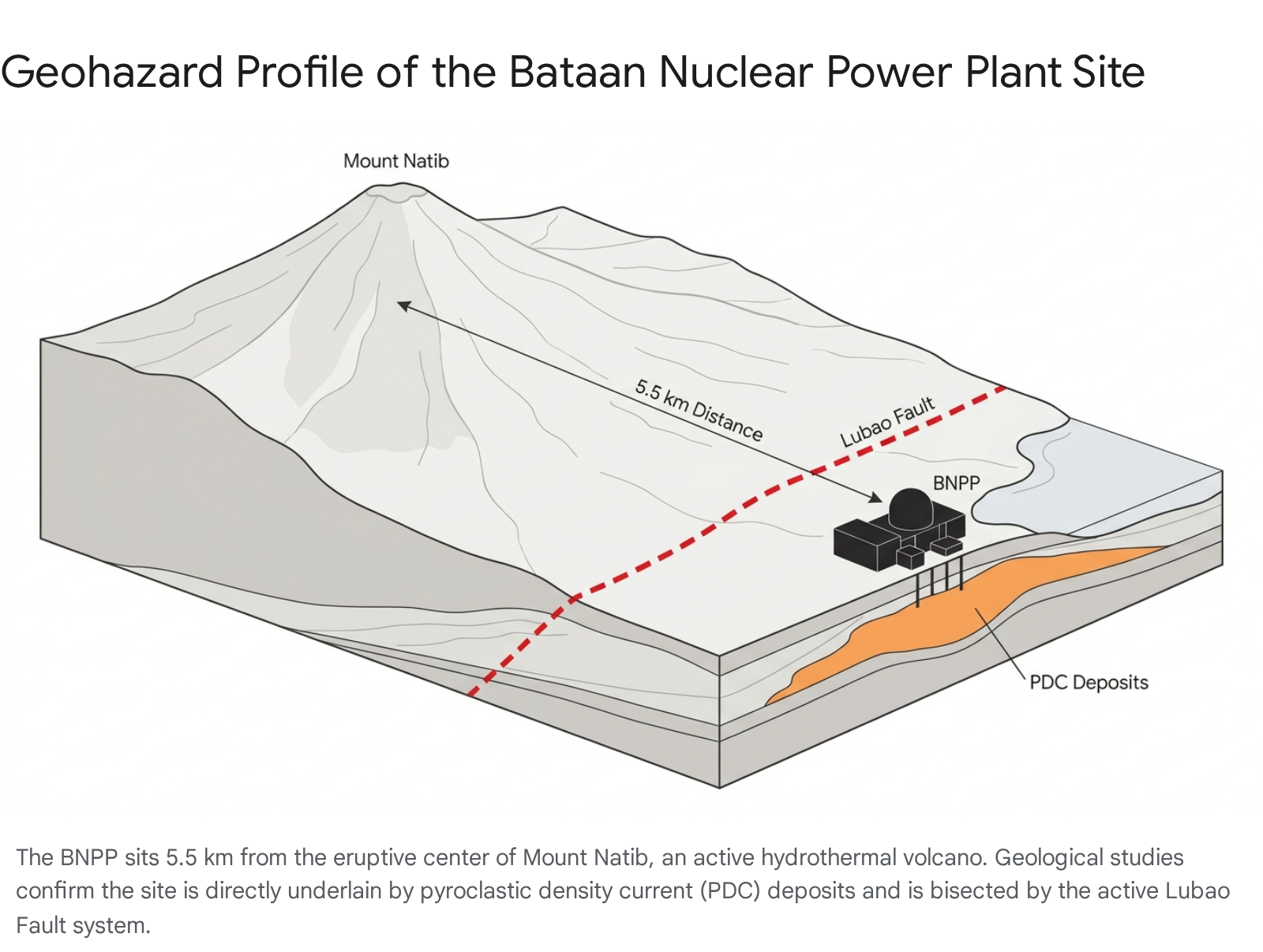
First, the proximity to eruptive centers is alarming. The BNPP is located a mere 5.5 kilometers from the eruptive center of Mount Natib.9 While long considered dormant by early planners, modern volcanology classifies Mount Natib as a potentially active volcano with a credible risk of future eruptions, driven by an active internal hydrothermal system and significant radon gas emissions.9
Second, the site is critically vulnerable to volcaniclastic hazards. The geological mapping of the southwestern sector of Mount Natib revealed that the area is underlain by extensive lahar deposits and at least six separate pyroclastic density current (PDC) deposits.9 PDCs are fast-moving currents of extremely hot gas and volcanic matter that obliterate everything in their path. Shockingly, the research revealed that three of these ancient PDC deposits directly underlie the nuclear reactor facility itself.9 From an engineering perspective, there is no known structural design capable of withstanding the extreme thermal and kinetic forces of a direct PDC impact; if a nuclear facility is within the screening distance of such a volcano, the risk cannot be engineered away.9
Third, the site is bisected by active faulting. Detailed structural mapping using persistent scatterer interferometry and remote sensing established the presence of the Lubao Fault, a capable seismic fault trending N30°E.9 This fault passes directly through the municipality of Lubao, traverses Mount Natib, and extends to the BNPP coastal site.9 High radon gas emissions—a primary geochemical indicator of hidden active faults—were measured at the traces of these faults.9 Furthermore, an associated thrust fault was physically found to cut through lahar deposits directly to the ground surface at the nuclear site itself.9
The convergence of an active fault line directly beneath a reactor situated 5.5 kilometers from a potentially active volcano presents an unacceptable risk profile. Experts have drawn direct parallels to the 2011 Fukushima Daiichi nuclear disaster, noting that ignoring massive geological red flags inevitably leads to catastrophic failure.26
7. Geopolitical Upheaval and the Mothballing of BNPP
The insurmountable technical and geological concerns reached a critical mass concurrently with monumental geopolitical shifts within the Philippines. By early 1986, the Marcos administration was facing intense domestic unrest, severe economic contraction, and massive protests regarding the staggering $2.3 billion national debt incurred by the BNPP project.1 In February 1986, the historic People Power Revolution successfully ousted the Marcos regime, elevating Corazon Aquino to the presidency.3
Merely two months into the new administration, in April 1986, the global nuclear paradigm was shattered by the catastrophic meltdown of the Chernobyl Nuclear Power Plant in the Soviet Union.1 The resulting radioactive fallout and the realization of the horrific human and environmental costs of a nuclear accident fundamentally altered global public perception and intensified absolute distrust in the deeply flawed Bataan facility.3
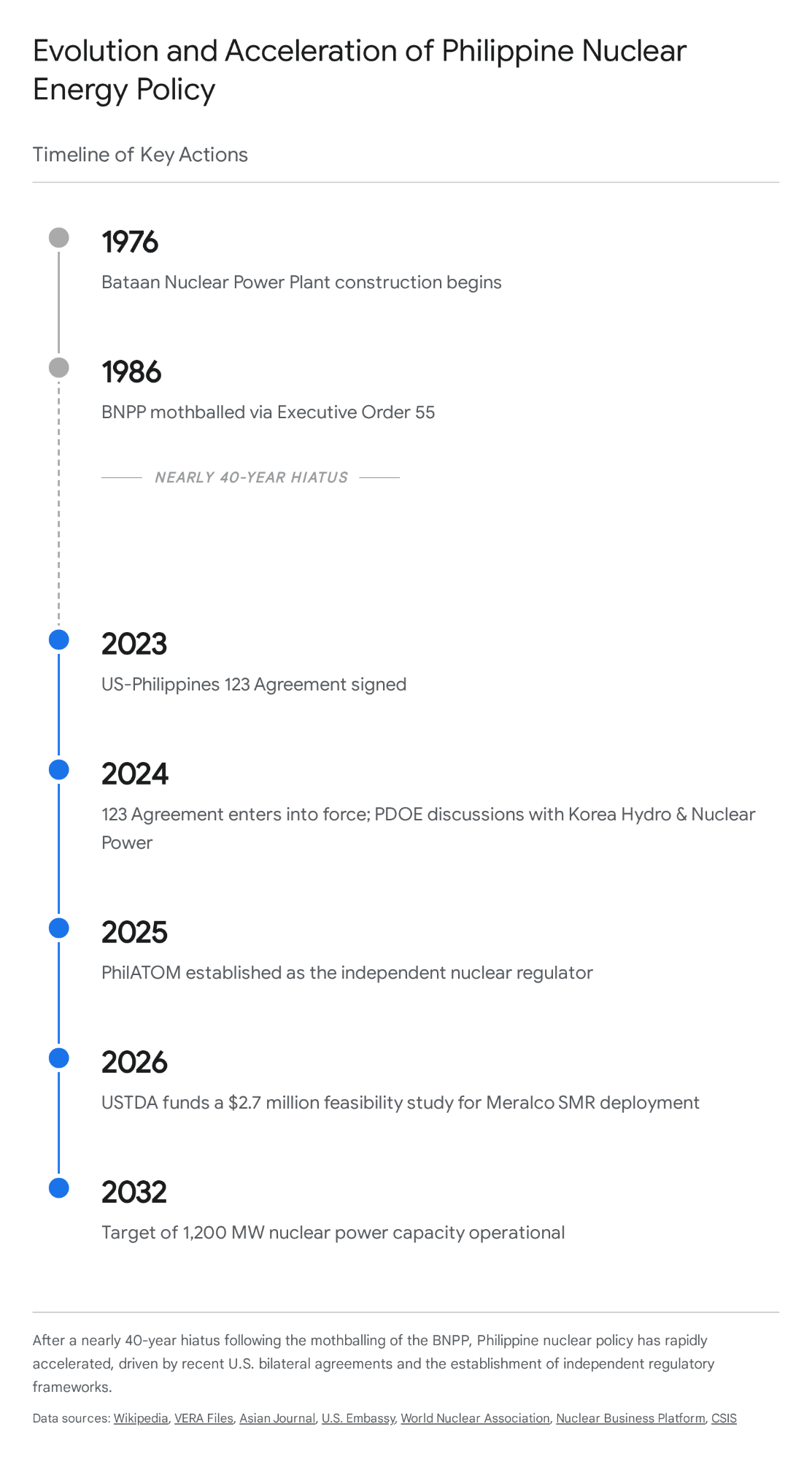
Citing these severe economic burdens, the legacy of corruption, and the overriding safety concerns amplified by the Chernobyl disaster, President Aquino issued Executive Order 55 in November 1986, officially mothballing the BNPP.5 The state-owned Napocor was designated as the caretaker, mandated to oversee the preservation, maintenance, and security of the dormant facility.5
For the past forty years, the plant has sat idle on the Bataan coastline. The financial drain of this decision has been immense. The Philippine government continued to pay the massive foreign debt incurred for its construction, finally paying off the core obligations in April 2007, decades after the plant was supposed to generate revenue.28 Furthermore, the government continues to spend an estimated $1 million (₱40 to ₱50 million) annually in taxpayer funds merely to maintain the structural integrity and security of the site without generating a single megawatt of electricity.5 In a testament to its status as a monumental white elephant, the facility was even briefly opened in 2011 as a tourist attraction to generate marginal awareness and offset maintenance costs.5
8. The Modern Rehabilitation Debate: Economic and Technical Feasibility
Despite its troubled history, the BNPP has continually resurfaced in Philippine policy debates. As energy demand in the archipelago is forecast to more than triple by 2040, and as the vital Malampaya domestic natural gas field approaches total depletion within this decade, the government has officially designated nuclear energy as a critical, zero-emission component of its clean energy transition.2 This urgency has prompted rigorous debate regarding the realistic activation of the BNPP versus the procurement of entirely new capacity.
The Philippine government has repeatedly engaged international bodies to assess the viability of reviving the facility. In 2008, the International Atomic Energy Agency (IAEA) dispatched an expert mission led by Akira Omoto to evaluate the site.28 The IAEA mission observed that the plant appeared “preserved and well-maintained” visually, but it pointedly did not endorse immediate activation. Instead, the IAEA recommended a highly thorough, phased technical and economic evaluation conducted by preservation management experts, stressing the need for a robust regulatory infrastructure before any nuclear program could proceed.28
More recently, South Korea—a global leader in the construction and operation of nuclear power—has taken a strategic interest in the facility. Building on an earlier 2008-2009 feasibility study conducted by the Korea Electric Power Corporation (Kepco) which tentatively recommended refurbishment 2, Korea Hydro & Nuclear Power (KHNP) expanded its involvement. In October 2024, KHNP signed a memorandum of understanding (MOU) with the Philippine Department of Energy to fund and conduct a comprehensive technical and economic feasibility study regarding the plant’s rehabilitation.2
This study, which commenced in January 2025 in two phases (assessing the plant’s current condition, then evaluating refurbishment options), represents the most serious technical audit in decades.2 Bilateral cooperation further escalated in early 2026, when KHNP, the Export-Import Bank of Korea (Eximbank), and the Manila Electric Company (Meralco) signed a tripartite MOU during a state visit. This agreement provides the technical and financial framework to support potential nuclear projects in the Philippines, explicitly including the rehabilitation of BNPP if deemed viable.32
However, the primary barrier to reviving the BNPP remains deeply economic. Initial estimates for rehabilitation reflect the extreme uncertainty of retrofitting forty-year-old analog technology. While KHNP previously floated rehabilitation estimates near $1 billion to $1.2 billion, the Philippine Department of Energy’s internal estimates, updated in late 2022, suggest the cost could soar to $2.3 billion.2
From an investment perspective, committing $2.3 billion to a 621 MW plant equates to a capital cost of roughly $3,700 per installed kilowatt. While this ratio is marginally lower than the capital cost of a greenfield massive nuclear build, it is highly deceptive. It does not account for the facility’s vastly constrained operational lifespan compared to a new build, nor does it factor in the exorbitant insurance premiums that would inevitably be required due to the active geological risks beneath Mount Natib.9 Furthermore, the Philippine Institute for Development Studies (PIDS) noted that previous assessments conducted by Russian nuclear experts indicated that rehabilitating the BNPP would be prohibitively expensive, raising fundamental questions about whether the project is economically worth it.35
Beyond economics, the metallurgical and structural reality of a dormant nuclear plant is highly complex. The pressure vessel, piping arrays, and critical cooling infrastructure have sat unused in a tropical, humid, and saline coastal environment for four decades. The thermal cycling, seal degradation, and potential micro-corrosion of the 4,000 previously identified defects present an unprecedented quality-assurance challenge for any regulatory body attempting to certify the plant for commercial, high-pressure, radioactive operation.20
9. Legal Frameworks and Regulatory Evolution: EPIRA and PhilATOM
Assuming the physical and economic hurdles of the BNPP could be overcome, the Philippine legal landscape poses equally formidable constraints. The Electric Power Industry Reform Act (EPIRA) of 2001, a landmark law designed to liberalize the energy sector, strictly prohibits the Philippine government from engaging in commercial power generation, effectively dismantling the state-owned monopolies of the past.23 Because the BNPP remains a state-owned asset, the government cannot legally operate it and sell the electricity without violating EPIRA.23 Therefore, any activation would necessitate a highly complex privatization, joint venture, or leasing arrangement with a private utility conglomerate capable of absorbing massive financial risk.23
Recognizing that the nation lacked the modern legal infrastructure to oversee a nuclear program, the Philippine Congress took decisive action. In September 2025, President Ferdinand Marcos Jr. signed the Philippine National Nuclear Energy Safety Act (Republic Act 12305) into law.2 This landmark legislation established the Philippine Atomic Energy Regulatory and Safety Authority (PhilATOM) as the country’s sole, independent nuclear regulatory body.2
Crucially, this law decoupled regulatory oversight from the promotional duties previously held simultaneously by the Philippine Nuclear Research Institute (PNRI), aligning the country with strict IAEA standards.2 PhilATOM now possesses exclusive authority over nuclear licensing, safety oversight, and the regulation of all radioactive materials.36 Consequently, any future activation of the BNPP, or the deployment of any new reactors, is strictly contingent upon PhilATOM’s independent safety licensing.36 Given the plant’s history and location, achieving this certification would be intensely scrutinized and highly improbable without an effective rebuilding of the entire facility.
10. The Strategic Pivot to Advanced Nuclear Technologies: SMRs and MMRs
Given the intractable engineering, geological, and economic risks associated with the archaic BNPP, Philippine energy conglomerates and government planners have strategically shifted their focus toward next-generation nuclear technology. Specifically, the nation is actively courting developers of Small Modular Reactors (SMRs) and Micro-Modular Reactors (MMRs).14
These advanced systems fundamentally alter the risk-reward calculus of nuclear energy. SMRs—defined by the IAEA as newer-generation reactors generating typically up to 300 MW—rely on modular, in-factory construction.14 By building modules in a controlled factory setting and assembling them on-site, developers can drastically reduce upfront capital exposure, minimize the chronic construction delays that plague gigawatt-scale projects like the BNPP, and scale capacity sequentially as grid demand dictates.14
Currently, two specific Western reactor designs have gained significant traction and financial backing within the Philippine energy sector:
- NuScale Power (VOYGR System): Based in the United States, NuScale remains the only SMR technology company to achieve a Standard Design Approval from the highly stringent U.S. Nuclear Regulatory Commission (NRC).12 The NRC recently approved an uprated design that generates 77 MWe per module, a significant increase from its original 50 MWe capacity.12 These modules can be clustered into scalable power plants (e.g., a 6-module VOYGR plant producing 462 MWe).12 NuScale relies on advanced pressurized water reactor technology heavily featuring passive safety systems.43 The company has actively engaged the Philippine government at the highest levels, with President Marcos indicating that NuScale plans to conduct detailed siting studies within the archipelago, backed by local conglomerate Prime Infrastructure Capital.2
- Ultra Safe Nuclear Corporation (USNC) – Micro-Modular Reactor (MMR): In November 2023, Meralco—the Philippines’ largest private distribution utility—signed a landmark cooperative agreement with USNC to conduct pre-feasibility and deployment studies for their MMR technology.11 Unlike traditional water-cooled reactors, the USNC MMR is a Generation IV high-temperature gas-cooled reactor.13 It provides a steady 45 MW of thermal output and 15 MW of electrical output, operating continuously with an initial licensed lifetime of 40 years without the need for constant refueling.13
| Feature | Bataan Nuclear Power Plant (BNPP) | NuScale VOYGR (SMR) | USNC Micro-Modular Reactor (MMR) |
| Reactor Type | Traditional Pressurized Water Reactor (PWR) | Advanced Light Water SMR | High-Temperature Gas-Cooled (Gen IV) |
| Capacity | 621 MWe (Single Massive Unit) | 77 MWe per module (Scalable to 462 MWe) | 15 MWe / 45 MWt per module |
| Fuel Type | Standard Uranium Fuel Rods | Standard Uranium Fuel Assemblies | Fully Ceramic Micro-encapsulated (FCM) TRISO |
| Coolant | Massive Coastal Water Intake | Water (Passive natural circulation) | Helium Gas |
| Safety Paradigm | Active systems reliant on power/pumps | Passive safety (walk-away safe) | Inherently safe (meltdown-proof fuel) |
| Deployment | Site-built, decade-long construction | Factory-built modules, assembled on-site | Factory-built “nuclear battery” |
The technological leap from the BNPP to the USNC MMR is profound, particularly regarding fuel architecture. The MMR relies on Fully Ceramic Micro-encapsulated (FCM) TRISO (tristructural isotropic) fuel.13 This specialized fuel involves encasing uranium within microscopic, multi-layered ceramic spheres embedded in prismatic graphite blocks.13 This specific architecture is virtually meltdown-proof; even under extreme temperature loss-of-coolant scenarios, the ceramic layers maintain their integrity, trapping radioactive byproducts inside rather than releasing them into the environment.13
Furthermore, the archipelagic geography of the Philippines makes centralized, gigawatt-scale power generation like the BNPP highly inefficient. The Philippine power grid struggles with severe inter-island transmission bottlenecks.48 SMRs and MMRs offer a highly decentralized solution. They can be deployed as steady-state baseload power for off-grid islands or directly integrated into energy-intensive industrial parks, bypassing massive transmission infrastructure entirely.47 Additionally, because gas-cooled MMRs do not require the massive water intake necessary for the BNPP, they possess immense siting flexibility, allowing them to be placed far inland and away from vulnerable coastlines and fault systems.13
11. Comparative Economics: LCOE and the Viability of Nuclear Power
The ultimate decision to deploy SMRs will not be driven by technological novelty, but by cold, comparative economics. Specifically, the Levelized Cost of Electricity (LCOE)—the average cost of construction and operation per unit of electricity generated over the lifetime of a project—will dictate the market share of nuclear power.23
Currently, the Philippine grid is heavily dominated by expensive imported fossil fuels, with coal accounting for 62% of generation and natural gas providing 14%.2 This reliance has resulted in the Philippines suffering from some of the highest electricity prices in Southeast Asia, reported at approximately Php 9.86 per kWh, drastically hindering the nation’s industrial competitiveness compared to neighbors like Malaysia (Php 1.42/kWh).6
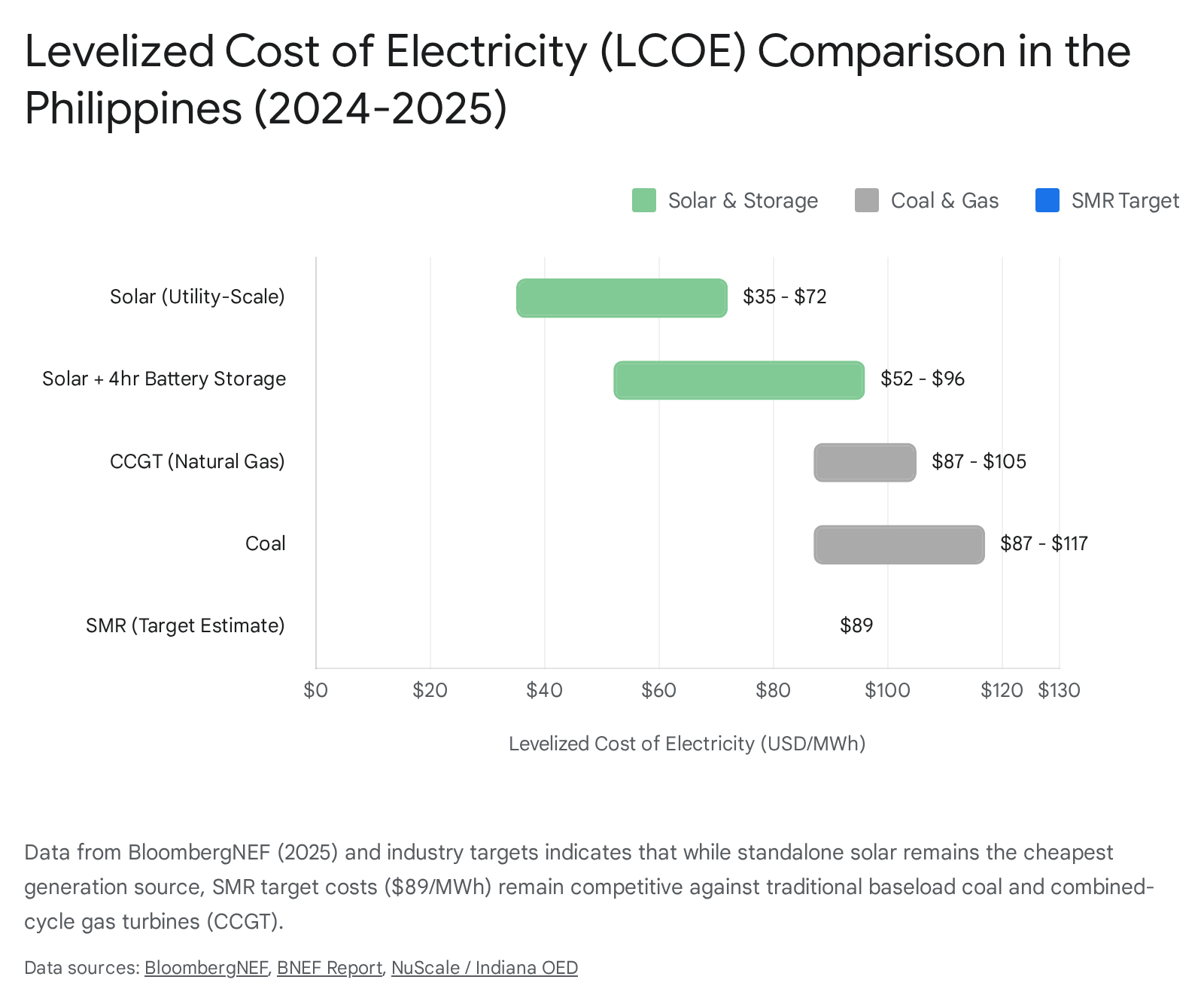
Recent macroeconomic data published by BloombergNEF (2025) provides a stark competitive landscape for future power generation in the Philippines. According to the report, solar power is already the cheapest source of raw electricity generation in the country. A new utility-scale solar power plant currently achieves an LCOE of $35 to $72 per Megawatt-hour (MWh).51 Crucially, the cost of energy storage is plummeting. BloombergNEF projects that solar generation paired with a four-hour lithium-ion battery storage system will see its LCOE fall to $52–$96/MWh by 2025, becoming directly cost-competitive with newly built combined-cycle gas turbines (CCGT) ($87–$105/MWh) and coal power plants ($87–$117/MWh).10
| Power Generation Technology | Estimated LCOE ($/MWh) | Baseload / Dispatchable Capability |
| Utility-Scale Solar (No Storage) | $35 – $72 | No (Intermittent) |
| Solar + 4-Hour Battery Storage | $52 – $96 | Limited (Short-duration dispatch) |
| Combined-Cycle Gas Turbine (CCGT) | $87 – $105 | Yes (High fuel price volatility) |
| Coal Power Plant | $87 – $117 | Yes (High carbon emissions) |
| SMR (Target Estimate – NuScale) | ~$89 | Yes (Zero-carbon baseload) |
| (Data synthesized from BloombergNEF 2025 and NuScale targets 10) |
To remain viable in this shifting economic environment, SMRs must compete aggressively. NuScale, for instance, updated its target power price in 2023 to approximately $89/MWh.42 While this LCOE is higher than raw, intermittent solar, it remains highly competitive against traditional fossil fuels and solar-plus-storage.
From an energy economist’s perspective, grid stability cannot rely solely on four-hour battery systems. As the nation industrializes and data centers proliferate, the grid requires deep, steady-state dispatchable baseload power that operates 24/7, regardless of weather conditions or typhoons.7 SMRs fill this exact niche, providing the systemic stability that intermittent renewables cannot guarantee, while offering a cleaner, economically comparable alternative to imported liquefied natural gas (LNG) and coal.7
12. Geopolitical Imperatives: Energy Sovereignty and the NGCP Vulnerability
The Philippine transition toward nuclear energy is not occurring in an isolated domestic vacuum; it is deeply intertwined with the broader geopolitical competition for technological and economic dominance in Southeast Asia. From an intelligence perspective, energy infrastructure is a primary vector for great power projection.
For decades, the global export market for new nuclear reactors has been aggressively dominated by the Russian Federation (through Rosatom) and the People’s Republic of China (through CNNC).52 These state-backed entities use civil nuclear cooperation as a highly effective tool of strategic statecraft, locking developing nations into decades-long dependencies on their fuel supply chains, maintenance contracts, and financing structures.53
To counter this expanding influence, the United States has sought to reassert its leadership in global nuclear standards. In a monumental shift in bilateral relations, the United States and the Philippines negotiated and signed a “123 Agreement” (formally the Agreement for Cooperation in the Peaceful Uses of Nuclear Energy) in November 2023, which officially entered into full force on July 2, 2024.15 Mandated by Section 123 of the U.S. Atomic Energy Act of 1954, this legally binding treaty is a mandatory prerequisite for the direct export of American nuclear material, advanced reactor equipment (specifically including SMR and MMR components), and highly specialized technical information to the Philippines.15
This agreement aims to permanently tether the emerging Philippine nuclear sector to Western technological, safety, and non-proliferation standards, directly limiting the encroachment of adversarial technology.16 The geopolitical weight of this pivot is evidenced by concrete financial backing: in February 2026, the U.S. Trade and Development Agency (USTDA) directly committed $2.7 million in technical assistance to help Meralco evaluate and create an implementation roadmap for deploying U.S.-designed SMRs, signaling intense strategic alignment between Washington and Manila.2
However, the drive for independent, decentralized nuclear generation via SMRs is also heavily influenced by acute national security concerns regarding the vulnerability of the domestic Philippine transmission grid. The National Grid Corporation of the Philippines (NGCP), a private consortium that holds a 25-year concession to operate the country’s entire power transmission network, is 40% owned by the State Grid Corporation of China (SGCC).17
From an intelligence and energy sovereignty perspective, the presence of Chinese state-linked entities within the command and control structure of critical Philippine infrastructure introduces profound vulnerabilities.56 The power grid is the central nervous system of the nation, enabling everything from military communications to hospital operations.56 Tensions in the West Philippine Sea have highlighted the severe risk of relying on a geopolitical adversary to maintain domestic energy flows. The NGCP has faced significant scrutiny, with Senate Committee on Energy hearings questioning the potential for cyber-espionage, the risk of malware deployment, and the theoretical potential for Beijing to enact targeted grid disruptions under the guise of “technical issues” during a geopolitical crisis.17
Herein lies the profound strategic value of Micro-Modular Reactors. By deploying localized, independent SMRs or MMRs directly to critical industrial hubs, military installations, or major urban centers, the Philippines can theoretically bypass the heavily compromised NGCP transmission network entirely.56 SMRs allow for the creation of isolated, secure microgrids that ensure sovereign resilience against external infrastructural coercion, effectively neutralizing a major vector of foreign leverage.
13. Strategic Waste Management and Deep Borehole Disposal
A fundamental prerequisite for the legitimate reintegration of nuclear power is public trust, which is predicated on the establishment of a robust, scientifically sound framework for radioactive waste management. Recent Department of Energy surveys conducted in 2024 and 2025 indicate a highly favorable public sentiment, with over 70% of Filipinos backing the adoption of nuclear energy as a vital power source for the future.58 This approval is particularly strong among young demographics who view nuclear energy as a necessary tool for deep decarbonization.62
To honor this public trust, the newly created PhilATOM has instituted comprehensive legal mandates ensuring that the generation of radioactive waste is aggressively minimized and that private operators—not the state—remain solely financially responsible for the complete lifecycle management and final disposal of spent fuel.63
While traditional “Dilute and Disperse” methods or shallow near-surface facilities managed by the Department of Environment and Natural Resources (DENR) are utilized for low and intermediate-level waste generated by industrial and medical applications 63, the Philippines is actively adopting state-of-the-art strategies for high-level spent nuclear fuel. Specifically, the national framework heavily prioritizes and legally outlines the use of Deep Borehole Disposal (DBD) as the primary mechanism for geologic isolation.38
DBD involves utilizing advanced drilling technologies to create narrow shafts several kilometers into highly stable, crystalline basement rock—well below the depth limits of circulating pure groundwater resources.65 This method offers profound advantages for a geographically constrained, archipelagic, and seismically active nation like the Philippines. It provides vast siting flexibility, significantly lowers the barrier to local community consent compared to the construction of massive, sprawling mined geological repositories (such as Finland’s ONKALO facility), and offers exceptional geological isolation for high-level waste, keeping it secure for thousands of years.65 The U.S. commercial sector is already positioning to provide advanced deep borehole drilling technologies to the Philippines as a direct operational consequence of the broader civil nuclear cooperation agenda.38
14. Strategic Conclusions
The Philippines stands at a critical juncture in its macroeconomic and energy transition. Driven by surging industrial demand, punishingly high electricity tariffs, and a geopolitical imperative to achieve energy independence away from volatile fossil fuel markets, the nation requires vast amounts of stable, zero-carbon baseload power. While the sentiment for nuclear adoption is overwhelmingly positive, the precise vector of this adoption carries immense economic, geological, and security implications.
Based on an exhaustive analysis of historical, technical, economic, and intelligence data, the following strategic conclusions are drawn:
- The Bataan Nuclear Power Plant is Operationally and Economically Unviable: The rehabilitation of the 40-year-old BNPP represents an unacceptable concentration of geohazard and financial risk. The presence of pyroclastic flow pathways directly beneath the facility, combined with the proximity of the active Mount Natib volcano and the Lubao fault line, renders any capital expenditure—estimated at up to $2.3 billion—highly imprudent.2 The facility’s thousands of documented construction defects further compromise its integrity. The BNPP should remain mothballed or be fully repurposed for non-nuclear utilization, and it must not serve as the physical foundation of the modern Philippine nuclear renaissance.
- SMRs and MMRs Provide the Optimal Strategic Pathway: Next-generation reactors natively resolve the geographic and infrastructural constraints of the Philippine archipelago. Their modular, factory-built nature mitigates sovereign financial exposure and construction delays, allowing for an LCOE that competes directly with imported coal and gas. Furthermore, advanced safety architectures, such as the meltdown-proof TRISO fuel utilized by USNC, vastly reduce the risk profile. These reactors can operate safely distributed across the islands, providing critical dispatchable baseload power to isolated grids and high-demand industrial centers without relying on massive water intake.
- Nuclear Procurement is a Geopolitical Defense Mechanism: The integration of nuclear energy transcends basic grid economics; it is fundamentally a matter of national security. By actively engaging American SMR vendors under the legal aegis of the U.S.-Philippines 123 Agreement, the Philippines secures its nuclear supply chain against adversarial disruption and aligns itself with Western non-proliferation standards.15 More urgently, distributed nuclear generation via localized SMR microgrids provides a strategic workaround to the profound vulnerabilities inherent in the Chinese-owned National Grid Corporation of the Philippines (NGCP), thereby reinforcing national energy sovereignty against potential coercion or sabotage.17
The successful re-entry of the Philippines into the global nuclear arena requires strict adherence to the newly established PhilATOM regulatory frameworks, the deployment of Deep Borehole Disposal for secure waste management, and a decisive, permanent departure from the sunk-cost fallacy of the Bataan Nuclear Power Plant. By prioritizing advanced, modular technologies and deeply integrating with allied supply chains, the Philippines can achieve the elusive trifecta of grid reliability, economic competitiveness, and sovereign energy security.
Please share the link on Facebook, Forums, with colleagues, etc. Your support is much appreciated and if you have any feedback, please email us in**@*********ps.com. If you’d like to request a report or order a reprint, please click here for the corresponding page to open in new tab.
Sources Used
- Bataan Nuclear Power Plant – Wikipedia, accessed April 23, 2026, https://en.wikipedia.org/wiki/Bataan_Nuclear_Power_Plant
- Nuclear Power in the Philippines – World Nuclear Association, accessed April 23, 2026, https://world-nuclear.org/information-library/country-profiles/countries-o-s/philippines
- Nuclear Power in the Philippines: The Need to Address Institutional Gaps | FULCRUM, accessed April 23, 2026, https://fulcrum.sg/nuclear-power-in-the-philippines-the-need-to-address-institutional-gaps/
- The Bataan Nuclear Power Plant in the Philippines: Lessons from a White Elephant Project, accessed April 23, 2026, https://www.researchgate.net/publication/317996968_The_Bataan_Nuclear_Power_Plant_in_the_Philippines_Lessons_from_a_White_Elephant_Project
- VERA FILES FACT SHEET: A sleeping power giant, Bataan Nuclear Power Plant explained, accessed April 23, 2026, https://verafiles.org/articles/vera-files-fact-sheet-sleeping-power-giant-bataan-nuclear-po
- The Critical Role of Nuclear Power For The Philippines, accessed April 23, 2026, https://www.nuclearbusiness-platform.com/media/insights/the-critical-role-of-nuclear-power-for-the-philippines
- Philippines Nuclear: New Laws and Pioneer Incentives Drive Multi-Billion Dollar Investment, accessed April 23, 2026, https://www.nuclearbusiness-platform.com/media/insights/philippines-nuclear-new-laws
- Korea to assess rehabilitation of Philippine plant – World Nuclear News, accessed April 23, 2026, https://www.world-nuclear-news.org/articles/korea-to-assess-rehabilitation-of-philippine-plant
- (PDF) Geological hazards of SW Natib Volcano, site of the Bataan …, accessed April 23, 2026, https://www.researchgate.net/publication/258646215_Geological_hazards_of_SW_Natib_Volcano_site_of_the_Bataan_Nuclear_Power_Plant_the_Philippines
- The Philippines’ Path to Clean and Affordable Electricity – Bloomberg Professional Services, accessed April 23, 2026, https://assets.bbhub.io/professional/sites/44/The-Philippines-Path-to-Clean-and-Affordable-Electricity.pdf
- Philippines / Ultra Safe Agreement Paves Way For Microreactor Deployment – NucNet, accessed April 23, 2026, https://www.nucnet.org/news/ultra-safe-agreement-paves-way-for-microreactor-deployment-11-3-2023
- NuScale Power’s Small Modular Reactor (SMR) Achieves Standard Design Approval from U.S. Nuclear Regulatory Commission for 77 MWe, accessed April 23, 2026, https://www.nuscalepower.com/press-releases/2025/nuscale-powers-small-modular-reactor-smr-achieves-standard-design-approval-from-us-nuclear-regulatory-commission-for-77-mwe
- Philippines considers deploying USNC microreactors – World Nuclear News, accessed April 23, 2026, https://www.world-nuclear-news.org/articles/philippines-considers-deploying-usnc-microreactors
- Technical Review and Status of Small Modular Reactor Technologies: Prospects of Nuclear Infrastructure Development in the Philippines – MDPI, accessed April 23, 2026, https://www.mdpi.com/1996-1073/18/7/1862
- Energy Security and the U.S.-Philippine Alliance – CSIS, accessed April 23, 2026, https://www.csis.org/analysis/energy-security-and-us-philippine-alliance
- Nuclear accord signed between USA and Philippines, accessed April 23, 2026, https://www.world-nuclear-news.org/articles/nuclear-accord-signed-between-usa-and-philippines
- IEEFA update: China’s state grid group triggers oversight controversy in the Philippines, accessed April 23, 2026, https://ieefa.org/resources/ieefa-update-chinas-state-grid-group-triggers-oversight-controversy-philippines
- The Controversy of the Bataan Nuclear Power Plant – Stanford University, accessed April 23, 2026, http://large.stanford.edu/courses/2017/ph241/camacho2/
- Re-energizing the Philippine nuclear machinery – DOST-STII, accessed April 23, 2026, http://sntpost.dost.gov.ph/dost/re-energizing-the-philippine-nuclear-machinery
- Bataan Philippine Reactor – 30 Years Unfueled – Stanford, accessed April 23, 2026, http://large.stanford.edu/courses/2015/ph241/anderson-m1/
- Bataan Nuclear Power Plant Assessment | PDF – Scribd, accessed April 23, 2026, https://www.scribd.com/document/672738933/Bataan-Nuclear-Power-Plant
- The Philippines’ Nuclear Gamble: Reviving Bataan After 40 Years – The Energy Pioneer, accessed April 23, 2026, https://theenergypioneer.com/the-philippines-nuclear-gamble/
- The Implications of Developing a Philippine Nuclear Energy Program, accessed April 23, 2026, https://pidswebs.pids.gov.ph/CDN/document/pidsdps2261.pdf
- Philippines 2018 – Scientific, technical publications in the nuclear field | IAEA, accessed April 23, 2026, https://www-pub.iaea.org/MTCD/Publications/PDF/cnpp2018/countryprofiles/Philippines/Philippines.htm
- The Dark Side of Progress: Unveiling the Bataan Nuclear Plant’s Hidden Dangers – what.it.is, accessed April 23, 2026, https://dev.what.it.is/dev/the-dark-side-of-progress-unveiling-the-bataan-nuclear-plants-hidden-dangers
- Geological Hazards of the Bataan Nuclear Plant: Propaganda and Scientific Fact, accessed April 23, 2026, https://www.cbcplaiko.org/wp-content/uploads/2016/11/Geological-Hazards-of-the-Bataan-Nuclear-Plant.pdf
- Experts urge more studies on the opening of Bataan nuclear plant – DOST, accessed April 23, 2026, https://www.dost.gov.ph/knowledge-resources/news/45-2016-news/1095-experts-urge-more-studies-on-the-opening-of-bataan-nuclear-plant.html
- IAEA helps Philippines reassess Bataan – World Nuclear News, accessed April 23, 2026, https://www.world-nuclear-news.org/Articles/IAEA-helps-Philippines-reassess-Bataan
- Bataan Nuclear Power Plant vs Renewables: Why a $1 Billion Revival Could Beat Solar, Wind and Battery Costs for the Philippines – Gulf News, accessed April 23, 2026, https://gulfnews.com/opinion/op-eds/nuclear-revival-or-renewable-mirage-why-bataans-1-billion-fix-beats-the-solar-wind-hydroelectric-battery-tax-1.500492462
- IAEA Advises Philippines on Next Steps for “Mothballed” NPP, accessed April 23, 2026, https://www.iaea.org/newscenter/news/iaea-advises-philippines-next-steps-mothballed-npp
- Philippines 2016 – Scientific, technical publications in the nuclear field | IAEA, accessed April 23, 2026, https://www-pub.iaea.org/MTCD/publications/PDF/cnpp2016/countryprofiles/Philippines/Philippines.htm
- Korea, ASEAN strengthen nuclear ties, accessed April 23, 2026, https://www.neimagazine.com/news/korea-asean-strengthen-nuclear-ties/
- South Korea to cooperate with the Philippines on nuclear power projects, accessed April 23, 2026, https://www.world-nuclear-news.org/articles/south-korea-to-cooperate-with-the-philippines-on-nuclear-power-projects
- KHNP, Meralco, And South Korea’s Eximbank Sign Cooperation On Philippine Nuclear Projects – NucNet, accessed April 23, 2026, https://www.nucnet.org/news/khnp-meralco-and-south-korea-s-eximbank-sign-cooperation-on-philippine-nuclear-projects-3-3-2026
- Nuclear decision to hinge on economics of BNPP rehab, compliance with safety rules, accessed April 23, 2026, https://www.bworldonline.com/economy/2023/01/03/496372/nuclear-decision-to-hinge-on-economics-of-bnpp-rehab-compliance-with-safety-rules/
- Bataan nuclear plant’s future hinges on new independent regulator – Asian Journal News, accessed April 23, 2026, https://asianjournal.com/philippines/metro-manila/bataan-nuclear-plants-future-hinges-on-new-independent-regulator/
- Republic Act No. 12305 – Lawphil, accessed April 23, 2026, https://lawphil.net/statutes/repacts/ra2025/ra_12305_2025.html
- Philippine Nuclear Energy Regulation – International Trade Administration, accessed April 23, 2026, https://www.trade.gov/market-intelligence/philippine-nuclear-energy-regulation
- Philippines Civil Nuclear Energy Opportunities – International Trade Administration, accessed April 23, 2026, https://www.trade.gov/market-intelligence/philippines-civil-nuclear-energy-opportunities
- Nuclear power: Should the Philippines go for smaller modular reactors? – Gulf News, accessed April 23, 2026, https://gulfnews.com/world/asia/philippines/nuclear-power-should-the-philippines-go-for-smaller-modular-reactors-1.1658297433946
- America Backs First Manila SMR Study: The New Nuclear Roadmap for Philippine Power, accessed April 23, 2026, https://carboncredits.com/america-backs-first-manila-smr-study-the-new-nuclear-roadmap-for-philippine-power/
- FINAL REPORT STUDY ON SMALL MODULAR REACTOR TECHNOLOGY AND ITS IMPACT FOR INDIANA – IN.gov, accessed April 23, 2026, https://www.in.gov/oed/files/IOED-SMR-Report_Final_2024.pdf
- Small Modular Reactor Market Size, Share & Competitive Analysis, accessed April 23, 2026, https://www.maximizemarketresearch.com/market-report/small-modular-reactor-market/285041/
- NuScale in talks with the Philippines on SMR deployment – World Nuclear News, accessed April 23, 2026, https://www.world-nuclear-news.org/articles/nuscale-in-talks-with-the-philippines-on-smr-deplo
- Deploying Small Modular Reactors in East Asia: Implications on Nuclear Governance – Tennessee Research and Creative Exchange (TRACE), accessed April 23, 2026, https://trace.tennessee.edu/cgi/viewcontent.cgi?article=1360&context=ijns
- Ultra Safe signs to perform a microreactor pre-feasibility study in the Philippines, accessed April 23, 2026, https://www.ans.org/news/article-5540/ultra-safe-signs-to-perform-a-microreactor-prefeasibility-study-in-the-philippines/
- Philippines / Power Utility Identifies Three Possible Sites For Nuclear Plant – NucNet, accessed April 23, 2026, https://www.nucnet.org/news/power-utility-identifies-three-possible-sites-for-nuclear-plant-1-0-2024
- Renewable Energy Transition in the Philippines: Trends, Opportunities, Challenges 1, accessed April 23, 2026, https://www.elibrary.imf.org/view/journals/002/2025/334/article-A002-en.xml
- Accelerating Safe Small Modular Reactor Development in Southeast Asia – Re*******@****mi.it, accessed April 23, 2026, https://re.public.polimi.it/bitstream/11311/1204862/4/Accelerating%20safe%20small%20modular%20reactor%20development%20in%20Southeast%20Asia.pdf
- Small Modular Reactor (SMR) Economic Feasibility and Cost-Benefit Study for Remote Mining in the Canadian North: A Case – OPG, accessed April 23, 2026, https://www.opg.com/documents/smr-economic-feasibility-and-cost-benefit-study-for-remote-mining/
- Solar Shines the Path for the Philippines to Reduce Reliance on …, accessed April 23, 2026, https://about.bnef.com/insights/clean-energy/solar-shines-the-path-for-the-philippines-to-reduce-reliance-on-fossil-fuel-imports/
- Can 123 Agreements Boost Southeast Asia’s Nuclear Energy Programs?, accessed April 23, 2026, https://www.nuclearbusiness-platform.com/media/insights/123-agreements-southeast-asia-nuclear-energy
- Reframing the U.S. Role in a New Nuclear Renaissance: Ensuring Flexibility in Fuel Procurement as a Counter to FEOC Influence, accessed April 23, 2026, https://carnegieendowment.org/research/2025/11/reframing-the-us-role-in-a-new-nuclear-renaissance-ensuring-flexibility-in-fuel-procurement-as-a-counter-to-feoc-influence
- Competitive Strategy vis-a-vis China: The Case Study of Civil-Nuclear Cooperation, accessed April 23, 2026, https://2017-2021.state.gov/competitive-strategy-vis-a-vis-china-the-case-study-of-civil-nuclear-cooperation/
- Fact Sheet: U.S.-Philippines Civilian Nuclear Cooperation, accessed April 23, 2026, https://ph.usembassy.gov/fact-sheet-u-s-philippines-civilian-nuclear-cooperation/
- Chinese stake in power transmission grid not a threat to national security: NGCP | ABS-CBN News : r/Philippines – Reddit, accessed April 23, 2026, https://www.reddit.com/r/Philippines/comments/1i1wobu/chinese_stake_in_power_transmission_grid_not_a/
- Remove Chinese control of our country’s electric power grid | Inquirer Opinion, accessed April 23, 2026, https://opinion.inquirer.net/179973/remove-chinese-control-of-our-countrys-electric-power-grid
- Over 70% of Filipinos Back Nuclear Energy as Power for the Future – DOE, accessed April 23, 2026, https://doe.gov.ph/articles/3076785–over-70-of-filipinos-back-nuclear-energy-as-power-for-the-future
- Over 70% of Filipinos Back Nuclear Energy as Power for the Future, accessed April 23, 2026, https://pia.gov.ph/press-release/over-70-of-filipinos-back-nuclear-energy-as-power-for-the-future/
- DOE: Surveyed Filipinos favor use of nuclear power for electricity – Philippine News Agency, accessed April 23, 2026, https://www.pna.gov.ph/articles/1259842
- 2024 Nuclear Energy Public Perception Survey – DOE, accessed April 23, 2026, https://doe.gov.ph/articles/2983058–2024-nuclear-energy-public-perception-survey?title=2024%20Nuclear%20Energy%20Public%20Perception%20Survey
- Nuclear Energy and Public Opinion, accessed April 23, 2026, https://world-nuclear.org/information-library/current-and-future-generation/nuclear-energy-and-public-opinion
- REPUBLIC ACT NO. 12305 – AN ACT PROVIDING FOR A COMPREHENSIVE LEGAL FRAMEWORK FOR NUCLEAR SAFETY, SECURITY, AND SAFEGUARDS IN THE PEACEFUL UTILIZATION OF NUCLEAR ENERGY IN THE PHILIPPINES, ESTABLISHING THE PHILIPPINE ATOMIC ENERGY REGULATORY AUTHORITY, AND APPROPRIATING FUNDS THEREFOR – Supreme Court E-Library, accessed April 23, 2026, https://elibrary.judiciary.gov.ph/thebookshelf/showdocs/2/99921
- Philippine Initiatives for the Safe Management and Disposal of Radioactive Waste – OSTI, accessed April 23, 2026, https://www.osti.gov/etdeweb/servlets/purl/21190265
- Towards Sustainable Nuclear Waste Management: A Study of Philippine Geological Disposal Alternatives – Archium Ateneo, accessed April 23, 2026, https://archium.ateneo.edu/cgi/viewcontent.cgi?article=1162&context=ecce-faculty-pubs
- Putting Deep Borehole Disposal of Nuclear Waste into Practice: The Challenges or the International Community – INIS-IAEA, accessed April 23, 2026, https://inis.iaea.org/records/nsskx-ez945