
1. Executive Summary
The transition toward decentralized, low-carbon energy infrastructure has catalyzed a resurgence in the development of Small Modular Reactors (SMRs) and Micro Modular Reactors (MMRs), the latter commonly referred to as microreactors. Defined as nuclear power systems with an electrical output ranging from 20 to 300 megawatts (MWe) for SMRs, and 20 MWe or less for MMRs, these modular systems represent a fundamental paradigm shift in nuclear engineering. They move away from gigawatt-scale, custom-built facilities toward factory-fabricated, highly transportable units.1 This intelligence and economic assessment evaluates the historical trajectory, technological architecture, economic feasibility, and risk profile of both SMR and MMR deployment.
Analysis indicates that modern modular reactors leverage significant advancements over legacy designs. While many near-term SMRs rely on scaled-down, proven light-water technology, advanced SMRs and MMRs utilize passive safety mechanisms, tristructural isotropic (TRISO) fuel, and advanced cooling technologies such as heat pipes and molten salts.2 These innovations theoretically mitigate the risk of severe meltdown scenarios and eliminate the need for active, pump-driven mechanical components.3 Economically, SMRs and MMRs abandon traditional “economies of scale” in favor of “economies of volume,” relying on factory mass-production and standardization to drive down high first-of-a-kind (FOAK) capital costs.6 If optimal learning rates are achieved and federal tax credits are applied, the levelized cost of energy (LCOE) could fall to competitive ranges, positioning them favorably against diesel generation in remote environments and parity with the cost of firming intermittent renewables.8 However, recent FOAK commercialization failures in the SMR sector highlight that realizing these economic benefits remains highly challenging.
Furthermore, the deployment of advanced modular reactors is constrained by severe geopolitical, environmental, and security vulnerabilities. The reliance of advanced SMRs and MMRs on High-Assay Low-Enriched Uranium (HALEU) presents an acute supply chain bottleneck, as global commercial production is currently heavily influenced by Russian state-owned enterprises, necessitating aggressive near-term investments in domestic Western enrichment capacity.10 Furthermore, the decentralized deployment of HALEU-fueled reactors elevates proliferation risks and introduces highly complex physical security, cyber, and transportability challenges.1 Environmental assessments also remain polarized; current lifecycle modeling suggests SMRs and MMRs may generate significantly more radioactive waste by volume per unit of energy compared to conventional light-water reactors, complicating long-term repository planning.14
Through the lens of geostrategy, SMRs and MMRs serve not only as decentralized energy assets but as profound instruments of nuclear diplomacy. Recent bilateral frameworks, such as the 123 Agreement between the United States and the Republic of the Philippines, illustrate how advanced nuclear exports are being leveraged to secure influence in critical geopolitical theaters, counterbalancing rival state-backed nuclear enterprises.16 Ultimately, while SMRs and MMRs present a realistic and necessary evolution in nuclear technology for specific grid, off-grid, industrial, and military use cases, their broader commercial viability remains contingent upon overcoming substantial regulatory, supply chain, and backend waste management hurdles over the next decade.
2. Historical Context: The Origins and Evolution of SMRs and MMRs
The conceptualization of portable, low-yield nuclear reactors is not a twenty-first-century phenomenon; it is rooted deeply in Cold War military logistics. The strategic logic was to reduce the costly, vulnerable, and highly carbon-intensive logistical tail required to supply fossil fuels to forward operating bases and remote military installations.18 To address this, the United States established the Army Nuclear Power Program (ANPP) in 1954, a joint initiative between the Army Corps of Engineers and the Atomic Energy Commission aimed at developing rugged, transportable nuclear plants capable of providing both heat and electricity.19
2.1 The Legacy of the ML-1 and PM-1 Platforms
The most ambitious of these early mobile designs was the ML-1, a 0.3 MWe plant designed to be truck-mobile, air-transportable, and capable of a rapid 12-hour setup time.2 Tested in Idaho between 1962 and 1966, the ML-1 featured an innovative water-moderated, high-temperature reactor utilizing pressurized nitrogen at 650°C to drive a Brayton closed-cycle gas turbine.2 It was fueled by highly enriched uranium (HEU) arranged in a cluster of 19 pins, housed within a highly compact core.2 Despite the innovative thermodynamic concept, the ML-1 ultimately failed to achieve operational viability. The design suffered from persistent rapid shutdowns, spurious sensor readings, and undetected mechanical failures in its non-nuclear components, resulting in the reactor never achieving more than 66% of its specified electrical output.20 A 1964 economic analysis dealt the final blow, concluding that operating the ML-1 over a 10-year lifecycle would cost ten times more than a comparable diesel plant.20 Regarded as a mechanical and economic failure, the program was permanently shut down in 1965 amid Vietnam War budget cuts.20
Concurrently, the ANPP achieved highly localized success with stationary portable plants such as the PM-1, the first portable land-based nuclear plant deployed in the United States.18 Situated at an elevation of 6,000 feet on Warren Peak in the Bearlodge Mountains of Wyoming, the PM-1 successfully powered large radar installations and provided space heating for the Sundance Air Force Station from 1962 to 1968.18 The 1.25 MW PM-1 was designed to handle extreme climatic conditions—ranging from -45°F winters to 102°F summers—while managing rapid shifts in power loads of plus or minus 30%.18
2.2 The Pivot to Modern Modularity and SMR Commercial Hurdles
The ultimate abandonment of the ANPP by 1976 highlighted a critical limitation of mid-century engineering: the technology lacked the advanced materials, sophisticated computational modeling, and passive safety mechanisms required to make small-scale nuclear generation both highly reliable and economically competitive.4
Modern SMR and MMR development has completely pivoted away from bespoke on-site construction toward centralized factory fabrication.18 However, the SMR sector has recently encountered significant commercial turbulence. In late 2023, NuScale Power and the Utah Associated Municipal Power Systems (UAMPS) cancelled the Carbon Free Power Project (CFPP)—which was slated to be the first operational SMR in the U.S.—due to a lack of sufficient subscriber demand amidst escalating FOAK costs. The termination of the CFPP serves as a critical lesson for the SMR industry; analysts note that NuScale’s 77 MWe VOYGR design required the construction of a massive, expensive pool to submerge the reactors, incurring large fixed costs that negated many of the intended economic benefits of modularity.
3. Technical Architecture: Light-Water SMRs vs. Advanced MMRs
While both classes rely on modularity, SMRs (20-300 MWe) and MMRs (<20 MWe) frequently utilize vastly different technical architectures. Many near-term SMRs rely on scaled-down versions of traditional gigawatt-class technology, whereas MMRs and advanced SMRs represent an extreme "plug-and-play" deployment model, aiming to contain the entire reactor within standard ISO shipping containers.1
3.1 Next-Generation Fuel: TRISO and HALEU Dynamics
While conventional Light-Water SMRs continue to use standard low-enriched uranium oxide pellets housed in zirconium cladding, advanced SMRs and most MMRs transition toward advanced, resilient fuel forms like Tristructural Isotropic (TRISO) fuel.3 TRISO fuel encapsulates a uranium kernel within multiple layers of carbon and silicon carbide.24 This micro-encapsulation renders the 19.75% enriched fuel structurally resilient against neutron irradiation, corrosion, oxidation, and extreme high temperatures, effectively allowing the fuel particle to act as its own primary containment vessel.3
To achieve multi-year refueling intervals—often ranging from 10 to 20 years, or matching the entire physical lifetime of the reactor module—within a highly compact core footprint, these advanced designs heavily rely on High-Assay Low-Enriched Uranium (HALEU).25 While traditional gigawatt-scale light-water reactors and near-term SMRs operate on uranium enriched to under 5% U-235, HALEU is enriched between 5% and 20%.26 This higher concentration of fissile material permits extended fuel cycles and higher operational efficiencies, optimizing the power-density-to-weight ratio absolutely required for mobility and containerized transport.25
3.2 Advanced Cooling Topologies and Core Configurations
SMRs such as the NuScale VOYGR and GE-Hitachi BWRX-300 continue to use water as a primary coolant, relying on natural circulation rather than mechanical pumps. Conversely, MMRs categorically abandon complex water cooling systems, which require large external water sources and massive high-pressure containment vessels.3 Instead, the MMR industry is pursuing several distinct cooling topologies:
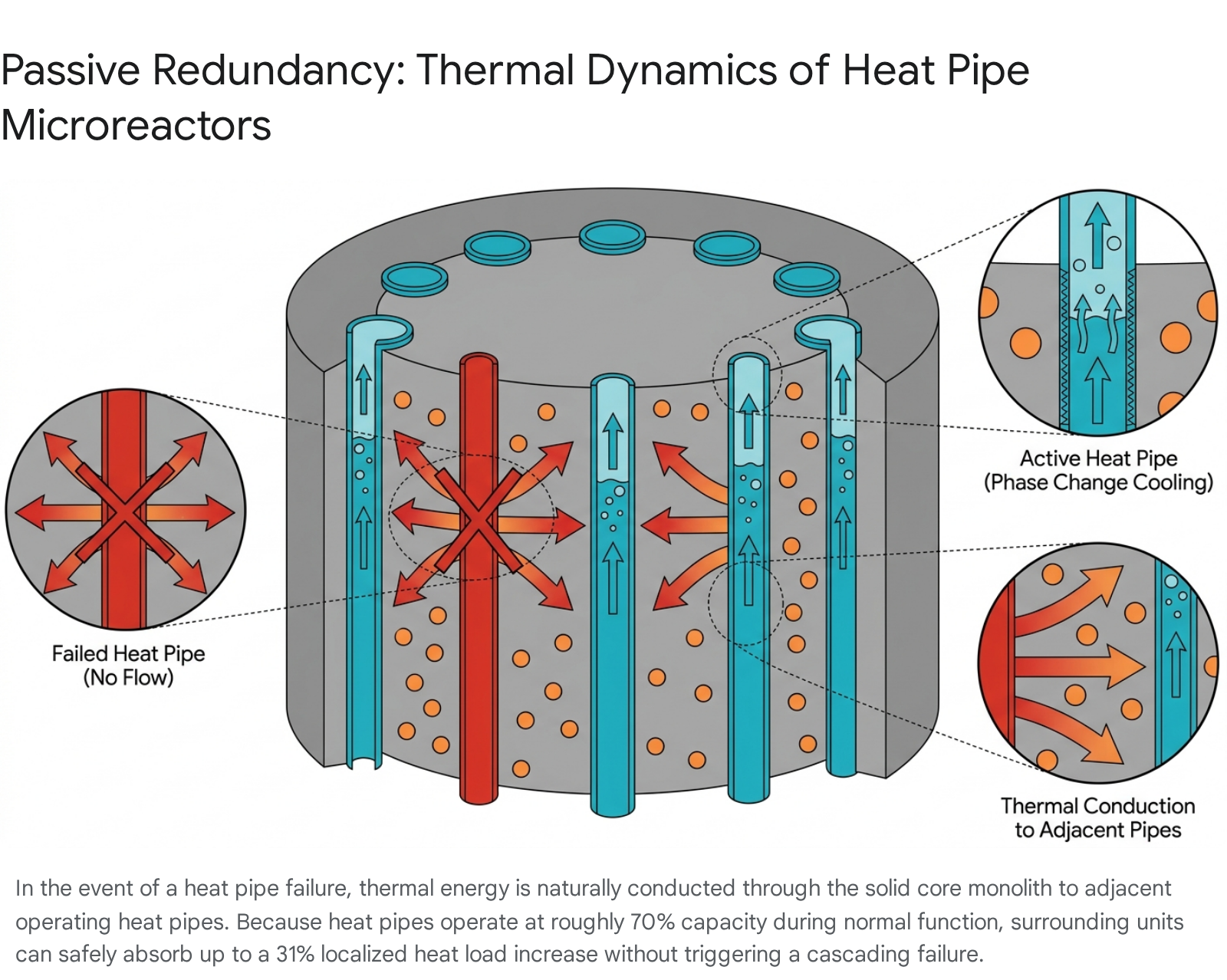
- Heat Pipe Microreactors (HPMR): Designs such as the Westinghouse eVinci rely on an array of high-temperature alkali metal heat pipes.3 These passive thermal transport devices use the phase change of a working fluid to draw heat away from a solid monolithic reactor core directly to the hot end of an intermediate heat exchanger or thermoelectric conversion device.28 Because heat pipes operate on natural capillary action and vapor flow, they eliminate the need for reactor coolant pumps and associated cooling water infrastructure.3
- High-Temperature Gas-Cooled Reactors (HTGR): Systems like the Ultra Safe Nuclear Corporation (USNC) Micro-Modular Reactor (MMR) utilize pressurized helium as a primary coolant.30 Helium is chemically inert, entirely preventing the corrosion and explosive phase-change risks associated with water coolants. The MMR design utilizes TRISO fuel arranged in prismatic graphite blocks.30
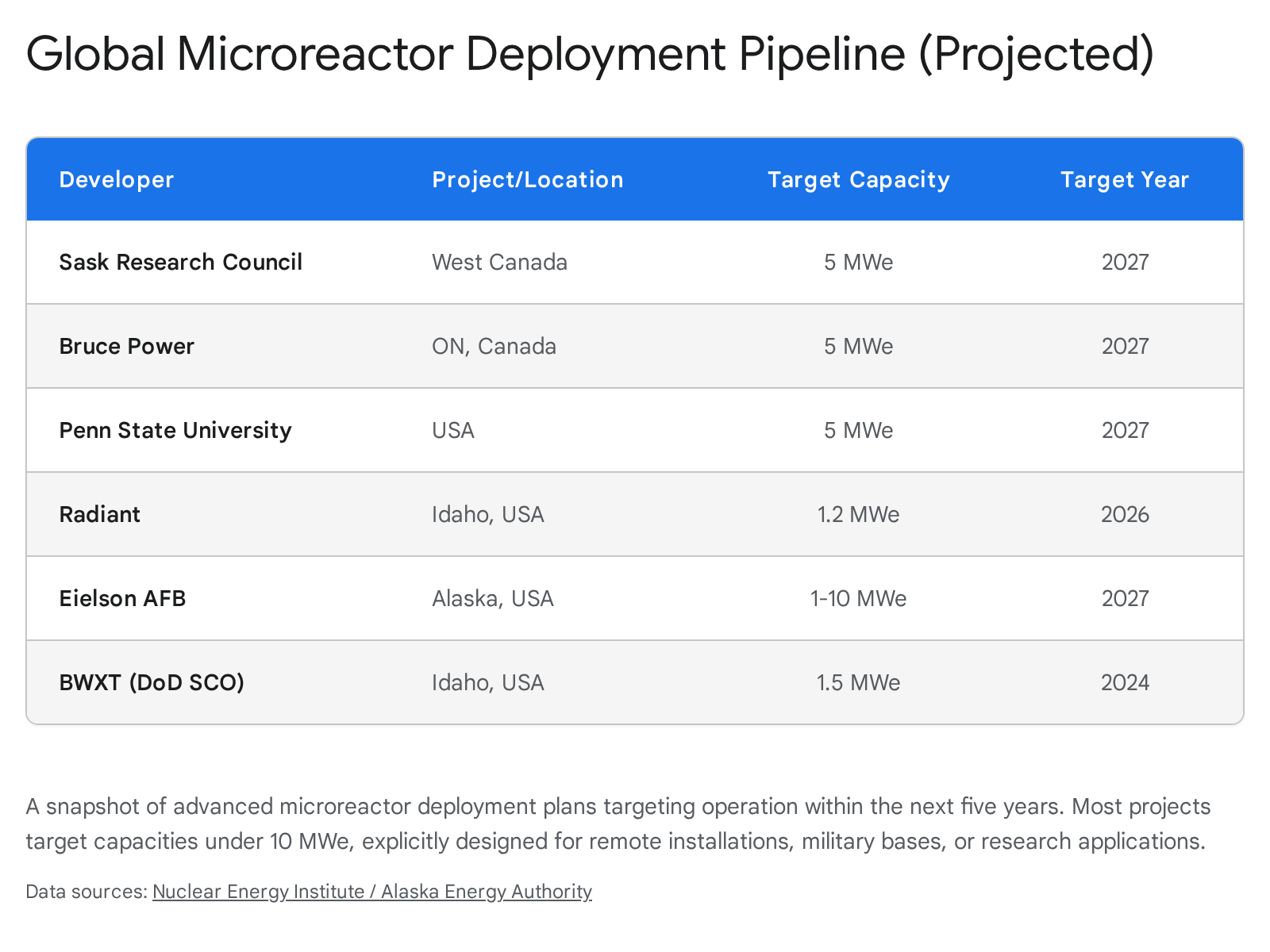
- Liquid Metal and Molten Salt Reactors: Companies like Oklo (Aurora Powerhouse) and BWXT (BANR) are developing reactors that utilize liquid metals or advanced molten salts, allowing the system to operate flexibly at significantly higher temperatures and lower pressures than traditional water-cooled designs.22 BWXT’s Project Pele and BANR designs, for example, heavily integrate TRISO fuel particles to achieve higher uranium loading and improved fuel utilization within these novel coolant mediums.23
4. Passive Safety Architectures and Beyond Design Basis Event (BDBE) Mitigation
The fundamental value proposition of both SMRs and MMRs over older generations of nuclear technology is their inherent reliance on passive safety. By systematically minimizing the number of moving parts, these reactors drastically reduce the vectors for mechanical failure.27
4.1 Heat Pipe Thermal Dynamics and Failure Redundancy in MMRs
In Heat Pipe Microreactors (HPMR), the core block is a pivotal component; it integrates the functions of the reactor vessel, structural components, and fuel cladding into a single monolithic structure.32 Safety is derived from extreme structural redundancy. An HPMR contains hundreds of individual heat pipes operating within tight physical parameters. The main constraints on a heat pipe’s performance are governed by strict operating limits: the viscous limit, sonic limit, entrainment limit, capillary limit, and boiling limit.33 If these limits are breached during operation—particularly under evaporator dry-out conditions observed under capillary, entrainment, and boiling limits—the pipe may suffer a drastic reduction in power throughput or complete failure.34
If a single heat pipe fails, the system relies on radial and axial thermal conduction through the solid core monolith to redirect the heat to adjacent functioning pipes.4 Advanced simulation tools have been extensively utilized to model these Beyond Design Basis Events (BDBE).35
Los Alamos National Laboratory simulations provide empirical insights into heat pipe failure thresholds. A single central heat pipe failure results in a localized temperature increase of approximately 15°C in surrounding pipes, representing a 16% increase in localized heat load.33 A double adjacent heat pipe failure increases nearby pipe temperatures by 25°C, corresponding to a 31% load increase.33 Because microreactor heat pipes are nominally designed to operate below 70% capacity, the system safely absorbs this redirected thermal energy without initiating a cascading failure.33
4.2 Reactivity Control and Decay Heat Removal
For light-water SMRs, decay heat removal is often managed by submerging the reactor vessel in an immense underground pool of water, which acts as an ultimate heat sink capable of absorbing decay heat for days without active power. In MMRs, reactivity is managed passively through strong negative temperature coefficients; as the core heats up, the atomic interactions fundamentally change, and the nuclear reaction naturally slows down.36 Active control is typically supplemented by robust shutdown rods inserted during transport to provide defense-in-depth, and control drums located on the core periphery, which rotate neutron-absorbing materials toward or away from the core to adjust reactivity safely during normal operation.3
In the event of an Unprotected Loss of Heat Sink (ULOHS) in an MMR—a severe scenario where the primary power conversion system fails to draw heat—passive heat removal systems (PHS) utilize natural convection and radiation heat transfer.3 These systems dissipate decay heat directly to the surrounding environment or into a specialized reactor cavity cooling system (RCCS) indefinitely, preventing the core from breaching its thermal containment limits without any human or mechanical intervention.3
5. Economic Viability: Costs, Capacity, and the Learning Curve Trade-off
The fundamental economic challenge for modular reactors is reconciling their inherently smaller capacity with exceedingly high initial capital costs. Historically, the nuclear energy industry achieved cost competitiveness strictly through economies of scale—building increasingly larger gigawatt-class reactors to amortize fixed construction, licensing, and engineering costs over massive megawatt output.37 SMRs and MMRs invert this economic logic, attempting to achieve “economies of volume” through centralized factory manufacturing, rapid assembly-line production, and identical modular deployments.7
5.1 Capital Expenditures and Levelized Cost of Energy (LCOE)
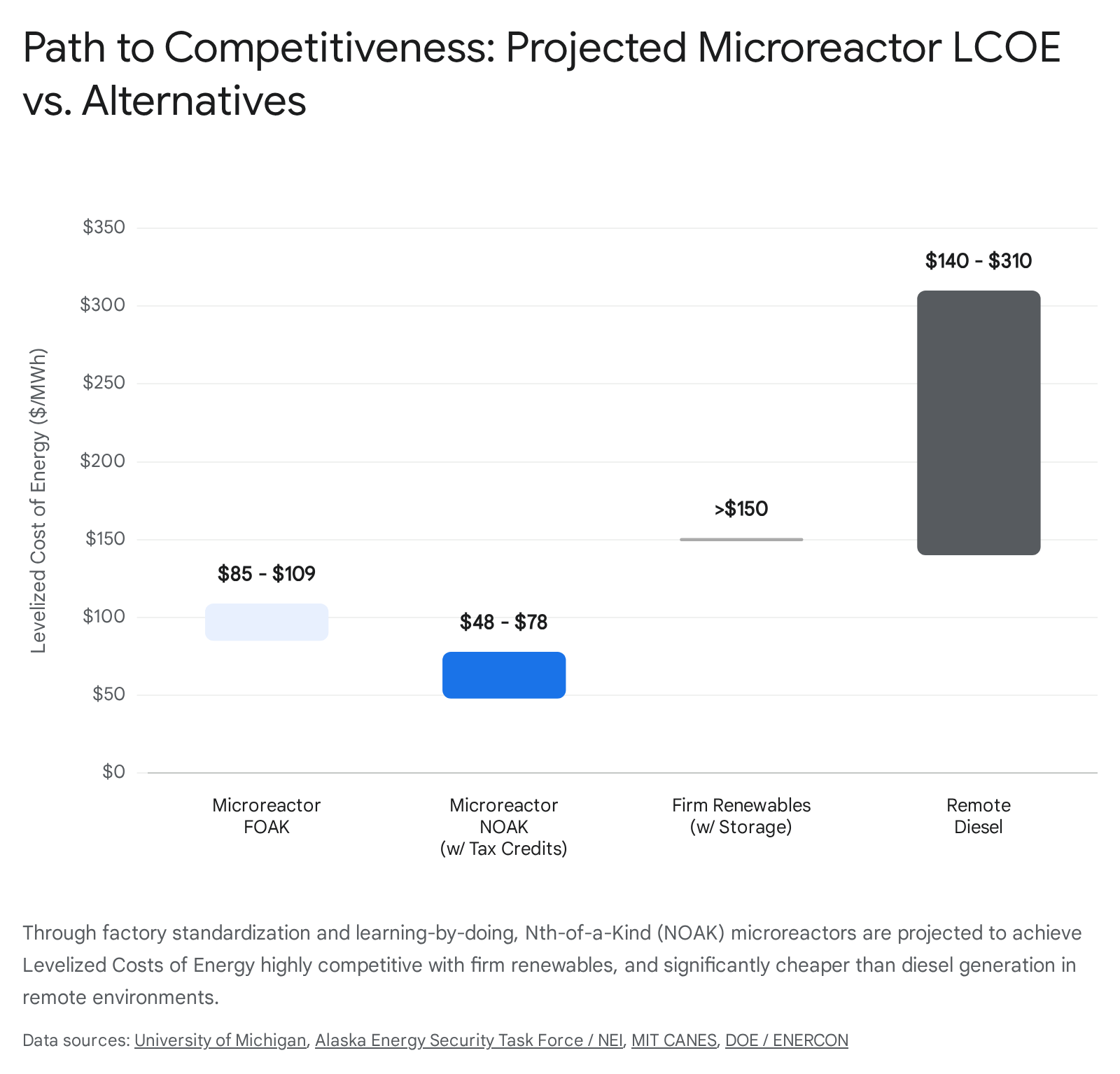
Initial First-of-a-Kind (FOAK) deployments are heavily burdened by high overnight capital costs, largely due to the immaturity of the specialized supply chain and the rigors of initial NRC licensing. U.S. Department of Energy estimates place FOAK microreactor overnight capital costs between $6,200 and $10,000 per kilowatt-electric (kWe).39 The corresponding FOAK Levelized Cost of Energy (LCOE) is estimated at an expensive $85 to $109 per MWh.39 SMR FOAK costs face similar hurdles, often requiring significant subsidies and subscription commitments to remain viable.
However, advanced probabilistic cost optimization frameworks—such as those utilizing Genetic Algorithms to model capital, operations and maintenance (O&M), and fuel costs—reveal that unit costs can decline sharply through learning-by-doing.8 Economic performance is most heavily influenced by overnight capital costs, with O&M and fuel cost variability playing comparatively smaller secondary roles.8 Optimization models demonstrate that achieving significantly lower LCOE requires a specific convergence of design parameters: maximizing the reactor rated capacity, utilizing lower-to-moderate fuel enrichments, extending refueling intervals, and achieving high discharge burnup.8
If developers reach Nth-of-a-Kind (NOAK) maturity—a plateau typically modeled to occur after 10 to 20 reactor installations—capital costs could compress substantially to approximately $3,600/kWe, reducing the base NOAK LCOE to $66/MWh.39 When augmented by aggressive policy incentives such as the U.S. Inflation Reduction Act’s Production Tax Credits (PTC) and Investment Tax Credits (ITC), optimized microreactor designs can achieve a highly competitive LCOE ranging between $48/MWh and $78/MWh.8 This dynamic has spurred interest globally; for example, Appalachian Power applied for an Early Site Permit (ESP) for an SMR in 2025, and the European Union is currently crafting a dedicated SMR strategy targeting deployment in the coming decade.
5.2 Capacity Relative to Costs: The Standardization vs. Customization Dilemma
The realization of these NOAK cost plateaus depends entirely on maintaining strict factory standardization. A “bottom-up” evaluation of learning rates highlights that capital-related expenses benefit most from medium-to-high learning effects, whereas permitting and land acquisition offer zero learning curve advantages.4 Yet, international market analysis indicates a severe strategic conflict: to generate sufficient demand to justify dedicated factory production lines, SMRs and MMRs must serve highly diverse use cases.7 The operational requirements for an arctic mining operation are vastly different from those of a military forward operating base, a university campus, or an archipelagic island grid.7
This diversity necessitates design customizability, which inherently clashes with the standardization required for steep economic learning rates.7 The industry will likely adopt a compromise strategy, utilizing a uniform “base” reactor block while offering modular, swappable variants for the power conversion and balance-of-plant systems.7
Furthermore, traditional macroeconomic financing metrics used for large nuclear projects—such as sovereign credit ratings and massive external debt structuring—are largely inapplicable to MMRs. The significantly lower total capital outlay of microreactors allows local entities with Limited Access to Local Capital (LOCCAP), such as mining corporations or tribal utility boards, to finance these units directly, bypassing the traditional utility megaproject bottleneck.27
6. Human and Environmental Risk Profiles: The Waste Calculus
While SMRs and MMRs offer distinct and undeniable advantages regarding operational safety and carbon displacement, the management of their backend nuclear fuel cycle remains a point of intense scientific, political, and environmental contention.
6.1 The Volume vs. Radiotoxicity Debate
A highly influential 2022 study by Krall et al., published in the Proceedings of the National Academy of Sciences (PNAS), severely disrupted industry claims regarding the environmental footprint of small reactors. The research assessed the low-, intermediate-, and high-level waste streams of several SMR and microreactor designs, concluding that the intrinsically higher neutron leakage associated with smaller, more compact cores fundamentally reduces neutron efficiency.14 Consequently, the study estimated that small modular and micro designs could increase the physical volume of nuclear waste requiring complex management and disposal by factors of 2 to 30 per unit of energy generated, compared to conventional gigawatt-scale light-water reactors (LWRs).14
Furthermore, the study asserted that SMRs are poised to discharge spent fuel with relatively high concentrations of fissile material, sharply elevating the risk of re-criticality events within deep geological repositories.41 The authors also warned that novel coolants, such as molten salt or sodium, introduce unique and highly reactive chemical challenges for long-term waste packaging and isolation.15
However, industry analysts and nuclear engineers have aggressively rebutted these findings, arguing that the Stanford-led study critically conflates waste volume with waste activity (radiotoxicity).42 Critics assert that the total quantity of highly radioactive isotopes generated by atomic fission is directly proportional to the thermal energy produced; therefore, an SMR or MMR will produce the exact same amount of fundamental radioactive fission products as a large reactor per unit of heat generated.42 While the physical volume of the encapsulating material—such as the bulky prismatic graphite blocks required in a TRISO-fueled HTGR—may be substantially larger, the actual radiological hazard to the environment does not multiply by a factor of 30.42 Moreover, some advanced SMR designs are being developed concurrently with innovative recycling strategies to fundamentally reduce the long-term high-level waste burden.31
Regardless of the volumetric debate, the decentralized deployment model of modular reactors will indisputably exacerbate the logistical complexity of waste management. Returning highly radioactive, factory-sealed modules from distributed remote locations to centralized decommissioning and repository facilities introduces unprecedented environmental and kinetic transport risks that current commercial nuclear frameworks are simply not equipped to manage at scale.45
7. Proliferation, Safeguards, and Physical Security Vulnerabilities
The high mobility and highly decentralized nature of SMRs and MMRs present acute challenges to the global non-proliferation regime and domestic physical security frameworks.
7.1 HALEU Proliferation Attractiveness and Enrichment Risks
While some Light-Water SMRs utilize standard LEU, most advanced SMRs and MMRs depend heavily on HALEU fuel to achieve extended operating cycles without continuous refueling.25 While HALEU (enriched up to 20% U-235) remains strictly below the technical threshold of highly enriched, weapons-grade uranium (≥90% U-235), it constitutes a significantly more attractive target for diversion by hostile state or non-state actors than the standard LEU (<5% U-235) utilized in conventional commercial fleets.12
Intelligence and safeguards analyses indicate that re-enriching HALEU from near 20% to weapons-grade levels requires only about 40% of the separative work units (SWU) or enrichment effort necessary to enrich standard commercial reactor fuel to the same threshold.48 Furthermore, certain advanced SMR and MMR concepts may revive strategic interest in spent fuel reprocessing; if the plutonium in spent HALEU is chemically separated without remaining mixed with the uranium, it significantly increases the latent capability of a state to covertly produce weapons-usable material.48 Consequently, widespread, global deployment of HALEU-fueled reactors will likely necessitate the application of tamper-evident seals and locks, verified by both shippers and receivers, and a vast increase in the frequency and intensity of international safeguard inspections.47
7.2 Physical Security Frameworks and Cyber Threat Matrices
Domestic physical security frameworks, established by the U.S. Nuclear Regulatory Commission (NRC) under 10 CFR §73.55, currently require extensive on-site response forces to interrupt and neutralize adversaries attempting theft of nuclear material or radiological sabotage.50 Implementing such robust, heavily armed security perimeters is economically ruinous and practically unfeasible for a small MMR deployed at an isolated mining site or an SMR on a university campus.46
While reactor designers convincingly argue that the exponentially smaller source term and passive safety systems drastically reduce the potential radiological consequences of a kinetic sabotage event, the small physical footprint of the reactor makes the unit inherently vulnerable to coordinated theft.52 Moreover, because SMRs and MMRs are explicitly designed for highly autonomous operation to reduce heavy overhead labor costs, they rely extensively on digital control systems and remote telemetry monitoring. This reliance radically expands the cyberattack surface, presenting severe technical and regulatory challenges regarding defense-in-depth.13
8. Transportability Challenges and Regulatory Frameworks
Moving a factory-fueled MMR module or massive SMR components through populated areas via highway, rail, barge, or air creates novel security and safety paradigms entirely foreign to the operation of stationary gigawatt-scale plants.1
Regulatory compliance relies heavily on rigorous Probabilistic Risk Assessments (PRA) evaluating kinetic collision-only, fire-only, and combined collision-and-fire accident events across various transport modes.1 Under international frameworks, such as the IAEA Specific Safety Guide No. 33, shipping an entire irradiated microreactor requires certification as a Type B package, which must withstand severe accident conditions—including massive structural shock and sustained high-temperature fires—without leaking.1 The transportation phase remains arguably the most vulnerable node in the entire modular reactor lifecycle regarding both kinetic sabotage and fissile material theft.53
9. Geopolitics of the Supply Chain: The HALEU Vulnerability
The most critical near-term bottleneck to the widespread commercialization of advanced SMRs and MMRs is the profound geopolitical fragility of the nuclear fuel supply chain.
9.1 Russian Dominance and Strategic Decoupling
Currently, the global uranium enrichment and conversion market is highly consolidated. Alarmingly, TENEX (a Russian state-owned enterprise) is currently the world’s only viable commercial supplier of HALEU.10 Following the 2022 Russian invasion of Ukraine, the reliance of Western nations on TENEX transformed overnight from an economic convenience into an acute diplomatic and national security crisis.10 Russia’s demonstrated willingness to weaponize energy exports underscored the strategic imperative for Western nations to permanently decouple from the Russian nuclear fuel cycle, lest the deployment of advanced SMRs and MMRs become a vector for Russian geopolitical coercion.11
9.2 Building Domestic Enrichment Capacity
Recognizing that the advanced nuclear renaissance cannot be fueled by adversarial states, the U.S. government has initiated aggressive, heavily funded interventions to forge a resilient domestic HALEU supply chain. The Energy Act of 2020 established the Advanced Nuclear Fuel Availability Program, which was subsequently supercharged by approximately $700 million from the Inflation Reduction Act (IRA).10 To force market compliance, the U.S. enacted a formal legislative ban on Russian uranium imports in 2024, utilizing carefully managed waivers through 2027 to stabilize the market while domestic capacity is constructed.26
At Centrus Energy’s Oak Ridge, Tennessee facility, a demonstration cascade utilizing the domestically produced AC100M centrifuge began manufacturing in late 2023.26 Utilizing a fully domestic manufacturing supply chain, Centrus produced over 920 kg of HALEU by mid-2025.26 Despite these massive capital injections, supply chain constraints will almost certainly bottleneck widespread advanced SMR and MMR deployments through the late 2020s.25
10. Strategic Deployment Case Study: The Philippines
The commercialization of SMRs and MMRs extends far beyond domestic corporate economics; it is increasingly utilized as a critical tool of modern geopolitics. The ongoing strategic maneuverings in the Republic of the Philippines illustrate precisely how the United States is utilizing advanced nuclear technology exports to cement bilateral alliances, counter rival state influence, and address critical energy security vulnerabilities in the Indo-Pacific theater.
10.1 The Archipelagic Energy Crisis and the BNPP Debate
The Philippines faces an acute, multifaceted energy trilemma: a rapidly growing population of over 116 million, an electricity demand projected to more than triple by 2040, and a heavy 80% reliance on imported fossil fuels.57 As an archipelago comprising over 7,000 islands, maintaining a centralized, interconnected grid infrastructure is highly inefficient and vulnerable to severe typhoons; therefore, the Philippines represents an optimal geographic and economic market for decentralized SMR and MMR deployment.59
Historically, the nation’s relationship with nuclear power has been fraught with controversy regarding the mothballed 621 MWe Bataan Nuclear Power Plant (BNPP).60 Under President Ferdinand Marcos Jr., the Philippines has aggressively revived its nuclear ambitions, formally targeting at least 1,200 MW of nuclear capacity by 2032.61 This directive has sparked a fierce domestic debate between two divergent nuclear strategies: rehabilitating the legacy gigawatt-scale BNPP or bypassing traditional technology entirely in favor of advanced SMRs and MMRs.
10.2 Nuclear Diplomacy: SMR and MMR Integration via the U.S. 123 Agreement
In late 2023, the strategic posture shifted decidedly toward advanced modular reactors when the United States and the Philippines signed a landmark Agreement for Cooperation in the Peaceful Uses of Nuclear Energy—commonly known as a “123 Agreement.”16
The U.S. government immediately leveraged this diplomatic breakthrough to embed American technology into the Philippine energy sector across both the SMR and MMR spectrums:
- SMR Feasibility: The U.S. Trade and Development Agency (USTDA) awarded a $2.7 million grant to Meralco PowerGen Corp (MGEN) to fund a comprehensive feasibility study evaluating advanced U.S.-designed SMRs, identifying viable sites, and delivering an implementation roadmap.67
- MMR Deployment: Concurrently, Meralco entered into a high-profile cooperative agreement with the U.S.-based Ultra Safe Nuclear Corporation (USNC) to specifically study the deployment of USNC’s 15 MWe high-temperature gas-cooled Micro-Modular Reactor (MMR) system.30
To further solidify long-term technological dependence and build local capacity, the U.S. State Department provided a $1.5 million NuScale VOYGR SMR control room simulator to establish a regional nuclear training hub in the Luzon Economic Corridor.16 Through these highly coordinated inter-agency actions, the United States achieves multiple geostrategic objectives: it secures a vital export market for nascent domestic nuclear technology and directly preempts Russian or Chinese state-backed nuclear entities from establishing long-term infrastructural footholds.65
11. Strategic Conclusions and Operational Outlook
The aggressive development and deployment of Small Modular Reactors and Micro Modular Reactors marks a critical inflection point in both the global energy transition and the international security architecture. From an engineering perspective, modern designs replace complex water cooling systems with passive heat pipes, advanced molten salts, and structurally impervious TRISO fuel, creating reactors that are fundamentally resilient to catastrophic meltdown.
Economically, however, the viability of these systems rests on an unproven hypothesis: that the heavily regulated nuclear industry can master the rapid, standardized discipline of factory mass-production. Recent setbacks, such as the cancellation of the NuScale CFPP, underscore that SMRs are highly vulnerable to FOAK cost overruns and complex subscription requirements. To achieve an LCOE truly competitive with remote diesel generation and firmed renewables, manufacturers must maintain rigid design standardization across hundreds of units, successfully making the transition from economies of scale to economies of volume.
Furthermore, the realization of advanced SMRs and MMRs is tethered to severe external and geopolitical risks. Their absolute dependence on HALEU fuel creates a critical vulnerability to Russian state influence until Western supply chains are fully insulated. Additionally, the highly decentralized deployment of HALEU-fueled reactors mandates an immediate and profound paradigm shift in international safeguards, domestic physical security frameworks, and transportation regulations to prevent nuclear material diversion and cyber sabotage.
Ultimately, SMRs and MMRs are not a panacea for the global clean energy transition. Instead, they represent highly specialized, technically sophisticated instruments designed for off-grid resilience, remote industrial applications, and geostrategic energy diplomacy. As evidenced by the rapid diplomatic maneuverings in the Philippines, nations that master the commercialization, fueling, and secure export of modular reactors will wield immense leverage in shaping the energy infrastructure and political alliances of the 21st century.
Please share the link on Facebook, Forums, with colleagues, etc. Your support is much appreciated and if you have any feedback, please email us in**@*********ps.com. If you’d like to request a report or order a reprint, please click here for the corresponding page to open in new tab.
Sources Used
- Microreactor Transportability Challenges – 21072 – INIS-IAEA, accessed April 23, 2026, https://inis.iaea.org/records/me6b9-3gn36
- Small Modular Reactors – World Nuclear Association, accessed April 23, 2026, https://world-nuclear.org/information-library/nuclear-power-reactors/small-modular-reactors/small-modular-reactors
- eVinci™ Microreactor | Westinghouse Nuclear, accessed April 23, 2026, https://westinghousenuclear.com/innovation/evinci-microreactor/
- An Economics-by-Design Approach Applied to a Heat Pipe Microreactor Concept – – INL Research Library Digital Repository – Idaho National Laboratory, accessed April 23, 2026, https://inldigitallibrary.inl.gov/sites/sti/sti/Sort_46104.pdf
- Full article: Review of Passive Heat Removal Strategies for Nuclear Microreactor Systems, accessed April 23, 2026, https://www.tandfonline.com/doi/full/10.1080/00295450.2022.2055701
- NAE Website – Chasing Cheap Nuclear: Economic Trade-Offs for Small Modular Reactors, accessed April 23, 2026, https://www.nae.edu/239267/Chasing-Cheap-Nuclear-Economic-TradeOffs-for-Small-Modular-Reactors
- Full article: Assessment of Factory Fabrication Considerations for Nuclear Microreactors – Taylor & Francis, accessed April 23, 2026, https://www.tandfonline.com/doi/full/10.1080/00295450.2023.2206779
- Evaluating the economic viability of microreactors across today’s …, accessed April 23, 2026, https://ners.engin.umich.edu/2025/12/01/evaluating-the-economic-viability-of-microreactors-across-todays-electricity-markets/
- 2024 Total Cost Projection of Next AP1000 – MIT, accessed April 23, 2026, https://web.mit.edu/kshirvan/www/research/ANP201%20TR%20CANES.pdf
- Developing Domestic HALEU Supply Spells Freedom from Russian Dependency, accessed April 23, 2026, https://www.thirdway.org/memo/developing-domestic-haleu-supply-spells-freedom-from-russian-dependency
- Securing America’s Energy Future with Domestic Uranium Enrichment – Nuclear Innovation Alliance, accessed April 23, 2026, https://nuclearinnovationalliance.org/sites/default/files/2025-04/NIA_Securing%20America%27s%20Energy%20Future%20with%20Domestic%20Uranium%20Enrichment.pdf
- Science & Tech Spotlight: Nuclear Microreactors | U.S. GAO, accessed April 23, 2026, https://www.gao.gov/products/gao-20-380sp
- Cybersecurity for Small Modular Reactors (SMRs): Regulatory Challenges and Opportunities, accessed April 23, 2026, https://resources.inmm.org/sites/default/files/2023-07/finalpaper_378_0512115036.pdf
- Small modular reactors produce high levels of nuclear waste – Stanford Report, accessed April 23, 2026, https://news.stanford.edu/stories/2022/05/small-modular-reactors-produce-high-levels-nuclear-waste
- Nuclear waste from small modular reactors – PubMed, accessed April 23, 2026, https://pubmed.ncbi.nlm.nih.gov/35639689/
- Fact Sheet: U.S.-Philippines Civilian Nuclear Cooperation, accessed April 23, 2026, https://ph.usembassy.gov/fact-sheet-u-s-philippines-civilian-nuclear-cooperation/
- Nuclear accord signed between USA and Philippines, accessed April 23, 2026, https://www.world-nuclear-news.org/articles/nuclear-accord-signed-between-usa-and-philippines
- Hold on! Did you know that microreactors were field deployed over 60 years ago?, accessed April 23, 2026, https://inl.gov/feature-story/hold-on-did-you-know-that-microreactors-were-field-deployed-over-60-years-ago/
- Army Nuclear Power Program – U.S. Army Corps of Engineers, accessed April 23, 2026, https://www.usace.army.mil/About/History/Exhibits/Nuclear-Power-Program/
- ML-1 – Wikipedia, accessed April 23, 2026, https://en.wikipedia.org/wiki/ML-1
- The US Army tried portable nuclear power at remote bases 60 years ago – it didn’t go well, accessed April 23, 2026, https://www.arcticfocus.org/stories/the-us-army-tried-portable-nuclear-power-at-remote-bases-60-years-ago-it-didnt-go-well/
- 5 Advanced Reactor Designs to Watch in 2030 | Department of Energy, accessed April 23, 2026, https://www.energy.gov/ne/articles/5-advanced-reactor-designs-watch-2030
- advanced nuclear reactor, accessed April 23, 2026, https://nuclearinnovationalliance.org/sites/default/files/2025-11/Primer%20%282025%29%20%281%29.pdf
- WM2021 Conference, March 8 – 12, 2021, Phoenix, Arizona, USA 1 Microreactor Transportability Challenges, accessed April 23, 2026, https://www.pnnl.gov/sites/default/files/media/file/MicroreactorTransportability_PNNL_WMS_2021.pdf
- The Drive to Establish Domestic HALEU Supply Chains is a Gambit – The National Interest, accessed April 23, 2026, https://nationalinterest.org/blog/energy-world/the-drive-to-establish-domestic-haleu-supply-chains-is-a-gambit
- High-Assay Low-Enriched Uranium (HALEU) – World Nuclear Association, accessed April 23, 2026, https://world-nuclear.org/information-library/nuclear-fuel-cycle/conversion-enrichment-and-fabrication/high-assay-low-enriched-uranium-haleu
- Global Market Analysis of Microreactors – Gateway for Accelerated Innovation in Nuclear (GAIN) – Idaho National Laboratory, accessed April 23, 2026, https://gain.inl.gov/content/uploads/4/2024/04/Document-INL-EXT-21-63214.pdf
- Improvement and Validation of the System Analysis Model and Code for Heat-Pipe-Cooled Microreactor – MDPI, accessed April 23, 2026, https://www.mdpi.com/1996-1073/15/7/2586
- Multi-Physics Simulations of Heat Pipe Micro Reactor – Argonne Scientific Publications, accessed April 23, 2026, https://publications.anl.gov/anlpubs/2019/10/155817.pdf
- Philippines considers deploying USNC microreactors – World Nuclear News, accessed April 23, 2026, https://www.world-nuclear-news.org/articles/philippines-considers-deploying-usnc-microreactors
- The NEA Small Modular Reactor Dashboard: Third Edition, accessed April 23, 2026, https://www.oecd-nea.org/upload/docs/application/pdf/2025-09/web_-_smr_dashboard_-_third_edition.pdf
- Initial development for the introduction of provisions for irradiation effects in Division 5 rules, accessed April 23, 2026, https://publications.anl.gov/anlpubs/2020/10/162862.pdf
- Effects of Heat Pipe Failures in Microreactors, accessed April 23, 2026, https://gain.inl.gov/content/uploads/4/2024/04/Document-LA-UA-20-23798.pdf
- Operation and Security Considerations for Heat Pipe Cooled Microreactors – – INL Research Library Digital Repository – Idaho National Laboratory, accessed April 23, 2026, https://inldigitallibrary.inl.gov/sites/sti/sti/Sort_125075.pdf
- Assessment of Microreactor Safety Analysis Challenges and Recommendations for Utilization of the Comprehensive Reactor Analysis – INFO – Oak Ridge National Laboratory, accessed April 23, 2026, https://info.ornl.gov/sites/publications/Files/Pub204154.pdf
- Heat Pipe Microreactor SCALE & MELCOR Source Term & Fuel Cycle Demonstration Project – Nuclear Regulatory Commission, accessed April 23, 2026, https://www.nrc.gov/docs/ML2508/ML25084A173.pdf
- COST PROJECTIONS OF SMALL MODULAR REACTORS: A Model-Based Analysis, accessed April 23, 2026, https://conferences.iaea.org/event/374/papers/31012/files/12710-IAEA_Paper-57_SMR_final_V3.pdf
- Are SMRs Actually More Economical than Regular Reactors? : r/nuclear – Reddit, accessed April 23, 2026, https://www.reddit.com/r/nuclear/comments/tcl1xo/are_smrs_actually_more_economical_than_regular/
- Status of New Nuclear – Novi AMS, accessed April 23, 2026, https://assets.noviams.com/novi-file-uploads/fmea/Presentations/2023_ECC/EO_5_ENERCON_2-ecd28a30.pdf
- Research and Perspective: Small Modular Reactors | FSI – Stanford University, accessed April 23, 2026, https://fsi.stanford.edu/news/research-and-perspective-small-modular-reactors
- A Critical Analysis Of The Nuclear Waste Management Consequences For Small Modular Reactors – Center for International Security and Cooperation, accessed April 23, 2026, https://cisac.fsi.stanford.edu/events/critical-analysis-nuclear-waste-management-consequences-small-modular-reactors
- Five Things the “Nuclear Bros” Don’t Want You to Know About Small Modular Reactors, accessed April 23, 2026, https://blog.ucs.org/edwin-lyman/five-things-the-nuclear-bros-dont-want-you-to-know-about-small-modular-reactors/
- How Does SMR Waste Compare to Conventional Reactors? → Question, accessed April 23, 2026, https://energy.sustainability-directory.com/question/how-does-smr-waste-compare-to-conventional-reactors/
- Stanford-led research finds small modular reactors will exacerbate challenges of highly radioactive nuclear waste – Reddit, accessed April 23, 2026, https://www.reddit.com/r/nuclear/comments/v18g2o/stanfordled_research_finds_small_modular_reactors/
- Small Modular Reactors and Microreactors: A Review of Safety, Economics, Regulation, and Environmental Impacts in Energy Transition | AltEnergyMag, accessed April 23, 2026, https://www.altenergymag.com/article/2025/10/small-modular-reactors-and-microreactors-a-review-of-safety-economics-regulation-and-environmental-impacts-in-energy-transition/46272
- Micro Nuclear Reactors Can Help Solve the Climate Crisis – Bradley Newsad, accessed April 23, 2026, https://law.lclark.edu/live/blogs/227-micro-nuclear-reactors-can-help-solve-the-climate
- PRO-X Transportation Global Landscape – OSTI, accessed April 23, 2026, https://www.osti.gov/servlets/purl/2430793
- HALEU: Potential Safeguards and Non-Proliferation Implications, accessed April 23, 2026, https://vcdnp.org/haleu-potential-safeguards-and-non-proliferation-implications/
- NNSA Administrator Jill Hruby Issues Statement on Understanding and Assessing the Risks Associated with HALEU | Department of Energy, accessed April 23, 2026, https://www.energy.gov/nnsa/articles/nnsa-administrator-jill-hruby-issues-statement-understanding-and-assessing-risks
- U.S. Domestic Microreactor Security-by- Design – Sandia National Laboratories, accessed April 23, 2026, https://www.sandia.gov/app/uploads/sites/273/2022/07/US_DomesticMicroreactorSecurity-bydesignSAND2021-13779_R-1.pdf
- Physical Protection Recommendations for Small Modular Reactor Facilities – OSTI, accessed April 23, 2026, https://www.osti.gov/servlets/purl/1837151
- Chapter: 9 Ensuring Security and Promoting Safeguards – Read “Laying the Foundation for New and Advanced Nuclear Reactors in the United States” at NAP.edu, accessed April 23, 2026, https://www.nationalacademies.org/read/26630/chapter/11
- Integration of Safety, Security, and Safeguards During Design and Operations – Nuclear Regulatory Commission, accessed April 23, 2026, https://www.nrc.gov/docs/ML2427/ML24275A075.pdf
- Key Regulatory Issues in Nuclear Microreactor Transport and Siting – – INL Research Library Digital Repository – Idaho National Laboratory, accessed April 23, 2026, https://inldigitallibrary.inl.gov/sites/sti/sti/Sort_18717.pdf
- Fully Fueled: Strengthening America’s Nuclear Toolkit | Third Way, accessed April 23, 2026, https://www.thirdway.org/memo/fully-fueled-strengthening-americas-nuclear-toolkit
- US Domestic Uranium Enrichment Expansion Plans 2026 – Discovery Alert, accessed April 23, 2026, https://discoveryalert.com.au/american-nuclear-energy-strategy-2026-enrichment/
- Nuclear Power in the Philippines, accessed April 23, 2026, https://world-nuclear.org/information-library/country-profiles/countries-o-s/philippines
- The Philippines’ Nuclear Gamble: Reviving Bataan After 40 Years – The Energy Pioneer, accessed April 23, 2026, https://theenergypioneer.com/the-philippines-nuclear-gamble/
- Philippines / Utility Applying For US Grant For SMR Feasibility Study – NucNet, accessed April 23, 2026, https://www.nucnet.org/news/utility-applying-for-us-grant-for-smr-feasibility-study-12-3-2022
- Bataan Nuclear Power Plant vs Renewables: Why a $1 Billion Revival Could Beat Solar, Wind and Battery Costs for the Philippines – Gulf News, accessed April 23, 2026, https://gulfnews.com/opinion/op-eds/nuclear-revival-or-renewable-mirage-why-bataans-1-billion-fix-beats-the-solar-wind-hydroelectric-battery-tax-1.500492462
- America Backs First Manila SMR Study: The New Nuclear Roadmap for Philippine Power, accessed April 23, 2026, https://carboncredits.com/america-backs-first-manila-smr-study-the-new-nuclear-roadmap-for-philippine-power/
- Meralco considers rehabilitation of Bataan – Nuclear Engineering International, accessed April 23, 2026, https://www.neimagazine.com/news/meralco-considers-rehabilitation-of-bataan/
- Newest 123 Agreements – Partnership for Global Security, accessed April 23, 2026, https://partnershipforglobalsecurity.org/newest-123-agreements/
- US supports Philippines SMRs – Nuclear Engineering International, accessed April 23, 2026, https://www.neimagazine.com/news/us-support-for-philippines-smrs/
- Philippines / KHNP To Conduct Study On Revival Of Bataan Nuclear Plant, Say Reports, accessed April 23, 2026, https://www.nucnet.org/news/khnp-to-conduct-study-on-revival-of-bataan-nuclear-plant-say-reports-10-1-2024
- USTDA Brings U.S. Small Modular Reactor Technology to Strengthen Philippines Energy Security, accessed April 23, 2026, https://www.ustda.gov/ustda-brings-u-s-small-modular-reactor-technology-to-strengthen-philippines-energy-security/
- USA touts SMR designs to the Philippines – World Nuclear News, accessed April 23, 2026, https://www.world-nuclear-news.org/articles/us-touts-smr-designs-to-the-philippines