1. Executive Summary
During the week of July 20, 2026, the maritime security environment in the South China Sea experienced a significant destabilization event centered on a contested interdiction at Second Thomas Shoal.1 This incident involved direct hand-to-hand combat between personnel of the China Coast Guard (CCG) and the Armed Forces of the Philippines (AFP), resulting in a severe physical casualty and material damage. The engagement signifies a distinct tactical evolution in regional grey-zone operations, moving beyond the established parameters of non-contact coercion—such as acoustic devices or water cannons—into direct physical altercations utilizing non-ballistic melee weapons including wooden batons, long poles, and oars.2 The confrontation effectively tested the operational thresholds of the 1951 Mutual Defense Treaty (MDT) between the United States and the Philippines by operating deliberately below the threshold of a conventional kinetic firearm exchange, thereby complicating the criteria necessary for a formal treaty invocation.4
In immediate response to the tactical shifts in the region, the United States executed a structural realignment of its maritime deterrence posture. The United States Coast Guard (USCG) redeployed an expeditionary cutter squadron, consisting of six Sentinel-class fast response cutters, from the Middle East to forward-operating bases in Singapore and Subic Bay, Philippines.6 This deployment aims to directly counter Beijing’s reliance on non-military “white hull” coast guard vessels and maritime militia by introducing a symmetric, law-enforcement-oriented American presence into the contested waters.6 Concurrently, the physical confrontation was accompanied by an intense cognitive and information warfare campaign characterized by the dissemination of manipulated video footage and artificial intelligence-generated propaganda by Chinese state media, which prompted formal diplomatic protests from the Philippine Department of Foreign Affairs (DFA).9
The diplomatic fallout from the July 2026 incident extended to the highest levels of global engagement, dominating the agenda of the Association of Southeast Asian Nations (ASEAN) foreign ministers’ meeting in Manila.11 The event prompted direct consultations between Philippine President Ferdinand Marcos Jr. and United States President Donald Trump regarding future dialogues with Chinese President Xi Jinping.11 The collapse of a prior bilateral tension-reduction agreement surrounding Second Thomas Shoal indicates a return to highly volatile localized flashpoints, necessitating a recalibration of allied deterrence strategies in the West Philippine Sea.5
2. Historical Baseline and Strategic Geography
To accurately assess the tactical severity of the July 2026 confrontation, it is necessary to examine the historical baseline of the territorial dispute at Second Thomas Shoal. The geographic feature, known as Ayungin Shoal in the Philippines and Ren’ai Jiao in China, is a submerged reef located within the Philippines’ 200-nautical-mile exclusive economic zone (EEZ).2 The feature has served as a central focal point of Sino-Philippine maritime tensions since May 9, 1999.13 On that date, during the administration of Philippine President Joseph Estrada, the Philippine Navy executed an operation to ground the BRP Sierra Madre, a World War II-era tank landing ship, onto the reef flat of the shoal’s northwest side.13
The grounding was initially presented by the Philippine government as an operational necessity resulting from a leaking hull.13 However, the strategic intent was fundamentally territorial. According to historical recollections by then-Philippine Defense Secretary Olli Mercado, the operation was executed to establish a permanent military outpost.13 Mercado’s decision was a direct response to proposals by senior Philippine Armed Forces generals aiming to monitor and counter China’s incremental occupation of maritime features in the South China Sea, a strategy Philippine authorities termed a “slowly advancing occupation”.13 For over two decades, the rusting vessel has functioned as a stationary, unsinkable extension of Philippine territorial claims, requiring regular rotation and resupply (RORE) missions to sustain a small contingent of Philippine marines stationed aboard.13 Following Mercado, Philippine Secretary of Defense Luisto Fernandez affirmed that despite the vessel’s dilapidated condition, its placement on the seabed constituted a physical extension of Philippine territory.13
The legal framework governing this maritime space was clarified by the 2016 Arbitral Tribunal Ruling in The Hague.14 The tribunal invalidated Beijing’s sweeping “nine-dash line” sovereignty claims over the South China Sea and affirmed the Philippines’ sovereign rights over its EEZ, which explicitly includes Ayungin Shoal.4 Despite the ruling being final and legally binding under the United Nations Convention on the Law of the Sea (UNCLOS), the People’s Republic of China has consistently rejected the tribunal’s authority and jurisdiction.3 In defiance of the ruling, Beijing has maintained continuous rotational patrols of CCG and People’s Armed Forces Maritime Militia (PAFMM) vessels to intercept and blockade Philippine resupply efforts directed at the BRP Sierra Madre.3
Tensions at Second Thomas Shoal had briefly stabilized following a rare diplomatic breakthrough in July 2024, when Beijing and Manila signed a bilateral agreement designed to ease frictions during Philippine resupply missions.5 This agreement, observed by regional analysts as a significant victory for bilateral diplomacy, reduced Chinese coercive activity at the shoal for nearly two years.5 Consequently, the locus of maritime aggression temporarily shifted to other features, notably Scarborough Shoal (Bajo de Masinloc), located approximately 120 nautical miles from the main Philippine island of Luzon.1 At Scarborough Shoal, Chinese forces—including CCG vessels, maritime militia ships, and People’s Liberation Army Navy (PLAN) warships—conducted blockades, installed temporary floating barriers, and broadcasted intentions to execute “clearing operations” against Filipino fishermen operating within their own EEZ.1
The July 20, 2026 incident represents a sudden collapse of the 2024 bilateral agreement regarding Second Thomas Shoal.5 The return of this specific feature as a primary site of kinetic grey-zone conflict signifies a deliberate strategic regression by Beijing. By resuming coercive interdictions at the site of the BRP Sierra Madre, Chinese forces have signaled an intent to re-escalate localized flashpoints, thereby fracturing the tenuous stability that had characterized the preceding twenty-four months and expanding the active zones of conflict within the South China Sea.5
3. Tactical Reconstruction of the July 20, 2026 Engagement
The operational execution of the July 20 engagement demonstrates a calculated application of physical force designed to inflict damage and assert dominance while evading the strict definitions of a conventional military attack. The incident commenced during the morning hours, specifically at approximately 9:15 AM local time (0115 GMT).2 At this time, China Coast Guard vessel 21560, operating well within the Philippine EEZ, deployed a rigid-hull inflatable boat (RHIB) carrying eight CCG personnel.2
The CCG RHIB executed a deliberate, high-speed approach toward the grounded BRP Sierra Madre, closing the distance to within a highly sensitive defensive perimeter.2 According to statements released by the Armed Forces of the Philippines, the Chinese vessel breached a 30-meter proximity threshold, circling the Philippine warship while personnel actively recorded the installation via photographs and video.9 The AFP classified this maneuver as an unlawful intrusion into an area where the Philippines exercises sovereign rights, a classification that aligns with UNCLOS parameters regarding coastal state jurisdiction over artificial islands, installations, and structures within the EEZ.9
In response to the incursion, the Philippine Navy deployed two rubber boats in what military officials described as a “measured, non-confrontational effort” to direct the Chinese vessel away from the grounded ship.9 Philippine personnel issued repeated verbal instructions for the CCG RHIB to withdraw from the immediate vicinity.2
| Time (Local/GMT) | Actor | Action | Strategic Classification |
| 09:15 / 0115 | CCG Vessel 21560 | Deploys RHIB with eight personnel near BRP Sierra Madre.2 | Grey-Zone Incursion |
| 09:15 – 09:30 | CCG RHIB | Breaches 30-meter perimeter; conducts surveillance and photography.9 | Unlawful Intrusion |
| 09:30 – 09:40 | Philippine Navy | Deploys two rubber boats; issues verbal warnings to withdraw.2 | Measured Defensive Response |
| 09:40 – 09:55 | CCG / PN Personnel | Physical clash commences involving oars, poles, and batons.1 | Kinetic Grey-Zone Escalation |
| 09:55 – 10:15 | CCG Personnel | Strikes PN sailor in the head with a wooden baton; damages PN rubber boat.3 | Physical Assault / Material Damage |
| Post-Incident | AFP Western Command | Administers medical treatment; evaluates need for medical evacuation.3 | Casualty Management |
The situation escalated precipitously when the Chinese crew refused the directives to alter their vector. The encounter quickly devolved from a naval standoff into a physical, hand-to-hand altercation at sea.
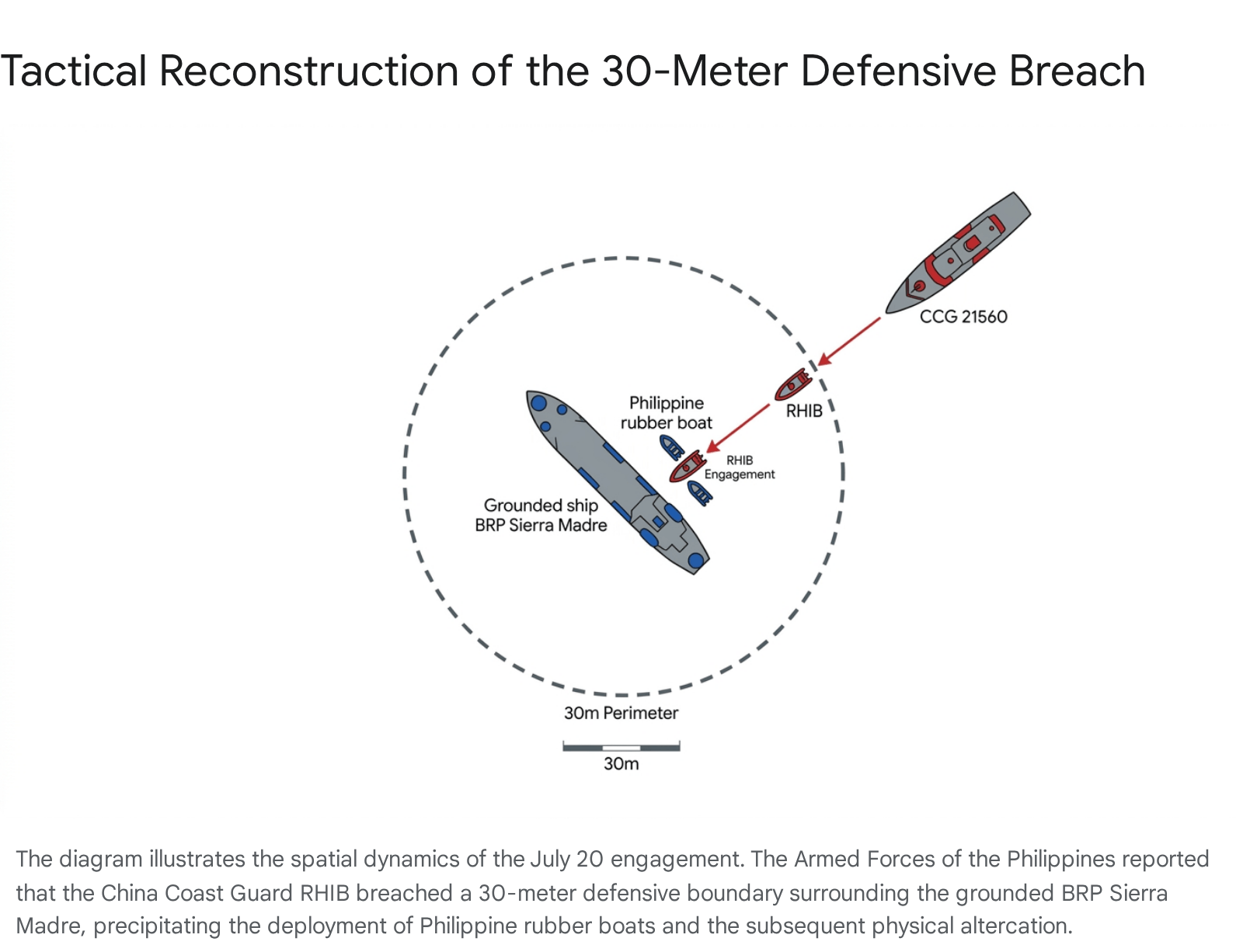
The physical clash involved the weaponization of standard maritime equipment. Personnel from both sides engaged in combat using fists, oars, and long wooden poles.1 During the melee, the Chinese personnel reacted aggressively, utilizing a wooden baton to strike a Philippine Navy sailor directly on the head.3 The blunt-force trauma resulted in a severe injury that required immediate medical attention, with the AFP Western Command subsequently treating the casualty and evaluating the necessity of a medical evacuation from the remote outpost.3 Furthermore, the physical ramming and the use of poles caused material damage to the Philippine Navy rubber boat operating in the sector.3
The narrative regarding the initiation of the physical violence remains divergent, reflecting standard operating procedures in grey-zone engagements where plausible deniability is prioritized. The China Coast Guard released a statement claiming that the Philippine rubber boats approached their patrol vessel at high speed, ignored repeated warnings, and attempted to surround and ram the Chinese craft.2 Beijing further alleged that the Philippine personnel initiated the physical attack by utilizing paddles and long poles against Chinese law enforcement officers.2 The CCG maintained that its officers exercised “maximum restraint and rationality,” responding only with verbal warnings and “corresponding countermeasures” to stabilize the situation in accordance with maritime law.2 Additionally, Chinese state media claimed that the CCG permitted the evacuation of the injured Filipino sailor on humanitarian grounds.1
The Armed Forces of the Philippines categorically rejected the Chinese narrative, labeling it “false and misleading”.9 Philippine military spokespersons underscored that the deployment of their rubber boats was inherently defensive and that the Filipino troops exercised strict discipline and restraint within the established rules of engagement.9 Rear Admiral Roy Vincent Trinidad, the AFP spokesperson for the West Philippine Sea, highlighted that professionalism should not be mistaken for weakness, drawing explicit parallels to a previous incident on June 17, 2024, where CCG personnel also conducted coercive and violent actions against Filipino troops engaged in routine RORE missions.9 The AFP emphasized that the root of the escalation was the CCG’s unlawful intrusion into the 30-meter proximity zone and their subsequent refusal to withdraw upon request.9
4. The Cognitive Domain and Information Warfare
The kinetic engagement at sea was immediately followed, and preceded, by a synchronized campaign in the cognitive and information domains. Beijing utilized state-aligned media apparatuses and digital manipulation to control the narrative, framing the Philippines as the aggressor. The information warfare strategy was bipartite, relying on both selectively edited tactical footage and racially charged, AI-generated propaganda.
Following the incident, Chinese state media outlets released what they termed high-definition video of the clash, recorded by CCG personnel.1 The footage was purportedly designed to demonstrate Philippine vessels harassing and ramming the Chinese patrol boat.2 The Chinese outlets also alleged that Philippine personnel aboard vessel No. 57 had recorded the incident and transmitted the material via a Starlink satellite connection, accusing Manila of selectively editing the footage they released to the public.1
The AFP swiftly countered this narrative by analyzing the Chinese-provided footage. Rear Admiral Trinidad stated that the video released by Beijing was itself spliced, incomplete, and highly self-incriminating.9 He noted that by omitting the beginning of the encounter, the Chinese footage attempted to obscure the initial, unlawful approach of the CCG RHIB toward the BRP Sierra Madre.9 Trinidad pointed out that even in the edited video, the extreme proximity of the Chinese vessels to the grounded Philippine ship was evident, effectively proving the AFP’s assertion that the Chinese forces had breached the defensive perimeter and provoked the confrontation.9
In parallel with the tactical disinformation, the cognitive warfare campaign involved the use of offensive media designed to degrade the diplomatic standing and psychological resolve of the Philippines. On July 10, 2026, days prior to the physical clash and coinciding with the 10th anniversary of the 2016 arbitral award, the state-run China Daily published an AI-generated video and a series of editorial cartoons on its social media platforms.10 The materials portrayed Filipinos in a demeaning and dehumanizing manner, specifically depicting them as monkeys while mocking the Philippine legal victory regarding the South China Sea.10
This racially charged propaganda triggered an immediate and severe diplomatic response from Manila. The Philippine Department of Foreign Affairs lodged a formal diplomatic protest against China.10 Foreign Affairs Undersecretary Leo Herrera-Lim directly engaged with Chinese Ambassador Jing Quan during a meeting on July 16, demanding the immediate removal of the offensive materials.10 The DFA stated that while political and legal differences exist regarding the South China Sea, the use of racist depictions went far beyond legitimate political discourse, undermining the mutual respect expected between sovereign states and destabilizing bilateral relations.10 The Philippine Embassy in Beijing concurrently sent formal demands to the editor-in-chief of China Daily, reiterating the request for removal.15 The integration of physical violence at sea with synchronized, AI-driven racial propaganda indicates a holistic approach by Beijing to apply pressure across both physical and psychological vectors, aiming to exhaust Philippine diplomatic and operational bandwidth.
5. Stress-Testing the Mutual Defense Architecture
The tactical choice by the China Coast Guard to employ hand-to-hand combat utilizing non-ballistic weapons—such as batons and oars—is a manifestation of modern grey-zone theory. By inflicting physical trauma and material damage without discharging conventional firearms, the CCG successfully tests the operational and legal thresholds of the 1951 Mutual Defense Treaty (MDT) between the United States and the Philippines.4
The MDT’s invocation, particularly under Article IV, relies on the occurrence of an “armed attack” on the metropolitan territory of either party, or on the island territories under its jurisdiction in the Pacific Ocean, its armed forces, public vessels, or aircraft.4 In the contemporary maritime environment, the definition of an “armed attack” is continuously challenged by adversarial actors operating deliberately below the threshold of conventional war. The July 2026 incident presented a complex legal and strategic dilemma for alliance managers: a public vessel of the Philippine Navy (the rubber boat) and its armed forces personnel were subjected to an organized, violent assault by foreign state agents resulting in casualties, yet the strict absence of conventional munitions complicates the automatic triggering of a military response under traditional interpretations of the treaty.3
The response from the alliance architecture was robust in its rhetoric, though carefully calibrated to manage the escalation ladder. Following the incident, AFP Chief of Staff General Romeo Brawner and the Chairman of the Joint Chiefs of Staff of the United States military, General Charles Brown, engaged in high-level strategic dialogues via telephone.21 The military leaders reaffirmed their ironclad commitment to the alliance, discussing mutual strategic security interests and exploring opportunities for increased military cooperation to counter the worsening illegal activities of the CCG and maritime militia targeting RORE missions.21
The United States Department of State swiftly issued a condemnation of the attack. Washington denounced the CCG’s actions as “dangerous and escalatory,” categorizing them as part of a “troubling pattern of provocation” against lawful Philippine maritime operations.14 U.S. officials reiterated that the 2016 arbitral ruling is final and binding, and affirmed that the United States would honor its treaty obligations as the allies confront new coercive threats.14
| Condemning Entity | Key Statement / Stance | Strategic Implication |
| United States | Condemned “dangerous and escalatory actions”; reaffirmed MDT commitments.14 | Reinforces alliance architecture while signaling boundaries to Beijing. |
| Japan | Expressed serious concern over aggressive actions; emphasized free and open international order.22 | Aligns regional maritime democracies against unilateral coercion. |
| Australia | Ambassador Marc Innes-Brown cited concern over destabilizing and dangerous conduct.22 | Expands the diplomatic coalition resisting grey-zone tactics. |
| European Union | Opposed unilateral actions endangering safety and threatening the rules-based order.22 | Internationalizes the dispute, increasing diplomatic costs for Beijing. |
| Philippines (PCG/DND) | Condemned “unruly and barbaric” actions; justified position of disengagement due to deficit of trust.3 | Hardens domestic resolve; prepares legal and moral ground for escalated self-defense measures. |
The international community mirrored this condemnation, expanding the diplomatic pressure on Beijing. The European Union, representing 27 member nations, expressed deep concern over the steady increase in dangerous incidents, firmly opposing unilateral actions that endanger maritime personnel and undermine the international rules-based order.22 The Japanese embassy in the Philippines voiced serious concern over the aggressive actions, aligning Tokyo with efforts to maintain a free and open international order.22 Australia, through its ambassador to the Philippines, Marc Innes-Brown, explicitly condemned the destabilizing conduct of Chinese vessels toward Philippine vessels.22
Within the Philippines, the reaction was characterized by a hardening of strategic resolve. Philippine Coast Guard Commodore Jay Tarriela sharply criticized the CCG, stating, “The provocateur is not the one staying home in his own waters. It is the one who sailed hundreds of miles to swing a baton at him!”.22 Furthermore, Philippine defense officials, including DND spokesperson Assistant Secretary Arsenio Andolong, utilized the incident to justify a formal position of disengagement with China, citing a deficit of trust and declaring that the Philippines “simply cannot trust this belligerent neighbor”.3 Andolong emphasized that the DND would focus on strengthening deterrence and shoring up alliances to safeguard national territory, asserting, “We will not back down”.3
6. Strategic Realignment: The U.S. Coast Guard Deployment
In a direct operational response to the shifting tactical reality in the South China Sea, the United States executed a highly significant strategic realignment of its maritime forces. Concluding its mission under Operation Prosperity Guardian following a ceasefire with Houthi forces in the Middle East, the United States Coast Guard redeployed an entire expeditionary cutter squadron to the Western Pacific.6
The squadron, which previously operated out of Bahrain under the designation Patrol Forces Southwest Asia (PATFORSWA), comprises six Sentinel-class fast response cutters, including the USCGC Emlen Tunnell.6 These 46.9-meter-long patrol vessels are specifically engineered for maritime security, interdiction, coastal patrol, and partner-capacity-building missions.6 Under the new operational framework, the squadron is actively supporting the U.S. Indo-Pacific Command (INDOPACOM).6 Singapore is serving as the primary command and logistics hub, while the cutters will rotate through forward-operating locations at Subic Bay in the Philippines.6 The deployment is approved through September 2026, subject to operational requirements.6
This redeployment represents a paradigm shift in how the United States approaches the grey-zone challenge posed by China. Traditionally, the U.S. Navy has operated strictly as a military force characterized by “grey hulls,” which creates an asymmetrical escalation ladder when confronting China’s Coast Guard, characterized by “white hulls,” and its nominally civilian maritime militia.8 If a U.S. Navy destroyer were to intervene in a skirmish between coast guard vessels, Beijing could easily frame the United States as the militaristic aggressor disproportionately escalating a civilian law enforcement dispute.
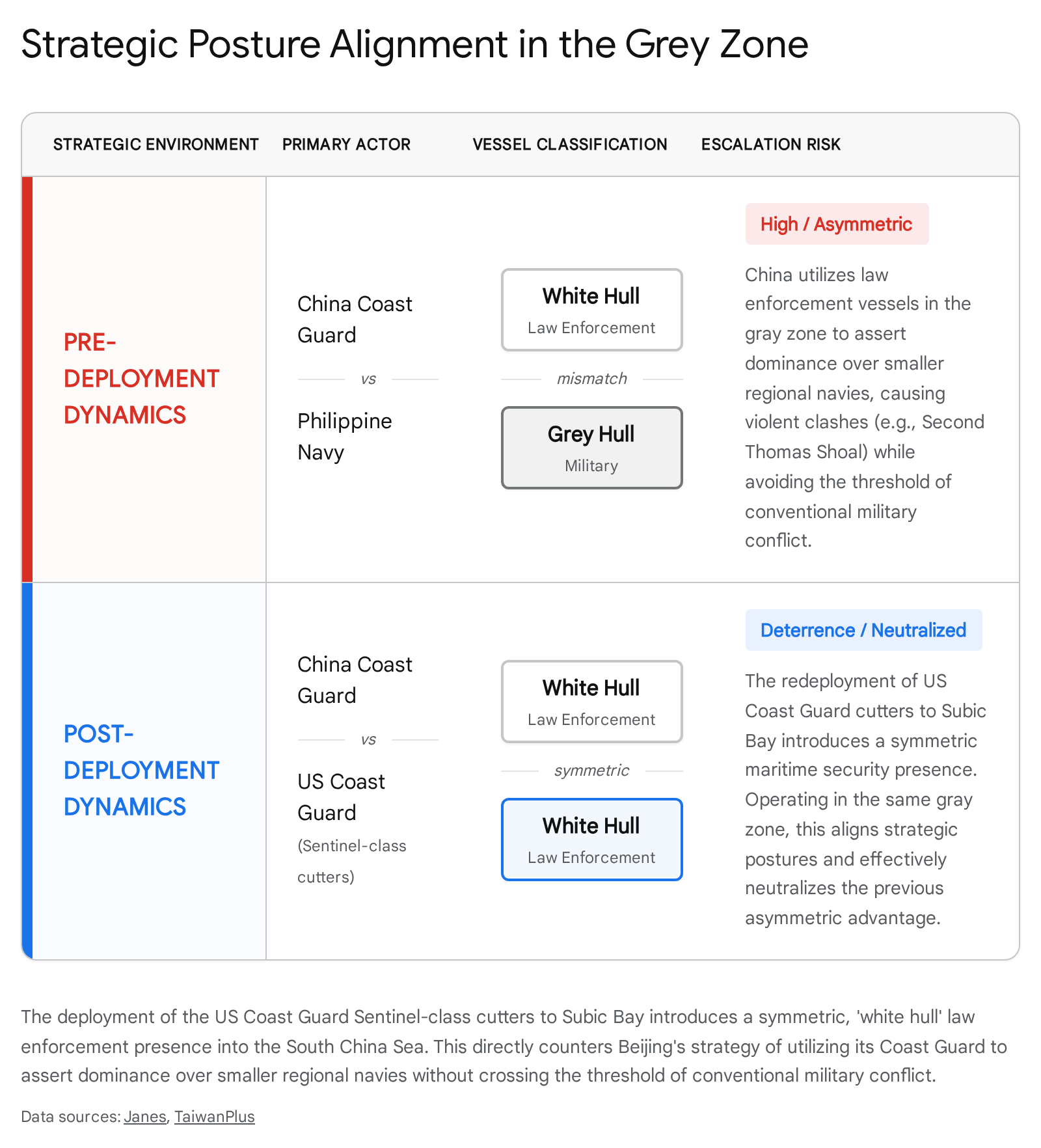
By injecting a highly capable U.S. Coast Guard squadron into the region, Washington has deployed law enforcement vessels explicitly designed to operate within the exact same grey zone that Beijing has increasingly utilized.8 A U.S. Coast Guard spokesperson indicated that operations from Singapore and Subic Bay are intended to “protect the homeland and maritime approaches including Guam and the Pacific Islands,” while promoting adherence to international law alongside regional partners.6 The spokesperson notably added that the Coast Guard would not characterize the actions or intentions of other nations, maintaining a strict law enforcement posture.6 Financial and geopolitical market analysts have noted that this move suggests a strategic shift in U.S. military focus toward the Indo-Pacific, actively countering China’s maritime tactics and potentially stabilizing the odds of broader military clashes, including a Chinese invasion of Taiwan, in the near term.7
7. Superpower Diplomacy and Regional Repercussions
The violent escalation at Second Thomas Shoal coincided with the gathering of foreign ministers for the Association of Southeast Asian Nations (ASEAN) summit in Manila, instantly elevating the incident to the top of the regional security agenda.5 The summit was already operating under the shadow of unfolding crises, notably the resurging U.S.-Iran fighting, which threatened to distract global attention from the Indo-Pacific.25 However, the severity of the Second Thomas Shoal incident ensured that maritime security remained a paramount focus.
The presence of both United States Secretary of State Marco Rubio and Chinese Foreign Minister Wang Yi at the summit provided a real-time diplomatic crucible for addressing the fallout.11 During the summit proceedings, Secretary Rubio held extensive meetings with Philippine officials at Malacañang Palace, reiterating U.S. support in light of the severe confrontation and emphasizing that the U.S. would honor its obligations as allies confront coercive threats to shared interests.11 Simultaneously, Chinese Foreign Minister Wang Yi met with his Philippine counterpart, Theresa Lazaro.11 During this engagement, Lazaro reiterated Manila’s “strong protest” regarding the violent actions of the CCG against Philippine Navy personnel.4 The Chinese foreign ministry, in its readout of the meeting, noted the “persistent difficulties and challenges in recent years” facing bilateral relations, a highly sanitized characterization of the ongoing physical violence at sea.11
To manage the immediate crisis and prevent a complete breakdown of diplomatic channels, Philippine President Marcos summoned Chinese Ambassador Jing Quan to Malacañang Palace on July 21.12 Despite the hostilities, Marcos expressed a desire to “reset” the bilateral relationship, stressing the paramount need to end violent confrontations and pursue stability in the disputed waters.12 The Chinese envoy characterized the exchange as useful, constructive, and an in-depth exchange of views aimed at finding solutions rather than finger-pointing, distinguishing it from the normal lodging of a diplomatic protest.26 However, the material reality of fractured agreements and injured personnel severely undercuts the optimism of such diplomatic press releases.
The incident has also drawn the direct involvement of the United States executive branch, demonstrating the high strategic stakes. President Donald Trump engaged in a phone conversation with President Marcos, during which the current global, economic, and security situation was discussed.12 Crucially, President Trump assured the Philippine leader that he would directly raise Manila’s concerns regarding the South China Sea in his upcoming meetings with Chinese President Xi Jinping.12 Furthermore, Secretary Rubio noted at the ASEAN meeting that President Trump intends to attend the ASEAN Summit in Manila scheduled for November 2026, further signaling a robust U.S. commitment to the region.27 This elevation of a localized grey-zone tactical engagement to bilateral superpower negotiations underscores the systemic risk inherent in the South China Sea dispute, linking the fate of a rusted transport ship on a submerged reef directly to the broader U.S.-China strategic competition matrix.
8. Strategic Outcomes and Conclusions
The events of July 2026 mark a definitive transition in the methodology of territorial dispute resolution in the South China Sea. The abandonment of the 2024 bilateral agreement regarding Second Thomas Shoal and the introduction of hand-to-hand combat metrics necessitate a reevaluation of allied deterrence responses. The table below summarizes the key outcomes, strategic shifts, and long-term implications derived from this incident.
| Strategic Domain | Tactical Action / Development | Immediate Outcome | Long-Term Strategic Implication |
| Operational Tactics | CCG deployment of RHIBs to breach the 30m defensive perimeter; use of batons and oars in hand-to-hand combat.2 | Severe blunt-force injury to AFP personnel; material damage to Philippine naval assets.3 | Establishes a new precedent for physical violence that remains sub-kinetic, continuously stressing MDT invocation thresholds.4 |
| Diplomatic Agreements | Complete collapse of the July 2024 bilateral tension-reduction agreement.5 | Second Thomas Shoal returns to the status of a primary regional flashpoint.5 | Demonstrates the fragility of localized diplomatic arrangements in the face of Beijing’s broader strategic objectives in the South China Sea. |
| Cognitive Warfare | Deployment of spliced video footage and AI-generated, racially demeaning cartoons via state-run media.9 | Formal diplomatic protests lodged by the Philippine DFA demanding material removal.15 | Indicates a synchronized, multi-domain escalation by China, utilizing propaganda to degrade psychological and diplomatic resilience.10 |
| Allied Force Posture | USCG redeploys Sentinel-class expeditionary cutter squadron from the Middle East to Singapore and Subic Bay.6 | Introduction of US “white hull” law enforcement vessels into the contested grey zone.24 | Neutralizes the asymmetrical advantage of China’s Coast Guard, providing Washington and Manila with symmetric, sub-lethal deterrence options.8 |
| Superpower Engagement | U.S. and international condemnation; direct strategic dialogue between President Trump and President Marcos.12 | Commitments secured from the U.S. to address Philippine concerns directly with Chinese President Xi Jinping.12 | Ensures that tactical skirmishes at isolated shoals remain deeply embedded in the overarching U.S.-China strategic competition, raising the geopolitical costs of localized aggression. |
The kinetic escalation at Second Thomas Shoal demonstrates that Beijing is willing to inflict direct physical harm on sovereign military personnel to enforce its maritime claims, so long as the violence remains carefully calibrated to avoid triggering mutual defense treaties. The robust counter-deployment of the United States Coast Guard to the Philippines represents a proportional and strategically sound adaptation to this nuanced threat environment. However, as the physical proximity between competing forces decreases and the utilization of melee weapons becomes normalized, the margin for operational error vanishes. The tactical environment is now characterized by close-quarters physical combat, significantly elevating the risk of uncontrolled escalation in the Indo-Pacific.
Please share the link on Facebook, Forums, with colleagues, etc. Your support is much appreciated and if you have any feedback, please email us in**@*********ps.com. If you’d like to request a report or order a reprint, please click here for the corresponding page to open in new tab.
Sources Used
- Chinese and Philippine Troops Wage an Oar Fight in South China …, accessed July 25, 2026, https://united24media.com/world/chinese-and-philippine-troops-wage-an-oar-fight-in-south-china-sea-standoff-20944
- China rejects Philippine assault allegations, says coast guard acted …, accessed July 25, 2026, https://www.aa.com.tr/en/asia-pacific/china-rejects-philippine-assault-allegations-says-coast-guard-acted-with-maximum-restraint-in-south-china-sea-clash/4003508
- DND condemns Chinese assault vs. PH personnel in Ayungin Shoal, accessed July 25, 2026, https://cebudailynews.inquirer.net/749371/dnd-condemns-chinese-assault-vs-ph-personnel-in-ayungin-shoal
- U.S. stands by “ironclad” commitments to PH on economic and defense cooperation – Blinken – DZRH News, accessed July 25, 2026, https://www.dzrh.com.ph/post/u.s.-stands-by-%22ironclad%22-commitments-to-ph-on-economic-and-defense-cooperation-blinken
- Rubio arrives in Manila as China-Philippines tensions spike …, accessed July 25, 2026, https://responsiblestatecraft.org/china-philippines-second-thomas-shoal/
- USCG deploys cutter squadron to Singapore and Subic Bay – Janes, accessed July 25, 2026, https://www.janes.com/defence-intelligence-insights/defence-news/sea/uscg-deploys-cutter-squadron-to-singapore-and-subic-bay
- US Coast Guard shifts cutter squadron to Western Pacific amid China tensions, accessed July 25, 2026, https://cryptobriefing.com/us-coast-guard-shifts-cutter-squadron-to-western-pacific-amid-china-tensions/
- 26:32 China Strikes Filipino Sailor as US Coast Guard Deploys to Subic Bay in Philippines – International Analysis – TaiwanPlus, accessed July 25, 2026, https://www.taiwanplus.com/news/taiwan-talks/international-analysis/260723010/china-strikes-filipino-sailor-as-us-coast-guard-deploys-to-subic-bay-in-philippines
- Military: Filipino side not aggressor in Ayungin Shoal row …, accessed July 25, 2026, https://www.pna.gov.ph/articles/1279909
- DFA lodges protest over China video depict Filipinos as monkeys – Global News, accessed July 25, 2026, https://globalnation.inquirer.net/331206/dfa-lodges-protest-over-china-video-depicting-filipinos-as-monkeys
- Rubio says at ASEAN meeting he expects ‘positive’ US visit by China’s Xi | ABS-CBN News, accessed July 25, 2026, https://www.abs-cbn.com/news/world/2026/7/23/rubio-says-at-asean-meeting-he-expects-positive-us-visit-by-china-s-xi-0117
- Trump Steps In: US President Vows to Raise PH’s South China Sea Concerns with Xi Jinping – POLITIKO, accessed July 25, 2026, https://politiko.com.ph/2026/07/24/trump-steps-in-us-president-vows-to-raise-phs-south-china-sea-concerns-with-xi-jinping/daily-feed/
- History and Reality of Entanglement between China and the Philippines in Second Thomas Shoal – 中国南海研究院, accessed July 25, 2026, https://en.nanhai.org.cn/index/research/paper_c/id/570.html
- ASEAN’s top diplomats to meet in backdrop of US-Iran conflict, accessed July 25, 2026, https://www.hindustantimes.com/world-news/asean-top-diplomats-to-meet-in-backdrop-of-us-iran-conflict-101784603636576.html
- Philippines protests China over alleged racist portrayal of Filipinos, accessed July 25, 2026, https://pia.gov.ph/news/philippines-protests-china-over-alleged-racist-portrayal-of-filipinos/
- Asia-Pacific Overview: July 2026 – ACLED, accessed July 25, 2026, https://acleddata.com/update/asia-pacific-overview-july-2026
- AFP: China Coast Guard crew assaults PH Navy … – Manila Bulletin, accessed July 25, 2026, https://mb.com.ph/2026/07/20/afp-china-coast-guard-crew-assaults-ph-navy-sailor-near-brp-sierra-madre-in-ayungin
- Hand to Hand Combat Between Chinese, Philippine Soldiers in South China Sea, accessed July 25, 2026, https://defensemirror.com/news/41728/Hand_to_Hand_Combat_Between_Chinese__Philippine_Soldiers_in_South_China_Sea
- AFP rejects China Coast Guard claims, says spliced video distorts Ayungin incident, accessed July 25, 2026, https://tribune.net.ph/2026/07/21/afp-rejects-china-coast-guard-claims-says-spliced-video-distorts-ayungin-incident
- South China Sea 2026: Beijing Tests American Distraction | CES, accessed July 25, 2026, https://www.ces-intelligence.com/analysis/south-china-sea-2026-grey-zone-escalation-beijing-us-distraction
- PH, US strengthen ties amid China’s aggression in WPS – DZRH News, accessed July 25, 2026, https://www.dzrh.com.ph/post/ph-us-strengthens-ties-amid-china’s-aggression-in-wps
- Allies, Partners condemn China Coast Guard assault on Philippine …, accessed July 25, 2026, https://ipdefenseforum.com/2026/07/allies-partners-condemn-china-coast-guard-assault-on-philippine-sailors/
- Washington, United States, July 20, 2026 (AFP) – US slams ‘dangerous’ China action in sea clash with Philippines navy, accessed July 25, 2026, https://www.nampa.org/text/22972046
- Philippines: Another China Coast Guard Clash in South China Sea | Talks EP885 – YouTube, accessed July 25, 2026, https://www.youtube.com/watch?v=2b-TvqnOK2U
- Southeast Asia’s top diplomats hold security talks in Manila as US-Iran fighting rages, accessed July 25, 2026, https://www.wsls.com/news/politics/2026/07/21/southeast-asias-top-diplomats-hold-security-talks-in-manila-as-us-iran-fighting-rages/
- China, Philippines escalate war of words over disputed Shoal incident – Anadolu Ajansı, accessed July 25, 2026, https://www.aa.com.tr/en/asia-pacific/china-philippines-escalate-war-of-words-over-disputed-shoal-incident/4004214
- Trump wants to attend ASEAN Summit in Manila in November, Rubio says, accessed July 25, 2026, https://www.abs-cbn.com/news/nation/2026/7/23/trump-wants-to-attend-asean-summit-in-manila-in-november-rubio-says-2159